/


































































































































































Теги: english english grammar thomson and peterson`s publisher toefl test
ISBN: 0-7689-1492-2
Год: 2005


Текст
®
TESTPREP
Peterson’s
TOEFL
SUCCESS
2005
Bruce Rogers
About The Thomson Corporation and Peterson’s
The Thomson Corporation, with 2002 revenues of US$7.8 billion, is a global leader in providing integrated
information solutions to business and professional customers. The Corporation’s common shares are listed on the
Toronto and New York stock exchanges (TSX: TOC; NYSE: TOC). Its learning businesses and brands serve the
needs of individuals, learning institutions, corporations, and government agencies with products and services for
both traditional and distributed learning. Peterson’s (www.petersons.com) is a leading provider of education
information and advice, with books and online resources focusing on education search, test preparation, and
financial aid. Its Web site offers searchable databases and interactive tools for contacting educational institutions,
online practice tests and instruction, and planning tools for securing financial aid. Peterson’s serves 110 million
education consumers annually.
Petersons.com/publishing
Check out our Web site at www.petersons.com/publishing to see if there is any new information regarding the test
and any revisions or corrections to the content of this book. We’ve made sure the information in this book is
accurate and up-to-date; however, the test format or content may have changed since the time of publication.
“TOEFL” is a registered trademark of Educational Testing Service (ETS). The author and the publisher are in no
way affiliated with ETS, nor has ETS endorsed the contents of this text in any way. The test questions and all other
testing information are provided in their entirety by the author and Peterson’s.
TOEFL Success is adapted from The Complete Guide to The TOEFL Test, CBT Edition, by Bruce Rogers and
published by Heinle & Heinle/Thomson Learning.
TOEFL Success is published with a CD. The CD will allow you to practice what you have learned using state-ofthe-art computer software. The software was created by Cambridge Educational Services, 2720 River Road, Ste.
36, Des Plaines, IL 60018.
For more information, contact Peterson’s, 2000 Lenox Drive, Lawrenceville,
NJ 08648; 800-338-3282; or find us on the World Wide Web at
www.petersons.com/about.
COPYRIGHT © 2004 by Bruce Rogers
Previous editions © 1996, 2001, 2002, 2003
Editor: Joe Ziegler; Production Editor: Megan Hellerman; Manufacturing Manager:
Judy Coleman; Composition Manager: Gary Rozmierski; Interior and Cover
Design: Allison Sullivan; CD Producer: Carol Aickley.
ALL RIGHTS RESERVED. No part of this work covered by the copyright herein
may be reproduced or used in any form or by any means—graphic, electronic, or
mechanical, including photocopying, recording, taping, Web distribution, or
information storage and retrieval systems—without the prior written permission of
the publisher.
For permission to use material from this text or product, submit a request online
at www.thomsonrights.com
Any additional questions about permissions can be submitted by e-mail to
thomsonrights@thomson.com
ISBN 0-7689-1492-2 (text and audiocassettes) 7th Edition
ISBN 0-7689-1491-4 (text with CD) 5th Edition
Printed in the United States of America
10
9 8
7
Fifth Edition
6
5
4
3
2
1
06
05 04
ALERT!
The TOEFL is changing. In September 2005, the next generation of the TOEFL will be introduced. For
information, please visit the official TOEFL Web site at www.toefl.org.
CONTENTS
PREFACE
About This Book. . . . . . . . . . . . . . . . . . . . . . . . . . . . . . . . . . . .
ix
How to Use This Book . . . . . . . . . . . . . . . . . . . . . . . . . . . . . . . . . . . . . . . . . . . . . . .
Acknowledgments . . . . . . . . . . . . . . . . . . . . . . . . . . . . . . . . . . . . . . . . . . . . . . . . .
xi
xiii
TEST BASICS
What Is the Computer-Based TOEFL Test? .
1
TEST BASICS
Introduction to Listening . . . . . . . . . . . . . . . . .
8
SECTION 1
Listening
PREVIEW TEST 1
PART A:
Listening . . . . . . . . . . . . . . . . . . . . . . . . . . . . . . . . .
12
Dialogues . . . . . . . . . . . . . . . . . . . . . . . . . . . . . . . . . . . . . . .
18
Lesson 1.
Lesson 2.
Lesson
Lesson
Lesson
Lesson
3.
4.
5.
6.
Lesson 7.
Lesson 8.
Lesson 9.
PART B
Dialogues with Sound Confusion . . . . . . . . . . . . . . . . . . .
Dialogues with Homonyms and Words with Multiple
Meanings . . . . . . . . . . . . . . . . . . . . . . . . . . . . . . . . . . . . . . . . . .
Dialogues with Idioms . . . . . . . . . . . . . . . . . . . . . . . . . . . . .
Answering Inference Questions about Dialogues . . . . .
Dialogues Involving Agreement and Disagreement . . .
Dialogues Involving Suggestions, Invitations, Offers,
and Requests . . . . . . . . . . . . . . . . . . . . . . . . . . . . . . . . . . . . . .
Dialogues Involving Contradictions, Assumptions,
and Questions . . . . . . . . . . . . . . . . . . . . . . . . . . . . . . . . . . . . .
Answering Questions about Plans, Topics, and
Problems . . . . . . . . . . . . . . . . . . . . . . . . . . . . . . . . . . . . . . . . . .
Dialogues with Special Verbs . . . . . . . . . . . . . . . . . . . . . . .
Extended Conversations . . . . . . . . . . . . . . . . . . . . . . . . . .
Lesson 10.
Lesson 11.
Lesson 12.
Answering Main Idea/Main Topic Questions about
Extended Conversations. . . . . . . . . . . . . . . . . . . . . . . . . . . .
Answering Detail and Inference Questions about
Extended Conversations. . . . . . . . . . . . . . . . . . . . . . . . . . . .
Answering Matching and Ordering Questions about
Longer Talks. . . . . . . . . . . . . . . . . . . . . . . . . . . . . . . . . . . . . . .
v
23
26
30
35
39
43
50
54
57
62
66
68
71
CONTENTS
TEST BASICS
SECTION 2
Introduction to Structure . . . . . . . . . . . . . . . . .
Structure
PREVIEW TEST 2
Lesson
Lesson
Lesson
Lesson
Lesson
Lesson
Lesson
Lesson
Lesson
Lesson
Lesson
Lesson
Lesson
Lesson
Lesson
Lesson
Lesson
Lesson
Lesson
Lesson
TEST BASICS
SECTION 3
13.
14.
15.
16.
17.
18.
19.
20.
21.
22.
23.
24.
25.
26.
27.
28.
29.
30.
31.
32.
Structure . . . . . . . . . . . . . . . . . . . . . . . . . . . . . . . . .
82
Independent Clauses . . . . . . . . . . . . . . . . . . . . . . . . . . . . . . .
Adjective Clauses . . . . . . . . . . . . . . . . . . . . . . . . . . . . . . . . . .
Adverb Clauses . . . . . . . . . . . . . . . . . . . . . . . . . . . . . . . . . . . .
Noun Clauses . . . . . . . . . . . . . . . . . . . . . . . . . . . . . . . . . . . . . .
Parallelism . . . . . . . . . . . . . . . . . . . . . . . . . . . . . . . . . . . . . . . .
Word Forms . . . . . . . . . . . . . . . . . . . . . . . . . . . . . . . . . . . . . . .
Word Choice. . . . . . . . . . . . . . . . . . . . . . . . . . . . . . . . . . . . . . .
Verbs. . . . . . . . . . . . . . . . . . . . . . . . . . . . . . . . . . . . . . . . . . . . . .
Participles . . . . . . . . . . . . . . . . . . . . . . . . . . . . . . . . . . . . . . . . .
Gerunds, Infinitives, and Simple Forms . . . . . . . . . . . . .
Pronouns. . . . . . . . . . . . . . . . . . . . . . . . . . . . . . . . . . . . . . . . . .
Singular and Plural Nouns. . . . . . . . . . . . . . . . . . . . . . . . . .
Prepositions . . . . . . . . . . . . . . . . . . . . . . . . . . . . . . . . . . . . . . .
Articles. . . . . . . . . . . . . . . . . . . . . . . . . . . . . . . . . . . . . . . . . . . .
Word Order . . . . . . . . . . . . . . . . . . . . . . . . . . . . . . . . . . . . . . .
Conjunctions . . . . . . . . . . . . . . . . . . . . . . . . . . . . . . . . . . . . . .
Comparisons . . . . . . . . . . . . . . . . . . . . . . . . . . . . . . . . . . . . . .
Appositives . . . . . . . . . . . . . . . . . . . . . . . . . . . . . . . . . . . . . . . .
Misplaced Modifiers. . . . . . . . . . . . . . . . . . . . . . . . . . . . . . . .
Negatives . . . . . . . . . . . . . . . . . . . . . . . . . . . . . . . . . . . . . . . . . .
85
90
94
99
102
108
118
128
135
139
146
152
157
163
168
175
178
182
184
187
Introduction to Reading . . . . . . . . . . . . . . . . . 191
Reading
PREVIEW TEST 3
Lesson
Lesson
Lesson
Lesson
Lesson
Lesson
www.petersons.com
77
33.
34.
35.
36.
37.
38.
Reading. . . . . . . . . . . . . . . . . . . . . . . . . . . . . . . . . . 198
Overview Items . . . . . . . . . . . . . . . . . . . . . . . . . . . . . . . . . . . .
Detail, Negative, and Scanning Items . . . . . . . . . . . . . . . .
Inference and Purpose Items . . . . . . . . . . . . . . . . . . . . . . .
Vocabulary Items . . . . . . . . . . . . . . . . . . . . . . . . . . . . . . . . . .
Reference Items . . . . . . . . . . . . . . . . . . . . . . . . . . . . . . . . . . .
Sentence Addition Items. . . . . . . . . . . . . . . . . . . . . . . . . . . .
vi
206
217
224
231
238
244
CONTENTS
SECTION 4
Essay Writing
ABOUT ESSAY WRITING . . . . . . . . . . . . . . . . . . . . . . . . . . . . . . . . . . . . 256
PREVIEW TEST 4
Lesson
Lesson
Lesson
Lesson
39.
40.
41.
42.
Essay Writing . . . . . . . . . . . . . . . . . . . . . . . . . . . . . 263
Prewriting . . . . . . . . . . . . . . . . . . . . . . . . . . . . . . . . . . . . . . . . .
Writing the Essay . . . . . . . . . . . . . . . . . . . . . . . . . . . . . . . . . .
Improving Your Essay. . . . . . . . . . . . . . . . . . . . . . . . . . . . . .
Checking and Editing Your Essay . . . . . . . . . . . . . . . . . . .
267
276
281
288
PRACTICE TEST
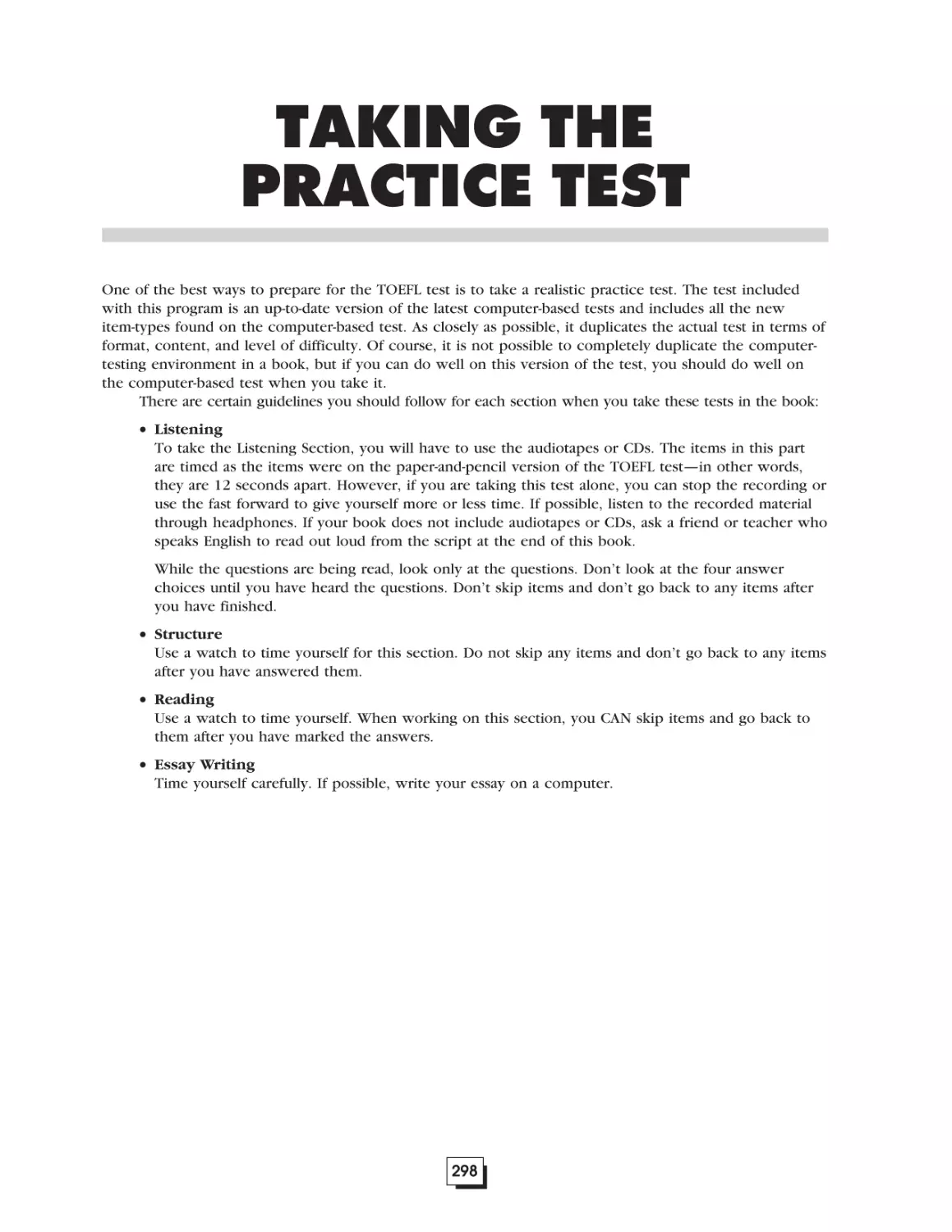
TAKING THE PRACTICE TEST . . . . . . . . . . . . . . . . . . . . . . . . . . . . . . . . 298
Section
Section
Section
Section
1.
2.
3.
4.
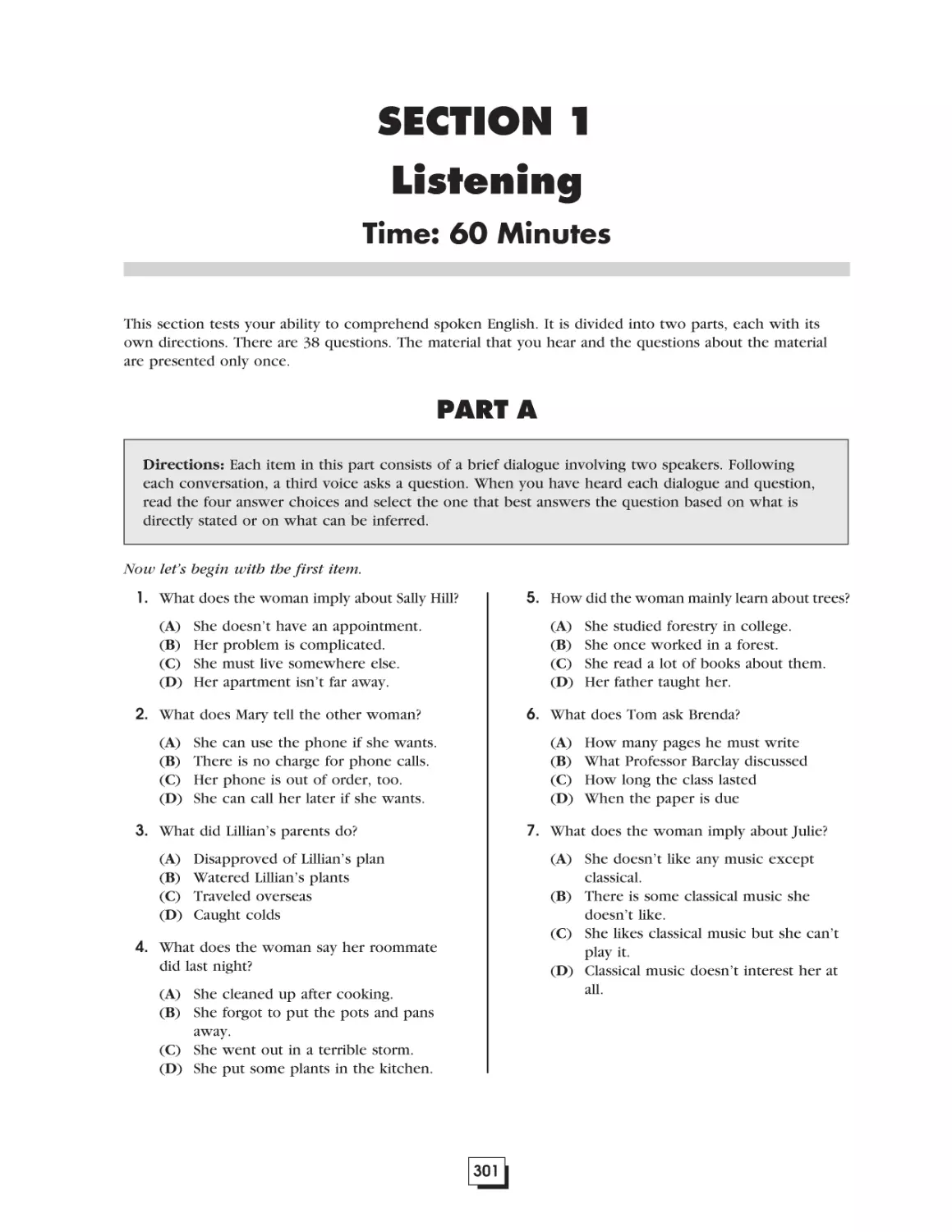
Listening . . . . . . . . . . . . . . . . . . . . . . . . . . . . . . . . . . . . . . . . . .
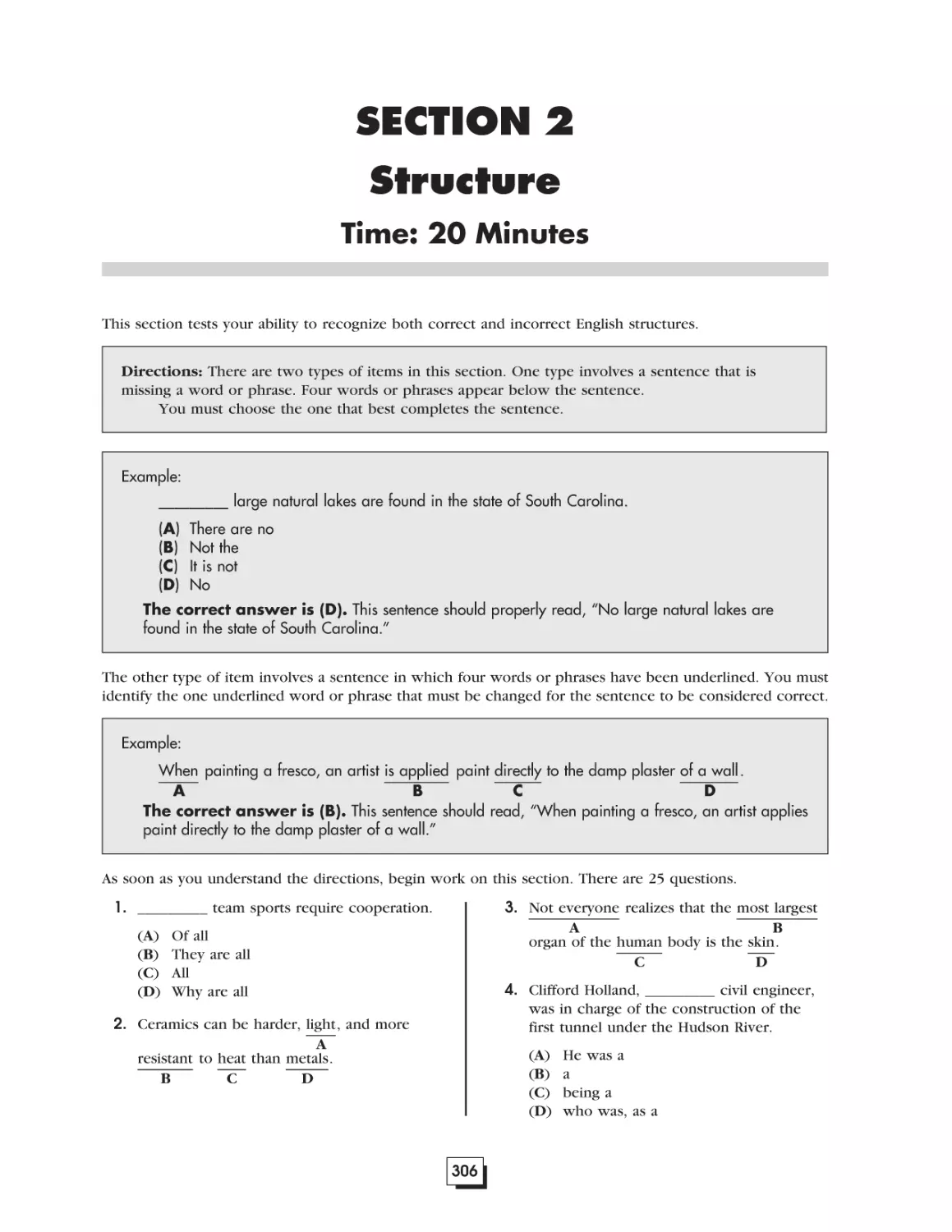
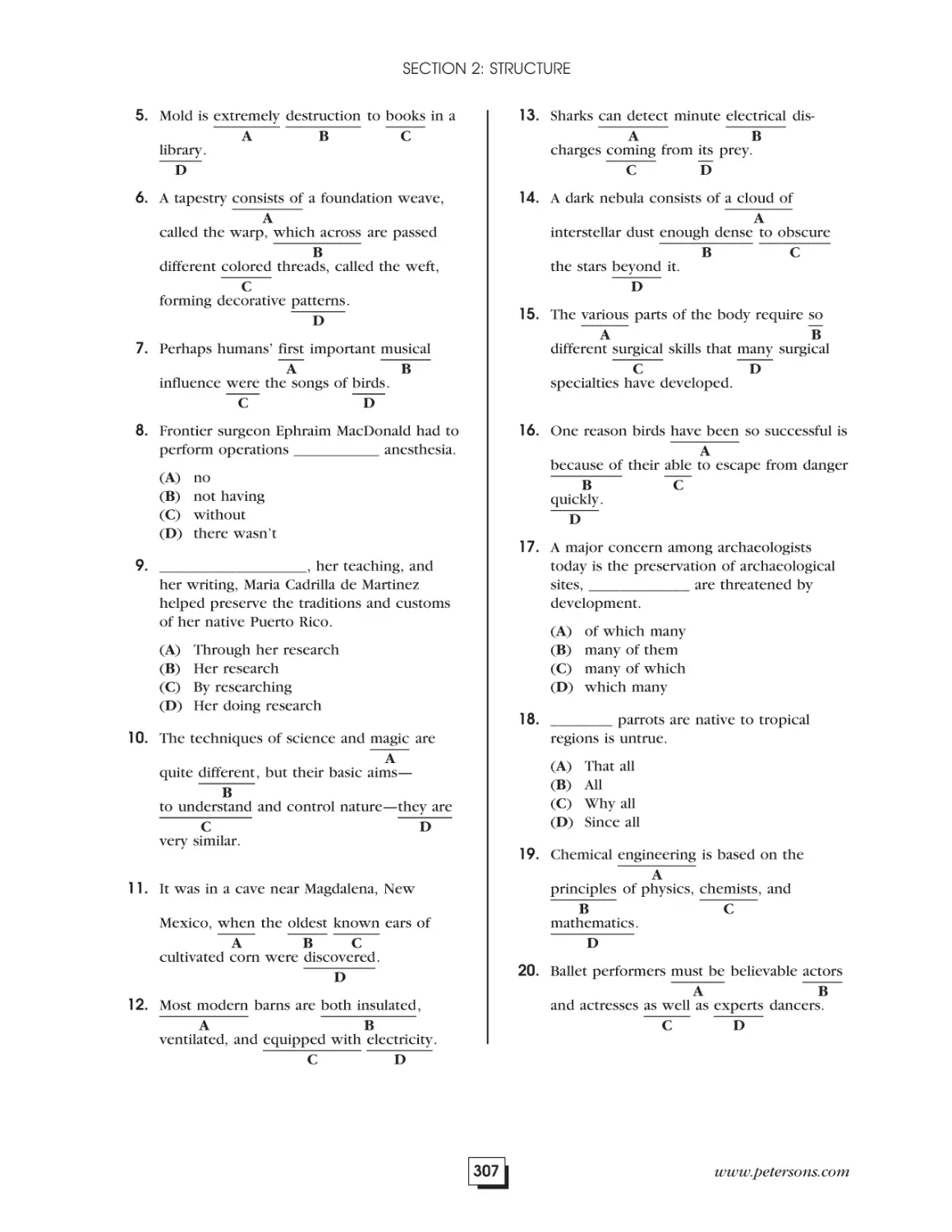
Structure . . . . . . . . . . . . . . . . . . . . . . . . . . . . . . . . . . . . . . . . . .
Reading . . . . . . . . . . . . . . . . . . . . . . . . . . . . . . . . . . . . . . . . . . .
Essay Writing . . . . . . . . . . . . . . . . . . . . . . . . . . . . . . . . . . . . . .
301
306
309
317
ANSWER KEYS AND AUDIO SCRIPTS
Section 1. Listening . . . . . . . . . . . . . . . . . . . . . . . . . . . . . . . . . . . . . . . . . .
Section 2. Structure . . . . . . . . . . . . . . . . . . . . . . . . . . . . . . . . . . . . . . . . . .
Section 3. Reading . . . . . . . . . . . . . . . . . . . . . . . . . . . . . . . . . . . . . . . . . . .
Section 4. Essay Writing . . . . . . . . . . . . . . . . . . . . . . . . . . . . . . . . . . . . . .
Practice Test . . . . . . . . . . . . . . . . . . . . . . . . . . . . . . . . . . . . . . . . . . . . . . . . . .
vii
322
355
367
377
384
www.petersons.com
PREFACE
About This Book
Success is simply written and clearly
organized and is suitable for any intermediate or advanced student of English as a
second or foreign language.
TOEFL Success offers a step-by-step
program that teaches you critical test-taking
techniques, helps you polish the language
skills needed for the examination, and
generally makes you a smarter test-taker.
And the guide is an efficient way to prepare
for the TOEFL; by concentrating only on the
points that are tested, it lets you make the
most of your preparation period and never
wastes your time. If you have purchased the
CD version of this book, you can access
additional TOEFL practice.
If you have purchased this book
without tapes or CDs, you do not have to
skip the sections that call for recordings. In
the back of the book, you will find complete
“audio scripts.” You can either read these to
yourself as you complete the listening
sections or have a friend or family member
read them to you.
Good luck on the TOEFL!
If you are preparing for the TOEFL test, you
are not alone. Almost a million people all
over the world took the test last year. A high
score on this test is an essential step in
being admitted to graduate or undergraduate
programs at almost all colleges and universities in North America. But preparing for this
test can be a difficult, frustrating experience.
Perhaps you haven’t taken many standardized, multiple-choice tests such as the
TOEFL. Perhaps you are not familiar with
the format for the computer-based TOEFL.
Maybe you’ve taken the TOEFL once but
were not satisfied with your score, or maybe
you’ve taken the test several times but can’t
improve your score beyond a certain point.
In any of these cases, you need a guide.
That’s why this book was written—to help
students preparing for this important
examination to maximize their scores.
This is the most complete, accurate,
and up-to-date TOEFL preparation book
available. It is based on years of classroom
experience teaching TOEFL preparation
classes in the United States and abroad and
on years of research on the test. TOEFL
ix
HOW TO USE THIS BOOK
Getting Started
Section 1: Listening
The first section of the book serves as an
introduction to the exam. The opening
portion of this section, Questions and
Answers About the TOEFL Test, provides
you with basic information about the format
of the test, guides you through the process
of registering for the examination, and helps
you understand your scores. What It’s Like
to Take the TOEFL Computer-Based Test
provides a preview of the testing experience
and lets you know what it will feel like to
take the test at a testing center.
The main body of the book is divided
into four sections, reflecting the main
sections of the test: Listening, Structure,
Reading Comprehension, and Essay. Each of
these sections consists of the following
components:
This section is divided into two parts: Part
A: Dialogues and Part B: Extended Conversations. If you have purchased a version of this
book with tapes or CDs, use them to
accompany the audio sections. See page ix
for instructions for the nonaudio version of
this book.
Section 2: Structure
This section categorizes common grammatical points tested in structure problems and
suggests ways to solve these problems.
Section 3: Reading
This section of the book prepares you for
the third section of the TOEFL test. The
Reading portion of the book suggests
reading attack skills, lists the various types of
questions asked about the passages, and
offers suggestions for answering each type
of question. There are in-depth reading
exercises to practice these techniques.
• An introduction containing basic
strategies for that section of the test.
• A sample test to give you a feel for
each part of the test and to provide a
basis for understanding the lessons.
Section 4: Essay Writing
This part of the book introduces the essay
writing section and presents the best
methods for planning, writing, and checking
the essay. There are model essays of strong
essays, and there are practice questions.
• Lessons that break down the knowledge and skills needed for each part
of the test into comprehensible
“bites” of information. Each of the
lessons in the book contains sample
items that illustrate exactly how the
point brought up in that lesson is
tested in TOEFL. Furthermore, each
lesson contains one or more exercises for practicing the relevant
points.
Practice Test
The practice test provides one of the best
ways to get ready for the TOEFL test
because it draws together all the points you
have studied. The practice test in this book
simulates as much as possible a computerbased test.
• Exercises that review the points
brought up in the previous lessons.
These put together the points
practiced in isolation in the lessons
and allow you to chart your progress.
xi
HOW TO USE THIS BOOK
SUGGESTIONS FOR USING THIS BOOK
The amounts of time required to cover
each segment of this book are given below.
Keep in mind that these times are approximate and do not include review sessions.
Whether working alone or in a group, you
should begin your preparation for the TOEFL
test by reading the introductory Test Basics.
You can then work through the book in the
order in which it is written or begin with
the section in which you are weakest (or in
which the majority of the students in a class
are weakest). Generally, you can make the
fastest progress by working in your weakest
area. You can determine which area is your
weakest by looking at the scores from a
previous test or by using one of the practice
tests as a diagnostic test.
www.petersons.com
Getting Started. . . . . . . . . . . . . . . . . 1–3
Listening. . . . . . . . . . . . . . . . . . . . 12–16
Structure. . . . . . . . . . . . . . . . . . . . 20–25
Reading. . . . . . . . . . . . . . . . . . . . . 15–20
Essay Writing. . . . . . . . . . . . . . . . . . 3–5
Complete Practice Test. . . . . . . . . 4–6
xii
hours
hours
hours
hours
hours
hours
ACKNOWLEDGMENTS
I would like to thank the many subscribers to the Material Writers branch of
TESOL-L (an electronic bulletin board for
teachers of English as a second language)
who responded when I asked for suggestions on revising this text.
Thanks also to the following for their
painstaking reviews and proofreading of the
“final” draft of the manuscript:
Ian Palmer, Seth Sycroft, University of
California at Davis.
Domo arigato to Kayoko Otani,
translator of the Japanese edition of The
Complete Guide to TOEFL, for suggesting
some of the vocabulary-in-context items in
Section 3.
Thanks to my editors at Heinle &
Heinle, David Lee and Eric Gunderson, and,
of course, to Associate Editor Ken Mattsson
for keeping the project on track.
I would like to thank the following professionals for their comments and suggestions
during the development of this text:
Steven A. Stupak, Korea International
Human Resources Development Center;
Virginia Hamori, American Language
Institute, American University of Paris; Jim
Price, International Language Center,
Bangkok; Stephen Thewlis, San Francisco
State University; Connie Monroe, Queens
College; Steven Horowitz, Central Washington University; Dan Douglas, Iowa State
University; Frederick O’Connor, Washington
State University; and Claire Bradin, Michigan
State University.
I would like to thank Donald Pharr for
his expert proofreading.
Thanks to Maggie Barbieri at Maxwell
Macmillian and to David Lee and Ken
Mattsson at Heinle & Heinle for their
editorial help.
Special thanks to all of the students in
my TOEFL preparation classes at the
Economics Institute.
xiii
TEST BASICS
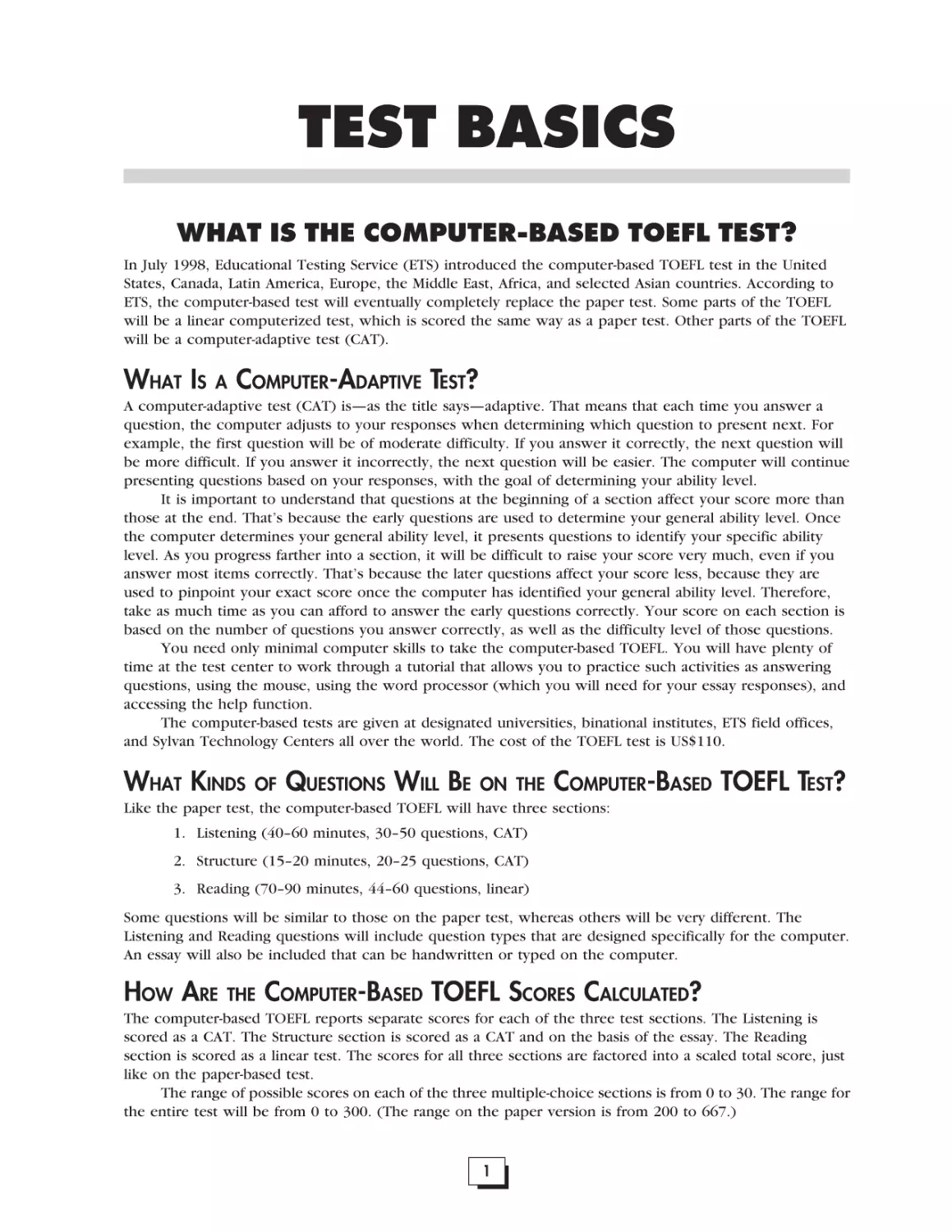
WHAT IS THE COMPUTER-BASED TOEFL TEST?
In July 1998, Educational Testing Service (ETS) introduced the computer-based TOEFL test in the United
States, Canada, Latin America, Europe, the Middle East, Africa, and selected Asian countries. According to
ETS, the computer-based test will eventually completely replace the paper test. Some parts of the TOEFL
will be a linear computerized test, which is scored the same way as a paper test. Other parts of the TOEFL
will be a computer-adaptive test (CAT).
WHAT IS
A
COMPUTER-ADAPTIVE TEST?
A computer-adaptive test (CAT) is—as the title says—adaptive. That means that each time you answer a
question, the computer adjusts to your responses when determining which question to present next. For
example, the first question will be of moderate difficulty. If you answer it correctly, the next question will
be more difficult. If you answer it incorrectly, the next question will be easier. The computer will continue
presenting questions based on your responses, with the goal of determining your ability level.
It is important to understand that questions at the beginning of a section affect your score more than
those at the end. That’s because the early questions are used to determine your general ability level. Once
the computer determines your general ability level, it presents questions to identify your specific ability
level. As you progress farther into a section, it will be difficult to raise your score very much, even if you
answer most items correctly. That’s because the later questions affect your score less, because they are
used to pinpoint your exact score once the computer has identified your general ability level. Therefore,
take as much time as you can afford to answer the early questions correctly. Your score on each section is
based on the number of questions you answer correctly, as well as the difficulty level of those questions.
You need only minimal computer skills to take the computer-based TOEFL. You will have plenty of
time at the test center to work through a tutorial that allows you to practice such activities as answering
questions, using the mouse, using the word processor (which you will need for your essay responses), and
accessing the help function.
The computer-based tests are given at designated universities, binational institutes, ETS field offices,
and Sylvan Technology Centers all over the world. The cost of the TOEFL test is US$110.
WHAT KINDS
OF
QUESTIONS WILL BE
ON THE
COMPUTER-BASED TOEFL TEST?
Like the paper test, the computer-based TOEFL will have three sections:
1. Listening (40–60 minutes, 30–50 questions, CAT)
2. Structure (15–20 minutes, 20–25 questions, CAT)
3. Reading (70–90 minutes, 44–60 questions, linear)
Some questions will be similar to those on the paper test, whereas others will be very different. The
Listening and Reading questions will include question types that are designed specifically for the computer.
An essay will also be included that can be handwritten or typed on the computer.
HOW ARE
THE
COMPUTER-BASED TOEFL SCORES CALCULATED?
The computer-based TOEFL reports separate scores for each of the three test sections. The Listening is
scored as a CAT. The Structure section is scored as a CAT and on the basis of the essay. The Reading
section is scored as a linear test. The scores for all three sections are factored into a scaled total score, just
like on the paper-based test.
The range of possible scores on each of the three multiple-choice sections is from 0 to 30. The range for
the entire test will be from 0 to 300. (The range on the paper version is from 200 to 667.)
1
TEST BASICS
TEST-TAKING TIPS FOR THE CAT SECTIONS OF THE
COMPUTER-BASED TOEFL TEST
The purpose of TOEFL Success is to help you prepare for all forms of the test. You will increase your
chances of scoring high on the TOEFL by being completely familiar with the content and format you will
encounter on test day. The strategies and review sections of this book, as well as the practice tests,
provide lots of opportunity to review relevant content. Keep in mind the following test-taking tips, most of
which are unique to the CAT format.
• Understand the directions for each question type. Learn the directions for each type of question.
The directions in this book are similar to those on the actual test. Understanding the directions for
each question type will save you valuable time on the day of the test.
• Focus on answering the questions at the beginning of Sections 1 and 2 correctly. Remember that
questions at the beginning of a section affect your score more than questions at the end. Be
especially careful in choosing answers to questions in the first half of both the quantitative and
verbal sections. Once the computer determines your general ability level with these initial questions, you will be unable to dramatically improve your score, even if you answer most of the
questions toward the end correctly.
• In Sections 1 and 2, be completely sure of each answer before proceeding. With a CAT, you must
answer each question as it is presented. You cannot skip a difficult question and return to it later
as you can with a paper test. Nor can you review responses to questions that you have already
answered. Therefore, you must be confident about your answer before you confirm it and proceed
to the next question. If you are completely stumped by a question, eliminate as many answer
choices as you can, select the best answer from the remaining choices, and move on.
• Pace yourself. To finish all sections, you will need to work both quickly and accurately to complete
each section within the time constraints. You will still receive a score, even if you do not complete
all of the questions in a section.
Questions and Answers about the TOEFL Test
Q: What is the TOEFL test?
A: TOEFL stands for Test of English as a Foreign Language. The TOEFL test is designed to measure the
English-language ability of people who do not speak English as their first language and who plan to
study at colleges and universities in North America. Educational Testing Service (ETS) of Princeton,
New Jersey, prepares and administers the TOEFL test. This organization produces many other standardized tests. Although there are other standardized tests of English, the TOEFL test is, by far, the most
important in North America. ETS has offered this examination since 1965. Each year, almost a million
people take the TOEFL test at testing centers all over the world.
Q: What format does the computer-based test follow? How long does it take to complete?
A: The computer-based test is divided into four sections: Listening, Structure, Reading, and Essay Writing,
each with its own time limit. The four sections are always given in the same order. Before the actual
test, you must take a tutorial that demonstrates the computer skills needed to take the test. This part is
ungraded, of course, and untimed. Most test-takers take approximately 40 minutes to complete this
section. The first three sections consist mainly of multiple-choice questions, while Essay Writing is a
single essay-writing item.
Q: What are the main differences between the paper-based test and the computer-based test?
A: The first three sections of the computer-based test generally have fewer items. For example, on the
most recent version of the paper-based test, there are 40 Structure items, whereas on the computerbased version, there are 20 to 25. Another difference is the use of visuals in the Listening section.
There are also some new “computer-unique” item types in Listening and Reading Sections.
www.petersons.com
2
TEST-TAKING TIPS FOR THE CAT SECTIONS OF THE COMPUTER-BASED TOEFL TEST
Computer-Based Format for the TOEFL Test
Tutorial
Untimed—Average 40 minutes
3. Reading
70–90 minutes
4–5 readings
44–70 questions (linear)
1. Listening
40–60 minutes
30–50 questions (computer adaptive)
Part A: Dialogues 11–17 items
Part B: Longer Talks 4–6
Talks/conversations 3–6 questions
per talk
4. Essay Writing
1 essay prompt—30 minutes
2. Structure
15–20 minutes
20–25 questions (computer adaptive)
Sentence Completion and Error Recognition
Mandatory break—10 minutes
Total Time: Approximately 4 hours
Q: Are the computer-based test scores simply based on the number of correct answers?
A: No. Test-takers A and B may get the same number of correct answers on one section, but test-taker A
may get a higher score because he or she answered more difficult items correctly.
Q: When will I receive my test scores?
A: You will receive unofficial on-screen scores right after you take the test. The scores for Listening and
Reading will be final scores, but the score for Structure and your overall score will be reported as a
range of scores.
Here is an example of what these on-screen scores look like:
Listening
Structure
Reading
Overall
20
6–25
24
167–230
What your final scores will be depends on the score you receive on the Essay Writing section (which
cannot be instantly graded). The Essay Writing score ranges from 0 to 6.
Here are some examples of scores you might receive, depending on your essay score:
Essay
Score
Structure
Score
Overall
Score
0
1
3
5
6
6–7
9–10
15–16
22–23
24–35
167–170
177–180
198–201
220–223
227–230
You and the schools that you designate should receive final scores within two weeks if you word
process the essay. If you handwrite the essay, you should receive scores in four to six weeks.
3
www.petersons.com
TEST BASICS
Q: What is an Institutional TOEFL test?
A: Institutional TOEFL tests are given by English-language schools and other institutions. Sometimes they
are used for placement in a school’s English program or for testing a student’s progress. Institutional
tests are composed of items that previously appeared on tests administered by ETS.
Because ETS does not supervise these tests, some universities won’t accept the results. However,
many other universities will. You should check with the admissions offices of universities to see what
their policy is. You must arrange for the institute where you took the examination to send the scores
to the university.
Q: Has the format of the Institutional TOEFL test also changed?
A: No, the Institutional TOEFL test (a form of the test given by English-language schools and other
institutions) is still paper-based.
Q: What is TSE?
A: TSE (Test of Spoken English) tests your ability to communicate in spoken English. All of your responses
are recorded on audiotape so that they can be evaluated later. The test takes approximately 20 minutes to
complete and is given twelve times a year at various test centers. On TSE, you must answer questions
about pictures or graphs, complete sentences, express your opinions on various topics, give short presentations, and so on. TSE is administered separately from TOEFL and must be paid for separately.
TSE is generally required only for students who are applying for positions as teaching assistants or
for special programs or certificates.
Q: How do I register for the computer-based TOEFL test?
A: There are several ways to register. You can register for the computer-based test by telephone if you
have a credit card (Visa, MasterCard, or American Express). In North America, you can call Prometric
TOEFL Test Registration Center toll-free at 800-GO-TOEFL (800-468-6335) or you may call your local
test center. There is a complete list of these in the TOEFL Information Bulletin. Outside North
America, call the Regional Registration Center for the country where you live. These are listed in the
Bulletin. You will be given a confirmation number and be told when and where to report. You can
also register by mail. If you are in North America, you can use the CBT Voucher Test Request Form
found in the Bulletin. You can pay with a credit card, check, or money order. You will receive a CBT
voucher in several weeks. After that, you can call a center to schedule an appointment. If you live
outside North America, you need to fill out the International Test Scheduling Form and mail it to your
Regional Registration Center. Payment may be in the form of a check, credit card, money order, bank
draft, or UNESCO coupons. Outside North America, you may also register by faxing the International
Test Scheduling Form to the Regional Registration Center for your country. Fax numbers for these
centers are listed in the Bulletin. You can register in person by visiting the nearest testing site, and, in
the near future, you will probably be able to register on line by going to the TOEFL Web site.
Q: What computer skills do I need to take the computer-based TOEFL test?
A: The computer skills required are fairly basic. You only need to know how to point to and click on a
choice with a mouse, how to scroll up and down through a document, and how to access help if you
need it. If you choose to type your essay on the computer (rather than write it by hand), you will also
need basic word-processing skills. Before you take the test at the center, you must complete a tutorial
to make sure you have mastered the skills you need.
Q: Where is the computer-based test offered?
A: It is given at designated test centers, universities, binational institutes, and ETS field offices throughout
the world. There are two types of test centers, permanent and mobile. Tests are given at mobile
centers only during certain months. A complete list of testing centers is given in the Bulletin. The
computer-based test is not offered at nearly as many centers as the paper-based test was. Depending
on where you live, you may have to travel a rather long distance to take the test.
www.petersons.com
4
TEST-TAKING TIPS FOR THE CAT SECTIONS OF THE COMPUTER-BASED TOEFL TEST
Q: Can I choose whether to take the computer-based test or the paper-based test?
A: No. Once the computer-based test has been phased in, you will no longer have the option of taking
the paper-based test.
Q: How much does the computer-based test cost?
A: It will cost US$110. (The paper-based version of the test had cost US$45.) If you need to reschedule
the test, you will have to pay a US$40 rescheduling fee.
Q: What should I bring with me to the examination site?
A: You should bring the following:
• Your passport
• Your appointment confirmation number
• Your CBT voucher, if you are using one
• A list of the universities to which you want your scores sent
Don’t bring any reference books, such as dictionaries or textbooks, or any electronic devices, such as
translators, cellular phones, or calculators. You are not permitted to smoke, eat, or drink in the test
center. You do not have to bring pencils or paper.
Q: Is every item on the test scored?
A: No, there is usually at least one unscored item in each part of the test. This is generally the last item in
each part. For example, in Section 2, item 15 and item 40 are usually not scored. However, it’s not
recommended that you skip these items—ETS could always change its system!
Q: What is a passing score on the TOEFL test?
A: There isn’t any. Each university has its own standards for admission, so you should check the catalogs
of universities you are interested in or contact their admissions offices. Most undergraduate programs
require scores between 173 and 213 (between 500 and 550 on the paper-based test), and most
graduate programs ask for scores between 195 and 250 (between 525 and 600 on the paper-based
test). Recently, there has a been a tendency for universities to raise their minimum requirements for
the TOEFL test.
Q: How are universities informed of my scores?
A: ETS reports your score to three institutions for free. For a charge, ETS will send your scores to
additional institutions. There is a form for requesting this service in the Bulletin. Some universities will
also accept photocopies of the test results that were mailed directly to you.
Q: If I believe I haven’t done well on the TOEFL test, can I cancel my scores?
A: Yes. Right after the test, you may either cancel your scores or view them. You may NOT cancel your
scores once you have looked at them. However, if you are not satisfied with your unofficial scores,
you can direct ETS to NOT send them on to any universities. Keep in mind that, even if you cancel
your scores, you cannot take the test again until the next calendar month. It is generally NOT a good
idea to cancel scores. You may have done better on the test than you thought you did.
Q: Can I get my scores by phone?
A: Yes. Call 888-TOEFL-44 (toll-free) in North America and 609-771-7267 elsewhere fourteen days after the
test (four to five weeks after the test if you handwrite the essay). ETS charges a fee for this service.
Q: How many times may I take the computer-based TOEFL test?
A: There is no limit; you may take it as often as you like. However, you may not take the test more than
once in any calendar month.
5
www.petersons.com
TEST BASICS
Q: Will there be other changes to the TOEFL test in the near future?
A: Yes. In September 2005, ETS will debut a new TOEFL, which will include a speaking section, among
other changes.
Q: How can I get more information about the TOEFL test?
A: You can contact ETS via e-mail or get updated information about the test from its home page on the
World Wide Web: E-mail: toefl@ets.org; Web site: www.toefl.org.
Q: Is it possible to improve one’s score by cheating?
A: It is difficult to have someone else take the examination for you. You must bring an official identification document with your picture on it. You are also required to bring a photo file record with a recent
photo of yourself. ETS copies this photo and sends it, with your scores, to universities. If the person in
the photo is not the same person who enrolls, that person may not be admitted.
The following are also considered cheating:
• Taking notes during the Listening section
• Talking to or signaling any other test-takers
• Copying any test material
• Working on one section during the time allotted for another section
• Continuing to work on a section after time is called
Persons who are believed to be cheating will receive a warning for minor acts of cheating. For more
serious matters, a person’s scores will be canceled.
What It’s Like to Take the Computer-Based TOEFL Test
1. The first step is to call the closest testing center.* You should call at least one month before you need
to take the test. There is typically a three-week waiting time, but this may vary by time of year and
center. The waiting time for certain days—especially Saturdays—will be longer than for other days. If
you have a credit card or have already purchased a CBT voucher, you can make an appointment over
the phone to take the test. Otherwise, arrange to stop by the center. If you do make an appointment
when you call, you will receive a confirmation number. Write down this number and keep it in a safe
place.
2. A week after registering, you will receive directions to the center in the mail (including public
transportation routes). Keep this card with your confirmation number. On the day before the test, get
this card, your confirmation number, and your passport ready to take with you the following day.
3. Arrive at least a half-hour early for your appointment. At the time you arrive, you will be given a form
to complete.
4. At the time of your appointment, or whenever a computer is free, you will be taken into a room near
the testing room and given a paragraph to copy and sign. This paragraph says that you really are who
you say you are and that you promise not to tell anyone what is on the test. At this time, you will
also have to show your passport and you will be photographed. Before you go into the testing room,
you will have to sign a register. Center officials will then take you into the testing room and seat you
at a computer. There may be several other people in the room taking tests—not only the TOEFL.
Your testing space will resemble the study carrels found at libraries.
5. Your computer will prompt you to answer some questions about yourself, your plans, and your
reason for taking the test. After that, the tutorial will begin. This tutorial teaches you the basic
computer skills required to take the test.
* Note: The testing experience may differ somewhat from center to center.
www.petersons.com
6
TEST-TAKING TIPS FOR THE CAT SECTIONS OF THE COMPUTER-BASED TOEFL TEST
6. After you have finished the tutorial (which is not timed), you may begin the Listening section. You
will have a chance to adjust the volume, read the directions, and answer a few practice items.
Remember, you are NOT allowed to take notes during the Listening section.
7. After the Listening section, you may take a 1-minute break or go directly on to the Structure section.
8. After completing the Structure section, there is a mandatory 10-minute break. You will have to sign
out before you leave the testing area.
9. After the break, you will again have to sign in. You will be given six sheets of scrap paper and will
be shown back to your computer. The next section of the test is Reading. Remember that this section
of the test is NOT computer adaptive and that you can move forward and backward through the
readings. You can skip questions (although this is seldom a good idea), and go back and change your
answers any time you want.
10. After you finish the Reading section of the test, you may take a one-minute break or proceed with the
Essay Writing section. If you choose to word process the essay, you will see a brief tutorial explaining
cut, paste, delete, and other commands you need to write the essay on the computer. Use the scrap
paper you have been given to write a quick outline for your essay.
11. After you have written your essay, you will receive an unofficial grade report. You will then have a
chance to choose from a pull-down menu the universities that will receive your scores. You may then
be asked several questions about your experience taking the test. After that, you must hand in your
scrap paper. You will then sign out.
12. If you word process your essay, you will receive your final test scores in two weeks.
If you handwrite your essay, you will receive your final scores in approximately four to five weeks.
7
www.petersons.com
TEST BASICS
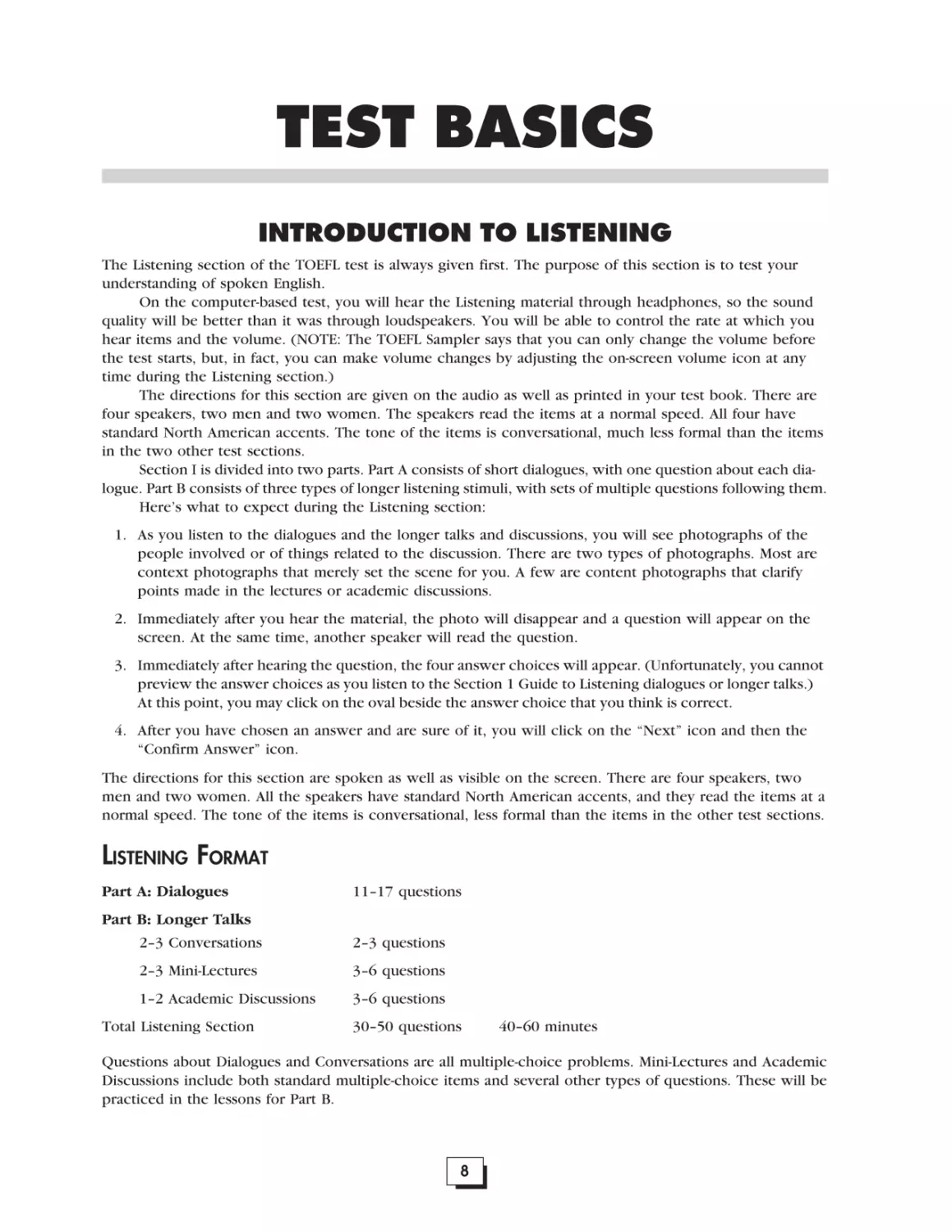
INTRODUCTION TO LISTENING
The Listening section of the TOEFL test is always given first. The purpose of this section is to test your
understanding of spoken English.
On the computer-based test, you will hear the Listening material through headphones, so the sound
quality will be better than it was through loudspeakers. You will be able to control the rate at which you
hear items and the volume. (NOTE: The TOEFL Sampler says that you can only change the volume before
the test starts, but, in fact, you can make volume changes by adjusting the on-screen volume icon at any
time during the Listening section.)
The directions for this section are given on the audio as well as printed in your test book. There are
four speakers, two men and two women. The speakers read the items at a normal speed. All four have
standard North American accents. The tone of the items is conversational, much less formal than the items
in the two other test sections.
Section I is divided into two parts. Part A consists of short dialogues, with one question about each dialogue. Part B consists of three types of longer listening stimuli, with sets of multiple questions following them.
Here’s what to expect during the Listening section:
1. As you listen to the dialogues and the longer talks and discussions, you will see photographs of the
people involved or of things related to the discussion. There are two types of photographs. Most are
context photographs that merely set the scene for you. A few are content photographs that clarify
points made in the lectures or academic discussions.
2. Immediately after you hear the material, the photo will disappear and a question will appear on the
screen. At the same time, another speaker will read the question.
3. Immediately after hearing the question, the four answer choices will appear. (Unfortunately, you cannot
preview the answer choices as you listen to the Section 1 Guide to Listening dialogues or longer talks.)
At this point, you may click on the oval beside the answer choice that you think is correct.
4. After you have chosen an answer and are sure of it, you will click on the “Next” icon and then the
“Confirm Answer” icon.
The directions for this section are spoken as well as visible on the screen. There are four speakers, two
men and two women. All the speakers have standard North American accents, and they read the items at a
normal speed. The tone of the items is conversational, less formal than the items in the other test sections.
LISTENING FORMAT
Part A: Dialogues
11–17 questions
Part B: Longer Talks
2–3 Conversations
2–3 questions
2–3 Mini-Lectures
3–6 questions
1–2 Academic Discussions
3–6 questions
Total Listening Section
30–50 questions
40–60 minutes
Questions about Dialogues and Conversations are all multiple-choice problems. Mini-Lectures and Academic
Discussions include both standard multiple-choice items and several other types of questions. These will be
practiced in the lessons for Part B.
8
INTRODUCTION TO LISTENING
The Listening section tests both your listening ability and your reading skills because you must
understand both the spoken material you hear through the headphones and the answer choices on
the screen.
Many test-takers find the Listening section the most difficult. Because it is given first, you may be
more nervous during this part of the test. Furthermore, it is difficult to understand voices on tape (just as it
is on the telephone or radio) because you can’t see the speakers’ gestures, facial expressions, or lip
movements as you can during “live” listening. Finally, the test-writers at ETS employ several “tricks” that
make choosing the correct answer more difficult.
The exercises and tests in the Listening section of this text are designed to help you overcome these
difficulties. You will become more comfortable listening to materials on audio or computer. You’ll also
become alert to many of the test-writers’ “tricks.” If your copy of this book includes either audiocassette
tapes or CDs, when you are taking the practice tests in the book, listen on headphones if they are available. Look only at the photograph while you listen to the dialogue or talk. Then, when questions are being
read, look only at those questions. Don’t preview the answer choices (because you won’t be able to do
this during the actual test). Don’t go back and change an answer once you have finished an item.
On the computer-based test, you control the speed at which you hear items. However, in the
listening material for this book, items are separated by 12-second pauses, as they were on the
paper-based test.
You should spend some time working with the Listening sections of the audiocassettes or CDs to get
used to controlling the speed at which you hear items.
STRATEGIES
FOR
SECTION 1
• Familiarize yourself with the directions for each part before the examination. But remember, you are not
permitted to turn the page to look over answer choices while the directions are being read. (No answer
choices appear on the same page as the directions.)
• If you have any difficulties hearing the recording, inform one of the proctors during the introductory
section. Once the test has begun, the proctors cannot stop the recording.
• Always answer promptly after the answer choices appear, not only to save time but also to keep the
listening material fresh in your mind.
• Use your “power of prediction.” When you are looking at the photograph and listening to the spoken
material, try to guess what the question or questions will be. Then, when you are listening to and
reading the question, try to guess what the correct answer will be. Look for your predicted answer or
something similar to it among the four choices.
• If you are not sure of an answer, try to eliminate unlikely choices and make your guess. If you have no
idea which answer is correct, click on your guess answer and go on.
• Never spend too much time on any one problem. Concentration is important in this part of the test.
Once you choose an answer, don’t think about the last item—start thinking about the next one. Don’t
daydream. Focus your attention on the recording and on the choices in your test book.
Begin your preparation for Section 1 by taking Preview Test 1: Listening on the following pages. This will
familiarize you with the first section of the examination.
9
www.petersons.com
SECTION 1
Listening
Preview Test 1: Listening. . . . . . . . . . . . . . . . . . . . . . . . . . . . . . . . . 12
Part A: Dialogues . . . . . . . . . . . . . . . . . . . . . . . . . . . . . . . . . . . . . . . . 18
Lesson
Lesson
Lesson
Lesson
Lesson
Lesson
1.
2.
3.
4.
5.
6.
Dialogues with Sound Confusion . . . . . . . . . . . . . . . . . . . . . . . . . . . .
Dialogues with Homonyms and Words with Multiple Meanings . .
Dialogues with Idioms . . . . . . . . . . . . . . . . . . . . . . . . . . . . . . . . . . . . .
Answering Inference Questions about Dialogues . . . . . . . . . . . . . . .
Dialogues Involving Agreement and Disagreement . . . . . . . . . . . . .
Dialogues Involving Suggestions, Invitations, Offers, and
Requests . . . . . . . . . . . . . . . . . . . . . . . . . . . . . . . . . . . . . . . . . . . . . . . . .
Lesson 7. Dialogues Involving Contradictions, Assumptions, and Questions .
Lesson 8. Answering Questions about Plans, Topics, and Problems . . . . . . . .
Lesson 9. Dialogues with Special Verbs . . . . . . . . . . . . . . . . . . . . . . . . . . . . . . .
23
26
30
35
39
43
50
54
57
Part B: Extended Conversations . . . . . . . . . . . . . . . . . . . . . . . . . 62
Lesson 10.
Answering Main Idea/Main Topic Questions about Extended
Conversations . . . . . . . . . . . . . . . . . . . . . . . . . . . . . . . . . . . . . . . . . . . .
Lesson 11. Answering Detail and Inference Questions about Extended
Conversations . . . . . . . . . . . . . . . . . . . . . . . . . . . . . . . . . . . . . . . . . . . .
Lesson 12. Answering Matching and Ordering Questions about
Longer Talks. . . . . . . . . . . . . . . . . . . . . . . . . . . . . . . . . . . . . . . . . . . . . .
66
68
71
PREVIEW TEST 1
Listening
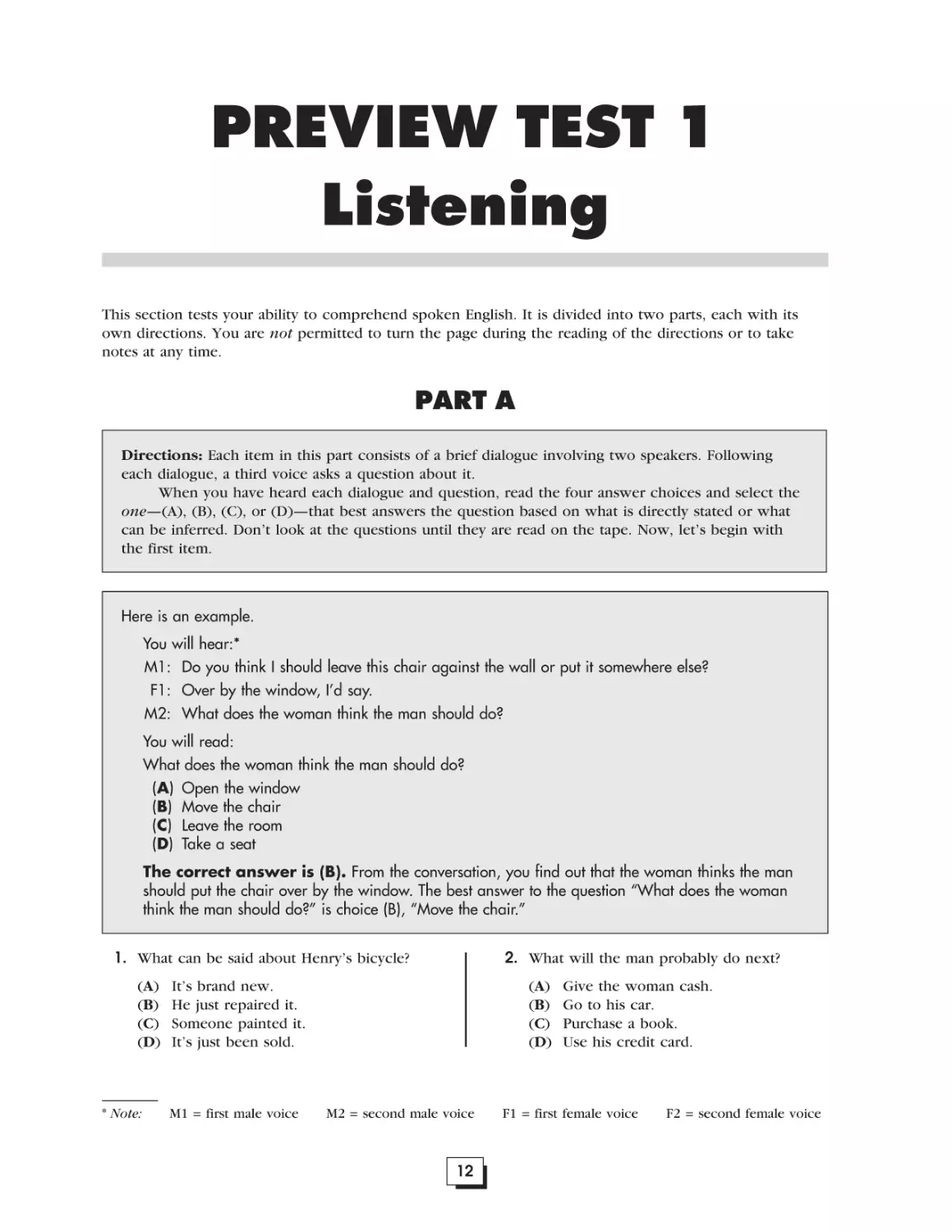
This section tests your ability to comprehend spoken English. It is divided into two parts, each with its
own directions. You are not permitted to turn the page during the reading of the directions or to take
notes at any time.
PART A
Directions: Each item in this part consists of a brief dialogue involving two speakers. Following
each dialogue, a third voice asks a question about it.
When you have heard each dialogue and question, read the four answer choices and select the
one—(A), (B), (C), or (D)—that best answers the question based on what is directly stated or what
can be inferred. Don’t look at the questions until they are read on the tape. Now, let’s begin with
the first item.
Here is an example.
You will hear:*
M1: Do you think I should leave this chair against the wall or put it somewhere else?
F1: Over by the window, I’d say.
M2: What does the woman think the man should do?
You will read:
What does the woman think the man should do?
(A) Open the window
(B) Move the chair
(C) Leave the room
(D) Take a seat
The correct answer is (B). From the conversation, you find out that the woman thinks the man
should put the chair over by the window. The best answer to the question “What does the woman
think the man should do?” is choice (B), “Move the chair.”
2. What will the man probably do next?
1. What can be said about Henry’s bicycle?
(A)
(B)
(C)
(D)
* Note:
It’s brand new.
He just repaired it.
Someone painted it.
It’s just been sold.
M1 = first male voice
(A)
(B)
(C)
(D)
M2 = second male voice
12
Give the woman cash.
Go to his car.
Purchase a book.
Use his credit card.
F1 = first female voice
F2 = second female voice
PREVIEW TEST 1: LISTENING
10. What do the speakers imply about William?
3. What does the woman tell Mark?
(A) He has a good excuse for being late.
(B) No one has heard from him for a
week.
(C) He’s still waiting to be contacted.
(D) He doesn’t take responsibility for
errors.
(A) He should have listened to Professor
Bryant’s suggestions.
(B) He doesn’t have to read all the books.
(C) All of the books on the list are
important.
(D) Some of the books are unavailable
now.
11. What did the man think he had lost?
4. What does the man mean?
(A)
(B)
(C)
(D)
(A)
(B)
(C)
(D)
The software isn’t convenient to use.
He’s not familiar with the software.
Using the software is simple.
He wishes he’d bought that software.
12. What can be inferred about the man?
5. What does the man want to know?
(A)
(B)
(C)
(D)
(A) He got on the wrong bus.
(B) He’s afraid he’ll be late for his flight.
(C) He’s sorry he took a bus instead of
flying.
(D) He had to wait a long time for the bus.
What time his brother called
Where to meet his brother
Why his brother called
When to meet his brother
13. What does the woman imply?
6. What does the man say about Howard?
(A)
(B)
(C)
(D)
His wallet
An identification card
His job at the bookstore
A check
(A) The meeting will have to be
rescheduled.
(B) She doesn’t care whom the board
picks as dean.
(C) She’s not sure where the meeting will
be.
(D) The board will not choose a dean this
month.
He left on a long trip yesterday.
His letter arrived unexpectedly.
He seemed to be sad yesterday.
The letter he sent was very funny.
7. What can be inferred about Professor
Welch from this conversation?
(A) He’ll probably give the man another
grade.
(B) He doesn’t teach chemistry anymore.
(C) He rarely changes his grades.
(D) He’ll probably retire soon.
14. What do they mean?
(A) They wish they hadn’t paid attention
to Harvey.
(B) They asked for some information about
Harvey.
(C) Harvey told them not to ignore him.
(D) Only Harvey could give them any
assistance.
8. What is the woman really saying to Allen?
(A) His class has been canceled.
(B) He shouldn’t drop the class.
(C) An earlier class would be better for
him.
(D) He doesn’t need to study political
science.
15. What are the men probably discussing?
(A)
(B)
(C)
(D)
9. What does the man say about Professor
Porter?
A hotel room
The man’s family
A reasonable offer
The man’s schedule
(A) She mailed the grades to her students.
(B) She left the students’ tests in her
office.
(C) She can’t get into her office.
(D) She put a list of grades on the door.
13
www.petersons.com
SECTION 1: LISTENING
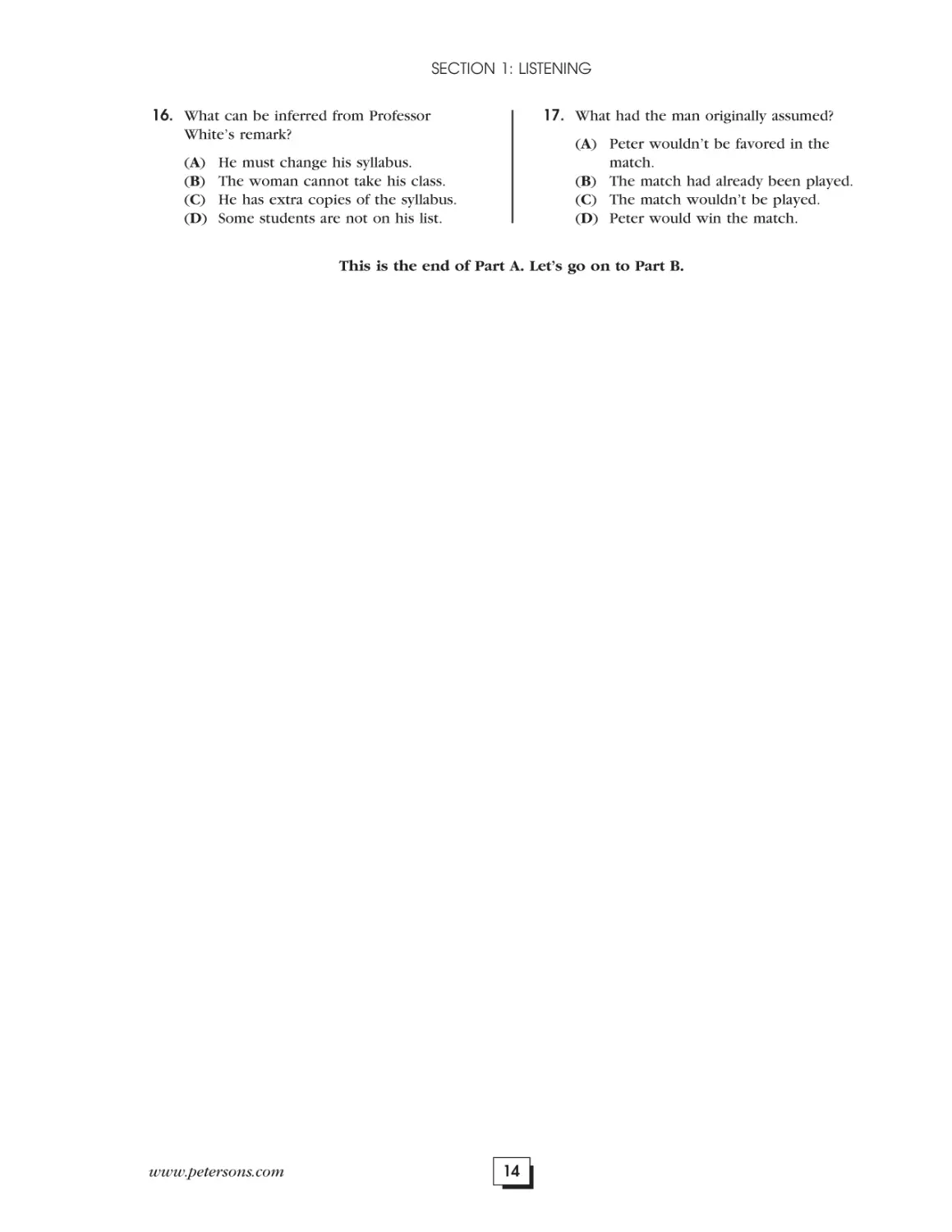
16. What can be inferred from Professor
White’s remark?
(A)
(B)
(C)
(D)
17. What had the man originally assumed?
(A) Peter wouldn’t be favored in the
match.
(B) The match had already been played.
(C) The match wouldn’t be played.
(D) Peter would win the match.
He must change his syllabus.
The woman cannot take his class.
He has extra copies of the syllabus.
Some students are not on his list.
This is the end of Part A. Let’s go on to Part B.
www.petersons.com
14
PREVIEW TEST 1: LISTENING
PART B
Directions: Part B involves discussions, conversations, and lectures. After each talk, there are several
questions. You will hear the talks only once.
When you have read and heard the questions, read the answer choices and select the best
answer or answers based on what is directly stated or can be inferred.
Don’t forget: During actual exams, taking notes during the Listening section is not permitted.
Now, let’s begin with the first talk. Listen to a conversation between a student and his academic
adviser.
18. What course does Scott want to drop?
(A)
(B)
(C)
(D)
(A) It was not a single object but two
objects.
(B) Its surface temperatures were much
colder than those on Earth.
(C) It had two moons: Phosphorous and
Hesperus.
(D) There was life beneath its cloud cover.
Biochemistry
Mathematics
Language
Music
19. What does Professor Lamont suggest that
Scott do?
(A)
(B)
(C)
(D)
24. Which of the following does the speaker
say about the length of a day on Venus?
Change majors.
Study music.
Get a tutor.
Drop the class.
(A)
(B)
(C)
(D)
20. Which of the following best describes
Professor Lamont’s attitude toward Scott?
(A)
(B)
(C)
(D)
(A)
(B)
(C)
(D)
The
The
The
The
Mariner 2
Venus Pioneer 2
Magellan
Venera 4
1.
have similar surface conditions.
are about the same size.
spin in the same direction.
are relatively close together.
2.
3.
4.
22. Which of the following can be seen
through a telescope aimed at Venus?
(A)
(B)
(C)
(D)
shorter than an Earth day.
longer than an Earth year.
longer than a Venus year.
the longest of any known planet.
Place the letter of the choice in the
proper box. Use each choice only once.
Choose two.
They
They
They
They
is
is
is
is
25. In what order were these space probes sent
to Venus?
Condescending
Angry
Encouraging
Disappointed
21. According to the speaker, in what ways are
Earth and Venus twins?
(A)
(B)
(C)
(D)
It
It
It
It
26. It can be inferred that the topic of the next
student’s presentation will be which of the
following?
phases of Venus
continents of Venus
moons of Venus
jungles of Venus
(A)
(B)
(C)
(D)
23. According to the speaker, which of the
following were once common beliefs about
the planet Venus?
The
The
The
The
moon
sun
earth
planet Mars
Choose two.
15
www.petersons.com
SECTION 1: LISTENING
27. Why does Dana want to find a job?
(A)
(B)
(C)
(D)
To
To
To
To
pay
pay
pay
pay
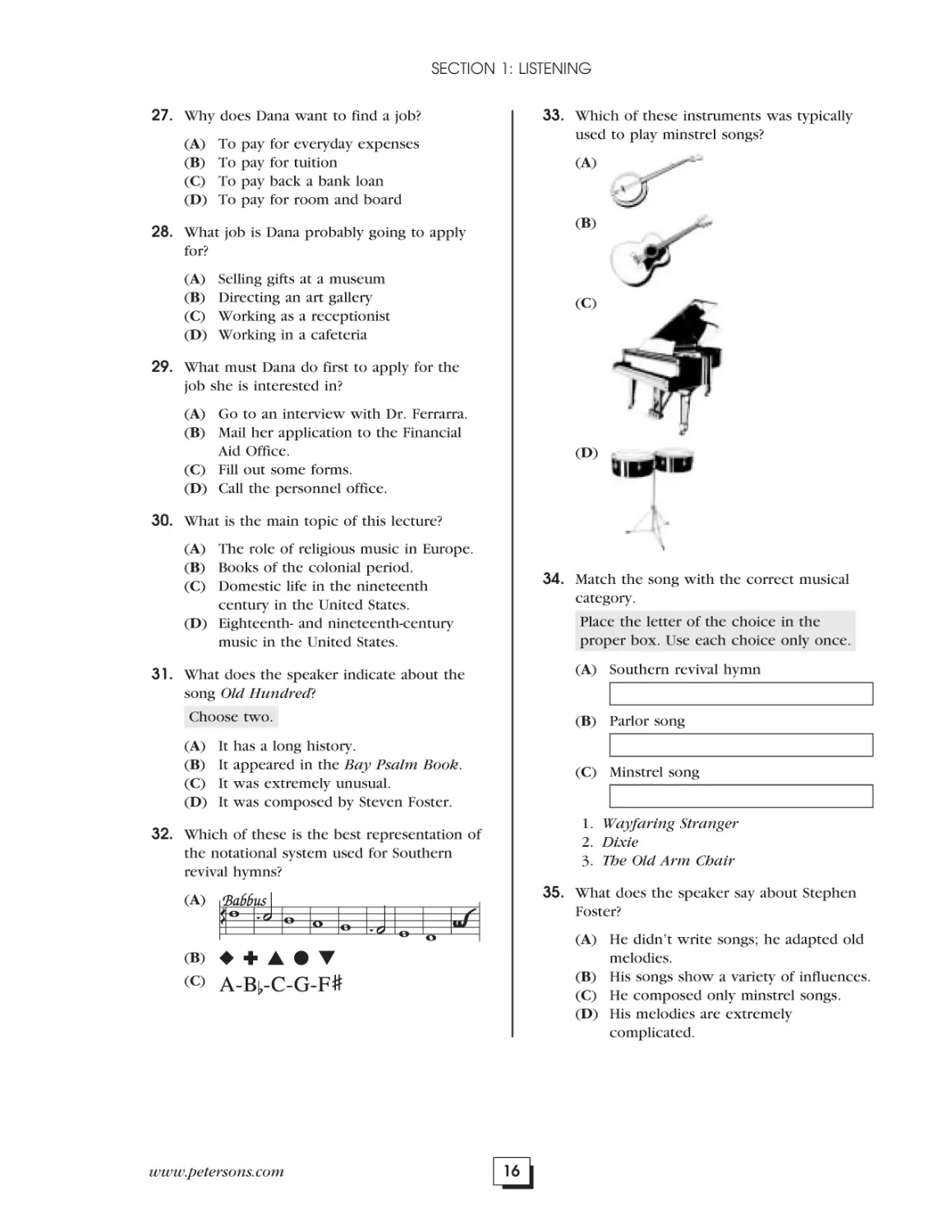
33. Which of these instruments was typically
used to play minstrel songs?
for everyday expenses
for tuition
back a bank loan
for room and board
(A)
(B)
28. What job is Dana probably going to apply
for?
(A)
(B)
(C)
(D)
Selling gifts at a museum
Directing an art gallery
Working as a receptionist
Working in a cafeteria
(C)
29. What must Dana do first to apply for the
job she is interested in?
(A) Go to an interview with Dr. Ferrarra.
(B) Mail her application to the Financial
Aid Office.
(C) Fill out some forms.
(D) Call the personnel office.
(D)
30. What is the main topic of this lecture?
(A) The role of religious music in Europe.
(B) Books of the colonial period.
(C) Domestic life in the nineteenth
century in the United States.
(D) Eighteenth- and nineteenth-century
music in the United States.
34. Match the song with the correct musical
category.
Place the letter of the choice in the
proper box. Use each choice only once.
(A) Southern revival hymn
31. What does the speaker indicate about the
song Old Hundred?
Choose two.
(A)
(B)
(C)
(D)
It
It
It
It
(B) Parlor song
has a long history.
appeared in the Bay Psalm Book.
was extremely unusual.
was composed by Steven Foster.
(C) Minstrel song
1. Wayfaring Stranger
2. Dixie
3. The Old Arm Chair
32. Which of these is the best representation of
the notational system used for Southern
revival hymns?
35. What does the speaker say about Stephen
Foster?
(A)
(A) He didn’t write songs; he adapted old
melodies.
(B) His songs show a variety of influences.
(C) He composed only minstrel songs.
(D) His melodies are extremely
complicated.
(B)
(C)
www.petersons.com
16
PREVIEW TEST 1: LISTENING
36. What is the main topic of this discussion?
(A)
(B)
(C)
(D)
The
The
The
The
39. In what order should the students complete
these tasks?
choice of textbooks
students’ final exam
students’ final project
students’ research paper
Place the letter of the choice in the
proper box. Use each choice only once.
(A) Conduct the experiment.
(B) Analyze the results.
(C) Complete a detailed design and select
subjects.
(D) Submit a hypothesis and summary.
37. It can be inferred that Professor Hunter
would approve of which of these methods
of selecting subjects for groups?
Choose two.
1.
(A) Letting the subjects pick their own
group
(B) Having the subjects flip coins
(C) Using a computer program that makes
random choices
(D) Allowing the experimenter to assign
subjects to groups
2.
3.
4.
40. When is the completed project due?
(A)
(B)
(C)
(D)
38. In the experiment proposed by the student,
what can be inferred about the people in
the control group?
Next week
In November
On the last day of class
On the day of the final exam
(A) Their grades will probably improve.
(B) They are not really necessary to the
success of the experiment.
(C) Their grade performance will not be
affected by exercise.
(D) They will exercise more than the
people in the experimental group.
This is the end of Preview Test 1.
17
www.petersons.com
PART A
Dialogues
The first part of the Listening section consists of spoken dialogues (conversations) between two speakers.
A third speaker asks a question about what was said or implied in the conversation. You must decide
which of the four answer choices printed in your test book is the best answer for the question you hear
and then mark that choice on your answer sheet. Between each of the dialogues is a 12-second pause.
The questions about dialogues are generally easier for most test-takers to answer correctly than those
about the longer talks. Remember, however, that this part of the test is computer adaptive, and if you are
doing well, the last few dialogues you hear may be quite difficult.
Timing is important. Answer each item as soon as it appears. Sitting and thinking about the best
answer will not help your score in this part. Don’t forget: On the computer-based test, there is no time
limit per item, but there is an overall time limit for the Listening section. To get a top score, you must
answer most of the Listening questions.
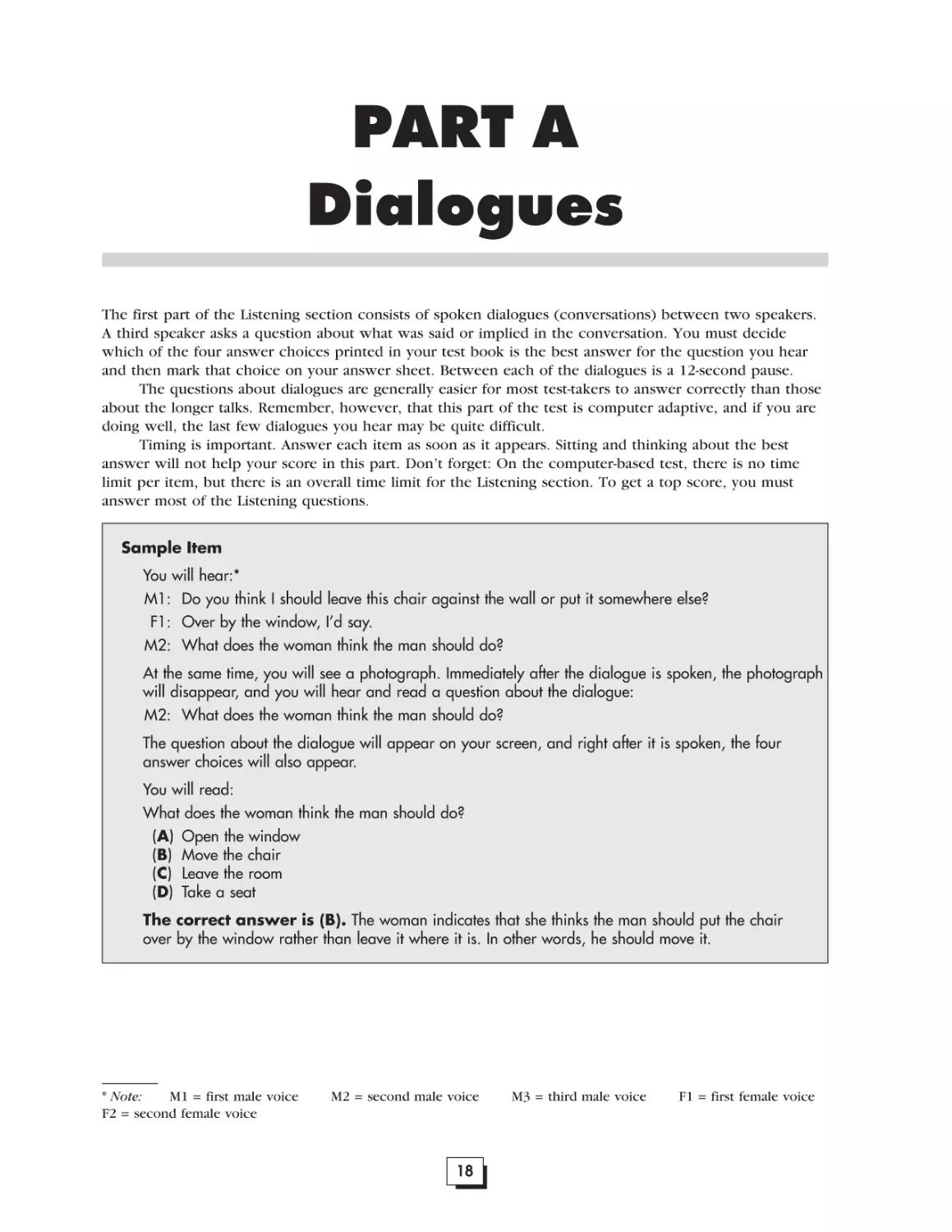
Sample Item
You will hear:*
M1: Do you think I should leave this chair against the wall or put it somewhere else?
F1: Over by the window, I’d say.
M2: What does the woman think the man should do?
At the same time, you will see a photograph. Immediately after the dialogue is spoken, the photograph
will disappear, and you will hear and read a question about the dialogue:
M2: What does the woman think the man should do?
The question about the dialogue will appear on your screen, and right after it is spoken, the four
answer choices will also appear.
You will read:
What does the woman think the man should do?
(A) Open the window
(B) Move the chair
(C) Leave the room
(D) Take a seat
The correct answer is (B). The woman indicates that she thinks the man should put the chair
over by the window rather than leave it where it is. In other words, he should move it.
* Note:
M1 = first male voice
F2 = second female voice
M2 = second male voice
18
M3 = third male voice
F1 = first female voice
PART A: DIALOGUES
THE DIALOGUES
Most of the dialogues in Part A involve a man and a woman. A few involve two men or two women. Each
speaker usually speaks one or two sentences. Many dialogues (approximately 25 percent) are about facets
of life at American universities: attending classes, talking to professors, writing research papers, and taking
tests. Other dialogues are about more general activities: shopping in grocery stores, looking for housing,
taking vacations, and going to meetings and parties. The tone of the dialogues is informal. Idioms, first
names, and contractions (I’m, doesn’t, can’t) are often heard. Some of the items test your ability to
understand various language functions. For example, you must be able to determine if a speaker is agreeing
or disagreeing with the other speaker or if one speaker is accepting or rejecting the other speaker’s offer.
THE QUESTIONS
Most of the questions about the dialogues focus on what the second speaker says. However, it is usually
necessary to understand the entire dialogue to choose the correct answer. For example, in the Sample
Item, it is not clear what the woman means when she says “Over by the window” unless you understand
what the man says first. One or two questions in each test may focus instead on what the first speaker
says.
Common Part A Question Types
Examples
1. Meaning questions These are the most
common questions (approximately 50
percent). They ask for a restatement of what
the second speaker or both speakers say. They
may be general questions or ask what the
speakers say about some specific topic. They
often follow dialogues that contain idioms.
“What does the man/woman mean?”
“What do the speakers say about ________?”
2. Inference questions These are the second
most common Part A questions (approximately 20 percent). The answers for these
questions are not directly stated in the
dialogue, but they can be inferred (concluded)
from what the speakers say.
“What does the man/woman imply?”
“What can be inferred from the conversation
about ________?”
“What can be concluded from the conversation
about ________?”
3. Questions about suggestions In general, the
first speaker talks about a problem or asks for
advice. The second speaker makes a suggestion for solving the problem.
“What
“What
“What
“What
4. Questions about future actions These ask
what one or both of the speakers will do next
or in the near future, or what one or both are
planning to do.
“What will the man do?”
“What will they probably do next?”
“What are the speakers planning to do?”
5. Topic questions These ask about the subject
of the dialogue.
“What are they talking about?”
“What are they discussing?”
6. Questions about opinions These ask
how one or both of the speakers feel about
some topic.
“How does the man/woman feel about ________?”
“What is their opinion of ________?”
19
does
does
does
does
the
the
the
the
woman suggest the man do?”
man suggest they do?”
woman suggest?”
woman think the man should do?”
www.petersons.com
SECTION 1: LISTENING
7. Questions about assumptions These ask
what the second speaker thought (assumed)
before he or she spoke to the first speaker.
“What had the man assumed about ________?”
“What had the woman previously assumed?”
8. Questions about questions The first speaker
makes a statement; the second speaker asks a
question to get more information.
“What does the man want to know?”
9. Questions about reasons These ask why
one or both of the speakers did something.
“Why did the man/woman ________?”
“Why did they ________?”
10. Questions about problems These ask about
some trouble one or both of the speakers are
having.
“What problem is the man having?”
“What is the problem?”
THE ANSWER CHOICES
All four of the answer choices are logical answers for the question, but only one—the key—is correct
according to the dialogue. However, as in all parts of TOEFL, not all of the answer choices are equally
attractive. You can often eliminate one or two choices easily, even if you are not sure which answer is
correct, and, therefore, make a better guess.
Correct answers are seldom stated word for word by either of the speakers. Correct answers often
contain synonyms (words with the same meaning) for words in the dialogues and use different sentence
structures.
Grammatically, there are three types of answer choices:
1. Complete sentences (approximately 75 percent)
2. Incomplete sentences, usually beginning with verb forms—most often the simple form of the
verb (approximately 20 percent)
3. Short noun or prepositional phrases (approximately 5 percent)
The form of the answer choice can sometimes help you guess what the question will be; therefore, you
can focus more on listening.
Question Types and Examples
Usual Form of Answer Choice and Examples
Meaning questions:
“What does the man mean?”
Complete sentences:
(A) He prefers coffee to tea.
(B) He’d like some lemon in his tea.
Questions about inferences:
“What does the woman imply about the article?”
Complete sentences:
(A) She will probably read it today.
(B) She wasn’t able to find it in the library.
Questions about suggestions:
Incomplete sentences beginning with simple forms
of verbs or -ing forms
(A) Call his cousin
(B) Take his cousin home
“What does the woman suggest John do?”
“What does the man suggest?”
www.petersons.com
(A) Taking a bus to campus
(B) Walking to class
20
PART A: DIALOGUES
Questions about future actions:
Incomplete sentences beginning with simple forms
of verbs:
(A) Park their car
(B) Get some gasoline
“What will the speakers probably do next?”
Topic questions:
“What are the speakers discussing?”
Noun phrases:
(A) The man’s new schedule
(B) A homework assignment
Questions about opinions:
“What was their opinion of the play?”
Complete sentences or adjective phrases:
(A) They didn’t enjoy it very much.
(B) They liked it more than they thought
they would.
“How does the man feel about the announcement he heard?”
(A) Angry
(B) Enthusiastic
Questions about assumptions:
Complete sentences often containing the auxiliary
verbs would or had:
(A) She had already finished the paper.
(B) She wouldn’t finish the research on time.
“What had the man assumed about Kathy?”
Questions about questions:
Incomplete sentences beginning with the word if
or one of the wh- words:
(A) If she is still in her office
(B) Where her office is
“What does the woman ask about Professor
Tolbert?”
“What does the man ask about the department
store?”
(A) Its location
(B) Its hours of operation
Questions about time:
“When will the man play the piano?”
Prepositional phrases of time:
(A) At the party
(B) Before the ceremony
Questions about reasons:
Complete sentences or incomplete sentences
beginning with infinitives (to + simple form):
(A) He didn’t receive an invitation.
(B) He had other plans for the evening.
“Why did Jerry miss the party?”
“Why did Linda talk to Professor Delgado?”
(A) To ask him about a grade
(B) To explain why she missed class
Questions about problems:
“What problem does the man have?”
Complete sentences:
(A) He didn’t bring enough money for the
tickets.
(B) There were no tickets available.
Questions about activities:
“What are they probably doing?”
Incomplete sentences beginning with -ing verbs:
(A) Buying groceries
(B) Cooking breakfast
The test-writers sometimes make it more difficult to pick the correct answer by using soundalike words,
homonyms, words with multiple meanings, and other techniques. You’ll practice avoiding these traps in
this part of the book.
21
www.petersons.com
SECTION 1: LISTENING
TACTICS FOR DIALOGUES
• Answer each question promptly and go on to the next dialogue as soon as possible.
• Be familiar with the directions for answering dialogue questions.
• Remember that the answer for the question is generally contained in the last line of the dialogue.
• If you are not sure of the answer, eliminate as many answer choices as you can.
• After you have chosen an answer, use the remaining time to preview the choices for the next item.
If the answer choices are long, skim over them quickly. Try to anticipate what the question will be
by the form of the answer choices.
• If you don’t understand all or part of a conversation, guess and go on.
• As soon as you click on the “Confirm Answer” icon, the next dialogue will begin automatically, so
be ready.
www.petersons.com
22
LESSON 1
Dialogues with Sound Confusion
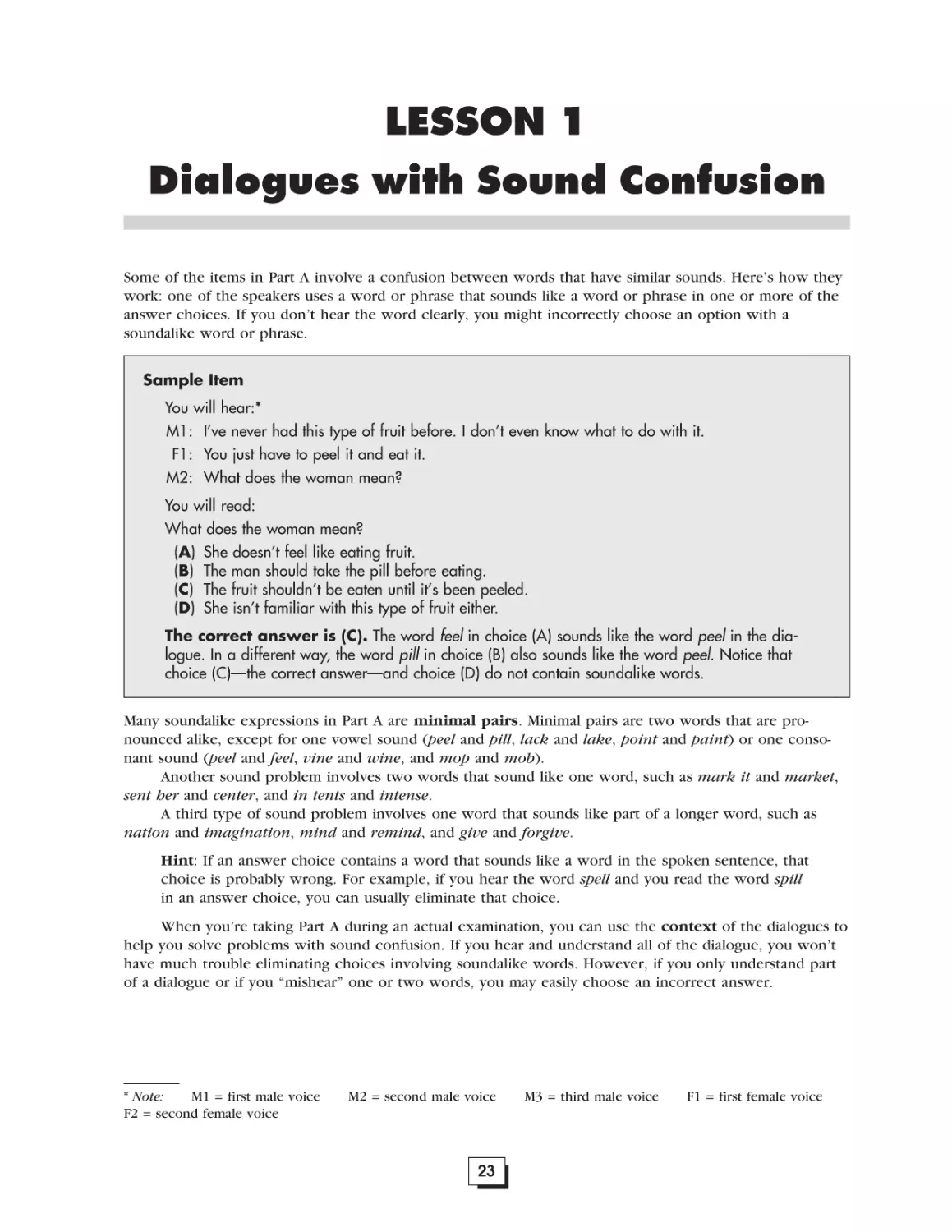
Some of the items in Part A involve a confusion between words that have similar sounds. Here’s how they
work: one of the speakers uses a word or phrase that sounds like a word or phrase in one or more of the
answer choices. If you don’t hear the word clearly, you might incorrectly choose an option with a
soundalike word or phrase.
Sample Item
You will hear:*
M1: I’ve never had this type of fruit before. I don’t even know what to do with it.
F1: You just have to peel it and eat it.
M2: What does the woman mean?
You will read:
What does the woman mean?
(A) She doesn’t feel like eating fruit.
(B) The man should take the pill before eating.
(C) The fruit shouldn’t be eaten until it’s been peeled.
(D) She isn’t familiar with this type of fruit either.
The correct answer is (C). The word feel in choice (A) sounds like the word peel in the dialogue. In a different way, the word pill in choice (B) also sounds like the word peel. Notice that
choice (C)—the correct answer—and choice (D) do not contain soundalike words.
Many soundalike expressions in Part A are minimal pairs. Minimal pairs are two words that are pronounced alike, except for one vowel sound (peel and pill, lack and lake, point and paint) or one consonant sound (peel and feel, vine and wine, and mop and mob).
Another sound problem involves two words that sound like one word, such as mark it and market,
sent her and center, and in tents and intense.
A third type of sound problem involves one word that sounds like part of a longer word, such as
nation and imagination, mind and remind, and give and forgive.
Hint: If an answer choice contains a word that sounds like a word in the spoken sentence, that
choice is probably wrong. For example, if you hear the word spell and you read the word spill
in an answer choice, you can usually eliminate that choice.
When you’re taking Part A during an actual examination, you can use the context of the dialogues to
help you solve problems with sound confusion. If you hear and understand all of the dialogue, you won’t
have much trouble eliminating choices involving soundalike words. However, if you only understand part
of a dialogue or if you “mishear” one or two words, you may easily choose an incorrect answer.
* Note:
M1 = first male voice
F2 = second female voice
M2 = second male voice
23
M3 = third male voice
F1 = first female voice
SECTION 1: LISTENING
EXERCISE 1.1
Focus: Discriminating between soundalike words in dialogues and answer choices
Directions: Listen to the dialogues. Decide which of the two choices, (A) or (B), best answers the
question, and mark the appropriate blank.
Now start the listening program.
1. What does the woman suggest the man do?
7. What is learned about Emily?
______
(A) Get in a different lane.
______
(A) She recently moved.
______
(B) Stand in another line.
______
(B) She bought a new dress.
2. What did the children do?
8. What does Dennis say about the coffee?
______
(A) Go down the slide
______
(A) Its taste has improved.
______
(B) Play on the sled
______
(B) It tastes slightly bitter.
3. What does the woman tell the man to do
with the letters?
______
(A) Put them in a file
______
(B) Throw them in a pile
9. What does the man ask Ellen?
(A) He can’t shut his suitcase.
______
(B) His suitcase doesn’t fit in the
closet.
(A) It’s made from whole wheat.
______
(B) It’s white bread.
(A) Brenda is typing it.
______
(B) It’s being taped.
www.petersons.com
(B) What she might win
______
(A) It’s been chipped.
______
(B) There’s a ship inside it.
______
(A) He tripped in the aisle.
______
(B) He slipped in some oil.
12. Why is this area well known?
6. What does the man say about the story?
______
______
11. What happened to Jerry?
5. What is learned about Annie’s bread?
______
(A) How much the ticket cost
10. What does the woman say about the bottle?
4. What is the man’s problem?
______
______
24
______
(A) For its fast horses
______
(B) For its natural resources
LESSON 1: DIALOGUES WITH SOUND CONFUSION
EXERCISE 1.2
Focus: Identifying soundalike expressions in answer choices and choosing correct answers
Directions: Listen to the dialogues. Each dialogue contains a word or phrase that sounds like a word
or phrase in two of the answer choices.
Now start the listening program.
1. What is learned about Steven and Gloria?
5. What does the woman say about Sam?
(A) He went to the shopping mall with
her.
(B) He wrote her an e-mail.
(C) He lent her some money.
(D) He plans to contact her later.
(A) He offered his help to Darlene.
(B) He made an offer to Darlene’s sister.
(C) When Darlene was gone, he missed
her.
(D) He spoke to Darlene’s assistant.
2. What does the woman say about Stuart?
6. What does the man suggest the woman do?
(A) He has an appointment with the
president.
(B) He was just appointed vice president.
(C) He’s unhappy because he lost the
election.
(D) He’s going to serve as president.
(A)
(B)
(C)
(D)
7. What does the woman say about Gus?
(A)
(B)
(C)
(D)
3. What does the woman say about the class
she is going to take?
(A)
(B)
(C)
(D)
It
It
It
It
Get a job at the hotel
Buy some cough drops
Get some copies made
Eat in the coffee shop
is the study of living plants.
is about life on other planets.
concerns the breeding of cattle.
deals with life on Earth.
He
He
He
He
has a pain behind his ear.
didn’t hear what the woman said.
can lend the man a pen.
has fallen behind in class.
4. What does Janet tell the man?
(A) She won’t leave until the rain is over.
(B) Their drain has stopped up.
(C) They shouldn’t board the train until it
completely stops.
(D) She’s been under a lot of strain lately.
25
www.petersons.com
LESSON 2
Dialogues with Homonyms and
Words with Multiple Meanings
Two words are homonyms if they have the same pronunciation but are spelled differently and have
different meanings. The words flour and flower are homonyms, as are bare and bear. In some dialogues,
one or more incorrect answer choices refer to a homonym of a word that is used on the listening program,
as in the example below.
Sample Item
You will hear:*
M1: Eugene missed a lot of classes last week.
F1: That’s because he was sick. I think he had the flu.
M2: What is learned about Eugene?
You will read:
What is learned about Eugene?
(A) He has been feeling weak for a long time.
(B) Because of sickness, Eugene was absent.
(C) Eugene’s eyesight isn’t very strong, so he needs glasses.
(D) Eugene flew to another city this week.
The correct answer is (B). The dialogue contains the word week, meaning a seven-day period.
Choices (A) and (C) refer to a homonym of that word, weak, which means not strong. The dialogue
also contains the word flu, an illness similar to a bad cold. Choice (D) refers to a homonym of that
word, flew (took a trip by plane).
The dialogues may also contain words with multiple meanings. In these items, one or two of the
answer choices refer to another definition of a word as it is used in the dialogue.
* Note:
M1 = first male voice
F2 = second female voice
M2 = second male voice
26
M3 = third male voice
F1 = first female voice
LESSON 2: DIALOGUES WITH HOMONYMS AND WORDS WITH MULTIPLE MEANINGS
Sample Item
You will hear:*
F1: Are you sure this is how Lois spells her last name?
M1: It doesn’t look right, does it? In fact, I’m not even sure it starts with that letter.
M2: What does the man mean?
You will read:
What does the man mean?
(A) The letter to Lois was incorrectly addressed.
(B) Lois’ last name may be incorrectly spelled.
(C) Lois’ name appeared on the right side of the page.
(D) Lois hasn’t begun writing the letter yet.
The correct answer is (B). The dialogue contains the words right, meaning “correct,” and the
word letter, meaning a character in the alphabet. Choices (A) and (D) also contain the word letter,
but in those choices, the word has another definition—a message sent through the mail. Choice (C)
also contains the word right, but in that choice, it refers to a direction—the opposite of left.
You won’t be confused by these items if you understand the entire sentence. Again, the context of the
sentence can help you choose the correct answer. But if you focus only on single words, such as week and
flu or letter and right in the two samples, you can easily make mistakes.
EXERCISE 2.1
Focus: Using the context of dialogues to identify homonyms
Directions: Listen to the dialogues. Decide which pair of homonyms appears in the dialogues and
mark the appropriate answer, (A) or (B).
Now start the listening program.
1. ______
(A) presence
6. ______
(A) right
______
(B) presents
______
(B) write
2. ______
(A) overdue
7. ______
(A) board
______
(B) bored
______
(B) overdo
3. ______
(A) pain
8. ______
(A) brakes
______
(B) pane
______
(B) breaks
4. ______
(A) where
______
(B) wear
5. ______
(A) fined
______
9. ______
(A) sail
______
(B) sale
(B) find
* Note:
M1 = first male voice
F2 = second female voice
M2 = second male voice
27
M3 = third male voice
F1 = first female voice
www.petersons.com
SECTION 1: LISTENING
EXERCISE 2.2
Focus: Using the context of dialogues to identify the definitions of words with multiple meanings
Directions: Listen to the dialogues. One word from the dialogue is given, along with two possible definitions
of the word. Choose the definition of the word as it is used in the dialogue and mark the appropriate answer,
(A) or (B).
Now start the listening program.
1. cold
5. tables
______
(A) minor illness
______
(A) charts
______
(B) chilly weather
______
(B) furniture
2. kind
6. coat
______
(A) type
______
(A) layer
______
(B) considerate
______
(B) warm clothing
3. light
7. field
______
(A) not heavy
______
(A) outside the classroom
______
(B) not dark
______
(B) area of study
4. wing
______
(A) part of an airplane
______
(B) part of a building
EXERCISE 2.3
Focus: Using the context of dialogues to answer questions involving both homonyms and words with
multiple definitions
Directions: Listen to the statements. Decide which of the two choices best answers the question
and mark the appropriate answer, (A) or (B).
Now start the listening program.
1. What does the woman suggest Tom do?
(A)
(B)
(C)
(D)
3. What does the man mean?
Look for mistakes
Complete his research
Write a check
Read the newspaper
(A)
(B)
(C)
(D)
2. What are they discussing?
(A)
(B)
(C)
(D)
4. What does the woman tell the man to do?
Events in the historic past
The man’s performance in class
A physical exam
A historical study
www.petersons.com
He’d never heard of that park before.
That was the first herd he’d ever seen.
He’d never heard buffaloes before.
He wanted to go to the park but he
couldn’t.
(A)
(B)
(C)
(D)
28
Sign his name on this line
Follow the directions on the sign
Sign up for another class
Stand in another line
LESSON 2: DIALOGUES WITH HOMONYMS AND WORDS WITH MULTIPLE MEANINGS
5. What does the man mean?
7. What does Patrick mean?
(A) He can’t carry the luggage by himself.
(B) The handle on one of the suitcases is
broken.
(C) He bought his luggage in that store.
(D) There isn’t enough room for his
luggage there.
(A)
(B)
(C)
(D)
The class had a better opinion of him.
He had to stand in front of the class.
No one in the class understands him.
He wasn’t hurt in the accident.
6. What does the woman think John should
do?
(A)
(B)
(C)
(D)
Close the window right away
Take a quick shower
Go for a swim
Put on some other clothes
29
www.petersons.com
LESSON 3
Dialogues with Idioms
On many TOEFL examinations, up to half the dialogues in Part A contain idiomatic expressions. Many of
the idiomatic expressions are two- or three-word verbs, such as call off and look out for.
Sample Item
You will hear:*
F1: I wonder where Mike is.
M1: He’ll show up as soon as the work is done, I bet.
M2: What does the man say about Mike?
You will read:
What does the man say about Mike?
(A) He probably won’t arrive until the work is finished.
(B) He went to a show instead of going to work.
(C) He can show them how to do the work.
(D) He’ll probably work late today.
The correct answer is (A). The idiom show up means “arrive.” Choices (B) and (C) contain the
word show, but it is not used in the idiomatic sense.
In most dialogues, the second speaker uses the idiomatic expression. Most questions about this type of
dialogue are questions about meaning (“What does the man mean?” for example), but some are inference
questions or other types of questions. The correct answer often contains a synonym for the idiom—arrive
for show up in choice (A) of the Sample Item. Incorrect choices often contain references to the literal
meaning of idioms, as in choices (B) and (D).
Memorizing these phrases does not guarantee that you will recognize all the idiomatic expressions
that you will hear in the Listening section. There are, after all, thousands of these expressions in English.
You must develop “a good ear” for guessing the meaning of idioms. The context of the sentence will help
you to understand the expression, even if you’re unfamiliar with it.
* Note:
M1 = first male voice
F2 = second female voice
M2 = second male voice
30
M3 = third male voice
F1 = first female voice
LESSON 3: DIALOGUES WITH IDIOMS
EXERCISE 3.1
Focus: Recognizing synonyms for idiomatic expressions
Directions: Listen to the spoken statements. Each contains an idiomatic or figurative expression that
is written out. First decide which of the two choices best answers the question, and mark the
appropriate answer, (A) or (B). Then underline the phrase in the correct answer that has the same
meaning as the idiom.
Now start the listening program.
1. bumped into
5. at the drop of a hat
What does the man mean?
What does Robert imply?
______
(A) He met Caroline unexpectedly
at the cafeteria.
______
(A) He can’t leave until he finds
his hat.
______
(B) He and Caroline had an
accident.
______
(B) He’s ready to leave immediately.
6. under the weather
2. got into hot water
What does the man imply about Julie?
What does Rita mean?
______
(A) She was in trouble.
______
(B) She took a warm bath.
______
(A) She didn’t want to practice
because of the bad weather.
______
(B) She wasn’t there because she
felt a little sick.
3. hit it off
7. takes after
What does the man mean?
______
______
What does the man say about Albert?
(A) He and Chuck argued as soon
as they met.
(B) He and Chuck quickly became
friends.
______
(A) He looks like his grandfather.
______
(B) He takes care of his grandfather.
4. piece of cake
What does the woman mean?
______
(A) The exam was simple.
______
(B) She had a snack after the test.
31
www.petersons.com
SECTION 1: LISTENING
EXERCISE 3.2
Focus: Understanding dialogues involving idiomatic and figurative expressions
Directions: Look over the idiomatic expressions listed before each set of items. The dialogues each
contain one of the listed expressions. Listen to the dialogues and mark the one answer choice, (A) or
(B), that best answers the question.
Now start the listening program.
Set A
believe one’s eyes
push one’s luck
get off the ground
run of the mill
lend a hand
short for
music to one’s ears
turn in
over one’s head
what the doctor ordered
1. What does the man mean?
______
(A) He’s not sure Max’s business
will succeed.
______
(B) He doesn’t know if Max is on
the plane.
6. What is learned from this conversation?
(A) Gary shouldn’t drive his car
much further.
______
(B) It’s time for Gary to get some
new tires.
(A) Elizabeth is taller than Liz.
______
(B) Elizabeth’s nickname is “Liz.”
7. What does the man say about the restaurant?
2. What does the woman imply?
______
______
______
(A) The service is very fast there.
______
(B) It’s just an average restaurant.
8. What does the woman mean?
______
(A) She enjoys the sound of
nature.
______
(B) She wishes she’d brought a
radio.
3. What will the man do next?
______
(A) Go to bed
______
(B) Turn on the television
9. What does the woman offer to do?
4. What does Alice mean?
______
(A) She didn’t understand all the
jokes.
______
(B) She left before the performance was over.
______
(A) Lend the man some books
______
(B) Help the man with the boxes
10. What does the woman mean?
______
(A) She doesn’t think the man is
telling the truth.
______
(B) She was surprised to see the
snow.
5. What does the woman mean?
______
(A) Ice water sounds perfect.
______
(B) The doctor told her to drink a
lot of water.
www.petersons.com
32
LESSON 3: DIALOGUES WITH IDIOMS
Set B
by heart
call it a day
look who’s talking
chip in
get in one’s blood
take a lot of nerve
11. What does Karen mean?
14. What does the man say about Donna?
______
(A) Skiing can be a dangerous
sport.
______
(B) It’s easy to get into the habit
of skiing.
(A) She has to look for him.
______
(B) He doesn’t study much
himself.
(A) They’ll all pay for the gasoline.
______
(B) There will be plenty of room
in the van.
______
(B) She took a bold approach.
______
(A) He doesn’t want to do any
more painting today.
______
(B) He’ll phone the woman later
today.
16. What does the woman mean?
13. What does the man mean?
______
(A) She seemed too nervous.
15. What does Dan mean?
12. What does the woman imply about Norman?
______
______
______
(A) She is going to speak the lines
in an emotional way.
______
(B) She’s already memorized the
scene.
EXERCISE 3.3
Focus: Using the context of dialogues to understand the meaning of idioms
Directions: Listen to the following dialogue. Decide which of the choices best answers the question
and mark the appropriate answer.
Now start the listening program.
3. What does the woman imply?
1. What is the woman going to do next?
(A)
(B)
(C)
(D)
(A) They both missed class because they
were sailing.
(B) The man should take better notes
during Professor Morrison’s class.
(C) She missed Friday’s class, too.
(D) She dropped Professor Morrison’s
class.
Go to work with Jim
Go out for coffee
Get some exercise
Study for a test
2. What does the man want to know?
(A) If the woman will go to the party with
him
(B) If the red tie looks good with his shirt
(C) If he should wear a tie to the party
(D) If the party is already over
4. What can be concluded about Ron?
(A) He cut himself while he was preparing
food.
(B) He doesn’t want to work in a restaurant.
(C) He’s planning to open up his own
restaurant.
(D) He’s not going to eat at a restaurant
tonight.
33
www.petersons.com
SECTION 1: LISTENING
5. What does the man mean?
11. What does the man say about Dora?
(A) He wants to know if the woman is
joking.
(B) He wants the woman to leave him
alone.
(C) He’d like to know what the quiz will
be about.
(D) He needs a doctor to look at his
injured leg.
(A)
(B)
(C)
(D)
12. What does Roy tell the woman?
(A)
(B)
(C)
(D)
6. What does Brian mean?
(A)
(B)
(C)
(D)
The program was canceled.
The shuttle was launched yesterday.
The weather was better than expected.
The launch was delayed.
doesn’t have any questions for her.
won’t be able to take a trip.
can’t study during spring break.
hasn’t decided if he can take a trip.
(A) His father told him to go to medical
school.
(B) His father studied medicine.
(C) He and his father walked to the
school.
(D) He surprised his father with his
decision
(A) She stood up and left the lecture.
(B) It was too warm for her to wear a
sweater in the lecture hall.
(C) Her sweater made her easy to spot.
(D) Her notes on the lecture were easy to
read.
14. What does the woman imply about Fred?
8. What does the woman say about Phil?
(A)
(B)
(C)
(D)
He deserved to get a speeding ticket.
He was going to a good restaurant.
He probably wasn’t speeding.
His ticket was no longer valid.
9. What does the woman imply about George?
(A) He’s out of breath.
(B) He’ll be glad to help.
(C) If he helps, it will save the man some
money.
(D) He won’t be very cooperative.
10. What is learned about Jill from this conversation?
(A) The man didn’t get her a watch.
(B) The weather won’t be warm when she
graduates.
(C) She won’t be graduating.
(D) She isn’t going to watch the graduation.
www.petersons.com
He
He
He
He
13. What is learned about Mick from this
conversation?
7. What does the man say about Jennifer?
(A)
(B)
(C)
(D)
She ordinarily works in a florist’s shop.
In the end, she won’t have a problem.
She wears too much perfume to work.
She can always anticipate problems at
work.
34
He would be upset if he lost money.
He shouldn’t be paid for singing.
He is generally very sympathetic.
He doesn’t know the words to the
song.
LESSON 4
Answering Inference Questions
about Dialogues
Sometimes the answer to a question about a dialogue is not directly stated in the dialogue. How can you
answer this type of question? You must be able to make an inference about the dialogue. In other words,
information in the dialogue will indirectly provide you with the answer to the question.
This type of question can be phrased in two ways:
• What does the man/woman imply?
• What can be inferred from the conversation?
Some inference questions involve overstatement, or exaggeration.
F1: Are you interested in selling your car?
M1: Sure—if someone has a million dollars!
Because of the exaggeration, we can infer that the man doesn’t want to sell his car at all.
Sample Item
You will hear:*
M1: Can I take this bus to the art museum?
F1: No, this bus goes north to Bank Street. You want a bus that goes the opposite way.
M2: What can be inferred from this conversation?
You will read:
What can be inferred from this conversation?
(A) The man needs to take a southbound bus.
(B) There is no bus to the museum.
(C) It takes a long time to get to the museum by bus.
(D) The art museum is on Bank Street.
The correct answer is (A). This information can be inferred, because the first bus is going north,
but the man must take a bus going in the opposite direction to get to the art museum. Choice (B) is
incorrect; it IS possible to get to the museum by bus. There is no information about choice (C).
Choice (D) can’t be true because Bank Street is where the first bus is going.
* Note:
M1 = first male voice
F2 = second female voice
M2 = second male voice
35
M3 = third male voice
F1 = first female voice
SECTION 1: LISTENING
EXERCISE 4
Focus: Listening to dialogues that are followed by inference questions and identifying the best answers
Directions: Listen to the following dialogues.
Now start the listening program.
1. What can be inferred about the man?
7. What does the woman imply?
(A) He’s not related to Larry.
(B) He doesn’t think Larry won the
contest.
(C) He’s not a very good dancer.
(D) He has never believed Larry.
(A) She hasn’t been to the dentist for
years.
(B) She wasn’t able to see the dentist
yesterday.
(C) She had a long wait before she saw
the dentist.
(D) She was quite late for her dental
appointment.
2. What can be inferred from this conversation?
(A) The man doesn’t like the way the suit
looks.
(B) The suit costs a lot of money.
(C) The man dresses as if he were very
wealthy.
(D) The man already owns an expensive
suit.
8. What does the man imply about the experts
and the plan?
(A)
(B)
(C)
(D)
9. What does the woman imply about Louis?
3. What does the man imply?
(A) His new boss shouldn’t have been
promoted.
(B) He and his old boss argued.
(C) He should get a better job.
(D) His boss has helped him a lot.
(A) There is just enough food.
(B) Many uninvited guests will come.
(C) The woman has prepared too much
food.
(D) The party will be moved to another
location.
10. What does the woman imply?
4. What can be inferred about the man?
(A)
(B)
(C)
(D)
(A) There’s not enough snow to cause a
cancellation yet.
(B) It will probably snow all night.
(C) The university has already decided to
cancel classes.
(D) It has already stopped snowing.
He took a physics test tonight.
He has a class every evening.
He was studying by himself tonight.
He’s concerned about his grade.
5. What does the woman imply about Greg?
(A)
(B)
(C)
(D)
11. What does the man imply?
He’s changed his major often.
He hasn’t really changed his major.
He won’t do well in his new major.
He was changed by his experience.
(A) He has been interested in folk dancing
for a long time.
(B) He’s interested in making new friends.
(C) He wants to form a new folk dancing
club.
(D) He’ll never learn how to dance.
6. What can be inferred from this conversation
about Professor Sutton?
(A)
(B)
(C)
(D)
His lectures put his students to sleep.
He’s a middle-aged man.
He lectures about history.
His lectures are very difficult to follow.
www.petersons.com
They have agreed on it.
They have different opinions about it.
It depends on their cooperation.
It doesn’t require their attention.
36
LESSON 4: ANSWERING INFERENCE QUESTIONS ABOUT DIALOGUES
15. What can be inferred about the speakers?
12. What can be inferred from the woman’s
remark?
(A)
(B)
(C)
(D)
She
She
She
She
(A) They can’t see the stars clearly.
(B) They’re not in the city tonight.
(C) They are looking at the lights of the
city.
(D) They’ve never seen each other before
tonight.
didn’t enjoy the music.
couldn’t see the concert very well.
had a good seat near the stage.
found her seat uncomfortable.
13. What does the man imply?
16. What does Mike imply?
(A) Last summer was even hotter.
(B) This is the hottest summer he can
remember.
(C) He didn’t live here last year.
(D) The weather is cooler than usual.
(A) He generally works on Saturday.
(B) He doesn’t know many people at
work.
(C) He isn’t allowed to get phone calls at
work.
(D) He wasn’t expecting a phone call.
14. What can be inferred from this conversation?
(A) Students must pay a fee to swim in the
pool.
(B) The public cannot use the pool on
campus.
(C) The swimming pool is temporarily closed.
(D) The pool can be used by students for
free.
REVIEW TEST A: DIALOGUES
Directions: Each item in this part consists of a brief dialogue involving two speakers.
After each dialogue, a third voice asks a question.
When you have heard each dialogue and question, read the four answer choices and select the
one that best answers the question based on what is directly stated or on what can be inferred.
Don’t look at the questions until they are read on the tape.
Now start the listening program.
1. What does the man imply about Wanda?
(A)
(B)
(C)
(D)
3. What does the woman mean?
He met her during the winter.
He’s never liked her very much.
He warned her of a problem.
His impression of her has changed.
(A) The glasses are stacked on the shelf.
(B) The juice is no worse than the other
brands.
(C) The new glasses are quite attractive.
(D) She plans to stock up on this juice.
2. What does the woman imply about the
movie?
(A)
(B)
(C)
(D)
4. What does Adam imply?
She’s never seen it.
She thinks it is very unusual.
She likes it a lot.
She hasn’t seen it for a long time.
(A) He hasn’t finished working on the
bookshelves.
(B) The tools have been misplaced.
(C) He hates working with tools.
(D) The tools have already been returned.
37
www.petersons.com
SECTION 1: LISTENING
5. What can be inferred from this conversation?
11. What can be inferred from this conversation?
(A) There is no charge for drinks here.
(B) The first woman wants some ice
water.
(C) The woman is not the woman’s
waitress.
(D) The iced tea isn’t very good here.
(A) The man would like to use Becky’s
computer.
(B) Becky will need the computer for a
long time.
(C) The computers in the library are
already in use.
(D) Becky wants the man to go to the library.
6. What does the man want to do?
(A)
(B)
(C)
(D)
12. What do the speakers mean?
Review the last point
Go on to the next chapter
Leave the classroom
Point out the teacher’s mistake
(A)
(B)
(C)
(D)
7. What does the woman think the man
should do?
(A)
(B)
(C)
(D)
13. What does the man imply by his remark?
(A) Professor Clayburn is going to speak
some other night.
(B) He’s never heard of Professor Clayburn.
(C) He didn’t realize Professor Clayburn
was speaking tonight.
(D) Professor Clayburn is giving his speech
in this room.
Meet a friend of hers
Keep a budget
Increase his income
Get some exercise
8. What can be inferred from the man’s
comment?
(A) The woman should clean out her
closet.
(B) The lamp will look better in a small
space.
(C) He doesn’t like the lamp very much.
(D) The living room is the best place for
the lamp.
14. What can be concluded from this
conversation?
(A) Joe has been making too much noise.
(B) Dogs are not allowed in the dorm.
(C) No one understands the parking
regulations.
(D) Joe is not allowed to leave his room.
9. What does the man mean?
(A)
(B)
(C)
(D)
He certainly likes Ernie’s red car.
The man in the red car resembles Ernie.
Ernie has a car just like that red one.
He can’t see the man in the red car.
15. What can be inferred from this conversation?
(A) The woman didn’t realize Bill had to
work.
(B) Bill has not finished his work.
(C) The break has not lasted long enough.
(D) The work didn’t take long to complete.
10. What does the man say about John?
(A) He hurt his hand when he was scuba
diving.
(B) He hasn’t gone scuba diving in a long
time.
(C) He’s not too old to go scuba diving.
(D) He’s an experienced scuba diver.
www.petersons.com
The ring is quite attractive.
Laura got a bargain on the ring.
The ring was probably expensive.
Laura had to sell her ring.
16. What can be inferred from this conversation?
(A) The woman has just begun to collect
rocks.
(B) Paul is unwilling to help.
(C) The box is very heavy.
(D) There’s nothing in the box.
38
LESSON 5
Dialogues Involving Agreement
and Disagreement
To answer questions about some of the dialogues in Part A, it is necessary to understand if the second
speaker agrees or disagrees with the first speaker’s ideas or proposals.
There are many ways to express agreement and disagreement:
Agreement
So do I.
Me too.
Neither do I.*
I don’t either.*
Who wouldn’t?
Isn’t he/she/it though! (Didn’t he/
Wasn’t she/Hasn’t it though!)
I’ll second that.
I’ll say!
You can say that again.
Is/Has/Was it ever!
You bet!
I couldn’t agree with you more.
I feel the same way you do about it.
* These two expressions show agreement with a negative statement:
I don’t really like my schedule this term.
Neither do I. OR I don’t either.
Disagreement
I don’t think so.
That’s not what I think.
That’s not the way I see it.
I can’t say I agree.
I couldn’t agree with you less.
I’m afraid I don’t agree.
Probably not.
Not necessarily.
Not really.
I’m afraid not.
I’m not so sure.
There are, of course, other expressions that show agreement and disagreement. Some are practiced in the
following exercises.
39
SECTION 1: LISTENING
Sample Items
You will hear:*
M1: Howard certainly is a talented journalist.
F1: Isn’t he though!
M2: What does the woman mean?
You will read:
What does the woman mean?
(A) She doesn’t know if Howard is a journalist.
(B) She agrees that Howard is talented.
(C) She read Howard’s journal.
(D) She doesn’t think Howard is talented.
The correct answer is (B). Although the woman’s reply seems negative in form, it actually
signals agreement.
You will hear:*
F1: I thought Cheryl’s photographs were the best at the exhibit.
F2: I didn’t really see it that way.
M1: What does the second woman mean?
You will read:
What does the second woman mean?
(A) She thought Cheryl’s photos were the best.
(B) She didn’t look at Cheryl’s photos.
(C) She thought other photos were better than Cheryl’s.
(D) She didn’t go to the exhibit.
The correct answer is (C). The woman’s response, “I didn’t really see it that way,” means that
she disagreed with the first woman’s opinion that Cheryl’s photographs were the best.
EXERCISE 5.1
Focus: Determining if one speaker agrees or disagrees with the other speaker
Directions: Listen to the following dialogues. Decide if the second speaker agrees or disagrees with
the first speaker, and mark the appropriate blank.
Now start the listening program.
1. ______
______
2. ______
______
3. ______
(A) Agrees
(B) Disagrees
______
(A) Agrees
(B) Disagrees
(A) Agrees
(B) Disagrees
* Note:
M1 = first male voice
F2 = second female voice
www.petersons.com
M2 = second male voice
40
M3 = third male voice
F1 = first female voice
LESSON 5: DIALOGUES INVOLVING AGREEMENT AND DISAGREEMENT
4. ______
______
5. ______
______
6. ______
______
7. ______
(A) Agrees
(B) Disagrees
______
8. ______
(A) Agrees
(B) Disagrees
______
9. ______
(A) Agrees
(B) Disagrees
______
(A) Agrees
(B) Disagrees
(A) Agrees
(B) Disagrees
(A) Agrees
(B) Disagrees
EXERCISE 5.2
Focus: Listening to dialogues that involve agreement and disagreement and answering questions about
them
Directions: Listen to the following dialogues.
Now start the listening program.
1. What does the man mean?
5. What does the man mean?
(A) He prefers taking a final exam.
(B) He thinks an exam takes too much
time.
(C) He’d rather write a research paper.
(D) He has plenty of time to work.
(A) He has the perfect bicycle.
(B) He thinks it’s a good day for bike
riding, too.
(C) He doesn’t agree with the woman’s
opinion of the weather.
(D) He didn’t hear what the woman said.
2. How does the woman feel about the first
chapter?
6. What does the woman mean?
(A) It was difficult, but she understood it.
(B) She hasn’t had a chance to read it yet.
(C) She doesn’t think it is as useful as
some chapters.
(D) It’s probably easier than the other
chapters.
(A) She thinks Arthur wasn’t doing well in
the class.
(B) She’s not sure why Arthur dropped the
class either.
(C) She believes Arthur dropped the class
for no reason.
(D) She’s decided to drop the class too.
3. How does the man feel about the woman’s
idea?
7. What does the woman say about Tom’s plan?
(A)
(B)
(C)
(D)
(A) He completely disagrees with it.
(B) He doesn’t believe the university will
accept it.
(C) He thinks it’s a good one.
(D) He wants more information about it.
8. What was the man’s initial reaction to the
editorial?
4. What was the woman’s opinion of Jack’s
story?
(A)
(B)
(C)
(D)
She
She
She
She
It’s very impractical.
It’s never been tried before.
It’s unnecessary.
It might work.
(A)
(B)
(C)
(D)
doesn’t think that Jack wrote it.
thought it was quite funny.
thinks it had too many details.
found it well written.
41
He didn’t understand it.
It made him angry.
He agreed with it.
He thought it was depressing.
www.petersons.com
SECTION 1: LISTENING
9. What does the woman say about the library?
10. What does the man mean?
(A) She’s never been there during final
exam week.
(B) It’s not crowded now, but it soon will
be.
(C) It’s crowded because students will be
taking exams soon.
(D) It will be closed right after the final
exams.
www.petersons.com
(A) He likes the costumes Madeleine made.
(B) He’s not sure who designed the
costumes.
(C) He recommends the play.
(D) He doesn’t think the costumes are
attractive.
42
LESSON 6
Dialogues Involving Suggestions,
Invitations, Offers, and Requests
Several dialogues in Part A involve a speaker making and/or responding to suggestions, invitations,
offers, and requests. There are many ways to express these language functions. Some are listed in the
charts in this lesson, whereas others are practiced in the exercises.
SUGGESTIONS
These are pieces of advice that one speaker gives another. In most dialogues, the first speaker poses a
problem and the second speaker suggests a possible solution to that problem. In some dialogues, the first
speaker makes a suggestion, and the second speaker responds to that suggestion positively or negatively.
Making Suggestions
Why don’t you/we . . .
Why not . . .
Have you ever thought of . . .
You/We might want to . . .
You/We could always . . .
Maybe you/we could . . .
Try . . .
If I were you . . .
If I were in your shoes . . .
You/We should . . .
Shouldn’t you/we . . .
What about . . .
What if you/we . . .
How about . . .
Positive Responses
Negative Responses
Why not!
Good idea!
That’s an idea.
Sounds good to me.
By all means!
Why didn’t I think of that?
That’s worth a try.
Thanks, I’ll give that a try.
I don’t think so.
I don’t believe so.
I already thought of that.
I don’t think that will work.
Don’t look at me!
Can I take a rain check?*
* This means, “Could we do this some other time?”
43
SECTION 1: LISTENING
Sample Item
You will hear:*
M1: I’m doing so poorly in physics class, I think I’m going to have to drop it.
F1: You know, Frank, you should talk to Professor de Marco before you do anything. He’s given
special help to lots of students who were having trouble.
M2: What does the woman suggest Frank do?
You will read:
What does the woman suggest Frank do?
(A) Study with a group of students
(B) Drop his mathematics course
(C) Discuss the problem with the professor
(D) Take no action at this time
The correct answer is (C). The woman suggests that the man talk to Professor de Marco
because the professor has helped many students in the past.
INVITATIONS
These are requests for someone to come somewhere or to take part in some activity. The first speaker may
invite the second speaker to do something, and the second speaker responds or the second speaker may
invite the first speaker to do something.
Making Invitations
Shall we . . .
Would you like to . . .
Would you care to . . .
Would you be able to . . .
Want to . . .
Let’s . . .
Do you want to . . .
Could you . . .
Can you . . .
Positive Responses
Negative Responses
Yes, let’s.
Sure, thanks.
Sounds good.
All right, I’d love to.
I’d like that.
What a great idea!
Sure. Thanks for inviting me.
If you want me to.
Don’t mind if I do.
I’m sorry, but . . .
I’d like to, but . . .
I’d love to, but . . .
Thanks a lot, but . . .
That sounds nice, but . . .
I’ll pass.
Thanks for the invitation, but . . .
I don’t think I’ll be able to make it this time.
* Note:
M1 = first male voice
F2 = second female voice
www.petersons.com
M2 = second male voice
44
M3 = third male voice
F1 = first female voice
LESSON 6: DIALOGUES INVOLVING SUGGESTIONS, INVITATIONS, OFFERS, AND REQUESTS
Sample Item
You will hear:*
M1: Would you like to join us on Sunday? We’re going to go on a picnic at the lake.
F1: I’d love to, but I have a test Monday, and I have to get ready for it.
M2: What will the woman probably do on Sunday?
You will read:
What will the woman probably do on Sunday?
(A) Study for a test
(B) Go on a picnic
(C) Take an exam
(D) Join a club
The correct answer is (A). The man invites the woman to come to a picnic. The woman says
that she’d love to go, but that she must study for a test she is taking Monday. (If the woman had
accepted the man’s invitation, choice (B) would have been correct.)
OFFERS
These are proposals to help someone or allow someone to do something. Either speaker in the dialogue
may make an offer.
Making Offers
Let me . . .
Shall I . . .
Would you like me to . . .
Do you want me to . . .
Can I . . .
May I . . .
Should I . . .
I could . . .
Positive Responses
Negative Responses
That would be nice.
Yes, please.
Please do.
Sure, thanks.
I don’t think so.
I’m afraid not.
That won’t be necessary.
Thanks anyway.
Please don’t.
* Note:
M1 = first male voice
F2 = second female voice
M2 = second male voice
45
M3 = third male voice
F1 = first female voice
www.petersons.com
SECTION 1: LISTENING
Sample Item
You will hear:*
F1: Should I make reservations for dinner Friday night?
M1: Thanks anyway, but I’ve already made them.
M2: What does the man mean?
You will read:
What does the man mean?
(A) He can’t go to dinner Friday night.
(B) Reservations won’t be required.
(C) He made reservations earlier.
(D) He’d like the woman to make reservations.
The correct answer is (C). The woman offers to make reservations, but the man replies that he’s
already made them.
REQUESTS
To make a request is to ask someone to do something or to ask for help or information.
Making Requests
Would you . . .
Could you/I . . .
Do you mind if . . .
Would you mind if . . .
Will you . . .
May I . . .
Can you/I . . .
Positive Responses
Negative Responses
I’d be glad to.
I’d be delighted.
Sure thing.
Certainly.
Why not?
If you want to.
If you’d like.
You bet.
*Not at all.
*Of course not.
Sorry, but . . .
I’m afraid not.
I’d like to, but . . .
I wish I could, but . . .
*Actually, I do/would.
*I’m afraid I do/would.
*As a matter of fact, I do/would.
* Responses for “Do you mind if . . .” or “Would you mind if . . .”
* Note:
M1 = first male voice
F2 = second female voice
www.petersons.com
M2 = second male voice
46
M3 = third male voice
F1 = first female voice
LESSON 6: DIALOGUES INVOLVING SUGGESTIONS, INVITATIONS, OFFERS, AND REQUESTS
Sample Item
You will hear:*
M1: I have to make one more phone call before I go.
F2: Take your time. Would you just lock the door when you finish?
M2: What does the woman want the man to do?
You will read:
What does the woman want the man to do?
(A) Lock the office
(B) Finish his phone call quickly
(C) Tell her what time it is
(D) Look up a phone number
The correct answer is (A). The woman requests that the man lock up the office.
EXERCISE 6.1
Focus: Identifying suggestions, invitations, offers, and requests and responses to them
Directions: Listen to the following dialogues. Decide which of the two choices best completes the
sentence, and mark the appropriate space.
Now start the listening program.
1. The man is
6. The man is
______
(A) declining an offer.
______
(A) agreeing to a request.
______
(B) making a suggestion.
______
(B) turning down an offer.
2. The woman is
7. Ed is probably going to
______
(A) accepting an invitation.
______
(A) receive a suggestion.
______
(B) making an offer.
______
(B) make an offer.
3. The woman is
8. The woman is
______
(A) declining an offer.
______
(A) suggesting a solution.
______
(B) making a suggestion.
______
(B) offering help.
4. Mark is
9. Cynthia is
______
(A) rejecting a request
______
(A) giving an invitation.
______
(B) agreeing to a request.
______
(B) accepting an offer.
5. The woman is
10. The woman is
______
(A) giving an invitation.
______
(A) declining an offer.
______
(B) making a suggestion.
______
(B) making a request.
* Note:
M1 = first male voice
F2 = second female voice
M2 = second male voice
47
M3 = third male voice
F1 = first female voice
www.petersons.com
SECTION 1: LISTENING
11. The man will probably
13. The man is
______
(A) do what the woman suggests.
______
(A) making a suggestion.
______
(B) turn down the woman’s
invitation.
______
(B) accepting an invitation.
12. Bob is
______
(A) agreeing to an offer.
______
(B) refusing a request.
EXERCISE 6.2
Focus: Listening to dialogues involving suggestions, invitations, offers, and requests and answering
questions about them
Directions: Listen to the following dialogue. Decide which choice—(A), (B), (C), or (D)—best
answers the question about the dialogues, and mark the appropriate answer.
Now start the listening program.
1. What does the man mean?
(A)
(B)
(C)
(D)
6. What will the man probably do?
He would like a cigarette.
The woman can smoke if she likes.
He doesn’t want the woman to smoke.
He thinks he smells smoke.
(A)
(B)
(C)
(D)
2. What does the woman say about the gray
suit?
(A)
(B)
(C)
(D)
7. What does the woman imply?
(A) The kitchen also needs cleaning.
(B) The living room doesn’t have to be
cleaned.
(C) The man shouldn’t do the cleaning.
(D) There’s not enough time to clean both
rooms.
The man wears it too often.
It needs to be cleaned.
It’s not as nice as the blue one.
The man could wear it tonight.
3. What does the man say about Cathy?
(A)
(B)
(C)
(D)
She
She
She
She
8. What does the man offer to do for the
woman?
could plan the trip.
may not feel well.
can go on the class trip.
has some other plans.
(A) Give her some information about
classes
(B) Go with her to the registrar’s office
(C) Help her find her way to the registrar’s
office
(D) Tell her where to get her own map
4. What does the man mean?
(A)
(B)
(C)
(D)
He
He
He
He
doesn’t want more coffee.
doesn’t want to use his credit card.
hasn’t had enough coffee.
doesn’t want to make coffee.
9. What does the woman suggest they do?
(A)
(B)
(C)
(D)
5. What does the woman mean?
(A)
(B)
(C)
(D)
She doesn’t think it’s warm.
She’ll open the window herself.
She wants the window closed.
She’s going to turn down the heat.
www.petersons.com
Go somewhere else for lunch
Order another type of sandwich
Skip lunch today
Have some soup for lunch
48
Work on their statistics homework
Have breakfast
Stop studying for a little while
Go to work on the math problems
LESSON 6: DIALOGUES INVOLVING SUGGESTIONS, INVITATIONS, OFFERS, AND REQUESTS
10. What does the man suggest that Lisa do?
(A)
(B)
(C)
(D)
12. What does the woman think the man
should do?
Buy a new toaster
Replace her old shoes
Have repairs done
Make another piece of toast
(A)
(B)
(C)
(D)
11. What does the man tell the woman?
Buy an antique desk
Get a new computer
Sit down and get to work
Use another computer disk
(A) It’s time for her to go now.
(B) She can read his magazine if she
wants.
(C) He hasn’t finished reading the
magazine.
(D) She should finish writing the article.
49
www.petersons.com
LESSON 7
Dialogues Involving Contradictions,
Assumptions, and Questions
CONTRADICTIONS
These involve the second speaker correcting what the first speaker says, as in the following samples.
Sample Items
You will hear:*
F2: Amy didn’t work overtime last week.
M1: As a matter of fact, she did.
M2: What does the man say about Amy?
You will read:
What does the man say about Amy?
(A) She is always late for work.
(B) She never works overtime.
(C) She worked extra hours last week.
(D) She hasn’t had her job very long.
The correct answer is (C). The man’s emphatic use of the auxiliary verb did shows that he is
contradicting what the woman said.
You will hear:*
M1: Martin always talks about how he loves to dance.
F1: Yes, but you don’t see him out on the dance floor very often, do you?
M2: What does the woman say about Martin?
You will read:
What does the woman say about Martin?
(A) He is an excellent dancer.
(B) He doesn’t like dancing very much.
(C) He doesn’t talk about dancing very often.
(D) He goes dancing four times a week.
The correct answer is (B). The woman’s use of the word but and the tag question
(“. . . do you?”) suggest that she doesn’t believe that Martin really loves to dance.
* Note:
M1 = first male voice
F2 = second female voice
M2 = second male voice
50
M3 = third male voice
F1 = first female voice
LESSON 7: DIALOGUES INVOLVING CONTRADICTIONS, ASSUMPTIONS, AND QUESTIONS
Sample Items (Continued)
You will hear:*
F1: All of the students voted for the proposal to expand the Student Council.
M1: Well, most of them did, anyway.
M2: What does the man mean?
You will read:
What does the man mean?
(A) All of the students voted.
(B) Some of the students opposed the proposal.
(C) The proposal was defeated.
(D) The Student Council voted.
The correct answer is (B). The man says that most of the students voted for the proposal,
contradicting the idea that all of them did. Therefore, some of the students must have opposed the
proposal.
In some dialogues, such as the third Sample Item, the second speaker does not completely contradict what
the first speaker says but rather limits the first speaker’s idea.
ASSUMPTIONS
These are the beliefs that one speaker has until he or she receives information from a second speaker. You
will generally hear dialogues involving assumptions near the end of Part A. These questions are considered
difficult, but once you understand how they work and practice answering them, you should find them no
more difficult than any other type of question. In this type of dialogue, the first speaker makes a statement.
The second speaker is surprised because the first statement contradicts what he or she believes to be true.
The second speaker’s response often begins with the word “Oh” and ends with the phrase “. . . after all.”
The answer to assumption questions is the reverse of what the second speaker thinks, and, so, what is
“true” according to the first speaker is not the correct choice.
Sample Item
You will hear:*
F1: No, Judy’s not here right now. She’s at her economics class.
M1: Oh, so she decided to take that course after all.
M2: What had the man assumed about Judy?
You will read:
What had the man assumed about Judy?
(A) She wouldn’t take the course.
(B) She had already completed that course.
(C) She was busy studying economics.
(D) She wouldn’t find economics difficult.
The correct answer is (A). The man is surprised that Judy is in economics class because he
thought that she had decided not to take the course. Therefore, he had obviously assumed that Judy
was not going to take the course before he spoke to the woman.
* Note:
M1 = first male voice
F2 = second female voice
M2 = second male voice
51
M3 = third male voice
F1 = first female voice
www.petersons.com
SECTION 1: LISTENING
QUESTIONS
The second speaker in a dialogue sometimes asks about what the first speaker says. The third speaker then
asks what the second speaker wanted to know.
Sample Item
You will hear:*
F1: Professor Petrakis said that Mark Twain was his favorite writer.
M1: When did he say that?
M2: What does the man want to know?
You will read:
What does the man want to know?
(A) When Mark Twain lived
(B) What the professor said about Mark Twain
(C) When the professor made his remark
(D) What books Mark Twain wrote
The correct answer is (C). The man asks when Professor Petrakis called Mark Twain his favorite
author.
Two question phrases that may give you trouble are:
What . . . for? and How come . . .? Both mean Why . . . ?
EXERCISE 7
Focus: Answering questions about dialogues involving contradictions, assumptions, and questions
Directions: Listen to the following dialogues.
Now start the listening program.
1. What does the man say about Ginny?
(A)
(B)
(C)
(D)
She
She
She
She
3. What does the woman want to know?
is definitely coming to dinner.
likes fish more than chicken.
may invite them to dinner.
doesn’t mind eating chicken.
(A)
(B)
(C)
(D)
2. What had the man assumed about Mona?
(A)
(B)
(C)
(D)
4. What does the man mean?
She had already moved.
She hadn’t found a new apartment yet.
She’d already made an appointment.
She was no longer planning to move.
* Note:
M1 = first male voice
F2 = second female voice
www.petersons.com
What the man’s name is
Who told the man to see the dean
Where the dean’s office is
Who the dean is
(A) He wants to take part in the election.
(B) He’s not interested in being president.
(C) He wants to get more facts from the
president.
(D) He’ll have to run to get to class on
time.
M2 = second male voice
52
M3 = third male voice
F1 = first female voice
LESSON 7: DIALOGUES INVOLVING CONTRADICTIONS, ASSUMPTIONS, AND QUESTIONS
5. What had the man assumed about Carol?
11. What does the woman ask the man?
(A) She didn’t need to do any research for
this paper.
(B) She wasn’t going to word process the
paper.
(C) She hadn’t completed all the research.
(D) She had finished the final draft a long
time ago.
(A) Where the meeting will be held
(B) When the meeting will start
(C) Where the recreation center will be
built
(D) What has been proposed
12. What had the woman assumed?
(A) Joy did not want to study abroad.
(B) The overseas program had been
canceled.
(C) Joy was already living overseas.
(D) Joy would study overseas this year.
6. What does the woman imply about Bert?
(A) He doesn’t really like horseback riding.
(B) He rides horses whenever possible.
(C) He doesn’t talk about riding very
much.
(D) He loves to watch people ride horses.
13. What does the woman ask the man?
(A)
(B)
(C)
(D)
7. What does the woman want to know?
(A)
(B)
(C)
(D)
When her travel agent called
What time her flight will leave
How far she will be flying
If her flight has been canceled
14. What does the man mean?
(A) All of Ted’s answers were incorrect.
(B) Most of the problems were done
correctly.
(C) Ted doesn’t have to solve the
problems.
(D) Ted has had a few good jobs.
8. What had the woman assumed about Cliff?
(A)
(B)
(C)
(D)
He
He
He
He
was working full-time.
was eating in the cafeteria.
couldn’t make a decision.
didn’t want a job.
15. What does the man ask the woman?
9. What does the woman want to know?
(A)
(B)
(C)
(D)
If the party was at Rusty’s house
What time the party ended
If the man enjoyed the party
Who attended the party
(A)
(B)
(C)
(D)
When they returned
Who went hiking
Where they hiked
How long their hike was
How she got to the grocery store
Why she went to the grocery store
How much she paid for groceries
What street the grocery store is on
10. What does the man mean?
(A) He thinks the clothes at that store are
expensive.
(B) He doesn’t think the clothes at that
store are very nice.
(C) He thinks the woman is being
unreasonable.
(D) He’s never been to the store on Collins
Street.
53
www.petersons.com
LESSON 8
Answering Questions about Plans,
Topics, and Problems
QUESTIONS ABOUT PLANS
These questions follow dialogues in which two speakers discuss what one or both of them are going to do
in the future.
Sample Item
You will hear:*
F2: Are you going to go to Boston with Michael this summer?
M1: Wish I could, but if I want to graduate next year, I’ve got to stay here and take a couple classes.
M2: What does the man plan to do this summer?
You will read:
What does the man plan to do this summer?
(A) Graduate
(B) Attend classes
(C) Visit Michael
(D) Go to Boston
The correct answer is (B). The man indicates that he must stay where he is and take classes to
graduate next year.
* Note:
M1 = first male voice
F2 = second female voice
M2 = second male voice
54
M3 = third male voice
F1 = first female voice
LESSON 8: ANSWERING QUESTIONS ABOUT PLANS, TOPICS, AND PROBLEMS
QUESTIONS ABOUT TOPICS
The third speaker asks what the other two speakers are talking about. The topic is not usually mentioned
directly in the dialogue; it must be inferred from a general understanding of the dialogue. The topic can be
a person, a thing, or an activity.
Sample Item
You will hear:*
F1: Have you seen this letter from the bursar’s office?
F2: Oh, no! Not another increase! If you ask me, we’re already spending too much to go to school
here.
M2: What are these speakers talking about?
You will read:
What are these speakers talking about?
(A) Higher tuition costs
(B) A poor grade
(C) Higher postage rates
(D) A letter from a relative
The correct answer is (A). That the letter comes from the bursar’s office (the financial office of a
university) and that the second woman is upset about an increase and believes they are spending
too much to go to school makes it clear that they are talking about a tuition increase.
QUESTIONS ABOUT PROBLEMS
These questions follow dialogues in which the speakers are discussing some trouble one or both of them
are having. The third speaker asks what the problem is.
Sample Item
You will hear:*
M2: Gordon, what happened to your window?
M1: When I was painting the window last week, I hit it with the ladder.
F1: What problem does Gordon probably have?
You will read:
What problem does Gordon probably have?
(A) His house needs painting.
(B) He broke his ladder.
(C) He spilled some paint.
(D) His window is broken.
The correct answer is (D). Gordon, the second speaker, says that he hit the window with the
ladder when he was painting the house. The logical result—a broken window.
* Note:
M1 = first male voice
F2 = second female voice
M2 = second male voice
55
M3 = third male voice
F1 = first female voice
www.petersons.com
SECTION 1: LISTENING
EXERCISE 8
Focus: Answering questions about plans, topics, and problems
Directions: Listen to the dialogues and the questions about them.
Now start the listening program.
1. What are they talking about?
(A)
(B)
(C)
(D)
7. What are these people discussing?
Road conditions
A weather report
A motel reservation
Highway repairs
(A)
(B)
(C)
(D)
8. What is the man going to do next?
2. What are they probably going to do this
afternoon?
(A)
(B)
(C)
(D)
(A)
(B)
(C)
(D)
Go to a party
Move Beth’s belongings
Get ready to have a party
Clean up Beth’s apartment
(A)
(B)
(C)
(D)
(A) The man’s car is not running.
(B) The man isn’t going to the party.
(C) No one knows where the party will
be.
(D) The car isn’t big enough for four
people.
(A)
(B)
(C)
(D)
A shopping center
A bridge
A street
An office
A
A
A
A
car
magazine
computer
piano
11. What will Shirley probably do right after
she finishes her undergraduate program?
5. What are the speakers probably planning to
do tomorrow?
(A)
(B)
(C)
(D)
Shop for groceries
Go on a camping trip
Go to a circus
Leave on a business trip
Go to business school
Look for a job with a big company
Start her own business
Take a trip around the world
12. What is Dave’s problem?
(A)
(B)
(C)
(D)
6. What does Brian intend to do?
(A) Get some medicine for his headaches
(B) Buy some new frames for his eyeglasses
(C) Find another doctor
(D) Get different lenses for his glasses
www.petersons.com
He lent it to someone else.
It was ruined in the rain.
He forgot where he left it.
One of the pages was torn.
10. What are the speakers probably discussing?
4. What are they probably talking about?
(A)
(B)
(C)
(D)
Take a trip
Watch television
Examine some documents
Go to sleep
9. What problem did the man have with the
book?
3. What is the problem?
(A)
(B)
(C)
(D)
Clothing
Hair styling
Painting
Cooking
56
He
He
He
He
doesn’t have Phyllis’s address.
doesn’t like any of the postcards.
can’t find the post office.
doesn’t have a stamp.
LESSON 9
Dialogues with Special Verbs
CAUSATIVE VERBS
These verbs indicate that someone causes someone else to do something. When a dialogue contains a
causative verb, you must understand who performs the action. The verbs have, get, make, and let are the
most common causative verbs.
They are used in the following patterns:
Have
Dave had the mechanic fix his car.
Dave had his car fixed.
have someone do something
have something done
The causative verb have indicates that one person asks or pays another to do something. The subject of
this sentence, Dave, does not perform the action. In the first sentence, the mechanic does. In the second
sentence, an unnamed person does.
Get
Jerry got his cousin to cut his hair.
Jerry got his hair cut.
get someone to do something
get something done
The causative verb get usually means to persuade someone to do something. Again, note that the subject
Jerry does not perform the action.
Make
She made her son do his homework.
make someone do something
The causative verb make means to force someone or compel someone to do something.
Let
let someone do something
The boss let us go home.
The verb let means permit or allow.
Sample Item
You will hear:*
M1: Did you speak to the head of the department?
F1: No, she had her assistant meet with me.
M2: What does the woman mean?
You will read:
What does the woman mean?
(A) She spoke to the head of the department.
(B) The head of the department had a meeting with her assistant.
(C) She met with the assistant to the head of the department.
(D) The assistant will soon become head of the department.
The correct answer is (C). According to the dialogue, the head of the department directed her
assistant to meet with the woman.
* Note:
M1 = first male voice
F2 = second female voice
M2 = second male voice
57
M3 = third male voice
F1 = first female voice
SECTION 1: LISTENING
USED TO
The expression used to has two forms, each with a different meaning:
used to + simple form
means ➔
I once lived in New York
(but now I don’t).
I’m not used to driving on the
left side of the road.
means ➔
I’m not accustomed to driving
on the left side.
I’ve finally gotten used to
my new job.
means ➔
I’ve finally become accustomed
to my new job.
I used to live in New York.
+ gerund (-ing verb)
be/get + used to
+ noun phrase
The dialogues in Part A sometimes take advantage of these two functions of used to.
Sample Items
You will hear:*
F2: What does Hank’s father do for a living?
M1: He’s a salesman now, but he used to be a truck driver.
M2: What does the man say about Hank’s father?
You will read:
What does the man say about Hank’s father?
(A) He once drove trucks.
(B) He sells used trucks.
(C) His truck is still useful.
(D) He’s accustomed to his job.
The correct answer is (A). The man says that Hank’s father used to be a truck driver. In other
words, Hank’s father once drove trucks, but he no longer does so.
You will hear:*
F1: Nancy is working late again today?
M1: Yeah, she must be getting used to it by now.
M2: What does the man say about Nancy?
You will read:
What does the man say about Nancy?
(A) She probably has a more difficult job now.
(B) She once worked later than she does now.
(C) She seldom comes to work late.
(D) She is becoming accustomed to late hours at work.
The correct answer is (D). The second speaker indicates that Nancy has probably adjusted to
working late.
* Note:
M1 = first male voice
F2 = second female voice
www.petersons.com
M2 = second male voice
58
M3 = third male voice
F1 = first female voice
LESSON 9: DIALOGUES WITH SPECIAL VERBS
EXERCISE 9
Focus: Listening to dialogues that contain causative verbs or expressions with used to
Directions: Listen to the dialogues and the questions about them. Then decide which of the two
answer choices—(A) or (B)—best answers the question, and mark the appropriate blank.
Now start the listening program.
1. What does the man say?
______
______
8. What does the man mean?
(A) Doug is happy to be Rose’s
friend.
(B) Doug and Rose are no longer
good friends.
(A) He can do the job as well as a
professional.
______
(B) He should hire an electrician
to do the job.
(A) He moved the poster.
______
(B) He no longer likes the sofa
and desk.
9. What does the woman mean?
2. What does the woman tell Roger?
______
______
______
(A) She will take a vacation in
August no matter what her
boss says.
______
(B) She’ll probably be too busy to
go on vacation in August.
10. What did Greg’s teacher do?
3. What does the man say about the radio station?
______
(A) It now plays classical music.
______
______
(B) It doesn’t broadcast anything
but news.
(A) She asked Greg to explain the
point.
______
(B) She explained the point to
Greg.
4. What can be inferred from Lynn’s remark?
______
(A) Changing the oil was easy for
her.
______
(B) The oil didn’t need to be
changed.
11. What do the speakers say about Carter?
______
(A) He isn’t accustomed to his
glasses.
______
(B) He looks quite different
without glasses.
5. What does the man mean?
______
(A) He’s not accustomed to early
classes yet.
______
(B) His classes are difficult, too.
12. What does Nick tell the woman?
6. What does Peggy mean?
______
(A) She’s finally accustomed to
skating.
______
(B) She doesn’t go skating as
often as she once did.
(A) He’s going to clean his tie.
______
(B) He’s going to take his tie to
the cleaners.
(A) This type of weather is not
new to him.
______
(B) He once lived in a very
different climate.
13. What does Sally mean?
7. What does Kenny mean?
______
______
59
______
(A) She’s going to take a picture
of the members of her club.
______
(B) Someone is going to photograph her club.
www.petersons.com
SECTION 1: LISTENING
REVIEW TEST B: DIALOGUES
Directions: Each item in this part consists of a brief dialogue involving two speakers. After each
dialogue, a third voice asks a question. When you have heard each dialogue and question, read the
four answer choices and select the one that best answers the question based on what is directly
stated or on what can be inferred.
Now start the listening program.
1. What are they discussing?
(A)
(B)
(C)
(D)
6. What does the woman ask Mark?
Books
Clothing
Candy
Songs
(A)
(B)
(C)
(D)
2. What does the woman suggest?
(A)
(B)
(C)
(D)
7. What does the woman mean?
Looking for a new apartment
Getting more sleep
Turning up his stereo
Discussing the problem with his
neighbor
(A)
(B)
(C)
(D)
She doesn’t know where his hat is.
It’s not very cold today.
She likes the way the hat looks.
The man ought to wear his hat.
8. What does the second man mean?
3. What does the man tell Sonya about the
seminar?
(A) He doesn’t believe what his friend told
him.
(B) He thinks the team was unprepared, too.
(C) He disagrees with his friend’s idea.
(D) He isn’t ready to go to the game either.
(A) Professor Osborne probably won’t lead
it.
(B) It is not a required course for her.
(C) It is being offered now, not next
semester.
(D) She doesn’t need Professor Osborne’s
permission to take it.
9. What problem is Richard having?
(A)
(B)
(C)
(D)
4. What does Adam imply?
(A) He hasn’t finished working on the
bookshelves.
(B) The tools have been misplaced.
(C) He can’t work with his hands very well.
(D) He didn’t really need the tools to build
the bookshelf.
His shoes hurt his feet.
He was injured in a skiing accident.
His shoes are old and in bad shape.
He walked so far that his legs hurt.
10. What are these people discussing?
(A)
(B)
(C)
(D)
5. What does the man imply?
A television commercial
A history class
The woman’s field of study
Some famous artists
11. What does the woman mean?
(A) He doesn’t like the woman’s suggestion very much.
(B) His sister needs several new roommates.
(C) He didn’t really want the woman to
give him advice.
(D) Grace is the perfect roommate for his
sister.
www.petersons.com
What he is writing
Where he is living now
Why he doesn’t want to go
Why he is in a hurry
(A) She was about to suggest the same
thing.
(B) She doesn’t feel like giving a party.
(C) She’s completely surprised by the
man’s suggestion.
(D) She isn’t hungry right now.
60
LESSON 9: DIALOGUES WITH SPECIAL VERBS
15. What does the woman want to know?
12. What do the speakers imply about Victor?
(A)
(B)
(C)
(D)
(A) He doesn’t go out as often as he once
did.
(B) He doesn’t always tell the truth.
(C) He isn’t as friendly as he once was.
(D) He hasn’t always been so sociable.
13. What does the man mean?
Where the medical center is located
Which office Dr. Norton is in
What Dr. Norton told the first woman
Why the first woman went to see Dr.
Norton
16. What had the man assumed about Angela?
(A)
(B)
(C)
(D)
(A) The woman may see his painting.
(B) He’d like the woman to visit him.
(C) The woman should draw a picture
herself.
(D) He’s going to take a guess.
She liked chemistry.
She would graduate in May.
She didn’t have to repeat a course.
She hadn’t completed the required
courses.
14. What does the woman tell the man?
(A) The weather will probably improve by
tomorrow.
(B) She doesn’t listen to the news on the
radio anymore.
(C) Tomorrow probably won’t be such a
nice day.
(D) She heard about a big new store on
the radio.
61
www.petersons.com
PART B
Extended Conversations
The second part of the Listening section consists of longer conversations between a man and a woman or
(sometimes) between two men or two women. Each conversation lasts from 30 to 90 seconds. It is
preceded by brief introductory comments. After each of the conversations, there are from three to five
questions. The questions are separated by a 12-second pause. You must decide which one of the four
answer choices is the best answer for the question, then mark that answer on your answer sheet. You’re
not permitted to take notes. There are two longer conversations on the standard form; three or four on the
long form.
THE INTRODUCTORY COMMENTS
These comments tell you which questions the conversation refers to and provides some brief information
about the conversation:
Questions 31 to 34. “Listen to two students talk about their psychology class.”
Questions 31 to 35. “Listen to a conversation about plans for a class trip.”
Questions 35 to 38. “Listen to two friends discussing a performance that they attended.”
Questions 36 to 39. “Listen to a conversation in a student housing office.”
Questions 35 to 39. “Listen to a conversation between two teaching assistants.”
Not only do these introductory comments tell you to get ready to listen, but also they tell you how many
questions in your test book to preview at one time. Moreover, they give you a general idea of what to
expect as you listen.
62
PART B: EXTENDED CONVERSATIONS
Sample Items
You will hear:*
M2: Listen to a conversation between two students.
F1: Bill, you’re a physics major, aren’t you?
M1: That’s right.
F1: I need some advice. I want to take an introductory physics class and I have to choose between
two teachers, Professor Hunter and Professor McVey. Do you know much about them?
M1: I’ve taken classes from both of them. To tell you the truth, I don’t really like Hunter’s style of
teaching. He doesn’t seem to care if his students understand or not, and his lectures are pretty
dry.
F1: Well then, what about McVey? I’ve heard his course is difficult.
M1: It’s not easy, but you’ll learn a lot, and he always encourages his students to ask questions and
join in discussions.
M2: What does the woman ask Bill to do?
You will read:
What does the woman ask Bill to do?
(A)
(B)
(C)
(D)
Give her information about two teachers
Help her with a physics assignment
Speak to a professor for her
Lead a discussion
The correct answer is (A). The woman asks Bill for some advice about the two professors who
are teaching basic physics courses.
You will then hear:*
M2: What does Bill imply that the woman should do?
You will read:
What does Bill imply that the woman should do?
(A) Change her major to physics
(B) Discuss her problem with Professor Hunter
(C) Sign up for an easy class
(D) Take Professor McVey’s class
The correct answer is (D). Bill speaks critically of Professor Hunter’s teaching methods but
favorably of Professor McVey’s, so he would probably advise her to take McVey’s course.
* Note:
M1 = first male voice
F2 = second female voice
M2 = second male voice
63
M3 = third male voice
F1 = first female voice
www.petersons.com
SECTION 1: LISTENING
CONVERSATIONS
The extended conversations are similar to the Part A dialogues in style, but they are longer. They frequently occur in a campus setting between two students or between a professor and a student.
THE QUESTIONS
The questions may be overview questions or detail questions. The first question after the conversation is
often an overview question. Overview questions require a broad understanding of the entire conversation.
To answer them correctly, you must understand what BOTH speakers say. There are several types of
overview questions:
Type of Overview Question
Sample Question
Topic question
“What are the speakers discussing?”
Questions about settings (time and location)
“Where did this conversation take place?”
“When did this conversation take place?”
Questions about the speakers
“Who are the speakers?”
“What is the probable relationship between the
speakers?”
It’s important to listen carefully to the first few lines of an extended conversation to answer overview
questions, because this part of the talk often sets the scene. It often establishes the time and location of
the conversation, the identity of the speakers, and the main idea of the rest of the conversation.
Detail questions ask about specific points in the conversation. The answer will usually be contained
in what ONE speaker says. Detail questions follow the order of information in the conversation. In other
words, the first of these questions refers to a point made early in the conversation, and the last asks about
a point made near the end of the conversation. Most detail questions are factual questions; the answers are
directly stated in the conversation. Many factual questions begin with these phrases:
According to the conversation, . . .
According to the man, . . .
According to the woman, . . .
A few of the detail questions are inference questions. In other words, the information is not directly given
by the speakers; it can be concluded from the information that IS stated, however.
What can be inferred from the man’s comment about . . . ?
What does the man imply about . . . ?
What will the speakers probably try to do?
THE ANSWER CHOICES
The four choices are all plausible answers for the question. Usually the answer choices are mentioned in
some way in the conversation, but only one, the key, answers that particular question correctly.
Some people prefer to close their eyes or look away while listening to the extended conversations to
concentrate on the voices on the audio. However, it is better if you read the answer choices in the test
book while listening. This technique is difficult, but it has several advantages:
• It allows you to get an overall sense of what the topic of the conversation will be.
• It enables you to anticipate what the questions will be, then concentrate on listening for those
points.
• It permits you to confirm some of the details that you hear by comparing them with the answer
choices in the test book.
In the next section of this book, you will practice previewing answer choices, listening to Part B conversations, and answering both overview and detail questions about the conversations.
www.petersons.com
64
PART B: EXTENDED CONVERSATIONS
TACTICS FOR EXTENDED CONVERSATIONS
• Be familiar with the directions, but remember that you cannot turn the page to look over answer
choices while the directions are being read.
• Pay attention to the introductory sentence for each talk. These will tell you which items each talk
refers to and may give you an idea of what the talks will be about.
• Preview the answer choices while the talks are being read and during the pauses between questions. Try to guess what the questions will be.
• Listen for overall concepts:• Who is taking part in the conversation?
• Where and when does the conversation take place?
• What is the main topic of the conversation?
The answers to these questions are often suggested in the first few lines of the talks.
• You are not permitted to take written notes, but try to take “mental notes” on specific details:
facts, figures, dates, places, and so on. You can sometimes check the information you believe you
hear against information you read in the answer choices while you are previewing.
• Answer items right away.
• Always guess.
65
www.petersons.com
LESSON 10
Answering Main Idea/Main Topic
Questions about Extended
Conversations
After each extended conversation in Part B, there are four to five questions. Usually the first and sometimes the last questions are overview questions. To answer these questions, you need an understanding
of the whole lecture or conversation rather than of any specific point.
Overview questions for the Extended Conversations:
• What is the main topic of this conversation?
• What are these people primarily discussing?
• Where does this conversation take place?
• When does this conversation take place?
• What is the relationship between the speakers?
• What is the man’s/woman’s occupation?
• What is one speaker’s attitude toward the other speaker?
Main topic questions must correctly summarize the talk. Incorrect answers for these questions are too
general, too specific, or incorrect according to the conversation.
Although these questions require an overall understanding of the conversations, the first few sentences often “set the scene.” In other words, the opening lines of the talk establish the time, place, and
main topic. Read the opening lines of the extended conversation given below:
M1: (Answering phone) Hello?
F1: Hi, Rod, this is Rita—I’m in your nine o’clock class. I missed class because of a cold, and I was
wondering if I could borrow your notes.
M1: I don’t know if you could read my notes—I have terrible handwriting. But I can tell you what
happened. Professor Phillips went over the material in Chapter 4 about different types of stars
in our galaxy. And, she talked about what the midterm exam is going to be like.
F1: Uh-oh, you better tell me all about the midterm—I really need to do well on it.
From this portion of a conversation, we learn that:
.
.
.
.
.
.
.
.
.
.
.
.
both of the speakers are students
they are probably taking a course in astronomy
the class is about halfway over (because they are taking midterm examinations)
the rest of the talk will probably deal with the material that will be on the examination
Not all conversations begin with so much detail. However, it is important to concentrate on the opening
lines to learn this kind of information.
66
LESSON 10: ANSWERING MAIN IDEA/MAIN TOPIC QUESTIONS ABOUT EXTENDED CONVERSATIONS
EXERCISE 10
Focus: Listening to the opening lines of extended conversations and answering overview questions about
the topics, settings, and speakers
Directions: Listen to the conversations and the questions about them.
Now start the listening program.
1. What will the main topic of this conversation probably be?
5. What will the two speakers probably
discuss?
(A) Methods of predicting earthquakes
(B) Ways to improve the man’s presentation
(C) The many new uses of computer
graphics
(D) The role of statistics in geology
(A)
(B)
(C)
(D)
2. What are the main purposes of this
discussion?
6. What are the speakers mainly discussing?
(A) Reading experiments at Duke University
(B) Reasons why scientists don’t believe
ESP is valid
(C) The accomplishments of Professor
Rhine
(D) The failure of recent experiments in
parapsychology
Choose two.
(A)
(B)
(C)
(D)
To
To
To
To
Their plans for the coming school year
Tina’s volunteer position
Tina’s trip to Europe
An archaeology class that they both
took
explain the reason for higher rents
review a reading assignment
contrast two forms of taxation
discuss the need for sales taxes
3. What will the main subject of this conversation probably be?
7. What is this lecture primarily going to
concern?
(A) Professor Quinn’s approach to
teaching
(B) The process of getting a student
identification card
(C) Procedures for checking out reserve
materials
(D) Several recent articles in sociology
journals
(A) The historical record contained in
shipwrecks
(B) The role of the State Historical Society
(C) The history of New England
(D) The leading causes of shipwrecks
8. What will the rest of the lecture probably
concern?
4. What will the rest of this talk mainly be
about?
(A) Problems of the tobacco industry in
the United States
(B) Government regulation of advertisers
(C) Tactics involved in deceptive
advertisements
(D) Self-regulation of the advertising
industry
Choose two.
(A) The disadvantages of being in the
program
(B) The physical rewards of dancing
(C) The importance of the program to the
university
(D) The procedures for arranging a tryout
67
www.petersons.com
LESSON 11
Answering Detail and Inference
Questions about
Extended Conversations
Most of the questions in Part B are detail questions that require an understanding of specific points in the
conversation. A majority of these questions are factual questions, asking what, where, when, why, and
how much. To answer the questions, you need to listen carefully.
Other questions are inference questions. As previously explained, the answers to inference
questions are not directly stated but are suggested by information in the lecture. Many of these questions
begin, “What do the speakers imply about . . .” or “What can be inferred from the conversation about . . .”
Remember that the order of detail questions follows the order of the conversation. In other words,
the first detail question will be about something mentioned early in the conversation, while the last one is
about something mentioned near the end of the conversation.
If anything in the conversation is emphasized, it will probably be asked about. In other words, if
something one speaker says is repeated by the second speaker or if one speaker talks about something in
an emphatic tone of voice, there will probably be a question about that information, as in this section of a
conversation:
M1: My project for my filmmaking class took me six weeks to finish.
F1: Six weeks! I can hardly believe it. Doesn’t the teacher realize you have other classes too?
You can be fairly sure that there will be a question, “How long did the man’s project take to complete?”
EXERCISE 11
Focus: Answering detail and inference questions based on specific points in short portions of extended
conversations
Directions: You will hear three extended conversations, each one divided into several short
portions. After each portion, there will be several questions based on that part of the talk.
Now start the listening program.
2. How did Steve feel about the grade he
received?
1. Why is Steve tired?
(A)
(B)
(C)
(D)
He stayed up most of the night.
He had to take a test last night.
He’s been studying all morning.
He’s been too nervous to sleep well
lately.
(A)
(B)
(C)
(D)
68
It
It
It
It
was
was
was
was
an improvement.
disappointing.
unfair.
a surprise.
LESSON 11: ANSWERING DETAIL AND INFERENCE QUESTIONS ABOUT EXTENDED CONVERSATIONS
10. Why is it impossible to monitor most pieces
of orbital debris?
3. Who teaches the seminars at the Study
Skills Center?
Choose two.
(A)
(B)
(C)
(D)
(A)
(B)
(C)
(D)
Undergraduate students
Professors
Graduate students
Librarians
Basic scientific research
Business management
Test-taking skills
Chemistry
In
In
In
In
(A)
(B)
(C)
(D)
A
A
A
A
large booster rocket
piece of metal the size of an aspirin
lost tool
tiny fleck of paint
12. What makes orbital debris such a danger to
spacecraft?
the library
the Physics Tower
a dormitory
Staunton Hall
(A)
(B)
(C)
(D)
6. What does the woman think Steve should
do next?
(A)
(B)
(C)
(D)
too small.
too far away.
moving too fast.
made of reflective material.
Choose two.
5. Where is the main office of the Study Skills
Center?
(A)
(B)
(C)
(D)
are
are
are
are
11. Which of the following types of orbital
debris are probably most dangerous to
astronauts on a spacecraft?
4. What seminar will Steve probably take?
(A)
(B)
(C)
(D)
They
They
They
They
Its
Its
Its
Its
high speed
jagged shape
gigantic size
unusual composition
13. Assume that this is a representation of a
satellite equipped with a collector. Where
would the space debris be stored? (Circle
the letter of the correct response.)
Study for his next exam
Go to the Study Skills Center
Talk to his chemistry professor
Get some sleep
7. When did orbital debris first appear?
(A)
(B)
(C)
(D)
In
In
In
In
the
the
the
the
1950s
1960s
1980s
1990s
14. In which ways could the collector be used
to solve the problem of orbital debris?
8. What happens to most pieces of orbital
debris?
(A)
(B)
(C)
(D)
They
They
They
They
Choose two.
(A) It could be used to track even very
small pieces of orbital debris.
(B) It could serve as a protective device
for manned spacecraft.
(C) It could be mounted on unmanned
spacecraft to find and trap pieces of
debris.
(D) It could burn up large pieces of orbital
debris.
fly off into deep space.
remain in orbit forever.
collide with other pieces.
burn up in the atmosphere.
9. How many orbital bodies are being monitored today?
(A)
(B)
(C)
(D)
300–400
3,000–4,000
About 8,000
Half a million
69
www.petersons.com
SECTION 1: LISTENING
21. According to the professor, how was the
mission church in San Juan Capistrano
damaged?
15. What can be inferred about the collector
described in this portion of the talk?
(A) It has already been tested on Earth.
(B) It is no longer in common use.
(C) It has already been installed on
spacecraft.
(D) It has not been built yet.
(A)
(B)
(C)
(D)
By
By
By
By
a storm
a fire
an earthquake
the swallows
22. According to the professor, why are the
swallows popular with the people of San
Juan Capistrano?
16. Where is the town of San Juan Capistrano
located? (Circle the letter of the correct
response.)
Choose two.
(A) They eliminate insect pests.
(B) They help bring money into the
community.
(C) They are believed to bring good luck.
(D) They are extremely beautiful creatures.
23. When is the guided tour of the campus
given?
(A) Before the semester begins
(B) Only during the first week of the
semester
(C) Whenever students ask for one
(D) Only in the afternoon
17. What were the professor’s main reasons for
going to San Juan Capistrano?
Choose two.
(A)
(B)
(C)
(D)
To
To
To
To
visit a friend
see the swallows arrive
help a colleague
see a parade
24. What did the man have trouble locating the
week before?
(A)
(B)
(C)
(D)
18. What can be inferred about the swallows?
(A)
(B)
(C)
(D)
They
They
They
They
are
are
are
are
a
a
a
a
type
kind
type
type
of
of
of
of
insect.
fish.
bird.
mammal.
In
In
In
In
(A)
(B)
(C)
(D)
March
early summer
October
midwinter
20. How far do the swallows migrate?
(A)
(B)
(C)
(D)
About
About
About
About
200 miles
1,000 miles
3,000 miles
7,000 miles
www.petersons.com
tour guide
classroom
map
pamphlet
25. Where does the self-guided tour start?
19. When do the swallows return to San Juan
Capistrano?
(A)
(B)
(C)
(D)
A
A
A
A
70
In
In
In
In
the
the
the
the
Science Building
Student Center Building
University Recreation Center
planetarium
LESSON 12
Answering Matching and
Ordering Questions
about Longer Talks
These two types of items are unique to the computer-based TOEFL test. They did not appear on the
paper-based form of the test. They require an understanding not only of single details but also a large
portion of the talk. It would be much easier to answer these questions if you could take notes on paper,
but this is not permitted. You’ll have to try to take “mental notes” to remember what you hear.
For most test-takers, matching and ordering items are probably the most difficult parts of the Listening section.
Ordering questions require you to put four events or four steps of a process in the correct order. Any
time you hear the lecturer or speakers discussing a sequence of events, a biography of a person, the steps
of a process, or a ranking of things according to their importance, there will probably be an ordering
question. Listen for words that signal a sequence, such as next, then, after that, later or before that,
previously, and earlier. Try to keep track of the events or steps. They may not be given in the talk in the
order in which they are listed in the questions.
To answer these questions on the computer, you must first click on one of the four words, phrases,
or sentences in the top half of the screen and then click on the appropriate box (labeled 1, 2, 3, or 4) in
the lower half of the screen. The expression from the top will then appear in the box on which you
clicked. Do this for all four boxes.
You really have to put only three answers in their proper positions because the fourth answer must,
of course, go in the remaining position.
Matching questions require you to connect three words, phrases, or sentences with three other
words or phrases somehow related to them. If the lecturer or speaker lists three or more concepts and
then gives definitions, examples, or characteristics or uses of those concepts, you can expect to hear a
matching question.
To answer a matching question on the computer, you must click on one of the three expressions in
the top half of the screen and then on the box above the expression that you believe is related to it. That
word or phrase will then appear in the box. Do this for all three boxes.
You really have to correctly match two pairs of answers because the one remaining pair of answers
must be matched.
71
SECTION 1: LISTENING
EXERCISE 12
Focus: Listening to portions of mini-lectures and academic discussions and answering matching and
ordering questions about them
Directions: Write the letters of the words or phrases in the appropriate boxes. (Note: There are no
letters by the choices in the computer version. You simply click on the choice and then on the box
where you think it belongs.)
Now start the listening program.
3. Match the accounting principle with the
appropriate description of it.
1. The lecturer discusses the steps involved in
the creation of coal. Summarize this process
by putting the events in the proper order.
Place the letters in the proper boxes.
Place the letters in the proper boxes.
1. cost principle
(A) During the process of decomposition,
plants lose oxygen and hydrogen.
(B) Layers of sand and mud put pressure
on the peat.
(C) Plants grow in swampy areas.
(D) Plants die and fall into swampy waters.
2. business entity
3. matching principle
1.
(A) Owner’s accounts must be kept
separate from business accounts
(B) Firm must record sales expenses in
period in which they were made
(C) Costs must be recorded at their
original price
2.
3.
4.
2. Match the form of coal with the type of
industry that primarily uses it.
4. The lecturer mentions four types of crops
that are grown in Harrison County. Rank
these four crops in their order of economic
importance, beginning with the MOST
important.
Place the letters in the proper boxes.
1. coal tar
2. bituminous coal
Place the letters in the proper boxes.
3. coke
(A)
(B)
(C)
(D)
(A) Electric utilities
(B) Plastic manufacturers
(C) Steelmakers
1.
2.
3.
4.
www.petersons.com
72
Wheat
Organic fruit
Corn
Soy beans
LESSON 12: ANSWERING MATCHING AND ORDERING QUESTIONS ABOUT LONGER TALKS
5. Match the type of wheat with the product
that is most often made from it.
7. Match these Antarctic explorers with the
countries from which they came.
Place the letters in the proper boxes.
Place the letters in the proper boxes.
1. Hard red
1. Scott
2. Soft white
2. Amundson
3. Durum wheat
3. Byrd
(A) Pasta
(B) Bread flour
(C) Breakfast cereals
(A) United States
(B) Norway
(C) Britain
6. The professor discusses some of the history
of Antarctic exploration. Summarize this
history by putting these expeditions in the
order in which they began.
8. Match the performance with its maximum
decibel level.
Place the letters in the proper boxes.
1. The first violinist’s solo
Place the letters in the proper boxes.
(A)
(B)
(C)
(D)
Amundson’s
Scott’s
Byrd’s
Shackleton’s
2. The Metropolitan
3. The Creatures’ concert
1.
2.
(A) 60 decibels
(B) 90 decibels
(C) 115 decibels
3.
4.
73
www.petersons.com
SECTION 1: LISTENING
REVIEW TEST C: LONGER TALKS
Directions: This part involves longer talks: conversations, discussions, and lectures. You will hear
the talks only once. After each of these talks, there are a number of questions.
When you have read and heard the questions, read the answer choices and select the best
answer or answers based on what is directly stated or on what can be inferred.
Don’t forget: During actual exams, taking notes during the Listening section is not permitted.
Now start the listening program.
1. Why did Martha come to the library?
(A)
(B)
(C)
(D)
To
To
To
To
6. Why does the lecturer mention Idaho?
look up some terms
meet Stanley
get a snack
prepare for an exam
(A) The first dogs were domesticated
there.
(B) A famous mural of a dog was painted
there.
(C) The remains of an early specimen of
domesticated dog were found there.
(D) It was there that dogs first learned
how to help humans to hunt.
2. What did Stanley lose?
(A)
(B)
(C)
(D)
His library card
A statistics book
Some index cards
A notebook
7. The lecturer mentions a number of roles
that dogs have played since they were first
domesticated. List these roles in the correct
chronological order.
3. According to Stanley, what does the term
stacks refer to?
Place the letters in the proper boxes.
(A) The part of the library where journals
are stored
(B) Piles of note cards
(C) The part of the library where books
are shelved
(D) A place to get something to eat in the
library
(A)
(B)
(C)
(D)
1.
2.
4. What are the main purposes of the lecture?
3.
Choose two.
4.
(A) To talk about the hunter-gatherer stage
of humankind
(B) To outline the process of domestication in general
(C) To discuss the domestication of dogs
(D) To describe the various tasks dogs
have been given
5. According to the lecturer, how did early
humans adapt dogs to different tasks?
(A)
(B)
(C)
(D)
By
By
By
By
crossing wolves with other animals
careful training
selective breeding
rewarding dogs with pieces of food
www.petersons.com
74
Hunter
Herder
Companion
Guard
LESSON 12: ANSWERING MATCHING AND ORDERING QUESTIONS ABOUT LONGER TALKS
12. Which of these plays does Professor Kemp
show the most enthusiasm for staging?
8. Circle the part of the picture that represents the herders’ “best friend.”
(A)
(B)
(C)
(D)
Our Town
The Crucible
A Chorus Line
The Tempest
13. What does Professor Kemp ask the students
to do before their next class?
(A)
(B)
(C)
(D)
9. Why does Professor Kemp NOT want to
stage the play Our Town this spring?
Get a book
Attend a play
Learn their lines
Make a decision
14. What does the article that Nicole is reading
say about Hambleton College?
(A) It is a play usually produced by high
school drama classes.
(B) It would not involve any work for
students interested in costumes and
scenery.
(C) She doesn’t have the necessary
background to direct this play.
(D) She has never liked this play.
(A) Its tuition rates are going up faster
than the ones at Babcock University.
(B) It has the highest tuition rates in the
state.
(C) Its tuition rates are still lower than
those at Babcock University.
(D) It has actually lowered its tuition rates
recently.
10. Professor Kemp and her students discuss a
number of plays. Match the characteristics
of the play with the title of the play.
15. Who is Penny Chang?
(A)
(B)
(C)
(D)
Place the letters in the proper boxes.
(A) A Shakespearean comedy
(B) A play about the Salem witch trials
(C) A musical
The president of the Student Council
A member of the Board of Regents
A spokesperson for the administration
A journalist for the campus newspaper
16. What can be inferred from the remark made
by the spokesperson for the administration?
1. The Tempest
(A) The new dormitory will not be built.
(B) The proposal to increase student
services will not be adopted.
(C) The tuition will not be raised.
(D) New computers will be bought.
2. A Chorus Line
3. The Crucible
17. According to the speaker, when did
Webster graduate from Yale University?
11. In what time period is the play The
Crucible set?
(A)
(B)
(C)
(D)
In
In
In
In
(A)
(B)
(C)
(D)
medieval times
the seventeenth century
the 1950s
the present
75
Before the Revolutionary War
During the Revolutionary War
After American independence
After publication of his books
www.petersons.com
SECTION 1: LISTENING
18. What is Noah Webster mainly remembered
for today?
(A)
(B)
(C)
(D)
His
His
His
His
20. Which of the following are spellings that
Benjamin Franklin would probably have
approved of?
military service
political philosophy
dictionary
unusual spellings
Choose two.
(A) T-H-E-A-T-R-E instead of T-H-E-A-T-E-R
(B) F-O-T-O-G-R-A-F instead of
P-H-O-T-O-G-R-A-P-H
(C) L-A-B-O-U-R instead of L-A-B-O-R
(D) N-I-F instead of K-N-I-F-E
19. According to the speaker, what kind of
book was the “blue-backed book”?
(A)
(B)
(C)
(D)
A history book
A dictionary
An autobiography
A spelling book
www.petersons.com
76
TEST BASICS
INTRODUCTION TO STRUCTURE
ABOUT STRUCTURE
The second section of the TOEFL test examines your understanding of English grammar and usage. There
are two types of questions in this section of the test: Sentence Completion and Error Identification. On the
paper-based test, these two types of items were presented in separate parts of the section, but on the
computer version, the two types of items are intermingled. Except for that fact, this section of the test has
changed little from the paper-based format.
There are 20 to 25 items in this section, and the time limit ranges from 15 to 20 minutes. On the
average, you have approximately 45 seconds in which to answer each item. For most test-takers, this is
plenty of time.
Remember that your grade on the fourth section of the test, Essay Writing, counts for approximately
half of your grade in the entire Structure section. If you have problems with writing essays, it is especially
important that you do well on this part of the test to pull up your Structure grade.
Although a wide range of grammar points are tested, there are certain points that appear again and
again, and you can master these points with the information and practice this book provides.
Section 2 should be less stressful for you than Section 1 because you don’t have to divide your
attention between the spoken material and the information on the screen. It may also seem less stressful
than Section 3 because it is easier to finish all the items in the amount of time allotted.
Like Listening, Structure is computer adaptive. The first items you see will be of medium difficulty.
Don’t rush through these items, however, because the first half of the section is important to your score. If
you keep answering the questions correctly, the items will become progressively more difficult.
Structure sentences are generally about academic subjects: the physical sciences (such as astronomy
or geology), the social sciences (such as anthropology or economics), or the humanities (such as music or
literature). You will NOT see sentences that deal with “controversial” subjects such as abortion, illegal
drugs, or sensitive political issues.
Any cultural references in the sentences are to the culture of the United States or Canada. Many of
the sentences contain references to people, places, and institutions that you will not be familiar with. (In
fact, many North Americans are not familiar with these either!) It’s not necessary to know these references; you should simply concentrate on the structure of the sentences. It’s also not necessary to understand all the vocabulary in a sentence; you can often answer a question correctly without a complete
understanding of the sentence.
There are two possible approaches to Section 2 problems: an analytic approach and an intuitive
approach. A test-taker who uses the analytic approach quickly analyzes the grammar of a sentence to see
what element is missing (in Sentence Completion items) or which element is incorrect (in Error Identification items). Someone who uses the second approach simply chooses the answer that “sounds right” (in
Sentence Completion items) or the one that “sounds wrong” (in Error Identification items). Although this
book emphasizes the first approach, the second can be useful, too, especially for people who learned
English primarily by speaking it and listening to it rather than by studying grammar and writing. You can
also combine the two approaches: if you get “stuck” using one method, you can switch to another.
SENTENCE COMPLETION
This type of item consists of an incomplete sentence. Some portion of the sentence has been replaced by a
blank. Under the sentence, four words or phrases are listed. One of these completes the sentence grammatically and logically.
77
TEST BASICS
Sample Item
Pepsin __________ an enzyme that is used in digestion.
(A) that
(B) is
(C) of
(D) being
The correct answer is (B). The sentence consists of an incomplete main clause (Pepsin ________ an
enzyme) and an adjective clause (that is used in digestion). Each clause must contain a subject and a verb.
There is a subject but no verb in the main clause. Only choices (B) and (D) are verb forms. However, an
-ing verb can never be used alone as a sentence verb. Only choice (B), the verb is, supplies a verb for the
main clause.
What Is the Best Way to Answer Sentence Completion Items?
If the answer choices are fairly short, you should begin by taking a quick look at the answer choices to get
an idea of what is missing from the sentence. A glance at the answer choices can often tell you that you
are looking at a problem involving verb forms, word order, parallel structure, misplaced modifiers, and
others.
If the answer choices are long or complicated, begin by reading the stem. Don’t analyze it word for
word, but as you are reading, try to form a picture of the sentence’s overall structure. How many clauses
will there be in the complete sentence? Does each clause have a complete subject and verb? Is there a
connecting word to join clauses? Are any other elements obviously missing? If you can’t find the answer
immediately, try to eliminate as many distractors as possible. Distractors for Sentence Completion items are
generally incorrect for one of the following reasons:
• A necessary word or phrase is missing, so the sentence is still incomplete.
• An unnecessary word or phrase is included.
• Part of the answer choice is ungrammatical when put into the stem.
Don’t choose an answer until you’ve read the sentence completely; sometimes an option seems to fit in
the sentence unless you read every word.
After you have eliminated as many answer choices as possible, read the sentence quickly to yourself
with the remaining choice or choices in place of the blank. If an answer doesn’t “sound right,” it probably
isn’t. If you still can’t decide, guess and go on.
ERROR IDENTIFICATION
This type of item consists of a sentence in which four expressions—single words or two- or three-word
phrases—are underlined. Your job is to identify which of these phrases must be rewritten (it can’t simply
be omitted) for the sentence to be correct. All the errors involve grammar or usage—never punctuation or
spelling.
Sample Items
Music, dramatic , and art contribute to the culture of any community.
A
B
C
D
The correct answer is (A). This sentence should correctly read, “Music, drama, and art contribute to the
culture of any community.” Choice (A) would have to be rewritten to correct the sentence, so that is the
best answer.
Lenses may having either concave or convex shapes .
A
B
C
D
The correct answer is (A). The correct verb form after a modal auxiliary is the simple form have. This
sentence should read, “Lenses may have either concave or convex shapes,” so the best answer is choice (A).
www.petersons.com
78
INTRODUCTION TO STRUCTURE
What Is the Best Way to Answer Error Identification Items?
You should begin with a quick reading of each sentence to find any obvious errors. Don’t simply read the
underlined portions, because, in most items, the underlined expression is incorrect only in the context of
the sentence. Don’t answer the question until you’ve read the entire sentence.
Easy questions can be answered after the first reading; click on the answer and go on to the next
problem. If you can’t find the error immediately, reread the sentence, now concentrating on the underlined expressions. You can’t use the same techniques for reading these items as you would to read other
materials, such as newspapers or magazine articles. Usually, a person’s eyes move quickly over “little
words,” such as articles and prepositions, because these words don’t contain much information. However,
in this part of the test, these expressions may be used incorrectly. You should train your eyes to move
slowly and pronounce the sentences in your mind as if you were speaking them.
If you haven’t identified the error after a careful reading of the sentence, go through a mental
checklist of the most common errors: word form, word choice, and verb error. Do the underlined expressions fit into any of these categories?
If you still can’t find an error, eliminate expressions that seem to be used correctly, then make the
best guess you can from any items that remain.
COMPUTER SKILLS
FOR THE
STRUCTURE SECTION
Answering Structure items on the computer is easy. For Sentence Completion items, you simply click on
either the oval by the choice that you think is the best answer or any part of the answer itself. As in all
parts of the test, it is easier to click on the answer choice itself than on the oval. To answer an Error
Identification item, you must click on some portion of the answer that you think is best. You can click
anywhere within the underlined portion. (There are no ovals to click on when answering this type of
item.) When you click on an underlined phrase, it will become highlighted, indicating that this is your
choice. The easiest way to change an answer is to click on another underlined word or phrase. That
choice will then be highlighted, and the highlight will disappear from the first choice. That’s all there is
to it!
STRATEGIES
FOR
STRUCTURE
In General
• Be familiar with the directions for Structure. As soon as this section starts, click on Dismiss Directions.
• You can spend an average of 45 seconds on each item. If an item seems difficult, eliminate unlikely
items and make the best guess that you can. Don’t spend too much time working on items you find
difficult.
• Never answer any item too quickly, even if it seems easy. Always consider all four answer choices. It is
easy to make mistakes in Structure because of carelessness.
• Pace yourself carefully through this section by keeping an eye on the Time Remaining indicator and the
item number indicator. Don’t work so slowly that there will still be unanswered problems when time
expires, but don’t work so quickly that you finish long before the time expires.
Sentence Completion
• If the answer choices are short, look them over before you read the sentence. Try to get an idea of what
type of problem you are working with.
• Read the sentence, trying to determine which elements are missing. Never choose an answer until you
have read the entire sentence; sometimes an answer will seem to fit until you have read the last few
words of the sentence.
• Mark your choice immediately if the answer is obvious. If you’re not sure, try to eliminate incorrect
answers.
79
www.petersons.com
TEST BASICS
• Read the sentence with the remaining answer choices in place of the blank. Choose the option that
sounds best.
• Save yourself time by clicking on the answer itself rather than on the oval.
• If you are still unable to decide on an answer, guess and go on.
Error Identification
• Skim each sentence, looking for obvious errors.
• If you haven’t found the error, read the sentence again carefully, concentrating on the underlined parts.
Go through a mental checklist of the most common types of errors (word form, word choice, and verb
error) to see if any of the underlined expressions seem to fall into those categories.
• If you are still unable to find an error, try eliminating options that seem to be correct. If more than one
option remains, take a guess and go on.
Now, begin your preparation for Section 2 by taking the Preview Structure Test. Be sure to observe the
20-minute time limit.
www.petersons.com
80
SECTION 2
Structure
Preview Test 2: Structure. . . . . . . . . . . . . . . . . . . . . . . . . . . . . . . . . 82
Lesson
Lesson
Lesson
Lesson
Lesson
Lesson
Lesson
Lesson
Lesson
Lesson
Lesson
Lesson
Lesson
Lesson
Lesson
Lesson
Lesson
Lesson
Lesson
Lesson
13.
14.
15.
16.
17.
18.
19.
20.
21.
22.
23.
24.
25.
26.
27.
28.
29.
30.
31.
32.
Independent Clauses. . . . . . . . . . . . . . . . . . . . . . . . . . . . . . . . . . . . . . .
Adjective Clauses. . . . . . . . . . . . . . . . . . . . . . . . . . . . . . . . . . . . . . . . . .
Adverb Clauses . . . . . . . . . . . . . . . . . . . . . . . . . . . . . . . . . . . . . . . . . . .
Noun Clauses . . . . . . . . . . . . . . . . . . . . . . . . . . . . . . . . . . . . . . . . . . . . .
Parallelism . . . . . . . . . . . . . . . . . . . . . . . . . . . . . . . . . . . . . . . . . . . . . . .
Word Forms . . . . . . . . . . . . . . . . . . . . . . . . . . . . . . . . . . . . . . . . . . . . . .
Word Choice . . . . . . . . . . . . . . . . . . . . . . . . . . . . . . . . . . . . . . . . . . . . .
Verbs. . . . . . . . . . . . . . . . . . . . . . . . . . . . . . . . . . . . . . . . . . . . . . . . . . . .
Participles. . . . . . . . . . . . . . . . . . . . . . . . . . . . . . . . . . . . . . . . . . . . . . . .
Gerunds, Infinitives, and Simple Forms . . . . . . . . . . . . . . . . . . . . . . .
Pronouns . . . . . . . . . . . . . . . . . . . . . . . . . . . . . . . . . . . . . . . . . . . . . . . .
Singular and Plural Nouns . . . . . . . . . . . . . . . . . . . . . . . . . . . . . . . . . .
Prepositions . . . . . . . . . . . . . . . . . . . . . . . . . . . . . . . . . . . . . . . . . . . . . .
Articles . . . . . . . . . . . . . . . . . . . . . . . . . . . . . . . . . . . . . . . . . . . . . . . . . .
Word Order . . . . . . . . . . . . . . . . . . . . . . . . . . . . . . . . . . . . . . . . . . . . . .
Conjunctions . . . . . . . . . . . . . . . . . . . . . . . . . . . . . . . . . . . . . . . . . . . . .
Comparisons . . . . . . . . . . . . . . . . . . . . . . . . . . . . . . . . . . . . . . . . . . . . .
Appositives. . . . . . . . . . . . . . . . . . . . . . . . . . . . . . . . . . . . . . . . . . . . . . .
Misplaced Modifiers . . . . . . . . . . . . . . . . . . . . . . . . . . . . . . . . . . . . . . .
Negatives . . . . . . . . . . . . . . . . . . . . . . . . . . . . . . . . . . . . . . . . . . . . . . . .
85
90
94
99
102
108
118
128
135
139
146
152
157
163
168
175
178
182
184
187
PREVIEW TEST 2
Structure
Directions: This section tests your ability to recognize both correct and incorrect English structures.
There are two types of items in this section.
One type involves a sentence that is missing a verb or phrase. Four words or phrases appear
below the sentence. You must choose the one that best completes the sentence.
Example I
__________ large natural lakes are found in the state of South Carolina.
(A)
(B)
(C)
(D)
There are no
Not the
It is not
No
The correct answer is (D). This sentence should properly read, “No large natural lakes are
found in the state of South Carolina.”
The other type of item involves a sentence in which four words or phrases have been underlined. You
must identify the one underlined word or phrase that must be changed for the sentence to be considered
correct.
Example II
When painting a fresco, an artist is applied paint directly to the damp plaster of a wall .
A
B
C
D
The correct answer is (B). This sentence should read, “When painting a fresco, an artist applies
paint directly to the damp plaster of a wall.” Keep in mind the letter choices will not appear below
the answer choices. We have included them here to make it easier to discuss the questions in the
Answer Keys.
As soon as you understand the directions, begin work on this Preview Test. There are 25 questions.
1. Martha Graham, ____________ of the
pioneers of modern dance, didn’t begin
dancing until she was 21.
(A)
(B)
(C)
(D)
2. There are thousand of different types of
A
B
C
D
roses.
who, as one
she was
one
was one
3. Sponges have neither heads or separate
A
B C
body organs .
D
82
PREVIEW TEST 2: STRUCTURE
12. Boolean algebra is most often used
A
to solve problems in logic, probability, and
B
C
engineer .
D
4. Tiger moths __________ wings marked with
stripes or spots.
(A)
(B)
(C)
(D)
have
with
their
whose
13. There were __________ federal laws
regulating mining practices until 1872.
5. The first recorded use of natural gas to light
A
B
street lamps it was in the town of Frederick,
C
D
New York, in 1825.
(A)
(B)
(C)
(D)
6. Most of Annie Jump Cannon’s career as an
astronomer involved the observation,
classification, and _________________.
(A)
(B)
(C)
(D)
14. A number of the materials used in manufacA
turing paint are potential dangerous
B
C
if mishandled .
D
she analyzed stars
the stars’ analysis
stars were analyzed
analysis of stars
15. __________ experimental studies of the
aging process, psychologist Ross McFarland
determined that people could work
productively much longer than had
previously been thought.
7. The French Quarter is the most famous and
A
B
the most old section of New Orleans.
C
D
(A)
(B)
(C)
(D)
8. Liquids take the shape of any container
A
B
which in they are placed .
C
D
17. Physical therapists help patients relearn
A
how to use their bodies after disease or
B
C
injure .
D
10. Platinum is harder than copper and is
almost as pliable __________.
gold
than gold
as gold
gold is
18. Designed by Frederic Auguste Bartholdi, the
______________________________________
______________________________________.
11. Many communities are dependent on
groundwater __________ from wells for
their water supply.
(A)
(B)
(C)
(D)
In that
Through
Since
Into
16. Despite they are small , ponies are strong
A
B
C
and have great stamina.
D
9. There are several races of giraffes, but there
A
B
C
are only one species.
D
(A)
(B)
(C)
(D)
none
not
no
nor
(A) United States was given the Statue of
Liberty by the people of France
(B) people of France gave the Statue of
Liberty to the United States
(C) Statue of Liberty was given to the
United States by the people of France
(D) French people presented the United
States with a gift, the Statue of Liberty
that obtained
obtained
is obtained
obtain it
83
www.petersons.com
SECTION 2: STRUCTURE
19. In 1791, Quebec was divided into two
sections, Upper Canada and Lower Canada,
_____________ were ruled by elected
assemblies.
(A)
(B)
(C)
(D)
23. Not only ____________________ places of
beauty, but they also serve scientific and
educational purposes as well.
(A)
(B)
(C)
(D)
they both
both of them
in which both
both of which
24. Since 1908, breeders set out to produce
A
B
chickens that could survive Canada’s
C
cold climate .
D
20. __________ quicksand can be found all over
the world, little was known about its
composition until recently.
(A)
(B)
(C)
(D)
Except
Although
Even
Despite
25. There was once a widespread believe that
A
B
all lizards were poisonous .
C
D
21. ________________ are a form of carbon has
been known since the late eighteenth
century.
(A)
(B)
(C)
(D)
are botanical gardens
botanical gardens to be
botanical gardens are
to be botanical gardens
Diamonds
Because diamonds
That diamonds
Diamonds, which
22. In the late nineteenth century, many public
A
buildings, especially that on college
B
campuses, were built in the Romanesque
C
Revival style of architecture .
D
This is the end of Preview Test 2.
www.petersons.com
84
LESSON 13
Independent Clauses
The structures practiced in this lesson are the ones that are most often tested in the Structure section.
Approximately 20 percent of all problems in the section (usually three or four per test) involve incomplete
main clauses.
ABOUT CLAUSES
All sentences consist of one or more clauses. A simple sentence consists of one clause. For example:
People need vitamins.
The man took a vitamin pill.
Judy lives in northern California.
In the summer, Tom walks to his office.
A compound sentence consists of two independent clauses joined by a coordinating conjunction (such
as and and but). Such as:
The man took a vitamin pill, and he drank a glass of orange juice.
Judy lives in northern California now, but she was raised in Ohio.
A complex sentence consists of an independent clause (called the main clause) and a subordinate
(dependent) clause. Subordinate clauses may be adverb clauses, noun clauses, or adjective clauses. In the
sentences below, the independent clauses are italicized:
The man took a vitamin pill because he had a cold. (independent clause + adverb clause)
I didn’t realize that Nancy was here. (noun clause)
Tom walks to his office, which is located on Broadway, every day during the summer.
(independent clause + adjective clause)
All three types of subordinate clauses are commonly seen in the Structure part of the test, and each is
considered in separate lessons (Lessons 14, 15, and 16). The emphasis in this chapter, however, is on the
basic components of independent clauses.
MISSING SUBJECTS, VERBS, OBJECTS,
AND COMPLEMENTS
All clauses have a subject and a verb. Clauses with an action verb often take a direct object as well.
Subject
People
Verb
need
Object
vitamins.
The verb missing from an independent clause may be a single-word verb (need, was, took, had, walked)
or a verb phrase consisting of one or more auxiliary verbs and a main verb (will need, has been, should
take, would have had, had walked). The verbs may be active (need, take) or passive (was needed,
is taken).
The missing subject and direct object may be a noun (people, vitamins, Tom), a noun phrase (some
famous people, a vitamin pill, my friend Tom), or a pronoun (he, she, it, and they are subject pronouns;
him, her, it, and them are object pronouns).
85
SECTION 2: STRUCTURE
After the verb to be and certain other nonaction verbs, a subject complement is used rather than a
direct object. (Subject complements are also known as predicate nominatives and predicate adjectives.)
Subject
She
The teacher
Verb
is
seemed
Complement
an architect.
upset.
In the Structure section of TOEFL test, it is common for any of these elements or a combination of two or
more of these elements to be missing from the stem. The most common problem in structure involves a
missing verb. A missing subject and a missing subject-verb combination are common as well. The missing
element may also be part, of rather than all of, the verb or noun phrase.
Sample Items
The art of storytelling ________ almost as old as humanity.
(A)
(B)
(C)
(D)
that is
is
it is
being
The correct answer is (B). It supplies the missing verb. Choice (A) is incorrect because the word
that is used to connect a relative clause to a main clause; in this sentence, there is only one verb, so
there can only be one clause. Choice (C) is incorrect because there is an unnecessary repetition of
the subject (The art of storytelling it . . .). Choice (D) is not correct because an -ing form (being)
cannot be the main verb of a clause.
____________ a few of the sounds produced by insects can be heard by humans.
(A)
(B)
(C)
(D)
Only
There are only
That only
With only
The correct answer is (A). It completes the noun phrase that is the subject of the sentence. The
expletive There in choice (B) is incorrectly used. In choice (C), the word That creates a noun clause,
but each clause must have its own verb. (Produced is used as a participle, not a main verb, in this
sentence.) Choice (D) is incorrect because a preposition may not be used directly before the subject.
______________________ when lava cools very rapidly.
(A)
(B)
(C)
(D)
Because pumice is formed
To form pumice
Pumice is formed
Forming pumice
The correct answer is (C). It supplies an independent clause to join to the adverb clause when
lava cools very rapidly. Choice (A) consists of an adverb clause; two adverb clauses cannot be
joined to form a complete sentence. Choices (B) and (D) are incorrect because they do not contain
main verbs, and an independent clause must contain a main verb. (To form and forming are not
main verbs.) Only choice (C) could serve as an independent clause because it contains a subject
(Pumice) and a full verb; the passive verb is formed.
www.petersons.com
86
LESSON 13: INDEPENDENT CLAUSES
Sample Items (Continued)
Duke Ellington wrote _____________________________ during his career.
(A)
(B)
(C)
(D)
that over a thousand songs
over a thousand songs
over a thousand songs were
there were over a thousand songs
The correct answer is (B). The direct object is missing from this sentence. In choice (A), the
connecting word that is used unnecessarily. In choice (C), the verb were is used unnecessarily
because there is only one clause and it has a verb (wrote). In choice (D), the phrase there were is
not needed between a verb and its direct object.
Before the invention of the printing press, books _________________.
(A)
(B)
(C)
(D)
that were very rare
were very rarely
were very rare
as very rare
The correct answer is (C). Choice (A) incorrectly forms an adjective clause; an adjective must
be joined to a main clause. Choice (B) contains an adverb; after the verb to be, an adjective is
required. Choice (D) lacks a verb. Choice (C) correctly supplies a verb (were).
CLAUSES WITH THERE AND IT
Some clauses begin with the introductory word there or it rather than with the subject of the sentence.
These introductory words are sometimes called expletives.
The expletive there shows that someone or something exists, usually at a particular time or place.
These sentences generally follow the pattern there + verb to be + subject. For example:
There are many skyscrapers in New York City.
There was a good movie on television last night.
The expletive it is used in several different situations and patterns:
It
It
It
It
is important to be punctual for appointments. (with the verb to be + adjective + infinitive)
was in 1959 that Alaska became a state. (with the verb to be + adverbial + noun clause)
takes a long time to learn a language. (with the verb to take + time phrase + infinitive)
was David who did most of the work. (with the verb to be + noun + relative clause)
It and there, along with the verb and other sentence elements, may be missing from the stem.
87
www.petersons.com
SECTION 2: STRUCTURE
Sample Items
In Michigan, ___________________ over 600 feet deep.
(A)
(B)
(C)
(D)
salt deposits
where salt deposits are
having salt deposits
there are salt deposits
The correct answer is (D). Choice (D) correctly supplies an introductory word (there), a verb,
and a subject. Choice (A) lacks a verb. Choice (B) contains a subordinator, used to introduce a
clause; there is only one verb, however, so there can only be one clause. Choice (C) also lacks a
main verb.
_________ a tomato plant from seventy-five to eighty-five days to develop into a mature plant with
ripe fruit.
(A)
(B)
(C)
(D)
It takes
To take
That takes
By taking
The correct answer is (A). Choice (A) correctly completes the sentence with the introductory
word It and a verb. Choices (B) and (D) do not supply main verbs. Choice (C) incorrectly creates a
noun clause.
EXERCISE 13
Focus: Completing structure problems involving incomplete independent clauses. (Note: Three or four
items in this exercise do NOT focus on missing subjects, verbs, complements, or introductory words; these
items are marked in the answer key with asterisks.)
Directions: Choose the one option—(A), (B), (C), or (D)—that correctly completes the sentences.
1. In the United States, ____________________
is generally the responsibility of municipal
governments.
(A)
(B)
(C)
(D)
3. ______________________ the dollar as its
monetary unit in 1878.
(A)
(B)
(C)
(D)
for water treatment
water treatment
where water treatment
in which water treatment
4. _______ almost impossible to capture
the beauty of the aurora borealis in
photographs.
2. Crop rotation _______________ of preserving soil fertility.
(A)
(B)
(C)
(D)
it is one method
one method
a method is one
is one method
www.petersons.com
Canada adopted
Adopted by Canada,
It was adopted by Canada
The Canadian adoption of
(A)
(B)
(C)
(D)
88
Being
It is
There is
Is
LESSON 13: INDEPENDENT CLAUSES
5. ______________ two major art museums,
the Fogg and the Sadler.
(A)
(B)
(C)
(D)
11. _______________ who was elected the first
woman mayor of Chicago in 1979.
Harvard University has
At Harvard University
Harvard University, with its
There at Harvard University
(A)
(B)
(C)
(D)
12. Every computer consists of a number of
systems __________ together.
6. American actress and director Margaret
Webster ___________________ for her
production of Shakespearean plays.
(A)
(B)
(C)
(D)
(A)
(B)
(C)
(D)
who became famous
famous as she became
becoming famous
became famous
(A)
(B)
(C)
(D)
It is two
Of the two
There are two
Two
(A)
(B)
(C)
(D)
That Philip Glass
Philip Glass, who
Philip Glass
Because Philip Glass
(A)
(B)
(C)
(D)
The earth is constantly bombarded
Bombarded constantly, the earth
Bombarding the earth constantly
The earth’s constant bombardment
difficult if
it is difficult
the difficulty
is difficult
16. The first American novelist to have a major
impact on world literature
_____________________________.
10. _____________ primary colors are red, blue,
and yellow.
(A)
(B)
(C)
(D)
they are covered
covered them
that are covered
are covered
15. In some cases, ___________ to decide if an
organism is a plant or an animal.
9. ______________________________ by
cosmic rays.
(A)
(B)
(C)
(D)
there is no
where no
no
is no
14. The Glass Mountains of northwestern
Oklahoma _______________ with flecks of
gypsum, which shine in the sunlight.
8. __________________ is more interested in
rhythm than in melody is apparent from his
compositions.
(A)
(B)
(C)
(D)
by working
work
they work
that work
13. On the moon, __________ air because the
moon’s gravitational field is too weak to
retain an atmosphere.
7. ____________ gas tanks connected to
welding equipment, one full of oxygen and
the other full of acetylene.
(A)
(B)
(C)
(D)
It was Jane Byrne
Jane Byrne
That Jane Byrne
When Jane Byrne
(A)
(B)
(C)
(D)
There are three
The three
Three of them
That the three
89
who was James Fenimore Cooper
James Fenimore Cooper was
it was James Fenimore Cooper
was James Fenimore Cooper
www.petersons.com
LESSON 14
Adjective Clauses
As mentioned in the previous lesson, there are three types of dependent clauses, all of which are tested in
the Structure section.
Adjective clauses—also called relative clauses—are the most commonly tested of the three. You
will see one or two items involving adjective clauses on most tests.
Adjective clauses are a way of joining two sentences. In the joined sentence, the adjective clause
modifies (describes) a noun (called the head noun) in another clause of the sentence. It begins with an
adjective-clause marker. For example:
I wanted the book. The book had already been checked out.
The book that I wanted had already been checked out.
The adjective clause in this example begins with the marker that and modifies the head noun book.
Adjective-clause markers are relative pronouns such as who, that, or which or the relative adverbs
when or where.
AdjectiveClause
Marker
Use
Example
who
Subject (people)
A neurologist is a doctor who specializes in the nervous
system.
whom
Object (people)
This is the patient whom the doctor treated.
whose
Possessive (people/things)
Mr. Collins is the man whose house I rented.
which
Subject/object (things)
That is a topic which interests me. (which as subject)
That is the topic on which I will write. (which as object of
preposition)
that
Subject/object (people/
things)
Art that is in public places can be enjoyed by everyone.
(that as subject)
The painting that Ms. Wallace bought was very expensive.
(that as object)
where
Adverb (place)
Here is the site where the bank plans to build its new
headquarters.
when
Adverb (time)
This is the hour when the children usually go to bed.
Like all clauses, adjective clauses must have a subject and a verb. In some cases, the adjective-clause
marker is the subject; in some cases, there is another subject.
The painting was very expensive. Ms. Wallace bought it.
The painting, which Ms. Wallace bought, was very expensive.
The adjective-clause marker in the joined sentence replaces it, the object of the verb bought. In the
joined sentence, the adjective clause keeps the subject—Ms. Wallace—which it had in the original
sentence. For example:
This is a topic. It interests me.
This is a topic that interests me.
90
LESSON 14: ADJECTIVE CLAUSES
The adjective-clause marker in the joined sentence replaces it, the subject of the second original sentence.
In the joined sentence, the marker itself is the subject of the adjective clause. Notice that the inclusion of
the pronoun it in the joined sentences above would be an error.
Incorrect:
The painting that Ms. Wallace bought it was very expensive.
This is a topic that it interests me.
This type of mistake is sometimes seen in distractors.
When the markers which, that, and whom are used as objects in relative clauses, they can correctly
be omitted.
The painting Ms. Wallace bought is very expensive. (which omitted)
The adjective-clause markers which and whom can also be used as objects of prepositions:
That is the topic. I will write on it.
That is the topic on which I will write.
You may also see sentences with adjective clauses used in this pattern:
quantity word + of + relative clause
He met with two advisers. He had known both of them for years.
He met with two advisers, both of whom he had known for years.
I read a number of articles. Most of them were very useful.
I read a number of articles, most of which were very useful.
Any part of a relative clause can be missing from the stem of Structure items, but most often, the marker
and the subject (if there is one) and the verb are missing. Any word or phrase from another clause—
usually the head noun—may also be missing from the stem.
Sample Items
Cable cars are moved by cables __________ underground and are powered by a stationary
engine.
(A)
(B)
(C)
(D)
they run
that they run
run
that run
The correct answer is (D). Choice (A) is incorrect because the pronoun they cannot be used to
join two clauses. Choice (B) is not appropriate because the subject they is not needed in the adjective clause; the marker that serves as the subject of the clause. Choice (C) is incorrect because there
is no marker to join the adjective clause to the main clause.
91
www.petersons.com
SECTION 2: STRUCTURE
Sample Items (Continued)
The melting point is the temperature ________ a solid changes to a liquid.
(A)
(B)
(C)
(D)
which
at which
which at
at
The correct answer is (B). Choice (A) is incorrect because a preposition is needed before the
adjective clause. Choice (C) is incorrect because the relative pronoun comes before the preposition.
Choice (D) is incorrect because the relative pronoun has been omitted.
There are six types of flamingos, all ________ have long legs, long necks, and beaks that curve
sharply downward.
(A)
(B)
(C)
(D)
of them
that
of which
they
The correct answer is (C). Choices (A) and (D) do not contain connecting words needed to join
clauses. Choice (B) does not follow the correct pattern of relative clauses after a quantity word (all).
The correct pattern needed to complete this sentence is quantity word + of + marker. Only choice (C)
follows this pattern.
EXERCISE 14
Focus: Answering structure problems involving incomplete adjective clauses. (Note: One or two items in
this exercise do NOT focus on adjective clauses; these items are marked in the answer key with asterisks.)
Directions: For Sentence Completion items, mark the answer choice—(A), (B), (C), or (D)—that
correctly completes the sentence. For Error Identification items, circle the underlined portion of the
sentence that would not be considered correct.
3. Dolphins lack vocal cords but they have a large,
A
oil-filled organ called the “melon,” which with
B
C
they can produce a variety of sounds
D
1. Most folk songs are ballads ________ have
simple words and tell simple stories.
(A)
(B)
(C)
(D)
what
although
when
that
4. In 1850, Yale University established
Sheffield Scientific School,
______________________________.
2. After its introduction in 1969, the float process
_________________ the world’s principal
method of manufacturing flat sheets of glass.
(A)
(B)
(C)
(D)
(A)
(B)
(C)
(D)
by which it became
it became
became
which became
www.petersons.com
engineers were educated there
where engineers were educated
in which were engineers educated
where were engineers educated
5. There are thousands of kinds of bacteria,
A
many of whom are beneficial .
B
C
D
92
LESSON 14: ADJECTIVE CLAUSES
6. The Ringling Brothers were five brothers
13. The instrument panel of a light airplane
has at least a dozen instruments
_______________________________.
which built a small group of performers
A
B
into the world’s largest circus.
C
D
(A)
(B)
(C)
(D)
7. Most beans _________________________
________ are a form of kidney bean.
(A)
(B)
(C)
(D)
14. A keystone species is a species of plants or
animals ________ absence has a major
effect on an ecological system.
that are cultivated in the United States
their cultivation in the United States
are cultivated in the United States they
they are cultivated in the United States
(A)
(B)
(C)
(D)
8. In addition to being a naturalist, Stewart E.
White was a writer ________________
________ the struggle for survival on the
American frontier.
(A)
(B)
(C)
(D)
whose novels describe
he describes in his novels
his novels describe
who, describing in his novels
16. Pipettes are glass tubes, open at both ends,
A
which chemists use them to transfer small
B
C
volumes of liquid.
D
in which they resemble
which resemble
there is a resemblance to
they resemble
17. The size and shape of a nail depends
primarily on the function _____________
intended.
(A)
(B)
(C)
(D)
10. William Samuel Johnson, who helped write
A
B
the Constitution, become the first president
C
D
of Columbia University in 1787.
which it is
for which it is
which it is for
for which is
18. Gene Krupa had one of the few big band
A
B
that was centered on a drummer.
C
D
11. Seals appear clumsy on the land,
__________ are able to move short distances faster than most people can run.
(A)
(B)
(C)
(D)
that its
its
whose
with its
15. Active stocks are stocks they are frequently
A
B
C
bought and sold .
D
9. Diamonds are often found in rock formations called pipes, ______________________
the throats of extinct volcanoes.
(A)
(B)
(C)
(D)
the pilot must watch
what the pilot must watch
that the pilot must watch them
such that the pilot must watch them
19. In geometry, a tangent is a straight line
______________ a curve at only one point.
but they
which they
they
which
(A)
(B)
(C)
(D)
12. The Pritzker Prize is given every year to
A
architects their work benefits humanity and
B
C
the environment .
D
it touches
whose touching
its touching
that touches
20. There are many species of plants and
A
B
animals that they are peculiar to Hawaii.
C
D
93
www.petersons.com
LESSON 15
Adverb Clauses
FULL ADVERB CLAUSES
An adverb clause consists of a connecting word, called an adverb-clause marker (or subordinate
conjunction), and at least a subject and a verb. For example:
The demand for economical cars increases when gasoline becomes more expensive.
In this example, the adverb clause marker when joins the adverb clause to the main clause. The adverb
clause contains a subject (gasoline) and a verb (becomes).
An adverb clause can precede the main clause or follow it. When the adverb clause comes first, it is
separated from the main clause by a comma:
When gasoline becomes more expensive, the demand for economical cars increases.
The following markers are commonly seen in the Structure section:
AdverbClause
Marker
Use
Example
because
cause
Because the speaker was sick, the program was canceled.
since
cause
Since credit cards are so convenient, many people use them.
although
opposition
(contrary cause)
Although he earns a good salary, he never saves any money.
even though
opposition
(contrary cause)
Even though she was tired, she stayed up late.
while
contrast
Some people arrived in taxis while others took the subway.
if
condition
If the automobile had not been invented, what would people use for
basic transportation?
unless
condition
I won’t go unless you do.
when
time
Your heart rate increases when you exercise.
while
time
Some people like to listen to music while they are studying.
as
time
One train was arriving as another was departing.
since
time
We haven’t seen Professor Hill since she returned from her trip.
until
time
Don’t put off going to the dentist until you have a problem.
once
time
Once the dean arrives, the meeting can begin.
before
time
Before he left the country, he bought some traveler’s checks.
after
time
She will give a short speech after she is presented with the award.
In structure items, any part of a full adverb-clause—the marker, the subject, the verb, and so on—can be
missing from the stem.
94
LESSON 15: ADVERB CLAUSES
CLAUSE MARKERS WITH -EVER
Words that end with -ever are sometimes used as adverb-clause markers. (In some sentences, these words
are actually noun-clause markers, but they are seldom used that way in structure items.)
The three -ever words that you are likely to see in the Structure section are given in the chart below:
Adverb-Clause
Marker With -ever
Meaning
Example
wherever
whenever
any place that . . .
any time that . . .
however
any way that . . .
Put that box wherever you can find room for it.
They stay at that hotel whenever they’re in
Boston.
However you solve the problem, you’ll get the
same answer.
REDUCED ADVERB CLAUSES
When the subject of the main clause and the subject of the adverb clause are the same person or thing,
the adverb clause can be reduced (shortened). Reduced adverb clauses do not contain a main verb or a
subject. They consist of a marker and a participle (either a present or a past participle) or a marker and an
adjective.
When astronauts are orbiting the earth, they don’t feel the force of gravity. (full adverb clause)
When orbiting the earth, astronauts don’t feel the force of gravity. (reduced clause with
present participle)
Although it had been damaged, the machine was still operational. (full adverb clause)
Although damaged, the machine was still operational. (reduced clause with a past participle)
Although he was nervous, he gave a wonderful speech. (full adverb clause)
Although nervous, he gave a wonderful speech. (reduced clause with an adjective)
You will most often see reduced adverb clauses with the markers although, while, if, when, before, after,
and until. Reduced adverb clauses are NEVER used after because.
PREPOSITIONAL PHRASES WITH THE SAME
MEANING AS ADVERB CLAUSES
There are also certain prepositions that have essentially the same meaning as adverb-clause markers but are
used before noun phrases or pronouns, not with clauses.
Preposition
Related Marker
Example
because of
because/since
due to
on account of
because/since
because/since
in spite of
although/even though
despite
during
although/even though
when/while
He chose that university because of its fine
reputation.
The accident was due to mechanical failure.
Visibility is poor today on account of air
pollution.
He enjoys motorcycle riding in spite of the
danger.
Despite its loss, the team is still in first place.
Her father lived in England during the war.
In structure items where the correct answer is an adverb-clause marker, one of these words often appears
as a distractor.
95
www.petersons.com
SECTION 2: STRUCTURE
Sample Items
No one knows what color dinosaurs were ______________ no sample of their skin has survived.
(A)
(B)
(C)
(D)
because of
because that
it is because
because
The correct answer is (D). Choice (A) is incorrect; because of can only be used before nouns or
pronouns. In choice (B), that is unnecessary. In choice (C), the phrase it is is used unnecessarily.
_____________________ rises to the surface of the earth, a volcano is formed.
(A)
(B)
(C)
(D)
Liquid magma
Whenever liquid magma
Liquid magma, which
That liquid magma
The correct answer is (B). Choice (A) creates two clauses, but there is no connecting word to
join them. Choice (C) creates a sentence with a main clause and an adjective clause, but the main
clause has two subjects (liquid magma and a volcano). Choice (D) creates a noun clause. In a
correct sentence, when a noun clause begins a sentence, the clause itself is the subject of the verb in
the main clause, but this sentence already has a subject (volcano).
____________ invisible to the unaided eye, ultraviolet light can be detected in a number of ways.
(A)
(B)
(C)
(D)
Although is
Despite
Even though it
Although
The correct answer is (D). It completes a reduced adverb clause. In choice (A), the adverb
clause lacks a subject and is not a correct reduction because it contains a verb. In choice (B), despite
cannot be used with an adjective (only with a noun phrase or pronoun). Choice (C) does not supply
a verb for the adverb clause and is not a correct reduction because it contains a subject.
Because ___________, alabaster can be easily carved.
(A)
(B)
(C)
(D)
is soft
softness
of its softness
of soft
The correct answer is (C). Choice (A) lacks a subject in the adverb clause. Choice (B), a noun,
can only be used with because of. In choice (D), because of is followed by an adjective; to be
correct, it must be followed by a noun phrase or pronoun.
www.petersons.com
96
LESSON 15: ADVERB CLAUSES
EXERCISE 15
Focus: Completing structure problems involving adverb clauses, reduced adverb clauses, and prepositional
expressions. (Note: Two or three items do NOT focus on one of these structures. These items are marked
in the answer key with an asterisk.)
Directions: For Sentence Completion items, mark the answer choice—(A), (B), (C), or (D)—that
correctly completes the sentence. For Error Identification items, circle the underlined portion of the
sentence that would not be considered correct.
7. _____________ advertising is so widespread
in the United States, it has had an enormous
effect on American life.
1. Small sailboats can easily capsize ________
they are not handled carefully.
(A)
(B)
(C)
(D)
but
which
if
so
(A)
(B)
(C)
(D)
2. ___________ they are tropical birds, parrots
can live in temperate or even cold climates.
(A)
(B)
(C)
(D)
8. _________________ toward shore, its shape
is changed by its collision with the shallow
sea bottom.
Despite
Even though
Nevertheless
But
(A)
(B)
(C)
(D)
3. Despite cats cannot see in complete
A
darkness, their eyes are much more
B
C
sensitive to light than humans’ eyes.
D
During a wave rolls
As a wave rolls
A wave rolls
A wave’s rolling
9. Snakebirds were not given their name
A
because they eat snakes, but because of
B
C
D
their long, slender necks resemble snakes.
4. ________ added to a liquid, antifreeze
lowers the freezing temperature of that
liquid.
(A)
(B)
(C)
(D)
Why
The reason
On account of
Since
10. ___________ people are increasingly linked
over long distances by electronic communications, but many of them still prefer
face-to-face encounters.
That
As is
It is
When
(A)
(B)
(C)
(D)
5. Because of cheese is essentially a
A
B
concentrated form of milk, it contains
C
the same nutrients as milk.
D
Although
Despite
Today
The fact that
11. _____________________ together in one
place, they form a community.
(A)
(B)
(C)
(D)
6. In spite of their frightening appearance, the
A
B
C
squid is shy and completely harmless .
D
97
When people who live
When people living
Whenever people live
Whenever living people
www.petersons.com
SECTION 2: STRUCTURE
12. ___________ managed by an independent
governor and board of directors, the Bank
of Canada is owned by the Canadian
government.
(A)
(B)
(C)
(D)
17. Natural silk is still highly prized
_________________________ similar
artificial fabrics.
(A)
(B)
(C)
(D)
And yet
In spite of it
Although
It is
18. Cattle ranches are found almost __________
in Utah.
13. In the sixteenth century, it was thought
A
B
that a compass needle pointed north
C
because some mysterious influence of the
D
stars.
(A)
(B)
(C)
(D)
20. ___________ through a prism, a beam of
white light breaks into all the colors of the
rainbow.
15. ________, the seeds of the Kentucky coffee
plant are poisonous.
(A)
(B)
(C)
(D)
Unless they have been cooked
Cooking them
They have been cooked
Cooked until
16. Although Adlai Stevenson was never elected
A
B
president, he was one of the preeminent
American politics of the mid-twentieth
C
century .
D
www.petersons.com
wherever
everywhere
overall
somewhere
19. Since its acute sense of smell , the bloodA
B
C
hound is often used in tracking.
D
14. During lava cools exceptionally fast,
A
B
it forms a natural glass called obsidian.
C
D
(A)
(B)
(C)
(D)
although is available
despite there are available
in spite of the availability of
even though an availability of
98
When shines
It shines
It is shone
When shone
LESSON 16
Noun Clauses
Noun clauses are the third type of subordinate clause. They begin with noun-clause markers. Noun
clauses that are formed from statements begin with the noun-clause marker that. Noun clauses formed
from yes/no questions begin with the noun-clause markers whether or if. Those formed from information
questions begin with wh- words: what, where, when, and so on. For example:
Dr. Hopkins’ office is in this building. (statement)
I’m sure that Dr. Hopkins’ office is in this building.
Is Dr. Hopkins’ office on this floor? (yes/no question)
I don’t know if (whether) Dr. Hopkins’ office is on this floor.
Where is Dr. Hopkins’ office? (information question)
Please tell me where Dr. Hopkins’ office is.
Notice that the word order in direct questions is not the same as it is in noun clauses. The noun clause
follows statement word order (subject + verb), not question word order (auxiliary + subject + main verb).
Often one of the distractors for noun-clause items will incorrectly follow question word order.
I don’t know what is her name. (incorrect use of question word order)
I don’t know what her name is. (correct word order)
She called him to ask what time did his party start. (incorrect use of question word order)
She called him to ask what time his party started. (correct word order)
Noun clauses function exactly as nouns do: as subjects, as direct objects, or after the verb to be.
When the meeting will be held has not been decided. (noun clause as subject)
The weather announcer said that there will be thunderstorms. (noun clause as direct object)
This is what you need. (noun clause after to be)
Notice that when the noun clause is the subject of a sentence, the verb in the main clause does not have a
noun or pronoun subject.
In structure items, the noun-clause marker, along with any other part of the noun clause—subject,
verb, and so on—may be missing from the stem, or the whole noun clause may be missing.
99
SECTION 2: STRUCTURE
Sample Items
______________ was caused by breathing impure air was once a common belief.
(A)
(B)
(C)
(D)
Malaria
That malaria
Why malaria
Because malaria
The correct answer is (B). Choice (A) is incorrect because there are two verbs (was caused and
was) but only one subject. Choice (C) is incorrect because Why is not the appropriate noun-clause
marker in this sentence; the noun clause is based on a statement, not on an information question.
Choice (D) is incorrect because it forms an adverb clause, but the main clause lacks a subject. In the
correct answer, the noun clause itself (That malaria was caused by breathing impure air) is the
subject of the verb was in the main clause.
One basic question psychologists have tried to answer is __________________ .
(A)
(B)
(C)
(D)
people learn
how do people learn
people learn how
how people learn
The correct answer is (D). Choice (A) is incorrect; there is no connector between the first clause
and the second. Choice (B) incorrectly follows question word order. Choice (C) is incorrect because
how is in the wrong position.
EXERCISE 16
Focus: Completing structure problems involving incomplete noun clauses. (Note: Two or three items in
this exercise do NOT focus on noun clauses. These items are marked in the answer key with asterisks.)
Directions: For Sentence Completion items, mark the answer choice—(A), (B), (C), or (D)—that
correctly completes the sentence. For Error Identification items, circle the underlined portion of the
sentence that would not be considered correct.
1. _______________ begin their existence as
ice crystals over most of the earth seems
likely.
(A)
(B)
(C)
(D)
3. It was in 1875 _________________ joined
the staff of the astronomical observatory at
Harvard University.
Raindrops
If raindrops
What if raindrops
That raindrops
(A)
(B)
(C)
(D)
2. Scientists cannot agree on ____________
related to other orders of insects.
(A)
(B)
(C)
(D)
4. A test pilot tries out new kinds of aircraft
A
B
to determine if are they safe.
C
D
that fleas are
how fleas are
how are fleas
fleas that are
www.petersons.com
that Anna Winlock
Anna Winlock, who
as Anna Winlock
Anna Winlock then
100
LESSON 16: NOUN CLAUSES
5. ___________________________________ is a
narrow strip of woods along a stream in an
open grassland.
9. In order to grow vegetables properly,
gardeners must know
___________________________________.
(A) Ecologists use the term “gallery forest”
(B) What do ecologists call a “gallery
forest”
(C) “Gallery forest” is the term ecologists
use
(D) What ecologists call a “gallery forest”
(A) what the requirements for each
vegetable are
(B) that the requirements for each
vegetable
(C) what are each vegetable’s requirements
(D) that is required by each vegetable
6. _____________________ developed so
rapidly in Alabama primarily because of its
rich natural resources.
(A)
(B)
(C)
(D)
10. Exactly when was the wheel invented is
A
B
C
not known.
D
That heavy industry
Heavy industry
Heavy industry that was
When heavy industry
11. For many years people have wondered
___________ exists elsewhere in the
universe.
7. ___________________________________ so
incredible is that these insects successfully
migrate to places that they have never even
seen.
(A)
(B)
(C)
(D)
(A) That makes the monarch butterflies’
migration
(B) The migration of the monarch butterflies is
(C) What makes the monarch butterflies’
migration
(D) The migration of the monarch butterflies, which is
that life
life which
whether life
life as it
12. Although geologists have a clearly underA
B
standing of why earthquakes occur, they
C
cannot reliably predict when they will take
D
place.
8. Art critics do not all agree on what
A
are the qualities that make a painting great .
B
C
D
101
www.petersons.com
LESSON 17
Parallelism
In certain structure items, the correct use of parallel structures is tested. Parallel structures have the
same grammatic form and function. Look at the following sentences:
She spends her leisure time hiking, camping, and fishing.
He changed the oil, checked the tire pressure, and filled the tank with gas.
Nancy plans to either study medicine or major in biology.
Nancy plans to study either medicine or biology.
All of the structures in italics are parallel. In the first, three gerunds are parallel; in the second, three main
verbs; in the third, two simple forms; and in the fourth, two nouns. Many other structures must be parallel
in certain sentences: adjectives, adverbs, infinitives, prepositional phrases, noun clauses, and others.
The most common situation in which parallel structures are required is in a sequence (A, B, and C),
as in the first two sentences above. Parallel structures are also required with correlative conjunctions such
as either . . . or or not only . . . but also. (Correlative conjunctions are presented in Lesson 28.)
SENTENCE COMPLETION
Many types of structures may be involved in this type of Sentence Completion item: adjectives, noun
phrases, prepositional phrases, clauses, and others.
Sample Item
San Francisco has a pleasant climate, ________ and many fascinating neighborhoods.
(A)
(B)
(C)
(D)
exciting scenery,
has exciting scenery
that the scenery is exciting
the scenery is exciting,
The correct answer is (A). This sentence contains a series of three objects after the verb has: the
first and third are noun phrases (a pleasant climate and many fascinating neighborhoods). To be
parallel, the second object must also be a noun phrase. Choices (B), (C), and (D) are not parallel.
ERROR IDENTIFICATION
Error Identification items involving parallelism usually feature noun phrases, adjectives, verbs, prepositional
phrases, gerunds, and infinitives.
Some problems with parallelism are actually word form problems similar to those in Lesson 18.
Sample Item
As a young man , George Washington liked boating , to hunt, and fishing .
A
B
C
D
The correct answer is (C). Choice (C), to hunt, is an infinitive, whereas choice (B), boating, and
choice (D), fishing, are gerunds.
102
LESSON 17: PARALLELISM
EXERCISE 17.1
Focus: Identifying errors involving parallelism
Directions: If the underlined form is parallel to other forms in the sentence, mark the sentence C. If
the underlined form is not parallel, mark the sentence X and write a correction for the underlined
form in the blank at the end of the sentence.
______
1. Steel is alloyed with manganese to increase its strength, hardness, and resistance to wear.
______
2. The type of plant and animal life living in and around a pond depends on the soil of the
pond, what the quality of the water is, and the pond’s location.
______
3. Philosophers are concerned with questions about nature, human behavior, society, and
reality.
______
4.
When taking part in winter sports, one should wear clothing that is lightweight, warmth,
and suitable for the activity.
______
5.
Folklore consists of the beliefs, customs, traditions, and telling stories that people pass from
generation to generation.
______
6.
Major sources of noise pollution include automobiles and other vehicles, industrial plants,
and heavy construction equipment.
______
7.
Because of their hardness, industrial diamonds can be used for cutting, grind, and drilling.
______
8.
Scholar John Fiske wrote on history, religious, and social issues.
______
9.
Electricity is used to light, hot, and cool buildings.
______ 10.
T. S. Eliot was equally distinguished as a poet, he wrote criticism, and a dramatist.
103
www.petersons.com
SECTION 2: STRUCTURE
EXERCISE 17.2
Focus: Completing structure problems involving parallelism. (Note: One or two items in the exercise do
NOT focus on items involving parallel structures. These items are marked in the answer key with asterisks.)
Directions: For Sentence Completion items, mark the answer choice—(A), (B), (C), or (D)—that
correctly completes the sentence. For Error Identification items, circle the underlined portion of the
sentence that would not be considered correct.
1. The bellflower is a wildflower that grows in
A
B
shady fields, in marshes, and mountain
C
D
slopes.
7. Many places of history , scientific, cultural ,
A
B
or scenic importance have been designated
C
national monuments.
D
2. Insects provide many beneficial services,
such as __________________, breaking
down deadwood, and pollinating plants.
8. Roger Williams was a clergyman, ________
the colony of Rhode Island, and an outspoken advocate of religious and political
freedom.
(A)
(B)
(C)
(D)
they condition soils
to condition soil
conditioning the soil
soil conditioned
(A)
(B)
(C)
(D)
3. Computers are often used to control,
A
adjustment , and correct complex industrial
B
C
D
operations.
9. Modern motorcycles are lighter , faster,
A
B
and specialized than motorcycles of
C
D
twenty-five years ago.
4. Eggs may be boiling in the shell , scrambled,
A
B
fried, and cooked in countless other ways.
C
D
10. Paint can be applied to a surface with
rollers, __________________, or spray guns.
(A)
(B)
(C)
(D)
5. Frozen orange juice must be packed,
_______________, and stored when the fruit
is ripe.
(A)
(B)
(C)
(D)
be frozen
must be frozen
frozen
it must be frozen
depend on it as a source of food , recreation,
A
B
C
and to have economic opportunities.
D
12. The use of labor-saving devices in homes,
_____________, and in factories added to
the amount of leisure time people had.
handled easily
ease of handling
handling easily
easy to handle
www.petersons.com
brushes
brushes can be used
with brushes
by brush
11. Many people who live near the ocean
6. In 1900, electrically powered cars were
more popular than gasoline powered cars
because they were quiet, operated
smoothly, and ______________.
(A)
(B)
(C)
(D)
founded
the founder of
was the founder of
he founded
(A)
(B)
(C)
(D)
104
at office
used in offices
offices
in offices
LESSON 17: PARALLELISM
18. Barbara Jordan was the first woman in the
South to win an election to the House of
Representatives, __________ as Congresswoman from Texas from 1973–1979.
13. Throughout history, trade routes have
increased contact between people,
_________________________________, and
greatly affected the growth of civilization.
(A)
(B)
(C)
(D)
(A)
(B)
(C)
(D)
have resulted in an exchange of ideas
an exchange of ideas has resulted
resulted in an exchange of ideas
resulting in an exchange of ideas
to serve
served
serving
has served
19. Paper may contain mineral , vegetables, or
A
B
C
man-made fibers.
D
14. Large commercial fishing vessels are
equipped to clean, packaging , and freeze
A
B
C
the fish that they catch at sea .
D
20. R. Buckminster Fuller was a design ,
A
an architect , an inventor, and an engineer .
B
C
D
15. As a breed , golden retrievers are intelligent ,
A
B
loyally, and friendly dogs.
C
D
16. Mathematics can be considered a language ,
A
an art, a science , a tool, or playing a game .
B
C
D
17. Photographers’ choice of a camera depends
on what kind of pictures they want to take,
how much control they want over exposure, and ___________________ they want
to spend.
(A)
(B)
(C)
(D)
the amount of money
what money
how much money
so much money that
105
www.petersons.com
SECTION 2: STRUCTURE
REVIEW TEST D: STRUCTURE
Directions: For Sentence Completion items, select the answer choice—(A), (B), (C), or (D)—that
correctly completes the sentence. For Error Identification items, select the answer choice—(A), (B),
(C), or (D)—that corresponds to the underlined portion of the sentence that would not be considered correct.
7. _______________ are hot is a common
misconception.
1. ___________________________________ by
Anna Baldwin in 1878.
(A)
(B)
(C)
(D)
(A) The invention of the vacuum milking
machine
(B) That the vacuum milking machine was
invented
(C) The vacuum milking machine, which
was invented
(D) The vacuum milking machine was
invented
8. Medical researchers are constantly looking
for ways to control, __________, and cure
diseases.
(A)
(B)
(C)
(D)
2. Dry cleaning is the process _____________
clothes are cleaned in liquids other than
water.
(A)
(B)
(C)
(D)
by
which through
by which
through
(A)
(B)
(C)
(D)
Two of
What two
Two such
If two
10. _____________ imaginative stories about the
origin of the game of chess.
4. Job specialization takes place
___________________ of production is
separated into occupations.
(A)
(B)
(C)
(D)
whenever the work is
when the work
is when the work
whenever working
5. Despite most mushrooms are edible , some
A
B
species cause serious poisoning .
C
D
6. Judges in dog shows rate dogs on
A
such points as their colorful, posture,
B
C
shape, and size .
D
www.petersons.com
prevention
preventing
prevent
to prevent
9. _________ pieces of rope are of different
thicknesses, the short bend, or weaver’s
knot, can be used to join them.
3. Jaguars that resemble leopards but they are
A
B
larger and are marked with rosettes
C
rather than spots.
D
(A)
(B)
(C)
(D)
All deserts
All deserts which
Of all deserts
That all deserts
106
Many
So many
There are many
Of the many
LESSON 17: PARALLELISM
17. Nathaniel Hawthorne wrote four novels,
____________ The Scarlet Letter, became an
American literary classic.
11. Storks constantly rearrange their nests to
A
B
keep their eggs safety, dry, and warm .
C
D
(A)
(B)
(C)
(D)
12. The Loop, that is the commercial heart of
A
B
Chicago, is enclosed within a rectangular
C
D
loop of elevated train tracks.
18. An auger is a tool that a carpenter uses it
A
B
to bore holes in wood .
C
D
13. Judge Francis Hopkinson is probably best
known as a signer of the Declaration of
Independence, but he also excelled as a
poet, _______________, and an orator.
(A)
(B)
(C)
(D)
19. __________________________________ is a
general category that includes all mental
states and activities.
as a musician
by playing music
a musician
he played music
(A)
(B)
(C)
(D)
14. _______________ relatively inexpensive, the
metal pewter can be fashioned into
beautiful and useful objects.
(A)
(B)
(C)
(D)
of which one,
which one
one of which,
one was
What do psychologists call cognition
Psychologists call it cognition
What psychologists call cognition
Cognition, as it is called by psychologists, which
20. The medicine of prehistoric people
A
probably consisted of a mixture of scientific
B
practices, superstitious, and religious
C
beliefs .
D
Even it is
Despite
Nevertheless, it is
Although
15. Owls can hunt in total darkness
A
because their remarkably keen sense of
B
C
smell .
D
16. _________ about four years for a new
aircraft model to move from the preliminary
design stage to the full production stage.
(A)
(B)
(C)
(D)
It takes
Taking
That takes
To take
107
www.petersons.com
LESSON 18
Word Forms
By far, the most common type of written expression error involves word forms. As many as eight or nine
items per test may be word form problems. Most errors of this type involve using one part of speech in
place of another. Both the incorrect word and the correction come from the same root (rapid and rapidly,
for example, or inform and information). The four parts of speech generally involved are verbs, nouns,
adjectives, and adverbs. The most common problems are adjectives in place of adverbs and adverbs in
place of adjectives. Nouns in place of adjectives and adjectives in place of nouns are also commonly seen.
In some word form problems, different forms of the same form of speech may be involved. For example, a
noun that refers to a person (leader) may be used in place of the field (leadership). A gerund (a verbal
noun) may also be used in place of an ordinary noun (judging and judgment, for example).
Parts of speech can often be identified by their suffixes (word endings).
Common Noun Endings
-tion
-sion
-ence
-ance
-ity
-hood
-dom
-th
information
provision
independence
acceptance
creativity
childhood
wisdom
health
-ery
-ship
-tude
-ism
-cracy
-logy
-ness
-ment
recovery
scholarship
multitude
capitalism
democracy
biology
happiness
experiment
Endings for nouns that refer to people
-er
-or
-ist
-ent
explorer
sailor
psychologist
student
-ee
-ic
-ian
-ant
employee
comic
technician
attendant
-ify
-ate
justify
incorporate
-y
-ic
-ical
-ory
-less
-ive
-ly
-ful
sunny
economic
logical
sensory
hopeless
competitive
friendly
colorful
-ally
historically
Common Verb Endings
-ize
-en
-er
realize
shorten
recover
Common Adjective Endings
-ate
-ous
-al
-ial
-able
-ible
-ish
-ant
moderate
dangerous
normal
remedial
comfortable
sensible
sluggish
resistant
Common Adverb Endings
-ly
quickly
108
LESSON 18: WORD FORMS
ADJECTIVE/ADVERB ERRORS
The most common type of word form problem involves the use of an adverb in place of an adjective or an
adjective in place of an adverb. A few points to remember:
• Adjectives modify nouns, noun phrases, and pronouns.
• Adjectives often come before nouns.
an important test
a quiet evening
a long letter
• They often answer the question What kind?
She is a brilliant doctor. (What kind of a doctor is she? A brilliant one.)
• Adjectives also follow the verb to be and other linking verbs.
The glass was empty.
That song sounds nice.
They look upset.
• Adverbs may modify verbs, participles, adjectives, prepositions, adverb-clause markers, and other
adverbs. For example:
Ann eagerly accepted the challenge. (adverb modifying the main verb accepted)
It was a rapidly changing situation. (adverb modifying the present participle changing)
She wore a brightly colored scarf. (adverb modifying the past participle colored)
Ted seemed extremely curious about that topic. (adverb modifying the adjective curious)
We arrived at the airport shortly before our flight left. (adverb modifying the adverb-clause
marker before)
We arrived at the airport shortly before noon. (adverb modifying the preposition before)
The accident occurred incredibly quickly. (adverb modifying the adverb quickly)
• Sometimes adverbs are used at the beginning of sentences, usually followed by a comma. These
adverbs sometimes modify the entire sentence rather than one word in the sentence. For example:
Generally, I like my classes.
Usually, Professor Ingram’s lectures are more interesting.
• Most adverbs tested in this section are adverbs of manner. They are formed by adding the suffix
-ly or -ally to an adjective.
quick ➔ quickly
comic ➔ comically
comfortable ➔ comfortably
historic ➔ historically
• Adverbs of manner answer the question How?
She treated her employees honestly. (How did she treat her employees? Honestly.)
• A few adverbs (fast, hard, and high, for example) have the same form as adjectives.
He bought a fast car. (adjective)
He was driving so fast that he got a speeding ticket. (adverb)
• Well is the irregular adverb form of the adjective good.
Juan is an exceptionally good student.
He did very well on the last test.
• Some adjectives also end in -ly: friendly, yearly, costly, and lively, for example.
That was a costly mistake.
I found Houston a very friendly city.
109
www.petersons.com
SECTION 2: STRUCTURE
Sample Items
The Black Hills of South Dakota are covered with densely pine forests.
A
B
C
D
The correct answer is (D). An adjective, dense, not an adverb, is required to modify the noun
phrase pine forests.
Crows and ravens are members of a family of birds that includes exact 100 species .
A
B
C
D
The correct answer is (C). The adverb exactly is needed in place of the adjective exact.
INCORRECT FORMS OF WORDS CONNECTED
WITH CERTAIN FIELDS
This error involves a confusion between the names of fields (biology, for example) and the name of a
person who practices in that field (biologist) or between one of those terms and the adjective that
describes the field (biological).
Sample Item
First specializing in industrial photography, Margaret Bourke-White later became a famous
A
B
news photographer and editorial .
C
D
The correct answer is (D). The adjective editorial is used to describe the field of editing.
However, a noun referring to a person (editor) is needed in this sentence.
www.petersons.com
110
LESSON 18: WORD FORMS
OTHER WORD FORM PROBLEMS
There are many other word form problems. Some examples are given here:
Sample Items
Corn played an important role in the cultural of the cliff-dwelling Indians of the Southwest.
A
B
C
D
The correct answer is (C). The noun culture, not the adjective cultural, is needed.
The galaxy Andromeda is the most distance object visible to observers in the Northern
A
B
C
D
Hemisphere.
The correct answer is (B). The adjective distant is needed in place of the noun distance.
Scientists belief that the continents once formed a single continent surrounded by an
A
B
C
enormous sea.
D
The correct answer is (A). In this sentence, the verb believe is needed in place of the noun
belief.
Bunsen burners are used to hot materials in a chemistry lab.
A
B
C
D
The correct answer is (B). The verb heat is needed in place of the adjective hot.
A sudden freezing can destroy citrus crops .
A
B
C
D
The correct answer is (B). Rather than the gerund (-ing) form, the noun freeze is required.
111
www.petersons.com
SECTION 2: STRUCTURE
EXERCISE 18.1
Focus: Correctly providing word forms for different parts of speech that are commonly confused in
written expression problems
Directions: Fill in the lines in the blanks below with the appropriate word forms. In some cases,
there may be more than one correct answer. The first one is done as an example.
Verb
1. differ
Noun
Adjective
difference
different
Adverb
differently
2. compete
deeply
3.
4.
decision
5. beautify
6. prohibit
7.
emphatic
8.
inconvenient
9.
glory
10. mystify
general
11.
simply
12.
www.petersons.com
112
LESSON 18: WORD FORMS
EXERCISE 18.2
Focus: Providing word forms related to the names of fields, to adjectives describing those fields, and to
people involved in those fields
Directions: Fill in the blanks in the chart below with the appropriate form. The first one is done as
an example.
Field
Person
1. music
musician
2.
surgeon
musical
poetic
3.
4.
Adjective
architect
5. administration
financial
6.
7.
photographer
8. theory
athletic
9.
10. grammar
11.
philosopher
12.
criminal
113
www.petersons.com
SECTION 2: STRUCTURE
EXERCISE 18.3
Focus: Identifying errors and recognizing correct use of adjectives and adverbs
Directions: Underline the form that correctly completes the sentence.
1. In any animal community, herbivores (great/greatly) outnumber carnivores.
2. Floods cause billions of dollars worth of property damage (annual/annually).
3. (Regular/Regularly) airmail service in the United States began in 1918.
4. Writer Ernest Hemingway was known for his (simple/simply) language and his lively dialogue.
5. The tiny coral snake is (beautiful/beautifully) but deadly.
6. (General/Generally), bauxite is found near the surface, so it is relatively (simple/simply) to mine.
7. The colony of New Hampshire was (permanent/permanently) separated from the Massachusetts Bay
Colony in 1692.
8. The most numerous and (wide/widely) distributed of all insectivorous animals are the shrews.
9. The endocrine system functions in (close/closely) relationship with the nervous system.
10. A gap in the Coast Range of California provides (easy/easily) access to the San Francisco Bay Area.
11. Mushrooms are found in an (incredible/incredibly) range of sizes, colors, and shapes.
12. Some airplanes have an automatic pilot that is connected to the airplane’s controls and (automatic/
automatically) keeps the plane on course.
EXERCISE 18.4
Focus: Identifying which parts of speech are appropriate in sentences
Directions: Underline the form that correctly completes the sentence. Then, identify the part of
speech of the word you chose. You can use these abbreviations for parts of speech as follows:
N = noun
V = verb
PN = “person” noun
G = gerund (-ing) noun
ADJ = adjective
ADV = adverb
The first one is done as an example.
1. Sinclair Lewis’ novel Babbitt is set in the (fiction/fictional) town of Zenith. (
ADJ
)
2. By-products from chicken eggs are used by (industry/industrial) in manufacturing such (produces/
products) as soap and paint. (________) (________)
3. The daylily is an attractive, (fragrance/fragrant) flower. (________)
4. An equation is a (mathematics/mathematical) statement that says that two expressions are (equal/
equality). (________) (________)
5. The Richter scale measures the (severely/severity) of earthquakes. (________)
www.petersons.com
114
LESSON 18: WORD FORMS
6. Justin Winsom promoted the (developing/development) of libraries throughout the United States in
the nineteenth century. (________)
7. Scientists (differ/different) in their opinions of how snow crystals (originate/origin). (________)
(________)
8. Harry Blackstone was a famous (magic/magician). (________)
9. Glass sponges are found in oceans at a (deep/depth) of 300 feet or more. (________)
10. Colorado shares with Wyoming the (distinction/distinctly) of having four (perfect/perfectly) straight
borders. (________) (________)
11. Rose Han Lee wrote a number of (scholar/scholarly) accounts about the effects of (immigrant/
immigration) on mining towns in the western United States. (________) (________)
12. Most snails venture out to look for (feed/food) only after sunset or on (rain/rainy) days. (________)
(________)
13. Hats may (symbolic/symbolize) social status or (occupation/occupational), as well as being fashion
items. (________) (________)
14. Analgesics are used to (relieve/relief) pain and reduce fever. (________)
15. A (member/membership) of the Paiute tribe of Nevada, Sarah Winnemuca worked as a guide and an
(interpret/interpreter). (________) (________)
16. The earth’s (out/outer) shell is divided into sections called plates, which are (constant/constantly) in
motion. (________) (________)
115
www.petersons.com
SECTION 2: STRUCTURE
EXERCISE 18.5
Focus: Identifying errors involving word form problems. (Note: One or two items in this exercise do not
focus on word form errors. These are marked in the answer key with an asterisk.)
Directions: Decide which of the four underlined words or phrases —(A), (B), (C), or (D)—would
not be considered correct, and write the letter of the expression in the blank at the beginning of the
sentence. Then, on the line following the sentence, write the correction for the underlined phrase.
______
1. Liberal arts colleges cultivate general intellectually abilities rather than technical or
A
B
C
professional skills.
D
______
2. Goats are extremely destruction to natural vegetation and are often responsible for soil erosion.
A
B
C
D
______
3. Wild plants were of considerable important to early settlers, and many are still used
A
B
C
medicinally and as foods.
D
______
4. One important branch of linguistics is semantics, which analysis the meaning of words.
A
B
C
D
______
5. Unlike folk dancers , which are the product of a single culture, ballet is an international art form.
A
B
C
D
______
6. The strong of a rope is directly proportional to its cross-sectional area.
A
B
C
D
______
7. Black bears can move rapidly when necessary and are skillful tree climbers for their size
A
B
C
and weigh .
D
______
8. In an arboretum, trees are cultivated for scientific and educational purpose .
A
B
C
D
______
9. In most Western states, the first major industry was mining, which was gradually supplemented
A
B
C
by farms .
D
www.petersons.com
116
LESSON 18: WORD FORMS
______
10. Peach trees grow good in a variety of soil types, but do best in sandy loam.
A
B
C
D
______
11. The unit of measuring called the foot was originally based on the length of the human foot.
A
B
C
D
______
12. Philosopher Theodore A. Langerman was interested in the fields of literary and music .
A
B
C
D
______
13. A chemical react that absorbs heat is called endothermic.
A
B
C
D
______
14. One characteristic of the poems of Emily Dickinson is the sharp of her images .
A
B
C
D
______
15. Luther Gulick was a teacher and physician who spent much of his live promoting physical fitness .
A
B
C
D
______
16. A dog should be checked regularly by a veterinarian to ensure that it remains in good healthy .
A
B
C
D
______
17. Southwestern Boston is made up of Hyde Park, West Roxbury, and other pleasant residential
A
B
C
neighbors .
D
______
18. Pure nitric acid is colorless, but it acquires a yellow color when it is exposed of air.
A
B
C
D
______
19. Hunting and fishing techniques were highly developed among the North American Indians,
A
particularly in regions where agriculture was less success .
B
C
D
______
20. Science requires the careful collect and organization of data.
A
B
C
D
117
www.petersons.com
LESSON 19
Word Choice
Word choice errors involve the incorrect use of one word in place of another. These two words may be related
forms (other and another, for example) or they may be completely different (do and make, for example).
Descriptions of some of the most common word choice errors are given below.
WRONG CHOICE OF MAKE OR DO
The verb to do is often used in place of to make, and to make in place of to do. In its basic sense, to
make means to produce, to create, and to construct, whereas to do means to perform, to act, and to
accomplish. These verbs are also used in a number of set expressions:
Common Expressions with Make
make an offer
make a comparison
make a plan
make a contribution
make a point
make a decision
make a prediction
make a distinction
make a profit
make advances in
make a forecast
make a promise
make a sound/noise
make a law
make a suggestion
make an attempt
make an investment
be made of (= be composed of)
make up (= compose)
To make is also used in this pattern: make + someone + adjective
(The gift made her happy.)
Common Expressions with Do
do a job (errand, chore)
do an assignment
do business with
do one’s duty
do one’s work
do research
do someone a favor
The auxiliary verb do is used rather than repeat main verbs:
(My computer doesn’t operate as fast as theirs does.)
Anytime you see the verb make or do underlined in the Structure section, suspect a word choice error.
Sample Items
Cement is done from varying amounts of limestone, clay, and gypsum.
A
B
C
D
The correct answer is (A). The verb done is incorrect in this sentence. The correct word choice
is made.
Small town newspapers often urge readers to make business with local merchants.
A
B
C
D
The correct answer is (C). The phrase should read do business with.
118
LESSON 19: WORD CHOICE
WRONG CHOICE OF SO, SUCH, TOO, AND AS
The words so, such, and too are used in the following patterns:
so + adjective + that clause
These boxes are so heavy that we can’t lift them.
(So is also used with many . . . that and much . . . that.)
There were so many people in the auditorium that we could barely get in the front door.
such + adjective + noun + that clause
It was such a pretty view that he took a photograph.
too + adjective + infinitive
It’s too cold to go swimming today.
Notice that so and such are both followed by that clauses, but too is followed by an infinitive.
The words as and so are also sometimes confused:
* Jane did so well as I did on the economics exam. (INCORRECT)
* The coffee was as hot that I couldn’t drink it. (INCORRECT)
In the first sentence, the word as should be used in place of so; in the second, so should be used in place of as.
Also, look for so much or too much used in place of so or too.
Sample Items
The sun is so bright to look at directly .
A
B
C
D
The correct answer is (B). The correct pattern too + adjective + infinitive.
In much of Alaska, the growing season is as short that crops can’t be raised.
A
B
C
D
The correct answer is (C). The correct pattern is so + adjective + that clause.
The giant squid is so an elusive animal that at one time it was believed to be purely mythical.
A
B
C
D
The correct answer is (A). Before an adjective + noun + that clause, the word such should be
used.
The mineral grains in basalt are so much small that they cannot be seen with the unaided eye.
A
B
C
D
The correct answer is (B). The phrase should read so small rather than so much small.
*Denotes an incorrect use of the italicized word.
119
www.petersons.com
SECTION 2: STRUCTURE
WRONG CHOICE OF ANOTHER OR OTHER
Used as an adjective
Another
Other
another + singular
noun
(Have another sandwich.)
other + plural
noun
(I wonder if there is life on other planets.)
determiner + other + noun
(There may be life on some other planets.)
Used as a pronoun
another
(Thanks. I’ll have another.)
determiner + other
(“I have one book.” “I have the other.”)
Another means “one more, an additional one.” It can be used as an adjective before a singular noun or
alone as a pronoun. For example:
He needs another piece of paper.
I have one class in that building and another in the building across the quadrangle.
Other is used as an adjective before a plural noun. It is also used as an adjective before a singular noun
when preceded by a determiner such as the, some, any, one, no, and so on. It can also be used alone as a
pronoun when preceded by a determiner. For example:
There are other matters I’d like to discuss with you.
One of the books was a novel; the other was a collection of essays.
There’s no other place I’d rather visit.
Sample Items
Willa Cather is known for My Antonia and another novels of the American frontier .
A
B
C
D
The correct answer is (B). Before a plural noun, other must be used.
An understudy is an actor who can substitute for other actor in case of an emergency.
A
B
C
D
The correct answer is (C). Other is used incorrectly in place of another before a singular noun.
www.petersons.com
120
LESSON 19: WORD CHOICE
WRONG CHOICE OF BECAUSE OR BECAUSE OF,
IN SPITE OF/DESPITE OR ALTHOUGH,
AND DURING OR WHEN/WHILE
Certain expressions, such as because, are adverb-clause markers and are used only before clauses. Other
expressions, such as because of, are prepositions and are used before noun phrases or pronouns.
Adverb-clause Markers
(Used with Clauses)
Prepositions
(Used with Noun Phrases)
because
although
because of
despite
in spite of
when
while
during
Sample Items
Because migration to the suburbs, the population of many large American cities declined
A
B
C
D
between 1950 and 1960.
The correct answer is (A). Before a noun phrase (migration), the preposition because of must
be used.
Despite most people consider the tomato a vegetable, botanists classify it as a fruit .
A
B
C
D
The correct answer is (A). Before a full clause (most people consider the tomato a vegetable),
the adverb marker although must be used.
WRONG CHOICE OF MUCH OR MANY AND
SIMILAR EXPRESSIONS
Certain expressions can only be used in phrases with plural nouns; others can be used in expressions only
with uncountable nouns.
Used with Plural Nouns
Used with Uncountable Nouns
many
few, a few
fewer, the fewest
number
much
little, a little
less, the least
amount
121
www.petersons.com
SECTION 2: STRUCTURE
Sample Items
Pearls are found in much colors, including cream, blue , lavender, and black.
A
B
C
D
The correct answer is (B). Many must be used with a plural noun (colors).
Even during economic booms, there is a small number of unemployment .
A
B
C
D
The correct answer is (C). The word amount must be used to refer to an uncountable noun such
as unemployment.
OTHER WORD FORM PROBLEMS
Other pairs of words are sometimes confused in written expression, including those listed below. (Note: If
one of the words appears in italics, that word is generally used incorrectly in Structure sentences; the
other word is the correction for the error.) All of the sentences with asterisks are examples of errors and
are INCORRECT.
no
not
Used as an adjective before nouns; means “not any”; also used in the expression no longer
Used to make all other words negative
Not gasoline was left in the tank.
This is no the station I usually listen to.
I not longer listen to that station.
most
almost
Used in superlative adjective phrases; also used to mean “the majority”
Used as an adverb to mean “nearly”
This is the almost interesting chapter in the book.
I’ve read almost of the chapters in the book.
I’ve solved most all of the problems in the book.
twice
double
Used as an adjective to mean “two times”
Used as an adjective to mean “make twice as large”
Henry has double as much money as he did before he invested it.
Henry twice his money.
earliest
soonest
Used as a superlative adjective to mean “most distant in time”
Used as a superlative adverb to mean “most promptly”
These are the soonest examples of the artist’s works.
(You will probably not see earliest used incorrectly in place of soonest.)
percent
percentage
Used after a number
Not used after a number
Fifty percentage of the people voted in favor of the initiative.
The percent of people who approve of the initiative has been steadily growing.
after
afterward
Used as a preposition before a noun or as an adverb-clause marker before a clause
Used as an adverb, means “after that”
We’ll go to dinner afterward the play.
We’ll go to dinner afterward the play is over.
First the performer played the guitar and after she played the flute.
www.petersons.com
122
LESSON 19: WORD CHOICE
ago
before
Used to talk about a time earlier than the present
Used to talk about a time earlier than some other point in time
Harold won a gold medal in the Olympics last year, and four years ago that, he won a silver
medal.
(You will probably not see before used incorrectly in place of ago.)
tell
say
Used with an object; also used in certain set expressions: tell a story, tell the truth,
tell a secret
Used without an object
Mr. Hunter said us that he had a good trip.
Joe said a wonderful story.
Mr. Hunter told that he’d had a good trip.
ever
never
Means “at any time”; used with not to mean “never”; also used in some set expressions
such as ever since and hardly ever
Means “at no time”; not used with a negative word
He hardly never goes to that club.
(You will probably not see ever used incorrectly in place of never.)
alive
live
Used after a verb
Used before a noun
Sue likes to have alive plants in her apartment.
Although she forgot to water it for a week, the plant was still live.
around
round
Used as a preposition to mean “in a circular path”
Used as an adjective to mean “circular in shape”
The new office building will be an around glass tower.
(You will probably not see round used incorrectly in place of around.)
age
old
Used as a noun, often in these patterns: at the age of 21 and 21 years of age
Used as an adjective, often in this pattern: 21 years old
Harriet will be 30 years age next week.
Operators of motor vehicles must be 30 years of old in this state.
near
nearly
Used as an adjective; means “close to”
Used as an adverb; means “almost”
Lynn is looking for an apartment nearly the Medical Center.
The 2-bedroom apartment she looked at cost near a $1,000 a month.
some
somewhat
Used as a determiner before a noun to mean “an indefinite amount”
Used as an adverb to mean “slightly”
This bicycle is some more expensive than the one I looked at yesterday.
(You will probably not see somewhat used incorrectly in place of some.)
Note: The distinctions between words such as desert and dessert, stationary and stationery, capital and
capitol, which are really spelling problems, are NOT tested on the TOEFL test. (One reason is that native
speakers of English often make mistakes with these words!)
123
www.petersons.com
SECTION 2: STRUCTURE
EXERCISE 19.1
Focus: Correctly choosing between do and make
Directions: Underline the word that correctly completes each sentence below.
1. The tips of high-speed dental drills are (done/made) of tungsten steel and often contain diamonds.
2. A cottage industry is a form of manufacturing (done/made) at home.
3. Margaret Mead (did/made) fundamental contributions to both the theory and fieldwork of
anthropology.
4. Many universities receive grants to (do/make) research for the federal government.
5. Research in genetics in the early nineteenth century (did/made) much to improve agriculture.
6. Futurologists study current trends to (do/make) predictions about the future.
7. Filmmaker George Lucas has (done/made) many advances in the production of motion pictures,
especially in the use of special effects.
8. The distinction between wildflowers and weeds is one that is often difficult to (do/make).
EXERCISE 19.2
Focus: Correctly choosing between so, such, too, and as
Directions: Underline the word that correctly completes each sentence below.
1. The mineral talc is (so/such) soft that it can be scratched with a fingernail.
2. Oceanographers use robots and unmanned submarines to explore parts of the ocean that are (so/too)
deep for people to explore safely.
3. (So/As) much paper money was printed during the Revolutionary War that it became almost worthless.
4. The walking stick is an insect with (so/such a) close resemblance to a twig that it escapes the notice
of its enemies.
5. At present, solar cells are (so/too) expensive and inefficient to be used in the commercial generation
of electricity.
6. Acrylic plastics are very hard and are (so/as) clear as glass.
7. Founded in 1682, Norfolk developed (so/such a) prosperous sea trade that it quickly became the
largest town in the colony of Virginia.
8. Continental islands are (so/so much) close to continents that their plant and animal life are identical
to life on the mainland.
www.petersons.com
124
LESSON 19: WORD CHOICE
EXERCISE 19.3
Focus: Correctly choosing between other and another
Directions: Underline the word that correctly completes each of the following sentences.
1. Lightning is a rush of electrical current from a cloud to the ground or from one cloud to (another/
other).
2. A ballet dancer’s techniques and skills are very different from those of (another/other) dancers.
3. The commercial center of New York City, the island of Manhattan is joined to the (another/other)
boroughs by bridges and tunnels.
4. The legal surrender of a criminal suspect from one state or country to (another/other) is called
extradition.
5. Life expectancy for both males and females is higher in Hawaii than it is in any (another/other) state.
6. Rocky Mountain spotted fever is one type of disease that is carried by ticks, and Colorado tick fever is
(another/other).
7. The art of photography has often been influenced by—and has influenced—(another/other) fine arts.
8. (Another/Other) than the cheetah, all cats have retractable claws.
9. Few (another/other) Supreme Court justices have had as much impact on American law as William O.
Douglas did during his thirty-six years on the bench.
EXERCISE 19.4
Focus: Correctly choosing between much or many and similar words
Directions: Underline the words that correctly complete each sentence below.
1. (Many/Much) industrial products can be made from soybeans.
2. Desert plants compete fiercely for the (few/little) available water.
3. The American designer Louis Comfort Tiffany took (many/much) of his inspiration from nature.
4. A (few/little) simple precautions can prevent accidents at home and on the job.
5. In a formal debate, the same (number/amount) of people speak for each team, and both teams are
granted an equal (number/amount) of time in which to make their arguments.
6. Bats do (few/little) damage to people, livestock, or crops.
7. Even small (numbers/amounts) of zinc can have a significant effect on the growth of plants.
8. The adrenal glands, one on top of each kidney, secrete (many/much) important hormones.
125
www.petersons.com
SECTION 2: STRUCTURE
EXERCISE 19.5
Focus: Correctly choosing between other commonly confused words
Directions: Underline the words that correctly complete each of the following sentences.
1. In 1941, nylon was first used to make stockings, and the year (ago/before) it was first used to make
toothbrush bristles.
2. The Missouri River is about (double/twice) as long as the Colorado River.
3. Catherine Esther Beacher established schools in Connecticut and Ohio, and (after/afterward) founded
the American Women’s Educational Association.
4. (Most/Almost) antibiotics are antibacterial agents, but some are effective against fungal, protozoal, or
yeast infections.
5. At 8 weeks of (age/old), red foxes begin to get their adult markings.
6. Chuck Berry was one of the (soonest/earliest) and most influential performers of rock music.
7. Long before Columbus, various thinkers believed that the earth was (around/round).
8. Apricots, (some/somewhat) smaller than peaches, are known for their delicate taste.
9. Huge radio telescopes aimed into space may someday (say/tell) us whether intelligent life exists
elsewhere in the universe.
10. Except for humans and apes, all mammals can produce vitamin C in their livers, so they (ever/never)
suffer from a lack of it.
11. One of Canada’s most beautiful botanical gardens is Butchart Gardens (near/nearly) Victoria, British
Columbia.
12. When the Hopi Indians perform the Snake Dance, the dancers handle (alive/live) rattlesnakes.
13. Approximately 85 (percentage/percent) of the bauxite produced in the United States is mined in
Arkansas.
14. Artist Clementine Hunter continued to paint until she was more than 100 years (age/old).
15. The period immediately (after/afterward) the Civil War is known as Reconstruction.
16. The (most/almost) familiar type of pump in use today is the piston pump.
www.petersons.com
126
LESSON 19: WORD CHOICE
EXERCISE 19.6
Focus: Identifying a variety of word choice errors. (Note: One or two items in this exercise do not focus
on word choice errors. These are marked in the answer key with an asterisk.)
Directions: Decide which of the four underlined words or phrases—(A), (B), (C), or (D)—would
not be considered correct, and write the letter of the expression in the blank.
______
1. One should never throw water on an alive electrical fire.
A
B
C
D
______
2. The University of Chicago is unlike most other U.S. universities in that it has emphasized
A
B
graduate student programs so much as undergraduate programs ever since it opened.
C
D
______
3. The mass production of paper bags cut costs so much that a bag soon became a routine part
A
B
C
of near every purchase.
D
______
4. A person must be at least 30 years age to serve as a U.S. senator.
A
B
C
D
______
5. No other state receives as few rainfall as the state of Nevada.
A
B
C
D
______
6. Because of refraction, the water in a tank ever looks as deep as it actually is.
A
B
C
D
______
7. The lei, which is made of flowers, shells, and other materials, is presented to visitors as a
A
B
C
symbolize of Hawaiian hospitality.
D
______
8. The botanists Katherine Hunter and Emily Fose spent many difficult months making research
A
B
C
in the Rocky Mountains.
D
______
9. Oysters are today grown and harvested much like any another crop.
A
B
C
D
127
www.petersons.com
LESSON 20
Verbs
Whenever the verb is underlined in a Structure problem, you should check for the common verb errors
outlined in this lesson.
ERRORS IN SUBJECT-VERB AGREEMENT
If a subject is singular, the verb must be singular. If the subject is plural, the verb must be plural. Most
problems involving subject-verb agreement on the TOEFL test are simple, but a few are tricky.
Sample Items
Minerals in seawater exists in the same proportions in all of the oceans of the world.
A
B
C
D
The correct answer is (B). The plural subject minerals requires a plural verb, exist. You might
have found this question tricky because the singular noun seawater comes between the subject and
the verb, and you may have mistaken that word for the true subject.
Bowling, one of the most popular indoor sports, are popular all over the United States and in
A
B
C
other countries.
D
The correct answer is (C). The subject of the sentence is bowling, not sports. The singular verb
form is should therefore be used.
There are some special rules about subject-verb agreement with which you should be familiar:
• A sentence with two subjects joined by and takes a plural verb.
The chemistry lab and the physics lab are . . .
• Some words end in -s but are singular in form. Many of these words are the names of fields of
study (economics, physics, and so on). News is another word of this kind.
Economics is . . .
The news was . . .
• Irregular plurals (children, feet, mice, and so on) do not end in -s but take plural verbs.
The women were . . .
His feet are . . .
• When a clause begins with the expletive there, the verb may be singular or plural depending on
the grammatical subject.
There was a loud noise . . .
There were a few problems . . .
128
LESSON 20: VERBS
• Subjects with each and every take singular verbs. (This includes compound words such as everyone and everything.)
Each state has . . .
Each of the representatives was . . .
Every person was . . .
Everyone wants . . .
• The verb in relative clauses depends on the noun to which the relative pronoun refers.
The house that was built . . .
The students who were selected . . .
• The phrase the number of + plural noun takes a singular verb. The phrase a number of + plural
noun takes a plural verb.
The number of trees is . . .
A number of important matters have . . .
• Singular subjects used with phrases such as along with, accompanied by, together with, as well
as, and in addition to take singular verbs.
The mayor, along with the city council, is . . .
Together with his friends, Mark has . . .
• Quantities of time, money, distance, and so on usually take a singular verb.
Five hundred dollars was . . .
Two years has . . .
Ten miles is . . .
ERRORS INVOLVING TENSE
Most tense errors involve the simple present tense, the simple past tense, and the present perfect tense.
• The simple present tense is a general-time tense. It usually indicates that a condition is always
true or that an action always occurs. It may also indicate that an action regularly occurs.
The atmosphere surrounds the earth.
Dana often stays at this hotel.
In general, the lectures in this class are very interesting.
• The simple past tense indicates that an action took place at a specific time in the past.
They moved to Phoenix five years ago.
This house was built in the 1920s.
Dinosaurs lived millions of years ago.
• The present perfect tense usually indicates that an action began at some time in the past and
continues to the present. It may also indicate that an action took place at an unspecified time in
the past.
Mr. Graham has worked for this company since 1990.
She hasn’t been to a doctor for a year.
Jennifer has recently returned from Europe.
129
www.petersons.com
SECTION 2: STRUCTURE
Sample Items
The most important period of physical growth in humans occurred during their first two years.
A
B
C
D
The correct answer is (C). The simple present tense, not the past tense, should be used because
the situation described in this sentence always occurs.
Personal taxes for Americans rose sharply since 1945.
A
B
C
D
The correct answer is (C). The time phrase since 1945 means from 1945 until now. Therefore,
the present perfect (have risen) is required in place of the past tense.
INCORRECT VERB FORMS
Some of the verb errors are errors in form. Most verb form problems involve main verb forms: An -ing
form may be used in place of a past participle, a past participle in place of a past tense form, a simple
form in place of an -ing form, an infinitive in place of a simple form, and so on. Some involve irregular
verbs that have different forms for the past tense and the past participle—took and taken—for example.
The following information may help you chose the correct form of the main verb.
• The simple form follows all modal auxiliaries.
might be
can remember
must know
could go
(Certain similar auxiliary verbs require infinitives.)
ought to attend
used to play
should study
may follow
have to hurry
• The past participle is used after a form of have in all perfect forms of the verb.
has done
had called
should have said
have run
will have read
could have made
• The -ing form is used after a form of be in all progressive forms of the verb.
is sleeping
has been writing
should have been wearing
was working
had been painting
will be waiting
• The past participle is used after a form of be in all passive forms of the verb.
is worn
has been shown
would have been lost
is being considered
had been promised
might have been canceled
were told
will have been missed
Verb form problems may also involve auxiliary verbs: has may be used in place of did, is in place of does,
and so on.
www.petersons.com
130
LESSON 20: VERBS
Sample Item
The first bicycle race on record in the United States taken place in 1883.
A
B
C
D
The correct answer is (C). The correct verb is the past tense form (took), not a past participle.
The Michigan Dunes, located on Lake Michigan’s eastern shore, may to reach a height of 200 feet.
A
B
C
D
The correct answer is (C). After a modal auxiliary, the simple form of the verb (reach) should
be used in place of the full infinitive (to reach).
Dextrose does not taste as sweet as table sugar is .
A
B C
D
The correct answer is (D). The correct auxiliary verb in this sentence is does, not is. The
auxiliary does replaces the present tense verb tastes.
EXERCISE 20.1
Focus: Structure problems involving subject-verb agreement
Directions: Underline the form that correctly completes each sentence.
1. Ethics (is/are) the study of moral duties, principles, and values.
2. The first bridge to be built with electric lights (was/were) the Brooklyn Bridge.
3. There (is/are) two types of calculus, differential and integral.
4. George Gershwin, together with his brother Ira, (was/were) the creator of the first musical comedy
to win a Pulitzer Prize.
5. In a chess game, the player with the white pieces always (moves/move) first.
6. Earth and Pluto (is/are) the only two planets believed to have a single moon.
7. A number of special conditions (is/are) necessary for the formation of a geyser.
8. Each of the Ice Ages (was/were) more than a million years long.
9. The battery, along with the alternator and starter, (makes/make) up the electrical system of a car.
10. Teeth (is/are) covered with a hard substance called enamel.
11. The more-or-less rhythmic succession of economic booms and busts (is/are) referred to as the
business cycle.
12. The number of protons in the nucleus of an atom (varies/vary) from element to element.
131
www.petersons.com
SECTION 2: STRUCTURE
EXERCISE 20.2
Focus: Recognizing and correcting errors in verb tense and form
Directions: If the underlined form is correct, mark the sentence C. If the underlined form is
incorrect, mark the sentence X, and write a correction for the underlined form in the blank after the
sentence.
______
1. Coal, grain, steel, and other products are often shipping by barge on inland waterways.
______
2. The first cotton mill in Massachusetts has built in the town of Beverly in 1787.
______
3. Physician Alice Hamilton is known for her research on industrial diseases.
______
4. When scientists search a site for fossils, they begin by examining places where the soil has
wore away from the rock.
______
5. The popularity of recreational vehicles has been grown over the last few decades.
______
6. Experts have estimated that termites cause as much property damage every year as fire has.
______
7. In music, a chord is the sound of two or more notes that are playing together.
______
8. The white pine is the most commercially important forest tree in North America until the
beginning of the twentieth century.
______
9. In 1846, the Swiss naturalist Louis Agassiz come to the United States to give a series of
lectures.
______
10. Parrots and crows are considered the most intelligent birds.
______
11. The first experimental telegraph line in the United States run from Baltimore to Washington,
D.C., a distance of 40 miles.
______
12. Portable fire extinguishers generally containing liquid carbon dioxide.
______
13. The first seven American astronauts were chose in 1959.
www.petersons.com
132
LESSON 20: VERBS
EXERCISE 20.3
Focus: Structure problems involving verbs (Note: Several items in this exercise do not focus on verbs.
These sentences are marked in the answer key with asterisks.)
Directions: For Sentence Completion items, mark the answer choice that correctly completes the
sentence. For Error Identification items, decide which of the four underlined words or phrases—(A),
(B), (C), or (D)—would not be considered correct, and circle that letter.
7. Sarah Knight __________ a fascinating
account of a journey she made from Boston
to New York in 1704.
1. Medical students must to study both the
A
B
theory and the practice of medicine .
C
D
(A)
(B)
(C)
(D)
2. R. M. Bartlett of Philadelphia ___________
the first private business college in the
United States in 1843.
(A)
(B)
(C)
(D)
founding
founded
was founded
has founded
8. Every one of the body’s billions of cells
A
require a constant supply of food and
B
C
D
oxygen.
3. The seal, like the sea lion and the walrus, is
A
B
a descendant of ancestors that once live on
C
D
the land.
9. In Colonial times, flax and wool required
A
B
months of preparation before they could be
C
dyed and spin into cloth.
D
4. In 1989, the space probe Voyager 2
____________ by the planet Neptune.
(A)
(B)
(C)
(D)
10. Although some people find bats terrifying,
A
they are actually beneficial because they ate
B
C
D
harmful insects.
fly
having flown
flying
flew
5. The top layer of the ocean stores as much
A
B
heat as does gases in the atmosphere.
C
D
11. All animals __________ on other animals or
plants.
(A)
(B)
(C)
(D)
6. A cupful of stagnant water may __________
millions of microorganisms.
(A)
(B)
(C)
(D)
written
writes
wrote
writing
contains
to contain
contain
containing
feed
feeds
fed
feeding
12. Chromium __________ in the manufacture
of stainless steel.
(A)
(B)
(C)
(D)
133
using
is used
uses
is using
www.petersons.com
SECTION 2: STRUCTURE
13. Each of the four types of human tooth
A
B
are suited for a specific purpose.
C
D
18. Weavers are social birds that __________
complex nests housing hundreds of
families.
(A)
(B)
(C)
(D)
14. The Masters, one of the most important of
all golf tournaments, __________ every year
in Augusta, Georgia, since 1934.
(A)
(B)
(C)
(D)
has held
held
is held
has been held
19. Cans of paint must be shaking to mix the
A
B
pigments with the medium in which they
C
are suspended .
D
15. Porous rocks, such as chalk and sandstone,
allow water__________ through them.
(A)
(B)
(C)
(D)
20. The American dancer Maria Tallchief first
__________ prominent in Europe.
soaks
is soaked
to soak
can soak
(A)
(B)
(C)
(D)
16. Electric milking machines have made dairy
A
B
farming a much easier job than it once did .
C
D
17. Playwright Frank Shin has often describes
A
B
the lives of Chinese Americans in his
C
dramas .
D
www.petersons.com
build
are built
are building
built
134
to become
become
has become
became
LESSON 21
Participles
Participles are verbal adjectives. Two kinds of participles are tested: present participles and past participles. The present participle always ends in -ing. The past participle of regular verbs ends in -ed, but many
verbs have irregular past participles.
Participles are tested in both types of Structure problems.
SENTENCE COMPLETION
Sentence Completion items usually test the use of participial phrases (a participle and related words)
after nouns. Participial phrases used this way are actually reduced (shortened) adjective clauses. Present
participles are used to reduce adjective clauses that contain active verbs.
Minnesota, which joined the Union in 1858, became the thirty-second state.
(full adjective clause with active verb)
Minnesota, joining the Union in 1858, became the thirty-second state.
(participial phrase with a present participle)
Past participles are used to reduce adjective clauses with passive verbs.
The College of William and Mary, which was founded in 1693, is the second oldest college in
the United States.
(full adjective clause with a passive verb)
The College of William and Mary, founded in 1693, is the second oldest college in the United
States.
(participial phrase with a past participle)
Participial phrases can also come before the subject of a sentence.
Joining the Union in 1858, Minnesota became the thirty-second state.
Founded in 1693, the College of William and Mary is the second oldest college in the United
States.
Usually, the participle itself is missing from this type of Structure item, but any part of a participial phrase,
as well as parts of a main clause, may be missing.
Sample Item
Natural resources provide the raw materials ________ to produce finished goods.
(A)
(B)
(C)
(D)
needed
are needed
which need
needing
The correct answer is (A). Choice (B) is a passive verb; the sentence cannot contain two main
verbs (are needed and provide) in the same clause. Choice (C) creates an adjective clause, but the
verb in the clause is active and a passive verb is needed. However, a relative clause with a passive
verb (which are needed) would be a correct answer. Choice (D) is a present participle and has an
active meaning; a past participle is needed.
135
SECTION 2: STRUCTURE
ERROR IDENTIFICATION
Error Identification items most often test participles used before nouns as one-word adjectives. When used
before a noun, present participles have an active meaning; past participles have a passive meaning.
It was an exhausting 10-kilometer race. (present participle)
The exhausted runners were too tired to move after the race. (past participle)
In the first sentence, the race exhausts the runners. The race “performs” the action. In the second sentence, the runners are exhausted by the race. They receive the action.
Error Identification items may also test the use of participles in phrases after nouns as reduced
(shortened) relative clauses. Again, present participles imply an active idea, past participles a passive one.
The man stealing the money was arrested. (present participle; means “who stole”)
The money stolen from the bank was recovered. (past participle; means “which was stolen”)
In Error Identification items, you may see past participles used incorrectly for present participles or
present participles used incorrectly for past participles.
You may also see a main verb used when a participle is required.
EXERCISE 21.1
Focus: Identifying errors and correct forms of participles
Directions: Underline the form that best completes each sentence.
1. The largest (knowing/known) insects are
found in tropical rain forests.
5. Anyone (working/worked) under conditions
that cause a heavy loss of perspiration can
suffer heat exhaustion.
2. A hummingbird’s heart beats at the (astonished/astonishing) rate of 615 beats per
minute.
6. A mosquito (filled/is filled) with blood is
carrying twice its own body weight.
3. A bill of lading is a (writing/written) receipt
for goods that are sent by public
transportation.
7. The state of Wisconsin has seventy-two
counties, many (naming/named) after Indian
tribes.
4. At the peak of his jump, a pole vaulter
performs a series of (twisting/twisted) body
motions to clear the bar.
8. Sun spots occur in cycles, with the greatest
number generally (appearing/are appearing)
every eleven years.
www.petersons.com
136
LESSON 21 : PARTICIPLES
EXERCISE 21.2
Focus: Structure problems involving incomplete or missing participial phrases. (Note: One or two items in
this exercise do NOT focus on participial phrases; these items are marked on the answer key with asterisks.)
Directions: Choose the one option—(A), (B), (C), or (D)—that correctly completes the sentence.
For Error Identification items, circle the underlined portion of the sentence that would not be
considered correct. Then mark the appropriate blank.
6. Elfreth’s Alley in Philadelphia is the oldest
residential street in the United States, with
_____________________ from 1728.
1. Aerodynamics is the study of the forces
_____________ on an object as it moves
through the atmosphere.
(A)
(B)
(C)
(D)
(A)
(B)
(C)
(D)
acting
act
are acting
acted
7. The Farallon Islands are a group of
A
uninhabited islands lying about 40 mile
B
C
D
west of San Francisco.
2. Most candles are made of paraffin wax
A
mixing with compounds that have higher
B
melting points to keep them from melting
C
D
in hot weather.
8. In 1821, the city of Indianapolis, Indiana,
was laid out in a design _____________
after that of Washington, D.C.
3. _______________ for their strong fiber
include flax and hemp.
(A)
(B)
(C)
(D)
houses are dated
the dates of the houses
the dating of houses
houses dating
(A)
(B)
(C)
(D)
Plants are grown
Plants grown
Plants that grow
To grow plants
patterned
was patterned
a pattern
that patterned
9. The crushing leaves of yarrow plants
A
can serve as a traditional medicine for
B
C
cleansing wounds.
D
4. ___________________________________,
methane can be used as a fuel.
(A) It’s produced by the fermentation of
organic matter
(B) Produced by the fermentation of
organic matter
(C) The production by fermentation of
organic matter
(D) The fermentation of organic matter is
produced
10. __________________ in front of a camera
lens changes the color of the light that
reaches the film.
(A)
(B)
(C)
(D)
5. Ralph Blakelock specialized in painting
A
B
wild, lonely nighttime landscapes, usually
C
with black trees were silhouetted against
D
the Moon.
137
Placed a filter
A filter is placed
A filter placed
When a filter placed
www.petersons.com
SECTION 2: STRUCTURE
15. The solitary scientist _______________
______________ by himself has, in many
instances, been replaced by a cooperative
scientific team.
11. The Massachusetts State House, ________ in
1798, was the most distinguished building
in the United States at that time.
(A)
(B)
(C)
(D)
completing
which was completed
was completed
to be completed
(A)
(B)
(C)
(D)
12. Checkerboard Mesa in Utah features a
A
strangely cracking expanse of stone .
B
C
D
16. Geometry is the branch of mathematics
__________________ the properties of lines,
curves, shapes, and surfaces.
13. Barbara McClintock __________ for her
discovery of the mobility of genetic
elements.
(A)
(B)
(C)
(D)
(A)
(B)
(C)
(D)
known
who knows
knowing
is known
14. Throughout the long career, Pete Seeger
A
has been a leading figure in reviving folk
B
C
D
music.
www.petersons.com
to make important discoveries
important discoveries were made
has made important discoveries
making important discoveries
138
that concerned with
it is concerned with
concerned with
its concerns are
LESSON 22
Gerunds, Infinitives, and
Simple Forms
The use of verbal forms—gerunds, infinitives, and (for the purposes of this lesson) simple forms—are
tested in both types of Structure problems.
Gerunds are verbal nouns: being, going, giving, building. Like present participles, gerunds end in
-ing. Gerunds are often followed by objects: giving directions, building a house. Together, a gerund and
its object form a gerund phrase.
Gerunds are used as any other noun is used. You will see gerunds as subjects, as the objects of
certain verbs (see the list on page 140), and as the objects of prepositions.
Dancing is good exercise. (gerund as subject)
He enjoys going to good restaurants. (gerund as object of a verb)
You can solve this problem by using a calculator. (gerund as object of a preposition)
Gerunds are also used after verb + preposition combinations.
Michael’s father didn’t approve of his changing his major from accounting to acting. (gerund
after verb + preposition)
This is true even after phrases that contain the word to.
Ruth is looking forward to taking a long vacation.
Infinitives consist of the word to and the simple form of the verb: to be, to go, to give, and to build. Infinitives
are often followed by an object: to give directions, to build a house. Together, an infinitive and its object form
an infinitive phrase. Like gerunds, infinitives can be the subjects of verbs and the objects of certain verbs (see
the list on page 140). Unlike gerunds, infinitives can NEVER be the objects of prepositions.
To help others is rewarding. (infinitive as subject)
He attempted to swim across the river. (infinitive as object of a verb)
Infinitives are used in several other ways:
• To show purpose (to explain why an action takes place)
He took lessons to learn how to dance. (Why did he take lessons? To learn how to dance.)
These infinitive phrases often come at the beginning of a sentence and are set off by commas.
To learn how to dance, he took lessons.
The phrase in order + infinitive also shows purpose.
In order to learn how to dance, he took lessons.
• After certain adjectives
It’s important to change the oil in your car frequently.
• After nouns
The first person to walk on the moon was Neil Armstrong.
You will often see this after noun phrases containing the word first, last, only, and other
ranking words.
139
SECTION 2: STRUCTURE
You may also see items that focus on passive infinitives. A passive infinitive consists of the words to +
be + past participle.
Nancy Hong was the only person to be asked to speak at the ceremony.
Simple forms are the base forms of verbs; they consist of the infinitive without the word to: be, go, give,
and build.
Simple forms are used after the causative verbs have, make, and let and after the phrase would
rather.
Mark had the carpenter repair the door.
His father makes him study hard.
Penny let her son go on the trip.
She’d rather go jogging than use the exercise machines.
COMMON VERBS THAT TAKE VERBAL OBJECTS
Verbs Used with
Gerunds
admit
anticipate
avoid
consider
deny
delay
discuss
dislike
enjoy
finish
justify
postpone
practice
resist
resume
risk
quit
recommend
suggest
understand
Verbs Used with Infinitives
agree
aim
allow
appear
arrange
ask
attempt
cause
choose
claim
convince
decide
deserve
enable
expect
hope
instruct
know (how)
learn (how)
need
permit
persuade
prepare
promise
require
seem
teach (how_
tell
tend
use
vote
warn
Verbs Used with
Simple Forms
have
let
make
would rather
SENTENCE COMPLETION
Most often, the gerund or infinitive is missing from the sentence. In some cases, a complete gerund or
infinitive phrase or some other portion of the sentence phrase may be needed in order to correctly
complete the sentence.
www.petersons.com
140
LESSON 22: GERUNDS, INFINITIVES, AND SIMPLE FORMS
Sample Items
____________________ the eggs of most birds must be kept warm.
(A)
(B)
(C)
(D)
Proper development
By properly developing,
They develop properly
To develop properly,
The correct answer is (D). The only one of these four phrases listed here that can show purpose
is choice (D), an infinitive. This expression means, In order to develop properly.
In 1959, the political philosopher Hannah Arendt became the first woman ________________
a full professor at Princeton University.
(A)
(B)
(C)
(D)
to appoint
was appointed
to be appointed
an appointment as
The correct answer is (C). After a noun phrase such as the first woman, an infinitive is used as
an adjective phrase. Because a passive form is needed (Hannah Arendt receives the action; she
doesn’t perform the action), choice (A) is not the correct infinitive form. Choice (C), a passive
infinitive, is best.
The ear is the organ of hearing, but it also plays a role in ___________ balance.
(A)
(B)
(C)
(D)
maintaining
it maintains
to maintain
maintained
The correct answer is (A). A gerund is used correctly after a preposition. Choices (B), (C), and
(D) would not be appropriate after a preposition.
EXERCISE 22.1
Focus: Identifying errors and correct forms of gerunds, infinitives, and simple forms
Directions: Underline the form that best completes each sentence.
1. Sports parachutes are relatively easy
(controlling/to control).
5. The Wampanoag Indians taught the Pilgrims
how (growing/to grow) corn.
2. Sleeve bearings let pistons (to move/move)
back and forth.
6. Frogs and certain kinds of birds use their
tongues (to catch/catch) insects.
3. One of the most important steps in
(producing/to produce) a motion picture is
film editing.
7. Modems permit computers (communicating/to communicate) with one another over
telephone lines.
4. An opera singer is required (having/to have)
a powerful and beautiful voice.
8. Smells can be more effective than any other
sensory stimuli in vividly (bringing/bring)
back memories.
141
www.petersons.com
SECTION 2: STRUCTURE
9. Isadora Martinez invented a knee transplant
that allows people with severe arthritis (to
bend/bend) their knees easily.
11. Heavy spring snows may cause the
branches of trees (snap/to snap).
12. Modern race cars store fuel in rubber
bladders that are almost impossible (rupturing/to rupture).
10. A sudden sound can make a golfer (to
miss/miss) a shot.
EXERCISE 22.2
Focus: Completing structure problems involving infinitive and gerund phrases (Note: One or two of the
items in this exercise do NOT focus on infinitives or gerunds. These items are marked in the answer key
with asterisks.)
Directions: For Sentence Completion items, mark the answer choice that correctly completes the
sentence. For Error Identification items, decide which of the four underlined words or phrases—(A),
(B), (C), or (D)—correctly completes the sentence.
6. A climbing helmet ____________ protection
for a rock-climber’s head from falling rocks
and other hazards.
1. The most widely used material for package
A
B
C
consumer goods is cardboard.
D
(A)
(B)
(C)
(D)
2. _______________ for a career in dance
generally begins at an early age.
(A)
(B)
(C)
(D)
People train
That people train
If training
Training
7. Power tools require careful handling
________ injuries.
(A)
(B)
(C)
(D)
3. A baby’s first teeth ___________ are
generally the lower incisors.
(A)
(B)
(C)
(D)
appearance
appear
to appear
in appearing
by avoiding
they avoid
to avoid
that avoid
8. Geothermal energy is energy obtaining by
A
B
using heat from the earth’s interior.
C
D
4. One of the latest methods of quarrying
A
B
stone is to cutting the stone with a jet
C
D
torch.
9. An electromagnet is created ___________
electrical current through a coil of wire.
(A)
(B)
(C)
(D)
5. In 1944, biologist Charles Michener devised
A
a system for to classify the approximately
B
C
20,000 species of bees.
D
by passing
passes by
to be passed
passed
10. ________________________ at home
requires only three types of chemicals,
several pieces of simple equipment, and
running water.
(A)
(B)
(C)
(D)
www.petersons.com
to provide
provides
providing
that provides
142
For the development of film
To develop film
When film is developed
In developing film
LESSON 22: GERUNDS, INFINITIVES, AND SIMPLE FORMS
17. The process of _______________ by hand
has changed little since the fifteenth
century.
11. Brown lung is a respiratory disease caused
A
B
by inhaling dust from cotton or some
C
another fiber.
D
(A)
(B)
(C)
(D)
12. The purpose of cost accounting is
_________________________ involved in
producing and selling a good or service.
(A)
(B)
(C)
(D)
18. Robert A. Moog developed an electronic
A
device that could be used for play
B
C
synthesized music.
D
as a determination of its costs
the costs determined
that determines the costs
to determine the costs
19. __________________________ often obtain
funds from the sale of stocks.
13. __________________ was one of the most
difficult tasks pioneers faced on their
journeys west.
(A)
(B)
(C)
(D)
to bind books
binding books
books are bound
bound books
(A)
(B)
(C)
(D)
Crossing rivers
While crossing rivers
Rivers being crossed
By crossing rivers
For corporations to operate
The operation of corporations
Corporations operate by
To operate, corporations
20. A crescent wrench has adjustable jaws for
__________ a nut, bolt, or pipe.
14. It is the facets cut into a diamond that
A
B
C
make it to sparkle .
D
(A)
(B)
(C)
(D)
15. Bathe in mineral water has long been
A
B
believed to have beneficial effects .
C
D
to grip
they grip
gripping
gripped
16. Energy can be defined as the ability
_______________.
(A)
(B)
(C)
(D)
do working
to do work
doing work
work to be done
143
www.petersons.com
SECTION 2: STRUCTURE
REVIEW TEST E: STRUCTURE
Directions: For Sentence Completion items, select the answer choice—(A), (B), (C), or (D)—which
correctly completes the sentence. For Error Identification items, select the answer choice—(A), (B),
(C), or (D)—that corresponds to the underlined portion of the sentence that would not be considered correct.
8. ____________________ on barren slopes
can help prevent erosion.
1. ____________, an organism must be able to
adapt to changing factors in its environment.
(A)
(B)
(C)
(D)
(A)
(B)
(C)
(D)
If survival
For surviving
To survive
It survives
9. Animals that hibernate usually eat large
A
B
numbers of food in the autumn.
C
D
2. Bricks can be made from many difference
A
B
C
types of clay .
D
3. The narrow blades of speed skates allow
____________________ speeds of up to 30
miles per hour.
(A)
(B)
(C)
(D)
10. Lightly, sandy soil absorbs water more
A
B
quickly than clay or loam.
C
D
for skaters maintaining
skaters to maintain
skaters maintain
maintenance by skaters
11. In 1870 Hiram R. Revels ______________
the first African American to be elected to
the U.S. Senate.
(A)
(B)
(C)
(D)
4. The game backgammon has been playing
A
B
C
since ancient times .
D
5. The Mummers’ Parade has ____________
every year in Philadelphia on New Year’s
Day since 1901.
(A)
(B)
(C)
(D)
becoming
became
to have become
has become
12. During the Depression of the 1930s, many
A
B
artists were giving jobs by the Federal Arts
C
D
Project.
holding
been holding
held
been held
13. Sand dunes are made of loose sand
__________ up by the action of the wind.
6. Before the late eighteenth century, most
A
textiles were done at home .
B
C
D
(A)
(B)
(C)
(D)
7. Political science, alike the other social
A
B
sciences, is not an exact science.
C
D
www.petersons.com
Planting trees
For trees to be planted
In order to plant trees
Trees are planted
it builds
builds
is building
built
14. A feeding animal will usually permit
A
competitors approaching only within a
B
certain area, the boundaries of which are
C
called its feeding territory.
D
144
LESSON 22: GERUNDS, INFINITIVES, AND SIMPLE FORMS
21. A deep-tissue massage is a type of massage
therapy __________________ on one part of
the body, such as the lower back.
15. It is a chemical called capsaicin that gives
A
B
hot peppers their spice flavor.
C
D
(A)
(B)
(C)
(D)
16. Amber is a hard, yellowish-brown
___________________ from the resin of
pine trees that lived millions of years ago.
(A)
(B)
(C)
(D)
substance formed
to form a substance
substance has formed
forming a substance
its concentration is
concentrating
why it concentrates
to be concentrated
22. Some plants and insects exhibit so high
A
B
degree of interdependence that the
elimination of one results in the elimination
C
of the other .
D
17. The University of Wisconsin was the first
A
school to make a serious effort to teaching
B
C
students public administration .
D
23. Founded in 1620, Plymouth was the
A
soonest of the five colonies established by
B
C
D
the Pilgrims in Massachusetts.
18. Diaries and journals writing during Colonial
A
B
times provide the best records of that era .
C
D
24. Trucks can be used to transport a wide
A
B
C
various of cargoes.
D
19. Snowshoes let a person to walk on snow
A
without sinking into it because they
B
C
distribute the person’s weight over a wide
D
area.
25. The astronomer George Hale was a pioneer
A
B
in the art of photograph the sun.
C
D
20. Beams of ultrasonic sound waves can be
A
send through pieces of metal to detect
B
C
D
flaws.
145
www.petersons.com
LESSON 23
Pronouns
Pronoun errors in written expression involve several types of pronouns:
• Personal pronouns
(he, she, it, they, and so on)
• Reflexive pronouns
(himself, herself, itself, themselves, and so on)
• Relative pronouns (adjective-clause markers)
(who, whose, which, that, and so on)
• Demonstrative pronouns
(this, that, these, those)
For the purposes of this lesson, possessive adjectives (his house, their bicycles) are considered personal
pronouns, and demonstrative adjectives (that book, those horses) are considered demonstrative pronouns.
The greatest number of errors involve personal pronouns.
ERRORS IN PRONOUN/NOUN AGREEMENT
A pronoun must agree with the noun to which it refers (the pronoun’s referent).
Most agreement errors with personal pronouns, reflexive pronouns, and demonstrative pronouns
consist of a singular pronoun referring to a plural noun or a plural pronoun referring to a singular noun.
Agreement errors with relative pronouns usually involve the use of who to refer to things or which
to refer to persons. (Note: The relative pronoun that can be used in certain sentences to refer to both
persons and things.)
Another error involves the use of this or these in place of that and those. (This and these are used to
refer to things that are perceived as close in time or space; that and those are used to refer to things that
are perceived as distant in time or space.)
146
LESSON 23: PRONOUNS
Sample Items
Jackrabbits have powerful rear legs that enable it to leap long distances .
A
B
C
D
The correct answer is (C). The pronoun referring to the plural noun Jackrabbits must be plural.
The best way for children to learn science is for them to perform experiments himself .
A
B
C
D
The correct answer is (D). The referent is plural (children), so the reflexive pronouns must also
be plural (themselves) to agree with it.
The Canadian Shield is a huge , rocky region who curves around Hudson Bay like a giant
A
B
C
D
horseshoe.
The correct answer is (B). The referent for the pronoun who is region. To agree with the
referent, the relative pronoun that must be used. The pronoun who can refer only to a person.
Trademarks enable a company to distinguish its products from these of another company.
A
B
C
D
The correct answer is (C). The demonstrative these cannot be used to refer to the products of
another company. The demonstrative those should be used instead.
ERRORS IN PRONOUN FORM
These errors involve personal pronouns. A subject form such as he might be used in place of an object
form such as him, or a possessive pronoun such as hers might be used in place of a possessive adjective
such as her. This type of pronoun error is usually easy to spot.
Sample Item
Herman Melville gathered material for him novels, including Moby Dick, during his years
A
B
C
at sea .
D
The correct answer is (B). The possessive form his, not the object form him, is required.
147
www.petersons.com
SECTION 2: STRUCTURE
INCORRECT TYPE OF PRONOUN
In some sentences, the wrong type of pronoun is used. For example, a reflexive pronoun might be used
when a personal pronoun is needed, or a personal pronoun used when a relative pronoun is required.
Sample Items
As larvae, barnacles are free-swimming, but as adults they attach them to stones, docks, and
A
B
C
hulls of ships .
D
The correct answer is (C). The reflexive pronoun is required because the subject and object are
the same entity: they attach themselves.
A barometer is a device it is used to measure atmospheric pressure .
A
B
C
D
The correct answer is (B). A personal pronoun (it) cannot be used to connect an adjective
clause to the rest of the sentence. A relative pronoun (which or that) must be used instead.
INCORRECT INCLUSION OF PRONOUNS
Some errors involve the unnecessary use of pronouns. Often, this type of error occurs when a personal
pronoun is used as a subject in a sentence that already has a noun subject. It may also involve a personal
pronoun used unnecessarily in a relative clause.
In a few items, a relative pronoun is used unnecessarily.
Sample Items
Block Island in Long Island Sound it is surrounded by cold, dangerous waters.
A
B
C
D
The correct answer is (B). The subject of the sentence is Block Island; the personal pronoun it is
an unnecessary repetition of the subject.
Dutch elm disease, which it is caused by a fungus, can destroy a tree within four weeks.
A
B
C
D
The correct answer is (A). The relative pronoun which is the true subject of the relative clause;
the personal pronoun it is not needed.
Certain types of turtles that may live as long as 100 years .
A
B
C
D
The correct answer is (B). The relative pronoun that is unnecessary in this sentence because
there is only one verb (may live). A sentence that contains a relative clause must have a verb in each
clause.
www.petersons.com
148
LESSON 23: PRONOUNS
EXERCISE 23.1
Focus: Identifying and correcting pronoun agreement
Directions: If the underlined form is correct, mark the sentence C. If the underlined form is
incorrect, mark the sentence X and write a correction for the underlined form in the blank after the
sentence. Then circle the referent (the noun to which the pronoun refers).
______
1. Unlike other marsupial animals, the opossum does not transport their babies in a pouch.
______
2. A talus is an accumulation of rock fragments found at the base of a cliff or on a slope
beneath them.
______
3. Investment banking is concerned with the sale of government bonds, and they also deals
with corporate stocks and bonds.
______
4. Compared to the fossil record of animals, that of plants is relatively skimpy.
______
5. The emerald gets their beautiful green color from titanium and chromium impurities in the
stone.
______
6. The viola is larger and heavier than the violin, and she has a darker, somewhat nasal tone.
______
7. Storms on the planet Saturn may be larger than the planet Earth itself.
______
8. The molecules of a liquid are held together tighter than that of a gas.
______
9. Ducks make nests out of leaves and its own feathers.
149
www.petersons.com
SECTION 2: STRUCTURE
EXERCISE 23.2
Focus: Identifying and correcting errors involving incorrect types and forms of pronouns
Directions: If the underlined form is correct, mark the sentence C. If the underlined form is
incorrect, mark the sentence X and write a correction for the underlined form in the blank after the
sentence.
______
1. Artist Margaret Leng Tan combined dance and piano-playing in her performances.
______
2. Years of breeding domestic rabbits has given their softer, finer fur than wild rabbits.
______
3. New England poet Edwin A. Robinson moved to New York City in 1896 and devoted himself
to his writing.
______
4. There are between 100 and 400 billion stars in ours galaxy, the Milky Way.
______
5. The atoms of a crystal always arrange them into a specific array, called a lattice.
______
6. Fred Astaire and Gene Kelly were basically tap dancers, but their both added some ballet
movements to their dance steps.
______
7. Attorney Clarence Darrow was known for him defense of unpopular persons and causes.
______
8. Savannah, Georgia, has preserved to a remarkable degree it historic houses and famous gardens.
www.petersons.com
150
LESSON 23: PRONOUNS
EXERCISE 23.3
Focus: Identifying errors involving pronoun problems (Note: One or two items in this exercise do NOT
focus on pronoun errors. These are marked in the answer key with an asterisk.)
Directions: Decide which of the four underlined words or phrases—(A), (B), (C), or (D)—would
not be considered correct and circle that expression.
1. A beaver uses its strong front teeth to cut down trees and peel off its bark.
A
B
C
D
2. “Sprung” wood floors, used in top quality basketball courts and dance studios, they are the safest
A
B
C
surfaces for indoor exercise .
D
3. Ants cannot see red light, so it is possible to observe themselves in an artificial nest without disturbA
B
C
ing their activities.
D
4. The glaciers in Olympia National Park are unusual because they are found at altitudes lower than
A
B
these at which glaciers are usually found.
C
D
5. In his novels, Sinclair Lewis drew critical portraits of Americans who thought of them as model
A
B
C
D
citizens.
6. Elizabeth Peabody, founder of the first American kindergarten, she helped gain acceptance of that
A
B
C
institution as a regular part of public education.
D
7. Almost bacteria have strong cell walls much like those of plants.
A
B
C
D
8. Bees collect pollen, which furnishes protein for its diet.
A
B
C
D
9. A small business often limits their operations to a single neighborhood or a group of neighboring
A
B
C
communities .
D
10. A caricature is a picture in which the subject’s distinctive features they are deliberately exaggerated .
A
B
C
D
11. The principles used in air conditioning are basically the same as those used by the human body to
A
B
C
cool himself .
D
12. In that age of computers, it is difficult to imagine how tedious the work of bookkeepers and clerks
A
B
C
must have been in the past.
D
151
www.petersons.com
LESSON 24
Singular and Plural Nouns
PLURAL NOUNS IN PLACE OF SINGULAR NOUNS
AND SINGULAR NOUNS IN PLACE OF
PLURAL NOUNS
Underlined nouns in the Structure section may be incorrect because they are plural but should be singular,
or because they are singular but should be plural.
Sometimes it is clear that a singular subject is incorrectly used because the verb is plural, or that a
plural noun is used incorrectly because the verb is singular. In this type of item, the verb will NOT be
underlined, because this is not a verb error.
Sometimes it is obvious that a plural or a singular noun is needed because of the determiners that
precede the noun. Certain determiners are used only before singular nouns, whereas other determiners are
used only before plural nouns.
Determiners Used with
Singular Nouns
Determiners Used with
Plural Nouns
a/an
one
a single
each
every
this
that
two, three, four, etc.
dozens of
hundreds of
thousands of
a few (of)
many (of)
a number of
the number of
a couple (of)
every one of
each one of
each of
one of
these
those
Each contestant won a prize.
Each of the contestants won a prize.
This flower is a yellow rose.
These flowers are yellow roses.
I only attended one game this season.
It was one of the most exciting games that I ever attended.
152
LESSON 24: SINGULAR AND PLURAL NOUNS
Sample Items
Several of Washington Irving’s story have become classics in American literature .
A
B
C
D
The correct answer is (B). In this item, both the determiner before the noun (Several of ) and the
plural verb (have) indicate that a plural noun (stories) should be used.
Mauna Loa, an active volcano on the island of Hawaii, usually has one eruptions every
A
B
C
D
three years.
The correct answer is (D). A singular noun must be used after the determiner one.
One of the most beautiful state capitol is the Utah Sate Capitol, located in Salt Lake City.
A
B
C
D
The correct answer is (C). The pattern is one of the + superlative adjective + plural noun. The
plural noun capitols must therefore be used.
ERRORS INVOLVING IRREGULAR PLURALS
Most plural nouns in English end in -s, but a few are irregular. Only the most common irregular plurals are
tested on the TOEFL test. (Irregular plurals that come to English from Latin or Greek—data, cacti, alumnae, or phenomena, for example—will NOT be tested on the TOEFL test.)
Common Irregular Plural Nouns
Singular Noun
Plural Noun
child
man
woman
foot
tooth
mouse
fish
children
men
women
feet
teeth
mice
fish
Sample Item
As childs grow older , their bones become thicker and longer.
A
B
C
D
The correct answer is (A). The plural form of child is children.
153
www.petersons.com
SECTION 2: STRUCTURE
ERRORS WITH PLURAL FORMS OF
NONCOUNT NOUNS
In some items, a noncount noun (such as furniture, research, sunshine, information, bread, and so on) is
incorrectly given as a plural noun.
Sample Item
Some encyclopedias deal with specific fields, such as music or philosophy, and provide
A
B
C
informations only on subject.
D
The correct answer is (D). Information is an uncountable noun and cannot be pluralized.
ERRORS WITH PLURAL COMPOUND NOUNS
Compound nouns consist of two nouns used together to express a single idea: grocery store, travel agent,
dinner party, and house cat, for example. Only the second noun of compounds is pluralized: grocery
stores, travel agents, dinner parties, and house cats.
(There are rare exceptions to this rule—sports cars and women doctors, for example—but these
won’t be tested.)
Sample Item
Raymond Chandler’s detectives stories are admired both by critics and general readers .
A
B
C
D
The correct answer is (A). The plural form of this compound noun is detective stories.
ERRORS INVOLVING PLURAL FORMS OF NUMBERS
AND MEASUREMENT
Some errors involve numbers + measurements:
They went for a 6-mile walk.
They walked 6 miles.
In the first sentence, the number + measurement are used as an adjective, and the measurement is
singular. In the second, the measurement is a noun and is therefore plural.
Numbers such as hundred, thousand, and million may be pluralized when they are used indefinitely—in other words, when they do not follow other numbers:
seven thousand
five million dollars
www.petersons.com
thousands
millions of dollars
154
LESSON 24: SINGULAR AND PLURAL NOUNS
Sample Items
The U.S. president serves a maximum of two 4-years terms.
A
B
C
D
The correct answer is (D). When used before a noun, a number + measurement is singular.
Thousand of antibiotics have been developed, but only about thirty are in common use today.
A
B
C
D
The correct answer is (A). The plural form thousands should be used.
EXERCISE 24
Focus: Identifying and correcting errors involving singular and plural nouns (Note: One or two items in
this exercise do not focus on singular-plural errors. These are marked in the answer key with an asterisk.)
Directions: Decide which of the four underlined words or phrases—(A), (B), (C), or (D)—would
not be considered correct, and write the letter of the expression in the blank.
______
______
______
______
______
______
______
______
______
______
______
1. The male mandril baboon is one of the most colorful of all mammal .
A
B
C
D
2. Zoonoses are diseases that can be transmitted to humans beings by animals .
A
B
C
D
3. Many championship automobiles and motorcycle races take place in Daytona Beach, Florida.
A
B
C
D
4. The Newberry Award is granted every years to the authors of outstanding books for children .
A
B
C
D
5. The major source of air pollution vary from city to city.
A
B
C
D
6. Around 75 percents of the earth’s surface is covered by water .
A
B
C
D
7. All college and universities get their funds from a variety of sources .
A
B
C
D
8. Russell Cave in northeastern Alabama was the home of cliff-dwelling Indians thousand of
A
B
C
years ago.
D
9. The Federalist Papers is a 500-pages collection of eighteenth-century newspaper articles
A
B
C
written to support the Constitution.
D
10. The mathematician and astronomer David Rittenhouse was one of the first man of science
A
B
C
D
in the American colonies.
11. Insurance underwriter insure people against many types of risks .
A
B
C
D
155
www.petersons.com
SECTION 2: STRUCTURE
______
______
______
______
______
______
12. The electric toaster was one of the earliest appliance to be developed for the kitchen .
A
B
C
D
13. Tornadoes can pick up objects as heavy as automobiles and carry them for hundreds of foot .
A
B
C
D
14. Many kinds of vegetables are growth in California’s Imperial Valley.
A
B
C
D
15. In typical pioneers settlements, men , women, and children worked from morning until night
A
B
C
at farm and household tasks.
D
16. Few of the doctors practicing in the thirteen North American colonies had formal training in
A
B
C
the field of medicines .
D
17. The pine tree is probably the more important lumber tree in the world.
A
B
C
D
www.petersons.com
156
LESSON 25
Prepositions
Errors with prepositions are among the most difficult errors to catch. Preposition use in English is
complex. For every rule, there seems to be an exception. Recently, there have been more errors involving
prepositions in the Structure part of TOEFL test, and the errors have been more difficult to spot.
Prepositions are used in the following ways:
• In adverbial phrases that show time, place, and other relationships
in the morning
on Pennsylvania Avenue
to the park
by a student
• After certain nouns
a cause of
a reason for
a solution to
• After certain adjectives and participles
different from
aware of
disappointed in
• After certain verbs
combine with
refer to
rely on
• In phrasal prepositions (two- or three-word prepositions)
according to
together with
instead of
• In certain set expressions
by far
in general
on occasion
at last
There are two main types of preposition errors that you may see in the Structure part of the test: errors in
preposition choice and incorrect inclusion or omission of prepositions.
ERRORS IN PREPOSITION CHOICE
The wrong preposition is used according to the context of the sentence.
There are two particular situations involving preposition choice that are often tested in Structure:
• Errors with from . . . to and between . . . and
Both of these expressions are used to give the starting time and ending time. They can also be used to
show relationships of place and various other relationships.
He lived in Seattle from 1992 to 1997.
He lived in Seattle between 1992 and 1997.
Route 66 ran from Chicago to Los Angeles.
Route 66 ran between Chicago and Los Angeles.
157
SECTION 2: STRUCTURE
Errors usually involve an incorrect pairing of those words or the incorrect use of other prepositions:
between A to B
between A with B
from X and Y
since X to Y
• Errors with since, for, and in
Since is used before a point in time with the present perfect tense—but never with the past tense. For is
used before a period of time with the present perfect and other tenses. In is used before certain points in
time (years, centuries, decades) with the past tense and other tenses—but never with the present perfect
tense.
He’s lived here since 1995.
He’s lived here for two years.
He moved here in 1995.
Errors involve the use of one of these prepositions for another:
He’s lived here in 1995.
He’s lived here since two years.
He moved here since 1995.
Sample Items
The pitch of a tuning fork depends of the size and shape of its arms.
A
B
C
D
The correct answer is (B). The preposition after the verb depend is on, not of.
The Alaskan Pipeline runs between Prudhoe Bay on the Arctic Coastal Plain to the port of
A
B
C
Valdez, a distance of 789 miles.
D
The correct answer is (B). The pattern is from . . . to.
Candles were mankind’s chief source of illumination since at least 2,000 years.
A
B
C
D
The correct answer is (C). Before a period of time (2,000 years), the preposition for should be
used.
www.petersons.com
158
LESSON 25: PREPOSITIONS
INCORRECT INCLUSION OR OMISSION OF
PREPOSITIONS
A preposition is used when one is not needed or not used when one is needed.
Sample Items
According many critics, Mark Twain’s novel Huckleberry Finn is his greatest work and is
A
B
one of the greatest American novels ever written.
C
D
The correct answer is (A). The preposition to has been omitted from the phrase according to.
Some of the most of spectacular waterfalls in the eastern United States are found in the
A
B
C
D
Pocono Mountains of Pennsylvania.
The correct answer is (B). The preposition of should not be used in this phrase. (When most
means “majority,” it can be used in the phrase most of the. “Most of the people agree . . . ,” for
example. However, in this sentence, most is part of the superlative form of the adjective spectacular,
so it cannot be used with of.)
EXERCISE 25.1
Focus: Identifying correct and incorrect preposition choice
Directions: Underline the prepositions that correctly complete the following sentences.
1. Wage rates depend (in/on) part (from/on) the general prosperity (of/for) the economy.
2. (For/To) an injection to be effective (on/against) tetanus, it must be administered (by/within) 72
hours (of/for) the injury.
3. The invention (of/for) the hand-cranked freezer opened the door (for/to) commercial ice-cream
production, and (for/since) then, the ice-cream industry has grown (in/into) a 4-billion-dollar-a-year
industry.
4. (At/On) the time (of/in) the Revolutionary War, the North American colonies were merely a long
string (with/of) settlements (along/among) the Atlantic Coast (between/from) Maine and Georgia.
5. The probability (of/for) two people (in/on) a group (of/for) ten people having birthdays (in/on) the
same day is about one (in/of) twenty.
6. Showboats were floating theaters that tied up (at/to) towns (in/on) the Ohio and Mississippi Rivers to
bring entertainment and culture (to/at) the people (on/in) the frontier.
7. Scrimshaw, the practice (of/for) carving ornate designs (in/on) ivory, was first practiced (by/of)
sailors working (by/with) sail needles while (in/on) long sea voyages.
8. Assateague Island, (off/of) the coast (off/of) Virginia, is famous (for/to) its herds (of/with) wild ponies.
159
www.petersons.com
SECTION 2: STRUCTURE
9. (In/On) order (for/to) an object to be visible, light must travel (from/for) that object (at/to) a
person’s eyes.
10. (In/On) the 1930s and 1940s, when train travel was (on/at) its peak, passengers could look forward
(for/to) wonderful meals (on/at) trains.
11. (In/Since) the 1960s, op art, which was based (in/on) scientific theories (of/for) optics, employed
patterns (of/in) lines and colors that seemed to change shape as the viewer looked (on/at) them.
12. The first national convention devoted (for/to) the issue (of/with) women’s rights, organized partly
(of/by) Elizabeth Cady Stanton, was held (in/on) her hometown (in/of) Seneca Falls, New York,
(in/on) 1848.
EXERCISE 25.2
Focus: Identifying and correcting errors involving the inclusion or omission of prepositions
Directions: If there is a preposition unnecessarily included in a sentence, mark that sentence X and
underline the preposition. If there is a preposition incorrectly omitted from a sentence, mark that
sentence X, underline the words before and after the missing preposition, and write the correct
preposition on the line after the sentence. If the sentence is correctly written, mark that sentence C.
______
1. According polls taken throughout the twentieth century, Lincoln and Washington are the
preeminent American presidents.
______
2. Today, many varieties of fruit are available all year thanks improved storage and shipping
techniques.
______
3. The origin of the Moon remains a mystery.
______
4. Traffic jams can cause of pollution, delays, and short tempers.
______
5. The sun’s rays heat the earth’s surface, on which then radiates the heat into the air.
______
6. A warm-blooded animal is one that keeps the same body temperature regardless the air
temperature.
______
7. Charlie Parker, considered by many the greatest improviser in the history of jazz, influenced
many other jazz musicians.
______
8. Most the people are aware of the need to visit dentists regularly.
______
9. Muscle fibers are attached bones by tendons.
www.petersons.com
160
LESSON 25: PREPOSITIONS
______
10. In his essay Self Reliance, Ralph W. Emerson told to his readers why they should not
depend on the ideas of others.
______
11. The crayfish is a freshwater crustacean related the lobster.
______
12. Charles Goren was an expert the game of bridge.
______
13. Stomata are the tiny openings in the leaves of plants through which oxygen and carbon
dioxide pass.
______
14. Ducks have small oil glands by which keep their feathers oily and repel water.
______
15. The tail of a comet always points away the sun.
______
16. Lichens grow in extreme environments in where no other plant can exist.
______
17. Not all of waterfalls are formed in the same way.
EXERCISE 25.3
Focus: Identifying and correcting preposition errors (Note: One or two items in this exercise do not focus
on preposition errors. These are marked in the answer key with an asterisk.)DIR
Directions: For Sentence Completion items, mark the answer choice—(A), (B), (C), or (D)—which
correctly completes the sentence. For Error Identification items, circle the underlined portion of the
sentence that would not be considered correct.
1. __________ seed of a flowering plant is
covered by a dense protective coat.
(A)
(B)
(C)
(D)
3. Water polo is a game in which is played
A
in the water by two teams, each with seven
B
C
D
players.
On each
Each
Each of
That each
4. __________ 1900 there were some 300
bicycle factories in the United States that
produced more than a million bicycles.
2. Dynamite is ordinarily detonated
________________ called a blasting cap.
(A)
(B)
(C)
(D)
(A)
(B)
(C)
(D)
a device is used
that a device
with a device
the use of a device
161
In
Because in
It was in
That in
www.petersons.com
SECTION 2: STRUCTURE
5. A thick layer of fat called blubber keeps whales
warm even __________ coldest water.
(A)
(B)
(C)
(D)
14. All of the wheat grown throughout the
A
B
world belongs one of fourteen species.
C
D
though the
in the
the
of the
15. In 1886, a number of national unions
formed the American Federation of Labor
__________________________________.
6. Many of radio stations began broadcasting
A
B
C
baseball games during the 1920s.
D
(A) Samuel Gompers was its leader
(B) under the leadership of Samuel
Gompers
(C) which, under Samuel Gompers’
leadership
(D) Samuel Gompers led it
7. __________ the United States, the general
movement of air masses is from west to east.
(A)
(B)
(C)
(D)
Across
To cross
They cross
It’s across
16. Harmonicas and autoharps ______________
folk instruments.
(A)
(B)
(C)
(D)
8. The economy of Maine is based to a great exA
B
tent in its forests, which cover 80 percent of
C
D
its surface area.
17. There are approximately 600 different
A
B
species of trees native of the continental
C
D
United States.
9. The removal of waste materials is essential to
A
B
C
all forms of live .
D
18. ______________ industries, such as banking
and travel, in which computers are not a
convenience but a necessity.
10. The bark of a tree thickens _________.
(A)
(B)
(C)
(D)
(A)
(B)
(C)
(D)
with age
it gets older
as older
by age
during 1957 to 1963, is given much of the
A
B
C
credit for the adoption of the Canadian Bill
D
of Rights.
the first machines not powered by humans
C
D
or animals.
12. A substance that is harmless to a person who
has no allergies can cause mild to serious reactions in a person ____________ allergies.
20. Since centuries, Southwestern Indian tribes
A
have valued turquoise and have used it
B
C
in jewelry .
D
has
which having
can have
with
13. The first stage on the manufacturing of all
A
B
types of clothing is the cutting of the material.
C
D
www.petersons.com
Where some
In some
Some
There are some
19. Waterwheels, which appeared on the
A
B
fourth century B.C.E., were probably
11. John Diefenbaker, Prime Minister of Canada
(A)
(B)
(C)
(D)
are examples
for example
are examples of
as examples of
162
LESSON 26
Articles
Articles are specifically tested only in Error Identification items.
Like errors with prepositions, errors with articles are sometimes hard to catch. This is partly because
of the complexity of the article system in English, and partly because articles, like prepositions, are “small
words,” and one’s eye tends to skip over errors involving these words.
The basic uses of articles are explained in the chart:
Indefinite
Articles a and an
Definite
Article the
No Article
A or an is used before singular
nouns when one does not have a
specific person, place, thing, or
concept in mind:
an orange
a chair
The is used before singular, plural,
and noncount nouns when one
does not have a specific person,
place, thing, or concept in mind:
the orange
the oranges
the fruit
the chair
the chairs
the furniture
No article is used before noncount
nouns or plural nouns when one
does not have specific persons,
places, concepts, or things in mind:
orange
oranges
fruit
chair
chairs
furniture
The indefinite article a is used before words that begin with a consonant sound (a chair, a book); an is
used before words that begin with a vowel sound (an orange, an ocean liner). Before words that begin
with the letters h- and u-, either a or an can be used, depending on the pronunciation of the words.
Vowel Sounds
Consonant Sounds
an honor
an umbrella
a hat
a university
There are also some specific rules for using (or not using) articles that you should know.
• An indefinite article can be used to mean “one.” It is also used to mean “per.”
a half, a quarter, a third, a tenth
a mile a minute (one mile per minute)
an apple a day (one apple per day)
• A definite article is used when there is only one example of the thing or person or when the
identity of the thing or person is clear.
The moon went behind some clouds. (There’s only one moon.)
Please open the door. (You know which door I mean.)
• A definite article is usually used before these expressions of time and position.
the morning
the front
the beginning
the afternoon
the back
the middle
the end
the evening*
the center
the
top
the past
the bottom
the present
the future
* No article is used in the expression “at night.”
163
SECTION 2: STRUCTURE
• A definite article comes before a singular noun that is used as a representative of an entire class of
things. This is especially common with the names of animals, trees, inventions, musical instruments, and parts of the body.
The tiger is the largest cat.
My favorite tree is the oak.
The Wright bothers invented the airplane.
The oboe is a woodwind instrument.
The heart pumps blood.
• A definite article is used before expressions with a ordinal number. No article is used before
expressions with cardinal numbers.
one
the first
the fourth chapter
Chapter Four
the seventh volume
Volume Seven
• A definite article is used before decades and centuries.
the 1930s
the 1800s
the fifties
the twenty-first century
• A definite article is usually used before superlative forms of adjectives.
the widest river
the most important decision
• A definite article is used in quantity expressions in this pattern: quantifier + of + the + noun.
many of the textbooks
not much of the paper
some of the water
most of the students
all of the people
a few of the photographs
These expressions can also be used without the phrase of the.
many textbooks
not much paper
some water
most students
all people
a few photographs
• A definite article is used before the name of a group of people or a nationality. No article is used
before the name of a language.
The Swedish are proud of their ancestors, the Vikings.
She learned to speak Swedish when she lived in Stockholm.
• A definite article is used when an adjective is used without a noun to mean “people who are . . .”
Both the young and the old will enjoy this movie.
The poor have many problems.
• A definite article is used before a noncount noun or a plural noun when it is followed by a
modifier. No article is used when these nouns appear alone.
The rice that I bought today is in the bag.
Rice is a staple in many countries.
Trees provide shade.
The trees in this park are mostly evergreens.
• A definite article is used before the name of a field of study followed by an of phrase. If a field is
used alone or is preceded by an adjective, no article is used.
the literature of the twentieth century
literature
the history of the United States
American history
www.petersons.com
164
LESSON 26: ARTICLES
• Definite articles are used before the “formal” names of nations, states, and cities. (These usually
contain of phrases.) No articles are used before the common names of nations, states, and cities.
the United States of America
America
the state of Montana
Montana
the city of Philadelphia
Philadelphia
• Definite articles are used before most plural geographic names: the names of groups of lakes, mountains,
and islands. No article is used before the names of individual lakes, mountains, and islands.
the Great Lakes
Lake Powell
the Rocky Mountains
Mount Washington
Long Island
the Hawaiian Islands
In the Structure section, there are three main types of errors involving articles:
INCORRECT ARTICLE CHOICE
One of the most common errors is the use of a in place of an or vice versa. Fortunately, this is also the
easiest type of error to detect. Another error is a or an used in place of the, or the in place of a or an.
Sample Items
A eclipse of the sun may be either total or partial .
A
B
C
D
The correct answer is (A). An must be used before a noun beginning with a vowel sound such
as eclipse.
Rose Bird was a first woman in the history of California to serve on the State Supreme Court.
A
B
C
D
The correct answer is (A). In a phrase with an ordinal number (such as first), the definite article
the must be used.
INCORRECT OMISSION OR INCLUSION OF
AN ARTICLE
Sometimes an article is used when none is needed or one is omitted when one is required.
Sample Items
Slag consists of waste materials and impurities that rise to top of melted metals .
A
B
C
D
The correct answer is (C). The definite article the should not be omitted from the phrase
the top of.
The most asteroids are beyond the orbit of the planet Mars.
A
B
C
D
The correct answer is (A). Definite articles are used only before quantity expressions that
contain of phrases. (Most asteroids or Most of the asteroids are both correct in this sentence.)
165
www.petersons.com
SECTION 2: STRUCTURE
USE OF A DEFINITE ARTICLE IN PLACE OF
A POSSESSIVE
A definite article may be incorrectly used in place of a possessive word—its, his, her, or their.
Sample Item
The Ozark Mountains of Arkansas are famous for the rugged beauty.
A
B
C
D
The correct answer is (D). The should correctly read their because the sentence refers to the
beauty belonging to the Ozark Mountains.
EXERCISE 26.1
Focus: Identifying the correct and incorrect use of articles
Directions: Underline the forms that correctly complete the sentence.
1. Only about (the one/one) percent of (the water/water) on Earth is (the fresh/fresh) water.
2. (The mineral/Mineral) phosphate is (the most/most) common ingredient of all types of (the fertilizers/
fertilizers).
3. (The/A) process of refining minerals requires (a/an) huge amount of (an electrical/electrical) energy.
4. (A humor/Humor) runs through (the American/American) literature from (the earliest/earliest) times
until (the present/present).
5. (The ozone/Ozone) layer acts as (a/an) umbrella against (the most/most) of (the Sun’s/Sun’s) dangerous rays.
6. In (the early/early) 1800s, Sequoia, (a Cherokee/Cherokee) leader, created (the/a) first written form of
(a North/North) American Indian language.
7. (The Goddard/Goddard) family of (the New/New) England produced some of (the/a) finest furniture
made in (the United/United) States in (the seventeenth/seventeenth) century.
8. (The popcorn/Popcorn) has (a/the) same food value as any other kind of (a corn/corn).
www.petersons.com
166
LESSON 26: ARTICLES
EXERCISE 26.2
Focus: Identifying and correcting errors with articles (Note: One or two items in this exercise do not focus
on article errors. These are marked in the answer key with an asterisk.)
Directions: Decide which of the four underlined words or phrases—(A), (B), (C), or (D)—would
not be considered correct, and write the letter of the expression in the blank.
______
______
______
______
______
______
______
______
______
______
______
______
______
______
______
______
1. The most butterfly eggs are coated with a sticky substance that holds them to plants .
A
B
C
D
2. A number of large insurance companies have the headquarters in Hartford, Connecticut.
A
B
C
D
3. To be effective , an advertisement must first attract an attention .
A
B
C
D
4. Virgin Islands National Park features a underwater preserve with coral reefs and colorful
A
B
C
tropical fish .
D
5. Arthritis, a painful swelling of the joints, is often associated with elderly people, but it can
A
B
C
afflict young as well.
D
6. Wilmington is an only large city in the state of Delaware.
A
B
C
D
7. About the third of the earth’s land surface is covered by relatively flat plains .
A
B
C
D
8. In the 1920s , gasoline companies began giving away free road maps to the customers .
A
B
C
D
9. The Tropic of Cancer is imaginary line that marks the northern boundary of the earth’s
A
B
C
D
tropical zone.
10. Hereford cows are one of most common breeds of cattle raised for the beef .
A
B
C
D
11. American soprano Kathleen Battle taught music in elementary school before beginning
A
B
the career as a professional singer.
C
D
12. In 1891, first state law to help local communities pay for highways was passed in New Jersey.
A
B
C
D
13. Lumber is dried and seasoned in an heated chamber called a dry kiln.
A
B
C
D
14. Grandfather Mountain, a highest mountain in the Blue Ridge mountain range, is in North Carolina.
A
B
C
D
15. The eardrum is the only organ in a human body that is capable of detecting changes in air
A
B
C
D
pressure.
16. It was around 1925 that a accurate , convenient system for recording the choreography of ballet
A
B
C
D
was developed.
167
www.petersons.com
LESSON 27
Word Order
Word order is tested in both types of Structure items.
SENTENCE COMPLETION
All of the answer choices for a Sentence Completion item involving word order contain more or less the
same words, but they are arranged in four different orders. The word order is “scrambled” in three
choices; in one, it is correct. Most items involve three or four words.
(A)
(B)
(C)
(D)
XYZ
YXZ
ZYX
XZY
Word order problems are easy to identify because the answer choices are exactly—or almost exactly—the
same length, so the answer choices form a rectangle.
(A) so far away from
(B) away so far from
(C) from so far away
(D) away from so far
Many different types of structures are used in word order problems. One of the most common is a phrase
with a superlative adjective or adverb.
Word order items are the only Sentence Correction items in which the distractors may be ungrammatical. In other types of Sentence Correction problems, distractors are always correct in some context.
However, at least two of the choices may be grammatical. The correct choice depends on the context of
the sentence. See the first Sample Item on page 169 for an example of this.
It is sometimes easy to eliminate distractors in word order items by making sure they “fit” with the
rest of the sentence. If you are not sure which remaining answer is correct, use your ear. Say the sentence
to yourself (silently) to see which sounds best. Sometimes in word order problems, the answer that looks
best doesn’t always sound best when put into the sentence.
A special type of word order problem involves inversions. This type of sentence uses question word
order (auxiliary + subject + main verb), even though the sentence is not a question.
When Are Inversions Used?
• When the negative words listed below are placed at the beginning of a clause for emphasis
not only
rarely
never
at no time
not until
scarcely
seldom
by no means
nowhere
no sooner
Seldom have I heard such beautiful music.
Not only did the company lose profits, but it also had to lay off workers.
168
LESSON 27: WORD ORDER
• When a clause begins with one of these expressions with the word only, an inversion is used in that clause.
only in (on, at, by, etc.)
only recently
only once
Only in an emergency should you use this exit.
Only recently did she return from abroad.
Only by asking questions can you learn.
• When sentences begin with these expressions with the word only, the subject and verb of the second
clause are inverted.
only if
only when
only because
only after
only until
Only if you have a serious problem should you call Mr. Franklin at home.
Only when you are satisfied is the sale considered final.
• When clauses begin with the word so + an adjective or participle
So rare is this coin that it belongs in a museum.
So confusing was the map that we had to ask a police officer for directions.
• When clauses begin with expressions of place or order, the subject and verb are inverted (but auxiliary
verbs are not used as they would be in questions).
In front of the museum is a statue.
Off the coast of California lie the Channel Islands.
First came a police car, then came an ambulance.
Sample Items
Andromeda is a galaxy containing millions of individual stars, but it is _______________ Earth
that it looks like a blurry patch of light.
(A)
(B)
(C)
(D)
so far away from
away so far from
from so far away
away from so far
The correct answer is (A). It has the correct word order for this sentence. The word order in
choices (B) and (D) would be incorrect in any sentence. Choice (C) might be correct in certain
sentences, but it is not correct here.
Not only ______________ shade and beauty, but they also reduce carbon dioxide.
(A)
(B)
(C)
(D)
do trees provide
trees provide
provide trees
trees do provide
The correct answer is (A). It correctly uses question word order after not only. Choices (B) and
(C) do not use an auxiliary verb, which is required here. Choice (D) does not follow the correct word
order: auxiliary + subject + main verb.
169
www.petersons.com
SECTION 2: STRUCTURE
ERROR IDENTIFICATION
Most word order errors in written expression consist of two words in reverse order. Some of the most
common examples of this type of error are given below:
Error
Example
Correction
Noun + adjective
drivers careful
careful drivers
Noun + possessive
clothing women’s
women’s clothing
Main verb + auxiliary
finished are
are finished
Adjective + adverb
a basic extremely idea
an extremely basic idea
Verb + subject (in an indirect
question or other wh- clause)
Tell me where is it. I spoke to
John when was he here.
Tell me where it is. I spoke to
John when he was here.
Preposition/adverb-clause marker
+ adverb
after immediately
immediately after
Participle + adverb
baked freshly bread
freshly baked bread
Relative pronoun + preposition
the house which in she lives
the house in which she lives
adverb, adjective, or quantifier +
almost
totally almost, late almost, all
almost
almost totally, almost late, almost
all
enough + adjective*
enough good
good enough
* Enough can correctly be used before nouns: enough money, enough time. Enough may also be used
before an adjective when the adjective comes before a noun. (There weren’t enough good seats at the
concert.)
Sample Items
Goods such as flowers fresh and seafood are often shipped by air.
A
B
C
D
The correct answer is (B). The adjective fresh must come before the noun flowers: fresh flowers.
Visitors to Vancouver often comment on how beautiful its setting is and on how clean is it .
A
B
C
D
The correct answer is (D). The correct word order is subject + verb: it is.
www.petersons.com
170
LESSON 27: WORD ORDER
EXERCISE 27.1
Focus: Identifying and correcting word order in sentences
Directions: If the word order of the underlined form is correct, mark the sentence C. If the word
order is incorrect, mark the sentence X and write a correction in the blank following the sentence.
______
1. The Douglas fir is the source chief of lumber in the state of Oregon.
______
2. The painted turtle is a colored brightly, smooth-shelled turtle.
______
3. Trained in Europe, John Sargent became an extremely successful portrait painter in the
United States.
______
4. For thousands of years, humankind has asked the question, “How old the earth is?”
______
5. For thousands of years, humankind has wondered how old is the earth.
______
6. Ammonia, a compound of nitrogen and hydrogen, has many industrial uses.
______
7. The Atlantic coastline of the United States is about 400 longer miles than the Gulf coastline.
______
8. Identical colors may appear to be quite different when are they viewed against different
backgrounds.
______
9. Zoos provide an opportunity to study a wide range of animals, often in their habitats natural.
______
10. The development of transistors made possible it to reduce the size of many electronic devices.
______
11. The air of the upper atmosphere is just enough dense to ignite meteors by friction.
______
12. Monterey, California, has long been a center for artists and artisans.
______
13. Cirrus clouds are composed entirely almost of ice crystals.
______
14. Many sailboats are equipped with small engines for times when there is not enough wind.
______
15. Before the 1940s, most runways were too much short for long-distance airplanes to take off
from, so many long-distance aircraft were seaplanes.
______
16. Margaret Wise Brown was a successful writer of books children’s.
171
www.petersons.com
SECTION 2: STRUCTURE
EXERCISE 27.2
Focus: Identifying errors involving word order (Note: One or two items in this exercise do not focus on
word order errors. These are marked in the answer key with an asterisk.)
Directions: For Sentence Completion items, mark the answer choice—(A), (B), (C), or (D)—which
correctly completes the sentence. For Error Identification items, circle the underlined portion of the
sentence that would not be considered correct.
8. The Franklin stove, which became common
in the 1790s, burned wood ______________
__________ an open fireplace.
1. Hills known as land islands, or salt domes,
are ____________________________
Louisiana’s marshlands.
(A)
(B)
(C)
(D)
(A)
(B)
(C)
(D)
extremely interesting features of
of extremely interesting features
interesting extremely features of
extremely interesting of features
9. Mutualism is a relationship between
A
animal species which in both benefit .
B
C
D
2. During pioneer times , the Allegheny MounA
tains were a barrier major to transportation .
B
C
D
3. An umbra is a shadow’s darkest
A
central part where is light totally excluded .
B
C
D
10. Reinforced concrete is concrete that is
strengthened by metal bars
_____________________.
(A)
(B)
(C)
(D)
4. ____________________ of chamber music is
the string quartet.
(A)
(B)
(C)
(D)
The famous most form
The most famous form
The form most famous
Most the form famous
(A)
(B)
(C)
(D)
did anyone even attempt
anyone did even attempt
did anyone attempt even
did even attempt anyone
13. Geometry is useful ____________________
_______ carpentry and navigation.
a primarily grown crop
grown primarily a crop
a crop grown primarily
a grown crop primarily
www.petersons.com
primary schools were free
were primary schools free
free were primary schools
were free primary schools
12. Sloths are moving slow , shaggy mammals
A
that are often seen hanging upside down
B
C
from tree limbs .
D
7. Alfalfa is ____________________ for livestock.
(A)
(B)
(C)
(D)
in it that are embedded
embedded that are in it
are that it embedded in
that are embedded in it
11. Most southern states had set up primary
school systems by the late eighteenth
century, but only in New England
________________________ and open to all
students.
5. In Philadelphia’s Franklin Institute, there is
A
a working model of a human heart
B
C
enough large for visitors to walk through.
D
6. Not until the seventeenth century
_____________________ to measure the
speed of light.
(A)
(B)
(C)
(D)
efficiently much more than
much more efficiently than
much more than efficiently
more efficiently much than
(A)
(B)
(C)
(D)
172
as in such diverse occupations
such as in diverse occupations
in such diverse occupations as
diverse occupations such as in
LESSON 27: WORD ORDER
14. To grow well , a tree must be well-suited to
A
B
C
the area where is it planted.
D
20. Today ______________________________
major new products without conducting
elaborate market research.
(A)
(B)
(C)
(D)
15. The minerals grains in basalt are much too
A
B
small to be seen with the unaided eye .
C
D
21. Across the Chesapeake Bay from the rest of
the state ______________________________,
whose farms produce beans, tomatoes, and
other garden vegetables.
16. Frank Lloyd Wright is known for his
A
original highly methods of
B
harmonizing buildings with their surroundings.
C
D
(A)
(B)
(C)
(D)
17. __________________________ of the early
years of space exploration was the discovery of the Van Allen radiation belt in 1958.
(A)
(B)
(C)
(D)
corporations hardly introduce ever
hardly ever corporations introduce
hardly ever introduce corporations
corporations hardly ever introduce
there lies Maryland’s Eastern Shore
lies Maryland’s Eastern Shore
Maryland’s Eastern Shore lies there
Maryland’s Eastern Shore lies
22. Stone fruits are fruits such as peaches and
A
plums in which a hard pit surrounded is by
B
C
soft pulp .
D
Perhaps the greatest triumph
The triumph perhaps greatest
The greatest perhaps triumph
The triumph greatest perhaps
18. Some algae are microscopic and consist of
A
one only cell, but others are large plants
B
C
containing many cells .
D
23. Acidophilus bacteria are _________________
in an acid medium.
(A)
(B)
(C)
(D)
19. A fully grown male mountain lion may
A
B
be 8 long feet .
C
D
those that grow best
those grow best that
that those grow best
grow best those that
24. Job enrichment is a technique used to
A
increase satisfaction workers’ by
B
giving them more responsibilities .
C
D
REVIEW TEST F: STRUCTURE
Directions: For Sentence Completion items, mark the answer choice that correctly completes the
sentence. For Error Identification items, circle the underlined portion of the sentence that would not
be considered correct.
2. __________ book Jubilee, which was based
on the life of her great-grandmother, Margaret
Walker was awarded the Pulitzer Prize.
1. Commercial bakeries can make
thousands of loaves of bread on one time
A
B
C
by using automated equipment.
D
(A)
(B)
(C)
(D)
173
For her
Her
It was her
That her
www.petersons.com
SECTION 2: STRUCTURE
3. North America is a third largest of the
A
B
C
seven continents .
D
12. Many folk songs have been written about
A
B
C
railroads and railroads workers.
D
4. Rarely ____________________ more than 50
miles from the coast.
13. The black walnut tree is grown principally
A
for its lumber, which is used for cabinets
B
C
and furnitures .
D
(A)
(B)
(C)
(D)
redwood trees grow
redwood trees do grow
grow redwood trees
do redwood trees grow
14. Nashville, Tennessee, has ________________
the capital of country music.
5. Until 1960, the state of Maine was unique
A
in that it held Presidential and CongresB
sional elections on September, two months
C
earlier than the rest of the nation.
D
(A)
(B)
(C)
(D)
15. Flying squirrels can launch itself from
A
B
the top of one tree and glide to another .
C
D
6. Fuel injection engines employ injectors
A
instead a carburetor to spray fuel into the
B
C
D
cylinders.
16. Frequently, the combination of several
A
spices will result of a more pleasing flavor
B
C
than the use of just one.
D
7. Nerve cells, or neurons, _________________
_______ in the human body.
(A)
(B)
(C)
(D)
the most complex cells are
are the most complex cells
most complex the cells are
most are the complex cells
17. Hydraulic elevators are still used in some
A
old buildings, but all almost new buildings
B
C
are equipped with electrical elevators.
D
8. Ocean currents have a enormous effect
A
B
on life on Earth .
C
D
18. Most birds that do not migrate eat seeds and
A
B
C
therefore do not depend insects for food.
D
9. About 8,000 years ago , people began using
A
B
animals to carry themselves and
C
their belongings .
D
19. Some underground water is enough safe to
A
B
drink, but all surface water must be treated .
C
D
10. A successful salesperson must have an intuiA
B
tive understanding of psychology human .
C
D
20. __________ charming shops and restaurants, Old Town is the most picturesque
section of Albuquerque.
(A)
(B)
(C)
(D)
11. A lodestone is _________________________.
(A)
(B)
(C)
(D)
an occurring naturally magnet
a magnet naturally occurring
naturally a magnet occurring
a naturally occurring magnet
www.petersons.com
as long been known
been known long as
long been known as
long as been known
174
With its
Its
Because its
For its
LESSON 28
Conjunctions
You may encounter errors with either correlative conjunctions or coordinate conjunctions.
ERRORS WITH CORRELATIVE CONJUNCTIONS
Correlative conjunctions are two-part adjectives. Errors usually involve an incorrect combination of the two
parts, such as neither . . . or or not only . . . and. Anytime you see a sentence containing correlative
conjunctions, you should be on the lookout for this type of error. This is an easy error to spot!
Correlative Conjunctions
either . . . or
neither . . . nor
both . . . and
not only . . . but also
whether . . . or
Another error is the use of both . . . and to join three elements.
Sample Items
X rays have important applications , not only in medicine and in industry .
A
B
C
D
The correct answer is (C). The correct pattern is not only . . . but also.
The air that surrounds our planet is both odorless , colorless, and invisible.
A
B
C
D
The correct answer is (D). Because both . . . and can only be used to join two elements, the
word both must be eliminated to correct the sentence.
ERRORS WITH COORDINATE CONJUNCTIONS
The conjunction and is correctly used to show addition; or is used to show choice between alternatives;
but is used to show contrast or opposition.
Sample Item
Brakes and clutches serve very different functions in an automobile, and their principles of
A
B
C
operation are nearly the same.
D
The correct answer is (C). The first clause discusses how brakes and clutches are different; the
second clause discusses how they are the same. Therefore, the conjunction joining them must show
contrast. Choice (C) should read but.
175
SECTION 2: STRUCTURE
EXERCISE 28
Focus: Identifying errors involving conjunctions
Directions: For Sentence Completion items, mark the answer choice that correctly completes the
sentence. For Error Identification items, circle the underlined portion of the sentence that would not
be considered correct.
8. In 1923, Jean Toomer wrote a book titled
Cane that combined fiction __________
poetry to describe the experience of being
black in the United States.
1. Model airplanes can be guided both by
A
B
control wires or by radio transmitters.
C
D
2. Specialty stores, unlike department stores,
handle only one line of merchandise
__________ a limited number of closely
related lines.
(A)
(B)
(C)
(D)
(A)
(B)
(C)
(D)
either
but
instead
or
9. Although fish can hear, they have neither
A
B
external ears or eardrums.
C
D
10. In all animals, whether simple and comA
B
plex, enzymes aid in the digestion of food .
C
D
3. Thomas Eakins studied not only painting
__________ anatomy when he was training
to become an artist.
(A)
(B)
(C)
(D)
moreover
but also
as well
and
11. Endive can be used __________ as a salad
green or as a cooking vegetable.
(A)
(B)
(C)
(D)
4. Information in a computer can be lost
A
because it is not longer stored or because it
B
C
D
is stored but cannot be retrieved.
13. Beekeepers can sell both the honey and the
A
B
beeswax that their bees produces .
C
D
6. Although topology is the youngest branch
of geometry, __________ is considered the
most sophisticated.
14. Glucose does not have to be digested,
__________ it can be put directly into the
bloodstream.
but it
so it
it
however it
(A)
(B)
(C)
(D)
7. John Lancaster Spaulding was not only a
A
religious leader and also a social reformer .
B
C
D
www.petersons.com
such
both
either
neither
12. The two most common methods florists
A
are used to tint flowers are the spray
B
method and the absorption method.
C
D
5. A mosaic is a picture done from small bits
A
B
of either colored glass or tile.
C
D
(A)
(B)
(C)
(D)
and
to
also
or
176
so
while
and since
such
LESSON 28: CONJUNCTIONS
15. The human brain is often compared to a
A
computer, and such an analogy can be
B
C
misleading .
D
ogy, either real or imaginary, as part of
C
their plot.
D
19. Community theater not only provides
16. Not only rust corrodes the surface of metal,
A
B
but it also weakens its internal structure .
C
D
entertainment for local audiences as well as
A
B
furnishes a creative outlet for amateurs
C
D
interested in drama.
17. Natural fiber comes from either animal
__________ plant sources.
(A)
(B)
(C)
(D)
20. Paint is ____________________________
used to protect wood.
or
otherwise
and
nor
(A)
(B)
(C)
(D)
18. A work of science fiction generally uses
A
scientific discoveries and advanced technolB
177
not only the substance
the substance which is not only
not only a substance which is
not the only substance
www.petersons.com
LESSON 29
Comparisons
You may see sentences involving comparisons in both types of Structure items. Many of these involve the
comparative or superlative forms of adjectives.
Most adjectives have three forms: the absolute (the basic adjective form), the comparative, and the
superlative. Comparatives are used to show that one item has more of some quality than another does.
George is taller than his brother.
Superlatives are used to show that one item in a group of three or more has the greatest amount of some quality.
He was the tallest man in the room.
The chart explains how comparatives and superlatives are formed:
Absolute
Comparative
Superlative
One-syllable adjectives
warm
warmer
the warmest
Two-syllable adjectives ending with -y
funny
funnier
the funniest
Other two-syllable adjectives
common
more common
the most common
more important
the most important
Adjectives with three or more syllables important
Some two-syllable adjectives have two correct forms of both the comparative and the superlative:
narrower
more narrow
clever
more clever
polite
more polite
narrowest
most narrow
cleverest
most clever
politest
most polite
A “negative” comparison can be expressed with the words less and least. Less and least are used no matter
how many syllables an adjective has.
less bright
the least bright
less expensive
the least expensive
The absolute form of a few adjectives ends in -er (tender, bitter, slender, clever, and so on.) Don’t confuse
these with the comparative forms (more bitter or bitterer, for example).
Many adverbs also have comparative and superlative forms. The comparative and superlative forms of
all -ly adverbs are formed with more and most.
more brightly
most brightly
more importantly
most importantly
178
LESSON 29: COMPARISONS
A few adjectives and adverbs have irregular comparative and superlative forms:
Irregular Comparatives and Superlatives
good/well
bad/badly
far
better
worse
farther
further
the
the
the
the
best
worst
farthest
furthest
(Far has two comparative and superlative forms, depending on how the word is used, but the distinction
between these two forms will not be tested.)
There are two main types of errors involving comparatives and superlatives:
INCORRECT CHOICE OF THE THREE FORMS
Any of the three forms—absolute, comparative, or superlative—may be incorrectly used in place of one of
the other forms.
Sample Items
Basketball is played at a much fast pace than baseball .
A
B
C
D
The correct answer is (C). The comparative form faster is needed because two concepts—the
pace of basketball and the pace of baseball—are being compared.
The deep oceans contain some of the stranger of all living creatures.
A
B
C
D
The correct answer is (C). This sentence does not compare two groups; a superlative form
(strangest) is required.
INCORRECT FORMS OF COMPARATIVES AND
SUPERLATIVES
Incorrect forms, such as more bigger, most hot, and so on, may appear.
Sample Item
The most small vessels in the circulatory system are capillaries.
A
B
C
D
The correct answer is (A). The correct form is smallest because small is a one-syllable adjective.
179
www.petersons.com
SECTION 2: STRUCTURE
EXERCISE 29
Focus: Identifying and correcting errors and correct forms of comparatives and superlatives.
Directions: Choose the option—(A), (B), (C), or (D)—that correctly completes the sentence. For
Error Identification items, circle the underlined portion of the sentence that would not be considered
correct.
9. The larger a drop of water, _____________
freezing temperature.
1. The American and Canadian political systems
A
are like in that both are dominated by two
B
C
D
major parties.
(A)
(B)
(C)
(D)
2. Wild strawberries are _______________
cultivated strawberries.
(A)
(B)
(C)
(D)
10. __________ San Diego and San Francisco,
Los Angeles has no natural harbor.
not sweeter
not as sweet as
less sweeter than
not sweet as
(A)
(B)
(C)
(D)
3. The period is probably the most easiest
A
B
C
punctuation mark to use .
D
12. The spinal column is alike the brain in that
A
its main functions can be classified as either
B
sensory or motor functions .
C
D
5. Sea bass ____________ freshwater bass.
are larger than
the larger the
are as large
than are larger
13. The water of the Great Salt Lake is
________________ seawater.
(A)
(B)
(C)
(D)
6. Charcoal is the more commonly used
A
B
cooking fuel in the world .
C
D
7. Automobiles, airplanes, and buses use more
energy per passenger ____________.
(A)
(B)
(C)
(D)
saltier than that of
as salty as that of
saltier than
so salty as
14. Fungi are the most important decomposers
A
of forest soil, just like bacteria are the most
B
C
important decomposers of grassland soil .
D
as do trains
than trains do
trains do
like trains
8. Few American politicians have spoken
A
B
more eloquently as William Jennings Bryan.
C
D
www.petersons.com
Dissimilar
Unlike
Dislike
Different
11. During a depression, economic conditions
A
B
are far worst than they are during a
C
D
recession.
4. When metal replaced wood
A
in the construction of ships’ hulls,
B
more strong ships could be built .
C
D
(A)
(B)
(C)
(D)
the higher its
its higher
higher than its
the highest
180
LESSON 29: COMPARISONS
19. Chicago’s Field Museum is one of
A
the largest and better known natural history
B
C
museums in the United States.
D
15. A psychosis is a severe mental disorder,
________________ a neurosis.
(A)
(B)
(C)
(D)
the most serious
as serious
more serious than
as though serious
20. The administration of private colleges is
nearly __________ that of public colleges.
16. The surfboards used thirty-five years ago
A
B
were more heavy than the ones used by
C
D
surfers today.
(A)
(B)
(C)
(D)
same
just as
the same as
similar
17. The horse chestnut has a stronger , bitter
A
B
C
taste than other chestnuts.
D
18. The social system of bumblebees is not as
complex __________________.
(A)
(B)
(C)
(D)
than honeybees
as honeybees
that honeybees are
as that of honeybees
181
www.petersons.com
LESSON 30
Appositives
An appositive is a noun phrase that explains or rephrases another noun phrase. It usually comes after the
noun that it rephrases. It may also come before the subject of a sentence.
Buffalo Bill, a famous frontiersman, operated his own Wild West Show. (appositive following a
noun)
A famous frontiersman, Buffalo Bill operated his own Wild West Show. (appositive before the
subject)
Appositives are reduced adjective clauses that contain the verb to be. However, unlike adjective clauses,
they do not contain a marker or a verb.
Oak, which is one of the most durable hard woods, is often used to make furniture. (adjective
clause)
Oak, one of the most durable hard woods, is often used to make furniture. (appositive)
Appositives are usually separated from the rest of the sentence by commas, but short appositives (usually
names) are not.
Economist Paul Samuelson won a Nobel Prize in 1970.
In Structure items, all or part of an appositive phrase may be missing. In addition, the noun that the
appositive refers to or other parts of the main clause may be missing.
Sample Item
The National Road, __________ of the first highways in North America, connected the East Coast
to the Ohio Valley.
(A)
(B)
(C)
(D)
which one
it was one
one
was one
The correct answer is (C). Choice (A) is incorrect; there is no verb in the relative clause. Choice
(B) has no connecting word to join the clause to the rest of the sentence. Choice (D) is incorrect
because a verb cannot be used in an appositive phrase. (Note: which was one would also be a
correct answer for this problem.)
182
LESSON 30: APPOSITIVES
EXERCISE 30
Focus: Completing structure problems involving appositives (Note: The focus for one or two items in this
exercise is NOT appositives; these sentences are marked in the answer key with asterisks.)
Directions: Mark the answer choice that correctly completes the sentence.
1. The Democratic party is older than the
other major American political party,
________________________.
(A)
(B)
(C)
(D)
6. ________________ a vast network of
computers that connects many of the
world’s businesses, institutions, and
individuals, primarily through modems and
phone lines.
which the Republican party
the Republican party
it is the Republican party
the Republican party is
(A)
(B)
(C)
(D)
2. __________________________________
relations with friends and acquaintances,
play a major role in the social development
of adolescents.
7. In 1878, Frederick W. Taylor invented a
concept called scientific management,
______________ of obtaining as much
efficiency from workers and machines as
possible.
(A) What are called peer group relations
are
(B) Peer group relations are
(C) Peer group relations, the
(D) By peer group relations, we mean
(A)
(B)
(C)
(D)
3. Joseph Henry, ____________ director of the
Smithsonian Institution, was President
Lincoln’s adviser on scientific matters.
(A)
(B)
(C)
(D)
it is a method
a method which
a method
called a method
8. A group of Shakers, ____________________
______________ settled around Pleasant
Hill, Kentucky, in 1805.
the first
to be the first
was the first
as the first
(A) members of a strict religious sect
which
(B) whose members of a strict religious
sect
(C) members of a strict religious sect,
(D) were members of a strict religious sect
4. The Wassatch Range, ___________________
_______________ extends from southeastern Idaho into northern Utah.
(A) which is a part of the Rocky Mountains,
(B) a part of the Rocky Mountains that
(C) is a part of the Rocky Mountains
(D) a part of the Rocky Mountains, it
9. In physics, __________ “plasma” refers to a
gas that has a nearly equal number of
positively and negatively charged particles.
(A)
(B)
(C)
(D)
5. ________________ Ruth St. Dennis turned
to Asian dances to find inspiration for her
choreography.
(A)
(B)
(C)
(D)
The Internet,
That the Internet, as
The Internet is
The Internet, which
the term
by the term
is termed
terming
It was the dancer
The dancer
That the dancer
The dancer was
183
www.petersons.com
LESSON 31
Misplaced Modifiers
A misplaced modifier is a participial phrase or other modifier that comes before the subject but does
NOT refer to the subject.
Look at this sentence:
Driving down the road, a herd of sheep suddenly crossed the road in front of Liza’s car.
(INCORRECT)
This sentence is incorrect because it seems to say that a herd of sheep—rather than Liza—was driving
down the road. The participial phrase is misplaced. The sentence could be corrected as shown:
As Liza was driving down the road, a herd of sheep suddenly crossed the road in front of her.
(CORRECT)
This sentence now correctly has Liza in the driver’s seat instead of the sheep.
The following sentence structures are often misplaced:
Misplaced
Structure
Example
present
participle
Walking along the beach, the Walking along the beach, the men spotted the ship.
ship was spotted by the men.
Correction
past participle Based on this study, the
scientist could make several
conclusions.
Based on this study, several conclusions could be made by
the scientist.
appositive
A resort city in Arkansas, the
population of Hot Springs is
about 35,000.
A resort city in Arkansas, Hot Springs has a population of
about 35,000.
reduced
adjective
clause
While peeling onions, his
eyes began to water.
While he was peeling onions, his eyes began to water.
adjective
phrases
Warm and mild, everyone
enjoys the climate of the
Virgin Islands.
Everyone enjoys the warm, mild climate of the Virgin
Islands.
expressions
with like or
unlike
Like most cities, parking is a
problem in San Francisco.
Like most cities, San Francisco has a parking problem.
Structure items with misplaced modifiers are usually easy to spot. They generally consist of a modifying
element at the beginning of the sentence followed by a comma, with the rest or most of the rest of the
sentence missing. The answer choices tend to be long. To find the answer, you must decide to which
subject the modifier correctly refers.
184
LESSON 31: MISPLACED MODIFIERS
Sample Item
Using a device called a cloud chamber, ________________________________________________
________________.
(A)
(B)
(C)
(D)
experimental proof for the atomic theory was found by Robert Millikin
Robert Millikin’s experimental proof for the atomic theory was found
Robert Millikin found experimental proof for the atomic theory
there was experimental proof found for the atomic theory by Robert Millikin
The correct answer is (C). Choices (A) and (B) are incorrect because the modifier (Using a
device called a cloud chamber . . .) could not logically refer to the subjects (experimental proof and
Robert Millikin’s experimental proof). Choice (D) is incorrect because a modifier can never properly
refer to the introductory words there or it.
EXERCISE 31
Focus: Completing structure problems involving misplaced modifiers (Note: ALL the items in this exercise
focus on misplaced modifiers.)
Directions: Mark the answer choice that correctly completes the sentence.
3. Orbiting from 2.7 to 3.6 billion miles from
the sun, ______________________________
________________________________.
1. Fearing economic hardship, _____________
_____________________________________
__________.
(A) the astronomer Clyde Tombaugh
discovered Pluto in 1930
(B) Pluto was discovered by the astronomer Clyde Tombaugh in 1930
(C) it was in 1930 that the astronomer
Clyde Tombaugh discovered Pluto
(D) the discovery of Pluto was made by
Clyde Tombaugh in 1930
(A) many New Englanders emigrated to
the Midwest in the 1820s
(B) emigration from New England to the
Midwest took place in the 1820s
(C) it was in the 1820s that many New
Englanders emigrated to the Midwest
(D) an emigration took place in the 1820s
from New England to the Midwest
4. A popular instrument, __________________
_____________________________________
________.
2. Rich and distinctive in flavor, ____________
______________________________________
_______.
(A) only a limited role has been available
to the accordion in classical music
(B) there is only a limited role for the
accordion in popular music
(C) classical music provides only a limited
role for the accordion
(D) the accordion has played only a
limited role in classical music
(A) there is in the United States a very
important nut crop, the pecan
(B) the most important nut crop in the
United States, the pecan
(C) farmers in the United States raise
pecans, a very important nut crop
(D) pecans are the most important nut
crop in the United States
185
www.petersons.com
SECTION 2: STRUCTURE
5. Unlike most birds, _____________________
____________________________________.
8. Like the federal government, ____________
_____________________________________
___________________.
(A) the heads and necks of vultures lack
feathers
(B) feathers are not found on the heads
and necks of vultures
(C) vultures do not have feathers on their
heads and necks
(D) there are no feathers on vultures’
heads and necks
(A) taxation provides most of the funds for
state and local governments as well
(B) state and local governments obtain
most of their funds through taxation
(C) through taxation is how state and local
governments obtain most of their
funds
(D) funds are provided from taxation for
state and local governments
6. Widely reproduced in magazines and books,
______________________________________
______________________________.
9. Originally settled by Polynesians around
700 C.E., ______________________________
______________________________________.
(A) Ansel Adams depicted the Western
wilderness in his photographs
(B) the Western wilderness was depicted
in the photographs of Ansel Adams
(C) Ansel Adams’ photographs depicted the
Western wilderness
(D) it was through his photographs that
Ansel Adams depicted the Western wilderness
(A) Hawaii received its first European
visitor in 1778, when Captain James
Cook landed there
(B) Hawaii’s first European visitor, Captain
James Cook, landed there in 1778
(C) in 1778 the first European, Captain
James Cook, visited Hawaii
(D) the first European to visit Hawaii was
Captain James Cook, landing there in
1778
7. Smaller and flatter than an orange, ________
______________________________________
____________________.
(A) a tangerine is easy to peel and its
sections separate readily
(B) the peel of a tangerine is easily
removed and its sections are readily
separated
(C) it’s easy to peel a tangerine and to
separate its sections
(D) to peel a tangerine is easy, and its
sections can be readily separated
www.petersons.com
186
LESSON 32
Negatives
The answer choices for this type of item are four negative expressions, such as the ones listed below:
Negative Word
Use
Meaning
Example
no
adjective
not any
There was no milk in the refrigerator.
none
pronoun
not one
They took a lot of pictures, but almost
none of them turned out.
nothing
pronoun
not anything
There was nothing in his briefcase.
no one
pronoun
not anyone
No one arrived at the meeting on time.
nor
conjunction
and . . . not
He’s never been fishing, nor does he
plan to go.
without
preposition
not having
She likes her coffee without milk or
sugar.
never
adverb
at no time
I’ve never been to Alaska.
The negative word not is used to make almost any kind of word or phrase negative: verbs, prepositional
phrases, infinitives, adjectives, and so on.
Both no and not can be used before nouns, depending on meaning:
There is no coffee in the pot. (It’s empty.)
This is not coffee. (It’s tea.)
The adjective no is also used before the word longer to mean “not anymore”:
I no longer read the afternoon paper.
Sample Item
There is almost ________ vegetation in the Badlands, a barren region of
South Dakota.
(A)
(B)
(C)
(D)
not
nor
none
no
The correct answer is (D). Choices (A), (B), and (C) cannot be used before nouns as adjectives.
By the way, probably the most common correct answer for this type of problem is the adjective no.
187
SECTION 2: STRUCTURE
EXERCISE 32
Focus: Completing structure problems involving negative words (Note: ALL the items in this exercise focus
on negative words.)
Directions: For Sentence Completion items, mark the answer choice—(A), (B), (C), or (D)—which
correctly completes the sentence. For Error Identification items, circle the underlined portion of the
sentence that would not be considered correct.
7. A peanut is not actually a nut but a legume
A
B
alike peas and beans.
C
D
1. Early carpenters, having __________ nails,
had to use wooden pegs to secure their
constructions.
(A)
(B)
(C)
(D)
no
not
without
neither
8. Glass snakes are actually legless lizards,
__________ snakes.
(A)
(B)
(C)
(D)
2. Old Faithful is the most famous but
___________ the most powerful geyser in
Yellowstone National Park.
(A)
(B)
(C)
(D)
9. Twenty-four carat gold is no 100 percent
A
B
gold because pure gold is too soft to be
C
D
used in jewelry.
none of
no
nothing
not
3. Joseph Priestly, the discoverer of oxygen,
A
had little or not interest in science until he
B
C
met Benjamin Franklin in Paris.
D
10. There is __________ truth to the old
expression “Lightning never strikes the
same place twice.”
(A)
(B)
(C)
(D)
4. Mobile homes were __________ counted as
permanent houses until the 1960 census.
(A)
(B)
(C)
(D)
not
nor
no
none
(A)
(B)
(C)
(D)
without
not having
lacking
and no
(A)
(B)
(C)
(D)
never
no one
none
not one
www.petersons.com
There was not a
Nor a
Not one of
No
12. A serious study of physics is impossible
________ some knowledge of mathematics.
6. Desertification is the creation of deserts
where __________ had existed before.
(A)
(B)
(C)
(D)
without
none
no
not
11. ______________ single person can be said
to have invented the automobile.
5. Most solo musicians play __________ sheet
music in front of them.
(A)
(B)
(C)
(D)
no
not
nor
none
188
not with
no
not having
without
LESSON 32: NEGATIVES
REVIEW TEST G: STRUCTURE
Directions: For Sentence Completion items, select the answer choice—(A), (B), (C), or (D)—that
correctly completes the sentence. For Error Identification items, select the answer choice—(A), (B),
(C), or (D)—that corresponds to the underlined portion of the sentence that would not be considered correct.
7. Released in 1915, ______________________
_____________________________________
______.
1. ______________________________ one of
Canada’s greatest engineering projects, is a
twenty-seven mile long waterway between
Lake Erie and Lake Ontario.
(A)
(B)
(C)
(D)
(A) D. W. Griffith made an epic film about
the Civil War, Birth of a Nation
(B) the Civil War was the subject of D. W.
Griffith’s epic film, Birth of a Nation
(C) D. W. Griffith’s epic film Birth of a
Nation was about the Civil War
(D) the subject of D. W. Griffith’s epic film
Birth of a Nation was the Civil War
Because the Welland Ship Canal is
The Welland Ship Canal is
That the Welland Ship Canal is
The Welland Ship Canal,
2. Pikes Peak, named for explorer Zebulon
Pike, is Colorado’s most famous but not its
A
B C
most highest mountain.
D
8. One way pumpkins and watermelons are
like is that both grow on vines
A
B
trailing along the surface of the ground .
C
D
3. Oceanography is not a single science and
A
B
rather a group of disciplines with a comC
mon focus .
D
9. __________ the reptiles alive today is
capable of flight.
(A)
(B)
(C)
(D)
4. The art of landscape architecture is
________________ that of architecture
itself.
(A)
(B)
(C)
(D)
almost as old as
as almost old
almost as old than
old as almost
10. When the female oriole is absent from the
A
B
nest, the male oriole serves like a sentinel.
C
D
5. The term forgetting refers to the loss,
A
whether temporary and long-term, of
B
material that has previously been learned .
C
D
11. Elfego Baca, ____________ legendary
Mexican-American folk hero, was a lawman
in New Mexico in the late 1880s.
(A)
(B)
(C)
(D)
6. Early astronomers believed that the fainter a
star, _____________________.
(A)
(B)
(C)
(D)
No
None of
Not one
Not
a
who, as a
was a
and he was a
12. Until the 1940s, a historian’s own era was
A
no regarded as a proper field of study.
B
C
D
it was farther away
the farther away was it
that it was farther away
the farther away it was
189
www.petersons.com
SECTION 2: STRUCTURE
20. Gold topaz is much rare than either white
A
B
C
or blue topaz.
D
13. An operetta has some of the same musical
elements as an opera and is much lighter in
A
B
C
both subject and style.
D
21. Vermont is the only state in New England
_______________ an Atlantic coastline.
14. Properly administered, __________________
______________________________________.
(A)
(B)
(C)
(D)
(A) the symptoms of many mental illnesses
can be treated with drugs
(B) drugs can be used to treat the symptoms of many mental illnesses
(C) doctors can use drugs to treat symptoms of many mental illnesses
(D) many of the symptoms of mental
illness can be treated with drugs
22. The Colorado beetle is a beautiful insect,
__________ it causes a great deal of damage
to food crops.
(A)
(B)
(C)
(D)
15. Early explorers in Utah named the cliffs
A
they encountered “reefs” because they
B
thought these cliffs looked alike coral
C
D
formations.
(A)
(B)
(C)
(D)
25. __________ a river on land, an ocean
current does not flow in a straight line.
It has been a
A
Once a
First it became a
(A)
(B)
(C)
(D)
18. Just like microscopes have provided access
A
B
to the world of small objects, high-speed
C
cameras have provided access to the world
of short-duration events .
D
19. __________ plant has a nervous system, and
most respond very slowly to stimuli in their
environments.
Not a
Never a
No
None
www.petersons.com
either
if
whether
or
24. The Kennedy-Nixon race of 1960 was the
A
most closest U.S. presidential election of
B
C
the twentieth century.
D
17. _______________ popular child’s toy since
1905, the teddy bear was named after
President Theodore Roosevelt.
(A)
(B)
(C)
(D)
but
what
or
which
23. Jupiter’s moons can be easily seen through
__________ binoculars or a small telescope.
16. Neither humans or dogs can hear as well
A
B
C
as cats .
D
(A)
(B)
(C)
(D)
without
not with
which not having
doesn’t have
190
Alike
Likewise
Like
Likely
TEST BASICS
INTRODUCTION TO READING
INTRODUCTION
This part of the examination tests your ability to read and answer items about passages in formal written
English. It contains four or five passages. After each passage there are 10 to 14 items about that passage,
for a total of 50 to 60 questions in this part. The passages vary in length from approximately 250 to 350
words.
This section tests your ability to find main ideas, supporting ideas, and details; use context clues to
understand the meaning of vocabulary; draw inferences; recognize coherence; figure out the organization
of the passage; and perform other basic reading skills. This part of the test is linear—it is NOT computer
adaptive. You can skip items and come back to them later or change answers at a later time. The items
you are given are not chosen according to your previous answers. Because this section is linear, the tactics
you use will be somewhat different from those in the first two parts of the test.
Some item types are “computer unique”—they did not appear on the paper-based test. There are also
item types that have been changed somewhat to take advantage of the computer’s capabilities.
THE PASSAGES
The passages cover a wide range of topics but generally can be classified as follows:
1. Science and Technology
Includes astronomy, geology, chemistry, physics, mathematics, zoology, botany, medicine,
engineering, mechanics, and so on
2. North American History, Government, Geography, and Culture
3. Art
Includes literature, painting, architecture, dance, drama, and so on
4. Social Science
Includes anthropology, economics, psychology, urban studies, sociology, and so on
5. Biography
Some passages may be classified in more than one way. For example, a biography might be about the life
of a historical figure, an artist, or a scientist.
If there is a national context for any of the passages, it is American or occasionally Canadian. Therefore, if a passage is about history, it will be about the history of the United States or Canada.
Although the passages deal with various topics, the style in which they are written is similar, and
they usually follow fairly simple patterns of organization.
The vocabulary used in the Reading portion is fairly sophisticated. There will almost certainly be
words that you do not recognize. Sometimes you can guess the meaning of these words by context.
However, it is not necessary to understand all the vocabulary in the passages to answer the questions.
THE ITEMS
According to the way they are answered, there are three types of items on the test.
191
TEST BASICS
Standard Multiple-Choice Items
These are similar to the items found on the paper-based test. Most multiple-choice items can be categorized as one of the following seven types of items:
Type of Item
Explanation
1. Overview Items
These ask you to identify an answer
choice that correctly summarizes the
author’s main idea, the subject of
the whole passage, or the author’s
reason for writing the passage.
“What is the main idea of the passage?”
These ask you to locate and identify
answers to questions about specific
information and details in the
passage.
“According to the passage, where did . . . ?”
2. Detail Items
3. Negative Items
4. Purpose Items
5. Inference Items
Example
“What is the passage primarily about?”
“Why did the author write the passage?”
“According to the author, why did . . . ?”
“According to the passage, which of the
following is TRUE?
These ask which of the answer
choices is NOT discussed in the
passage.
“Which of the following is NOT true
about . . . ?”
These ask you to explain why the
author of the passage uses a certain
word, sentence, or example or
what the purpose of a sentence or
example is.
“Why does the author mention . . . in
paragraph 2?”
These ask you to draw conclusions
based on information in the passage.
“The author implies that which of the
following is true?”
“All of the following are true EXCEPT . . .”
“What is the purpose of the following
sentence in paragraph 2?”
“Which of the following can be inferred
from the passage?”
6. Vocabulary-inContext Items
These ask you identify the meaning
of a word or phrase as used in the
passage.
“The word
meaning to . . .”
7. Reference Items*
These ask you to identify the noun
to which a pronoun or other
expression refers.
“The word it in line 15 refers to . . .”
in line 5 is closest in
“In line 20, the word there refers to
which of the following?”
* Most reference items are “click on” items, but a few are multiple choice.
About half the multiple-choice items have closed stems; they begin with direct questions. The others have
open stems; they begin with incomplete sentences.
CLOSED STEM
Which of the following is the main topic of the passage?
OPEN STEM
The main topic of the passage is . . .
www.petersons.com
192
INTRODUCTION TO READING
Click on the Passage Items
These types of items are NOT followed by a list of four possible answers with ovals by them. Instead, you
must click on some part of the passage. For most of these items, you can only click on the part of the
passage that is in bold or in a paragraph that is marked with an arrow. For a few items, you can click
anywhere in the passage.
Type of Item
Explanation
Scanning Items
Synonym/Antonym
Items
Reference Items
Example
These ask you to find a word, phrase,
or paragraph in the passage that plays a
specific logical or organizational role in
the passage.
Click on the paragraph in the passage
that outlines . . .
These ask you to find a word or phrase
in a marked part of the passage that has
the same meaning (synonym) or the
opposite meaning (antonym) as a
highlighted word.
Look at the word
in the
passage. Click on the word or phrase in
the bold text that is closest in meaning
to
.
These ask you to find in a marked
portion of a passage the noun to which
a highlighted pronoun or other word
refers.
Look at the word them in the passage.
Click on the word or phrase in the
bold text to which it refers.
Click on the sentence in paragraph 2
that explains . . .
Look at the word
in the
passage. Click on the word or phrase in
the bold text that is most nearly
opposite
in meaning.
Sentence Addition Items
This type of item provides you with a sentence that can be inserted into a passage. You must decide
where this sentence belongs. When you see a sentence addition item, small black squares will appear
between the sentences in part of the passage—usually one or two paragraphs long. You have to click on
the squares between the two sentences where you believe the sentence should be inserted.
WHAT IS
THE
BEST WAY
TO
ATTACK
THE
PASSAGES?
First, read the article at a comfortable speed. After you have read the first screen, scroll through the rest of
the passage at a steady pace.
Word-by-word reading slows you down and interferes with your comprehension. Try to read in units
of thought, grouping words into related phrases.
During your first reading, don’t worry about understanding or remembering details. You can come
back and look for that information later. Try to get a general idea of what each of the paragraphs is about
and what the passage as a whole is about.
WHAT IS
THE
BEST WAY
TO
ANSWER
THE ITEMS?
It’s important to remember that your goal is not to understand the passages perfectly but to answer as
many items correctly as you can. You need to focus on the items, not the passage. Although you CAN skip
items in this section, this is not a good idea. You should answer each item as it comes up, even if you
have to guess. However, if you have any doubts, you should write down the number of that item on your
notepaper. (You will be given six sheets of notepaper after the break between Sections 2 and 3; it is
actually for the Writing section, but you can use it during the Reading section as well to keep track of
difficult items).
193
www.petersons.com
TEST BASICS
ARE THERE ANY “SECRETS”
FOR
FINDING ANSWERS
IN THE
PASSAGE QUICKLY?
Yes! When you are answering some types of items—mainly detail items and inference items—the most
important factor is simply to locate the information quickly. Here are some pointers that will help:
1. The items—except for the first and maybe the last item in each set—strictly follow the order of
the passage. In other words, the answers for the first few items will be near the top of the
passage. To find information for the last few items, you will have to scroll down to the last part
of the passage.
2. Reference items and vocabulary items can help you pinpoint the information you need to
answer other types of items. Let’s say that Item 2 is a synonym item. The computer will
highlight a word. Let’s say Item 3 is a detail item and Item 4 is an inference item. Then, let’s say
Item 5 is a reference item. Again the computer will highlight a word. This tells us that the
information needed to answer Items 3 and 4 is somewhere between the two words that are
highlighted.
WHAT ARE SOME IMPORTANT FACTORS
IN
SCORING HIGH
IN
THIS SECTION?
Timing
Timing is an important factor. Most test-takers find this the hardest to complete because reading the
passages takes so much time. You will have 70 to 90 minutes to complete this section—an average of 15
minutes to read each passage and answer the items about it. Use the clock on the screen to pace yourself.
What should you do if, near the end of the test, you realize that you don’t have enough time to
finish? Don’t panic! Let’s say that you have one more passage to complete and there are only about 4 or 5
minutes remaining. You should skim over the passage to get the main idea. Answer the first item about the
passage (which will probably be a main idea item). Then, answer all of the vocabulary items and reference
items because these require less time. (You’ll need to click on the Next icon to locate these). Then, go
back and answer any remaining items (clicking on the Prev icon). Refer to the passage as little as possible.
If you can’t find the information needed to answer the item in about 10 seconds, just pick the choice that
seems most logical. Then, in the last few seconds, answer any remaining items by clicking on your
“guess answer.”
On the other hand, if you do finish the test before time is called, go back and work on items that
you had trouble with the first time. Don’t exit this section until all the time is up.
Concentration
Concentration is another important factor. This is the longest section of the test. For some people, it’s the
most difficult. You may find it hard to concentrate on a computer screen for so long. Your eyes may get
tired. You may find it more difficult to maneuver through passages on a screen than in a book.
Practice can help. If you purchased the CD-ROM version of this book, you can access Peterson’s
online TOEFL practice test. Otherwise, visit www.petersons.com and register to take the online practice
test. Also visit sites on the Internet that interest you or work with CD-ROM encyclopedias.
www.petersons.com
194
INTRODUCTION TO READING
Strategies for Section 3
• As with the other sections, be familiar with the directions and examples for Section 3 so that you
can begin work immediately.
• For each passage, begin by briefly looking over the questions (but not the answer choices). Try to
keep these questions in mind during your reading.
• Read each passage at a comfortable speed.
• Answer the questions, referring to the passage when necessary.
• Eliminate answers that are clearly wrong or do not answer the question. If more than one option
remains, guess.
• Mark difficult or time-consuming answers so that you can come back to them later if you have
time. Remember to erase all these marks before the end of the test.
• Don’t spend more than 10 minutes on any one reading and the questions about it.
• When only a few minutes remain, don’t start guessing blindly. Skim the remaining passage or
passages quickly, then answer the first question in each set. Then, answer any questions with line
numbers. After that, read the remaining questions, and if you can’t find the question quickly,
choose the one that seems most logical to you.
• When there are only a few seconds left, fill in all remaining blanks with your guess letter.
195
www.petersons.com
SECTION 3
Reading
Preview Test 3: Reading. . . . . . . . . . . . . . . . . . . . . . . . . . . . . . . . . . 198
Lesson
Lesson
Lesson
Lesson
Lesson
Lesson
33.
34.
35.
36.
37.
38.
Overview Items . . . . . . . . . . . . . . . . . . . . . . . . . . . . . . . . . . . . . . . . . . .
Detail, Negative, and Scanning Items . . . . . . . . . . . . . . . . . . . . . . . . .
Inference and Purpose Items. . . . . . . . . . . . . . . . . . . . . . . . . . . . . . . .
Vocabulary Items. . . . . . . . . . . . . . . . . . . . . . . . . . . . . . . . . . . . . . . . . .
Reference Items. . . . . . . . . . . . . . . . . . . . . . . . . . . . . . . . . . . . . . . . . . .
Sentence Addition Items . . . . . . . . . . . . . . . . . . . . . . . . . . . . . . . . . . .
206
217
224
231
238
244
PREVIEW TEST 3
Reading
This section of the test measures your ability to understand the meaning of words and to comprehend
written materials.
Directions: The remainder of this section contains several passages, each followed by 10–14
questions. Read the passages and, for each question, choose the one best answer—(A), (B), (C), or
(D)—based on what is stated in or on what can be inferred from the passage.
Passage 1
developed coke smelting, the Colonies did not
follow suit because they had plenty of wood and
besides, charcoal iron was stronger than coke
iron. Coke smelting led to technologic innovations and was linked to the emergence of the
Industrial Revolution. In the early nineteenth
century, the former colonies lagged behind
Britain in industrial development because their
supply of wood led them to cling to charcoal
iron.
The technology of the North American colonies
did not differ strikingly from that of Europe, but
in one respect, the colonists enjoyed a great
advantage. Especially by comparison with Britain,
Americans had a wonderfully plentiful supply of
wood.
The first colonists did not, as many people
imagine, find an entire continent covered by a
climax forest. Even along the Atlantic seaboard,
the forest was broken at many points. Nevertheless, all sorts of fine trees abounded, and through
the early colonial period, those who pushed
westward encountered new forests. By the end
of the colonial era, the price of wood had risen
slightly in eastern cities, but wood was still
extremely abundant.
The availability of wood brought advantages
that have seldom been appreciated. Wood was a
foundation of the economy. Houses and all
manner of buildings were made of wood to a
degree unknown in Britain. Secondly, wood was
used as fuel for heating and cooking. Thirdly, it
was used as the source of important industrial
compounds, such as potash, an industrial alkali;
charcoal, a component of gunpowder ; and
tannic acid, used for tanning leather.
The supply of wood conferred advantages
but had some negative aspects as well. Iron at
that time was produced by heating iron ore with
charcoal. Because Britain was so stripped of
trees, she was unable to exploit her rich iron
mines. But the American colonies had both iron
ore and wood; iron production was encouraged
and became successful. However, when Britain
1. What does the passage mainly discuss?
(A) The advantages of using wood in the
colonies
(B) The effects of an abundance of wood
on the colonies
(C) The roots of the Industrial Revolution
(D) The difference between charcoal iron
and coke iron
2. The word strikingly in the first paragraph is
closest in meaning to
(A)
(B)
(C)
(D)
198
realistically.
dramatically.
completely.
immediately.
PREVIEW TEST 3: READING
3. Which of the following is a common
assumption about the forests of North
America during the colonial period?
7. Why does the author mention gunpowder
in paragraph 3?
(A) To illustrate the negative aspects of
some industrial processes
(B) To give an example of a product made
with wood compounds
(C) To remind readers that the colonial era
ended in warfare
(D) To suggest that wood was not the only
important product of the colonies
(A) They contained only a few types of trees.
(B) They existed only along the Atlantic
seaboard.
(C) They had little or no economic value.
(D) They covered the entire continent.
4. Look at the word plentiful in the bold text
below:
8. The phrase follow suit in paragraph 4
means
Especially by comparison with Britain,
Americans had a wonderfully plentiful
supply of wood.
(A)
(B)
(C)
(D)
The first colonists did not, as many
people imagine, find an entire continent covered by a climax forest. Even
along the Atlantic seaboard, the forest
was broken at many points. Nevertheless, there was an abundant supply of
fine trees of all types, and through the
early colonial period, those who
pushed westward encountered new
forests.
do the same thing.
make an attempt.
have the opportunity.
take a risk.
9. According to the passage, why was the use
of coke smelting advantageous?
(A) It led to advances in technology.
(B) It was less expensive than wood
smelting.
(C) It produced a stronger type of iron
than wood smelting.
(D) It stimulated the demand for wood.
Underline the word or phrase in the bold
text that has the same meaning as plentiful.
10. Look at the phrase cling to in the bold text
below:
5. According to the passage, by the end of the
colonial period, the price of wood in
eastern cities
Britain abandoned the charcoal method
and went on to develop coke smelting.
The colonies did not follow suit because they had plenty of wood, and
besides, charcoal iron was stronger
than coke iron. Coke smelting led to
technological innovations and was
linked to the emergence of the Industrial Revolution. The former colonies
lagged behind Britain in industrial
development because their supply of
wood led them to cling to charcoal
iron.
(A) rose quickly because wood was
becoming so scarce.
(B) was much higher than it was in
Britain.
(C) was slightly higher than in previous
years.
(D) decreased rapidly because of lower
demand for wood.
6. What can be inferred about houses in
Britain during the period written about in
the passage?
Underline the word or phrase in the bold
text that is most nearly OPPOSITE in
meaning to the phrase cling to.
(A) They were more expensive than
American houses.
(B) They were generally built with
imported materials.
(C) They were typically smaller than
homes in North America.
(D) They were usually built from materials
other than wood.
11. Put an X next to the paragraph that outlines
the main disadvantage of an abundance of
wood.
199
www.petersons.com
SECTION 3: READING
13. Look at the word He in the bold text
below:
Passage 2
The Peales were a distinguished family of
American artists. Charles Willson Peale is best
remembered for his portraits of leading figures of
the American Revolution. He painted portraits of
Franklin and Jefferson and over a dozen of
George Washington. His life-size portrait of his
sons Raphaelle and Titian was so realistic that
George Washington reportedly once
tipped his hat to the figures in the picture.
Charles Willson Peale gave up painting in
his middle age and devoted his life to the Peale
Museum, which he founded in Philadelphia. The
world’s first popular museum of art and natural
science, it featured paintings by Peale and his
family as well as displays of animals in their
natural settings. Peale found the animals himself
and devised a method of taxidermy to make the
exhibits more lifelike. The museum’s most
popular display was the skeleton of a mastodon—a huge, extinct elephant—which Peale
unearthed on a New York farm in 1801.
Three of Peale’s seventeen children were
also famous artists. Raphaelle Peale often painted
still lifes of flowers, fruit, and cheese. His works
show the same luminosity and attention to detail
that the works of the Dutch masters show. In the
late eighteenth century, however, portraiture was
the rage, and so Raphaelle Peale found few
buyers for his still lifes at the time. His brother
Rembrandt studied under his father and painted
portraits of many noted people, including one of
George Washington. Another brother, Rubens
Peale, painted mostly landscapes and portraits.
James Peale, the brother of Charles Willson
Peale, specialized in miniatures. His daughter
Sarah Miriam Peale was probably the first
professional female portrait painter in America.
The Peales were a distinguished family
of American artists. Charles Willson
Peale is best remembered for his
portraits of leading figures of the
American Revolution. He painted
portraits of Franklin and Jefferson and
over a dozen of George Washington.
Underline the word or phrase in the bold
text that the word He refers to.
14. The author probably mentions that Washington
tipped his hat to the figures in the painting
(paragraph 1) to indicate that
(A) Charles Willson Peale’s painting was
very lifelike.
(B) Washington respected Charles Willson
Peale’s work.
(C) Washington was friendly with
Raphaelle and Titian Peale.
(D) the painting of the two brothers was
extremely large.
15. Look at the word displays in the bold text
below:
The world’s first popular museum of
art and natural science, it featured
paintings by Peale and his family as
well as displays of animals in their
natural settings. Peale found the
animals himself and devised a method
of taxidermy to make the exhibits more
lifelike.
Underline the word or phrase in the bold
text that has the same meaning as displays.
12. What is the main topic of the passage?
(A)
(B)
(C)
(D)
16. For which of the following terms does the
author give a definition in the second
paragraph?
The life of Charles Willson Peale
Portraiture in the eighteenth century
The Peale Museum
A family of artists
www.petersons.com
(A)
(B)
(C)
(D)
200
Natural science
Skeleton
Taxidermy
Mastodon
PREVIEW TEST 3: READING
17. Which of the following questions about the
Peale Museum does the passage NOT
supply enough information to answer?
Passage 3
According to the best evidence gathered by
space probes and astronomers, Mars is an
inhospitable planet, more similar to Earth’s Moon
than to Earth itself—a dry, stark, seemingly
lifeless world. Mars’ air pressure is equal to
Earth’s at an altitude of 100,000 feet. The air
there is 95 percent carbon dioxide. Mars has no
ozone layer to screen out the sun’s lethal
radiation. Daytime temperatures may reach above
freezing, but because the planet is blanketed by
the mere wisp of an atmosphere, the heat
radiates back into space. Even at the equator, the
temperature drops to −50°C (−60°F) at night.
Today there is no liquid water, although valleys
and channels on the surface show evidence of
having been carved by running water. The polar
ice caps are made of frozen water and carbon
dioxide, and water may be frozen in the ground
as permafrost.
Despite these difficult conditions, certain
scientists believe that there is a possibility of
transforming Mars into a more Earth-like planet.
Nuclear reactors might be used to melt frozen
gases and eventually build up the atmosphere.
This in turn could create a greenhouse effect
that would stop heat from radiating back into
space. Liquid water could be thawed to form a
polar ocean. Once enough ice has melted,
suitable plants could be introduced to build up
the level of oxygen in the atmosphere so that, in
time, the planet would support animal life from
Earth and even permanent human colonies. “This
was once thought to be so far in the future as to
be irrelevant,” said Christopher McKay, a
research scientist at the National Aeronautics and
Space Administration. “But now it’s starting to
look practical. We could begin work in four or
five decades.”
The idea of “terra-forming” Mars, as
enthusiasts call it, has its roots in science fiction.
But as researchers develop a more profound
understanding of how Earth’s ecology supports
life, they have begun to see how it may be
possible to create similar conditions on Mars.
Don’t plan on homesteading on Mars any time
soon, though. The process could take hundreds
or even thousands of years to complete, and the
cost would be staggering.
(A) Who found and prepared its animal
exhibits?
(B) In what city was it located?
(C) Where did its most popular exhibit
come from?
(D) In what year was it founded?
18. The word unearthed in the second
paragraph is closest in meaning to
(A)
(B)
(C)
(D)
displayed.
dug up.
located.
looked over.
19. Look at the word rage in the bold text below:
His works show the same luminosity and
attention to detail that the works of the
Dutch masters show. In the late eighteenth century, however, still lifes were
not the fashion. Portraiture was the rage,
and so Raphaelle Peale found few buyers
at that time.
Underline the word or phrase in the bold
text that has the same meaning as rage.
20. According to the passage, Rembrandt Peale
and his father both painted
(A)
(B)
(C)
(D)
miniatures.
portraits of George Washington.
paintings of flowers, fruit, and cheese.
pictures of animals.
21. Underline the sentence in paragraph 3 in which
the author compares the paintings of one of
the Peale family with those of other artists.
22. Which of the following is NOT one of the
children of Charles Willson Peale?
(A)
(B)
(C)
(D)
Titian Peale
Rubens Peale
Raphaelle Peale
Sarah Miriam Peale
23. The author’s attitude toward the Peales’ is
in general
(A)
(B)
(C)
(D)
envious.
puzzled.
admiring.
disappointed.
201
www.petersons.com
SECTION 3: READING
24. With which of the following is the passage
primarily concerned?
30. It can be inferred from the passage that the
greenhouse effect mentioned in the second
paragraph is
(A) The possibility of changing the Martian
environment
(B) The challenge of interplanetary travel
(C) The advantages of establishing colonies
on Mars
(D) The need to study the Martian ecology
(A) the direct result of nuclear reactions.
(B) the cause of low temperatures on
Mars.
(C) caused by the introduction of green
plants.
(D) a possible means of warming Mars.
25. The word stark in the first paragraph is
closest in meaning to
(A)
(B)
(C)
(D)
31. Look at the word thawed in the bold text
below:
harsh.
unknown.
dark.
distant.
Frozen water could be thawed to form
a polar ocean. Once enough ice has
melted, suitable plants could be introduced to build up the level of oxygen in
the atmosphere so that, in time, the
planet would support animal life from
Earth and even permanent human
colonies.
26. The word there in the first paragraph refers
to
(A)
(B)
(C)
(D)
a point 100 miles above the earth.
the earth’s moon.
Mars.
outer space.
Underline the word or phrase in the bold
text that has the same meaning as thawed.
27. According to the passage, the Martian
atmosphere today consists mainly of
(A)
(B)
(C)
(D)
32. Look at the word feasible in the bold text
below:
carbon dioxide.
oxygen.
ozone.
water vapor.
“Not many years ago, no one would
have considered this a viable plan,”
said Christopher McKay, a research
scientist at the National Aeronautics
and Space Administration. “But now it’s
starting to look feasible. We could
begin work in four or five decades.”
28. Underline the sentence in the first paragraph that explains why Mars is so cold at
night.
Underline the word or phrase in the bold
text that has the same meaning as feasible.
29. Which of the following does the author
NOT list as a characteristic of the planet
Mars that would make colonization difficult?
33. According to Christopher McKay, the
possibility of transforming Mars
(A) There is little liquid water.
(B) Daytime temperatures are dangerously
high.
(C) The sun’s rays are deadly.
(D) Nighttime temperatures are extremely
low.
(A) could only occur in science fiction
stories.
(B) will not begin for hundreds, even
thousands of years.
(C) is completely impractical.
(D) could be started in forty to fifty years.
34. According to the article, the basic knowledge needed to transform Mars comes from
(A)
(B)
(C)
(D)
www.petersons.com
202
the science of astronomy.
a knowledge of Earth’s ecology.
data from space probes.
science fiction stories.
PREVIEW TEST 3: READING
35. Look at the word they in the bold text
below:
versely influence diet. The degree to which poor
nutrition affects susceptibility to colds is not yet
clearly established, but an inadequate diet is
suspected of lowering resistance in general.
The idea of “terra-forming” Mars, as
enthusiasts call it, has its roots in
science fiction. But as researchers
develop a more profound understanding of how Earth’s ecology supports
life, they have begun to see how it may
be possible to create similar conditions
on Mars.
37. The paragraph that precedes this passage
most probably deals with
(A) minor diseases other than colds.
(B) the recommended treatment of colds.
(C) a factor that affects susceptibility to
colds.
(D) methods of preventing colds among
elderly people.
Underline the word or phrase in the bold
text that the word they refers to.
36. The word staggering in the third paragraph
is closest in meaning to
(A)
(B)
(C)
(D)
38. Which of the following is closest in
meaning to the word particulars in the first
paragraph?
astonishing.
restrictive.
increasing.
unpredictable.
(A)
(B)
(C)
(D)
Passage 4
Another critical factor that plays a part in
susceptibility to colds is age. A study done by the
University of Michigan School of Public Health
revealed particulars that seem to hold true for
the general population. Infants are the most
cold-ridden group, averaging more than six colds
in their first year. Boys have more colds than
girls up to age three. After the age of three, girls
are more susceptible than boys, and teenage girls
average three colds a year to boys’ two.
The general incidence of colds continues to
decline into maturity. Elderly people who are in
good health have as few as one or two colds
annually. One exception is found among people
in their twenties, especially women, who show a
rise in cold infections, because people in this age
group are most likely to have young children.
Adults who delay having children until their
thirties and forties experience the same sudden
increase in cold infections.
The study also found that economics plays
an important role. As income increases, the
frequency at which colds are reported in the
family decreases. Families with the lowest
income suffer about a third more colds than
families at the highest end. Lower income in
general forces people to live in more cramped
quarters than those typically occupied by
wealthier people, and crowding increases the
opportunities for the cold virus to travel from
person to person. Low income may also ad-
Minor errors
Specific facts
Small distinctions
Individual people
39. What does the author claim about the study
discussed in the passage?
(A) It contains many inconsistencies.
(B) It specializes in children.
(C) It contradicts the results of earlier
studies in the field.
(D) Its results apparently are relevant for
the population as a whole.
40. According to the passage, which of the
following groups of people is most likely to
catch colds?
(A)
(B)
(C)
(D)
203
Infant boys
Young girls
Teenage boys
Elderly women
www.petersons.com
SECTION 3: READING
41. Look at the word incidence in the bold
text below:
44. The author’s main purpose in writing the
last paragraph of the passage is to
(A) explain how cold viruses are
transmitted.
(B) prove that a poor diet causes colds.
(C) discuss the relationship between
income and frequency of colds.
(D) discuss the distribution of income
among the people in the study.
The general incidence of colds continues to decline into maturity. Elderly
people who are in good health have as
few as one or two colds annually. One
exception is found among people in
their twenties, especially women. The
rate at which they are infected with
colds rises because people in this age
group are most likely to have young
children.
45. Look at the word cramped in the bold text
below:
Families with the lowest income suffer
a third more colds than families at the
highest end. Lower income in general
forces people to live in more cramped
quarters than those typically occupied
by wealthier people, and crowded
conditions increase the opportunities
for the cold virus to travel from person
to person.
Underline the word or phrase in the bold
text that has the same meaning as
incidence .
42. There is information in the second paragraph of the passage to support which of
the following conclusions?
(A) Men are more susceptible to colds
than women.
(B) Children infect their parents with
colds.
(C) People who live in a cold climate have
more colds than those who live in a
warm one.
(D) People who don’t have children are
more susceptible to colds than those
who do.
Underline the word or phrase in the bold
text that has the same meaning as
cramped.
46. The following sentence can be added to
paragraph 3.
Low income may also have an adverse
effect on diet.
43. Look at the phrase people in this age group
in the bold text below:
Where would it best fit in the paragraph?
The study also found that economics plays
an important role. (A) As income increases,
the frequency at which colds are reported
in the family decreases. (B) Families with
the lowest income suffer a third more colds
than families at the highest end. (C) Lower
income in general forces people to live in
more cramped quarters than those typically
occupied by wealthier people, and crowded
conditions increase the opportunities for
the cold virus to travel from person to
person. (D) The degree to which deficient
nutrition affects susceptibility to colds is
not yet clearly established. (E) However, an
inadequate diet is suspected of lowering
resistance in general.
Elderly people who are in good health
have as few as one or two colds annually. One exception is found among
people in their twenties, especially
women. The rate at which they are
infected with colds rises because
people in this age group are most
likely to have young children. Adults
who delay having children until their
thirties and forties experience the same
sudden increase in cold infections.
Underline the word or phrase in the bold
text that refers to the phrase
people in this age group .
Circle the letter in parentheses that
indicates the best position for the sentence.
www.petersons.com
204
PREVIEW TEST 3: READING
49. What is the main topic of the passage?
47. Look at the word deficient in the bold text
below:
(A) The relationship between a plant’s
roots and its shoots
(B) What can be learned by growing roots
in isolation
(C) How plants can be grown without roots
(D) What elements are necessary for the
growth of plants
Lower income in general forces people
to live in more cramped quarters than
those typically occupied by wealthier
people, and crowded conditions
increase the opportunities for the cold
virus to travel from person to person.
The degree to which deficient nutrition
affects susceptibility to colds is not yet
clearly established. However, an
inadequate diet is suspected of lowering
resistance in general.
50. The word themselves in the first paragraph
refers to
(A)
(B)
(C)
(D)
Underline the word or phrase in the bold
text that has the same meaning as deficient.
51. According to the passage, what is ATP?
48. The author’s tone in this passage could best
be described as
(A)
(B)
(C)
(D)
plant physiologists.
solutions.
laboratory flasks.
roots.
(A)
(B)
(C)
(D)
neutral and objective.
humorous.
tentative but interested.
highly critical.
A biochemical process
The tip of a root
A chemical compound
A type of plant cell
52. The word intact in the second paragraph is
closest in meaning to
Passage 5
(A)
(B)
(C)
(D)
About fifty years ago, plant physiologists set out
to grow roots by themselves in solutions in
laboratory flasks. The scientists found that the
nutrition of isolated roots was quite simple. They
required sugar and the usual minerals and
vitamins. However, they did not require organic
nitrogen compounds. These roots got along fine
on mineral inorganic nitrogen. Roots are capable
of making their own proteins and other organic
compounds. These activities by roots require
energy, of course. The process of respiration
uses sugar to make the high energy compound
ATP, which drives the biochemical reactions.
Respiration also requires oxygen. Highly active
roots require a good deal of oxygen.
The study of isolated roots has provided an
understanding of the relationship between shoots
and roots in intact plants. The leaves of the
shoots provide the roots with sugar and vitamins,
and the roots provide the shoots with water and
minerals. In addition, roots can provide the
shoots with organic nitrogen compounds. This
comes in handy for the growth of buds in the
early spring when leaves are not yet functioning.
Once leaves begin photosynthesizing, they
produce protein, but only mature leaves can
“export” protein to the rest of the plant in the
form of amino acids.
mature.
wild.
whole.
tiny.
53. The use of the phrase comes in handy in the
second paragraph indicates that the process is
(A)
(B)
(C)
(D)
useful.
predictable.
necessary.
successful.
54. It can be inferred from the passage that, in
the early spring, the buds of plants
(A) “export” protein in the form of amino
acids.
(B) do not require water.
(C) have begun photosynthesizing.
(D) obtain organic compounds from the roots.
55. Which of the following best describes the
organization of the passage?
(A) The results of two experiments are
compared.
(B) A generalization is made and several
examples of it are given.
(C) The findings of an experiment are
explained.
(D) A hypothesis is presented, and several
means of proving it are suggested.
205
www.petersons.com
LESSON 33
Overview Items
MAIN IDEA, MAIN TOPIC, AND MAIN
PURPOSE QUESTIONS
After almost every passage, the first question is an overview question about the main idea, main topic, or
main purpose of a passage. Main idea questions ask you to identify the most important thought in the
passage.
Sample Questions
• What is the main idea of the passage?
• The primary idea of the passage is . . .
• Which of the following best summarizes the author’s main idea?
When there is not a single, readily identified main idea, main topic questions may be asked. These ask
you what the passage is generally “about.”
Sample Questions
• The main topic of the passage is . . .
• What does the passage mainly discuss?
• The passage is primarily concerned with . . .
Main purpose questions ask why an author wrote a passage. The answer choices for these questions
usually begin with infinitives.
Sample Questions
• The author’s purpose in writing is to . . .
• What is the author’s main purpose in the passage?
• The main point of this passage is to . . .
• Why did the author write the passage?
Sample Answer Choices
• To define . . .
• To relate . . .
• To discuss . . .
• To propose . . .
• To illustrate . . .
• To support the idea that . . .
• To distinguish between . . . and . . .
• To compare . . . and . . .
206
LESSON 33: OVERVIEW ITEMS
Don’t answer the initial overview question about a passage until you have answered the other questions.
The process of answering the detail questions may give you a clearer idea of the main idea, topic, or
purpose of the passage.
The correct answers for main idea, main topic, and main purpose questions correctly summarize the
main points of the passage; they must be more general than any of the supporting ideas or details, but not
so general that they include ideas outside the scope of the passages.
Distractors for this type of question have one of these characteristics:
1. They are too specific.
2. They are too general.
3. The are incorrect according to the passage.
4. They are irrelevant (unrelated) to the main idea of the passage.
If you’re not sure of the answer for one of these questions, go back and quickly scan the passage. You can
usually infer the main idea, main topic, or main purpose of the entire passage from an understanding of
the main ideas of the paragraphs that make up the passage and the relationship between them.
OTHER OVERVIEW ITEMS
Several other items test your overall understanding of the passage. These are often the last question in a set
of questions.
Tone items ask you to determine the author’s feelings about the topic by the language that he or
she uses in writing the passage. Look for vocabulary that indicates if the author’s feelings are positive,
negative, or neutral.
Sample Questions
• What tone does the author take in writing this passage?
• The tone of this passage could best be described as . . .
Sample Answer Choices
•
•
•
•
•
•
Positive
Favorable
Optimistic
Amused
Pleased
Respectful
•
•
•
•
•
•
•
•
•
•
•
Humorous
Negative
Critical
Unfavorable
Angry
Defiant
Worried
Outraged
Neutral
Objective
Impersonal
If you read the following sentences in passages, would the tone of those passages most likely be positive
or negative?
1. That was just the beginning of a remarkable series of performances by this brilliant actress.
2. Despite some minor problems, this device has a number of admirable features.
3. This practice is a waste of time and money.
4. At the time his poems were first published, they were very popular, but today most critics find them
simplistic and rather uninteresting.
The italicized words in sentences 1 and 2 show a positive tone; in 3 and 4, the italicized words indicate a
negative attitude. Notice that sentence 2 contains negative words (minor problems) but the overall
meaning of the sentence is positive. Sentence 4 contains positive language (very popular) but overall, the
tone is negative. (Words such as despite, but, although, however, and similar words can “reverse” the tone
of the passage.)
207
www.petersons.com
SECTION 3: READING
Most TOEFL reading passages have a neutral tone, but sometimes an author may take a position for or
against some point. However, answer choices that indicate strong emotion—angry, outraged, sad, and so
forth—will seldom be correct.
Attitude questions are similar to tone questions. Again, you must understand the author’s opinion.
The language that the author uses will tell you what his or her position is.
What is the author’s attitude toward smoking on airplanes as expressed in the sentence below?
Although some passengers may experience a slight discomfort from not smoking on long flights,
their smoking endangers the health of all the passengers and crew.
The author opposes smoking during flights. He admits that there is some argument in favor of smoking—
some passengers may feel discomfort—but this is not as important as the fact that smoking can be dangerous to everyone on the flight. The use of the word although shows this.
Sample Questions
• What is the author’s attitude toward . . . ?
• The author’s opinion of ________ is best described as . . .
• The author’s attitude toward ________ could best be described as one of . . .
• How would the author probably feel about . . . ?
Another type of attitude question presents four statements and asks how the author would feel
about them.
• Which of the following recommendations would the author most likely support?
• The author would be LEAST likely to agree with which of the following statements?
• The author of the passage would most likely be in favor of which of the following policies?
Organization items ask about the overall structure of a passage or about the organization of a particular
paragraph.
Sample Question
• Which of the following best describes the organization of the passage?
Sample Answer Choices
• A general concept is defined and examples are given.
• Several generalizations are presented, from which a conclusion is drawn.
• The author presents the advantages and disadvantages of ________.
• The author presents a system of classification for ________.
• Persuasive language is used to argue against ________.
• The author describes ________.
• The author presents a brief account of ________.
• The author compares ________ and ________.
www.petersons.com
208
LESSON 33: OVERVIEW ITEMS
Items about previous or following paragraphs ask you to assume that the passage is part of a longer
work: What would be the topic of the hypothetical paragraph that precedes or follows the passage? To
find the topic of the previous paragraph, look for clues in the first line or two of the passage; for the topic
of the following passage, look in the last few lines. Sometimes incorrect answer choices mention topics
that have already been discussed in the passage.
Sample Questions
• What topic would the following/preceding paragraph most likely deal with?
• The paragraph before/after the passage most probably discusses . . .
• It can be inferred from the passage that the previous/next paragraph concerns . . .
• What most likely precedes/follows the passage?
EXERCISE 33.1
Focus: Identifying correct answers and recognizing distractors in main idea/main topic/main purpose questions
Directions: Read the passages. Then, mark each answer choice according to the following system:
S
G
X
I
C
Too specific
Too general
Incorrect
Irrelevant
Correct
The first question is finished for you as an example.
Passage 1
Passage 2
There are two main types of cell division. Most
cells are produced by a process called mitosis. In
mitosis, a cell divides and forms two identical
daughter cells, each with an identical number of
chromosomes. Most one-celled creatures reproduce by this method, as do most of the cells in
multicelled plants and animals. Sex cells,
however, are formed in a special type of cell
division called meiosis. This process reduces the
number of chromosomes in a sex cell to half the
number found in other kinds of cells. Then,
when sex cells unite, they produce a single cell
with the original number of chromosomes.
The last gold rush belongs as much to Canadian
history as it does to American. The discovery of
gold along the Klondike River, which flows from
Canada’s Yukon Territory into Alaska, drew some
30,000 fortune hunters to the north. The Yukon
became a territory, and its capital at the time,
Dawson, would not have existed without the
gold rush. The gold strike furnished material for
a dozen of Jack London’s novels; it inspired
Robert Service to write “The Shooting of Dan
McGrew” and other poems; and it provided the
background for the wonderful Charlie Chaplin
movie, The Gold Rush. It also marked the
beginnings of modern Alaska.
1. What is the main topic of this passage?
2. This author’s main purpose in writing is to
(A) The method by which
S
one-celled organisms reproduce
______
(A) discuss the significance of
mining in Canada and the
United States.
______ (B) show the influence of the
Klondike gold strike on the
creative arts.
______ (C) point out the significance of
the Klondike gold strike.
(B) A comparison between
C
mitosis and meiosis
(C) Meiosis, the process by
X
which identical cells are produced
209
www.petersons.com
SECTION 3: READING
4. What is the main idea of the passage?
Passage 3
Until the nineteenth century, when steamships
and transcontinental trains made long-distance
travel possible for large numbers of people, only
a few adventurers, mainly sailors and traders,
ever traveled out of their own countries.
“Abroad” was a truly foreign place about which
the vast majority of people knew very little
indeed. Early mapmakers, therefore, had little
fear of being accused of mistakes, even though
they were often wildly inaccurate. When they
compiled maps, imagination was as important as
geographic reality. Nowhere is this more evident
than in old maps illustrated with mythical
creatures and strange humans.
______
______
______
(A) A manufacturer’s negligence
can be shown by direct
evidence only.
(B) Enough circumstantial
evidence is as persuasive as
direct evidence.
(C) Circumstantial evidence can
be very useful in science.
Passage 5
The Northwest Ordinance was passed by
Congress in 1787. It set up the government
structure of the region north of the Ohio River
and west of Pennsylvania, then called the
Northwest Territory. It set the conditions under
which parts of the Territory could become states
having equality with the older states. But the
ordinance was more than just a plan for government. The law also guaranteed freedom of
religion and trial by jury in the Territory. It
organized the Territory into townships of 36
square miles and ordered a school to be built for
each township. It also abolished slavery in the
Territory. The terms were so attractive that
thousands of pioneers poured into the Territory.
Eventually, the Territory became the states of
Ohio, Indiana, Illinois, Michigan, and Wisconsin.
3. Which of the following best expresses the
main idea of the passage?
______
(A) Despite their unusual
illustrations, maps made
before the nineteenth
century were remarkably
accurate.
______ (B) Old maps often included
pictures of imaginary animals.
______ (C) Mapmakers could draw
imaginative maps before the
nineteenth century because
so few people had traveled.
5. What is the main topic of this passage?
Passage 4
______
______
Circumstantial evidence is evidence not drawn
from the direct observation of a fact. If, for
example, there is evidence that a piece of rock
embedded in a wrapped chocolate bar is the
same type of rock found in the vicinity of the
candy factory, and that rock of this type is found
in few other places, then there is circumstantial
evidence that the stone found its way into the
candy during manufacture and suggests that the
candy maker was negligent. Despite a popular
notion to look down on the quality of circumstantial evidence, it is of great usefulness if there
is enough of it and if it is properly interpreted.
Each circumstance, taken singly, may mean little,
but a whole chain of circumstances can be as
conclusive as direct evidence.
www.petersons.com
______
(A) The structure of government
(B) The provisions of an important law
(C) The establishment of schools
in the Northwest Territory
Passage 6
The story of the motel business from 1920 to the
start of World War II in 1941 is one of uninterrupted growth. Motels (the term comes from a
combination of the words motor and hotels)
spread from the West and the Midwest all the
way to Maine and Florida. They clustered along
transcontinental highways, such as U.S. Routes
40 and 66, and along the north-south routes
running up and down both the East and West
Coasts. There were 16,000 motels by 1930 and
24,000 by 1940. The motel industry was one of
the few industries that was not hurt by the
Depression of the 1930s. Their cheap rates
attracted travelers who had very little money.
210
LESSON 33: OVERVIEW ITEMS
6. What does the passage mainly discuss?
Passage 8
Alternative history is in general classified as a
type of science fiction, but it also bears some
relation to historical fiction. This type of writing
describes an imaginary world that is identical to
ours up to a certain point in history, but at that
point, the two worlds diverge; some important
historical event takes place in one world but not
in the other, and they go in different directions.
Alternative histories might describe worlds in
which the Roman Empire had never fallen, in
which the Spanish Armada had been victorious,
or in which the South had won the Civil War.
Or, they may suppose that some technology had
been introduced earlier in the world’s history
than actually happened. For example: What if
computers had been invented in Victorian times?
Many readers find these stories interesting
because of the way they stimulate the imagination and get them thinking about the phenomenon of cause and effect in history.
______
(A) How the Depression hurt
U.S. motels
______ (B) The origin of the word
motels
______ (C) Two decades of growth for
the motel industry
Passage 7
An old but still useful proverb states, “Beware of
oak, it draws the stroke.” This saying is handy
during thunderstorm season. In general, trees
with deep roots that tap into groundwater attract
more lightning than do trees with shallow, drier
roots. Oaks are around 50 times more likely to
be struck than beeches. Spruces are nearly as
safe as beeches. Pines are not as safe as these
two but are still much safer than oaks.
7. What is the author’s main point?
______
______
______
(A) Old proverbs often contain
important truths.
(B) Trees with shallow roots are
more likely to avoid lightning
than those with deep roots.
(C) The deeper a tree’s roots, the
safer it is during a thunderstorm.
8. What is the main idea of this passage?
______
(A) Alternative histories describe
worlds in which history has
taken another course.
______ (B) Alternative histories are a
type of historical novel.
______ (C) Science fiction writers have
accurately predicted certain
actual scientific developments.
211
www.petersons.com
SECTION 3: READING
EXERCISE 33.2
Focus: Answering a variety of overview questions about short passages
Directions: Read the passages and mark the best answer choice—(A), (B), (C), or (D).
Passage 1
terminology consists in part of everyday words
such as emotion, intelligence, and motivation,
but psychologists use these words somewhat
differently. For example, a non-psychologist may
use the term anxiety to mean nervousness or
fear, but most psychologists reserve the term to
describe a condition produced when one fears
events over which one has no control.
American folk music originated with ordinary
people at a time when the rural population was
isolated and music was not yet spread by radio,
tapes, CDs, or music videos. It was transmitted
by oral tradition and is noted for its energy,
humor, and emotional impact. The major source
of early American folk songs was music from the
British Isles, but songs from Africa as well as
songs of the American Indians have a significant
part in its heritage. Later settlers from other
countries also contributed songs. In the nineteenth century, composer Steven Foster wrote
some of the most enduringly popular of all
American songs, which soon became part of the
folk tradition. Beginning in the 1930s, Woody
Guthrie gained great popularity by adapting
traditional melodies and lyrics and supplying new
ones as well. In the 1950s and 1960s, signercomposers such as Pete Seeger, Bob Dylan, and
Joan Baez continued this tradition by creating
“urban” folk music. Many of these songs dealt
with important social issues, such as racial
integration and the war in Vietnam. Later in the
1960s, musical groups such as the Byrds and the
Turtles combined folk music and rock and roll to
create a hybrid form known as folk-rock.
2. The main topic of this passage is
(A)
(B)
(C)
(D)
Passage 3
Gifford Pinchot was the first professionally
trained forester in the United States. After he
graduated from Yale in 1889, he studied forestry
in Europe. In the 1890s he managed the forest
on the Biltmore estate in North Carolina (now
Pisgah National Forest) and became the first to
practice scientific forestry. Perhaps his most
important contribution to conservation was
persuading President Theodore Roosevelt to set
aside millions of acres in the West as forest
reserves. These lands now make up much of the
national parks and national forests of the United
States. Pinchot became the chief forester of the
U.S. Forest Service in 1905. Although he held
that post for only five years, he established
guidelines that set forest policy for decades to
come.
1. The primary purpose of this passage is to
(A) trace the development of American
folk music.
(B) explain the oral tradition.
(C) contrast the styles of folk-rock musicians.
(D) point out the influence of social issues
on “urban” folk music.
3. The passage primarily deals with
(A) Gifford Pinchot’s work on the Biltmore
Estate.
(B) the practice and theory of scientific
forestry.
(C) the origin of national parks and
national forests in the United States.
(D) the contributions Gifford Pinchot made
to American forestry.
Passage 2
Every scientific discipline tends to develop its
own special language because it finds ordinary
words inadequate, and psychology is no different. The purpose of this special jargon is not to
mystify non-psychologists; rather, it allows
psychologists to accurately describe the phenomena they are discussing and to communicate with
each other effectively. Of course, psychological
www.petersons.com
effective communication.
the special language of psychology.
two definitions of the word anxiety.
the jargon of science.
212
LESSON 33: OVERVIEW ITEMS
Passage 4
included the Algonquins of the Eastern Woodland, the Blackfoots of the Plains, and the Wiyots
and Yuroks of California. Other language families,
like the Zuni family of the Southwest, occupied
only a few square miles of area and contained
only a single tribal language.
Off-Broadway theater developed in New York
City in about 1950 as a result of dissatisfaction
with conditions on Broadway. Its founders
believed that Broadway was overly concerned
with producing safe, commercially successful hit
plays rather than drama with artistic quality.
Off-Broadway producers tried to assist playwrights, directors, and performers who could not
find work on Broadway. Off-Broadway theaters
were poorly equipped, had limited seating, and
provided few conveniences for audiences. But
the originality of the scripts, the creativity of the
performers, and the low cost of tickets made up
for these disadvantages, and off-Broadway theater
prospered. However, by the 1960s, costs began
to rise, and by the 1970s, off-Broadway theater
was encountering many of the difficulties of
Broadway and had lost much of its vitality. With
its decline, an experimental movement called
off-off-Broadway theater developed.
6. What is the main idea of this passage?
(A) Each of the cultural areas was dominated by one of the language families.
(B) The Zuni language is closely related to
the Algonquin language.
(C) There is considerable diversity in the
size and the number of languages in
language families of the North American Indians.
(D) Contact with Europeans had an
extraordinary effect on the languages
of the Indian tribes of North America.
Passage 6
Further changes in journalism occurred around
this time. In 1846, Richard Hoe invented the
steam cylinder rotary press, making it possible to
print newspapers faster and cheaper. The
development of the telegraph made it possible
for much speedier collection and distribution of
news. Also in 1846, the first wire service was
organized. A new type of newspaper appeared
around this time, one that was more attuned to
the spirit and needs of the new America.
Although newspapers continued to cover
politics, they came to report more human
interest stories and to record the most recent
news, which they could not have done before
the telegraph. New York papers, and those of
other northern cities, maintained corps of
correspondents to go into all parts of the country
to cover newsworthy events.
4. What is the main idea of this passage?
(A) After initial success, off-Broadway
theater began to decline.
(B) Off-Broadway theaters produced many
hit commercial plays.
(C) Theaters on Broadway were not well
equipped.
(D) Off-Broadway plays were highly
creative.
5. The paragraph that follows this passage
most likely deals with
(A) the help off-Broadway producers
provided to directors, playwrights, and
performers.
(B) methods off-broadway theaters used to
cope with rising prices.
(C) the development of off-off-Broadway
theater.
(D) the decline of Broadway theater.
7. The main purpose of the passage is to
(A) present a brief history of American
journalism.
(B) outline certain developments in
mid-nineteenth-century journalism.
(C) explain the importance of the steam
cylinder rotary press.
(D) present some biographic information
about Richard Hoe.
Passage 5
At the time of the first European contact, there
were from 500 to 700 languages spoken by
North American Indians. These were divided into
some sixty language families, with no demonstrable genetic relationship among them. Some of
these families spread across several of the seven
cultural areas. The Algonquin family, for instance,
contained dozens of languages and occupied a
vast territory. Speakers of Algonquin languages
213
www.petersons.com
SECTION 3: READING
8. What is the most probable topic of the
paragraph preceding this one?
Passage 8
There has never been an adult scientist who has
been half as curious as any child between the
ages of four months and four years. Adults
sometimes mistake this superb curiosity about
everything as a lack of ability to concentrate. The
truth is that children begin to learn at birth, and
by the time they begin formal schooling at the
age of 5 or 6, they have already absorbed a
fantastic amount of information, perhaps more,
fact for fact, than they will learn for the rest of
their lives. Adults can multiply by many times the
knowledge children absorb if they appreciate this
curiosity while simultaneously encouraging the
children to learn.
(A) Other types of rotary presses
(B) Alternatives to using wire services
(C) Newspapers that concentrated on
politics
(D) Other developments in journalism
9. The tone of the passage could best be
described as
(A)
(B)
(C)
(D)
objective.
optimistic.
angry.
humorous.
Passage 7
11. What is the main idea of this passage?
In the western third of North America, the
convoluted folds of the earth’s surface and its
fractured geologic structure tend to absorb the
seismic energy of an earthquake. Even if an
earthquake measuring 8.5 on the Richter scale
struck Los Angeles, its force would fade by the
time it reached San Francisco, some 400 miles
away. But in the eastern two thirds of the
continent, the same energy travels more easily.
The earthquake that struck New Madrid, Missouri, in 1811, estimated at 8 on the Richter
scale, shook Washington, D.C., about 800 miles
away, and was felt as far as Boston and Toronto.
(A) Children lack the ability to concentrate.
(B) Young children have a much greater
curiosity than adult scientists do.
(C) The first few years of school are the
most important ones for most children.
(D) Adults can use children’s intense
curiosity to help children learn more.
10. Which of the following best expresses the
main idea of this passage?
(A) If a major earthquake strikes Los
Angeles, it will probably damage San
Francisco as well.
(B) The New Madrid earthquake of 1811
was felt in Boston and Toronto.
(C) The geology of the western United
States is much more complex than that
of the eastern United States.
(D) Earthquakes travel farther in the East
than in the West.
www.petersons.com
214
LESSON 33: OVERVIEW ITEMS
EXERCISE 33.3
Focus: Understanding the meaning of multiparagraph passages by identifying the main point of each of the
paragraphs
Directions: Read the following passages and the questions about them. Decide which of the choices
best answers the question, and mark the answer.
3. The main topic of the entire passage is
Passage 1
In most of Europe, farmers’ homes and outbuildings are in general located within a village. Every
morning, the farmers and farm laborers leave
their village to work their land or tend their
animals in distant fields and return to the village
at the end of the day. Social life is thus centripetal; that is, it is focused around the community
center, the village. Only in certain parts of
Quebec has this pattern been preserved in North
America.
Throughout most of North America, a
different pattern was established. It was borrowed from northern Europe, but was pushed
even further in the New World where land was
cheap or even free. It is a centrifugal system of
social life, with large isolated farms whose
residents go to the village only to buy goods and
procure services. The independence associated
with American farmers stems from this pattern of
farm settlement. The American farmer is as free
of the intimacy of the village as is the urbanite.
(A) a comparison of farming in northern
and southern Europe.
(B) the difference between farming in
Quebec and the rest of North America.
(C) European influence on American
agriculture.
(D) a contrast between a centripetal
system of rural life and a centrifugal
system.
Passage 2
While fats have lately acquired a bad image, one
should not forget how essential they are. Fats
provide the body’s best means of storing energy,
a far more efficient energy sources than either
carbohydrates or proteins. They act as insulation
against cold, as cushioning for the internal
organs, and as lubricants. Without fats, energy
would have no way to utilize fat-soluble vitamins.
Furthermore, some fats contain fatty acids that
contain necessary growth factors and help with
the digestion of other foods.
An important consideration of fat intake is
the ratio of saturated fats to unsaturated fats.
Saturated fats, which are derived from dairy
products, animal fats, and tropical oils, increase
the amount of cholesterol in the blood. Cholesterol may lead to coronary heart disease by
building up in the arteries of the heart. However,
unsaturated fats, derived from vegetable oils,
tend to lower serum cholesterol if taken in a
proportion twice that of saturated fats.
The consumption of a variety of fats is
necessary, but the intake of too much fat may
lead to a variety of health problems. Excessive
intake of fats, like all nutritional excesses, is to
be avoided.
1. The main topic of the first paragraph is
(A) European farm products.
(B) social life in Quebec.
(C) the European pattern of rural
settlement.
2. The main topic of the second paragraph is
the
(A) relative isolation of North American
farm families.
(B) relationship between farmers and
urbanites in North America.
(C) low cost of farmland in North America.
215
www.petersons.com
SECTION 3: READING
4. The main idea of the first paragraph is that
fats
formed. It also depends on the climate and on
the relative “age” of the soil. Immature soils are
little more than broken rock fragments. Over
time, immature soil develops into mature soil,
which contains quantities of humus, formed from
decayed plant matter. Mature soil is darker,
richer in microscopic life, and more conducive
to plant growth.
(A) deserve their bad image.
(B) serve important functions in the body.
(C) store food more efficiently than
proteins or carbohydrates.
5. What is the main idea of the second
paragraph?
8. The first paragraph primarily describes
(A) Unsaturated fats may reduce cholesterol levels.
(B) The consumption of any type of fat
leads to heart disease.
(C) Fats taken in the proper proportion
may reduce serum cholesterol.
(A) the process by which rocks are broken
down.
(B) the weathering of igneous rocks.
(C) gradual changes in the earth’s weather
patterns.
9. The main topic of the second paragraph is
6. The main idea of the third paragraph is that
(A) a description of immature soil.
(B) the growth of plants.
(C) the evolution of soil.
(A) people are eating less and less fat
today.
(B) fats should be gradually eliminated
from the diet.
(C) excessive consumption of fats may be
dangerous to one’s health.
10. The main topic of the entire passage is that
(A) weathering breaks down rocks and
leads to the development of soil.
(B) soils may be classified as mature or
immature.
(C) the process of soil development is
more important to humans than that of
weathering.
(D) the earth’s crust is constantly
changing.
7. With which of the following is the whole
passage primarily concerned?
(A)
(B)
(C)
(D)
The
The
The
The
role of fats in human health
dangers of cholesterol
benefits of fats in the diet
importance of good nutrition
Passage 3
The term weathering refers to all the ways in
which rock can be broken down. It takes place
because minerals formed in a particular way (say
at high temperatures, in the case of igneous
rocks) are often unstable when exposed to
various conditions. Weathering involves the
interaction of the lithosphere (the earth’s crust)
with the atmosphere and hydrosphere (air and
water). It occurs at different rates and in
different ways, depending on the climactic and
environmental conditions. But all kinds of
weathering ultimately produce broken minerals
and rock fragments and other products of the
decomposition of stone.
Soil is the most obvious and, from the
human point of view, the most important result
of the weathering process. Soil is the weathered
part of the earth’s crust that is capable of
sustaining plant life. The character of soil
depends on the nature of rock from which it is
www.petersons.com
216
LESSON 34
Detail, Negative, and
Scanning Items
DETAIL ITEMS
Detail items ask about explicit facts and details given in the passage. They often contain one of the whquestion words: who, what, when, where, why, how much, and so on.
Detail items often begin with the phrases “According to the passage . . .” or “According to the
author . . .” When you see these phrases, you know that the information needed to answer the question is
directly stated somewhere in the passage (unlike answers for inference questions).
To answer detail items, you have to locate and identify the information that the question asks about. If
you are not sure from your first reading where to look for specific answers, use the following techniques:
• Focus on one or two key words as you read the stem of each item. These are usually names, dates,
or other nouns—something that will be easy to find as you scan. Lock these words in your mind.
• Scan the passage as you scroll down looking for these words or their synonyms. Look only for these
words. Do NOT try to read every word of the passage.
• It may help to use the eraser end of your pencil as a pointer to focus your attention. Don’t reread
the passage completely—just look for these particular words.
• Sometimes you can use reference items and vocabulary items to help you pinpoint the location of
the information you need.
• When you find the key words in the passage, carefully read the sentence in which they occur. You
may have to read the sentence preceding or following that sentence as well.
• Compare the information you read with the four answer choices.
The order of detail questions in a passage almost always follows the order in which the ideas are presented
in the passage. In other words, the information you need to answer the first detail question will usually
come near the beginning of the passage; the information for the second will follow that, and so on.
Knowing this should help you locate the information you need.
Correct answers for detail questions are seldom the same, word for word, as information in the
passage; they often contain synonyms and use different grammatical structures.
There are, in general, more factual questions—12–18 per reading section—than any other type
except (on some tests) vocabulary-in-context questions.
NEGATIVE ITEMS
These items ask you to determine which of the four choices is not given in the passage. These questions
contain the words NOT, EXCEPT, or LEAST (which are always capitalized).
• According to the passage, all of the following are true EXCEPT
• Which of the following is NOT mentioned in the passage?
• Which of the following is the LEAST likely . . .
217
SECTION 3: READING
Scan the passage to find the answers that ARE correct or ARE mentioned in the passage. Sometimes the
three distractors are clustered in one or two sentences; sometimes they are scattered throughout the
passage. The correct answer, of course, is the one that does not appear.
Negative questions often take more time than other questions. Therefore, you may want to guess and
come back to these questions if you have time.
There are in general from 3 to 6 negative questions per reading section.
SCANNING ITEMS
These items on the CAT ask you to find a sentence (or sometimes a paragraph) in the passage that plays a
certain role in the organization of a paragraph or passage. When you find the sentence or paragraph, you
can click anywhere on it and it will be highlighted. Use the same techniques for scanning that are given in
Part A for detail items.
Sample Questions
• Click on the sentence in Paragraph 1 that explains . . .
• Click on the sentence in Paragraph 3 that discusses . . .
• Click on the sentence in Paragraph 4 that stresses . . .
• Click on the paragraph in the passage that outlines . . .
EXERCISE 34.1
Focus: Reading passages to locate answers for scanning items
Directions: For each question, locate the sentences in the paragraphs that the questions refer to and
underline them.
Passage 1
straight. As deer get older, their antlers grow
larger and form intricate branches.
Antlers grow from permanent knoblike bones on
a deer’s skull. Deer use their antlers chiefly to
fight for mates or for leadership of a herd.
Among most species of deer, only the males have
antlers, but both male and female reindeer and
caribou have antlers. Musk deer and Chinese
water deer do not have antlers at all.
Deer that live in mild or cold climates lose
their antlers each winter. New ones begin to grow
the next spring. Deer that live in tropical climates
may lose their antlers and grow new ones at other
times of the year. New antlers are soft and tender.
Thin skin grows over the antlers as they develop.
Short, fine hair on the skin makes it look like velvet. Full-grown antlers are hard and strong. The
velvety skin dries up and the deer rubs the skin off
by scraping its antlers against trees. The antlers fall
off several months later.
The size and shape of a deer’s antlers
depend on the animal’s age and health. The first
set grows when the deer is from 1 to 2 years old.
On most deer, the first antlers are short and
www.petersons.com
1. Find the sentence in paragraph 1 that
explains how deer primarily use their
antlers.
2. Find the sentence in paragraph 2 that
explains how deer remove the skin from
their antlers.
3. Find the sentence in paragraph 3 that
describes the antlers of young deer.
Passage 2
Not until the 1830s was there any serious
attempt to record the songs and stories of Native
Americans. Henry Schoolcraft collected a great
deal of authentic folklore from the Ojibwa tribe
and from several other groups. But Schoolcraft
lived in a romantic age. There seems to be little
doubt that he not only changed but also invented
some of the material, and that he mixed the
traditions of several tribes. In spite of his failings,
218
LESSON 34: DETAIL, NEGATIVE, AND SCANNING ITEMS
Passage 4
he did succeed in bringing the traditions of
Native Americans to the attention of the
American public.
Schoolcraft’s work contrasted sharply with
that of the ethnographers who worked in the last
decade of the nineteenth century and the first
decade of the twentieth. Their aim was to
achieve complete accuracy in creating a record
of Native American life. They tended to take
notes in the original language. With the development of the phonograph, it became possible to
preserve not just words but also the tone and
emphasis of oral delivery.
In 1903, the Wright brothers made the first
powered flight in history at Kitty Hawk, North
Carolina. This site was chosen because of its
winds, which would lift the plane like a kite. The
first attempt lasted only 12 seconds and covered
a distance of less than the wingspan of the
largest airplanes of modern aircraft. Soon the
Wrights and other inventors and pilots were busy
improving the airplane. They made much longer
flights and even put it to some practical uses. In
1909, the Wrights delivered the first military
plane to the U.S. Army. As early as 1914, a plane
had begun to carry passengers on daily flights,
and in 1918 regular airmail service was started
between Washington and New York.
4. Find the sentence in paragraph 1 that
indicates how Schoolcraft’s work had a
positive influence.
7. Find a sentence in the passage that offers a
description of the first airplane flight.
5. Find the sentence in paragraph 2 that
explains what the primary goal of the
ethnographers was.
Passage 5
Today’s supermarket is a large departmentalized
retail store. It sells mostly food items, but also
health and beauty aids, housewares, magazines,
and much more. The dominant features of
supermarkets are large in-store inventories on
self-service aisles and centralized checkout lines.
The inclusion of non-food items on
supermarket shelves was once considered novel.
This practice is sometimes called “scrambled
marketing.” It permits the supermarket, as well
as other types of retail stores, to sell items that
carry a higher margin than most food items. In
general, however, supermarket profits are
slim—only about 1 to 3 percent. Owners rely on
high levels of inventory turnover to reach their
profit goals.
Supermarkets were among the first retailers
to stress discount strategies. Using these strategies, supermarkets sell a variety of high-turnover
goods at low prices. To keep prices down, of
course, supermarkets must keep their costs
down. Other than the cost of the goods they sell,
supermarkets’ primary costs involve personnel.
By not offering delivery and by hiring cashiers
and stockers rather than true sales personnel,
supermarkets are able to keep prices at a
relatively low level.
Passage 3
Because of exposure to salt spray and fog, coastal
and ocean structures such as bridges, pipelines,
ships, and oil rigs require more corrosion
protection than structures located inland. One
study found that anticorrosion coatings with a
twenty-five-year lifespan inland were good for
only five years in coastal areas. Seeking to reduce
maintenance coasts for gantries and other
structures at the Kennedy Space Center on
Florida’s Atlantic Coast, NASA (the National
Aeronautic and Space Administration) conducted
research aimed at developing a superior coating.
This coating had to resist salt corrosion as well as
protect launch structures from hot rocket
exhaust. The successful research resulted in a
new type of inorganic coating that has many
commercial applications.
6. Find the sentence in the passage that
outlines the qualities for the coating that
were required by NASA.
8. Find the sentence in paragraph 1 that gives
the most important characteristics of
supermarkets.
219
www.petersons.com
SECTION 3: READING
9. Find the sentence in paragraph 2 that
explains the advantage of “scrambled
marketing.”
Passage 6
There have been many significant innovations in
the energy efficiency of windows. One of the most
recent is filling the gap between two panes of
glass with argon instead of air. Argon is a naturally
occurring inert gas that is as transparent as air.
Since argon is extremely dense, there is less movement of the gas between the glass panes, and
therefore less heat is lost. Adding argon instead of
air can improve the insulation value of windows
by 30 percent. Argon also deadens outdoor noise.
10. Find the sentence in paragraph 3 that
explains how supermarkets are able to sell
goods cheaply.
11. Find the sentence in the passage that
explains how the use of argon improves
insulation.
EXERCISE 34.2
Focus: Answering factual, negative, and scanning questions about reading passages
Directions: Read the following passages and the questions about them. Decide which of the
choices—(A), (B), (C), or (D)—best answers the question, and mark the answer.
Passage 1
By the Great Pueblo Period (1100–1300
the Anasazi population swelled to more
than 5,000 and the architecturally ambitious cliff
dwellings came into being. The Anasazi moved
from the mesa tops onto ledges on the steep
canyon walls, creating two- and three-story
dwellings. They used sandstone blocks and mud
mortar. There were no doors on the first floor
and people used ladders to reach the first roof.
All the villages had underground chambers called
kivas. Men held tribal councils there and also
used them for secret religious ceremonies and
clan meetings. Winding paths, ladders, and steps
cut into the stone led from the valleys below to
the ledges on which the villages stood. The
largest settlement contained 217 rooms. One
might surmise that these dwellings were built for
protection, but the Anasazi had no known
enemies and there is no sign of conflict.
But a bigger mystery is why the Anasazi
occupied these structures such a short time. By
1300, Mesa Verde was deserted. It is conjectured
that the Anasazi abandoned their settlements
because of drought, overpopulation, crop failure,
or some combination of these. They probably
moved southward and were incorporated into
the pueblo villages that the Spanish explorers
encountered 200 years later. Their descendants
still live in the Southwest.
A.D.),
Mesa Verde is the center of the prehistoric Anasazi
culture. It is located in the high plateau lands near
Four Corners, where Colorado, Utah, New
Mexico, and Arizona come together. This high
ground is majestic but not forbidding. The climate
is dry but tiny streams trickle at the bottom of
deeply cut canyons, where seeps and springs provided water for the Anasazi to irrigate their crops.
Rich red soil provided fertile ground for their
crops of corn, beans, squash, tobacco, and cotton.
The Anasazi domesticated the wild turkey and
hunted deer, rabbits, and mountain sheep.
For a thousand years the Anasazi lived
around Mesa Verde. Although the Anasazi are not
related to the Navajos, no one knows what these
Indians called themselves, and so they are
commonly referred to by their Navajo name,
Anasazi, which means “ancient ones” in the
Navajo language.
Around 550 A.D., early Anasazi—then a nomadic people archaeologists call the Basketmakers—began constructing permanent homes on
mesa tops. In the next 300 years, the Anasazi made
rapid technological advancements, including the
refinement of not only basket-making but also pottery-making and weaving. This phase of development is referred to as the Early Pueblo Culture.
www.petersons.com
220
LESSON 34: DETAIL, NEGATIVE, AND SCANNING ITEMS
8. According to the passage, the LEAST likely
reason that the Anasazi abandoned Mesa
Verde was
1. The passage does NOT mention that the
Anasazi hunted
(A)
(B)
(C)
(D)
sheep.
turkeys.
deer.
rabbits.
(A)
(B)
(C)
(D)
2. The name that the Anasazi used for
themselves
9. Put an X next to the paragraph that
presents theories about why the Anasazi
left.
(A) means “Basketmakers” in the Navajo
language.
(B) is unknown today.
(C) was given to them by archaeologists.
(D) means “ancient ones” in the Anasazi
language.
Passage 2
Dulcimers are musical instruments that basically
consist of wooden boxes with strings stretched
over them. In one form or another, they have
been around since ancient times, probably
originating with the Persian santir. Today there
are two varieties: the hammered dulcimer and
the Appalachian, or mountain dulcimer. The
former is shaped like a trapezoid, has two or
more strings, and is played with wooden mallets.
It is the same instrument played in a number of
Old World countries. The Appalachian dulcimer
is classified by musicologists as a box zither. It is
a descendant of the Pennsylvania Dutch scheitholt and the French epinette. Appalachian
dulcimers are painstakingly fashioned by artisans
in the mountains of West Virginia, Kentucky,
Tennessee, and Virginia. These instruments have
three or four strings and are plucked with quills
or the fingers. They are shaped like teardrops or
hourglasses. Heart-shaped holes in the sounding
board are traditional. Most performers play the
instruments while seated with the instruments in
their laps, but others wear them around their
necks like guitars or place them on tables in
front of them. Originally used to play dance
music, Appalachian dulcimers were popularized
by performers such as John Jacob Niles and Jean
Ritchie during the folk music revival of the
1960s.
3. How long did the Early Pueblo Culture last?
(A)
(B)
(C)
(D)
200 years
300 years
550 years
1,000 years
4. Where did the Anasazi move during the
Great Pueblo Period?
(A) To settlements on ledges of canyon
walls
(B) To pueblos in the South
(C) Onto the tops of the mesas
(D) Onto the floors of the canyons
5. According to the passage, the Anasazi
buildings were made primarily of
(A)
(B)
(C)
(D)
mud.
blocks of wood.
sandstone.
the skins of animals.
6. According to the passage, the Anasazi
entered their buildings on the ledges
(A)
(B)
(C)
(D)
by means of ladders.
from underground chambers.
by means of stone stairways.
through doors on the first floor.
10. According to the passage, which of the
following is NOT an ancestor of the
Appalachian dulcimer?
7. According to the passage, kivas were used
for all the following purposes EXCEPT
(A)
(B)
(C)
(D)
drought.
overpopulation.
war.
crop failure.
(A)
(B)
(C)
(D)
clan meetings.
food preparation.
religious ceremonies.
tribal councils.
221
The
The
The
The
box zither
santir
scheitholt
epinette
www.petersons.com
SECTION 3: READING
11. According to the passage, how many strings
does the Appalachian dulcimer have?
(A)
(B)
(C)
(D)
Massachusetts, she turned her attention to the
neighboring states and then to the West and
South.
Dix’s work was interrupted by the Civil
War; she served as superintendent of women
hospital nurses for the federal government. Dix
saw special hospitals for the mentally ill built in
some fifteen states. Although her plan to obtain
public land for her cause failed, she aroused
concern for the problem of mental illness all
over the United States as well as in Canada and
Europe. Dix’s success was due to her independent and thorough research, her gentle but
persistent manner, and her ability to secure the
help of powerful and wealthy supporters.
One or two
Three or four
Four or five
Six or more
12. According to the passage, a hammered
dulcimer is made in the shape of a(n)
(A)
(B)
(C)
(D)
hourglass.
heart.
trapezoid.
teardrop.
13. According to the author, most performers
play the Appalachian dulcimer
16. In what year was the Dix Mansion School
closed?
(A) while sitting down.
(B) with the instrument strapped around
their neck.
(C) while standing at a table.
(D) with wooden hammers.
(A)
(B)
(C)
(D)
14. According to the author, what are John
Jacob Niles and Jean Ritchie known for?
17. Underline the sentence in the first paragraph that explains why Dorothea Dix first
went to a prison.
(A) Playing dance music on Appalachian
dulcimers
(B) They are artisans who design Appalachian dulcimers
(C) They helped bring Appalachian
dulcimers to the public’s attention
(D) They began the folk music revival of
the 1960s
18. Where was Dorothea Dix first able to bring
about reforms in the treatment of the
mentally ill?
(A)
(B)
(C)
(D)
15. Underline the sentence in the passage that
tells where Appalachian dulcimers are
made.
Canada
Massachusetts
The West and South
Europe
19. Dorothea Dix was NOT successful in her
attempt to
(A)
(B)
(C)
(D)
Passage 3
Humanitarian Dorothea Dix was born in Hampden, Maine, in 1802. At the age of 19, she
established a school for girls, the Dix Mansion
School, in Boston, but had to close it in 1835
due to her poor health. She wrote and published
the first of many books for children in 1824. In
1841, Dix accepted an invitation to teach classes
at a prison in East Cambridge, Massachusetts. She
was deeply disturbed by the sight of mentally-ill
people thrown in the jail and treated like
criminals. For the next eighteen months, she
toured Massachusetts institutions where other
mental patients were confined and reported the
shocking conditions she found to the state
legislature. When improvements followed in
www.petersons.com
1821
1824
1835
1841
become superintendent of nurses.
publish books for children.
arouse concern for the mentally ill.
obtain public lands.
20. Underline the sentence in paragraph 2 in
which the author gives specific reasons
why Dix was successful.
222
LESSON 34: DETAIL, NEGATIVE, AND SCANNING ITEMS
22. According to the passage, a free diver may
use any of the following EXCEPT
Passage 4
Ambient divers are, unlike divers who go
underwater in submersible vehicles or pressure
resistant suits, exposed to the pressure and
temperature of the surrounding (ambient) water.
Of all types of diving, the oldest and simplest is
free diving. Free divers may use no equipment at
all, but most use a face mask, foot fins, and a
snorkel. Under the surface, free divers must hold
their breath. Most free divers can only descend
30 to 40 feet, but some skilled divers can go as
deep as 100 feet.
Scuba diving provides greater range than
free diving. The word scuba stands for selfcontained underwater breathing apparatus.
Scuba divers wear metal tanks with compressed
air or other breathing gases. When using
open-circuit equipment, a scuba diver simply
breathes air from the tank through a hose and
releases the exhaled air into the water. A
closed-circuit breathing device, also called a
rebreather, filters out carbon dioxide and other
harmful gases and automatically adds oxygen.
This enables the diver to breathe the same air
over and over.
In surface-supplied diving, divers wear
helmets and waterproof canvas suits. Today,
sophisticated plastic helmets have replaced the
heavy copper helmets used in the past. These
divers get their air from a hose connected to
compressors on a boat. Surface-supplied divers
can go deeper than any other type of ambient
diver.
(A)
(B)
(C)
(D)
a rebreather.
a snorkel.
foot fins.
a mask.
23. According to the passage, the maximum
depth for free divers is around
(A)
(B)
(C)
(D)
40 feet.
100 feet.
200 feet.
1,000 feet.
24. When using closed-circuit devices, divers
(A)
(B)
(C)
(D)
exhale air into the water.
hold their breath.
breathe the same air over and over.
receive air from the surface.
25. According to the passage, surface-supplied
divers today use helmets made from
(A)
(B)
(C)
(D)
glass.
copper.
plastic.
canvas.
26. Underline the sentence in paragraph 3 that
explains how surface-supplied divers are
able to breath.
21. Ambient divers are ones who
(A)
(B)
(C)
(D)
can descend to extreme depths.
use submersible vehicles.
use no equipment.
are exposed to the surrounding water.
223
www.petersons.com
LESSON 35
Inference and Purpose Items
INFERENCE ITEMS
As in the Listening section, there are questions in the Reading section that require you to make inferences. The answers to these questions are not directly provided in the passage—you must “read between
the lines.” In other words, you must make conclusions based indirectly on information in the passage.
Many test-takers find these questions to be the most difficult type of reading question.
Inference questions may be phrased in several ways. Many of these questions contain some form of
the words infer or imply.
• Which of the following can be inferred from the passage?
• It can be inferred from the passage that . . .
• The author implies that . . .
• Which of the following does the passage imply?
• Which of the following would be the most reasonable guess about ________?
• The author suggests that . . .
• It is probable that . . .
There will probably be from five to eight of these questions per Reading section.
Sample Item
A star very similar to the sun is one of the nearest stars to Earth. That star is Alpha Centauri,
just 4.3 light-years away. Other than our own sun, the nearest star to the earth is a tiny red star, not
visible without a telescope, called Proxima Centauri.
It can be inferred from this passage that
(A) Proxima Centauri is similar to the earth’s sun.
(B) Proxima Centauri is the closest star to the earth.
(C) Alpha Centauri is invisible from the earth.
(D) Proxima Centauri is less than 4.3 light-years from the earth.
The correct answer is (D). Choice (A) is not a valid inference; Alpha Centauri is similar to the
sun, but Proxima Centauri is “a tiny red star.” Choice (B) also cannot be inferred; the closest star to
the earth is our own sun. Nor can choice (C) be inferred; Proxima Centauri is invisible, but there is
no information as to whether Alpha Centauri is. Because Alpha Centauri is 4.3 light-years away, it
can be inferred that Alpha Centauri, the closest star, is less than that.
224
LESSON 35: INFERENCE AND PURPOSE ITEMS
PURPOSE ITEMS
These items ask why the author of a passage mentions some piece of information, or includes a quote
from a person or a study, or uses some particular word or phrase.
Sample Items
• Why does the author mention ________?
• The author refers to ________ to indicate that . . .
• The author quotes ________ in order to show . . .
• The phrase ________ in line ________ is mentioned to illustrate the effect of . . .
Sample Answer Choices
• To strengthen the argument that ________
• To provide an example of ________
• To challenge the idea that ________
• To contradict ________
• To support the proposal to ________
There are usually from one to four purpose questions per Reading section.
EXERCISE 35.1
Focus: Identifying valid inferences based on sentences
Directions: Read each sentence, then mark the one answer choice—(A), (B), or (C)—that is a valid
inference based on that sentence.
3. High cholesterol used to be thought of as a
problem only for adults.
1. A metalworker of 3,000 years ago would
recognize virtually every step of the
lost-wax process used to cast titanium for
jet engines.
(A) High cholesterol is no longer a
problem for adults.
(B) Only children have a problem with
high cholesterol.
(C) High cholesterol affects both adults
and children.
(A) Titanium has been forged for thousands of years.
(B) The lost-wax method of casting is old.
(C) Metal working has changed very little
in 3,000 years.
4. Alpha Centauri, one of the closest stars to
Earth, is just 4.3 light-years away. It can be
seen only from the Southern Hemisphere.
However, the closest star, other than our
own sun of course, is a tiny red star,
Proxima Centauri, which is not visible
without a telescope.
2. When apple growers talk about new
varieties of apples, they don’t mean
something developed last month, last year,
or even in the last decade.
(A) Apple growers haven’t developed any
new varieties in recent decades.
(B) Some varieties of apples can be
developed in a short time, but others
take a long time.
(C) New varieties of apples take many
years to develop.
(A) Proxima Centauri is the closest star to
the earth.
(B) Alpha Centauri is invisible from Earth
without a telescope.
(C) Proxima Centauri is closer than 4.3
light-years from the earth.
225
www.petersons.com
SECTION 3: READING
5. Compared with the rest of its brain, the
visual area of a turtle’s brain is comparatively small since turtles, like all other
reptiles, depend on senses other than sight.
9. Most fish take on, to a certain degree, the
coloration of their natural surroundings, so
it is not surprising that the fish inhabiting
warm, shallow waters around tropical reefs
are colored all the brilliant tints of the
rainbow.
(A) No reptile uses sight as its primary
sense.
(B) Animals that depend on sight all have
larger visual areas in their brains than
turtles do.
(C) The visual areas of other reptile brains
are comparatively smaller than those of
turtles.
(A) Tropical fish are unlike other fish
because they take on the coloration of
their environment.
(B) Tropical fish are brightly colored
because they inhabit warm waters.
(C) Tropical reefs are brightly colored
environments.
6. Contrary to popular belief, there is no
validity to the stories one hears of initials
carved in a tree by a young boy becoming
elevated high above his head when he visits
the tree as an old man.
10. Although sheepherding is an older and
more beloved occupation, shepherds never
caught the attention of American filmmakers the way cowboys did.
(A) Trees don’t grow the way many
people think they do.
(B) If a child carves initials in a tree, it
won’t grow.
(C) Over time, initials that are carved into
a tree will be elevated.
(A) There have been more American films
about cowboys than about shepherds.
(B) Films about shepherds were popular
before films about cowboys.
(C) Cowboys are generally younger than
shepherds.
7. Illegible handwriting does not indicate
weakness of character, as even a quick
glance at the penmanship of George
Washington, Franklin D. Roosevelt, or John
F. Kennedy reveals.
11. The Okefenokee Swamp is a fascinating realm
that both confirms and contradicts popular
notions of a swamp, because along with huge
cypresses, dangerous quagmires, and dim waterways, the Okefenokee has sandy pine islands, sunlit prairies, and clear lakes.
(A) Washington, Roosevelt, and Kennedy
all had handwriting that was difficult
to read.
(B) A person’s handwriting reveals a lot
about that person.
(C) The author believes that Washington,
Roosevelt, and Kennedy all had weak
characters.
(A) People generally feel that swamps are
fascinating places.
(B) The Okefenokee has features that most
people do not associate with swamps.
(C) Most swamps do not have huge
cypresses, dangerous quagmires, and
dim waterways.
12. As an architect, Thomas Jefferson preferred
the Roman style, as seen in the University
of Virginia, to the English style favored by
Charles Bullfinch.
8. William Faulkner set many of his novels in
and around an imaginary town, Jefferson,
Mississippi, which he closely patterned after
his hometown of Oxford, Mississippi.
(A) The University of Virginia was influenced by the Roman style.
(B) Bullfinch was an English architect.
(C) Jefferson preferred to build in the
English style of architecture.
(A) William Faulkner wrote many of his
novels while living in Jefferson,
Mississippi.
(B) The town of Oxford, Mississippi, exists
only in Faulkner’s novels.
(C) Faulkner actually wrote about his
hometown but did not use its real
name.
www.petersons.com
226
LESSON 35: INFERENCE AND PURPOSE ITEMS
EXERCISE 35.2
Focus: Answering inference and purpose questions
Directions: Read the following passages and the questions about them. Decide which of the
choices—(A), (B), (C), or (D)—best answers the question, and mark the answer.
2. The passage implies that, at birth, human
babies
Passage 1
Pigeons have been taught to recognize human
facial expressions, upsetting long-held beliefs that
only humans had evolved the sophisticated
nervous systems to perform such a feat. In recent
experiments at the University of Iowa, eight
trained pigeons were shown photographs of
people displaying emotions of happiness, anger,
surprise, and disgust. The birds learned to
distinguish between these expressions. Not only
that, but they were also able to correctly identify
the same expressions on photographs of unfamiliar faces. Their achievement does not suggest, of
course, that the pigeons had any idea what the
human expressions meant.
Some psychologists have theorized that
because of the importance of facial expression to
human communication, humans developed
special nervous systems capable of recognizing
subtle expressions. The pigeons cast doubt on
that idea, however.
In fact, the ability to recognize facial
expressions of emotion is not necessarily innate
even in human babies, but may have to be
learned in much the same way pigeons learn. In
experiments conducted several years ago at the
University of Iowa, it was found that pigeons
organize images of things into the same logical
categories that humans do.
None of this work would come as any
surprise to Charles Darwin, who long ago wrote
about the continuity of mental development from
animals to humans.
(A) have nervous systems capable of
recognizing subtle expressions.
(B) can learn from pigeons.
(C) are not able to recognize familiar faces.
(D) may not be able to identify basic
emotions through facial expressions.
3. Why does the author mention the experiments conducted several years ago at the
University of Iowa?
(A) They proved that pigeons were not the
only kind of animal with the ability to
recognize facial expressions.
(B) They were contradicted by more
recent experiments.
(C) They proved that the ability to
recognize human expressions was not
innate in human babies.
(D) They showed the similarities between
the mental organization of pigeons and
that of humans.
4. If Charles Darwin could have seen the
results of this experiment, his most
probable response would have been one of
(A)
(B)
(C)
(D)
rejection.
surprise.
agreement.
amusement.
Passage 2
1. From the passage, which of the following
can be inferred about pigeons?
The spectacular and famous eruptions of Old
Faithful geyser in Yellowstone National Park do
not occur like clockwork. Before the earthquake
of 1959, eruptions came every 60 to 65 minutes;
today they are as little as 30 minutes or as much
as 90 minutes apart. Changes in weather and in
atmospheric pressure can influence the regularity
of the eruptions and the height of the column.
The geyser usually gives a warning: a short burst
of steam. Then a graceful jet of water and steam
rises up to 150 feet in the air, unfurling in the
(A) They can show the same emotions
humans can.
(B) They can understand human emotions.
(C) They can only identify the expressions
of people they are familiar with.
(D) They have more sophisticated nervous
systems than was once thought.
227
www.petersons.com
SECTION 3: READING
5. It can be inferred from the passage that the
earthquake of 1959 made Old Faithful
geyser erupt
sunlight with the colors of the rainbow playing
across it.
The eruption is only the visible part of the
spectacle. In order for a geyser to erupt, there
are three necessary ingredients: a heat source, a
water supply, and a plumbing system. In the
geyser fields of Yellowstone, a steady supply of
heat is provided by hot spots of molten rock as
little as two miles below the surface. The water
supply of Old Faithful comes from groundwater
and rainfall, but other geysers in Yellowstone are
located on river banks. Geysers have various
types of plumbing systems. Geologists studying
Old Faithful theorized that it had a relatively
simple one consisting of an underground
reservoir connected to the surface by a long,
narrow tube. In 1992 a probe equipped with a
video camera and heat sensors was lowered into
the geyser and confirmed the existence of a
deep, narrow shaft and of a cavern, about the
size of a large automobile, about 45 feet beneath
the surface.
As water seeps into Old Faithful’s underground system, it is heated at the bottom like water in a teakettle. But while water in a kettle rises
because of convection, the narrow tube of the
plumbing system prevents free circulation. Thus,
the water in the upper tube is far cooler than the
water at the bottom. The weight of the water puts
pressure on the column, and this raises the boiling
point of the water near the bottom. Finally, the
confined, superheated water rises, and the water
in the upper part of the column warms and expands, some of it welling out of the mouth of the
geyser. This abruptly decreases the pressure on
the superheated water, and sudden, violent boiling
occurs throughout much of the length of the tube,
producing a tremendous amount of steam and
forcing the water out of the vent in a superheated
mass. This is the eruption, and it continues until
the water reservoir is emptied or the steam runs
out.
There are two main types of geysers. A
fountain geyser shoots water out in various
directions through a pool. A columnar geyser
such as Old Faithful shoots water in a fairly
narrow jet from a conical formation at the mouth
of the geyser that looks like a miniature volcano.
www.petersons.com
(A)
(B)
(C)
(D)
more frequently.
less regularly.
more suddenly.
less spectacularly.
6. Why does the author mention a rainbow in
paragraph 1?
(A) The column of water forms an arc in
the shape of a rainbow.
(B) In the sunlight, the column of water
may produce the colors of the
rainbow.
(C) Rainbows can be seen quite frequently
in Yellowstone National Park.
(D) The rainbow, like the geyser, is an
example of the beauty of nature.
7. It can be inferred from the passage that
which of the following would be LEAST
likely to cause any change in Old Faithful’s
eruptions?
(A) A drop in atmospheric pressure
(B) An earthquake
(C) A rise in the water level of a nearby
river
(D) A period of unusually heavy rainfall
8. The passage implies that Old Faithful would
probably not erupt at all if
(A) the tubes of the geyser system were
wide.
(B) the climate suddenly changed.
(C) there had not been an earthquake in
1959.
(D) the underground tubes were longer.
9. The author implies that, compared to Old
Faithful, many other geysers
(A) are more famous.
(B) have a more complex plumbing
system.
(C) shoot water much higher into the air.
(D) have far larger reservoirs.
228
LESSON 35: INFERENCE AND PURPOSE ITEMS
10. The author mentions the probe that was
lowered into Old Faithful in 1992 to
indicate that
had a much harder time agreeing on the plant’s
scientific name. In general, botanists compare a
plant to published accounts of similar plants, or to
samples kept as specimens. Unfortunately, no
book described the weed and no samples existed
in herbaria in the United States.
(A) it is difficult to investigate geysers.
(B) the geologists’ original theory about
Old Faithful was correct.
(C) Old Faithful’s structure was more
intricate than had been believed.
(D) some surprising discoveries were
made.
12. Which of the following can be inferred
about tumbleweeds?
(A)
(B)
(C)
(D)
11. The author probably compares the formation at the mouth of Old Faithful with a
volcano because of the formation’s
(A)
(B)
(C)
(D)
age.
power.
size.
shape.
They have strong, deep roots.
They require a lot of care.
They reproduce efficiently.
They provided food for ranchers and
animals.
13. The passage suggests that most present-day
Americans
(A) consider the tumbleweed beneficial.
(B) don’t know when tumbleweeds came
to North America.
(C) have never heard of tumbleweeds.
(D) believe tumbleweeds are newcomers
to the United States.
Passage 3
In 1881, a new type of weed began spreading
across the northern Great Plains. Unlike other
weeds, the tumbleweed did not spend its life
rooted to the soil; instead, it tumbled and rolled
across fields in the wind. The weed had sharp,
spiny leaves that could lacerate the flesh of
ranchers and horses alike. It exploited the vast
area of the plains, thriving in regions too barren
to support other plants. With its ability to
generate and disseminate numerous seeds
quickly, it soon became the scourge of the
prairies.
To present-day Americans, the tumbleweed
symbolizes the Old West. They read the Zane Grey
novels in which tumbleweeds drift across stark
western landscapes and see classic western movies
in which tumbleweeds share scenes with cowboys
and covered wagons. Yet just over a century ago,
the tumbleweed was a newcomer. The first sign of
the invasion occurred in North and South Dakota in
the late 1870s.
Farmers had noticed the sudden appearance
of the new, unusual weed. One group of immigrants, however, did not find the weed at all unfamiliar. The tumbleweed, it turns out, was a native
of southern Russia, where it was known as Tartar
thistle. It was imported to the United States by
unknown means.
Frontier settlers gave the plants various
names: saltwort, Russian cactus, and wind witch.
But botanists at the Department of Agriculture
preferred the designation Russian thistle as the
plant’s common name. However, these botanists
14. The author mentions the novels of Zane
Grey and classic western movies (paragraph
2) because they
(A) tell the story of the invasion of
tumbleweeds.
(B) are sources of popular information about
tumbleweeds.
(C) present inaccurate pictures of tumbleweeds.
(D) were written long before tumbleweeds
were present in the United States.
15. It is probable that the “group of immigrants” mentioned in paragraph 3
(A) was from southern Russia.
(B) had lived in North and South Dakota
for many years.
(C) imported tumbleweeds into the United
States.
(D) wrote several accounts about tumbleweeds.
229
www.petersons.com
SECTION 3: READING
17. It can be inferred that scale would not pose
a major design problem at airports if
16. From the passage it can be inferred that the
botanists at the Department of Agriculture
(A) airports were larger.
(B) aircraft did not need so much space to
maneuver on the ground.
(C) other forms of transportation were
more efficient.
(D) airplanes could fly faster.
(A) could not find any tumbleweeds on
the plains.
(B) gave the names saltwort, Russian
cactus, and wind witch to the
tumbleweed.
(C) could not decide on a common
designation for the tumbleweed.
(D) found it difficult to classify the plant
scientifically.
18. The linear plan would probably be best at
a(n)
(A) busy airport.
(B) airport used by many small aircraft.
(C) airport with only a few arrivals or
departures.
(D) airport that serves a large city.
Passage 4
For most modern airports, the major design
problem is scale—how to allow adequate space
on the ground for maneuvering wide-body jets
while permitting convenient and rapid movement of passengers departing, arriving, or
transferring from one flight to another.
Most designs for airport terminals take one
of four approaches. In the linear plan, the
building may be straight or curved. The passengers board aircraft parked next to the terminal.
This plan works well for small airports that need
to provide boarding areas for only a few aircraft
at a time.
In the pier plan, narrow corridors or piers
extend from a central building. This plan allows
many aircraft to park next to the building.
However, it creates long walking distances for
passengers.
In the satellite plan, passengers board
aircraft from small terminals that are separated
from the main terminals. Passengers reach the
satellites by way of shuttle trains or underground
passageways that have moving sidewalks.
The transporter plan employs some system
of transport to move passengers from the
terminal building to the aircraft. If buses are
used, the passengers must climb a flight of stairs
to board the aircraft. If mobile lounges are used,
they can link up directly with the aircraft and
protect passengers from the weather.
www.petersons.com
19. The passage implies that the term “satellite
plan” is used because
(A) satellites are launched and tracked
from these sites.
(B) small terminals encircle the main
terminal like satellites around a planet.
(C) the plan makes use of the most
modern, high-technology equipment.
(D) airports that make use of this plan use
data from weather satellites.
20. The passage suggests that shuttle trains
transfer passengers to satellite terminals
from
(A)
(B)
(C)
(D)
the main terminal.
airplanes.
downtown.
other satellite terminals.
21. It can be inferred that mobile lounges
would be more desirable than buses when
(A)
(B)
(C)
(D)
230
passengers are in a hurry.
flights have been delayed.
the weather is bad.
passengers need to save money.
LESSON 36
Vocabulary Items
When ETS eliminated the first section of Section 3, which consisted of 30 discrete vocabulary items, it
replaced them with an increased number of questions (from 12 to 18) about the vocabulary in the reading
passages. Most test-takers find that, in general, it is easier to answer vocabulary questions based on the
context of a passage than it is to answer questions about vocabulary in single, isolated sentences.
In vocabulary items, you must determine which of four words or phrases can best substitute for a
word or words in the passage.
Most of the questions ask about single words (usually nouns, verbs, adjectives, and adverbs). Some
ask about two- or three-word phrases.
Sometimes two of the answer choices for these items might be “correct” definitions of the word that
is asked about. In those cases, you must decide which of the two is correct in the context of the passage.
In ordinary reading, there are several clues that can help you to determine the meaning of an
unknown word:
• Synonyms
The first state to institute compulsory education was Massachusetts, which made it mandatory for
students to attend school twelve weeks a year.
The word mandatory is a synonym for the word compulsory.
• Examples
Many gardeners use some kind of mulch, such as chopped leaves, peat moss, grass clippings, pine
needles, or wood chips, to stop the growth of weeds and hold in moisture.
From the examples given, it is clear that mulch is plant matter.
• Contrast
In the 1820s, the Southern states supported improvements in the national transportation system,
but the Northern states balked.
Since the Southern states supported improvements, and since a word signaling contrast (but) is
used, it is clear that the Northern states disagreed with this idea, and that the word balked
must mean objected or refused.
• General context
In a desert, vegetation is so scanty as to be incapable of supporting any large human population.
As is generally known, deserts contain little vegetation, so clearly the word scanty must mean
scarce or barely sufficient.
When answering vocabulary items, you must most often depend on the general context of the sentence to
help you choose the correct answer.
You should follow these steps to answer vocabulary items:
1. Look at the word being asked about and the four answer choices. If you are familiar with the
word, guess which answer is correct. Do NOT mark your answer sheet yet.
2. Read the sentence in which the word appears. If you were familiar with the word and guessed
at the answer, make sure that the word that you chose fits with the word as it is used in the
sentence. If you were unfamiliar with the word, see if context clues in the sentence or in the
sentences before or after help you guess the meaning.
3. If you are not sure which answer is correct, read the sentence with each of the four answer
choices in place. Does one seem more logical, given the context of the sentence, than the other
three? If not, do any seem illogical? (You can eliminate those.)
4. If you’re still not sure, make the best guess you can and go on.
231
SECTION 3: READING
Sample Items
In Britain’s North American colonies, university-trained physicians were1234567890
at a premium. At the time of
1234567890
the Revolution, there were probably only around 400 physicians and some
3,000 practitioners who
had on-the-job training as barber-surgeons or physicians’ apprentices. Whether university trained or
not, none had much knowledge of the causes of disease, and the “cures” they often recommended—
bleeding, blistering, and the use of violent purgatives—were at best ineffective and at worst12345
lethal.
12345
123456789
123456789
1. The phrase 123456789
at a premium in the first sentence is closest in meaning to
(A) well-paid.
(B) not very numerous.
(C) very experienced.
(D) not well-respected.
The correct answer is (B). The phrase “only around 400” indicates that there was a shortage of
university-trained physicians.
2. Which of the following words could best be substituted for the word1234
lethal in the last sentence?
1234
(A) Impractical
(B) Brutal
(C) Impossible
(D) Deadly
The correct answer is (D). The phrase “at best ineffective and at worst lethal” indicates that the
correct answer must describe a situation much worse than ineffective. Choices (A) and (C) don’t
create logical sentences when substituted for lethal. Choice (B), brutal (which means savage or
violent), is more logical, but only choice (D) is synonymous with lethal.
EXERCISE 36.1
Focus: Using context clues to answer “click-on” items
Directions: Write the word from the passage that is the closest in meaning (or most nearly opposite
in meaning) in the blanks.
1. Find the word or phrase in paragraph 1 that
is most nearly OPPOSITE in meaning to the
word glamorous. __________
Passage 1
Everyday life in the British colonies of North
America may now seem glamorous , especially as
reflected in antique shops. But judged by modern
standards, it was quite a drab existence. For most
people, the labor was heavy and constant from
daybreak to nightfall.
Basic comforts now taken for granted were
lacking. Public buildings were often not heated at
all. Drafty homes were heated only by inefficient
fireplaces. There was no running water or indoor
plumbing. The flickering light of candles and
whale oil lamps provided inadequate illumination.
There was no sanitation service to dispose of garbage; instead, long-snouted hogs were allowed to
roam the streets, consuming refuse .
www.petersons.com
2. Find the word or phrase in paragraph 2 that
is closest in meaning to the word refuse.
__________
Passage 2
Blood is a complex fluid composed of several
types of cells suspended in plasma, the liquid
portion of the blood. Red blood cells make up
the vast majority of blood cells. Hemoglobin in
the red blood cells picks up oxygen in the blood
and delivers it to the tissues of the body. Then
232
LESSON 36: VOCABULARY ITEMS
8. Find the word or phrase in the passage that
is closest in meaning to the word
emphasized. __________
these cells carry carbon dioxide from the body’s
cells to the lungs.
Think of it as a railroad that hauls freight.
The cargo (oxygen) is loaded into a railroad car
(hemoglobin). Then the locomotive (a red blood
cell) carries the cars where they are needed.
After unloading, the train returns with a different
cargo (carbon dioxide) and the process starts
over.
Hemoglobin is the part of the cell that
traps oxygen and carbon dioxide. It contains a
compound called porphyrin that consists of a
carbon-based ring with four nitrogen atoms
facing a central hole. The nitrogen bonds to an
iron atom, and the iron then captures one
molecule of oxygen or carbon dioxide.
9. Find the word or phrase in the passage that
is most nearly OPPOSITE in meaning to the
word required. __________
Passage 4
3. Find the word or phrase in paragraph 2 that
is closest in meaning to the word hauls.
__________
The Pleiades, named after the seven sisters of
Greek mythology, is a star cluster that can be
seen with the naked eye. It appears as a dippershaped group of stars high overhead on autumn
evenings. It is so young (only a few million years
old) that many of its stars appear to be surrounded by a luminous blue mist. This haze is
actually starlight reflecting off debris left behind
after the stars were formed. Our own Sun’s
stellar neighborhood probably looked much like
this just after its formation.
4. Find the word or phrase in paragraph 2 that
is closest in meaning to the word cargo.
__________
10. Find the word or phrase in the passage that
is closest in meaning to the word cluster.
__________
5. Find the word or phrase in paragraph 3 that
is closest in meaning to the word traps.
__________
11. Find the word or phrase in the passage that
is closest in meaning to the word mist.
__________
Passage 3
Passage 5
Taking over as president of Harvard in 1869,
Charles W. Eliot pioneered a break with the
traditional curriculum . The usual course of
studies at U.S. universities at the time
emphasized classical languages, mathematics,
rhetoric, and ethics. Eliot initiated a system
under which most required courses were
dropped in favor of elective courses. The
university increased its offerings and stressed
physical and social sciences, the fine arts, and
modern languages. Soon other universities all
over the United States were following Harvard’s
lead.
Interior designers may claim that a solitary
goldfish displayed in a glass bowl makes a
striking minimalist fashion statement, but
according to a team of British researchers,
goldfish learn from each other and are better off
in groups than alone. In one experiment, two
groups of goldfish were released into a large
aquarium separated by a transparent plastic
panel. On one side, food was hidden in various
locations. The fish on that side foraged for the
food while the fish on the other side of the clear
panel watched. When released into the feeding
area, these observant fish hunted for the food
exactly in the proper locations. Other experiments showed that fish raised in a group are less
fearful of attack than fish raised alone. And not
only are they less skittish, they are also better at
avoiding enemies in the event of actual danger.
6. Find the word or phrase in the passage that
is closest in meaning to the word
pioneered . __________
7. Find the word or phrase in the passage that
is closest in meaning to the word
curriculum . __________
12. Find the word or phrase in the passage that
is closest in meaning to the word solitary.
__________
233
www.petersons.com
SECTION 3: READING
13. Find the word or phrase in the passage that
is closest in meaning to the word
transparent . __________
terminate a partnership. Generally, a partner who
wants to leave must find someone—either an
existing partner or an outsider acceptable to the
remaining partners—to buy his or her interest in
the firm.
14. Find the word or phrase in the passage that
is closest in meaning to the word foraged.
__________
16. Find the word or phrase in the passage that
is most nearly OPPOSITE in meaning to the
word drawbacks. __________
15. Find the word or phrase in the passage that
is closest in meaning to the word skittish.
__________
17. Find the word or phrase in the passage that
is closest in meaning to the word liable.
__________
Passage 6
Although business partnerships enjoy certain
advantages over sole proprietorships, there are
drawbacks as well. One problem that may afflict
partnerships is the fact that each general partner
is liable for the debts incurred by any other
partner. Moreover, he or she is responsible for
lawsuits resulting from any partner’s malpractice.
Interpersonal conflicts may also plague partnerships. All partnerships, from law firms to rock
groups, face the problem of personal disagreements. Another problem is the difficulty of
dissolving partnerships. It is much easier to
dissolve a sole proprietorship than it is to
18. Find the word or phrase in the passage that
is closest in meaning to the word conflicts.
__________
19. Find the word or phrase in the passage that
is closest in meaning to the word plague.
__________
20. Find the word or phrase in the passage that
is closest in meaning to the word dissolve.
__________
EXERCISE 36.2
Focus: Answering both types of vocabulary items about words or phrases in reading passages
Directions: Answer the items about the vocabulary in the passages. Mark the proper oval for
multiple-choice items and underline the appropriate word or phrase in the bold text to answer “click
on” items.
Passage 1
a transcontinental railroad, and assumed a
studied stance of nonintervention in private
enterprise. The Social Darwinism of British
philosopher Herbert Spencer and American
economist William Graham Summer prevailed.
The theory was that business, if
left to its own devices, would eliminate the
weak and nurture the strong. But as business
expanded, the rivalry heated up. In the 1880s,
five railroads operating between New York and
Chicago vied for traffic, and two more were
under construction. As a result of the battle, the
fare between the cities decreased to $1. Petroleum companies likewise competed savagely
and, in the 1880s, many of them failed.
The Civil War created feverish manufacturing
activity to supply critical material, especially in
the North. When the fighting stopped,
the stage was set for dramatic economic growth.
Wartime taxes on production had vanished, and
the few taxes that remained leaned heavily on
real estate , not on business. The population flow
from farm to city increased, and the labor force
it provided was buttressed by millions of newly
arrived immigrants willing to work for low wages
in the mills of the North and on the railroad
crews of the Midwest and West.
The federal government’s position toward
economic expansion was nothing if not
accommodating . The government established
tariff barriers, provided loans and grants to build
www.petersons.com
234
LESSON 36: VOCABULARY ITEMS
1. The word feverish in paragraph 1 is closest
in meaning to
(A)
(B)
(C)
(D)
7. The word accommodating in paragraph 2 is
closest in meaning to
extremely rapid.
sickly and slow.
very dangerous.
understandable.
(A)
(B)
(C)
(D)
8. Look at the word stance in the bold text
below:
2. Which of the following is closest in
meaning to the word critical in paragraph
1?
(A)
(B)
(C)
(D)
The federal government’s position
toward economic expansion was
nothing if not accommodating. It
established tariff barriers, provided
loans and grants to build a transcontinental railroad, and assumed a studied
stance of nonintervention in private
enterprise.
Industrial
Serious
Crucial
Insulting
3. The phrase the stage was set in paragraph
1 is closest in meaning to which of the
following?
(A)
(B)
(C)
(D)
The
The
The
The
Underline the word or phrase in the bold
text that is closest in meaning to the word
stance.
play was over.
progress continued.
foundation was laid.
direction was clear.
9. The word prevailed in paragraph 2 is
closest in meaning to
4. Look at the word newcomers in the bold
text below.
(A)
(B)
(C)
(D)
The population flow from farm to city
increased, and the labor force it
provided was buttressed by millions of
recent immigrants. These newcomers
were willing to work for low wages in
the mills of the North and on the
railroad crews of the Midwest and West.
(A)
(B)
(C)
(D)
forced to do additional work.
allowed to do as it pleased.
made to change its plans.
encouraged to produce more goods.
11. Look at the word vied in the bold text
below:
5. The phrase real estate in paragraph 1 refers
to
In the 1880s, five railroads operating
between New York and Chicago vied
for traffic, and two more were under
construction. As a result of the battle,
the fare between the cities decreased to
$1. Petroleum companies likewise
competed savagely and, in the 1880s,
many of them failed.
tools and machines.
actual income.
new enterprises.
land and buildings.
6. The word buttressed in paragraph 1 is
closest in meaning to
(A)
(B)
(C)
(D)
influenced.
triumphed.
premiered.
evolved.
10. The phrase left to its own devices in
paragraph 2 means
Underline the word or phrase in the bold
text that is closest in meaning to the word
newcomers .
(A)
(B)
(C)
(D)
persistent.
indifferent.
balanced.
helpful.
concerned.
supplemented.
restructured.
enriched.
Underline the word or phrase in the bold
text that is closest in meaning to the word
vied.
235
www.petersons.com
SECTION 3: READING
15. The word showy in paragraph 2 is closest
in meaning to which of the following?
12. The word savagely in paragraph 2 is closest
in meaning to
(A)
(B)
(C)
(D)
(A)
(B)
(C)
(D)
fiercely.
suddenly.
surprisingly.
genuinely.
16. Look at the word slim in the bold text
below:
Passage 3
All birds have feathers, and feathers are unique
to birds. No other major group of animals is so
easy to categorize . All birds have wings, too, but
wings are not peculiar to birds.
Many adaptations are found in both feathers
and wings. Feathers form the soft down of geese
and ducks, the long showy plumes of ostriches
and egrets, and the strong flight feathers of
eagles and condors. Wings vary from the short,
broad ones of chickens, who seldom fly, to the
long, slim ones of albatrosses, who spend almost
all their lives soaring on air currents. In penguins, wings have been modified into flippers
and feathers into a waterproof covering. In kiwis,
the wings are almost impossible to detect.
Yet diversity among birds is not so striking
as it is among mammals. The difference between
a hummingbird and a penguin is immense, but
hardly as startling as that between a bat and a
whale. It is variations in details rather than in
fundamental patterns that have been important
in the adaptation of birds to many kinds of
ecosystems.
Feathers form the soft down of geese
and ducks, the long showy plumes of
ostriches and egrets, and the strong
flight feathers of eagles and condors.
Wings vary from the short, broad ones
of chickens, who seldom fly, to the
long slim ones of albatrosses, who
spend almost all their lives soaring on
air currents.
Underline the word or phrase in the bold
text most nearly OPPOSITE in meaning to
the word slim.
17. The word detect in paragraph 2 is closest
in meaning to
(A)
(B)
(C)
(D)
(A)
(B)
(C)
(D)
All birds have feathers, and feathers are
unique to birds. No other major group
of animals is so easy to categorize. All
birds have wings, too, but wings are
not peculiar to birds.
Function
Heredity
Specialty
Variety
19. Look at the word striking in the bold text
below:
Yet diversity among birds is not so
striking as it is among mammals. The
difference between a hummingbird and
a penguin is immense, but hardly as
startling as that between a bat and a
whale.
Underline the word or phrase in the bold
text closest in meaning to the words
peculiar to .
14. The word categorize in paragraph 1 is
closest in meaning to
appreciate.
comprehend.
classify.
visualize.
www.petersons.com
utilize.
extend.
observe.
describe.
18. Which of the following is closest in
meaning to the word diversity in paragraph
3?
13. Look at the words peculiar to in the bold
text below:
(A)
(B)
(C)
(D)
Ornamental
Graceful
Colorless
Powerful
Underline the word or phrase in the bold
text closest in meaning to the word
striking.
236
LESSON 36: VOCABULARY ITEMS
24. Which of the following could best substitute for the word rugged in paragraph 1?
20. The word hardly in paragraph 3 is closest
in meaning to
(A)
(B)
(C)
(D)
(A)
(B)
(C)
(D)
definitely.
not nearly.
possibly.
not always.
25. Which of the following is closest in
meaning to the word jolts in paragraph 1?
21. The word fundamental in paragraph 3 is
closest in meaning to
(A)
(B)
(C)
(D)
(A)
(B)
(C)
(D)
basic.
shifting.
predictable.
complicated.
Manufactured in the tranquil New England town
of Concord, New Hampshire, the famous
Concord Coach came to symbolize the Wild
West. Its rugged body and a suspension system
of leather straps could handle the hard jolts from
rough roads. A journalist in 1868, describing a
railroad shipment of 30 coaches bound for
Wells, Fargo and Company, wrote, “They are
splendidly decorated . . . the bodies red and the
running parts yellow. Each door has a handsome
picture, mostly landscapes, and no two coaches
are exactly alike.”
Wells, Fargo and Company was founded in
1852 to provide mail and banking services for
the gold camps of California and later won a
monopoly on express services west of the
Mississippi. A Wells, Fargo Concord Coach
carried nine to fourteen passengers plus baggage
and mail. The accommodations were by no
means plush. However, while conditions may
have been primitive and service not always
prompt, the stagecoach was the swiftest method
of travel through much of the Far West.
(A)
(B)
(C)
(D)
belonged to.
destined for.
built by.
paid for.
27. Look at the word splendidly in the bold
text below:
“They are decorated splendidly . . . the
bodies red and the running parts
yellow. Each door is superbly painted,
mostly with landscapes, and no two
coaches are exactly alike.”
Underline the word or phrase in the bold
text closest in meaning to the word
splendidly.
28. Look at the word plush in the bold text
below:
The accommodations were by no
means plush. However, while conditions may have been primitive and
service not always prompt, the stagecoach was still the swiftest method of
travel through much of the Far West.
22. The word tranquil in paragraph 1 is closest
in meaning to
Underline the word or phrase in the bold
text most nearly OPPOSITE in meaning to
the word plush.
peaceful.
bustling.
industrial.
tiny.
29. Which of the following is closest in meaning
to the word swiftest in paragraph 2?
23. The word symbolize in paragraph 1 is
closest in meaning to
(A)
(B)
(C)
(D)
Signs
Shocks
Sights
Shots
26. The phrase bound for in paragraph 1 is
closest in meaning to
Passage 4
(A)
(B)
(C)
(D)
Streamlined
Roomy
Sturdy
Primitive
(A)
(B)
(C)
(D)
recollect.
fulfill.
deny.
represent.
237
Most comfortable
Cheapest
Most direct
Fastest
www.petersons.com
LESSON 37
Reference Items
Reference items ask you to find the noun (called the referent) that a pronoun or other word refers to. Two
things to remember:
1. The referent almost always comes before the reference word in the passage.
2. The referent is NOT always the noun that is closest to the reference word in the sentence.
On the computer-based test, most reference items are Click on the Passage items but a few are MultipleChoice items.
Click on Reference Items
When you see this type of item, a section of the passage—usually one or two sentences—appears in bold
text, just as in Vocabulary items. A pronoun or other reference word will be highlighted. You have to find
the referent in the bold text to which the highlighted word or phrase refers.
You can identify “possible answers” in the bold text according to the type of reference word that is
highlighted. For example, if the pronoun he is being asked about, you would only look for nouns that name a
singular male person. Here’s a list of common reference words and the kinds of nouns they refer to:
Reference Words
she
her
hers
he
his
him
it
its
itself
they
their
them
who
whose
which
that (relative pronoun)
then
there
this
these
that
those
herself
himself
themselves
(demonstrative)
Possible Referents
A singular female
A singular male
A singular thing, place, animal, action, idea
Plural persons, things, animals, places, actions, ideas
Person(s)
Things(s), place(s), animal(s), action(s), idea(s)
Person(s), thing(s), place(s), animal(s), action(s),
idea(s)
Time
Place
Singular thing, action, idea
Plural things, actions, ideas
This, that, these, and those can also be used with nouns: this person, that time, those animals, or these
places.
After you have identified possible answers, you should read the sentence with the answers in place of the
reference. Which one is the most logical substitute? If you are not sure, you can at least eliminate unlikely
choices and guess.
Multiple-Choice Reference Items
A few reference items will ask you to choose to which one of four nouns a pronoun or other word refers.
Again, you should read the sentence with each of the four choices in place of the highlighted word to
decide which of the four answers is the most logical.
238
LESSON 37: REFERENCE ITEMS
EXERCISE 37.1
Focus: Identifying the referents for pronouns and other expressions in sentences and short passages
Directions: Read the items. Decide which word or phrase in the items is the correct referent for
12345678
the12345678
highlighted word or phrase and underline it or (for Multiple-Choice items) mark the correct
12345678
answer. If there are two highlighted words or phrases, circle the first reference and underline the
second.
1. X rays allow art historians to examine
paintings internally without damaging
them.
8. Leaves are found on all deciduous trees, but
they differ greatly in size and shape.
9. Yasuo Kuniyashi was born in Japan in 1883
and studied art at the Los Angeles School of
Art and Design. He also studied art in New
York City, where he gave his first one-man
show. In 1925 he moved from there to
Paris where he was influenced by the
works of Chagall and other artists.
2. The poisonous, plantlike anemone lives in a
coral reef. When a small fish ventures near
this creature , it is stung and eaten. For
some reason, the anemone makes an
exception of the clown fish. When the
clown fish is endangered by another fish, it
dashes among the anemone’s tentacles. It
even builds its nest where the anemone can
protect it .
(A)
(B)
(C)
(D)
3. Florists often refrigerate cut flowers to
protect their fresh appearance.
10. In the past, biologists considered mushrooms and other fungi a type of nongreen
plant. Today, however, they are most
commonly regarded as a separate kingdom
of living things.
(A) Florists’
(B) Flowers’
4. Unlike a box kite, a flat kite needs a tail to
supply drag and to keep it pointed toward
the sky. A simple one consists of cloth
strips tied end to end.
11. William Dean Howells, a contemporary and
friend of Mark Twain, wrote a number of
books that realistically portrayed life on
farms in Midwestern America. One of his
followers, Hamlin Garland, was even more
bitter in his criticism of rural America than
his mentor.
5. Water is an exception to many of nature’s
rules because of its unusual properties.
6. Ropes are cords at least .15 inches in
diameter and are made of three or more
strands which are themselves formed of
twisted yarns.
(A)
(B)
(C)
(D)
Japan
Paris
Los Angeles
New York City
12. The Wisconsin Dells is a region where the
Wisconsin River cuts through soft sandstone. The strange formations that have
been carved out of the rocks there are a
delight to tourists. They have names such
as Devil’s Elbow, Grand Piano, and Fat
Man’s Misery.
Yarns
Ropes
Strands
Cords
7. Grocers slice sides, quarters, and what are
called primal cuts of beef into smaller
pieces. These pieces are then packaged and
sold.
239
www.petersons.com
SECTION 3: READING
EXERCISE 37.2
Focus: Answering reference questions based on longer passages
Directions: Read the following passages and the questions about them. For Multiple-Choice items,
decide which of the choices—(A), (B), (C), or (D)—best answers the question, and mark the
answer. Underline the correct referents for “click-on” items.
2. Look at the word These in the bold text
below:
Passage 1
In addition to these various types of deep
mining, several types of surface mining may be
used when minerals lie relatively close to the
surface of the earth. One type is open-pit mining.
The first step is to remove the overburden, the
layers of rock and earth lying above the ore, with
giant scrapers. The ore is broken up in a series
of blasting operations. Power shovels pick up the
pieces and load them into trucks or, in some
cases, ore trains. These carry it up ramps to
ground level. Soft ores are removed by drilling
screws, called augers.
Another type is called “placer” mining.
Sometimes heavy metals, such as gold, are found
in soil deposited by streams and rivers. The soil
is picked up by a power shovel and transferred
to a long trough. Water is run through the soil in
the trough. This carries soil particles away with
it. The metal particles are heavier than the soil
and sink to the bottom where they can be
recovered.
The finishing-off process of mining is called
mineral concentration. In this process, the
desired substances are removed from the waste
in various ways. One technique is to bubble air
through a liquid in which ore particles are
suspended. Chemicals are added that make the
minerals cling to the air bubbles. The bubbles
rise to the surface with the mineral particles
attached, and they can be skimmed off and
saved.
Power shovels pick up the pieces and
load them into trucks. These carry it
up ramps to ground level. Soft ores are
removed by drilling screws, called
augers.
Underline the word or phrase in the bold
text that refers to These.
3. The phrase Another type in paragraph 2 is
a reference to another type of
(A)
(B)
(C)
(D)
4. Look at the word it in the bold text below:
The soil is picked up by a power shovel
and transferred to a long trough. Water
is run through the soil in the trough.
This carries soil particles away with it.
Underline the word or phrase in the bold
text that refers to it.
5. Look at the word they in the bold text
below:
This carries soil particles away with it.
The metal particles are heavier than the
soil and sink to the bottom where they
can be recovered.
1. Look at the word them in the bold text
below:
Underline the word or phrase in the bold
text that refers to they.
The ore is broken up in a series of
blasting operations. Power shovels pick
up the pieces and load them into
trucks.
6. In paragraph 3, the phrase this process
refers to
(A)
(B)
(C)
(D)
Underline the word or phrase in the bold
text that refers to them .
www.petersons.com
deep mining.
ore.
metal.
surface mining.
240
surface mining.
the depositing of soil.
mineral concentration.
placer mining.
LESSON 37: REFERENCE ITEMS
9. Look at the word These in the bold text
below:
7. Look at the word they in the bold text
below:
Chemicals are added that make them
cling to the air bubbles. The bubbles
rise to the surface with the ore particles attached, and they can be
skimmed off and saved.
Mount Rainier has a permanent ice cap
and extensive snowfields, which give
rise to over forty glaciers. These feed
swift streams and tumbling waterfalls
that race through the glacial valleys.
Underline the word or phrase in the bold
text that refers to they .
Underline the word or phrase in the bold
text that refers to These.
10. The word which in paragraph 2 refers to
Passage 2
(A)
(B)
(C)
(D)
Mount Rainier, the heart of Mt. Rainier National
Park, is the highest mountain in the state of
Washington and in the Cascade Range. The
mountain’s summit is broad and rounded. It is
14,410 feet above sea level and has an area of
about one square mile. Numerous steam and gas
jets occur around the crater, but the volcano has
been sleeping for many centuries.
Mount Rainier has a permanent ice cap and
extensive snow fields, which give rise to more
than forty glaciers. These feed swift streams and
tumbling waterfalls that race through the glacial
valleys. Forests extend to 4,500 feet. There are
alpine meadows between the glaciers and the
forests, which contain beautiful wild flowers.
The Nisqually Glacier is probably the ice region
that is most often explored by visitors. Paradise
Valley, where hotel accommodations are available, perches on the mountain’s slope at 5,400
feet. The Wonderland Trail encircles the mountain. Its 90-mile length can be covered in about a
week’s time.
forests.
wild flowers.
alpine meadows.
glacial valleys.
11. Look at the word Its in the bold text below:
Paradise Valley, where hotel accommodations are available, perches on the
mountain’s slope at 2,700 feet. The Wonderland Trail encircles the mountain. Its
90-mile length can be covered in about a
week’s time.
Underline the word or phrase in the bold
text that refers to Its.
Passage 3
Some people associate migration mainly with
birds. Birds do travel vast distances, but mammals also migrate. Caribou graze on the grassy
slopes of northern Canada. When the weather
turns cold, these animals travel south until
spring. Their tracks are so well-worn that they
are clearly visible from the air. Another example
is the Alaskan fur seal. These seals breed only in
the Pribilof Islands in the Bering Sea. The young
are born in June and by September are strong
enough to go with their mothers on a journey of
more than 3,000 miles. Together they swim
down the Pacific Coast of North America. The
females and young travel as far as southern
California. The males do not journey so far. They
swim only to the Gulf of Alaska. In the spring,
males and females all return to the islands, and
there the cycle begins again. Whales are among
the greatest migrators of all. The humpback, fin,
and blue whales migrate thousands of miles each
year from the polar seas to the tropics. Whales
eat huge quantities of tiny plants and animals.
These are most abundant in cold polar waters. In
winter, the whales move to warm waters to
breed and give birth to their young.
8. Look at the word It in the bold text below:
Mount Rainier, the heart of Mt. Rainier
National Park, is the highest mountain
in the state of Washington and in the
Cascade Range. The mountain’s summit
is broad and rounded. It is 14,410 feet
above sea level and has an area of
about one square mile.
Underline the word or phrase in the bold
text that refers to It.
241
www.petersons.com
SECTION 3: READING
12. Look at the word they in the bold text
below:
Passage 4
Design is the arrangement of materials to
produce certain effects. Design plays a role in
visual arts and in the creation of commercial
products. Designers are concerned with the
direction of lines, the size of shapes, and the
shading of colors. They arrange these patterns in
ways that are satisfying to viewers. There are
various elements involved in creating a pleasing
design.
Harmony, or balance, can be obtained in
several ways. It may be either symmetrical (in
balance) or asymmetrical (out of balance, but still
pleasing to the eye). Or a small area may balance
a large area if it has an importance to the eye
(because of color or treatment) equaling that of
the larger area.
Contrast is the opposite of harmony. The
colors red and orange harmonize, because orange
contains red. A circle and an oval harmonize,
because they are both made up of curved lines.
But a triangle does not harmonize with a circle.
Because of its straight lines and angles, it is in
contrast.
Unity occurs when all the elements in a design combine to form a consistent whole. Unity
resembles balance. A design has balance if its
masses are balanced or if its tones and colors harmonize. But unity differs from balance because it
implies that balanced elements work together to
form harmony in the design as a whole.
Caribou graze on the grassy slopes of
northern Canada. When the weather
turns cold, these animals travel south
until spring. Their tracks are so well
worn that they are clearly visible from
the air.
Underline the word or phrase in the bold
text that refers to they .
13. The phrase Another example in the passage
refers to an example of a
(A)
(B)
(C)
(D)
migratory mammal.
place where animals migrate.
bird.
person who associates migration with
birds.
14. Look at the word They in the bold text
below:
The females and young travel as far as
southern California. The males do not
journey so far. They swim only to the
Gulf of Alaska. In the spring, males and
females all return to the islands, and
there the cycle begins again.
Underline the word or phrase in the bold
text that refers to They .
15. In the passage, the word there refers to
(A)
(B)
(C)
(D)
17. Look at the word They in the bold text
below:
the Gulf of Alaska.
the Pribilof Islands.
southern California.
the Pacific Coast of North America.
Designers are concerned with the
direction of lines, the size of shapes,
and the shading of colors. They
arrange these patterns in ways that are
satisfying to viewers.
16. Look at the word These in the bold text
below:
Underline the word or phrase in the bold
text that refers to They.
Whales eat huge quantities of tiny
plants and animals. These are most
abundant in cold polar waters. In
winter, the whales move to warm
waters to breed and give birth to their
young.
18. Look at the word that in the bold text
below:
Or a small area may balance a large
area if it has an importance to the eye
(because of color or treatment) equaling that of the larger area.
Underline the word or phrase in the bold
text that refers to These .
Underline the word or phrase in the bold
text that refers to that.
www.petersons.com
242
LESSON 37: REFERENCE ITEMS
19. Look at the word they in the bold text
below:
21. In the last sentence, the word it refers to
(A)
(B)
(C)
(D)
The colors red and orange harmonize,
because orange contains red. A circle
and an oval harmonize, because they
are both made up of curved lines.
unity.
balance.
a design.
a consistent whole.
Underline the word or phrase in the bold
text that refers to they .
20. Look at the word it in the bold text below:
A circle and an oval harmonize,
because they are both made up of
curved lines. But a triangle does not
harmonize with a circle. Because of its
straight lines and angles, it is in
contrast.
Underline the word or phrase in the bold
text that refers to it .
243
www.petersons.com
LESSON 38
Sentence Addition Items
This type of item provides you with a sentence that can be added to a passage. You have to decide where
to place this sentence. Black squares will appear between the sentences of one of the paragraphs of the
passage. You have to click on the square where you think the sentence belongs. There will probably be
from four to ten possible sites where you can insert the sentence.
In general, you will see two to five Sentence Addition items per test.
Sentence Addition problems test your knowledge of paragraph organization and coherence. You
can think of coherence as the “glue” that holds the sentences of a paragraph together.
There are some devices that writers use to achieve cohesion. You can use these as clues to help you
find the best place to put the missing sentences. These devices may occur in either the missing sentence
or the passage.
1. Signal Words
Scientists have many theories about why the Ice Ages took place. However, none of these theories
can fully explain why ice sheets form at certain periods and not at others.
Stone tools are more durable than bones. Therefore, the tools of early humans are found more
frequently than the bones of their makers.
If we watch a cell divide under a microscope, what do we see? First, the nucleus of the cell begins to
look different. The dense material thins out in the middle, forming two parts. Then these two parts
separate, and there are two nuclei instead of one. Finally, a new cell wall forms between the new
nuclei. The cell has divided.
2. Personal Pronouns
Blood travels first through the great arteries. It then passes into smaller arteries until reaching the
capillaries. They join to form veins, which carry the blood back to the heart.
3. Demonstratives
There were a number of methods of improving worker motivation and performance introduced in the
1970s. One of these was called Management by Objectives (M.O.). This technique was designed to
improve morale by having workers set their own goals.
4. Synonyms
The earliest remains of ancient animals are those of soft-bodied jellyfish-like animals, worms, and
proto-insects. The fossils of these creatures show us that, while some animals remained simple, others
were becoming increasingly complex.
5. Repetition of Words
Hydrilla is an invasive plant imported to Florida from Sri Lanka forty years ago for use in aquariums.
Hydrilla has overgrown more than 40 percent of the state’s rivers and lakes, making life miserable for
boaters and often impossible for native wildlife.
In addition to these language clues, you can also use content clues. The missing sentence might be in
contrast to one of the sentences in the passage, or one of the sentences in the paragraph might be in
contrast to the missing sentence. The missing sentence might give an example of something mentioned in
the passage or might represent a missing step from a process or a chronology described in the passage.
For anyone to answer this type of item correctly, there must be some clues in either the missing sentence
or the passage. There must be something—an idea or a word or a phrase—that links the missing sentence
either to the sentence that comes before it or to the one that comes after it. It’s up to you to find the clues!
244
LESSON 38: SENTENCE ADDITION ITEMS
You should follow these steps when you answer a sentence addition problem:
1. Read the missing sentence carefully and read over the sentences marked with squares (in our
exercises, we have used numbers in parentheses instead of boxes to make it easier to discuss
the answers).
2. Look for signal words, personal pronouns, demonstratives, synonyms, and repetition of words,
first in the sentence and then in the passage. Do any of these devices link the missing sentence
to any other sentence in the passage?
3. Look for places in the passage where the focus shifts from one topic to another abruptly, with
no transition.
4. If the answer is not clear, look for content clues that tie the sentence either to the sentence
that comes before it or to the sentence that comes after it.
5. You may be able to eliminate certain squares between two sentences because those sentences
are closely joined and could not logically be separated.
6. If you still cannot find the answer, guess and go on.
Sentence Addition items are generally quite difficult and take up a lot of your time—and you don’t get any
extra credit for answering these questions correctly! Don’t spend too much time on these items on your
first time through the test. If possible, come back to them later if you have extra time.
EXERCISE 38
Focus: Understanding paragraph organization and cohesion and answering sentence addition questions
Directions: Circle the proper number in parentheses to mark the place where the sentence best fits
into the passage.
Passage 1
caterpillar’s skin, grow into wings. (13) When
the change is complete, the pupal skin splits
open and the butterfly emerges. (14) But soon it
dries out, its wings unfurl, and it flies off. (15)
Now it is ready to mate and to lay eggs that will
develop into larvae. (16)
When a mammal is young, it looks much like a
smaller form of an adult. (1) However, animals
that undergo metamorphosis develop quite
differently from mammals. (2) The young of
these animals, which are called larvae, look very
little like the mature forms and have a very
different way of life. (3) Take the example of
butterflies and caterpillars, which are the larval
form of butterflies. (4) Caterpillars, on the other
hand, are wingless and have more than six legs.
They move by crawling and feed on leaves. (5)
To become adults, the larvae must radically
change their forms. (6)
To accomplish this change, a larva must go
through the process of metamorphosis. (7) It
does this in the second stage of life, called the
pupa stage. (8) When they are ready to pupate,
caterpillars settle in sheltered positions. (9) Some
spin a cocoon around themselves. (10) The
caterpillar then sheds its old skin and grows a
protective pupal skin. (11) Inside this skin, the
body of the caterpillar gradually transforms
itself. (12) The wingbuds, which were under the
1. The following sentence can be added to
paragraph 1:
Butterflies have two pairs of wings and
six legs and feed on the nectar of
flowers.
Circle the correct number to show where it
would best fit into the paragraph.
2. The following sentence can be added to
paragraph 2:
At first it is damp and its wings are
curled up.
Circle the correct number to show where it
would best fit into the paragraph.
245
www.petersons.com
SECTION 3: READING
Passage 2
myth about the creation of the world, but of
those that do, the Earth Diver myth is the most
common. (10) It is found in all regions of North
America except the Southwestern United States
and the Arctic regions and is also found in many
locations in Asia and the Pacific Islands. (11)
Another common myth is that of the Theft
of Fire. (12) In this story, a creature sets out to
steal fire from a distant source, obtains it, often
through trickery, and carries it home. (13) The
best known version of this story is the Greek
myth of Prometheus. (14) Other Old World
versions of this story are told in Central Asia,
India, and Africa. (15) In some New World
locations, it is replaced by Theft of the Sun,
Theft of Daylight, or Theft of Heat stories. (16)
The process of miniaturization began in earnest
with the transistor, which was invented in
1947. (1) It was much smaller than the smallest
vacuum tube it was meant to replace and, not
needing a filament, it consumed far less power
and generated virtually no waste heat. (2) There
was almost no limit to how small the transistor
could be once engineers had learned how to
etch electronic circuits onto a substrate of
silicon. (3) In the 1950s, the standard radio had
five vacuum tubes and dozens of resistors and
capacitors, all handwired and soldered onto a
chassis about the size of a hardbound book. (4)
In fact, the limiting factor in making appliances
smaller is not the size of the electronic components but the human interface. (5) There is no
point in reducing the size of a palm-held
computer much further unless humans can
evolve smaller fingers. (6)
4. The following sentence can be added to
paragraph 1:
More recent arrivals no doubt took the
same route, crossing on winter ice.
3. The following sentence can be added to the
passage:
Circle the correct number to show where it
would best fit into the paragraph.
Today all that circuitry and much more
can fit into a microprocessor smaller
than a postage stamp.
5. The following sentence can be added to
paragraph 2:
But in its claws, the other animals find
a bit of mud.
Circle the correct number to show where it
would best fit into the passage.
Circle the correct number to show where it
would best fit into the paragraph.
Passage 3
It is believed that the first Americans were
hunters who arrived by way of the only link
between the hemispheres, the Siberian-Alaskan
land bridge. (1) This strip of land remained
above water until about 10,000 years ago. (2)
These migrants unquestionably brought with
them the skills to make weapons, fur clothing,
and shelters against the bitter cold. (3) It seems
safe to assume that they also brought myths and
folktales from the Old World. (4) But which
myths and which folktales? (5)
Among myths, the most impressive
candidate for Old World origin is the story of the
Earth Diver. (6) This is the story of a group of
water creatures who take turns diving for a piece
of solid land. (7) The duck, the muskrat, the
turtle, the crawfish, or some other animal
succeeds but has to dive so deep that by the
time it returns to the surface, it is half-drowned
or dead. (8) The animals magically enlarge this
tiny piece of solid land until it becomes the
earth. (9) Not every Native American tribe has a
www.petersons.com
6. The following sentence can be added to
paragraph 3:
In the New World, it appears among
many Native American tribes west of
the Rocky Mountains and in the
American Southeast.
Circle the correct number to show where it
would best fit into the paragraph.
Passage 4
When drawing human figures, children often
make the head too large for the rest of the
body. (1) A recent study offers some insight into
this common disproportion in children’s illustrations. (2) As part of the study, researchers asked
children between 4 and 7 years old to make
several drawings of adults. (3) When they drew
frontal views of these subjects, the size of the
heads was markedly enlarged. (4) The researchers suggest that children draw bigger when they
246
LESSON 38: SENTENCE ADDITION ITEMS
Passage 6
know they must leave room for facial details. (5)
Therefore, the distorted head size in children’s
illustrations is a form of planning ahead and not
an indication of a poor sense of scale. (6)
Lawn tennis is a comparatively modern modification of the ancient game of court tennis. (1)
Major Walter C. Wingfield thought that something like court tennis might be played outdoors
on the grass, and in 1873 he introduced his new
game under the name Sphairistikè at a lawn
party in Wales. (2) Players and spectators soon
began to call the new game “lawn tennis.” (3) In
1874, a woman named Mary Outerbridge
returned to New York with the basic equipment
of the game, which she had obtained from a
British Army store in Bermuda. (4) The first
game of lawn tennis in the United States was
played on the grounds of the Staten Island
Cricket and Baseball Club in 1874. (5)
The game went on in a haphazard fashion
for a number of years. (6) A year later, the U.S.
Lawn Tennis Association was formed. (7)
International matches for the Davis Cup began in
1900. (8) They were played at Chestnut Hill,
Massachusetts, between British and American
players. (9) The home team won this first
championship match. (10)
7. The following sentence can be added to the
passage:
However, when the children drew rear
views of the adults, the size of the
heads was not nearly so exaggerated.
Circle the correct number to show where it
would best fit into the passage.
Passage 5
It has been observed that periods of maximum
rainfall occur in both the northern and the
southern hemispheres at about the same
time. (1) This phenomenon cannot be adequately explained on a climatological basis, but
meteors may offer a plausible explanation. (2)
When the earth encounters a swarm of meteors,
each meteor striking the upper reaches of the
atmosphere is vaporized by frictional heat. (3)
The resulting debris is a fine smoke or powder. (4) This “stardust” then floats down into the
lower atmosphere, where such dust might
readily serve as nuclei upon which ice crystals or
raindrops could form. (5) The delay of a month
allows time for the dust to fall through the upper
atmosphere. (6) On occasion, large meteors
leave visible traces of dust. (7) In a few witnessed cases, dust has remained visible for over
an hour. (8) In one extreme instance—the great
meteor that broke up in the sky over Siberia in
1908—the dust cloud traveled all over the world
before disappearing. (9)
9. The following sentence can be added to
paragraph 1:
It was an immediate success and spread
rapidly, but the original name quickly
disappeared.
Circle the correct number to show where it
would best fit into the paragraph.
10. The following sentence can be added to
paragraph 2:
Then in 1879, standard equipment,
rules, and measurements for the court
were instituted.
8. The following sentence can be added to the
passage:
Circle the correct number to show where it
would best fit into the paragraph.
Confirmation that this phenomenon actually happens is found in the observed
fact that increases in world rainfall come
about a month after meteor systems are
encountered in space.
Passage 7
Photosynthesis is the process by which plants
capture the sun’s energy to convert water and
carbon dioxide into sugars to fuel their
growth. (1) In fact, chlorophyll is so essential to
the life of plants that it forms almost instantly in
seedlings as they come in contact with sunlight. (2) A green pigment, chlorophyll is
responsible for the green coloring of plants. (3)
But what turns the leaves of deciduous plants
Circle the correct number to show where it
would best fit into the passage.
247
www.petersons.com
SECTION 3: READING
11. The following sentence can be added to
paragraph 1:
brilliant red and orange and gold in the autumn? (4)
Trees do not manufacture new pigments
for fall. (5) Orange, red, yellow, and other
colored pigments are present in the leaves
throughout the spring and summer. (6) However, these are masked by the far greater quantity
of chlorophyll. (7) When the days grow shorter
and temperatures fall, leaves sense the onset of
fall. (8) They form an “abscission layer.” (9) This
layer is a barrier of tissue at the base of each leaf
stalk. (10) Thus, sugar builds up in the leaf,
causing the chlorophyll to break down. (11) The
greens of summer then begin to fade. (12) The
orange, red, yellow, and brown pigments now
predominate, giving the leaves their vibrant
autumn colors. (13)
This process cannot take place without
chlorophyll.
Circle the correct number to show where it
would best fit into the paragraph.
12. The following sentence can be added to
paragraph 2:
It prevents nourishment from reaching
the leaf and, conversely, prevents sugar
created in the leaf from reaching the
rest of the tree.
Circle the correct number to show where it
would best fit into the paragraph.
REVIEW TEST H: READING
Directions: This test consists of several passages, each followed by 10 to 15 questions. Read the
passages and, for each question, choose the one best answer based on what is stated in the passage
or can be inferred from the passage.
As soon as you understand the directions, begin work.
Passage 1
living organisms, primarily insects and microorganisms.
The biological agents now used to control
weeds are environmentally benign and offer the
benefit of specificity. They can be chosen for
their ability to attack selected targets and leave
crops and other plants untouched, including
plants that might be related to the target weeds.
They spare only those that are naturally resistant
or those that have been genetically modified for
resistance. Furthermore, a number of biological
agents can be administered only once, after
which no added applications are needed.
Chemicals typically must be used several times
per growing season.
Biological approaches may never supplant
standard herbicides altogether, but they should
sharply limit the use of dangerous chemicals and
reduce the associated risks. They might also
make it possible to conquer weeds that defy
management by conventional means.
Humans have struggled against weeds since the
beginnings of agriculture. Marring our gardens is
among the milder effects of weeds—any plants
that thrive where they are unwanted. They
destroy wildlife habitats and impede farming.
Their spread eliminates grazing areas and
accounts for one third of all crop loss. They
compete for sunlight, nutrients, and water with
useful plants. They may also hamper harvesting.
The global need for weed control has been
answered mainly by the chemical industry. Its
herbicides are effective and sometimes necessary,
but some pose serious problems, particularly if
they are misused. Toxic compounds may injure
animals, especially birds and fish. They threaten
the public health when they accumulate in food
plants, groundwater, and drinking water. They
also directly harm workers who apply them.
In recent years, the chemical industry has
introduced several herbicides that are more
ecologically sound than those of the past. Yet
new chemicals alone cannot solve the world’s
weed problems. Hence, an increasing number of
scientists are exploring biological alternatives
that harness the innate weed-killing powers of
www.petersons.com
248
LESSON 38: SENTENCE ADDITION ITEMS
1. With what topic does this passage primarily
deal?
5. Look at the word harm in the bold text
below:
Its herbicides are effective and sometimes necessary, but some pose serious
problems, particularly if they are
misused. Toxic compounds may injure
animals, especially birds and fish. They
threaten the public health when they
accumulate in food plants, groundwater, and drinking water. They also
harm directly workers who apply
them.
(A) The importance of the chemical
industry
(B) The dangers of toxic chemicals
(C) Advantages of biological agents over
chemical ones
(D) A proposal to ban the use of all
herbicides
2. The word marring in paragraph 1 is closest
in meaning to
(A)
(B)
(C)
(D)
spoiling.
dividing.
replacing.
planting.
Click on the word or phrase in the bold
text that is closest in meaning to the word
harm.
6. With which of the following statements
about the use of chemical agents as
herbicides would the author most likely
agree?
3. Look at the word hamper in the bold text
below:
They destroy wildlife habitats and
impede farming. Their spread eliminates grazing areas and accounts for
one third of all crop loss. They compete for sunlight, nutrients, and water
with useful plants. They may also
hamper harvesting.
(A) It should be increased.
(B) It has become more dangerous
recently.
(C) It is safe but inefficient.
(D) It is occasionally required.
7. Which of the following is NOT given as an
advantage of using biological agents over
chemical herbicides?
Click on the word or phrase in the bold
text that is closest in meaning to the word
hamper .
(A) They are less likely to destroy desirable
plants.
(B) They are safer for workers.
(C) They are more easily available.
(D) They do not have to be used as often.
4. Which of the following terms does the
author define in paragraph 1?
(A)
(B)
(C)
(D)
Nutrients
Grazing areas
Weeds
Wildlife habitats
8. According to the passage, biological agents
consist of
(A)
(B)
(C)
(D)
249
insects and microorganisms.
useful plants.
weeds.
herbicides.
www.petersons.com
SECTION 3: READING
9. The following sentence can be added to the
paragraph below:
12. Look at the word standard in the bold text
below:
In contrast, some of the most effective
chemicals kill virtually all the plants
they come in contact with.
Biological approaches may never
supplant standard herbicides altogether, but they should sharply limit
the use of dangerous chemicals and
reduce the associated risks. They might
also make it possible to conquer weeds
that defy management by conventional
means.
Where would it best fit in the paragraph?
The biological agents now used to control
weeds are environmentally benign and offer
the benefit of specificity. (1) They can be
chosen for their ability to attack selected
targets and leave crops and other plants
untouched, including plants that might be
related to the target weeds. (2) They spare
only those that are naturally resistant or
those that have been genetically modified
for resistance. (3) Furthermore, a number
of biological agents can be administered
only once, after which no added applications are needed. (4) Chemicals typically
must be used several times per growing
season. (5)
Underline the word or phrase in the bold
text that is closest in meaning to the word
standard.
13. Which of the following best describes the
organization of the passage?
(A) A general idea is introduced, and
several specific examples are given.
(B) A recommendation is analyzed and
rejected.
(C) A problem is described, and possible
solutions are compared.
(D) Two possible causes for a phenomenon are compared.
Circle the number that indicates the best
position for the sentence.
10. The word applications in paragraph 4
could best be replaced by which of the
following?
(A)
(B)
(C)
(D)
Passage 2
West Side Story is a musical tragedy based on
William Shakespeare’s timeless love story, Romeo
and Juliet. It is set in the early 1950s, when
gang warfare in big cities led to injuries and even
death. West Side Story transformed the Montagues and Capulets of Shakespeare’s play into
rival street gangs, the Jets and the Sharks. The
Sharks were newly arrived Puerto Ricans, the Jets
nativeborn New Yorkers. The plot tells the story
of Maria, a Puerto Rican whose brother Bernardo
is the leader of the Sharks, and of Tony, a
member of the Jets. As the opposing gangs battle
in the streets of New York, these two fall in love.
While attempting to stop a street fight, Tony
inadvertently kills Maria’s brother Bernardo and
is ultimately killed himself.
West Side Story featured the talents of a
trio of theatrical legends. Leonard Bernstein, who
composed the brilliant score, was a classical
composer and the conductor of the New York
Philharmonic. Stephen Sondheim, making his
Broadway debut, revealed a remarkable talent for
writing lyrics. Among the hit songs of the play
are “Tonight,” “Maria,” “America,” “Gee Officer
Krupke,” and “I Feel Pretty.” Jerome Robbins’
electrifying choreography broke new ground for
Requests
Special purposes
Treatments
Qualifications
11. Look at the word they in the bold text
below:
Biological approaches may never
supplant standard herbicides altogether, but they should sharply limit
the use of dangerous chemicals and
reduce the associated risks.
Underline the word or phrase in the bold
text that the word they refers to.
www.petersons.com
250
LESSON 38: SENTENCE ADDITION ITEMS
17. Look at the word rival in the bold text
below:
musical theater in the 1950s. Before West Side
Story, no one thought that dance could be as
integral to a narrative as the music and the lyrics.
But the dances in West Side Story are among the
most thrilling elements of the play.
The play opened on September 26, 1957. It
ran for 734 performances, toured for ten months,
and then returned to New York for an additional
246 performances. The classic motion picture
staring Natalie Wood was released in 1961. It
garnered ten Academy Awards, including ones
for Best Picture and Best Director. The play was
successfully revived in New York in 1980 and
then again in 1995, almost forty years after its
premier performance.
West Side Story transformed the
Montagues and Capulets of Shakespeare’s play into rival street gangs, the
Jets and the Sharks. The Sharks were
newly arrived Puerto Ricans, the Jets
native-born New Yorkers. The plot tells
the story of Maria, a Puerto Rican
whose brother Bernardo is the leader
of the Sharks, and of Tony, a member
of the Jets. As the opposing gangs battle
in the streets of New York, these two
fall in love.
Underline the word or phrase in the bold
text that is closest in meaning to the word
rival.
14. The author’s attitude toward the play is
generally
(A)
(B)
(C)
(D)
favorable.
critical.
emotional.
regretful.
18. Underline the sentence in paragraph 1 that
introduces the main characters in West Side
Story.
19. According to the article, the words to the
songs of West Side Story were written by
15. According to the passage, when does the
action of the play West Side Story take
place?
(A)
(B)
(C)
(D)
In
In
In
In
(A)
(B)
(C)
(D)
Shakespeare’s time
the early 1950s
1957
1980
20. The word score in paragraph 2 could best
be replaced by which of the following?
16. It can be inferred from the passage that the
Capulets and Montagues
(A)
(B)
(C)
(D)
Jerome Robbins.
Leonard Bernstein.
William Shakespeare.
Stephen Sondheim.
(A)
(B)
(C)
(D)
were families in Shakespeare’s play.
were 1950s street gangs.
fought against the Jets and Sharks.
were groups of actors, dancers, and
singers.
Talent
Music
Performance
Dialogue
21. Look at the word electrifying in the bold
text below:
Jerome Robbins’ electrifying choreography broke new ground for musical
theater in the 1950s. Before West Side
Story, no one thought that dance could
be as integral to a narrative as the
music and the lyrics. But the dances in
West Side Story are among the most
thrilling elements of the play.
Underline the word or phrase in the bold
text that is closest in meaning to the word
electrifying.
251
www.petersons.com
SECTION 3: READING
22. Look at the word ones in the bold text
below:
mid-1880s. But the United States pioneered the
merchandising of the automobile. The auto show
proved to be an effective means of getting the
public excited about automotive products.
By happenstance, the number of people at
the first New York show equaled the entire car
population of the United States at that time. In
1900, 10 million bicycles and an unknown
number of horse-drawn carriages provided the
prime means of personal transportation. Only
about 4,000 cars were assembled in the United
States in 1900, and only a quarter of those were
gasoline powered. The rest ran on steam or
electricity.
After viewing the cars made by forty car
makers, the show’s audience favored electric cars
because they were quiet. The risk of a boiler
explosion turned people away from steamers,
and the gasoline-powered cars produced smelly
fumes. The Duryea Motor Wagon Company,
which launched the American auto industry in
1895, offered a fragrant additive designed to
mask the smells of the naphtha that it burned.
Many of the 1900 models were
cumbersome—the Gasmobile, the Franklin, and
the Orient, for example, steered with a tiller like
a boat instead of with a steering wheel. None of
them was equipped with an automatic starter.
These early model cars were practically
handmade and were not very dependable. They
were basically toys of the well-to-do. In fact,
Woodrow Wilson, then a professor at Princeton
University and later President of the United
States, predicted that automobiles would cause
conflict between the wealthy and the poor.
However, among the exhibitors at the 1900
show was a young engineer named Henry Ford.
But before the end of the decade, he would
revolutionize the automobile industry with his
Model T Ford. The Model T, first produced in
1909, featured a standardized design and a
streamlined method of production—the assembly
line. Its lower costs made it available to the mass
market.
Cars at the 1900 show ranged in price from
$1,000 to $1,500, or roughly $14,000 to $21,000
in today’s prices. By 1913, the Model T was
selling for less than $300, and soon the price
would drop even further. “I will build cars for
the multitudes,” Ford said, and he kept his
promise.
The play opened on September 26,
1957. It ran for 734 performances,
toured for ten months, and then
returned to New York for an additional
246 performances. The classic motion
picture starring Natalie Wood was
released in 1961. It garnered ten
Academy Awards, including ones for
Best Picture and Best Director.
Underline the word or phrase in the bold
text that the word ones refers to.
23. What can be inferred from the passage
about musical plays produced before West
Side Story?
(A) They involved fewer songs.
(B) Dance was not such an important
feature in them.
(C) They depended on dance and song
more than on plot.
(D) Legendary talents did not help create
them.
24. During its initial appearance in New York,
how many times was West Side Story
performed?
(A)
(B)
(C)
(D)
10
26
246
734
Passage 3
The National Automobile Show in New York has
been one of the top auto shows in the United
States since 1900. On November 3 of that year,
about 8,000 people looked over the “horseless
carriages.” It was opening day and the first
opportunity for the automobile industry to show
off its wares to a large crowd; however, the
black-tie audience treated the occasion more as a
social affair than as a sales extravaganza. It was
also on the first day of this show that William
McKinley became the first U.S. president to ride
in a car.
The automobile was not invented in the
United States. That distinction belongs to
Germany. Nikolaus Otto built the first practical
internal-combustion engine there in 1876. Then,
German engineer Karl Benz built what are
regarded as the first modern automobiles in the
www.petersons.com
252
LESSON 38: SENTENCE ADDITION ITEMS
25. The passage implies that the audience
viewed the 1900 National Automobile Show
primarily as a(n)
32. Look at the word fragrant in the bold text
below:
The risk of a boiler explosion turned
people away from steamers, and the
gasoline powered cars produced smelly
fumes. The Duryea Motor Wagon
Company, which launched the American auto industry in 1895, offered a
fragrant additive designed to mask the
smells of the naphtha that it burned.
Many of the 1900 models were cumbersome—the Gasmobile, the Franklin,
and the Orient, for example, steered
with a tiller like a boat instead of with
a steering wheel.
(A) formal social occasion.
(B) chance to buy automobiles at low
prices.
(C) opportunity to learn how to drive.
(D) chance to invest in one of thirty-two
automobile manufacturers.
26. According to the passage, who developed
the first modern car?
(A)
(B)
(C)
(D)
Karl Benz
Nikolaus Otto
William McKinley
Henry Ford
Underline the word or phrase in the bold
text that is most nearly OPPOSITE in
meaning to the word fragrant.
27. Underline the sentence in paragraph 2 that
explains the U.S. contribution to the early
development of automobiles.
33. The purpose of the additive mentioned in
paragraph 4 was to
28. Approximately how many cars were there
in the United States in 1900?
(A)
(B)
(C)
(D)
(A)
(B)
(C)
(D)
4,000
8,000
10 million
An unknown number
34. The word cumbersome in paragraph 4 is
closest in meaning to
29. Which of the following is closest in
meaning to the phrase by happenstance as
used in paragraph 3?
(A)
(B)
(C)
(D)
(A)
(B)
(C)
(D)
Generally
For example
Coincidentally
By design
clumsy.
unshapely.
fragile.
inconvenient.
35. Which of the following is NOT mentioned
in the passage as steering with a tiller rather
than with a steering wheel?
30. Approximately how many of the cars
assembled in the year 1900 were gasoline
powered?
(A)
(B)
(C)
(D)
increase the speed of cars.
make engines run more efficiently.
hide strong smells.
make cars look better.
(A)
(B)
(C)
(D)
32
1,000
2,000
4,000
A Franklin
A Duryea
An Orient
A Gasmobile
31. According to the passage, people at the
1900 National Automobile Show favored
cars powered by
(A)
(B)
(C)
(D)
electricity.
naphtha.
gasoline.
steam.
253
www.petersons.com
SECTION 3: READING
36. Look at the phrase well-to-do in the bold
text below:
38. What was the highest price asked for a car
at the 1900 National Automobile Show in
the dollars of that time?
These early model cars were practically
handmade and were not very dependable. They were basically toys of the
well-to-do . In fact, Woodrow Wilson,
then a professor at Princeton University and later President of the United
States, predicted that automobiles
would cause conflict between the
wealthy and the poor.
(A)
(B)
(C)
(D)
Underline the word or words in the bold
text that is closest in meaning to the phrase
well-to-do .
37. The following sentence can be added to
paragraph 3:
The cars he exhibited at the 1900 show
apparently attracted no special notice.
Where would it best fit in the paragraph?
These early model cars were practically
handmade and were not very dependable. (1) They were basically toys of the
well-to-do. (2) In fact, Woodrow Wilson,
then a professor at Princeton University and
later President of the United States, predicted that automobiles would cause
conflict between the wealthy and the
poor. (3) However, among the exhibitors at
the 1900 show was a young engineer
named Henry Ford. (4) But before the end
of the decade, he would revolutionize the
automobile industry with his Model T
Ford. (5) The Model T, first produced in
1909, featured a standardized design and a
streamlined method of production—the
assembly line. (6) Its lower costs made it
available to the mass market.
Circle the correct number to show where it
would best fit into the paragraph.
www.petersons.com
254
$300
$1,500
$14,000
$21,000
SECTION 4
Essay Writing
About Essay Writing . . . . . . . . . . . . . . . . . . . . . . . . . . . . . . . . . . . . . 256
Preview Test 4: Essay Writing . . . . . . . . . . . . . . . . . . . . . . . . . . . . 263
Lesson
Lesson
Lesson
Lesson
39.
40.
41.
42.
Prewriting. . . . . . . . . . . . . . . . . . . . . . . . . . . . . . . . . . . . . . . . . . . . . . . .
Writing the Essay. . . . . . . . . . . . . . . . . . . . . . . . . . . . . . . . . . . . . . . . . .
Improving Your Essay. . . . . . . . . . . . . . . . . . . . . . . . . . . . . . . . . . . . . .
Checking and Editing Your Essay . . . . . . . . . . . . . . . . . . . . . . . . . . . .
267
276
281
288
About Essay Writing
On the computer-based test, the Essay Writing section is a MANDATORY (required) section of every test.
This section (previously called the Test of Written English, or the TWE) is given after the three multiplechoice sections of the test. The Writing section differs from the rest of the TOEFL test in that it is productive. Instead of choosing one of four answer choices, you have 30 minutes in which to write your own
short essay. You may either write your answer with pencil and paper or word process (type) it on the
computer. If you choose to write the essay by hand, someone at the center will give you a special test
form on which to write it.
THE PROMPTS
The Essay Writing section consists of a single essay topic, called a prompt. There is no choice of topic;
you must write on the prompt that is given. All of the prompts are general. They do not require any
special knowledge, and they are not about any controversial issues.
Some common contexts for essay writing prompts are: education, business, the future, technology,
travel, family, friendship, sports and games, entertainment, communication, and transportation.
There are three common types of prompts:
1. Defend an Opinion
This type of prompt presents two points of view and asks you to choose one side to support. These prompts
usually follow this pattern: “Some people believe A, but other people believe B. Which do you believe?”
Sample Item
Some people believe that money spent on space research benefits all of humanity. Other people
take the opposite view and say that money spent on this type of research is wasted. Tell which
point of view you agree with and explain why, using specific details and reasons.
2. Agree or Disagree with a Statement
This type of prompt presents a general statement and asks whether you agree or disagree with it.
Sample Item
Do you agree or disagree with this statement? It is much easier to learn in a small class than in a
large one. Use specific examples and reasons to support your answer.
3. Explain the Importance of a Development, Invention, or
Phenomenon
This type of prompt essentially says, “There have been many important X’s in the world, such as
__________. Choose another example of X, and explain why it is important.”
Sample Item
Developments in transportation, such as the automobile, have had an enormous impact on
modern society. Choose another development in transportation that you think is of great
importance. Use specific examples and reasons for your choice.
ETS now publishes a list of all the prompts that will appear on the test in any given year. You can find this
list in the Bulletin and on the TOEFL Web site. Of the 110 topics listed, you will see one on the day that
you take the test. (If only you knew which one!) It’s a good idea to look over this list and think about how
you would respond to each topic.
256
ABOUT ESSAY WRITING
THE WRITING PROCESS
You have only 30 minutes to write the essay, so you will be under a certain amount of time pressure. You
should divide your time more or less like this:
Pre-Writing (Approximately 5 Minutes)
• Reading the prompt
• Thinking about the prompt
• Brainstorming and note taking
• Making an informal outline
Writing the Essay (Approximately 20 Minutes)
Checking the Essay (Approximately 5 Minutes)
Looking for and correcting structural, mechanical, and grammatical problems
THE ESSAY
To get a top score in this section, your essay should be approximately 200–300 words in length. Typically,
this type of essay is organized into four or five paragraphs.
• Introductory Paragraph
• Body Paragraph 1
• Body Paragraph 2
• Concluding Paragraph
Some essays may have a third or even fourth body paragraph.
Specific hints for organizing each paragraph are provided in Lesson 40, “Writing the Essay.”
Computer or Handwritten?
You have the choice of writing the essay by hand or word processing it. Which method should you
choose? You should probably handwrite the essay if you . . .
• have little or no experience typing
• cannot type more than approximately 10 to 15 words a minute in English
• have seldom or never used a keyboard with English characters
Otherwise, you should definitely write the essay on the computer. In fact, word processing is such an
important skill to have—especially if you plan to attend a university in an English-speaking country—that
you may want to consider learning how to type before you take the test. There are computer programs
that can teach you the basics, or you can practice on your own.
Here are some advantages of writing the essay on a computer:
• The finished product is much neater and will be easier for the readers to read.
• There are certain functions—especially cut and paste—that you can do only on a computer.
• If you are somewhat experienced at word processing, you can work much more quickly on the
computer than with a pencil.
• You can make corrections more quickly and more neatly.
• Finally—and this may be the most important advantage—if you word process your essay, you will
get your final grade in approximately two weeks, but if you handwrite your essay, it will take
approximately five weeks.
257
www.petersons.com
SECTION 4: ESSAY WRITING
SCORING
THE
ESSAY
At ETS, your essay is read by two readers who score it holistically. In other words, the essay is not
judged according to individual mistakes you might make but by the overall effectiveness of your writing.
These are some of the points that scorers look for:
• Topic
Does the writer write on the topic that is given in the prompt? Does the essay respond to the
entire prompt or just to part of it?
• Organization
Is the essay clearly divided into an introduction, a body, and a conclusion? Does the writer follow
an overall plan, or does he or she move from point to point for no particular reason?
• Development
Does the writer use specific reasons, examples, and details to support his or her ideas?
• Clarity
Are the writer’s ideas expressed clearly? Can a reader move from the beginning of the essay to the
end without being confused?
• Unity
Are all the paragraphs directly related to the main idea of the essay? Are all the sentences in each
paragraph clearly related?
• Coherence
Do the paragraphs and the sentences follow each other in an orderly way? Are transitions used to
connect paragraphs and sentences?
• Sentence Variety
Does the writer use sentences involving different structures and of different lengths?
• Vocabulary
Does the writer use sophisticated language?
• Grammar
Are there frequent grammatical mistakes? Do the mistakes make it difficult to understand the
writer’s thoughts?
• Spelling
Are there many misspelled words? Is it sometimes difficult to understand which word the writer
intended?
• Mechanics
Are there frequent mistakes in capitalization and punctuation? Are the paragraphs indented?
www.petersons.com
258
ABOUT ESSAY WRITING
The score is based on a scale of 1 to 6; half-point scores (5.5, 4.5, and so on) are also given. The scoring
system ETS uses is similar to the following one:
Score
Explanation of Score
6
Strongly indicates the ability to write a well-organized, well-developed, and logical essay.
Specific examples and details support the main ideas. All essay elements are unified and
cohesive. A variety of sentence structures are used successfully, and sophisticated vocabulary is employed. Grammatical and mechanical errors are infrequent, but a few minor
mistakes may occur.
5
Indicates the ability to write an organized, developed, and logical essay. The main ideas
are adequately supported by examples and details. Sentence structure may be less varied
than that of a level-6 essay and vocabulary less sophisticated. Some grammatical and
mechanical errors will appear.
4
Indicates some ability in writing an acceptable essay, but involves weaknesses in organization and development. Sentence structure and vocabulary may lack sophistication, and
there may be frequent grammatical and mechanical errors.
3
Indicates a moderate ability to write an acceptable essay. Although main ideas may be
adequately supported, serious weaknesses in organization and development are apparent.
Sentence structure and vocabulary problems occur frequently. Grammatical errors are
frequent and may make the writer’s ideas difficult to comprehend.
2
Indicates the inability to write an acceptable essay. Organization and development are
weak or nonexistent. May lack unity and cohesion. Few specific details are given to
support the writer’s ideas. If details are given, they may seem inappropriate. Significant
and frequent errors in grammar occur throughout the essay, making it difficult to understand the writer’s ideas. Writer may not have fully understood the essay prompt.
1
Strongly indicates the inability to write an acceptable essay. No apparent development or
organization. Sentences may be brief, fragmentary, and unrelated to each other. Significant
grammatical and mechanical errors occur throughout the essay and make it difficult to
understand any of the author’s ideas. Writer may have completely misunderstood the essay
prompt.
0
Did not write an essay, did not write on the topic, or wrote in a language other than
English.
Following are six essays, each illustrating one of the six scores. They are written on the following topic:
Some people believe that money spent on space research benefits all of humanity. Other people
take the opposite view and say that money spent on this type of research is wasted. Tell which
point of view you agree with and explain why, using specific details and reasons.
259
www.petersons.com
SECTION 4: ESSAY WRITING
ESSAY 1
Score 6
It has become quite a common proverb that “there is no free lunch.” Another way to say this is that
spending money always has its “opportunity cost.” In other words, money spent on some venture could
have been used for financing some other alternative venture. Some people believe that money spent on
space research has a benefit for all people. Other people believe that there are better opportunities for
spending this fund.
The first group of people say that space research has helped all peoples’ lives very much. They point
out that research on space has informed us about many environmental damages which we have caused to
our planet. Similarly, they say that today’s modern satellite system is due to the research done in the past
on space. There are also many new materials and inventions that can be traced directly to space research.
These people want to spend more money on research, visit all the planets, and build space colonies.
In the other hand, there are people who think that money spent on space is a complete wastage
because it does not have enough direct benefit to all of the humanity. For example, billions of US$ were
spent on the Project Apollo and they only brought back a bag of rocks. In the meanwhile, there is a
sizeable portion of the humanity that does not have any access to food, education, sanitation, health care,
and especially peace.
Personally, I find that I cannot align myself completely with either group. I have some reservation
about both positions. No one can deny that weather satellites and communication satellites are a good
investment. But I think that “unrealistic” research like exploring Mars or Venus does not have any good
bearing on most of humans’ development at the present time. Some scientists may be interested in the
composition of those planets, but the opportunity cost is too much. In my opinion, it is like the poor man
who wants to buy diamond jewelry when his family does not have enough food to eat or clothes to wear.
ESSAY 2
Score 5
Some people do really believe that space researches benefit all of humanity. And it’s quite understandable
because all the history of humanity development is connected with the space discovers. From the beginning people have been looking the sky and observing the star’s movement and its influence. For example,
everyone knows about astrology and how ancient people try to predict the future using knowledge of the
stars.
The present space discovery started in 1957, when the Sputnik was launched. The first person flew
in the space in 1961, and after several years first Americans landed on moon.
Nowdays space researches can solve a lot of problems, For example, researches with new materials
and technologies. Such materials can be used in medicine, chemistry, and etc. With the help of space
satellites we can observe the atmosphere around the Earth and that’s why we can try to predict storms and
so on. Through such observation we can save people’s lifes and decrease destructions, also we can solve
problems with the different kinds of pollutions of ocean and atmosphere.
However, it is quite understandable the position of those who say that space researches are wasted.
There are to many places where the main problem of life is to survive. My native country once was part of
Soviet Union, where the big first steps in space were taken. I see people there who works hard and
doesn’t receive enough or any salary. I wonder if they approve the space researches?
But I’m sure that if we concentrate only on the question of how to survive, the humanity will lose
the reason for development. If we refuse from space researches,or any kind of the scientific researches, we
will stop moving forward. And the absence of moving forward means the death of the humanity’s spirit.
That’s why I agree with the statement.
www.petersons.com
260
ABOUT ESSAY WRITING
ESSAY 3
Score 4
One of history’s greatest event caught us here in the twenty-first century. An international space station
members have decoded some of the mysterious sounds recorded lately. It seems human being from other
planet are going to meet us as their lost brothers. Psychologists say, that the emotions and style of thinking
of these message senders as compared with Earth population is very close to twins! These messages are
spread out throughout the space only once in hundred year. These message senders can teach us things
that will take thousand of years to learn by ourselves.
Almost this is as great as the discovery ten years ago, when the big meteor going to hit the earth was
seen by a satellite and could be exploded before it could make any damage.
Could you imagine the perspective if we were stopped space research as some scientists and other
peoples had requested at the beginning of the twenty-first century.
(Article of the World Tribune, 28 December 2049)
ESSAY 4
Score 3
Well, about the topic, I think that there others subjects much more importants to be researching. One of
them, and to me the most important, is the health. The cancer cure is not totally developed yet. The AIDs’
victims increasing at an incredibly way. So, although I find in “space” a very fascinating and misterious
subject, I should agree with the opposite view that the money spend on it wasted when are so many of
people dying around the world as a result of unknowns diseases or not having answers or cures for the
ones we already known, or because is not enough money for purification of the water or vaccines for the
diseases. More money for the education is also very important.
I believe cientifics should focus “health” in the first place and then to extend the researches in other field.
ESSAY 5
Score 2
At the first the research in any thing is very useful for people because without research we will not
development our life, so that I believe that the money spent in space research benefit the humantity.
Maybe the other side people thing that the money which paid for these research is so much and if
we paid it for poor people it well be help him in they life and help him for many thing like food or
healthy or any way of they life.
But the people which agrees with have a lot of point for example: one of this is the life must be
development. Other point, the rule materials become less and we must find a new one and must find new
resource of power, so that they agree with a research in space.
ESSAY 6
Score 1
The peoples take the opposive view because we don’t buy something one time and we don’t see another
things. That is a save way.
the money is important things. for this reason to spent money the peoples need to be very cerfully I
have two opinion for spent money. The money important to spent all humanity, because this point is very
important. I’m not agree money wested. in the futurre very important
261
www.petersons.com
SECTION 4: ESSAY WRITING
TACTICS FOR ESSAY WRITING
• Decide before the test whether you are going to word process the essay or handwrite it.
• As with all parts of the TOEFL test, be familiar with the directions for Essay Writing so that you
don’t have to waste time reading them.
• Use the clock on the screen to pace yourself. You have only a half hour in which to complete your
work. Give yourself 5 minutes to read the prompt and plan the essay, 20 minutes to write it, and 5
minutes to check it.
• Don’t exit the essay early. Keep working until time is up.
• Read the prompt carefully. You must write on the topic exactly as it is given.
• Before you begin to write, spend a minute or two “brainstorming.” Think about the topic and the
best way to approach it.
• Take notes and plan your essay before you begin.
• Follow a clear, logical organization. Most essays consist of three basic parts: an introduction, a body
of two or three paragraphs, and a conclusion.
• Use concrete examples and specific reasons. Whenever you make a general statement, support it
with specific examples. If you state an opinion, give reasons.
• Use signal words to indicate transitions. Signal words can be used to join paragraph to paragraph
and sentence to sentence.
• If you choose to handwrite your essay, be sure your handwriting is as clear and legible as possible.
Your handwriting should not be too big or too small.
If you intend to word process the essay, you should practice taking this preview test on the computer by
using any word-processing program. You can use the cut, paste, and undo functions, but don’t use the
spell-check, grammar-check, or thesaurus functions.
www.petersons.com
262
PREVIEW TEST 4
Essay Writing
• Before you begin, think about the prompt. You may want to make some notes to organize your
thoughts. Use the space for notes that has been provided.
• Write only on the topic that is presented.
• If you finish in less than 30 minutes, check your essay for errors.
• Stop writing after 30 minutes.
263
SECTION 4: ESSAY WRITING
ESSAY PROMPT
Good, affordable housing is one of the factors that makes a community a desirable place to live. Choose
one other factor that you think is important. Give specific details and reasons for your choice.
NOTES
Use this space for essay notes only. Write the final version of your essay on the next two pages.
www.petersons.com
264
PREVIEW TEST 4
Name:
Write your essay here.
265
www.petersons.com
SECTION 4: ESSAY WRITING
www.petersons.com
266
LESSON 39
Prewriting
You should spend approximately 5 minutes “prewriting” the essay. What should you do during this time?
You will have three main tasks:
1. Read the essay prompt (topic) carefully.
2. Brainstorm (think about) the topic.
3. Plan your essay.
During the second and third tasks, you should take notes to use as an outline when you write the essay.
You should spend only 5 minutes on prewriting—but it’s an important time!
READING
THE
PROMPT
In some ways, this is the most important step of the entire process. If you don’t understand the prompt,
you can’t properly respond to it. If you write an essay that does not fully respond to the prompt, you will
receive a lower score, no matter how well you have written the essay.
The essay prompts are written in simple English. If any of the vocabulary is “difficult,” it is usually
explained.
Not only do you need to read the prompt carefully, but you also need to understand what it is asking
you to do. You need to analyze the prompt—to paraphrase it (put it into your own words) and to
explain to yourself what it asks you to do. (You don’t need to do this analysis in writing, only mentally.)
Read these analyses of the sample prompts given in the introduction:
Prompt A
Some people believe that money spent on space research benefits all of humanity. Other people
take the opposite view and say that money spent on this type of research is wasted. Tell which
point of view you agree with and explain why, using specific details and reasons.
Analysis
This prompt says that there are two opinions about space research. Some people think that money
spent on space research (for satellites, space shuttles, probes to other planets, and so on) is generally a good thing, helping all people. Other people think it is a waste of money. They think this
money could be used for better things. To respond to this prompt, I have to decide which of these
positions I want to support. I could give some good reasons why I think space research benefits
everyone. On the other hand, if I choose to defend the opposite side of this argument, I have to
explain why I think money for space research should be spent on something else.
Prompt B
Do you agree or disagree with this statement?
It is much easier to learn in a small class than in a large one.
Use specific examples and reasons to support your answer.
Analysis
This prompt asks about my opinion of class size and whether I think it has an effect on learning. I
can choose one of two positions. One position is that small class size DOES make it easier to learn,
and I’ll need to give examples of ways in which it does. If I choose the other side, I have to say that
size is NOT an important factor. I could say that a good teacher can make sure students learn in
even a large class and give examples of ways in which he or she could do that.
267
SECTION 4: ESSAY WRITING
Prompt C
Developments in transportation, such as the automobile, have had an enormous impact on
modern society. Choose another development in transportation that you think is of great
importance. Use specific examples and reasons for your choice.
Analysis
For this prompt, I have to choose some development in transportation that I think is important
or almost as important as the development of the automobile. I can’t choose the automobile
because the prompt says to choose another development. I could, for example, choose the
development of the railroad and talk about how this had an impact on the world in general or
on one country in particular.
BRAINSTORMING
The process of brainstorming involves generating ideas on the topic. Just sit back for a moment and think
about the topic, and write down any ideas that come to you. These may be things you have read in
newspapers and magazines, things you’ve heard in classes or on television, or personal experiences. These
ideas may turn out to be useful or not—just write them all down.
Let’s say that you are assigned the first prompt. You would try to think about anything—positive or
negative—that you have read about or heard about in connection with space exploration, and quickly write
down these ideas. For the second topic, you would probably use your own experiences. Can you remember
any positive experience with either a large class or a small one? Any negative ones? Write them down.
Someone brainstorming the first topic might jot down these ideas:
many benefits for people on Earth—weather satellites, etc.
consumer products—PCs, freeze-dried foods, etc.
people think astronauts are heroes
people need a challenge like space
but very expensive—money could be used in many other ways—schools, housing, etc.
PLANNING
THE
ESSAY
This stage of prewriting blurs with Step B; while you are brainstorming, you are beginning to plan your
essay.
The first step in planning is to choose your basic thesis. A thesis is the central or controlling idea of
an essay. For the first two types of prompts—defending an opinion and agreeing/disagreeing with a
statement—choosing a thesis simply means choosing which side of the argument you are going to support.
For example, for the first prompt your thesis might be, “In my opinion, research in space benefits humanity.” For the second, your thesis might be, “With the right teacher, large class size has little effect on
learning.” For the third prompt, you have to choose what development you are going to discuss. “I believe
that the development of jet airliners was extremely important.”
Remember, when you choose a thesis, there is no right or wrong answer. The readers at ETS don’t care
whether you are in favor of space research or against it, whether you like small classes or big ones, or whether
you think the development of rockets, railroads, or roller skates was most important. In fact, you should
choose whatever side of the argument is easiest to support. It’s possible, for example, that you have had generally good experience in large classes, but that you can think of more reasons why small classes are better.
It is not necessary to fully support either point of view. Sample Essay 1 is an example of an essay that
partially supports both points of view.
Once you have chosen a thesis, you must think of ways to support it. Look at the notes you took
while brainstorming. Are there any concrete details or compelling reasons that support the thesis you have
chosen? If not, think of some now.
www.petersons.com
268
LESSON 39: PREWRITING
Next, you need to write a simple outline. You don’t have to write a formal outline with Roman
numerals and letters, just a basic plan for your four or five paragraphs.
You may be tempted to skip this step to save time, but writing an outline is important. Following a
simple outline is the best way to keep an essay organized, and good organization is one of the most
important things readers look for in scoring your essay.
For the “opinion” prompts (types 1 and 2), there are two basic ways to organize your essay. One is
to write two or more paragraphs, each providing a reason why your opinion is the “correct” one.
• Introduction
Here is my opinion.
• Body Paragraph 1
My opinion is right because . . .
• Body Paragraph 2
My opinion is also right because . . .
• Conclusion
As you can see, my opinion IS right.
Another approach is to restate both sides of the argument—A and B—in your introduction. The introduction does not say which side of the argument is “correct.” Then, in one paragraph of the body, you
provide several reasons to support the side that you do NOT agree with—opinion A. This tactic is sometimes called admitting the opposition. Then, in the next paragraph of the body, you give even stronger
reasons why the other point of view, opinion B, is the better or more logical one. The conclusion restates
the idea that opinion B is the right one.
• Introduction
There are two possible opinions on this topic, opinions A and B.
• Body Paragraph 1
Here are some reasons to believe opinion A is right.
• Body Paragraph 2
Here are some even better reasons to believe opinion B is right.
• Conclusion
As you can see, opinion B IS right.
Simple outlines for the three prompts given in this lesson may look like this:
Prompt A
Notes
Introduction
Space research for 150 years: expensive—$ well spent or wasted?
− ideas
+ ideas
costs billions; also human resources; no
real benefits
consumer products; e.g., PCs, freeze-dried
foods, pacemakers
e.g., trip to Moon only brought back rocks
weather & communication satellites
many important uses for this $ on Earth:
e.g., education, environment, housing
scientific knowledge about planets, Moon,
even Earth
Conclusion
As shown, many benefits—also, human race needs challenge just as individuals do—
therefore, space research is worth all the money spent
269
www.petersons.com
SECTION 4: ESSAY WRITING
Prompt B
Notes
Introduction
Sometimes it’s necessary to have big classes. Good teacher can make big classes as good a
learning environment as small ones
Introductory classes, lecture the same no matter what size
Sometimes lecturers more dynamic in large classes
Some people think not as much interaction in big classes
But . . . teacher can break class into small groups for discussion, projects, etc.
Teacher can use teaching assistant to lead discussion groups
Conclusion
Many people think small is best, but big classes can be good places to learn too
Prompt C
Notes
Introduction
One of most important developments is international jet transport—since ’60s—because of
speed & low costs, has changed way people think about travel
Speed
100 years ago, took weeks to cross ocean: today, few hours—this has changed people’s
concept of space
Low Costs
In past, only wealthy could travel comfortably; poor people had to save for years—today,
more and more people can travel
businesspeople
students
tourists
Conclusion
Countries no longer so isolated; people think of world as own hometowns
www.petersons.com
270
LESSON 39: PREWRITING
EXERCISE 39.1
Focus: Reading and analyzing Essay Writing prompts
Directions: Read the six prompts given below. Then choose three prompts—one of each type—and
write an analysis for each one similar to the analyses found earlier in the lesson.
TYPE A
Prompt 1
Some people believe that schools should primarily teach students how to best compete with others. Other
people believe that schools should primarily teach students how to cooperate with others. Which of these
approaches do you favor? Use specific reasons and examples to support your answer.
Prompt 2
Some university students prefer living in campus housing, such as dormitories. Other students prefer living
in off-campus housing, such as apartments. If you were faced with this decision, which of these two
options would you choose? Use specific reasons and details to explain your choice.
TYPE B
Prompt 3
Do you agree or disagree with the following statement?
Professional athletes (such as football stars) and entertainers (such as singers and actors) are
paid too much money for the work that they do.
Use specific details and examples to support your answer.
Prompt 4
Do you agree or disagree with the following statement?
It is better for university students to first get a general education, taking classes in many fields,
than it is for them to take classes only in their own field of study.
Use specific details and examples to support your answer.
TYPE C
Prompt 5
Imagine that you can talk for 1 hour with any person who has lived at any time in history. Which person
would you choose to meet? Use specific details and examples to explain your choice.
Prompt 6
Your hometown has just received a grant from an international organization to fund one single improvement project. Which of the following would you recommend to receive the funding?
the
the
the
the
the
city airport
local schools
fire department
public transportation system
art museum
the
the
the
the
police department
city parks
streets and roads
local hospitals
Give specific examples and reasons to support your recommendation.
271
www.petersons.com
SECTION 4: ESSAY WRITING
ANALYSIS 1
ANALYSIS 2
ANALYSIS 3
www.petersons.com
272
LESSON 39: PREWRITING
EXERCISE 39.2
Focus: Brainstorming and taking notes on Essay Writing prompts
Directions: Brainstorm the three prompts that you chose in Exercise 39.1, and take notes on any
ideas that occur to you. Don’t spend more than 1 or 2 minutes per prompt.
NOTES 1
NOTES 2
NOTES 3
273
www.petersons.com
SECTION 4: ESSAY WRITING
EXERCISE 39.3
Focus: Writing informal outlines for essays
Directions: Using the three prompts you chose in Exercise 39.1, write short, informal outlines for
essays. Do not spend more than 3 or 4 minutes per outline.
OUTLINE 1
OUTLINE 2
www.petersons.com
274
LESSON 39: PREWRITING
OUTLINE 3
275
www.petersons.com
LESSON 40
Writing the Essay
After spending approximately 5 minutes on prewriting, you are now ready to get down to the real task:
writing the essay.
You have only approximately 20 minutes in which to write it, and you need to produce a 200–300
word essay. That’s approximately 10 to 15 words a minute. You can do this if you concentrate and keep
working.
ETS says that quality is more important than quantity in the essay, but typically only longer essays get
top scores. A long essay does not guarantee a good score on this section, but a short essay almost guarantees a low one.
This lesson will discuss writing all three parts of the typical essay.
WRITING
THE INTRODUCTION
There are several functions that a good introduction can serve (but no introduction will serve all these
functions):
• To get the readers’ attention
• To restate the ideas of the prompt
• To present some general background information about the topic
• To preview the main points that will appear in the essay
• To present a clear statement of the main idea of the essay. (This is called the thesis statement; it
typically is the last sentence of the introduction, but sometimes it appears in the conclusion.)
Here are three introductory paragraphs, written in response to the three prompts presented in Lesson 39.
Introduction 1
For around fifty years, a number of nations have been involved in the exploration of outer
space. This research has been very costly, of course. Has this money been well-spent or
wasted?
This introduction makes a couple of general statements about space research to provide background and
then asks if research is worth the cost. Notice that this question is NOT answered in the introduction. The
answer to that question—which is really the thesis statement of the essay—will appear in the conclusion.
Introduction 2
Many students believe that small classes offer much better educational opportunities than
large ones. However, in my experience, that is not necessarily true. I believe that, with a good
teacher, a large class can provide as good a learning opportunity as a small one.
In the introduction, the writer paraphrases the prompt in the first sentence. However, in the second
sentence, the writer disagrees with the idea stated in the prompt. In the last sentence of the introduction,
the writer gives the thesis statement: that learning depends on good teaching, not class size.
276
LESSON 40: WRITING THE ESSAY
Introduction 3
I believe that one of the most important developments in transportation has been the
development of international jet transport. Jet airliners first appeared in the early 1960s.
Since then, planes have gotten bigger and faster and capable of flying longer distances. Jet
transport has had some revolutionary effects. Because of the high speeds and the relatively
low costs of this type of travel, it has changed the way people look at the world.
In the first sentence of the paragraph, the writer answers the question brought up in the prompt. The
writer then provides a little background information about this development, and then the writer provides
a preview of the main points that the body of the essay will discuss: speed and low costs and how these
have changed people’s view of the world.
WRITING
THE
BODY
OF THE
ESSAY
It is in the body of the essay that the writer develops the thesis (main idea).
A typical paragraph in the body begins with a topic sentence, which contains the main idea of that
paragraph (just as the thesis statement contains the main idea of the essay). It also contains several
sentences that support this main idea. The writer should provide specific details, reasons, examples, and/or
personal experiences to support these sentences.
Topic Sentence
Supporting Sentence
Detail
Detail
Supporting Sentence
Detail
Detail
Remember that the supporting sentences and the details must be directly relevant to the main idea of the
paragraph; do not include irrelevant material.
Look at these paragraphs from the body of essays written in response to the prompts in Lesson 39.
Body 1
Some people believe that all or most space research should be eliminated because of its
incredible expense, not only in terms of money, but also in terms of scientific and human
resources. These people point out the fact that it costs billions of dollars to send astronauts to
the moon, but all they brought back were some worthless rocks. These people say that the
money and effort now being wasted in outer space could be spent on more important
projects right here on Earth, such as providing housing for homeless people, improving the
educational system, saving the environment, and finding cures for diseases.
However, other people believe that space research has provided many benefits to
humankind. They point out that hundreds of useful products, from personal computers to
heart pacemakers to freeze-dried foods, are the direct or indirect results of space research.
They say that weather and communication satellites, which are also products of space
research, have benefited people all over the globe. In addition to these practical benefits,
supporters of the space program point to the scientific knowledge that has been acquired
about the sun, the moon, the planets, and even our own Earth as a result of space research.
In the first paragraph, the writer “admits the opposition,” giving reasons why opinion A (money spent on
space is wasted) is correct. This is clearly stated in the topic sentence of the first paragraph. The writer
then provides reasons to support this idea: there have been no great rewards for spending all this money
(just “worthless rocks”) and lists more important ways to spend this money, such as on housing and
education.
In the second paragraph, the writer presents the opposite point of view, that money spent on space
has benefited everyone. Specific benefits are listed: useful products, weather and communications satellites, and scientific knowledge.
277
www.petersons.com
SECTION 4: ESSAY WRITING
Body 2
When I was an undergraduate student, most of the large classes I took were introductory
classes for first- and second-year students. For example, I took classes in world history and
economics that had over 100 students and met in large lecture halls. I think these classes
were as good as some of the small classes I took later. At the basic level, the lectures that a
professor gives are basically the same no matter what size the class is. Moreover, the professors who taught these classes seemed more enthusiastic and energetic than the teachers I had
in smaller classes. Personally, I think they enjoyed having a large audience!
One supposed advantage of small classes is that there is usually a lot more interaction
among students and between the teacher and the students than in large ones. However, in
the large classes I took, there were discussion sessions held every week with a graduate
teaching assistant in which there was a lot of interaction. Besides, the teachers for these
classes had long office hours, and they were always willing to answer questions and talk
over problems.
The writer uses personal experiences with large and small classes in both paragraphs to support the thesis
statement. In the first paragraph, the writer says that in introductory classes the teachers’ lectures are
basically the same no matter how many students there are. In fact, in the writer’s experience, teachers
were more dynamic in larger classes.
The second paragraph says that people think there is more interaction in small classes than in large
ones, but that, in fact, the writer found there was a lot of interaction in the weekly discussion sessions
held in conjunction with the large classes. The writer also says that the teachers held long office hours in
which to answer questions.
Body 3
The most obviously important characteristic of jet travel is the high speed involved. A
hundred years ago, it took weeks to cross the Atlantic or Pacific Oceans by ship. However,
today, those same trips can be completed in a matter of hours. One can attend a meeting in
Paris and have dinner in New York on the same day. These amazing speeds have changed
people’s concepts of space. Today the world is much smaller than it was in the past.
Another important aspect of jet travel is its relatively low cost. An international journey
one hundred years ago was extremely expensive. Only wealthy people could afford to travel
comfortably, in first class. Poor people had to save for years to purchase a ticket, and the
conditions in which they traveled were often miserable. Today it is possible for more and
more people in every country to travel in comfort. Thus it is possible for businesspeople to do
business all over the world, for students to attend universities in other countries, and for
tourists to take vacations anywhere in the world.
In its topic sentence, the first paragraph gives the first reason why jet transport is an important development: its speed. It goes on to compare the speed of jets with those of ships 100 years ago, gives an
example of the speed of jets (meeting in Paris, dinner in New York), and shows the effect of this speed on
the way people view the world.
The second paragraph begins by stating another important aspect of jet travel, its relatively low cost.
The writer again compares travel today with travel in the past and shows how more and more people
travel comfortably. The writer gives examples of specific types of people who have been affected by this:
businesspeople, students, and tourists.
www.petersons.com
278
LESSON 40: WRITING THE ESSAY
WRITING
THE
CONCLUSION
The final paragraph of an essay should give the reader the feeling of completion, NOT a feeling that the
writer has simply run out of ideas or out of time.
Here are some of the functions a conclusion can serve:
• To present the thesis statement (if this is NOT presented in the introduction)
• To restate the thesis statement (if this IS given in the introduction)
• To summarize the main points presented in the body
• To show the significance of the points made in the body
• To present one last compelling reason why the writer’s opinion is the correct one
Look at these examples of concluding paragraphs:
Conclusion 1
I agree with those people who support space research and want it to continue. Space research, as shown, has already brought many benefits to humanity. Perhaps it will bring
more benefits in the future, ones that we can’t even imagine now. Moreover, just as individual people need challenges to make their lives more interesting, I believe the human race
itself needs a challenge, and I think that the peaceful exploration of outer space provides just
such a challenge.
This conclusion begins with the thesis statement for the essay—that the writer agrees with those who
support space research. The writer also presents two more reasons why the reader should agree with this
idea: because there may be more benefits in the future, and because space exploration provides a challenge for the human race.
Conclusion 2
In conclusion, I don’t think that the size of a class is very important. I think that learning
depends more on the quality of the teaching than on the number of students in the class.
This is a simple conclusion that restates the thesis statement from the introduction and summarizes the
main point of the body paragraphs.
Conclusion 3
To summarize, the speed and low cost of international jet travel have changed the world.
Individual nations are not as isolated as they were in the past, and people now think of the
whole planet as they once thought of their own hometowns.
This conclusion summarizes points made in the body paragraphs and shows the significance of these
points.
279
www.petersons.com
SECTION 4: ESSAY WRITING
EXERCISE 40.1
Focus: Writing introductions for essays
Directions: Write introductory paragraphs for the three prompts you wrote notes for in Lesson 39.
If possible, write your introductions on a computer.
EXERCISE 40.2
Focus: Writing body paragraphs for essays
Directions: Write body paragraphs for the three introductions you wrote in Exercise 40.1. If
possible, write your paragraphs on a computer.
EXERCISE 40.3
Focus: Writing conclusions for essays
Directions: Write conclusions for the three essays you wrote in Exercises 40.1 and 40.2. If possible,
write your conclusions on a computer.
www.petersons.com
280
LESSON 41
Improving Your Essay
There are several techniques you can use to write more interesting, more sophisticated, and clearer essays.
VARYING SENTENCE LENGTH
Good writing in English consists of a more or less equal balance between short simple sentences having
only one clause and longer sentences containing two or more clauses. Make an effort to use sentences of
various lengths.
Here are some of the most common ways to combine simple (one-clause) sentences:
1. With adjective-clause markers (relative pronouns)
There are many reasons to agree with this statement. I will discuss three of them in this essay.
There are many reasons to agree with this statement, three of which I will discuss in this essay.
2. With adverb-clause markers (subordinate conjunctions)
The invention of the automobile is undoubtedly one of humankind’s greatest inventions.
Not everybody can enjoy the benefits of owning a car.
Although the invention of the automobile is undoubtedly one of humankind’s greatest
inventions, not everybody can enjoy the benefits of owning a car.
3. With coordinate conjunctions (but, and, or, so, and so on)
The invention of the automobile is undoubtedly one of humankind’s greatest inventions.
Not everybody can enjoy the benefits of owning a car.
The invention of the automobile is undoubtedly one of humankind’s greatest inventions,
but not everybody can enjoy the benefits of owning a car.
Look back at the paragraphs you wrote for Exercises 40.1, 40.2, and 40.3. If most of the sentences you
wrote were simple one-clause sentences, you should be combining some of these sentences using these
and other techniques. On the other hand, if all of the sentences you wrote are complicated and contain
two or more clauses, you should write some of these as shorter, simpler sentences.
VARYING
THE
ORDER
OF
SENTENCE PARTS
You should also vary the order of parts of a sentence. Begin some sentences with prepositional phrases or
subordinate clauses.
Instead of
I disagree with this idea for several reasons.
Try
For several reasons, I disagree with this idea.
Instead of
I support Idea A even though Idea B has some positive attributes.
Try
Even though Idea B has some positive attributes, I support Idea A.
281
SECTION 4: ESSAY WRITING
USING SIGNAL WORDS
Signal words can be used to join paragraph to paragraph and sentence to sentence. These words make
your essay clearer and easier to follow. Some of these expressions and their meanings are given below:
1. Expressions used to list points, examples, or reasons
First Example or Reason
First,
For example,
The first reason for this is that . . .
Additional Examples or Reasons
Second, (Third, Fourth,)
A second (third, fourth) example is . . .
Another example is . . .
Another reason is that . . .
In addition,
Furthermore,
Moreover,
Final Example or Reason
Finally,
To Give Individual Examples
For example,
For instance,
To give a specific example, X is an example of Y.
To Show Contrast
However,
On the other hand,
Nevertheless,
To Show a Conclusion
Therefore,
Consequently,
Thus,
To Show Similarity
Likewise,
Similarly,
To Begin a Concluding Paragraph
In conclusion,
In summary,
To Express an Opinion
In my opinion,
Personally,
www.petersons.com
282
LESSON 41: IMPROVING YOUR ESSAY
2. Examples of the Use of Signal Words
I agree with the idea of stricter gun control for a number of reasons. First, statistics show that
guns are not very effective in preventing crime. Second, accidents involving guns frequently
occur. Finally, guns can be stolen and later used in crimes.
I believe that a good salary is an important consideration when looking for a career. However,
the nature of the work is more important to me. Thus, I would not accept a job that I did not
find rewarding.
For me, the reasons for living in an urban area are stronger than the reasons for living in a rural
community. Therefore, I agree with those people who believe it is an advantage to live in a big city.
Don’t overuse signal words. In general, don’t use more than one or two per paragraph.
EXERCISE 41.1
Focus: Joining simple one-clause sentences into more complicated sentences
Directions: Using the words listed below, join the sentences into a single sentence. Don’t change
the order in which the clauses are given. In some cases, there may be more than one way to join the
sentences.
so
but
who
or
even though
which
although
and
since
because
5. A friend is an acquaintance. He or she will
help you whenever possible.
1. One of the most important holidays in my country is Independence Day. It is celebrated on
September 16th.
6. I believe corporations should do more to
recycle materials. I believe they should do
more to reduce air pollution.
2. Young children have a special talent for
language learning. Children should be
taught other languages at an early age.
7. Small classes are the best environment for
learning. Sometimes universities must have
large classes.
3. My brother began studying at the university.
He has taken several large classes.
4. Some forms of advertising serve a useful
purpose. Many forms of advertising do not.
283
www.petersons.com
SECTION 4: ESSAY WRITING
EXERCISE 41.2
Focus: Varying the order of adverb clauses and prepositional phrases
Directions: You wrote four sentences in the previous exercise using adverb-clause markers (because, since, although, and even though). Rewrite these four sentences in the first four spaces
below, changing the order of the main clause and the adverb clause.
Then rewrite the next two sentences, changing the position of prepositional phrases or other
sentence parts.
5. Students get more personal attention in
small classes.
1.
2.
6. I would use e-mail if I needed to get in
touch with a business associate.
3.
4.
EXERCISE 41.3
Focus: Recognizing signal words and understanding their use
Directions: Several signal words are used in the sample introductions, bodies, and conclusions
presented in Lesson 40. Look back at these samples and underline all the signal words that you can
find. In each case, try to understand why the writer used those words.
www.petersons.com
284
LESSON 41: IMPROVING YOUR ESSAY
EXERCISE 41.4
Focus: Using signal words to link sentences
Directions: Use the signal words listed to link the sentences below. In some cases, there may be
more than one correct answer. Not all the signal words will be used.
likewise
however
furthermore
in conclusion
therefore
on the other hand
for example
personally
4. I used to work in a restaurant when I was
in college. I realize what a difficult job
restaurant work is. ____________, whenever
I go out to eat, I try to leave a good tip for
my waiter or waitress.
1. I believe that women should have the right
to serve in the military. ____________, I
don’t believe that they should be assigned
to combat roles.
2. Many actors, rock musicians, and sports
stars receive huge amounts of money for
the work that they do. ____________, a
baseball player was recently offered a
contract worth over 12 million dollars.
____________, I feel that this is far too
much to pay a person who simply provides
entertainment.
5. Many people would agree with the idea
that the best use for the open space in our
community is to build a shopping center in
this community. ____________, there are
other people who feel we should turn this
open space into a park.
3. The development of the automobile has had
a great impact on people everywhere.
____________, the development of highspeed trains has had an impact on people in
many countries, including my home country
of France.
285
www.petersons.com
SECTION 4: ESSAY WRITING
EXERCISE 41.5
Focus: Using sentence variety to improve the quality of writing in an essay
Directions: The following essay contains short simple sentences consisting of only one clause.
Rewrite the essay. Combine sentences, vary the order of sentence parts, use signal words, and make
whatever other changes you think are necessary to create a more interesting essay.
Remember, don’t eliminate all single-clause sentences. Good writing consists of a mixture of
short, simple sentences and longer, more complicated ones.
This essay was written in response to the following prompt:
Some people like to go to the same place for their vacations. Other people like to take their
vacations in different places. Which of these two choices do you prefer? Give specific reasons
for your choice.
There are certain people. They always like to take their vacations in the same place. They
return from a vacation. They ask themselves, “When can I go back there again?” There are
other people. They like to go many places. They like to do many different things on their
vacations. They return from a vacation. They ask themselves, “Where can I go next?”
My parents are perfect examples of the first kind of people. They always like to go to a
lake in the mountains. They went there on their honeymoon. They bought a vacation cabin
there. They bought it several years after they were married. They have gone there two or
three times a year for over twenty-five years. My parents have made friends. They have
made friends with the people who also own cabins there. They enjoy getting together with
them. Both my parents enjoy sailing and swimming. My father likes to go fishing. My parents
enjoy variety. They say they can get variety by going to their cabin at different times of the
year. They particularly like to go there in the autumn. The leaves are beautiful then.
I am an example of a person. I like to go to different places for her vacation. I was a child.
I went to my parents’ cabin. I got older. I wanted to travel to many different places. I spent a
lot of time and money learning how to ski. I wanted to travel to places where I could ski. I could
ski in Switzerland. I was interested in visiting historic places. I went to Angkor Wat in Cambodia. It was difficult to get there. I would like to go to Egypt. I want to see the pyramids there. I
would like to go to Rome. I want to see the Coliseum there.
I enjoy going to familiar places. I find that going to strange places is more exciting. The
world is so huge and exciting. I don’t want to go to the same place twice. I also understand my
parents’ point of view. They believe that you can never get to know a place too well.
www.petersons.com
286
LESSON 41: IMPROVING YOUR ESSAY
EXERCISE 41.6
Focus: Using sentence variety to improve the quality of your own writing
Directions: Look back at the three introductions, bodies, and conclusions you wrote for Exercises
40.1, 40.2, and 40.3. Can these essays be improved by varying the length of the sentences (either
combining short sentences or breaking longer ones into two sentences), by varying the order of
sentence parts, or by using signal words appropriately? Make any changes in these paragraphs that
you think will make them clearer and more interesting.
287
www.petersons.com
LESSON 42
Checking and Editing Your Essay
You should spend the last 5 minutes of the 30-minute period checking your essay (looking for errors) and
editing it (correcting the errors). There are three types of checking and editing you should do. Of course,
you can do any editing more easily and more neatly if you write the essay on computer.
CHECKING
FOR AND
EDITING ORGANIZATIONAL PROBLEMS
You will not have time to make any major changes in the organization of the essay. However, you should
ask yourself these questions:
• Is there a thesis statement that summarizes the main idea of the essay? (If not, add it.)
• Do all the sentences in the essay support this main idea? (If not, delete them.)
CHECKING
FOR AND
EDITING GRAMMATICAL ERRORS
There are many types of grammatical errors that you can check for. Some of the more common ones are
listed here:
1. Verb Errors
Verb errors are so common that you should carefully check all the verbs in the essay. Be sure that the verb
agrees with the subject, that the verb is in the right tense, and that you are using active forms and passive
forms appropriately.
is
Each of these theories are very important.
moved
I have moved to my present apartment three months ago.
agree
I am agree with this statement.
2. Pronoun Error
The most common pronoun error involves pronoun agreement (using a singular pronoun to refer to a
plural noun or using a plural pronoun to refer to a singular noun).
It
The only way this problem can be solved is with the help of the government. They
must spend more money on schools and teachers’ salaries in order to improve the
educational system.
3. Sentence Fragments and Run-on Sentences
A sentence fragment is an incomplete sentence; the sentence is missing an essential element, such as the
subject or verb. A run-on sentence is a sentence that goes on “too long.” It usually consists of two or
more clauses that are not properly connected.
such as
My country imports several agricultural products. For example, wheat and beef.
. Psychology
I believe the most important subject I have ever studied is economics, psychology is
another important subject.
288
LESSON 42: CHECKING AND EDITING YOUR ESSAY
4. Singular and Plural Words
Check nouns to make sure a singular form is used when needed and a plural form is used when needed.
Also, remember that there is no plural adjective form in English as there is in some languages.
research
In my opinion, medical researches should receive more funding.
scientific
Many scientifies experiments still need to be performed.
5. Word Forms
Be sure you are using the correct form (adjective, adverb, noun, or verb) of the word.
institution
To me, the most important institutional in any country is the legal system.
There are, of course, many other types of grammatical errors. If you have ever taken a writing class, look
at the corrections the teacher made on your papers to see what kinds of mistakes you commonly made,
and look for those mistakes when you check your essay.
CHECKING
AND
EDITING MECHANICAL ERRORS
1. Spelling Errors
Look for words that you may have misspelled. Look especially for words that are similar in your language
and English but have different spellings. However, don’t spend too much time looking for spelling mistakes—the scorers will not subtract much for misspellings unless they are especially frequent and make it
difficult to understand your essay.
2. Punctuation Errors
The most important thing to check is that each sentence ends with a period or, in the case of questions,
with a question mark. Also check for commas after initial adverb clauses, between cities and states or cities
and countries, and between dates and years.
I come from the West African country of Togo. My country became an independent
republic on April 27, 1960.
When I first came to the United States, I lived in Cambridge, Massachusetts.
3. Capitalization Errors
Be sure that you have capitalized the first word of every sentence, the names of people and places, and
the word I.
289
www.petersons.com
SECTION 4: ESSAY WRITING
EXERCISE 42.1
Focus: Correcting grammatical and mechanical errors in essay paragraphs
Directions: Each of the following paragraphs contains several mistakes. Find the mistakes, cross
them out, and, when necessary, write the correction above the error.
Paragraph 1
There is many species of animals in the world threatened with extinction. One threatened
animal is tiger. I believe that is very important that governments protect tiger. In Indonesia
tigers protected by the government. Many of them is killed every year.
Paragraph 2
The technology has had major impact in many field. Nowadays we can’t even suppose
business, communication, or traveling without computers. I want to discuss about the
impact of computers on the education. The modern technology has made live easy for
students and professors. If a student want to contact with a professor, you haven’t problem.
It is enough only to send professor’s an e-mail and you haven’t to go to office. More over,
many university created special network for students in order to make the studying process
easy for its students. For such kind net you could enter only by using your pass word and
identification number. There are many categories you can chose to enter, such as “student
tools” or “assignment box” where you can know about your homeworks. Also is possible to
access to the university library to make researches. Computers also give students opportunity to gather informations about various topic from the internet. It is one of most easiest
ways of making research for student. One other way that computers can help students,
especially those from another countries, to stay touch with their freinds and family at their
home, personally I could not study in usa if not contact with my family, because I am both
student as well as work as a manager in my families business so I must stay in touch with
my assistents.
www.petersons.com
290
LESSON 42: CHECKING AND EDITING YOUR ESSAY
Paragraph 3
One of the most interesting book I am reading recently was a biography of winston
churchill. he was prime minister of the great britain during the world war II. of course
many peopel know what a great leadership he was during the war. but I found his life
before and after the war were also very interesting.
Paragraph 4
Some people are believing that is impossible falling in love with someone “at first sight.” In
the other hand, there are others people who are believing that you recognition a person that
you love immediately. I know its possible falling in love at first sight. Because this happened
to my wife and I.
Paragraph 5
If you are ever in thailand in month of may I suggest you to go to the Rocket Festival. It
held every year in a small town called yasothon about 300 mile from bangkok. bangkok has
many beautiful temples, including the temple of the dawn. This festival is well known and
famous in thailand. People from all over the country join the local people in celebrate. The
local farmers launch hundred of colorful rockets for gaining the favor of spirits who they
believe will bring rain to their rice crops. However, if you go, you need being careful. Both
farmers or tourists sometime injure or even kill by rockets that goes out of control.
Paragraph 6
When I was child I live in the town of Sendai, the biggest city in the north part of japan. My
grandmother live in Tokyo. Which is in the center part of Japan. While I was live in Sendai,
I often went to see my grandmother, but it takes five hours to get to tokyo by local train.
Since 1983, the high speed express train called the “Shinkansen” built, and connected
between Sendai and Tokyo. For me personally, this was most importent development in
transportation. It now take only a hour and half to travel to Tokyo from Sendai. The trip
become very easy. It also was a great impact on sendai. Economics development there
increased. In the negative side, prices for housing and other things went up. In the whole,
however, this development was very big benefit for the city.
291
www.petersons.com
SECTION 4: ESSAY WRITING
EXERCISE 42.2
Focus: Checking and editing your own writing
Directions: Look back at the three introductions, bodies, and conclusions you wrote for Exercises
40.1, 40.2, and 40.3. Look for organizational, grammatical, and mechanical errors and make corrections. Don’t spend more than 5 minutes per essay.
If you intend to word process the essay, you should practice taking this Review Test on the
computer by using any word-processing program. You can use the cut, paste, and undo functions,
but don’t use the spell-check, grammar-check, or thesaurus functions.
REVIEW TEST I: ESSAY WRITING
• Before you begin, think about the prompt. You may want to make some notes to organize your
thoughts. Use the space for notes that has been provided.
• Write only on the topic that is presented.
• If you finish in less than 30 minutes, check your essay for errors.
• Stop writing after 30 minutes.
www.petersons.com
292
LESSON 42: CHECKING AND EDITING YOUR ESSAY
ESSAY PROMPT
Do you agree or disagree with this statement?
The most important knowledge does not come from books.
Use specific reasons and examples to explain your choice.
NOTES
Use this space for essay notes only. Write the final version of your essay on the next two pages.
293
www.petersons.com
SECTION 4: ESSAY WRITING
Name:
Write your essay here.
www.petersons.com
294
LESSON 42: CHECKING AND EDITING YOUR ESSAY
295
www.petersons.com
PRACTICE TEST
Taking the Practice Test. . . . . . . . . . . . . . . . . . . . . . . . . . . . . . . . . . 298
Section
Section
Section
Section
1.
2.
3.
4.
Listening . . . . . . . . . . . . . . . . . . . . . . . . . . . . . . . . . . . . . . . . . . . . . . . . .
Structure . . . . . . . . . . . . . . . . . . . . . . . . . . . . . . . . . . . . . . . . . . . . . . . . .
Reading . . . . . . . . . . . . . . . . . . . . . . . . . . . . . . . . . . . . . . . . . . . . . . . . . .
Essay Writing . . . . . . . . . . . . . . . . . . . . . . . . . . . . . . . . . . . . . . . . . . . . .
301
306
309
317
TAKING THE
PRACTICE TEST
One of the best ways to prepare for the TOEFL test is to take a realistic practice test. The test included
with this program is an up-to-date version of the latest computer-based tests and includes all the new
item-types found on the computer-based test. As closely as possible, it duplicates the actual test in terms of
format, content, and level of difficulty. Of course, it is not possible to completely duplicate the computertesting environment in a book, but if you can do well on this version of the test, you should do well on
the computer-based test when you take it.
There are certain guidelines you should follow for each section when you take these tests in the book:
• Listening
To take the Listening Section, you will have to use the audiotapes or CDs. The items in this part
are timed as the items were on the paper-and-pencil version of the TOEFL test—in other words,
they are 12 seconds apart. However, if you are taking this test alone, you can stop the recording or
use the fast forward to give yourself more or less time. If possible, listen to the recorded material
through headphones. If your book does not include audiotapes or CDs, ask a friend or teacher who
speaks English to read out loud from the script at the end of this book.
While the questions are being read, look only at the questions. Don’t look at the four answer
choices until you have heard the questions. Don’t skip items and don’t go back to any items after
you have finished.
• Structure
Use a watch to time yourself for this section. Do not skip any items and don’t go back to any items
after you have answered them.
• Reading
Use a watch to time yourself. When working on this section, you CAN skip items and go back to
them after you have marked the answers.
• Essay Writing
Time yourself carefully. If possible, write your essay on a computer.
298
TAKING THE PRACTICE TEST
SCORING THE PRACTICE TESTS
You can use the charts on the next pages to calculate a range of scores for the test in this book. After
completing the test, obtain a raw score by counting the number of correct answers in the three sections.
Then, look at the conversion chart to determine the range of scaled scores for each section. Add the three
low scores from the range of scores for each section, then the three high scores. Your “actual” score on
the TOEFL test will lie somewhere in that range of numbers. You will then have to estimate your score for
the Essay Writing section and add that number to your Structure score before you arrive at a final score.
You can use the chart on the next page to estimate your Essay Writing score.
Suppose that, on the Practice Test, you had 28 correct answers in Listening, 21 in Structure, and 40
in Reading. Suppose also that your estimated score on Essay Writing is 4. Your adjusted structure scores
are now 24–25. Your score on the practice test would lie between 230 and 240.
Raw Score
(Number Correct)
Range of Scaled Scores
(from Conversion Chart)
28
21
40
4
21–22
13–14
24–26
Add 11 to
both Section 2 scores
Section 1
Section 2
Section 3
Estimated score on
Section 4
Score Conversion Chart
Section 1
Section 2
Section 3
Raw
Scores
Range of
Scaled Scores
Raw
Scores
Range of
Scaled Scores
Raw
Scores
Range of
Scaled Scores
36–38
33–35
30–32
27–29
24–26
21–23
18–20
15–17
12–14
9–11
6–8
3–5
0–2
28–30
25–26
23–24
21–22
19–20
17–18
15–16
13–14
11–12
9–10
7–9
5–6
3–4
24–25
21–23
18–20
15–17
12–14
9–11
6–8
3–5
0–2
14–15
13–14
12–13
11–12
10–11
8–10
7–9
6–8
4–6
48–50
45–47
43–44
41–42
39–40
37–38
35–36
33–34
31–32
29–30
27–28
25–26
23–24
21–22
19–20
17–18
15–16
13–14
11–12
9–10
7–8
5–6
3–4
0–2
28–30
27–29
26–28
25–27
24–26
23–25
22–24
21–23
20–22
19–21
18–20
17–19
16–18
15–17
14–16
13–15
12–14
11–13
9–12
8–10
7–9
6–8
5–7
4–6
299
www.petersons.com
PRACTICE TEST
If your estimated score on the Essay Writing Section is 6, add 15 points to your Structure Score.
5.5, add 14
5, add 13
4.5, add 12
4, add 11
3.5, add 10
3, add 9
2.5, add 7
2, add 6
1.5, add 5
1, add 3
Use the blanks below to chart your progress as you take the Practice Test.
PERSONAL SCORE RECORD
Practice Test
Section 1
www.petersons.com
Section 2
Section 3
300
Section 4
(Estimated)
Total
Score
SECTION 1
Listening
Time: 60 Minutes
This section tests your ability to comprehend spoken English. It is divided into two parts, each with its
own directions. There are 38 questions. The material that you hear and the questions about the material
are presented only once.
PART A
Directions: Each item in this part consists of a brief dialogue involving two speakers. Following
each conversation, a third voice asks a question. When you have heard each dialogue and question,
read the four answer choices and select the one that best answers the question based on what is
directly stated or on what can be inferred.
Now let’s begin with the first item.
1. What does the woman imply about Sally Hill?
(A)
(B)
(C)
(D)
5. How did the woman mainly learn about trees?
She doesn’t have an appointment.
Her problem is complicated.
She must live somewhere else.
Her apartment isn’t far away.
(A)
(B)
(C)
(D)
2. What does Mary tell the other woman?
(A)
(B)
(C)
(D)
6. What does Tom ask Brenda?
She can use the phone if she wants.
There is no charge for phone calls.
Her phone is out of order, too.
She can call her later if she wants.
(A)
(B)
(C)
(D)
3. What did Lillian’s parents do?
(A)
(B)
(C)
(D)
She studied forestry in college.
She once worked in a forest.
She read a lot of books about them.
Her father taught her.
How many pages he must write
What Professor Barclay discussed
How long the class lasted
When the paper is due
7. What does the woman imply about Julie?
Disapproved of Lillian’s plan
Watered Lillian’s plants
Traveled overseas
Caught colds
(A) She doesn’t like any music except
classical.
(B) There is some classical music she
doesn’t like.
(C) She likes classical music but she can’t
play it.
(D) Classical music doesn’t interest her at
all.
4. What does the woman say her roommate
did last night?
(A) She cleaned up after cooking.
(B) She forgot to put the pots and pans
away.
(C) She went out in a terrible storm.
(D) She put some plants in the kitchen.
301
PRACTICE TEST
8. What does the man say about the history
test?
12. What does the woman mean?
(A) She originally supported Margaret Ling.
(B) She can no longer support Ed Miller.
(C) Ed Miller is no longer running in the
race.
(D) Margaret Ling is no longer a student.
(A) He was too busy to study for it.
(B) He did quite well on it.
(C) He left some questions unanswered on
it.
(D) He took it two times.
13. What does the man suggest the woman do?
9. What does the woman say about the desk?
(A)
(B)
(C)
(D)
(A)
(B)
(C)
(D)
It was too expensive.
She bought it at the shop next door.
It was given to her as a gift.
She paid very little for it.
14. What does the man say about Shelly?
10. What can be inferred from the conversation?
(A)
(B)
(C)
(D)
(A) The weather is going to change soon.
(B) Emma’s last two classes have been
canceled.
(C) The weather hasn’t been pleasant until
today.
(D) Emma’s classes will be held outside
today.
She seems to be feeling better.
She has quite an imagination.
She takes beautiful pictures.
She’s too sick to go out.
15. What had the man originally assumed about
the woman?
(A) She needed to prepare for an exam.
(B) She had already passed the physics
test.
(C) She was going camping this weekend.
(D) She wasn’t studying physics anymore.
11. What does the woman mean?
(A)
(B)
(C)
(D)
Borrow Stephanie’s computer
Get her own computer
Save some money
Stay home and complete her assignment
Gary thanked her for the tape player.
She wants her tape player back.
She’s glad Gary is finally here.
Gary can keep her tape player.
This is the end of Part A. Let’s go on to Part B.
www.petersons.com
302
SECTION 1: LISTENING
PART B
Directions: Part B involves longer talks. After each of these talks, there are a number of questions.
You will hear each talk only once. When you have read and heard the questions, read the
answer choices and select the best answer or answers based on what is directly stated or on what
can be inferred.
Don’t forget: During actual exams, taking notes during the Listening section is not permitted.
Now let’s begin with the first talk.
16. What do the two speakers have in common?
20. Match the type of airship with the category
in which it belongs.
(A) They are both studying social
anthropology.
(B) They are both going to the museum
on Saturday.
(C) They both have the same teacher.
(D) They are both attending the same
class.
Place the letter of the choice in the
proper box. Use each choice only once.
1. The Italian airship Norge.
2. The blimp Columbia.
17. When does the woman’s class meet?
(A)
(B)
(C)
(D)
3. The German zeppelin Hindenburg.
In the morning
In the afternoon
In the evening
Only on Saturdays
(A) Rigid airship
(B) Semirigid airship
(C) Non-rigid airship
18. Which of the following topics would most
likely be discussed in the man’s class?
21. What does the speaker say about the Italian
airship Norge?
(A) The relationships between parents and
children
(B) The tools used by ancient people
(C) Leadership in contemporary society
(D) Marriage customs
(A) It flew over the North Pole.
(B) It was involved in military operations
in World War I.
(C) It had a very unusual design.
(D) It carried many paying passengers
across the Atlantic.
19. What is the main subject of the lecture?
(A)
(B)
(C)
(D)
An outcome of a football game
The development of jet engines
The results of the Hindenburg disaster
Airships of the past, present, and
future
22. What event in the history of airships took
place in Lakehurst, New Jersey, in 1937?
(A) The age of large airships ended in
disaster there.
(B) It was there that the first blimp was
designed.
(C) The first zeppelin to cross the Atlantic
landed there.
(D) It was there that the last zeppelin was
built.
303
www.petersons.com
PRACTICE TEST
28. Where can continental glaciers be found
today?
23. What can be inferred about airships of the
future?
Choose two.
Choose two.
(A) They would be safer than the rigid
airships of the past.
(B) They would be much larger than the
airships of the past.
(C) They would fly faster than modern jet
airliners.
(D) They would use less fuel than modern
jet airliners.
(A)
(B)
(C)
(D)
29. Match the type of glacier with its description.
Place the letter of the choice in the
proper box. Use each choice only once.
24. What will Ted be doing on Friday?
(A)
(B)
(C)
(D)
1. Valley glacier
Attending a class
Going to a dance
Reading his work aloud
Going fishing
2. Continental glacier
3. Piedmont glacier
25. What has Ted been writing most recently?
(A)
(B)
(C)
(D)
A
A
A
A
novel
poem
newspaper article
biography
(A) Largest glacier; gigantic sheets of ice
(B) Formed from two or more glaciers
(C) Confined by mountains
30. What does the speaker say about receding
glaciers?
26. What is the subject of Ted’s most recent
writing?
(A)
(B)
(C)
(D)
(A) They actually move uphill.
(B) They are melting faster than they add
new ice.
(C) They tend to disappear very rapidly.
(D) They appear completely stationary.
Childhood memories
The lives of his college classmates
The experiences of commercial fishers
A trip to Alaska
27. The speaker mentions three types of
materials that make up glaciers. Give the
order in which these materials appear.
Place the letter of the choice in the
proper box. Use each choice only once.
One choice will NOT be used.
(A)
(B)
(C)
(D)
Firn
Glacial ice
Rock ice
Ordinary snow
1.
2.
3.
www.petersons.com
Greenland
West Virginia
Iceland
Antarctica
304
SECTION 1: LISTENING
35. According to the professor, how would
most people probably have characterized
Benjamin Franklin’s plan for daylight saving
time when it was first proposed?
31. Which part of the picture represents a cirque?
(A)
(B)
(C)
(D)
As
As
As
As
confusing
innovative
ridiculous
wasteful
36. When was daylight saving time first actually
put into effect?
(A)
(B)
(C)
(D)
32. Which part of the picture represents a horn?
In the 1790s
During the Civil War
During World War I
During World War II
37. Which of these groups opposed daylight
saving time?
Choose two.
(A)
(B)
(C)
(D)
Military leaders
Farmers
Writers
Parents of small children
38. What was the effect of the Uniform Time
Act of 1966?
(A) To help standardize daylight saving
time
(B) To establish year-round daylight
savings time
(C) To abolish daylight saving time
(D) To shorten daylight saving time
33. What is the main topic of this discussion?
(A) The Uniform Time Act
(B) The role of daylight saving time in
wartime
(C) Ways to save energy
(D) The history of daylight saving time
34. When are clocks in the United States set
back?
(A)
(B)
(C)
(D)
In
In
In
In
the
the
the
the
spring
summer
fall
winter
305
www.petersons.com
SECTION 2
Structure
Time: 20 Minutes
This section tests your ability to recognize both correct and incorrect English structures.
Directions: There are two types of items in this section. One type involves a sentence that is
missing a word or phrase. Four words or phrases appear below the sentence.
You must choose the one that best completes the sentence.
Example:
_________ large natural lakes are found in the state of South Carolina.
(A)
(B)
(C)
(D)
There are no
Not the
It is not
No
The correct answer is (D). This sentence should properly read, “No large natural lakes are
found in the state of South Carolina.”
The other type of item involves a sentence in which four words or phrases have been underlined. You must
identify the one underlined word or phrase that must be changed for the sentence to be considered correct.
Example:
When painting a fresco, an artist is applied paint directly to the damp plaster of a wall .
A
B
C
D
The correct answer is (B). This sentence should read, “When painting a fresco, an artist applies
paint directly to the damp plaster of a wall.”
As soon as you understand the directions, begin work on this section. There are 25 questions.
3. Not everyone realizes that the most largest
A
B
organ of the human body is the skin .
C
D
1. _________ team sports require cooperation.
(A)
(B)
(C)
(D)
Of all
They are all
All
Why are all
4. Clifford Holland, _________ civil engineer,
was in charge of the construction of the
first tunnel under the Hudson River.
2. Ceramics can be harder, light , and more
A
resistant to heat than metals .
B
C
D
(A)
(B)
(C)
(D)
306
He was a
a
being a
who was, as a
SECTION 2: STRUCTURE
5. Mold is extremely destruction to books in a
A
B
C
library .
D
13. Sharks can detect minute electrical disA
B
charges coming from its prey.
C
D
6. A tapestry consists of a foundation weave,
A
called the warp, which across are passed
B
different colored threads, called the weft,
C
forming decorative patterns .
D
14. A dark nebula consists of a cloud of
A
interstellar dust enough dense to obscure
B
C
the stars beyond it.
D
15. The various parts of the body require so
A
B
different surgical skills that many surgical
C
D
specialties have developed.
7. Perhaps humans’ first important musical
A
B
influence were the songs of birds .
C
D
8. Frontier surgeon Ephraim MacDonald had to
perform operations ___________ anesthesia.
(A)
(B)
(C)
(D)
16. One reason birds have been so successful is
A
because of their able to escape from danger
B
C
quickly .
D
no
not having
without
there wasn’t
17. A major concern among archaeologists
today is the preservation of archaeological
sites, _____________ are threatened by
development.
9. ___________________, her teaching, and
her writing, Maria Cadrilla de Martinez
helped preserve the traditions and customs
of her native Puerto Rico.
(A)
(B)
(C)
(D)
(A)
(B)
(C)
(D)
Through her research
Her research
By researching
Her doing research
of which many
many of them
many of which
which many
18. ________ parrots are native to tropical
regions is untrue.
10. The techniques of science and magic are
A
quite different , but their basic aims—
B
to understand and control nature—they are
C
D
very similar.
(A)
(B)
(C)
(D)
That all
All
Why all
Since all
19. Chemical engineering is based on the
A
principles of physics, chemists, and
B
C
mathematics .
D
11. It was in a cave near Magdalena, New
Mexico, when the oldest known ears of
A
B
C
cultivated corn were discovered .
D
20. Ballet performers must be believable actors
A
B
and actresses as well as experts dancers.
C
D
12. Most modern barns are both insulated ,
A
B
ventilated, and equipped with electricity .
C
D
307
www.petersons.com
PRACTICE TEST
24. The higher the temperature of a molecule,
_____________________.
21. _____________ young, chimpanzees are
easily trained.
(A)
(B)
(C)
(D)
(A)
(B)
(C)
(D)
When are
When
They are
When are they
25. The work of the early American woodcarvA
ers had many artistic qualities, but these
B
craftsmen probably did not think of them as
C
D
artists.
22. Chemical compounds with barium, cobalt,
A
and strontium are responsible to many of
B
C
the vivid colors in fireworks.
D
23. Rarely _________________ seen far from
water.
(A)
(B)
(C)
(D)
the more energy it has
than it has more energy
more energy has it
it has more energy
spotted turtles
spotted turtles are
have spotted turtles
are spotted turtles
This is the end of Section 2. Go on to Section 3.
www.petersons.com
308
SECTION 3
Reading
Time: 80 Minutes
This section of the test measures your ability to understand the meaning of words and to comprehend
written materials.
Directions: This section consists of several passages, each followed by 10 to 14 questions. Read the
passages and, for each question, choose the one best answer based on what is stated in or can be
inferred from the passage.
As soon as you understand the directions, begin work on this part.
Passage 1
After the sun has become a black dwarf, the
earth will be dark and cold. If any atmosphere
remains there, it will have frozen onto the earth’s
surface.
The sun today is a yellow dwarf star. It has
existed in its present state for about 4 billion,
600 million years and is thousands of times larger
than the earth. The sun is fueled by thermonuclear reactions near its center that convert
hydrogen to helium. They release so much
energy that the sun can shine for about 10 billion
years with little change in its size or brightness.
This balance of forces keeps the gases of the Sun
from pulling any closer together.
By studying other stars, astronomers can
predict what the rest of the sun’s life will be
like. About 5 billion years from now, the core of
the sun will shrink and become hotter. The
temperature at the surface will fall. The higher
temperature of the interior will increase the rate
of thermonuclear reactions. The outer regions of
the sun will expand approximately 35 million
miles, about the distance to Mercury, which is
the closest planet to the sun. The sun will then
be a red giant star. Temperatures on the earth
will become too hot for life to exist.
Once the sun has used up its thermonuclear energy as a red giant, it will begin to
shrink. After it shrinks to about the size of the
earth, it will become a white dwarf star. The sun
may throw off huge amounts of gases in violent
eruptions called nova explosions as it changes
from a red giant to a white dwarf.
After billions of years as a white dwarf, the
sun will have used up all its fuel and will have
lost its heat. Such a star is called a black dwarf.
1. What is the primary purpose of this
passage?
(A) To alert people to the dangers posed
by the sun
(B) To discuss conditions on Earth in the
far future
(C) To present a theory about red giant
stars
(D) To describe changes that the sun will
go through
2. The word fueled in paragraph 1 is closest
in meaning to
(A)
(B)
(C)
(D)
309
powered.
bombarded.
created.
propelled.
PRACTICE TEST
3. Look at the word They in the bold text
below:
6. Look at the word core in the bold text
below:
It has existed in its present state for
about 4 billion, 600 million years and is
thousands of times larger than the
earth. The sun is fueled by thermonuclear reactions near its center that
convert hydrogen to helium. They
release so much energy that the sun
can shine for about 10 billion years
with little change in its size or brightness.
About 5 billion years from now, the
core of the sun will shrink and become
hotter. The temperature at the surface
will fall. The higher temperature of the
interior will increase the rate of
thermonuclear reactions.
Underline the word or phrase in the bold
text that is most nearly OPPOSITE in
meaning to the word core.
7. What will probably be the first stage of
change as the sun becomes a red giant?
Underline the word or phrase in the bold
text that the word They refers to.
(A) The core will cool off and use less
fuel.
(B) The surface will become hotter and
shrink.
(C) The sun will throw off huge amounts
of gases.
(D) The core will grow smaller and hotter.
4. The following sentence can be added to
paragraph 1.
It maintains its size because the heat
deep inside the sun produces pressure
that offsets the force of gravity.
Where would it best fit in the paragraph?
8. When the sun becomes a red giant, what
will conditions be like on Earth?
The sun today is a yellow dwarf star. (1) It
has existed in its present state for about 4
billion, 600 million years and is thousands
of times larger than the earth. (2) The sun
is fueled by thermonuclear reactions near
its center that convert hydrogen to helium. (3) They release so much energy that
the sun can shine for about 10 billion years
with little change in its size or brightness. (4) This balance of forces keeps the
gases of the sun from pulling any closer
together.
(A) Its atmosphere will freeze and become
solid.
(B) It will be enveloped in the expanding
surface of the sun.
(C) It will become too hot for life to exist.
(D) It will be destroyed in nova explosions.
9. As a white dwarf, the sun will be
(A) the same size as the planet Mercury.
(B) thousands of times smaller than it is
today.
(C) around 35 million miles in diameter.
(D) cold and dark.
Circle the number in parentheses that
indicates the best position for the sentence.
5. It can be inferred from the passage that the
sun
10. According to the passage, which of the
following best describes the sequence of
stages that the sun will probably pass
through?
(A) is approximately halfway through its
life as a yellow dwarf.
(B) has been in existence for 10 billion
years.
(C) is rapidly changing in size and
brightness.
(D) will continue as a yellow dwarf for
another 10 billion years.
www.petersons.com
(A) Yellow dwarf, white dwarf, red giant,
black giant
(B) Red giant, white dwarf, black dwarf,
nova explosion
(C) Yellow dwarf, red giant, white dwarf,
black dwarf
(D) White giant, red giant, black dwarf,
yellow dwarf
310
SECTION 3: READING
11. The phrase throw off in paragraph 3 is
closest in meaning to
(A)
(B)
(C)
(D)
for lack of funds. The cost of the project was an
estimated $5 million, an enormous amount for
those days. There was some on-again-off-again
federal funding, but this time the War of 1812
put an end to construction. In 1817, DeWitt
Clinton was elected Governor of New York and
persuaded the state to finance and build the
canal. It was completed in 1825, costing $2
million more than expected.
The canal rapidly lived up to its sponsors’
faith, quickly paying for itself through tolls. It
was far more economical than any other form of
transportation at the time. It permitted trade
between the Great Lake region and the East
coast, robbing the Mississippi River of much of
its traffic. It allowed New York to supplant
Boston, Philadelphia, and other eastern cities as
the chief center of both domestic and foreign
commerce. Cities sprang up along the canal. It
also contributed in a number of ways to the
North’s victory over the South in the Civil War.
An expansion of the canal was planned in
1849. Increased traffic would undoubtedly have
warranted its construction had it not been for
the development of the railroads.
eject.
burn up.
convert.
let in.
12. Look at the word there in the bold text
below:
After billions of years as a white dwarf,
the sun will have used up all its fuel
and will have lost its heat. Such a star
is called a black dwarf. After the sun
has become a black dwarf, the earth
will be dark and cold. If any atmosphere remains there , it will have
frozen onto the earth’s surface.
Underline the word or phrase in the bold
text that the word there refers to.
13. Which of the following best describes the
tone of the passage?
(A)
(B)
(C)
(D)
Alarmed
Pessimistic
Comic
Objective
14. Why does the author most likely mention
George Washington in the first paragraph?
Passage 2
(A) He was President at the time the Erie
Canal was built.
(B) He was involved in pioneering efforts
to build canals.
(C) He successfully opened the first canal
in the United States.
(D) He commissioned engineers to study
the possibility of building the Erie
Canal.
It is said that George Washington was one of the
first to realize how important the building of
canals would be to the nation’s development. In
fact, before he became President, he headed the
first company in the United States to build a
canal, which was to connect the Ohio and
Potomac rivers. It was never completed, but it
showed the nation the feasibility of canals. As
the country expanded westward, settlers in
western New York, Pennsylvania, and Ohio
needed a means to ship goods. Canals linking
natural waterways seemed to supply an effective
method.
In 1791 engineers commissioned by the
state of New York investigated the possibility of
a canal between Albany on the Hudson River and
Buffalo on Lake Erie to link the Great Lakes area
with the Atlantic seacoast. It would avoid the
mountains that served as a barrier to canals from
the Delaware and Potomac rivers.
The first attempt to dig the canal, to be
called the Erie Canal, was made by private
companies but only a comparatively small
portion was built before the project was halted
15. The word feasibility in paragraph 1 is
closest in meaning to
(A)
(B)
(C)
(D)
311
profitability.
difficulty.
possibility.
capability.
www.petersons.com
PRACTICE TEST
16. Look at the word means in the bold text
below:
20. The completion of the Erie Canal was
financed by
(A)
(B)
(C)
(D)
It was never completed, but it showed
the nation the feasibility of canals. As
the country expanded westward,
settlers in western New York, Pennsylvania, and Ohio needed a means to
ship goods. Canals linking natural
waterways seemed to supply an effective method.
21. The actual cost of building the Erie Canal
was
(A)
(B)
(C)
(D)
Underline the word or phrase in the bold
text that is closest in meaning to the word
means .
(A)
(B)
(C)
(D)
Potomac and Ohio Rivers.
Hudson River and Lake Erie.
Delaware and Potomac Rivers.
Atlantic Ocean and the Hudson River.
The first attempt to dig the canal, to be
called the Erie Canal, was made by
private companies but only a comparatively small portion was built before
the project was halted for lack of
funds. The cost of the project was an
estimated $5 million, an enormous
amount for those days. There was some
on-again-off-again federal funding, but
this time the War of 1812 put an end to
construction.
(A) It allowed the East coast to trade with
the Great Lakes area.
(B) It took water traffic away from the
Mississippi River.
(C) It helped determine the outcome of
the Civil War.
(D) It established Boston and Philadelphia
as the most important centers of trade.
24. What can be inferred about railroads in
1849 from the information in the last
paragraph?
Underline the word or phrase in the bold
text that is closest in meaning to the word
halted .
(A) They were being planned but had not
yet been built.
(B) They were seriously underdeveloped.
(C) They had begun to compete with the
Erie Canal for traffic.
(D) They were weakened by the expansion
of the canal.
19. The phrase on-again-off-again in paragraph
3 could be replaced by which of the
following with the least change in meaning?
Intermittent
Unsolicited
Ineffectual
Gradual
25. The word warranted in paragraph 5 is
closest in meaning to
(A)
(B)
(C)
(D)
www.petersons.com
Jobs
Grants
Links
Fees
23. Which of the following is NOT given as an
effect of the building of the Erie Canal in
paragraph 4?
18. Look at the word halted in the bold text
below:
(A)
(B)
(C)
(D)
$5 million.
less than had been estimated.
$7 million.
more than could be repaid.
22. The word tolls in paragraph 4 is closest in
meaning to which of the following?
17. According to the passage, the Erie Canal
connected the
(A)
(B)
(C)
(D)
New York.
private companies.
the federal government.
DeWitt Clinton.
312
guaranteed.
justified.
hastened.
prevented.
SECTION 3: READING
28. Look at the word drawn in the bold text
below:
Passage 3
It’s a sound you will probably never hear, a
sickened tree sending out a distress signal.
However, a team of scientists at the U.S. Department of Agriculture’s Forest Service has recently
heard the cries, and they think some insects also
hear the trees and are drawn to them like
vultures attracted to a dying animal.
Researchers hypothesized that these
sounds—actually vibrations produced by the
surface of plants—were caused by a severe lack
of moisture. They fastened electronic sensors to
the bark of drought-stricken trees and clearly
heard distress calls. According to one of the
scientists, most parched trees transmit their
plight in the 50–500-kilohertz range. (The
unaided human ear can detect no more than 20
kilohertz.) They experimented on red oak,
maple, white pine, aspen, and birch and found
that all make slightly different sounds. With
practice, scientists could identify the species of
tree by its characteristic sound signature.
The scientists surmise that the vibrations
are created when the water columns inside tubes
that run the length of the trees are cracked as a
result of too little water flowing through them.
These fractured columns send out distinctive
vibration patterns. Because some insects communicate at ultrasonic frequencies, they may
pick up the trees’ vibrations and attack the
weakened trees. Researchers are now running
tests with potted trees that have been deprived
of water to see if the sound is what attracts
the insects. “Water-stressed trees also have a
different smell from other trees, and they
experience thermal changes, so insects could be
responding to something other than sound,” one
scientist said.
It’s a sound you will probably never
hear, a sickened tree sending out a
distress signal. However, a team of
scientists with the U.S. Department of
Agriculture’s Forest Service has recently
heard the cries, and they think some
insects also hear the trees and are
drawn to them like vultures attracted
to a dying animal.
Underline the word or phrase in the bold
text that is closest in meaning to the word
drawn.
29. Look at the word parched in the bold text
below:
Researchers hypothesized that these
sounds—actually vibrations produced
by the surface of plants—were caused
by a severe lack of moisture. They
fastened electronic sensors to the bark
of drought-stricken trees and clearly
heard distress calls. According to one
of the scientists, most parched trees
transmit their plight in the 50–500kilohertz range. (The unaided human
ear can detect no more than 20 kilohertz.)
Underline the word or phrase in the bold
text that is closest in meaning to the word
parched.
30. The word plight in paragraph 2 is closest in
meaning to
(A)
(B)
(C)
(D)
26. Which of the following is the main topic of
the passage?
(A)
(B)
(C)
(D)
The
The
The
The
cry.
condition.
need.
presence.
31. Underline the sentence in the second
paragraph that explains how the researchers conducted their experiment.
vibrations produced by insects
mission of the U.S. Forest Service
effect of insects on trees
sounds made by trees
27. The word them in paragraph 1 refers to
(A)
(B)
(C)
(D)
trees.
scientists.
insects.
vultures.
313
www.petersons.com
PRACTICE TEST
32. It can be inferred from the passage that the
sounds produced by the trees
37. All of the following are mentioned as
possible factors in drawing insects to
weakened trees EXCEPT
(A) serve as a form of communication
among trees.
(B) are the same no matter what type of
tree produces them.
(C) cannot be heard by the unaided
human ear.
(D) fall into the 1–20 kilohertz range plight
parched.
(A)
(B)
(C)
(D)
38. It can be inferred from the passage that, at
the time the passage was written, research
concerning the distress signals of trees
33. Look at the word fractured in the bold text
below:
(A) had been conducted many years
previously.
(B) had been unproductive up until then.
(C) was continuing.
(D) was no longer sponsored by the
government.
The scientists surmise that the vibrations are created when the water
columns inside tubes that run the
length of the trees are cracked as a
result of too little water flowing
through them. These fractured columns send out distinctive vibration
patterns.
Passage 4
Probably the most famous film commenting on
twentieth century technology is Modern Times,
made in 1936. Charlie Chaplin was motivated to
make the film by a reporter who, while interviewing him, happened to describe working
conditions in industrial Detroit. Chaplin was told
that healthy young farm boys were lured to the
city to work on automotive assembly lines.
Within four or five years, these young men’s
health was destroyed by the stress of work in the
factories.
The film opens with a shot of a mass of
sheep jammed into pens. Abruptly the scene
shifts to a scene of factory workers packed into a
narrow entranceway, jostling one another on
their way to a factory. This biting tone of
criticism, however, is not sustained throughout
the film. It is replaced by a gentle note of satire.
Chaplin preferred to entertain rather than lecture
to the audience.
Scenes of factory interiors account for only
about one third of the footage of Modern Times,
but they contain some of the most pointed social
commentary as well as the funniest comic
situations. No one who has seen the film can
ever forget Chaplin vainly trying to keep pace
with the fast-moving conveyor belt, almost
losing his mind in the process. Another popular
scene features an automatic feeding machine
brought to the assembly line so that workers
need not interrupt their labor to eat. It hurls
food at Chaplin, who is strapped into his
position on the assembly line and cannot escape.
Underline the word or phrase in the bold
text that is closest in meaning to the word
fractured .
34. Which of the following is believed to be a
cause of the trees’ distress signals?
(A)
(B)
(C)
(D)
Torn roots
Attacks by insects
Experiments by scientists
Lack of water
35. Look at the word they in the bold text
below:
These fractured columns send out
distinctive vibration patterns. Because
some insects communicate at ultrasonic
frequencies, they may pick up the
trees’ vibrations and attack the weakened trees.
Underline the word or phrase in the bold
text that the word they refers to.
36. In paragraph 3, the phrase pick up could
best be replaced by which of the following?
(A)
(B)
(C)
(D)
Perceive
Lift
Transmit
Attack
www.petersons.com
thermal changes.
smells.
sounds.
changes in color.
314
SECTION 3: READING
43. Look at the word biting in the bold text
below:
This serves to illustrate people’s utter helplessness in the face of machines that are meant to
serve their basic needs.
Clearly, Modern Times has its faults, but
despite its flaws, it remains the best film treating
technology within a social context. It does not
offer a radical social message, but it does
accurately reflect the sentiments of many who
feel they are victims of an overmechanized
world.
This biting tone of criticism, however,
is not sustained throughout the film. It
is replaced by a gentle note of satire.
Chaplin preferred to entertain rather
than lecture to the audience.
Underline the word or phrase in the bold
text that is most nearly OPPOSITE in
meaning to the word biting.
39. The author’s main purpose in writing this
passage is to
44. Which of the following could best replace
the phrase losing his mind in paragraph 3?
(A) criticize the factory system of the
1930s.
(B) analyze an important film.
(C) explain Chaplin’s style of acting.
(D) discuss how film reveals the benefits
of technology.
(A)
(B)
(C)
(D)
45. The following sentence can be added to
paragraph 3.
40. According to the passage, Chaplin got the
idea for the film Modern Times from a
(A)
(B)
(C)
(D)
All at once, this feeding device begins
to malfunction.
newspaper article.
scene in a movie.
job he had once held.
conversation with a reporter.
Where would it best fit in the paragraph
below?
Scenes of factory interiors account for only
about one-third of the footage of Modern
Times, but they contain some of the most
pointed social commentary as well as the
funniest comic situations. (1) No one who
has seen the film can ever forget Chaplin
vainly trying to keep pace with the fastmoving conveyor belt, almost losing his
mind in the process. (2) Another popular
scene features an automatic feeding
machine brought to the assembly line so
that workers need not interrupt their labor
to eat. (3) It hurls food at Chaplin, who is
strapped into his position on the assembly
line and cannot escape. (4) This serves to
illustrate people’s utter helplessness in the
face of machines that are meant to serve
their basic needs. (5)
41. Look at the word jammed in the bold text
below:
Within four or five years, these young
men’s health was destroyed by the
stress of work in the factories.
The film opens with a shot of a mass of
sheep jammed into pens. Abruptly the
scene shifts to a scene of factory
workers packed into a narrow entranceway, jostling one another on
their way to a factory.
Underline the word or phrase in the bold
text that is closest in meaning to the word
jammed .
42. It can be inferred from the passage that two
thirds of the film Modern Times
(A)
(B)
(C)
(D)
Getting fired
Doing his job
Going insane
Falling behind
Circle the number in parentheses that
indicates the best position for the sentence.
is extremely unforgettable.
takes place outside a factory.
is more critical than the other third.
entertains the audience more than the
other third.
315
www.petersons.com
PRACTICE TEST
46. Look at the word their in the bold text
below:
49. Look at the word faults in the bold text
below:
It hurls food at Chaplin, who is
strapped into his position on the
assembly line and cannot escape. This
serves to illustrate people’s utter
helplessness in the face of machines
that are meant to serve their basic
needs.
Clearly, Modern Times has its faults,
but despite its flaws, it remains the best
film treating technology within a social
context. It does not offer a radical
social message, but it does accurately
reflect the sentiments of many who feel
they are victims of an over-mechanized
world.
Underline the word or phrase in the bold
text that the word their refers to.
Underline the word or phrase in the bold
text that is closest in meaning to the word
faults.
47. According to the passage, the purpose of the
scene involving the feeding machine is to show
people’s
(A)
(B)
(C)
(D)
50. The author would probably use all of the
following words to describe the film
Modern Times EXCEPT
ingenuity.
adaptability.
helplessness.
independence.
(A)
(B)
(C)
(D)
48. The word utter in paragraph 3 is closest in
meaning to which of the following?
(A)
(B)
(C)
(D)
revolutionary.
entertaining.
memorable.
satirical.
Notable
Complete
Regrettable
Necessary
This is the end of Section 3. You may go back and check your
answers in Section 3 until time is up for this section. Then, go
on to Section 4.
www.petersons.com
316
SECTION 4
Essay Writing
Time: 30 Minutes
• Before you begin, think about the prompt. You may want to make some notes to organize your
thoughts. Use the space for notes that has been provided.
• Write only on the topic that is presented.
• If you finish in less than 30 minutes, check your essay for errors.
• Stop writing after 30 minutes.
317
PRACTICE TEST
ESSAY PROMPT
There are many different types of movies, including action movies, science-fiction movies, and comedies.
Which type of movie do you enjoy most? Why is this type your favorite? Use specific details and examples
in your response.
NOTES
Use this space for essay notes only. Write the final version of your essay on the next two pages.
www.petersons.com
318
SECTION 4: ESSAY WRITING
Name:
Write your essay here.
319
www.petersons.com
PRACTICE TEST
www.petersons.com
320
ANSWER KEYS
AND AUDIO SCRIPTS
SECTION 1
Listening
PREVIEW TEST 1: LISTENING
Part A
1.
2.
3.
4.
5.
6.
7.
8.
9.
C
B
B
C
D
B
C
B
D
10.
11.
12.
13.
14.
15.
16.
17.
D
B
A
D
A
A
D
C
30.
31.
32.
33.
34.
35.
36.
37.
38.
39.
40.
D
A, B
B
A
A, C, B
B
C
B, C
C
D, C, A, B
C
Part B
18.
19.
20.
21.
22.
23.
24.
25.
26.
27.
28.
29.
B
C
C
B, D
A
A, D
C
A, D, B, C
C
A
A
C
AUDIO SCRIPT
Part A
1.
F1:
M1:
M2:
2. F2:
M1:
M2:
3. M1:
F2:
M2:
4. M1:
F1:
M1:
M2:
I like your new bicycle, Henry.
Thanks, but it isn’t new. I had my old one repainted.
What can be said about Henry’s bicycle?
Will that be cash, check, or charge?
I’m going to write a check, but I just realized I left my checkbook in my car. I’ll be right back.
What will the man probably do next?
I’ll never be able to get through all these books on Professor Bryant’s reading list.
But Mark, not all of them are required.
What does the woman tell Mark?
What do you think of the new software?
It’s really easy to use.
Isn’t it though!
What does the man mean?
322
SECTION 1: LISTENING
5. M1:
F1:
M1:
M2:
6. F2:
M1:
M2:
7. M1:
F1:
M2:
8. M1:
F2:
M2:
9. M1:
F1:
M1:
M2:
10. F1:
F2:
M2:
11. F1:
M1:
12.
13.
14.
15.
16.
17.
F1:
M1:
M2:
F2:
M1:
M2:
M1:
F1:
M2:
M1:
F1:
M2:
M2:
M1:
M2:
M1:
F1:
M1:
M2:
F2:
M1:
M2:
Anyone call while I was gone?
Your brother did. He wants you to meet him for dinner.
Oh, really? Did he say what time?
What does the man want to know?
Have you heard from Howard lately?
Funny you should ask. Yesterday, from out of the blue, I got a letter from him.
What does the man say about Howard?
I think I deserved a higher grade in chemistry class. Does Professor Welch ever change the
grades he gives?
Sure—about once a century!
What can be inferred about Professor Welch from this conversation?
I’m going to drop my political science class. It meets too early in the morning for me.
Allen, is that really a good reason to drop the class?
What is the woman really saying to Allen?
How did you do on Professor Porter’s test?
I have no idea—she hasn’t returned them yet.
No, but she’s posted the grades on her office door.
What does the man say about Professor Porter?
William comes up with some weak excuse or another for just about every mistake he makes,
doesn’t he?
Wait till you hear his latest!
What do the speakers imply about William?
Did your student ID card ever turn up?
Yeah, the manager of the campus bookstore called me yesterday and said it was there.
I guess I took it out when I cashed a check and didn’t put it back in my wallet.
Well, you’re lucky you got it back.
I know. I’m going to have to take better care of it in the future.
What did the man think he had lost?
We should be arriving at the airport in another 10 minutes.
Wait a second—this bus is going to the airport?
What can be inferred about the man?
I wonder when the board of regents will pick a new dean.
Who knows? They’re not even scheduled to meet until next month.
What does the woman imply?
We should never have listened to Harvey.
If only we’d asked someone else for advice!
What do they mean?
How was your room last night?
I slept like a baby. And the rates were quite reasonable.
What are the men probably discussing?
All right, let’s begin by taking a quick look at the syllabus I just handed out.
Uh, Professor White? A few of us in the back of the room didn’t get a copy of it.
Hmm . . . there are 23 names on my class list, so I only brought 23 copies.
What can be inferred from Professor White’s remark?
Peter is favored to win the tennis match Saturday.
Oh, then that match wasn’t canceled after all?
What had the man originally assumed?
Part B
Questions 18–20
M1:
F1:
M1:
F1:
(knock, knock) Hi, Professor Lamont. May I come in?
Oh, hi, Scott, sure. What’s on your mind?
Well, I’ve decided I should drop my advanced math course.
Hmm, you’re majoring in biochemistry, right? Well, that’s a required course for your major.
323
www.petersons.com
ANSWER KEYS AND AUDIO SCRIPTS
M1: I know. But maybe I could take it next semester.
F1: Besides, to do well in biochemistry, you need to know math. Math is the language of science.
M1: I know—my father always says trying to study science without knowing math is like trying to
study music without knowing how to read notes.
F1: Well, your father is absolutely right.
M1: But I’ve gotten really low grades on the first two quizzes. Maybe I should just change majors.
F1: I wouldn’t do that if I were you, Scott. Why don’t you try to get a graduate student to tutor
you, and see if you can pull your grades up? I think you can do it.
18. What course does Scott want to drop?
19. What does Professor Lamont suggest that Scott do?
20. Which of the following best describes Professor Lamont’s attitude toward Scott?
Questions 21–26
21.
22.
23.
24.
25.
26.
M2: Listen to a student’s presentation in an astronomy class. Students in the class are giving
presentations on our Solar System. This presentation focuses on the planet Venus.
M1: Well, uh, hi, everyone . . . uh, Monday we heard Don tell us about the Sun and Lisa talk about
Mercury, the planet closest to the Sun. My report today is about the next planet, Venus. Okay,
now you may already know that, uh, except for the Moon and Sun, Venus is the brightest
object in the sky. You, uh, can see it in the morning and in the evening. In fact, a long time
ago, people thought that Venus was two distinct objects: Phosphorus, the morning star, and,
Hesperus, uh, the evening star. Oh, and when you look at Venus with a telescope, you can
actually see the “phases” of Venus—just like the phases of the Moon. That’s because different
parts of Venus’ sunlit area face Earth at different times.
One of the articles I read about Venus said that sometimes it’s called “Earth’s twin.” That’s
because Venus and Earth are just about the same size and also because they are so close together.
Only Earth’s moon gets closer to Earth than Venus does. But, from what I learned, Earth and Venus are not really that much alike. For a long time people didn’t know much of anything about
Venus because it’s covered with clouds, which are mainly made of carbon dioxide and sulfur dioxide—and uh—some other gases, too. People used to think that under the clouds, there might be
strange jungles full of alien monsters. But nowadays, we know Venus is way too hot for that—
hotter than an oven! It’s too hot even to have liquid water, so—no jungles! No monsters!
Here’s a strange fact about Venus. It takes Venus only 225 Earth days to go around the sun,
as opposed to Earth, which takes 365 days, of course—that’s what we call a year. But Venus spins
around on its axis really slowly. It takes about 243 Earth days to spin around completely. The Earth
takes—you guessed it . . . 24 hours. That means that a day on Venus is longer than a year on Venus! And here’s something else weird—Venus doesn’t rotate in the same direction as any of the
other planets. It has what they call a, uh—let’s see, a “retrograde” spin.
Now, there have been a lot of space probes that have gone to Venus, and so I’ll only mention some of the most important ones. There’s one there now called Magellan that is making incredibly detailed maps of the surface by using radar. It’s been there since 1990. The first probe to
go there was Mariner 2. That was back in 1962. Another important one was the Venera 4, which
was a Soviet space probe. It arrived there in— let’s see—1967 and dropped instruments onto the
surface with a parachute. Then there was the Venus Pioneer 2, in 1978. It entered the atmosphere
and found out that the atmosphere was made mainly of carbon dioxide. As I said, there were a lot
of other ones, too.
Well, uh, that’s about all I have to say about Venus, unless you have some questions. Caroline will be giving the next report, which is about the third planet from the Sun. Since we all live
there, that one should be pretty interesting!
According to the speaker, in what ways are Earth and Venus twins?
Which of the following can be seen through a telescope aimed at Venus?
According to the speaker, which of the following were once common beliefs about the planet Venus?
Which of the following does the speaker say about the length of a day on Venus?
In what order were these space probes sent to Venus?
It can be inferred that the topic of the next student’s presentation will be which of the following?
www.petersons.com
324
SECTION 1: LISTENING
Questions 27–29
M2: Listen to a telephone conversation:
(Ring, ring. . . .)
F2: Hello, Financial Aid Office. Connie Wilson speaking.
F1: Hello, Ms. Wilson. My name is Dana Hart. I was calling to get some information about the
work-study program.
F2: I’ll be happy to tell you about it. What would you like to know?
F1: Well, I’ve got a bank loan to pay for my tuition, and my parents are helping me out with my
room-and-board expenses, but I just don’t have much for spending money.
F2: It sounds like work-study might be perfect for you, then.
F1: What sort of jobs are available right now? I don’t want to work in a cafeteria. Are there any
openings at the art gallery in the Student Union?
F2: Let me check. (Sound of keystrokes on computer. . . .) No, no openings there. But there is a
position at the university museum, working in the gift shop.
F1: Hmm, I think I might enjoy doing that. What do I have to do to apply for this job?
F2: Well, the first step is to come down to the Financial Aid Office to fill out a couple of forms.
You can get them from the receptionist at the front desk. Then I’ll call and set up an interview
for you with Dr. Ferrarra. He’s the personnel director at the museum. Dr. Ferrarra has to
approve you for the position.
F1: OK, well, thanks a lot for all the information. I’ll try to stop by either this afternoon or tomorrow.
27. Why does Dana want to find a job?
28. What job is Dana probably going to apply for?
29. What must Dana do first to apply for the job she is interested in?
Questions 30–35
M2: Listen to a lecture in a music class.
M1: Does anyone know what the first book to be published in the British colonies in North America
was? (Pause . . .) No? Well, it was a book of religious music, called the Bay Psalm Book. It
contained 13 tunes, some of which, such as “Old Hundred,” are still sung today. Then, after
about 1750, native-born musicians in New England began to write their own songs, and they
were pretty strange songs, too, by the standards of the day. With their angular melodies and
open-fifth chords, they were considered quite unusual by Europeans.
Now, after a while, traditional New England religious music migrated South and evolved into
what we call Southern revival hymns. These songs include some standards, such as “Amazing Grace”
and “Wayfaring Stranger.” Most of them were livelier than the New England songs. Southern revival
hymns were typically printed in “shape notes,” an easy-to-read system of notation. In this system, the
notes appear in the form of geometric shapes to represent the notes of the scale.
Another popular form of music in the nineteenth century, especially in the South, was the
minstrel song. It was usually performed by a four-man troupe who performed on the banjo,
tambourine, castanets, and fiddle. Decatur Emmet was the most famous composer of minstrel
songs. His best-known work today is probably the song “Dixie.”
Then there were parlor songs. Parlor songs were very sentimental songs, usually about
ordinary aspects of domestic life. One example is “The Old Arm Chair,” written in 1840 by
Henry Russell, an English singer who toured the United States in the 1830s and 40s.
The greatest songwriter of the early nineteenth century, in my opinion, was Stephen Foster, who composed songs for the famous Christy Minstrels, such as “Oh, Susanna” and
“Camptown Races,” and parlor songs such as “Beautiful Dreamer.” His songs are still popular
today. His melodies were simple, much like traditional folk melodies, and he combined elements of English, Irish, and African-American music with Italian operatic tunes to create some
immortal songs.
Well, I’m going to stop talking and give you all a chance to hear some of the music from
the late-eighteenth and early nineteenth centuries. First, there will be a couple of traditional
religious tunes from New England, then some Southern revival hymns. After that, we’ll hear
some minstrel songs and some parlor songs and a medley of songs by Stephen Foster.
325
www.petersons.com
ANSWER KEYS AND AUDIO SCRIPTS
30.
31.
32.
33.
34.
35.
What is the main topic of this lecture?
What does the speaker indicate about the song “Old Hundred”?
Which of these is the best representation of the notational system used for Southern revival hymns?
Which of these instruments was typically used to play minstrel songs?
Match the song with the correct musical category.
What does the speaker say about Stephen Foster?
Questions 36–40
F1: Listen to a discussion involving an assignment in a psychology class:
M1: Class, today I’m going to talk about the final project for this class, which is to design and
conduct your own psychological experiment.
M2: Is this in place of the final exam?
M1: No, it’s in addition to it. However, you won’t have to do a research paper in this class— just
the final exam and this experiment. It’s not due until the last day of the semester.
M3: Professor Hunter, could you tell us a little more about how to go about this?
M1: Yes, of course. As you’ll learn from reading Chapter 2, a psychological experiment, like any
experiment, begins with . . . anyone know? Tom?
M3: With a hypothesis?
M1: And what is a hypothesis, Tom?
M3: Well, it’s a theory . . . an assumption that you try to prove in your experiment.
M1: Good definition. Now, the most basic psychological experiment consists of a number of
subjects divided into a control group and an experimental group. What’s the difference
between these two groups? Raymond, do you know?
M2: Well, I think that, during the experiment, the conditions for the two groups have to be exactly
the same except for one factor, right? So the experimental group is exposed to this factor, and
the control group isn’t.
M1: Uh huh, and we call that factor, whatever it is, the independent variable. If there is some
measurable change in the behavior of the experimental group, then the experiment indicates
that the independent variable may have been the cause of the change. And that change in
behavior is called the dependent variable. Yes, Tom, you have a question?
M3: Yeah, okay, suppose I want to do an experiment to prove that students who exercise every day
get better grades . . .
M1: Okay, that would be your hypothesis then—that daily exercise affects grade performance . . .
M3: So I divide up my subjects into two groups . . .
M1: Well, you’ll want to figure out a way to randomly divide the subjects into two groups.
M2: Why is that?
M1: To avoid bias and keep the experiment as objective as possible. If you let the subjects divide
themselves into a group, then people with the same interests and inclinations tend to form
groups. If you do it yourself, then you may put certain people into certain groups to influence
the outcome of the experiment.
M2: So, I get one group to agree to exercise every day for an hour or more, say, and I get the other
group to agree not to do any special exercise.
M1: Good. Let’s draw a simplified diagram of this experiment on the board . . . what would be the
independent variable?
M3: Exercise, I suppose.
M1: Yes, and the dependent variable would be . . . what?
M3: Better grades, right?
M1: Precisely. This has the potential to be a very interesting experiment. You have a question?
M2: Professor, when did you say this project is due?
M1: Well, by sometime next week, I’d like you to submit a basic hypothesis and a summary of how
you intend to test it. I’ll need to approve that before you go on. Then, by October, you should
complete a detailed design for your experiment and recruit subjects if you are going to be
working with human subjects. By November, you should complete the experiment itself and
start working on an analysis of the data and write up a conclusion. You’ll need to submit a
complete report on your experiment by the end of the term.
www.petersons.com
326
SECTION 1: LISTENING
36.
37.
38.
39.
40.
M3: You mean on the final exam day?
M1: No, on the last day of actual classes. I’ll read over your reports and give you a grade and return
them to you by the day of the final exam. Any other questions?
What is the main topic of this discussion?
It can be inferred that Professor Hunter would approve of which of these methods of selecting
subjects for groups?
In the experiment proposed by the student, what can be inferred about the people in the control group?
In what order should the students complete these tasks?
When is the completed project due?
LISTENING PART A: DIALOGUES
EXERCISE 1.1
1.
2.
3.
4.
5.
6.
7.
8.
9.
10.
11.
12.
B
B
A
A
A
B
A
A
B
A
B
A
AUDIO SCRIPT
1. M1:
F1:
M2:
2. M1:
F2:
M2:
3. M1:
F1:
M2:
4. F2:
M1:
M2:
5. F1:
F2:
M2:
6. F1:
M1:
M2:
7. M1:
F1:
M1:
M2:
8. F2:
M1:
M2:
9. F1:
M1:
M2:
10. M1:
F2:
M2:
I’ve never had to wait so long just to pay for a few groceries!
I think you should get in another line.
What does the woman suggest the man do?
How did your baby-sitting job go?
Oh, fine—the children spent most of the day going down the hill on their new sled.
What did the children do?
Where should I put these letters for you?
Just toss them in that file.
What does the woman tell the man to do with the letters?
Did you get your suitcase packed?
Yeah—but now I can’t close it!
What is the man’s problem?
What kind of bread did Annie bake?
My favorite—whole wheat bread!
What is learned about Annie’s bread?
Has Brenda finished writing her story for the radio news?
Oh, sure—she’s just taping it now.
What does the man say about the story?
Did you know Emily has a new address?
No, I didn’t realize that. Do you have it?
Yeah, hang on—I wrote it down somewhere.
What is learned about Emily?
How’s the coffee here, Dennis?
I think it’s a little better these days.
What does Dennis say about the coffee?
I bought a ticket for the lottery. I hope I win.
What’s the prize, Ellen?
What does the man ask Ellen?
I wonder if this old bottle I found is worth any money. It’s a beautiful color.
Yes, but look—there’s a chip in it.
What does the woman say about the bottle?
327
www.petersons.com
ANSWER KEYS AND AUDIO SCRIPTS
11.
F1:
M1:
F1:
M1:
M2:
12. M2:
M1:
M2:
M3:
I saw Jerry is walking on crutches.
Yeah, he had an accident last week.
Really? What happened?
His feet slipped in some oil, and he twisted his knee.
What happened to Jerry?
This is a beautiful part of the state.
Yes, it certainly is. What’s it most famous for?
Well, you’ll see some remarkable race horses here.
Why is this area well known?
EXERCISE 1.2
1.
2.
3.
4.
5. A
6. D
7. C
B
C
D
A
AUDIO SCRIPT
1.
F1:
M1:
M2:
2. M1:
F1:
3.
4.
5.
6.
7.
M2:
F1:
M1:
F1:
M1:
M2:
M1:
F1:
M2:
M1:
F2:
M2:
F1:
M1:
M2:
M1:
F2:
M2:
Steven, did you ever write a letter to your friend Gloria?
I sent her an e-mail.
What is learned about Steven and Gloria?
I understand that Stuart is going to resign as vice president.
As a matter of fact, he’s so disappointed that he wasn’t elected president, he’s quitting the
club.
What does the woman say about Stuart?
I’m planning to take a class in ecology next term.
What will you be studying?
Well, according to the course catalog, it’s the systematic study of life on this planet.
That sounds interesting.
What does the woman say about the class she is going to take?
Are you ready to go now, Janet?
As soon as the rain stops.
What does Janet tell the man?
I heard Darlene was having a hard time with her physics homework.
Yes, but Sam has kindly offered to assist her.
What does the woman say about Sam?
I need to get a quick bite before we go to the workshop.
There’s a coffee shop here in the hotel.
What does the man suggest the woman do?
How can I take notes if I don’t have anything to write with?
You can probably borrow a pen from Gus—he always has one behind his ear.
What does the woman say about Gus?
EXERCISE 2.1
1.
2.
3.
4.
5.
B
B
B
A
A
www.petersons.com
6.
7.
8.
9.
A
B
B
B
328
SECTION 1: LISTENING
AUDIO SCRIPT
1. M1: What did you get Suzie for her birthday?
F2: Didn’t you read the invitation to her party? She said she didn’t want anyone to bring any
presents.
2. M2: I’ve got to go back to the library again after dinner.
F1: I know you’ve got a lot of research to do, but don’t overdo it. You’re spending half your life in
the library.
3. M2: Did you hear that there was an explosion in the chemistry lab this morning?
F2: No, was it bad?
M2: Fortunately, no one was hurt, but it blew out a few panes of glass.
4. F1: I can’t find my gloves.
M1: Well, I certainly don’t know where they are.
5. M1: I looked and looked for a parking place, but there just wasn’t one anywhere.
F2: So what did you do?
M1: I parked in a loading zone.
F2: You could have been fined for that!
6. M1: You need to fill out a change of address form.
M2: Oh—is this the right form for that?
7. M1: You went to the meeting last night?
M2: Yes, but I wish I hadn’t. Was I ever bored!
8. M1: What kind of car are you looking for?
F1: I don’t care, as long as it’s dependable. I can’t stand a car that breaks down all the time.
9. M2: Don’t you just love Andrew’s boat?
F2: It’s terrific. And it’s for sale, you know.
EXERCISE 2.2
1.
2.
3.
4.
5. A
6. A
7. A
A
B
A
B
AUDIO SCRIPT
1.
2.
3.
4.
5.
6.
7.
F1:
M2:
F2:
M1:
M1:
F1:
M2:
F2:
F1:
M1:
M1:
M2:
M1:
F2:
M1:
Where have you been keeping yourself, Ben? I haven’t seen you since January at least.
I’ve had this terrible cold, and I haven’t gotten out much.
What a kind person Glen is.
Isn’t he though!
Will it be cold in the mountains?
I’d bring a light sweater if I were you—it may get a little chilly at night.
Is this where the aeronautics exhibit is going to be?
No, it’ll be in the north wing of the museum.
Where did you get these statistics?
In the tables at the back of this book.
I’m going to paint these old wooden chairs white. They’ll look good as new.
You’d better take off that old coat of red first.
How do you like your geology class?
It’s an interesting subject—and tomorrow, we’re going out into the field to look for fossils.
Well, good luck—hope you find some!
329
www.petersons.com
ANSWER KEYS AND AUDIO SCRIPTS
EXERCISE 2.3
1.
2.
3.
4.
5. A
6. D
7. A
A
B
B
B
AUDIO SCRIPT
1. M1:
F1:
M2:
2. F2:
M1:
M2:
3. M1:
F2:
M1:
M2:
4. M1:
F2:
M2:
5. M2:
F2:
M2:
M3:
6. F1:
M1:
F1:
M2:
7. F2:
M1:
M2:
I’m ready to hand in my research paper.
Better check your writing first, Tom.
What does the woman suggest Tom do?
How did you do on Dr. Johnson’s history exam?
Well, I passed anyway. But I wish I’d studied more.
What are they discussing?
I went to the national park this weekend.
Did you see the buffaloes?
Yeah, and you know what? It was the first herd of buffaloes I’d ever seen.
What does the man mean?
Which line do I get in if I’ve already preregistered?
Read the sign, why don’t you?
What does the woman tell the man to do?
Can I leave my luggage here for a couple of hours?
Sure, you can store it in that room up on the second floor.
Okay. But I don’t think I can handle all these suitcases by myself.
What does the man mean?
You’re soaked, John. You look like you fell into a swimming pool. What happened?
I was caught out in a sudden shower.
Well, you should change your clothes.
What does the woman think John should do?
Patrick, what did your classmates think when you won the award?
Well, it certainly didn’t hurt my standing with them.
What does Patrick mean?
EXERCISE 3.1
1.
2.
3.
4.
5. B
6. B
7. A
A
A
B
A
AUDIO SCRIPT
1. M2:
F1:
M2:
F2:
2. M2:
F1:
F2:
3. M1:
F1:
M1:
F2:
I had an interesting conversation with Caroline today.
Really? Where did you see her?
I bumped into her in the cafeteria.
What does the man mean?
So, Rita, you left work early yesterday?
Yeah, and did I ever get in hot water for that!
What does Rita mean?
I talked to Chuck at the party.
What did you think of Chuck?
Oh, we hit it off right away.
What does the man mean?
www.petersons.com
330
SECTION 1: LISTENING
4. M2:
F1:
F2:
5. F1:
M1:
F2:
6. F1:
M2:
F2:
7. F1:
M1:
F2:
How was the test?
Piece of cake!
What does the woman mean?
Robert, are you ready to leave?
At the drop of a hat!
What does Robert imply?
Julie wasn’t at band practice today.
She’s been under the weather lately.
What does the man imply about Julie?
There’s Albert and his grandfather.
Wow, Albert really takes after him, doesn’t he?
What does the man say about Albert?
EXERCISE 3.2
Set A
1. A
2. B
3. A
4. A
5. A
6.
7.
8.
9.
10.
B
B
A
B
B
Set B
11. B
12. B
13. A
14. B
15. A
16. B
AUDIO SCRIPT
Set A
1.
2.
3.
4.
5.
6.
F1:
M2:
F2:
F1:
M2:
F1:
F2:
F1:
M1:
F2:
M1:
F1:
F2:
M2:
F1:
F2:
F1:
M1:
F2:
Did you know Max is planning to open his own business? He could make a lot of money.
Yeah, I suppose—if it ever gets off the ground.
What does the man mean?
How long have you had these old tires on your car?
For over five years. I wonder how much longer they’ll last.
I wouldn’t push my luck much further if I were you, Gary.
What does the woman imply?
Well, that was a good program. Want to watch something else?
Not me—I’m ready to turn in.
What will the man do next?
Alice, what did you think of that comedian’s jokes?
To tell you the truth, a lot of them went over my head.
What does Alice mean?
You look hot and tired. How about some ice water?
Just what the doctor ordered!
What does the woman mean?
Your sister’s name is Liz?
Well, everyone calls her that—it’s short for Elizabeth.
What is learned from this conversation?
331
www.petersons.com
ANSWER KEYS AND AUDIO SCRIPTS
7. M2:
F1:
M2:
F2:
8. M1:
F1:
F2:
9. M2:
F1:
F2:
10. M2:
F1:
F2:
I had lunch at that new restaurant over on College Avenue the other day.
Oh, I’ve heard some good things about that place. What did you think of it?
I’d call it run of the mill.
What does the man say about the restaurant?
Just listen to the sound of the creek and the wind in the trees.
It’s like music to my ears!
What does the woman mean?
Whew, I’m tired. These boxes of books are heavy.
Want me to lend a hand?
What does the woman offer to do?
Did you see that it was snowing earlier this morning?
I could hardly believe my eyes! Who ever saw snow here at this time of year?
What does the woman mean?
Set B
11. M1:
F1:
F2:
12. M2:
F1:
F2:
13. M1:
F1:
M1:
F2:
14. M2:
F1:
M2:
F2:
15. F1:
M1:
F2:
16. M2:
F1:
F2:
You’ve been skiing a lot lately, Karen.
It really gets in the blood.
What does Karen mean?
Norman thinks we don’t study enough.
Look who’s talking!
What does the woman imply about Norman?
Would you like to go to the West Coast with my friends and me over spring break? We’re
going to drive out there in my friend Mike’s van.
I’m not sure if I can afford to. Gasoline alone will cost a fortune.
Not if we all chip in.
What does the man mean?
Donna, did you talk to Professor Holmes about that teaching assistantship?
Yeah, and I didn’t even make an appointment. I just marched right into his office and told him
why he should choose me!
Boy, that took a lot of nerve!
What does the man say about Donna?
Dan, we still need to paint the kitchen.
I know, but let’s call it a day for now.
What does Dan mean?
Let’s go over Scene 3 again. I’ll get you a script to read from.
Oh, you don’t have to—I’ve already learned my lines by heart.
What does the woman mean?
EXERCISE 3.3
1.
2.
3.
4.
5.
6.
7.
8.
9.
10.
11.
12.
13.
14.
C
B
C
B
A
D
C
A
D
A
B
B
B
A
AUDIO SCRIPT
1.
F1:
M1:
F1:
F2:
Did you finish studying for your chemistry final?
No, but I’m ready to take a break. Want to go out for coffee?
Maybe later. Right now, I’m going to go work out at the gym.
What is the woman going to do next?
www.petersons.com
332
SECTION 1: LISTENING
2.
3.
4.
5.
6.
7.
8.
9.
10.
11.
12.
13.
14.
F1:
M2:
F2:
M1:
F1:
F2:
M2:
F1:
F2:
F2:
M1:
F2:
F1:
M1:
F2:
F1:
M2:
F2:
M1:
F1:
F2:
M1:
F1:
F2:
F1:
M2:
F2:
F1:
M2:
F2:
F1:
M1:
F2:
F1:
M2:
F2:
M1:
F1:
F2:
The party is starting soon. Aren’t you ready yet?
I just have to decide on a tie. Do you think this red one goes with my shirt?
What does the man want to know?
Do you have notes from Professor Morrison’s psychology class Friday? I missed class that day.
Guess we’re in the same boat!
What does the woman imply?
Is Ron still working as a cook?
Not anymore. He decided he’s not cut out for restaurant work.
What can be concluded about Ron?
Are you ready for the quiz in Dr. Davenport’s class today?
A quiz? Today? Are you pulling my leg?
What does the man mean?
Brian, did you watch the launch of the space shuttle on television this morning?
No, they had to put that off because of bad weather.
What does Brian mean?
You’re sure Jennifer was at the lecture?
Oh, she was definitely there. She really stood out in that bright red sweater of hers.
What does the man say about Jennifer?
Phil just got another speeding ticket.
That serves him right.
What does the woman say about Phil?
I think I’ll ask George to help.
Save your breath!
What does the woman imply about George?
Let me guess—you bought Jill a watch for a graduation present.
You’re not even warm!
What is learned about Jill from this conversation?
I heard Dora was having some trouble at work.
Yes, but as usual, she’ll come out of it smelling like a rose.
What does the man say about Dora?
Are you going to take a trip during spring break, Roy?
With all the studying I have to do, that’s out of the question.
What does Roy tell the woman?
I heard Mick is planning to go to medical school.
Yeah, I guess he’s always wanted to follow in his father’s footsteps.
What is learned about Mick from this conversation?
I told Fred about the money I’d lost, but he didn’t seem very sympathetic.
Well, if it were his money that had been lost, he’d be singing another tune.
What does the woman imply about Fred?
EXERCISE 4
1.
2.
3.
4.
5.
6.
7.
8.
C
B
C
D
A
C
C
B
9.
10.
11.
12.
13.
14.
15.
16.
B
A
B
B
A
D
B
D
333
www.petersons.com
ANSWER KEYS AND AUDIO SCRIPTS
AUDIO SCRIPT
1.
F2:
M1:
M2:
2. M1:
F1:
M1:
M2:
3. F1:
M1:
M2:
4. M1:
F2:
M1:
M2:
5. M1:
F2:
M2:
6. M1:
F1:
M1:
M2:
7. M1:
F1:
M2:
8. F2:
M1:
M2:
9. M1:
F1:
M2:
10. F1:
M1:
F1:
M2:
11. M1:
F2:
M1:
M2:
12. M1:
F1:
M2:
13. F1:
M1:
M2:
14. M1:
F2:
M2:
I understand Larry won another dance contest.
It’s hard to believe we’re from the same family, isn’t it?
What can be inferred about the man?
Take a look at this suit.
Nice. Are you going to buy it?
Do I look like a millionaire?
What can be inferred from this conversation?
Do you think I’ve made enough food for the party?
I’d say you’ve made just the right amount—if a couple of hundred people show up!
What does the man imply?
I’m exhausted. I’ve been in class all evening.
I didn’t know you were taking any evening classes.
I’m not, actually—this was a special review session Professor Hennessy offered. It was for
students who were worried about doing well on the test tomorrow.
What can be inferred about the man?
Did you know Greg has changed his major?
Oh no, not again! How many times does this make?
What does the woman imply about Greg?
Aren’t Professor Sutton’s lectures fascinating?
I can close my eyes when I’m listening to him, and I’m back in the Middle Ages.
I know what you mean!
What can be inferred from this conversation about Professor Sutton?
Did you have to wait long to see the dentist yesterday?
It seemed like years!
What does the woman imply?
Do the experts agree with this plan?
That depends on which expert you ask.
What does the man imply about the experts and the plan?
Did you know that Louis has a new boss?
Let’s hope he gets along better with this one.
What does the woman imply about Louis?
Boy, this is some snowstorm. It’s really coming down hard.
Sure is. I wonder if the university will cancel classes tomorrow.
Only if it keeps on snowing like this all night.
What does the woman imply?
I joined the folk dancing club a couple of weeks ago.
You did? Since when are you interested in folk dancing?
Since I discovered it was a great way to meet people!
What does the man imply?
Did you have a good seat for the concert?
A good seat! I practically needed a telescope just to see the stage!
What can be inferred from the woman’s remark?
Is it ever hot!
If you think this is hot, you should have been here last summer.
What does the man imply?
Is the swimming pool on campus open to the public?
It is, but if you’re not a student, you’ll have to pay a fee to swim there.
What can be inferred from this conversation?
www.petersons.com
334
SECTION 1: LISTENING
15.
F1:
M1:
F1:
M2:
16. M1:
M2:
M3:
Just look at those stars!
They certainly don’t look so clear and bright from the city, do they?
No, never.
What can be inferred about the speakers?
There’s a phone call for you, Mike.
For me? But I almost never work on Saturdays. No one knows I’m here today.
What does Mike imply?
REVIEW TEST A: DIALOGUES
1.
2.
3.
4.
5.
6.
7.
8.
9.
10.
11.
12.
13.
14.
15.
16.
D
C
B
B
C
A
B
C
B
D
A
C
C
B
B
C
AUDIO SCRIPT
1.
F1:
M1:
M2:
2. M1:
F2:
M2:
3. M1:
F1:
M2:
4. F2:
M1:
M2:
5. F1:
F2:
M2:
6. F2:
M1:
M2:
7. M1:
F2:
M1:
M2:
8. M1:
F1:
M1:
M2:
9. F1:
M1:
M2:
What do you think about Wanda?
When I first met her, I didn’t like her that much, but I really warmed up to her after a while.
What does the man imply about Wanda?
Have you seen that old Humphrey Bogart movie Casablanca?
Seen it! Only about a million times!
What does the woman imply about the movie?
Try a glass of this juice and see how you like it. It’s a new brand.
Umm . . . I’d say it stacks up pretty well against the other kinds.
What does the woman mean?
Adam, do you know the tools I lent you when you were building those bookshelves last
month? I’d like to have them back.
Uh, well, I hate to tell you this . . . but I can’t seem to lay my hands on them.
What does Adam imply?
Excuse me . . . could I get another glass of iced tea?
Sure, I’ll tell your waiter to bring you one.
What can be inferred from this conversation?
Now, if there are no more questions, let’s move on to the next chapter.
Excuse me, professor—could we go over that last point once more?
What does the man want to do?
I’m almost out of money again this month.
Why don’t you keep track of your expenses and payments? That might help you make ends
meet.
Well . . . it wouldn’t hurt to give it a try.
What does the woman think the man should do?
I see you bought a new lamp.
Yeah, isn’t it great? Where do you think I should put it, in my living room or in my bedroom?
If I were you, I’d put it in the closet.
What can be inferred from the man’s comment?
Look over there. Isn’t that Ernie in the red car?
No, but it certainly looks like him.
What does the man mean?
335
www.petersons.com
ANSWER KEYS AND AUDIO SCRIPTS
10.
11.
12.
13.
14.
15.
16.
F2:
M1:
M2:
M1:
F1:
M1:
M2:
F1:
F2:
M2:
F1:
M1:
M2:
M1:
F1:
M2:
F1:
M1:
M2:
F1:
M1:
M2:
I didn’t think John had ever been scuba diving before.
Oh, sure. John’s an old hand at scuba diving.
What does the man say about John?
Becky, are you going to be using your computer much longer? If so, I can go use one at the library.
I’m almost finished.
All right, I’ll just wait then.
What can be inferred from this conversation?
Wow, did you see that ring Laura bought?
Uh huh—must have cost her a pretty penny.
What do the speakers mean?
What room is Professor Clayburn speaking in tonight?
Professor Clayburn is speaking tonight?
What does the man imply by his remark?
I thought I heard barking coming from Joe’s room.
Barking! Doesn’t Joe know there’s a rule against keeping pets in the dorm!
What can be concluded from this conversation?
Bill, I thought you had so much work to do.
I’m just taking a little break.
What can be inferred from this conversation?
Hey Paul, could you help me move this box upstairs?
Sure, I . . . say, what do you have in here? Your rock collection?
What can be inferred from this conversation?
EXERCISE 5.1
1.
2.
3.
4.
5.
6.
7.
8.
9.
B
A
B
A
B
B
A
B
A
AUDIO SCRIPT
1. M1:
M2:
2. F1:
M1:
3. M1:
M2:
4. F1:
M1:
5. M1:
F1:
6. M1:
F1:
7. M1:
F1:
8. F1:
M1:
9. M1:
F1:
The science building is so old, it ought to be torn down!
I couldn’t agree with you less! It’s a landmark!
The wind is really bad today.
Is it ever! It took some paintings right out of my hands.
I didn’t think Professor Hall’s lecture was very informative.
You didn’t? I can’t say I agree with you on that.
Anthony is quite a singer.
You bet he is!
I think the service at that new café is pretty good.
I wish I could say the same.
Certainly Curtis won’t run for student class president now!
Don’t be so sure about that.
It’s been a long, hard day.
Hasn’t it though!
I think skydiving must be exciting.
You wouldn’t catch me jumping out of an airplane!
Good thing there was a fire extinguisher in the hallway.
I’ll second that!
www.petersons.com
336
SECTION 1: LISTENING
EXERCISE 5.2
1.
2.
3.
4.
5.
6.
7.
8.
9.
10.
A
D
C
D
B
B
D
B
C
A
AUDIO SCRIPT
1.
2.
3.
4.
5.
6.
7.
8.
F1:
M1:
M2:
M1:
F1:
M2:
F1:
M1:
M2:
M1:
F1:
M2:
F1:
M1:
M2:
M1:
F1:
M2:
M1:
F1:
M2:
M1:
F1:
M1:
M2:
9. M1:
F1:
M2:
10. F1:
M1:
M2:
I’d rather have a final exam than write a research paper.
Me, too. Research papers take a lot more time.
What does the man mean?
This first chapter in the statistics textbook seems pretty simple.
Of course, but I’m sure the other chapters are more difficult.
How does the woman feel about the first chapter?
The university should make it easier for students to register for classes.
I couldn’t agree with you more!
How does the man feel about the woman’s idea?
Jack’s story was certainly well written.
Wasn’t it though! And so full of interesting details.
What was the woman’s opinion of Jack’s story?
What a perfect day to take a bike ride!
You can say that again!
What does the man mean?
I can’t understand why Arthur dropped his chemistry class. He was doing so well in it.
Well, me neither, but he must have a good reason.
What does the woman mean?
Tom’s plan is so impractical, it will never work.
That’s not necessarily so.
What does the woman say about Tom’s plan?
Did you read this editorial in the morning paper?
I sure did, and did it ever make me angry!
I felt the same way when I first read it, but you know, the more I thought about it, the more I
agreed with it.
What was the man’s initial reaction to the editorial?
The library sure is crowded this evening.
Is it ever! You can tell it’s getting near final exam week.
What does the woman say about the library?
Madeleine designed the costumes for the play. They’re wonderful, don’t you think?
Absolutely. Who wouldn’t?
What does the man mean?
EXERCISE 6.1
1.
2.
3.
4.
5.
6.
7.
A
A
B
B
B
A
A
8.
9.
10.
11.
12.
13.
B
B
A
A
B
A
337
www.petersons.com
ANSWER KEYS AND AUDIO SCRIPTS
AUDIO SCRIPT
1.
F1:
M1:
2. M2:
F2:
3. M1:
F1:
4. F2:
M2:
5. M1:
F2:
6. F1:
M2:
7. M1:
M2:
8. M1:
F2:
9. M2:
F1:
10. M1:
F2:
11. F2:
M1:
12. M1:
M2:
13. F1:
M1:
May I help you?
Thanks, but I’m just looking around.
Can you come to the recital this evening?
I’m supposed to be working on my research this evening, but you know, I think a break would
be nice.
That author we both like is going to be signing books at Appleton’s Bookstore this afternoon.
I’m not busy this afternoon. Why don’t we go?
Mark, would you mind taking care of my tropical fish next week? I’m going to be out of town.
Oh, no, I wouldn’t mind at all.
I need to get more exercise.
You could always try bicycling. That’s great exercise.
Can I see the photographs you took on the trip?
If you want to, why not?
I can’t seem to get my car started.
You know what I’d do, Ed?
These math problems are hard.
Want me to give you a few hints?
Cynthia, if you have a class, I could take your brother to the airport for you.
Could you? That would be great.
Should I turn on the television?
Please don’t.
You could save a lot of time at the supermarket by making up a list before you go.
It’s worth a try, I guess.
Bob, get me a cup of coffee, will you?
Who do you think I am, your waiter?
I’m going to go out and get something to eat. Want to come?
I’ve got a better idea. Let’s have a pizza delivered.
EXERCISE 6.2
1.
2.
3.
4.
5.
6.
7.
8.
9.
10.
11.
12.
C
D
A
A
B
D
A
C
C
A
B
B
AUDIO SCRIPT
1.
F1:
M1:
M2:
2. M1:
F2:
M2:
3. F1:
M1:
M2:
4. F2:
M1:
M2:
Do you mind if I smoke?
As a matter of fact, I do.
What does the man mean?
I don’t know what to wear this evening. My blue suit hasn’t come back from the cleaners yet.
Well, there’s always your gray one. That looks nice on you.
What does the woman say about the gray suit?
We need someone to plan the class trip.
How about Cathy?
What does the man say about Cathy?
Shall I make some more coffee?
Not on my account.
What does the man mean?
www.petersons.com
338
SECTION 1: LISTENING
5. M1:
F1:
M2:
6. M1:
F2:
M1:
M2:
7. M1:
F2:
M2:
8. M1:
F1:
M1:
M2:
9. M1:
F1:
M2:
10. F2:
M1:
M2:
11. F2:
M1:
M2:
12. M1:
Should I open the window? It’s getting a little warm in here.
Don’t bother, I’ll do it.
What does the woman mean?
I don’t know what to order for lunch. I’m tired of the sandwiches in the cafeteria.
What about some vegetable soup?
You know, that doesn’t sound too bad.
What will the man probably do?
I’m going to clean my living room this afternoon.
Shouldn’t you clean your kitchen, too?
What does the woman imply?
What office are you looking for?
The registrar’s office. I need some information about signing up for classes next semester.
That’s across campus from here. Would you like me to show you on this map?
What does the man offer to do for the woman?
Well, that’s it for our statistics homework. We should work on our math problems next.
What about taking a little break first?
What does the woman suggest they do?
Do you think this toaster can be repaired?
If I were in your shoes, Lisa, I think I’d just buy another one.
What does the man suggest that Lisa do?
Would you mind if I read your magazine? That looks like an interesting article.
No, go right ahead. I’m finished with it.
What does the man tell the woman?
You know, I think I’m going to get a new computer desk. This one is just too small for me to
work at.
F2: What about buying a new computer instead? Yours is practically an antique!
M2: What does the woman think the man should do?
EXERCISE 7
1.
2.
3.
4.
5.
6.
7.
8.
9.
10.
11.
12.
13.
14.
15.
D
B
B
A
C
A
A
D
D
A
A
D
C
B
B
AUDIO SCRIPT
1. M2:
F1:
M2:
F2:
2. F1:
M1:
F2:
3. M1:
F1:
F2:
4. F1:
M1:
F2:
Ginny may join us for dinner tomorrow night. Is that all right?
Sure, but if she does, I guess I’d better serve fish. She doesn’t care for chicken.
Actually, I’m sure she does.
What does the man say about Ginny?
Mona is moving into a new apartment on Sunday.
So she finally found a place, did she?
What had the man assumed about Mona?
I was told to go to the dean’s office.
By whom?
What does the woman want to know?
I told everyone that of course you weren’t interested in running for class president.
But as a matter of fact, I am.
What does the man mean?
339
www.petersons.com
ANSWER KEYS AND AUDIO SCRIPTS
5.
6.
7.
8.
9.
10.
11.
12.
13.
14.
15.
F1:
M2:
F2:
M2:
F1:
F2:
F1:
M1:
F1:
F2:
M2:
F1:
F2:
M1:
F1:
F2:
M1:
F1:
M1:
F2:
M1:
F1:
F2:
M2:
F1:
F2:
M1:
F1:
F2:
F1:
M2:
F2:
F1:
M2:
F2:
Carol’s word processing the final draft of her paper right now.
Oh, so she finally finished the research for it?
What had the man assumed about Carol?
Bert says he loves to ride horses.
Sure, but you don’t actually see him on horseback very often, do you?
What does the woman imply about Bert?
Anyone call while I was out?
Yeah, your travel agent called. She said she’d made your flight reservation.
I see. How long ago was this?
What does the woman want to know?
Did you know Cliff is working part-time in the cafeteria now?
Oh, he finally decided to get a job, then?
What had the woman assumed about Cliff?
We spent the whole day hiking.
Really? How far did you go?
What does the woman want to know?
I need some new clothes.
There are some nice clothes in that store on Collins Street, and it seems to me the prices there
are pretty reasonable.
Reasonable! I wouldn’t call them reasonable.
What does the man mean?
There’s going to be a meeting to discuss the proposed recreation center.
Really? Where?
What does the woman ask the man?
Joy is going to study overseas in a special program next year.
That’s not until next year?
What had the woman assumed?
I went to a party at Rusty’s house this weekend.
Did you have a good time?
What does the woman ask the man?
Ted didn’t do a good job on these problems. He’ll have to do them all over.
Well, a few of them, anyway.
What does the man mean?
I stopped at the grocery store on the way home from class.
Yeah? How come?
What does the man ask the woman?
EXERCISE 8
1.
2.
3.
4.
5.
6.
A
D
D
B
B
D
7.
8.
9.
10.
11.
12.
C
B
B
C
B
D
AUDIO SCRIPT
1.
F2: I can’t believe how icy the highway is tonight.
F1: Yeah, I’ve never seen it so bad. Maybe we should just stay at a motel and see if it’s any better
in the morning.
M2: What are they talking about?
www.petersons.com
340
SECTION 1: LISTENING
2.
3.
4.
5.
6.
7.
8.
9.
10.
11.
12.
F2: Hello.
F1: Great party you threw last night, Beth.
F2: Yeah, but you should see my apartment this morning. What a mess! I feel like moving somewhere else!
F1: Don’t worry. I’ll come over this afternoon and help you out.
M2: What are they probably going to do this afternoon?
F1: Joe and Nancy and I were hoping to get a ride to the party with you.
M1: With me? But I drive a little two-seater.
M2: What is the problem?
M2: You mean it’s still closed?
M1: Yes, sir, the repairs won’t be done for another two weeks. You’ll have to take Highway 17 to
Springdale and cross the river on the one down there.
M3: What are they probably talking about?
M2: Okay, so tomorrow, I’ll bring the portable stove and the food.
M1: And I’ll bring the tent and we’ll each bring a sleeping bag.
M2: Hey, this is going to be fun!
M3: What are the speakers probably planning to do tomorrow?
F1: I like your new glasses, Brian.
M1: I like these new frames, too, but my vision is blurry and I’ve been having headaches.
I’ve got to go back to Dr. Lamb and get some new lenses prescribed.
M2: What does Brian intend to do?
F2: Do you think I’ll need to put on two coats of this latex?
M1: Will you be using brushes or a roller?
M2: What are these people discussing?
F1: Want to watch that documentary about polar bears in Canada now?
M1: Well, I am a little tired, but okay, sure—what channel?
M2: What is the man going to do next?
M1: Uh, Denise, do you remember that art book I borrowed from you last month?
F2: Oh, right. Do you have it for me? I’m going to need it back soon.
M1: Ummm, well, actually, I’m going to have to replace it. See, Tuesday I was looking at it out in
the yard, and forgot to bring it in with me—and you remember that rain we had Tuesday
night?
M2: What problem did the man have with the book?
M1: Take a look at this model. It’s incredibly fast, and it has an extended keyboard.
F1: Does it have much memory?
M2: What are the speakers probably discussing?
F2: Shirley, are you going to go right on to business school when you finish your undergraduate
program?
F1: Actually, I hope to get some practical experience with a big international corporation first.
F2: That’s a good idea, I think.
M2: What will Shirley probably do right after she finishes her undergraduate program?
F2: Dave, Phyllis is going to be upset with you if you don’t send her a postcard while we’re here
on vacation
M1: Yeah, well, I’d like to send her one, but I’ve been by the post office twice to buy stamps and
for some reason it hasn’t been open.
M2: What is Dave’s problem?
341
www.petersons.com
ANSWER KEYS AND AUDIO SCRIPTS
EXERCISE 9
1.
2.
3.
4.
5.
6.
7.
8.
9.
10.
11.
12.
13.
B
B
B
A
A
B
B
A
A
A
B
A
B
AUDIO SCRIPT
1.
2.
3.
4.
5.
6.
7.
8.
9.
10.
F1:
M1:
M2:
M1:
F2:
M2:
F1:
M1:
M2:
F1:
F2:
M2:
F1:
M1:
M2:
M1:
F2:
M2:
F1:
M1:
M2:
F2:
M1:
M2:
M1:
F1:
M2:
F2:
M1:
M2:
F1:
F2:
M2:
12. F2:
M1:
M2:
13. F1:
F2:
M2:
11.
Doug and Rose are such good friends.
Well—they used to be.
What does the man say?
I’m going to rewire my house myself.
If I were you, Roger, I think I’d have a professional do it.
What does the woman tell Roger?
I thought this was a classical music station.
It used to be, but now it’s a 24-hour news station.
What does the man say about the radio station?
Lynn, who did you get to change your oil?
Now why would I need anyone to do that for me?
What can be inferred from Lynn’s remark?
I’m having a hard time getting used to this early morning class.
Yeah, me too.
What does the man mean?
Peggy, do you ever go skating anymore?
Sometimes, but not as much as I used to.
What does Peggy mean?
You got some egg on your tie, Kenny.
I know. I’ll have to get it cleaned.
What does Kenny mean?
There’s something different about your apartment, isn’t there?
That poster over my desk used to be over the sofa.
What does the man mean?
Will your boss let you take a vacation in August?
If he doesn’t, I’ll just look for another job when I get back.
What does the woman mean?
Greg, that was an interesting point you made in class.
Thanks. But when the teacher made me explain what I meant, I didn’t know exactly what to
say to her.
What did Greg’s teacher do?
Carter just doesn’t look the same these days.
I know. I’m not used to seeing him without glasses either.
What do the speakers say about Carter?
Nick, how do you like this hot, humid weather?
Well, growing up in New Orleans, I’m pretty much used to it.
What does Nick tell the woman?
You look nice today, Sally.
Thanks—our club is having our photo taken today for the yearbook.
What does Sally mean?
www.petersons.com
342
SECTION 1: LISTENING
REVIEW TEST B: DIALOGUES
1.
2.
3.
4.
5.
6.
7.
8.
9.
10.
11.
12.
13.
14.
15.
16.
A
D
D
B
A
D
D
B
A
C
A
D
A
C
D
D
AUDIO SCRIPT
1. M1:
F2:
M1:
M2:
2. M1:
F1:
M2:
3. M1:
F1:
M1:
M2:
4. F1:
M2:
F2:
5. M1:
6.
7.
8.
9.
10.
11.
F1:
M1:
M2:
M1:
F2:
M2:
M1:
F2:
M2:
M1:
M2:
M3:
F2:
M1:
M2:
M1:
F2:
M2:
M1:
F1:
M2:
So, what makes these so valuable?
Well, they’re first editions, that adds value. And they’re in mint condition.
And since they have the original dust jackets, I suppose that makes them worth more too, huh?
What are they discussing?
I’m tired. My neighbor kept me up until 2:00 a.m., playing his stereo at the highest volume.
I’m thinking about looking for a new apartment.
Before you do, why don’t you have a chat with your neighbor. Maybe he’d be willing to turn
down his stereo at night.
What does the woman suggest?
Sonya, are you planning to sign up for Professor Osborne’s seminar next semester?
I think so, but I’ve got to get his permission first.
Actually, I don’t think you do.
What does the man tell Sonya about the seminar?
Adam, do you remember the tools I lent you when you were building those bookshelves? I’d
like to have them back.
Uh, well, I hate to tell you this, but I can’t seem to lay my hands on them.
What does Adam imply?
My sister is looking for a roommate. Do you know anyone who might want to move in with
her?
How about Grace? She’ll need a place at the end of the month.
Hmmmm . . . can’t you think of anyone else?
What does the man imply?
We’d better leave right now.
What’s the rush, Mark?
What does the woman ask Mark?
It’s freezing out here! I’m going to put on my scarf and gloves.
Shouldn’t you put on a hat, too?
What does the woman mean?
I didn’t think the team was very well prepared for that game.
To tell you the truth, neither did I.
What does the second man mean?
Why are you walking that way, Richard? Did you hurt yourself when you went skiing?
No, no—it’s these shoes; they’re not broken in yet.
What problem is Richard having?
I didn’t realize you were an art history major.
I’m not. I’m taking a class in art history, but I’m studying to be a commercial artist.
What are these people discussing?
We should have a dinner party.
You took the words right out of my mouth.
What does the woman mean?
343
www.petersons.com
ANSWER KEYS AND AUDIO SCRIPTS
12.
F2:
M1:
M2:
13. F1:
M1:
M2:
14. M1:
F1:
M2:
F1:
F2:
M2:
16. F1:
M1:
M2:
15.
Victor sure is outgoing.
Isn’t he! It’s hard to believe he used to be shy.
What do the speakers imply about Victor?
Can I look at your painting for a second?
Be my guest.
What does the man mean?
Great weather we’re having, huh?
Yeah, but don’t get too used to it. I heard on the radio that there’s a big change in store
tomorrow.
What does the woman tell the man?
I stopped by Doctor Norton’s office at the medical center.
Really? What for?
What does the woman want to know?
Did you know Angela had finished all her required courses? She’ll be graduating in May.
Oh, so she doesn’t have to repeat that chemistry course after all.
What had the man assumed about Angela?
LISTENING PART B: LONGER TALKS
EXERCISE 10
1.
2.
3.
4.
B
B, C
C
A, D
5.
6.
7.
8.
B
B
A
D
AUDIO SCRIPT
F1: Listen to a conversation between a teacher and a student.
M1: Professor Mueller, I’ve almost finished preparing my presentation for your class, but I’m not
really satisfied with it. Could you give me some advice?
F2: I’ll be happy to. What topic did you choose?
M1: It’s about methods of predicting earthquakes, but so far, it’s just a lot of facts and figures.
How can I make it more interesting?
F2: Maybe you could use some computer graphics to help the class make sense of your statistics.
1. What will the main topic of this conversation probably be?
F2: Listen to part of a discussion in an economics class. The class has been studying taxation.
M2: In last Friday’s class, I asked you to read the first part of Chapter 22, about taxation.
The text says there are two main types of taxation. Anyone remember what they are? Yes, Troy?
M1: I think the book said they were direct and indirect—right?
M2: Right, Troy. And can anyone define direct taxation? Cheryl?
F1: That’s when the person or firm who is taxed pays the government directly. Like income tax.
M2: You got it. And so indirect taxation . . .
F1: If I understand the book, it’s when the person or firm who is taxed passes the tax on to
someone else. A good is imported into a country, the government taxes the company that
owns it, and then that company charges customers—that’s indirect taxation—right?
M2: Yes, exactly. Can anyone think of another example? Troy?
M1: Well, last year, the city raised property taxes, and my landlady raised my rent to help pay the
higher taxes. Is that an example?
M2: It certainly is. Cheryl, you have a question?
F1: Yes, Professor, I was just wondering—what about sales taxes? Are they indirect or direct?
M2: Ummm, good question. I’ll let you all think about that for a minute, and then you tell me.
www.petersons.com
344
SECTION 1: LISTENING
2. What are the main purposes of this discussion?
F2: Listen to the following conversation in a university library.
F1: I’m in Professor Quinn’s political science class. She told us that she’d put some articles on
reserve for her class.
F3: Yes, those would be at the reserve desk.
F1: Do I need a library card to look at those articles?
F3: No, just a student ID card. If you’ve never checked out any reserve materials, I can tell you
what you need to do.
3. What will the main subject of this conversation probably be?
F2: Listen to part of a lecture about a dance program.
F1: Since all of you have expressed interest in joining the university dance program, I probably
don’t have to say much about the physical and psychological rewards of being in a dance
program such as this one. Instead, I want to concentrate on some of the drawbacks—the early
mornings and late nights, the aches and pains and the physical exhaustion, and all the other
sacrifices you’ll be called on to make if you are chosen for the program. And if, despite what
you hear, you still want to try out for the program, I’ll let you know how to set up your
preliminary dance audition.
4. What will the rest of this talk mainly be about?
F2: Listen to a conversation between two students.
M1: Well, I had a pretty relaxing vacation. How about you, Tina?
F1: I wouldn’t exactly call it relaxing, but it certainly was interesting.
M1: I remember you said you were either going to Europe or you were going to work at your
parents’ company.
F1: I changed my mind and didn’t do either. My anthropology professor talked me into volunteering for an archaeological project in New Mexico.
5. What will the two speakers probably discuss?
F2: Listen to part of a discussion in a psychology class.
F1: Excuse me, Professor Norton, I’m a little confused . . .
M1: Why is that, Deborah?
F1: Well, when you were talking about ESP, you said that most scientists today don’t believe it
exists.
M1: That’s right. First, does everyone in class know what ESP is?
M2: Sure—ESP means extrasensory perception. Mind reading and that kind of thing.
M1: Good definition. It’s sometimes called parapsychology.
F1: Well, the reason I’m confused is that I read an article about ESP studies at some university. It
said that the researchers concluded that a number of people did have ESP abilities.
M1: You’re probably thinking of the experiments at Duke University. A Professor named J. P. Rhine
established a parapsychology lab there, about fifty years ago, and he developed experiments
that seemed to show that some people had remarkable ESP talents.
F1: Yes, that’s it—I remember it was at Duke University.
M2: So Professor, what happened to change everyone’s minds about ESP?
M1: Well, since then, a lot of researchers have decided that Rhine’s evidence was questionable.
Today, when experiments are more carefully controlled, similar performances are rare. And in
science, the trend should be the opposite.
M2: What do you mean, Professor?
M1: Well, if the phenomenon you’re investigating is real, and the experiments are improved, then
the results you get should be more certain, not less certain.
F1: So, you don’t think ESP is possible?
M1: Well, let’s just say that I don’t think there’s any experimental proof for it.
6. What are the speakers mainly discussing?
F2: Listen to part of a lecture in an American history class.
M2: Good afternoon. I’m Robert Wolfe, president of the State Historical Society. Professor Lewis has
asked me to give a guest lecture. I’m going to give you a short presentation on some famous
shipwrecks, especially ones that took place in the waters off New England, and I’m going to
345
www.petersons.com
ANSWER KEYS AND AUDIO SCRIPTS
7. What
F2:
M2:
8. What
spend most of my time explaining how a study of shipwrecks can contribute to an understanding of history.
is this lecture primarily going to concern?
Listen to part of a lecture given in an advertising class.
Good morning, students. In our last class, we were talking about regulation in the advertising
industry. In fact, as you may remember, I said advertising was one of the most heavily regulated
industries in the United States, and I gave as an example the law that prohibits advertising
tobacco products on television. Now, in today’s class, I want to tell you about self-regulation in
advertising, which the industry has adopted as a way to stop abuses before they can occur. As
we’ll see, these self-imposed codes of ethics are intended to control not only bad taste but also
misrepresentation and deception—although, of course, they don’t always work. Any questions
before we get started?
will the rest of the lecture probably concern?
EXERCISE 11
1.
2.
3.
4.
5.
6.
7.
8.
9.
10.
11.
12.
13.
A
B
B, C
C
D
D
A
D
C
A
B, C
A
B
14.
15.
16.
17.
18.
19.
20.
21.
22.
23.
24.
25.
B, C
D
C
B, C
C
A
D
C
A, B
B
B
B
AUDIO SCRIPT
M2: Listen to a conversation between two students.
F2: You look exhausted this morning, Steve.
M1: I am pretty tired. I stayed up nearly all night getting ready for my chemistry midterm exam this
morning.
F2: Have you gotten the results of the test yet?
M1: Yes, and unfortunately, my grade could have been much better. But I’m not all that surprised.
No matter how much time I spend studying, I never seem to do well on tests.
F2: You know, Steve, if I were you, I’d consider taking some of the seminars offered by the Study
Skills Center.
M1: The Study Skills Center? Never heard of it.
F2: Well, it’s run by a group of graduate students and professors who help undergraduate students
improve their study techniques.
M1: What kind of seminars does the center offer that could help me?
F2: Well, they have one on test-taking skills.
M1: That definitely sounds like something I need.
F2: There’s also a seminar that teaches you to manage your time efficiently. You should find that
useful, I should think.
M1: Yeah, maybe. So, where is the center?
F2: They hold most of their seminars in the library, but the main office is in Staunton Hall, right
across the quadrangle from the Physics Tower.
M1: You know, I think I’ll go over there right now and talk to someone.
www.petersons.com
346
SECTION 1: LISTENING
1.
2.
3.
4.
5.
6.
7.
8.
9.
10.
11.
12.
13.
14.
15.
F2: Why don’t you wait until tomorrow? Right now, you should go back to your dorm and catch
up on your sleep.
Why is Steve tired?
How did Steve feel about the grade he received?
Who teaches the seminars at the Study Skills Center?
What seminar will Steve probably take?
Where is the main office of the Study Skills Center?
What does the woman think Steve should do next?
M2: Listen to part of a talk given in a space science class.
F2: The skies above Earth are turning into a junkyard. Ever since the Soviet Union launched
Sputnik, the first satellite, way back in 1957, virtually every launch has contributed to the
amount of debris in Earth’s orbit. Luckily, most of this junk burns up after it reenters the
Earth’s atmosphere, but some will be up there in orbit for years to come. Today, there are
about 8,000 bodies in orbit being monitored from Earth. Out of all those, only around 3 to 400
are active and useful. There are also probably half a million pieces of debris too tiny to be
monitored.
Some orbital debris is as big as a bus, but most is in the form of tiny flecks of paint or
pieces of metal. The debris includes food wrappers, an astronaut’s glove, the lens cap from a
camera, broken tools, and bags of unwashed uniforms. The largest pieces—mostly empty
booster rockets—are not necessarily the most dangerous because they can be detected and
spacecraft can avoid them. And the smallest particles generally cause only surface damage.
However, a collision with a particle an eighth of an inch in diameter—say about the size of an
aspirin—could puncture the hull of a spacecraft or space station and cause depressurization.
Imagine what might happen if a spacecraft struck a screwdriver or a wrench that some
astronaut had dropped during a space walk! These small objects are so dangerous, of course,
because of their tremendous speed.
So what can be done about this problem? Well, two engineers recently proposed a novel
solution to the problem of orbital junk: a collector that consists of an array of water-spraying
cones lined with plastic fibers to collect the debris. The debris is then stored in a canister located
behind the cones. I brought a model of this collector along with me so you can see what it looks
like. Although this invention is still in its conceptual stage, two possible uses have been proposed.
It could be launched with a free-flying unmanned satellite to actively seek out debris, or it could
be launched into orbit with a manned spacecraft to serve as a defensive shield.
When did orbital debris first appear?
What happens to most pieces of orbital debris?
How many orbital bodies are being monitored today?
Why is it impossible to monitor most pieces of orbital debris?
Which of the following types of orbital debris are probably most dangerous to astronauts on a
spacecraft?
What makes orbital debris such a danger to spacecraft?
Assume that this is a representation of a satellite equipped with a collector. Where would the space
debris be stored?
In which ways could the collector be used to solve the problem of orbital debris?
What can be inferred about the collector described in this portion of the talk?
M2: Listen to a discussion that takes place before a biology class.
F1: Hello, Rebecca, hello, John. Did you have a good spring break?
M1: Hi Professor—actually, I just stayed in town and worked. I didn’t do anything too exciting.
F2: And I went home to see my parents. How about you, Professor—what did you do over the break?
F1: Well, one of my colleagues, Professor Nugent from the history department, is doing research
on California mission churches, so I went to California to help by taking some photographs.
Also, we were able to arrange our trip so that we were in the town of San Juan Capistrano
when the swallows returned. That’s something I always wanted to see. As you know, I’m
interested in migration patterns, and this is one of the more remarkable migrations in all the
animal kingdom.
347
www.petersons.com
ANSWER KEYS AND AUDIO SCRIPTS
M1:
F1:
F2:
F1:
16.
17.
18.
19.
20.
21.
22.
23.
24.
25.
Where is San Juan Capistrano, Professor?
It’s on the Pacific Coast, between Los Angeles and San Diego.
I’ve head about those swallows before—they always return on the same date, don’t they?
That’s right—on March 19. And they always fly away on the same day, October 23rd. In the
meantime, they migrate over 7,000 miles to get to their winter homes.
M1: Seven thousand miles—imagine! And always arriving on the same day.
F1: Yes, almost always. One year, a long time ago, they were delayed for several days by a storm at
sea.
F2: So there’s a mission church in San Juan Capistrano?
F1: Well, there’s the ruins of one. The town grew up around a church that the Spanish built in the
1770s. But it was mostly destroyed by an earthquake in the early 1800s. Today, there are just a
few walls and part of the tower of the old church still standing. In fact, the swallows like to
build their nests in the ruins.
F2: So were there a lot of tourists there to see the swallows return?
F1: Oh yes, thousands of them. There’s quite a celebration. The townspeople even have a parade
to welcome the swallows back.
M1: Wow. They must really like those swallows!
F1: Sure—not only do the swallows bring lots of tourist money to town, but they also eat insects—
including mosquitoes!
Where is the town of San Juan Capistrano located?
What were the professor’s main reasons for going to San Juan Capistrano?
What can be inferred about the swallows?
When do the swallows return to San Juan Capistrano?
How far do the swallows migrate?
According to the professor, how was the mission church in San Juan Capistrano damaged?
According to the professor, why are the swallows popular with the people of San Juan Capistrano?
M2: Listen to a conversation that takes place on a college campus.
M1: I’m here for the campus tour.
F2: I’m sorry, we only offer guided tours during the first week of the semester.
M1: Oh really? That’s too bad. I was really hoping to get a good orientation. Last week, I spent
nearly an hour trying to find a classroom in the Fine Arts Building.
F2: You know what you can do—you can take the self-guided tour. This pamphlet tells you exactly
what to do, where to go, and what to look for, and it has a complete map of the campus.
M1: Sounds easy enough—where do I start?
F2: The first stop is right here, in the Student Center Building. Then you go next door to the
Science Building—there’s a great planetarium there, by the way—and from there you go to the
University Recreation Center. After that, just follow the directions in the pamphlet, and you
can’t go wrong.
When is the guided tour of the campus given?
What did the man have trouble locating the week before?
Where does the self-guided tour start?
EXERCISE 12
1.
2.
3.
4.
C,
B,
B,
A,
D, A, B
A, C
C, A
D, C, B
www.petersons.com
5.
6.
7.
8.
B, C, A
D, A, B, C
C, B, A
A, B, C
348
SECTION 1: LISTENING
AUDIO SCRIPT
F2: You will hear part of a lecture in a chemistry class. The class has been focusing on hydrocarbon compounds.
F1: We’ve been considering various useful hydrocarbon compounds, and today, we’re going to
look at one of the most useful of all of these. That’s right, I’m talking about coal. There
probably wouldn’t have been an Industrial Revolution in the eighteenth century without coal.
Even today, life would be very different if we didn’t have coal. So, where does coal come from?
Well, imagine what the earth was like say, 300 million years ago—during the Carboniferous
period. Much of the land was covered with luxuriant vegetation, especially ferns—ferns big as
trees. Eventually, these plants died and were submerged in the waters of swamps, where they
gradually decomposed. And we’ve seen what happens when plants decompose—the vegetable
matter loses oxygen and hydrogen atoms, leaving a deposit with a high percentage of carbon.
In this way, peat bogs were formed. Then, as time went on, layers of sand and mud settled
from the water over the peat bogs. These deposits grew thicker and thicker, and the pressure
increased, and the deposits were compressed and hardened. And so you have—coal!
All grades of coal have uses. Lignite, the lowest grade of coal, is often burned in furnaces
for heat. Most bituminous coal, which has a higher carbon content, is used by utility companies
to produce electricity. Anthracite, which has the highest carbon content, is often distilled to
produce coke. Coke is almost pure carbon and is used in the manufacture of steel. And coal
tar, one of the by-products of producing coke, is used to make many different types of plastic.
1. The lecturer discusses the steps involved in the creation of coal. Summarize this process by putting
the events in the proper order.
2. Match the form of coal with the type of industry which primarily uses it.
F2: Listen to part of a discussion in an accounting seminar. The seminar is talking about some of
the basic principles of accounting.
M2: Hello, everyone. As you can see from our course syllabus, our topic today is something called
“GAAP.” Anyone have any idea what we mean by that acronym, GAAP? Yes, Susan?
F1: Um, I think it means “Generally Accepted Accounting Practices.”
M2: Almost right. Anyone else? Michael?
M1: Generally Accepted Accounting Principles, I think.
M2: Bingo, you got it. Today we’re going to talk about three of the most important of these
principles. First, the business entity principle. Who can explain that principle—Elaine?
F2: Uh, it means that a business has to keep its accounts separate from its owner’s account.
Is that right?
M2: Indeed it is, Elaine. It means an owner’s assets and liabilities are not the same as his or her
business’s assets and liabilities. Now, another principle we’re going to consider today is the
cost principle. Michael, what do you think that might be?
M1: I don’t know, professor—does it mean that costs always have to be recorded in the books?
M2: Well, not just that they have to be recorded, but that they have to be recorded at the price at
which they were originally purchased—not at today’s market value. Let’s say you bought 10
computers five years ago for $1,000 each, and that today they are worth half that. This principle says that you have to keep them on your books as being worth $1,000. We’ll talk more
about this later, but first I want to mention the last principle we’ll consider today, which is the
matching principle. Anyone know what that is? Susan?
F1: No idea, Professor.
M1: Anyone else? No? Well, this principle simply states that a firm has to record any expenses it
incurs while selling goods or services in the period when the sale was made. If you own a used
car lot and your books say you sold a car in December, you have to record the expense of the
salesperson’s December salary along with that sale. Okay, we’re going to go back and talk
about all these principles in more detail, but before we do that, does anyone have any questions?
349
www.petersons.com
ANSWER KEYS AND AUDIO SCRIPTS
3. Match the accounting principle with the appropriate description of it.
F2: You will hear part of a guest lecture given in a class in agronomy. The lecture focuses on
locally grown crops.
M1: Hello, I’m Floyd Haney. I’m the U.S. Department of Agriculture’s county agent here in Harrison
County. Professor Mackenzie asked me to talk to you about the agricultural situation in
Harrison County today. Now, you probably already know that our main crop is traditionally
wheat, followed by corn. Wheat is still the most important, but did you realize that, in the last
few years, soy beans have become considerably more important economically than corn? I’ll
bet that’s a surprise for most of you. Then, of course, in the southern part of the county, there
are a number of organic fruit farms, mostly growing apples and pears, but so far, these are not
nearly as important to our county economically as any of the three crops I mentioned.
So let’s talk about our top crop, which is wheat, as I said. According to the U.S. Department of Agriculture, there are seven types of wheat, depending on their texture and color.
You’ll find three or four of those growing here in Harrison County. You get a lot of durum
wheat here, which is mainly used for making pasta—spaghetti, macaroni, and so on. Then
there’s soft white wheat, which is generally purchased by companies that make breakfast
cereals. And of course, you have hard red wheat, which makes wonderful bread flour.
4. The lecturer mentions four types of crops that are grown in Harrison County. Rank these four crops
in their order of economic importance, beginning with the MOST important.
5. Match the type of wheat with the product that is most often made from it.
F2: Listen to part of a discussion in a history class. The class has been focusing on the history of
exploration.
M1: Okay, we’re going to go on with our discussion of explorers and exploration. Today we’re
talking about twentieth-century explorers. You know, usually, when we talk about explorers in
the twentieth century, we think of space explorers walking on the moon. But in the early part
of the century, the most important sphere of discovery was Antarctica.
Tell me, has anyone here ever read anything about the early exploration of Antarctica?
F1: When I was in high school, I read a book by Admiral Byrd called Alone, about the winter he
spent in a shelter in Antarctica by himself.
M1: Yes, that’s a fascinating book.
F1: I was amazed at how he could survive in that terrible cold, dark shelter all winter by himself.
M2: Professor Smith, was Byrd the first person to get to the South Pole?
M1: No, he was the first person to fly over the South Pole, in 1929, but not the first person to go
there on foot. In 1929, he also established the first large-scale camp in Antarctica. Since he was
from the United States, he named it Little America.
M2: So who was the first to the South Pole, then?
M1: That’s an interesting question. About twenty years before Byrd’s flight, there was something of
a race to get to the South Pole by foot. It was a little like the space race in the 50s and 60s.
The first explorer to get near the South Pole was a British explorer, named Shackleton. That
was in 1909. He was less than a 100 miles from the Pole when he had to turn around.
M2: Why did he turn back when he was so close?
M1: Well, he was running low on supplies, and, as so often happens in Antarctica, the weather
turned bad. Then, in 1911, two expeditions headed for the Pole. The first one to leave was
under the Norwegian explorer Roald Amundson, the other was under another British explorer,
Robert Scott.
F1: Don’t keep us in suspense—who won?
M1: Amundson’s party reached the Pole in December of 1911. Scott’s party got there about a
month later, in January of 1912.
F1: Oh, the people in Scott’s party must have been terribly disappointed.
M2: Yes, apparently they were very discouraged, and the return trip to their base turned into a
nightmare. They suffered setback after setback, then, of course, terrible storms came up, and
none of them survived the trip.
www.petersons.com
350
SECTION 1: LISTENING
6. The professor discusses some of the history of Antarctic exploration. Summarize this history by
putting these expeditions in the order in which they began.
7. Match these Antarctic explorers with the countries from which they came.
F1: Listen to a lecture in a musical acoustics class about decibel levels.
F2: Sound levels below about 40 decibels are not very useful in music. They require that background noise, such as audience movement or ventilating systems, be even lower—and that
often is not the case. Levels over about 100 are not only unpleasantly loud but also can be
damaging to the ear. As a matter of fact, lately I’ve been doing a little research on my own on
decibel levels that I want to share with you. Last week, I went to an amplified rock concert by
a band called the Creatures—at least, I think that’s what they were called—and I took a
sound-level meter with me. I measured sound levels as high as 115 decibels from my seat. Oh,
and I can vouch for the fact that this level of sound is painfully loud! A couple of nights later, I
measured the sound levels at a concert by the Metropolitan Philharmonic Symphony. Although
a full orchestra is theoretically capable of producing sounds at a much higher level, I didn’t
record any sounds from my seat above 90 decibels. Most of the sound levels were much lower.
And when the first violinist performed a solo, the highest level I detected was only around 60
decibels.
8. Match the performance with its maximum decibel level.
REVIEW TEST C: LONGER TALKS
1.
2.
3.
4.
5.
6.
7.
8.
9.
10.
A
C
C
C, D
C
C
D, A, B, C
B
B
A, C, B
11.
12.
13.
14.
15.
16.
17.
18.
19.
20.
B
B
A
B
A
B
B
C
D
B, D
AUDIO SCRIPT
M2: Listen to a conversation at a university library.
M1: Hi, Martha. What brings you to the library?
F2: Oh, I just came to look up some terms in the Encyclopedia of Art for my art history class.
What about you, Stanley?
M1: I’ve got two papers due at the end of this term, and I’ve been getting an early start on them by
collecting some references and writing down some statistics. I’ve spent most of the day here.
F2: Really? Well, you ought to be ready for a break then. Want to go get a snack or something?
M1: You know, that sounds great—let me just get my things together and . . . hey, where are my
notes?
F2: What notes?
M1: The notes I spent all day working on. I don’t see them.
F2: You mean you lost your notebook?
M1: No, I don’t use a notebook—I take notes on index cards.
F2: Well, just think about where you could have left them. Retrace your steps since you came in
the library.
M1: Let’s see—when I first arrived, I came here, to the reference room.
F2: Maybe they’re somewhere in this room, then.
M1: No, I had them after that. I went to the stacks next . . .
F2: Stacks? What do you mean, the stacks?
351
www.petersons.com
ANSWER KEYS AND AUDIO SCRIPTS
1.
2.
3.
4.
5.
6.
7.
8.
M1: You know, the book stacks. That’s what they call the main part of the library, where most of
the books are shelved.
F2: Well, that’s where you should look.
M1: No, after that I went up to look at some journals in the periodicals room up on the third floor,
and I remember having them up there. I’ll bet that’s where they are.
F2: Well, you go look up there, and I’ll check with one of the librarians behind the main desk, just
in case someone turned them in.
M1: Okay, and thanks for helping me out. Just as soon as I find my note cards, we’ll go get a bite to
eat.
Why did Martha come to the library?
What did Stanley lose?
According to Stanley, what does the term stacks refer to?
M2: Listen to a lecture in an anthropology class. The class has been discussing the domestication of
animals.
F1: All right, class, last week we talked about the process of domesticating animals in general.
Today, we’re going to talk in some detail about the first animal to be domesticated—the dog.
No one knows when or where the dog was first domesticated. It’s believed, however,
that the process took place more than 10,000 years ago. The remains of what is thought to be
an early example of a domesticated dog were found in a cave in Idaho. These remains are believed to be around 10,500 years old. So domestication took place during humankind’s earliest
stage of development—the hunter-gatherer period.
All of the dogs you see today, from Chihuahuas to Great Danes, are descendants of
wolves. Obviously, domestication of these wild creatures required that humans select the most
useful and easily trained young animals as breeding stock. As such selection continued over
countless generations, dogs became adapted to many tasks.
Dogs apparently first served as guards. With their keen sense of smell and hearing, dogs
made it almost impossible for strangers to approach a sleeping village by surprise. And later,
humans took advantage of dogs’ hunting instincts. Dogs learned to help humans procure meat
and skins from wild animals. Then, after humans domesticated herd animals such as goats,
cattle, and sheep, dogs helped round these herd animals up and move them from place to
place by barking and nipping at their heels.
Take a look at this fresco from the wall of a sandstone grotto in the Sahara. It’s probably
about 5,000 years old. The herders are driving their oxen home from the field, while their “best
friend” is apparently helping them.
Of course, after that, at some unknown time, dogs began to take on a new role, the role
that most of them have today. They began to be valued not so much for the work they did as
for the company they provided.
What are the main purposes of the lecture?
According to the lecturer, how did early humans adapt dogs to different tasks?
Why does the lecturer mention Idaho?
The lecturer mentions a number of roles that dogs have played since they were first domesticated.
List these roles in the correct chronological order.
Click on the part of the picture that represents the herders’ “best friend.”
M2: Listen to a discussion in a drama class. The class is trying to decide which play they will stage.
F2: In the next few days, we have to chose a play to put on in the spring.
F1: I have an idea, Professor Kemp. How about Thornton Wilder’s play Our Town. My senior class
put that on when I was in high school. I thought it was a really interesting play.
F2: That’s a good idea, Lynn, but that play is usually performed without any costumes or any kind
of elaborate scenery, and I would like the students interested in costume and scenery design to
have a chance to show off their talents as well as the actors. Any other ideas? Yes, Larry?
M1: Suppose we did a musical, like A Chorus Line?
F2: That would be a lot of fun. But I’m afraid I wouldn’t be able to direct a musical—I just don’t
have the experience or the musical background myself.
F1: I’ve always loved Shakespeare—we could put on one of his comedies, like The Tempest.
www.petersons.com
352
SECTION 1: LISTENING
9.
10.
11.
12.
13.
14.
15.
16.
F2: I love Shakespeare myself, and that’s tempting. The only problem is that, every summer, the
university has a Shakespeare festival and puts on three Shakespearean plays at the amphitheater
on campus. I don’t really want it to seem like our spring production is in competition with the
festival in any way.
M1: How about Arthur Miller’s play The Crucible? I saw a version of that play on television a few
months ago, and I was really impressed.
F2: Ummm . . . The Crucible. I think you might be on to something there, Larry. That’s an excellent choice. Anyone else have an opinion on that play?
F1: Tell you the truth, I’ve never seen it or read it. What’s it about?
F2: Well, it takes place in the late seventeenth century, and it’s about the Salem witch trials.
F1: Oh, I studied those in history class. A lot of innocent women were persecuted because people
thought they were witches, right?
F2: Right, Lynn. In a broader sense, it’s really about any group that persecutes a minority because
they are afraid of them. Arthur Miller wrote this play in the 1950s, which was the early part of
the Cold War. At the time, the Congress was investigating dissidents in the United States. In
fact, Miller himself was investigated. So the witch trials are a kind of metaphor for that investigation.
F1: Well, I think it sounds like a good choice . . . it’s not only a period play, but it’s also a play that
has a contemporary message.
F2: I’ll tell you what . . . I’d like everyone to get hold of a copy of The Crucible, either from the
bookstore or the library, and take a look at it, and the next time class meets, we’ll make a final
decision.
Why does Professor Kemp NOT want to stage the play Our Town this spring?
Professor Kemp and her students discuss a number of plays. Match the characteristics of the play
with the title of the play.
In what time period is the play The Crucible set?
Which of these plays does Professor Kemp show the most enthusiasm for staging?
What does Professor Kemp ask the students to do before their next class?
M2: Listen to a conversation between two students.
M1: Hi, Nicole, what are you reading?
F1: Just the campus paper. Hey, did you see the lead story?
M1: No, I didn’t. What’s going on?
F1: The Board of Regents voted to raise tuition again here at Babcock University next year.
Can you believe it?
M1: Again? This is the third year in a row, isn’t it? We must be attending the most expensive
university in the state now.
F1: According to the article, only Hambleton College is more expensive.
M1: So, does the article say what the university is going to use this money for? I hope they plan to
replace some of the computers in the computer labs. A lot of them are ancient.
F1: Well, here, I’ll read what it says about that: “Student Council President Penny Chang asked the
Board of Regents for a corresponding increase in student services, such as longer hours at the library and more contact time with faculty. But a spokesperson for the administration said that the
money has already been earmarked for higher insurance premiums that the university is being
charged and for the construction of a new addition to one of the dormitories, Nevin Hall.”
M1: Well—I’m glad I have only one more semester to go. Otherwise, I just couldn’t afford to go to
school here.
What does the article that Nicole is reading say about Hambleton College?
Who is Penny Chang?
What can be inferred from the remark made by the spokesperson for the administration?
M2: Listen to a lecture in a linguistics class. The class has been discussing the differences between
American English and British English.
M1: Today I’m going to talk a little about Noah Webster and the impact he had on American
English. Webster was born in Connecticut in 1758 and graduated from Yale University in 1778,
during the American Revolution. Right after graduation, Webster joined George Washington’s
353
www.petersons.com
ANSWER KEYS AND AUDIO SCRIPTS
17.
18.
19.
20.
army to fight against the British. The end of the war brought independence from Britain for the
thirteen colonies, but political independence alone didn’t satisfy Webster. He wanted the
former colonies to be intellectually independent from Britain as well.
In 1783, Webster published a spelling book which would become known to generations
of schoolchildren as the “blue-backed book” because of its blue cover. A couple of years later,
he published his dictionary. It is for his dictionary that Webster is chiefly remembered today.
The Webster’s Dictionary popular today is a direct descendant of that book published in the
1780s.
In his dictionary, Webster made many changes in the way English was used in the United
States. He suggested new ways of pronouncing words and added words used only in the former
colonies to the language. Most of the changes, though, involved spelling. Today, most people in
the United States spell certain words differently from people in Britain because of Webster’s
original dictionary. Let me just give you a couple of examples—in Britain, words like center
end in R-E. In the United States, these words end in E-R because that’s how they were spelled
in Webster’s dictionary. Webster also took out the letter U from words like color. In the British
spelling, that word ends with the letters O-U-R, but in the American spelling, it ends with O-R.
Still, Webster did not go as far in revising spelling as his friend Benjamin Franklin wanted
him to. Franklin wanted to drop all silent letters from words. The word wrong would have
been spelled R-O-N-G, and the word lamb would have been spelled L-A-M.
According to the speaker, when did Webster graduate from Yale University?
What is Noah Webster mainly remembered for today?
According to the speaker, what kind of book was the “blue-backed book”?
Which of the following are spellings that Benjamin Franklin would probably have approved of?
www.petersons.com
354
SECTION 2
Structure
PREVIEW TEST 2: STRUCTURE
1. one
2. thousand
3.
4.
5.
6.
7.
or
have
it was
analysis of stars
most old
8. which in
9. are
10. as gold
11. obtained
12. engineer
13. no
14. potential
15. Through
16. Despite
17. injure
18. the Statue of Liberty was
given to the United States
by the people of France
19. both of which
20. Although
21. That diamonds
22. that
23. are botanical gardens
24. Since
25. believe
The only choice that correctly completes this sentence is an appositive.
The plural verb are indicates that a plural subject, thousands, must be
used.
The correct pattern is neither . . . nor.
A verb is required to complete the sentence.
The use of the pronoun subject it is unnecessary; it should be omitted.
For parallelism, a noun phrase is required.
The superlative form of a one-syllable adjective (old) is formed with the
suffix -est: oldest.
The preposition must precede the relative pronoun: in which.
The subject of the clause (one species) is singular, so the singular verb
is must be used.
The correct way to complete this comparison is by completing the
as + adjective + as phrase (as pliable as gold.)
The only correct way to complete this sentence is with a participle
(obtained really means which is obtained).
To be parallel with the other words in the series (logic and probability), the name of the field (engineering) must be used.
The adjective no is needed before the noun phrase federal laws.
An adverb (potentially), not an adjective (potential), is needed.
This sentence can be correctly completed only with an introductory
prepositional phrase (Through experimental studies).
Despite is only used before noun phrases. An adverb-clause marker
(although) must be used with a clause.
A noun (injury), not a verb (injure), is required.
This is the only subject of the sentence that logically goes with the
modifier, Designed by . . .
This choice correctly follows the pattern quantifier + of + relative
pronoun.
This sentence can be completed correctly only with an adverb clause
introduced by the marker Although. (Even though would also be
correct.)
This sentence can be completed correctly only with a noun clause
introduced by the marker That.
The pronoun refers to a plural noun phrase (public buildings), so the
plural pronoun those must be used.
A main verb, such as are, is required to complete the clause (to be is
not a main verb), and the subject and verb must be inverted because
the clause begins with the negative phrase not only.
The verb in this sentence is in the past tense to indicate that something
occurred at a specific time in the past. The preposition In should
therefore replace Since. Since is used with the present perfect tense.
The noun belief should be used in place of the verb believe.
355
ANSWER KEYS AND AUDIO SCRIPTS
STRUCTURE LESSONS AND REVIEW TESTS
Note: Items marked with an asterisk (*) do not focus on the structures that are presented in that lesson.
Corrections for error identification items appear in parentheses after the answer.
EXERCISE 13
1.
2.
3.
4.
5.
6.
7.
*8.
B
D
A
B
A
D
C
A
9.
10.
11.
*12.
13.
14.
15.
16.
A
B
A
D
A
D
B
D
*11.
12.
13.
14.
15.
16.
17.
*18.
19.
20.
A
B
A
C
B
D
B
B
D
C
11.
12.
13.
14.
15.
*16.
17.
*18.
19.
20.
C
C
D
A
A
C
C
B
A
D
7.
8.
9.
10.
11.
*12.
C
B
A
B
C
B
EXERCISE 14
1.
*2.
3.
4.
5.
6.
7.
8.
9.
*10.
D
C
C
B
C
A
A
A
B
C
EXERCISE 15
1.
2.
3.
4.
5.
*6.
7.
8.
9.
*10.
C
B
A
D
A
B
D
B
D
C
EXERCISE 16
1.
2.
3.
4.
5.
*6.
D
B
A
D
D
B
www.petersons.com
356
SECTION 2: STRUCTURE
EXERCISE 17.1
1.
2.
3.
4.
5.
6.
7.
8.
9.
10.
C
X
C
X
X
C
X
X
X
X
the quality of the water (or the water quality)
warm
stories
grinding
religion
heat
a critic
EXERCISE 17.2
1.
2.
3.
4.
5.
6.
7.
8.
9.
10.
D
C
B
A
C
A
A
B
C
A
11.
12.
13.
14.
15.
16.
17.
*18.
19.
20.
D
D
C
B
C
D
C
C
C
A
REVIEW TEST D: STRUCTURE
1. The vacuum milking
machine was invented
2. by which
3. that resemble
4. when the work
5. Despite
6.
7.
8.
9.
10.
11.
12.
colorful
That all deserts
prevent
If two
There are many
safety
that
13. a musician
14. Although
15. because their
16. It takes
17. one of which,
18. uses it
This choice correctly supplies a subject and a verb.
The correct pattern is preposition + adjective clause marker.
The adjective clause marker that is not needed and should be omitted.
The adverb clause marker, when, and the subject of the adverb clause,
the work, are missing.
Despite is only used before noun phrases; before a clause, an adverbclause marker, such as although, is needed.
The noun color is needed for parallelism.
Only a noun clause can correctly complete this sentence.
The verb prevent is needed for parallelism.
An adverb clause is required to complete this sentence correctly.
This is the only choice that supplies the missing main verb.
The adjective safe is needed for parallelism.
The adjective clause marker that cannot introduce an identifying
(restrictive) adjective clause (one that is set off by commas); the
marker which should be used instead.
A noun phrase is required for parallelism.
This sentence can be correctly completed with a reduced adverb clause.
The expression because of must be used in place of because before a
noun phrase.
The only way to complete this sentence is with the pattern
It takes + time expression + for someone/something + infinitive.
This choice correctly follows the pattern quantifier + of + adjective
clause marker.
The object pronoun it is used unnecessarily in this clause; the relative
pronoun which is the object of the clause.
357
www.petersons.com
ANSWER KEYS AND AUDIO SCRIPTS
19. What psychologists call
cognition
20. superstitious
A noun clause is required to complete the call cognition sentence; the
first choice incorrectly uses direct question word order.
The noun superstitions is needed for parallelism.
EXERCISE 18.1
Answer is already given.
1. differ
2.
3. deepen
4. decide
5.
difference
competition
(or competitiveness)
depth
beauty
(or beautification)
prohibition
6.
7. emphasize
8. inconvenience
9. glorify (or glory)
10.
11. generalize
12. simplify
competitive
deep
decisive (or decided)
beautiful
prohibitive (or
prohibited)
emphasis
inconvenience
mystery
(or mystification)
generality
(or generalization)
simplicity
(or simplification)
glorious
mysterious
9. athletics
10.
11. philosophy
musician
simple
musical
surgical
poet
architectural
administrative
administrator
financier
photographic
theoretical
(or theoretic)
theoretician
(or theorist)
athlete
grammarian
grammatical
philosophical
(or philosophic)
criminal
12. crime
EXERCISE 18.3
1.
2.
3.
4.
5.
6.
greatly
annually
Regular
simple
beautiful
Generally/simple
www.petersons.com
7.
8.
9.
10.
11.
12.
permanently
widely
close
easy
incredible
automatically
358
decisively
(or decidedly)
beautifully
prohibitively
emphatically
inconveniently
gloriously
mysteriously
generally
EXERCISE 18.2
The first one is already done.
1. music
2. surgery
3. poetry
4. architecture
5.
6. finance
7. photography
8.
differently
competitively
SECTION 2: STRUCTURE
EXERCISE 18.4
1.
2.
3.
4.
5.
6.
7.
8.
fictional (Adj)
industry (N)/products (N)
fragrant (Adj))
mathematical (Adj)/equal (Adj)
severity (N)
development (N)
differ (V)/originate (V)
magician (PN)
EXERCISE 18.5
1.
2.
3.
4.
5.
6.
7.
*8.
9.
10.
intellectually (intellectual)
destruction (destructive)
important (importance)
analysis (analyzes)
dancers (dances)
strong (strength)
weigh (weight)
purpose (purposes)
farms (farming)
good (well)
9.
10.
11.
12.
13.
14.
15.
16.
11.
12.
13.
14.
15.
16.
17.
*18.
19.
20.
depth (N)
distinction (N)/perfectly (Adv)
scholarly (Adj)/immigration (N)
food (N)/rainy (Adj)
symbolize (V)/occupation (N
relieve (V)
member (PN)/interpreter (PN)
outer (Adj)/constantly (Adv)
measuring (measurement)
literary (literature)
react (reaction)
sharp (sharpness)
live (life)
healthy (health)
neighbors (neighborhoods)
exposed of (exposed to)
success (successful)
collect (collection)
EXERCISE 19.1
1.
2.
3.
4.
made
done
made
do
5.
6.
7.
8.
did
make
made
make
5.
6.
7.
8.
too
as
such a
so
6.
7.
8.
9.
another
other
Other
other
5.
6.
7.
8.
number/amount
little
amounts
many
EXERCISE 19.2
1.
2.
3.
4.
so
too
So
such a
EXERCISE 19.3
1.
2.
3.
4.
5.
another
other
other
another
other
EXERCISE 19.4
1.
2.
3.
4.
Many
little
much
few
359
www.petersons.com
ANSWER KEYS AND AUDIO SCRIPTS
EXERCISE 19.5
1.
2.
3.
4.
5.
6.
7.
8.
9.
10.
11.
12.
13.
14.
15.
16.
before
twice
afterward
Most
age
earliest
round
somewhat
tell
never
near
live
percent
old
after
most
EXERCISE 19.6
1.
2.
3.
4.
5.
6.
*7.
8.
9.
an alive (a live)
so much (as much)
near (nearly)
age (of age, or old)
few (little)
ever (never)
symbolize (symbol)
making (doing)
another (other)
EXERCISE 20.1
1.
2.
3.
4.
5.
6.
7.
8.
9.
10.
11.
12.
are
was
makes
are
is
varies
worn
has been growing
(or has grown)
does
7.
8.
9.
10.
11.
12.
13.
is
was
are
was
moves
are
EXERCISE 20.2
1.
2.
3.
4.
5.
X
X
C
X
X
6. X
shipped
was built
X
X
X
C
X
X
X
are played
was
came
ran
contain
were chosen
EXERCISE 20.3
1.
2.
3.
4.
5.
6.
7.
8.
9.
10.
A
B
D
D
D
C
C
B
D
D
www.petersons.com
11.
12.
*13.
14.
*15.
16.
17.
18.
19.
20.
A
B
C
D
C
D
B
A
A
D
360
SECTION 2: STRUCTURE
EXERCISE 21.1
1.
2.
3.
4.
known
astonishing
written
twisting
5.
6.
7.
8.
working
filled
named
appearing
EXERCISE 21.2
1.
2.
3.
4.
5.
6.
*7.
8.
A
B
B
B
D
D
D
A
9.
10.
*11.
12.
*13.
*14.
15.
16.
A
C
B
C
D
A
D
C
EXERCISE 22.1
1.
2.
3.
4.
5.
6.
to control
move
producing
to have
to grow
to catch
7.
8.
9.
10.
11.
12.
to communicate
bringing
to bend
miss
to snap
to rupture
EXERCISE 22.2
1.
2.
3.
4.
5.
*6.
7.
*8.
9.
10.
C
D
C
C
B
B
C
B
A
B
*11.
12.
13.
14.
15.
16.
17.
18.
19.
20.
D
D
A
D
A
B
B
C
D
C
14.
15.
16.
17.
18.
19.
20.
21.
22.
23.
24.
25.
B
D
A
C
B
A
B
B
B
B
D
D
REVIEW TEST E
1.
2.
3.
4.
5.
6.
7.
8.
9.
10.
11.
12.
13.
C
C
B
C
D
C
A
A
C
A
B
C
D
361
www.petersons.com
ANSWER KEYS AND AUDIO SCRIPTS
EXERCISE 23.1
1.
2.
3.
4.
5.
X
X
X
C
X
its
it
it
C
X
C
X
X
C
X
X
it
5.
6.
7.
8.
X
X
X
X
themselves
they
his
its
those
their
its
EXERCISE 23.2
1.
2.
3.
4.
6.
7.
8.
9.
them
our
EXERCISE 23.3
1.
2.
3.
4.
5.
6.
its (their)
they are (are)
themselves (them)
these (those)
them (themselves)
she helped (helped)
*7.
8.
9.
10.
11.
12.
Almost (Most)
its (their)
their (its)
they are (are)
himself (itself)
that (this)
EXERCISE 24
1.
2.
3.
4.
5.
6.
*7.
8.
9.
mammal (mammals)
humans (human)
automobiles (automobile)
years (year)
source (sources)
percents (percent)
All college (All colleges)
thousand (thousands)
500-pages (500-page)
10.
11.
12.
13.
*14.
15.
16.
17.
man (men)
underwriter (underwriters)
appliance (appliances)
foot (feet)
growth (grown)
farming (farm)
medicines (medicine)
more (most)
EXERCISE 25.1
1.
2.
3.
4.
5.
6.
in on of
For against within of
of to since into
At of of along between
of in of on in
at on to on
7.
8.
9.
10.
11.
12.
of in by with on
off of for of
In for from to
In at to on
In on of of at
to of by in of in
10.
11.
12.
13.
14.
15.
16.
17.
X
X
X
C
X
X
X
X
EXERCISE 25.2
1.
2.
3.
4.
5.
6.
7.
8.
9.
X
X
C
X
X
X
C
X
X
According polls to
Thanks improved to
of
on
regardless the of
aware the of
attached bones to
www.petersons.com
to
related the to
expert the on
by
away the from
in
of
362
SECTION 2: STRUCTURE
EXERCISE 25.3
*1.
2.
3.
4.
5.
6.
7.
8.
*9.
10.
11.
12.
13.
14.
15.
16.
17.
18.
19.
20.
Each
with a device
in which (which)
In
in the
Many of (Many)
Across
in its (on its)
live (life)
with age
during (from)
with
on (in)
belongs one (belongs to one)
under the leadership of Samuel Gompers
are examples of
native of (native to)
There are some
on (in)
Since (For)
EXERCISE 26.1
1.
2.
3.
4.
5.
6.
7.
8.
one the water fresh
The mineral the most fertilizers
The a electrical
Humor American the earliest the present
The ozone an most the Sun’s
the early a Cherokee the a North
The Goddard New the the United the eighteenth
Popcorn the corn
EXERCISE 26.2
1.
2.
3.
4.
5.
6.
7.
8.
The most (Most)
the (their)
an attention (attention)
a underwater (an underwater)
young (the young)
an only (the only)
the third (a third or one third)
the customers (their customers or customers)
9.
10.
11.
12.
13.
14.
15.
*16.
imaginary (an imaginary)
the beef (beef)
the career (her career)
first (the first)
an heated (a heated)
a highest (the highest)
a human (the human)
a accurate (an accurate)
EXERCISE 27.1
1.
2.
3.
4.
5.
6.
7.
8.
X
X
C
X
X
C
X
X
chief source
brightly colored
is the Earth
the Earth is
miles longer
they are
9.
10.
11.
12.
13.
14.
15.
16.
X
X
X
C
X
C
X
X
natural habitats
it possible
dense enough
almost entirely
much too
children’s books
363
www.petersons.com
ANSWER KEYS AND AUDIO SCRIPTS
EXERCISE 27.2
1.
2.
3.
4.
5.
6.
7.
8.
9.
10.
11.
12.
extremely interesting features of
barrier major (major barrier)
is light (light is)
The most famous form
enough large (large enough)
did anyone even attempt
a crop grown primarily
much more efficiently than
which in (in which)
that are embedded in it
were primary schools free
moving slow (slow moving)
13.
14.
*15.
16.
17.
18.
19.
20.
21.
22.
23.
24.
in such diverse occupations as
is it (it is)
minerals grains (mineral grains)
original highly (highly original)
Perhaps the greatest triumph
one only (only one)
long feet (feet long)
corporations hardly ever introduce
lies Maryland’s Eastern Shore
surrounded is (is surrounded)
those that grow best
satisfaction workers’ (workers’ satisfaction)
REVIEW TEST F
1. on one time
2. For her
3. a third
4. do redwood trees grow
5. on
6. instead a
7. are the most complex
cells
8. a enormous
9. themselves
10. psychology human
11. a naturally occurring
magnet
12. railroads
13. furnitures
14. long been known as
15. itself
16. result of
17.
18.
19.
20.
all almost
depend insects
enough safe
With its
www.petersons.com
The wrong preposition is used; the phrase should correctly read at one
time.
Of the four choices, only a prepositional phrase correctly completes the
sentence.
Before an ordinal number (third), a definite article must be used:
the third.
After a negative adverb such as rarely, question word order must be
used.
The preposition in is used before months.
The preposition of has been omitted from the phrase instead of.
Only this choice employs the correct word order.
The article an must be used before words that begin with a vowel
sound (enormous).
The correct pronoun is them. (The animals couldn’t carry themselves!)
The correct word order is human psychology.
Only this choice uses the correct word order.
Only the second noun of a compound noun is pluralized: railroad
workers.
Furniture is an uncountable noun and cannot properly be pluralized.
Of the four choices, only this one uses the correct word order.
The pronoun must be plural (themselves) to agree with its referent,
flying squirrels.
The verb result is used with the preposition in. (The noun result is
followed by the preposition of.)
The correct word order is almost all.
The preposition on must be used after the verb depend.
The correct word order is adjective + enough: safe enough.
A prepositional phrase is needed to complete this sentence.
364
SECTION 2: STRUCTURE
EXERCISE 28
1.
2.
3.
*4.
*5.
*6.
7.
8.
9.
10.
both (either)
or
but also
not longer (no longer)
made
it
and also (but also)
and
or (nor)
and (or)
11.
*12.
*13.
14.
15.
*16.
17.
*18.
19.
*20.
either
are used to (use to)
produces (produce)
so
and (but)
rust corrodes (does rust corrode)
or
their (its)
as well as (but also)
not the only substance
EXERCISE 29
1.
2.
3.
4.
5.
6.
7.
8.
9.
10.
like (alike)
not as sweet as
the most easiest (the easiest)
more strong (stronger)
are larger than
the more commonly (the most commonly)
than trains do
as (than)
the higher its
Unlike
11.
12.
13.
14.
15.
16.
17.
18.
19.
20.
worst (worse)
alike (like)
saltier than
like (as)
more serious than
more heavy (heavier)
bitter (more bitter or bitterer)
as that of honeybees
better known (best known)
the same as
*6.
7.
8.
9.
The Internet is
a method
members of a strict religious sect,
the term
EXERCISE 30
1.
2.
3.
*4.
5.
the Republican party
Peer group relations, the
the first
which is a part of the Rocky Mountains,
The dancer
EXERCISE 31
1.
2.
3.
4.
5.
6.
7.
8.
9.
many New Englanders emigrated to the Midwest in the 1820s
pecans are the most important nut crop in the southern United States
Pluto was discovered by the astronomer Clyde Tombaugh in 1930
the accordion has played only a limited role in classical music
vultures do not have feathers on their heads and necks
Ansel Adams’ photographs depicted the Western wilderness
a tangerine is easy to peel and its sections separate readily
state and local governments obtain most of their funds through taxation
Hawaii received its first European visitor in 1778, when Captain James
Cook landed there
365
www.petersons.com
ANSWER KEYS AND AUDIO SCRIPTS
EXERCISE 32
1.
2.
3.
4.
5.
6.
no
not
not (no)
not
without
none
*7.
8.
9.
10.
11.
12.
alike (like)
not
no (not)
no
No
without
REVIEW TEST G
1. The Welland Ship Canal,
2.
3.
4.
5.
6.
most highest
and
almost as old as
and
the farther away it was
7. D. W. Griffith’s epic film
Birth of a Nation was
about the Civil War
8. like
9. None of
10. like
11. a
12. no
13. and
14. drugs can be used to
treat the symptoms of
many mental illnesses
15. alike
16. or
17. A
18.
19.
20.
21.
just like
No
much rare
without
22. but
23. either
24. most closest
25. Like
www.petersons.com
A noun phrase is needed to serve as subject of this sentence. (The
phrase one of Canada’s . . . is an appositive.)
The correct form of the superlative is highest.
The conjunction but is used before the word rather to show contrast.
The correct pattern is “as + adjective + as . . .”
The correct pattern is “whether A or B.”
This is a proportional statement; only this choice follows the pattern
“The more A, the more B.”
The participial phrase Released in 1915 can logically modify only the
title of a movie. For the first, second, and fourth choices, this is a
misplaced modifier. Only in the third choice is the subject the title of
a movie.
The correct pattern is “A and B are alike.”
The pronoun none means not any and is the only one of the choices
that fits with the rest of the sentence. No and Not cannot be used
before the article the and Not one must be used with of.
After certain verbs (including serve), the word as is used.
Of the four choices, only a noun phrase (an appositive) correctly
completes the sentence.
Before a verb, the negative word not is needed.
There is a contrast between the information in the two clauses, so the
conjunction but should be used.
The modifying phrase Properly administered can logically only go with
the subject drugs. Used with any of the other subjects, this is a
misplaced modifier.
The correct pattern is “A looked like B.”
After neither, the conjunction nor should be used.
Only an appositive (which precedes the subject) correctly completes
this sentence.
The phrase just as should be used before a clause.
Before a noun, the negative adjective no should be used.
The comparative rarer is required.
The negative word without—meaning not having—is the only one that
fits in this sentence.
Because of the contrast between the two clauses, the conjunction but
must be used.
The correct pattern is “either A or B.”
The correct superlative form is closest.
The correct pattern is “Like A, B . . .”
366
SECTION 3
Reading
PREVIEW TEST 3: READING
1. The correct answer is (B). The passage discusses the plentiful supply of wood in the colonies and
the advantages and disadvantages this involved.
2. The correct answer is (B). Strikingly means dramatically.
3. The correct answer is (D). Paragraph 2 states, “The first colonists did not, as many people imagine,
find an entire continent covered by a climax forest.”
4. The correct answer is abundant. Plentiful means abundant.
5. The correct answer is (C). Paragraph 2 states, “By the end of the colonial era, the price of wood
had risen slightly in eastern cities . . .”
6. The correct answer is (D). Paragraph 3 indicates that, in the colonies, “. . . buildings were made of
wood to a degree unknown in Britain.” Therefore, many British houses must have been made of
materials other than wood.
7. The correct answer is (B). According to paragraph 3, wood was the source of industrial compounds, and charcoal is given as an example. Charcoal is a component of gunpowder.
8. The correct answer is (A). The phrase follow suit means do the same thing.
9. The correct answer is (A). Paragraph 4 states that “Coke smelting led to technological innovations. . . .”
10. The correct answer is abandon. The opposite of cling to (which means hold on to) is abandon.
11. The correct answer is paragraph 4. The X should go by paragraph 4.
12. The correct answer is (D). The passage deals with the entire Peale family; the first and third
choices are too specific, and the second is too general.
13. The correct answer is Charles Willson Peale. He refers to Charles Willson Peale.
14. The correct answer is (A). The passage indicates that the portrait was “so realistic” that Washington mistook the painted figures for real ones.
15. The correct answer is exhibits. The word displays is closest in meaning to exhibits.
16. The correct answer is (D). The author defines the term mastodon in paragraph 2 as “a huge,
extinct elephant.” The other terms are undefined.
17. The correct answer is (D). There is no information about when the museum was founded. All of
the other questions are answered in the second paragraph: Charles Willson Peale found and prepared
the animal exhibits; the museum was located in Philadelphia; its most popular exhibit, a mastodon’s
skeleton, was found on a farm in New York.
18. The correct answer is (B). The word unearthed means dug up.
19. The correct answer is fashion. In this context, rage means fashion.
20. The correct answer is (B). Charles Willson Peale painted over a dozen portraits of Washington
(Paragraph 1); Rembrandt Peale also painted at least one (Paragraph 4).
21. The correct answer is His works show the same luminosity and attention to detail that the works of
the Dutch masters show.
22. The correct answer is (D). Sarah Miriam Peale was Charles Willson Peale’s niece (the daughter of
his brother James Peale). Titian and Raphaelle are identified as Charles’s sons in paragraph 1, and
Reubens is identified as Charles’s son in paragraph 3.
23. The correct answer is (C). The author praises the art and work of Charles Willson Peale and other
members of the family; that, together with the absence of any critical comments, makes admiring the
best choice.
24. The correct answer is (A). The main theme of this passage is the idea of transforming Mars.
25. The correct answer is (A). The word stark is closest in meaning to harsh.
26. The correct answer is (C). The word there refers to Mars.
367
ANSWER KEYS AND AUDIO SCRIPTS
27. The correct answer is (A). According to the passage, “The air there is 95% carbon dioxide.”
28. The correct answer is Daytime temperatures may reach above freezing, but because the planet is
blanketed by the mere wisp of an atmosphere, the heat radiates back into space.
29. The correct answer is (B). The passage states that “Daytime temperatures may reach above
freezing,” but there is no mention that temperatures ever become dangerously hot. The other
characteristics are given in the first paragraph.
30. The correct answer is (D). According to the passage, building up the atmosphere “could create a
‘greenhouse effect’ that would stop heat from radiating back into space.” The author points out that
it is the fact that heat radiates back into space that makes Mars so cold.
31. The correct answer is melted. The word thawed is closest in meaning to melted.
32. The correct answer is viable. The word feasible is closest in meaning to viable.
33. The correct answer is (D). According to scientist Christopher McKay, the project could be started
“in four or five decades”—forty or fifty years.
34. The correct answer is (B). The passage indicates that the possibility of transforming Mars comes
from a “more profound understanding of how Earth’s ecology supports life.”
35. The correct answer is researchers. The word they refers to researchers.
36. The correct answer is astonishing. The word staggering means astonishing.
37. The correct answer is (C). The first paragraph indicates that age is “another” factor in susceptibility
to colds; therefore, it is logical that a previous paragraph must deal with some other factor.
38. The correct answer is specific facts. Specific facts is closest in meaning to the word particulars.
39. The correct answer is (D). Paragraph 1 states that the study “revealed particulars that seem to hold
true for the general population.”
40. The correct answer is (A). Paragraph 1 indicates that “Infants are the most cold-ridden group” and
that infant boys have more colds than infant girls.
41. The correct answer is rate. The word incidence is closest in meaning to rate.
42. The correct answer is (B). No matter what age they are, parents of young children show an
increase in cold infections; it is reasonable to assume that these parents are infected by their children.
43. The correct answer is people in their twenties. The phrase people in this age group refers to
people in their twenties.
44. The correct answer is (C). This paragraph deals with the influence of economics on incidence of colds.
45. The correct answer is crowded. The word cramped means crowded.
46. The correct answer is (D). The study also found that economics plays an important role. (A) As
income increases, the frequency at which colds are reported in the family decreases. (B) Families
with the lowest income suffer a third more colds than families at the highest end. (C) Lower income
generally forces people to live in more cramped quarters than those typically occupied by wealthier
people, and crowded conditions increase the opportunities for the cold virus to travel from person to
person. (D) Low income may also have an adverse effect on diet. The degree to which deficient
nutrition affects susceptibility to colds is not yet clearly established. (E) However, an inadequate diet
is suspected of lowering resistance generally.
The sentence beginning “The degree . . .” involves nutrition. This connects with the missing
sentence, which introduces the relationship between economics and diet.
47. The correct answer is inadequate. The word deficient is closest in meaning to inadequate.
48. The correct answer is (A). This is an objective, scientific report about factors that influence the
rate at which people get colds.
49. The correct answer is (B). The passage explores what can be learned by growing roots in isolation.
50. The correct answer is (D). The word themselves is a reference to roots.
51. The correct answer is (A). According to the passage, ATP is a “high-energy compound . . . which
drives the biochemical reactions.”
52. The correct answer is (C). The word intact means whole.
53. The correct answer is (A). The phrase comes in handy means is useful.
54. The correct answer is (D). The fact that roots provide organic nitrogen compounds is useful for
“the growth of buds in the early spring when leaves are not yet functioning.”
55. The correct answer is (C). The passage discusses an experiment involving plant roots and the
significance of that experiment.
www.petersons.com
368
SECTION 3: READING
Exercise 33.1
1. (A)
(B)
(C)
2. (A)
(B)
(C)
3. (A)
(B)
(C)
4. (A)
(B)
(C)
S
C
X
G
S
C
X
S
C
X
C
I
5. (A)
(B)
(C)
6. (A)
(B)
(C)
7. (A)
(B)
(C)
8. (A)
(B)
(C)
G
C
S
G
S
C
G
C
X
C
X
I
Exercise 33.2
1.
2.
3.
4.
5.
6.
A
B
D
A
C
C
7.
8.
9.
10.
11.
B
D
A
D
D
6.
7.
8.
9.
10.
C
A
A
C
A
Exercise 33.3
1.
2.
3.
4.
5.
C
A
D
B
C
Exercise 34.1
1. The correct answer is Deer use their antlers chiefly to fight for mates or for leadership of a herd.
2. The correct answer is The velvety skin dries up and the deer rubs the skin off by scraping its
antlers against trees.
3. The correct answer is On most deer, the first antlers are short and straight.
4. The correct answer is In spite of his failings, he did succeed in bringing the traditions of Native
Americans to the attention of the American public.
5. The correct answer is Their aim was to achieve complete accuracy in creating a record of Native
American life.
6. The correct answer is This coating had to resist salt corrosion as well as protect launch structures
from hot rocket exhaust.
7. The correct answer is The first attempt lasted only 12 seconds and covered a distance of less than
the wingspan of the largest airplanes of modern aircraft.
8. The correct answer is The dominant features of supermarkets are large in-store inventories on
self-service aisles and centralized checkout lines.
9. The correct answer is It permits the supermarket, as well as other types of retail stores, to sell
items that carry a higher margin than most food items.
10. The correct answer is By not offering delivery and by hiring cashiers and stockers rather than true
sales personnel, supermarkets are able to keep prices at a relatively low level.
11. The correct answer is Since argon is extremely dense, there is less movement of the gas between
the glass panes and therefore, less heat is lost.
369
www.petersons.com
ANSWER KEYS AND AUDIO SCRIPTS
Exercise 34.2
1.
2.
3.
4.
5.
6.
7.
8.
9.
10.
11.
12.
13.
14.
15.
16.
17.
18.
19.
20.
21.
22.
23.
24.
25.
26.
The correct answer is (B).
The correct answer is (B).
The correct answer is (B).
The correct answer is (A).
The correct answer is (C).
The correct answer is (A).
The correct answer is (B).
The correct answer is (C).
The correct answer is paragraph 5
The correct answer is (A). The passage states that the dulcimer “is classified by musicologists as a
box zither.”
The correct answer is (B). The answer can be found in the eighth sentence.
The correct answer is (A). The passage states that dulcimers “are shaped like teardrops or hourglasses.”
The correct answer is (A). According to the passage, “most performers play the instruments while
seated.”
The correct answer is (C). See the last sentence.
The correct answer is Appalachian dulcimers are painstakingly fashioned by artisans in the mountains of West Virginia, Kentucky, Tennessee, and Virginia.
The correct answer is (C).
The correct answer is In 1841, Dix accepted an invitation from the state legislature to teach classes
at a prison in East Cambridge, Massachusetts.
The correct answer is (B).
The correct answer is (D).
The correct answer is Dix’s success was due to her independent and thorough research, her gentle
but persistent manner, and her ability to secure the help of powerful and wealthy supporters.
The correct answer is (D).
The correct answer is (A).
The correct answer is (B).
The correct answer is (C).
The correct answer is (C).
The correct answer is These divers get their air from a hose connected to compressors on a boat.
Exercise 35.1
1.
2.
3.
4.
5.
6.
B
C
C
C
A
A
www.petersons.com
7.
8.
9.
10.
11.
12.
A
C
C
A
B
A
370
SECTION 3: READING
Exercise 35.2
1.
2.
3.
4.
5.
6.
7.
8.
9.
10.
11.
12.
13.
14.
15.
16.
17.
18.
19.
20.
21.
D
D
D
C
B
B
C
B
B
B
D
C
B
B
A
D
B
C
B
B
C
Exercise 36.1
1.
2.
3.
4.
5.
6.
7.
8.
9.
10.
11.
12.
13.
14.
15.
16.
17.
18.
19.
20.
The
The
The
The
The
The
The
The
The
The
The
The
The
The
The
The
The
The
The
The
correct
correct
correct
correct
correct
correct
correct
correct
correct
correct
correct
correct
correct
correct
correct
correct
correct
correct
correct
correct
answer
answer
answer
answer
answer
answer
answer
answer
answer
answer
answer
answer
answer
answer
answer
answer
answer
answer
answer
answer
is
is
is
is
is
is
is
is
is
is
is
is
is
is
is
is
is
is
is
is
drab.
garbage.
carries.
freight.
captures.
initiated.
course offerings.
stressed.
elective.
group.
haze.
alone.
clear.
hunted.
fearful.
advantages.
responsible.
disagreements.
afflict.
terminate.
is
is
is
is
is
is
is
is
is
is
is
is
is
is
is
is
is
(A).
(C).
(C).
recent immigrants.
(D).
(B).
(D).
position.
(B).
(B).
competed.
(A).
unique to.
(C).
(A).
broad.
(C).
Exercise 36.2
1.
2.
3.
4.
5.
6.
7.
8.
9.
10.
11.
12.
13.
14.
15.
16.
17.
The
The
The
The
The
The
The
The
The
The
The
The
The
The
The
The
The
correct
correct
correct
correct
correct
correct
correct
correct
correct
correct
correct
correct
correct
correct
correct
correct
correct
answer
answer
answer
answer
answer
answer
answer
answer
answer
answer
answer
answer
answer
answer
answer
answer
answer
371
www.petersons.com
ANSWER KEYS AND AUDIO SCRIPTS
18.
19.
20.
21.
22.
23.
24.
25.
26.
27.
28.
29.
The
The
The
The
The
The
The
The
The
The
The
The
correct
correct
correct
correct
correct
correct
correct
correct
correct
correct
correct
correct
answer
answer
answer
answer
answer
answer
answer
answer
answer
answer
answer
answer
is
is
is
is
is
is
is
is
is
is
is
is
(D).
startling.
(B).
(A).
(A).
(D).
(C).
(B).
(B).
superbly.
primitive.
(D).
Exercise 37.1
1.
2.
3.
4.
5.
6.
7.
8.
9.
10.
11.
12.
The
The
The
The
The
The
The
The
The
The
The
The
correct
correct
correct
correct
correct
correct
correct
correct
correct
correct
correct
correct
answer is paintings.
answers are The anemone and its nest
answer is (B).
answers are a flat kite and its tail.
answer is Water.
answer is (C).
answer is smaller pieces.
answer is Leaves.
answer is (D).
answer is mushrooms and other fungi.
answers are Hamlin Garland and William Dean Howells.
answer is The strange formations.
Exercise 37.2
1.
2.
3.
4.
5.
6.
7.
8.
9.
10.
11.
12.
13.
14.
15.
16.
17.
18.
19.
20.
21.
The
The
The
The
The
The
The
The
The
The
The
The
The
The
The
The
The
The
The
The
The
correct
correct
correct
correct
correct
correct
correct
correct
correct
correct
correct
correct
correct
correct
correct
correct
correct
correct
correct
correct
correct
answer
answer
answer
answer
answer
answer
answer
answer
answer
answer
answer
answer
answer
answer
answer
answer
answer
answer
answer
answer
answer
www.petersons.com
is
is
is
is
is
is
is
is
is
is
is
is
is
is
is
is
is
is
is
is
is
the pieces.
trucks.
(D).
Water.
The metal particles.
(C).
the ore particles.
The mountain’s summit.
glaciers.
(C).
The Wonderland Trail.
Their tracks.
(A).
The males.
(B).
tiny plants and animals.
Designers.
importance.
A circle and an oval.
a triangle.
(A).
372
SECTION 3: READING
Exercise 38
1. When a mammal is young, it looks much like a smaller form of an adult. (1) However, animals that
undergo metamorphosis develop quite differently from mammals. (2) The young of these animals,
which are called larvae, look very little like the mature forms and have a very different way of
life. (3) Take the example of butterflies and caterpillars, which are the larval form of butterflies. (4)
Butterflies have two pairs of wings and six legs and feed on the nectar of flowers. (5)
Caterpillars, on the other hand, are wingless and have more than six legs. They move by crawling and
feed on leaves. (6) To become adults, the larvae must radically change their forms. (7)
2. To accomplish this change, a larva must go through the process of metamorphosis. (1) It does this in
the second stage of life, called the pupa stage. (2) When they are ready to pupate, caterpillars settle
in sheltered positions. (3) Some spin a cocoon around themselves. (4) The caterpillar then sheds its
old skin and grows a protective pupal skin. (5) Inside this skin, the body of the caterpillar gradually
transforms itself. (6) The wingbuds, which were under the caterpillar’s skin, grow into wings. (7)
When the change is complete, the pupal skin splits open and the butterfly emerges. (8) At first it is
damp and its wings are curled up. (9) But soon it dries out, its wings unfurl, and it flies off. (10)
Now it is ready to mate and to lay eggs that will develop into larvae. (11)
3. The process of miniaturization began in earnest with the transistor, which was invented in 1947. (1)
It was much smaller than the smallest vacuum tube it was meant to replace and not needing a
filament, it consumed far less power and generated virtually no waste heat. (2) There was almost no
limit to how small the transistor could be once engineers had learned how to etch electronic circuits
onto a substrate of silicon. (3) In the 1950s, the standard radio had five vacuum tubes and dozens of
resistors and capacitors, all hand-wired and soldered onto a chassis about the size of a hardbound
book. (4) Today all that circuitry and much more can fit into a microprocessor smaller than
a postage stamp. (5) In fact, the limiting factor in making appliances smaller is not the size of the
electronic components but the human interface. (6) There is no point in reducing the size of a
palm-held computer much further unless humans can evolve smaller fingers. (7)
4. It is believed that the first Americans were hunters who arrived by way of the only link between the
hemispheres, the Siberian-Alaskan land bridge. (1) This strip of land remained above water until about
10,000 years ago. More recent arrivals no doubt took the same route, crossing on winter
ice. (2) These migrants unquestionably brought with them the skills to make weapons, fur clothing,
and shelters against the bitter cold. (3) It seems safe to assume that they also brought myths and
folktales from the Old World. (4) But which myths and which folktales? (5)
5. Among myths, the most impressive candidate for Old World origin is the story of the Earth Diver. (1)
This is the story of a group of water creatures who take turns diving for a piece of solid land. (2) The
duck, the muskrat, the turtle, the crawfish, or some other animal succeeds but has to dive so deep
that by the time it returns to the surface, it is half-drowned or dead. But in its claws, the other
animals find a bit of mud. (3) The animals magically enlarge this tiny piece of solid land until it
becomes the Earth. (4) Not every Native American tribe has a myth about the creation of the world,
but of those that do, the Earth Diver myth is the most common. (5) It is found in all regions of North
America except the Southwestern United States and the Arctic regions, and is also found in many
locations in Asia and the Pacific Islands. (6)
6. Another common myth is that of the Theft of Fire. (1) In this story, a creature sets out to steal fire
from a distant source, obtains it, often through trickery, and carries it home. (2) The best known
version of this story is the Greek myth of Prometheus. (3) Other Old World versions of this story are
told in Central Asia, India, and Africa. In the New World, it appears among many Native American tribes west of the Rocky Mountains and in the American Southeast. (4) In some New
World locations it is replaced by Theft of the Sun, Theft of Daylight, or Theft of Heat stories. (5)
373
www.petersons.com
ANSWER KEYS AND AUDIO SCRIPTS
7. When drawing human figures, children often make the head too large for the rest of the body. (1) A
recent study offers some insight into this common disproportion in children’s illustrations. (2) As part
of the study, researchers asked children between 4 and 7 years old to make several drawings of
adults. (3) When they drew frontal views of these subjects, the size of the heads was markedly
enlarged. However, when the children drew rear views of the adults, the size of the heads
was not nearly so exaggerated. The researchers suggest that children draw bigger heads when
they know they must leave room for facial details. (4) Therefore, the distorted head size in children’s
illustrations is a form of planning ahead and not an indication of a poor sense of scale. (5)
8. It has been observed that periods of maximum rainfall occur in both the northern and the southern
hemispheres at about the same time. (1) This phenomenon cannot be adequately explained on a
climatological basis, but meteors may offer a plausible explanation. (2) When the Earth encounters a
swarm of meteors, each meteor striking the upper reaches of the atmosphere is vaporized by
frictional heat. (3) The resulting debris is a fine smoke or powder. (4) This “stardust” then floats
down into the lower atmosphere, where such dust might readily serve as nuclei upon which ice
crystals or raindrops could form. Confirmation that this phenomenon actually happens is
found in the observed fact that increases in world rainfall come about a month after meteor
systems are encountered in space. (5) The delay of a month allows time for the dust to fall
through the upper atmosphere. (6) Occasionally, large meteors leave visible traces of dust. (7) In a
few witnessed cases, dust has remained visible for over an hour. (8) In one extreme instance—the
great meteor that broke up in the sky over Siberia in 1908—the dust cloud traveled all over the world
before disappearing. (9)
9. Lawn tennis is a comparatively modern modification of the ancient game of court tennis. (1) Major
Walter C. Wingfield thought that something like court tennis might be played outdoors on the grass
and in 1873 he introduced his new game under the name Sphairistikè at a lawn party in Wales. It
was an immediate success and spread rapidly, but the original name quickly disappeared. (2) Players and spectators soon began to call the new game “lawn tennis.” (3) In 1874 a
woman named Mary Outerbridge returned to New York with the basic equipment of the game,
which she had obtained from a British Army store in Bermuda. (4) The first game of lawn tennis in
the United States was played on the grounds of the Staten Island Cricket and Baseball Club in
1874. (5)
10. The game went on in a haphazard fashion for a number of years. Then in 1879, standard equipment, rules, and measurements for the court were instituted. A year later, the U.S. Lawn Tennis
Association was formed. (1) International matches for the Davis Cup began in 1900. (2) They were
played at Chestnut Hill, Massachusetts, between British and American players. (3) The home team
won this first championship match. (4)
11. Photosynthesis is the process by which plants capture the Sun’s energy to convert water and carbon
dioxide into sugars to fuel their growth. This process cannot take place without chlorophyll. (1)
In fact, chlorophyll is so essential to the life of plants that it forms almost instantly in seedlings as
they come in contact with sunlight. (2) A green pigment, chlorophyll is responsible for the green
coloring of plants. (3) But what turns the leaves of deciduous plants brilliant red and orange and gold
in the autumn? (4)
12. Trees do not manufacture new pigments for fall. (1) Orange, red, yellow, and other colored pigments
are present in the leaves throughout the spring and summer. (2) However, these are masked by the
far greater quantity of chlorophyll. (3) When the days grow shorter and temperatures fall, trees sense
the onset of fall. (4) They form an “abscission layer.” (5) This layer is a barrier of tissue at the base of
each leaf stalk. It prevents nourishment from reaching the leaf and, conversely, prevents
sugar created in the leaf from reaching the rest of the tree. (6) Thus, sugar builds up in the
leaf, causing the chlorophyll to break down. (7) The greens of summer then begin to fade. (8) The
orange, red, yellow, and brown pigments now predominate, giving the leaves their vibrant autumn
colors.
www.petersons.com
374
SECTION 3: READING
REVIEW TEST H
1. The correct answer is (C). The passage generally concerns the advantages of biological agents and
the disadvantages of chemical agents.
2. The correct answer is (A). The word marring means spoiling.
3. The correct answer is impede. The word hamper is closest in meaning to the word impede.
4. The correct answer is (C). The author defines weeds as “any plants that thrive where they are
unwanted” (sentence 2). No definitions are offered for the other terms.
5. The correct answer is injure. The word harm is closest in meaning to injure.
6. The correct answer is (D). Paragraph 2 says herbicides are sometimes necessary.
7. The correct answer is (C). Choice (A) is given in paragraph 4, which says that biological agents
“leave crops and other plants untouched.” Choice (B) is also given; chemical agents “harm workers
who apply them.” Choice (D) is given in paragraph 4; “biological agents can be administered only
once,” while chemical agents “typically must be used several times per growing season.”
8. The correct answer is (A). According to the passage, the living organisms used to kill weeds are
“primarily insects and microorganisms.”
9. The biological agents now used to control weeds are environmentally benign and offer the benefit of
specificity. (1) They can be chosen for their ability to attack selected targets and leave crops and
other plants untouched, including plants that might be related to the target weeds. In contrast,
some of the most effective chemicals kill virtually all the plants they come in contact
with. (2) They spare only those that are naturally resistant or those that have been genetically
modified for resistance. (3) Furthermore, a number of biological agents can be administered only
once, after which no added applications are needed. (4) Chemicals typically must be used several
times per growing season. (5)
10.
11.
12.
13.
14.
15.
16.
17.
18.
19.
20.
21.
22.
23.
24.
25.
The phrase In contrast indicates that the missing sentence must follow a sentence that expresses an
opposite idea. The main point of the missing sentence is that chemicals kill all the plants with which
they come in contact. The previous sentence talks about how biological agents are selective in the
plants they kill.
The correct answer is (C). In this context, applications means treatments (with biological agents).
The correct answer is biological approaches. The word they refers to biological approaches.
The correct answer is conventional. The word standard is closest in meaning to conventional.
The correct answer is (C). The problem is the need to control weeds; the possible solutions are
the use of chemical or biological agents.
The correct answer is (A). The author refers to the fact that Bernstein’s score is “brilliant,” that
Stephen Sondheim “revealed a remarkable talent,” and that Jerome Robbins’ choreography is “electrifying.” All of these positive factors, and the absence of negative ones, add up to a favorable attitude.
The correct answer is (B). Paragraph 1 says the play “is set in the early 1950s.”
The correct answer is (A). Paragraph 1 mentions “The Montagues and Capulets of Shakespeare’s
play” and compares them with the Jets and Sharks in West Side Story.
The correct answer is opposing. The word rival means opposing.
The correct answer is The plot tells the story of Maria, a Puerto Rican whose brother Bernardo is
the leader of the Sharks, and of Tony, a member of the Jets.
The correct answer is (D). Paragraph 2 states: “Stephen Sondheim . . . revealed a remarkable talent
for writing lyrics.”
The correct answer is (B). A score is the written form of a piece of music.
The correct answer is thrilling. The word electrifying is closest in meaning to thrilling.
The correct answer is Academy Awards. The word ones refers to Academy Awards.
The correct answer is (B). The second paragraph says that “Before West Side Story, no one thought
that dance could be as integral to a narrative as the music and the lyrics. But the dances in West Side
Story are among the most thrilling elements of the play.”
The correct answer is (D). Paragraph 3 indicates that, after it first opened, the play ran for 734
performances in New York.
The correct answer is (A). Paragraph 1 states that “the black tie [i.e., very formal] audience treated
the occasion . . . as a social affair.”
375
www.petersons.com
ANSWER KEYS AND AUDIO SCRIPTS
26. The correct answer is (A). Paragraph 2 states that “German engineer Karl Benz built what are
regarded as the first modern cars in the mid-1880s.”
27. The correct answer is But the United States pioneered the merchandising of the automobile.
28. The correct answer is (B). There were about 8,000 people at the 1900 National Automobile Show,
according to paragraph 1. By coincidence, this was the same number of automobiles as there were in
the United States in 1900 (paragraph 3).
29. The correct answer is (C). By happenstance means Coincidentally.
30. The correct answer is (B). According to the passage, only around 4,000 cars were assembled in the
United States in 1900, and only a quarter of those were gasoline powered (paragraph 3). One quarter
of 4,000 is 1,000.
31. The correct answer is (A). Paragraph 4 states that “the show’s audience favored electric cars
because they were quiet.”
32. The correct answer is smelly. The word fragrant is most nearly opposite in meaning to the word
smelly.
33. The correct answer is (C). According to the passage, “The Duryea Motor Wagon Company . . .
offered a fragrant additive designed to mask the smells of the naphtha that it burned.”
34. The correct answer is (A). The word is closest in meaning to clumsy.
35. The correct answer is (B). Paragraph 4 indicates that the Gasmobile, Franklin, and Orient steered
with tillers (devices used to steer boats); the Duryea probably used a steering wheel.
36. The correct answer is wealthy. The word well-to-do is closest in meaning to wealthy.
37. The correct answer is These early model cars were practically handmade and were not very
dependable. (1) They were basically toys of the well-to-do. (2) In fact, Woodrow Wilson, then a
professor at Princeton University and later President of the United States, predicted that automobiles
would cause conflict between the wealthy and the poor. (3) However, among the exhibitors at the
1900 show was a young engineer named Henry Ford. The cars he exhibited at the 1900 show
apparently attracted no special notice. (4) But before the end of the decade, he would revolutionize the automobile industry with his Model T Ford. (5) The Model T, first produced in 1909,
featured a standardized design and a streamlined method of production. (6) Its lower costs made it
available to the mass market. (7)
The missing sentence clearly refers to the exhibitor, Henry Ford. The first word in the following
sentence is but, indicating contrast. The contrast involves the fact that, at the 1900 show, Ford’s cars
were not especially noticed, but in a few years, he would completely change the industry.
38. The correct answer is (B). Paragraph 6 indicates that the highest priced cars at the show sold for
$1,500 in 1900 dollars.
www.petersons.com
376
SECTION 4
Essay Writing
EXERCISE 39.1
Answers will vary. These analyses are given as samples.
TYPE A
Prompt 1
This prompt says that there are two opinions regarding basic educational philosophy. Education can
emphasize either competition or cooperation. I have to decide which of these I want to support.
If I choose to support cooperation, I need to show how learning to cooperate will be useful in later
life—for example, being able to work with one’s colleagues. If I choose to defend the opposite idea, I can
show the advantages of being a competitive person—in sports, in business, and so on. Or I might say that
a good education should teach people that at times they must cooperate well and at times they must be
strong competitors.
Prompt 2
When writing this essay, I have to show the benefits of either on-campus living or off-campus living. One
advantage of dorm living is convenience. Another is that it provides opportunities for making friends. I
could support this by giving examples of how dorm living makes life easy for students and encourages
them to interact with other students. The main advantages of off-campus living are independence and
privacy, I suppose. If I choose to take this side, I’ll need to think of ways that living off-campus can make
someone a better student and better prepared for adult life.
TYPE B
Prompt 3
There are two possible approaches to writing this essay. I can give several reasons why athletes and
entertainers make far too much money for what they do, especially when compared with people who
contribute much more to society than they do. If I choose to defend the other point of view, I have to
justify these large salaries. I could say that, like any other workers, they are simply getting the salary that
people are willing to give them for their services, and also that they bring a lot of entertainment and
enjoyment to people.
Prompt 4
I could choose to agree with this statement. If I do, I have to show how taking a variety of classes makes a
person well-rounded and better informed. I might say that it is fine for graduate students to specialize, but
that undergraduates need to be generalists with some knowledge of history, science, math, art, and all the
other important fields. On the other hand, if I take the opposite side, I have to give reasons why it is a
good idea to concentrate only on one field of interest.
I might say, for example, that for students in scientific and technical fields, there is so much to learn
in four years that it is impossible for them to take many electives.
377
ANSWER KEYS AND AUDIO SCRIPTS
TYPE C
Prompt 5
For this prompt, I must choose a figure from the past that I want to talk to. It could be someone internationally famous, such as Julius Caesar, Simon Bolívar, Abraham Lincoln, or Mahatma Gandhi. Or I could
choose to speak to someone who is important to me personally, such as my great-great-grandfather. It will
probably be best if I choose someone I know quite a bit about, and preferably someone in a field that I am
interested in. I could choose Pele, for example, because I’m interested in football, or Adam Smith because
I’m interested in economics. The most important things are to have good reasons why I want to talk to the
person that I choose and to have some specific questions I’d like to ask this person.
Prompt 6
The prompt says that I can fund any one of several city services. To write this essay, I need to decide what
kind of service my hometown needs most. For example, if there is a high crime rate, then I could make a
good case for funding the police department. It would probably be easy to explain why funding should go
to schools or hospitals, because almost any community needs improvements in education and health care.
EXERCISE 39.2
Answers will vary.
EXERCISE 39.3
Answers will vary.
EXERCISE 40.1
Answers will vary.
EXERCISE 40.2
Answers will vary.
EXERCISE 40.3
Answers will vary.
EXERCISE 41.1
There may be several ways to join some of these sentences.
1. One of the most important holidays in my country is Independence Day, which is celebrated on
September 16th.
2. Young children have a special talent for language learning, so they should be taught other languages
at an early age.
Because young children have a special talent for language learning, they should be taught other
languages at an early age.
3. Since my brother began studying at the university, he has taken several large classes.
4. Even though some forms of advertising serve a useful purpose, many other forms do not.
Some forms of advertising serve a useful purpose, but many other forms do not.
5. A friend is an acquaintance who will help you whenever possible.
6. I believe corporations should do more to recycle materials and to reduce air pollution.
7. Small classes are the best environment for learning, but sometimes universities must have large classes.
Although small classes are the best environment for learning, sometimes universities must have large
classes.
www.petersons.com
378
SECTION 4: ESSAY WRITING
EXERCISE 41.2
Answers will vary for sentences 1–4.
5. In small classes, students get more personal attention.
6. If I needed to get in touch with a business associate, I would use e-mail.
EXERCISE 41.3
(Introduction 2)
Many students believe that small classes offer better educational opportunities than large ones. However,
in my experience, that is not necessarily true. I believe that, with a good teacher, a large class can provide
as good a learning opportunity as a small one.
(Body 1)
However, other people believe that space research has provided many benefits to humankind. They point
out that hundreds of useful products, from personal computers to heart pacemakers to freeze-dried foods,
are the direct or indirect results of space research. They say that weather and communication satellites,
which are also products of space research, have benefited people all over the globe. In addition to these
practical benefits, supporters of the space program point to the scientific knowledge that has been
acquired about the Sun, the Moon, the planets, and even our own Earth as a result of space research.
(Body 2)
When I was an undergraduate student, most of the large classes I took were introductory classes for firstand second-year students. For example, I took classes in world history and economics that had more than
100 students and met in large lecture halls. I think these classes were as good as some of the small classes
I took later. At the basic level, the lectures that a professor gives are basically the same no matter what
size the class is. Moreover, the professors who taught these classes seemed more enthusiastic and
energetic than the teachers I had in smaller classes. Personally, I think they enjoyed having a large
audience! One supposed advantage of small classes is that there is usually a lot more interaction among
students and between the teacher and the students than in large classes. However, in the large classes I
took, there were discussion sessions held every week with a graduate teaching assistant in which there
was a lot of interaction. Besides, the teachers for these classes had long office hours, and they were
always willing to answer questions and talk over problems.
(Body 2)
The most obviously important characteristic of jet travel is the high speed involved. A hundred years ago,
it took weeks to cross the Atlantic or Pacific Oceans by ship. However, today, those same trips can be
completed in a matter of hours. One can attend a meeting in Paris and have dinner in New York the same
day. These amazing speeds have changed people’s concepts of space. Today the world is much smaller
than it was in the past.
Another important aspect of jet travel is its relatively low cost. An international journey 100 years ago
was extremely expensive. Only wealthy people could afford to travel comfortably, in first class. Poor
people had to save for years to purchase a ticket, and the conditions in which they traveled were often
miserable. Today it is possible for more and more people in every country to travel in comfort. Thus it is
possible for business people to do business all over the world, for students to attend universities in other
countries, and for tourists to take vacations anywhere in the world.
379
www.petersons.com
ANSWER KEYS AND AUDIO SCRIPTS
(Conclusion 1)
I agree with those people who support space research and want it to continue. Space research, as shown,
has already brought many benefits to humanity. Perhaps it will bring even more benefits in the future,
ones that we can’t even imagine now. Moreover, just as individual people need challenges to make their
lives more interesting, I believe the human race itself needs a challenge, and I think that the peaceful
exploration of outer space provides just such a challenge.
(Conclusion 2)
In conclusion, I don’t think that the size of a class is very important. I think that learning depends more
on the quality of the teaching than on the number of students in the class.
(Conclusion 3)
To summarize, the speed and low cost of international jet travel have changed the world.
Individual nations are not as isolated as they were in the past, and people now think of the whole
planet as they once thought of their own hometowns.
EXERCISE 41.4
1. I believe that women should have the right to serve in the military. However, I don’t believe that
they should be assigned to combat roles.
2. Many actors, rock musicians, and sports stars receive huge amounts of money for the work that they do.
For example, a baseball player was recently offered a contract worth more than 12 million dollars.
Personally, I feel that this is far too much to pay a person who simply provides entertainment.
3. The development of the automobile has had a great impact on people everywhere. Likewise, the
development of high-speed trains has had an impact on people in many countries, including my home
country of France.
4. I used to work in a restaurant when I was in college. I realize what a difficult job restaurant work is.
Therefore, whenever I go out to eat, I try to leave a good tip for my waiter or waitress.
5. Many people would agree with the idea that the best use for the open space in our community is to
build a shopping center. On the other hand, there are other people who feel we should turn this
open space into a park.
EXERCISE 41.5
There are several ways to correctly rewrite this essay.
There are certain people who always like to take their vacations in the same place. They return from a
vacation and ask themselves, “When can I go back there again?” There are other people who like to go
many places. They like to do many different things on their vacations.
When they return from a vacation, they ask themselves, “Where can I go next?” My parents are
perfect examples of the first kind of people. They always like to go to a lake in the mountains where they
went on their honeymoon. They bought a vacation cabin there several years after they were married. They
have gone there two or three times a year for over twenty-five years. My parents have made friends with
the people who also own cabins there. They enjoy getting together with them. Both my parents enjoy
sailing and swimming, and my father likes to go fishing. My parents enjoy variety, but they say they can get
variety by going to their cabin at different times of the year. They particularly like to go there in the
autumn when the leaves are beautiful.
I am an example of a person who likes to go to different places for her vacation. When I was a child,
I went to my parents’ cabin, but when I got older, I wanted to travel to many different places. I spent a lot
of time and money learning how to ski, so I wanted to travel to places where I could ski, such as Switzerland. I was interested in visiting historic places, so I went to Angkor Wat in Cambodia, even though it was
difficult to get there. I would like to go to Egypt, because I want to see the pyramids, and to Rome to see
the Coliseum.
www.petersons.com
380
SECTION 4: ESSAY WRITING
Although I enjoy going to familiar places, I find that going to strange places is more exciting. The
world is so huge and exciting that I don’t want to go to the same place twice. Still, I understand my
parents’ point of view. They believe that you can never get to know a place too well.
EXERCISE 41.6
Answers will vary.
EXERCISE 42.1
There are several ways in which some of the errors in these paragraphs can be corrected.
Paragraph 1
are
There is many species of animals in the world threatened with extinction.
One threatened animal is
ments protect
the
`
the
`
tiger. I believe that
tiger. In Indonesia tigers
are
are
`
it
`
is very important that govern-
protected by the government.
Still
`
many of them is killed every year.
Paragraph 2
T
The technology has had
imagine
a
fields
major impact in many field . Nowadays we can’t even
`
travel
suppose business, communication, or traveling without computers. I want to discuss
M
about the impact of computers on the education. The modern technology has made
life easier
live easy
wants
for students and professors. If a student want to contact with a
it’s simple.
The student can send the professor an e-mail rather
professor, you haven’t problem. It is enough only to send professor’s an e-mail
than go to his or her
Moreover,
universities have
networks
and you haven’t to go to office. More over, many universitycreated special network
of studying
for students in order to make the studying process
Students may enter this kind of network
`
them.
easy for its students.
their passwords
For such kind net you could enter only by using your pass word and identifica-
a student
tion number. There are many categories you can choose to enter, such as “student
381
www.petersons.com
ANSWER KEYS AND AUDIO SCRIPTS
which contains homework assignments.
tools” or “assignment box” where you can know about your homeworks.
It is also
Also is
`
do
possible to access to the university library to make researches.
Computers also give students
topic
s
I
the
opportunity to gather informations about various
`
This
the
for students to do
from the internet. It is one of most easiest ways of making research.
`
One other way that computers can help students, especially those from another
is to allow students to stay in
friends
.P
countries, to stay touch with their freinds and family at their home, p ersonally
the USA I were
I could not study in usa if
both
stay
a
and
`
in
`
contact with my family, because I am
family’s
student as well as work as a manager in my families business so I must
`
in
`
not
assistants
touch with my assistents.
Paragraph 3
books I have read
One of the most interesting book I am reading recently was a biography
W
C
H
of winston c hurchill. he was
W
W
O
the
G
B
prime minister of the g reat britain during
` people
leader
the world war II. o f course many peopel know what a great leadership he was
B
was
during the war. but I found his life before and after the war were also very
interesting.
Paragraph 4
believe
it
On
`
Some people are believing that
to fall
is impossible falling in love with someone
other
believe
“at first sight.” In the other hand, there are others people who are believing that
recognize
it’s
to fall
you recognition a person that you love immediately. I know its possible falling in
b
me
love at first sight Because this happened to my wife and I.
www.petersons.com
382
SECTION 4: ESSAY WRITING
Paragraph 5
T
If you are ever in thailand in
Festival. It
B
is
`
the
M
month of may I suggest you to go to the Rocket
`
Y
miles
held every year in a small town called yasothon about 300 mile from
b angkok. bangkok has many beautiful temples, including the temple of the dawn.*
This festival is well known and famous in Thailand. People from all over the coun-
celebrating
hundreds
try join the local people in celebrate. The local farmers launch hundred of colorful
to gain
whom
rockets for gaining the favor of spirits who they believe will bring rain to their rice
to be
and
crops. However, if you go, you need being careful. Both farmers or tourists
are sometimes injured killed
go
sometime injure or even kill by rockets that goes out of control.
Paragraph 6
When I was
a
lived
northern
child I live in the town of Sendai, the biggest city in the north part of
`
lived
w
central
J
Japan. My grandmother live in Tokyo, Which is in the center part of japan. While I
living
took
was live in Sendai, I often went to see my grandmother, but it takes five hours to
T
In
get to tokyo by local train. Since 1983, the high-speed express train called the
“Shinkansen”
this was
and
was
built, and connected between Sendai and Tokyo. For me personally,
the `important
an
most importent development in transportation. It now takes only a hour
a `
became
had
half to travel to Tokyo from Sendai. The trip become very easy. It also was a
`
Economic
On
great impact on Sendai. Economics development there increased. In the negative
On
side, prices for housing and other things went up. In the whole, however, this
beneficial
development was very big benefit for the city.
EXERCISE 42.2
Answers will vary.
*This whole sentence is irrelevant to the paragraph.
383
www.petersons.com
PRACTICE TEST
SECTION 1: LISTENING
Part A
1.
2.
3.
4.
5.
6.
7.
8.
C
A
A
A
D
D
B
C
9.
10.
11.
12.
13.
14.
15.
D
C
D
A
B
A
A
28.
29.
30.
31.
32.
33.
34.
35.
36.
37.
38.
A, D
B, C, A
B
A
C
D
C
C
C
B, D
A
Part B
16.
17.
18.
19.
20.
21.
22.
23.
24.
25.
26.
27.
C
B
B
D
C, A, B
A
A
A, D
C
A
C
D, A, B
AUDIO SCRIPT
Part A
1. M1:
F1:
M2:
2. F2:
F1:
M2:
3. F1:
M1:
M2:
4. M1:
F1:
M2:
5. F1:
M1:
F1:
M2:
Excuse me—do you know which apartment Sally Hill lives in?
Sally Hill? As far as I know, she doesn’t live in this apartment complex at all.
What does the woman imply about Sally Hill?
Mary, may I use your phone? I think mine is out of order.
Feel free.
What does Mary tell the other woman?
Is Lillian still planning to study overseas?
No, her parents threw cold water on that plan.
What did Lillian’s parents do?
Uh, oh. Your roommate’s making dinner again. Your kitchen is going to look like a tornado hit it.
Maybe not. Last night she cooked dinner and left the kitchen spick-and-span.
What does the woman say her roommate did last night?
That’s a beautiful old oak tree over there, but it needs to be sprayed—it has a parasite, I think.
How did you learn so much about trees?
Mostly from my father—he studied forestry in college.
How did the woman mainly learn about trees?
384
PRACTICE TEST
6.
7.
8.
9.
10.
11.
12.
13.
14.
15.
(Ring . . . Ring . . . Sound of phone being picked up)
M1: Hello.
F2: Hi, Tom, this is Brenda. Since you didn’t go to class today, I just thought I’d call to tell you that
Professor Barclay said we’re going to have to write a research paper for his class.
M1: Really? And how long do we have to finish it?
M2: What does Tom ask Brenda?
M1: Julie certainly seems to like classical music.
F2: She doesn’t like just any classical music.
M2: What does the woman imply about Julie?
F1: How did you do on Professor Dixon’s history test?
M1: Probably not too well. I skipped a couple of questions and I didn’t have time to go back to
them.
M2: What does the man say about the history test?
F2: How do you like this desk I just bought?
M1: It’s beautiful. It must be an expensive antique.
F2: It may look like that, but I got it for next to nothing.
M2: What does the woman say about the desk?
M1: Hi, Emma. On your way home?
F1: I wish I were. I still have two more classes today. I’d much rather be out there enjoying the
sunshine.
M1: Yeah, it’s nice for a change, isn’t it?
M2: What can be inferred from the conversation?
M1: Gary’s using that old tape player of yours.
F2: He’s welcome to it.
M2: What does the woman mean?
F2: Who are you going to vote for to be president of the Student Assembly?
M1: I think Ed Miller is the best choice.
F2: So do I—now that Margaret Ling has dropped out of the race.
M2: What does the woman mean?
F1: I’m going to Stephanie’s house. I have an assignment to complete, and I need to use her
computer.
M1: Why don’t you buy one of your own? Think how much time you could save.
M2: What does the man suggest the woman do?
M1: I just ran into Shelly at the Recreation Center—she said to say hello to you.
F2: How is she? The last time I spoke to her, she said she hadn’t been feeling too well.
M1: Well, when I saw her this morning, she was the picture of health.
M2: What does the man say about Shelly?
F1: I’m really excited about going camping this weekend.
M1: You’re going camping? Then, you don’t have to study for that physics test after all?
M2: What had the man originally assumed about the woman?
Part B
Questions 16–18
F1: Walter, I know you signed up for Professor Crosley’s anthropology class. Why haven’t you been
coming?
M1: What do you mean? I’ve been there every morning!
F1: Every morning? I don’t understand. Oh, I get it—you must be in her morning class in cultural
anthropology. I’m in her afternoon class in social anthropology. So tell me, how do you like the
class?
M1: Oh, it’s pretty interesting. So far, we’ve been studying the art, the architecture, and the tools of
different cultures. And Saturday, our class is going down to the local museum. There’s going to
be an exhibit of the artifacts of the early inhabitants of this area.
F1: Your class has quite a different focus from mine. We’re studying social relations in groups. For
example, this week we’ve been talking about marriage customs and family life in lots of
societies—including our own.
385
www.petersons.com
ANSWER KEYS AND AUDIO SCRIPTS
16. What do the two speakers have in common?
17. When does the woman’s class meet?
18. Which of the following topics would most likely be discussed in the man’s class?
Questions 19–23
M2: Listen to part of a lecture in an engineering class. The class has been discussing various types
of aircraft.
M1: How many of you were at the football game Saturday night? Did you notice the blimp circling
the stadium? That was the blimp Columbia. Today’s blimps are much smaller descendants of
the giant airships that were used in the early twentieth century.
There are really three types of airships. All of them are lighter-than-air balloons that use
engines for power and rudders for steering. Rigid airships contained a number of envelopes or
gas cells full of hydrogen. Their shape was determined by a rigid framework of wood or metal.
The first rigid airships were flown in Germany by Count Zeppelin in the early 1900s, so they
are sometimes called zeppelins. They were used in military operations in World War I. Afterwards, they were used to transport passengers, even taking them across the Atlantic. Another
type was the semi-rigid airship, developed in the 1920s. They looked much like rigid airships,
but their shape was maintained by a combination of gas cells and a longitudinal frame made of
metal.
They were also used for passenger service, military operations, and exploration. The
Italian semi-rigid Norge was the first airship to fly over the North Pole. Non-rigids were the last
type of airship to be developed, and the only kind still flying. They are much smaller than the
other two types, and their shape is maintained only by the pressure of gas inside the balloon.
They are also much safer because they use helium instead of hydrogen, which burns very
easily. They are sometimes called blimps. The blimp Columbia, which was flying over the
football stadium Saturday night, is non-rigid.
As you may know, the era of the large airships came to an end in Lakehurst, New Jersey,
in 1937. The famous German rigid airship, Hindenburg, full of hydrogen, caught fire and
exploded while on a trip to the United States. After that, only a few non-rigid blimps such as
the Columbia have been built. They are mainly used for advertising, aerial photography, and
sightseeing trips.
Some engineers, though, hope that large rigid airships will someday fly again. These
airships of the future would be equipped with jet engines and filled with helium. They could
be used to transport either passengers or cargo. They would not be as fast as today’s jet
airplanes, but they would be much more fuel-efficient.
19. What is the main subject of the lecture?
20. Match the type of airship with the category in which it belongs.
21. What does the speaker say about the Italian airship Norge?
22. What event in the history of airships took place in Lakehurst, New Jersey, in 1937?
23. What can be inferred about airships of the future?
Questions 24–26
M2: Listen to a conversation between two students.
F1: Hi, Ted. I just read in the campus paper that your creative writing class is going to be giving a
public reading Friday.
M1: Yes, in the ballroom at the Student Union building.
F1: Are you going to be reading some of your poems? You know, I love that poem you wrote
about growing up in Alaska.
M1: Thanks. No, I haven’t been writing poetry lately. I’ve been working on a novel, so I’ll read
from that on Friday.
F1: A novel? What’s it about?
M1: It’s about working on a commercial fishing boat.
F1: Really? Do you know much about that?
www.petersons.com
386
PRACTICE TEST
M1: Well, my grandfather owned a fishing boat, and when I was in high school, I worked on it
during the summers. And he told me a million stories about fishing. Of course, I’ve changed
the stories somewhat and fictionalized all the characters for my novel.
F1: Wow, that sounds like it might be an interesting book. Well, I’ll try to be there on Friday for
the reading.
24. What will Ted be doing on Friday?
25. What has Ted been writing most recently?
26. What is the subject of Ted’s most recent writing?
Questions 27–32
M2: Listen to part of a lecture in a geology class.
M1: Good morning, class. As I said at the end of Wednesday’s class, today we’re going to talk about
glaciers. Glaciers begin with ordinary snow. Normal snow is about 80 percent air space and
about 20 percent solids. Now, when snow doesn’t melt, it compacts. Much of the air space
disappears, and the snow becomes granular ice called firn. Then, as the glacier becomes larger,
deeply buried ice becomes even more compressed—about 90 percent solid—and becomes
glacial ice. As the pressure from the weight of accumulated ice builds, the ice on the underside
of the glacier becomes pliable enough to flow—usually only a few centimeters a day—and a
glacier is born. There are three main types: valley glaciers, piedmont glaciers, and continental
glaciers.
Valley glaciers are small glaciers that are confined to a mountain valley. Piedmont glaciers
are formed where one or more flow out of their valleys and join together. Continental glaciers
are giant, thick, slow-moving sheets of ice. Today, there are only two continental glaciers, one
in Antarctica, one in Greenland, but during the Ice Ages, continental glaciers covered most of
the northern hemisphere. By definition, continental glaciers cover at least 10,000 square
kilometers. The average continental glacier was about the size of the entire state of West
Virginia.
At some point, glaciers become stationary. In other words, they appear to stop moving.
That’s because they are melting at the same rate at which new ice is being added. Then, they
begin to recede. When they recede, glaciers actually appear to be moving uphill. However,
what’s really happening is that they are melting faster than they are adding new material.
Because glaciers are so heavy, they can cause large-scale erosion and create interesting
features in the process. I’ll just mention a couple of those for now. One is called a cirque,
which is an amphitheater-shaped hollow carved out of a mountainside. When a single mountain
has cirques on at least three of its sides, the peak of the mountain takes on the shape of a
pyramid. This peak is called a horn. I’ll talk about some of the other features glaciers create in
a minute, but first, anyone have any questions about glaciers so far?
27. The speaker mentions three types of materials that make up glaciers. Give the order in which these
materials appear.
28. Where can continental glaciers be found today?
29. Match the type of glacier with its description.
30. What does the speaker say about receding glaciers?
31. Which part of the picture represents a cirque?
32. Which part of the picture represents a horn?
Questions 33–38
M2: Listen to a discussion that takes place in a history class.
F1: Well, we have only a few more minutes of class left today. Be sure to read Chapter 8 about the
causes of the Civil War for Monday. Oh, and don’t forget: On Saturday night, reset your clocks
or you’ll be an hour late for class on Monday.
F2: Oh, that’s right—daylight saving time starts this weekend, doesn’t it?
M1: I always forget—do we turn our clocks backwards or forwards?
F2: Don’t you know that little saying: spring forward, fall back?
387
www.petersons.com
ANSWER KEYS AND AUDIO SCRIPTS
33.
34.
35.
36.
37.
38.
F1: That’s right, Linda—in April, we move our clocks forward an hour from standard time to
daylight saving time. We reverse that in October, when we turn the clock back an hour to
standard time.
M1: So where did the idea of daylight saving time come from anyway, Professor?
F1: Apparently, the first person to propose the idea was Benjamin Franklin, way back in the 1790s.
At the time, it was such a novel idea that people thought he was just joking.
F2: When was it put into effect, then?
F1: Not for many years. During World War I, people realized what an innovative idea old Ben
Franklin had had. The sun comes up earlier in the spring and summer, of course, so by moving
the clock up then, people can take advantage of the extra daylight.
M1: But what’s the real advantage of doing this?
F2: I think I know. You don’t need as much fuel for lighting and so on. It’s a way to save energy,
right, Professor?
F1: Exactly . . . and energy is an important resource, especially during wartime. So the United
States first adopted daylight saving time during World War I and went back to it during World
War II.
F2: So, we’ve had daylight saving time since World War II?
F1: Well, not exactly. After the war, some parts of the country went back to year-round standard
times and some parts didn’t. There were some groups that opposed daylight saving . . .
M1: Really? Who would be against it? It’s so nice to have extra daylight in the evening.
F1: Well, anyone who wants more daylight in the morning . . .
F2: Farmers would like that, I suppose, since they get up early to work . . .
F1: Yes, farmers, and some parents who didn’t want their children going to school in the dark.
Anyway, things were pretty confusing until Congress passed the Uniform Time Act in 1966.
That made daylight saving a federal law and standardized the process. Then in 1986, daylight
saving time was lengthened by a few weeks, and some people have proposed that we go to a
year-round daylight saving time.
What is the main topic of this discussion?
When are clocks in the United States set back?
According to the professor, how would most people probably have characterized Benjamin Franklin’s
plan for daylight saving time when it was first proposed?
When was daylight saving time first actually put into effect?
Which of these groups opposed daylight saving time?
What was the effect of the Uniform Time Act of 1966?
SECTION 2: STRUCTURE
1. All
2. light
3. most largest
4. a
5. destruction
6. which across
7. were
8. without
9. Through her research
10. they are
www.petersons.com
The noun phrase All team sports provides a subject for the sentence.
To be parallel with the other adjectives in the series (harder and more
resistant), the comparative form lighter must be used.
The correct superlative form is largest.
Of the four choices, only this one, which forms an appositive noun
phrase, can correctly complete the sentence.
The adjective form destructive is required in place of the noun.
The correct word order is preposition + relative pronoun: across which.
The singular form of the verb (was) should be used to agree with the
singular subject influence.
This is the only correct negative form.
A preposition (Through) is needed before the series of noun phrases
that come before the subject. The third choice is incorrect because it
lacks the word her, which is needed for parallelism, and because the
noun research is more appropriate in this series than the gerund
researching.
The pronoun subject they is used unnecessarily and should be omitted.
388
PRACTICE TEST
11. when
12. both insulated
13. its
14. enough dense
15. so
16. able
17. many of which
18. That all
19. chemists
20. experts
21. When
22. to
23. are spotted turtles
24. the more energy it has
25. them
The relative word where must be used to refer to a place.
Choice (B) says “both,” but there are three things listed.
To agree with a plural noun (sharks), the plural possessive word their
should be used.
The correct word order is adjective + enough: dense enough.
Such . . . that is used with an adjective + noun phrase (different
surgical skills). (So . . . that is used when an adjective appears
alone.)
The noun ability is needed in place of the adjective.
The correct pattern is quantifier + of + relative pronoun.
A noun clause, which serves as the subject of the sentence, is required
to complete the sentence correctly.
To be parallel with the other nouns in the series (physics and mathematics), a noun that refers to the name of a field (chemistry) is
needed.
The adjective expert should not be pluralized.
The only correct choice forms a reduced adverb clause.
The preposition for must be used with the adjective responsible in this
sentence (responsible to is sometimes used with a person).
When a sentence begins with a negative adverbial (Rarely), the subject
and verb must be inverted.
This is a proportional statement; it follows the pattern The more X, the
more Y . . .
Both the noun phrase (these craftsmen) and the pronoun refer to the
same people, so the reflexive pronoun themselves should be used.
SECTION 3: READING
1. The correct answer is (D). The primary purpose of this passage is to detail the stages of the sun’s
life in the future.
2. The correct answer is (A). The word fueled is closest in meaning to powered.
3. The correct answer is thermonuclear reactions. The word They refers to thermonuclear reactions.
4. The sun today is a yellow dwarf star. (1) It has existed in its present state for about 4 billion, 600
million years and is thousands of times larger than the earth. (2) The sun is fueled by thermonuclear
reactions near its center that convert hydrogen to helium. (3) They release so much energy that the
sun can shine for about 10 billion years with little change in its size or brightness. It maintains its
size because the heat deep inside the sun produces pressure that offsets the force of
gravity. (4) This balance of forces keeps the gases of the sun from pulling any closer together.
5.
6.
7.
8.
9.
10.
The last sentence of the paragraph refers to a balance of forces. The missing sentence discusses this
balance of forces (between heat and gravity), so it should be placed in front of the last sentence.
The correct answer is (A). The sun has existed in its present state for about 4 billion, 600 million
years and can shine for about 10 billion years (paragraph 1). It is expected to become a red giant in
about 5 billion years (paragraph 2). Therefore, it is about halfway through its life as a yellow dwarf.
The correct answer is surface. The word core is most nearly OPPOSITE in meaning to surface.
The correct answer is (D). Paragraph 2 states that “the core of the sun will shrink and become
hotter.”
The correct answer is (C). The second paragraph describes the process by which the sun becomes
a red giant star. The last sentence of that paragraph states: “Temperatures on the earth will become
too hot for life to exist.”
The correct answer is (B). Paragraph 3 indicates that the sun will be a white dwarf “after it shrinks
to about the size of the earth.” Paragraph 1 indicates that the sun today is thousands of times larger
than the earth. Therefore, the sun will be thousands of times smaller than it is today.
The correct answer is (C). According to the passage, the sun is now a yellow dwarf star; it will
then expand to a red giant star, shrink to a white dwarf star, and finally cool to a black dwarf star.
389
www.petersons.com
ANSWER KEYS AND AUDIO SCRIPTS
11. The correct answer is (A). The phrase throw off is closest in meaning to eject.
12. The correct answer is the earth. The word there refers to the earth.
13. The correct answer is (D). Although the passage describes the end of the earth, that event is so far
in the future that the author’s tone is scientifically dispassionate.
14. The correct answer is (B). Washington was one of the first people to realize the importance of
canals and headed the first company in the United States formed to build a canal.
15. The correct answer is (C). The word feasibility is closest in meaning to possibility.
16. The correct answer is method. The word means is closest in meaning to the word method.
17. The correct answer is (B). According to paragraph 2, the canal linked Albany on the Hudson River
with Buffalo on Lake Erie.
18. The correct answer is put an end to. The phrase halted is closest in meaning to the phrase put an
end to.
19. The correct answer is (A). The phrase on-again-off-again is closest in meaning to the word
Intermittent.
20. The correct answer is (A). According to the passage, the governor of New York “persuaded the
state to finance and build the canal” (paragraph 3).
21. The correct answer is (C). The cost had been estimated at $5 million but actually cost $2 million
more (paragraph 3), a total of $7 million.
22. The correct answer is (D). The word tolls is closest in meaning to the word Fees.
23. The correct answer is (D). According to paragraph 4, the canal “allowed New York to supplant
(replace) Boston, Philadelphia, and other eastern cities as the chief center of both domestic and
foreign commerce.” The other effects are mentioned in this paragraph.
24. The correct answer is (C). Paragraph 5 indicates that the expansion of the canal would have been
warranted “had it not been for the development of the railroads.” (This means, “if the railroads had
not been developed.”) The railroads must have taken so much traffic away from the canal that
expansion was no longer needed.
25. The correct answer is (B). The word warranted is closest in meaning to justified.
26. The correct answer is (D). The passage mainly deals with the distress signals of trees. There is no
direct information about the other choices in the passage.
27. The correct answer is (A). The reference is to the word trees in the third sentence.
28. The correct answer is attracted. The word drawn is closest in meaning to attracted. The word
drawn is the past participle of the verb draw, which sometimes means to pull or attract.
29. The correct answer is drought-stricken. The word parched has the same meaning as droughtstricken. A drought is a time of no rainfall. Drought-stricken, therefore, means damaged by a lack of
water. The word parched means very dry.
30. The correct answer is (B). The word plight is closest in meaning to condition. A plight is a
dangerous or terrible condition.
31. The correct answer is “They fastened electronic sensors to the bark of drought-stricken trees and
clearly heard distress calls.”
32. The correct answer is (C). The trees’ signals are in the 50–500 kilohertz range; the unaided human
ear can detect no more than 20 kilohertz (paragraph 2).
33. The correct answer is cracked. The word fractured is closest in meaning to cracked.
34. The correct answer is (D). The signals are caused when the water column inside tubes in trees
break, “a result of too little water.”
35. The correct answer is insects. The word they refers to insects.
36. The correct answer is (A). In the context of the passage, pick up means Perceive.
37. The correct answer is (D). The first and second choices are mentioned in paragraph 3; the third
choice is mentioned throughout the passage; there is no mention of the fourth choice.
38. The correct answer is (C). Paragraph 3 says, “Researchers are now running tests,” implying that, at
the time the article was written, research was continuing.
39. The correct answer is (B). The purpose of the passage is primarily to describe Charlie Chaplin’s
movie, Modern Times.
40. The correct answer is (D). Paragraph 1 states that Chaplin “was motivated to make the film by a
reporter” during an interview.
www.petersons.com
390
PRACTICE TEST
41. The correct answer is packed. The word jammed is closest in meaning to packed.
42. The correct answer is (B). According to paragraph 3, “Scenes of factory interiors account for only
about one-third of the footage.” Therefore, about two thirds of the film must have been shot outside
the factory.
43. The correct answer is gentle. The word biting is most nearly opposite in meaning to the word
gentle. (Biting here means “sharply critical.”)
44. The correct answer is (C). The phrase going insane could best replace the phrase losing his mind.
45. Scenes of factory interiors account for only about one-third of the footage of Modern Times, but they
contain some of the most pointed social commentary as well as the funniest comic situations. (1) No
one who has seen the film can ever forget Chaplin vainly trying to keep pace with the fast-moving
conveyor belt, almost losing his mind in the process. (2) Another popular scene features an automatic
feeding machine brought to the assembly line so that workers need not interrupt their labor to eat.
All at once, this feeding device begins to malfunction. (3) It hurls food at Chaplin, who is
strapped into his position on the assembly line and cannot escape. (4) This serves to illustrate
people’s utter helplessness in the face of machines that are meant to serve their basic needs.
46.
47.
48.
49.
50.
The word It in the sentence following the missing sentence refers to the feeding device. Also, this
sentence describes the malfunction that is first mentioned in the missing sentence.
The correct answer is people’s. The word their refers to people’s.
The correct answer is (C). The last sentence of paragraph 3 states: “This (the scene) serves to
illustrate people’s utter helplessness in the face of machines that are meant to serve their basic
needs.”
The correct answer is (B). The word utter is closest in meaning to complete.
The correct answer is flaws. The word faults is closest in meaning to flaws.
The correct answer is (A). The film “does not offer a radical social message” (paragraph 3) and so
would not be considered “revolutionary.” Paragraph 2 states that “Chaplin preferred to entertain
rather than lecture,” so it is “entertaining.” Paragraph 3 mentions that people who have seen the film
cannot forget certain scenes, so it is certainly “memorable.” According to paragraph 2, the opening
scene’s “biting tone . . . is replaced by a gentle note of satire”; therefore, the author would consider
the film “satirical.”
391
www.petersons.com
ABOUT THE AUTHOR
Bruce Rogers has taught English as a second language and test-preparation courses at the Economics
Institute in Boulder, Colorado, since 1979. He has also taught in special programs in Indonesia, Vietnam,
South Korea, and the Czech Republic. He is also the author of The Complete Guide to TOEIC and The
Complete Guide to TOEFL: Practice Tests.