/






















Автор: Borrero M.
Теги: architecture translated literature history of russia renaissance european nations series
ISBN: 0-8160-4454-6
Год: 2004
Похожие



Текст
                    RUSSIA

EUROPEAN

N AT I O N S

RUSSIA
A REFERENCE GUIDE
FROM THE RENAISSANCE TO THE PRESENT

Mauricio Borrero

Russia: A Reference Guide from the Renaissance to the Present
Copyright © 2004 by Mauricio Borrero
All rights reserved. No part of this book may be reproduced or utilized in any form or by
any means, electronic or mechanical, including photocopying, recording, or by any information storage or retrieval systems, without permission in writing from the publisher.
For information contact:
Facts On File, Inc.
132 West 31st Street
New York NY 10001
Library of Congress Cataloging-in-Publication Data
Borrero, Mauricio
Russia: a reference guide from the Renaissance to the present / Mauricio Borrero.
p. cm. — (European nations series)
Includes bibliographical references and index.
ISBN 0-8160-4454-6
1. Russia—History—Dictionaries. 2. Soviet Union—History—Dictionaries. 3. Russia
(Federation)—History—Dictionaries. I. Title. II. Series.
DK36.B59 2004
947’.003—dc22
2003060547
Facts On File books are available at special discounts when purchased in bulk quantities
for businesses, associations, institutions, or sales promotions. Please call our Special Sales
Department in New York at (212) 967-8800 or (800) 322-8755.
You can find Facts On File on the World Wide Web at http://www.factsonfile.com
Text design by David C. Strelecky
Cover design by Semadar Megged
Maps by Jeremy Eagle © Facts On File, Inc.
Printed in the United States of America
VB FOF 10 9 8 7 6 5 4 3 2 1
This book is printed on acid-free paper.

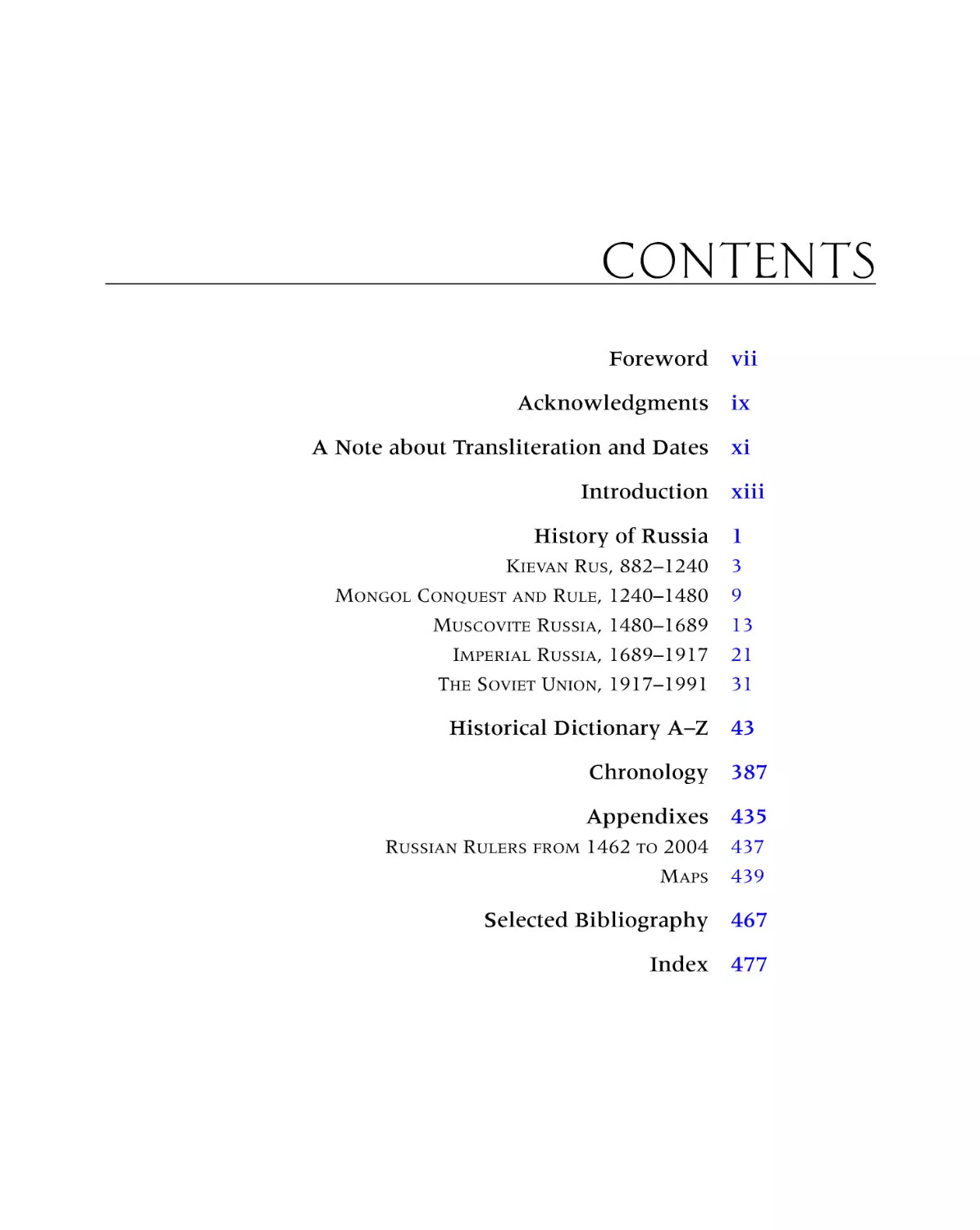
CONTENTS
Foreword vii
Acknowledgments ix
A Note about Transliteration and Dates xi
Introduction xiii
History of Russia 1
KIEVAN RUS, 882–1240
MONGOL CONQUEST AND RULE, 1240–1480
MUSCOVITE RUSSIA, 1480–1689
IMPERIAL RUSSIA, 1689–1917
THE SOVIET UNION, 1917–1991

3
9
13
21
31

Historical Dictionary A–Z 43
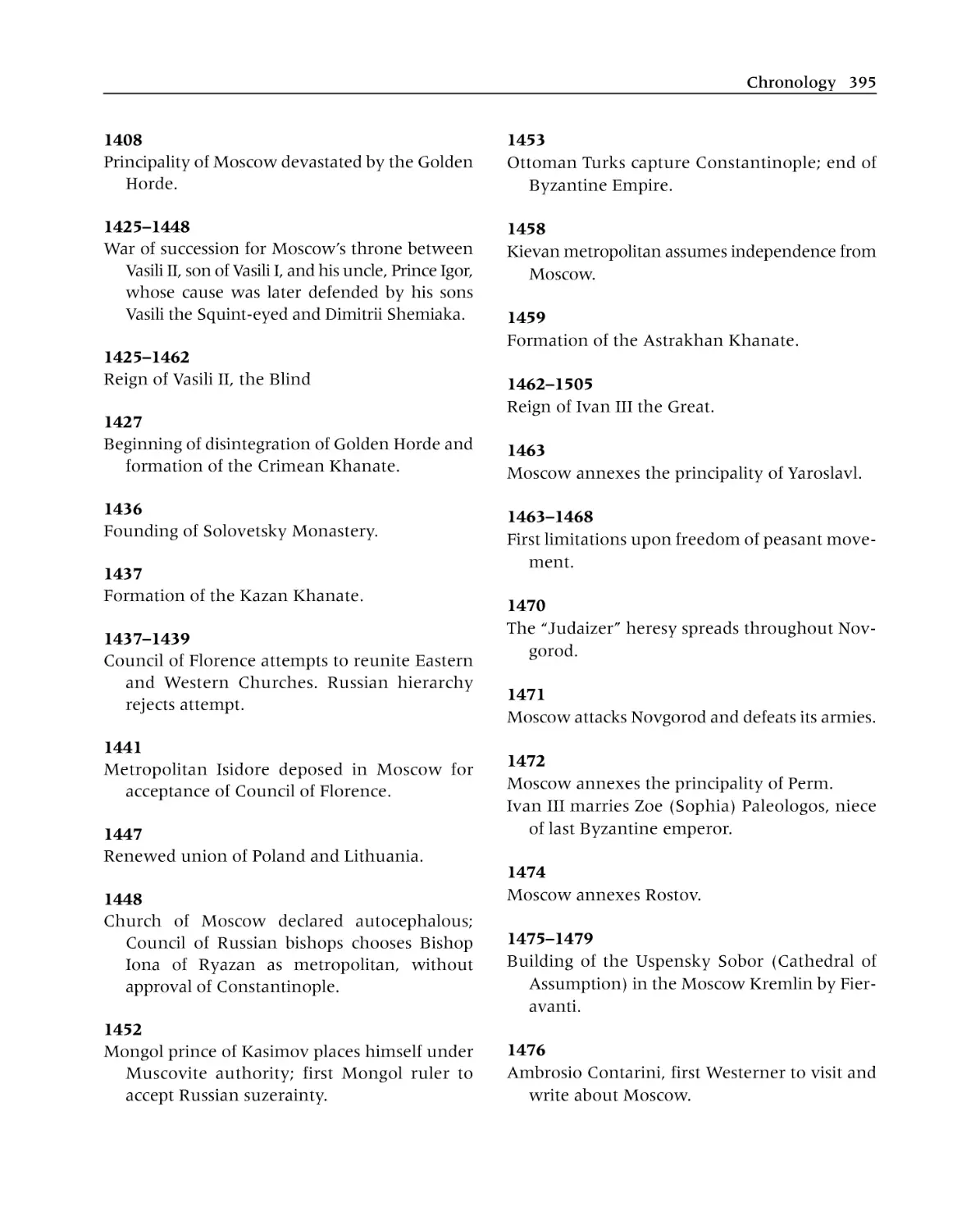
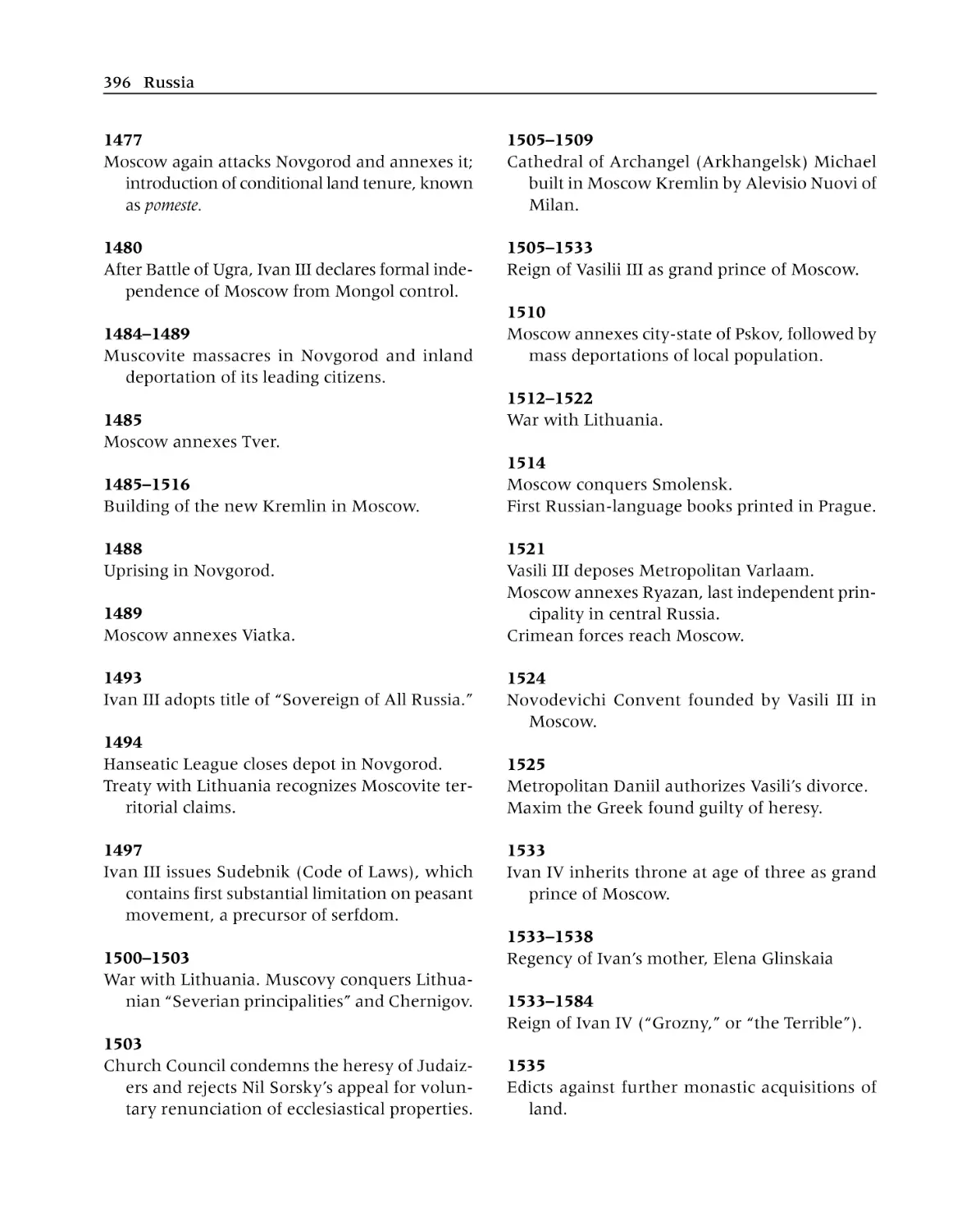
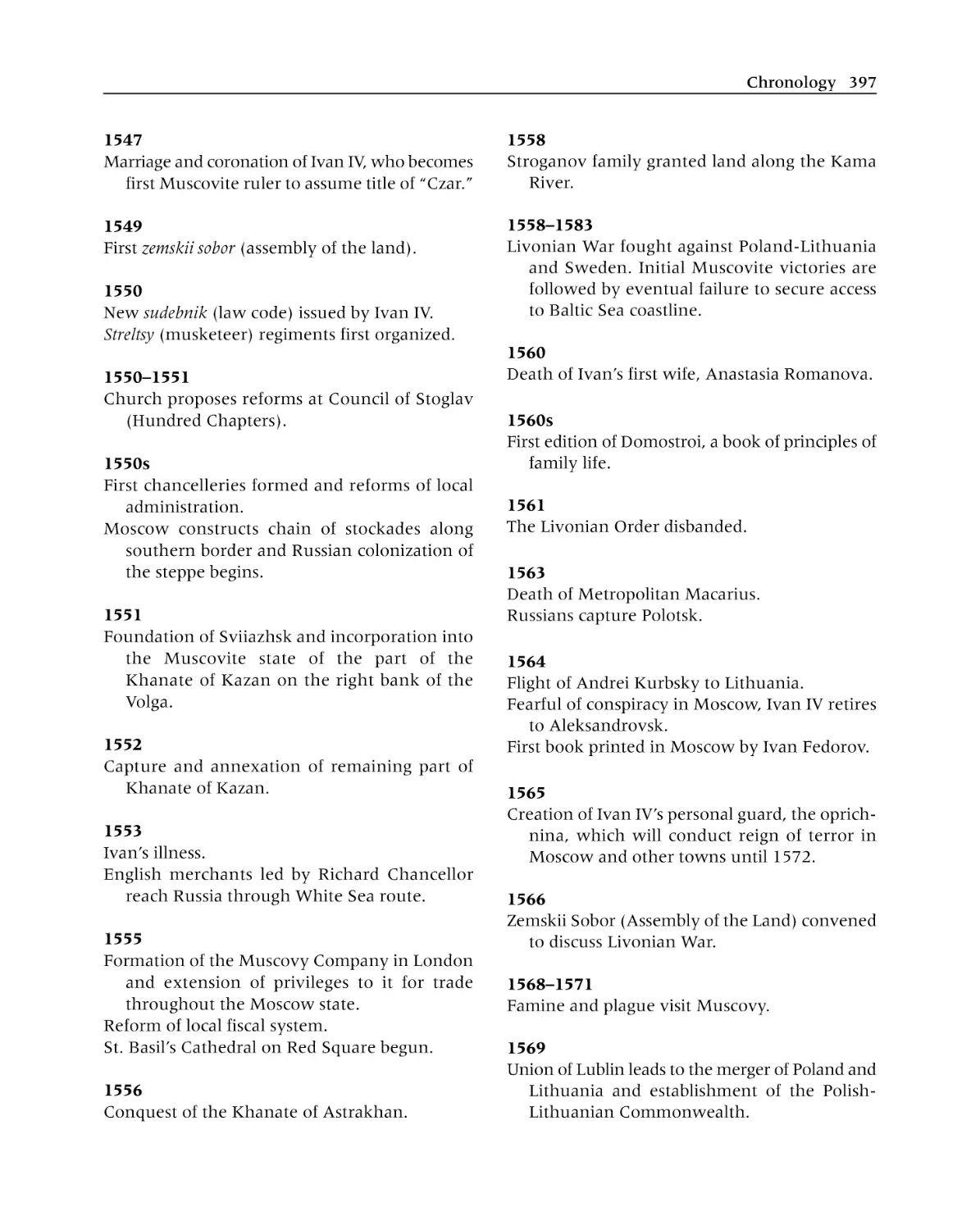
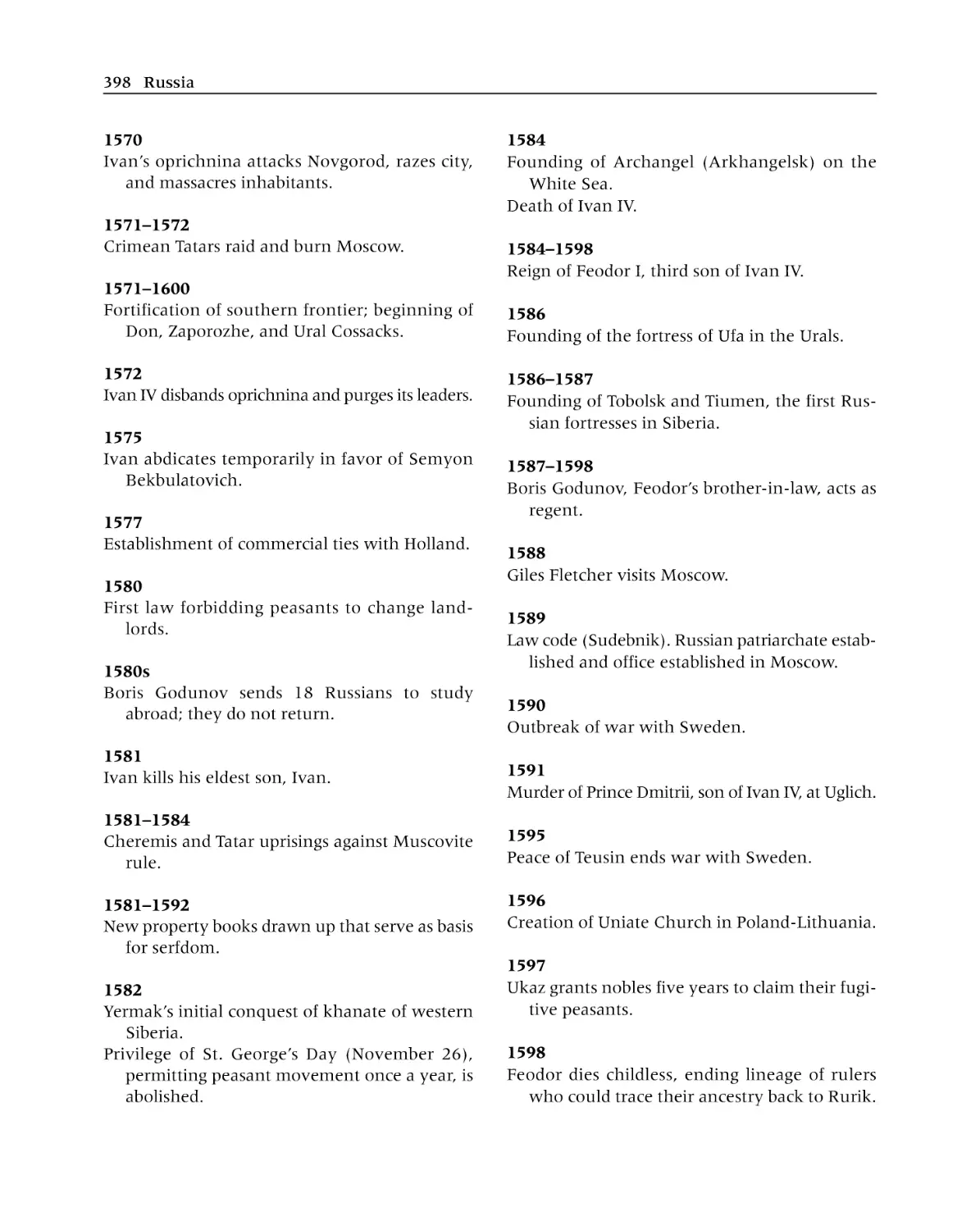
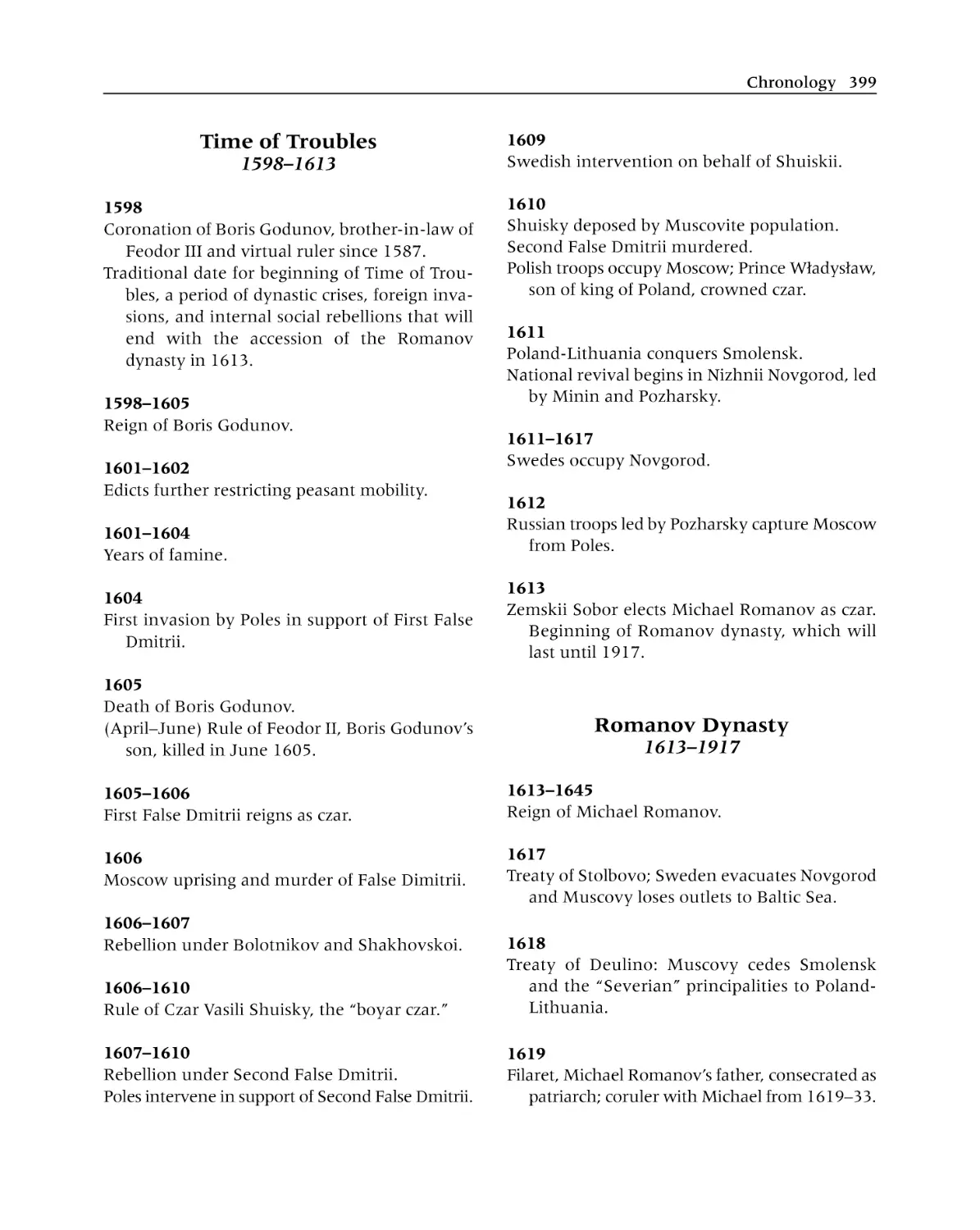
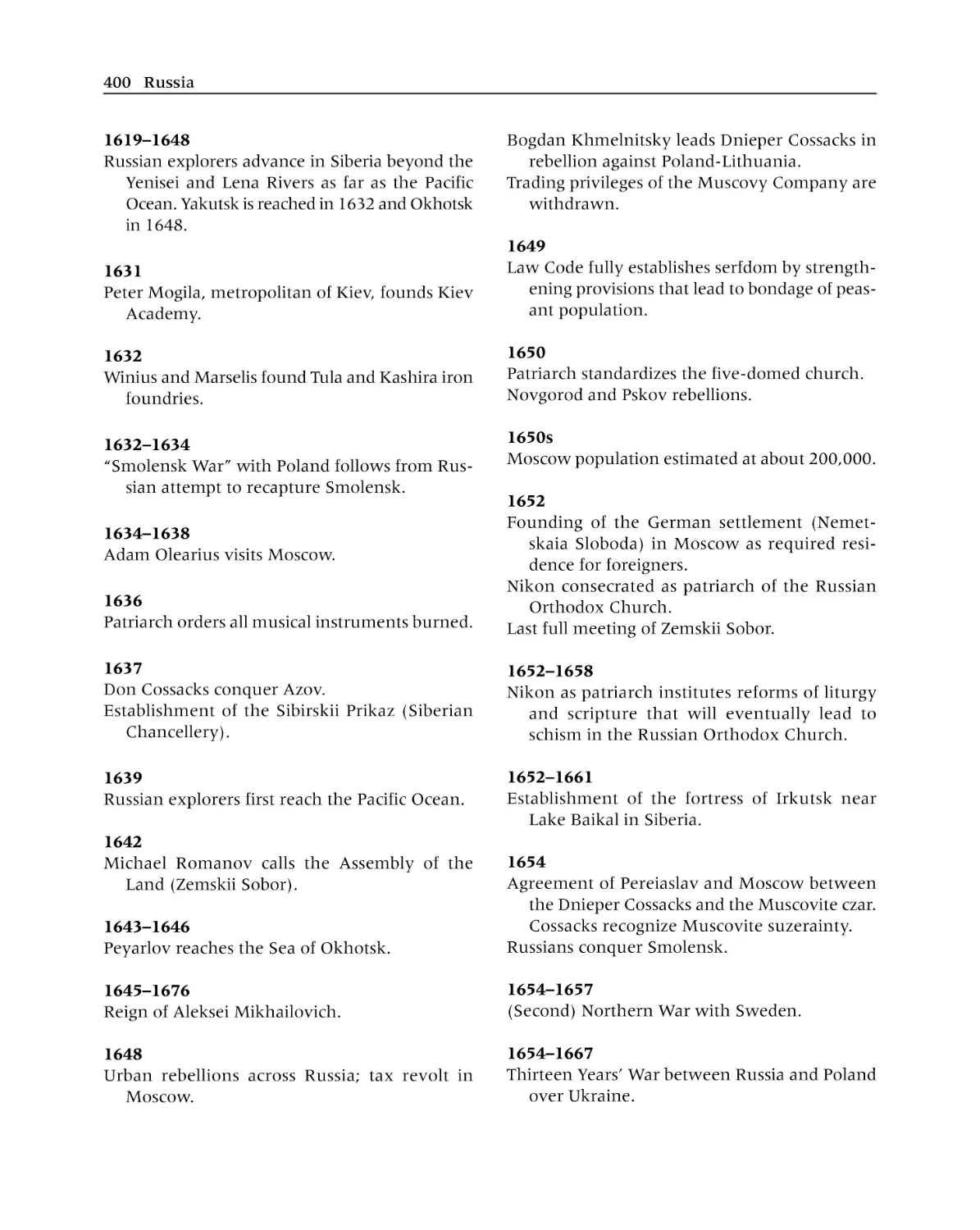
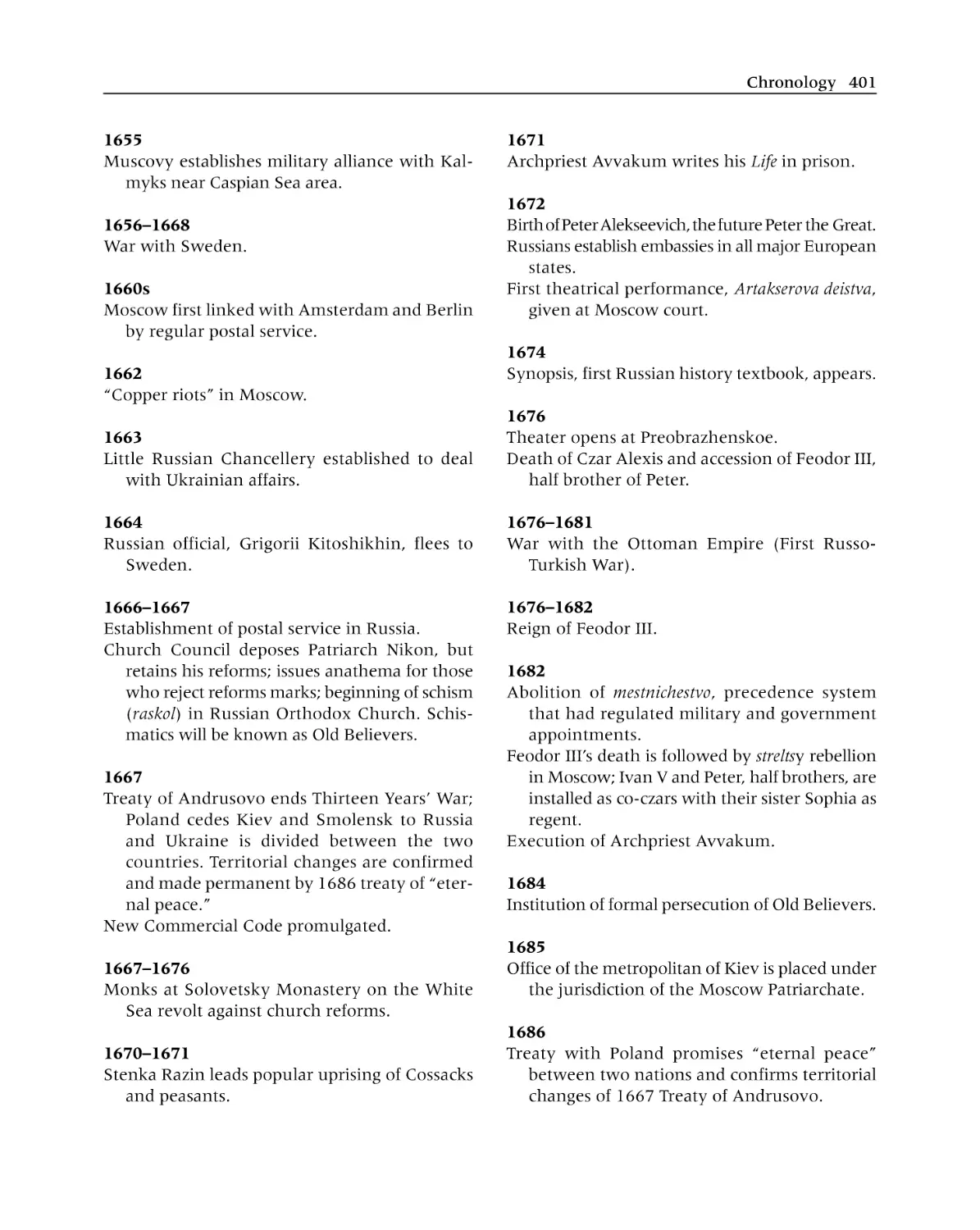
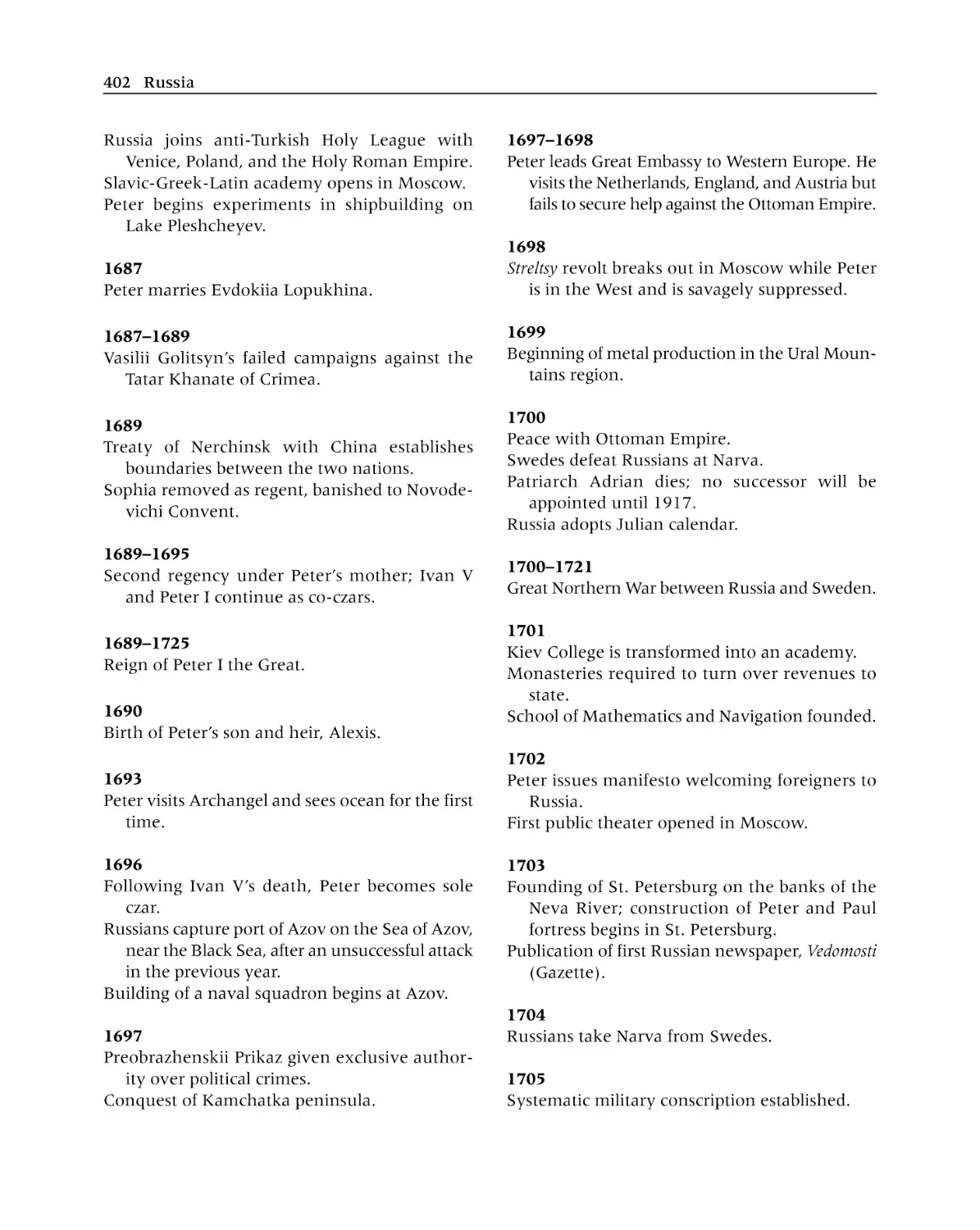
Chronology 387
Appendixes 435
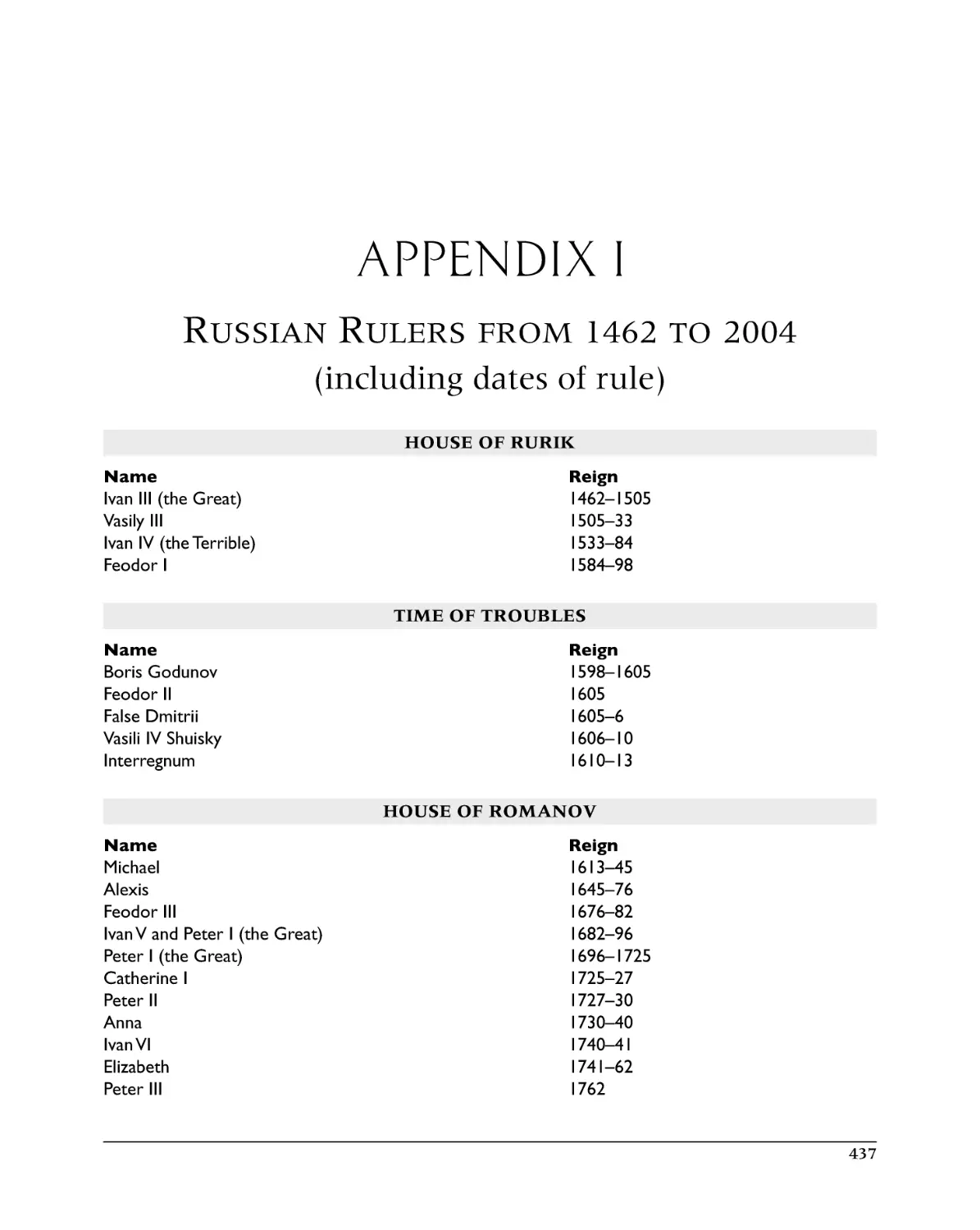
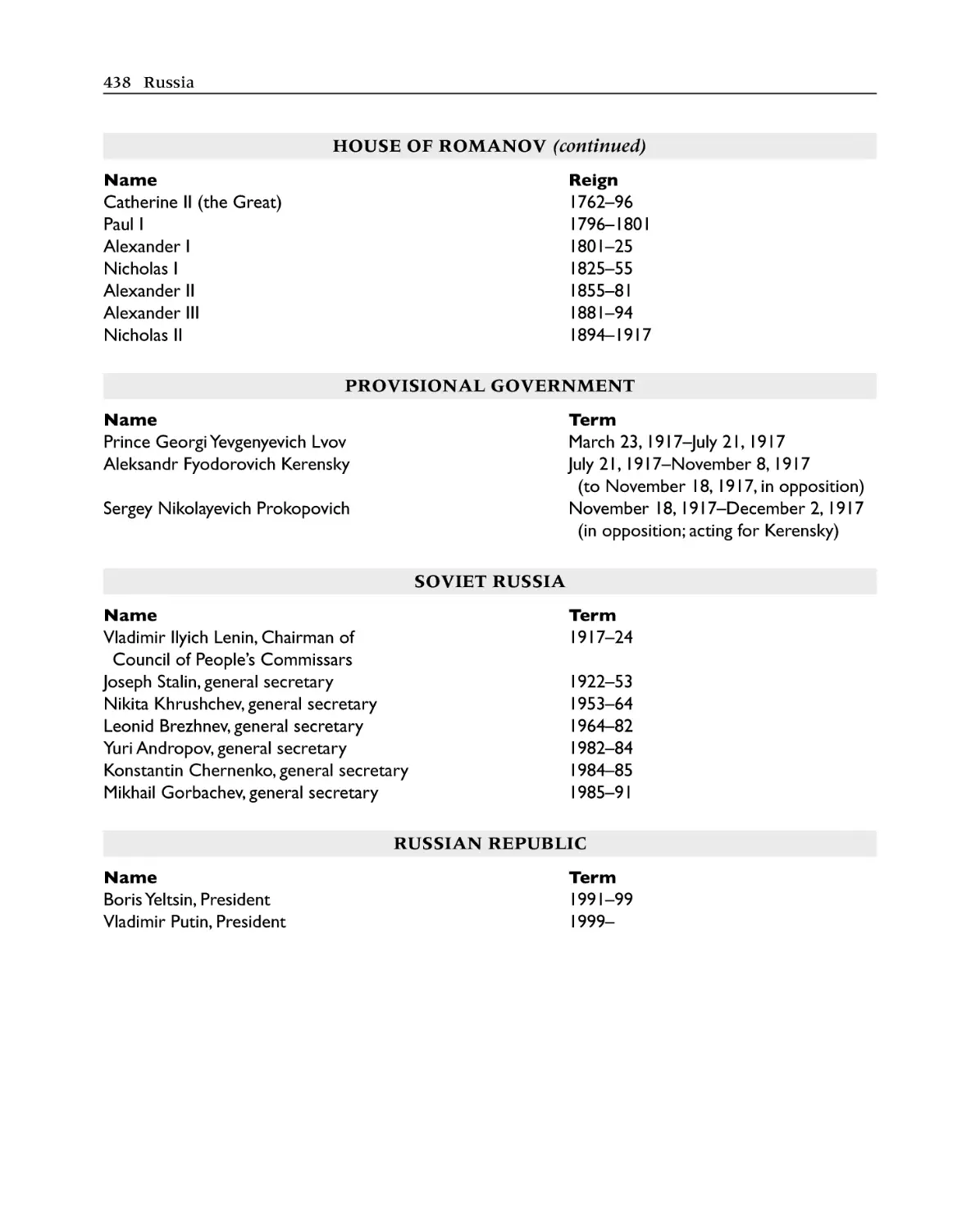
RUSSIAN RULERS FROM 1462 TO 2004
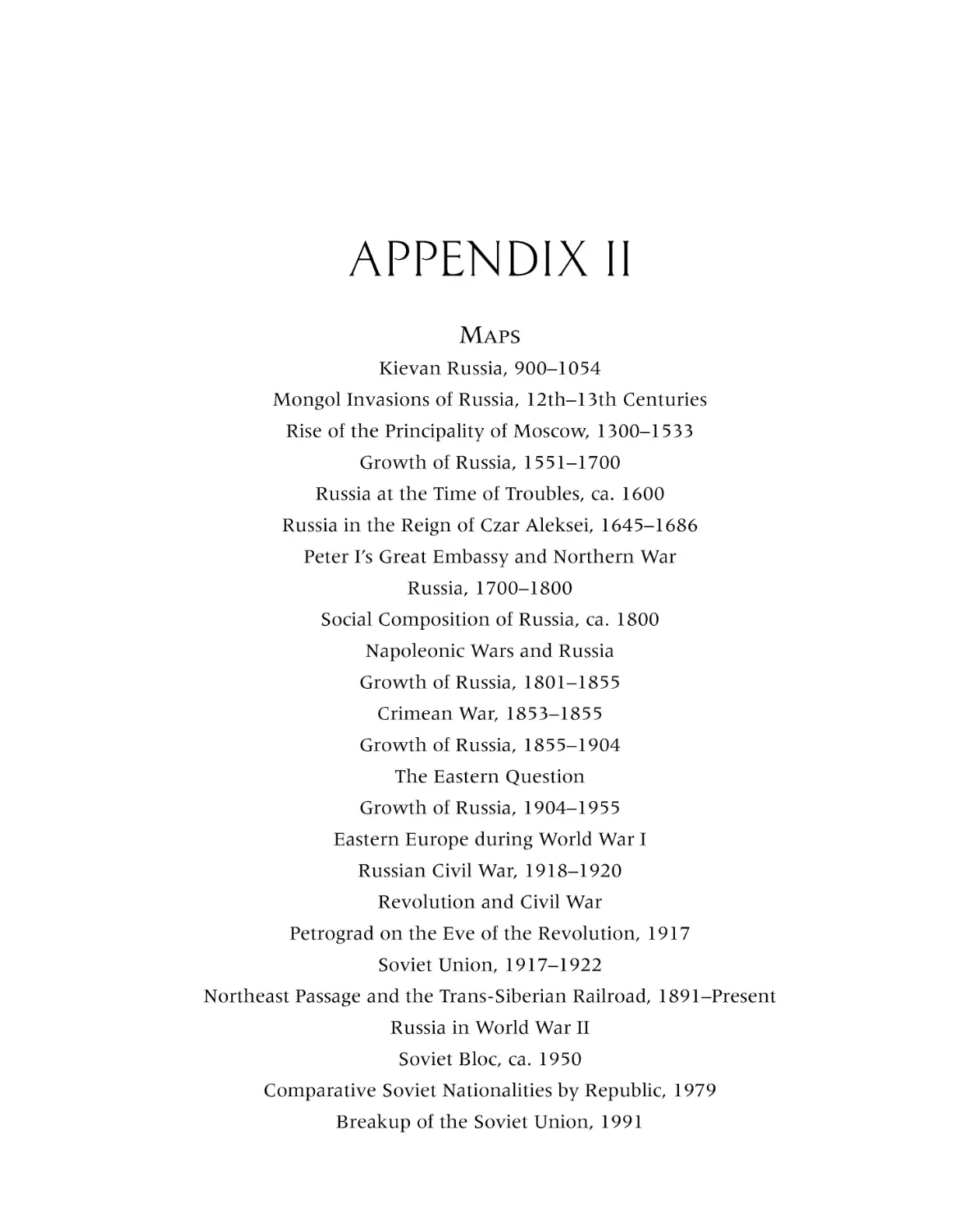
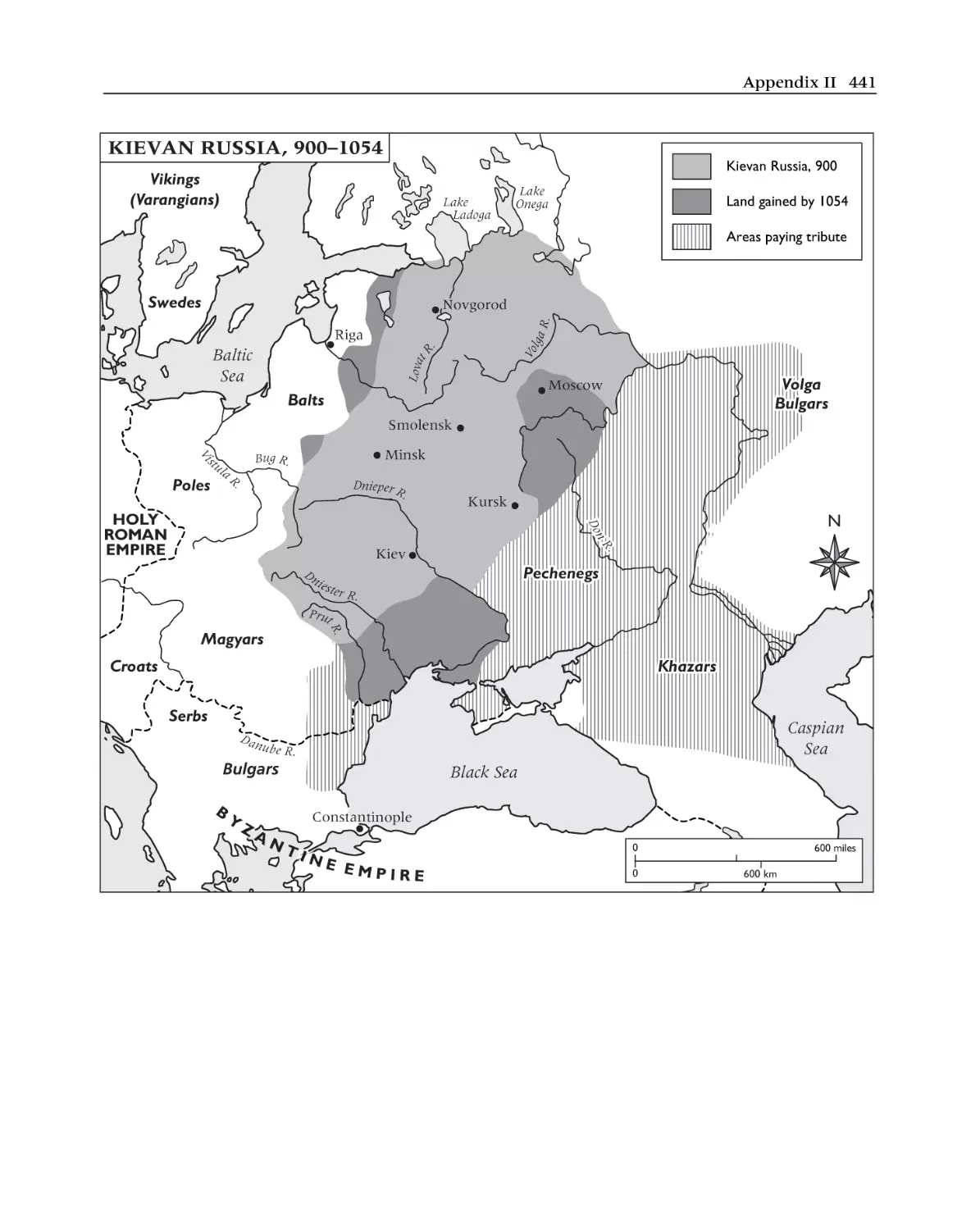
MAPS

437
439

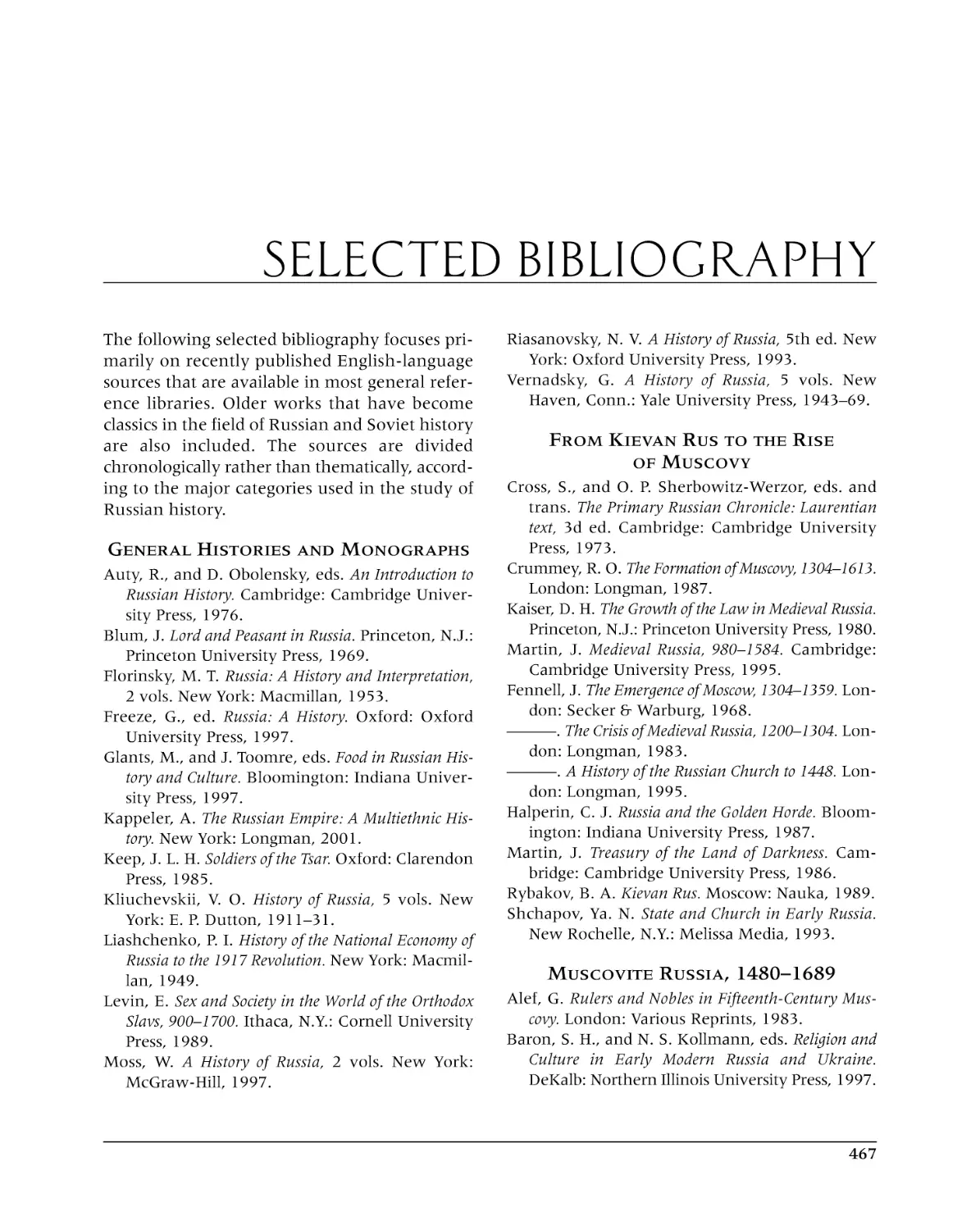
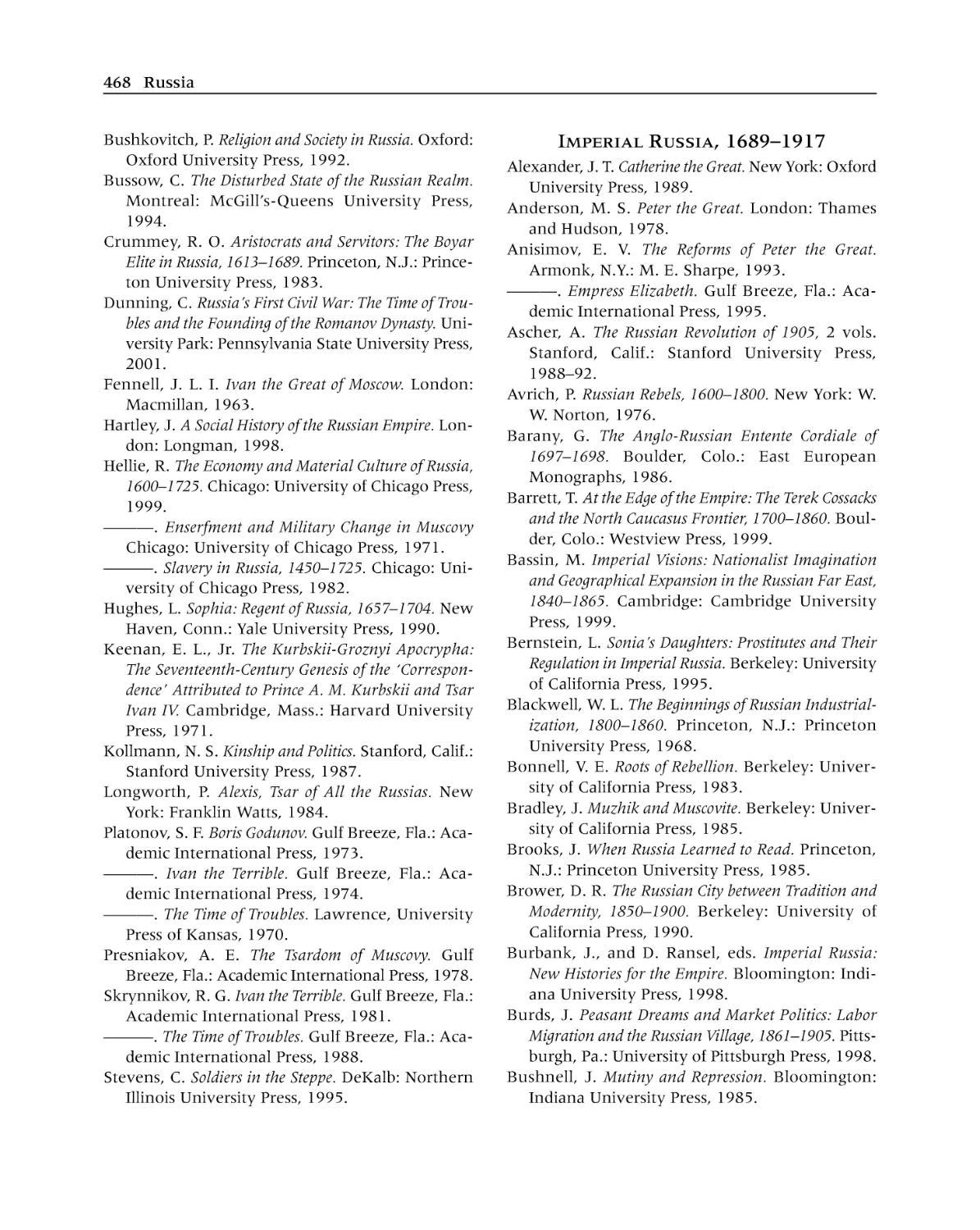
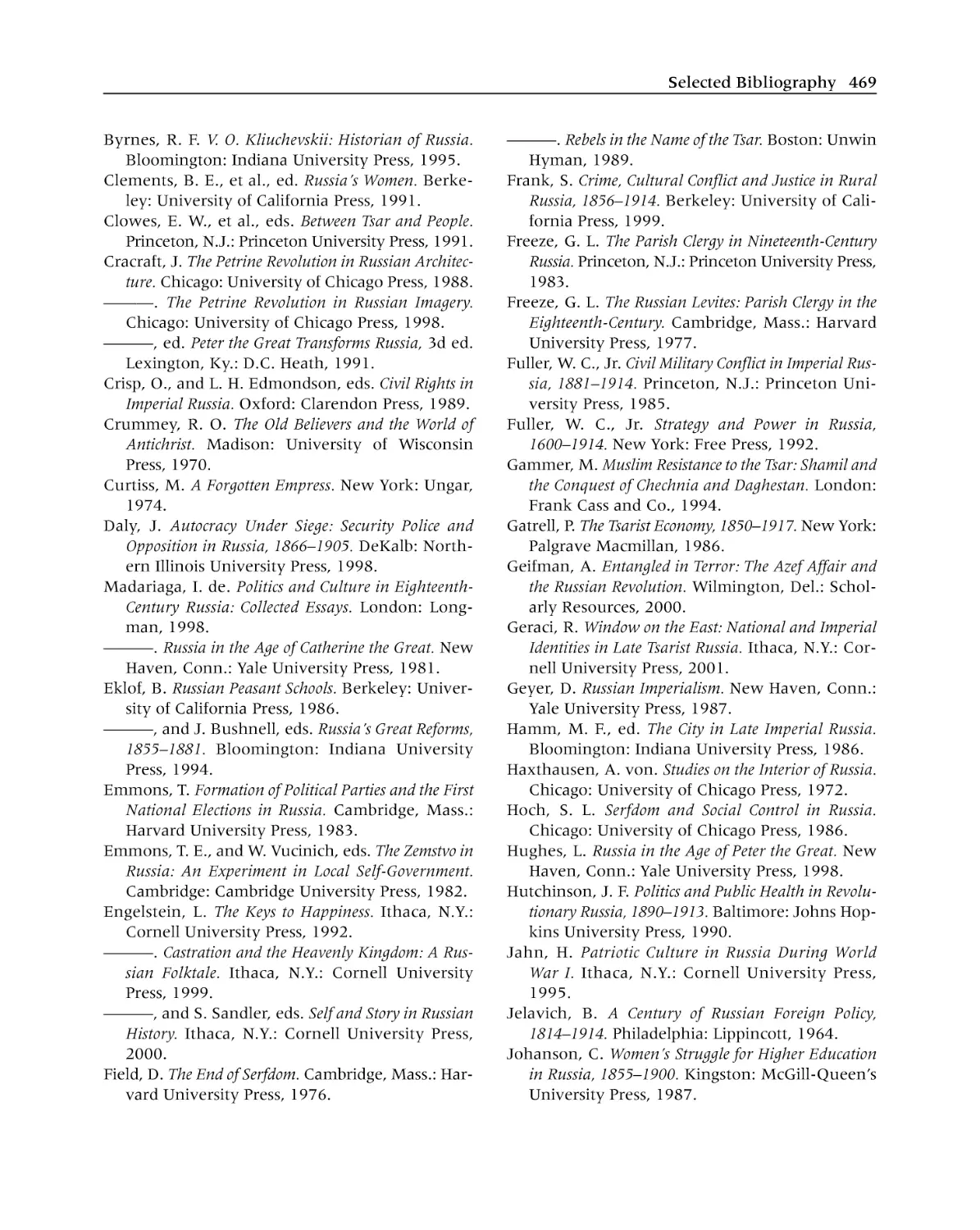
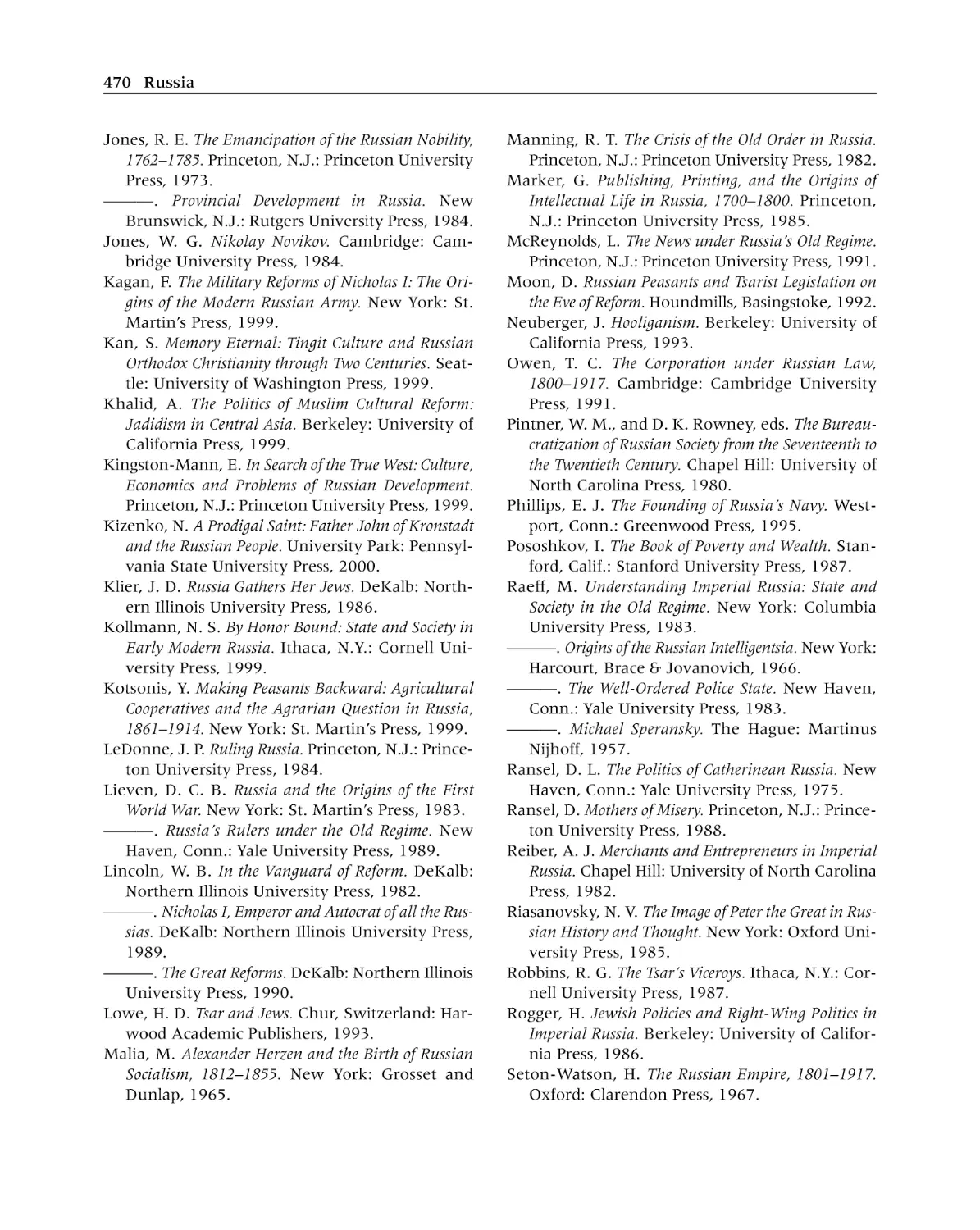
Selected Bibliography 467
Index 477

FOREWORD
This series was inspired by the need of high school and college students to have
a concise and readily available history series focusing on the evolution of the
major European powers and other influential European states in the modern
age—from the Renaissance to the present. Written in accessible language, the
projected volumes include all of the major European countries: France, Germany, Great Britain, Italy, and Russia, as well as other states such as Spain, Portugal, Austria, and Hungary that have made important intellectual, political,
cultural, and religious contributions to Europe and the world. The format has
been designed to facilitate usage and includes a short introduction by the author
of each volume, a specialist in its history, providing an overview of the importance of the particular country in the modern period. This is followed by a narrative history of each nation from the time of the Renaissance to the present.
The core of the volume consists of an A–Z dictionary of people, events, and
places, providing coverage of intellectual, political, diplomatic, cultural, social,
religious, and economic developments. Next, a chronology details key events
in each nation’s development over the past several centuries. Finally, the end
matter includes a selected bibliography of readily available works, maps, and an
index to the material within the volume.
—Frank J. Coppa, General Editor
St. John’s University

vii

ACKNOWLEDGMENTS
I wish to thank my colleague Frank Coppa, editor of the European Nations
series, for suggesting that I write this book. I also wish to thank Owen Lancer,
editor at Facts On File, for patiently and expertly guiding the manuscript
through its publication. At St. John’s University, Anna Marie Mannuzza, Jacek
Niedzwiecki, John-Emery Konecsni, and Teresa Purpura assisted with clerical
and research matters. Research was conducted at the Slavic and Baltic Division
of the New York Public Library, the Flushing Branch of the Queens Borough
Public Library, and the Russian State Library in Moscow. I am grateful to their
staffs for their bibliographic assistance. As always, my wife and children provided the support, space, and tolerance necessary to complete the manuscript.

ix

A NOTE ABOUT
TRANSLITERATION AND DATES
In transliterating terms from the Russian Cyrillic alphabet, I have followed a
modified version of the standard Library of Congress system. For the sake of
readability, last names ending in ii have been changed to y (thus Dostoevsky and
not Dostoevskii, Lunacharsky and not Lunacharskii). Other last names have been
rendered in forms already familiar to English-language readers (Yeltsin and Yevtushenko instead of Eltsin and Evtushenko, but Esenin instead of Yesenin). A similar approach has been used for first names ending in ii (Yuri and Vasili, but
Dmitrii, Anatolii and Grigorii). The Russian “soft sign” has been omitted throughout the text (thus, streltsy and Kazan instead of strel’tsy and Kazan’).
From 1700 until February 1918, Russia followed the Julian calendar instead
of the Gregorian calendar used in the West. The Julian (Old Style) calendar
lagged 11 days behind the Gregorian (New Style) calendar in the 18th century,
12 in the 19th century, and 13 in the 20th century. Throughout the text, I have
tried to render dates according to the Gregorian calendar.

xi

INTRODUCTION
The inclusion of Russia in the present reference series on European nations
from the Renaissance to the present reflects the belief that Russia is indeed a
European nation, an assumption that many readers may take for granted but
which has been debated for centuries. For while there may be important
nuances in terms of how other present and former nations represented in this
series, such as Great Britain, Austria-Hungary, Italy, France, Germany, Spain,
and Portugal, have defined their relationship to the idea of Europe, their membership in the family of European nations has never been questioned to the
extent that it has with regard to Russia. Stretching from the Baltic Sea to the
Pacific Ocean across the vast Eurasian landmass, Russia has developed over the
centuries at the periphery of the geographical, political, and cultural construct
that we call Europe—sometimes welcome in the European family of nations,
sometimes not. From the earliest accounts of European travelers to the Muscovite court to present-day discussions about Russia’s future after communism,
Western observers have debated the extent to which Russia is a part of Europe
or something different. To be sure, Russians themselves have questioned their
own identity with equal, if not greater, intensity and persistence. The mid-19th
century intellectual debates between Russian Slavophiles and Westernizers
were but one instance of a questioning that goes back to the early modern
period and forward to the present day.
The idea that Russia is not European begins with the perception of a different
historical development. Those seeking to place Russia outside of the European
tradition can point to a different historical development marked by a heritage
shaped by allegiance to Byzantine Christianity, two to three centuries of Mongol
rule, and the absence of a Renaissance. In fact, the subtitle of the European
Nations series, “from the Renaissance to the present,” seems least applicable to a
nation that was beginning to shake off dependence on Asian foreign rule roughly
at the same time that western Europe was challenging the received wisdom of its
medieval civilization. They also can point to the development in subsequent centuries of an autocracy based on a social foundation of serfdom that grew more
rather than less restrictive as western European serfdom was beginning to recede.
Finally, they can point to the absence of a strong capitalist tradition based on an
independent, politically assertive middle class, and as a clincher they can point
to the unique experience of Soviet communism in the 20th century.
At times, however, the differences between Russia and its European neighbors seem quantitative rather than qualitative, a product of the huge disparities
xiii

xiv Russia

in size between the two. None of the other European monarchs made as
extensive claims to autocratic powers and for as long as the Russian czars. While
cultural and class differences between rulers and ruled were common to all European states, nowhere did the gap appear as vast as it did in Russia, especially
after the reign of Peter the Great. None of the many 20th-century dictatorships
that appeared on the European political scene was as ruthless and remained in
place for as long as the communist dictatorship ushered in by the Russian Revolution of 1917. Seen under this light, Russia is but a magnified extension of
Europe, a view that is more in line with the true nature of the ambiguous geographical boundary that divides Europe from Asia. And yet after centuries of
close interaction, one is hard-pressed to find clear dividing lines between Russia and Europe.
Just as one cannot think of Russia without Europe, it is untenable to think
of Europe without Russia. What is European literature without the contributions of Pushkin, Tolstoy, Dostoevsky, or Chekhov, and what is Western music
without the contributions of Tchaikovsky, Stravinsky, or Shostakovich? And
even though Russia has been and continues to be portrayed as a threat to the
West, in the case of Napoleon and Hitler it has also twice helped to save Europe
from threats created by its own body politic.
The attempt to assess Russia’s place in European and world history continues
to this day, a decade or so after the end of the Soviet Union, as shown by two
recent English-language interpretive works. Working within the paradigm that
divides Russia from Europe, Marshall Poe argues that for the past five centuries
up to the abrupt end of Soviet communism in 1991, Russian political and intellectual elites have created a “Russian moment in world history,” distinguished
by their ability to advance a modernizing agenda in non-European ways. Working with less broad brushstrokes, Steven Marks also begins with the Russian
elites’ search for alternatives to European or Western models of modernity. He
then seeks to elucidate, in a book of the same title, how Russia shaped the modern world through political and cultural contributions ranging from the refining
of terrorism as a revolutionary weapon and the development of mass-based dictatorships to the introduction of new forms of intellectual and cultural creativity in literature, ballet, and the arts.
The present volume seeks to introduce a general audience to the richness of
the Russian historical tradition, with its villains and saints, militaries victories
and defeats, as well as the improbable heights and absolute depths in human
relationships that are evident throughout its history. In this volume’s historical
dictionary, readers will indeed learn about art, anti-Semitism, ballet, and Bolshevism (to borrow a page from the subtitle of Marks’s stimulating book), wellknown components—for better or for worse—of Russian history. From Yalta to
Yashin and zapovedniks to Zubatov, they will also learn about smaller but equally
important and fascinating Russian contributions to international diplomacy,
world soccer, environmentalism, and methods of police surveillance.
—Mauricio Borrero
St. John’s University, New York

HISTORY OF
RUSSIA

K IEVAN RUS
882–1240
The origins of the people who call themselves Russians and of the polity that we
know as Russia remain somewhat obscure, but we can sketch the basic outlines
of those early centuries. It is generally accepted that the ancestors of the Slavs,
from which the Russians descend, first appeared in the sixth century during the
“great migration of peoples,” moving eastward from the Carpathians into the
area of the Dnieper River basin. The Dnieper River Slav settlements became part
of an important trading route linking Scandinavia with Constantinople, capital
of the Byzantine Empire. By the ninth century, a number of trading towns had
developed in the area, and through a series of frequent wars they tried to seize
nearby territory.
It is at this point that the Varangians (Norsemen or Vikings) made their
appearance in the old historical chronicles that remain as one of the few primary sources of early Russian history. Regardless of their warrior image elsewhere in Europe, it seems that in the Dnieper River basin the Varangians were
primarily interested in trade. Moving up and down the rivers of western Russia, the Varangians eventually linked Scandinavia and northern Europe to the
Black Sea and Constantinople at a time when the Muslim conquests of the
eighth century had reduced European trade in the Mediterranean Sea. The
details surrounding the appearance of the Varangians have been debated by historians through the centuries, with much of the debate centering around the
question of whether the Varangians gradually settled in the Dnieper River basin
or whether they were invited by the local population to serve as a ruling class.
At the center of this debate is the semilegendary figure of Rurik, whom the
sources record as having conquered the city of Novgorod in 862.
Although little is known about Rurik, there is agreement that the reign of
Oleg (r. 882–913), a relative of Rurik, is an important marker in the development of the political entity that came to be known as Kievan Rus. Oleg first succeeded Rurik as ruler of Novgorod, then moved southward, establishing himself
at Kiev, a city on the Dnieper River. One of the main achievements of Oleg’s
reign was territorial expansion. He began the process of bringing the East Slavic
tribes near Kiev under control, which his successors would continue. Another
important achievement was the establishment of close trade relations with

3

4 Russia

Byzantium. In 907, Oleg led a military expedition to attack the city of Constantinople. Four years later, Kiev received favorable trade terms from the
Byzantines.
Oleg was succeeded by his son Igor (r. 913–945), who continued the main
themes of Oleg’s reign. In 941, Igor led another campaign against Constantinople, but this time it was unsuccessful, and as a result Kievan traders lost their
previous trade privileges with the Byzantines. Igor also tried to spread Kievan
authority over neighboring Slavic tribes and, like Oleg, faced their frequent
rebellions. He was killed collecting tribute from the Drevliane, one of the Slavic
tribes the Kievans attempted to control.
Igor died when his son was an infant, so his widow, Olga (r. 945–962), led
the Kievan state as regent. She was the first woman to serve as ruler of Russia.
Olga began her years in power by wiping out much of the Drevliane, the tribe
that had killed her husband. She is perhaps best remembered in Russian history
for her conversion to Christianity around the year 955. As the first member of
the ruling family to accept Christianity, she helped prepare the way for the conversion of the entire country. Olga died in 969 and was later proclaimed a saint
by the Russian Orthodox Church.
In 962, Igor and Olga’s son, Sviatoslav (r. 962–972) attained majority and
became ruler of Kiev. From 964 to 967 he expanded Kievan rule to the east and
the north, defeating nearby Slavic tribes as well as the Volga Bulgars and Khazars. As a result of these campaigns the Volga River route to the Caspian Sea
came under Kievan control. Sviatoslav was less successful in his second major
campaign in the region of the Balkans. In 967 his troops reached the Danube
River valley. Although he fought and defeated the Bulgarians in several campaigns over the following years, by 971 he had been defeated by the Byzantines
and forced out of the Balkans.
Sviatoslav’s death led to a civil war among his sons, a problem that would
recur throughout early Russian history because of the absence of an accepted
means of succession. After an eight-year-long period of conflict, his youngest
son, Vladimir (r. 980–1015) emerged victorious. In hindsight the central
achievement of Vladimir’s reign was his conversion to Orthodox Christianity in
988 and its adoption as the religion of the Kievan state. Orthodox Christianity
became the basis for much of early Russian art and culture. It linked Kievan
Russia to the highly advanced society of Byzantium. At the same time it hampered ties between Russia and the rest of Europe, where Western Christianity,
with its center at Rome, held sway. The formal break between the Eastern and
Western Churches that took place in 1054 heightened Russia’s isolation from
the peoples of central and western Europe, which looked to Rome. The Russian
Church was led by a metropolitan bishop located at Kiev. These bishops were
appointed by the patriarch at Constantinople and most of the early metropolitan bishops were Greek rather than Russian. The continued expansion of
Kievan boundaries during Vladimir’s reign has received less attention but was
also an important feature. Vladimir restored Kievan authority westward over
areas lost to Poland during the recent civil war. He also extended Kievan
authority northward to reach the Baltic Sea.

Kievan Rus 5

Vladimir’s death in 1015 and the uncertainty over his succession again triggered a period of conflict among his sons. After four years, Yaroslav (r. 1019–54)
defeated his brothers but then had to split control of Kievan territory with one
brother until 1036. Despite these tumultuous beginnings, Yaroslav, already
known as “the Wise” during his lifetime, presided over a reign generally considered the peak of Kievan history. Geographically Kievan Russia extended
from the Black Sea to the Baltic Sea and westward to the Carpathians. Ties with
central and western Europe were strengthened in a series of marriage alliances.
Yaroslav’s sister married the king of Poland, and three of his daughters married
foreign monarchs: the kings of Hungary, Norway, and Poland. Yaroslav administered a decisive defeat to the Pechenegs in 1037, the warlike nomads who
lived between the Kievan state and the Black Sea and who had posed a threat
to Kiev for over a century. For a brief time afterward, Kievan Rus was free from
the threats of steppe nomads.
Kiev emerged as an important cultural center and one of the important cities
of Europe during Yaroslav’s reign. New churches, schools, and libraries were
built. The Kievan era also marks the beginning of a distinctive Russian tradition
in art and architecture that at first was strongly influenced by Byzantine traditions and focused on religious themes. An early example of these were the St.
Sophia cathedrals constructed in Kiev and Novgorod. Another important component of early Russian art was the development of a tradition of icons, religious pictures painted on wooden panels that were placed both in churches and
in private homes.
The Kievan economy was based on both trade and agriculture. Although historians disagree on the relative weight of each in Kievan economic life, the bulk
of the population was engaged in agriculture. Trade tended to be dominated by
the princes, their retinues, and wealthy merchants. At its height the Kievan
state included both steppe and forest regions. Trade between northern centers
like Novgorod and southern cities like Kiev probably involved exchanging grain
and cattle from the south for furs and timber from the north. Kievan Rus also
had a lively and important trading relationship with the Byzantine Empire. The
grand prince of Kiev gathered tribute from the regions under his control. Each
spring he led a trading expedition down the Dnieper River and across the Black
Sea to Byzantium. Private merchants from all over Kievan Rus traveled along
under the prince’s protection. The Kievans traded raw materials such as furs for
finished goods like weapons and luxuries such as spices and jewelry.
There were two regional types of farming. In the steppe, where land was
abundant and easy to cultivate, farmers moved frequently as fields wore out.
The basic crop was wheat. In the zones farther north, farmers got new land only
by laboriously clearing away the forest. Thus they were more settled, alternately
using a part of their land or letting it rest fallow. The basic crops were rye, barley, and oats.
In cultural matters, with the conversion of the population to Christianity in
988 and the diffusion of the Cyrillic alphabet initially developed by the Orthodox missionaries Cyril and Methodius to aid them in translating the Bible for
the conversion of the Southern and Western Slavs, Kievan Rus acquired a writ-

6 Russia

ten language known as Old Church Slavonic. A Kievan literature in the form of
religious documents now appeared using Old Church Slavonic, the language of
church services. A secular literature of poetry and historical chronicles in Old
Church Slavonic developed as well. There are two important early texts from
this period. The 12th-century Primary Russian Chronicle, despite a long and rich
controversy about its origins, stands as the basic document recording the history
of Kievan Rus. A copy of the Chronicle made by the monk Lavrentii in 1377 has
survived to the present. The other text is the Tale of Igor, an epic poem that is
perhaps the most famous literary product of the Kievan era. Written by an
unknown author, it describes the defeat of Kievan forces at the hands of the
Polovtsy nomads of the steppe in 1185.
The population of the Kievan state was divided into a number of social
classes. Though most people were peasants, the population ranged from powerful princes to slaves. The top level of Kievan society consisted of the prince
and his family, supposedly descended from the Varangian Rurik. The growth of
the princely family made this a numerically substantial group. Just below the
prince’s family stood members of the druzhina, which made up the prince’s aristocratic retinue. They were known as muzhi. Other aristocrats included dignitaries whose power and prestige were based on their regional prominence. They
stood on the same level as the muzhi. During the Kievan era this difference
between aristocratic groups gradually faded. Both aristocrats by virtue of serving the prince and aristocrats by virtue of their local power merged into a single noble group known as boyars.
In the middle of society, two groups of free citizens existed in the cities and
the countryside. Historians refer to both groups as a social class called the liudi.
In urban centers this middle class consisted of merchants and small entrepreneurs such as carpenters and tanners. This class of free citizens was a significant part of the population in a society partly based on commerce. Merchants
engaged in long-distance trade with Europe and Byzantium traveled together
for safety. This cooperation led in turn to the formation of merchant guilds in
Kiev similar to those in western and central Europe. In the countryside, there
was also a group of middle-class landowners, possessing small estates but without the privileges of boyars.
At the bottom of the social scale were laborers with varying degrees of subordination, who made up the majority of the population. In rural areas, these
laborers were called smerdy; although historians are not certain about their legal
status, it seems that at this early stage of Kievan history most of them were not
yet serfs tied to the land. Beneath the smerdy were two groups tied down by firm
obligations. Slaves, known as kholopy, were usually prisoners of war or formerly
free laborers who had been penalized for violating the law. On the other hand,
zakupy were indentured servants, held in a form of temporary servitude until
they had discharged a debt.
In hindsight the reign of Yaroslav the Wise was probably the peak of Kievan
Rus; Yaroslav’s death in 1054 traditionally marks the beginning of its gradual
decline. Kiev was also divided by internal conflicts that often resulted from the
lack of an accepted principle of succession and the practice of giving lands to

Kievan Rus 7

the descendants of a ruling prince. Yaroslav’s death was followed by almost
three decades of intermittent strife among his sons for control of Kiev. The
Cumans in the east and Teutonic Knights, Lithuanians, Swedes, and Magyars,
or Hungarians, from the north also began to threaten Kiev. One common
response by Kievans was to flee toward the forest of the northeast, establishing
towns that would later pick up the torch of emerging Russian culture as Kiev
declined.
Kiev’s decline was also linked to broader changes that affected the hereto
profitable trade route from the Baltic to the Black Sea, especially the creation of
new maritime trade routes to the Black Sea from Venice or the overland route
to Constantinople by way of Bohemia. The city of Constantinople itself, to
which Kiev’s economic and cultural fortunes had been linked, began to decline
in the 11th century, and in 1204 it was conquered by Latin Crusaders who held
it for the next half-century.
As Kiev declined, three other areas of Rus increased in importance: the
north, the northeast, and the west. These areas had always maintained some
independence from Kiev, because they were remote, had separate economies,
and in large part resented paying tribute to Kiev. In fact, many aspects of Kiev
society had shown differences based on geography.
To the north, Novgorod had always been a challenger to Kiev. In the early
12th century, it became an independent polity, adopting an oligarchic republican system centered on its veche, an assembly that some scholars have seen as
the prototype of a parliamentary system, but was in actuality controlled by a
small group of boyars. As Kiev’s power declined, Novgorod took over Rus trade
around the Baltic, focusing on new growing trade with German merchants who
displaced the earlier Varangian influence in the region. In Novgorod, the
Hanseatic League, an association of merchants in Germany and Germans
abroad played an increasing role in the town’s commercial life until 1478, when
Ivan III of Moscow captured Novgorod and expelled the Hanseatic merchants
who were living there.
To the northeast a number of principalities arose, such as Vladimir, Rostov,
and Suzdal to challenge Novgorod and more distant Kiev. The city of Moscow,
founded in 1147 by Yuri Dolgorukii, a son of Vladimir Monomakh, was a relative latecomer to the roll of 12th-century Russian cities, but it was destined to
play an immense role in shaping Russian history in later centuries. To the west,
the territory of Galicia also gained in importance, especially with the development of a land trade route to the East. Its location, bordering Poland, Hungary,
and the Russian towns, gave it important strategic advantages but also exposed
it to threats from many sides. In its politics and religion, Galicia reflected its
Western exposure, with a system in which the prince’s powers were limited by
the boyars and a greater Roman Catholic influence than elsewhere in Kievan
Rus, where Eastern Orthodoxy dominated.

M ONGOL C ONQUEST
AND RULE
1240–1480
By the early decades of the 13th century the lands of Kievan Rus emerged as a
distinct cultural and political entity that was primarily agricultural, but with
important commercial connections to the Baltic and Black Seas. While the ruler
of Kiev held preeminent status, the Kievan territories were bound by a relatively decentralized political structure built around princes charged with
defending their lands and administering justice aided by a council of independent landowners. A common Slavic language and adherence to Eastern Orthodox Christianity, which also linked them to the Byzantine world, further unified
the lands of Kievan Rus.
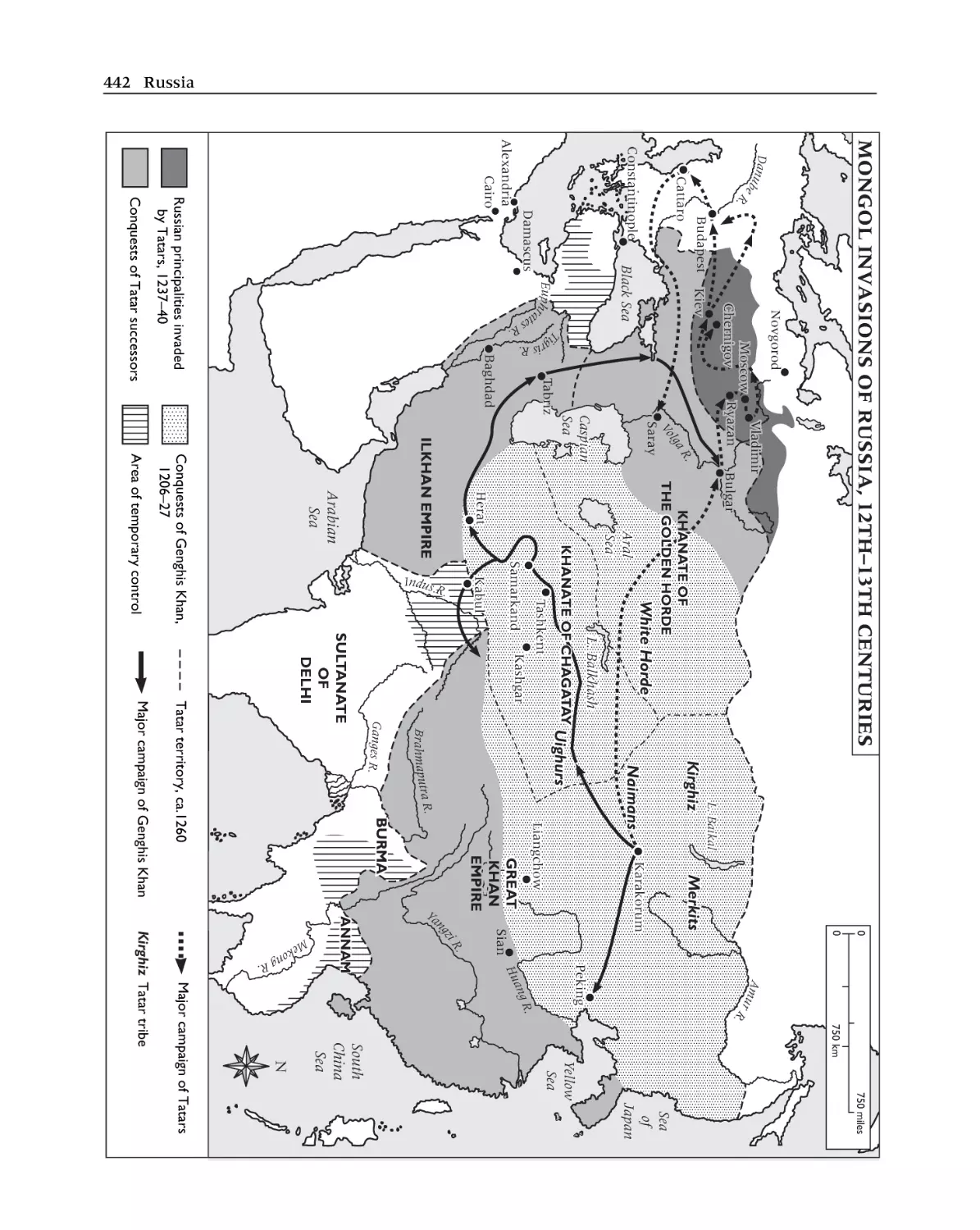
This world was shattered between 1237 and 1240 by the arrival of the Mongols, a new and more ruthless group of invaders who would conquer and control most of the Russian lands for the next 250 to 300 years. Led by Batu Khan,
a grandson of the great conqueror Chinggis Khan (Genghis Khan), Mongol
armies first appeared on the eastern banks of the Volga in 1236, after conquering China, Central Asia, Iran, and Transcaucasia over the previous three decades.
Already the ruler of the steppes north of the Aral Sea and Lake Balkhash, Batu
Khan had his armies penetrating further west and within four years had conquered the Volga Bulgarians and the politically fragmented Russian principalities with the exception of Novgorod, capturing the great city of Kiev in December
1240.
On the eastern banks of the Volga, with its capital at Sarai, near modern-day
Astrakhan, Batu Khan established the Mongol state generally known as the
Golden Horde. From Sarai the Mongols ruled the Russian principalities through
a system of tribute. After about a century, the Mongol grip on its vassal states
began to weaken. During the 14th century, the western and southern Russian
principalities fell under the sway of the newly established Grand Duchy of
Lithuania.
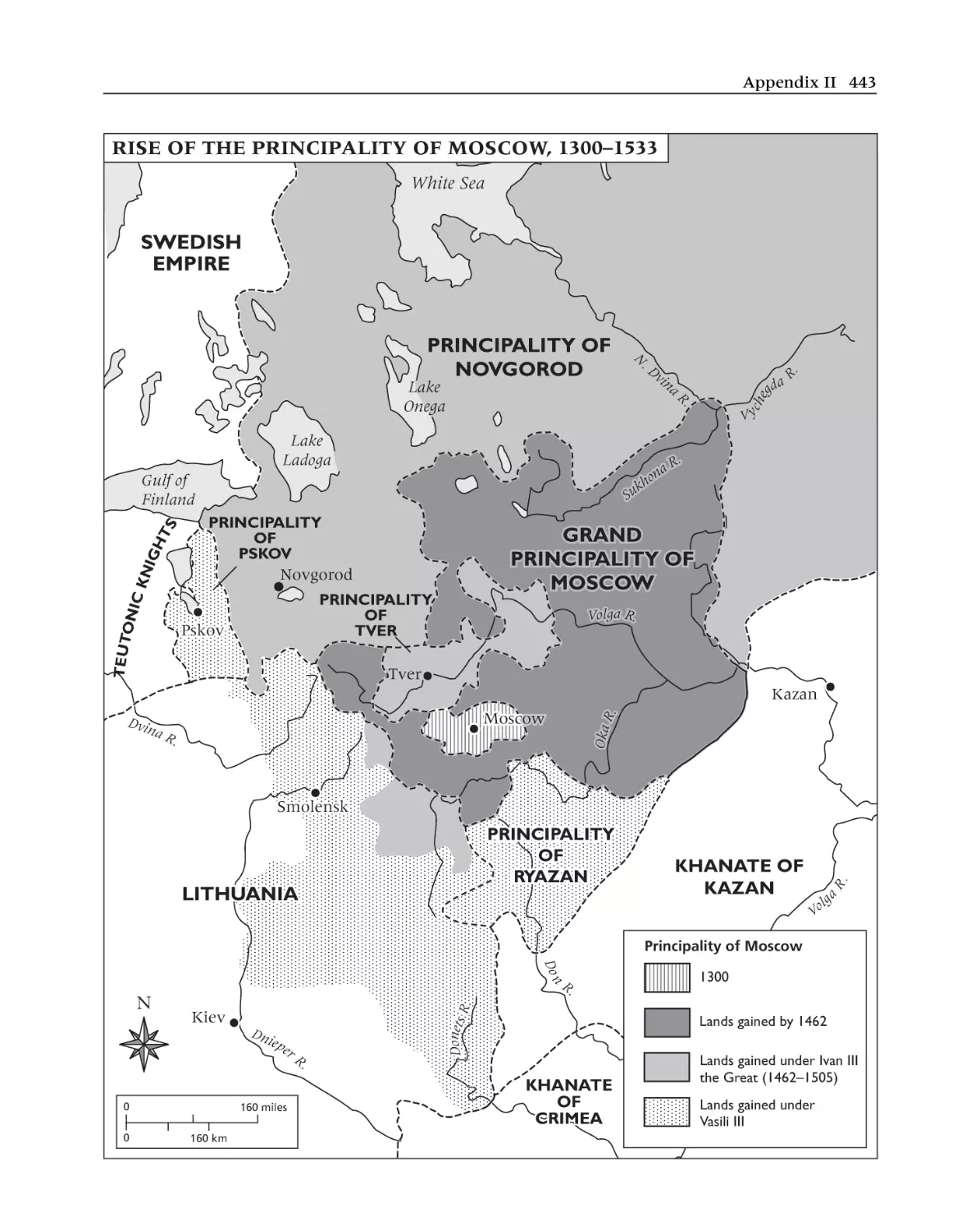
Within the territory still held by the Golden Horde, the small principality of
Moscow absorbed many of its neighbors until it felt strong enough to challenge
the Horde. In 1380 the Muscovite prince Dmitrii Donskoi led a coalition of Russian princes to defeat the Tatars at the Battle of Kulikovo. The defeat was mostly
a harbinger of future changes, because it was not for another hundred years

9

10 Russia

that Moscow was able to fully shake off its tributary burdens. In 1480, Ivan III
formally proclaimed that Moscow would not pay tribute, a claim endorsed by
the Battle of the Ugra River. Although the Mongols continued to raid Russian
territories through the late 16th century, their power declined as a result of
internal divisions. During the 15th century, the Golden Horde disintegrated into
a number of khanates (Astrakhan, Crimea, Kazan, and Siberia). With the
exception of Crimea, they fell to the growing power of Muscovy during the
16th and early 17th centuries.
Concurrent with the decline of Mongol power the principality of Moscow,
previously a minor player in the world of Russian principalities, began its rise
toward supremacy. The two processes were interrelated. The town of Moscow
was probably established by Iurii Dolgorukii in 1147 within the territories of the
principality of Vladimir/Suzdal, and not far from Novgorod. For much of the
12th and 13th centuries it was eclipsed by both.
As with other cities, the Mongols destroyed Moscow in 1237. Toward the
end of the century, the youngest son of Alexander Nevsky, Daniel, became the
ruler of Moscow, holding it an appanage. Daniel concentrated on building his
small principality and extending it along the Moscow River, and he inherited
more property from a childless ruler nearby. Daniel’s son, Iurii, who succeeded
him in 1303, increased the appanage still further and turned to fight the prince
of Tver, Moscow’s rival city, with Michael as its prince.
Iurii married a sister of the khan of the Golden Horde (she became Orthodox), and received an appointment as grand prince. Iurii went against Tver
again, but his wife was taken prisoner and died. The prince of Tver had to go to
Sarai, where he was executed, and Iurii was reaffirmed as grand prince. The families of Iurii and Michael continued fighting and killing each other for about 20
years, leading to a Mongol army destroying Tver, with help from Moscow’s army.
In 1328 Yuri’s younger brother Ivan Kalita, prince of Moscow, was named
grand prince, a position he held until his death in 1341. Ivan’s nickname Kalita
(Moneybags) refers to his skill at collecting tribute for the Mongols from other
Russian princes. He used the money he kept from the tribute to purchase more
land: entire appanages from bankrupt rulers, and separate villages. He added
Vladimir to his rule, keeping the capital in Moscow. In addition, Ivan persuaded
the new metropolitan of the Russian Church to move to Moscow. Moscow
became the new spiritual center of Russia, and the connections between the
church leadership and the grand princes were to become ever stronger. In fact,
a new metropolitan, Alexis, helped to advise one of Ivan’s sons as grand prince.
Ivan’s son Simeon the Proud (who called himself prince of all Russia) had told
his heirs to follow Alexis’s advice. Simeon’s brother (Ivan’s son) Ivan the Meek
took over but left affairs largely in Alexis’s hands. Metropolitan Alexis even
traveled to Sarai to deal with the Golden Horde, where things were falling apart
because of a civil war that produced 20 rulers in 20 years.
Ivan II’s death brought a contest for the new ruler, between Ivan’s son
Dmitrii and a relative Dmitrii from Suzdal. The people of Moscow rallied behind
their own boy and behind the principle of direct succession from father to son.
The new grand prince, Dmitrii, reigned for three decades, until 1389. Continu-

Mongol Conquest and Rule 11

ing the growth of Muscovite territory, continued fighting with Tver and Lithuania (with Muscovite victories), victories over Ryazan and the Bulgars. But
Dmitrii’s claim to fame is his victorious war with the Golden Horde itself. There
were a series of preliminary clashes, with a victory for Moscow in 1378, after
which point the Mongols decided they had to deal with Moscow firmly. They
made an alliance with Lithuania and took 200,000 troops to the Don River area,
meeting the Lithuanians for a joint invasion.
Dmitrii took the initiative, crossing the Don with about 150,000 soldiers to
take on the Mongols before the Lithuanians arrived. They fought on September 8, 1380, in an area with lots of streams, so that the Mongol cavalry couldn’t fight as usual. Known as the Battle of Kulikovo field, the Mongols were
completely routed by the Muscovite-led armies. Hearing of the Mongol defeat,
their Lithuanian allies decided to turn back. After more than a century of
uncontested Mongol military supremacy, Dmitrii Donskoi’s army had broken
the image of Mongol invincibility. The prince of Moscow was seen as the champion of the Russians. Although not all the Russian princes supported Dmitrii,
and some even tried to support Mongols against him, the Battle of Kulikovo
was a turning point. It did not, however, mean the end of Mongol rule. Two
years later the Mongols sacked Moscow and Dmitrii had to spend years rebuilding. Dmitrii’s son Vasili (Basil) became grand prince without any challenge.
Vasili I (r. 1389–1425) continued adding to Muscovy’s territory by purchase and
war. He continued the struggle against the Lithuanians and maintained fairly
good relations with the Horde (often sending gifts), while Mongol troops
attacked the Moscow region in 1408 but could not take the city itself.
Vasili’s death in 1425 brought the only war of succession in Moscow. Fought
between Vasili’s son Vasili II and Vasili II’s uncle Prince Iurii and later his sons,
this war represented a reaction against the growing power of the princes of
Moscow. Finally Vasili II prevailed in 1448. After Vasili and his rival were blinded,
the former became known as Vasili the Blind and ruled until 1462. During this
reign the Mongol state began to fragment, leading to the establishment of three
separate khanates in Crimea (1430), Kazan (1436), and Astrakhan (1466).
These years also coincided with the final push of Ottoman Turkish power in
the region, primarily directed against the Byzantine Empire but also against
other neighboring powers. As Byzantium itself was threatened, Byzantine leaders turned to Europe for help against the Turks, and as part of the deal, in 1439
the Byzantine clergy had to sign an agreement recognizing the supremacy of
the pope in Rome. The Russian metropolitan had been at these talks in Florence, and when he returned to Moscow, he read a prayer for the pope. He was
then arrested, imprisoned, and later escaped. The Moscow bishops elected a
new metropolitan. When the Turks captured Byzantium itself 1453, this left a
vacuum in the Orthodox world. The people of Muscovy saw themselves as the
new leaders of Orthodoxy, and in these years the ideology of Moscow as the
Third Rome, after Rome and Constantinople, gained currency in the Muscovite
world.

M USCOVITE RUSSIA
1480–1689
Ivan III, later known as Ivan the Great (r. 1462–1505), is often considered to
have started the true Muscovite Russia. A ruler at age 22, after already assisting
his blind father as coruler, Ivan III took over Novgorod and Tver, finished the
process of forming single rule over Russia, and stopped paying tribute to the
Mongols. This latter event is often considered as marking the end of Mongol
rule in Russia, even though Mongol armies continued to threaten Russian cities
for the next century. Ivan III is best known, however, by his renunciation of
any further allegiance to the Golden Horde in 1480. The stage was set for a military confrontation between the two. Playing on the diplomatic rivalries of the
day, the Mongol Khan tried to get help from Polish and Lithuanian forces, while
Ivan got help from the khan of Crimea. At the Battle of the Ugra River, the
Mongols retreated, seeking to go back and defend their capital Sarai from Russian and Turkish forces.
With this victory in hand, Ivan III considered himself rightful heir to all the
former Kievan lands, which he saw as his patrimony, and in 1493 he assumed
the title sovereign of all Russia. The only challenge to Moscow’s claims to the
lands of the former Kievan Rus was Lithuania, which had taken over parts of the
western and southwestern Kievan territories, but in 1503 Lithuania recognized
Ivan’s right to these territories. He further consolidated his claims to the Orthodox mantle by marrying a Byzantine princess, Zoe (Sophia), the niece of the last
Byzantine emperor. Ivan added the Byzantine two-headed eagle to his family’s
crest and developed a court ceremony based on the Byzantine model. Modeling
himself on the Byzantine emperor, he adopted the title of czar, the Russian form
of the word caesar. The Muscovite state encouraged legends about Christianity
coming to Russia through the apostles, about Muscovite princes descending from
Roman emperors, and more lastingly about Moscow as the new Third Rome.
Ivan was succeeded by his son Vasili III (r. 1505–33), who annexed all
remaining appanages, continued fights against Lithuania for more land, and
advanced Muscovy’s borders at the expense of the Crimean khanate. Looking
beyond the traditional borders of Russian diplomacy, Vasili also established
diplomatic relations with the Holy Roman Empire, Suleiman I the Magnificent’s
Ottoman Empire, and even the court of Babar, Mogul ruler of India. He also

13

14 Russia

continued his father’s policies of considering the boyars exclusive servitors of
Moscow. Service to the Muscovite prince was required; service to any other
prince was considered equivalent to treason and a valid reason to take over that
individual’s lands.
Although the Mongol threat had subsided after 1480, it did not completely
disappear. In 1521 the khan of the Crimean Tatars engineered the downfall of
the pro-Muscovite khan of Kazan, and then, with the support of Lithuania,
attacked Moscow, devastating large areas of the principality. Disaster threatened as several princes conspired with the Mongols to attempt separation of
their lands from Muscovy. Vasili stifled the conspiracy, but discontent lingered
on in the higher circles of the aristocracy, particularly after the czar divorced
his first wife, a daughter of an old boyar family, in 1525, on the grounds that
she was incapable of bearing him children. Before the discontent was entirely
stilled, Vasili died suddenly in 1533, instructing his second wife, Elena, to begin
a regency working with the boyar Duma, until their son Ivan came of age.
Thus, by 1533, the Muscovite state had emerged as a significant power in
eastern Europe. Its religious claim to being the Third Rome went hand in hand
with its military and political strength. Meanwhile great changes had taken
place within Russia itself. The independent appanage states that had proliferated in the final years of Kievan Rus and during the early decades of Mongol
rule had been brought under control by Moscow. A new group of nobles, the
service gentry, based upon land grants from the czar, existed side by side with
the traditional boyar class. More ominously for the future development of Muscovite and Russian society, the peasantry was increasingly hemmed by restrictions imposed by the state, which would almost a century later lead to the
formal institutionalization of serfdom, a feature of Russian society that would
survive until 1861.
The infant son of Vasili, Ivan IV (r. 1533–84), would come to dominate 16thcentury Russian history and, known as Ivan the Terrible, leave a large imprint
on the Russian historical consciousness. A complex and violent individual, Ivan
brought major changes to Russian life. Like rulers elsewhere in Europe at this
time, he solidified the power of his monarchy by striking brutally at high-ranking members of his country’s aristocracy. His attacks on the boyars and his
establishment of a personal tool of repression, the oprichnina, made Russia’s
ruler more of an autocrat than ever before. The oprichnina’s seven-year reign of
terror (1565–72) left a trail of death and destruction before ending with Ivan’s
destruction of the very own vehicles of that terror, an experience that observers
would later notice paralleled Joseph Stalin’s own terror campaign of the 1930s.
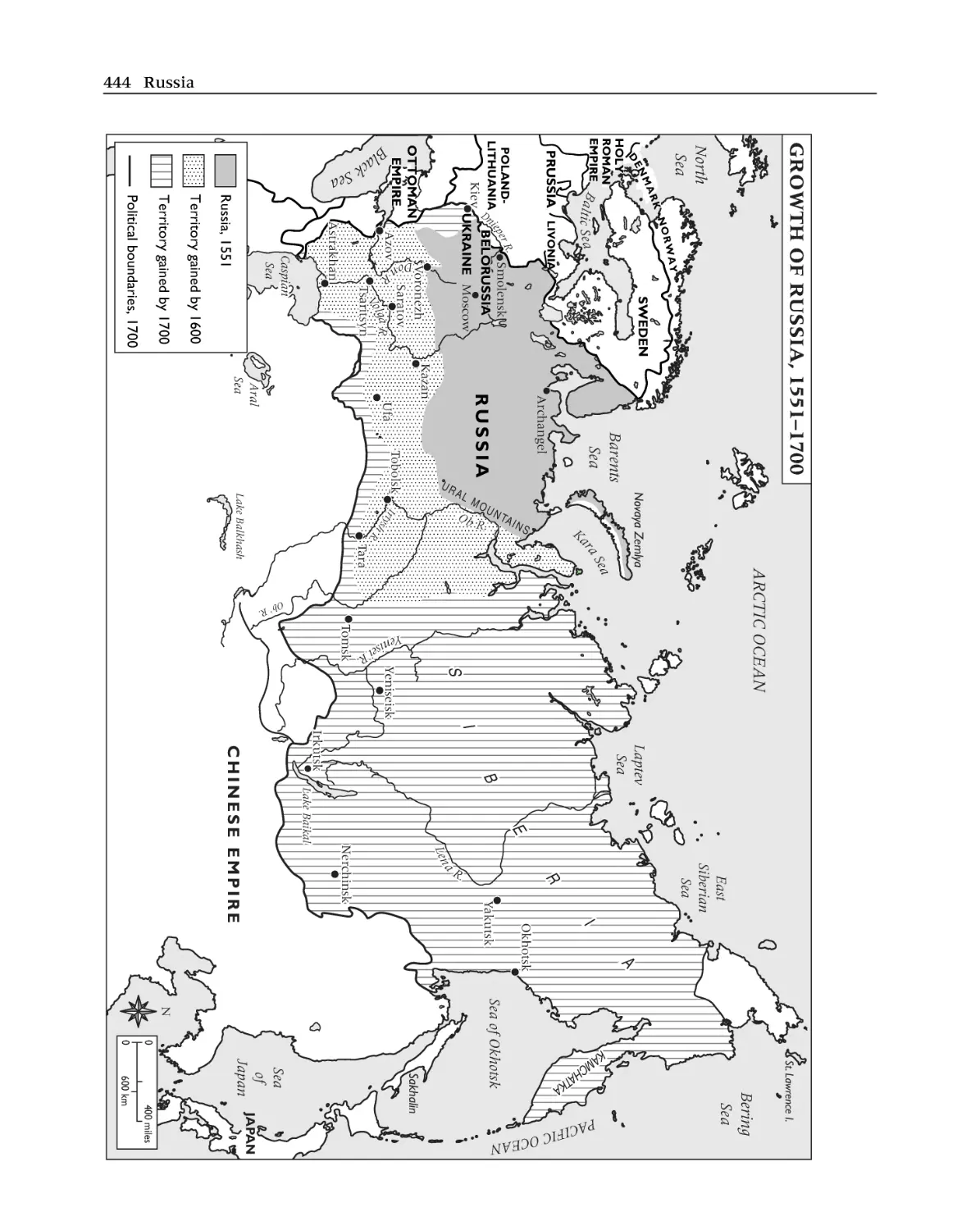
Ivan displayed equally grand ambitions toward the outside world. His attacks
on the khanates opened the way for Russian expansion eastward and southward, and individuals such as the Stroganovs soon pushed forward into Siberia.
On the other hand, Ivan was far less successful in his attempts to expand Muscovite power toward the Baltic, embroiling his country in the long Livonian
War (1558–82).
The reign of Ivan’s oldest surviving son, Feodor (Theodore) (r. 1584–98), gave
Muscovy some much-needed internal peace. Physically weak and extremely

Muscovite Russia 15

Ivan IV the Terrible
(Library of Congress)

limited in intelligence and ability but well meaning and very religious, the new
czar relied entirely on his advisers. Fortunately, these advisers, especially Boris
Godunov, performed their task fairly well. In an important ecclesiastical and
diplomatic victory that raised the prestige of the Russian Orthodox Church, Boris
Godunov got permission from the Byzantine patriarch to elevate the status of
the leader of the Russian Church from metropolitan to patriarch. Boris’s historical legacy would be tainted by his, apparently unfounded, association in the
murder of the nine-year-old prince Dmitrii of Uglich in 1591. Dmitrii, the only
other surviving male heir for Ivan IV, was found with his throat slit, and many
thought Boris Godunov was implicated, perhaps in an attempt to rid himself of
someone who could challenge his power. Some historians have discounted this

16 Russia

theory, arguing that Dmitrii was the son of Ivan the Terrible’s seventh wife at a
time when church law allowed only three wives, and therefore Dmitrii’s claim
to the throne was questionable. A formal commission absolved Boris Godunov
of the crime, but the implication would come back to haunt him and Russia in
the following decade.
Even if Boris did not murder Dmitrii, he made every other effort to take
power. Coming from a Mongol gentry family, which had been converted to
Orthodoxy and Russified, and virtually illiterate, Boris Godunov showed
uncanny intelligence and abilities in palace intrigue, diplomacy, and statecraft.
He capitalized on his proximity to Feodor, who was married to Boris’s sister,
Irina. In the course of several years, Boris defeated his rivals and became the
effective ruler of Muscovy by about 1588. He acquired enormous personal
wealth, an ever-growing official title, the formal right to conduct foreign relations on behalf of Muscovy, and a separate court, imitating that of the czar,
where foreign ambassadors had to pay their respects after going to Feodor.
When Feodor I died in 1598 without an heir, Boris Godunov was ready to
take the throne. His reign (1598–1605), however, was not a smooth transfer of
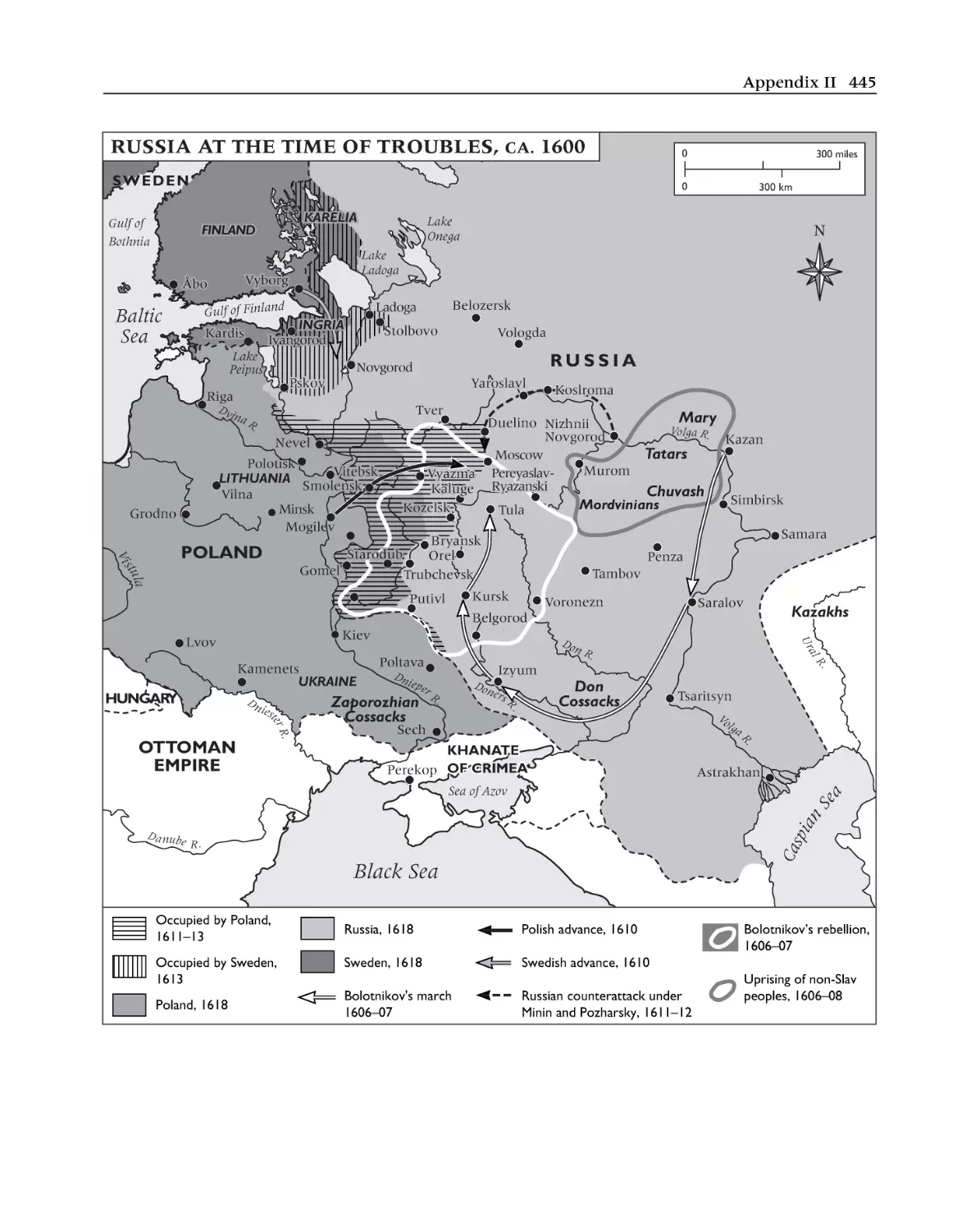
power but the prelude to an extremely complex period of internal instability,
known as the Time of Troubles (Smutnoe vremia), which lasted until 1613. Historians have generally divided the Time of Troubles into three overlapping
phases: dynastic, social, and national. The dynastic phase was defined by internal struggles over the issue of succession to the throne of Muscovy. The social
phase was marked by revolts that resulted from the growing rigidity of the Muscovite state and its attempt to limit the freedom of movement of its peoples, particularly the peasants. The national phase was connected to the rivalries that
had developed in the preceding century between Muscovy and its two western
neighbors, Poland and Sweden, both of whom invaded and controlled Russian
territories during these years.
The crisis of the Time of Troubles ended with the establishment of a new
dynasty—the Romanov—that would rule Russia until 1917. The first three
Romanov czars, Michael, Aleksei, and Feodor III, have generally been portrayed
as relatively weak, certainly when compared to their successor, Peter I. But
recent research suggests that at least Michael and Aleksei actually had some talent for governing and restored a measure of stability to Muscovy after the debacle of the Time of Troubles.
Czar Michael (r. 1613–45) was only 16 when he was crowned. According to
most sources, the zemskii sobor (Assembly of the land) that elected Michael
stayed active in Moscow for about ten years, serving as advisers and supporters.
Michael also appointed his own advisers but especially relied on his father,
Filaret, once he returned from being imprisoned by the Poles. Filaret, who had
been metropolitan, became patriarch of the Orthodox Church. Filaret exercised
a great deal of power, even arranging to receive the title great sovereign (along
with Michael) and setting up his own court. Filaret died in 1633, at almost 80
years old. Michael took over a country devastated by continuous wars, drought,
and famine. During his reign, Muscovy managed to find some kind of peace
with Sweden and Poland (even though Muscovy had to give up some land).

Muscovite Russia 17

Although he tried a number of measures to raise money for the drained treasury, by the time he died at the age of 47, the treasury was fairly empty.
Aleksei (Alexis) I (r. 1645–76) succeeded his father, Michael, at the age of 16.
He was known as the Quietest One (Tishiaishii) by many, including the great
19th-century historian Vasili Kliuchevsky, who called Aleksei “the kindest man,
a glorious Russian soul.” To many, Aleksei was the epitome of Muscovite culture
as well as one of the pioneers of the new Russian interest in the West. The historical image of Aleksei is that of an attractive person, sensitive, considerate of
others, an absolute ruler, but not a despot. Brought up in Muscovite religious
tradition, he continued to be a dedicated, well-informed churchgoer throughout
his life. At the same time he developed an interest in the West and Western culture, especially in European military technologies, but also architecture as well
as the theater (new to Russia).
As a ruler, however, Aleksei is considered to have been somewhat weak,
depending on not always trustworthy relatives. His reign was certainly not a
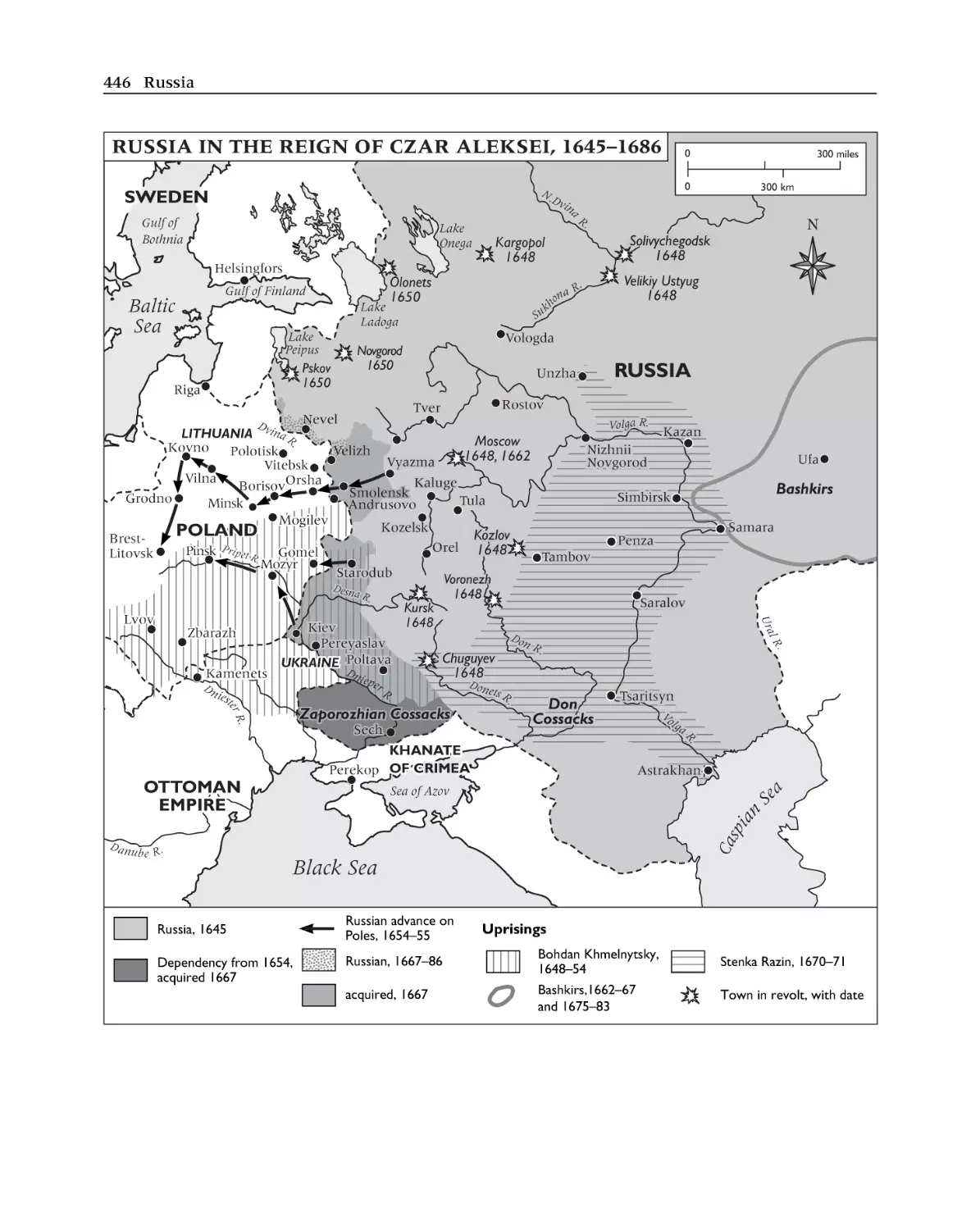
quiet one. In foreign affairs, Russia continued to grow in strength, acquiring
much of Ukraine and successfully defending its acquisition from outside challenges. Contacts with the West became much stronger than before, setting the
stage for the emergence of someone like his son Peter. Domestically, Aleksei’s
reign witnessed periodic peasant rebellions, urban riots, a religious schism, and
the legal definition of the peasantry as serfs.
Aleksei depended heavily on advisers, mostly his own or his wife’s relatives.
His advisers tried to raise money by such means as an increase in the salt tax
and selling tobacco, to which the church objected. And some of Aleksei’s
appointees were corrupt. In May 1648, riots broke out in Moscow, with crowds
insisting that the czar kill some of his worst advisers. His closest relatives managed to escape. Soon riots broke out in other towns, including Novgorod and
Pskov.
Later, in 1656, the government tried to ease fiscal matters by debasing the
current money—adding copper to silver coins. This did not work well then, just
as it did not in other countries at other times. It led to inflation, more financial
troubles, and a copper coin riot in 1662. But the greatest rebellion took place in
1670–71, led by Stenka Razin. Razin was the commander of a band of Cossacks
in the Don region. He had raided Persia and other areas in the south. In the
spring of 1670, he led his army on a more ambitious venture, moving up the
Volga and proclaiming freedom from officials and landlords. Peasants murdered
their landlords and welcomed Razin. The rebel army reached Simbirsk with
about 200,000 troops. But regular Muscovite troops, probably better trained,
won the battle there. Razin escaped, but in 1671 he was taken by cossacks and
given to Muscovite officials for a public execution.
Perhaps one of the factors leading to peasant rebellions was the Law Code of
1649. The new code, or ulozhenie, was supposed to help regulate governmental,
economic, and social affairs, to help prevent another Time of Troubles. The zemskii sobor appointed a commission to read all the old law codes and rewrite them;
the new code was approved in 1649. But the new code also contained the final
statement enserfing the peasantry by stipulating that peasants who had fled the

18 Russia

land had to be returned to their former landlords; that peasants could no longer
leave their lands at all, abolishing the St. George’s Day exception; that all peasants and their children would be considered as serfs; and imposing heavy fines
on those who sheltered runaway peasants. Although there was an important
link between serfs and the land they worked, by the end of the century enough
loopholes had crept into the system that serfs could be bought, sold, and willed
to others—very much as slaves.
Aleksei’s reign also witnessed a schism within the Russian Orthodox Church.
Although there were deep-rooted issues related to the relationship between
church and state, and between the church leadership and the, mostly peasant,
congregation, the immediate cause behind the schism of the 1660s was the set
of reforms introduced by the ambitious Patriarch Nikon. Over the centuries
changes had come into the practice and theology of the Russian Orthodox
Church. Nikon wanted to bring the Russian Orthodox Church in line with earlier Byzantine practices. Thus, his reforms centered around issues such as how
to cross oneself (Nikon wanted to use three fingers as in the Greek Church), the
return to pure Greek texts, and the spelling of the word Jesus. Nikon’s opponents
maintained that since the church possessed revealed truth, such changes
amounted to heresy. Even though Nikon overreached when arguing that the
church leadership should take precedence over secular leadership and was
deposed during the Church Council of 1666–67 and subsequently exiled, the
church adopted his reforms. Those who opposed them broke off into various
sects, most notably the Old Believers and other sectarian groups. One of the Old
Believer leaders was Archpriest Avvakum, who was imprisoned and burned at
the stake in 1682. Prior to his death, Avvakum composed his autobiography, a
moving account of his own faith and one of the early gems of Russian literature.
Both Old Belief and sectarianism were movements with a strong popular base,
and the church lost a lot of popular support and vitality after the schism. Peter
the Great’s reforms of the church leadership, including the abolition of the
Patriarchate, would further weaken the church as an institution.
Aleksei died in 1676, at the age of 47 like his father, and was succeeded by
his son Feodor (r. 1676–82), who was 14 at the time. Although well educated,
Feodor was in poor health, and most of his short reign was characterized by
fighting between relatives of his father’s two wives. One important change,
however, was the final abolition of the system of mestnichestvo (precedence) in
1682, shortly before Feodor’s death. The system had become so cumbersome
with its attempts to keep track of all family records of any kind of service, privileges, and so on, and it did not reflect current conditions—that advancement
relied as much on favoritism and increasingly on talent as on one’s record of
past service. In addition, mestnichestvo made military assignments increasingly
impossible to adjust according to ability. A Muscovite army consisted of five regiments: the big or main regiment, the right arm, the left arm, the forward regiment, and the rear guard. In the honor of command, the main regiment came
first, then the right wing; the advance and rear guards were considered equal;
then the left wing. Mestnichestvo made the calculations of who took command
over which wing very difficult and had little to do with ability, so that a talented

Muscovite Russia 19

man whose family ranked low could not become a commander. Sometimes for
important campaigns, the government would issue a temporary exemption
from mestnichestvo, and sometimes generals would keep high-ranking but unable
commanders back in Moscow “for advice,” but the system was still cumbersome
and unworkable. A similar system existed for the civil service. Most of the family records of service were burned when the system was abolished.
Feodor died childless in 1682, and for about seven years there was constant
infighting about which of Feodor’s half brothers (Peter or Ivan) would take over,
under the direction of Ivan’s full sister Sophia. Peter’s father, Aleksei, had been
married twice, first to Maria Miloslavskaia and then to Natalia Naryshkina. With
Maria he had 13 children, but only two sons, Feodor and Ivan, survived. Peter
was the first son of the second marriage. Feodor took over after Aleksei’s death
in 1676, then died without an heir in 1682. Without an acknowledged heir, it
came to a question of which son would rule, and the families of the two wives
competed for the throne. Peter’s mother’s side gained an early victory, and Peter
was proclaimed czar in April 1682, with his mother as regent.
But a month later, the Miloslavskii family led a rebellion of the streltsy (the
military caste of musketeers) regiments in Moscow. Probably the true leader of
the rebellion was Aleksei’s daughter Sophia, Peter’s half sister. Members of
Peter’s mother’s family were murdered, and Peter witnessed some of the murders. The streltsy requested that Ivan be declared senior czar, with Peter as junior
czar, and then made Sophia regent. The streltsy, influenced by Old Believers,
tried to pressure for more changes, but they were put down.
From 1682 to 1689, Sophia really ruled Muscovy—Ivan was mentally and
physically incapable of ruling, and Peter was kept away from affairs of state.
Sophia relied on Prince Vasili Golitsyn, a strong and relatively enlightened
adviser, who liberalized the penal code and arranged a lasting peace treaty with
Poland. That treaty, however, brought war with the Crimean Tartars, backed by
Turkey. Golitsyn led the army to war against the Tartars but suffered disastrous
defeats.
Sophia wanted to rule by herself in her own right and in 1689 encouraged
the streltsy to try another coup, but they refused. Hearing about this, Peter
escaped from the village of Preobrazhenskoe (near Moscow) to the Holy
Trinity–St. Sergius Monastery. The patriarch, most boyars and the gentry, and
the Western-oriented units of the military (and even some streltsy) rallied
behind Peter. Sophia was left without strong support. She left without a fight
and was sent to a convent; Golitsyn and other prominent boyars and supporters of Sophia were exiled; a few inciters of the streltsy were executed.

I MPERIAL RUSSIA
1689–1917
In August 1689, Peter won acknowledgment as the effective ruler of Russia, but
Ivan retained his position as co-czar. Only 17, Peter left most of the government
in the hands of his mother, Natalia and her associates, who preferred Muscovite
traditions to the Western styles. Natalia had Peter marry a Russian woman who,
she hoped, would lead him away from his fascination with Europe, but her ploy
failed. Natalia died in 1694, and Peter took over the direction of the government at the age of 22. Thus began a reign that, like that of Ivan the Terrible,
would leave a deep imprint on Russian history.
Almost seven feet tall, strong, and restless, Peter wanted to be personally
involved in all kinds of state affairs—diplomacy, administration, justice, commerce, education, and finance. He valued expert advice but wanted to decide
matters for himself. He was a successful military and naval commander, starting his training from the bottom up—serving in the ranks and learning the use
of each weapon before promoting himself. He prided himself on his ability to
make almost anything by hand, from a ship to a pair of shoes. More than any
czar before him, Peter traveled around Russia to learn about his country. He
also frequently visited Moscow’s foreign quarter, established under his father’s
reign, to learn trades and obtain information about a Western European world
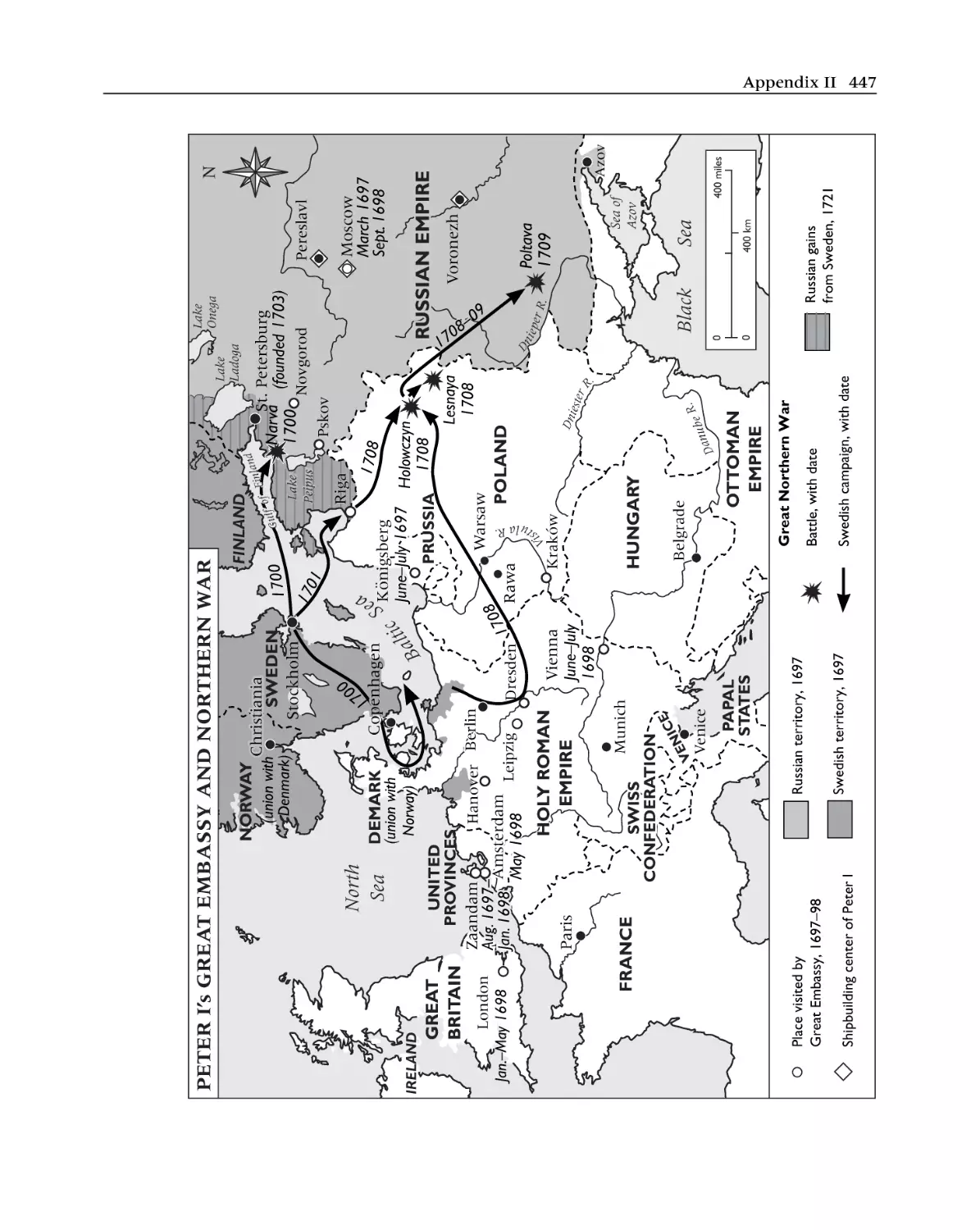
that fascinated him. In 1697–98, true to form, he traveled to Western Europe in
his celebrated Grand Embassy, where he spent time in the Netherlands working, not quite incognito, as the laborer Peter Mikhailovich.
Peter also had a violent temper and a habit of holding drunken parties that
were wild even by the standards of the times. He admired Ivan the Terrible and
was capable of similar cruelty (including a willingness to assist in the death of his
own son), but he never descended to the paranoid depths of the 16th-century
czar. The war games he started as a child in Preobrazhenskoe ended up becoming the first two guard regiments: the Preobrazhensky and the Semenovsky
(another nearby village), which would later provide the backbone in his own
struggle to modernize the Russian army against the power of the streltsy.
As ruler Peter brought rapid and intensive change to Russia. The Great Northern War (1700–1721) with Sweden over supremacy in the eastern Baltic region
dominated most of his reign, and the victorious conclusion of this war marked

21

22 Russia

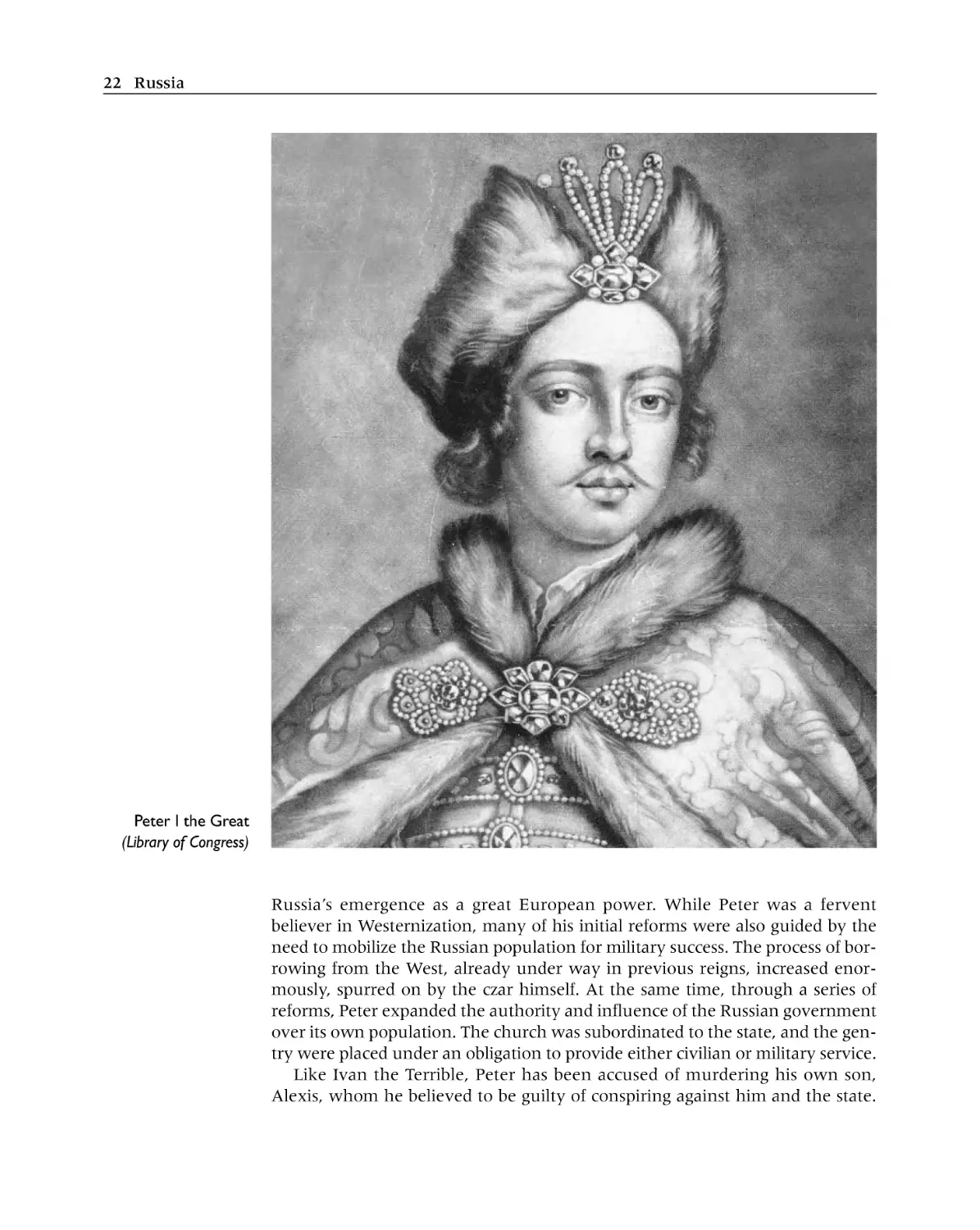
Peter I the Great
(Library of Congress)

Russia’s emergence as a great European power. While Peter was a fervent
believer in Westernization, many of his initial reforms were also guided by the
need to mobilize the Russian population for military success. The process of borrowing from the West, already under way in previous reigns, increased enormously, spurred on by the czar himself. At the same time, through a series of
reforms, Peter expanded the authority and influence of the Russian government
over its own population. The church was subordinated to the state, and the gentry were placed under an obligation to provide either civilian or military service.
Like Ivan the Terrible, Peter has been accused of murdering his own son,
Alexis, whom he believed to be guilty of conspiring against him and the state.

Imperial Russia 23

In assessing Peter’s role in this affair, historians have written about Peter’s personal problems with Alexis, tempered with his belief in the law and the importance of loyalty to the state above all else, without exception. After Alexis’s
death, Peter was without a mature, healthy son to assume the throne. On
February 5, 1722, Peter issued a decree doing away with the traditional order
of succession, but he did not indicate who should take the throne. Legend has
it that as Peter was dying, in January 1725, he took a pen and started to write:
“give all to . . .” but could not finish.
Government officials (mostly the Senate and high-ranking nobles) assembled
to decide the succession, and most, especially the Guards regiments, supported
Catherine, the emperor’s second wife. From this moment, until the overthrow
of Paul I in 1801, the Imperial Guards regiments forced decisions about rulers,
making the Russian 18th century the century of palace revolutions.
Thus, between 1725 and 1762, Russia went through a period of political
instability. Peter had changed the law of succession, allowing the czar to name
his or her own successor. This had the unintended effect of allowing outsiders
to interfere (often violently) to determine who the next czar would be. The
rulers of this period were generally weak. The imperial guards at St. Petersburg
frequently intervened to change rulers, and imperial favorites often dominated
policy. Yet this “instability” at the top should not be allowed to obscure important developments that affected the country at large: Westernization continued
to spread to more people and broader areas of Russian life.
In social terms, the main trend of this period was the process by which the
gentry gradually freed itself from the obligation to do state service. At the same
time, the peasants found themselves under heavier burdens of taxation and
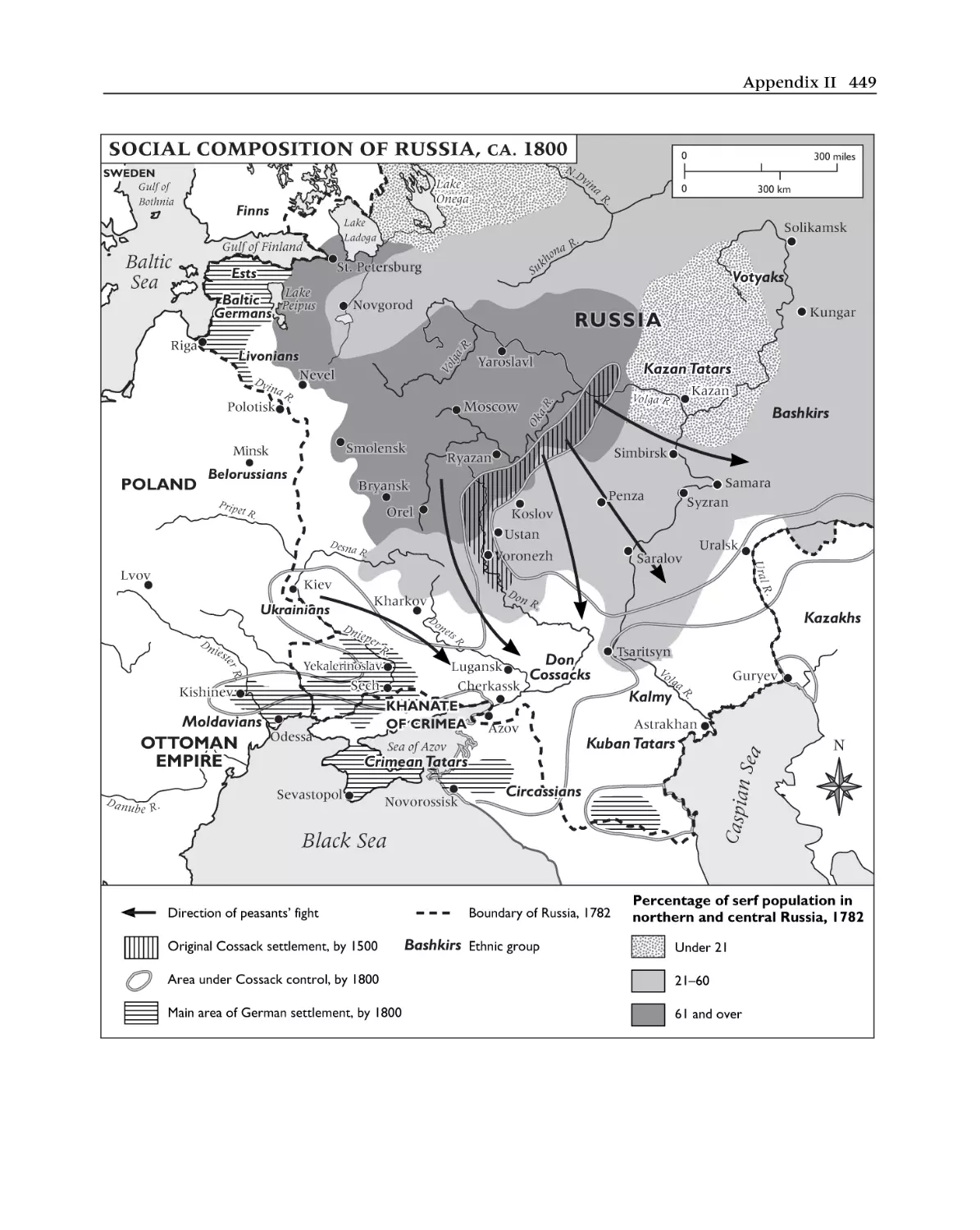
other restrictions. One of Peter’s most crucial legacies was the widening of differences between the peasant villages and the outside world. Differences
between the upper classes and the peasantry were already quite pronounced
before Peter (mostly because of serfdom). Peter increased the differences. The
classes looked different, talked differently, ate different foods, and thought differently. While the peasants remained loyal to traditional dress, customs, and
religious practices, the nobility and government officials were increasingly
exposed to Western-style education, fashions, and secularized culture.
After Peter’s reign, the one justification for the system of serfdom was eliminated. Serfdom was based on the assumption of service state; peasants served
landlords, landlords served the czar, and the czar served God and his people.
Peter had reinforced the idea of service for all. But after his death, his successors revoked the requirements of service for the gentry.
Catherine I, a former Lithuanian peasant girl and the mother of Peter’s illegitimate children, reigned from 1725 to 1727. She left the government in the hands
of her adviser, Aleksandr Menshikov, who was arrogant and corrupt. Menshikov
demoted the Senate to a mere college and created instead the Supreme Privy
Council—a kind of kitchen cabinet of favorites. Catherine died in May 1727,
probably as a result of heavy drinking, which accelerated after Peter’s death.
Supposedly before her death, Catherine had signed a document that left the
crown to her grandson Peter (Alexis’s son), then to his descendants, and then

24 Russia

to Catherine’s two daughters, Anna and her descendants, and then Elizabeth and
her descendants. (Catherine’s signature might have been forged.) Until Peter was
old enough to take over, the Supreme Privy Council would rule for him.
Peter II, grandson of Peter the Great, ruled from 1727 to 1730. He was 11
years old when he took the throne. That fall, he orchestrated the arrest of his
grandmother’s favorite, Menshikov, who had been instrumental in causing his
father Alexis’s death. Peter then moved the court back to Moscow from St.
Petersburg. But Peter also died young, at the age of 14, after an attack of smallpox (supposedly on the day scheduled for his wedding, marrying a daughter of
the Dolgorukys), and the male branch of the Romanov dynasty died out.
Peter was succeeded by Anna, the daughter of Peter’s half brother, Ivan V,
who had spent most of her adult life in the German duchy of Kurland, as wife
to the duke. Her reign has long been presented as a period of cruel, misguided
rule by individual Germans and by a “German party” in Russia. And in truth,
Anna brought with her a band of favorites, whom she placed in positions of
responsibility. She also tended to patronize Germans as well as other foreigners
and distrusted the Russian nobility.
Anna herself had no interest in managing the affairs of the Russian state. So
she relied on a number of favorites to rule. Some were quite capable, such as
Ostermann, who was in charge of foreign affairs, and Andrei Munnich, head of
the army. Others, however, such as her lover Ernst-Johann Biren were incompetent. Biren, also known as Biron, became the most hated figure of the regime
and a symbol of her reign. The term Bironovshchina is applied to this period—
meaning Bironism, a period of police persecution and political terror, which led
to the execution of several thousand people and the exile of some 20,000 to
30,000 to Siberia. Many of the victims were Old Believers rather than political
opponents of Anna or Biron. By the standards of the age the cruelty of Biron
and his associates was not exceptional. Nevertheless, the persecutions of Anna’s
reign compare unfavorably to the more relaxed era of her eventual successor,
Elizabeth.
Anna’s death in 1740 triggered yet another succession crisis, as she had no
children. Anna named her sister’s grandson as her successor, an infant who
would reign as Ivan VI (r. 1740–41). Ivan was an infant, so the key question was,
who would be the power behind the throne. A struggle among Anna’s German
advisers ensued during which Anna’s favorite, Biron, was ousted by Munnich,
who in short order found himself overthrown by Ostermann.
At this point, the Imperial Guards intervened once again. With an assist from
the French ambassador, they ousted the entire German Party and gave power
to Elizabeth (1709–62), second daughter of Peter the Great and his second wife,
Catherine. The unfortunate Ivan VI was confined to the Schlusserberg fortress,
outside St. Petersburg, where he spent his entire life until he was killed in 1764,
during another power struggle soon after Catherine the Great became empress.
Elizabeth has received a better press from historians than Anna. She, too,
allowed power to fall into the hands of imperial favorites, but whereas Anna
had installed a German clique, Elizabeth surrounded herself with Russian officers. Her reign has often been interpreted as a return to Russianness after the

Imperial Russia 25

interval of pro-German rulers. This is not quite accurate since Elizabeth’s successor, her nephew Peter III, could be considered a Prussianophile. On the other
hand, Peter’s wife, the German princess and future Catherine II, embraced Russia and its traditions and did not distinguish herself by pro-German leanings.
Nevertheless, the replacement of Germans by Russians in the imperial circles
under Elizabeth had some connection with the increasing interest of the Russian court in French society and culture. The move toward adopting the mannerisms of French culture among the nobility continued under Catherine, after
the brief reign of Peter III.
Under Elizabeth, favorites continued to rule Russia. This group was slightly
more distinguished in its political legacy than Anna’s circle. The closest figure to
the monarch was Alexis Razumovsky, whom Elizabeth married in a secret and
morganatic wedding. Razumovsky was of simple Cossack origin, from the
Ukraine. Known as a wonderful singer, he was brought to the court to perform.
Elizabeth fell in love with him, and her attachment lasted until her death. However, Razumovsky had a negligible impact on state matters (unlike Biron). A
more influential set of court favorites were the Shuvalovs (Peter and Alexander,
and their cousin Ivan). Ivan left behind an almost unique reputation for integrity
and kindness, for refusing honors and rewards, and for the promotion of cultural enlightenment in Russia. He founded the University of Moscow, Russia’s
first permanent university, in 1755. Peter Shuvalov, on the other hand, intervened in every kind of state business. He was very able but also shamelessly corrupt. He is largely responsible for the disastrous financial policies that
characterized Elizabeth’s reign. This was a time of extravagant expenditures, best
symbolized perhaps by the construction of the Winter Palace in St. Petersburg.
The reign of Peter III was brief and unhappy. Another grandson of Peter the
Great, Peter had been raised in the German duchy of Holstein-Gottorp. He was
first brought up with the view of succeeding to the Swedish throne, since his
father was a son of the sister of King Charles XII of Sweden. But as early as 1742
Elizabeth had designated him as her successor. Although he lived in Russia from
the age of 14, he never adjusted to the country. By all accounts he was extremely
limited mentally, as well as crude and violent in his behavior.
His reign of only a few months was an active one and best known in the long
run for the law that abolished the compulsory state service of the gentry, instituted by Peter the Great. That law of 1762 was the final stage of a process that
began with Peter’s reforms. Under Peter’s policy, the gentry in its entirety was
affected and there was no limit to how long they should serve. In 1736, this service was limited to 25 years (the nobility had asked for 20). Moreover, one son
in each noble family could be exempted from service to manage the family
estates. Following the publication of this law and for the next few decades,
many members of the gentry left state service to return to their landholdings.
Not surprisingly, many nobles found a way to have their 25-year period of service counted from the time they were eight or 10 years old. Finally, in 1762,
compulsory service was abolished. From now on members of the gentry no
longer had to serve the state. They could even serve foreign governments, if
they so desired.

26 Russia

The law of 1762 has received much attention from historians. To many older
historians, such as the nineteenth-century historian Vasili Kliuchevsky, the law
undermined the idea of service as the basic structure of Russian society as it had
developed in the past centuries. If the serfs served the landlords to enable the
landlords to serve the state, then the abolition of gentry service should have
been followed by the abolition of serfdom. Yet, it would be another 99 years,
before this happened. Other historians have emphasized a different interpretation, arguing that the law of 1762 had positive results, it allowed the gaining of
independence from the state by at least one class of Russian society. This was
Russia’s first crucial step on the road to liberalism. Moreover, they argue that
the freedom of the nobility contributed to the growth of a rich gentry culture
and, beyond that, to the emergence of the Russian intelligentsia.
The peasants of course saw things differently. While the status of the gentry
had been improving in the decades after Peter the Great, their own status deteriorated rapidly. On the other hand, the state granted all sorts of privileges to the
gentry (not compelled to serve, a special gentry bank with low-interest loans,
admission to cadet school and arise through the ranks without serving as soldiers, nearly complete financial and legal control over serfs). On the other hand,
it increasingly limited the peasant’s few remaining freedoms (they could not
sign legal or financial documents, could be sold or sent to Siberia at will, could
not volunteer for the military, with the administration of virtually all justice in
the hands of an often corrupt provincial bureaucracy or their landlord). The
demand for freedom of the peasants to follow the freedom of the gentry was
voiced frequently in the peasant uprisings that soon followed, most notably the
great Pugachev Rebellion of 1773–74.
Despite the benefits that the law of 1762 brought to the nobility in general,
Peter III had made too many enemies in his brief reign. One was his wife, the
future Catherine II, whom he mistreated and neglected in favor of other
women. Another group of enemies came from the Imperial Guard, whom Peter
III had threatened to disband. Catherine, who arrived in Russia in 1745, proved
to be a far more savvy politician than her husband. In the midsummer of 1762,
she seized upon the growing dissatisfaction with Peter and led the palace guards
in yet another revolution. Peter was easily deposed and shortly thereafter killed,
perhaps as a result of an argument with one of the leaders of the insurrection,
Grigorii Orlov.
Catherine’s coup also affected her son, Paul (born 1754). Rather than making Paul the successor and ruling in his name, she became empress. At the time,
the coup of 1762 seemed like just one more of the many palace revolutions that
had marked the 18th century. It was not clear how long a foreign empress
would manage to hold on to the throne. As it turned out, this was just the
beginning of a long and celebrated reign.
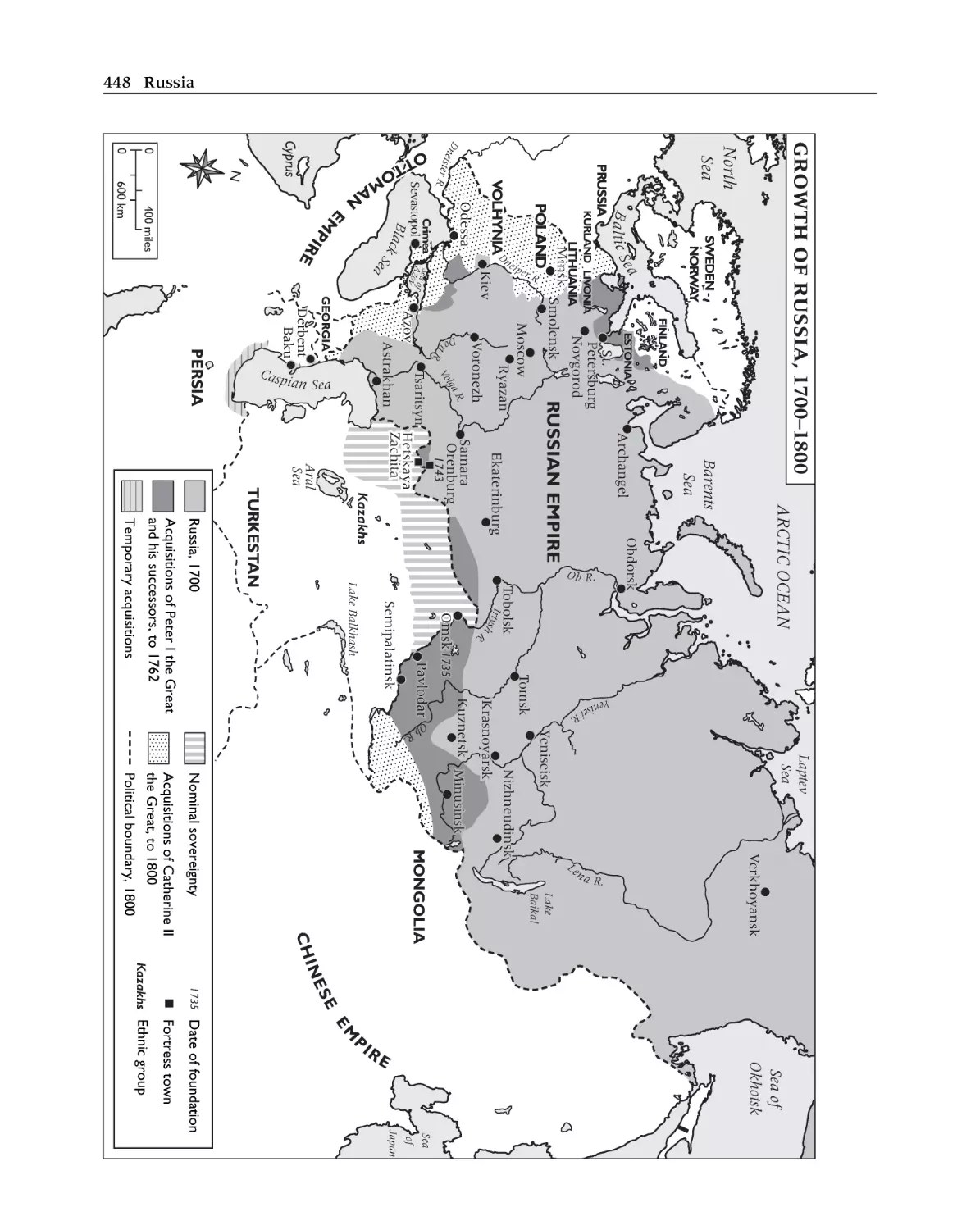
Catherine II brought Russia a period of stability in the monarchy, spectacular success in foreign policy, and continuing Westernization. Reigning for over
30 years, Catherine ended the era of palace revolts and court favorites that had
prevailed since 1725. She directed policy herself and attained remarkable
results, notably in expanding Russian territory. Poland was thrice partitioned,

Imperial Russia 27

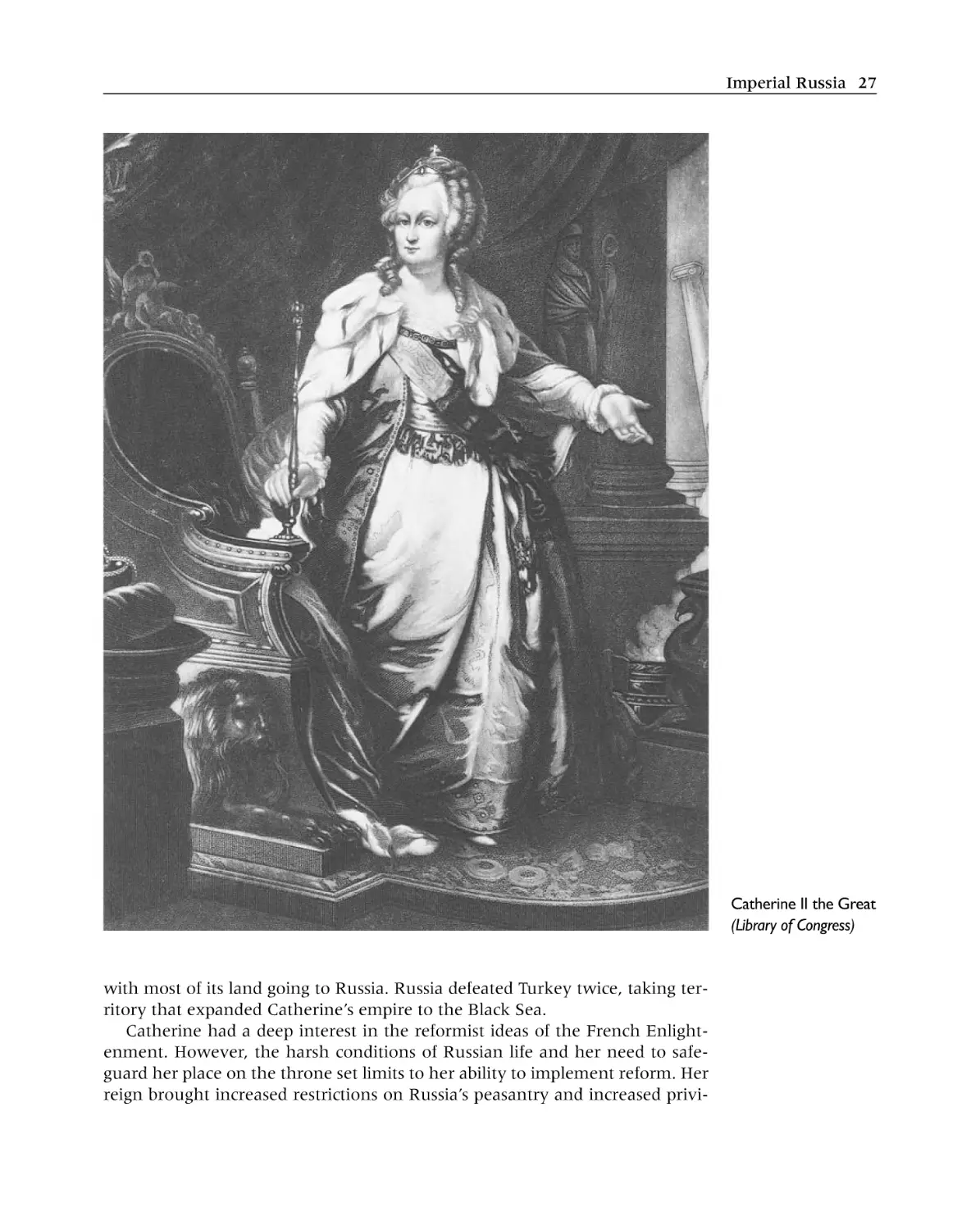
Catherine II the Great
(Library of Congress)

with most of its land going to Russia. Russia defeated Turkey twice, taking territory that expanded Catherine’s empire to the Black Sea.
Catherine had a deep interest in the reformist ideas of the French Enlightenment. However, the harsh conditions of Russian life and her need to safeguard her place on the throne set limits to her ability to implement reform. Her
reign brought increased restrictions on Russia’s peasantry and increased privi-

28 Russia

leges for the nobility. Western ideas continued to enter Russia. With the outbreak of the French Revolution in 1789, however, Catherine felt it necessary to
prevent new trends in Europe from affecting Russian life.
Catherine was succeeded by her son, Paul. The most important political developments at the close of the century took place in foreign policy. The most important political developments at the close of the century took place in the area of
relations with Revolutionary France, where Napoleon Bonaparte had embarked
on a process of territorial expansion. Under the direction of Paul, Russia followed
an inconsistent course of action concerning France. Russia took the lead in forming a European alliance against France, then deserted its allies and went over to
the French side. At home Paul’s policies seemed just as erratic, and his attacks on
the nobility created powerful enemies and led to his overthrow and murder in
1801 in a palace revolution led by Counts Nikita Panin and Peter Pahlen.
Paul was succeeded by his son Alexander, whom Catherine had groomed as
her possible successor, educating him in the ideals of the French Enlightenment
that she held so dear. Two developments made Alexander I’s reign a crucial one
in Russian history. First, success in defeating Napoleon in 1812 and leading the
westward advance against France made Russia the most powerful and respected
country on the continent. Only a century after Peter the Great had led Russia
into the European diplomatic community, Alexander brought Russia to its peak
of prestige and influence.
The other development saw Alexander as the first czar to address seriously
the twin problems of serfdom and autocracy. In the end, however, Alexander
made only minor changes in the system of serfdom. He feared noble opposition
and the social disruption that sweeping change would bring. Similarly, he stopped
short of political reforms that would infringe on his rights of autocrat. Yet the
issue of reform would not disappear, as attested by the Decembrist conspiracy
of 1825. Its participants are considered the first in a line of revolutionists who
drew their inspiration from the political systems of Western Europe.
Between 1825 and 1855 Russia was ruled by a committed conservative.
Nicholas I sought to preserve the existing order at home and in the rest of
Europe. Serfdom and autocracy remained untouched. Russia’s political and military influence played a vital role limiting the effect of the 1848 revolutions in
central Europe. Only with the calamity of the Crimean War did Russia’s international prestige fall sharply. Within Russia, however, lively debates broke out
in the 1840s. Slavophiles and Westernizers sparred over the nature of Russia’s
past and the proper course for its future.
Nicholas died in the midst of the Crimean War, and it was up to his son
Alexander II to extricate Russia from the war and address the problems that the
war had brought to the surface. The reign of Alexander II brought rapid and
intensive change to Russian life. Events moved in marked contrast to the immobility during the era of Nicholas I. The czar himself took the lead in one sweeping reform: the emancipation of the serfs in 1861. Meanwhile, disappointment
over the limits of change led to the development of a widespread radical movement calling for change from below. Populism, with its call for peasant revolution, became a permanent part of Russian political life.

Imperial Russia 29

In international affairs, Russia found its role sharply diminished. The rise of
a powerful Germany was one sign of Russia’s declining role in Europe. So too
was the way in which Britain and Austria blocked Russian expansion in the
Balkans. Meanwhile in Central Asia and the Far East, Russian territory and Russian influence expanded notably.
Alexander III (r. 1881–94) came to power following the assassination of his
father at the hands of the revolutionary terrorists of the People’s Will. He made
his primary goals the repression of revolutionary groups and the preservation
of order. The dominant force of his reign was political and social reaction. He
tried to stabilize the countryside by returning power to the gentry and curbing
the rights of the zemstvo, rural institutions of self-government, established by the
Great Reforms of his father. Most other reforms of the 1860s were also curtailed. A policy of Russification of non-Russian groups also aimed at maintaining a stable, conservative order.
And yet, Alexander III was also concerned with promoting industrial growth
to maintain Russia’s status as a great power. Paradoxically, this industrial growth
promoted social and political change of the kind that so worried the czar and his
government. In foreign affairs, the key event was the end of Russia’s alliance
with Germany, followed by a new link to France, surprising many observers who
could not picture reactionary Russia allied to republican France.
Buffeted by government repression and increasingly convinced that terrorism was an ideological dead end, some revolutionaries turned to Marxist ideals
to question the foundations of Russian society and provide a revolutionary
alternative to the agrarian socialist vision that had long dominated debate in
radical circles.
At the turn of the 20th century, the new czar, Nicholas II (r. 1894–1917) and
his government struggled against growing problems at home and abroad.
Nicholas tried to maintain the existing political and social order but faced
increasing opposition. Like those of his father’s government, the policies of
Nicholas II produced deep changes that eventually contributed to the destabilization of the imperial order. Under the guidance of Minister of Finance Sergei
Witte, Russia followed a policy of rapid industrialization that was certain to
shake the whole system.
A nationwide revolution exploded as a result of the military disasters and
strains on the home front of the Russo-Japanese War of 1904–5. The revolution
reached its peak in the final months of 1905. Faced with a threat to the monarchy itself, Nicholas reluctantly issued the October Manifesto, which seemed to
pledge a constitution and a representative body, or Duma. Between 1906 and
1914, Russians economic development continued and the country moved haltingly toward a constitutional monarchy. One of Nicholas II’s few able ministers,
Peter Stolypin, showed that imaginative land reforms could be instituted in the
countryside.
Nonetheless, Russia’s future remained uncertain. The monarchy resisted
political change, while radicals were committed to the overthrow of the existing system. In international affairs, Russia was increasingly involved in a dangerous rivalry with Austria in the Balkans that, in conjunction with a system of

30 Russia

rival European alliances, led to the outbreak of a continent-wide war in August
1914, later known as World War I.
The war brought irreversible change to Russia. The most significant development was the unmanageable strain that the conflict put on the political,
social, and economic system. On the battlefield, Russia suffered an early and
catastrophic defeat at the hands of the Germans at Tannenberg. This set a pattern for consistent Russian defeats in encounters with German forces. In the
political sphere, the war was marked by the failure of the monarchy and its
ministers to direct the military effort adequately. Meanwhile the major institution to gain prestige during the war was the Duma.
By the close of 1916, the country was in a severe crisis. For the average Russian, especially in the cities, every day brought shortages of food and fuel. For
soldiers near or at the front, the war seemed a futile effort directed by inept military and political leaders. The monarchy in particular found itself discredited by
the war. Nicholas II, never a popular monarch and who in 1915 moved to the
front to be in personal command of his troops, was increasingly seen as weak,
incompetent, and under the influence of his domineering wife and the monk
Grigorii Rasputin. In December 1916, a group of noblemen, including a cousin
of the czar, took matters into their own hands and assassinated Rasputin, the
symbol to many Russians of the monarchy’s corruption and decay. But the
assassination failed to stem the disintegration of authority that had set in during the war. A harsh winter, ongoing military setbacks, and mounting food
shortages by the first months of 1917 produced a social upheaval of unprecedented consequences.

T HE S OVIET U NION
1917–1991
Russia experienced two revolutions in 1917, a relatively spontaneous one in
February (March by the Western calendar) that resulted in the abdication of
Czar Nicholas II and an organized seizure of power in October (November by
the Western calendar) that brought the small Bolshevik Party to power, inaugurating the Soviet era that lasted until 1991.
In February, the accumulated tensions of the Great War and the widespread
perception of the government’s incompetence and corruption led to a popular
uprising that overthrew the monarchy. A Provisional Government drawn from
members of the Fourth Duma attempted to rule Russia until a popularly elected
Constituent Assembly could convene to decide on more permanent political
arrangements. From the start the authority of the Provisional Government was
tempered by the power of the Petrograd Soviet of Workers’ and Soldiers’
Deputies, which drew its inspiration from the short-lived soviets of the 1905
Revolution and which claimed to speak for the downtrodden masses of the Russian Empire. In an arrangement later known as “dual power,” the Soviet agreed
not to challenge the Provisional Government’s claim to power without actually
supporting it.
During the following months the country’s problems only increased as the
Provisional Government failed to establish its authority. Alexander Kerensky, a
lawyer of moderate socialist sympathies, emerged as the main figure in the government, but his own deep commitment to Russia’s continued participation in
the war further undermined the popularity of the Provisional Government and
opened the way to a more radical alternative, and a second revolution.
The revolutionary process found a much more decisive leader in Vladimir
Lenin, the leader of the Bolshevik faction of the Russian Social Democratic
Labor Party. As in 1905, the 1917 February Revolution took Lenin by surprise,
but this time he was prepared to seize this historical opportunity. While the Petrograd Soviet and members of his own Bolshevik Party were initially willing to
cooperate with the Provisional Government, Lenin argued for an immediate
revolution that would transfer power to the soviets, as representative institutions of Russia’s working masses. Eager to create mischief for Russia, the German government provided the famous “sealed train” that transported Lenin

31

32 Russia

and his retinue to Finland, from where he reached Petrograd (as St. Petersburg
had been renamed during the war) in April 1917. His “April Theses,” calling for
the overthrow of the Provisional Government and transferring full power to the
Petrograd Soviet, revealed his strategy for the coming months. Also benefiting
from Lenin’s consistent condemnation of the war, to which the Provisional
Government still remained committed, the Bolsheviks gained popularity among
workers and soldiers. His calls for revolution resulted in the “July Days,” a premature attempt to overthrow the Provisional Government, which Lenin felt
compelled to support despite misgivings about its timing. In the ensuing antiBolshevik backlash, Lenin fled to Finland. After the instrumental role played by
workers in defeating the Kornilov mutiny in late August, Lenin renewed his
calls for an uprising, returning secretly to Petrograd in mid-October. Despite significant internal opposition, he convinced his party to support an immediate

Bolsheviks on the
street during the
Russian Revolution,
1918 (Library
of Congress)

The Soviet Union 33

insurrection to coincide with the forthcoming Second Congress of Soviets.
Lenin’s analysis proved correct, as the Provisional Government fell without
much resistance.
The October Revolution that followed turned out to be a turning point in the
modern history of Russia. The Bolsheviks claiming to represent the workers, soldiers, and peasants, overthrew the Provisional Government, set out to transform
Russia, and promoted revolution throughout the industrialized world. In the first
months following the October Revolution, Lenin and the Bolsheviks strengthened their hold on power and removed Russia from the war. The radicalism of the
new regime became obvious as it shut down the elected Constituent Assembly on
its first day of meetings, attacked the church, and established a secret police.
The formation of an anti-Bolshevik Volunteer (White) Army in southern Russia in December 1917 signaled the beginning of a bloody civil war that lasted for
the next three years. At its weakest moment, the borders of Bolshevik-controlled
Russia coincided roughly with those of 15th-century Muscovy, before it began its
territorial expansion. Surrounded by White forces and their foreign allies, isolated
from other socialists who felt the revolution was premature, and mired in a deep
economic crisis of industrial production and severe food shortages the Bolsheviks
revealed dictatorial underpinnings of their plans for the country: internal opposition within the party was restricted, other socialists like the Mensheviks and
Socialist Revolutionaries (SRs) were persecuted, and a new ruthless secret
police—the Cheka—was established to root out enemies of the revolution. On
August 30, 1918, an SR terrorist, Fanny Kaplan, wounded Lenin in an assassination attempt. In response, the Cheka unleashed its Red Terror, which was met
by an equally fierce terror campaign by anti-Bolshevik forces in the countryside.
In 1919, the Bolshevik Party was renamed the Communist Party of the Soviet
Union, and the Third International was established to coordinate and guide the
efforts of other loyal communist parties. Anti-Bolshevik peasant rebellions, riots,
strikes, and demonstrations were common during the civil war, culminating in
the March 1921 rebellion at the Kronstadt naval base, an erstwhile hotbed of proBolshevik radicalism. Under great pressure from Lenin, that same month the
Communist Party approved a degree of free trade and small manufacturing while
retaining control of the “commanding heights” of the economy, a less radical program known as the New Economic Policy, which remained in place until the late
1920s.
The New Economic Policy signaled a relaxation of the wartime dictatorship,
but a controversy that would last through most of the decade raged within the
Communist Party over whether it should be continued or replaced by a government-directed program of rapid growth that would be truer to Communist ideals. Another bitterly contested issue concerned whether to attempt to spread the
revolution to other countries or to concentrate on the construction of a new
socialist order in Russia. With Lenin alive these issues did not always come to the
surface, but his illness triggered a brutal struggle inside the party. In January
1922, his health declining, Lenin retired to the town of Gorki, not far from
Moscow. In May 1922 he suffered the first of three strokes, the second in December 1922, which partially paralyzed him, and the third in March 1923, which

34 Russia

took away the power of speech. The writings of his last years reflect his growing
disillusionment with the bureaucratization of the party (Better Fewer, but Better)
and the shortcomings of its main leaders (“Last Testament”), and most notably
the rude personal style of Stalin, the general secretary of the party. Lenin died on
January 21, 1924. In a bizarre final twist for a confirmed atheist, his remains
were embalmed and placed on Red Square in a specially designed mausoleum,
which became a place of state-sponsored pilgrimage during the remainder of the
Soviet period and still stands after the dissolution of the Soviet Union.
Following Lenin’s death in 1924, Joseph Stalin consolidated his power
within the party bureaucracy, outmaneuvering his more intellectually nimble
but less politically astute colleagues by making full use of his considerable
administrative and political skills and patronage opportunities. He countered
Leon Trotsky’s internationalist preferences with the slogan “socialism in one
country,” which appealed to the party’s more nationalist rank and file. But he
also borrowed from Trotsky’s program of rapid industrialization and abandoned
the more moderate program of the New Economic Policy advocated by the
Party’s other leading theoretician, Nikolai Bukharin. In rapid succession Stalin
and his allies removed his main rivals—Trotsky, Grigorii Zinoviev, Lev
Kamenev, and Bukharin—from their respective power bases. Stalin emerged as
the leader of a devoted and ambitious group of younger Bolsheviks that included
Sergei Kirov, Grigorii Ordzhonikidze, Viacheslav Molotov, Lazar Kaganovich, and
Kliment Voroshilov. Together they helped Stalin ram through a program of rapid
industrialization and enforced collectivization of peasant villages—a Second Revolution—that was arguably far more extensive in its impact than the original
October Revolution. Peasant resistance to what amounted to a “second enserfment” was fierce and the government’s enforcement of the policy brutal, leading
to the deaths of at least 10 million and the deportation of millions more.
In the late 1920s the Soviet Union underwent three sweeping changes that
together combined to form a “second” revolution, of perhaps greater long-term
impact than the ones in 1917. In industry, the government instituted a system
of five-year plans aimed at turning the Soviet Union into an advanced industrial
country in the shortest possible time. Agriculture was collectivized in a brutal
manner that ended a short period of peasant landownership. The Communist
Party spread its control into the lives of most citizens, a process that also saw the
steady growth of the country’s internal security apparatus, the dimensions of
which would soon become apparent during the campaign of mass state terror
of the 1930s, an even more turbulent decade than the preceding one. Known
as the Great Purge, the campaign was first directed against the party and state
bureaucracy. The show trials of 1936–38 of prominent old Bolsheviks, which
drew international attention, were accompanied by an even more devastating
terror conducted across the various localities of the Soviet Union. A secret purge
of the army led to the execution of about half the officer corps. Although exact
numbers are difficult to obtain, one estimate holds that the Soviet Union suffered about 29 million “excess deaths” from terror and famine in the 1930s.
In foreign policy, Soviet diplomacy became increasingly preoccupied with the
threat of German aggression after Hitler came to power in 1933. In 1934 the

The Soviet Union 35

Soviet Union joined the League of Nations and pursued unsuccessfully a policy
of collective security against Germany for the next five years. Frustrated by the
failure of negotiations with Great Britain and France, Stalin directed his diplomats to negotiate a nonaggression pact with Nazi Germany, which became a
reality in August 1939, to the surprise of the world and many Communist faithful. The Soviet Union gained territories in eastern Poland and annexed the
Baltic republics, while it supplied Germany with raw materials, mostly oil, for
the next two years until Hitler ordered the invasion of the USSR in June 1941.
Stalin’s performance as a World War II leader has been the subject of extensive debate. He has been faulted for ignoring various signals that Hitler was

Joseph Stalin (right)
with Viacheslav
Molotov (Library
of Congress)

36 Russia

going to break the nonaggression pact and attack the Soviet Union and hence
for the disastrous casualties and territorial losses the Soviets suffered during the
first weeks of World War II. After a puzzling weeklong absence, Stalin reappeared and throughout the next four years rallied the country to victory. He
relaxed the tenor of Soviet domestic politics somewhat, especially in the area of
religion, allowing greater freedom to the Orthodox Church and identifying the
Soviet struggle with age-old Russian nationalist themes. In foreign policy, he
forged an alliance with the United States and Great Britain that survived until
victory was achieved, and he held his own in negotiations with Allied leaders
Franklin D. Roosevelt of the United States and British Prime Minister Winston
Churchill. Through clever diplomacy and the sheer might of the Soviet war
machine, Stalin created a bloc of satellite nations of Eastern Europe that survived until 1989.
By 1945, Stalin found himself at the peak of his power, the undisputed ruler
of a country that had borne extremely heavy losses and emerged from the war
devastated but an undisputed superpower. The opening to the West and the liberalization that some had expected quickly gave way to a cold war, exacerbated
by the development of atomic weapons, which the Soviet Union first produced
in 1949. The years between 1945 and 1953 remain among the least studied of
Stalin’s rule. His increasing paranoia and secretiveness shaped the behavior of
his associates, who feared a return to the purges of the 1930s. The alleged conspiracy uncovered in January 1953, known as the Doctors’ Plot, foreshadowed
to many the beginning of a mass purge, particularly targeting Soviet Jews.
Soviet relations with the outside world were also affected by the acquisition
of a bloc of satellites in Eastern Europe and by the successful Communist revolution in China of 1949. Friction with the United States arose over the future of
Eastern Europe and Germany. The more restrictive regime at home became evident with a crackdown on the intellectual community and the establishment of
a new five-year plan.
Stalin’s death from a cerebral hemorrhage on March 5, 1953, was met with
relief and joy in some quarters and with tears in others from those who had
come to believe the mythology of the “Little Father.” His body was placed next to
Lenin’s in the Red Square mausoleum, in keeping with the personality cult he
had crafted. Stalin’s death was followed by a power struggle among the Soviet
political elite, of which the Ukrainian party leader Nikita Khrushchev was now
a prominent member. By December 1953, Lavrenty Beria, Stalin’s feared police
chief, had been quietly executed six months after his dramatic arrest at a Kremlin meeting. Georgii Malenkov, initially considered the most likely successor to
Stalin, remained prime minister but had relinquished the more influential post
of first secretary of the Communist party, the position given to Khrushchev in
September 1953. The two coexisted uneasily until February 1955, when Malenkov was forced to resign, although he stayed on as a member of the Presidium,
as the Politburo was known from 1946 to 1964.
By 1956, Khrushchev had emerged as the unchallenged leader of the Soviet
Union. With his ally, Nikolai Bulganin, as prime minister, Khrushchev became
the long-term successor to Stalin, although he had one more challenge to sur-

The Soviet Union 37

vive. In June 1957, Malenkov, Molotov, Kaganovich, and other old-guard Stalinists, including Bulganin, later dubbed the “anti-Party group,” engineered a
vote in the Presidium to dismiss Khrushchev. With the help of war hero Marshal Georgii Zhukov, Khrushchev responded by calling an emergency meeting
of the Central Committee that overturned the Presidium’s decision. Malenkov,
Molotov and Kaganovich were banished to minor positions in such outlying
regions as Kazakhstan, Mongolia, and the Urals. Many consider the fact that
they were not executed for their defeat as one of the most significant of
Khrushchev’s departures from the Stalinist practices of the previous decades.
More difficult for the Soviet leadership and the Soviet people to address was
the nature of Stalin’s legacy in a polity he had mostly created. The next decade
witnessed Khrushchev’s de-Stalinization campaigns begun by the Secret Speech
of 1956 that denounced the most extreme excesses of Stalin’s rule, but not its
foundations, the removal of Stalin’s body from the Lenin mausoleum in 1961 to
be interred along with other Soviet heroes in the Kremlin wall, followed by the
partial re-Stalinization of the Brezhnev years (1964–1982). Only three decades
later in the late 1980s, under then-Secretary General Mikhail Gorbachev’s glasnost (openness) campaign, did a free and candid discussion of all aspects of
Stalin’s rule become possible. Even then, many older Soviets remained uncomfortable in discussing Stalin’s era, while a die-hard minority longed for his “firm
hand” as the antidote to the troubles Russia faced in the 1990s.
Aside from his dramatic denunciation of the Stalin personality cult, as leader
Krushchev became known for erratic policies and impetuous bureaucratic reorganizations. In domestic politics he allowed a limited degree of latitude to Soviet
writers and artists (which his successors were later to try to rescind), while trying to shift the balance of Soviet industrial policy a little away from its relentless concentration on heavy industry in favor of consumer goods production. In
international politics he sought to divide and delude the Western bloc by alternate bouts of peaceful coexistence and violent threats including “ultimatums”
over Berlin, unrestrained testing of nuclear weapons, encouragement of wars of
“national liberation,” and stationing medium-range missiles on Cuba to threaten
the United States, on the one hand, and the acceptance of the partial test-ban
treaty with the United States in 1963, on the other. The penalty for these swings
of policy was the alienation of the doctrinally rigid in the Communist bloc, especially the Chinese, led by Mao Zedong, the successive acceptance of Polish
national communism under Władysław Gomułka and armed suppression of revolution in Hungary in 1956, loss of control over the Communist parties of Western Europe in the name of polycentrism, and, finally, his overthrow in 1964 by
the other members of the CPSU leadership. The failure of his grandiose attempts
to solve chronic Soviet food shortages by wholesale ploughing up of the “Virgin
Lands” of Soviet Asia eased their task in overthrowing him. In October 1964,
while resting in the Crimea, Khrushchev was removed from office by his Politburo colleagues and replaced as party secretary by Leonid Brezhnev.
The party officials who deposed Khrushchev deliberately set out to govern
the Soviet Union in a collective fashion. Even though a single figure, Leonid
Brezhnev, eventually dominated the system, the era from 1964 to his death in

38 Russia

November 1982 was marked by caution and stability. In domestic policy, the
Brezhnev years were guided by the policy of “stability of cadres.” The unpredictable bureaucratic maneuvers of the Khrushchev years gave way to a stable
conservative party that successfully resisted threats to its control as with the
derailment of the 1965 “Kosygin reform,” which would have injected some measure of market mechanism into the Soviet command economy, Stalin’s arbitrary
terror, which had affected party and nonparty members alike, gave way to a more
selective persecution of the small group of political and religious dissidents
through job harassment and the disturbing use of “psychoprisons,” condemned
by the international community. The period of postwar growth gradually ended,
as the economy stalled and corruption spread through the system.
In foreign policy, Brezhnev is generally associated with two major developments: the articulation and implementation of the Brezhnev Doctrine with
regard to the Soviet satellites and the policy of détente with the West. The Brezhnev Doctrine, used to justify the invasion of Czechoslovakia in August 1968,
gave the Soviet Union and its allies the right to intervene in Soviet socialist states
if they judged socialism was under threat. Brezhnev was more personally associated with the relaxation of relations with the West, beginning with the normalization of relations with West Germany in 1970, through summit meetings
in Moscow and Vladivostok with U.S. President Richard Nixon, and culminating
with the Helsinki Agreement of 1975, generally seen as favorable to Soviet interests. Détente in Europe, however, did not mean an end to the cold war, as the
two superpowers jockeyed for influence in the Third World. During these years
the Soviet Union extended its influences to places like Angola, Ethiopia, and
North Vietnam, in addition to providing crucial subsidies to the Castro regime in
Cuba. After 1976, as U.S. Presidents Jimmy Carter and Ronald Reagan pursued
less conciliatory policies, U.S.-Soviet relations rapidly deteriorated over issues of
human rights, the Soviet invasion of Afghanistan in 1979, the rise of the Solidarity trade union in Poland in 1980–81, and the Reagan administration’s desire
to place missiles in Western Europe.
Brezhnev’s final five years in office were marked by ill health and his inability to perform basic duties of leadership, punctuated by numerous Kremlin-level
intrigues over the impending succession. Brezhnev died from a heart attack on
November 10, 1982, three days after standing for long hours on Red Square
watching the traditional parade celebrating the anniversary of the October Revolution. The most significant development of this period was the nation’s deepening economic crisis. Evident in both agriculture and industry, Soviet
economic problems made the country increasingly dependent on Western
countries like the United States for technology and even for food. Paradoxically,
the Brezhnev years produced a massive expansion of Soviet military strength,
including a large, modern navy. During this period, Soviet diplomatic contacts
and influence likewise grew, notably in Africa and the Middle East. A significant
development within the Soviet Union was the emergence of a dissident community that included world-famous writers and scientists. Thus, criticism of the
Soviet system became louder and more widely heard than at any time since the
1920s.

The Soviet Union 39

The decade following the death of Brezhnev can be divided into three
remarkably different periods. Between 1982 and 1985, the Soviet Union
remained under ineffective leaders incapable of pursuing a policy of change even
as the nation’s problems worsened. Economic decline and continuing tension
with the United States were the two most obvious difficulties. Beginning in
1985, the Soviet Union acquired a new kind of leader who brought extraordinary change. Mikhail Gorbachev overturned what had seemed permanent features in the Soviet system in both domestic and foreign affairs. Finally, from 1989
to 1991, the changes that Gorbachev had encouraged among the Soviet citizenry

Nikita Khrushchev
(right) and Leonid
Brezhnev attending
a session of the
Supreme Soviet,
Moscow, 1961
(Library of Congress)

40 Russia

gathered greater speed, quickly leaving the government in a defensive position,
as the Soviet Union threatened to unravel. At the same time, dramatic changes
developed from below. As Gorbachev loosened political controls, vast numbers
of Soviet citizens took on active and unprecedented political roles. The growth
of non-Communist and nationalist political parties was one sign of this political
awakening, as was the emergence of mass public demonstrations and, in the
extreme case, armed ethnic rebellions.
Gorbachev began his term by placing reformist allies, such as Alexander
Yakovlev, Eduard Shevardnadze, and Nikolai Ryzhkov, in key positions, by signaling his commitment to a more open political culture by recalling the dissident
physicist Andrei Sakharov from internal exile, and in more traditional Soviet
fashion, by seeking to improve labor discipline through a widely unpopular campaign to reduce alcohol consumption. The more ambitious agenda of perestroika
(restructuring) and glasnost (openness), for which he is widely known, met with
mixed and unexpected results. Economic reforms consisting of moderate
attempts to move toward a limited market economy met with resistance in the
Communist Party and government bureaucracy, leading to inflation, shortages,
and declining production by 1990. Political change, on the other hand, quickly
surpassed what Gorbachev had originally envisioned. In rapid succession, an
astonished Soviet public saw the Communist Party lose its leading role in the
economy, a deep reevaluation of hitherto taboo topics in Soviet history such as
the dark aspects of Stalin’s rule, relatively open elections for a new Congress of
People’s Deputies, the reemergence of a thriving, creative artistic and intellectual climate, and democratic elections in the 15 Soviet constituent republics that
brought democratic and nationalist movements into positions of power.
In Western eyes, Gorbachev was the most successful in foreign policy, where
he overcame the initial suspicions of U.S. leaders to become a full partner in dismantling key components of the cold war apparatus. He reversed the disastrous
occupation of Afghanistan, withdrawing all Soviet forces by early 1989. After
spurring Eastern European Communist governments to reform themselves, he
refrained from interfering in the remarkable revolutionary events of 1989, best
symbolized by the dismantling of the Berlin Wall, thus ensuring a mostly peaceful transition away from communism in the region. The following year Soviet
forces withdrew from Eastern Europe and the Soviet Union agreed to the once
unthinkable reunification of Germany. Finally, in July 1991 the two superpowers signed the START I treaty, which sharply reduced their nuclear arsenals. For
his pivotal role in the peaceful transformation of Eastern Europe and the SovietAmerican relationship, Gorbachev received the 1990 Nobel Peace Prize.
Ultimately, the goal to reform the Soviet Union was doomed by the growth
of nationalism in most of its 15 constituent republics. Beginning with the
Nagorno-Karabakh crisis between Armenia and Azerbaijan in 1988, a full range
of nationalist issues from autonomy to full independence surfaced in the nonRussian borderlands. When a crackdown came in Georgia and Lithuania in the
spring of 1991, it was too late to stop the nationalist tide. With the democratic
election of Boris Yeltsin, his former ally turned nemesis, as president of the Russian Republic, Gorbachev’s power as leader of the Soviet Union rapidly dimin-

The Soviet Union 41

This cartoon shows Soviet leader Mikhail S. Gorbachev looking in dismay at a massive stone hammer and sickle,
now shattered into many parts. Gorbachev found himself faced with reforming the remnants of the former Soviet
power. (Library of Congress)

ished. By 1991, with the economy in shambles and a vibrant democratic political culture taking shape, the preservation of the union was at the top of his
agenda. His proposed treaty for a new Union of Sovereign States would have significantly altered the nature of the Soviet Union, making it a more truly federal
and voluntary union, but it was never signed because other, more pressing
events intervened.
On August 19, 1991, a conservative Communist backlash took place in
Moscow while Gorbachev was on vacation in Crimea. Headed by men whom
Gorbachev had placed in power over the previous year, the attempted coup
was poorly planned and executed. Within days, street protests, army defections, and Yeltsin’s heroic leadership combined to defeat the “August putsch,”
as it became known. Freed from house arrest, Gorbachev returned to Moscow
to a changed country and promptly resigned as general secretary of the Communist Party. He continued to seek a new federal union, but the Soviet Union
was rapidly losing its member republics with all but Russia and Kazakhstan
declaring independence by October 1991. His power rapidly declining, Gorbachev was unable to stop the leaders from the Russian Federation, Ukraine,

42 Russia

and Belarus from formally dissolving the Soviet Union in December 1991. He
resigned as Soviet president on December 25 and retired to private life.
The 1990s brought the unexpected dissolution of the Soviet Union into its 15
constituent republics. Russia reconstituted itself as the Russian Federation, a
democratic parliamentary republic under the leadership of a popularly elected
president, Boris Yeltsin. The Communist Party was temporarily routed, although
by 1993 it had become an important force in parliament, obstructing Yeltsin’s
attempts to dismantle the old state-dominated economy. For average citizens,
the 1990s were a traumatic decade, as the safety network of pensions, health
care, and other social benefits from the Soviet system was dismantled, leaving
them vulnerable to the vagaries of a new economy. This was not the capitalist
market economy that Western advisers had optimistically assumed would take
root in Russia, but rather a “wild capitalism” dominated by a few oligarchs who
were able to take advantage of the opportunities offered in the transition
between one system to another. Yeltsin was reelected president in 1996, but his
increasing poor health quickly led to speculation about his successor. In the following years he played an astute game of politics, shuffling his cabinet, frequently changing prime ministers, until finally settling on Vladimir Putin, a
relatively unknown young bureaucrat with a background in the internal security apparatus (KGB). Putin easily won election in 2000 and began the difficult
task of continuing the transition of Russia away from decades of communism.
With Putin as president, the wild ride of the 1990s seemed to be over, and
Russians prepared for a relatively more stable period. Many of the features that
had emerged after the fall of the Soviet Union were still in place. Business
tycoons, or oligarchs as they were known in Russian, continued to control
important segments of the Russian economy, and even though they attempted
to exert political influence as in the Yeltsin years, the Putin government followed
a more selective policy toward them, favoring some while harassing or persecuting others. The Chechen problem continued to fester, draining the nation’s
resources and political capital in a bloody war with no apparent immediate solution. On several occasions Chechens brought the war into Russia through spectacular terrorist acts such as the seizure of a Moscow theater in the fall of 2003.
On the other hand, the Russian economy seemed to find a more firm footing after the debacle of 1998 and was aided by growing oil revenues. Signs of
greater prosperity were still visible mostly in cities such as Moscow and St.
Petersburg, but the bulk of the country had still not emerged from the spectacular decline that had accompanied the dissolution of the Soviet Union. In international affairs, Russia continued to chart its own course, no longer the
superpower it had been during the cold war but still a great power claiming
strategic interests beyond its borders. In the summer of 2003, the city of St.
Petersburg, hometown of President Putin and long neglected during Soviet
times, celebrated its 300th anniversary in a grand fashion. As Putin’s term came
to an end and the nation prepared for presidential elections in 2004, Russia continued to move away from the legacy of communism, even if the direction or
final destination of this transition remained unclear.

HISTORICAL DICTIONARY
A–Z

A
Abkhazia
An autonomous republic within the Republic of
Georgia whose 1994 declaration of independence
has not been recognized by neighboring countries, Abkhazia is a region of about 3,300 square
miles situated between the main Caucasian range
and the Black Sea, with a subtropical climate
along its coastline. A principality ruled by Ottoman Turkey since 1578, Abkhazia fell under Russian rule in 1810. After the abolition of the
principality in 1864 and uprisings against Russian
rule, the large majority of ethnic Abkhazians
emigrated to Turkey. Another wave of Abkhazian
migrants followed, after the conclusion of the
RUSSO-TURKISH WAR OF 1877–78. Under Soviet
rule, an Abkhazian Soviet Socialist Republic was
established in 1921, but then was made part of
the Georgian Soviet Socialist Republic in December 1921. In December 1922, both Abkhazia and
Georgia were made part of the Transcaucasian
Soviet Federated Socialist Republic, which existed
until 1936. With the dissolution of the Transcaucasian SFSR, Abkhazia was again placed under
Georgian jurisdiction. During Joseph STALIN’s
rule, Soviet authorities in Georgia followed a policy of enforced cultural assimilation and suppression of Abkhazian culture that was significantly
relaxed after 1953. In 1978, the Abkhazians petitioned to secede from the Georgian SSR and join
the Russian Soviet Federated Socialist Republic,
but their request was not approved. With the
unraveling and dissolution of the Soviet Union in
the early 1990s, the tensions between Abkhazians and Georgians came to the surface. A
declaration of independence from Georgia by the
Abkhazian legislature in 1990 was reversed by
ethnic Georgian deputies, and this eventually led

to the outbreak of armed conflict in 1992. By
1993 Abkhazian forces had managed to capture
the regional capital of Sukhumi, on the Black Sea,
and drive out Georgian troops. Russia arranged
for a cease-fire in 1994 through the establishment of a peacekeeping force sponsored by the
Commonwealth of Independent States (CIS),
composed of most of the former Soviet republics.
The 1994 Abkhazian declaration of independence was followed in 1996 by CIS economic
sanctions.

Abramov, Feodor Aleksandrovich
(1920–1983)
writer
A writer known for his advocacy of peasants and
rural themes, Abramov was in the forefront of the
“VILLAGE PROSE” movement that played an important role in Soviet literature from the 1950s to the
1970s. Abramov was born in the town of Verkhola
in Archangel Province to a peasant family. He
enrolled in the philology faculty of Leningrad
State University, but his studies were interrupted
by military service during World War II. He graduated in 1951 and taught at his alma mater until
1960, serving as chairman of the department of
Soviet literature. Abramov’s concern for peasants
and his critiques of the government’s representation of village life led to reprimands from the
Union of Soviet Writers and his expulsion from
the staff of the literary journal Neva. In 1958
Abramov published his first novel, Brothers and Sisters, set in a northern Russian village during World
War II. This novel proved to be the first of a fournovel saga about the travails of Russian peasants
in the period after the war, collectively published
45

46 Abramtsevo

as The Pryaslins. The other novels in the tetralogy
are Two Winters and Three Summers (1968), Paths
and Crossroads (1973), which was awarded the
1975 USSR literature prize, and The House (1978).

Abramtsevo
Located about two hours from MOSCOW, Abramtsevo is a village and estate that was the spiritual
home of the Arts and Crafts movement that flourished in late 19th-century Russia under the name
Style Moderne. Originally built in 1771, the main
house was home to the Slavophile philosopher
Sergei AKSAKOV, between the 1840s and 1860s,
during which time the main outlines of the Slavophile movement to which he belonged took
shape. Nikolai GOGOL worked here shortly before
his death on the ill-fated second volume to his
masterpiece Dead Souls, before he burned the
manuscript. Ivan TURGENEV was also a frequent
visitor. In 1870, Savva Mamontov, a railway magnate and patron of the arts, purchased the estate.
For the next two decades, under his family’s
patronage, Abramtsevo became a living workshop of Russian culture, favoring the rediscovery
of native Russian traditions of art. Abramtsevo
became a kind of artists’ retreat where painters,
potters, singers, and theater directors commented
on one another’s work. Workshop products like
furniture and ceramics were sold at the Abramtsevo shop in Moscow, established in 1880. Late19th-century artists such as Ilia REPIN, Mikhail
VRUBEL, and Valentin Serov left their mark on the
estate. Repin’s family portraits hang in the main
house, while Vrubel’s ceramic-tiled fireplace was
made in the ceramic studio next door. The
remarkable Abramtsevo Church on the estate
grounds was built to recall the glories of medieval
Russian architecture, and inside features icons by
Repin, Vasnetsov, and Polenov. Abramtsevo now
belongs to the ACADEMY OF SCIENCES and has been
turned into a museum.

Academy of Sciences
The leading institution for scientific and scholarly
research in Russia, the Academy of Sciences was

founded on the basis of a decree of Peter the
Great of January 1724. It opened its doors the
following year in St. Petersburg. Construction for
more permanent headquarters began in 1738
under the direction of the renowned architect
Giacomo Quarenghi. For most of the 18th century the academy was staffed by foreign scholars,
mostly Germans, invited by the government.
One notable exception was the renowned Russian scientist Mikhail LOMONOSOV, who was
elected to the academy in 1745. During the 19th
century, the academy was gradually “Russified,”
although it continued to attract and invite scholars from abroad. The status and composition of
the academy did not change much in the first
decade after the 1917 Revolutions. In 1927,
however, as part of a larger cultural offensive, it
was renamed the USSR Academy of Sciences and
brought in line with the demands of the COMMUNIST PARTY and the Soviet state. In 1934, the academy was relocated from Leningrad (formerly St.
Petersburg) to MOSCOW. By 1987, toward the end
of the Soviet period, the academy contained 250
research institutes and over 60,000 full-time
researchers, concentrated mostly in the natural
sciences. Over 300 scholars had the privileged
status of “academician,” while about twice as
many were “corresponding members” of the
academy. In addition, all the union republics
except the RSFSR had their own mini-academies
of science. About 90 percent of research was carried on outside the academy system. Most of this
was of an applied character and much of it was
related to weapons systems and done in secret
facilities in the defense-production ministries.
With the dissolution of the Soviet Union, the
academy was renamed the Russian Academy of
Sciences.

Adashev, Aleksei Feodorovich
(unknown–1561)
government official
An influential government adviser in the early
decades of the reign of IVAN IV (the Terrible),
Adashev became one of the first casualties of the
setbacks in the LIVONIAN WAR (1558–83), which

Afanasiev, Alexandr Nikolaevich 47

drained valuable resources during the remainder
of Ivan’s rule. Adashev came from a noble family from Kostroma, which was linked to prominent Moscow boyars. He entered government
service in the 1540s and became one of the leading advocates of policies that reformed the central government, strengthening it with regards to
the boyar aristocracy. Adashev was involved in
the preparation of the 1550 Law Code (Sudebnik), military and financial reforms, and the abolition of the system of kormlenie (feeding) that
farmed tax collection to local administrators.
Supporter of an active foreign policy in relation
to the Tatar khanates, Adashev directed diplomatic preparation of the annexation of KAZAN
and ASTRAKHAN khanates, and directed the engineering work during the siege of Kazan in 1552.
He was one of the officials who laid the diplomatic groundwork for the Livonian War, which
would occupy most of Ivan’s reign and deplete
much of Muscovy’s reserves. In 1559, he negotiated a truce with Livonia, albeit on unfavorable
terms for Russia. Adashev’s opposition to the
continuation of the Livonian War and to the
growing influence of the Zakharin clan, relatives
of the czar’s wife, were the main reasons behind
his downfall. In late 1560, he was arrested and
jailed in Iurev (Tartu), where he died the following year. His brother, Daniil Feodorovich, was
also an influential commander who participated
in the capture of Kazan and, in 1553–54, helped
suppress an insurrection in the Volga region.
After a successful campaign against the Turks
along the Black Sea, he was appointed artillery
commander during the Livonian War. He was
imprisoned with his brother and died in either
1562 or 1563.

Adrianople, Treaty of (1829)
Signed on September 14, 1829, the Treaty of
Adrianople, also known as the Treaty of Edirne,
marked the end of the RUSSO-TURKISH WAR of
1828–1829. Signed by Aleksei Orlov and Feodor
Pahlen on the Russian side, the treaty gave Russia control of the Danube estuary and opened the
Dardanelles to all commercial vessels. In the Cau-

casus, the Treaty of Adrianople confirmed Russian wartime conquests along the eastern coast of
the Black Sea and placed the region of Guria
under direct Russian rule. The Treaty of Adrianople also marked the beginning of the loosening of the Ottoman Empire’s control over the
Balkan Peninsula in southeastern Europe. Turkey
was to demilitarize the right bank of the Danube
River and withdraw its troops from the principalities of Moldavia and Wallachia. Moldavia, Wallachia, and Serbia were granted special status
within the Ottoman Empire, while Greece was
granted full independence. By the terms of the
treaty, Russia was to occupy the principalities of
Moldavia and Wallachia until Turkey paid its war
indemnities to Russia and to Russian citizens
who had suffered losses during the war.

Afanasiev, Alexandr Nikolaevich
(1826–1871)
ethnographer and folklorist
Afanasiev was born into the large family of an
attorney in Voronezh province, central Russia.
After completing his secondary education studies in 1844, he passed the difficult entrance
examinations to Moscow University and enrolled
in the law faculty. Upon graduation he secured a
position in the archival department of the Ministry of Foreign Affairs in Moscow. His real interests lay not in jurisprudence but in folklore and
in collecting. It is said that he collected one of the
finest private libraries of its day in MOSCOW. In
1860 he journeyed to the West, visiting Germany, Italy, France, Switzerland, and England.
Back in Russia, he was arrested in 1862 and
expelled from his job two years later for his
alleged contacts with an associate of the revolutionary activist and London exile, Aleksandr
HERZEN. He found new employment with the
Moscow Municipal Court but died of consumption seven years later, an early end to a remarkably productive life.
Afanasiev’s legacy, like that of the Brothers
Grimm in Germany, is as a compiler of a vast
amount of Russian folktales. He compiled and
classified more than 1,000 tales recorded by

48 Afghanistan

Vladimir DAL earlier in the century and supplemented them with tales from popular chapbooks
and from the collection of the Russian Geographical Society. His reputation rests on two
highly acclaimed works. Russian Folk Tales was a
monumental and comprehensive collection of
diverse material ranging from animal tales to
longer tales of fantastic heroes, which he worked
on for 15 years. The second, Russian Folk Legends,
was banned by the censor on the insistence of
the clergy. Initially published in London in 1860,
it came out in Russia only in 1914. A third work,
Frivolous Tales, a bibliographical rarity including
tales that satirized priests and nobles, was also
banned and published in Russian only in Geneva.
Afanasiev was active in other fields, writing for
progressive journals, publishing a multivolume
work on Slavic views of nature, as well as other
works on Russian satirical periodicals, folklore,
and literature.

Afghanistan
Russia’s initial involvement in Afghanistan in the
19th century was colored by the larger rivalry
with Great Britain known as “The Great Game.”
While seeking to counter growing Russian influence in the region and increase their own, the
British fought three mostly unsuccessful wars
with the Afghan rulers (1839–42, 1878–80,
1921). On the other hand, Russia first established
a fixed boundary between Afghanistan and its
newly conquered territories around BUKHARA,
Tashkent, and SAMARKAND, and promised to
respect Afghanistan’s territorial integrity in 1873.
In 1885, however, Russian forces seized the Panjdeh Oasis, a piece of Afghan territory north of
the Oxus River. After some fighting the Russians
retained Pandjeh and promised once again to
respect Afghanistan’s territorial integrity. Ten
years later, the northern border between Afghanistan and Russia was fixed through diplomatic
negotiations. In 1907, as relations between Great
Britain and Russia improved, both sides signed
the Convention of St. Petersburg declaring
Afghanistan outside Russia’s sphere of influence.

After World War I, the Russian Revolution temporarily dampened Russia’s interest in the region,
while in 1921 Afghanistan regained control of its
foreign affairs as a result of the Third Afghan War.
In the 1950s the Soviet Union again began to
display interest in Afghanistan, in the context of
the cold war and as part of its broader involvement in the Third World. In 1955, Prince
Mohammad Daoud, prime minister of Afghanistan, turned to the Soviet Union for military aid,
after his request to buy military equipment was
turned down by the United States. A period of
close relations between Afghanistan and the
Soviet Union began in 1956. In 1965, the Afghan
Communist Party was secretly formed, later gaining representation in the national parliament
during the first nationwide elections held in
Afghanistan. In 1973, Daoud, who had been
removed as prime minister in 1964, overthrew
King Zahir Shah in a military coup with the support of the Afghan Communist Party. He abolished the monarchy and declared himself
president of the new Republic of Afghanistan.
Five years later in 1978 the Afghan Communist
Party, led by Nur Mohammed Taraki, seized
power in a bloody coup in which Daoud was
killed, and which was followed by a campaign of
mass arrests. A guerrilla resistance movement,
known as the Mujahideen, quickly took shape in
the countryside. Later that year Afghanistan
signed a treaty of friendship with the Soviet
Union.
On December 24, 1979, with growing resistance to the Afghan Communists and with the
Communists themselves in a virtual civil war,
the Soviet Union took the fateful decision of
intervening directly in Afghan politics by invading the country. The Soviet invasion of Afghanistan marked a crucial turning point in the
diplomatic history of the cold war as well as in
Soviet domestic politics. In foreign policy it triggered a new round of tensions with the West,
after the détente of the 1970s, leading directly to
a U.S.-led grain embargo of the Soviet Union
and a boycott of the 1980 Olympics held in
MOSCOW. The Soviet Union’s inability to defeat

Aitmatov, Chingiz Torekulovich 49

the guerrilla resistance exposed its weaknesses as
a superpower and contributed to the growing
disenchantment with the government in the
final decade of Soviet power. Close to 50,000
Soviet soldiers were killed in the war that lasted
a decade, until the Soviet Union fully withdrew
its troops in February 1989. The Soviets continued to support the Communist government led
by Najibullah, but it was a losing battle. In 1992,
the Mujahideen entered the capital city, Kabul,
and established an Islamic state. Four years later,
as the victorious guerrilla coalition fragmented, a
more radical Islamic group known as the Taliban
seized power in Kabul, which it held until 2001.
Throughout the 1990s Russia continued to support regional chiefs or warlords in the northern
parts of Afghanistan in opposition to Islamic
governments.

sack) traveled through the Don and Kuban
regions from April to July 1920. Several agitsteamers operated during these years, the most
notable being the Krasnaia Zvezda (Red Star),
which sailed with Lenin’s wife, Nadezhda KRUPSKAYA, on board along the VOLGA and Kama
Rivers from July 1919 to the fall of 1921. Of all
the activities the agit-trains performed, the showing of agitation films (agitki) to a largely illiterate
population probably had the most impact. Over 2
million people attended the cinema screenings
shown on board. At a time of weak links between
the center and provinces, these trains and steamers proved immensely valuable in bringing news
of Soviet power to the countryside, strengthening local party organs, and mobilizing people and
material aid for the fronts.

“agit-trains”

Aitmatov, Chingiz Torekulovich
(1928– )

Common name (Russian, agitpoezd) for the agitation trains—there were also agitation steamers—
widely used by the BOLSHEVIKS for organizational
and propaganda work during the Russian civil
war. In czarist times trains with religious information were dispatched to the countryside, but it
was the Bolsheviks who developed their propaganda and creative potential to a far greater
degree. Most trains and steamers were equipped
with a bookshop, printing press, meeting room,
and film projector. They also had a radio transmitter-receiver to receive the latest information
from MOSCOW. The first agit-train, named after V.
I. LENIN, left Moscow toward KAZAN in August
1918, and later traveled to Ukraine, Belorussia,
and Lithuania. Other trains with prominent
Soviet officials on board followed. The October
Revolution, with the future Soviet president
Mikhail Kalinin on board, made over 12 trips to
central Russia, Ukraine, the northern Caucasus,
and Siberia in 1919–20. The Krasnyi Vostok (Red
East) operated in Turkestan in March 1920, the
Sovetskii Kavkaz (Soviet Caucasus) worked in the
northern Caucasus and Azerbaijan from July to
October 1920, and the Krasnyi Kazak (Red Cos-

writer
A bilingual writer, writing in his native Kirgiz
(Kyrgyz) and Russian, Aitmatov first established
his reputation in the BREZHNEV era and played an
important liberalizing role in the literary politics
of the GORBACHEV years. Born in the mountain
village of Sheker in Kirgizia, Aitmatov completed only six years of school before becoming
secretary of his village’s soviet and a tax collector
at the age of 14. He graduated in 1953 from veterinary school and worked on an experimental
farm, but literature was already pulling him in
another direction. He first published in 1952,
became first secretary of the Union of Kyrgyz
writers in 1964, and was elected to the Kyrgyz
Academy of Sciences in 1974. He achieved
Soviet and international prominence through
his story Dzamilia in 1958, which chronicles the
struggle of a Kyrgyz woman to choose her husband herself rather than follow tradition and
have him presented to her. His collection of
short stories, Tales of the Mountains and Steppes
(1962), introduced local myths and values. He
was elected deputy to the USSR Supreme Soviet
in 1966. The following year he was elected to

50 Akademgorodok

the executive board of the USSR Union of Writers and was awarded the Soviet state prize for literature (1968). The relationship of modernity to
tradition remained a central theme of his work,
but in later works, such as The Day Lasts More
than a Hundred Years (1980), he linked them to
broader themes like space travel, science fiction,
and a more direct treatment of his characters’
Stalinist past. In the late 1980s as a member of
the editorial board of Novyi Mir (New World) and
editor in chief of Inostrannaya literatura (Foreign
Literature) he played an important role in bringing previously suppressed Soviet and foreign literature to Soviet readers at a crucial juncture in
the development of Mikhail Gorbachev’s glasnost (openness) campaign. He was elected to the
landmark Congress of People’s Deputies (1989),
as well as to its Supreme Soviet. Gorbachev
made him a member of his Presidential Council
in March 1990 and appointed him ambassador
to Luxembourg in 1990–91.

Akademgorodok
The third-largest research and educational center in contemporary Russia, Akademgorodok is
a town of close to 100,000 inhabitants, located
in the vicinity of the city of Novosibirsk in southcentral Siberia. The town, a planned community,
derives its name from the Russian term for “academic town” and was established in a scenic
location on the northeast edge of the Novosibirsk Reservoir formed from the damming of the
OB River. Founded in 1958, Akademgorodok
has since been the seat of the Siberian branch of
the Russian (USSR) ACADEMY OF SCIENCES, and
numerous research organizations and institutions. In 1959, Novosibirsk State University was
established within the city limits. Established on
the initiative of the COMMUNIST PARTY and the
USSR Academy of Sciences with the goal of
decentralizing scientific research while contributing to the overall development of Siberia,
Akademgorodok quickly staked out an important place in Soviet intellectual life. The town’s
distance from the more closely regulated world

of Moscow, 1,800 miles away to the west,
allowed its scholars greater latitude in pursuing
alternative research paths. The relatively open
political and scholarly environment of Akademgorodok was sharply curtailed after 1968, as part
of the overall conservative backlash that followed the WARSAW PACT invasion of Czechoslovakia. Nevertheless, Akademgorodok continued
to contribute to Soviet intellectual and scientific
life in the 1970s and 1980s. Two influential
advisers to Mikhail GORBACHEV in the late Soviet
period, the sociologist Tatiana Zaslavskaya and
the economist Abel Aganbegyan, came from the
Akademgorodok scholarly environment.

Akhmadulina, Bella Akhatovna
(1937– )
poet
A member of the group of young poets that
included Yevgenii YEVTUSHENKO and Andrei Voznesensky, who formed part of a short-lived literary renaissance in the early 1960s, Akhmadulina
became, like them, a leading literary celebrity in
the GORBACHEV era. Born in Moscow of ItalianTatar background, Akhmadulina graduated from
the Gorky Institute of Literature. Her poems,
lyrical and personal, drew from the Acmeist tradition begun by Anna AKHMATOVA, Osip MANDELSTAM, and Nikolai GUMILEV. Although a volume
of her poetry, Struna, appeared in 1962, she was
published sporadically in the intervening years,
especially after the conservative reaction that set
in during the BREZHNEV era. At one time married
to Yevtushenko, she was awarded the state prize
for poetry in 1989. She traveled widely but,
although respected as an important Russian poet,
never achieved the same public impact as her
early colleagues.

Akhmatova, Anna Andreevna
(1889–1966)
poet
Born Anna Gorenko near ODESSA of Ukrainian
parentage, Akhmatova survived personal tribula-

Aksakov family 51

tions and political persecution in the Stalin years
to become one of the great 20th-century Russian
poets. Educated in Tsarskoe Selo (Pushkin), near
St. Petersburg, and Kiev, she married the poet
Nikolai GUMILEV in 1910 (they divorced in 1918).
With Gumilev and Osip MANDELSTAM, she started
the Acmeist movement, advocating clarity and
concreteness as a response to the diffuseness and
mysticism of the reigning Symbolist poets. First
published in 1912, over the next decade she
established her reputation among the intelligentsia with a lyrical poetry of spiritual undertones that was intimate, yet detached. The first
four decades of Soviet power brought Akhmatova personal suffering (Gumilev was executed
in 1921 and her son, Lev Gumilev, spent 14 years
in labor camps) and ostracism by Soviet cultural
authorities. She earned a living from translations,
all the while writing masterful poems such as
Rekviem (Requiem, 1935–40) that would not be
published in Russia until after her death. A brief
respite from official censure in 1940 saw the publication of 20 new poems, “Selections from Six
Books.” She experienced the siege of LENINGRAD before being evacuated to Tashkent,
where she wrote her most avant-garde poem:
“The Way of All Earth.” After the war, she and
Mikhail ZOSHCHENKO became the main targets of
Andrei ZHDANOV’s vicious xenophobic cultural
campaign, and in 1946 she was expelled from the
Writers’ Union. Akhmatova entered a final
period of great creativity and international recognition after 1956 with her son’s return from the
camps and the temporary relaxation of cultural
norms after Stalin’s death in 1953. During this
last decade she published translations of Yiddish
poems by Jewish poets shot in the anti-Semitic
campaigns of 1952, as well as two of her own collections, Poems and Poems, 1909–60. In 1962, she
finally completed her masterpiece, Poema bez
geroya (Poem without a Hero), begun in 1940. International recognition in the form of an honorary
doctorate from Oxford University, the Italian Literary Prize, and translations of her work came in
the 1960s and 1970s. At the time of her death in
Domodedovo, near Moscow, Akhmatova had

succeeded in her goal to give witness to a “cruel
age,” becoming in the process a voice of Russia’s
conscience.

Akhmed (unknown–1481)
(also Akhmat)
Mongol ruler
As khan (r. 1459–81) of the GOLDEN HORDE,
Akhmed tried to reassert control over the
increasingly powerful Muscovite state. In 1472
Akhmed, having concluded an agreement
with the king of Poland-Lithuania, Casimir IV,
attacked Russian territory but was unsuccessful.
In 1476, he sent an emissary to the grand prince
of Moscow, IVAN III, demanding tribute, but was
categorically refused. This set the stage for the
Battle of the UGRA RIVER, 150 miles to the southwest of Moscow, which took place in 1480
between Muscovite and Mongol forces. Akhmed
arrived at the southern bank of the river, prepared for a decisive confrontation. However,
faced with the failure of expected Polish-Lithuanian reinforcements, distracted by Ivan’s ally, the
Crimean khan Mengli-Girei, to arrive, and with
reports of domestic problems near his capital of
SARAI, Akhmed chose to withdraw. His retreat
marks the formal end of Muscovite subservience
to the Mongols, even though this had been in
progress for several decades and even though
military confrontations between the two sides
continued for almost another century. Akhmed
was killed the following year by one of his subordinates, the khan of Tiumen, Ibak.

Aksakov family
writers
The Aksakov family produced two generations
of influential intellectuals who made important
contributions to the development of SLAVOPHILE
thought in mid–19th century Russia. The elder
Aksakov, Sergei Timofeevich Aksakov (1791–
1859), made his name as a novelist who specialized in rural themes, and is considered one of the
founders of Russian realism. From 1827 to 1832

52 Aksenov, Vasili Petrovich

Sergei Timofeevich Aksakov (Library of Congress)

he worked as a censor in MOSCOW. Retired from
the civil service in 1843 he settled on the family
estate in ABRAMTSEVO, where he wrote the autobiographical trilogy, Family Chronicle (1856), The
Years of Childhood of Bagrov the Grandson (1858),
and Reminiscences (1856). In Family Chronicle he
realistically portrayed an 18th-century Russian
squire’s family (based on his own family’s history) and conditions in Bashkiria, then being
colonized by Russia. Other works dwelled on
rural themes and the issue of Russian identity.
Two of his sons became prominent intellectuals and representatives of the Slavophile movement. Konstantin Sergeevich Aksakov (1817–60)
was a historian, literary critic, and writer. He finished Moscow University in 1835 and joined the
seminal Stankevich Circle, influenced by Hegel.

In the 1840s he joined the circle led by Aleksei
Stepanovich Khomiakov and was influential in
developing the important Slavophile concept of
sobornost’ (togetherness) as a distinctive trait differentiating Russia from the individualistic West.
Konstantin’s younger brother, Ivan Sergeevich Aksakov (1823–86), was a brilliant orator
and publicist, publisher, and editor of several
newspapers, many of which were suppressed by
the government. During the 1840s Ivan Aksakov
worked as a civil servant in Moscow, Kaluga,
ASTRAKHAN, Bessarabia, and Yaroslavl provinces.
Commissioned by the Russian Geographic Society to study trade in the Ukraine, he published
Issledovanie o torgovle na ukrainskikh iarmarkakh
(Researches on trade in Ukrainian fairs) (1858). In
1855 he served in the volunteer militia that
fought in the CRIMEAN WAR. After his brother’s
death he assumed a more prominent role in the
Slavophile movement, especially as president of
the Moscow Slavic Committee (1861–86). During the RUSSO-TURKISH WAR OF 1877–78, he
reached the height of his influence as leading
spokesman for the widespread public call for the
liberation of the Balkan Slavs. In the 1870s and
1880s, Ivan Aksakov became involved in banking and was the chairman of the council of the
Moscow Mutual Credit Society. But it was as an
editor of publications with strong Slavophile
views such as Moskovskii sbornik (1840s–50s), the
journal Russkaia beseda, the newspapers Parus and
Den’ (1861–65), and Moskva (1867–68) that he
made his mark. By 1880, as editor of the newspaper Rus’ (1880–86), he had assumed openly
anti-Semitic positions, writing against “the
worldwide Jewish conspiracy.”

Aksenov, Vasili Petrovich (1932– )
writer
The son of Evgeniia GINZBURG, Aksenov became a
leading novelist in the Soviet Union and abroad
after he emigrated in 1980. He was born in
KAZAN, Tatarstan, where his father was chair of
the local soviet. His parents were put in the
GULAG, and he was raised by his grandmother. At

Alaska 53

the age of 16 he was reunited with his mother in
the town of Magadan, where she was now living
in internal exile. Aksenov later entered the
Leningrad Medical Institute, from which he graduated in 1956, after which he worked as a doctor
in the Soviet Union until 1960. His first two novels, Kollegi (Colleagues, 1960) and Zvesdny bilet
(Ticket to the stars, 1961), became instant bestsellers and established his reputation as a bold
young writer. Other works such as Apelsiny iz
Marokko (Oranges from Morocco) (1963) and Na
poputi k lune (Halfway to the Moon) (1966) followed in the same vein. His early works appealed
to an increasingly restless and assertive young
generation, interested in the West, by making
their concerns central and recording their slang.
The latter, in particular, brought the unwelcome
attention of cultural authorities, who saw in it
only foul language. Aksenov tried to promote
young writers by publishing a literary almanac,
Metropol (1979), despite official prohibition. In
trouble with the Soviet authorities and unable to
publish his work, he emigrated to the United
States in 1980, where he has taught at various
universities. He continued to write prolifically
and two important works, The Burn (1980) and
The Island of Crimea (1981), belong to this period.
The Burn paints a negative portrait of Soviet society through the adventures of five men with the
same name. The Island of Crimea is a historical fantasy based on the fiction that Crimea is an island
and not a peninsula, where, like Taiwan, the
Whites have established over the decades a capitalist society, only a stone throw from the Communist mainland. Although he still lives in the
United States, Aksenov revisited the Soviet
Union in 1989, and his work was republished
there from 1990.

Alaska
Russia’s main North American colony, Alaska
belonged to Russia from the mid-18th century
until 1867, when it was purchased by the United
States. Russian interest in Alaska dates back to
the late 17th century following the conquest of

Siberia, although precise knowledge of its geography was sketchy; in a 1701 map, it appears as
an island. Beginning with the first expeditions of
Vitus BERING and A. Chirikov in 1728–29, Russian explorers began to chart the Alaskan coastline, although it is customary to date the Russian
discovery of Alaska from the expedition of 1741.
For the next half-century, more than 80
exploratory and commercial expeditions sailed
to America, most notably those led by the merchant G. I. Shelikov, who founded the first Russian settlement on Kodiak Island in 1784.
Excessive competition among small trading
companies, the rapid exhaustion of fur stocks in
the area, and the threat of English penetration,
especially after Cook’s 1778 expedition, convinced Shelikov of the need to create permanent
Russian settlements and an exclusive trading
company in Alaska. The latter aim was realized
with the foundation of the RUSSIAN AMERICAN
COMPANY in 1799, which was given a monopoly
on all trade and minerals located on the northwestern coast of America from 55 degrees north
latitude to the Bering Strait and on the Aleutians, Kuriles, and other islands. The company
also received the right to claim lands not occupied by other powers. The center of the Russian
settlement was transferred from Kodiak Island to
the town of Novo-Arkhangelsk.
Under its first and most able governor, Aleksandr BARANOV (1746–1819), Russian Alaska
made important strides as a colony with settlers,
schools, a library, shops, a shipbuilding yard, and
active barter with the native populations. But
the basic wealth of the colony was based on the
rapacious exploitation of natural riches, most
notably furs, and the use of Native Americans as
forced labor for these enterprises. For several
decades the Russian American Company acted
with vigor, sponsoring 12 round-the-world
expeditions between 1804 and 1840, maintaining regular communications between Alaska
and Russia, and making port calls in California,
Hawaii, and China. Russian explorers also
expanded scientific knowledge of the region
through expeditions like that of A. Kasherarov

54 Aleichem, Sholem

around Cape Barrow in 1838 and L. Zagoskin
around the Yukon Basin in 1842–44.
Russian hegemony in the area did not last
long, as English and American ships engaged in a
profitable contraband trade. Under pressure from
their governments, Russia gradually gave up its
claims to a complete trade monopoly, granting
both the United States and Great Britain favorable terms for navigation and trade in 1824–25.
The relative economic weakness of the RussianAmerican Company and of Russia in general was
complemented by a growing sense of military
vulnerability in Russian Alaska. During the CRIMEAN WAR of 1853–56, British forces threatened
Russian Alaska, much as they did the Russian
White Sea area. After the Crimean War, unable
to provide for the defense of Russian settlements
in North America, Russian government circles
floated the possibility of selling Alaska to either
Great Britain or the United States. Given its
ongoing rivalry with Great Britain, the Russians
preferred to sell to the United States, also hoping
for American diplomatic support for their campaign to revise the Treaty of Paris, which had
ended the Crimean War. In March 1867, Alaska
was sold to the United States for $7.2 million
(less than 11 million rubles), a purchase much
criticized in American circles but that began to
pay off handsomely with the discovery of the
Klondike gold deposits soon after.

Aleichem, Sholem (1859–1916)
writer
One of the most creative and prolific Yiddish-language writers, Aleichem was a highly popular
author whose short stories and plays captured the
troubles and aspirations of the Jewish diaspora
with affection and gentle humor. Aleichem was
born Sholem (Solomon) Rabinowitz in the town
of Pereyaslav near Kiev in the Ukraine. The product of a traditional Jewish education and the Russian state school system, Aleichem started writing
at the age of 17. In 1877 he first worked as a tutor
for the daughter of a Jewish landowner in Kiev,
but he was dismissed after three years when his
employer discovered that tutor and pupil were

romantically involved. Serving as a village rabbi,
he devoted himself to writing, and his first Yiddish
works were published in 1883. That same year he
married his former pupil and, with all presumably
forgiven, returned to the estate of his now fatherin-law, who left him as executor of the estate after
his death. Financially comfortable, Aleichem
moved to Kiev in 1887 and entered the world of
business, while continuing to publish stories.
During these years he also contributed to the Yiddish Folk Library series. In 1890, however, after
several financial losses he settled briefly in Paris.
Before returning to Kiev in 1893, he also lived in
Vienna and Czernowitz (Chernovtsy) in the western Ukraine. His well-known works Tevya the
Dairyman and Menachem Mendel were written during these highly productive years in Kiev, when
he also wrote for the Jewish and Russian press.
After the 1905 POGROMs, he emigrated to the
United States, settling in New York City. In 1908,
while on a lecture tour of Russia, he fell seriously
ill. Although in poor health, he continued to
write and publish; Motel Ben Pasey the Chazan and
The Flood belong to these years. The outbreak of
World War I found him in Copenhagen, Denmark, with his family, but he eventually returned
to New York, where he published his autobiography, From the Marketplace. He died in New York in
May 1916. Aleichem was much beloved for his
portraits of simple Jewish folk in small Russian
towns, and his funeral was attended by more
than three hundred thousand people and he was
eulogized in the halls of the U.S. Congress. Beginning with Stempenyu in 1913, his works were regularly translated into English. As the inspiration
for the popular musical comedy Fiddler on the Roof
(1964), drawn from the stories about the resilient
optimist Tevye, his work gained a new international public.

Alekhine, Aleksandr Aleksandrovich
(1892–1946)
chess player
One of the most inventive, brilliant, egotistical,
and eccentric players in the history of chess,
Alekhine was born in MOSCOW to a nobleman

Aleksandrov, Grigorii Vasilievich 55

and the daughter of a wealthy industrialist. He
learned chess from his mother and at the age of
15 was already playing in tournaments. Three
years later, in 1910, he took seventh place in his
first international tournament, which was played
in Hamburg. A chess master since the age of 16,
he won the rank of grand master in 1913, at the
age of 21. In 1921, one year after winning the
Russian championship, Alekhine emigrated to
France and eventually became a French citizen.
Although a lawyer by training, educated at the
Imperial Law School of St. Petersburg and the
University of Paris (Sorbonne), Alekhine never
practiced law, devoting himself instead to the
full-time pursuit of his chess career.
In 1927 he became world chess champion by
defeating the legendary Cuban grand master
José Raúl Capablanca, with whom he developed
an intense personal rivalry based on personal
differences as much as playing styles. He held his
title until 1935, when he was defeated by the
Dutch player Max Euwe, during which time he
refused to grant Capablanca a rematch in opposition to the desires of most of the chess-playing
world, who longed to see the two chess giants
play each other. Alekhine defeated Euwe two
years later to regain his title, the first deposed
champion to do so in the modern history of chess,
which he held until his death in 1946. Always a
showman, he established world records in 1925
and 1933 for winning simultaneous games while
blindfolded.
As during his World War I years, when he
either served with the Russian Red Cross and
was decorated for bravery or played chess in an
Austrian prisoner-of-war camp, accounts of his
World War II years were shrouded in confusion,
much of it caused by Alekhine himself. He
claimed to have spent most of the war in Lisbon
but was also reputed to have played in Germany
and other occupied countries and to have written anti-Semitic articles. Although he initially
denied authorship, he later alleged that the Nazis
had inserted the anti-Semitic material into his
chess articles. Nevertheless, he was roundly condemned by the chess world and public opinion
for his collaboration. Still the world champion,

he was on the verge of arranging a championship match with the emerging star, Mikhail
BOTVINNIK, when he died in a Portuguese hotel
alone and penniless. The autopsy later revealed
he had choked on a piece of meat. In 1956, the
International Chess Federation arranged for his
remains to be interred in the Montparnasse
Cemetery in Paris.

Aleksandrov, Grigorii Vasilievich
(1903–1983)
film director
The director of some of the most popular Soviet
comedies of the 1930s, Aleksandrov, born
Grigorii Mormonenko, started his career as an
assistant costumer and stage designer in the
Ekaterinburg Opera Theater. After the October
Revolution, he held various jobs in several governmental art departments, while taking courses
for a diploma in film direction. In 1921 he joined
the Proletkult Workers Theater as an actor,
where he met Sergei EISENSTEIN, an important
influence on his career. He assisted Eisenstein in
some of his early classic films, such as Strike!
(1924), Battleship Potemkin (1924), October (1929),
and The General Line (1929). From 1929 to 1932,
he joined Eisenstein and his cameraman Eduard
Tisse and traveled to the United States and Mexico. With the exception of Eisenstein’s unfinished Que Viva Mexico!, the trip did not produce
any lasting results. Back in the Soviet Union, he
began an artistic partnership with his wife, the
actress Liubov ORLOVA, and the composer Isaak
Dunaevsky, which resulted in three highly successful and popular comedies: The Happy-golucky Guys (1934), which was greatly acclaimed
at the Venice Film Festival, Circus, and Volga,
Volga. Orlova’s outstanding comedic talents,
Dunaevsky’s music, and Aleksandrov’s directorial expertise combined to produce light but
highly entertaining comedies that are integral
parts of the Soviet film canon. Aleksandrov’s
films from the late 1930s and 1940s suffered
from increasing political pressures. Even the best
of these, Meeting on the Elba, which won the 1950
Stalin Prize, are essentially propaganda works.

56 Alekseev, Mikhail Vasilievich

Aleksandrov taught at the State Institute for Cinematography from 1950 to 1957. In 1983, he
made the loving, well-received documentary,
Liubov Orlova, about his wife, who died in 1975.
Aleksandrov died in Moscow.

Alekseev, Mikhail Vasilievich
(1857–1918)
general
One of the most accomplished and hard-working
czarist generals during World War I, Alekseev
played an important role during the brief rule of
the Provisional Government in 1917 and organized the beginnings of military resistance to the
Bolshevik government. Born in TVER into the
family of a military captain, Alekseev attended a
military cadet school and the Moscow Military
Academy, from which he graduated as a commissioned infantry officer in 1876. A year later
he fought as a junior officer in the RUSSO-TURKISH WAR OF 1877–78. Promoted to captain in
1887, he attended the General Staff Academy in
Moscow and graduated with honors in 1890. For
the next 14 years he served in the headquarters
staff in various organizational and instructional
capacities. During the RUSSO-JAPANESE WAR of
1904–5, he first served with the Second Army in
Manchuria as director of operations with the
rank of major general, before being appointed to
the main administration of the General Staff. In
the years leading up to World War I, his career
continued to develop smoothly; he became chief
of staff of the Kiev military district in 1908 and
commander of the Thirteenth Army Corps in
1912, and chief of staff of the southwestern front
in August 1914, with promotions to lieutenant
general and infantry general along the way.
With NICHOLAS II as commander in chief of the
army in September (August) 1915, Alekseev
became chief of staff with the rank of full general and effective control over the army’s entire
military effort.
Following the czar’s abdication in March 1917,
the newly installed Provisional Government
appointed Alekseev commander in chief, a position he held until the summer, when his dis-

agreement with the wisdom of the June offensive
advocated by Alexander KERENSKY, the minister of
war and driving force of the Provisional Government, led to his dismissal. Nevertheless, Alekseev
remained loyal to the Provisional Government
and supported Kerensky in his showdown with
General Lars KORNILOV in August 1917. With
Kerensky as commander in chief, Alekseev
agreed to return as chief of staff, but his frustration with the government’s inability to support
the reinforcement of army discipline precipitated
his resignation in October 1917.
Alekseev was detained briefly after the October Revolution but managed to join the rapidly
growing anti-Bolshevik movement in the Don
region in southern Russia. Despite personal disagreements with other generals, such as Kornilov,
Alekseev was instrumental in organizing the Volunteer Army that led the White resistance to the
Bolsheviks during the civil war, which lasted
until 1921. In September 1918 he was elected to
the “Ufa Directorate,” a provisional, anti-Bolshevik government organized by former members
of the constituent assembly. Shortly afterward,
however, he died of a heart attack in the town
of Ekaterinodar.

Aleksei (ca. 1295–1378)
ecclesiastical leader and regent
A direct descendant of Prince ALEXANDER NEVSKY,
Aleksei was an ecclesiastical leader who strengthened the Russian Orthodox Church and also
greatly contributed to the continuing emergence
of MOSCOW as the preeminent Russian principality during the second century of Mongol rule.
Aleksei was born in Moscow to a prominent
boyar family. By the middle of the 14th century,
Aleksei was widely respected as a leader in
Moscow, and following the death of Grand
Prince Simeon the Proud (r. 1341–53) Aleksei
was named regent to Simeon’s younger brother,
who reigned as IVAN II. In 1354 Aleksei was
appointed metropolitan of Moscow, at the time
the highest position in the Russian Orthodox
Church. Following Ivan’s death in 1359, a struggle for succession ensued between the supporters

Alexander I 57

of Ivan’s nine-year-old son Dmitrii and the supporters of Prince Dmitrii of Suzdal. The young
Dmitrii, who would later be known as DMITRII
DONSKOI won out, in great part due to the assistance provided by Aleksei. In return, Aleksei
continued to serve as regent until Dmitrii came
of age. As regent, he continued the expansionist
policies of previous Muscovite rulers, even as
Moscow deferred to the Mongol rulers in the city
of SARAI. Moscow’s struggle with the principality
of TVER, supported by Lithuania, came to a head
during Aleksei’s second regency. As metropolitan, Aleksei identified the interests of Moscow
with those of the church. Aleksei was canonized
by the Russian Orthodox Church in 1448, and
his feast day is celebrated on October 5.

Aleksei Mikhailovich (1629–1676)
czar
The son of Michael ROMANOV, founder of the
ROMANOV DYNASTY, and father of the future
PETER I the Great, Aleksei (Alexis) became czar in
1645. His long, eventful reign saw important
social changes as well as Muscovy’s continued
territorial expansion. Known for his great piety
as “the quietest one” (tishiaishchii), despite his
impulsiveness and angry outbursts, Aleksei also
provided the foundation for the great opening to
the West, for which his son Peter is better
known. Among the initial achievements of his
reign is the Ulozhenie (Law Code) of 1649, the
first systematized set of Muscovite laws since
1550, which would remain in place until 1835.
The Ulozhenie, however, also provided the final
legal confirmation for the enserfment of the
peasantry, which had been developing in stages
over the previous centuries. During his reign
Aleksei relied, not always wisely, on advisers
such as Boris Morozov, his tutor, and Prince
Miloslavskii, his father-in-law; the latter was
especially resented for his greed and corruption.
The government’s attempts to raise revenue
through new taxes led to riots in 1648 in
MOSCOW and other cities, while in 1662 its plan
to debase the silver currency with copper led to
the Copper Riots. His reign also witnessed Stenka

RAZIN’s rebellion in 1670–71, later celebrated in
folk song and stories. In the spring of 1670 RAZIN,
a Don Cossack, led a band of soldiers that
reached 200,000 at its peak, gaining followers as
they marched up the Volga River proclaiming
freedom from officials and landowners, while
massacring many of them. Poorly organized, the
rebels were defeated by better-trained Muscovite
troops in 1671. Muscovy’s territory grew considerably during Aleksei’s reign as a result of the
incorporation of Ukrainian lands to the east of
the Dnieper River provided by the Treaty of
Andrusovo (1667) with Poland, as well as the
continued advances of Cossack explorers and
freebooters in Siberia. Russian religious practices
and politics were decisively affected first by the
reforms begun by Patriarch NIKON in the 1650s,
then by the schism of 1666–67 that resulted
from the church’s condemnation of those who
rejected the reforms. In addition to wars with
Poland and Sweden, other events of note that
took place under Aleksei were the establishment
of a foreigners’ quarter in Moscow, the reorganization of the Muscovite army along Western
European lines, the first postal service connecting Moscow with Berlin and Amsterdam, and
the first theatrical performances in Moscow.
Aleksei married twice, setting in motion a period
of almost a century of contested and complicated
successions between the two families of his
wives—the Miloslavskiis and the Naryshkins—
that was aggravated by Peter’s decision in 1722
to change succession laws and give the reigning
ruler the right to name his or her successor.

Alexander I (1777–1825)
(Aleksandr Pavlovich)
emperor
Known as the “enigmatic czar,” Alexander came
to the throne in 1801 as a result of the palace
revolt that resulted in the death of his father,
PAUL I. From his early years he was caught in the
personal rivalry between his grandmother,
CATHERINE II, and his father, Paul. From Catherine he received a solid humanitarian education
through a Swiss tutor, himself influenced by

58 Alexander II

Rousseau; from Paul he learned to admire military discipline and the aesthetics of the parade
ground. The contradictions that shaped his internal life reflected themselves in the trajectory of
his own reign: a reformist first half followed by a
second half of almost reactionary mysticism. The
first decade of Alexander’s reign witnessed a
number of important reforms and new policies:
the establishment of ministries and a Council of
State, the foundation of a state school system
and four universities, the relaxation of censorship, and the granting of a constitution to Poland.
Conscious of the need to tackle the issue of serfdom, he allowed for the manumission of serfs by
their landlords and liberated the serfs in the
Baltic provinces, albeit without land.
In foreign policy he alternated alliances with
England and Napoleon’s France, trying to avoid
war with France. The key event of Alexander’s
reign was the French invasion of 1812, known
in Russian history as the Patriotic War. Alexander left the military details of Russia’s defense to
his generals, but refused to negotiate with
Napoleon even when MOSCOW had fallen to the
invaders. Having outlasted Napoleon, Alexander
marched with his troops to Paris and was a central figure at the Congress of Vienna (1814–15),
where he inspired the Holy Alliance. During his
reign, Russia continued to add to its territory,
acquiring through conquest or annexation Finland, Bessarabia, and large parts of the Caucasus.
The second half of Alexander’s reign was
dominated by two conservative advisers, Count
Aleksei ARAKCHEEV and Prince Aleksandr GOLITSYN. Golitsyn, founder of the Russian Bible Society, had introduced Alexander to Bible study
and accompanied him on the personal mystical
quest that came to dominate the czar’s life.
Arakcheev convinced Alexander to establish
military colonies, where soldiers and their families would combine military training with agriculture. Under Arakcheev’s general supervision
the colonies quickly became examples of the
worst aspects of barracks life and serfdom and
bred protests and uprisings. Discontent over the
abandonment of the czar’s earlier reformist

course was especially evident among young aristocrats and junior army officers, some of whom
formed secret societies whose goals ranged from
discussion to conspiracies.
Toward the end of his life, Alexander withdrew into seclusion and died unexpectedly in
Taganrog, a port on the Sea of Azov, on November 19, 1825. The coda to his death was the
Decembrist revolt of December 14, 1825. Alexander’s marriage to the German princess Elizabeth of Baden, known in Russian as Elizaveta
Alekseevna, produced no children. By the succession law, the throne was to pass to his
younger brother Constantine, but Constantine
had secretly renounced his rights in 1820 in
favor of the third brother, the future NICHOLAS I.
Public confusion over the right heir provided an
opening for the two secret societies that had
been plotting a rebellion, which they carried out,
without success, on the day that Nicholas was to
be proclaimed emperor.

Alexander II (1818–1881)
(Aleksandr Nikolaevich)
emperor
Known as the “Czar-Liberator” for abolishing
serfdom in 1861 and assisting in Bulgaria’s independence from Turkey in 1878, Alexander was
the eldest son of NICHOLAS I. Unlike his father he
received the education considered appropriate
for an heir to the throne. His tutor was the poet
Zhukovsky, and he traveled widely throughout
the Russian Empire and Europe. He assumed the
throne in 1855 in the final stages of the CRIMEAN
WAR and committed himself to reforming the
empire, despite his own conservative instincts.
Through the next decade in particular, his government set in motion a number of reforms that
attempted to transform and modernize Russia, a
time that is known as the period of the GREAT
REFORMS. The centerpiece to the reforms was
the emancipation of the serfs. After much discussion and consultation, the EMANCIPATION ACT
OF 1861 freed privately owned serfs but required
them to purchase the land they received. Other

Alexander III 59

categories of peasants were freed in 1863 and
1866. Other important reforms provided for
institutions of local government (ZEMSTVO), an
elementary school system, an independent judiciary, and, in 1874, an army based on universal
military service. Expectations of more far-reaching reforms had run high, especially among
peasants and students, leading to disturbances
in the countryside and the formation of the first
revolutionary groups in urban centers.
After the stinging defeat in the Crimea,
Alexander’s foreign policy adhered to the principle of noninterference. The one exception was
Russia’s defense of Bulgarian interests in the
RUSSO-TURKISH WAR OF 1877–78 that resulted in
the independence of Bulgaria. At home, his government put down the POLISH REBELLION OF 1863
and secured a victory in the 35-year-long war to
conquer the northern Caucasus. His reign also
witnessed the conquest of most of Central Asia,
an area that became known as Russian Turkestan.
The final years of his reign were dominated
by a concern with terrorism, as Populist revolutionaries, notably the PEOPLE’S WILL, decided that
a few selective assassinations could advance
their cause. Alexander, who had already survived an assassination attempt in 1866, was condemned to death by the People’s Will and
escaped several more attempts, including an
attack on the dining room of the Winter Palace.
Convinced that new reforms were needed,
Alexander appointed Count Loris-Melikov to
pursue a twin program of suppressing terrorism
while promoting reforms. But on March 1, 1881,
after having indicated his support for a plan to
introduce a representative assembly, he was
killed when members of the People’s Will lobbed
a bomb at his carriage.

Alexander III (1845–1894)
(Aleksandr Aleksandrovich)
emperor
Second son of ALEXANDER II, Alexander became
the heir to the throne after the death in 1865 of
his older brother, Nikolai. A strong, honest, but

Alexander III (Library of Congress)

narrow-minded man, Alexander was given a
broader education once he became heir but
remained profoundly influenced by his tutor
Konstantin POBEDONOSTSEV, a reactionary jurist
who would later become procurator of the Holy
Synod. Thrust on the throne by his father’s
assassination, he pursued politically reactionary
policies designed to end the threats of terrorism
and revolution. Convinced of the need to dismantle his father’s reformist legacy, Alexander
III began his reign by issuing the Temporary Regulations that gave officials the power to search,
prosecute, and exile anyone deemed to be a
threat to state security. He also pursued a policy

60 Alexander Nevsky

of Russification of non-Russian nationalities,
often by restricting the use of national languages. Deeply anti-Semitic, he approved special
restrictions on Jews, whom he identified as disloyal and linked to the revolutionary movement.
A wave of POGROMs took place in 1881, resulting
in significant Jewish emigration that would
increase through the next two decades.
With the goal of strengthening Russia, his government promoted significant industrialization
that brought mixed results: economic development and the growth of an industrial working
class that in time became influenced by the
socialist message of revolution. His finance ministers, the most notable of whom was Sergei
WITTE, followed protectionist policies that favored
the development of heavy industry and the construction of railways. Among the latter, a major
achievement was the construction of the TRANSSIBERIAN RAILROAD, begun in 1891 and completed
in 1903, which opened up vast areas of Siberia to
peasant colonization and facilitated the movement of Russian troops to the Pacific Ocean. He
unabashedly promoted the interests of the gentry through the creation of the State Gentry Bank
in 1885, as well as by creating the office of Land
Captains in rural districts to control the activities
of the ZEMSTVOS his father had created and that
Alexander III suspected of liberal sympathies.
In foreign policy, he continued his father’s
policy of nonintervention in European affairs,
but toward the end of his reign there was an
important shift in Russia’s alliances. Stung by
Wilhelm II’s refusal to renew the Reinsurance
Treaty between Germany and Russia, Alexander’s government pursued a rapprochement
with France, despite the czar’s distaste for its
republican regime, which resulted in the FrancoRussian alliance of 1894.
The FAMINE of 1891–92 damaged the government’s image significantly, as it was blamed for
squeezing the peasantry for revenue and then
for failing to respond with assistance once the
famine started. The 1890s witnessed a gradual
renewal of revolutionary opposition, but it was
the czar’s son Nicholas who would have to deal

with its consequences, as Alexander died suddenly of a stroke in November 1894.

Alexander Nevsky (1219?–1263)
grand prince
Alexander Nevsky was born in 1219, the second
son of Yaroslav, grand prince of Vladimir. He
became prince of NOVGOROD in 1236. As prince of
Novgorod, in 1240 he vanquished the Swedes on
the river Neva (the source of his name “Nevsky,”
which was not used in his lifetime), and he
defeated the Teutonic Knights in 1242 at the
famous battle on the frozen ice of Lake Chud
(Peipus). He successfully defended Russia against
the Lithuanians and was confirmed as grand
prince in 1252 by the khan of the GOLDEN HORDE.
Subsequent glorification as a Russian hero has
entangled fact and legend in our knowledge and
assessment of his career. The defeat of the Teutonic Knights soon came to be seen as a triumph
of Orthodoxy over Catholic aggression inspired
by the pope. Early in the reign of Ivan the Terrible, the Orthodox Church canonized Alexander.
Peter the Great paid tribute to the warrior-saint
by ordering the construction of the Alexander
Nevsky Lavra monastery on the supposed site of
this victory over the Swedes in 1240. Peter also
instituted a military decoration in his name,
which was abolished in 1917 but revived by
STALIN in 1942. The empress ELIZABETH encouraged the cult of Alexander by commissioning a
massive silver shrine for the relics of the saint,
which was made in the St. Petersburg Mint,
between 1750 and 1753. Perhaps best known to
contemporary audiences is the film Alexander
Nevsky by Sergei EISENTSEIN, with a powerful
musical score by Sergei PROKOFIEV. Released in
1941, it reinforced Alexander’s heroic image and
his role as the symbol of Russian resistance to the
German invasion. Recently some historians have
questioned the degree to which Russian principalities were threatened from the west, the real
number of German casualties at Lake Chud, and
whether the victory was an important turning
point. Likewise, Alexander’s decision to cooper-

Allilueva, Svetlana Iosifovna 61

ate with the Tatars resulted in his being given the
title grand prince of Vladimir, which had been
previously held by his brother Andrei, who had
rebelled against Tatar rule.

house arrest, first in the imperial palace at
Tsarskoe Selo and eventually in Ekaterinburg in
the Ural Mountains. There, she was executed
with Nicholas and her children by local Bolshevik officials on orders from LENIN on the night of
July 17, 1918.

Alexandra Feodorovna (1872–1918)
empress
The German-born wife of the last Russian czar,
NICHOLAS II, Alexandra contributed to the political isolation of the crown in the final years
before its collapse in February 1917. She was
christened Victoria Alix Helena Louise Beatrice,
the daughter of the grand duke of Hesse-Harmstadt and the granddaughter of England’s Queen
Victoria, in whose household she was partly
brought up. In 1894, she married the future
Nicholas II and, following tradition for foreign
spouses, adopted the Russian name Alexandra
Feodorovna after being admitted to the Russian
Orthodox Church. She gave birth to four daughters Olga (1894), Tatiana (1897), Maria (1898),
and Anastasia (1901), before the birth of Aleksei, the heir to the throne, in 1904. Gravely worried about the health of Aleksei, who suffered
from hemophilia, she was receptive to the healing powers that the sinister monk Grigorii
RASPUTIN claimed to have. From 1905 until his
assassination in 1916, Rasputin had a great
influence on Alexandra and, through her, on the
politics of the court, especially after 1915, when
Nicholas II stationed himself at the front to lead
the Russian armies during World War I, leaving
Alexandra in charge in ST. PETERSBURG. Although
wrongly suspected of pro-German sympathies
because of her birth, Alexandra did have a
highly negative impact on Russian politics during the war through her access to the czar and
her support of incompetent or repressive prime
ministers such as Sturmer and Goremykin. A
staunch defender of the autocratic prerogatives
of the czar, she advised Nicholas II to resist any
type of accommodation with the DUMA, the parliament established in 1905. With the collapse of
the monarchy after the February Revolution,
she joined Nicholas and the rest of her family in

Allilueva, Svetlana Iosifovna (1926– )
writer, daughter of Joseph Stalin
The daughter of Joseph STALIN and his second
wife, Nadezhda Allilueva, Svetlana Allilueva
astonished the world when she defected to the
West in 1967. Allilueva’s privileged life as the
daughter of a leading COMMUNIST PARTY member
received a first shock in 1932 when her mother
committed suicide. Although her father’s favorite,
she was troubled by the courtlike atmosphere of
her surroundings. By the 1960s, with her
father’s controversial legacy still at the center of
Soviet politics, she had become increasingly
uncomfortable in her native country. The death
of her second husband, the Indian Communist
Bradegh Singh, provided the opportunity for a
change when she was allowed to accompany his
ashes back home. Allilueva first settled in Princeton, New Jersey, and in three successive works,
Twenty Letters to a Friend (1967), Svetlana, the Story
of Stalin’s Daughter (1967), and Only One Year
(1969), she provided vivid accounts of the Stalin
household and the Kremlin court at a time
when these topics were still wrapped in secrecy.
Her life in the West as a “celebrity defector” was
turbulent and peripatetic. A third marriage, to
the American architect William Peters, was
short-lived but led to the birth of her daughter,
Olga, in 1971. With Olga, she moved to England
in 1982, where her daughter attended boarding
school in Cambridge. In 1984, she confounded
public opinion by returning to the Soviet Union
with her daughter. Soviet authorities, uncomfortable with her presence in Moscow, convinced her to live in her father’s hometown of
Gori in Georgia, where she had trouble getting
along with her Georgian relatives. Out of place
in her homeland, with a daughter who spoke lit-

62 Amalrik, Andrei Alekseevich

tle Russian, she was allowed to emigrate again in
November 1986, settling first in the United
States, before moving to the United Kingdom,
where she still lives.

Amalrik, Andrei Alekseevich
(1938–1980)
writer
A historian by training, Amalrik became an influential member of the Soviet dissident community. He was born in Moscow, where his father
worked as a historian. His critical plays and
essays, circulated clandestinely in samizdat, led to
his expulsion from Moscow University in 1963.
Two years later he was arrested and sent to
Siberian exile on the charge of “parasitism,” a
Soviet-era legal term that made those without a
full-time job liable to prosecution. Back in
Moscow in 1968, his exile experience provided
the material for his underground book Involuntary Journey to Siberia (1970). He was arrested
again in 1970, a year after the publication in the
West of what became his best-known work, Will
the Soviet Union Survive until 1984? Playing on the
title of George Orwell’s 1984, Amalrik raised
questions about the durability of the Soviet system that were vigorously debated among dissidents in the 1970s, even though at the time it
seemed almost inconceivable that the Soviet
Union could collapse. (As is turned out, Amalrik
was off by only seven years.) Amalrik was sentenced to three years in the GULAG and a further
three years in exile. He was released in 1976 after
repeated international protests and allowed to
emigrate to Paris. He died in an automobile accident in Spain while traveling to Madrid to attend
the 1980 International Conference on Human
Rights, where the Soviet record on human rights
was a prominently featured topic of discussion.

Amur River
The eighth-longest river of the world, the Amur
River flows 2,744 miles from its headwaters
until reaching the Tatar Strait that separates

mainland Russia from the northwestern end of
Sakhalin Island. The Amur is formed by the
junction of the Shilka and Argun Rivers in eastern Siberia and flows southeast for about 1,000
miles, forming the border between Russia and
China, before making a sharp turn to the northeast into Russian territory and emptying into the
Tatar Strait near the city of Nikolayevsk-naAmur (Nikolayevsk-on-the Amur). The Amur is
navigable throughout its entire course, but it is
closed to navigation during the winter months.
Although the modern history of the Amur River
and its basin has often been written in terms of
the competing interests of Russia and China in
the region, the Amur also holds great significance
for the Gilyaks (Nivkhi), one of the indigenous
people of the region who historically populated
the river’s mouth.
Russian explorers first reached the Amur
region and charted the river in the 17th century,
at which time they clashed with China. The
Treaty of NERCHINSK (1689) settled the boundary
between the two countries, leaving most of the
Amur basin under Chinese control. By the mid19th century the importance of the Amur River
and basin for Russia’s presence in eastern Siberia
had increased significantly at a time when Chinese power in the region was declining. With the
appointment of Count Nikolai Muraviev—later
known as Muraviev-Amursky in recognition of
his contributions to Russian power—as governor-general of Eastern Siberia, Russia advanced
its interests in the region more aggressively. In
1858 Russia received the left bank of the Amur,
and two years later China ceded the adjoining
Ussuri River under the terms of the Treaty of
Peking.

anarchism
A political philosophy that holds the source of
oppression in human societies to derive from
compulsory laws and states and government,
anarchism advocates the creation of a stateless
society through revolutionary action. Tracing its
roots to the French Revolution, anarchism

Andropov, Yuri Vladimirovich 63

played an influential role in the development of
the Russian revolutionary movement in the
19th and early 20th centuries. Russia also produced two of the leading theorists of modern
anarchism, Mikhail BAKUNIN (1814–76) and Petr
KROPOTKIN (1842–1921), both of whom came
from prominent Russian noble families and both
of whom spent most of their adult lives in exile.
Their writings influenced the Russian revolutionary movement as well as the anarchist movement beyond Russia. In his writings, Bakunin
emphasized the collectivist roots of anarchism
and called for spontaneous mass rebellion as the
means for achieving the anarchists’ goals.
Bakunin’s belief that violence was an acceptable
tool to achieve anarchist goals influenced the
Russian POPULIST movement as it turned to terrorism in the late 1870s, while his profound suspicions of the dictatorial elements inherent in
Karl Marx’s socialism created divisions among
the members of the First International that hastened its collapse in 1881. A geologist by training,
Kropotkin developed a philosophy that rejected
violence and envisioned anarchism as a scientifically based ethical philosophy. In some respects,
Leo TOLSTOY’s religious-based nonviolence also
has anarchist undertones.
A home-grown anarchist movement developed in Russia after the 1905 Revolution. Most
of its members saw themselves as “anarchocommunists,” in the tradition of Kropotkin, but
a significant element, the “anarcho-syndicalists”
took advantage of Russia’s growing industrialization to develop roots among trade unions. A
third orientation known as “maximalists,” linked
initially to the Socialist Revolutionary Party,
resorted to terrorism like its Populist predecessors from the 1870s. During the 1917 Revolution, anarchists opposed the Provisional
Government and worked (albeit uneasily) with
BOLSHEVIKS under the ideological umbrella of the
soviets. Anarchists also gained support among
sailors, particularly those of the Kronstadt naval
base. After the October Revolution the Bolsheviks cracked down on the anarchist movement
in leading Russian cities in the spring of 1918. A

rural anarchist base was established in Ukraine
in the peasant movement led by the guerrilla
leader Nestor MAKHNO. Although the KRONSTADT
REBELLION of 1921 had broader ideological
underpinnings, anarchist influence among the
sailors helped them fashion their anti-Bolshevik
but pro-Soviet message. The final public demonstration of anarchist feeling in Soviet Russia
came during the funeral of KROPOTKIN in February 1921, for which jailed anarchists were given
a one-day reprieve, in itself a sign of the political
defeat of the movement.

Andropov, Yuri Vladimirovich
(1914–1984)
Soviet ruler
Andropov succeeded Leonid BREZHNEV as general secretary of the COMMUNIST PARTY in November 1982. In poor health for most of his brief
tenure, his main legacy was the promotion of
Mikhail GORBACHEV to the inner circles of Soviet
power. Andropov was born in Stavropol province in southern Russia to the family of a railway worker. After joining the KOMSOMOL
(Communist Youth League) in 1930, he held
numerous jobs while ascending through the
Komsomol apparatus, until becoming a full
Communist Party member in 1939. In the 1940s
he worked in Karelia, recently annexed from
Finland, where he met the Finnish Communist
Otto Kuusinen, who served as his mentor at this
stage. As Soviet ambassador to Hungary, he was
instrumental in coordinating the suppression of
the 1956 Hungarian Revolution and installing
the pro-Soviet János Kádár in power. Back in
Moscow, he continued to rise in the Communist
Party, joining its Central Committee in 1961 and
serving as Central Committee secretary from
1962 to 1967. In 1967 he was appointed director
of the KGB (secret police), a move that was
widely seen as an attempt by the party’s ideological guardian, Mikhail SUSLOV, to remove a talented rival, since there was tacit agreement that
the party secretary could not come from the
ranks of the security service. Andropov’s KGB

64 Anna Ivanovna

gained notoriety for its ruthless, but selective,
use of workplace harassment, forced emigration,
and confinement to psychiatric hospitals to suppress dissent. Outside the Soviet Union, the KGB
was also linked to terrorist acts, such as the
attempt on the life of Pope John Paul II and the
death of a Bulgarian dissident with the poisoned
tip of an umbrella. Suslov’s death in early 1982
allowed Andropov, a Politburo member since
1973, to leave the KGB and prepare his challenge to succeed Brezhnev. After Brezhnev’s
death in November 1982, he outmaneuvered
Konstantin CHERNENKO to become general secretary of the party. Andropov’s regime will best be
remembered for its tentative domestic reforms,
heightened tensions with the West, and his poor
health, which kept him on dialysis for most of
his time in power. The unsuccessful campaign to
halt the deployment of NATO Pershing and
Cruise missiles in Europe and the disaster of the
Korean passenger airliner shot after entering
Soviet air space were major diplomatic setbacks.
His domestic reform program amounted to little
more than a renewed emphasis on old-style
party discipline to combat corruption and absenteeism. His most important legacy, however, is
his promotion of reform-minded politicians,
including Gorbachev, to carry out the next stage
of reforms of the troubled Soviet system.

Anna Ivanovna (1693–1740)
empress
The daughter of Ivan V and niece of PETER I the
Great, Anna was the widowed duchess of Kurland at the time of her election as empress in
1730. One of several possible successors to the
throne after the death of PETER II marked the end
of the male Romanov line, Anne was chosen by
the influential Supreme Privy Council, an advisory body of nobles and de facto rulers of Russia
since 1726, contingent on her accepting important restrictions on her power. Historians have
seen this as a tentative step toward a type of
monarchical constitutionalism closer to Western
European practices. The restrictions on autocracy

Anna Ivanovna (Hulton/Archive)

proved to be short-lived, however, as Anna, now
empress, took advantage of divisions within the
gentry, promptly tore up the agreement, exiled
or executed the members of the council, and
reassumed full autocratic powers. Her reign has
long been portrayed unfavorably as dominated
by unpopular German advisers, most notably
Ernst-Johann BIRON, her lover from Kurland.
Unwilling and unfit to involve herself in matters
of state, she delegated power to Biron, whose
rule was long remembered as a time of great cruelty, police terror, persecution of Old Believers,
and the exile of almost 30,000 people to Siberia.
During her reign many of the obligations and
limitations that Peter the Great had placed on
the gentry were rolled back, a process that was
followed by her successors. The cadet school for
the gentry opened in St. Petersburg in 1731
allowed its graduates to become officers without
serving in the lower ranks. That same year,

anti-Party group 65

Peter’s provision that provided for single-male
inheritance was repealed, a victory for gentry
members who would be otherwise forced to
turn to government service for a living. In 1736,
gentry service—previously a lifetime obligation—was reduced to 25 years and exempted
one son from service so that he could tend to the
family estate. In 1762 PETER III abolished all compulsory gentry service. Anna’s reign witnessed
the continued deterioration of the status and
conditions of Russia’s enserfed peasantry. They
were now forbidden to own property, establish
factories, or enter into contracts with the government. Russia continued to expand its borders
by finally subjugating the Bashkirs in the lower
Volga region, obtaining a loyalty oath from the
Kazakhs, and promoting Vitus BERING’s second
Arctic expedition, which reached ALASKA in
1741. To the west, Russia continued to embroil
itself in European affairs, allying itself with
Austria against France in the War of the Polish
Succession (1733–35) and against the Ottoman
Empire (1736–39). Childless at death, she
appointed her niece’s infant son, who reigned as
IVAN VI, as her successor, but within nine months
he was overthrown, jailed, and succeeded by
ELIZABETH, Peter the Great’s younger daughter.

anthems
For the first two decades of Soviet rule, the
anthem of Russia was the “Internationale,” the
theme song of the international socialist movement. In 1944 it was replaced by a more martial
and nationalist anthem, which began with the
words “Indestructible union of free republics.”
The words to this Soviet anthem were written by
G. El-Registan and Sergei Mikhalkov, the latter
the father of two well-known film directors from
the late Soviet era, Andrei Konchalovsky and
Nikita MIKHALKOV. The music was by Aleksandr
V. Aleksandrov. This anthem continued, with
some revisions in 1977, through the rest of the
Soviet period. With the dissolution of the Soviet
Union, it became necessary to adopt a new
anthem for the newly independent Russian Fed-

eration. The choice for a new anthem was the
melody of the “Patriotic Song,” an unfinished
work by the 19th-century composer Mikhail
Ivanovich GLINKA, which was most likely written
in 1833. The anthem remained wordless until
President Vladimir PUTIN held a competition to
provide new words to the national anthem.

anti-Party group
The name applied to the group of old-guard
Communists in the Politburo (then known as
Presidium) who attempted unsuccessfully to
remove Nikita KHRUSHCHEV as first secretary
(general secretary) of the COMMUNIST PARTY in
June 1957. The leaders of the “anti-Party”
group—Georgi MALENKOV, Lazar KAGANOVICH,
Vyacheslav MOLOTOV, Nikolai BULGANIN, and
Kliment Voroshilov—had all occupied prominent positions under STALIN, and behind their
ritual declarations of party unity were watching
with alarm the growing concentration of power
in Khrushchev’s hands and his ongoing de-Stalinization campaign. The name given to their
conspiracy arose from the fact that they all represented government ministries and opposed the
transfer of power back to the party, where Khrushchev had his power base. In June 1957, they
struck by forming a majority within the Presidium in support of Khrushchev’s removal as party
first secretary. Khrushchev outmaneuvered
them by calling for an emergency plenary meeting of the Central Committee, which voted to
expel three of the main conspirators (Malenkov,
Kaganovich, and Molotov) from the Presidium
and Central Committee. Bulganin, serving as
prime minister at the time, was reprimanded
after a confession of guilt and removed from the
Presidium a year later. Voroshilov, official head
of state of the Soviet Union, remained in this
purely ceremonial post until 1960 in great part
owing to his long-term association with Khrushchev. As further punishment, anti-Party group
members were demoted to minor posts in
remote areas. Malenkov was sent to Kazakhstan
to manage a hydroelectric plant, Kaganovich to

66 anti-Semitism

an asbestos factory in the Urals, Bulganin to the
Stavropol region economic council, and Molotov
to Ulan Bator as Soviet ambassador to Mongolia.
Observers remarked that the relatively lenient
treatment of the anti-Party group for its attempt
to take power was further sign of the move away
from the harshness of Stalin-era politics, when
they most likely would have been executed.

anti-Semitism
Discrimination against Jews on a popular and
official level became a more distinctive feature of
Russian life after the annexation of former Polish
territories in the late 18th century as a result of
the POLISH PARTITIONS. In these former Polish
provinces, now located to the west and southwest of the Russian Empire, also known as the
PALE OF SETTLEMENT, to which Jewish residents
were restricted, anti-Semitism had deep popular
roots. In most places it was an urban phenomenon, but in Ukraine it also had strong rural
roots. Under Russian rule, there was official discrimination against Jews with regard to place of
residence (they were limited to the Pale of Settlement), landownership, education, and state
service. The implementation of these policies varied, with some relaxation under the reformist era
of ALEXANDER II. During more reactionary periods, especially the reigns of ALEXANDER III and
NICHOLAS II, the government was not reluctant to
divert popular discontent toward anti-Semitism.
After 1881, the government tolerated and sometimes encouraged the waves of anti-Semitic riots
known as POGROMs that were a frequent feature
of life in the Pale of Settlement up through the
1905 Revolution. Russian Jews responded
through massive emigration, and large numbers
of them moved to the United States and, in lesser
numbers, to Argentina. The infamous forgery
known as the Protocols of the Elders of Zion,
composed in semiofficial Russian circles, belongs
to this dark period. Similarly, the imperial court
saw the formation of anti-Semitic thug groups
such as the BLACK HUNDREDS as a positive development. The BEILIS AFFAIR of 1911–13, in which a

Jewish workman was unjustly accused of ritual
murder and barely acquitted, was the Russian
equivalent of the French Dreyfus affair. AntiSemitic violence flared up again during the
turbulent years of the Russian Revolution and
civil war at a time of general lawlessness, particularly in Ukraine, which witnessed some of the
heaviest fighting between revolutionaries and
Ukrainian nationalists.
While the new Soviet government condemned anti-Semitism as a leftover from the
czarist past, popular anti-Semitism continued
throughout the 1920s, focusing on what was perceived as a large Jewish representation in the
COMMUNIST PARTY. As discontent with the Communist Party grew, so did anti-Semitism. Official
anti-Semitism, however, did not reemerge until
the mid-1930s, when most prominent Jewish
leaders disappeared from the party and government apparatus. Yiddish language schools, which
had flourished after the revolution, were closed
in 1938 as part of a Russifying tendency that also
affected other non-Russian nationalities. Official
anti-Semitism increased in the period after World
War II through STALIN’s death in 1953. The campaign against “rootless cosmopolitans” launched
in 1949 was largely an anti-Semitic campaign,
during which prominent Jewish writers and
many scholars were arrested and subsequently
shot. The famous Jewish Theater of Moscow and
all Yiddish newspapers but one were suppressed.
This anti-Semitic policy culminated in the socalled DOCTORS’ PLOT of January 1953, when
rumors surfaced of the impending deportation to
Siberia of all Soviet Jews. Stalin’s death in March
1953 brought about a relaxation and Jewish
intellectuals were posthumously rehabilitated,
but both official and popular anti-Semitism continued. In the BREZHNEV years, Soviet Jews began
to press for the right to emigrate, and the issue of
Jewish emigration became tied to Soviet-American relations. Only in the late 1980s did the
Soviet government relax restrictions on travel
and large numbers of Soviet Jews emigrated to
Israel and the United States. With the demise of
the Soviet Union, the 1990s also witnessed a

Apraksin, Feodor Matveevich 67

resurgence of Jewish culture and religion, especially in large urban centers such as Moscow.

Antonov Uprising (1919–1921)
The Antonov uprising of 1919–21 in Tambov
province was one of the most brutal and extensive of a series of peasant rebellions that shook
the foundations of the new Soviet state in the
closing months of the Russian civil war. Its
leader, Aleksandr Stepanovich Antonov (1885?–
1922), had been a member of the Socialist Revolutionary Party since 1905. Arrested by the
czarist police after the 1905 Revolution and sentenced to a 12-year term in Siberia, Antonov
returned to Tambov province soon after the
February Revolution and became chief of the
local militia in the town of Kirsanov. One of the
most overpopulated and poverty-stricken provinces of European Russia, the Tambov region
was a stronghold of the peasant-leaning Socialist Revolutionary Party. By 1918 the anti-Bolshevik armed peasant bands, also known as
Greens, who had found shelter in the region’s
wooded backlands, broke out into open revolt
as the Bolshevik government began to enforce
a policy of forced grain requisitioning (prodrazverstka). Antonov went underground in August
1920 and provided military leadership while the
Socialist Revolutionary Party provided political
leadership through the Unions of the Toiling
Peasantry, headed by the Provincial Committee,
which exercised civil authority. By January 1921,
Antonov’s troops consisted of some 50,000 men,
mainly peasants and deserters from the Red
Army. Close to 2,000 Bolshevik officials were
killed in clashes with Antonov’s armies and merciless peasant violence was met with equally
ruthless Red Terror. A desire to isolate Antonov’s
peasant base of support played an important role
in the debates that led up to the adoption of the
New Economic Policy in March 1921, particularly the plank that replaced grain requisitioning
with a food tax. This change and a year of campaigns by regular Red Army detachments under
Mikhail TUKHACHEVSKY and Ieronim Uborevich

eventually defeated the Antonovshchina, as
Antonov’s movement became widely known.
With the bulk of his army routed by August
1921, Antonov again went into hiding with a
small group of followers. He was labeled a bandit
by the Soviet government, and the Soviet press
reported that he and his brother, Dmitrii, were
killed in July 1922 in a confrontation with troops
from the Tambov branch of the secret police.

Apraksin, Feodor Matveevich
(1661–1728)
admiral
A lifelong friend of PETER I the Great, Apraksin is
generally credited as the creator of the Russian
navy. He had been close to Peter since 1682,
when he helped him train the Preobrazhenskoe
“play” regiments that would later become Peter’s
personal guard. In 1700, as head of the Admiralty and governor of the recently acquired territory of Azov on the Black Sea, Apraksin was
placed in charge of shipbuilding and the construction of naval installations. During the Great
Northern War (1700–1721) he served with distinction, first repealing a Swedish attempt to take
St. Petersburg (1708), for which he was made
count, and then leading the Russian navy to its
first victory at the Battle of Hango (1714), which
ended Swedish naval domination in the Baltic
Sea. In 1721 he headed the Russian side in the
negotiations that led to the Treaty of Nystadt with
Sweden to end the Great Northern War. In the
war with Persia of 1722–23, Apraksin commanded the Caspian Sea flotilla, and from 1723
to 1726, served as commander of the Baltic fleet.
Prone to financial troubles, he was tried three
times for embezzlement and each time was punished with heavy fines. After Peter’s death,
Apraksin was one of the six members of the
Supreme Privy Council, composed of Peter’s
close advisers, which for four years served as
Russia’s de facto ruling oligarchy. He did not live
to see the council’s selection of ANNA IVANOVNA as
empress and her reassertion of imperial authority
over oligarchical rule in 1730. Apraksin’s older

68 Arakcheev, Aleksei Andreevich

brother, Petr Matveevich (1659–1728), was also
a close adviser to Peter the Great. As governor of
KAZAN (1708–13), he directed the incorporation
of the Kalmyks of the Caspian Sea area into Russia. Accused of complicity with Peter’s son Alexis
in the alleged plot against his father, Apraksin
was acquitted but was asked to serve on the
council that sentenced Alexis to death.

cheev lost his political influence, and the military
colonies were dissolved during NICHOLAS I’s reign
because of corruption and their extreme unpopularity among peasants. Arakcheev’s health deteriorated dramatically after his serfs killed his
mistress in September 1825, but he lived for
almost another decade.

Archangel (Arkhangelsk)
Arakcheev, Aleksei Andreevich
(1769–1834)
general and statesman
A conservative, disciplinarian adviser to Emperors PAUL I and ALEXANDER I, Arakcheev is most
renowned for the notorious and failed experiment of the “military colonies,” implemented
during Alexander’s reign. In 1792, Arakcheev
first impressed the future Paul I, Catherine the
Great’s son, as an exacting drillmaster and joined
the garrison at Gachina, Paul’s favorite residence.
Under Arakcheev and Paul, Gachina resembled
Prussian-style military camp. In 1796, Paul, now
emperor, rewarded Arakcheev with an estate at
Gruzino and made him governor of St. Petersburg. Their professional relationship was a
stormy one. In 1798, Paul dismissed Arakcheev,
appointed him inspector general of artillery, only
to dismiss him again in 1799. The new emperor,
Alexander I, reappointed him to the same position in 1803. Although he had not distinguished
himself during the Napoleonic Wars, Arakcheev
served as minister of war (1808–10). If the first
part of Alexander’s reign is associated with the
failed liberal reformism of Mikhail SPERANSKII,
the second part belongs to Arakcheev. From 1815
he was virtually the most powerful man in Russia after the czar, especially during his frequent
trips abroad. He convinced Alexander of the need
to establish “military colonies” on a nationwide
basis, modeled after Arakcheev’s own Gruzino
estate, featuring uniformed soldier-peasants subjected to regimented work details, welfare services, and individual punishment books to track
offenses. By the early 1820s close to 750,000
peasants were part of these military colonies.
With the death of Alexander I in 1825, Arak-

Although remotely located and icebound during
the winter months, the city of Archangel was the
main Russian seaport from its founding in 1584
until the emergence of ST. PETERSBURG in 1703.
Archangel is located on the Northern Dvina
River, about 30 miles from where it empties into
the White Sea. The city’s growth was directly
connected to the arrival of the English explorer
Richard Chancellor in 1553 and the establishment of commercial relations between England
and Russia two years later. Initially known as
Novo-Kholmogory and renamed Arkhangelsk in
1613 in honor of the Archangel Michael, it grew
up around a 12th-century monastery, benefiting
from its monopoly on Muscovite trade with
England. During IVAN IV’s reign of terror, his political police, the oprichnina drew financial sustenance for its terror campaigns from its control of
the valuable route connecting Archangel with
central Russia. Until 1702 Archangel was the
administrative center for Russia’s northern territories, but its importance as a northern trade
route diminished considerably over the next two
centuries after the foundation of St. Petersburg.
The completion of a rail link with MOSCOW in the
late 19th century helped revive its trade. Archangel again drew attention during the Russian
civil war when British and American troops
occupied the city in 1918–19, initially to prevent
Germany from seizing war matériel, but later—
particularly in the case of the British—to assist in
the effort to overthrow the BOLSHEVIKS. In this
they supported the short-lived anti-Bolshevik
government set up by the elderly former populist
revolutionary Nikolai CHAIKOVSKY. The city’s geographical location again proved important during
World War II, when, with Leningrad (St. Peters-

Ashinov, Nikolai Ivanovich 69

burg) besieged, it served together with Murmansk as a staging point for Allied convoys. During the Soviet period, the city of Archangel was
the seat of Archangel Oblast, an area of lowland
coniferous forests that covers approximately
228,600 square miles. The famous SOLOVETSKII
MONASTERY is situated on islands in the White
Sea. Beginning in the 17th century and more
recently from the 1920s to the 1950s, the area
and the monastery itself was used for banishment of political or religious offenders. In the
mid-1990s the city’s population was 443,571,
and it remains the center of an important timberproducing region.

Armand, Inessa Teodorovna
(1874–1920)
(born Steffen)
Bolshevik revolutionary
Long-rumored to have been LENIN’s lover,
Armand played an important role in advancing
women’s issues in the first years of the Russian
Revolution. Left orphaned in Paris at an early
age, Armand was sent to live with her aunt, a
governess with the wealthy Armand family, living in the town of Pushkino. She married one of
the family’s sons, and after his death one of her
husband’s brothers. A mother of five, she started
developing an interest in social and feminist
issues after working with a school for peasant
children and the Moscow Society for the
Improvement of Women. She wanted to run
Sunday schools for poor women and publish a
newspaper, but the authorities were opposed. In
1903 she joined the Social Democratic Party, participated in the 1905 Revolution, and after several arrests was exiled to the ARCHANGEL region
in the north, near the White Sea. She escaped
and eventually reached Paris, where she first met
Lenin. Armand translated Lenin’s writings into
French, served as a contact with the French
Socialist Party, and became a devoted BOLSHEVIK.
After a brief return to Russia that ended in
another arrest, she left Russia in 1913 and spent
World War I in Switzerland. After the FEBRUARY
REVOLUTION, Armand returned with Lenin and

other Bolsheviks on the “sealed train” that
arrived in Petrograd’s Finland Station in April
1917. Loyal to Lenin, she did not always agree
with him, as in the vote on the BREST-LITOVSK
treaty with Germany, which she, along with the
Left Communists, opposed. In the first years of
the revolution, she occupied a number of posts,
most importantly as director of ZHENOTDEL (the
women’s section of the Central Committee of the
Communist Party). She organized the first conference of International Women Communists in
Moscow in 1920. It met at the same time as the
Second Congress of the Comintern. She died
from cholera contracted while on holiday in the
Caucasus, and is buried outside the Kremlin wall.

Ashinov, Nikolai Ivanovich
(1856–unknown)
adventurer
Ashinov was a semiliterate Terek COSSACK who
convinced Russian nationalist and religious circles to support his plans to create a Russian
colony in Ethiopia. After an early youth working the caravan trade in Persia and Turkey,
Ashinov joined a group called the Brotherhood
of Free Cossacks and fought as a volunteer in the
RUSSO-TURKISH WAR OF 1877–78. An early attempt
to obtain land for colonization for his Cossacks
proved unsuccessful, but Ashinov made important contacts in ST. PETERSBURG. Ashinov then
hatched a scheme to travel to Ethiopia to find
land for his Free Cossacks with funds allegedly
obtained by swindling the British embassy in
Constantinople. He reached Ethiopia in 1886
and was received by Emperor Johannes, who
promised land to the Cossacks and sent gifts to
the czar. In 1887, Ashinov traveled to Paris,
gained access to Russophile French nationalist
circles, and bought 20,000 rifles, which he
transported to Africa and stored near the French
colony of Obok. On Emperor Johannes’s insistence Ashinov returned to Russia with two
Ethiopian monks in time for the celebrations
for the 900th anniversary of Russia’s conversion to Christianity. Although Foreign Minister
N. K. GIERS objected to the whole enterprise,

70 Astrakhan

ALEXANDER III formally received the Ethiopians
after some delay—a reception that triggered the
formation of a national fund-raising campaign to
finance an “Orthodox mission” to Ethiopia and
“reunite” the two churches. An expedition of
about 200 Cossacks, their families, and a few
priests set sail in December 1888, recovered
Ashinov’s guns, and occupied the Egyptian fort
of Sagallo, claiming sovereign rights. After the
embarrassed Russian government disavowed the
expedition, the French colonial authorities bombarded the Russians, dislodged them from
Sagallo, and dispatched them home. Alexander
III exiled Ashinov for three years to Saratov
Province, but he escaped to Paris in November
1890, where he tried unsuccessfully to press
claims from the Sagallo affair. Expelled by the
French, he traveled to London and sent a personal appeal to the czar. Ashinov returned to
Russia in 1891 on the czar’s orders. He was sentenced to ten years’ exile in Chernigov, where he
was living prosperously as late as 1906, after
which time his trail vanishes.

Astrakhan
Located on the VOLGA RIVER, near the Caspian
Sea, Astrakhan has long been a major port and
trading center. First probably settled by the Mongols in the 13th century, Astrakhan became the
center of the Khanate of Astrakhan, one of the
successor khanates to the GOLDEN HORDE when it
fragmented in the late 14th century. In 1395,
Tamerlane’s invading army destroyed the city.
Later rebuilt, Astrakhan was conquered again by
the troops of IVAN IV “the Terrible” in 1556 and
permanently annexed to Russia. The conquest of
Astrakhan opened the entire Volga River to Russian traffic and gave Russia access to the Caspian
Sea. In the 1580s a fortress, or kremlin, was built
that dominates the old city to this day. In 1705–6,
in the first part of the reign of PETER I the Great,
Astrakhan was the site of a blood revolt by the
streltsy (musketeers) who had also opposed
Peter in MOSCOW. Later in his reign, Astrakhan
served as the base for his campaign of 1722–23
against Persia. In the 19th and 20th centuries,

Astrakhan was overshadowed by the emergence
of Baku as a major oil-producing center and port.
Nevertheless, in Soviet times Astrakhan retained
some importance as a center of shipbuilding and
fish processing, most notably of caviar. By the
1990s its population was around 650,000. With
the dissolution of the Soviet Union, BAKU became
the capital of the newly independent Republic of
Azerbaijan and Astrakhan regained some of its
previous importance to Russia.

Atlasov, Vladimir Vasilievich
(1635–1711)
explorer
Born to a peasant family in the northern town
of Velikii Ustiug, Atlasov was a COSSACK whose
efforts in opening up the large Kamchatka
peninsula on the Pacific Ocean to Russian conquest and colonization later earned him the
name “Yermak of Kamchatka” by the poet
Alexander PUSHKIN, in reference to the reputed
first Russian explorer and conqueror of Siberia.
Atlasov’s family moved to Siberia when he was a
boy. He later entered government service. His
first major appointment came in 1695, when he
was named commander in chief of the fort at
Anadyrsk, the base for Russian activities on the
shores of what is now the Bering Sea. Hearing
rumors of a great peninsula to the south, in 1697
Atlasov organized an expedition of 120 men—
Russians and Yukagir allies—to explore the territory and claim it for Russia. Despite fierce
resistance from the indigenous Kamchadals and
Koryaks fighting on skis and dogsleds, the Russian expedition marched down the western side
of Kamchatka, crisscrossed the peninsula to the
Pacific Ocean, and—more important for Russian
colonizing activities in Siberia—imposed tribute
on the native population. Near the southern tip
of the peninsula, Atlasov’s party learned of the
existence of several islands (now known as the
Kuriles) inhabited by the Ainu people, believed
to be the original inhabitants of Japan, and of
the existence of even larger islands to the south
of the Kurils (Japan). There was also a prisoner
named Denbei, a mysterious survivor of a ship-

Avvakum Petrovich 71

wreck who identified himself as a subject of
Hondo, a name often used for the island of Honshu, the largest of the Japanese islands. After
founding Verkhnekamchatsk on the banks of the
Kamchatka River, Atlasov returned to Anadyrsk
in 1699. He sent Denbei to ST. PETERSBURG to be
presented to Czar PETER I. In St. Petersburg, Denbei was placed at the center of a Japanese language school but died four years later. Atlasov
himself traveled to Moscow to report on his discoveries of a land rich in furs and was rewarded
with an appointment as commandant of Kamchatka. His good fortune changed quickly when
on his return to Kamchatka, his party attacked
and robbed a Russian caravan returning from
China, for which he was imprisoned until 1707.
While in prison, Kamchatka and its native population fell victim to the abuses of leaderless
Russians and Cossacks. Atlasov was released and
charged with restoring discipline, which he did
with great savagery, earning him the enmity of
his former associates. In 1711, during another
Cossack mutiny, he was assassinated in his sleep.
One of the Kuril Islands was later named Atlasov
Island.

August Coup (1991)
A short-lived and unsuccessful attempt by the
more conservative members of Mikhail GORBACHEV’s government to undo the reforms of the
late 1980s in the hope of preserving the Soviet
Union and the communist system that they felt
was in danger by 1991. Following a series of
high-level appointments in late 1990, conservative politicians had gained ground within Gorbachev’s inner circle. The spark that launched the
coup was the proposed signing of a new union
treaty scheduled for August 20, 1991, which
would have altered the nature of the Soviet
Union by transferring many powers to the constituent republics of the union. The leaders of the
coup included Gennady Yanaev, vice president of
the Soviet Union; Boris Pugo, minister of the
interior; Valentin Pavlov, prime minister of the
government; Vladimir Kriuchkov, head of the
KGB; and Dmitrii Yazov, minister of defense.

With Gorbachev on vacation in Crimea the plotters moved on August 18, 1991, and formed an
eight-member State Emergency Committee. The
coup was accepted by the bulk of the COMMUNIST
PARTY as well as the right-wing and nationalist
politicians who had emerged in the last years of
Gorbachev’s rule. Opposing it were Boris YELTSIN,
president of the Russian Republic with headquarters in Moscow, and the mayor of ST. PETERSBURG, Anatoli Sobchak. On August 19, troops
loyal to the plotters occupied most of Moscow
but met resistance at the seat of the Russian parliament, known as the Russian White House.
There, Yeltsin made his signature appeal to resist
the coup by climbing atop of an armored vehicle.
Poorly organized and unwilling to use the full
force available to them, the coup leaders soon
lost their nerve. Enough members of the army
remained loyal to Gorbachev or to Yeltsin, who
quickly emerged as the leader of the resistance to
the coup. By August 21, the coup had fizzled,
and Gorbachev was released from house arrest.
The failure of the coup led to a backlash against
the Communist Party and accelerated the disintegration of the Soviet Union. On August 24,
1991, Gorbachev resigned as secretary-general of
the Communist Party, and following Yeltsin’s
lead in the Russian Republic, he soon suspended
the Communist Party’s activities throughout the
Soviet Union. By September 1991, the Soviet
government had recognized the independence of
the three Baltic republics—Estonia, Latvia and
Lithuania. On December 8, 1991, the Russian
Republic, Ukraine, and Belorussia (Belarus)
agreed to formally disband the Soviet Union and
form a new Commonwealth of Independent
States. As other Soviet republics moved to
declare their independence in the following
weeks, Gorbachev was left a president without a
state, until he himself resigned as president of the
Soviet Union on December 25, 1991.

Avvakum Petrovich (1620?–1682)
religious leader
Avvakum was one of the most forceful and
articulate opponents of the religious reforms

72 Azev, Evno Fishelevich

proposed by Patriarch NIKON, as well as one of
the founders of the OLD BELIEVER (Old Ritualist)
sect that broke away from the Russian Orthodox Church during the Great Schism of
1666–67. At the age of 23, Avvakum followed
his father’s path and became a village priest in
the NIZHNII-NOVGOROD region. While in Moscow
in 1646–47, he became associated with the circle of pious zealots and acquainted with the
devout czar ALEKSEI MIKHAILOVICH. After a short
stay in Iurevich Povolskii in 1652, he returned
to Moscow and became priest at the Kazan
Cathedral. His strong words against the reforms
proposed by Patriarch Nikon earned him a banishment in 1653, with his family, to Tobolsk, in
western Siberia, and later to Dauriia. In 1663,
Czar Aleksei, trying to bring Avvakum back into
the official church, recalled him to Moscow, but
Avvakum did not recant his previous statements, instead accusing Nikon of heresy.
Although Avvakum’s pronouncements against
Nikon gained him the support of some prominent boyars, such as F. P. Morozov, Avvakum
was again banished in 1664, this time to Mezen.
Two years later he was recalled to Moscow, an
anathema was pronounced against him, and in
1667 he was sent off to Pustozerskii prison.
Here, over a span of 15 years, Avvakum did not
cease his struggle with the church and wrote his
most important works, The Book of Conversations
(Kniga besed), The Book of Learning (Kniga tolkovanii), and The Life of Archpriest Avvakum by Himself (Zhitie). Avvakum’s popularity was so great
that even prison guards helped distribute his
works. Finally, by czarist decree, Avvakum and
his closest associates were burned at the stake on
June 14, 1682. Conservative, almost fanatical in
his views, Avvakum exercised an immmense
influence on the Old Believer movement. He
was also an outstanding writer, and his autobiography in particular is a remarkable work of
early Russian literature. Here, he takes the traditional form of the lives of the saints and through
sharp, lively writing transforms it into a captivating autobiographical narrative.

Azev, Evno Fishelevich (1869–1918)
(Evgenii Filippovich)
terrorist and double agent
A founder of the Socialist Revolutionary Party,
Azev was perhaps the most notorious and
highly paid of many police agents in the revolutionary movement. His family, impoverished
Jewish tailors from Grodno province, moved to
Rostov-on-Don in 1874. Sought by the police for
revolutionary activities, in 1892 Azev stole 800
rubles and fled to Germany, where he pursued
studies in electrical engineering while becoming
an informer for the czarist police (Okhrana).
Back in Moscow in 1899, he became a member
of the Northern Union, which in 1901 joined its
southern counterpart to form the Party of Socialist Revolutionaries (PSR). A founding member
of the party’s Central Committee, Azev also was
a part of its terrorist Fighting Organization,
which for security reasons was an autonomous
arm of the PSR. In 1903, Azev became the director of the Fighting Organization after the capture
of its leader, Grigorii Gershuni. In this capacity,
Azev masterminded the assassinations in 1904
of the interior minister, Vyacheslav Plehve, and
in 1905 of the czar’s uncle and governor-general
of Moscow, Grand Duke Sergei Aleksandrovich,
both hated enemies of the revolutionary movement. These two assassinations overshadow the
extent to which Azev succeeded in sabotaging
the party’s terrorist activities. Working for Sergei
ZUBATOV, the controversial chief of the Moscow
Okhrana, Azev provided police with lists of participants at underground PSR congresses as well
as active party members. In 1908, seven members of the group were hanged after his denunciations. He was unmasked to a great scandal by
Vladimir L. Burtsev, a journalist and selfappointed hunter of police agents in 1908. Sentenced to death in absentia by the Central
Committee of the Socialist Revolutionary Party,
Azev fled to Berlin, where he reportedly worked
at the stock exchange under an assumed name.
He was arrested and interned by the German
police in 1915 but released in December 1917.

B
Babel, Isaak Emanuilovich
(1894–1940)
writer
A gifted Jewish writer whose short stories about
the Russian Revolution have survived as sensitive and succinct examples of Russian and Jewish life in a time of upheaval. Babel was born in
ODESSA and grew up speaking Yiddish in the
city’s large Jewish quarter. After graduating from
the commercial school in Nikolaev, Ukraine, in
1915, he turned to writing short stories. His
early career benefited greatly from a meeting
with Maxim GORKY, whom he greatly admired
and who helped publish his first stories. During
the revolution and civil war, Babel found himself caught in the turmoil of the times, finally
joining Semyon BUDENNYI’s First Red Cavalry as
a journalist. The civil war experiences later
formed the basis of his masterful collection of
short stories, Red Cavalry, first published in 1926,
which portrayed with great realism and subtlety
the life of Cossack soldiers. After the civil war,
Babel worked as a journalist in Leningrad and
Tbilisi, Georgia. Another set of short stories,
Odessa Tales, was published in 1931. Here Babel
reached further back into his past to focus on life
in his hometown, particularly the Jewish underworld. As the tenor of Soviet literary politics
became ever more restrictive in the 1930s, Babel
found himself increasingly isolated. At the 1934
Writers’ Congress, which pronounced socialist
realism as the official Soviet literary form, he
made his famous declaration that he would now
be practicing the “literature of silence.” Babel
was arrested in May 1939 and accused of being a
French spy, but the more likely reason was his
friendship with the wife of the recently disgraced

secret police chief, Nikolai YEZHOV. For decades
there was confusion about the date of his death,
but a later commission of inquiry established
that he was executed on January 27, 1940. In
1957 Babel was posthumously rehabilitated and
his works were reissued in the Soviet Union.
Previously unknown details about his arrest and
captivity became known in the late 1980s and
1990s, leading to a renewed interest and appreciation of his work. A more tangible result of this
was the republication of his 1920 Diary (1997),
which served as the basis of many of the stories
in Red Cavalry.

Babi Yar
One of the many ravines in the city of KIEV that
was the site of one of the most heinous atrocities
of World War II when the Germans occupied the
city for two years. On September 29–30, 1941
over 33,000 Jews were rounded up and machinegunned to death at the edge of the ravine. The
chilling number of casualties led one historian to
calculate that, in two days, Jews were killed at
Babi Yar at a greater rate than in the gas chambers of Auschwitz at their peak. Estimates of the
total number of Jews killed at Babi Yar during the
German occupation range from 100,000 to
150,000. In the 1960s, the massacre at Babi Yar
became one of the focal points in the de-Stalinization debates of the early 1960s, affecting the
careers of three prominent cultural figures. The
massacre was first publicly memorialized in Yevgenii Yevtushenko’s powerful poem Babi Yar,
published in 1961. Describing the horror of the
massacre of innocent Jews, Yevtushenko raised
the then taboo topic of Russian ANTI-SEMITISM by
73

74 Badmaev, Petr Aleksandrovich

condemning anti-Semitism in general, whether
Fascist or Communist in origin. Loudly criticized
by conservatives for insulting Soviet wartime
heroism, Yevtushenko was praised by liberals for
his courage in broaching a tangled and difficult
topic. As KHRUSHCHEV’s support for de-Stalinization wavered in later 1962, the topic of Babi Yar
remained a flashpoint for larger political battles
and now settled on a controversy over Dmitrii
SHOSTAKOVICH’s new 13th Symphony, scheduled
to be premiered at a gathering of party officials
and intellectuals. The party’s ideological guardians condemned the symphony’s first movement,
a clear tribute to Yevtushenko’s Babi Yar, and
many musicians were hesitant to perform it, fearing reprisals. After another controversial performance, future performances of the symphony
were canceled, to many a symbol of a growing
conservatism in Soviet political life. Preceding the
other two was the novel Babi Yar, by Anatolii
KUZNETSOV, a young Soviet writer of great promise
and a recent graduate of the elite Gorky Literary
Institute. Although the Soviet authorities censored the novel heavily and it remained unpublished in the Soviet Union, the events Kuznetsov
described served as the basis for Yevtushenko’s
poem. Kuznetsov continued to write for several
years and remained quite popular with Soviet
youth, but disillusioned over growing censorship,
he sought political asylum while traveling in London in 1969. His novel was later published in the
West.

Badmaev, Petr Aleksandrovich
(1851–1919)
medical practitioner
A Buriat by birth, Badmaev was a practitioner of
Tibetan medicine with excellent political connections in the courts of ALEXANDER III and
NICHOLAS II. Badmaev’s father was a prosperous
cattle farmer of Buriat stock. After early schooling in Irkutsk, near Lake Baikal, Badmaev
entered the Faculty of Oriental Languages at St.
Petersburg University. Here he developed the
interests that would provide his entrée into the

upper reaches of imperial society: Russian foreign policy in East Asia and traditional Tibetan
medicine. The future Alexander III served as
Badmaev’s godfather when he converted to Russian Orthodoxy, and Badmaev used Alexander’s
name for his patronymic. From 1875 to 1893,
Badmaev worked in the Asiatic Department of
the Ministry of Foreign Affairs. In 1893, in a
memorandum sent to the finance minister,
Sergei WITTE, he outlined what became known
as the Badmaev Plan, a project that called for
railroad construction and commercial trading
companies to extend Russian influence in Mongolia and as far as Tibet. Badmaev argued that
the extension of the TRANS-SIBERIAN RAILROAD
through Kiakhta and Peking to the Russian port
of Vladivostok would provide Russia with the
opportunity to promote rebellion among dissatisfied Chinese subjects, such as the Mongolians
and Tibetans, who would appeal to the Russians
for help. Badmaev’s fellow Buriat Mongols of
the Transbaikal region, who as Buddhists had
long-standing religious and commercial interests
in Mongolia and Tibet, would play a pivotal role
as agents of Russian imperialism. With Russia’s
support of China after the Treaty of Alliance of
1896, the Badmaev plan lost its rationale, and
the Trans-Siberian Railroad was completed
through Manchuria. Badmaev achieved greater
influence at the court of Nicholas II through his
knowledge of Tibetan traditional medicine, at a
time when there was great interest in things Oriental and exotic. The czar was known to have an
interest in Badmaev’s herbal cures, as well as the
Siberian monk Grigorii RASPUTIN, who appeared
in St. Petersburg in 1903. Badmaev’s friendship
with Rasputin developed slowly, but by World
War I, they were very close. Badmaev’s medical
practice served as a conduit for individuals seeking government appointments in the final years
of the empire. Badmaev was in frequent contact
with Anna Vyrubova, a confidante of Empress
ALEXANDRA. Badmaev remained in Petrograd
after the FEBRUARY REVOLUTION but later was
arrested by sailors from the Baltic Fleet as he was
trying to flee to Finland with Vyrubova and the

Bakhtin, Mikhail Mikhailovich 75

adventurer Manasevich-Manuilov. Sent back to
Petrograd, he died in 1919.

in the village of Sima in Vladimir province, near
Moscow. In 1839 his remains were transferred to
the Borodino field.

Bagration, Petr Ivanovich (1765–1812)
general
A talented student and associate of SUVOROV and
KUTUZOV, Bagration was a hero of the War of
1812. Bagration was born in Kizliar to a princely
Georgian family. He entered Russian service in
1782 and until 1792 performed military service
in the Caucasus Musketeer Regiment, and later
in the Kiev Chasseurs and Sofia Carabineer regiments, rising rapidly from the rank of sergeant to
lieutenant colonel. During the various wars that
preceded Napoleon’s invasion of Russia in 1812,
Bagration fought with distinction. In 1798, he
was promoted to colonel and given command of
the Sixth Chasseurs Regiment; the following year
he was further promoted to major general. Bagration commanded the vanguard in Suvorov’s Italian and Swiss campaigns of 1799; his troops
played an important role in the battles of Adda
and Trebbia, and at Novi. He also fought heroically and with distinction at St. Goddard during
Suvorov’s remarkable escape maneuver. In the
campaigns of 1805–7, Bagration commanded the
Russian army vanguard and fought with distinction in the Battles of Shoengraben, Eylau, and
Friedland. He fought in the RUSSO-SWEDISH WAR
of 1808–9 and headed the Aland expedition of
1809, after which he was promoted to infantry
general. In the RUSSO-TURKISH WAR of 1806–12,
he commanded the Moldavian army from July
1809 to March 1810, the Podolsk army from
March 1811, and from March 1812 he commanded the Second Western Army. This was the
army he commanded during the War of 1812. In
March 1812 his troops skillfully eluded a stronger
French force and joined BARCLAY DE TOLLY’s First
Western Army outside of Smolensk, not before
causing heavy losses to the French army in rearguard battles at Mir, Romanov, and Saltanovka.
Bagration commanded the Russian army’s left
flank at the Battle of BORODINO in September
1812. Seriously wounded, he died a month later

Baikonur Cosmodrome
Also known as Tyuratam, the Baikonur Cosmodrome, located in south central Kazakhstan, is
the oldest space launch facility in the world.
From its foundation in the late 1950s, the Baikonur Cosmodrome served as the center of the
Soviet space program until the dissolution of the
Soviet Union in 1991, after which it has continued to operate under the sponsorship of the
Commonwealth of Independent States. All the
various projects of the Soviet and (since 1991)
Russian space program—lunar, planetary, and
geostationary—have been launched from Baikonur. Since the early Soviet space program was
clouded in secrecy, there has been some confusion as to the exact location of the cosmodrome,
as it is not located near the town of Baikonur
itself, but rather about 400 kilometers to the
southwest near the railhead at Tyuratam. In the
decades since the 1950s, the Soviet government
also built the town of Leninsk with apartments,
schools, and offices for the staff that works at the
cosmodrome. The dissolution of the Soviet
Union raised the difficult question of the ownership of the cosmodrome, with Kazakhstan
claiming ownership, while most of the staff were
Russian. After protracted negotiations an agreement was reached in March 1996, according to
which Russia would lease the space center for 20
years at a cost of $115 million in annual rent,
with an option to extend the lease for another
10 years.

Bakhtin, Mikhail Mikhailovich
(1895–1975)
literary theorist
A literary theorist whose influence spread
worldwide after his death, Bakhtin spent most of
his active professional life in obscurity, in trouble with Soviet literary authorities, writing

76 Bakikhanov, Abbas-Kuli-Aga

under various pseudonyms. Bakhtin was born in
the provincial town of Orel, to the south of
Moscow. He attended St. Petersburg University
until 1918 when he began teaching high school
in Vitebsk, in present-day Belarus. In the early
years of the Russian Revolution Vitebsk was a
center of great intellectual creativity, and Bakhtin was deeply involved in organizing lectures
and debates. Turning to ethics and aesthetics,
Bakhtin focused on the semantics of literary
texts, as opposed to the Formalists, who valued
the technical construction of the text. He
returned to St. Petersburg in 1924, the year the
city was renamed Leningrad. With growing
restrictions on intellectual work during the
1920s, Bakhtin published under a pseudonym
works that criticized Sigmund Freud, Karl Marx,
and the Russian Formalists with whom he had
been arguing since his years in Vitebsk. A pioneering work on DOSTOEVSKY, Problems of Dostoevsky’s Poetics, in which he developed the notion
of “polyphony,” or several balanced authorial
voices, as the key to understanding Dostoevsky’s
work, was published in 1929 under Bakhtin’s
own name shortly before his arrest. Arrested on
charges of belonging to a counterrevolutionary
religious organization, Bakhtin was soon released
and exiled to northern Kazakhstan. In 1945 he
moved to Saransk in the Mordovian Autonomous Republic, where he taught at the Mordovian Teachers Training College until 1972, when
he was given permission to return to Moscow.
During these years he continued to write books
on literary criticism, none of which was published. It was only in 1963, with the publication
of a second edition of his work on Dostoevsky,
that Bakhtin gradually gained the recognition
his work deserved, first among Soviet scholars
and later, especially after his death, in the West.
In Rabelais and His World (1965) and Voprosy literatury i estetiki (1975, republished in English translation as The Dialogic Imagination [1981]), Bakhtin
further developed the notions of polyphony, in
which language served as a dynamic rather than
static construct, and dialogism, a term that captured Bakhtin’s understanding that texts are

shaped by the relationship between the author
and the reader and the social context that surrounds them.

Bakikhanov, Abbas-Kuli-Aga
(1794–1847)
(pseudonym: Kudsi)
scholar
An Azerbaijani scholar and writer, Bakikhanov
was born in the village of Amiradzhani, near
Baku, to a family of local rulers. In 1819 he
served as a translator of Eastern languages in
Tbilisi. He participated in the Russian wars with
Persia and Turkey of 1826–29, and in the RussoPersian peace negotiations at Turkmanchai. He
was a widely educated man who knew several
languages, as well as Eastern philosophy and literature. A strong advocate of cultural closeness
between Azerbaijan and Russia, Bakikhanov was
in contact with leading cultural figures of his day,
such as A. S. GRIBOEDOV, A. A. Bestuzhev-Marlinski, M. F. Akhundov, Kh. Abovian, and A.
Chavchavadze. True to his social background, he
wrote in favor of the preservation of feudal privileges, but he also condemned punitive measures
against rebellious peasants in the Kubinskii
province in 1837. In 1841, he completed a work
on the history of northern Azerbaijan from earliest times until 1813, entitled Giulistan-Iram
(Flower of Paradise), which marked an important
step in the development of Azerbaijani historiography. Although he focused primarily on the
actions of rulers through the centuries, Bakikhanov drew from a wide range of Eastern and
Caucasian sources and devoted extensive coverage to issues in the history of Azerbaijan and
Dagestan. Bakikhanov himself translated his
book into Russian from its Farsi original. His
work was not published in its entirety until
Soviet times, first in Russian (1926), later in
Azerbaijani (1951). He also wrote a number of
other literary and scientific works on pedagogy
and philosophy; on the phonetics, morphology,
and syntax of the Farsi language; and on astronomy and geography. In his work “The Secret

Bakunin, Mikhail Aleksandrovich 77

[Mystery] of Angels,” he presented the foundations of Copernican thought to the Islamic world.

Baku
A city of about 1.1 million inhabitants located on
the southwestern shore of the Caspian Sea, Baku
(Baky in the Azeri language) is the present-day
capital of the Republic of Azerbaijan. Annexed by
the Russian Empire in 1806, it became an important urban center and port and the center of the
Russian and Soviet oil industry until the dissolution of the Soviet Union in 1991. The earliest
recorded mentions of the city date to ninth and
10th centuries, at which time it was already
known for its oil resources. In 1509 Baku became
a part of the Persian Safavid Empire, and the site
of one of the strongest fortresses in the Caucasus
region. The Ottoman Empire briefly held Baku
from the 1580s until 1604 when the troops of the
Persian shah Abbas I recaptured the city.
Russian interest in Baku dates to the reign of
PETER I the Great and in 1723 during the RUSSOPERSIAN WAR of 1722–23 Russian troops captured
the city, which they held until 1735, when it was
returned to Persia after the Treaty of Gandjeh.
Baku became part of the Russian Empire on a
more permanent basis in 1806 during the RussoPersian War of 1804–13. In the 1870s Baku
entered a period of sustained economic growth
sparked by the development of the Russian oil
industry, a process in which foreign investment
by prominent Western business families such as
the Rothschilds and the Nobels played a central
role. By 1901 Baku accounted for 95 percent of
Russia’s oil production and close to 50 percent of
the world’s oil production. Oil production
declined in the next two decades, as Baku suffered from the overall political turbulence that
spread across the Russian empire. During the
1905 Revolution, Baku was the site of a large
pogrom against its Armenian minority. In the
summers of 1913–14 and again in the winter of
1916–17 general strikes swept through the city
as the power of the Russian monarchy waned.
After the October Revolution, a Soviet govern-

ment known as the Baku Commune briefly held
power in Baku between April and August 1918,
when an anti-Bolshevik government that lasted
until 1920 was established with British support.
In September 1920 Baku hosted the Congress of
the Peoples of the East that brought together
nearly 2,000 Communist delegates from across
Asia as part of the Bolshevik government’s
attempt to spread its revolution throughout the
continent. Baku served as the capital of the Azerbaijan Soviet Socialist Republic from 1920 to
1922, when the three Caucasian republics of
Armenia, Azerbaijan, and Georgia were brought
together into one political unit named the Transcaucasian Federation. In 1937 the Transcaucasian
Federation was dismantled and Baku restored to
its status of capital of the Azerbaijan S.S.R. In the
late 1980s Baku was at the forefront of the
nationalist turmoil that contributed to the end of
the Soviet Union. In February 1988 dozens of
Armenians were killed during a three-day riot in
the town of Sumgait north of Baku. In April
1990 Soviet troops fired on nationalist demonstrators in Baku. When Azerbaijan declared its
independence from the Soviet Union in 1991
Baku became its capital. With the strategic
maneuvering that took place in the 1990s over
the construction of oil pipelines to transport oil
from the Caspian basin fields, Baku regained
some of the luster of the pre-Soviet era.

Bakunin, Mikhail Aleksandrovich
(1814–1876)
revolutionary
Born to a prominent aristocratic landowning
family, Bakunin turned away from a life of privilege and embraced the cause of revolutionary
ANARCHISM. Bakunin was educated at a military
school in St. Petersburg and later became an officer in the Imperial Guard, before resigning his
commission. He was an early participant in the
intellectual discussions of the seminal Stankevich Circle of Moscow University students
formed in the 1830s. Bakunin left Russia in
1840, after rejecting the Hegelian ideas of the

78 Balanchine, George

Mikhail Bakunin (Hulton/Archive)

Stankevich Circle for an anarchism that
embraced and romanticized the creative possibilities of violent destruction. During the panEuropean revolutionary upheavals of 1848–49,
Bakunin attended a Pan-Slav congress in Prague
and later surfaced at the revolutionary barricades in Dresden. He was arrested and condemned to death, but instead was deported to
Russia, where the authorities exiled him to
Siberia. In prison, he wrote an ambiguously
worded confession to Czar NICHOLAS I. In 1861,
after escaping from Siberia by way of Japan, he
arrived in England, where he resumed his revolutionary activism, briefly collaborating with
Aleksandr HERZEN in the latter’s influential émigré journal, Kolokol (The Bell). As Bakunin
developed an anarchist platform that openly
advocated social revolution, his views gained
support among young Russian radicals, impa-

tient with the progress of government reforms
and dissatisfied over the terms of the 1861
emancipation of the serfs. In 1869 he founded
the Social Democratic Alliance to advance his
anarchist views. With Karl Marx, Bakunin was
one of the founders of the First International in
1872. However, constant conflict with Marx
over personal and ideological issues soon
resulted in Bakunin’s expulsion from the socialist movement. His close association with Sergei
NECHAEV, a controversial revolutionary later
accused of murdering one of his colleagues,
harmed Bakunin’s reputation somewhat. Nevertheless, his ideas remained influential through
the 1870s, especially among the expatriate students who, upon their return to Russia, formed
the core of the populist crusade, known as the
“Go to the People” movement of 1873–74 that
sought, without success, to convince the peasantry about the virtues of revolution.
In his best-known writings such as Statism and
Anarchy (1873), Bakunin defended the view that
man is a natural rebel. He challenged revolutionaries to unleash the potential for revolt,
especially found among peasants, whom he idealized. He consistently, and presciently, opposed
the dictatorial potential of the state socialism
advocated by Marx and his followers. Instead, he
advocated an international federation of autonomous communities, where voluntary associations of workers would engage in productive
work, freed from the oppression inherent in any
form of government or organized authority.
Bakunin spent his final years in Switzerland
and died in Bern. His famous treatise God and the
State was published posthumously in 1882. His
ideas, perhaps less suited for the emerging
industrial societies of western Europe, found
unexpectedly strong support among anarchist
peasant communities in Spain and Italy.

Balanchine, George (1904–1983)
choreographer and dancer
Born Georgii Melitonovich Balanchivadze to a
talented Georgian family of musicians in St.
Petersburg, Balanchine went on to become one

Baranov, Aleksandr Andreevich 79

of the most prolific and important creators of
twentieth-century ballets. His father was the
Georgian composer Meliton Balanchivadze
(1862–1937), and his brother, Andrei (born
1906), became an important composer in Soviet
Georgia. From 1914 to 1921, Balanchine studied
at the Imperial Ballet School (later known as the
Kirov), then studied music at the Petrograd Conservatory, graduating in 1924. His early experiments in choreography antagonized the ballet
establishment and, while on tour in Europe with
the Soviet State Dancers in 1924, he joined
DIAGHILEV’s Ballets Russes, becoming its choreographer until Diaghilev’s death in 1929. Among
the 10 ballets he choreographed for Diaghilev
were Stravinsky’s Le Chant du rossignol (1925),
Sauguet’s La Chatte (1927), STRAVINSKY’s Apollo
(1928), and PROKOFIEV’s Prodigal Son (1929). Balanchine came to the United States in 1933 on
the invitation of Lincoln Kirstein, an author and
prominent figure in the world of American
dance and theater, to found the School of American Ballet. He also became director of the
Metropolitan Opera House, a post he held until
1937. Beginning with TCHAIKOVSKY’s Serenade
(1934), he began a prolific and outstanding
career that lasted half a century and is almost
synonymous with the history of American ballet
itself. Although he drew from a wide range of
composers, he returned frequently to the classical Russian training of his youth, preserving and
transforming it in his distinctive neoclassical
style. His collaborations with Stravinsky, dating
back to the 1920s, resulted in some of the masterpieces of Balanchine’s canon: Orphée (1948),
Agon (1958), and Monumentum pro Gesualdo
(1960). In 1946, he again joined forces with
Kirstein to found the company that two years
later would become the New York City Ballet
which went on to become one of the great ballet
companies in the West. He choreographed over
100 ballets for the company, including his signature The Nutcracker and Don Quixote. Balanchine
also choreographed Broadway shows and ballet
scenes for films. In 1962 and 1972, he returned
to the Soviet Union to great acclaim, touring
with the New York City Ballet.

Banzarov, Dorzhi (1822?–1855)
scholar
Born to a Buriat COSSACK family in the Transbaikal region (currently the Dzhidinskii aimak of
the Buriat Republic), Banzarov became the first
Buriat scholar of renown within the broader scientific community of the Russian Empire. In
1846, he graduated from Kazan University,
where he studied with the noted scholar O. M.
Kovalevskii. In 1847–48, he conducted research
at the Asiatic Museum in St. Petersburg, where
he befriended a number of leading Orientalist
scholars. From 1850 to 1855, he served as a
bureaucrat based in Irkutsk, and during his travels in Siberia, he became acquainted with many
Decembrist exiles. One of them, N. A. Bestuzhev, painted his portrait. Banzarov’s scholarly
legacy consists of 15 printed works and three
manuscripts. His main work, Chernaia vera, ili
shamanstvo u mongolov (Black Faith, or Shamanism
among the Mongols), published in 1846, was the
first scholarly work in Russia about shamanism.
Banzarov argued that shamanism was the
ancient religious cult of Mongols, which arose
independently of other religions. This work and
his specialized articles on historical philosophy
and epigraphic problems is distinguished by the
care with which he studied Mongol literary relics
and is a model of philological investigation. In
1947, the Buriat Pedagogical Institute in UlanUde was renamed in his honor. His collected
works were published in Moscow in 1955.

Baranov, Aleksandr Andreevich
(1747?–1819)
administrator
As the first, and most able, governor of Russia’s
Alaskan territories, Baranov provided the foundations for a thriving colony with settlers,
schools, libraries, a shipbuilding yard, and wideranging commercial links that were not followed
by his successors. Baranov was born in Kargopol
and from a young age worked for a Moscow
merchant. In 1780, he moved to Siberia, settling
in Irkutsk, where he managed glass factories and
vodka distilleries and prospered in the fur trade,

80 Barclay de Tolly, Prince Mikhail Bogdanovich

establishing a commercial network with branches
in Moscow, Petersburg, and Siberia. In 1790, he
was appointed by the RUSSIAN AMERICAN COMPANY
to his post in ALASKA. Thanks to his energy and
administrative talents, Baranov significantly
increased the trade links between the Russian
settlements of North America with California,
the Hawaiian Islands, and China. During his rule,
he directed the establishment of new settlements, outfitted a series of expeditions to explore
regions of the Pacific Coast, and laid the foundations of a shipbuilding industry. But the basic
wealth of the colony was based on the rapacious
exploitation of natural riches, most notably furs,
and the use of Native Americans as forced labor
for these enterprises. For several decades the
Russian American Company acted with great
vigor, sponsoring 12 round-the-world expeditions between 1804 and 1840, maintaining regular communications between Alaska and Russia,
and making port calls in California, Hawaii, and
China, a legacy of Baranov’s original enterprising
energy. Finally relieved of his post, after repeated
requests, Baranov headed for home in early
1819. Sailing into the Indian Ocean, he died on
April 12, 1819, and was buried at sea. An island
in the Alexander I Archipelago in Alaska Bay was
named after Baranov. In 1867, almost half a century after his departure, the Russian government, unable to pay for the cost of defending a
remote colony from the inroads made by British
and American commercial interests, sold the
colony to the United States.

Barclay de Tolly, Prince Mikhail
Bogdanovich (1761–1818)
military officer
A distinguished officer in the war of 1812 against
Napoleonic France, Barclay de Tolly was born in
Livonia, into a Baltic family of Scottish descent.
He first fought for the Russian army in the Turkish War of 1788–89, then in campaigns against
Sweden in 1790 and Poland in 1792 and 1794,
at the time of the second and third POLISH PARTITIONS. Following the war with Sweden that

brought Finland into the Russian Empire in
1809, Barclay was made governor-general of
Finland. In 1810, he was appointed minister of
war by ALEXANDER I, even though many in the
czar’s circle were suspicious of him because of
his foreign blood. At the time of Napoleon’s
invasion in June 1812, Barclay de Tolly was
made commander in chief of the Army of the
West. He became known for his controversial
tactic of continual retreat “into the depths of
Russia,” a tactic opposed by the equally able
General Peter Ivanovich BAGRATION that further
inflamed the suspicions of the Russian national
party. The French capture of Smolensk in
August 1812 resulted in his dismissal and the
appointment of Marshal Mikhail KUTUZOV as
commander in chief, just before the Battle of
BORODINO. More politically savvy than Barclay
de Tolly, Kutuzov continued the strategy of
retreat, surrendering Moscow in the process,
until the tide of war turned in Russia’s favor and
Napoleon was forced to begin his disastrous
westward retreat. Following Kutuzov’s death in
April 1813 and the defeats suffered in Germany
by his successor, Petr Wittgenstein, Barclay was
reappointed commander in chief in May 1813.
He took part in the invasion of France in 1814
and was promoted to field marshal.

Baryshnikov, Mikhail Nikolaevich
(1948– )
dancer, actor
A Soviet-born ballet dancer of worldwide
renown whose career reached new heights after
his defection in 1974. Baryshnikov was born in
Riga, Latvia, and lived through personal traumas
at home: his mother’s suicide and his father’s
rejection of Baryshnikov’s chosen career. He
began his ballet studies in Riga, before moving to
Leningrad in 1964 to finish his studies. In 1967
he joined the famous Kirov Ballet, quickly
becoming one of its preeminent soloists and later
its principal dancer. With the Kirov, Baryshnikov
first developed an international reputation for
technical virtuosity in classical ballets, but later

“Basmachi” 81

company that initially served as the vehicle for
Morris’s works, but which later performed the
works of prominent American and German
choreographers. His engaging stage personality
also served him well in cinema, where he reached
broader audiences in films such as The Turning
Point (1978) and White Nights (1985), in which
he appeared with the American dancer Gregory
Hines, and television (Sex and the City).

Basil the Blessed, Saint
(unknown–1550)

Mikhail Baryshnikov (Hulton/Archive)

he expanded his repertoire to include newly
choreographed ballets such as Hamlet (1970) and
The Creation of the World (1971). In 1974, while
touring Canada with the Bolshoi Ballet, Baryshnikov defected to the West. He settled in New
York City, dancing mostly with the American
Ballet Theater and the New York City Ballet.
From 1980 to 1989 he served as artistic director
of the American Ballet Theater. Working with
leading choreographers such as George BALANCHINE (then in the twilight of his career), Twyla
Tharp, and Jerome Robbins, Baryshnikov continued his broad range of performances, from
classical ballets to modern dance. In 1990 he
joined the choreographer Mark Morris to found
the White Oak Dance Project, a modern dance

priest and saint
One of the most famous and beloved of Russian
saints, Saint Basil the Blessed is best known for
the impressive cathedral on Moscow’s RED
SQUARE that bears his name. The details of his life
are sketchy, although much has been handed
down through sayings and legends. Saint Basil is
said to have begun his religious life as a nomad,
believing that through wandering he could
become one with God. He is also said to have
marched into Moscow and punished dishonest
merchants, much in the way that Christ denounced the moneylenders in the Jerusalem
Temple. Basil’s life is often contrasted to that of
Ivan the Terrible, who reigned during the last
decades of his life. Although Basil died in 1550,
before the worst excesses of Ivan’s reign took
place, Basil gained a reputation for openly
reproaching Ivan’s penchant for cruelty. Eventually he was buried in the recently built church of
Our Lady of Kazan, which Ivan built to celebrate
his victory over the khanate of KAZAN. In the
17th century, however, it was renamed Saint
Basil’s Cathedral, by which name it is still known.

“Basmachi”
A popular anticommunist resistance movement
in the region of Turkestan (Russian Central
Asia), at its strongest the Basmachi fought the
Red Army from 1918 until 1923. The term “basmachi” originally referred to bandits or brigands,
but by 1918 groups of fighters began to organize

82 Batu Khan

in reaction to the growing Sovietization of the
area and restrictions on Islamic religion and traditions. Initially, the movement was predominantly anti-Bolshevik and anti-Russian. The
anti-Bolshevik autonomous government in
Kokand employed some of the Basmachi as their
military force, and after the suppression of the
government by the BOLSHEVIKS, many of its
adherents, including the prime minister, Mustafa
Chokaev (1890–1941), fled to the Basmachi and
organized them as guerrillas. The movement
spread throughout the rural areas of Turkestan
and at times reduced the Soviet authorities to
the main cities and railways. In 1920, the movement acquired a more distinct Islamic profile in
response to the strict enforcement of labor and
military conscription and the Soviet government’s attack on Muslim religious institutions.
The Basmachi received a new shot of energy
when the former war minister of the Ottoman
Empire, Enver Pasha, joined the movement in
November 1921. Shortly afterward the Bukharan government also joined the cause, but the
impact was short-lived. Enver Pasha was killed
in 1922, and the Red Army offensives led first by
FRUNZE and then BUDENNYI gradually overcame
Basmachi resistance. More significantly, the
Soviet government relaxed many of the restrictions on Islamic practices that had sparked the
initial opposition to its rule. By 1924, remnants
of Basmachi bands were limited to the mountainous areas where they were intermittently
active until the early 1930s and again during
World War II.

commander. The political states to the west of
the Urals fell in rapid succession: the Volga Bulgar khanate in autumn 1237, the principality of
Ryazan in December 1237, and the principality
of Vladimir-Suzdal in February 1238. He then
turned southward, capturing Pereiaslavl and
Chernigov in 1239, and after a siege of 10 days,
the great city of Kiev in December 1240. The following spring, Batu’s troops crossed into eastern
Europe, then turned southward, reaching the
Adriatic coast in the winter of 1241–42. News of
the death of Great Khan Ugedei compelled Batu
to suspend his campaigns and return to the
Mongol capital of Karakorum to be present at
the election of a successor. He refused to recognize the election of Ugedei’s son Guyuk as great
khan. Guyuk died in 1248, while preparing a
campaign against Batu. Despite Batu’s seniority
he was not elected great khan, the honor passing
instead to a cousin and friend, Mongka. Although
a nominal subject of the great khan, the Mongol
Empire was now really broken into two parts,
with Batu the ruler of its western part, known as
the GOLDEN HORDE by Russian and Western historians. Under Batu the Golden Horde controlled
vast territories from the Irtysh to the Dunai
River. His older brother ruled territories to the
east (northeast of the Aral Sea), known as the
White Horde and subject to Batu. The Russian
principalities, as vassal states, were required to
pay tribute. He established his capital on the
eastern banks of the Volga at Sarai-Batu (Old
Sarai), along a rich commercial trade route, near
ASTRAKHAN.

Batu Khan (1208?–1255)

Bazhenov, Vasili Ivanovich
(1737–1799)

Mongol conqueror
Batu—the second son of Juchi, oldest son of
Genghis (Chinggis) Khan—led the Mongol
armies that conquered Russia between 1237 and
1241. After the death of his father in 1227, Batu
became the head of his territories, which
included lands from the Irtysh River to the Ural
Mountains. In 1236, the long-planned Mongol
invasion of Russia was launched with Batu as its

architect
An immensely talented but unlucky architect,
Bazhenov was born in Kaluga province, near
Moscow, to a family of modest means. His father,
a sexton in the Moscow Kremlin, arranged for
the precocious Bazhenov to study with two
important late baroque architects, Ukhtomsky
and Chevakinsky. He entered the Academy of

Beilis Affair 83

Arts in St. Petersburg in 1758 and two years later
apprenticed with Bartolomeo RASTRELLI. From
1761 to 1765, he studied in Paris and Italy, and
was honored with election to the academies of
Rome, Florence, and Bologna. Back in St. Petersburg he sought, without success, an appointment as professor at the Academy of Arts; he
would have to wait almost two decades, until
1784, to be elected to the academy. Bazhenov’s
work, distinguished by lavish use of columns
and curves, added a “Russian” touch of Muscovite and baroque to the neoclassicist fashion of
the late 18th century. Although he was admired
and influential, few of his projects were built as
designed. His reputation rests largely on plans
for the reconstruction of the Moscow Kremlin,
which by the time of CATHERINE II’s coronation in
1762 had fallen into alarming disrepair, and for a
new imperial palace in Tsaritsyno, to the south of
Moscow. Together with Matvei Fedorovich Kazakov (1738–1813), Bazhenov worked on extensive and grandiose plans for the Kremlin begun
in 1767 but abandoned after 1774 for unexplained, possibly financial, reasons. Bazhenov’s
plans for Tsaritsyno (1776–85) featured a unique
Gothic style well before the Gothic revival in
western Europe. The project was also abandoned
after 10 years of extensive work; Kazakov later
built a more modest version of Bazhenov’s
palace. The failure of the Kremlin and Tsaritsyno
projects and Bazhenov’s role as a leading
Freemason contributed to his fall from favor in
the mid-1780s. He survived on private commissions, the most important of which led to the
building of the Pashkov House (1784–86), situated on a hill across from the southwest side of
the Kremlin, today the Old Building of the Russian State (former Lenin) Library.

For most Orthodox Russians, however, the beard
was a fundamental symbol of religious belief and
self-respect, an ornament given by God, worn by
the prophets, the apostles, and Jesus himself.
Priests refused to bless beardless men, considering
them shameful, unclean, and beyond the pale of
Christendom. Attitudes toward beards, however,
were beginning to change in 17th-century Moscow with the arrival of merchants, soldiers, and
engineers from Europe, where beardless faces had
long been fashionable. Peter’s father, Czar ALEKSEI, had already relaxed restrictions on shaving,
but few Muscovites had actually shaved their
beards off before Peter’s decree. Peter’s attack on
beards began in September 1698, on his return
from the GRAND EMBASSY, when he assembled his
grandees and surprised them by proceeding to
shave their beards with his own barber’s razor. A
few exceptions were made, including the patriarch, but in the next few months the practice was
enshrined in a decree that exempted only clergy
and peasants from shaving. Peter’s officials were
empowered to shave on the spot anyone they
encountered. As Peter’s initial antibeard zeal
waned, eventually those who wished to keep
their beards could do so, providing they paid an
annual beard tax. The amount paid ranged from
two kopeks for peasants to 900 rubles for wealthy
merchants. The taxpayer then received a bronze
medallion with a picture of a beard and the words
den’gi vziaty (tax paid) inscribed on it, which was
to be worn on a chain round the neck. Some Russians, like the traditionalist OLD BELIEVERS, wore
their medallion like a badge of honor, but over
time the decree was widely ignored and tax payments evaded, although it was reissued several
times and beards were not allowed in state service
until the 19th century.

Beard Tax

Beilis Affair (1911–1913)

A tax on beards that resulted from PETER I the
Great’s 1698 decree ordering all Russians, except
clergy and peasants, to shave. Peter considered
that beards were a symbol of all that was backward and non-European about Muscovite society.

A judicial process that exposed and inflamed
feelings of ANTI-SEMITISM feelings in Russia. On
March 20, 1911, the body of Andrusha Iushchinsky, a 13-year-old member of a gang of
thieves, was found in a cave in Kiev. Coming

84 Belinsky, Vissarion Grigorievich

close to the Easter season, local leaflets brought
up the usual anti-Semitic canard of Jewish ritual
murders of Christian boys. The rightist, antiSemitic national press, concerned with discussions in the State DUMA about easing legal and
residential restrictions against Jews, disseminated the charges and exacerbated anti-Semitic
feelings. Rightist forces in Kiev contributed to
the mood by calling for a POGROM and the expulsion of all Jews from the city. Although Kiev
detectives soon concluded that fellow gang
members had probably murdered Iushchinsky,
the Ministry of Justice opened proceedings in
July 1911 against Menachem Mendel Beilis, a
Jewish dispatcher at a Kiev brickworks owned
by a wealthy Jewish businessman. To the government’s credit, the frequent calls for a pogrom
against Kiev’s Jewish community were averted,
thanks to the efforts of the prime minister, V. M.
Kokovtsev. Nevertheless, prosecution of the
Beilis case took more than two years, attracting
worldwide attention and exposing the government’s almost desperate drive to establish Beilis’s
guilt, despite evidence to the contrary. The
bureaucracy’s desire to have Beilis found guilty
was demonstrated by the pressure applied to
lawyers and judges, harassment of newspapers
reporting the case, and the Ministry of Justice’s
frantic search for an “expert” to testify that Jews
did use Christian blood in certain rituals around
Passover. In October 1913, after a trial and
retrial, Beilis was finally acquitted, although in
its verdict the court still did not rule out the possibility that unknown Jews were guilty of the
murder. Beilis subsequently emigrated to the
United States, where he died in 1934. Like the
Dreyfus affair in France, the Beilis affair exposed
the depth of anti-Semitic feeling in Russian official and rightist political circles.

Belinsky, Vissarion Grigorievich
(1811–1848)
literary critic
The foremost literary critic of the 1830s and
1840s, Belinsky shaped the course of Russian lit-

erature in the next half century through his
belief that literature needed to convey a social
purpose. An ardent Westernizer in the intellectual debates with the Slavophiles, Belinsky was
born in Sveaborg, Finland, the son of a medical
army officer, and grew up in the province of
Penza, to the southeast of Moscow. In 1829 he
entered the University of Moscow and two
years later began publishing poetry and literary
reviews. Authorship of Dmitrii Kalinin, a play
that criticized SERFDOM, led to his expulsion from
the university in 1832. Belinsky turned to journalism, publishing in some of the leading journals of the day such as Moscow Observer, Notes of
the Fatherland, and The Contemporary. After recovering from poor health in the Caucasus, he
returned to Moscow and edited Moscow Observer
from 1838 to 1839. In 1839 he moved to St.
Petersburg to become editor of the influential
journal Notes of the Fatherland, a position he held
until 1846. During these years Belinsky consolidated his reputation as a leading representative
of the radical intelligentsia and strong defender
of the “Westernizer” position in the seminal
intellectual debates of the 1840s with the Slavophiles. Approaching art and literature from a
utilitarian perspective influenced by Hegel and
German romanticism, Belinsky argued that they
should aim for the transformation of society
rather than emphasize purely aesthetic principles. For the next half century after his death,
Belinsky’s views provided the foundation for the
dominant strain of Russian art and literature. As
a critic and editor, Belinsky’s voice was instrumental in consolidating the reputations of
Alexander PUSHKIN and Mikhail LERMONTOV and
in advancing the careers of future literary giants
such as Ivan TURGENEV, Fyodor DOSTOEVSKY, and
Nikolai GOGOL. His correspondence with the latter was an important milestone in Russian intellectual history, particularly the famous “Letter to
Gogol” of July 2, 1847, in which he attacked
Gogol’s defense of religion, the church, and state
authorities as a betrayal of the common good.
Published by Gogol soon after, czarist authorities
quickly moved to ban its circulation. Neverthe-

Berdiaev, Nikolai Aleksandrovich 85

less, the letter was widely distributed through
clandestine channels and became essential reading for Russian liberals. Marriage to Maria Orlova
produced a son and a daughter. Generally in poor
health, Belinsky went abroad in 1847 to recover
from tuberculosis. He returned to St. Petersburg
in November 1847 and worked briefly for the
journal The Contemporary as its review editor. His
health never fully recovered, however, and he
died of consumption in June 1848.

Bely, Andrei (1880–1934)
writer
A writer of dazzling, complex poetry, prose, and
literary criticism who emerged as a major spokesman of the younger generation that helped
shape Russia’s Silver Age. Born Boris Nikolaevich Bugaev, Bely was the son of a well-known
mathematician and dean of the faculty of science
at Moscow University, from where he also
received a degree in mathematics. His early
work, in which he attempted to create the effect
of musical compositions, was impressive in its
virtuosity but difficult and somewhat contrived.
Bely’s talents were first recognized by a broader
audience with the publication of his first novel,
The Silver Dove (1909), about a sect that follows a
RASPUTIN-like figure. Influenced by GOGOL, the
novel combines the fantastic and the irrational, a
style that Bely would develop throughout his
work. His next novel, Petersburg (1913), is perhaps his best-known work. Here Bely plays with
long-standing Russian literary themes such as
the antinomy between East and West and the
generational split between “fathers and sons,” all
in the context of terrorism and revolution of the
early 20th century. Immensely talented and
quick-witted, he dabbled in the many intellectual currents of the time such as Symbolism,
Mysticism, and FUTURISM, frustrating many by
what they perceived as his intellectual fickleness.
A good friend of the poet Aleksandr BLOK,
together they admired the work of the philosopher Vladimir SOLOVIEV. Attracted by the spiritual and mystical teachings of Rudolf Steiner,

Bely traveled to Switzerland to study with him,
but they soon fell out and Bely returned to Russia in 1916. After the OCTOBER REVOLUTION he left
Russia again but returned in 1923 and he continued to publish. His Recollections of Alexander Blok
(1922) was an incisive account of the great poet
and the Symbolist movement in general. Three
other volumes of “Recollections,” published
between 1931 and 1934, re-create in Bely’s usual
style, often laced with humor, the remarkable
early-20th-century world of Russian letters and
culture. A man who frequently changed intellectual allegiances, after his final return to Russia
Bely sought to imbue his writings with Marxism.

Berdiaev, Nikolai Aleksandrovich
(1874–1948)
philosopher
Born in Kiev into a noble family, Berdiaev
became one of the leading representatives of a
group of early-20th-century intellectuals who
moved from a materialist Marxist to a spiritualist Christian outlook. Berdiaev first studied law
at Kiev University. Early involvement in revolutionary activities led to a brief term of exile in
the northern region of Vologda in 1898.
Released, he traveled to Germany for further
studies. He returned to St. Petersburg in 1904
and became coeditor with Sergei BULGAKOV of
Voprosy zhizni (Problems of Life), a philosophy
journal. Berdiaev’s work, often defined as personalism or Christian existentialism, stressed the
value of individual liberty and freedom, which
he considered to be the precondition of all true
existence. His nonacademic approach to philosophy, and his colorful style, relying on aphorisms,
account for the great popularity his work
enjoyed. He himself considered his nonacademic
approach to philosophy a virtue. After the OCTOBER REVOLUTION, Berdiaev taught at the private
Academy of Spiritual Culture in Moscow until
1922, when, together with a large group of
prominent intellectuals, he was expelled from
Soviet Russia. After a short stay in Berlin, he settled near Paris in 1925, married, and became

86 Beria, Lavrenty Pavlovich

very active in the Russian émigré community as
an author, editor, and publisher. Berdiaev was
one of the founders of the influential YMCA
Press in Paris, which published most of the
prominent Russian émigré authors throughout
the Soviet era. During the 1930s his reputation
grew in the West, a result of his prolific writings
on philosophy and books like The Origins of Russian Communism and On Slavery and Freedom of
Man. During World War II, he supported the
Soviet government and even took a Soviet passport, but he never returned to his homeland. He
received an honorary doctorate from Oxford
University in 1947, and at the time of his death
in Paris he was the best-known living Russian
philosopher.

Beria, Lavrenty Pavlovich (1899–1953)
Soviet official
One of the most sinister and feared officials in
Joseph STALIN’s close circle, Beria ruled as people’s commissar for internal affairs and head of
the Soviet internal security empire from 1939
until 1953. Beria was born in Georgia, a member
of the Mingrelian ethnic minority. He joined the
BOLSHEVIK Party in 1917 and, after the civil war,
worked as the director of the Transcaucasian
branches of the secret police (Cheka) and its successor, the OGPU. As first secretary of the COMMUNIST PARTY in Transcaucasia from 1932 to
1938, he ruled as virtual dictator. In 1938, Stalin
brought him to Moscow and named him commissar of internal affairs (NKVD), successor to
Nikolai YEZHOV, who had implemented the main
stages of the Great Purge. As commissar, Beria
oversaw the execution of Yezhov and many of
his associates, organized the mass deportations
of non-Russian nationalities in Soviet areas
occupied by the Germans during World War II,
and administered as a personal empire the vast
network of slave labor camps known as the
GULAG. In 1941 he was appointed deputy prime
minister in charge of security affairs, a position
he held until 1953. Beria is most closely identified with the unparalleled repressive police state
that characterized the Stalin regime, especially in

Lavrenty Beria (Library of Congress)

its last decade. He survived Stalin by only a few
months. Fearful of the immense power and
information he had amassed in his career with
the secret police, KHRUSHCHEV and MALENKOV
agreed long enough to direct his arrest in July
1953 on trumped-up charges of “criminal antiparty and anti-state activities.” He was executed
in December 1953. Sadistic and known for his
lecherous pursuit of young women, Beria occupies a prominent place in the gallery of 20thcentury political thugs. Relief over his execution,
and his personal cowardice in defeat, makes it
hard to assess the extent to which he truly
believed in some of the more liberal policies he
advocated in the second half of 1953.

Bering, Vitus Jonassen (1681–1741)
explorer and navigator
Danish by birth, Bering entered the Russian
navy as a sub-lieutenant in 1704 and served in

Bezborodko, Aleksandr Andreevich 87

the Baltic and Azov fleets until 1724. In 1725,
shortly before PETER I the Great’s death, he was
appointed commander of the First Kamchatka
Expedition (1725–30), whose secret mission was
to discover whether Siberia was joined to North
America. In July 1728, the vessel Saint Gavriil
sailed under Bering’s command from the Kamchatka peninsula, in a northeastern direction.
The expedition established that a strait divided
the two continents and gathered important information about eastern Siberia. Ironically, this
question had already been answered in 1648 by
Semyon DEZHNEV, a Cossack, who had sailed from
the mouth of the Kolyma River on the Arctic
around northeastern Siberia, and through the
strait that now carries Bering’s name. His report,
however, lay unread in a Siberian archive until
1736. In 1733, a second Kamchatka expedition
was formed, again under Bering’s leadership. Its
mission was broader. In addition to the vexing
question of the link between Asia and North
America, its members were to map the Arctic
Ocean coastline, study the region of the Far East
and the northern Pacific, and sail to Japan from
Kamchatka. After unusual delays in preparing
the expedition, the Saint Peter, commanded by
Bering, and the Saint Paul, commanded by his
assistant Chirikov, left the port of Okhotsk toward
Kamchatka in September 1740, where Bering
founded the town of Petropavlovsk-on-Kamchatka. After wintering in the region, the ships
set sail again toward the east, but on June 20,
1741, they lost contact with each other. On July
16, one and a half days after Chirikov, Bering
reached the coast of ALASKA. On the return trip
he discovered the Shumaginskii islands and part
of the Aleutians. After a difficult journey home,
the Saint Peter did not reach Kamchatka but
instead sailed toward what is now Bering Island,
where the expedition planned to winter. Already
in very poor physical condition, Bering died on
the island.

major setback for Russian diplomacy. The Congress of Berlin was convened to revise the Treaty
of SAN STEFANO, which had ended the RUSSOTURKISH WAR OF 1877–78 but aroused concerns
among European powers about its provisions.
With the German chancellor Otto von Bismarck
acting as its chairman and attended by senior
European statesmen such as British prime minister Benjamin Disraeli, the congress met from
June 13 to July 13, 1878. Russia was represented by its long-standing foreign minister,
Aleksandr GORCHAKOV, by then almost 80 years
old. Negotiations resulted in the Treaty of Berlin,
signed on August 24, 1878, which maintained a
few of the provisions of the Treaty of San Stefano but altered it in several important ways.
Serbia, Montenegro, and Romania retained the
independence from the Ottoman Empire that
had been previously awarded to them. Russia
was allowed to keep the territories it had gained
in the Caucasus, as well as southern Bessarabia.
On the other hand, the borders of the new state
of Bulgaria were drastically reduced. The Bulgarian territories located north of the Balkan Mountains, roughly one-third of the Bulgarian state
created at San Stefano, became an autonomous
state. The territory known as Eastern Rumelia,
located to the south of the Balkan Mountains,
remained under Ottoman rule, albeit under a
special status, until 1885, when it was added to
the autonomous Bulgarian lands to create a new
independent Bulgaria. The Macedonian lands
granted to Bulgaria at San Stefano remained
under Turkish rule and would become a source
of contention during the Balkan wars of the
early 20th century as the Ottoman Empire further disintegrated. The Congress of Berlin also
ratified Austria-Hungary’s occupation of BosniaHerzegovina, without giving it the right to annex
the former Ottoman province.

Bezborodko, Aleksandr Andreevich
(1747–1799)
Berlin, Congress of (1878)
An international meeting held in the German
capital in June–July 1878 that is regarded as a

statesman
Of Ukrainian Cossack background, Bezborodko
became an influential official and diplomat

88 Biron, Ernst Johann

during the reign of CATHERINE II the Great. He
first began his government service in 1765 in
the chancellery of governor-general of the
Ukraine, P. A. Rumiantsev. Ten years later, he
was appointed secretary to Catherine and, as
such, prepared her manifestos and other documents until 1792. From the late 1780s to 1792,
he reported daily to Catherine. A member of the
College of Foreign Affairs since 1780, Bezborodko was in charge of Russian foreign policy
from 1784 to 1796. During this time he participated in the preparation and negotiations of the
most important moments of late 18th-century
Russian foreign policy: Turkish recognition of
the Russian annexation of the Crimea (1783),
the favorable Jassy Treaty with Turkey (1791),
and the third partition of Poland (1795).
Although important by his rank, Bezborodko
was more of an executor of the course laid
down by Catherine, rather than an inventive
diplomat. He retained his position in the college
after Catherine’s death and, in 1797, obtained
the rank of chancellor and the title of enlightened prince. He was a major landowner in the
south and used his important position to obtain
huge latifundia in the southern Ukraine.

he was overthrown in November 1740 by his
enemy Burkhard Munnich, a German military
specialist who had come to Russia during the
reign of PETER I the Great and risen to a position
of great influence. Ivan’s mother, Anna Leopoldovna, who herself would be overthrown a year
later by ELIZABETH, became regent. Biron was
charged with attempting to seize the throne and
sentenced to death, but the sentence was commuted to exile, which he first served in Pelyi and
then in Yaroslavl. Elizabeth’s successor, PETER III,
allowed Biron to return to St. Petersburg in 1762,
and CATHERINE II subsequently restored him to
the duchy of Kurland, which he passed on to his
son in 1769, a few years before his death. Evaluations of Biron have long been colored by the
pejorative term Bironovshchina (the time of
Biron), with its connotations of arbitrary, repressive rule by a German clique. This interpretation
took shape fairly quickly during Elizabeth’s reign
(1741–62), when it was used to consolidate her
power and was later propagated by nationalist
Russian and Soviet historians who highlighted
the issues of anti-German feeling. Recent Russian scholarship shows that although they were
perhaps in more visible positions, the proportion
of foreigners in institutions like the army actually fell during Anna’s reign.

Biron, Ernst Johann (1690–1772)
(Ernst Johann Buhren)
official
A favorite of Empress ANNA (1730–40), Biron
was born to a noble family in the province of
Kurland. As of 1718 he was attached to the court
of the future empress, traveling with her to St.
Petersburg in 1730 when she was chosen to succeed PETER II, who had died childless. Biron was
made a count in 1730, and although his official
duties were only those of high chamberlain, he
is generally considered to have been the true
power behind the throne during Anna’s reign. In
1737 she arranged for him to be elected duke of
Kurland, and shortly before her death, in October 1740, named him regent to the infant IVAN
VI, her successor. Biron’s fortunes changed soon
after Anna’s death. Regent for only one month,

Black Hundreds
A generic and pejorative term applied to a number of ultrarightist populist organizations in the
first decade of the 20th century, of which the
most prominent was the Union of the Russian
People. Other organizations that fell within the
purview of the Black Hundreds are the Russian
Assembly, the Union of Russian Men, the Russian Monarchist Union, and the Union of the
Archangel Michael. Most of these organizations
appeared in the aftermath of the 1905 Revolution as a reaction of political forces that defined
themselves as patriotic to the events of that
year. Although their members came from various social backgrounds, they were united by a
profound distaste for Jews and Poles and the

Bloody Sunday 89

intelligentsia, all of whom they considered to be
responsible for the spread of “foreign” revolutionary socialist and liberal ideas among the Russian people. While endorsing better conditions
for workers and peasants, they also shared a
yearning for the old ideals of autocracy and
nationalism bound together by Russian Orthodoxy. Their public activities ranged from popular
demonstrations where crowds would carry icons
and portraits of the royal family, while they sang
patriotic songs, to organized pogroms against
Jews, as well as intimidation of radical university
students and other revolutionary “sympathizers.” The Black Hundreds found support within
small sectors of the police, the officer corps, the
Russian Orthodox Church, the landed nobility,
and the lower middle classes, but their actual
membership was far below the millions they
claimed at the time. The Union of the Russian
People stood out from the others, partly for the
leadership provided by a St. Petersburg physician, A. I. Dubrovin, and partly because of some
positive public references to the group on the
part of NICHOLAS II. With the victory of the OCTOBER REVOLUTION in 1917, the Black Hundreds disappeared from Russian public life; Dubrovin was
executed by the Bolsheviks in 1918.

Blok, Aleksandr Aleksandrovich
(1880–1921)
poet
Born in St. Petersburg, Blok was brought up in
the family of his maternal grandparents after his
parents separated. A published poet since 1903,
he graduated in 1906 from St. Petersburg University with a degree in philology. Soon after, he
married the daughter of the noted chemist
Dmitrii MENDELEEV. His early views were those of
the liberal gentry, shaped by the intellectual
influence of Vladimir SOLOVIEV and the Russian
countryside near Moscow. Shy and reclusive, he
nevertheless became one of the most popular
poets of the Silver Age, capturing the mood of
the moment with poems that combined the feelings of a populist, penitent noble with the apoc-

alyptic imagery of Symbolism. Beyond his poetry
he participated in public life, writing articles that
explored the cultural gap between the intelligentsia and the masses, which had long bedeviled most attempts at wide-ranging social change.
In 1917 he took part in the Muraviev Commission, which investigated czarist leaders after the
FEBRUARY REVOLUTION. He welcomed the revolution but characteristically interpreted it as a
symbolic historical moment with apocalyptic
connotations. His most lasting literary legacy is
the remarkable poem The Twelve, which scandalized both sides of the revolutionary divide with
its haunting imagery comparing 12 Red Guards
with the 12 apostles as they move through Petrograd following a fleeting vision of Christ. It
remains the most artistically significant, contemporary literary celebration of the 1917 Revolution. Just before his death at an early age, he
protested against the increasingly oppressive
atmosphere under communist rule.

Bloody Sunday
A massacre of demonstrators at the Winter Palace
in St. Petersburg that marks the beginning of the
1905 Revolution. The background to the events
of Blood Sunday deal with the activities of the
Assembly of St. Petersburg Factory Workers, a
group led by Father GAPON, an activist priest with
links to the city police. Gapon had organized a
group of workers in the spirit of the ideals of
“police socialism,” inspired by Sergei ZUBATOV.
The group, however, had been infiltrated by
Social Democratic revolutionaries who pressed a
more radical agenda than Gapon was willing to
follow, organizing a strike at the Putilov plant
that quickly spread to other parts of the city.
Whether driven to prove his credentials with his
workers or because he sympathized with their
demands, Gapon agreed to organize a march to
the czar’s palace to petition for basic economic
and political reforms. On Sunday, January 9,
1905 (O.S.) a procession of workers and families
marched to the palace, where they were met by
troops of cavalry and mounted police who

90 bogatyr

ordered them to disperse. When they refused,
the soldiers shot at the crowd, killing about 800
demonstrators and wounding even more. A
wave of indignation swept the country and
united opposition to the czar. An unprecedented
number of factories across Russia went on strike,
students also struck, and educated society and
intellectuals of all stripes condemned the intolerance and cruelty of the regime. NICHOLAS II,
who had inherited the informal title of batiushka
(little father) accorded by the common people
and peasants to their ruler, now became Nikolai
krovavyi, (Bloody Nicholas). Unnerved by the
extent and intensity of the opposition, a few
weeks later Nicholas II agreed to the creation of
an elected State DUMA (parliament) with an
advisory role, but these and other concessions
were deemed insufficient, and what became the
1905 Revolution took on its own dynamic.

bogatyr
From a term that means “hero” or “warrior,” a
bogatyr (pl. bogatyri) was one of a group of heroes
who appear in traditional folktales or legends
(bylini) that have been transmitted orally since
the era of KIEVAN RUS. Many of the legends about
bogatyri are set in the time of VLADIMIR I, who
converted Russia to Christianity. Stories about
the bogatyri helped bridge the myths of pre-Christian Russia with those of the new Christian era.
In some accounts bogatyri were heroic champions, almost demigods, who traveled the countryside on horseback to search out evil, as depicted
in the well-known painting Bogatyr, by Viktor Vasnetsov (1898). In other accounts they are represented as holy warriors, defending Holy Russia
from invaders, especially the Mongols. One of the
best known of the bogatyri was ILYA MUROMETS,
the subject of a poem of the same name written in
1795 by Nikolai KARAMZIN.

Bolsheviks
Members of one of the two factions of the Marxist-based Russian Social Democratic Labor Party
that took shape after the 1903 party congress in

London. Relying on a procedural vote taken at
the congress, the faction led by Vladimir LENIN
won a majority and became known as “Bolsheviks,” from the Russian word for majority, while
the other faction became known as “Mensheviks,” from the term for minority. The divisions
within the Russian Marxist movement had been
brewing for close to a decade centered on the
nature of the revolutionary party and its organization. The Bolsheviks advocated a centralized
and disciplined party of professional revolutionaries; the Mensheviks wanted a loosely organized
mass party. There were also important ideological
distinctions based on different interpretations of
Marxism. Led by Georgi PLEKHANOV, the founder
of Russian Marxism, the Mensheviks followed a
strict adherence to the tenets of Marxism, arguing that before Russia could move to a period of
socialist and proletarian rule, it needed to experience capitalism with a bourgeois regime. The
Bolsheviks believed that Russia’s unique experience, its incomplete capitalist development, and
its weak bourgeoisie allowed for a different path
to socialism. In his famous pamphlet What Is to
Be Done? (1905), Lenin advanced a theory of revolution that called for an alliance of workers and
peasants to overthrow the czarist government
and establish a transitional dictatorship of the
proletariat and peasantry. While significant,
these differences were not always clear-cut, and
many revolutionaries, such as Leon TROTSKY,
moved from one faction to another, even after
1912, when Bolsheviks and Mensheviks officially became separate parties. On the eve of the
FEBRUARY REVOLUTION, the Bolsheviks were still
few, united in their opposition to Russia’s continued participation in World War I. With
Lenin’s return to Russia from exile in April 1917,
the Bolsheviks emerged as the most consistent
opponents of the Petrograd Soviet’s policy of
“dual power,” or collaboration with the Provisional Government, calling instead for an immediate transfer of power to the Soviets, or councils
of worker and soldier deputies, and an end to
the war. During the course of 1917, as the Provisional Government lost its initial support, the
Bolsheviks gained majorities in most of the sovi-

Bondarchuk, Sergei Feodorovich 91

ets that had sprung up around the country, especially the Petrograd Soviet. On October 25, 1917
(O.S.), they took power in Petrograd in the name
of the soviets and, once victorious, proceeded to
establish a new revolutionary government. Initially they had the support of the Left Socialist
Revolutionaries but lost it in March 1918, when
Soviet Russia signed a separate peace with Germany. In 1919 the Bolshevik Party changed its
name to the COMMUNIST PARTY to maximize the
break with the other socialist parties that had
wavered in their support of the Bolshevik Revolution. Throughout the 1920s and 1930s, the
term “Bolshevik” remained in usage, especially
in connection to the Communist Party members
who had joined the party before 1919. Known as
Old Bolsheviks, these party members bore the
brunt of STALIN’s purges and terror of the 1930s.
Nevertheless, the official name continued to be
Communist Party (Bolshevik) until 1952, when
it became the Communist Party of the Soviet
Union (CPSU).

Bonch-Bruevich, Vladimir
Dmitrievich (1873–1955)
ethnographer and revolutionary
A close associate of LENIN, Bonch-Bruevich was
also a recognized ethnographer and expert on
Russian religious sectarianism. The son of a land
surveyor, Bonch-Bruevich became interested in
revolutionary activity from an early age and was
banished from Moscow in 1889. Four years later
he returned to Moscow and joined Marxist study
circles, becoming a member of the Social Democratic Party in 1895. In 1896 he enrolled in the
faculty of natural sciences at the University of
Zurich, from which time he developed a close
working relationship and friendship with Lenin.
In 1903 Bonch-Bruevich joined the Bolshevik
faction. Bonch-Bruevich’s talents were many. As
an editor, he was involved in various legal and
illegal Bolshevik publishing efforts from 1905
through the 1917 Revolutions. At one time or
another, he worked on the most important Social
Democratic or Bolshevik newspapers, Vpered,
Zhizn i znanie, Zvezda, Pravda, Rabochii i soldat, and

Izvestia, the latter the newspaper of the Petrograd
Soviet in 1917. After the October Revolution, he
organized the Soviet publishing industry. Well
versed in military matters, Bonch-Bruevich
served as commander of the Smolny district in
Petrograd during the October Revolution and as
a member of the committee for the revolutionary
defense of Petrograd. He was also the founding
chairman of the Petrograd Commission for the
Struggle against Counterrevolution, later known
as the Cheka. As an administrator, Bonch-Bruevich served as executive secretary of Lenin’s government and organized the transfer of the Soviet
government from Petrograd to Moscow in March
1918. Bonch-Bruevich’s interest in ethnography
and religious sects dated from an 1899 trip to
Canada with a group of religious sectarians
known as DUKHOBORS. In 1913 he interviewed
RASPUTIN and wrote a report absolving him of the
charge of sectarianism, allowing him to continue
in public life. A lifelong admirer of Leo TOLSTOY,
he founded and directed the Lesnye Polyany
state farm (1920–29), its name adapted from Tolstoy’s famous home. From 1925 to 1939, he
edited the publication of Tolstoy’s collected
works. In 1933 he was appointed director of the
State Literary Museum, and in 1945 he became
the director of the Museum of History of Religion
and Atheism in Leningrad, a post he occupied
until the year of his death.
His wife, Vera Mikailovna, was also a revolutionary and played a key role in organizing Soviet
health care. His brother, Mikhail Dmitrievich
(1870–1956), a specialist on geodesy and cartography, was an officer in the Imperial Army who,
in October 1917, became one of the first czarist
officers to join the Red Army. During the civil
war, he occupied important posts in Bolshevik
headquarters and eventually attained the rank of
general.

Bondarchuk, Sergei Feodorovich
(1920–1994)
actor and film director
A Ukrainian actor and film director, Sergei Bondarchuk is perhaps best remembered for his lavish

92 Boris and Gleb

eight-hour-long version of Leo TOLSTOY’s War
and Peace (1967), which he directed and in
which he played the central role. Bondarchuk
was born in ODESSA and studied at the School of
Theater in the town of Rostov-on-Don. He
served in the army during World War II. He
made his film debut in the cinematic version of
Mikhail BULGAKOV’s novel The Young Guard
(1948), but it was his performance in the biographical film Taras Shevchenko that brought
Bondarchuk to the attention of the film world.
Other films followed in the mid-1950s, such as The
Grasshopper (1955) and Othello (1956). Already
established as one of the leading young actors of
Soviet film, Bondarchuk made an impressive
directorial debut with Destiny of a Man, based on
Mikhail SHOLOKOV’s short story about a Soviet
war prisoner. The topic was still considered politically sensitive, in light of Joseph STALIN’s harsh
treatment of Soviet POWs after World War II,
and thus was a test of the relative political openness of late 1950s Russia. An honest treatment
of a difficult topic, Destiny of a Man was internationally recognized at various film festivals and
won the first prize at the First Moscow International Film Festival, held in 1959. His reputation
as a director secured, Bondarchuk was chosen to
direct War and Peace (1966–67), a project that
was meant to serve as a Soviet cultural statement and received generous funding (about
$100 million) from the Soviet government. Epic
in scope and execution (20,000 extras alone
were used in filming the Battle of BORODINO), the
film was artistically less creative than Bondarchuk’s previous work, but nevertheless was
very popular with Soviet film audiences. It also
led to Waterloo (1970), an Italian-Soviet collaboration and thematic sequel to War and Peace. In
1971 he was appointed secretary of the Union of
Soviet Filmmakers, a highly important post in
the world of Soviet film, which he held until May
1986. By that time Bondarchuk had become one
of the many symbols of corrupt or coopted leadership in the various branches of arts, letters,
and the Soviet professional world. At the Filmmakers’ Union Congress of May 1986 a new

leadership led by Elem KLIMOV, taking their cues
from Mikhail GORBACHEV’s early pronouncements about glasnost (openness), ousted the old
leadership, Bondarchuk included, and made
film one of the more creative arts of the late
1980s. Also in 1986, Bondarchuk released his
last film Boris Godunov, based on Aleksandr
PUSHKIN’s novel. Shortly before his death, in a
gesture of reconciliation before his death, Bondarchuk was named vice president of the union
he had once headed.

Boris and Gleb (unknown–1015)
saints and princes
The youngest sons of VLADIMIR I THE GREAT,
grand prince of Kiev, Boris and Gleb were killed
in battle and canonized by the Orthodox
Church, becoming Russia’s first national saints.
Little is known about their early lives, except
that they were born to the same mother, a Bulgarian woman, one of Vladimir’s many concubines. Upon reaching adulthood, around the
years 987–89, Boris became prince of Rostov and
Gleb prince of Murom. During the power struggle that followed Vladimir’s death in 1015, they
were killed by their half brother Sviatopolk,
hence known as “the Damned,” who himself
was defeated and killed by another half brother,
Yaroslav “the Wise” in 1019. In 1072 they were
canonized as “Protectors of the Land of Rus” by
the (Russian) church.
Over the centuries, as saints and martyrs,
Boris and Gleb came to occupy an important
place in the emerging popular and religious
mythology of KIEVAN RUS and Muscovy, and their
fate was given various interpretive twists. The
earliest account of their deaths, the 12th-century
Primary Chronicle, stresses that both Boris and
Gleb were aware of Sviatopolk’s plans to kill
them and chose to submit to their fate rather
than fight back. Here, Boris and Gleb accept their
suffering in a Christ-like manner to save Kiev
from internal divisions. Later interpretations
added a more explicitly political component by
emphasizing that the lesson to be learned from

Borovik, Genrikh and Artyom 93

their martyrdom was that younger princes
needed to subordinate themselves to older ones
in the name of national unity. Other accounts
focus on the pagan roots of the cult of Boris and
Gleb and the legends that grew around them in
an agrarian nation that had only recently been
officially converted to Christianity under the
reign of Vladimir. In this version, Saint Boris was
a smith who forged the first plow with the help
of Saint Gleb, using 12 golden hammers and
tongs that weighed over 400 pounds.

Borodino, Battle of (1812)
Generally regarded as one of the deadliest European battles of the 19th century, the Battle of
Borodino was fought on September 7, 1812, on
the outskirts of Moscow during the Napoleonic
Wars. Following Napoleon’s invasion of Russia
of June 1812, the Russian armies had retreated
eastward, but by the late summer, following the
Russian defeat at the Battle of Smolensk, there
was increasing pressure on ALEXANDER I to confront Napoleon’s armies before they reached
Moscow. Alexander relieved BARCLAY DE TOLLY
of command and replaced him with Mikhail
KUTUZOV, a 67-year-old general. Kutuzov chose
to build earthworks on the road to Borodino, a
village located about 75 miles to the southwest
of Moscow, and gathered an army of about
125,000 soldiers. Napoleon’s army, numbering
about 130,000 soldiers, reached Borodino on
September 6, 1812. The following day a fierce
battle ensued that resulted in about 40,000 casualties for the Russians and close to 58,000 for
Napoleon and his allies. Thousands of officers,
including Prince Petr BAGRATION, were among
the casualties on both sides. By nightfall, even
though the Russians had only retreated slightly,
Kutuzov ordered the army to withdraw to the
southwest, leaving Moscow open for Napoleon
to enter. One week later, on September 14,
1812, Napoleon entered the city and took residence in the Kremlin, expecting that Alexander
I would soon sue for peace. Instead he faced
Alexander’s refusal to negotiate, fires through-

out Moscow, and the prospect of a long winter
deep in Russian territory. On October 19,
Napoleon began the long, painful retreat from
Russia, which, by the time his armies crossed the
border at the Berezina River, had decimated his
army.

Borovik, Genrikh (1929– ) and
Artyom (1960–2000)
journalists
Two well-connected journalists, father and son,
from the postwar Soviet era, the Boroviks gave
an international polish to Soviet journalism.
Genrikh Aviezerovich Borovik was born in
1929. He first made his reputation in the late
1950s with his reports about the Cuban revolution for the weekly Ogonek, featuring interviews
with Fidel Castro and Ernest Hemingway. From
1966 to 1972, he worked in New York City for
the Soviet news agency, Novosti Press. At his
luxurious apartment in Moscow, he hosted
Arthur Miller, Norman Mailer, John Updike, and
Hemingway’s widow, Mary. His government
connections, his ability to interview reclusive
personalities like the Soviet spy Kim Philby and
the CIA defector Edward Lee Howard, and his
chairmanship of the Soviet Peace Committee, a
KGB-controlled organization, led many to
assume he also had intelligence connections. In
addition to his foreign correspondence, he wrote
several books of journalistic value about his travels in Cuba, Argentina, and the United States.
An English-language version of the book, The
Philby Files: The Secret Life of Master Spy Kim Philby,
which he coauthored with Philip Knightley, was
published in 1994.
His son, Artyom Genrikhovich Borovik, was
born in 1960 and followed in his journalistic
footsteps. Born in Moscow, he was educated at
the elite Moscow English School, and then at the
Dalton School in New York City, during his
father’s tenure there for Novosti Press. In 1981,
he graduated from the prestigious Moscow Institute of International Relations (MGIMO), the
training school for Soviet diplomats. After a tour

94 Botvinnik, Mikhail Moiseevich

of duty in the Soviet embassy in Peru, he turned
to journalism and worked on Ogonek, by the
1980s a liberal voice, supportive of Mikhail GORBACHEV’s glasnost (openness) campaign. The editor in chief, Vitali Korotich, sent Borovik to
cover the AFGHANISTAN War. Borovik’s accounts
of the war were distinguished by their honesty
and sensitivity in portraying the horrors of war
for young Soviet soldiers. A product of the cultural elite of the late Soviet era, like his father,
he moved easily between the worlds of Soviet
and international journalism. A translation of his
writings on the Afghan war, The Hidden War: A
Russian Journalist’s Account of the Soviet War in
Afghanistan, was first published in English to
some acclaim in 1992. Artyom Borovik was
killed in an airplane crash on March 9, 2000,
with eight others on a charter flight going from
Moscow to Kiev.

Botvinnik, Mikhail Moiseevich
(1911–1995)
chess player
One of the greatest Russian and world chess
players of all time, Botvinnik held the title of
world champion for all but two years from
1948 to 1965. Botvinnik was born in St. Petersburg to a dental technician and a dentist who
separated when he was nine. He started playing chess at the age of 12. Two years later, in
1925, the first intimation of future greatness
came when he defeated the then world champion, José Raul Capablanca, in a simultaneous
exhibition. Although he won the title of chess
master in 1927, he did not devote himself full
time to chess until he completed his engineering
studies at the Leningrad Polytechnic Institute in
1933. By then he had won two Soviet chess
championships, in 1931 and 1933. His first major
international victory came in 1935 at the Moscow International, where he tied for first with
Salo Flohr, For the rest of the 1930s, Botvinnik
continued to consolidate his position as one of
the rising young stars in international chess.
After winning the 1941 USSR chess champi-

onship, he spent most of World War II using his
engineering skills at a high-tension laboratory in
the Urals, for which he later received an Order of
the Badge of Honor. By the end of the war
Botvinnik had emerged as the almost unchallengeable dominant Soviet chess player, winning
back-to-back USSR championships in 1944 and
1945. Negotiations were in progress for a highly
anticipated match with Alexander ALEKHINE, the
eccentric Russian émigré and then world champion, when Alekhine died in Portugal in 1946.
The world title remained vacant until 1948,
when the 34-year-old Botvinnik won a special
tournament organized by the International
Chess Federation. For the next 25 years, Botvinnik held the title from 1948 to 1956, 1958 to
1960, and 1961 to 1963, losing only to Vasily
Smyslov in 1957 and Mikhail TAL in 1960, before
reclaiming his title. Known for his orderly, pragmatic, even cold approach to chess, Botvinnik
became, more than any other Soviet player of
his era, the exemplar of the superiority of the
Soviet chess “system” and, hence, in the ideological context of the cold war, of the superiority
of the Soviet system itself. By 1963, when he lost
the world title to Tigran PETROSIAN, Botvinnik
was no longer able to keep up a young cadre of,
mostly Soviet, contenders. Although he won the
Hastings Tournament in 1966, he announced his
retirement in 1970 and returned to his other
intellectual passions: electrotechnical theory and
computer chess programs.

Breshko-Breshkovskaia, Ekaterina
Konstantinovna (1844–1934)
revolutionary
Affectionately known as the “Grandmother” of
the Russian Revolution, Breshko-Breshkovskaia
participated through all the major stages of the
revolutionary movement between 1861 and
1917. Like other revolutionaries of her generation, Breshko-Breshkovskaia was born into a
noble serf-owning family and was disillusioned
by the terms under which serfs were emancipated in 1861. Under the influence of populist

Brest-Litovsk, Treaty of 95

exile in 1896, she played a key role in the revival
of POPULISM under the banners of the newly
formed Party of Socialist Revolutionaries (PSR).
She toured the United States in 1904 on a fundraising mission. Back in Russia, she was arrested
in Simbirsk province in 1907 as part of the
repression that followed the 1905 Revolution.
This time she was sentenced to perpetual exile in
Siberia. She returned to Petrograd, a triumphant
survivor of exile, and promptly threw her support behind Aleksandr KERENSKY, who was
emerging as one of the democratic socialist leaders of the Provisional Government. After the
Bolshevik victory in October, she supported the
“democratic counterrevolution” that sought a
middle course between the BOLSHEVIKS and the
monarchist army officers behind the White
movement. She left Russia for exile in Czechoslovakia, where she founded Russian-language
schools, before retiring to a farm near Prague.
There she died at the age of 90. Her memoirs
were published in an English translation with the
title Hidden Springs of the Russian Revolution: Personal Memoirs of Katerina Brezhkovskaia (1931).

Ekaterina Breshko-Breshkovskaia (Hulton/Archive)

Brest-Litovsk, Treaty of (1918)

ideas, she carried out educational work among
the peasantry, but when this was labeled subversive in 1871, she abandoned her husband and
family and joined her sister Olga in founding a
socialist commune in Kiev. Organized around
craft workshops, the commune became a center
of debates between followers of LAVROV and
BAKUNIN. Although convinced of the necessity of
terror, she joined the populist “To the People”
crusade in 1874, but was arrested after three
months. One of the defendants in the “Trial of the
193” (January 1878), Breshko-Breshkovskaia
became the first woman to be sentenced to hard
labor in Siberia. She became internationally
famous after the American journalist George F.
Kennan, traveling in Siberia in 1885, wrote an
account of her captivity. Allowed to return from

Known in some quarters as the “indecent
peace,” the Treaty of Brest-Litovsk was the controversial agreement that marked a separate
peace between Soviet Russia and Germany during World War I. By this treaty, Russia gave up
huge territories in the west, including the Baltic
provinces and Ukraine, and was obliged to
demobilize the army. The value of the treaty to
Germany, which had hoped to transfer a large
number of troops to the western front, was to a
large extent nullified by the drawn-out negotiations, though the occupation of Ukraine was a
great economic gain for the Germans. Discussions about a peace with Germany caused the
first serious crisis within the ranks of the recently
victorious BOLSHEVIKS. The promise of peace had
been one of the main Bolshevik slogans when
they seized power, and LENIN rushed to conclude
an agreement that would allow the Bolsheviks

96 Brezhnev, Leonid Ilich

the “breathing space” to consolidate their government, before the expected backlash from
opposition forces taking shape in the south.
Opposition to the treaty within the party came
from two sources—Leon TROTSKY and Nikolai
BUKHARIN. Bukharin and the Left Communists
opposed any peaceful relations with bourgeois
imperialist governments and supported a revolutionary war to the end. Trotsky’s position, supported by the majority of the Bolshevik Central
Committee, was defined by the slogan “neither
peace nor war,” in expectation of a German proletarian revolution. When Trotsky, acting as commissar for foreign affairs, first told the German
negotiators at Brest that the Soviet government
would cease to fight but would not conclude a
peace, the Germans continued their advance on
Petrograd. Shaken by the German advance and
by Lenin’s threat to resign unless a treaty was
signed, the Central Committee reversed its decision and supported Lenin by a small majority.
Soviet Russia’s separate peace with Germany
gave further encouragement to the Allied military intervention in northern Russia that hoped
to install a government that would reopen hostilities with Germany. With Germany’s defeat in
November 1918, the Soviet government unilaterally abrogated the treaty. While the Ukraine
was brought back into the newly formed Soviet
Union, the former Baltic provinces—reconstituted as the nations of Estonia and Latvia—as
well as Lithuania, remained independent until
1940.

Brezhnev, Leonid Ilich (1906–1982)
ruler
Leader of the Soviet Union from 1964 to 1982,
Brezhnev presided over a long period of relative
stability and international power that, however,
led to the country’s demise a decade after his
death, in great part as a result of the stagnation
and corruption that were also hallmarks of his
rule.
Brezhnev was born in the Ukrainian town of
Kamenskoe, renamed Dneprodzerzhinsk in

1936, to a working-class family. He left school at
age 15 and briefly worked in amateur theater
troupes before eventually becoming a land surveyor. In 1931 he joined the COMMUNIST PARTY
and returned home to the Ukraine to enroll in
the Kamenskoe Metallurgical Institute. In the
late 1930s, like other hard-working young Party
activists of his generation, Brezhnev began to
advance his political career in the late 1930s at a
time when brutal purges had depleted the party
ranks. In 1939 he became first secretary of the
Dnepropetrovk’s regional party committee.
Brezhnev spent World War II as a minor political
officer in the Ukraine and the Caucasus, eventually attaining the rank of major general. He
played a part in the important battle around
Novorossiisk, although later writings would
greatly embellish his role. After the war he
returned to party work in Dnepropetrovsk and,
in 1949, was elected to the Central Committee
of the Ukrainian Communist Party. Increasingly
important appointments followed during the
1950s, especially as KHRUSHCHEV—whom he had
befriended in the late 1930s—gained the upper
hand in the post-Stalin political struggles. After a
stint in Kazakhstan, where he took part in the
Virgin Lands Campaign, Brezhnev returned to
Moscow in 1956, becoming a full member of the
Presidium (Politburo) after the defeat of the
ANTI-PARTY GROUP that tried to oust Khrushchev
in 1957. In 1960 he was named titular head of
state of the Soviet Union, a prominent position
though with little real power.
Although not a leader of the conspiracy that
overthrew Khrushchev in October 1964, Brezhnev benefited from its outcome—perhaps
because of his relatively unthreatening political
persona—and became first secretary of the Communist Party of the Soviet Union. Advocating a
policy of “stability of cadres” that appealed to
party members who had survived STALIN’s terror
and Khrushchev’s bureaucratic reorganizations,
Brezhnev gradually consolidated his power over
the next decade, even as his health began to fail.
For the next 18 years, a conservative party
bureaucracy diluted or defeated reformist attempts

Brodsky, Joseph 97

and arbitrary Stalinist terror gave way to selective
persecution of political, religious, and nationalist
activists, who were often harassed at work or
imprisoned in “psychoprisons,” while economic
growth fueled by the postwar recovery slowed
down and corruption spread through the system.
With Brezhnev in office, the Soviet Union
appeared at the peak of its international power,
even though excessive military spending ultimately contributed to the domestic crisis of the
1980s. The August 1968 WARSAW PACT invasion of
Czechoslovakia was later justified by the Brezhnev Doctrine, which defended the Soviet Union’s
right to intervene in Soviet-bloc countries where
it felt socialism was threatened. Brezhnev’s pursuit of détente with the United States and its allies
led to concrete achievements in disarmament and
the 1975 Helsinki Agreement. The cold war competition was transferred to places such as Angola
and Ethiopia, leading to the disastrous 1979
Soviet invasion of AFGHANISTAN, which embroiled
the Soviet Union in an unwinnable war and
whose far-reaching consequences are still being
felt today.
The final years of Brezhnev’s rule were
marked by his declining health and an inability
to perform his basic duties, the subject of numerous unofficial jokes from Soviet citizens increasingly cynical about their rulers and communism
itself. He died of heart failure in November 1982,
three days after reviewing the traditional October Revolution parade in the cold of a Moscow
winter.

Racetrack, and the Brighton Beach Baths built in
1907. As the demand for housing increased in
the 1920s, more than 30 six-story apartment
buildings were built in the neighborhood, and
the area gradually came to have a large number
of Jewish residents, mostly of East European origin. By the 1970s the wood-frame houses and
bungalows of earlier years had considerably deteriorated, even though the 1920s Art Deco apartment buildings were still in good condition. The
availability of housing and commercial stock and
the East European Jewish character of the neighborhood made it an attractive place to resettle the
large numbers of Soviet Jewish émigrés who
arrived in the 1970s and 1980s. The maritime
character of the neighborhood, with its expansive boardwalk and beach front, and the fact that
almost three-quarters of the recent immigrants
came from ODESSA and the Black Sea region contributed to it being sometimes known as “Little
Odessa.” The dissolution of the Soviet Union in
1991 and the lifting of previous restrictions on
emigration brought another wave of immigrants
to the neighborhood, even as immigrants from
other nations started to settle in the outskirts of
the neighborhood. By the early 21st century,
Brighton Beach was no longer the final destination for emigrants from the former Soviet Union,
but with its Russian-language signs for restaurants, nightclubs, bookstores, bathhouses, and
fruit stands dominating the neighborhood landscape, it still remained their symbolic gateway
into New York and the United States.

Brighton Beach

Brodsky, Joseph (1940–1996)

A neighborhood in southeast Brooklyn, New
York, bounded by the Atlantic Ocean to the
south and nestled between Manhattan Beach
and Coney Island, which in the last three decades
Brighton Beach has become the home to a new
wave of mostly Jewish émigrés from the Soviet
Union. The neighborhood dates to the late 1860s
and was named after its more famous English
counterpart. Some prominent early landmarks
were the Hotel Brighton, the Brighton Beach

poet
One of the most accomplished Russian-born
poets of the postwar period, Joseph Brodsky
lived through political persecution, followed by
exile in the United States, before winning the
1987 Nobel Prize in literature. Born to a Jewish
family in Leningrad, Brodsky lived through the
harrowing nine-hundred-day siege of his hometown by the invading Germans. He dropped out
of school at age 15 to become a factory worker,

98 Bronze Horseman

educating himself through his love of reading.
Already a prominent poet in his late teens, he
befriended Anna AKHMATOVA and became recognized as one of the leaders of a revitalized group
of Leningrad poets. He supported himself by
working at a variety of odd jobs, which earned
him an arrest in 1964 on a charge of “parasitism,” Soviet legal jargon for someone who
lacked officially approved gainful employment.
Although Brodsky was a recognized poet, he
was not a member of the official Soviet Writers’
Union. Sentenced to five years of hard labor in
the Far North, he was released after 18 months
following protests from Soviet and Western writers. In 1972 he was stripped of his Soviet citizenship and eventually settled in New York City,
where he began a second career as a prominent
poet, publishing in both English and Russian.
For the next two decades, he taught literature at
several universities, publishing frequently and
receiving important awards for his work. In
1977 he was granted U.S. citizenship, and in
1981 he was awarded one of the coveted MacArthur Foundation “genius” awards. In 1987,
he became the second-youngest recipient of the
Nobel Prize for literature. In 1991–92 he held
the position of poet laureate of the United
States. Among his more prominent poetry volumes are Selected Poems (1973), A Part of Speech
(1980), History of the Twentieth-Century (1986),
and To Urania (1988). An autobiographical collection of essays, Less Than One (1986), received
a National Book Critics Circle Award, while
another, On Grief and Reason, was published in
1995. Despite his international prominence and
Nobel Prize, Brodsky’s work began to be published in his homeland only in the late 1980s,
during GORBACHEV’s period of glasnost (openness) and then more fully in the 1990s after the
Soviet Union dissolved.

Bronze Horseman (Myodnyi Vsadnik)
A bronze equestrian statue of PETER I the Great
that assumed great symbolism as a result of a
poem by Alexander PUSHKIN, the Bronze Horse-

man has become one of the iconic symbols of the
city of St. Petersburg. The statue was commissioned by CATHERINE II the Great, who wanted to
make an explicit connection between her reign
and Peter’s. After consultations with her philosophe correspondents, Diderot and Voltaire, she
chose the French sculptor Etienne Falconet to
build the statue. In 1782 a towering sculpture
was unveiled showing Peter in control of an
unpredictable mount representing Russia, while
his free hand points forward. On the granite base
of the sculpture are two inscriptions, one in Russian and one in Latin, that state simply “To Peter
I from Catherine II.” While impressive, the sculpture gained much in symbolism from the poem
“The Bronze Horseman,” written by Pushkin in
1833. In the poem, the protagonist loses his
fiancée and his sanity in the great flood that ravaged St. Petersburg in 1824. In his mind he is
chased through the empty streets of the city by
the imposing sculpture of Peter the Great. To
Pushkin, the sculpture symbolized the oppressive autocratic state as well as the destructive
potential of St. Petersburg, a city that appears as
unnatural and bureaucratic in many works of
19th-century Russian literature. The statue sits
on the former Senate Square, which in another
twist of symbolism was the site of the abortive
DECEMBRIST uprising of 1825 and was renamed
Decembrists’ Square one century later.

Budennyi, Semyon Mikhailovich
(1889–1973)
field marshal
Budennyi was a legendary Soviet military hero
of the civil war, known for his cavalry skills and
his distinctive handlebar mustache. He was born
in the southern province of Rostov, joined the
czarist army in 1903, and saw action during the
RUSSO-JAPANESE WAR of 1904–5. During World
War I he served with distinction as a noncommissioned cavalry officer and was decorated four
times. He joined the BOLSHEVIKS in 1918 and
during the civil war made a brilliant career,
becoming the commander of the First Cavalry

Bukhara 99

Army with Kliment Voroshilov as his political
commissar. The long march from the north Caucasus to Poland in 1920 earned him great fame.
After the civil war, he became inspector of the
Red Army Cavalry (1924–37), an appointment
that gradually diminished in importance as
mechanized warfare became more widespread.
In 1935 he was promoted to the rank of marshal, one of four in the Red Army at the time. A
strong supporter of STALIN, he sat on the special
military court that sentenced Marshal Mikhail
TUKHACHEVSKY and other leading Red Army
commanders to death as part of the 1937 purge
that decimated the Soviet Union’s officer corps.
After the German invasion of June 1941, he was
appointed commander of the southwestern front
with responsibility for the Ukraine and Bessarabia. His command was short-lived and disastrous, as he proved “bewildered” by the new
mechanized warfare, and he was dismissed only
a few months later, in September 1941. His close
relationship to Stalin protected him from the
more serious reprisals common at the time, and
he was reassigned to administrative tasks. He
never returned to active command but remained
commander in chief of various Caucasian fronts
until January 1943, when he was appointed
commander of the Red Army Cavalry. He was a
member of the Central Committee of the Communist Party (1939–52), as well as a member of
the Presidium of the Supreme Soviet, the latter a
purely decorative position. He continued to concern himself with horses and horse breeding. His
memoirs were published in Russia in 1959, and
as he grew older he became a symbol of a heroic
age of Soviet life that had passed.

Bukhara
An ancient center of civilization in Central Asia
founded in the first century A.D., on an oasis on
the Zeravshan River, 270 miles to the southwest
of Tashkent. After its capture by the Arabs in
709, Bukhara became an important center of
medieval Islamic learning, subsequently ruled by
Persians, Turks, and Uzbeks. The modern history

of Bukhara begins with its inclusion into the
Uzbek state founded by Khan Sheybani after the
conquest of the Timurid domains in Transoxania
in 1500–1507. In 1555, Abdullah Khan transferred the seat of government from SAMARKAND
to Bukhara, which became the capital of the
Bukhara Khanate that survived until the 20th
century. After a succession of internal feuds had
weakened its power, Bukhara was conquered in
1740 by Nadir Shah of Persia. Although Bukhara
regained its independence in 1754, it did not
recover its supremacy over areas like KHOREZM,
Merv, Badakhstan, Tashkent, and the Fergana
valley. The rulers of Bukhara, known by the title
of emir, ruled over a predominantly Uzbek population with an admixture of Sarts and Tadzhiks.
Within the framework of the Shariat and customary law, they had almost unlimited power,
which they exercised with the support of Uzbek
tribal chieftains and the Muslim clergy. In the
mid–19th century, Bukhara became an object of
desire in the long-standing struggle between
Russian and British imperial interests. In 1866,
the Russian army inflicted a disastrous defeat on
the Bukharan army, leading to an 1868 treaty
that surrendered some of Bukhara’s best lands,
including Samarkand, to Russia and established
a Russian protectorate over the Bukhara
khanate. A Russian political agent resided at
Kagan, eight miles from Bukhara, and slavery
was abolished, but otherwise Bukhara remained
aloof from the transformation of the Turkestan
area, especially around Tashkent, into a cottongrowing colony of Russia. In 1920, a coalition of
Russians and local Communists, aided by the
Red Army, deposed the last emir and established
the Bukhara People’s Soviet Republic on the territory of the now dissolved Bukhara khanate.
Fierce resistance, led by BASMACHI guerrillas,
ensued, but after a ruthless campaign of pacification that led to the destruction of over half of
the region’s arable land and livestock, and of
hundreds of villages, the Communists established control in 1924. The Bukhara khanate
was incorporated into the Soviet Union, and in
the 1930s it became part of the Uzbek Soviet

100 Bukharin, Nikolai Ivanovich

Socialist Republic, which after 1991 became the
Republic of Uzbekistan. A rich architectural heritage that includes the ninth-century tomb of
Ismail Samanid and the medressehs of Ulugbek
(15th century) and Mir-Arab (16th century)
have made Bukhara a popular tourist destination in the region.

Bukharin, Nikolai Ivanovich
(1888–1938)
revolutionary and Soviet leader
A Russian Communist leader and skilled theoretician, Bukharin was a leading critic of Stalinist policies after the late 1920s and an advocate
of a more gradualist approach to the transformation of the Soviet Union into a communist society. Born in Moscow to a family of school
teachers, Bukharin’s first taste of revolutionary
politics came as a student during the 1905 Revolution. In 1906, while an economics student at
the University of Moscow, he joined the Bolshevik faction of the Russian Social Democratic
Labor Party and rose quickly within the ranks of
the party. After several arrests he escaped to Germany in 1911, where he settled until the outbreak of World War I. During the war he moved
to Switzerland, then Sweden, and eventually
came to New York City in 1916, where he briefly
worked with Leon TROTSKY in editing a radical
Russian-language newspaper. With the fall of
the monarchy in February 1917, Bukharin
returned to Moscow, where he continued to
occupy important posts in the Bolshevik Party
and was elected to the party’s Central Committee. After the October Revolution he was named
editor of Pravda, the party newspaper, a position
he held until 1929. Always independentminded, he supported LENIN’s overall civil war
policy, later known as War Communism, but
opposed him on the question of signing a separate peace with Germany in March 1918.
Although in his well-known books The ABC of
Communism (coauthored with the economist
Evgenii Preobrazhensky) and The Economics of the
Transition Period, Bukharin had forcefully called

Nikolai Bukharin (Hulton/Archive)

for an economy based on state control, militarized labor, and compulsory requisition of food,
he became a strong advocate of the New Economic Policy developed by the party after 1921.
As one of the preeminent leaders of the COMMUNIST PARTY, Bukharin became involved in the bitter power struggle that followed Lenin’s death in
1924, initially supporting STALIN against Trotsky,
KAMENEV, and ZINOVIEV. Closely identified with
the more gradualist New Economic Policy,
Bukharin became known as a leader of the
Rightist wing of the party and an opponent of
the Leftist policy of super industrialization at the
expense of the peasantry. By the time Stalin had
developed his policy of collectivization and rapid
industrialization based on coercion and terror,
Bukharin had been defeated within the party.
He was removed from the party’s Politburo and
the editorship of Pravda, but allowed to remain a
member of the Central Committee. In 1934 he
was named editor of the newspaper Izvestiia, and

Bulgakov, Mikhail Afanasievich 101

in 1936 he chaired the commission that produced the draft of the 1936 Constitution, later
known as the “Stalin Constitution.” In February
1937, however, with the Great Purge in full
swing, Bukharin was arrested on charges of
counterrevolutionary activities. He served as the
main defendant in the 1938 Moscow show trial,
was found guilty, and was shot soon after. In the
1980s his defense of the mixed economy of the
New Economic Policy was attractive to Communist reformers, including Mikhail GORBACHEV. In
1988, his verdict was reversed and he was fully
rehabilitated by the Soviet Supreme Court.

Bukovsky, Vladimir Konstantinovich
(1942– )
writer
A leading member of the dissident movement of
the 1960s and 1970s, Bukovskii was allowed to
leave the Soviet Union in 1976, as part of an
unusual exchange with the Chilean Communist
Party leader, Luis Corvalan, imprisoned by the
Pinochet government. The son of a COMMUNIST
PARTY official, Bukovsky studied biology at Moscow State University, where he became involved
with the Soviet dissident movement. He was first
arrested in 1963 for illegally photocopying the
book The New Class by the Yugoslav dissident
Communist Milovan Djilas, and placed in a
Leningrad psychiatric hospital. Freed in 1965, he
was arrested again later that year for organizing
a demonstration in support of the writers Andrei
SINYAVSKY and Yuli Daniel, who at the time were
being tried on charges of promoting anti-Soviet
views in their works. He was sentenced to
another term in a psychiatric hospital. Freed in
1966, he was rearrested in January 1967 and
sentenced to a three-year term in labor camps
for further political activities. In January 1971,
he collected materials on the Soviet Union’s
abuse of psychiatric hospitals for political purposes, which were presented to the World Congress of Psychiatrists in Mexico City and led to
the congress’s condemnation of Soviet psychiatry. He was arrested once more and in 1972 was

sentenced to seven years in prison, to be followed by five years of exile. In December 1976,
as part of the exchange for Corvalan, he left the
Soviet Union and settled in England. He wrote
his autobiography, To Build a Castle: My Life as a
Dissenter (1978), and continued to work for the
human rights movement. In 1983, he was
appointed president of the human rights organization Resistance International.

Bulgakov, Mikhail Afanasievich
(1891–1940)
writer
Virtually forgotten at the time of his death, with
the posthumous publication of his most important works Bulgakov is now considered a major
force in 20th-century Russian letters. Bulgakov
was born in Kiev on May 15, 1891. His father
was a professor of divinity at the Kiev Theological Academy. Bulgakov studied medicine and
briefly practiced as a country doctor (1916–18),
before traveling to the Caucasus in 1919 to write
newspaper stories and plays. Arriving in Moscow in 1921, he first worked as a journalist
before turning to literature and drama. His literary breakthrough came with the novel The White
Guard (1926), which was soon adapted for the
stage by the Moscow Art Theater (MkhAT) as
The Days of the Turbines. Although its portrayal of
White officers was considered by some to be
overly sympathetic, the play was a big success,
and Bulgakov began a long association with the
Moscow Art Theater as dramatist, director, and
author that was richly productive and controversial. A short satirical novel, Heart of a Dog, was
also published at this time. In 1929, Bulgakov
was dismissed from the MkhAT staff and his
plays were banned, but after a personal appeal
to STALIN the decision was reversed. The Days of
the Turbines was restaged and once again proved
a hit with theater audiences. Success and official
acceptance proved fleeting as his next play,
Molière (written 1930, published 1962), was in
rehearsals for four years and when it finally
opened in 1936, the censors shut it down after

102 Bulgakov, Sergei Nikolaevich

only seven days. During rehearsals he wrote a
brilliant biography of Molière, The Life of Monsieur
de Molière, published in 1966. Bulgakov’s reputation as a major author, however, rests on the
novel Master and Margarita, written between 1928
and 1940, but published in Moscow only in
1966. The novel exists in eight versions, and the
final drafts were dictated to his wife on the eve of
his death, as Bulgakov was now blind. Using
irony and fantasy, Bulgakov reenacts the passion
of Christ in an author’s manuscript at a time
when the Devil intrudes into modern Moscow. A
daring novel that can be read on many levels, it
caused a sensation when finally published. In the
1980s it also gave rise to a particularly devoted
following by fans who, in the face of the authorities’ refusal to erect a monument to Bulgakov,
made their own loving tribute by adorning the
stairwell of the apartment where he lived from
1921 to 1934 with graffiti from the novel.

at Simferopol University until he was dismissed
in 1921 for his religious convictions. Bulgakov
was part of the prominent group of intellectuals
who were expelled from the Soviet Union in
1922–23. After a short stay in Prague, where he
taught at the Russian faculty of law, he moved to
Paris. From 1925 to 1944, Bulgakov served as
dean of the St. Sergius Theological Institute in
Paris, shaping it into one of the leading centers of
Orthodox thought. Influenced by Vladimir
SOLOVIEV, he devoted much of his work to the
controversial idea of “sophiology,” where Sophia
is the feminine ideal essence of the world that
exists in the mind of God. Bulgakov also worked
actively to develop a worldwide ecumenical government, acting as an intermediary between traditionally hostile Protestant and Catholic groups
in western Europe.

Bulganin, Nikolai Aleksandrovich
(1895–1975)
Bulgakov, Sergei Nikolaevich
(1871–1944)
theologian and philosopher
Bulgakov was, with Nikolai BERDIAEV and Semyon Frank, one of the leading representatives of
the group of intellectuals gathered around the
Vekhi movement who traveled from Marxism to
a religious orientation in the aftermath of the
1905 Revolution, denouncing radicalism and
political activism. Bulgakov was born in Orel
province to the south of Moscow, and his father
was an Orthodox priest. Bulgakov graduated
from Moscow State University in 1894 and
embraced the Marxist ideas popular among the
youth of his day, becoming a prominent spokesman for the Legal Marxists. In 1901, he was
appointed professor of political economy at the
Kiev Polytechnic University and later at the
Moscow Institute of Commerce. Following a
Christian socialist orientation, he was elected in
1906 to the short-lived Second DUMA for the
Constitutional Democratic (Kadet) Party. In 1918
he was ordained an Orthodox priest. During the
Russian civil war he lived in the Crimea, teaching

Soviet official
A COMMUNIST PARTY official who benefited from
an early alliance with KHRUSHCHEV after STALIN’s
death in 1953, Bulganin was prime minister of
the Soviet Union from 1955 to 1958. Bulganin
was born into a white-collar family in the Volga
River port of NIZHNII-NOVGOROD, where he
attended school. After joining the Bolshevik
Party in 1917, he worked for the Cheka (secret
police) during the civil war. During the 1920s he
built a career in the Soviet economic sector,
before becoming chairman of the Moscow
Soviet in 1931, a position he held until 1937.
During these years he developed a good working relationship with Nikita Khrushchev, then
secretary of the Moscow Communist Party, and
helped oversee the building of grand projects
such as the Moscow Metro and the overall transformation of the city into a showcase of socialist
architecture. Already a member of the Central
Committee of the Communist Party in 1934,
Bulganin was appointed chairman of the Council of People’s Commissars (Sovnarkom) of the
Russian Republic (RSFSR) of the Soviet Union in

Bund 103

1937. The following year, he became deputy
chairman of the Sovnarkom for the entire Soviet
Union, a post he held until 1941. Bulganin spent
the first part of World War II as a traveling political commissar, before being promoted to deputy
commissar of the Defense Ministry and member
of the State Defense Committee. He continued
his rise in the army and party bureaucracies after
the war, obtaining the rank of marshal in 1947
and a seat on the party’s Politburo in 1948. In the
power struggle that followed Stalin’s death in
1953, Bulganin sided with Khrushchev and benefited from his eventual victory, becoming
defense minister in 1953 and prime minister
(premier) in 1955. In 1957, however, he threw
his lot in with the unsuccessful “ANTI-PARTY
GROUP,” led by MOLOTOV, MALENKOV, KAGANOVICH,
and Voroshilov, which sought to remove Khrushchev from power. Unlike his co-conspirators,
Bulganin was not punished by Khrushchev until
1958, at which time he lost his seat on the Politburo and his military rank of marshal, in addition to being fired as prime minister. For the
next few years he worked at minor economic
posts, first in the State Bank and then in the
southern province of Stavropol as chairman of
the local Council of the National Economy. He
retired in 1960 and lived near Moscow in political obscurity until his death.

Bund
Political party. Derived from the Yiddish term for
union, the Bund, or Jewish Bund, formed in
Vilna in 1897 and was formally known as the
General Jewish Workers Bund in Russia and
Poland (after 1901, Lithuania was added to the
title). By the time of its establishment, its activists, drawn mostly from the Russified Jewish
intelligentsia who had benefited from the GREAT
REFORMS of the 1860s, had a decade’s worth of
organizational and agitational experience. Its
general aims were an end to anti-Jewish discrimination and a reorganized federal Russian Empire
within the framework of socialism. By 1900 it
was the most powerful socialist body in the

empire and had played an important part in the
foundation of the Russian Social Democratic
Labor Party (RSDLP) in 1898. Despite their common allegiance to Marxist principles, conflicts
soon arose between the two parties, especially
with Vladimir LENIN. They clashed over the
Bund’s emphasis on Jewish interests and over
the nature of the party, with the Bund rejecting
Leninist organizational principles in favor of a
broad-based mass party modeled on the German
Social Democratic Party. As a result of these
broader disagreements and the Bund’s demands
to be recognized as the sole representatives of
Jewish workers and its demands for internal
autonomy within the RSDLP, the Bund seceded
from the Russian Social Democratic Labor Party
in 1903. The Bund rejoined the party in 1906
and thereafter generally sided with the Mensheviks. Like other Russian socialist parties, the
Bund’s fortunes declined in the period between
1907 and 1914 as a result of repression, emigration of many of its members, and a reduced
commitment after the heady days of the 1905
Revolution. World War I particularly affected the
Bund, since its traditional areas of recruitment
were now the sites of the heaviest fighting with
Germany. Bund leaders supported the platform
of the Zimmerwald Conference of 1915, calling
for peace without annexations or indemnities
and for an emphasis on proletarian internationalism rather than patriotic nationalist demands.
It supported the Provisional Government in
1917 but decided not to join it, following the
general policies of the Petrograd Soviet. The
majority of the party opposed the Bolshevik revolution, but the civil war further splintered the
Bund organizationally and ideologically. The
creation of an independent Poland in November
1918 broke up the unity of the prerevolutionary
Bund, and with the formation of a Polish Bund,
a substantial part of the party was now drawn
into Polish interwar politics. In 1920, the Bund
in Soviet territories split with a majority, led by
M. Rafes, choosing to join the Communist Party
and a minority, led by Rafail Abramovich, continuing as a separate Social Democratic group

104 Bunin, Ivan Alekseevich

until its subsequent suppression. The Polish
Bund continued to operate until World War II,
and remnants of the organization existed in the
United States as late as the 1960s.

Bunin, Ivan Alekseevich (1870–1953)
writer
The recipient of the Nobel Prize in literature in
1933, Bunin represents the last link to the “classical” tradition of nineteenth-century realist literature of TOLSTOY and TURGENEV. He was born in
Voronezh into a provincial gentry family, and his
most representative work draws deeply from
this rural background. Working as a journalist,
he first received literary recognition for his
poetry, and was awarded the Pushkin Prize in
1901. Although generally apolitical, he initially
joined Maksim GORKY’s group of revolutionary
and proletarian writers. The early, somewhat
detached lyrical prose of works like Antonovskie
iabloki (Antonov Apples) (1900) gave way to a
more somber, even gloomy set of works about
the Russian countryside. Typical of this vein are
Derevnia (The Village) (1910), a portrayal of the
poverty-stricken life of the Russian peasant, and
Sukhodol (Dry Valley) (1912), where he portrays
the life of a disintegrating manor house from the
viewpoint of one of its female servants. A welltraveled man, he wrote his best-known work,
Gospodin iz San Franzisko (The Gentleman from San
Francisco) in 1916. It is a biting satire on Western
bourgeois life, especially the power of money. He
emigrated in 1920, setting in the south of
France. His major postrevolutionary works treat
ageless themes such as love (Mitya’s Love, 1925)
and the past (The Life of Arseniev, 1930) in the
context of the Russia he left behind. Although
Bunin never returned to Russia, he never left it
behind, arranging for the transfer of his papers
to Moscow shortly before his death. After his
death, his works were published in the Soviet
Union in large editions and he received posthumous recognition as a great Russian writer.

burlaki
Barge haulers. From the 16th to 19th centuries,
burlaki hauled vessels along Russia’s rivers with
the help of towing ropes. To generations of 19thcentury intellectuals, the use of men as draught
animals was one of the most powerful symbols of
capitalist exploitation. They were especially
prevalent along the northern routes connecting
Moscow and ARCHANGEL on the White Sea, the
Volga route from Moscow to ASTRAKHAN, and the
Dnieper River route in the Ukraine. Burlaki were
hired at the beginning of the navigation in river
towns like Nizhnii-Novgorod, Saratov, Rybinsk,
and Kiev. Until the abolition of SERFDOM in 1861,
most were serfs, hailing from land-hungry
provinces along the Volga River, who had been
temporarily released from their labor duties by
their landlords. Occasionally they were joined by
town dwellers and déclassé elements. Wages
were not enough to cover expenses for the whole
trip, and barge haulers were forced to borrow
from the following years’ wages. Although the
terms of labor were fixed in written agreements,
employers often arbitrarily reduced the previously agreed wage upon payment. Most burlaki
were hired during winter, a time when prices fell
and barge haulers needed advance payments.
Usually they were hired in artels, groups of four
to six, sometimes 10 to 40 men, which then
merged to form larger artels of up to 150 men,
bound by mutual guarantees. Haulers were paid
only at the end of the season, so often they came
home already in debt. Technical progress and the
growth of steamship navigation in the 19th century brought an end to the need for bargemen.
By midcentury there were about 150,000 bargemen, almost half a million fewer than at the
beginning of the century, and their numbers continued to decline rapidly. By the beginning of the
20th century, burlaki had mostly disappeared,
their memory celebrated in cultural icons, such as
REPIN’s painting Volga Boatmen, stories by GORKY
and the journalist GILIAROVSKY, and Song of the
Volga Boatmen, later a staple of Russian folk music.

C
calendar

Catherine I (1684–1727)

For many centuries Russians used a calendar that
began the year on September 1 and counted time
from 5509 B.C.E., the year that Orthodox theologians considered marked the beginning of the
world. In 1700 PETER I decreed the adoption of
the Western system of year numbering, with the
New Year beginning on January 1, 1700. However, the Western calendar Russians adopted was
not the Gregorian calendar, introduced by Pope
Gregory XIII in 1582, but the Julian calendar,
first introduced by Julius Caesar in 45 B.C.E., and
since abandoned in the West. It seems that the
main reason Russia adopted the Julian and not
the improved Gregorian calendar was deepseated animosity toward the papacy. Russia’s use
of the Julian calendar caused great confusion in
comparing Russian and Western dates. During
the 17th century, the Russian calendar lagged 10
days behind the Gregorian calendar. In each successive century, the Russian calendar fell yet
another day behind, so that Russian dates lagged
11 days behind the Gregorian system in the 18th
century, 12 days in the 19th century, and 13 days
in the 20th century. On January 26, 1918, the
Soviet government announced that Russia
would adopt the Gregorian calendar on February
1, 1918, which then became February 14 in the
Gregorian style. In dating the events of the Russian past, historians often indicate dates in the
Gregorian style as “New Style” (N.S.) and in the
Julian as “Old Style” (O.S.). A revolutionary calendar, reminiscent of the French revolutionary
calendar, that replaced weeks with periods of five
numbered days and reckoned years from 1917
was devised in 1929 but never used.

empress
The second wife of PETER I the Great and empress
of Russia from 1725 to 1727, Catherine was
born Marfa Skovronskaia, the daughter of a
Lithuanian peasant. A few details are known
about her youth: she worked as a servant, married a Swedish soldier, and eventually became
part of the household of Prince Alexander MENSHIKOV, Peter’s close collaborator. In 1703 she
joined the Orthodox Church and was rechristened Ekaterina (Catherine) Alekseevna. She
met Peter in Menshikov’s household and the
two became lovers, with Catherine often accompanying Peter in his military campaigns. The two
were officially married in 1712, although some
historians refer to a private marriage in 1707.
Peter and Catherine had several children, but
only two daughters, Anna and ELIZABETH, survived beyond an early age. In 1722, Peter
changed the succession law to allow the ruler to
name his or her successor, but he never named
a successor. In 1724, however, Catherine was
crowned empress consort but not named heir
to the throne. The following year, however,
after Peter’s death, she was named empress
with the support of the new power brokers
such as Menshikov and the Imperial Guard’s
regiments created by Peter. Her reign, dominated by Menshikov, was brief and relatively
uneventful, except for the creation of the
Supreme Privy Council in February 1726. The
council, composed of Menshikov and five other
prominent nobles, was designed to deal with
“matters of exceptional importance,” in effect
creating a group of associates to the monarch.

105

106 Catherine II

For the next four years it played a dominant role
in Russian court politics until 1730, when the
new empress ANNA IVANOVNA abolished it. Before
her death in May 1727, Catherine appointed the
future PETER II, grandson of PETER I from his first
marriage, as heir to the throne, with the
Supreme Secret Council, now expanded to
include her daughters, as regents.

Catherine II (1729–1796)
empress
Known to later generations as Catherine the
Great, Catherine was a German princess who
ascended the Russian throne in 1762 as the
result of a conspiracy against her husband,
PETER III. She was born Sophia Augusta Fredericka, the daughter of Prince Christian of AnhaltZerbst, a small principality near Prussia. She was
engaged to her future husband, Peter, duke of
Holstein-Gottorp, a grandson of PETER I the
Great, at the age of 15. She converted to Russian Orthodoxy and adopted the name Catherine in 1744, a year before her marriage to Peter.
Ignored by her husband, Catherine adapted to
her new country, learning its language and customs and gradually developing a core of influential supporters. When Peter became emperor
in 1762, he quickly alienated various sectors of
Russian society, notably the Imperial Guard,
which led a successful palace revolution against
him in midsummer 1762. Peter was killed a few
days later by Grigorii Orlov, Catherine’s lover at
the time, and Catherine was named empress,
while her eight-year-old son, Paul, was named
heir to the throne. Catherine denied complicity
in her husband’s death, but suspicions as to her
role have lingered through the centuries. What
appeared to be a brief regency until Paul
attained majority evolved into a long and celebrated 34-year reign that cemented Russia’s
emergence as a major European power.
In foreign policy, Catherine continued her
predecessors’ policy of territorial expansion. Two
successful wars with Turkey brought most of the
northern shore of the Black Sea and the Cri-

mean Peninsula into Russian hands by 1784.
She ended any vestiges of administrative autonomy in the Russian-controlled Ukraine. Russia
took the lead in the three POLISH PARTITIONS
(1772, 1793, and 1795), annexing over half of
the former Kingdom of Poland. Her reign also
witnessed the establishment of the first Russian
colony in ALASKA in 1784.
Her domestic record was more mixed. Attracted
by the ideals of the Enlightenment, she corresponded with leading French philosophes such as
Voltaire and Diderot and tried to rule as an
“enlightened despot.” She started an ambitious
program of reforms, convening a legislative commission, and preparing comprehensive plans for
educational, legal, and administrative reform, but
most were left unfinished. Aware of her dependence on the nobility for her power, she continued the policies of rulers after Peter the Great
granted them greater privileges as in the Charter
to the Nobility of 1785. The condition of the serfs
also continued to deteriorate during her reign,
leading some historians to describe it as the
“zenith of SERFDOM.” On the other hand, her
patronage of literature and the arts was more
successful, as her reign witnessed important cultural milestones such as the publication of satirical journals, the establishment of private printing
presses, and the overall Westernization of Russian culture.
The PUGACHEV REBELLION of 1773–74 and the
French Revolution brought out the more
repressive aspects of her reign. The former was
led by a Cossack who, in the tradition of previous rebels, claimed to be her deceased husband,
the “true” Peter III and managed to gain substantial support among COSSACKS, serfs, and
other disenfranchised groups along the Volga
River basin, before he was defeated with great
difficulty by the Russian army. The aftermath of
the French Revolution stripped any remaining
pretense of enlightened rule, as important intellectuals such as Aleksandr RADISHCHEV and
Nikolai NOVIKOV were arrested for their work
and, in the case of Radishchev, banished to
Siberia. Catherine died on November 6, 1796,

Chaadaev, Petr Yakovlevich 107

and was succeeded by her son, PAUL I, whom
she had tried to skip over in favor of her grandson, the future ALEXANDER I.

Central Asian Revolt of 1916
Although the largest internal insurrection in the
Russian Empire between the revolutions of 1905
and 1917, the Central Asian revolt of 1916, lost
in the carnage of World War I, remained virtually
unknown to contemporaries in Europe. Building
on long-standing animosities between local Muslims and Russian colonial authorities, the revolt
was triggered by the wartime imperial decree of
June 15, 1916, which called for the draft of Muslim youths to perform labor duties behind the
front lines. It spread quickly from the towns and
villages of Central Asia to include the nomadic
populations that covered the vast region between
Kirghizia and Kazakhstan.
The various political units of Central Asia (present-day Kazakhstan, Kyrgyzstan, Tajikistan, Turkmenistan, and Uzbekistan) had been annexed into
the Russian Empire between 1865 and 1885.
Until the early 20th century, the region had for
the most part received little attention from Russian bureaucrats and traders. By 1911, however,
its vast expanses had become the site for largescale cotton cultivation and the resettlement of
landless Russian peasants, who now made up
about 40 percent of the region’s population. As
inorodtsy (non-Russians), the local Muslim population was accorded virtually second-class status.
It was, however, exempt from military service.
Although the June 1916 decree sought to draft
Muslim youths only for noncombat duties, it
offended the sensibilities of a population that
resented colonial Russian rule and felt besieged
by the onslaught of Russian settlers. The rebellion caught local Russians by surprise and thousands of Russian settlers were killed in the
summer, before the governor-general of Turkestan’s troops was able to join the colonists and
restore order in late 1916. Precise numbers are
unavailable, but the estimates of those killed in
the army’s reprisals have reached 500,000.

The coming of the FEBRUARY REVOLUTION of
1917 in Petrograd gave new life to the demands
of Central Asian Muslims. Activists based in
Tashkent began to advance demands for broad
autonomy within the framework of a future federalized state. This led to further tension with
local Russian colonists, and by September 1917,
the region had fallen into a civil war between
Russians and Muslims that continued until
1920. The OCTOBER REVOLUTION and civil war of
1917–21 took the issue of autonomy and nationalism in a different direction, leading to the formation of the Soviet Union in 1922.

Chaadaev, Petr Yakovlevich
(1793–1856)
writer
After university studies, Chaadaev served as an
army officer in the prestigious Semenovsky regiment in the Napoleon Wars (1812–15). Friendly
with many of the future DECEMBRISTS and sympathetic to their ideas, he was admitted to their
secret society in December 1821, but by that
point Chaadaev had resigned his commission and
began a long sojourn in Europe. In 1826 he
returned to Russia, settled in Moscow, and began
work on his Lettres philosophiques, which he wrote
in French. When published in the journal Teleskop in 1836, the impact of the first letter was
described by contemporaries as a “shot in the
dark” night of the repressive regime of NICHOLAS
I. Chaadaev built on his unmitigated support of
Western European values and his wholehearted
condemnation of Russian culture to argue that
Russia’s future salvation could lie only in a
reunion with the Roman Catholic Church. The
government’s reaction was swift. The journal’s
publisher was exiled to Siberia, the censor who
had approved publication was dismissed, and
Chaadaev was officially declared insane. In
response, Chaadaev wrote his Apology of a Madman, a partial recantation of his views. His complete rejection of any value in Russian culture
was one of the ideas that precipitated the division
between SLAVOPHILES AND WESTERNIZERS among

108 Chagall, Marc

Russian intellectuals. The complete French text
of the Lettres philosophiques was not published
until 1966.

Chagall, Marc (1887–1985)
artist
Chagall was born Mark Zakharovich Segal to a
Jewish family near Vitebsk in czarist Belorussia.
After three years of art studies in St. Petersburg,
in 1910 he moved to Paris, where he lived in an
artists’ commune. In Paris he was greatly influenced by cubism, a dominant influence in his
later work. Returning to Russia in 1914, he supported the OCTOBER REVOLUTION, and in 1918 he
became director of the Vitebsk Popular Arts
Institute. He worked with the State Jewish The-

ater in Moscow (1920–21) and was then made
people’s commissar for the fine arts in Vitebsk
but soon fell out with Soviet authorities. He emigrated in 1922 first to Berlin and, in 1923, to
Paris. With the exception of a brief interlude in
the United States (1941–48), Chagall remained
in Paris for the rest of his long life. Chagall’s
style—a distinctive mixture of folk art, primitivism, and cubism rich in reds, blues, and
greens, with Russian and Jewish religious and
provincial themes from his childhood as its subject—took shape early in his career. His art is
populated with rabbis, musicians, acrobats, peddlers, and animals from his Belorussian years
(e.g., Return from the Synagogue, 1925; The Blue
Violinist, 1947). Although Chagall criticized organized religion, God is everywhere present in his
work, often in the love of two human beings
floating in space, daringly defying the rules of
gravity as in paintings such as, Over the City,
1917; Double Portrait with Wineglass, 1917; and
The Bridal Pair before the Eiffel Tower, 1938. Biblical scenes appear in his work from the mid1920s onward. In later years his work achieved
a more monumental scale, as he turned to
widely acclaimed murals and stained-glass windows (Paris Opera, 1964; Metropolitan Opera,
1966; and the Jerusalem stained-glass cycle of
The Twelve Tribes, 1961). Although Chagall never
returned to Russia after 1922, his widow
arranged for a successful exhibition of his work
in Moscow in 1987.

Chaikovsky, Nikolai Vasilievich
(1850–1926)

Marc Chagall (Hulton/Archive)

revolutionary
A product of the nobility, Chaikovsky played an
influential role at several stages of the revolutionary movement. While a student at St. Petersburg University, he participated in student
disturbances of 1868–69. In 1869 he also formed
with Mark Natanson the first revolutionary populist organization in Russia, known as the Chaikovsky Circle. Until 1874, when it was closed by
the authorities, the circle was the center of revo-

Chapaev, Vasili Ivanovich 109

lutionary POPULISM. Among its members were
many future influential revolutionaries such as
the anarchist Petr KROPOTKIN; Andrei Zheliabov,
who would later direct the assassination of
ALEXANDER II; and Pavel Akselrod, one of the first
Russian Marxists. Chaikovsky emigrated in the
fall of 1874 and by 1880 had settled in London,
where he helped organize the Russian Free Press
Fund. Attracted to religious ideas, he tried to
establish a religious commune in the United
States, eventually returning to London. In 1904
he joined the Socialist Revolutionary (SR) Party
and returned to Russia the following year. By
1910, he had broken with the SRs, joined the
more moderate Popular Socialist Party, and
became involved in the burgeoning cooperative
movement. During World War I he was one of
the organizers of the Union of Towns and became
active in defense work. During 1917 he sided
with old revolutionary stalwarts like PLEKHANOV
and Kropotkin in opposing the rising Bolshevik
tide, albeit more actively. After the OCTOBER REVOLUTION he formed the Union for the Regeneration of Russia, an anti-Bolshevik organization
that sought to bring together liberals and moderate socialists. After the Allied landing in the
northern port of ARCHANGEL in August 1918,
Chaikovsky headed the short-lived anti-Bolshevik government in the region. He emigrated in
January 1919 and later participated as a member
of the unofficial Russian delegation at the Paris
Peace Conference. He remained abroad and died
in London.

Chaikovsky, Peter Ilich See TCHAIKOVSKY,

learned his craft in small provincial companies
where he took on both bass and baritone roles.
He made his opera debut in Moscow in 1896 and
joined the Bolshoi Opera in 1899. Here he developed his first signature role, playing the title role
in MUSSORGSKY’s Boris Godunov. Chaliapin
defined the role for future generations through a
sensitive portrayal that presented GODUNOV as
noble and dignified, but tortured by guilt. His
reputation growing, Chaliapin sang at La Scala
in Milan (1901), traveled to the United States in
1908, and worked with DIAGHILEV in Paris
(1908–9). Everywhere he performed, his singing
and acting talents met with great acclaim. He
emigrated from Soviet Russia in 1921 and
worked in the United States (1922–25) before
settling in Paris. After he moved to Paris, his
health began to decline. In emigration, Chaliapin widened his repertory beyond the Russian
operas that had initially brought him fame. Not
only did he tackle expected roles such as King
Philip II in Verdi’s Don Carlos, he created the role
of Don Quixote in Massenet’s Don Quichote, and
he surprised audiences with a gift for comedy as
Don Basilio in Rossini’s Barber of Seville. Chaliapin brought dramatic insight and force, as well
as vocal skill, to the operatic stage. His autobiography was first published in Leningrad in 1926,
and the following year in English as Pages from
My Life. After his death in Paris, Soviet authorities approached his family many times requesting permission to move his remains from France
to the Soviet Union. This was always rejected
until finally, in 1984, permission was granted
and he was reburied at Novodeviche Cemetery,
Moscow, with great ceremony.

PETER ILICH.

Chapaev, Vasili Ivanovich (1887–1919)
Chaliapin, Feodor Ivanovich
(1873–1938)
singer
In a long and celebrated international career,
Chaliapin established himself as one of the most
famous bass singers of all time. Born to a poor
family in KAZAN, east of Moscow, Chaliapin first

partisan leader
A former laborer, Chapaev was hailed as a hero
of the Red Army during the Russian civil war,
when he commanded a division in the Urals. His
Twenty-fifth Rifle Division took active part in the
capture of the town of Ufa in April 1919, an
important stage in the struggle against Aleksandr

110 Chayanov, Aleksandr Vasilievich

KOLCHAK’s White troops. Chapaev’s place in
Soviet history as a legendary commander, however, owes more to the literary efforts of his political commissar, Dmitrii Andreevich Furmanov
(1891–1926), than to the relative importance of
his own military exploits. In his immensely popular novel Chapaev (1923), Furmanov glorified
the commander he had worked with to create the
image of a down-to-earth, cunning and wise, selfmade revolutionary commander—a folk hero for
the new Soviet era. The civil war provided ample
adventure material for the Soviet public, and the
civil war partisans, riding horseback into battle,
replaced the prerevolutionary Cossack as the folk
symbol of independence and daring. Chapaev
became the prototype of tough, rude, loyal, and
witty civil war commanders who treated their
troops as equals but were ultimately wiser and
more cunning than they. A man of the people,
this folk hero was also contemptuous of brass and
bureaucrats. The legend of Chapaev really took
off with the wildly successful film adaptation Chapaev (1934), for many decades one of the genuinely popular films among Soviet audiences. An
entire “cultural industry” developed around the
figure of Chapaev that included songs and children’s games. But the widespread existence of
unofficial jokes and song parodies also revealed
that the Soviet public must have also felt that Chapaev’s glorification was excessive.

Chayanov, Aleksandr Vasilievich
(1888–1939)
economist, writer
An influential agrarian economist of the 1920s
who also contributed to art and archaeology and
wrote science fiction, Chayanov became a victim
of the purges of the 1930s. Born in Moscow, he
graduated from the Moscow Institute of Agriculture in 1910 and was appointed to its faculty in
1918. By then he had already established himself
as an important agrarian economist with the
publication of his Essays on the Theory of the Peasant
Economy (1912–13). In 1920 he was appointed
director of the Research Institute for Agricultural
Economics in Moscow, also known as the Chay-

anov Institute. Chayanov’s work on the optimal
size of peasant farms was much discussed during
the 1920s and would later be rediscovered in the
West during the 1960s. In 1927 he was accused
without foundation of belonging to an antiSoviet “working-peasant party” but was later
released. Feeling the pressure of an increasingly
intolerant and politicized scholarly climate,
Chayanov reformulated his earlier views and
now advocated the creation of massive factory
farms. Nevertheless, he was arrested in 1930 and
sentenced to death in 1937. He was executed in
1939. During the 1980s his earlier views on the
peasant economy, still socialist in content, were
reevaluated, as Mikhail GORBACHEV and likeminded reformists sought to find alternative
paths of socialist development. Chayanov was
formally rehabilitated in 1988.

Chechnya
An autonomous republic of the Russian Federation of about 5,800 square miles (15,000 square
kilometers) located in the northern Caucausus,
Chechnya has been the site of a brutal war for
independence since 1992. Descendants of a
mountain-dwelling people organized in clans,
most of the 1.2 million Chechens are Muslim.
From the 16th to the 18th century, the entire
Caucasus region became the object of a threecornered struggle among Ottoman Turkey,
Safavid Persia, and Czarist Russia. In the mid18th century Sheikh Mansur, a Chechen, led a
resistance movement against foreign invaders,
but he was captured by Russian forces in 1791.
During the 19th century, Russia began its campaign to annex the lands of the northern Caucasus but met with fierce resistance in the areas of
modern-day Chechnya and Dagestan. Especially
noteworthy was the resistance movement led by
Imam SHAMIL, known as the Lion of Dagestan,
from the 1830s until his capture in 1859. At the
time of the collapse of the Russian Empire and
the Russian Revolution of 1917, the Chechens
again rebelled against Russian rule, but by 1920
they had been brought under Soviet rule. During
the 1930s, like other peoples of the Soviet Union,

Chekhov, Anton Pavlovich 111

the Chechens were forced to join collective farms
and suffered religious persecution. A territorial
reorganization led to the formation of the
Chechen-Ingush Autonomous Republic in 1936.
World War II brought massive changes to the
Chechen lands. In February 1944 the Chechen
and Ingush were deported en masse to inhospitable lands in Central Asia as punishment for
their alleged collaboration with Nazi German
occupation forces. The Soviet government abolished the Chechen-Ingush Autonomous Republic, and the Chechen and Ingush lived in internal
exile until January 1957, when the republic was
restored. The bitter experience of exile shaped
generations of future Chechen leaders. In late
1991, at a time when the Soviet Union was
beginning to unravel, Dzhokhar Dudaev, a Soviet
army general of Chechen background, expelled
the Communist government in Grozny, the
Chechen capital. Elected president in October,
Dudaev declared Chechnya an independent
republic in November 1991. The Russian Federation that succeeded the USSR after December
1991 refused to recognize Chechnya’s independence. In December 1994, Russian President
Boris YELTSIN authorized an invasion of Chechnya
by Russian troops. After bloody fighting that saw
the almost complete destruction of Grozny, the
Russians entered the capital in February 1995.
The Chechens turned to guerrilla warfare, but
after Dudaev was killed in a rocket attack in April
1996, both sides were willing to work toward a
negotiated agreement signed in August 1996, in
which they agreed to postpone a decision on
Chechnya’s status until 2001. After a wave of
spectacular terrorist attacks by Chechen dissidents during 1999, Russian forces again moved
into Chechnya in September 1999, beginning a
second war that has shown no sign of abating.

Chekhov, Anton Pavlovich
(1860–1904)
writer and playwright
A writer known for his subtle, well-crafted plays
and short stories, Chekhov stands with DOSTOEVSKY, TURGENEV, and TOLSTOY as one of the great

Anton Chekhov (Hulton/Archive)

figures of Russian and world literature in the
second half of the 19th century. The grandson of
a serf and the son of a grocer, Anton Chekhov
was born in Taganrog, a port on the Sea of Azov,
an inlet of the Black Sea. He lived in Taganrog
until 1879, when he left for Moscow to rejoin
his family and begin medical studies at Moscow
University. Always in financial straits, he supported himself and his family by tutoring and
writing humorous sketches for publication. Of
greater historical than literary value, these
sketches helped Chekhov refine his skills as a
short story writer. After graduation in 1884, he
increasingly turned to writing, although he
never completely abandoned medicine, which
he practiced until 1892. His sketches attracted
the attention of a prominent St. Petersburg publisher who encouraged him to devote himself to
writing as a career. In 1888, he won the prestigious Pushkin Prize for literature awarded by the

112 Chernenko, Konstantin Ustinovich

ACADEMY OF SCIENCES. In 1890, he traveled to the

distant island of Sakhalin on the Pacific Ocean,
then the site of a penal colony. His heartfelt writings about his experiences were well received,
contributing to his growing fame and more concretely to the introduction of some prison
reforms. Later Chekhov’s association with the
theater came to dominate his life and work. His
earlier one-act plays gave way to the major fouract dramas still in the international repertoire:
The Seagull (1896), Uncle Vanya (1897), Three Sisters (1901), and The Cherry Orchard (1904). When
first staged his full-length plays were poorly
received, but a successful restaging of The Seagull
by the newly established Moscow Art Theater
under the direction of Konstantin STANISLAVSKY
marked the beginning of a successful collaboration that benefited both Chekhov and the new
theater. In 1900 he was elected to the Academy
of Sciences but resigned two years later in
protest over the academy’s refusal to recognize
the election of Maksim GORKY. In 1901, after a
long bachelorhood, he married the actress Olga
Knipper. Sick with tuberculosis during most of
his adult life, Chekhov spent much time in the
Crimea and in foreign health resorts. He never
completely healed and while resting at a resort
in Badenweiler, Germany, he died on July 15,
1904, and was buried in Moscow at the Novodeviche Cemetery. Though Chekhov was relatively
unknown outside of Russia at the time of his
death, the translation of his works into English
made his work an essential part of the universal
canon of modern drama.

Chernenko, Konstantin Ustinovich
(1911–1985)
Soviet leader
Chernenko’s short-lived rule (1984–85) was
seen as the last obstacle to the emergence of a
younger generation of Soviet leaders after the
long BREZHNEV era. Yet his career also demonstrates the importance of patronage in the late
Soviet era. He was born to a peasant family in
the region of Krasnoyarsk in Siberia. He joined

the COMMUNIST PARTY in 1930 and served soon
after in the Cheka border guard detachments,
before moving on to several party posts in
Siberia. In the 1950s he was transferred to the
recently annexed Moldavian S.S.R., where he
met the then-party leader, Leonid Brezhnev.
Chernenko became his loyal assistant and his
career benefited immensely from Brezhnev’s
ascending star. Following Brezhnev’s transfer to
Moscow and emergence as KHRUSHCHEV’s successor, Chernenko became a candidate member
of the party Central Committee in 1966, a full
member in 1971, and one of its secretaries in
1976. Two years later he joined the Politburo, a
reward for years of devoted service to Brezhnev.
Widely seen as Brezhnev’s likely successor and
the candidate of the status quo Brezhnevites, he
was outmaneuvered by Yuri ANDROPOV, who
became general secretary in November 1982.
After Andropov’s death in 1984, however, Chernenko’s candidacy was successful, although
questions about his health made it clear this was
a stopgap measure, while younger politicians
sorted out the succession behind the scenes. Not
as reactionary or as incompetent as his opponents portrayed him, Chernenko saw the need
for reforms and agreed to the transfer of substantial unofficial power to Mikhail GORBACHEV.
He died in March 1985 of complications from
emphysema after a long illness, and was succeeded by Gorbachev.

Cherniaev, Mikhail Grigorievich
(1828–1898)
general
A general of conservative and pan-Slav views
whose penchant for independent action brought
him into frequent clashes with the government
of ALEXANDER II, Cherniaev played a leading role
in the campaigns that led to the Russian conquest
of Central Asia in the 1860s. Cherniaev first
made his name in 1858, when he led an army
detachment in support of rebels against the Khan
of Khiva. In 1864, while completing a mission to
build a defensive line between the Siberian and

Chernyshevsky, Nikolai Gavrilovich 113

Orenburg steppes, he seized the towns of AliAtka, Chimkent, and Tashkent from the Khan of
Kokand. In 1865 he was appointed military governor of Turkestan, but he was dismissed the following year for exceeding his authority. As editor
with Rostislav Fadeev of the reactionary journal
Russian World (1875–78), he opposed the Czar’s
military reforms and advocated Pan-Slav imperialist views. His support of Slavs in their liberation
struggles from Turkish rule led him to accept the
command of the Serbian army in 1876. When
the RUSSO-TURKISH WAR broke out the following
year, he was refused permission to rejoin the
Russian army. His fortunes improved again after
1881 with the new and more conservative czar,
ALEXANDER III. In 1882 he was promoted to lieutenant general and appointed governor-general
of Turkestan. In 1884 he became a member of
the War Council.

events that contributed to the development of
Gorbachev’s policy of glasnost (openness). The
exact toll of the accident remains unclear, but
scientists estimate that the people of the Chernobyl area were exposed to 100 times the
radioactivity of the bomb dropped on Hiroshima
in 1945. More than 600,000 people involved in
the cleanup are known to have died or have
fallen sick since 1986. In Belarus, which suffered
the brunt of the exposure, babies were still being
born without arms or eyes 10 years after the disaster. Other estimates note that over 15 million
people were victimized by the accident. In 1991,
reactor Number 2 was shut down, but five years
later, despite the obvious symbolism of Chernobyl, the Ukrainian government announced
plans to reopen the Number 2 reactor.

Chernyshevsky, Nikolai Gavrilovich
(1828–1889)
Chernobyl
Home to the Chernobyl Power Plant near Kiev
in Ukraine, Chernobyl was the site of the most
severe nuclear accident to date, the consequences of which are still being felt in the
region. On April 26, 1986, plant operators drastically reduced the power in reactor Number 4,
one of the plant’s four graphite reactors, by
almost one-half as part of a controlled experiment to evaluate the response to a sudden loss of
electrical power. The reactor overheated causing
a meltdown of the core, and two explosions
blew off the top of the reactor, releasing roughly
seven tons of radioactive fuel out of the building.
For more than 10 days, clouds of radioactive
material were released into the atmosphere,
blowing northward over Belarus and toward
Scandinavia. About 70 percent of the radiation
fell on neighboring Belarus. The disaster came
early in the tenure of Mikhail GORBACHEV as
Soviet ruler, and the Soviet government’s initial
response was one of secrecy. But after other
nations called for a fuller disclosure, the government admitted to the magnitude of the accident.
The Chernobyl accident is seen as one of the

writer
Best known to posterity for his political novel,
What Is to Be Done?, Chernyshevsky was a journalist and a prominent intellectual leader in the
1850s and 1860s, known for his radical views.
Chernyshevsky, the son of a priest, was born in
the Volga River town of Saratov. After initial
studies at the Saratov Seminary, he rejected his
father’s career to pursue studies in philology at
St. Petersburg University. There his thinking
began to take shape under the influence of the
leading critic of the 1840s, Vissarion BELINSKY,
who impressed on his followers the importance
of social engagement in literature and criticism.
After a brief attempt at teaching in Saratov,
Chernyshevsky returned to St. Petersburg and
joined the editorial staff of the progressive journal The Contemporary (Sovremennik) in 1853.
Writing during the reformist decade that followed the death of NICHOLAS I and Russia’s defeat
in the CRIMEAN WAR, Chernyshevsky gained a
reputation for well-crafted, increasingly blunt
critiques of liberalism, advocating instead greater
concern for Russia’s peasantry, at a time when
the Russian government was planning the aboli-

114 Chicherin, Boris Nikolaevich

tion of SERFDOM. As Russia’s political climate
turned more conservative in the early 1860s,
Chernyshevsky became increasingly popular
among students. A letter from the émigré revolutionary leader Aleksandr HERZEN, intercepted
by the authorities, led to his arrest in 1862. He
was imprisoned in St. Petersburg’s Peter and Paul
Fortress, where he wrote What Is to Be Done?, a
novel whose title succinctly captured the concerns and growing impatience of Russia’s radicalized youth with the state of their society. The
novel presented a world of well-intentioned,
rational-thinking “new people,” devoted to the
transformation of Russian society, and introduced the character of Rakhmetev, a professional revolutionary who sought to live by this
strict code. It became required reading for generations of future intellectuals and revolutionaries,
including Vladimir LENIN, who wrote an important political tract of the same name in 1902. In
1864, Chernyshevsky was sentenced to seven
years of labor and exiled for life to northern
Siberia. The harshness of Siberian exile harmed
his health, and in 1883, he was allowed to
return to Saratov. Like Herzen, a pivotal though
ambiguous figure in the development of Russian
social thought, Chernyshevsky contributed to the
intellectual development of both Populists and
Marxists, rivals in the struggle for leadership of
Russia’s revolutionary movement. Both groups
of revolutionaries were strongly influenced by
his utilitarian aesthetics and philosophical materialism and his belief in historical determinism,
tempered to account for Russia’s comparatively
slow development.

Chicherin, Boris Nikolaevich
(1828–1904)
historian and philosopher
One of the outstanding Russian liberal intellectuals of the 19th century, Chicherin was also a
jurist who took part in politics. He was born on
his family’s estate in Tambov province but made
his career in Moscow. By 1858, through several
important historical studies, Chicherin had

established himself as a leading historian. In his
work, Chicherin became known as the advocate
of the “statist” school of Russian historiography,
arguing for the essentially progressive role of the
Russian state. He tempered his defense of the
state with the liberal beliefs in individual freedoms, property rights, and toleration of religious
and ethnic minorities. Throughout his political
life, he advocated substantial reforms, beginning
with the abolition of serfdom, but always in the
context of nonviolent, legal change. In 1861 he
was appointed professor of law at Moscow University, but he resigned seven years later in
protest against the government’s interference in
a tenure case. In 1881 Chicherin reentered politics when he was elected mayor of Moscow, but
he was forced to resign in 1883 when his public
views on popular government clashed with the
autocratic preferences of ALEXANDER III. He
returned to scholarship, publishing works such as
The Foundations of Logic and Metaphysics (1894), On
Popular Representation (1899), and The Philosophy
of Law (1900). In the latter years of his life, he
took part in the politics of the Tambov provincial
ZEMSTVO. He died at the family estate on February 16, 1904. His four-volume memoirs were
published posthumously from 1929 to 1934.

Chicherin, Georgii Vasilievich
(1872–1936)
revolutionary and diplomat
A Bolshevik of noble background, Chicherin
served as Soviet foreign minister in the first
decade after the October Revolution. Chicherin,
a relative of the renowned liberal philosopher
and historian Boris Nikolaevich CHICHERIN, was
born on his family’s estate in Tambov province.
He graduated from St. Petersburg University in
1897 and joined the Foreign Ministry. In 1904
after years of involvement in the revolutionary
movement, Chicherin resigned his government
post, renounced all claims to family estates, and
emigrated to Berlin. There he joined the Menshevik faction of the Russian Social Democratic
Labor Party. Chicherin spent the next decade

Chinese Eastern Railway 115

working with the labor movement in Great
Britain, France, and Germany. World War I
found him in London, where he engaged in
relief work while speaking out against the war.
The British government confined him to Brixton
Prison as an enemy agent soon after the Bolshevik revolution of October 1917. In January 1918
he was freed in exchange for the British ambassador to Russia, Sir George Buchanan, who had
been jailed by the BOLSHEVIKS. Chicherin
returned to Russia for the first time in 14 years
and joined the Bolshevik Party. He returned to
diplomatic work for the Bolshevik government
and participated in the final stages of the Treaty
of BREST-LITOVSK, signed in March 1918. In May
1918 he was appointed commissar for foreign
affairs, a position he held until 1930. As foreign
minister, Chicherin’s greatest achievement was
to end the post-revolutionary isolation of the
Soviet Union with regard to other European
nations. Most impressively, he conducted the
secret negotiations with Germany that led to the
Treaty of Rapallo of April 1922 that reestablished
commercial and diplomatic relations between
the two nations. Never a member of the Bolshevik inner circles, Chicherin did not shape Soviet
foreign policy, but he executed the policies with
skill until his rapidly deteriorating health prevented him from doing so. He resigned in 1930
and lived the final years of his life in Moscow.

Chigorin (Tchigorin), Mikhail
Ivanovich (1850–1908)
chess master
Widely considered to be the founder of the Russian school of chess, Chigorin is also recognized
as one of the great pioneers in the theoretical
study of chess openings. He was born in the town
of Gatchina, home to one of the royal palaces
near St. Petersburg, and grew up in an orphanage. A relative latecomer to the world of chess,
Chigorin entered his first tournament at the age
of 20, but by 1879 he had established himself as
the leading Russian player, after winning the St.
Petersburg championship. During the 1880s,

Chigorin became an internationally recognized
chess player. In 1886–87 he defeated Wilhelm
Steinitz, recently crowned as the first world chess
champion, in a postal match held in London and
St. Petersburg. This victory earned him the right
to play Steinitz for the world championship in a
match that was held in Havana in 1889. Chigorin
was soundly defeated by Steinitz by a score of 10
to 6, with one draw. Other victories followed for
Chigorin, including a cochampionship in New
York a few months after his loss to Steinitz. Chigorin’s questioning of the theoretical soundness of
some of Steinitz’s opening led to two games
played by telegraph between the two masters,
both of which Chigorin won. Steinitz accepted
another challenge for the world title, and the
rematch was held again in Havana in 1892. This
time Chigorin played Steinitz more closely, but a
colossal blunder in the 24th game allowed
Steinitz to retain his title. Chigorin never challenged again for the world title, but he remained
one of the leading players of his time, winning
tournaments in Budapest (1896), Moscow (1899
and 1901), Kiev (1903), Vienna (1903), and St.
Petersburg (1905). His influence on the development of 20th-century Russian chess was undisputable, as he was not only instrumental in
organizing the first All-Russian tournament, but
also in organizing the first correspondence chess
tournaments, as well as the first interscholastic
tournaments. Chigorin died in the Polish town of
Lublin on January 25, 1908, at the age of 58, an
early death hastened by alcoholism. Just a few
months earlier, as if sensing his impending death,
he burned his chess board.

Chinese Eastern Railway
A railroad built by Russia between 1896–1903
that connected the Pacific Ocean port of Vladivostok to the TRANS-SIBERIAN RAILROAD by cutting through Chinese territory in MANCHURIA.
Arrangements for the construction of the Chinese Eastern Railway were made by Russia and
China in a secret agreement of 1896 that followed the Sino-Japanese War of 1894–95. The

116 Chkalov, Valerii Pavlovich

rail line broke off from the Trans-Siberian Railroad at Chita, east of Lake Baikal and headed in a
southeasterly direction into Manchuria through
the city of Harbin before reentering Russian territory and ending at Vladivostok. It provided a
quicker route to Vladivostok than the original
route of the Trans-Siberian Railroad route. In
1898, Russia pressured China to allow the construction of another spur, the South Manchurian
Railway, connecting Harbin with Port Arthur on
the Yellow Sea, which Russia had recently leased
from China. The product of Russian imperial
designs at a time of Chinese political weakness,
the Chinese Eastern Railway continued to be a
bone of contention between the two nations
after the OCTOBER REVOLUTION. Even after the
Soviet Union renounced Russia’s previous territorial claims over China in 1924, it held on to the
Chinese Eastern Railway. The Chinese nationalist
government briefly seized the line in 1927, but
returned it in 1929. In 1935 the Soviet Union
agreed to sell the railway to Manchukuo, the
puppet government installed by Japan in Manchuria. As part of the Sino-Soviet Treaty of 1945
signed with the Chinese Nationalist government,
the Soviet Union obtained a 30-year partnership
agreement to manage the railway. Eight years
later with the Chinese Communists in power,
the Soviet Union yielded its share of the partnership to the Chinese government.

Chkalov, Valerii Pavlovich (1904–1938)
pilot
A record-breaking pilot in the 1930s, Chkalov
was born in Nizhnii-Novgorod province, east of
Moscow, to a working-class family. At the age of
15 he volunteered for the Red Army and worked
as an engine fitter in the Nizhnii-Novgorod aviation park. From 1921 to 1924 he studied at various aviation schools in the Moscow region,
qualifying as a fighter pilot. From 1924, he
served in the Krasnoznamennoi (Red Flag)
Fighter Squadron, where he gained distinction
as a skillful pilot. As of 1930, he tested more
than 70 types of airplanes and developed and

introduced new aerial maneuvers such as the
ascending corkscrew and the delayed bochka
(barrel roll). Chkalov became one of “STALIN’s
falcons,” celebrity pilots in an era when the
regime promoted aviation as a heroic emblem of
a new world forged by science and technology.
He achieved several long-distance world records
for his time: In November 1936 he and his crew
completed the first direct flight from Moscow to
Kamchatka, a distance of 9,734 kilometers, in 56
hours and 20 minutes. Eight months later, in
July 1937, Chkalov flew with the same crew
from Moscow across the North Pole to the outskirts of Portland, Oregon, a distance of 8,504
kilometers, in 63 hours and 16 minutes. On
December 15, 1938, he died in an air crash while
testing a new fighter plane. In his lifetime
Chkalov was made deputy of the Supreme
Soviet and awarded the Order of Lenin and the
Order of the Red Flag. When he died, his hometown of Orenburg was renamed Chkalov in his
honor, although in 1957 it reverted to its former
name. He was buried at the Kremlin wall on RED
SQUARE.

Chukovskaya, Lidia Korneevna
(1907–1996)
writer
A poet, novelist, and literary critic who spoke out
in defense of dissidents persecuted by the Soviet
government, Chukovskaya was born in St.
Petersburg, the daughter of the prominent writer
Kornei Ivanovich CHUKOVSKY (1882–1969). She
grew up in the literary atmosphere of her family’s house in St. Petersburg and the country
dacha in Kuokkala (Repino). Chukovskaya studied in some of the city’s most prestigious schools,
such as the Tagantsev Gimnasium and the Tenishev School. Her complaints against the arbitrary
actions of the city’s Communist Youth League
(KOMSOMOL) led to an 11-month-long term of
exile to the city of Saratov in 1926. Her father’s
intervention secured her release and return to
Leningrad (as St. Petersburg was renamed in
1924). In 1928 she graduated from Leningrad

Communist Party 117

State University and obtained a position in the
children’s division of the Leningrad branch of the
state publishing house, Gosizdat, working under
the direction of Samuil Marshak, a close friend of
her father. Under the pseudonym of Aleksei
Uglov, she published a number of well-regarded
children’s stories, such as Leningrad-Odessa (1928),
The Story of Taras Shevchenko (1930), and On the
Volga (1931). Chukovskaya suffered personally
from the terror of the 1930s: her husband was
arrested in 1937 while she was under surveillance from the secret police. Of her many publications, the novel Sofia Petrovna, an account of
the impact of the repression of the 1930s on simple, apolitical citizens, written in 1939–40 but
first published in Paris in 1965, is considered her
masterpiece. In the 1960s she emerged as a particularly courageous opponent of the Soviet government’s persecution of literary and political
dissidents. Her defense of the writers Andrei
SINYAVSKY and Yuli Daniel during their 1966 trial
and her repeated interventions on behalf of
Andrei SAKHAROV and Aleksandr SOLZHENITSYN
ultimately led to her expulsion from the Union
of Soviet Writers in 1974. In 1978 she published
a collection of her poetry under the title On this
Side of Death. From 1976 to 1980 she published
in book form under the title Notes about Anna
Akhmatova the text of her notes of conversations
she conducted with Anna AKHMATOVA in the
years from 1938 to 1941 and from 1952 to
1962, an invaluable historical document of the
poet whom the Soviet government had much
maligned.

Chukovsky, Kornei Ivanovich
(1882–1969)
writer
A writer, critic, historian, and translator, Chukovsky was perhaps best known to generations
of readers as the author of popular children’s
stories. Chukovsky was born Nikolai Vasilievich
Korneichukov in St. Petersburg, but grew up in
ODESSA with his mother, a Ukrainian peasant.
His writing career began while still in Odessa. He

worked one year in London as a correspondent
(1903–4), and by 1914 he had become a successful journalist. His knowledge of English
helped him develop a second career as a translator, translating numerous authors including
Walt Whitman. With the poet Nikolai GUMILEV,
he published a work on the art of translation in
1919. As a literary critic, Chukovsky was particularly interested in the work of the radical poet
Nikolai NEKRASOV (1821–77), producing an edition of his complete works that was published in
1927. But it was in the area of children’s literature that Chukovsky made an indelible imprint
in the Russian and Soviet world. Beginning with
The Crocodile, published in 1917, he wrote
numerous books that captivated children and
adults with their humor, wordplay, metaphors,
puns, and made-up words. Many of these stories
later provided the material for radio, television,
and film scripts. His own complete works were
published in six volumes in Moscow (1965–69).
Oxford University awarded him an honorary
doctorate in literature in 1962. Chukovsky died
in Moscow on October 28, 1969. His daughter
Lidia Chukovskaya became a noted writer and
literary critic in her own right.

Communist Party
The Communist Party was formally founded in
1919 when the former BOLSHEVIK Party was
renamed the All-Russian Communist Party.
Until 1991 it exercised a monopoly of power
within the Soviet Union, while exercising a
hegemonic influence over most other Communist parties elsewhere. Until his death in 1924,
Vladimir LENIN dominated the party, although he
carried no formal title. At the time of the Bolshevik revolution, the party had only about
200,000 members, most of who had joined during the revolutionary year of 1917. The civil war
of 1918–21, during which the party changed its
name from Bolshevik to Communist, tested its
ability to organize a new government and rule a
vast country in the process of disintegration.
With ruthless determination and, some would

118 Communist Party

Joseph Stalin addressing the 19th Congress of the Communist Party of the Soviet Union at the Kremlin in
Moscow, 1952 (Library of Congress)

argue, at the cost of silencing more democratic
voices within the party, the Communists outlasted their rivals and emerged victorious by
1921. In 1921, other political parties were
banned and Soviet Russia (known as the Soviet
Union since 1923) became a one-party dictatorship. After Lenin’s death, a period of stormy
intraparty debates over the Soviet Union’s future
path developed among his closest advisers, with
Joseph STALIN eventually emerging as his successor by 1929. Stalin’s victory reinforced the
already strong authoritarian tendencies within
the party, which had been renamed All-Union
Communist Party (Bolshevik) in 1925 to account
for the multiethnic nature of the Soviet Union.
In the late 1920s and early 1930s, the party
presided over a period of dramatic social trans-

formations in the areas of industrialization and
the collectivization of agriculture. By 1933, the
party had about 3 million members, mostly
based in urban centers, although collectivization
expanded the rural base of the party. Yet,
another social trauma still lay ahead for the
party and the Soviet Union. The assassination of
Sergei Kirov in 1934, the party leader of Leningrad, triggered a period of mass terror that
greatly affected the Communist Party. The show
trials and execution of former leaders and rivals
of Stalin such as Nikolai BUKHARIN, Grigorii
ZINOVIEV, and Lev KAMENEV on grounds of treason were only the tip of a nationwide campaign,
now known as the Great Terror, or Great Purge.
With the purges drawing to a close in 1938,
party membership declined to 1.9 million. Party

Copper Revolt 119

membership rebounded in response to the German invasion of the Soviet Union in 1941, and
the Communist Party contributed to the eventual Soviet victory through its organization of
the home front in support of the military effort.
In the final years of Stalin’s long rule, the party
remained under the strict control of Stalin and
his inner circle, without a party congress called
between 1939 and 1952.
Nikita KHRUSHCHEV’s Secret Speech at the
Twentieth Party Congress of 1956 launched a
campaign of de-Stalinization that peaked six
years later at the Twenty-Second Party Congress
of 1962, when Stalin’s body was removed from
its place of honor alongside Lenin in the LENIN
MAUSOLEUM and buried in RED SQUARE along with
other prominent Communist Party functionaries.
Khrushchev’s frequent administrative reorganizations and personnel turnover contributed to
his own overthrow in October 1964. The collective leadership of Leonid BREZHNEV and Aleksei
KOSYGIN that replaced him pledged themselves to
a policy of “stability of cadres” that promised to
end the terror of the Stalin years and the impulsiveness of the Khrushchev era. By the 1970s
Brezhnev had emerged as the dominant figure in
the leadership, the preferred choice of an aging
group of party bureaucrats concerned with maintaining their hold on power. The constitution of
1977 legalized the monopoly of power that the
Communist Party had enjoyed since 1921.
By 1985, after a three-year period of transition that witnessed the deaths of three elderly
Soviet leaders (Brezhnev, Yuri ANDROPOV, and
Konstantin CHERNENKO), Mikhail GORBACHEV
was named first secretary of the Communist
Party and was charged with the task of reforming the party and the Soviet Union. As Gorbachev advanced his reform program, the party
found itself divided, with some members calling
for greater reforms and others resisting what
seemed to be the end of their personal privileges.
A big issue of the late Gorbachev years was the
removal of the party’s monopoly and “leading
role” in the Soviet political system. In February
1990, the Communist Party, prodded by Gor-

bachev and other reformists, called for the end
of its constitutional guarantee of power. In
March 1990 the Congress of Peoples’ Deputies
repealed Article Six of the Soviet Constitution,
which had guaranteed the party’s political
monopoly. In August 1991 hard-line party leaders in alliance with like-thinking members of the
military and security services launched the failed
AUGUST COUP hoping to halt the transformation
of the Soviet Union. In the backlash against the
plotters, Russian President Boris YELTSIN outlawed the party and confiscated its property on
the eve of the dissolution of the Soviet Union
itself in December 1991.
In post–Soviet Russia, the party reemerged
from illegality as the Communist Party of the
Russian Federation (CPRF) under the leadership
of Gennadi Ziuganov. No longer the leading
political force in Russia, it tried to slow the overall transformation of the country into a nonCommunist society. Nevertheless, aided by the
hardships suffered by ordinary Russians throughout the post-Soviet period, the Communists
remained a formidable political force that won
the largest bloc of seats in the 1995 parliamentary elections, while Ziuganov ran close to Yeltsin in the 1996 presidential elections, before
losing in the second round. In the 1999 parliamentary elections, the party gained a plurality of
the votes but was outnumbered by a pro-government alliance. Soon after his election in 2000,
President Vladimir PUTIN surprised observers by
forming a parliamentary alliance with the Communists, but in April 2002 the alliance collapsed
and the CPRF lost its leadership positions in the
parliament.

Congress of Berlin See BERLIN, CONGRESS OF.
Copper Revolt (1662)
The Copper Revolt of 1662 was one of the
briefest, but most intriguing disturbances in the
reign of ALEKSEI MIKHAILOVICH (1645–76), a reign
that witnessed frequent expressions of domestic

120 Cossacks

discontent. By the late 1650s the beginning of a
long war with Poland over Ukraine (1654–67),
cholera epidemics (1654–57), bad harvests
(1656–58), and major military reverses (1659–61)
had resulted in increasing distress for Muscovy
while imposing a heavy financial drain on its
resources. The roots of the Copper Revolt lay in
the financially strapped government’s decision to
increasingly substitute copper coinage of lesser
value for silver coins, while maintaining their previous parity. As the copper coins depreciated, an
inflationary spiral rapidly set in, accompanied by
food shortages. The spark that led to the one-day
revolt was the government’s insistence on being
paid in silver, while paying its obligations in copper. This smoldering discontent suddenly broke
into the open on July 25, 1662, when a crowd of
about 5,000 assembled in RED SQUARE to hear soldiers and traders attack rich speculators and profiteers. Later, the crowd marched to Kolomenskoe,
the czar’s summer residence, where Aleksei
Mikhailovich addressed the crowd in a conciliatory manner. Another crowd of about 5,000 in
Moscow was not as easily placated, with some
engaging in looting of merchant depots, and by
the afternoon almost 10,000 people were milling
about Moscow. The Czar’s troops arrested about
2,000 at Kolomenskoe, while in Moscow over
200 of the supposed ringleaders were arrested.
The next morning 18 were summarily executed,
and the demonstration ended soon after.
Although the revolt was suppressed with ease by
the government, it undoubtedly contributed to
the decision to withdraw the debased copper
coinage from circulation in 1663 and to replace
it with a more stable silver system. But the roots
of deeper discontent remained, ready to be stirred
by a much more serious rebellion, soon to be led
by Stenka RAZIN.

Cossacks (Russian: kazaki; Ukrainian:
kozaky)
Drawing their name from the word of Turkic origin that means “free warrior,” the Cossacks
developed as an important military community,

which for many centuries asserted its autonomy
with regard to the states of Russia and PolandLithuania. Originally situated in the territories of
modern Ukraine and southern European Russia,
Cossack communities later developed in southern Siberia and the Far East. The irregular frontier troops of the Crimean Khanate and the
principality of Ryazan during the 15th century
were known as Cossacks, and in the following
century large and vigorous Cossack communities
arose along the banks of the middle and lower
Dnieper and of the Don and its tributaries. Their
ranks were increased by people, mostly peasants, fleeing Polish-Lithuanian religious oppression and Muscovite heavy taxation and political
tyranny. More important, they were fleeing the
growth of SERFDOM in both states. Some Don
Cossacks established themselves, also during the
16th century on the Rivers Ural and Terek, and
there formed autonomous communities. Life in
the Cossack territories had some resemblance to
that in the American Wild West. Apart from military raids, the occupations of the Cossacks were
hunting, fishing, and from the 17th century,
agriculture. Principles of direct democracy governed their internal organization, with elected
atamans (hetmans). Relations between the Russian government and the Cossacks were for a
long time unstable, ranging from direct service,
as in the conquest of Siberia, to uneasy alliance
vis-à-vis TURKEY, and to several open rebellions.
The Cossacks were gradually brought under central authority in the 18th and 19th centuries,
retaining local self-government, and they became
a prosperous, exclusive, hereditary estate of the
realm with a growing internal differentiation
between Cossacks and non-Cossack peasants. The
government created new Cossack communities
(ASTRAKHAN, Orenburg, Siberia, Transbaikalia,
Kuban, Amur, Semirechye, Ussuri); some nonRussian peoples (Kalmyks, Bashkirs) were also
made Cossacks. All Cossacks were obliged to
serve in Cossack military units, which distinguished themselves in many wars, and by the
late 19th and early 20th centuries they had completed the evolution from rebels to feared elite

Costakis, George 121

Soviet Cossack guards attack in the Crimea, ca. 1940 (Library of Congress)

cavalry units of the Russian army, who were
often used for police purposes.
Cossack communities responded to the FEBRUARY REVOLUTION by forming small autonomous
republics with elected atamans, and in the spirit
of the times, by establishing the All-Russian Cossack Union. Most Cossacks were hostile to the
Bolshevik seizure of power, taking an active part
in the civil war on the White side, and in the
Kuban region, for example, continuing guerrilla
warfare until 1924. Soviet rule impacted heavily
on Cossack life. After 1920, richer Cossacks were
deprived of their wealth, traditional forms of
local administration were abolished, Cossack soldiers were relieved of their special military and
police duties, and Cossack cavalry units were
abolished. Cossacks were forced to engage in collective farming, and resistance to collectivization
was fierce, especially in the Kuban region during
1932–33. As a result, many were deported from
their lands and resettled in Kazakhstan or Siberia,
even though in 1936 they were officially “forgiven” and some cavalry units were given the
appellation of Cossack. During World War II,
Cossack units fought in both the Soviet and German armies; those of the latter who had taken

part in the Italian campaign were compulsorily
repatriated by the British, and many were banished to the labor camps of the GULAG. Nevertheless, despite the turmoil of the early Soviet era,
some Cossack customs and traditions survived,
most notably the distinctive Caucasian-derived
dress and the fine horsemanship, especially in
the areas of the Don and Kuban Rivers. Cossack
organizations experienced a sudden revival in
the final years of the Soviet Union, with the formation of Cossack associations in the Russian
south, the north Caucasus, and the Ural Mountains. In 1990, various Cossack associations came
together in a national union, and by 1992 Cossack associations had appeared not only in traditional Cossack lands, but in various northern
cities, such as St. Petersburg and Moscow.

Costakis, George (1912–1990)
(Georgii Dionisovich Costakis)
art collector
A famous art collector, Costakis almost singlehandedly preserved the legacy of the Russian
avant-garde from neglect and destruction
through his savvy and dedication. He was born

122 Crimean War

in Moscow, the son of a wealthy Greek tobacco
merchant who lost his tobacco plantations in
Uzbekistan at the time of the Russian Revolution. Early on, he developed a passion for collecting, beginning with rare stamps, icons,
porcelain, and silver. He first worked at the
Greek embassy in Moscow before moving on to
the Canadian embassy, where his modest salary
was paid in foreign currency, which enabled him
to enlarge his collection. In the post-STALIN years
he met Vladimir Tatlin, Aleksandr RODCHENKO,
and other surviving leaders of the remarkable
avant-garde movement that had flourished
between 1910 and 1925. Over time he found
and contacted over 100 members of the avantgarde, and by the mid-1960s he had amassed a
collection of almost 2,000 avant-garde works.
During the KHRUSHCHEV years he counted on the
support of powerful politicians like the minister
of culture, Ekaterina FURTSEVA, but after 1964 he
came into more frequent conflict with a government that now realized the true value of his collection. Considered a speculator by the KGB, he
was forced to leave the Soviet Union in 1978
and leave behind a large part of his collection as
a form of payment for his exit visa. Costakis settled in Athens and lent his surviving collection
for exhibits in the United States, England, and
Western Europe that further opened the eyes of
the West to the achievements and depth of the
Russian avant-garde.

Crimean War (1853–1856)
A war fought by Russia against an alliance of
Great Britain, France, the Ottoman Empire, and
Piedmont-Sardinia. The roots of the war lay in
several long-term mid–19th-century conflicts:
the weakness of the Ottoman Empire, Russia’s
policy of championing the interests of the Ottoman Empire’s Slavic subjects, and the overall
conflict between Russian and British interests in
Asia. The issue that triggered the war, however,
was a dispute over which Christian power was to
control the holy places in Ottoman-ruled Palestine. By 1853 Napoleon III, emperor of the

French, had maneuvered the Sultan to grant the
French certain privileges to Catholics in the Holy
Land. Czar NICHOLAS I, who had long seen Russia
as the protector of Christians in the region, now
demanded a Russian protectorate over all Orthodox subjects of the Ottoman Empire. Great
Britain and France, already nervous about the
extension of Russian influence over the Ottoman
Empire, sided with Turkey. Confident of British
and French support, Turkey declared war on
Russia in October 1853. The destruction of the
Turkish flotilla at Sinop by Russian naval forces
led by Admiral Pavel NAKHIMOV threatened to tilt
the balance of this RUSSO-TURKISH WAR in favor of
the Russians, and Great Britain and France
declared war on Russia in March 1854.
The war, the first major European conflict for
Russia since its victory in the Napoleonic Wars,
proved to be disastrous for Russia. Although
Russian soldiers fought heroically, their commanders generally proved incompetent. The
centerpiece of the war was the yearlong siege of
the fortress city of SEVASTOPOL on the Crimean
Peninsula, which began in September 1854.
After one year of steady bombardment the Allies
overran Russian defenses and captured the city.
The prospect of further military defeats, the
death of Nicholas I in 1855, and the threat of
active Austrian intervention against Russia convinced the new czar, ALEXANDER II, to sue for
peace. The ensuing Treaty of Paris, signed in
March 1856, laid down harsh terms for Russia.
Russia was prohibited from rebuilding both its
Black Sea fleet and the fortress of Sevastopol. It
surrendered all claim to a protectorate over
Orthodox subjects of the Ottoman Empire, as
well as the territory of southern Bessarabia and
its protectorate over Wallachia and Moldavia,
the core principalities of the future Kingdom of
Romania. Russia’s defeat in the Crimean War is
generally credited with providing the necessary
motivation for the GREAT REFORMS implemented
by Alexander II, especially the abolition of SERFDOM, which was seen as the symbol and cause of
Russia’s competitive backwardness in relation to
Great Britain and France. It is also credited with

Czech Legion 123

turning Russia’s future imperial ambitions eastward toward Central Asia and the Far East. In
1871, during the Franco-Prussian War, Russia
unilaterally abrogated the clause that prohibited
it from building its Black Sea Fleet.

Cyrillic alphabet
An alphabet originally developed in the ninth
century that has survived with important modifications to serve as the present alphabet of most
Eastern and Southern Slavic peoples. Legend has
it that two Greek missionaries from Constantinople, St. Cyril (after whom it is named) and
St. Methodius, “Apostles to the Slavs,” invented
the alphabet to assist in their efforts to Christianize the Moravians. Recent scholarship suggests that St. Cyril may have devised the older
Glagolitic alphabet, but that the Cyrillic alphabet
was perhaps devised by one of his followers. The
alphabet, originally consisting of 43 letters, was
based on Greek and Latin letters in the ninthcentury uncial script, with additional letters
invented to represent Slavic sounds not found in
Greek. Its usage eventually spread to the regions
inhabited by the Russians, Ukrainians, Belorussians, Bulgarians, and Serbs, all of whom added
or dropped letters to suit their own languages, so
that modern Cyrillic alphabets in these countries
range from 30 letters in Serbia and Bulgaria to
33 in Russia and Ukraine.
Over the centuries important changes have
been made in the Cyrillic alphabet used in Russia. In the early 18th century, PETER I the Great
introduced the civil Russian alphabet, a considerable simplification of the old Cyrillic alphabet.
Church books continue to use the old alphabet,
but after 1710 all other books had to use the civil
alphabet. At this time, Peter also introduced Arabic numerals to replace the Slavonic ones then in
use. Further changes were made by the Bolshevik government in 1918 to simplify orthography.
Under Joseph STALIN, Central Asian and Siberian
ethnic minorities adopted, mostly under pressure, the Russian-based Cyrillic alphabet for their
written languages, with additional letters for

sounds not found in Russian. The impetus
behind this move was mostly political—another
way to facilitate the integration of these nations
into the Russian-dominated Soviet world. In
areas, like Central Asia or Buriatiia, where a previous script had been in use, it also meant a break
with their classical traditions. After 1991, some of
these peoples and nations began to turn away
from Cyrillic, as a symbol of Russian colonialism,
and adapted Latin script for their languages.

Czech Legion
A corps of almost 40,000 Czech soldiers of the
Austro-Hungarian army held in Russian prisoner-of-war camps, which by the accident of
history came to play a crucial role in the early
stages of the Russian civil war that followed the
Bolshevik Revolution of October 1917. The
Czech Legion in Russia was the most prominent
of three such legions formed to fight the Central
Powers and advance Czech interests with the
goal of establishing an independent Czech state
after World War I. Formed in late 1917, after
negotiations between the Czech nationalist
leader Jan Masaryk and the Bolshevik government, the Czech Legion in Russia was nominally under French command and posted to the
eastern front, virtually dormant since the OCTOBER REVOLUTION. Their hopes of fighting the
Central Powers diminished considerably after
Soviet Russia pulled out of the war in March
1918, after signing the Treaty of BREST-LITOVSK.
Still eager to fight and help establish Czech
independence, the legion’s leaders arranged
with the BOLSHEVIKS to travel eastward along
the TRANS-SIBERIAN RAILROAD to Vladivostok,
where they would then be transported by ship
back to France.
Trouble began in mid-May 1918 soon after
the Czech soldiers had embarked in stages for
Siberia. At Chelyabinsk, a minor clash with westbound Hungarian prisoners of war resulted in
the Czech capture of the town. When local
soviet leaders, acting on Bolshevik orders, tried
to disarm the Czechs, more serious fighting

124 Czech Legion

broke out, this time between the Czechs and
local Bolshevik troops. Better armed and organized, the Czechs gradually came to control most
of Siberia along the Trans-Siberian Railroad.
They now actively sided with Admiral KOLCHAK’s
White government based in the town of Omsk.
The Czech presence in Russia, accidental as it
was, was also part of a broader foreign interven-

tion in Russian affairs during the civil war. From
1918 to 1920, soldiers from 14 countries, primarily Great Britain, France, the United States, and
Japan, landed on Russian territory, with the
Japanese staying in the Russian Far East until
1922. The Czech Legion completed its evacuation
in the spring of 1920, by which time the Bolsheviks were on their way to winning the civil war.

D
Dal, Vladimir Ivanovich (1801–1872)
writer
Dal was an important lexicographer and ethnologist born in Lugansk (Voroshilovgrad in Soviet
times) on November 10 (22), 1801. The son of a
physician, he enrolled in Dorpat University and
graduated from that institution in medical studies. He then worked as a physician and as a civil
servant, all the while collecting the flora and
fauna of the Orenburg region near the southern
edge of the Urals and satisfying his interest in
Russian language and literature. He became a
close friend of PUSHKIN and was among those
present at the death of the poet. In 1838, Dal
was elected corresponding member of the St.
Petersburg Academy of Sciences for his work in
the natural sciences. From his early youth, Dal
also collected material on Russian folklore. In
1832 he published a collection of Russian stories
and fables, using the pseudonym Kazak Luganskii (Cossack of Lugansk). He also wrote a number of original tales that won broad popular
appeal and reflected influence by the naturalist
school. In 1862, Dal published his Poslovitsy
russkogo naroda (Proverbs of the Russian People: A
Collection of Proverbs, Sayings, Expressions, Sobriquets, Tongue Twisters, Nonsense, Riddles, Folk Wisdom and the Like), which listed over 30,000
proverbs and examples of humorous sayings.
But his major work was without doubt the Tolkovyi slovar zhivogo velikorusskogo yazyka (Explanatory dictionary of the living great Russian
language), published in four volumes between
1863 and 1866 after almost half a century of
labors. This dictionary lists over 200,000 words
and remains the greatest achievement of Rus-

sian lexicography. It has gone through numerous editions. For this, Dal was awarded the
Lomonosov Prize of the ACADEMY OF SCIENCES
and in 1863 was given the title of honored academician. He died in Moscow on September 22
(October 4), 1872. His complete works were first
published in a 10-volume edition in St. Petersburg in 1897–98 and again in Moscow in 1956.

Danilevsky, Nikolai Yakovlevich
(1822–1885)
writer
A biologist by training, Danilevsky became
known as one of the most militant advocates of
PAN-SLAVISM, an aggressive nationalist ideology
that developed in Russia in the 1870s. Danilevsky was born in the province of Orel (Oryol)
about 200 miles southwest of Moscow. As a
young student Danilevsky participated in one of
the provincial intellectual circles that grew from
the Petrashevsky Circle in St. Petersburg. Danilevsky is best known for his book Russia and
Europe, issued serially in 1868 and published as a
book in 1870. In this work, Danilevsky laid out a
philosophy that viewed history as the unfolding
of distinct civilizations that often came into conflict. He maintained that the conflict of his time
was an irreconcilable one between the Western
(or Romano-Germanic) world and the Slavic
world, of which Russia was the main component. Danilevsky argued that the Slavic world
should counteract the West by focusing on its
own natural traditions, primarily political absolutism, that differentiated the Slavic from the
Western world. Danilevsky’s ability to use his

125

126 Dashkova, Princess Ekaterina Romanovna

Ekaterina Romanovna Dashkova, ca. 1790
(Hulton/Archive)

training in biology to present his nationalist
views as scientific gave them an air of authority
that added to their influence among followers of
pan-Slavism. He also influenced later philosophers of history, such as Oswald Spengler.

Dashkova, Princess Ekaterina
Romanovna (1743–1810)
(née Vorontsova)
writer
An immensely talented woman who excelled as
a writer, art connoisseur, teacher, philologist,
editor, naturalist, and musician, Dashkova was a
noted and controversial intellectual during the
reign of CATHERINE II. Born into the prominent
aristocratic Vorontsov family, she was educated
in the home of her uncle, Mikhail Vorontsov,

chancellor to Empress ELIZABETH. From 1758 she
became close to the future empress Catherine II.
She actively participated in the palace revolt that
brought Catherine to the throne in 1762,
although Dashkova’s desire to be rewarded more
prominently caused an initial rift between the
two. Dashkova’s first intellectual enterprise was
the journal Nevinnoe uprazhnenie, which she
established in 1763. From 1769 to 1783, she
traveled in Europe, where she met leading intellectuals of the day such as Voltaire, Diderot, and
Adam Smith. Back in St. Petersburg, from 1783
to 1794 she served as director of the ACADEMY OF
SCIENCES and president of the Russian Academy,
remarkable appointments for an 18th-century
woman. During these years she founded two
important publications, Sobesednik liubitelei
russkogo slova (Companion for Lovers of the Russian Language) (1783–84) and Novye ezhemesiachnye sochineniia (1786–96), to which she
attracted leading literary figures of her day, such
as G. R. Derzhavin, D. I. FONVIZIN, Ia. B. Kniazhnin, V. V. Kapnist, and others. She took part in
launching the Dictionary of the Russian Academy, as
well as the periodical Russian Theater (1786–94).
In 1794, the publication of Kniazhnin’s tragedy
Vadim Novgorodskii (1793) led to a final rift with
Catherine II and Dashkova’s removal from her
posts. Dashkova played an invaluable role in
promoting cultural enlightenment and education in Catherinian Russia. Her memoirs, first
published in Russian in 1804–6 and later translated into English as Memoirs of Princess Dashkova,
were very popular among readers and, while not
always reliable in their exposition of historical
events, they contain interesting information
about the reign of Catherine II and about life in
18th-century Russia.

Davydov, Denis Vasilievich
(1784–1839)
soldier and writer
The scion of an aristocratic family, Davydov
embarked on a military career in 1801. As an
adjutant to BAGRATION from 1806 to 1812, Davy-

Decembrists 127

dov fought against the French, Swedes, and
Turks, distinguishing himself with his bravery in
conflict. During Napoleon’s invasion of 1812,
Davydov became known as the leading advocate
and organizer of partisan warfare against the
French. His nonconformist ideas and his hatred
of ARAKCHEEV, the dominant military figure in
the second half of the reign of ALEXANDER I, kept
him on the sidelines of power. But despite his
liberal ideas and his friendly relations with many
prominent members of the future Decembrist
movement, he never joined their secret societies.
Davydov served in the army until 1832, when
he retired with the rank of lieutenant general.
As an author, Davydov wrote poetry and historical essays. He was a founder of the Arzamas literary circle, and the themes of his poetry reflect
his moderate, freethinking outlook. In his historical writings Davydov forcefully argued for the
importance of partisan warfare in turning “the
soldiers’ war” into a “people’s war,” while challenging the received wisdom of the day that it
was the harsh winter climate that was most
responsible for the French defeat after Napoleon’s
invasion of Russia. Works such as “Test Theory of
the Partisan Movement” (1821), “A Meeting
with General Suvorov” (1835), “Was It the Frost
That Destroyed the French Army?” (1835), and
“Diary of Partisan Warfare” (published posthumously in 1860) remain important sources for
the study of the Russian army in the early 19th
century. Readers of Tolstoy’s War and Peace will
recognize Davydov as the model for the character Denisov.

Decembrists
The name given to the participants in the uprising of December 14, 1825 (O. S.), in St. Petersburg that sought to prevent the accession of
NICHOLAS I to the throne. The roots of the
Decembrist movement go back to the spread of
Western liberal ideas among junior aristocratic
officers who served during the Napoleonic Wars.
Dissatisfied by the lack of substantial reform during the reign of ALEXANDER I, officers formed

secret societies such as the Union of Salvation
(1816–17) and the Union of Welfare (1818–20)
to discuss concrete reforms such as the abolition
of serfdom and the introduction of a constitution. By 1823 three new secret societies with
more overt revolutionary goals had been
formed: the Northern Society, the Southern
Society, and the Society of United Slavs. The
Northern Society, centered in St. Petersburg, was
led by two Guards officers, Nikita Muraviev and
Prince Sergei Trubetskoi, as well as a romantic
poet, Kondratii Ryleev. Muraviev wrote a plan
based on the U.S. Constitution that envisioned a
federative constitutional monarchy with a
bicameral legislature and an emperor whose
powers would be similar to those of the American president. The Southern Society was based
in the headquarters of the southern or Second
Army in Podolia and was headed by Colonel
Pavel Pestel. Of less aristocratic background than
the leaders of the Northern Society, Pestel wrote
a political manifesto, Russkaia pravda (Russian
justice), in which he outlined a political vision
that owed more to the radical traditions of the
French Revolution than the liberal traditions of
the American Revolution. Pestel called for the
establishment of a centralized egalitarian republic in which every citizen had the right to receive
a land allotment. Scholars have seen Pestel as
the founder of an authoritarian Russian Jacobin
revolutionary tradition that runs through Petr
TKACHEV all the way to Vladimir LENIN. The Society of United Slavs was also formed by officers of
the Southern Army but, in distinction to Pestel,
emphasized the formation of a democratic federation of all Slavic peoples.
The three societies had not yet coalesced into
a single movement and talk of concrete action
remained in the future when the death of
Alexander I in November 1825 and questions
about who his successor would be provided
members of the Northern Society with what
seemed to be a favorable opportunity to lead a
rebellion. Although Alexander had previously
arranged for his brother Nicholas rather than
his brother Constantine to succeed him, this

128 Demidov family

arrangement was not widely publicized. The
Northern Society seized on the confusion and
the belief that Constantine was a more likely liberal reformer to launch an armed rebellion on
Senate Square in St. Petersburg that was supported by 3,000 soldiers and sailors. Hastily
planned and poorly coordinated, the St. Petersburg revolt and a related one in the Ukraine
were both easily suppressed. In the criminal case
that ensued, 36 conspirators, most of them members of aristocratic and well-to-do families, were
sentenced to death. After further review, the
new czar Nicholas I approved the executions of
only five (including Pestel and Ryleev), while 88
conspirators were sentenced to hard labor in
Siberia and 14 were sentenced to settlement in
Siberia. Throughout his long reign Nicholas
refused to commute the sentences of the exiled
Decembrists. Only in 1856, after his death, did his
son, ALEXANDER II, issue a full amnesty to the surviving Decembrists in Siberia. Considered to have
been the first of a long line of Russian revolutionaries, the Decembrists were regarded as revolutionary martyrs by later generations. After the
OCTOBER REVOLUTION, the site of their rebellion,
centrally located in St. Petersburg (Leningrad, in
Soviet Times) was renamed Decembrists’ Square.

Demidov family
A Russian business dynasty whose fortune was
first made in the field of metallurgy in the 18th
century, the Demidov family grew in influence
and prestige over the next century. The founder
of the dynasty was Nikita Demidovich Antufyev
(1656–1725), a serf and blacksmith from the Tula
region. By the end of PETER I the Great’s reign,
Antufyev, who in 1702 had adopted the surname
Demidov and is generally known as Nikita Demidov, had turned the iron foundry in Tula into one
of the great centers of weapons production in
imperial Russia. He also established foundries in
the Ural Mountains region. As a reward for his
efforts, Peter granted him noble status in 1720 as
well as large estates. Nikita Demidov’s son Akinfy
Nikitich Demidov (1678–1745) expanded the

family fortune through landholding and by
building factories in the region of the Urals. By
the late 18th century the Demidovs controlled
about 40 percent of Russia’s output of cast iron.
During CATHERINE II the Great’s reign the family
founded a school of commerce that was initially
attached to the Moscow orphanage. By the early
19th century, the Demidovs became important
benefactors of the arts and sciences, with contributions that ranged from the promotion of scientific education in Moscow to the establishment of
an annual prize in literature.

Denikin, Anton Ivanovich (1872–1947)
general
The most important of the White commanders
during the Russian civil war, Denikin was a rarity
in the imperial army, an officer of humble background who had risen to divisional commander
on the eve of World War I. Denikin joined the
army in 1887, graduated from the General Staff
Academy as an infantry officer, and fought in the
RUSSO-JAPANESE WAR. He fought with bravery and
distinction during World War I with the Southern Army. This and the democratic opportunities
provided by the Russian army to men of nonnoble background after the FEBRUARY REVOLUTION
ensured his rapid promotion in 1917. By August
1917 he had become commander in chief of the
Southwest Army Group. Imprisoned by KERENSKY’s Provisional Government after his support of
General KORNILOV’s march on Petrograd, Denikin
escaped in October 1917. He joined the Volunteer Army being formed in southeastern Russia
by Generals KORNILOV and ALEKSEEV, in opposition to the Bolshevik government. By October
1918, after the deaths of Kornilov and Alekseev,
Denikin was in sole charge of the Volunteer
Army. His troops’ victories in the north Caucasus and COSSACK defeats in the Don region
allowed Denikin to emerge as the commander in
chief of the Armed Forces of South Russia
(AFSR), with authority over the Volunteer Army
and Cossack forces. In the summer of 1919, his
troops mounted an offensive on Moscow that

Diaghilev, Sergei Pavlovich 129

came within 200 miles of the capital before being
turned back. Denikin’s fortunes declined quickly
afterward. The weakness of other White commanders did not permit a coordinated White
offensive that would have challenged the BOLSHEVIKS simultaneously on various fronts. His
own lack of political imagination, his insistence
on a “Russia united and indivisible,” and his
insensitivity to the aspirations of national minorities in a highly multiethnic area prevented the
development of a strong political base in the
areas the Whites controlled. By November 1919,
Denikin was on the defensive. The remnants of
his forces fled to the Crimea and Denikin
resigned in favor of Baron Petr WRANGEL and fled
to Istanbul. He was offered refuge in England but
chose to go to Belgium, later France, and finally
the United States, where he died.

Dezhnev, Semyon Ivanovich
(1605–ca. 1673)
explorer
Dezhnev was a COSSACK explorer who, in 1648,
became the first Westerner to sail through what is
now the Bering Strait, separating Asia from North
America. Nevertheless, because no records were
kept of his journey, it was not until 1728, when
Vitus BERING made the trip, that the existence of
this body of water became widely known.
Dezhnev was born in Velikii Ustiug in northern European Russia, home to many Siberian
explorers. He worked briefly as a sailor before
moving to Siberia in the 1630s and working as a
tribute collector for the czar’s government. In
1638 he moved to Yakutsk on the Lena River,
then the main Russian post in eastern Siberia.
For the next decade he participated in several
fur-trading and exploratory expeditions to the
east and north to the Arctic Ocean. In 1648, after
an initial setback, he took part in an expedition
led by Feodor Popov, a Cossack, whose goal was
to travel from the mouth of the Kolyma River on
the Arctic Ocean around the eastern tip of Siberia
and reach the Anadyr River, which empties into
the Pacific Ocean. Seven ships left Kolyma in

June; by August only three remained to round
the easternmost tip of Asia. The expedition, with
Dezhnev as commander after Popov was
wounded, shipwrecked off the coast of northeastern Siberia. After 10 weeks of overland
march they reached the mouth of the Anadyr
River. Only 26 of the more than 100 men who
had left Kolyma survived the journey. After a
difficult winter at the mouth of the Anadyr,
Dezhnev and 13 survivors sailed upstream and
founded Anadyrsk, the center for future Russian
advances in the region. Dezhnev spent the next
ten years exploring the area around the Gulf of
Anadyr, rich in walrus rookeries. In 1662 he was
relieved of his command and, after two years in
Yakutsk, traveled back to Moscow to present the
czar with furs and silver and other treasures and
to account for his travels. Czar ALEKSEI MIKHAILOVICH rewarded Dezhnev with the title of ataman,
a Cossack leader, and wealth. He returned to
Yakutsk in 1665 with his nephew and commanded the Olenek River area, before returning
to Moscow in 1671 with a large fur shipment.
There he died in either 1672 or 1673.
Geographers of his era had long debated
whether Asia and America were joined or
whether there was a water passage between the
two. In his 1648 journey, Dezhnev and his crew
had unknowingly provided the answer, but his
report attracted little attention at the time and
was filed in a Siberian archive, to be rediscovered only in 1736, in time for Vitus Bering’s
famous expedition. The easternmost part of the
Asian mainland, separated from ALASKA by the
Bering Strait, now bears the name of Cape Dezhnev, in his memory.

Diaghilev, Sergei Pavlovich (1872–1929)
artistic impresario
The man most responsible for introducing the
richness of early-20th-century Russian art to
Western European audiences, Diaghilev was
born in NOVGOROD, the son of a landowner. He
grew up in the town of Perm and graduated with
a law degree from St. Petersburg University in

130 Dmitrii Donskoi

1896. He then enrolled in the St. Petersburg Conservatory, where he studied with RIMSKY-KORSAKOV. Diaghilev was the driving force behind the
influential journal MIR ISKUSSTVA (World of Art)
(1898–1904). In 1899 he was appointed special
assistant to Prince Volkonsky, the new director of
the Imperial Theaters, his main task being the
editing of the theater yearbook. Diaghilev spent
the next decade organizing various artistic exhibitions and projects such as “Old Russian Portraits” (St. Petersburg, 1905), “Russian Art” (Paris,
1906), and a Russian Seasons series in Paris
(1907–9) which drew attention to the talents of
Rimsky-Korsakov, RACHMANINOFF, Glazunov, and
CHALIAPIN. Having found his métier in bringing
together musicians, painters, and dancers, Diaghilev began the artistic enterprise with which he
is most closely associated, the Ballets Russes
(1909–29). His brilliant vision of ballet productions as unifying vehicles for dance, choreography, sets, and composition introduced a vibrant
Russian artistic scene and reawakened interest
in ballet throughout the world. At different
times over the next two decades, dancers such as
Vatslav NIJINSKY (with whom he had a romance
that scandalized the czar’s court), Anna PAVLOVA,
and Tamara KARSAVINA, choreographers such as
Fokine, artists such as Benois, Matisse, Picasso,
and Bakst, and composers like Debussy, Ravel,
STRAVINSKY, PROKOFIEV, and Rachmaninoff all
worked with the Ballet Russes. Although the revolution broke his links with Russia, Paris served
as the center of this unique enterprise until the
late 1920s, when Diaghilev’s failing creative powers, financial difficulties, and stormy personal life
contributed to a decline in the company’s fortunes. In his last years he turned to the collection
of Russian antiquarian books. He died in Venice.

Dmitrii Donskoi (1350–1389)
grand prince
The son of Ivan II, grand prince of Moscow,
Dmitrii Donskoi is one of the heroes of Russian
history, primarily for his victory over Mongol
forces at the Battle of KULIKOVO, on the Don River

(hence his name Donskoi) in 1380. This was the
first major victory by Russian forces over the
Mongol armies since their invasion of Russia in
1240. Although the Mongols were only temporarily defeated and, in fact, raided Moscow two
years later and continued to receive tribute for
another century, their mantle of invincibility was
gone. Dmitrii also consolidated the supremacy of
Moscow over rival principalities at a time of
internal dissension both in the ranks of the Russian principalities and among the Mongols who
ruled them. Among other achievements, Dmitrii’s
reign also witnessed the first introduction of
firearms into the Muscovite armies and of new
stone walls to replace the old wooden walls of the
Moscow Kremlin.
Dmitrii inherited the throne of Moscow at
the age of nine and during his minority received
considerable help from the wise counsel of
Metropolitan Aleksei, leader of the Russian
Church. His father had been a weak ruler, and
at the time of his death several relatives of
Dmitrii claimed the principality of Moscow. An
early challenger to the Muscovite throne was
Prince Dmitrii of Suzdal, a distant relative who
claimed seniority over him. After Moscow’s
population rallied behind young Dmitrii, Dmitrii
of Suzdal agreed to recognize his position. A more
serious challenge came from Prince Michael of
TVER, who benefited from the Mongol policy of
divide and rule, and obtained the title of grand
prince that the Mongol rulers used to ascribe
seniority among the Russian princes. Michael of
Tver also allied himself with Olgerd of Lithuania, who himself tried to capture Moscow in
1368 and 1372. After repelling the Lithuanian
offensive, Dmitrii signed a truce with Olgerd
and turned on Michael, who recognized him as
grand prince.
By 1378, following a Muscovite victory over
Mongol troops near the Vozha River, Dmitrii had
built up enough strength to concern the Mongols. Their new ruler, Mamai, set out to destroy
the Muscovite threat, established an alliance with
Grand Prince Jagiello of Lithuania, and agreed on
a joint invasion of the principality of Moscow.

Dorzhiev, Agvan 131

With an army of 200,000 Mamai planned to join
up with Jagiello’s armies in the upper Don
River area. But before the two armies could
join forces, Dmitrii crossed the Don at the head
of 150,000 soldiers and engaged Mamai at the
field of Kulikovo, in September 1380. After brutal fighting, the Mongols were routed. Jagiello’s
armies, two days removed from Kulikovo,
chose not to fight Dmitrii’s forces. The Battle of
Kulikovo gave Dmitrii a concrete victory that
allowed Moscow to assert leadership over other
Russian principalities by presenting itself as the
champion of Russian national interests over the
Mongols.

Doctors’ Plot (1953)
A “conspiracy” reported in Soviet newspapers in
January 1953 whereby a group of nine Moscow
doctors were allegedly plotting to kill prominent
party, government, and army officials. It was
alleged that these doctors, seven of whom were
Jewish, had already been responsible for the
sudden death in 1948 of Andrei ZHDANOV, the
head of the Leningrad party organization and
leader of the virulent anti-semitic campaign
against “cosmopolitan” influences in Soviet culture in the early post–World War II years. The
doctors were arrested and forced to confess (on
orders from STALIN), then sentenced to death,
although no public trial was held. Two doctors
were executed before Stalin’s death in March
1953 interrupted what many believe was the
first stage in a new campaign of mass terror
along the lines of the Great Purge. In April 1953,
the COMMUNIST PARTY newspaper, Pravda, which
had published the original charges, announced
that the Doctors’ Plot had been a hoax, and the
surviving doctors were released from prison. For
many decades the true motives behind the accusations eluded explanation. Although it was
agreed that they were another symbol of the
ANTI-SEMITISM of the postwar period, their role in
the byzantine intrigues of Stalin’s inner circle
were less clear.

domovoi (pl. domovye)
A central figure in Russian folklore, the domovoi
is a household spirit who represents the spirit of
a family’s founding ancestor and is said to live in
a stove, the traditional focal point of Russian
homes, especially in peasant communities.
Because of the spirit’s connection to a family’s
ancestors, belief in the domovoi has survived well
into the modern era. The domovoi, whose name
derived from the Russian word for house (dom),
looked after a household’s welfare and was
known by a number of mostly affectionate
terms, such as “grandfather,” “fellow,” or “the
master.” Legends differ on their exact origins but
agree that the domovye developed from malicious
spirits that fell from the heavens into places
inhabited by humans, often down their chimneys and into their stoves. Although his main
duty is to protect the household, the domovoi is
known as a mischief maker who enjoys playing
tricks on the inhabitants of the household,
sometimes by knocking on walls or throwing
plates around and sometimes by assuming animal shapes such as dogs, cats, or snakes. In rural
areas especially, in addition to the housebound
domovoi, there is a dvorovoi who lives in the dvor
(courtyard). In some cases, the domovoi had a
wife, the domovikha, who lived in the cellar or
henhouse. She helped good wives with their
chores and annoyed the lazy ones by tickling
their children in the middle of the night. The
domovoi was traditionally represented by an
elongated carved wooden statue that sometimes
depicted an old man with a fur-covered face and
sometimes was made to resemble the likeness of
the head of the household.

Dorzhiev, Agvan (1853–1938)
scholar and diplomat
A Buriat Buddhist leader who fell victim to
STALIN’s purges. Dorzhiev was born in Verkholensk in Irkutsk province. After studying theology in Tibet, he became the spiritual leader of
Buriat Buddhists in Russia, founded monasteries
in Irkutsk province, and heavily engaged in the

132 Dostoevsky, Feodor Mikhailovich

work of introducing secular education to the
Kalmyks and Buriats. He composed an alphabet
for the Buriats, compiled collections of Buriat
folklore, and wrote historical studies. In 1913 he
was largely responsible for building a Buddhist
temple in St. Petersburg. During his frequent
visits to Tibet, Dorzhiev became a friend of the
Thirteenth Dalai Lama and represented his
interests to the Russian government. When the
BOLSHEVIKS came to power, Dorzhiev reformed
the lifestyle and curriculum of the Buddhist
monasteries in the Russian Empire. The Soviet
government recognized him as the diplomatic
representative of the Dalai Lama and for a
time relied on his services to maintain friendly
relations with the Buddhist leader. After the
formation of the Mongolian People’s Republic,
Dorzhiev and the Buddhist clergy in the Soviet
Union were subjected to repression. In 1936
Dorzhiev was banished from the Buriat-Mongol
ASSR and lived in Lakhta in the Leningrad
region. In 1937, he was arrested and was banished to Ulan-Ude, where he was imprisoned.
Dorzhiev died in prison the following year.

Dostoevsky, Feodor Mikhailovich
(1822–1881)
writer
A prolific Russian novelist, Dostoevsky has come
to occupy a prominent place in the canons of
world literature. Born in Moscow, Dostoevsky
attended the Military Engineering College in St.
Petersburg from 1837 to 1841 and was subsequently commissioned into the army. While in
college his father, a wealthy landowning doctor,
died with rumors that he was murdered in 1839
by the serfs of his country estate. In 1844 Dostoevsky resigned his commission to devote himself
to literature. His first major work, Poor Folk, was
published in 1846 and received high praise,
especially from radical circles. In 1849, he was
arrested for his links to the Petrashevsky Circle,
an intellectual group sympathetic to early socialist ideals. He was sentenced to death together
with 14 other members of the circle. Facing the
firing squad, he learned that his sentence had

Feodor Mikhailovich Dostoevsky, ca. 1880
(Hulton/Archive)

been commuted at the last moment; instead, he
served four years of hard labor in Siberia, followed by two years of internal exile. In 1859 he
was amnestied and returned to St. Petersburg. A
changed man who abandoned his earlier radical
views and in somewhat poor health, Dostoevsky now devoted himself fully to writing. His
Siberian experience provided the material for
Memoirs from the House of the Dead (1861–62).
More successful and in line with his later work
was Notes from the Underground (1864). His first
wife, whom he had married in Siberia, died in
1863, and in 1865 he traveled with a female
companion to Germany. The decade that followed his return to St. Petersburg saw the publication of his great novels, Crime and Punishment
(1866), The Idiot (1868), The Possessed or The Devils (1871), followed by his crowning literary

Dukhobor 133

achievement, The Brothers Karamazov (1880).
These were all written at a time of great personal
turmoil, increasingly poor health, and poverty.
Through other literary vehicles, such as the
magazine Time and Epoch (1861–65), the weekly
The Citizen (1873–74), and his The Diary of a
Writer, which was published in separate volumes
between 1876 and 1881, Dostoevsky publicized
a unique blend of nationalist, Russian messianic,
democratic, and Christian views that also show
an appreciation for European civilization. By the
time of his death in February 1881, he was recognized as one of the Russian literary giants of
the day. He was buried in the Alexander Nevsky
monastery in St. Petersburg. In the decades that
ensued, his literary reputation grew worldwide,
in great part because of the efforts of his second
wife, Anna Grigorievna. In the 20th century his
work came to be seen as anticipating that of
Nietzsche and Freud, albeit with unique Russian
spiritual themes that later found an echo in the
work of Aleksandr SOLZHENITSYN.

Dovzhenko, Aleksandr Petrovich
(1894–1956)
film director
One of the leading representatives of the Soviet
avant-garde in cinema, Dovzhenko was born to
a COSSACK family. After early stints as a schoolmaster, a painter, and a diplomat in Berlin, he
entered the world of the cinema. Two of his early
films deserve the label classic of both Soviet and
world cinema, Arsenal (1929) and Earth (1930).
They used a variety of cutting-edge techniques of
the day but are infused with Dovzhenko’s distinctive lyricism, full of poetic imagery and surrealistic symbols. In the changing context of Soviet
politics of the time, official critics denounced
them as “counterrevolutionary” and, in the case
of Earth, as “too realistic” in its portrayal of a
peasantry on the verge of collectivization. He
partially redeemed himself with Shchors (1939),
the story of a Ukrainian Red Army hero of the
civil war, presented in a way that conformed to
official accounts. During World War II, he shot
Battle of Ukraine (1943), distinguished by its use

of over 20 cameramen distributed along the battlefront. He turned to color for Michurin (1949), a
botanist who had been elevated to cult status by
Soviet officialdom. At the time of his death he
was working on Poem of the Sea, which was distributed posthumously in 1958.

Dukhobor
A term that translates as “spirit wrestlers,”
Dukhobor is the colloquial name of a religious
sect whose members were active in 18- and
19th-century Russia before emigrating to Canada
after 1898. The Dukhobors were disciples of one
of the many nonconformist religious movements
that developed in resistance to the Orthodox
Church reforms introduced by Patriarch NIKON in
1652 that resulted in the church schism of
1666–67. While some of these nonconformist
groups were OLD BELIEVERS who defended the
traditional ways of Russian Orthodoxy, a minority adopted more extreme forms of worship, with
mystical and often orgiastic overtones. Among
these were the Dukhobors, who in addition to
rejecting the authority of the state and the
church also distinguished themselves by rejecting
the authority of the Bible. Pacifist by conviction,
they also rejected military service. A small minority practiced collective nudism. The Dukhobors
centered their religious activities around a Book of
Life, a collection of hymns and proverbs, which
were read and sung at gatherings that featured
simple peasant food. Like other religious sectarians, especially those who did not recognize the
authority of the state or refused to perform military service, the Dukhobors were persecuted by
the czarist government. Already in 1840–41, a
group that had previously settled near the Sea of
Azov had been deported to the Caucasus. In
1898, with the assistance of British Quakers and
the vocal support of Leo TOLSTOY, about 7,500
Dukhobors emigrated to Canada, first settling in
the province of Saskatchewan, which welcomed
them with land and exemption from military service. In 1907 most of the Dukhobors moved on
to British Columbia when the Saskatchewan
government insisted on individual, rather than

134 Duma

communal, land ownership. By the 1990s only
about 5,000 Dukhobors remained in Canada.

Duma
A term derived from the Russian root for
“thought” or “thinking” that is generally associated with deliberative political bodies throughout Russian history, and more specifically with
the parliament that existed from 1906 to 1917
and was revived after the dissolution of the
Soviet Union in 1991. In addition to the State
Duma created in 1905, Russian history witnessed a “boyar duma” and municipal or town
dumas. In 1700 PETER I the Great abolished the
rank of boyar and the boyar duma as well. The
State Duma of the late imperial period was the
product of concessions made by the government
of NICHOLAS II to popular demands for a more
representative government during the course of
the 1905 Revolution. For the remainder of the
imperial period the State Duma served as the
lower chamber of the legislature, while the
Council of State, established in the early 19th
century, served as the upper chamber.
Four dumas were convened between 1906
and 1917. Historians have long debated the
extent to which these served as a parliamentary
institution that could have paved the way for the
transformation of Russia into a Western-style
constitutional monarchy. The franchise was limited to male taxpayers and property owners
grouped into four electoral classes (landowners,
townspeople, industrial workers, and peasants)
that, with the exception of the five largest cities,
elected delegates who, in turn, chose the members of the Duma. Moreover, the powers of the
duma were limited. Finally, the czar had the
power to veto the assembly’s acts and to dissolve
it. And yet this was the first instance of representative government, albeit limited, in Russian
history.
In theory, the Duma’s consent was required
for all legislation, but this rule was often disregarded in practice. All taxpayers and property
owners were enfranchised; elections were indi-

rect (save in the five largest cities) through electoral colleges based on social status. Though
Duma members could question ministers, the
latter were not responsible to the Duma. Legislation could be introduced by the Duma, and laws
had to be passed by it and the State Council and
signed by the emperor.
Nicholas II used his power to dissolve the
Duma on three occasions: in July 1906, June
1907, and in February 1917, on the eve of his
abdication. The First Duma lasted only 73 days,
from May to July 1906, when the czar dissolved
it for excessive criticism of government policy.
The Second Duma (March-June 1907) had, like
the First, a radical, antigovernment majority that
the czar found unmanageable. In June 1907,
Prime Minister Petr STOLYPIN crafted a new electoral law that gave greater representation to the
upper classes, and the elections to the Third
Duma returned a conservative majority that
ensured that this was the only duma to serve its
full five-year term. The composition of the
Fourth Duma (1912–17) was even more conservative than the third, but in the course of World
War I, the Duma clashed frequently with the
government over the conduct of the war, leading
the czar to dissolve it on the eve of what proved
to be the February Revolution.
Following the czar’s abdication, the Duma set
up a provisional committee that in turn set up a
Provisional Government that was to rule Russia
until a popularly elected Constituent Assembly
convened to decide future political arrangements. This Provisional Government ruled until
October 1917, when it was overthrown by the
BOLSHEVIKS acting in the name of the soviets, a
rival institution representing workers, soldiers
and peasants that had spread throughout Russia
in the last half of 1917. Previously planned elections to the Constituent Assembly were held,
and in January 1918 it met for one day but was
closed by the Bolshevik government. The institution of the Duma disappeared from Russian
history until the final days of the Soviet period,
when the parliament of the Russian Federation
was reestablished and given the name Duma.

Dzerzhinsky, Feliks Edmundovich 135

Durova, Nadezhda Andreevna
(1783–1866)
soldier and writer
Durova was the first woman in the Russian
Empire to hold the rank of officer in the armed
forces, and the only woman until 1917 to hold
the St. George Cross. Born in Kiev, Durova grew
up in a military household; her father was a captain of hussars. She married in 1801, gave birth
to a son in 1803, but in 1806 ran away from
home and joined a COSSACK regiment disguised
as a man. In 1807, she fought at the Battle of
Friedland against Napoleon’s armies, where it
emerged that she was a woman. ALEXANDER I
interviewed her, promoted her to officer rank,
and gave her a commission in the Mariupol
Hussars. In 1811, she was transferred to the
Lithuanian Uhlan Regiment. Durova fought at
BORODINO, where she suffered shell shock, and
marched westward with Alexander’s armies,
serving as an orderly to General KUTUZOV. Passed
for promotion in 1815, she submitted her retirement but withdrew it when Napoleon escaped
from Elba. In 1816, she retired from the army
with the rank of staff captain. In retirement and
until the end of her life, she insisted on being
addressed as “Aleksandr Andreevich Aleksandrov,” her masculine alias. With Aleksandr
PUSHKIN’s encouragement, her memoirs were first
excerpted in the journal Sovremennik (The Contemporary) in 1836. Received to great acclaim,
from 1837 to 1840, Durova added to her memoirs with less success than in the first installment. In 1840, she abandoned her brief attempt
at a literary career and returned to a long quiet
life on her estate of Elabuga on the foothills of
the Urals. When she died in 1866, she was
buried with full military honors.

Dzerzhinsky, Feliks Edmundovich
(1877–1926)
revolutionary and Soviet official
Dzerzhinsky is best known for his work as the
first director of the Cheka, the political police
established by the BOLSHEVIKS during the Russian

civil war and the forerunner of the OGPU and
the KGB. Born into a Polish gentry family, he
joined the Lithuanian Social Democratic Party in
1895 and soon became a full-time revolutionary.
He met LENIN in Stockholm in 1906 and was
elected to the Bolshevik Central Committee.
Repeatedly arrested, imprisoned, and exiled,
Dzerzhinsky spent a total of 11 years in jail before
the FEBRUARY REVOLUTION liberated him from a
Moscow prison. During the OCTOBER REVOLUTION,
Dzerzhinsky directed the defense of the Smolny
Institute—the headquarters of the Bolshevik
Party—and the capture of the central post and
telegraph offices. When the Extraordinary Commission for Combating Counter-revolution and
Sabotage (Cheka) was established in 1917,
Dzerzhinsky was appointed as its first director
with a mandate to defend the revolution from its
opponents. In July 1918, the insurgent Left
Socialist Revolutionaries briefly held him prisoner but inexplicably released him, a mistake
they quickly came to regret when he launched
the Red Terror after Fanny Kaplan’s attempted
assassination of Lenin in August 1918. He
became people’s commissar for internal affairs in
March 1919 and hence would integrate the functions of the militia and the political police. The
growing power of the Cheka and its parallels
with the czarist police that had persecuted them
as revolutionaries troubled many Bolshevik leaders, but Dzerzhinsky maintained Lenin’s unconditional support during the civil war. In the
post–civil war period Dzerzhinsky continued as
head of the political police through the several
incarnations and permutations that revealed the
difficulties the COMMUNIST PARTY faced in shaping
and controlling the fearful weapon it had created. Because of his organizational talents and
tireless dedication to work, Dzerzhinsky was
assigned numerous other tasks in the early years
of the revolution: chair of the committee for universal labor conscription, chair of the commission
for improving the lot of children, people’s commissar of transport (1921), and chair of the
Supreme Council of the National Economy
(1924). Although he sided with STALIN at impor-

136 Dzerzhinsky, Feliks Edmundovich

tant junctures, such as the 1922–23 Georgian
affair, he was never Stalin’s man. His death in
July 1926 opened the way for a more pliable,
pro-Stalin head of the political police. During the
rest of the Soviet era, the regime promoted

Dzerzhinsky as “Iron Felix,” the symbol of incorruptible, ruthless Soviet power. His statue stood
in front of KGB headquarters until after the failed
AUGUST COUP OF 1991, when it was removed to a
sculpture park near the Moscow River.

E
Ehrenburg, Ilya Grigorievich
(1891–1967)
writer and journalist
A prolific Russian writer of Jewish background,
Ehrenburg began his career as a poet before
turning to fiction and journalism, where he
found great acclaim. Born in Kiev, the son of an
engineer, he became involved in revolutionary
activities at age 16. Arrested in 1908, he escaped
to France and lived in Paris from 1909 to 1917.
His love-hate relationship with Western culture
found an early outlet in Julio Jurenito (1921), a
novel that satirizes contemporary civilization.
Ehrenburg returned permanently to the Soviet
Union in 1924, and after experimenting with
various literary trends, embraced socialist realism (at least in theory) by 1932. In subsequent
work, Ehrenburg showed an ability for writing
about topical themes on the minds of Soviet
readers. In The Second Day (1933), he evoked the
conflicting emotions generated by rapid industrialization. He revealed himself as an outstanding
war correspondent, first during the Spanish Civil
War and then during World War II. His two-volume collection, War (1941–42), struck a chord
among readers for its moving portrait of a nation
resisting the German onslaught. Storm (1948), a
forceful attack on the West, reflects the international tensions of the first years of the cold war.
In the years after STALIN’s death in 1953, Ehrenburg emerged as a leading spokesman for cultural liberalization, and he is most frequently
noted for his work The Thaw (1954), which, with
its imagery of spring after a long frozen winter,
aptly captured the mood of expectation in intellectual circles that followed STALIN’s death. The
final work of his long career was a multivolume

autobiography, People, Years Life (1960–61),
where between sketches of people in his life, he
tackled the difficult issues of personal survival
during the Stalin years. Like many intellectuals
and artists of his generation, he was able to walk
the fine line between criticism of the regime and
approval from it, with only occasional mishaps.
In 1963, with a new cultural freeze on the horizon, conservative cultural commentators harshly
criticized his memoirs. He died in Moscow on
August 31, 1967.

Eisenstein, Sergei Mikhailovich
(1898–1948)
film director
The most famous film director, producer, and theorist of the Soviet cinema, Eisenstein was a brilliant innovator who embraced political and
historical topics in his work, and as a result
encountered government opposition in the 1930s
and 1940s, leaving many projects unfinished.
Born in Riga, the son of an architect, Eisenstein
first trained as a civil engineer (1916–18). A Red
Army volunteer in 1918, he worked in a theatrical propaganda group during the civil war. In
1921 he became a director for the Proletkult
(proletarian culture movement) theater, where
he worked with the great Vsevolod MEYERHOLD.
In 1925 his first film, Strike!, was released, followed by Battleship Potemkin, which received its
premiere at Moscow’s Bolshoi Theater. Battleship
Potemkin, based on events around the sailors’
mutiny during the 1905 Revolution, is still considered one of the classics of Soviet and world
cinema, and its “Odessa steps” scene is one of the
most cited and identifiable. With October (dis137

138 Elena Pavlovna

Sergei Eisenstein, ca. 1940 (Hulton/Archive)

tributed in the West as Ten Days That Shook the
World) (1927), shot to commemorate the 10th
anniversary of the Bolshevik revolution, Eisenstein continued the combination of highly artistic, politically engaged films that also worked as
Bolshevik propaganda. The General Line, his film
about the collectivization of agriculture, commissioned by Goskino in 1926, ran into political
problems when completed three years later, on
the eve of the collectivization campaign. With
heavy editing it was released as The Old and the
New in 1930. Seeking a change and an opportunity to explore the new possibilities opened by
sound film, Eisenstein traveled to the United
States with his close assistants Grigorii ALEKSANDROV and Eduard Tisse. Although he was treated
with great respect befitting his status in the
world of cinema, the visit produced no concrete
results. A subsequent trip to Mexico led to the
unfinished work Que Viva Mexico! After his return
to Moscow in 1932, Eisenstein taught at the AllUnion State Institute of Cinema (VGIK) and

worked on what became his most popular film,
Aleksandr Nevskii, completed in 1938. Although
shelved for a while in 1939 in deference to the
Soviet Union’s nonagression pact with Germany,
when released again in 1941, the film played an
important role in stirring up Russian nationalism
against a new Teutonic invader. His next project
was the monumental Ivan the Terrible, released in
two parts. The first was released in January 1945
to an enthusiastic reception, including STALIN’s,
for which Eisenstein and his associates received
a Stalin Prize. The second part, focusing on the
troubling conclusion of Ivan’s reign, inevitably
suggested similarities between Ivan and Stalin.
The film was withdrawn in 1946 and not
screened until 1958 in a different political climate. An earlier film, Bezhin Meadow, had also
encountered problems with Soviet cultural
watchdogs and was abandoned in 1937. Eisenstein’s health suffered, in great part owing to the
stress of completing Ivan the Terrible under
Stalin’s frequent interference, and he died of a
heart attack in 1948. He is buried in Novodevichi
Cemetery in Moscow.

Elena Pavlovna (1806–1873)
grand duchess
The wife of Grand Duke Mikhail Pavlovich,
brother to Czars ALEXANDER I and NICHOLAS I,
Elena Pavlovna became the hostess of one of the
most influential salons in St. Petersburg in the
1850s and 1860s. A German princess by birth,
Elena Pavlovna arrived in Russia in September
1823, three months before her marriage. The
marriage was not a happy one; Mikhail Pavlovich’s rigid, militaristic interests did not coincide
with hers, and all of the couple’s children but
one died before reaching adulthood. Elena
Pavlovna became a patron of the arts and scholarship, and steeped herself in the study of Russian culture and internal affairs, learning from
books and from the many important visitors to
her salon. The death of her abusive husband in
1849 allowed her to fully dedicate herself to her
salon, which became a center of wide-ranging
cultural and political discussion in the final years

Elizabeth 139

of the reign of Nicholas I. The accession of her
nephew, ALEXANDER II, to the throne and Russia’s
defeat in the CRIMEAN WAR opened an era where
reform was discussed openly in government and
public circles. Because she was the senior member of the imperial family, Elena Pavlovna’s
influence grew through her connections with a
new coterie of reformists bureaucrats. Poor
health forced her to leave Russia in 1856 for
treatment at European spas, but she continued
her involvement in reformist politics. She convened the Wildbad Conference (1857), where
she responded to the call of influential politicians
that a testing ground for emancipation of the
serfs was needed by offering her Karlovka estate
with more than 15,000 serfs. After she returned
to St. Petersburg in 1858, reform discussions
were far less tentative, and Elena Pavlovna’s
salon became the vehicle for broadening the
contact between St. Petersburg bureaucrats and
members of the intelligentsia. It also provided
the means for informal unofficial contact
between the emperor and reformist officials in
the bureaucracy. As the drafting of the emancipation decrees increasingly became its raison
d’etre, Elena Pavlovna’s salon declined after the
publication of the EMANCIPATION ACT in March
1861. Her own interests changed and she became
an active supporter of the arts and charity,
founding the Russian Musical Society in St.
Petersburg and its Conservatory. Just before her
death, she helped establish the Eleninskii Clinical Institute to assist provincial doctors in bringing medical innovations to the peasantry.

Elizabeth (1709–1762)
(Elizaveta Petrovna)
empress
The youngest daughter of PETER I The Great and
his second wife, Marfa Skavronskaia, who
reigned as CATHERINE I after Peter’s death. Elizabeth was born in Kolomenskoe, near Moscow.
In the decades that followed her father’s death,
she was passed over for the throne several times.
In 1726, at her mother’s insistence she became a
member of the Supreme Privy Council, which

played a dominant role in Russian politics until it
was abolished by Empress ANNA in 1731. Elizabeth became empress in November 1741 as a
result of a palace revolution carried out by the
Imperial Guards that removed the infant
emperor IVAN VI and the regent, his mother
Anna Leopoldovna. The change in government
has been portrayed, with some exaggeration, as
the end of the era of the “German party,” first
installed by Empress Anna. Charming and easygoing, Elizabeth was more interested in enjoying
the privileges of power, leaving the running of
the state to a series of favorites, some of whom,
like Count Ivan Shuvalov, were extremely able,
while others, like Count Peter Shuvalov, were
corrupt. She was rumored to have secretly married a Ukrainian Cossack, Aleksei Razumovsky,
to whom she remained romantically attached
throughout her life. Childless, early in her reign
she named her nephew Peter, son of the duke of
Holstein and her sister Anna, as her successor.
On the surface Elizabeth tried to restore the
spirit of her father’s reign, bringing back the Senate, but in practice the main trends of her reign
were more in line with those that had come after
Peter’s death. Elizabeth continued the Westernizing cultural policies of her predecessors, but
because of her own French sympathies, her
reign witnessed the emergence of French culture
over German culture as the culture of the court.
Other important achievements of her reign
include the abolition of the death penalty and
the founding of Moscow University in 1755 and
of the Academy of Arts in 1757. Important St.
Petersburg architectural landmarks, such as the
Winter Palace, designed by Bartolomeo RASTRELLI, were built during her reign, too. Her
frivolous, lavish lifestyle, including a collection
of 15,000 dresses, made a dent in the finances of
the empire. More substantially, perhaps, her
reign saw the nobility gain important privileges
at the expense of their serfs, whose living conditions and legal status continued to deteriorate. In
1746, nonnobles were no longer allowed to purchase serfs, while in 1760 landowners received
the right to banish their serfs to Siberia for a
number of offenses.

140 Emancipation Act

Elizaveta Petrovna, ca. 1750 (Hulton/Archive)

During her reign, Russia scored important
military and diplomatic victories, most notably
over Sweden in 1743, which brought an end to
centuries of intermittent conflict and added a
large part of Finland (“Old Finland”) to the
empire’s borders. Her government continued the
alliance with Austria, established in 1726, but
also established good relations with France, Austria’s traditional rival. In 1756, Russia joined
Austria and France against Prussia and Great
Britain in the Seven Years’ War. By 1762, Prussia was on the verge of total defeat, when Elizabeth died and her German-born successor, PETER
III, reversed course and gave up the costly gains
Russia had won on the battlefield. She died in St.
Petersburg on January 5, 1762.

Emancipation Act (1861)
The legal document that abolished SERFDOM in
Russia, the Emancipation Act was signed by

ALEXANDER II on February 19, 1861 (O.S.) and
announced publicly 12 days later. The Emancipation Act was the product of a long process
begun by Alexander II soon after he assumed
the throne in 1855, and the final result shows an
attempt to find a compromise between the goal
of emancipating Russian serfs and preserving as
much as possible the interests of the serf-owning
gentry. The basic provisions of emancipation first
had been outlined in a document known as the
Nazimov Rescript (1857), in which Alexander II
rejected the request of Lithuanian nobles to free
their serfs without land, calling instead for
emancipation with land and for the organization
of peasants into communes. In its final form the
Emancipation Act covered more than 50 million
peasants, of whom 20 million were owned by
private landowners. The act gave land to serfs
employed in farming but not to household serfs.
With the exception of Ukraine, land was given
not to individual peasants but to peasant communities organized around the institution of the
peasant commune (mir). The land was not given
freely; peasants were assessed with “redemption
payments” to be paid in installments over the
next 49 years. Individual peasants were given
the option known as the “pauper’s allotment,” in
which they would receive only one-quarter of
their allotted land but would not be required to
pay for the land. The Emancipation Act was the
centerpiece of a broader attempt to modernize
Russian society known as the GREAT REFORMS.
Although the Emancipation Act implemented a
major transformation of Russian society with
relatively little violence, disappointment with its
provisions among radical intellectuals and large
sections of the peasantry fueled the rise of a revolutionary movement that shaped Russian politics for the next half-century.

Ermolova, Maria Nikolaevna
(1853–1928)
actress
Considered to be one of the leading representatives of a romantic style of acting, Ermolova was
born in Moscow, the daughter of a prompter of

Evdokiia Feodorovna 141

the Malyi Theater. Prior to her completion of
studies at the Moscow Theatrical School, Ermolova had already joined the Malyi Theater.
Ermolova’s frequent portrayal of romantic heroines such as Joan d’Arc and Mary Stuart
endeared her to the segment of the intelligentsia
and theatergoing public that symphatized with
the revolutionary movement. After the OCTOBER
REVOLUTION, Ermolova acted in numerous productions with more explicit revolutionary
themes. In 1920, with Vladimir LENIN in attendance, she was honored for her work in a career
that spanned 50 years. Later that year, Ermolova
was named People’s Artist of the Soviet Republic, the first artist to receive such a distinction.
Ermolova retired from the stage in 1921. Her
home of more than 30 years in the fashionable
Boulevard Ring of central Moscow was later
made into a museum.

Esenin, Sergei Aleksandrovich
(1895–1925)
poet
One of Russia’s most beloved popular poets,
together with PUSHKIN and MAYAKOVSKY, Esenin’s
brief and turbulent life ended in a suicide that
sparked a wave of sympathy suicides among his
distraught public. Esenin was born to a peasant
family in Ryazan province; rural and religious
themes pervaded his poetry. He began writing
poetry by the age of nine, and nine years later he
had become a famous poet, published by the
leading Petersburg magazines. He welcomed the
OCTOBER REVOLUTION but did not join the BOLSHEVIK Party, preferring instead the elemental resistance to authority that he found in peasant rebels
such as Emelian Pugachev and the peasant anarchist Nestor MAKHNO (who appears in his poems
as Nomakh), both of whom he celebrated in his
poems. A bundle of contradictions, Esenin celebrated the dignity of rural life but embraced
urban decadence, living like a “peasant dandy.”
He drew deeply from religious themes but mixed
them with irreverence for symbols of tradition
such as churches and convents that bordered on
hooliganism. Embracing outrageous exhibition-

ism, he led a life marked by legendary alcoholic
binges. After a marriage in 1917 that lasted only
one year, he married the American dancer
Isadora Duncan in 1921, his senior by 18 years,
even though neither spoke each other’s language. Together they toured Europe and the
United States, a celebrity couple with an affinity
for scandal. Estranged from his Russian land,
Esenin soon sank further into alcoholism and
misery. He left Duncan in 1925, returned to Russia, and married for the third time in September
1925. Three months later, however, he hanged
himself in the Hotel Angleterre in Leningrad (St.
Petersburg), leaving a remarkable farewell poem,
“Do svidania drug moi” (Goodbye, My Friend),
written in his own blood. Never accepted by the
Soviet literary establishment, he instead became
a revolutionary romantic idol to the common
Soviet citizen, who was charmed by his handsome appearance, his bohemian lifestyle and his
irreverence toward authority. An edition of his
collected works appeared soon after his death,
and a smaller one came out in 1948 at the height
of Stalinism. Some of his poems were turned into
songs and became immensely popular. His grave
in Vagankoe cemetery remains a popular site of
artistic pilgrimage.

Evdokiia Feodorovna (1669–1731)
(née Lopukhina)
empress
The daughter of a palace functionary, Feodor
Abramovich Lopukhin, Evdokiia Feodorovna
was the first wife of PETER I the Great, whom she
married in February 1689. She was raised in the
traditional world of Muscovite women and had
little in common with the future czar, three
years her junior. She bore Peter three sons,
Alexis, Alexander, and Paul, but only Alexis
(1690–1718) survived to adolescence. Their
marriage was brief and unhappy, and the couple
divorced in 1698, after which Peter forced
Evdokiia to enter a nunnery. In the summer of
1718, her son and heir to the throne, Alexei,
was sentenced to death on charges of treason
but died in the Peter and Paul Fortress in St.

142 exile system

Petersburg on the eve of his execution. Evdokiia
left the convent soon after her son’s death but
was soon captured on Peter’s orders and confined to the Uspenskii Monastery. PETER II, her
grandson, formally rehabilitated Evdokiia and
she died on September 7, 1731 at the Novodevichi Convent in Moscow.

exile system
The official use of exile as a system of punishment first appeared in the Law Code of 1649,
where it was included as a penalty in 11
instances. In the centuries that followed criminals, religious dissenters, disgraced officials as
well as political prisoners were at one time or
another exiled to Siberia. Until 1917, banishment
in the form of hard labor, permanent settlement,
or temporary residence became a central feature
of the czarist penal system. Most, but not all, of
the exiles were banished to Siberia, and it is
with Siberia that the exile system is most closely
associated. As with other contemporary exile
systems, such as Britain’s use of Australia as a
penal colony, exile provided Russian authorities
with the opportunity to free European Russia of
“undesirable” elements while colonizing recently
acquired territories. By 1662, exiles composed
10 percent of Siberia’s Russian and other immigrant population. The use of Siberia as an exile
destination slowed down somewhat during the
early 18th century, as Peter the Great demanded
large quantities of unfree labor for construction
projects such as the city of St. Petersburg. In the
late 18th century, it again increased as serf owners were granted the right to exile insubordinate
serfs and their families. Reformist government
official Mikhail SPERANSKY’s Exile and Convoy
Regulations of 1822 sought to alleviate the most
extreme conditions by humanizing the exile system, but the reform efforts were neutralized by
the growing number of exiles, mostly criminals,
arriving to Siberia. From a yearly rate of 8,000
in the 1830s, by the turn of the 20th century
there were about 300,000 exiles in Siberia.

A group portrait of convicts in Siberia, ca. 1880
(Library of Congress)

Their ability to escape with ease created a host
of social issues that threatened the well-being of
Siberia’s free and indigenous population. After
the EMANCIPATION ACT of 1861, peasant communes received the right to sentence their own
peasants to administrative exile. Beginning with
Polish nationalists in the 1790s and the DECEMBRISTS in 1826, political prisoners were late arrivals
to the Siberian exile population. Although their
historical visibility was high, thanks to the many
memoirs they wrote, political prisoners composed at the most 1 percent of the total exile population. In 1900 the Exile Reform Law sought to
reduce the number of exiles by curtailing the
communes’ right to banish peasants. On the
other hand, growing political strife in the final
decades of the ROMANOV DYNASTY led to greater
numbers of political prisoners being sent to
Siberia. Other discussions about reforming or
ending the exile system did not bear fruit, despite
growing awareness of the danger of a politically
radicalized population. Only in April 1917, after
the fall of the monarchy, did the successor Provisional Government abolish the system of punitive
exile. Ironically, the BOLSHEVIKS, many of whom
had suffered under the exile system, brought the
system of exile and hard labor back into practice
in the 1920s and 1930s, on a much greater and
harsher scale than that of the czarist period.

F
Fabergé, Karl Gustavovich (1846–1920)
(Karl Peter)
jeweler
Designer of the world-famous bejeweled Easter
eggs made for the Russian imperial family from
the 1880s to 1917. Fabergé was born in St.
Petersburg into a family of French Huguenot origin that had settled in the Russian Empire. They
entered the jewelry business in 1842 when
Fabergé’s father, Gustave Fabergé, opened a
small shop in St. Petersburg. Karl Fabergé
learned his craft at Dresden, Frankfurt-on-Main,
Italy, and Paris, before taking over the family
business in 1870. He developed a reputation for
brilliant jewelry designs that used rock crystals
and semiprecious marbles with diamonds and
precious metals. Fabergé expanded the possibili-

ties of jewelry by integrating the new trends of
the Arts and Crafts and Art Nouveau movements into his designs and by making not just
the jewel, but the boxes they came in, a work of
art. His achievements were first recognized at
the Pan-Russian Exhibition in Moscow (1882),
where he won a gold medal and in 1885 when
he became the court jeweler to the ROMANOV
DYNASTY. Although he made numerous decorations and official gifts for the court, Fabergé’s
fame rests on the splendid Easter eggs that he
made for the families of the last two czars, beginning in 1885. The first egg, which he made for
Alexander’s Danish wife, contained a jeweled
hen from the Danish collection. Under ALEXANDER III he made one Easter egg every year for the
czar’s wife, and under NICHOLAS II, he made two,

Richly decorated and highly ornate Fabergé eggs, pictured as part of a Russian art exhibition (Hulton/Archive)

143

144 Fadeev, Aleksandr Aleksandrovich

one for the czar’s wife and one for his mother.
Every egg had a different design based on a topical event, such as the coronation or the inauguration of the TRANS-SIBERIAN RAILROAD, which
was kept secret until the greatly anticipated official presentation of the egg to the imperial family. Fabergé’s reputation spread worldwide after
the 1900 Paris World Exhibition, where his art
was featured. Of the 54 eggs he designed for the
imperial family, 47 survive; 10 are in the Kremlin, the rest scattered around the world, mostly
in private collections. In February 2004 Russian
industrialist Viktor Vekselberg acquired the
Forbes collection of Fabergé, including nine
imperial eggs. Vekselberg announced plans to
return the eggs to Russia.

Fadeev, Aleksandr Aleksandrovich
(1901–1956)
writer
One of the more talented representatives of literary socialist realism, Fadeev also prospered in the
treacherous world of Soviet literary politics as a
faithful advocate of the official party line in literature during the harshest years of Stalinist rule.
He was born Aleksandr Bulyga in the town of
Kimry, near Moscow. In 1918 he joined the BOLSHEVIK Party and took part in the civil war of
1918–20, which later served as the background
for the events described in his first novel, The
Rout, which tells of the adventures of a band of
Red guerrilla fighters in the Siberian Far East.
Published in 1927 at a time when the emerging
school of socialist realism had still not been fully
co-opted to serve the interests of the Soviet
estate, the novel was quite frank in its depiction
of civil war life and was well received by the
Soviet public and literary establishment. From
1929 to 1940 he worked on a second, more
ambitious novel, The Last of the Udege, about an
indigenous Siberian people embarking on the
Soviet-style panacea of socialist development,
which he never completed. In the meantime,
Fadeev had entered literary politics, first as head
of the proletarian literature movement RAPP and
later as a member of the Union of Soviet Writers,

which he headed from 1946 to 1954. This period
coincided with the worst years of Andrei ZHDANOV’s postwar campaign of anti-Western cultural
orthodoxy. Although a loyal executor of the government’s commands in the field of literature,
Fadeev himself was not exempt from the government’s watchful eye. In 1945 he published his
best-known work, The Young Guard, about the
World War II exploits of partisan fighters in the
Donbas region behind German lines, for which
he later received the Stalin Prize for literature.
Nevertheless, the novel was subject to criticism
that he failed to show the leading role of the
COMMUNIST PARTY in the struggle against the
Germans, and in 1951 he published a revised
version that did precisely that. The course of
events after STALIN’s death in 1953 affected him
deeply. Disillusioned by the “Secret Speech” of
February 1956, where Premier Nikita KHRUSHCHEV denounced Stalin’s crimes and personality
cult, Fadeev committed suicide three months
later.

False Dmitrii
impostors
The name given to three pretenders who claimed
the Muscovite throne during the chaotic period
known as the TIME OF TROUBLES (1598–1613).
Each of the pretenders claimed to be the true
Dmitrii of Uglich, the young son of IVAN IV whose
mysterious death in 1591 was widely blamed on
Boris GODUNOV, the de facto regent during the
reign of his brother-in-law FEODOR I (1584–98)
and czar from 1598 to 1605. The first False
Dmitrii, most likely a monk named Grigorii
Otrepev, surfaced in 1601 but soon fled to
Poland-Lithuania. There he gathered support
from important nobles, but no official recognition from the Polish government, and married
Marina Mnizech, the daughter of a local aristocrat. In October 1604, he returned to Muscovy
with the armed assistance of Polish and Lithuanian nobles. Despite repeated defeats, the False
Dmitrii’s troops persisted until April 1605, when
Boris Godunov suddenly died. Godunov’s young
son, FEODOR II, was named czar, but after numer-

famines 145

ous intrigues he and his mother were murdered.
False Dmitrii entered Moscow victorious in June
1605 with help from prominent local boyars and
was proclaimed czar. False Dmitrii quickly alienated his Polish-Lithuanian patrons by failing to
act on his promise to introduce Catholicism to
Russia and his Muscovite supporters by his
untraditional behavior and his Polish entourage.
In 1606, he was overthrown and murdered by a
group of boyars, led by Vasili Shuisky, who then
assumed the Muscovite throne until 1610.
The second False Dmitrii, claiming to be the
recently murdered czar although quite unlike
him in appearance, emerged in August 1607 and
attracted significant support in southern Russia,
mostly from peasants. By the spring of 1608 he
had established a base, complete with court and
administration, at Tushino, on the outskirts of
Moscow (hence his nickname, Thief of Tushino).
His troops ravaged northern Russia, and his

authority soon rivaled that of Czar Vasili Shuisky,
who in 1610 forced the pretender to flee to
Kaluga. While there the second False Dmitrii continued to press his claims until fatally wounded in
October 1610 by one of his own followers. A third
and last False Dmitrii emerged in 1611 and raided
the plains before retiring to PSKOV (hence his
nickname Thief of Pskov), where he was betrayed
and executed. The Time of Troubles ended with
the election of Michael Romanov as czar.

famines
Famines have been a recurrent event in Russian
history, a result of drought and other conditions,
and have contributed to social unrest in the
countryside and unrest in urban centers. The
severe famine of 1891–92, which affected the
Volga region following the comparatively calm
1880s, aroused renewed social and political activ-

A group of children, deserted by their parents and most of them barefoot, in the Volga district, an area hit hard by
famine, 1921 (Library of Congress)

146 February Revolution

ity on the part of the political opposition. It is also
remembered for the relief work led by civic figures such as Leo TOLSTOY. The famine also contributed to the ideological debates between
populists and Marxists, with the latter arguing
that the further impoverishment of the peasantry was ultimately advantageous for the
development of capitalism, which in turn would
advance the cause of the proletarian revolution.
Smaller famines and food shortages affected
Russian localities in the years after the 1905
Revolution. Likewise, during World War I and
the Russian civil war, drastic food shortages
caused by transportation problems affected Russian urban centers and contributed to the political unrest of those years. In 1921 outright
famine again struck the Volga region, the tail
end of a period of unrest and severe need. The
famine was one of several causes that marked
the end of draconian civil war food procurement
policies and ushered in the New Economic Policy. Internal relief work as headed by Maksim
GORKY and other non-Communist intellectuals,
most of whom were thereupon expelled from
Russia, while foreign relief work was chiefly
undertaken by American and British missions,
most notably by Herbert Hoover’s American
Relief Administration and the American Friends
Service Committee. The next major famine, that
of 1932–33, was purposely exacerbated by the
authorities to break the resistance of peasants to
the collectivization of agriculture. The harvests
in those years were adequate (and indeed grain
was exported), but the grain was removed from
the countryside by armed detachments chiefly
composed of internal security troops and members of the Communist Party youth organization, the KOMSOMOL. Many towns in the areas
principally affected (Ukraine, north Caucasus,
the Volga region, and Kazakhstan) also suffered.
The last major famine, in 1946–47, was partly
caused by drought, but partly, especially in the
areas unaffected by drought (such as central
Russia), by the peasants’ resistance to the rigorous restoration of the collective farm system,
which had been somewhat relaxed in the war
years. One result of this famine was the delay,

compared with other countries, of the postwar
upward trend in the birthrate. At the time, the
Soviet government denied the existence of
famine and refused all offers of help from abroad.

February Revolution (1917)
The first of two revolutions in 1917, the February Revolution resulted in the overthrow of the
Russian monarchy and the ROMANOV dynasty
that had ruled Russia since 1613. Dissatisfaction
with the autocratic form of government in general and the government of Czar NICHOLAS II in
particular had been building for decades. It had
accelerated since the outbreak of World War I, as
numerous military defeats and a pervasive sense
of governmental incompetence and corruption
further discredited the government of Nicholas
II. Against a background of rising discontent
with the war, inflation, shortages of food and
fuel, and with Nicholas II still away from the
capital at the front, demonstrations broke out in
Petrograd, as the city of ST. PETERSBURG had been
renamed in 1914, on March 8, 1917 (February
23 according to the Russian Julian calendar
used in pre-revolutionary Russia). The demonstrations across the city were led initially by
working-class women, who used the occasion of
International Women’s Day to voice their
demands for bread and an end to the war, and
brought together close to 100,000 protesters. By
March 10 (February 25, O.S.) the demonstrations had spontaneously transformed into a general strike that closed down the city of Petrograd.
The strike turned into an uprising when troops
posted to the Petrograd joined the demonstrators. On March 11 (February 26), the government tried to restore its authority by ordering its
loyal troops to shoot on the crowds, killing or
wounding several hundred demonstrators. It
also closed down the parliament (DUMA) and
arrested some radical politicians. That evening
the regiment from the garrison that had been
ordered to shoot on the demonstrators agreed
not to further use violence against the crowds.
By the next day, March 12 (February 27), the
bulk of the garrison had joined the mutiny

Fedorov, Svyatoslav Nikolaevich 147

against the government. That same day, Czar
Nicholas dispatched eight regiments from the
front to Petrograd to restore order, but their
commanding officer, in consultation with the
army’s high command, did not enforce the
order, thus marking the end of the czar’s government. With the czar powerless and away
from the capital, two different groups moved to
fill the power vacuum that ensued. Later in the
day of March 12, moderate members of the
Duma, who had refused to acknowledge the
czar’s order to dissolve, formed a Provisional
Government intended to rule Russia until a constituent assembly could be called to decide its
future government. That same evening, the
workers and socialist leaders formed the Soviet
of Workers’ Deputies to represent their interests.
The Soviet had first been formed during the
1905 Revolution, before being shut down by the
government in the final months of 1905. Now
reconstituted, the Soviet was soon renamed the
Petrograd Soviet of Workers’ and Soldiers’ Deputies to take into account the influential role of
rank and file soldiers in the revolution. On
March 13 (February 28), the czar’s ministers
were arrested. On March 15 (March 2), Nicholas
II abdicated in favor of his brother, Michael, who
in turn abdicated the following day in favor of
the Provisional Government.

Fedorov, Nikolai Feodorovich
(1828–1903)
philosopher
A reclusive thinker who never published a book,
Fedorov’s ideas about solar energy, space travel,
and labor armies were highly influential in the
first decades of Soviet rule. Little is known about
Fedorov’s own life, except that he worked as a
librarian for 25 years at Moscow’s Rumiantsev
Museum (later Lenin Library). Fedorov’s highly
idiosyncratic ideas combined a belief in the primacy of Russian Orthodoxy and czarism with
great faith in the possibilities of interplanetary
travel. In his vision the future world would be
united by Orthodoxy, czarist rule, and a common language, which linguists would uncover

from before the time of the Tower of Babel. Society would be organized along utopian lines in
rural communes, situated around a cemetery
with a model of the Moscow Kremlin at the center. Communal life would be built around a daily
regime of mind control, open diaries, public confession, and the regulation of sexuality. Each
commune would be assigned a specific task of
humanity’s broader mission: victory over death,
resurrection of the dead, and the settlement of
outer space. Rejecting both capitalism and socialism, Fedorov believed that the perfect classless
society would be realized when humankind conquered nature, following which it would devote
its energies to the resurrection of the dead. At
one time or another scholars such as Konstantin
TSIOLKOVSKY, an early pioneer of the Soviet space
program; Vladimir VERNADSKY, a prominent
earth scientist; and Leonid Krasin, an industrialist close to the BOLSHEVIKS were under the sway
of Fedorov’s ideas.

Fedorov, Svyatoslav Nikolaevich
(1927– )
eye surgeon
A pioneer in the development of eye surgery,
Fedorov became an international medical celebrity, and in the post-Soviet political environment
has harbored presidential political ambitions.
Fedorov was born in Ukraine to a military father
who was sent to the camps in 1937. Fedorov was
a member of the COMMUNIST PARTY until August
1991. He graduated as a doctor from the Medical
Institute in Rostov-on-Don and became a physician. He was a professor and corresponding
member of the USSR ACADEMY OF SCIENCES (Russian Academy of Sciences, from 1991) and the
USSR Academy of Medical Sciences (Russian
Academy of Medical Sciences, from 1991). After
graduation he worked as an ophthalmologist in
various hospitals, and in 1957 he became head
of the clinical department of the branch of the
Gelmgolts Scientific Research Institute of Eye
Diseases, Cheboksari. In 1960 he was the first
eye surgeon to place an artificial crystal in a
patient’s eye. The Soviet medical establishment

148 Feodor I

condemned him for this and he had to stop practicing but later moved to the Arkhangelsk Medical
Institute. He continued implanting artificial plastic
and then silicon crystals and by 1965 he had performed 62 such operations. He was head of Moscow Institute (1967–74), director of the Moscow
Scientific Research Laboratory for Experimental
and Clinical Eye Surgery (1974–80), and director
of the Moscow Scientific Research Institute of Eye
Microsurgery (1980–86). In 1986 Fedorov met
Nikolai Ryzhkov, then USSR prime minister, and
made a great impression on him. With Ryzhkov’s
support, by a joint decree of the Central Committee of the Communist Party and the USSR
Council of Ministers, the institute was transformed into an interbranch scientific research
complex for eye microsurgery, with Fedorov as
its director. In 1991 he was appointed a member
of the Higher Consultation Coordination Council of the Russian Federation Supreme Soviet,
and in 1992 he became vice president of the
Russian Club (for those who had arrived in Russian society). He was elected to the USSR Congress of People’s Deputies in March 1989 and
became a member of the Supreme Soviet. In
June 1990 he was elected president of the Russian Federation Union of Lessees and Entrepreneurs. At the time of the AUGUST COUP OF 1991
COUP, Fedorov supplied Boris YELTSIN and his
supporters defending the home of the Russian
Parliament, known as the Russian White House,
with mobile medical equipment and food. He
left the Communist Party in August 1991, and
joined Democratic Russia. He has published over
400 scientific papers.

ing most of Feodor’s reign. Feodor’s reign was a
time of foreign policy successes but increasing
domestic tensions, inherited from his father’s
long reign and wars. Muscovy continued its good
relations with Elizabethan England. War with
Sweden (1590–95) brought Muscovy renewed
control over much of the coast of the Gulf of Finland, as well as parts of Karelia. Russian penetration of western Siberia, begun in the last years of
Ivan IV’s reign, continued apace, with Muscovites soon establishing a permanent presence
in the area. Another important achievement of
Feodor’s reign was the elevation of Metropolitan
Job, head of the Russian Orthodox Church and
an ally of Boris Godunov, to the rank of patriarch. The Russian patriarch now ranked fifth in
seniority in the Orthodox world, behind the
patriarchs of Constantinople, Alexandria, Antioch, and Jerusalem. In domestic affairs, labor
shortages and declining tax revenues resulted
from the flight of peasants escaping famine conditions and the burdens of heavy taxation.
Unable to cultivate their estates, nobles were less
able to provide the czar with military service.
Godunov’s attempts to limit the peasant’s freedom to migrate, while reducing taxation, did not
bear the desired fruits. Feodor’s death on January 7, 1598, without a male heir or designated
successor, marked the end of the Rurikid
dynasty, which had provided Muscovy with
rulers since Ivan the Great in 1462. For the next
decade and a half, Muscovy fell into the TIME OF
TROUBLES, a period of dynastic and social turmoil, aggravated by foreign invasion, out of
which emerged Russia’s next and last ruling
dynasty, the Romanovs.

Feodor I (1557–1598)
(Feodor Ivanovich)
czar
The youngest son of IVAN IV by his first wife,
Anastasia, Feodor became ruler after his father’s
death in 1584. Aware that his son was illequipped to rule, Ivan provided for a regency
council in his will. Of the five regents, Boris GODUNOV, brother-in-law to the new czar, proved to
be the most able and served as de facto ruler dur-

Feodor II See GODUNOV, BORIS and FALSE
DMITRII.

Feodor III (1661–1682)
czar
Feodor, the son of Czar ALEKSEI MIKHAILOVICH by
his first marriage and half brother to the future
PETER I, reigned from 1676 to 1682. A well-

Feofan Grek 149

educated and devout young man with literary
aspirations, Feodor was in ill health for most of
his short reign. His mother’s family, the Miloslavskys, initially dominated court politics, although
by the end of his reign the boyar Vasili GOLITSYN
served as de facto ruler. Feodor continued his
father’s main policies, especially with regard to
religion. Former Patriarch NIKON was allowed to
return from exile, but he died en route in 1681;
his rank of patriarch was posthumously restored.
Persecution of the OLD BELIEVERS, who had broken off from the church in resistance to Nikon’s
reforms, continued unabated. AVVAKUM, their
leading spokesman, was condemned to death
and burned alive in 1682. An important change
that prefaced Peter’s later reforms was the abolition of the policy of precedence (mestnichestvo) in
the army, under which the hierarchy of command was determined by ancestry rather than
ability. Feodor’s government also abolished the
practice of cutting off the hands and feet of
thieves, substituting for it the penalty of deportation to Siberia. In foreign affairs, the Treaty of
Bachkisarai (1682) with Turkey recognized Muscovy’s rule over the city of KIEV. Feodor’s first
wife, Agafia Grushevskaia, gave birth to a son in
July 1681, but they both died within a few days.
The grieving czar was convinced to remarry for
dynastic reasons, but a few months after marrying Marfa Apraksina, his health took a turn for
the worse and he died in April 1682, without
designating an heir. His brother Ivan and his half
brother Peter were designated as co-czars, with
his sister SOPHIA Alekseevna as regent, an
arrangement that lasted until 1689, when she
was forced to retire to a convent, and until 1696,
when IVAN V died, leaving Peter as sole ruler.

Feodosii Kosoi (16th century, dates
unknown)
heretic
Feodosii Kosoi was the head of one of the heretical movements that found support among the
peasantry and urban lower classes in the struggle
against the feudal order and the official church
in the mid–16th century. A slave, Feodosii Kosoi

fled Moscow in the 1540s to the remote
Beloozero Monastery and became a monk. He
later settled in the Novoozero region and in 1551
started preaching what he called the “New
Teachings.” In 1553 he was arrested in connection with another case and imprisoned in a
Moscow monastery, but he escaped to Lithuania.
His New Teaching was an important influence in
the formation of a radical current among the
Polish-Lithuanian anti-Trinitarians. In his teachings, Feodosii Kosoi repudiated the basic dogmas
of the Orthodox Church, including the divine
nature of Christ and the resurrection of the
dead; denied saints, miracles, and the need to
worship icons and the cross; and called for the
abolition of monasticism. He not only rejected
the feudal church and its hierarchy, dogmas, and
rituals, but the whole system of feudal exploitation, spoke out against wars, and preached the
equality of all people. His New Teaching gave
voice to a developing peasant-heretical tradition
in Russia that would more fully express itself in
the following century during the Great Schism
of the Orthodox Church which gave birth to the
OLD BELIEVER sect as well as other sectarian
groups in the following centuries.

Feofan Grek (14th–15th century, dates
unknown)
artist
Also known as Theophanes the Greek, Feofan
Grek was a painter of Greek origin who came to
Russia from Constantinople in the late 14th century. Known primarily for frescoes that adorn
churches, he was also an accomplished book
illustrator. He successfully adjusted the style of
the Byzantine Renaissance to the simpler, less
sophisticated Russian traditions of the time. His
frescoes are full of energy and dynamism, and
the holy images, although painted in laconic
brush strokes, possess deep psychological penetration. Over the centuries Feofan Grek’s work,
like that of Andrei RUBLEV, was forgotten until
the 20th century, when his frescoes were rediscovered during renovation to the Church of the
Transfiguration in Novgorod. Feofan Grek’s

150 Fetisov, Vyacheslav Aleksandrovich

work is also in evidence in the distinctive multitiered iconostasis of the Annunciation Cathedral
of the Moscow Kremlin, where he worked with
Prokhor Gorodetskii and Rublev. He is also
believed to be the author of the small icon
known as the Don Virgin, which DMITRII DONSKOI
carried into battle against the Mongols in 1380,
the first significant victory of Russian forces since
the MONGOL CONQUEST of 1237–40. The icon is
different in that it shows the Virgin Mary looking
tenderly at her son rather than at the viewer.
Believed to have miraculous powers, the icon
was said to have saved Moscow in 1571 from a
raid by Crimean Tatars. Feofan Grek is believed
to have died some time between 1405 and 1419.

Fetisov, Vyacheslav Aleksandrovich
(1958– )
hockey player
A celebrated hockey player in both the Soviet
Union and the United States, Vyacheslav Fetisov’s
career from 1976 to 1998 reflected the impact of
a changing international political climate on the
world of amateur and professional sports. Born in
Moscow, Fetisov joined the prestigious Soviet
army team, known by its Russian-language initials CSKA, at the age of 18. For the next 13 years,
Fetisov would shine as an outstanding defenseman, leading the Soviet army team to 13 championships while winning the annual award given to
the best Soviet player on three occasions. His talents were also recognized beyond the Soviet borders; he was named European player of the year
three times. Fetisov was also a centerpiece of the
Soviet national teams that dominated international competitions during those years, winning
seven gold medals at the World Championships
and two Olympic gold medals. To his dismay, Fetisov was also on the receiving end of one of the
most celebrated moments in American sports at
the 1980 Winter Olympics in Lake Placid, New
York, when a plucky amateur squad defeated a
heavily favored, more talented Soviet team on
the way to a surprising gold medal.
In 1989, after a long legal battle marked by
KGB surveillance, Fetisov was awarded a visa

and left the Soviet Union. He joined the New
Jersey Devils of the National Hockey League
(NHL) who owned his NHL rights after drafting
him in 1983. Fetisov’s entry into the NHL
marked the beginning of an exodus of talented
Soviet players, at first a curiosity, given the realities of cold war politics, but which continued
steadily after the dissolution of the Soviet Union
in 1991 to the extent that Russian players are
now commonly a part of North American professional hockey. Already past his prime when
he joined the NHL, Fetisov did not really make
his mark in the league until 1995, when he was
traded to the Detroit Red Wings and joined four
other talented Russian players—Sergei Fedorov,
Slava Kozlov, Vladimir Konstantinov, and Igor
Larionov. Together they became known as the
“Russian Five” and were an integral part of the
Detroit teams that won two successive Stanley
Cups in 1997 and 1998. But as before, his personal victories were not without emotional suffering. On the way home from a victory rally
after winning the 1997 Stanley Cup, Fetisov was
seriously hurt in the automobile accident that
left his teammate Konstantinov and the team
trainer with severe brain damage and paralyzed.
After his retirement, Fetisov returned to Russia,
where he coached the Russian team to a Bronze
Medal at the 2002 Winter Olympics held in Salt
Lake City. He then was appointed Sports Minister for the Russian Federation, a post he currently holds.

Figner, Vera Nikolaevna (1852–1941)
revolutionary
Born in KAZAN province into the family of a
wealthy noble, Figner left Russia via an early
marriage to pursue her goal of becoming a doctor. In 1872 she enrolled at Zurich University,
where she also came into contact with the émigré colony of Russian revolutionaries and students. At first she resisted pressures to join the
revolutionary movement and return to Russia to
participate in the “To the People” crusade. In
1875, however, on the verge of graduation, she
returned to Russia and worked as a medical aide

Filaret 151

in Samara and Saratov provinces. A reluctant
convert to revolutionary terrorism, she became a
member of the Central Committee of the PEOPLE’S WILL, the group that assassinated ALEXANDER
II in 1881. She was arrested in 1883 and tried the
following year. Her death sentence was commuted to life imprisonment, which she began to
serve in solitary confinement at Schlusselburg
Fortress. Twenty years later, she was sent into
exile, then released after the 1905 Revolution.
She joined the Socialist Revolutionary Party in
1908, but left soon after the disclosure of the
AZEV affair. Revered as a heroine of the revolutionary movement, she traveled widely outside
of Russia between 1906 and 1915, lecturing and
raising funds for the revolutionary cause. After
the OCTOBER REVOLUTION, she worked for the
cause of non-Bolshevik revolutionaries, first as
honorary president of the Political Red Cross,
then for the Society of Political Exiles. She wrote
her memoirs and spent her last years in a special
home for old revolutionaries. She died on the eve
of the German invasion in 1941, 10 days before
her 89th birthday. She is buried in Moscow’s
Novodevichi Cemetery.

Filaret (1554?–1633)
(Feodor Nikitich Romanov)
patriarch and coruler
Filaret was a pivotal figure in the turbulent
events of the TIME OF TROUBLES that ended with
the election in 1613 of his son MICHAEL ROMANOV
as czar. Born Feodor Nikitich Romanov, he was
the nephew of Anastasia Romanova, the first
wife of IVAN IV. During the reign of his cousin
FEODOR I (r. 1584–98), he served in various
capacities as a military and diplomatic adviser.
After Feodor’s death he was banished to a northern monastery by his rival Boris GODUNOV and
forced to take monastic vows, at which time he
adopted the name Filaret. Filaret reemerged as a
power broker following Boris Godunov’s sudden
death in 1605 when the first FALSE DMITRII freed
a number of Godunov’s former rivals. Filaret was
appointed metropolitan of Rostov. In 1610, during the latter stages of the Time of Troubles, he

was imprisoned by the Polish king Sigismund III,
who held him hostage while trying to place his
son Wladyslaw on the Russian throne. While in
prison, Filaret’s son Michael was elected czar of
Russia by the ZEMSKII SOBOR of 1613, an event
that formalized the end of the Time of Troubles
and the beginning of a new Russian dynasty.
Filaret was not freed by the Poles until 1619,
after the signing of an armistrice between Poland
and Russia. Back in Moscow, he was appointed
patriarch as well as given the title Great Sovereign. From 1619 until 1633, Russia essentially
had two rulers with two courts, although the
experienced and forceful Filaret was the true
power behind the throne.

Filaret (1782–1867)
(Vasili Mikhailovich Drozdov)
theologian and ecclesiastical leader
A distinguished leader of the 19th-century Russian Orthodox Church, Filaret was known for his
gift of oratory and biblical scholarship. He was
born Vasili Drozdov and graduated from the Trinity Monastery near Moscow in 1803. In 1808 he
took his monastic vows, at which time he
adopted the name Filaret. That same year he
began to teach philosophy at the St. Petersburg
Theological Academy, eventually becoming its
rector. In 1818 he was appointed to the Holy
Synod, the governing body of the Russian Orthodox Church. From 1819 to 1821, when he was
transferred to Moscow, Filaret was archbishop of
Tver. In 1826 Filaret became metropolitan of
Moscow, a post he held until his death. In 1823
he first published an influential Catechism, which
after several revisions was adopted as a standard
school textbook in 1839. Filaret was the driving
force behind the translation of the Bible from Old
Church Slavonic into modern Russian, a project
that was heatedly opposed by traditionalist members of the clergy, but was finally completed in
1858. A modernizer in some respects, Filaret was
less tolerant of Old Believers. In July 1856 he was
instrumental in reversing the ruling that had
allowed OLD BELIEVERS to conduct services in
their Rogozhsk suburb of Moscow seven months

152 Florensky, Pavel Aleksandrovich

earlier. A long-time opponent of serfdom, Filaret
is considered the author of the EMANCIPATION ACT
of 1861 that abolished serfdom.

Florensky, Pavel Aleksandrovich
(1882–1943)
polymath and scholar
Described by contemporaries as a man of “superhuman” erudition, Florensky excelled in theology, philosophy, mathematics, and physics. The
son of a railway engineer, Florensky was first
educated in Tbilisi, Georgia. He graduated with
a degree in mathematics from Moscow University, where he studied under the father of the
poet Andrei BELY. Florensky then entered the
Moscow Theological Academy, graduating in
1908. In 1911, he became an Orthodox priest
and returned to the academy to teach philosophy. With his work The Pillar and the Foundation
of Truth (1914), he established his reputation as
an important and original religious thinker of his
time. Banished by the czarist authorities to Central Asia, he returned to Petrograd after the October Revolution and studied advanced physics at
the ACADEMY OF SCIENCES. Florensky was one of
the main contributors to the Soviet Technical Encyclopedia (1927–36). Contemporaries wrote that
he liked to scandalize the new Communist elite
by appearing at Academy of Sciences scholarly
conferences wearing his priest’s cassock. Florenskywas arrested in 1928 and briefly exiled to
Nizhnii-Novgorod (Gorky). Arrested again in
1933, he spent the rest of his life in different
camps of the GULAG, including the notorious
Solovki camp. Little is known about his life in
the camps, but it is presumed he died in 1943.

Fonvizin, Denis Ivanovich (1744–1792)
playwright
A representative of the Russian Enlightenment,
Fonvizin is considered to have been the first
Russian playwright of any significance. After
entering the civil service, he wrote his first major
play, Brigadir (1769), a satire on Russian Fran-

cophiles, which brought him to the attention of
the influential statesman Nikita Panin. Panin,
who had helped CATHERINE II gain the throne in
1762 and at the time was head of the College of
Foreign Affairs, made Fonvizin his secretary.
Fonvizin now turned to writing plays with political themes, among them On the Recovery of Grand
Duke Paul Petrovich (1771) and In Praise of Marcus
Aurelius. His later works ran into trouble with
the censors. His best-known play, The Callow
Youth (1781–82), a satire on the nobility, was initially banned and was performed only after the
intervention of Prince Grigorii POTEMKIN, then
Catherine’s favorite. The censors also banned a
later play, Honest Person’s Friend (or The Traditionalist). Fonvizin also produced Universal Court
Grammar, a satirical account of his published
exchange with Catherine II in the journal A
Companion for Lovers of the Russian Language.
After suffering a stroke in 1785 that left him
partly paralyzed, he turned to religious mysticism in the last years of his life. The most successful of Fonvizin’s plays combined the styles of
18th-century French comedy with native Russian comedy, an important synthesis in the
development of a Europeanized Russian culture.

Frunze, Mikhail Vasilievich
(1885–1925)
military commander
One of the leading Red Army commanders during the Russian civil war, Frunze was born in
Pishpek, then a part of Russian Turkestan, modern-day Kyrgyzstan. Already imbued with revolutionary ideas, he traveled in 1904 to St.
Petersburg to pursue his education; instead he
joined the BOLSHEVIKS and was expelled from the
city months later for his part in a demonstration.
During the 1905 Revolution, he first took active
part in the six-week-long textile strike in
Ivanovo-Voznesensk, home to the first soviet
(workers’ council) in Russian history, then was at
the barricades in Moscow during the unsuccessful December insurrection. Arrested, he was sentenced to 10 years of hard labor, followed by

futurism 153

exile in 1914 to Irkutsk province, but he escaped
to Chita in 1915. The revolutionary year 1917
first found Frunze at the head of the Bolshevik
movement in Minsk, Belorussia. In October
1917, at the head of 2,000 workers and soldiers,
he was instrumental in the Bolshevik victory in
Moscow, after a weeklong battle. During the
Russian civil war he fought with distinction,
defeating KOLCHAK’s forces in the Urals in 1919.
As commander of the eastern front, he secured
Bolshevik control of Turkestan, including the
nominally independent Emirate of BUKHARA. In
November 1920 he led the capture of Crimea,
routing WRANGEL’s troops and ending the White
military presence in Russian territory. Frunze
sided with STALIN in his struggles with TROTSKY,
particularly on the issue of using ex-czarist officers whom Trotsky had recruited during the civil
war. After Trotsky’s resignation in 1925, Frunze
was appointed people’s commissar of war in January 1925, Frunze was the author of the “unitary
military doctrine,” which envisaged that the military should be trained for offensive action and
dedicated to carrying out one of the goals of the
COMMUNIST PARTY, world revolution. Frunze
helped lay the foundations of the efficient Soviet
machine by introducing conscription and standardizing military uniforms and formations. He
died on October 31, 1925, after a prolonged illness. After his death, his hometown was renamed
Frunze, by which name it was known until the
end of Soviet rule in 1991. It has been renamed
Bishkek, capital of Kyrgyzstan. The Military
Academy in Moscow was renamed the Frunze
Academy, a name it retains to this day.

Furtseva, Ekaterina Alekseevna
(1910–1974)
Soviet official
One of the few women to rise to the top of Soviet
politics, in 1957 Furtseva became the first woman
to be chosen to the COMMUNIST PARTY Politburo,
known as the Presidium from 1946–64. A protégé of Nikita KHRUSHCHEV, Furtseva’s prominence was due more to her ability to follow the

party line than to any special commitment to
women’s politics. She began her political career
as first party secretary of one of the Moscow city
districts (1942–50), before becoming second secretary of the entire Moscow city party apparatus.
In 1954, with Khrushchev on the ascendance,
she became the first secretary of the Moscow
Communist Party, essentially the top party city
official, a formidable achievement for a woman in
the 1950s. She had also risen in the Communist
Party apparatus during these years, becoming a
candidate member of the Central Committee in
1952, and a full member of the Central Committee in 1956. That same year she was elected as a
Central Committee secretary, an important stepping stone toward the pinnacle of party power,
the Politburo, which she reached in 1957. By
1960, however, her fortunes had changed. She
lost her Central Committee secretaryship and
her Presidium seat the following year. Instead
she was appointed minister of culture, a position
she held through the fall of Khrushchev and into
the BREZHNEV era. Her conformist, conservative
cultural outlook dismayed the Soviet intelligentsia and was emblematic of the Brezhnev
regime’s attempt to restrain the limited freedoms
the cultural intelligentsia had gained during
parts of the Khrushchev era.

futurism
A literary and artistic trend, futurism flourished
with particular strength and originality in Russia
between 1910 and 1930. Its name and its principal idea, the abandonment of the past and the
creation of a new art consonant with the
machine age, initially drew from the ideas of Italian and French futurism. Most Russian Futurists,
however, were far more uncompromising in
their rejection of existing society and, with the
onset of the Russian Revolution, were presented
with a much greater social canvas to realize their
ideas. There were several organized groups of
Futurists, the most important, the cubo-futurists,
being also the most radical in both the artistic and
the political sense. Their leader and theorist was

154 futurism

Velimir KHLEBNIKOV, the most outstanding of all
futurist artists. The poet Vladimir MAYAKOVSKY
also belonged to this group. Futurists generally
welcomed the Bolshevik revolution as consonant
with their own social and political extremism. In
the first years of the Bolshevik regime, when the
cultural policy of the government was in the
hands of unorthodox and open-minded BOLSHEVIKS like Aleksandr Bogdanov and Anatolii Lunacharsky, futurists had a highly visible role. They
established the influential group LEF (Left Front
of Art) (among whose members were PASTERNAK, Kirsanov, and N. Aseyev). During the 1920s

most prominent futurists became disillusioned
with Soviet rule; Khlebnikov died in 1922 and
Mayakovsky committed suicide in 1930. LEF
itself abandoned revolutionary Futurism in 1926
in favor of a more “socially constructive” program. In 1929 the group became REF (Revolutionary Front of Art), and the following year it
joined RAPP (the All-Russian Association of Proletarian Writers). Despite their exaggerations,
which sometimes went beyond the limits of
comprehension, the Futurists had an important
influence upon Russian poetry through their linguistic innovations.

G
Gagarin, Yuri Alekseevich (1934–1968)
cosmonaut
The first man to orbit the earth in a space capsule, Gagarin became the symbol of the spectacular successes of the Soviet space program in the
late 1950s and early 1960s, beginning with the
launching of SPUTNIK in 1957. He was born near
Smolensk in western Russia, the son of a collective farmer, and joined the Soviet air force in
1955, eventually rising to the rank of major. He

graduated as a fighter pilot from the Chkalov
Military Aviation School in 1957, and in 1960 he
was selected as a possible future cosmonaut. He
competed with German TITOV for the distinction
of being the pilot on the first manned flight, winning out, some said later, because his more
engaging personality and peasant background
reflected better on Soviet science for propaganda
purposes. On April 12, 1961, he made his historic 108-minute flight aboard Vostok-1. A member of the COMMUNIST PARTY since 1960, Gagarin
became a Soviet and international celebrity, a
member of the USSR Supreme Soviet, and an
ambassador for Soviet science and technology. In
1962 he published a book of memoirs, Till We
Reach the Stars. He continued his previous work
as a test pilot and helped train a new generation
of Soviet cosmonauts. He died in an air crash in
March 1968 while testing a fighter plane. After
his death, numerous monuments were built and
streets renamed in his honor across the Soviet
Union, including Gagarin Square in Moscow
with its gigantic monument to Gagarin. His
ashes are buried in the Kremlin Wall.

Galich, Aleksandr Arkadievich
(1918?–1977)

Soviet cosmonaut Major Yuri Gagarin on his way to his
spaceship Vostok, 1961 (Hulton/Archive)

(born Ginzburg)
musician and writer
A popular singer of satirical ballads whose songs
circulated clandestinely, Galich was born in Ekaterinoslav (Dnepropetrovsk). His family moved
to Moscow, and he attended the Stanislavsky
Studio. During World War II he toured the front
with theatrical troupes. After the war, Galich

155

156 Galiev, Sultan Mirsaid

turned to writing plays, film scripts, as well as
songs, which brought him the greatest recognition. He became a popular singer of satirical ballads, accompanying himself on the guitar. Like
Bulat OKUDZHAVA and Vladimir VYSOTSKY, Galich
enjoyed an immense popularity that was in
great part due to the growing availability of tape
recorders, which made it possible for his songs to
be recorded and duplicated. This was the era of
magnitizdat, uncensored recordings of popular
songs that circulated clandestinely, much like
the better-known phenomenon of samizdat (selfpublishing). Eventually, the recordings reached
the wrong hands, because he was severely reprimanded in 1968 and expelled from the Union of
Writers and the Union of Cinematographers in
1971, making it almost impossible for him to
gain legal employment. He was forced to emigrate in 1974, settling first in Munich, then in
Paris. He worked with Radio Liberty, broadcasting regularly to the Soviet Union. He died in
Paris on December 15, 1977, when he accidentally electrocuted himself while “fumbling” with
his stereo equipment. Under GORBACHEV’s policy
of glasnost (openness), he was rehabilitated and
posthumously reinstated in the Union of Cinematographers in 1988.

that all oppressed colonial peoples should cooperate with the BOLSHEVIKS by forming national
liberation movements, an idea that was later
developed more extensively by Mao Zedong
and Ho Chi Minh. While the Bolsheviks were
engaged in consolidating and spreading Soviet
power to the borderlands of the former Russian
Empire, they supported Galiev’s ideas, recognized an independent Muslim Communist Party,
and allowed for a Muslim Military College
under Galiev’s direction. Some of Galiev’s other
ideas, notably the creation of an autonomous
Islamic Soviet Socialist Republic, began to take a
pan-Islamic coloration that diverged from the
increasingly nationalist-statist agenda of the Bolshevik Party. By 1923, with the establishment of
Soviet power in the Turkestan region, Galiev’s
views now posed a threat to Bolshevik rule and
hegemony in the area. He was first arrested in
May 1923, at Stalin’s instigation, and accused of
“national deviation.” Released soon after owing
to international pressure, he was rearrested in
November 1923 on a charge of treason and sentenced to 10 years’ hard labor. In 1928 he was
sent to the notorious Solovki labor camp near
the White Sea. Galiev was rearrested in early
1938, sentenced to death in December 1939, and
executed in January 1940.

Galiev, Sultan Mirsaid (1880–1940)
revolutionary
The most famous Muslim national Communist
in the Soviet Union, Galiev attempted to graft on
aspects of Islamic teaching to Marxism-Leninism, thereby giving it a distinctly non-European
national face. Of Tatar ethnicity, he was born in
present-day Bashkortostan and taught and published in Ufa. He took part in the Muslim Congresses of May and July 1917, and joined the
Bolshevik Party after the OCTOBER REVOLUTION.
In January 1918, he was appointed chair of the
newly created Central Muslim Commissariat. As
member of the inner collegium of the People’s
Commissariat of Nationalities, he worked closely
with its commissar, STALIN. Drawing from LENIN’s
belief that imperialism was the highest stage of
capitalism, Galiev argued to the Muslim world

Gapon, Georgii Apollonovich
(1870–1906)
priest and trade union leader
An Orthodox priest who became an influential
trade union leader at the instigation of the St.
Petersburg police, Father Gapon’s career captures some of the contradictions of the attempts
by some in the government to promote “police
socialism.” Seeking to undermine Marxist influence over the growing urban proletariat, police
officials under the influence of Sergei ZUBATOV
developed the strategy known as “police socialism.” They encouraged the formation of trade
unions that would press for what they considered to be fair workers’ demands, but without
the broader revolutionary agenda of the socialist
movement. In 1903, Father Gapon founded the

Ge, Nikolai Nikolaevich 157

Assembly of Russian Workers of St. Petersburg
to advance workers’ conditions within a framework the police could approve. Social Democratic infiltration of the group soon brought
tensions with regard to goals and tactics, pushing the assembly toward more confrontational
tactics, such as strikes, than Gapon would have
preferred. In December 1904, the assembly
became involved in a mass strike after some of
its members were dismissed. Gapon then drew
up a manifesto to the czar, expressed in a mixture of religious and secular language, appealing
for more social justice. It proved immensely popular and soon collected over 150,000 signatures.
On Sunday, January 9, 1905, Gapon headed a
long procession of workers whose goal was to
present the petition to Czar NICHOLAS II in the
Winter Palace. The police overreacted, fired on
the crowd, and killed more than a hundred people including women and children. Known as
BLOODY SUNDAY, the incident destroyed what was
left of the myth that the czar was the loving
father of the people and sparked what became
the 1905 Revolution. Although the incident
shocked and radicalized Gapon, his police contacts eventually caught up with him, as the
Socialist Revolutionaries assassinated him in
1906 as an “agent provocateur.”

Gasprali (Gasprinsky), Ismail Bey
(1851–1914)
reformer
An advocate of moderate secular and liberal
reform among the Muslims of the Russian
Empire, Ismail Bey Gasprali was a Crimean Tatar
who became known as the “father of pan-Turkism.” Gasprali, sometimes referred to as Gasprinsky, was born in Gaspra, a village in the Crimea,
to an impoverished Tatar noble family. He
entered the Moscow Cadet Corps and later lived
in Paris and Istanbul, before returning to his
native Crimea. From his life in these places, he
absorbed a distinctive blend of Slavophile ideas,
liberalism and reformist, which he sought to
blend into an ideology of pan-Turkism. A champion of education as the best vehicle for pro-

gress, he founded his first school, or medrese, in
the Crimea in 1882. Known as Jadidism (New
Method), Gasprali’s educational philosophy
sought to renew Islamic schooling through a synthesis of Islamic culture and Western-style technical education. His school was a success and
soon Gasprali was traveling through the Muslim
regions of the Russian Empire as far as BUKHARA,
promoting jadidist education. As a publicist,
Gasprali was driven by the belief that linguistic
unity was the prerequisite for political unity. In
1883 he founded the newspaper Terdzhuman
(Tercuman, or Interpreter), one of whose goals
was the promotion of a pan-Turkic language
based on modern Ottoman Turkish that would be
understood by all Turkic peoples from Istanbul to
Turkestan. For the next three decades, the newspaper was in the forefront of Muslim intellectual
life in the empire. Gasprali also published periodicals for women and children and a satirical journal entitled Kha, kha, kha (Ha, Ha, Ha). He was
also active in the political awakening of Russian
Muslims, participating in three Muslim congresses where he defended his message of panTurkism. A moderate with regard to Russian
culture and the empire, he advocated cultural
and political cooperation based on the healthy
development of a Muslim national culture that
would lead to mutual cultural understanding
between Russian Muslims and non-Muslims. At
a time of growing nationalist assertiveness, this
message did not resonate well with the younger
generation of Russian Muslims. By the time of
his death, a network of jadidist schools had
developed, extending from the Crimea and the
Volga at one end to the eastern borders of Central
Asia on the other. Gasprali’s educational legacy is
uncontested and essential in understanding the
intellectual and political development of the
Muslims of the Russian Empire.

Ge, Nikolai Nikolaevich (1831–1894)
artist
Of French origin, Ge joined the Academy of Arts
in 1850. From 1857 to 1869, he studied in Italy,
settling in Florence, where he concentrated

158 Giers, Nikolai Karlovich

mainly on landscapes and religious paintings.
Back in Russia, he joined the Peredvizhniki
(WANDERERS) movement in 1870 and continued
to explore moral and religious themes. His
famous Peter I Interrogates the Tsarevich Aleksei
(1871) dates from this period. Ge abandoned a
promising career as an art teacher and traveled to
the Ukraine, where he spent 10 years studying
Lev Tolstoy’s religious writings. His religious
paintings are particularly expressive and, with
their emphasis on suffering, stand out from the
comforting familiarity of other religious paintings
of the era. Not long before his death, he completed a cycle of works on the Passion of Christ,
beginning with What Is Truth? (1890), that portrays Pilate’s interrogation of Christ, and continuing with Crucifixion (1891) and Golgotha (1892).

Giers, Nikolai Karlovich (1820–1895)
statesman and diplomat
Russian foreign minister during the reign of
ALEXANDER III, Giers engineered the surprising
transition from a Russian alliance with imperial
Germany to one with republican France. Giers
was born in the town of Radzivilov in the province of Volhynia in the western part of the
Russian Empire. He entered the Russian foreign
service in 1838, first working in the Asian
department of the Foreign Ministry. After serving in numerous posts abroad, including ambassador to Iran (1863) and Sweden (1872), in
1875 Giers was appointed assistant foreign minister and director of the Asian department of the
Foreign Ministry. With Foreign Minister Aleksandr GORCHAKOV increasingly unable to fulfill
his duties and discredited after the CONGRESS OF
BERLIN in 1878, Giers became de facto foreign
minister during the last years of ALEXANDER II’s
reign, even as Gorchakov remained the titular
minister until 1882. As foreign minister, Giers
sought to maintain Russia’s recent pro-German
orientation through the Three Emperor’s League
that also included Germany and Austria-Hungary and committed the three empires to a policy of friendly neutrality should one of them be

at war with a fourth power (except the Ottoman
Empire). First established in 1873, the league
had recovered from disagreements following the
RUSSO-TURKISH WAR and was in place again from
1881 to 1887. In 1887, with Russia and AustriaHungary at odds over the Balkans, the agreement was allowed to lapse, but Russia signed a
secret Reinsurance Treaty with Germany that
was to be renewed in 1890. By 1890, however,
with Emperor Wilhelm II in full control over foreign policy, Germany discontinued the Reinsurance Treaty. Building from a series of French
loans designed to spur Russian industrialization,
Giers arranged for a diplomatic understanding
between France and Russia, signed in 1891, by
which the two countries would consult each
other in case of war. In January 1894, after
French insistence overcame the Russian preference for a rapprochement with Germany, the
diplomatic understanding was upgraded to a formal military alliance. As foreign minister, Giers
was known for a cautious but firm style that
matched that of Alexander III and kept Russia
out of war during his tenure. Giers died in office
on January 26, 1895.

Giliarovsky, Vladimir Alekseevich
(1853–1935)
journalist
Born to a middle-class family that had settled in
the northern province of Vologda. Like many
youths of his day, Giliarovsky was strongly influenced by the writings of the radical journalist
Nikolai Chernyshevsky, particularly by the
romantic character of Rakhmetov in What Is to Be
Done? (1863). In 1871, seeking to emulate Rakhmetov, Giliarovsky set out for the Volga region,
“to serve the people,” beginning a 10-year period
of wanderings during which he worked as a barge
hauler, fireman, paint factory worker, breaker of
wild horses, circus actor, and provincial theater
actor. Giliarovsky participated in the RUSSOTURKISH WAR OF 1877–78 as a volunteer and, in
1881, settled in Moscow, the city with which he
became most closely identified. His first book of

Ginzburg, Evgeniia Semyonovna 159

stories, Trushchobnye liudi (Tenement people)
(1887), described with honesty and sympathy the
world of Moscow’s slum dwellers. By order of the
czarist censorship, all copies of the book were
burned before publication. Giliarovsky worked
extensively for various newspapers as a journalist
in prerevolutionary times, earning the nickname
“king of Moscow reporters.” After the revolution,
Giliarovsky wrote several volumes of wellreceived memoirs that further cemented his reputation with the Soviet reading public. Among
these are Moi skitaniia (My wanderings) (1928),
in which he recounted his early wanderings
across provincial Russia, and Liudi teatra (People
of the theater) (published posthumously, 1940),
in which he wrote of his many friends and
acquaintances in the world of culture, including
CHEKHOV and ERMOLOVA. His most popular work,
however, was Moskva i moskvichi (Moscow and
Muscovites), first published in 1923 and revised
in 1935, which warmly captured for posterity his
old Moscow world of artists, beggars, thieves, and
ordinary people. Because few authors could
write as knowingly about both the high society
and the lower depths of prerevolutionary Moscow, this work came to occupy a place of honor
among a reading public in the 1960s and 1970s
that was beginning to trade revolutionary enthusiasm for a nostalgia about the past.

Ginsburg, Moisei Yakovlevich
(1892–1946)
architect
Ginsburg was born in the Belarussian capital of
Minsk. His father was an architect, a family tradition that Ginsburg’s own son and grandson
would later continue. After graduating from the
Academy of Arts in Milan in 1914, he returned
to Russia, where he received an engineering
degree from the Rizhskii Polytechnic Institute in
Moscow in 1917. He spent the years of the civil
war (1918–21) in private practice in the Crimea.
Back in Moscow after the civil war, he worked
actively in his profession throughout the 1920s
as a teacher and editor. He taught at Vkhutemas

(State Higher Art and Technical Studios) and the
Moscow Institute of Higher Technology, became
a founding member of the Society of Contemporary Architects (OSA) in 1925, and edited the
journal of the Moscow Architectural Society,
Arkhitektura. Ginsburg became known as the
leading theorist and practitioner of constructivist
architecture. In his work Style and the Epoch
(1924) and the journal of the Society of Contemporary Architects, Sovremennaia arkhitektura
(Contemporary architecture), which he founded
and edited (1926–30) with Aleksandr VESNIN,
Ginsburg strongly upheld what he called the
“mechanization of life”—the integration of scientific and technological discoveries into the
process of rational, artistic creation. Like other
architects of the revolutionary period, Ginsburg
was concerned with the problems of mass housing in the context of the new socialist order. His
most important contribution, “a landmark of
constructivist architecture,” was the six-story
building block he built between 1927 and 1929
for the People’s Commissariat of Finance (Narkomfin) in Moscow, an example of the dom-kommuna (house commune) that would provide
collective living quarters for its residents. As
Ginsburg’s influence in Moscow waned with the
1930s backlash against constructivism and other
avant-garde styles, he returned to his theoretical
writings about standardization and mass housing. His final works were in distant places like
Alma-Ata in Kazakhstan (Administration Building of the Turkestan-Siberia Railroad, 1929–34)
and Kislovodsk in the Caucasus (Ordzhonikidze
Sanatorium, 1925–37).

Ginzburg, Evgeniia Semyonovna
(1904–1977)
memoirist
Ginzburg first became known outside the Soviet
Union as the author of two poignant volumes of
memoirs of her 18 years in the GULAG labor
camps. She was born in Moscow and graduated
in history from Kazan State University, in the
Tatar Autonomous Republic of the Russian Fed-

160 Gippius, Zinaida Nikolaevna

eration. Her first husband, Pavel Aksenov, a
leading member of the Tatar province COMMUNIST PARTY, was arrested in 1937 at the height of
the Great Purge. Ginzburg was arrested soon
after as the wife of an “enemy of the people” and
began a long journey through various camps in
the GULAG, especially in the remote area of Magadan on the Sea of Okhotsk. She was released
and rehabilitated in 1955. Drawing entirely from
memory, she began drafting her manuscript in
1959, while writing articles and educational
materials to support herself. By 1962, she had
completed over 400 typescript pages. The magazine Yunost (Youth) published a few excerpts, but
with a growing freeze refused to publish the
entire manuscript. Circulated through the samizdat network, Ginzburg’s memoirs struck a deep
chord among its readers. A first volume was
published in English to great acclaim as Journey
into the Whirlwind (1967), and a second followed
in 1979 as Within the Whirlwind. They were finally
published posthumously in the Soviet Union in
1988 in Yunost, the same journal that had
refused them two decades earlier. Her son, Vasili
AKSENOV, who had been separated from his parents at the age of four, joined her in Magadan in
the early 1950s and went on to become a prominent Soviet novelist.

Gippius, Zinaida Nikolaevna
(1869–1945)
writer
One of the leading representatives of Symbolist
poetry and the Silver Age, Gippius was born in
Tula province, the daughter of a government
official, and grew up in Tbilisi, Georgia. She published her first poems at the age of 19 in the
journal Severnyi vestnik (Northern Herald). A
member of the Religious and Philosophical Society, she wrote metaphysical poems, as well as an
important novel, The Devil’s Puppet (1911). Her
marriage, of over 50 years, to another Symbolist
poet, Dmitrii Merezhkovskii, formed one of the
more remarkable partnerships in Russian literature. A talented poet and literary critic, she was

admired and feared as the star of St. Petersburg
literary life and intrigue in the last decade before
the revolution. She welcomed the FEBRUARY REVOLUTION and was disheartened by the Bolshevik
victory in October, which she condemned as a
victory of the vulgarity she had always despised.
She left Russia in 1919 with Merezhkovskii for
Poland, then settled in France. In Paris, she continued her role as literary salon hostess (the
Green Lamp) and wrote bitterly anti-Bolshevik
pieces in the émigré press. She wrote a biography
of Merezhskovskii after his death in 1941. Her
prerevolutionary diaries, published much later
in Paris, reveal perplexing sexual confusion. She
considered herself the mentor of both Bely and
BLOK. Her memoirs and correspondence reveal a
sharp intellect and a sardonic malicious sense of
humor. A collected edition of her poetry was first
published in Munich in the 1970s.

Glinka, Mikhail Ivanovich (1804–1857)
composer
The first Russian composer to break from imitation of Western traditions, Glinka is generally
considered the father of Russian music. A student of the Irish composer and pianist John
Field, who moved to Russia in 1802, Glinka first
made his name as a pianist and singer. He studied in St. Petersburg and Berlin. Well traveled in
Russia and abroad, he enjoyed the friendship of
GRIBOEDOV, PUSHKIN, Zhukovskii, and Mickiewicz, and the acquaintance of leading composers like Berlioz, Liszt, and Mendelssohn. His
fame rests primarily on two operas, Ivan Susanin,
A Life for the Tsar (1836), which is the first example of the introduction of Russian themes into
his music, and Ruslan and Liudmilla (1842),
based on a poem by Aleksandr Pushkin. He also
wrote songs, chamber works, and music for
piano, and two orchestral works that play on
Spanish themes. Although he spent much time
in western Europe, his pioneering use of nationalist themes, Oriental themes, and Russian folk
songs most influenced later generations. Among
them were the members of the Moguchaya

Gogol, Nikolai Vasilievich 161

Kuchka (The Mighty Handful), a group of young
composers (Balakirev, Cui, MUSSORGSKY, Borodin,
and Rimsky-Korsakov) who went on to create a
distinct national Russian school of music. Balakirev edited and published Glinka’s works after
his death.

Godunov, Boris Feodorovich
(1552?–1605)
czar
Czar of Russia during the first part of the early17th-century TIME OF TROUBLES, Godunov led a
life that became the subject of a well-known
tragedy by Aleksandr PUSHKIN, later made into
an opera by Modest MUSSORGSKY. Born to a prominent boyar family of Tatar origin, Godunov
was educated at the court of IVAN IV. His fortunes
benefited from his marriage to the daughter of
Maliuta Skuratov, the head of Ivan’s oprichnina,
which he also joined, and from his sister’s marriage to Ivan’s feeble son, the future FEODOR I.
After Ivan IV’s death in 1584, Godunov gradually outmaneuvered his main competitors for
influence over the new czar, the Mstislavskii,
Shuiskii, and Romanov families, and concentrated power in his hands as regent. As regent,
Godunov was universally recognized as a skillful
statesman who advanced Russia’s territorial
interests in the west toward the Baltic, in the
southern steppes, and in promoting a more
energetic attempt to colonize Siberia in the east.
He was also instrumental in obtaining the agreement of the patriarch of Constantinople in 1598
for the establishment of a separate Russian PATRIARCHATE, thus enhancing the status of the Russian Church. Under Godunov’s regency, the legal
status of serfdom was further guaranteed by an
edict of 1587 that bound serfs to the land. In
1591, the 10-year old prince Dmitrii of Uglich,
Ivan’s youngest son and possible heir to the
throne, died under highly mysterious circumstances. Godunov was never able to dispel the
suspicions that he was responsible for Dmitrii’s
death. Nevertheless, when Feodor died childless
in 1598, the Assembly of the Land chose him as

czar. As Godunov relied on the minor gentry in
his ongoing attempt to consolidate the autocracy, he antagonized many of the prominent
Muscovite boyar families who had suffered
heavily under Ivan IV. Increasing peasant discontent and famine contributed to the period of
social breakdown known as the Time of Troubles, which historians traditionally date from
1598 to 1613. As opposition to his rule grew,
many boyars turned their support to an impostor who claimed to be the real Dmitrii of Uglich
who had escaped Godunov’s attempted assassination, hence the name FALSE DMITRII. With the
support of Polish and Lithuanian nobles, False
Dmitrii invaded Muscovy in 1604. Godunov was
on the verge of defeating False Dmitrii when he
died unexpectedly in April 1605, leaving his wife
and young son, FEODOR II, to rule over a profoundly divided Muscovite state. Feodor reigned
for only a few months but was killed with his
mother, as False Dmitrii entered Moscow in
June 1605 and was crowned czar. The events of
Boris Godunov’s life and, most notably, the lingering suspicions over his role in the death of
Dmitrii of Uglich cast him—unfairly—for future
generations in the tragic role of a Russian version of Shakespeare’s Richard III.

Gogol, Nikolai Vasilievich (1809–1852)
writer
One of the masters of 19th-century Russian literature, Gogol eluded easy classification from his
contemporaries and later generations of readers.
Of Ukrainian origin, Gogol arrived in St. Petersburg in 1829, and after a short stint in the civil
service, he became a private tutor. By 1831 he
had become part of the elite literary world inhabited by PUSHKIN and the critic Vissarion BELINSKY.
His early stories and sketches of Ukrainian life,
Evenings on a Farm near Dikanka, Arabesques, and
Mirgorod, were well received for their novelty and
ability to capture rural life. Larger success and
acclaim came with the play The Government Inspector (1836), a satire of provincial bureaucrats. He
spent the next decade abroad, mostly in Rome,

162 Golden Horde

Belinsky, who felt that Gogol’s religious orientation betrayed the earlier value of his work. Gogol
spent the last 10 years of his life working on the
continuation to Dead Souls but, less than a week
before his death, burned the manuscript. With an
outstanding body of work that combines the
realism of early works, elements of surrealism,
social criticism, mysticism, and political conservatism, Gogol stands apart from his contemporaries, transcending the labels they sought to
place on him.

Golden Horde

Nikolai Gogol (Library of Congress)

where he wrote the work regarded as his masterpiece, Dead Souls, published in 1842. A satirical
account of serf-owning provincial nobles, the
novel also comments on the failings of the
human condition. His short stories, particularly
“The Overcoat” (1842) and “The Nose,” introduced surreal elements that would influence
later generations and bring him closer to 20thcentury themes. Gogol also wrote successfully in
the historical genre, as in Taras Bulba, a portrait
of life among the Zaporozhe COSSACKS. Increasingly under the influence of a fiercely ascetic
priest, Gogol became convinced of his divine mission to bring about the moral regeneration of
Russia. After his return to Russia he clashed in a
famous exchange of letters with his former friend

Drawn from the Tatar term altun ordu (golden
army), the Golden Horde is the name traditionally given to the medieval Mongol-Tatar state
formed by BATU KHAN, grandson of Chinggis
(Genghis) Khan, following the MONGOL CONQUEST
of Russia. More correctly known as the Khanate
of Kipchak, the Golden Horde comprised most of
southern Russia and western Siberia, with its
capital at SARAI on the lower VOLGA RIVER. The
majority of the northern Russian principalities
conquered between 1237 and 1240 became vassals of the Mongol state and paid tribute to the
ruling khans, by traveling once a year to Sarai.
Under Khan Uzbek, Islam became the dominant
religion of the Golden Horde in the 14th century.
The Golden Horde’s hold over Russia was first
challenged by grand prince of Muscovy, DMITRII
DONSKOI, who led Russian troops to their first victory over a Mongol force at the Battle of KULIKOVO
in 1380. In 1395 a more serious challenge came
from the south when Timur (Tamerlane) began
his conquest of the Golden Horde. After Timur’s
death, the Golden Horde broke into four independent khanates: ASTRAKHAN, Crimea, KAZAN,
and Sibir (Siberia). This fragmentation of the
Golden Horde facilitated the rise of Muscovy as
the dominant Russian principality and challenger
to continued Mongol rule of Russia. In 1480 IVAN
III, grand prince of Muscovy, formally ended the
practice of paying tribute to the khans, a step traditionally seen as the end of Mongol rule in Russia. Nevertheless, with the exception of the

Goncharova, Natalia Sergeevna 163

khanate of Crimea, the four successor khanates of
the Golden Horde continued to rule large parts of
European Russia until their defeat in the mid16th century. The khanate of Crimea, protected
by the rising power of Ottoman Turkey, preserved
its independence until 1783 during the reign of
CATHERINE II the Great.

Ottoman Empire, the military campaigns that
followed in 1687 and 1689 against the Crimean
Tatars, allies of the Ottomans, resulted in disasters that contributed to the downfall of Golitsyn
and Sophia’s regency in 1689. With Sophia overthrown, Golitsyn was exiled to the northern
town of Kholmogory, where he eventually died
on May 2, 1714.

Golitsyn, Vasili Vasilievich (1643–1714)
statesman
A member of an ancient princely family with
numerous branches and a long tradition of service to the czar, Prince Vasili Golitsyn was the
main adviser to SOPHIA during her regency
(1682–89). Golitsyn first rose to prominence in
1676 during the reign of ALEKSEI (1645–76),
when he was awarded the rank of boyar and
appointed to military command in Ukraine. During the reign of Aleksei’s son FEODOR III (1676–82),
Golitsyn played a leading role in the commission
that recommended the abolition of mestnichestvo,
a cumbersome system that allotted positions in
the army, government, and diplomatic corps on
the basis of hereditary precedence. With his
lover Sophia as regent for her brother IVAN V and
her half brother PETER I, Golitsyn reached the
peak of his influence in Russian politics. Golitsyn
was able to reform the Muscovite penal code but
ran into solid opposition from the traditionalist
members of the ruling elite when he sought to
introduce far-reaching reforms, such as the abolition of serfdom, initiation of widespread education, the establishment of religious toleration,
and the promotion of industry. Golitsyn had
more lasting success in military and diplomatic
affairs. In 1686 he negotiated an advantageous
treaty of “eternal peace” with Poland, which recognized Russia’s control of KIEV and the eastern
bank of the Dnieper River. In 1689, Russia and
China ratified the Treaty of NERCHINSK that established the Russo-Chinese border along the AMUR
RIVER, opening the way for further Russian
exploration and expansion toward the Pacific
Ocean. Although he succeeded in rallying European support for a Holy League against the

Goncharov, Ivan Aleksandrovich
(1814–1891)
writer
Best known for his masterful psychological study
of a slothful gentleman in the novel Oblomov,
Goncharov worked for the government as editor
of an official newspaper and, between 1856 and
1873, as censor. He first came to the attention of
the Russian reading public with the novel The
Frigate Pallas (1858), a gripping account of his
trip to Japan in 1852–53 as secretary to Admiral
Putiatin that fed Russians’ growing interest in
the ocean and sea adventures. Oblomov (1859)
was actually the second, and by far most successful, volume of a trilogy, begun with A Common Life (1847) and completed with The Precipice
(1869). The latter depicts a frequent theme in
the literature of the era, an ordinary family confronted by the arrival of a nihilist. In Oblomov,
Goncharov portrays an indolent, guilt-ridden
landowner who spends most of his day in his
bathrobe trying to get out of bed, and contrasts
him with his foil, his efficient secretary Stolz,
who not unintentionally has a Germanic name.
The novel’s eponymous hero became the symbol of the agreeable laziness that was held to be
a typical Russian characteristic that to some critics was a “disease,” known to this day as oblomovshchina.

Goncharova, Natalia Sergeevna
(1881–1962)
artist
A prominent exponent of a fusion of Russian and
European artistic styles, Goncharova came from

164 Gorbachev, Mikhail Sergeevich

a noble background that made her an exception
in the artistic circles she frequented. She enrolled
in the Moscow School of Painting, Sculpture and
Architecture in 1898, hoping to study sculpture.
Here she met her lifelong companion and collaborator, Mikhail Larionov. Goncharova’s early
work attempted to combine the Russian traditions of the icon and cheap popular print known
as lubok with post impressionist ideas. In 1906,
she sent her work to an exhibit organized by the
promoters of the journal MIR ISKUSSTVA. Impressed
by her and Larionov’s work, DIAGHILEV invited
them to contribute to an upcoming exhibition in
Paris at the Salon d’Automne. The next years
saw the production of some of her better-known
works—The Wreath (1907), Golden Fleece (1908),
Jack of Diamonds (1910–11), and Union of Youth
(1910). She helped organize and took part in the
Donkey’s Tail Exhibition, held in Moscow
(1912), which displayed her work along with
that of Larionov, Vladimir TATLIN, Kazimir MALEVICH, and others. The exhibition featured works
that revealed Russian folk art influences using
bright colors. She also designed the sets for
Diaghilev’s production of Le Coq d’or (1914). In
1915, she left Moscow with Larionov and settled
permanently in Paris in 1919.

Gorbachev, Mikhail Sergeevich
(1931– )
Soviet leader
The last leader of the Soviet Union, Gorbachev
came to power in 1985 and tried unsuccessfully
to preserve the country as a unified and Communist political entity. Gorbachev was born into
a peasant family in the village of Privolnoe,
located in the fertile southern agricultural
province of Stavropol, at the edge of the northern Caucasus region. Both his grandfathers suffered from the repression—exile in one case,
arrest and torture in the other—unleashed by
STALIN’s government on the peasantry in the
1930s, a fact that could have derailed his career
had it been publicized in the 1950s or 1960s. The
German occupation of the Stavropol region from
August 1942 to January 1943 further disrupted

his youth. After the war, Gorbachev worked several summers at his village’s machine-tractor station driving farm machinery, earning in 1949
with his fellow villagers an Order of the Red Banner of Labor for overfulfilling the harvest quota.
In 1950 Gorbachev was admitted to the Law
Faculty of Moscow State University, the country’s
most prestigious university, a difficult achievement for a rural youth. He joined the KOMSOMOL,
the COMMUNIST PARTY youth organization, later
that year and by 1952 had become a full member
of the Communist Party. In 1953, he married a
fellow university student, Raisa Titorenko, and
their daughter Irina was born four years later.
After graduation in 1955, Gorbachev returned
with this family to Stavropol, where he was
appointed first secretary of the city’s Komsomol.
Under the patronage of Feodor Kulakov, his
career advanced smoothly in Stavropol in the
1960s, especially after Kulakov was named secretary of the Agriculture Department of the Central
Committee in Moscow. In 1970 Gorbachev was
appointed first secretary of the Stavropol region,
and the following year he was appointed full
member of the Central Committee, becoming a
member of the Soviet elite at the young age of 40.
With the continued mentorship of Kulakov and
two other influential party leaders with Stavropol
connections, Yuri ANDROPOV and Mikhail SUSLOV,
Gorbachev continued his rise through the party
apparatus, taking over Kulakov’s post in the Central Committee after his death in 1978; two years
later he gained full membership in the Politburo.
Despite several poor harvests, his reputation for
energy and competence contrasted sharply and
positively with other members of the aging
BREZHNEV leadership, and in the final years of
Brezhnev’s rule, he was seen as the rising young
star of Soviet politics. With an ill Andropov in
power after Brezhnev’s death in 1982, Gorbachev
was given increasingly important responsibilities,
leading observers to believe he was next in line to
succeed Andropov. The election of Konstantin
CHERNENKO as party general secretary in February
1984 was a temporary setback. But in March
1985, after Chernenko’s death, Gorbachev was
chosen general secretary.

Gorchakov, Aleksandr Mikhailovich 165

His years in power were promising and tempetuous to the fore. In domestic affairs he presided over an overhaul of the Soviet leadership,
bringing reformist allies such as Alexander
YAKOVLEV, Nikolai Ryzhkov, and Eduard SHEVARDNADZE. Gorbachev began his term by signaling his commitment to a more open political
culture in recalling the dissident physicist Andrei
SAKHAROV from internal exile, and in more traditional Soviet fashion, by seeking to improve labor
discipline through a widely unpopular campaign
to reduce alcohol consumption. The more ambitious agenda of perestroika (economic restructuring) and glasnost (political openness) for
which he is widely known met with mixed and
unexpected results. Economic reforms consisting
of moderate attempts to move toward a limited
market economy met with resistance in the Communist Party and government establishment,
leading to inflation, shortages, and declining production by 1990. Political change, on the other
hand, quickly surpassed what Gorbachev had
originally envisioned. In rapid succession, an
astonished Soviet public saw the Communist
Party lose its leading role in the economy, a deep
reevaluation of hitherto taboo topics in Soviet
history such as the dark aspects of Stalin’s rule,
relatively open elections for a new Congress of
People’s Deputies, the reemergence of a thriving,
creative artistic and intellectual climate, and
democratic elections in the 15 Soviet constituent
republics, which brought democratic and nationalist movements into positions of power.
In foreign policy, Gorbachev overcame initial
American suspicions and became a full partner in
the peaceful dismantling of the cold war apparatus by reversing the Soviet occupation of AFGHANISTAN, refraining from interference in the Eastern
European revolutions of 1989, withdrawing
Soviet troops from Eastern Europe, agreeing to
the reunification of Germany, and sharply reducing nuclear arsenals. For these achievements he
received the 1990 Nobel Peace Prize.
With his economic reforms stalled, the emergence of nationalism within the 15 Soviet
republics doomed his program to failure. From
the NAGORNO-KARABAKH crisis of 1988 to nation-

alist struggles in Georgia and Lithuania in the
spring of 1991, and the election of Boris YELTSIN
as president of the Russian Republic, the future
of the Soviet Union as a reformed federal entity
was increasingly in question. The conservative
putsch of August 19, 1991, designed to preempt
the signing of a new union treaty, failed to dislodge Gorbachev from power but accelerated the
decline of the Communist Party and the dissolution of the Soviet Union. Under house arrest in
the Crimea during the AUGUST COUP, Gorbachev
returned to power after a few days to a different
country. With all but Russia and Kazakhstan
declaring their independence by October 1991,
Gorbachev was unable to stop the final dissolution of the Soviet Union, which took place on
December 25, 1991.
Out of power, Gorbachev established the Gorbachev Foundation, a think tank, lectured outside
of Russia, and wrote several volumes of memoirs.
He ran for president as a social democrat in the
1996 election but received less than 1 percent of
the votes cast in the first round. In September
1999, his wife died of cancer. A decade removed
from power, Gorbachev remained more admired
outside of Russia than inside.

Gorchakov, Aleksandr Mikhailovich
(1798–1883)
statesman and diplomat
As foreign minister during the entire reign of
ALEXANDER II, Gorchakov played a central role in
restoring Russia’s power and prestige after the
humbling defeat suffered in the CRIMEAN WAR
(1853–56). Born to a prominent Russian family
he was a one-time classmate of Aleksandr PUSHKIN. At the precocious age of 22 Gorchakov was
already participating in top-level Russian diplomatic delegations. A series of appointments to
Russian embassies in western Europe, culminating with the post of ambassador to the Austrian
court at the time of the Crimean War, seasoned
him as a diplomat and brought him to the attention of the new czar Alexander II. Gorchakov
was named foreign minister in 1856 in time to
conduct the negotiations that led to the Treaty of

166 Gorky, Maksim

Paris that ended the Crimean War in that same
year. Defeated in war and forbidden to place
warships in the Black Sea, Russia, under Gorchakov’s guidance, looked eastward and waited
for the right moment to undo the most onerous
clauses of the Treaty of Paris. That moment came
in 1870 when Russia took advantage of European preoccupation with the Franco-Prussian
War to unilaterally abrogate the provisions that
banned Russian warships from the Black Sea. As
foreign minister, Gorchakov also presided over
Russian expansion into Central Asia, although
the foreign ministry was often put on the spot by
ambitious generals such as Mikhail CHERNIAEV
who would present it with de facto conquests.
Nevertheless, Gorchakov successfully defended
Russian expansion to the outside world. In 1864,
in the early stages of the Russian imperial thrust
into Central Asia, Gorchakov issued a muchquoted circular that defended Russia’s actions in
terms of a civilizing mission analogous to that
articulated by other European empires and the
United States to justify their own territorial
expansion. In the last decade of his life, Gorchakov’s diplomatic touch began to lose its luster. In 1873 he agreed to join Germany and
Austria-Hungary in the League of Three Emperors, an alliance that was undermined by personal rivalry with the German chancellor Otto
von Bismarck. In 1877, the foreign ministry was
unable to resist Russian pan-Slav public pressure
to enter a war with Turkey. Following Russia’s
victory in the RUSSO-TURKISH WAR OF 1877–78,
Gorchakov was unable to restrain his ambitious
aide Nikolai Ignatiev from overplaying the Russian hand at the Treaty of SAN STEFANO (1878).
The backlash in European capitals over that
treaty’s terms led to the Congress of Berlin of
that year that took away many of Russia’s diplomatic and territorial gains, and was seen by Gorchakov as his greatest diplomatic defeat. In
declining health and taking the blame for the
decisions of the Congress of Berlin, the octogenarian Gorchakov was minister only in name for
the last four years of his life while his future successor, Nikolai GIERS, ran the Foreign Ministry.

Gorky, Maksim (1868–1936)
writer
Gorky, born Aleksei Maksimovich Peshkov, is
often accorded the not entirely flattering title
“father of Soviet literature.” Although he came
to advocate the ideas of socialist realism and
made many compromises with the STALIN regime
in his last years, his whole body of work is more
rich and complex than the epithet might suggest.
Born to a family of artisans, and orphaned from
an early age, he was raised by his relatives in a
strongly patriarchal household, and was given
little formal education. As a young man, he
tramped around Russia, taking many odd jobs,
experiences that he later drew on for his richly
realistic stories and that he would later recall
compellingly in his three volumes of autobiography, My Childhood (1913), My Apprenticeship
(1918), and My Universities (1923). A writer since
1892, he achieved his first major success in 1898
with short stories that chronicled his vagabond
life, then with his play The Lower Depths (1902).
He joined the Bolshevik Party in 1905, and his
later writings were strong critiques of capitalist
society from a Marxist viewpoint (Mother, 1907;
The Artamonov Business, 1925; Klim Sangin,
1927–36). For many years, the royalties from his
works were one of the main sources of income
for the BOLSHEVIKS. During a lecture tour of the
United States (1906), he scandalized American
audiences by openly traveling and living with a
woman who at the time was not his wife, the
actress Maria Andreeva. From 1906 to 1913 he
joined the émigré colony on Capri, where he displayed his independent, anti-Leninist streak by
founding with Aleksandr Bogdanov the leftwing Vpered (Forward) faction and by joining
Anatolii Lunacharsky in developing the quasireligious ideology of “God-building,” an attempt
to supplement Marxism with a new religion for
the working classes. After the 1917 February
Revolution, he expressed his non-Bolshevik
social democratic views in his newspaper, Novaia
zhizn (New Life), which opposed the Bolshevik
seizure of power and published the reservations
of ZINOVIEV and KAMENEV. After the revolution,

Grand Embassy 167

ble, while others believed that Stalin may have
been involved in his death. Between 1932 and
1990, his hometown of Nizhnii-Novgorod was
known as Gorky in his honor.

Grand Embassy (1697–1698)

Maksim Gorky (Library of Congress)

he was critical of Bolshevik excesses but was
instrumental in saving many intellectuals from
terror and starvation. He lived in Italy during
most of the 1920s, at first a critic of the Soviet
regime, but later its defender. After returning to
the Soviet Union, Gorky became head of the
Writers’ Union and helped advance the literary
agenda of the COMMUNIST PARTY, through the
doctrine of socialist realism. For someone who
had been quite critical of LENIN, Gorky had few
negative things to say about the Stalin regime,
praising instead some of its more troubling features such as forced collectivization and the
White Sea Canal, built with prisoner labor. A
long-time sufferer of tuberculosis, he probably
died of natural causes, but for a long time there
were questions about the circumstances of his
death. At the 1938 BUKHARIN show trial, government prosecutors alleged that the “anti-Soviet
Bloc of Rightists and Trotskyites” was responsi-

The name given to the unprecedented extended
visit that Peter the Great made to western
Europe in 1697–98. The first reigning Russian
sovereign to travel abroad on a peaceful mission
since the 11th century, Peter impressed his hosts
with his curiosity, his appetites, and his informality. Having recently defeated the Ottoman
Empire and captured the Black Sea port of Azov
in July 1696 and become sole ruler after the
death of his co-czar, IVAN V, Peter felt confident
enough to embark on his long-desired tour of
the West. Traveling under the alias Peter Mikhailov, he and his party visited Riga, Königsberg,
and Berlin before arriving in Amsterdam in
August 1697. In Amsterdam he worked in the
shipyards of the Dutch East India Company and
visited workshops and factories where he learned
about clock making, dentistry, and anatomical
dissection. The embassy left for London in January 1698 and stayed until May on the invitation
of King William III. Here Peter added knowledge
of the scriptures, love of drink, and general rowdiness to the reputation he had developed.
Returning to Russia via Austria, he heard news
of the streltsy (musketeers) revolt in Moscow in
early 1698, which forced him to shorten his visit
and return home. Although the embassy had
specific goals, such as gaining the support of
Western monarchs for further war against
Turkey, it is best remembered for the broader
symbolism of Russia’s opening to the West and
for its success in attracting Western technical
specialists. Peter’s vigorous program of Westernization clearly owed much to his experiences in
the West. Equally important, he recruited a large
number of military and technical experts who
were to have a great impact on Russian life as
teachers, officers, and administrators. In 1717,
Peter undertook a second journey to western

168 Great Reforms

Europe that took him to Copenhagen, Amsterdam, Paris, and Berlin. He again surprised his
cultured European hosts by the informality of
his manner, as when he met the seven-year-old
French king Louis XV and picked him up and
embraced him. The tour was far less successful
than the first one, resulting only in the Treaty of
Amsterdam, a minor personal agreement of
friendship between the Russian czar and the
French and Prussian kings that involved no military obligations. Having failed in his attempt to
persuade the French from supporting Sweden,
he returned to St. Petersburg in October 1717.

Great Reforms
A series of individual reforms issued by the government of ALEXANDER II, the Great Reforms
sought to modernize Russia after the debacle of
the CRIMEAN WAR. The centerpiece of the Great
Reforms was the EMANCIPATION ACT of 1861,
which abolished SERFDOM in Russia. The terms of
Emancipation were somewhat complicated, as
the government sought to balance a number of
interests: concern for the status of the gentry, fear
of the social upheaval that might accompany
emancipation, and reluctance to give former serfs
large quantities of land outright. Thus peasants
only received half of the land that they had cultivated for their former masters. The land was to
be bought through “redemption payments” that
were spread over a period of 49 years. Peasants
did not receive the land as individuals but rather
as members of a peasant commune that was collectively responsible for fulfilling a village’s obligations to the state. Other reforms followed. The
abolition of serfdom made it necessary to address
the issue of rural self-government, a role that had
essentially been exercised by the landowners
themselves. In January 1864 the government
introduced a new institution, known as the ZEMSTVO, at the district and provincial levels. Representation in the zemstvo (pl. zemstva) was to be
decided on the basis of indirect election that
apportioned delegates according to landownership. The zemstva were to appoint boards that

would organize the delivery of practical services
such as schools, roads, medical care, and establish food reserves. The judicial reforms (1864)
were in the long run perhaps the most successful
of all, introducing modern justice to a system that
was archaic, secretive, and extremely vulnerable
to corruption. The judicial reforms made the
judiciary an independent branch of government,
reduced to two the number of legal procedures
for conducting cases, and introduced trial by jury
for criminal offenses and justices of the peace for
minor cases. The municipal reform of 1870 reorganized urban government and introduced the
zemstvo model to many towns. The military
reforms of 1874 are generally considered the last
of the Great Reforms. Military service to be determined by lot was extended to all Russians, not
just the lower classes, and the onerous terms of
pre-reform Russia reduced from 25 to six. Other
changes that aimed at improving the quality of
the professional corps also followed. The Great
Reforms were controversial in their time, especially criticized by an impatient younger generation that felt the reforms did not go far enough.
Nevertheless, they introduced important changes
to Russian life and set the tone for Russia’s development in the next half-century, even as subsequent rulers sought to roll back many of their
provisions.

Griboedov, Aleksandr Sergeevich
(1795–1829)
writer
A precocious genius who entered Moscow University at the age of 11, Griboedov left a literary
legacy that consists mainly of one extraordinary
play, Woe from Wit, considered to be Russia’s first
comedy of manners. By the age of 16 Griboedov
had completed university studies in literature,
law, natural science, and mathematics and studied four languages. His plans to earn a doctorate
were interrupted by Napoleon’s invasion, and
Griboedov served in the army, 1812–16. An early
interest in the theater found expression in several translations and adaptations of foreign plays,

Gromyko, Andrei Andreevich 169

which Griboedov undertook. In 1818, he was
forced to leave St. Petersburg in connection with
a duel, and accepted a post in the Russian
embassy in Persia. During these years he completed Woe from Wit (1816–23), but the censors
did not allow its publication until 1833, four
years after his death. In 1828 he was appointed
ambassador to Persia. A promising literary and
diplomatic career was cut short the following
year when a crowd invaded the Russian embassy
in Tehran and killed all its occupants, including
Griboedov.

Grigorenko, Petr (Petro) Grigorievich
(1907–1987)
general and activist
Like his fellow dissident Andrei SAKHAROV, Petr
Grigorenko provides an example of a member of
the Soviet elite who sacrificed his privileges and
endured official harassment to advocate human
rights causes. Grigorenko was born in the
Ukraine into a poor peasant family. He joined
the Komsomol in his youth and participated in
grain requisitioning expeditions during the
1920s. He later joined the Red Army and served
as a division commander during World War II.
After the war he lectured for many years at the
prestigious Frunze Military Academy in Moscow, and was promoted to major general in 1959.
In 1961, a speech highly critical of Stalinism at a
local party meeting resulted in his dismissal from
the academy, his loss of rank, and expulsion
from the party. He was sent to the Far East in
1963 and the following year imprisoned in a
psychiatric hospital, the new tool that the KGB
(secret police) was developing against dissenters.
He became a forceful advocate for the cause of
the Crimean Tatars, arguing for their right to
return to their historic homeland in the Crimea
after their mass deportation to Central Asia by
STALIN in 1944, accused of pro-German sympathies. For this he was arrested again in 1967 and
imprisoned in a psychiatric hospital. Grigorenko
became one of the founders of the Helsinki
monitoring group in Moscow. In 1977, he was

allowed to leave the Soviet Union with his wife
to visit their son in the United States but was
stripped of his citizenship soon afterward. He
spent his final years in the United States, a
human rights campaigner to the end.

Gromyko, Andrei Andreevich
(1909–1989)
diplomat, head of state
For almost three decades as foreign minister of
the USSR (1957–85), Gromyko was the forbidding face of Soviet diplomacy, privately dubbed
by Westerners Mr. Nyet (Mr. No). He was born
to a peasant family in the village of Starye
Gromyki, located in present-day Belarus. He
joined the COMMUNIST PARTY as a student in
1931. An agricultural economist by training, he
began his studies at the Economics Institute in
Minsk but graduated from the Minsk School of
Agricultural Technology in 1936. He then joined
the staff of the journal Voprosy Ekonomiki (Problems of Economics) with the Institute of Economics
in Moscow. Like other talented, ambitious, welleducated young Soviets of his generation,
Gromyko suddenly benefited from the Great
Purge that decimated the ranks of higher-level
party and state officials. In 1939 he was appointed
to head the American department of the USSR
People’s Commissariat of Foreign Affairs (later
known as the Ministry of Foreign Affairs). In
1943, with little previous background, he was
appointed ambassador to the United States, a
post he held until 1946. As such he led the Soviet
delegation to the Dumbarton Oaks conference in
Washington, D.C., held in 1944, which put in
place the foundation for the United Nations. In
1945, he attended the Yalta and Potsdam Conferences. From 1946 to 1948, he headed the
Soviet Union’s mission to the United Nations in
New York, returning to Moscow in 1949 to serve
as first deputy foreign minister. The final year of
STALIN’s life brought a brief demotion when he
was appointed ambassador to the United Kingdom in 1952, but after Stalin’s death in 1953,
he returned to his post of first deputy foreign

170 Guchkov, Aleksandr Ivanovich

minister. A candidate member of the Central
Committee since 1952, he gained full membership in 1956. After the failure of the ANTI-PARTY
GROUP to unseat Nikita KHRUSHCHEV in 1957,
Gromyko replaced MOLOTOV as foreign minister.
For the next 28 years, he survived various
changes in Soviet leadership, becoming a full
member of the Politburo in 1973, from where he
consolidated his control of Soviet foreign policy.
Gromyko made the Soviet Union an indispensable actor in international affairs, without whom
no major crisis could be resolved. He supported
the 1968 WARSAW PACT invasion of Czechoslovakia and was one of the small group of insiders
who made the fateful decision to invade
AFGHANISTAN in 1979. At the same time he was
active in the disarmament negotiations that led
to the SALT and START treaties and that helped
usher in an era of reduced tensions with the
United States and Western Europe in the 1970s.
A somewhat reluctant convert to the cause of
internal reform, Gromyko was one of the “kingmakers” who supported GORBACHEV’s election as
party secretary in March 1985. He was also one of
the early victims of Gorbachev’s reformist course
when Eduard SHEVARDNADZE replaced him as foreign minister in June 1985. In deference to his
status, however, Gromyko was appointed chairman of the Presidium of the Supreme Soviet, the
ceremonial position of head of state in the Soviet
system. In September 1988, Gorbachev appointed
himself to that post, and in April 1989 Gromyko
resigned from the Central Committee, along with
other elderly party leaders. His memoirs, published in 1988, provide an important account of
the internal world of Soviet diplomacy by someone who besides his grim public persona was a
connoisseur of English literature.

Guchkov, Aleksandr Ivanovich
(1862–1936)
industrialist and politician
A scion of an OLD BELIEVER Moscow business
family, Guchkov played an important role in the
final decades before the Russian Revolution as

founder and leader of the moderate conservative
Octobrist Party after the 1905 Revolution. His
support of STOLYPIN’s dissolution of the second
DUMA and the introduction of a far more restrictive franchise in June 1907 earned him the
antagonism of liberal, democratic politicians in
the following decade. As speaker of the Third
Duma (1907–12), he also earned the wrath of
the imperial family for his harsh attacks on
RASPUTIN in 1912 and for circulating correspondence between Rasputin and the empress,
which he had somehow obtained. During World
War I he took an active part in the Progressive
Bloc in the Duma, and as chair of the Duma
committee on military and naval affairs pressed
for greater parliamentary involvement in the
conduct of the war. From 1915, as chair of the
War Industries Committee, he assumed an even
more vocal role in criticizing the government’s
war effort for its inefficiency. During the final
days of the FEBRUARY REVOLUTION, he took great
pride in traveling to Pskov with V. V. Shulgin to
arrange for the abdication of the Czar Nicholas II.
His parliamentary background made him an
obvious choice for minister of war and navy in
the first Provisional Government. But events
were moving too quickly for a man of moderately
conservative views, and when, in May 1917, the
Petrograd garrison issued the famous ORDER NO.1
that, among other things, undermined officers’
authority over soldiers, he resigned from the government. After the OCTOBER REVOLUTION he fled to
Paris, where he occupied a prominent role in the
Russian émigré community until his death almost
20 years later.

gulag
Drawn from the Russian acronym for the Chief
Administration of Camps, a branch of the secret
police created in the 1930s, the term gulag has
become synonymous with the vast empire of
concentration camps, labor camps, and transit
prisons that developed in the Soviet Union during Joseph STALIN’s long rule. The history of labor
camps in the Soviet Union begins almost from

Gurdjieff, George Ivanovich 171

the first year of the Bolshevik seizure of power
in 1918. Labor camps were known to be in existence as early as mid-1918 and were legalized by
decrees in September 1918 and April 1919. The
widespread use of labor in prisons, however, was
sanctioned only in the late 1920s under Stalin.
The labor camps built and administered by the
gulag served a dual function: as a place to put
the masses of detainees (commonly known by
the Russian term zeks) and to help curtail an
immense shortage of labor that resulted from
Stalin’s industrialization policies. Gulag prisons
were originally centered in Karelia, along the
White Sea coast, and in Vorkuta and Pechora, in
the Arctic regions of European Russia. By the
late 1930s gulag labor camps were set up just
about everywhere in the Soviet Union, including Moscow. The gulag’s role in industrializing
the Soviet Union became increasingly more
important and by the end of the 1930s was
responsible for much of the country’s logging
and extraction of copper, gold, and coal. Millions
were sent to the gulag camps and about 900,000
died in them. The majority sent to the camps
were so-called political prisoners—intellectuals,
party and army officials who had been (usually
falsely) accused of being “enemies of the people,” spies, or saboteurs. The harsh and often
deadly conditions in the gulag camps have been
attested to by a number of survivors, perhaps the
most noteworthy being Aleksandr SOLZHENITSYN,
whose book The Gulag Archipelago (translated
into English in 1974) was one of the first comprehensive accounts of the Soviet camps.

of poetry, Put Konkvistadorov, in 1905, then traveled to Paris, where he studied French literature
at the Sorbonne (1907–8). He married the noted
poet Anna AKHMATOVA, in 1910; their son, Lev
Nikolaevich, was born in 1911. By 1914, Gumilev
was a well-known literary personality in St.
Petersburg, and with his wife and Osip MANDELSTAM, a leader of the influential Acmeist school of
poetry that developed in opposition to the Symbolists. A lifelong interest in Africa, especially
Ethiopia, led to several voyages, most notably in
1913 as part of an expedition organized by the
Russian ACADEMY OF SCIENCES. When World War
I broke out, Gumilev served in cavalry regiments
and was twice awarded the St. George Cross. His
Notes of a Cavalryman stems from this period. After
the FEBRUARY REVOLUTION of 1917, he went on a
military mission through Scandinavia and Britain
to France, trying to get to the eastern front. He
returned in April 1918 through London and
Murmansk to Petrograd. His marriage to Akhmatova ended in 1918, and the following year he
married Anna Engelhardt. An active lecturer,
translator, and editor during the chaotic revolutionary years, he was elected chairman of the
Petrograd Union of Poets over the more proBolshevik Aleksandr BLOK. He was arrested in
August 1921, charged with participating in an
anti-Bolshevik monarchist conspiracy, and shot
by the Cheka, together with 61 others. For the
next six decades he became a nonperson in Soviet
literature, excluded from all major anthologies,
despite his obvious importance. The new political
environment promoted by GORBACHEV after 1985
and the centenary of Gumilev’s birth provided an
opening for the reappearance of his work.

Gumilev, Nikolai Stepanovich
(1886–1921)
poet
One of the major Russian poets of the 20th century, Gumilev was born on April 3, 1886, in Kronstadt, the naval base outside St. Petersburg, the
son of a naval doctor. He spent his youth alternating between Tsarskoe Selo and Tbilisi (Tiflis),
where he first came under the influence of revolutionary Marxism. He published his first volume

Gurdjieff, George Ivanovich
(1874?–1949)
(George Gurzhiev)
occultist
A highly charismatic and controversial figure,
worshiped by some as a mystic teacher, derided
by others as a charlatan, Gurdjieff played an
important role in the reawakening of interest in

172 Gurdjieff, George Ivanovich

mysticism and the occult in early-20th-century
Russia and Europe. Gurdjieff was born in
Alexandropol (Leninakan) in Armenia, to an
Armenian mother and a Greek father who was a
carpenter and traditional storyteller. In later
years, Gurdjieff obscured the details of his life,
but it seems that he left home at the age of 16 to
pursue secret knowledge among the holy men of
India, China, and Tibet. By 1905 he was back in
the Caucasus practicing as a hypnotist and
teacher of the occult. He moved to Moscow in
1911, where he developed a strong following
through his lectures and personal presence, but
his plans to establish a teaching institute were
interrupted by war and revolution. Gurdjieff was
one of the first to make use of the Western interest in Eastern esoteric thought and mysticism,
developing an eclectic system that combined elements of Sufism with yoga exercises and dervish
dancing. He was not well educated, and his
influence grew only after the recruitment of Petr

OUSPENSKY,

a talented philosopher who tried to
give clarity to his rather cryptic thoughts. During
the Russian civil war he returned to the Caucasus
before emigrating to Turkey, from where he followed Ouspensky to England. With Ouspensky’s
help in 1922 he founded a teaching center, the
Institute for the Harmonious Development of
Man, in Fontainebleau, France, where they both
taught until their break in 1924. The school featured an intensive daily regime of “intentional
suffering” that combined manual labor with
question-and-answer sessions with the “Master.”
A serious car accident limited his teaching and
compelled him to write down his thoughts and
revelations. He died in the Paris suburb of
Neuilly. His writings, published posthumously,
include works that draw on Indian and Persian
esoteric traditions and an account of his alleged
early meetings with wisemen of the East, Meetings with Remarkable Men, which was turned into
a relatively successful film in 1979.

H
Hague Peace Conferences (1899, 1907)
Two conferences called by NICHOLAS II to discuss
universal peace and disarmament, which met in
The Hague, capital of the Netherlands. The czar’s
original appeal for a conference to consider reducing excessive armaments was met with skepticism
and ridicule by many, who considered it a propaganda ploy by a government that was hardpressed to keep up with an arms race with Austria
yet pursued aggressive policies in the Far East.
Nevertheless, the idea of a peace conference
struck a chord with European public opinion. The
First Hague Peace Conference met from May to
June 1899 and was attended by representatives of
20 European nations and Japan, China, Siam,
Persia, Mexico, and the United States. While the
conference failed to agree on disarmament or
compulsory arbitration of disputes, it did agree to
restrictions on the use of balloon warfare, gas,
and expanding bullets, as well as the creation of a
permanent court of arbitration. The Second
Hague Peace Conference met from June to October 1907 and focused on issues of international
law. A third convention was planned for 1915 but
never met, because of World War I. Although the
initial lofty goals were not achieved, the two conferences advanced the acceptance of arbitration in
solving international disputes, served as the forerunners of a long series of international conferences on peace and disarmament, and influenced
the form of the future League of Nations.

prince who by accident of fate was involuntarily
brought to St. Petersburg at an early age. Hannibal was born in Lagona, Ethiopia, the son of a
reigning prince. At the age of nine he was kidnapped and brought to Turkey. Accounts differ
on the means by which he came to the court of
PETER I the Great. Some note that he was bought
by Russian agents, others that he was kidnapped
by them, and others that he was presented,
together with two other African boys, to the czar
by the Ottoman sultan. Peter adopted the boy,
nicknamed him Hannibal, and baptized him,
hence his Russian name Avram Petrovich Gannibal (Hannibal). For the next 10 years Hannibal
followed Peter faithfully in his many travels.
Skilled in mathematics and engineering, he took
part in the construction of the Kronstadt naval
base. Peter took an interest in his studies and in
1716 sent him to France for further training.
While abroad, he took part in the War of the
Spanish Succession (1704–14), in which he was
wounded. After six years, he returned to Russia.
Hannibal’s fortunes changed in 1725 with Peter’s
death. He fell out of favor and was banished to
Siberia, where he worked on the construction of
the Selechinsk fortress. In 1730, he was allowed
to return to European Russia and his honors
were restored. Later in life, he was promoted to
general.

Helfand, Aleksandr Lazarevich
(1876–1924)
Hannibal, Avram Petrovich
(1697–1781)
engineer and general
The great-grandfather of Russia’s greatest poet,
Alexander PUSHKIN, Hannibal was an Ethiopian

(Parvus)
revolutionary entrepreneur
Aptly named “the merchant of revolution” by
his biographers, Helfand was a talented and
flamboyant personality who, in the decade
173

174 Hermitage

before the Russian Revolution of 1917, made a
successful career in the demimonde where revolutionary politics and commerce intersected.
He was born into a Jewish family near Minsk,
but grew up in ODESSA. While at the University
of Basel, he became a Marxist and later worked
in Germany as a socialist journalist, writing
under the pseudonym of Parvus. In Switzerland, he also first established the connections
with Russian revolutionaries that would continue through the rest of his career. During the
RUSSO-JAPANESE WAR (1904–5), he presciently
argued that Russia’s defeat in the war could lead
to a revolution that could spread to other countries. A brief but important intellectual friendship with Leon TROTSKY developed during the
1905 Revolution when Helfand worked with
Trotsky in the St. Petersburg Soviet. Helfand’s
influence on Trotsky is most visible in the idea of
“permanent revolution,” which Helfand argued
could start with a mass strike such as the one
that gripped Russia in October 1905. Arrested in
April 1906, he was exiled to Siberia but soon fled
and returned to Germany. A partnership with
GORKY to collect the latter’s European royalties as
his literary agent ended bitterly, with Gorky
accusing Helfand of embezzlement, allegations
that permanently tarnished his reputation
within the revolutionary movement. Helfand
next surfaced in 1910 in Istanbul, where he
made a fortune channeling resources from the
German government to the Young Turk movement. In 1915 he moved to neutral Copenhagen, a center of wartime intrigue, where he
developed a number of business projects linking
Germany and Russia that most likely served as
cover for his political interests. After the FEBRUARY REVOLUTION of 1917, he was involved in the
negotiations with the German government that
resulted in LENIN’s return journey to Russia on
the “sealed train.” In the summer of 1917 the
KERENSKY government forcefully tried to link
Lenin to German funds, accusations that the
BOLSHEVIKS were never able to shake off. Ironically the Bolshevik victory in October 1917
undermined Helfand’s role as revolutionary

middleman. After the war, he returned to his
Berlin villa where he lived until his death.

Hermitage
The popular name for the State Hermitage
Museum, an art museum located in St. Petersburg that is the largest public museum in Russia
and the home to what is considered to be one of
the world’s greatest collections of art. CATHERINE
II the Great first founded the Hermitage Museum
in 1764 to serve as the home of the royal court’s
art collection, built from western European
works she purchased from private collectors. Her
successors, notably ALEXANDER I and NICHOLAS I,
substantially added to the collection. The collection was first housed in the Hermitage building,
also known as the Small Hermitage, an annex to
the Winter Palace built by the French architect
Lamothe. As the collection grew, the museum
expanded into the Old Hermitage, another private gallery near the Winter Palace, built in
1775–84. After a fire in the Winter Palace in
1837, the Hermitage buildings were rebuilt, and
a New Hermitage (1839–50) was added to house
the ever-growing royal collection. Nicholas I first
opened the collection to the public in 1852. Following the OCTOBER REVOLUTION of 1917, the collection was nationalized and the museum became
known as the State Hermitage Museum. With the
Winter Palace no longer serving as the imperial
residence, in Soviet times it became another of
the magnificent buildings—totaling five—that
housed the vast art collection. The buildings
themselves, among the best examples of imperial architecture, are part of the attraction that
the Hermitage exerts on its visitors.
The original collection was built from the
renowned collections of private collectors such
as Baron de Thiers, Count Heinrich Bruhl, and
Sir Robert Walpole. In addition to paintings by
the great masters, it included cameos and statues. With later purchases, the Hermitage’s collection of western European art became one of
the best in the world, especially strong in Italian,
Spanish, Dutch, and Flemish paintings, with

Herzen, Aleksandr Ivanovich 175

The Hermitage Royal Museum, ca. 1900 (Library of Congress)

major works from Raphael, Rembrandt, Van
Dyck, Velázquez, El Greco, Murillo, Caravaggio,
and Rubens. The addition of the Schukin and
Morozov collections brought major impressionist and postimpressionist paintings by artists such
as Matisse, Van Gogh, Gauguin, Cézanne, and
Picasso to the museum. Karl FABERGÉ’s golden
eggs are also part of the museum’s collections.
The museum also holds a special collection of
jewelry, ancient gold artifacts, as well as Russian
art. Dependent on Soviet-era cultural subsidies
that paid for growing additions to the collections,
many of which lay in package crates in the
museum’s basements for lack of room to display,
the museum faced difficult financial choices in
the post-Soviet period. Recent agreements, especially with the Guggenheim Museum of New

York, to display parts of its collections in the various museum annexes that have sprouted in the
last decade are helping the museum to regain its
financial footing.

Herzen, Aleksandr Ivanovich
(1812–1870)
revolutionary theorist
Long considered the “father of Russian socialism,” Aleksandr Herzen was the illegitimate son
of a wealthy nobleman who left him a large fortune that supported his writing and journalistic
activities. Born in Moscow, Herzen was strongly
influenced by the example of the DECEMBRISTS,
swearing with his young friend the poet Nikolai
Ogarev, to rid Russia of tyranny. He attended

176 Herzen, Aleksandr Ivanovich

Moscow University, where he joined radical student circles that confirmed his earlier political
feelings. In 1835 and again in 1841, Herzen was
sentenced to internal exile, first in Viatka and
later in Novgorod, for his clandestine political discussions and writings. In 1847, inspired by European developments, he traveled to France for a
visit, but never returned to Russia. Disenchanted
by the outcome of the 1848 revolutions in western and central Europe and by European politics
in general, he settled in London in 1852, where
he lived for the next 11 years. His time in London
was extremely productive and established him as
the leading oppositionist voice in exile. He wrote
his multivolume precocious memoirs, My Past
and Thoughts (1842–45), one of the classics of
19th-century Russian memoir literature, and
started the Russian Free Press. In 1857 he
became the publisher of the influential émigré
newspaper Kolokol (The Bell), which although initially censored was widely read by Russian official and intellectual circles, especially after the
death of NICHOLAS I in 1855 gave way to a less
oppressive Russian government under ALEXANDER II. Herzen’s voice was especially influential
during the period preceding the emancipation of

the serfs in 1861, when he helped shape the
terms of the debate, particularly through his
advocacy of the Russian peasant commune. During these years he began to develop his views on
Russian socialism, a romantic-agrarian type of
socialism based on the belief that the egalitarian
communal instincts of the Russian peasant would
pave the way to a future free society in conjunction with the leadership of progressive intellectuals. These ideas formed the core of the Populist
movement that held sway over Russia’s intelligentsia and students from the 1860s through the
1880s. By the early 1860s, however, Herzen’s
ideas and willingness to engage the czar in pragmatic reforms was coming under criticism from
more impatient young radicals who viewed the
older generation of intellectuals as talkers instead
of doers. Herzen’s influence also suffered from
his support of the POLISH REBELLION OF 1863–64,
which triggered a nationalist backlash throughout Russian society. In 1864, Herzen moved to
Geneva with the goal of establishing links with a
younger generation of Russian radical students in
Swiss universities. Unsuccessful in this goal, he
stopped publishing Kolokol in 1867 and died in
Paris three years later.

I
Ilf and Petrov
writers
The most popular satirists of the early Soviet
period, Ilf and Petrov met in Moscow in 1925
and for the next decade collaborated as partners
on humorous sketches and stories. Ilf (1897–
1937) was born Ilya Arnoldovich Faizelberg in
ODESSA, the son of a bank clerk. After graduation
from the Odessa Technical School, he took a
number of jobs, including telephone operator,
statistician, and accountant, while writing poetry
and editing a humorous magazine. He moved to
Moscow in 1923, where he worked as a reporter
and contributed to several humor magazines.
Petrov (1903–42), born Evgenii Petrovich
Kataev, also hailed from Odessa and was the son
of a schoolmaster. His older brother Valentin
Kataev was the author of the socialist realist classic Time Forward! (1932). Petrov also moved to
Moscow in 1923, where his experience as a
reporter and a police criminal investigator initially inspired him to write detective stories.
Their two novels about the wheeling and dealing
of successful operators during the NEP years,
published as Dvenatsat stulev (The Twelve Chairs)
(1927) and Zolotoi telenok (The Golden Calf) (1931),
became instant classics and have remained so
ever since. A sojourn in the United States in the
1930s as correspondents for the newspaper
Pravda resulted in the book Odnoetazhnaia
Amerika (Little Golden America), a pointed but
humorous description of a country both had
admired. Ilf and Petrov also wrote many humorous gems such as “How Robinson Was Created”
(1932), a spoof on editorial interference and
censorship that still rang true half a century

later. Ilf died in Moscow of tuberculosis. After
Ilf’s death, Petrov continued to write for Pravda
and for humor magazines. During World War II,
he worked as a war correspondent, but he was
killed when the Germans shot down the plane
in which he was flying back to Moscow from
Crimea.

Ilya Muromets
legendary character
A mythical warrior or BOGATYR in the traditional
folk epics (byliny) composed between the 10th
and 12th centuries, Ilya Muromets, or Ilya of
Murom, was said to be part of the court of
VLADIMIR I, the ruler who brought Christianity to
KIEVAN RUS. Unlike most other legendary figures
from Vladimir’s entourage, Ilya Muromets was
said to be of peasant origin. He was an invalid for
the first 30 years of his life until a miraculous
cure set him on the path to heroic deeds. Given
a magic horse, Ilya traveled to Vladimir’s court,
where he became known for his strength, generosity, and devotion. Some scholars have noted
that the legend about his long period of immobility links him to the Eastern Christian tradition
of “pillar-like immobility,” while the name Ilya
represents the Slavic form of the name Elijah, the
Old Testament prophet who ascended to heaven
in a chariot of fire. Whereas other bogatyri seem
to represent the nobility or clergy of early Kiev,
Ilya is the symbol of the peasant masses, perhaps
the reason for the enduring popularity of his legend. His zeal is tempered by an independent
streak, while his uncommon strength is only
used reluctantly as a last resort.

177

178 Iskander, Fazil Abdulovich

Iskander, Fazil Abdulovich (1929– )
writer
An Abkhazian who writes in Russian, Iskander
was born in the Black Sea port of Sukhumi. He
graduated from the prestigious Gorky Literary
Institute in Moscow in 1954. He first came to
wider prominence in 1966 with the publication
of The Goatibex Constellation. The novel, a satire on
the crackpot Michurinist and Lysenkoist theories
of genetics that had gained currency under
KHRUSHCHEV, features bureaucrats who try to
crossbreed an ordinary goat with an ibex, hoping
to solve the Soviet Union’s perennial food shortages. Iskander’s distinctive blend of simple plots
and a witty conversational style that cloaks
strongly satirical stories came into sharper focus
in subsequent works. In The Thirteenth Labor of
Hercules (1978), he comments on the virtues of
humor and the dangers of humorlessness through
a parable about the last Roman emperors. Recognized as a subtle critic of the late-BREZHNEV Soviet
system, with his next two books he crossed the
line between acceptable and unacceptable criticism. Sandro of Chegem (1983) and The Gospel
According to Chegem (1984) are now considered
Iskander’s major works, but although quickly
translated into English, they were not published
in full in the Soviet Union until the GORBACHEV
era. Featuring Uncle Sandro as the main character, Iskander recreates the history of his Abkhazian village from the 1880s to the 1960s.
Through the words of Sandro, an independent
and irreverent narrator, Iskander comments gently but incisively on modernization, the Soviet
experience, and, of course, STALIN.

Ivan I (1301–1340)
(Ivan Danilovich)
ruler
Known as Ivan Kalita (Moneybags) for his ability to increase his influence with the Mongol
court through lavish payment of tribute, Ivan I
was instrumental in making Moscow the preeminent Russian principality. Ivan succeeded his

brother Yuri Danilovich as Prince of Moscow in
1325. Three years later after assisting in the
GOLDEN HORDE’s destruction of the Principality of
Tver, he obtained the title of grand prince in
recognition of his role as the foremost of all the
Russian princes. Crafty and economical, Ivan
consolidated his position by accumulating Russian territories and by pleasing the khan of the
Golden Horde through the collection of tribute.
The death of the head of the Russian Church,
Metropolitan Petr, while on a visit to Moscow
provided Ivan with an opportunity to increase
Moscow’s influence, when Petr was later canonized and his shrine became a place of worship.
Ivan convinced his successor, Metropolitan
Theognost, to transfer the seat of the Russian
Orthodox Church from Vladimir to Moscow,
thus adding spiritual leadership to the substantial financial and political power that the principality now enjoyed. Ivan was succeeded by his
son, Simeon the Proud, who continued the work
of enlarging Moscow’s domains and influence.

Ivan II (1326–1359)
grand prince
Grand prince of Moscow from 1353–59, Ivan
was the third son of IVAN I, also known as Ivan
Kalita, who had greatly increased the status of
the principality of Moscow in relation to other
Russian states. Ivan succeeded his older brother
Simeon the Proud, who had enlarged the territory of Moscow, but died from the plague at the
early age of 36. Compared to his brother, Ivan
was seen as a weak ruler and was known as Ivan
the Meek. During his reign, Ivan relied significantly on the metropolitan of Moscow, ALEKSEI,
a remarkable ecclesiastical and political leader
who was later canonized by the Russian Orthodox Church. Ivan’s reign witnessed an important
long-term change in the region’s balance of
power involving the GOLDEN HORDE, Moscow,
and Lithuania. Beginning in 1357 the Golden
Horde, which had ruled over the Russian principalities for more than a century, began to frag-

Ivan IV 179

ment and was engulfed by civil war for the next
two decades. To the west, however, the Lithuanian state under Olgerd was beginning to
emerge as a major power. Ivan II was succeeded
by his nine-year old son Dmitrii, who would
later gain fame as DMITRI DONSKOI after leading
the Muscovite armies in the pivotal Battle of
KULIKOVO, the first Russian victory over the
Mongols since the Mongol conquest.

Ivan III (1440–1505)
(Ivan Vasilevich)
ruler
Known as Ivan the Great for his leadership in
refusing to pay further tribute to the Mongol
khans of the GOLDEN HORDE, Ivan was the first
Russian ruler to adopt the title “czar.” The son of
Vasilii II, Ivan assumed the title of grand prince
upon Vasilii’s death in 1462. Between 1470 and
1480, he greatly enlarged the Muscovite territory by annexing the Novogorod Republic, the
principality of Tver, and several other principalities. In 1480 he formally broke with centuries of
subjugation to Mongol rule when he ceased paying tribute to the khan. Although minor conflicts
with the Mongol continued for at least another
century, the date is generally used to mark the
end of the Mongol era of Russian history. In
1493 he took the title of “sovereign of all Russia,” claiming for Moscow the inheritance to the
legacy of KIEVAN RUS and contesting the claims of
Poland and Lithuania to the same territory. In
1497 his government introduced Muscovy’s first
legal code (Sudebnik), an important step in the
centralization of judicial power of the state. Following the death of his first wife, Maria, in 1467,
he married Zoe (Sofia) Paleologos, a niece of the
last Byzantine emperor, in 1472. The dynastic
link to the former Byzantine Empire allowed
Ivan to transfer to himself much of the imperial
prestige, including the emperor’s emblem of the
two-headed eagle, and to make the claim that
Moscow was its direct successor, the Third
Rome.

Ivan IV (1530–1584)
(Ivan Vasilievich)
czar
Better known in history as Ivan the Terrible,
Ivan was the first Russian ruler to be known as
“czar,” Russian for the word Caesar. Ivan was
three years old at the time of his father’s death,
and his youth was dominated by the threats and
conspiracies of prominent boyar families jockeying for power. He was crowned czar at the age of
17. The early years of his reign, influenced by
the good advice of the church and loyal boyars
and of his first wife, Anastasia Romanova, were
constructive and progressive. He called the first
ZEMSKII SOBOR in 1549, and this body approved
reforms in the law and in local administration.
In 1551 a church council took place that regulated and improved the church’s position in the
state. In 1550 and 1556, reforms were made in
the army and in the military service owed by the
gentry. With improved forces, Ivan conquered
the most important of Moscow’s traditional enemies KAZAN, ASTRAKHAN, and the Livonian Order.
He had by 1560 established the authority of the
czar, greatly strengthened the state, and undertaken commercial relations with England.
The second half of his reign was characterized
by his extreme behavior—uncontrollable rages,
suspicion of the whole boyar class, and a harsh
personal despotism. These were exacerbated by
the death of his wife, Anastasia, in 1560 and his
belief that she had been murdered. His withdrawal from the boyars and the church, and his
insistence on personal control, found its most
extreme form in the creation of the oprichnina—
parts of the state that were separately governed
by officials (oprichniki) who acted as his personal
police and whose function was to kill those
whom he considered his enemies. The internal
disintegration of the state coincided with pressure from its enemies in the Crimea and in the
northwest, where the LIVONIAN War was revived,
with Poland and Sweden joining forces against
Muscovy. In 1581 the czar killed his son Ivan in
a fit of rage; the event appeared to have finally

180 Ivan V

destroyed his mental balance. He died in 1584
and was succeeded by his son FEODOR I.

Ivan V (1666–1696)
(Ivan Alekseevich)
ruler
The son of Czar ALEKSEI MIKHAILOVICH and half
brother of PETER I the Great, Ivan was co-czar of
Russia from 1682 until 1696, but only in name,
since his poor health precluded him from
assuming the responsibilities of government.
When his elder brother FEODOR III, who had
ruled from 1676 to 1682 died without an heir,
the complications of Aleksei’s two marriages
come to the fore. Factions surrounding the
Miloslavsky family of Aleksei’s first wife and the
Naryshkin family of his second wife disputed the
throne until a compromise was found. Ivan, as
representative of the former, and Peter, as representative of the latter, were named corulers, but
because of Ivan’s ill health and Peter’s young
age, Aleksei’s firstborn, SOPHIA, was installed as
regent. This arrangement lasted until August
1689, when Sophia’s bid to attain full power
was defeated. Peter, until then formally the
junior of the two corulers, was acknowledged as
main ruler, even though he did not actually
assume control of the government until 1696,
allowing instead a series of advisers to rule in his
name. Ivan remained a coruler until his death.
Despite his illness and purely ceremonial role
while coruler, Ivan affected the Russian monarchy long after his death. His daughter ANNA
reigned as empress from 1730–40 and his
grandson, the unfortunate infant IVAN VI, was
briefly acknowledged as ruler from 1740 to
1741 but then overthrown by Peter’s own
daughter ELIZABETH.

Ivan VI (1740–1764)
(Ivan Antonovich)
emperor
An ill-fated infant who inherited the Russian
throne in October 1740 at just under two months
old, Ivan was overthrown almost a year later and
spent the rest of his short life in solitary confinement until assassinated in Schlusselburg fortress.
Ivan, a great grandson of Czar IVAN V (Peter the
Great’s half brother), became czar after the death
of his great aunt, Empress ANNA. Anna’s designated regent, Ernst Johann BIRON, was overthrown within a month and succeeded by Ivan’s
mother, Anna Leopoldovna. Anna Leopoldovna’s
increasingly unpopular regency was marked by
struggles among German favorites such as Burkhard Munnich and Andrei OSTERMANN, and the
interference of foreign ambassadors in court politics. As discontent with Anna Leopoldovna’s
regency grew in St. Petersburg, the Imperial
Guards turned their support to ELIZABETH, Peter
the Great’s daughter from his second marriage.
In November 1741, acting to forestall plans to
transfer guards units out of the capital, Elizabeth
seized power, arresting the “baby emperor,” the
regent, and her ministers. Elizabeth reneged on
a promise to allow Anna Leopoldovna’s family to
return to Germany, banishing them instead to
Kholmogori in the far north in 1744. Ivan was
separated from his family and in 1756 was transferred to Schlusselburg fortress. On July 5, 1764,
when a disgruntled army officer tried to release
Ivan, his jailers stabbed him to death under longstanding orders from Elizabeth, confirmed by
CATHERINE II, that he be killed if any attempt was
made to rescue him. In 1780, long after his parents had died, Catherine allowed Ivan’s surviving
siblings to settle in Denmark, where they lived as
her pensioners.

J
OF 1863–64.

in exile and in 1990 by the Russian Orthodox
Church in Moscow.

John of Kronstadt, Father (1829–1908)

Joseph of Volotsk (1439-1515)

priest
Born Ivan Ilich Sergeev, John of Kronstadt
became a major religious figure in late imperial
Russia and the object of a popular cult. After his
ordination, he went to Kronstadt, an island near
St. Petersburg, where his sermons attracted large
congregations from all classes of society. Father
John began as an activist priest, ministering to
the poor, building shelters, developing employment programs, and becoming a forceful advocate of the temperance movement. An opponent
of radical reform, he opposed the Christian anarchist teachings of Lev TOLSTOY. Father John
emphasized frequent communion at a time
when the laity seldom received communion
more than four or five times a year. He also
developed a form of public confession, in part a
practical response to the sheer number of people
who came to see him for confession, where the
faithful shouted their sins simultaneously. Kronstadt became a place of pilgrimage, a place
where the faithful alternated with hawkers selling souvenirs, photographs, and trinkets. A profound believer in the power of prayer, he
brought to his services an intense feeling of emotional immediacy, which also shines through in
his spiritual autobiography, My Life in Christ. By
1894, his reputation was such that he was asked
to minister to the dying ALEXANDER III, and in the
process he attracted an international audience.
In 1964 he was canonized by the Russian Church

(Iosif Volokolamsky, Ivan Sanin)
abbot and theologian
Founder of the Volokolamsk Monastery, Joseph
was a prominent religious figure of his time
whose activities influenced monastic life in Russia as well and the overall development of
church-state relations. Joseph (also known as
Joseph of Volokolamsk) was born Ivan Sanin in
the Russian town of Volokolamsk, about 60 miles
northwest of Moscow, in 1439, although some
sources cite 1440 as his year of birth. At the age
of seven, he began to study with an elder of a
nearby monastery, and at the age of 20 he left
home and joined the Borovsky Monastery. By
the time he was appointed abbot of the
monastery in 1477, Joseph had come to believe
in an ascetic monasticism centered on strict community life and social work among the local community. This went against the traditions of a
luxurious monastery that was personally supported by IVAN III and which was seen as a training ground for the future religious elites.
In 1479, Joseph left Borovsky Monastery with
a few devoted followers and returned to his
home region of Volokolamsk, where he founded
his own monastery in accordance with his ascetic
beliefs. In the half-century after its founding, the
Volokolamsk Monastery became known for its
rigor, discipline, and practical work in the community. It received financial support from those
who had benefited from the monks’ labor, while

January Insurrection See POLISH REBELLION

181

182 July Days

its students later came to staff numerous positions in the Russian clergy and state.
Joseph was involved in two important religious controversies of his time. In the 1490s he
took a leading role in the church’s attack on a
religious current that arose in NOVGOROD that
questioned basic Christian dogmas such as the
Trinity and the divinity of Christ as well as the
existing structure of the Orthodox Church.
Known by the inflammatory and misleading
name of “Judaizers,” these religious dissidents
were eventually condemned in 1504 as heretics.
Some of their leaders were executed and others
were imprisoned. Joseph is also known for his
role in the controversy between “possessors” and
“non-possessors” that embroiled the church in
the early 16th century. The “non-possessors,”
led by NIL SORSKY, argued that the church should
not only divest itself of its landholdings and
other forms of wealth but should also be independent of the state. Joseph of Volotsk and his
followers (also known as Josephites) defended
the more traditional position that the church
should be rich and powerful and closely allied to
the secular ruler. The Church Council of 1503
decided in favor of Joseph’s position. At the time
of his death, the legacy of Joseph and the
Volokolamsk Monastery as defenders of religious
orthodoxy was solidly established. Joseph was
canonized in 1578.

July Days
A failed uprising against the Provisional Government in Petrograd (St. Petersburg), the July Days
of 1917 marked an important turning point in
the convoluted politics of Russia’s revolutionary
year. Although the BOLSHEVIKS did not organize
the uprising, as the Provisional Government
later charged, they did support it once it had
started and suffered the brunt of the reprisals
that followed.
The uprising began on July 16, 1917, when a
regiment of machine gun troops took to the
streets of Petrograd to protest against the unsuc-

cessful military offensive that the Provisional
Government had launched on July 1 in Galicia,
but which had faltered after almost two weeks.
Echoing the slogans used by the Bolsheviks since
LENIN’s return to Russia in April 1917, the
demonstrators called for the Petrograd Soviet of
Workers’ and Soldiers’ Deputies to seize power
from the Provisional Government. The Petrograd Soviet, controlled by the moderate socialist
Menshevik and Socialist Revolutionary Parties,
refused to heed the demonstrators. The following day, Petrograd civilians and sailors from the
Kronstadt naval base, a Bolshevik stronghold,
joined the ranks of demonstrators, swelling their
number to over 400,000. Random shooting
throughout the city resulted in the deaths of
close to 50 people. Pressured by the situation
and their own rank-and-file, Lenin and the Bolshevik leadership agreed to assume the direction
of the protests, with some reluctance since they
considered the attempt to seize power to be premature. By the morning of July 18, the demonstrations lost their force as news spread of the
arrival of troops to defend the government and
the Provisional Government’s attempt to portray
Lenin as a German agent took root. Two days
later, Alexander KERENSKY became prime minister and the cabinet of the Provisional Government gained more moderate socialists.
The immediate consequence of the July Days
was a temporary weakening of the Bolshevik
Party in the form of government reprisals that led
to the arrest of prominent leaders, including Leon
TROTSKY, and Lenin’s quick escape to Finland,
shorn of his trademark goatee to avoid detection.
In the short-term, the Provisional Government
gained support among liberal and conservative
sectors worried about the rapid deterioration of
the situation and the growing power of workers
and soldiers. But by late August, with the failure
of the KORNILOV putsch, the Provisional Government had squandered what little political capital
it had left and Bolshevik popularity was again on
the rise, opening the way for their successful
insurrection on November 7, 1917.

K
Kaganovich, Lazar Moiseevich
(1893–1991)
Soviet official
An important member of Joseph STALIN’s inner
circle, Kaganovich developed a reputation for
ruthlessness among an already ruthless group.
He was born in Kiev to Jewish parents. A leather
worker at the age of 14, Kaganovich joined the
BOLSHEVIK Party in 1911 and spent the next
years organizing underground workers’ groups.
During 1917 he worked in the town of Gomel in
Belarus, organizing the Bolshevik seizure of
power there at the time of the OCTOBER REVOLUTION. A talented organizer, he advanced rapidly
in the ranks of the party, joining the All-Russian
Executive Committee of the Russian Soviet Federated Socialist Republic (RSFSR) soon after the
revolution. During the civil war he worked as a
political commissar in the Red Army. An early
ally of Stalin, he became a secretary of the Central Committee of the COMMUNIST PARTY in 1924,
and the following year he was appointed first
secretary of the Ukrainian Communist Party. In
1928, Stalin recalled Kaganovich to Moscow,
where he again worked in the Party Secretariat.
In 1930 he became a full member of the Politburo, as well as first secretary of the party in
Moscow. From this position he directed the
transformation of Moscow into a “showcase of
socialism.” Among his achievements at this time
was the construction of the Moscow Metro, a
subway system with elegant stations that were
supposed to be underground palaces for the
masses who used the system. He also oversaw
the destruction of numerous older structures,

especially churches such as the Cathedral of
Christ the Savior. While in Moscow, he was
instrumental in advancing Nikita KHRUSHCHEV’s
career, which he would probably later regret. In
1935 he became people’s commissar for Transport, a post he held until 1944. During these
years Kaganovich also served as a troubleshooter
for Stalin, organizing the collectivization campaigns of 1929–32 and taking an active part in
the purges of the 1930s. Trusted by Stalin,
Kaganovich held numerous posts in the next
decade. While working as transportation commissar, he was appointed to serve as commissar
for the oil industry. During World War II, he was
a member of the State Defense Committee and
traveled to various fronts, especially the Caucasus, as a political commissar. From 1938 to 1953,
he was deputy chairman of the Council of People’s Commissars, known as the Council of Ministers after 1946.
In 1957 Kaganovich joined MALENKOV, MOLOTOV, and other old-guard Stalinists in the unsuccessful attempt to overthrow his former protégé
Khrushchev, an episode that would later be
known as the ANTI-PARTY GROUP. He was removed
from all his posts and appointed a factory director in the Urals, a milder punishment than what
Kaganovich had earlier accorded his rivals. He
returned to Moscow in 1961 but lost his party
membership in 1962. He applied for reinstatement in 1964, after Khrushchev had been overthrown, but was denied; his hard-line Stalinist
past was too much even for a more conservative
leadership. He lived as a pensioner in Moscow
until his death in 1991 at the age of 98.

183

184 Kalashnikov rifle

Kalashnikov rifle
A Soviet-designed assault rifle, first introduced
into the Soviet army in 1949, the Kalashnikov
rifle has become one of the most widely used
rifles in the contemporary world, a symbol of the
guerrilla and nationalist warfare of the late 20th
and early 21st centuries. It is a reliable and
adaptable rifle distinguished by a separate gas
return tube, a box magazine that holds 30
rounds. Also known as the AK-47, the rifle was
first designed in 1942 by Mikhail Timofeevich
Kalashnikov (b. 1919), a soldier in the Soviet
army. Kalashnikov was born to a peasant family
in the Altai region of Siberia. After secondary
school, he found employment as an apprentice
at a railway depot and was working as a clerk for
the Turkestan-Siberian (Turksib) railway administration when he was called up to the Red Army
in 1938. While completing instruction in the
army’s tank mechanical school in the Kiev military region, Kalashnikov designed a tank running-time meter that first brought him to the
attention of senior military leaders. In October
1941 he was severely wounded while fighting in
the region of Briansk. While recovering from
shell shock, Kalashnikov began to sketch out the
design for a submachine gun, which he later
built while on sick leave and sent to the Moscow
Aviation Institute. A second version of the rifle
was developed in June 1942 and tested by specialists at the Dzerzhinsky Ordnance Academy.
Impressed by the abilities of a self-taught
designer, the Red Army posted Kalashnikov with
the research division of its Main Ordnance
Directorate. By 1944 Kalashnikov had designed
an experimental model of a self-loading carbine.
After competitive testing, the army adopted the
rifle in 1949. The rifle has been updated several
times since, but its popularity remains undiminished, as evidenced by sales of more than 70 million units by the mid-1990s.
For his efforts, Kalashnikov received a Stalin
Prize and was posted to Izhevsk, where he still
lives, to work in small arms design for the army.
He has been decorated many times by the Soviet
government and, after 1991, the Russian gov-

ernment. In addition to the Stalin Prize, he was
twice named Hero of Socialist Labor, awarded a
LENIN PRIZE in 1964, and decorated with three
Orders of Lenin and the Order of the Red Banner of Labor. In 1996, the Russian government
awarded him the Order for Distinguished Services to the Motherland, and three years later,
the 50th anniversary of the adoption of the
Kalashnikov rifle by the Soviet army was celebrated with great fanfare.

Kamenev, Lev Borisovich (1883–1936)
revolutionary and Soviet leader
A prominent Old Bolshevik and associate of
LENIN, Kamenev became one of the first major
victims of the Great Purge of 1936–38. Kamenev
was born in Moscow to Jewish parents. He
briefly studied law at Moscow University, but
after joining the Social Democratic Party in 1901,
he worked for the next six years as a propagandist in Tbilisi, Georgia, and St. Petersburg and was
frequently arrested. In 1909 he emigrated to
western Europe, where, together with Grigorii
ZINOVIEV, he became one of Lenin’s closest lieutenants and helped direct the Bolshevik organization from abroad. In 1914 he returned to St.
Petersburg to edit the party newspaper Pravda
and to coordinate the work of the six Bolshevik
members in the Fourth State DUMA. In October
1914 he and the Bolshevik Duma deputies were
banished to Siberia for their opposition to Russian participation in World War I. A moderate
within the party, during 1917 Kamenev was at
odds with Lenin’s policy of immediate seizure of
power, advocating instead a socialist coalition
government. His estrangement from Lenin’s
course did not last long, and soon he was back in
the inner circles of Bolshevik power, most
notably as chairman of the Moscow Soviet. In
the early 1920s, Kamenev was one of the most
powerful Bolsheviks, as one of five members of
the party’s Politburo, as an understudy of Lenin
in the Council of People’s Commissars, and as a
member of the “triumvirate” (with Zinoviev and
STALIN) that moved against TROTSKY in the first

Kapitsa, Petr Leonidovich 185

phase of the power struggles after Lenin’s death.
By 1926, however, Stalin had outmaneuvered
him and Zinoviev, and Kamenev was shunted off
to Italy as ambassador. In 1927 he joined forces
with Zinoviev and Trotsky in a belated and
unsuccessful attempt to oppose Stalin. Twice
expelled from the party but both times readmitted, he was arrested with Zinoviev in 1935 on the
trumped up charge of planning the assassination
of Stalin’s close associate Sergei Kirov in December 1934. They were both expelled from the
party once more and sentenced to five years’
imprisonment. The following year, Kamenev and
Zinoviev became the main defendants at the first
show trial, were sentenced to death, and were
executed in 1936.

Kandinsky, Vasili Vasilievich
(1866–1944)
artist
Known in the West as Wassily Kandinsky, Kandinsky trained in law and economics at Moscow
University. At the age of 30 he left Russia to
study art in Munich. In Munich and elsewhere
in Germany, he was an active participant in the
numerous art groups and movements that flourished in the decades before World War I, such as
the Phalanx and the Berlin Secession. With
Franz Marc he founded the Blaue Reiter group.
Kandinsky was the first Russian painter to produce purely abstract works. Initially these were
Expressionist abstractions, but he later was influenced by Kazimir MALEVICH’s geometrical designs
and by Paul Klee’s work. In 1914 he returned to
Russia, where he helped establish the arts after
the Russian Revolution of 1917, but he left in
1921 after disagreements over the trends to subordinate art to industry and utilitarian needs. He
joined the influential Bauhaus school of design
and architecture in Weimar, Germany, where he
taught with his friend Klee. In 1933, he left Germany for France, where he lived until his death.
By the end of his life, Kandinsky had produced a
remarkable variety of abstract works. He is also
known for his theoretical writings, such as Con-

Klein Welton #IV, a color lithograph by Vasili Kandinsky,
1922 (Library of Congress)

cerning the Spiritual in Art (1912) and Point and
Line in Plane (1926).

Kapitsa, Petr Leonidovich (1894–1984)
physicist
Cowinner of the 1978 Nobel Prize in physics with
two Americans, Kapitsa was a prominent Russian physicist who survived several clashes with
STALIN, including his refusal to work on the
Soviet atomic weapons program. Kapitsa was
born on the island of Kronstadt, near St. Petersburg; his father was a military engineer. He first
studied physics at the Petrograd Polytechnic
Institute under the guidance of Abram Ioffe, one
of the leading physicists in Russia (later the
Soviet Union), then at the Petrograd Physical and
Technical Institute. After graduation in 1919,
Kapitsa taught electrical engineering at the same
institute. In 1921, he traveled to Cambridge,

186 Karamzin, Nikolai Mikhailovich

England, during a thaw in British-Soviet relations to study with Ernest Rutherford, the director of magnetic research at the Cavendish
Laboratory in Cambridge. After earning a Ph.D.
in physics from Cambridge in 1923, Kapitsa
became deputy director of the Cavendish laboratory. In 1929 he was elected a fellow of the Royal
Society, the first foreigner in over 200 years to
obtain that honor. Kapitsa stayed in England
until 1934, when he returned to the Soviet
Union for a holiday. Stalin prohibited him from
returning to Cambridge, and after a brief standoff, Kapitsa agreed to stay in the Soviet Union.
His Cambridge laboratory was transported back
to Moscow, where it served as the basis for the
newly founded Institute for Physical Problems,
which Kapitsa headed from 1936 to 1946. In
1939, Kapitsa was chosen a member of the Soviet
ACADEMY OF SCIENCES; in 1941 and again in 1943,
he received the Stalin prize for physics.
Kapitsa’s refusal to work on the Soviet atomic
weapons program led to house arrest from 1946
to 1953. He was allowed to continue his work,
and after Stalin’s death in 1953 he was restored
to his position as director of the Institute for
Physical Problems. While in England in the
1920s, Kapitsa had built upon Rutherford’s
research on producing magnetic fields, before
turning to the effect that magnetic fields have on
metals. He became intrigued by the impact of
very low temperatures on the magnetic properties of metals. He published his first findings on
the superfluidity of helium II. Kapitsa found that
at extremely low temperatures helium becomes
a better conductor than copper. Kapitsa also
designed improved plants for the liquefaction of
hydrogen and helium. The Nobel Prize he
received in 1978 was based on this lifetime work
on low-temperature physics.

Karamzin, Nikolai Mikhailovich
(1766–1826)
writer
The author of influential works of history and
poetry, Karamzin was an important figure in
Russia’s cultural development. Karamzin first

gained attention with the publication of his Letters of a Russian Traveler, 1789–90, published in
1792. An important milestone in the development of Russian literature, the Letters discussed
Karamzin’s travels in western Europe, where he
had been well received in literary circles. The
Letters introduced Russian readers to a more cosmopolitan world and to a more polished literary
language that avoided Old Church Slavonic
influences in favor of colloquial Russian. Modeled on Sterne’s Sentimental Journey, they also
contributed to the development of sentimental
literature in Russia. Another important work of
Karamzin’s was the fictional story “Poor Liza,”
which is generally seen as an early contribution
to the Russian literature of social protest that
flourished in the 19th century. Through two
major works, Karamzin also contributed to the
development of Russian historiography. In the
Memoir of Ancient Russia (1811), he criticized Russia’s 18th-century rulers while arguing for a
strong monarchic state. Well received by the
public and by Emperor ALEXANDER I, Karamzin
was appointed court historian on the basis of this
work. In 1818 he began a multivolume History of
the Russian State, a massive endeavor that was
very popular with the Russian reading public. At
the time of his death, after 11 volumes, Karamzin
had reached only the early 17th century. In retrospect, Karamzin’s work, especially the History of
the Russian State, stands the test of time less for its
scholarly achievements than for its influence on
Russian literature.

Karpov, Anatolii Yevgenievich
(1951– )
chess player
The world chess champion from 1975 to 1985,
Karpov has been a Soviet master since the age of
15, the youngest Soviet player to have achieved
such an honor. Born in Zlatoust, a town in the
Urals, Karpov learned to play chess at the age of
six. At 13, he began to receive lessons from the
great player and former world champion
Mikhail BOTVINNIK. Two years later he became a
Soviet master. Karpov’s first international vic-

Kasparov, Garry Kimovich 187

tory came in 1969 when he won the World
Junior Championship. The following year after
several victories in major chess tournaments, he
obtained the title of international grandmaster.
Karpov became the subject of world attention in
1974 when he won the right to challenge the
then-world champion Bobby Fischer for the
title. When Fischer refused to play Karpov, the
International Chess Federation (FIDE) deposed
him and named Karpov the new world champion. At the peak of his game, Karpov proceeded
to win seven major tournaments in the next two
years, then to successfully defend his world title
twice against Viktor Korchnoi in 1978 and 1981.
The matches with Korchnoi were fiercely contested and framed in a cold war context, as
Korchnoi was a Soviet defector, while Karpov, a
COMMUNIST PARTY member, had long been an
emblem of the Soviet chess establishment. A similar context framed Karpov’s title defense in
1984–85, when he faced Garry KASPAROV, a Soviet
Jewish player at a time when the Soviet Union
was embarking on the reformist era of the GORBACHEV years. While the staid Karpov again symbolized to many the old regime, the brash and
younger Kasparov represented to many the new
Soviet Union that was beginning to emerge after
the long BREZHNEV rule. The match was surrounded by controversy, when Karpov was saved
from near defeat by the intervention of the FIDE
president, who arranged for a new championship
match later in 1985. In November 1985, Karpov
lost his title to Kasparov. Two attempts to regain
the crown from Kasparov in 1987 and 1990 were
unsuccessful. In 1993, Karpov failed to qualify as
the official challenger to Kasparov. He did continue to win important tournaments, with his
most impressive victory coming in 1994 at an
international tournament in Spain, which he
won without losing a single game.

Karsavina, Tamara Platonovna
(1885–1978)
ballerina
One of the leading ballerinas of her time,
Karsavina was a founding member of Diaghilev’s

Ballets Russes. After studying at the Imperial
Ballet School, she made her debut in 1902 and
became prima ballerina for the Mariinskii Theater in St. Petersburg. In 1909 she joined
DIAGHILEV for the first season of the Ballets
Russes. Her most famous roles over the succeeding years included Le Spectre de la Rose, which she
danced with NIJINSKY, The Fire Bird, and Giselle.
After the Russian Revolution, she settled in London in 1918, where she helped found the Royal
Academy of Dancing. In the following decades
Karsavina performed to great acclaim all over
the world, charming audiences with her
supreme artistry, her diversity, her sensitivity,
and her beauty. In 1930 she published an early
autobiography, Theatre Street. Later works such as
Ballet Technique (1956) and Classical Ballet: The
Flow of Movement (1962) focused on dancing theory and technique. Her older brother Lev
Platonovich Karsavin (1882–1952) was a historian and philosopher who in Vostok, zapad i
russkaia idea (East, West and the Russian Idea) (1922)
articulated the basic position of the “Eurasian”
school that emphasized the anti-European
nature of Russian culture. He was expelled from
Russia in 1922, settling in Germany then Lithuania, which was annexed by the Soviet Union in
1940. Arrested in 1948, he died in a labor camp.

Kasparov, Garry Kimovich (1963– )
chess master
One of the most dazzling and controversial players in contemporary chess, Kasparov became the
youngest world chess champion in history in
1985 at the age of 22. Kasparov was born in
Baku, in the then Soviet republic of Azerbaijan.
He first caught the attention of the chess world in
1975, when at the age of 12 he won the Azerbaijan championship, followed by the world junior
championship four years later. In 1982, at the age
of 19, he became a candidate for the world
championship, and two years later he first won
the right to challenge the reigning world champion, Anatoli KARPOV, for the title. For nearly the
next decade Kasparov and Karpov’s battles for
chess supremacy took place in the context of

188 Katyn Forest Massacre

rapid change in Soviet life, and the two players
were made to represent two sides of these
changes. Kasparov’s youth and his brash playing
style contrasted with the cautious style of Karpov
to produce a celebrated contest in which Karpov
was portrayed to represent the Soviet chess
establishment under challenge by a new generation of players like Kasparov. The 1984 match
went on for 16 months without a decision until
stopped by the president of the International
Chess Federation (FIDE). The following year in a
rematch, Kasparov defeated Karpov to become
world champion. Another battle for the world
championship in 1986 ended in a draw, with
Kasparov retaining his title under international
rules. In 1990 Kasparov defeated Karpov once
again in the last of the major matches between
the two Soviet champions. In the final years of
the Soviet Union, Kasparov participated in politics and was elected to the Congress of People’s
Deputies on a reformist slate. The 1990s brought
many changes to the world of international
chess, with Kasparov always at the center. In
1993, Kasparov, still the world champion, and
the British challenger Nigel Short challenged the
dominance of FIDE by holding a championship
match under the sponsorship of the Professional
Chess Association. In turn, his old nemesis, Karpov, won the FIDE championship held to fill in
the vacancy left by Kasparov. By the mid-1990s
both Kasparov and Karpov were claiming the title
of world champion. Most recently, Kasparov was
in the public eye in connection with his competition against Deep Blue, a chess computer created
by International Business Machines (IBM). In
1996, Kasparov went from a loss in the first
game—the first time a computer had defeated a
world championship under chess match conditions—to win the entire match by a score of four
to two. In 1997, however, Kasparov was defeated
in a six-game series by an upgraded version of
Deep Blue that could process 200 million chess
positions per second. By 2000, the breach with
FIDE had been healed, but Kasparov lost the
world championship to a new challenger, his former pupil, Vladimir Kramnik. In early 2003, Kas-

parov announced plans to play another computer, known as Deep Junior.

Katyn Forest Massacre (1940– )
Katyn Forest, about 12 miles west of Smolensk,
was the site of a mass slaughter of Polish officers
by Soviet NKVD (secret police) troops, estimated
to have taken place in the spring of 1940. Knowledge of the massacre first became public in April
1943, when Nazi German radio announced the
discovery of eight mass graves in the area with
the bodies of over 4,000 officers, bound and shot
in the back. The bodies were believed to be part
of a contingent of 15,000 Polish officers and soldiers captured and deported to Soviet prison
camps in late 1939, when Soviet troops marched
into eastern Poland as part of the NAZI-SOVIET
PACT. The other 11,000 bodies have never been
accounted for. Although the Soviets denied the
charge and blamed the Germans for the massacre, all signs pointed to NKVD responsibility.
When the Polish government-in-exile called for
an International Red Cross investigation, the
USSR broke diplomatic relations. Public discussion of the massacre in Poland and the Soviet
Union was suppressed during the cold war, but
the issue simmered just under the surface, contributing to the distrust and resentment Poles felt
toward the Soviet Union as a client Communist
state. Finally, in 1987, in the spirit of glasnost
promoted by Mikhail GORBACHEV, a joint SovietPolish commission was established to investigate
the massacre. In 1990, the Soviet government
admitted that NKVD units were responsible for
the crime. A joint Polish-Russian collection of
documents, with a foreword by Alexander
YAKOVLEV, was published in 1997.

Kazakov, Aleksei (1891–1919)
fighter pilot
Widely considered Russia’s most successful
fighter pilot during World War I, Kazakov was
born in the province of Kherson. He began his
career in the cavalry but in 1915 joined the

Kerensky, Aleksandr Feodorovich 189

newly formed Russian air force. At a time when
aerial warfare was in its infancy, the record confirm that Kazakov shot down 17 planes; he may
have been responsible for bringing down more
airplanes in remote rural areas. Kazakov’s most
widely known fighting tactic was to ram the
enemy aircraft in midair, a risky but effective
method. After the OCTOBER REVOLUTION of 1917,
Kazakov joined the White forces that sought
to overthrow the Bolshevik government. On
August 1, 1919, he was killed in an air crash.
The timing of his death, soon after the Allies had
ceased supporting the Whites in July 1919, and
his great expertise at landing airplanes have led
many to believe that he purposely crashed his
plane out of depression over the fate of the
White cause.

Kazan
A city on the Volga River, located about 500
miles east of Moscow, Kazan is the political and
cultural center of Russia’s Tatar Muslim population. Kazan was founded in the late 14th century and in 1445 became the capital of the
Khanate of Kazan, one of the states that formed
as the GOLDEN HORDE began to fragment. In
1552, after a long campaign it was captured by
the troops of IVAN IV the Terrible. The famous
cathedral of St. Basil’s in Moscow was built to
commemorate its capture, an important turning
point in Russian history. The city declined during the following centuries and suffered great
damage in 1774 during the PUGACHEV REBELLION. In 1781, CATHERINE II designated it a provincial capital, and the city recovered to become
an important regional transportation and manufacturing center. Kazan became an important
intellectual and cultural center in the 19th century following the foundation in 1804 of Kazan
University, which counted Lev TOLSTOY and
Vladimir LENIN among its famous students. In
Soviet times, Kazan became the capital of the
Tatar Autonomous Soviet Socialist Republic,
which after 1991 became known as Tatarstan, an
autonomous republic within the Russian Feder-

ation. By the mid-1990s its population had
reached 1.4 million.

Kerensky, Aleksandr Feodorovich
(1881–1970)
politician
The central figure behind the Provisional Government that succeeded NICHOLAS II in February
1917, Kerensky was born in Simbirsk (now
Ulyanovsk), the son of a headmaster who once
taught the man who later overthrew him,
Vladimir LENIN. A lawyer by trade, Kerensky
joined the Socialist Revolutionary Party in 1905
and was briefly imprisoned and exiled. Returning from exile in 1906, he began a successful
career as a defense lawyer in political cases. In
1912 he was part of the delegation that traveled
to Siberia to investigate the LENA GOLDFIELDS
MASSACRE, which left 170 miners dead. That
same year he was elected to the Fourth DUMA for
the Trudovik (Labor) faction of the Socialist Revolutionaries. By the time of the FEBRUARY REVOLUTION, Kerensky had developed parliamentary
connections and a not insignificant mass following from his highly visible activities as a radical
lawyer. Already a deputy chairman of the Petrograd Soviet, Kerensky entered the Provisional
Government as minister of justice. Over the
next six months, he accumulated power in the
Provisional Government, becoming minister of
war and navy in May 1917, prime minister in
July after the defeat of a pro-Bolshevik insurrection, and supreme commander in chief in
September after the murky KORNILOV affair. By
then, Kerensky’s policy of strongly supporting
the war, despite its great unpopularity, and postponing basic reforms until the convening of a
democratically elected Constituent Assembly
had destroyed what little support the government had left. On October 25, Kerensky fled Petrograd in disguise, as the BOLSHEVIKS and their
allies took over the city, proclaiming a Soviet
government. After the OCTOBER REVOLUTION, he
remained active in anti-Soviet politics. In hiding
after October 1917, he did not leave Russia until

190 Khlebnikov, Velimir Vladimirovich

May 1918. In London and Paris he unsuccessfully lobbied for Allied support for a democratic
Russian government. From Paris he edited the
newspaper Dni (Days), a critic of both communism and Nazism. In 1940, on the eve of the
German occupation, he moved to the United
States and settled in Stanford, California. He
edited a three-volume collection of documents
on the Provisional Government and rewrote his
memoirs, published as The Kerensky Memoirs: Russia and History’s Turning Point (1965). He died of
cancer in New York City in 1970.

Khlebnikov, Velimir Vladimirovich
(1885–1922)
poet
One of the leading and most inventive representatives of Russian FUTURISM, Khlebnikov was
born near the Caspian Sea port of ASTRAKHAN.
His father was a scientist, and he studied at
Kazan University in 1903, and later at St. Petersburg University (1908–11). His first poems were
published in 1908, and he soon became known
for his brilliant verbal experiments that influenced many of his contemporaries from GUMILEV
to MAYAKOVSKY. A central figure in the Futurist
movement, Khlebnikov took part in many of its
“happenings” across Russia. Unlike many of his
Futurist colleagues, Khlebnikov shunned the
spotlight, preferring instead to work on utopian
projects for global and cosmic reform. He
adopted a style that was half-serious, half-naive,
and enjoyed calling himself “president of the
globe.” Apart from his love for grammatical
experiments, Khlebnikov introduced influential
primitive, archaic, and exotic elements in his
poetry, evident in works like Lesnaia Deva,
Shaman I Venera, Truba Gul-Mully (all from 1921)
and Zangezi (1922). He identified with revolution in a general, not political, sense. In his own
life he became a homeless vagrant, showing
complete disregard not only for any career possibilities but also for any type of settlement that
would restrict his life. Information about his
final years is sketchy, but it appears he died of

hunger and neglect in a village near Novgorod.
Unlike his fellow Futurist Mayakovsky, Khlebnikov wrote works that were too esoteric to
establish a wide popular following during his
lifetime. Beginning with a five-volume edition of
his collected works, published in Leningrad in
1928–33, his posthumous reputation soared,
and he is nowadays considered the greatest Russian Futurist poet.

Khmelnitsky, Bogdan Mikhailovich
(1595?–1657)
Cossack leader
A Cossack leader in Ukraine whose rebellion
against Poland led to the controversial agreement
of Pereiaslavl that brought the Ukraine under
Russian rule. Khmelnitsky was the son of a minor
nobleman in Chigirin district in the Ukraine. He
received a fine education at a Jesuit college in
Lvov, where he learned several languages. As a
soldier in the Polish army, he fought the Turks in
1620 and the Russians in the 1630s. In 1645 he
traveled to France as a Polish emissary to discuss
the possible use of Cossack troops in the French
campaigns against Spain. In 1647, Khmelnitsky
became unhappy with his service with the Poles
and was briefly arrested for planning an uprising
against the king of Poland. In 1648, he started the
rebellion in the Ukraine for which he is known,
leading the Zaporozhian COSSACKS, who recognized him as their chief (hetman). After initial
successes against the Poles, most of the Ukraine
joined his rebellion. An armistice with the Polish
government followed, during which he began
negotiations with the Russians about the possible annexation of the Ukraine. After another
round of battles with the Poles, Czar ALEKSEI
MIKHAILOVICH called an assembly of the land (ZEMSKII SOBOR), which agreed to declare war on
Poland and strive for the annexation of Ukraine.
In January 1654, Khmelnitskii and his Cossack
followers pledged loyalty to the czar at Pereiaslavl.
Two months later the czar announced his intention to grant Ukraine broad privileges of autonomy. In the years that followed, Khmelnitsky

Khrushchev, Nikita Sergeevich 191

tried to convince skeptical COSSACKS of the benefits of the arrangement with Moscow. Disagreements over the true meaning of the Pereiaslavl
agreement provided the foundation for the longstanding autonomous feelings of Ukrainians and
for the development of a Ukrainian nationalist
movement in the 19th century.

Khorezm
One of the main oases and oldest centers of civilization in Central Asia, situated along the delta
of the Amu Darya River, Khorezm belonged to
Russia (later the Soviet Union) from 1873 to
1991. The first mention of Khorezm appears in
Persian chronicles of the sixth century B.C. Before
the Arab conquest of 712, Khorezm had developed as an Iranian-speaking polity whose people
adhered to Zoroastrianism and whose art integrated Hellenistic and Buddhist influences with
local features. The emirs of northern Khorezm
unified the area in 995, and the Khorezm oasis,
with its capital at Urgench, became a major seat
of Arabic learning, the home of Al-Birunni and
Avicenna. Under Muhammad II (1200–1220)
and other rulers known as Great Khorezmshahs,
Khorezm was the center of an empire that
included Central Asia and Iran. However, in 1220
it was conquered and laid waste by Genghis
Khan and included in the GOLDEN HORDE. Aware
of its strategic and commercial importance, the
Mongols promoted the prosperity of the oasis,
especially Urgench, until conquered by Timur in
1388. By this time the population of Khorezm
had already been Turkicized. A century of struggle between the Timurids and the Golden Horde
for Khorezm was followed by Uzbek conquest in
1505. Soon Khorezm became an independent
Uzbek state, known in Russia and western
Europe as the Khiva Khanate. Internal feuds,
raids by Turkmen, Kazakh, and Kalmyk tribesmen, and wars with neighboring BUKHARA weakened the state, and in 1740 it was conquered by
Nadir Shah of Persia. Persian rule lasted only a
few years, but it was not until the beginning of
the 19th century that Khorezm again rose to

power and prosperity. Its khans subjugated most
of the Turkmen tribes, but their attempts to
extend their rule to the Kazakhs, who were Russian subjects, and their attacks on Russian merchants led to hostilities with Russia. A first
Russian expedition against Khorezm (1839–40)
was unsuccessful, but in 1873 the khan was compelled to cede the right bank of the Amu Darya
and recognize Russian suzerainty. Russia took
over Khorezm’s foreign relations, but aside from
the release of about 15,000 slaves, it did not
interfere much with Khorezm’s internal life.
Thus, Khorezm did not participate in the rapid
economic transformation that Russian Turkestan
underwent as a Russian colony. In 1920 the Red
Army seized the oasis, deposed the khan, and
declared the establishment of the Khorezm People’s Soviet Republic. With the national delimitation of Central Asia in 1924, the oasis was
divided into three parts, the Khorezm oblast and
the Kara-Kalpak Autonomous Republic in Uzbekistan and the Tashauz oblast of Turkmenistan.
Long isolated by the desert, the construction of a
railway link from Khorezm to Chardzou on the
Amu Darya River in the 1950s greatly improved
the economic prospects of a region that now
depends mostly on irrigated agriculture, sheep
raising, horse breeding, and cotton processing.
The dissolution of the Soviet Union in 1991 did
not end the political division of the Khorezm
oasis; now it is part of the republics of Uzbekistan
and Turkmenia.

Khrushchev, Nikita Sergeevich
(1894–1971)
Soviet ruler
The eventual successor to Joseph STALIN, Nikita
Khrushchev left his mark on Soviet politics as an
inconsistent and impulsive reformer, while the
West remembers him as a slightly buffoonish
leader who banged a table with his shoe at the
United Nations.
Khrushchev was born on April 17, 1894, to a
peasant family in Kursk province, southern Russia. In 1909, the family moved to Yuzovka, in

192 Khrushchev, Nikita Sergeevich

Nikita Khrushchev (right) and Fidel Castro (Library of
Congress)

the sprawling Donbas mining region of the
Ukraine, where Khrushchev took various jobs as
apprentice mechanic, machine repairman, and
metal fitter. In 1918 he joined the Bolshevik
(later Communist) Party and during the civil war
served as political commissar in Budenny’s
famous First Cavalry Army. After a stint as deputy director of a mine, Khrushchev entered the
Ukrainian Communist Party apparatus; by 1929,
with the help of Lazar KAGANOVICH, he was
transferred to Moscow. Two years later, he was
appointed first secretary of the Bauman district
in Moscow. Working with Kaganovich on the
construction of the Moscow Metro, Khrushchev
continued his rise through the Moscow party
bureaucracy, becoming first secretary of the

Moscow city party organization in 1934. Four
years later he was named first secretary of the
Ukrainian Communist Party, a position that
involved him deeply in the implementation of
the bloody purges throughout the Ukraine. A
member of the party’s Central Committee since
1934, he was appointed a full member of the
Politburo in 1939 at the young age of 45.
Khrushchev spent World War II mostly as a political commissar visiting various fronts, including
Stalingrad, where his eldest son died in battle. He
retained his party posts in the Ukraine and, after
some minor setbacks in 1947, returned to
Moscow to serve directly under Stalin as a Central Committee secretary for agriculture.
Stalin’s death in March 1953 propelled Khrushchev to the highest echelons of Soviet power and
a fierce succession struggle. By December 1953,
Lavrenty BERIA, Stalin’s feared political police
chief, had been executed and Georgii MALENKOV
had been prevented from concentrating too much
power in his hands. With Malenkov as prime
minister, Khrushchev became first secretary of
the COMMUNIST PARTY. By 1955 he had outmaneuvered Malenkov, who resigned as prime minister but retained his seat on the Party Presidium
(Politburo). Khrushchev’s defining moment came
after the 20th Party Congress in February 1956,
when he read his famous “Secret Speech,” in
which he condemned Stalin’s personality cult and
the purges of the 1930s—the first public criticism
of Stalin since the 1920s. The Secret Speech
marked the beginning of a period of inconsistent
de-Stalinization, especially evident in the field of
culture. In June 1957, Khrushchev defeated one
last attempt by old-guard Stalinists, later known
as the ANTI-PARTY GROUP, to remove him from
power. As Soviet ruler, Khrushchev faced numerous foreign policy challenges such as dissension
within the Soviet bloc, most notably the failed
Hungarian Revolution of 1956, growing policy
differences with Communist China, and tensions
with the West, symbolized by the building of the
Berlin Wall and the 1962 Cuban Missile Crisis,
which brought the world to the brink of nuclear
conflict.

Kiev 193

By October 1964, resentment over his impulsive bureaucratic reorganizations and policies
that appeared erratic reached a head among his
Politburo colleagues. While on vacation near the
Black Sea, he was removed from office and
replaced by Leonid BREZHNEV as party general
secretary. Khrushchev retired to a dacha near
Moscow, where he composed his memoirs, first
published posthumously in the West. He died in
September 1971 in Moscow and was buried, not
in the Kremlin Wall with other Communist leaders, but in the city’s Novodeviche Cemetery.
Although unsuccessful in his own reforms, he
influenced a whole generation of young party
activists, including Mikhail GORBACHEV, who later
enjoyed positions of power in the late 1980s.

Kibalchich, Nikolai Ivanovich
(1853–1881)
revolutionary and inventor
One of the five terrorists from the revolutionary
organization PEOPLE’S WILL hanged for their role
in the assassination of Czar ALEXANDER II on
March 1, 1881. Kibalchich was also one of the
pioneers of Russian rocket science. He was born
on October 10, 1853, in Chernigov province; his
father was a priest. Fascinated with trains, he
entered the St. Petersburg Transportation Institute in 1871 but transferred two years later to
the Medico-Surgery Academy. Active in revolutionary politics, he was imprisoned in 1875–78
for engaging in revolutionary propaganda. After
his release, he joined the populist organization
Land and Liberty. When Land and Liberty split
in 1879, he sided with the People’s Will faction,
which advocated revolutionary terrorism, and
became a member of its Executive Committee.
By this point his interest in trains had given way
to a fascination with explosives. As the People’s
Will “main technician,” he directed the preparation of the bombs that were used to assassinate
the czar. He was arrested on March 17, 1881,
and sentenced to death. Together with Andrei
Zheliabov, Sofia Perovskaya, and two others, he
was hanged on April 3, 1881. While in prison

awaiting his death, Kibalchich worked out an
original project for the development of a flying
machine based on rocket principles. For the next
three decades, Kibalchich’s plan lay buried in the
czarist police archives until discovered by N. A.
Rynin and published in the journal Byloe in
1918. Kibalchich’s design played an influential
role in spurring interest in space travel in the
1920s and 1930s.

Kiev
The present-day capital of Ukraine, Kiev (Kyiv in
Ukrainian) is considered to be the cradle of eastern Slavic culture and civilization. Built mostly
on hills that overlook the Dnieper River, which
flows south into the Black Sea, Kiev was first
founded in the fifth century, but it was only in
the ninth century that it appears more prominently in historical accounts. The city’s favorable
location along the routes that linked Scandinavia
and Constantinople brought it relative prosperity
and the attention of Varangian (Viking) adventurers who had already taken NOVGOROD in 862.
In 882 they took Kiev and made it the capital of
the state known as KIEVAN RUS. With the conversion to Orthodox Christianity of VLADIMIR I and
his court in 988, Kiev also became one of the
leading religious centers of medieval Europe,
with enduring architectural symbols such as the
Cathedral of St. Sophia and the Perchersky
(Cave) Monastery, both founded in the 11th century. War with nomad peoples along the southern frontier was a frequent feature of early
Kievan history. In 1240, the city was captured,
sacked, and destroyed by the Mongol armies of
BATU KHAN. Mongol rule continued until 1362,
when the city became a part of Lithuania. In the
next three centuries Kiev changed hands frequently: invaded by the Crimean Tatars in 1482;
annexed by the Poles in 1569; and finally given
to Russia in 1686 as part of the “eternal peace”
signed between Poland and Russia. For the next
300 years, with a few brief interruptions, Kiev
would belong to the Russian Empire and its successor, the Soviet Union. During the 18th century

194 Kievan Rus

the city was fortified, the Cathedral of St. Sophia
was restored after centuries of neglect, and the
baroque style Church of St. Andrew was built. In
the 19th century Kiev emerged as an important
commercial, industrial, educational, and cultural
center, with a large multiethnic population that
included Ukrainians, Jews, Poles, and Russians.
During the 1905 Revolution, the city was the site
of political disturbances and a POGROM against its
Jewish population. The period of the Russian Revolution and civil war (1917–21) ranks among the
most chaotic of Kiev’s long history. At different
times Ukrainian nationalists, Germans and Poles
controlled the city, before the Soviets emerged
triumphant in 1920. In 1934, Kiev became the
capital of the Ukrainian Soviet Socialist Republic, replacing its recent rival, the industrial city of
Kharkov. The German Army occupied Kiev from
1941–43 causing great damage to the city and its
people. Close to 200,000 of its inhabitants were
killed, of which the mass execution of Jews at
BABI YAR ravine is the best known and most infamous example. Widespread reconstruction after
World War II restored Kiev to its position as the
third-largest city of the Soviet Union. After the
collapse of the Soviet Union, Kiev, now known by
its Ukrainian name, Kyiv, and with a population
of almost 2.7 million, became the capital of the
new independent Ukraine.

the process of fragmentation that set in after the
death of Yaroslav. The continuation of these
feuds after the death of Vladimir Monomakh
contributed to the disintegration of Kievan Rus
and the rise of regionalism in areas like Galicia,
Volhynia, Novgorod, and Vladimir. Kiev’s decline
also corresponded to broader shifts in the patterns of international trade and political relationships. The negative impact of the Crusades on the
Byzantine Empire was felt in Kiev, which was situated on the great trade routes from Scandinavia
to Byzantium, and from western Europe to Central Asia. The rise of princely rule in Vladimir, an
oligarchic republic in Novgorod, and a landed
nobility in Galicia all contributed to the weakening of the prestige of the grand princes of Kiev.
By the time of the MONGOL CONQUEST (1237–40),
Kiev had entered a period of decline and fragmentation. Nevertheless, the memory of the
Kievan era provided a strong unifying symbol
for Russian princes under the long period of
Mongol rule. The princes of Moscow in particular attempted to claim for themselves the mantle
of the Kievan legacy, as part of the process of
“gathering of the lands” that had belong to
Kievan Rus. Competing claims to the Kievan
legacy have been one of the many points that
long divided Russians and Ukrainians.

Kievan Rus

Klimov, Elem Germanovich
(1933–2003)

An East Slav state that flourished between the
ninth and 13th centuries around the city of KIEV,
Kievan Rus is considered the cradle of Russian
culture and civilization. In the ninth century,
Kiev emerged as an important center of trade on
the Dnieper River linking Scandinavia with
Byzantium. Over the next two centuries Kievan
Rus produced a number of outstanding rulers.
These include Princess Olga (ca. 890–969), who
converted to Christianity; VLADIMIR the Great
(ca. 956–1015), who introduced Christianity to
Russia; Yaroslav the Wise (1019–54), who introduced the first Russian legal code; and Vladimir
Monomakh (1053–1125), who briefly checked

film director
As newly elected secretary of the Filmmakers’
Union in 1986, Klimov helped lead the charge
that gave artistic and intellectual momentum to
the first years of GORBACHEV’s perestroika (restructuring). Klimov began his professional life as an
aviation engineer but later migrated to film, graduating from the prestigious All-Union State Institute of Cinematography (VGIK). As a student he
gained a reputation for provocative, satirical short
films. His first full-length feature, Welcome, or No
Trespassing (1964), was a satirical look at the
socialization of children in a Young Pioneer camp.
In Adventures of a Dentist (1967), he continued his

Kliuchevsky, Vasili Osipovich 195

mordant criticism of Soviet bureaucracy. His next
film, Agonia (Agony), was finished in 1975 but not
released until 1985 as one of the opening salvos
of the era of cultural glasnost (openness). In it, he
treated the politically sensitive topics of RASPUTIN,
NICHOLAS II and ALEXANDRA, and the last years
before the revolution in a highly unorthodox (for
Soviet times) but artistically compelling way. The
film was a major hit and brought Klimov international recognition. His other major film from
this period was Come and See (1985), a brutally
realistic account of life in Nazi-occupied Belarus.
His wife, Larissa Shepitko, was also an accomplished filmmaker who died with some of her
crew in an automobile accident while filming
Farewell to Matyora, based on Valentin Rasputin’s
story from 1976. Klimov completed the film and
supplemented it with a short sequel, Larissa, a loving tribute to her memory. Klimov’s broader contributions to Soviet film and Soviet cultural life
came after May 1986, when the historic Congress
of the Filmmakers Union unanimously elected
him general secretary of the Filmmakers Union.
In Soviet terms this practically made him the head
of the Soviet film industry. With decision-making
power wrested away from bureaucrats and given
to filmmakers themselves, Klimov released all the
films that had been shelved for the previous 30
years (literally hundreds, including all his own
films), thus inaugurating a period when film was
once again the most vital Soviet art.

Kliuchevsky, Vasili Osipovich
(1814–1911)
historian
One of the most influential Russian historians,
Kliuchevsky is considered to have set the tone
for 19th-century Russian historiography. He was
born in the provincial town of Penza, the son of
a village priest. Educated in a seminary, Kliuchevsky possessed intellectual talents that
opened doors that would have been closed to
most people of his social background, and he was
able to enroll in Moscow University, Russia’s
most prestigious university. There he studied

under the great historian Sergei Soloviev, whom
he would eventually succeed as professor and
lecturer. In 1871 he published his thesis on the
historiographical value of the Ancient Russians’
Saints Lives. While still a student Kliuchevsky
taught in different Moscow educational venues,
and when Soloviev died suddenly of cancer in
1879 at a relatively young age, Kliuchevsky was
the surprise choice to replace him at Moscow
University. Slow to publish, Kliuchevsky first
made his reputation as a brilliant lecturer, and
his lectures drew large numbers of students as
well as public figures. Kliuchevsky was conservative by nature and had little interest in the
world beyond Moscow. The underlying theme of
his work was the development of Russians into a
nation, a theme best expounded in his wellknown The Course of Russian History, a five-volume opus based on Kliuchevsky’s lectures at
various institutions. He saw Russia as a European
nation, and drawing from popular historians
such as Jules Michelet, Kliuchevsky emphasized
the role of the Russian people in the making of
its history. In addition to The Course of Russian History, he published a work on the Boyar Council
that defended the advisory role of this parliamentary body within the context of Russian
autocracy.
In later years, his reputation drew him somewhat reluctantly and briefly into the world of
politics. He participated in the ZEMSTVO constitutional movement in the years before the 1905
Revolution. In 1905 he was called to help draft
the proposal for a consultative DUMA, or parliament, known as the August Manifesto, but withdrew when the reform was unsuccessful. In the
half-decade before his death, a conflict with the
rector of Moscow University led to his gradual
retirement from all positions of importance. Kliuchevsky’s influence endured long after his
death through the work of the generation of historians whom he trained. In the years before
World War II, the most prominent Russian historians of the era from the liberal Pavel MILIUKOV to
the Marxist Mikhail Pokrovsky had all studied
under Kliuchevsky.

196 Kobiakova, Aleksandra

Kobiakova, Aleksandra (1823–1892)
writer
Kobiakova was a popular writer from the 1860s
whose work provides one of the few glimpses
into the lives of women in the traditional patriarchal merchant family. Little is known about her
early life in Kostroma, an old merchant town on
the Volga River, before she moved to St. Petersburg in the late 1850s. The success of her first
novel, The Last Execution (1858), a historical tale
about 18th-century merchant life, opened the
doors of the capital’s literary world, including
those of the progressive journal Russkoe slovo (The
Russian Word). During the 1860s, Russkoe slovo
continued to publish her work, including her second novel, The Podovshin Family (1860), about a
woman’s unhappy marriage to the son of an abusive merchant. The journal also solicited her
autobiography, one of the few extant primary
sources authored by a woman from a merchant
background. Writing within the framework of
the radical intelligentsia of the times, Kobiakova
confirmed the received notions of the journal
and its readers about the oppressive, traditionbound world of merchant families they had read
about in Aleksandr OSTROVSKY’s popular plays. A
Woman in Everyday Merchant Life, published in
1863 and considered her best work, further
explores the themes of merchant life, this time
from the point of view of a woman’s psychological disintegration during her marriage to an abusive merchant. Kobiakova’s later work, treating
provincial life, received far less attention from the
St. Petersburg reading public than her earlier
work. Little is known about her later years.

Kolchak, Aleksandr Vasilievich
(1873–1920)
admiral
Kolchak was one of the leading anti-Bolshevik
White commanders during the Russian civil war.
Born in St. Petersburg into a family of naval officers, he entered the Naval Academy and graduated in 1894. During a distinguished naval career
he served in the RUSSO-JAPANESE WAR, then in
World War I, where he became commander of

the Black Sea Fleet in July 1916. Previously he
had also participated in two polar expeditions
(1900–1903 and 1908–11) as a hydrologist. Faced
with the rapid disintegration of the army and
navy after the FEBRUARY REVOLUTION, he resigned
his commission in June 1917 and traveled to the
United States. Looking for a way to join the antiBolshevik struggle after the OCTOBER REVOLUTION,
he linked up with the British, who were concluding that a military dictatorship might be the
best way to defeat the BOLSHEVIKS. In October
1918, with British help, Kolchak reached Omsk,
home to the Directorate, a moderate socialist antiBolshevik government, where he was appointed
minister of war and navy. A few weeks later,
right-wing officers overthrew the Directorate and
named Kolchak “supreme ruler of Russia.” Kolchak’s regime never lived up to its grandiose title.
Its major military offensive in the spring of 1919
fell short of reaching its objective, the Volga River.
Bolshevik forces, led by Mikhail FRUNZE, soon
forced Kolchak to retreat behind the Urals. Politically, Kolchak was never to rally any support
beyond the narrow coterie of White officers and
liberal politicians. Instead, chaos, corruption, and
repression became the hallmark of his regime,
despite his own reputation for honesty. Kolchak’s
regime unraveled quickly after November 1919.
Fleeing eastward from Omsk, he was captured
and turned over to revolutionaries in Irkutsk,
who in turn handed him to the Bolshevik troops
that captured Irkutsk in January 1920. Fearing a
White counteroffensive, the Irkutsk Bolsheviks
executed him on February 7, 1920.

Kollontai, Aleksandra Mikhailovna
(1872–1952)
revolutionary and Soviet official
One of the few women who occupied a prominent position in the early Bolshevik hierarchy,
Kollontai (born Domontovich) was also an
accomplished writer and theorist. She was born
in St. Petersburg, the daughter of an imperial
army general. In 1893, she married a distant relative, Vladimir Kollontai, and together they had
a son. Her life changed dramatically in 1896

Kolyma labor camps 197

when after a visit to a textile factory, she left her
husband and joined the Social Democratic revolutionary movement. A Menshevik until 1915,
Kollontai spent the decade from 1908 to 1917 in
exile, attending various socialist congresses, traveling through western Europe and the United
States, and advancing the message that the liberation of women was possible only through Marxism. During World War I she was arrested and
expelled from a number of countries because of
her antiwar propaganda activities. During these
years she joined the BOLSHEVIK cause and met her
future close friend and collaborator, Aleksandr
Shliapnikov. Back in Russia after the February
Revolution, she was an excellent orator who
spoke extensively at meetings of soldiers and
sailors. At the Sixth Party Congress, she was
elected to the Central Committee, and after the
OCTOBER REVOLUTION, she was appointed commissar of social welfare in the first Soviet government. In 1919, she joined Inessa ARMAND in
establishing the Party’s Section for Women’s
Work (ZHENOTDEL), becoming its director after
Armand’s death in 1920. Always independentminded, she joined the various internal party
oppositions that flourished during the civil war:
the Left Opposition in 1918 against the BRESTLITOVSK treaty and, with Shliapnikov, the Workers’ Opposition in 1920–21, resisting what she
saw as growing Bolshevik authoritarianism. Her
influence within the party diminished after 1921;
she was appointed Soviet representative to Norway in 1923 and ambassador to Mexico in 1926,
the first Russian woman to be given such rank.
From 1927 to 1930 she served again as ambassador to Norway and from 1930 to 1945, ambassador to Sweden. She thus escaped the ravages of
the Great Purge at home. In the 1960s and
1970s, Kollontai’s work and writings, especially
her views on free love, much criticized at the
time, received renewed attention from Western
scholars as an early exemplar of Soviet feminism.

Kolyma labor camps
One of the main and most infamous components of the system of enforced labor, better

known as the GULAG, that developed under
Joseph STALIN’s rule in the Soviet Union. The
Kolyma labor camps were built around the substantial gold deposits found in the upper region
of the Kolyma River in northeastern Siberia,
which rises in the Kolyma Mountains and flows
northeast into the Arctic Ocean. In 1931, three
years after the first gold mines in the Kolyma
region were established, the Soviet government
founded the Dalstroi (General Industry and
Highway Construction), centered in the town of
Magadan on the Sea of Okhotsk, to promote
mining in the region and develop its industrial
infrastructure. The following year, in October
1932, the Dalstroi region was designated an
autonomous territory. The first shipment of 10
prisoners had already arrived in February 1932;
by the winter of 1932–33, the prison population
had swollen to 11,000 of which it is estimated
that only 25 percent survived the winter. Over
the next two decades the prison population grew
inexorably, surpassing 100,000 in the winter of
1939 and reaching 190,000 in 1941, before
declining to 84,000 in 1944. The territorial scope
of Dalstroi grew accordingly, reaching 700,000
sq km in 1936 and 2.3 million sq km in 1941.
Working and living conditions were notoriously
brutal, leading to high mortality rates that were
offset by the large numbers of new arrivals. Prisoners of war, from Poland at the beginning of
World War II and Japan at the end, were also
sent to Kolyma. The final years of the Stalin era
saw a renewed increase in the number of prisoners from a headcount of 108,000 in 1949 to
almost 200,000 in January 1952. In March 1953,
following Stalin’s death, jurisdiction over Dalstroi was transferred to the Ministry of Metallurgy, while the labor camps themselves
remained a part of the gulag, now a part of the
Ministry of Justice. Over the next year the harsh
labor regime relaxed slightly, and beginning in
1954 large numbers of camp inmates were
released, as the camps were gradually closed
down. According to some estimates, over 1 million prisoners died in the Kolyma labor camps
from 1932 to 1954, and to successive generations of Soviet and Russian citizens, the name

198 Komsomol

Kolyma, like Magadan, immediately evoked
horrible memories, which some authors such as
Varlaam Shalamov, whose collected stories were
later published in English as Kolyma Tales, first
ventured to chronicle in the 1960s.

Komsomol
The acronym formed from the Russian words for
“Communist League of Youth,” the Komsomol
was the branch of the COMMUNIST PARTY that
enrolled members between the ages of 14 and 28.
The Komsomol was first organized in 1918 during the Russian civil war to channel revolutionary youth activism in support of the revolution.
In 1922 its organization was established, and two
other supporting youth institutions were created,
the Little Octobrists, for children less than nine,
and the Young Pioneers, for children from nine
to 14 years of age. Komsomol members were to
serve as role models of Socialist behavior while
engaging in socially useful tasks. Gradually and
for the rest of its existence, the Komsomol
increasingly became the gateway to full membership in the Communist Party. In the late 1920s
and early 1930s, as Soviet society embarked on a
far-reaching transformation, the Komsomol
played a crucial role in advancing the Stalinist
leadership’s agenda of industrialization and collectivization through its members’ revolutionary
enthusiasm and ideological zealousness. Komsomol members were particularly active in enforcing the government’s antireligious campaign. As
membership in the Komsomol was opened in the
1930s, its numbers reached 9 million, almost
three times the size of the adult Communist Party.
In the postwar period, the Komsomol continued
to serve as the institutional mechanism for conveying ideologically approved Communist and
collectivist values to the Soviet youth. Komsomol
members were at the forefront of ideologically
driven economic campaigns, such as the Virgin
Lands Project launched in 1954. At its peak in the
1970s and 1980s, membership in the Komsomol
reached 40 million. By 1991, with the Communist system in disarray and unable to recruit any
new members, the Komsomol disbanded.

Kondratiev, Nikolai Dmitrievich
(1892–1938)
economist
An influential economist with an international
reputation, Kondratiev was one of the first
economists to be arrested by Stalin’s police in the
1930s. Outside the Soviet Union, Kondratiev is
still known for his ideas about economic long
cycles, sometimes known as Kondratiev cycles.
Kondratiev postulated the existence of long cycles
of economic expansion and contraction with an
average of duration of about 50 years, a theory
that was well received outside the Soviet Union
but dismissed as “wrong and reactionary” by the
Soviet establishment. In the Soviet Union, Kondratiev was active in the economic policy debates
of the 1920s as founder and first director of the
Moscow Conjuncture Institute (1920–28), professor at the Timiriazev Agricultural Academy,
lecturer at the Communist Academy, and a consultant for the Finance and Agriculture Commissariats and the State Planning agency (Gosplan).
Although he was one of the authors of the first
five-year plan for Russian agriculture (1923–24),
Kondratiev opposed the general COMMUNIST PARTY
line adopted in the late 1920s with its emphasis
on rapid industrialization to be paid by a collectivized peasantry. His defense of private agriculture and proposals to redistribute wealth to the
peasantry eventually got him into political trouble. In 1930 Kondratiev was charged with “right
deviationism” and membership in a nonexistent
Working Peasants Party. He was arrested and,
after a public trial, sentenced to eight years in a
labor camp, where he eventually perished. Kondratiev was rehabilitated during the late 1980s,
and his work was published for the first time in
half a century. The long-suppressed details of his
death were also made public. Kondratiev was
shot in 1938 on the very day he was due to be
released from his eight-year sentence.

Konev, Ivan Stepanovich (1897–1973)
army commander
Konev distinguished himself in the final offensive
campaigns that led to Soviet victory in World

Korbut, Olga Valentinovna 199

War II. Born to a peasant family, Konev was conscripted into the Russian imperial army and served
as a noncommissioned officer during World War I.
In 1918 he joined the Red Army and the COMMUNIST PARTY (CPSU). During the civil war he served
mostly as a political commissar, although he was
part of the troops that put down the uprising at
the Kronstadt naval base in March 1921. He then
transferred to the regular officer corps in 1924,
graduated from the Frunze Military Academy in
1926, and was given progressively higher commands until appointed commander of the North
Caucasus Military District in January 1941. When
Nazi Germany invaded the USSR in June 1941,
Konev was appointed commander of the Nineteenth Army and Western Army Group that
fought in the Battle of Moscow in 1941. As commander of the Second Ukrainian and then First
Ukrainian fronts he took part in the battles that
liberated Kharkov (1943) and Kirovograd (1944),
before moving into Romania in April 1944. In
January 1945, Konev’s armies invaded Germany
from the south, while Georgii ZHUKOV entered
from the center and Konstantin Rokossovsky
from the north. For his wartime service he was
promoted to marshal of the Soviet Union. As a
senior Soviet officer, Konev was appointed to a
number of important assignments after the war:
Soviet representative on the Allied Control Commission in Vienna, chief of the Soviet ground forces
(1945–55), deputy minister of war (1946–50), first
deputy minister of defense (1955–60), commander in chief of the WARSAW PACT forces, and commander in chief of Soviet occupation forces in
East Germany, 1961–62. He presided over the
special court that sentenced secret police chief
Lavrenty BERIA to death in December 1953. He
was a member of the Central Committee of the
CPSU, 1952–73. He was twice named a Hero of
the Soviet Union.

Kopelev, Lev Zinovievich (1912– )
writer and dissident
A dedicated Communist in his youth, Kopelev
became a prominent and influential dissident in
the post–World War II period. Born in Kiev, as a

teenager and young Communist Kopelev took an
active part in the collectivization of agriculture
campaign. He then graduated from the prestigious Moscow Foreign Languages Institute and
became a Soviet specialist in German-language
propaganda. His protests against the barbaric
behavior of Soviet army troops in conquered
Germany led to his arrest in 1945. He was sentenced to 10 years, which he spent in a sharaga
(scientific research institutes that employed
imprisoned scientists from the GULAG). There he
met Aleksandr SOLZHENITSYN, who later modeled
Rubin, one of his characters from his novel The
First Circle, on Kopelev. Released in 1954, Kopelev later played a not unimportant role in the
behind-the-scenes activity that led to the publication of Solzhenitsyn’s seminal One Day in the
Life of Ivan Denisovich (1962). Using his former
COMMUNIST PARTY connections, Kopelev personally delivered the sensitive manuscript to Aleksandr TVARDOVSKY, editor of the journal Novyi
Mir, in which the book was first published. A
prolific writer, Kopelev published his own work
and translations of German writers until 1966,
when he became active in the human rights
movement and was expelled from the Communist Party. In 1977, he was expelled from the
Union of Writers, fired from all his jobs, and was
not allowed to publish anymore. He and his
wife, Raisa Orlova, emigrated to West Germany
in November 1980 and were stripped of their
Soviet citizenship the following year.

Korbut, Olga Valentinovna (1955– )
athlete
The unexpected star of the gymnastics competition at the 1972 Munich Olympic games, Korbut
was born in Grodno, Lithuania. She trained with
the Grodno Armed Forces team and first gained
fame in the Soviet sports world when she
became USSR champion in 1970, an achievement that she repeated in 1974, 1975, and 1976.
At the 1972 Olympics she confounded Western
stereotypes about Soviet athletes with her mixture of personality and showmanship, and led
the Soviet team, while winning individual gold

200 Kornilov, Lavr Georgievich

and silver medals. For these achievements the
Soviet sports community made her an Honored
Master of Sports in 1972. Korbut also performed
well at the 1976 Montreal Olympic Games, but
she was overshadowed by an equally magnetic
gymnast, the Romanian Nadia Comaneci. Nevertheless, she still led the Soviet team and won an
individual silver medal. With her Olympic career
behind her, she completed studies at the Grodno
Pedagogical Institute in 1977, and the following
year she joined the Minsk Armed Forces team.
With Comaneci, Korbut was one of the gymnasts
whose achievements and charisma raised the
popularity of female gymnastic to new levels.

Kornilov, Lavr Georgievich (1870–1918)
general
For a brief moment in the late summer of 1917,
General Kornilov represented the last hope of the
conservative forces in Russia who sought to forestall the rapid disintegration of the Provisional
Government. Kornilov was born near Karaganda
in Russian Kazakhstan, the son of an officer in
the Siberian Cossack Army. He graduated from
the Mikhailovskoe Artillery School in 1892 and
from the Academy of the General Staff in 1898,
and was posted to Central Asia. He fought during
the RUSSO-JAPANESE WAR of 1904–5, then served
as military attaché in China (1907–11). A brigade
and later division commander during World War
I, he was wounded and taken prisoner by the
Austrians in 1915 but escaped the following year.
As commander of the Petrograd district after the
FEBRUARY REVOLUTION of 1917, he was ordered by
Alexander KERENSKY to put the imperial family
under guard at Tsarskoe Selo. Kornilov was later
appointed commander of the South-Western
front in summer 1917. The events that followed
have remained unclear after many decades. In
late August, Kornilov marched on Petrograd at
the head of his “Wild Division.” Kornilov later
maintained that he had done so on Kerensky’s
request; Kerensky insisted that this was an
attempted coup d’état by Kornilov, representing
the last-ditch attempt by conservative and
monarchical Russia to reverse the course of the

revolution. Regardless of the real motivation, the
march failed when Kornilov’s detachments disintegrated under the influence of working-class
and revolutionary propaganda. The pendulum of
Petrograd revolutionary politics now swung
back in favor of the workers and their key allies,
the BOLSHEVIKS, who could rightly claim they
had put down an attempt to defeat their revolution. Kornilov was dismissed and imprisoned
for high treason. After the OCTOBER REVOLUTION,
he managed to escape and join fellow officers
like General ALEKSEEV who were organizing the
Volunteer Army in Novocherkassk in southern
Russia to fight the BOLSHEVIKS. After Alekseev’s
death in 1918, Kornilov was appointed commander in chief and led the White retreat into
the Kuban region. He was killed in April 1918
while his troops were attacking Ekaterinodar
(now Krasnodar).

Korolenko, Vladimir Galaktionovich
(1853–1921)
writer
A writer of Ukrainian-Polish background who
advocated humanitarian causes and became
known as an energetic opponent of any form of
injustice, Korolenko was born in Zhitomir. His
father was a Ukrainian judge and his mother a
member of the Polish nobility. After completing
secondary education at Rovno, he studied at the
Petersburg Technical Institute (1871) and the
Petrovskaia Agricultural Academy in Moscow
(1874). A member of the POPULIST movement,
Korolenko was in frequent trouble with the
czarist authorities during the 1870s and 1880s.
He was expelled from school, arrested, and exiled
several times between 1879 and 1881 to places
like the Russian North, the Urals, and remote
Yakutia (Sakha) in Siberia. In 1885, he was
exiled again to Nizhnii-Novgorod on the Volga. A
journey to the United States to the 1893 World
Exhibition gave him material for the description
of the first mass emigration from Russia to America at the end of the 19th century. His populist
tendencies and moral integrity made him known
and influential among the intelligentsia. Koro-

Kosmodemianskaia, Zoia Anatolievna 201

lenko was active in important causes of his day,
defending Udmurt peasants accused of ritual
murder (1895–96), resigning in protest (with the
playwright Anton CHEKHOV) from the Russian
Academy after the czar annulled its election of
Maksim GORKY, investigating the 1903 Kishinev
pogrom, and speaking out in favor of Mendel
BEILIS, a Jewish bricklayer accused of ritual murder in 1911. Korolenko’s political sympathies were
with the Populists, and he served as editor of
their influential periodical, Russkoe Bogatstvo (The
Russian Wealth), from 1908 to 1914, although not
continuously. After 1902, he mostly lived in the
Ukrainian town of Poltava. After the OCTOBER
REVOLUTION and during the civil war, he protested
vigorously against acts of injustice and terror
committed by all participants. Korolenko completely rejected Communist claims of speaking in
the name of the whole people, and he was
sharply rebuked by LENIN. He died of hunger and
deprivation in Poltava during the 1921 famine. A
prolific writer, Korolenko is best known for his
short stories and his three-volume Istoriia moego
sovremennika (History of My Contemporary), which
chronicles his own life in the years between 1905
and 1921. Although a 10-volume edition of his
collected works was published after STALIN’s
death, his brutally honest diary of the civil war in
the Ukraine was not published during Soviet
times.

Korolev, Sergei Pavlovich (1907–1966)
space rocket designer
The leading designer of the Soviet space program
of the 1950s and 1960s. Korolev’s contributions
were kept secret until after his death in 1966. He
was born in Zhitomir, the Ukraine, on January
12, 1907, and graduated from the Odessa Professional School in 1924. Attracted to aviation, he
began constructing gliders and worked in Odessa
glider clubs. After further studies he graduated in
1929 from the Bauman Higher Technical School
in Moscow with a degree in aeromechanics. In
1930 he became a senior design engineer at the
Central Air Dynamics Institute. At this time he
became acquainted with the pioneer scientist

Konstantin Tsiolkovsky and absorbed his interest
in rocket and space technology. In 1931, together
with F. Tsander, Korolev organized the Group for
the Study of Cosmic Travel (GIRD), and in 1933
he transferred to the newly created Institute for
Jet Research. During these years Korolev
became a leading figure in the development of
the Soviet ballistic missile program, but in June
1938, the NKVD (secret police) arrested him for
allegedly selling information to a German company. Sentenced to 10 years’ hard labor, he was
dispatched to Kolyma, but from 1940 he worked
in a special prison laboratory on military uses of
rocket planes. He was thus one of a remarkable
band of scientists who did pioneering work
while in prison. Korolev was released in July
1944 and appointed to the team that evaluated
German rocket technology after the war. Rehabilitated after STALIN’s death in 1953, Korolev
joined the COMMUNIST PARTY in 1953 and was
elected a corresponding member of the USSR
ACADEMY OF SCIENCES. Later in 1958, he became
a full academician and was awarded the LENIN
PRIZE. During the 1950s his penchant for theoretical research, construction work, and teaching
made him a major designer and builder of the
space rocket vehicles that placed the Soviet space
program at the forefront of space technology.
Beginning with the first artificial earth satellite
in 1957, Korolev was actively involved in the
design of many Soviet rockets, including Vostok,
Voskhod, Elektron, Molniya-I, and Kosmos. He also
directed the launches of interplanetary probes to
Venus (1961–65) and Mars (1962). His first marriage did not survive the camps and he later
married one of his assistants. Korolev died of
cancer on January 14, 1966, and is buried in the
Kremlin Wall. He was long known in the Soviet
press only as “The Designer,” and the full story of
his arrest was not printed until 1987.

Kosmodemianskaia, Zoia Anatolievna
(1923–1941)
partisan fighter
Kosmodemianskaia was born in rural Tambov
oblast (province) on September 13, 1923. Her

202 Kosygin, Aleksei Nikolaevich

father was an office worker, and she joined the
KOMSOMOL in 1938. In October 1941 during
World War II, while a tenth-grade student in
Moscow, she volunteered for service in a partisan detachment. With a group of other Komsomol members she was sent behind German lines
but was captured in late November near the village of Petrishchevo in Moscow oblast trying to
set fire to a German supply depot. Tortured by
the Germans, she resisted courageously, gave no
information, and allegedly made a heroic, defiant speech before her execution by hanging on
November 29, 1941. Hard-pressed for victories,
the government immediately began constructing
a cult that portrayed her as a Soviet Joan of Arc,
despite her very short military career and the
relative unimportance of her mission. She was
proclaimed a Hero of the Soviet Union posthumously on February 6, 1942. A monument to
her memory was erected on the Minsk Highway
near the village where she was captured and
executed. After the war she was reburied in
Moscow’s Novodeviche Cemetery.

Kosygin, Aleksei Nikolaevich
(1904–1980)
Soviet official
An important figure in the leadership that came
to power following the ouster of Nikita KHRUSHCHEV in 1964, Kosygin served as prime minister
from 1964 until his death in 1980. He was born in
St. Petersburg to a working-class family. At the
age of 15 he joined the Red Army and fought in
the civil war. In 1924 he finished the secondary
schooling he had interrupted and spent the next
five years working with consumer cooperatives in
Siberia. While in Siberia, he was promoted
rapidly, especially after joining the COMMUNIST
PARTY in 1927. In 1935 he graduated from the
Leningrad Textile Institute and began working as
a textile engineer. His work drew the attention of
the new city party leader, Andrei ZHDANOV, at a
time when the ranks of the party and government were being depleted by the Great Purge. A
talented administrator, Kosygin rose rapidly

through the government, from USSR commissar
for the textile industry in 1939 to minister of light
industry in 1953 and deputy chairman of the
Council of Ministers. He also rose within the
party, becoming a full member of the Politburo in
1948. Sheer luck saved him from being caught up
in the LENINGRAD AFFAIR, the deadly purge orchestrated by Georgii MALENKOV in 1949–50 against
the protégés of Zhdanov, who had died in 1948.
After some career setbacks, Kosygin again benefited from the decline of Malenkov’s post-Stalin
influence in 1955. In 1957, he became a candidate member of the Presidium (Politburo) and the
following year was appointed as director of Gosplan, the state planning agency. By 1960 he was
once again a full member of the Presidium, albeit
with far more administrative authority, since he
was also named first deputy prime minister.
Blocked by Khrushchev from becoming prime
minister, Kosygin joined the anti-Khrushchev
conspiracy of October 1964, although in a secondary role. While BREZHNEV assumed the post of
party general secretary, Kosygin became prime
minister, and in this capacity tried to launch the
“Kosygin reforms” in 1965, a package of reforms
designed to make enterprises more self-sufficient,
yet responsible for their performance. Threatened
by changes that could minimize its leading role in
economic affairs, the party bureaucracy successfully diluted their impact. The Soviet-led WARSAW
PACT invasion of Czechoslovakia in August 1968
and the subsequent chill in Soviet political life put
an end to the type of reformism proposed by
Kosygin. Loyal to Brezhnev, he continued to
serve as prime minister until October 1980, two
months before his death.

Kovalevskaia, Sofiia Vasilievna
(1850–1891)
mathematician
The first Russian woman to hold the rank of professor at an institution of higher learning, Kovalevskaia was born Sofia Korvina-Krukovskaia in
Moscow to a well-educated noble family. Her
father was an artillery general in the imperial

Kronstadt Rebellion 203

army. Her precocious interest in mathematics
was reportedly sparked by her father’s school
notes on differential and integral equations
that were used as temporary wallpaper in the
children’s rooms of the family estate. Nevertheless, at age 17 she was studying with a mathematics professor from the St. Petersburg Naval
Academy. A marriage of convenience in 1868—
common to Russian women of her time seeking
emancipation—to Vladimir Kovalevsky, a paleontologist, brought her to Germany. Unable to
attend university lectures, she took private
courses at Heidelberg and Berlin, where she studied with Weierstrass for four years. In 1874,
remarkable research papers on partial differential
equations, integrals, and Saturn’s rings earned
her a doctorate in absentia from the University of
Gottingen. Unable to find a teaching position in
Europe, Kovalevskaia returned to Russia, where
her husband was expecting a lectureship at
Moscow University. The position never materialized and Kovalevsky committed suicide in 1883
after his name came up in connection with shady
business deals. In 1884 Kovalevskaia’s mentor,
Weierstrass, helped arrange a mathematics lectureship at the University of Stockholm; in 1889,
she was promoted to the rank of professor. While
at Stockholm, she carried out important research
and wrote On the Rotation of a Solid Body About a
Fixed Point (1888), which earned her the prestigious Prix Bordin from the French Academy of
Sciences. She also served as editor of the journal
Acta Mathematica. Further research on this subject
won her a prize from the Swedish Academy of
Sciences, and in 1889 she was elected a corresponding member of the Russian ACADEMY OF
SCIENCES. At the height of her career, Kovalevskaia died in Stockholm on February 10, 1891,
from influenza complicated by pneumonia.
Kovalevskaia was also an accomplished writer. In
Recollections of Childhood she describes the early life
of a woman of the intelligentsia. A fictionalized
version appeared as The Sisters Rajevsky. Other
novels such as Vera Vorontsov, The University Lecturer, and a drama, The Struggle for Happiness, were
highly regarded.

Kozlov, Petr Kuzmich (1863–1935)
explorer
The leader of the 1907–9 expedition that discovered the remains of the ancient city of KharaKhoto in the Gobi Desert, Kozlov was born in
Smolensk province, the son of a herdsman.
After graduating from military school he took
part in the Central Asian expeditions of PRZHEVALSKY, Pevtsov, and Roborovskii. From 1899 to
1901, he directed his first Mongolian-Tibetan
expedition, which made important contributions to the knowledge of the ethnography, climate, vegetation, and geology of eastern Tibet.
The results of this expedition were published in
eight volumes, Mongolia and Kam (Mongolia i
Kam) (1905–8). His most important discovery
would come with the expedition he led to Mongolia and Szechuan, China, in 1907–9. Amid the
sands of the Gobi Desert his team uncovered the
ancient city of Khara-Khoto, along with materials that revealed much about the culture of the
Tanguts, including over 2,000 volumes of books
written in Tangut, Chinese, and other languages. The published results of this expedition
did not appear until 1923, when Kozlov published Mongolia and Amdo and the Dead City of
Khara-Khoto (Mongoliia i Amdo i mertvyi gorod
Khara-Khoto). He undertook his last major expedition to Mongolia and Tibet between 1923 and
1926. This time in the mountains of Khentei, his
team uncovered the burial mound of Noin-Ula,
belonging to the Hunnic aristocracy and dating
back to the Christian era.

Kronstadt Rebellion (1921)
An uprising of sailors in March 1921 at the Kronstadt naval base that shook the foundations of
the Soviet state and convinced LENIN and the
COMMUNIST PARTY of the need to move toward a
more moderate economic policy, later known as
the New Economic Policy (NEP). Located on the
island of Kotlin in the Gulf of Finland, about 14
miles west of Petrograd (St. Petersburg), which
commanded the approach to the city, the naval
base grew around the town of Krontstadt,

204 Kropotkin, Petr Alekseevich

founded in 1703 by PETER I the Great, and the
fortress built in 1710. The sailors of Kronstadt
had a long tradition of political activism, having
mutinied in 1825 and 1882 and during the revolutions of 1905 and 1917. From the time of the
1917 Revolution they had provided some of the
most ardent support to the BOLSHEVIKS. By 1921,
however, after three long years of economic
hardship and growing political repression, the
feeling that the Bolsheviks had lost touch with
the original goals of the Russian Revolution had
become widespread among the sailors. The
1921 uprising was a clear sign of the distance
that had developed between the regime and its
early supporters.
The revolt began in February 1921 in solidarity with striking workers in Petrograd, whose
demands were met by violence from the Soviet
government. On February 28, sailors meeting
on board the battleship Petropavlovsk approved a
resolution that called for secret-ballot elections
open to all socialist parties, not just the Communist, for the soviets, which were the centerpiece of the revolutionary democracy they had
supported in 1917. They also called for the abolition of the Cheka, the political police, whose
existence, they believed, was no longer necessary now that the civil war had ended. Other
demands included the abolition of TROTSKY’s
labor armies and an end to forceful grain requisitioning from the peasantry. When the Communist Party responded by calling the sailors
counterrevolutionaries and demanding their
surrender, the sailors set up a Provisional Revolutionary Committee. The initial Red Army
offensives against the sailors across the frozen
Gulf of Finland were successfully repelled by the
Kronstadt garrison, but eventually the sailors
were defeated on March 18.
In defeat, the revolt had two important consequences. Shocked by the rebellion among its
once most loyal supporters, the Communist
Party moved to liberalize the economy after the
privations of the civil war. At the same time, it
tightened the lid on political expression by outlawing the remaining non-Communist parties.

Kropotkin, Petr Alekseevich
(1842–1921)
scientist and revolutionary
Like Mikhail BAKUNIN, Russia’s other prominent
19th-century anarchist, Kropotkin was born into
a prominent aristocratic family. Unlike Bakunin,
he was more of a theorist than a man of action,
and he also became a respected international
scholar who made important contributions in
the field of geography. Born in Moscow and educated at an elite military school in St. Petersburg,
Kropotkin served in the army in the Far East,
where he made pioneering explorations. He
resigned his commission in 1867 and joined the
revolutionary movement, journeying from POPULISM to socialism to anarchism. Kropotkin was
a leading member of the Chaikovsky Circle, agitating among workers in St. Petersburg and
advocating anarchist insurrection and social revolution. While in Switzerland in 1872, he joined
the First International, siding with Bakunin
against Marx. Back in Russia, he was arrested in
1874 but escaped in 1876, and spent the next 40
years in western Europe. In exile, he became
one of the best-known propagandists in the
international anarchist movement, advocating a
theory of anarchist communism based on mutual
aid. Kropotkin opposed all state power and advocated the abolition of states and private property,
as well as the transformation of humankind into
a federation of mutual-aid communities. He
spoke at lectures and discussions, wrote articles
in the anarchist and liberal press, and produced
pamphlets and books. He was expelled from
Switzerland in 1881 and imprisoned in France,
1883–86, before settling in London, his home for
the next three decades. As a geographer, Kropotkin contributed to knowledge about Manchuria
and eastern Siberia, and proved that the main
structural lines of Asia run from southwest to
northeast. Kropotkin welcomed the FEBRUARY
REVOLUTION of 1917 and returned to Russia the
same year. His support for the war effort and the
Provisional Government left him with little
influence after the Bolshevik revolution of October 1917. The BOLSHEVIKS made tactical use of

Kruzenshtern, Ivan Feodorovich 205

Prince Petr Kropotkin (Library of Congress)

the anarchists before the OCTOBER REVOLUTION
but came down hard on them afterward. Kropotkin served as the conscience of the anarchist
movement and protested against the Allied intervention and the growing excesses of the new
regime. His funeral was the last great anarchist
demonstration, and his home in Moscow became
a shrine and a museum until 1938. Kropotkin
was and remains the most widely read anarchist
writer, and his version of anarchist theory was
the most influential contribution to the anarchist
movement in Russia as elsewhere, though his
direct participation was only slight.

Krupskaya, Nadezhda Konstantinovna
(1869–1939)
revolutionary
longtime companion, spouse, and comrade, Krupskaya was born in St. Petersburg. Her
father, an impoverished military officer, harbored secret radical sympathies, and Krupskaya
grew up with a desire to promote the well-being
of Russia’s downtrodden masses. Before becoming a Marxist, she was strongly influenced by

Tolstoyan ideals. She met her future partner,
Vladimir Lenin, in 1894 through the Social Democratic underground circles of the capital. Both
were arrested in 1895–96, and she was allowed
to accompany him into exile by claiming to be
his fiancée. They formally married in July 1898
but never had children; the revolutionary cause
was their full-time occupation. She then followed Lenin a year later, moving with him from
place to place in 1901–16. During these years,
Krupskaya made an invaluable and overlooked
contribution as Lenin’s main secretarial assistant
to the growth of the BOLSHEVIK faction. She also
kept her lifelong interest in education and the
movement for the emancipation of women,
helping ensure that the party did not ignore
these issues. Krupskaya returned with Lenin
from Switzerland aboard the “sealed train” in
April 1917. In the period leading up to the OCTOBER REVOLUTION, she saw little of him as their
political paths and views briefly diverged.
Unconvinced of the need for an early Bolshevik
revolution, she instead worked on reforming
education. She visited him twice while he was
hiding in Finland, after the failure of the JULY
DAYS. After the October Revolution, they were
reunited. Krupskaya was appointed deputy people’s commissar of enlightenment under Anatolii
LUNACHARSKY, where she continued her work on
education. STALIN’s rudeness toward her was the
spark that made Lenin plan his dismissal from
influential posts, but Lenin’s illness intervened
and it was never done. After Lenin’s death in
1924, her status as Lenin’s widow protected
Krupskaya from Stalin’s animosity and growing
vindictiveness. Opposed to Lenin’s deification by
his successors, she tried without success to influence the management of the Lenin cult. She died
on February 27, 1939.

LENIN’s

Kruzenshtern, Ivan Feodorovich
(1770–1846)
admiral and explorer
A sailor and explorer, Kruzenshtern is best
known for directing the first Russian naval expe-

206 Krylov, Ivan Andreevich

dition that traveled around the world from 1803
to 1806. He graduated from the Imperial Naval
College in St. Petersburg in 1788, and in 1793 he
began a six-year tour of duty with the British
fleet. From 1803 to 1806 he commanded the
first Russian naval expedition to circumnavigate
the globe. Kruzenshtern commanded the ship
Nadezhda (Hope), while Captain Iu. F. Lisianskii
commanded the Neva. Among the other participants in the expedition was the 16-year-old Otto
von Kotzebue, later to visit Easter Island and the
South Pacific on his own expeditions (1815–18),
and Fabian von Bellinghausen, who became the
first to circumnavigate Antarctica (1819–21).
Apart from detailed geographic and statistical
descriptions of Kamchatka, Russia’s American
possessions, the Pacific Ocean islands, and the
coastal regions of southeastern China, the expedition members conducted important ethnological and oceanographic investigations. Their
descriptions from the voyage contain data about
the socioeconomic structure, religions, customs,
and traditions of the various peoples of Kamchatka, Sakhalin Island, and Oceania. Kruzenshtern’s account of his expedition, Voyage around
the World in 1803, 1804, 1805 and 1806, was first
published between 1809 and 1813. In subsequent years, he devoted himself to education and
the introduction of new pedagogical techniques,
as director of the Naval College from 1827 to
1842. An honorary member of the ACADEMY OF
SCIENCES since 1806, Kruzenshtern was one of
the founding members of the Russian Geographical Society and member of many foreign scientific societies.

Krylov, Ivan Andreevich (1769–1844)
writer
Known as the “Russian La Fontaine” and beloved
by generations of Russian children, Krylov was a
journalist, critic, and playwright who found his
niche in writing fables. Krylov was born into a
middle-class Moscow family that had fallen into
hard times; his father was an army officer who
died while he was still a child. To help his mother,

Krylov began working when he was 10 years old
as a merchant’s clerk. A lonely boy, he wrote prolifically and, by his teens, had tried his hand at
opera, comedy, and drama. Although he had no
formal education, he managed to learn several
languages. After a stint in Tver, Krylov moved to
St. Petersburg, where he was befriended by the
leading journalists of the day, Nikolai NOVIKOV
and Aleksandr RADISHCHEV. With their assistance
he edited a satirical journal in 1789–90 with the
initial encouragement of the empress, CATHERINE
II. When Catherine abandoned her liberal sympathies and imprisoned Novikov and exiled
Radishchev, Krylov was fortunate to receive only
a minor scolding from the censors. For the next
decade, Krylov withdrew into obscurity, reemerging in 1805 as a translator of La Fontaine’s fables.
Inspired by this work, he began to compose his
own fables, the first volume of which, Basni, was
published in 1809 to great acclaim. Czar ALEXANDER I was impressed by the effort and offered him
a sinecure at the St. Petersburg library, where he
remained until 1840. Krylov used his free time
well, writing eight more volumes of original
verse fables, with the last one appearing in 1843,
one year before his death. All in all, he wrote
more than 200 fables.
As a fabulist, Krylov enjoyed great success in
his lifetime both in Russia, where school children
memorized his tales, and in Europe and England,
where his fame spread thanks to the efforts of
translators. The secret of his success seems to
have derived from his affable personality, which
his fables reflect, and his ability to write stories
that poke fun at private and public vices in a gentle, rather than bitter manner. In the deceptively
nonthreatening genre of the fable and using the
colloquial language of peasants that he had first
heard while working near Volga River barges in
Tver, he was able to express his critical views in a
way that appealed to a wide audience. His fables
did not lose their appeal after the Russian Revolution, and the centenary of his death was celebrated with great fanfare in 1944. A monument
to Krylov was erected at one end of Moscow’s
famous Patriarch’s Pond.

Kuleshov, Lev Vladimirovich 207

kulak
An epithet, derived from the Russian word for
“fist,” that assumed an important role in the
Russian and political vocabulary of the first
three decades of the 20th century. The initial
application of the term, in prerevolutionary
1917, referred to those peasants who chose to
break away from the village commune under
the provisions of the land reform inaugurated
by Prime Minister Peter STOLYPIN in 1906.
Known as the “wager on the strong,” Stolypin
sought to create a class of landowning peasants
that would be less vulnerable to revolutionary
propaganda by virtue of having a stake in land
ownership. In many villages, kulaks became
prominent figures, owning their homes and
livestock and often hiring other peasants to
work their fields. There was also an element of
resentment against kulaks that would reemerge
in postrevolutionary political discourse. Response
to the reforms was not overwhelming—by 1916
only 10 percent of peasants had taken advantage of the opportunity—but a full assessment
of the appeal of this program is not possible
because of the role of World War I and the Russian revolutions of 1917, followed by a different
landholding structure inaugurated by the Soviet
government.
After the 1917 Revolutions the term kulak
found its way into Communist propaganda to
refer to the comparatively prosperous peasants
whom the Soviet government disenfranchised
and subjected to heavier taxation. Under the
New Economic Policy, wealthier peasants briefly
received preferential treatment. In the difficult
decades after the revolution, however, notions
of wealth among the peasants were purely relative; in some cases commentators made the wry
observation that a kulak had two cows where a
regular peasant had only one. The onset of collectivization in 1929 added another dimension
to the term, which was now used quite broadly
by the government and its propaganda machinery to designate any peasant who opposed collectivization. As the struggle over collectivization
intensified, the government announced a policy

of “dekulakization,” or “liquidating the kulaks as
a class.” In human terms, this meant the disappearance of more than 5 million peasant households; their members were either killed or
deported to labor camps or to remote areas as
“special settlers.” The losses to Soviet agriculture
caused by the collectivization campaign and
dekulakization were immense, and their impact
was felt for decades to come.

Kuleshov, Lev Vladimirovich
(1899–1970)
film director
One of the great pioneers of early Soviet cinema,
Kuleshov was born in Tambov, and started in the
film industry as a stage designer in 1916. As the
first documentary filmmaker during the Russian
civil war, he developed many of the techniques
of editing and special effects that would help
Soviet propaganda films attain an overall high
artistic quality in the 1920s. His first film, Na
krasnom fronte (On the Red Front), was one of
the first agit-films screened around the country
on the agitational trains developed by the BOLSHEVIKS. In 1919 he founded the State Film
School, where he taught until 1930. Some of the
more prominent names of Soviet cinema in the
1920s, including Vsevolod PUDOVKIN, Boris Barnet, S. Komarov, and his future wife, Aleksandra
Khokhlova, were graduates of his influential
workshop. His better-known films include the
classic The Extraordinary Adventures of Mr. West in
the Land of the Bolsheviks (1924) and an adaptation of Jack London’s By the Law (1926). In the
1930s, Kuleshov was attacked for “formalist”
tendencies in his work, particularly his strongly
held belief that actors should submerge their
identities and become complete instruments of
the director. He partially redeemed himself with
his 1940 production, The Siberians, which portrayed STALIN in a way that pleased the authorities. From 1944 on, he taught again at the State
Film Institute (VGIK), but his creative spark no
longer burned as brightly from the pressures of
political harassment and World War II.

208 Kulikovo, Battle of

Kulikovo, Battle of (1380)
A battle ending in a Russian victory over Mongol
forces that has traditionally been celebrated as a
turning point in the Russians’ attempt to free
themselves from Mongol rule but whose importance was more symbolic than real. The showdown at Kulikovo followed a series of clashes
between MOSCOW and the GOLDEN HORDE during
the 1370s, including a minor Muscovite victory
near the Vozha River in 1378. The battle of
Kulikovo itself was fought on September 8, 1380,
in an area known as Kulikovo Field (Kulikovo
Pole), where the Nepriadva River flows into the
Don. The Russian armies, led by Grand Prince
Dmitrii of Moscow, son of IVAN II, chose to fight
on a hilly terrain intersected by streams that minimized the Mongol cavalry’s ability to simply surround the Russians. Later, highly embellished
accounts of the battle estimated as many as hundreds of thousands on each side, but a more realistic estimate places the numbers of each army at
less than 10,000 soldiers. By the end of the day,
the Mongol armies led by Khan Mamai had been
routed. Their Lithuanian allies reached the battle
site two days later and chose not to fight. For his
leadership in battle, Dmitrii was henceforth
known as DMITRII DONSKOI, in remembrance of
the site by the Don River where his armies had
first defeated the Mongols. The Russian victory at
Kulikovo was the first major defeat of the Mongols since they had conquered the lands of KIEVAN
RUS in 1240–42. It strengthened the claims of the
rulers of Moscow to an ascendancy over the
other Russian principalities. But it marked only
the beginning of the end of Mongol rule over
Russia. In 1382, only two years after the battle,
Mongol armies led by Khan Tokhtamysh entered
Moscow and sacked and burned the city. It was
only in 1480 that a later Muscovite prince, IVAN
III, was able to successfully shake off Mongol rule
after the battle of the UGRA RIVER.

Kurchatov, Igor Vasilievich (1903–1960)
physicist
Considered the father of Soviet nuclear power,
Kurchatov was born near Chelyabinsk in the

Urals. He was educated at Tauride University in
Simferopol, the Crimea, graduating in physics.
After graduation he taught in Baku before moving to Leningrad (St. Petersburg), where he
taught at Leningrad University and the Leningrad Physico-Technical Institute. Kurchatov’s
research in the 1930s on nuclear chain reactions
under neutron bombardment and artificial radioactivity and his theory of nuclear isomerism
established him as a major authority on nuclear
energy. In 1943 he was elected to the USSR
ACADEMY OF SCIENCES and to its Presidium, and
provided with a laboratory in Moscow, which
subsequently became the Kurchatov Institute of
Atomic Energy. He was also appointed director
of the Soviet attempt to build an atomic bomb.
During these years Kurchatov skillfully handled
administration and research while having the
unenviable job of working directly under secret
police chief Lavrenty BERIA. Kurchatov joined
the COMMUNIST PARTY in 1948. He supervised the
first Soviet atomic test in 1949 and the first
hydrogen bomb test in 1953. After STALIN’s death
in 1953, he tried to promote collaboration with
Western scientists and protected geneticists (the
discipline had been banned as a bourgeois pseudoscience in 1948), informing KHRUSHCHEV that
Trofim LYSENKO was a charlatan. However,
Khrushchev was deaf to reason where Lysenko
was concerned. Kurchatovium, the 104th element of the periodic table, is named after him.

Kursk, Battle of (July–August 1943)
Kursk, in southwestern Russia, was the site of
the largest tank battle in World War II, involving
about 6,000 tanks and 4,000 airplanes on both
sides. The stage for a major confrontation was set
when German forces, already defeated at Stalingrad, decided to prevent Soviet forces from reinforcing by attacking the salient near the city of
Kursk. German plans called for the concentration of the German Ninth Army and the Fourth
Panzer Army to form two pincers that would
encircle Soviet forces. For this operation all
available German armor was to be concentrated.
Together the Germans had 35 divisions with

Kuznetsov, Anatolii Vasilievich 209

close to 1,800 tactical airplanes and 3,000 tanks,
including the German Mark VI Tiger, considered
the world’s most powerful tank. The German
attack was repeatedly postponed owing to
equipment delays and top-level disagreements,
so that by the time it actually began on July 4,
the Germans had lost the crucial element of surprise. A Soviet counterattack on July 11 neutralized the initial German attack on the northern
side. A second German attack on July 10, on the
southern side of the salient, was more successful
and led to the tank battle at the village of
Prokhorovka. Close to 1,500 tanks were engaged
while a furious air battle raged overhead. As
both sides brought up reinforcements, the battle
escalated until the Germans, concerned about
the impact of the Allied landing in Sicily, suspended their maneuvers and began a withdrawal on July 17. Soviet forces then opened
their offensive while Soviet partisans attacked
the German rear. When the battle ended in midAugust 1943, the estimated losses on the German side were 70,000 troops killed and captured
and 2,950 tanks and 1,400 aircraft destroyed—
irreplaceable losses so soon after the disaster at
STALINGRAD. Soviet losses were also heavy, but
the men and weapons could be quickly replaced.
The Kursk battle marked the end of German
offensives on the eastern front and was followed
immediately by the first Soviet summer offensive of the war.

Kutuzov, Mikhail Ilarionovich
(1745–1813)
field marshal
Kutuzov began his military career as a lecturer
in mathematics at the Artillery School in 1759,
at the age of only 14. First posted in Poland in
1764–65, he fought in the Turkish wars of
1768–74 and 1787–91. After a mission to Constantinople (1792–94), Kutuzov was appointed
director of the Cadet Corps in 1794. Several government appointments followed in the next
decade: in Finland (1795–99), as governor of
Lithuania (1799–1801), and governor of St.
Petersburg (1801–02), after which he retired.

Kutuzov was brought back to face Napoleon and
the invading French army at the Battle of Austerlitz (1805), but he was forced to defer to
ALEXANDER I’s leadership. Another round of government appointments followed: governor of
Kiev (1806–7), of Moldavia (1808), of Lithuania
(1809–11). Kutuzov was again in Moldavia as
commander of the Russian army in the RUSSOTURKISH WAR OF 1811, and he negotiated the
Peace of Bucharest. Kutuzov succeeded BARCLAY
DE TOLLY a few weeks before the Battle of
BORODINO, and despite temporarily surrendering
Moscow to the French in September 1812, subsequently he drove Napoleon’s armies out of
Russia by December 1812. He was widely popular among his people but disliked by Alexander I.
An officer who was highly rated by SUVOROV,
Kutuzov was able to play his bulky form and
folksy manner to advantage against his opponents, who tended to underestimate him. His
legend as the wise old man who had defeated
Napoleon was greatly enhanced by the sympathetic portrait of him written by Tolstoy in War
and Peace (1868–69).

Kuznetsov, Anatolii Vasilievich
(1929–1979)
writer
One of the brightest lights among a stellar group
of young Soviet writers in the early 1960s,
Kuznetsov was born in Kiev and lived through
the German occupation of the Ukraine during
World War II. At the age of 15, he received a
national prize for a short story submitted to
Pionerskaia Pravda in 1946. He worked as a construction worker on some of the grand hydroelectric stations of the 1950s—Kakhovka (1952)
and Irkutsk (1956). His convincing description of
young workers in the novel Prodolzhenie legendy
(1956) won him national and international
acclaim. He was accepted into the elite Gorky
Literary Institute in Moscow, graduating in
1960. His career changed substantially with the
events surrounding his sensational work, Babi
Yar, a novel that told about the Nazi German
mass murder of Jews in the BABI YAR ravines of

210 Kuznetsov, Anatolii Vasilievich

Kiev. (YEVTUSHENKO’s famous poem of the same
name drew from Kuznetsov’s original account.)
Heavily censored by the authorities, Kuznetsov
began to consider emigration. At the height of
his popularity among Soviet youth, he sought
political asylum in 1969, while on a trip to London to research LENIN’s life in Britain. An uncensored translation of Babi Yar was published in

the West to great acclaim soon after, but Kuznetsov was unable to otherwise replicate his previous literary success. Instead he worked for
Radio Liberty and gained a wide Soviet audience
through broadcasts that appealed to listeners
through their style, wit, and honesty. He died in
London of heart failure, a month after the birth
of his daughter.

L
Landau, Lev Davidovich (1908–1968)
physicist
Landau was a prominent Soviet theoretical
physicist who received the 1962 Nobel Prize in
physics, primarily for his work in the field of
cryogenics, or low-temperature physics. Born
and raised in a Jewish family in Baku, Azerbaijan, Landau attended universities in Baku and
Leningrad, graduating from Leningrad State University in 1927. After pursuing postgraduate
studies in Denmark, Switzerland, and the United
Kingdom, he moved to Kharkov, in Soviet
Ukraine, in 1932 to work for the Physico-technical Institute. In 1937 he was appointed to teach
theoretical physics at the S.I. Vavilov Institute of
Physical Problems in Moscow. The following year
he was arrested and held until 1939. Following
his release he worked with the noted physicist
Petr KAPITSA and was admitted to the USSR
ACADEMY OF SCIENCES. Landau worked in several
fields and published over 100 papers and numerous books, including a nine-volume Course of Theoretical Physics, cowritten with Y. M. Lifshitz and
published in 1943. Among his contributions to
Soviet physics are works in atomic and nuclear
physics, stellar energy, as well as contributions to
the development of Soviet space technology. His
work on the behavior of liquid helium, developing mathematical theories that explain the superfluidity of liquid helium at temperatures near
absolute zero, as well as the possibility of predicting the sound wave diffusion of liquid helium at
two speeds account for his lasting reputation. For
this he was cited for the Nobel Prize.
In January 1962, he was injured seriously in
an automobile accident, suffering seemingly
irreversible brain damage and loss of memory.

He was treated by the celebrated Soviet psychologist Alexander LURIA, who during World War II
had developed novel treatments to restore the
psychological functions of patients with severe
head injuries. With Luria’s guidance, Landau
made a significant recovery.

Lavrov, Petr Lavrovich (1823–1900)
revolutionary theorist
Lavrov was a respected intellectual with interests
in mathematics, ethics, and history who made
important contributions to the development of
POPULISM as a revolutionary ideology. An army
officer of gentry origin, Lavrov espoused reformist sentiments that brought him into contact with
St. Petersburg radical circles in 1855. He contributed to liberal journals on sociology, philosophy, and anthropology and edited the Encyclopedic
Dictionary (1864–66). He was arrested for revolutionary activities in 1866 and banished to Vologda
province, in the north. While in Vologda he wrote
his most important contribution to Russian radical social thought, Historical Letters (1868–69).
Lavrov emigrated from Russia in 1870, becoming
an important member of the revolutionary émigré community. He joined the First International
and edited the journal Vpered! (Forward!) from
1873 to 1876, in which he continued to advocate
a relatively moderate political line. Widely
respected for his gentility and humanity, Lavrov
often vacillated in his ideas. For example, at the
time of the PEOPLE’S WILL’s assassination of
ALEXANDER II, he was temporarily swayed by the
ideas of revolutionary terrorism. A similar vacillation characterized his philosophical views. He
began as an advocate of “subjectivist sociology,”
211

212 Lena Goldfields massacre

arguing that progress came about from the deliberate action of “critically thinking individuals,”
intellectuals who were morally obligated to promote progress until all social institutions were
based on truth and justice. Later, in part under
Marxist influence, he came to allot a greater role
to the supposed objective laws of social development; however, he never became a full-fledged
historical determinist, and his rationalistic secular
progressivism rested on a suppressed ethical
impulse. His idea that the Russian intelligentsia
and the educated classes owed a moral debt to
Russia’s oppressed classes and his reworking of
the Petrine idea of service to argue that the intelligentsia’s duty was service to the people were
crucial influences in the development of populist
thought of the 1870s.

Lena Goldfields massacre (1912)
A massacre of miners in April 1912 that achieved
great notoriety in the Russian press and contributed to the revitalization of worker activism
on the eve of World War I, after the wave of
repressions that had followed the 1905 Revolution. The Lena Goldfields, a complex of highly
profitable gold mines located almost 2,000 miles
to the northeast of Irkutsk in Siberia, belonged to
the Lena Gold-Producing Association, a joint
stock society dominated by English interests.
Count Sergei WITTE, the former prime minister,
and prominent members of the royal family were
among its shareholders. Although dividends
were high for its investors, worker conditions
were deplorable. Working days of 16 hours were
not uncommon and few provisions were made
for the safety of workers. The mines were run as
a typical company town; workers were paid low
wages, often in kind with shoddy goods from the
company shops. A spontaneous strike that began
on February 29, 1912, over the sale of rotten
horseflesh at the company store developed into a
full-fledged strike involving over 6,000 miners.
Organized into strike committees, the miners
demanded eight-hour workdays, pay raises, and
the abolition of fines paid to the employers. After

an initial threat of fines and then partial concessions failed to quell the strike, the administration
decided to suppress it with violence. On April 5,
as a crowd of about 2,500 gathered to protest the
arrest of strike committee members, a detachment of soldiers and security guards was ordered
to open fire on the workers. When the shooting
was over, about 250 workers were killed and
more than 270 wounded. News of the massacre
and the ensuing outrage helped promote worker
solidarity and pressured the government to send
an investigative commission to the mines. An
independent commission of lawyers sympathetic
to the workers, including Aleksandr KERENSKY,
also traveled to the mines on a fact-finding mission. The strike continued until August 12, when
the final party of workingmen decided to leave
the mines. In all, about 9,000 men left the Lena
mines. Outrage over the massacre led to sympathy strikes across Russia that involved over
700,000 workers.

Lenin, Vladimir Ilich (1870–1924)
revolutionary and Soviet leader
An important Marxist theorist, Lenin led his
Russian Communist (Bolshevik) Party to power
in October 1917 and was the first leader of the
new Soviet state until his death in January 1924.
He was born Vladimir Ilich Ulianov on April 24,
1870, in the VOLGA RIVER town of Simbirsk, later
renamed Ulianovsk in his honor, the third of six
children. His father was a school inspector
whose position gave him noble status, while his
mother was the daughter of an army doctor. The
execution in 1887 of Lenin’s older brother, Aleksandr, after an unsuccessful attempt on the life
of Czar ALEXANDER III changed the family’s fortunes and set Lenin on the path of becoming a
revolutionary. After completing his law studies
with distinction in 1892 as an external student,
he moved to St. Petersburg, where he briefly
practiced law but soon became involved in revolutionary circles, gaining notoriety as a fierce
debater and defender of revolutionary Marxism.
After a brief trip to Switzerland in 1895, he

Lenin, Vladimir Ilich 213

returned to St. Petersburg and joined his future
antagonist Yuli MARTOV in founding the Union of
Struggle for the Emancipation of the Working
Class, a Marxist group that sought to organize
the capital’s industrial workers. One of its early
members was Nadezhda KRUPSKAYA, later to
become his wife and lifelong partner. In 1897,
Lenin was arrested and sentenced to three years
of Siberian exile, and Krupskaya joined him a
year later. Freed from most distractions, he
wrote copiously and quickly produced his first
major study, The Development of Capitalism in Russia (1899), an attempt to study contemporary
Russian society from a Marxist perspective.
Released from exile, he settled in western
Europe and joined Georgi PLEKHANOV and Martov in editing the revolutionary socialist newspaper Iskra (The Spark). In his influential pamphlet
What Is to Be Done? (1902), Lenin developed his
own views about the organization of an underground revolutionary party, arguing for a small,
disciplined party of full-time professional revolutionaries. This brought him into conflict with
Plekhanov and Martov, and eventually led to a
split in the Russian Social Democratic Party in
1903, between supporters of Lenin, known as
BOLSHEVIKS (majority), and Martov, known as
Mensheviks (minority). After a brief return to
Russia on the occasion of the 1905 Revolution,
Lenin left again in 1907, moving frequently,
before settling in Switzerland in August 1914. For
the next few years, he spoke and wrote actively
against World War I and its support from many
moderate socialists. Another important work,
Imperialism: The Highest Stage of Capitalism (1916),
argued that the war was a conflict between rival
imperialist powers and that only the overthrow
of capitalism could end it. He attended the two
Zimmerwald Conferences organized by antiwar
socialists, but by 1916 his hopes for revolution in
Russia were dwindling. He even wrote privately
that he feared he would not see revolution in his
lifetime.
After the abdication of NICHOLAS II in March
1917, Lenin returned to Russia thanks to the
mischievous efforts of the German government,

Vladimir Ilich Lenin, ca. 1920 (Library of Congress)

which provided a “sealed train” for the passage
of Lenin and his retinue through German soil in
the hopes that Lenin would create trouble for
the new Russian government. Back in Petrograd
(St. Petersburg), Lenin argued for an uncompromising Bolshevik policy calling for the overthrow of the Provisional Government, the
transfer of power to the Petrograd Soviet, and an
end to the war. Through the summer of 1917
the Bolshevik Party’s fortunes rose, despite the
temporary setback of the failed insurrection of
the JULY DAYS that forced Lenin to flee to Finland.
From hiding, he insisted to his reluctant comrades on the need to overthrow the Provisional
Government, eventually overcoming their resistance after his secret return to Petrograd in mid-

214 Leningrad, siege of

October. He finally convinced his party to support an immediate insurrection to coincide with
the forthcoming Second Congress of Soviets.
Lenin’s analysis proved correct, as the Provisional Government fell without much resistance
on October 25 (November 7), 1917.
As chairman of the Council of People’s Commissars, Lenin quickly nationalized land, demobilized the army, and arranged for peace with the
Central Powers. From December 1917 to November 1920, the Bolshevik government fought a
bloody civil war that brought great hardship and
threatened to fragment Russia permanently. Surrounded by White forces and their foreign allies,
isolated from other socialists who felt the revolution was premature, and mired in a deep economic crisis of industrial production and severe
food shortages, the dictatorial underpinnings of
Lenin’s Bolshevism rose to the surface: internal
opposition within the party was restricted, other
socialists like the Mensheviks and Socialist Revolutionaries (SRs) were persecuted, and a new
ruthless secret police—the Cheka—was established to root out enemies of the revolution. In
1919, the Bolshevik Party was renamed COMMUNIST PARTY and the Third International was established to coordinate and guide the efforts of other
loyal communist parties. Anti-Bolshevik peasant
revolts, riots, strikes, and demonstrations were
common during the civil war, culminating in the
March 1921 rebellion at the Kronstadt naval
base, an erstwhile hotbed of pro-Bolshevik radicalism. Under great pressure from Lenin, that
same month the Communist Party approved a
degree of free trade and small manufacture while
retaining control of the “commanding heights” of
the economy, a less radical program known as
the New Economic Policy, which remained in
place until the late 1920s.
Between May 1922 and March 1923, Lenin
suffered three strokes that partially paralyzed him
and took away his power of speech. His final writings reflect his disillusionment with the bureaucratization of the party (Better Fewer, but Better)
and the shortcomings of its main leaders (Last Testament), especially STALIN’s rude personal style. He

died on January 21, 1924. His warnings to others
calling for Stalin’s removal went unheeded. His
remains were embalmed and placed in RED
SQUARE in a specially designed LENIN MAUSOLEUM
that became a place of state-sponsored pilgrimage during the remainder of the Soviet period
and still stands a decade after the dissolution of
the Soviet Union.

Leningrad, siege of (1941–1944)
One of the examples of heroic Soviet resistance
to the German invaders during World War II, the
siege of Leningrad lasted from August 1941 to
January 1944. In August 1941 German forces
surrounded the city and cut the LeningradMoscow railway. When an initial attempt to capture the city failed, the Germans released their
Panzer divisions to fight elsewhere, and settled
down for a siege of the city. Hitler wanted to
level the city and hand territory over to the
Finns, who, being recent victims of Soviet
aggression in the WINTER WAR of 1939–40, were
fighting on the side of the Germans. Finnish
troops advanced on Leningrad from the north
but halted at their pre-1939 border, altering the
initial German plans to use the Finns to surround the city. German artillery and aircraft
pounded the city and Leningrad’s 3 million people faced a long winter of likely starvation. The
only supply route open to the city was across
Lake Ladoga. Soviet naval units brought in food
and fuel and took out refugees. When the lake
froze, the Soviets sent supplies in by truck.
About 500,000 people managed to leave the city,
but the starving in the city continued. Incredibly,
so did war production. The factories, despite
bombardment and a malnourished work force,
turned out tanks, ammunition, and other war
matériel. Soviet forces vainly tried to break the
siege, but not until January 1943 were they able
to make a breach wide enough and deep enough
to relieve the city. By then, amid reports of cannibalism and desperate thefts of food, hundreds
of thousands had died. The complete lifting of
the siege came in January 1944, when Soviet

Leningrad affair 215

Leningrad inhabitants, including women, using shovels and picks construct antitank ditches during the siege of
Leningrad, 1942. (Library of Congress)

forces, fighting along a broad front, drove the
Germans more than 50 miles from the devastated city. For the first time in 900 days, the survivors of Leningrad could walk the rubble-filled
streets without the fear of a German air raid.
STALIN declared Leningrad a Hero City; one of
thirteen Soviet cities to receive such a designation in recognition of their suffering and heroism during World War II. Dmitrii SHOSTAKOVICH,
one of the Soviet Union’s greatest composers
and an air raid warden, wrote his Seventh Symphony during the siege. He was evacuated to
perform it in Moscow. The US premiere of what
became the Leningrad Symphony raised money

for relief. The saga of Leningrad’s ordeal and
heroism was well publicized in the United States
and did much to strengthen support for the
wartime alliance.

Leningrad affair (1949–1950)
A major purge that resulted in the execution of
about 200 members of Leningrad Communist
Party members and academics in the late 1940s,
whose details remained unknown until revelations in the glasnost era of Mikhail GORBACHEV.
The events surrounding the purge started in
February 1949 with the dismissal of P. S. Popkov,

216 Lenin Mausoleum

first secretary of the Leningrad City Committee.
In the course of 1949 almost all the leading figures in the central bureaucracy with links to the
Leningrad region disappeared from public sight.
The most prominent were N. A. Voznesensky,
president of the Gosplan and member of the
Politburo, M. I. Rodionov, chairman of the
Council of Ministers of the RSFSR; A. A. Kuznetsov, secretary of the Central Committee and
member of the Orgburo, the Organizational
Bureau of the Central Committee. Little was said
at the time about their fate, although most of the
arrested were ritually accused of Titoist sympathies, the Communist deviation of the moment.
News began to leak out in the mid-1950s when
KHRUSHCHEV accused MALENKOV and BERIA of
directing the purge. The true motive seems to
have been Malenkov’s desire to rid the organization of followers of his rival A. A. ZHDANOV, who
had died in 1948, allegedly of natural causes.
Although the death penalty had been abolished
at the time of the arrests, it was reintroduced in
time for the execution, apparently in September
1950, of Voznesensky, Kuznetsov, Popkov, Rodionov, and close to 200 others connected in some
capacity to the Leningrad political establishment.
One rising star with Leningrad roots who managed to avoid arrest was Aleksei KOSYGIN, future
prime minister of the Soviet Union in the 1960s,
even though he lost his Politburo seat.

Lenin Mausoleum
A monument, first built on Moscow’s RED SQUARE
in 1924, to house the sarcophagus containing the
embalmed body of Vladimir LENIN. By the time of
Lenin’s burial on January 27, 1924, a temporary
wooden mausoleum had been built according to
a design developed by the architect Aleksei
SHCHUSEV. This structure was rebuilt and enlarged
in May 1924, at which time Lenin’s embalmed
body was brought into the building. The mausoleum was remodeled again in 1929–30, following another design by Shchusev. Its size was
increased considerably from 1,300 to about 5,800
square meters, attaining the look it has to this

day with marble, granite, and porphyry. Lenin’s
body was removed from the mausoleum during
World War II and evacuated beyond the Ural
Mountains until April 1945, when it was
returned to Red Square. Through the remainder
of the Soviet era, the mausoleum served as the
architectural focus of Red Square, the site for the
ceremonial changing of the guard of honor, and
a place of touristic pilgrimage for close to 2 million yearly visitors who stood in long lines waiting to catch a quick glimpse of the deceased
leader. The roof of the mausoleum served as the
reviewing stand from which the Soviet elite
viewed important demonstrations such as the
May Day parade. From 1953 to 1961, the mausoleum was renamed the Lenin-Stalin Mausoleum while STALIN’s body was interred there. In
October 1961, Stalin’s remains were moved to
the Kremlin wall next to those of other prominent Soviet figures. Since the fall of the Soviet
Union, the issue of a proper burial for Lenin has
resurfaced with some frequency, but all proposals
have run into determined opposition from Communists who consider it the final line in the sand
in the dismantling of the Soviet legacy.

Lenin Prizes
A set of prizes, first established in June 1925,
designed to honor achievements in the areas of
science and letters. Initially the prizes were
awarded solely in the fields of science and the
social sciences. Among the initial honorees was D.
B. Riazanov in 1927 for his work on revolutionary history and his contributions to the first edited
volumes of the works of Karl Marx and Friedrich
Engels, and N. Ia. Marr in 1928 for his work in
linguistics. Between 1935 and 1956, Stalin Prizes
took the place of Lenin Prizes. A Central Committee resolution from September 1956 reinstituted
the Lenin Prizes for science and technology and
introduced a new category in literature and the
arts. In 1960, a third category in journalism and
publishing was added to the other two. The prizes
were awarded yearly on the date of LENIN’s birthday (April 22) and provided the recipients with a

Likhachev, Dmitrii Sergeevich 217

gold medal with Lenin’s image and a cash payment initially set at 7,500 rubles. International
Lenin prizes for foreigners who, in the eyes of the
party and Soviet government, promoted peace
and international understanding were first
awarded in 1949 (known as Stalin Prizes from
1949 to 1956). Their recipients received the Lenin
medal and a cash award of 10,000 rubles.

Lermontov, Mikhail Iurevich
(1814–1841)
writer
Perhaps the truest romantic of all Russian poets
in his character and work, Lermontov was born
in Moscow to a family that originally came from
Scotland (Learmont). He entered Moscow University in 1830 but was expelled two years later.
He then attended the School of Cavalry Cadets in
St. Petersburg and in 1834 received a commission as a cornet in the Life Guard Hussars (Hussars of the Guard). His literary career began
controversially enough with the poem “Death of
a Poet,” protesting against the death of the poet
Aleksandr PUSHKIN in a duel (1837), and the
cover-up that followed. The poem stirred St.
Petersburg society and earned Lermontov a
court-martial and a posting to the Caucasus, at
the time a turbulent frontier region. Confrontational by nature, Lermontov was killed, like his
hero Pushkin, in a duel. Lermontov’s place in
Russian literary history rests on two major works,
the novel A Hero of Our Time (1840) and the poem
“Demon.” In A Hero of Our Time, the first major
prose novel of Russian literature, he further
develops the themes of the “superfluous man”
begun by Pushkin. Lermontov not only created
one of the great romantic heroes of 19th-century
Russian literature, he also contributed greatly to
the creation of a romanticized image of the Caucasus, an exotic borderland peopled by bandits
and free men. In “Demon” he created a brilliant
supernatural portrait of demoniac love, which
influenced generations of Russian artists, including Mikhail VRUBEL, who painted a whole cycle
of works based on the poem.

Leskov, Nikolai Semyonovich
(1831–1895)
writer
Considered by many to be the ablest of Russian
storytellers, Leskov was born in the town of
Gorokhovo on February 16, 1831. In his work,
Leskov incorporated experiences from extensive
travel across Russia from the time of his childhood through his professional life to produce colorful, satirical accounts of Russian provincial life
that reached a broad public because they were
written in the voice of the lower middle classes.
His best-known novel, Cathedral Folk (1872), presents a panoramic view of the provincial clergy,
drawn from his childhood travels with his grandmother to various monasteries, while Enchanted
Wanderer (1873) uses material from a visit to the
monasteries of Lake Ladoga. In early novels such
as Nowhere to Go (1864) and At Daggers Drawn
(1870–71), Leskov invited the wrath of the radical intelligentsia for his attacks on them, but following a trip to western Europe in 1875, he
became more sympathetic to the intelligentsia
and critical of the Orthodox Church. In later
years he became a Tolstoyan in his political
views. Leskov’s popularity in his lifetime rested
more on picaresque tales such as “The Tale of
Cross-Eyed Lefty from Tula and the Steel Flea”
(1881). But contemporary audiences are probably more familiar with “Lady Macbeth of
Mtsensk District” (1866), a bleaker work that
ends with a double suicide by drowning, which
Dmitrii SHOSTAKOVICH adapted for an opera in
1934 amidst great criticism from Soviet cultural
watchdogs. Other works by Leskov include The
Sealed Angel (1873), On the Edge of the World
(1875), Trivialities of Clerical Life (1878), and Night
Birds (1891). He died on March 5, 1895 in St.
Petersburg.

Likhachev, Dmitrii Sergeevich
(1906–2000)
scholar
An eminent scholar with an international reputation, Likhachev was instrumental in fostering

218 Liubimov, Yuri Petrovich

the general cultural revival that characterized
the GORBACHEV era in the late 1980s. Likhachev
was born to a prominent intelligentsia family in
St. Petersburg and graduated from Leningrad
University in 1928. Soon after graduation he
was arrested and exiled to the Solovki concentration camp, which the BOLSHEVIKS had established on the grounds of the ancient SOLOVETSKII
MONASTERY. He spent three years in the camp
before being released in August 1932. In good
graces with the Soviet government, Likhachev
began working at the Institute of Russian Literature (Pushkinskii Dom) from 1938. In 1946, he
was appointed to the faculty of Leningrad University, and in 1954 he returned to the Pushkinskii Dom as head of section and specialist in
ancient Russian literature. In 1970, he was
elected to the ACADEMY OF SCIENCES and began to
speak out in favor of the protection of ancient
monuments. His refusal to condemn his fellow
academician Andrei SAKHAROV brought him a
beating from government thugs and general
political trouble. Unable to publish as a historian,
he retreated from public life. In 1985, he became
Mikhail Gorbachev’s adviser on cultural and historical matters and joined the editorial board of
the journal Nashe nasledie (Our Heritage). In 1987
Gorbachev’s wife Raisa, a longtime admirer,
appointed Likhachev director of the Soviet Cultural Fund, and she became his deputy. Likhachev worked in favor of historical preservation
and called for the return of artifacts and archives
taken out of Russia after the 1917 Revolution.
International recognition soon followed in the
form of honorary doctorates from Oxford and
Cambridge and other foreign universities. Likhachev was elected to the Congress of People’s
Deputies in 1989.

Liubimov, Yuri Petrovich (1917– )
theater director
One of the leading theater directors of the late
Soviet period, Liubimov gained recognition
beyond the borders of Russia in the post-Soviet
period. He was born in the Volga River town of

Yaroslavl, to the northeast of Moscow. Liubimov
studied in Moscow and graduated in 1939 from
the Shchukin School of Theatre at the prestigious
Vakhtangov Theatre. He served in the Red Army
during World War II and was discharged in 1946.
In 1946 he joined the Vakhtangov Theatre company as an actor, where he stayed until 1964. A
COMMUNIST PARTY member since 1952, Liubimov
was appointed director of the Taganka Drama
and Comedy Theater in Moscow in 1964 at the
dawn of the BREZHNEV era. In the next few
decades, under his direction the Taganka Theater
gradually became known for imaginative, often
experimental productions that tested the limits of
Brezhnev-era Soviet orthodoxy. The Taganka
also became known as the artistic home of the illfated actor and bard Vladimir VYSOTSKY, whose
early death in 1980 drew a spontaneous outpouring of emotion from Moscow residents.
Early on, Liubimov found an unlikely defender
in Yuri ANDROPOV, head of the KGB (secret
police) and future general secretary of the Communist Party, whose daughter had married an
actor in the Taganka troupe. Andropov protected
Liubimov from some but not all of the frequent
harassment of cultural officials who disapproved
of the Taganka’s unorthodox productions. In the
early 1980s, with several of his productions canceled by the Ministry of Culture—most notably a
production of Boris Godunov—Liubimov grew
increasingly frustrated with Soviet censorship. In
1983, while traveling in Great Britain he issued a
series of public declarations to which the Soviet
government responded by revoking his citizenship, in effect condemning him to exile. While in
exile, Liubimov was in great demand as a director
throughout Europe. His productions won several
prizes in Austria, Great Britain, Italy, and the
United States. He returned to Moscow in 1988 to
a different political climate and was able to stage
the previously suppressed Boris Godunov. He also
staged a spectacle in memory of his friend
Vladimir Vysotsky. In 1989 both his citizenship
and his directorship of the Taganka Theater were
restored. Throughout the 1990s Liubimov and
the Taganka Theater maintained their leading

Lomonosov, Mikhail Vasilievich 219

position in the world of Russian theater, staging
various important productions, including one of
Boris PASTERNAK’s Doctor Zhivago.

Livonian War (1558–1583)
A long, protracted, and ultimately unsuccessful
war that resulted from IVAN IV’s attempt to gain
access to the major seaports along the eastern
Baltic Sea, the Livonian War brought Russia into
conflict with Poland, Lithuania, and Sweden. The
war began in 1558 with the Russian invasion of
Livonia, a Baltic territory then ruled by the Livonian Order of the Teutonic Knights. Livonia itself
was part of a greater Livonian territory that also
included Estonia, Courland, and the island of
Oesel. The Muscovite armies won several victories in the first years of the war, seizing more
than 20 Livonian towns and fortresses, including
Dorpat (Iuriev). In response, the Livonian Order
dissolved itself in 1561 and transferred the
greater Livonian territories of Estonia to Sweden,
Courland to Poland, and Oesel to Denmark,
while Livonia itself came under the protection of
Lithuania. The order’s decision had the effect of
expanding the number of Russia’s opponents to
include Poland, Lithuania, and Sweden. Nevertheless, the first phase of the war ended with the
Russian capture of Polotsk from Lithuania in
1563 as well as in seizure of large stretches of
Lithuanian territory. Emboldened by its victories,
Russia rejected a Lithuanian peace proposal in
1566. During the late 1560s, however, as Ivan’s
attention shifted to domestic problems, most
notably the campaign of terror conducted by the
oprichnina as well as trouble along the southern
frontier with the Crimean Tatars and their
Ottoman allies, Russia’s position deteriorated. In
1569 Lithuania and Poland became one state as a
result of the Union of Lublin. In 1576 they
named Stefan Báthory, a veteran Transylvanian
commander, as their monarch, and three years
later Báthory’s troops recaptured Polotsk. With
PSKOV under siege, in 1582 Ivan agreed to a peace
treaty, by which Russia renounced all its claims
to Livonia and returned all the Lithuanian terri-

tories occupied by its armies. One year later, Russia came to terms with Sweden and agreed to
give up its claims to Estonia and surrender Russian towns in the Gulf of Finland. As a result of
the Livonian War, Russia lost what little access it
had to the Baltic Sea, which it would recover
only in the early 18th century after the Great
Northern War.

Lomonosov, Mikhail Vasilievich
(1711–1765)
scholar
Russia’s leading intellectual of the 18th century,
Lomonosov was in the words of the poet Aleksandr PUSHKIN a “one-man university.” Known in
his lifetime for his literary and philological contributions, in posterity he has been justly recognized
as a scientific pioneer in fields like electricity, heat
and energy conservation, metallurgy, astronomy,
and even early work in atomic theory. The son of
a fisherman and trader, Lomonosov was born in
the ARCHANGEL region near the White Sea. A precocious learner, he enrolled in the SLAVIC-GREEKLATIN Academy in Moscow in 1731. After five
years of studies in extreme poverty, his ability
was recognized and he traveled to St. Petersburg
for further study. Almost immediately he was
chosen to pursue advanced studies in chemistry,
metallurgy, and mathematics at the Universities
of Marburg and Friedburg in Germany. Lomonosov’s early work in revising the rules of Russian
grammar and literature established him as the
founder of modern Russian literature. He was an
important pioneer of Russian historical studies,
although they lack the scholarly rigor that came
with 19th-century works. Nevertheless, his critique of the Norman theory of Russia’s origins
remains an important contribution to the subject.
Lomonosov’s stellar scientific career, beginning
with his return from Europe in 1741, coincides
with the reign of Empress ELIZABETH I. He was
appointed adjunct professor of physics in 1742
and full professor of chemistry in 1745 by the
Russian ACADEMY OF SCIENCES, becoming the first
Russian to gain equal status with the foreign

220 Lunacharsky, Anatolii Vasilievich

scholars who dominated the academy in its first
century. Through public lectures inaugurated in
1746, he contributed to the diffusion of scientific
knowledge among Russian audiences. Thanks to
Elizabeth’s support, he established the first Russian
glass and mosaic manufacturing industry, producing among others mosaics that celebrated Russian
historical themes like Peter the Great or the Battle of Poltava. In his final years he devoted more
time to administrative tasks at the academy. He
also laid the groundwork for the foundation of
Moscow University, established in 1755 and
named after him since 1940. In the 1760s Lomonosov’s influence began to decline, the result of age,
illness, and a changing political climate around the
time of Elizabeth’s death in 1761. He died in St.
Petersburg in April 1765, and is buried in the city’s
Aleksandr Nevsky Monastery.

Lunacharsky, Anatolii Vasilievich
(1875–1933)
revolutionary and writer
A Bolshevik since 1904, as commissar of enlightenment Lunacharsky played an important role in
the areas of culture and mass education in the first
decade after the OCTOBER REVOLUTION of 1917.
Lunacharsky was born in Poltava, the Ukraine,
and pursued college studies in Kiev, where he first
joined a Marxist revolutionary group. In 1892, he
was forced to flee Russia, settling down first in
Zurich, where he met Rosa Luxemburg, and, in
1894, in Paris. In 1896, Lunacharsky returned to
Russia and resumed his political activities in the
social democratic movement. Frequently arrested,
during one of his terms of internal exile he met
Alexander Bogdanov, a talented Marxist philosopher who would later clash with Vladimir LENIN.
In 1904, while traveling in Paris, Lunacharsky met
Lenin, eventually choosing to side with him and
other BOLSHEVIKS in the factional struggle against
the Mensheviks. During the 1905 Revolution,
Lunacharsky was back in St. Petersburg as editor
of Novaia zhizn (New Life), the first legal social
democratic newspaper. Arrested again in the
reprisals that followed the 1905 Revolution,

Lunacharsky escaped and fled to western Europe,
where he lived in various locations until the
FEBRUARY REVOLUTION permitted him to return to
Russia. Intellectually restless and open to new
ideas, Lunacharsky was influenced by the spiritual
current within Russian Marxism that Lenin
denounced as a deviation in his work Materialism
and Empirio-criticism. His work Religion and Socialism (1908), in which he argued that socialism was
the new religion of humankind, was well received
in European intellectual circles. Lunacharsky
broke with Lenin, although he would later return
to the Bolshevik fold a few months before the
October Revolution. In April 1917, Lunacharsky
accompanied Lenin in the famous “sealed train”
that brought many Bolsheviks back to Russia from
Switzerland through Germany. Imprisoned by the
KERENSKY government during the anti-Bolshevik
backlash that followed the JULY DAYS, he was freed
by the October Revolution, after which he was
appointed commissar of enlightenment in the Bolshevik government. Despite limited resources in a
nation torn by war and hunger, Lunacharsky
advanced an ambitious agenda, reorganizing the
Soviet educational system by introducing progressive education that also allowed students—
many of them of working-class background—to
gain vocational skills. The attempt to rush the formation of new working-class elites through hastily
organized Workers’ Faculties was less successful.
One area where Lunacharsky’s efforts are generally given high marks was the mass campaign to
eliminate adult illiteracy. By 1929, amid a major
social upheaval, Lunacharsky had little influence
with STALIN and his inner circle. He was replaced
as commissar of enlightenment and appointed to
diplomatic posts. At the time of his death in 1933
he had been appointed Soviet ambassador to the
newly installed Spanish republic.

Luria, Aleksandr Romanovich
(1902–1977)
psychologist
One of the pioneers of modern neuropsychology,
Luria was born in the city of KAZAN, to the east of

Lysenko, Trofim Denisovich 221

Moscow. He graduated in 1921 with a degree in
social sciences from the University of Kazan and
with a degree in medicine from the First Moscow
Medical Institute in 1937. Luria’s first important
contributions were in the areas of child psychology. From 1924 to 1934, he collaborated with the
eminent psychologist Lev Vygotsky in investigating the thought, speech, and play of children,
and in devising educational and therapeutic
methods for helping disturbed children. In 1932,
his first major work, The Nature of Human Conflicts,
was published in English. After Vygotsky’s death
in 1934, Luria turned to neuropsychology, concentrating initially on the impairment of speech
through brain lesions; his important research in
this area was published in Travmaticheskaya afaziia
(Traumatic aphasia) (1947). During World War
II, he developed novel methods of restoring the
psychological functions of patients suffering from
head injuries. His work was widely acclaimed in
1962 when he applied those methods in the
astonishingly successful rehabilitation of the celebrated Soviet physicist Lev LANDAU, who had
sustained severe and seemingly irreversible brain
damage in a car crash. Luria’s most original and
influential research centered on the psychological
effects of localized brain tumors; the findings are
presented in his monumental Higher Cortical Functions of Man (1962). Luria’s influence extended
beyond the borders of the Soviet Union, and most
of his major works have been translated into
English. His most widely read book in English is
perhaps The Mind of the Mnemonist (1968), a case
study of a man with virtually unlimited powers of
memory. He died in Moscow on August 14, 1977.

Lvov, Georgii Yevgenevich (1861–1925)
statesman
A reformer from a princely aristocratic family,
Lvov was the first head of the Provisional Government following the abdication of Czar
NICHOLAS II in March 1917. Lvov was born in the
province of Tula, about 100 miles south of
Moscow. He graduated from Moscow University
with a law degree and entered the civil service.

In 1893 he resigned his post and returned to
Popovka, the family estate in Tula, where he
joined the local ZEMSTVO, one of the district and
provincial assemblies that had been established
during the GREAT REFORMS, and became one of its
leaders. Lvov gained some recognition for his
organizing relief work for wounded soldiers during the RUSSO-JAPANESE WAR (1904–05). In 1905
he joined the Kadet (Constitutional Democratic)
Party and the following year was elected to the
short-lived first DUMA that had been established
during the 1905 Revolution. Lvov was again in
the public eye during World War I as chairman
of the All-Russian Union of Zemstvos and the
Union of Zemstvos and Towns, both of which
were voluntary associations that tried to assist
the war effort by organizing supplies for the
army and relief for the wounded. Chosen to
head the Provisional Government as prime minister and minister of the interior following the
abdication of Czar Nicholas, Lvov was overshadowed by more forceful personalities such as
Pavel MILIUKOV and Aleksandr KERENSKY. On
July 7 [July 20], following the anti-government
demonstrations of the JULY DAYS, Lvov resigned
his posts, allowing Kerensky to become prime
minister. Soon after the OCTOBER REVOLUTION he
was arrested on charges of counterrevolutionary
activity by the Cheka in Ekaterinburg and
released after three months. Fleeing eastward
through Siberia, he traveled to the United States
in November 1918 to plead for American intervention in the Russian civil war. In exile in Paris,
Lvov played an active role in the Russian émigré
community, particularly in supporting refugees
and victims of the 1921 famine. Shortly before
his death in Paris in March 1925, Lvov reconciled himself with the Soviet government.

Lysenko, Trofim Denisovich
(1898–1976)
agronomist
The spokesman for highly unconventional theories of biological inheritance, Lysenko became the
vehicle for a vicious ideological campaign against

222 Lysenko, Trofim Denisovich

biology and genetics in the final decade of STALIN’s
rule (1943–53). After early research into plant
physiology and development, some of which bore
legitimate intellectual fruit, Lysenko became a
spokesman for highly unconventional theories of
inheritance based upon the work of a Russian
horticulturist, I. V. Michurin. His fierce attacks
upon Mendelian genetics were officially endorsed
by the COMMUNIST PARTY of the USSR in 1948.
There followed a period in which the whole of
Soviet biology, but especially genetics, was ravaged by ideological conflict. Serious scientists
were pilloried, laboratories closed or transformed
into heavens of “Michurinist” biology, and the

teaching and practice of biology perverted. It
seems clear that Lysenko himself connived at
these abuses and used his position as president of
the Lenin Academy of Agricultural Sciences to do
so. Although he was discredited after the death of
Stalin, he found a new patron in Nikita KHRUSHCHEV, before being finally demoted from positions
of influence after 1964. The consensus of several
generations condemns Lysenko for the irreparable harm done to entire fields of Soviet science
and the human cost—including imprisonment
and death—suffered by those who, like Nikolai
VAVILOV, spoke out against his ideas or were otherwise considered his opponents.

M
Machajski, Jan Waclaw (1866–1926)
revolutionary theorist
Machajski was born into a lower-middle-class
Polish family in Russian-occupied Poland. As a
youth he was influenced by the ideas of Polish
nationalism and revolutionary socialism. In
1892 he became a Social Democratic agitator. He
was arrested soon after and banished to Siberia.
He escaped to western Europe in 1903. While in
Siberia (1898), he wrote a series of highly influential essays that were published in Geneva in
1905 in a book entitled Umstvennyi rabochii (The
Intellectual worker). In these essays, Machajski
argued that the development of capitalism had
brought forth a new class of intellectual workers—the intelligentsia—and that socialism was
the class ideology of this intelligentsia rather
than of the working class. He further argued that
the victory of socialism (as well as anarchism),
either through revolutionary or parliamentary
means, would lead to the creation of a system in
which capital owners would be replaced by
administrators, who would continue to exploit
the working classes through their educational
advantages and expertise. As an alternative,
Machajski proposed a “Workers’ Conspiracy,” a
secret group of revolutionaries organized along
Bakuninist lines. Through agitation, direct
action, and a general strike, this Workers’ Conspiracy would ultimately help bring about a truly
proletarian revolution and a classless society.
Many socialists and anarchists were attracted to
what became known as Machaevism. Machajski
returned to Russia during the 1905 Revolution
and found several organizations of followers. In
1907 he produced a single issue of a paper,
Rabochii zagovor (Worker’s Conspiracy). He was

again arrested in 1911 and fled to western
Europe. He returned to Russia in 1917, and
while he accepted the Bolshevik Revolution, he
called for a more far-reaching worker revolution. In 1918 he published a short-lived newspaper, Rabochaya revolyutsiya (Worker revolution).
He worked as a technical journalist during his
final years.

Makarenko, Anton Semyonovich
(1888–1939)
educator
Makarenko was a schoolmaster whose work in
the 1920s with homeless children and juvenile
delinquents brought him great, some would
claim excessive, acclaim in the Soviet Union.
The son of a railway painter, Makarenko
attended teacher education courses in Kremenchug, Ukraine (1905), taught in provincial
schools, and graduated from the Poltava Teachers Institute in 1917. During the civil war he was
appointed director of a colony for juvenile delinquents in Poltava, then in 1920 of the “Maksim
Gorky” colony near Kharkov. During the 1920s
his reputation grew for his work with homeless
orphan children (besprizorniki), a legacy of the
upheaval of revolution and civil war. Makarenko
tried to base his relations with his charges on a
humane approach, stressing the necessity of
trust and mutual respect, and also of collective
work. Gradually, strict discipline, conformity,
and collectivist slogans became more distinctive
in Makarenko’s work. Initially, with many
Soviet educators influenced by the “progressive”
ideas of John Dewey and other American educators, Makarenko came in for criticism. But
223

224 Makhno, Nestor Ivanovich

with the turn toward a more radical political orientation in the late 1920s, Makarenko’s work
received acclaim from the government, which
identified his approach to education as a key to
the development of a new Soviet man. Makarenko became the director of a new commune
for homeless orphans in Kharkov and an educational celebrity of sorts, traveling widely and lecturing on educational problems. During the
Stalinist period up to the late 1980s, Makarenko
was treated as a major figure in the history of
education. In later years, a more sober evaluation followed, praising his achievements in educating wayward children but acknowledging the
limits of his approach.

Makhno, Nestor Ivanovich (1889–1935)
anarchist revolutionary
Born Nestor Mikhnenko to a peasant family near
Hulyai-Pole in the southeastern Ukraine, Makhno
was attracted to anarchism from an early age.
Imprisoned at the age of 19 for the murder of a
policeman, in 1910 he was sentenced to death.
Because of his youth, the sentence was commuted to 10 years imprisonment to be served in
Moscow’s Butyrki prison. There he studied the
writings of anarchism, met and befriended Peter
Arshinov, with whom he worked closely for the
next decade. Here he also contracted the tuberculosis that would ultimately kill him. Released after
the FEBRUARY REVOLUTION of 1917, he returned to
the Ukraine, where he engaged in revolutionary
agitation. During the civil war, Makhno organized
the Revolutionary Insurgent Army of Ukraine, a
formidable peasant guerrilla force that fought
both Reds and Whites. Makhno’s army fought
Austrians and Germans, Ukrainian nationalists
and Russian Whites and played a crucial role in
the successive defeats of Hetman Pavlo Skoropadsky, Semyon Petliura (1918), DENIKIN (1919), and
WRANGEL (1920). His army used guerrilla tactics,
taking advantage of the mobility of his cavalry.
His raids involved great violence and, although he
condemned ANTI-SEMITISM, POGROMs and great
brutality. At the peak of his power, he controlled

a large portion of the southeastern Ukraine from
his base around Hulyai-Pole, where he tried to
establish an anarchist peasant polity. Given the
strategic significance of the Ukraine and the BOLSHEVIKS’ increasing determination to control it,
this proved unworkable. Makhno was temporarily allied with the Red Army in 1919 and 1920,
and his movement operated legally in Soviet territory, but discord soon developed between his
band and the Red Army. His alliance with the
Bolsheviks was only tactical, a case of choosing
the lesser of two evils, papering over profound
ideological differences. With Ukraine in their
hands, the Bolsheviks turned on Makhno in late
1920 and destroyed his army and regime. He fled
Soviet Russia in August 1921, eventually settling
in Paris after stays in Romanian and Polish detention camps. In exile, he dabbled in émigré anarchist politics, worked as a shoemaker, wrote
three volumes of memoirs covering the first year
of the revolution, and died in poverty and isolation. Idealized by some like the poet ESENIN as a
true revolutionary leader in the tradition of other
peasant rebels, Makhno was vilified by the Bolsheviks as a bandit. In the post-Soviet era,
Ukrainian historians have begun to reevaluate
Makhno’s legacy in the light of Ukrainian resistance to Soviet rule.

Malenkov, Georgii Maksimilianovich
(1902–1988)
Soviet official
Presumed to be STALIN’s likely successor on the
eve of the dictator’s death in 1953, Malenkov
was outmaneuvered by Nikita KHRUSHCHEV
within a few years. Born in Orenburg to a middle-class family, during World War II he served
as a Communist political officer on the eastern
and Turkestan fronts. The patronage of Lazar
KAGANOVICH, a member of Stalin’s inner circle
who recognized his organizational skills, helped
Malenkov advance in the party apparatus. As
director of the Communist Party’s Central Committee’s department for party personnel in the
mid-1930s, he took an active part in implement-

Malenkov, Georgii Maksimilianovich 225

Georgii Malenkov (left) and Joseph Stalin watching May Day parade in Moscow, 1949 (Library of Congress)

ing the Great Purge with regard to the COMMUNIST PARTY. A Central Committee member in
1939 and Politburo member in 1946, in the first
few years after World War II, Malenkov locked
horns with Andrei ZHDANOV, the dominant figure
in Stalin’s inner circle. Zhdanov’s unexpected
death in 1948 freed Malenkov to move against
his supporters in a purge of the Leningrad party
apparatus in 1949–50, known as the LENINGRAD
AFFAIR, whose full extent was not revealed until
the late 1980s. At the time of the Nineteenth
Party Congress of October 1952, the first in 13
years, Malenkov delivered the closing report, to
many a sign that Stalin was considering him his
successor. After Stalin’s death in March 1953,
Malenkov became prime minister and party
general secretary, but was forced to give up one

post under pressure from colleagues reluctant to
concentrate too much power in the hands of
one individual. Malenkov gave up his party
post, thus allowing the new party secretary—
Khrushchev—to consolidate the party as his
power base. By late 1953 Malenkov and Khrushchev had removed police chief Lavrenty BERIA as
a threat, but then quickly found themselves at
odds for power. In 1955 Malenkov was forced to
resign as prime minister, and in 1957 he lost his
remaining influence as a result of the defeat of
the ANTI-PARTY GROUP that sought to remove
Khrushchev. In a sign that Soviet political life
had changed somewhat since Stalin’s death,
Malenkov’s punishment was not death or a term
in a labor camp, but an appointment as manager
of a hydroelectric plant in Kazakhstan. He later

226 Malevich, Kazimir Serafimovich

returned to Moscow, where he lived quietly for
several decades until his death.

Malevich, Kazimir Serafimovich
(1878–1935)
artist
Malevich, a painter of Polish origin, was one of
the forerunners of 20th century abstract painting. He studied in Kiev and at the Moscow Art
School. Starting as a follower of the impressionists, Malevich progressed through phases of
Cézanne and Van Gogh influences, expressionism, fauvism, and cubism to the creation of his
own style, which he called Suprematism, in
which only geometrical elements were used in
construction. His first Suprematist paintings were
exhibited in 1915 in Petrograd; they were formal
arrangements of geometrical elements, notably a
black square on a white ground. In 1918 he
showed his famous “white on white” series.
Malevich attempted to re-create the two-dimensional spirituality of icons through the medium
of abstract painting. After the 1917 Revolution
and the Bolshevik seizure of power, when many
painters proclaimed utilitarian social functions of
art as the only true ones, Malevich continued to
insist on the primarily spiritual values of abstract
paintings. From 1919 to 1921, he taught art in
Moscow and Leningrad. During the 1920s he
traveled to Weimar, Germany, where he met
Wassily KANDINSKY and published his own The
Non-Objective World. Unlike Kandinsky, CHAGALL,
and many other Russian artists, he remained in
Russia after the revolution, and in the last years of
his life was forced by the obligatory doctrine of
socialist realism to cease his original creative
work, and painted only a few intimate portraits in
a stiff “realist” manner. Malevich died in poverty
in 1935.

Manchuria
A historic region of northeastern China that
became the object of Russian expansionist interests from the late 17th century to the early 20th

century. The plains of Manchuria were home to
the nomadic Manchu peoples who invaded
China in 1644 and established the Qing dynasty,
which remained in power until 1911. Russian
exploration in the vicinity of the AMUR RIVER led
to the first conflicts between Russians and Chinese and the first attempt to fix a boundary
between the two nations through the Treaty of
NERCHINSK (1689). By the terms of the treaty, in
effect until 1858, the Amur River valley and
Manchuria itself remained firmly under Chinese
control. By the mid-19th century, however, Russia was able to exploit China’s political weakness
and annex large amounts of land neighboring
Manchuria. In 1858, the Treaty of Aigun gave
the left bank of the Amur River to Russia, while
the Treaty of Peking (1860) established the two
countries’ frontier along the Amur and Ussuri
Rivers, with Russia gaining all land between the
two rivers and the Sea of Japan. As a result of
the two treaties, China surrendered more than
400,000 square miles of land north and east of
historic Manchuria and lost its access to the Sea
of Japan.
During the last decade of the 19th century,
Russia began to assert its power in the region,
seeking to absorb Manchuria into its economic
sphere of influence, even while the region
remained nominally Chinese. Competing interests over a thinly populated but potentially rich
land brought Russia and Japan into greater conflict between 1895 and 1905. After the First
Sino-Japanese War (1894–95), Japan briefly
gained control of the Liaodong Peninsula but
was prevented from making any permanent
gains in the region by the concerted diplomatic
efforts of Russia, Germany, France, and Great
Britain. In 1898, concerned over the Japanese
expansion in the region, Russia in turn arranged
for a 25-year lease of the southern part of the
peninsula, including the towns of Dalian and
Port Arthur. In 1900, Russia moved to occupy
the rest of Manchuria, which it held until the
RUSSO-JAPANESE WAR of 1904–05. The Russiancontrolled CHINESE EASTERN RAILWAY, a spur of the
TRANS-SIBERIAN RAILROAD that cut through the

Martov, Yuli Osipovich 227

heart of Manchuria and linked Chita in eastern
Siberia with Vladivostok on the Pacific Ocean,
was completed in 1903. In 1904 the Russians
completed a railroad linking the city of Harbin in
central Manchuria with Port Arthur. War broke
out between Japan and Russia in February 1904
and was fought mostly across parts of Manchuria.
As a result of the Treaty of Portsmouth of August
1905, which ended the war, both sides agreed to
restore Manchuria to China.
In 1931 Japan invaded Manchuria and established a puppet state known as Manchukuo.
Soviet forces briefly occupied Manchuria in
1945–46, after Japan’s defeat in World War II,
but at the conclusion of the Chinese civil war in
1949 the area was once again firmly under Chinese control.

Mandelstam, Nadezhda Yakovlevna
(1899–1990)
writer
The widow of the poet Osip Mandelstam, Mandelstam was born Nadezhda Yakovlevna Khazina in the Volga River town of Saratov. She grew
up in Kiev, where she studied art under Aleksandra Ekster. In 1919, she met her future husband, and they married soon after. She shared
her husband’s increasing political problems and
his early exile experiences until his arrest in May
1934. As the wife of an “enemy of the people,”
she was prohibited from living in Moscow, moving instead to Tashkent, Ulianovsk, and other
cities, where she tried to make a living teaching
English. During these long decades, she tirelessly
kept her husband’s literary heritage alive, by
memorizing his poems being the person most
responsible for saving one of the greatest 20thcentury Russian poets from oblivion. In 1958,
she was allowed to return to Moscow. Mandelstam achieved international recognition with the
publication of two outstanding and poignant
volumes of memoirs that are generally considered among the best testimonies of the STALIN
era. The memoirs were published in Russian in
New York and Paris and translated into English

as Hope Against Hope (1970) and Hope Abandoned
(1972).

Mandelstam, Osip Emilovich
(1891–1938)
poet
One of the best and most famous Russian poets
of the 20th century, Mandelstam was born into a
Jewish merchant’s family in Warsaw and grew
up in St. Petersburg. He enrolled in St. Petersburg University, where he studied French literature. He published his first poems in the
magazine Apollon at the age of 19. With Anna
AKHMATOVA and Nikolai GUMILEV, he founded the
Acmeist movement in 1912, which sought to
bring a clearer, more direct style to a Russian literary world dominated by symbolism. During
the Russian Revolution of 1917 and the ensuing
civil war, he emerged as a voice stressing human
values and the absolute importance of human
dignity. The political culture of Communist Russia was alien to him and he published two novels as well as poetry during the 1920s. Later he
acquired an individual poetic voice of exceptional clarity. Although shy by nature, he was
amazingly bold in openly criticizing STALIN in a
poem, written in November 1933, where he
referred to him as a Kremlin mountaineer, with
leering cockroach whiskers, who enjoyed killing
peasants with his half-human gang. His arrest,
only a matter of time, came in May 1934. Mandelstam spent his last four years between prison,
exile, and labor camps. He died in December
1938 in transit to the Arctic Circle concentration
camps in the Magadan region, but his burial
place remains unknown.

Martov, Yuli Osipovich (1873–1923)
revolutionary
One of the prominent early leaders of the Russian Social Democratic Labor Party (RSDLP),
Martov was Vladimir LENIN’s main antagonist
before the party split into two factions, Menshevik and Bolshevik. He was born Yuli (Iulii)

228 Mayakovsky, Vladimir Vladimirovich

Osipovich Tsederbaum in Istanbul, Turkey, into a
middle-class Russian Jewish family. At the age of
four, he moved with his family to ODESSA, where
he grew up and became active in revolutionary
youth politics, initially as a member of the BUND,
the Jewish socialist party. He was first arrested for
revolutionary activism in St. Petersburg in early
1892, but by December of that year he had been
released and formed the St. Petersburg Group for
the Emancipation of Labor. An accomplished
theorist in his own right, Martov developed the
idea of agitation among the workers in his pamphlet “On Agitation” (1896), which was to play
a central role in the subsequent development of
Russian Marxism. In November 1896 he joined
Lenin and other St. Petersburg Marxists in forming the Union of Struggle for the Emancipation
of the Working Class, a forerunner of the RSDLP.
Within a month the group’s leaders, including
Lenin and Martov, had been arrested. Martov
spent three years in Siberian exile. Upon his
release in 1899, he joined Lenin and the founder
of Russian Marxism, Georgii PLEKHANOV, in western Europe. Together they brought new life to
the recently founded RSDLP, especially through
the publication of the party newspaper Iskra (The
Spark). Differences with Lenin soon surfaced
while Plekhanov sided with Martov. At the Second Party Congress, held in Stockholm in 1903,
the party split into two factions over Lenin’s concept of a highly centralized party composed of
professional revolutionaries. After a vote taken at
the congress, supporters of the majority view
were called BOLSHEVIKS and led by Lenin, while
supporters of the minority view were called Mensheviks and led by Martov. In western Europe
until 1917, Martov and other Menshevik leaders
developed a two-stage theory of Marxist revolution designed to account for Russia’s belated capitalist development. In the first stage, a bourgeois
or capitalist revolution, the socialists would help
overthrow the monarchy and then become part
of the opposition. They would then press for
reforms and educate the working classes for a
second, socialist, revolution that would take
place—as per Marx—when the conditions of
economic and political development came to

fruition. By the time Martov returned to Russia
in May 1917, the Menshevik Party was in control of the Petrograd Soviet of Workers’ and Soldiers’ Deputies, cooperating with the moderate
Provisional Government. Martov disagreed with
his own party’s growing moderation and its
inability to end Russia’s participation in World
War I, but he also was critical of what he saw as
Lenin’s irresponsible calls for “all power to the
Soviets.” Still a Menshevik, he formed his own
Internationalist faction but was reduced to the
sidelines as the Bolsheviks seized power in October 1917. Following the OCTOBER REVOLUTION, he
developed a position that, although critical of the
Bolshevik regime, considered the revolution
itself “historically necessary” and sought to position the Mensheviks as a loyal opposition within
a soviet democracy. This was perhaps theoretically sound but politically untenable, as the
country teetered on the brink of disintegration
and the Bolsheviks hung on to power more desperately, and political parties moved toward
more extremist positions. Isolated and defeated,
he emigrated again in 1920, settling in Berlin,
where he edited the important Menshevik
newspaper Sotsialisticheskii vestnik (Socialist messenger) from 1920 until his death in 1923.

Mayakovsky, Vladimir Vladimirovich
(1893–1930)
poet
A leading Futurist poet and active supporter of
the October Revolution, Mayakovsky provided
many of the most vivid words and images of
early Soviet literature and propaganda. He was
born in Georgia and educated in Kutaisi and,
after 1906, in Moscow. Mayakovsky joined the
BOLSHEVIK Party in 1908, and after a stay in solitary confinement at Moscow’s Butyrki prison, he
began writing poetry. A leading representative of
Russian FUTURISM, he enjoyed scandalizing society with his poems. His early poems were published in the Futurist collection A Slap in the Face
of Public Taste (1912). Other publications of the
prerevolutionary period include Vladimir Mayakovskii (1913), A Cloud in Trousers (1915), and The

Medvedev, Roi and Zhores Aleksandrovich 229

Spinal Flute (1916). During World War I, his antiwar poetry gained him many admirers. Mayakovsky was in his element during the early years
of the Soviet regime, supplying brilliant captions
to cartoons and posters, contributing to Soviet
commercial advertising in the 1920s, and writing
politically engaged poems that celebrated the
October Revolution. He was the leader of the Left
Front in Art (LEF) and his poems “150,000,000”
(1920) and “Vladimir Ilich Lenin” (1924) glorified
the deeds of the BOLSHEVIKS. His plays, MysteryBouffe (1918), Bed Bug (1929), and The Bath House
(1930), drew on traditional dramatic themes,
with a new presentation. He traveled widely but
gradually lost faith in the revolution and the
party; together with misfortune in love, this drove
him to suicide. He shot himself in Moscow and a
new myth began to surround him as the greatest
poet of the revolution, a myth that was greatly
supported by the government, which sought to
present him as an exemplar of socialist realism. In
the STALIN era he was lionized as a leading poet of
proletarian culture, and his name was given to
prominent streets, squares, and theaters.

Mazepa, Ivan Stepanovich
(1639?–1709)
Cossack leader
A leader of the Ukrainian COSSACKS, Mazepa
found himself entangled in the politics of the
Great Northern War (1700–25) between Sweden and an emerging Russia, led by czar PETER I.
Mazepa had been elected hetman, or leader, of
the Ukrainian Cossacks in 1687. During his
tenure as hetman, Mazepa built churches and
promoted the spread of education. He also
sought to promote the interests of the more privileged Cossacks at the expense of rank-and-file
Cossacks and the peasants living in Cossack
lands. Nevertheless, it was his desire to reassert
Cossack independence, compromised since the
extension of Muscovite rule over Ukraine in
1654, which led to Mazepa’s undoing. Having
already conducted unsuccessful secret negotiations with the Polish king Stanislaw Leszczy’nski
in 1705 in the hope of gaining an ally against

Peter. Mazepa turned to a stronger rival of
Peter’s, the Swedish king Charles XII. As King
Charles continued to press his advantage over
Russia in the early stages of the Great Northern
War, he found an ally in Mazepa. In 1708, King
Charles chose to move his armies into Ukraine,
where he hoped to join forces with Mazepa’s
Cossacks before continuing his attack against
Peter’s armies. However, Mazepa was only able
to deliver about between 2,000 and 3,000 Cossack troops to a Swedish army of about 25,000
soldiers. Mazepa fought with Charles XII at the
Battle of POLTAVA of July 1709, which ended in a
decisive Russian victory. Defeated, Mazepa
joined Charles XII in seeking safety in Ottoman
territory to the south, where he died soon after.

Medvedev, Roi and Zhores
Aleksandrovich (1925– )
scholars
Twin brothers, Roi and Zhores Medvedev, played
an important role in the intellectual history of
the BREZHNEV and GORBACHEV eras. The two
brothers were born in 1925 in Tbilisi, Georgia;
their father was a Red Army commissar who
perished in the GULAG labor camps. Roi, a historian, studied philosophy at Leningrad University
and later worked as a researcher for the USSR
ACADEMY OF SCIENCES. Zhores graduated from
the Moscow Agricultural Academy and became
known as a biologist and gerontologist. By the
late 1960s they were both raising important and
taboo questions within their fields in works circulated through the unofficial samizdat network.
Zhores’s work criticized the LYSENKO regime in
Soviet science under STALIN; he also wrote a
remarkable study of Soviet mail censorship. He
was arrested in 1970 and sent to a psychiatric
hospital in Kaluga, but after strong protests from
the international scientific community organized
by his brother, he was released after two weeks.
Zhores emigrated in 1973, settling in London,
but still kept in close touch with his brother and
Soviet affairs, writing an early biographical study
of Yuri ANDROPOV. In the meantime Roi had been
expelled from the COMMUNIST PARTY in 1969 after

230 Melnikov, Konstantin Stepanovich

writing a pioneering study of the Great Purge of
the 1930s that was published in English as Let
History Judge. Although harassed by the KGB
(secret police), his excellent connections in the
party allowed him to develop a remarkably prolific and successful career as a dissident historian
whose books were regularly published in the
West. Among his many publications from this
period are On Socialist Democracy (1975), Khrushchev (1982), and All Stalin’s Men (1984). He also
maintained links with the Soviet samizdat community, editing a samizdat magazine, Politicheskii
dnevnik (Political Diary) and an almanac, Dvadsatyi
vek (Twentieth century). He also cowrote a number
of books with Zhores, including A Question of Balance (1971) and Khrushchev: The Years in Power
(1975). With the liberalization of politics under
Mikhail Gorbachev, Roi Medvedev, a staunch
Leninist, emerged as a strong defender of Gorbachev’s policies. He was elected to the 1989
Congress of People’s Deputies, where he spoke
out forcefully on human rights, ethnic issues,
and East-West relations.

Melnikov, Konstantin Stepanovich
(1890–1974)
architect
A visionary architect who came into prominence
during the experimental 1920s but, unwilling to
adapt to the changing ideological directives that
affected his field, spent the last four decades of
his life in relative obscurity. Melnikov began his
creative career as an artist, studying painting in
Moscow (1905–11) before switching to architecture, and enrolling in the Moscow School for
Painting, Sculpture and Architecture, between
1912 and 1917. After the 1917 Revolutions,
Melnikov found employment with the Moscow
city soviet, while teaching at the influential
Vkhutemas (Higher State Art and Technical Studios) from 1921 to 1923. His first work was the
design of the façade and factory structures of the
AMO automobile works in Moscow. In a decade
that sought to find innovative approaches to
everyday problems such as mass housing and

workers’ leisure, Melnikov contributed seven
worker clubs and four garages to the city’s landscape. He also designed the sarcophagus used to
display LENIN’s body after his death in 1924. His
innovative designs for the Soviet pavilion at the
1925 International Exhibition of Decorative Arts
in Paris brought him international acclaim. But
the most talked about of his buildings was the
house he built for himself on a plot of land he
received from the government as a reward for
the successful Paris show. Long fascinated by
cylinders, circles, and curves, Melnikov designed
a house composed of two intersecting cylinders,
forming the footprint of the numeral eight, with
hexagonal windows. Melnikov participated in
the polemical discussions that were a central
part of architectural professional discourse, but
he was too much of an individualist to formally
join one of the existing associations with ideological platforms. Thus, he never joined the Constructivists led by Moisei GINSBERG and Aleksandr
VESNIN, and his association with the Association
of New Architects (ASNOVA) was brief. With the
spread of government-controlled socialist realism
to all fields of creative activity in the 1930s, Melnikov was labeled a “formalist” and denied most
major commissions by the architectural establishment. The exception was the interior to the
Central Department Store in Saratov, which he
designed in 1949. He devoted his last years to the
painting that had been the source of his first creative work.

Mendeleyev, Dmitrii Ivanovich
(1834–1907)
scientist
One of Russia’s most prominent scientists, Mendeleyev’s best-known contribution to world science was the periodic table of elements, which
he first devised in 1869. He was born in the
Siberian town of Tobolsk, the son of the headmaster of the local secondary school, and educated at the St. Petersburg Pedagogical Institute.
After postgraduate work in Germany at Heidelberg University, Mendeleyev returned to Russia

Merjani, Shihabeddin 231

and taught at St. Petersburg University from
1857 until 1890, when he resigned after a disagreement with the minister of education.
Besides his periodic table, Mendeleyev engaged
in important research on gases and liquids, crystallography, meteorology, and organic chemistry.
A man of many talents, Mendeleyev had interests that extended beyond scientific scholarship.
From 1893 until his death, he directed the
Chamber of Measures and Weights. A successful
industrialist and a recognized spokesman for
Russia’s emerging managerial class, he participated in various enterprises that developed Russia’s rich mineral resources around the turn of
the century, such as coal from the Donets,
Kuznetsk, and Karaganda basins, oil from Baku,
and metals from the Urals. Influenced by the
German economist Friedrich List, he devoted
much time to the study of tariffs as a prerequisite
for economic development, and he served on a
government commission on customs tariffs.
Among his many publications, two that stand
out are Foundations of Chemistry (1869–71), a
summation of the achievements of classical
chemistry that was translated into English in
1892, and Essays in Historical Chemistry, published
posthumously in 1911. His daughter married the
poet Aleksandr BLOK.

Menshikov, Aleksandr Danilovich
(1673–1729)
official
A close, but controversial, collaborator of PETER I
the Great, Menshikov rose from humble origins
as a stable boy to the dominant figure in the government of Peter’s first successor, his second wife
CATHERINE I. After serving in Peter’s “toy regiments,” Menshikov became his adjutant and
accompanied Peter on the original GRAND
EMBASSY in 1697–98. From 1702 to 1708, he
served in various administrative capacities as
governor of Schlusselburg and then governorgeneral of Ingria, Karelia, and Estonia. Named
prince of Izhora by Peter, he became governor of
St. Petersburg in 1708. An able commander, in

1708 his troops destroyed the capital of the Cossack leader, Ivan Mazepa, who had sided with
the Swedish king, Charles XII, during the Great
Northern War. Menshikov’s fondness for money
got him in trouble in 1714–15 when he was formally accused of corruption. This did not significantly alter his standing with Peter, and in 1720
he was named head of the War College. He was
in trouble again, in 1723–24, on the charge of
concealing over 30,000 runaway serfs on his
estates. After Peter’s death he threw his support
to Catherine I, the former Marfa Skavronskaia,
whom he had introduced to Peter. As a member
of the Supreme Privy Council, he dominated
court politics during her reign (1725–27).
Scheming to remain in power, he maneuvered
to have his daughter Anna Menshikova engaged
to the young Peter Alekseevich, Peter the Great’s
grandson, who stood to inherit the throne. Menshikov’s plans backfired when his rivals, the Dolgorukii family, persuaded, without too much
effort, the future PETER II to renege on his
engagement and banish Menshikov to Siberia,
where he died a few years later.

Merjani, Shihabeddin (1818–1899)
scholar
A Tatar reformist intellectual, Merjani sought to
spark an Islamic cultural revival through the
advancement of scientific knowledge. Although
his main concern was religious reform, Merjani
was a historian and teacher who had studied at
the medresses of BUKHARA and investigated the
manuscripts and rare materials at the SAMARKAND library. An essay on the history of the
Uighurs, published in 1865, gained him membership in the St. Petersburg Academy of Sciences, where he subsequently presented papers
on the history of the Volga Tatars. Travels to the
Middle East in 1886–87 rekindled his interest in
Islamic reformist ideals. Shortly after his return
to KAZAN in 1887, he was appointed language
teacher at the Russo-Tatar Teachers’ School. His
contact with the Russian teachers at this school,
as well as with the professors at Kazan Univer-

232 Meyerhold, Vsevolod Emilevich

sity, allowed him to compare the reform prospects in two different societies, Islamic and Russian, and contributed to his critical assessment of
Tatar needs. Merjani wrote over 20 works, all but
one of them in Arabic, the exception being his
history of the Volga Tatars, the first such attempt
in the modern Tatar language. His thinking was
grounded in his conviction that Islamic cultural
revival depended both on a return to original
Islam and on a turn away from the conservative
scholastic philosophy that had led Muslim science and education to stagnate. Influenced by
the Russian and Tatar cultures that coexisted in
Kazan, Merjani also advocated learning Russian, for Russian science then offered the Tatars
the shortest bridge to reach the world of modern science.

Among those complaining about the tenor of
his productions was LENIN’s wife, KRUPSKAYA,
who labeled his theater a “madhouse.” He collaborated with the poet MAYAKOVSKY in various
daring and modernistic productions but felt
increasingly alienated from the theater, especially
after Mayakovsky’s suicide in 1930 and with the
growing conservatism and conformism of Soviet
cultural life. Meyerhold found it increasingly
hard to work during the 1930s as the cultural
authorities repeatedly criticized his work as “formalist.” Information about his final years has
remained scanty. He was arrested in 1939 and
sent to labor camps. For many years it was
believed he died in 1942, but scholars have
recently established that he was shot on February 2, 1940.

Meyerhold, Vsevolod Emilevich
(1874–1940)

Michael Romanov (1596–1645)

actor and director
An innovative director, Meyerhold was one of
the giants of Russian experimental theater. Born
into a German-Jewish family near Penza, he converted to Orthodoxy and was given the name
Vsevolod. After studies with the renowned theater producer Vladimir NEMIROVICH-DANCHENKO
and the director Konstantin STANISLAVSKY, he
worked for the Moscow Art Theater (1898–
1902). In 1902 he founded the New Drama
Company and served as its producer. In 1905 he
returned to Stanislavskii’s studio, but the following year he moved to St. Petersburg, where he
remained until 1917, as chief producer of the
Komissarzhevskaia Theater and the Aleksandrinskii Theater. An early interest in cinema resulted
in two films made in 1915 and since lost, The
Strong Man and Dorian Grey, that influenced contemporary filmmakers. After the revolution he
joined the Bolshevik Party in 1918 and was
briefly placed in charge of all Moscow theaters by
the commissar of enlightenment, Anatolii LUNACHARSKY. Meyerhold established his own theater
in 1920 and, with occasional interruptions,
worked there until it was closed down in 1938.

(Mikhail Feodorovich)
czar
Elected czar in February 1613, Michael inaugurated the ROMANOV DYNASTY, which was to rule
Russia until 1917. Only 16 at the time of his
coronation five months later, Michael came to
power at the end of the TIME OF TROUBLES, a
period of dynastic instability, foreign invasion,
famine, and social upheaval. Considered a weak
ruler by most historians, in his long reign
Michael nevertheless reintroduced a measure of
stability into Russian life after the dislocations of
the Time of Troubles.
Michael’s elevation to the throne of Russia
came as the result of a meeting of the ZEMSKII
SOBOR (Assembly of the Land). His name had
been first proposed in 1610, after Czar VASILI IV
had been deposed, but he lost to the Polish prince
Wladyslaw, son of King Sigismund, who was
offered the Russian throne pending an agreement that included his conversion to Russian
Orthodoxy. In 1613, after a three-year interregnum that witnessed the Polish occupation of
Moscow and the formation of a Russian national
army of liberation, Michael was one of six or
seven candidates whose names were proposed to

Mighty Handful 233

Michael Romanov, ca. 1640 (Hulton/Archive)

the assembly. With little information about the
deliberations of the assembly, historians have
speculated that Michael’s chances benefited from
belonging to the Romanovs, a well-connected
family that had built up a certain amount of
goodwill in the decades since the reign of IVAN IV.
Michael was the son of Feodor Romanov, whom
Boris GODUNOV had forced to take religious orders
and exiled to the north, and who had since made
a career in the church as Metropolitan FILARET.
His grandfather, Nikita Romanov, and his great
aunt, Anastasia Romanova, the first wife of Ivan
IV the Terrible, were fondly remembered as people who tried to curb the murderous instincts of
Ivan the Terrible.
The most urgent tasks facing Michael and his
advisers were reestablishing internal order and
fending off the Polish and Swedish armies that
still controlled parts of Russia. In 1617, Russia
signed the Treaty of Stolbovo with Sweden,
according to which the Swedes returned Nov-

gorod while keeping a strip of territory on the
Gulf of Finland, blocking Russian access to the
sea. Peace with Poland proved more elusive. In
1618 at Deulino, both sides agreed to a 14-year
truce that allowed Poland to keep Smolensk in
exchange for the return of notable Russian prisoners held since 1610, including the czar’s
father, Metropolitan Filaret. In 1634, after two
years of hostilities, a more lasting peace was
signed, according to which Poland kept territories in western Russia but renounced Wladyslaw’s claims to the Muscovite throne.
During the first decade of his reign, the
Assembly of the Land stayed in Moscow, assisting the young czar. After 1619, Metropolitan
Filaret, now patriarch of the Russian Church,
more experienced and forceful than Michael,
was given the title of great sovereign and served
as coruler until his death in 1633 at the age of
80. The Assembly of the Land met 16 times during Michael’s reign, at first almost continuously,
and after 1632, meeting to consider special taxes
or vexing problems of foreign policy. At the time
of Michael’s death in 1645, the country had
recovered but was burdened by an almost desperate financial situation. After his death, a specially convened Assembly of the Land confirmed
Michael’s designation of his only son, ALEKSEI
MIKHAILOVICH, as his successor.

Mighty Handful
composers
The Mighty Handful (Moguchaia kuchka), also
sometimes known as “the Five,” was the name
given to the group formed by Mily Balakirev,
Aleksandr Borodin, Cesar Cui, Modest MUSSORGSKY, and Nikolai RIMSKY-KORSAKOV. Following in the footsteps of Mikhail GLINKA, they
drew on Russian national themes and sought to
free Russian classical music from German academic traditions. In this they were opposed by
the RUBINSTEIN brothers, Anton and Nikolai,
who sought to identify Russian music with
Western music. A major difference between the
two camps was that the Rubinsteins had solid

234 Mikhailovsky, Nikolai Konstantinovich

academic music training, while the Mighty Handful was composed mostly of amateurs brought
together by their love of music. Of the five, Rimsky-Korsakov was the only one who by virtue of
persistence acquired mastery of his art. RimskyKorsakov’s compositions in particular and tireless revisions of his associates’ music (much of
which they left incomplete) created a Russian
national tradition that made a valuable contribution to musical history. The Mighty Handful’s
interest in a national style was part of a broader
social exploration of neglected folk and patriotic
themes that swept through 19th-century Russian intellectual circles in response to the Westernization of the 18th and early 19th centuries.

Mikhailovsky, Nikolai
Konstantinovich (1842–1904)
revolutionary theorist
Mikhailovsky was the leading populist philosopher and sociologist in the intellectual debates
that divided the revolutionary movement over
the role of capitalism in the development of Russian society. Although Mikhailovsky flirted with
radical agitation while a student in St. Petersburg
in the early 1860s, he eventually decided to concentrate on serious journalism and writing. During his long career as a public intellectual, he
was associated with two important journals:
Otechestvennye zapiski (Notes from the Fatherland)
from 1869 to 1884, and Russkoe bogatstvo (Russian
Wealth) from 1892 until his death. Like many in
the Russian intelligentsia, he was briefly seduced
by the attraction of terrorism in the last years of
ALEXANDER II’s reign. In 1881 he interceded in
vain with the new czar, ALEXANDER III, to spare
the arrested leaders of the PEOPLE’S WILL Party
from their death sentences (they had assassinated Alexander II). Mikhailovsky is known in
Russian social thought for his theory of progress,
developed primarily in 1869–70, according to
which humankind could escape the fragmentation of human nature induced by capitalism and
instead create a better society based on cooperation and solidarity, in which the individual’s

interests would nevertheless be safeguarded and
harmonized with those of the collective. Like
Aleksandr HERZEN, he believed that the homegrown institutions of the peasant commune and
the workers’ artel could provide the seeds for this
collectively harmonious society. Mikhailovsky’s
ideas are emblematic of a populist worldview
that accepted important components of Marxism, such as its theory of historical stages, but
tried passionately to write a different scenario
that would end with the victory of a collectivist,
peasant-based socialism. Prominent Marxists of
the 1890s, such as Petr Struve, and especially
Vladimir LENIN, for whom morality was classspecific and not absolute, harshly criticized what
they saw as Mikhailovsky’s “ethical” socialism as
well as his insistence on a special path for Russia
that could bypass capitalism. As the 19th century
came to an end with a rapidly industrializing
Russia and a thriving Social Democratic (Marxist) movement, Mikhailovsky and POPULISM
seemed to have lost the debate, but with the formation of the Socialist Revolutionary Party and
the rise of Viktor Chernov as an important theorist, populism underwent one last revival.

Mikhalkov, Nikita Sergeevich
(1945– )
film director and actor
An internationally recognized film director and
actor who has become a public figure in the cultural world of post-Soviet Russia, Mikhalkov
was born in Moscow into a prominent Russian
artistic family of painters and writers. His father,
a children’s literature author, also wrote the
lyrics to the old Soviet national anthem. His
mother was a poet, while his brother, working
under the name Andrei Konchalovsky, has
gained an international reputation as a film
director. Well connected from birth in Russian
cultural circles, Mikhalkov studied in the acting
schools of the distinguished Stanislavsky and
Vakhgantov Theaters. Among his early acting
credits was a role in his brother’s film A Nest of
Gentry (1969), based on the novel by Ivan TUR-

Miklukho-Maklai, Nikolai Nikolaevich 235

GENEV.

Mikhalkov also studied directing at VGIK,
the state film school in Moscow, under the supervision of the prominent filmmaker and teacher
Mikhail Romm. By the time of his first directed
feature, At Home Among Strangers (1974), Mikhalkov had already established himself as a leading
Soviet actor, with over 20 film appearances. As a
director he first gained international recognition
with his second feature, A Slave of Love (1976), in
which the crew of a silent film attempts to complete a movie at the time of the 1917 Russian
Revolution. His next film, An Unfinished Piece for
Piano Player (1977), won the first prize at the San
Sebastian Film Festival, while his adaptation of
Ivan GONCHAROV’s classic novel Oblomov (1980)
confirmed his status as a major presence in the
Soviet and international world of film. Further
acclaim came in 1987 with Dark Eyes, another literary adaptation, this time of several of Anton
CHEKHOV’s short stories. The film’s leading actor,
Marcello Mastroianni, won the Best Actor award
at that year’s Cannes Film Festival as well as an
Academy Award nomination. In 1992, Close to
Eden, or Urga, a portrait of Mongols in the remote
borderlands between Russia and China, earned
Mikhalkov an Academy Award nomination for
Best Foreign Language Film. His next film, the
highly praised Burnt by the Sun (1994), tackled the
complex issues of the 1930s through the portrait
of a family led by a retired military hero, played
by Mikhalkov himself, and won the Academy
Award for Best Foreign Language Film. Most
recently, Mikhalkov acted and directed in The Barber of Siberia, a historical drama set at the turn of
the 20th century involving an American woman
and a Russian military cadet banished to Siberia.

Miklukho-Maklai, Nikolai Nikolaevich
(1846–1888)
ethnographer
An ethnographer who became internationally
recognized for his first-hand research in New
Guinea, Australia, and Southeast Asia, Miklukho-Maklai was born into a railway engineer’s
family in Novgorod province. His father died in

1857, and his mother had to raise five children
alone. While still a student, Miklukho-Maklai
read the revolutionary political literature of the
day, especially the works of Aleksandr HERZEN
and Nikolai CHERNYSHEVSKY. Arrested at age 15,
he spent three days in jail for his role in a student demonstration. In 1863 he entered St.
Petersburg University but was expelled the following year for political activism and deprived of
the right to study at any other Russian university. He moved to Germany and graduated in
1868 from the University of Jena, where, under
the influence of Charles Darwin’s ideas, he
became interested in the impact of environment
on the mutability of organic forms and decided
to study marine fauna. After graduation, Miklukho-Maklai traveled briefly along the coast of
the Red Sea, gathering zoological data while
observing the living conditions of the local
inhabitants before returning to St. Petersburg in
the summer of 1869 and joining the staff of the
Zoological Museum of the Russian ACADEMY OF
SCIENCES. With a growing interest in the zoology
of the Pacific Ocean, in September 1869 he submitted a proposal to the Russian Geographical
Society for a long-term expedition to the Pacific
region. The proposal was accepted.
Following the advice of other scholars, Miklukho-Maklai revised his proposal to study the
almost unknown island of New Guinea, for
which he set sail in November 1870 and arrived
in September 1871. Except for a brief interlude
in 1882 when he visited Russia, for the next 16
years Miklukho-Maclay criss-crossed the region
between New Guinea, Dutch Indonesia, Australia and the Malay Peninsula, engaging in ethnological research at a time when Great Britain
and Germany were asserting their interests in
the area and Australian colonists were laying
claim to eastern New Guinea. Miklukho-Maklai
emerged as a forceful defendant of the interests
of the region’s indigenous population, especially
in New Guinea. In 1884 he married Joan
Robertson, the widowed daughter of a former
prime minister of the Australian colony of New
South Wales. Three years later, gravely ill from

236 Mikoyan, Anastas Ivanovich

years of wandering and disease, Miklukho-Maklai returned with his family to St. Petersburg in
1887. Less than a year later he died in a hospital
on April 14, 1888, at the age of 41. Although
well known in the latter years of his life, Miklukho-Maklai and his work were forgotten soon
after, despite the efforts of his friends and colleagues. In 1923 the Soviet government began
to recover his scholarly legacy by publishing the
diaries of his travels in New Guinea. Other more
complete scholarly editions followed in the
1950s, while the Institute of Ethnography of the
USSR Academy of Sciences was renamed in his
honor.

October 1964, Mikoyan played an important,
and by all accounts sincere, role in easing the
power transition from Khrushchev to Brezhnev,
once the Politburo turned against his former ally.
Mikoyan remained in ceremonial roles for a few
more years before retiring. When his old ally
Khrushchev died in 1971, Mikoyan managed to
send a wreath to the funeral. In 1988 his son,
Sergo Mikoyan, was the first of the children of
the old elite to acknowledge openly the responsibility of their parents for the terrible Russian past
since the revolution.

Miliukov, Pavel Nikolaevich
(1859–1943)
Mikoyan, Anastas Ivanovich
(1895–1978)
Soviet official
Mikoyan was an astute Bolshevik politician who
managed to survive the turbulence of high Soviet
politics and remain close to the levels of power
under STALIN, KHRUSHCHEV, and BREZHNEV. An
Armenian by ethnicity, Mikoyan received a theological education but joined the BOLSHEVIKS in
1915. In the early stages of the Russian Revolution, he served as a Bolshevik organizer in the
Caucasus. When anti-Bolshevik forces captured
Baku in 1918, through sheer luck Mikoyan
escaped the fate that awaited the famous 26
Baku commissars, who were rounded up, transported across the Caspian Sea, and shot in the
desert. Close to Stalin from the early moments of
the civil war, Mikoyan rose rapidly inside the
COMMUNIST PARTY hierarchy in the 1920s and
1930s, joining the Central Committee in 1923
and the Politburo in 1935. As a government official, he specialized in trade and distribution;
between 1926 and 1949, he served in succession
as people’s commissar for trade, supplies, food,
and, finally, foreign trade. After Stalin’s death in
1953, he astutely threw his lot with Khrushchev,
eventually becoming deputy prime minister from
1955 to 1964. Khrushchev sent Mikoyan to
Cuba, where he fell in love with Castro’s revolution, saying that it reminded him of his youth. In

historian and politician
The leading liberal politician between the 1905
and 1917 Revolutions, Miliukov served as foreign minister in the first Provisional Government
after the abdication of NICHOLAS II. Miliukov lectured at Moscow University from 1886 to 1894,
but was dismissed for his sympathies with the
student movement. When the 1905 Revolution
broke out, Miliukov was lecturing in Chicago,
but he quickly returned to Russia and played a
crucial role in that turbulent year. Uncompromising in his rejection of the Czarist regime, Miliukov emerged as the dominant figure in the
newly formed Party of Constitutional Democrats
(Kadets), Russia’s preeminent liberal party until
the October Revolution. In 1905, his politics
were slightly to the left of those of his liberal colleagues, rejecting the czar’s October Manifesto
and pressing for a Constituent Assembly in conjunction with more extreme revolutionaries.
Eventually, he came to terms with the post-1905
semiconstitutional settlement. He served as a
Kadet deputy in the Third and Fourth DUMAs
(1907–12, 1912–17). During World War I, he
was one of the loudest critics of the government’s
war effort, joining the Progressive Bloc that
demanded a role in managing the wartime economy. He became notorious in November 1916 in
a thunderous speech in which he catalogued the
government’s failings and then queried whether

Minin and Pozharsky 237

this was “stupidity or treason,” nimbly raising the
issue on many people’s minds that the czar’s German-born wife’s allegiances were not entirely
with Russia. After the FEBRUARY REVOLUTION, Miliukov’s erudition and intellectual brilliance did
not help him in the chaos of Russia’s revolutionary politics in 1917, when he quickly proved
unable to adapt to a rapidly changing situation.
He was appointed minister of foreign affairs in
the first Provisional Government but was its first
political casualty when his note to the Allies
reasserting Russia’s postwar territorial aspirations
was leaked to the public, and he was forced to
resign by socialist public opinion, which interpreted it as a continuation of czarist imperialist
foreign policies. He watched the disintegration of
the Provisional Government from the sidelines
and after the October Revolution helped form
the Volunteer Army under General ALEKSEEV.
After the defeat of the anti-Bolshevik resistance
in 1920, Miliukov moved to France, where he
was active in émigré politics and wrote numerous works, including a History of the Russian Revolution, in which he had played an important role.

Miliutin, Dmitrii Alekseevich
(1816–1912)
official
Together with his brother Nikolai Alekseevich
Miliutin (1818–72), Dmitrii Miliutin was one the
leading officials whom historians have called
“enlightened bureaucrats” deeply involved in
the planning and execution of Czar ALEXANDER
II’s Great Reforms. Born in Moscow into the
family of an insolvent factory owner, Miliutin
graduated from the Moscow University pensionate with a silver medal in 1832. After a junior
officer commission, he entered the Military
Academy in 1836, and upon graduation was
posted to the Guards general headquarters with
the rank of staff captain. After active service in
the Caucasus, in 1840 he embarked on an
extended tour of western Europe, from which
he developed an intense interest in political
economy, law, and administration to add to his

interests in history and geography. From 1845 to
1856 he taught at the academy and continued to
publish while also devising operational plans for
the impending Russian campaign against Turkey.
His scholarly interests and commitment to military education found expression in his role as
one of the founders of the historical journal Voennyi zhurnal (Military Journal) and, in 1858, of
Voennyi sbornik (Military Review). After further
service as chief of staff to the Caucasian armies,
he became deputy war minister in 1860 and the
following year, minister of war. Although not a
democrat, he did pursue his goal of military
reform with conviction and energy. His nationalist feelings came to the surface, as with other
contemporaries, in his strong defense of Russia’s
brutal suppression of the POLISH REBELLION OF
1863–64. As a military reformer, Miliutin advocated the creation of a national army that transcended class divisions, and his reforms of the
czarist army, while not entirely successful in
achieving this goal, did introduce new standards
of professionalism and modernity. He was promoted to field marshal and named a count in
1878, but his influence waned dramatically after
the assassination of Alexander II. The new czar,
ALEXANDER III, hardly a reformer, had little use
for Miliutin, who resigned as minister in May
1881. For his services he was rewarded with a
seat on the State Council, the highest but ultimately powerless consultative political body in
the empire prior to the 1905 Revolution.

Minin and Pozharsky
patriotic leaders
Two 17th-century Russian patriots whose monument stands on Moscow’s RED SQUARE in tribute
to their contributions during the last stage of the
TIME OF TROUBLES (1598–1613). Kuzma Minin
(?–1616) was a butcher from the Volga River
town of Nizhnii Novgorod, while Prince Dmitrii
Mikhailovich Pozharsky (1578–1642) had
gained some military experience in previous
years. Although the Time of Troubles dated to
1598 and the end of the Rurikid dynastic line,

238 Mir Iskusstva

the event that set the stage for the intervention
of Minin and Pozharsky was the deposition of
Czar VASILI IV in 1610 after a five-year period that
had witnessed three czars and the emergence of
two impostors claiming to be Prince Dmitrii of
Uglich, dead since 1591. With the throne vacant,
Polish and Lithuanian armies entered Moscow
and imposed their candidate, Prince Wladyslaw,
son of the Polish king. A nationalist backlash
soon took place centered around the town of
Nizhnii Novgorod, where in September 1611
Kuzma Minin, an elder in the town council, proposed the formation of a fund to raise an army to
dislodge the foreign invaders. After calling for volunteers, he proposed Prince Dmitri Pozharsky as
the army’s leader. Pozharsky, a nobleman from
Vladimir in central Russia, had distinguished
himself in an earlier campaign in 1608. The
response to Minin’s appeal was impressive, and
an army led by Pozharsky set off for Moscow,
gaining recruits along the way. On the outskirts
of Moscow it joined another army led by Prince
Trubetskoi, and in August and September 1612,
Pozharsky’s army attacked the Polish-Lithuanian
troops. By November 1612, the Polish troops
inside the Kremlin surrendered. The endgame of
the Time of Troubles took place in 1613, when
an assembly of the land (ZEMSKII SOBOR) met
composed of representatives from across Russia
and chose MICHAEL ROMANOV as the new czar,
thus marking the beginning of the ROMANOV
DYNASTY, which would rule Russia until 1917.
Pozharsky was allegedly offered the crown first,
but he refused it. For his efforts Minin was made
a noble. In 1818, an imposing monument to the
two leaders was erected in the center of Red
Square. Later it was moved to the edge of the
square, closer to St. Basil’s Cathedral, where it
now stands.

Mir Iskusstva (World of Art)
An influential artistic movement at the turn of
the 20th century that rejected the then dominant
utilitarian view that art should serve a socially
useful function, advocating instead art for art’s

sake. In this, they were reacting with particular
vehemence to the ideas of the Peredvizhniki
(WANDERERS), who had dominated artistic discourse in Russia from the 1870s through the
1890s. The movement took its name from the
journal founded in 1898 by Sergei DIAGHILEV and
the painter Aleksandr Benois, which acquainted
readers with the latest trends in western European art while reevaluating the traditions of Russian art, especially ancient art. Although the
journal ceased publication in 1904, its tenets continued to influence Russian art for the next
decades. The movement also organized several
exhibitions to which leading Russian artists such
as Mikhail VRUBEL, Isaak Levitan, and Valentin
Serov sent their work. The most prominent
members of Mir Iskusstva left Russia after the
1917 Revolutions, among them Benois, Leon
Bakst, Nikolai ROERIKH, and Mikhail Larionov. In
emigration a few of them collaborated with
Diaghilev, by then a longtime resident of Paris, in
his Ballets Russes.

Molotov, Vyacheslav Mikhailovich
(1890–1986)
revolutionary and Soviet official
A revolutionary who became one of STALIN’s
most loyal associates, Molotov was the stubborn
face of Soviet diplomacy until his influence
waned in the mid-1950s as Nikita KHRUSHCHEV
consolidated power. Molotov was born Vyacheslav Scriabin, into a middle-class family related
to that of the composer Aleksandr SCRIABIN. In
1906 he joined the Bolshevik Party and helped
found the newspaper Pravda, which he also
edited. In 1909 he was banished to the northern
province of Vologda for his revolutionary activity, where he remained until 1911. At the time of
the FEBRUARY REVOLUTION of 1917, Molotov was
a member of the Russian bureau of the Bolshevik Party’s Central Committee. Unlike his future
mentor Stalin, Molotov argued for opposition to
the Provisional Government, the line that LENIN
would advocate after his return to Russia in April
1917. In October 1917, as a member of the party’s

Mongol conquest 239

Military-Revolutionary Committee, Molotov was
involved in the organizational aspects of the
insurrection in Petrograd that brought the BOLSHEVIKS to power. He spent most of the civil war
engaged in party organizational work, and in
1920 he was appointed head of the COMMUNIST
PARTY in Ukraine, a position he held until 1925.
During these years Molotov began his rise
through the party ranks, with the help of Stalin.
A member of the Central Committee since 1921,
he entered the Politburo in 1925. In the following decades he held numerous posts of growing
importance, but he is perhaps best known for his
efforts as commissar for foreign affairs, to which
he was appointed in May 1939, succeeding
Maxim Litvinov. Molotov’s appointment signaled
an important change in Soviet foreign policy
which culminated with the signing of the pact
with Nazi Germany that bears his name, the
Molotov-Ribbentrop Pact, in August 1939. Otherwise known as the NAZI-SOVIET PACT, this
nonaggression agreement between two ideological enemies shocked the world and set the stage
for World War II after Germany felt free to attack
Poland when the USSR indicated it would not
object. Molotov was at Stalin’s side during all the
wartime conferences with the United States and
Great Britain. Even after his wife, who was Jewish, was sent to a labor camp, Molotov remained
Stalin’s loyal aide, a bizarre sign of the mixed
devotion and fear that Stalin inspired in his inner
circle. In 1949 Molotov was replaced as foreign
minister by Andrei VYSHINSKY, but he regained his
position in March 1953 after Stalin’s death.
Molotov supported Khrushchev against BERIA in
the early maneuverings that followed Stalin’s
death, but his influence declined as Khrushchev
pursued a more reformist path. In 1957, after he
was replaced by Andrei GROMYKO as foreign minister, Molotov joined other old-guard Stalinists
such as KAGANOVICH and MALENKOV in the antiKhrushchev opposition known as the ANTI-PARTY
GROUP. In defeat, unlike the others he refused to
acknowledge any mistakes but was nevertheless
demoted to serve as Soviet ambassador to the
People’s Republic of Mongolia. He later also

Vyacheslav Molotov (Library of Congress)

served as Soviet representative to the International Atomic Energy Agency in Vienna. In 1964,
during one of Khrushchev’s periodic de-Stalinization campaigns, he was expelled from the
Communist Party. Twenty years later, with the
conservative Konstantin CHERNENKO briefly in
power, Molotov was readmitted to the party. He
died in obscurity in the village of Peredelkino
outside Moscow.

Mongol conquest
Mongol armies first appeared on the eastern
banks of the Volga River in 1236, after conquering China, Central Asia, Iran, and Transcaucasia
over the previous three decades. Their leader
was BATU KHAN, grandson of Genghis (Chinggis)
Khan. Batu Khan, who already ruled the steppes
to the north of the Aral Sea and Lake Balkhash,

240 Moscow

began to penetrate farther west, and within four
years he had conquered the Volga Bulgarians
and the politically fragmented Russian principalities with the exception of Novgorod, capturing
the great city of Kiev in December 1240. Batu
established the GOLDEN HORDE, with its capital at
SARAI on the eastern banks of the Volga, near
ASTRAKHAN, and from there the Mongols ruled
the Russian principalities through a system of
tribute. After about a century, the Mongol grip
on its vassal states began to weaken. During the
14th century, the western and southern Russian
principalities fell under the sway of the newly
established Grand Duchy of Lithuania. Within
the territory still held by the Golden Horde, the
small principality of Moscow absorbed many of
its neighbors until it felt strong enough to challenge the Horde. In 1380 the Muscovite Prince
DMITRII DONSKOI led a coalition of Russian princes
to defeat the Tatars at the Battle of Kulikovo. The
defeat was mostly a harbinger of future changes,
because it was not for another hundred years
that Moscow was able to fully shake off its tributary burdens. In 1480, IVAN III formally proclaimed that Moscow would not pay tribute, a
claim that was enabled by the Battle of the Ugra
River. Although the Mongols continued to raid
Russian territories throughout the late 16th century, their power declined as a result of internal
divisions. During the 15th century, the Golden
Horde disintegrated into a number of khanates
(Astrakhan, Crimea, KAZAN, and Siberia). With
the exception of the Crimea, they fell to the
growing power of Muscovy during the 16th and
early 17th centuries.

Moscow (Moskva)
An urban settlement on the confluence of the
Moscow and Neglinnaia Rivers that emerged
from relative obscurity in the 14th century to
lead the process of unification of the subjugated
Russian principalities in their struggle against
Mongol rule. The first recorded mention of the
town dates back to 1147, when records show
that it belonged to Prince Yuri Dolgoruki of

Vladimir-Suzdal, one of the principalities that
formed part of KIEVAN RUS. A minor town at the
time of the MONGOL CONQUEST in 1240, Moscow
survived through luck, geographical location,
and the cunning of its ruling princes, and in
1340, its prince IVAN I (Kalita) was awarded the
title of grand prince by the Mongol khan. In
1380, during the reign of DMITRII DONSKOI, Muscovite forces defeated the Mongols at the Battle
of Kulikovo field, the first Russian victory over
the Mongols in more than a century. Up through
the reign of IVAN III the Great, the principality of
Moscow—also known as Muscovy—continued
to increase its power by annexing or conquering
neighboring territories. In 1480, Ivan the Great
formally renounced the payment of tribute to
the Mongols at SARAI, an event usually considered to mark the end of Mongol rule in Russia,
although military confrontations between the
two sides continued until the late 16th century.
Together with its emergence as a military power,
Moscow benefited from its importance as a center of spiritual power. In 1320, the metropolitan
of the Russian Orthodox Church moved to
Moscow. By 1589 the importance of Russia in
the Orthodox world was recognized with the
establishment of a PATRIARCHATE in Moscow.
After briefly experiencing foreign rule during the
TIME OF TROUBLES (1598–1613), Moscow flourished during the 17th century, developing a
unique culture that was different from the West
yet open to Western influences. The reign of
PETER I the Great (1689–1725) marked an important turning point in the fortunes of the city.
Seeking to align Russia closer to Western culture, Peter established a new capital on the
banks of the Neva River, near the Baltic Sea,
which he named St. Petersburg. In 1712, St.
Petersburg formally became the capital of Russia. For the next 200 years, with the exception
of the brief reign of PETER II, Peter the Great’s
grandson, who attempted to restore Moscow as
capital, Moscow was relegated to second-city
status, although new rulers were still officially
crowned in the Kremlin. Overshadowed by St.
Petersburg, a few events stand out in the city’s

Moscow 241

Rooftop view of Moscow, overlooking the Uspensky Cathedral and the Moscow River, ca. 1918 (Library of Congress)

history between 1712 and 1918. In 1771, the
city suffered from a plague epidemic that led to
widespread riots. In 1812, still an important
urban center, Moscow was invaded by Napoleon
Bonaparte’s armies after their victory at the Battle of BORODINO. As the French prepared to enter
Moscow, thinking that its capture would lead
Czar ALEXANDER I to sue for peace, a series of fires
broke out, quickly negating its value to the
French occupiers. A month later, Napoleon left
the city and began his disastrous retreat in the
middle of the Russian winter. Architectural
change came to Moscow, first as part of the
reconstruction that followed the French occupation and later in the 19th century through the

efforts of an emerging wealthy business class
that sought to leave its mark on the city.
Moscow regained its status as the seat of Russia’s government in March 1918, when the
newly installed Bolshevik regime transferred its
offices from Petrograd (St. Petersburg), while
German forces advanced on Petrograd. Moscow’s
new status was made permanent after the establishment of the Union of Soviet Socialist
Republics in December 1922, with Moscow as
the Soviet capital. Joseph STALIN’s long rule left its
mark on Moscow, as part of his effort to transform the city into a showcase of socialism. A subway system known as the Metro was begun in
the 1930s with near-palatial stations. At the same

242 Moscow, Battle of

time, the industrializing policies of the Soviet
regime brought an unprecedented wave of rural
migrants to the city, drastically increasing its population from 1.6 million in 1912 to 4 million in
1937. Soon after the beginning of hostilities with
Germany in June 1941, German forces advanced
on Moscow. By October 1941 they had reached
the city’s outskirts, threatening to capture the
Soviet capital and military headquarters. A Soviet
counterattack in December 1941 forced the Germans to retreat, and gradually the Soviet war
effort gained strength (see MOSCOW, BATTLE OF).
In the postwar period, the city continued to grow
in population, reaching 5 million in 1959 and 7
million in 1970. During the era of Mikhail GORBACHEV, Moscow was, together with Leningrad
(St. Petersburg), a stronghold of reformist ideas
and politics. In August 1991, when Communist
hard-liners attempted to overthrow Gorbachev,
the spirited resistance of many Muscovites
helped prevent the coup from succeeding. At the
time of the dissolution of the Soviet Union, the
city’s population had reached 9 million. In the
1990s, Moscow continued to be at the center of
Russia’s turbulent politics while becoming the
showcase for the new Western-style economy
that emerged after the fall of communism.

Moscow, Battle of (1941)
A winter battle fought between October and
December 1941 on the outskirts of MOSCOW that
marked the first land defeat for the Germans since
their invasion of the Soviet Union in June 1941.
The attack on Moscow was one of three major
offensives launched by the Germans in the summer of 1941, the other two being attacks on the
key Soviet cities of Leningrad and Kiev. By July
1941, the 60 divisions led by Field Marshal
Feodor von Bock had captured Smolensk, a major
transportation link and gateway to Moscow, a few
hundred miles to the west. While the German
Army Group Center expected to take Moscow by
mid-September, Hitler hesitated as to the priority
of his objectives, ordering instead to halt the
advance on Moscow and dispatch Bock’s tank

commander General Heinz Guderian to assist the
fighting around Kiev, which fell in September
1941. The attack on Moscow, code-named Operation Typhoon, resumed in late September, by
which time most observers agree the Germans
had precious little time as the long winter season
approached. In the first 10 days of the offensive,
the Germans advanced to within 60 miles of
Moscow, taking Kalinin (Tver) to the north and
Tula to the west. By mid-October, however, rain
and mud had begun to slow down the German
advance, and by November a harsh early winter
had set in. The Germans, expecting an early conquest of Moscow, had not issued winter clothing
or supplies to their troops, but Hitler refused to
allow the troops to retreat, thus adding to the
number of casualties. Nevertheless, the Germans
pressed on and by early December they were
within 25 miles of the city center.
Up to this point an orderly evacuation of key
government officials and diplomatic personnel
to the Volga River town of Samara had been taking place. The approaching advance of the Germans triggered a temporary panic and looting
among some Moscow residents not authorized
to leave. In response STALIN publicly announced
his intention to remain in the city, while ordering the police and the NKVD (secret police) to
shoot looters and those fleeing Moscow. The
arrival of over 100,000 fresh troops from Siberia
and the Far East allowed the Red Army to
mount a counteroffensive that pushed the Germans to about 60 miles from Moscow. Finally, as
German losses from the cold and the fighting
escalated, Hitler ordered the offensive abandoned. The German advance on the Central
Front was halted and the country’s capital had
not fallen. The Soviets had resisted successfully
but at a great cost, with over 600,000 troops
killed or captured. The Germans held on to most
of the territories they had gained in this offensive until 1942, but together with their inability
to seize Leningrad, the air of inevitable victory
that had marked the first six months of the German invasion had begun to dissipate as a result
of the Battle of Moscow.

Mussorgsky, Modest Petrovich 243

Mussorgsky, Modest Petrovich
(1839–1881)
composer
One of the most original and influential of Russia’s 19th-century nationalist composers, known
for his operas and song cycles, Mussorgsky was
born in Karevo and trained at a military academy
in St. Petersburg. Although he was destined for a
career as a guards officer, his life was changed by
an encounter with the Russian nationalist composer Aleksandr Dargomyzhsky in 1857. Through
him, Mussorgsky joined a circle of young nationalist composers, later known as the MIGHTY HANDFUL, (Moguchaia kuchka) or Mighty Five. The
following year, he resigned his military commission, intending to devote himself to music. Like
three other members of the Five, Mussorgsky
had no real training in music, except for some
basic instruction he received from Mily Balakirev,
the fifth member of the group. That he was selftaught makes his considerable musical achievements all the more remarkable. Unable to make
a living only as a composer, Mussorgsky entered
the civil service in 1863. His first work to gain
public attention was the symphonic poem Night
on Bald Mountain, first performed in 1867. The
following year he completed the opera Boris God-

unov, considered to be his masterpiece. However,
it was not performed in public until 1874. Other
works followed, notably the piano suite Pictures
at an Exhibition, which he wrote in 1874 for his
recently deceased friend, the architect Victor
Hartmann. In his lifetime Mussorgsky’s work, full
of bold nationalist themes, relying on folk music
and dramatic choirs, was rarely performed as
originally written. Other performers rearranged
it, sweetening or diluting its original impact for
the audiences of the day. At his untimely death at
the age of 42, Mussorgsky left several important
works unfinished, among them the operas Khovanshchina and The Fair at Sorochinsk. He was fortunate that his friends and long-time colleagues
from the Five, RIMSKY-KORSAKOV and Cesar Cui,
respectively, took it upon themselves to complete
the two operas. Mussorgsky’s reputation continued to grow with the reorchestration of Boris
Godunov by Rimsky-Korsakov in 1896 and
orchestration of Pictures at an Exhibition by the
French composer Maurice Ravel in 1922. For
many years only these reorchestrations were
known by the wider listening public. And only in
the latter half of the 20th century did performers
stage Mussorgsky’s work in full and as he had
originally intended.

N
Nabokov, Vladimir Vladimirovich
(1899–1977)
writer
The product of a prominent noble family, Nabokov was born in St. Petersburg on April 23, 1899.
His father, V. D. Nabokov, was a well-known liberal politician who took part in the Provisional
Government of 1917. After the OCTOBER REVOLUTION of that year, the Nabokov family fled Russia
for Berlin, where the elder Nabokov was assassinated in 1922, the victim of a bullet intended for
his colleague, Pavel MILIUKOV. His son Vladimir
graduated from Cambridge University, and after
marrying his lifelong partner, Vera Slonim, in
1925 settled again in Berlin to work as a writer.
Under the pseudonym of V. Sirin, he wrote a
series of works in Russian that focused on the
themes of loss and exile, of which Dar (The Gift,
1937) is perhaps the most representative. Fleeing
the Nazis, the Nabokov family moved to France
in 1937, before settling in the United States in
1940. Nabokov embarked on a new career as an
academic, teaching at Wellesley College and Cornell University, and more remarkably as an
English-language author, beginning with The Real
Life of Sebastian Knight (1941). An American citizen since 1945, Nabokov combined the characteristic themes of the émigré writer, such as loss
and longing, with a more modern literary fascination with illusion, parody, distortion, multiple
worlds, and language itself. The publication of
Lolita (1958) thrust Nabokov onto the center
stage of public notoriety that included an obscenity trial as many readers fixated on the love affair
between a middle-aged émigré and a teenaged
girl and ignored other themes of the book. The
Nabokovs moved to Montreux in 1959, his final

Vladimir Nabokov (Library of Congress)

stopping place, where he continued to publish,
notably Pale Fire (1962), his autobiography, Speak
Memory (1966), and the family chronicle Ada
(1969). He died in Montreux at the age of 78, his
reputation firmly established as a Russian and
American writer and with his devotion to recording precise details above generalities, a major
influence on contemporary literature.
245

246 Nagorno-Karabakh

Nagorno-Karabakh
A region in the southern Caucasus, formally a
part of the republic of Azerbaijan, but with an
Armenian majority, that in 1988 erupted as the
first flashpoint of the ethnic conflict that would
mark the final years of the Soviet Union. An
independent khanate in the 18th century,
Nagorno-Karabakh became part of the Russian
Empire in 1828. By the time of the Russian Revolution of 1917, the region’s population was
about 75 percent Armenian. In 1923, at the creation of the Union of Soviet Socialist Republics,
Nagorno-Karabakh was given the status of an
Autonomous Region and placed under Azerbaijani control. Further territorial changes in 1930
isolated Nagorno-Karabakh from Armenia, leaving it entirely within the borders of Azerbaijan.
In February 1988, inspired by Mikhail GORBACHEV’s reformist rhetoric, Armenians in the
Karabakh region began a series of demonstrations
requesting to be united with the Armenian S.S.R.
When the Soviet government offered to hold
high-level discussions about the region’s status,
thousands of demonstrators in the Armenian capital of Yerevan marched in solidarity with the
Karabakh Armenians. As the Soviet government
hesitated, the demonstrations in Yerevan grew in
frequency while the number of demonstrators
reached the hundreds of thousands. The Azerbaijanis responded in kind to a perceived threat to
the integrity of their republic, but on February
28–29, 1988, at Sumgait, an industrial town north
of Baku, events took an ugly turn, leading to
attacks on the town’s Armenian population and
the deaths of more than 30 people. As the crisis
became more intractable, the possibility of a compromise disappeared and the Soviet government
placed Nagorno-Karabakh under direct presidential rule from July 1988 to November 1989. But
this also failed to solve the crisis. The discontent of
both Armenians and Azerbaijanis with the
Nagorno-Karabakh situation gave voice to both
Armenian and Azerbaijani nationalist demands in
the final two years of the Soviet Union.
With the dissolution of the Soviet Union in
December 1991, the region declared its independence and sought to join the now independent

republic of Armenia. War broke out between
Armenia and Azerbaijan, and by 1994 the
Nagorno-Karabakh Armenians had seized control of most of the region’s territory to the west,
linking up with Armenia. By the time a cease-fire
agreement was negotiated later that year, about
15,000 people had been killed in the conflict and
over 1 million had been displaced from their
homes.

Nakhimov, Pavel Stepanovich
(1802–1855)
admiral
The commander of the Russian Black Sea Fleet
during the CRIMEAN WAR, Nakhimov distinguished himself for his heroism during the
unsuccessful defense of SEVASTOPOL, during
which he was killed. Prior to his service in the
Crimean War, Nakhimov had circumnavigated
the world in 1822–24. As commander of the
Black Sea Fleet, however, he gained notoriety in
the West as the officer behind the destruction of
a Turkish flotilla at Sinop in 1853, soon after the
Ottoman Empire had declared war on Russia in
October 1853. Nakhimov’s destruction of the
Turkish flotilla, which was anchored at the time
of the attack, was denounced by the British in
particular as a massacre and an atrocity. It contributed to turning a Russo-Turkish conflict into a
broader one that brought Great Britain, France,
and Sardinia to declare war on Russia. Together
with admirals V. A. KORNILOV and V. I. Istomin
and General E. I. Totleben, a talented military
engineer, Nakhimov led the resistance of 18,000
Russians, mostly sailors, to the siege of the naval
base of Sevastopol begun in September 1854, the
centerpiece of the allied campaign in the Crimea.
Of the four, only Totleben survived, although he
was seriously wounded. Nakhimov took over the
command after Kornilov and Istomin had perished, but he too was killed in July 1855. The
siege continued until September 1855, when
after one year of bombardment, the allied troops
finally broke through the city’s defenses.
In 1944, as part of its campaign to rehabilitate
czarist military officers such as SUVOROV and

Nechaev, Sergei Gennadievich 247

KUTUZOV,

the Soviet government created a naval
decoration, the Nakhimov Order, while naming
naval schools after Nakhimov.

Nazi-Soviet Pact
The name usually given to the 10-year NonAggression Pact signed between the Soviet Union
and Nazi Germany on August 23–24, 1939.
Sometimes known as the Molotov-Ribbentrop
pact, after the Soviet and German diplomats
who signed it, the pact dramatically changed the
geostrategic balance in Europe by removing the
threat to Germany of having to fight a two-front
war, as in World War I. The published component of the pact merely stated that neither side
would join in an attack on the other for a period
of 10 years. The pact had a secret protocol, however, that promised the Soviet Union the eastern third of Poland and spheres of influence
over Latvia, Estonia, and Finland. Under the
original terms of the pact, Lithuania was to fall
under Germany’s sphere of influence. The secret
protocol also stated that the Germans would not
contest a Soviet claim to Bessarabia, a Romanian province that had been part of Russia until
1918.
News of the pact shocked the outside world,
especially communist party members in western
Europe who had spent most of the 1930s fighting fascist movements in places such as Austria,
Spain, and France. Many of them left their parties at this time. Freed from concern over Soviet
intentions, Adolf Hitler launched the German
invasion of Poland on September 1, 1939, starting what became World War II. Soviet troops
marched into eastern Poland two weeks later
and annexed Estonia, Latvia, and Lithuania in
1940. The Soviet Union admitted to the existence of the secret protocol only in 1989.

Nechaev, Sergei Gennadievich
(1847–1882)
revolutionary
Nechaev was a fanatic and controversial revolutionary who, through his belief that revolutionar-

ies should suppress any moral considerations,
raised some difficult issues for the Russian revolutionary movement. The son of a waiter, Nechaev
was born in the town of Ivanovo, north of
Moscow. Like others of his generation, as a student Nechaev took part in disturbances in St.
Petersburg and was compelled to emigrate to
Switzerland in 1869. In Geneva he met and
impressed the seasoned anarchist revolutionary
Mikhail BAKUNIN, 33 years his senior. Claiming
to be the head of a powerful clandestine organization, Nechaev enlisted Bakunin in writing several propaganda brochures and in collaborating
on a pamphlet entitled “The Catechism of the
Revolutionary.” Authorship of this pamphlet
was debated for some time, but it seems that
most of the credit should go to Nechaev. In it,
Nechaev begins with the then widespread idea
that true revolutionaries should be exclusively
concerned with their one passion, revolution. He
further argued that revolutionaries should suppress all moral inhibitions and be prepared to
kill, manipulate, and compromise opponents
and those who stood in the way—ideas that created a storm in what was still a highly idealistic
revolutionary movement. Nechaev also argued
for strict organizational rules, dictatorial centralization and secrecy in developing a revolutionary organization. These organizational ideas
placed him in the tradition of the Decembrist
Pavel Pestel, and would later resurface in the
writings of Petr TKACHEV and Vladimir LENIN.
Nechaev returned to Moscow in August 1869
and promptly founded a revolutionary organization called People’s Retribution. When one
member protested some of Nechaev’s techniques, he was murdered by Nechaev and four
of his colleagues. The case received much publicity and shocked the Russian radical intelligentsia. Nechaev was forced to flee again, but
this time he was ostracized by the revolutionary
émigrés, including Bakunin. In 1872 he was
extradited from Switzerland as a common criminal, and sentenced to 20 years’ hard labor.
Instead, he was held in solitary confinement in
St. Petersburg’s PETER AND PAUL FORTRESS, where
he died, possibly a suicide.

248 Neizvestny, Ernst Iosifovich

Neizvestny, Ernst Iosifovich (1925– )
artist and sculptor
An influential figure among unorthodox Soviet
artists, Neizvestny will be most readily remembered for the testy but ultimately respectful relationship he developed with Nikita KHRUSHCHEV.
Born in Sverdlovsk (Ekaterinburg), he studied at
the Surikov State Institute for the Arts. He
served in the Red Army during World War II
(1942–45) and was severely wounded. After the
war he worked as a sculptor at the studios of the
USSR Agricultural Exhibition in Moscow. Over
the years he developed a monumental cubist
style, which was neither that of “official” socialist realism, nor a reflection of the fashionably
abstract work then being produced in the West,
and thus he was criticized by proponents of both
traditions. Neizvestny became known to the
world following his public confrontation with
General Secretary Khrushchev when the latter
launched a violent verbal attack against modern
art while visiting the Manezh exhibit in Moscow
in November 1962. Yet Khrushchev eventually
changed his evaluation of Neizvestny’s art,
because at the time of Khrushchev’s death, he
was commissioned to sculpt the memorial to
Khrushchev in Novodeviche Cemetery in Moscow. An active supporter of human rights and
dissident causes, Neizvestny was expelled several
times from the Artists’ Union between the 1950s
and 1970s. He emigrated in 1976, first to Switzerland then the United States, where he has lived
since. In 1991, the Soviet citizenship that had
been revoked when he emigrated was restored.

Nekrasov, Nikolai Alekseevich
(1821–1877)
poet and publisher
A poet recognized for his passionate denunciations of SERFDOM and the misery of the lower
classes, Nekrasov enjoyed great popularity
among the intelligentsia of the mid-19th century.
He was the owner and editor of the influential
journals Sovremennik (The contemporary) and
Otechestvennye zapiski (Notes of the fatherland).

Nekrasov was born into the noble family of a
retired officer and serf-owner and spent his childhood on the family estate in Yaroslav province.
In 1832 Nekrasov entered the Yaroslavl Gymnasium but did not complete his studies. In 1838 his
father sent Nekrasov to St. Petersburg to enroll in
the training academy for noble officers, but he
instead joined the Faculty of History and Philology at St. Petersburg University. In punishment,
his father ceased to provide Nekrasov with financial support, forcing him into a student life of
hunger and deprivation far removed from the
privileged circumstances of his childhood. His
early attempts at literature were unsuccessful,
but Nekrasov eventually found success as a poet,
with the encouragement of the influential critic
Vissarion BELINSKY, whom he met in 1845. By
1847 Nekrasov had become the editor and publisher of Sovremennik, the literary journal that
published Belinsky, Aleksandr HERZEN, Lev TOLSTOY, Feudor DOSTOEVSKY, Ivan TURGENEV, and
other leading authors of the Russian world of letters. Under Nekrasov’s direction, Sovremennik also
became the leading voice of Russia’s emerging
revolutionary movement. In 1866 the auhorities
closed the journal, but two years later Nekrasov
was publishing a new journal, Otechestvennye
zapiski, which he edited until his death. Although
Nekrasov’s influence through his editorial work
and publishing was immense, he is best remembered by Russians through poems such as “The
Railway,” “Peasant Children,” “Russian Women,”
and “Who Lives Well in Russia?,” the latter a historical epic written from 1864 to 1876. Several of
his poems were also put to music by leading
composers of his day, such as Peter TCHAIKOVSKY
and Modest MUSSORGSKY.

Nemirovich-Danchenko, Vladimir
Ivanovich (1859–1943)
theater director and producer
Born in Georgia, Nemirovich-Danchenko was
one of two brothers who played an active part in
the culture of the late imperial and early Soviet
periods of Russian history. While his older

Nicholas I 249

brother Vasili (1848–1936) was a prolific and
popular author of historical narratives, Vladimir
Nemirovich-Danchenko became one of the central figures in the development of 20th-century
Russian and Soviet drama. Born in Georgia,
Nemirovich-Danchenko studied at Moscow University from 1876 to 1879, developing a reputation as an amateur actor and critic. Under the
influence of his friend Anton CHEKHOV, he began
to write novels and plays, but his signal contribution to Russian drama would come from a different source. In 1898 he joined forces with
Konstantin STANISLAVSKY to found the Moscow
Arts Theater (MkhAT), which quickly became an
important force in Russia’s cultural life. Blending
Stanislavsky’s directorial genius and NemirovichDanchenko’s abilities as a producer, the Moscow
Arts Theater contributed immensely to the development of Russian drama through its productions of Chekhov’s works and its promotion of an
influential new style of acting, as developed by
Stanislavsky. During the early Soviet period
Nemirovich-Danchenko and Stanislavsky further
consolidated the identity of the Moscow Arts
Theater as a venue for producing Russian classical works. Nemirovich-Danchenko also organized an operatic school within the Moscow Arts
Theater, which sought to train opera artists as
singers and actors. The school was later renamed
the Nemirovich-Danchenko Musical Drama
Theater, and in 1939 it grew further by incorporating the Ballet Collective of the Moscow Art
Ballet. During the final decade of his life,
Nemirovich-Danchenko’s work became more
conservative, in line with the harshly conformist
Stalinist cultural politics of those years.

Nerchinsk, Treaty of (1689)
The first diplomatic agreement between Russia
and China, the Treaty of Nerchinsk was a political and commercial pact that also established the
boundaries between the two empires. The treaty
was a result of growing incidents of armed confrontation in the AMUR RIVER region between
Russian settlers and COSSACKS on one side and

troops of the Manchu Qing dynasty that had
ruled China since 1644. Negotiations were conducted in the town of Nerchinsk, which the Russians had established in 1654, and the treaty was
signed on August 27, 1689. According to the
treaty, China recognized Russian possession of
the region east of Lake Baikal, up to the Argun
River, with the Stanovoi Mountains serving as
the boundary north of the Amur River. In turn,
Russia recognized Chinese control of the Amur
River valley. Russian commercial caravans also
received the long-sought right to enter the Chinese capital, Peking (Beijing). With some minor
revisions in 1727, the Nerchinsk agreement
remained the basis of Sino-Russian relations
until 1858. In that year, with a greatly weakened
Chinese Empire, the Treaty of Aigun gave the
left bank of the Amur River to Russia, while the
Treaty of Peking (1860), established the new
Sino-Russian boundary along the Amur and
Ussuri Rivers, giving Russia about 400,000
square miles of Chinese land.

Nicholas I (1796–1855)
(Nikolai Pavlovich)
czar
Known as the “Iron czar,” Nicholas was the third
son of Emperor PAUL I, who became emperor in
1825 when his older brother, Emperor ALEXANDER I, died childless in Taganrog. Nicholas was
born in Tsarskoe Selo, the imperial suburb outside St. Petersburg. Not expected to become ruler,
Nicholas received a purely military education
instead, to which scholars attribute the passion
for order and discipline that became evident once
he became czar. In 1817 he married Alexandra of
Hohenzollern, a Prussian princess. Together they
had seven children—four sons and three daughters. Nicholas’s reign began with the suppression
of the DECEMBRIST revolt, which had been initiated by reform-minded officers who sought to
take advantage of the public confusion surrounding the succession to the throne after
Alexander’s death by declaring their allegiance to
his brother Constantine, the presumed heir.

250 Nicholas II

Unbeknownst to the public, Constantine had no
desire to be czar and had secretly abdicated his
rights in 1820. His own personality and training
and the impact of a revolt led by younger members of prominent Russian aristocratic families
shaped the strongly autocratic character of
Nicholas’s reign. To most Russians and foreign
observers, the reign of Nicholas was a time of
order, militarism, and a growing bureaucracy,
best summarized by his education minister’s formula of “Orthodoxy, autocracy and nationality.”
In domestic affairs his concern for order resulted
in repressive policies but did not close him completely to the empire’s need for reform. Thus, he
was the originator of the political police known
as the Third Section, and he set the tone for
tighter discipline in the army, greater censorship
in universities and intellectual life, and restrictions on foreign travel. But he also charged
Mikhail SPERANSKY, the reformist bureaucrat,
with codifying Russia’s laws, the first code since
1649. He sought to alleviate the condition of the
serfs, specifically that of Crown peasants, through
minor changes that did not challenge the institution of SERFDOM itself. His foreign policy was also
informed by a concern for order across Europe,
and under Nicholas Russia played the role of the
“gendarme of Europe,” intervening to suppress
revolutions in Poland (1830–31) and Hungary
(1848), and raising the fear of Russian expansionism in European capitals. Nicholas also
waged successful wars against Persia (1826–28)
and Ottoman Turkey (1828–29), but a renewed
conflict with the latter in 1853 drew Russia into
the quagmire of the CRIMEAN WAR (1853–56),
where Russia was defeated by a coalition led by
Great Britain, France, and Turkey.

Nicholas II (1868–1918)
(Nikolai Aleksandrovich)
emperor
The last ruler of the ROMANOV DYNASTY and the
last emperor (czar) of Russia, Nicholas II was executed by the Bolshevik revolutionaries who took
power in October 1917. Nicholas was the eldest

son of Czar ALEXANDER III and as such received
the education befitting an heir to the throne. The
assassination of his grandfather, ALEXANDER II, by
revolutionaries and the conservative education
he received from his principal tutor, Konstantin
Pobedonostsev, made the young Nicholas a
strong believer in divinely ordained autocratic
rule. In 1890 he began a world tour that took
him to Egypt, India, China, and Japan, where he
escaped an assassination attempt by a local
policeman. He returned to St. Petersburg in 1891
through Siberia, following the route of the projected TRANS-SIBERIAN RAILROAD, whose construction he inaugurated. In 1894, against the
wishes of his parents, Nicholas married Princess
Alice of Hesse-Darmstadt, who adopted the Russian name ALEXANDRA FEODOROVNA and over the
next decade bore him four daughters and one
son. Alexander III’s unexpected death in October
1894 brought the 26-year-old Nicholas to the
throne without more than passing acquaintance
with governance. His uncompromising adherence to the principle of autocracy in a speech to
the Tver gentry alienated an important segment
of Russia’s progressive nobility. His coronation
ceremony in MOSCOW in May 1896 was marred
by a mass stampede, with over 1,200 casualties,
and by the widespread perception that Nicholas
did not care about the deaths since he proceeded
with the festivities.
Nicholas’s first decade in power was marked
by a renewal of clandestine and revolutionary
political activities, including the formation of
Russia’s first political parties and a recession that
led to strikes in industrial areas and overall political discontent. In foreign affairs, Russia’s eastward expansion marked by the construction of
the Trans-Siberian Railroad, completed in 1903,
led to the occupation of Port Arthur in 1896 and
Manchuria in 1900 and eventually war with
Japan in 1904. Losing a war that most Russian
and foreign observers expected to win and a
deteriorating economic situation contributed to
the revolution that broke out across Russia in
1905, sparked by the January massacre of
unarmed workers in St. Petersburg, known as

Nikitenko, Aleksandr Vasilievich 251

BLOODY SUNDAY.

Nicholas was able to slow down
revolutionary activities only with the issuance of
the October Manifesto, granting civil rights to
Russians and providing for a legislative assembly
(DUMA) with limited powers. The decade from
1905 to 1914 saw the development of a semiconstitutional regime in Russia, much to the dismay of Nicholas and his wife, who remained
steadfast in their belief in autocratic rule. Also
during this time, the sinister monk Grigorii RASPUTIN gained influence with Alexandra because
of his supposed ability to control the hemophilia
of the heir to the throne, Alexis.
The outbreak of World War I in July 1914
tested Russia’s military power and the limits of its
constitutional experiment. Early Russian defeats
by the German army compelled Nicholas to join
the command at the front, leaving Alexandra,
now dependent on Rasputin, to clash with representatives of the Duma who wanted greater
participation in the conduct of the war effort.
Continued military defeats, food shortages, and a
widespread revulsion against corruption at the
imperial court led to spontaneous protests in Petrograd in February 1917. Ten days later Nicholas
was forced to abdicate, and when his brother
Michael refused the throne, the fate of the
Romanov dynasty was sealed. With the Provisional Government in power, Nicholas and his
family were first kept at the palace of Tsarskoe
Selo, but in August 1917 they were moved to
Tobolsk, in Siberia. After the OCTOBER REVOLUTION, the BOLSHEVIKS moved the family to Ekaterinburg in the Urals. With civil war raging across
Russia and the future of the Bolshevik government in doubt, LENIN approved the execution of
Nicholas, his wife, and children, which was carried out in July 1918.

Nijinsky, Vaslav Fomich (1890–1950)
dancer and choreographer
One of the greatest names in the history of ballet, lauded at his peak as the “God of Dance,”
Nijinsky was born in Kiev to a family of Polish
descent. He enrolled at the St. Petersburg Impe-

rial Ballet School in 1900, displaying an exceptional virtuosity that gained him leading roles
early in his career at the Imperial Theater. In
1908, he met Sergei DIAGHILEV, who immediately
recruited him for his Ballets Russes, which
toured Europe to great acclaim in 1909 with
Nijinsky as the star dancer. Nijinsky astounded
western audiences with his technical accomplishment, his apparent ability to hover in the
air, and his interpretive abilities. In 1911, Nijinsky was dismissed from the Imperial Theaters,
ostensibly because his costumes were too revealing, but more likely because the imperial family
did not approve of his love affair with Diaghilev.
He left Russia, never to return, and now performed exclusively for Diaghilev, developing his
skills as a choreographer in works like L’ Aprèsmidi d’un faune, Jeux, and Le Sacre du printemps,
the latter causing a furor among audiences for its
extreme barbarity and originality. His sudden
marriage to a Ballets Russes dancer and his
behavior during the 1913 tour of South America
marked the beginning of his final estrangement
from Diaghilev, and after refusing to dance on
one occasion, he was dismissed from the company. He danced for four more years, but in
1917, only 10 years after his debut, ravaged by
mental disease, he was confined to an asylum,
where he spent the last three decades of his life.
He died in London. His sister Bronislava Nijinska
(1891–1972), an extraordinary dancer and
teacher who appeared with her brother in the
first season of the Ballets Russes, has the distinction of being the first female choreographer.

Nikitenko, Aleksandr Vasilievich
(1804–1877)
censor and writer
A talented man of letters known to later generations for the invaluable diary he kept for half a
century, Nikitenko was born a serf into a family
owned by count Sheremetev. By virtue of his
talents he rose to become secretary of a district
branch of the Bible Society, which developed in
Russia in the 1820s with the goal of spreading

252 Nikitin, Afanasii

the Holy Scriptures, particularly the Gospels.
Persuaded by influential intercessors such as the
poet Vasilii Zhukovskii, who later became a tutor
to the future ALEXANDER II, Sheremetev agreed to
give Nikitenko his freedom in 1824. In 1828, he
graduated from St. Petersburg University and six
years later began a long career on the faculty of
literature that lasted until 1864. In 1855 he was
elected academician. Nikitenko began writing in
1826, while still a student, publishing works of
criticism and the history of Russian literature
that, while eclectic in their conception, met with
mixed reviews. In 1833, Nikitenko began working for the government’s censorship office,
where he gained a reputation as a lenient censor
whose main concern was to produce quality literature within the guidelines of Russia’s censorship laws in the conservative reign of NICHOLAS I.
Radical authors like Aleksandr HERZEN sought
him out, knowing that Nikitenko approached his
task from the vantage point of a writer. He wrote
various essays on censorship and, under Alexander II’s more liberal regime, served as a member
of the Main Censorship Directorate from 1860 to
1865. Nikitenko’s main literary contribution are
the diaries he kept from 1826 until his death, in
which readers gain a unique insight into the
world of a cultured man of peasant background
and moderate views. The diaries were first published in 1889–92, and a scholarly edition
appeared in three volumes in 1955–56. An
abridged English edition was published as Diary
of a Censor.

Nikitin, Afanasii (unknown–1472)
merchant
A 15th-century merchant from Tver, Nikitin
journeyed to India, and left for posterity one of
the first extended descriptions of the region and
its people available in any European literature.
Nikitin left his hometown of Tver in 1466 on
business, sailing down the Volga River to the
Caspian Sea to Derbent and Baku. After crossing
the Caspian he arrived in Persia, where he spent
almost one year. In 1469, he left Persia, sailed

around the Arabian Sea, and arrived in India.
While in India, he kept a record of the lives of its
peoples, their occupations, social structure, government, and religions. On his return trip he
sailed again on the Arabian Sea, the eastern coast
of Africa, crossed the Arabian Sea once more,
traveled from Hormuz through Tebriz and Trebizond, across the Black Sea, and landed in Cafu
(Feodosiia) in 1471. A literate and sophisticated
man, Nikitin left a clear account of his journeys
in his book Khozhdenie za tri moria (Journey over
three seas), which portrays with great equanimity for the era the various religious faiths and customs of the regions he visited. Scholars have seen
Nikitin as an example of broader humanist, cosmopolitan currents that, although not a coherent
movement as in western Europe, found individual representatives in 15th-century Muscovy.

Nikon (1605–1681)
ecclesiastical leader
Patriarch of MOSCOW and all Russia from 1652 to
1658, Nikon initiated liturgical reforms that led
to a major schism within the Russian Orthodox
Church in the 1660s. Of Mordvinian background, Nikon was born to a peasant family near
the Volga River town of Nizhnii Novgorod. In
1626 he became a priest and married, settling
down at Makariev Zheltovodsky Monastery. In
1636, he briefly traveled to Moscow, before
being assigned to the Anzerskii Monastery, on
the Solovetskii Islands of the White Sea. Back in
Moscow in 1646, after living in other distant
monasteries, Nikon was installed as abbot of
Novospasskii Monastery. He befriended the
young czar Aleksei and was named patriarch in
1652. As patriarch, Nikon created a court reminiscent of his predecessor FILARET, the father of
Czar MICHAEL ROMANOV, who had ruled with his
son as great sovereign from 1619 to 1633. Following in Filaret’s spirit, Nikon also advanced
ideas that placed the church on a level superior
to the state. His PATRIARCHATE witnessed the construction of several monasteries, most notably
the Resurrection monastery outside Moscow,

Nizhnii Novgorod 253

better known as New Jerusalem, begun in 1656
as a replica of the Church of the Holy Sepulchre
in the Holy Land. Nikon is perhaps best known
for the controversial reforms he initiated in 1654
with the aim of updating the liturgy of the Russian Church. His proposed reforms included the
standardization of church ritual and correction
of church books. While accepted by the church
leadership, the reforms met with enormous
opposition from sections of the clergy and laity,
which led to a formal break within the Orthodox
Church once they were accepted by the Church
Council of 1666–67. In the meantime, Nikon’s
claims regarding the church’s supremacy over
the state led to conflicts with Czar Aleksei, and
Nikon was deposed as patriarch in 1658. The
Church Council of 1666–67 also met to consider
Nikon’s case, condemning him and exiling him
to Ferapontov Monastery, where he lived until
1676. In 1676, Nikon was transferred to Kirillov
Monastery. Five years later, while on his way to
the Resurrection Monastery in New Jerusalem,
Nikon died in Yaroslavl.

Nil Sorsky, Saint (ca. 1433–1508)
monk
A widely respected monk of his time, Nil Sorsky’s
writings in defense of the supremacy of the contemplative spiritual life influenced Russian
monasticism for centuries. Born Nikolai Maikov,
Nil Sorsky adopted his name from the Sora River
in northeast Russia, besides which he founded his
own monastery after returning from pilgrimages
to Constantinople and Mount Athos. Sorsky’s
belief that monks should renounce property and
live up to their vows of poverty drew him into
the controversy between “possessors” and “nonpossessors” that divided the Russian Orthodox
Church at the turn of the 16th century. The controversy was ostensibly about the issue of church
property, but related to it was the broader question of the proper relationship between the
church and secular rulers. The possessors, led by
JOSEPH OF VOLOTSK, argued that the church
should be rich and powerful and closely allied to

the secular ruler, who in turn acted as the
church’s natural protector. The “non-possessors,”
of which Sorsky became the chief spokesman,
defended the view that the church should not
only divest itself of its wealth, particularly its
monastic landholdings, but it should also be
independent of the state. The Church Council of
1503 decided in favor of the “possessors.”
Although later church councils declared some of
his followers to be heretics, the church canonized
Nil Sorsky. His feast day is celebrated on May 7.

Nizhnii Novgorod
The third-largest city in the Russian Federation,
with a population of about 1.8 million, Nizhnii
Novgorod is Russia’s largest river port and a
major industrial center and transportation hub.
The city was first founded in 1221 as a frontier
fortress on a strategic site where the Oka River
meets the Volga River in European Russia, about
250 miles east of Moscow. Like other ancient
Russian cities, Nizhnii Novgorod developed
around a kremlin, or citadel, and suffered from
Tatar raids in the 13th and 14th centuries. By
1350, however, it had become the capital of the
principality of Suzdal-Nizhnii Novgorod and
briefly contested the increasingly powerful principality of Moscow, until annexed by the latter in
1392. Due to its proximity to Tatar centers of
power, Nizhnii Novgorod served as a base for
IVAN IV’s successful attack against KAZAN in 1552.
During the TIME OF TROUBLES, Nizhnii Novgorod
served as one of the centers of the national
movement that liberated Moscow from Polish
rule in 1611. In 1817 the nearby annual Makarev Fair, which had been founded in 1525, was
moved to Nizhnii Novgorod. Until its closure by
the Soviet government in 1930, the annual fair,
and the city’s transportation links to European
Russia and Asia, made Nizhnii Novgorod one of
Russia’s leading commercial centers. Already a
center of industrial activity in czarist times, with
flourmills and the Sormovo metal works established in 1849, the city benefited from the transfer of several factories to the area during WORLD

254 Novgorod

WAR I. With the introduction of five-year plans
in 1928, Nizhnii Novgorod grew to become one
of the Soviet Union’s leading industrial centers,
and the site of a huge automobile plant (built
1930–32), one of the early showpieces of Stalinist industrial development. In the following
decades, the city also attracted an engineering
plant, aircraft industries, and railroad and textile
industries. In 1932 the city’s name was changed
to Gorky in honor of the writer Maksim GORKY,
who was born in the city. Closed to foreigners
because of its industries, the city became well
known outside the Soviet Union when the dissident writer Andrei SAKHAROV was banished there
(1980–86) for his criticisms of the Soviet government. In 1991, the name reverted to Nizhnii
Novgorod. During the 1990s under the leadership of the governor of Nizhnii Novgorod, Boris
Nemtsov, the city was relatively successful in
making the transition to a post-Soviet, mostly
capitalist economy.

Novgorod
One of Russia’s most ancient cities, Novgorod
challenged MOSCOW for supremacy until the late
15th century and continued to play an important
commercial role in northwestern Russia until the
foundation of ST. PETERSBURG in 1703, after which
it declined in importance. Situated on the Volkhov River near Lake Ilmen, south of St. Petersburg, Novgorod was founded sometime in the
fifth or sixth century. In 862, the semilegendary
Rurik—considered to be the founder of the Russian monarchy—became prince of Novgorod. By
the ninth century Novgorod had become secondary to KIEV, which was emerging as the leading city of the early Russian world, in great part
due to its closer proximity to Constantinople.
Nevertheless, in 1136 Novgorod achieved formal
independence from Kiev. The city successfully
resisted Tatar attacks in the late 13th century.
Unlike other Russian cities, which were subjugated by the 13th-century Tatar-Mongol invasions, Novgorod successfully resisted conquest
and by the 14th century had grown into an
important outpost of the Hanseatic League of

Baltic Sea towns. It also developed a distinctive
form of oligarchic government that reflected its
commercial orientation and was centered on the
institution of the Veche, in contrast to the autocratic model of government that developed in
Novgorod’s later rival, the principality of Moscow. Internal divisions in Novgorod and superior
Muscovite military strength led to a decisive victory by Moscow in 1471, after which Novgorod
was forced to pledge allegiance to IVAN III. In 1478,
when the Novgorod leaders sought Lithuanian
help and refused to recognize Ivan, Muscovite
troops besieged the city, after which Novgorod
surrendered without fighting. Harsh reprisals,
executions, and deportations of prominent boyar
families followed, and by 1489 all traces of Novgorod’s previous independence had vanished.
Almost one century later, in 1570, the city again
suffered the wrath of a Muscovite ruler, this time
at the hands of the oprichnina, the special institution created by IVAN IV “the Terrible” to spread
terror throughout Russian society. In 1610, during the final and most chaotic stage of the TIME
OF TROUBLES, Novgorod was captured by Sweden, which held it until the signing of the Treaty
of Stolbovo (1617). In relative decline over
many centuries, Novgorod suffered severe damage under the WORLD WAR II German occupation
from 1941 to 1944 but underwent substantial
reconstruction in the postwar decades. Today,
although it is a small commercial center of close
to 300,000 inhabitants, it preserves a rich architectural legacy dating as far as back to the 11th
century.

November Insurrection See POLISH
REBELLION 1830–31.

Novikov, Nikolai Ivanovich (1744–1818)
journalist and publisher
The most influential publicist of the late 18th
century, Novikov was also one of Russia’s most
prominent Freemasons. The arc of Novikov’s
public career coincided with the reign of CATHERINE II, with whom he had a contentious relation-

Nureyev, Rudolf Hametovich 255

ship that alternated between collaboration and
conflict. Novikov was first educated at home,
then at Moscow University. In 1767, he first
appeared as a writer for the Legislative Commission. His first publishing venture, the satirical
journal Truten (Drone) (1769), was closed after
one year by order of Catherine, after engaging in
a running dialogue or dispute with Catherine’s
journal Vsiakaia vsiachina (This and That). The
authorities also closed three other journals, Pustomel (Chatterbox), Zhivopisets (Painter), and Koshelok (Bag). He became a Freemason in 1775. In
1779 Novikov moved from St. Petersburg back
to MOSCOW to manage the publishing arm of
Moscow University. In 1783, he established his
own enterprise, which over the next decade
issued over 1,000 books of translations and originals, including The Library of Old Russian Authors,
in 30 volumes. Novikov was arrested in 1792,
charged with being a Freemason, and sentenced
to 15 years in prison to be served at Schlusselburg Fortress to the east of St. Petersburg. Over
20,000 copies of his book were burned. Czar
PAUL I commuted his sentence in 1796, after
Catherine’s death. Novikov settled on his estate
but remained inactive for the rest of his life.
Novikov was one of the main figures of the Russian Enlightenment, an ardent promoter of
human rights, education, justice, and tolerance,
and a critic of serfdom, which to him was the
main source of Russia’s ills.

Novocherkassk massacre of 1962
A massacre of striking workers in the industrial
city of Novocherkassk in Rostov province in
southwestern Russia that took place on June 1,
1962. The strike resulted from the Soviet government’s announcement of substantial
increases in the price of meat and butter. In
protest, workers acompanied by their families
took to the streets of Novocherkassk and
marched towards the local headquarters of the
Communist Party. The marchers adopted the
prerevolutionary symbols of labor protest, such
as singing the Internationale while they displayed
their loyalty to the regime by carrying portraits

of Vladimir LENIN. The government, perhaps
unaware of the irony, responded much like the
czarist government during the BLOODY SUNDAY
massacre of 1905, shooting at the demonstrators. At the end of the day, 24 people had been
killed and 69 wounded. The dead were buried in
secret places throughout Rostov province; seven
alleged leaders of the demonstration were executed; and many others were sent to labor
camps of the GULAG. The Soviet government successfully covered up the news of the massacre,
but over the next two decades details began to
filter out through the underground samizdat
press or foreign radio stations such as Radio Liberty. In the first volume of The Gulag Archipelago,
Aleksandr SOLZHENITSYN makes reference to the
events in Novocherkassk. It was only in the late
1980s when one of the imprisoned strike leaders
was released that the first open discussion of the
Novocherkassk massacre took place among the
Soviet public. In 1992, relatives of those killed
during the massacre were finally informed of
where the bodies had been buried.

Nureyev, Rudolf Hametovich
(1938–1993)
dancer
World famous ballet dancer and choreographer,
he was born into a Tatar family in Ufa, now
Bashkortostan, in the Russian Federation. After
training in Ufa, he moved to Leningrad in 1955,
graduating three years later, a promising talent.
As a soloist with the Kirov Ballet of Leningrad
(1958–61), he became an overnight sensation,
rapidly considered among the best young virtuoso dancers of the ballet world. While in Paris in
1961, he sought political asylum. The following
year in London, Nureyev began an historic partnership with the renowned British ballerina
Margot Fonteyn, and became a favorite of Western critics and audiences. Combining technical
accomplishment and subtle, emotional performances, Nureyev left a deep mark on Western
male dancing. Although his interpretations of
traditional classics (Siegfried in Swan Lake and
Albrecht in Giselle) were constant favorites, he

256 Nureyev, Rudolf Hametovich

also worked in neoclassical and modern idioms,
representing every major 20th-century choreographer. Despite his versatility, it is as a supreme
exponent of the classical school in ballet that he
made his international reputation, both with his
own performances and through the many imaginative productions that he mounted with Western companies–including La Bayadère, Raymonda,

Swan Lake, The Sleeping Beauty, Don Quixote (of
which he also directed a film), The Nutcracker, and
Romeo and Juliet. In 1982, he became an Austrian
citizen, and served as director of the Paris Opera
Ballet from 1982 to 1989. Nureyev returned for
the first time to the Soviet Union in November
1987, and danced again at the Kirov, the scene of
his first triumphs, in November 1989.

O
Ob River

October Revolution (1917)

A river that rises in southwestern Siberia on the
northern side of the Altai Mountains and flows
into the Arctic Ocean, the Ob is joined by the
Irtysh River in western Siberia to form a river
system of about 3,400 miles, the largest in Asia
and the fourth-largest in the world. In its early
stages the Ob drains more populated regions of
Siberia, flowing in a northern direction past the
cities of Barnaul, Novosibirsk, and Tomsk. Past
Tomsk it flows in a generally northwestern direction through western Siberia before joining with
the Irtysh at Khanty-Mansiisk, after which it
turns sharply to the north for the last 500 miles
of its course before emptying into the Gulf of Ob,
an arm of the Arctic Ocean, near the town of
Salekh. In its total course the Ob drains a vast area
of more than 1 million square miles and, although
navigation is closed in the winter months, it serves
as the region’s main route for the transportation
of lumber and grain. The lower reaches of the Ob
formed the easternmost part of the vast trade
network developed by Novgorod merchants and
peasants across northern Russia in the centuries
before 1450. In turn, the upper basin of the Ob
was part of the Khanate of Siberia, one of the
successor states to the Mongols’ GOLDEN HORDE,
until 1582, when the Khanate was conquered by
the Muscovite state. In the early 17th century,
the Ob river basin was the staging point for the
further Russian exploration and conquest of
Siberia. During the STALIN years, the vast unpopulated area spreading between the right bank of
the Ob and the Arctic Ocean was the site of hundreds of camps of complete isolation for political
prisoners.

The second of two revolutions in 1917, the October Revolution (also known as the BOLSHEVIK
Revolution) led to the establishment of a Bolshevik-led Soviet government that in 1923
became known as the Union of Soviet Socialist
Republics, or Soviet Union, which ruled Russia
and the lands of the former Russian Empire until
1991. The seeds of the October Revolution were
planted in the inability of the Provisional Government, formed during the FEBRUARY REVOLUTION, to effectively establish its authority in the
city of Petrograd (ST. PETERSBURG) and across Russia during the spring and summer of 1917. Its
authority was already limited by the system of
“dual power” that had been created as a result of
the FEBRUARY REVOLUTION, by which the Provisional Government shared de facto power with
the Petrograd Soviet of Workers’ and Soldiers’
Deputies, the leading members of a nationwide
network of soviets that sprang out in the early
months after the fall of the monarchy. Unable to
stop rampant inflation and improve the supply of
food to the cities, the Provisional Government
also lost much of its meager political capital
because of its continuing commitment to fighting
World War I, a policy with which the leader of
the Provisional Government, Aleksandr KERENSKY was closely identified. During the summer of
1917, the government beat back a premature
Bolshevik-supported rising in Petrograd, known
as the JULY DAYS, which temporarily weakened
the leftist forces allied to the Bolsheviks and
forced Vladimir LENIN to seek refuge in Finland.
By August 1917, however, the Provisional Government was now being threatened from the

257

258 Odessa

right, as conservative and middle-class Russians
pinned their hopes on a military solution, personified by General Lars KORNILOV, which would
stop what they saw as the disintegration of Russia. As Kornilov marched on Petrograd, the city’s
workers, often Bolshevik supporters, played a
crucial role in defeating the threat of a military
coup. Although the Provisional Government
remained in place, the real winners of the Kornilov incident were the Bolsheviks, who emerged
as the consistent opponents of the war that was
seen as the root of most of Russia’s problems.
On September 26 (September 13) the Bolsheviks gained a majority in the Petrograd Soviet, a
crucial development in their growing political
strength. One week later they also had a majority in the Moscow Soviet. With support for the
Bolsheviks rising throughout the country, especially in urban centers, Lenin called for an uprising from his hideout in Finland. Sensing the
reluctance of the Petrograd Bolsheviks to move
against the Provisional Government, Lenin
returned to Petrograd under disguise on November 5 (October 23). After meeting with the executive committee of the Bolshevik Party Lenin
gained their support for an uprising, although
there were still some misgivings. With elections
to the Constituent Assembly that would decide
Russia’s future system of government scheduled
for later in November 1917, it was crucial that
the Bolsheviks act quickly while the fortunes of
the Provisional Government were at their lowest
ebb. They also wanted to present the Second AllRussian Congress of Soviets scheduled to meet in
early November with a de facto situation. On
November 7 (October 25), they occupied strategic points throughout Petrograd. With assistance
from Bolshevik sympathizers in the Petrograd
garrison, the Kronstadt naval base and the working-class Red Guards, the Bolsheviks succeeded
in capturing the Winter Palace and members of
the Provisional Government who had not managed to escape. On the morning of November 8
(October 26), the residents of Petrograd awoke to
a new Soviet government. One week later, after
extensive fighting in the city, the Bolsheviks tri-

umphed in Moscow, and throughout the winter
and spring months that followed Soviet power
was proclaimed in other Russian cities.

Odessa
A port on the Black Sea with a rich multicultural
history, Odessa belonged to Russia from 1791 to
1991, when it became part of an independent
Ukraine. Although Odessa itself was founded in
1794 as a Russian naval fortress, it is believed the
area was the site of a Greek trading colony in
ancient times. Crimean Tatars also traded in the
area in the 14th century, and control of the area
passed from Lithuanian to Tatar to Turkish
hands. In the course of the Russo-Turkish war of
1787–92, Russian troops stormed the Turkish settlement in 1789 and annexed it for Russia in
1792. In 1805 it became the residence of the
viceroy of the province of New Russia. Odessa’s
importance in the 19th century was tied to the
spectacular growth of the Russian grain trade, for
which the city served as the main port. In 1854,
the French and British allies bombarded Odessa
in the course of the CRIMEAN WAR. The first allRussian census of 1897 recorded a population of
about 400,000. It was during the 19th century
that Odessa developed its multicultural character,
with significant Bulgarian and Jewish colonies in
addition to its Ukrainian and Russian populations. The anti-Semitic POGROMs that occurred
with greater frequency in Russia after 1881 also
took their toll on the city’s Jewish population,
contributing to large numbers of emigrants from
Odessa. During the 1905 Revolution, Odessa was
the site of internal disturbances triggered by a
workers’ strike supported by the mutinying
sailors of the battleship Potemkin. These events
would be later celebrated in Sergei EISENSTEIN’s
classic 1926 film of the same name. During
World War I, Odessa was briefly captured by the
Austrians then changed hands several times during the civil war that followed the Bolshevik revolution of 1917. In 1919, as part of the Allied
Intervention during the Russian Civil War, Odessa
was briefly occupied by the French and then, as

Old Believers 259

the fortunes of the anti-Bolshevik White movement declined, it served as one of the embarkation points for Russians seeking to escape the
country during 1920. In Soviet times, the city
developed a colorful reputation as the center of a
criminal underworld, celebrated in the works of
such writers as Isaac BABEL. During World War II
Odessa was occupied by German and Romanian
troops from 1941 to 1944 and suffered great damage. With the renewal of Jewish emigration from
the USSR in the 1970s, many of the area’s Jewish
residents resettled in the BRIGHTON BEACH area of
New York City, which became colloquially known
as Little Odessa. In 1991, with the dissolution of
the Soviet Union, Odessa became a part of newly
independent Ukraine, at which time its population was estimated at about 1 million.

Okudzhava, Bulat Shalvovich
(1924–1997)
poet and balladeer
One of the first Soviet-era performers to develop
a wide following through the spread of clandestine tape recorders, throughout his career Okudzhava skillfully negotiated the high wire between
official tolerance and mass popularity. Okudzhava was born in Moscow to a Georgian father
and an Armenian mother. Both parents were
Communist Party officials; his father was shot
during the Great Purge and his mother spent 19
years in the GULAG. Okudzhava volunteered for
service at the front in 1941 and served in the Red
Army through the end of World War II in 1945.
After the war he enrolled in Tbilisi University in
Georgia, and graduated in 1950. Back in Moscow, he found employment as a schoolteacher
and in publishing houses. He published his first
volume of poetry in 1953, and in 1955 he joined
the COMMUNIST PARTY after the rehabilitation of
his parents. Okudzhava was part of a very influential generation of Soviet artists, writers, and
performers that included Vasily AKSENOV, Yevgeni YEVTUSHENKO, Andrei Voznesensky, Bella
AKHMADULINA, and others who tried to create a
hybrid of high culture and popular culture, dis-

tinguished by its high artistic standards. His
deceptively simple, often nostalgic ballads that
sang with equal feeling of ants, paper soldiers,
and the lost world of Moscow’s Arbat district
were not considered antiestablishment and were
thus mostly tolerated by the government. Nevertheless, the songs circulated clandestinely,
through the system known as magnitizdat, during the BREZHNEV era. In the GORBACHEV years,
Okudzhava attained official recognition, and his
songs became part of the collective soundtrack of
the late 1950s and 1960s, often featured in films
and documentaries that celebrate that era.

Old Believers
Also known as Old Ritualists, a more precise
translation of the Russian term staroobriadtsy, Old
Believers was the appellation given to the Russian Orthodox faithful who broke with the
church in the 17th century and to their descendants. The introduction of a series of liturgical
reforms by Patriarch NIKON in 1653 set in motion
the events that led to the church schism of 1666.
Nikon’s opponents objected to his attempts to
introduce changes such as making the sign of the
cross with three fingers, a new spelling of Jesus,
and a return to Greek liturgical texts, all of
which they saw as a betrayal of a true Muscovite
culture. They found an articulate defender in the
archpriest AVVAKUM, who was first exiled and
eventually executed for his opposition to the
reforms. Initial opposition to Nikon also took
violent forms, as in the case of the SOLOVETSKY
MONASTERY, where monks and their allies carried
out a war of resistance that lasted from 1668 to
1676. Persecution of Old Believers began soon
after the schism, increased during the reign of
FEODOR III (1676–82), was made official policy in
1684 during the regency of SOPHIA, and continued periodically into the 19th century. During
the 18th century the Old Believers split into
“priestist” (popovtsy) and “priestless” (bezpopovtsy)
factions. The former organized their own ecclesiastical hierarchy and in some cases, while keeping their own rites, reconciled with the Orthodox

260 Oleg

Church. The latter embraced a more radical
rejection of the Orthodox Church, questioning not
only the priesthood but also all sacraments except
baptism and confession. Large Old Believer communities developed in the northern reaches of
the VOLGA RIVER and in the relatively remote
regions of the Altai Mountains and Lake Baikal
in Siberia. An important Old Believer community also took shape in Moscow, where several
Old Believer families established business
dynasties in the course of the 19th century that
played a central role in the development of a
Russian entrepreneurial class and in the politics
of pre-revolutionary Russia. Prominent industrialists such as Pavel RIABUSHINSKY and Aleksandr
GUCHKOV hailed from Old Believer families and
emerged as spokesmen for this business elite in
the first decade of the 20th century.

Oleg (unknown–913)
ruler
Considered to be the founder and first historical
ruler of KIEVAN RUS, much of our knowledge
about Oleg is shrouded in mystery and is drawn
from the 12th-century Primary Chronicle. According to the chronicle, Oleg became the ruler of the
city of NOVGOROD in 879, succeeding his kinsman, the legendary Rurik. In 882 he led an expedition against the city of KIEV, captured it, and
made it his capital and the center of a state and
civilization that would flourish for the next three
centuries until the Mongol conquest. Most of
Oleg’s reign as grand prince of Kiev was spent on
military campaigns against neighboring peoples
along the waterways of the Volkhov and Dniepr
Rivers. The Derevlians, in particular, seem to
have resisted Kievan expansion. On the whole,
Oleg followed the traditional pattern of maintaining a conquered people’s allegiance through
system of tribute.
In 907, Oleg led a campaign against Constantinople. Although Byzantine sources say little about this campaign, Russian chronicles retell
it extensively, adding colorful details, such as
how Oleg nailed his shield on the gates of Con-

stantinople, that cannot be confirmed elsewhere. Nevertheless, four years later, in 911,
Oleg signed an advantageous commercial treaty
with the Byzantine state, the first between the
established empire and the upstart Kievan state.
Upon Oleg’s death, Prince Igor, alleged to be
Rurik’s son, succeeded Oleg as grand prince of
Kiev, ruling from 913 to 945.

Olga (ca. 890–969)
ruler
The first Russian saint and first female ruler of
Kiev, Olga was the wife of Grand Duke Igor of
Kiev, who ruled from 913 until 945. Following
Igor’s death in battle with the Derevlians, who
threatened Kiev, Olga was called to serve as
regent for her young son, Sviatoslav. As with the
early rulers of Kiev, most of the information
about her reign is drawn from the 12th-century
Primary Chronicle, which praised her as “the wisest of women.” Accounts of her background
agree that she came from the northern town of
PSKOV, but they dispute whether she was of
Slavic or Scandinavian forebears, part of a larger
debate about the origins of the early rulers of
Kiev. The main events of her reign were the continuing battles with eastern steppe tribes and her
own conversion to Christianity. She avenged
Igor’s death by defeating the Derevlians and
imposing heavy tribute duties on them. Olga is
also credited for regulating the collection of tribute by establishing depots throughout the country. The Primary Chronicle tells of her conversion
in 954 or 955 and a subsequent trip to Constantinople, where she was well received by the
Byzantine emperor Constantine Porphyrogenitus. There are various accounts, not always reliable, about her trip to Constantinople. Some
claim that she artfully dodged a marriage proposal from the emperor. Her conversion to
Christianity remained a relatively isolated episode, until the reign of her grandson VLADIMIR I
(sometimes known as Vladimir the Great), who
was baptized and adopted Christianity as the
official religion of the Kievan state in 988.

Orlova, Liubov Petrovna 261

Order no. 1 (1917)
A product of the early days of the FEBRUARY REVOLUTION, Order no. 1 played a crucial role in
hastening the disintegration of the Russian
army in the first months after the abdication of
Czar NICHOLAS II. The order was issued by the
Petrograd Soviet of Workers’ and Soldiers’ deputies on March 1 (14), 1917, on the eve of the
announcement of the czar’s abdication. The
order called for the formation of elected committees of soldiers who would administer military affairs. It also struck a blow in the name of
the dignity of the common soldier by prohibiting
rudeness toward soldiers on the part of officers,
while abolishing the use of honorific titles for
officers. It did not, however, abolish military discipline; it only stipulated that when off duty, soldiers were entitled to the full rights of individual
citizens. Finally, Order no. 1 established that the
primary loyalty of rank-and-file soldiers was to
the Petrograd Soviet, not the Provisional Government. Although in its original form, the order
was intended to apply only to the Petrograd garrison, other units and garrisons quickly adopted
similar versions. Its effect was to convulse the
hierarchical patterns of the army by stripping
officers of most of their power over rank-and-file
soldiers.

became a member of the Bolshevik Central
Committee. During the Russian civil war, he
served as a political commissar in the Caucasus,
later becoming party leader in Transcaucasia in
1921–26. An early supporter of his fellow Georgian, Joseph Stalin, Ordzhonikidze rose to positions of great influence in the late 1920s and
early 1930s: chair of the Central Control Commission and Rabkrin (responsible for discipline
among party and state officials) (1926), chair of
the Supreme Council of the National Economy
(VSNKh) (1930), and commissar for heavy industry (1932). In the latter two positions, he played
a central role in implementing the party’s decisions with regard to rapid industrialization. In
1926 he had been elected a candidate member
of the Politburo and in 1930 a full member,
revealing that he was a member of Stalin’s inner
group. Although details remained sketchy for
decades, it seems that Ordzhonikidze, whose
brother had been tortured and shot, argued with
Stalin over the purges. He died suddenly in 1937,
officially of a heart attack, but it was widely
believed that he committed suicide. At the
Twentieth Party Congress in 1956, KHRUSHCHEV
alleged that he had been forced to commit suicide by Stalin.

Orlova, Liubov Petrovna (1902–1975)
Ordzhonikidze, Grigorii
Konstantinovich (1886–1937)
revolutionary and Soviet official
Ordzhonikidze was a Georgian Bolshevik at the
center of the Soviet industrialization campaign
of the 1930s who committed suicide in 1937
after a falling out with STALIN. Ordzhonikidze,
often known by his nickname Sergo, was born
in Kutaisi province in Georgia. He joined the
Social Democratic Party in 1903 and sided with
the BOLSHEVIKS in their disputes with the Mensheviks. After the 1905 Revolution, he moved to
Germany for two years. Back in Russia in 1907,
he worked in Baku before being arrested and
exiled to Siberia. He escaped and reached Paris
in 1910, where he met LENIN; two years later,

actress
Perhaps the most famous comedy actress of the
Soviet era, Orlova was born to a distinguished
Russian noble family, distantly related to the Tolstoys. Attracted to music and choreography, she
studied at the Moscow Musical Conservatory and
the Moscow Ballet School, and acted in the prestigious Nemirovich-Danchenko Musical Theater,
before appearing in her first film, Petersburg Night
(1926). Together with her husband, the film
director Grigorii ALEKSANDROV, and the composer
Isaak Dunayevsky, Orlova took part in some of
the most popular and entertaining comedies of
the 1930s (The Happy-Go-Lucky Fellows, 1934;
Volga-Volga, 1938; and The Bright Way, 1940). In
Circus (1936), she captivated audiences with a

262 Ostermann, Count Andrei Ivanovich

convincing American-accented Russian, playing
the role of an American actress. The film also featured “The Song of the Motherland,” one of the
most popular Soviet songs of all time, which
went on to become the signature song of Radio
Moscow through the Soviet years. Although her
particular strength was musical comedy, she
played many other roles as well. In Spring (1947),
she played two twins in the typical case of altered
identities, and in Meeting on the Elbe (1949), she
played an American spy. Orlova continued to
work in the theater well into her late years. After
her death, her husband made one final tribute to
her and her work, the documentary Liubov
Orlova, shortly before his own death.

Ostermann, Count Andrei Ivanovich
(1686–1747)
official
An important adviser to PETER I the Great, Count
Ostermann was the dominant voice in Russian
foreign policy from the time of Peter’s death in
1725 until 1741, when he was removed by ELIZABETH. The son of a Protestant pastor, Ostermann
was born Heinrich Johann Friedrich Ostermann
in Westphalia, and entered the service of Peter
the Great in 1704, allegedly after killing a fellow
student at the University of Jena. In 1708, he was
appointed interpreter at the foreign office and
promoted to secretary in 1710. A loyal servant of
Peter and his adopted country, Ostermann rose
rapidly through the ranks of the Russian government. Historians consider his own diplomatic
skills to have been greatly responsible for the
advantageous terms that Russia obtained from
Sweden at the Treaty of Nystadt which ended the
Great Northern War (1700–1721). For these and
other services, Peter awarded him the rank of
baron and appointed him vice president of the
foreign office. It was after Peter’s death, however,
that Ostermann reached the peak of his power.
He was one of the original six members of the
Supreme Privy Council, which served as the real
rulers of Russia until 1730. Ostermann’s own
field of expertise remained foreign policy, where

he served as vice chancellor of the College of Foreign Affairs. By supporting the autocratic prerogatives of the new empress, ANNA IVANOVNA, he
survived the crisis of 1730 caused by the failed
attempts by members of the Supreme Privy Council that she accept limitations on her powers. The
foundation of Ostermann’s policies was an alliance
with Austria, signed in 1726. This allowed Russia
to counter French attempts to limit Russia’s growing role in European affairs by supporting its
neighbors, Poland, Sweden, and the Ottoman
Empire. An initial consequence of this antagonism
with France was Russia’s intervention in the War
of the Polish Succession (1733–35), which ended
with the defeat of the French-sponsored candidate, Stanyslaw Leszczynski, and the installation
of the Russian-approved Augustus III as king of
Poland. His policies toward the Ottoman Empire
were less successful, as the RUSSO-TURKISH WAR OF
1736–39 brought costly victories on the battlefield, but few tangible results at the negotiating
table. Dissatisfaction with the outcome of the war
gave those who advocated a French and Prussian
orientation in the court ammunition with which
to attack Ostermann. With the death of Anna in
1740 and the short-lived reign of the infant IVAN
VI, Ostermann was caught in a web of intrigue,
much of it directed by the French through their
ambassador in St. Petersburg. When Ivan VI was
overthrown in November 1741 and replaced by
Peter’s daughter, Elizabeth, Ostermann was
arrested and sentenced to death. While on the
scaffold, his sentence was commuted to exile in
Siberia, where he lived the final six years of his
life.

Ostrovsky, Aleksandr Nikolaevich
(1823–1886)
playwright
A prolific writer who dominated Russian dramaturgy in the second half of the 19th century,
Ostrovsky is generally considered the true
founder of Russian drama, completing, in the
words of the writer Ivan GONCHAROV, the foundation begun by Denis FONVIZIN, Aleksandr GRI-

Ouspensky, Petr Demianovich 263

of the wealthy merchant class or officials who
objected to their satire. Although Ostrovsky is
most closely associated with plays about the
merchant class, he also embraced other themes.
In The Forest (1871) and The Wolves and the Sheep
(1875), he portrayed the changing mores of his
times, focusing on noble landowners affected by
the abolition of SERFDOM, as well as adventurers
seeking to profit from these changes. Ostrovsky’s
historical plays borrowed from 16th- and 17thcentury themes. His fairy tales also found resonance with the public and to this day occupy an
important role in the repertoires of many theaters. Because of the anticapitalist themes that
could be inferred from his plays about the merchant classes, Ostrovsky’s plays were frequently
staged throughout the Soviet era. They provided
a continuity with the prerevolutionary period
that is especially evident in the extent to which
many of the titles of Ostrovsky’s plays have
become popular proverbs in everyday spoken
Russian.

Aleksandr Ostrovsky (Library of Congress)

Ouspensky, Petr Demianovich
(1878–1947)

BOEDOV, and Nikolai GOGOL. Working within the
parameters of Gogol’s critical realism, Ostrovsky
wrote plays that touched upon the problems of
contemporary society, particularly the merchant
class of the city of MOSCOW, whom he often portrayed in negative tones. Born and educated in
Moscow, Ostrovsky found employment in the
court system, where he personally encountered
the world of the petty merchant class of
Moscow. In plays such as Family Affair (1850),
Poverty Is No Crime (1854), and The Storm (1860),
he satirized this world, portraying it as oppressively patriarchal and backward and rife with
bribery and lawlessness. Written at the end of
the repressive reign of NICHOLAS I and before the
onset of the more liberal climate of the Great
Reforms of ALEXANDER II, many of these plays
were banned by the censors, often at the request

philosopher
Ouspensky is best known for his interests in
mysticism and theosophy and for his association
with GURDJIEFF. Ouspensky was born into a
prominent intellectual and artistic family in
Moscow. His father was a mathematician and
mathematics played an important role in Ouspensky’s work. His first book, published in 1909,
was a volume of mathematical philosophy entitled The Fourth Dimension. Ouspensky followed
his many interests in Nietzsche, biology, mathematics, and dreams through his own course of
reading. His encounter with theosophy began in
1907, and from that moment on he plunged into
research that would prove the existence of a
universe beyond the material world through
linking mathematical theory with esotericism. In
1908 his studies took him to the Middle East and
then, between 1909 and 1911, into mystical
experiments devoted to exploring the possibility

264 Ouspensky, Petr Demianovich

of an objective magic apart from the experience
of subjective mysticism. His major work, Tertium
Organum, appeared in 1912. Here, Ouspensky
argued that habitual patterns of thought, especially those created by materialistic science, had
impaired thought itself, and that the essential
requirement was for the individual to evolve
psychologically into a new state of higher consciousness. Ouspensky lectured widely on the
subject and eventually met Gurdjieff, with
whom he would be associated during the next

decade. From 1915 to 1924, he served as the
“Master’s” apostle, propounding his ideas and
methods, lending a veneer of intellectual legitimacy to a man many considered a charlatan. In
1921 Ouspensky settled in England, where he
developed a large and devoted following, especially after his break with Gurdjieff and the
appearance of Tertium Organum in English translation. He spent the World War II years in the
United States but returned to Surrey in England,
where he died on October 2, 1947.

P
Pale of Settlement
A term that refers to the territory where Russian
Jews were legally allowed to reside, the Pale of
Settlement was established in 1791 by the government of CATHERINE II the Great and abolished
in 1917. As a result of the late 18th-century POLISH PARTITIONS, large numbers of Jews found
themselves under Russian rule for the first time.
The Pale included 25 provinces in the western
part of the Russian Empire, a region that coincides with the present-day boundaries of the
republics of Latvia, Lithuania, Belarus, Ukraine,
and parts of Poland. From 1804 to 1835, the Pale
of Settlement also included the provinces of
Astrakhan and the Caucasus region. During the
reformist period of the 1860s under ALEXANDER
II, the government relaxed restrictions on Jewish residence. Nevertheless, by 1880, only about
5 percent of the Russian Empire’s 5 million Jews
were living in varying degrees of legality outside
the Pale. As part of ALEXANDER III’s overall repressive response to the assassination of his father,
Alexander II, previous restrictions on Jewish residence were reinforced and new ones were
added, beginning in 1882. From 1882 until
1905, the Temporary Rules of 1882 prohibited
Jews from residing outside of towns and large
villages. Inside the Pale and across the empire, a
large number of Jews responded to the government’s discriminatory practices and the increasing number of POGROMS by emigrating. Between
1881 and 1914, more than 2 million Russian
Jews left the empire. The development of intellectual and political movements such as the
Haskalah, Zionism, and the socialist BUND inside
the Pale was another response to Russian repres-

sion and the overall poverty of the Jewish
masses. The borders of the Pale were extended
eastward during World War I to accommodate
several hundred thousand Jews who, along with
ethnic Germans and Poles suspected of disloyalty
to the empire, had been resettled away from the
regions bordering Germany and Austria-Hungary. The Provisional Government abolished the
Pale of Settlement in 1917.

pan-Slavism
A 19th-century intellectual current based on the
idea that the Slavic nations of eastern Europe had
common cultural traditions that should result in
international political solidarity among them.
Articulated as early as the 17th century, panSlavism first began to take shape in the 1830s
under the influence of the ideas of the German
philosopher Johann von Herder, as a movement
to promote Slavic culture at a time when most
Slavic peoples, with the exception of Russians,
were under foreign rule. An important milestone
in the transformation of pan-Slavism into a
movement with more explicit political goals was
the First pan-Slav Congress held in Prague during the revolutionary year of 1848. Presided over
by Frantisek Palacky, the congress brought
together Slavs from Bohemia, Poland, Croatia,
Serbia, Dalmatia, and Silesia, all under Austrian
rule, and had a strong anti-Russian bent.
To the extent that Russia was both an oppressor of Slavic nations such as the Poles and
Ukrainians and a potential liberator of Slavs
under Austrian or Ottoman rule, its position
within the pan-Slav movement was always con-

265

266 Pashukanis, Evgenii Bronislavovich

troversial. To non-Russian Slavs, pan-Slavism
could lead to a federation of relatively equal
Slavic nations or it could provide the cover for
Russian imperialism in eastern Europe and the
Balkans. Also within Russia, pan-Slavist ideals
underwent a transformation in the aftermath of
the disastrous CRIMEAN WAR (1854–56) from an
ill-defined romantic Slavophilism to a more militant and nationalistic Russian pan-Slavism.
Influential in shaping this transformation were
Rostislav Fadeev (1824–83) and Nikolai DANILEVSKY (1822–85). Fadeev was an army general who
wrote an influential pamphlet, Russia and the
Eastern Question, which was issued in serialized
form in the late 1860s and 1870s, while Danilevsky wrote Russia and Europe (1871), a treatise
that featured Russian civilization as distinct from
that of Europe. Fadeev argued that Russia
should lead the liberation of Slavic lands ruled
by Austria and the Ottoman Empire and form a
Russian-dominated Slavic federation. Danilevsky also saw a fundamental conflict between
Russia and western Europe and also envisioned
the long-term emergence of a Slavic federation
dominated by Russia. The ideas of Fadeev and
Danilevsky were influential in shaping popular
opinion in the 1870s and pressuring a reluctant
Czar ALEXANDER II and his foreign minister,
Aleksandr GORCHAKOV, in provoking the RUSSOTURKISH WAR OF 1877–78. Pan-Slavism declined
somewhat in the following decades but resurfaced in the years leading up to World War I, as
Serbia challenged Austria in the Balkans, with
the expectation of Russian support as a protector of Slavs. Unable to prevent the Austrian
annexation of Bosnia in 1908, Russia felt more
duty-bound to support Serbia when the crisis
caused by the assassination of Archduke Franz
Ferdinand in June 1914 resulted in the outbreak
of World War I. Although the Bolshevik government renounced pan-Slavism in the aftermath of
the Russian Revolution in favor of the new goals
of international communism and world revolution, after World War II pan-Slavist themes were
rearticulated in the context of Soviet domination
of eastern Europe.

Pashukanis, Evgenii Bronislavovich
(1891–1937)
Soviet legal theorist
A Bolshevik of Lithuanian origin, Pashukanis
became the most prominent legal theorist of the
early Soviet period. He began his legal studies at
St. Petersburg, but owing to his involvement in
revolutionary politics, he was forced to complete
them in Munich. He joined the BOLSHEVIK Party
in 1918, first working as a people’s judge and
later as a legal adviser to the Commissariat of
Foreign Affairs. In his most influential book, General Theory of Law and Marxism (1924), Pashukanis tried to construct a Marxist theory of law by
reducing legal phenomena to social relationships
based on a market economy. Hence all law, in his
view, is private and bourgeois; as such it is
incompatible with socialism and destined to
“wither away” in socialist society. This position
led Pashukanis to conclude that since crime and
litigation were the result of class conflict, it followed that the ending of private property presaged the end of crime. Pashukanis and his
followers developed the theory of commodity
exchange, which would lead to the withering
away of law. This was because it was believed
that all law emanated from capitalism; hence
under socialism there would be no socialist law.
This theory gained ascendancy in the 1920s and
Pashukanis himself became vice president of the
Communist Academy and director of its Institute
of Soviet Construction and Law. In the less
experimental 1930s, Pashukanis’s ideas ran up
against the new realities of Stalinist society. In
1931 Pashukanis recanted his views, accepting
that even in socialist societies, law served the
interests of the state. Nevertheless, Pashukanis
continued to teach and worked in the preparation
of the 1936 (“Stalin”) Constitution. In 1936 he
was appointed deputy commissar of justice. The
Stalin Constitution of 1936 was a deathblow to
Pashukanis’s theories as socialism now required
criminal laws to protect state assets. The notion
that law would disappear along with classes and
the state as the Soviet Union approached socialism was no longer tolerated and in January 1937,

Pasternak, Boris Leonidovich 267

Pashukanis was arrested, tried, and executed. Vilified for two decades as an “enemy of the people,” Pashukanis was rehabilitated in 1957.

Pasternak, Boris Leonidovich
(1890–1960)
writer
One of the great Russian writers of the 20th century, Pasternak became a symbol of the cultural
struggles in the first decade after STALIN’s death,
when he was pressured to renounce the Nobel
Prize in Literature he received in 1958. Pasternak was born in MOSCOW to a cultured and wellconnected Jewish family. His father was a
well-known painter and friend of Lev TOLSTOY;
his mother was an accomplished pianist. A student at the universities of Moscow and Marburg
in Germany, he began to study music but instead
received a diploma in philosophy. Beginning
with his first volume of poetry, The Twin in the
Clouds, published in 1914, Pasternak established
himself as a major Russian poet, whose work
was in touch with new modernist currents but
grounded in a philosophical approach to history.
Other volumes such as Above the Barriers (1917),
My Sister Life (1922), and Themes and Variations
(1923) consolidated his reputation in the early
postrevolutionary period. In The High Malady,
1905 and Lieutenant Shmidt, published between
1924 and 1931, he tried to tackle larger historical themes, but with less success. After two volumes of poetry in 1931 and 1932, Pasternak’s
published output diminished, as Soviet literary
politics enforced the officially approved doctrine
of socialist realism, an area where Pasternak was
found wanting. Criticized for his formalism and
concern with individual matters, only two other
volumes of original poetry were published after
1932. To make a living, he turned to translation,
and his translations of Shakespeare and Goethe,
as well as of other English, German, French,
Armenian, and Georgian writers are considered
to be of the highest standards.
Despite the greatness of his poetry, Pasternak’s reputation outside of Russia rests primarily

Boris Pasternak, 1958 (Library of Congress)

on Doctor Zhivago, his only novel (written
between 1946 and 1956) and the source of the
controversy that surrounded the 1958 Nobel
Prize. In the spirit of the cultural thaw that followed Stalin’s death in 1953, Pasternak had submitted his novel, a work that raised important
philosophical and humanistic questions about
the Russian Revolution, to the prestigious literary journal Novyi mir, expecting its publication.
The censors, however, refused to publish it. But
Pasternak had previously given a copy of the
manuscript to an Italian publisher, expecting
that it would be published abroad only after
publication in the Soviet Union. The Italian publisher went ahead and published the Italian
translation in 1957, and English- and Russian-

268 Patriarchate

language versions followed in 1958. Extremely
well received in the West, Doctor Zhivago (which
was made into an acclaimed film) was the basis
on which Pasternak was awarded the 1958
Nobel Prize. Soviet literary officials immediately
began a major campaign denouncing Pasternak,
pressuring him to renounce the prize and
expelling him from the Soviet Writers’ Union.
Under such pressure, he refused the prize, but
the stress of the scandal ultimately affected his
health and hastened his death, which came on
May 30, 1960, in the artists’ colony of Peredelkino, near Moscow. His later work, including
Doctor Zhivago, was not published in the USSR
until 1987, at which time Pasternak was also
publicly rehabilitated.

Patriarchate
The office of the head of the Russian Orthodox
Church, the Patriarchate was first established in
1589 during the reign of FEODOR I. Until then the
Russian Church had been in theory at least subordinate to the patriarch of Constantinople. The
establishment of a Russian patriarch was the
product of negotiations between Boris GODUNOV,
the de facto ruler during Feodor’s reign, and
Jeremiah the patriarch of Constantinople. The
first Russian patriarch was Metropolitan Job, a
friend of Boris Godunov. Two outstanding 17thcentury patriarchs were FILARET, the father of
Czar MICHAEL ROMANOV, and NIKON, the force
behind the controversial reforms that split the
Russian Church in the 1660s. Filaret ruled as
great sovereign with his son, while Nikon
regarded his office as equal to or perhaps higher
than the czar’s in importance.
Perhaps the implicit challenge to the czar’s
authority as well as PETER I’s own view of the
church as an obstacle to reform inspired his
actions toward the church. When Patriarch
Hadrian died in 1700, Peter kept his seat vacant
until 1721, when the Spiritual Reglament of the
Church, authored by Feofan Prokopovich, created a new system of rule for the church. Under
the Spiritual Reglament, the office of the patri-

arch was abolished and replaced by a Holy
Synod, consisting of 10 clerics, later expanded to
12. For the next two centuries, the work of the
Holy Synod was supervised by the ober-procurator of the Holy Synod, a lay official appointed by
the czar. This situation continued until 1918,
when a church council elected Patriarch Tikhon
to continue the Patriarchate. Upon Tikhon’s
death in 1925, however, the Soviet government
prevented the election of a new patriarch, a sign
of a more uncompromising attitude toward the
church that would intensify in the 1930s.
World War II and the need to rally the Soviet
population around more traditional symbols
changed the government’s policy toward the
church. In 1943, Metropolitan Sergei was elected
as the first patriarch in almost two decades.
Sergei died in 1945 and was succeeded by Alexis,
who in turn was succeeded by Pimen in 1971.
The current patriarch, Alexis II, assumed his post
in 1990 after Pimen’s death, the first patriarch
since the 1917 Revolution to be freely chosen by
the church without government interference.
During the 1990s the patriarch led the church in
its attempt to reassume its former position as one
of the pillars of Russian national identity, a goal
that often led the church in appearing to be intolerant of other faiths, Christian and non-Christian
alike, which it felt were making inroads in Russia
at the expense of Russian Orthodoxy.

Paul I (1754–1801)
(Pavel Petrovich)
emperor
The son of CATHERINE II, Paul reigned briefly from
1796 until 1801, when he was overthrown and
assassinated during a palace revolt. Soon after his
birth, he was taken from Catherine by Empress
ELIZABETH and raised away from his parents. His
own son, Alexander, would later be raised by
Catherine in a similar pattern. Although he was
long reputed to have been the son of one of
Catherine’s lovers, Paul grew up believing that he
was the son of Czar PETER III, who had been overthrown and assassinated in 1762. His shock at his

Pavlov, Ivan Petrovich 269

mother’s complicity in Peter’s removal and his
belief that she had ordered his assassination were
powerful forces in shaping his antagonistic relationship with Catherine. These negative feelings
were later augmented by Catherine’s long reign
and her apparent attempts to bypass Paul as her
heir, in favor of Paul’s eldest son, Alexander. Paul
married twice. His first wife died in 1776 during
childbirth. Later that year he married Sophia Dorotea of Württemberg, a German princess who
adopted the Russian name Maria Feodorovna.
The couple had four sons, two of whom reigned
as emperors, and six daughters. In 1783 Paul
retired to Gatchina Palace near St. Petersburg,
where he gave free reign to his love of military
parades and discipline, creating a court of marked
contrast to that of Catherine’s. As ruler, Paul was
frequently driven by the desire to reverse many
of his mother’s policies, with often unpredictable
results. Early measures such as the creation of
Russia’s first two ministries and prohibitions on
serf labor on Sundays as well as the breaking up
of serf families hinted at a reformist streak, but
the latter were also driven by his hatred of the
nobility. Of longer-lasting impact for the stability
of the monarchy and the country was his 1797
decree imposing the system of male primogeniture. His foreign policy was dominated by the
wars surrounding France but was inconsistent
toward revolutionary and Napoleonic France.
Driven by antirevolutionary sentiment, in 1798
he joined the second coalition against France, but
with Napoleon in power after 1799, Paul began a
more pro-French policy. Ironically, he was a victim of the last of the palace revolutions he had
sought to abolish, when in March 1801 he was
assassinated in a conspiracy led by Guards officers, who placed the future ALEXANDER I on the
throne.
Questions about his sanity have accompanied
evaluations of Paul’s reign since his own time,
with historians generally presenting his reign as a
temporary aberration between the relatively
enlightened reigns of Catherine the Great and
Alexander I (at least his first decade). More
recent research has emphasized a more enduring

legacy of Paul’s short reign for subsequent rulers:
a militaristic style, increasing censorship, a government of ministries, and a paternalism tinged
with early features of a 19th-century police state.

Pavlov, Ivan Petrovich (1849–1936)
physiologist
One of Russia’s best-known scientists and the
winner of the 1904 Nobel Prize in physiology,
Pavlov was a pioneer in the study of the heart,
the nervous system, the digestive tract, as well
as reflex behavior. Pavlov was born in the
provincial capital of Ryazan, to the southeast of
Moscow, the son of a village priest. First educated
at a theological academy, he pursued medical

Ivan Petrovich Pavlov (Library of Congress)

270 Pavlova, Anna Pavlovna

studies at the University of St. Petersburg and
the Military Medical Academy, also in St.
Petersburg. He distinguished himself as a student and was asked by Sergei Botkin, one of
Russia’s most prominent physicians, to establish
what amounted to one of Europe’s first laboratories for experimental work with animals,
where he established a tradition of working with
unanesthetized dogs. His early research focused
on blood pressure, then moved on to the study
of the digestive tract. He developed what is
known as “Pavlov’s pouch,” which advanced the
possibilities for experiment and observation.
From 1884 to 1886, he pursued postgraduate
studies in Breslau (now Wroclaw, Poland) and
Leipzig, Germany. In 1891 he became director of
the physiological department of the Institute of
Experimental Medicine. Six years later he
became a professor at his old academy, the Military Medical Academy.
Despite numerous achievements, Pavlov’s
fame rests mostly on his work on conditioned
reflexes, begun in 1897. Using dogs, he measured the degree to which they formed an association between arbitrary stimuli such as a
metronome beat and the delivery of food. Over
the next four decades he continued these studies, eventually applying their lessons to the
study of human psychology. Pavlov’s work had a
crucial influence on the development of behavioral psychology in the 20th century.
In 1904 he became the first Russian, and first
physiologist, to receive a Nobel Prize, awarded to
him mostly for his work on digestive glands. In
1915 he received the Copley Medal from the
Royal Society. His own homeland recognized his
achievements with an election to the ACADEMY
OF SCIENCES in 1907, a position he held until his
death in 1936. Although opposed to the Bolshevik revolution and communism, he maintained
his status as an academician and the Soviet government allowed him to continue his research.
It built him a special laboratory in 1935 in
Leningrad (St. Petersburg). A prolific writer, his
most influential work was translated and published in English as Conditioned Reflexes (1927).

Pavlova, Anna Pavlovna (1881–1931)
dancer and teacher
A beloved dancer who did much for popularizing classical ballet throughout the world,
Pavlova was born in St. Petersburg. There she
studied at the Imperial Theater School and made
her debut at the prestigious Mariinskii Theater in
1899, becoming a prima ballerina in 1906. Originally a member of the Imperial Russian Ballet in
St. Petersburg, she made guest appearances
abroad that gave her a taste for independence.
After several international tours, she joined
Sergei DIAGHILEV’s Ballets Russes in 1909, featuring in Les Sylphides. Seeking independence and
control of her career, she left Diaghilev’s company in 1911. After one last trip to Russia in
1914, she settled in London, where she formed a
small ballet company, which was never permitted to be more than a background to her own
highly individual performing genius. With this
company she ceaselessly toured around the

Anna Pavlova (Library of Congress)

Peter and Paul Fortress 271

world, and in over 5,000 performances she
brought her art to new places in the Near East,
Australasia, the Pacific, South America, North
America, and the Far East. The choreography
and music that formed most of her repertory
was often banal, but the content of her program
was unimportant in light of her interpretations,
which gave life to the most uninspired material.
She did not restrict her performances to the large
cities and permanent theaters, believing, with
almost religious fervor, that it was her mission to
dance whenever and wherever people would
come to see her. Pavlova died in The Hague, the
Netherlands. She inspired a whole generation to
take up dance, including Frederick Ashton,
Robert Helpmann, and Alicia Markova, and even
today to the general public her name is synonymous with dancing.

bers of its Executive Committee, including Sofia
Perovskaya, Andrei Zheliabov, and Nikolai
KIBALCHICH, who were executed by hanging on
April 3, 1881. What was left of the organization
managed to remain organized in small groups in
Russia or in emigration. In 1887 the St. Petersburg group, led by Alexander Ulianov (LENIN’s
older brother), attempted the assassination of
Alexander III, for which Ulianov and others
were executed. Some of the younger People’s
Will members carried their tradition into Russian
social democracy, later becoming BOLSHEVIKS,
but the majority remained populists and combined with other groups to form in 1902 the
Party of Socialist Revolutionaries, which
through its Fighting Organization continued the
People’s Will tradition of terror.

Peredvizhniki See WANDERERS.
People’s Will (Narodnaya Volya)
Populist revolutionary organization formed in
1879 after the split of the “Land and Liberty”
(Zemlia i Volya) organization. While the other
faction to emerge from the split, “Black Repartition,” rejected terrorism, People’s Will broke
from mainstream POPULISM in its rejection of a
gradualist approach that emphasized education
of the peasantry. It also adhered to the “Jacobin”
idea of a seizure of power by a dedicated minority, while advocating violence and the use of terror against government officials. Among those
who joined People’s Will were about 70 army
officers. People’s Will also established cells among
workers in St. Petersburg, MOSCOW, Kharkov, and
Rostov-on-Don. In 1879, the Executive Committee of the group ordered the assassination of
ALEXANDER II, which it finally succeeded in doing
on March 1, 1881, after several unsuccessful
attempts. The nationwide sympathy uprising
that they had expected to follow news of the
czar’s death did not materialize. Instead, the
czar’s son, ALEXANDER III, launched a ruthless
campaign against terrorists and revolutionaries
in general that practically destroyed People’s
Will. Among those apprehended were five mem-

Peter and Paul Fortress
The first structure built on the future site of St.
Petersburg, the Peter and Paul Fortress was
intended to defend the city from naval attack but
was never used for that purpose. Construction of
the fortress began in May 1703 and was not
completed until 1740. By then the fortress was
delineated by massive stone walls 12 feet thick
and 40 feet high. Three hundred cannons were
mounted on the bastions of the fortress. In addition to the buildings connected with its military
role, the fortress contained the Mint, where Russia’s currency was coined since 1724, and the
Cathedral of St. Peter and St. Paul, with its elegant slender golden spire, one of the city’s landmarks. Built between 1712 and 1733 by the
Italian architect Domenico Trezzini, the cathedral became the final resting place of all czars
beginning with Peter the Great. Only PETER II,
who died in Moscow, and NICHOLAS II, who was
executed in the Urals town of Ekaterinburg by
the BOLSHEVIKS, were not buried in the cathedral
at the time of their death. The fortress was also
known to generations of revolutionaries as a jail

272 Peter I

for political prisoners. The five DECEMBRISTS sentenced to death in 1826 for their role in the conspiracy were executed on the grounds of the
fortress. The members of the PEOPLE’S WILL who
assassinated ALEXANDER II, radical writers such as
Nikolai CHERNYSHEVSKY, Maksim GORKY, and revolutionaries such as Peter KROPOTKIN and Leon
TROTSKY were all imprisoned in the fortress’s Trubetskoi Bastion. Today, a museum celebrates this
revolutionary legacy. During the OCTOBER REVOLUTION of 1917, the fortress’s personnel sided
with the Bolsheviks, and the attack on the Winter Palace was planned from its grounds. In
1941–44, during the siege of Leningrad, the local
authorities successfully camouflaged the cathedral’s spire, and damage to the fortress was limited. Every day at noon a cannon is fired from
the fortress.

Peter I (1672–1725)
(Petr Alekseevich, Peter the Great)
emperor
A greatly influential ruler whose military victories and Westernizing policies decisively brought
Russia into the concert of European nations and
civilization and established the foundations of
the modern Russian state, Peter is more commonly known to subsequent generations as
Peter the Great. The youngest son of Czar ALEKSEI by his second marriage, to Natalia Naryshkina, Peter was not given the education reserved
for an heir to the throne, instead, he learned
freely from his frequent visits to the foreigners’
quarter in MOSCOW. When his half brother and
successor to Aleksei, FEODOR III, died in 1682
without issue, his half sister SOPHIA prevented
Peter from becoming successor as the patriarch
and leading boyars wanted, and instead engineered for Peter and his half brother, the sickly
IVAN V, to serve as corulers with Sophia as regent.
While Sophia’s favorite, Prince Vasili GOLITSYN,
ruled in her name, Peter retired to the village of
Preobrazhenskoe near Moscow with members of
the Naryshkin family. Successive defeats at the
hands of Crimean Tatars in 1687 and 1689 and
other problems led to the overthrow of Sophia

in 1689 and the emergence of Peter as the de
facto ruler. With the death of Ivan V in 1696,
Peter became sole ruler of Russia. His first major
initiative was to undertake his famous GRAND
EMBASSY (1697–98), an extensive journey across
Brandenburg, the Netherlands, Britain, and
Austria, a sign of his interest in European culture
and his desire to recruit European technical and
military expertise.
Russia’s participation in what became the
Great Northern War (1700–1721) allied with
Poland against Sweden was the military centerpiece of Peter’s reign and the motive for many of
the reforms that came to characterize his reign.
The war began badly for Russia as Charles XII of
Sweden defeated Peter’s navy at the Battle of
Narva on the Baltic Sea in 1700. Peter reorganized his armies and the government, and nine
years later at the Battle of POLTAVA in Ukraine, he
defeated the Swedes, a turning point for the war.
The war dragged on until 1721, when the Peace
of Nystadt awarded Russia a long-sought coastline on the Baltic.
During this long war, Peter brought many
changes to Russian government and society,
even though not all of them achieved long-term
results. Some were substantial changes needed
for military victory. He also brought Western
experts to provide the technical expertise necessary to explore mines and build a naval fleet.
Through state companies Peter sought to promote commercial activity in Russia. He created a
system of obligatory service for the gentry, who
were now required to provide civil or military
service. In 1722 this service system was given a
hierarchical structure through the TABLE OF
RANKS, which allowed individuals to advance
from one position to another, theoretically on
the basis of merit, and at a certain stage they
received noble status. Other changes were more
symbolic but equally important. On the banks of
the Neva River near the Gulf of Finland, he built
a new capital, St. Petersburg (named after the
apostle) that would serve as Russia’s “window
on the west,” a strikingly beautiful, Westernlooking city designed in contrast to Moscow, representative of the old Russia. Beginning with the

Peter III 273

attempt to force men to shave their beards, Peter
also sought to change the way Muscovite men
and women looked and acted, pressing them to
wear Western-style dress and encouraging
women to participate in public life. He brought
Russia’s old calendar closer in line with the
Western CALENDAR (although until 1918 the calendars would not be the same) and modernized
the CYRILLIC ALPHABET that Russia used. In 1721
Peter adopted the Western-sounding title of
emperor. Other reforms sought to weaken the
power of the Orthodox Church by abolishing the
PATRIARCHATE and creating a Holy Synod, controlled by Peter to supervise the Russian Church.
Not all of Peter’s reforms can be evaluated in
positive terms. His attempts to create a society
based on gentry service harshened the terms of
SERFDOM for the bulk of the Russian population.
His embrace of Western styles for the nobility
resulted in a cultural and social gap between
elites and the Russian masses that would contribute to the turbulent character of Russian politics in the 19th and 20th centuries. His attempt
to change the succession process by allowing the
emperor to choose his or her own successor
inaugurated a period of palace revolutions that
continued throughout the 18th century, where
the Imperial Guards often intervened to choose
rulers. Having been complicit in the death of his
own son Alexis in 1718, Peter was succeeded by
his second wife, who ruled as CATHERINE I
(1725–27), although real power was held by the
Supreme Privy Council, a group of prominent
statesmen who had worked closely with Peter
throughout his reign.

Peter II (1715–1730)
(Petr Alekseevich)
emperor
The son of PETER I the Great’s ill-fated son, Aleksei Petrovich, Peter ascended to the throne in
May 1727 at the age of 11, and reigned for fewer
than three years before dying of smallpox. He
succeeded Peter’s second wife, who had reigned
briefly as CATHERINE I. One of Peter’s first acts was
to free his grandmother, EVDOKIIA Lopukhina,

Peter the Great’s first wife, from the Schlusselburg Fortress, earl of St. Petersburg prison, where
Catherine I had sent her in a petty act of revenge.
Behind the scenes a battle among aristocratic factions raged over whom the young Peter would
choose as his future bride. While Catherine was
still alive, Prince MENSHIKOV had persuaded her to
choose his daughter, Maria Menshikova, as
Peter’s wife, which she did soon before her death.
The Dolgorukii faction, fearful of Menshikov’s
growing power, convinced Peter without much
difficulty to break the engagement and exile
Menshikov and his family to Siberia, where he
died in 1729. Although Peter made a few cosmetic changes such as restoring Moscow as the
capital of Russia and moving the court there, real
power still lay in the hands of the Supreme Privy
Council, which Peter the Great had set up before
his death. In November 1729, the engagement of
Peter to Catherine Dolgorukaia, the daughter of
Aleksei Dolgorukii, was announced and the wedding set for January 18, 1730. On the morning of
his wedding Peter died of smallpox, leaving once
again the Supreme Privy Council to decide the
tangled issue of the succession to the throne.

Peter III (1728–1762)
emperor
Born Karl Peter Ulrich of Holstein-Gottorp, the
future Peter III was the son of Anna Petrovna
Romanova, the daughter of PETER I the Great
and Duke Karl-Friedrich of Holstein-Gottorp.
Raised in Kiel, Germany, Peter was often mentioned as a possible future king of Sweden, but
in 1742 his aunt Empress ELIZABETH of Russia
proclaimed him as her heir. A marriage was
arranged to Sophia Augusta Fredericka of AnhaltZerbts, from another princely family. His future
wife arrived in Russia in 1744 and converted to
Orthodox Christianity, adopting the name
Catherine. The marriage was not a happy one.
On Elizabeth’s death in December 1761, Peter
succeeded to the throne, but his reign lasted
only eight months. Although generally portrayed as a weak and ineffectual ruler, some of
his initial policies met with approval. By his

274 Petrosian, Tigran Vartanovich

manifesto of February 18, 1762, he freed the
nobility from the compulsory state service instituted by his grandfather Peter the Great. He also
abolished the Secret Chancellery and Elizabeth’s
advisory cabinet to simplify the structure of government. His proposal to secularize church lands
was in line with discussions during Elizabeth’s
reign, and was finally implemented by his wife,
ruling as CATHERINE II. Peter’s foreign policy, ruled
by his own strong pro-Prussian feelings, proved
more problematic. At a crucial juncture in the
Seven Years’ War, he signed a peace treaty with
Prussia in April 1762, returning all the provinces
Russia had conquered, and saving Frederick the
Great from certain defeat. He then negotiated an
alliance with Prussia, signed in June 1762. While
controversial, this pro-Prussian tilt was not
entirely unpopular among Russian policymakers,
but his plans for war against Denmark to reconquer Schleswig, essentially using Russian money
and troops to pursue the interests of the Duchy of
Holstein-Gottorp, alienated the all-powerful
Imperial Guards. On June 28, 1762, Peter was
overthrown in a palace revolt organized by the
Orlov brothers and other Guards officers, working in alliance with Catherine. Placed under
house arrest at his Ropsha country estate, he was
murdered on July 6, 1762. The evidence suggests
that Catherine had not been informed of the plotters’ intention to dispose of her husband. In the
tradition of Russian monarchical impostors, the
circumstances of his death allowed future rebels
like Emelian Pugachev to claim they were actually Peter III, who had escaped from prison.

Petrosian, Tigran Vartanovich
(1929–1984)
chess player
A chess player of Armenian descent, Tigran Petrosian reigned as world champion from 1963 to
1969. Petrosian was born in Tbilisi, Georgia, and
his parents taught him chess when he was eight
years old. Both parents died in 1945, when Petrosian was 16, after which he briefly took his
father’s old job as a caretaker in a war veteran’s

home. In his spare time, he played chess, and his
local reputation grew after winning a couple of
tournaments. The year after his parents’ death
he had only recently moved to Yerevan, Armenia, when he placed first in the Armenian championship at age 17. In 1948, Petrosian repeated
as Armenian champion. The following year he
moved to Moscow, where he continued to
astound the world of chess with his skills. In
1951 he won the Moscow city chess championship and placed second in the Soviet national
championship. By 1952 he was an international
grandmaster, and after strong finishes in international tournaments in Sweden and Switzerland, he was considered among the best young
players in the world. Through the 1950s and
1960s Petrosian continued to be in the elite of
the Soviet chess world, winning numerous
Moscow city championships and Soviet national
championships. Not until 1962, however, did he
win the right to challenge his countryman and
world champion Mikhail BOTVINNIK for the
world title, after winning the candidates’ tournament in Curaçao. After two months of play
Petrosian emerged as the world champion, a title
he held until 1969, when he was defeated by
another Soviet player, Boris SPASSKY. During the
first three years of his tenure as world champion,
he was chief editor of the monthly chess magazine Shakhmatnaya Moskva (Moscow chess). He
was known in the chess world as “Iron Tigran”
for his tenacious, if uninspiring, play and his
ability to outlast opponents. In 1968 he received
a master’s degree in logic from Yerevan University, writing a dissertation entitled “Chess Logic.”
Petrosian continued to play in Soviet and international tournaments after losing the world title
to Spassky, winning many of them or finishing
in the top positions. He died of cancer in
Moscow in August 1984.

Pirogov, Nikolai Ivanovich (1810–1881)
physician
One of the pioneers of contemporary surgery and
anatomical research, and the first to use plaster

Platonov, Andrei 275

casts, Pirogov was born in Moscow into a military family. His father’s sudden death in 1824
disrupted a cultured, comfortable early life. After
graduation from the Medical Faculty of Moscow
University at age 18, with a specialization in
surgery, Pirogov began teaching at Dorpat (now
Tartu) University. Two years of observation in
Germany (1833–35) convinced him of the need
to raise surgery to the level of a science through
special study of anatomy and physiology. As
head of the surgical clinic of the St. Petersburg
Medico-Surgical Academy (1841–56), Pirogov
lectured in anatomical pathology, pioneering
the use of frozen cadavers for research, which
he developed in over 12,000 dissections. During
these years his accomplishments were many,
first using chloroform in Russia, developing the
theory and use of anesthesia (which he first
tested on himself), originating the intravenous
administration of anesthetic ether, and introducing mass use of anesthesia for military
surgery during the siege of SEVASTOPOL during
the CRIMEAN WAR. Frustrated by conditions at the
Medico-Surgical Academy, he retired from
teaching and hospital work in 1856. After three
stormy years as curator of the Odessa and Kiev
educational districts, he retired to his estate in
southern Ukraine in 1861, which he rarely left
in the following 20 years. In 1862, while traveling in Europe as a mentor for young Russian scientists in training, he performed successful leg
surgery on Giuseppe Garibaldi, who had been
severely wounded at the Battle of Aspromonte,
near Calabria in southern Italy. In 1870, he
served as a representative of the Russian Red
Cross during the Franco-Prussian War (1870–71),
and in 1878 he served as a surgeon during the
RUSSO-TURKISH WAR. Pirogov was the author of a
classic four-volume work on surgical anatomy,
Anatomia topographica (1851–59), and the standard reference work on field surgery, Foundations
of General Military Field Surgery, first published in
German in 1864, which was based on his experiences during the siege of Sevastopol. Pirogov
was also a renowned educator and liberal publicist who spoke out against restrictions on edu-

cating women and the poor. After his death,
the Pirogov Society was founded in his honor
in 1883. Until its final suppression in 1922, it
was the main Russian medical society, and
through its renowned “Pirogov congresses,” a
public forum for liberal views in late imperial
Russia.

Platonov, Andrei (1899–1951)
(Klimentov, Andrei Platonovich)
writer
A novelist, journalist, and poet who attained
cult status decades after his death, Platonov
was born Andrei Platonovich Klimentov in the
town of Voronezh in the Black Earth region of
southern Russia. After graduating from the
Voronezh Polytechnical Institute, he began to
work as a journalist. In 1927 he moved to
Moscow. Two years later he published the first
of two important short story collections, Makar
the Doubtful, which was followed by the novels
on which his reputation as a major writer
rests: Chevengur (1929) and The Foundation Pit
(1930). Platonov warned about the dangers
that industrialization posed to human values
and about the overall direction of the revolution, especially what he saw as its bureaucratization. In the overheated ideological climate
leading up to the enshrinement of socialist
realism as official Soviet literary dogma at the
1934 congress of the Union of Soviet Writers,
Platonov came under attack from literary officials and critics. He published very little after
1934. In a second collection of short stories,
The River Potudan (1937), he attempted to work
within the literary formulas of socialist realism
while preserving the worldview of his earlier
work. During World War II he returned to the
journalism of his early years and worked as a
war correspondent. In 1947 the government
denounced his work as slanderous, and Platonov was essentially silenced and his work
suppressed until his death. The Russian reading
public first rediscovered Platonov in the 1960s,
when his works began to appear through the

276 Platonov, Sergei Feodorovich

samizdat (self-publishing) literary underground.
In the late 1980s they were officially reissued.

Platonov, Sergei Feodorovich
(1860–1933)
historian
One of the leading Russian historians of the
early 20th century, Platonov contributed to the
development of Russian historiography by advocating careful and thorough archival research
and analysis. Platonov was born in the town of
Chernigov in southwestern Russia near the
Ukrainian border. His father was a typographical
technician in the government’s employ who had
been transferred from his native Moscow. In
1869 the family moved to St. Petersburg, and,
with the goal of pursuing a university education,
Platonov was enrolled in one of the city’s gymnasiums. Although profoundly interested in history since his childhood, Platonov entered the
literature faculty at St. Petersburg University,
from which he graduated in 1882. After graduation he taught modern Russian history at the
Alexander Lyceum in St. Petersburg while pursuing graduate work toward a master’s thesis.
Attracted to the period of the TIME OF TROUBLES
he wrote a thesis analyzing tales and legends
about the Time of Troubles as a historical source,
which he defended in 1889. That same year, he
was invited to teach at St. Petersburg University
but encouraged to complete a doctoral dissertation in order to be a full-fledged member of the
faculty. For this purpose he wrote the work for
which he is perhaps best known, Essays on the
Time of Troubles in the Muscovite State in the
XVI–XVIIth Centuries (1890). Platonov spent most
of his teaching career at St. Petersburg University and was elected to the Russian ACADEMY OF
SCIENCES in early 1917. During this time he
wrote two other works, Lectures on Russian History
(1899) and History of Russia (1909), which
became standard textbooks until the early
1920s. The Lectures, in particular, published in
numerous editions, joined Vasili KLIUCHEVSKY’s
Course of Russian History as one of the two pillars

of Russian historiography of the late imperial
period. After the OCTOBER REVOLUTION Platonov
was allowed to maintain his post at the university, renamed Leningrad State University after
1924. During the 1920s he wrote other influential books: Boris Godunov (1921); Time of Troubles
(1923), a more popular accessible synthesis of
his earlier work; Moscow and the West in the
XVI–XVIIth centuries (1925); and Peter the Great:
Personality and Activity (1926), his last published
work. By the late 1920s, at a time of increasing
ideological debate, Platonov’s apolitical or nonMarxist teachings were the source of suspicion
among his more ideologically intolerant colleagues. In 1930 he was arrested on fabricated
charges of participating in a monarchist plot
against the Soviet state. After a trial, he was convicted and exiled to the Volga River town of
Samara (known as Kuybishev during Soviet
times), where he died in January 1933.

Plekhanov, Georgii Valentinovich
(1857–1918)
revolutionary
The “father of Russian Marxism,” Plekhanov
began his revolutionary career as a populist.
When the revolutionary organization Land and
Liberty, of which he had been a member in the
1870s, split into two factions in 1879 over the
issue of terrorism, Plekhanov became a leader of
its nonterrorist faction, Black Repartition. The
other faction, People’s Will, went on to plot and
carry out the execution of the czar, ALEXANDER II,
in March 1881. Plekhanov emigrated to Switzerland in 1880, and there he came into contact
with the ideas of Marxism that would shape his
further development as a revolutionary. In 1883
he was the main force behind the foundation of
Ozvobozhdenie Truda (Emancipation of Labor),
the first self-proclaimed Russian Marxist revolutionary organization. He represented Russia in
the Socialist International and became one of its
leaders. For the next decades Plekhanov worked
to spread the message of Marxism throughout
Russia while polemicizing with the populists, a

Plisetskaya, Maya Mikhailovna 277

task that was made easier by the foundation of
the Russian Social Democratic Labor Party in
1898. On the major issues that divided the
young party in the next decade, Plekhanov alternated from early support of LENIN’s Bolshevik
wing to support of the Mensheviks. Personal
issues connected with his desire to maintain his
senior position in the movement seem to have
been as important as his commitment to orthodox Marxism. In 1910, he split with the Mensheviks and set up his own subfaction, briefly
collaborating with Lenin. During World War I,
Plekhanov advocated an Allied victory as the
best policy for advancing the socialist cause, a
view that set him at odds with Lenin. After 37
years of émigré politics, Plekhanov returned to
Russia after the FEBRUARY REVOLUTION of 1917
and set up a bitterly anti-Bolshevik social democratic organization, called Unity. He died after
the Bolshevik revolution.

Plevitskaya, Nadezhda Vasilievna
(1884–1940)
singer and spy
Born Nadezhda Vinnikova, Plevitskaya was a
renowned Russian singer who embarked on a
second career as a Soviet intelligence agent
while living in France. Plevitskaya was born in
the village of Vinnikovo, Kursk province, the
12th child in a peasant family. By 1906 she had
already become a famous mezzo-soprano who
entertained members of the imperial family and
government ministers. Her first husband was the
ballet soloist Edmund Plevitskii, and her second
husband a young officer, Iurii Levitskii, whom
she soon left. In 1921 she married Nikolai
Skoblin, a major-general in the imperial army 11
years her junior, and immigrated with him to
Paris. In Paris, Plevitskaya became the darling of
the Russian émigré community, attracting large
crowds at Russian restaurants and numerous
admirers. One of her songs, “Zamelo tebia snegom
Rossii,” became close to an unofficial anthem for
émigré White Russians. She also toured Europe
with equal success. Details of her other life are

sketchy, but at some point in the 1930s she was
recruited by the OGPU-NKVD (secret police),
who at the time were very interested in penetrating Russian émigré circles. She used her influence on Skoblin, and they eventually took part
in the NKVD-organized kidnapping and assassination of the former White General Evgeni
Miller in Paris, 1937. It is likely that she was also
involved in the kidnapping of General Kutepov
that had also taken place in Paris seven years
earlier, although this was never proven. Skoblin
disappeared and was probably executed by the
NKVD, but Plevitskaya was arrested by the
French police. After a long, sensational trial she
was sentenced to 15 years in prison for her part
in Miller’s murder. She died soon after while
serving her sentence in Rennes prison. The
Soviet press often reported on her singing career,
without mentioning her intelligence activities.

Plisetskaya, Maya Mikhailovna
(1925– )
ballerina
The leading ballerina of the Bolshoi Ballet during
the 1950s and 1960s, Plisetskaya is most identified with the dual role of Odette/Odile in
Tchaikovsky’s Swan Lake. Born into a Moscow
family of dancers—she was the niece of the
dancers Asaf and Sulamith Messerer—Plisetskaya
studied with Agrippina Vaganova, a teacher of
other prominent Soviet dancers. Plisetskaya
joined the Bolshoi Company after graduation
from the Bolshoi Ballet School in 1943. With the
Bolshoi she was given lead roles and developed
a style that combined technical virtuosity with
unique acting portrayals that made the fullest
expressive use of her body, especially her arms.
In addition to Swan Lake, Plisetskaya danced in
classical ballets such as The Fountain of Bachkisaray, Don Quijote, Giselle, and Sleeping Beauty. She
also performed in modern Soviet ballets such as
The Stone Flower (1954). Plisetskaya toured with
the Bolshoi Ballet, performing in numerous
countries including the United States, India, and
China. In 1964 she was awarded a Lenin Prize

278 Pobedonostsev, Konstantin Petrovich

for her artistic work. In later years, Plisetskaya
turned to choreography, as in a 1972 performance of Anna Karenina.

Pobedonostsev, Konstantin Petrovich
(1827–1907)
statesman
A conservative political philosopher and advocate of unfettered autocracy, Pobedonostsev
wielded great influence in the late 19th century
as tutor to the last two czars of the Romanov
dynasty, ALEXANDER III and NICHOLAS II. Pobedonostsev was born in Moscow, the son of a priest
who taught at Moscow University. In 1846 he
graduated from the Oldenburg School of Law in
St. Petersburg and entered the civil service, first
working in the Moscow office of the Senate. His
publications on the history of Russian civil law
led to a lectureship on civil law at Moscow University, where he developed a reputation as an
articulate and organized lecturer. In 1861 Czar
ALEXANDER II invited him to serve as tutor to his
son, Alexander Alexandrovich, the heir to the
throne, during the imperial family’s visits to
Moscow. Four years later, the appointment
became a permanent one, and Pobedonostsev
left Moscow University for St. Petersburg.
Pobedonostsev arrived at the capital toward the
end of the reformist decade of Alexander II’s
reign. Pobedonostsev’s views took on distinctly
conservative, if not reactionary, tones, and he
came to oppose all of Alexander’s reforms, otherwise known as the GREAT REFORMS, at a time
when the czar himself was having second
thoughts about the political course he had
charted up to the 1860s. Pobedonostsev continued to rise through the imperial hierarchy, with
appointments to the Senate in 1868, to the
Council of State in 1872, and, most important,
as procurator of the Holy Synod of the Russian
Orthodox Church in 1880. He held the latter
position—essentially the chief administrator of
the church—until 1905, when pressured to
resign in the course of the 1905 Revolution.
From this position and through his close rela-

tionship with the last two czars, Pobedonostsev
greatly influenced the development of the repressive, nationalistic, authoritarian political agenda
of the Russian government, especially during the
1880s. Even though his direct political influence
declined in later years, his rigid personality and
inflexible political views made him a symbol or
lightning rod of a regime that in the years preceding the 1905 Revolution was seen as out of
touch with the people of Russia.

pogrom
A term that denotes a mob attack on ethnic or
religious minorities, often encouraged or tolerated by the authorities. In Russian history
pogroms are most commonly associated with the
mob violence and massacres of Jews and attacks
on their property that were common in the late
19th and early 20th centuries. Although the city
of ODESSA witnessed a pogrom in 1871, there
were few other such incidents before 1881, when
a wave of pogroms followed the assassination of
czar ALEXANDER II. From April through December
1881, at least 12 localities, mostly in the Pale of
Settlement, including KIEV and Odessa, witnessed
anti-Jewish pogroms. In 1883, there were at
least four other major pogroms including places
outside the Pale such as NIZHNII NOVGOROD. These
attacks on Jewish communities and property
triggered a wave of Jewish emigration, largely to
the United States. All together, between 1881
and 1914 almost 2 million Jews left the Russian
Empire. The next major violent episode was a
three-day pogrom in the Moldavian city of
Kishinev in April 1903, which resulted in the
death of 45 Jews and the looting of 700 houses
and 600 businesses. Anti-Semitic violence
increased again during the 1905 Revolution and
subsequent years, with over 300 separate pogroms that left about 1,000 casualties and thousands more wounded. Beginning in April 1905,
pogroms spread from Zhitomir to Kiev, Białystok,
Simferopol, and Yaroslavl, before peaking in an
orgy of violence in Odessa from October 18 to
21, which left about 500 Jews dead. The publi-

Polish Rebellion of 1830–31 279

cation of the anti-Jewish fabrication known as
The Protocols of the Elders of Zion in January 1906
sparked a new wave of violence with pogroms in
Gomel, Yalta, Vologda, Simbirsk, and again
Białystok. The port of Odessa was an epicenter
of anti-Semitic violence during these years; in
addition to the pogroms already mentioned, it
witnessed one in July 1906, one in May 1907,
and one in June 1907. The outbreak of World
War I triggered more anti-Jewish violence in the
areas near the front. The 1917 Russian Revolution and the civil war that followed triggered yet
another round of anti-Semitic violence, again
concentrated in Ukraine. Although the Soviet
government prohibited anti-Semitic violence, it
was unable to prevent it among its own troops,
let alone among the Whites and the various
nationalist and bandit groups that emerged. It is
estimated that by the end of the civil war in late
1920, close to 2,000 pogroms left a total of
100,000 dead Jews and 500,000 homeless. These
numbers would unfortunately pale when compared with the horrendous human cost of the
Nazi German occupation of parts of the USSR
during World War II, as a result of the Germans’
extermination of Jews and other minorities.

Polish partitions
Three 18th-century territorial divisions of the
Kingdom of Poland by its neighbors, Russia,
Prussia, and Austria, that took place during the
reign of CATHERINE II. By the early 1770s,
Poland’s internal divisions and a weak, decentralized political system had led to a political
paralysis that fed the territorial ambitions of its
three neighbors. In the First Partition (August
1772), Poland lost territories with a total of
about 4.5 million people, which amounted to
one-third of its territory and close to one-third of
its population. Russia pushed its border westward up to the Western Dvina River and the
Dnieper River, an area with about 1.3 million
people. Austria took an equally large, but more
densely populated, territory that included Galicia, western Podolia, and the city of Lvov (Lem-

berg or Lwow), while Prussia took a smaller area
in northwestern Poland that enabled it to link its
East Prussian territories with those to the west of
Poland. In the next two decades, Poland tried to
institute a number of reforms to prevent further
action by its neighbors, including instituting a
hereditary constitutional monarchy, but it
proved to be in vain. Russia took the lead in promoting the Second Partition, which came in January 1793. Russia obtained a vast territory with
about 3 million inhabitants that included most of
Lithuania and most of western Ukraine. Prussia
took the area known as Great Poland, as well as
the towns of Danzig (Gdansk) and Thorn, while
Austria did not participate in the Second Partition. A great Polish uprising led by Tadeusz
Kościuszko in March 1794 failed to stem the tide
toward the completed dismemberment of
Poland, which came with the Third Partition of
October 1795. Austria took the city of Kraków
and land to the north up to the Bug and Vistula
Rivers, while Prussia pushed its border eastward
to the Niemen River, adding the city of Warsaw
to its domains. Russia again seized the largest
amount of territory, adding the rest of Lithuania
and Ukraine up to the Niemen and Bug Rivers,
an area with an estimated 1.2 million inhabitants. After the Third Partition, Poland ceased to
exist as an independent state until 1918.

Polish Rebellion of 1830–31
Also known as the November Insurrection, the
Polish rebellion of 1830–31 was the first of two
19th-century attempts by Polish patriots in Russian-occupied Poland to undo the legacy of the
18th-century Polish partitions. By 1830, the disappointments and animosities of almost four
decades of Russian rule had boiled over. Inspired
by the recent French Revolution of 1830 which
had overthrown Louis-Philippe, Polish soldiers
formed a secret society, the National Association
against Russia, to overthrow their Russian overlords. Confident of French aid, Polish members
of the Warsaw Training School who feared their
replacement by Russians openly rebelled on

280 Polish Rebellion of 1863–64

November 29, 1830, attacking Russian cavalry
companies and assaulting the Russian grand
duke’s residence in Warsaw. Polish army regiments, citizens, and prisoners, joined the insurrection. Grand Duke Konstantin Pavlovich,
brother of Czar NICHOLAS I, fled the city. The rebels
set up General Jozef Chlopicki (1771–1854) as
Polish ruler with dictatorial powers. The Poles,
who had been formally ruled in a separate Kingdom of Poland with the Russian czar as their
king, increased the stakes of their revolt by
announcing the end of the Russian succession to
its throne on January 25, 1831. While Russian
troops rested in the winter and prepared for an
upcoming campaign, the Polish side began to
suffer from internal dissension. On May 26,
1831, Russian forces won the battle of Ostroleka,
moved westward, and seized Warsaw on September 8, 1831. The rebellion collapsed with its
leaders fleeing Poland. Russia, which had
quelled sympathetic uprisings in the Ukraine
and elsewhere, now fully incorporated its part of
Poland as a Russian territory. It also launched an
aggressive policy of Russification with the goal of
destroying all vestiges of Polish nationhood.
Temporarily defeated, the Poles in Russia would
rise again in 1863 in another ill-fated rebellion.

Instead there was an attempt on Konstantin’s
life. The Russian administration in Warsaw
responded by trying to draft the young rebels,
mostly students, into the Russian army. Many
fled into the forests, where they formed a revolutionary assembly. Open rebellion erupted on
January 22, 1863, spreading rapidly through the
country and into neighboring Lithuania. Bands
of poorly equipped and inexperienced youths
conducted guerrilla warfare against Russian soldiers for almost two years. British, French, and
Austrian attempts at mediation failed and
together with the rebellion itself contributed to a
nationalist and conservative backlash in St.
Petersburg, where Alexander’s reformist impulse
had begun to slow down. The Polish rebels set up
a clandestine government in Warsaw and Lithuania but they were suppressed by May 1864,
never having received the military aid promised
by Napoleon III of France. The Russians killed or
exiled the participants and confiscated their
property. Poland lost all vestiges of self-government and was reorganized as a Russian province;
the Russian language became obligatory in Polish schools.

Poltava, Battle of (1709)
Polish Rebellion of 1863–64
Three decades after the November Insurrection,
Russian-occupied Poland rose again for its independence in 1863. Known as the January Insurrection, it was also unsuccessful. Although Czar
ALEXANDER II tried to implement a reformist program with concessions to the Poles in education,
religion, and administration, the fundamental
issue of Polish autonomy remained unaddressed.
The authoritarian manner of the czar’s viceroy in
Warsaw provoked both the moderate gentry and
the more radical youth to agitate for independence in 1861. The czar’s appointment of his
brother Konstantin Nikolaevich, a leading liberal
member in St. Petersburg court politics, as
viceroy of Warsaw in 1862 and his promise to
grant local voting rights did not mollify the Poles.

A turning point in the Great Northern War
fought between Sweden and Russia from
1700–21, the Battle of Poltava also marked the
emergence of Russia as a major European power.
In 1708, after years of desultory fighting and
meddling in Polish politics, which followed the
important Swedish victory at the Battle of Narva
in November 1700, the Swedish king, Charles
XII, invaded Russia in the hope of bringing the
war to an end. Charles’s somewhat unorthodox
strategy involved a detour through Ukrainian
lands, where he hoped to form an alliance with
the Cossack leader Ivan MAZEPA, before turning
to attack Moscow. Mazepa, however, was only
able to deliver about 2,000 Cossack troops, far
less than expected. In October 1708, at Lesnaya,
the Russians were able to intercept and defeat
15,000 Swedish soldiers traveling to reinforce

Popova, Liubov Sergeevna 281

Charles’s army in Ukraine. After a long, hungry
winter, Charles XII prepared for a final offensive
against the Russian army, despite shortages of
troops and weapons. In May 1709 a Swedish
force of about 20,000 laid siege to the small
fortress of Poltava in Ukraine. By late June, the
Russians had brought 80,000 troops, led by czar
PETER I and his main military adviser, Prince
Aleksandr MENSHIKOV, to lift the siege. On July 8,
1709, the two sides engaged in battle. The Swedish plan of attacking the main Russian defensive
position by charging past the initial lines was
never fully implemented, in great part because
Charles himself was recovering from previous
injuries. A Russian force of 40,000 soldiers counterattacked and defeated the Swedes. Charles XII
and his Cossack ally, Mazepa, were able to flee
with about 1,500 troops and sought asylum in
Turkish territory to the south. Although the Battle of Poltava was in hindsight an immensely
important victory for the Russian army, like
Charles at Narva, Peter was not able to press his
advantage to quickly conclude the war. Working
in the Ottoman court and with French diplomatic assistance, Charles XII was able to convince Turkey to declare war on Russia in 1710,
and the Great Northern War itself would continue until 1721.

substituted for an injured clown at Saratov and
decided to make clowning his career. Popov was
an extremely popular artist and huge box-office
success throughout the Soviet Union. He performed abroad with equal success. In 1956 he
became the first Soviet clown to perform outside
the Soviet Union when he appeared with the
Moscow State Circus in Brussels, Paris, and London. Five years later he toured Cuba, Canada, the
United States, and Italy. His familiarity with different circus disciplines enabled him to parody
other acts on the bill and his frequent appearances in the ring ensured a sympathetic reception for the talented company. However, the
character of the mischievous boy whom he created and his own happy-go-lucky personality
dominated his performances. He worked in films
and musicals, sometimes with his wife, Alexandrina Ilynitchna. He was made Artist of Merit in
1957, and awarded the Clown d’Or at the Monte
Carlo International Circus Festival in 1981. He
created the Popov school of clowns and also
taught young performers. He wrote his memoirs
in Russian, Moi Geroi (My Hero, 1961) and an
autobiography that appeared in French as Ma Vie
de Clown (My Life as a Clown) in 1968. In 1993 he
was elected to the International Clown Hall of
Fame.

Popov, Oleg Konstantinovich
(1930–1999)

Popova, Liubov Sergeevna
(1889–1924)

circus artist
Known as the “Sunshine Clown,” Oleg Popov
was the longtime top clown with the Moscow
State Circus and one of the world’s most famous
clowns. He was born in Vyrubovo, near Moscow.
He joined the circus at the age of 14 as a juggler
and slackwire artist. From 1945 to 1950, he studied at the State Circus School (School of Circus
Art) in Moscow and specialized in tightrope
walking, but he also studied juggling, acrobatics,
and animal training. He made his debut at Tbilisi,
Georgia, in 1949. At 20, he became a clown specializing in the art of mime. After working as an
assistant to the performer Karandash (Pencil), he

artist
An influential member of the Russian artistic
avant-garde. Popova’s career was cut short at age
35 when she died of scarlet fever two days after
the death of her infant son, whom she was nursing. After an early career painting traditional
landscapes, Popova traveled to Paris in 1912 and
spent a year studying art. She returned to France
and Italy for a brief stay in 1914. These trips
were highly important in changing her style
toward FUTURISM and constructivism. In 1914
and 1915 she took part in important Russian
exhibitions such as the Bubnovyi valet, Tramvai V,
and 0.10. In addition to the canvas, she began to

282 populism

design textiles and rugs and in 1917 worked
with Vladimir Tatlin in designing the Café Pittoresque in Moscow. After the Russian Revolution she abandoned painting and turned to more
utilitarian concerns, continuing her textile
designs, now for the First State Textile Printing
Factory in Moscow, and designing theater sets
and costumes. Two of her best-known sets were
for Vsevolod MEYERHOLD’s The Magnanimous
Cuckold (1922) and Earth on End (1923). Stark
and functional, the sets were designed so that
actors could use them at any time and for any
performance. With Aleksandr RODCHENKO she
was one of the leading forces of constructivism.
Before her untimely death, she was working on
avant-garde dress designs that emphasized lightness, efficiency and hygiene.

populism
Known in Russian as narodnichestvo, populism is
an ideological and intellectual movement that
dominated radical thought from the 1860s to the
1880s. Although populism’s tenets are often
fluid, at the core of its ideology is a firm belief in
the uniqueness of Russia in comparison with the
West and in the viability of agrarian or peasant
socialism as a path for future development. Its
forerunners were Alexander HERZEN and Nikolai
CHERNYSHEVSKY, who articulated the basic position that, drawing from its inherently socialist
peasant communes, Russia could attain socialism
by means of a peasant revolution, thus avoiding
the capitalist stage that Marxists were arguing
was an inevitable part of historical development.
Its core support came from the young people
who attended universities in the 1860s at a
heady time when the GREAT REFORMS initiated by
ALEXANDER II opened up a world of possibilities to
intellectuals. Revolutionary populism was especially strong in the 1870s, although much of its
emotional capital was spent in the naive and
spectacularly unsuccessful campaign of going “to
the people” (1874), when more than a thousand
students descended upon the countryside only to
find how wide the gap was between themselves
and the peasantry they had idolized. Most of

these populists were influenced by BAKUNIN’s
view that the peasants were inherently revolutionary and were ready to rise against their landlords and the state, needing only a spark. Others,
notably the Chaikovsky Circle, followed LAVROV
in believing that it was first necessary to educate
and train peasant leaders. In 1876 a predominantly Bakuninist underground organization,
Land and Freedom, was founded, but it had little
success and in 1879 split into two factions: PEOPLE’S WILL (Narodnaya Volya) and Black Repartition (Chernyi Peredel). People’s Will accepted the
“Jacobin” ideas of a seizure of power by a revolutionary minority, recently advocated by Petr
TKACHEV, and advocated the use of terror to
achieve revolutionary goals. Black Repartition,
named after the millenarian peasant goal of universal redistribution of land, rejected terrorism
and remained committed to the idea of building
a revolutionary movement through education
and propaganda. Members of People’s Will assassinated Alexander II in 1881, while leaders of
Black Repartition, like Georgii PLEKHANOV, emigrated. The assassination of the czar, the heavy
repression that followed, and the dispersal of
many of the original populists theorists and
activists marked the end of what is sometimes
known as the classical stage of revolutionary
populism.

Potemkin, Grigorii Aleksandrovich
(1739–1791)
statesman
An able statesman who was romantically
involved with CATHERINE II the Great, Potemkin
remained her most trusted adviser until his
death. He was born in Smolensk province and
educated at the recently established Moscow
University. Potemkin first came to the attention
of Catherine as one of the participants in the
1762 palace revolt that overthrew her husband,
PETER III, and placed her on the throne. For his
efforts he was rewarded in 1763 with an
appointment as assistant procurator of the Holy
Synod. He distinguished himself during the
Russo-Turkish War of 1768–74, after which he

Potemkin Mutiny 283

marshal and president of the War Department.
In this capacity he introduced important reforms
of the Russian army and also built the Russian
Black Sea Fleet. He organized Catherine’s victorious tour of New Russia and the Crimea in
1787, from which time comes the expression
“Potemkin village,” commonly associated with
him. In anticipation of her visit, Potemkin
ordered the erection of fake villages to make the
newly conquered area appear more populated
than it really was. During the second RussoTurkish war of Catherine’s reign (1787–1792),
Potemkin acted as commander in chief of the
Russian forces. Potemkin died in October 1791
while traveling to begin peace negotiations with
Ottoman diplomats.

Potemkin Mutiny (1905)

Prince Grigorii Aleksandrovich Potemkin (Library of
Congress)

was rewarded with positions of power and, for
several years, the affections of the empress. In
1774 he was appointed viceroy of New Russia,
the steppe area north of the Black Sea and the
Sea of Azov, recently conquered from the
Ottoman Empire. He also became a count and
governor-general of Ukraine. The romance with
the empress lasted until 1776, but unlike her
other favorites, Potemkin continued to wield
power in various capacities. In 1783, he played a
crucial role in convincing the khan of the
Crimea to abdicate in Catherine’s favor, thus
opening the way for the Russian annexation of
the Crimea, an object of Russian desire since the
16th century. For these efforts he was made a
prince and the following year promoted to field

A naval mutiny that took place during the 1905
Revolution aboard one of the ships of the Black
Sea Fleet, the Potemkin Mutiny was later immortalized as the subject of Sergei EISENSTEIN’s
groundbreaking film, Battleship Potemkin (1925).
Six months into the revolutionary events of
1905 and at the tail end of the unsuccessful
RUSSO-JAPANESE WAR, radical sailors in the Black
Sea Fleet were planning a mutiny that would
strike across the entire fleet. The plan was to
capture the fleet’s battleships with the hope of
sparking a major nationwide insurrection. On
June 14, 1905, the crew of the Potemkin, named
after Catherine the Great’s favorite, Prince Grigorii POTEMKIN, protested living conditions aboard
the ship, especially the quality of the meat
served to them. When the officer staff overreacted and killed their spokesman, the sailors
mutinied, seized the ship, and sailed toward the
port of ODESSA, hoping to link up with workers
who had been on strike for several weeks. On
June 16, sailors went ashore and contributed to
the revolutionary ferment in the city by placing
their dead comrade’s body at the foot of the city’s
distinctive marble staircase. When thousands of
sympathizers gathered in support of the sailors,
the czarist authorities moved to end the disturbances, again overreacting by shooting into the

284 Prokofiev, Sergei Sergeevich

crowd, a scene that forms the climax of Eisenstein’s film. It is estimated that more than 2,000
people were killed at the Odessa steps. The crew
left Odessa on June 17, but once it became clear
that other ships were not joining in the mutiny,
they sailed toward the Romanian Black Sea port
of Constança and surrendered to the Romanian
authorities in exchange for safe refuge.

Ivan the Terrible (1942–45). Amazingly prolific,
by the time of his death he had written over 100
compositions that included operas, ballets, symphonies, separate concertos for piano, violin,
and cello, songs, music for plays, and film scores.
News of his death on March 5, 1953, was lost
among the outpouring of emotion that accompanied Joseph STALIN’s death that same day.

Prokofiev, Sergei Sergeevich
(1891–1953)

Przhevalsky, Nikolai Mikhailovich
(1839–1888)

pianist and composer
A brilliant pianist and prolific composer,
Prokofiev was born in Sontzovka, Ukraine. At
the age of 14 he entered the St. Petersburg Conservatory, where he remained until 1915, studying under various gifted instructors, including
RIMSKY-KORSAKOV and Glazunov. In his early
work, Prokofiev mastered a great variety of
styles as shown in the romanticism of the First
Piano Concerto (1912), the classicism of his First
Symphony (1918), and the barbaric dynamism
of his Scythian Suite (1916) and the colorful
opera The Love for Three Oranges (1921). Nevertheless his work wasn’t always well received in
prerevolutionary Russia. While his First Piano
Concerto won him the Rubinstein Prize, the Second (1913) was met with derision, and his former teacher Glazunov walked out of a 1915
performance. In 1918 he left Russia to undertake a world tour, during which he appeared as
conductor and performer of his own works. The
tour resulted in a 15-year absence from Russia,
during which time he settled in Paris, working
under the general direction of Igor STRAVINSKY.
Works from this period include the Second,
Third, and Fourth Symphonies (1925, 1929,
1930). Back in the USSR in 1933, he gravitated
toward more melodic works, although Soviet
critics would occasionally criticize his work for
excessive modernism. Among his more important works from this period are the ballets Romeo
and Juliet (1938) and Cinderella (1945), the opera
War and Peace (1942), based on TOLSTOY’s work,
music for plays such as Boris Godunov (1936) and
Hamlet (1938), and the film score for EISENSTEIN’s

explorer and geographer
Known for the discovery of the wild horse
named after him, Przhevalskii was born near
Smolensk to a poor gentry family of Polish background. After graduation from the Smolensk
gymnasium, he joined the Ryazan infantry regiment and later graduated with honors from the
Academy of the General Staff in St. Petersburg
in 1861. He remained an officer of the Russian
army throughout his later career as an explorer
and scholar, reaching the rank of major general.
Przhevalsky’s reputation is based on five great
expeditions, inspired and organized by his mentor Petr SEMENOV TIAN-SHANSKY: one to the
recently annexed Ussuri area in the Russian Far
East (1867–69) and four to Mongolia, Sinkiang
(Xinjiang), and Tibet (1870–85). In one expedition alone (1871–73)—the basis of his book
Mongolia and the Land of the Tunguts (1875–76)—
Przhevalsky covered 11,000 kilometers. Przhevalsky was elected an honorary member of the
ACADEMY OF SCIENCES in 1878. In addition to his
book on Mongolia, he published The Third Journey in Central Asia (1883), The Fourth Journey in
Central Asia (1888), and Passages and Metereological Diaries. In 1888, as he was preparing for his
fifth journey to Central Asia, he moved across
SAMARKAND and into Sinkiang, and caught cold
while hunting and died on October 26, in the
town of Karakol, later named Przhevalskii after
his death. Przhevalsky’s contributions to scholarship in the fields of orography, climatology,
botany, and zoology are substantial. In over nine
years in Central Asia, he covered more than
30,000 kilometers and charted a vast area from

Pudovkin, Vsevolod Ilarionovich 285

the Pamirs in the west to the Great Khangan
(Hangyan Norvu) range in the east, and from
the Altai in the north to central Tibet in the
south, a region that was unknown in the West.
From his travels he brought back an enormous
botanical and zoological collection. His name is
associated with the exploration of the Kunlun
Mountains, the peaks of northern Tibet, the
basins of the Lob-Nor and Kuku-Nor, and the
sources of China’s Yellow River. Przhevalsky discovered a whole series of animal life such as the
Tibetan bear, the wild camel, and, most notably,
a wild horse, which later was named the Przhevalsky horse.

Pskov
An ancient city in northwestern Russia, located
about 150 miles to the southwest of St. Petersburg, Pskov figured prominently in the medieval
period of Russian history until its annexation by
Moscow in 1510. Pskov was founded in 903
along the shores of the Velikava River, not far
from the southeastern edge of the historic Lake
Peipus, or Chud, where in 1242 ALEXANDER
NEVSKY defeated the Teutonic Knights who had
captured the town during the previous year.
Until 1348 Pskov remained a dependency of the
city of NOVGOROD. As an independent principality, Pskov’s development mirrored that of Novgorod in some respects, but its smaller size and a
lesser degree of social differentiation accounted
for important differences. Thus, the powers of
the prince of Pskov were more greatly restricted
than in Novgorod, and the institution of the veche
played a far greater role than in Pskov’s former
“big brother.” Unlike Novgorod, Pskov did not
pose a threat to Moscow, and in fact requested
Muscovite assistance against outside attacks.
Annexation by Moscow in 1510 was followed
by deportations and greater taxes, and Pskov
slipped into relative obscurity. In 1648, however,
the town was caught up in the urban rebellions
that spread from Moscow to other cities across
Russia, such as Novgorod, in protest against
excessive taxation and the corruption associated
with advisers to Czar ALEKSEI. During World War

II, Pskov was occupied by Germans from 1941 to
1944 and suffered extensive damage in the process. Currently, a city of less than 300,000 inhabitants, Pskov has managed to preserve important
architectural structures, such as a 13th-century
kremlin (citadel) and several 14th and 15th century churches.

Pudovkin, Vsevolod Ilarionovich
(1893–1953)
film director
One of the great directors of Soviet silent cinema, Pudovkin was born in the town of Penza,
in central Russia, on February 28, 1893. He
began studying science at Moscow University,
but shortly before graduation he was drafted to
serve in World War I, where he was wounded
and taken as a prisoner of war to Germany. On
his return to Moscow, he became caught up in
the artistic upheaval that accompanied the Russian Revolution, and in 1922 he joined the
experimental film workshop run by the great
Soviet theorist and filmmaker Lev KULESHOV.
Pudovkin’s early films showed an ability to work
in various styles. Shakhmatnaya goryachka (Chess
fever, 1925) was “light and inventive, while
Mekhanika golovnogo mozga (The mechanics of the
brain, 1926) was used as an instructional film for
Ivan PAVLOV’s experiments in physiology, and
Mat (Mother, 1926) was a classic drama adapted
from Maksim GORKY’s novel about the 1905
Revolution. Pudovkin established his name in
the field of Soviet cinema with two widely
acclaimed films, Konets Sankt-Peterburga (The end
of St. Petersburg, 1927) and Potomok ChingisKhan (Storm over Asia, 1928). The former was
intended as a complement to EISENSTEIN’s October,
while the latter treats the topic of revolution in
Mongolia. With the advent of sound film,
Pudovkin’s career entered into a relative decline,
accompanied by poor health. In the final years
of his life, he produced two well-received historical films: Admiral Nakhimov (1946) and Vozvrashchenie Vassilia Bortnikova (The return of Vassili
Bortnikov), the latter issued shortly before his
death in Riga in June 1953. Overshadowed by

286 Pugacheva, Alla Borisovna

the two other giants of the Soviet silent cinema—
Eisenstein and DOVZHENKO—Pudovkin remained
a respected film teacher, and texts like Film Technique and Film Acting (1954) still remained influential decades after his death.

Pugacheva, Alla Borisovna (1949– )
singer
Born in Moscow, Pugacheva has been a superstar in the world of Soviet music for almost three
decades, having sold more than 200 million
records. She first trained in classical music at the
Ippolitov-Ivanov School of Music in Moscow
before enrolling in the Lunacharsky State Institute of Theatrical Arts, also in Moscow. She
began her career as a singer at the age of 16 and
spent the next decade traveling across the Soviet
Union, performing with various bands, such as
New Electron, Muscovites, and Happy Fellows.
A hint of her future success came with a thirdplace prize at the All-Union Soviet Pop Festival
in 1974. The following year, Pugacheva received
a lucky break when the official Soviet representative to the Golden Orpheus Song Festival in
Bulgaria was replaced at the last moment amid
rumors of bad behavior. Chosen to take his
place, Pugacheva won the Grand Prize, performing the song “Arlekino.” She quickly capitalized
on her success with broadcasts on Soviet television and recordings through the state recording
house, Melodiya, and in 1978 again won an
international competition, this time at the International Song Festival in Sopot, Poland. By the
late 1970s Pugacheva had developed a distinctive style that combined Western pop songs
delivered with great drama that harked back to
the traditions of Russian variety music known as
estrada. Her fame grew throughout the 1980s
with numerous performances in European song
festivals, and she continued to gather more
awards, Soviet and international. Pugacheva
also developed a career in television and cinema.
In 1988 she toured the United States for the first
time, performing in Seattle’s “Bumbershoot” festival. One year later she performed at the Country Music Festival in Nashville, Tennessee. In

1991 she was named a National Artist of the
USSR, the highest designation in the cultural
world of the former Soviet Union. At home,
Pugacheva was known for the lavish lifestyle of
a celebrity, complete with a turbulent personal
life that included four marriages. Although
Pugacheva was not able to build on her fame
beyond the Russian-language world, her iconic
status in Russian society remains undiminished,
even as she moves away from music and into
ancillary fields such as fashion design.

Pugachev Rebellion (1773–1774)
Peasant uprising. The Pugachev rebellion was the
last of four major peasant revolts that shook the
Russian state in the 17th and 18th centuries. In
September 1773, Emelian Ivanovich Pugachev
(1726–75), a Don Cossack who had served in
the Seven Years’ War, raised the banner of rebellion along the eastern banks of the Volga River.
Claiming to be the true emperor PETER III, who
had actually been murdered during the palace
revolt that placed his wife, CATHERINE II, on the
throne in 1762, Pugachev issued a “manifesto”
emancipating the serfs. Pugachev’s imperial
claims, fervent OLD BELIEVER preachings, the
promise to abolish SERFDOM, and the discontent
of ethnic minorities recently incorporated into
the Russian Empire helped him recruit a motley
“army” of COSSACKS, peasants, as well as nomadic
Kazakhs and Bashkirs. The rebels were able to
make their initial advance up the Volga River in
great part because the bulk of the Russian army
was occupied in a war with Turkey. Imperial
armies sent by Catherine were at first unable to
defeat the rebels, who sacked KAZAN and seized
Saratov and marked a trail of destruction, looting and burning the nobles’ estates in the region.
Finally, while peasants and others throughout
Russia awaited the coming of Pugachev as a savior, his ill-equipped, untrained men were overwhelmed by Catherine’s forces, led most notably
by Count Aleksandr SUVOROV (1729–1800), and
were thoroughly defeated at Tsaritsyn (now Volgograd) in September 1774. Betrayed by his own
troops, Pugachev was handed over to the impe-

Pushkin, Aleksander Sergeevich 287

rial authorities, who took him to Moscow and
paraded him around the city streets in an iron
cage. After a trial in late December 1774, Pugachev was executed by quartering in January
1775. It is estimated that the rebels were responsible for about 3,500 deaths, of which almost
half were nobles, the rest government officials,
soldiers, and about 200 members of the clergy.
On the rebel side the number of deaths reached
about 20,000, not including those suffered by
the Bashkirs and those killed by government
troops in savage reprisals after the rebellion had
died out. The Pugachev rebellion planted the
fear of similar future peasant uprisings in the
minds of officials and nobles. Some responded
by seeking to entrench the institution of serfdom, others by beginning the long process
toward the abolition of serfdom, capped by the
EMANCIPATION ACT of 1861.

Pushkin, Aleksander Sergeevich
(1799–1837)
poet
Regarded by Russians as their great national
genius, Pushkin is also one of the great figures of
world literature. Born into an old noble family,
on his maternal side Pushkin descended from
AVRAM PETROVICH HANNIBAL, the Ethiopian general brought to Russia during PETER I the Great’s
reign. True to his background, Pushkin received
a first-class education and after graduation held
various posts at the foreign office (1817–24). As
a young man he was raised on the liberal ideals
of the Enlightenment and the French Revolution, which often landed him in trouble. For
political poems that he wrote while a member of
the secret Union of Salvation. He was twice banished from St. Petersburg, in 1820 to New Russia
in the south and in 1824 to a family estate.
Although friendly to many of the DECEMBRISTS
and politically sympathetic to their ideas, he did
not join their movement or the insurrection they
attempted in 1825. He published his first poem at
the age of 15, and his early work shows the classical and romantic literary influences of the era.
Long poems like Ruslan and Liudmila (1819), Cau-

Aleksander Sergeevich Pushkin (Library of Congress)

casian Prisoner (1821), Fountain of Bachkisarai
(1822), and Gypsies (1824) reveal the strong
influence of Byron on his early work. Pushkin
succeeded at many other forms such as historical
and philosophical poems, like Poltava (1828), and
The Bronze Horseman (1833); historical dramas
like Boris Godunov (1825); short and long stories
like Belkin’s Tales (1830), The Queen of Spades
(1834), and The Captain’s Daughter (1836), as well
as fairy tales in verse. His masterpiece is undoubtedly the novel “in verse,” Evgenii Onegin (Eugene
Onegin), written between 1823 and 1831, which
has often been described as an encyclopedia of
contemporary Russian life. Although he was on
good personal terms with NICHOLAS I, who often
served as his censor, Pushkin did not relate well
to the intrigue-ridden court life of St. Petersburg.
In 1837 he became entangled in one such
intrigue over his wife’s good name, and was
fatally wounded in a duel.

288 Putin, Vladimir Vladimirovich

Putin, Vladimir Vladimirovich (1952– )
president of Russia
The president of the Russian Federation since
2000, Vladimir Putin was born in St. Petersburg,
then known as Leningrad, on October 7, 1952.
His father was a factory foreman. Two brothers
were born before him, but they both died young,
one shortly after birth and the other of diphtheria
during World War II. As an infant, Putin was baptized in the Russian Orthodox Church, despite the
atheist policy of the Soviet government. As a
youth, Putin was a devoted participant in sports,
especially wrestling and judo, and the Russian
form of self-defense known as sambo. After winning the St. Petersburg sambo championships
several times, he attained the title of master of
sports in sambo, and later reached the same title
in judo.
Putin studied law at Leningrad State University, graduating in 1975. He then joined the KGB’s
(secret police) foreign intelligence unit, stationed
in Leningrad and East Germany. While stationed
in Dresden, his wife, Liudmila, also a Leningrad
State University graduate and a schoolteacher,
gave birth to their daughters. In 1990, Putin
returned to Leningrad and retired from the KGB
with the rank of colonel. After a short stint as an
aide to the vice president of Leningrad State University, he entered city politics as an aide to Anatolii Sobchak, the liberal mayor of Leningrad,
renamed St. Petersburg in 1991. From 1991 to
1994 he served as the chairman of the committee for foreign relations of the St. Petersburg
Mayor’s Office. In March 1994 he was appointed
deputy mayor, a post he held until Sobchak’s
defeat in the 1996 mayoral elections. During
these years Putin had studied for a candidate
degree in economic sciences, which he received
in 1996.
While Putin was out of work in St. Petersburg,
Anatolii Chubais, an influential insider, recommended him for a job in Moscow with President
Boris YELTSIN’s administration. From 1996 to
1998, Putin served as deputy chief administrator
of the Kremlin, with responsibility for the central
government’s relations with Russia’s diverse

Vladimir Putin (North Atlantic Treaty Organization)

regions. In July 1998, he was appointed director
of the Federal Security Bureau (FSB), one of the
newly reorganized security services that replaced
the old KGB. In March 1999, while remaining
director of the FSB, he added another important
portfolio, secretary of the Presidential Security
Council, the advisory body coordinating the
activities of the armed forces, security agencies,
and the police.
Putin’s appointment in August 1999 as prime
minister, the fourth in less than a year, surprised
most observers. Another surprise came on December 31, 1999, when Yeltsin resigned ahead of time
and named Putin acting president. In March 2000
Putin was elected to a four-year term the initial
results of which defied easy description. By early
2004 political life had become less chaotic, albeit
less democratic; Yeltsin-era oligarchs had been coopted; the war in CHECHNYA continued unabated;
terrorism had become evermore present, especially in Moscow; and Russian coffers benefited
from the country’s emergence as a major oil producer. In presidential elections of March 2004,
Putin gained easy reelection, garnering more
than 70 percent of the vote.

R
Rachmaninoff, Sergei Vasilievich
(1873–1943)
composer and pianist
The heir of TCHAIKOVSKY as the main exponent
of Russia’s classical tradition, Rachmaninoff was
a piano virtuoso who is also considered Russia’s
last great romantic composer. Born to a military
family in the Novgorod region, Rachmaninoff
was trained in music by his mother from the age
of four. He studied at the St. Petersburg Conservatory (1882–85) and then at the Moscow Conservatory, graduating in 1892 with a gold medal.
After graduation he began his concert career,
while working first as a teacher at the Mariinskii
School, then as music inspector at the Ekaterinskii and Elizavetinskii Institutes. In 1897–98, he
spent a year as conductor of Savva Mamontov’s
Moscow Private Orchestra. By this time he had
already written his First Piano Concerto (1892)
and a one-act opera, Aleko, and a stellar future
lay ahead of him. The criticism of his First Symphony (1897) caused him to withdraw from
writing, but with the help of hypnosis he composed his Second Piano Concerto (1901), an
instant and enduring success. He achieved additional successes as a composer with his Second
Symphony (1908), Third Piano Concerto (1909),
and the choral works The Bells (1913) and Vespers
(1915). The other areas of his career also flourished. An appointment as conductor with the
Bolshoi Theater in Moscow (1904–6) was followed by a period in which he alternated
between winters in Dresden and summers in
Russia (1906–9). Rachmaninoff made his first
visit to the United States in 1909, and after a
guest appearance in Sweden in 1917, he decided

to emigrate in response to the OCTOBER REVOLUof that year. He first lived in Paris and Switzerland before moving to the United States in
1935. Somewhat out of place in a modernistic
age, Rachmaninoff managed to compose important pieces in the last decade of his life, including
Rhapsody on a theme of Paganini (1934), his
Third Symphony (1936), and Symphonic Dances
(1940). On stage until the last few weeks of his
life, at the time of his death Rachmaninoff was
considered by many to be the greatest pianist in
the world.
TION

Radishchev, Aleksandr Nikolaevich
(1749–1802)
writer
Radishchev is generally regarded as the founder
of the revolutionary tradition in Russia. He was
born to a prosperous landowning family whose
serfs would later repay their generally humane
treatment by hiding them in the forest for protection at the time of the PUGACHEV REBELLION
(1773–74). Radishchev was educated at the
Corps des Pages in St. Petersburg, graduating
with distinction and earning a trip with other
students to study law at the University of Leipzig, Germany. Radischchev later wrote of his student days in The Life of Fedor Ushakov (1789),
dedicated to his good friend Ushakov, who had
died an untimely death. Back in St. Petersburg
in 1773, he entered government service but quit
in 1775 in protest against the excessively cruel
treatment given to Pugachev’s defeated followers. With Count Aleksandr Vorontsov’s assistance, he returned to government service in

289

290 Raikin, Arkadi Isaakovich

1776. In his best-known work, Journey from St.
Petersburg to Moscow (1790), he forcefully portrayed the inhumanity of SERFDOM and called for
a revolution. As a result, he was charged with
high treason and sentenced to death, but this was
commuted to 10 years’ banishment in Siberia
and loss of noble status. He continued to write
while in exile, and after CATHERINE II’s death in
1796, PAUL I allowed him to return to his estates
under police supervision. In 1801 ALEXANDER I
gave him a full amnesty and made him a member of the commission for the codification of
laws. But despairing of his efforts on behalf of
the serfs, Radishchev committed suicide on
September 11, 1802. Some have interpreted his
suicide as an act of political defiance, pointing to
a note found among his papers that read, “Posterity will avenge me.” His Journey and his tragic
life made a strong impression upon Russian progressive thought in the 19th century.

whose packed performances in his Leningrad
theater appealed to broad audiences ranging from
celebrities to officials to common citizens. His
repertoire tackled the permissible themes of
shortages, poor service, shoddy products, bureaucratism, careerism, and alcohol abuse in a gentle, inclusive way that also relied on faces,
gestures, and odd voices to entertain audiences.
Many of his skits became part of the cultural
canon of Soviet life in the 1960s and 1970s.
Raikin’s nationwide popularity was made possible by the spread of Soviet television in the
1960s and by the ease with which his brand of
variety show adapted to the new medium. He
moved to Moscow in 1981 and was named Hero
of Socialist Labor. In his final years he turned to
long, moralistic monologues that appealed less
to his audiences. After his death, his son Konstantin followed in his footsteps.

Raikin, Arkadi Isaakovich (1911–1987)

Rasputin, Grigorii Efimovich
(1872?–1916)

entertainer
A beloved and enormously popular entertainer
and comedian, Raikin was born in Riga and
grew up in provincial Russia before moving to
Leningrad. Abandoning his original intention to
study chemistry for the theater, Raikin graduated from the Leningrad Theatrical School in
1935. He worked as a dramatic actor for a few
years in the Leningrad Theater for the Working
Youth (TRAM) and the Lenin Komsomol Theater before turning to estrada, the distinctive Russian variety genre that combined verbal satire
and comedy routines with music and dance. In
1939 Raikin won the All-Union Estrada Competition in Moscow, launching a career that would
dominate Soviet estrada until his death. In the
early post–World War II period, Raikin, like other
Jewish performers, suffered from the extreme
ANTI-SEMITISM of the late STALIN years. Prudently,
he modified his act to include more satire of life
in the capitalist West, as in skits like “Around the
World in Eighty Days” (1951). In the KHRUSHCHEV years Raikin emerged as a mature comic

religious figure
A monk whose reputed healing powers brought
him into the court of NICHOLAS II and ALEXANDRA,
Rasputin became a symbol of corruption and
decline in the final years of the ROMANOV
DYNASTY. Rasputin was born Grigorii Efimovich
Novykh in the Siberian town of Tobolsk. Details
of his early years remain hazy, as he was wont to
embellish them once he left Siberia. He is known,
however, to have been influenced by the Khlysty
(Flagellants), a religious sect. Rasputin arrived in
St. Petersburg in 1903 with the reputation of
being a starets (holy man) with healing powers
and gained entrée into the upper reaches of
imperial society. In 1905 he gained the loyalty of
the empress Alexandra when he staunched the
bleeding of the royal couple’s heir, Aleksei, who
suffered from hemophilia. A pious woman,
Alexandra regarded Rasputin as a divine missionary and welcomed him into her circle, while
Nicholas was less enthralled by Rasputin but
respected his wife’s gratefulness. Possessed of a
large sexual appetite and advocating a philoso-

Rastrelli, Bartolomeo 291

neously posited the existence of a German faction at the court, headed by the empress, who
was of German origin, and aided by Rasputin.
False as the rumors were, the damage to the
image of the royal family was real. Identifying
Rasputin as the source of the monarchy’s and
Russia’s crisis, two distant relatives of the czar
and the right-wing DUMA deputy Vladimir Purishkevich conspired to assassinate him in December 1916. After a bungled plot that only added to
his legend, as he survived poison in his food and
gunshots to his body, Rasputin finally died after
being dropped into a hole in the frozen Neva
River.

Rastrelli, Bartolomeo (1700?–1771)

Grigorii Efimovich Rasputin (Hulton/Archive)

phy of repentance through sin, Rasputin became
a controversial celebrity in the salons of high
society. Eventually, his greed and desire for
financial and political influence, coupled with the
dissolute life he led, made him many enemies. In
1912 church authorities denounced him as an
impostor and ordered him to return to Siberia. In
1914, however, he returned to St. Petersburg,
and the following year, with Nicholas II residing
in Mogilev with the command of the Russian
armies during World War I, Rasputin’s influence
over Alexandra was now almost unchallenged.
Isolated in the capital, Alexandra turned to
Rasputin for political advice. Ministers rose and
fell in rapid succession, depending on their ability
to please Rasputin and Alexandra. Coupled with
the Russian setbacks on the field of battle, the
result was a whispering campaign that erro-

(Varfolomeo Varfolomeovich)
architect
Born Bartolomeo Francesco Rastrelli in Paris,
the son of the Italian architect and sculptor Bartolomeo Carlo Rastrelli (1675–1744), Rastrelli
became the leading exponent of high baroque
architecture in 18th-century Russia. He studied
architecture in western Europe but was also
influenced by 17th-century Muscovite architecture. His style was basically baroque but with
rococo elements; his plans are completely cubic
and rectilinear, with a complete absence of
curves, and he is notable for his lavish use of
decoration (grouped columns, moldings), color,
and gilding. His magnificent interior enfilades
were much copied. As court architect to Empress
ELIZABETH, his principal works were the palaces
of Peterhof (Petrodvorets) and Tsarskoe Selo
(now Pushkin), the Summer Palace, and the
Smolny Convent in St. Petersburg, in which he
achieved a remarkable and exuberant fusion of
rococo and native elements. Outside of St.
Petersburg he built the St. Andrew’s Cathedral in
Kiev (1747–48). While all these are jewels of
Russian architecture, the Winter Palace in St.
Petersburg (1754–62) marked the culmination
of Rastrelli’s long and distinguished career and
remains his masterpiece. Located on the banks
of the Neva River, Rastrelli’s Winter Palace set

292 Razin, Stenka

the tone for subsequent construction in the center of the city. With Elizabeth’s death in 1761
and the dawning of the classical style, Rastrelli
lost his preeminent position in St. Petersburg. He
found employment in Kurland, at the court of
Count BIRON, once the favorite of Empress Anna.
Rastrelli died in 1771, but the exact date and
place of his interment are unknown.

Razin, Stenka (ca. 1630–1671)
The leader of a 17th-century rebellion that was
long celebrated in Russian song and folklore,
Razin was born Stepan Timofeevich Razin into a
prosperous Cossack family of the Don River
area. In 1667 Razin gathered a band of loyal COSSACKS and landless peasants and during the next
three years gained notoriety as a daring adventurer who raided the lands of the lower Volga
and the Caspian Sea as far as Persia. By 1670 he
returned to his stronghold on the upper Don
River but soon planned a new set of campaigns,
directed this time against Russian fortresses
along the Volga River. After seizing ASTRAKHAN
and Tsaritsyn (present-day Volgograd), Razin
moved up the Volga River in a campaign that
combined elements of a popular rebellion and
anarchic looting. Razin’s troops, which grew
from an initial 7,000 to about 200,000 by the
time they reached the river port of Simbirsk,
directed their anger at the nobility and upper
classes of the region, looting and burning their
estates. They incited peasants and the lower
classes to rebel against their masters and the
bureaucracy but were careful not to rebel against
the czar. In addition to the freebooting Cossacks
who formed the core of his troops, Razin
attracted the support of peasants, whose enserfment had recently been legalized in 1649, and
some of the non-Russian ethnic minorities of the
region. As the rebellion gained support beyond
the Volga River valley and spread westward into
the Donets and Don river valleys and engulfed
parts of central European Russia around Penza
and Tambov, Czar ALEKSEI sent a seasoned military commander, Prince Yuri Bariatinsky, to con-

front Razin’s army at Simbirsk in October 1670.
Though smaller in number, Bariatinsky’s force
included professionally trained regiments that
easily defeated Razin’s undisciplined and poorly
equipped army. Razin managed to escape to his
native region but was later betrayed by other
Cossacks and, in April 1671 brought to Moscow,
where he was tortured and publicly executed on
June 16, 1671. The rebels continued fighting
without Razin until December 1671, when their
last stronghold, the town of Astrakhan, was captured by the czar’s troops. Fearing reprisals and
seeking to escape serfdom, the Razin rebellion
triggered the exodus of many peasants to Siberia
in search of land and freedom.

Red Square
One of the most easily recognizable Russian
architectural landmarks, Red Square has long
served as the symbolic center of the city of
MOSCOW and, more broadly, of Russia and the
Soviet Union. A vast, roughly rectangular open
space of about 73,000 square meters, to the west
Red Square is bordered by the walls of the
Kremlin with the 19th-century GUM department store to the east, the 16th-century ST.
BASIL’S CATHEDRAL at the south end, and the
State Historical Museum at the north end. First
known simply as “market square” and then
“Trinity Square,” the square itself dates back to
the late 15th century, when the completion of
the Kremlin walls created an open space on the
eastern side of the Kremlin. It continued to take
shape with the construction of the strikingly
original St. Basil’s Cathedral (1555–61), also
known as the Cathedral of the Assumption, to
commemorate the Muscovite capture of the city
of KAZAN. The square’s function was primarily
commercial, and trading stalls occupied a large
part of the square until 1679, when they were
cleared out. It was not until the 1660s that the
square became known as Red Square from the
Russian term krasnaya, which means both “red”
and “beautiful” (it has nothing to do with the
later communist period of the USSR). In 1534 a

Red Square 293

Celebration of the first of May in Red Square, Moscow, 1960 (Library of Congress)

rostrum was built, from which the czar and
other officials could address Muscovites. Known
as Lobnoe Mesto (Place of the Skulls), after 1685
it became the site of public executions. The Place
of the Skulls was rebuilt several times, as late as
1786. In the 18th century, with the trading stalls
removed, the square became the center of
Moscow’s cultural life, with the appearance of
book stalls, the first public library, and the first
building of Moscow University in the surrounding environs. In 1818 a statue to MININ AND
POZHARSKY, who led the struggle against the
Poles who had occupied the city during the TIME
OF TROUBLES was erected in front of the Upper
Trading Rows, near the center of the square. In
1930, the statue was moved closer to St. Basil’s.
The last quarter of the 19th century saw the construction of two important components of Red

Square’s current architectural ensemble. The
dark-red State Historical Museum was built
between 1874 and 1883 from a design by the
architect O. V. Shervud. Along the other long
side of the square, the Upper Trading Rows and
Middle Trading Rows were completed in
1892–93, in a style that tried to match that of the
Kremlin walls and towers. In Soviet times, the
trading rows were nationalized and became
known as the State Universal Store (GUM). The
final addition to the ensemble of Red Square
came with the construction of the LENIN MAUSOLEUM along the Kremlin side of the square.
Following LENIN’s death in 1924, a temporary
wooden mausoleum was erected to house his
embalmed body. A permanent structure was
completed in 1930, at which time the observation platforms and fir trees were also added.

294 Repin, Ilya Efimovich

Throughout the Soviet period, prominent leaders were buried in the Kremlin walls near the
mausoleum.
Because of its central, symbolic, and strategic
location, Red Square has witnessed important
events of Russian history, including several 17thcentury riots, as well as fighting between supporters and opponents of Soviet power at the time
of the OCTOBER REVOLUTION of 1917. Throughout
the Civil War, Lenin repeatedly addressed workers and soldiers from a tribune erected on Red
Square. In 1918, holding the May Day and October Revolution parades was started in the square,
a tradition that continued throughout the period
of Communist rule. As the Soviet Union became
a military superpower, the parades increasingly
became the site for the display of Soviet weapons,
aircraft, and artillery. In the years since the dissolution of the Soviet Union in 1991, Red Square
has retained its central importance in Russian
life, and several architectural landmarks from
czarist times have been restored. Lenin’s body is
still on display at the mausoleum, even though
the honor guard has been removed. In 1990, Red
Square was added to UNESCO’s list of World Heritage Sites.

Russia, after four years in his native Chuguev
(1878–82), he returned to St. Petersburg and
from 1893 taught at the academy. The most
accomplished of 19th-century realists, Repin was
also the most prolific and versatile of Russian
artists. He painted with equal facility portraits,
historical and religious compositions, genre
scenes, and landscapes. His works are done with
an obvious gusto and a fine sense of color; his
brilliant portraits of MUSSORGSKY and MENDELEYEV
deserve special mention. A master of historical
drama, he painted some of the best-known
works of the genre: The Volga Boatmen (1873),
Easter Procession in Kursk Province (1880–83), Ivan
the Terrible and his Son Ivan (1885), and The
Zaporozhe Cossacks Write to the Turkish Sultan
(1891). Repin lived his last years in the Finnish
village of Kuokkal, working chiefly on religious
paintings. He died on September 29, 1930. Most
of his paintings are held in the Russian Museum
in St. Petersburg and at the Tretiakov Gallery in
Moscow. In 1940, the Ilya Repin Museum was
set up in Chuguev, and in 1958 a monument was
erected in Moscow in his honor.

Riabushinsky, Pavel Pavlovich
(1871–1924)
Repin, Ilya Efimovich (1844–1930)
artist
An artist who distinguished himself as a painter
of historical themes, Repin was born on August
5, 1844, in Chuguev, in the Ukrainian region of
Kharkov. His father was a military settler and
Repin pursued studies at the Chuguev Military
School of Topography. As a youth he worked
with icon painters and studied with the painter I.
Bunakov. In St. Petersburg after 1863, he first
studied at the School of Graphic Art of the Society for the Encouragement of Art, then at the
Academy of Arts (1864–71). A student of Ivan
Kramskoi, one of the leaders of the artistic revolt
against the academy that led to the formation of
the Peredvizhniki (WANDERERS) movement,
Repin joined the Wanderers in 1871. From 1873
to 1876, he studied in Italy and Paris. Back in

entrepreneur and politician
The leader of the third generation of a remarkable Moscow business dynasty of OLD BELIEVER
stock, Riabushinsky also took part in the incipient democratic politics of the late imperial period
after the Revolution of 1905. The eldest of nine
sons (and sibling to 13 sisters), Riabushinsky
inherited the leading role in the family business
after his father’s death in 1894. The Riabushinsky family empire had been built around textiles,
one of several similar dynasties in the Central
Industrial Region around MOSCOW. Under Riabushinsky’s leadership, however, the family business expanded into a number of other areas such
as banking (the Riabushinsky Bank, which in
1912 became the Bank of Moscow), publishing
(the newspaper Utro Rossii), and automobiles (the
AMO plant). He and his siblings also were active

Rodchenko, Aleksandr Mikhailovich 295

as cultural patrons, most notably in architecture,
where they commissioned Feodor SHEKHTEL to
build several mansions (1900–1902) and the
Yaroslavl Railway Station (1902), the Riabushinsky Bank (1903), and the Moscow Merchants’
Society (1909). As family leader, Riabushinsky
also became involved in politics, emerging as a
liberal, nationalist voice in Russian business circles. In 1913 he was elected chairman of the
Society of Cotton Industrialists, and in 1915 he
advanced the idea of the War Industries Committees and became a member of the Central
War Industries Committee and chairman of the
Moscow committee. He was a leader of the Progressive Bloc, which unsuccessfully sought to
build a coalition of “progressive” forces in opposition to the czar. He spent most of 1916 convalescing in the Crimea and returned to Moscow
around the time of the February Revolution to
lead the All-Russian Union of Commerce and
Industry. A cautious supporter of the Provisional
Government in its early months, by August he
was despairing of rule by a “gang of charlatans.”
After the OCTOBER REVOLUTION he emigrated to
Paris, where he continued his work in émigré
politics on behalf of the Union of Commerce and
Industry until his death in 1924.

operas, numerous choral works and orchestral
works, chamber music, vocal works, piano works,
and 49 harmonized folk songs, first collected in
1875–76. His best-known operas include The
Snow Maiden (1880–81), Sadko (1894–96), Tsar
Saltan (1898–1900), and The Golden Cockerel
(1906–7). He is now chiefly remembered for his
orchestral work, Sheherazade (1888). He also
revised and completed MUSSORGSKY’s Boris Godunov and Khovanshchina, and Borodin’s Prince Igor.
In his last years he ran into trouble with the
authorities. In 1905, he was dismissed from the
conservatory for his vocal support of his students,
taking part in the political protests of that revolutionary year. Shortly before his death, the censors banned his final opera, The Golden Cockerel.
Although considered a superb craftsman and
orchestrator of elegant and exuberant works, he
has been criticized for the repetitions and clichés
that inevitably found their way into such a large
body of work. His operas were often based on
national themes laced with folk music, and the
ecclesiastical and oriental music he studied. As
the most accomplished member of the Moguchaia kuchka (MIGHTY HANDFUL) group of nationalist composers, Rimsky-Korsakov helped define
a distinctly Russian national school of music.

Rimsky-Korsakov, Nikolai Andreevich
(1844–1908)

Rodchenko, Aleksandr Mikhailovich
(1891–1956)

composer
A prolific composer, Rimsky-Korsakov also made
a mark on Russian classical music as an unrivaled
teacher and a promoter of Russian national
themes. Originally a naval officer, Rimsky-Korsakov began his teaching career at the St. Petersburg Conservatory in 1871 as a professor of
composition and instrumentation. Until 1884, he
also served as Inspector of Naval Bands. From
1886 to 1900, he was conductor of the influential
Free Music School Concerts inaugurated by a
patron of Russian music, Mitrofan Beliaev.
Among Rimsky-Korsakov’s long list of distinguished students are Glazunov, PROKOFIEV, and
STRAVINSKY. He composed extensively, writing 14

artist
One of the leaders of the constructivist movement in Russian art in the first decade after the
Russian Revolution of 1917, Rodchenko was a
versatile artist who worked in a wide range of
media, including painting, sculpture, and photography. Rodchenko was born in St. Petersburg
but moved with his family to KAZAN in 1907. He
attended the Kazan Art School from 1911 to
1914, after which he moved to MOSCOW, where
he studied at the Stroganov Artistic and Industrial Institute until 1916. Under the influence of
Vladimir Tatlin, he embraced abstract art, and at
the 1916 Futurist exhibit in Moscow organized by
Tatlin, Rodchenko exhibited 10 of his paintings.

296 Roerikh, Nikolai Konstantinovich

Like other similarly inclined artists, Rodchenko
was particularly active in the first years after the
OCTOBER REVOLUTION of 1917. In 1918, he served
as the founder and first director of the Museum
of Artistic Culture, as well as the Soviet government’s Committee of Applied Arts. During the
Russian civil war, he taught at the seminal artistic workshops known as Vhutemas. In the 1920s
Rodchenko became known for his collages and
photomontages and found steady work at Soviet
publishing houses as a graphic artist, designing
posters and book covers, including several for
his friend the poet Vladimir MAYAKOVSKY. He
designed the sets for Mayakovsky’s 1929 play,
The Bedbug. Rodchenko also worked in film, first
collaborating with Dziga VERTOV in his newsreel
series Kino-Pravda, and then between 1927 and
1930 as “constructor-artist” for films such as
Boris Barnet’s Moscow in October and The Woman
Journalist.
Rodchenko traveled abroad only once during
his lifetime, to the 1925 Paris Arts Deco Exhibition, where his design of a model “workers’
club” was awarded four silver medals. Tainted by
accusations of “formalism” from the Soviet cultural establishment, his work became more conventional after 1930. In the 1930s he returned
to painting, both figurative and abstract, but was
not allowed to exhibit, even as his photography
was shown. Rodchenko was able to avoid the
repression and terror that fell on some of the
other leading figures of the postrevolutionary
artistic world and died in Moscow on March 12,
1956.

Roerikh, Nikolai Konstantinovich
(1874–1947)
(Nicholas Roerich)
artist and designer
Born in St. Petersburg, Roerikh (sometimes
spelled Roerich) was a prolific and original
painter, who painted close to 7,000 pictures, and
a man of extremely wide interests. He graduated
from St. Petersburg University and the Academy
of Fine Arts but began his professional life as an

archaeologist. He first gained notoriety through
his stage designs, based on Old Russian themes,
for Sergei DIAGHILEV’s productions of the Polovtsian Dances, a scene from Prince Igor (1909), and
The Rite of Spring (1913), both of which were
staged in Paris. He also designed sets for the Moscow Art Theater and Zimin’s Private Opera that
were distinguished by his meticulous attention to
historical detail. From 1902, Roerikh took an
active part in the MIR ISKUSSTVA movement, and
in 1910 he was elected its chairman. Roerikh and
his family traveled widely, moving back and forth
from Russia with relative ease. From 1916, he
lived in Finland and other Scandinavian countries. During 1920–23 he toured the United
States with his pictures and enjoyed great success
there, and developed a substantial following
among those attracted to the mystical themes of
his art. In 1923, Roerikh and his family went on
an anthropological expedition to Central Asia,
Mongolia, and Tibet. From 1928, he lived in the
Himalayas at Kullu, near Simla, where he established the Urusvati Himalayan Research Institute,
devoted to the botanical, ethnolinguistic, and
anthropological study of the area. Convinced
that culture and peace were prerequisites for
each other, he spent much time promoting an
international convention that would protect cultural treasures during times of war. Influenced by
the example of the Red Cross banner, Roerikh
suggested that a Banner of Peace, which he
designed, be flown over cultural treasures. His
efforts bore fruit in April 1935 when the then 21
members of the Pan-American Union signed the
Roerich Pact at the White House, a treaty that
still remains in force. Roerikh died at Kullu. A
Roerich Museum exists in New York City.

Romanov dynasty
The Romanov dynasty ruled Russia from 1613
until the Russian Revolution of 1917 that abolished the Russian monarchy. The death without
issue in 1598 of Czar FEODOR I, son of IVAN IV the
Terrible, marked the end of the line of the
Rurikids, who claimed to trace their ancestry

Rostropovich, Mstislav Leopoldovich 297

back to Rurik, the legendary founder of the Russian state dynasty. From 1598 to 1613, Russia
underwent a period of dynastic instability, social
upheaval, and foreign invasion known as the
TIME OF TROUBLES. To restore order to the country, a ZEMSKII SOBOR (assembly of the land) convened in January 1613 to elect a new monarch.
After some deliberations, foreign candidates
were removed from consideration, and the 16year old MICHAEL ROMANOV emerged as the candidate with the most support. The Romanov
family was a respected but not dominant aristocratic family that descended from a Moscow aristocrat whose daughter Anastasia Romanova had
married Ivan IV. Anastasia’s brother Nikita was a
prominent official in Ivan’s court, and his son
became Metropolitan Filaret, a powerful member of the Russian Orthodox Church. Filaret’s
son was Michael.
Throughout the 17th century the principle of
male primogeniture determined the order of
succession. Thus, Michael (r. 1613–45) was succeeded by his son ALEKSEI (r. 1645–76), who
in turn was succeeded by his son, FEODOR III
(r. 1676–82). Feodor’s death without children
complicated the issue of succession because Aleksei had married twice and in-laws from both families, the Miloslavskys and the Naryshkins,
advanced their own candidates. A compromise
was reached by which two younger sons of
Aleksei—IVAN V, a Miloslavsky, and PETER I, a
Naryshkin—reigned as co-czars with their sister
SOPHIA as regent. In 1689, Sophia was overthrown as regent and in 1696, after Ivan’s early
death, Peter assumed the throne as sole czar.
Peter I, later known as Peter the Great,
reigned as czar from 1682 to 1725. In 1722 he
introduced the principle of the reigning ruler
choosing the successor to the throne, a principle
that remained in place until the reign of PAUL I.
From Peter’s time onward, the Romanov rulers
assumed the title of emperor or empress. The
successions that followed from 1725 to 1801
were not smooth as the Imperial Guards frequently staged palace revolts to install new
monarchs. Beginning with the reign of Peter’s

second wife, CATHERINE I (r. 1725–27), the throne
passed to PETER II (r. 1727–30), a grandson of
Peter the Great; to Anna (r. 1730–40); to IVAN VI
(r. 1740–41), an ill-fated infant; to ELIZABETH
(r. 1741–62), the daughter of Peter the Great
from his second marriage. Elizabeth, in turn,
chose her nephew, the German-born PETER III
(r. 1762), to succeed her, but after nine months
he was overthrown and assassinated, and succeeded by his German wife, who reigned as
CATHERINE II (1762–96). She alone of the 18thcentury monarchs was succeeded by a son, the
future Paul I. The death of Peter II in 1730
marked the end of the male line of the Romanovs. From Peter III onward, with the exception
of Catherine II, the rulers of Russia belonged to
the German family of Holstein-Gottorp (related
to the Romanovs through Peter the Great’s
daughter), even though they retained the Romanov name.
Paul I (r. 1796–1801) brought relative order to
the process of succession by restoring the principle of male primogeniture, even though he himself was overthrown and killed in a palace revolt.
His son ALEXANDER I (r. 1801–25) assumed the
throne, but when he died childless his younger
brother, NICHOLAS I (r. 1825–55) was crowned
emperor. Nicholas I was in turn succeeded by his
son ALEXANDER II (r. 1855–81). After Alexander’s
assassination by terrorists, his son ALEXANDER III
(r. 1881–94) assumed the throne. The last Romanov ruler was Alexander’s son, NICHOLAS II (r.
1894–1917).

Rostropovich, Mstislav Leopoldovich
(1927– )
cellist and conductor
One of the greatest cellists of his generation,
Rostropovich is also known for having the
courage of his convictions. Born in Baku in
Azerbaijan, he first studied under his father, and
made his musical debut in 1942. He graduated
from the Moscow Conservatory in 1946 and
began teaching there the following year winning
first prize at the International Cellists’ Competi-

298 Rubinstein, Anton Grigorievich

geously joined Boris YELTSIN and his supporters
in the besieged Russian White House, home of
the leadership of the Russian Republic and center of the resistance against the plotters.

Rubinstein, Anton Grigorievich
(1829–1894)

Mstislav Rostropovich (left) with Bolshoi Theater opera
star Galina Vishnevskaia, 1965 (Library of Congress)

tion in Prague in 1950 launched his career as a
solo performer. He was awarded the LENIN PRIZE
in 1963, later gaining a reputation as a conductor and a pianist. Rostropovich’s troubles with
the Soviet authorities began in the early 1970s
when he gave refuge to the dissident writer
Aleksandr SOLZHENITSYN. While traveling abroad
in 1974, he and his wife, Galina Vishnevskaia,
decided not to return to the Soviet Union, and in
1975 Rostropovich accepted an appointment as
conductor of the National Symphony Orchestra
in Washington, D.C., becoming its music director in 1977. They were both stripped of their
Soviet citizenship in 1978. Rostropovich raised
the National Symphony Orchestra to new
heights, becoming in the process a leading musical celebrity. He received an honorary knighthood from Queen Elizabeth of Great Britain in
1987. Rostropovich and Vishnevskaia returned
to great acclaim to the Soviet Union in January
1990, and their citizenship was restored. At
the time of the AUGUST COUP of 1991 against
GORBACHEV’s government, Rostropovich coura-

pianist and composer
A virtuoso performer, Rubinstein is considered
one of the greatest pianists of the 19th century.
He was born in the town of Vykhvatinets in
Podolsk province. By the time he was six, the
Rubinstein family had moved to Moscow, where
his younger brother Nikolai, also a talented
musician, was born. A precocious talent, Rubinstein first made his debut in Moscow at the age
of nine and then spent the next three years
traveling through Europe with his teacher,
Aleksandr Villoing. In 1844 he moved to Berlin,
where he and his brother studied music theory
for two years under Dehn. He spent another
two years in Vienna studying composition
before returning to Russia in 1848 and settling
in St. Petersburg. There he wrote his first
operas, including Dmitrii Donskoi, Fomka the Fool,
and The Siberian Hunters, which were performed
in 1852–53. After another foreign sojourn from
1854 to 1858, Rubinstein founded the Russian
Music Society in St. Petersburg in 1859, and
three years later the St. Petersburg, or Imperial,
Conservatory, which he first directed until 1867.
From 1871 to 1872 he directed the concerts of the
Vienna Philharmonic, after which he engaged in
a highly successful tour of the United States until
1873. During the 1870s he wrote a number of
other operas, including a biblical opera The Tower
of Babel (1870), The Demon (1875), and The Maccabees (1875), and The Merchant Kalashnikov
(1880). He served a second term as director of
the St. Petersburg Conservatory from 1887 to
1891. His autobiography was published in 1889.
Rubinstein died in November 1894 in the town
of Peterhof (Petrodvorets), outside of St. Petersburg. A prolific composer with more than 20
operas, six symphonies, and five piano concertos
to his credit, Rubinstein is remembered more for

Russian American Company 299

his brilliant technique than for his own compositions. His brother Nikolai Grigorievich Rubinstein (1835–81) also had a successful career, and
is remembered as the founder of the Moscow
Conservatory (1864), which he directed until his
death.

Rublev, Andrei (ca. 1360–1430)
icon painter
Rublev, the founder of the “Moscow School” of
medieval painting, is the most important Russian
medieval painter. Details about his early life
remain sketchy. Born sometime between 1360
and 1370, he became a monk in middle age, first
possibly at the Trinity–St. Sergius Monastery and
later with more certainty at the Andronikov
Monastery in MOSCOW, where he is buried. First
mention of Rublev appears in 1405 as one of the
painters of the Cathedral of the Annunciation in
the Moscow Kremlin, working with his teacher
Prokhor Gorodetskii and the famous Byzantine
painter FEOFAN GREK (Theophanes the “Greek”).
This church is the first example of the multitiered
high iconostasis—the screen separating the sanctuary from the congregation—that would become
traditional for Russian churches. In 1408, with
Daniil Chernyi (the “Black”), he was commissioned to redecorate the great Dormition Cathedral in Vladimir. The result of their work is
perhaps the finest surviving medieval Russian
fresco, a depiction of the Last Judgment. Scholars
agree that his greatest masterpiece is the icon, the
Old Testament Trinity, originally painted for the
Trinity–St. Sergius Monastery. Drawing from the
biblical story of Abraham and Sarah offering food
to three angels in the guise of travelers, Rublev’s
icon captured the Orthodox idea that they represented the Trinity in a harmonious and peaceful
composition. An important part of the cultural
flowering that accompanied Moscow’s emergence as a leader among Russian cities in the late
14th century, Rublev’s work builds on the simple
traditions of Novgorod art and the elegance of
Byzantine art, which he probably learned from
Feofan Grek. To this he adds his own distinctive
trait: a masterful use of light, both divine and

natural. Later generations, however, did not hold
Rublev in as high regard as today. Many of his
frescos and icons were touched up and painted
over. Only in the 20th century did careful cleaning and restoration reveal the original excellence
of his work. His most important icons, including
one found in a monastery shed in 1918 as well as
the Old Testament Trinity, are now at Moscow’s Tretiakov Gallery. Among the many artists inspired
by his work was the filmmaker Andrei TARKOVSKY, whose Andrei Rublev, remains a classic of
Soviet-era film.

Russian American Company
A colonial trading company that was first chartered by PAUL I in 1799, the Russian American
Company was given a monopoly on trading
privileges in the area known as Russian America
until 1867, when Russia sold ALASKA to the
United States. In addition to its commercial concerns, during the six decades of its existence the
Company provided Russia’s North American
possessions with a civil administration. While
Russian interest in Alaska had developed since
the first exploratory voyages of Vitus BERING in
1732, the Russian presence was mostly limited
to private traders who engaged in seasonal hunting of fur-bearing animals on the Aleutian
Islands. The Russian American Company eventually grew from the efforts of Grigorii Shelikhov, a merchant who in 1784 had begun the
first permanent Russian outpost on Kodiak
Island, although he did not live to see its formal
establishment. Seeking to gain control of the
North Pacific fur trade, Shelikhov petitioned
CATHERINE II the Great for a monopoly, but he
died before the government took any action. In
December 1799, Catherine’s successor, Paul I,
granted the charter creating the Russian American Company, with trading privileges over a vast
area that included Alaska, the Aleutian Islands,
and the territory of the North American Pacific
coast down to latitude 55° north. According to
the charter the government was to receive onethird of the profits. Under Aleksandr BARANOV,
governor of Russian America from 1800 to 1818,

300 Russo-Finnish War

Russian activity in the area grew considerably. A
permanent settlement was established on Sitka
Island, and the town of New Archangel, founded
in 1804, served as the capital of Russian America. Baranov organized the fur trade to maximize
profits, and a second charter was granted in
1821, extending the company’s monopoly to latitude 51° north. But the long-term outlook for
the company and Russia’s presence in America
in general was not positive. By 1840 the fur
trade was yielding fewer profits, and the Russian
government took over the company, appointing
the famous explorer Ferdinand von WRANGEL
governor (1840–49). Nevertheless, despite his
efforts, the distances involved in supplying the
colony from Russia, the difficulty in attracting
settlers to Russian America, the harsh climate,
and the growing interest of the British and
Americans in the area all pointed to decreasing
Russian involvement in North America. Two
decades later, when the U.S. government agreed
to purchase Alaska from Russia, the company
was dissolved.

Russo-Finnish War See “WINTER WAR.”
Russo-Japanese War (1904–1905)
A war fought in 1904–5 that resulted from the
long-term clash of interests in East Asia between
two expansionist powers, the Russo-Japanese
War marked the emergence of Japan as an East
Asian power and, having triggered the 1905 Revolution in Russia, also exposed Russia’s domestic
vulnerability and military weakness. Attracted by
the possible political gains from a “short, victorious little war,” Czar NICHOLAS II ignored the advice
of more seasoned officials such as his foreign
minister and the former minister of finance,
Count Sergei WITTE, and instead followed policies
that provoked a conflict. The war itself was triggered by Russia’s refusal to honor a 1902 agreement with Japan and withdraw from MANCHURIA,
as well as from its insistence in obtaining commercial concessions in Korea. On February 6,
1904, Japan attacked the Russian naval fleet

based at Port Arthur. The following month the
Japanese landed near Inchon and by late April
faced the Russian defenses at the Yalu River.
Overmatching the Russians by four to one, the
Japanese crossed the river on May 1, cut off the
Russian forces at Port Arthur from the main
army in Manchuria, and began a nine-month
siege of Port Arthur. The Russians received reinforcements via the just completed TRANS-SIBERIAN
RAILROAD and launched two new offensives in
October 1904 and January 1905, both of which
proved indecisive. On January 2, 1905, after a 10day intensive assault, the Japanese captured Port
Arthur. Russian and Japanese again confronted
each other at Mukden (Shenyang) between
February 19 and March 10, 1905. Although outnumbered by the Russians, the Japanese forced a
Russian surrender, even as both sides suffered
heavy casualties (90,000 Russians and 50,000
Japanese). The defeat at Mukden effectively
ended the land phase of the war.
The naval stage of the war proceeded almost
in slow motion, as the Russian Baltic Fleet of 45
ships sailed from St. Petersburg in October 1904,
but reached the war theater only in early May
1905. Intercepted by the Japanese at the Straits
of Tsushima between Korea and Japan, over half
the fleet was sunk or captured, and the Russians
suffered about 4,000 casualties while over 7,000
sailors were captured, including three admirals.
The Battle of TSUSHIMA essentially marked the
end of the war, just as the Japanese were reaching the financial limits of their ability to conduct
it. U.S. President Theodore Roosevelt offered to
mediate, and both sides conducted negotiations
at Portsmouth, New Hampshire. On September
5, 1905, the Treaty of Portsmouth was signed.
According to its terms, Russia surrendered its
leases at Liaoyang and Port Arthur, evacuated
Manchuria, and gave the southern half of
Sakhalin Island to Japan (which the Soviet
Union would recover after World War II). Korea
was recognized as being in the Japanese sphere
of influence. Three years later, Japan annexed
Korea. President Roosevelt received the Nobel
Peace Prize for his efforts, while Nicholas II was
now left with the purely domestic phase of the

Russo-Swedish Wars 301

1905 Revolution, which he defused with the
October Manifesto.

Russo-Persian Wars
Between 1722 and 1911, the Russian and Persian Empires fought four major wars, which
contributed to the southward expansion of Russian territory into the Caucasus and the acquisition of territories along the northwest shores of
the Caspian Sea. In 1722–23 PETER I the Great
launched a war with Persia, weakened by its own
Afghan rebellions, to preempt possible Turkish
expansion in the Caspian Sea region. The Russians seized the cities of Derbent, Baku, and
Resht, while the Turks, threatened by Russian
penetration of the area, seized the Georgian capital of Tbilisi, then a part of Persia. Protesting the
Treaty of St. Petersburg (September 1723), which
gave Russia control of the Caspian coastline
between Derbent and Resht, the Turks forced a
follow-up Treaty of Constantinople (1724). At
the further expense of Persia, Turkey received
parts of western Persia, including Tabriz and Kermanshah, and the Russians received territories in
northern Persia and recognition of their previous
conquests. A second Russo-Persian war ensued
in 1804–1813, following the Russian annexation
of Georgia and the Karabakh region, nominally
under the suzerainty of the Persian shah. After a
decade of inconclusive fighting, the Russians
defeated a superior Persian force at the Battle of
Aslanduz in 1812. The Treaty of Gulistan, which
followed in 1813, confirmed Russian possession
of the territories it had annexed earlier. War
occurred again between 1825 and 1828, when
Persia rejected Russia’s overzealous interpretation of the Treaty of Gulistan and attempted to
retake Georgia in 1825. After the Battle of Ganja
on September 26, 1826, Russian troops took
Yerevan and Tabriz in 1827 and marched into the
Persian capital of Tehran in 1828. The Treaty of
Turkomanchi set the Aras River as the RussianPersian border, granted Russia the sole right to
station warships in the Caspian Sea, imposed an
indemnity to be paid by Persia, and gave territorial and commercial rights to Russia. Anti-Rus-

sian feeling was still running high in Tehran the
following year when a crowd stormed the Russian embassy and killed its occupants, including
the ambassador, the noted playwright Aleksandr
GRIBOEDOV. The final confrontation took place,
under much more uneven circumstances, in
1911, when Russia sent troops to protect its
interests in the sphere of influence it had carved
out in northern Persia as a result of the AngloRussian agreement of 1907. Russian forces took
Tabriz in the north and marched onto Tehran,
forcing the regency government of Ahmed Shah
(1898–1930) to shut down the assembly and
accept their demands.

Russo-Swedish Wars
Between 1590 and 1808, Russia and Sweden
fought seven major wars, mostly over the issue
of access to and control of the eastern shores of
the Baltic Sea. From 1590 to 1595, under Czar
FEODOR I, Russia attempted to take northern
Estonia from Sweden. After initial advances
helped the Russians besiege Narva in early 1590,
the two sides drew up a one-year armistice that
gave the Russians control of several towns in the
region. When the armistice ended, fighting
resumed and by 1595 Sweden had regained control of the Baltic coast of Estonia and conquered
most of Livonia (parts of present-day Estonia
and Latvia). During the TIME OF TROUBLES
(1598–1613), Sweden had actively intervened in
the internal dynastic struggles of Russia and
occupied the city of NOVGOROD. In 1613, with
the new ROMANOV DYNASTY in place, the Muscovite armies sought to recapture Novgorod. Led
by King Gustavus II, the Swedish armies stopped
the Muscovite attack on Novgorod, but when
they moved against MOSCOW itself, they were
stopped at the town of Pskov, which successfully
resisted a six-month siege in 1614. At the Treaty
of Stolbovo of January 1617, Moscow regained
Novgorod from Sweden and relinquished its territories on the Gulf of Finland and all claims to
Estonia and Livonia. In 1656, in the course of
the first Northern War, Czar ALEKSEI made peace
with Poland and attacked Livonia and Estonia,

302 Russo-Turkish War of 1877–78

concentrating his offensive on the town of Riga,
which was besieged in the summer of 1656. The
Swedes successfully resisted, driving the Russians back. After another unsuccessful Russian
offensive in 1658, both sides concluded a truce.
The relative balance of power in the eastern
Baltic changed during the Great Northern War
(1700–1721), which marked the emergence of
Russia as a great European power. After a
Swedish victory at the Battle of Narva (1700),
Peter the Great rebuilt and modernized his
forces and won a decisive victory over his antagonist, King Charles XII, at POLTAVA in 1609. An
intermittent war continued for another decade
until the Treaty of Nystadt (1721) recognized
Russia’s victories. Twenty years later, encouraged
by the French, King Frederick I launched an illadvised attack on Russia to recover the territories lost at Nystadt. The Russians won at the
Battle of Wilmanstrand in Finland in September
1741. Soon after Empress ELIZABETH, recently
installed on the Russian throne, sought peace
with Sweden. Unable to find a common ground,
the Russians again invaded Finland, winning a
major victory at Helsingfors (Helsinki) in August
1742. One year later at the Treaty of Abo of
August 1743, Russia retained the Finnish territories it had captured, and the childless King
Frederick I agreed to the election of Elizabeth’s
candidate, the future Aldolphus Frederick, as his
successor to the Swedish throne.
Russia and Sweden went to war again in June
1788 when King Gustavus III invaded Russian
Finland without the approval of his Diet (parliament), hoping to take advantage of Russia’s own
war with the Ottoman Empire. After major
defeats at Fredrickshamm (Hamina) and in several naval battles and faced with resistance from
his own officers, who considered the war illegal,
Gustavus III led Swedish troops toward St.
Petersburg in the winter of 1790. At the naval
Battle of Svenskund (July 1790), a third of Russia’s fleet was captured or destroyed. One month
later, after Denmark had joined Russia and
attacked the city of Göteborg, the Swedes agreed
to the Treaty of Wereloe with Russia, which
restored the prewar balance of power. The final

confrontation between the two nations took
place in 1808–9 in the course of the Napoleonic
Wars in the aftermath of the Treaty of TILSIT
(1807), which brought French and Russian hostilities to a temporary halt. When King Gustavus
IV refused the French and Russian demand that
Sweden end its alliance with Britain, Czar
ALEXANDER I launched an invasion of Swedish
Finland in February 1808. Rapid Russian victories in Swedish Finland and an unstable situation inside Sweden that led to the overthrow of
Gustavus IV allowed Russian troops to enter
northern Sweden. After the new Swedish king,
Charles XIII, sued for peace, both sides signed
the Treaty of Fredrikshamm (September 1809),
by which Sweden relinquished its part of Finland and the Aland Islands to Russia. Finland
became a grand duchy under Russian control
until its independence one century later during
the 1917 Russian Revolution.

Russo-Turkish War of 1877–78
One of 10 wars fought between Russia and the
Ottoman Empire since the late 17th century, the
Russo-Turkish War of 1877–78 was the last
major conflict between the two empires prior to
World War I. It differed from prior RUSSO-TURKISH WARS in the degree to which parts of Russian
public opinion affected the Russian government’s
policy and to which outside European powers
intervened in shaping the peace settlement
between the two combatants. The most immediate cause of the Russo-Turkish War of 1877–78
was the 1875 uprising against Ottoman rule in
the Balkans, that was suppressed by Turkey.
News of heightened Ottoman repression against
Christian subjects in the Balkans reached Russia,
where it was used by the powerful PAN-SLAV
lobby that had emerged during the 1870s to pressure ALEXANDER II to declare war on Turkey.
Although Alexander II and his foreign minister,
Aleksandr GORCHAKOV, were less enthusiastic
about war than the Russian pan-Slavs proponents, Russia did eventually declare war on
Turkey in April 1877 and was soon joined by
Romania. Like other Russo-Turkish wars the

Russo-Turkish Wars 303

1877–78 war was fought in two main theaters:
the Balkans and the Caucasus. In the Caucasus,
the Russians gained several victories, capturing
the fortress of Kars and threatening to take the
eastern stronghold of Erzerum. The war effort in
the Balkans was far bloodier for both sides. On
July 19, 1877, the Russian army won a crucial
victory at Shipka Pass in the Balkans. After a fivemonth siege, the Russians captured the city of
Plevna, and led by General Mikhail SKOBELEV, the
army began to advance toward Istanbul (Constantinople), reaching the city’s outskirts in January 1878, at which point the Ottoman Empire
called for peace negotiations.
Perhaps more than the war itself, the peace
was highly controversial. The initial Treaty of
SAN STEFANO concluded by Russia and Turkey in
March 1878 aroused the opposition of other
European nations, most notably Great Britain
and Austria-Hungary, who feared that Russia
had decisively tilted the balance of power in the
Balkans in its favor. Under great diplomatic pressure, Russia agreed to participate in the Congress
of BERLIN, which met in June–July 1878 and
substantially revised the terms of the Treaty of
San Stefano. The major change from San Stefano to Berlin involved the boundaries of the
new state of Bulgaria and the extent to which it
would be influenced by Russia. The war led to
the creation of fully independent states in Serbia, Bulgaria, and Romania but did not remove
the issues that contributed to the overall instability of the Balkans, as revealed by the Balkan
Wars of 1912–13 and the outbreak of World War
I in 1914.

Russo-Turkish Wars
Between 1678 and 1878, Russia and Turkey
(Ottoman Empire) fought 10 major wars over
control of the Ukrainian steppes, control of the
northern shores of the Black Sea, and—as
Ottoman power declined in the 19th century—
the fate of Turkey’s European possessions in the
Balkans. An earlier conflict took place in 1568–69
when the Ottoman Empire tried to extend its
reach to the Caspian Sea from the Black Sea by

means of a canal designed to link the Don River
with the VOLGA RIVER. With a third of the canal
completed, the Turks laid siege to ASTRAKHAN but
abandoned the project when they failed to seize
the city. In 1678 the two empires first went to war
following a Turkish invasion of Ukraine. By the
Treaty of Radzin of 1681, the Ottoman Empire
surrendered to Russia all claims to Ukrainian territories east of the Dnieper River. In 1695–96
PETER I attacked the Turkish fortress of Azov, on
the Sea of Azov, an arm of the Black Sea. The initial failure of the campaign compelled Peter to
order the construction of Russia’s first navy,
which helped him conquer Azov in 1696,
although at the cost of more than 30,000 soldiers.
It was in the context of this war that Peter organized his GRAND EMBASSY to western Europe, with
the goal of gaining allies in his war against the
Ottomans while learning about Western technological advances. The war ended with a truce in
1700, which allowed Russia to retain Azov in
exchange for dismantling its Black Sea fleet.
The third war took place in 1710–11, as part
of the Great Northern War fought between Russia and Sweden, as a result of the Ottoman sultan’s refusal to hand over the Swedish king
Charles XII, who had sought asylum at the
Ottoman court after the disaster at the Battle of
POLTAVA. After invading Moldavia with 60,000
soldiers in 1711, Peter did not receive expected
aid from his secret allies among the Moldavians
and Wallachians and was forced to negotiate
peace terms. At the Treaty of Pruth (1711), Russia surrendered Azov and agreed to grant free
passage to Charles XII. Turkey and Russia fought
again briefly in 1722–23 in the context of a
broader war between Russia and Persia. The fifth
and final war of this first stage took place in
1736–39 and found Russia in alliance with Austria over control of the Turkish-controlled parts
of Ukraine, while the Austrians pursued their
goals in the Balkans. Control of various Ukrainian cities changed from side to side, while the
Russian army invaded Moldavia. The Turks were
successful against Austria and at the Treaty of
Belgrade (1739); they gained Belgrade, northern
Serbia, and parts of Bosnia and Wallachia from

304 Russo-Turkish Wars

the Austrians. One month later, in October
1739, Russia and Turkey signed the Treaty of
Nissa, by which Russia retained Azov and gained
part of the Black Sea between the Donets and
Bug Rivers. In exchange, the Russians agreed
not to have a fleet on the Black Sea and to
destroy their fortifications at Azov.
A second phase in the wars between Russia
and Ottoman Empire, in which Russia increasingly had the upper hand, began with the war of
1768–74. The Russians advanced into Moldavia
and Wallachia (present-day Romania), Georgia,
and Crimea and destroyed the Ottoman fleet at
the Battle of Cecme in the Aegean Sea in July
1770. After negotiations in 1773 failed to produce a peace settlement, the Russian army, commanded by Aleksandr SUVOROV, defeated most of
the Ottoman army at Shumla in June 1774. The
Treaty of Kuchuk-Kainardji of July 1774 confirmed the independence of Crimea, placed Moldavia and Wallachia under Turkish suzerainty,
and awarded a large part of the northern shoreline of the Black Sea to Russia. The treaty also
gave Russia the right to intervene in Ottoman
affairs in order to protect the interests of Orthodox Christians living under Turkish rule. War
resumed in 1787–92 following Russia’s annexation of Crimea in 1783 and the Ottoman
Empire’s attempt to incite Russia’s Muslim Tatar
population to revolt against Russian rule. The
Treaty of Jassy of 1792 awarded all lands east of
the Dniester River to Russia.
The eighth war between Russia and Turkey
occurred in 1806–12 in the context of the
Napoleonic Wars, as the French encouraged Sultan Selim III to declare war on Russia. Most of
the fighting ceased after an armistice of August
1807 that followed a Russian naval victory at the
Battle of Lemnos in June 1807. The war itself did
not end until both sides signed the Treaty of
Bucharest of 1812, which reaffirmed Ottoman
control of Moldavia and Wallachia and awarded
the province of Bessarabia to Russia. In 1828,
the two empires again went to war when Russia
supported the Greek nationalists fighting for
independence from the Ottoman Empire. The
Russians captured Varna in the Balkans after a

three-month siege and Kars in the Caucasus.
Under General Hans Diebitsch-Zabalkansky, the
Russian army won several more victories in the
Balkans before marching half-depleted into the
town of Adrianople (Edirne). Here, the Treaty of
ADRIANOPLE was signed in September 1829, giving Russia control of the mouth of the Danube
River and access to the Straits of Constantinople,
while recognizing the independence of Greece.
The final three conflicts between Russia and
Turkey were part of larger international conflicts
(the CRIMEAN WAR and World War I) or drew in
other nations in determining peace terms between
the two empires (the RUSSO-TURKISH WAR OF
1877–78). The Crimean War of 1853–56, fought
primarily on the Crimean Peninsula, began as
other Russo-Turkish conflicts had in the past but
soon found an international coalition of Great
Britain, France, Sardinia, and, to a lesser extent,
Austria on the side of the Ottoman Empire against
Russia. Under the Treaty of Paris (1856) Russia lost
its control of the mouth of the Danube and was
deprived of the right to maintain a navy on the
Black Sea, a clause that it later revoked unilaterally in 1870. In 1877 Russia declared war on
Turkey in great part to protect the interests of
Christian Serbs under Ottoman rule. It was joined
by Romania, a state formed from the union of the
former Ottoman principalities of Moldavia and
Wallachia. By January 1878, Russian forces had
captured the European Ottoman strongholds of
Plevna, Plovdiv, and Adrianople and threatened to
advance on Istanbul (Constantinople). The
Ottomans initially acceded to the Treaty of SAN
STEFANO, signed in March 1878 but judged by
other European nations to be excessively tilted in
favor of Russia. The treaty was subsequently
revised at the Congress of BERLIN in June–July
1878. The final confrontation between Russia and
the Ottoman Empire took place during World War
I, which ultimately resulted in the collapse of the
two empires. While Russia had aligned itself with
the Triple Entente, the Ottoman Empire joined the
Central Powers in the fall of 1914. Most of the
fighting between the Russian and Ottoman
Empires took place in the Caucasus and eastern
Anatolia.

S
St. Basil’s Cathedral
A striking church with unique multicolored
domes that stands at the south end of RED
SQUARE in Moscow, St. Basil’s has become a popular symbol of Russia. The church was commissioned in 1552 by IVAN IV “the Terrible” to
celebrate the conquest of Kazan. Construction
began in 1555 and was completed in 1679. The
church was originally known as the Cathedral of
the Intercession of the Virgin but eventually was
named after BASIL THE BLESSED, the 16th-century
holy man who died in 1552 and was later canonized by the Russian Orthodox Church. Little is
known about the original architects, traditionally identified as Posnik and Barma. Legend has
it that they were blinded by Ivan so that the
church could not be replicated, but there is little
evidence to support this. In the late 16th century
the church was used to store the czar’s Great
Treasury. Fires in 1626, 1668, and 1737 damaged the church and, during the brief French
occupation of Moscow in 1812, soldiers plundered the church. A complete restoration was
conducted from 1839 to 1845 to replicate its early
17th-century appearance. During the Soviet era,
the church became a museum.

St. George’s Day
There are two important St. George’s Days in the
Russian Orthodox Church calendar, the second
of which is closely connected to the development of SERFDOM in early modern Russia. The
first St. George’s Day falls on April 23 and commemorates the death of St. George the “Dragon
Slayer,” in A.D. 303. A holiday that rivaled Easter
in some parts of the Orthodox world, on this St.

George’s Day, peasants marked the end of the
long winter by driving out their cattle into the
spring pastures and celebrated the oncoming
spring by slaughtering a lamb and other festivities. The second St. George’s Day commemorates
the building of a church dedicated to St. George
in Kiev in 1051–54. It falls on November 26
around the time of the pre-Christian celebrations of the end of the agricultural year, after the
crops had been harvested and threshed. How the
custom began is still unclear, but during the mid15th century, the Muscovite government began
to restrict peasant movement, except for a brief
period around the second St. George’s Day. At
first the measure applied only to indebted peasants, allowing them to move only after they
had paid their debts. The 1497 law code (sudebnik), passed in the reign of IVAN III, permitted
peasants to move only in a two-week period
around St. George’s Day. The 1550 law code
further restricted the right to move. In 1592, the
peasants’ right to move was universally canceled, thus marking the virtual enserfment of
the peasantry, now bound to the land that was
written into law in 1649. Although the abolition
of their right to move was supposedly “temporary,” peasants were not allowed to move freely
again until 1906, for even the EMANCIPATION ACT
of 1861 had limited their freedom to move
through the institution of the commune.

St. Petersburg
Founded in 1703 by PETER I the Great to serve as
Russia’s “window on Europe,” St. Petersburg
served as the capital of Russia from 1712 until
1918, when the BOLSHEVIKS chose Moscow as
305

306 Sakharov, Andrei Dmitrievich

the capital of Soviet Russia. The inhospitable
region on which St. Petersburg was founded was
controlled by Sweden in the late 16th century.
In the early stages of the Great Northern War,
the Russian armies captured the delta of the
Neva River, which Peter chose as the site of his
future capital. The first construction took place
on Zavachy Island, the site of the PETER AND PAUL
FORTRESS, which was designed to defend the city
from naval attack. Human losses to hunger and
the cold were enormous in the first years of the
city’s construction, but in the remainder of the
18th century and first half of the 19th century,
St. Petersburg gained the architectural gems that
have earned its reputation as one of the most
beautiful cities in the world. In the late 19th century, St. Petersburg became an industrial city and
by 1900 counted more than 100 metal plants.
Along with the industries and factories came a
large working class that was receptive to the radical message of socialist agitators and revolutionaries. The BLOODY SUNDAY massacre of unarmed
workers at the gates of the Winter Palace in January 1905 triggered the nationwide 1905 Revolution that almost brought the downfall of the
government of NICHOLAS II. Twelve years later,
the city, known as Petrograd since the outbreak
of World War I in an effort to remove the German associations of its original name, was the
site of the demonstrations of February 1917 that
did lead this time to the collapse of the Russian
monarchy. During the rest of 1917, events in
Petrograd drove the engine of revolutionary
change, culminating in the OCTOBER REVOLUTION
that brought the Bolsheviks to power.
The Soviet period was not kind to St. Petersburg. In March 1918 the Bolsheviks, feeling the
pressure of advancing German forces, transferred
the capital to Moscow. As hunger took root in
urban Russia, the city’s prewar population of 2.2
million dropped to about 600,000 in 1920. In
1924 the city’s name was changed again, this
time to Leningrad, in honor of Vladimir LENIN.
Following the assassination of the city’s Communist Party leader, Sergei Kirov, Joseph STALIN’s
government launched a campaign of mass arrests

that particularly affected Leningrad’s residents.
Leningrad was only emerging from the terror of
the Great Purge of 1936–38 when it found itself
under siege by the Germans, who had invaded
the Soviet Union in June 1941. From September
1941 to January 1944, a period of 900 days, the
city resisted heroically, refusing to surrender
despite continued bombings, starvation, and disease (see LENINGRAD, SIEGE OF). Through a tenuous link across the frozen waters of Lake Ladoga,
the city was occasionally supplied, but by the
time the siege was lifted, more than 1 million
residents had lost their lives and almost 10,000
buildings had been destroyed. The postwar
period witnessed the gradual reconstruction of
Leningrad, and the city’s population recovered,
growing from 2.3 million in 1945 to 5 million in
1989. In the final years of Soviet rule, Leningrad
emerged along with Moscow as one of the strongholds of reformist sentiment. A few months
before the fall of the Communist government on
October 1, 1991, amid strong opinions on both
sides, the residents of Leningrad voted in a citywide referendum to rename their city St. Petersburg. In 2003, in great part due to the patronage
of President Vladimir PUTIN, a native of the city,
the major landmarks and buildings of St. Petersburg were renovated and beautified at great cost,
as the city celebrated its tercentenary with great
pomp.

Sakharov, Andrei Dmitrievich
(1921–1989)
physicist and political activist
Considered the father of the Soviet Union’s
hydrogen bomb, from the 1960s until his death
Andrei Sakharov became the country’s most
famous human rights advocate, for which he
was awarded the 1975 Nobel Peace Prize.
Sakharov was born in Moscow, the son of a high
school teacher. He graduated with a degree in
physics from Moscow State University in 1942
but was evacuated to Central Asia along with his
department, where he worked in a weapons
plant until the end of World War II. Back in

Saltykov-Shchedrin, Mikhail Evgrafovich 307

Moscow, he studied theoretical physics at the
Lebedev Institute of Physics of the ACADEMY OF
SCIENCES, and received a doctorate in 1947, at
the relatively young age of 26. In 1948, his mentor Igor Tamm recruited him for the ultrasecret
project of developing Soviet thermonuclear
weapons, which had been started at Joseph
STALIN’s insistence. Sakharov’s mathematical
contributions to the creation of the Soviet
hydrogen bomb that was tested in August 1953
were central to the success of the program. Honors and privileges followed, most notably membership in the USSR Academy of Sciences at the
age of 32.
Although relatively apolitical in the 1950s,
Sakharov’s growing doubts about the dangers of
nuclear testing opened the way to a more profound questioning of the Soviet system, especially after the more conservative BREZHNEV
regime was installed in 1964. His 1968 essay
“Reflections on Progress, Peaceful Coexistence
and Intellectual Freedom” remains a milestone
in the development of the democratic dissident
movement in the Soviet Union. It also marked
the beginning of his troubles with the Soviet
authorities as his secret clearance and many of
his privileges were revoked after its publication
in the underground samizdat press, although he
was able to continue other work at the Lebedev
Institute. In 1970 he was one of the cofounders
of the Committee for Human Rights, becoming
over the next decade one of the leading Soviet
human rights advocates together with his second wife, Yelena Bonner. His tireless work and
his prominent position in the Soviet scientific
world gained him a worldwide audience, which
ultimately led to his 1975 Nobel Peace Prize. The
Soviet media vilified him for his work and he
was not permitted to travel to Oslo to receive the
prize on the grounds that he possessed military
secrets from his earlier work. In January 1980,
after publicly criticizing the month-old Soviet
invasion of AFGHANISTAN, Sakharov was arrested
and placed on internal exile in Gorky (Nizhnii
Novgorod), a city that was closed to foreigners
because of the presence of defense-building

industries. Although harassed by the KGB
(secret police) and in poor health, Sakharov
remained in contact with the outside world.
By the time Sakharov was released from internal exile in December 1986, Mikhail GORBACHEV’s
government was embarking on its attempted
reforms and seeking out the moral authority of
intellectuals such as Sakharov. Sakharov was
sympathetic to Gorbachev’s reforms but pressed
for even greater liberalization of the political
process. In March 1989 he was elected to the
new Congress of People’s Deputies, where he
played an active role in the small but vocal liberal bloc that chipped away at the monolithic
power of the COMMUNIST PARTY. Derided by many
for his outspokenness, Sakharov died suddenly
in December 1989 from a heart attack. His death
triggered a wave of mourning among Russians
who suddenly felt deprived of a clear moral leadership as they worked to redefine their political
destiny.

Saltykov-Shchedrin, Mikhail
Evgrafovich (1826–1889)
writer
A masterful writer of satire, Saltykov-Shchedrin
was a prominent representative of the realistic
traditions that dominated Russian literature in
the mid–19th century. He began his career in
government service in St. Petersburg, but as a
result of his involvement in the Petrashevsky
Circle, he was banished in 1848 to the province
of Viatka. He returned to the capital in 1855 and
worked in the Ministry of the Interior, where he
participated in drafting plans for the emancipation of the serfs. In 1858, he was appointed
deputy governor of Ryazan province and subsequently of Tver. In 1868, however, his satirical
writings led to his dismissal from government
service and he was forbidden to have any kind of
state appointment. Saltykov then devoted himself fully to literature, which he had explored in
an early work, Provincial Sketches (1856–57). He
was coeditor of the leading radical journal, The
Contemporary, and edited its successor, Notes of the

308 Samarkand

Fatherland. His work, primarily satire, consisted
of novels, sketches, and stories that sought to
expose the inequities of contemporary conditions and the pettiness of officialdom. His bestknown work, The Golovlev Family (1872–76),
skewers a clan of country gentry. During Soviet
times, the main public library in Leningrad (St.
Petersburg), affectionately known as the publichka, was formally known as the SaltykovShchedrin library.

Samarkand
An ancient city along the Silk Road to China,
Samarkand was a part of Russia and the Soviet
Union from 1868 until 1991; it is now part of
Uzbekistan. Early references to Samarkand date
back to 329 B.C., when it was mentioned as
Maracanda, capital of Sogdiana, a kingdom conquered by Alexander the Great. In the eighth
century, Samarkand was captured by Arabs.
From the ninth to the 11th centuries, control of
the city changed hands frequently, and it was
ruled by a succession of Persian and Turkic
rulers. In 1220, it was destroyed by Genghis
Khan. In 1369, Timur rebuilt it as his capital. It
soon became the most important cultural center
in Central Asia and a rich trading city on the Silk
Road, the point where a network of other important routes converged. In 1500, Uzbeks conquered the city; by 1550 they had moved their
capital from Samarkand to BUKHARA, initiating a
period of decline for the city that lasted until the
18th century. Samarkand was annexed by Russia in 1868. Economic revival was facilitated by
the construction of a railway (1896) that restored
its earlier status as a trade nexus. Under Russian
and Soviet rule, both Bukhara and Samarkand
were overshadowed by Tashkent, which became
the capital of the Uzbek Soviet Socialist Republic
in the 1930s. Samarkand contains gems of 14thand 15th-century architecture including Registan
Square, a complex of 15th-century colleges, 13
mausoleums from Timur’s time, including his
own from 1405, the Shah-Zindah mosque, and
the mosque of Bibi-Kanum (1404).

San Stefano, Treaty of (1878)
Signed between Russia and the Ottoman Empire
on March 3, 1878, the Treaty of San Stefano
brought an end to the RUSSO-TURKISH WAR OF
1877–78. Representing the Russian side at San
Stefano (the present-day Turkish village of Yeilkoy) were Nikolai P. Ignatev (1832–1906), who
until 1877 had been the Russian ambassador in
Constantinople, and Aleksandr I. Nelidov. The
main provisions of the treaty recognized the
independence of Romania, Serbia, and Montenegro, all former provinces of the Ottoman Empire
that had managed to gain varying degrees of
autonomy in previous decades but not formal
independence. Bulgaria was to become autonomous under the suzerainty of the Ottoman sultan, with the Russian army remaining in the
country for two years. The treaty was seen by the
other European powers as excessively favorable
to Russia and was superseded four months later
by the Treaty of Berlin (see BERLIN, CONGRESS OF),
which among other provisions reduced the size
of the new Bulgarian state and forced Russia to
return some of the Turkish territories it had
received at San Stefano.

Sarai
The capital city built by the Mongol leader BATU
in 1254, Sarai was the original administrative center of the GOLDEN HORDE. In old Russian
historical sources it appears as Sarai-Batu, Old
Sarai, and Great Sarai. It was built on the eastern
banks of the Volga River. In 1260, it was supplanted as the capital by Sarai-Berke, also
known as New Sarai, built by Berke Khan. The
princes of Rus paid their tribute to the Mongol
court at Sarai and were occasionally summoned
to confirm their subservience to their Mongol
overlords. The famous world traveler Ibn Battuta
visited the city at its peak in 1333 and wrote
glowingly of its beautiful bazaars and broad
streets, teeming with Mongols, Kipchaks, Russians, Byzantines, and Cherkessians. After 1361,
however, Sarai-Berke became a pawn in the
internal struggles of the Golden Horde, fre-

KHAN

Semenov, Grigorii Mikhailovich 309

quently seized by pretenders to the throne of
Khan. Tamerlane’s armies reached the city in
1395 and destroyed it. The first substantial
archaeological excavations were carried out in
1843–51 by A. V. Tereschchenko, followed by two
major excavations in Soviet times (1922 and
1959–67). They confirmed Ibn Battuta’s account,
revealing a city with substantial palaces, mosques,
and other prominent buildings. Today the village
of Selitrennoe stands on the site of Old Sarai,
while the village of Tsarev in the Volgograd
Oblast stands on the site of New Sarai.

Scriabin, Aleksandr Nikolaevich
(1872–1915)
composer
A relative of the revolutionary and Soviet official
known as MOLOTOV, Scriabin was one of the few
Russian composers who tried to incorporate the
mystical themes that dominated Russian literature in the early 20th century. Scriabin was born
in Moscow and entered the Moscow Conservatory in 1888. In 1897 he married Vera Isakovich,
a fellow pianist. The following year he began
teaching at the Moscow Conservatory, where he
remained until 1903, after which he dedicated
himself to composing and piano tours. Scriabin
began his career as a composer-pianist, highly
influenced by Chopin and Liszt, but in the early
1900s he developed an idiosyncratic, increasingly complex style that sought to incorporate
his growing interest in mystical philosophy. His
First Symphony was conceived to glorify art as
religion. His 1907 orchestral piece Poem of Ecstasy
was full of complex harmonies and unpredictable developments. For his orchestral tone
poem, Prometheus, The Poem of Fire (1910) he
tried to link tone and color by designing a color
keyboard that would project on a screen the colors that he believed corresponded to musical
tones. The keyboard was not built, so for the
performance of Prometheus Scriabin had to resort
to projecting color slides on a screen. Scriabin’s
later work became more eccentric as he abandoned traditional harmony in search of a uni-

versal mystical chord. With him as a messiah, he
envisioned a “liturgical act” designed to reach a
supreme final ecstasy through poetry, dance, colors, music, and even scents that would bring spiritual regeneration to Russia and put humanity on
a higher spiritual plane. Scriabin succeeded in
sketching only preparatory exercises for the final
“Mystery” before his death in Moscow in April
1915. In addition to his mystical beliefs, he is
known for ten piano sonatas composed between
1892 and 1913, three symphonies, a piano concerto, and 24 preludes for piano, many of which
are still widely played.

Semenov, Grigorii Mikhailovich
(1890–1946)
Cossack commander
One of three prominent Cossack warlords who
carried the traditional title of ataman, Semenov
ruled large stretches of the Transbaikal area during the Russian civil war. Semenov was born in
Siberia, near the town of Chita in the area east of
Lake Baikal. He graduated from the Orenburg
Military School in 1911 and fought during World
War I. In July 1917, he was appointed commissar
of the Provisional Government in Siberia to form
a unit that would be dispatched to the western
front of World War I. Instead he formed a Special
Manchurian Detachment that served as the base
for his private army in the following years. From
October to December 1917, he organized a revolt
against the Bolshevik government. In August
1918 in alliance with the CZECH LEGION, Semenov
set up a military government in Siberia known as
the Provisional Siberian Government. Conflicts
arose with Admiral KOLCHAK, appointed supreme
ruler of Siberia in November 1918, who at first
did not recognize Semenov’s authority but later
appointed him commander of Chita military district. Tensions and rivalries between the two continued and Semenov’s insistence on protecting
his autonomy by disrupting supplies intended for
Kolchak in western Siberia caused significant
harm to the overall White effort. With Japanese
support, Semenov proclaimed himself ataman of

310 Semenov, Nikolai Nikolaevich

the Transbaikal Cossack army in 1919. After
Kolchak’s defeat, Semenov took over power in
Siberia and the Far East, but was defeated by the
Red Army in 1920. He fled Russia in September
1921 and spent the next two decades in Korea,
Japan, and northern China. In September 1945
he was abducted by Soviet spies in Manchuria,
tried, and hanged.

made him one of its foreign members in 1958.
Semenov’s most influential works, Chemical
Kinetics and Chain Reactions (1934) and Some Problems of Chemical Kinetics and Reactivity (1954),
were translated into English only a few years
after their publication in the Soviet Union.

Semenov Tian-Shansky, Petr Petrovich
(1827–1914)
Semenov, Nikolai Nikolaevich
(1896–1986)
physical chemist and physicist
A distinguished scientist who contributed to the
field of chemical kinetics, Semenov was the first
Soviet citizen to be awarded a Nobel Prize.
Semenov was born in the Volga River town of
Saratov and graduated from St. Petersburg University in 1917 with degrees in physics and
mathematics. After a brief stay in the Siberian
town of Tomsk, Semenov returned to St. Petersburg, soon to be known as Leningrad, in 1920.
From 1920 until 1928 he worked at the
Leningrad Physico-Technical Institute. In 1931,
the same year in which Semenov was elected a
full member of the USSR ACADEMY OF SCIENCES,
the Physico-Technical Institute was converted
into the Institute of Chemical Physics of the
USSR Academy of Sciences. Semenov was
appointed its first director, a position he held
until his death in 1986. Semenov’s worldwide
reputation rests on his research in chemical
kinetics, particularly in the field that studies
chemical reactions. He postulated that in a special type of reaction known as a branched chemical reaction the highly reactive molecules
known as free radicals could create explosions
that not only perpetuated themselves but also
occurred at ever faster intervals. For his research
he was awarded the 1956 Nobel Prize in chemistry, in conjunction with the British chemist
Cyril Norman Hinshelwood, whose work paralleled that of Semenov. The Soviet government in
turn decorated Semenov with the Order of
Lenin seven times and the Order of the Red Banner of Labor, while the British Royal Society

geographer and statistician
A leading member in the Russian Geographical
Society and its virtual director from 1873,
Semenov Tian-Shanskii was one of the driving
forces behind the numerous scientific expeditions
to Central Asia carried out by prominent scholars like Przhevalsky, Potanin, KROPOTKIN, and
Komarov. He was educated at the universities of
St. Petersburg and Berlin, and first made his reputation through extensive travels in Turkestan.
There he studied the Tien Shan mountain range
(hence the “Tian-Shansky” usually appended to
his name), collected valuable mineralogical,
botanical, and anthropological material, and
proved that its origins were not volcanic. As a
leading Russian scholar of his day, Semenov
Tian-Shansky played an active role in the commissions that prepared the emancipation of the
serfs in 1861 and the military reforms of 1874. As
director of the Central Statistical Committee
(1864–75), he organized the first Russian statistical congress in 1870, which laid the foundations
for the influential ZEMSTVO movement. As chairman of the committee’s successor, the Statistical
Council (1875–97), he supervised Russia’s first
modern census in 1897. He became an honorary
member of the ACADEMY OF SCIENCES in 1873 and
a member of the Council of State in 1897. Among
his numerous publications, two that stand out are
the Geographical and Statistical Dictionary of the Russian Empire, published in five volumes (1863–85),
and Russia, Full Geographical Description of Our
Fatherland, which he edited with V. I. Lamansky
and published in 19 volumes (1899–1914). Less
known among his many scholarly activities was
his love for Flemish and Dutch art, which he col-

Serge, Victor 311

lected extensively and which was the subject of
his Essays in the History of Netherlands Painting, published in two volumes (1885–90). Before his
death he gave his collection to the HERMITAGE
Museum in St. Petersburg.

serfdom
A system that deprived Russian peasants of their
freedom, serfdom developed gradually over the
centuries and continued to provide the foundation for Russian rural society until its abolition in
1861. While peasant financial dependence on a
landlord dates back to the period of KIEVAN RUS,
the development of serfdom proper coincides
with the expansion of the Muscovite state. As
peasant indebtedness grew, and as the Muscovite
state granted more land to the service gentry on
whom it relied for military and administrative
duties, peasants were increasingly bound to their
landlords in a network of labor and financial
duties. Traditionally, peasants had been allowed
to leave their estates, provided they paid their
debts around ST. GEORGE’S DAY in late autumn. By
the late 16th century, at a time of famine and
social turmoil, this freedom of movement
became increasingly restricted, as the government proclaimed “forbidden years,” when peasants could not leave their estates. The increasing
frequency of forbidden years and the extension
of the period when fugitive serfs could be
returned to their masters were important markers in the progression toward complete serfdom.
The Ulozhenie (Law Code) of 1649 brought these
developments to a peak and is considered the
document that fully established serfdom in Muscovite Russia. The code eliminated any statute of
limitations on fugitive serfs and provided harsh
penalties for those harboring them. As serfdom
became a permanent feature of Russian social
life, certain regional characteristics developed.
Serfdom did not make any inroads in Siberia, colonized by Russians since the early 17th century,
where the absence of a service gentry and the
sheer vastness of the land made it unnecessary
and almost impossible to enforce. During the

18th century, conditions for serfs worsened while
the gentry strengthened their position, especially
after the death of PETER I in 1725. Through successive laws and decrees, serfs were deprived of
the right to volunteer for military service, purchase property, and seek temporary employment
without their owner’s permission. The prohibition against transferring serfs without the land
they worked was gradually blurred as the century wore on, and serf owners were given the
right to exile their delinquent serfs to Siberia.
Peasant discontent over serfdom had been a
main cause of rural rebellions as early as the TIME
OF TROUBLES and the Stenka RAZIN revolt of
1670–71. In the late 18th century it again served
as one of the main causes behind the far more
serious and extensive PUGACHEV REBELLION that
shook the foundations of the Russian state in
1773–74. The Pugachev Rebellion convinced the
more progressive members of Russia’s ruling circles that serfdom needed to be reformed or even
abolished in the future. In the early 19th century,
during the reigns of ALEXANDER I and NICHOLAS I,
various projects were discussed in government
circles, and some minor changes were implemented, such as Alexander’s emancipation of
serfs in the Baltic provinces, albeit without land.
Both monarchs, although personally opposed to
serfdom, shied away from acting forcefully from
fear of the instability that might accompany farreaching reforms or the outright abolition of serfdom. Only with the disastrous defeat in the
CRIMEAN WAR did the government of ALEXANDER II
obtain the necessary momentum and political
desire to propose the emancipation of the serfs.
After several years of discussion, the czar issued
the EMANCIPATION ACT of 1861, freeing the serfs
with some land, although not as much as the
peasants had hoped for.

Serge, Victor (1890–1947)
revolutionary and writer
Born Viktor Kibalchich to a family of Russian
exiles living in Belgium, Serge was the son of an
Imperial Guards officer implicated in a plot to

312 Sergei, Patriarch of Moscow

assassinate ALEXANDER II. In his childhood he
soaked up revolutionary ideals and stories while
traveling with his parents between Britain,
France, and Switzerland. At the age of 18 he
moved to Paris, hoping to find work as a draftsman, but instead he joined up with local anarchists he had met through the Russian émigré
community. Turning to translations of Russian
literature for his livelihood, he began to publish
short pieces in the French anarchist press. As
editor of L’Anarchie in 1910, he received a fiveyear prison sentence for his complicity in the terrorist activities of the Bonnot Gang. Following
his release in 1917, he made his way to Barcelona, where he mingled with Syndicalists and
followed the news from Russia. Disenchanted
with Spanish revolutionaries and eager to see
the land of his parents, he volunteered for military service in Russia in August 1917. Fourteen
months later, after a period of internment in a
French camp, he arrived in revolutionary Petrograd. After contacting GORKY and ZINOVIEV, he
joined the Bolshevik Party and soon became a
member of the Executive Committee of the
newly founded Communist International (Comintern), where he put his knowledge of foreign
languages to use. From the start Serge’s relationship with the Soviet government and COMMUNIST PARTY was troubled. He was uneasy about
the Bolshevik exercise of power and the cruelty
practiced in the name of the revolution. After
1926, he became aligned with the Left Opposition and was expelled from the party in 1928.
Under the pressure of increasing persecution,
Serge’s wife lost her sanity and was interned in a
Red Army asylum. In 1933 Serge and his son
were exiled to Orenburg. After an intense international campaign he was released in 1936 and
allowed to leave the country with his wife and
son. Serge settled in France, but in 1941 fled
again with his son to escape the Germans, leaving his wife behind in a psychiatric asylum,
where she died a few years later. After the
Dominican Republic and Cuba turned them
away, he settled in Mexico, where he remained
until his death. His many writings about revolu-

tionary Russia and the early Soviet period—novels, memoirs, and histories—are an invaluable
source for the period, faithful to his socialist and
libertarian views. Among them are Year One of the
Revolution, Memoirs of a Revolutionary, and The Case
of Comrade Tulayev, a novel about the Great Purge.

Sergei, Patriarch of Moscow
(1867–1944)
church leader
Born Ivan Nikolaevich Starogodsky in the town
of Arzamas, Patriarch Sergei led the Russian
Orthodox Church during the most difficult years
of Soviet antireligious persecution. A highly
regarded church scholar, Sergei graduated from
the Petersburg Theological Academy in 1890,
later serving as its inspector (1899–1901). From
1905 to 1917, he served as bishop of Finland and
Vyborg. In 1917 he was appointed bishop, then
metropolitan of Vladimir, near Moscow. In 1925
he served as the deputy locum tenens of Patriarch Tikhon, but upon Tikhon’s death the following year he was arrested for his role in
attempting a secret election of a new patriarch,
and imprisoned for six months. In 1927 he published a controversial declaration of loyalty to
the Soviet regime, which led to internal (Catacomb Church) and external (Church in exile)
splits within the church. To some it was a practical compromise, necessary for survival, to others
a surrender to the atheism of the Soviet regime.
After being named metropolitan of Moscow and
Kolomna in 1934, Sergei was recognized as
patriarch locum tenens by the church in 1937.
He remained the head of the church during the
worst years of persecution in the late 1930s,
when only a handful of bishops were not sent to
prisons or camps. During World War II he
stressed the church’s patriotic role, rallying to
the side of the Soviet government. In exchange
the government allowed the restoration of the
PATRIARCHATE in September 1943, after almost
two decades, with Sergei as patriarch. One year
later, he died in Moscow and was succeeded by
Aleksi as patriarch.

Sevastopol 313

Sergius of Radonezh, Saint (1314–1392)
monk and mystic
A great mystic and ascetic who is also considered
the patron saint of Russia, St. Sergius played a
leading role in the monastic revival that unfolded
in the northeastern parts of Russia during the
1330s at a time when the country was still under
Mongol rule. Sergius was born Varfolomei Kirillovich into a noble family in the town of Rostov
to the east of Moscow in 1314, according to some
sources, or in 1322, according to others. The family moved to the town of Radonezh around 1328,
but following his parents’ deaths in 1334, Varfolomei moved into the forest with his brother,
Stefan, to begin a life of seclusion and prayer
away from the temptations and noise of Moscow.
Stefan soon left to join a monastery, but Varfolomei remained behind, and after taking monastic vows he adopted the name Sergei. As word
of Sergei’s labors spread, other monks joined him
in the forest. This group formed the core of the
legendary Trinity Monastery (Trinity/Troitse–
St. Sergius Lavra), established in 1337. Preaching patience, tolerance, and repentance, Sergius
attracted and welcomed many followers who
came to seek his guidance. These included
quarreling Russian princes to whom Sergius
preached a message of cooperation and nonviolence. In time the Trinity Monastery became one
of the great centers of Russian Orthodox spirituality, a center of Christian civilization, and a
place of pilgrimage. The monastery also attracted
settlers who colonized and developed the land
around it, thus becoming a model for future
Russian monasteries in remote lands.
Sergius is also associated with the Battle of
KULIKOVO in 1380, where the armies led by
Prince DMITRII DONSKOI won the first Russian victory over the Tatar-Mongol armies since the
MONGOL CONQUEST of 1240. Legend has it that
Dmitrii consulted with Sergius for advice on
whether to engage the Mongols in battle or pursue negotiations. Torn between his belief in nonviolence as a devout Christian and his national
feelings as a Russian under Mongol domination,
Sergius finally advised Dmitrii to do battle, sup-

ported his armies with money and the presence
of two monks, and also predicted a Russian victory. Known for his humility, Sergius rejected
most honors offered to him, including an
appointment as metropolitan of Moscow, at the
time the highest position in the Russian Orthodox Church. Only after great insistence did he
accept to be ordained as priest and named as
abbot of the monastery he had founded. The
Russian Orthodox Church now commemorates
his life on October 8, the date of his death according to the new calendar. His relics are still maintained in the Trinity’s monastery main cathedral.

Sevastopol (Sebastopol)
A town on the southwestern point of the Crimean
Peninsula, in present-day Ukraine. Although not
officially founded until 1783, when the Crimea
became a part of the Russian Empire, the site of
modern Sevastopol had seen important settlements going back to the late fifth century B.C.E.
Over the centuries the Greek colony of Chersonesus gave way to Roman, Byzantine, Genoese,
and Tatar settlements. With the establishment of
Russian rule during the reign of CATHERINE II the
Great, the site became a strongly fortified naval
base and was named Sevastopol. Its strategic
location on the Crimean Peninsula commanding
access to the northern shores of the Black Sea
have twice made Sevastopol the site of extended
sieges that have given the city a heroic reputation. During the CRIMEAN WAR (1853–56), Sevastopol held out for 349 days from September
1854 to September 1855 to combined British
and French forces assisted by Turks and Sardinians. Lev TOLSTOY, who took part in the defense of
the city, celebrated the heroism of the common
Russian soldier in his Sebastopol Sketches (1855).
The second long siege of the city came in
1941–42, when Sevastopol endured a ninemonth siege at the hands of German and Romanian troops who captured the city and held it
until 1944. For its resistance, Sevastopol later
received the official Soviet designation of “hero
city.” As a major naval base, Sevastopol was also

314 Shamil, Imam

the site of one of the several naval mutinies that
took place during the 1905 Revolution.
With the collapse of the Soviet Union in 1991,
the status of Sevastopol, by 1996 a city of about
370,000 inhabitants, became a subject of dispute
between the successor states of Ukraine and Russia. In 1954, Nikita KHRUSHCHEV had arbitrarily
assigned Sevastopol and the entire Crimean
Peninsula to the Ukrainian S.S.R. In 1991, Sevastopol’s status had the added complexity of
being the headquarters of the Soviet Black Sea
Fleet. Both Russia and Ukraine laid claim to the
fleet. In mid-1995 the two countries reached an
agreement dividing the fleet, but questions persisted over the status of Sevastopol, with some
Russian politicians arguing that it should be a
part of Russia. A second accord was reached in
1997. Eighty percent of the fleet was given to
Russia while Russia dropped its claims to Sevastopol, agreeing instead to lease the port.

Shamil, Imam (1796?–1871)
resistance fighter
Known as the Lion of Dagestan, Shamil led the
resistance of north Caucasian Muslims to Russian conquest and colonization for more than 25
years. He built an Islamic ministate, defied death
and capture countless times, and fought one of
the longest guerrilla campaigns in history. Born
in 1796 or 1797, Shamil was a sickly boy until
age six, but then he grew to be a tall, athletic
man distinguished by his long, black beard. After
the first two imams died in 1832 and 1834,
Shamil was chosen third imam of Dagestan, a
title that combined religious and political leadership. From 1834 to 1859, he led a successful
guerrilla war against the Russians, inflicting
humiliating defeats on czarist troops and preventing the establishment of firm Russian control in the Caucasus. During these years he
created a virtual state in the lands he controlled
that was characterized by a harsh legal and
financial order in the name of fighting the Russians. At the peak of his power, he had a standing army of about 14,000 soldiers and could

count on a reserve army of almost 40,000 men.
In the 1850s, Russian troops began making
inroads into his strongholds through a policy of
forest clearing and an “Advanced Chechen Line”
of fortresses. After Russian troops captured his
stronghold of Vedeno in spring 1859, Shamil
retreated for one final stand but surrendered a
few months later in August 1859 at Gunib in
Dagestan. Captured, he was taken to St. Petersburg, where ALEXANDER II complimented him on
his fight and gave him an estate in Kaluga, in
central Russia. On a pilgrimage to Mecca, he
died in Medina, where he is buried. At the time
of his surrender Shamil was considered a great
resistance fighter all over Europe, celebrated for
his courage.

Shchusev, Aleksei Viktorovich
(1873–1949)
architect
An established architect from the prerevolutionary period with an affinity for historical styles,
Shchusev survived the political and cultural
upheavals of the first revolutionary decades.
Born in Kishinev (now Moldava), he studied at
the St. Petersburg Academy of Arts and traveled
on scholarship around Russia and abroad
(1894–98). Among early works are churches
based on the Novgorod and Pskov styles of
medieval architecture; more ambitious was the
Kazan Railway Station in Moscow (1913–26),
done in 17th-century style. His prestige carried
over into the revolutionary period. After LENIN’s
death, he was chosen to design the LENIN MAUSOLEUM, first a provisional wooden structure
(1924), then the permanent one (1929–30) that
exists to this day on RED SQUARE. Although
Shchusev displayed an uncanny ability to reorient his work to the prevailing styles of the day,
the socialist realism of the 1930s with its emphasis on historical, neoclassical forms was better
suited to his own preferences than the experimental, modern styles of the 1920s. In addition
to large works in Moscow, such as the theater on
Mayakovsky Square and the Hotel Moskva near

Shevardnadze, Eduard Amvrosievich 315

Red Square—a collaborative design—Shchusev
built important projects in Georgia and Uzbekistan. With the Marx-Engels-Lenin Institute
(1933–38) in Tbilisi, which combined classical
and Georgian styles and won him the 1941 Stalin
Prize, and the Opera (1933–40) and Alisher
Navoi Theater (1933–47) in Tashkent, Shchusev
attempted a “social regionalism” that drew from
regional traditions. One of his last projects was
the Komsomolskaia Metro station in Moscow
(1945–52), whose richly ornate interior with
chandeliers and mosaics synthesizes Stalinist and
rococo styles. Shchusev received academic honors from both regimes: academician of the St.
Petersburg Academy of Arts (1910), member of
the USSR Academy of Architecture (1939), and
full member of the USSR ACADEMY OF SCIENCES
(1943).

Station (1902) and the building of the Moscow
Merchants Society (1909). Shekhtel worked successfully in various styles, developing a distinctive blend of old Russian architecture and Art
Nouveau. He was among the first in Moscow to
explore the possibilities of iron, glass, and reinforced-concrete technology. Shekhtel also made
important contributions to the professional
development of Russian architecture. In 1896 he
joined the faculty of the Stroganov Institute,
teaching theory of composition. After the OCTOBER REVOLUTION of 1917, he taught at the prestigious and influential Vkhutemas (Higher State
Artistic-Technical Studios) (1919–22). He was
president of the Association of Moscow Architects
(1908–22) and sat on several committees, the last
one the program committee and jury of the competition for the Palace of Labor (1922–23).

Shekhtel, Feodor Osipovich
(1859–1926)

Shevardnadze, Eduard Amvrosievich
(1928– )

architect
One of the most important architects of the prerevolutionary era, Shekhtel was born in the
provincial town of Saratov; his parents were
Volga German immigrants. He arrived in Moscow
in the mid-1870s and first worked as a book
designer, illustrator, and theater decorator. Starting as an independent architect in the 1880s, he
first made his mark with designs for villas (osobniaki) for wealthy business patrons, the first of
these being the Morozov house (1893). Although
his work ranged widely, including designs for
office buildings, banks, sanatoriums, factories,
and cinemas, Shekhtel’s most productive phase
came in association with the wealthy Riabushinsky family. They commissioned some of the
works for which he is best known: the stunning
Riabushinsky mansion (1900–1902), later inhabited by Maksim GORKY before his death, the
Riabushinsky Bank (1903), and the printing
house of the Riabushinsky-owned newspaper
Utro Rossii (1907). The patronage of the Riabushinsky family was also important in securing
other commissions, such as the Yaroslavl Railway

politician
A resilient and savvy Georgian politician, Shevardnadze has built three distinct and important
careers in Soviet and Georgian politics. He was
born in Mamati, Georgia, joined the COMMUNIST
PARTY in 1948, and graduated from the Party
School of the Georgian Central Committee in
1951 and the Kutaisi Pedagogical Institute in
1959. Shevardnadze began his first career, rising
through the Georgian party apparatus in predictable fashion: first secretary of the Georgian
KOMSOMOL (1957), first deputy minister of internal affairs (1964), minister of internal affairs
(1965). Charged with combating crime and corruption, he built a formidable dossier against the
Georgian first party secretary, V. P. Mzhvanadze,
who ruled the republic as a private business. After
seeing the information, Leonid BREZHNEV named
Shevardnadze first party secretary of Georgia with
the special task of cleaning up Mzhavanadze’s
affairs and purging his appointees. As a reward,
Shevardnadze was elected to the Soviet Communist Party’s Central Committee in 1976 and a
candidate member of the party’s Politburo in

316 Shevchenko, Taras Grigorievich

1978. A long-standing professional acquaintance
with Mikhail GORBACHEV paid off in March 1985,
when he was made a full member of the Politburo. His second career began in July 1985, when
he succeeded Andrei GROMYKO as Soviet foreign
minister. Despite the absence of diplomatic training or experience and lack of foreign languages,
Shevardnadze became a superb ambassador of
Gorbachev’s “new thinking” in foreign policy.
Warning of the possibility of a right-wing coup,
he resigned his post in December 1990 and left
the party in June 1991. Loyal to Gorbachev during the AUGUST COUP of 1991, he was reappointed Foreign Minister in November 1991 as
part of Gorbachev’s desperate attempt to forestall
the dissolution of the Soviet Union, which nevertheless came one month later. With postSoviet Georgia in danger of collapse from civil
war and chaotic rule, Shevardnadze began his
third career in 1992 as President of independent
Georgia. Relying on controversial Russian assistance his forces put down the threat of Abkhazian separatism and routed the Gamsakhurdia
forces. Shevardnadze survived various assassination attempts on the way to a second presidential term in 1997. In December 2003, however,
he resigned after a wave of public protests.

Shevchenko, Taras Grigorievich
(1814–1861)
(Hryhorovych)
poet
The most renowned Ukrainian poet, Shevchenko was also an artist and an ardent supporter of Ukrainian nationalism. Though he was
born a serf, his master recognized his talents and
sent him to St. Petersburg to study art. There he
met a number of influential artists and writers
such as the poet Vasili Zhukovsky, tutor to the
future ALEXANDER II, and the artists Karl Briullov
and Alexei Venetsianov. A member of the secret
Pan-Slavic Society, the Brotherhood of Saints
Cyril and Methodius, in 1847 he was arrested
and banished to Orenburg for 10 years, during
which time he was prohibited from painting or

writing. Released from exile, he returned to St.
Petersburg, where his friends raised a fund to
buy his freedom in 1858. Shevchenko, writing
in a popular romantic style, was a seminal influence in the development of Ukrainian literature
and the Ukrainian national movement. His main
poems, many of which celebrate the Ukrainian
peasantry, are found in the collection Kobzar
(1840). Shevchenko died on February 26, 1861,
only a week after the decree on the emancipation of the serfs was issued.

Shmidt, Otto Iulevich
(1891–1956)
scientist and polar explorer
A ubiquitous figure in the fields of administration,
education, and polar exploration in the 1920s and
1930s, Shmidt was born in Mogilev province and
graduated from Kiev University in 1913. He
joined the Bolshevik Party soon after the OCTOBER
REVOLUTION of 1917, playing important administrative roles in food supply and education during
the Russian civil war. He also taught at the
Moscow Forestry Institute (1920–23), the Second
Moscow University (1923–26), and Moscow State
University from 1926 until his death. As executive editor of the Great Soviet Encyclopedia from
1924 to 1941 and chief editor of the journal
Priroda (Nature), he was active in the field of
popular education. In 1930 he became director
of the Arctic Institute in Leningrad (St. Petersburg), and from 1932 to 1938, headed the Main
Administration of the Northern Sea Route
(Glavsevmorput), the de facto ruler of the Soviet
Union’s northern Asian territories above the
62nd parallel. Between 1929 and 1937 Shmidt
participated in four important polar expeditions.
The first, on the icebreaker Sedov (1929), established a scientific station on Franz Josef Land.
The second, on the Sibiriakov (1932), was the
first to navigate the whole Northern Sea Route
in one season. The third was the ill-fated Cheliuskin expedition (1933–34), which met with
disaster when the ship was crushed on the ice.
The difficult rescue of the stranded crew capti-

Shostakovich, Dmitrii Dmitrievich 317

vated Soviet audiences and the title of hero of
the Soviet Union was awarded for the first time
to the pilot rescuers. The final expedition in
1937 established the first floating station at the
North Pole. For these achievements, Shmidt also
received the Hero of the Soviet Union award in
1937. Shmidt was also a respected mathematician who published important work on the
abstract theory of groups and algebra. Dismissed
in the course of the Great Purge of the 1930s, he
continued academic work as a professor of
mathematics at Moscow State University. He
died in Moscow on September 7, 1956.

Sholokhov, Mikhail Aleksandrovich
(1905–1984)
writer
A prominent writer from the Soviet years who
was awarded the Nobel Prize in literature in
1965, Sholokhov was born in a small Cossack
village in Rostov oblast in the region of the Don
River. He was later educated in Moscow, where
he worked as a teacher, clerk, and journalist.
After the OCTOBER REVOLUTION of 1917, he
embarked on several food procurement expeditions to confiscate grain from peasants for the
hungry cities of the north. Sholokhov first
emerged as a writer during the mid-1920s with
Donskie rasskazy (Tales of the Don, 1925). Although
not a Cossack himself, Sholokhov drew deeply
from Cossack themes in this and the works that
followed. His four-volume masterpiece Quiet
Flows the Don was published between 1928 and
1940. It is often considered a Soviet version of
TOLSTOY’s War and Peace for its rich historical canvas and its attempts to portray the complex
impact of the revolution and civil war on the
lives of COSSACKS and peasants. Far more
nuanced than the many proletarian novels that
sought to conform to the strictures of socialist
realism, Quiet Flows the Don quickly became a
classic of Soviet literature, bringing acclaim and
official privileges to Sholokhov. His next novel,
Virgin Soil Upturned, ran into some problems with
the censors; the first volume was published in

1932, but the second did not appear until 1960.
Sholokhov joined the COMMUNIST PARTY in 1932
and received numerous Soviet awards, including
the LENIN and Stalin PRIZEs. In the post-Stalin era
after 1953, he first spoke out in favor of the literary thaw, criticizing Stalinist literary bureaucrats, but he gradually came to articulate more
conservative views. He condemned Boris PASTERNAK for initially accepting the 1958 Nobel
Prize in Literature (although Sholokhov would
not renounce his own Nobel Prize seven years
later), and called for harsher sentences against
Andrei SINYAVSKY and Yuli Daniel after their
landmark 1966 trial for “slander” and “defamation” of the Soviet state. Questions about the
true authorship of the early parts of Quiet Flows
the Don, although never fully substantiated, arose
periodically during his life.

Shostakovich, Dmitrii Dmitrievich
(1906–1975)
composer
A brilliant composer, Shostakovich repeatedly
ran afoul of Soviet cultural authorities during
the Stalin era but endured to produce a large
body of work. Shostakovich first studied at the
Leningrad Conservatory and after graduation
was appointed to its faculty, where he taught
from 1939 to 1948. In early works such as his
First Symphony (1925) and his opera The Nose
(1927), based on a story by GOGOL, he revealed
an innovative, cosmopolitan, and witty talent.
The next few years saw some important, wellreceived works, including his Second and Third
Symphonies (1927, 1929), which glorified the
young revolutionary society, and the ballet The
Golden Age (1929–30). But his opera Lady Macbeth of Mtsensk (1930–32) drew the wrath of cultural commissars for its “formalism,” at a time
when socialist realism was hardening into official dogma. Over the following decade, Shostakovich managed to find the right balance
between artistic creativity and official sanction,
with works such as the Seventh (“Leningrad”)
symphony (1941) that met expectations while

318 Shukshin, Vasili Makarovich

withholding his more controversial works. STALIN’s
death in March 1953 enabled him to return to
large-scale symphonic expression in his Tenth
Symphony (1953), but he continued to suffer
official harassment, especially after the appearance of his Thirteenth Symphony, which included
a text by the poet Yevgenii YEVTUSHENKO that
touched on Russian ANTI-SEMITISM. By 1960 he
was in good graces again with the Soviet establishment, becoming secretary of the RSFSR
Union of Composers. A prolific composer who
wrote operas, ballets, choral works, oratorios,
symphonies, song cycles, as well as music for
plays and films, Shostakovich had a highly individual, austere style. His later works, including
the Fourteenth and Fifteenth symphonies (1970
and 1972), are bleakly obsessed with mortality.

Shukshin, Vasili Makarovich
(1929–1974)
actor and writer
A multitalented actor, writer, and film director,
Shukshin was much beloved by Soviet audiences
of the 1960s and 1970s for his ability to project a
complex, “everyday man.” Shukshin was born
into a Russian family in a remote Siberian village.
At the age of 15 he left home, beginning a period
in his life where he had many occupations
including fitter, house painter, sailor, radio operator, KOMSOMOL official, and school principal. He
arrived in Moscow in 1954. Without any previous studies or training in cinema, he passed the
difficult entrance exams to the prestigious State
Film School in Moscow, graduating in 1960 as a
film director. He attended Mikhail Romm’s seminal workshop with other young directors whose
talents would blossom in the 1960s, including
his good friend Andrei TARKOVSKY. His debut
film, There Was a Lad (1964), introduced a fresh
talent to Soviet audiences. His most popular and
important film, Snowballberry Red (Kalina Krasnaya) (1974), for which he wrote the script,
directed, and played the lead role, featured an
imperfect hero, a former criminal trying to go
straight by working on a collective farm. Shuk-

shin also excelled at writing, publishing short
stories in the prestigious journal Novyi mir, as
well as a novel about Stenka RAZIN, the 17thcentury rebel and COSSACK leader. However, his
plans to turn it into a film tentatively entitled I
Came to Give You Freedom were squelched by the
cinema bureaucracy. Always carrying his native
Siberia in his work, Shukshin was one of the
leading derevenshchiki (VILLAGE PROSE) writers
who presented the virtues of rural life and morality and the conflicts and tensions that arose
between rural and urban dwellers. Together with
writers like Yuri TRIFONOV, Valentin Rasputin,
and Feodor ABRAMOV, Shukshin reached a large
Soviet audience and maintained high artistic
standards during the BREZHNEV era. His unexpected death from a heart attack while on location was felt as a national tragedy. Soon after his
death, a small hill decorated with red snowball
berries, in memory of his most popular film,
appeared at the Novodevichi Cemetery in Moscow, not far from the graves of CHEKHOV, GOGOL,
and BULGAKOV. He received a posthumous LENIN
PRIZE (1976).

Sikorsky, Igor Ivanovich (1889–1972)
aircraft designer
A talented aeronautical engineer, manufacturer,
and inventor, Sikorsky is most often associated
with the development of the helicopter as a
viable means of air transport. Sikorsky was born
in Kiev, capital of the Ukraine, where his father
was a professor of psychology at St. Vladimir
University. He graduated from the St. Petersburg
Naval Academy and then pursued further studies in Paris and the Kiev Polytechnic Institute. In
1908, impressed by the news of Count Ferdinand von Zeppelin’s dirigible, he turned to the
study of aviation. In 1913, at the age of 24 he
designed, built, and flew the first successful fourengine airplane, known as the Grand. During
World War I, he designed four-engine bombers
for the Russian army. Opposed to the Bolshevik
Revolution of 1917, he left Russia in 1918 and
settled in Paris but was not able to make a living

Simonov, Konstantin Mikhailovich 319

American Airways, but the planes were never
profitable, and they were no longer built after
1938.
Sikorsky’s work on helicopters proved far
more successful. During the 1920s and 1930s a
number of designers in the United States and
abroad had experimented with helicopter
design. It was not until 1939, however, when
Sikorsky tested his VS-300, that the helicopter
became truly practical. By 1945, the final year of
World War II, the U.S. army was using Sikorskydesigned helicopters. In the 1950s their use
became more widespread, both for military and
peaceful purposes. By that time, Sikorsky’s company was one of the leading manufacturers of
helicopters.

Simonov, Konstantin Mikhailovich
(1915–1979)

Igor I. Sikorsky (Library of Congress)

building aircraft. In 1919 he moved to the
United States, where he remained for the rest of
his life, taking American citizenship in 1928. In
1923, after several years of hardship, he joined
other Russian refugees in forming the Sikorsky
Aero-Engineering Company, of which the composer Sergei RACHMANINOFF was a large investor
and vice president. The firm soon became a part
of the United Aircraft and Transport Company,
one of the early giants of American aviation. In
the late 1920s Sikorsky invested a lot of his time
and resources in the development of multiengine “aerial yachts,” or flying boats. In 1929
he sold 56 such aerial yachts to wealthy
investors, but with the crash of the stock market
in October 1929 Sikorsky was never paid for
them. United continued to support Sikorsky’s
work on aerial yachts, which culminated in the
construction of the S-42 Clipper Ship for Pan

poet and journalist
A widely published Soviet author whose
wartime fiction and journalism gained him an
important place in the world of Soviet letters.
Simonov was born on November 28, 1915, in St.
Petersburg. The son of a military instructor who
sided with the BOLSHEVIKS during the civil war,
Simonov traveled with his father’s unit, growing
up mostly in the provincial towns of Saratov and
Ryazan. In 1930 he entered a factory school in
Saratov, but his studies there were interrupted in
1931 when the family moved to Moscow, where
he worked as a factory mechanic while pursuing
part-time university studies. In 1934 he entered
the prestigious Gorky Institute of Literature,
from which he graduated in 1939. During these
years he began to write poetry, and his verses
first appeared in journals such as Molodaya
Gvardiia (Young guard) and Oktiabr (October). In
1940 his first volume of poems, Verses, 1939, was
published, based mostly on his yearlong experience as a military correspondent in Mongolia.
During World War II, however, Simonov made
his mark on Soviet literature. In 1941 he was
called up for army duty and spent most of the
war as a correspondent for the army newspaper

320 Sinyavsky, Andrei Donatovich

Krasnaya znamia (Red flag). As a war correspondent, he traveled to many fronts and was present
during the final Soviet assault on Berlin in 1945.
A party member since 1939, he was given an
army rank and during the war was promoted to
lieutenant colonel, followed by a promotion to
full colonel after the war.
In addition to his reportage, Simonov published a number of plays and novels, of which
the best known is perhaps Days and Nights
(1944), set in the city of Stalingrad in late 1942
on the eve of the Soviet counteroffensive that
turned the tide of the Battle of STALINGRAD and of
the war itself. Simonov continued to mine war
themes after the war in novels such as Comrades
in Arms (1952) and The Living and the Dead
(1959). While working within Soviet ideological
strictures, Simonov wrote expressively about the
impact of war on soldiers and families in a direct,
conversational style that also managed to convey the emotions of his characters.
For his literary efforts, Simonov was rewarded
with important positions in the party and Soviet
literary world. He also traveled extensively as a
Soviet literary ambassador. Simonov was a member of the Central Committee of the COMMUNIST
PARTY from 1952 to 1956 and twice served as
deputy to the Supreme Soviet of the USSR. He
first served as editor of the influential literary
journal Novy mir from 1946 to 1950 and again
from 1954 to 1958. He first served as secretary of
the Union of Soviet Writers from 1946 to 1950
and was appointed to a second term in 1967.
Simonov balanced some relatively independent
political stands without losing his respected position in the Soviet literary establishment. After
being dismissed as editor of Novy mir in 1958 for
approving the publication of the controversial
novel by Vladimir Dudintsev, Not by Bread Alone,
Simonov was sent to Tashkent as correspondent
for the Central Asian Bureau of the Communist
Party’s newspaper, Pravda. Likewise, his refusal to
sign a statement of support for the 1968 WARSAW
PACT invasion of Czechoslovakia did not jeopardize his position as secretary of the Union of
Soviet Writers, a post he continued to hold until

the year of his death. In addition, he received a
1974 LENIN PRIZE and was made a Hero of Socialist Labor in 1977.

Sinyavsky, Andrei Donatovich
(1925–1998)
writer
Together with his codefendant, Yuli Daniel,
Sinyavsky was involved in a landmark trial in
the mid-1960s that marked the end of the postStalinist thaw in Soviet literature. Sinyavsky was
born in Moscow and graduated from Moscow
State University in 1952. By the time of his
arrest in 1965, he had written an important
study of poetry in the early revolutionary period
and had established himself as a literary scholar
and author. But after 1956 Sinyavsky, writing
under the pseudonym of Abram Tertz, and his
colleague Daniel (pseudonym Nikolai Arzhak)
had been smuggling manuscripts of short stories,
short novels, and essays that were highly critical
of Soviet life. Among Sinyavsky’s contributions
from this time were On Socialist Realism (1960), a
thorough critique of the official Soviet literary
doctrine, and The Trial Begins (1960), a fictional
exposé of Soviet justice. Although critical, the
works were not explicitly anti-Soviet. Nevertheless, the KGB (secret police) sought to identify
and prosecute the authors. Their identities were
finally established and Sinyavsky and Daniel
were arrested in September 1965 for disseminating anti-Soviet literature and were placed on
trial. Despite a brave defense by both defendants, they were found guilty. In February 1966,
Sinyavsky was sentenced to seven years hard
labor (the maximum sentence), while Daniel
received five. The trial—and the harshness of the
sentences—shocked the Soviet intelligentsia, for
it was the first time that writers had been tried in
an open court, and it marked an important milestone in the development of the dissident movement. Sinyavsky was released in 1971 and
emigrated to Paris two years later, where he
published his prison journal A Voice from the Chorus (1973) and became a celebrated literary fig-

Slavic-Greco-Latin Academy 321

ure. His critical take on Russian classical works,
published in Walks with Pushkin and In Gogol’s
Shadow, triggered considerable controversy. With
his wife, Mariya Rozanova, he founded and
edited the journal Sintaksis and held a professorship at the University of Paris, Sorbonne. He first
returned to the Soviet Union in 1989 for Yuli
Daniel’s funeral, and even though he lived in
France, he continued to comment on the intelligentsia in the post-Soviet years. Two of his later
works were published in English, Soviet Civilization: A Cultural History (1990) and The Russian
Intelligentsia (1997), based on lectures he gave at
Columbia University.

speeches in St. Petersburg and Paris that stirred
nationalistic feelings and embarrassed a government that had recently renewed the Three
Emperors’ League with Germany and Austria.
Skobelev voiced support for Bosnians in their
rebellion against Austria and spoke of an
inevitable war between Germans and Slavs, a
prominent theme in pan-Slav writings of the time.
In the context of his public comments, his sudden
death a few months later in July 1882 in a drinking binge at a brothel gave rise to unfounded
rumors that he had been assassinated.

Slavic-Greco-Latin Academy
(1687–1814)
Skobelev, Mikhail Dmitrievich
(1843–1882)
general
A popular general of imperialist, pan-Slav views,
Skobelev was one of the architects of Russian
expansion into Central Asia. He first drew notice
during the conquest of Kokand in 1875–76
when he led a cruel, punitive campaign against
anti-Russian rebels. Once Kokand had been
annexed by Russia and renamed the Fergana
territory, Skobelev served as military governor of
the region (1877–78). Like CHERNIAEV, Skobelev
exemplified the activist military leader who took
advantage of the hesitations of St. Petersburg
officials to present them with de facto conquests.
In the Balkans during the RUSSO-TURKISH WAR OF
1877–78, Skobelev further built the image of the
“White General,” wildly popular among his soldiers, even though there was more style than
substance to the image. Home from the Turkish
war, he returned to Central Asia and in 1880–81
he participated in the Akhal-Tekin expedition to
the steppes of Turkmenia, and led the capture of
Gheok Teppe in January 1881. British diplomats
interpreted this and successive campaigns as part
of a Russian design on British India, but Skobelev, who had earlier detailed plans for an invasion of India, now argued against it, having
experienced the hardships of these campaigns.
In early 1882 he delivered two anti-German

Founded in 1687 during the regency of SOPHIA
Alekseevna, the Slavic-Greco-Latin Academy
was the first establishment of higher education
in Russia proper, and as such played an important role in the spread of education in 17th-century Russia. The academy was founded on the
initiative of Simeon Polotsky and his pupil Silvestr Medvedev on the model of the influential
Kievan Academy, which they had attended. The
academy grew from the Bogoiavslensky Academy, founded by Polotsky and Medvedev in
1682, and was initially devoted to the preparation of educated students for the ecclesiastical
and civil apparatus of the Muscovite state. Its
somewhat cumbersome name reflected a profound controversy over whether its intellectual
orientation should be Greek or Latin. The first
directors and instructors of the academy were
two Greek scholars from Constantinople, the
Likhud brothers, Joakini and Sofroni. In 1694
they were removed at the insistence of the Patriarch of Jerusalem (Dosifei) and replaced with
Russian scholars. In the early 18th century, following a reorganization of the academy by S.
Yavorsky, Greek gave way to Latin as the main
language of instruction. The main subjects of
instruction were those of traditional medieval
scholastics: grammar, rhetoric, sciences, as well
as Slavonic, Greek, and Latin languages. In its
heyday the academy was the leading center of

322 Slavophiles and Westernizers

education in Moscow, attracting students from
the urban aristocracy, clergy, and merchant families as well as Ukrainian, Belorussian, Greek,
Macedonian, and Georgian students. One of the
academy’s most famous alumni was the scholar
Mikhail LOMONOSOV. Ironically, the founding of
Moscow University in 1755, in which Lomonosov
played an important role, marked the beginning
of the decline of the academy’s fortunes. Over the
next half century, it gradually concentrated on
the teaching of theology. In 1814, the academy
was reincorporated as the Moscow Theological
Academy and placed under the jurisdiction of the
Trinity–St. Sergius Monastery.

Slavophiles and Westernizers
Two groups of 19th-century intellectuals who
articulated a fundamental dichotomy in Russian
thought that centered on different understandings of the value of autocracy, religion, and Russia’s relationship to the West. Both intellectual
currents developed from the endless philosophical discussions of the seminal Stankevich Circle of
the 1830s, organized in Moscow by Nikolai
Vladimirovich Stankevich (1813–40). Future
Slavophiles and Westernizers served their intellectual apprenticeship in the Stankevich Circle
discussing German romanticism and the works of
Friedrich Wilhelm Joseph von Schelling and
Georg Wilhelm Friedrich Hegel. By the 1840s,
two different orientations began to emerge in
more distinct form. The Slavophiles developed
their ideas in reaction to the Westernization and
bureaucratization of Russian society, which they
traced to the pernicious influence of the reforms
of PETER I the Great. Believing that Russia was
politically, culturally, and morally superior to the
West, they idealized the peasant, communalism,
Russian Orthodox Christianity, and Russia’s autocratic system of government, which they argued
had been altered for the worse by Peter and his
successors. They opposed the rationalism, secularism, and emphasis on individualism that they
associated with western Europe. Instead they
favored the notion of sobornost, a harmonious collective, organic type of social organization that

they insisted was intrinsic to Slavic peasant communities and political traditions. Although looking backward to an idealized past, the Slavophiles
also advocated substantial reforms, such as the
abolition of SERFDOM and the granting of civil
rights. Among the leading representatives of the
Slavophile movement were Aleksei Khomiakov
(1804–60), Ivan Kireevsky (1806–56), and the
two AKSAKOV brothers, Konstantin Sergeevich
(1817–60) and Ivan Sergeevich (1823–86).
The Westernizers were a less ideologically
coherent group whose identity was defined primarily by their rejection of the Slavophile message. Their social backgrounds were more diverse
than those of the Slavophiles, who hailed primarily from the Moscow landowning gentry.
They admired Peter the Great and felt that Russia’s backwardness was due to not having undergone the same intellectual path of the West, most
notably the absence of a Renaissance. They felt
that Russia needed to become more like the West,
rather than less. They also attacked other parts of
the Slavophile philosophy. The literary critic Vissarion BELINSKY (1811–48) argued against romanticizing the Russian peasant. Aleksandr HERZEN
(1812–70) sought to adapt European socialism to
Russian conditions. The historian Timofei Granovsky (1813–55) did much to introduce Western ideas to students at Moscow University
through his lectures on European history. They
all rejected the emphasis on religion placed by
the Slavophiles, advocating instead a philosophy
of secularism or, in the case of Mikhail BAKUNIN
(1814–76), atheism. Even though the terms
Slavophile and Westernizer refer to a specific period
of Russian intellectual history, to the extent that
they embodied contrasting intellectual attitudes
to Russia’s relationship with the West, they retain
some validity in understanding subsequent intellectual and political trends in Russia.

Solovetsky Monastery
One of the foremost Russian Orthodox monasteries, the Solovetsky Monastery developed as an
important cultural, economic, political, and military center in the prerevolutionary period. Sit-

Soloviev, Vladimir Sergeevich 323

uated on the shoreline of Solovetsky Island on
the White Sea, it was founded during the 1420s–
1430s by monks of the Saint Cyril of Beloozero
(Kirillo-Belozersky) Monastery. During the 15th
and 16th centuries, its land holdings, located
along the shores of the White Sea and its tributary rivers, grew substantially. With more than
50 salt works in the 1660s and its important role
in handicrafts and commerce, the monastery
became the economic center of the White Sea
region. With 350 monks and more than 600 servants by the mid–17th century, it was also a political power, especially because its archimandrite
(abbot) reported directly to the czar and not to
the ecclesiastical authorities. Solovetsky Monastery also acquired importance as a major frontier fortress with powerful walls, towers, and a
strong garrison, which successfully withstood foreign invasions in 1571, 1582, 1611, and 1854. In
addition to the Solovetsky Chronicle composed in
the monastery, it held many manuscripts and
served as the starting point for the introduction
of Christianity to the north. From the 1650s to
the 1670s, the monastery became one of the
strongholds of the traditionalist faction that
opposed the reforms of Patriarch NIKON. In 1668
this resistance to reform turned into one of the
most violent episodes of the Great Schism, when
the monastery rose in a rebellion that lasted until
January 1676, when a force of 1,000 streltsy (a
hereditary military caste) finally stormed the
monastery through a breach in the walls. Many
monks, including the major leaders, were killed
in reprisals, and the monastery came to occupy a
prominent place in the chronicles of OLD BELIEVER
martyrdom. After 1765, with the monastery
reporting directly to the Holy Synod, its autonomy was further dissolved. With the secularization of ecclesiastical lands in 18th-century Russia,
the monastery’s economic power was disrupted,
even though it continued to control substantial
wealth until the early 20th century. From czarist
times, the remote monastery had been used as a
place of banishment, but under the Soviets it
became a full-fledged labor camp for intellectuals. Many of its inmates were drawn for the construction of the infamous White Sea Canal in the

1930s. With its five-dome Cathedral of the Transfiguration and powerful walls (six meters deep,
10 meters high), the Solovetskii complex remains
one of the best examples of medieval Russian
architecture. In 1992 it was selected as a UNESCO
World Heritage site.

Soloviev, Vladimir Sergeevich
(1853–1900)
philosopher
The second son of the historian Sergei M. Soloviev (1820–79), Vladimir Soloviev achieved distinction as a poet and an advocate of humanism
and a forerunner of 20th-century ecumenical
thought. At the age of nine, Soloviev experienced
the first of three visions of a beautiful woman
that would change his life and help shape his
theological views. Having completed secondary
studies at Moscow Gymnasium No. 1, Soloviev
entered the science faculty of Moscow State
University in 1869, but later transferred to the
philosophy faculty. After graduation in 1873,
Soloviev began attending classes in the seminary
of St. Sergius Monastery near Moscow. His
master’s thesis, “The Crisis in Western Philosophy,” was accepted in 1874 and helped him
secure a position as lecturer in Moscow University. The following year, however, he took a
leave of absence and traveled to England, where
he experienced for the second time the vision of
his childhood. Instructed by the vision, he traveled to Egypt, where he claims to have seen the
vision for the third time in November 1875.
Soloviev now accepted Christianity and over the
years developed a theology centered on the
woman in the vision, whom he identified as
Sophia, or Divine Wisdom. He held that Sophia,
a feminine divine entity, was the ideal essence of
the world held in the mind of God. Back in Russia, in 1877 he accepted a post in the Ministry of
Education and lectured in philosophy at the University of St. Petersburg. His ideas developed
under the influence of respected church elders
known as startsy, Slavophile intellectuals, and
the writer Feodor DOSTOEVSKY. In his Treatise on
Godmanhood (1878), he developed the idea of a

324 Solzhenitsyn, Aleksandr Isaevich

synthesis of religious conviction, scientific
knowledge, and mystical experience in a system
he called “godmanhood.” In 1880 he received a
doctoral degree based on the successful defense
of his dissertation “Critique of Abstract Principles.” A highly promising academic career was
cut short in April 1881, when the authorities
prevented him from lecturing after Soloviev
issued an appeal for them to spare the lives of
those convicted of assassinating Czar ALEXANDER
II. Soloviev now was free to actively pursue his
goal of reconciling the various Christian
churches, a theme that he most forcefully articulated in his book Russia and the Universal Church
(1889). In it, Soloviev called for the union of
Catholic and Orthodox churches in a universal
theocracy under the joint leadership of the
Roman pope and the Russian czar. He traveled
to Paris to raise support for this, but his ideas
found little resonance among French Catholics.
Soloviev was more influential at home, where
he developed a following among religious
philosophers and the poets of the early-20thcentury Symbolist movement. His last work was
the controversial Three Conversations on War,
Progress, and the End of History (1899), where he
presented a more apocalyptic rendering of his
idea of a universal theocracy. He died in August
1900, while visiting the estate of the prominent
Trubetskoi family.

Solzhenitsyn, Aleksandr Isaevich
(1918– )
writer
One of the giants of 20th-century Russian literature, Solzhenitsyn is perhaps best known for
his searing re-creation of the world of the
enforced labor camps of the Soviet Union, published as The Gulag Archipelago, for which he
received the Nobel Prize in literature. Solzhenitsyn was born in the town of Kislovodsk on the
northern side of the Caucasus to a family of
Cossack background. He never knew his father,
who died shortly before his birth, and was
raised by his mother. Solzhenitsyn graduated
from the state university at Rostov-on-Don with

a degree in mathematics, but he also pursued
his budding interest in literature through correspondence courses from Moscow State University. He fought with distinction during World
War II, rising to the rank of artillery captain, but
in 1945 he was arrested for writing critically
about Joseph STALIN in a letter to a friend. He
spent the next eight years in the prisons and
labor camps of the GULAG that would provide
the source material for his most powerful novels. In 1953 he was released from the labor
camps but sentenced to an additional three-year
term in internal exile in Kazakhstan. Finally
free in 1956, he settled in the central Russian
town of Ryazan and worked as a mathematics
teacher. He achieved instant recognition in the
world of Soviet letters after the submission of
his short novel One Day in the Life of Ivan Denisovich, a powerful description of a typical day in a
Soviet labor camp, which drew from Solzhenitsyn’s own experiences. Published in 1962, the
book was approved for publication through the
intervention of General Secretary Nikita KHRUSHCHEV, who was in the middle of a political campaign of de-Stalinization. The growing cultural
conservatism that followed Khrushchev’s overthrow in 1964 contributed to the increasingly
hostile official reception that Solzhenitsyn’s subsequent works, which were now published
through the Soviet literary underground known
as samizdat, received. In novels such as The First
Circle (1968) and The Cancer Ward, (1968) he
continued to probe the nature and personal
consequences of the system of political repression created under Stalin, topics that were central to his early work. For this body of work,
Solzhenitsyn was awarded the 1970 Nobel Prize
in literature, but aware of his own government’s
growing displeasure with his work and fearing
that he would not be allowed to return to the
Soviet Union, he did not travel to Sweden to
receive the prize. His conflict with the Soviet
authorities came to a head in 1973 when he
authorized the publication in Paris of a copy of
the manuscript recently seized by the KGB in
Moscow. Published as The Gulag Archipelago, the
novel attempted what Solzhenitsyn described as

Soviet-Polish War 325

a literary-historical investigation of the vast network of labor camps that had mushroomed during the Stalin years. For his efforts, Solzhenitsyn
was arrested and deported from the Soviet
Union in February 1974.
In exile, he settled in Vermont and completed
the second and third volumes of The Gulag
Archipelago. Lionized by the Western press for his
opposition to the Soviet system, he gradually
came to antagonize his hosts for his equally
powerful critiques of Western consumerism and
individualism, articulating a political vision that
called for the renewal of Russia’s authoritarian
and Christian traditions. He revised his earlier
novel August 1914, first published in 1971, and
made it a part of an ambitious series entitled The
Red Wheel. His previously banned works were
finally published in the Soviet Union during the
late 1980s. After his citizenship was restored in
1990, Solzhenitsyn returned to Russia in 1994 in
grand fashion, traveling westward to Moscow
along the TRANS-SIBERIAN RAILROAD.

chate (1686), and the opening of the SLAVICin Moscow (1686). In foreign affairs, Russia concluded a treaty of peace
and alliance promising “eternal peace” with
Poland in 1686 that recognized Russian control
of part of the Ukraine. Less successful was the
Treaty of NERCHINSK, signed in 1689, by which
Russia established diplomatic relations with
China but gave up its claims to the Amur
region. Sophia’s growing political ambitions and
Golitsyn’s unsuccessful campaigns in 1687–89
against the Tatar Khanate of Crimea led to
widespread criticism that broke out into the
open in 1689. Tensions between Sophia and the
Naryshkin family grew until August 1689,
when an attempt to use the disgruntled streltsy
regiments against Peter I and his family backfired. One month later, Sophia was arrested and
forced to retire to the Novodevichii Convent on
the outskirts of Moscow, which she herself had
endowed. There, Sophia lived as a nun under
the name of Sister Susanna until her death on
July 14, 1704.
GRECO-LATIN ACADEMY

Sophia (1657–1704)
(Sofiia Alekseevna)
regent
The sixth child of Czar ALEKSEI and his first wife,
Maria Miloslavskaia, Sophia ruled as regent from
1682 to 1689. She received an unusually good
education from Simeon of Polotsk. On the death
of her brother Czar FEODOR III in 1682, Sophia
assumed the leadership of the Miloslavsky family faction against the supporters of her father’s
second wife, the Naryshkin family. During the
streltsy (a hereditary military caste) riots of May
1682, Sophia exercised a moderating influence
and engineered a compromise that placed her
brother IVAN V, a Miloslavsky, and her half brother
PETER I, a Naryshkin, as corulers, with herself as
regent. In her regency she was assisted by her
lover, Prince Vasili GOLITSYN, who proved to be a
mostly capable administrator. In domestic
affairs, her reign witnessed the institution of formal persecution of OLD BELIEVERS (1684), the
transfer of the office of the Metropolitan of Kiev
under the jurisdiction of the Moscow Patriar-

Soviet-Polish War (1919–1920)
A 20-month war that took place during the
final stages of the Russian civil war, the SovietPolish War developed from the need to define
and consolidate the borders of the new independent state of Poland and the Bolshevik
desire to spread their revolution westward into
Europe. The fighting began in February 1919
on what is now Belorussian soil, as both countries sought to take advantage of the withdrawal of German troops from Poland as part of
the World War I armistice. While Soviet troops
advanced westward into Polish-held territory
up to the Bug River, Polish troops pushed eastward into Soviet-held territory up to the Berezina River. While the BOLSHEVIKS believed that
victory over Poland would allow them to link up
with a revolutionary Germany and guarantee
the success of their own revolution, the Polish
leader Józef Piłsudski (1867–1935) was hoping
to restore the borders of historic Poland before
the 18th-century partitions that had led to its

326 Spassky, Boris Vasilievich

disappearance as a European state. At the peak
of the Polish advance into Soviet territory,
Piłsudski’s troops attacked Kiev, capital of the
Ukraine, in late April 1920, and captured it on
May 7, 1920. Soviet troops reorganized under
the young general Mikhail TUKHACHEVSKY,
recently successful in establishing Soviet control
of most of Siberia, and drove the Polish troops
out of the Ukraine by June 1920. On July 4,
1920, Tukhachevsky’s armies crossed the border
into Poland. Advancing rapidly, they reached the
Vistula River, on the outskirts of Warsaw, by
mid-August 1920.
The turning point of the war was the battle
for Warsaw. After a 10-day battle, known at the
time as the “Miracle on the Vistula,” Piłsudski’s
troops stopped the Soviet advance. On August
31, 1920, the last great cavalry battle in European history took place to the south of Poland,
involving over 20,000 cavalry troops. The Poles
won and through September 1920 further
pushed the Soviet armies eastward to the
Neman River almost 200 miles to the east of
Warsaw. Defeated, the Soviets agreed to an
armistice, which was formalized on October 12,
1920. After months of negotiations both sides
signed the Treaty of Riga on March 18, 1921.
According to the treaty, Poland received parts of
the Ukraine and Belorussia, which it would
later lose in World War II. The conclusion of the
Soviet-Polish War in October 1920 helped the
Bolsheviks to consolidate their control of Russia
by freeing their armies for the final rout of the
remnants of the White armies still fighting Soviet
power. In November 1920, Baron WRANGEL, the
last White commander, led the evacuation of
over 150,000 White troops from the Crimea,
thus marking the end of the Russian civil war.

Spassky, Boris Vasilievich (1937– )
chess player
A chess child prodigy who became known for his
tremendous attacking ability and willingness to
sacrifice pieces for overall advantage, Spassky
reigned as world chess champion from 1969 to
1972, when he was defeated by Bobby Fischer in

a highly publicized contest. Spassky was born in
Leningrad, but at the age of four his family
moved to the Ural Mountain region seeking shelter from the German siege of LENINGRAD. Here,
the young Boris first learned to play chess and
after returning to Leningrad in 1945 began formal studies. In 1953, at the age of 16 he became
an international master and two years later, after
winning the world junior championship in
Antwerp, Belgium, gained the title of international grand master. In 1960 he contributed a
minor footnote to popular culture when his ending sequence in a match against David Bronstein
was used in the opening sequence of the James
Bond classic film, From Russia with Love. In the
early 1960s under the coaching of the international grandmaster, Igor Bondarevsky, Spassky
developed into a world-class player, able to challenge for the world championship. He twice
challenged reigning world champion Tigran PETROSIAN for the world title, losing by a slim margin
in 1966 before defeating him in 1969. Three
years later, when the controversial American
player Bobby Fischer won the right to challenge
him for the title, Spassky became a pawn in a
sometimes farcical battle that preceded the actual
matches, which was as much about the tense
Soviet-American cold war relationship as it was
about chess. After protracted negotiations that
extended to matters such as the size of chairs,
shape of the table, and lighting of the rooms, the
matches were held in Reykjavík, Iceland, in July
and August 1972. After 21 matches that included
seven consecutive draws, Fischer gained the
agreed-upon seven victories (to Spassky’s four)
necessary to win the championship. Spassky’s
defeat marked the first time in over 50 years that
the world title was not held by a Russian or
Soviet player.
Spassky returned to the Soviet Union and
won the 1973 Soviet championship but lost out
to another rising star, Anatoli KARPOV, in his bid
to challenge Fischer and regain his world title.
Throughout the 1970s and 1980s, Spassky continued to challenge for the top positions in the
international world of chess, but he never had
another opportunity to play for the world cham-

Sputnik 327

pionship. In 1992 Spassky agreed to play Fischer,
a rematch of their confrontation 20 years earlier.
This was to be Fischer’s first appearance after disappearing from the chess world in 1975, when
he refused to defend his crown against Karpov.
The match was held in Yugoslavia, at the time of
the Bosnian War, in contravention of U.N. sanctions. After 30 matches played in Montenegro
and Belgrade, Spassky was again defeated by Fischer.

Petersburg, Speransky was appointed to the
State Council and entrusted by the new czar,
Nicholas I, in 1826 with the monumental task of
codifying Russian laws. By 1833, his staff had
collected and ordered chronologically all the
decrees and acts issued since the previous
Ulozhenie of 1649, and published them as The
Complete Collection of Laws of the Russian Empire.
Historians still debate whether Speransky’s 1809
reforms were the prelude to constitutional
monarchy in Russia, but they agree that the codification of laws is his greatest legacy.

Speransky, Count Mikhail
Mikhailovich (1772–1839)
official
A talented official who briefly rose to a position
of great influence under ALEXANDER I, succumbed to court intrigues in 1812, and returned
under NICHOLAS I to compile Russia’s first code of
laws in almost two centuries. The son of an
Orthodox priest in Vladimir province, Speransky
was first educated in the local seminary, then at
the prestigious Alexander Nevsky Seminary in
St. Petersburg, where he was soon appointed to
the faculty. Choosing government service over
an academic career, Speransky quickly rose
through the ranks, attaining the status of hereditary noble by 1797. By 1807, Alexander I
appointed him deputy minister of justice and
instructed him to prepare a comprehensive plan
to reform government institutions. Speransky’s
plan, presented in 1809, preserved the emperor’s
sovereign power but provided for three branches
of government that included a State Council
with eight ministries, a network of representative assemblies albeit without legislative powers,
and the Senate serving as the judicial branch.
Drawing on growing anti-French feeling, conservative opponents led by N. M. KARAMZIN succeeded in tarnishing Speransky and his reforms
with the brush of French subversion. Dismissed
by Alexander in March 1812, he was subsequently pardoned and made governor of Penza
(1816). As governor-general of Siberia (1819–22),
Speransky introduced reforms that, although
well intended, increased rather than reduced the
burden on Siberian native peoples. Back in St.

Sputnik
The name given to the artificial satellites launched
by the Soviet Union from 1957 to 1961, derived
from the Russian word for “traveling companion,” Sputnik captured the imagination of the
world and started the Space Age. Between 1957
and 1961 the Soviet Union launched 10 artificial
satellites that used dogs, laboratories, and
dummy passengers to set the stage for the first
manned space flight, Yuri GAGARIN’s historic circling of the earth in April 1961 aboard the spacecraft Vostok-1. The groundwork for what became
the Sputnik program, under the direction of its
chief engineer, Sergei KOROLEV, had been laid
with the construction of the BAIKONUR COSMODROME in Kazakhstan in 1955 and the launching
of the first intercontinental ballistic missile in
August 1957.
In September 1957, the Soviet Union
announced its intention of launching its first
artificial satellite. Although the announcement
was dismissed in some circles as another
instance of Soviet propaganda, Sputnik-1 was
launched on October 4, 1957, triggering a period
of intense scientific competition with the United
States. After more than 4,000 orbits around the
earth, Sputnik-1 reentered the earth’s atmosphere
on January 4, 1958. On November 3, 1957, Sputnik-2 had already been launched, this time with a
dog—Laika—on board. The dog survived for a
week until oxygen supplies ran out, while the
satellite disintegrated in April 1958. The third
Sputnik was launched in May 1958, four months

328 Stalin, Joseph Vissarionovich

after the United States had launched its first satellite, Explorer-1. In orbit for almost 700 days, Sputnik-3 carried the first space laboratory and used
solar power for the first time as its source of
energy. For the next two years, the Soviet space
program concentrated on its lunar exploration
program and developed the Luna vehicles. Sputnik-4, launched in May 1960 and equipped with
a dummy passenger and ejector seat, resumed
the Sputnik program but it veered off course,
eventually disintegrating in October 1965. The
fifth and sixth Sputniks, launched in August and
December 1960, both carried dogs, but whereas
the dogs in Sputnik-5 returned safely to earth and
landed on parachutes, those in Sputnik-6 were
killed when the satellite burned as it sought to
change orbit. Sputnik-7 and Sputnik-8 were both
launched in February 1961 with the mission of
probing the planet Venus, but they encountered
problems and were lost. The last two Sputniks
were launched two weeks apart in March 1961
with dogs aboard and served as working models
for the Vostok spacecraft to be used in Gagarin’s
April 1961 flight.

Stalin, Joseph Vissarionovich
(1879–1953)
(Iosif Vissarionovich Dzhugashvili)
leader of the Soviet Union
The successor to Vladimir LENIN as leader of the
Soviet Union, Joseph Stalin ruled the USSR for
almost 25 years, creating in the process one of the
most repressive regimes of the 20th century.
Stalin was born Joseph Vissarionovich Dzhugashvili in the Georgian village of Gori, the son of an
abusive cobbler and a housecleaner. In 1894 he
enrolled in the Orthodox Theological Seminary
in Tbilisi, the Georgian capital, but was expelled
four years later for revolutionary activities. A
member of the Russian Social Democratic Labor
Party since 1898, Stalin sided with the BOLSHEVIKS
in 1903, even as most Georgian Marxists opted
for the Mensheviks. Known as Koba, in his early
revolutionary years, he worked in the Bolshevik
underground, was arrested, and was exiled to

Siberia several times. In 1912 he was elected to
the Bolshevik Central Committee and, perhaps
because of his non-Russian background, sent on
a mission to western Europe to meet exiled party
leaders and gather materials for a study of Bolshevik policy toward ethnic nationalities in Russia. He was again arrested soon after his return to
Russia in 1913 and sentenced to Siberian exile.
Stalin returned to Petrograd after the February Revolution of 1917 and edited with Lev
KAMENEV the party newspaper Pravda, which at
first adopted a relatively conciliatory policy
toward the Provisional Government that was
later denounced by Lenin. After the Bolshevik
revolution of October, Stalin became commissar
for nationalities and, later, commissar for state
control. During the civil war he served as a troubleshooter traveling to various fronts. His enmity
with Leon TROTSKY, then commissar of war, dates
from their many clashes over matters of policy.
In 1922, he was appointed secretary-general of
the Central Committee of the Communist Party,
a relatively unglamorous position that other Bolsheviks thought was well suited for a solid, hardworking party bureaucrat. Even before Lenin’s
death in 1924, however, Stalin began to use this
position to build a power base, successfully
avoiding an attempt to remove him because of
his rudeness toward others. In the complex
power struggle that followed Lenin’s death,
Stalin gradually emerged as the power broker
outmaneuvering his better-known rivals such as
Trotsky, Kamenev, Grigorii ZINOVIEV, and finally,
by 1928, his one-time ally, Nikolai BUKHARIN. As
the leader of an ambitious and devoted group of
younger Bolsheviks, Stalin sought to bring into
life his slogan of “socialism in one country,” by
embarking the Soviet Union on a crash program
of industrialization, based on the forceful collectivization of the peasantry.
By 1934, after the completion of the First
Five-Year Plan and a ruthless implementation of
collectivization, Stalin and his group had dramatically transformed the Soviet Union. Soon after,
however, following the assassination of one of
his main lieutenants, Sergei Kirov, in December

Stalingrad, Battle of 329

1934, Stalin unleashed a campaign of terror that
was initially directed against real and perceived
enemies in the party and state bureaucracy, but
eventually encompassed the army officer corps,
officials at the republican and local levels, and
countless civilians who were denounced on
trumped-up charges. A vast network of labor
camps in remote locations of the Soviet Union
was created in the course of this terror campaign
and integrated into the Soviet economy. The late
1930s were also marked by concern over Nazi
Germany’s expansionism and, after years of
denouncing fascism and Nazism, in August 1939
the Soviet Union signed a nonaggression pact
with Germany.
Nevertheless, Germany invaded the Soviet
Union in June 1941, presenting the country and
Stalin with its greatest challenge in decades.
Although Stalin has been faulted for ignoring
signs of the impending invasion, after a mysterious two-week disappearance in which German
forces made bold inroads along the entire eastern front he rallied the country and led it to victory, albeit at a huge cost. By 1945, Stalin found
himself at the peak of his power, the ruler of a
devastated but undisputed superpower, especially after the Soviet Union developed atomic
weapons in 1949. He reversed the few concessions he had made in the course of the war and
the years between 1945 and his death in 1953
remain the least known of his long rule, shaped
by increasing paranoia and secretiveness. It is
widely believed that the alleged conspiracy
known as the DOCTORS’ PLOT, uncovered in January 1953, was the prelude to a larger mass
purge, targeting Soviet Jews in particular, but
cut short by Stalin’s death from a cerebral hemorrhage in March 1953.

Army began to roll back the German conquests,
advancing into western Russia, the Ukraine, and
eastern Europe and finally, Berlin. By summer
1942, with their attack on Moscow halted and
their siege of LENINGRAD still in progress, the German armies sought to capture the oil fields of the
Caucasus region and the Caspian Sea. While an
army advanced down the Volga River on its way
to the Caspian Sea and the major oil center of
Baku, the German Sixth Army, led by General
Friedrich von Paulus, advanced on the city of
Stalingrad (known as Tsaritsyn until 1925 and as
Volgograd since 1961). In addition to the symbolic power of carrying STALIN’s name, Stalingrad
was an industrial and communications center
strategically located mostly on the west bank of
the Volga River. On August 20, 1942, after a
period of aerial bombardment, a large German
force, aided by smaller Romanian and Italian
contingents, began its attack on the city. For the
next six months Soviet and German infantry
fought a long, brutal, house-to-house battle.
The Red Army counteroffensive began on
November 19, 1942, with the assistance of
Siberian reinforcements and U.S. materiel provided through Lend-Lease. Led by General
Georgii ZHUKOV, Soviet troops numbered almost 1
million soldiers. Breaking through Romanian

Stalingrad, Battle of (1942–1943)
One of the decisive battles of World War II, the
Battle of Stalingrad marked the turning point in
the war between Nazi Germany and the Soviet
Union. The German advance into southern Russia and the Caucasus was halted and the Red

Three German soldiers walk through the ruins of
Stalingrad, September 1942 (Library of Congress)

330 Stanislavsky, Konstantin Sergeevich

and Italian lines to the north, the Soviets encircled close to 300,000 German troops. Ordered by
Hitler neither to surrender nor to attempt to
break out to the rear, von Paulus waited for
promised reinforcements and an airlift that never
came. By January, the Sixth Army’s situation was
desperate; its soldiers were hungry and its
ammunition was running low. On February 2,
1943, von Paulus, together with 24 generals and
90,000 soldiers, surrendered to the Soviets. The
city of Stalingrad, almost completely destroyed in
the fighting, was reconstructed after the war.

appeared old-fashioned and bourgeois. The
emergence of socialist realism in the 1930s signaled a more favorable climate for Stanislavsky,
but in the context of official dogmas, the life
had been drained out of his system as was the
case for most other art forms. Whereas Stanislavsky’s genuine ideas have greatly influenced
modern acting, both in Russia and abroad, the
use made of his system during the last period
of STALIN’s rule severely harmed the Russian
theater.

Starostin brothers
Stanislavsky, Konstantin Sergeevich
(1863–1938)
actor and theater director
One of the most influential directors of the Russian theater, Stanislavsky (born Alekseev) was the
son of a wealthy Moscow merchant. From 1877
to 1887, he directed an amateur group known
as the “Alekseev circle.” For the next decade
he worked for the Society of Art and Literature
until 1898, when he joined V. I. NEMIROVICHDANCHENKO in founding the Moscow Art Theater
(MkhAT), which would be at the center of Russian theater over the next century. With a team
of outstanding actors and with plays by GORKY
and CHEKHOV as the foundation of its repertoire,
Stanislavsky was able to develop his famous
Stanislavsky method of acting. A not entirely
new idea that drew from the realistic traditions
of the Russian theater, the Stanislavsky system
appeared as something new and even revolutionary in comparison with the standards of the
time. He developed a special technique called
“reliving” that used the actors’ emotional
involvement to produce a realistic result. It was
this tendency to identify the theater with life
that prompted the most gifted of Stanislavsky’s
pupils, MEYERHOLD and Vakhtangov, to return to
the idea of a “theatrical” or “representational”
theater. Stanislavsky himself was not immune to
the influence of symbolism that swept over Russian artistic life between the revolutions of 1905
and 1917. Under the experimentalism of the first
decade of Soviet rule, Stanislavsky’s theater

athletes
The Starostin brothers—Nikolai Petrovich (1898–
1996), Aleksandr Petrovich (1903–81), Andrei
Petrovich (1906–1987), and Petr Petrovich (1909–
1993)—played a seminal role in the development of Soviet football (soccer) as players,
coaches, and administrators. The Starostins
made their career in Moscow, beginning in the
1920s in a Komsomol-sponsored team named
Krasnaia Presnia, which after several transformations became known in 1935 as Spartak, to this
day the most popular team in Moscow football.
During the 1930s they were all football stars and
led Spartak to several Soviet club championships.
Nikolai played for the USSR national team in the
1920s and 1930s. In 1934 he was awarded the
title of honorary master of sport. From 1955 to
1975, he managed his old team, Spartak. In 1967
he published Zvezdy bolshogo futbola (Stars of
Great Football), a memoir about prominent
Soviet football players, and a second volume in
1989, Futbol skvoz gody (Football through the
Years). He served as Spartak team president well
into his nineties. Aleksandr captained the Soviet
national team in the 1930s, first wrote his memoirs, The Captain’s Story, in 1935, and served as
deputy chairman and chairman of the RSFSR
football federation. Andrei also played for the
Soviet national team in the 1930s, and was
named master of sport in 1940. In 1959 he was
appointed deputy chairman of the USSR football
federation. He is the author of two books, Bolshoi
futbol (Great Football) (1957) and Povest o futbole

Stravinsky, Igor Feodorovich 331

(The Story of Football) (1973). Less is known
about the youngest brother, Petr, who trained as
an engineer. As mainstays of Spartak, the
Starostin brothers personally suffered from the
animosity of Lavrenty BERIA, the secret police
chief and ardent follower of Dinamo Tbilisi, an
opposing team. From 1939, hoping to weaken
the dominant Spartak teams, he sought the arrest
of the Starostin brothers on the charge that Spartak was running a “bourgeois” professional operation because its players were paid stipends.
Repeatedly thwarted, he finally succeeded in
1942, and the Starostins were sent off to various
labor camps, where they survived thanks to the
protection of sympathetic guards who knew their
identities. Only in 1955 were they allowed to
return to Moscow, but the true nature of their
long absence from Spartak was not publicly discussed until 1989.

Stolypin, Petr Arkadievich
(1862–1911)
statesman
Together with Sergei WITTE, Stolypin stands out
as one of the few able and innovative conservative czarist politicians in the final decades of the
Russian Empire. Stolypin’s family belonged to
Russia’s landed nobility. In 1885, he joined the
Ministry of State Domains. As district marshal of
the nobility in Kovno province (1889) and governor of Grodno province (1902) in Russia’s
multiethnic western borderlands, his duties
brought him in contact with Great Russian, Polish, Lithuanian, and Jewish populations. Here
he began to develop the ideas that would characterize his later career in politics: a belief that
individual and not communal peasant land
ownership was more productive and more conducive toward political stability in the countryside. In 1903 Stolypin was appointed governor of
Saratov province, a region that later witnessed
particularly severe peasant disturbances during
the 1905 Revolution. As governor, his willingness to use extreme measures, such as hangings,
in suppressing rural rebellions gave birth to the
term “Stolypin neckties” and brought him to the

attention of the czar. In April 1906 he was
appointed minister of the interior and, three
months later, chairman of the Council of Ministers (prime minister). As prime minister, Stolypin
continued the twin policies of repression and
reform of land ownership that had characterized
his earlier work. He did not hesitate to take
unpopular measures, such as dissolving the first
two popularly elected DUMAs in July 1906 and
June 1907, followed by a suspension of the 1906
constitution and the construction of a new electoral system that was less representative but
more stable. On the other hand, he tried to
implement substantial land reform by encouraging peasants to leave the village communes and
establish their own farms. Through the creation
of the Peasant Land Bank, peasants could borrow
money to buy land. Stolypin’s government also
encouraged the large migration of peasants from
overpopulated European Russia to lands in
Siberia and Central Asia. Stolypin was less successful at navigating the opposition of the court
and bureaucracy to his broader plans to introduce reforms in other fields such as education,
taxation, and local government. By the time of
his untimely death, he was losing the support of
the czar himself. On September 1, 1911, in the
presence of the czar, he was assassinated by a
Socialist Revolutionary double agent at the Kiev
Opera House. Although scholars remain divided
over the true impact and viability of his land
reforms, post-Communist Russia has witnessed
renewed interest in his work.

Stravinsky, Igor Feodorovich
(1882–1971)
composer, pianist, and conductor
Stravinsky is widely considered to be the most
influential composer of the 20th century. He was
born in the town of Oranienbaum (now
Lomonosov), near St. Petersburg. His father was
a prominent opera bass, and Stravinsky grew up
in a home exposed to the leading musical, theatrical, and literary figures of the day. Although
trained in piano and musical theory from an
early age, Stravinsky did not see a future in

332 Suslov, Mikhail Andreevich

music until his early twenties. He graduated from
St. Petersburg University in 1905 with a degree
in law and philosophy. In 1907 he began to study
with Nikolai RIMSKY-KORSAKOV, who recognized
his brilliance and sought to shelter him from conventional academic training by offering individual lessons. Rimsky-Korsakov arranged for the
performance of some of Stravinsky’s early compositions in 1908. Later that year, Stravinsky
began to work with Sergei DIAGHILEV, who commissioned him to arrange the 1909 summer season of his Ballets Russes in Paris. In 1910, again
working for Diaghilev, Stravinsky, wrote a fulllength ballet, The Firebird, which premiered in
Paris and turned Stravinsky into an overnight
sensation. The next few years witnessed an especially creative period of collaborations between
Stravinsky and Diaghilev that revolutionized the
world of ballet. Another acclaimed Stravinsky
ballet, Petrushka (1911), featured Vaslav NIJINSKY
in the title role. Stravinsky spent the next two
years writing what turned out to be one of the
most controversial and influential landmarks of
modernist ballet and music, The Rite of Spring.
First performed on May 29, 1913, it sparked an
opening night riot among a sharply divided audience. World War I interfered with Stravinsky’s
successful work with the Ballets Russes. He spent
most of the war in Switzerland with his wife and
two children. Beginning with the pagan themes
of The Rite of Spring, Stravinsky turned to more
obvious Russian folk themes and text, which
influenced his work over the next decade, as evidenced by Renard (1916) and The Wedding (1923).
Cut off from Russia by the Russian Revolution,
Stravinsky gradually abandoned the Russian
themes and entered a neoclassical phase that
would inform most of his work for the next three
decades. The Stravinsky family left Switzerland
in 1920 and settled in Paris, where they lived
until 1939. Two important works from this
period, the oratorio Oedipus Rex (1927) and the
cantata Symphony of the Psalms (1930) reveal the
influence of a religious conversion that Stravinsky had experienced in 1926. The deaths of his
eldest daughter, wife, and mother and the onset

of World War II compelled Stravinsky to move to
the United States. He remarried in early 1940
and first settled in Hollywood, California. After
working on symphonies during the war years,
Stravinsky produced his first full-length opera,
The Rake’s Progress, written between 1948 and
1951. Stravinsky’s health declined after 1956,
when he suffered a stroke, but he continued to
work actively until 1966, when he completed his
last major work, Requiem Canticles. Stravinsky
died in New York City on April 6, 1971.

Suslov, Mikhail Andreevich
(1902–1982)
Soviet official
Content to work away from the center stage of
the ruling circles as the colorless guardian of ideological orthodoxy, Suslov was one of the most
powerful men in the Soviet establishment from
the mid-1960s until his death. Suslov was born
to a Russian peasant family in the Saratov region
of the lower Volga River valley. A teenager at the
time of the 1917 Revolution, he joined the Communist Party’s youth league (KOMSOMOL) during
the civil war, becoming a full party member in
1921. The following year he was sent to Moscow, where he attended classes at the Institute
for Red Professors as well as the Plekhanov Institute for Economics, from which he graduated in
1928. As a skilled propagandist he advanced
within the party ranks and in the early 1930s
played a role in removing alleged opponents of
STALIN in the Urals and the Ukraine. Benefiting
as others of his generation from the decimation
of COMMUNIST PARTY ranks during the purges of
the mid-1930s, in 1937 Suslov was appointed a
party secretary of the Rostov region in southern
Russia. Two years later he became first secretary
of the Communist Party in the nearby Stavropol
region, a position he held until 1944. From 1944
to 1946, he supervised the incorporation of
Lithuania, occupied since 1940, into the Soviet
Union. From 1947, when he became a secretary
of the party’s Central Committee until his death,
Suslov worked in various capacities of increasing

Suvorov, Count Aleksandr Vasilievich 333

responsibility at the top levels of the Communist
Party. From 1949 to 1950 he served as chief editor of the party newspaper, Pravda. In 1952 he
held a seat in the expanded Presidium (Politburo), which he lost in 1953 but regained in
1955, after siding with KHRUSHCHEV in his struggle with Georgii MALENKOV. He again backed
Khrushchev in the crucial showdown with the
ANTI-PARTY group in 1957, but by 1964 he had
grown tired, like others in the ruling inner circle, of Khrushchev’s unpredictable maneuvers.
He was one of the engineers of the conspiracy
that overthrew Khrushchev in October 1964
and replaced him with a troika of Leonid BREZHNEV, Aleksei KOSYGIN, and Nikolai Podgorny,
from which Brezhnev eventually emerged as the
preeminent Soviet leader. From his post as
supervisor of cultural and ideological affairs for
the Communist party, Suslov was instrumental
in blocking domestic reforms and enforcing ideological conformity within the Soviet bloc, as
seen by the 1968 WARSAW PACT invasion of
Czechoslovakia. While he was temporarily successful in delaying the rise of Yuri ANDROPOV,
whom he considered a rival, Andropov first succeeded Suslov as ideological guardian and then
Brezhnev as general secretary, after they both
died in 1982. Ironically, Suslov’s patronage of
another emerging Communist leader with roots
in the Stavropol region, Mikhail GORBACHEV, also
opened the doors for more far-reaching reforms
in the late 1980s.

Suvorov, Count Aleksandr Vasilievich
(1730–1800)
military commander
To this day, Suvorov is celebrated and worshipped as Russia’s greatest soldier, although his
reputation has not traveled as well beyond Russian borders. A learned man, he related with
ease and inspired the rank-and-file soldier, one
source of his enduring popularity. Suvorov first
distinguished himself in the Seven Years’ War
(1756–63), the RUSSO-TURKISH WARS of 1768–74
and 1787–92, as well as the 1768 and 1794 cam-

Count Aleksandr Suvorov, engraving (Library of Congress)

paigns in Poland. His best-known exploits came
during the Italian and Swiss campaigns of 1799,
which followed PAUL I’s decision to join the antiFrench coalition. Charged with neutralizing the
French advance into Italy, Suvorov defeated the
French in a series of brilliant attacks and conquered northern Italy. He was transferred to
Switzerland, and a confusion in the allied command let to his troops being surrounded by the
French. But through the celebrated, daring
march through the St. Gotthard Pass, Suvorov
escaped the French stranglehold. Suvorov also
served as mentor for some of the officers who
would lead Russia during the War of 1812,
BAGRATION, DAVYDOV, and KUTUZOV. In 1797
Suvorov presented his views on warfare and
training of troops in a treatise entitled The Science
of Conquest. In it he recommends teaching subordinates by example, awareness of the environ-

334 Sytin, Ivan Dmitrievich

ment, patience in military matters, and constant
study. This treatise became a basic manual for all
imperial commanders, and later for Soviet military commanders. At the moment of his greatest
glory, having been promoted to the unprecedented rank of generalissimo, in January 1800
Suvorov found himself recalled to St. Petersburg
in disgrace. Accused of a petty misdemeanor, he
was banned from the imperial court and died a
few months later. Although ALEXANDER I erected
a statue in his memory, the cult of Suvorov that
developed in the 19th century had certain anticzarist connotations, given how Suvorov’s career
had ended. During World War II the Supreme
Soviet established the Suvorov medal as the
highest military decoration for gallantry in combat, and the cadet academy bears his name.

Sytin, Ivan Dmitrievich (1851–1934)
publisher
One of the major Russian publishers of the late
imperial period, Sytin was born in Kostroma
province, the son of a rural clerk who gave him
little formal education. In a remarkable career,
he became a multimillionaire while distributing
popular education materials of generally high
quality at minimum prices. After moving to
MOSCOW in 1863, he worked in several bookshops before opening his first typography in
1876. From the beginning he was interested in
publishing for a mass readership, starting with
lubki (folk prints), before moving to cheap books
for rural readers and the highly successful line of
attractively illustrated calendars featuring practical information. By 1912 he was publishing 12

million of these yearly. In 1883, he founded I. D.
Sytin and Company, a publisher that specialized
in large print runs of cheap editions of Russian
and foreign classics. The following year he
started a successful partnership with Lev TOLTSOY
and the Posrednik publishing house. Over the
next years, they published over 250 titles with
an emphasis on moral and spiritual literature,
with Tolstoy penning 44 of them. By the 1890s,
Sytin had become one of the most important
Russian publishers. In the first decades of the
20th century he published various well-received
encyclopedias, including the 14-volume Popular
Encyclopedia (1911–12), a 10-volume Children’s
Encyclopedia (1913–14), and a Military Encyclopedia (1911–15) that had reached 18 volumes
before the army ordered the suspension of its
publication in the climate of military censorship
that accompanied the outbreak of World War I.
Sytin also published the popular magazine
Vokrug sveta (Around the World) and the mass
newspaper Russkoe slovo (The Russian Word), with
a circulation of 1 million. His efforts to promote
cultural literacy among the masses earned him
the opposition of reactionary groups like the
BLACK HUNDREDS, who were responsible for acts
of vandalism against his enterprises. By 1914,
Sytin had bookshops in over 60 Russian cities,
and his two Moscow printing plants were
responsible for 25 percent of Russia’s book production. After the revolution the BOLSHEVIKS
nationalized his presses, but he agreed to work
as a consultant for the State Publishing House
(Gosizdat) until his retirement in 1928. However, he refused LENIN’s offer to become its director, citing his lack of formal education.

T
Table of Ranks
The commonly used name for a system that
classified the Russian gentry in a hierarchy of
seniority according to their service to the state,
the Table of Ranks was first introduced by PETER
I the Great in 1722, who drafted it in collaboration with his adviser Andrei OSTERMANN. With
modifications over the next two centuries, it
served as the organizing principle for the Russian army and bureaucracy until 1917. Formally
known as the “Law about the State Service
Order in the Russian Empire,” the Table of Ranks
organized military (army and navy), court, and
civilian service in 14 parallel grades where each
rank in one service had a corresponding rank in
the other two. The first class was the highest
rank and the 14th was the lowest. In theory,
every official entering the three categories of
state service began at the 14th rank and worked
his way up the ladder through merit or length of
service. Peter intended for the system to be open
to advancement of gentry as well as nongentry
officials. In the military ranks, officials in the 14
categories were given the status of hereditary
nobility, while in the civilian and court ranks,
only the top eight ranks assured hereditary
nobility status, with the lower six awarding the
right to personal nobility that could not be transferred to one’s children. Although Peter’s Table
of Ranks resembled existing systems in European countries such as Prussia and Denmark, it
was a significant departure for a society that had
abolished a cumbersome system of social precedence (mestnichestvo) only 40 years before, especially with its emphasis on merit over social birth
the basis for promotion. In an attempt to restrict
entry into the nobility, in 1845 personal nobility

was granted only when reaching the ninth level
rather than the 14th.

Tal, Mikhail (1936–1992)
chess player
A daring, intuitive player who held the world
chess championship from 1960 to 1961 with a
style that went against the stereotype of the
machinelike Soviet school of the 1950s and
influenced a younger generation of Soviet chess
players. Tal was born in Riga, the capital of
Latvia, which during most of his lifetime was a
part of the Soviet Union. At the age of eight he
started playing chess with the Young Pioneers’
chess club in Riga. Five years later he was taking
private lessons with Alexander Koblencs, one of
the leading Latvian players. Tal followed his first
major victory, the 1953 Latvian championship,
with back-to-back victories at the Soviet
national championship in 1957 and 1958, during which time he also gained international
grand master status. Tal’s emergence energized
the Soviet chess world, which for the previous
decade or so had been dominated by Mikhail
BOTVINNIK and his methodical, even scientific
style of play, which had been elevated to the status of chess orthodoxy by the Soviet chess
bureaucracy. In 1959, Tal won the international
candidates’ tournament held in Yugoslavia to
choose the player who had the right to challenge
Botvinnik for the world title. The match for the
title began in 1960 with a quick victory by Tal in
the first game. After 21 matches, Tal won the
requisite six matches with only three defeats to
unseat Botvinnik. At the age of 23, Tal became
the youngest world champion ever, a record he
335

336 Tarkovsky, Andrei Arsenevich

held for 25 years until Garry KASPAROV won the
title at the age of 22 in 1985. In poor health to
defend his title, he lost the rematch to Botvinnik
in 1961, the second time that Botvinnik had
regained his title in the 25 years that he dominated world chess. Although Tal never regained
his world title, he remained a strong international player, winning four more Soviet championships and playing competitively in four other
candidates’ tournaments for the world title
between 1962 and 1985. In 1988 he surfaced
again as world champion, this time of blitz, an
ultrarapid variation of chess. Kidney failure was
the reason behind his death in 1992.

Tarkovsky, Andrei Arsenevich
(1932–1986)
film director
Tarkovsky became internationally famous for his
film Andrei Rublev, which was completed in 1966
but could not be shown in the Soviet Union
until 1971. He was born into a Russian family in
Moscow; his father was the poet Arseny Tarkovsky, and he graduated from the State Film Institute (1961), where he studied under Mikhail
Romm. His first film, The Steam Roller and the Violin (1961), was followed by Ivan’s Childhood
(1962), a film that pointed to a trend among
young filmmakers in a direction away from the
dogmas of socialist realism. Tarkovsky’s breakthrough came with Andrei Rublev, which was
awarded the International Critics’ Prize, in 1969.
Based on the life of the great medieval icon
painter Andrei RUBLEV (ca. 1360–1430), the film
deals with the relationship of a painter with the
environment and the limits of artistic expression, a clear metaphor for the fate of Soviet
artists in the BREZHNEV era. Tarkovsky made two
more films, but the Soviet public and critics
found him difficult to comprehend. He moved
abroad and made films in Italy (Nostalgia, 1983)
and Sweden (The Sacrifice, 1985, which won a
prize at Cannes). Tarkovsky defected in 1984
and was deprived of his Soviet citizenship. He
died of cancer in Paris. Under Mikhail GOR-

BACHEV’s

policy of glasnost (openness), he was
recognized as a great director and all his previously banned films were shown.

Tchaikovsky, Petr Ilich (1840–1893)
composer
Perhaps Russia’s most famous composer, Tchaikovsky first studied law at St. Petersburg School
of Jurisprudence before entering the St. Petersburg Conservatory in 1862. After graduation, in
1865 he was appointed professor at the Moscow
Conservatory. A disastrous marriage in 1877 (he
was homosexual) compelled him to resign his
professorship the following year. Again in St.
Petersburg, he made his debut as conductor in
1887 with a program of his own compositions.
In 1888 he undertook a successful international
tour as a conductor, meeting other famous com-

Petr Ilich Tchaikovsky (Library of Congress)

Tilsit, Treaty of 337

posers, including Brahms, Grieg, Dvorak, Gounod, Massenet, and Paderewski. He visited the
United States in 1891, then traveled to England
to receive an honorary degree from Cambridge
University. Versions of his death are contradictory. Some accounts note that he was forced to
commit suicide, others that he died of cholera in
St. Petersburg. An exponent of Russian romanticism who also introduced nationalist themes
into Russian classical music, his works are
among the best known in the Russian canon.
Among these are the operas Eugene Onegin
(1877–78) and The Queen of Spades (1890); the
ballets Swan Lake (1875–76), Sleeping Beauty
(1888–89), and The Nutcracker (1891–92); and
the overtures Romeo and Juliet (1880) and The
Year 1812 (1880). In addition to these he left six
symphonies, piano concertos, a violin concerto,
chamber music, church music, and numerous
arrangements.

Tereshkova, Valentina Vladimirovna
(1937– )
cosmonaut
Tereshkova became a Soviet and world celebrity
as the first woman to travel in space, when she
circled the earth in June 1963 aboard Vostok-VI.
Her father was a kolkhoznik (collective farm
worker) in Yaroslavl oblast. She worked in factories in Yaroslavl and was a parachutist at the
local aviation club until selected for training as a
cosmonaut (Soviet astronaut) in 1962. In 1963
she married fellow cosmonaut Adrian Nikolaev,
whom she later divorced. Their daughter, born
in 1964, could claim to be the first child with
two cosmonauts as parents. Tereshkova continued her studies, graduating from the Zhukovsky
Aviation Academy in 1969. As a cosmonaut, she
had entry into the Soviet Union’s political establishment, joining the COMMUNIST PARTY in 1962
and becoming a candidate member of the Central Committee from 1971 to 1990. Well aware
of her unique status, the Soviet government
placed her in highly visible public relations positions. She was actively involved in the Soviet

Committee for Women, serving as chair from
1968 to 1987, but she failed to be reelected to
the committee in 1987. She then became chair
of the Soviet Society for Friendship and Cultural
Relations with Foreign Countries. Tereshkova
was elected to the landmark USSR Congress of
People’s Deputies in 1989. In 1992 she was
appointed chair of the Presidium of the Russian
Association for International Cooperation. She
represented the Soviet Union abroad at many
conferences and was known as a formidable,
businesslike woman. A crater on the moon is
named after her.

Tilsit, Treaty of (1807)
A treaty signed in July 1807 between Napoleonic France and Russia that inaugurated a fiveyear alliance between the two countries that was
eventually broken by Napoleon’s invasion of
Russia in June 1812. The background to the
Treaty of Tilsit was the War of the Third Coalition that began in 1805 when Russia joined Austria, Sweden, and Great Britain against France
and Spain. After Napoleon’s decisive victory at
Austerlitz in December 1805, Austria was
knocked out of the war, but the Russians continued, joined by Prussia in 1806. The French rout
of the Prussians at Jena and Auerstadt, and a
major victory over the Russians at Friedland on
June 14, 1807, set the stage for peace negotiations at Tilsit, a town in East Prussia on the
Niemen (Memel) River. The negotiations began
on June 25, 1807, with a celebrated meeting
between Napoleon and Emperor ALEXANDER I on
a raft. By the time a treaty was signed on July 7,
1807, the two sides had agreed to an alliance.
Two days later, a treaty was signed between
France and Prussia. The terms of the Treaty of
Tilsit were most onerous for the Prussians, who
retained their independence only out of
Napoleon’s regard for the emperor of Russia.
Prussia surrendered all territory west of the Elbe
River, the Polish territories it had acquired in the
last two partitions of Poland (see POLISH PARTITIONS), from which Napoleon created the Duchy

338 Time of Troubles

of Warsaw, as well as the port of Danzig (Gdansk),
which became a free city. The Prussian army was
reduced in size, while the French continued to
hold the Prussian forts and provinces they had
seized until a war indemnity of 120 million
francs was paid. Finally, Prussia agreed to close its
ports to British vessels and join the Continental
System that was blockading Britain.
Russia fared much better at Tilsit. Together
with Prussia it recognized the sovereignty of
Napoleon’s three brothers as kings of Naples,
Holland, and Westphalia. It agreed to withdraw
its troops from the Danubian Principalities. In
return France recognized in perpetuity Russia’s
Polish territories. France and Russia agreed to a
treaty of alliance that essentially divided political
control of Europe between them, an arrangement that lasted until 1812. A meeting in Erfurt
in 1808 confirmed the alliance, and France recognized Russia’s rights to Finland. Tensions and
crises soon began to tear at the alliance. The
French considered the Russians an unreliable
ally that barely participated in Napoleon’s 1809
war against Austria and that, after 1810, had
essentially stopped participating in the antiBritish blockade. The Russians were not only
reluctant to enforce the blockade but also
resented France’s growing involvement in the
Near East and were wary of Napoleon’s rearrangement of the central European political
map, especially the enlargement of the Duchy of
Warsaw. By 1812, Napoleon had made the fateful decision that the invasion of Russia was the
best course to further his goals.

Time of Troubles (1598–1613)
(Smutnoe vremia)
A period of dynastic and social instability in Russia between the end of the house of the Rurikids
and the establishment of the ROMANOV DYNASTY,
the Time of Troubles witnessed widespread social
unrest and famine, invasions by Sweden and
Poland, and five czars in MOSCOW in the span of
15 years. After the son of IVAN IV, Czar FEODOR I
(r. 1584–98), died without children, his brother-

in-law and chief adviser, BORIS GODUNOV, engineered his own election as czar. Boris Godunov’s
reign (1598–1605) was marked by increasing
harassment of nobles who opposed him, famine,
and peasant upheavals. In 1604, an army of Poles,
COSSACKS, and discontented Russians invaded
Muscovy and put forth a pretender, known as
FALSE DMITRII. False Dmitrii claimed to be Dmitrii
of Uglich, Feodor’s younger brother who had died
in 1591 at the age of 10 under mysterious circumstances, for which many blamed Boris Godunov. When Boris Godunov, in poor health for
many years, died in April 1605, his 16-year-old
son Feodor succeeded him as czar. Ruling as
FEODOR II, he was unable to gain the full allegiance of the boyar aristocracy who had once
supported his father. In June 1605, as the armies
of the False Dmitrii were advancing on Moscow,
a group of boyars seized Feodor and murdered
him and his mother on the orders of the pretender. The False Dmitrii ruled for only one year
(1605–6) with the support of influential boyars,
who had been ousted by Boris Godunov, and
Polish troops. Soon, however, popular feeling
turned against him and what was perceived as
growing Polish Catholic influence at the court. In
June 1606, the boyar Vasilii Shuiskii (r. 1606–10)
led the overthrow of the False Dmitrii, whose
death was followed by mob violence against his
supporters on the streets of Moscow. Shuiskii
seized the throne and ruled for the next four
years but was violently opposed by Cossacks and
some leading boyars. A second “False Dmitrii”
appeared in 1608 and camped outside Moscow at
Tushino, earning the nickname “the Thief of
Tushino,” and ruled over a large part of southern
Muscovy. In 1610, Shuiskii was ousted by a
group of boyars, the second false Dmitrii was
killed, and the Russian throne was contested for
the next three years. A third and fourth false
Dmitrii claimed the throne, but the former was
slain in 1611 and the latter was executed in 1613.
The boyars offered the crown to the Polish king’s
son, Wladyslaw, and allowed Polish troops to
march into Moscow, while lesser landowners
offered it to the Swedish king’s brother. With Pol-

Tkachev, Petr Nikitich 339

ish troops sitting in the Kremlin and the possibility of a Polish king on the throne, Patriarch
Hermogen helped transform the situation into a
campaign of national resistance. After a First
National Army fell apart, a Second National
Army, led by the Nizhnii Novgorod merchant
Kuzma Minin and Prince Dmitrii Pozharsky (see
MININ and POZHARSKY), marched on Moscow and
captured the Kremlin in 1612. A few months
later, in January 1613, a meeting of the ZEMSKII
SOBOR (Assembly of the Land) elected as czar the
16-year-old Michael ROMANOV (r. 1613–45),
grand nephew of Ivan the Terrible’s first wife, the
first of the Romanov dynasty that would rule
Russia for the next three centuries.

Titov saw himself as more urbane and better
educated than Gagarin, the latter’s more engaging personality and peasant background tilted
the decision in his favor, especially in the eyes of
Nikita KHRUSHCHEV, a key backer of the space
program and himself a man of rural background.
The August 1961 flight was Titov’s first and last.
He spent the rest of the decade in the Soviet air
force, then returned to the space program as a
senior official in the design department, where
he helped draft a clone of the American space
shuttle. He retired as a staff officer in the Defense
Ministry. In 1995 Titov ran successfully for the
Russian DUMA (parliament) on the Communist
ticket. He wrote several books about space travel,
including The 17 Space Dawns and My Blue Planet.
He died on September 10, 2000, in Moscow.

Titov, German Stepanovich
(1935–2000)
cosmonaut
With his groundbreaking flight of August 4,
1961, Titov became the second Russian—after
Yuri GAGARIN—to fly in space as well as the first
one to sleep there. On August 4, 1961, Titov, a
major at the time, stunned the world by riding
his Vostok-2 capsule for 17 orbits and an amazing
25 hours and 11 minutes. His impressive flight
added more fuel to the space race of the 1960s
and compelled the U.S. National Aeronautics
and Space Administration (NASA) to stop a
more cautious schedule of test flights and, more
than six months later, send Lt. Col. John H.
Glenn on a three-orbit flight around the earth.
Titov’s flight was also notable because he became
the first human to sleep in a weightless atmosphere and the first to experience space sickness,
the nausea that afflicts many astronauts. He later
admitted that he almost decided to scrap the
flight after a few orbits. Titov was born in Altai,
in far south-central Russia, into a teacher’s family. He graduated from military pilot’s school in
1957 and was sent to a fighter pilot school in
Leningrad (St. Petersburg). He was quickly
drafted in 1959 into the top-secret space flight
program. Titov competed with Gagarin for the
pilot’s seat on the first manned flight. Although

Tkachev, Petr Nikitich (1844–1886)
revolutionary
A representative of the “Jacobin” tradition of
conspiratorial revolutionary leadership often
portrayed as a precursor of LENIN, Tkachev was
born in Pskov province to an impoverished gentry family. He enrolled in St. Petersburg University in 1861, but was jailed soon after for his part
in a student protest. He made his name in the
1860s as a revolutionary journalist, but was
arrested again in 1869. In 1871, 16 months were
added to his sentence for his association with the
notorious revolutionary Sergei NECHAEV.
Tkachev left Russia for Geneva in December
1873 for a short-lived collaboration with Petr
LAVROV on his journal Vpered! (Forward!). Frustrated by Lavrov’s moderate tactics, he founded
his own journal, Nabat (Tocsin), in 1875. Over
the following years, Tkachev developed an eclectic set of ideas that drew from the main revolutionary currents of the day. A populist at heart,
he went against the mainstream populist belief
in the revolutionary capabilities of the Russian
peasantry, arguing instead that peasants alone
could not carry out a successful revolution. He
agreed with Mikhail BAKUNIN’s call for an immediate uprising, but he believed in the need for an

340 Tolstoy, Aleksei Nikolaevich

organized revolutionary elite. A temporary dictatorship would follow armed overthrow of the
old order, but it would wither away once people
had been educated in socialism. On other issues
he remained a populist, believing that Russia
needed to avoid going through the capitalist
stage and that revolution could occur in Russia
first, rather than in industrialized countries, as
Marxists had argued. Sensing the imminent
emergence of capitalism in Russia, Tkachev made
insistent calls for immediate revolution by an
organized revolutionary minority; this urgency,
some believe, became despair and ultimately
accounted for the insanity that claimed the last
years of his life.

Tolstoy, Aleksei Nikolaevich
(1882–1945)
writer
Born to the same aristocratic family as Lev Tolstoy
and related to Ivan TURGENEV on his mother’s
side, Aleksei Tolstoy is now best remembered as
the “comrade Count,” because of his support for
the Soviet government after the 1920s. He was
born in Samara province and in the years before
the 1917 Revolution achieved some success with
works that satirized the disintegration of the
Russian nobility. A supporter of the White cause,
he emigrated after the OCTOBER REVOLUTION.
While in emigration he completed an autobiographical novel, Nikita’s Childhood (Detstvo Nikity)
(1919–22), which foreshadows the success he
would later have with historical works. Tolstoy
returned to the Soviet Union in 1923, but was
first regarded with some suspicion as a “fellow
traveler.” His published works from the 1920s,
such as the futurist novel Aelita (1924) about an
attempt to establish communism on Mars, while
interesting and inventive, did not have the same
resonance as his later realistic work, grounded in
historical events. By the mid-1930s, however, he
was widely praised as an exponent of socialist
realism, next to Maksim GORKY and Mikhail
SHOLOKHOV. Two works in particular account for
his standing in the world of Soviet letters. The
first, The Road to Calvary (Khozhdenie po mukam), a

trilogy written between 1919 and 1941, is a portrayal of the middle-class intelligentsia through
the years of World War I and the 1917 Revolutions. The second, Peter I (Petr Pervyi), begun in
1929 and unfinished at the time of his death, is
also a masterpiece of historical re-creation. It
attracted the attention of STALIN, who seeing
himself in Peter and the Soviet Union’s historical
moment in that of Petrine Russia, lavished great
praise on the book.

Tolstoy, Lev Nikolaevich (1828–1910)
(Leo Tolstoy)
writer
Widely considered one of the world’s greatest
novelists, Tolstoy imbued his writings with a
strong moral content that greatly influenced his
readers. A count by title, Tolstoy was born into a
prominent aristocratic family and raised at the
family estate in Yasnaya Polyana, to the south of
Moscow. Both his parents died while he was a
child, and he was raised by relatives. After a brief
stay at Kazan University in 1844 and an attempt
at independent study, Tolstoy gave up a formal
education. For the next 15 years he drifted
between managing the family estate, a life of
pleasure in Moscow, and the army. In 1851, Tolstoy traveled to the Caucasus to visit his brother
in the army and to enlist as a volunteer. While in
the army, he began to write and published his
first work, the semiautobiographical Childhood
(1852), to substantial acclaim. Subsequent installments of his autobiography, Boyhood (1854) and
Youth (1857), were equally well received. Tolstoy
served with distinction in the CRIMEAN WAR
(1853–56), which also provided the context for
some outstanding war journalism, published as
Sebastopol Tales (1855–56), which praised the
heroism of the common soldier and condemned
war—themes that would surface in later works.
A short novel, The Cossacks (1862), also grew
from his years in the Caucasus and the army.
After the war, Tolstoy was seen as the rising star
of Russian literature, but instead he retreated to
Yasnaya Polyana in 1859, where he established a
school for peasant children and managed the

Ton, Konstantin Andreevich 341

Count Lev Nikolaevich Tolstoy (Library of Congress)

estate. In 1862 he married Sofia Bers, 16 years
his junior, settling down to a period of rural
domesticity that witnessed some of his greatest
written work.
War and Peace, the massive novel about the
War of 1812 and to many his greatest literary
achievement, was published between 1865 and
1869. Originally intended to be a novel about the
ill-fated Decembrist conspirators, the novel
developed into a sprawling tableau depicting the
lives of over 500 characters, both fictional and
historical, with the eye for detail and psychological analysis that were becoming Tolstoy’s trademark. The novel also included an extended
exposition of a philosophy of history that questioned the impact of great men such as Napoleon
on the making of history. His second masterpiece,
Anna Karenina (1875–77), followed almost a
decade later. Tolstoy moved away from the past

to portray the lives of contemporary Russians,
focusing on three marriages of varying stability
and happiness. He used the story of the leading
character’s passionate but adulterous affair to
criticize the moral hypocrisy of his society.
By the late 1870s, Tolstoy had entered a
period of personal turmoil, as he struggled with
bouts of depression and embarked on a spiritual
journey that led to an embrace of a radical Christianity based solely on universal love and resistance to the evil of violence, which he first
chronicled in A Confession (1882). Increasingly
didactic, Tolstoy wrote widely on topics ranging
from capital punishment to vegetarianism, and
while his writings brought him into conflict with
official society and the Orthodox Church, he
found a receptive audience in Russia and
beyond. Renewed by his religious commitment,
Tolstoy entered a third creative cycle that saw the
publication of shorter pieces such as The Death of
Ivan Ilich (1888); The Kreutzer Sonata (1889),
which stirred Russian society with its frank discussion of sexual attraction and chastity; and Resurrection (1899). In his last published prose work,
Hadji Murad (1904), Tolstoy returned to the historical fiction and the Caucasus of his younger
days. As he tried to live according to the dictates
of his increasingly strict beliefs, his relations with
his wife deteriorated considerably. In November
1910, Tolstoy abandoned his home but soon contracted pneumonia and died at the village railway station of Astapovo. In his final years an
ardent following developed around Tolstoy,
much to his discomfort. Visitors traveled to Yasnaya Polyana to see him, while Tolstoyan communities devoted to a simple, nonviolent life
sprang up around the world.

Ton, Konstantin Andreevich
(1794–1881)
architect
Born in St. Petersburg, Ton emerged in the
mid–nineteenth century as the leading proponent
of a “Russian style” in distinction to the classicism
that had long prevailed in Russian architecture.
His two brothers, Aleksandr Andreevich and

342 Trans-Siberian Railroad

Andrei Andreevich, were also distinguished
architects. Ton studied at the St. Petersburg Academy of Arts (1803–15), then moved to Italy
(1819–28), where he gained recognition from
the Rome and Florence academies. Returning to
St. Petersburg in 1831, he was associated with
the Academy of Arts for nearly 25 years, first as
professor, then as rector. In his work, Ton sought
to create a national style that would embody the
official ideals of NICHOLAS I’s reign: autocracy,
Orthodoxy, and nationalism. Although he did
not live to see its completion, Ton’s greatest work
was the Church of Christ the Savior in MOSCOW,
built between 1832 and 1893. Intended as a
memorial to the War of 1812, the church was a
grand project that, when completed, stood over
100 meters in height, second only to the Kremlin in the Moscow skyline. Ton’s other major
work was the Great Kremlin Palace in Moscow
(1838–49). Inside the Kremlin, Ton also constructed the Armory (1844–51), where collections of artworks, historical relics, weapons, and
treasures are stored. He was not inflexible in his
commitment to a Russian style. He modeled the
two train stations he built for the first Russian
railroad line (1844–51) on western European
town halls, keeping the facades in the style of
the Italian Renaissance. This composition and
stylistic resolution can be attributed to Ton’s
understanding of the train stations as public
buildings of citywide significance. His identification with the ideology of the autocracy made
him a lightning rod for criticism by the late 19th
century, when democratic journalism became
widespread. In Soviet times, the majority of his
churches were destroyed, including the Church
of Christ the Savior, razed to make room for a
proposed monumental Palace of Soviets that was
never built. In the 1990s the church was rebuilt,
at great cost and with great fanfare, as one symbol of Russia’s break with its Communist past.

Trans-Siberian Railroad
A railway of 5,785 miles linking Moscow with
Vladivostok on the Pacific Ocean, first built

between 1891 and 1904. The Trans-Siberian railroad has since served as a symbol of the geographical expansiveness of Russia. The idea for
the railroad surfaced after the foundation of
Vladivostok in 1860. By 1880, Vladivostok had
become a major port but lacked an adequate
transportation link with European Russia. Planning for the railroad first began in the 1880s
under the direction of Sergei WITTE and strong
support from Czar ALEXANDER III. Advocates of the
railroad believed it would facilitate the eastward
movement of peasants from the overpopulated
lands of European Russia to the mineral-rich and
relatively fertile parts of Siberia. The eastward
projection of Russian power and military might
into Asia also figured in the arguments that led
to the construction of the railroad. With Alexander III’s approval, construction began in 1891
under the direction of the newly appointed minister of ways and communications and, later,
minister of finance, Sergei Witte. The outbreak
of the RUSSO-JAPANESE WAR in 1904 pressured
the Russian government to rush the final stages
of the railroad, which was first completed in
1905. The original route was a single-track railroad that went eastward from Chelyabinsk in
the Urals through Omsk, Novosibirsk, Krasnoyarsk, Irkutsk, and Chita, east of Lake Baikal.
From Chita, the railroad cut through Manchuria
in China, before reentering Russian territory and
reaching Vladivostok. The RUSSO-JAPANESE WAR
highlighted the vulnerability of a railroad running through foreign territory. Thus a new line
was built between 1908 and 1914 linking Chita
with Vladivostok through Russian territory. Cutting through difficult, mountainous terrain, this
stretch of the railroad cost almost twice as much
per kilometer as that of any other section of the
railroad. World War I also showed that there was
too much traffic for a single-track railroad. By
1918, despite the turmoil of the Russian Revolution and civil war, most of the railroad had been
double-tracked.
Between 1950 and 1970, the railroad was
fully electrified. In 1974 another extension of
the Trans-Siberian, known as the Baikal-Amur

Trifonov, Yuri Valentinovich 343

Mainline (BAM), originally begun in 1938 but
continued sporadically since, was given a prominent place in Soviet planning and propaganda,
and construction began in earnest until its completion in 1991. The BAM departed from the
Trans-Siberian Railroad west of Lake Baikal, circled its northern shore, and reached the Pacific
Ocean to the northeast of Khabarovsk. Traversing stunning terrain, it is little used and poorly
maintained. In the prerevolutionary era, the
journey from one end of the Trans-Siberian to
the other took nine days and the International
Wagon Lits Company ran a “Trans-Siberian
Express,” with full amenities such as sleeping
cars, library, chapel, and music room for its more
affluent passengers. The journey now takes six
days, and while passenger trains were best
known in post-Soviet times, the Trans-Siberian
Railroad has become an important route for container traffic between Europe and the Far East.

Tretiak, Vladislav Aleksandrovich
(1952– )
athlete
Russia’s greatest hockey player and one of the
most outstanding goaltenders in the history of
hockey, Tretiak led Soviet Olympic teams to
three gold medals between 1972 and 1984, during a decade that marked the emergence of
Soviet hockey on the world stage. He was born
in the Moscow suburb of Dmitrovo, and at the
age of 10 began playing for the youth organization of the prestigious Central Red Army hockey
team (TsKA). Five years later, he was training
with the main squad and, in 1968–69, at the age
of 17, became a team member. The following
year he became the team’s starting goaltender,
beginning a distinguished career of 16 seasons,
during which the Central Red Army team won
13 Soviet league championships. In 1972, the
world hockey community witnessed Tretiak’s
world-class goaltending prowess at the Winter
Olympics in Sapporo, Japan, where the Soviet
Union won the gold medal in ice hockey. Later
that year, the Soviet national team played a

Canadian All-Star team in a memorable series
that surprised the heretofore dominant Canadians, who had expected to win with ease. With
TsKA and the Soviet national team, Tretiak won
numerous honors during his long playing career.
From 1970 to 1984, he was chosen every year as
goaltender to the Soviet League’s First All-Star
Team. Starting in 1981, he won the Golden Stick
Award given to the best European player for
three consecutive years. In addition to the three
Olympic gold medals won at Sapporo in 1972,
Innsbruck in 1976, and Sarajevo in 1984, Tretiak
played in 10 world championships with the
Soviet national team, which the team won four
times. Curiously, Tretiak was not in goal during
the one memorable loss suffered by the Soviet
team in this period of international domination:
the gold medal game of the 1980 Lake Placid
Winter Olympics, won by the United States. Tretiak retired after the 1984 Winter Olympics, frustrated by the rigidity of the Soviet hockey
establishment, which prohibited him from playing with the Montreal Canadiens of the National
Hockey League (NHL), who had drafted him in
1983. In subsequent years he received offers to
coach with the NHL but was not allowed to
accept them. Nevertheless, in 1989 he became
the first player from outside North America to be
inducted into the Hockey Hall of Fame. Two
years later, with the collapse of the Soviet Union,
Tretiak was finally able to coach in the NHL,
when he joined the Chicago Blackhawks. In
2003, he was elected to a seat in the DUMA.

Trifonov, Yuri Valentinovich
(1925–1981)
writer
A prominent author from the late BREZHNEV era,
Trifonov sketched sharp portraits of Soviet life in
the great tradition of Russian realist writing. Trifonov was born in Moscow into the family of an
Old BOLSHEVIK. His father, a founding member of
the Cheka (czarist secret police), was a military
specialist who foresaw an inevitable war with
fascism and wrote a manuscript, “The Contours

344 Trotsky, Leon

of the Coming War,” that called for preparedness
against a surprise attack. He was arrested in late
1937 as part of STALIN’s purge of the Red Army
and executed in 1938.
Trifonov graduated from the Gorky Literary
Institute in Moscow in 1949. His first novel, Students (Studenty), appeared in 1950 and was
awarded a Stalin Prize in 1951. After Stalin’s
death in 1953, Trifonov spent most of the next
decade trying to rehabilitate his father’s name,
an account of which he published as The Campfire’s Reflection in 1965. He is best known for the
realistic, contemporary cycle of novellas that
appeared in the journal Novyi mir, where he
chronicled the growing demoralization of the
intelligentsia. Because Trifonov treated this topic
from psychological rather than a political standpoint, his work was published without excessive
interference from the censorship apparatus. His
House on the Embankment (Dom na Naberezhnoi)
(1976) was an instant success. Its title refers to
the large gray apartment building across the
Moscow River from the Kremlin, whose spacious apartments were reserved for members of
the Soviet elite. Through fictionalized stories of
some of its residents, Trifonov describes a world
of cynical careerism, moral compromises, and
heavy drinking that resonated with Soviet readers for its honesty and sensitivity. The Old Man
(Starik) (1979) contrasts the pettiness and drabness of late Soviet life with the turbulence of the
revolutionary years. His last novel, Time and Place
(Vremia i mesto) (1981), deals in an openly critical
manner with the then taboo topic of Stalin and
his legacy. He died suddenly at the height of his
creative powers on March 28, 1981, after complications from surgery.

Trotsky, Leon (1879–1940)
(Lev Davidovich)
revolutionary and Soviet official
A revolutionary, theorist, and prolific writer on a
wide range of topics, next to Vladimir LENIN Trotsky played a central role in organizing the OCTOBER REVOLUTION of 1917 and consolidating Soviet

Leon Trotsky (Library of Congress)

power during the Russian civil war. Trotsky was
born Lev Davidovich Bronstein to a relatively
prosperous Jewish family in the Ukrainian village of Yanovka. At the top of his class in school
in Nikolaev, the Ukraine, he joined the Social
Democratic Party in 1896, a year before completing his secondary studies, then helped establish an illegal workers’ organization, the South
Russian Workers’ Union. Arrested at the age of
19, he spent two and a half years in prison, and
was then exiled to Siberia. In 1902, he escaped
from Siberia and, adopting the name Trotsky,
joined Lenin in London. Although Trotsky and
Lenin worked closely together on the newspaper
Iskra (The Spark), when the divisions within the
Social Democratic movement hardened into two

Trotsky, Leon 345

factions—BOLSHEVIKS and Mensheviks—at the
London Congress in 1903, Trotsky sided with the
Menshevik position. Trotsky returned to St.
Petersburg during the 1905 Revolution and
played an important role in the newly established
St. Petersburg Soviet, a council that expressed
workers’ aspirations, eventually becoming its
chairman. He was arrested in 1906 and banished
to Siberia, but again he escaped, this time settling in Vienna. While in prison he worked out
the theory of “permanent revolution,” his signature contribution to Marxist theory. Trotsky
argued that instead of a working-class revolution
being preceded by a capitalist revolution, as traditional Marxists held, a revolution in Russia
would trigger socialist revolutions elsewhere in
Europe, which would in turn guarantee the success of the Russian revolution.
The outbreak of World War I in 1914 and his
outspoken opposition to the war forced Trotsky
to move often. He left Vienna for Zurich, and in
November 1914 he moved to Paris, where he
became one of the editors of Nashe slovo (Our
Word), the Social Democratic newspaper. He was
arrested by the French police in November 1916
and deported to Spain, from where he traveled
to New York City, arriving in January 1917 to
work with Nikolai BUKHARIN and Aleksandra
KOLLONTAI on the revolutionary newspaper Novy
mir. Trotsky’s American sojourn was cut short by
the FEBRUARY REVOLUTION in Russia. He arrived
in Petrograd in May 1917 and, disapproving of
the Menshevik support for the Provisional Government, joined the Bolsheviks in July. Trotsky
was among those arrested by the Provisional
Government in the aftermath of the JULY DAYS,
an attempted Bolshevik insurrection. By late
September, with the political pendulum again
favoring the Bolsheviks, Trotsky was released
and quickly named chairman of the Petrograd
Soviet. As a member of the Petrograd Revolutionary Committee, Trotsky was instrumental in
planning the Bolshevik takeover of October 25,
1917 (November 7 by the Western calendar).
As the first Soviet people’s commissar of foreign affairs, Trotsky conducted negotiations with

Germany to end Russia’s involvement in World
War I. He tried to delay a settlement, hoping for
a socialist revolution in Germany, but with German troops marching toward Petrograd, Trotsky
was ordered by Lenin to accept German terms
and sign the Treaty of BREST-LITOVSK, surrendering large portions of Russian territory. Trotsky’s
accomplishments as commissar of war were
more substantial. To fight the civil war, he built a
Red Army, often with great ruthlessness, drafting former czarist officers for their expertise,
much to the concern of many revolutionaries.
Although the Bolshevik victory in the civil war
validated Trotsky’s organizational gamble, his
other ideas, such as state control of trade unions
and militarization of labor, engendered great
resistance in the Communist Party.
Lenin’s death in 1924 left Trotsky without a
major ally and placed him in the middle of a
fierce succession struggle. Resented by many colleagues for a brilliance that bordered on arrogance, Trotsky proved less nimble at political
infighting than he had been at organizing armies
and was quickly outmaneuvered by his rivals,
especially Joseph STALIN. The clash with Stalin
was personal and ideological, the product of a
rivalry that went back to the civil war but also
grounded in differing conceptions of the revolutionary process. While Trotsky supported the
extension of revolution throughout the world as
the best way to ensure the survival of the Russian Revolution, Stalin advocated the idea of
“socialism in one country.” Ironically, in the late
1920s Stalin co-opted Trotsky’s ideas about rapid
industrialization in drafting the system of fiveyear plans. In 1925, Trotsky was dismissed from
his post as commissar of war, and the following
year he was expelled from the ruling Politburo of
the COMMUNIST PARTY. In 1927, after repeatedly
denouncing Stalin, he was expelled from the
party itself. After a year of internal exile in AlmaAta (Almaty) in Central Asia, in 1929 he was
ordered to leave the Soviet Union. Considered a
dangerous revolutionary and pressured by the
Soviet government, Trotsky was refused admission by several countries, and moved from

346 Tsiolkovsky, Konstantin Eduardovich

Turkey to France to Norway before accepting an
offer of asylum from Mexico in 1936. He
founded the Fourth International as a vehicle to
oppose Stalinism and advance his views of world
revolution. After 1929, his defeat and exile gave
Trotsky the time to write extensively, and some
of his longer-lasting works belong to this period,
including the autobiography My Life (1930), a
three-volume History of the Russian Revolution
(1931–33), and The Revolution Betrayed (1937), a
critical analysis of Stalinist Russia. In August
1940, after one unsuccessful attempt on his life, a
Soviet agent infiltrated Trotsky’s compound in
the suburbs of Mexico City and assassinated him,
the last of the Old Bolsheviks eliminated by
Stalin.

Tsiolkovsky, Konstantin Eduardovich
(1857–1935)
inventor
Considered the father of Soviet rocket design,
Tsiolkovsky was a visionary pioneer in the study
of aviation, rocketry, and the theory of cosmic
travel. Born in the village of Izhevskoe in Ryazan oblast, Tsiolkovsky lost much of his hearing
in a childhood accident. He largely educated
himself during his early years, then took correspondence courses, gained certification as an
instructor, and taught mathematics, physics, and
geometry at the Borovsk District College in
Kaluga province (1880–92). In 1892 he became
an instructor at the Kaluga Gymnasium and the
College of Kaluga Diocese. He began his scientific research with studies of design for metal
dirigibles and improved aircraft, then turned to
problems of jet flight and space travel. In 1903
he published a scientific paper in which he discussed the possibility of exploring space with jetdriven vehicles. In later papers he laid out the
principles for constructing a jet engine, depicted
multistage rockets, and argued for the possibility
of launching earth satellites into orbit. Tsiolkovsky also studied the social problems that would
be encountered by people living on artificial
orbital islands. By the 1920s, with widespread

popular interest in aviation and science fiction,
Tsiolkovsky became a public figure. His work
was extremely influential in shaping the practical research of the first generation of Soviet
rocket scientists. He died on September 19,
1935. A two-volume edition of his collected
writings was published in 1934, a second version
in 1962.

Tsoi, Viktor Robertovich (1962–1990)
musician
An influential rock musician whose early death
earned him a central place in the pantheon of
Russian and Soviet youth. Tsoi was born in
Leningrad. At the age of 12 he organized his first
group, Palata no. 6, which was disbanded three
years later. Another group, Garin i Giperboloidy,
established in 1981, served as the predecessor to
Kino, the group that would insure his reputation
with Soviet youth in the 1980s. The first version
of Kino was formed in 1982, and the group
toured with the legendary Akvarium. In 1984,
Kino released one of their best-known albums,
Nachalnik Kamchatki, which solidified its cultish
reputation among Soviet youth. Later that year a
second version of Kino was formed, with Tsoi
remaining the group’s central presence. The
group’s popularity and Tsoi’s own status as a
genuine Soviet rock star grew with the relaxation of political control during the GORBACHEV
years of the late 1980s; this translated into
greater recording opportunities and record sales.
In addition, Tsoi pursued an acting career,
appearing in several films, including Assa (1986),
a film that was considered controversial when
released in the early years of Gorbachev’s rule.
In the late 1980s, Tsoi and Kino took advantage
of new opportunities to record and travel, and
the group embarked on tours of the United
States and Japan. His tragic death on August 15,
1990, in a motorcycle crash deprived the Russian and Soviet music world of a highly creative
musician, while cementing his iconic status
among Russian and Soviet youth. Soon after his
death a “Wall of Viktor Tsoi” appeared on the

Tukhachevsky, Mikhail Nikolaevich 347

centrally located Arbat Street in Moscow, where
fans could inscribe messages.

Tsushima, Battle of (1905)
The final and decisive naval battle of the RUSSOJAPANESE WAR of 1904–5 in the course of which
most of Russia’s lumbering Baltic Sea Fleet was
sunk or captured by a more mobile Japanese fleet
led by Admiral Heihachiro Togo. The Baltic Sea
Fleet, under the command of Admiral Zinovy
Rozhdestvensky, had left St. Petersburg in October 1904 to relieve the Pacific Fleet that had
been captured in Port Arthur in the initial stages
of the war. The battle took place from May 27 to
May 29, 1905, near Tsushima Island in the Sea
of Japan between Japan and Korea. By the time
the battle had ended with a Japanese victory, the
Russian fleet had lost 20 of its warships and
more than 4,000 sailors, while three admirals,
including Rozhdestvensky, and more than 7,000
sailors were captured. In turn, Japan lost three
torpedo boats and 116 sailors. After the Battle of
Tsushima, even with Japan the clear victor, both
sides were ready for an armistice. Japan requested
that U.S. president Theodore Roosevelt serve as
the mediator for a peace treaty, and negotiations
were completed in Portsmouth, New Hampshire,
in August 1905.

Tsvetaeva, Marina Ivanovna
(1892–1941)
poet
An inventive and tempestuous poet, Tsvetaeva
was born in Moscow and brought up in a cultured family that traveled frequently to western
Europe. She began writing at the age of 10, and
later joined a circle of young writers and playwrights that became the Third Studio of the
Moscow Arts Theater. Her personal life was difficult. She married early and survived the Russian Revolution and civil war alone with her
daughter in Moscow, while another daughter
died. In 1922 she followed her husband, Sergei
Efron, a former White officer, into emigration in

Germany and Czechoslovakia, before settling in
Paris in 1925, where they lived in poverty. Again
following her husband, who by now had
switched political sympathies and worked for
the Soviet secret police, she returned with her
son to Moscow in 1939. She briefly worked as a
translator but was not allowed to publish her
own work. Evacuated to the Tatar Autonomous
Republic after the outbreak of World War II,
with her husband and daughter arrested, and
unable to find work of any kind, she took her
own life on August 31, 1941, in the town of
Elabuga, on the Kama River. Tsvetaeva was a
writer of strong and simple fundamental ideas,
all essentially romantic: the isolation and sanctity
of the creative artist; the injustice and inhumanity of bourgeois society; the moral superiority of
the individual over the mass; the impossibility of
reciprocated sexual love; the sordid inadequacy of
material reality. More personal is her passionate
commitment to lost causes. She worked in cycles
moving from romantic to classical dramas to
longer poems, including her two masterpieces
Poema gory (Poem of the Mountain) (Paris, 1926)
and Poema kontsa (Poem of the End) (Prague,
1926). In the 1930s she turned to criticism and
autobiography, at which she also excelled. Her
work was not published in the Soviet Union
until the 1960s, when she was hailed as one of
the four great Russian poets of the 20th century, along with Anna AKHMATOVA, Osip MANDELSTAM, and Boris PASTERNAK.

Tukhachevsky, Mikhail Nikolaevich
(1893–1937)
military commander
Tukhachevsky was the leading Soviet military
strategist of his time and one of the principal victims of STALIN’s 1937 purge of the officer corps. He
was born to a noble family and grew up in Penza
and Moscow. He received his military training
first from the Moscow Cadet Corps and then the
Alexandrov Military Academy, from which he
graduated in 1914. At the time of World War I he
was posted to the Imperial Guards. In 1915 he

348 Tupolev, Andrei Nikolaevich

was captured and sent to Germany as a prisoner
of war. After several attempts, he finally succeeded in escaping to Switzerland in October
1917. Back in Russia, he joined the BOLSHEVIK
Party in April 1918 and volunteered for the Red
Army. As a Red Army officer, his career was
impressive. His first appointment was as military
commissar of the Moscow district. As army commander in 1918–19, he fought successfully on
several fronts: with the First Army he captured
Simbirsk, in Siberia he routed KOLCHAK’s troops,
and in the south he captured Novorossiisk from
DENIKIN. In early 1920 he was appointed commander of the Red Army in the Caucasus. Later
that year he was transferred to the western front,
where he led Soviet forces in the 1920 SOVIETPOLISH WAR. Tukhachevsky had been one of the
leading advocates of using the Red Army to support the spread of socialist revolution, and the
Soviet-Polish War provided a concrete opportunity to do so. Soviet forces came within striking
distance of Warsaw, but at the Battle of the Vistula they were repelled by the Poles. Strained
lines of communication and poor coordination
with the First Cavalry, led by BUDENNY, contributed to the defeat. Although he may have
gained the long-term enmity of Stalin, the defeat
in Warsaw did not hinder Tukhachevsky’s career.
In 1921 he commanded the Soviet forces that
suppressed the sailors’ uprising at the Kronstadt
naval base and the ANTONOV UPRISING in Tambov
province, two final chapters of the Russian civil
war. Then, in succession he became director of
the Military Academy (1921), commander of the
Western Front (1922), deputy chief of staff
(1924), and chief of staff of the Red Army and
member of the Revolutionary Military Council
(RMC; 1925). In 1931, he became deputy commissar for military and naval affairs and deputy
chairman of the RMC. Further proof of his preeminent status in the Soviet military world came
in 1935, when he became one of the first marshals of the Red Army. Two years later, however,
as part of a wide-ranging purge of the military
that eventually took the lives of 35,000 officers,
Tukhachevsky was charged with conspiracy,

secretly tried, and executed. Tukhachevsky was
officially rehabilitated in 1958.

Tupolev, Andrei Nikolaevich
(1888–1972)
aircraft designer
A brilliant aeronautical engineer of international
standing, Tupolev was born in the Tver region,
northwest of Moscow. He studied under Nikolai
Zhukovsky at the Moscow Higher Technical
School and went on to play a key role in the
development of Russian and Soviet aviation. In
1916 he established the Aerodynamic Aircraft
Design Bureau, renamed the Central Aerodynamics and Hydrodynamics Institute after the
October Revolution. During the 1930s he helped
develop heavy bombers such as the Ant-25, but
he was arrested in 1937 on the fabricated charge
of selling designs to Nazi Germany. Like other
prominent arrested scientists, he was placed in a
special labor camp (sharaga), where he continued to design airplanes. The success of the Tu-2
bomber facilitated his release and rehabilitation
in 1943. After 1945 he contributed to the development of over 100 other dual-purpose civilian
and military aircraft, including the passenger aircraft Tu-104 and the Tu-144. The latter was the
Soviet version of the Franco-British Concorde
supersonic airplane, which was a commercial
failure. (According to Soviet practice the letters
in an aircraft’s name indicate the main designer
and the number indicates the number of planes
the designer has produced up to that point.)
Tupolev attained the rank of lieutenant general
and was elected to the USSR ACADEMY OF SCIENCES in 1953, but he never joined the COMMUNIST PARTY. His son Andrei continued in his
footsteps, designing civil and military aircraft.

Turgenev, Ivan Sergeevich
(1818–1883)
writer
Although one of the most prominent authors of
the Golden Age of Russian literature in the 19th

Turgenev, Ivan Sergeevich 349

century, and the first to gain an international
reputation, Turgenev was overshadowed in his
lifetime by Lev TOLSTOY and Feodor DOSTOEVSKY.
Turgenev was born in Orel in central Russia to a
well-established aristocratic family and later
educated in St. Petersburg and Berlin. His
writer’s education took place on his family’s
estates, where he witnessed the inequities of
SERFDOM and the Russian social system, a recurrent theme in his major works. After a short stint
as a civil servant in St. Petersburg, Turgenev
devoted himself to his literary career. Beginning
with his long poem Parasha (1843) and the short
stories that established him as an important
writer, he developed an elegantly crafted, lucid
style with a relatively balanced point of view.
Nevertheless, Turgenev could not avoid taking
part in the debates that divided Russian intellectuals in the period between the 1840s and
1870s. In the protracted debate between Slavophiles, who championed Russian traditions, and
Westernizers, who sought to make Russia more
European, Turgenev sided with the latter (see
SLAVOPHILES AND WESTERNERS). His first important
work was Sportman’s Sketches, published in 1852,
whose vigorous attacks on serfdom found wide
resonance in Russian educated society and
helped shape the intellectual climate that provided the foundation for the emancipation of the
serfs in 1861. During the 1850s, Turgenev continued to publish well-received novels such as
Rudin (1856), A House of Gentlefolk (1859), and
On the Eve (1860), which portrayed the fears and
aspirations of Russian educated society in the
midst of broader social and political changes. But
it was Fathers and Sons, published in 1862, that
made the deepest impact at the time of its publication and has lived on to become a classic of
Russian and world literature. Considered to be
his masterpiece, Fathers and Sons addressed the
issues of how to bring change to Russia through
the timeless vehicle of generational conflict.
Through the main character, an idealistic young
radical student named Bazarov, Turgenev captured the feelings of an impatient younger generation ready to embrace new ideologies and

Ivan Sergeevich Turgenev, ca. 1880 (Library of Congress)

tactics such as nihilism and revolution. Controversial at the time of its publication, the novel
was criticized by both the older and younger
generations portrayed in the book, even though
Turgenev seemed to sympathize with Bazarov’s
outlook while preferring gradual to revolutionary change. Other important, though less influential, novels followed Fathers and Sons, such as
Smoke (1867) and Virgin Soil (1877). After 1855,
Turgenev gradually distanced himself from Russia, living first in Germany and after 1870 in
Paris, where he was drawn by his love for the
celebrated opera singer Pauline Viardot-Garcia.
With the French translations of his works, Turgenev achieved international recognition. He
died near Paris in September 1883.

350 Tvardovsky, Aleksandr Trofimovich

Tvardovsky, Aleksandr Trofimovich
(1910–1971)
poet and editor
An accomplished poet, Tvardovsky is perhaps
best remembered as the editor of the influential
literary journal Novyi mir (New World) during the
period of cultural de-Stalinization. Tvardovsky
was born to a peasant family in the Smolensk
region that was later classified as KULAK and
stripped of its possessions. He graduated from
the Moscow Institute of Philosophy and Literature in 1939 and joined the COMMUNIST PARTY in
1940. During the 1930s his poetry lauded collectivization and he became the most popular poet
in the country while a war correspondent from
1939 onward. Tvardovsky first reported on the
collectivization of agriculture for local newspapers, and he was later a war correspondent during World War II. The rural themes of his youth
inform his best poetry, as in Muravia Country
(1936), and his masterpiece and most popular
work, the long narrative poem Vasilii Terkin
(Tyorkin), a brilliant picture of the life and travails
of a simple Russian private soldier. Appointed
editor of Novyi mir in 1950, he was well positioned to help shape the post-Stalin cultural
thaw once it became politically possible to do so.
He published his poem Far Distances, a critique of
the mechanisms that ensured literary conformity, as well as nonconformist articles by young
critics. He was dismissed from the editorship in
1954 but reinstated in 1958 in a more favorable
political climate. During his tenure as editor,
Novyi mir became a hugely influential literary
journal. In 1962, with KHRUSHCHEV’s permission,
he published Aleksandr SOLZHENITSYN’s One Day
in the Life of Ivan Denisovich, about the previously
taboo topic of life in the slave labor camp system.
With the consolidation of the BREZHNEV regime
and a more conservative cultural climate, his
influence waned. In 1966, his closeness to
Solzhenitsyn cost him the status of candidate
member of the Central Committee that he had

received in 1961. A sequel to Vasily Terkin was
bitter and morose. He was ousted as editor in
1970 and died the following year. He was buried
in Novodevichy Cemetery. In 1988 Mikhail GORBACHEV decided to donate the royalties from his
works to a foundation to erect a memorial to
Tvardovsky.

Tver
A city in western Russia with a population of
almost half a million, Tver was one of the
ancient cities that competed unsuccessfully with
MOSCOW in the 14th and 15th centuries. Tver
was founded in 1135 at the confluence of the
Volga and Tversa Rivers. In the early 14th century Tver emerged from a period of fluid political
boundaries as a major competitor of the principalities of Moscow, Vladimir, and Rostov for
political hegemony in the area. Some of the
princes of Tver held the rank of grand prince, but
they served at the mercy of the Mongol khans. In
1327 the Mongols sent a punitive expedition
against Tver that devastated the town. In the
mid-14th century Tver again challenged Moscow
for supremacy but lost out, remaining an independent principality until 1485, when Muscovite troops annexed it during the reign of IVAN
III. Much of the city was destroyed by fire in
1763. In the late 19th century members of the
Tver gentry were known for their liberalism. In
1862 the provincial assembly of Tver gentry
renounced their privileges and called for a constituent assembly. In 1878 the Tver gentry called
for the establishment of a constitution along the
lines of the one ALEXANDER II had granted to
newly independent Bulgaria. From 1933 to
1990, during the Soviet era, Tver was known as
Kalinin, in honor of Mikhail Kalinin, ceremonial
head of state of the Soviet Union from 1919 to
1946. With a 1995 population of close to
480,000 Tver remains an important manufacturing center.

U
U-2 Incident
On May 1, 1960, an American U-2 high-altitude
reconnaissance plane left Peshawar, Pakistan,
and flew over Soviet territory on a spying mission. This was not the first U-2 plane to fly over
the Soviet Union, leading the Soviet army to
improve its antiaircraft weapons. The plane was
shot down and its pilot, Gary Francis Powers,
was captured. Powers survived against great
odds, when his defective parachute opened and
ejected him. When he landed unconscious, he
was discovered by a Soviet farmer before he
could take the cyanide capsule issued to him by
his superiors. When U.S. President Dwight D.
Eisenhower denied knowledge of such spy
flights, the Soviets produced Powers, to the
embarrassment of the U.S. government. The
incident triggered an international diplomatic
crisis between the two superpowers that undid
improvements in diplomatic relations over the
previous years, including the visit of Soviet
leader Nikita KHRUSHCHEV to the United States in
September 1959. Although Eisenhower eventually apologized for the incident and the United
States suspended U-2 flights over the USSR, the
Soviets were not appeased and a planned summit of the four powers—United States, Soviet
Union, Great Britain, and France—was canceled.
Under Soviet questioning, Powers admitted
to being an American spy and after a highly public trial, he was sentenced to three years in
prison and seven years of hard labor. Twentyone months into his sentence, the Soviet and
U.S. governments worked out a deal to free
Powers. On February 10, 1962, at the Glienicker
Bridge separating East from West Berlin, Powers
was released to American authorities in

exchange for Colonel Rudolph Abel (Willie
Fisher), a Soviet spy who had been imprisoned
since 1957 on charges of atomic espionage.

Ugra River, Battle of the (1480)
A bloodless confrontation that took place
between Muscovite and Mongol armies on the
banks of the Ugra River, 150 miles southwest of
Moscow, the Battle of the Ugra River traditionally marks the end of Mongol rule in Russia. The
events that led to the confrontation were sparked
by the grand prince of Moscow IVAN III’s public
declaration that he would no longer pay tribute
to the khan of the GOLDEN HORDE at SARAI, ending
a period of almost 240 years during which Russian princes had paid allegiance to the Mongols.
Already concerned about Ivan III’s prior policy of
increasingly limiting his allegiance to the Mongols by sending token presents rather than paying tribute, the Mongol khan AKHMED had sent
punitive expeditions against Moscow in 1465
and 1472 that failed to bring Ivan to heel. With
Ivan’s public renunciation of allegiance, the stage
was set for a decisive showdown. In preparation,
Akhmed had forged an alliance with Casimir IV
of Lithuania, while Ivan had enlisted the help of
Mengli-Gerai, khan of Crimea, which had formerly been part of the Golden Horde. On the eve
of the battle, the Mongol and Muscovite armies
aligned on opposite banks of the Ugra River, but
no fighting occurred. Akhmed’s Lithuanian allies
never arrived because they were fighting a
Crimean raid into Lithuania. Akhmed’s own
army retreated to Sarai upon news of a raid by
allies of Ivan. Despite later attempts by Muscovite
chroniclers to embellish the military aspects of
351

352 Ulanova, Galina Sergeyevna

Ivan’s victory, the importance of the Battle of the
Ugra River was mostly symbolic. Mongol power
had already been declining over the past century,
but despite the Muscovite victory, the Mongols
would continue to threaten Moscow through
most of the 16th century.

Ulanova, Galina Sergeyevna
(1910–1998)
ballet dancer
Praised as one of the greatest Russian dancers
since Anna PAVLOVA, Ulanova was the prima ballerina of the Bolshoi Theater from 1944 until her
retirement in 1962. Born in St. Petersburg, she
was the daughter of Sergei Ulanov and Maria
Romanova, two dancers at the Imperial, or Mariinskii, Theater (renamed Kirov in Soviet times)
of St. Petersburg. After the OCTOBER REVOLUTION
of 1917, she studied at the Petrograd School of
Choreography, first with her mother and eventually with Agrippina Vaganova, an important
influence on her career. In 1928, she made her
debut with the Kirov Ballet in Leningrad (St.
Petersburg), where she performed until 1944.
Ulanova’s lyrical and direct style, rooted in the
best traditions of prerevolutionary ballet, had a
great impact on the further development of
Soviet ballet. Ulanova excelled in Soviet ballets
such as The Fountain of Bachkisarai (1934), as well
as classical works such as Swan Lake and Giselle.
She also created the role of Juliet for Lavroski’s
version of Romeo and Juliet by Sergei PROKOFIEV.
Ulanova first appeared at the Bolshoi Theater in
1935 and, almost a decade later, became prima
ballerina. Relatively unknown outside the Soviet
Union, her first foreign appearance was in Florence, Italy, in 1951. A tour of England in 1956
established her reputation as one of the best
dancers in the world. After her official retirement
in 1962, she taught at the Bolshoi Theater and
became its mistress ballerina. She was also noted
for her superb acting, which translated well into
films such as Giselle and Romeo and Juliet. She
received numerous prizes, including the Stalin
Prize (four times), People’s Artist of the USSR,
and, in 1974, the Lenin Order.

Ulianov, Mikhail Aleksandrovich
(1927– )
actor
One of the most popular and versatile actors of
his generation, Ulianov also played an important
role in the late 1980s advancing Mikhail GORBACHEV’s agenda of glasnost (openness) and perestroika (restructuring) in the world of theater.
Ulianov was born in Tara, a remote Siberian
town, to a peasant family. In 1945 he left to study
acting in Omsk, but after one year he transferred
to the Shchukin School of Theater in Moscow.
After graduation in 1952, he joined the repertory
company of the prestigious Vakhtangov Theater.
As an actor, Ulianov became best known to audiences of the Soviet era for his portrayals of LENIN
and Marshal ZHUKOV on the stage and screen. His
insightful and complex portrayal of Yegor Trubnikov, a disabled war veteran who returns to his
village to serve as chairman of a collective farm in
the acclaimed film The Chairman (1964), won
him a LENIN PRIZE. A COMMUNIST PARTY member
since 1951, Ulianov became a staunch supporter
of Mikhail Gorbachev after 1985, and he joined
the Central Committee of the Communist Party.
When theater professionals followed the example of the Filmmakers’ Union and formed a Russian Theater Workers Union in October 1986 to
break the stranglehold of party bureaucrats on
the Soviet theater, they elected Ulianov as its
director. In 1987 he was appointed artistic director of the Vakhtangov Theater. In 1989, together
with other prominent progressive Soviet cultural
personages, he was elected to the groundbreaking Congress of People’s Deputies.

Ungern-Sternberg, Baron Roman
Feodorovich von (1885–1921)
military commander
Known as the “mad Baron,” Ungern-Sternberg
was with Grigorii SEMENOV, one of the anti-Bolshevik Cossack commanders who ruled vast
stretches of the Lake Baikal region and Mongolia
during the Russian civil war. Ungern-Sternberg
was born into a noble Baltic German family in
Livonia (present-day southern Estonia). Details

Ustinov, Dmitrii Feodorovich 353

about his early years are sketchy except that he
became an officer in the Czarist army, and like
Semenov, served as squadron commander of the
Nerchinsk Cossacks under Petr WRANGEL’s command. Nominally subordinate to Semenov, during the civil war Ungern-Sternberg took his
division of Cossack cavalry into Mongolia in
October 1920. He captured the Mongolian capital Nyslel Huree in February 1921, which he
made his headquarters, and took the Mongolian
ruler, the Bogd Khan, hostage. Ungern-Sternberg
recruited a core of Mongol troops with promises
of loot and restoring the glory of the era of
Genghis Khan. He adopted Mongolian dress,
which he complemented with his Russian badges
and decorations, including the St. George’s Cross.
Ungern-Sternberg’s personal cruelty stands out
in a cruel period. Accounts coincide in painting a
portrait of a bizarre, even deranged, “puny-looking” man who personally ordered the flogging,
torture, shooting, and slaughter of his prisoners, men and women alike. By May 1921, Red
Army troops were assisting the indigenous
Mongolian Revolutionary Army in their struggle against Ungern-Sternberg. Defeated in an
early encounter, Ungern-Sternberg turned westward and north into the present-day Buriat
Republic, where he confronted the Red Army
near Lake Gusinoye in August 1921. As he
retreated back into Mongolia, he was captured
on August 22. Accounts of his death vary in the
details. Mongol sources state that Ungern-Sternberg was taken by the BOLSHEVIKS to Novonikolaevsk (now Novosibirsk), tried, and executed on
September 15, 1921, while other sources place
his execution a few days later, almost 1,000 miles
away in Irkutsk.

Ustinov, Dmitrii Feodorovich
(1908–1984)
Soviet official
Dmitri Ustinov was a highly influential member
of Leonid BREZHNEV’s inner circle in the 1970s and
1980s who, as defense minister, succeeded in
advancing the interests and status of the Soviet

military to an unchallenged position inside the
Soviet government. Born in the Volga River town
of Samara, Ustinov studied engineering and
received degrees from Moscow’s Bauman Higher
Technical School and the Leningrad Military
Technical Institute in 1934. A party member since
1927, after graduation he directed the eponymously named Bolshevik arms factory in
Leningrad. In 1941 at the outset of the war with
Nazi Germany, he was appointed people’s commissar for arms industry, a position he held until
1946. In this capacity he supervised the transfer
of many Soviet industries eastward from the
western regions to safety in the Urals and beyond.
As minister of armaments (1946–53), Ustinov
was actively involved in promoting Soviet rocketry by gathering information from captured German scientists. In 1953 he became minister of
defense industry and again played an important
role in developing space research. After serving as
deputy chair of the USSR Council of Ministers
from 1957, in 1963 he was promoted to first
deputy chair with responsibility for the defense
sector. Ustinov’s career in the COMMUNIST PARTY
ranks also progressed smoothly in the postwar
period. In 1952 Ustinov became a member of the
Central Committee. Closely allied to Brezhnev, in
1965 he was appointed Central Committee secretary with responsibility for the defense industry
and made a candidate member to the Politburo.
From 1976 until his death, he reached one of the
pinnacles of Soviet power, joining the Politburo
as a full member and succeeding Marshal Andrei
Grechko as USSR minister of defense, the first
civilian in Soviet history to hold that rank. Ustinov was promptly given the rank of marshal,
allegedly to counter the reluctance of top military
officers to follow orders from a civilian. With
Brezhnev in poor health, Ustinov was, together
with Mikhail SUSLOV and Andrei GROMYKO, one of
the kingmakers in the Kremlin during the final
years of Brezhnev’s long rule, playing a key role
in the decision to invade AFGHANISTAN in 1979
and in selecting Yuri ANDROPOV and then Konstantin CHERNENKO as successors to Brezhnev. He
died in December 1984.

V
Vasili I (1371–1425)

Vasili II (1415–1462)

(Vasilii Dmitrievich)
ruler
The second son of DMITRII DONSKOI, who
defeated the Mongols at the Battle of KULIKOVO
in 1380, Vasili was grand prince of MOSCOW
from 1389 to 1425. Vasili was a cautious ruler,
criticized by some as indecisive, who enlarged
the territories of Moscow at the expense of its
neighbors while balancing threats from Lithuania and the GOLDEN HORDE. Vasili also had to
contend with Russian challenges to the growing
supremacy of Moscow, particularly from Tver
and Ryazan. In 1399, the princes of Tver and
Ryazan agreed never to challenge for the throne
of Moscow. Despite his father’s victory at
Kulikovo, Russian princes still had to pay tribute to the Tatars, and Vasili continued to journey to SARAI, the Tatar capital. During his reign,
however, the power of the Golden Horde was
considerably weakened by Tamerlane (Timur),
who decisively defeated the Mongols, led by
Toqtamish, in 1395. Nevertheless, the Tatars
attacked Moscow in 1408 in punishment for its
failure to pay tribute to the Tatar Khan Idiqu,
forcing Vasili to flee to nearby Kostroma. The
city of Moscow was not damaged, but the Tatars
did extensive damage to the principality.
Although he married Sofia, the daughter of the
grand prince of Lithuania in 1391 and signed an
alliance with her father, Vitvot (Vitold), Vasili
witnessed continued tensions with Lithuania
during his reign.

(Vasili Vasilievich)
ruler
Also known as Vasili the Blind, Vasili was the
fifth son of VASILI I and Sofia, daughter of the
grand prince of Lithuania, who became grand
prince of MOSCOW in 1425, at the age of 10. His
four older brothers had all previously died.
Vasili’s reign witnessed a complicated political
situation with three civil wars occurring almost
simultaneously for the thrones of Moscow,
Lithuania, and the Golden Horde, even as the
three states continued their struggle for
supremacy in the region. Of most lasting significance, the Golden Horde splintered into feuding
khanates during Vasili’s reign, to Moscow’s great
benefit. In 1444, the Tatar khan, Uleg Mahmed,
began hostilities against Moscow, capturing
Vasili in battle in July 1445. While in captivity,
Vasili took advantage of divisions and resentments amongst the khan’s sons, especially after
one of them, Mahmudek, murdered his father
and took control of the Mongol army. In the fall
of 1445, he established the Khanate of KAZAN,
the first of various territories to break off from
the Golden Horde. Back in Moscow, Vasili was
challenged in his claim to the throne by his
cousin Dmitrii Shemiaka as well as Vasili the
Squint-eyed. Dmitrii Shemiaka temporarily
deposed Vasili, but by 1452 he had been
defeated, often with the help of Tatar princes. In
repayment, Vasili helped another of Uleg Mahmud’s sons, Kasim, establish his own khanate.

355

356 Vasili III

Renamed the Khanate of Kasimov in 1471 after
Kasim’s death, this was the first Tatar state to
accept Russian suzerainty, an important step in
the ongoing struggle between Russians and
Tatars. Although Tatar armies reached and
burned the outskirts of Moscow in 1452, Vasili
repealed their attack. In 1456, Vasili then
attacked Novgorod, one of Moscow’s historic
rivals, which had sheltered Dmitrii Shemiaka
after his defeat and forced it to sign a treaty that
further limited its autonomy, a prelude to its full
annexation by Muscovy after his death. Vasili
was succeeded by his second son, Ivan, who
reigned as IVAN III and completed the process of
shaking off Tatar rule and consolidating Moscow
as Russia’s preeminent principality.

Vasili III (1479–1533)
(Vasilii Ivanovich)
ruler
Grand prince of Muscovy. Vasili was the son of
IVAN III (the Great) by his second marriage to
Sophia (Zoe) Paleologos, niece of the last Byzantine emperor, Constantine XI. Vasili was an
active, energetic man who enjoyed hunting and
religious pilgrimages. As grand prince, from
1505 to 1533, he continued the policy “of gathering of the lands” begun by his father, establishing control over Pskov in 1511 and Ryazan
in 1517. War with Muscovy’s neighbors, Lithuania, Crimea, and KAZAN, was an almost constant
feature of Vasili’s reign. Relations with the
Crimean Khanate to the south were particularly
troublesome as the Crimea broke off its previous
alliance with Muscovy and, in 1512, joined
Lithuania in making war on Muscovy. Crimean
forces plundered the suburbs of MOSCOW in 1521
and, even though in the aftermath of these campaigns, Vasili organized a relatively effective
frontier system, for the next two centuries
Moscow’s southern frontier witnessed many
confrontations. To the east, the appointment of
two pro-Muscovy khans in Kazan (Kasimov) in
1519 and 1532 testified to Muscovy’s growing

ascendancy over Kazan. Nevertheless, even
though Muscovy built the fortress of Vasilsursk
(Vasili’s fortress) in 1523, the actual conquest of
the city would have to wait until the reign of
Vasili’s son, IVAN IV, in 1552. Vasili’s reign continued the emergence of Muscovy’s importance
begun by his father when he formally repudiated that Tatar yoke in 1480. Like Ivan III, Vasili
was open to Western (particularly Italian) influences that are most evident in the Renaissance
styles introduced in the Moscow Kremlin at this
time. The foreign settlement in Moscow, known
as the “German settlement,” grew during this
time. Vasili himself adopted the beardless look
popular in the West, to the great consternation
of traditional Orthodox authorities. He died on
December 3, 1533, and was succeeded by his
infant son, who reigned as Ivan IV and later generations would know as Ivan the Terrible.

Vasili IV (1552-1612)
(Vasili Shuisky)
emperor
A member of an ancient and prominent clan of
boyar aristocrats, Vasili Shuisky briefly reigned as
czar from 1606 to 1610 during the chaotic TIME
OF TROUBLES (1598–1613) that developed when
Czar FEODOR I died without issue in 1598. The
Shuisky family had gained great influence
throughout IVAN IV’s reign, but in the power
struggle to gain control of the regency following
Ivan’s death during the reign of the infirm
Feodor I (1584–98), eventually lost out to Boris
GODUNOV. With Boris Godunov as regent, Vasili
Shuisky, along with his three younger brothers,
was banished to internal exile, but by 1591 he
had returned to Moscow and regained most of
his previous posts. That same year he was
appointed to chair the commission that officially
investigated the mysterious death of Prince
Dmitrii of Uglich, youngest son of Ivan IV and
half brother of the czar. Although the commission asserted that Prince Dmitrii had died accidentally during an epileptic fit, the widespread

Vavilov, Nikolai Ivanovich 357

suspicions that Boris Godunov had ordered his
death never disappeared completely. Toward the
end of Boris Godunov’s reign (1598–1605), an
impostor known as FALSE DMITRII emerged, claiming to be the true Prince Dmitrii who had escaped
Boris Godunov’s attempt on his life. In the confusion that followed Boris Godunov’s death in April
1605, Vasili Shuisky played an important role in
shaping the events that ultimately resulted in his
election as czar one year later. First he publicly
reversed the findings of the commission that had
investigated Prince Dmitrii’s death, thus lending
credence to the claims of False Dmitrii and
undermining the position of Godunov’s infant
son, Feodor, who reigned for a few months as
FEODOR II. Feodor II was strangled in June 1605
in a conspiracy, as troops loyal to the impostor
False Dmitrii marched on Moscow. With False
Dmitrii crowned as czar, Vasily Shuisky reversed
himself again, and claimed the throne for himself
in his capacity as the senior member of a historic
princely family. Captured and sentenced to
death, Vasili Shuisky was pardoned by False
Dmitrii, a decision he would soon regret since
Vasili Shuisky organized the plot that led to his
overthrow and assassination in May 1606. An
assembly of the land (ZEMSKII SOBOR) named
Vasily Shuisky czar, but his authority did not
reach far beyond Moscow. His reign was marked
by continued Polish and Swedish intrigue and a
virtual state of civil war, first in the 1606–07
rebellion led by the COSSACK Ivan Bolotnikov,
and then by the emergence of a second False
Dmitrii, who established a rival camp in the
Moscow suburb of Tushino. By July 1610, with
Polish troops advancing on the capital, Vasili
Shuisky lost all support and was forced to abdicate by his fellow boyars and take monastic
vows. In November 1610, with Polish troops in
the Kremlin, Vasili Shuisky was part of a delegation that also included his rival FILARET Romanov,
father of the future czar Michael ROMANOV,
which was sent to negotiate with the Polish king
Sigismund III. They were arrested and held
hostage, as Sigismund maneuvered to gain the

Muscovite throne for himself. Vasili Shuisky died
in exile two years later.

Vavilov, Nikolai Ivanovich (1885–1943)
botanist
After a private education in preparation for a
commercial career, Vavilov attended the Timiriazev Academy in Moscow. He spent a year in
England (1913–14) working at the newly established John Innes Horticultural Institute, where
he engaged in pioneering research that examined the genetically based resistance of cereals to
fungal-based diseases. Back in Russia, he began
the work that would first establish his reputation, the origin of cultivated plants. A series of
well-planned but physically daunting expeditions took him to Persia, Abyssinia, AFGHANISTAN,
China, and Central and South America. These
trips further contributed to his growing reputation as an original and productive scholar. In
1921, he was named president of the Lenin
Academy of Agricultural Sciences and director of
the Institute of Applied Botany. By 1934, he had
established about 400 research institutes across
the Soviet Union, and his journal, the Bulletin of
Applied Botany, Genetics and Plant Breeding, was
recognized as a leading international publication. His experimental station in Leningrad cultivated almost 26,000 varieties of wheat that
unfortunately did not survive the German siege
of Leningrad in 1941–44. At the peak of his
career, Vavilov was recognized as an international authority on the origins of cultivated
plants. To his great misfortune, however, this
field of research was uncomfortably close to that
of Trofim LYSENKO, an agronomist emerging as
the dark eminence of Soviet agricultural sciences
and advocating unconventional theories of
inheritance based on Michurin’s horticultural
research. Although he had supported some of
Lysenko’s early experiments, Vavilov vocally
opposed his most outrageous claims, but lost out
in the political battle that ensued. As a result,
Vavilov was removed from all executive posi-

358 Verbitskaia, Anastasia Alekseevna

tions, arrested in 1940, and after a five-minute
trial in 1941, where he was accused of spying for
England, he disappeared into the concentration
camps. Many of his staff members suffered a
similar fate. He is said to have died, in a cruel
irony, of starvation in a labor camp near Saratov
on January 26, 1943. News of his election as a
foreign member of the Royal Society probably
never reached him. His reputation was rehabilitated after STALIN’s death.

Verbitskaia, Anastasia Alekseevna
(1861–1928)
writer
One of the most popular and controversial
women writers of her time, Verbitskaia was born
Anastasia Ziablova into a gentry family, and
began studies at the Moscow Conservatory. The
economic position of gentry women in particularly deteriorated considerably after the emancipation of the serfs in 1861 and, like others of her
background, in 1879 Ziablova was forced to suspend her studies and seek employment at the
age of 18. For the next two decades, even after
her marriage in 1882, she taught music. With
the growth of a commercial book market, she
found an outlet for her prolific writing and in
time developed a large and devoted readership,
although critics routinely dismissed her work as
vulgar “boulevard” literature. Her best-known
works, such as Dreams of Life (Sny zhizni, 1899)
and The Keys to Happiness (Kliuchi schastia,
1909–13), centered on some basic themes: love
and marriage, relationships, and the sexual
emancipation of the “new woman.” She also
published a long novel about the 1905 Revolution, The Spirit of the Time (Dukh vremeni, 1907–8).
Her three-volume autobiography, To My Reader!
(1908–11), told the story of her female ancestors
in the romantic style that gained her a wide
readership. Her final novel, The Yoke of Love (Igo
liubvi) (1914–1920), also in three volumes, recycled much of the autobiographical material
about her mother’s and grandmother’s romances
but now presented them in fictional form. Early
Soviet critics used her work to epitomize the

decadent, bourgeois ways of the Czarist regime.
Wary of public criticism Verbitskaia retreated
behind a male pseudonym and turned to children’s literature until her death in 1928.

Vereshchagin, Vasilii Vasilievich
(1842–1904)
artist
Vereshchagin became known as a painter of historical scenes and an ardent antiwar spokesman.
He became a member of the Russian Academy of
Arts but was stripped of his membership because
of the harsh approach he took in depicting some
of the victories won by Czarist troops. His wellknown canvas, Apotheosis of War (1872), depicting the brutality of the Russian conquest of
Turkestan, was particularly censured in Russia
for its vivid portrayal of that campaign. It features a pyramid of skulls and is dedicated to “all
great conquerors, past, present and future.”
Among his paintings devoted to the Russo-Turkish War of 1877–78, which was the occasion for
great patriotic feeling among Russians, is All
Quiet on the Shipka, featuring a soldier freezing to
death. Vereshchagin visited Europe and the
United States and arranged exhibitions in those
countries, contributing several of his works to
the Brooklyn Museum. During the early years of
the 20th century, he completed his most ambitious paintings, depicting scenes from the
Napoleonic campaign in Russia of 1812. During
the RUSSO-JAPANESE WAR, he traveled to the east
to gain subjects for paintings of the battles fought
in that conflict. Aboard the Czarist battleship
Petropavlovsk, when the Japanese attacked and
sank it, Vereshchagin was killed along with most
of its crew.

Vertov, Dziga (1896–1954)
film director and theoretician
One of the great innovators of early Soviet documentary film, Vertov was born Denis Arkadievich Kaufman in the town of Bialystok, now
in Poland. Originally an experimental poet, Vertov had his first contact with the cinema in May

village prose 359

1918 as a volunteer at the Moscow Cinema
Committee, in charge of editing the first newsreels sent from the AGIT-TRAINS in the countryside. He then traveled in propaganda trains and
shot his first film, Godovshchina revoliutsii (The
Anniversary of the Revolution) (1919). A member of
the Kinoglaz (Cine-Eye) group, Vertov worked
on its first manifesto, issued in August 1922.
Entitled We: Variant of a Manifesto, the manifesto
asserted that “future of cinema art lies in a rejection of its present,” and extolled the virtues of
the machine, and particularly the camera, in
creating, new Soviet man and, new Soviet reality. Kinoglaz’s second manifesto, The Cine-Eyes: A
Revolution (1923), further developed the mechanical theme, stating “I am the Cine-Eye. I am
the mechanical eye. I, the man-cine, show you
the world as only I can see it.” Vertov first developed his ideas on the construction of new reality
through dynamic editing (montage) in a series of
Kinopravda (Cine-truth) newsreels (1922–24).
He also worked on a series of feature-length
documentaries, Shagai, Sovet! (Forward, Soviet!,
1926), Shestaia chast mira (A Sixth Part of the
World, 1926), Odinnatsatyi (The Eleventh Year,
1928), and Chelovek s kinoapparatom (Man with the
Movie Camera, 1929), the latter perhaps his bestknown work. Vertov experimented next with
editing sound both in harmony with and in
counterpoint to edited images: Sinfoniia Donbassa
(Symphony of the Donbass, known also as Enthusiasm, 1930), Tri pesni o Lenine (Three Songs of Lenin,
1934), and Kolybelnaya (Lullaby, 1937). Vertov
fell from favor in the 1930s as his films became
increasingly inaccessible to mass audiences, but
he remains perhaps the most important theoretician of documentary cinema. He was arrested
during the Great Purge but later released and
permitted to continue his career, although no
further films appeared under his name.

Vesnin Brothers
architects
Three brothers, Leonid (1880–1933), Viktor
(1882–1950), and Aleksandr (1883–1959), who
were influential in developing constructivist

avant-garde architecture in Russia and the
Soviet Union. Leonid was educated at the Academy of Fine Arts in St. Petersburg (1901–9),
while Viktor and Aleksandr graduated from the
Institute of Civil Engineering in St. Petersburg.
Of the three, Aleksandr stood out as the leader,
not only in shaping their joint designs but also
because of his work in the fields of design philosophy, theory, and criticism. Aleksandr was
one of the main forces behind the creation of the
architectural faculty of the seminal State Higher
Art and Technical Workshops (Vkhutemas) in
1920. With Moisei GINSBURG, he founded the
Society of Contemporary Architects in 1925 and
edited its journal, Sovremennaia arkhitektura (Contemporary Architecture) from 1926 to 1930.
Although a number of their constructions survive to this day, mainly in Moscow, the Vesnin
brothers staked a claim in the history of Soviet
architecture for designs that were either later
torn down (the Karl Marx monument on Moscow’s RED SQUARE) or never built (designs for the
Palace of Labor competition, the Leningrad
Pravda building). Their designs were often characterized by asymmetrical structures. The Vesnin
brothers also contributed to town planning,
applying the ideas of the “ribbon city” in designs
for Stalingrad and Kuznetsk in 1930, which later
formed the basis of Soviet town-planning principles. When the newly formed All-Union Academy of Architecture adopted the tenets of
socialist realism in 1932, the Vesnin brothers
remained true to their principles. No longer in
the mainstream of Soviet architecture and town
planning, they concentrated on industrial projects such as the Dneprostroi hydroelectric
power dam on the Dnieper River in the Ukraine.

village prose
A literary movement that flourished from the
1950s through the 1970s, Russian “village prose.”
Its members were known as derevenshchiki, a term
derived from the Russian word for village,
derevnya. Among the leading derevenshchiki were
authors such as Vasili SHUKSHIN (1929–74),
Feodor ABRAMOV (1920–1983) and Valentin

360 Vladimir I

Rasputin (b. 1937). In their works these and
other writers evoked rural life, often writing with
nostalgia about a world that they felt was disappearing under the onslaught of industrialization
and agricultural collectivization. It was this sense
of regret about the lost past in contrast to the celebration of industrialization or collectivism
found in socialist realist novels that provided a
slightly subversive subtext to the village prose
movement. Among the classic works of the village movement is Rasputin’s Farewell to Matyora
(1976) Vasili Shukshin’s untimely death in 1974
deprived the village prose movement of one of
its leading members. By the mid-1980s, the
leading representatives of the village prose
movement had moved from the original rural
settings of their works to more aggressively antiurban themes. With the flowering political openness of the GORBACHEV years (1985–91), the
village prose movement began to fragment, as
many of its exemplars took more open political
stands. With a few exceptions, they more commonly adopted conservative nationalist positions, which in some cases opened into thinly
disguised anti-Semitism.

Vladimir I (the Great) (unknown–1015)
ruler
Best known as the ruler whose baptism in A.D.
988 made Orthodox Christianity the official religion of KIEVAN RUS and hence of Russia, Vladimir
was the illegitimate son of Sviatoslav I, prince of
Kiev. His birth date is unknown, but around 970
he was sent by his father to rule over the city of
Novgorod, where he remained a decade. After his
father’s death in 972 and the accession of his half
brother Yaropolk to the throne of Kiev, Vladimir
was forced to flee to Scandinavia. He became
prince of Kiev in 978 but had to fend off challenges to his rule from his father’s legitimate children, Yaropolk and Oleg. Raised a pagan, he had
many wives and was reputed to have had about
800 concubines in three different palaces. The traditional account of his conversion to Christianity
states that Vladimir received Bolgar Muslims,

Roman Catholics, Jewish Khazars, and Byzantine
Orthodox delegates, but was ultimately overwhelmed by the splendor and mystery of the
Byzantine rite and chose Orthodox Christianity.
As part of the negotiations that preceded his conversion, Vladimir campaigned in Byzantine territories in the Crimea and demanded the hand of
the Byzantine emperor’s sister, Anna Porphyrogenita. The emperor in turn demanded Vladimir’s conversion to Christianity before agreeing
to the marriage in 988. After his conversion,
Vladimir ordered the destruction of most pagan
works of art. In the latter part of his rule, Vladimir was concerned with the threat posed by the
steppe-dwelling Pechenegs, whom he was still
fighting at the time of his death. His death in 1015
triggered another struggle for succession among
his many sons, with Yaroslav, latter known as
“the Wise,” emerging victorious in 1019 and leading Kievan Rus to its apogee during his reign.

Vlasov, Andrei Andreevich (1900–1946)
general
Organizer of the anti-Soviet Russian Liberation
Army, Vlasov was the highest-ranking officer to
defect to the Germans during World War II. A
peasant by birth, Vlasov joined the Red Army in
1919. He served as a military adviser to Chinese
leader Chiang Kai-shek in 1938–39. During the
German invasion of the USSR, Vlasov distinguished himself in the defense of Kiev (August
1941) and Moscow (December 1941), and was
promoted to lieutenant general in January 1942.
Disillusioned with the army’s high command, he
refused to escape from SEVASTOPOL in the Crimea
and was captured by the Germans when the city
fell in May 1942. Although he quickly proposed
the formation of an anti-Stalin army, the Germans preferred for him to confine himself to
propaganda broadcasts. Hitler, in particular, was
resistant to the idea of a Russian anti-Stalin
army, and in October 1943, he ordered the
transfer of all national units, including Russian,
to the western front. The order was never fully
implemented by some German commanders,

Vrubel, Mikhail Aleksandrovich 361

and in November 1944 with the encouragement
of Heinrich Himmler, head of the SS and minister of the interior, Vlasov was allowed to form
the Committee for the Liberation of Russia and
recruit Soviet troops from prisoner-of-war
camps and hard-labor factories. Vlasov became
commander in chief of the Russian Liberation
Army (ROA) and in February 1945 its first division was formed, although Hitler was still reluctant to use it for more than propagandistic
purposes. The ROA first fought the Red Army on
the Oder front in April 1945 without much success and was then transferred to Czechoslovakia.
During the Prague uprising of May 1945, the
ROA assisted the Czechs in defeating the German SS. Vlasov’s plans to hand over Czechoslovakia to the Americans was declined. He was
captured by the Red Army later in May and,
according to the Communist Party paper Pravda,
tried and executed for treason with some of his
officers sometime before August 1946.

Volga River
A river whose valley served as the cradle of
medieval and early modern Russia, the Volga
River is the largest river of European Russia and
the European continent. The Volga rises in the
Valdai hills to the northwest of MOSCOW and
flows eastward toward NIZHNII NOVGOROD and
KAZAN, where it turns sharply to the south and
flows past Samara, Simbirsk (Ulianovsk) and
Saratov, before reaching Volgograd (known as
Tsaritsyn in pre-revolutionary times). At Volgograd the river turns to the southeast toward
ASTRAKHAN, where it forms a delta that fans out
into the Caspian Sea. In its course it flows for
almost 2,300 miles and drains a vast area of
about 530,000 square miles that contains about
two-fifths of the population of Russia. Known to
the ancient Greeks as the Rha River and to Arab
cartographers, the Volga was part of medieval
trade routes that linked northern Europe with
Central Asia through the Caspian Sea and Persia. Its banks were site to various medieval states
such as those of the Bulgars, the Khazars, the

GOLDEN HORDE and two of its successor states, the

khanates of Kazan and Astrakhan, while the
principality of MOSCOW developed farther upstream between the upper reaches of the Volga
and the Oka River. During the 16th century, the
Muscovite state captured most of the river valley
between Kazan and Astrakhan. Scientific investigation of the river and its tributaries took place
mostly between 1700 and the early twentieth
century. The construction of artificial waterways
such as the Volga-Baltic Canal (first built in 1810),
the White Sea-Baltic Canal (built 1931–33), the
Moscow-Volga Canal (built 1932–37), and the
Volga-Don Canal (built 1947–52) have made the
Volga the centerpiece of the world’s largest network of commercial waterways linking the
White, Baltic, Caspian, Azov and Black seas.

Vrubel, Mikhail Aleksandrovich
(1856–1910)
artist
Vrubel was the first important painter to break
completely with the dominant ideas of the Peredvizhniki (WANDERERS). He first studied law at St.
Petersburg University before turning to art and
enrolling in the Society for the Encouragement
of the Arts and at the Academy of Arts from 1880
to 1884. Rejecting the Wanderer’s concern with
art as a social service as “journalism,” Vrubel
advocated an art whose elements were significant in themselves rather than a means for
communicating socially redeeming messages.
Vrubel reintroduced religious, mythological,
and mythical themes that had long been absent
from Russian art, albeit through his own highly
idiosyncratic prism. His interest in early Russian
icons brought into vogue a venerable art form
that had become neglected. He visited Venice and
restored frescoes in the ancient church of St.
Cyril in Kiev; he also designed murals on themes
from Russian epics. He adapted themes from
Greek mythology into a Russian context as in the
case of Pan, whom he portrayed as a Slavic-looking god with the hands of a Russian peasant. His
travels to Spain resulted in studies of Russian

362 Vyshinsky, Andrei Yanuaryevich

gypsies. Vrubel was much influenced by the
theme of unfathomable despair in LERMONTOV’S
“Demon,” and painted a sequence of works that
respond to that theme, including Demon: Demon
Seated (1890), Tamara’s Dance (1890), Lilac (1900),
Swan Princess (1900), and Demon Cast Down
(1902). He also painted the portraits of the
wealthy art patron Savva Mamontov (1897) and
the poet Valeri Briusov (1906). In 1905, Vrubel
went mad and spent the last years of his life in an
asylum. Vrubel forms an essential bridge between
late-19th-century realism and the work of early20th-century masters like KANDINSKY, MALEVICH,
and CHAGALL.

Vyshinsky, Andrei Yanuaryevich
(1883–1954)
Soviet official
A midlevel Soviet politician who gained international notoriety for his role as chief prosecutor
during the show trials of the 1930s, Vyshinsky
was born in ODESSA to a family of Polish descent.
He trained as a lawyer and joined the Russian
Social Democratic Labor Party in 1902. When the
party split into two factions—Bolshevik and
Menshevik—in 1903, Vyshinsky sided with the
latter. He played an active role in the 1905 Revolution. Vyshinsky spent the first years of the revolution as an official in the Commissariat of Food
Supply and did not join the COMMUNIST PARTY
until 1920. During the 1920s he joined the faculty of Moscow University as a lecturer and professor, before being appointed rector. From 1928
to 1931, he served as head of the department of
higher education in the Commissariat of Enlightenment, as the entity overseeing education was
known in the early decades of Soviet rule. In
1931, Vyshinsky was appointed procurator of the
Russian Federal Republic of the Soviet Union,
and made a name for himself as a shrill and vindictive prosecutor, most notably in the MetroVickers trial of alleged industrial saboteurs that
took place in 1933. In 1935, he was appointed
procurator of the USSR and served as prosecutor
for the highly publicized trials of leading Soviet

officials and Old Bolsheviks such as Nikolai
BUKHARIN, Grigory ZINOVIEV, and Lev KAMANEV
that took place from 1936 to 1938. In 1939 he
became deputy chairman of the Council of People’s Commissar and the following year became
deputy foreign minister to Vyacheslav MOLOTOV.
After the annexation of the three Baltic republics
in 1940, Vyshinsky was given responsibility for
the “sovietization” of Latvia. After 1945, he also
served as the Soviet delegate to the United
Nations, where he contributed to the climate of
conflict of the early cold war, with frequent condemnations of the United States and its Western
allies. In 1949, with Molotov in temporary disfavor with STALIN, Vyshinsky was appointed foreign
minister, a position he held until 1953, when
Molotov regained his post following Stalin’s
death. He died in New York on November 22,
1954, while posted to the Soviet UN delegation.

Vysotsky, Vladimir Semeyonovich
(1938–1980)
musician and actor
Now widely recognized as the voice of protest of
the BREZHNEV era, Vysotsky was one of the first
Soviet performers to develop a widespread
underground cult following. He was born in
Moscow of a father who was a military officer
briefly posted to East Germany, where Vysotsky
spent some of his youth. He first pursued two
careers, graduating from the Moscow Construction Engineering Institute and the Moscow Arts
Theater (MkhAT) as an actor. In 1964 he joined
Yuri LIUBIMOV’s newly formed Taganka Theater,
which became his artistic home as he pursued
other creative interests in music and film. But he
always returned to the theater. As an actor he
was best known for his role as Hamlet. He also
acted in numerous films of varying quality,
sometimes with his wife, the French actress
Marina Vlady. But it was as a singer that Vysotsky made his biggest contribution, becoming
perhaps the greatest balladeer of his generation.
Beginning in the 1960s, he began writing lyrics,
which he performed to his own guitar accompa-

Vysotsky, Vladimir Semeyonovich 363

niment. The topics varied from the usual
humorous critiques of Soviet bureaucratism and
shortcomings that were permissible in the
Brezhnev era to songs on taboo topics such as
labor camps. Although authorities disapproved
of the latter and disliked his nonconformism,
Vysotsky managed to avoid official persecution.
Like Bulat OKUDZHAVA and Aleksandr GALICH, the
extent of Vysotsky’s great popularity among
Soviet audiences would not have been possible
without the growing availability of tape
recorders. His songs circulated clandestinely on
tape (magnitizdat), and fans wrote down his lyrics

and passed them on. A few official sanitized
recordings were issued in his lifetime, especially
toward the end of his career, when his popularity was impossible to ignore. A highly creative,
tortured soul, Vysotsky died prematurely from
alcoholism and drug abuse. He was mourned
throughout the country, with many thousands
turning up for his funeral. His death brought
forth a wave of spontaneous unofficial mourning, especially in front of the Taganka Theater.
Not since Sergei ESENIN in the 1920s had the
tragic early death of a beloved bard touched Russians so deeply.

W
Wanderers
A group of artists whose aesthetic values dominated Russian painting between the 1870s and
the 1890s. Known as the Peredvizhniki (Wanderers), they derived their name from the Society
for Traveling Art Exhibitions (Tovarishchestvo
peredvizhnikh khudozhestvennykh vystavok),
which they formed in 1870. But the roots of the
movement go back to 1863, when 13 artists
resigned from the St. Petersburg Academy of
Arts, protesting the topic that had been assigned
for the yearly competition, “The Entrance of
Odin into Valhalla,” calling instead for art that
reflected Russian reality. Strongly influenced by
the populist political ideas of the time (see POPULISM), the artists believed that art should have a
social purpose and show realistic paintings, and
that it should be brought to the people in the
provinces through traveling exhibitions. Implied
in the dictum to represent Russian reality was a
criticism of the Russian social order that was
expressed by the artists in varying degrees of
openness. As a formal society, the Wanderers
also sought to provide its members the facilities
for exhibiting and selling their work. Among the
founding members of the society were Ivan
Kramskoi, its original leader, Vasilii Perov, Nikolai GE, Grigorii Miasoedov, Ivan Shishkin, and
Aleksei Savrasov. Ilia REPIN, Russia’s most prominent realist painter, joined a year later and outlived most of his colleagues. By the 1890s, the
MIR ISKUSSTVA (World of Art) movement was
establishing its hegemony over the arts. The
Wanderers soon lost all influence, even though
their society nominally existed until the 1920s,
and some of its representatives like Repin lived

until the 1930s. The Wanderers found a strong
patron in the Moscow businessman and art collector, P. M. Tretiakov (1832–98), founder of the
Tretiakov Gallery, where many of their works
are still displayed.

Warsaw Pact
A military alliance of European Communist
nations headquartered in Moscow, the Warsaw
Pact was signed on May 14, 1955, in Warsaw,
Poland, as a Soviet response to the rearmament
of West Germany (Federal Republic of Germany)
and its admission to the U.S.-led military alliance,
the North Atlantic Treaty Organization (NATO).
Formally called the Warsaw Treaty of Friendship,
Cooperation and Mutual Assistance, the pact’s
original members were Albania, Bulgaria,
Czechoslovakia, East Germany (German Democratic Republic), Hungary, Poland, Romania, and
the Soviet Union. In 1961, at the height of Nikita
KHRUSHCHEV’s de-Stalinization campaign, Albania
broke off diplomatic relations with the Soviet
Union and in 1968 officially withdrew from the
pact. Yugoslavia, although Communist-ruled,
was never a member. Politically, the pact was an
extension of Soviet power in the region; militarily the supreme commander was from the Soviet
army. The pact’s only military action came in
1968 when members’ forces invaded a member
country, Czechoslovakia, to suppress the reformist movement led by Alexander Dubcek and
install a pro-Soviet government. Despite Soviet
hegemony, Romania refused to participate in the
invasion, though it remained a member of the
pact. Another military action against a Warsaw

365

366 Winter War

Pact member, the 1956 invasion of Hungary to
suppress a growing nationalist Communist revolution, was actually a unilateral maneuver by the
Soviet Union that did not involve Warsaw Pact
troops.
In 1985, the Warsaw Pact was officially
renewed for another 20 years, but it lasted only
until July 1991, in view of the revolutionary
changes that swept Eastern Europe and the
Soviet Union between 1989 and 1991. As part of
the relaxation of tensions with the West that signaled the coming end of the cold war, the Soviet
Union began to pull its troops from other War-

saw Pact countries in 1989. East Germany withdrew from the pact in October 1990 and joined
West Germany in a unified German state. After
ceasing joint military actions in March 1991, the
remaining six nations dissolved the pact in July
1991. Within six months the Soviet Union itself
dissolved, giving way to 15 independent nations.

Winter War (1939–1940)
A war fought between Finland and the Soviet
Union between November 1939 and March
1940 that followed from the secret protocol in

A cartoon expressing outrage at the Soviet invasion of Finland shows Joseph Stalin about to kill a young woman
(labeled “Finlandia”) and her child with a hammer and sickle, ca. 1940 (Library of Congress)

Witte, Sergei Yulevich 367

the NAZI-SOVIET PACT of August 1939, which relegated Finland to the Soviet sphere of influence.
Concerned that Finnish territory could serve as a
staging area for a future German attack on
Soviet territory, especially the city of Leningrad
(now St. Petersburg), the Soviet Union pressed
Finland to allow the construction of Soviet military bases on Finnish territory. When Finland
refused, the Soviet Union revoked the 1932
nonaggression pact between the two countries
and attacked Finland without a declaration of
war on November 30, 1939. The Finns became
legendary for their spirited resistance to Soviet
troops against overwhelming odds and with little
outside assistance and for their distinctive white
uniforms.
The Soviet attack began with the bombardment of Helsinki and other cities and ports,
while 20 Soviet divisions crossed the Finnish
border at various points. Led by Baron Mannerheim, the Finnish army of three infantry divisions concentrated its resistance along the
70-mile-wide Karelian isthmus, establishing a
series of fortifications known as the Mannerheim line, and at four other points north of the
isthmus. By January 1940, the Finns had cut the
Soviet army’s communication and supply lines
and in some cases forced the Soviets to retreat
into Soviet territory. Faced with a very poor
Soviet performance, Marshal Semyon K. Timoshenko was given command of the Soviet war
effort and quickly produced more favorable
results by concentrating on breaking the Mannerheim line. By February 1940, Finnish resistance was weakening in the face of a costly
Soviet artillery offensive against the Mannerheim line. The Soviets captured the city of
Summa on February 16 and Vyborg (Finnish,
Viipuri) on March 11. The following day a truce
was declared while arrangements for a peace
treaty were finalized.
At a peace treaty signed in Moscow on March
13, 1940, Finland yielded 41,888 sq km (16,173
sq mi) of its southeastern lands to the Soviet
Union, about 10 percent of its territory, including the Karelian isthmus. Other terms of the

treaty included Finnish agreement to limit the
size of its army, a 30-year rental of Hanko peninsula to serve as a Soviet base, and unrestricted
transit privileges for Soviet troops across
Pechenga province. Hostilities between the two
countries resumed in June 1941, after Germany
declared war on the Soviet Union and Finland
joined the German war effort. By 1944, however, Finland sued for peace and agreed to pay
$300 million in war reparations. Finland lost
about 23,000 soldiers with another 55,000
wounded or permanently disabled. Estimates of
Soviet war losses have varied, ranging from a
Soviet estimate of 48,000 and a Finnish one of
close to 200,000 Soviet losses.

Witte, Sergei Yulevich (1848–1915)
statesman
Widely recognized as the ablest minister to serve
ALEXANDER III and NICHOLAS II, Witte left a legacy
that is especially evident in the rapid industrial
growth that Russia experienced in the 1890s. Of
Baltic ascendance, Witte was born in Tbilisi,
Georgia, and graduated with a degree in mathematics from Odessa University in 1870. Before
entering government service in 1889, Witte
developed a reputation as an excellent and innovative executive in railway management. His first
post in government was as director of the Ministry of Finance’s Department of Railway Affairs.
He rose rapidly, becoming acting minister of
finance in August 1892, and minister of finance
in January 1893. As finance minister, he devised
a program for economic growth centered on protectionist tariffs, foreign loans, and railway construction to promote national integration. He
accelerated the construction of the TRANSSIBERIAN RAILROAD and promoted the CHINESE
EASTERN RAILWAY. By 1897 his sound financial
management allowed Russia to join the gold
standard. Witte argued, with increasing lack of
success as the new century began, against Russia’s imperialist policies in the Far East, favored
by other ministers and, ultimately, the czar, preferring instead to spread Russian influence

368 Women’s Battalion of Death

through economic penetration. By August 1903,
his policy differences with Nicholas led to his dismissal, a fall from power that was aided by the
intrigues of other ministers like Viacheslav von
Plehve and Witte’s own abrasive personality,
which did not sit well with his colleagues or with
Nicholas, who preferred less domineering subordinates. Witte returned from the political wilderness in June 1905 when Nicholas turned to him
as a last-resort candidate to negotiate an end to
the RUSSO-JAPANESE WAR in Portsmouth, New
Hampshire. Given Russia’s disastrous performance in the war, Witte acquitted himself
admirably and Nicholas rewarded him with the
title of count. In serious political trouble at the
decisive moment of the 1905 Revolution, Nicholas again turned to Witte, who recommended the
drafting of the October Manifesto, promising
new civil liberties and a parliament (DUMA).
Witte served, less admirably this time, as chairman of the Council of Ministers until April 1906,
when, with the passing of the crisis, old animosities resurfaced and Nicholas accepted his resignation. Bitter at his latest downfall, Witte spent his
last years drafting his memoirs and defending his
record in public service.

front, capturing more than 2,000 soldiers in one
instance. The Women’s Battalion was initially
composed of 2,000 women, but by August its
numbers had dwindled to about 250. As support
for the Provisional Government dissipated during September and October 1917, the Women’s
Battalion found itself among the government’s
few defenders. The battalion was at the Winter
Palace when the BOLSHEVIK-led forces attacked
it on October 25 (November 7), 1917. The Battalion was officially dissolved by the Bolshevik
Military Revolutionary Committee on November 21, 1917, a few days after the still-functioning parliament (DUMA) had investigated charges
of physical abuse by the Bolsheviks and concluded that three women had been raped and
one had committed suicide. The investigation
also absolved the Bolsheviks of the widely
reported charge that many of the women in the
battalion had been thrown out of the windows of
the Winter Palace. Bochkareva was able to
escape Russia, eventually reaching the United
States, where she settled and lived in relative
obscurity until her death.

Wrangel, Ferdinand Petrovich
(1797–1870)
Women’s Battalion of Death
One of several “Death Battalions” or “Shock Battalions” formed by the Provisional Government
during the summer of 1917, the Women’s Battalion of Death gained worldwide recognition
because it was composed of women. Formed
under the initiative of War Minister, later Prime
Minister, Alexander KERENSKY, the Death Battalions were generally composed of young men
from well-to-do classes who were supposed to
strengthen the morale and discipline of a reluctant army by their heroic example. In May 1917,
Maria Bochkareva, a woman from Tomsk, in
Siberia, who had successfully petitioned NICHOLAS II to serve in the army during World War I,
convinced Kerensky to allow the formation of a
women-only battalion. The battalion had early
successes against the Germans in the southwest

explorer
A naval officer and government administrator,
Wrangel left an impressive legacy of exploration,
especially along the Arctic Ocean coastline of
Siberia. Wrangel was born in the ancient town
of Pskov to a noble family of Baltic ancestry and
held the title of baron. He graduated in 1815
from the Imperial Naval Academy in St. Petersburg and joined the expedition under the command of Vasili Golovnin that sailed around the
world in 1817–19 in the sloop Kamchatka.
Wrangel first made a lasting name for himself by
mapping the polar regions of northeastern
Siberia between 1820 and 1824. In 1825 he
embarked on another expedition around the
world, this time commanding his own sloop, the
Krotky, from which he returned to Russia in
1827. In 1829 he was rewarded with an impor-

Wrangel, Baron Petr Nikolaevich 369

tant administrative post, becoming the first governor of the Russian colonies in Alaska, a post he
held until 1835. From 1840 to 1849 he was the
director of the RUSSIAN AMERICAN COMPANY, the
colonial trading company, first chartered in 1799,
that had a monopoly on commerce with Alaska
and the Aleutian Islands. In 1855 Wrangel was
appointed minister of the navy, a post he held
until 1857. After retiring from government service in 1864, he came out in strong opposition to
the Russian government’s plan to sell Alaska to
the United States, a purchase that was completed in 1867. Wrangel was an active participant in the scholarly world of his time, both as a
member of the Russian ACADEMY OF SCIENCES
and as a founder of the Russian Geographical
Society. He also published several books, including the Narrative of an expedition to the polar sea in
the years 1820, 1821, 1822 & 1823 (1841) and Russian America: statistical and ethnographic information
(1839). His name also lives on in several geographical features: the Wrangel Mountains in
Alaska, three different Wrangel islands, two capes
and a volcano.

Wrangel, Baron Petr Nikolaevich
(1878–1928)
military commander
The last and perhaps most skilled major commander of the White (anti-BOLSHEVIK) armies during
the Russian civil war, Wrangel came from a Baltic
noble family of Swedish origin. After service in
the RUSSO-JAPANESE WAR, he graduated from the
Academy of the General Staff in 1910. A cavalry

commander during World War I, he joined General Aleksei Kaledin in his opposition to the Provisional Government’s military reforms and was
forced to resign in July 1917. He followed
Kaledin to the Don area, and after Kaledin’s suicide in February 1918, Wrangel attached himself
to General Anton DENIKIN’s anti-Bolshevik
armies. Wrangel emerged as a talented commander when he reached the Kuban, in the north
Caucasus, in late 1918, and more prominently
with the capture of Tsaritsyn (now Volgograd) in
July 1919. After the failure of the advance on
Moscow, Wrangel briefly commanded the Volunteer Army, but his poor relations with Denikin
led to his dismissal for conspiracy in early 1920.
Exiled briefly to Constantinople, Wrangel was
recalled to Crimea to command the White forces
in April 1920, following Denikin’s resignation.
The most talented White officer had been given
command when the cause was almost lost. He
showed relative political sophistication, unlike
his predecessors, initiating a modest land reform
that passed land to peasants and proposing an
alliance with Poland, then at war with Soviet
Russia, but which the Polish leader Jozef Piłsudski rejected. By November 1920, cornered into
the Crimean Peninsula, Wrangel organized the
evacuation of more than 150,000 White troops,
families, and sympathizers from Sevastopol
across the Black Sea to Turkey. Settling in Belgium, Wrangel remained a leader of the Russian
émigré movement until his death and organized
the Russian Social Union, an association of
White veterans. He died in Brussels but is buried
in Belgrade.

Y
Yagoda, Genrikh Grigorevich
(1891–1938)

Yakovlev, Aleksandr Nikolaevich
(1923– )

Soviet official
Together with Lavrenty BERIA and Nikolai
YEZHOV, Yagoda belongs to the troika of the
bloodiest secret police chiefs of the Stalinist era.
As commissar of the People’s commissariat for
internal affairs (NKVD), Yagoda prepared and
conducted the early purges that followed the
assassination of Sergei Kirov in December 1934,
but in 1937 he himself fell victim to the executioner’s bullet. He was born into a Jewish family
and joined the Bolshevik Party in 1907. Exiled
for his revolutionary activities from 1911 to
1913, he then served in the Russian army from
1915, and after the Russian Revolution of 1917
worked in the People’s Commissariat for Foreign
Trade, 1919–22, and joined the CHEKA in 1920.
He advanced to deputy chairman of the GPU in
1924. STALIN made him people’s commissar of
internal affairs in 1934, and as such he carried
out the early purges after the assassination of
Kirov. In July 1936, Stalin dismissed him for
alleged slackness and replaced him with Nikolai
Yezhov. Toying with Yagoda while a case against
him was prepared, Stalin appointed him people’s
commissar for posts and telegraph after his dismissal. In 1937 he was arrested and became one
of the chief defendants at the Trial of the AntiSoviet Bloc of Rightists and Troskyites, an ironic
touch given Yagoda’s past persecution of these
groups. Rumor has it that Yagoda was personally
executed by his successor, Yezhov, in the cellars
of the Lubianka Prison in Moscow. The party
commission that in 1988 rehabilitated the defendants of the 1938 trial pointedly excluded
Yagoda from its list.

Soviet official
Yakovlev is often considered the father of glasnost (openness) and the intellectual mentor of
Mikhail GORBACHEV during the latter’s years in
power. Yakovlev was born into a peasant family
in Yaroslavl and joined the Red Army in 1941 in
time for the war. Severely wounded in fighting
in 1943, Yakovlev joined the COMMUNIST PARTY
in 1944 and graduated from the Yaroslavl Pedagogical Institute in 1946. After a few years in the
Yaroslavl party apparatus, Yakovlev was called to
Moscow in 1953 to work in the party’s Central
Committee apparatus. While studying at the
Academy of Social Sciences of the Central Committee, Yakovlev spent a year at New York City’s
Columbia University in 1959 as one of the first
participants in the Soviet-American cultural
exchanges, an experience that he later acknowledged shaped his future thinking about communism. From 1965 to 1973, Yakovlev occupied a
top-level position in the Central Committee’s
department of propaganda, on his way to a solid
career in the BREZHNEV-era Communist party.
However, in 1973 he was shunted aside and
appointed Soviet ambassador to Canada, after
publishing an article that offended conservative
party members by attacking what he saw as rising Soviet nationalism and chauvinism. During
Mikhail Gorbachev’s 1984 tour of Canada in his
capacity as the Politburo’s specialist on agriculture, Yakovlev impressed favorably the rising
star of Soviet politics. In 1983, General Secretary
Yuri ANDROPOV appointed Yakovlev director of
the prestigious Institute of World Economy and
International Relations (IMEMO) in Moscow. In
371

372 Yalta

July 1985, Gorbachev, made him head of the
Central Committee propaganda department, a
key center from which Yakovlev promoted the
agenda of perestroika (restructuring). Yakovlev
played a central role in advancing Gorbachev’s
ideological agenda as a theorist of perestroika
and glasnost. By June 1987, four years after
returning from the political wilderness, Yakovlev had become a full member of the Party’s
Politburo. He battled Yegor Ligachev, an advocate of less far-reaching reform, until Ligachev’s
influence waned after the 19th Party Conference of June 1988. From 1988 to 1990, Yakovlev was an important voice shaping party policy
on international affairs. He stepped down from
the Central Committee and the Politburo in July
1990, but remained as Gorbachev’s senior
adviser. Although his influence declined in the
last months of Gorbachev’s rule, Yakovlev
remained loyal to Gorbachev, and in 1992 he
became vice president of the Gorbachev Foundation after Gorbachev left government service.

Yalta
A town in the Crimean Peninsula that has been
a popular winter and health resort since the 19th
century, Yalta was the site of the World War II
YALTA CONFERENCE held on February 4–11, 1945,
in the nearby Livadiya Palace. The modern town
of Yalta, located on the Black Sea in southern
Crimea, about 55 miles east of SEVASTOPOL, was
founded in 1838 on the site of an ancient Greek
colony. The region around Yalta was annexed by
Russia in 1783. Within a few decades it had
become an exclusive resort for members of the
Russian royal family and nobility, who came to
escape the winters of northern Russia and built
palatial estates. As the main site of a network of
health resorts that grew in southern Crimea
after the 1880s, Yalta is associated with numerous members of Russia’s political and literary
elites who summered in the area. Among them
was the playwright Anton CHEKHOV, and Yalta is
the site of an important Chekhov Museum. In
the 1950s, Yalta and the entire Crimean Penin-

sula became a part of the Ukrainian Soviet
Socialist Republic, the present-day Republic of
Ukraine. By the 1960s Yalta was receiving close
to 300,000 visitors, either tourists or health
resort patients. In the early 1990s, the yearround population was estimated at 89,000.

Yalta Conference
The second of three major wartime conferences
held by the leaders of the United States, Great
Britain, and the Soviet Union, the Yalta Conference was held at Livadiya Palace near the Black
Sea resort of YALTA in Crimea, present-day
Ukraine, from February 4–11, 1945. With U.S.
president Franklin Roosevelt, British prime minister Winston Churchill, and Soviet premier and
general secretary of the Communist Party
Joseph STALIN in attendance, the Yalta Conference planned the final defeat and the postwar
occupation of Nazi Germany.
A number of important decisions were made
at Yalta by the three Allied leaders, as the end of
the war against Germany approached. The Allies
agreed to divide Germany into four postwar
occupation zones and to give the Soviet Union
one-half of a proposed $20 billion in war reparations to be paid by Germany. The conference
also announced the establishment of a United
Nations by calling for a conference to meet in
San Francisco in April 1945 to lay the ground for
its establishment. More controversial, and a portent of the future postwar tensions that would
lead to the cold war, were the conference’s decisions about the borders of Poland, partitioned by
Germany and the Soviet Union in 1939. Faced
with the presence of the Red Army on most of
the prewar territory of Poland, Roosevelt and
Churchill reluctantly confirmed the Soviet
Union’s occupation of the territories it had
annexed from eastern Poland as part of the 1939
NAZI-SOVIET PACT. They agreed to compensate
Poland with prewar German lands to the north
and west and the Free City of Danzig (Gdansk).
The postwar Polish-German border was essentially shifted 75–100 miles to the west of the pre-

Yeltsin, Boris Nikolaevich 373

war border. The conference’s decisions were
made public in a communiqué issued on February 11, 1945, and known subsequently as the
Yalta Declaration. Other decisions, namely those
that pertained to Japan, with which the Soviet
Union was not officially at war, were kept secret.
The three Allied leaders agreed that the Soviet
Union would declare war on Japan within three
months after the end of hostilities in Europe. In
exchange, the Soviet Union was to receive the
southern half of Sakhalin Island (lost to Japan
after the RUSSO-JAPANESE WAR). As the cold war
unfolded from the 1950s through the 1980s, the
Yalta Conference was seen by Western observers
as a conference where the Soviet Union made
important territorial and diplomatic gains without surrendering much in return.

player of the year in 1963 and was also awarded
the Golden Ball for achievement, awards rarely
given to goalkeepers. During his 408 games for
Dinamo, he recorded 207 shutouts, a remarkable achievement that will not likely be broken.
Like other top Soviet sports performers, Yashin
was drawn into the Soviet establishment, joining the COMMUNIST PARTY in 1957, receiving an
Order of Lenin in 1968, and graduating from the
Higher Party School in 1972. His retirement in
1971 was marked with an honorary match
played in front of 100,000 spectators at the
Moscow Luzhniki stadium between his Dinamo
team and an international team of all-stars. In
October 1984 his right leg was amputated after
complications from knee surgery. At the time of
his death of stomach cancer in 1990, he was
considered the most famous Soviet sportsman
ever.

Yashin, Lev Ivanovich (1929–1990)
athlete
A legendary and innovative goalkeeper in the
history of world soccer, Yashin was perhaps the
greatest Russian soccer player of all time. Known
around the world in his playing days as the
Black Spider because of his all-black goalkeeping
uniform and his remarkable agility and reflexes,
Yashin also embodied the best qualities of sportsmanship. Born in Moscow, Yashin spent his
entire career with the Moscow Dinamo team,
one of the powerhouses of Soviet soccer. He was
also a talented ice hockey player who almost
chose hockey over soccer, but an injury to
Dinamo’s starting goalie opened a spot for him
on the soccer squad. Between 1954 and 1971,
Dinamo won the Soviet league championship
five times and the USSR Cup three times. As the
starting goalie of the Soviet national team,
Yashin played in 78 international games with
the Soviet national team and played in three
successive World Cups (1958–66). With Yashin
in goal, Soviet teams won an Olympic gold
medal in 1956, the European Cup in 1960, and
finished third in the 1966 World Cup. Criticized
for his play in the 1962 World Cup, he excelled
four years later. He was named as Europe’s

Yeltsin, Boris Nikolaevich (1931– )
politician
A Communist politician who emerged as an
advocate of reform in the late 1980s, Boris
Yeltsin became the first popularly elected president of Russia after the breakup of the Soviet
Union. Yeltsin was born in the region near Ekaterinburg (Sverdlovsk in Soviet times); his father
was a construction worker and his mother a
seamstress. Both his father and his grandfather, a
well-off peasant, suffered from state repression
in the early 1930s, with his father serving three
years in the GULAG camps from 1934 to 1937.
The Yeltsin family moved to the Perm region in
the late 1930s, where Yeltsin graduated from
high school. He then attended the Ural Polytechnic Institute in Sverdlovsk, graduating in
1955 as a construction engineer. Always fond of
sports, Yeltsin played in the first division of the
Soviet volleyball league while in college. In
1956, he married Naina Girina, and their two
daughters were born in the next three years.
Yeltsin found employment at a giant construction
combine in the Sverdlovsk region, rapidly mastering various construction skills and advancing

374 Yeltsin, Boris Nikolaevich

from foreman to chief engineer of an integrated
plant by 1963. In 1961 he joined the COMMUNIST
PARTY, and in 1968 moved into full-time party
work in the Sverdlovsk oblast party committee
(obkom), becoming chief of the Construction
Department. By 1976 he had been appointed
first secretary of the Sverdlovsk oblast committee, a significant milestone for a man in his midforties. In 1981 he was elected to the Central
Committee of the Communist Party, and in 1984
to the Supreme Soviet (parliament) of the USSR.
In 1977, during his tenure as first secretary in
Sverdlovsk, he supervised the destruction of the
house where Czar NICHOLAS II and his family
were executed in 1918, an act he publicly regretted later. On the other hand, his concern for
improving workers’ housing made him popular
with the rank and file and gave him reformist
credentials. In 1985, Yeltsin was transferred to
Moscow, and in December of that year he was
appointed first secretary of the Moscow City
Committee of the Communist Party, a highly
prominent post in the party hierarchy. In 1986
he became a member of the party Politburo, in
which he emerged as a voice for rapid reform,
often clashing with Yegor Ligachev, a more cautious reformer. In October 1987, at the plenary
meeting of the party’s Central Committee, he
criticized the Party Secretariat for moving too
slowly on reforms, after which he was dismissed
from the Politburo and the Moscow City Committee with Mikhail GORBACHEV’s approval, the
beginning of a highly personal quarrel between
two former allies. Yeltsin was appointed to an
obscure post on the State Committee of Construction, the apparent end to a promising career.
In March 1989, however, as the old Soviet system was beginning to crack under the momentum that Gorbachev’s reforms had gathered,
Yeltsin returned to the political stage as a member
of the Congress of People’s Deputies, convened by
Gorbachev in an attempt to bypass the Communist Party’s resistance to his reforms, in the first
multiparty elections in Soviet history. He allied
himself with the Interregional Group of deputies,
the vehicle of liberals and democrats in the Con-

gress. In May 1990, he was elected speaker of the
Supreme Soviet of the Russian Republic of the
USSR, from where he continued to forcefully criticize Gorbachev. In July 1990, one month after
the Russian Republic had declared itself sovereign
in relation to the Soviet Union, Yeltsin resigned
from the Communist Party, fully embracing the
new political currents developing in Russia. In
February 1991, he called for Gorbachev’s resignation and the negotiation of a new Union Treaty
for the constituent republics of the Soviet Union.
In June 1991, Yeltsin was elected president of the
Russian Republic, the first democratically elected
leader of Russia. On August 18, 1991, on the eve
of the signing of a new Union Treaty, the Soviet
experiment with reform seemed to come to an
end when a group of high-level conspirators
launched a coup in Moscow. Yeltsin’s courageous
resistance, symbolized by his climbing on to a
tank and delivering a rousing speech in front of
the White House (Russian parliament), helped
turn the tide, and three days later the AUGUST
COUP collapsed. Six months later, with the Communist Party outlawed for the time being, Yeltsin
played a central role in dissolving the Soviet
Union.
As Russian president, Yeltsin faced a difficult
transition toward a free-market economy.
Admired for his political savvy but widely criticized for his economic incompetence, he oversaw the development of a ferocious crony
capitalism that impoverished the bulk of the
Russian population and benefited a small elite
of insiders. His rule also witnessed the consolidation of democratic reforms, in spite of the
opposition of the reborn Communist Party. In
October 1993, he ruthlessly suppressed a rebellion led by Communists and his own vice president, shelling that same White House in front
of which he had resisted the 1991 coup. In
1994, he launched a brutal war on the secessionist autonomous region of CHECHNYA, a conflict that still awaits resolution. Although in
poor health, he ran for president again in 1996,
winning a narrow victory over the Communist
challenger, Gennadi Ziuganov. His second term

Yevtushenko, Yevgenii Aleksandrovich 375

was equally controversial, as his government
presided over a series of economic crises including the collapse of the ruble in August 1998,
charges of corruption, frequent ministerial
changes, Chechen terrorist incursions into Russia, and continued questions about his health.
On December 31, 1999, after having steered a
parliamentary victory and appointed the previously obscure Vladimir PUTIN as prime minister,
Yeltsin announced his resignation a few
months before the end of his term. He was succeeded by Putin, who proceeded easily to win
the 2000 presidential elections.

Yenisei River
One of the longest rivers in the world at an estimated 2,540 miles, the Yenisei forms in the
Savan Mountains in the eastern part of Tuva and
flows through central Siberia northward into the
Yenisei Bay of the Kara Sea of the Arctic Ocean.
It is first formed from the union of the Biv-Khem
(Greater Yenisei) and the Ka-Khem (Little Yenisei) and flows through a deep gorge in the Savan
Mountains. South of the large Siberian city of
Krasnoyarsk, the Yenisei becomes navigable and
remains so for most of its course to the Arctic
Ocean, although it is usually frozen from November to May. As it flows north of Krasnoyarsk, it
divides the western Siberian lowlands from the
central Siberian plateau. Its main tributaries are
the Angara, the Stony Tunguska, and the Lower
Tunguska Rivers. Oceangoing vessels can sail
into the river as far the port of Igarka, about 425
miles inland.
The Yenisei was first seen by Russian explorers in the 16th century, and in the following century its basin was gradually colonized. Like other
parts of Siberia, it became a place of banishment
and, during the STALIN years, the site of several
labor camps, both in the region north of Krasnoyarsk and farther north near its mouth around
the nickel-producing region of Norilsk. Since
1956, with the construction of the Krasnoyarsk
and Yeniseisk hydroelectric stations, the river
has become a great energy producer for Russia.

Yezhov, Nikolai Ivanovich
(1895–1939)
Soviet official
One of the most sinister figures of the STALIN era,
which certainly produced other worthy candidates for that dubious title, Yezhov prepared and
conducted the Great Purge of 1936–38, as commissar of internal affairs. He joined the BOLSHEVIK Party in April 1917, worked as a political
commissar in the Red Army during the civil war,
then worked in relative obscurity until 1934,
when he became a member of the COMMUNIST
PARTY’s Central Committee and its Organizational Bureau in 1934. He was soon appointed
chairman of the Commission of Party Control
(the Party’s “intelligence service”) and in 1936
replaced Genrikh YAGODA as people’s commissar
for internal affairs. In this capacity he organized
the Great Purge, becoming so identified with it
that the period is often known colloquially as the
“Yezhovshchina” (the Yezhov era). In 1937 he
became a member of the Politburo. He is said to
have personally executed his predecessor,
Yagoda, in 1938. Yet, he soon suffered the same
fate as Yagoda. Dismissed by Stalin in December
1938, Yezhov was appointed commissar for river
transport but was arrested in March 1939. He
was probably executed soon after his arrest and
succeeded by Lavrenty BERIA. At the peak of his
tenure, the press referred to him as the Iron
Commissar, but in the privacy of people’s homes
and thoughts, he was known more colloquially
as the “bloody dwarf,” in reference to his short
stature. In his Secret Speech of 1956 at the 20th
Party Congress, KHRUSHCHEV sharply denounced
Yezhov as a criminal, drug addict, and degenerate whose fate was more than well deserved.

Yevtushenko, Yevgenii
Aleksandrovich (1933– )
poet and writer
A Russian poet who came to prominence during
the cultural “thaw” that followed Joseph STALIN’s
death in March 1953, Yevtushenko was part of a
young generation of Soviet poets, including Bella

376 Yudenich, Nikolai Nikolaevich

(his first wife) and Andrei Voznesensky, who captured the imagination of a
poetry-loving public impatient with the straitjacket of Stalinist cultural policies. An international literary celebrity since the early 1960s,
Yevtushenko was born in the Siberian town of
Zima near the city of Irkutsk, where his Ukrainian ancestors had been exiled in the late 19th
century. In 1944 he moved to Moscow with his
mother, and in 1951 he enrolled in the Moscow
Literary Institute, from which he graduated three
years later. His first collection of poems, Prospectors of the Future, was published in 1952. In his
first major narrative poem, “Zima Junction”
(1956), Yevtushenko evoked the setting of his
Siberian childhood in a clear, direct language
that, after decades of stifling socialist realism,
reminded audiences of early Soviet poets such as
Vladimir MAYAKOVSKY and Sergei ESENIN. In seminal poems such as “Babi Yar” (1961) and “The
Heirs of Stalin” (1963), Yevtushenko spoke out
against highly politically sensitive topics such as
Soviet ANIT-SEMITISM and the persistence of Stalinism, at a time when the Soviet political climate
was beginning to change from the relative cultural liberalism of the middle KHRUSHCHEV period.
The former poem, in particular, an attack on
Soviet anti-Semitism as part of a tribute to the
victims of the Nazi massacre of Ukrainian Jews
at BABI YAR near Kiev, had great resonance in
Soviet culture, inspiring, among others, Dmitrii
SHOSTAKOVICH’s Thirteenth Symphony. Politically charged poems, coupled with growing
celebrity status in the West and the 1963 publication in Paris of Precocious Autobiography, contributed to greater official condemnation of his
work, but by 1966 Yevtushenko had regained the
favor of the literary establishment with the publication of Bratsk Station, a cycle of poems that
presented Soviet industrial initiatives in Siberia
in a favorable light. Criticized in some quarters
for having more flash than substance, he nevertheless took courageous stands during the BREZHNEV years against the 1968 WARSAW PACT invasion
of Czechoslovakia and the persecution of dissidents such as Andrei SAKHAROV. Yevtushenko
AKHMADULINA

successfully negotiated the literary currents of
the remainder of the Brezhnev years, emerging
as a strong liberal voice in support of Mikhail
GORBACHEV’s reform policies in the late 1980s. He
served in the Congress of People’s Deputies from
1989 to 1991. During the AUGUST COUP of 1991
he showed his support of fledgling Russian
democracy when he recited poetry to the crowds
standing outside the Russian White House in
defiance of the attempts to restore the old Soviet
order. That same year, he published a novel,
Don’t Die Before You Die, depicting events in Soviet
history from the end of World War II. In addition
to the poems he is best known for, Yevtushenko
has written novels, political essays, and popular
songs and has directed two films. In the past
decade Yevtushenko has divided his time
between Russia and the United States, where he
is a distinguished professor of literature at Queens
College in New York City. He is a member of the
European Academy of Arts and Sciences and has
been awarded honorary membership in the
American Academy of Arts.

Yudenich, Nikolai Nikolaevich
(1862–1933)
general
The most consistently successful Russian general
of World War I, Yudenich later joined the antiBolshevik White movement and almost captured the city of Petrograd (St. Petersburg) in
1919. A veteran of the RUSSO-JAPANESE WAR of
1904–5, Yudenich was appointed to the Caucasus Army in 1907 as deputy chief of staff. Five
years later he became chief of staff of the Caucasian Military District. When World War I
reached the Caucasus in November 1914 with
the outbreak of war between Russia and Turkey,
Yudenich quickly made a name for himself with
a victory at Sarikamish in eastern Turkey in
December 1914. He was promoted to commander in chief of the Caucasus army in January
1915, a position he retained even after Grand
Duke Nikolai was transferred to the Caucasus in
September 1915 as a face-saving maneuver fol-

Yudenich, Nikolai Nikolaevich 377

lowing the disasters of the Russian army throughout 1915. For the next two years, Yudenich’s
armies won important victories in eastern Turkey,
capturing Erzerum in February 1916, Trebizond
in April, and Erzincan in July. Yudenich’s career
and reputation benefited from his distant posting
in the Caucasus, far from the political intrigues
and the defeats faced by the Russian army at the
hands of the Germans. By late 1916, however,
the Turkish army was beginning to regroup
while the Russians were facing supply problems
and declining discipline as the political crisis that
brought down the government of NICHOLAS II
was ripening. He was given command of the
front after the FEBRUARY REVOLUTION of 1917, but

was faced with the rapid breakdown of the army
through desertions and war weariness. The Provisional Government relieved him of his command in April 1917, after which he returned to
Petrograd. Following the OCTOBER REVOLUTION
later that year, he hid in Petrograd until he was
able to escape to Finland in November 1918.
Based in Estonia, he assumed command of the
White armies in the Baltic region in September
1919. The following month he advanced on Petrograd, reaching the city suburbs before the better-equipped Red Army drove his troops back to
Estonia. Defeated, he was briefly interned in
Estonia before emigrating to France, where he
died.

Z
Zamyatin, Yevgenii Ivanovich
(1884–1937)
writer
Fiercely independent and nonconformist, Zamyatin wrote satire in the tradition of GOGOL and
SALTYKOV-SHCHEDRIN and ran afoul of the Soviet
literary authorities during the 1920s. Born in
rural Tambov province, which he satirized in
early works like District Tales (1913), Zamyatin
was trained as a naval engineer. A sojourn in
Great Britain during World War I provided material for The Islanders (1918), a highly critical collection about English life. An early BOLSHEVIK,
Zamyatin left the party soon after the October
Revolution of 1917. A member of the Union of
Soviet Writers, Zamyatin took part in early Soviet
literary politics. As a mentoring influence on the
“Serapion Brothers,” a group of mostly irreverent
young writers who sympathized with Communist goals but rejected the subordination of literature to propaganda, he exercised considerable
influence. His opposition to the regime became
more pronounced during the 1920s, and he
joined the “inner emigration” of intellectuals
who remained in Russia but stood aloof from the
postrevolutionary order, or actively opposed it.
Zamyatin’s most important work is the dystopian
novel We, written in 1919–20, but first published
in English in 1925, before a Russian-language
edition came out in 1927. In it he portrays a
world of regimented mechanization where characters are known by numbers and that stands in
contrast to the optimistic views of technology in
the work of the English writer H. G. Wells. An
artistically richer forerunner of the genre later
mined by George Orwell in 1984 and Aldous
Huxley in Brave New World, the novel was widely

perceived as a critique of the utopian promises of
the new regime and contributed to its growing
hostility toward Zamyatin. This hostility escalated
after the Russian-language edition appeared in
an émigré journal in Czechoslovakia, and Zamyatin’s works were no longer staged or published
in the Soviet Union. He withdrew from the
Writers’ Union and personally wrote to STALIN
asking for permission to emigrate, which he did
by moving to Paris in 1932. His last years were
not happy, and the petty intrigues of the émigré
movement only nourished his misanthropic
tendencies.

zapovednik (pl. zapovedniki)
The term for a scientific nature preserve, zapovedniki are vast areas of land in the Russian Federation closed off to human activity, with the
exception of ecological research. Scholars have
maintained that the development of zapovedniki
from the time of the OCTOBER REVOLUTION was
testimony to the unlikely survival of a surprisingly persistent and independently minded
nature conservancy movement in the face of
increased Communist ideological orthodoxy.
There are presently 95 zapovedniki across the
Russian Federation, ranging in size from the
570-acre Galichia Gora natural preserve in
Lipetskaya province in the Black Earth region
south of Moscow to the 10.3-million-acre Great
Arctic Zapovednik in the Krasnoyarsk region of
Siberia. Altogether, the 95 nature preserves
cover an area of about 110 million acres. The
first zapovednik, the Barguzinsky Zapovednik in
the present-day Buriat republic east of Lake
Baikal, was established in 1916. Zapovedniki
379

380 Zasulich, Vera Ivanovna

were established on a fairly consistent basis during the Soviet period and in the decade after the
end of the Soviet Union. In the first revolutionary decade after 1917, nine more zapovedniki
were established, in such provinces as Astrakhan,
Cheliabinsk, Krasnodar, Voronezh, and Samara.
Even during the height of the Soviet industrialization campaign and in the middle of propaganda campaigns promoting triumphing over
nature, 16 zapovedniki were established between
1928 and 1945. Thirty more were added in the
years between 1946 and 1985. The pace accelerated during the GORBACHEV years (1985–1991),
with the creation of 15 more zapovedniki. Some of
the largest zapovedniki, such as the Great Arctic
Zapovednik and the 9-million-acre Komandorsky
Zapovednik in the Kamchatka Peninsula, were
created after 1992, during which time 21 new
preserves were established. Since 1983, the
zapovedniki have been supplemented by a network of national parks. From 1983 to 1996, 32
national parks covering about 19 million acres of
land in the Russian Federation have been created. In size the parks range from the 11,800
acres of the Orlovskoe Polesie National Park in
Orel province to the south of Moscow to the 4.7million-acre Yugyd Va National Park, located in
the Komi Republic, 1,200 miles to the northeast
of Moscow.

her motives, acquitted her, to the dismay of the
government. The verdict was widely seen as an
indictment of autocracy. In 1879, when Land
and Liberty split into two factions over the further use of terrorism, Zasulich joined the faction
that had renounced terrorism, G. V. PLEKHANOV’s
Black Repartition (Chernyi Peredel). The other
faction, PEOPLE’S WILL (Narodnaia Volia), went
on to mastermind the assassination of Alexander
II in March 1881. In 1883, four years after fleeing Russia for Switzerland, Zasulich joined
Plekhanov and other revolutionary émigrés in
founding the first Russian Marxist organization,
Liberation of Labor (Osvobozhdenie truda).
Although she wrote extensively, her main contribution to the movement was her moral leadership, in addition to the heroic mantle she had
gained through her early activism. As the Social
Democratic Party began to fragment into its two
main factions, Menshevik and Bolshevik, she
tried unsuccessfully to serve as a conciliator. After
the 1903 Congress of the Russian Social Democratic Labor Party (RSDLP) that resulted in the
formation of the BOLSHEVIK and Menshevik factions, she sided with the Menzheviks. Zasulich
returned to Russia in 1905 but ceased to be politically active. During World War I, she supported
the defensive position and later opposed the Bolshevik revolution.

Zasulich, Vera Ivanovna (1849–1919)

zemskii sobor (pl. zemskie sobory)

revolutionary
A populist revolutionary who later advocated
Marxism, Zasulich made her mark on the revolutionary movement through a spectacular act of
political violence. In January 1878, she shot and
wounded the St. Petersburg governor, General F.
F. Trepov, in retaliation for his illegal order to
flog a revolutionary who had been imprisoned
six months earlier. Although the revolutionary
organization Land and Liberty had made plans
to avenge the deed by assassinating Trepov,
Zasulich took matters into her own hands.
Under the provisions of the GREAT REFORMS instituted by ALEXANDER II, Zasulich was tried by a
jury that, impressed by the apparent altruism of

A term generally translated as “assembly of the
land,” an assembly of representatives of various
segments of Muscovite society that was called to
decide on important matters of state. Initially its
members were appointed, but over time they
came to be elected. The first formal Zemskii
Sobor, composed of titled aristocrats and gentry,
convened in 1549 during the reign of IVAN IV
“the Terrible,” followed by others in 1566 and
1575, to deal with issues such as the czar’s proposed reforms or the Livonian War that occupied
most of his reign. The Zemskii Sobor of 1584
confirmed FEODOR I, Ivan’s son, as czar. In 1598,
another assembly of the land was called by Patriarch Iov to elect a successor to Feodor I, who had

zemstvo 381

died childless. The assembly, composed of boyars,
clergy, gentry, and some merchants, chose Boris
GODUNOV as czar, an election that would usher in
the TIME OF TROUBLES. In 1606, at the height of
the Time of Troubles, a zemskii sobor was called by
Moscow boyars to choose a new czar after they
had assassinated Dmitrii I, known as the FALSE
DMITRII, who had reigned briefly as czar. The
assembly chose one of its own, a boyar named
Vasili Shuiiskii, who reigned until 1610 as Vasili
IV.
The zemskii sobor that is best remembered in
history is the one that convened in January
1613 to put an end to the dynastic instability of
the Time of Troubles, after a national army had
driven out the Poles, who had seized MOSCOW in
1610. More representative than other assemblies, its delegates numbered about 800, with
about 500 coming from the provinces of Russia.
The assembly was dominated by gentry and
merchant interests, who had come to the fore in
the drive to liberate Moscow from foreign rule.
After the assembly agreed not to consider foreign candidates to the throne, it chose MICHAEL
ROMANOV, a sickly 16-year old, around whose
candidacy most segments of Muscovite society
could unite. Thus began the ROMANOV DYNASTY,
which would rule Russia for the next 300 years.
With Michael as czar, an assembly of the land
met with great frequency, especially during the
first decade of his reign, when it met almost continuously. His son ALEKSEI also convened zemskie
sobory to deal with such matters as the Ulozhenie
of 1649 and the annexation of Ukraine.
Historians have argued over the scope and
importance of these assemblies within the context of Muscovite autocracy. Most have argued
that the zemskie sobory assisted the czars in formulating policies but did not limit their powers.
Even when its members were elected rather than
appointed, membership in the zemskii sobor was
seen in the light of service to the crown. Others
have noted that, especially in the reigns of
Michael and the first part of Aleksei’s reign, the
zemskie sobory decided on matters of vital importance to the state. Because they could possibly
grow to challenge the power of the czar, Aleksei

began to call them less frequently and PETER I,
perhaps the most absolutist of 17th-century
autocrats, ultimately abolished the zemskii sobor.

zemstvo (pl. zemstva)
Named after a term for a 16th-century tax-collecting institution, the zemstva were institutions
of local government established in 1864 as part
of the GREAT REFORMS designed by the government of Czar ALEXANDER II. As initially established, the zemstva existed on two levels, district
and provincial. Delegates to the district zemstva
were chosen indirectly and represented both the
landowning gentry and the village peasant communes. The district zemstva then chose delegates
to the provincial zemstva. Both district and
provincial zemstva appointed executive boards to
carry out a series of activities, such as elementary education, road construction, and the provision of health care. The zemstva, however, were
not established uniformly across the empire.
They were mostly active in the provinces of
European Russia. Only in 1911 did the czar
allow their establishment in the Belorussian and
western Ukrainian provinces of the empire, and
they were never established in Siberia.
Even though they were under the formal
supervision of provincial governors, the zemstva
operated with considerable autonomy until
1890, when a new law gave the minister of the
interior the right to approve the appointment of
zemstvo directors. The law also restricted the proportion of peasant delegates to the zemstvo
provincial assemblies. In 1895, NICHOLAS II
quashed the long-standing hope of many zemstvo
activists for greater participation in the government as “senseless dreams.” Zemstvo leaders were
involved in the Union of Liberation that contributed to the liberal pressures on the monarchy
in the first years of the 20th century. The zemstvo
congress that met in November 1904 in St.
Petersburg articulated part of the agenda of civil
rights that would help drive the events of the
1905 Revolution. During World War I, despite
the government’s suspicion of voluntary
activism, the zemstva, joined under the umbrella

382 Zhdanov, Andrei Aleksandrovich

of the Union of Zemstva, became the vehicle for
civic participation in assisting the war effort,
under the able leadership of Prince Georgii LVOV.
The February Revolution of 1917 opened up
greater possibilities for action for the zemstva, but
this was short-lived, as the Bolshevik government abolished them by 1918.

Zhdanov, Andrei Aleksandrovich
(1896–1948)
Soviet official
One of STALIN’s chief lieutenants, Zhdanov
enjoyed a prominence that rests mainly on his
role in the post–World War II early period as cultural commissar promoting a campaign to
cleanse Soviet culture from “alien,” Western
influences. Zhdanov first came into prominence
as Sergei Kirov’s successor as first secretary of
the Leningrad party apparatus, after the latter’s
assassination in December 1934. He played a
central role in conducting the Great Purge of the
1930s in Leningrad and became a full member
of the Communist Party’s Politburo in 1939.
Zhdanov participated in the defense of Leningrad against the German invaders during World
War II, setting up with Kliment Voroshilov,
Commissar of war until 1940 and a member of
the top-level State Defense Committee, a Military Soviet for the Defense of Leningrad without
consulting Stalin. When it became clear they
had failed, they were dismissed but both, especially Zhdanov, managed to bounce back into
the dictator’s good graces. By 1946, he had
replaced MALENKOV as Stalin’s right-hand man.
For the next two years, as party Central Committee secretary for ideological affairs, Zhdanov
conducted with zeal and ruthlessness the xenophobic campaign against Western influences in
Russian culture and science, a campaign known
as the Zhdanovshchina (the time of Zhdanov). It
began with his attack on the satirist Mikhail
ZOSHCHENKO and the poet Anna AKHMATOVA,
which led to their expulsion from the Union of
Soviet Writers, and spread to prominent figures
in philosophy, theater, film, music, and science.

Andrei Zhdanov (Library of Congress)

Zhdanov died in 1948 of heart failure, but his
anticosmopolitan campaign continued until
Stalin’s death in 1953, by which time it had
acquired explicit anti-Semitic overtones. In
1949–50, Malenkov and BERIA took advantage of
his death to purge the party of Zhdanov’s protégés in an incident known as the LENINGRAD
AFFAIR. Zhdanov’s unexpected death was also
used as a pretext to initiate charges, subsequently dropped, against a group of Jewish doctors in the DOCTOR’S PLOT of 1953.

Zhenotdel
The acronym for the Women’s Section (Department) of the Central Committee Secretariat,
Zhenotdel was the agency within the Soviet

Zinoviev, Grigorii Yevseyevich 383

that concerned itself with the
defense and advancement of women’s issues.
The Zhenotdel was established in 1919 after
much internal debate in the party on whether
women’s issues merited a separate institutional
representation. Prominent Bolshevik women
such as Aleksandra KOLLONTAI and Inessa
ARMAND played an active role in the early years
of the Zhenotdel but were often frustrated by the
deeply rooted stereotypes about the roles of
women in society, even within a party that considered itself the vanguard of the revolution.
Zhenotdel activists were also constrained by
their status as party members subject to party
discipline. In addition to working to advance
causes seen as women’s issues such as curbing
sexual exploitation and discrimination in the
factories, the Zhenotdel also involved itself in
famine relief and the campaign against mass illiteracy. In 1930, STALIN closed Zhenotdel, ironically at a time when industrialization was
integrating women into the workforce at a faster
rate than ever before.
COMMUNIST PARTY

Zhukov, Georgii Konstantinovich
(1896–1974)
military commander
The Soviet Union’s most outstanding commander during World War II, Zhukov also played a
crucial role in assisting Nikita KHRUSHCHEV’s
consolidation of power in the first five years
after STALIN’s death in March 1953. Born to a
peasant family, Zhukov joined the Red Army in
1918 and the COMMUNIST PARTY in 1919. He
first gained recognition for his successful operations against the Japanese on the MongolianManchurian frontier in 1939. During World War
II, he was at first chief of the General Staff and
subsequently deputy commissar of defense and
deputy supreme commander in chief of the
Soviet armed forces. He was prominent in the
planning of Soviet operations, often coordinating the actions of a number of army groups (the
defense of MOSCOW against the Germans in
1941, the Battle of STALINGRAD in 1942–43, the

relief of Leningrad in 1943, and the Red Army’s
advance to the West in 1943–44. On occasion he
took personal command of an army group, as in
the final advance on Berlin in 1945. On May 8,
1945, he received the surrender of the German
High Command in Berlin, and in 1945–46 he
headed the Soviet Control Commission in Germany. In 1946 he was removed by STALIN, who
resented his great popularity, and after a brief
period as commander in chief of land forces and
deputy minister of the armed forces, he was sent
into a kind of honorable retirement as commander of a Russian military district. He again
became a first deputy minister upon Stalin’s
death in 1953, and two years later minister of
defense. He was the first professional soldier to
enter the real seat of power in the USSR when
he became a candidate member of the Presidium
of the Communist Party’s Central Committee in
1956. Zhukov sided with Khrushchev against
Stalin’s lieutenants MALENKOV, KAGANOVICH and
MOLOTOV during the “ANTI-PARTY GROUP” crisis of
June 1957 and provided crucial assistance by
providing transport to Central Committee members to fly to Moscow for the party vote that
maintained Khrushchev in power. Khrushchev
rewarded Zhukov with a seat in the Presidium,
but as he began to assert the army’s autonomy,
Khrushchev dismissed Zhukov as minister of
defense and arranged for his expulsion from the
Presidium and Central Committee in October
1957. In the 1960s, particularly, the official evaluation of Zhukov’s role changed in inverse proportion to that of Stalin’s, rising when Stalin’s
fell and falling when Stalin’s rose. In 1995 a
monument to Zhukov was placed behind the
Historical Museum that stands at one end of RED
SQUARE opposite St. Basil’s Cathedral.

Zinoviev, Grigorii Yevseyevich
(1883–1936)
revolutionary and Soviet official
One of LENIN’s closest collaborators before the
Russian Revolution of 1917, Zinoviev played an
important role in the early 1920s as leader of the

384 Zoshchenko, Mikhail Mikhailovich

Leningrad Communist Party organization.
Zinoviev, the pseudonym of O. G. Radomylsky,
was born to Jewish dairy farmers in the Kherson
region of the Ukraine. He joined the Russian
Social Democratic Party in 1901, and after meeting Lenin and PLEKHANOV in Switzerland, sided
with the BOLSHEVIK faction after 1903. During
the 1905 Revolution, Zinoviev gained prominence as a local Bolshevik leader in St. Petersburg. He was arrested in 1908, and after being
released for ill health, he joined Lenin in
Kraków, then a part of Austrian Poland, beginning a close partnership. He spent the war in
Switzerland, and after the FEBRUARY REVOLUTION
of 1917 returned to Petrograd (St. Petersburg)
with Lenin aboard the “sealed train” that brought
Lenin and his close advisers from Switzerland
through Germany and Finland to Russia in April
1917 after the fall of the Russian monarchy.
During 1917 he formed a common front with
Lev KAMENEV in speaking out against a premature seizure of power, even after the party had
adopted Lenin’s proposals for a Bolshevik uprising on October 25. After resigning over the exclusion of non-Bolshevik socialists from the Soviet
government, Zinoviev quickly reconciled himself
to the new realities of power and rejoined the
government. A superb though overly dramatic
speaker, he became a highly visible member of
the new regime as an original full member of the
party’s Politburo, leader of the Petrograd Communist Party, and chairman of the Communist
International (Comintern). As Lenin’s health
deteriorated after 1922, Zinoviev joined STALIN
and Kamenev in a triumvirate to block TROTSKY
from emerging as Lenin’s successor. By 1925,
Stalin was ready to turn against his two allies,
and in 1926 Zinoviev was removed from the
Politburo and the Comintern, and in 1927
expelled from the party. Subsequently readmitted and twice expelled again, he was arrested in
1935, tried secretly with Kamenev as the alleged
planners behind the assassination of Stalin’s
close adviser Sergei Kirov and condemned to 10
years’ imprisonment. The following year in
August 1936 he was retried in the first of the big

purge trials staged by Stalin, found guilty on a
fabricated charge of conspiracy, sentenced to
death for treason, and executed on August 25,
1936.

Zoshchenko, Mikhail Mikhailovich
(1895–1958)
writer
An enormously popular satirist who captured the
contradictions of Soviet life in the 1920s with a
gentle but humorous touch, Zoshchenko was the
target of particularly vicious official criticism in
the years following World War II. He was born in
St. Petersburg to Ukrainian parents. While a law
student at Petrograd University during World
War I, he volunteered for the army, enroling at
Pavlovskoe Military School. An infantry lieutenant in 1915, he was wounded and poisoned
by gas at the front in July 1916. He retired from
the army in March 1917 with the rank of captain. He lived in Petrograd during the February
and October 1917 Revolutions. In 1918, he
joined the Red Army but left after two years. In
1921, he joined the literary group Serapion
Brothers, which featured another future writer
of prominence, Evgenii ZAMYATIN. Zoshchenko
attained the peak of his popularity as a humorist
during the 1920s, the era of the New Economic
Policy. His short stories deftly portrayed the often
bewildered but resilient man in the street, caught
in the midst of a grandiose political project. He
also skewered the pretensions of an emerging
new elite. Zoshchenko tried to adapt to the
changing winds of Soviet politics in the 1930s by
writing works that fit in with the new socialist
realist cultural orthodoxy. Along with other writers, he spent the war years in Kazakhstan. After
the war, in 1946, his work was singled out along
with that of the poet Anna AKHMATOVA by the
new cultural commissar, Andrei ZHDANOV, as targets in his campaign against “cosmopolitan” tendencies in Soviet culture that needed to be rooted
out. A harsh public campaign followed, during
which Zoshchenko and Akhmatova were
expelled from the Writers’ Union, in effect ban-

Zubatov, Sergei Vasilievich 385

ishing them to the status of nonpersons, since
they could not officially work as writers.
Zoshchenko lived in obscurity until his death in
Leningrad. After Stalin’s death in 1953, his works
appeared in print again, and he regained some of
the great popularity among later Soviet readers
that he had formerly enjoyed.

Zubatov, Sergei Vasilievich
(1864–1917)
police official
Zubatov is best known to later generations as an
innovative police official who was the force
behind the unusual failed experiment known as
“police socialism.” Zubatov was born in Moscow,
where his father was an apartment manager.
Zubatov’s early education was typical for a
future member of the intelligentsia; he read progressive literature and soaked in the ideas of the
revolutionary movement. A talented speaker, he
soon formed his own study circle, which soon
led to broader contacts with the revolutionary
world. Perhaps pressured by his father, he briefly
suspended his revolutionary contacts and
worked at various jobs, including managing a
bookstore. Around 1882, he renewed his activities, distributing banned literature and participating in revolutionary circles. The reasons
behind his conversion from a budding revolutionary to a police agent remain unclear, but in
1883 he began cooperating with the police and
in 1886 formally enlisted in the Moscow branch

of the czarist police, the Okhrana. Specializing in
political intelligence, he sponsored innovations
that helped the police grapple with the challenge
of a growing revolutionary movement: photographic files, registration of suspects, mobile
squads to track down suspects quickly. By 1896,
at the age of only 32, he was appointed chief of
the Moscow Okhrana, a reward for an untilthen brilliant career. Zubatov’s idea of police
socialism was to create docile trade unions that,
by advancing workers’ agendas, would dilute
their enthusiasm for more extreme revolutionary organizations. In 1901, Zubatov sponsored
the foundation of the Society of Mutual Help of
Workers in Mechanical Production, the first legal
trade union in Russia. Under police protection
this society flourished, and the experiment was
later imitated in Minsk, ODESSA, and, most
famously, St. Petersburg under the leadership of
Father Georgii GAPON. Zubatov was able to control the movement in Moscow, but elsewhere
the police trade unions were infiltrated by Social
Democrats and became unruly. His initial success
sparked bureaucratic jealousies, and Zubatov
was transferred to St. Petersburg, where he got
caught in the feud between the minister of
finance Sergei WITTE and the minister of the interior Viacheslav von Plehve, and was dismissed by
the latter in 1903. Exiled to Vladimir, Zubatov
turned to writing about his career, a long account
of which was published posthumously in the
journal Byloe (Past) in 1917. On hearing of the
abdication of NICHOLAS II, he committed suicide.

CHRONOLOGY

Chronology 389

sixth–eighth centuries
Slavs migrate from central Europe into the forest zone of Russia.

Kievan Rus

945
Igor’s treaty with Constantinople.
Derevlian rebellion and Igor’s death.
945–962
Olga rules as regent for her son, Sviatoslav.

862–1240
862
Traditional date for arrival in Novgorod of semilegendary Varangian (Norse) prince Rurik and
establishment of Rurikid dynasty, which will
provide Russian rulers until 1598.
862–879
Rurik rules in Novgorod.
882–913
Reign of Oleg.
882
Legendary arrival of Oleg at Kiev; Novgorod and
Kiev unified as one state; capital transferred to
Kiev.
907
Oleg attacks Constantinople, signs treaty with
Byzantine Empire.

954 (955?)
Olga converts to Christianity. Olga visits Constantinople and is baptized.
962–972
Reign of Sviatoslav.
964–967
Sviatoslav leads campaign against Khazar state
to the east.
967–971
Sviatoslav’s campaigns in the Balkans (967–92).
968
Kiev attacked by the Pechenegs.
970–971
Sviatoslav conquers Bulgaria.

911
Second trade treaty between Kiev and Constantinople.

971
Kiev signs treaty with Constantinople; yields territories in the Balkans and the Crimean
Peninsula.

913
Oleg’s death.

972
Sviatoslav’s death.

913–945
Reign of Prince Igor in Kiev.

972–980
Reign of Yaropolk.

941–944
Igor leads expedition against Constantinople.

980–1015
Reign of Vladimir, grandson of Olga.

943
Kievan campaign in Persia.

985
Vladimir wars against Volga Bulgars.

390 Russia

988
Baptism of Vladimir and adoption of Orthodox
Christianity as the official religion of Kievan
Rus; pagan beliefs continue among population.
1015
Death of Vladimir, followed by power struggle
among his sons.
Murder of Boris and Gleb, sons of Vladimir; both
are later canonized by Russian Orthodox
Church.
1015–1019
Reign of Sviatopolk “the Damned.”
1016
Russo-Byzantine force attacks Khazar state.

1037–1056
Construction and decoration of Church of St.
Sophia in Kiev.
1045–1052
Building of St. Sophia, Novgorod (1045–57?).
ca. 1050
Ilarion’s “Sermon on Law and Grace.”
1051
Ilarion consecrated as metropolitan of Kiev and
all Rus.
Cave at Peshchersk Lavra, near Kiev, settled by
Antonius of Chernigov.

1019–1054
Reign of Yaroslav “the Wise”; considered peak of
Kievan power.

1054
Death of Yaroslav “the Wise.”
Polovtsians arrive at Kievan frontiers.
Schism between Eastern and Western Christian
Churches.

1025
Traditional date of the founding of the town of
Yaroslavl.

1054–1073
Russkaya Pravda (Russian Justice), first Russian
law code, prepared.

1026
Yaroslav founds Dorpat.

1054–1113
Period of frequent war among sons of Yaroslav,
covers the reigns of Iziaslav (1054–78, passim), Sviatoslav (1073–76), and Vsevolod
(1076–93, passim), and Iziaslav’s son, Sviatopolk II (1093–1113).

1027
Yaroslav defeats the Pechenegs.
1030
Yaroslav starts first school in Novgorod.
1031
Yaroslav attacks Poland.
1036
Yaroslav begins undivided rule.
Pechenegs attack Kiev.
1037
Yaroslav defeats the Pechenegs.
Saint Sophia Cathedral begun in Kiev.

1061
Polovtsians attack Kievan territory for first time.
1068–1069
Uprising in Kiev against Prince Izyaslav. Polovtsian invasion of Kiev.
1072
Canonization of Princes Boris and Gleb.
1095
First election of a prince in Novgorod.

Chronology 391

1096
Polovtsy attack Kiev and burn Pecherskii Monastery.

1132–1139
Reign of Yaropolk, Vladimir Monomakh’s second
son.

1097
Grandsons of Yaroslav meet at Liubech Conference and attempt to settle territorial disputes
and succession claims by partitioning Kievan
Rus into patrimonial estates.

1136
Novgorod expels its ruling prince.

1108
Traditional date of the founding of the town of
Vladimir.
1109
“Monk Nestor,” possibly several authors in reality, completes the Primary Chronicle.
1111
Vladimir Monomakh defeats Polovtsians at Salnitsa.
1113
Rebellion in Kiev.
1113–1125
Reign of Vladimir Monomakh in Kiev as grand
prince.
1116
Primary Chronicle composed.
1125
Second version of Russkaia Pravda begun; completed ca. 1200.
1125–1132
Reign of Mstislav, son of Vladimir Monomakh.
1126
First election of a mayor by the Novgorod veche
(assembly).
1132–1136
Emergence of semiautonomous Novgorod.

1139–1146
Reign of Viacheslav, Vladimir Monomakh’s sixth
son.
1147
First reference to Moscow in a chronicle.
1148
First election of a bishop in Novgorod.
1149–1157
Reign of Yuri Dolgoruky, seventh son of Vladimir
Monomakh.
1153–1187
Reign of Yaroslav Osmomysl as prince of Galicia.
1156
Construction of first Kremlin walls in Moscow.
1157
Death of Yuri Dolgorukii, prince of Suzdalia, considered the founder of Moscow.
1157–1174
Reign of Andrei Bogoliubsky, prince of VladimirSuzdal, first son of Yuri Dolgoruky.
1169
Andrei Bogoliubsky captures Kiev; city destroyed;
capital transferred to Vladimir.
1174
Death of Andrei Bogoliubsky.
1176–1212
Reign of Vsevolod III “Big Nest,” second son of
Yuri Dolgoruky.

392 Russia

1185
Unsuccessful expedition of Prince Igor of
Novgorod-Seversk against Polovtsians, basis
of Tale of Igor’s Campaign.
1191–1192
Novgorod signs commercial treaty with Scandinavians and Germans.
1196
Novgorod granted the right to select its own prince.
ca. 1200
Polovtsians cut the Kiev-Constantinople trading
route.
1203
Kiev sacked by forces from Smolensk and Chernigov.

1223
First Mongol raid of southern Russia; Mongols
defeat Kievan forces at Battle of Kalka.
1227
Death of Chinggis Khan.
1237
Mongol invasion of Russia under Batu, Genghis
Khan’s grandson, begins.
1237–1238
Mongol attacks on northeastern Russia.
1237–1246
Reign of Yaroslav, fourth son of Vsevolod III.
1240
Mongols conquer southern Russia, fall of Kiev.

1204
Latin Crusaders capture and sack Constantinople, will rule until 1261.
1206
Chinggis (Genghis) Khan assumes command of
the Mongols.
1209
First recorded reference to Tver.
1211
Mongols invade China.
1212
Death of Grand Duke Vsevolod III of VladimirSuzdal and partition of Vladimir-Suzdal principality.
1212–1237
Reign of Yuri II, third son of Vsevolod III.
1218–1221
Mongols conquer Central Asia.
1221
Founding of Nizhnii Novgorod on the Volga River.

Mongol Rule and
the Rise of Muscovy
1240–1598
1240
Alexander Nevsky, prince of Novgorod, defeats
Swedes on the Neva River.
1240–1242
Mongols continue attacks in southern Russia,
Poland, and Hungary before withdrawing to
Mongolia to resolve succession crisis.
1242
Alexander Nevsky defeats Teutonic knights at
“Battle on the Ice,” at Lake Chud (Peipus).
Grand Prince Yaroslav confirmed in office by
Mongols.
ca. 1243
Formation of the Mongol state known as the
Golden Horde, with northeastern Russia and
Novgorod as tributary states.

Chronology 393

1252
Emergence of Moscow as an independent hereditary principality.
Alexander Nevsky of Novgorod made grand prince.

1294
Death of Qubilai (Kublai) Khan; decline in unity
of Mongol Empire.
First Russian icon dated and signed in Novgorod.

1252–1263
Reign of Alexander Nevsky, great prince of Vladimir.

1300
Transfer of Metropolitan Office from Kiev to
Vladimir.

1253
Founding of Sarai as capital of the Golden Horde.
1256–1259
Mongols conquer the Caucasus and Iran.

1301
Moscow annexes Pereyaslavl, Kolomna, and
Mozhaisk, beginning process of territorial
expansion later known as the “gathering of
the Russian lands.”

1257
Mongols conduct the first census of Russia.

1303–1325
Reign of Yuri Danilovich as prince of Moscow.

1257–1259
Anti-Mongol uprisings throughout Kievan Rus.

1316–1341
Reign of Gedymin of Lithuania.

1262
Rebellion in Suzdal.

1318
Prince Yuri Danilovich of Moscow becomes first
Muscovite to be recognized as grand prince by
the Mongols.

1263
Death of Prince Alexander Nevsky.
1263–1304
Brothers and sons of Alexander Nevsky rule as
grand princes of Vladimir.
1270
Novgorod negotiates a treaty with the Hanseatic
League.
1275
Population of Russia estimated at 10 million.
ca. 1276
Appanage principality of Moscow carved out for
Nevsky’s son Daniil, who rules until 1303 as
prince of Moscow.
1282–1283
Leaders of the Golden Horde adopt Islam.

1322
Charter of the grand prince passes to Dmitrii of
Tver.
1325
Metropolitan Peter moves to Moscow.
1325–1340
Ivan I (Kalita, or “Moneybags”), prince of
Moscow.
1327
Anti-Mongol uprising in Tver, suppressed by
Ivan I with Mongol help.
1328
Ivan I gains the title of grand prince.
Metropolitan moves his seat from Vladimir to
Moscow.

394 Russia

1337
Founding of Holy Trinity Monastery by St. Sergius
in Sergiev-Posad.
1341–1353
Reign of Simeon “the Proud,” eldest son of Ivan
I, in Moscow.
1348
By mutual agreement, Pskov separates itself
from Novgorod and forms an independent
city-state.
Swedish King Magnus marches against Novgorod.
1349
Galicia annexed by Poland.
1352
Black Death in Novgorod and Moscow.
1353–1359
Reign of Ivan II “the Meek,” third son of Ivan I
Kalita.

1371–1375
Heresy of Strigolniki (Shearers) in Novgorod.
1375
Tver acknowledges Moscow as a grand principality.
1377
Death of Olgerd of Lithuania, who controlled
about half of the old Kievan Rus lands.
1378
Feofan Grek (Theophanes the Greek) paints first
frescoes in Novgorod.
Dmitrii Donskoi defeats Mongols on the banks of
the Vozha River.
1380
Dmitrii Donskoi defeats Khan Mamay at the Battle of Kulikovo.
1382
Moscow taken and burnt by Khan Tokhtamysh.

1359–1389
Rule of Dimitrii Donskoi, prince of Moscow
(grand prince after 1362), son of Ivan II.

1386
Dynastic union of Lithuania with Poland and conversion of Lithuanian dynasty to Catholicism.
Volhynia annexed by Lithuania.

1360–1362
Struggle between Moscow and Suzdal for the
title of grand prince.

1389–1395
Timur (Tamerlane) attacks Golden Horde and
sacks Sarai, its capital.

1360s
Dynastic crises in Golden Horde.

1389–1425
Reign of Vasili I, eldest son of Dmitrii Donskoi, in
Moscow.

1362
Kiev taken by Olgerd, grand duke of Lithuania.

1390–1430
Active life of icon painter Andrei Rublev.

1367–1368
First stone fortifications of the Moscow Kremlin
laid.

1392
Moscow absorbs Suzdal and Nizhnii Novgorod.

1368
Olgerd of Lithuania attacks Moscow.
Collapse of Mongol power in China.

1395
Tamerlane begins march against Moscow but
turns back near Oka River.

Chronology 395

1408
Principality of Moscow devastated by the Golden
Horde.

1453
Ottoman Turks capture Constantinople; end of
Byzantine Empire.

1425–1448
War of succession for Moscow’s throne between
Vasili II, son of Vasili I, and his uncle, Prince Igor,
whose cause was later defended by his sons
Vasili the Squint-eyed and Dimitrii Shemiaka.

1458
Kievan metropolitan assumes independence from
Moscow.

1425–1462
Reign of Vasili II, the Blind
1427
Beginning of disintegration of Golden Horde and
formation of the Crimean Khanate.
1436
Founding of Solovetsky Monastery.
1437
Formation of the Kazan Khanate.
1437–1439
Council of Florence attempts to reunite Eastern
and Western Churches. Russian hierarchy
rejects attempt.
1441
Metropolitan Isidore deposed in Moscow for
acceptance of Council of Florence.
1447
Renewed union of Poland and Lithuania.
1448
Church of Moscow declared autocephalous;
Council of Russian bishops chooses Bishop
Iona of Ryazan as metropolitan, without
approval of Constantinople.
1452
Mongol prince of Kasimov places himself under
Muscovite authority; first Mongol ruler to
accept Russian suzerainty.

1459
Formation of the Astrakhan Khanate.
1462–1505
Reign of Ivan III the Great.
1463
Moscow annexes the principality of Yaroslavl.
1463–1468
First limitations upon freedom of peasant movement.
1470
The “Judaizer” heresy spreads throughout Novgorod.
1471
Moscow attacks Novgorod and defeats its armies.
1472
Moscow annexes the principality of Perm.
Ivan III marries Zoe (Sophia) Paleologos, niece
of last Byzantine emperor.
1474
Moscow annexes Rostov.
1475–1479
Building of the Uspensky Sobor (Cathedral of
Assumption) in the Moscow Kremlin by Fieravanti.
1476
Ambrosio Contarini, first Westerner to visit and
write about Moscow.

396 Russia

1477
Moscow again attacks Novgorod and annexes it;
introduction of conditional land tenure, known
as pomeste.

1505–1509
Cathedral of Archangel (Arkhangelsk) Michael
built in Moscow Kremlin by Alevisio Nuovi of
Milan.

1480
After Battle of Ugra, Ivan III declares formal independence of Moscow from Mongol control.

1505–1533
Reign of Vasilii III as grand prince of Moscow.

1484–1489
Muscovite massacres in Novgorod and inland
deportation of its leading citizens.
1485
Moscow annexes Tver.
1485–1516
Building of the new Kremlin in Moscow.
1488
Uprising in Novgorod.
1489
Moscow annexes Viatka.
1493
Ivan III adopts title of “Sovereign of All Russia.”
1494
Hanseatic League closes depot in Novgorod.
Treaty with Lithuania recognizes Moscovite territorial claims.
1497
Ivan III issues Sudebnik (Code of Laws), which
contains first substantial limitation on peasant
movement, a precursor of serfdom.
1500–1503
War with Lithuania. Muscovy conquers Lithuanian “Severian principalities” and Chernigov.
1503
Church Council condemns the heresy of Judaizers and rejects Nil Sorsky’s appeal for voluntary renunciation of ecclesiastical properties.

1510
Moscow annexes city-state of Pskov, followed by
mass deportations of local population.
1512–1522
War with Lithuania.
1514
Moscow conquers Smolensk.
First Russian-language books printed in Prague.
1521
Vasili III deposes Metropolitan Varlaam.
Moscow annexes Ryazan, last independent principality in central Russia.
Crimean forces reach Moscow.
1524
Novodevichi Convent founded by Vasili III in
Moscow.
1525
Metropolitan Daniil authorizes Vasili’s divorce.
Maxim the Greek found guilty of heresy.
1533
Ivan IV inherits throne at age of three as grand
prince of Moscow.
1533–1538
Regency of Ivan’s mother, Elena Glinskaia
1533–1584
Reign of Ivan IV (“Grozny,” or “the Terrible”).
1535
Edicts against further monastic acquisitions of
land.

Chronology 397

1547
Marriage and coronation of Ivan IV, who becomes
first Muscovite ruler to assume title of “Czar.”

1558
Stroganov family granted land along the Kama
River.

1549
First zemskii sobor (assembly of the land).

1558–1583
Livonian War fought against Poland-Lithuania
and Sweden. Initial Muscovite victories are
followed by eventual failure to secure access
to Baltic Sea coastline.

1550
New sudebnik (law code) issued by Ivan IV.
Streltsy (musketeer) regiments first organized.
1550–1551
Church proposes reforms at Council of Stoglav
(Hundred Chapters).
1550s
First chancelleries formed and reforms of local
administration.
Moscow constructs chain of stockades along
southern border and Russian colonization of
the steppe begins.
1551
Foundation of Sviiazhsk and incorporation into
the Muscovite state of the part of the
Khanate of Kazan on the right bank of the
Volga.
1552
Capture and annexation of remaining part of
Khanate of Kazan.
1553
Ivan’s illness.
English merchants led by Richard Chancellor
reach Russia through White Sea route.
1555
Formation of the Muscovy Company in London
and extension of privileges to it for trade
throughout the Moscow state.
Reform of local fiscal system.
St. Basil’s Cathedral on Red Square begun.
1556
Conquest of the Khanate of Astrakhan.

1560
Death of Ivan’s first wife, Anastasia Romanova.
1560s
First edition of Domostroi, a book of principles of
family life.
1561
The Livonian Order disbanded.
1563
Death of Metropolitan Macarius.
Russians capture Polotsk.
1564
Flight of Andrei Kurbsky to Lithuania.
Fearful of conspiracy in Moscow, Ivan IV retires
to Aleksandrovsk.
First book printed in Moscow by Ivan Fedorov.
1565
Creation of Ivan IV’s personal guard, the oprichnina, which will conduct reign of terror in
Moscow and other towns until 1572.
1566
Zemskii Sobor (Assembly of the Land) convened
to discuss Livonian War.
1568–1571
Famine and plague visit Muscovy.
1569
Union of Lublin leads to the merger of Poland and
Lithuania and establishment of the PolishLithuanian Commonwealth.

398 Russia

1570
Ivan’s oprichnina attacks Novgorod, razes city,
and massacres inhabitants.
1571–1572
Crimean Tatars raid and burn Moscow.
1571–1600
Fortification of southern frontier; beginning of
Don, Zaporozhe, and Ural Cossacks.
1572
Ivan IV disbands oprichnina and purges its leaders.
1575
Ivan abdicates temporarily in favor of Semyon
Bekbulatovich.
1577
Establishment of commercial ties with Holland.
1580
First law forbidding peasants to change landlords.
1580s
Boris Godunov sends 18 Russians to study
abroad; they do not return.
1581
Ivan kills his eldest son, Ivan.
1581–1584
Cheremis and Tatar uprisings against Muscovite
rule.
1581–1592
New property books drawn up that serve as basis
for serfdom.
1582
Yermak’s initial conquest of khanate of western
Siberia.
Privilege of St. George’s Day (November 26),
permitting peasant movement once a year, is
abolished.

1584
Founding of Archangel (Arkhangelsk) on the
White Sea.
Death of Ivan IV.
1584–1598
Reign of Feodor I, third son of Ivan IV.
1586
Founding of the fortress of Ufa in the Urals.
1586–1587
Founding of Tobolsk and Tiumen, the first Russian fortresses in Siberia.
1587–1598
Boris Godunov, Feodor’s brother-in-law, acts as
regent.
1588
Giles Fletcher visits Moscow.
1589
Law code (Sudebnik). Russian patriarchate established and office established in Moscow.
1590
Outbreak of war with Sweden.
1591
Murder of Prince Dmitrii, son of Ivan IV, at Uglich.
1595
Peace of Teusin ends war with Sweden.
1596
Creation of Uniate Church in Poland-Lithuania.
1597
Ukaz grants nobles five years to claim their fugitive peasants.
1598
Feodor dies childless, ending lineage of rulers
who could trace their ancestry back to Rurik.

Chronology 399

Time of Troubles
1598–1613
1598
Coronation of Boris Godunov, brother-in-law of
Feodor III and virtual ruler since 1587.
Traditional date for beginning of Time of Troubles, a period of dynastic crises, foreign invasions, and internal social rebellions that will
end with the accession of the Romanov
dynasty in 1613.
1598–1605
Reign of Boris Godunov.
1601–1602
Edicts further restricting peasant mobility.
1601–1604
Years of famine.

1609
Swedish intervention on behalf of Shuiskii.
1610
Shuisky deposed by Muscovite population.
Second False Dmitrii murdered.
Polish troops occupy Moscow; Prince Władysław,
son of king of Poland, crowned czar.
1611
Poland-Lithuania conquers Smolensk.
National revival begins in Nizhnii Novgorod, led
by Minin and Pozharsky.
1611–1617
Swedes occupy Novgorod.
1612
Russian troops led by Pozharsky capture Moscow
from Poles.

1604
First invasion by Poles in support of First False
Dmitrii.

1613
Zemskii Sobor elects Michael Romanov as czar.
Beginning of Romanov dynasty, which will
last until 1917.

1605
Death of Boris Godunov.
(April–June) Rule of Feodor II, Boris Godunov’s
son, killed in June 1605.

Romanov Dynasty
1613–1917

1605–1606
First False Dmitrii reigns as czar.

1613–1645
Reign of Michael Romanov.

1606
Moscow uprising and murder of False Dimitrii.

1617
Treaty of Stolbovo; Sweden evacuates Novgorod
and Muscovy loses outlets to Baltic Sea.

1606–1607
Rebellion under Bolotnikov and Shakhovskoi.
1606–1610
Rule of Czar Vasili Shuisky, the “boyar czar.”

1618
Treaty of Deulino: Muscovy cedes Smolensk
and the “Severian” principalities to PolandLithuania.

1607–1610
Rebellion under Second False Dmitrii.
Poles intervene in support of Second False Dmitrii.

1619
Filaret, Michael Romanov’s father, consecrated as
patriarch; coruler with Michael from 1619–33.

400 Russia

1619–1648
Russian explorers advance in Siberia beyond the
Yenisei and Lena Rivers as far as the Pacific
Ocean. Yakutsk is reached in 1632 and Okhotsk
in 1648.

Bogdan Khmelnitsky leads Dnieper Cossacks in
rebellion against Poland-Lithuania.
Trading privileges of the Muscovy Company are
withdrawn.

1631
Peter Mogila, metropolitan of Kiev, founds Kiev
Academy.

1649
Law Code fully establishes serfdom by strengthening provisions that lead to bondage of peasant population.

1632
Winius and Marselis found Tula and Kashira iron
foundries.

1650
Patriarch standardizes the five-domed church.
Novgorod and Pskov rebellions.

1632–1634
“Smolensk War” with Poland follows from Russian attempt to recapture Smolensk.

1650s
Moscow population estimated at about 200,000.

1636
Patriarch orders all musical instruments burned.

1652
Founding of the German settlement (Nemetskaia Sloboda) in Moscow as required residence for foreigners.
Nikon consecrated as patriarch of the Russian
Orthodox Church.
Last full meeting of Zemskii Sobor.

1637
Don Cossacks conquer Azov.
Establishment of the Sibirskii Prikaz (Siberian
Chancellery).

1652–1658
Nikon as patriarch institutes reforms of liturgy
and scripture that will eventually lead to
schism in the Russian Orthodox Church.

1639
Russian explorers first reach the Pacific Ocean.

1652–1661
Establishment of the fortress of Irkutsk near
Lake Baikal in Siberia.

1634–1638
Adam Olearius visits Moscow.

1642
Michael Romanov calls the Assembly of the
Land (Zemskii Sobor).
1643–1646
Peyarlov reaches the Sea of Okhotsk.

1654
Agreement of Pereiaslav and Moscow between
the Dnieper Cossacks and the Muscovite czar.
Cossacks recognize Muscovite suzerainty.
Russians conquer Smolensk.

1645–1676
Reign of Aleksei Mikhailovich.

1654–1657
(Second) Northern War with Sweden.

1648
Urban rebellions across Russia; tax revolt in
Moscow.

1654–1667
Thirteen Years’ War between Russia and Poland
over Ukraine.

Chronology 401

1655
Muscovy establishes military alliance with Kalmyks near Caspian Sea area.
1656–1668
War with Sweden.
1660s
Moscow first linked with Amsterdam and Berlin
by regular postal service.
1662
“Copper riots” in Moscow.

1671
Archpriest Avvakum writes his Life in prison.
1672
BirthofPeterAlekseevich,thefuture Peter the Great.
Russians establish embassies in all major European
states.
First theatrical performance, Artakserova deistva,
given at Moscow court.
1674
Synopsis, first Russian history textbook, appears.

1663
Little Russian Chancellery established to deal
with Ukrainian affairs.

1676
Theater opens at Preobrazhenskoe.
Death of Czar Alexis and accession of Feodor III,
half brother of Peter.

1664
Russian official, Grigorii Kitoshikhin, flees to
Sweden.

1676–1681
War with the Ottoman Empire (First RussoTurkish War).

1666–1667
Establishment of postal service in Russia.
Church Council deposes Patriarch Nikon, but
retains his reforms; issues anathema for those
who reject reforms marks; beginning of schism
(raskol) in Russian Orthodox Church. Schismatics will be known as Old Believers.

1676–1682
Reign of Feodor III.

1667
Treaty of Andrusovo ends Thirteen Years’ War;
Poland cedes Kiev and Smolensk to Russia
and Ukraine is divided between the two
countries. Territorial changes are confirmed
and made permanent by 1686 treaty of “eternal peace.”
New Commercial Code promulgated.
1667–1676
Monks at Solovetsky Monastery on the White
Sea revolt against church reforms.
1670–1671
Stenka Razin leads popular uprising of Cossacks
and peasants.

1682
Abolition of mestnichestvo, precedence system
that had regulated military and government
appointments.
Feodor III’s death is followed by streltsy rebellion
in Moscow; Ivan V and Peter, half brothers, are
installed as co-czars with their sister Sophia as
regent.
Execution of Archpriest Avvakum.
1684
Institution of formal persecution of Old Believers.
1685
Office of the metropolitan of Kiev is placed under
the jurisdiction of the Moscow Patriarchate.
1686
Treaty with Poland promises “eternal peace”
between two nations and confirms territorial
changes of 1667 Treaty of Andrusovo.

402 Russia

Russia joins anti-Turkish Holy League with
Venice, Poland, and the Holy Roman Empire.
Slavic-Greek-Latin academy opens in Moscow.
Peter begins experiments in shipbuilding on
Lake Pleshcheyev.

1697–1698
Peter leads Great Embassy to Western Europe. He
visits the Netherlands, England, and Austria but
fails to secure help against the Ottoman Empire.

1687
Peter marries Evdokiia Lopukhina.

1698
Streltsy revolt breaks out in Moscow while Peter
is in the West and is savagely suppressed.

1687–1689
Vasilii Golitsyn’s failed campaigns against the
Tatar Khanate of Crimea.

1699
Beginning of metal production in the Ural Mountains region.

1689
Treaty of Nerchinsk with China establishes
boundaries between the two nations.
Sophia removed as regent, banished to Novodevichi Convent.

1700
Peace with Ottoman Empire.
Swedes defeat Russians at Narva.
Patriarch Adrian dies; no successor will be
appointed until 1917.
Russia adopts Julian calendar.

1689–1695
Second regency under Peter’s mother; Ivan V
and Peter I continue as co-czars.

1700–1721
Great Northern War between Russia and Sweden.

1689–1725
Reign of Peter I the Great.
1690
Birth of Peter’s son and heir, Alexis.
1693
Peter visits Archangel and sees ocean for the first
time.
1696
Following Ivan V’s death, Peter becomes sole
czar.
Russians capture port of Azov on the Sea of Azov,
near the Black Sea, after an unsuccessful attack
in the previous year.
Building of a naval squadron begins at Azov.
1697
Preobrazhenskii Prikaz given exclusive authority over political crimes.
Conquest of Kamchatka peninsula.

1701
Kiev College is transformed into an academy.
Monasteries required to turn over revenues to
state.
School of Mathematics and Navigation founded.
1702
Peter issues manifesto welcoming foreigners to
Russia.
First public theater opened in Moscow.
1703
Founding of St. Petersburg on the banks of the
Neva River; construction of Peter and Paul
fortress begins in St. Petersburg.
Publication of first Russian newspaper, Vedomosti
(Gazette).
1704
Russians take Narva from Swedes.
1705
Systematic military conscription established.

Chronology 403

1705–1706
Streltsy revolt at Astrakhan.
1707
Reform of provincial administration.
Swedes, led by King Charles XII, begin major
advance against Russia.
1707–1708
Cossack revolt on lower Don River, led by Kondratii Bulavin.
1708
Swedes defeated at the battle of Lesnaya. Cossack ataman Mazepa joins their side.
Reformed Cyrillic alphabet adopted.
1708–1709
Sweden invades Russia.
1709
Battle of Poltava gives Russia a decisive victory
over Sweden.
1710
First household and tax census.
Russians take Livonia and Estonia.
1711
War with Turkey; Russian troops defeated on the
Prut River; Azov surrendered to the Turks.
Peter abolishes most trading monopolies.
Peter creates the Senate to replace the traditional
Czar’s Council (Boyar Duma).
Court and many administrative agencies transferred to St. Petersburg from Moscow.
1712
Peter’s marriage to Catherine, his mistress.
1713
St. Petersburg becomes Russia’s capital.
Peace treaty with the Ottoman Empire.
1713–1718
Measures taken against Muslim Tatar nobility.

1714
Decree requires that estates be handed down to
a sole heir.
Practice of “feeding” (kormleniia) is abolished,
and civil servants are placed on a salary.
Naval academy is opened.
Russians win naval victory over Swedes at Hangö.
1715–1717
First Russian expedition to Central Asia.
1716
Flight of Peter’s son Alexis to Vienna and Naples.
Military Code is issued.
1716–1717
Construction of Peterhof (Petrodvorets) palace
near St. Petersburg begins.
1716–1718
Founding of the fortresses of Omsk and Semipalatinsk.
1717
Peter’s second journey to western Europe; he
visits the Netherlands and Paris.
Alexis returns to Russia.
Establishment of government colleges to replace
chancelleries.
1718
Investigation and trial of Alexis and others on
charges of conspiracy. Alexis is executed after
guilty verdict.
1718–1722
National census conducted.
1719
Provincial reform.
1720
Naval Code and General Regulation are issued to
assist in efforts to systematize the government
bureaucracy.

404 Russia

Publication of Ivan Pososhkov’s book On Poverty
and Wealth.

1725–1729
First Arctic expedition of Vitus Bering.

1721
Treaty of Nystadt ends Great Northern War with
Sweden; Russia acquires Livonia, Estonia,
Karelia, and Ingria.
Peter assumes title of emperor; Senate honors
him with designation of Peter the Great.
Spiritual Regulation issued establishing office of
Holy Synod to administer the Church; Patriarchate formally abolished.
Merchants allowed to purchase villages to attach
serf laborers to industrial and mining enterprises.
Organization of state postal service.

1726
Supreme Privy Council created; it will dominate
Russian politics until 1730.
Alliance between Russia and Austria established.

1722
Table of Ranks promulgated.
Peter abolishes succession law and assumes right
to choose his own successor.
Little Russian College founded to administer
Ukranian affairs.

1728
First issue of newspaper, Sankt-Peterburgskie vedomosti.

1722–1723
War with Persia; Russians campaign along Caspian Sea and conquer parts of Azerbaijan,
which they will hold until 1735.
1722–1724
Completion of first universal (male) census; first
collection of “soul tax.”
1724
Catherine, Peter’s second wife, is crowned as
empress.
Founding of the Imperial Russian Academy of
Sciences at St. Petersburg.
1725
Death of Peter and accession of Catherine.
1725–1727
Reign of Catherine I (hegemony of Alexander
Menshikov).

1727
Death of Catherine and accession of Peter II, son
of Czarevich Alexis.
Downfall and exile of Alexander Menshikov.
1727–1730
Reign of Peter II, grandson of Peter the Great
from his son Alexis.

1730
Constitutional crisis results from Supreme Privy
Council’s unsuccessful attempt to impose limitations on Anna’s power.
Peter’s inheritance law of 1714 requiring inherited gentry estates to be handed down undivided is repealed.
Emergence of Ernst-Johann Biron as favorite in
Anna’s government.
1730–1740
Reign of Anna Ivanovna, second daughter of
Ivan V, Peter the Great’s half-brother.
1731
Establishment of Noble Cadet Corps, a cadet
school for gentry children.
1731–1742
Kazakh khans swear oaths of loyalty to Russia.
1732–1741
Vitus Bering’s Second Arctic expedition.

Chronology 405

1733–1735
War of Polish Succession against France (Russia
in alliance with Austria).

1743
Peace of Abo, new border with Finland.

1734–1740
Final subjugation of the Bashkirs, who offer bitter resistance in full-blown colonial war.

1744
Sophie of Anhalt-Zerbst, the future Catherine
the Great, arrives in Russia to marry Peter,
Elizabeth’s nephew, and designated heir to
the throne.

1735
Orenburg founded on southeastern border and
southern Urals to assist in campaign against
Bashkirs.

1746
Ban of purchase of serfs by non-nobles.

1736
Changes in Peter’s system limit compulsory state
service for gentry to 25 years instead of lifetime
service; service may begin at age 20. One son
may remain at home to care for landed estates.
“Possessional” serfs attached in perpetuity to factories and mines.
1736–1739
War against Turkey.
ca. 1740
Imperial Ballet School established at the Winter
Palace.
1740–1741
Reign of infant Ivan VI (son of regent Anna
Leopoldovna, Anna’s niece).
1741
Bering’s expedition reaches the coast of Alaska.
Lomonosov appointed to the Academy of Sciences.
1741–1743
War against Sweden.

1746–1748
Russia participates in War of Austrian Succession.
1750
First professional Russian theater founded in
Yaroslavl by Feodor Volkov.
1753
Internal tariffs and tolls in Russian Empire abolished.
1754
Abolition of internal tariffs; establishment of
Noble Bank.
1754–1762
Bartolomeo Rastrelli builds the Winter Palace.
1755
University of Moscow founded through efforts of
Lomonosov.
1756–1762
Russian participates in Seven Years’ War.
1760
Landowners granted right to exile serfs to Siberia.

1741–1755
Aggressive missionary policy toward Muslims
and other non-Christian subjects.

1761–1762
Reign of Peter III.

1741–1762
Reign of Elizabeth, daughter of Peter the Great
from second marriage.

1762
Manifesto on rights of nobility exempts gentry
from all compulsory state service requirements.

406 Russia

Secularization of monastic lands sequesters church
and monastic properties, beginning in 1764.
Most commercial and manufacturing monopolies abolished.
Law of 1721 allowing merchants to buy villages
is revoked.
Peter III overthrown and murdered in palace
coup. His wife assumes throne as Catherine II.
1762–1763
Catherine the Great (r. 1762–1796) issues manifesto inviting foreign colonists to Russia.
1762–1796
Reign of Catherine II, “the Great.”
1764
Cossack office of ataman abolished.
Automatic promotion for certain categories of
civil servants.
Death of Ivan VI, imprisoned since 1741.
Russo-Prussian alliance.
Final secularization of church lands.

1768
Greater Russian influence on Poland-Lithuania.
1768–1774
Russo-Turkish War. Russia acquires the areas to
the north of the Black Sea.
1769
First Russian satirical journals published by
Catherine.
Establishment of Imperial Council.
1771
Bubonic plague epidemic spreads through Russia with riots in Moscow.
Conquest of the Khanate of Crimea, which
becomes Russian protectorate.
Massive Kalmyk emigration to Central Asia and
abolition of Khanate of the Kalmyks.
1772
First partition of Poland (July)—Belorussia
annexed to Russia.

1764–1767
Founding of German colonies along the lower
Volga region.

1773–1774
Pugachev Rebellion, a popular uprising of peasants and Cossacks in the lower Volga region.

1765
Establishment of Free Economic Society.

1774
Treaty of Kuchuk-Kainarji ends Russo-Turkish
War and recognizes Russian protectorate over
Christians in Ottoman Empire.

1766
Publication of Catherine’s “Great Instruction.”
1767
Automatic promotion rules for civil servants
extended.
Peasants fobidden to submit complaints against
their landowners.
1767–1768
Legislative Commission convoked to draft new
code of laws.
1767–1773
Commission for new legal code.

1775
Conquest, destruction, and dissolution of the
Zaporozhian Cossacks; limits placed on Cossack autonomy.
Promulgation statute on provincial administration.
Manufacturing opened to all estates.
1780
Russia joins League of Armed Neutrality.
1780s
Construction of imperial palaces at Tsarskoe
Selo, outside St. Petersburg.

Chronology 407

1781
Alliance with Austria.

1789
French Revolution begins.

1781–1786
Administrative absorption of the Ukraine follows
end of Ukrainian autonomy.

1790
Publication of Aleksandr Radishchev’s Journey
from St. Petersburg to Moscow, followed by his
arrest and banishment to Siberia.

1782
Law on Provincial Police.
1782–1786
Giacomo Quarenghi builds the Hermitage Palace.
1783
Gentry allowed to operate private printing presses.
Russia establishes protectorate over east Georgian kingdom in Treaty of Georgievsk.
Annexation of the Khanate of the Crimean Tatars.
1783–1785
Russian administrative reforms applied to the
Baltic provinces (partially revoked in 1796).
1784
Acquisition of Kodiak Island off Alaska; Grigorii
Shelekov establishes first Russian colony in
Alaska.
Foundation of fortress of Vladikavkaz.
1785
Charters to the nobility and towns.
1785–1791
Chechens and Dagestanis under Sheik Mansur
wage guerilla war against Russia.
1787
Catherine’s tour of “New Russia.”
1787–1792
War with the Ottoman Empire.
1788
Establishment of Assembly of Muslim Clergy in
Ufa.

1791
Polish Constitution of May 3.
1792
Novikov arrested.
Treaty of Jassy ends war with Turkey.
1793
Second Partition of Poland.
Russia breaks diplomatic relations with revolutionary France.
1794
Polish uprising under Tadeusz Kosciuszko.
Introduction of double taxation for Jews.
1795
Third Partition of Poland.
1796
Death of Catherine.
Alexander palace completed.
1796–1801
Reign of Paul I, son of Peter III and Catherine II.
1797
Paul issues new law of succession.
Serfdom extended to southern Russia.
Imperial edict restricts labor duty of serfdom to
three days a week.
1798
Paul elected grand master of the Knights of Malta.
Russia forms the Second Coalition against France.
War with France.
Suvorov’s campaigns in Italy and Switzerland.

408 Russia

1799
Founding of Russian American Company.

1806
Russians conquer Dagestan and Baku.

1800
Russia changes alliances, tie to France.

1806–1812
War with Turkey.

1801
With Napoleon’s encouragement Paul plans Russian expedition to India.
Palace coup and assassination of Paul.
Annexation of Kingdom of Georgia.
Nongentry allowed to own land.
Formation of Unofficial Committee.

1806–1815
Construction of new Admiralty building in St.
Petersburg by Zakharov.

1801–1825
Reign of Alexander I, first son of Paul.
1802
Reorganization of senate and establishment of
ministries to replace administrative colleges.
University of Dorpat reopened.
1803
Law on voluntary emancipation of serfs.
1803–1811
Russian protectorate over principalities of west
Georgia (complete incorporation by 1857).
1804
Educational Reform; establishment of three
additional universities in Vilna, Kazan, and
Kharkov.
Statute on Jews establishes Pale of Settlement,
restricting Jewish residency to the western
provinces of the empire.
1804–1807
Russia joins alliance against Napoleon.
1804–1813
Russo-Persian War, conquest of khanates in
northern Azerbaijan.
1805
War of Third Coalition.
Russians defeated by Napoleon at Austerlitz.

1807
Abolition of serfdom in Duchy of Warsaw.
Russians defeated by Napoleon at Friedland.
Treaty of Tilsit with Napoleon.
1807–1811
Speransky reforms.
1808–1809
War with Sweden.
1809
Speransky’s plan for a constitution presented.
Grand Duchy of Warsaw expanded.
Krylov publishes first fables.
Abortive attempt to introduce civil service examinations.
Conquest and annexation of Finland, which
becomes an autonomous Grand Duchy within
Russia.
1810
Annexation of Kingdom of Imeretia.
Council of State established.
1811
Forcible integration of autocephalous Georgian
Church into Russian Orthodox Church.
Ministry of Police created; abolished in 1819.
1812
Population of Russian Empire estimated at 41
million, based on tax revisions.
Treaty of Bucharest with Turkey. Russia acquires
Bessarabia, the northeastern part of the Principality of Moldavia.

Chronology 409

Union of Old Finland, which had been Russian
since 1721 and 1743, with Grand Duchy of
Finland.
Fall of Speranskii.
Russians establish settlement at Fort Ross in
northern California; it will remain until
1741.
(June–October) Napoleon’s Russian campaign.
(June) Napoleon invades Russia.
(August) Battle of Borodino.
(September) Napoleon captures Moscow; Moscow
burnt.
(October) Napoleon retreats from Moscow.
1813
Battle of Leipzig.
1813–1814
Russians drive French armies back to Paris.
1814
Napoleon defeated at Waterloo; Alexander I
enters Paris triumphant.
1814–1815
Congress of Vienna, new partition of Poland,
leads to formation of “Kingdom of Poland,”
with Alexander I as king, a constitution, and
a large measure of autonomy within the Russian Empire.
1816
University of Warsaw opened (closed in 1831).
Union of Salvation founded; first secret organization of the future Decembrists.
1816–1819
Serfs emancipated without land in Estonia, Kurland, and Livonia.
1816–1821
Arakcheev’s military colonies.
1817
Makarev Fair transferred to Nizhnii Novgorod.

1817–1857
Construction of St. Isaac’s Cathedral in St. Petersburg.
1818
Bessarabia granted large measure of autonomy.
Alexander I opens the first sejm (parliament) of
the Kingdom of Poland.
Karamzin publishes History of the Russian State.
1819
University of St. Petersburg founded.
1820
Constantine, Alexander’s brother, renounces rights
to the throne.
1821
Start of Greek revolt against Turkey.
1822
Mikhail Speranskii reforms Siberian administration.
Statute on the administration of inorodtsy.
Annexation of the Middle Horde, and in 1824, of
Small Horde of the Kazakhs.
1823
Nicholas designated heir apparent to childless
Alexander.
1824
Founding of Latvian Literary Society.
1825
Novosiltsev’s Constitutional Charter presented.
Griboedov’s comedy Woe from Wit.
Pushkin’s Boris Godunov.
Death of Alexander in Taganrog.
Decembrist revolt.
1825–1846
Kazakh uprising led by Kenisari Kasimov.
1825–1855
Reign of Nicholas I, younger brother of Alexander I.

410 Russia

1826
Execution of five Decembrist conspirators; others condemned to Siberian exile.
Organization of Third Section of Imperial Chancery, the government’s political police.
Censorship Code.
1826–1828
War with Persia leads to Russian conquest of
khanates of Erivan and Nakhichevan; ends
with Treaty of Turkmanchai.
1827
Battle of Navarino.
1828
Resumption of Orthodox missionary activity in
the east of the empire.
Autonomous status of Bessarabia curtailed.
1828–1829
War with Turkey; ends with Treaty of Adrianople.
1829–1864
Caucasian War.
1830
Publication of The Complete Collection of Laws of the
Russian Empire, first codification of laws since
1649.
Cholera Riots.
Munchengratz agreement.
Mathematician Lobachevsky publishes first work.
1830–1831
Revolutions in France, Belgium, and German
principalities.
November Insurrection in Poland; Polish constitution abrogated.
1831
Founding of Finnish Literary Society.
Pushkin completes Eugene Onegin.
Aleksandr Herzen, representative of emerging
radical intelligentsia, banished to Vyatka.

1832
Uvarov enunciates ideological foundation of
Nicholas I’s government: “autocracy, orthodoxy, nationality.”
Alexandrine theater in St. Petersburg opens.
“Organic Statute of Kingdom of Poland” abolishes Poland’s previous legal status, abolishes
its army, and dissolves its Sejm (parliament).
Reform of University Statutes.
Uprising in Georgia.
1833
First modern law code (Svod zakonov) is published; takes effect in 1835.
Doctrine of “Official Nationality” proclaimed.
Treaty of Unkiar Skelessi.
Convention of Berlin.
Uvarov becomes minister of education.
1834
Russian language is introduced in the administration, the courts, and schools in areas of
Poland-Lithuania annexed in the previous
century.
(Russian) University of Kiev opens in place of
(Polish) University of Vilna, which was closed
in 1832.
1834–1859
Shamil takes over anti-Russian resistance in
Caucasus and founds a theocratic imamate.
1835
Population of Russian Empire estimated at 60
million, based on tax revisions.
1836
Independence and privileges of Armenian church
are confirmed.
Peter Chaadaev’s “First Philosophical Letter,”
highly critical of Russian culture, is published.
Chaadaev is officially declared insane by the
government.
First performance of Gogol’s The Government
Inspector and Ivan Glinka’s A Life for the Tsar.

Chronology 411

1837
Alexander Pushkin killed in a duel.
1837–1842
State peasant reforms under P. D. Kiselev.
1838
Founding of Estonian Scholarly Society.
First Russian railroad—St. Petersburg to Tsarskoe
Selo (Pushkin).
1838–1847
Vissarion Belinsky works on Notes of the Fatherland.
1839
Incorporation of Uniate Church (with the exception of the Kingdom of Poland) into Russian
Orthodox Church.
Failed Russian expedition against Khiva.
1840
Abolition of Lithuanian Statute in “Western provinces.”
Lermontov’s Hero of Our Time published.
Publication of Kobzar, a volume of poetry by the
Ukrainian writer and patriot Taras Shevchenko.
Bakunin leaves Russia for Germany.
1841
Straits Convention.
Ban against individual sale of peasants.
Lermontov killed in a duel.
1842
Gogol publishes Dead Souls.
Glinka’s opera Ruslan and Liudmilla.
1842–1851
Construction of first long-distance Russian railway line (St. Petersburg–Moscow).
1844
Agreement with Britain over partition of Turkey.

1845
Hereditary gentry status restricted to top five
ranks of Table of Ranks.
Revised version of Criminal Code is issued.
Annexation of Kazakh Inner Horde, followed by
1848 annexation of Great Horde.
1845–1847
Movement to convert Latvians and Estonians to
Orthodox Church.
1846
Founding of Ukrainian secret national society of
St. Cyril and St. Methodius in Kiev.
Russians occupy Cracow.
Abolition of English Corn Laws; increase in Russian grain exports.
Dostoevsky publishes Poor Folk.
Turgenev publishes A Sportsman’s Sketches.
1847
Exchange between Gogol and Belinsky ([Belinskii’s Letter to Gogol]).
Herzen leaves Russia for western Europe and
never returns.
1848
Revolutions in France, Austria, Italy, and Germany.
Publication of Marx’s “Communist Manifesto.”
Death of Vissarion Belinsky.
1849
Nicholas intervenes to help Austria put down
Hungarian revolt.
Arrest of Petrashevsky Circle. Dostoevsky and
other members sentenced to death, but
reprieved on the scaffold, and sentenced to
hard labor in Siberia.
Russia rediscovers mouth of Amur River.
1849–1860
Second stage of agrarian reform in Baltic provinces.
1850
Olmutz Agreement.

412 Russia

1852
Louis Napoleon proclaimed emperor of France.
Leo Tolstoy publishes Childhood.
Death of Gogol.

1858–1860
Russia accelerates penetration of northeast Asia,
acquiring Amur-Ussuri and Maritime region
from China.

1853
Menshikov ultimatum to Turkey.
War with Turkey.
Russian naval battle over Turks at Sinope.
Ostrovsky’s first play produced.

1859
Shamil surrenders in north Caucasus; conquest of
Caucasus complete except for Circassia (1864).
Goncharov’s Oblomov.

1854
Allies land in the Crimea.
Founding of fortress of Vernii (modern Almaty).
Founding of Khabarovsk.
1854–1856
Crimean War; Russia at war with Great Britain,
France, and Ottoman Empire.
1855
Allies take Sevastopol.
Death of Nicholas I.
1855–1881
Reign of Alexander II.
1856
Peace of Paris, ending Crimean War.
Alexander’s speech to the nobility of Moscow
stresses the need to end serfdom “from above.”
Hereditary gentry status restricted to top four
ranks of Table of Ranks.
Relaxation of Russian policy toward Poland.
1857
(January) Secret committee for serf reform
established.
(November) Nazimov Rescript invites nobility to
collaborate in reforms; Chief Committee on
Peasant Affairs under Rovstovtsev established
to oversee emancipation.
Alexander Ivanov’s painting Christ’s Appearance
to the People.
1857–1867
Herzen publishes Kolokol (The Bell) from London.

1859–1860
Noble deputations come to St. Petersburg.
1860
Founding of Vladivostok.
Rural courts introduced.
State bank established.
China recognizes Russian expansion in Treaty of
Peking.
1860–1873
First railway boom.
1861
Emancipation Manifesto of February 16 abolishes serfdom in Russia.
Discontent over terms of emancipation leads to
peasant and student unrest and formation of
first revolutionary groups.
Establishment of St. Petersburg Conservatory.
1862
Bismarck becomes chancellor of Prussia.
St. Petersburg Conservatory founded, with
Anton Rubinstein as its first director.
The Mighty Handful (Balakerev, Cui, Borodin,
Rimsky-Korsakov, and Mussorgsky) announce
intention to create a school of national Russian
music.
Publication of Turgenev’s Fathers and Sons.
1863
Leo Tolstoy begins War and Peace.
University Statute increases faculty rights.
Publication of N. G. Chernyshevskii’s What Is to
Be Done?
Convocation of Finnish Diet (parliament).

Chronology 413

Ban on teaching and printing of works in Ukrainian (with the exception of belles lettres) is
followed by a ban on printing works in Belorussian and Lithuanian (using Latin script).
N. I. Ilminsky begins native-language schools as
part of process of bringing Christianity to nonChristians in eastern part of the empire.

1867–1869
Church reforms.

1863–1864
January uprising in Poland and Lithuania (and
Belorussia).

1869
Publication of Peter Lavrov’s Historical Letters and
Tolstoy’s War and Peace.
Compulsory military service introduced.
Kazakhs of the Small Horde begin uprising.
Founding of the (Russian) University of Warsaw.
Revolutionary Sergei Nechaev involved in the
murder of a fellow revolutionary, the student
Ignatiev.
Tchaikovsky’s first opera, The Voyevodya, performed.

1864
Reforms of local self-government (zemstvo),
judiciary, and elementary schools.
Nikolai Chernyshevsky banished to Siberia.
Severe reprisals against participants in the January uprising in Poland, followed by measures
against Polish Catholic Church, and use of Polish language in administration and schools.
Agrarian reform in Congress of Poland.
Conquest and eviction of west Caucasian Circassians.
Colonel Cherniaev’s first campaign in middle Asia.
1864–1870
Agrarian reform in Transcaucasia.
1864–1885
Conquest of Central Asia (Turkestan).
1865
Conquest of Tashkent.
Reform of censorship system (Temporary Regulations).
1866
Prussia defeats Austria at Koniggratz.
First attempt on Alexanders’s life.
Moscow Conservatory founded; Tchaikovsky
becomes a professor.
Dostoevsky’s Crime and Punishment published.
1867
Russia sells Alaska to United States.
Establishment of Governor-Generalship of
Turkestan.

1868
Conquest of Samarkand.
Russia establishes protectorate over Emirate of
Bukhara.

1870
Municipal reform.
Formation of artists’ group Wanderers (Peredvizhniki)
Vladimir Ilich Ulianov (Lenin) born in provincial
town of Simbirsk.
Mendeleyev’s Principles of Chemistry.
Population of Russian Empire estimated at 86
million.
Russia renounces the Black Sea military restrictions imposed on it by the 1856 Treaty of Paris.
London Convention on the Straits.
1870–1871
Prussia defeats France. Bismarck unites Germany under William I.
1870–1874
Minister of War Dmitrii Miliutin issues military
reforms.
1871
Abolition of special status of colonists.
1872
Russian publication of Marx’s Das Kapital.
Carl Fabergé takes over his father’s business.

414 Russia

1873
Three Emperor’s League first formed with Russia, Germany and Austria-Hungary.
Russia establishes protectorate over Khanate of
Khiva.
1873–1874
First Going to the People movement.
1874
Introduction of universal military service in Russian Empire, the final component of Miliutin’s
military reforms.
Mussorgsky’s opera Boris Godunov.
1875
Sakhalin Island becomes Russian after Treaty of
St. Petersburg with Japan.
1876
Annexation of Khanate of Kokand.
Formation of revolutionary group Land and Liberty.
1877
Introduction of Russian municipal order in the
Baltic provinces.
Tchaikovsky’s Swan Lake.
Tolstoy completes Anna Karenina.
1877–1878
Russo-Turkish War; areas of Kars, Ardahan,
Batumi, and southern Bessarabia are ceded
to Russia.
Mass trials of radicals and revolutionaries.
1878
Treaty of San Stefano in March 1878 between
Russia and Turkey. Settlement seen as too
favorable to Russia by other European powers. Congress of Berlin in June, presided over
by Bismarck, amends previous treaty.
Grand Duchy of Finland receives a largely autonomous army.
Terrorist wave in St. Petersburg begins in August
when Vera Zasulich shoots St. Petersburg police

chief. Government issues temporary law allowing court-martialing of terrorists. It also issues
secret circular permitting the arrest and exile of
persons suspected of seditious intent.
Tchaikovsky’s First Piano Concerto takes Paris by
storm.
1878–1881
Terrorist activities continue. Winter Palace is
dynamited; imperial trains attacked. Alexander II survives several assassination attempts.
1879
Land and Liberty divides into Black Repartition
and People’s Will.
Temporary Governors General created (April).
Tchaikovsky’s Eugene Onegin.
Tekke Turkmen defeat Russians.
1880
Death of Empress Maria and remarriage of
Alexander II.
Dostoevsky completes Brothers Karamazov.
Konstantin Pobedonostsev, conservative adviser,
begins term as procurator of the Holy Synod.
Will serve until 1905.
1880–1881
General Loris-Melikov’s “dictatorship of the
heart” to deal with terrorist threat.
1881
Conquest of Turkmen fortress of Gok Tepe,
annexation of Turkmenistan.
Treaty of St. Petersburg with China; Russia
returns territories in Chinese Sinkiang, seized
in 1871.
Assassination of Czar Alexander II by members
of People’s Will.
1881–1882
Reaction against terrorism. Temporary Regulations give the police “extraordinary powers”
in fighting the revolutionary movement.
Pogroms against Jews in the Ukraine and Warsaw.

Chronology 415

Three Emperors’ Alliance agreement signed by
Russia, Germany and Austria; renewed for
three years in 1884.
1881–1894
Reign of Alexander III.
1881–1899
Construction of Transcaspian Railway.
1882
Law prohibits factories from hiring children
under 12 or from employing those aged 12 to
15 more than eight hours a day.
May Laws further anti-Jewish discrimination.
1882–1884
Period of counterreforms in censorship (1882),
education (1884), and the church (1884).
1883
First Russian Marxist organization, Emancipation of Labor, established in Geneva by Russian exiles.
Ismail Bey Gasprali founds Tercuman (Interpreter),
influential journal addressed to Muslims in
the Russian Empire.
1884
Russia occupies Merv.
University Statutes curtail university autonomy.
1885
Introduction of Russian as teaching language in
primary schools in the Kingdom of Poland.
Anglo-Russian crisis over Afghanistan leads to
agreement over Russo-Afghan frontier.
New edition of Criminal Code.
Establishment of Gentry Land Bank.
Poll tax abolished.
1886
Special rules governing forced labor.
1887
Reinsurance Treaty between Russia and Germany.

Revolutionaries attempt to assassinate Alexander III. Among those captured and executed
is Aleksandr Ulianov, Lenin’s older brother.
Soul tax abolished.
Introduction of restrictions on the number of
Jews in grammar schools and tertiary secondary educational institutions.
1888
Rimsky-Korsakov’s Scheherazade.
1889
Russian judicial reform; Russian established as
language of the courts in Baltic provinces.
Creation of the office of Land Captain.
1890
Decree on zemstvos strengthens government’s
power over them.
German government refuses to renew Reinsurance Treaty with Russia.
Founding of Revolutionary Armenian Federalist
Party (Dashnaks).
Borodin’s opera Prince Igor.
Tchaikovsky’s ballet Sleeping Beauty.
1891
Statute on administration of steppe areas.
Jews expelled from Moscow.
1891–1892
Famine in European Russia.
1891–1903
Construction of Trans-Siberian Railway.
1891–1893
Franco-Russian alliance takes shape.
1892
Founding of Polish Socialist Party (PPS).
New restrictions on urban zemstvos.
Sergei Tretiakov donates his art collection to the
city of Moscow.

416 Russia

1892–1903
As minister of finance, Sergei Witte revolutionizes industry, commerce, and transport.
1893
Clauses in Emancipation Act permitting the
leaving of communes are abrogated.
German University of Dorpat is transformed into
Russian university of Iurev.
1894
Formal ratification of Franco-Russian Alliance
ratified.
Alexander III dies at the age of 49.
1894–1917
Reign of Nicholas II.
1895
Pamir Agreement with Great Britain determines
border between Russian empire in Central
Asia and British empire in India.
“Senseless dreams” speech of Nicholas II deflates
reformist hopes of liberal nobility.
1896
Coronation ceremonies of Nicholas II in Moscow
marred by accidental deaths among crowd
gathered at Khodynka Field.
Disastrous production of Chekhov’s The Seagull
in St. Petersburg.
Closure of Armenian church schools.
Russian expansion into Manchuria and construction of Chinese Eastern railway.
Textile workers strike in St. Petersburg; St.
Petersburg Union for the Liberation of Labor
established.
1897
First general census of the Russian Empire
records population of 129 million.
Founding of Moscow Art Theater (MkhAT).
Witte establishes the gold standard for the ruble.
Founding of the Bund (General Jewish Workers’
Association) in Lithuania, Poland and Russia.

1898
Founding of Marxist Russian Social-Democratic
Labor Party and first party congress, held in
Minsk.
Andizhan insurrection.
Russia occupies Port Arthur in China.
Diaghilev founds influential journal Mir isskustva
(World of Art).
1899
February Manifesto curtails Finnish autonomy.
Publication of Vladimir Lenin’s first major work,
The Development of Capitalism in Russia.
1899–1904
Russification in Finland.
1900
Boxer rebellion in China; Russia occupies Manchuria.
Founding of Revolutionary Ukrainian Party;
renamed Ukrainian Social Democratic Workers’ Party in 1905.
1901
Compulsive Military Service Law in Finland.
Chekhov’s Three Sisters opens at MKhAT to poor
reviews.
1901–1903
Moscow police chief Sergei Zubatov experiments
with government-sponsored trade unions to
undermine socialist influence on workers.
1902
Founding of Socialist Revolutionary Party (1901–2).
Assassination of D. S. Sipyagin, minister of the
interior.
(March–April) Peasant disorders in Poltava and
Kharkov.
Gorky’s Lower Depths opens at MKhAT.
Lenin writes What Is to be Done?
Foundation of Belorussian Revolutionary Hramada.

Chronology 417

1902–1904
Peasants’ movement in left-bank Ukraine and in
Georgian Guria.
1903
Establishment of Union of Liberation, a left-liberal political organization.
Second Congress of the Social Democratic Party
in London results in internal division between
Bolsheviks, led by Lenin, and Mensheviks, led
by Martov.
Labor strikes in south Russia.
Anti-Semitic pogrom in Kishinev.
Property of Armenian Church confiscated.
1904
Assassination of V. I. Plehve, minister of the interior.
Corporal punishment abolished.
Zemstvo “banquet” campaign demanding constitution begins in November.
General strike in Tbilisi and Baku.
1904–1905
Russo-Japanese War.
1905
(January) Russia surrender Port Arthur to Japan.
Bloody Sunday. 1905 Revolution begins. Mass
strikes and demonstrations in Poland, “western provinces,” and Baltic provinces.
Grand Duke Sergei, second cousin to the czar
and commander of the Moscow military
region, is assassinated.
(February–March) Battle of Mukden.
(March) Founding of Association for Equal
Rights for Jews.
(April–May) Tolerance edicts reduce discrimination against non-Christian faiths.
(May) Destruction of Russian fleet at Tsushima
by Japanese.
(June) General strike and fighting on the barricades in Lodz, Poland.
Sailors mutiny on the battleship Potemkin on the
Black Sea.

Disturbances in Odessa.
(August) Treaty of Portsmouth, New Hampshire,
ends Russo-Japanese War.
First congress of Muslims in Nizhnii Novgorod.
Government offers “Bulygin Duma.”
(October) General strike across Russia and Poland.
St. Petersburg Soviet formed.
October Manifesto issued promising civil liberties and representative institutions, including
a parliament known as the State Duma.
Pogroms against Jews in western part of empire.
Restoration of Finland’s autonomy.
(December) Moscow Uprising begins; violently
repressed.
Third Congress of the Social Democratic Party.
1905–1907
Revolution of 1905, followed by peasant disturbances that last until 1907.
1906
(January) Second Congress of Muslims, St.
Petersburg.
Founding of Union of Muslims of Russia (Ittifak).
(February) Nicholas calls for the meeting of the
new State Duma.
(April–July) First Duma in session.
(May) Fundamental Laws (constitution) promulgated. First Duma opens.
(July) Petr Stolypin becomes prime minister;
Vyborg Manifesto.
(November) Legislation enables peasants to
leave their communes and consolidate their
land holdings.
Fourth Congress of the Social Democratic Party.
1907
(March) Second Duma opens (February–June).
(June) Stolypin changes election law; introduces
more restrictive franchise.
Redemption payments and arrears canceled.
Fifth Congress of the Social Democratic Party.
Emergence of Triple Entente (France, Britain,
and Russia) against Triple Alliance (Germany,
Austria-Hungary, and Italy).

418 Russia

1907–1912
Third Duma in session.
1908
Austria annexes Bosnia-Herzegovina, heightening tensions in the Balkans.
1909
Publication of Vekhi essays, symposium published
by a group of politicians and philosophers.
(May) First performance of Diaghilev’s Ballets
Russes.
1910
Igor Stravinsky’s Firebird ballet scandalizes Paris.
Lev (Leo) Tolstoy dies at Astapovo railroad
station.
1910–1911
Stolypin land reform laws passed by Duma.
1911
Agadir crisis.
(January) Western zemstvo bill defeated.
(September) Assassination of Stolypin in Kiev
Opera house.
1911–1913
Ritual murder case against a Jew, Beilis, in Kiev.
1912
(April) Massacre of workers in Lena goldfields,
followed by strike wave.
First issue of Pravda, Bolshevik newspaper edited
by Vyacheslav Molotov.
(November) Fourth Duma convenes; will last
until March 1917, a few months short of completing its full term.
1912–1913
(October–May) First Balkan War.
1913
(July–August) Second Balkan War.
Stravinsky’s The Rite of Spring creates an uproar
in Paris.

1914
Demonstrations in the Ukraine marking centenary of Taras Shevchenko’s birthday.
(June) Czar Nicholas II considers abolition of
Duma.
Assassination of Austrian Archduke Franz Ferdinand in Sarajevo triggers crisis that leads to
European war.
(July) Austria declares war on Serbia.
(August) Germany declares war on Russia; World
War I begins with Russia fighting with France,
Great Britain, and Serbia against Germany,
Austria-Hungary, and, later, the Ottoman
Empire.
Russian defeat at Tannenberg.
Prohibition decreed.
St. Petersburg renamed Petrograd.
1915
Formation of War Industries Committee.
German offensive leads to major territorial losses
of Poland, Lithuania, Kurland, and western
Belorussia.
Germans, Poles, and Jews deported from western border areas of Russian Empire.
(May) German-Austrian breakthrough at Gorlice-Tarnow.
(August) Formation of Progressive Bloc in
Duma; political crisis.
(September) Nicholas II assumes personal command of troops in Mogilev.
International socialist antiwar conferences at
Zimmerwald.
1916
(April) International socialist conference at
Kienthal.
(June) Brusilov offensive.
Uprisings in various parts of Central Asia,
protesting labor mobilizations of local residents.
(November) Miliukov’s “Stupidity or Treason”
speech in Duma.
(December) Rasputin assassinated in St. Petersburg.

Chronology 419

Russian Revolutions and
Union of Soviet Socialist Republics
1917–1991
1917
(February/March)
Bread riots, strikes, and demonstrations begin in
Petrograd; garrison joins the protesters.
February Revolution begins. (25 February–1
March).
Formation of the Provisional Government
(March 1).
Formation of the Petrograd Soviet (March 1).
Nicholas II abdicates in favor of his brother
Grand Prince Michael (March 2).
Grand Prince Michael refuses throne, transfers
power to Provisional Government, composed
of Duma members and led by Prince G. E.
Lvov (March 2).
“Program” of the Provisional Government
(March 8).
“Appeal to all Peoples of the World” by Petrograd Soviet (March 14).
Petrograd Soviet Order no. 1.
Formation of Central Ukrainian Rada in Kiev.
Provisional Government recognizes independence of Poland.
Revocation of discriminatory special powers, also
against inorodtsy (non-Russians) and Jews.
(April) Lenin returns to Russia in “sealed train”;
issues April Theses adopting an uncompromising line toward Provisional Government.
Petrograd crisis (April 23–24).
(May) Fall of Foreign Minister Pavel Miliukov;
formation of the First Coalition government.
Trotsky returns to Russia.
First All-Russian Congress of Muslims in Moscow.
(June) Election of Constituent Assembly set for
September 30.
First All-Russian Congress of Soviets.
(June–July) Kerensky offensive.
(July) July Days, unsuccessful Bolshevik-supported uprising against Provisional Government.
Lenin escapes to Finland.

Prince Lvov resigns, Kerensky becomes prime
minister.
Finns declare autonomy.
Sixth Bolshevik Party Congress.
(August) Formation of the Second Coalition
government.
Dates set for election of Constituent Assembly
(postponed until November 25).
(September) Kornilov affair; Kornilov marches
on Petrograd with his Wild Division.
Kerensky arms the Bolsheviks; puts down Kornilov mutiny.
Bolsheviks win control of Moscow and Petrograd soviets.
Publication of Lenin’s State and Revolution.
(October) Lenin returns to Petrograd.
Lenin wins approval for coup in Bolshevik Politburo.
(November) Bolshevik Revolution (October 25).
Decree on Peace and Decree on Land.
Elections to Constituent Assembly (November
25).
Patriarchate reestablished.
(December) Kadet (Constitutional Democrats)
Party outlawed.
Armistice with Germany.
Cheka organized to combat enemies of revolution.
Peace talks with Germany begin at BrestLitovsk.
Creation of Supreme Council of the National
Economy.
Left Socialist Revolutionaries enter coalition
with Bolsheviks.
1918
(January) Constituent Assembly meets; dispersed by Bolsheviks.
Central Rada of Ukraine issues declaration of
independence.
(February) Trotsky declares “no war, no peace”
policy; German offensive follows and threatens to capture Petrograd.
Capital moved from Petrograd to Moscow.
Red Army established.
Separation of church and state proclaimed.

420 Russia

Lithuania and Estonia declare independence.
Russia moves to Gregorian calendar (Orthodox
Church continues to use Julian calendar).
(March) Treaty of Brest-Litovsk signed between
RSFSR and Central Powers.
Trotsky becomes commissar of war.
Bolshevik Party renamed Communist Party.
SRs leave the coalition government.
Allied troops land at Murmansk.
(April) Japanese land at Vladivostok.
(May) Food requisitioning begun in the countryside.
Revolt of Czech Legion.
Georgia, Armenia, and Azerbaijan declare independence.
(June) Committees of the Village Poor established.
Large-scale industry nationalized.
(July) Nicholas II and his family executed in
Ekaterinburg.
Socialist Revolutionary revolt in Moscow.
First Soviet constitution.
(August) White forces capture Kazan.
Americans land in Vladivostok.
Assassination attempt on Lenin.
(September) Proclamation of “Red Terror”.
Omsk Directorate formed.
Red Army captures Kazan.
Americans land at Arkhangelsk.
(October) Poland declares independence.
(November) Armistice ends World War I.
Soviets repudiate Treaty of Brest-Litovsk.
Latvia declares independence.
French troops land at Odessa.
Omsk Directorate overthrown.
Kolchak becomes Supreme White Commander.
(December) British troops land at Batum, on
Black Sea.
1918–1921
Civil War and War Communism.
1919
(March) First Congress of the Communist International (Comintern).
Eighth Communist Party Congress.

Kolchak takes offensive in Siberia.
(April) French withdraw from Odessa.
Kolchak offensive halted.
(May) Denikin begins northward offensive.
(June) Kolchak begins to retreat.
Treaty of Versailles.
(October) White armies under Denikin and
Yudenich threaten Moscow and Petrograd;
height of White challenge to Bolsheviks.
Denikin retreats from Orel.
Yudenich retreats from Petrograd.
Allies withdraw from Arkhangelsk and Murmansk.
1920
(January) Allied blockade ends.
(February) Peace with Estonia.
Kolchak executed by Bolsheviks in Irkutsk.
(March) Ninth Party Congress.
(April) Soviets retake Azerbaijan.
Soviet-Polish War begins.
Wrangel succeeds Denikin as leader of Whites.
(May) Poles take Kiev.
(June) Wrangel offensive northward from the
Crimea.
Polish retreat from Kiev.
(July) Second Comintern Congress.
(August) Battle of Warsaw.
(October) Peace negotiations with Poles at Riga.
(November) Wrangel evacuates the Crimea; civil
war ends in Russia.
(December) Soviets retake Armenia.
1921
(February) Soviets retake Georgia.
(February–March) Kronstadt uprising.
(March) Tenth Communist Party Congress.
New Economic Policy (NEP) inaugurated.
Treaty of Riga.
1921–1922
Famine along the Volga and the southern Ukraine.
1922
New criminal code drawn up and promulgated.
Cheka replaced by OGPU.

Chronology 421

(March) Eleventh Party Congress meets.
(April) Stalin assumes the Communist Party post
of general secretary.
(April) Russia signs Treaty of Rapallo with Germany.
(May) Lenin suffers first stroke.
(October) Japan evacuates Vladivostok.
(December) Lenin suffers second stroke.
Formation of the Soviet Union.
1923
Lenin suffers third stroke. Comintern encourages uprising by German Communists.
(January) Lenin completes his “Testament,”
assessing strengths and weaknesses of five
possible successors: Trotsky, Zinoviev, Kamenev, Bukharin, and Stalin.
Twelfth Party Congress.
1924
(January) Lenin dies.
USSR constitution approved.
(February) USSR officially recognized by Great
Britain.
(October) Diplomatic relations with France
established.
“Zinoviev letter” harms British-Soviet relations.
Thirteenth Party Congress.
Petrograd renamed Leningrad.
Bukhara and Khiva, people’s republics since
1920, are incorporated into Soviet Union.
1925
Soviet Congress ratifies Soviet constitution.
Soviet Union and Germany sign commercial
treaty.
Defensive alliance with Turkey.
Fourteenth Party Congress; Trotsky dismissed as
war commissar.
1926
Census establishes population of Soviet Union at
147 million.
Zinoviev and Kamenev form a leftist alliance
with Trotsky; all three are dismissed from
Politburo.

New Russian Family Code makes it easier to
obtain divorce.
Treaty of Berlin between USSR and Germany.
1927
New Soviet Criminal Code enacted.
(April) Chiang Kai-shek crushes Communist
revolt; Soviet Union breaks diplomatic relations with China.
(May) Britain breaks diplomatic relations with
Soviet Union; war scare in USSR.
(December) Fifteenth Party Congress; Trotsky
expelled from Party.
1928
(January) First “emergency” grain confiscations
from peasants.
(Fall) Crisis in food deliveries.
(October) First Five-Year Plan formulated;
scheduled to run through 1933.
Trotsky exiled to Kazakhstan.
Shakhty trial of alleged industrial saboteurs.
1929
Trotsky expelled from Soviet Union.
USSR and Great Britain resume diplomatic relations.
Mikhail Sholokhov publishes Quiet Flows the Don.
(November) Party bureaucracy moves against
Right Opposition and removes Bukharin from
Politburo.
Beginning of forced collectivization of peasant
households.
(December) Stalin authorizes liquidation of
kulaks.
1929–1932
First Five-Year Plan inaugurates period of rapid
industrialization. After four years government decides that quotas have been met.
1930
Trial of alleged conspirators known as the Industrial Party.
Sixteenth Party Congress.

422 Russia

(March) Pravda article “Dizzy with Success” by
Stalin marks temporary retreat from forced
collectivization.
(July) Litvinov replaces Chicherin as commissar
of foreign affairs.
(Fall) Resumption of forced collectivization.
1931
Trial of Mensheviks.
Renewal of neutrality treaty with Lithuania, first
signed in 1926.
(September) Manchuria invaded by Japan.
1932
Conspiracy led by M. N. Riutin uncovered.
Government introduces mandatory internal
passports for urban dwellers.
USSR signs nonaggression pacts with China, Finland, Latvia, Estonia, Poland, and France.
Sergei Prokofiev returns from abroad.
Soviet Union establishes relations with Nationalist Chinese government.
Dissolution of Russian Association of Proletarian
Writers (RAPP).
(December) Early conclusion of First Five-Year
Plan.
1932–1933
Widespread famine in the Ukraine and other
regions of Soviet Union.
1933
(January) Hitler assumes the post of German
chancellor.
Ivan Bunin wins Russia’s first Nobel Prize in literature.
(November) USSR officially recognized by the
United States.
1933–1937
Second Five-Year Plan (adopted January 1934).
1934
Clauses added to Criminal Code sections dealing with antistate, or “counterrevolutionary,” crimes.

Birobidzhan, a territory in eastern Siberia,
becomes autonomous Jewish state.
(January–February) Seventeenth Party Congress,
known as the “Congress of Victors,” meets.
(January) Germany and Poland sign NonAggression Treaty.
(August) First Congress of the Union of Soviet
Writers adopts policy of socialist realism.
(September) League of Nations admits Soviet
Union.
(December) Sergei Kirov, Leningrad party boss,
is assassinated; beginning of Stalinist purges.
1935
Chinese Eastern Railway sold to Manchukuo,
Japanese puppet government in Manchuria.
Collective farm statute.
(May) Soviet treaties with France and Czechoslovakia.
(July–August) Seventh Congress of Comintern.
(August) Stakhanovite movement begins.
1936
Maxim Gorky dies.
(March) Hitler occupies Rhineland.
(June) Divorce made more difficult by new family law; abortions outlawed except when a
mother’s health endangered.
(July) Start of the Spanish civil war.
(August) First Moscow “show trial”: Kamenev,
Zinoviev, and other members of Left Opposition put on trial; prosecuted by Vyshinsky.
(September) Yezhov replaces Yagoda as head of
secret police (NKVD).
(November) Anti-Comintern Pact among Germany, Italy, and Japan.
(December) New constitution—“Stalin Constitution”—adopted with 11 constituent republics.
1936–1938
Most intense phase of the Great Terror.
1937
(January) Second Moscow show trial: Piatakov,
Radek, and others put on trial.

Chronology 423

(June) Marshal Tukhachevsky secretly tried and
executed together with half of the Red Army
officer corps.
(August) Major purge of Ukrainian leaders
begins.
Completion of collectivization.
1938
Publication of Stalin’s History of the All-Russian
Communist Party: Short Course.
Study of Russian made compulsory throughout
Soviet Union.
Soviet and Japanese border clashes in Far East.
(March) Third Moscow show trial: Bukharin,
Rykov, and Yagoda tried and executed.
(September) Munich conference opens door to
dismemberment of Czechoslovakia.
(December) Yezhov succeeded by Beria as head
of NKVD.
Eisenstein’s film Alexander Nevsky completed.
1938–1941
Third Five-Year Plan; completion interrupted by
World War II.
1939
(summer) Soviet-Japanese troops clash along
Mongolian frontier with Soviets victorious.
(August) Soviet-German Non-Aggression Pact
signed by Soviet Foreign Minister Molotov
and German counterpart Ribbentrop.
(September) World War II in Europe begins with
German invasion of Poland; Russia takes over
eastern Polish territory; occupies Estonia,
Latvia, and Lithuania; armistice with Japan.
Eighteenth Party Congress (first since 1934).
1939–1940
Russo-Finnish “Winter War” (November–March).
1940
Mikhail Bulgakov completes Master and Margarita.
Mikhail Sholokhov completes Quiet Flows the
Don.
(June) Germany defeats France.

(July) Soviet Union annexes Baltic states, as well
as Bessarabia and Bukovina (from Romania).
(November) Molotov’s visit to Berlin.
Trotsky assassinated in Mexico.
1941
(April) Germany invades Yugoslavia.
Soviet Neutrality Treaty with Japan.
(June 22) Germany invades USSR.
Stalin names himself head of government.
(September) Kiev falls; 900-day siege of Leningrad begins.
Mass evacuation of Volga Germans.
(October) Moscow is threatened; some of the
city is evacuated.
(December) Battle of Moscow; United States
enters World War II after Japanese attack on
Pearl Harbor.
Beginning of deportations of Germans, Kalmyks,
Crimean Tatars, and several Caucasian ethnic
groups to Soviet Central Asia; continues until
1944.
1941–1945
Soviet Great Patriotic War against Germany.
1942
(July) Germans capture the Crimea.
Churchill visits Moscow.
Lend-Lease in full operation.
1942–1943
Battle of Stalingrad, considered turning point of
World War II. Battle begins in August 1942, Soviets counterattack in November 1942, and German Sixth Army surrenders in February 1943.
1943
(May) Comintern is abolished.
(July) Battle of Kursk, USSR victorious; Allied
invasion of Sicily.
(September) Patriarchate is reestablished with
Metropolitan Sergei as patriarch.
Moscow Conference.
(November–December) Tehran Conference.

424 Russia

1944
(January) Siege of Leningrad is lifted.
(May) Crimean Tatars banished to Siberia.
(June) Allied landings at Normandy Beach (D
day) establishes “Second Front” in Europe.
(August–October) Warsaw Uprising.
1945
(January) Yalta Conference.
(April) Soviets attack Berlin.
(May) Germany surrenders to Soviet forces.
(July–August) Potsdam Conference.
(July 24) United States successfully tests atomic
bomb.
(August) USSR enters war against Japan.
(September) Japan surrenders.
Eisenstein’s Ivan the Terrible, part 1, wins Stalin
Prize.
1946
(February) Stalin’s remobilization speech to
Supreme Soviet.
(March) Churchill’s Iron Curtain speech in Fulton, Missouri.
(August) Zhdanov begins attack on Zoshchenko,
Akhmatova, and other cultural figures.
First elections to Supreme Soviet since 1937.
First session of United Nations opens.
Communist government in Bulgaria.
1946–1950
Fourth Five-Year Plan.
1947
Soviet currency reform requires citizens to
exchange old rubles for new rubles at a rate
of 10:1; Cominform founded.
Wartime rationing abolished in USSR.
(March) Truman Doctrine and Marshall Plan
announced in United States.
1948
(February) Communist takeover in Czechoslovakia.
Czechoslovakia joins Soviet bloc.

(June) Stalin-Tito split; Cominform expels Yugoslavia;
Berlin Blockade begins (lasts until May 1949).
(August) Zhdanov dies.
1949
Industry and agriculture restored to level of
pre–World War II output.
Chinese Communists defeat Nationalists in Chinese civil war.
(April) NATO organized.
(August) Soviets explode atomic bomb.
1950
Sino-Soviet agreement between USSR and new
China communist government.
1950–1953
Korean War (June 1950–July 1953).
1951–1955
Fifth Five-Year Plan.
1952
(October) Nineteenth Party Congress meets, first
since 1939.
1953
(January) Alleged doctors’ plot is uncovered and
followed by arrests seen by many as a prelude
to another campaign of mass terror.
(March) Stalin dies.
Malenkov appointed prime minister.
(June) Beria is arrested and executed later in the
year.
Berlin uprising in East Germany.
(September) Nikita Khrushchev officially named
first secretary of the Communist Party.
1954
(March) Khrushchev begins Virgin Lands campaign that will run through 1956.
(April) The Crimea transferred to the Ukraine.
(October) Khrushchev and Bulganin visit China;
sign friendship treaty.
Ehrenburg’s The Thaw published.

Chronology 425

1955
Abortion relegalized.
(February) Malenkov, Khrushchev’s rival,
replaced by Bulganin as prime minister.
(May) West Germany joins NATO; Warsaw Pact
established.
Khrushchev and Bulganin visit Yugoslavia.
(July) Geneva summit with U.S. President
Dwight Eisenhower; agreement signed to end
four-power occupation of Austria.
1956
(February) Twentieth Party Congress; Khrushchev’s “Secret Speech” condemns Stalin “cult
of personality.”
(June–October) Reforms in Poland; return of
Wladyslaw Gomulka to power.
(October–November) Soviet troops crush Hungarian revolt and support János Kádár as new
Hungarian leader.
Molotov resigns as foreign minister.
1957
(June) Khrushchev defeats attempt of “antiParty” group to remove him as first party secretary (Malenkov, Kaganovich, and Molotov
ousted).
(September) Nuclear accident near Cheliabinsk.
(October) Sputnik I launched; Defense Minister
Zhukov is dismissed.
Boris Pasternak’s Dr. Zhivago is published outside
the Soviet Union.
USSR successfully tests intercontinental ballistic
missiles.
1957–1965
Regional economic councils established; decentralization of economic organization.
1958
(February) Khrushchev begins antireligious crusade.
(March) Bulganin ousted, Khrushchev becomes
premier.

(October) Nobel Prize in literature awarded to
Pasternak; government pressures him to decline
the prize.
(December) Promulgation of school reforms and
new criminal code.
U.S.-USSR cultural exchange agreement.
1958–1959
Berlin crisis (November 1958–March 1959).
1959
First post–World War II census establishes Soviet
population at 212 million.
Russian spacecraft Lunik III photographs moon.
Galina Ulanova appointed ballet mistress of the
Bolshoi Ballet.
(September) Khrushchev visits United States
accompanied by Anastas Mikoyan and Frol
Kozlov.
Khrushchev launches campaign to encourage
Soviet citizens to plant and consume corn.
Twenty-first Party Congress.
USSR cancels economic and technical aid to
China.
Sino-Soviet split becomes evident.
(May) U-2 incident, in which American spy
plane is shot down over Soviet territory.
Paris conference.
1959–1965
Seven-Year Plan.
1960
Khrushchev at U.N. General Assembly in New
York City.
Death of Boris Pasternak.
1961
(April) Yury Gagarin becomes first man to travel
in space.
(June) Khrushchev and Kennedy hold summit
in Geneva.
(August) Berlin Wall erected.
(October) Twenty-second Party Congress meets;
Stalin’s body is removed from Lenin mausoleum.

426 Russia

1962
(June) Demonstrators killed in Novocherkassk.
(October) Cuban Missile Crisis.
(November) One Day in the Life of Ivan Denisovich
by Aleksandr Solzhenitsyn published.
1963
Bad harvest (food shortages in cities).
(July) Nuclear test-ban treaty among United
States, USSR, and Britain.
U.S.-USSR “hot line” established.
Sino-Soviet split deepens.
Central Committee Conference on Ideology;
Ehrenburg, Yevtushenko, and others attacked
for nonconformity.
Founding of Taganka Theater (Moscow).
1964
(February) Poet Joseph Brodsky tried on charges
of “parasitism.”
(October) Nikita Khrushchev removed from
power; replaced by collective leadership led
by Leonid Brezhnev and Aleksei Kosygin.
1965
Soviet cosmonaut Aleksei Leonev becomes first
man to walk in space.
Demonstrations in Moscow against U.S. air raids
over North Vietnam.
Mikhail Sholokhov wins Nobel Prize in literature.
(September) Economic decentralization plan
adopted by Communist Party Central Committee.
1966
Mikhail Bulgakov’s Master and Margarita, written
in 1940, finally published in Soviet Union.
Treaty of Friendship between USSR and Mongolia.
(January) Tashkent Conference.
(February) Sinyavsky-Daniel trial (for publishing abroad).
(March–April) Twenty-third Party Congress.
1966–1970
Eighth Five-Year Plan.

1967
(June) U.S.-Soviet summit conference at Glassboro, N.J.
Yuri Andropov becomes head of the KGB.
Outer Space Treaty.
Svetlana Allilueva, Stalin’s daughter, defects to
the West.
Fiftieth anniversary of the October Revolution.
1968
Censorship again tightened. Andrei Tarkovsky’s
film Andrei Rublev is not released because of its
“negative” view of history.
“Prague Spring” begins in Czechoslovakia, with
attempts to establish “communism with a
human face.”
Moscow-New York commercial airline service
established.
(April) First appearance of A Chronicle of Current
Events, journal of the emerging dissident
movement.
(July) Renowned physicist Andrei Sakharov
publishes Thoughts on Progress, Peaceful Coexistence and Intellectual Freedom.
Nuclear nonproliferation treaty signed by United
States and USSR.
(August) Warsaw Pact invasion of Czechoslovakia,
led by Soviet troops, ends “Prague Spring”
experiment.
(November) Brezhnev Doctrine is proclaimed
justifying Soviet Union’s right to intervene in
Soviet-bloc countries to defend socialism.
1969
(March) Soviet-Chinese skirmishes along AmurUssuri River border.
Preliminary round of SALT talks.
1970
Treaty of Friendship between USSR and Czechoslovakia.
Treaty of Friendship and Mutual Assistance with
Finland extended for 20 years.
USSR and West Germany sign Treaty of Renunciation of Force.
(September) Soviet unmanned lunar landing.

Chronology 427

U.S.-Soviet Nuclear Non-proliferation Treaty.
U.S.-USSR cultural exchange.
Celebration of centenary of Lenin’s birth.
Nobel Prize in literature awarded to Aleksandr
Solzhenitsyn.

(December) Elena Bonner accepts the Nobel
Peace Prize on behalf of her husband, physicist Andrei Sakharov.

1970–1971
SALT talks.

1976
Helsinki Watch Groups formed in Russian
Republic, Armenia, Georgia, Lithuania, and
the Ukraine.
Twenty-fifth Party Congress.

1971
(February) Khrushchev dies.
Mars 3 makes soft landing on moon.
(March–April) Twenty-fourth Party Congress.

1976–1980
Tenth Five-Year Plan.

1971–1975
Ninth Five-Year Plan.
1972
Renewed inflexibility with regard to policy on
nationalities.
(May) Nixon-Brezhnev summit conference in
Moscow; SALT treaties signed.
Restrictions on Jewish emigration; JacksonVanik amendment.
(June) Large-scale Soviet grain purchases from
United States.
1973
Brezhnev-Nixon summit in the United States.
1974
(February) Aleksandr Solzhenitsyn expelled
from USSR after publication of Gulag Archipelago in the West.
(June–July) Nixon and Brezhnev hold summit
in Moscow.
First section of the Baikal-Amur Magistral railroad is completed.
(November) Ford-Brezhnev summit conference
in Vladivostok.
1975
(July) Joint space project (“Soyuz”) with United
States.
(July–August) Helsinki Security Conference.

1977
(June) Brezhnev elected president of USSR
Supreme Soviet.
(October) “Brezhnev Constitution,” fourth constitution in Soviet era, is approved.
Bulgakov’s Master and Margarita staged at Taganka
Theater.
1978
Demonstrations in the Caucasus over Kremlin
attempts to weaken the use of native languages.
Solzhenitsyn’s Harvard Speech.
1979
Census establishes Soviet population at 265 million.
(April) Formal cancellation of Soviet-Chinese
alliance.
(June) SALT II signed by U.S. president Jimmy
Carter and Brezhnev (not ratified).
(December) Soviet invasion of Afghanistan.
Gorbachev made candidate member of Politburo.
1980
(January) United States declares boycott of Summer Olympic Games in Moscow and imposes
grain embargo.
(January) Sakharov exiled to Gorky (Nizhnii
Novgorod), a closed city on the Volga.

428 Russia

(July–August) Summer Olympic Games in Moscow; 64 countries boycott to protest Soviet
invasion of Afghanistan.
Gorbachev promoted to full member of Politburo.
Death of popular bard, Vladimir Vysotsky.
(August) Solidarity trade union legally established in Poland.
(October) Kosygin resigns as premier; dies a few
months later.
1981
Twenty-sixth Party Congress.
(December) Martial law declared in Poland; Solidarity trade union banned.
1981–1985
Eleventh Five-Year Plan.
1982
(November) Brezhnev dies. Yuri Andropov
elected general secretary of the Communist
Party of the Soviet Union Central Committee
and member of the Presidium.
1983
(January) Anticorruption drive begins.
Andropov elected president of the Presidium.
(September) Korean Airlines jetliner with 269
passengers shot down by Soviet air force off
Sakhalin Island.
1984
(February) Andropov dies. Konstantin Chernenko elected general secretary of the Communist Party of the Soviet Union Central
Committee.
Soviet Union withdraws from Summer Olympic
Games in Los Angeles citing security concerns.
Filmmaker Andrei Tarkovsky emigrates to Italy.
1985
(March) Chernenko dies. Gorbachev succeeds
Chernenko as party general secretary.
Antialcoholism program (“dry law”) initiated by
Gorbachev.

Gorbachev introduces policy of perestroika
(restructuring).
(November) Geneva summit with U.S. President
Reagan.
1986
(February–March) Twenty-seventh Party Congress.
(March) Boris Yeltsin becomes member of Politburo.
(April) Nuclear disaster at Chernobyl.
(October) Reykjavík, Iceland, summit with U.S.
President Reagan.
(December) Sakharov released from internal
exile in Gorky (Nizhnii Novgorad).
Ethnic riots in Kazakhstan.
Gorbachev’s anticorruption campaign begins.
1986–1990
Twelfth Five-Year Plan.
1987
(February) Competitive elections for some local
soviets.
(June) New enterprise law adopted, effective
January 1988.
(October) Yeltsin removed from Politburo.
(November) Gorbachev publicly condemns Stalin’s
crimes.
(December) Washington summit conference
between U.S. President Reagan and Gorbachev; INF treaty signed.
Moscow showing of Abuladze’s bold film Repentance.
Joseph Brodsky awarded Nobel Prize in literature.
Mathias Rust, 19 years old, lands his Cessna 172
in Red Square; Air Defense Commander
Koldunov removed.
Soviet diplomats visit Israel for first visit since
1967.
1988
National conflicts break out in Transcaucasia and
in Baltic republics; national movements spread
throughout Soviet Union.
(February) Ethnic violence breaks out in Armenia and Azerbaijan over contested Nagorno-

Chronology 429

Karabakh territory; demonstrations in Armenia; anti-Armenian pogrom in Sumgait, a
suburb of Baku, the capital of Azerbaijan.
(March) Nina Andreeva’s anti-perestroika letter
published in Sovetskaia Rossiia.
(May) Soviets begin pullout from Afghanistan.
(May–June) Moscow summit between U.S.
President Reagan and Gorbachev.
Trial of Yuri Churbanov, Brezhnev’s son-in-law,
for bribery and extortion.
(June) Celebration of millennium of Christianity coming to Kiev.
Nineteenth Party Conference in Moscow.
Kremlin sends troops to Nagorno-Karabakh.
(October) Gorbachev becomes president of the
Soviet Union, replacing former Foreign Minister Andrei Gromyko.
(November) New presidential system and
Congress of People’s Deputies adopted.
Estonian Communist Party declares supremacy
of Estonian laws.
(December) Gorbachev offers unilateral Soviet
military reductions.
Earthquake in Soviet Armenia.
Gorbachev and U.S. President Reagan meet in
New York City.
Doctor Zhivago first published in Russia.
1988–1990
Various Soviet republics declare themselves to be
sovereign.
1989
(February) Soviet troops complete withdrawal
from Afghanistan.
(March) National elections for Congress of People’s Deputies; first elections to permit multicandidates and nonparty candidates; Boris
Yeltsin and Andrei Sakharov overwhelmingly
elected to seats in new Congress of People’s
Deputies.
Gorbachev calls for dismantling of collective
farm system.
(April) Troops shoot at pro-independence demonstrators in Tbilisi, Georgia.
Soviet-Chinese summit in Beijing.

Coal miners strike in Siberia, the Ukraine, and
Central Asia.
Pro-independence demonstrations in Baltic
republics.
RUKH (Popular Movement of Ukraine) demands
independence.
(May–June) Congress of People’s Deputies and
reformed Supreme Soviet hold meetings, televised across Soviet Union; Gorbachev elected
chairman of new Supreme Soviet (USSR president).
(June) Gorbachev abandons Brezhnev Doctrine.
(July) Coal miners strike in Vorkuta, Karaganda,
Siberia, and the Ukraine.
(August–December) Collapse of Communist
governments across Eastern Europe.
(October) Armenia and Azerbaijan engage in
war.
(November) Berlin Wall comes down.
(December) Lithuanian parliament approves
multiparty system.
Death of Andrei Sakharov.
1990
(February) Civil war in Azerbaijan; Soviet troops
occupy Baku.
Massive pro-democracy rally in Moscow.
End of Communist Party’s political monopoly;
Central Committee votes to allow multiparty
system.
(March–August) Various republics declare their
independence and/or sovereignty.
(March) Free elections in East Germany.
Lithuania declares independence.
(April) Georgia declares independence.
(May–June) Gorbachev-Bush summit in Washington, D.C.
(June 12) RSFSR Congress of People’s Deputies
passes “Declaration of State Sovereignty of
Russia” (Independence Day).
(July) Lithuania agrees to postpone independence.
Twenty-eighth Party Congress.
Yeltsin and other liberals resign from Communist Party.
Supreme Soviet passes law to lift press censorship.

430 Russia

(August) Gorbachev and Yeltsin agree on 500day plan for transition to market economy.
(October) Gorbachev presents plan for more
gradual economic reform.
Reunification of East and West Germany.
(November) Law on Peasant Farms allows collective farm members to own private farms.
(November) CFE treaty signed in Paris.
(December) Eduard Shevardnadze resigns as foreign minister, warning that dictatorship is
approaching.
Gorbachev awarded Nobel Peace Prize.
1991
Population of Soviet Union estimated at 290 million.
(January) Soviet special forces attack communication centers in Vilnius, Lithuania, killing 14
people; Soviet troops also attack public buildings in Riga.
Gorbachev picks conservative Valentin Pavlov as
Soviet prime minister.
(March) Major strike of miners begins.
(April) Georgia declares independence.
(May) Law passed permitting free travel and
emigration for Soviet citizens by 1993.
(June) Yeltsin wins popular election to presidency of Russian Republic, becoming first
democratically elected leader of Russia.
(July) Gorbachev-Bush summit and signing of
START treaty in Moscow.
Bodies of Nicholas II and family exhumed.
(August) August Coup.
Vice president Gennadi Yanaev, Interior Minister Boris Pugo, and Defense Minister Dmitrii
Yazov announce the formation of “emergency government.” Gorbachev held under
house arrest in Crimea. Yeltsin mobilizes
Moscow population to resist coup, speaking
to crowd from tank and barricades himself in
parliament building. Gorbachev returns to
Moscow, resigns as general secretary of Communist Party. Pugo commits suicide. Yeltsin
closes Pravda and disbands CPSU. Activities of
Communist Party suspended in most Soviet
republics.

Unsuccessful coup is followed by declarations of
independence by all 15 republics of the USSR.
(September) Soviet government recognizes
independence of the three Baltic republics.
Leningrad renamed St. Petersburg.
Centralized government replaced by voluntary
agreement among now sovereign republics.
Ten former Soviet republics agree to set up common market.
(October) Yeltsin presents radical plan for Russian Republic’s transition to market economy.
(November) COMECON dissolves.
(December) Ukrainian referendum on independence receives 90 percent approval.
(December) Presidents of Russia, the Ukraine,
and Belorussia meet to establish Commonwealth of Independent States and dissolve
Soviet Union. Gorbachev resigns.

Russian Federation
December 1991
1992
Yeltsin’s “shock therapy” stimulates inflation.
(January) Yeltsin’s “shock therapy”: Prime minister frees prices, ruble drops drastically, prices
skyrocket.
(March) Russian government signs Federation
Treaty with all autonomous republics inside
Russian Federation except Chechnya and
Tatarstan.
(April) Western nations announce $1 billion aid
package for Russia.
Congress of People’s Deputies begins its attack
on the government.
(May) Russia, Armenia, Kazakhstan, Kyrgystan,
Tajikistan, and Uzbekistan sign Treaty on Collective Security.
(June) Yegor Gaidar appointed acting prime
minister.
(October) Voucher privatization begins.
(December) Viktor Chernomyrdin replaces Yegor
Gaidar as prime minister.

Chronology 431

1993
(January) START-2 Treaty signed in Moscow.
(March) Yeltsin declares emergency presidential
rule after Congress of Peoples’ Deputies limits
the government’s power to implement reform.
(March) Speaker of Congress Ruslan Khasbulatov calls for Yeltsin’s impeachment.
(April) Yeltsin meets President Clinton at summit in Vancouver, Canada.
Referendum supports president and reforms.
(August) Russian troops withdraw from Lithuania but remain in Latvia and Estonia.
(September) Gaidar rejoins government as first
deputy prime minister.
Yeltsin dissolves Russian parliament.
Parliament appoints Vice President Rutskoi as
president.
(October) Troops loyal to Yeltsin fire on the Russian parliament building.
(December) New Russian constitution approved
and new parliament called the Federal
Assembly of Russia is elected; parliamentary
elections make the Liberal Democratic Party,
led by right-wing extremist Vladimir Zhirinovsky, the largest party in the Duma.
1994
(January) Federal Assembly begins its work.
(February) State Duma passes amnesty for political and economic crimes.
Moscow signs treaty with Tatarstan granting it
considerable autonomy.
(June) Gaidar resigns as first deputy prime minister.
(July) Yeltsin meets G-7 leaders in Naples, Italy.
(October) Ruble crushes.
Aleksandr Solzhenitsyn addresses the State Duma.
(December) Russian invasion of Chechnya begins.
1995
(January) Federal Assembly bans loans from
Central Bank to the government without its
approval.
(May) Yeltsin-Clinton summit in Moscow.
(June) Russian-Ukrainian agreement on Black
Sea Fleet.

(June) Chechens take hostages at Budennovsk.
(July) Yeltsin suffers first heart attack.
(October) Yeltsin-Clinton summit in Hyde Park,
New York.
Yeltsin suffers second heart attack.
(December) New Duma elections make the
Communist Party, led by Gennadi Ziuganov,
the largest party in the Duma.
1996
(January) Evgenii Primakov replaces Andrei
Kozyrev as Russian foreign minister.
(March) Russia, Belarus, Kazakhstan, and Kyrgystan sign integration accords in Moscow.
(April) G-7 leaders and Yeltsin meet in Moscow;
Yeltsin visits China.
(June) Ukrainian Parliament adopts constitution.
(June–July) Yeltsin wins two-stage presidential
election.
(August) Yeltsin inaugurated as first elected president of independent Russia.
Chechens retake Grozny; full-scale Russian
operations end in Chechnya; special presidential envoy Aleksandr Lebed and Aslan
Maskhadov sign peace accord in Chechnya.
(November) Yeltsin undergoes quintuple bypass
surgery.
Belorussian President Aleksandr Lukashenko
signs new constitution extending his powers
and replaces parliament.
(December) Russian troops begin withdrawal
from Chechnya.
1997
(January) New Criminal Code replaces 1960
Soviet code.
Chechen elections held; Maskhadov wins 65
percent of the vote.
(March) Yeltsin and U.S. President Clinton meet
in Helsinki to discuss expansion of NATO.
(April) Union Treaty signed.
(May) Russian-Belarus Union Charter signed by
Lukashenko and Yeltsin.
Yeltsin and Clinton sign “Founding Act on
Mutual Relations, Cooperation and Security

432 Russia

between NATO and the Russian Federation,”
which creates a permanent joint council
including Russia in NATO decision making.
(June) Russian-Belarus Union Charter goes into
effect.
Tajik Peace and National Reconciliation Accord
signed in Moscow.
1998
(March) Yeltsin fires Prime Minister Viktor Chernomyrdin, reorganizes cabinet.
(April) Sergei Kirienko finally confirmed as
prime minister.
(May) Massive sell-off of Russian bonds, securities, and rubles.
(July) Nicholas II and family interred in St.
Petersburg.
(August) Russian financial crisis: Kirienko
announces ruble devaluation; market paralyzed by liquidity shortages; share prices
plunge; Russia defaults on foreign loans;
Yeltsin sacks entire government and reappoints Chernomyrdin interim prime minister.
(September) Chernomyrdin steps aside as Duma
rejects nomination twice.
Evgenii Primakov named prime minister and
confirmed by Duma.
1999
(May) Yeltsin fires Primakov and cabinet.
Duma begins impeachment proceedings against
Yeltsin, but final vote falls short of impeachment.
Duma approves Sergei Stepashin as new prime
minister.
(August) Yeltsin dismisses Stepashin as prime
minister.
Vladimir Putin confirmed as prime minister.
(September) Russian money-laundering scheme
via Bank of New York is unveiled.
2000
(January) Former president Boris Yeltsin visits
Israel and the sites of the Holy Land.

Acting President Putin temporarily suspends Russian bombardments in Chechnya in observance
of Orthodox and Muslim religious holidays.
(March) Vladimir Putin elected president of the
Russian Federation.
(May) Putin proposes reforms to recentralize
Russian federal system.
First decree reorganizes 89 gubernatorial territories into seven administrative districts overseen by a regional official reporting to Putin.
The second decree proposes to abolish the 89
guaranteed seats that regional governors had
on the Federation Council, one of the two
houses of the Russian legislature.
(August) The nuclear submarine Kursk sinks in
the Arctic Ocean. One hundred eighteen sailors
are killed.
2001
(July) Russia and China sign treaty of friendship
and cooperation.
(September) Terrorist attacks in New York and
Washington. Russia offers support to United
States in worldwide struggle against terrorism.
(November) Putin travels to United States for
first official visit and meets U.S. president
George W. Bush in Crawford, Texas.
Russia signs agreement with Moldova pledging
to cooperate against pro-Russia separatists in
Transdnistria region of Moldova.
2002
(December) United States renounces from 1972
Antiballistic Missile Treaty.
(April) Aleksandr Lebed, former general, presidential candidate in 1996, and governor of
Krasnoyarsk in Siberia, dies in helicopter
crash.
(October) On October 23, terrorists attack the
Dubrovka Theater Center in Moscow and hold
audience hostage. Three days later, Russian
security forces launch a rescue operation with
nerve gas that results in more than 100
deaths.

Chronology 433

2003
(March) Russia joins France and Germany in
attempt to stop U. S.-led invasion of Iraq.
(October) Mikhail Khodorskovsky, chairman of
Yukos Oil and one of Russia’s most prominent
business oligarchs, is arrested on charges of
fraud and embezzlement.
(November) Georgian president Eduard Shevardnadze resigns.
(December) Russia fails to ratify Kyoto Protocol
on global warming.
Suicide bomber kills five near parliament building in Moscow.
Putin’s party, United Russia, wins a plurality of
votes in parliamentary elections and gains a
two-thirds majority in Russian Duma.

2004
(January) Russia and Kazakhstan agree to extend
Russian lease on Baikonur Cosmodrome until
2050.
(February) Bomb explodes in Moscow subway
and kills 41 passengers.
Nine imperial Fabergé eggs purchased from Malcolm Forbes’s collection by Russian oligarch
Viktor Vekselberg, who will take them back to
Russia for display.
Putin dismisses Prime Minister Kasianov and
appoints Mikhail Frydkov as his successor.
(March) Presidential elections held. Putin
reelected to second four-year term.

APPENDIXES
APPENDIX I
Russian Rulers from 1462 to 2004
(including dates of rule)

APPENDIX II
Maps

APPENDIX I
RUSSIAN RULERS FROM 1462 TO 2004
(including dates of rule)
HOUSE OF RURIK
Name

Reign

Ivan III (the Great)
Vasily III
Ivan IV (the Terrible)
Feodor I

1462–1505
1505–33
1533–84
1584–98
TIME OF TROUBLES

Name

Reign

Boris Godunov
Feodor II
False Dmitrii
Vasili IV Shuisky
Interregnum

1598–1605
1605
1605–6
1606–10
1610–13
HOUSE OF ROMANOV

Name

Reign

Michael
Alexis
Feodor III
Ivan V and Peter I (the Great)
Peter I (the Great)
Catherine I
Peter II
Anna
Ivan VI
Elizabeth
Peter III

1613–45
1645–76
1676–82
1682–96
1696–1725
1725–27
1727–30
1730–40
1740–41
1741–62
1762

437

438 Russia

HOUSE OF ROMANOV (continued)
Name

Reign

Catherine II (the Great)
Paul I
Alexander I
Nicholas I
Alexander II
Alexander III
Nicholas II

1762–96
1796–1801
1801–25
1825–55
1855–81
1881–94
1894–1917
PROVISIONAL GOVERNMENT

Name

Term

Prince Georgi Yevgenyevich Lvov
Aleksandr Fyodorovich Kerensky

March 23, 1917–July 21, 1917
July 21, 1917–November 8, 1917
(to November 18, 1917, in opposition)
November 18, 1917–December 2, 1917
(in opposition; acting for Kerensky)

Sergey Nikolayevich Prokopovich

SOVIET RUSSIA
Name

Term

Vladimir Ilyich Lenin, Chairman of
Council of People’s Commissars
Joseph Stalin, general secretary
Nikita Khrushchev, general secretary
Leonid Brezhnev, general secretary
Yuri Andropov, general secretary
Konstantin Chernenko, general secretary
Mikhail Gorbachev, general secretary

1917–24
1922–53
1953–64
1964–82
1982–84
1984–85
1985–91

RUSSIAN REPUBLIC
Name

Term

Boris Yeltsin, President
Vladimir Putin, President

1991–99
1999–

APPENDIX II
MAPS
Kievan Russia, 900–1054
Mongol Invasions of Russia, 12th–13th Centuries
Rise of the Principality of Moscow, 1300–1533
Growth of Russia, 1551–1700
Russia at the Time of Troubles, ca. 1600
Russia in the Reign of Czar Aleksei, 1645–1686
Peter I’s Great Embassy and Northern War
Russia, 1700–1800
Social Composition of Russia, ca. 1800
Napoleonic Wars and Russia
Growth of Russia, 1801–1855
Crimean War, 1853–1855
Growth of Russia, 1855–1904
The Eastern Question
Growth of Russia, 1904–1955
Eastern Europe during World War I
Russian Civil War, 1918–1920
Revolution and Civil War
Petrograd on the Eve of the Revolution, 1917
Soviet Union, 1917–1922
Northeast Passage and the Trans-Siberian Railroad, 1891–Present
Russia in World War II
Soviet Bloc, ca. 1950
Comparative Soviet Nationalities by Republic, 1979
Breakup of the Soviet Union, 1991

Appendix II 441

KIEVAN RUSSIA, 900–1054
Kievan Russia, 900

Vikings
(Varangians)

Lake
Ladoga

Lake
Onega

Land gained by 1054
Areas paying tribute

Swedes

a R.

Novgorod
Novgorod

.

Vo
lg

Riga
Lova
tR

Baltic
Sea

Volga
Bulgars

Moscow

Balts
Smolensk
la

Dnieper R
.

R.

Poles

Minsk

Bug R.

Vi

stu

Kursk
nR

.

Kiev
Dn

iest

N

Volg
aR
.

Do

HOLY
ROMAN
EMPIRE

Pechenegs
er R.

Prut

R.

Magyars
Croats

Khazars
Serbs
Da

n ube

Caspian
Sea

R.

Bulgars
B

Y

ZA

Black Sea
Constantinople

NT

IN

0

E EM
PIRE

0

600 miles
600 km

442 Russia

.

Kiev

Ti

Tabriz

Caspian
ian
Sea

Saray

R.
lga
Vo

L. Balkhash
L.
Balkhash

White Horde

Kabul

Samarkand

Kashgar

Tashkent

L. Baikal

Kirghiz

R.

0
0

Merkits

Amu
rR
.

Peking

750 km

Sea
of
Japan

750 miles

Yellow
Sea

s R.
gri
.
sR
ate

Me

N

South
China
Sea
ko
R.
ng

Kirghiz Tatar tribe

Major campaign of Tatars

R.
ang
Hu

ANNAM

.
iR
gz

Sian

Karakorum

BURMA

GREAT
KHAN
EMPIRE

Liangchow

Naimans

KHANATE OF CHAGATAY Uighurs

Aral
Sea

KHANATE OF
THE GOLDEN HORDE

Novgorod
Vladimir
Moscow
Moscow
Ryazan
Bulgar
Chernigov

MONGOL INVASIONS OF RUSSIA, 12TH–13TH CENTURIES

Danu
be
R

Budapest
Cattaro

Black Sea

Euphr

Herat

B rahmaputra

Ganges R.

SULTANATE
OF
DELHI

Tatar territory, ca.1260
Major campaign of Genghis Khan

Ya
n

Constantinople

Damascus
Baghdad

Conquests of Genghis Khan,
1206–27

Alexandria
Cairo

ILKHAN EMPIRE

Russian principalities invaded
by Tatars, 1237–40

Area of temporary control

Arabian
Sea

Conquests of Tatar successors

Induss..
RR..

Appendix II 443

RISE OF THE PRINCIPALITY OF MOSCOW, 1300–1533
White Sea

SWEDISH
EMPIRE

.D

Lake
Ladoga

KN
IGH
TS

TEUTO
N IC

gda

R.

Vy

.
aR
on
h
k
Su

Gulf of
Finland
PRINCIPALITY
OF
PSKOV

GRAND
PRINCIPALITY OF
MOSCOW

Novgorod
PRINCIPALITY
OF
TVER

Pskov

vin
a

c he

Lake
Onega

R.

N

PRINCIPALITY OF
NOVGOROD

Volga R.

Tver
Kazan

Dvin
aR
.

Oka R
.

Moscow

LITHUANIA

KHANATE OF
KAZAN

lg
Vo

a

PRINCIPALITY
OF
RYAZAN

R.

Smolensk

Principality of Moscow

Do n

Dni
epe
rR
.
0
0

1300

.

Kiev

160 miles
160 km

Donet s R

N

R.

Lands gained by 1462

KHANATE
OF
CRIMEA

Lands gained under Ivan III
the Great (1462–1505)
Lands gained under
Vasili III

444 Russia

MA

RK

- NO

RWA

ic Sea

Y

SWEDEN

Barents
Sea

GROWTH OF RUSSIA, 1551–1700

EN

North
Sea
D

B a lt
Archangel

I

Laptev
Sea

B

E

Lake Baikal

a

R

I

A

Okhotsk
Yakutsk

East
Siberian
Sea

Bering
Sea

St. Lawrence I.

Sea of Okhotsk

Sakhalin

Do n

R.

Ye n

ise
.
iR

JAPAN

400 miles

600 km

Sea
of
Japan

N
OCEA

Le n

Nerchinsk

N

0

0

I F IC
PAC

Yeniseisk

S

ARCTIC OCEAN

Tomsk
Irkutsk

CHINESE EMPIRE

A
TK
HA
MC
KA

R.

Sea
ra

Novaya Zemlya

Irt
ysh

Tara

Lake Balkhash

Tobolsk

RUSSIA
Kazan
Ufa

Aral
Sea

R.

Ka
OOb U N TA
b’ RR..
INS

HOLY
ROMAN
EMPIRE

Astrakhan

Caspian
Sea

Russia, 1551
Territory gained by 1600
Territory gained by 1700
Political boundaries, 1700

MO
AL
UR

PRUSSIA LIVONIA
.

R
POLANDSmolensk
per
LITHUANIA ie
BELORUSSIA
UKRAINE Moscow

Kiev

Voronezh
OTTOMAN
Saratov
EMPIRE
Azov
B
lga R.
Vo
Tsaritsyn

Dn

ea
kS
lac

R.
Ob'

Appendix II 445

RUSSIA AT THE TIME OF TROUBLES, CA. 1600

0

SWEDEN

0

KARELIA

Gulf of
Bothnia

Belozersk

Ladoga

INGRIA
Ivangorod

Kardis

N

Lake
Ladoga

Vyborg

Gulf of Finland

Baltic
Sea

Lake
Peipus

Stolbovo

Vologda

RUSSIA

Novgorod
Pskov

Yaroslavl

Riga
Dv

i na

Mary
Duelino Nizhnii
Volga R.
Novgorod
Kazan
Tatars
Moscow
Murom
PereyaslavVyazma Pereyaslavl
Ryazanski
Kaluge Ryazansky
Chuvash
Simbirsk
Mordvinians
Kozelsk
Tula

R
.

Polotisk
Vitebsk
LITHUANIA
Smolensk
Vilna
Minsk
Mogilev

Vi

POLAND

s

Koslroma

Tver

Nevel

Grodno

300 km

Lake
Onega

FINLAND

Åbo

300 miles

Starodub

a
tul

Gomel

Samara

Bryansk
Orel
Trubchevsk

Penza
Tambov

Kursk

Putivl

Voronezn

Saralov

Kazackhs
Kazakhs

Belgorod
Lvov

OTTOMAN
EMPIRE

Zaporozhian
Cossacks

Do

R.

ners

Don
Cossacks

.

Tsaritsyn
Vo
lg

Sech

KHANATE
Perekop OF CRIMEA

Cas
pia
n

D a nub
e R.

Black Sea
Occupied by Poland,
1611–13
Occupied by Sweden,
1613
Poland, 1618

Astrakhan

Se
a

Sea of Azov

a

R.

R.
er

iest

.

R

Dn

i epe
r

nR
.

Izyum
R

HUNGARY

Dn

al

Kamenets
UKRAINE

Do

Poltava

Ur

Kiev

Russia, 1618

Polish advance, 1610

Sweden, 1618

Swedish advance, 1610

Bolotnikov's march
1606–07

Russian counterattack under
Minin and Pozharsky, 1611–12

Bolotnikov’s rebellion,
1606–07
Uprising of non-Slav
peoples, 1606–08

446 Russia

RUSSIA IN THE REIGN OF CZAR ALEKSEI, 1645–1686
N.

SWEDEN

0

300 miles

0

300 km

Dv
in

a

Gulf of
Bothnia

R.

Lake
Onega

Helsingfors

Olonets
1650

Gulf of Finland

Baltic
Sea

Lake
Peipus

Dv

Novgorod
1650

k

Unzha

Velikiy Ustyug
1648

RUSSIA

Rostov

Tver

Nevel

i na

Su

.
aR
on

Vologda

Pskov
1650

Riga

h

Lake
Ladoga

N
Solivychegodsk
Solivychegodsk
1648

Kargopol
1648

Volga R.

.

Kazan
LITHUANIA
R
Moscow
Kovno
Nizhnii
Velizh
Polotisk
1648,
1662
Vyazma
Novgorod
Vitebsk
Vilna
Kaluge
BorisovOrsha
Smolensk
Simbirsk
Grodno
Tula
Minsk
Andrusovo
Mogilev
Kozelsk
POLAND
Kozlov
Kozlov
BrestPenza
Orel 1648
P
r
Pinsk ip et R
Gomel
Litovsk
Tambov
. Mozyr
Starodub
Voronezh
D es n
a R.
1648
Saralov
Kursk
Lvov
1648
Kiev
Zbarazh
Do
nR
Pereyaslav
.
Chuguyev
Chuguyev
Poltava
UKRAINE
Dn
1648
Kamenets
ie
Do n

R.
er

Zaporozhian Cossacks

Don
Cossacks

Tsaritsyn

KHANATE
Perekop OF CRIMEA

OTTOMAN
EMPIRE

a

Astrakhan

Se

a

Sea of Azov

Cas
pia
n

Da n
ub e R .

Vo
lg

R.

Sech

ets R
.

.

R.

Samara

lR

per

iest

Bashkirs

U ra

Dn

Ufa

Black Sea

Russia, 1645
Dependency from 1654,
acquired 1667

Russian advance on
Poles, 1654–55

Uprisings

Russian, 1667–86

Bohdan Khmelnytsky,
1648–54

Stenka Razin, 1670–71

acquired, 1667

Bashkirs,1662–67
and 1675–83

Town in revolt, with date

Paris

Swedish territory, 1697

Russian territory, 1697

PAPAL
STATES

Vienna
June–July
1698

.
eR
nub
Da

D ni
ester

R

Swedish campaign, with date

Battle, with date

Great Northern War

OTTOMAN
EMPIRE

Belgrade

HUNGARY

Kraków

.

Shipbuilding center of Peter l

Place visited by
Great Embassy, 1697–98

CE

Venice

VE

NI

SWISS
CONFEDERATION

Munich

HOLY ROMAN
EMPIRE

Vi

Moscow
March 1697
Sept. 1698

Pereslavl

N

0

r R.

400 km

Sea

Azov

400 miles

Sea of
Azov

Poltava
1709

Russian gains
from Sweden, 1721

Black

i e pe

0

Dn

Voronezh

RUSSIAN EMPIRE
1

FRANCE

London
Jan.–May 1698

UNITED
Lesnaya
PROVINCES
1708
Berlin
Zaandam
Zaandam
Hanover Berlin
Warsaw
Aug. 1697–
8
0
Amsterdam
7
POLAND
Jan. 1698 Amsterdam
Leipzig
Dresden 1 Rawa
May 1698
1698

Holowczyn
1708

Pskov

Novgorod

Lake
Onega

St. Petersburg
Narva (founded 1703)
1700

1 708

Riga

Lake
Lake
Peipus
Peipus

PRUSSIA
PRUSSIA

¨
c Konigsberg
June–July 1697

01

l a R.

GREAT
BRITAIN

B

i
a lt

Copenhagen
Copenhagen

17

and
Finl
f of
Gul

FINLAND

Lake
Ladoga

099

0
88––
7700

st u

IRELAND

(union with
Norway)

North
Sea DEMARK

00

17

1 700

a
Se

NORWAY
Christiania
(union with
SWEDEN
Denmark)
Stockholm

PETER I’s GREAT EMBASSY AND NORTHERN WAR

Appendix II 447

448 Russia

Obdorsk

Tobolsk
Irty
sh

ARCTIC OCEAN

Barents
Sea

Archangel

Laptev
Sea
Verkhoyansk

Lake
Baikal

Do

MONGOLIA

AN
M
TO
OT

R
Ob

Nominal sovereignty

CH

Russia, 1700

E

Temporary acquisitions

Acquisitions of Peter I the Great
and his successors, to 1762

.

Kuznetsk Minusinsk
Pavlodar

Omsk 1735

Yeniseisk
Tomsk
Nizhneudinsk
Krasnoyarsk

.
ei R

Ekaterinburg
Samara
Orenburg
1743

Semipalatinsk
Semipalatinsk
Lake Balkhash

is
Yen

R.
lga
Vo

R.

nR
.

Voronezh

Moscow
Ryazan

RUSSIAN EMPIRE

St.
Petersburg
Novgorod

ESTONIA

FINLAND

GROWTH OF RUSSIA, 1700–1800

SWEDEN
SWEDEN -NORWAY
NORWAY

a
B a ltic Se
COURLAND
KURLAND LIVONIA
LIVONI

PRUSSIA

Minsk

Kiev

Smolensk

LITHUANIA

POLAND
VOLHYNIA
VOLHYNIA
Odessa
Sea

Azo of
v

Kazakhs

R.
na

Le

Acquisitions of Catherine II
the Great, to 1800
Political boundary, 1800

TURKESTAN

Aral
Sea

Tsaritsyn
Azov
Hetskaya
Zachita
Astrakhan

GEORGIA

Derbent
Baku

PERSIA

O b R.

North
Sea

Dn

Crimea

Sevastopol

Blac
kS
ea

E
M
M
PPII
RREE

400 miles
600 km

INE

SE

EM

Sea of
Okhotsk

Sea
of
Japan

Date of foundation

Fortress town

Kazakhs Ethnic group

1735

E

IR

P

e i s te
r R.

N

Cyprus

0
0

ia n S e a

C a sp

er R
.

eip
Dn

Appendix II 449

SOCIAL COMPOSITION OF RUSSIA, CA. 1800
Lake
Onega

Finns

Lake
Ladoga

Baltic
Sea

St. Petersburg

Ests
Lake

Baltic Peipus
Germans
Riga

i na

Su

300 km

k

.
aR
on

Votyaks
Voty
Kungar

RUS S IA
a

R.

Yaroslavl

Vo
lg

Nevel

Kazan Tatars

R

Moscow

Kazan

Volga R.

Bashkirs

Ok

.

Polotisk

0

R.

Novgorod

Livonians
Dv

300 miles

Solikamsk
h

Gulf of Finland

0

N.D
vin
a

aR
.

SWEDEN
Gulf of
Bothnia

Smolensk

Minsk

Belorussians

POLAND
POLAND

Bryansk

P rip
et R.

Koslov
Ustan

D es n
a R.

R.

Kazakhs

ne
ts

R.

Vo
lg

Kalmy

Guryev

a

Astrakhan

Kuban Tatars

Sea of Azov

Circassians

Boundary of Russia, 1782

Percentage of serf population in
northern and central Russia, 1782

Crimean Tatars
Sevastopol

Novorossisk

Black Sea

Direction of peasants’ fight
Original Cossack settlement, by 1500

N

ian Se
a

Odessa

Tsaritsyn
R.

Don
Lugansk
Cossacks
Sech
Cherkassk
KHANATE
OF CRIMEA
Azov

C a sp

R.
er

Moldavians

Da n
ub e R .

i epe
r

nR
.

Yekalerinoslav

Kishinev

OTTOMAN
EMPIRE

Do

U ra l

Dn

iest

Do

Kharkov

Saralov

R.

Dn

Uralsk

Voronezh

Kiev

Ukrainians

Samara
Syzran

Penza

Orel

Lvov

Simbirsk

Ryazan

Bashkirs Ethnic group

Under 21

Area under Cossack control, by 1800

21–60

Main area of German settlement, by 1800

61 and over

450 Russia

NAPOLEONIC WARS AND RUSSIA
N

North
Sea

NORWAY
union with
Denmark
until 1814,
French ally
until 1814

DENMARK

lti

SWEDEN

Ba

Danzig
PRUSSIA

er

Bialystok

St. Petersburg

Borisov
Borisov

Rh i

ne R

Da
nu

eR
in
Se

.

.

yr
Ill
ia

Od

be R.

n

R.
aronne

in
ov
Pr

ce

s

NAPLES

Messina

Sicily

Buda

Ruschuk

Krasnoe
Krasnoe

Sitistra
Silistra

0

0

Moscow
1812

200 km

200 miles

Maloyaroslavets
Maloyaroslavets
Maloyarosiavets
1812

Rostov

Black Sea

PIR

Alexandria
1798

EM

E

Constantinople
Constantinople

Varna

Sevastopol

Kiev

1812 ia
to Russia

N

Izmail
Bucharest

Wallachia
Vidin

Belgrade

O

MA

Crete

Mediterranean Sea

Cerigo

Athens

TT
O

MONTENEGRO
MONTE
NEGRO

Corfu
IONIAN
IS

Russian campaign against Ottomans, 1811
Russian advance on Paris, 1812–14
Napoleon’s Russian campaign, 1812–13
Po R.

RUSSIA

Borodino
Vyazma
Riga
Riga
Vitebsk
Vitebsk
1812
Smolensk
Smolensk
Studenka
Studenka
1812
Kovno
Kovno

Vilnius
Vilnius

FINLAND
To
to Russia 1809

Tilsit

Friedland
1807

Warsaw
OF WARSAW
Breslau

Kalisz

GRAND DUCHY

Elb
1807–13 French ally Eylau
eR
1807
. Berlin

union with Norway
until 1814,
French ally
ally until
until1814
French
1814

Hamburg
Westphalia
Leipzig 1813

HELVETIA

Milan

Palermo

Naples

Ve
Venice
Turin
Bologna
Ancona
TUSCANY
Ad
PAPAL
ri
a
Elba STATES
t
ic
Se
Rome
a
Manfredonia

Piacenza
Po R.

Treviso

R
.
Erfurt Dresden
1813
1813
Hanau
KamenetsAusterlitz
Austerlitz
1813
Podolskiy
Podolski
1805
CONFEDERATION
AUSTRIAN Khotin
B
e
Vienna
OF THE RHINE
ss
EMPIRE
ar
ab
Ia¸si

NETHERLANDS

Paris
1814

FRANCE

Loire R.

London

UNITED KINGDOM
OF GREAT BRITAIN
AND IRELAND

Bay of
Biscay
Bordeaux
G

ea

cS

Russian campaign in northern Italy, 1799

Russian naval campaign, 1798–99

Sardinia

CATALONIA
to France, 1812–13 Corsica

Battle

SPAIN

Madrid

ATLANTIC
OCEAN

PORTUGAL

Gibraltar
to U.K.

Russian Empire

France, 1815

Europe, 1812
French Empire, under
direct rule from Paris
State dependent
on France
French ally

R h o ne R
.

0

600 km

400 miles

Tiflis

Tobolsk
Shim

Ekaterinburg

RUSSIA
Irty
sh
R.

Naryn

Aral
Sea

Lake
Issyk-Kul

1854
Vernyy
(Dzhetysu)

Lake Balkhash

Omsk
tsar 1734–1822
Tributary to the Tsar
1731–1824
Fort
Alexandrovsk
1853
Semipalatinsk

Astrakhan

1804–30

Sukhumi
1810–29

Tsaritsyn

a R.
Volg

Ryazan
Voronezh

Moscow

Rostov

Odessa
Odessa

ea
kS

0

ei

Vinnitsa

Obdorsk

Barents
Sea

Archangel

Orenburg

GRAND DUCHY
OF FINLAND
1809

St. Petersburg
Novgorod
Minsk
Smolensk
.
R

ltic Sea

Dn

Ba

R.

N

Bla
c

Sevastopol’

Russian, 1812–1918
Romanian,1918–1940
Soviet,1940

MOLDAVIA
(BESSARABIA)

gained by
Russia, 1815
lost in 1918

r

pe

GRAND DUCHY
OF WARSAW

ARCTIC OCEAN

Kuznetsk

.
iR

n Sea

North
Sea

Do n

ise

s p ia

Ye n

Ca

R.

Ob

GROWTH OF RUSSIA, 1801–1855

Laptev
Sea

n

aR
.
Lake
Baikal

Le

Okhotsk

Chita

Petropavlovsk

Bering
Sea

Territory gained, 1801–55

Russia

Frontier of Russia, 1801
Frontier of Russia, 1855

Sea
of
Japan

Nikolayevsk
NikolayevsknaOkhotsk
Amure
AleksandrovskKakhalinskiy

Sea of

KURIL ISLANDS
divided between
Russia and Japan, 1854
to Japan, 1875.
Soviet, 1945

Magadan

SAKHALIN
Sakhalin
joint Russo-Japanese
control,
control, 1845–1975.
1845–1975

Verkhoyansk

East
Siberian
Sea

Appendix II 451

.
Ob R

452 Russia

CRIMEAN WAR, 1853–1855

R.

er

Dn
ies
t

Kiev

P ru

Be

.
tR

ssa
ra
bia
.

pt

Se

Oc
t. 1
5

1853

RUSSIA

.

Mariupol
Berdyansk

Zaporozhye
er R
iep
Dn

Sea of
Azov
Kerch
May 24,
1855

D on

.

et s R

Azov

Tagannog

Yeisk

Trebizond

Novorosisk

1855

Sept. 1855

Sept.
Sept. 1855

Nov. 30, 1853

54
. 18
Jan

EMPIRE

Sinope

ria
to ol
pa op
Eu vast
Se

Black Sea

85

53

3

18
5

Oct.

Nov. 185
3

. 18
Nov

55
. 18
Jan

Unkiar
Skelessi

OTTOMAN

Feb. 17,
1855

Simferopol

30 km

30 miles

Chorgun Yalta
Sept. 30, 1854
Oct. 25, 1854

Eupatoria Sept. 20, 1854
A
lm
.
Sept. 14,
aR
Do n R
l
1854
.
po
sto Bakhchisarai
Jan. 26–
va
Sept. 8,
Se
1855

Kamish
French
HQ

Balaklava
British HQ

0

0

Georgia

Kutaisi
Akhaltsikhe
Nov. 26,1853
Nov26,
1853

Kabarda

Black
Sea

Sukhumi

Poti

Aug.13–
Nov. 28, 1855

Dec.
1, 1853
Dec.1,

Kars

m

en

150 miles

PERSIA

ia

150 km

Hasankale

Batumi

Erzurum

0

0

Ar

Russian

Campaigns, 1853–55

Anglo-French

Turkish

Russian victory, with date

Allied base

Russian base

Allied victory, with date

Scutari

lta
Ya

Ochakov Kherson Melitopol
Odessa
Perekop

Akkerman

54

N

AUSTRIAN
EMPIRE
July
1853

Silistria
April 29, 1854

18
pt.
ara
Sea of Marm

Oct. 8,1854

Constantinople

Vama

Se

Moldavia

Wallachia

Gallipoli
Besika
Bay

Russia, 1853

ea

Serbia
R.

July 23, 1853

Danube

Sofia

nS

Gained from Ottoman empire

Dardanelles Strait

Adrianople

OTTOMAN EMPIRE

gea
Ae

0

600 km

400 miles

Baku

Aral
Sea

Irty
sh
R.

Naryn

1864

1881

Kuznetsk

Russian
Russian
1871–81
1871–1881
Lake
Issyk-Kul

1871

1864
Vernyi
Tashkent

Lake Balkhash

Semipalatinsk

Omsk

Tobolsk
Shim

Obdorsk

1881
KHANATE OF
BUKHARA
Bukhara Maracanda
Russian vassal, 1868
1884
KHANATE OF KHIVA
1868
Russian vassal, 1873
1895
Soviet, 1920

Krasnovodsk 1873
1873
Khiva

Fort
Alexandrovsk

Orenburg

Ekaterinburg

Archangel

Barents
Sea

ARCTIC OCEAN

.

0

Tsaritsyn

R.
lga
Vo

Ryazan

Astrakhan
1859

1864

Rostov

Tbilisi

Sukhumi

ea
kS
Ob R

N

Bla
c

Sevastopol

Vinnitsa
Odessa
Voronezh

R.
er
eip
n
D
Moscow

Novgorod
Smolensk

St. Petersburg

ltic Sea

Minsk

Ba

R.

.
iR

n Sea

R.
Ob

North
Sea

Do n
ise

s p ia

Ye n

Ca

Laptev
Sea

Le n

Chita

a

Verkhoyansk

Sea of
Okhotsk

Territory gained, 1855–1904

Russia

Frontier of Russia, 1855
Frontier of Russia, 1904

Vladivostok
Sea
of
Japan

1858–60

NikolayevsknaAmure

1858.

Sakhalin

Bering
Sea

St. Lawrence I.
to USA, 1867

joint Russo-Japanese
control 1845–75
Russian by 1875
southern part ceded
to Japan, 1905

Magadan
Okhotsk

East
Siberian
Sea

Lake Baikal

Petropavlovsk

Wrangel I.
1867

R.

GROWTH OF RUSSIA, 1855–1904

Appendix II 453

454 Russia

THE EASTERN QUESTION
RUSSIA
Be

AUSTRIA-HUNGARY

Vienna

ss

ar

Pr

ut

D an
ube R
.

Budapest

Kronstadt

Sav
aR
.

Galatz
annexed
by Romania

independent

Belgrade

Silistra

Danube R.

at
ia

Novi Pazar
Cetinje

Cattaro
MONTENEGRO

Scutari

annexed by
Serbia

Shipka pass

East
Rumelia

OT TO

Kavalla
Thessaloníki
Thessaloniki

Constantinople
Adrianople

MAN

Gallipoli

Macedonia

ITALY

Lesbos

Epirus Thessaly
Corfu

annexed
by Greece

IONIAN
IS

San Stefano

EM

PI

RE

Anatolia

Aegean
Sea
Athens

N

Burgas
autonomous, 1878
annexed by Bulgaria, 1885

Philippopolis

Skopje

Adriatic
Durazzo
Sea Albania

Stara
Zagora

Sofia

Varna

autonomous, 1878
independent, 1908

Plevna
Nist

Occupied
by
8occupied
Occupied
byby
Austria-Hungary
Austria-Hungary
Austria-Hungary

Ragusa

Black Sea

Bulgaria

independent

Novi Pazar

Constanta

Wallachia

Serbia

.

m
Sarajevo

Bucharest

.
aR
r av
Mo

D r i na

al

D

R

Sevastopol

Dobruja

ROMANIA

Austrian
protectorate

ia

Moldovia

Drav
a R.

Bosnia

ab

R.

Smyrna
Samos

GREECE

Mediterranean Sea

Rhodes

Cerigo

Crete

0
0

Political boundary, 1876
Russian advance, 1877
Russian proposal for Bulgarian boundary
at Treaty of San Stefano, March 1878

150 miles
150 km

Turkish loss after
Congress of Berlin, June 1878

Turkish loss after
Balkan War, 1913

Turkish loss, 1908

Ottoman Empire, 1913

B al

Bl
ac

ea
kS

0

600 km

400 miles

changed hands between
Russia and Turkey several
times in 19th century
annexed by Russia, 1878
returned to Turkey, 1921

N

ARDAHAN and KHARS

Sukhumi

Baku

Tbilisi

Astrakhan

Rostov

Barents
Sea

Bukhara

R.

Semipalatinsk

Shim
Omsk

Irty
sh

Lake
Ysyk-Kol
Issyk-Kul

Vernyi
Vernyy
(Alma-Ata)
(Dzhetysu)

Lake Balkhash

Maracanda
(Samarkand)

Khiva

Aral
Sea

Tobolsk

Tashkent

Orenburg

Ekaterinburg

Obdorsk

PECHENGA
ceded by Finland
to Russia, 1940

Arkhangelsk

Fort Alexandrovsk

Tsaritsyn

R.
lga
Vo

Krasnovodsk
Krasnovodsk

R.

0

tic Sea

St.St.Petersburg
Petersburg
Novgorod
Minsk
Smolensk
R.
Kiev nei Moscow
D
Ryazan
Vinnitsa
Vinnitsa
Odessa Voronezh

Sevastopol

Soviet,1945

Soviet, 1945

KALININGRAD
OBLAST

pe
r

FINLAND
independent, 1919

Kuznetsk

Naryn

ARCTIC OCEAN

.
iR

n Sea

R.

Ob

North
Sea

Do n

ise

s p ia

Ye n

Ca

Lake
Baikal

a

Chita

Le n

MONGOLIA

Okhotsk

Magadan

Russian occupation,
1901–55

Sea
of
Japan

Vladivostok

Sea of Okhotsk

Petropavlovsk

Sea

Bering

Territory gained, 1904–55

Russia

Frontier of Russia, 1855
Frontier of Russia, 1920
Frontier of Russia, 1955

MANCHURIA

Verkhoyansk

TUVA
occupied by Russia, 1911
independent, 1921–44
Soviet, 1944

Laptev
Sea

East
Siberian
Sea

R.

GROWTH OF RUSSIA, 1904–1955

Appendix II 455

.
Ob R

456 Russia

0

EASTERN EUROPE DURING WORLD WAR I

200 miles

0

200 km

Murmansk

Barents
Sea

White
Sea

Archangel
Arkhangelsk
of

Entente power

Gu

lf

NORWAY

nia
th
Bo

Central power

FINLAND
Shenkursk

SWEDEN

Lake
Ladoga

Helsinki

Stockholm

G u lf

nd
of Finla

Tallinn
Estonia

ic S
B alMt

ea

Area of mutiny by
Russian army, July 1917
Area occupied by
foreign force, March 1918

Riga Livonia

R.
be
El

Weser R.

Moscow

RUSSIAN
EMPIRE

eerr
O
Odd

rR

ara

Ia¸si

Rostov
Rostov

ia

Izmail

Bucharest

Sevastopol

BULGARIA

Simferopol

R.

Ur

al

R.

CAUC

ea
nS

gea

Izmir

ASUS

Georgia
Batumi
Kars
Trebizond
Erzurum

Gallipoli
Gallipoli

OOTTT

Astrakhan

Novorossisk
Novorosslysk

Black Sea

Sofia

Athens

a

Sea of
Azov

ROMANIA

Ae

GREECE

g
Vo l

Nikolayev

Constantinople

N

Romanian

Kharkov

bia

ldav

Skopje

British,
American,
and other
Allies

R..

Odessa

MONTENEGRO
MONTE
NEGRO

ALBANIA

n ie
eiper

ies
te

ss
Be

SERBIA

Ukraine

Dn

Stanislau
Czernowitz

Mo

Belgrade
Sarajevo

Austrian

Voronezh

D

Tarnopol

AUSTRIAHUNGARY

Turkish

Kiev

Galicia

Vienna e R .
Budapest

German

Orel

RR..

Tarnow Lemberg
ub

Neutral
Major battle

Petrograd
Kronstadt

em
Kourland
el Courland
igs Gu
Dvinsk
ber mb
Lithuania
g inne
Kovno
n
Danzig
Vilnius
Vilk Kre
Masuran Lakes
Berlin
ovis vo Smorgon
Smolensk
Tannenberg
ky
Minsk
GERMANY
GERMANY Plotsk
Bialystok
Mogilev
Kalisz
Poland
Belorussia
Warsaw
Lodz
Pinsk
Brest-Litovsk
Piotrkow
Piotrków
Krasnik Lublin
Krakow
Kraków
Komarov
Ko
n

Da
n

Russian frontier, 1914
Front lines
December 1914
November 1915
December 1916
December 1917

MTS.

Caspian
Sea

Tbilisi

Azerbaijan

Baku

Armenia

Ankara
Ankara

TO
OM
M

A
AN

EEM
MP

PI R
I RE

Tabriz

E
PERSIA

Mediterranean Sea

Appendix II 457

RUSSIAN CIVIL WAR, 1918–1920

0

Barents Sea

600 miles

0

600 km

N

SWEDEN
FINLAND
1921

Baltic
Sea

Petrograd

1921

LATVIA

LITHUANIA

1921

1921
GERMANY

Moscow
Bolsheviks move government
from St. Petersburg, January 1918

GERMANY
(Danzig)

Warsaw

Ekaterinburg

February Revolution, 1917–
Czar Nicholas ll and family
Czar Nicholas ll abdicates;
executed by Bolsheviks, July 1918
provisional government established
October Revolution,–1917
Bolsheviks under Vladimir Lenin seize power

ESTONIA

Omsk

BOLSHEVIK RUSSIA

Minsk

POLAND

Orenburg

1920
CZE
CHO
SLO
VAK
IA

Kiev

UKRAINE

HUNGARY

ROMANIA

BULGARIA

Black Sea
ARMENIA

Aegean
Sea

ea

GEORGIA

S
an
pi

Ca
s

AZERBAIJAN

TURKEY
PERSIA

Boundary of Russian Empire, 1914
Area controlled by the Bolshevik
(Communist) government by
October 1919

Boundary of Soviet Union, 1922

1921

Date of independence recognized
by the Soviet Union

Fighting between Red (Bolshevik)
and White (anti-Bolshevik) armies

458 Russia

REVOLUTION AND CIVIL WAR

Boundary of Russian Empire, 1914

Petsamo

Entente fleet
1918–20
ea
nts S
Murmansk Bare

Center of Bolshevik influence, July–September 1917
Principal town where Bolsheviks seized power,
November– December 1917
Boundary of territory occupied by German and Turkish
forces after Treaty of Brest-Litovsk, March 1918
Area controlled by Bolsheviks, August 1918

White
Sea

Finns

FINLAND

Boundary of Boshevik territory, October 1919

Entente
forces

Gu

lf

NORWAY

of

Advance of anti-Bolsheviks
Archangel
Arkhangelsk

nia
th
Bo

Front line of anti-Bolshevik armies, May 1920
Soviet territory, March 1921

Shenkursk

Stockholm

G u lf

a
Se
ic

B

Latvia

Danzig

Czechs

Od

KaliszPOLAND

Warsaw

er

Pinsk
Brest-Litovsk

R.

Lód´z

Poles

Mogilev

Zhitomir
Tarnopol

Comel

Dn

Saratov

D oKharkov
n et
sR
.

er

R.
Poltava
Ukraine
Yekaterinoslav
Taganrog
Nikolayev
Mariupol
Odessa

Izmail

Simferopol

n
Do

Ur

al

R.

Aral
Sea

R.

Novocherkassk
Astrakhan
Rostov

Ukrainians,
Cossacks,
White Russians

Sochi

Vladikavkaz

CAUC
British

ASUS

MTS.

Georgia
Tbilisi
Batumi
Kars
Armenia

Aeg

Gallipoli

N

Caspian
Sea
Krasnovodsk

British

British

Baku

S
ean

Ankara

GREECE
GREECE

ea

Crete

R.

Cossacks
1918–20

British

Constantinople

Mediterranean Sea

Orenburg

Tsaritsyn

Novorosslysk

Black Sea
Entente fleet 1918–20

a

Sommer
Sommer
1919
1919

Sea of
Azov

French

g
Vo l

Voronezh

Khartov

ie p

Sevastopol

Sofia

Samara

Penza

Denikin
1919

iiees
sttee

Bucharest

BULGARIA

Simbirsk

Tula

Orel

rr R.
ia
rab
DDnn Bessa

ROMANIA

Ufa

Nizhni
Novgorod

(Sverdlovsk)

Czar Nicholas ll
and family
assassinated
by Bolsheviks,
July 1918

Tambov

Kiev

Romanians

ALBANIA

Kaluga

Lublin

Lvov
Galicia

Kazan

Government
moves from
Petrograd,
March 1918

Vitebsk

Ekaterinburg

Kolchak
1918–19

Ivanovo

Moscow

Minsk

Perm

BOLSHEVIK
Vo
l g a R.
RUSSIA

Smolensk

Bialystok

GERMANY

Glasov

Vologda

Tver

Dvinsk
Lithuania
Lithuania
Kaunas
Vilnius

Konigsberg

Berlin

nd
of Finla

Petrograd
Narva
Kronstadt
Kronshtadt
Tallinn
Estonia
Maloya
Dorpat
Vishera
Pskov
Riga Valka

t
al

Other political boundary, 1921

Lake
Onega

Lake
Ladoga

Helsinki

Izmir

TURKEY

Tabriz

PERSIA
PERSIA

0
0

200 miles
200 km

Appendix II 459

PETROGRAD ON THE EVE OF THE REVOLUTION, 1917
ievs
Samson

Nevka

ct
ekt
ky Prosp

Petrograd
District

Vyborg
District
1

2
Mala
ya
Peter and
And Paul
Fortress

Ne
va

3

Finland
Station

4
Troitsky
Bridge

Vasilievsky

10

Nikolaevsky
Bridge

11

6

13
12

14

Winter
Palace

15

Nevsk

Smolny

9
Liteiny Prospekt

5
Palace
Bridge

Liteiny Bridge

7

y Pr
ospek
t

8

16

Ekaterinsky
Canal
Canal

Ne

Malaya
Okhta
District

va

N eva

Alexander Nevsky
District
Narva
District

Moscow
District

Arctic Ocean
Berlin
Petrograd
Moscow

1. First Machine Gun Regiment
2. Bolshevik Headquarters,
Vyborg District
3. Cirque Moderne
4. Samsonevsky Bridge
5. War Memorial Field
6. Pavlovsky Regiment
7. Litovsky Regiment
8. Preobrazhensky Regiment
9. Taurida Palace

10. Palace Square
11. Aurora
12. Petrograd Telegraph
Agency
13. Post Office
14. Petrograd Telephone
Station
15. Kazan Cathedral
16. Znamensky Square

RUSSIAN EMPIRE

Tehran

Peking
Delhi

Arabian
Sea

Bay of
Bengal

PACIFIC
OCEAN

460 Russia

SOVIET UNION, 1917–1922

Land lost by Russia after World War l

FINLAND
DENMARK

SWEDEN

Tallinn

Lake
Ladoga

Independence declared from Russia, 1917

Petrograd

Independence declared from Russia, 1918
Independence declared in 1918,
incorporated into Soviet Union by 1922
Russia 1922

ea

ESTONIA

cS
Balti

Riga
LATVIA
LITHUANIA

Kaunas

Danzig
Berlin

Moscow

EAST
PRUSSIA

Smolensk

GERMANY
Warsaw
Prague

RUSSIA

POLAND

CZ
EC
HO
SLO
VA
KIA
AUSTRIA

Kiev

Budapest

YUGOSLAVIA

A
A BI
AR
SS
BE

ROMANIA

Belgrade

200 km

Do n

R.

D a n ube R.

Black Sea

Constantinople
Aegean
Sea

Ca
s

Sevastopol

a
Se
an
pi

0

Rostov

Bucharest

ALBANIA

200 miles

er R
.

Astrakhan

Sofia

0

eip

Odessa

BULGARIA

GREECE

Kharkov
Dn

HUNGAR
HUNGARY

R.
al
Ur

R.
lga
Vo

GEORGIA
Tbilisi

AZERBAIJAN

ARMENIA

Yerevan

TURKEY
PERSIA

Baku
N

Sea

NN

Lake
Balkhash

Omsk

I
Chelyabinsk rtysh

.

Barnaul

SINKIANG

Novosibirsk

Tomsk

RUSSIA

SS

Lower Tunguska

.

R.

le

Irkutsk

R.
Syr

u R.
Am

C H I N A

Beijing

Manchuria

R.

MONGOLIA

Chita

Am
ur

Yakutsk

East
Siberian
Sea
NEW SIBERIA IS.

Lake
Baikal

irc
Arctic C

Nordvik

Laptev
Sea

Ulan Bator

Krasnoyarsk

ska R
Tungu
Upper

Dikson

Severnaya
Zemlya

ARCTIC OCEAN

K o ly ma R .

Northeast Passage
Trans-Siberian Railroad
Under construction
Connecting railroads
Main river and canal
connections

IRAN

Kirov

P

ec

Kara Sea

Novaya
Zemlya

Barents
Sea
Murmansk

Archangel‘sk
Archangel

Magnitogorsk

Aral Sea

Volgograd

R.
lga
Vo

Nizhnii Novgorod

Moscow

Samara

FINLAND

Helsinki

Riga
St. Petersburg

tic
Bal

Stockholm

SWEDEN

Svalbard

ra R
.
ho

OO

R.

Oslo

R.

R.

ea

R.

Harbin

N

C

TP
KO
HU

ULA
INS
EN

BBeerriinngg SSttrraai
t

0

0

Sea of
Japan

Vladivostok

Khabarovsk

A

JAPAN

Hokkaido

Sakhalin

Sea of
Okhotsk

Alaska
(UNITED
STATES)

Bering
Sea

Petropavlovsk

y r R.
ad

An

NORWAY

D on

R

ia n S

UU
R

AII

UUN
NTT
A

M
M

Gulf of O
b

Ob

C as
p

ga
atan R.

RAA
LL

a
Len

Ob

L

Yenis
ei

Kh

SU

Len
aR
.

TK
CH A
NIN

nshu

KAM

E
AP

400 km

400 miles

Ho

NORTHEAST PASSAGE AND THE TRANS-SIBERIAN RAILROAD, 1891–PRESENT

Appendix II 461

R.

462 Russia
All
ied Barents Sea
su

RUSSIA IN WORLD WAR II

Industrial center

pp

200 miles

0

Russia, 1939

te
rou
ly

0

Murmansk
Murmansk

200 km

Land gained by USSR, 1939–40
Germany and Axis-controlled
area, 1940

White
Sea

Political boundary, 1940

B

Archangel
Archangel

Front line, December 1941

of

NORWAY

Major railroad behind front line

a
ni
oth

Gu
lf

Front line, November 1942

FINLAND
Population movement

Kotlas

SWEDEN
Stockholm

B alt

Before German occupation

Lake
Ladoga

Helsinki

During German occupation

Finland
Gulf of
Tallinn Leningrad
Estonia Novgorod

ic S

ea

Vologda
Kirov

Latvia

Velikiye
Luki

R.
be
El

Weser R.

Lithuania
Danzig

Molotov
(Perm)

Yaroslavl

Pskov

Riga

Kazan

Gorki

Ufa

Moscow
Ulyanovsk

Vitebsk

Berlin
Minsk

GERMANY

RUSSIA

Bialystok

Kuibyshev

Bryansk

Od

er

R.

Warsaw

Krakow
Kraków

Gomel

Pinsk

Kursk

POLAND

Voronezh

Saratov

ga
Vo l

R.

Ur

al

R.

Kiev

Vienna
D

Lvov
Tarnopol
Dn

Budapest

Stanislau

Sarajevo

Belgrade

Nikolayev

Odessa

Kharkov

Sofia

Stalingrad

Voroshilovgrad

Zaporozhye Rostov

Astrakhan

Rostov

Kherson

Sea of
Azov
Crim
ea
Sevastopol
Yalta

Bucharest

SERBIA

ALBANIA

R.

Krivoy Rog

ia

rab

ROMANIA

e per

Ukraine
Ukraine Dnepropetrovsk

rR

ssa
Be

ies
te

HUNGARY

CROATIA

ni

D

an SLOVAKIA
ub
eR
.

Novorosslysk

CAUC

Black Sea

BULGARIA

Grozny

ASUS

MTS.

Caspian
Sea

Istanbul
Istanbul
Trebizond

Ae
ea
nS

N

Athens

Ankara

gea

GREECE

Erzurum

TURKEY
Izmir

Tabriz

PERSIA

Mediterranean Sea

SYRIA

IRAQ

supply route

Baku

d
Allie

Tbilisi

Appendix II 463

SOVIET BLOC, CA. 1950
USSR, 1939

Pechenga

Pre-1945 territory
regained

Murmansk

Western boundary
of Soviet sphere
of influence, 1945

SWEDEN

CommunistNORWAY
governed country,
Oslo
with date

FINLAND

NETHERLANDS

Berlin

EAST 1949
GERMANY

East
Prussia

Gda´nsk
Gda´ssk

Bialystok

Moscow

Vilnius
Minsk

POLAND

u l a R.

UNION OF
SOVIET SOCIALIST
REPUBLICS

Trieste

ni

.

via
Molda

Kishinev
Odessa

.

1947

1945

Bucharest

regime breaks
with USSR, 1948

Nis

es

R
ter

si
Iaşi
Ia¸

ROMANIA

eR

Belgrade
YUGOSLA
YUGOSLAVIA

Kiev

CarpathoUkraine Chernovtsy
D

HUNGARY
1947
1947
ub
Dan

Rome

a
c Se
iati
Adr

ITALY

Vo

Vi
st

Budapest

Smolensk

Belorussia

Erfurt Dresden
Warsaw
Pinsk
1947
Prague
FRANCE Nuremberg
CZ
EC
Krakow
HO
Ukraine
Munich
SLO
VA
Przemysl
Vienna 1948KIA
SWITZ.
Lvov
Bratislava Uzhgorod

AUSTRIA

Sofia

Constanta

BULGARIA
1945

ALBANIA

1945

R.

Pskov

Riga

Latvia
Lithuania

l g a R.

Klaipeda
Kaliningrad

l ga

ltic
Ba.

Copenhagen

Leningrad
Leningrad

Estonia

Se
a

DENMARK

Vyborg

Helsinki

Stockholm

Vo

NATO country,
1949

Bonn

a

N

Iron curtain, 1948

WEST
GERMANY

Se

Kuplayavi

New territory

North
Sea

ts
B a re n

Black Sea
GEORGIA

Istanbul
ARMENIA

0
0

Mediterrane
an S
ea
300 miles
300 km

Athens

Aegean
Sea

Ankara

TURKEY

464 Russia

Sea

U
B

R

Chukchi

Koriak

Other

A

Minor
Nationality

12%
1%
6%
4%
4%
14%
14%
16%
8%
3%
9%
7%
9%
5%
16%

I

Russian

Ukrainians 4%
Azeris
6%
Armenians 8%
Poles
4%
Ukrainians
Sea of3%
Armenians
Japan9%
Ukrainians 6%
Uzbeks
12%
Belorussian 5%
Poles
8%
Ukrainians 4%
Uzbeks
23%
Uzbeks
9%
Jews
1%
Tajiks
4%

E

Titular
Republic
Nationality

84%
3%
8%
12%
28%
8%
40%
26%
38%
9%
13%
11%
13%
21%
11%

Sea of
Okhotsk

Armenians 90%
Azeris
78%
Belorussians 80%
Estonians 65%
Georgians 69%
Kazakhs
40%
Kirghiz
48%
Latvians
49%
Lithuanians 80%
Moldavians 64%
Tajiks
59%
Turkmens 69%
Ukrainians 73%
Uzbeks
69%

.
aR
Len

Lake

Republic
Baikal

R
S
U
R
U
S
R.
S
S
S.N
SIA
IA
NS
NOVFIEET D
ATTIVI EO
RRA
DE
FEE

Lake
Balkhash

N

.
M
M TT SS

Lake
R.S.F.S.R.
Baikal
Armenia
Tuva
Azerbaijan
Belorussia
Estonia
MONGOLIA Georgia
Kazakh
Kirghiz
Latvia
Lithuania
Moldovia
CHINA Tajik
Turkmen
Ukraine
Uzbek

Kolym a R.

A L
R
Kazakh
S.S.R.

I

COMPARATIVE SOVIET NATIONALITIES BY REPUBLIC, 1979
ARCTIC OCEAN

B a l tic

Estonian S.S.R.
Latvian S.S.R.

Lithuanian S.S.R.
Belorussian
Belarussian S.S.R.

Aral
Sea

R.
ga
Vol

Kirghiz
S.S.R.
Tajik
S.S.R.
AFGHANISTAN

Turkmen Uzbek
S.S.R.
S.S.R.

800 miles

PAKISTAN

R.

an
Al
d

Moldavian S.S.R.

Ukrainian
S.S.R.
Black
Sea
Georgian
S.S.R.

Armenian
S.S.R.

IRAN

800 km

Azerbaijan
S.S.R.

IRAQ

0
0

an Sea
C a spi

Sea

0

TU
RK

800 miles

Astana

Ob

KYRGYZSTAN
TAJIKISTAN

Dushanbe

Bishkek

Almaty*

Lake
Balkhash

R.

RUSSIA

KAZAKHSTAN

Tashkent

AN
TA
IS
K

N
TA
IS
EN
M

Ashgabat

Baku

800 km

AZERBAIJAN

UZ
BEE
K

Aral
Sea

M T S

Yerevan

T'bilisi
Tbilisi

GEORGIA

.
aR

ARMENIA

Black
Sea

Vo
lg

A L

UKRAINE

MOLDOVA
Chi¸sinău
Chisinau

Moscow

R

Kiev

S

I

N

Lake
Baikal

B

.
aR
Len

0

Tallinn
TallinN

ESTONIA
LATVIA
Minsk LITHUANIA
BELARUS

RUSSIA
Vilnius

Riga

B a l t ic

ARCTIC OCEAN

E

I

A

Sea of
Okhotsk

ARMENIA
AZERBAIJAN
BELARUS
ESTONIA
GEORGIA
KAZAKHSTAN
KYRGYZSTAN
LATVIA
LITHUANIA
MOLDOVA
RUSSIA
TAJIKISTAN
TURKMENISTAN
UKRAINE
UZBEKISTAN

September 23, 1991
August 30, 1991
August 25, 1991
August 20, 1991
April 9, 1991
December 16, 1991
August 31, 1991
August 21, 1991
March 11, 1990
August 27, 1991
August 24, 1991
September 9, 1991
October 27, 1991
August 24, 1991
August 31, 1991

Country and Date Independence Declared
from the Soviet Union

R

R.

* The government moved from Almaty to
Astana in December 1998.

Kolym a R.

Caspian S
ea

U

Ald
an

BREAKUP OF THE SOVIET UNION, 1991

Appendix II 465

SELECTED BIBLIOGRAPHY
The following selected bibliography focuses primarily on recently published English-language
sources that are available in most general reference libraries. Older works that have become
classics in the field of Russian and Soviet history
are also included. The sources are divided
chronologically rather than thematically, according to the major categories used in the study of
Russian history.

GENERAL HISTORIES AND MONOGRAPHS
Auty, R., and D. Obolensky, eds. An Introduction to
Russian History. Cambridge: Cambridge University Press, 1976.
Blum, J. Lord and Peasant in Russia. Princeton, N.J.:
Princeton University Press, 1969.
Florinsky, M. T. Russia: A History and Interpretation,
2 vols. New York: Macmillan, 1953.
Freeze, G., ed. Russia: A History. Oxford: Oxford
University Press, 1997.
Glants, M., and J. Toomre, eds. Food in Russian History and Culture. Bloomington: Indiana University Press, 1997.
Kappeler, A. The Russian Empire: A Multiethnic History. New York: Longman, 2001.
Keep, J. L. H. Soldiers of the Tsar. Oxford: Clarendon
Press, 1985.
Kliuchevskii, V. O. History of Russia, 5 vols. New
York: E. P. Dutton, 1911–31.
Liashchenko, P. I. History of the National Economy of
Russia to the 1917 Revolution. New York: Macmillan, 1949.
Levin, E. Sex and Society in the World of the Orthodox
Slavs, 900–1700. Ithaca, N.Y.: Cornell University
Press, 1989.
Moss, W. A History of Russia, 2 vols. New York:
McGraw-Hill, 1997.

Riasanovsky, N. V. A History of Russia, 5th ed. New
York: Oxford University Press, 1993.
Vernadsky, G. A History of Russia, 5 vols. New
Haven, Conn.: Yale University Press, 1943–69.

FROM KIEVAN RUS TO THE RISE
OF MUSCOVY
Cross, S., and O. P. Sherbowitz-Werzor, eds. and
trans. The Primary Russian Chronicle: Laurentian
text, 3d ed. Cambridge: Cambridge University
Press, 1973.
Crummey, R. O. The Formation of Muscovy, 1304–1613.
London: Longman, 1987.
Kaiser, D. H. The Growth of the Law in Medieval Russia.
Princeton, N.J.: Princeton University Press, 1980.
Martin, J. Medieval Russia, 980–1584. Cambridge:
Cambridge University Press, 1995.
Fennell, J. The Emergence of Moscow, 1304–1359. London: Secker & Warburg, 1968.
———. The Crisis of Medieval Russia, 1200–1304. London: Longman, 1983.
———. A History of the Russian Church to 1448. London: Longman, 1995.
Halperin, C. J. Russia and the Golden Horde. Bloomington: Indiana University Press, 1987.
Martin, J. Treasury of the Land of Darkness. Cambridge: Cambridge University Press, 1986.
Rybakov, B. A. Kievan Rus. Moscow: Nauka, 1989.
Shchapov, Ya. N. State and Church in Early Russia.
New Rochelle, N.Y.: Melissa Media, 1993.

MUSCOVITE RUSSIA, 1480–1689
Alef, G. Rulers and Nobles in Fifteenth-Century Muscovy. London: Various Reprints, 1983.
Baron, S. H., and N. S. Kollmann, eds. Religion and
Culture in Early Modern Russia and Ukraine.
DeKalb: Northern Illinois University Press, 1997.

467

468 Russia

Bushkovitch, P. Religion and Society in Russia. Oxford:
Oxford University Press, 1992.
Bussow, C. The Disturbed State of the Russian Realm.
Montreal: McGill’s-Queens University Press,
1994.
Crummey, R. O. Aristocrats and Servitors: The Boyar
Elite in Russia, 1613–1689. Princeton, N.J.: Princeton University Press, 1983.
Dunning, C. Russia’s First Civil War: The Time of Troubles and the Founding of the Romanov Dynasty. University Park: Pennsylvania State University Press,
2001.
Fennell, J. L. I. Ivan the Great of Moscow. London:
Macmillan, 1963.
Hartley, J. A Social History of the Russian Empire. London: Longman, 1998.
Hellie, R. The Economy and Material Culture of Russia,
1600–1725. Chicago: University of Chicago Press,
1999.
———. Enserfment and Military Change in Muscovy
Chicago: University of Chicago Press, 1971.
———. Slavery in Russia, 1450–1725. Chicago: University of Chicago Press, 1982.
Hughes, L. Sophia: Regent of Russia, 1657–1704. New
Haven, Conn.: Yale University Press, 1990.
Keenan, E. L., Jr. The Kurbskii-Groznyi Apocrypha:
The Seventeenth-Century Genesis of the ‘Correspondence’ Attributed to Prince A. M. Kurbskii and Tsar
Ivan IV. Cambridge, Mass.: Harvard University
Press, 1971.
Kollmann, N. S. Kinship and Politics. Stanford, Calif.:
Stanford University Press, 1987.
Longworth, P. Alexis, Tsar of All the Russias. New
York: Franklin Watts, 1984.
Platonov, S. F. Boris Godunov. Gulf Breeze, Fla.: Academic International Press, 1973.
———. Ivan the Terrible. Gulf Breeze, Fla.: Academic International Press, 1974.
———. The Time of Troubles. Lawrence, University
Press of Kansas, 1970.
Presniakov, A. E. The Tsardom of Muscovy. Gulf
Breeze, Fla.: Academic International Press, 1978.
Skrynnikov, R. G. Ivan the Terrible. Gulf Breeze, Fla.:
Academic International Press, 1981.
———. The Time of Troubles. Gulf Breeze, Fla.: Academic International Press, 1988.
Stevens, C. Soldiers in the Steppe. DeKalb: Northern
Illinois University Press, 1995.

IMPERIAL RUSSIA, 1689–1917
Alexander, J. T. Catherine the Great. New York: Oxford
University Press, 1989.
Anderson, M. S. Peter the Great. London: Thames
and Hudson, 1978.
Anisimov, E. V. The Reforms of Peter the Great.
Armonk, N.Y.: M. E. Sharpe, 1993.
———. Empress Elizabeth. Gulf Breeze, Fla.: Academic International Press, 1995.
Ascher, A. The Russian Revolution of 1905, 2 vols.
Stanford, Calif.: Stanford University Press,
1988–92.
Avrich, P. Russian Rebels, 1600–1800. New York: W.
W. Norton, 1976.
Barany, G. The Anglo-Russian Entente Cordiale of
1697–1698. Boulder, Colo.: East European
Monographs, 1986.
Barrett, T. At the Edge of the Empire: The Terek Cossacks
and the North Caucasus Frontier, 1700–1860. Boulder, Colo.: Westview Press, 1999.
Bassin, M. Imperial Visions: Nationalist Imagination
and Geographical Expansion in the Russian Far East,
1840–1865. Cambridge: Cambridge University
Press, 1999.
Bernstein, L. Sonia’s Daughters: Prostitutes and Their
Regulation in Imperial Russia. Berkeley: University
of California Press, 1995.
Blackwell, W. L. The Beginnings of Russian Industrialization, 1800–1860. Princeton, N.J.: Princeton
University Press, 1968.
Bonnell, V. E. Roots of Rebellion. Berkeley: University of California Press, 1983.
Bradley, J. Muzhik and Muscovite. Berkeley: University of California Press, 1985.
Brooks, J. When Russia Learned to Read. Princeton,
N.J.: Princeton University Press, 1985.
Brower, D. R. The Russian City between Tradition and
Modernity, 1850–1900. Berkeley: University of
California Press, 1990.
Burbank, J., and D. Ransel, eds. Imperial Russia:
New Histories for the Empire. Bloomington: Indiana University Press, 1998.
Burds, J. Peasant Dreams and Market Politics: Labor
Migration and the Russian Village, 1861–1905. Pittsburgh, Pa.: University of Pittsburgh Press, 1998.
Bushnell, J. Mutiny and Repression. Bloomington:
Indiana University Press, 1985.

Selected Bibliography 469

Byrnes, R. F. V. O. Kliuchevskii: Historian of Russia.
Bloomington: Indiana University Press, 1995.
Clements, B. E., et al., ed. Russia’s Women. Berkeley: University of California Press, 1991.
Clowes, E. W., et al., eds. Between Tsar and People.
Princeton, N.J.: Princeton University Press, 1991.
Cracraft, J. The Petrine Revolution in Russian Architecture. Chicago: University of Chicago Press, 1988.
———. The Petrine Revolution in Russian Imagery.
Chicago: University of Chicago Press, 1998.
———, ed. Peter the Great Transforms Russia, 3d ed.
Lexington, Ky.: D.C. Heath, 1991.
Crisp, O., and L. H. Edmondson, eds. Civil Rights in
Imperial Russia. Oxford: Clarendon Press, 1989.
Crummey, R. O. The Old Believers and the World of
Antichrist. Madison: University of Wisconsin
Press, 1970.
Curtiss, M. A Forgotten Empress. New York: Ungar,
1974.
Daly, J. Autocracy Under Siege: Security Police and
Opposition in Russia, 1866–1905. DeKalb: Northern Illinois University Press, 1998.
Madariaga, I. de. Politics and Culture in EighteenthCentury Russia: Collected Essays. London: Longman, 1998.
———. Russia in the Age of Catherine the Great. New
Haven, Conn.: Yale University Press, 1981.
Eklof, B. Russian Peasant Schools. Berkeley: University of California Press, 1986.
———, and J. Bushnell, eds. Russia’s Great Reforms,
1855–1881. Bloomington: Indiana University
Press, 1994.
Emmons, T. Formation of Political Parties and the First
National Elections in Russia. Cambridge, Mass.:
Harvard University Press, 1983.
Emmons, T. E., and W. Vucinich, eds. The Zemstvo in
Russia: An Experiment in Local Self-Government.
Cambridge: Cambridge University Press, 1982.
Engelstein, L. The Keys to Happiness. Ithaca, N.Y.:
Cornell University Press, 1992.
———. Castration and the Heavenly Kingdom: A Russian Folktale. Ithaca, N.Y.: Cornell University
Press, 1999.
———, and S. Sandler, eds. Self and Story in Russian
History. Ithaca, N.Y.: Cornell University Press,
2000.
Field, D. The End of Serfdom. Cambridge, Mass.: Harvard University Press, 1976.

———. Rebels in the Name of the Tsar. Boston: Unwin
Hyman, 1989.
Frank, S. Crime, Cultural Conflict and Justice in Rural
Russia, 1856–1914. Berkeley: University of California Press, 1999.
Freeze, G. L. The Parish Clergy in Nineteenth-Century
Russia. Princeton, N.J.: Princeton University Press,
1983.
Freeze, G. L. The Russian Levites: Parish Clergy in the
Eighteenth-Century. Cambridge, Mass.: Harvard
University Press, 1977.
Fuller, W. C., Jr. Civil Military Conflict in Imperial Russia, 1881–1914. Princeton, N.J.: Princeton University Press, 1985.
Fuller, W. C., Jr. Strategy and Power in Russia,
1600–1914. New York: Free Press, 1992.
Gammer, M. Muslim Resistance to the Tsar: Shamil and
the Conquest of Chechnia and Daghestan. London:
Frank Cass and Co., 1994.
Gatrell, P. The Tsarist Economy, 1850–1917. New York:
Palgrave Macmillan, 1986.
Geifman, A. Entangled in Terror: The Azef Affair and
the Russian Revolution. Wilmington, Del.: Scholarly Resources, 2000.
Geraci, R. Window on the East: National and Imperial
Identities in Late Tsarist Russia. Ithaca, N.Y.: Cornell University Press, 2001.
Geyer, D. Russian Imperialism. New Haven, Conn.:
Yale University Press, 1987.
Hamm, M. F., ed. The City in Late Imperial Russia.
Bloomington: Indiana University Press, 1986.
Haxthausen, A. von. Studies on the Interior of Russia.
Chicago: University of Chicago Press, 1972.
Hoch, S. L. Serfdom and Social Control in Russia.
Chicago: University of Chicago Press, 1986.
Hughes, L. Russia in the Age of Peter the Great. New
Haven, Conn.: Yale University Press, 1998.
Hutchinson, J. F. Politics and Public Health in Revolutionary Russia, 1890–1913. Baltimore: Johns Hopkins University Press, 1990.
Jahn, H. Patriotic Culture in Russia During World
War I. Ithaca, N.Y.: Cornell University Press,
1995.
Jelavich, B. A Century of Russian Foreign Policy,
1814–1914. Philadelphia: Lippincott, 1964.
Johanson, C. Women’s Struggle for Higher Education
in Russia, 1855–1900. Kingston: McGill-Queen’s
University Press, 1987.

470 Russia

Jones, R. E. The Emancipation of the Russian Nobility,
1762–1785. Princeton, N.J.: Princeton University
Press, 1973.
———. Provincial Development in Russia. New
Brunswick, N.J.: Rutgers University Press, 1984.
Jones, W. G. Nikolay Novikov. Cambridge: Cambridge University Press, 1984.
Kagan, F. The Military Reforms of Nicholas I: The Origins of the Modern Russian Army. New York: St.
Martin’s Press, 1999.
Kan, S. Memory Eternal: Tingit Culture and Russian
Orthodox Christianity through Two Centuries. Seattle: University of Washington Press, 1999.
Khalid, A. The Politics of Muslim Cultural Reform:
Jadidism in Central Asia. Berkeley: University of
California Press, 1999.
Kingston-Mann, E. In Search of the True West: Culture,
Economics and Problems of Russian Development.
Princeton, N.J.: Princeton University Press, 1999.
Kizenko, N. A Prodigal Saint: Father John of Kronstadt
and the Russian People. University Park: Pennsylvania State University Press, 2000.
Klier, J. D. Russia Gathers Her Jews. DeKalb: Northern Illinois University Press, 1986.
Kollmann, N. S. By Honor Bound: State and Society in
Early Modern Russia. Ithaca, N.Y.: Cornell University Press, 1999.
Kotsonis, Y. Making Peasants Backward: Agricultural
Cooperatives and the Agrarian Question in Russia,
1861–1914. New York: St. Martin’s Press, 1999.
LeDonne, J. P. Ruling Russia. Princeton, N.J.: Princeton University Press, 1984.
Lieven, D. C. B. Russia and the Origins of the First
World War. New York: St. Martin’s Press, 1983.
———. Russia’s Rulers under the Old Regime. New
Haven, Conn.: Yale University Press, 1989.
Lincoln, W. B. In the Vanguard of Reform. DeKalb:
Northern Illinois University Press, 1982.
———. Nicholas I, Emperor and Autocrat of all the Russias. DeKalb: Northern Illinois University Press,
1989.
———. The Great Reforms. DeKalb: Northern Illinois
University Press, 1990.
Lowe, H. D. Tsar and Jews. Chur, Switzerland: Harwood Academic Publishers, 1993.
Malia, M. Alexander Herzen and the Birth of Russian
Socialism, 1812–1855. New York: Grosset and
Dunlap, 1965.

Manning, R. T. The Crisis of the Old Order in Russia.
Princeton, N.J.: Princeton University Press, 1982.
Marker, G. Publishing, Printing, and the Origins of
Intellectual Life in Russia, 1700–1800. Princeton,
N.J.: Princeton University Press, 1985.
McReynolds, L. The News under Russia’s Old Regime.
Princeton, N.J.: Princeton University Press, 1991.
Moon, D. Russian Peasants and Tsarist Legislation on
the Eve of Reform. Houndmills, Basingstoke, 1992.
Neuberger, J. Hooliganism. Berkeley: University of
California Press, 1993.
Owen, T. C. The Corporation under Russian Law,
1800–1917. Cambridge: Cambridge University
Press, 1991.
Pintner, W. M., and D. K. Rowney, eds. The Bureaucratization of Russian Society from the Seventeenth to
the Twentieth Century. Chapel Hill: University of
North Carolina Press, 1980.
Phillips, E. J. The Founding of Russia’s Navy. Westport, Conn.: Greenwood Press, 1995.
Pososhkov, I. The Book of Poverty and Wealth. Stanford, Calif.: Stanford University Press, 1987.
Raeff, M. Understanding Imperial Russia: State and
Society in the Old Regime. New York: Columbia
University Press, 1983.
———. Origins of the Russian Intelligentsia. New York:
Harcourt, Brace & Jovanovich, 1966.
———. The Well-Ordered Police State. New Haven,
Conn.: Yale University Press, 1983.
———. Michael Speransky. The Hague: Martinus
Nijhoff, 1957.
Ransel, D. L. The Politics of Catherinean Russia. New
Haven, Conn.: Yale University Press, 1975.
Ransel, D. Mothers of Misery. Princeton, N.J.: Princeton University Press, 1988.
Reiber, A. J. Merchants and Entrepreneurs in Imperial
Russia. Chapel Hill: University of North Carolina
Press, 1982.
Riasanovsky, N. V. The Image of Peter the Great in Russian History and Thought. New York: Oxford University Press, 1985.
Robbins, R. G. The Tsar’s Viceroys. Ithaca, N.Y.: Cornell University Press, 1987.
Rogger, H. Jewish Policies and Right-Wing Politics in
Imperial Russia. Berkeley: University of California Press, 1986.
Seton-Watson, H. The Russian Empire, 1801–1917.
Oxford: Clarendon Press, 1967.

Selected Bibliography 471

Stanislawski, M. Tsar Nicholas I and the Jews.
Philadelphia: Jewish Publication Society of
America, 1983.
Starr, S. F. Decentralization and Self-Government in
Russia, 1830–1870. Princeton, N.J.: Princeton
University Press, 1972.
Stites, R. The Women’s Liberation Movement in Russia,
2d ed. Princeton, N.J.: Princeton University
Press, 1991.
Thaden, E. C., ed. Russification in the Baltic Provinces
and Finland, 1855–1914. Princeton, N.J.: Princeton University Press, 1981.
Venturi, F. Roots of Revolution. Chicago: University of
Chicago Press, 1983.
Verner, A. M. The Crisis of Autocracy. Princeton, N.J.:
Princeton University Press, 1990.
Von Laue, T. H. Sergei Witte and the Industrialization
of Russia. New York: Columbia University Press,
1963.
Weissman, N. B. Reform in Tsarist Russia. New
Brunswick, N.J.: Rutgers University Press, 1981.
Wildman, A. L. The Making of a Workers’ Revolution:
Russian Social Democracy, 1891–1903. Chicago:
University of Chicago Press, 1967.
Wirtschafter, E. K. From Serf to Russian Soldier.
Princeton, N.J.: Princeton University Press,
1990.
Wortman, R. S. Scenarios of Power, vol. 1. Princeton,
N.J.: Princeton University Press, 1995.
Zaionchkovskii, P. A. The Russian Autocracy under
Alexander III. Gulf Breeze, Fla.: Academic International Press, 1976.
———. The Russian Autocracy in Crisis, 1878–1882.
Gulf Breeze, Fla.: Academic International Press,
1979.
Zelnik, R. E. Labor and Society in Tsarist Russia. Stanford, Calif.: Stanford University Press, 1971.

FROM THE RUSSIAN REVOLUTION
TO POST-SOVIET RUSSIA
1917–1941
Abraham, R. Alexander Kerensky: The First Love of the
Revolution. New York: Columbia University
Press, 1987.
Acton, E. Rethinking the Russian Revolution. London:
Edward Arnold, 1990.

Anderle, V. Workers in Stalin’s Russia. New York: Palgrave Macmillan, 1988.
Andreev-Khomiakov, G. Bitter Waters: Life and Work
in Stalin’s Russia. Boulder, Colo.: Westview Press,
1997.
Avrich, P. Kronstadt, 1921. Princeton, N.J.: Princeton
University Press, 1991.
Bailes, K. E. Technology and Society Under Lenin and
Stalin. Princeton, N.J.: Princeton University
Press, 1978.
Ball, A. M. The Nepmen: Russia’s Last Capitalists.
Berkeley: University of California Press, 1987.
———. And Now My Soul Has Hardened. Berkeley:
University of California Press, 1994.
Benvenuti, F. The Bolsheviks and the Red Army
1918–22. Cambridge: Cambridge University
Press, 1988.
Brovkin, V., ed. The Bolsheviks in Russian Society: The
Revolution and Civil Wars. New Haven, Conn.:
Yale University Press, 1997.
Browder, R. P., and A. Kerensky, eds. The Russian
Provisional Government, 1917. Documents, 3 vols.
Stanford, Calif.: Stanford University Press, 1961.
Burdzhalov, E. N. Russia’s Second Revolution: The
February 1917 Uprising in Petrograd. Bloomington: Indiana University Press, 1987.
Carr, E. H. The Bolshevik Revolution, 1917–1923, 3
vols. London: Macmillan, 1985.
———. The Interregnum, 1923–1924. Harmondsworth, U.K.: Penguin, 1969.
———. Socialism in One Country, 1924–1926, 3 vols.
Harmondsworth, U.K.: Penguin, 1970.
———, with R. W. Davies. Foundations of a Planned
Economy, 1926–1929, 2 vols. New York: Macmillan, 1971–74.
Carrere d’Encausse, H. The Great Challenge. New
York: Holmes & Meier, 1992.
Chamberlin, W. H. The Russian Revolution, 1917–
1921, 2 vols. Princeton, N.J.: Princeton University Press, 1987.
Chase, W. J. Workers, Society, and the Soviet State.
Urbana: University of Illinois Press, 1987.
Clements, B. E. Bolshevik Women. Cambridge: Cambridge University Press, 1997.
Cohen, S. F. Bukharin and the Bolshevik Revolution.
Oxford: Oxford University Press, 1980.
Conquest, R. The Great Terror: A Reassessment. New
York: Oxford University Press, 1990.

472 Russia

Curtiss, J. S. The Russian Church and the Soviet State,
1917–50. Boston: Little, Brown, 1953.
Daniels, Robert. Red October: The Bolshevik Revolution
of 1917. New York: Scribner, 1967.
Danilov, V. P. Rural Russia under the New Regime.
Bloomington: Indiana University Press, 1988.
Davies, R. W. The Industrialization of Soviet Russia, 3
vols. Cambridge, Mass.: Harvard University
Press, 1980–91.
———, et al., eds. The Economic Transformation of the
Soviet Union, 1913–1945. Cambridge: Cambridge
University Press, 1994.
Davies, S. Popular Opinion in Stalin’s Russia: Terror,
Propaganda and Dissent, 1934–1941. Cambridge:
Cambridge University Press, 1997.
Degras, J., ed. Soviet Documents on Foreign Policy,
1917–41, 3 vols. New York: Octagon Books,
1978.
Elleman, B. Diplomacy and Deception: The Secret History of Sino-Soviet Diplomatic Relations, 1917–1927.
Armonk, N.Y.: M. E. Sharpe, 1997.
Etkind, A. Eros of the Impossible: The History of Psychoanalysis in Russia. Boulder, Colo.: Westview
Press, 1997.
Fainsod, M. How Russia Is Ruled, 2d ed. Cambridge,
Mass.: Harvard University Press, 1965.
———. Smolensk under Soviet Rule. Cambridge,
Mass.: Harvard University Press, 1958.
Farnsworth, B. Alexandra Kollontai: Socialism, Feminism, and the Bolshevik Revolution. Stanford, Calif.:
Stanford University Press, 1980.
Ferro, M. October 1917: A Social History of the Russian
Revolution. London: Routledge & Kegan Paul,
1980.
———. The Russian Revolution of February, 1917.
Englewood Cliffs, N.J.: Prentice-Hall, 1972.
Figes, O. Peasant Russia, Civil War: The Volga Countryside. Oxford: Oxford University Press, 1989.
———. A People’s Tragedy: A History of the Russian
Revolution. New York: Viking, 1997.
———, and B. Kolonitskii. Interpreting the Russian
Revolution: The Language and Symbols of 1917. New
Haven, Conn.: Yale University Press, 1999.
Fitzpatrick, S. Everyday Stalinism: Ordinary Life in
Extraordinary Times: Soviet Russia in the 1930s. New
York: Oxford University Press, 1999.
———, ed. Stalinism: New Directions. London: Routledge, 2000.

———. The Commissariat of the Enlightenment: Soviet
Organization of Education and the Arts under
Lunacharsky. Cambridge: Cambridge University
Press, 1970.
———. Education and Social Mobility in the Soviet
Union, 1921–1934. Cambridge: Cambridge University Press, 1979.
———, ed. Cultural Revolution in Russia, 1928–1931.
Bloomington: Indiana University Press, 1979.
———. The Cultural Front. Ithaca, N.Y.: Cornell University Press, 1992.
———. Stalin’s Peasants. Oxford: Oxford University
Press, 1994.
———, A. Rabinowitch, and R. Stites, eds. Russia in
the Era of NEP. Bloomington: Indiana University
Press, 1991.
Filtzer, D. Soviet Workers and Stalinist Industrialization.
Armonk, N.Y.: M. E. Sharpe, 1986.
Gaddis, J. L. Russia, the Soviet Union, and the United
States, 2d ed. New York: McGraw-Hill, 1990.
Garros, V., N. Korenevskaya, and T. Lahusen, eds.
Intimacy and Terror. New York: New Press, 1995.
Getty, J. A. Origins of the Great Purges. Cambridge:
Cambridge University Press, 1985.
———, and R. T. Manning, eds. Stalinist Terror: New
Perspectives. Cambridge: Cambridge University
Press, 1993.
Gill, G. The Origins of the Stalinist Political System.
Cambridge: Cambridge University Press, 1990.
———. Peasants and Government in the Russian Revolution. New York: Barnes & Noble Books, 1979.
Gleason, A., P. Kenez, and R. Stites, eds. Bolshevik Culture: Experiment and Order in the Russian Revolution.
Bloomington: Indiana University Press, 1985.
Goldman, W. Z. Women, the State, and Revolution.
Cambridge: Cambridge University Press, 1993.
Gorsuch, A. E. Youth in Revolutionary Russia: Enthusiasts, Bohemians and Delinquents. Bloomington:
Indiana University Press, 2000.
Graham, L. R. Science, Philosophy, and Human Behavior in the Soviet Union. New York: Columbia University Press, 1987.
Gray, C. The Russian Experiment in Art, 1863–1922.
New York: Thames & Hudson, 1986.
Groys, B. The Total Art of Stalinism. Princeton, N.J.:
Princeton University Press, 1992.
Hasegawa, T. The February Revolution: Petrograd, 1917.
Seattle: University of Washington Press, 1972.

Selected Bibliography 473

Geller, M., and A. Nekrich. Utopia in Power: The History of the Soviet Union from 1917 to the Present.
New York: Hutchinson, 1992.
Hindus, M. Red Bread. Bloomington: Indiana University Press, 1988.
Holmes, L. E. The Kremlin and the Schoolhouse.
Bloomington: Indiana University Press, 1991.
Hoffmann, D. Peasant Metropolis: Social Identities in
Moscow, 1929–1941. Ithaca, N.Y.: Cornell University Press, 1994.
Hosking, G. A. The First Socialist Society: A History of
the Soviet Union from Within, 2d ed. Cambridge,
Mass.: Harvard University Press, 1990.
Hughes, J. Stalin, Siberia, and the Crisis of the New Economic Policy. Cambridge: Cambridge University
Press, 1991.
Hughes, J. Stalinism in a Russian Province. New York:
St. Martin’s Press, 1996.
Husband, W. “Godless Communists”: Atheism and Society in Soviet Russia, 1917–1932. DeKalb: Northern
Illinois University Press, 2000.
Keep, J. L. H. The Russian Revolution: A Study in Mass
Mobilization. New York: W. W. Norton, 1976.
Kenez, P. The Birth of the Propaganda State. Cambridge: Cambridge University Press, 1985.
———. Cinema and Soviet Society, 1917–1953. Cambridge: Cambridge University Press, 1992.
King, D. The Commissar Vanishes: The Falsification of
Photographs and Art in Stalin’s Russia. New York:
Metropolitan Books, 1997.
Knight, A. Who Killed Kirov? The Kremlin’s Greatest
Mystery. New York: Hill and Wang, 1999.
Koenker, D. P., and W. G. Rosenberg. Strikes and
Revolution in Russia, 1917. Princeton, N.J.: Princeton University Press, 1989.
———, and R. G. Suny, eds. Party, State, and Society in
the Russian Civil War: Explorations in Social History.
Bloomington: Indiana University Press, 1989.
Kotkin, S. Magnetic Mountain. Berkeley: University
of California Press, 1995.
Lewin, M. Russian Peasants and Soviet Power. New
York: W. W. Norton, 1975.
———. The Making of the Soviet System. New York:
Pantheon, 1985.
McAuley, M. Soviet Politics, 1917–1991, rev. ed.
Oxford: Oxford University Press, 1992.
McAuley, M. Bread and Justice. New York: Oxford
University Press, 1991.

———, ed. The Russian Revolution and the Soviet State,
1917–1921. London: Longman, 1988.
McNeal, R., et al., eds. Resolutions and Decisions of the
Communist Party of the Soviet Union, 5 vols.
Toronto: University of Toronto Press, 1974–82.
Malia, M. E. The Soviet Tragedy: A History of Socialism
in Russia, 1917–1991. New York: Free Press,
1994.
Mandelshtam, N. Hope against Hope. New York:
Atheneum, 1970.
Medvedev, R. A. Let History Judge, 2d ed. New York:
Columbia University Press, 1989.
Nogee, J. L., and R. H. Donaldson. Soviet Foreign Policy since World War II, 4th ed. New York: Macmillan, 1992.
Nove, A. An Economic History of the USSR, 1917–91,
3d ed. New York: Penguin, 1992.
Pethybridge, R. The Social Prelude to Stalinism. New
York: St. Martin’s Press, 1974.
Pipes, R. The Russian Revolution. New York: Knopf,
1991.
———. Russia under the New Regime. New York:
Knopf, 1994.
Rabinowitch, A. Prelude to Revolution. Bloomington:
Indiana University Press, 1968.
———. The Bolsheviks Come to Power. New York: W.
W. Norton, 1978.
Raleigh, D. J. Revolution on the Volga. Ithaca, N.Y.:
Cornell University Press, 1986.
Thomas F. Remington, Building Socialism in Bolshevik Russia. Pittsburgh, Pa.: University of Pittsburgh, 1984.
Rittersporn, G. T. Stalinist Simplifications and Soviet
Complications. New York: Harwood Academic
Publishers, 1991.
Rosenberg, W. G., and L. H. Siegelbaum, eds. Social
Dimensions of Soviet Industrialization. Bloomington: Indiana University Press, 1993.
Rosenberg, W. G., ed. Bolshevik Visions, 2 vols. Ann
Arbor: University of Michigan Press, 1990.
Scott, J. Behind the Urals. Bloomington: Indiana
University Press, 1966.
Siegelbaum, L. H. Soviet State and Society Between Revolutions, 1918–1929. Cambridge: Cambridge University Press, 1992.
———. Stakhanovism and the Politics of Productivity in
the USSR, 1935–41. Cambridge: Cambridge University Press, 1986.

474 Russia

Simon, G. Nationalism and Policy towards the Nationalities in the Soviet Union. Boulder, Colo.: Westview Press, 1991.
Smith, S. A. Red Petrograd: Revolution in the Factories,
1917–18. Cambridge: Cambridge University
Press, 1983.
Solomon, P. Soviet Criminal Justice under Stalin. Cambridge: Cambridge University Press, 1996.
Stites, R. Revolutionary Dreams. New York: Oxford
University Press, 1991.
Thorniley, D. The Rise and Fall of the Soviet Rural Communist Party, 1927–39. New York: Palgrave
Macmillan, 1988.
Tucker, R. C. Stalin as Revolutionary, 1879–1929. New
York, 1973.
———. Stalin in Power. New York: W. W. Norton,
1990.
———, ed. Stalinism. New York: W. W. Norton,
1977.
Viola, L. Peasant Rebels under Stalin. New York:
Oxford University Press, 1996.
Volkogonov, D. Stalin: Triumph and Tragedy. New
York: Grove Weidenfeld, 1991.
Hagen, M. von. Soldiers in the Proletarian Dictatorship.
Ithaca, N.Y.: Cornell University Press, 1990.
Ward, C. Russia’s Cotton Workers and the New Economic Policy. Cambridge: Cambridge University
Press, 1990.
White, S. The Bolshevik Poster. New Haven, Conn.:
Yale University Press, 1988.
Wildman, A. K. The End of the Russian Imperial Army,
2 vols. Princeton, N.J.: Princeton University
Press, 1980–87.
Youngblood, D. J. Movies for the Masses. Cambridge:
Cambridge University Press, 1992.
1941 to the Present
Andreyev, C. Vlasov and the Russian Liberation Movement. Cambridge: Cambridge University Press,
1987.
Christopher, Andrew, and Vasili Mitrokhin. The
Sword and the Shield: The Mitrokhin Archive and the
Secret History of the KGB. New York: Basic Books,
1999.
Armstrong, J. A. Ukrainian Nationalism, 3d ed.
Englewood Cliffs, N.J.: Prentice-Hall, 1990.
Aslund, A. Gorbachev’s Struggle for Economic Reform, 2d
ed. Ithaca, N.Y.: Cornell University Press, 1991.

Barber, J., and M. Harrison. The Soviet Home Front,
1941–45. London: Longman, 1991.
Belov, F. The History of A Collective Farm. New York:
Praeger, 1955.
Bialer, S. Stalin’s Successors. Cambridge: Cambridge
University Press, 1980.
Boshyk, Y., ed. Ukraine during World War II. Edmonton: Canada Institute for Ukrainian Studies,
University of Alberta, 1986.
Breslauer, G. W. Khrushchev and Brezhnev as Leaders.
London: Allen & Unwin, 1982.
Brody, R. Ideology and Political Mobilization. Pittsburgh, Pa.: University of Pittsburgh Press, 1994.
Brown, A. The Gorbachev Factor in Soviet Politics, 2d
ed. New York: Oxford University Press, 1992.
Buckley, M., ed. Perestroika and Soviet Women. Cambridge: Cambridge University Press, 1992.
Anatoli, Cherniaev. My Six Years with Gorbachev.
University Park: Pennsylvania State University
Press, 2000.
Davies, R. W. Soviet History in the Gorbachev Revolution.
Bloomington: Indiana University Press, 1989.
Divine, R. A., ed. The Cuban Missile Crisis, 2d ed.
New York: M. Wiener, 1988.
Djilas, M. Conversations with Stalin. New York: Harcourt, Brace & Jovanovich, 1962.
Dunmore, T. Soviet Politics, 1945–53. New York: St.
Martin’s Press, 1984.
Gerald, Easter. Reconstructing the State: Personal Networks and Elite Identity in Soviet Russia. Cambridge: Cambridge University Press, 2000.
Ellis, J. The Russian Orthodox Church: A Contemporary
History. Bloomington: Indiana University Press,
1986.
English, Robert D. Russia and the Idea of the West: Gorbachev, Intellectuals and the End of the Cold War.
New York: Columbia University Press, 2000.
Erickson, J. The Road to Stalingrad. New York:
Harper & Row, 1975.
———. The Road to Berlin. Boulder, Colo.: Westview
Press, 1983.
Fireside, H. Icon and Swastika. Cambridge, Mass.:
Harvard University Press, 1971.
Gaiduk, Ilya. The Soviet Union and the Vietnam War.
Chicago: Ivan R. Dee, 1996.
Gall, Carlotta and Thomas de Waal. Chechnya:
Calamity in the Caucasus. New York: New York
University Press, 1998.

Selected Bibliography 475

Garrard, J., and C. Garrard, eds. World War II and the
Soviet People. London: Westview Press, 1993.
Gill, G. J. Collapse of a Single-Party System. Cambridge: Cambridge University Press, 1994.
Glantz, David. Stumbling Colossus: The Red Army on
the Eve of World War II. Lawrence: University
Press of Kansas, 1998.
———, and J. House. When Titans Clashed. Lawrence: University Press of Kansas, 1995.
Gorbachev, M. S. Perestroika, rev. ed. Nottingham,
U.K.: Spokesman, 1988.
Gustafson, Thane. Capitalism Russian Style. Cambridge: Cambridge University Press, 2000.
Hosking, G. A. The Awakening of the Soviet Union, rev.
ed. Cambridge, Mass.: Harvard University Press,
1991.
Harrison, M. Soviet Planning in Peace and War, 1938–45.
Cambridge: Cambridge University Press, 1985.
Herspring, Dale. Russian Civil-Military Relations.
Bloomington: Indiana University Press, 1996.
Holloway, D. Stalin and the Bomb. New Haven,
Conn.: Yale University Press, 1994.
Hosking, G. A. Beyond Socialist Realism. New York:
Holmes & Meier, 1980.
Hough, Jerry F. Democratization and Revolution in the
USSR, 1985–1991. Washington, D.C.: Brookings
Institution, 1997.
Ivanova, Galina M. Labor Camp Socialism: The Gulag
in the Soviet Totalitarian System. Armonk, N.Y.: M.
E. Sharpe, 2000.
Kaiser, Robert J. The Geography of Nationalism in Russia and the USSR. Princeton, N.J.: Princeton University Press, 1995.
Keep, J. L. H. Last of the Empires. Oxford: Oxford
University Press, 1995.
Khrushchev, N. S. Khrushchev Remembers, 2 vols.
Boston: Little Brown, 1970–74.
———. Khrushchev on Khrushchevism. Boston: Little Brown, 1990.
Lubin, N. Labour and Nationality in Soviet Central Asia.
Princeton, N.J.: Princeton University Press, 1984.

McAuley, A. Economic Welfare in the Soviet Union.
Madison: University of Wisconsin Press, 1979.
McCauley, M., ed. Khrushchev and Khrushchevism.
Bloomington: Indiana University Press, 1987.
Medvedev, R. Khrushchev. Garden City, N.Y.:
Anchor Press/Doubleday, 1984.
Millar, J., ed. Politics, Work, and Daily Life in the
U.S.S.R.: A Survey of Former Soviet Citizens. New
York: Cambridge University Press, 1987.
Moskoff, W. The Bread of Affliction. Cambridge:
Cambridge University Press, 1990.
Nekrich, A. M. The Punished Peoples. New York: W.
W. Norton, 1978.
Porter, C., and M. Jones. Moscow in World War II.
London: Chatto & Windus, 1987.
Resis, A., ed. Molotov Remembers. Chicago: Ivan R.
Dee, 1994.
Reynolds, D., ed. The Origins of the Cold War in
Europe. New Haven, Conn.: Yale University
Press, 1994.
Sakwa, R. Gorbachev and His Reforms, 1985–1990.
New York: Philip Allan, 1991.
Shatz, M. Soviet Dissent in Historical Perspective. New
York: Cambridge University Press, 1980.
Shukman, H., ed. Stalin’s Generals. New York: Grove
Press, 1993.
Smith, G., ed. The Nationalities Question in the Soviet
Union. London: Longman, 1990.
Sodaro, M. J. Moscow, Germany, and the West from
Khrushchev to Gorbachev. Ithaca, N.Y.: Cornell
University Press, 1990.
Suny, R. G. The Revenge of the Past. Stanford, Calif.:
Stanford University Press, 1994.
Van Goudoever, A. P. The Limits of Destalinization in
the Soviet Union. London: Macmillan, 1986.
Weinberg, G. L. A World at Arms. Cambridge: Cambridge University Press, 1994.
White, S. Gorbachev and After, 3d ed. Cambridge:
Cambridge University Press, 1992.
Yeltsin, B. Against the Grain. New York: Summit
Books, 1990.

INDEX

Note: Boldface page numbers
indicate primary discussions
of a topic. Italic page numbers
indicate illustrations.

A
Abel, Rudolph 351
Abkhazia 45
Abramov, Feodor Aleksandrovich
45–46, 318, 359
Abramtsevo 46, 52
Academy of Sciences 46
Chekhov and 112
Lomonosov in 46, 219, 405
Siberian branch of 50
Acmeist movement 50, 51, 171,
227
Adashev, Aleksei Feodorovich
46–47
Adashev, Daniil Feodorovich 47
Adrian, Patriarch 402
Adrianople, Treaty of 47, 304, 410
Afanasiev, Alexandr Nikolaevich
47
Afghanistan 48–49
Borovik’s accounts of war in
94
Soviet invasion of 38, 48–49,
97, 170, 307, 353
Soviet withdrawal from 40, 49,
165, 429
Aganbegyan, Abel 50
“agit-films” 49, 207
“agit-trains” 49, 359

agriculture
of Kievan Rus 5
Lysenko’s experiments in 357
of Soviet Union. See collectivization of agriculture
Aigun, Treaty of 62, 226, 249
Ainu people 70
aircraft design 318–319, 348
Aitmatov, Chingiz Torekulovich
49–50
Akademgorodok 50
Akhmadulina, Bella Akhatovna
50, 375–376
Akhmat (Mongol khan). See
Akhmed
Akhmatova, Anna Andreevna
50–51
and Brodsky 98
campaign against 51, 384
Chukovskaya on 117
and Gumilev 51, 171
Akhmed (Mongol khan) 51, 351
Aksakov, Ivan Sergeevich 52, 322
Aksakov, Konstantin Sergeevich
52, 322
Aksakov, Sergei Timofeevich 46,
51–52, 52
Aksakov family 51–52
Akselrod, Pavel 109
Aksenov, Vasili Petrovich 52–53, 160
Alaska 53–54
exploration and colonization of
65, 79, 80, 87, 106, 407
first governor of 369

Russian American Company in
53, 80, 299–300, 369
sale of 54, 369, 413
Albania 365
Aleichem, Sholem 54
Alekhine, Aleksandr Aleksandrovich 54–55, 94
Aleksandr. See Alexander
Aleksandrov, Grigorii Vasilievich
55–56, 138, 261
Alekseev, Mikhail Vasilievich 56
Aleksei (son of Nicholas II) 61, 251,
290
Aleksei, Metropolitan of Moscow
10, 56–57, 130, 178
Aleksei I (Aleksei Mikhailovich)
(czar of Russia) 16, 17, 18, 57,
297, 400
and Avvakum 72
discontent during rule of 119–120
foreign policy under 301–302
and Nikon 252, 253
wives and heirs of 19
Aleksei II, Patriarch 268
Alexander I (czar of Russia) 28,
57–58, 408
and Arakcheev 68
foreign policy under 302, 409
meeting with Napoleon 337
serfdom under 58, 408
Alexander II (czar of Russia)
28–29, 58–59, 412
assassination of 29, 59, 109,
193, 271, 282, 414

477

478 Russia

and Emancipation Act 26,
28–29, 58, 140, 140, 168, 311
foreign policy under 165–166,
302, 314
Great Reforms of 58, 122, 140,
168, 237
Pobedonostsev and 278
pogroms following assassination
of 278
zemstvo under 59, 168, 381
Alexander III (czar of Russia) 29,
59, 59–60, 415
and anti-Semitism 66
assassination attempt on 271,
415
and Badmaev 74
death of 416
and Ethiopian expedition 70
foreign policy of 158
and Pobedonostsev 278
and Trans-Siberian Railroad 342
Alexander Nevsky (film) 60, 138
Alexander Nevsky (prince of Novgorod) 10, 60–61, 392–393
Alexandra Feodorovna (empress of
Russia) 61, 250
and Rasputin 61, 170, 251, 290,
291
Alexis (son of Peter the Great)
22–23, 24, 68, 141, 273
birth of 402
execution of 403
Allilueva, Svetlana Iosifovna
61–62, 426
alphabet, Cyrillic 5, 123
modernization of 273
Amalrik, Andrei Alekseevich 62
Amur River 62
Anadyrsk 70, 129
anarchism 62–63
Bakunin and 77–78
Kropotkin and 204
Makhno and 224
anarcho-communists 63
Andreeva, Nina 429
Andrei Bogoliubsky (prince of
Vladimir-Suzdal) 391
Andrei Rublev (film) 299, 336
Andropov, Yuri Vladimirovich
63–64, 112, 353
and Gorbachev 164
and Liubimov 218

Andrusovo, Treaty of 57, 401
Anna Ivanovna (empress of Russia)
24, 64, 64–65, 180, 404
and Biron 88
and Ostermann 262
Anna Leopoldovna (regent) 180,
405
Anna Prophyrogenita 360
Annunciation Cathedral (Kremlin,
Moscow) 150, 299
anthems 65, 234
anti-Party group 37, 65–66, 103,
183, 192, 225, 239
anti-Semitism 66–67. See also
pogroms
under Alexander III 60
Babi Yar massacre 73–74, 194
Beilis Affair 66, 66, 83–84, 418
Black Hundreds and 89
during civil war 66, 279
Doctors’ Plot 36, 66, 131, 329,
382
May Laws and 415
in Odessa 258, 278, 279
village prose movement and 360
Antonov, Aleksandr Stepanovich
67
Antonov uprising (1919–21) 67
suppression of 348
Apraksin, Feodor Matveevich
67–68
Arakcheev, Aleksei Andreevich 58,
68, 409
Archangel (Arkhangelsk) 68–69,
398
American forces in 420
architecture. See also specific architects
avant-garde 359
Kievan 5
Renaissance 356
Argentina, Jewish immigrants in
66
aristocracy. See gentry service; nobility
Arkhangelsk. See Archangel
Armand, Inessa Teodorovna 69,
197, 383
Armenia
church of 410, 417
Nagorno-Karabakh crisis and
40, 246, 428–429
Armenians, pogroms against 77

army. See also Red Army
Muscovite 18
Order No. 1 (1917) and 261
Arshinov, Peter 224
art. See also specific artists
avant-garde 185, 185, 226, 281
collectors of 121–122, 365
constructivist movement in 295,
359
futurism in 153–154, 190, 228,
281
Kievan 5
LEF (Left Front of Art) 154, 229
Mir Iskusstva 238, 296, 416
socialist realism in 144, 167, 275
Suprematism in 226
Wanderers movement in 158,
238, 294, 365, 413
Arts and Crafts movement 46
Arzamas literary circle 127
Ashinov, Nikolai Ivanovich 69–70
Astrakhan 70
khanate of 395, 397
Razin Rebellion and 292
Russo-Turkish War of 1568–69
and 303
Atlasov, Vladimir Vasilievich 70–71
atomic weapons. See nuclear
weapons program
August coup (1991) 41, 71, 119,
165, 242, 430
Rostropovich during 298
Yeltsin during 71, 374
Yevtushenko during 376
Austerlitz, Battle of 209
Austria, and Polish partitions 279
avant-garde architecture 359
avant-garde art 185, 185, 226, 281
collector of 121–122
aviation 318–319, 348
Avvakum Petrovich, Archpriest 18,
71–72, 149, 259, 401
Azerbaijan
capital of 77
history of, Bakikhanov on 76
Nagorno-Karabakh crisis and
40, 246, 428–429
Azev, Evno Fishelevich 72

B
Babel, Isaak Emanuilovich 73, 259
Babi Yar 73–74, 194

Index 479

Babi Yar (Yevtushenko) 73–74, 376
Bachkisarai, Treaty of 149
Badmaev, Petr Aleksandrovich
74–75
Bagration, Petr Ivanovich 75, 93
Baikal-Amur Mainline (BAM)
342–343
Baikonur Cosmodrome 75, 327
Bakhtin, Mikhail Mikhailovich
75–76
Bakikhanov, Abbas-Kuli-Aga
76–77
Bakst, Leon 238
Baku 70, 77
Russian conquest of 408
Bakunin, Mikhail Aleksandrovich
63, 77–78, 78
and Nechaev 247
and populism 282
as Westernizer 322
Balakirev, Mily 233, 243
Balanchine, George 78–79
Balanchivadze, Andrei 79
Balanchivadze, Meliton 79
Balkan Wars 418
ballet 79, 80, 130, 187, 251, 255,
270–271, 277–278, 352
Ballets Russes 187, 251, 270
Diaghilev and 130
Stravinsky and 332
BAM (Baikal-Amur Mainline)
342–343
Banzarov, Dorzhi 79
Baranov, Aleksandr Andreevich
53, 79–80, 299–300
Barclay de Tolly, Prince Mikhail
Bogdanovich 80
Bariatinsky, Yuri 292
Baryshnikov, Mikhail Nikolaevich
80–81, 81
Bashkirs, subjugation of 65, 405
Basil. See Vasili
Basil the Blessed, Saint 81
cathedral named after 305
“Basmachi” 81–82, 99
Báthory, Stefan 219
Battleship Potemkin (film) 55, 137,
283
Batu Khan (Mongol leader) 9, 82,
162, 239–240
capital city of 308–309
invasion of Russia under 392

Bazhenov, Vasili Ivanovich 82–83
beard tax 83
Beilis, Menachem Mendel 84, 201
Beilis Affair 66, 83–84, 418
Belarus, Chernobyl nuclear accident and 113
Belinsky, Vissarion Grigorievich
84–85
and Chernyshevsky 113
and Gogol 84–85, 162, 411
and Nekrasov 248
as Westernizer 322
Bellinghausen, Fabian von 206
Bely, Andrei 85
Benois, Aleksandr 238
Berdiaev, Nikolai Aleksandrovich
85–86, 102
Beria, Lavrenty Pavlovich 36, 86,
86, 192
and Starostin brothers 331
Bering, Vitus Jonassen 53, 65,
86–87, 404
Berlin, Congress of 87, 166, 303,
304, 414
Berlin Wall, dismantling of 40, 429
Bessarabia, Russian acquisition of
58, 304, 408
Bezborodko, Aleksandr Andreevich
87–88
Biron, Ernst-Johann 24, 64, 88,
404
Bismarck, Otto von 412, 413
in Congress of Berlin 87, 414
Black Death 394
Black Hundreds 66, 88–89
vs. Sytin 334
Black Repartition (Chernyi Predel)
276, 282, 380, 414
Blok, Aleksandr Aleksandrovich
85, 89
Bloody Sunday 89–90, 157, 251,
417
Bochkareva, Maria 368
bogatyr 90, 177
Bogdanov, Aleksandr 154, 220
Bolotnikov, Ivan 357, 399
Bolshevik Revolution. See October
Revolution (1917)
Bolsheviks 90–91, 213
and anarchists 63, 204–205
and futurists 154
and July Days 182

and Kronstadt naval base 204
and October Revolution 31, 32,
33
opposition to 109
propaganda by 49, 207, 359
Trotsky and 345
and Women’s Battalion 368
Bolshoi Theater 352
Bonch-Bruevich, Mikhail
Dmitrievich 91
Bonch-Bruevich, Vladimir
Dmitrievich 91
Bondarchuk, Sergei Fedorovich
91–92
Bonner, Yelena 307
Boris and Gleb, Saints 92–93, 390
Boris Godunov (opera) 109, 414
Borodin, Aleksandr 233
Borodino, Battle of 75, 93, 409
Kutuzov in 209
Borovik, Artyom 93–94
Borovik, Genrik 93
botany 357–358
Botvinnik, Mikhail Moiseevich 55,
94, 186, 274, 335, 336
boyars 6. See also nobility
service required from 14
Breshko-Breshkovskaia, Ekaterina
Konstantinovna 94–95, 95
Brest-Litovsk, Treaty of 69, 95–96,
115, 419, 420
Trotsky and 345
Brezhnev, Leonid Ilich 37–38, 39,
96–97, 119, 193, 427
and Chernenko 112
Jewish emigration under 66
and Shevardnadze 315
and Ustinov 353
Brezhnev Doctrine 38, 97
Brighton Beach (New York) 97,
259
Britain
in Crimean War 54, 122
famine relief work by 146
rivalry with Russia 48, 99
during Russian civil war 68,
124
trade with Muscovy 397
Briusov, Valeri 362
Brodsky, Joseph 97–98, 426
Bronze Horseman 98
Bruhl, Heinrich 174

480 Russia

Budennyi, Semyon Mikhailovich
73, 82, 98–99
in Soviet-Polish War 348
Bukhara 99–100, 153
Bukharin, Nikolai Ivanovich 34,
100, 100–101
Treaty of Brest-Litovsk and 96
Bukovsky, Vladimir Konstantinovich 101
Bulgakov, Mikhail Afanasievich
101–102
film based on novel by 92
Master and Margarita 102, 423,
426
Bulgakov, Sergei Nikolaevich 85,
102
Bulganin, Nikolai Aleksandrovich
36, 102–103
in anti-Party Group 37, 65–66
Bulgaria
Congress of Berlin and 87, 303
independence of 58, 59
Kievan Rus and 4, 389
Treaty of San Stefano and 308,
454
Bund 103–104, 227
founding of 416
Bunin, Ivan Alekseevich 104, 422
Buriat Buddhists 131–132
burlaki 104
Burtsev, Vladimir L. 72
Byzantium
and Kievan Rus 3–4, 5, 194,
260, 389
Ottoman threat to 11, 395

C
calendar 105, 273, 402, 420
Canada, Dukhobors in 133–134
Capablanca, José Raúl 55, 94
Carter, Jimmy 38
Casimir IV (prince of Lithuania) 351
Caspian Sea, Russian control of 301
Castro, Fidel 192
Catherine I (empress of Russia) 23,
105–106, 273, 404
and Menshikov 231
Catherine II the Great (empress of
Russia) 25, 26–28, 27, 106–107,
406–407
arrival in Russia 405
culture under 406

and Dashkova 126
domestic policy of 106
foreign policy of 88, 106
grandson of (Alexander I) 57
and Hermitage Museum 174
husband of (Peter III) 273, 274
and Novikov 254–255
and Polish partitions 279
and Potemkin 282
son of (Paul I) 268–269
and statue of Peter the Great 98
Caucasus
Lermontov on 217
Mongol conquest of 393
resistance to Russian conquest
314, 410
Russian acquisition of 58, 59, 301
during Russo-Turkish War of
1877–78 303
Central Asia
Russian expansion into 59,
112–113, 166, 191, 321
Russian exploration of 284–285,
310, 403
Central Asian revolt of 1916 107
Chaadaev, Petr Yakovlevich
107–108, 410
Chagall, Marc 108, 108, 226
Chaikovsky, Nikolai Vasilievich 68,
108–109
Chaikovsky, Peter Ilich. See
Tchaikovsky
Chaikovsky Circle 108–109, 204,
282
Chaliapin, Feodor Ivanovich 109
Chancellor, Richard 68, 397
Chapaev, Vasili Ivanovich 109–110
Charles XII (king of Sweden) 229,
272, 280–281, 302, 303, 403
Chayanov, Aleksandr Vasilievich
110
Chechnya 42, 110–111, 374, 407,
431
Cheka 33, 204, 213
establishment of 419
officials of 91, 135, 343
Chekhov, Anton Pavlovich 111,
111–112
and Nemirovich-Danchenko
249
Chernenko, Konstantin Ustinovich
64, 112, 164, 353

Cherniaev, Mikhail Grigorievich
112–113, 166, 413
Chernobyl 113, 428
Chernomyrdin, Viktor 430, 432
Chernov, Viktor 234
Chernyi Predel. See Black Repartition
Chernyshevsky, Nikolai Gavrilovich
113–114, 158
exile of 413
and populism 282
What Is to Be Done? 114, 412
chess 54–55, 94, 115, 186–188,
274, 326–327, 335–336
Chiang Kai-shek 360
Chicherin, Boris Nikolaevich 114
Chicherin, Georgii Vasilievich
114–115
Chigorin, Mikhail Ivanovich 115
China
borders with Russia 62, 163,
226, 249
Boxer rebellion in 416
Mongol invasions of 392
Treaty of Aigun with 62, 226,
249
Treaty of Nerchinsk with 62,
163, 226, 249, 325, 402
Treaty of Peking with 62, 226,
249, 312
Treaty of St. Petersburg with 414
Chinese Eastern Railway 115–116,
226–227, 367, 416, 422
Chinggis Khan 9, 191, 239
death of 392
Chirikov, A. 53, 87
Chkalov, Valerii Pavlovich 116
Chokaev, Mustafa 82
Christianity. See also church
adoption in Kievan Rus 4, 260,
360, 389, 390
East-West break in 4, 390, 395
Chubais, Anatolii 288
Chukovskaya, Lidia Korneevna
116–117
Chukovsky, Kornei Ivanovich 117
daughter of 116
Churbanov, Yuri 429
church, Russian Orthodox
move to Moscow 240
Patriarchate of 161, 268, 312
“possessors” vs. “non-possessors”
in 253

Index 481

schism within 18, 72, 252, 253,
259, 323
during World War II 36
Churchill, Winston 36, 372
Church of Christ the Savior
(Moscow) 342
Church of Saint Cyril (Kiev) 361
Church of Saint Sophia (Kiev) 390
Church of the Transfiguration
(Novgorod) 149
CIS (Commonwealth of Independent States) 45, 71
civil war 33, 420, 457–458
“agit-trains” during 49
anti-Semitic violence during 66,
279
Arkhangelsk during 68
Babel in 73
Chapaev in 109–110
Cossacks in 121, 352–353
Czech Legion in 123–124
end of 326
famine during 145, 146
foreign intervention in 124
Kiev during 194
Lenin during 214
Red Army commanders in
98–99, 152–153, 348
Siberia during 309–310
Soviet-Polish War during
325–326
Tukachevsky in 348
Ukraine during 194, 224
White commanders in 56, 128,
189, 196, 200, 352–353, 369,
377
Clinton, Bill 431
cold war 36, 97
détente in 38
early 362
end of 165
U-2 Incident in 351
collectivization of agriculture
beginning of 421
completion of 423
famines associated with 146
struggle over 207
temporary retreat from 422
Tvardovsky on 350
Comaneci, Nadia 200
Commonwealth of Independent
States (CIS) 45, 71

Communist Party 117–119
August coup (1991) and 71
Bolsheviks and 91
creation of 33
after dissolution of Soviet Union
42
Jewish representation in 66
in post-Soviet Russia 119, 431
women in 153, 197, 205,
382–383
Congress of Berlin. See Berlin,
Congress of
Congress of People’s Deputies. See
Duma
Constantine (brother of Alexander
I) 58, 409
Constantine XI (Byzantine emperor) 356
Constantinople
Crusaders’ sack of 392
decline of 7
Kievan campaigns against 4,
260, 389
Ottoman conquest of 395
trade with Scandinavia 3
Constitutional Democrats (Kadets)
236, 419
constructivist movement 295, 359
Contarini, Ambrosio 395
Copper Revolt (1662) 119–120,
401
Corvalan, Luis 101
Cossacks 120–121, 121
in civil war 121, 352–353
Ethiopian expedition of 69–70
in Great Northern War 229, 403
limits placed on 406
in Pugachev Rebellion 286
in Razin Rebellion 292
rebellion against Poland-Lithuania 400
in World War II 121
Zaporozhian 190
Costakis, George (Georgii Dionisovich) 121–122
Crimea
Bolshevik control of 153
khanate of 163, 356, 395, 406
Russian annexation of 283, 304
Crimean Tatars
advocate for 169
wars with 14, 19, 398

Crimean War 28, 122–123, 304,
412, 452
Alaska during 54
end of 166
Nakhimov in 246
Odessa during 258
Sevastopol during 122, 246, 313
Tolstoy in 313, 340
Cui, Cesar 233, 243
Cyril, Saint 5, 123
Cyrillic alphabet 5, 123
modernization of 273
czar, adoption of title of 13
Czech Legion 123–124, 309, 420
Czechoslovakia
“Prague Spring” in 426
Russian Liberation Army (ROA)
in 361
Warsaw Pact invasion of 38, 97,
170, 365, 376, 426

D
Dagestan, Russian conquest of 408
Dal, Vladimir Ivanovich 48, 125
Daniel (prince of Moscow) 10, 393
Daniel, Yuli 101, 117, 320, 321
Danilevsky, Nikolai Yakovlevich
125–126, 266
Daoud, Mohammad 48
Dargomyzhsky, Aleksandr 243
Dark Eyes (film) 235
Dashkova, Ekaterina Romanovna
126, 126
Davydov, Denis Vasilievich 126–127
Decembrists 28, 58, 127–128
execution of 410
and Nicholas I’s reign 128, 249
Demidov family 128
Denikin, Anton Ivanovich
128–129, 224, 348, 369
derevenshchiki. See village prose
movement
Derevlians 4, 260, 389
Destiny of a Man (film) 92
détente 38
Deulino, Treaty of 399
Dezhnev, Semyon Ivanovich 87,
129
Diaghilev, Sergei Pavlovich
129–130, 164
and Balanchine 79
and Mir Iskusstva 238, 416

482 Russia

and Nijinsky 130, 251
and Pavlova 270
and Roerikh 296
and Stravinsky 332
Diebitsch-Zabalkansky, Hans 304
Directorate 196
Disraeli, Benjamin 87
dissidents, Soviet 38, 169, 199
Dmitrii Donskoi (grand prince of
Moscow) 10–11, 57, 130–131,
179, 394
challenge to Mongol rule 9, 11,
130–131, 208, 240, 394
and Sergius of Radonezh 313
Dmitrii of Suzdal 10, 57, 130
Dmitrii of Tver 393
Dmitrii of Uglich 15–16, 161, 398
commission investigating death
of 356–357
impostors for 144–145, 161,
338, 357
Dmitrii Shemiaka 355, 395
Dnieper River, Slav settlements on
3
Doctors’ Plot 36, 66, 131, 329, 382
Doctor Zhivago (Pasternak) 267–268
Dolgorukaia, Catherine 273
Dolgorukii, Aleksei 273
Dolgorukii family 231
domovoi (domovye) 131
Dorzhiev, Agvan 131–132
Dostoevsky, Feodor Mikhailovich
132, 132–133
Bakhtin and 76
Dovzhenko, Aleksandr Petrovich
133
druzhina (social class) 6
Dubcek, Alexander 365
Dudaev, Dzhokhar 111
Dudintsev, Vladimir 320
Dukhobors 91, 133–134
Duma 134
in 16th century 14
in early 20th century 29, 30, 90,
368, 417–418
post-Soviet 343, 352, 431–432
Dunaevsky, Isaak 55, 261
Duncan, Isadora 141
Durova, Nadezhda Andreevna 135
Dzerzhinsky, Feliks Edmundovich
135–136

E
Easter eggs, Fabergé 143, 143–144
Eastern Europe
reforms in (1990s) 40, 366
Soviet bloc in 36, 365–366, 463
during World War I 456
Efron, Sergei 347
Ehrenburg, Ilya Grigorievich 137
Eisenhower, Dwight D. 351
Eisenstein, Sergei Mikhailovich 55,
137–138, 138
Alexander Nevsky 60
Battleship Potemkin 55, 137, 283
Elena Glinskaia (regent of Moscow)
14, 396
Elena Pavlovna (grand duchess)
138–139
Elizabeth (empress of Russia)
24–25, 65, 139–140, 140, 405
and cult of Alexander Nevsky 60
foreign policy under 302
scholarship under 219
takeover of power 180
Emancipation Act (1861) 26,
28–29, 58, 140, 168, 311, 412
author of 152
Elena Pavlovna and 139
Herzen and 176
Turgenev and 349
England. See Britain
Enver Pasha 82
Ermolova, Maria Nikolaevna
140–141
Esenin, Sergei Aleksandrovich 141
Estonia
independence of 71
Russian annexation of 403, 404
Soviet annexation of 247
after World War I 96
estrada 286, 290
Ethiopia, Russian colony in 69–70
Eugene Onegin (Pushkin) 287, 410
Euwe, Max 55
Evdokiia Feodorovna (empress of
Russia) 141–142, 273, 402
exile system 142. See also gulag

F
Fabergé, Karl Gustavovich 143–144,
413
Easter eggs 143, 143–144, 433

Fadeev, Aleksandr Aleksandrovich
144
Fadeev, Rostislav 266
Faizelberg, Ilya Arnoldovich 177
Falconet, Etienne 98
False Dmitrii 144–145, 161, 338,
357, 381, 399
famines 145–146
of 1601–04 399
of 1891–92 60, 145–146, 415
of 1921 145, 146, 201, 420
of 1932–33 422
Fathers and Sons (Turgenev) 349, 412
February Revolution (1917) 31,
146–147
Blok on 89
and Order No. 1 261
Fedorov, Ivan 397
Fedorov, Nikolai Feodorovich 147
Fedorov, Sergei 150
Fedorov, Svyatoslav Nikolaevich
147–148
feminism, Soviet 197
Feodor I (czar of Russia) 14–15,
148, 151, 180, 398
foreign policy under 148, 301
and Godunov 16, 161
Feodor II (czar of Russia) 144–145,
161, 357, 399
Feodor III (czar of Russia)
(1676–82) 16, 18–19, 148–149,
180, 297, 401
Feodosii Kosoi 149
Feofan Grek 149–150, 299, 394
Fetisov, Vyacheslav Aleksandrovich
150
Fiddler on the Roof (musical comedy)
54
Fighting Organization 72
Figner, Vera Nikolaevna 150–151
Filaret (Feodor Nikitich Romanov),
Patriarch 16, 151, 233, 297, 357,
399
Filaret (Vasili Mikhailovich Drozdov) 151–152
film. See also specific directors and actors
agitation (agitki) 49, 207
Finland
declaration of autonomy 419
Russian acquisition of 58, 302,
408

Index 483

Russification in 416
Soviet invasion of (Winter War)
366, 366–367, 423
during World War II 214, 367
First International
divisions within 63
founders of 78
Fischer, Bobby 187, 327
Fletcher, Giles 398
Florence, Council of 395
Florensky, Pavel Aleksandrovich 152
Fonteyn, Margot 255
Fonvizin, Denis Ivanovich 152
Formalists (literary movement) 76
France. See also under French
in Crimean War 122
during Russian civil war 124
Russian émigré community in
86, 108, 160, 170, 221, 277,
295, 312, 379
Treaty of Tilsit with 302,
337–338, 408
in War of the Polish Succession
65, 262, 405
Frank, Semyon 102
Frederick I (king of Sweden) 302
French culture, adoption of 25, 139
French invasion of 1812. See War of
1812
French Revolution 407
and anarchism 62
impact on Catherine the Great
106
Frunze, Mikhail Vasilievich 82,
152–153, 196
Frydkov, Mikhail 433
Furmanov, Dmitrii Andreevich 110
Furtseva, Ekaterina Alekseevna
122, 153
futurism 153–154, 190, 228, 281

G
Gagarin, Yuri Alekseevich 155, 155,
327, 339
Gaidar, Yegor 430, 431
Galich, Aleksandr Arkadievich
155–156, 363
Galicia 7, 194
Galiev, Sultan Mirsaid 156
Gapon, Georgii Apollonovich 89,
156–157, 385

Garibaldi, Giuseppe 275
Gasprali (Gasprinsky), Ismail Bey
157, 415
Ge, Nikolai Nikolaevich 157–158,
365
Gedymin of Lithuania 393
genetics, Soviet 222
Genghis Khan. See Chinggis Khan
gentry service
abolition of 25–26, 65, 405
under Anna 65, 405
under Peter the Great 272, 273
Georgia
Abkhazia and 45
Russian annexation of 301, 408
Germany, reunification of 40
Gershuni, Grigorii 72
Giers, Nikolai Karlovich 69, 158, 166
Giliarovsky, Vladimir Alekseevich
158–159
Gilyaks (Nivkhi) 62
Ginsburg, Moisei Yakovlevich 159,
359
Ginzburg, Evgeniia Semyonovna
159–160
son of 52–53
Gippius, Zinaida Nikolaevna 160
glasnost 40, 165
Ulianov and 352
Yakovlev and 371
Gleb, Saint 92–93
Glenn, John H. 339
Glinka, Mikhail Ivanovich 65,
160–161, 233
Godunov, Boris Feodorovich
15–16, 148, 161, 338
coronation of 399
and Filaret, Patriarch 151
and Patriarchate, establishment
of 268
as regent 398
and Shuisky, Vasili 356
Gogol, Nikolai Vasilievich 46,
161–162, 162
and Belinsky 84–85, 162, 411
death of 412
Golden Horde 9, 82, 162–163, 240
capital city of 308–309
formation of 392
fragmentation of 11, 355, 395
Islam in 162, 393

gold mines 197, 212
Golitsyn, Aleksandr 58
Golitsyn, Vasili Vasilievich 19, 149,
163
campaigns against Khanate of
Crimea 402
and Sophia 325
Golovnin, Vasili 368
Gomulka, Wladyslaw 37
Goncharov, Ivan Aleksandrovich
163
Goncharova, Natalia Sergeevna
163–164
Gorbachev, Mikhail Sergeevich 37,
39–42, 41, 164–165, 428–429
and Aitmatov 50
and Andropov 63, 64
antialcoholism program of 428
August coup (1991) against 41,
71, 119, 165, 242, 430
and Chernenko 112
Chernobyl nuclear accident and
113
and Communist Party 119
and cultural revival 218
and Gromyko 170
and Likhachev 218
and Sakharov 165, 307
and Shevardnadze 316
and Ulianov 352
and Yakovlev 371–372
and Yeltsin 374, 430
Gorbacheva, Raisa 218
Gorchakov, Aleksandr
Mikhailovich 87, 158, 165–166,
302
Gorky, Maxim 166–167, 167
and Babel 73
famine relief work by 146
and Helfand 174
Gorodetskii, Prokhor 150
Grand Embassy 167–168, 272, 303,
402, 447
Granovsky, Timofei 322
Great Northern War 21–22, 219,
272, 302, 402–403, 447
Apraksin in 67
Battle of Narva 272, 280, 402
Battle of Poltava 229, 272,
280–281, 302, 403
Cossacks in 229, 403

484 Russia

end of 67, 262, 404
and Russo-Turkish War 303
and St. Petersburg 306
Great Purge 34, 118, 329
beneficiaries of 169
Beria and 86
chief prosecutor during 362
Leningrad during 306
victims of 91, 99, 101, 131, 156,
184, 347, 384
Yagoda and 371
Yezhov and 375
Zhdanov and 382
Great Reforms 58, 140, 168
bureaucrats involved in 237
motivation for 122
Great Schism 18, 72, 252, 253,
259, 323
Grechko, Andrei 353
Greece, independence of 47, 304
Greens 67
Gregorian calendar 105, 420
Griboedov, Aleksandr Sergeevich
168–169, 301
Grigorenko, Petr (Petro) Grigorievich 169
Gromyko, Andrei Andreevich
169–170, 353
Guchkov, Aleksandr Ivanovich
170, 260
gulag 170–171
Beria and 86
Ginzburg’s memoirs about
159–160
Kolyma labor camps 197–198
Stalin’s terror campaign and
329
victims of 152, 201
The Gulag Archipelago (Solzhenitsyn)
171, 255, 324–325
GUM (Moscow) 293
Gumilev, Lev 51
Gumilev, Nikolai Stepanovich 171
and Akhmatova 51
Gurdjieff (Gurzhiev), George
Ivanovich 171–172
and Ouspensky 263
Gustavus II (king of Sweden) 301
Gustavus III (king of Sweden) 302
Gustavus IV (king of Sweden) 302
gymnastics 199–200

H
Hague Peace Conferences 173
Hango, Battle of 67
Hannibal, Avram Petrovich 173,
287
Hanseatic League 7, 254, 393, 396
Helfand, Aleksandr Lazarevich
(Parvus) 173–174
helicopter, development of 318,
319
Hermitage 174–175, 175
construction of 407
Hermogen, Patriarch 339
Herzen, Aleksandr Ivanovich 47,
175–176, 234
and Bakunin 78
and Chernyshevsky 114
exile of 410
and populism 282
as Westernizer 322
Himmler, Heinrich 361
Hitler, Adolf 35, 214, 247, 330,
360, 422
Ho Chi Minh 156
hockey 150, 343
Holy Alliance 58
Holy Synod 268, 273, 404
human rights advocates 169, 199,
248, 306, 307
Hungarian Revolution (1956), suppression of 63, 192

I
Ibn Battuta 308
icons 149–150, 299, 393, 394
Idiqu (Mongol khan) 355
Ignatev, Nikolai P. 308
Igor (prince of Kiev) 4, 260, 389
Igor (prince of Novgorod-Seversk)
392
Ilf and Petrov 177
Ilminsky, N. I. 413
Ilya Muromets 90, 177
Imperial Guards, influence in court
politics 23, 24, 26, 106, 180, 273,
274, 297
Imperial Russia 21–30
industrialization
under Alexander III 60
gulag’s role in 171
Witte and 367

Iona, Bishop of Ryazan 395
Isidore, Metropolitan of Moscow 395
Iskander, Fazil Abdulovich 178
Iskra (newspaper) 228
Islam, in Golden Horde 162, 393
Ivan I Kalita (grand prince of
Moscow) 10, 178, 240, 393
Ivan II the Meek (grand prince of
Moscow) 10, 56, 178–179, 394
Ivan III the Great (czar of Russia) 7,
13, 179, 356, 395–396
challenge to Mongol rule 10,
162, 240, 351, 396
Ivan IV the Terrible (czar of Russia)
14, 15, 179–180, 396–398
adviser to 46
foreign policy of 219
and Godunov 161
terror campaign of 14
Ivan V (czar of Russia) 24, 149,
180, 272, 297
Ivan VI (czar of Russia) 24, 65, 180,
405
death of 406
Ivanov, Alexander 412
Ivan the Terrible (film) 138
Iziaslav (prince of Kiev) 390

J
Jadidism 157
Jagiello of Lithuania 130
January Insurrection. See Polish
Rebellion of 1863–64
Japan, conflicts with Russia 29,
226, 227, 250, 300–301
Jewish Bund 103–104, 227
founding of 416
Jews. See also anti-Semitism; pogroms
emigration of 66, 97, 259, 265,
278
in Pale of Settlement 265
Job, Patriarch 148, 268
Johannes (emperor of Ethiopia)
69
John of Kronstadt, Father 181
John Paul II, Pope 64
Joseph of Volotsk 181–182, 253
Judaizers, heresy of 182, 395, 396
Julian calendar 105
adoption of 402
July Days 32, 182, 257, 419

Index 485

K
Kadets (Constitutional Democrats)
236, 419
Kaganovich, Lazar Moiseevich 34,
183
in anti-Party Group 37, 65–66
and Khrushchev 192
and Malenkov 224
Kalashnikov rifle 184
Kaledin, Aleksei 369
Kalinin, Mikhail 49
Kalka, Battle of 392
Kalmyks 68, 406
Kamchatka, exploration and colonization of 70, 71, 206, 402
Kamenev, Lev Borisovich 34,
184–185, 384
Kandinsky, Vasili Vasilievich 185, 226
color lithograph by 185
Das Kapital (Marx) 413
Kapitsa, Petr Leonidovich
185–186, 211
Kaplan, Fanny 33, 135
Karamzin, Nikolai Mikhailovich
90, 186, 409
Karpov, Anatolii Yevgenievich
186–187, 188, 326
Karsavin, Lev Platonovich 187
Karsavina, Tamara Platonovna
130, 187
Kasimov, Khanate of 356, 395
Kasparov, Garry Kimovich
187–188, 336
Kataev, Evgenii Petrovich 177
Kataev, Valentin 177
Katyn Forest Massacre 188
Kazakhstan, Baikonur Cosmodrome in 75, 327
Kazakov, Aleksei 188–189
Kazakov, Matvei Feodorovich 83
Kazan 189
khanate of 355, 356, 395, 397
siege of 47
Kennan, George F. 95
Kerensky, Aleksandr Feodorovich
31, 182, 189–190
and Alekseev 56
and Death Battalions 368
and Kornilov 56, 200
Lena Goldfields Massacre and 212
World War I policy of 257

KGB
Andropov and 63–64
Putin and 288
Khara-Khoto (ancient city) 203
Khasbulatov, Ruslan 431
Khiva Khanate 191, 411, 414
Khlebnikov, Velimir Vladimirovich
154, 190
Khmelnitsky, Bogdan Mikhailovich
190–191, 400
Khodorskovsky, Mikhail 433
kholopy (social class) 6
Khomiakov, Aleksei Stepanovich
52, 322
Khorezm 191
Khrushchev, Nikita Sergeevich
36–37, 39, 191–193, 192,
424–426
antireligious crusade of 425
attempted removal of (anti-Party
group) 37, 65–66, 103, 183,
192, 225, 239
and Bulganin 102, 103
de-Stalinization campaigns of
37, 119, 192, 239, 324, 375
and Kaganovich 183
and Mikoyan 236
and Neizvestny 248
removal from power 426
and Suslov 333
and Virgin Lands campaign 37,
198, 424
visit to U.S. 425
and Zhukov 383
Kibalchich, Nikolai Ivanovich 193,
271
Kiev 193–194. See also Kievan Rus
Babi Yar 73–74
Beilis Affair 66, 83–84
Church of Saint Cyril in 361
Church of Saint Sophia in 390
Lithuanian conquest of 394
Mongol conquest of 9, 82, 240,
392
during Oleg’s reign 3–4, 389
Polish capture of 326
socialist commune in 95
united with Novgorod 389
during World War II 242
during Yaroslav’s reign 5
Kiev Academy 400

Kievan Rus 3–7, 193, 194,
389–392, 441
art and architecture of 5
and Byzantium 3–4, 5, 194, 260
Christianity in, adoption of 4,
260, 360, 389, 390
decline of 6–7
economy of 5
literature of 6
Mongol conquest of 9, 82, 240,
392
social classes in 6
Kireevsky, Ivan 322
Kirienko, Sergei 432
Kirov, Sergei 34
assassination of 118, 185, 306,
328
successor to 382
Kirov Ballet 79, 80, 255, 352
Kiselev, P. D. 411
Kitoshikhin, Grigorii 401
Klee, Paul 185
Klimentov, Andrei Platonovich. See
Platonov, Andrei
Klimov, Elem Germanovich 92,
194–195
Kliuchevsky, Vasili Osipovich 17,
26, 195
Knipper, Olga 112
Kobiakova, Aleksandra 196
Kodiak Island 53, 407
Kokand
anti-Bolshevik government in
82
Russian conquest of 321, 414
Kolchak, Aleksandr Vasilievich
196, 348, 420
and Semenov 309
Kollontai, Aleksandra Mikhailovna
196–197, 383
Kolokol (newspaper) 176, 412
Kolyma labor camps 197–198, 201
Komsomol 198
Konchalovsky, Andrei 65, 234
Kondratiev, Nikolai Dmitrievich 198
Konev, Ivan Stepanovich 198–199
Konstantin Nikolaevich (viceroy of
Warsaw) 280
Konstantinov, Vladimir 150
Konstantin Pavlovich, Grand Duke
280

486 Russia

Kopelev, Lev Zinovievich 199
Korbut, Olga Valentinovna 199–200
Korchnoi, Viktor 187
Korean passenger airplane disaster
64, 428
Kornilov, Lars Georgievich 200, 258
vs. Kerensky 56, 200
Kornilov mutiny 32
Korolenko, Vladimir Galaktionovich 200–201
Korolev, Sergei Pavlovich 201, 327
Kosmodemianskaia, Zoia Anatolievna 201–202
Kosygin, Aleksei Nikolaevich 119,
202
Kosygin reform 38
Kotzebue, Otto von 206
Kovalevskaia, Sofiia Vasilievna
202–203
Kozlov, Petr Kuzmich 203
Kozlov, Slava 150
Kozyrev, Andrei 431
Kramnik, Vladimir 188
Kramskoi, Ivan 365
Krasin, Leonid 147
Kremlin (Moscow) 292, 293
Annunciation Cathedral of 150,
299
Bazhenov’s plans for reconstruction of 83
Cathedral of Archangel Michael
in 396
first stone fortification in 394
Renaissance styles in 356
Ton’s designs for 342
Uspensky Sobor in 241, 395
Kriuchkov, Vladimir 71
Kronstadt 181, 203–204
Kronstadt naval base
construction of 173
and July Days 182
Kronstadt rebellion (1921) 33,
203–204
anarchist influence on 63
suppression of 348
Kropotkin, Petr Alekseevich 63,
109, 204–205, 205, 310
Krupskaya, Nadezhda Konstantinovna 49, 205, 213
Kruzenshtern, Ivan Feodorovich
205–206

Krylov, Ivan Andreevich 206, 408
Kublai Khan (Mongol ruler), death
of 393
kulak 207
Kulakov, Feodor 164
Kuleshov, Lev Vladimirovich 207
Kulikovo, Battle of 9, 11, 130, 131,
162, 208, 240, 394
Sergius of Radonezh and 313
Kurbsky, Andrei 397
Kurchatov, Igor Vasilievich 208
Kuril Islands 70
Kursk, Battle of 208–209, 423
Kutuzov, Mikhail Ilarionovich 80,
93, 209
Kuusinen, Otto 63
Kuznetsov, A. A. 216
Kuznetsov, Anatolii Vasilievich 74,
209–210

L
labor camps. See gulag
Ladoga, Lake 214
Lake Chud, battle on 60, 392
Land and Liberty (revolutionary
group) 193, 282, 380, 414. See also
People’s Will (Narodnaia Volia)
Landau, Lev Davidovich 211, 221
Larionov, Igor 150
Larionov, Mikhail 164, 238
Latvia
independence of 71
Soviet annexation of 247
after World War I 96
Lavrentii (Kievan monk) 6
Lavrov, Petr Lavrovich 211–212,
282, 339
law
Code of 1497 396
Code of 1550 397
Code of 1589 398
Code of 1649 17–18, 57, 142,
311, 400
first modern code of 410
first Russian code of (Russkaya
Pravda) 390, 391
Marxist theory of 266
Speransky and codification of
327, 410
League of Nations 35, 173
Lebed, Aleksandr 431, 432

LEF (Left Front of Art) 154, 229
legends
bogatyri in 90
domovye in 131
Lena Goldfields Massacre 189, 212,
418
Lenin, Vladimir Ilich 31–32,
212–214, 213
“April Theses” of 32
and Armand 69
assassination attempt on 33,
135, 420
and Bolsheviks 90
and Bonch-Bruevich 91
brother of (Alexander Ulianov)
212, 271
and Bukharin 100
in Communist Party 117
The Development of Capitalism in
Russia 416
and Dzerzhinsky 135
July Days and 182
and Kamenev 184
last years of 33–34
and Lunacharsky 220
and Martov 227, 228
and Mikhailovsky 234
and New Economic Policy 33,
67, 100, 203, 214
and October Revolution of 1917
33, 258
and Plekhanov 277
“sealed train” passage of 31–32,
174, 213, 220, 384, 419
on Stalin 34, 214
succession struggle after death
of 184–185, 328, 345
“Testament” of 421
theory of revolution 90
and Treaty of Brest-Litovsk 95, 96
and Trotsky 344
What Is to Be Done? 114, 213, 416
wife of 205
and Zinoviev 383, 384
Leningrad 306. See also Petrograd;
St. Petersburg
siege of 214–215, 215, 382
Leningrad affair 202, 215–216,
225, 382
Lenin Mausoleum 216, 293
design for 314

Index 487

Lenin Prizes 216–217
Lermontov, Mikhail Iurevich 217
death of 411
and Vrubel 217, 362
Leskov, Nikolai Semyonovich 217
Leszczýnski, Stanislaw 229, 262
Levitan, Isaak 238
Liberal Democratic Party 431
Ligachev, Yegor 372, 374
Likhachev, Dmitrii Sergeevich
217–218
Likhud, Joakini and Sofroni 321
Lion of Dagestan. See Shamil, Imam
literature. See also specific writers
Acmeist movement in 50, 51,
171, 227
Arzamas circle in 127
Formalist movement in 76
futurism in 153–154, 190, 228, 281
of Kievan Rus 6
romanticism in 217
socialist realism in 144, 167, 275
symbolism in 89, 160, 324
village prose movement in 318,
359–360
Lithuania
independence of 71
in Livonian War 219
rivalries with Russia 9, 11, 13,
130–131, 179, 240, 355, 356,
394, 396
Soviet annexation of 247
union with Poland 394, 395
after World War I 96
Little Octobrists 198
Litvinov, Maxim 239
Liubech Conference 391
Liubimov, Yuri Petrovich 218–219,
362
liudi (social class) 6
Livonia 219, 301
Russian annexation of 403
Livonian War 14, 46–47, 179, 219,
397
Lolita (Nabokov) 245
Lomonosov, Mikhail Vasilievich
219–220
in Academy of Sciences 46, 219,
405
Slavic-Greco-Latin Academy and
322

Lopukhin, Feodor Abramovich 141
Lopukhina, Evdokiia. See Evdokiia
Feodorovna (empress of Russia)
Lukashenko, Aleksandr 431
Lunacharsky, Anatolii Vasilievich
154, 166, 205, 220
Luria, Alexandr Romanovich 211,
220–221
Lvov, Georgii Yevgenevich 221,
419
Lysenko, Trofim Denisovich 208,
221–222
criticism of 229, 357

M
Machaevism 223
Machajski, Jan Waclaw 223
Magadan 197
magnitizdat 156, 259, 363
Magnus (king of Sweden) 394
Makarenko, Anton Semyonovich
223–224
Makhno, Nestor Ivanovich 63,
141, 224
Malenkov, Georgii Maksimilianovich 36, 224–226, 225
in anti-Party Group 37, 65–66,
225
vs. Khrushchev 192
and Leningrad affair 202, 216,
225
Malevich, Kazimir Serafimovich
185, 226
Mamai (Mongol khan) 130–131,
208, 394
Mamontov, Savva 46
Manasevich-Manuilov 75
Manchuria 226–227, 416
during Russo-Japanese War 300
Mandelstam, Nadezhda Yakovlevna
227
Mandelstam, Osip 51, 171, 227
Mannerheim, Baron 367
Mao Zedong 37, 156
Marmontov, Savva 362
Marshak, Samuil 117
Martov, Yuli 213, 227–228, 417
Marx, Karl
and Bakunin 78
“Communist Manifesto” 411
Das Kapital 413

Marxism
Bakunin on 63
Chernyshevsky and 114
Plekhanov and 276–277
Russian interest in 29
theory of law 266
Masaryk, Jan 123
Maskhadov, Aslan 431
Master and Margarita (Bulgakov)
102, 423, 426
Mastroianni, Marcello 235
Mayakovsky, Vladimir
Vladimirovich 154, 190, 228–229
and Meyerhold 232
and Rodchenko 296
May Day parade 293, 294
Mazepa, Ivan Stepanovich 229,
280, 281, 403
medicine
advances in 275
Tibetan 74
Medvedev, Roi and Zhores Aleksandrovich 229–230
Medvedev, Silvestr 321
Melnikov, Konstantin Stepanovich
230
Mendeleyev, Dmitrii Ivanovich 89,
230–231
Mengli-Gerai (khan of Crimea)
351
Mensheviks 90, 213, 228
after October Revolution 33,
214
Trotsky and 345
Vyshinsky and 362
Menshikov, Aleksandr Danilovich
23, 24, 231
and Catherine I 105, 273, 404
in Great Northern War 281
Merezhkovskii, Dmitrii 160
Merjani, Shihabeddin 231–232
mestnichestvo (precedence),
abolition of 18–19, 149, 163,
335, 401
Methodius, Saint 5, 123
Meyerhold, Vsevolod Emilevich
137, 232
Miasoedov, Grigorii 365
Michael (brother of Nicholas II)
419
Michael (prince of Tver) 10, 130

488 Russia

Michael Romanov (czar of Russia)
16–17, 232–233, 233, 297,
399–400
election of 238, 339, 381
Michurin, I. V. 222, 357
Mighty Handful (Moguchaia
kuchka) 233–234, 243, 295, 412
Mikhailovsky, Nikolai Konstantinovich 234
Mikhalkov, Nikita Sergeevich 65,
234–235
Mikhalkov, Sergei 65
Miklukho-Maklai, Nikolai Nikolaevich 235–236
Mikoyan, Anastas Ivanovich 236
Mikoyan, Sergo 236
“military colonies” 68
Miliukov, Pavel Nikolaevich 195,
236–237, 245
fall of 419
Miliutin, Dmitrii Alekseevich 237
military reforms by 413
Miliutin, Nikolai Alekseevich 237
Miller, Evgeni 277
Miloslavskaia, Maria 19
Miloslavsky family 57, 149, 180, 325
Minin, Kuzma 237, 339
Minin and Pozharsky 237–238,
339, 399
statue of 293
Mir Iskusstva 238, 296
founding of 416
vs. Wanderers 365
Mir Iskusstva (journal) 130
MkhAT. See Moscow Art Theater
Mogila, Peter 400
Moguchaia kuchka. See Mighty
Handful
Moldavia, Russo-Turkish wars and
303, 304
Molotov, Vyacheslav Mikhailovich
34, 35, 238–239, 239
in anti-Party Group 65–66, 239
and Pravda (newspaper) 238, 418
and Vyshinsky 362
Mongol conquest and rule 9–11,
82, 162–163, 193, 239–240, 392,
442. See also Golden Horde
Alexander Nevsky during 61
Battle of Kulikovo 9, 11, 130,
131, 162, 208, 240, 313

Battle of Ugra River 10, 13, 240,
351–352
challenges to 9–10, 130–131,
162, 208, 240
end of 13, 179, 351
Tver during 350
Mongolia, Ungern-Sternberg in 353
Morozov, Boris 57
Moscow (Moskva) 240–242, 241
Church of Christ the Savior in
342
founding of 7, 10
French invasion of 1812 and 58,
93, 241
German settlement in 400
Lenin Mausoleum in 216, 293
Lithuanian attack on 394
Mongol attacks on 355, 356,
394, 395
Mongol rule over, challenges to
9–10, 130–131, 162, 208, 240
Polish occupation of 232
Red Square in 292–294, 293
rise of 10–11, 56, 162, 393, 443
St. Basil’s Cathedral in 81, 292,
293, 305, 397
as Third Rome 11, 13, 179
Moscow, Battle of 242, 423
Moscow Art Theater (MkhAT) 249,
330
Bulgakov and 101
Chekhov and 112
founding of 416
Vysotsky and 362
Moscow Metro 183, 192, 241, 315
Moscow University, founding of
25, 220, 322, 405
Mstislav (prince of Kiev) 391
Mujahideen 48, 49
Munnich, Andrei 24
Munnich, Burkhard 88, 180
Muraviev, Nikita 127
Muraviev-Amursky, Nikolai 62
Muscovite Russia 13–19, 240,
392–398
Muscovy Company 397, 400
music. See also specific composers and
performers
estrada 286, 290
Mighty Handful group and
233–234, 243, 295, 412

musketeers. See streltsy
Muslims, Russian/Soviet 156, 157,
231–232
Mussorgsky, Modest Petrovich 233,
243
Boris Godunov 109, 414
muzhi (social class) 6
Mzhvanadze, V. P. 315

N
Nabokov, V. D. 245
Nabokov, Vladimir Vladimirovich
245, 245
Nagorno-Karabakh 40, 246,
428–429
Nakhimov, Pavel Stepanovich 122,
246–247
Napoleon Bonaparte 28
invasion of Russia. See War of
1812
meeting with Alexander I 337
Treaty of Tilsit with 302,
337–338, 408
and War of the Third Coalition
337
Narodnaia Volia. See People’s Will
Narva, Battle of 272, 280, 402
Naryshkina, Natalia 19, 21
Naryshkin family 57, 180, 325
National Symphony Orchestra
(Washington, D.C.) 298
NATO (North Atlantic Treaty Organization) 365
nature preserves 379–380
navy, Russia’s first 303
Nazi-Soviet Pact 35, 239, 247
and invasion of Finland 367
Nechaev, Sergei Gennadievich 78,
247, 339, 413
Neizvestny, Ernst Iosifovich 248
Nekrasov, Nikolai Alekseevich 248
Chukovsky on 117
Nelidov, Aleksandr I. 308
Nemirovich-Danchenko, Vasili
Ivanovich 249
Nemirovich-Danchenko, Vladimir
Ivanovich 232, 248–249
Nemtsov, Boris 254
Nerchinsk, Treaty of 62, 163, 226,
249, 325, 402
Neva River 306, 392

Index 489

New Economic Policy 67, 100, 203,
207, 214
New York City Ballet 79, 81
Nicholas I (czar of Russia) 28,
249–250, 409
and Decembrists 128, 249
foreign policy 250
and Hermitage Museum 174
and Pushkin 287
rise to power 58
during World War I 56
Nicholas II (czar of Russia) 29, 30,
250–251, 416
abdication of 419
and anti-Semitism 66
and Badmaev 74
Bloody Sunday and 90, 251
coronation ceremonies for 416
and Duma 134
execution of 420
and Hague Peace Conferences
173
October Manifesto of 29, 251, 301
overthrow of 146–147
problems inherited by 60
and Russo-Japanese War 300
wife of 61
and Witte 368
Nijinska, Bronislava 251
Nijinsky, Vaslav Fomich 251
and Diaghilev 130, 251
Nikitenko, Aleksandr Vasilievich
251–252
Nikitin, Afanasii 252
Nikon, Patriarch 18, 57, 149,
252–253, 400
deposition of 401
opponents of 72
and schism of 1666 259
Nil Sorsky, Saint 182, 253, 396
Nixon, Richard 38, 427
Nizhnii Novgorod 253–254
absorbed by Moscow 394
founding of 392
Nobel Prize
for Brodsky 97, 98
for Bunin 104
for Gorbachev 40, 165
for Kapitsa 185, 186
for Landau 211
for Pasternak 267–268

for Pavlov 269, 270
for Sakharov 306, 307
for Semenov 310
for Sholokhov 317
for Solzhenitsyn 324
nobility
in Kievan Rus 6
Peter the Great’s rule and 23
state service of. See gentry service
Table of Ranks for 272, 335,
404, 411
in Tver 350
North Atlantic Treaty Organization
(NATO) 365
Not by Bread Alone (Dudintsev) 320
November Insurrection. See Polish
Rebellion of 1830–31
Novgorod 254
annexation by Muscovy 356,
396
Church of the Transfiguration in
149
early history of 3, 7, 60, 194,
392
first school in 390
oprichnina attack on 254, 398
during Time of Troubles 254,
301, 399
trade of 257
veche (assembly) of 7, 391
Novikov, Nikolai Ivanovich 106,
206, 254–255, 407
Novo-Arkhangelsk 53
Novocherkassk Massacre (1962)
255
Novyi mir (journal) 318, 350
nuclear accidents 113, 425, 428
nuclear weapons program 36, 185,
186, 208, 307
Nureyev, Rudolf Hametovich
255–256
Nystadt, Treaty of 67, 262, 404

O
oblomovshchina 163
Ob River 257
October Manifesto 29, 251, 301
Witte and 368
October Revolution (1917) 31, 33,
257–258
anarchists during 63

anti-Semitic violence during 66
Frunze in 153
Lenin in 33, 258
parades commemorating 294
Peter and Paul Fortress during
272
Trotsky and 345
Octobrist Party 170
Odessa 258–259
anti-Semitic violence in 258,
278, 279
Potemkin Mutiny (1905) in
283–284
Ogarev, Nikolai 175
Ogonek (journal) 94
oil production, in Baku 77
Okudzhava, Bulat Shalvovich 259,
363
Old Believers 18, 259–260
persecution of 24, 149, 401
Solovetsky rebellion of 323
Old Bolsheviks 91
Old Church Slavonic 6
Olearius, Adam 400
Oleg (grand prince of Kiev) 3–4,
260, 389
Olga (regent of Kiev) 4, 194, 260,
389
Olgerd (grand duke of Lithuania)
130, 179, 394
oligarchs 42
Olympics (1980), boycott of 48,
426
opera 109
oprichnina 14, 68, 179, 219
attack on Novgorod 254, 398
creation of 397
Order No. 1 (1917) 261, 419
Ordzhonikidze, Grigorii Konstantinovich 34, 261
Orlov, Aleksei 47
Orlov, Grigorii 26, 106
Orlova, Liubov Petrovna 55,
261–262
Orthodox Christianity. See Christianity; church
Orwell, George 62
Ostermann, Andrei Ivanovich 24,
180, 262
Ostrovksy, Aleksandr Nikolaevich
262–263, 263

490 Russia

Ottoman Empire. See also RussoTurkish Wars
Russo-Persian War and 301
Ottoman Turks, threat to Byzantium 11
Ouspensky, Peter Demianovich
172, 263–264

P
Pahlen, Feodor 47
Pahlen, Peter 28
Pale of Settlement 265, 408
anti-Semitism in 66
Paleologus, Zoe (Sofia) 13, 179,
356, 395
Panin, Nikita 28, 152
pan-Slavism 265–266, 322
Danilevsky and 125
and Russo-Turkish War of
1877–78 302
Skobelev and 321
pan-Turkism 157
parades 293, 294
parasitism 62, 98
Paris, Russian émigré community
in 86, 108, 160, 170, 221, 277,
295, 312, 379
Paris, Treaty of 122, 165–166, 412
Parvus. See Helfand, Aleksandr
Lazarevich
Pashukanis, Evgenii Bronislavovich
266–267
Pasternak, Boris Leonidovich 154,
267, 267–268
Patriarchate 161, 268
abolition of, Peter the Great and
273
establishment in Moscow 240
restoration of (1943) 312
Paul I (czar of Russia) 26, 28, 106,
107, 268–269, 407–408
and Arakcheev 68
assassination of 408
and Russian American Company
299
son of 57, 58
Paulus, Friedrich von 329, 330
Pavlov, Ivan Petrovich 269,
269–270
Pavlov, Valentin 71, 430
Pavlova, Anna Pavlovna 130, 270,
270–271

peasant rebellions
Antonov 67, 348
Pugachev 26, 106, 189,
286–287, 311, 406
Razin 17, 57, 292, 401
peasants. See also serfdom
Catherine the Great’s rule and 27
collectivization and 34
increasing restrictions on 14,
395
Peter the Great’s rule and 23
Slavophiles on 322
Pechenegs, wars with 5, 360, 389,
390
Peking, Treaty of 62, 226, 249, 312
People’s Will (Narodnaia Volia)
271, 276, 282, 380, 414
and assassination of Alexander II
29, 59, 271
members of 151, 193
Peredvizhniki. See Wanderers
movement
Pereiaslavl agreement 190–191
perestroika 40, 165
resistance to 429
Ulianov and 352
Yakovlev and 372
Perov, Vasilii 365
Perovskaia, Sofia 193, 271
Persia, wars with 67, 70, 301, 389,
404, 408, 410
Pestel, Pavel 127, 247
Peter, Metropolitan of Moscow 393
Peter and Paul Fortress 271–272,
306
Peter I the Great (czar of Russia)
21–23, 22, 272–273, 297, 402–404
and Alexis, murder of 22–23
and Apraksin 67
and beard tax 83
birth of 401
bronze equestrian statue of 98
and church reforms 18
and cult of Alexander Nevsky 60
and Cyrillic alphabet 123
death of 23
first wife of 141, 402
and gentry service 272, 273
Grand Embassy of 167–168,
272, 303, 402, 447
and Great Northern War 21–22,
272, 281

and Hannibal 173
legacies of 23
and Menshikov 231
and Ostermann 262
personality of 21
reforms of 22
rise to power 19, 180
in Romanov dynasty 16
and Russo-Persian War 301
and Russo-Turkish War 303
second wife of 105, 403
serfdom under 23, 273
and succession law 23, 57, 105,
273, 297
and Table of Ranks 335
and Westernization 22
and zemskii sobor, abolition of
381
Peter II (czar of Russia) 24, 142,
231, 273, 404
Peter III (czar of Russia) 25, 26,
106, 140, 273–274, 405
and gentry service, abolition of
65, 405
impostor for 286
murder of 406
Petliura, Semyon 224
Petr, Metropolitan of Moscow 178
Petrashevsky Circle 132, 307
arrest of 411
Petrograd 418, 459. See also
Leningrad; St. Petersburg
Petrograd Soviet of Workers’ and
Soldiers’ Deputies 31, 32, 147,
228
and July Days 182
and Order No. 1 261, 419
and Provisional Government
257
Trotsky in 345
Petrosian, Tigran Vartanovich 94,
274, 326
Philby, Kim 93
physiology, Pavlov’s research in
269–270
Piłsudski, Jósef 325–326, 369
Pioneers 198
Pirogov, Nikolai Ivanovich
274–275
plague epidemics 241, 394
Platonov, Andrei 275–276
Platonov, Sergei Feodorovich 276

Index 491

Plehve, Vyacheslav von 72, 368,
385
Plekhanov, Georgii Valentinovich
90, 213, 228, 276–277
Plevitskaya, Nadezhda Vasilievna
277
Plisetskaya, Maya Mikhailovna
277–278
Pobedonostsev, Konstantin Petrovich 59, 250, 278
pogroms 66, 278–279, 414, 417
under Alexander III 60
in Odessa 258
Pokrovsky, Mikhail 195
Poland. See also under Polish
and Kievan Rus 390
in Livonian War 219
Nazi-Soviet Pact and 188
“Smolensk War” with 400
Solidarity trade union in 38
Soviet-Polish War (1919–20)
325–326
Thirteen Years’ War with 400
during Time of Troubles 16, 232,
338–339, 357, 399
union with Lithuania 394, 395
polar expeditions 87, 316–317, 404
police. See Cheka; KGB
police socialism 156, 385, 416
Polish partitions 26–27, 106, 279
first 406
Jews after 265
second 407
third 407
Polish rebellions
of 1830–31 (November insurrection) 279–280
of 1863–64 (January insurrection) 59, 176, 280, 413
Politburo
anti-Party group in 37, 65–66,
103, 183, 192, 225, 239
women in 153
Polotsky, Simeon 321
Polovtsy 6
wars with 390, 391, 392
Poltava, Battle of 229, 272,
280–281, 302, 403
polyphony 76
Popkov, P. S. 215
Popov, Feodor 129
Popov, Oleg Konstantinovich 281

Popova, Liubov Sergeevna 281–282
populism (narodnichestvo) 28, 282
anarchism and 63
Black Hundreds and 66, 88–89
Breshko-Breshkovskaia and 95
Chaikovsky Circle and 108–109
Chernyshevsky and 114
Herzen and 176
Korolenko and 200, 201
Lavrov and 211
Mikhailovsky and 234
People’s Will and 151, 193, 271,
276, 282, 380, 414
Plekhanov and 276
and Wanderers movement 365
Portsmouth, Treaty of 300
postal service 401
Potemkin (battleship) 258
Potemkin, Grigorii Aleksandrovich
152, 282–283, 283
Potemkin Mutiny (1905) 283–284
Powers, Gary Francis 351
Pozharsky, Dmitrii Mikhailovich
237, 339
Pravda (newspaper) 100, 131, 238
first issue of 418
precedence (mestnichestvo), abolition
of 18–19, 149, 163, 335, 401
Preobrazhensky regiment 21, 67
Primakov, Evgenii 431, 432
Primary Russian Chronicle 6, 92, 260,
391
Prokofiev, Sergei Sergeevich 60,
284, 422
Prokopovich, Feofan 268
propaganda, Bolshevik 49, 207,
359
Protocols of the Elders of Zion 66
Provisional Government 31, 134
Alekseev in 56
vs. Bolsheviks 90
and Death Battalions 368
formation of 147
July Days and 32, 182, 257
Kerensky in 189
Lvov in 221
Miliukov in 236, 237
Nabokov in 245
overthrow of 33
and Petrograd Soviet of Workers’
and Soldiers’ Deputies 257
transfer of power to 419

Prussia, and Polish partitions 279
Przhevalsky, Nikolai Mikhailovich
203, 284–285, 310
Pskov 285, 394, 396
Pskov, Thief of 145
psychoprisons 38, 64, 97, 101, 169
Pudovkin, Vsevolod Ilarionovich
285–286
Pugachev, Emelian Ivanovich 141,
274, 286–287
Pugacheva, Alla Borisovna 286
Pugachev Rebellion 26, 106, 189,
286–287, 311, 406
Pugo, Boris 71, 430
Pushkin, Alexander Sergeevich
287, 287
on Atlasov 70
and Dal 125
death of 411
Eugene Onegin 410
great-grandfather of 173
Lermontov on 217
on Lomonosov 219
Putin, Vladimir Vladimirovich 42,
119, 288, 288, 432
and national anthem 65
and Yeltsin 288, 375

Q
Quarenghi, Giacomo 46, 407
Qubilai Khan (Mongol ruler), death
of 393
Que Viva Mexico! (film) 55
Quiet Flows the Don (Sholokhov)
317, 423

R
Rachmaninoff, Sergei Vasilievich
289
and Sikorsky company 319
Radishchev, Aleksandr Nikolaevich
106, 206, 289–290, 407
Raikin, Arkadi Isaakovich 290
railroads 115–116
Chinese Eastern Railway
115–116, 226–227, 367, 416,
422
first Russian 411
Transcaspian Railway 415
Trans-Siberian Railroad 60, 74,
250, 300, 342, 342–343, 367,
415, 461

492 Russia

Rapallo, Treaty of 115, 421
Rasputin, Grigorii Efimovich 30,
290–291, 291
and Alexandra (empress) 61,
170, 251, 290, 291
and Badmaev 74
Rasputin, Valentin 318, 359–360
Rastrelli, Bartolomeo 83, 139,
291–292, 405
Razin, Stenka 292
rebellion led by 17, 57, 401
Razumovsky, Alexis (Aleksei) 25,
139
Reagan, Ronald 38, 428, 429
rebellions. See peasant rebellions
Red Army
in civil war 98–99, 152–153, 348
establishment of 419
Red Square (Moscow) 292–294,
293
Lenin Mausoleum in 216, 293
St. Basil’s Cathedral in 81, 292,
293, 305, 397
Red Terror 33, 67
proclamation of 420
Repin, Ilya Efimovich 46, 294, 365
Revolution of 1905 29, 417
Baku during 77
Bloody Sunday 89–90
Odessa during 258
Potemkin Mutiny during
283–284
trigger for 300
Revolutions of 1917. See February
Revolution (1917); October Revolution (1917)
Riabushinsky, Pavel Pavlovich 260,
294–295
Riabushinsky family 315
Riazanov, D. B. 216
Rimsky-Korsakov, Nikolai Andreevich 233, 234, 243, 295
and Stravinsky 332
Riutin, M. N. 422
ROA. See Russian Liberation Army
Rodchenko, Aleksandr
Mikhailovich 122, 295–296
Rodionov, M. I. 216
Roerikh, Nikolai Konstantinovich
238, 296
Rokossovsky, Konstantin 199

Romania
in Russo-Turkish War of
1877–78 304
Warsaw Pact invasion of
Czechoslovakia and 365
Romanov, Feodor Nikitich. See Filaret, Patriarch
Romanov, Nikita 233, 297
Romanova, Anastasia 151, 179,
233, 297, 397
Romanova, Anna Petrovna 273
Romanov dynasty 16, 57, 296–297
beginning of 232, 238, 381
chronology of 399–418
end of 146–147
romanticism 217
Roosevelt, Franklin D. 36, 372
Roosevelt, Theodore 300, 347
Rostov (principality) 7
Rostropovich, Mstislav
Leopoldovich 297–298, 298
Rozhdestvensky, Zinovy 347
RSDLP. See Russian Social Democratic Labor Party
Rubinstein, Anton Grigorievich
233–234, 298–299
Rubinstein, Nikolai Grigorievich
233–234, 298, 299
Rublev, Andrei 150, 299, 394
Rurik (prince of Novgorod) 3, 254,
260
arrival in Novgorod 389
Rurikid dynasty 296–297
end of 148
establishment of 389
Russian American Company 53,
80, 299–300, 369
founding of 408
Russian Federation 42, 430–433
Russian Liberation Army (ROA)
361
Russian Orthodox Church. See
church
Russians, origins of 3
Russian Social Democratic Labor
Party (RSDLP)
early leader of 227
and Jewish Bund 103
split in 213, 228, 417
Russification policy 60, 123
Russo-Finnish War. See Winter War

Russo-Japanese War (1904–5) 29,
300–301, 417
Alekseev in 56
Battle of Tsushima 300, 347
peace treaty ending 347, 368
Russo-Persian Wars 67, 70, 77,
301, 408, 410
Russo-Swedish Wars 301–302
Russo-Turkish Wars 303–304. See
also Crimean War
of 1568–69 303
of 1695–96 303
of 1710–11 303
of 1722–23 303
of 1736–39 262, 303–304
of 1768–74 304, 406
of 1787–92 258, 283, 304
of 1806–12 209, 304
of 1828–29 47, 304
of 1877–78 59, 166, 266, 275,
302–303, 304, 321, 414
paintings devoted to 358
Rutherford, Ernest 186
Ryleev, Kondratii 127
Ryzhkov, Nikolai 40, 148, 165

S
St. Basil’s Cathedral (Moscow)
81, 292, 293, 305, 397
St. George’s Day 305, 398
St. Peter and St. Paul Cathedral
(St. Petersburg) 271
St. Petersburg 240, 305–306
300th anniversary of 42
Decembrists’ Square in 98
founding of 272, 402
Hermitage in 174–175, 175
Peter and Paul Fortress in
271–272
renamed Petrograd 418
statue of Peter the Great in 98
Winter Palace in 25, 139, 174,
291–292
St. Petersburg, Treaty of 414
Saint Sophia Cathedral (Kiev)
390
Sakhalin Island 300, 373, 414
Sakharov, Andrei Dmitrievich 40,
306–307
Gorbachev and 165, 307
SALT 426, 427

Index 493

Saltykov-Shchedrin, Mikhail Evgrafovich 307–308
Samarkand 308, 413
samizdat 156, 275, 324
San Stefano, Treaty of 87, 166,
303, 304, 308, 414
proposed Bulgarian boundary at
454
Sarai 9, 162, 308–309
founding of 393
sack of 394
Savrasov, Aleksei 365
Scriabin, Aleksandr Nikolaevich
238, 309
Semenov, Grigorii Mikhailovich
309–310, 352, 353
Semenov, Nikolai Nikolaevich 310
Semenovsky regiment 21
Semenov Tian-Shansky, Petr Petrovich 284, 310–311
Serapion Brothers (literary group)
379, 384
serfdom 311, 449
abolition of 26, 28–29, 58, 140,
168, 311, 412
in duchy of Warsaw 408
Pugachev’s manifesto regarding 286
under Alexander I 58, 408
under Anna 65
under Catherine the Great 27,
106
under Godunov 161
institutionalization of 14
Law Code of 1649 and 17–18,
57, 142, 311, 400
under Nicholas I 28
under Peter the Great 23, 273
Radishchev on 290
St. George’s Day and 305
Turgenev on 349
Serge, Victor 311–312
Sergei, Grand Duke 417
Sergei, Patriarch of Moscow 312,
423
Sergei Aleksandrovich, Grand Duke
72
Sergius of Radonezh, Saint 313, 394
Serov, Valentin 46, 238
Sevastopol 313–314
siege of 122, 246, 313, 360

Seven Years’ War 140, 274
Shalamov, Varlaam 198
Shamil, Imam 110, 314, 410, 412
Shchusev, Aleksei Viktorovich 216,
314–315
Shekhtel, Feodor Osipovich 315
Shelikhov, Grigorii 53, 299, 407
Shepitko, Larissa 195
Shevardnadze, Eduard
Amvrosievich 40, 165, 170,
315–316, 433
Shevchenko, Taras Grigorievich 316
Shishkin, Ivan 365
Shliapnikov, Aleksandr 197
Shmidt, Otto Iulevich 316–317
Sholokhov, Mikhail Aleksandrovich
317
film based on novel by 92
Quiet Flows the Don 317, 423
Shostakovich, Dmitrii Dmitrievich
317–318
opera based on Leskov’s work
217
Seventh Symphony of 215, 317
Thirteenth Symphony of 74,
318, 376
Shuisky, Vasili. See Vasili IV (czar of
Russia)
Shuisky family 356
Shukshin, Vasili Makarovich 318,
359
Shuvalov, Alexander 25
Shuvalov, Ivan 25, 139
Shuvalov, Peter 25, 139
Siberia
Akademgorodok in 50
during civil war 309–310
exiles in 142, 142, 405. See also
gulag
exploration and colonization of
57, 70, 87, 120, 129, 148, 161,
257, 368, 399
political prisoners in 142
Russian expansion into 14
Trans-Siberian Railroad and 60
women in 95
Yenisei River in 375
Sigismund III (king of Poland) 151,
357
Sikorsky, Igor Ivanovich 318–319,
319

Simeon of Polotsk 325
Simeon the Proud (prince of
Moscow) 10, 56, 178, 394
Simonov, Konstantin Mikhailovich
319–320
Sinyavsky, Andrei Donatovich 101,
117, 320–321
Skobelev, Mikhail Dmitrievich 321
in Russo-Turkish War of
1877–78 303, 321
Skoblin, Nikolai 277
Skoropadsky, Pavlo 224
Skovronskaia, Marfa. See Catherine I
Slavic-Greco-Latin Academy 219,
321–322
Slavophiles 46, 52, 322, 349. See
also pan-Slavism
Slavs
Dnieper River settlements of 3
migration of 389
Slonim, Vera 245
smerdy (social class) 6
Smolensk, Battle of 93, 242
“Smolensk War” 400
Smolny Institute 135
Smyslov, Vasily 94
Sobchak, Anatolii 288
soccer 330–331, 373
social classes
in Kievan Rus 6
Peter the Great’s rule and 23
Social Democratic Party. See Russian
Social Democratic Labor Party
(RSDLP)
socialism
police 156, 385
theories of 220, 223, 282
socialist realism 144, 167, 275
vs. village prose 360
Socialist Revolutionaries (SRs)
founding of 72, 416
after October Revolution 33,
214
in Tambov region 67
Society for Traveling Art Exhibitions 365
Solovetsky Monastery 69, 322–323
concentration camp on grounds
of 218
founding of 395
revolt at 401

494 Russia

Soloviev, Vladimir Sergeevich 85,
323–324
influence of 89, 102
Solzhenitsyn, Aleksandr Isaevich
324–325
Duma address of 431
The Gulag Archipelago 171, 255,
324–325
and Kopelev 199
and Rostropovich 298
and Tvardovsky 350
Sophia (regent) 149, 180, 272,
297, 325
and Golitsyn 163
removal of 402
rise to power 19
Sophie of Anhalt-Zerbst. See
Catherine II the Great (empress of
Russia)
Soviet bloc 36, 365–366, 463
Soviet-Polish War (1919–20)
325–326
Tukachevsky in 348
Soviet Union 31–42, 460
anti-Semitism in 66
creation of 257, 421
dissolution of 42, 71, 165, 374,
465
nationalities in 465
Sovremennik (journal) 248
space program 75, 155, 201,
327–328, 337, 339, 427
Spassky, Boris Vasilievich 274,
326–327
Speransky, Mikhail Mikhailovich
142, 250, 327
reforms by 408, 409
Sputnik 155, 327–328, 425
Stalin, Joseph Vissarionovich
34–36, 35, 118, 225, 328–329
and anti-Semitism 66
compared with Ivan the Terrible
14
daughter of 61–62
death of 36
economy under 34
foreign policy of 34–35, 36
inner circle of 86, 183, 236, 238
and Krupskaya 205
legacy of 37
Lenin on 34, 214
Mandelstam’s poem about 227

and Molotov 239
and Ordzhonikidze 261
purges by 34, 91, 99, 101, 118,
131, 156, 329, 347, 371, 375,
384
rise to power 34
rule of 118–119
Russification policy of 123
succession struggle after death of
192, 225, 239
and Trotsky 328, 345
during World War II 35–36, 242,
329
at Yalta Conference 372
and Zhdanov 382
and Zinoviev 384
Stalingrad, Battle of 329, 329–330,
423
Stalin Prizes 216
Stanislavsky, Konstantin Sergeevich 232, 330
and Chekhov 112
and Nemirovich-Danchenko 249
Stankevich, Nikolai Vladimirovich
322
Stankevich Circle 52, 322
Bakunin and 77–78
Starostin brothers 330–331
START treaty 430
Steiner, Rudolf 85
Stepashin, Sergei 432
Stolbovo, Treaty of 399
Stolypin, Petr Arkadievich 29, 134,
207, 331, 417
Stravinsky, Igor Feodorovich
331–332
and Balanchine 79
and Prokofiev 284
streltsy (musketeers)
origins of 397
rebellions by 19, 167, 401, 402,
403
Strigolniki, heresy of 394
Strike! (film) 55
Stroganov family 14, 397
Struve, Petr 234
Style Moderne 46
succession law
Paul I and 407
Peter I the Great and 23, 57,
105, 273, 297
Sukhumi 45

Suprematism 226
Supreme Privy Council 23, 64,
105–106, 273
Apraksin in 67
Ostermann in 262
Suslov, Mikhail Andreevich
332–333, 353
and Andropov 63, 64
and Gorbachev 164
Suvorov, Aleksandr Vasilievich 75,
333, 333–334
campaigns in Italy and Switzerland 407
Pugachev Rebellion and 286
in Russo-Turkish War of
1768–74 304
Suzdal (principality) 7, 394
absorbed by Moscow 394
Mongol conquest of 82
Sviatopolk I the Damned (prince of
Kiev) 92, 390
Sviatopolk II (prince of Kiev) 390
Sviatoslav I (prince of Kiev) 4, 360,
389
Sviatoslav II (prince of Kiev) 390
Sweden
during Time of Troubles 16, 254,
301, 399
wars with 301–302, 401, 408
under Alexander Nevsky 392
under Feodor I 148, 301, 398
Great Northern War 21–22,
219, 229, 272, 280–281,
302, 402–403, 447
Livonian War 14, 46–47, 179,
219, 219
Symbolism 89, 160, 324
Sytin, Ivan Dmitrievich 334

T
Table of Ranks 272, 335, 404, 411
Taganka Theater 218–219, 362,
426
Tal, Mikhail 94, 335–336
Tale of Igor (epic poem) 6, 392
Taliban 49
Tamerlane (Timur the Great) 70,
162, 191, 309, 355, 394
Taraki, Nur Mohammed 48
Tarkovsky, Andrei Arsenevich 318,
336
Andrei Rublev 299, 336

Index 495

Tatars. See Crimean Tatars; Mongol
conquest and rule
Tatarstan 189
Tatlin, Vladimir 122, 282, 295
Tchaikovsky, Petr Ilich 336,
336–337
First Piano Concerto 414
Tchigorin. See Chigorin
Tereshkova, Valentina
Vladimirovna 337
terror campaigns
early Bolshevik rule and 33, 67,
420
under Stalin. See Great Purge
terrorism
in 21st century 433
Chechens and 42, 111, 432
KGB and 64
populists and 29, 59, 63, 193,
271, 282, 414
Teutonic Knights, defeat of 60, 392
Theodor. See Feodor (czar of
Muscovy)
Theognost, Metropolitan of
Moscow 178
Theophanes the Greek. See Feofan
Grek
Thief of Pskov 145
Thief of Tushino 145, 338, 357
Thiers, Baron de 174
Third International 33
Thirteen Years’ War 400
end of 57, 401
Tibetan medicine 74
Tikhon, Patriarch 268
Tilsit, Treaty of 302, 337–338, 408
Time of Troubles 16, 144–145, 161,
338–339, 399, 445
end of 16, 151, 232, 238, 339,
381
foreign intervention during 16,
254, 301, 338–339, 357
historiography of 276
Minin and Pozharsky during
237–238
Novgorod during 254, 301
Vasili Shuisky during 356
Timoshenko, Semyon K. 367
Timur the Great. See Tamerlane
Tisse, Eduard 55, 138
Titov, German Stepanovich 155,
339

Tkachev, Petr Nikitich 282,
339–340
Tokhtamysh (Mongol khan) 394
Tolstoy, Aleksei Nikolaevich 340
Tolstoy, Lev (Leo) Nikolaevich
340–341, 341
and Dukhobors 133
famine relief work by 146
nonviolence of 63
during siege of Sevastopol 313
and Sytin 334
War and Peace 92, 127, 209, 341,
412
Ton, Konstantin Adreevich
341–342
Totleben, E. I. 246
trade
Alaskan 53, 54
Kievan Rus and 5
Muscovy and 397
Nizhnii Novgorod and 253
Novgorod and 257
Odessa and 258
trade unions, police 156, 385
Transcaspian Railway 415
Transcaucasian Federation 45, 77
Trans-Siberian Railroad 60,
342–343, 461
Badmaev Plan and 74
construction of 415
Nicholas II and 250
during Russo-Japanese War 300
Witte and 342, 367
Trepov, F. F. 380
Tretiak, Vladislav Aleksandrovich
343
Tretiakov, P. M. 365
Tretiakov, Sergei 415
Trifonov, Yuri Valentinovich 318,
343–344
Trinity Monastery 313
Trotsky, Leon 34, 90, 344, 344–346
assassination of 423
and Helfand 174
and Lenin 344
and Stalin 328, 345
Treaty of Brest-Litovsk and 96
Trubetskoi, Sergei 127
Tsarskoe Selo 406
Tsiolkovsky, Konstantin Eduardovich 147, 201, 346
Tsoi, Viktor Robertovich 346–347

Tsushima, Battle of 300, 347
Tsvetaeva, Marina Ivanovna 347
Tukhachevsky, Mikhail Nikolaevich
67, 326, 347–348
Tupolev, Andrei Nikolaevich 348
Turgenev, Ivan Sergeevich 46,
348–349, 349
Fathers and Sons 349, 412
Turkestan
Bolshevik control of 153
resistance movement in 81–82
Turkey. See also Ottoman Empire;
Russo-Turkish Wars
in World War I 376–377
Tushino, Thief of 145, 338, 357
Tvardovsky, Aleksandr Trofimovich
199, 350
Tver 10, 57, 350, 394, 396

U
U-2 Incident 351
Uborevich, Ieronim 67
Ufa Directorate 56
Ugedei (Mongol leader) 82
Ugra River, Battle of 10, 13, 240,
351–352, 396
Ukraine. See also Kiev; Odessa
administrative absorption of 407
anti-Semitism in 66, 258
Chernobyl nuclear accident in
113
during civil war 224
famine of 1932–33 422
Polish invasion of 326
Russian acquisition of 17, 57, 190
Thirteen Years’ War over 400
Treaty of Brest-Litovsk and 95
Turkish invasion of 303
Ulanova, Galina Sergeyevna 352
Uleg Mahmed (Mongol khan) 355
Ulianov, Alexander 212, 271, 415
Ulianov, Mikhail Aleksandrovich
352
Ulozhenie (Law Code) of 1649
17–18, 57, 142, 311, 400
Ungern-Sternberg, Baron Roman
Feodorovich von 352–353
United Nations, Soviet representative in 362
United States
Alaska purchase by 54, 369, 413
détente with 38

496 Russia

famine relief work by 146
Jewish émigrés in 66, 97, 259
Khrushchev’s visit to 425
Putin’s visit to 432
Rostropovich in 298
during Russian civil war 68, 124
and U-2 Incident 351
University of Kiev 410
University of Moscow, founding of
25, 220, 322, 405
University of Warsaw 409, 413
Uspensky Cathedral (Moscow) 241,
395
Ussuri River 62
Ustinov, Dmitrii Feodorovich 353
Uzbekistan 308

V
Vakhatangov Theater 352
Varangians (Vikings) 3, 193
Varlaam, Metropolitan 396
Vasili I (prince of Moscow) 11, 355,
394
Vasili II the Blind (prince of
Moscow) 11, 355–356, 395
Vasili III (grand prince of Moscow)
13–14, 356, 396
Vasili IV (Vasili Shuisky) (czar of
Russia) 145, 238, 338, 356–357,
381, 399
Vasili the Squint-eyed 355, 395
Vasnetsov, Viktor 90
Vavilov, Nikolai Ivanovich 222,
357–358
veche (assembly) of Novgorod 7, 391
Vekhi movement 102
Vekselberg, Viktor 144, 433
Verbitskaia, Anastasia Alekseevna
358
Vereshchagin, Vasilii Vasilievich 358
Vernadsky, Vladimir 147
Vertov, Dziga 358–359
and Rodchenko 296
Vesnin, Aleksandr 159
Vesnin brothers 359
Viacheslav (prince of Kiev) 391
Vienna, Congress of 58
Vikings 3, 193
village prose movement 318,
359–360
Abramov and 45
Shukshin and 318

Virgin Lands campaign 37, 198,
424
Vishnevskaia, Galina 298, 298
Vitebsk 76
Vitvot (prince of Lithuania) 355
Vladimir (principality) 7, 10, 194
founding of 391
Mongol conquest of 82
Vladimir I the Great (prince of
Kiev) 4–5, 194, 260, 360, 389
death of 390
sons of 92–93, 390
Vladimir Monomakh (grand prince
of Kiev) 7, 194, 391
Vladivostok 342
American forces in 420
Vlady, Marina 362
Vlasov, Andrei Andreevich
360–361
Volga Bulgars
Kievan Rus and 4, 389
Mongol conquest of 240
Volga region, famines in 145, 146,
201, 420
Volga River 361
under Kievan control 4
Volkov, Feodor 405
Volokolamsk Monastery 181
Voroshilov, Kliment 34, 99, 382
in anti-Party Group 65–66
Voznesensky, Andrei 50, 376
Voznesensky, N. A. 216
Vrubel, Mikhail Aleksandrovich
46, 238, 361–362
Lermontov’s poetry and 217, 362
Vsevolod (prince of Kiev) 390
Vsevolod III (prince of Kiev) 391
Vygotsky, Lev 221
Vyrubova, Anna 74
Vyshinsky, Andrei Yanuaryevich
239, 362
Vysotsky, Vladimir Semeyonovich
218, 362–363

W
Wallachia, Russo-Turkish Wars and
303, 304
Walpole, Sir Robert 174
Wanderers movement 158, 238,
294, 365
formation of 413
Vrubel’s rejection of 361

War and Peace (film) 92
War and Peace (Tolstoy) 92, 127,
209, 341, 412
War Communism 100
War of 1812 409, 450
Alexander I in 58
Bagration in 75
Barclay de Tolly in 80
Battle of Borodino 75, 93, 409
Davydov in 127
Kutuzov in 209
Moscow during 58, 93, 241
paintings devoted to 358
War of Austrian Succession 405
War of the Polish Succession 65,
262, 405
War of the Third Coalition 337, 408
Warsaw Pact 365–366
invasion of Czechoslovakia 38,
97, 170, 365, 376, 426
weapons
Kalashnikov rifle 184
nuclear 36, 185, 186, 208, 307
Westernization
Peter I the Great and 22
Vasili III and 356
Westernizers 322, 349
What Is to Be Done? (Chernyshevsky)
114, 412
What Is to Be Done? (Lenin) 114,
213, 416
White Army 33
commanders in 56, 128, 189,
196, 200, 352–353, 369, 377
White Horde 82
Winter Palace (St. Petersburg) 174
architect of 291–292
construction of 25, 139, 405
Winter War (1939–40) 366,
366–367, 423
Witte, Sergei Yulevich 29, 60, 300,
367–368, 416
and Lena Goldfields 212
and Trans-Siberian Railroad
342, 367
and Zubatov 385
Wittgenstein, Petr 80
Władysław (Polish prince) 232,
238, 338, 399
women
artists 163–164, 281–282
athletes 199–200

Index 497

in Communist Party 153, 197,
205, 382–383
dancers 130, 270, 270–271,
277–278
revolutionaries 69, 94–95,
196–197, 201–202, 205, 380
scholars 202–203
in Siberia 95
in space program 337
spies 277
writers 50–51, 116–117,
159–160, 196, 227, 358
Women’s Battalion of Death 368
World War I 30
Alekseev in 56
anti-Jewish violence during 279
Czech Legion in 123
Eastern Europe during 456
Lenin on 32
Nicholas II during 251
outbreak of 266, 418
Provisional Government and
257
Russia’s withdrawal from 33,
345
Treaty of Brest-Litovsk 69,
95–96, 115, 419, 420
Women’s Battalion of Death in
368
Yudenich in 376–377
zemstva during 381–382
World War II 423–424
Arkhangelsk during 68–69
Battle of Kursk 208–209
Battle of Moscow 242, 423
Battle of Stalingrad 329,
329–330, 423
Budennyi in 99
Chechen and Ingush during 111
Communist Party during 119
Cossacks in 121
Eastern Front 462
extermination of Jews during 73
Finland during 214, 367
Kiev during 194
Konev in 198–199
Leningrad during 214–215, 215,
306
Nazi-Soviet Pact and 35, 239, 247
Novgorod during 254

Orthodox Church during 36
Russian Liberation Army (ROA)
in 361
Stalin during 35–36, 242, 329
Vlasov in 360–361
Yalta Conference during
372–373
Zhukov in 383
Wrangel, Ferdinand Petrovich 300,
368–369
Wrangel, Petr Nikolaevich 129,
224, 369

Y
Yagoda, Genrikh Grigorevich 371
Yakovlev, Aleksandr Nikolaevich
40, 165, 188, 371–372
Yalta 372
Yalta Conference 372–373
Yanaev, Gennady 71, 430
Yaropolk I (prince of Kiev) 360,
389
Yaropolk II (prince of Kiev) 391
Yaroslavl (principality)
annexation by Moscow 395
founding of 390
Yaroslav Osmomysl (prince of Galicia) 391
Yaroslav the Wise (prince of Kiev)
5, 6, 92, 194, 360, 390
Yashin, Lev Ivanovich 373
Yazov, Dmitrii 430
Yeltsin, Boris Nikolaevich 40, 42,
373–375, 428
during August coup (1991) 71,
374, 430
and Gorbachev 374, 430
as president of Russian Federation 430–432
and Putin 288, 375
“shock therapy” of 430
Yenisei River 375
Yevtushenko, Yevgenii Aleksandrovich 50, 375–376
Babi Yar 73–74, 376
Yezhov, Nikolai Ivanovich 86, 371,
375
Young Pioneers 198
Yudenich, Nikolai Nikolaevich
376–377

Yugoslavia 365, 424
Yuri Danilovich (prince of Moscow)
178, 393
Yuri Dolgoruki (prince of VladimirSuzdal) 7, 10, 240, 391
Yuri II (prince of Kiev) 392
Yzov, Dmitrii 71

Z
Zahir Shah (king of Afghanistan)
48
zakupy (social class) 6
Zamyatin, Yevgenii Ivanovich 379
Zaporozhian Cossacks 190
zapovednki 379–380
Zaslavskaya, Tatiana 50
Zasulich, Vera Ivanovna 380, 414
zemskii sobor 380–381
first 179, 380, 397
last full meeting of 400
and Law Code of 1649 17
Livonian War and 397
and Time of Troubles, end of 16,
151, 232, 238, 339, 381, 399
zemstvo 381–382
under Alexander II 59, 168, 381
under Alexander III 29, 60
Zhdanov, Andrei Aleksandrovich
382, 382
cultural campaign of 51, 384,
424
death of 131
and Kosygin 202
vs. Malenkov 216
Zheliabov, Andrei 109, 193, 271
Zhenotdel 69, 382–383
Zhirinovsky, Vladimir 431
Zhukov, Georgii Konstantinovich
37, 199, 383
in Battle of Stalingrad 329
Zhukovsky, Vasilii 58, 252, 316
Zinoviev, Grigorii Yevseyevich 34,
184, 383–384
Ziuganov, Gennadi 119, 374, 431
Zoe (Byzantine princess) 13, 179,
356, 395
Zoschchenko, Mikhail
Mikhailovich 51, 384–385
Zubatov, Sergei Vasilievich 72, 89,
156, 385, 416