/


Текст
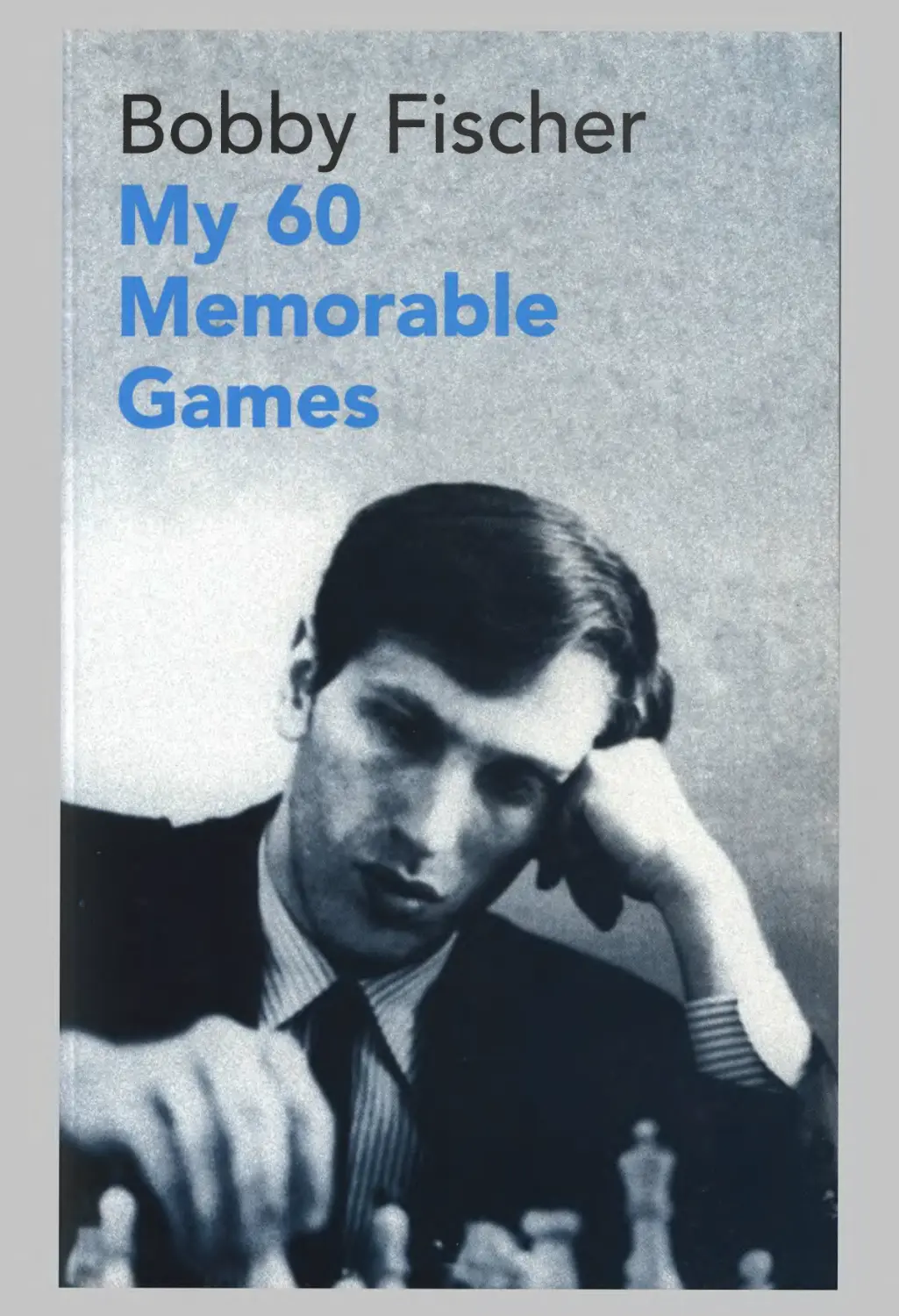
Bobby Fischer
My 60 Memorable
Games
Bobby Fischer
with Introductions to the games by
Larry Evans
Algebraic Classic Series
B. 1: Batsford Ltd, London
First published in England in 1969
@ Bobby Fischer 1969, 1972, 1995
ISBN 0 7134 7812 8
British Library Cataloguing-in-Publication Data.
A CIP catalogue record for this book is
available from the British Library.
All rights reserved. No part of this book may be
reproduced, by any means, without prior permission
of the publisher.
Typeset by John Nunn GM
and printed in Great Britain by
Redwood Books, Trowbridge, Wilts
for the publishers,
B. T. Batsford Ltd,
4 Fitzhardinge Street,
London WI H OAH
A BATSFORD CHESS BOOK
Editorial Panel: Mark Dvoretsky, John Nunn, Jon Speelman
General Adviser: Raymond Keene OBE
Managing Editor: Graham Burgess
Contents
(B and W refer to Black and White)
Preface
Opponent
1. Sherwin [B] New Jersey Open 1957
Too linle, too late
2. Larsen [B] Portoroz IZ 1958
Slaying the dragon
3. Petrosian [W] Portoroz IZ 1958
Bear hug
4. Pilnik [W] Mar del Plata 1959
Tact and tactics
5. Rossetto [B] Mar del Plata 1959
The unpleasant obligation
6. Shocron [B] Mar del Plata 1959
A small oversight
7. Olafsson [W] Zurich 1959
Pride goeth
8. Keres [B] Zurich 1959
Meat and potatoes
9. Walther [W] Zurich 1959
Betwixt the cup and the lip
10. Unzicker [B] Zurich 1959
Milking the cow
11. Benko [B] BelgradeIBledlZagreb Ct 1959
Unheard melodies
12. Gligori [W] BelgradeIBledfZagreb Ct 1959
Castling into it
13. Gligori [W] BelgradeIBledlZagreb Ct 1959
Something new
14. Keres [W] BelgradeIBledlZagreb Ct 1959
Too many cooks
15. Smyslov [W] BelgradeIBledlZagreb Ct 1959
A whopper
13
18
23
32
38
43
49
54
62
68
74
78
87
92
100
16. Petrosian [B] BelgradeIBledfZagreb Ct 1959 106
Four queens
17. Tal [B] BelgradeIBledfZagreb Ct 1959 116
A very near miss
18. Spassky [W] Mar del Plata 1960 123
Old wine in a new bottle
19. Gudmundsson [W] Reykjavik 1960 128
A long voyage home
20. Euwe [B] Leipzig OL 1960 133
Theoretical scuffle
21. Letelier [W] Leipzig OL 1960 137
A queen/or the king
22. Szabo [W] Leipzig OL 1960 141
Bad judgement
23. Tal [B] Leipzig OL 1960 145
No holds ba"ed
24. Darga [B] West Berlin 1960 150
Asking for trouble
25. Lombardy [W] USA Ch 1960/1 156
When the Maroczy didn't bind
26. Reshevsky [B] 2nd match game 1961 161
TIme will tell
27. Reshevsky £\' ] 5th match game 1961 167
Sheer pyrotechnics
28. Reshevsky [W] 11 th match game 1961 175
A peccable draw
29. Geller [B] Bled 1961 182
Hoist with his own petard
30. Gligori [W] Bled 1961 187
A lyrical performance
31. Petrosian [B] Bled 1961 191
The sincerest/orm o/flattery
32. Tal [B] Bled 1961 196
The moral victor
33. Trifunovi [B] Bled 1961 201
The drawing master
34. Bertok [W] Stockholm 1962 207
Hanging pawns unhung
35. Bolbochan [B] Stockholm 1962 212
A brilliant cadenza
36. Korchnoi [B] Stockholm 1962 218
Gaston and Alphonse
37. Keres [W] Cura ao Ct 1962 225
Only a draw
38. Keres [B] Cur ao Ct 1962 234
Detective story
39. Botvinnik [W] Vama OL 1962 240
The confrontation
40. Najdorf [B] Vama OL 1962 254
The NajdorfVariation
41. Robatsch [B] Vama OL 1962 260
A bright cameo
42. Unzicker [W] Varna OL 1962 265
Playing by ear
43. Reshevsky [B] USA Ch 1962/3 269
The missing link
44. Fine [B] Skittles Game 1963 276
Shock treatment
45. Bisguier [B] New York State Open 1963 280
Ghosts
46. Benko [B] USA Ch 1963/4 286
Romp
47. Bisguier [B] USA Ch 1963/4 291
The Indian sign?
48. R. Byrne [B] USA Ch 1963/4 297
The brilliancy prize
49. Steinmeyer [B] USA Ch 1963/4 302
A complex trap
50. Celie [B] Exhibition Tour 1964 306
Tour de force
51. Smyslov [B] Havana (Capablanca Memorial) 1965 311
Squeeze play
52. Rossolimo [B] USA Ch 1965/6 318
Peekaboo strategy
53. Portisch [W] Santa Monica 1966 324
Black magic
54. Najdorf [B] Santa Monica 1966 331
Najdorf's night off from the Najdorf
55. Bednarski [B] Havana OL 1966 338
The price of incaution
56. Gligoric [B] Havana OL 1966
The Fischer continuation
57. Larsen [W] Monaco 1967
Change of pace
58. Geller [B] Skopje 1967
Flawed masterpiece
59. Kholmov [W] Skopje 1967
The erring bishop
60. Stein [B] Sousse IZ 1967
When champions meet
Bobby Pischer's Tournament and Match Record
Index of Openings
List of Opponents
343
351
359
366
371
381
383
383
Author's Preface
The 60 games annotated in this volume were all played in the period 1957 to
1967 inclusive and, with the exception of nos. 44 and 50, under strict tourna-
ment conditions. The notes frequently include references to additional games,
occasionally presenting them in full. An interested reader will find 34 of my
earlier efforts in Bobby Fischer's Games of Chess (Simon and Schuster,
1959).
All of the 60 here offered contain, for me, something memorable and excit-
ing-even the 3 losses. I have tried to be both candid and precise in my eluci-
dations in the hope that they would offer insights into chess that will lead to
fuller understanding and better play.
Finally, I wish to express my gratitude to Larry Evans, friend and col-
league, for his invaluable aid in the preparation of the text as well as for his lu-
cid introductions.
Robert J. Fischer
New York City
On the chessboard lies and hypocrisy do not survive long. The creative combin
tion lays bare the presumption of a lie; the merciless fact, culminating in a chec)
mate, contradicts the hypocrite.
-Emanuel Lasker
Game 1
Fischer - Sherwin [USA]
New Jersey Open Ch 1957
Sicilian Defence
Too little, too late
Although Sherwin makes no serious errors in the opening, he misses several
equalising opportunities. Demonstrating the technical virtuosity that is to be-
come his hallmark, Fischer, with astonishing maturity, gradually strengthens
his grip by accumulating small advantages: the better centre and the two bish-
ops. Sherwin, meanwhile, attempts to consolidate his position-only to see
his 14-year-old opponent shatter it with a thunderbolt (18l[}xh7). It brings to
mind Alekhine's combinations, which also seemed to spring from nowhere.
Sherwin, lashing back, refuses to fall. However, his defence finally disinte-
grates under a series of acute blows to his wobbly king.
1 e4 cS
2 ffi e6
3 d3
This used to be my favourite. I
thought it led to a favourable vari-
ation of the King's Indian reversed,
particularly after Black has commit-
ted himself with ...e6.
3 ... l[}c6
4 g3 6
The later game Fischer-Ivkov,
Santa Monica 1966 continued 4...dS
S l[}bd2 i.d6 6 i.g2l[}ge7 7 0-0 0-0
Sl[}h4! with chances for the initiative.
S i.g2 i.e7
6 0-0 0-0
More usual is 6...dS but Black has
purposely delayed committing his
centre pawns. Has he a new idea in
mind?
7 l[}bd2
7 eS lMs 8 l[}bd2 f6 9 exf6l[}xf6
10 :el gives White an edge.
7 ... :b8
Sherwin slid the rook here with
his pinky, as if to emphasise the cun-
ning of this mysterious move. 7.. .dS
8 :el bS 9 eSlM7 10 l[}fl b4 11 h4
as 12 i.f4 a4 13 a3! Fischer-Miag-
masuren, Sousse IZ 1967, leads to
double-edged play where Black's
chances on the queenside counter-
vail White's kingside attack-but
White usually comes flI'St.
8 :el d6
9 c3 b6(D)
10 New Jersey Open Ch 1957
Not bad, but I had expected 9...bS
10d4 cxd4! (if 10...b411 eS! bxc3?
[11.. .dxeS 12 dxeS l[}d7 13 c4 holds
the advantage], then 12 exf6 cxd213
l[}xd2! wins a piece) 11 cxd4 d5 with
equality.
.t.mu ..
.
w . . .
.
. . . .
.
. . .
. .88 8
. 8.lD
£\° 0 ' n /. O
o y; : y;... y;
v, v, v,
a ..a =
10 d4 'ii'e7?
This move leads to trouble. Black
should strive for counterplay by
opening the c-file: 10...cxd4 11 cxd4
dS 12 eSlM7, etc.
11 eS! l[}dS
Worse is 11...l[}d7 12 exd6 i.xd6
13l[}e4 cxd4 14l[}xd6 'ii'xd6 15 i.f4
eS 16 l[}xeS! l[}dxeS 17 cxd4 win-
ning a pawn. The best try is 11.. .dxeS
12 dxeS l[}d7 13 'ii'e2 i.b7 14 h4
with a bind, but Black's game may
be tenable.
12 exd6 i.xd6
13 ! e4
An unpleasant choice, since it re-
leases the pressure in the centre and
gives White a free hand to start king-
side operations. However, after other
moves Black simply loses material:
a) 13...i.e7 14 c4 l[}f6 IS i.f4,
etc.
b) 13.. .cxd4 14 l[}xd6 'ii'xd6 IS
c4! l[}f6 16 i.f4 and again the line-
up on this diagonal is unfortunate.
14 d6 'ii'xd6
15 {£}g5! t£Jce7?
A bad mistake. Black's game is
still tenable after IS.. .h6 16 l[}e4
'ii'd8.
16 'ii'e2! l[}g6
On 16...fS?, 17 'ii'e2 picks off a
pawn. Had Sherwin seen what was
coming, however, he might have
chosen 16...g6 17 4 'ii'c7 18 i.h6
:d8 though 19 'ii'd2 prepares to ex-
ploit his weakened dark squares.
17 h4 lj)f6 (D)
.t.. ..
.
w . ..-.
. ..
e.u.
. . .
/ .
. .
. .
8 \Wr " g
. ...
a. a =
/ /
/ / ' '/ / /
Apparently defending everything.
U nappetising is 17. ..:d8 (17. ..h6 18
hS hxgS 19 hxg6 f6? 20 'ii'e2 intend-
ing S) 18l[}xh7! xh7 19 hS fS
20hxg6+ xg621 :eS! with a bind.
18 h7!
Throwing a monkey wrench into
Black's carefully contrived set-up!
As usual, tactics flow from a posi-
tionally superior game.
18 ... 7
Not 18... xh7? 19 i.f4.
19 h5 4!
Black's best fighting chance. Not
19...ll:Je7, when 20 i.f4 wins a clear
exchange.
. 20 i.f4 'ii'd8
21 gxh4
21 i.xb8? ll:Jxg2 22 xg2 i.b7+
23 f3 'ii'xb8.
21 ... :b7!
22 h6! (D)
He's hoping for 22 i.xb7 i.xb7
and suddenly the initiative passes to
Black despite his material deficit.
g.t. 1UU -..
. .
B . 0./. z. .. . .
. ..
..g p
. .
8 . . .
.. '
.
80. .
8 .. P g
....
/. . /.'
;
22 ... 'ii'xh4
Once again, time-pressure had
Sherwin burying his thumbs in his
ears. Instead of trying to mix it up,
Black should keep his king sheltered
as long as possible with 22. ..g6 23
hS! gS (if 23...gxhS, 24 'ii'e2) but 24
i.eS stays a pawn up with two bish-
ops. It might still be a fight, though.
Fischer - Sherwin 11
23 hxg7
hg7? (D)
..t.8 . 8
W . Zg g. . ·
.. ..
. 8'. .
8 . . .
..
. n . .
8 .g .
...
/. g /. '/.
. /
Suicidal. The last hope would
have been 23...:d8 24 i.g3 6
though 2S 'ii'e2 is hard to meet (if
2S... bS, then 26 a4 a6 27 axbS axbS
2S :as).
24 1:e4!
Threatening i.eS+.
24 ... -"5
25 :e3!
Now the rook joins in the king-
hunt-and it's murder. The immedi-
ate threat is 26 :h3 'ii'g6 27 :g3.
25 ... f5
26 :h3 'ii'eS
26...'ii'g6? allows 27 :g3.
27 i.e5+
White can pick off a couple of ex-
changes with 27 i.h6+ g8 28
i.xfS 'ii'xfS 29 i.xb7, etc., but by
now I felt there was more in the off-
Ing.
27 ... lbr6
27... gS? 28 :g3+ f7 29 :g7
mate.
28 'ii'd2! rM1
12 Portoroz IZ 1958
29 _g5 _e7
On 29... e7, 30 :h7+ is devas-
tating.
30 .txf6 _xf6
31 :117+ e8
32 _xf6 :xh7
On 32...:xf6 33° .txb7 nets a
whole rook.
33 .tc6+ (D) 1-0
If 33....td7, 34 _xe6+.
..1... .
B. . B .Z
..mu g
.... .
B B ..B
g. g g
. .
. . .
8 . g
. .
g g
i
Game 2
Fischer - Larsen [Denmark]
Portoroz IZ 1958
Sicilian Defence
Slaying the Dragon
Although the Sicilian, as a whole, is still the best fighting defence at Black's
disposal, much of the steam has been taken out of the time-honoured Dragon
Variation. This is one of the key games that helped to batter its reputation.
In a laudable attempt to create complications, Larsen deviates from the
book on move 15. That proves to be disastrous, since his counterattack never
gets started. Mechanically, routinely, Fischer pries open the h- file, sacrificing
first a pawn and then the exchange. There is an aura of the inevitable about the
outcome. Here the notes are as instructive and lucid as the text, which is an ob-
ject lesson in how to mount an assault against the fianchettoed king position.
1 e4 c5
2 lN3 d6
3 d4 cxd4
4 d4 lbr6
5 M g6
Larsen was one of the die-hards
who refused to abandon the Dragon
until recently. White's attack almost
plays itself ... weak players even beat
grandmasters with it. I once thumbed
through several issues of Shakh-
matny Biulleten, when the Yugoslav
Attack was making its debut, and
found the ratio was something like
nine wins out of ten in White's fa-
vour. Will Black succeed in reinforc-
ing the variation? Time will tell.
6 i.e3 i.gJ
6...l[}g4? still loses to 7 i.b5+.
7 f3 0-0
8 _ d2 l2.)c6
9 i.c4
This refinement supersedes the
old 9 0-0-0. The idea is to prevent
...dS.
9 ... d4
Just how Black can attempt to
thread his way to equality is not
clear. Interesting is Donald Byrne's
9...aS. The strongest reply is 10 g4
and if 10...l[}e5 11 i.e2 d5?, then 12
g5! wins a pawn.
10 i.xd4 i.e6 (D)
.mJj .
.. ..
w .. . .
d
. .. . ..
d '" d
. . . .
..t.88 8
8 .88
8 8illfi .8"
. .:
11 i.b3 _as
12 0-0-0 b5
After 12...i.xb3 13 cxb3! Black
cannot make any attacking headway
against this particular pawn configu-
ration. White is lost in the king and
pawn ending, it's true, but Black
Fischer - Larsen 13
usually gets mated long before then.
As Tarrasch put it: 'Before the end-
game the gods have placed the mid-
dle game.'
13 bl b4
14 l[}ds
Weaker is 14l[}e2 i.xb3 15 cxb3
:fd8.
14 ... i.xd5
Bad judgement is 14...l[}xd5? 15
i.xg7 xg7 16 exd5 i.d7 17 :del
with a crushing bind; Suetin- Korch-
noi, USSR Ch prelims 1953.
15 i.xd5
Stronger is 15 exd5! 1iD5 16
:hel as 17 _e2! (Tal-Larsen, Zu-
rich 1959) when White abandons the
attack and plays for pressure along
the e- file instead.
15 ... :ac8?
The losing move. After the game
Larsen explained he was playing
for a win, and therefore rejected the
forced draw with 15...l[}xd5 16
i.xg7 l[}c3+ 17 bxc3 (17 i.xc3 bxc3
18 _xc3 _xc3 19 bxc3 :fc8 ren-
ders White's extra pawn useless)
17...:ab8! 18 cxb4 _xb4+! 19
_xb4 :xb4+ 20 i.b2 :tb8, etc. Af-
ter 15.. .l[}xd5 however, I intended
simply 16 exdS _xd5 17 _xb4,
keeping the game alive.
16 i.b3!
He won't get a second chance to
snap off the bishop! Now I felt the
game was in the bag if I didn't botch
it. I'd won dozens of skittles games
in analogous positions and had it
14 Portoroz IZ 1958
down to a science: pry open the h-
file, sac, sac ... mate!
16 ... :e7
This loss of time is unfortunately
necessary if Black is ever to advance
his a-pawn. 16...1WbS? is refuted by
17.txa7.
17 h4 'iibs (D)
There's no satisfactory way to im-
pede White's attack. If 17...hS, then
IS g4! hxg4 (IS...:fcS 19 :dgl
hxg4 20 hS! gxhS 21 fxg4 l[}xe4 22
_f4 eS 23 _xe4 exd4 24 gxhS hS
2S h6 .tf6 26 :g7! wins for White)
19h5! gxhS (on 19...l[}xh5,20.ixg7
xg7 21 fxg4l[}f6 22 'ti'h6+ mates)
20 fxg4 l[}xe4 (on 20...hxg4 there
follows 21 :dg 1 eS 22 .ie3 :dS 23
.ih6, while 20...l[}xg4 21 :dgl.ixd4
22 :xg4+! hxg4 23 6 leads to
mate) 21 'ii'e3 l[}f6 (21....ixd4 22
'ii'xe4 .ig7 23 :xhS) 22 gxhS eS 23
h6 wins.
Now Black is threatening to get
some counterplay with ...a5-a4.
. 8 ...
w. . .'E'
. . ' ..
..8 . .
. 8.
, .
..i.. 88.
8 8illJ1 .8.
.
.<ifi>8:8 .:
18 hS!
There's no need to lose a tempo
with the old-fashioned g4.
18 ... :re8
On IS...gxh5 White plays 19 g4!
hxg4 20 fxg4! l[}xe4 21 2l[}gS
22 .txg7 xg7 23 :dS :cS 24
'ii'h6+ gS 2S :xgS+ :xgS 26
'ii'xh7 mate.
19 hxg6 hxg6
20 g4
Not the impatient 20 .ixf6? .ixf6
21 'ti'h6 e6! (threatening ...'ii'eS) and
Black holds everything.
20 ... as
Now Black needs just one more
move to get his counterattack mov-
ing. But for want of a nail the battle
was lost.
21 gS llllis (D)
Vasiukov suggests 21...l[}eS as a
possible defence (not 21...a4? when
22 gxf6 axb3 23 fxg7! bxc2+ 24
'ii'xc2! eS 2S 'ti'h2 wins) but White
crashes through with 22 .ixg7l[}xg7
(22... xg7? 23 'ii'h2) 23 :h6! e6
(23...a4 24 'ii'h2l[}hS 2S :xg6+) 24
'ii'h2 l[}hS 2S .ixe6! fxe6 (if
2S...'ii'xgS then 26 :xg6+! 'ii'xg6 27
.ixcS threatening :gl) 26 :xg6+
l[}g7 27 :hl, etc.
22 :xh5!
Fine wrote: "In such positions,
combinations are as natural as a
baby's smile."
22 ... phS
No better is 22....ixd4 23 'ii'xd4
gxh5 24 g6 'ii'eS (if 24...00,25 'ii'xd6)
2S gxf7+ h7 (if2S... f8, 26 'ii'xeS
8.. ...
w8 . ...
. R&.
..
\Wr. . .
.. . ..
/ 8. .
d
Mi.8 88.
8 '/ 8. ,' //, . . ·
%J/' /,
/ // // ;;W
BrihU". fJ"
'&I .... ; ....
dxe5 27 :gl e6 28 i.xe6 e7 29
i.xc8 :xc8 30 :g5 wins) 26 'ii'd3!
(intending f4) should be decisive.
23 g6 eS
Or 23...e6 24 gxf7+ xf7 (if
24...:xf7, 25 i.xe6) 25 .i.xg7 xg7
26 :gl+ h7 27 'ii'g2 'ii'e5 28
'ii'g6+ h8 29 :g5 :g7 30 :xh5+
g8 31 i.xe6+ f8 32 :f5+ e7
33 :f7+ winning.
24 gxf7+
25 i.e3 d5!
A desperate bid for freedom. On
Petrosian - Fischer 15
25.. .a4 (or 25.. .:d8 26 i.h6) 26
'ii'xd6+ :e7, White mates with 27
'ii'd8+! :xd8 28 :xd8+ :e8 29
i.c5+ .
26 exd5!
Not 26 i.xd5 :xc2!.
26 ... :xf7
On 26...a4, 27 d6! axb3 28 dxc7
wins.
27 d6 :16
After 27...:d7 White can either
regain the exchange with 28 i.e6 or
try for more with 28 .i.h6. 27.. .:xf3
is met by 28 d7 threatening 'ii'd6
mate.
28 .i.g5 'iib7
Or 28...'ii'd7 29 'ii'd5! 'ii'f7 (if
29...:f7, 30 i.e7+!) 30 i.xf6 win-
ning material.
29 i.xf6 i.xf6
30 d7 :d8
31 'ii'd6+ 1-0
A mistake! 31 'it1t6+! forces mate
in three.
Game 3
Petrosian [USSR] - Fischer
Portoroz IZ 1958
King's Indian Defence
Bear hug
In what appear to be perfectly equal positions, Petrosian consistently finds
seemingly innocuous moves that gradually overwhelm his opponent. He ac-
complishes his objective simply by exchanging pieces and manoeuvring for
victory without taking unnecessary risks. This essentially defensive technique
16 POTtoroz IZ 1958
has the virtue, when it doesn't utterly succeed, of producing a draw. Fischer,
by contrast, generally chooses the sharpest course, however precipitous it
may become. Occasionally he overreaches himself, but it makes for interest-
ing chess.
In this game, replete with errors on both sides, Petrosian succeeds in pin-
ning his opponent for a time to a static endgame. But Fischer manages to burst
his bonds, only to blunder on the very next move (51... d6). Petrosian, how-
ever, by blundering in his turn, restores the balance. The ensuing rook and
pawn ending produces a thrilling draw.
1 c4 lill'6
2 lbc3 g6
3 g3 i.g7
4 i.g2 0-0
5 ll)C3 d6
6 0-0
7 d3
On 7 d4 I intended 7...e5. Petro-
sian is striving for an English Open-
ing formation, a slow system for
which he is temperamentally suited.
7 ... ll)bs
8 d4
Reckoning he can afford this loss
of time in view of Black's misplaced
Icing's knight. After S :bl f5! 9 'ii'c2
as 10 a3 f4 (Petrosian- Vasiukov,
Moscow 1956) Black obtains a good
aggressive set-up. I was as impressed
by that game as Petrosian must have
been, since he got crushed.
8 ... eS
9 dS
Or 9 dxe5 dxe5 10 'ii'xdS :xdS 11
l[}d5 :d7 12 i.h3 f5 13 g4l[}f6!. If
14 gxf5 (Black wins after 14 xf6+
i.xf6 15 gxf5 gxf5 16 i.xf5??
:g7+), then 14...l[}xdS 15 cxdS :XdS.
9 ... li:Je7
10 e4 (D)
Zg-*. mu ' ..
/
B . . " . .
g g.g
.
. .8. ..
.8888 .
B BlDn
8 .
. :
This is the right time for Black to
get in 10.. .c5!. Petros ian- Boleslav-
sky, USSR Ch prelims 1957, contin-
ued 11l&1 hS 12l[}d3 f5 13 :bl
ll)f6 =.
10 ... fS
11 exfS pfS
11...ll)xf5 is tempting but un-
sound, e.g. 12 g4ll)d4 13 gxhS i.g4
14ll)xd4! i.xd 1 15l&6, etc. And on
11...i.xf5 12 ll)g5 'ii'd7 13 l[}e6!
i.xe6 14 dxe6 'ii'xe6 15 i.xb7 :abS
16 i.g2 'ii'xc4 17 ll)d5!, White
comes out on top.
12 eS! g3
A 'desperado' combination: this
knight (which is doomed anyway)
sells its life as dearly as possible.
13 hxg3
Simple and good. I had expected
13 fxg3 but Petrosian eschews the
kingside attack and plays for control
of the centre squares instead. His
judgement turns out to be right.
13 ... i.xe5?
13...dxeS, keeping a fluid pawn
centre, offers more play. I was un-
duly worried about White's passed
d-pawn after 14 cS.
14 f4!
15 i.e3
16 i.d4
Forcing the trade of Black's most
active piece. White soon obtains a
firm grip on the position.
16 ... lbg6
17 :el?
A careless transposition. Now by
17...i.xd4+ 18 'ii'xd4 hS, followed
by ...h4, Black could exchange his
isolated h-pawn for White's g-pawn
and the game would be dead equal.
17 i.f3 was correct.
17 ...
18 i.f3! (D)
Black doesn't get a second
chance.
18 ...
19
20 he8
21 i.xg7
22 _d4
i.g7
i.d7
:17?
'ii'fS
:e8
'ii'xe8
hg7
b6
Petrosian - Fischer 17
.. II ...
B , "g. .
...
. . ..8
8 _8.'.
.8 " .
.
8 _i.0
80 _ 8 _
..
23 :hl
White has effortlessly achieved a
plus and now he wants to improve
his position before embarking on a
committal course. 23 b4! threatening
c5 is much sharper, and poses more
immediate problems.
23 ... as
My fust free breath!
24 tbd 1 'ii'fS
25 lbe3
Petrosian keeps building without
getting side-tracked ven by good
moves. I was more afraid of 25 i.h5 !
tying me up completely. Then the
rook can't move because of i.xg6
followed by a check on h8.
25 ... :r7!
26 b3 'ii'g7
The exchange of queens eases the
cramp. White can't afford to retreat
and cede this important diagonal.
27 'ii'xg7+ hg7
28&3 :m
29 i.e2
White constantly finds ways to
improve his position. Not 29 b4 axb4
18 Portoroz IZ 1958
30 axb4 :as and Black seizes the
open file.
29 ...
30 i.d3
31 :h5
liJe7
h6
i.e8 (D)
. 8.t.. .
wg . ' .
.
.
.
'/ 888'.:
888 0 .
8.i.
.
. .
%: %/- $;
. . . .
32 :b2
Avoiding a little trap: 32l[}xfS+?
(or 32 :xfS? :hS!) 32...l[}xfS 33
:xfS :hS! followed by ...i.g6 win-
ning the exchange.
32 ... i.d7
33 :hl :h8
34 2!
Heading for an even stronger
post on d4. I was amazed during the
game. Each time Petrosian achieved
a good position, he managed to ma-
noeuvre into a better one.
34 ... 6
35 lbd4 g7
36 i.e2
Feigning an invasion with i.hS
and :el and l[}e6+. White has two
wings to operate on; Black must be
flexed to react appropriately, and this
requires alertness.
36 ... l[}g8?
Panicking and giving him the op-
portunity he's been waiting for to
sneak b4 in at a moment when Black
can't counter with ...axb4 and ...:a8.
Petrosian likes to play cat-and-
mouse, hoping that his opponents
will go wrong in the absence of a di-
rect threat. The amazing thing is-
they usually do! Witness a case in
point. I should just have ignored his
'threat' with, say, 36...:aS 37 i.hS
:cS 3S :el f6 and if 39l[}e6, then
39...c6.
37 b4! lbr6
38 i.d3! (D)
3S bxaS l[}e4+ 39 g2 bxaS 40
:b Ilbcs holds.
8 . . /"
B. '/. ... . .
d 7. ...d
. ,/. . ,/. . ' /. /. . ,/.
/
.
. .8.'8
8 ' .
, ,
. .
.../
. . = .
8 8 . .:
38 ... axb4
3S...l[}e4+? 39 i.xe4 fxe4 40
bxaS bxaS (if 40...:aS, then 41 axb6
cxb6 42 :bl) 41 :bl followed by
:b7 wins easily. White also invades
after 3S... g6 39 bxaS bxaS 40:bl.
39 axb4 g6
40 :al!
White has finally achieved his
ideal set-up, but Black's game is still
tenable.
40 ...
41 e2
42 d2
43 :86
43 :a7 :cS transposes to the
game.
43 ...
44 :87
45 cS!
This pawn sac caught me com-
pletely by surprise. It's the only line
that gives Black any trouble.
45 ... bxeS
Not 45...lbxdS? 46 c6.
46 bxeS dxeS
47 lbr3! !
47.. .lbxdS loses to 4S lbe5+.
48 lbe5+ e7
49 d7 d7
50 .ixf5 :f8!
51 g4 (D)
51 i.xd7 xd7 52 e3 (if 52 :a6
:gS) 52... d6 53 :a6+ xd5 54
:xh6 :eS+ 55 f3 c4 should draw.
lbg4+
:e8+
lbr6
:b8
:ca
.. /., B
B . . .
.. .
. . . m
. . r1
B .8Bi..
B . n8.
. . . .
. . .
.
. B . .
Petrosian - Fischer 19
51 ... d6?
Should be the losing move! Cor-
rect is 51...lbf6! 52 i.e6lbxd5! 53
i.xd5 :xf4 (53...:dS also draws)
winning the last pawn and forcing a
draw.
52 i.xd7! hd7
53 e3 :e8+
On 53...c4, 54 :a6 wins. The idea
is to force his king to the kingside,
away from the passed c-pawn.
54 <kJ
Not 54 d3 :gS.
54 ...
55 :86+
56 :xb6
d6
hdS
c4 (D)
B... .
wB . . .
. B . a
. ... .
... 08.
. . .<itB
. . . B
. . . .
57 :hI?
As Petrosian points out in the
Russian bulletins of the tournament,
White can win with the following
line: "57 :h7! c6 5S :d7+ c5 59
:dl c3 60 g5 c4 61 g6 c2 62 :cl
c3 63 f5 :gS 64 f4 d2 65
:xc2+ xc2 66 g5 c5 67 f6 c4 6S
f7 :xg6+ 69 xg6 c3 70 fS1f."
White is a tempo ahead of the game,
20 Portoroz IZ 1958
where Black's pawn succeeds in
reaching c2, instead of c3 (as here).
What if Black tries to improve?
For example, after 57 :h7, he may
try 57...c5 5S :d7+ e6 59 :dl
:bS. Now there are two main lines
for White:
a) 60 g5? c3 61 g4 (if 61 :cl
f5 62 :xc3 c4! 63 :xc4 :b3+
with a draw by blockade although
Black is two pawns down) 61...:b4!
62 :el + f7 63 f5 c2 64 :cl :c4
65 g6+ g7 66 g5 :c3 draws.
b) 60 f5+! e5 61 :el+ d4
(after 61... f6, 62 f4 c3 63 g5+
g7 64 g6 c2 65 g5 :bl 66 f6+
wins) 62 g5 c3 63 f6 c2 64 :cl! (64
f7? :bl! draws) 64... e5 65 g4!
snuffs out Black's resistance.
57 ... c3
58 gS cS (D)
8 8.. .
w. . . .
. . . .
. - . .
. .
. .0.
. . .<it.
8 . . .
8 . . 8:
59 :dl +
It's tough right down the line. Af-
ter 59 g6 :gS 60 f5 e5! 61 g4
f6 62 :c 1 c4! 63 :xc3 :cS! White
can make no headway. 59 g4 is
met by 59...:e2! 60 g6 e4! 61 g5
:g2+ 62 f6 xf4, etc., as the Rus-
sian bulletins also point out.
59 ... c4
60 g6 c2
61 :cl
After 61 :g 1 :dS! the threat of
...:dl forces 62 :cl (not 62 g7?
:gS! followed by ...:xg7 and Black
wins) .
61 ...
62 fS
63 4
64 :xc2+
65 gS
66 f6
67 f7 (D)
d3
:g8!
d2
xc2
c4
c3
1/ 2 .1/ 2
8 8 ...
B. . .8.
8 . 88.
8 8 . =
. . . 8
8 . 8 8
8.. . .
. . . .
I offered the draw, not realising
it was bad etiquette. It was Petro-
sian's place to extend the offer after
67...:xg6+ (if Black wants to get
melodramatic, 67...:cS 6S g7 bl
69 fS1f :xfS 61 gxfS1f c2 reaches
the same position) 6S xg6 bl 69
fS1f c2 and Black has reached a
book draw.
Game 4
Pilnik [Argentina] - Fischer
Mar del Plata 1959
Sicilian Defence
Tact and tactics
The presence in Argentina of Pilnik, Najdorf, and Eliskases, who chose to re-
main there after participating in the Buenos Aires Chess Olympiad of 1939,
created a chess renaissance, as attested by the annual event at Mar del Plata
which, though not lavish with prizes, offers an exotic vacation and attracts the
world's best. Fischer tied for 3-4 with Ivkov, a mere half point behind Pach-
man and N ajdorf in a strong field of fifteen.
After a lacklustre opening by both sides, and a middle game that, with the
exception of 26... bxa3, can scarcely be described as more than routine, Fis-
cher pilots the game into an even ending. Both he and Pilnik then proceed to
complicate; but the latter is drawn into making a false lead, which Fischer ex-
ploits by obtaining a passed centre pawn. From this point on, although Pilnik
does all that can be done to stave off the inevitable, Fischer is not gulled into
making a single wrong step.
1 e4
2 lbf3
3 d4
4 d4
5 M
6 .ie2
For 6 h3 see Games 35, 40, 43.
For 6 .ic4 see Games 17, 55, 5S.
6 ... e5
7 lbb3 .ie7
For 7....ie6 see Game 42.
8 0-0
Another try is S .ig5 O-O! (not
S...lbbd7?, when 9 a4! gives White a
c5
d6
cxd4
lbr6
86
powerful bind) 9 lbd2 lbxe4! 10
.ixe7lbxc3 11 .ixdslbxdl12 .ie7
:eS 13 c4lbxb2! 14lbb6 :xe7 15
lbxaS lba4 16 0-0-0 (Fischer-Ghit-
escu, Leipzig OL 1960) 16. ..:d7!
and the liquidation has given Black
the better game.
8 ... 0-0
9 .ie3 .ie6
10 f3
A sharper alternative is 10 a4 'fIc7
11 aSlbbd7 12lbd5lbxd5 13 exd5
.if5 14 c4 .ig6 15 hl :acS 16
'fId2 'fIdS 17 :ac 1 h6 IS f4 exf4 19
22 Mar del Plata 1959
.ixf4 .igS Smyslov-Gligoric, Ha-
vana 1962.
10 ... 'fIe7 (D)
Premature is 10...dS 11 exdS xdS
12 xdS 'fIxdS 13 'fIxdS .ixdS 14
:fd 1 with a slight edge in the ending
for White.
z/. . ..8
wg. illU . .
.....
.. ..t.. 8
. . . 8
8 .8. 8
.lD .8.
8 8..i.8
/., ...:=
11 'fie 1
Once popular, this whole system
is now known to give White nothing.
It hinders neither Black's develop-
ment nor his queenside expansion.
11 ... bd7
12 :dl
On 12 a4, 12...dS is strong.
12 ... bS
13 :112
13 a3 is met by 13... b6 14
.ixb6! 'fIxb6+ with equality.
13 ... b6
More direct is 13...b4 14 lbds
xdS IS exdS .ifS 16 'fIf2 as with
good play against White's backward
c-pawn.
14 'fIf2?
Careless. 14 .ixb6 is necessary.
14 ... :ab8?
I figured if he didn't take it off last
move he wouldn't take it now; so I
wanted to build a little more and
keep the option of moving the knight
to a4 as well as c4. But Black should
pounce on the chance to play
14...lbc4! IS .ixc4 bxc4 16 i.b6 (16
al :abS 17 :bl :b7 is strong for
Black; if 16 cl :abS 17 a4 c3!
IS bxc3?, then IS...'fIc6 19 b6
.idS) 16...'fIcS 17 as lbd7! and
White's in trouble, e.g. IS dS (or
IS .ie3 .idS 19 dS .ixdS 20 :xdS
f6 winning at least the exchange)
IS....ixdS 19 :xdS (19 exdS xb6
20 'fIxb6 .idS 21 'ii'b4 :bS 22 'fIa3
.ixas 23 'fIxas :xb2) 19...:bS win-
ning at least a pawn.
15 .ixb6!
Pilnik hastens to make amends for
his omission. Not IS a5?, when
IS...dS! wins material (StAhlberg).
15 ... :xb6
16 lbds dS
17 exdS .id7
18 f4 .if6
I didn't want to weaken my e6
square with IS...fS 19 c3 .if6 20
fxeS dxeS (if 20....ixeS 21 d4) 21
lbcs =.
19 c3 :bb8
20 fxe5 .ixeS
On 20...dxeS, 21 d6 gives White
active play. Black's advantage of the
bishop pair is neutralised by the
weakness of c6, which White can
later occupy with his knight.
21 lbd4 g6
22 a3
More to the point was 22 .if3 b4
23 cxb4 :xb4 24lbc6 with an equal
position.
22 ... as
23 hl
23 .if3 should again be played.
White starts drifting.
23 ... M
24 aM
After 24 axb4 axb4 25 c4 b3!
Black keeps the initiative.
24 ... axM
25 :c2
25 .if3 bxa3 26 bxa3 :as pre-
sents its problems to White.
25 ... 'ft6
26 lbc6 (D)
. .
. .
B8 8.t8'8'
mu ...
t.t.J .
. 88. .
. . 8 .
..I
..;
"" A"
........ O
. 8 8:.
This is the position White was
playing for. A draw now looks se-
cure.
26 ... bxa3!
27 _xb6
27 bxa3 is also adequate, but not
27lbxbS? _xf2 2S :xf2 a2 29 :fl
Pilnik - Fischer 23
(29 :cl .ixb2) 29....if5 30 :ccl
:xbS winning.
27 ...
28 bxa3
29 lbxe5?
This gives Black a strong passed
e-pawn. Correct is 29 :a2 :b2 30
:xb2 .ixb2 31 .ib5! :xa3 (other-
wise a4) 32 1iJe7+ fS 33 lbxg6+
with a draw in view. On 33. ..hxg6,
34 .ixd7 produces opposite-col-
oured bishops. Or on 33... eS, 34
:el+! (after 34 .ixd7+ xd7 35
:xf7+? dS Black wins a piece)
34... dS 35 .ixd7 fxg6 with equal-
ity (35... xd7 is met by 36 lbfS+
followed by 37 lbxh7).
29 ... dxeS
30 :c3
30 :c7 leads to nothing after
30...:d6 and the sacrifice 31 .ib5?!
is refuted by 31....ixb5 32 :fxf7
:cS!. Or 30 :a2 (30 :al? :xa3)
30.. .:a5 31 .ic4 (or 31 :d 1 .ia4)
31...:c5 and the d-pawn falls.
30 ... :b2!
31 :c7
Desperately striving for counter-
play. On 31 .ic4 (to prevent ...:a2),
31... g7 32 d6 f5 33 .id5 :a6 again
wins the d-pawn. Alternatively, 31
.if3 f5 32 :c7 .ib5 33 :el e4
squelches White's play.
31 ... .irs (D)
32 g4
A wild hope. 32 .ic4 :c2! 33 d6
:xc4! 34 :xc4 .id3 35 :fc 1 .ixc4
36 :xc4 :xa3 37 g 1 g7! is
:xb6
:a8
24 Mar del Plata 1959
.8 8 8.8
w8 a B'B'
B . B'B
8 .8.J..
.88 8
o 8 B .
Bi.B8"
. .
8 8 8:.
hopeless; Black soon picks off the d-
pawn and wins easily.
32 ... .ie4+
33 .if3 .id3
34 d6
Or 34 :el e4! 3S .ig2 (3S .ixe4
:e8 wins for Black) 3S...:d8 36
:cS g7! 37 gl (if 37 gS h6 38 h4
hxgS 39 hxgS, then 39...:h8+ 40
gl :h4! wins) 37...fS 38 gxfS
gxfS and the two connected passed
pawns should win (39 d6 is met by
39... f6!).
34 ... :d8
35 :el ]bd6
Najdorf chided me after the game
for 'missing' 3S...e4 36 .ixe4! :bl!
39 :xbl .ixe4+ 40 gl .ixbl and
wIns.
36 :xe5
Falling into the trap. 36 :e7 holds
out longer, but 36...:f6 37 .idS e4
38 .ixe4 .ixe4+ 39 :7xe4 :6f2
wIns.
36 ... :r6!
37 :e3
Forced. 39 .ig210ses to 39...:bl.
37 ... ]bf3!
38 ]bf3 .ie4
39 :xt7 m
40 :18+ rJ
0-1
After 41 :f7+, Black wins with
41... h6. Alternatively, 41 :f4.idS
(41....ixf3+ 42 gl :g2+ 43 fl
.ic6 44 :c4 .ibS! also wins) cooks
White's goose.
Game 5
Fischer - Rossetto [Argentina]
Mar del Plata 1959
Sicilian Defence
The Unpleasant Obligation
This game exemplifies most dramatically the German expression zugzwang.
Unable to achieve any workable advantage from the opening or middle-
game, Fischer embarks on an equally unpromising ending. He manages, how-
ever, after 19 lbdS, to acquire a bishop against a knight. Subsequently he
Fischer - Rossetto 25
employs an unusual rook manoeuvre along the third rank (23 :a3) in order to
make spatial inroads. Rossetto unwittingly co-operates and soon is faced by a
rare predicament: although material is equal, any move he makes must disturb
the precarious balance and hasten his own disaster. That is zugzwang-and,
appropriately, Rossetto resigns.
1 e4 cS
2 00 e6
3 d4 cxd4
4 lbxd4 86
5 c4 'fIe7
Stronger is 5...lbf6 6 lbc3 i.b4,
which theory gives as equal for
Black.
6 M lbr6
7 i.d3?
Misplacing the bishop. 7 a3! is
right, and if 7...lbc6, then 8 i.e3, etc.
(8...lbe5 9 i.e2! lbxc4? loses to 10
i.xc4 'fIxc4 11 :cl).
7 a3!, by preventing ...i.b4 once
and for all, forces Black to adopt a
kind of Scheveningen formation that
keeps him desperately cramped. A
Spielmann- Tartakower game pro-
ceeded: 7...i.e7 8 i.e2 0-090-0 d6
10i.e3lbbd7 11 :cl b612 b4! i.b7
13 f3 :ac8 14 'fie 1 -"8 15 'fIf2
'with a beautiful position for White.'
(From More Chess Questions An-
swered. )
7 ... lbc6
8 i.e3 lbxd4?
Instead of trying to simplify,
Black should select the aggressive
8...lbeS! 9 :cl (not 9 0-0 lbeg4! or 9
i.e2 lbxc4 10 i.xc4 1fxc4 11 :c 1
1fb4 120-0 d6 and now 13lbb3? is
met by 13...lbxe4! 14 a3lbxc3, etc.)
9...lbfg4! with advantage.
9 i.xd4 i.cS
10 i.e2 d6
11 0-0 i.d7
12 lba4 (D)
.. 8.8 .
Bg,mH.g. .
. ....
'B ... 8
8 . 8 B
lDB8[18B B
8 . B B
8"i.B 8
.
g"B:
. .
Forcing a series of exchanges that
gives White a microscopic edge, at
best.
i.xd4
:d8
0-0
12 ...
13 'fIxd4
14 :rd1
15 he1
15 'fIxd6 'fIxd6 16 :xd6 .i.xa4 17
:xd8 :xd8 18 i.xa4lbxe4 =.
15 ... 'fIaS
15...b5? 16 cxb5 axb5 17 lbc3
(not 17 eS? dxeS 18 i.xh7+ lbxh7)
and Black's b-pawn is weak. 15...i.c6
is solid but cramped.
26 Mar del Plata 1959
16 6 _xb6
16...1fe5 17 :xd6 lbg4 is un-
sound in view of 18 g3 1i1ts 19 h4.
17 lbxb6 i.oo
18 f3 lM7!
Black had relied on this move to
get him out of trouble. Now 19
lbxd7 (or 19lba4lbeS 20 i.b3 gS!
holds the balance) 19.. .:xd7 20 :d2
:fd8 21 :adl f8 is dead equal.
19 lM5! (D)
. .8
. .
B....B'.'
..-*...B .
B .lD. .
.8.8. .
. . .8.
8"i.8 .8"
.
a /. "% . % 0. = /. /.
d ... /.
/ /. /?////. ,
This unexpected reply throws
Black, unjustifiably, into a state of
confusion.
19 ... i.xd5
Caught by surprise, Rossetto fails
to find the most accurate reply:
19.. .lbeS ! (also tenable is 19.. .exdS
20 exdS lbeS 21 dxc6 bxc6 22 b3 cS
23 i.e4 :fe8) 20 lbe7+ (if 20 lbe3,
then 20...gS!) 20... h8 21lbxc6 bxc6
22 i.a4 gS! followed by ... g7-f6-
e7 =.
20 exdS e5
Safer is 20...lbeS 21 i.e4 b6 (not
21...fS? 22 dxe6!).
21 b4
Playing for the big breakthrough
on cS.
21 ... g6
After 21...aS 22 a3 axb4 23 axb4
:a8 24 i.f5 ! White holds the advan-
tage.
22 i.a4 b6
22...lbb6 is met by 23 i.b3 fol-
lowed by cS.
23 :d3 IS?
Oblivious to the danger! Black's
best defence is 23...aS 24 a3 (Black
should hold after 24 i.xd7 :xd7 25
bxaS bxaS 26 cS dxc5 27 :xcS a4)
24...f5 and it's hard for White to
make progress. Black should never
allow cS without first forcing White
to make the concession of exchang-
ing the bishop for the knight.
24 :a3!
The threat is simply 2S i.xd7.
The veiled and seemingly insignifi-
cant attack on Black's a-pawn is the
means of forcing him to drop the
protection of the cS square.
24 ... lbb8
Forced. On 24...lbf6, 2S i.c6wins
a pawn. The only other try is 24...aS
2S bxaS bxaS 26i.c6! llXs (26...lbb8
is met by 27 i.bS!; instead 26...lbb6
27 :b 1 ! lbxc4? allows 28 :c3 lbd2
29 :b2 trapping the knight) 27 :xaS
and White should win.
25 c5! bxc5
2S...bS 26 i.b3 :f7 27 c6 :c7 28
:as! f7 29 a4 bxa4 30 :xa4 e7
31 i.c4 picks off the a-pawn.
26 bxe5 dxeS
27 :XeS rJ
After 27...li)d7 (or 27...:cS 2S
:ac3, keeping the bind), 2S :c7
f6 29 i.b3 hS 30 :xa6li)xdS 31
.ixdS :xdS 32 :aa7 wins. Black's
game collapses once the heavy guns
penetrate.
28 :b3 :17
29 d6! li)d7
The pawn is obviously immune.
So Black attempts to revive his
knight.
30 :e7 m
Another hopeless line is 30...li)f6
31 :bb7 :xc7 32 dxc7 :cS 33 i.b3
lOes 34 :bS li)d6 3S :xcS li)xcs 36
.ie6, etc.
31 :bb7
32 dxe7
33 i.b3!
Completely immobilising Black.
He is reduced to pawn moves.
:xe7
:ca
Fischer - Shocron 27
33 ... as
34 84 h6
35 h3 g5
36 g4 fxg4
37 hxg4 (D) 1-0
8.. . .
B .: _ . /
d .
. . .
. . :e . / . /
%
%% ///
8. . .8.
.i.. .88
. . . 8
gg,,
d d d
Zugzwang! Black has run right
out of satisfactory pawn moves. On
37... f6, 3S :bS wins a piece, while
37...li)g6 loses to 3S i.e6. On any
rook move, say 37...:eS, there fol-
lows 3S cs1f+.
Game 6
Fischer - Shocron [Argentina]
Mar del Plata 1959
Ruy Lopez
A small oversight
Fischer's opening repertoire has been less extensive than most practising
grandmasters' , yet his contributions to theory have been numerous. 20 gS !? is
one of his innovations. However, it is not responsible for Shocron's defeat.
Neither is Shocron's response; in retrospect, his system of defence seems sur-
prisingly adequate. Nevertheless, after defending sensibly, Shocron outfoxes
28 Mar del Plata 1959
himself. Thinking he has seen one move further than his adversary, he pro-
vokes a combination. But his vision is one move short. In consequence,
though otherwise it had withstood all of Fischer's assaults, his game crum-
bles.
1 e4 eS
2 00 lbc6
3 .ib5 a6
4 .ia4 lbr6
5 0-0 .ie7
6 :el b5
7 .ib3 d6
8 c3 0-0
9 h3
For the immediate 9 d4!?, see
Game 36.
9 ...
10 .ic2 c5
11 d4 'fIc7
For Keres' 11...llXt7, see Game
3S.
12 lbbd2 .id7
Black has many alternatives here,
such as 12...llXt7, 12... hS, 12...:eS,
12....ib7, 12...:dS, 12...lbc6 and
12...cxd4. I don't think there's any
easy way for Black to achieve com-
plete equality-but who knows?
13 lbr1 :fe8
14 lbe3 g6 (D)
The Yugoslav System, popular-
ised by Gligoric and Matanovic. The
idea is to strengthen the position, and
transfer the bishop to f8 while await-
ing further developments. Black will
only undertake specific counterac-
tion after White has committed him-
self.
.. .....
w. 1I.t....
.. . II..
. ' z. .
d
. 08. .
8 0 lD.8
8Pi.. P8.
d
/' . ./.,
15 dxe5
This positional approach bares the
hole on dS, so that White may gain
access to it with his knight. Alternate
plans ensue after IS .id2 .ifS and
now:
a) The quiet 16 :cl:
al) 16...lbc6 17 dS! lbaS (on
17...lbdS, IS c4! robs Black of his
normal counterplay with ...c4, Olafs-
son-Ivkov, Buenos Aires 1960, and
now White can leisurely build up a
strong attack with h2, g4, :gl and
later the stock sac lbfS) IS b4lbb7
19 a4 with a slight advantage.
a2) 16....ig7? 17 b4 lOc6 IS
lbdS! lbxdS 19 exdS lbe7 20 dxcS
lbxdS (20.. .dxcS 21 .ie3 'fId6 22
.ixcS1fxdS 23 .ib3!) 21 .ib3lbf6
(21.. ..ic6 22 i.gS!) 22 cxd6 'fIxd6
23 lbgS! :fS 24 .ie3 'fIxdl 2S
:exdl h6 26lbe4! lbxe4 27 :xd7
:ac8 28 c4 l[}g5 29 .i.xg5 hxg5 30
c5 1-0 Fischer-Rinaldo, US Open
1957.
b) The sharp 16 b4 cxb4 17 cxb4
l[}c4 18l[}xc4 bxc4 19 :cl exd420
l[}xd4 d5 (not 20...c3 21 .i.b3l[}xe4
22 :xe4! :xe4 23 _f3 .i.c6 24
_xc3 when White wins) 21 exd5
:xel +? (21...'ii'd6 is a better move)
22 .i.xel _d6; Fischer-Matanovic,
Bled 1961. Now, as Keres pointed
out, White can keep his extra pawn
with 23 l[}f3!. Then 23..._xd5?
loses a piece after 24 .ic3!, whilst
23...l[}xd5 is met by 24 .i.e4.
15 ... dxeS
16 %2
When examined microscopical I y,
Black has his problems. The hole on
d5 might be described as 'gaping'.
16 ... :ad8
17 _f3 .i.e6
After 17.. .h5? 18 It)d5! It)xd5 19
exd5 Black has weakened his king-
side.
18 %g4 l[}xg4
19 hxg4
Black has a new burden: neutral-
ising the potential attack along the
open h- file.
19 ... _00
20 gS!? (D)
The old line 20 _g3 f6 (20....i.f6
is better) 21 g5! is good for White;
Boleslavsky-Tal, USSR 1957. I'd al-
ways thought my line was an im-
provement (the idea is to clear g4 for
the knight before Black can force an
Fischer - Shocron 29
. .Z...
sB . ....
......t...
. '0,
. .8. .
. \WJ.
-
8 . 8.
... .
/"
exchange with ...l[}c4) but a closer
look at this game shows that Black
may have resources.
20 ... lbc4
20....i.xg5 puts White's concept
to the crucial test. After 21 l[}d5!
.i.xc 1 (21.. ..i.xd5 22 .i.xg5 wins
the exchange) 22 l[}f6+ h8! (if
22... f8 23 :axcl :e7 24l[}xh7+
g8, White secures an advantage
with 25 :cdl! :a8 [25...:xdl 26
l[}f6+ g7 27 :xdll[}b7 28 g4! fol-
lowed by g5 with a strong attack] 26
l[}f6+ g7 27lbd5 .i.xd5 28 :xd5)
23 :axcl (after 23 l[}xe8 .i.g5 24
l[}f6l[}c4! Black has good play for
the exchange) 23...:f8 (not 23...:e7
24 _g3 threatening either _xe4 or
4) 24 _g3 _c7! 25 _g5 g7
and now White can force a draw with
26 l[}h5+ etc., or try for more with
either 26 f4 or 26 :e3.
21 l[}g4 .i.xg4
Black can't allow l[}f6+. As a
consequence, White obtains the
bishop pair and attacking prospects
along the open h-file.
30 Mar del Plata 1959
22 _xg4 l[}b6!
To prevent a4 and, as will be seen,
to swing the knight to f8 in order to
defend the vulnerable h-pawn. For
Unzicker's 22...f6 see Game 10.
23 g3 c4!
The right timing. He's careful to
see that a4 is restrained. Wrong, for
example, is 23...l[}d7 24 a4 b4 25
cxb4 cxb4 26 .i.b3! and this bishop
comes crashing back into the game
via the open diagonal.
24 g2
25 :hl
lbd7
M(D)
. .Z/.,' -..
w. . ....
..... ...
B.g
...8....
.
8 . 'it>.
"'d d
a _ . .:
Phase one is over. Having seen
his kingside threats neatly panied,
White is compelled to start some ac-
tion on the opposite wing.
26 b4
26 b3 leads White into trouble af-
ter 26...b4! 27 cxb4 c3 28 a3? l[}e6
29 3 h5 30 gxh6l[}d4! and wins,
while 26 a4 is satisfactorily met by
26...b4! 27 cxb4 .i.xb4 28 as (threat-
ening .i.a4) 28..._c7 with a solid po-
sition.
26 ... _e6
Sharper is 26...aS! 27 a3 (27 bxaS
_a6 28 a4 _xas) 27...:a8 =.
Bad, however, is 26...cxb3 27
.i.xb3 _xc3 28 .i.e3 (after 28 .i.b2!?
_xb2 29 _f3l[}e6 30 .i.xe6, Black
can hold on by 30...:f8!, but not
30...fxe6? 31 :xh7! :f8 32 :ahl!
_xf2+ 33 _xf2 :xf2+ 34 xf2
:d2+ 35 f3 .i.xg5 36 :h8+ mat-
ing) 28...:d7 (not 28..._c8? 29 _f3
l[}e6 30 :xh7! winning), when 30
:xh7! should win.
27 _e2 as
28 bxaS _86
29 .i.e3 _xaS
30 84 :88 (D)
30..._xc3! 31 axb5 is equal.
Z. .Z/. ..
w. . ....
. . ...
Wli.g
.
8.'.8. .
. rM
.
.i....D'it>.
a . . .:
31 axb5 _xb5
More active is 31..._xc3! (e.g. 32
:acl .i.a3 I), but not 31..._xal? 32
:xal :xal 33 _xc4 when Black
can resign.
32 :Jibl _00
33 :b6! _c7
34 :b86
Obtaining control of the a-file.
34 ... :xa6
3S ha6 :c8
36 'ii'g4 lOe6
Bringing the knight back into the
game. Wrong would be an attempt to
simplify with 36....i.c5 37 .i.xc5
_xc5 38 .i.a4! and Black has trouble
finding a move, e.g. 38...lbe6 39
.i.d7, or 38...:d8 39 :c6 'ii'a7 40
:xc4 :d2 41 'ii'f3 staying a pawn
ahead.
37 .i.a4 :b8
38 :c6 _d8?
Up to here Shocron has defended
coolly, but now he makes a fatal mis-
calculation. Correct is 38...'ii'd7! and
it's not clear how White can improve
his position any further. If 39 h2
(not 39 :xc4 'ii'd3! 40 :c6 :bl with
a strong attack) 39...:bl! 40 :b6
(after 40 :xc4 'ii'd3 41 :c8+ g7
421i'h4 .i.xg5! 43 .i.xg5, Black has
43...:hl+! 44 xhl 'ii'fl+ with a
perpetual) 40...'ii'd3 41 :xbl (not
41 :xe6? 'ii'fl!) 41...'ii'xbl 42.i.d7
F. Olafsson - Fischer 31
c7! (on 42... c5, 43 .i.c6 fol-
lowed by .i.d5 should win) 43 .i.c6
'ii'd3! with drawing chances.
39 :xe6! 'ii'eS! (D)
.... ...
B. . .'B'
. .:R'.
. . '
y,V-
i..'B8B.R
. .
'
. . " .
'*' *'t
. . B .
Blow for blow! Apparently Shoc-
ron was well prepared for this trick,
having seen that 39...fxe6? 40
'ii'xe6+ f8 41 'ii'xe5 is crushing.
Now how does White avoid losing
material ?
40 .i.d7! 1-0
This is the shot he overlooked. On
40...'ii'xd7, 41 :xg6+ wins Black's
queen.
Game 7
F. Olafsson [Iceland] - Fischer
Zurich 1959
King's Indian Defence
Pride goeth
Miscalculating, as he explains in his notes, Fischer rapidly gets into trouble
and is thrown on the defensive. Olafsson quietly strengthens his attacking
32 Zurich 1959
prospects and seems well on the road to victory. But he tries, prematurely, to
force the issue (21lL1b 1) and, as the game opens up, loses the initiative, al-
though he seems to be blissfully unaware of it. He fails to foresee the power
of the riposte to his 24 'ii'd2. Still blind to the danger, while seeking a forced
win, he misses several opportunities to equalise. In extreme time pressure,
Olafsson is compelled to exchange queens under particularly unfavourable
circumstances. The resulting endgame holds no further surprises.
llJr6
g6
i.g7
d6
0-0
eS
lL1bd7
1 c4
2 lbc3
3 d4
4 e4
5 lL1f3
6 i.e2
7 dS
8 i.gS
Steinitz automatically gave this
pin a question mark. Since there is
no real threat involved (because the
bishop is worth more than the
knight) Black can now gain time by
kicking it around.
Petrosian has had some success
with this treatment. The idea is to re-
strain ...lL1e8 and the subsequent
...fS.
8 ... 116
9 i.114 86
This slow system has never been
refuted. But better is 9...gS! 10 i.g3
(Black's break with ...fS has now
been blunted, but on the other hand
White's bishop on g3 is deadwood)
10...lL1hS! 11 h4 (the latest wrinkle;
Illbd2lL1f4 120-0 lL1xe2+ 13 'ii'xe2
fS 14 exfS lL1f6 IS cS i.xfS 16:ac 1
:£7! 17lbc4 i.f8 is better for Black;
Wexler-Reshevsky, Buenos Aires
1960) 11...lL1xg3! 12 fxg3 gxh4! 13
:xh4 (if 13 lL1xh4 'ii' gS 14 lL1fS lL1f6
or 13 gxh4 fS 14 exfS lL1f6 IS 0-0
i.xfS) 13...fS 14 'ii'c2llXs IS i.d3
'ii'f6 with advantage; Damjanovic-
Hort, Sarajevo 1964.
10 lbd2 'ii'e8 (D)
z..t......
w.......
.. . ' 0 . '/
.
. .8 .
.8.8. .
. . .
8 8
JL
... B:
The idea is to free the knight and
thus make possible the break with
...fS. In some variations, the queen
may help to support ... bS also, par-
ticularly if White elects to castle
long.
11 g4!?
In the Candidates' Tournament,
19S9, Tal essayed against me the
quieter 11 0-0 lL1h7 12 b4lL1gS (later
I tried 12. ..i.f6!? against him) 13 f3
f5 with chances for both sides. The
text is risky and commits White to
queenside castling.
11 ... lbh7
12 'ii'c2 lL1gS?
Intending ...lL1h3-f4, but White's
simple reply brands it as a mistaken
plan. Correct is 12...lL1c5 13 0-0-0
(13 b4 lL1d7 leaves White with a
shaky game) 13...f5 =.
13 h3! lbcS
14 0-0-0 .id7 (D)
Weak is 14...f5 15 .ixg5! hxgS 16
gxf5 gxf5 17 :dg 1.
z. .. u ..
w., "g.
...d
.. g.
d
R . ' 8 . . z
.8.8.8.
. . .8
8"\W1 .
. ...
8 =:8 8:
15 f3 4
15...bS!1 16 b4lL1b7 may not be
too bad.
16 a4
17 b3
18 .in
19 h4
Black's game springs to life after
19 dxc61 bxc6 20 lL1bl d5 21 exd5
(or 21 .tc5 d4 22 .txfS .ixfS with a
juicy position) 21...cxdS 22 :xd5
.tc6, etc.
.ixa4
.td7
cS!
F. Olafsson - Fischer 33
19 ... lbh7
20 .ie3 bS
21 lL1bl?
Intending 'ii'd2, but correct is 21
.td3! (if21 hS, then 21...lL1g5) main-
taining the bind by restraining .. .f5.
21 ... f5!
Ready or not-here we come!
Olafsson was sure that this break
was impossible, or he wouldn't have
allowed it.
22 gxfS gxfS
23 exfS
To prevent ...f4, which would seal
the kingside and neutralise White's
attack.
23 ... .ixfS
24 'ii'd2
This is the position White played
for.
24 ... e4!
The game turns on this shot.
24...:f6 or 24...h5 cedes the initia-
tive.
25 :dgl
25 .ixh6 loses to 25...e3! 26
.ixe3 (if 26 'ii'xe3, then 26....ixb 1 !
27 xbl 'ii'g6+ and Black wins a
piece) 26....ixbl 27 xbl 'ii'e5.
25 ... exf3? (D)
Correct is 25...:a7!, when 26
.ixh6 exf3 transposes to the game.
26 .ixh6?
26 :xg7+! (StAhlberg) 26... xg7
27 .ixh6+ h8 28 .txfS 'ii'xfS 29
.txf3 wins a pawn (if 29....ixbl, 30
'ii'c3+ ).
26 ... :'7!
34 Zurich 1959
ZR ....R
w. R . ..
.g g
. .
R..8..*..
88. . D
R8. ...
1\. illU . .
o ...
.lD . :
Olafsson later told me he had un-
derestimated the strength of this de-
fensive move.
27 .ixg7
28 :Xg7 +
29 .id3
This is an admission of defeat
since Black's f-pawn now becomes
dangerously potent. White couldn't
play 29 .ixf3? (nor 29 'ii'c3+ 'ii'eS
30 'ii'xf3 .ixbl 31 'ii'g4+ .ig6)
29....ixbl 30 xbl :xf3 31 'ii'g2+
because of 31... 'ii' g6+ (the saving re-
source) and Black hangs on to his ex-
tra piece. My game hinges on this
defence, on the fact that the f-pawn
has such divine protection.
29 ... bxc4
30 :gl+ h8
31 'ii'c3+
Now Black gets another passed
centre pawn, but White's defence is
difficult anyway. 31 bxc4 f2 32 :fl
.ixd3 33 'ii'xd3 'ii'el+ 34 c2 f6
3S lOd2 g4 wins for Black.
31 ... 'ii'eS
32 'ii'xeS+
:Xg7
hg7
After 32 .ixfS :xfS 33 bxc4 f6
White has nothing better than to
transpose into the actual game with
34 'ii'xeS.
32 ... dxeS
33 .ixfS :xrs
34 bxc4
34 d6 f6 3SlOd2! offers no bet-
ter, e.g. 3S...cxb3 36 axb3 e4 37
c4! f2 38 :fl g4! (threatening
...e3) 39 dl h2! 40 d7 :d5+ is
decisive.
34 ... 6
35 l'ixI2 f2
36 :hI
White must keep the fl square
open for the knight.
36 ... e4 (D)
. . . .
wR . . B
'B R II B
R .8RZB
g8g..
. . .
. B B R
8g .
.
g . .:
37 dl
A better chance is offered by 37
fl g4! 38 d2 (if 38 d6, then
38...:f6 39 d7 :d6) but 38...:f3!
squelches all counterplay.
37 ... e3
38 M :eS
39 e2 It)hS!
40 e2
0-1
Fischer - Keres 35
One of the black pawns must rein-
carnate.
Game 8
Fischer - Keres [USSR]
Zurich 1959
Ruy Lopez
Meat and potatoes
Alekhine said, in his prime, that to wrest a point from him it was necessary to
win the same game three times: once at the beginning, once in the middle,
once at the end. No less a tribute may be paid to Keres.
Each phase of this game is fascinating and hard-fought. Even the errors,
and there are more than a few, contribute to making it an unusually complete
exhibition of two master craftsmen using all the tools of their trade. While
perhaps unglamorous, there is meat here, and potatoes too. And it is likely that
as a result of this victory Fischer came to be regarded as a serious contender
by the leading Soviet grandmasters-this was the fust time he had defeated
one.
1 e4 e5
2 00 lbc6
3 .ib5 a6
4 .ia4 6
5 0-0 .ie7
6 :el b5
7 .ib3 0-0
8 c3 d6
9 h3
10 .ic2 cS
11 d4 'ii'e7
12 lL1bd2 cxd4
Keres has abandoned 12...:d8 13
lL1fl d5? in view of 14 dxe5! dxe4
(if 14...lL1xe4, 15 'ii'e2 .ib7 16lL1e3
threatening lL1xd5) 15 lL11d2! exf3
16 exf6 .ixf6 17 'ii'xf3 .ie6 18ltle4
with a winning attack.
13 cxd4 .ib7
14 M hca
15 .id3 lbc6 (D)
In a later game, Keres played
15. ..lL1d7 against Smyslov at the
Candidates' 1959. The game went on
16 lL1e3 (better is 16 d5 f5 17 lL1e3!
f4 18lL1f5 .id8 19 .id2!) 16...exd4
17 lL1xd4 .if6 18 liXIf5 g6 =.
16 lL1e3 :rea
Black already has difficulties. On
16...lL1xd4, 17 lL1xd4 exd4 18 lL1f5
36 Zurich 1959
8.. ...
wg.t . .
.
... .
.. fa
8'8 . 8
"1\. .
o. .
R 8i..lD88
8n . n88
a ; .alD=
:fe8 19.igS is strong. Not 16... b4?
17 .ibl .ixe4?? 18 .i.xe4 xe4 19
a3llk6 2000, etc.
17 fS?
A superficial plan. Correct is 17
dS! b4 (if 17 ... b8, 18 a4!) 18
.ibl as 19 'ii'e2! d7 (if 19... 6,
20 fS!) 20 .id2 6 21 a3 a6 22
b4 followed by .i.d3 with a queen-
side bind.
17 ... .ifB
18 .igS tlXI7
19 :c1 8
To get out of the pin.
20 .ib1 ltlxd4
21 lD3xd4 :XcI?
Overlooking White's follow-up.
After the careful 21...exd4 22 :xc8
'ii'xc8 23 'ii'xd4 llkS! White has pre-
cisely nothing.
22 .ixcl exd4 (D)
23 6+!
Keres probably expected the tame
23 'ii'xd4 llks =.
23 ... gxh6
24 'ii'g4+ h8
25 'ii'xd7
:": .. ..
w..t8..'.'
.E . .
/ /
... 8lDR
. .8. 8
. . 8 8
8 . 8.
gi. .
Regaining the piece. Black's extra
pawn is meaningless in view of his
mangled pawn formation.
25 ... .idS!
An energetic manoeuvre! This
bishop is headed, if circumstances
permit, to reinforce the defence of
Black's weakened kingside.
26 'ii'rs :eS!
27 'ii'f3 rs!
Aggressive defence!
28 .if4! :e8
After 28. ..:e7 29 'ii'd 1 .ixe4 30
.ixe4 fxe4 31 'ii'xd4+ .ig7 32 'ii'd5!
White maintains pressure against the
weak pawns.
29 MIS! .ixe4
30 f3 .ioo
31 :c1!
Not 31 :xe8? .ixe8 32 'ii'xfS?
.ig6! and Black wins!
31 ... .id7
32 .ixh6
A difficult choice. The alternative
was 32 .ixfS .ixfS 33 'ii'xfS with
possibilities of probing Black's sick
pawns.
32 ... :e6!
33 .ixfB
33 .i.f4 _e8! looks tenable.
33 ... _xfB
34 'ft4!
34 _xf5?? loses to 34...:el+,
and 34 .i.xf5?? to 34...:h6. The text
forces Black into an ending where
his weak pawns can't be concealed
by tactical tricks. 34 :c7 _e7 holds,
e.g. 35 .i.xf5? :e 1 + 36 h2 (36 f2
_e3+ 37 g3 _e5+) 36..._e5+ and
Black wins.
34 ... _f6
Not 34..._g7 35 :c7 :e2?, when
36 _d8+ :e8 37 :xd7! :xd8 38
:xd8+ wins.
3S _xf6+ 6(D)
8 88.
w8 8.i8 8'
.g .
. .
8'8 8'8
8 . 8 .
8 8 8888
80 8 88.
. /' .
..... .
36 ?
Losing a vital tempo, which gives
Black time to rush his king toward
the centre. At the time I rejected 36
:c7 because I couldn't see a win-
ning continuation after 36.. .:f7 (if
36....i.e6, 37 b3! squelches all coun-
terplay), but I underes timated the
Fischer - Keres 37
strength of 37 :a7! (37 .ixf5 :xf5
38 :xd7 :d5 39 f2 d3 40 el
:e5+ 41 dl :e2 should draw)
37....ie6 38 :xa6 :c7 39 f2 :cl
40.id3 and Black's pawns are hope-
lessly weak.
36 ... g7!
37 :c7 :t7
38 e2
Now 38 :a7 loses all of its effec-
tiveness after the reply 38....i.c8.
38 ... f4!?
A risky selection in time-pres-
sure, aimed against 39 d3?? .if5+.
Best is simply 38... 6 (on 38....ie6,
39 :c6 is strong) 39 :a7 (not 39 f4
.i.e6 40 :c6? :g7 41 f2 :xg2+!)
39....i.c8 40 :xf7+ xf7 =.
39 :87 6
Not 39....ic8 40 :xf7+ xf7 41
.ixh7.
40 :x86 :e7+
41
41 d2 is refuted by 41.. .:g7 .
41 ... .ie6!
Sacrificing a second pawn for
counterplay on the open c-file. On
41... e5, 42 :a7 keeps Black tied
up.
42 :xd6 eS
43 :00
After 43 :b6 .ic4 44 b3 d3! 45
bxc4 bxc4 Black's passed pawns
should be sufficient to draw.
43 ... .i.dS (D)
44 :b6
On 44 :c5 d6 45 :xb5? .ic4 is
menacing. 44 :cl is too passive to
38 Zurich 1959
B .8.
wB B . 'B'
B:B 8 B
B'B.t.. .
. g
. .
B B .8.8
8 . 8g
. .
Bi.. B .
yield White any genuine winning
chances.
44 ... :c7
45 :b5+ d6
46:b6+ eS
47 :h5+
Not 47 :b6 :cl 48 .ixh7? .ic4.
47 ... d6
48 :IS?
No better is 48 :xh7 (if 48 .ixh7
:cl threatening ....ic4)48...:cI49
.id3 .ic4. The winning line is 48 b3!
(to shuthimoutfromc4). If 48...:Cl,
49 .ie4! .ixe4 50 fxe4, etc.
48 ... :cl
49 .id3 :dl
Not 49....ic4? 50 :xf4! .ixd3 51
:xd4+, etc.
SO e2 :gl
51 :dl
52 ci>e2 :gl
53 :g5 .ixa2?
Keres later claimed that 53...:al
would have drawn easily, e.g. 54
.ixh7 .ic4+ 55 d2 :xa2 56 c2
:al.
54 .ixb5 :bl
55 d3 h6?
55...:xb2 56 xd4 .ibl! should
hold the draw.
56 :b5
57 hd4
58 :xh6+
The second adjournment. There
are two technical obstacles facing
White:
1) He cannot exchange bishops;
the ending where he is two pawns
ahead remains a theoretical draw
with rooks on the board.
2) He cannot exchange rooks so
long as Black's king has access to f6;
the ending (even with two extra
pawns) is still a draw with bishops
on the board.
58 ...
59 e4
60 .i86? (D)
:Xb2
:Xg2
e7
:g5
8 B B .
s. . . .
i.& . 8 II
. .8.
. 8'it. .
. B .8B8
.t.B . . .
. . .
- - . -
Keres thought 60 .if 1 ! was the
winning chance. If60...:g1, 61.ia6!
and Black no longer has the defence
mentioned in the next note. The im-
mediate 60 .id3 is wrong owing to
60....i.17! 61 xf4 :hS 62 :xhS
.ixhS followed by ....i.xf3.
60 ... .i.f7?
This slip is fatal. Keres told me he
had reached this position in his ad-
journment analysis, but had forgot-
ten his drawing line over-the-board.
Right is 60....tbl +! 61 xf4 :fS+
62 g4 :f6 63 :xf6 xf6 with the
aforementioned blockade.
61 .tc8!
Heading for g4. Not 61 xf4?
:hS drawing.
61 ... :g6
After 61...:cS 62 .tg4 :c4+ 63
eS White's penetration is decisive,
even though he doesn't win a second
pawn immediately.
62 :117 a
63 .tg4 :g7
Not 63...:xg4? 64 :xf7+!.
64 :116
White still can't afford to trade
rooks.
64 ...
65 :Xg6!
66 4
67 g5!
This makes all the difference.
Black's king can no longer set up a
blockade on f6.
67 ...
68 f4
69 h4
Of course not 69 fS? .i.xfS! and
White is left with what Hans Kmoch
calls 'the impotent pair' .
69 ... .i.d3
:g6
.i.xg6+
g7
.td3
.te4
Fischer - Keres 39
70 h5 .i.e4
71 h6+ h8
On 71... 17, 72 .thS+ g8 73
.i.g6 makes progress.
72 .i.rs .i.dS
73 .i.g6 .i.e6
74 6 .tc4
75 g5 .te6
76 .i.h5
Back on the right track.
76 ... h7
77 .i.g4! .i.c4
On 77....i.xg4, 78 xg4 xh6 79
fS wins.
78 rs
Finally the f -pawn is free to ad-
vance.
78 ... .tf7
79 .i.h5 .tc4
80 .tg6+ g8
81 f6 (D) 1-0
B B...
B. B . B
. g "
. . ...
. B . =
Bi.. B .
B B . B
. . . .
. B . .
On 81....i.b3 82 f4 h8 83 eS
.i.c4 84 d6 .i.b3 8S e7 .i.c4 86
.tf7 .i.d3 87 .i.e8! .i.c4 88 .i.d7
.i.g8 89 .te6 .th7 90 17 White's f-
pawn queens.
Game 9
Walther [Switzerland] - Fischer
Zurich 1959
Sicilian Defence
Betwixt the cup and the lip
Here, against a minor European master, Fischer appears to be busted after sev-
enteen moves, and admits he was ready to resign on move 36. Nevertheless,
he extracts a miraculous draw from a hopeless ending, two pawns down. Time
and again Walther fumbles, allowing Fischer to prolong the struggle until he
gets his break: on move 54.
What makes this game memorable is the demonstration it affords of the
way in which a grandmaster redeems himself after having started like a duf-
fer; and how a weaker opponent, after masterfully building a winning posi-
tion, often lacks the technique required to administer the coup de grdce. As
Capablanca remarked, 'The good player is always lucky.'
1 e4 cS
2 m d6
3 d4 cxd4
4 d4 ll)f6
S M 86
6 i.gS e6
7 f4 i.e7
Sharper is 7... 8 _d2 _xb2 9
:bl _a3, which I tried with success
later in my career.
8 _fJ bd7
More exact is 8..._c7 to prevent 9
.i.c4.
9 0-0-0
Sharper is 9 i.c4! 0-0 (9..._c7?
10 i.xe6! fxe6 11 xe6 6 12
xg7+ f7 13 f5 with a crushing
attack) 10 0-0-0. The text gives
Black a chance to repair his earlier
inaccuracy.
9 ... _c7
10 i.d3
For 10 i.e2 see Game 14. For 10
g4 see Games 12 and 15.
10 ... bS
11 i.xf6
Pointless. Better is 11 a3.
11 ... lOxf6
Only not 11....i.xf6? 12 .i.xb5!
axb5 13 xb5 winning.
12 :bel
12 a3 is necessary. Black comes
out alright after 12 e5 i.b7 13 _g3
dxe5 14 fxe5 d7 15 :hel O-O-O!;
Paoli- Tolush, Balatonftired 1958.
12 ... .i.b7 (D)
As I learned (see Game 15) Black
should avail himself of ...b4! (fol-
lowed by ....i.b7 and ...d5) the in-
stant he has the opportunity.
ZB B.B .
w.. mu . .
...
'B ... B
R'B B .
. 8 .
7 ;
B i.B"B
8 8. .8
.
. Z,: " .
:.; /; ... .
13 bl
At the risk of repeating myself, 13
a3 is mandatory.
13 ... :c8?
The disadvantage of this move is
that Black loses his option of queen-
side castling. Right is 13...b4 14
ce2 g6! 15 g4 e5 16 b3 d5 17
lZ)d2 0-0 with initiative.
14 g4
14 a3 is still correct. We both suf-
fered from the ideefixe that ...b4 was
unplayable.
14 ... 7
15 g5 b6?
15...b4! 16 e2 5 still makes
a fight of it.
16 5! e5
Now on 16...b4?, 17 fxe6! splat-
ters Black.
Walther-Fischer 41
Not 16....i.xg5? 17 .i.xb5+! e7
18 fxe6 fxe6 19 xe6!, etc. But I
still thought Black was all right.
Walther's next move quickly dis-
abused me of that notion.
17 f6! gxf6
I'd overlooked that on 17...exd4,
18 liXI5! is deadly.
18 gxf6
19 S!
Black's busted.
19 ...
20 exdS
.i.f8
dS
d8 (D)
. .
.Z /
wBi.. .'B'
.g .
. .
.'B8. B
B . .
B Bi.B"B
8 8. g
..
.<ifi>B:/.' B
21 !
A wise investment. The pawn sac
is insignificant compared to the
opening of the centre files against
Black's king.
21 ...
22 dxc6
23 .i.e4
24 'fts
25 .i.5!
26 _xt7+
27 _e6
28 :e3!
.i.xc6
_xc6
'iib6
c7
:d8
b8
_c7
.i.h6
42 Zurich 1959
29 :c3 'iib7
30 r1
Definitely not 30 :xd6?? 1fhl+.
30 ... .i.g7
31:cd3 .i.f8
32 _xeS!
Should be decisive. 'Any resem-
blance to chess is purely coinciden-
tal.'
32 ... dxeS
33 1bd8+ a7
34 :ld7 hS
35 :xb7+ hb7
36 c3 c7
Ordinarily the curtain would be
drawn here, but I just wanted to see
what he'd do next.
37 :a8(?)
The wrong track. On 37 :eS!
Black resigns.
37 ... d6 (D)
:R 8 . .
W 8 . 888
.. 0 . ..
. /" .
R'R .i.8'
.8. .
.0. .
8 . .
. .
8 . 8 8
38 :xa6+
I was still prepared to resign after
3S :eS!. Black has absolutely no
moves. White simply strolls his king
to e4, creating zugzwang.
e7
38 ...
39 :e6+
Even simpler is 39 :a7+ f6 40
.i.d3.
39 ... hf7
40 1beS b4
Here the game was adjourned.
Strangely enough, I began to feel the
position contained some swindling
prospects.
41 ab4
42 h3
43 :b5
44 .i.e4
On 44 a4, then 44...:bS! forces
the exchange of rooks (e.g. 45 :d5?
.i.e5). The pure opposite-coloured
bishop ending is Black's best chance
to draw.
44 ... :e8
My fIrst threat in the entire game!
45 :fS+ g7
46 .i.f3 :el +
47 c2 :n!
48 :dS
The threat was 4S...:f2+ 49 b 1
(if 49 b3?, then 49... g6 wins a
piece) 49...:fl+ with a draw.
48 ... :12+
49 :112
49 b 1 .i.a3! 50 bxa3 :xf3 51
:xh5 :xa3 is also hopeless for
Black.
49 ... 1bd2+
On 49...:xf3, 50 :xd6 :xh3 51
a4, etc.
SO hd2 h4
51 d3 6
.i.xb4
6
.i.d6
52 c4
53 b5
e7
d7 (D)
. 8 . 8
w. 8.. .
8 . . .
8<iit8 8 8
. . . .
. . .i.88
80 . . .
.8. 8
54 a4?
This natural push throws away the
win! The Swiss endgame composer,
Fontana, pointed out the proper
method: 54 b4! c7 55 a5! b8
56 b5 .i.a3 57 b6 c8 58 a6 b8
59 .i.g2! and Black is in zugzwang.
If 59... c8 (or 59....i.c5 60 a4), 60
a7 .i.c5 61 a4, etc.
Fischer - Unzicker 43
The theme underlying Black's de-
fence is this: once he succeeds in
sacrificing his bishop for both the
queens ide pawns, then White will be
left with the 'wrong bishop' for his
h-pawn.
54 ... c7
55 b4 b8
56 as a7
57 c4 .i.g3
58 b5 .to
59 .te2
59 b6+ is met by 59....txb6!
59 ... .te3
60 b3 .i.d2
60. ...tf2 also draws.
61 b6+ b7
62 a4 c6
63 .i.b5+ cS
1/ 2 _1/ 2
White's pawns are stymied; for
example 64 b7 .i.f4 65 a6 b6 is a
clear draw. '
Game 10
Fischer - Unzicker [We Germany]
Zurich 1959
Ruy Lopez
Milking the cow
The Ruy Lopez has been so extensively analysed that often both players reel
off their first twenty moves in two minutes flat. Nevertheless, it gives rise to
situations that call for tact and patience. As Bronstein remarked, "When you
play the Ruy, it's like milking a cow." Fischer, here, milks the cow to a fare-
thee-well.
44 Zurich 1959
The first twenty-two moves are identical with Game 6. Unzicker then var-
ies with the dubious ...f6, which undermines his e-pawn and leaves him with
weak squares. Retribution, though not swift, is sure. Creating simultaneous
threats on both wings, Fischer finally infiltrates on the a-file. Black is so tied
up that he cannot defend one of his pawns when attacked-making defeat im-
minent.
1 e4 eS
2 lbf3 lbc6
3 .i.b5 a6
4 .i.a4 lbr6
5 0-0 .i.e7
6 :el b5
7 .i.b3 d6
8 c3 0-0
9 h3 lDas
10 .i.a c5
10...c6 11 d4 'fIc7 is an interest-
ing alternative (Rossolimo )-in this
case Black avoids weakening dS.
11 d4 'fIe7
12 lbbd2 .i.d7
13 M :re8
14 lbe3
Tal and Geller recommend 14 b3
and if 14...g6, IS .i.gS.
14 ... g6
15 dxe5 dxe5
16 lillI2 :ad8
17 'fIo .i.e6
18 lillIg4 lbxg4
19 hxg4 (D)
Against Matanovic, at Portoroz
IZ 19S8, I tried the inferior 19lbxg4
.i.xg4 20 hxg4 c4 21 g3lbb7 22 g2
lbcs 23 :hl f6 =. Black's knight is
already prepared to parachute to d3.
19 ... 'fIc6
8 .Z8..
Bg mt1 .g.
.. 8-*.8'.
.
..
. 88888
. 0 1W.
8"i.B "8.
%+ /.' =
White gets an edge after 19.. .lbc4
20 lbds .i.xdS 21 exdS.
20 g5!? lbc4
21 lDg4 i.xg4
22 'fIxg4 f6?
For analysis of this position see
Game 6. Unzicker prefers active de-
fence. He eliminates the potential
pressure along the h-file, it is true,
but at the cost of weakening his e-
pawn.
23 gxf6
24 a4!
25 axb5
26 .i.e3
Because both flanks are fluid,
White, with his two bishops, is better
able to penetrate and exploit the
'loose' pawns.
26 ...
.i.x!6
lbb6
axb5
:&8
26...lbc4 is met by 27 .tb3 insti-
tuting an awkward pin.
27 :edl
If he swaps, White gains the a-
file; if he doesn't, White keeps the d-
file.
27 ... h8
28 b3 .tg7
Black should ease the pressure by
2S...:xal 29 :xal :as 30 :xaS+
lDxaS though 31 'ii'd 1 ! followed by
'ii'al! forces an invasion on the
queenside.
29 -"4
30 .tgS!
31 'ii'xgS
Now White must penetrate on
either the a- or d-file. Black's e-pawn
has clearly been exposed as a weak-
ling.
31 ... :xal
The threat was 32 :xaSlDxaS 33
:d5.
32 :xal 7 (D)
Apparently defending everything.
The immediate 33 :a7 can be met by
33...'ii'd6.
.tf6
.txgS
.. . :
...-
w8 ..8 8'
8.. B'.
. illU
-
8 .8. 8
.8n . .
.i.8 n8.
R R .
Fischer - Unzicker 45
33 .tdl!
Bringing the bishop into the game
puts additional pressure on Black's
overburdened pieces.
33 ... ll)f6
Not 33..._xe4 34 .tf3 _f4 (if
34..._c2, 35 :a7 with a winning at-
tack) 35 _xf4 exf4 36 .i.c6 :e7 (or
36...:dS 37 :dl) 37 :as+! g7 3S
:a7 wins a piece.
34 :87
Infiltration!
34 ... _d6
On 34...lDxe4?, 35 'ii'h6 forces
mate.
35 .te2! (D)
Simply attacking a pawn. Curi-
ously, Black is in too much of a
straitjacket to do much about it.
R RZ.
/
sa . . 8'
g wu . z..
. .
g. mu
..
. .8. 8
880 . .
. 8i.08.
. . . =
35 ... :e7
How can Black defend the b5-
pawn?
a) 35...b4? 36 :a6lDxe4 37 'ii'h4
_dS 3S .tf3 _d3 39 :a7 wins.
b) 35...lbxe4? 36 -"6 :e7 37
'ii'fS mate.
46 Zurich 1959
c) 35...'ii'b6 36 :f7 g8 371fh4
h6 38 _g4 :d8 39 .txb5! wins.
d) 35...:b8 36:f7 g8 37 :d7!
_f6 (37..._xd7 38 _xe5+ _g7 39
_xb8 _xc3 40 _xb5) 38 _e3 _c6
39 :d5 when one of Black's hanging
pawns must fall.
36 ]be7
37 .txb5
38 .te2
The win is still far from clear.
White's major technical problem is
creating a passed pawn on the queen-
side while sheltering his king from a
perpetual check.
38 ... _c7
Threatening ... xe4.
39 _e3 _as
40 g3 _&3
Black should wait around with
40..._c7.
41 g2
Sharper and possibly immediately
decisive is 41 b4! cxb4 42 _c5!.
41 ... _as
On 41..._xb3 42 _xc5 xe4 43
_xe5+ f6 44 c4 should win.
42 _113 'iib6
43 _c4 _c6
44 i.d3
It's better to refrain from 44 f3,
which weakens the king's defences.
44 ... 'ft6
45 b4 ab4
46 ab4
Step one is completed: White has
a passed b-pawn.
46 ...
_xe7
g7
g4
47 _eS _xeS
Forced. 47 ..._d8? loses a second
pawn after 48 .te2.
48 bxeS
49 f4
The idea is to create another
passed pawn in the centre.
49 ... e7
SO lill'6
On 50...h5, 51 .tc4 maintains the
bind (e.g. 51... d7 52 .tf7).
51 .tb5
Not 51 fxe5? lbd7 drawing.
51 ... e6
Striving to keep the blockade as
long as possible.
52 .tc4+ e7
53 c6! (D)
8 8 . 8
B. 8 . 8'
888 II'.
. 8 . .
8i..8D 8
8 8 .<ifi'D
. .88
. . 8 .
53 ... 8
Makes it easy. The best defence
was 53...exf4 (53... d6? 54 fxe5+
xe5 55 c7) 54 gxf4ltle8 55 e5l7Jc7
56 e4 e8 (56...h5 57 f3 wins)
57 i.g8 f8 58 .txh7 g7 59 .txg6
xg6 60 f5+ g5 61 f6 g6 62
d5 f7 63 c5 e6 64 b6 wins.
54 fxeS
55 e3
56 d4
57 e3!
58 .i.e2
59 gxh4
60 .i.c4
Fischer - Benko 47
h6
liJc7
h5
g5
h4
gxh4
8
61 4 d8
62 g4 c7
63 .i.n ltJg7
64 xh4 hc6
65 g5 1-0
After 65... d7, 66 f6ltJe8+ 67
.i.xe8+ leads to an elementary win.
Game 11
Fischer - Benko [USA]
Belgrade/Bled/Zagreb Ct 1959
Sicilian Defence
Unheard melodies
Paul Morphy is the idol of all the romantics who pine for the swashbuckling
chess of yesteryear; but it is rarely possible to succeed with that kind of flam-
boyance any longer since players now are more evenly matched. A rise in the
standard of defence has necessitated a corresponding adjustment in the char-
acter of attack. In modem chess most of the beauty resides in the annotations.
Brilliancies often exist only as grace notes-because the opposition antici-
pates and thwarts them with appropriate rejoinders. To the uninitiated, some
of the most hard- fought struggles seem devoid of all bravura. That is the situ-
ation in this game.
Confronted with a dozen beautiful outlandish losing variations, Benko
chooses what appears to be a prosaic one. Is this 'ugliness' not a by-product of
skill? Though the reader may feel cheated, and the winner frustrated, does it
not argue for the perspicacity of the loser who side-stepped those seductive
invitations?
1 e4 c5 For 6....i.d7 see Game 13. By put-
2 m liJc6 ting immediate pressure on the cen-
3 d4 cxd4 tre, Black forces the knight to a
4 li::Jxd4 li::Jf6 passive post.
5 liJc3 d6 7 lbde2
6 .i.c4 'iib6 For 7 ltJb3 see Game 58, note to
48 Belgrade/Bled/Zagreb Ct 1959
Black's sixth move. No good is 7
lbdbS a6 8 .i.e3 _as 9 lbd4 lbxe4,
etc. And 7lbxc6!? bxc6 only helps
B lack strengthen his centre, though
after 8 0-0 White has promising tac-
tical chances.
7 ... e6
8 0-0 .i.e7
9 .i. b3 0-0
10 hl
If 10 i.e3 _c7 11 f4lbg4!.
10 ... lba5
11 .tgS _cS!
A finesse aimed at provoking 12
.i.e3 _c7 after which White's initia-
tive is blunted.
12 f4 bS
Another virtue of Black's last
move was that it freed this pawn.
13 lbg3 b4?
Gligoric suggests the simple reply
13....i. b7. 13. ..lbxb3! is also satis-
factory, for example 14 axb3 .i.b7
(or 14...b4) ISlbh5 h8 =.
The text exposes Black to a vi-
cious attack.
14 eS! (D)
a.i.. ..8
B . . .
.
. .- .
mu .
gJ ,
. g
. .
.i. 8
8 8. .8
.
/. ...:.<iit
14 ... dxeS
a) It's too late now for 14...lbxb3
IS exf6 gxf6 (if IS....i.xf6 16lbce4)
16 i.h6, etc.
b) 14...bxc3 IS exf6 .i.xf6 (if
IS. ..gxf6, 16 i.h6 fS 17 lbhs threat-
ening to bring the queen to g3) 16
.i.xf6 gxf6 17 lbe4! _fS 18lbxd6
_g6 19 :f3 with a decisive attack
(Udovic). If now 19... h8, 20 :g3
1i'h6 21 _g4 (threatening _g8+!)
21..._g6221i'h4.
IS i.xf6 gxf6
a) On IS....i.xf6, 16 lbce4 _e7
(if 16..._d4, then 17lbxf6+ gxf6 18
_g4+ h819:adl_xb220lbhS
:g8 21 _xg8+! xg8 22 :d8 mate)
17 lbhS! h8 (if 17...i.h4, 18 fxeS
followed by _g4-Gligoric) 18
lbexf6 gxf6 19 fxeS fxeS 20 lbf6
threatening 'ifh5 and wins.
b) The best chance is IS... bxc3 !
16 lbe4 'ii'b4 17 _g4 i.xf6 18
lbxf6+ h8 19 1i'h4 h6 20 lbg4
threatening lbxh6 with a strong at-
tack.
16 lbce4 _d4
Benko gave this move a lot of
thought. On the alternative 16..._c7,
17lbhS! (Black holds after 17 _g4+
h8 181i'h4 :g8 19lbxf6. :g7 20
'ii'h6 i.b7!) 17...fS 18lbhf6+! g7
191i'hS! i.xf6 (not 19...h6 20 :f3
:h8 [20...exf4 21 :h3 :h8 22
lbe8+!] 21 :g3+ f8 22 _xh6+!)
20 lbxf6 h6 (if 20...:h8, 21 _gS+
f8 22 _h6+ e7 23 1i'h4 f8 24
lbxh7+ wins the exchange) 21 :f3!
:h8 (not 21... xf6 22 4+ g7
23 :g3+ h7 24 :h3, winning) 22
ll)e8+! :xe8 23 :g3+ f8 24
'ii'xh6+ e7 2S 4+ d6 (if
2S... f8, 26 :h3! jfd8 27 6+
e7 28 jfgS+ wins the queen) 26
:d3+ c6 (if 26... cS, 27 .i.a4!
threatens 'ii'f2+) 27 .i.a4+ b7 28
.i.xe8 wins material.
17 'ft5! (D)
Already Black is without a satis-
factory defence.
...i.. ...
s. . ....
. ... .
. ' . .if
. . .
,/. " .
, '-'lJ .
8i.B B
8"8. .8
. d
a 8 8:Bcwti>
17 ... b3
Gligoric - Fischer 49
a) Or 17... h8, 18 6 :g8 (if
18...exf4 19l&s wins) 19l1)xf6, etc.
b) 17...exf4 18 ll)fS! exfS 19
:xf4 'ii'xe4 (otherwise :h4) 20
:xe4 fxe4 21 'ii'xaS wins. (This key
line wouldn't work had Black inter-
polated 13...ll)xb3 earlier!)
c) 17... g7(Lombardy) 18:adl
jfxb2 19 4 .i.b7 20 ll)xf6! breaks
through.
18 'ft6! exf4
On 18...fS, 19 c3! is devastating:
e.g. 19...bxc3 20 bxc3 'ii'moves 21
ll)hS forces mate.
19 ll)h5
20 :adl!
21 lbef6+
22 f6+
23 'ii'xf6
Now it's skin and bones.
23 ... ll)cs
24 'ii'g5+ h8
25 jfe7! .i.a6
26 jfxeS .i.xfl
27 :xn 1-0
f5
'ii'eS
.i.xr6
'ii'xr6
Game 12
Gligoric [Yugoslavia] - Fischer
Belgrade/Bled/Zagreb Ct 1959
Sicilian Defence
Castling into it
Although not perfect, this is perhaps the most bitterly contested game in this
book. Fischer chooses a difficult variation that requires Olympianjudge-
mente He submits his king to an attack, which, on the face of it, can only be
50 Belgrade/Bled/Zagreb Ct 1959
described as irresistible. Why did he do it? Because, we are told, it was strate-
gically justified.
Gligoric, too, must be given equal credit for his courage and restraint. His
continuation, despite intensive post-mortem analysis, has yet to be improved
upon. The complexity of each phase of this tumultuous struggle must be stud-
ied to be believed. Curiously, in the 'barren' rook and pawn ending, Gligoric
somehow missed a win-a fact of which he is probably unaware to this day.
1 e4 c5
2 00 d6
3 d4 cxd4
4 d4 ll)f6
5 M 86
6 .i.g5 e6
7 f4 .i.e7
8 jff3 jfc7
9 0-0-0 ll)bd7
10 g4 b5
Gligoric and I have a standing
feud with this position, which we've
reached no less than three times. I've
lost twice and drawn once (this one).
11 .i.xr6
Interesting is 11 .i.g2 .i.b7 12
:he 1 b4 13 ll)d5!? exd5 14 exd5
fS 15ll)f5 :eS and Black won in
Bernstein-Fischer, US Ch 1957/S.
11 ... gxf6!?
For 11.. .ll)xf6 see Game 9.
12 f5
Giving up e5 in order to exert
pressure on e6. Our game at Zurich
1959 continued 12 .i.g2 .i.b7 13
:hel 0-0-0 14 a3ll)b6 =.
In the US Ch 1959/60, Mednis
played 12 a3 against me. The game
went 12....i.b7 (12...:bS is sharper)
13 f5 e5 14 ll)de2 ll)b6 15 5
.i.xd5 16 exd5 :cS 17 ll)c3 ll)c4 IS
.i.xc4 bxc4 19 bl :bS 20 a2
with a better game for White.
12 .i.d3 .i.b7 13 blll)c5 14 f5
b4 15 ll)ce2 d5 16 fxe6 dxe4 17
exf7+ fS IS .i.xe4 .i.xe4 19 jfxe4
ll)xe4 20 ll)e6+ xf7 21ll)xc7 :a7
is exciting but equal; Padevsky-
Evans, Havana OL 1966.
12 ... lbe5
Simagin gave this a '?' and pro-
ceeded to analyse the alternative
12...b4 13 fxe6 bxc3 (if 13...ll)e5 14
ll)d5!) 14 exd7+.i.xd7 15 e5, etc. By
this logic, the whole variation is un-
sound for Black. We shall see.
13 'ft3 O-O! (D)
Not 13....i.d7 14 g5! fxg5 (if
14...exf5, 15 ll)d5) 15 fxe6 fxe6 16
ll)xe6 and Black's game collapses.
Petrosian and Tal both happened
to stroll by the board at this instant.
Petrosian made a wry face, which
looked to me like 'Can Black do this
and live?'
Black's 'ugly' defence is based on
sound positional considerations;
once he can consolidate, there is a
strong potential in the two bishops
coupled with his beautifully posted
.8.t.8 ..B
w. II .'B'
.B . g
. .
8'8 .88
8 8888
. 8 8if
8 8. .
.
8 =:..t.:
knight and compact pawn mass.
These assets, in the long run, hope-
fully, should outweigh the tempo-
rary weakness of his king and the
immobile target on e6.
14 lbce2!
The consistent strategic plan. Gli-
goric intends ll)f4, bringing addi-
tional pressure to bear on e6.
Simagin gave the oftband 14 1i'h6
<ifi>hS IS gS! and 'wins'. It is incred-
ibly naive to imagine that a player of
Gligoric's calibre could overlook
such a simple refutation. In this line
simply lS...:gS! refutes White's
strategy 16 g6 (if 16 gxf6ll)g4 re-
gains the pawn with advantage)
16...fxg6 17 ll)xe6 (weaker is 17
fxe6.i.b7) 17....i.xe6 IS fxe6 :acS
19 'ii'd2 (19 a3 dS! 20 exd5 .i.xa3)
19...ll)c4 20 .i.xc4 (20 'ifd4 'ii'aS)
20...'ii'xc4 21 'ii'dS :geS threatening
....i.f8 (or ...b4).
In a sense my judgement was vin-
dicated when Bronstein (as Black)
reached the diagram against Khol-
mov in the 1964 USSR Ch. The
Gligoric - Fischer 51
continuation was 14 gS!? b4? (Khol-
mov gives as the best defence:
'14...fxgS! IS fxe6 fxe6 16 ll)xe6
'ii'd7 17ll)d5 'ii'xe6 IS 'ii'xe6+ .i.xe6
19l1)xe7+ f7 20 ll)fS =') IS gxf6
.i.xf6 16:g 1 + hS 171i'h6 'ii'e7 IS
ll)c6! ! ll)xc6 19 eS ! ! and White won
bri II iantl y.
14 ... h8
14...'ii'b7 also comes into serious
consideration.
Unsound is 14....i.d7 ISll)f4 'ii'cs
16 1i'h6 hS 17 ll)hS :gS IS ll)xf6
:g7 19 .i.e2 'ii'dS 20 gS, etc.
15 4 :g8
16 :gl
Gligoric gives 16 .i.e2 as correct.
After 16...'ii'b7 17 fxe6 fxe6 it's
anybody's game, whilst 16 fxe6 fxe6
17lMxe6 .i.xe6 (Black may also try
17...'ii'aS or 17...1iD7) ISll)xe6 'ii'cs
leads to an equal position.
16 ... cIS!
Suddenly the game opens up! But
more prudent is 16...'ii'b7, e.g. 17
:el !.
17 fxe6
Weak is 17 exd5? exfS! and White
cantt recapture because of the pin on
the g- file.
17 ... dxe4
18 lOdS 'ii'eS (D)
Black's game hangs by a hair. 19
exf7ltlxf7 20 ll)xe7 'ii'xe7 is roughly
even.
19 &£me7
Weird complications result from
the key line 19 ll)fS!:
52 Belgrade/BletVZagreb Ct 1959
.8.t.8 ...
w. . .'8'
.. .8. 8
...lD. .
. '88.
8 . 8 ..
8 8. .
p p
. :..i.
a) 19....i.dS 20 1fh6! (not 20:g3
fxe6 or 20 e7 .i.xf5 21 exdS'ii'
:axdS) 20...:g6 21ll)f4! ll)d3+ 22
:xd3! wins.
b) 19...'ii'xgl 20 ll)fxe7 .i.xe6 (if
20...jfxg4 21 'ii'xg4 :xg4 22 ll)c7
:bS 23 :dS+ g7 24ll)f5+ g6 25
e7 wins) 21ll)xgS (if 21ll)xf6 :g7)
21.. ..i.xg4 22 1fh6 .i.xd 1 23ll)gxf6
'ii'g6 24 'ii'xg6 hxg6 25 xdl with
winning chances.
19 ... 'ii'xe7
20 S
After 20 'ii'e3 .i.b7 21 exf7 'ii'xf7,
Black wins a pawn.
20 ... 'ii'xe6
21 'ft6
Possibly Gligoric had originally
intended 21 :d6? 'ii'xa2 22 1fh6,
overlooking that Black can win with
22...'ii'al+ (if 22....i.xf5, 23 'ii'xf6+
:g7 24 :dS+ leads to a draw by per-
petual) 23 d2 ll)f3+ 24 e3 (24
e2?? 'ii'el mate; or 24 c3? 'ii'a5+
25 b3 'ii'a4+ 26 c3 b4+ 27 c4
.i.e6+ mates) 24...'ii'xb2! wins.
21 ... .i.d7!
Defending against the powerful
threat of :dS! Not 21...ll)xg4? 22
:xg4! :xg4 23 :dS+ :gS 24 'ii'g7
mate.
22 :d6
White has no choice. Black threat-
ened ...:g6 followed by ...'ii'xa2. 22
bl is met by 22...ll)xg4.
22 ... g4!
23 :xg4
Forced. 23 :xe6? ll)xh6 wins a
pIece.
23 ... 'ii'xfS
24 :xg8+? (D)
Handing Black the game on a sil-
ver platter. Correct is 24 :f4 'ii'g5 25
'ii'xf6+ 'ii'xf6 26 :dxf6 e3! 27 :xf7
:g 1 ! 2S :xd7 e2 29 :d 1 ! exd 1 'ii'+
30 xdl g7 31 el :fS 32 :xfS
xfS 33 f2 with good drawing
prospects.
Now Black has two ways to re-
capture: which one is correct?
.8 8 8:
B. '..t.....
.. Wl1
..
... ...
. ... .
. . . .
8 8. .
. = .i..
24 ... :XgS?
Returning the compliment! The
winning line is 24... xgS! 25 :xf6
jfe5 with an extra pawn and a domi-
nating position (if 26 :xa6? :xa6
27 jfxa6 jff4+ wins a piece).
2S :xt6 'ii'dS
26 :d6! jfrs
On 26...jfb7?, 27 jff6+ :g7 28
'ii'd8+ :g8 29 jfxd7 wins.
27 :16 'ii'gS+
I should have contented myself
with the draw now by 27...jfd5 28
:d6, etc.
28 jfxg5
29 :xn
30 d2
31 e3
32 .i.h3
Not 32 f2? :111.
32 ... :el +
33 ci>r4 .i.dl
Playing, as Dr. Tarrasch wryly put
it, 'for the loss'. Nowadays I would
know better than to try to squeeze a
win out of such a simplified ending.
34 eS!
Gligoric is also playing to win-
by cashing in on my inexperience.
Simply 34 :e7 .i.xc2 35 .i.f5 holds
the draw. But he is purposely invit-
ing me to overextend myself.
34 ... e3
3S .i.rs :gl
36 :xh7+ g8
37 :c7 .i.g4?
S till chasing the chimera of the
missed win. Black should simply
force a draw with 37...e2 38 f6
h8 39 :117+ g8 40 :c7 h8, etc.
38 .i.xg4 :Xg4
:Xg5
.i.g4
.i.f3
:gl
Gligoric - Fischer 53
39 :c3
40 :e3
e2
:g2 (D)
. .
w. . 8
.. 8 8
... = .
. . 8 8
. 8 a 8
8P8.'.I.
.
. 8 . 8
..8
8
.
In my excitement I had originally
intended 40.. .:g7?, overlooking the
simple reply 41 d4 (among oth-
ers). Fortunately, Black can still hold
the draw.
41 d4 eljf!
After 41...:xh2? 42 d3 Black is
really lost!
42 :xel :Xc2
43 :bl f7!
Not 43...:xh2? 44 c5 with a fa-
tal penetration on the queenside.
44 a3 e6
4S b3
After 45 h4 d6 Black holds the
balance. The threat now is :11 1.
45 ... :xh2
46 cS d7
47 b6 :&2
48 ha6 :Xa3+
49 b7
Trying to finagle. 49 xb5 c7
leads to an easy book draw.
49 ... d6
54 Belgrade/BletVZagreb Ct 1959
Crisper is 49...b4 50 :dl+ (on 50
b6 c8 the Black king gets in
front of the pawn) 50... e6 51 :d3
e5 52 b6 e4 53 :h3 d4 54
b5 :a8 55 xb4 :b8+ 56 a5
:a8+ 57 b6 :b8+ 58 c6 (if 58
a6 c5 =) 58...:b4 59 :g3 :b8
with an impenetrable blockade.
50 b6 d7
51 b4 3
52 :cl 8? (D)
After the game Olafsson scolded
me: "How can you play an ending
like this so fast?" (I'd only been
taking a few seconds a move for the
last dozen moves or so.) "B ecause
there's no danger. It's a dead draw", I
replied. Had I known then what I
know now, I would have selected
52...:h5 and if 53 :c5 :xc5 54
xc5 c7 55 xb5 b7 holding
the opposition, with a book draw.
. . . .
w. ..8 .
= 8 8 .
8'. . .
n . . .
. .8.
. . . .
. /.' 8 .
53 hb5?
Now it's Gligoric's turn to let me
out. As Olafsson showed me, White
can win with 53 :c7+!. It's hard to
believe. I stayed up all night analys-
ing, finally convincing myself and,
incidentally, learning a lot about
rook and pawn endings in the proc-
ess. Gligoric failed to point it out in
his notes to the Bled tournament
book. The main point is Black can-
not get his king in front of the pawn.
A sample line is 53 :c7+! d6 (if
53... d8, 54 :c5 d7 55 b7! d6
56 :xb5) 54 :c6+ d7 (54... d5
55 xb5 :b8+ 56 :b6) 55 xb5
:b8+ (if 55...:h4, 56 :cl :h8 57
a6) 56 :b6 :h8 57 :b7+ c8 58
a6 :h6+ 59 a7 with a book win.
53 ... :b8+
54 a4 h8+
The game was adjourned again.
But the crisis has passed.
55 b3 :c8
56 :xc8 hc8
57 c4 b8! (D)
. . . .
w. 8 . .
. .8.
. 8 . .
n<ati>8 . 8
8 . . .
. . . .
.
'l/
1/ 2 _1/ 2
Black holds the 'distant opposi-
tion', e.g. 58 c5 (or 58 d5 b7)
58... c7 59 b5 b7, etc.
Game 13
Fischer - Gligoric [Yugoslavia]
Belgrade/Bled/Zagreb Ct 1959
Sicilian Defence
Something new
During the mid-fifties, Gligoric, Reshevsky, and Najdorf were considered the
strongest non-Soviet Grandmasters. Within a few years Fischer managed to
surpass them. However, in so doing, he succeeded in beating Gligoric only
once-up to 1966 (see game S6).
On the occasion of this first win, Fischer employs a novel attacking system
(13 'ii'e2) against the Dragon Variation. Gligoric fails to react vigorously
enough and makes the mistake of castling too soon, thereby exposing himself
to the same type of sacrificial combination that demolished Larsen in Game 2.
1 e4 cS
2 C3 llJc6
3 d4 cxd4
4 d4 6
5 M d6
6 .i.c4 .i.d7
For Benko's 6...'ii'b6 see Game
11.
Recently in a skittles game some-
one tried 6...g6!? against me. The
game continued: 7 ll)xc6 bxc6 8 eS
ll)hS? (8...ll)g4 is correct, but not
8...dxeS?? 9 .i.xf7+ winning the
queen-that was another skittles
game!) 9 'ii' f3! e6 (9.. .dS 10 ll)xdS !)
10 g4ll)g7 l1lOe4 'ii'a5+ (11...dS 12
ll)f6+ e7 13 'ii'a3+) 12 .i.d2 'ii'xeS
13 .i.c3 1-0.
7 .i.b3
7 .i.e3 is met by 7. ..ll)g4!. On 7
.i.gS e6 8 .i.xf6? 'ii'xf6 9 1MbS,
Black plays 9...0-0-0 10 ll)xd6+
b8 with a winning attack (Gli-
goric). Also strong is 7 0-0 g6 8
ll)xc6! .i.xc6 (or 8...bxc6 9 f4) 9
.i.gS .i.g7 10 lMs !.
7 ... g6
8 C3
The only other try for any advan-
tage is 8 .i.e3 ll)g4 9 ll)xc6 bxc6
(9...ll)xe3? 10 .i.xf7+!) 10 'ii'f3 (not
10 .i.xa7? cS) 10...lOes 11 jfg3.
8 ... lbas
Releasing the central tension this
way is wrong. Correct is 8...ll)xd4 9
'ii'xd4 .i.g7 but after 10 .igS! White
still keeps control.
9 .i.gS .i.g7
56 Belgrade/BletVZagreb Ct 1959
10 _d2 h6
A concession. But on 10...0-0, 11
.i.h6 followed by h4-hS produces a
strong and almost mechanical attack.
11 .i.e3 :c8
12 0-0-0 4
13 _e2!? (D)
A totally new idea at the time. 13
.i.xc4 :xc4 14 g4 was the usual, and
good, procedure. The text permits
Black to capture what was consid-
ered, then, to be the more important
of the white bishops.
.Z... .
B .g.t. . .
.
g . .
8 . . .
.. 8. 8
.i. .88
808...80
. =:8 M:
Bronstein was so impressed with
this concept that he enthusiastically
gave my thirteenth move'! !' claim-
ing it was virtually the winning line.
Alexander Kotov, the commissar of
chess criticism in the Soviet Union,
wrote, with more sober restraint: 'It
is difficult to agree with this.'
13 ... e3
Not 13..._c7? 14lMbS.
14 _xe3 0-0
Reminiscent of Game 12, it is
now Gligoric who castles into it! At
Mar del Plata 1960, Merini played
against me the stronger 14...1iD6
(threatening ...eS) IS _d2 _cS 16 f4
hS? (better is 16...bS or 16...0-0) 17
ll)f3 .i.h6 18 eS! with a powerful at-
tack.
Kotov recommends 14..._aS IS
bl (he gives only IS g4? _gS!)
IS..._cS 16 _d3 a6 and Black's all
right. So best is probably IS f4 (after
14..._aS) IS...0-0 16 h3 e6 but
Black's two bishops may offset the
weakness of the d-pawn.
15 g4
Timing is important. On IS h4,
IS...h5 locks it up.
15 ... _as
16 h4 e6 (D)
16...h5 17 gS 8 18 f4 intending
fS gives White a strong game.
8Z. '/..
w.'M.t....
. . . .
.
. . M .
8 8M80
Mi. 118M
808. M M
g :g .:
. . .
17 llXIe2!
Black holds out after 17 gS hxgS
18 hxgSll)h5 19 f4 _cS (threatening
...eS).
17 ... :00
18 gS hxgS
On IS...lOhs, 19 gxh6 .if6 20 f4
continues the pawn stampede.
19 hxgS lObs
20 f4 :rca
21 bl (D)
An important preparatory move.
The immediate 21 fS!? exfS 22llX1s
_xa2! gives Black good counter-
play.
... 8..
8.'..t....
8..'.'.
wt1 . . .
..dd
. .80 .
. WU .
.... .
8088lD. e
.rih.:B g:
'*' . .
21 ... 6
22 _f3 ItcS
23 _d3!
Several Yugoslav chess journalists
scurried toward the analysis room,
where Matanovic was explaining the
game on a demonstration board. Ap-
parently the feeling was that I had
just blundered.
The more obvious 23 fS looks
good, but Black still has defensive
resources with 23...exfS 24 ItxhS (if
24 ll)dS _d8 2S exfS .ixfS 26
:xhS? Itxc2! wins for Black)
24...gxhS 2S ll)f4 Itxc3 26 bxc3
Itxc3 27 _xhS Itxb3+ 28 cxb3 _e3,
etc.
Fischer - Gligoric 57
23 ... .ixc3
The threat against the d-pawn is
awkward to meet. On 23...ltSc6, 24
fS! exfS 2S ItxhS! gxh5 26 exfS is
crushing. Or if 23...:Sc6?, then 24
ll)a4 wins the exchange. Finally on
23....if8, 24 fS! exfS 2S ll)dS _d8
(if 2S...fxe4, 26 _xe4 .ifS 27 _xfS
wins a piece) 26 ItxhS! gxhS (or
26...:xdS 27 .ixdS gxhS 28 exfS)
27 ll)f6+ g7 28 1i'h3 releases an
avalanche.
24 ll)xc3
Not 24 bxc3? .ibS.
24 ... ll)xf4
This is what the crowd thought I
had overlooked.
25 _f3 S (D)
On 2S...eS, 26ll)e2! is decisive.
e.8 ...
w....t.8'.
mu .g.g
. M] . .
e .8. .
8i. ."8
808. e 8
. e:. e:
26 JbhS!
I've made this sacrifice so often, I
feel like applying for a patent!
26 ... phS
27 _xhS .i.e8
The best defensive try. On
27... f8 there follows 28 1i'h8+
58 Belgrade/Bled/Zagreb Ct 1959
e7 29 _f6+ eS 30 :hl .i.bS 31
.i.xe6! fxe6 32 _xe6+ dS (or
32... fS 33 :hS+ g7 34 _f6
mate) 33 :I1S+ c7 34 :xcS mate.
28 'ft6! ]bc3
29 bxc3
On 29 :hl, 29...'ii'd4 holds out
for a while.
29 ... ]bc3
White still retains a winning at-
tack after 29..._e3 30:hl _xc3 31
g6 _g7 321fh2! (Bronstein).
30 g6! rxg6
31 :hI _d4
32 'ft7+
Again a mistake! 32 .i.xe6+ mates
more quickly.
1-0
Game 14
Keres [USSR] - Fischer
Belgrade/Bled/Zagreb Ct 1959
Sicilian Defence
Too many cooks
Professionals spend much of their spare time hunting for 'cooks' with which
they hope to surprise future opponents. It was rumoured, for example, that
Marshall waited for over ten years before springing his famous gambit on Ca-
pablanca at New York, in 1915. But, as it happened, the wily Cuban refuted it
over the board!
Keres, in like manner, confronts Fischer with an innovation which the lat-
ter, in all innocence, proceeds to destroy. Rather than admit that his surprise
queen sacrifice is good for only a draw at best, Keres presses for more, offer-
ing material in order to sustain his initiative. Fischer continues to accept
everything, but, at the very moment when victory is within his grasp (on move
31), stumbles. Now he must win the game allover again; and he manages to
do so, with an assist from Keres, in another twenty-two moves.
1 e4 cS 7 r4 .i.e7
2 00 d6 I've tried the sharp 7...'ii'b6 on
3 d4 cxd4 several occasions.
4 d4 6 8 _f3 _c7
5 M 86 S.. .h6 9 .i.h4 gS!? 10 fxgS ll)fd7
6 .i.gS e6 11 ll)xe6!? fxe6 12 1fhS+ fS 13
.ibS! :h7! (Gligoric-Fischer, Por-
toro! IZ 1958) is now considered a
drawish variation!
9 0-0-0 tHf7
10 .ie2
An innovation whose doubtful
merit appears on move 13. For 10
.id3 see Game 9. For 10 g4 see
Games 12 and 15.
10 ... bS
11 .ixf6 lbxf6
Not 11....ixf61 12 .ixb5!. Or on
11...gxf6, 12 b6 (if 12...0-01,
13 :d3) 13 a3 followed by f5 is
strong.
12 eS!?
12 a3 :b8! followed by ...b4
gives Black good counterplay.
12 ... .ib7 (D)
.. ... /. '/
w... mu . . .
....
.. ... .
... 0 .
. .
.
. ....
8 8. .8
...
g :g .:
. .
13 exf6!?
The crux of Keres' prepared line.
After 13 'ii'g3 dxe5 14 fxe5 d7 15
'ilxg7 'ii'xe5 Black stands better.
13 ... ..txf3
So I chopped it off!
14..txf3 ..txf6
Keres - Fischer 59
Not 14...:c81 15 fxe7 'ii'xe7 16
f5! (Bondarevsky).
15 .ius dS
So far, so forced. Now ...0-0 is
threatened.
16 .ixdS
On 16 ..tc6+ f8 17 ce2 e7
followed by ...:c8.
16 ... .ixd4
Not 16...'ii'xf4+ 17 bl ..txd4 18
..tc6+! e7 19 e2, etc. Larsen sug-
gested 16...b4 17 .ic6+ e7 18
ce2 :d8, but 19 :d2! (19 g31
1fb6!) 19.....txd4 20 xd4 'ii'xf4 21
b3 holds for the time being.
17 hd4 exdS
18 dS 'ii'eS
19 :el+
20 c3 (D)
. . .
.
B. . ....
.. . . .
...lD. .
g .
. .
.0. .
8 g .8
. .
g .
. 7
White seems to have fair pros-
pects. But a queen is a queen!
20 ... hS!
A hard move to find--even some-
what risky-over the board. Prob-
ably Keres had expected 20...g6 21
g4 g7 22 g5 h6 (if 22...:d8, 23
60 Belgrade/Bled/Zagreb Ct 1959
lOf6 :xd4 24 :eS :dS! 25 :xdS
'ii'e3+ draws) 23 h4 hxg5 24 fxg5
:dS 25 lOf6 :xd4 26 :eS :dS! 27
:xdS 'ii'e3+ with a draw by perpet-
ual check.
21 IS
To hinder ...g6.
Kotov gives 21 lOb4 'ii'cS? (sim-
ply 21...g6 is more than sufficient;
e.g. 22 lOxa6 'ii'c6) 22 lOc6! and
wins.
Zagoriansky also mistakenly be-
lieves that White has all the chances.
He gives '21 :e5! g6 (more pas-
si ve is 21... 'ii' cS 22 lOe 7 'ii' as 23
lOc6 f6 24 :e6 f7 25 f5) 22 f5!'
but 22... g7 23 f6+ h6 (24 g4 b4!)
is quite satisfactory for Black.
21 ... :h6! (D)
The key to Black's defence: now
the rook sneaks into play via the side
exit.
. . . .
wB . ...
.. . . .
...lD.8..
. a . B
. n B B
80 . .80
. /.' .
. .
22 f6?
Throwing away a pawn in an at-
tempt to keep Black bottled up.
Keres should just try to maintain the
status quo with 22 :00 1 although
Black retains some slight winning
chances. But he seems to labour un-
der the delusion that White has the
initiative.
22 :de4 gS 23 :eS+ h7 24
:dS :d6 neutralises all White's
threats.
22 ... gxf6
23 lOr4 h4
24 :d8+?
Continuing the 'attack'. The de-
fensive 24 :e2 was in order.
24 ... g7
2S :ee8 'ii'gl+
26 d2 'ii'f2+
27 lOe2 :16
28 g3
2S :gS+ h6 29 :hS+ g5 gets
White nowhere.
28 ... fS
29 :g8+ 6
30 hg6+
On 30 :d6+ e7 31 :dxg6 fxg6
32 :xg6 h3 wins (Zagoriansky).
30 ... fxg6
31 gxh4 (D)
. a . .
B. . . .
.. . . ..
.
B'B B'B
B . . 0
. 0 . .
8 lDWU
. . . B
31 ... 'ii'xh2?
The winning plan is 31... 'ii'xh4 !
32 :d6+ f7 33 h3 'ifh6+! (if
33...'ii'xh3, 34 :xg6! xg6?? 35
ll)f4+) 34 dl (if 34 el 'ii'xh3 35
:xg6 'ifh4+! 36 :g3 f4 wins; or on
34 c2 'ii'xh3 35 :xg6 'ifh2 wins)
34...'ii'xh3 35 :xg6 'ii'fl + followed
by ... xg6.
32 :d4!
Now Black has to win the game
over agaIn.
32 ... -"1
33 e2
33 ll)f4? allows penetration with
33...1fbl.
33 ... eS (D)
. . 8 .
w. . . 8
.. . ...
... ...
gM].
. .
. B . .
8B lD. .
. . . ...
34 a4
An even tighter defence is 34
ll)c I! followed by raJ3+ with a
probable draw. But not 34 lili4?
1i'h2+! 35 dl 'ii'xf4! 36:xf4 xf4
with a won king and pawn ending:
e.g., 37 e2 (if 37 b3 e3!) 36... g3
37 b3 xh4 38 c4 bxc4 39 bxc4 g5
and the king is 'in the square'.
Keres - Fischer 61
34 ... 'ii'n
Trying to capitalise on the dis-
jointed state of White's minor pieces.
3S lOci
Forced. Not 35 d2? 'ii'al! 36
c2 bxa4, etc.
3S ... 'ii'g2+ (D)
. . 8 .
w. . . .
.. . ..
B'B .'B
8g .
. . !I;
. n . .
. ....
B . .
36 b3?
In time-pressure, Keres creates
new losing chances for himself. Also
bad is 36 bl bxa4 37 :xa4 'ii'fl 38
c2 f6! followed by ...f4 (if 39
ll)d3? 'ii' e2 + ).
The right defence is 36 dl!
bxa4 (not 36...'ii'xb2?? 37raJ3+) 37
ll)d3+ f6 38 :xa4 as 39 :d4 (not
39 :xaS? 'ii'g4+ and ...'ii'xh4) and
Black can't make any headway.
36 ... bxa4+
37 a3
On 37 :xa4 (if 37 xa4 'ii'c2+ 38
lOb3 'ii'xb2), 37...'ii'd2! 38lOa2 f4 is
deadly.
37 ... 'ii'c2
38 llxI3+ 6
39 lOcS 'ii'el!
62 Belgrade/Bled/Zagreb Ct 1959
Threatening ... 'ii' a 1 +.
40 :xa4
40 lbxa4 f4 41 lbc5 f3 42 1Od3
'ii'e3 transposes into the note after
White's 41st move.
40 ... 'ii'e3 ( D)
The game was adjourned and
Keres sealed his move.
. . . .
w. . B .
.. . .'B
. .'B
:. B . 0
.
.
. . .
B . . .
41 lbxa6?
This makes it easy.
I had expected 41 :d4 f4421Od3
f3. The win is hard, but eventually
Black breaks through on a3. For ex-
ample, 42 b3 (42 b4? f2 wins)
42... g7 43 a3 'ii'e2 44 b3
'ii'd 1 + 45 c4 (if 45 a3 a5 46 a2
a4 47 lbf2 'ifb3+ 48 al a3 etc.)
45...a5 46 b5 a4 47 a5 'ifb3 48
a6 a3 49 bxa3 'ii'xa3+ 50 b5
'ii'xc3, etc. Maybe White can im-
prove, but Black should win because
the blockade is not airtight.
41 ... f4
42 :d4 !
The move Keres missed when he
sealed his forty-first move. He had
probably anticipated 42...f3 43 &5
f2 44 + 'ii'xe4 45 :xe4 fl'ii' with
a dead draw since Black can't create
another passed pawn.
43 lbb4
More resistance could have been
offered by 43 lbc5 but it's still lost
after 43...'ii'e7! 44 b4 'ii'xh4 45 b5
'ii'f6 etc.
43 ... 'ii'e7!
This temporary pin is decisive.
Black wins the h-pawn and his two
passed pawns become irresistible.
44 b3 'ii'xh4
45 liJd3 g5
46 c4 'ii'g3
47 cS f3
48 c4 f2
49 lOxf2 'ii'xn
50 c6 'ii'xb2
51 cS 'ii'c3+ (D)
. . B .
wB . . .
.8. . .
g . .
.
. a . 8
. . 8 .
. . . .
. . . .
52 d5
On 52 :c4 'ii'a5+ 53 d4 'ii'c7
wins.
52 ...
53 :c4
g4
'ii'eS mate
Game 15
Smyslov [USSR] - Fischer
Belgrade/Bled/Zagreb Ct 1959
Sicilian Defence
A whopper
Here is Fischer's first win against Vassily Smyslov; and it is hard to recall
when the former world champion, conducting White, has been so badly out-
played.
On move 13 of a crucial opening variation, Smyslov makes what appears to
be a 'lapsus manus' . Rather than fight a prolonged uphill positional battle, he
sacrifices a pawn to try to regain the initiative. This proves to be a piece of bad
judgement, since, basically, the loss of this pawn alone brings about his de-
mise. Defending with deadly precision, Fischer gradually consolidates-the
shadow of his pawn looming larger with each approach to the endgame.
Smyslov thrashes about, striving desperately for complications, avoiding ex-
changes like the plague. But he is unable to get off the hook.
1 e4
2 lbf3
3 d4
4 lbxd4
S lbc3
6 .igS
For 6 .ie2 see Games 4 and 42.
For 6 .ic4 see Games 17, 55 and 5S.
6 ... e6
7 f4 .ie7
8 _13 _c7
9 0-0-0 lbbd7
Weak is 9...h6 10 .ih4 lbbd7 11
.id3 b5 12 e5! .ib7 13lbxe6! fxe6
14 .ig6+ fS 15 exf6 .ixf3 (better
is 15...l[}xf6) 16 fxe7+ gS 17 gxf3
cS
d6
cxd4
lbf6
86
lbf6 IS .ixf6 gxf6 19 eS'ii'+ :xeS
20 .ixeS d5 (Gligori -Bobotsov,
Hastings 1959/60) 21 f5! (MCO)
wIns.
10 g4 bS
11 .ixf6 lbxf6
For 11.. .gxf6 see Game 12.
12 gS liJd7 (D)
13 .ih3?
Innovation or omission? In either
case, after this move White throws
away his theoretical advantage and
even loses the initiative. Necessary is
13 a3 .ib7 (13...:bS! is in vogue)
and now there are two main vari-
ations:
64 Belgrade/Bled/Zagreb Ct 1959
...t.... .
wB mu. . .
.
.. ... .
..B . /
.
. 8 .
/.
. ..
8 8. . "
.
. =:.i..:
a) 14 h4 d5 15 exd5 lbb6 16 f5
lbxd5 17 fxe6 0-0-0 18 ..tg2 lbxc3
19 _xb7+ 'ii'xb7 20 ..txb7+ xb7
21 bxc3 ..txa3+ 22 bl fxe6 23
lbxe6 :c8 24 :h3 g6 25 c4 :he8
and shortly drawn; Sherwin-Fischer,
US Ch 1959/60.
b) 14 ..th3 0-0-0 15 f5!? (inter-
esting is 15 ..txe6!? fxe6 16 lbxe6
'ii'c4 [Keres recommends 16...ti'b6]
17lbd5 with unclear complications,
though White won in Tal-Gligori ,
Moscow 1963) 15.....txg5+ 16 bl
e5 17 lbdxb5 axb5 18 lbxb5 ti'b6!
(better than 18..._c5 which I played
against Gligori at the Candidates'
1959) 19lbxd6+ c7 20 lbxfl ..tf6
is roughly equal.
13 ... b4!
My game with Walther (9) had
taught me this lesson well.
14 e2 ..tb7
15 bl?
In this sharp variation, White has
no time for such amenities. 15 lbg3
avoids incurring any severe disad-
vantage, while the speculative 15
..txe6!? fxe6 16 lbxe6 'ii'c4 17
lbxg7 + (17 lb2d4 is a better chance)
17... f8! favours Black.
15 ... tbcs
16 lbg3 dS! (D)
.. ... /
B....mu . .
....
.. ... .
. ..
gJ
8 B
.
. . .. i.
8 8. .
. .
. .:. .:
I could see from the expression
on Smyslov's face that he already
thought he was busted.
17 rS!?
On 17 e5 g6! 18 :cl 'iiD6! and if
19 c3 as followed by . ..0-0 with a
powerful attack in the works. Smys-
lov's keen positional judgement
tells him that such a course for
White is lifeless. So he sacs a pawn
instead.
17 ... dxe4
18 'ii'g4 exfS
19 g6!
Perhaps this simple retort had
escaped him. Was he hoping for
19.. .O-O? 20 lbh5! g6 21 'ii' g3! win-
ning material (if 21.....tdS, then 22
:xd8! 'ii'xdS 23 lbf6+, etc.)? The
rest of the game is, if one may use
that hackneyed phrase, 'a matter of
technique'. Black's a pawn ahead
with the better game to boot.
20 taxe7
Not 20 lOh6? ..tc8 21 4 ..txh3
22 _xh3 ..txg5.
20 ...
21 _r4
22 :d6
23 :16
Naturally Smyslov avoids swap-
ping.
23 ...
24 ..tg4
2S :n
A desperate attempt to compli-
cate. On 25 lOxe4? :d4 26 ..txd7
'ii'xd7 picks up a piece. Or 25 _xe4
:dl+! 26 :xdl..txe4 27 :xd7 _e5
and wins.
2S ... e3
Not 25...lOxf6? 26 gxf6 'ii'e5 27
6 wins.
26 b3
_xe7
0-0
:ad8
:dS
lOd7
:d2 (D)
. . ...
w.i.......
.. B a'B
. . .
.
jUUi.g
. .
l\. /
o_
8.8. . n
B . .:.
Threatening 27.. .lOxf6 28 gxf6
'ii'c5! 29 :c 1 _d4. To avert further
material loss, Smyslov is forced to
Smyslov - Fischer 65
indulge in the simplifications he has
been trying so hard to forestall.
27 ..txd7
Forced, but now White's game
rapidly deteriorates and the extra
pawn makes its presence felt.
27 ... :xd7
28 :el :e8
29 h4 _cS!
30 _c4
Horrible, but necessary, to meet
the main threat of ..._c3.
30 ... _xc4
31 bxc4 :d4 (D)
. .....
w.i.. .'B'
.. . II'B
. . .
8 .
.
. .
.
8.8. B .
B . a _
Now Black hacks away unmerci-
full y.
32 cS
33 c6
34 :d6
3S b2
36 b3
37 lOe2
38 :edl
38 :xe6 ..txe6+ 39 b2 :c4, etc.
38 ... :g2
39 lbr4 :xd6
:xh4
..tc8
:c4
g7
:g4
:e6!
66 Belgrade/Bled/Zagreb Ct 1959
40 hd6 :d2
41 :d3
The only move. Smyslov might
have resigned had we adjourned
here, but we both were playing fast
and, as a consequence, were still
well in the first session, carried by
sheer momentum.
41 ... :f2
42 :d4
Again forced. On 42 lixt5 e2 43
:e3 :f3 wins.
42 ... e2
43 lixt3 ..tr5
44 c7 :f3
Quicker is 44. ....txd3 45 cS_
el_ 46 :xd3 _bl+ 47 a4 :xc2,
etc.
45 c8_ ..txc8
Again 45...e 1_ was quicker, but I
wanted to avoid 'complications'.
46 :e4
47 :xe2
48 ad3
49 xb4
50 :g2
51 gxh6+
52 a4
53 :c2
54 cS
0-1
..trs
..txd3
:xd3+
:dS
h6
xh6
g5
:d6
:00 ( D)
. . . .
:W W 0'
w. . ...
.8 .z. .
.
.
8. . . .
..,
. . . .
8:. . .
. 8 . .
Game 16
Fischer - Petrosian [USSR]
Belgrade/Bled/Zagreb Ct 1959
Caro-Kann Defence
Four queens
Fischer extracted a slight minus score from the seven games in which he was
called upon to face the Caro-Kann, prompting Botvinnik to note: "Fischer's
both strong and weak point lies in that he is always true to himself and plays
the same way regardless of his opponents or any external factor."
This variation is not only complex and critical-but perilous. After a single
slip the edge passes to Black. But Petrosian overestimates his position and,
Fischer - Petrosian 67
somewhat recklessly, dissipates his advantage. In time-pressure he misses a
forced draw and Fischer regains the upper hand. From this point on, with four
marauding queens roaming the board, the play becomes 'rich and strange'-
resulting in a tortuous draw.
1 e4 c6
2 1Oc3 dS
3 W
The purpose of this line is to ex-
clude the possibility of ...i.fS. For
example, 3...dxe4 4 xe4 i.fS? S
g3 i.g6 (if S...i.g4, 6 h3) 6 h4 h6
7 eS i.h7 S S g6 9 i.c4! e6 10
_e2 (threatening xt7) and Black
has a tenible game.
3 ... i.g4
3... f6 4 eS e4 S e2! 'ifb6 6
d4 cS 7 dxcS _xcS S ed4 c6 9
i.bS a6 10 i.xc6+ bxc6 11 0-0 'ifb6
12 e6! fxe6 13 i.f4 is good for
White; Fischer-Olafsson, Belgrade
IBledfZagreb Ct 1959.
4 h3 i.xf3
In our first-round game here,
Smyslov played 4...i.hS S exdS
cxdS 6 i.bS+ lbc6 7 g4 i.g6 S eS
:cS 9 d4 e6 10 h4 (correct is 10
_e2! to prevent ...f6) 10...f6 11
xg6 hxg6 12 _d3 t7 13 h5 gxhS
14 gxhS ge7 =.
5 _xf3 6 (D)
The old S...e6 6 d4 dxe4 7 xe4
_xd4 S i.d3 gives White a good at-
tack for the pawn. After S...dxe4 6
xe4 7 7 gS!? (better is simply
7 d4) 7... gf6 S 'ifb3 e6 9 _xb7
OO! Black gets good play; Fischer-
Cardoso, Portoroz IZ 19S5.
z. ... .
w .. . .
. ... /. . 'i .
.. .
. B'. .
. .8. .
. ...8
8 '/ 8 "8.
,
.:
.../,
6 d3
Inferior is 6 d4 dxe4 7 xe4 (7
_e3 bd7 S xe4 xe4 9 'ii'xe4
f6 10 _d3 _dS! is equal; Fischer-
Keres, Bled 1961) 7...'ii'xd4 S i.d3
bd7 (threatening ... eS).
On 6 eS fd7 7 e6? (playable is 7
_g3 e6 S i.e2 Spassky-Reshko,
Leningrad 1961), 7...fxe6 S d4 eS!.
Finally 6 g3 dxe4 7 xe4 xe4 S
_xe4 _dS! 9 _xdS cxdS 10 i.g2
e6 (if 11 c4 c6 12 cxdS, then
12... b4!) gives Black an even end-
ing (Suetin).
6 ... e6
7 g3
A recent try is 7 i.d2 followed by
0-0-0. Against Larsen, at Zurich
1959, I tried 7 a3 i.cs S i.e2 0-0 9
0-0 bd7 and Black got a satisfac-
tory game.
7 ... i.b4
68 Belgrade/Bled/Zagreb Ct 1959
8 ..td2
Not 8 ..tg2? d4 9 a3 _as winning
material.
8 ... cI"
Inferior is 8...'ifb6 9 0-0-0 d4 10
lbe2.
9 lbbl ..txcl2+
In this tournament both Keres and
Benko tried 9...'ifb6 forcing White
to weaken the queenside with 10 b3.
But Black's queen is slightly mis-
placed after 10...lbbd7 11 ..tg2 as 12
a3 ..txd2+ (the retreat 12.....te7 seems
illogical---even though Keres beat
me with it) 13lbxd2 _cS 14 _dl hS
IS h4! with an edge; Fischer-Benko.
Petrosian apparently didn't want to
get involved with this line, despite
the fact that his countryman, Tal, ac-
cused me of 'bad judgement' for pre-
fening White here.
10 lbxcl2 e5
11 ..tg2 cS
12 0-0 6
13 _e2 (D)
The critical juncture. In our ear-
lier game (round two) Petrosian
continued with 13...gS 14lbf3? (Si-
magin gives 14 f4 gxf4 IS gxf4 _e7
16 lbc4 lbd7 17 _ g4 'with advan-
tage' but after 17...0-0-0 18 fxeS
b8 Black succeeds in planting his
knight on eS, from where it cannot
be dislodged) 14...h6 15 h4 :g8 16
a3 _e7 17 hxgS hxg5 18 _d2lM7
19 c3 0-0-0 20 cxd4 exd4 with ad-
vantage for Black.
13 ... _e7
.. mu . _ _
... .
B .. .. ' .
/ Y)
... . ,' .
% ..
¥ .
. ra; $
. 8.
;%% ./
. . .
,
" . .
....
" . .:
i .
Fearing a prepared line, Petrosian
deviates. On 13...gS I had intended
14 c3! _e7 Islbf3 h6 16 cxd4! exd4
(if 16...lbxd4 17lbxd4 cxd4 18:ar 1.
Or 16...cxd4 17 h4 :g8 18 hxgS
hxgS 19 :fcl 0-0-020 b4! b8 21
bS lbaS 22 'ii'd2 wins a pawn) 17 eS!
0-0-0 18 :fel. Now the bishop di-
agonal is unblocked and Black can't
set up a blockade on eS, as in our first
game.
After 13...0-0 14 f4 h8 IS fS
lbg8 16 g4 f6 White has a tough nut
to crack, but his initiative is perma-
nent. The text indicates Petrosian's
intention to castle long without try-
ing to prevent f4.
14 14 0-0-0
15 a3
Also playable is IS...lM7 16 b4
f6 and if 17 bS.
16 M aM (D)
Wide open! Safer is 16...f617 bS
(if 17 bxcS _xcS 18 fxeS lbxe5)
17...lbaS 18 lbb3 lbxb3 19 cxb3
b8 20 a4 =.
17 4?
..... .
w .g . '/ .
... . .
. . . .
8 0 .
Y- ;,
" .88 8
.8 ..i..
. .:
./
Now Black has time to consoli-
date. 17 fxeS! is correct, with advan-
tage in all variations:
a) 17...'ii'xeS 18 :xf7 'ii'xg3 19
eS! 'ii'e3+ 20 'ii'xe3 dxe3 21lbc4.
b) 17...bxa3 18 4:f8 19 :xa3
(if 19...bS, 20 'ii'g4+!).
c) 17...lbxeS 18 axb4 b8 19lfu3
f6 20 'ii'f2! lbxf3+ (if 20...'ii'xb4, 21
lbxeS fxeS 22 'ii'f7 penetrates) 21
'ifxf3 lbd6 (if 21...'ii'xb4, then 22
eSt) 22:a5 a6 23 'ii'f4 :he8 24 :d5.
d) 17... b8 18 axb4 lbxb4 (the
line 18.. .lbxeS 19lbf3 transposes to
'c') 19 lbc4 lbc6 (if 19...lbc7 20
lbd6! :hf8 21 :tb 1 lbca6 22 'ii'd2
'ifxeS 23 lbxb7! xb7 24 :xa6!
wins) 20 'ii'f3 :f8 21 e6! 'ii'xe6 22
eS! followed by :tb1 and White has
a winning attack.
17 ... f6!
I had expected 17... bxa3 18 fxeS
transposing to 'b' above.
18 fxeS fxeS
19 axb4 liJc7
Black intends a queenside block-
ade. The b-pawn won't run away.
Fischer - Petrosian 69
20 lbas lbb5!
I already knew I'd been out-
played. Petrosian didn't even con-
sider 20...lbxb4 opening up the
lines.
21 c6 bxc6
22 :n g6
On 22...'ii'xb4?, 23 'ii'g4+ :d7 24
:f7 :d8 2S 'ii'xg7 regains the pawn.
23 h4 b7
Ordinarily one would expect
Petrosian to simplify and simplify in
order to reach a winning ending.
23...:hf8! is strong.
24 hS 'ii'xb4
Really risky! I was amazed he
was allowing so much counterplay.
24...:hf8 is still correct. After
24...gxhS 2S 'ii'xhS :hf8, White has
26 :fS!.
2S :t7+ b6
On 2S... b8, 26 'ii'f2:bf8 27 c4!
lbc7 (if 27...dxc3, 28 :axa7! :xf7
2911iD6+) 28 'ii'f6 with good play.
26 'ii'n! as
Not 26...:bfS?, when 27 c4! 3
28 :axa7 wins.
27 c4 M? (D)
Continuing to underestimate the
danger. 27 6 is safer.
28 :rt?
Why didn't I play 28 'ii'f6! imme-
diately? If then 28...:dfS (28...:bfS
29 :f1! :xf7 30 'ii'xd8+! :c7 31
:f7 wins) 29 'ii'xeS :xf7 30 'ii'xh8
'ii'cs 31 eS-it's difficult for Black
in view of his exposed king and
White's passed e-pawn.
70 Belgrade/Bled/Zagreb Ct 1959
. . 8 .
w. . .:..
. .. ...
d d
. -8
d .
8 8. .
.
. . 8.
d?QJ
. . .i..
g g
d
Finally, after 2S 'ii'f6! 'ii'cs 29
'ii' g7! a6 (if 29.. .a4 30 :a7! or
29...:aS 30 :b7+ a6 31 'ii'c7!
:bcS 32 :bS! wins. Or 29...:dgS 30
:b7+ a6 31 'ii'c7 :cS 32 :xa5+!)
30 :a7+! 'ii'xa7 31 :xa5+ xa5 32
'ii'xa7+ b4 33 1IiD6+ a3 34 cS!
and White's c-pawn is dangerous.
28 ... a4
Still playing with reckless aban-
don! Safer is 2S...'ii'd6 to prevent
'ii'f6.
29 'ii'f6 'ii' c5
30 :xh7!
Now I decided to start playing for
the win. 30 'ii'g7 :dgS! 31 :b7+
a6 32 'ii'c7 :cS!! 33 'ii' g7 :cgS! is
a draw by a 'perpetual check' on the
queen.
30 ... :df8!
Forcing what looks like a favour-
able ending.
31 'ii'xg6 Jbf1+
32 .ixn :xb7
33 'ii'xh7 a3
Petrosian had been banking on the
speed of this pawn.
34 h6 a2
35 'ii'g8 al'ii'
36 h7 (D)
. .
B. . .
. .. .
d
.WU _
. .
.8 8. .
. . '/J 8.
. . . .
WU . .
d . ...
...
88
.
36 ... 'ii'd6?
In time-pressure, Petrosian over-
looks 36... e2+ 37 f2 xg3! and
White has nothing better than to take
a perpetual with 3S1IiDS+.
37 h8'ii' 'ii'a7
38 g4 c5!
A good last-ditch try. Curiously,
the king will be safer in White's ter-
ritory where it obtains shelter from
the cluster of pawns.
39 'ii'f8?
Right is 39 'ii'h2! immediately,
preven ting Black's king from reach-
ing safety behind White's lines. If
then 39...'ii'f6 40 gS, or 39...'ii'al
(39... 'ii' a2? 40 'ii'xa2 xa2 41 'ii' as !
wins apiece) 40 'ii' g7 wins the e-
pawn. Finally on 39...'ii'ae7, 40 'ii'aS
renews the attack.
39 ... 'ii'ae7
Forced, to defend against the
threat of'ii'xeS+.
Not 39...'ii'xf8 40 'ii'xf8+ b6 41
1i'b4+ a6 (if 41... c7, 42 'ii'e7+)
42 'ii'a3+ b7 43 1Ixa7+ xa7 44
gS and queens.
40 1Ia8
I thought this was it! The two
queens are closing in for the kill.
40 ... b4!
41 Wlt2 b3! (D)
Slippery as an eel!
... . . .
w. . . .
.'11 . .
. . . .
I\ I\.I\
.o o od
..118. .
P .WU
.
. g .
....
Now White sealed. It's fantastic-
ally complicated!
rfhe tournament bulletins suggest
42 cS 1Ixcs (if 42...'ii'g6, 43 i.e2!
1IggS 44 i.d1+!) 43 'ii'g8+ a3 44
1Ic2 'ii'b4 4S 'ii'a8+ 'ii'a4 (not
4S... a4? 4611cl+ a2 4711g8+
3 48 'ii'c2+! winning) 46 'ii'cxa4+
xa4 47 'ii'xc6 'with good winning
chances', but after 47 ... c3 it's
likely Black can draw.
42 1Ial
After the game a kibitzer asked
Petrosian if he thought 42 cS would
have won for White. Petrosian, who
must have analysed it for many hours
Fischer - Petrosian 71
(not knowing, of course, what my
sealed move was) simply replied: "I
don't know."
42 ... 11a3
The only move to stop the mate on
b2.
43 1fxa3+ ha3
44 Wlt6
Now White has to try to make do
with the g-pawn.
44 ... 1ft7!
45 g2
4S 'ii'xc6 is met by 4S...lM1 !.
45 ... b3
Not 4S... d1 4611cl + b2 and
the knight is stranded out-of-play.
The text renews the threat of ...lMl.
46 1fd2 Wlt7!
47 g3
A gross oversight, but probably
best anyway! White can't win any-
more. If 47 gS 'ii'h4 etc.
47 ... 'ii'xe4! (D)
8 . . .
w. 8 . .
8'8 . .
8 8 . B
.8....8.
...88 =
wu..
?Bk..
8 . Bi.a
48 11f2?
Having overlooked Petrosian's
last move, I was somewhat shaken!
72 Belgrade/Bled/Zagreb Ct 1959
Not 48 dxe4 ? xe4+ 49 h4 xd2
50 g5 xf1 51 g6 d3 winning for
Black. Also on 48 'ii'd1 +? (48
'ii'xc3+? dxc3 49 dxe4 c2 is also
winning for Black) 48... xd1 49
dxe4 li)e3 50 i.e2 xc4 51 g5 6
g6li)e8 Black again wins.
The right retort, however, is 48
g5! and it's still a hard fight.
48 ... 'iWhl!
I offered a draw, afraid that he
wouldn't accept. Black certainly has
the edge now, e.g. 49 g5 e4!, or 49
i.g2 'ii'h6.
After having fought so hard for
the draw, however, Petrosian was ob-
viously unprepared to readjust his
frame of mind and start playing for a
win. So ...
1/". I/"
Game 17
Fischer - Tal [USSR]
Belgrade/Bled/Zagreb Ct 1959
Sicilian Defence
A very near miss
This is one of the four games that Fischer lost to Tal who, in winning this tour-
nament, earned the right to meet and trounce Botvinnik for the world champi-
onship.
In jest the whimsical Tal signed Fischer's name, in addition to his own,
when asked for an autograph. "Why not?" he quipped, "I've beaten Bobby so
often ... that gives me the right to sign for him!"
A careful reading of Fischer's notes will reveal a clear echo of the strong
emotions that engulfed him during this tense encounter. He misses a win in
the opening and several draws along the way, demonstrating dramatically
how a continuously advantageous position can abruptly be turned into defeat
by seemingly insignificant miscalculations.
1 e4 cS We had some excellent results
2 f3 d6 with this. See also Games 55 and 58.
3 d4 cxd4 6 ... e6
4 d4 6 7 i.b3
5 M a6 I had no better luck against Black-
6 i.c4 stone, in an exhibition game at Davis,
California, 1964, with 7 0-0 i.e7 8
i.b3 'ii'c7 9 f4 bS 10 fS b4 11 fxe6!?
(11lbce2 eS 12 f3 i.b7 is bad for
White) 11...bxc3 12 ext7+ f8 13
i.gS g4! and now Black should
wIn.
7 ... bS! (D)
ZZ' .t.... .
wB & ....
.. ... &
&.& . &
B 8. .
.i. . .
8 8. 8 '
. ,
+ .. .:
,
This reaction must be prompt!
In our first lap game here Tal
played the weaker 7...i.e7? 8 f40-0
(for 8...bS see the note to Black's 8th
move) 9 'ii'f3 'ii'c7 and now 10 fS!
(instead of 10 O-O? bS 11 fS b4! 12
a4 eS 13 e2 i.b7 and Black
stands better) 10...eS (not 10... c6
11 i.e3 with a bind) 11 de2 bS 12
a3 i.b7 13 g4 gives White a strong
attack.
8 f4!?
Against Olafsson, at Buenos Ai-
res 1960, I continued 8 0-0 i.e7 (if
8...b4, 9 a4 xe4 10 :el f6 11
i.gS with an attack) 9 'ii'f3!? 'ii'c7
(not 9...i.b7? 10 i.xe6!) 10 'ii'g3 b4
11lbce2 g6 12 c3? (13 i.h6! is very
strong) 12... xe4 13 'ii'e3 f6 14
Fischer - Tal 73
cxb4 0-0 with a double-edged posi-
tion.
R. Byrne-Evans, US Ch 1967 con-
tinued 8 'ii'f3 but White got nothing
after 8...i.b7 9 i.gS b4 10 a4
bd7 11 0-0 'ii'aS 12 i.xf6 xf6 13
:fel i.e7.
8 ... b4!
Indirectly undermining White's
centre.
9 lba4 xe4
9...i.b7 is also playable.
10 0-0 g6?
Correct is 10...i.b7.
11 fS!
This riposte caught Tal totally un-
aware. Black's king is trapped in the
centre and will soon be subject to
mayhem.
11 ... gxfS
Not 11...exfS 12 i.dS :a7 13
xfS! gxfS 14 'ii'd4.
12 xfS! (D)
Z . ' .t. mu.
BB & &...
'B ..& &
& B .lDB
lD. &.B .
.i.. & .
I\ I\. .8
o o. .
..:
Panov, with typical iron curtain
'objectivity', commented in the So-
viet tournament bulletins: "Almost
74 Belgrade/Bled/Zagreb Ct 1959
all game Fischer played in Tal style,
but all his trouble was in vain be-
cause Tal did not defend in Fischer
style-instead he found the one and
only saving counterchance!"
12 ... :g8
Woozy, Tal stumbles into a dubi-
ous defence. Better is 12...dS (and
not 12...exfS? 13 'ii'dS :a7 14 'ii'd4
spearing a rook) 13 h6 i.xh6 14
i.xh6.
13 i.dS!
A shot!
13 ... :87 (D)
"13...exdS 14 'ii'xdS i.xfS IS
:xfS :a7 16 'ii'xe4+ :e7 17 'ii'xb4
:e2 18 i.gS! :xgS 19 :xgS 'ii'xgS
20 'ii'xb8+ wins." (Panov)
. ' /J. mti. ..
.
w. . B'.'
.. ... .
. .i..lD.
lD. ... .
. . . .
8 8. .8
.
/. + \WI :
/ .
14 i.xe4?
Correct is 14 i.e3! cS IS 1i'hS!
:g6 (if IS...li)xa4, 16 i.xa7 exdS 17
:ael+) 16 :ael! and White's every
piece is bearing down on Black's
king (Kevitz).
14 ... exfS
IS i.xfS
Probably it's better to avoid ex-
changes with IS i.dS or IS i.f3.
IS ... :e7!
A unique way of shielding the e-
file.
16 i.xc8 'ii'xeS
17 i.f4?
The right move is simply 17 c3!
(certainly not 17 'ii'xd6? :xg2+ 18
xg2 :e2+ 19 f3 i.xd6 20 xe2
'ii'xc2+ winning for Black) and if
17...'ii'c6, then 18 :f2.
17 ... 'ii'c6!
18 1113 'ii'xa4!
Such a surprise that I didn't dar
believe my eyes! I had expected
18... 'ii'xf3 19:xf3 :e2 20:f2 :xf2
21 xf2 and White has a slight edge
after a3 because of Black's discon-
nected pawns.
19 i.xd6 'ii'c6!
Tal finds an inspired defence.
20 i.xb8
White remains a clear pawn ahead
in the line 20...'ii'xf3 21 :xf3 i.g7
22 c3.
21 hl 'ii'xb8 (D)
mu .. ..
w. . .'B'
.. . . .
. . . .
. . . .
. . ....
8 8. .8
/. . .:.<it
The crowd was shouting and
whistling with each move. Later I
was informed that many sport fans
were in the audience. Maybe some
soccer match had been cancelled. As
a consequence chess was the main
attraction that day in Belgrade.
22 'ii'c6+
Many annotators believed that 22
:ael was the winning move. Tal
himself confessed he thought Black
was lost after that. But 22... d8!
holds in all lines (not 22...:g6? 23
'ii'x17+ d7 24 :dl+! :d6 25
:xd6+ xd6 26 :f6+! wins). I've
studied this position for ages, it
seems, and the best I can find is 23
:dl + c7 (23... c8? 24 'ii'c6+ wins)
24 'ii'f4+ (24 :d4 'ii'b7!) 24... b7
25 :d6 'ii'c7 26 'ii'xb4+ c8 27
:xa611iD7 28 'ii'xb7+ xb7 29 :af6
:g7 =.
22 ... :d7
23 :ael+
Black holds after 23 :adl .id6
24 :x17 (if 24 :f6 :g6 25 :dxd6?
'ii'xd6!) 24...'ii'c7, etc., or 23 :x17
'ii'd6.
23 ... .ie7
Finally Tal 'develops' his bishop.
Not 23... d8 24 :x17! .ie7 25
:fxe7 :xe7 26 :dl + winning.
24 :xf7 xf7
25 'ii'eM ! (D)
I thought he had to go to g7,
whereupon 26 'ii'xd7 wins easily.
26 'ii'xd7
Not 26 :fl+ g7 27 :17+ h8
Fischer - Tal 75
. . ..
.
w. 8.. 8'
'B ..8 .
. . . .
. 8 . 8
.8. 8
A AW!f% .A
o o o
. . a .
when 28 'ii'xd7 :d8 29 'ii' g4 'ii'e5
wins for Black.
26 ... 'ii'd6
27 'lib7 :16
Within a handful of moves the
game has changed its complexion.
Now it is White who must fight for a
draw!
28 c3!
Black's extra piece means less
with each pawn that's exchanged.
28 ... as
On 28...bxc3, 29 'ii'c8+ .id8 30
'ii'xc3 =.
29 'ii' cS+
On the wrong track. Right is 29
cxb4! 'ii'xb4 (if 29...axb4 30 a3!
bxa3 31 bxa3 'ii'xa3 draws) 30 'ii'f3+
g7 31 'ii'e2 draws, since Black
can't possibly build up a winning
kingside attack and his own king is
too exposed.
29 ... g7
30 'ii'c4 .idS
31 aM axM (D)
On 31...'ii'xb4 32 'ii'e2 White
should draw with best play.
76 Belgrade/Bled/Zagreb Ct 1959
. . 8 .
w. . . ..
. . ...
. . . .
.... . 8
. .88
8 g .8
.
. 8 /., 8<it>
32 g3?
Creating losing chances. I don't
see how Black can make any pro-
gress after 32 'ii'e4. If 32...i.c7, 33
_e7+ g8 34 _e8+ _f8 35 'ii'e4,
etc.
32 ... _c6+
33 :e4 'ii'xc4
34 :Xc4 :b6!
I overlooked this. Now Black has
winning chances. I had planned on a
draw after 34...i.e7? 35 a3! dissolv-
ing Black's b-pawn (35...b3 is an-
swered by 36 :c7 followed by :b7
homing in on b3).
35 g2 6
36 <kJ e5
37 e3
37 a3 is met, as always, by b3.
Once White can eliminate Black's b-
pawn it's a theoretical draw.
37 ... i.g5+
38 e2 d5
39 d3 i.f6 (D)
White might be able to draw this
ending, but it's an ugly defensive
chore.
. .8.
w. 8 8 ..
. .
.
. ... 8
.:. . .
. .rih.
'r/iiI
8 . .
. d
.88 .
40 :c2?
Too passive. I wanted to avoid im-
mobilising my queenside pawns
with 40 b3 but it's the best hope
now. On 40...i.e7, 41 :d4+ pre-
serves drawing chances.
40 ... i.e5
41 :e2 :16
42 :c2 :13+
43 e2 :17
44 d3 i.d4!
Little by little Tal inches his way
In.
45 a3
45 b3 :f3+ 46 e2 :f2+ 47 d3
:xc2 48 xc2 e4 wins for Black.
45 ... b3
46 :c8
Equally hopeless is 46 :e2 (or 46
:d2 :f3+ 47 e2 :f2+) 46...:f3+
47 d2 i.xb2, etc.
46 ...
47 :d8+
48 :b8
49 c4
50 b4
51 :b5
i.xb2
c6
:f3+
:c3+
c7
i.al
52 84 b2
0-1
If S3 xc3 bl 'ii'+!.
Spassky - Fischer 77
This discovered-check theme is
strangely reminiscent of the finale of
game 31.
Game 18
Spassky [USSR] - Fischer
Mar del Plata 1960
King's Gambit
Old wine in a new bottle
Here is the second of the three losses contained in this volume. As in the pre-
vious example, Fischer misses a win by inches. Deviating from his cherished
Sicilian, he enables Spassky to employ the King's Gambit-not quite believ-
ing he would. Spassky is one of the few grandmasters who still does so in
competition. Fischer promptly wins a pawn and hangs on to it, but neglects to
steer for a highly favourable ending (23...'ii'g3). Just four moves later, 27
:eS! effects his undoing.
Undaunted by this early setback, Fischer scored 12 1 h out of his last 13,
pulling neck and neck with Spassky for fust.
1 e4 e5
2 f4 exf4
3 g5
This loss spUlTed me to look for a
'refutation' of the King's Gambit,
which I published in the American
Chess Quarterly, Vol. 1 (1961) No.
1. The right move is 3...d6!.
4 h4
The only realistic try for any ad-
vantage. There is no longer anything
'romantic' about the Muzio Gambit,
which has been analysed to a draw
after 4 i.c4 g4 S 0-0 (SlOeS1Ifh4+ 6
fllbc6!) S...gxf3 6 'ii'xf31ff6, etc.
4 ... g4
5 lbe5 6
On S...hS 6 i.c4 :h7 7 d4 d6 8
d3 f3 9 gxf3 i.e7 10 i.e3 i.xh4+
11 d2 i.gS 12 f4 i.h6 13 lbc3
White has more than enough com-
pensation for the pawn. This is vin-
tage analysis.
6 d4
On 6 i.c4 dS 7 exdS the modern
panacea is 7...i.g7 (the old 7...i.d6
is also adequate). And on 6 xg4
xe4 7 d3 g3 8 i.xf4 xhl 9
'ii'e2+ (9 i.gS i.e7 10 'ii'e2 hS 11
'ii'eS f6! 12 xf6+ f7 wins for
78 Mar del Plata 1960
Black-Steinitz) 9...'ii'e7 10 f6+
d8 11 i.xc7+ xc7 12 00+ d8
13 xe7 i.xe7 Black should win;
Morphy-Anderssen, Paris 18S8.
fi ... elfi
7 lBcI3 xe4
8 i.xf4 i.g7 (D)
...t.... .
w . .. .
.
r m :. '/0 .
. .
,1i ;.-, W!$j
. . . .
. . .
.
8 .lD8 .
8"8. 88.
% .
" B\W1 i..:
"'Z..J . _
9 M?
After this White has no compen-
sation for the pawn. Better is 9 c3
'ii'e7 10 'ii'e2 i.rs. At least White
maintains a grip on f4-for what
that's worth.
9 ... xc3
10 bxc3 cS
Immediately nibbling at White's
centre. Keres gives 10...0-0 first.
11 i.e2
On 11 'ii'e2+, Black replies with
11...i.e6 (12 dS? i.xc3+).
11 ... cxel4
12 0-0 lbcfi
It doesn't pay to be greedy with
12...h5. After 13 i.gS f614 i.cl fol-
lowed by f4 Black's kingside is all
messed up.
13 i.xg4 0-0
14 i.xc8 :XcS
15 'ii'g4 f5 (D)
Winning a second pawn, but cre-
ating a kingside weakness. Simply
IS... h8 is stronger.
8.. ...
w .. . .
. .
8.. . 8
. . B'B
. \W1
. .
. nlD. 8
888. 88.
. .:
1 fi 'ii' g3 ((xc3
17 :ael
Black snatches the initiative after
17 i.xd6 :f6 18 i.f4 :g6.
17 ... h8
Also good is 17...'ii'd7 18 i.xd6
:fe8 and if 19lbcs 'ii'f7 (Kmoch).
18 hl ?
More accurate is 18 i.xd6 :f6
(if 18...:g8, 19lbeS!) 19 i.eS xeS
20 xeS with a little play left for
White.
18 ... :g8
On 18...dS, 19 cS creates prob-
lems.
19 i.xelfi i.f8!
The key! On 19...i.d4, 20 2
:g4 21 i.eS+! (to prevent Black
from doubling rooks on the g-file)
21... g8 (not 21...i.xeS 22 xeS
:xh4? 23 It}t7+) 22 J.g3 holds for
White.
20 J.e5+ e5
21 'ii'xeS+ :g7!
Now White's h-pawn must fall.
22 :US
What else? On 22 'ii'xfS (22 :f4?
i.d6 and 22 'ii'f4? :g4 are worse),
22...'ii'xh4+ 23 gl 'ii'g4 forces a
favourable exchange of queens (24
'ii'f2 i.d6 gives Black a strong at-
tack).
22 ... 'ii'xh4+
23 gl (D)
... . /.
/> ;;; . ,Y;
. //. . W /. / '"
B '. . 1. '
!?,: w$ %j% /
8 . . .
. . mI1"
. . ...
. . . 11M
8 .lD. .
888. .8.
. .
23 ... 'ii'g4?
Drifting. Not realising the danger,
I thought Black could whip up an at-
tack along the g-file. But correct is
23...'ii'g3! 24 'ii'xg3 (if 24 'ii'e2 i.d6)
24...:xg3 (threatening ...:xd3 fol-
lowed by ...c2) and White, a pawn
down, has a tough ending to hold-
as Spassky pointed out in our post-
mortem analysis.
24 :0 i.e7
Threatening .. .i.h4.
Spassky - Fischer 79
25 :e4 'irgS
I started to feel uncomfortable,
but little did I imagine that Black's
game would collapse in four short
moves! I should have taken a draw
by repetition with 2S...'ii'dl+ 26 :el
'ii'g4 27 :e4 'ii'dl+ etc. And if 28
h2 then 28...:c6 29 'iib8+ :g8 30
'ii'eS+ :g7.
26 'ii'd4!
This powerful centralisation com-
pletely paralyses Black.
26 ... :18?
Overlooking White's real threat. I
was worried about lbe5, not realis-
ing it could be met successfully
with ...J.cS. The right defence is
26...i.f8! 27 'ii'xa7 (if 27lbe5 i.c5
28 lbf7+ g8 29 lbxg5 i.xd4 30
:xd4 :xgS) 27...i.d6 =.
27 :eS! (D)
I had only reckoned on 27lbeS?
:xf2 28 'ii'xf2 i.cS! 29 'ii'xcs 'ii'xg2
mate.
. . . %
W . 'Y;
B '. .
.
. . . .
.
. .
. . . 8
8 .lD8 8
8.8& a8.
. . .
,
Incredibly, Black must lose a
piece. While trying to figure out
80 Reykjavik 1960
what was going on in Spassky's
head, I had blundered and lost the
game!
27 ... :d8
Trying to squirm out! The queen
has no shelter. On 27..._g6, 28 :xe7
wins. Or 27... 4 28 :xf8+. Or
27...i.f6 28 _d6!.
28 _e4 'ifh4
I knew I was losing a piece, but
just couldn't believe it. I had to play
one more move to see if it was really
true!
29 :r4 1-0
On 29..._g3, 30 :xe7 is most ef-
ficient.
Game 19
Gudmundsson [Iceland] - Fischer
Reykjavik 1960
Grunfeld Defence
A long voyage home
Illustrating, rather subtly, how a weaker player may be lured to his own de-
struction, Fischer entices his opponent to abandon his passive though solid at-
tempts to settle for a draw. Wrongly convinced that he holds an advantage,
Gudmundsson, with 16 e4, gives Fischer the opportunity to launch a long, un-
clear sacrificial combination. Gudmundsson makes matters unexpectedly
easy with 24 :bl, but the analysis accompanying the text shows the sacrifice
to be sound in all variations. Fischer's performance from here on is typical in
its clarity and forcefulness.
1 d4 lbr6
2 It}C3
Solid but passive.
2 ...
dS
3 e3
Voluntarily locking in the bishop
lacks energy and reduces White's
options.
3 ...
g6
4 c4
4 c3 would lead to the Colle Sys-
tem.
i.g7
0-0
4 ...
5 M
6 'ft3
After 6 i.e2 cS! it's difficult for
White to equalise:
a) 7 O-O? cxd4 8 lbxd4 lbc6 9
cxdslbxdS 10 lbxdS _xdS 11 i.f3
_c4 12lbxc6 bxc6 and Black stands
better; Aaron-Gligoric, Stockholm
1962.
b) 7 cxdS lbxdS 8 'iib3 lbxc3 9
bxc3 _c7 100-0 b6 11 a4lOc6 and
again Black's better; Goglidze-Bot-
vinnik, Moscow 1935.
c) 7 dxcS 'ii'aS 8 cxdS (if 8 0-0
dxc4 9 i.xc4 'ii'xcS) 8...lbxdS 9
'ii'xdS i.xc3+ 10 i.d2 (after 10 fl
i.g7 11 i.d2 'ii'c7 Black regains his
pawn at will, with a strong attack)
10...:d8! 11 i.xc3'ii'xc3+ 12 bxc3
:xdS with the superior ending (e.g.
13 :dl :xcS 14 :d8+ g7 IS 0-0
lbc6 16 :e8 b6).
6 ... e6
Another good build-up is 6.. .c6
followed by ...e6, ...b6, ...i.b7,
...lbbd7, ...cS, etc.
7 i.e2 lbc6
8 'ii'c2
Probably best (Black threatened
.. .lbaS gaining the two bishops). As
Evans pointed out in Trophy Chess
(in an analogous pl)sition): "8 cxdS
exdS permits Black to solve the
problem of his queen's bishop. He
has the semi-open e-file and good
squares for his pieces. It is now
White who must fight for equality!"
8 ... dxc4
9 i.xc4 e5!
10 dxeS
Also good is 10 lbxeS (if 10 dS?
lbaS) 10...lbxeS 11 dxeSlbg4 12 e6!
(not 12 f4lbxeS! 13 fxeS? 'ii'h4+ 14
g3 'ii'xc4, etc.) 12.. .i.xe6 13 i.xe6
fxe6 14 0-0 =.
10 ... lbg4 (D)
11 0-0
Stronger is 11 e6! i.xe6 12 i.xe6
fxe6 13 0-0 (13 'ii'e4? lbceS! 14
Gudmundsson - Fischer 81
Zg.. mil . .
....
w . .. .
.
B.. B'.
B 808
Bi.B 8..
. " .
. .
8 ..g 8
.
.:
.
lbxeS? lbxf2! IS 'ii'c4 i.xeS 16
'ii'xe6+:n 17 'ii'xeSlbd3+ wins for
Black) and Black seems to have
nothing better than a draw by perpet-
ual after 13.. .:xf3 14 gxf3 'ii'h4 IS
fxg4'ii'xg4+ 16 hl'ii'f3+, etc.
11 ... lbcxeS
12 lbxeS lbxeS
13 i.e2 c6
The chances are now equal.
14 f4
Apparently stronger is 14 e4 but
after 14...'ii'h4! IS h3 (if IS f4lbg4)
IS...gS! 16 f4 (or 16lbdl fS 17 f4
lbg6 18 fxgS f4!) 16...gxf4 17 i.xf4
(on 17 :xf4 'ii'g3) 17 ... h8 Black
has good prospects along the venti-
lated g-file.
14 ... lbg4!
IS h3 i.fS! (D)
White was doubtless expecting
Is...lbf6 16 e4 with an ideal centre.
16 e4?
Provoking a powerful combina-
tion.
White should abandon his hopes
in the centre and settle for 161fb3
82 Reykjavik 1960
.WU Z '.
.... ..
w .. .. .
B'. ...
. . ..1.
. . D..
. 0 .8
8n"Bi..8.
m+ g:
, .
It}f6 17 'ii'xb7 4! 18 'ii'xc6 :c8 19
'ii' a6 It}xc3 20 bxc3 i.xc3 21 i.a3
i.xal 22 i.xf8 i.d4! 23 exd4
'ii'xd4+ 24 hl xf8. Black is bet-
ter, but White has excellent drawing
chances.
16 ... 'ii'd4+
17 hl lbf2+
18 :xn
All forced. Not 18 h2lbxe4 re-
moving a vital pawn.
18 ... 'ii'xf2
19 exfS i.xc3!
A clean-cut line which reduces
White's options. Inexact would be
19...:fe8 20 It}e4! 'ii'el+ 21 h2
gxf5 (if 21...i.d4 22 i.e3! 'ii'xal 23
i.xd4) 22lbg3 and if 22...i.d4?, 23
i.e3 ! .
20 bxc3 :ae8
21 i.d3 :el +
22 h2 'ii'gl+
23 g3 :re8 (D)
Just as complicated is 23...gxfS
24 i.xf5 :fe8 25 i.xh7+ g7 26
'ii'fS, etc.
24 :bl?
B.....
w... ....
B'B ...
. . .8B
. .0.
. . r4148
...
8.... .8.
m+
Also bad is 24 'ii'f2 :8e3+! 2S
i.xe3 :xe3+ 26'ii'xe3 'ii'xe3+.
The toughest defence is 24 fxg6!
hxg6 and now:
a) 25 i.xg6? :le2! (not2S...:8e2
26 i.xf7+ h8 27 'ii'fS :xg2+ 28
h4 'ii'f2+ 29 hS 'ii'f3+ 30 h6!
and White wins!) 26 i.xf7+ h8 27
'ii'fS :xg2+ 28 h4'ii'el+ 29 hS
g7! (threatening ...:h8+) 30 i.xe8
'ii'xe8+ 31 h4 'ii'd8+ 32 'ii'g5+
:xgS 33 fxgS'ii'dl with an easy win
for Black.
b) 25 :bl :8e3+! 26 i.xe3 (26
g4 'ii'h2 27 i.xe3 leads to the same
position) 26...:xe3+ 27 g4 (not
27 h4? 'ii'h2 28 'ii'f2 :xh3+!)
27...'ii'h2 28 'ii'f2 (28 i.xg6 'ii'g3+
29 h5'ii'xf4! 30 i.fS :g3! 31 i.g4
g7 32 'ii'cl [32 h4 :xg4+ 33
hxg4 'ii'h2+ mates] 32...:e3 wins)
28...:xd3 (if 28...:xh3!?, then 29
i.xg6! fxg6 30 :h I! holds) 29 :b2!
(29 :xb7 loses to 29...:xh3! 30
:b8+ h7 31 f5 :116!) 29...:xc3 30
:d2 and White has drawing chances
even though a pawn behind.
24 ... pIS
Threatening either ... h8 or
...:8e6 with a devastating check to
follow on the g- file.
2S i.d2
25 i.xf5 is no better; after
25...:1e2 26 i.xh7+ h8 27 _f5
:xg2+ 28 h4, 28...:g7 (among
others) wins.
2S ... :xb 1
26 _xbl _xbl
27 i.xbl :e2 (D)
This is what Gudmundsson over-
looked. If now 28 i.cl, 28...:el
Fischer - Euwe 83
picks off one of the bishops. So ...
. 8 B..
w '/ 'B .'8'
B'. 8 B
B 8 8'B
B B 0 8
g g 8
d d
88 ..88B
8i.B B 8
0-1
Game 20
Fischer - Euwe [Holland]
Leipzig OL 1960
Caro-Kann Defence
Theoretical scuffle
Fonner world champion, Dr. Max Euwe had for decades been considered one
of the world's leading authorities on opening theory. His Chess Archives
ranks with Modem Chess Openings as an indispensable source of reference.
It is no small wonder, then, when he selects a risky but playable variation. Fis-
cher, however, just a little better versed in its intricacies, introduces a nuance
on move 15 which ruffles his opponent no end.
Fischer's method of dispatching his veteran adversary-an home grounds,
as it were-is deceptively simple. After a mere eighteen moves the opening
has become an ending and the duel is over. Euwe fights on, but to no avail.
1 e4
2 d4
3 exdS
4 c4
c6
dS
adS
At that time I was convinced the
Panov-Botvinnik Attack was the
sharpest.
4 ... 6
84 Leipzig OL 1960
5 M lbc6
In our game at Buenos Aires
1960, Ivkov played S...e6 6 lbf3
i.e7 7 cS 0-0 S i.d3 b6 9 b4 bxcS
(better is 9...a5 10 lba4 lbfd7!) 10
bxcS l&6 11 0-0 i.d7 12 h3 ll)eS 13
i.f4 with a bind.
6 m
On Botvinnik's old 6 i.gS e6!
(6...dxc4? 7 dSlbeS S _d4 is strong)
7 cxdS exdS S i.xf6 1i'xf6 9 lbxdS
_dS 10 lbc3 (if 10 i.c4 i.e6 11
_e2? bS!) 10..._xd4 11 _xd4
lbxd4 120-0-0 i.cs 13lba4lbe6 =.
6 ... i.g4!?
Risky but playable. 6.. .e6 is a
safer alternative.
7 cxdS lbxdS
8 3 i.xf3
9 gxf3 e6 (D)
On 9...lbdb4!? 10 i.c.3lbxd4 11
i.xd4 _xd4 12 i.bS+ lbc6 13 0-0
White gets a strong attack; Evans-
Henin, Las Vegas Open 1965.
.8 ... .
w .g .. .
. .
8..'8 .
. ..8 .
8 n . .
.. 888
8 .
+ i.g:
/ .
10 _xb7 lbxd4
11 i.bS+ lbxbS
12 _c6+ e7
13 _xbS lbxc3
An alternative is 13..._d7 14
lbxdS+ exdS (14..._xdS IS _xdS
exdS 16 0-0 gives White good play
against Black's isolated d- and a-
pawns) IS1ib4+ (IS _e2+ f6 16
h4 is winning for White, according
to Evans) IS... eS 16 _d4 with a
clear advantage.
14 bxc3 _d7 (D)
.8 . . .
w .. . . .
. B'B .
.... . .
8 8 8 B
8 n B88
8B . n n
%; :
After 14..._dS, IS _xdS exdS 16
:b 1 gives White a slight edge.
IS :bl!
The innovation. Months before
the game I had showed this line to
Benko and he suggested this inno-
cent-looking move. Upon looking
deeper I found that, honible as
White's pawn structure may be,
Black can't exploit it because he'll
be unable to develop his kingside
normally. It's the little quirks like
this that could make life difficult for
a chess machine.
IS ... :d8?
Also difficult is IS..._xbS 16
:xbS d6! 17 :b7 f6 18 e2 c6
19 :n a5 20 i.e3 with an enduring
pull.
16 i.e3 _xb5
17 :xbS :d7
18 e2
18:a5 is unnecessary. White can
win the a-pawn at his leisure.
18 ... f6
19 :dl!
In order to swap Black's only ac-
tive piece.
19 ... ]bdl
20 dl d7
21 :b8! (D)
21 i.xa7 i.d6 22 :b7+ c6 23
:xg7 i.xh2 would be hard to win.
Now the threat is 22 i.c5.
.
.
B ... .
8 ... .
. . . .
. . .
8 .8.
. 8.
d
88 . n 0
. B'iti>8 .
21 ... c6
22 i.x87 gS
Striving to untangle the kingside.
23 84 i.g7
24:b6+ d5
25 :b7 i.f8
26 :b8
Fischer - Euwe 85
Still trying to decide how to
squeeze the most out of it.
26 ... i.g7
27 :b5+ c6
28 :b6+ d5
29 as f5
30 i.b8! :c8
31 86 :xc3
32 :b5+ (D)
. . .
B. 8 . ..
8. ... .
.:.....
8 . . .
. . .88
. .
. .<it>. .
32 ... c4
After the game Euwe showed me
a cute trap he might have played for
and almost fainted when I fell into it!
The line arises after 32... c6 33:a5
i.d4 and he asked, "What do you do
now?" I looked a few seconds and
played 34 i.e5? whereupon he un-
corked 34...:c5! which leads to a
draw. Upon reconsideration, how-
ever, simply 34 e2 wins. It's these
titbits that you remember best.
33 :b7 i.d4
34 :c7+ d3
35]bc3+ c3
36 i.e5 1-0
He can't stop the a-pawn.
Game 21
Letelier [Chile] - Fischer
Leipzig OL 1960
King's Indian Defence
A queen for the king
Letelier transgresses opening principles by neglecting his development in or-
der to win material. Pugnaciously, he mixes it up with the unorthodox 5 e5
and proceeds to snatch pawns. But his judgement proves to be wrong.
Striking from behind the lines, Fischer causes White's over-extended cen-
tre to crumble. Letelier, busily engaged on a material hunt, neglects to safe-
guard his rear, leaving his king marooned in the centre. Fischer rapidly
encircles the hapless monarch and, with a startling queen sacrifice, induces
abdication.
6
g6
.i.g7
0-0
1 d4
2 c4
3 lZ)c3
4 e4
5 e5
Weak. Letelier snapped at the
chance to take me 'out of the book' ,
but this premature advance leaves
White with all the responsibility of
holding his overextended centre
pawns.
5 ... 8
6 14 d6
Weaker is 6...c5 7 dxc5 _as S
.i.e3 f6? 9lZ)f3 fxe5 10 fxe5lZ)c6 11
i.e2lZ)c7 120-0 lZ)e6 13lZ)d5 _dS
14 _d2, etc.; Koralev-Roshal, USSR
1962.
7 i.e3
7 lZ)f3 is safer, though White can
no longer lay claim to any kind of in-
itiative. My game with Schoene in
the US Junior Ch 1957 continued:
7...dxe5 S fxe5 (better is S dxe5)
S....i.g4 9 .i.e2 c5 10 .i.f4 cxd4 11
_xd4 lZ)c6 12 _xdS :xdS soon
winning a pawn.
7 ... cS!
"Now the artificially constructed
white centre begins to crumble."
(Lombardy).
8 dxcS
"Black rapidly develops his
pieces while White nurtures his own
dreams with ill-gotten gains." (Lom-
bardy).
9 ad6
White tries to compensate for his
lack of development by continuing
to snatch material. Instead he should
be seeking to return the pawn in the
least damaging way (by keeping the
lines closed). Better is 9lZ)f3 i.g4 10
i.e2.
9 ... exd6
10
"More realistic would have been
10 lZ)f3." (Lombardy). I intended
10...i.g4. After the text White no
longer has time to castle.
10 ... i.rS! (D)
a. .....
w .. .. .
.
... ...
. . n-*..
.8.lDn .
. . . .
8 .8
/" ..=i. :
11 lZ)g3?
A better chance is IIlZ)xd6lZ)xd6
12 1i'xd6 'ii'xd6 13 exd6 i.xb2 14
:dl lZ)b4! (threatening ...i.c2) IS
f2 (if ISlbe2 i.c2 16 :d2lZ)d3+)
IS...lZ)xa2 16lZ)e2 (if 16 :d2?, then
16...llX3!) 16...a5. Black is better but
White may have drawing resources.
11 ... i.e6
I also considered 11... 'ii'c7 12
lZ)xfS gxfS. White's centre must col-
lapse.
12 m
Letelier - Fischer 87
By now White is more than will-
ing to return the pawn in order to
catch up in development.
12 ... 'ii'e7
Also playable is 12...dxeS 13
'ii'xdS :xdS 14 i.cs exf4. But I
wanted to fracture him in the middle
game.
13 1
Continuing his 'attack'. On 13
i.e2 dxeS 14 i.cs 'ii' a5+ IS b4
lZ)xb4 16 i.xfS xfS! 17 0-0 exf4
ISlZ)e4 i.fS is overwhelming. And
on 13 'ii'c2 (in order to prepare
0-0-0) 13...dxeS 14 fS gxfS ISlZ)xfS
lZ)b4 16 'ii'b3 (if 16 1fb 1 i.xfS 17
1i'xfS lZ)d6 IS1fb llZ)xc4 19lZ)gS fS
20 e6 'ii'c6 21 i.xc4 'ii'xc4 22
lZ)xfS :xfS with a winning attack)
16...i.xfS 17 'ii'xb4lZ)f6! is strong,
e.g. IS 'ii'cs1fbs (threatening ... g4).
13 ... dxeS
14 rs e4! (D)
"An unexpected shot that sends
White spinning." (Lombardy).
a. .....
w .mu .. .
.
...-*....
. . .8.
.8.'. .
. . .lD
8 . .8
/. '\WI. ."
/.. ..._...
15 rxe6
88 Leipzig OL 1960
On 15 'ii'xe4 gxf5! 16 lZ)xf5? (if
16 'iin4 i.xb2), 16...'ii'a5+ wins a
piece.
IS ... exf3
16 gxf3 fs! (D)
.. .....
w .mu . .
.
a..8.'.
. a ..a
a8. . .
. . 8
. .
8 . g
. .
a.. =i..:
"The pawn on e6 can be ignored
in favour of the attack." (Lombardy).
The threat is ...f4.
17 f4 lZ)f6
18 i.e2 :re8
19 :xe6
Finally Black regains the pawn
with interest.
20 :el :ae8
21 i.f3
"Anyone interested in sui-mate
(helpmate) problems?" (Lombardy).
21 ... ]be3!
22 :xe3 ]be3
23 e3 _xf4+! (D)
. . ..B
w .. . .
. .
... ...
. . B'.
.8B . .
. . =i.
8" g . '
..
a.. . .
0-1
Astonishingly, 24 xf4 i.h6 is
mate! Or 24 f2 lZ)g4+ 25 g2
lbe3+ 26 f2 lbd4 27 'iinllZ)g4+
28 fllZ)xf3 with a winning attack
for Black.
Game 22
Szabo [Hungary] - Fischer
Leipzig OL 1960
King's Indian Defence
Bad judgement
Once a contender for the title, Szabo's performances nowadays are spotty and
unpredictable. Here, with breathtaking bluntness, he attempts to wipe Fischer
from the board. In the process he leaves himself wide open on the dark
Szabo - Fischer 89
squares. Fischer promptly invades on the queenside, by means of a curious
queen manoeuvre, while Szabo, preoccupied with his own kingside attack,
fails to realise the danger in time. 21...:e3! is the blow that ends all effective
resistance. Rather than fight on against hopeless odds, Szabo resigns three
moves later.
1 d4 lbr6
2 c4 g6
3 M i.g7
4 e4 0-0
S i.gS
For S eS see Game 21. For S lbf3
see Games 7, 2S and 30.
S ... d6
After S...h6, 6 i.e3! allows White
to set up a Samisch formation (6...d6
7 f3) where the inevitable 'ii'd2 will
be more effective than usual.
6 'ii'd2
Better is simply 6 i.e2 cS 7 dS e6
Slbf3 h6 9 i.h4 exd5 10 cxdS gS 11
i.g3 lbhS (not 11...bS? 12 lbd2!)
leading to a double-edged struggle;
Larsen-Fischer, Santa Monica 1966.
6 ... cS!
7 dS
Instead 7 lbf3 cxd4 S lbxd4 lbc6
is equal, whilst 7 dxcS dxcS S 'ii'xdS
:xdS 9 eSlbg4 10 f4 f6 is better for
Black.
7 ... e6
8 i.d3
S dxe6 i.xe6 9lbf3 lbc6 10 i.e2
i.g4! 11 0-0 :eS 12 'ii'f4 i.xf3 13
i.xf3 lbd4 14 :adl :eS leads to
equality, as in Evans-Gligori , Dal-
las 1957.
8 ... exdS (D)
White has no advantageous way
to recapture.
z . ' z .t. mH ..
.
w... ....
. . ...
. ..
d .
.8888 .
. i.8 .
8 WU 8
II 8 = :
9 lbxdS
a) 9 exdS lbbd7 10 f4 (to stop
...lbeS) 10...h6 11 i.h4 :eS+ 12
lbge2 l[}e4! 13 i.xdS lbxd2 14 i.c7
i.xc3 IS bxc3lbe4 16 i.xe4 :xe4
17 i.xd6 b6 IS f2 i.g4! with a
promising ending.
b) 9 cxdS a6! 10 f4 (10 a4 is met
by 10...'ii'aS threatening ...bS) 10...h6
11 i.h4 lbxe4! 12 i.xdS lbxd2 13
i.c7 i.xc3 14 bxc3 lbe4! IS i.xe4
:eS, etc.
In this opening variation Black
must play sharply. White has a space
advantage, but he temporarily lags in
development.
9 ...
10 2
i.e6
i.xdS
90 Leipzig OL 1960
Releasing the tension and, by
forcing White to recapture with a
pawn, eliminating the backward d-
pawn on an open file.
11 exdS
Or 11 cxdS c4! 12 i.c2lbbd7 13
0-0 l[}cs 14 l[}c3 bS!.
11 ... lbbd7
12 0-0
Not 12 f4 _eSt 13 _c2? (to stop
.. .lbe4) 13.. .lbg4! invading on the
weak dark squares (notably e3).
12 ... lDes (D)
.. II ...
w . .. .
. /. . ..
.
g 8 . '
. .
.8. . .
. Bi.. B
8D IIlDn8D
/"'l :
/.
13 14?
After 13l[}c3 the game is even.
This lemon, weakening e3 and e4,
came as a pleasant surprise. Szabo
misjudges White's attacking pros-
pects.
13 ...
14 _xd3
15 i.h4
16 :ael
16l[}c3 is the best of a bad choice,
though 16.. .1fb6! threatening. ..lbg4
creates problems for White. 17 h3
l[}xdJ
h6
:e8
allows 17 ...lbhS!, increasing the
pressure on White's game.
16 ... !
17 i.xf6
13 b3lbe4! gives Black a bind.
17 ... i.xf6
18 IS gS
19 b3 _as! (D)
A nettlesome manoeuvre!
.B .....
W.'. B'B
.
mil 8.8
.8. . B
.8.... .
8. . .8
.'-l..J
. ,,
....
20 :cl ?
20 a4loses to 20...i.d4+ 21 hl
(not 21 lbxd4? :xel) 21...:e3 22
_ d 1 :aeS and the e- file pin is deci-
sive. The best defence is 20 1fbl!.
20 ... _xa2
21 :c2 :e3!
22 _xe3 _xc2
23 hl as
24 h4 a4
0-1
White's pawns fall like ripe ap-
ples. I'll never forget the disgusted
look on Szabo's face as he took his
king and just sort of shoved it gently
to the centre of the board, indicating
his intention to resign.
Game 23
Fischer - Tal [USSR]
Leipzig OL 1960
French Defence
No holds barred
Their first encounter after Tal became world champion proves to be an old-
fashioned slugfest. Typically aggressive, Fischer rapidly achieves a winning
bind, but unwisely permits Tal to touch off 'a dazzling array of fireworks'
with 14...lbxeS. The struggle see-saws for seven moves before settling in a
perpetual check.
The quality of this confrontation left little doubt that, in time, Fischer
would yet take Tal's measure. He didjust that less than a year later, after Tal
had lost his return match with Botvinnik (Game 32). Reading Tal's palm, Fis-
cher predicted: "The next world champion will be ... Bobby Fischer!"
1 e4 e6
2 d4 dS
3 M i.M
4 e5 cS
5 a3 i.aS
A dubious alternative to the usual
S.. .i.xc3+ (see Game 24).
6 M!
Alekhine's recommendation.
6 ... cxd4
6...cxb4 7lbbS yields a potent at-
tack.
7 _g4 7
After 7... f8 8 bxaS dxc3, 9 a4!
followed by 10 i.a3+ is strong (Lili-
ental and Zagoriansky).
8 bxaS
Also good is 8 lbbS.
8 ... dxc3
9 _xg7 :g8
10 _xh7 lbbc6
On 10...lt)d7 I1lbf3 _c7 12 i.bS
a6 13 i.xd7 + i.xd7 14 0-0 d4 !? (Ar-
chives), IS lbxd4 _xeS 16 _d3 is
better for White.
11 m (D)
11 f4 bolsters the centre but shuts
in the queen's bishop and weakens
the dark squares.
11 ... _c7
On 11..._xaS, 12lbgS!:f8 13 f4
(followed by the advance of the h-
pawn) ties Black up.
12 i.b5!
Harmoniously pursuing devel-
opment without losing time. Also
92 Leipzig OL 1960
...t.....
B ' 'B ....
..... .
" 8' _
.
. . . .
-lDS
'. .
88g 8"
. .
+ i..:
, .
playable is 12 i.f4 i.d7 13 i.e2
0-0-0 14 _d3 _x as 15 0-0 :g4 16
i.g3; U nzicker- Diickstein, Zurich
1959.
12 ... i.d7
Not 12...:xg2 13 fl! :g8 14
:gl! :xgl+ 15 xgl and Black's
king remains hemmed in the centre
while White merely marches his h-
pawn to victory.
13 0-0
Unsound is 13 i.xc6? i.xc6 14
0-0 d4! 15 g5 _xe5 16 _xt7+
d7 with advantage for Black.
13 ... 0-0-0 (D)
After the game Petrosian sug-
gested 13... xe5, but 14 xe5 _xe5
15 i.xd7+ xd7 16 _d3! keeps
White on top (if 16..._e4?, 17 _xe4
dxe4 18 f3! wins a pawn).
14 i.gS?
I simply underestimated the force
of Tal's reply.
Correct is 14 i.xc6! i.xc6 (if
14..._xc6, 15 i.g5 d4 16 h4! or
14... xc6 15 :el followed by i.g5
and h4 with a decisive bind) 15 _xt7
... ...
W . mu . / . .\WI
... .
..... .
p _."
.... .
. . . .
BlD.
,
.8- 8P
z
+ .:
d
d4 (unsound is 15...:xg2+!? 16
xg2 d4 17 gl :g8+ 18 g5) 16
_xe6+ i.d7 (16... b8 17 g5 is
hopeless for Black) 17 _xe7 :xg2+
18 xg2 i.h3+ 19 xh3 _xe7 20
i.g5 and White soon consolidates to
victory.
14 ... eS! (D)
Setting off a dazzling array of
fireworks! I thought Tal was merely
trying to confuse the issue.
.. " ...
W . mu . / . g\WI
... ..
B B'B .
g. . z
....
. . . .
. g
'"Z-J.
88- 8P
.
, .:
.
15 eS
Originally I'd intended 15 i.xd7+
but saw that after 15...:xd7 16 xe5
(if 16 i.xe7 xf3+ 17 hl, then
17..._xh2+!) 16..._xeS 17 i.xe7
:hS! Black regains his piece with
greater activity: e.g. IS :ael :xh7
19 :xeS :xe7 and the compact cen-
tre pawns far outweigh White's
passed h-pawn.
IS i.xe7? is not playable in view
of 15... xf3+ 16 hl :hS!.
15 ... i.xbS (D)
... _Z8
w ". . ' ..\WI
r. ..
r _.au: .
_.
..... ;
,
. . . .
' .
r , /:'" %23?;;
.1\. "I\
.O 3;% o
" (ff .:
- .
Playing for a win. After IS..._xeS
16 i.xe7 :hS, 17 :fel (17 :ael?
loses to 17...'ii'bS!) 17..._xel+ IS
:xe 1 :xh7 19 i.xdS xdS (weak is
19...i.xbS 20 i.f6!) 20 i.xd7 xd7
21 :e3! bails White out.
16 Ci)xf7
White could still have maintained
some tension with 16 i.xe7 _xe7
(but not 16..._xe5? 17 :fel) 17
:fe 1, etc.
16 ... i.xn!
16...:df8 17 :fbl i.c61Sl[}d6+!
_xd6 19 _xe7 is about equal.
17 lOxd8 :XgS
18 lOxe6 :Xg2+! (D)
19 hl!
Fischer - Tal 93
8.8 . 8
w",Wll .\WI
gf m.
. 8lD. .
' 8'. .
. . . .
n ' /. . / &/22 W
%J . ffljffi
;fffi; ;;-J$f/
.8. ' Z"
,
. ..t
The saving move. Not 19 xfl?
:xh2! 20 _n (20 xc7 drops a
piece after 20...:xh7) 20...:hl +!,
which produces a winning attack
from nowhere!
19 ... _e5
On 19..._c4 20 _xe7 :gS, 21
f4! holds nicely, e.g. 21. ..1IIxf4 ?
22 _e6+ c7 23 _xgS.
20 :xu _xe6
On 20...:g6, 21 _xe7 :xe6 22
_fS+ :eS 23 _f3 is in White's fa-
vour.
21 hg2 1IIg4+ (D)
112. 1 12
Black has a perpetual check.
8.8 . .
w . . ' % g.
8 .88
o 8'. 8
8 . ...
I\. "
o '*'
. . .:8
Game 24
Fischer - Darga [We Germany]
West Berlin 1960
French Defence
Asking for trouble
The Winawer Variation has given Fischer consistent trouble. He has had the
utmost difficulty cracking Black's tortoise-like shell; even his successes are
unconvincing. Maintaining the same line of attack year after year has pro-
vided his opponents with ample opportunity to sharpen their defences.
Darga's 12...f6 obliges Fischer, in order to get something out of the open-
ing, to speculate on a pawn sacrifice (13 .ta3!?). Though Darga's reaction
may not be ideal, he proceeds sensibly and equalises. Underestimating
Fischer's chances, however, he falls prey to a scintillating middlegame attack.
And so, once again, by virtue of his native ability, Fischer avoids the retri-
bution that is the usual price for failing to secure an advantage in the open-
Ing.
1 e4 e6
2d4 d5
3 1lX3 .tb4
4 e5 c5
5 a3 .txc3+
For 5....taS see Game 23.
6 bxc3 liJe7
7. 84 (D)
Smyslov's favourite, largely re-
sponsible for Botvinnik's giving up
the Winawer Variation. Sharper is 7
'ii' g4. I felt that Black's carapace
could be cracked only by positional
means, but my results have been
somewhat disheartening.
7 ... 'ii' c7
z ' .mu .
.
B '. . .
-gJ
. .'B B
. .
.
8. 0 . .
. . -
,&;
.8. 8 '
.
+ 1W=.i ]:
More usual is 7... bc6 8 f3
'ii' as 9 'ii'd2 (after 9 .td2 .td7 10
.te2 c4 11 h4!? f6 12 h5 fxe5 13 h6
gxh6 14 xe5 xe5 15 dxe5 0-0-0
16 :xh6 g6 Black has secured an
advantage; Fischer- Padevsky, Varna
OL 1962) 9...i.d7 10 i.d3 and now
Black has two main continuations:
a) 10.. .c4 11 i.e2 f6 12 i.a3
0-0-0 (if 12...lbg6 13 0-0 0-0-0 14
i.d6 White keeps the edge; Fischer-
Uhlmann, Buenos Aires 1960) 13
0-0 lbfS 14 :fel i.e8 IS g4!1 lbfe7
16 i.fl i.d7 = Fischer-Weinstein,
US Ch 1960/1.
b) 10...f6! 11 0-0 fxeS 12lbxeS
(no better is 12 dxeS as Smyslov
tried against Uhlmann at Havana,
1964) 12...lbxeS 13 dxeS 0-0 14 c4
'ii'xd2 IS i.xd2 i.c6 = Fischer-Uhl-
mann, Stockholm 1962.
I may yet be forced to admit that
the Winawer is sound. But I doubt it!
The defence is anti-positional and
weakens the kingside.
8 lbf3 b6
The idea is to eliminate the bad
bishop with ...i.a6. An alternative is
8...i.d7 9 i.d3 lbbc6.
9 i.bS+! i.d7
More radical is 8... f8!1 9 i.d3
i.a6.
On 9...liJec6 (after 9...lbbc6 Black
can no longer enforce ...i.a6), 10
0-0 i.a6 11 lbgS h6 12 lbh3 is in
White's favour.
10 i.d3
After the continuation 10 0-0
i.xbS 11 axbS as 12 g5 h6 13 3
lbd7 14 lbf4 O-O!, as in Ivkov-R.
Byrne, Sousse IZ 1967, Black has no
problems.
10 ... lbbc6 (D)
Fischer - Darga 95
Black has gained a tempo, but
whether his pawn belongs on b6 is a
moot point.
.. ... .
W mu . '
... . .
..8'8 8
. . .
$pj
8. 0 8 .
. Di..lD8
88. 080
1W B:
11 0-0 c4
Not 11...0-01 12 i.xh7+! xh7
13 lbgS+, etc.
12 i.e2 f6
13 i.a3!?
Keeping tension in the centre at
the cost of a pawn. 13 :e 1 is solid
but less aggressive. I tried this same
pawn sac against Mednis in the
1962/3 US Championship with the
slight but significant difference that
Black's b-pawn was still on b7. The
sac may well have been unsound in
that game.
13 ... fxeS
Mednis declined and castled king-
side, but after 14 :e 1 ! got a cramped
game (14...fxe5 is met by 15 xe5!
keeping the e-file open).
14 dxeS
White doesn't have anything to
show after 14lbxe5 lbxe5 15 dxe5
'ii'xeS 16 :el1ffxc3 17 .th5+ g618
96 West Berlin 1960
i.g4 (18 i.xe7 xe7 19 'ii'xdS?
loses to 19... 'ii' xa 1 !) 18... 'ii'f6, etc.
14 ... lbxeS
After 14...0-0 IS d4! is fol-
lowed by f4 and White has not been
inveigled into misplacing his rook
on e 1.
15 :el (D)
.. B.. .
B J. . ' z .
B.B .
h
. 8'. .
8.'8 8 .
' .lD.
, .
- A D ' A n '
.o ...' o;;
i'M !/,
a / ' %%' .a & =
, '
, '
The threat is 16 xeS 'ii'xeS 17
i.hS+ .
15 ... lb7c6
Black has a seeming multiplicity
of defences:
a) IS... Sc6 16 gS! O-O! (after
16...h6 17 i.hS+ g6 18lbxe6 i.xe6
19 :xe6 gxhS 20 'ii'xdS! :d8 21
1IIxhS+ d7 22 :ael White regains
the piece) 17 i.g4 'ii'f4! (if 17...eS, 18
i.e6+ h8 19 i.xdS!) 18 i.xe6+!
(18 xe6 'ii'xf2+ 19 hl :17!)
18...i.xe6 19lbxe6 'ii'xf2+ 20 hl
:fS! 21 :e2! 1fh4 22 d4! :hS
(not 22... xd4? 23 i.xe7) 23 f3
'ii'f6 24 'ii'e 1 :e8 2S :e6 11117 26
'ii'e2! :h6 27 :e3 followed by :el
and Black's crushed.
b) IS...lbSg6 16 h4! (on 16lbgS
O-O! 17 i.g4 'ii'f4 holds) 17...lbc618
gS and it's difficult for Black's
king to escape the criss-cross: if
17...0-0-0?, 18 17. Or 17...h6? 18
lbxe6! i.xe6 19 i.g4. Finally, on
17... f4, 18 i.g4 continues the
pressure.
c) IS... 7g6 16 lbxeS lbxeS is
just a transposition to the game.
16 e5 xe5
17 f4 lbc6 (D)
On 17... 17 (17... g6? 18 fS) 18
i.hS g6 19 fS! 0-0-0 20 fxe6 i.xe6
21 :xe6 gxhS 22 'ii'xhS White stands
much better.
.. ..B .
w "g .
...
.... .
..
B.'. B
8B'B D .
q . .
B8Bi.B8D
g\Wr
1iI
18 i.g4
Better is the finesse 18 i.h5+! g6
(18... d8 19 fS is unhealthy): 19
i.g4 0-0-0 20 i.xe6 i.xe6 21 :xe6
:d7 22 'ii'f3 d8 23 :f6! :e8 24
:dl, etc.
18 ...
19 .ixe6
20 :xe6
21 rs
0-0-0
i.xe6
:d7
To continue with f6, which gets a
grip on the f - file. On 21 'ii'f3 8 22
:eS 'ii'c6 =.
21 ... lOdS!
Driving the rook from its com-
mand outpost on the sixth rank.
22 :e3 'ii'r4
Darga is defending with vigour!
23 :rJ 'ii'e4
24 as!
Commencing operations against
the castled king while Black's queen
is temporarily cut off from the
queens ide.
24 ... lbc6?
Correct was 24...bS with an equal
game.
2S axb6 axb6
26 1! e7 (D)
The opening of the a-file is al-
ready decisive. On 26... b7 27 .tcS
wins. Or 26...:b7 27 f6 gxf6 28
Lombardy - Fischer 97
:xf6 d4 291fbS, etc.
Problem: White to play and win.
. . . .
w. . : Z. .
.g . .
..
B B'B8.
...... .
g:.
-
.8. .8
... g
- .
27 .tel! 'ii'e1+
There's no satisfactory defence to
the threat of .tf4+. On 27 ...lbeS, 28
.tf4 :e8 29 1fbs penetrates deci-
sively.
28 :n
29 .tr4+
30 S!
'ii'xc3
b7
1-0
Game 25
Lombardy [USA] - Fischer
USA Ch 1960/1
Sicilian Defence
When the Maroczy didn't bind
Geza Maroczy left a sttong legacy: the discovery that a certain type of pawn
formation imposes a near-decisive cramp on the opponent. In this game, after
Lombardy's sixth move, he obtains, with Fischer's consent, the dreaded 'Ma-
roczy bind'. From here on, given a few developing moves, White's game al-
most plays itself-unless Black takes early and energetic counter-measures.
This is easier said than done.
98 USA Ch 1960/1
The method that Fischer chooses to free himself (9...d5) involves the sacri-
fice of a pawn. Lombardy reacts sluggishly, overlooking a neat tactical point
(17 ....th4+) at the tail-end of a combination. Even so, he still has excellent
drawing chances. But somewhat discouraged by the rapid turn of events, he
indulges in a unique form of self-immolation. In short, Lombardy, not Ma-
roczy, lost.
1 e4
2 m
3 d4
4 d4
5 f3
A passive, non-developing move
which leads to nothing. White wants
to gain control of dS, establishing a
Maroczy bind with c4, llk3, etc. But
after going to all that trouble he can't
prevent ...dS after all. Correct is that
tired old move S llk3.
5 ... lbc6
Sharper is S...eS! 6 .tbS+ (6lbbS
a6 7 lh5c3 .te6 S lOd5 lbxd5 9 exdS
.tfS =) 6...lbbd7 7 lbfS dS! S exdS
a6 9 .txd7+ 1ffxd7 10 lbe3 .tcS 11
c4 bS = Cardoso-Fischer, Sth match
game 19S7.
6 c4 e6
6... xd4 71ffxd4 g6 is a sound al-
ternative.
7 M .te7
Premature is 7...d5? S cxd5 exdS 9
.tbS winning a pawn.
8 .te3
S lbc2 0-0 9 lbe3 dS!? 10 cxdS
exdS 11 exdS? (11l[}exdS is a better
chance for White) 11...l[}eS 12 3
.tcS 13 .td2 :eS 14 .te2 lbg6 IS
lbc2 lbh4 16 0-0-0 lbxg2 and Black
c5
d6
cxd4
lbf6
has the advantage; Foguelman-Fis-
cher, Mar del Plata 1960.
8 ... 0-0
9 lbc2 dS!? (D)
Reckoning that superior develop-
ment compensates for the loss of a
pawn. 9. ..:eS is sound but passive.
Z8.t.. ..8
w .. . .
.
..8'11 8
8 8'. .
.8888 .
. .8.
8 . .8
'-l..J.
.1W i..:
10 cxd5 exdS
11 dS
Better is 11 exdSlbb4 (11...l[}eS
doesn't work well now because of 12
1ffd4 followed by 0-0-0) 12 .tc4
.tfS 13 lbxb4 .txb4 14 0-0 :cS.
Black regains the pawn, but with an
inferior position.
11 ... dS
12 _xdS
12 exdS lbb4 13 .tc4 .tfS 14
lbxb4 .txb4+ IS f2 :eS gives
Black good play for the pawn, e.g.
16 1ffb3 i.aS threatening .. .:xe3.
12 ... 'ii'c7!
13 1ffbS?
Too intent on holding on to the
pawn. Correct is 13 i.e2 i.h4+! 14
g3 i.f6 15 0-0 i.xb2 16 :abl =.
13 ... i.d7
14 :cl (D)
Again too optimistic. After 14
'ii'e2 i.f6 15 0-0-0 White can survive
-temporarily anyway (if 15...lbb4,
16 :xd7!).
.. . ...
B ,mHJ. ' '
... . .
.... . .
. .8. .
. . .8.
8 . .8
I.f..}
g /.' i..:
.
14 ... lbb4!
This unexpected 'discovery' jolts
White back to reality.
15 b4
Loses the exchange, but avoids
the worst. After 15 'ii'e2, 15...lbxa2
regains the pawn with continuing
pressure. And on 15 'ii'c4 'ii'aS 16
lbxb4 J.xb4+ 17 f2 :acS IS 'ii'dS
:xc119 J.xcl J.el+! White meets a
devastating attack wherever he turns,
for example 20 e3 (if 20 gl?
'ilb6+) 20...'ilb6+ 21 f4 (not 21
Lombardy - Fischer 99
'ii'd4? i.f2+ or 21 e2 'ii'f2+ 22
dl i.e6) 21...'ii'c7+ 22 e5 'ii'xcl+,
etc.
IS ... 'ii'xcl +
16 i.xcl i.xbS
17 lbds (D)
.. . ...
B '. . .
. . . .
.J..lD. .
. .8. .
. . .8.
8 . .8
d
m .:
. ...
17 ... i.h4+!
The scorpion's sting at the tail-
end of the combination.
18 g3 i.xn
19 :xn i.d8
The smoke clears. Black is an ex-
change ahead for a pawn. But there
are still great technical difficulties.
White's knight is on a dominating
outpost and his pawn structure is
solid.
20 i.ci2 :c8
21 i.c3 IS!
Weaker would be 21...:eS be-
cause of g4 blocking the kingside.
22 e5
This advance is necessary, but it
undermines the support of the knight
(which can now be driven away).
22 ... :cS
100 New York 1961: 2nd Match Game
23 lbb4
23lbf4 (or 23lbe3) would costa
pawn after 23...i.a5.
23 ... i.aS
24 a3 i.xb4
25 axb4 :d5
26 e2 f7
27 h4 e6
28 e3 :c8
29 :gl :c4
Black has steadily improved his
grip, but his winning chances are still
problematic, hinging mainly on sac-
rificing on b4 or eS at the right mo-
ment.
30 :el? (D)
A gross blunder. Correct is 30
:al a6 31 :gl.
30 ... :xc3+!
Swapping everything leads to a
won king and pawn ending.
31 bxc3 :xe5+
32 d2 :Xel
. ...
w _.
B '/ .. .
r, .
. ... .
. .ZD'.
Z .
fQ% W
8"
" . . .
?r@ #/
. . " fi;i
33 el d5
34 d2 c4
35 h5 b6
36 c2 gS
37 h6 f4
38 g4 as
39 bX85 bxaS
40 b2 84
41 a3 c3
42 4 d4
43 b4 e3
0-1
Game 26
Fischer - Reshevsky [USA]
New York 1961: 2nd Match Game
Sicilian Defence
Time will tell
The opening has always been regarded as the old warrior's weak point, and
were it not for this handicap who knows how far Reshevslcy might have gone
toward the summit?
Whatever the case, being familiar with the latest wrinkles does have the
merit of saving time on the clock and, hopefully, of catching an opponent off
Fischer-Reshevsky 101
guard. Although Reshevsky is bested in the theoretical duel (after 13 i.f3) his
practical cunning enables him to extricate himself-at a great cost of time. In
the end it is the clock, as much as Fischer's persistence, that causes his down-
fall.
1 e4 cS
2 W 6
3 d4 cxd4
4 llJxd4 g6
Allowing White the chance to get
a Maroczy bind (with 5 c4). Appar-
ently Reshevsky had booked up on
this for the match. Black's idea is to
dispense with an early .. .d6 and pos-
sibly strive for a later ...d5 (thereby
saving a tempo).
5 lbc3
In match game 11 I got an edge
with the more traditional 5 c4 f6 6
lLlc3 xd4 7 'ii'xd4 d6 S i.e2 i.g7 9
.te3 0-0 10 'ii'd2, etc.
5 ... i.g7
6 i.e3 6
7 i.e2
In the 4th and 6th games of the
match I continued with 7 i.c4 0-0 S
.tb3 g4 (S... a5? brought Reshev-
sky to grief against me in the US Ch
1955/9 after 9 e5 eS 10 i.xf7+!
xf7 11 e6!! winning Black's
queen) 9 'ii'xg4 xd4 and White got
a clear advantage both with 4 and
'ii'd 1 respectively.
7 ... 0-0
On 7.. .d5?, S i.b5 wins a pawn.
8 f4
Despite his familiarity with the
Dragon Variation, I felt Reshevsky
really didn't know the latest wrinkles
in Alekhine's Attack. The point of
Black's 'accelerated fianchetto' be-
comes apparent after the indifferent
S O-O? dS! 9 exdS b4 =.
8 ... d6
Now on S...d5?, 9 e5 e4 10
xe4 dxe4 11 xc6 bxc6 12 'ii'xdS
:xdS 13 i.c4 gives White a winning
ending; Olafsson-Larsen, Wagenin-
gen 1957.
9 b3 (D)
.8.t. ..8
B .g . .
... ...
. . 8 .
8P
.lD . 8
8D8..t.8D
/.' ...= 8:
9 ... .too
I was right. This is the old (and
second-rate) move. Correct is 9...a5!
10 a4 i.e6 11 lM4? (after 11 g4
b4! Black's knight can no longer
be dislodged by a3; the best White
has is 11 0-0 :cS with an equal posi-
tion) 11... 6! 12 xe6 'ii'xe3 13
xfS g4 and Black has a strong
102 New York 1961: 2nd Match Game
attack; Makievsky- Veresov, USSR
1954.
10 g4 dS
11 fS i.c8
Lipnitsky recommends 11...gxf5!?
It's interesting.
12 exdS b4 (D)
...t. ...
w .g . .
.
. . ...
. .888.
. . 88.
.lD . .
8"8. .
.....
... g:
.
13 i.f3!
The modern way-White main-
tains his centre pawn and sacs two
pawns on the kingside where Black
must expose his king to get them.
13 d6 has been known to be only
a draw since the famous Alekhine-
Botvinnik encounter, Nottingham
1936, which continued: 13...'ii'xd6!
(if 13...exd6?, 14 g5) 14 i.c5 'ii'f4 15
:fl 'ii'xh216i.xb4 xg4! 17 i.xg4
'ii'g3+ 18 :f2 'ii'gl+ with a perpet-
ual.
Another weak line is 13 fxg6
hxg6 14 i.f3 i.xg4! 15 i.xg4 xg4
16 'ii'xg4 xc2+ 17 f2 xal 18
:xal :c8! with a good game. If 19
i.d4? :c4 (panov).
13 ... gxf5
14 a3 fxg4
15 i.g2!
On 15 axb4 gxf3 16 'ii'xf3 i.g4
followed by .. .i.h5-g6. White's
whole idea is to keep Black's light-
squared bishop restricted to the
queenside.
15 ... lba6
16 'ii'd3!
N ei' s improvement over 16 'ii' e2
i.f5! and the bishop retreats to g6,
when necessary, defending the king-
side.
16 ... e6
The best choice in a difficult posi-
tion. Up to here we had both played
briskly, but now Reshevsky began
to consume time on the clock. After
16...1M7 17 0-0-0 5 18 'ii'e2
Black's game is lifeless. White has
h3 and i.d4 in the offing.
17 0-0-0
Black gets the initiative after 17
d6? d5! 18 i.xd5 exd5 19 'ii'xd5
:e8, etc.
17 ... llJxdS
The lesser evil. On 17.. .exd5, 18
h3 g3 19 i.d4 is strong.
18 h3! g3
19 :bgl 'ii'd6!
Reshevsky is putting up a fust-
rate defence.
20 i.xdS exdS ( D)
Despite his material deficit, it is
obvious White has a strong attack.
His problem is how to land a hay-
maker.
21 llJxdS?
...t.. ..8
w .. g. .
. .
.. . 8 8
8 ... .
8 . . 8
DlD ". .8
8. . .
. :. / 'z
/
This gives Black a little breathing
space.
Nowadays I would have played
21 i.d4! without giving it a second
thought. After 21.. .i.xd4 22 :xg3+
i.g7 (22... h8 23 'ii'xd4+ f6 24
:f3 leads to a bind) 23 :dg 1 'ii'h6+
24 bl i.e6 2S :xg7+ 'ii'xg7 26
:xg7+ xg7 27 'ii'g3+ h8 (White
wins after 27... f6 28 'ii'd6 g7 29
lbxdS) 28 'ii'eS+ g8 29 'ii'gS+ h8
30 'ii'f6+ g8 31 lbe2 with a win-
ning bind.
21 ... h8
22 i.f4
22 i.d4 is less convincing now af-
ter 22...i.xd4 (22...f6? 23 :xg3
'ii'xdS 24 i.xf6!) 23 'ii'xd4+ f6 and
White has no forced win.
22 ... 'ii'g6
23 'ii'd2
Overlooking his reply. Vukovic
suggests 23 'ii'f3, but 23...i.fS! 24
:xg3 'ii'c6 holds.
23 ... i.xh3!
Reshevsky chopped it off fast-
he doesn't wait to be asked twice.
Fischer - Reshevslcy 103
24 :xg3 i.g4
Black has succeeded in transfer-
ring this bishop to the kingside and
in sealing the g- file.
25 :hI
So White begins operations on the
h- file!
23 ... :fe8
26 lDe3 (D)
.. 8.. .
B.'8 ....
.. 8 ...
. . 8 8
8 8 ..t.8
lD.
.
"8 mJ1 . .
. .
8 = . .:
26 ... 'ii'e4?
Anxious to simplify and ease the
tension (in time-pressure) Reshev-
sky finally goes astray.
The tempting 26... 'ii'f6 is refuted
by 27 lbxg4 'ii'xb2+ 28 dl :ad8
29 :d3, etc.
But simply 26...fS! holds, e.g. 27
2 g8.
27 -"2!
Now the roof caves in on Black's
kingside.
27 ... i.oo
The late Abe Turner suggested
27...i.fS, but then 28 :xg7! xg7
29 lbxfS+ 'ii'xfS 30 lOd4 wins.
28 hg7!
104 New York 1961: 5th Match Game
That does it! Once this bishop is
gone, White has a field day. "Why
didn't White play 2SlM2...? So far
as I can see Black can then resign. Or
am I missing something?" (A. R. B.
Thomas in a letter to Chess). Right,
Mr. Thomas!
28 ... xg7
29 1fh6+ g8
On 26... hS, 27 i.e5+ mates in
two.
30 :gl+ 'ii'g6
31 hg6+ fxg6
32 4 :ad8
33 i.eS :d7
34 e6 he6
35 g4 :f7
36 'ii'g5 :0+
37 d2 h5
38 'ii'd8+ 1-0
After 3S...:fS, 39 h6+ taxes
even Reshevsky's defensive ability.
Game 27
Reshevsky [USA] - Fischer
New York 1961: 5th Match Game
Semi-Tarrasch Defence
Sheer pyrotechnics
Here, in probably the most exciting game of the match, Fischer, trying to win
a pawn, unwittingly triggers a series of 'desperado' combinations which are
brilliant and unorthodox. Pure tactics predominate for a period of ten moves
(19 to 29). It is almost impossible to determine who is winning until
Reshevsky emerges a clear exchange ahead. In the tricky ending that ensues
Fischer obviously is fighting for a draw. But, once again, he has the clock as
an ally.
In time-pressure, trying to preserve his slim advantage, Reshevsky plays an
aggressive line in which Fischer finds a hole---enabling him to reverse their
roles. Conscious of his newly acquired advantage, Fischer storms down the
board with his kingside pawns and overwhelms his opponent.
1 d4 lill'6
2 c4 e6
3 M d5
4 adS
This exchange variation, though
insipid, has always been to Reshev-
sky's taste.
4 ... dS
4...exdS leads to the kind of wood
pushing that always bored me.
5 llY3
Prematurely forceful is S e4 xc3
6 bxc3 cS 7 f3 cxd4 S cxd4 i.b4+
with equality.
5 ... c5
6 e3 6
7 i.d3
Botvinnik and Robert Byrne pre-
fer 7 i.c4. A possible continuation
might be 7...cxd4 S exd4 i.e7 9 0-0
0-0 10 :el a6 = (weaker is 10...b6
11 xdS exdS 12 i.bS Botvinnik-
Alekhine, AVRO 1935).
7 ... i.e7
An alternative is 7...cxd4 S exd4
g6 9 h4!? (9 0-0 i.g7 10 .te4 is the
positional approach) 9.. .i.g7 (bet-
ter is 9...h6) 10 hS db4 11 i.gS
xd3+ 12 'ii'xd3 'ii'aS 13 fl h6?
14 hxg6! hxgS IS :xhS+ i.xhS 16
gxf7+ xf7 17 'ii'h7+ i.g7 IS dS!
White won shortly; Balcerowski-
Dunkelblum, Varna OL 1962.
8 0-0 0-0
9 a3 cxd4
10 exd4 (D)
.ruit .
.lB-*-. .B
B '. . .
..... .
8 ... .
. 8 .
n i.8lD.
. 8
+0\Wr.:
..
Reshevsky - Fischer 105
Fairly typical of the Semi- Tar-
rasch formation: White has the freer
game and attacking prospects, but
the drawback of his isolated d-pawn
should not be minimised. Chances
are even.
10 ... f6
Also playable is 10...i.d7 11 'ii'c2
g6 12 i.h6 :eS 13 4 :cS 14 'ii'e2
fS IS c3 i.f6; R. Byrne-Bisguier,
US Ch 1963/4.
Another possibility is 10...b6!? 11
xd5 'ii'xd5 12 'ii'c2 i.b7! 13 i.xh7+
hS 14 i.e4 xd4 IS i.xdS xc2
16 i.xb7 xal 17 i.xaS :xaS IS
.tgS f6 =.
11 .tc2
A more flexible plan is 11 .te3
followed by 'ii'e2 and :ad 1.
11 ... b6
12 'ii'd3 i.b7
13 i.gS g6
14 :fe1 :e8
15 h4
Evans criticised this 'aggressive
pass' and Barden extolled it. I don't
see how else White can make head-
way. He has to create some kingside
threats before Black consolidates
and piles up on his d-pawn.
15 ... :c8
16 :ac1 lbdS
17 lbe4 f5!?
I knew that this was 'an ugly po-
sitional blunder', but I actually
thought Black would get the better
of it after IS c3 i.xgS 19 hxgS
xc3 20 bxc3 (not 20 'ii'xc3? eS)
106 New York 1961: 5th Match Game
20... a5! (threatening ...i.xf3 and
... 'ii'xg5).
18 M i.xg5
19 g5!
Crossing me up!
19 ... lill'4
20 'ii'e3
Not 20 'ii'g3? l&5 21 'ii'e3 xd4.
20 ... 'ii'xd4
21 b5! (D)
.......
B..t.. . ..
.a.....
.lD. ..
mu . 0
.
gmu.
. .
i.g 8g
. .
g
.
Marvellously alert! Mter the prac-
tically forced trade of queens, White
wins the exchange because of the
imminent fork on d6.
21 ... 'ii'xe3
Best. After the game we ana-
lysed 21...'ii'd5 22 'ii'xf4 'ii'xb5 (if
22... d4? 23 i.e4! :xcl 24 'ii'xcl!
fxe4 25 'ii'c?) 23 xe6 'ii'xb2 (if
23...'ii'd5 24 c7 :xel+ 25 :xel
'ii'n 26 6 keeps the advantage) 24
6! (Reshevsky) with an irresist-
ible attack. On 24... a5 (to stop
i.b3; if 24...:xe6, 25 :xe6lM4 26
:e7 wins) 25 i.xf5! gxf5 (if
25... 'ii'f6 26 g5! or 25.. .:xc 1 26
:xcl gxf5 27 :c7 wins) 26 :bl
8 (if 26...'ii'c3, 27 :e3) 27 'ii'g5+
n 28 'ii'xf5+ g8 (not 28...'ii'f6?
29 'ii'xh7+) 29 :e3 :c3 30 g5!
:f8 31 :e8! forces mate.
22 fxe3 g2!
23 xg2 4+
24 i.e4! (D)
.... ..
B..t.. . ..
. .....
.lD. ..
. .i.. 8
g .
. .
o . . .
. /. /. .
. / m
This game was played at the Bev-
erly Hilton Hotel in Los Angeles,
and I can still hear the audience
gasping with each blow, thinking
each of us had overlooked it in
turn. "Pi scher is winning!" "Reshev-
sky is winning!" The true state of af-
fairs will crystallise in a matter of
moves.
24 ... i.xe4+
25 e4 b5
26 lill'6+
So the fork, after all, takes place
here instead of d6!
26 ... rK1
27 e8 he8
28 a4!
Inaccurate is 28 :ed 1 :e7! and
the knight can climb back into the
game via c7-dS.
28 ... lbd6
29 :c7+ 6!
Black can't afford 29...:e7 30
:ec I. The rook is needed to mobilise
the kingside pawns.
30 :ecl!
Keeping control of the open file.
On either 30 :xa7 or 30 :xh7, there
follows 30...:c8.
30 ... h6
31 :Xa7
32 :a6 :d8! (D)
32...:b8 33 :c6 is hopeless.
. . B
d d .
w. . . .
: B' . .
d
. . ...
88 8.. n
8 . n 8
n .. .<it>.
. /., ..
Now it's clear that Black's fight-
ing for a draw.
33 :c2
The only way to preserve winning
chances. After 33 :xb6 :d2+ 34
g 1 g5 35 hxg5+ (on 35 :cc6 gxh4
36 :xe6+ g5 37 :g6+ h5 38
:xh6+ g4 Black has enough play
on the kingside to hold the draw;
but not 35 as? gxh4 36 a6 h3 37 a7
h2+ 38 hl g3 mate) 35...hxg5 36
Reshevsky - Fischer 107
:cc6 (not 36 as? g4 37 a6 g5 38 a7
f3+ 39 fl g3 40 a81f g2 mate!)
36...g4 37 :xe6+ g5 38 :h6 f4
Black holds the balance.
33 ... :d3
34 :Xb6
After 34 f3 :b3 Black is in
great shape.
34 ...
35 as
:Xe3
f4 (D)
. . . .
w. . . 8
B' . .
d
. . .
B ..
d d
8 . . 8
n:. .<it>.
. . . .
36 1m?
Short of time, Reshevsky prob-
ably didn't see how Black's rook
could get back in time to stop the a-
pawn. But now it is doubtful that
White can even draw!
White should settle for 36 a6
f3+ 37 fl (not 37 h2? :e2+)
37. ..:d3 38 e I :e3+ 39 fl :d3
with a draw. If 40 gl :dl+ 41
h2 f2 42 :xf2+ xf2 43 :b3 (43
a7 :al wins) 43...:d7 44 :f3+ g7
45 :xf2 :a7 =.
36 ...
37 hr2
38 b4
:e5!
:e3!
108 New York 1961: SthMatch Game
This manoeuvre permits the rook
to get behind the passed pawn.
39 86 :a3
Now White is stymied. In order to
mobilise his queens ide pawns, he
must inch forward with b5, :b7, a7,
b6, etc. But a half-dozen moves, in
chess, can be a lifetime.
40 :00
The last move of the time-control,
and it definitely loses. The best
chance is 40 b5 with the possibility
of :b8 and b6 (giving up the a-
pawn) followed by b7 in some key
variations.
40 ... gS
41 hxgS+ hxgS
42 bS g4 (D)
The sealed move. Black's passed
pawns suddenly proliferate from no-
where!
. . . 8
w. 8 8 .
8.:8'. .
88. . 8
8 8 .'8
. 888
.8= 8
. .88
43 :c8
The line I had expected was 43
:c 1 (intending to bolster the pawns
from behind with :bl) 43...g3+ 44
gl (on 44 g2 :a2+ 45 f3 f5
wins) 44...:a2! 45 :bl f3 46 b6
:g2+ 47 fl :It2! 48 el :hI + 49
d2 :xbl 50 a7 f2 51 a8'ii' fl'ii' and
Black wins, since White has no per-
petual check.
43 ...
44 b6 g3+
4S el
He decides to let the pawns
through rather than get mated after
45 g2 :a2+ 46 gl f3, etc.
4S ... :81 +
46 e2 g2
47 :18+
On 47 :g8 :xa6 48 b7 (if 48
:xg2 :xb6 wins), 48...:b6 is deci-
sive.
47 ... e4
48 :xf4+ 4
49 b7 gl_ (D)
A hasty slip which, fortunately,
still wins. As Isaac Kashdan pointed
out after the game 50... e4! wins
outright: e.g. 51 b8'ii' :a2+ 52 any
gl'ii' mate. ''What will the Russians
say when they see this match?" he
inquired, with gentle irony.
8 .8.
w.88 8 .
'8. 8'8 .
8 . . 8
88. .
. . 8 .
. . . 8
BgjUU
50 b8_+ 5
51 _18+ e4
52 _.8+
No better is 52 _f3+ e5 53
'ii'c3+ (if 53 1fh5+ d6) 53...'ii'd4
54 'ii'g3+ d5 55 _f3+ 'ii'e4+ and
so on.
52 ... d4
Delicate footwork is required to
escape the perpetual.
53 _d8+
Reshevsky - Fischer 109
Better than 53 1fh8+ c4 54
_c8+ _c5 55 _xe6+ b4 56 _e4+
'ii' c4+ .
53 ...
54
55
56
57
c4
c5
d6
e5
5
'ii'd3+
_c3+
_d2+
-"2+
0-1
He runs out of checks after 58
5+ f6 59 2+ e5.
Game 28
Reshevsky [USA] - Fischer
Los Angeles 1961: 11th Match Game
King's Indian Defence
A peccable draw
What proved to be the last game of this ill-starred match is a good example of
how Reshevsky, by virtue of pluck, stamina, and alertness, salvages a draw
from a lost position. It exemplifies, too, the demoralising effect that continu-
ously strong resistance can have on even the most robust opponent.
Fischer rapidly wrests the initiative and wins the exchange as the result of
a pretty combination (28...'ii'xe4). However, he has difficulty gaining the of-
fensive because Reshevsky throws obstacle after obstacle in his path. Never-
theless, Fischer's material advantage begins to make itself felt. He misses
clear wins (on moves 38 and 42) whereupon his game deteriorates suffi-
ciently to permit his stubborn opponent to set up an adequate defence. Still,
there are several surprises in store just at the very end.
1 c4 6 5 ... d6
2d4 g6 6W e5
3 i.g7 7 0-0
4 e4 0-0 For 7 d5 see Game 7.
5 i.e2 7 ...
Inferior is 5 e5. See Game 21. 8 d5
110 ws Angeles 1961: 11th Match Game
Match game 9 (Reshevsky as
White) had continued: S i.e3 :eS 9
dxeS (9 dS d4! equalises fully)
9...dxeS 10 _xdS xdS 11 bS
e6 12 gS ('full of sound and
fury, signifying nothing'-Evans)
12...:e7 =. See Game 57, note to
Black's move 13.
8 ... li:Je7
9 li:Jel lbd7
10 fS
11 exf5
11 f3 f4 followed by ...gS, etc.,
gives Black a strong attack on the
kingside.
11 ... fS
11...gxfS, keeping Black's pawn
front mobile, is very strong.
12 f3 lbd4
For 12... f6 see Game 30.
13 llJe4 b6 (D)
Hindering White's thematic break
with cS.
...mu _ . _
....... .
w. ..B ..
- ..g
. .8 .
-
B8.lDB .
B BlDB8B
8" .i..8
d
\W1.:
..
14 i.g5?
Apparently gaining a tempo, but
only driving the queen to a better
square. 14 i.d2 or 14 :el appear to
be more accurate.
14 ... _e8
15 i.d2
This bishop must retreat eventu-
ally after ...h6. The idea is to prepare
b4 without having to fear the reply
...as .
15 ... as
Gaining more time. White must
now stop for b3 (to enforce b4). The
immediate 16 a3 allows 16...a4!, fix-
ing the queenside.
16 :el e2+
Otherwise the bishop retreats to
fl.
17 _xe2 h6
18 b3 g5
19 a3 _g6
Now it's obvious that it was a mis-
take to force Black's queen to eS-
its presence on g6lends momentum
to the kingside initiative.
20 b4 6
21 buS? (D)
The solid 21 df2 is correct, but
after 21... S Black stands better.
.B.t8 ...
BB . . .
..
!II
.8
B8BlDB .
n BlDB8B
. \Wr.8 z
.
. /.'
Now Reshevsky is hoping to get
some counterplay after 21...bxaS 22
lbdf2lbhS 23 cS, etc. But-
21 ... g4!
-doesn't give him time to get it
In.
22
Not 22 axb6? gxf3 23 _xf3lbxe4
24 _xe4 i.fS wins a piece. On 22
lbxf6+ i.xf6 23 f4 i.f5 White's in
trouble.
22 ... pf3
23 _xf3 lllli5
Stepping up the pressure. On
23...lbxdS, 24 _g3 holds.
24 _e3 bxaS
Finally!
25 :acl
Typically, Reshevsky wants to
mobilise his queens ide without mak-
ing any concessions or creating any
kingside weaknesses. After 2S g3
lbf4 26 hllbh3! it's just a matter
of time before Black invades on the
light squares.
25 ... i.f5
26 c5
Loses material, but probably the
best chance. After 26 g3 :n fol-
lowed by .. .:af8 White is not long
for this world.
26 ... lbf4
27 _g3 (D)
Blunders the exchange. But it is
no longer possible to play 27 g3
lbxdS, etc.
27 ... i.xe4!
28 he4?
Reshevsky - Fischer 111
.8 B ..B
BB . 8 .
g .\Wr
. ..
8 J.g
.
B BlD. B
illU
. 8
.
.
.
Flustered, White makes the task
somewhat easier. Better is 28 lbxe4
(not 28 i.xf4? exf4) 28..._xg3 29
hxg3 lbd3 30 cxd6 cxd6 31 :c6
lbxel 32 i.xel with many more
chances of holding the ending than
in the actual game.
28 ...
29 e4
30 hl
31 hxg3
32 ad6
33 a4
"Black has won the exchange, but
the technical difficulties confront-
ing him are enormous. His pawns
are discombobulated, his bishop is
hemmed in and his rooks are virtu-
ally immobilised. Still, one has the
feeling Fischer should win this
game." (Evans)
33 ...
34 g4
35 h2
36 :ca
37 :as
38 i.xaS (D)
_xe4!
lbe2+
g3+
:a6!
ad6
:n
i.f8
h7
:b6
:b3
112 ws Angeles 1961: 11th Match Game
:8 8 . 8
B. . 8Z..
. .
,
.8
. .
88 .lD.8.
8ZR 8 8
. . .8
. . . 8
38 ... :f4?
The right concept is to destroy the
blockade on e4 with 38...:e3! 39
c3 (if 39 g3 :d3) 39...e4 40 :e8
i.g7 41 xe4 i.e5+, etc.
39 i.c7!
With his usual tenacity, Reshev-
sky finds the only move to keep the
game alive. White is still quite lost,
however.
39 ... :xe4
40 :xf8 :d3
41 :16 :xg4
42 :xd6 :g7?
Now the 'technical difficulties'
become more real than apparent.
Correct is 42...:d2! 43 :d7+ g6
44 i.xe5 :gxg2+ 45 h3 :g5 win-
ning easily.
43 :c6!
Forced. 43 i.b6loses to 43...:d2.
And 43 i.a5 loses to 43...:dg3.
43 ... :XdS
If 43...:d2 44 i.xe5 :gxg2+ 45
h3 :g5 46 i.f4 :d3+ 47 h2 (if
White plays 47 h4?, the reply is
47...:d4 48 :f6 g7) 47...:h5+ 48
g2 :dxdS 49 :c7+! g6 50 :c6+
draws.
44 :c2!
Again I had overlooked White's
reply.
44 ... e4
Discouraged, I gave it one final
try.
45 as :d3
On 45...e3, 46 i.f4 :e7 47 :e2
draws.
46 i.f4 :r7
47 g3 e3
48 :cl
Reshevsky, once more in severe
time-pressure, overlooked that 48
g2 draws easily. For on 48...:xf4,
49 :c7 +! is the saving clause.
48 ... :e7
49 :el :&3
50 :e2 g6
51 g2
Not 51 i.d6? :d7! 52 i.xa3 :d2
winning.
51 ... :us
52 :Xe3
52 i.xe3 draws easily. Black can't
make anything out of the pin on the
e-file.
52 ... :&2+
53 ? (D)
A comedy of errors. Correct is 53
h3! in order to keep Black's king
out of g4 after the exchange of
rooks, e.g. 53...:xe3 54 i.xe3 h5 55
i.f4 :al 56 i.c7 f5 57 i.f4 :bl
58 i.c7! :111+ 59 g2 :cl60i.f4!
(gaining a vital tempo by hitting the
rook) 60...:any 61 h3! maintain-
ing the blockade.
. . . 8
B. . . 8
. . . .
.
.88 .
.8. .
. g rlh
. . '*'
.8 . 8 8
.8. 8
53 ... :b7?
Returning the favour. As Evans
pointed out in Chess Life, "The best
winning chance is 53...:xe3+ 54
i.xe3 h5 followed by f5."
Disgusted, I no longer thought
there was a win. However, later I
worked out a problem-like variation
(after 54...h5):
Fischer - Geller 113
a) 55 g4? h4 wins.
b) 55 e4 f6! 56 i.d4+ e6
57 f4 :a4 58 e3 f5 leads to
variations similar to 'd'.
c) 55 f4 :a5! 56 i.d2 :f5+ 57
e4 f6 and Black's king will
eventually penetrate to g4. For ex-
ample, 58 i.f4 (58 e3? g5)
58...:a5 followed by :a4+ and f5.
d) 55 i.f4 f5 56 i.d6 :b2 57
i.f4 :b3+ 58 g2 g4 59 i.d6
:b2+ 60 gl h3 61 i.e5 :b4! 62
i.c7 (not 62 i.f4? h4) 62...:g4! 63
f2 h2 64 i.e5 h165 f3 :g8
66 i.f4 :f8 67 f2 (if 67 e3 g2)
67...h4 68 f3 h3 69 f2 h2 70 fl
:a8 71 f2 :a2+ 72 fl :a3! 73
f2 :f3+!! 74 xf3 gl 75 i.e3+
fl and the pawn queens.
54:e6+ 5
55 :e5+ 6
56 :dS :b3+
57 g4 1/2.1/2
Game 29
Fischer - Geller [USSR]
Bled 1961
Ruy Lopez
Hoist with his own petard
As was his wont, Geller gambles with 7..._f6 in an attempt to assume an
early offensive. To thwart this manoeuvre, part of a patently prepared vari-
ation, Fischer sacrifices a pawn (9 d4). Undaunted, Geller tries to continue his
attack. But it backfires. With a series of rapier-like thrusts, Fischer demol-
ishes Black in a mere twenty-two moves.
114 Bled 1961
Subsequent attempts to improve on Geller's play have likewise failed.
Thus, this fruitful encounter offers what has come to be accepted as the refu-
tation of Black's ultra-aggressive system.
1 e4 eS
2 m 6
3 i.b5 a6
4 i.a4 d6
5 0-0
At that time this was considered
inferior because it allows the pin
which Black can initiate with his
next move. S i.xc6+ or S c3 were
more standard. The text is more non-
committal. White can deploy his
forces to greater effect after he gets a
look at Black's reply.
5 ... i.g4
This aggressive sally weakens
Black's queenside.
6 h3!
It's important to kick the bishop
immediately, otherwise after ...1ff6
followed by ...i.xf3 White's pawn
formation could be smashed.
6 ... i.h5
As a result of this game 6...hS be-
came fashionable. I had intended 7
d4 bS 8 i.b3 xd4? (8...1ff6 is bet-
ter) 9 hxg4 hxg4 10 gS. Unclear is
7 c4!? bS (if 7...1ff6 81fb3! 0-0-09
i.xc6 bxc6 10 hxg4 hxg4 11 h2
1fh6 121fg3 but 11...dS! is danger-
ous, Zhuravlev; 7.. .i.d7 avoids the
piece sac, but after 8 d4 White has a
superior variation of the Duras At-
tack) 8 cxb5 d4 9 bxa6+ c6 10
xd4! i.xdl 11 i.xc6+ e7 12
fS+ f6 13 i.xa81fxa8 14 :xdl
1fxe41Slbc31fa816 e31fxa617
d4 g6 18 b4 and White's passed
queenside pawns should win; Grab-
czewski-Brzuska, Warsaw 1961.
7 c3 1ff6? (D)
Geller looked quite happy after
his novelty, but sounder is 7... f6 8
d4liJd7 bolstering the centre and the
eS-pawn in particular.
Z8 .. ..
wg. g. .
d d
.g. mu .
d.. .. d
8 . . 8.t
i.. .88 8
. D 8lD88
8 8B
.
1Wg:
.
8 g4!
I realised the danger inherent in
weakening my kingside, but felt that
I could capitalise on Black's lack of
development (the traffic jam on his
kingside) before he could get to my
king.
8 ... i.g6
9 d4!
It's worth a pawn to open up the
game.
9 ... i.xe4
What else? The threat was 10 i.gS
followed by dS winning a piece. He
still looked happy.
10 lbbd2 i.g6
No better is 10...i.xf3 I1lbxf3
e4 12 :el dS 13 i.gS _d6 (on
13..._e6, 14 c4! is the bone-crusher;
or 13..._g6 14 'ii'b3! bS IS _xdS
bxa4 16lbeS _e6 17 _xe6+ fxe6
18 lbxc6 wins) 14 c4! dxc4 (if
14...f6, IS cxdS _xdS 16 i.b3) IS
dS! bS 16 dxc6 bxa4 17 :xe4+ ltle7
18 i.xe7 i.xe7 19 _e2 wins.
An attempt to rehabilitate Geller's
line was made in Smyslov-Medina,
Tel Aviv 1964, which continued:
10...i.d3 11 i.xc6+ bxc6 12 :el
0-0-0 but 13 :e3! proved to be very
strong.
11 i.xc6+
Trading old advantages for new.
Now Black's queenside pawns are a
shambles and his king can expect no
shelter there.
11 ... bxc6 (D)
.. .....
wB .. .
@'
.&.. ..t.
. . .
. n .8.
. n .lD.8
8 " .
tLt d
%+ \WJ.:
, .d
12 dxe5
Fischer - Geller 115
A few weeks after the game it
dawned on me that 12 _ a4 would
have been a tremendous shot. After
12...ltle7 (apparently forced) 13
dxeS dxeS 14 :el e4 ISlbxe4 _xf3
16 _xc6+! lbxc6 17lbf6++ d8 18
:e8 mate. I was kicking myself for
not having taken this course, but then
I found that after 12 _a4 d7! 13
dxeS dxeS 14 lbc4 i.d6 White has
no immediate way to exploit the ex-
posed king.
12 ... dxe5
13 lbxe5! i.d6 (D)
On 13...0-0-0, 14 _e2 b7 IS
lbb3 (intending lba5+) is deadly.
.. .... '/
wg g. .
d d
... illU.tg
..d
. . .
. . .8.
. . .8
d
8 .
d
%+ 1W.:
, .
14 lbxg6!
A little surprise, permitting him
to open the h-file. Of course not 14
lbxc6 h5.
14 ... _xg6
Geller took a half hour on this re-
capture and stopped looking happy.
He rejected 14...hxg6 IS lbe4 4
16lbxd6+ cxd6 17 _xd6 _xh3? 18
:el+ and mates.
116 Bled 1961
15 :el + f8
Another difficult decision. After
IS...lbe7 16 lbc4 0-0-0 17 _a4
White's attack comes first.
16 lbc4 h5
Still hoping to rise from the ashes
and fan his attack.
17 d6 cxd6
Black's best chance is to play
17..._xd6.
18 i.r4 d5?
Loses outright. In the post-mor-
tem Tal bied to hold the game with
IS...:dS 19 _e2 hxg4 but after 20
hxg4 Black is in virtual zugzwang. If
20...1fh7?, 21 i.xd6+ wins.
19 -"3 hxg4 (D)
Geller spent about forty minutes
on this move. If 19...lbe7, 20 :xe7!
xe7 21 7+ wins. Or 19...lbf6 20
.a a...
w. . a..
.a.. ....
a ... a
. ..
a..o . a8
8 . .
.
g
.
_b7 :eS 21 :xeS+ lbxeS 22 :el
_f6 23 _cS, etc.
20 -"7!
Even stronger than the more obvi-
ous 20 'ifb4+ lbe7 21 _xe7+ gS
22 h4, etc.
20 ...
21 i.g3
22 +
gxh3+
:d8
1-0
Game 30
Gligoric [Yugoslavia] - Fischer
Bled 1961
King's Indian Defence
A lyrical performance
This draw has the charm of perfection. Each move is interesting and, to this
day, appears flawless.
With 17...cS Fischer launches an intricate double-pawn sacrifice which in-
volves exact timing. Gligoric rises to the occasion, returning material in an at-
tempt to wrest the advantage. The economy and ingenuity displayed by both
players produces an harmonious flow of movement, remarkable in its aes-
thetic appeal. The effect is of a pas de deux in which each partner contributes
equally to the total symmetry.
Id4 6
2 c4 g6
3 M j.gJ
4 e4 d6
5 0-0
6 j.e2 e5
7 0-0
8 cIS li:Je7
9 li:Je 1 liJd7
10 liJd3
The older 10 f3 fS 11 j.e3 f4 12
j.f2 gS has been abandoned. Black's
kingside attack has practically been
worked out to a forced mate!
10 ... fS
11 exfS
Petrosian- Tal, in this same tourna-
ment, continued (with Black's knight
on e8): 11 f4 exf4 12 j.xf4 fxe4 13
lbxe4lbf5 14 j.g5 f6 IS g4liJd4
16liJdf2 'ii'e7 =.
11 ... lbxrs
In this line White gets a grip on
e4, Black on d4. 11.. .gxfS is more
energetic.
12 f3 6
For 12...lbd4 see Game 28. Both
moves give Black a nice game.
13 m liJd4
14 e4 lbhs (D)
White has the cSlever; Black has
the dynamic break with ...gS-g4.
Chances are roughly even.
15 j.gS 'ii'd7
Keeping an eye on the d-pawn in
order to retain the option of playing
.. . cS .
16 g3 h6
Gligoric - Fischer 117
...t./. ': ...
w . g .
d
. . ...
. .8. ..
.8.lD. .
. .8.
8 g g8
dAd
/. + 1Wg:
In a later round Gligoric (as
Black) played against Tal 16...cS?
but after 17 lbbS! lbxbS 18 cxbS
White obtained a bind.
17 j.e3 c5!
I was informed that Gligoric
thought I had blundered a pawn, but
it is a deliberate sac. White has it all
his own way after 17...lbxe2+ 18
'ii'xe2 gS 19 cS.
18 j.xd4
Not 18 bS fS 19 j.d2 a6, etc.
18 ... exd4
19 lbbS 86
Not 19...j.eS? 20 f4.
20 lbbxd6
Apparently Black has lost a pawn
without any visible compensation.
His pieces, which are now so awk-
wardly placed, soon spring to life,
however.
20 ... d3!
21 'ii'xd3 (D)
A double-edged game would re-
sult from 21 j.xd3 j.d4+ 22 h 1
lbxg3+ 23 lbxg3 'ii'xd6 24 'ii'c2
j.h3.
118 Bled 1961
...t. ...
B...... .
.B B'
. .8. ..
.8.lD. .
. ....8D
8 Bi.B %
/.' ,,
....
21 ... .id4+
The combination requires inbi-
cate footwork. A mistake would be
21....ixb2 22lbxc8 .ixal 23 lbb6
and it's all over (23.. ..id4+ ? 24
'ii'xd4 ).
22 g2
After 22 h 1 lbxg3+ 23 lbxg3
'ii'xd6 White has multiple weak-
nesses and his kingside looks like
Swiss cheese. Chances would be bal-
anced.
22 ... lbxg3 ! (D)
This is the resource it was neces-
sary to visualise as far back as move
17.
...t. ...
w...... .
.B B.
. . 8g g
.8.lD. .
. ....811
8 . g<it>%
...
/.' . B:.
23 lbxc8!
Best. Not 23 hxg3? (or 23 xg3)
23... 'ii'h3 mate. 23 lbxg3 'ii'xd6 is
again good for Black.
23 ...
24 lbb6! 'ii'e7!
Blow for blow! The threat of mate
on h2 allows Black to keep the ex-
change.
25 :xn 'ii'xb6
26 b4! (D)
.. . ...
B.'. . B
.mti . g.
. .8. .
n8.lD. .
. ...8.
8. Bi..<it>n
B . .:B
The saving clause.
26 ... 'ii'xb4
I saw the draw coming but felt the
position was too precarious to play
for a win. On 26...cxb4, 27 cS! .ixcs
28 lbxcs 'ii'xcs 29 'ii'xg6+ h8 30
'ii'xh6+ g8 31 hl wins. The only
other try is 26.. .:17 27 bxcS .ixcs
28 :bl followed by d6 with tons of
play.
27 :bl 'ii'aS
28 lbxeS
After 28 :xb7 :17 Black de-
fends.
28 ... 'ii'xeS
29 _"g6+ i.g7
30 :Xb7 _d4
The only move. Gligoric was so
sure I'd 'find' it that he wrote it down
on his scoresheet while I was taking
a minute to look for something bet-
ter.
31 i.d3
32 _e6+
33 _16
:r4 (D)
h8
112. 1 12
Fischer - Petrosian 119
z. . 8..
w.:. 8 .
.. . ..
. .8. .
B8 WU .
. .
. .i..8.
88 . .<ifi>n
88. .
Game 31
Fischer - Petrosian [USSR]
Bled 1961
Caro-Kann Defence
The sincerest form of flattery
This was Fischer's only win against Petrosian before 1970 and it was
achieved through an unconscious mimicry of the latter's style. Right up to the
endgame Fischer seems content to return the ball without trying to force the
issue. Each attempt to seize the initiative is meticulously rebuffed. Move by
move, they seem to be drifting toward a draw. Petrosian offers one at move
27, but Fischer declines. Perhaps out of irritation, Petrosian immediately
commits his fust and only error. And Fischer, reverting to his normal style of
play, takes full advantage of it.
1 e4 c6
2 d4
For 2 lbc3 see Game 16.
2 ... d5
3 lOc3
For 3 exdS see Game 20.
3 ... dxe4
4 e4 llXI7
For 4...i.fS see Game 49.
5 m
S _e2lbdf6 (weaker is S...lbgf6
6lbd6 mate) gives White nothing. I
tried S i.c4 against Portisch at
Stockholm 1962, which continued:
S.. .lbgf6 6 lbgS lbds (the idea is to
omit the usual .. .e6 until after the
120 Bled 1961
queen's bishop has been developed)
7 lblf3 h6 8 lbe4 lb7b6 9 .tb3
(better is 9 .td3 lbb4 10 0-0 lbxd3
11 _xd3 e6 12lbeS! with pressure)
9....tfS 10 lbg3 .th7 11 0-0 e6 =.
5 ... lbgf6
6 lbxf6+
The knight is not particularly well
placed after 6 lbg3.
6 ... lbxf6
7 .tc4 .trs
8 _e2 e6
9 .tIS .t14!
This super-refinement reduces
all of White's attacking prospects.
Petrosian has a knack of snuffing out
such dreams twenty moves before
they even enter his opponent's head!
After 9....te7 10 0-0-0 h6 11 .th4
lbe4!? 12 g4 .th7 13 .tg3lbxg3 14
fxg3 _c7 IS lbeS .td6 16 h4 keeps
the initiative; Tal-Fuster, Portoroz IZ
19S8.
10 0-0-0 .te7
11 h3
It might have been better to pre-
vent further simplifications with
11 bllbdS 12 .tcl! 0-0 (and not
12....txf3 13 _xf3 .tgS 14 _g3!)
13 .td3, etc.
11 ... .txf3
12 _xf3 lbdS!
Forces an exchange of bishops,
e.g. 13 .td2 .tgS, etc.
13 .txe7 _xe7
14 bl :d8
I had expected 14...0-0-0.
15 _e4 bS! (D)
Now it's apparent why Black
didn't castle long. He wants to drum
up counterplay on the queenside,
which he couldn't do if his king lived
there.
8 ..8
w . mu. .
...
..... .
8'..8 .
.i.O.. .
8 8 . .8
8 r4fd 8. 8.
.<ifi>8:8 .:
16 .td3 as
17 c3
The threat was .. .a4-aJ. Weaker is
17 a3 b4. Already White has been
thrown on a mild defensive.
17 ... _d6
17...a4 would be met by 18 aJ,
preventing the a-pawn's advance.
18 13
I thought he wanted to exchange
queens.
18 ... b4!
19 c4
Practically forced-but now the
d-pawn is weak.
19 ... lbr6
20 _e5
After 20 _e2 0-0 (if 20..._xd4
21 .txh7) 21 .tc2 cS White could
easily end up with the bad bishop.
20 ... cS
20..._xeS 21 dxeS lbd7 22 f4
lbcs produces a drawn ending. And
not 20...1Ixd4 2111xaS.
21 _g5
This looked like a shot-
21 ... h6! (D)
-but instead it's a shock.
. '.
. /..
wB B B'.
g mli. . z
..
.wu
.
.80 R .
R .i.B 08
8 g .
. .
Rcwfi>R:R R:
22 1I"eS
Now I saw 22 1Ixg7 e7! 23
dxcS1Ic6! (not 23...'ii'xcS 24 :hel
:dgS 2S :xe6+! xe6 26 :e 1 + and
White should win) 24 i.g6 (forced)
24...:dfS 2S i.xf7 'ii'e4+! 26 al
:h7! and Black wins.
22 ... 1IxeS
23 dxcS e7
23...:cS immediately is also
good.
2400
25 :he1
26 :e5
27 i.e4
After 27 :bS :a7 followed by
...lbd7-cS Black's solid as a rock.
Right after I made this move, Petro-
sian offered a draw. I was ready to
:d6
hOO
:as
Fischer-Petrosian 121
accept, but Tal happened to be stand-
ing there at that instant, hovering
anxiously, since a drawn result
would practically clinch first place
for him. So I refused-not because I
thought White has anything in the
position, but because I didn't want to
give Tal the satisfaction!
27 ... :d6 (D)
Serendipity. Simply 27...lt)xe4
leads to a dead draw.
ZB . B B
w. . . .
. . . /
.
. g
.
.8Bi.B .
R . . 08
8 . .
. .
Bcwfi>.:R R
28 i."a8
This obvious capture shattered
Petrosian, who apparently had been
engrossed in analysing the intrica-
cies of 2S :xd6 xd6 29 :xe6+
fxe6 30 i.xaS cS 31 b3 lbd7 32
c2 d4 with an absolute bind on
the dark squares.
28 ... :"d1+
29 c2 :n
There's no turning back. If
29...:dS, then 30 :xaS wins.
30 haS hf2+
31 b3 :h2
32 cS d8
122 Bled 1961
On 32...:xh3 33 :a7+ d8 34
:xt7 :xg3+ 35 xb4 the queens ide
pawns hurtle toward a touchdown.
The bishop, since it can control both
wings at once, is vastly superior to
the knight.
33 :b5!
Not 33 :a7 d7! 34 c6 b6,
which holds for Black.
33 ... hh3
Now 33...fi}d7 can be refuted by
34 c6.
34 :b8+ c7
Or 34... e7 35 xb4 (not 35 c6?
llXis) 35...:xg3 36 a4 wins.
35 :b7+ c6 (D)
i.. . 8 8
B.:a a..
8.a'lI .
8 0 a a
. . g
. . .
8<it>a 8 OZ
80 8 8 a
a a 8 8
I suspect Petrosian saw White's
reply, but wanted to be put out of his
misery. 35... c8 36 :xt7 :xg3+ 37
xb4 is futile.
36 c4! 1-0
Game 32
Fischer - Tal [USSR]
Bled 1961
Sicilian Defence
The moral victor
After an early lapse by Tal on move 6, Fischer relentlessly presses home his
advantage. He misses several opportunities to shorten Tal's resistance, but the
outcome is never really in doubt.
"Finally, he has not escaped me!" exulted Fischer.
"It is difficult to play against Einstein's theory", sighed Tal, who went on to
capture fIrst prize.
But it was Fischer, finishing a strong second, who had the consolation of
scoring 3 1 /1 out of 4 against the Russian contingent, and of being the only
player (in a field of twenty) to emerge undefeated.
1 e4
2 m
cS
lOc6
3 d4
4 d4
cxd4
e6
5 M
No doubt Tal expected S lbbS,
which I had played exclusively at
Buenos Aires 1960. I still think that
might be best (see Game S4).
5 ... 'fI c7
6 g3
A perfectly legitimate treatment
which Botvinnik labelled a 'very
cunning and well-masked idea' . Ac-
tually no trap is intended. It becomes
one only by virtue of Tal's reply.
6 ... lbf6?
Probably the losing move! Tal
looked worned immediately after
having made it, but I'm not sure he
was convinced he had really been
careless. Correct is 6.. .a6 7 .tg2lbf6
S 0-0, etc.
7 lbdb5!
Curiously enough, Bisguier, who
was present at Bled and witnessed
this game, forgot this move when
he reached the identical position
against Benko at San Antonio, 1962!
7 ... 'ft8
On 7...'fIaS, S .td2 'fIdS 9 .tf4 eS
10.tgS is strong.
8 .tf4 lbe5
Tal took a long time on this risky
reply. The alternative S...eS 9.tgS
a610 .txf6 (not 10 lba3 bS II.txf6
b4!) 10...axbS (not 10...gxf6 I1lba3
bS 12 lbdS) 11 .tgS gives White a
clear advantage.
9 .te2! (D)
Perhaps Tal underestimated this
simple move. By defending f3 it
Fischer - Tal 123
prepares 'fId4, and it keeps an eye on
the bS square.
zmaJ.g . . "
. /
B '.'.' '
B 8'. .
BlDB . 8
B 88m B
B B 0
8 8.
JL
/. .. g:
On 9...a6, 10 'fId4 d6 11 :dl
axbS 12 .txeS wins at least a pawn.
Or 9...d6 10 'fId4 lbc6 11 lbxd6+
(Tal pointed out 11 'fIxd6! .txd612
.txd6) 11... d7 12 .tbS .txd6 13
0-0-0, etc.
In the tournament book Tal sug-
gested the rather startling 9...lbgS
to avoid material loss. Then 10 'fId4
f6 11 0-0-0 (11 .txeS dxeS 12 'fIc4
dS ! holds) 11.. .a6 12lbd6+ .txd6
13 'fIxd6 'fIxd6 14 :xd6 leads to a
promising endgame.
9 ... .tc5
10 .txe5! 'fixeS
11 f4 'ft8
12 eS 86
Tal didn't give this a second
thought. On 12...lbgS, 13lbe4 .te7
14 'fId2 followed by lbbd6+ and
0-0-0 is crushing.
13 exf6 axb5
14 1xg7
Keres thought 14 lbe4 .tfB IS
124 Bled 1961
'IId4 was stronger. But I wanted the
pawn. With only two draws against
Tal, out of six times at bat, I was in
no mood to speculate!
14 ... :g8
15 lbe4 e7
16 'IId4 :84
A desperate attempt to compli-
cate. 16.. .'IIc7 (Botvinnik) held out
more chance for survival.
17 6+ xf6
17... d8? loses to 181fb6+.
18 'IIxf6 'IIe7
19 O-O-O!
19 hS is answered by 19. ..dS,
and 19 xbS? by 19...'IIaS+ win-
ning a piece.
19 ... :Xa2
20 bl (D)
..t....z.
Bg.Wl1,., ,
....
. .'11 .
... . .
. . .
. . . n
Z 8.i..
.<ifi>.:. .:
20 ... :86
Not 20...:aS since 21 hS dS (if
21...d6 22 :xd6!) 22 :xdS! exdS 23
:el+ wins outright.
Also bad is 20...'IIaS 21 b3! and
the threat of hS is decisive.
21 xb5
I was so intent on snatching
material and not botching this one
that I missed 21 hS d6 (or 21...dS
22 :xdS!) 22 :hel 'IIe7 23 'ifh6
d7 24 'IIxh7 with a quick win in
view.
21 ... :b6
22 d3 eS
The best chance. On 22...'IId8, 23
'ifh6 fS 24 'ifhS+ e7 2S g4 cracks
Black open.
23 rxeS!
Black was hoping for 23 'IIxeS+
'IIxeS 24 fxeS :xg7 with some
drawing prospects, even though a
pawn behind. In top-flight chess,
you have to drive your advantage
home unmercifully.
23 ... :xt6
24 ex(6 (D)
..t....Z.
Bg.Wl1,., ,
.
. . .
. . . .
. . . .
. .i..
8. g
..
B<ifi>.:. B:
The threat is simply xh7.
24 ... 'lieS
The only move. On 24...1fb6, 2S
:I1fl wins easily.
25 xh7 'IIg5
26 xg8 'IIxf6
27 :bf1 1i'x17
28 xf7+ d8
Black has succeeded in staving
off immediate defeat, but the
endgame is hopeless.
29 i.e6 'ft6
On 29... c7, 30 f5 maintains
the pressure.
30 i.xd7
31 :17
32 1tdxd7+
33 :de7+
34 :d7+
35 1tc7+
36 1Ud7+
37 :dl
White has been gaining time on
the clock.
37 ... b5
38 :b7 'ft5
38...1i'xg3 39 :xb5 is equally
conVlncmg.
xd7
1i'xh2
e8
d8
c8
d8
e8
Fischer- Trifunovit 125
39 14 'ft3
Or 39...1i'xg4 40 :hl 1i'd4 41
:118+! 1i'xh8 42 :b8+ wins.
40 15 1i'f3
41 :el+
42 ]bb5 g7
43 :b6 1i'13
44 :dl 1i'c7
45 :dd6
White is threatening 46 :g6+
h7 47 :h6+ g7 48 1tbg6+ f8
49 :h8+ f7 50 :h7+ winning the
queen.
45 ... 1i'c8
45...1i'c5 46 :b7+ any 47 :d8
mate.
46 b3 h7
47 1ta6 1-0
Black must submit to the loss of
his queen or get mated. There is no
defence against 48 :a7+ g8 49
:dd7, etc.
Game 33
Fischer - Trifunovic [Yugoslavia]
Bled 1961
Ruy Lopez
The drawing master
Trifunovic has earned the reputation of being a very hard man to beat, and the
other grandmasters have acquired a healthy respect for his technical skill. At
Bled, for example, he lost only this one game.
Trifunovic's experiment with a dubious line in the opening meets with an
abrupt and effective antidote (13 ltlxd4) saddling him with an isolated e-pawn
for the duration of the middlegame. He decides, perhaps unwisely, to sacrifice
126 Bled 1961
it at an appropriate moment to gain some counterplay. Although he succeeds
in outplaying Fischer in the endgame, he cannot overcome his material defi-
cit. What ultimately defeats him is force majeure.
1 e4 eS
2 m lOc6
3 .tb5 a6
4 .ta4 lbf6
5 0-0 lbxe4
6d4 b5
7 .tb3 exd4?
Considered to be weak, and it is.
But Trifunovi must have had some
equalising idea in mind, since he
rarely chooses a genuinely risky line.
The tried and tested 6...d5 must be
played.
8 :el
A reader of Tal's Latvian chess
magazine (Shakhmaty) suggested 8
It)xd4 but 8...lt)e7! seems to hold:
e.g. 9 :el (9 .txf7+ xf7 10 _f3+
g8 11 _xe4 d5 is adequate for
Black) 9...d5 10 lbc6! lbxc6 11
.txd5 .tb7! 12 .txe4 .te7 13
.txc6+ .txc6 14 _e2 f8, etc.
8 ... cIS
9 M!
Not 9 It)xd4? It)xd4 10 _xd4
.te6 (threatening ...c5) with advan-
tage for Black.
9 ... .te6
On 9...dxc3, 10 .txd5 i.b7 11
.txe4 (not 11 :Xe4+? lDe7!) 11... e7
(11..._xdl? loses to 12 .txc6++) 12
_e2 prevents Black from castling.
10 lbxe4 dxe4
11:Xe4 .te7
12 .txe6
fxe6 (D)
.. illU..
. n/. . / / .
w. / .
z ,v Z
'..B'B .
.... .
B .:B .
. . BlD.
8 8. 8
...
13 lbxd4!
An improvement over the 'book'
line. Trifunovic probably expected
the usual 13 :xe6 but after 13..._d5!
14 'ii'e2 0-0 15 :xe7lt)xe7 16 _xe7
:ae8 17 _xc7 :f7 18 _g3 :xf3!
19 gxf3 :el+ 20 g2 _c4 21 h3
_e6+ 22 _g4 _c6 the game was
shortly drawn in Dolodonov-Kicin,
USSR corres. 1965.
13 ... 0-0
He thought quite a while on this.
Weak is 13...e5? 14 + g6 15
It)xc6, etc. On 13..._d5 14 _g4
0-0-0 15 .te3 Black's e-pawn is un-
tenable. Finally the 'simplifying
combination' 13.. .lbxd4 14 :xd4
_xd4? 15 _xd4 :d8 falls short af-
ter 16 _g4.
14 _g4
15 :Xd4
lbxd4
_ca
16 :e4 :r6 (D)
White has a strategically won
game, but the technical problems are
considerable. Moreover a tempting
trap now stared me in the face.
..... ...
W. . . ..
& .& g
. ..
... . .
. E:...
. . . .
8 8. 8
.
.
17 .te3
Keres suggests 17 .tf4 in the
tournament book, but 17.. ..td6 is an
adequate reply.
I was considering the blunder 17
.tg5? :g6 18 h4 h6 191i'h5 but Tri-
funovic seemed too quiet all of a
sudden, and I suspected he had tuned
in on my brain waves. At the last
minute I saw 19...'ii'e8! wins; for if
20 .txe7 :xg2+! 21 xg2 'ii'xh5.
17 ... 'ii'd7
18 :dl 'ii'c6
19 .td4 :g6
20 _e2 :d8
21 g3 'ii'cIS
Threatening ...c5.
22 :el! c5
Black's welcome to 22...'ii'xa2 23
b3 'ii'aS (otherwise :al) 24 :xe6
with a crushing attack.
Fischer- Trifunovit 127
23 .tc3 :d6
24 .teS :d8
25 .tr4!
Preventing ...'ii'd2.
25 ... c4
Again 25... 'ii'xa2 is met by 26 b3
followed by :xe6.
Black decides to sacrifice his e-
pawn in order to get some activity.
After 25... f7, 26 b3 (threatening
a4 at the right moment) leaves Black
with little to do but sit back and won-
der where White will penetrate next.
26 he6 he6
27 'ii'xe6+ 'ii'xe6
28 he6 .tr6
29 :xa6 :dl +
30 g2 (D)
. .
;
B. . B
:. .
B'. . B
B'. . .
g'. .
/ .
8 8. <it>
. ... .
...
.
30 ... .txb2
After the game Gligoric sug-
gested that 30.. .:b I! offered draw-
ing chances. It makes things harder,
but White should win after 31 a4!
(not 31 b3 :b2) 31...:xb2 (if
31...b4, then 32 :c6 :xb2 33 :xc4
.tc3 34 J.d6!) 32 axb5 :xb5 33 :c6
128 Bled 1961
c3 34 :e6 f7 35 :e2 and eventu-
ally White's king marches to d3 and,
after trading bishops, captures the
weak c-pawn.
31 :b6 :al
32 :Xb5 :X&2
33 :cS :a4
On 33...c3, 34 i.e5 i.al 35 :c7
:xc2 36 :xg7+ f8 37 :c7leads to
an easy win. Black's c-pawn isn't
going anywhere.
34 i.eS i.xe5
35 :XeS :&2
On 35...:a3, 36 :e3!:a2 37 :c3
wins.
36 :e2
37 <i13 r6
38 e4 g5
39 d4 5
40 f3
While not bad in itself, the text in-
dicates a wrong frame of mind. White
should be looking for the quickest
win, not ways to prolong Black's ag-
ony.
40 xc4 g4 41 b3 is easy.
40 ... c3!
41 :t2?
The simplest path is 41 c3 :a3+
42 d4 :xf3 43 c4, etc. (Keres). Cu-
riously now, I never do win his c-
pawn!
41 ... h3
42 c4 h5
43 b4 :a8
44 r4
44 xc3 h4 offers a few little
problems.
44 ... e4!
I hadn't seen this defence. Now
Black saves his c-pawn and the win
takes twenty moves longer than it
should have.
45 rxg5 e3
46 :g2
If the rook leaves the second rank,
then ... d2.
46 ... d4 (D)
On 46...:c8, 47 h4 f3 48 :gl
f2 49 :dl xg3 50 :d4 followed
by :c4 does the trick.
Z8 8 . .
wg 8 8 8
. . g 8
8 8 8 n.
. g.
.
. .
d d
888 8:m
88. .
:b8+
:g8
1U8
:rJ
c4
d4
47 :e2
48 a4
49 h4
50 :e7
51 :d7+
52 :c7+
53 :d7+
Repeating moves to gain time on
the clock.
53 ...
54 :c7+
55 b3
56 :d7+
c4
d4
:Xg3
e4
Bertok - Fischer 129
57 :117 d4 After 65... a3, White wins by 66
58 :xh5 :gl :b8.
59 :118 :bl+ 66 e6 :el+
60 a4 :'1+ 67 :0+
There is no time for 60...:b2 00- 68 g6 m
cause of 61 g6. 69 h5
61 b5 :bl+ Now the h-pawn becomes the
62 c6 :gl dangerous candidate.
63 :d8+ c4 69 ... :Xc2
64 :e8 70 h6 :112
Threatening :e4 mate! 71 h7 c2
64 ... b4 72 :c8 b3
65 dS :dl+ 73 g7 1-0
Game 34
Bertok [Yugoslavia] - Fischer
Stockholm 1962
Queen's Gambit Declined
Hanging pawns unhung
Classical theory expounds the danger of 'hanging pawns' , but Fischer dem-
onstrates here, in a revolutionary manner, that they are just as often an asset as
a liability.
Bertok's errors seem insignificant, yet he drifts into a passive position. On
the verge of exploiting Black's loose centre, he always lacks just the one
tempo needed to do so. Meanwhile, using the open b-file as a base of opera-
tions, Fischer manages to force White into a defensive posture. In the midst of
this queens ide tension, the winning move (21...g5) comes unexpectedly on
the opposite wing.
1 d4 dS
2 c4 e6
3 lOc3 j.e7
A refinement often attributed to
Petros ian , but actually played by
Charousek in the 18908 and prob-
abl y dating back even farther.
4 m
White, having no other good wait-
ing move, is obliged to develop, thus
130 Stockholm 1962
restricting his option of playing this
knight to e2.
4 cxd5 exd5 5 .if4 c6 6 e3 .if5 7
g4 (Byrne's 7lDge2! is best) 7....ie6
(7....ig6! is better) S h3 was played
frequently in the 1963 title match be-
tween Botvinnik and Petrosian.
White is slightly better.
4 ... lDf6
S .igS
Back to the main line. The
shadow boxing is over.
S ... 0-0
6 e3 h6
Petrosian usually omits this move
(see note to Black's Sth).
7 .ih4 b6
Tartakower's Defence.
8 adS
The best procedure, opening the
c- file and preparing :c 1 with pres-
sure on Black's c-pawn. An alterna-
tive is S .id3 .ib7 9 0-0 lDbd7 10
:cl c5 11 'ife2 dxc4 12 .ixc4lbe4 =
Petrosian-Fischer, BelgradelBledl
Zagreb Ct 1959.
8 ... lDxdS
Inferior here is S...exd5 9 .id3
.ib7 10 lDe5! followed by f4 with a
Pillsbury attacking formation: White
has g4-gS in the air-this line is
playable for Black only with his
pawn on h7 (instead of h6).
9 .ixe7 'ifxe7
10 dS exdS (D)
This variation is drawish, but I
had already clinched first prize.
11 .ie2
Z ' .t.8 ...
'/ . 0 /. . ' "/ . . '
W:l::
%:
. .
/
. ... .
. 0 . .
. . / .
-..z.J.
8" . 8
a ...=i.8:
Sharper is 11 :cl .ie6! 12 'ifa4
c5 13 'if a3 :cS 14 .ie2 and now
14... fS equalises, while 14... 'ifb7 !
is a way of maintaining tension.
Then 15 dxc5 bxc5 160-0(16:xc5?
:xc5 17 'ii'xcs 'ii'xb2 is bad for
White) 16...'ifb6 is double-edged.
11 ... .ie6!
The right post. At b7 this bishop
would block the b- file and obstruct
later operations there.
12 0-0
13 dxeS?
Producing hanging centre pawns
which here exert a tremendously
cramping influence on White's fu-
ture development. Better is 13 lDe5
lDd7 (not 13...c4? 14 b3 b5 15 a4)
with equality.
13 ...
14 'ii'a4
IS 'ii'a3
16 lDel
What else is there? Black's centre
is well protected, and he is ready to
assume the queens ide initiative with
...as and ...'M>4.
c5
bxc5
'6b7!
lbd7
16 ...
17
18 lDf4
as
c4
:fb8 (D)
.. . ...
W.......
. ....
r# .....
// g &. .
... .
... .
. '" "'.-; . '/:%:; 0 . %
/ .
?:!?; , %% , ffi3
8 .i. 8
.
. .:
19 :abl?
White's game is already difficult,
e.g. 19 i.f3 lDf6 20 :fd 1 'ii'xb2 21
'ii'xb2 :xb2 22 lDxd5 lDxd5 23
i.xd5 i.xd5 24 :xd5 c3! 25 :dd 1
(25 :c5 c2 26 :c 1 :d8 wins for
Black) 25...c2 26 :dc 1 :ab8 27 fl
:bl 28 e2 :xal 29 :xal :bl
wins.
Best is 19 lDxe6 fxe6 20 i.g4
:a6! 21 b3! (21 'ii'e7? lDf8 or 21
:ab 1 'ifb4 22 'ii'c3 'ii'xc3 23 bxc3
:ab6) 21...cxb3 22 axb3 'ii'xb3 23
'ii'e7 f8 24 :a3 with good drawing
chances, e.g. 24... 25 'ii'xb4 Jhb4
26 i.e2 :a7 27 :fal a4 28 i.dl, etc.
19 ... i.fS!
20 :bdl lDr6
21 :d2
The following variation gives
some insight into the nature of
White's problems: 21 i.f3 'ii'xb2 22
'ii'xb2 :xb2 23 lDxd5 lDxd5 24
Bertok - Fischer 131
i.xd5 (24 :xd5 i.e6 25 :c5 :c8!
26 :xaS c3 27 :cl c2 28 i.e4 :bl!
29 :xbl cxbl'ii'+ 30 i.xbl :cl
mate) 24...:c8 25 e4 i.e6! 26 i.xe6
fxe6 27 a4 c3 28 :c 1 c2 and White,
completely tied up, must lose mater-
ial.
21 ... gS! (D)
.. . ...
w... ...
. .
mt
.....
. ....
... .
Wt1. .
B1 .
A n '/. a n ' A n '%
o ... o
v- /.'
. g .:
. .
Practically forcing the win of a
piece.
22 dS
To break the hammer-lock. 22
lDh5 lDe4 23 :c2 is crushing.
22 ... dS
23 i.xc4
Not 23 i.f3? i.d3.
23 ... i.e6
Black has some temporary dis-
comfort but it's only a matter of time
before he consolidates and wins with
his extra piece.
24 :fdl
Blundering a pawn. The lesser
evil is 24 i.xd5 i.xd5 25 f3 but
White is still lost if Black exercises a
modicum of caution.
132 Stockholm 1962
24 ... e3!
25 'ii'xe3 i.xc4
26 h4 :e8
27 'ii'g3 'ii'e7
28 b3 i.e6
29 f4 g4
Sealing the g- file and neutralising
all threats.
30 h5
31 m
'ii' 0+
i.rs (D)
0-1
.. .....
w. . B'B
B w@ _ A . '
' /:,! ::: /
?" /, ,?)////, .,y///,. .
?fjla 8
",//...
. tj ;; ...
W :;:<. .
.8J ? ,;
/ //, '/ /?:(:/;
WJi ,// < : a
A /,.// / / A _
o /: ".'//%, / / 0 f,%
. q}f. " . =
/:;>; , }, ... ti$ /
Game 35
Fischer - Bolbochan [Argentina]
Stockholm 1962
Sicilian Defence
A brilliant cadenza
Called upon to face his favourite defence, Fischer quickly obtains the advan-
tage against Black's rather passive opening strategy. Bolbochan, burdened
with a bad bishop against a good knight, defends with extreme care but is
gradually forced to retreat behind his lines. Disdaining several opportunities
to enter a favourable ending, Fischer presses for a quick decision in the mid-
dlegame. His judgement is rewarded when the pressure which he painstak-
ingly has accumulated erupts in a violent attack, beginning with 34 hxg6.
Fischer's invasion on the weakened squares is a model of accuracy. It culmi-
nates in a keen combination which, appropriately, earned a tie for the first
brilliancy prize.
1 e4
2 m
3 d4
4 d4
5
6 h3
o
d6
cxd4
lM6
86
Black's loss of time with ...a6
may possibly justify this loss of
time. The variation is specifically di-
rected against the characteristic.. .eS
of the Najdorf System. Thus 6...eS 7
de2 i.e7 (or 7...i.e6 8 g4 cIS 9
exdS xdS 10 i.g2 with a comfort-
able edge) S g4 0-0 9 g3! g6 10 gS
eS 11 h4 gives White a powerful
attack: e.g. 11...f6? 12 i.c4+ g7 13
hS fxgS 14 hxg6 hxg6 IS S+!.
6 ... lOc6
For 6...g6 see Game 43. For 6...bS
see Game 41.
7 g4 d4
8 'ii'xd4 e5
9 'ii'd3 i.e7
More accurate is 9...i.e6 immedi-
ately.
10 g5!
Weak is 10 b3, as played in Gere-
ben-Geller, Budapest 19S2.
10 ... lbd7
Now the knight interferes with the
normal development of the queen's
bishop. But on 10... hS, 11 h4 fol-
lowed by an eventual i.e2 will cause
trouble.
11 i.e3 (D)
A sharper alternative is 11 h4llXs
12 'ii'f3.
z..t.... .
B.'.. ' '
d
.. . .
-
. . "
. .88 .
. .. .8
8 8. g
/.' g i..:
11 ... lbc5?
Fischer - Bolbochan 133
The best chance is 11.. .i.xgS 12
i.xgS'ii'xgS 13 'ii'xd6 'ii'e7 14 'ii'xe7+
xe7 IS dS+ f8 16 0-0-0 g6
(Kotov) holding White to a minimal
endgame edge.
12 'ii'd2
13 0-0-0
14 f3
15 bl
Amateurs are often puzzled by
this apparent loss of time. Actually it
is a handy defensive move, getting
out of the pin on the c-file, which
could become annoying after ...bS-
b4. One never knows when lightning
will strike!
15 ... lbd7
The knight has no future on cS, so
Bolbochan tries to bring it into play
via b6.
16 h4 b5
17 i.h3 i.xh3
17... b6 is met by IS i.xb6
'ii'xb6 19lMS 'ii'dS (19...i.xdS? 20
i.xcS) 20 tOxe7+ 'ii'xe7 21 'ii'xd6, etc.
On 17...:eS, IS dS i.fS 19 hS
with a tremendous bind. Black has to
reckon with the possible break-
through on g6.
18 :xh3
19 i.xb6
20 lbdS
White's has a strategically won
game; his knight is immovable.
20 ... 'ii'd8
21 14
Threatening fS. An example of
some of the nonsense that has been
i.e6
0-0
:c8
b6
'ii'xb6
134 Stockholm 1962
written about my games, both by ad-
mirers and detractors, is the follow-
ing (by Lublinsky) in the 1962
Russian Yearbook: "Brilliant intui-
tion! Fischer refuses to enter into the
rook and pawn endgame and plays
to continue his attack." But White
can't! Not 21 xe7+? 'ii'xe7 22
'ii'xd6?? :fdS and Black wins.
21 ... exf4
22 'ii'xf4 'ii'd7
23 'ii'15 :cd8
Insufficient is 23.. .:fdS ? (also
not 23...'ii'xf5? 24 xe7+) 24 'ii'xd7
:xd7 25 b6.
24 :a3!
Shows how ideal the position is-
White can afford the luxury of prob-
ing weaknesses on both wings.
24 ... 'ii'a7 ( D)
. ..
. .
w . . .
.
.. . . .
8'.lD..
8 88. D
a . 8 8
A"A .
o o _ .
8 .:. .
25 :c3
Tempting is 25 f6+!? i.xf6 (if
25...gxf6? 26 gxf6 hS 27 'ii'g5
:gS, then 2S fxe7!) 26 gxf6 g6 27
'ii'g5 hS but White has no forced
win in sight.
Objectively best is 25 xe7+
'ii'xe7 26 :xa6 :feS 27 a4!, but I
was hoping to win in the middle-
game. Ironically, I wouldn't have
been awarded the brilliancy prize
had I chosen the best line here. They
don't give medals for endgame tech-
nique!
25 ... g6!
On 25...'ii'd7?, 26 :c7 wins. Or
25...:d7? 26 f6+! i.xf6 (26...gxf6
27 gxf6 hS 2S fxe7 wins) 27 gxf6
g6 2S 'ii'g5 hS 29 'ii'h6 :gS 30
:cS! forces mate.
26 'ii'g4 'ii'd7
27 'ii'f3 'ii'e6
Not 27...:cS? 2S :xcS :xcS 29
b6.
28 :c7 :de8
On 2S...:d7, 29 f4 wins. And
after 2S...:feS 29 :fl Black hardly
has any moves. 29...:cS is answered
by 30 :a7 :as 31 :xaS :xaS 32
liJc7.
29 lM4 'ii'eS
30 :d5 1fhs
31 a3 (D)
WU
. .Z .
Bg .g.
.
.. . ...
8'8:. D
. 88 0
o . ..8
08. . 8
8 8 . .
31 ... h6
A bid for freedom-otherwise
:a7 mops up the queenside pawns.
On 31...f6, 32 'ii'b3! :f7 33 :xd6
fxgS 34 hxgS 'ifeS 3S :f6! :f8 36
:xf7 :xf7 37 :c8+ i.f8 38 {£}e6
wins.
32 gxh6 'ifxh6
On 32...i.xh4?, 33 {£}xg6! fxg6 34
'ifb3 is decisive (34...:f7 3S :fS).
33 hS i.gS
After 33...gS, 34lbe2 followed by
{£}d4 (or g3-fS) maintains a winning
bind. Black also has to contend with
the threat of :a7.
34 hxg6! fxg6 ( D)
On 34...i.xf4, 3S gxf7+ :xf7 36
:xf7 xf7 37 :hS! wins.
3S 3!
The coup de grdce.
3S ... hf4
Fischer - Korchnoi 135
8 .....
w. a 8 .
.. ..mH
. .
...:g
. .8 .
' 8 8..
n88 8 8
.<it>. 8 .
On 3S... h8 (or 3S...i.xf4 36
:hS+), 36 {£}xg6+ 'ifxg6 37 :xgS
:fl+ (37...'ifxgS 38 'ifh3+ forces
mate) 38 a2 'ifxgS 391i'h3+ g8
40 1i'h7+ f8 41 'ifh8+ 'ifg8 42
1i'h6+ 'ifg7 43 'ifxg7 mate.
36 :eS+ f8
37 :xe8+ 1-0
After 37... xe8, 38 'ife6+ f8 39
'ifc8+ mates.
Game 36
Fischer - Korchnoi [USSR]
Stockholm 1962
Ruy Lopez
Gaston and Alphonse
"I like to coax my opponents into attacking, to let them taste the joy of the in-
itiative, so that they may get carried away, become careless, and sacrifice
material," wrote Korchnoi, whose comments are interwoven in the notes.
Fischer needs no coaxing. He improves on a well-known Capablanca line
(with IS dS). Still, the advantage he derives, if any, is microscopic. Korchnoi
seems to labour under the delusion that he has the worse of it, though Fischer
keeps asserting that White has nothing. Nevertheless, he overreaches himself,
136 Stockholm 1962
giving Korchnoi a chance to assume the initiative. But Black falters and then
cracks under the pressure of the clock.
1 e4 eS
2 lM3 lbc6
3 i.b5 a6
4 i.a4 6
5 0-0 i.e7
6 :el b5
7 i.b3 0-0
8 c3 d6
9 d4
An old by, championed by Yates
and Alekhine, but discarded in the
course of progress. It is still theoreti-
cally crucial-<>n its success (or fail-
ure) hinges the necessity of White's
losing a tempo here with the custom-
ary 9 h3.
9 ... i.g4
10 i.e3 exd4
Gligori 's 10...d5 is probably
best. On the old 10...lDxe4!? 11 i.dS
'ifd7 12 i.xe4 dS 13 i.xh7+! xh7
14 dxe5 White, according to Robert
Byrne, can keep his extra pawn and
weather the attack.
11 cxd4 ltla5
11...dS 12 e5lDe4 13lDbd2lDxd2
14 'ifxd2 i.xf3 15 gxf3 i.b4 16 'ifc2
i.xel 17 'ifxc6 i.b4 18 i.xd5 is
known to favour White.
12 i.c2 (D)
12 ... 4
12...cS may be better: 13 lDbd2
cxd4 14 i.xd4 ltlc6 15 i.e3 d5 16
exdSlDb4 = Yates-Bogoljubow, New
York 1924. Hence 13 dxc5 dxc5 14
Z8 :.' ...
Bg . .
.. . . .
.'8 . .
. I\.".
. o ...
. 8 =lD.
8 i.g "8"
lD 'if '/
/ /
lDbd2 seems the only try for an ad-
vantage.
13 i.cl cS
14 b3
Interesting is 14 lDbd2 lDxd2 15
'ifxd2 i.xf3 16 gxf3; Geller-Panno,
Amsterdam 1956.
14 ... ltla5
Korchnoi is of a mind that the
retreat 14...lDb6 completely equal-
ises. But White can keep a pull after
IS lDbd2 cxd4 (maybe better is
Is...lDfd7 16 h3 i.h5 17 g4 i.g6 18
dS i.f6 19 :b 1 h5! Pietzsch-Szabo,
1962) 16 h3 i.h5 17 g4! i.g6 18
lDxd4 (Pietzsch- Matanovi , Havana
1962).
15 dS!
"A strong continuation, which im-
proves on IS i.b2ltlc6! 16 dSlDb4
(Capablanca- Bogoljubow, London
1922) when Black gains the advan-
tage of the pair of bishops." (Korch-
noL)
15 ... lOcI7
After IS... xe4 16 :xe4 i.xf3
17 'ii'xf3 i.f6 18 ltlc3 b4 19 i.b2
bxc3 20i.xc3 .ixc3 21 'ii'xc3 White
has a big advantage.
16 bd2 i.f6
Aiming to strike on the dark
squares before White can generate a
kings ide initiative.
17 :bl (D)
Zg mil ..
.
B8 ..8'.'
.g .
.
. ' 8g
. .8..t..
88. .lD.
88i. n8n
: + \WI
.
17 ... e4
Korchnoi considers this over-am-
bitious, believing that it creates too
many pawn weaknesses. He thinks
Black ought to play 17... eS 18 h3
xf3+ 19 xf3 i.xf3 20 'ii'xf3 b4
but then 21 i.f4 :e8 (too passive is
21... b7 22 i.d3, etc.) 22 'ii'g3 i.eS
23 i.xeS :xeS (if 23...dxeS, 24
i.d3) 24 f4 :e7 2S :bdl (threaten-
ing eS) maintains the pressure.
18 h3
"White does not fall for 18 b4?
c3! 19 bxaS cxd2 20 i.xd2 S
when the ensuing break-up of the
pawn protection of White's king
Fischer - Korchnoi 137
more than compensates for his extra
doubled pawn." (Korchnoi.)
18 ... i.xf3
"Giving White the two bishops,
but after 18...i.hS, 19 b4! is now
strong: 19...c3 20 bxaS cxd2 21
i.xd2 S 22 g4." (Korchnoi.)
In this line simply 19... b7 fol-
lowed by ...as yields good counter-
play. On 18...i.hS I intended 19 g4!
(deadening Black's bishop is worth
this weakness) 19...i.g6 20 fl fol-
lowed by g3, etc.
19 f3 cxb3
On 19...:e8, 20 b4 b7 21lM4
is strong. And 19...c3? 20 a3! leaves
the c-pawn artificially isolated:
White can encircle it by .ie3-d4,
:e3, etc. Black's knight on as is
stranded; should it retreat to b7, then
b4 smothers its future.
20 axb3 'ii'e7 (D)
Z8 8 ..8
w. ......
.g .
.
11..8. .
8 88. 8
.88 .lD.8
8i.8 08.
g: + \WI
. , .
21 i.e3
"Up to here, White has played
in excellent style, but this inaccu-
rate move considerably improves
138 Stockholm 1962
Black's position. White ought to
play 21 i.d2 or, still better, 21 :e2!
protecting the king' s bishop and pre-
paring the powerful manoeuvre
lbd4." (Korchnoi).
The truth is, White just doesn't
have that much. After either 21 i.d2
or 21 :e2 Black can still reply with
21...i.c3.
21 ... i.c3!
22 :e2 b4
"Now Black has sufficient play
on the dark squares." (Korchnoi).
23 lbd4 (D)
.. . ...
BB ... .
W«
a. . .
.. .
. ' .1\. .
/. ' .0. %
. /. ' /,/, 1\ ;r;$ //%%
0, o..
""j '.
.8 ; .8
. ,,' .
Bi.8:D88
8:B.B =
23 ... :fe8
"Worried by his loose pawn front
and his scattered minor pieces, Black
decides that he ought to get another
piece into play rather than spend a
move protecting his kingside. How-
ever, Fischer soon demonstrates that
the white knight obtains splendid
prospects on the kingside; hence
23...g6 is much better." (Korchnoi).
On 23...g6 24 i.d3 lbc5 25 :c2
lbab7 26 lbe2 i.g7 the bishop
dances away and White has achieved
nothing.
24 lbf5 lbb7
25 i.d4 g6
The threat was lbxg7.
26 lbh6+ f8
27 :cl!
"This powerful move is a re-
minder to B lack that he has problems
on the c- file as well as in the neigh-
bourhood of his king." (Korchnoi).
27 ... :ac8
"In the event of White's exchang-
ing bishops, Black wants to be ready
to recapture with a piece (queen or
rook) rather than be left with a pawn
on c3 which will most likely be fa-
tally weak." (Korchnoi).
Not 27...i.xd4 28 _xd4 f6 29
_xb4.
28 i.d3
"This inaccuracy grants Black a
fresh chance of recovery. A very
strong continuation here was 28
:e3! with the threat of 29 i.xc3
bxc3 30 _d4! f6 31 i.bl, when the
c-pawn would fal1." (Korchnoi).
28 ... _as
On 28..._d8, 29 :ec2 maintains
the pin.
29 :ec2 lbe5
30 i.n liJcs (D)
"Sacrificing a pawn for the mo-
ment, but the black pieces obtain ex-
cellent activity." (Korchnoi).
31 i.xc3 bxc3
32 :xc3 g7
33 lbg4 lbxg4
.ZBZ. 8
wB 8 B'B'
'8 . ..
. .8. .
8. .
. .
.8. . 88
.:. 8.
dd
. / .gi.
. /
34 _xg4 :b8
Breaking the pin and threatening
the e-pawn and/or the b-pawn. Not
34...:xe4?? 3S 'ifxcS.
35 :0
"White's best chance is to revive
his attack on the kingside." (Korch-
noi).
35 ... lDxe4
36 'fff4 f5
"36...:b7 may be safer here."
(Korchnoi).
The text weakens the kingside,
but White can't exploit it.
37 :e3 :e5
38 :00 :be8!?
"Short of time, I overlooked
White's next move completely. Even
so, the text is not bad, but for practi-
cal purposes Black ought to choose
the simple 3S...gS maintaining a
good position without risk." (Korch-
noi).
After 3S...gS 39 'fff3 :beS 40
:xa6 'ffxdS 41 b4 the chances are
approximately equal.
39 :xd6! (D)
Fischer - Korchnoi 139
. .Z8 B
B. . . . Z&
. % .
'B II B'B
.8 '.
B... 8
888 a .8
8 B D88
. . .
...
39 ... 'if al ?
"A bad error, after which Black
is two pawns behind with no com-
pensation. Correct and necessary is
39...gS! 40 :d7+ g6 41 'iff3 'ifb6!
with the threat 42...lDxf2!. For in-
stance:
"a) 42 i.d3? allows 42...lDxf2 43
:xeS lDxd3+.
"b) 42 g4?lDxf243 :XeSlDxg4+.
"c) 42 :xe4! (best) 42.. .:xe4 43
g4 :f4 44 gxfS+ h6 4S 'ffg3 :eS
with at least a draw.
"Instead, B lack panics at the un-
expected turn of events, and Fischer
efficiently finishes the game in a few
moves." (Korchnoi).
Incidentally, Korchnoi neglects to
add that after 41... 'ifb6! B lack has
the additional threat of ...lDf6 (as
well as .. .lDxf2) trapping the rook.
He also neglects to analyse the right
defence: 42 'ffe2! lDxf2 (What else?
If 42...f4, 43 :xe4 :xe4 44 'ffc2
h6 4S :c7! wins) 43 :xeS! lDe4+
(it's fascinating that Black has no
better discovery; if 43...lDg4+ 44
140 Curafao Ct 1962
:e3! :xe3 45 1Ixa6 1Ixa6 46 i.xa6
lDf6! 47 :dS :xb3 =, whilst Black
must avoid 43...lDxh3++? 44 h2
1Igl+ 45 g3! f4+ 46 f3! :xe5
47 1Ixa6+!, winning for White) 44
h2 :xe5 4511xa611xa6 46 i.xa6
lDf6 regaining the d-pawn with a
likely draw in view.
40 Jba6 _d4
41 :113 2
42 d6 g5
43 11e3 f4
44 1Ia7+ (D) 1-0
Black must lose a rook after
8 .z.
B. . .
:8 B 8
. .
. 8.. .
88.:. .8
mu . 8g
d
. . .i.=
8
..
.
44... f8 45 d7 :dS 46 6 e7 47
_xdS+ xdS 4S :as+ followed by
dS_+.
Game 37
Keres [USSR] - Fischer
Curafao Ct 1962
Sicilian Defence
Only a draw
This contest brings to mind Emanuel Lasker's axiom:
"When evenly matched opponents play 'correctly' , the games seldom have
any content and frequently end in draws." Here a little incorrect play pro-
vokes a series of brilliant moves leading to a most unusual draw.
Employing a slow, closed system against the Sicilian, Keres is strategically
outplayed. By adjournment, however, he manages to achieve equality. Fischer
refuses a draw, and the sbuggle flares anew. Working with a rook against two
minor pieces, he makes steady inroads. Each serpentine twist in the endgame,
including the double error on move 56, is a joy, a revelation, and a study in it-
self. Keres' saving resources smack of sheer wizardry.
1 e4
2 lOe2
3 g3
cS
d6
g6
Sharper is 3...d5! 4 .i.g2 dxe4 5
.i.xe4 (on Lombardy's 5 lDbc3,
5...lDf6 equalises-but not 5...f5 6
d3 exd3 7 cxd3 lDf6 S 0-0 and
White's attack is worth more than a
pawn) S...lDf6 6 .i.g2lDc6 7 0-0 e6
with equality.
4 .i.g2 .i.g7
S 0-0
Harmless. Correct is S c3 lDc6 6
d4 with a powerful centre. If Black
goes pawn hunting now he gets shat-
tered: 6...cxd4 7 cxd4 'ifb6? SlDbc3
lDxd4? 9lDdS 1fcs 10 lDxd4 .i.xd4
11 .i.e3! .i.xe3 12 fxe3 1faS+ 13 b4
1fdS 14 :cl :bS IS 0-0 .i.d7 16
1fd4 f6 17lDc7+ f7 IS eS! with a
strong attack; Samarian- Wesen, cor-
res. 19S5. The sober 6...eS 7 dxcS
dxcS S 1fxdS+ lDxdS 9 3 is more
solid and allows White only a
slightly better ending.
S ...
6 c3 eS!
7 d3
Now White has to regroup in or-
der to get in d4.
7 ... lDge7
8 a3
A lemon, but already White must
fight for equality. On S .i.e3 0-09 d4
exd4 10 cxd4 cxd4 (also good is
10...dS 11 lDbc3 .i.g4!) 11 lDxd4
lDeS Black captures the initiative;
Pachman- Tal, Amsterdam 1964.
8 ... 0-0
Deciding to ignore the queenside.
Keres hoped for Soo.aS 9 a4! and
White has tricked Black into weak-
ening the bS square.
9 b4
Keres - Fischer 141
Probably played against Keres'
better judgement, but I guess he
wanted to justify his last move. One
lemon leads to another.
9 ... b6
10 14 exf4!
Abandoning the centre to play
against White's shaky pawn struc-
ture.
11 gxf4
Not IllDxf4? (if 11 .i.xf4, then
11...d5) 11...cxb4 12 axb4lDxb4!.
11 ... cIS!
It is wrong to play 11...cxb4 12
axb4 lDxb4? in view of 13 fS! lbec6
14 d4lDa6 IS eS, etc.
12 eS (D)
Poker-faced, as always, Keres
made this move as though it were the
most natural one on the board. But it
was the last thing he wanted to do,
since it exposes the poverty of
White's strategy.
Z."Wii .g
.... .
B . . .
.
..8 B'B
. . g
. .
. .
. .
8g .
. .
. .lD.i.
v,
lD .g:
.
12 ... .i.g4
Not bad, but 12...lDfS a La
Nimzowitsch is even better. After 13
142 Curafao Ct 1962
lbg3 lbce7 Black maintains a solid
blockade, and can break with .. .f6 at
his leisure.
13 h3 i.xe2
Even stronger is 13....i.e6 14lbg3
1fd7 IS h2 f6. The absence of
Black's queen's bishop makes it dif-
ficult to exploit White's light-square
weaknesses.
14 1fxe2
15 b5
The only way to keep the centre
from crumbling. After IS e6 fS the
advanced e-pawn becomes a target.
15 ... 5
16 lbd2
Better is 16 :a2. If then 16...fxeS
17 fxeS :xfl + 18 1fxfl i.xeS, 19
.i.g5! is strong.
16 ...
17 fxeS
18 lbxn
Any recapture proves to be awk-
ward. Also 18 i.xfl 1fc7! 19 lbf3
(not 19 d4 cxd4 20 cxd4 1fc3)
19...lbb3 is similar to the game.
18 ... lbb3
19 :bl lbxcl
20 :xcl 1fc7!
21 :el
Still impossible is 21 d4? cxd4
and White can't recapture because of
the pin. Despite the drawing ten-
dency of the opposite-coloured bish-
ops, White has a difficult game: he's
weak on all the squares and his king
is somewhat exposed.
21 ...
f6
fxeS
:xf1+
:d8
22 lill12
Black gets an iron grip after 22 d4
cxd4 23 cxd4 lbfS followed by
...i.h6, etc.
22 ...
23 cxd4
24 m?
A terrible boner, just when White
could equalise with 24 lbg4! :f8 2S
:fl.
24 ... .i.h6!
Keres probably underestimated
the strength of this reply.
25 1f&2+ h8
26 1fe6 (D)
d4
cxd4
. ..
B mil . ' ..
.\WJ.'
..d
88. n _
. . .
.7-
n B88lD88
8 . Bi.8
g .
26 ... lbd5?
Tempting but wrong. Correct is
26...lbfS! 27 1ff6+ (if 27 lbh2?
i.e3+ wins) 27...i.g7 281fe6 :f8
followed by ....i.h6 again, and it's
just a matter of time before Black in-
vades on the weak dark squares. For
example, 29 lbgS (not 29 lbh2
1fc3!) 29....i.h6 30 lbe4 .i.e3+ 31
hl i.f4 32lbf61fc3 33 :dl1fc2,
etc.
27 lbh2!
The saving clause. Not 27 lbxd4?
'fIcS.
27 ... 3
After 27...lbf4? 28 'fIf6+ g8 29
lbg4 White wins!
28 i.oo!
Now the queen is hemmed in and
Black has nothing. The knight on e3
must co-ordinate with the heavy ar-
tillery to be really meaningful.
28 ... :18
29 llJr3 i.r4
On 29...'fId8, 30 'fId6 holds. The
chances are now even.
30 lbxd4
31 lbf3
32 :xe3
Not 32lbxd4?? 'fIg3+.
32 ... i.xe3+
On 32...'fIf4, 33 f2! holds.
33 'fIxe3 'fIg3+
34 n 'fIxh3+
35 el 'firs
36 d4 g7
36...hS? 37 'iin6+ g8 38 i.dS+
'fIxdS 39 'fIxg6+ draws.
37 !
The right plan-the king must
stay on the kingside to blockade
Black's pawns. Eventually Black, to
make progress, must advance; but in
so doing he will expose his king to a
perpetual check.
Wrong is 37 'fIeS+ 'fIxeS+ 38
dxeS :f4 (intending ...:a4). White's
e-pawn can always be stopped by the
king.
i.xeS
i.d4!
Keres - Fischer 143
37 ... hS
38 g3 'fIg4+
39 h2 :r4
On 39...'fIf4+, 40 'fIxf4 :xf4 41
g3 holds. And not 39...h4? 40
'fIe7+ :f7 41 'fIxf7+!.
40 'fIe7+ h6 (D)
8 8 . 8
w . .
. .
. .. . z/;
....
.88 . ..
. " ..
.
" . .
f, .
. . .
i d
8 8 . .
The game was adjourned and
Keres sealed his move. Upon resum-
ing the next day, he offered me a
draw, which I rejected. I knew Black
no longer had a winning advantage,
but felt no harm could come from
continuing since there was little dan-
ger of losing. Besides, winning this
game would still have put me in con-
tention for first place even as late as
round 14, the halfway mark.
41 'fIe2 'firs
42 'fIe3 gS
43 g2 :g4+
44 f2 :r4
45 g2 'fIc2+
Beginning a series of exploratory
checks to see if White goes to the
wrong square. For instance, 46 g3?
144 Curafao Ct 1962
:g4+ 47 h3 1Ig2 mate. Hope
springs eternal!
46 hl 1+
47 h2 11&2+
48 h3 1117
49 h2 1If6
50 g2 17
Getting out of the potential pin.
Not 50...g4? 51 g3. Black must
strive to advance the pawns so that
they retain maximum mobility.
51 13 h4+
52 g2
52 h2? loses to 52...g4.
52 ... :14+
52...g4 is refuted by 53 xh4!.
53 hl :13
54 11e4 14
55 h2 _15
56 OO? (D)
A blunder on the last move of the
second time-control. Perhaps Keres
has allowed me to get a little too
much out of the position, but he can
still hold a draw with 56 _e5+!
1Ixe5 57 dxe5 (threatening i.d7)
57...:xa3 58 xg4, etc.
.88 .
B. . 8 .
.i.. . 8
.88 . II
. \Wrg.
.
.
. . . 8
. 8 BlD.<it>
56 ... :113+ ?
I had a feeling this might be a mis-
take, but time was short and I had to
make a move any move. 'Patzer sees
a check, gives a check.' But now the
game can no longer be won.
Correct is 56...:xa3! 57 d5 g3 58
d6 (if 58 .i.d7 :al 59 g2 :81+ 60
g111f6 61 i.f5 :f2) 58...:al 59
1Ie7+ (if 59 gl, then 59...1Ic5+
wins) 59..._xe7 60 dxe7 h3! 61
e8 + f8, winning.
57 Il :xa3
58 d5 13
59 i.d7! :al (D)
No longer gains a tempo, as in the
last note.
8 . . .
w . . . :
.....
. 8 . .
88.8. .
. 8.8 .
. . 8 .
8 8 8 .
. .
'"t.J
60 i.f5!
The idea is to advance the pawn to
d6 without allowing ..._c5+. I must
confess that I still expected to win.
But now Keres really starts to find
moves!
60 ... 1If6
61 1If4 :el
62 d6 :e5
63 1Ig4+!
Not 63 d7? :xf5 64 1Ixf5 1Ixf5
65 d811 11f2+ and mate next move
63 ... cHJ
64 d7 :d5 (D)
.8. 8
w. .8. 8
.mi1.
.
.8...i..
. 8 ...
. 8 . .
. B B .
8 . BlD=
Now 64...:xf5 65 d811+! 'ifxd8
66 1Ixf5+ draws.
65 g2! :xd7!
On 65...'ifb2+ 66 h3 'iff2, 67
i.e4! 1Ixfl + 68 i.g211f2 69 'ifb4+!
holds.
66 i.xd7!
I thought this was a mistake at the
time, but that he was lost anyway.
Keres, however, has seen just one
move further:
66 ... 1112+
67 h3 1Ixn +
68 4 g2
69 'ft4+ cH7!
70 3+ g7
71 1Ig3+ h7!
Haven-at last. Now I was sure I
had him. Surely he would go in for
72 i.f5+ 1Ixf5 73 1Ixg21Vf4+! 74
'ifg4 (74 h3 loses to 74...1Wh6+!)
Keres - Fischer 145
74...1Ixg4+ 75 xg4 g6! gaining
the opposition and winning White's
last pawn by force.
72 'ifeS!! (D)
8 . . B
B '/ Bi.. ..
. . . .
888 ..
B . . =
. . . .
. . B'.
B 8 ..B
What's this? He makes no attempt
to stop me from queening!? Gradu-
ally my excitement subsided. The
more I studied the situation, the
more I realised Black had no win.
72 ... 'iibl+
The main line also draws-by a
miracle: 72...'iff2+ 73 h3 gl1V
(promoting to a knight with check
also doesn't win) 74 i.f5+ h6
(74...1Ixf5+ 75 1Ixf5+ 1Ig6 76
'ifxg6+ xg6 77 g4! is like the fi-
nal note) 75 1If6+ h5 76 i.g6+!
1Ixg6 7711g5+!! xg5 Stalemate!
73 i.h3 1Ixh3+
After 73...g1 'if, 741Wh5+ g7 75
1Ig6+! White forces stalemate or a
perpetual.
74 3 g111
75 1Ie7+ h8
76 1118+ h7
77 11r7 + 112. 1 12
146 Curafao Ct 1962
Black might have made one last
try with 77...lIg7 7811xg7+! xg7,
but White draws by 79 g3! holding
the 'distant opposition', for example
79... f6 80 f4 e6 81 e4 d6
82 d4 c7 83 d5 b7 84 c4
c7 85 d5 d7 86 e5 and Black
can't penetrate.
Game 38
Fischer - Keres [USSR]
Curafao Ct 1962
Ruy Lopez
Detective story
Occasionally one comes across a miraculous victory in which, despite inten-
sive post-mortems, there seems to be no losing move or pattern, no blunder on
the part of the vanquished. But how can that be possible? A loser must make
a mistake somewhere, however infinitesimal, however it may evade detection.
Is it Keres' opening novelty that leads him to disaster? Could his defence have
been improved afterward? If so: where? The reader is invited to share the
magnifying glass with Fischer and hunt for that elusive error.
1 e4 eS
2 m 6
3 i.bS a6
4 i.a4 lDf6
5 0-0 i.e7
6 :el bS
7 i.b3 d6
8 c3 0-0
9 h3
For 9 d4 see Game 36.
9 ... lDaS
10 i.c2 c5
11 d4 lDd7 (D)
"Now it is not easy to find a satis-
factory continuation for White."
(Keres)
I. g .. mil "z.g
...
w . . .
'B . B B
. ' & . ,/. 0. . ' . /::
. .
v, ,v,
. 08. B
. 0 .lD.8
8 8g
...
alD + .a =
Keres' novelty, introduced on this
occasion, has since become quite
fashionable. I was, and still am, unim-
pressed. Black loses time redevelop-
ing his knight to b6, but the kingside
is weakened by its absence and it's
questionable whether the knight is
not better where it stands originally.
12 dxcS!
12 lDbd2 was all the rage, but
12...cxd4 13 cxd41iX6 may equal-
ise. But not 12 dxeS lDxeS! with
complete freedom.
"In spite of having won this game,
it is probable that Fischer is not very
convinced of the correctness of this
continuation, because in a later game
he closed the centre with 12 dS."
(Keres)
According to that logic, Keres
must not be convinced of the correct-
ness of 11.. .1Dd7 since he later varied
with the old 11..:ffc7 (against Gli-
gorie at Hastings 1965).
12 ... dxe5
13 lDbd2 1Ie7?
This is supposed to lead to
trouble. If such a natural developing
move is bad, then what kind of a po-
sition is this for Black? At the time
Boleslavsky in his notes gave
"13...f6! =" and this cryptic evalu-
ation apparently cowed the chess
world into abandoning 12 dxcS until
very recently. After 13...f6 14lDh4
lDb6 IS lDfS :f7 (Fischer-Ivkov,
Havana 1965), 1611g4! (instead of
my 16 lDxe7+?) 16... h8 17 h4!
threatening hS followed by lDf3-h4
is in White's favour, e.g. 17...g6 18
lDh6 :g7 19 'fff3, etc.
14 lDn lDb6
15 lDe3 :d8
Fischer - Keres 147
16 'ffe2 i.e6
17 lDds!
The idea is to open lines in order
to take advantage of Black's weak-
ened kingside.
17 ... lDxdS
On 17...i.xdS 18 exdS f6, 19 h4!
is strong. Then if 19...lDxdS (White
wins after 19.. .lDac4 20 hS lDd6 21
'ffd3! e4 22 :xe4! lDxe4 23 'ffxe4) ,
20 h5 (threatening 'ffe4) is powerful.
18 exdS i.xd5
19 lDxeS (D)
ZB . ...
B. . ....
'B . . .
. ' . .t .
.
B . B B
B . .8
8ni...n8.
Since his early attacking days,
Keres has switched to positional/de-
fensive chess. But this type of posi-
tion is too much even for him.
19 ... :a7
To defend the second rank. What
else can Black do? White threatens
to build up with i.f4 and :adl, and
already sacrificial themes are in the
atr.
On 19.. .i.d6, 20 'ffd3! i.xeS 21
'ffxh7+ f8 22 f4 wins.
Or 19...i.e6 20 lDxf7!.
148 Curafao Ct 1962
Or 19...i.f8 20'iWh5 g6 (if20...h6,
21lbg4) 21 4 i.g7 (if 21...i.e7,
221Vg3 threatening lbxg6) 22lbg4.
Finally 19...f6 (19...:eS? 20 1Vd3)
20 1Vh5! fxe5 21 i.xh7+ fS 22
:xe5 i.f7 23 :f5 i.f6 24 :xf6!
gxf6 25 i.h6+ e7 26 :el + i.e6 (if
26... d6, 27 i.f4+ c6 28 i.e4+
wins) 27 i.f5 :d6 2S i.f4 wins.
20 i.r4 'ft6
The threat was ll)g6. On 20...1Vcs,
21 :ad 1 quietly continues the build-
up.
21 :adl!
Threatening 22 :xd5 :xdS 23
1Ve4. Instead of seeking a 'violent
solution', my instinct told me to
strengthen the position.
21 ... g6
Eliminating stock combinations
against h7, but creating new weak-
nesses on the dark squares. What's
better? On 21...i.xa2 22 :xdS+
1VxdS (22...i.xdS 23lbc4! 1fe6 24
1Vdl :d7 25 fOd2) 23 b4! cxb4 24
cxb4 i.xb4 (the knight can't move
because of lbc6), 251Ve4! i.xel 26
1Vxh7+ f8 27 S+ e7 28 i.g5+
f6 29 lbg6+ d7 30 i.f5+ c7 31
i.f4+ wins the queen.
22 lbg4 (D)
22 ... lOc4
An attempt to bring this knight to-
ward the embattled sector. After
22...i.xa2 23 :xdS+ 1VxdS 24 i.h6!
White has just too many threats. For
example, 24...f5 (not 24...f6 25 b3!
or 24...i.fS 25 1VeS :as 26 lbf6+
. - . -
..
B. 8 ....
.. . ...
1I...t.8 8
. 8 fllD.
. 0 . .8
8 i.g. 8.
DB:/.'
hS 27 i.xfS winning) 25 1Ve5!
i.d6 (25...i.fS 26 1VeS 1VxeS 27
:xeS :f7 2S lbe5 :f6 29 ll)d7) 26
:d I! lbc4 (if 26...fxg4 27 :xd6
:d7, 2S 1Vg7+!! wins) 27 1Ve6+
h8 (27...:f7 2S b3 fxg4 29 bxc4
1Vh4 30 :xd6 1Vxh6 31 :dS+ g7
32 1Ve5+) 2S b3! fxg4 29 bxc4 :d7
30 i.g5! wins.
23 i.h6
Some recommended the more di-
rect 23 lOb 6+ g7 24 :xdS :xdS 25
lbxf7. I thought this might win at the
time, but it looked speculative and
25...1Vf6! refutes. Since Black is tied
up in knots, I felt sure of a patient
strategic victory.
23 ... i.e6
23...lbxb2 loses to 24 :xdS!
:xd5 25 i.e4 :d8 26 1fxb2 f5 27
c4! (threatening 1Vg7 mate).
24 i.b3!
Pinning the knight and piling on
the pressure.
24 ... 'ft8
To prevent White's queen, in some
variations, from penetrating to e5.
2S :Xd8+ i.xd8
Not 25..._xd8? 26 i.xc4 i.xc4
(if 26...bxc4 27 _e5) 27lBf6+! h8
27 _e5, etc.
26 i.xc4 bxc4
27 _xc4! (D)
Cashing in! 'Converting a spatial
advantage into a material one.' (See
Evans' New Ideas in Chess.)
. ...
B. . ....
.. ..i..'.
. . .
.... .lD.
. 0 . .8
8 . 8.
. . / =
27 ... _d6
Not 27 ..._xb210sing to 28 :xe6!
Or 27...i.xc4?? 28 :e8 mate.
28 _a4 _e7
29 lOf6+ h8
30 lBds _d7
31 _e4!
Back to the old stand, angling for
e5 again.
31 ... _d6
31...i.xd5? 32 _e8+ mates. The
weakness of Black's first rank has
consistently proved to be his undo-
ing throughout the middlegame.
32 lOf4
32 c4 is also good.
32 ... :e7
Fischer - Keres 149
Token resistance.
33 i.gS
33 i.f8! wins outright.
33 ... :e8 (D)
. K. .
/
w. . ....
.. ..i..'.
. .
. ... .
. 0 . .8
8" g 8.
g .
.
34 i.xd8 :Xd8
On 34..._xd8, 35 _e5+ f6 (not
35... g8 36lBd5!) 36 _xc5 i.xa2
37 :xe8+ _xe8 38 c4 is the easiest
path to victory.
3S lBxe6 _xe6
On 35...:e8, the reply 36 _e5+ is
decisive.
36 _xe6 fxe6
37:Xe6 :dl +
38 h2 :d2
39 :b6 :xrz
40 :b7! :f6
41 g3 1-0
Not only is Black a pawn behind,
but his king on the rust rank is cut off
as well. A likely winning line is
41... g8 42 b4 cxb4 43 cxb4 :d6 44
a4 :d3+ 45 h2 :a3 46 as :a4 (if
46... h8 47 gl :31 48 fl g8
49 el :xg2 50 b5 axb5 51 a6 :31
52 a7) 47 g3 and the king invades!
Game 39
Botvinnik [USSR] - Fischer
Varna OL 1962
Grunfeld Defence
The confrontation
This dramatic meeting between the generations took place on board 1 after it
was rumoured that Botvinnik would be given a 'rest day' against the Ameri-
can team. But it was fated that Fischer, at last, albeit with Black, would have
a crack at the world champion.
Walking into a prepared variation, Fischer promptly refutes it. "The reader
can guess that my equanimity was wrecked," confesses Botvinnik, whose
notes are incorporated here. Nervously, he proceeds to run his still tenable
position downhill. But Fischer, instead of nursing his winning advantage,
simplifies too quickly and reaches an adjournment where victory is problem-
atical. After a sleepless night of analysis, Botvinnik finds a stunning defence.
Fischer engages in a seemingly harmless transposition of moves (51...b5) and
falls into a pit-throwing away the win he maintains was still there.
1 c4 g6
2 d4
If White so desires, he can prevent
the Griinfeld by 2lBc3lBf6 3 e4.
2 ... lbf6
3 lOc3 tIS
The spur of the moment. I could
see by the glint in his eye that he had
come well armed for my King's In-
dian.
4 lBf3
The sharpest try is 4 cxd5 lBxd5 5
e4.
4 ... j.g7
5 'ft3
The main line, but I don't believe
this early development of the queen
can give White anything.
5 ... dxc4
A solid alternative is 5...c6.
6 1rxc4 0-0
7 e4 j.g4
Also interesting is Donald Byrne's
provocative 7. ..liJc6.
8 j.e3
On SlBe5, S...j.e6 9 d5 j.cS fol-
lowed by ...e6 equalises.
8 ... lbfd7 (D)
Smyslov's Variation.
9 j.e2
z mii . .
gJ .
w........
8 8 ...
. . . .
.. 8..t.
.
. .
8" . 8"
.
a . =i.B:
So far theory has found no way to
derive any clear advantage for
White.
a) 9 0-0-0 1lX6 10 i.e2lBb6 11
1i'c5 _d6 12 h3 i.xf3 13 gxf3 f5!
(13...:td8? 14 e5!, Reshevsky-Evans,
Las Vegas 1965, practically forces a
won endgame for White, in view of
14..._d7? 15 d5! lBxe5 16 f4) 14 d5
(14 e5 1ixc5 15 dxc5 f4! is ade-
quate) 14...lBe5 15 f4 (if 15 lBb5?
_f6 16 i.d4 fxe4 17 fxe41if4+ etc.)
15.. .llJed7 with a nice game.
b) 9 :tdl lBc6 10 1rb3 e5! 11
dxe5 i.xf3 12 gxf3 lBcxeS 13 i.h3
lBxf3+ 14 e2! lBfe5 15 i.xd7
lBxd7 16 _b5 c6 17 _xb7 :b8 18
_xd7 :xb2+ 19 fl _xd7 (Si-
magin's 19..._f6 has also been ana-
lysed to a draw) 20 :xd7 i.xc3=
Evans-Fischer, US Ch 1962/3.
9 ... lbc6
Botvinnik thinks 9...lBb6 first is
more accurate.
10 :dl lBb6
10...i.xf3 followed by ...e5 also
gives Black active play.
Botvinnik - Fischer 151
11 _cS _d6!
12 h3
12 _xd6 is met by 12...cxd6! im-
proving Black's pawn structure and
neutralising White's centre.
12 ... i.xf3
13 gxf3 :fd8
Wrong is 13...1ixc5 14 dxc5
i.xc3+ 15 bxc3lBa4 16 d2!. Bot-
vinnik is of the opinion that 13.. .e6
(Furman) gives Black an equal
game. But I feel it is not in the hyper-
modern spirit, which is precisely to
tempt White into advancing his cen-
tre pawns in the hope they will be-
come overextended.
14 dS
Opening the diagonal for Black's
king's bishop can't be right, but
White is still striving for an opening
advantage. 14 e5 _xc5 15 dxc5
:xdl+ 16 xdllBd7 17 f4 g5! 18
fxg5 i.xe5 is equal. Or 14 1ixd6 (14
lBb5 _xe5 15 dxc5lBa4!) 14...cxd6
with equality.
14 ... llJes
IS lBbS
"At once 15 f4 is not good be-
cause of 15...lBec4 16 i.xc4 _xc5
17 i.xc5 lBxc4 18 e5 lBxb2 19 :d4
f6! and White's central position
breaks up." (Botvinnik)
After 15 f4, also playable is sim-
ply 15...lBed7 16 1rb5 (16 _xd6
cxd6 gives Black a comfortable end-
ing) 16...e5! 17 f5 (17 dxe6 i.xc3+!
18 bxc3 _xe6) with equal chances.
IS ... _f6!
152 Varna OL 1962
Weak is IS..._xcS 16 i.xcs c6 17
CfJc 7 (not 17 CfJxa 7? CfJa4) 17. ..:ab8
18 i.xe7 :d7 19 d6 CfJc8 20 CfJe8!
(not 20 f4 CfJxe7 21 fxeS i..xeS 22
dxe7 :xe7) 20...CfJxe7 21 CfJxg7
xg7 22 f4!.
16 f4 lbed7
17 eS (D)
On 17 _xc7? _xb2 White can't
castle and ... + is threatened.
z. . 8.8
. & . . . ' & . / &
B %;j . %;j " . .
v
. ' . mil..
. .
. mfi8" .
. d
8 80.
8 8 . 88
8 ' . i. '0 g
.
. .: .:
"When I was preparing to meet
Smyslov, I, of course, made a thor-
ough analysis of the Smyslov Sys-
tem in general and of the position in
the diagram in particular! Here I
reckoned that whether the black
queen went to h4 or fS, it would be in
danger; for example, 17..._f5 18
as 19 _d4, threatening i..g4, or
17...'ifh4 18 _c2 g5 19 :d4!.
"Alas, my opponent found a third
continuation!" (Botvinnik)
17 ... _xf4!
"A very unpleasant surprise-
now White really had to start play-
ing. Up to here I had only had to
remember my analysis, though that
was not so easy. I had a recollection
of the black queen being trapped
somewhere on the kingside; and fol-
lowing this track I managed to recall
the whole variation. At last every-
thing was in order on the board was
the familiar position; then suddenly
it was obvious that in my analysis I
had missed what Fischer had found
with the greatest of ease at the board.
The reader can guess that my equa-
nimity was wrecked.
"However, if you assess 17...'ii'xf4
from an objective point of view, then
although it is the best way out for
Black, as you will see from what
comes later, his position is still diffi-
cult." (Botvinnik)
When I made this move, I felt sure
he had overlooked it.
18 i..xf4
Black's last is tactically justified
after 18 'ii'xb6 'ii'e4! 19 f3 'ifh4+! 20
i.f2 4+ followed by ...axb6! (to-
ward the centre).
18 ...
19 CfJxc7
20 d6
21 exd6
Not 21 :xd6? CfJcd7.
21 ... i..xb2
"So Black has won a pawn; but
the knight on c7 and the pawn on d6
confine his rooks and also, White has
two bishops. The first thing White
must do is complete his develop-
ment." (Botvinnik)
CfJxcS
:ac8
exd6
22 0-0 lObel7
"A bad mistake; evidently, Black
overestimated his possibilities. Of
course, he had to prepare the move
...i.e5; the only way this could be
done was by 22...lOcd7 and after 23
i.f3 i.e5 24 i.xe5 lOxe5 25 i.xb7
:bS White has no more than a mini-
mal advantage.
"Now White has the two impor-
tant squares d5 and c4 at his disposal
and his spatial advantage becomes
crushing." (Botvinnik)
Needless to add, I couldn't dis-
agree more. Why should Black re-
turn the pawn?
23 :dS
'Archives' recommends 23 lbd5
but after 23... g7 the burden of
proof rests with White-he's a pawn
down.
23 ... b6 (D)
z. ...
w. .....
P B.g
d d
. II:. .
8 . .
. . . .8
8 B g
d... d
. . .:
d
24 i.f3?
"Feeble play. Actually, White had
played quite consistently so far and
here he could have deployed his
Botvinnik - Fischer 153
force with maximum efficiency by
24 i.c4! with the threat of :el-e7.
"The bishop is out of it on f3 and
merely becomes an object of attack.
Black now frees himself and, a pawn
down, White is in a critical position."
(Botvinnik)
After 24 i.c4! it is true that White
has a bind, but with 24...lOe6 Black
can practically force a draw, if he
wants it, after 25 i.h2 lbd4 (threat-
ening ...lOf6) 26 :bl i.c3 27 :cl
i.b2, etc.
24 ... lOe6!
"Apparently, this forces the ex-
change of the knight on c7, for 25
i.h2 lOd4 26 i.g2 lOf6 is very bad
for White. In fact, even here 26
:xd4! (Geller) 26...i.xd4 27 :el
gives White a real chance to get out
of all his troubles. A second error
running makes his position hope-
less." (Botvinnik)
The reader is invited to judge for
himself whether, in Geller's line,
White has any real compensation
for the exchange and a pawn. Here
27...i.c5 followed by ...lOf6 or
...lOfS should extricate Black.
2S lOxe6?
This really took me aback. After
25 i.e3 at least White's still in the
game.
2S ... fxe6
26 :d3
On 26 :ddl? (or 26 :d2? i.c127
:d4 e5), 26...:fS! 27 i.g4 :xf4 2S
i.xe6+ :f7 wins.
154 Varna OL 1962
26 ... llJcs
27 :e3
The alternative 27 :d2 :f8 28 d7
:cd8 is bad.
27 ... eS
"The simplest. 27.. .i.d4 28 :a3
eS 29 i.gS :xd6 30 i.e7 :d7 31
i.g4 loses Black the exchange."
(Botvinnik)
28 i.xe5
Just leads to a dead lost ending. I
expected 28 :xeS ! ? (hopeless though
it is) to try and keep a little 'dynamic
imbalance' .
28 ...
29 :xe5
30 :e7
i.xe5
:xd6
:d7 (D)
.z. ...
w. .za ..
.
. . . .
. . . .
. . 8i. 8 8
8. 8 0 .
. . 8:=
31 :xd7
31 :fel :cc7! flushes White off
the 7th rank.
31 ... d7
32 i.g4
"A pointless move, since White
cannot go into the lost rook and
pawn ending; he should have played
at once 32 :el f8 33 :e3 (or 33
i.dS)-Black would still have had
technical difficulties." (Botvinnik)
32 ... :c7
33 :el rM1
34 g2
"And now 34 i.e6+ was prefer-
able, as the bishop is poorly posted at
g4." (Botvinnik)
34 ... llJcs
35 :e3 :e7
36 :f3+
"White's best practical chance
consisted of an exchange of rooks
and a position with his king on d4 (or
e3) his bishop on c2 and his f-pawn
at f4. But all that is impossible: 36
f3 hS! and White loses his bishop."
(Botvinnik)
36 ... g7
37 :c3 :e4
38 i.dl :d4
"Before this I considered the
game completely hopeless for me,
but the text move gave me new heart:
why had my opponent allowed my
bishop to get to a good post (and the
only good one!) at c2? Surely, by
38...:el! (39 i.c2 :cl) White's de-
fences could have been completely
disorganised." (Botvinnik)
After 38...:el simply 39 i.f3 is
more logical.
39 i.c2 6
40 cKJ g5
"In general terms, d6 is the best
square for the king; for then the
knight would not need to defend
the b-pawn and Black would win by
advancing his queenside pawns. But
this manoeuvre is also not bad."
(Botvinnik)
41 g3 (D)
. .
. ..
. .'8
II 8 .
. . . .
g . 8
.
8.i.8 0 8
. . . .
. .
B .
.
.
41 ...
"This could have led to an imme-
diate draw-and just at the very mo-
ment when Black was nearing his
goal. You see, White was already in
zugzwang: against a king move
Black plays ... h4 and ...lBe6-
f4xh3; if i.bl, the reply ...:dl wins;
and if the white rook moves from its
place, then ...:c4 is decisive. So af-
ter, for instance, 41...:b4 42 a3 :d4
43 f3 as White would have had no
satisfactory reply.
"It is psychologically under-
standable why Black decided on the
rook and pawn ending; earlier (see
White's 23rd move) White had
avoided it. But there is a difference
between these two endings-the
black king is in a bad position on
g5." (Botvinnik)
Although I agree that Black can
Botvinnik - Fischer 155
win by keeping the minor pieces and
gradually improving his position,
the text should also produce the
same result, if only by a hair's
breadth.
42 i.xe4 :xe4
43 :a3
"Natural and bad. White is now in
danger of defeat again. 43 :c7! ! was
essential, and White gets a draw as in
the game. The fact that his pawn is
on a2 and not a4 has no signifi-
cance." (Botvinnik)
After 43 :c7 :a4 44 :xh7 :a3+!
45 f3 (after 45 g2 :xa2 46 :b7
:al 47 f3 f5 48 :17+ e5 49
:g7 b5 Black has gained a tempo
over the game because White's pawn
is on h3 instead of h4) 45...:xa2 46
h4+ leads to the same ending as the
game, except White has already
played f3 which Botvinnik, for some
reason, carefully avoided. So the dif-
ference may be significant.
43 ... :e7
"Perhaps 43...aS! 44 :b3 :b4 is
better: Black obtains either a won
rook and pawn ending or-after 45
:xb4 axb4 46 f4+ f5 47 f3 e6
48 e4 (48 g4 h6) 48... d6 49
d4 b5 50 d3 d5-a probably
won pawn ending." (Botvinnik)
44 :0 :c7
"His last chance resided in im-
proving the position of his king by
the manoeuvre ... h6-g7." (Botvin-
nik)
4S a4 (D)
156 Varna OL 1962
.88 8
B. . . ..
. . ...
. . . .
88 . . .
: 8
. . 0 .
. . . .
"Here Black sealed a move.
White's threat is to exchange a pair
of pawns on the queenside by as (for
example, 45...:c4 46 as bxaS [or
46...b5 47 :17] 47 :17 a6 48 h4+
h6 49 :d7) after which the weak-
ness of Black's h-pawn together
with the unfortunate position of his
king would guarantee the draw.
''The most subtle move was
45... h6, although even then Black
gets nowhere after 46 :d3! :c5 47
h4:aS 48 :d4.
''What happened in the game is also
most probably a draw." (Botvinnik)
The game was officially 'drawn'
at breakfast. The Russian team had a
table near the American team. Some-
one inquired of Botvinnik what he
thought of the adjourned position.
Hardly looking up from his plate, the
world champion shrugged, "Nicha"
(draw). The word quickly spread,
and I overheard someone at the
English table saying: ''The Russians
said Fischer could have won before
ad . "
ownment ...
45 ... :cS
46 :f7 :as
47 :xh7!
"A very fine idea, found during
overnight analysis by Geller. Be-
cause of his bad king position Black
finds it difficult to mobilise his con-
nected passed pawns." (Botvinnik)
This was the first defence I had
considered! Passive play is hopeless:
e.g. 47 :f4 :f5 48 :c4 :17 fol-
lowed by ... f5 and Black brings his
king to the queenside.
47 ... Jba4
48 h4+!
I had analysed mainly 48 f4+ but
Botvinnik's line is best and also con-
tains a sly trap.
48 ... 5
"Or 48... f6 49 :b7! :as 50
g4 b5 51 f4 a6 52 :b6+ 17 53
:b7+ and White is quite safe." (Bot-
vinnik)
49 :t7+ eS
50 :g7
''The weakness of the g-pawn and
a-pawn gives White sufficient coun-
terplay." (Botvinnik)
50 ... :al
51 <HJ (D)
51 ... b5?
Originally Botvinnik wrote in
Chess Life: ''This is a mistake in
analysis. But even after 51... d5! 52
:xg6 b5 53 e2 c4 54 h5 b4 55
:g4+ b5 (if 55... c3 or 55... b3,
then 56 :h4 followed by h6-h7 is
very strong) 56 d3 the white king
. 8
.
d
B.'.
. . % .
8 880
8 8 . 8
. . n .
g g g
d d
. 8
B .
.
.
reaches the queens ide and it is easy
to credit the draw."
Later, in the 1962 Russian Year-
book, he analysed the entire ending
more exhaustively and came to the
conclusion, after considerable soul-
searching, that it was drawn even
against the best line: 51... d4!. The
comments in square brackets are
mine. "52 :xg6 b5 53 h5 b4 54 g2
b3 55 h6 b2 56 h7 :hl! 57 xhl
bl_+ 58 h2 8+ 59 gl 'ifh8
[59..._e5! seems to do the hick; if
60 :g8 _el + 61 h2 _xf2+ 62 h3
_O+! forces the win of the h-pawn;
or if 60 fl 'ifh2 61 :g7 a5 62 :a7
d3!] 60 :g4+ c3 61 :h4 as 62
g2 b3 63 :h3+ c2 64 :h4 a4
65 :xa4 _g7+! (if 65..._xh7 66
:g4 followed by :g3, and the rook
holds the third rank, shuttling to e3,
if necessary, keeping Black's king
out-with a draw) 66 fl _xh7
wins, since White can't get his rook
back to the third rank: e.g. 67 :a2+
b3 [68 :a5 seems to hold here] or
67:aJ 'ifhl+ 68 e2 _dl+ 69 e3
Botvinnik - Fischer 157
_cl+ wins the rook. Or 67 :g4
1fhl+ 68 :gl (if 68 e2 _dl+
wins the rook) 68...'ifh3+ 69 :g2 (if
69 el _f3 forces mate) 69... d2
70 gl el wins (71 :g3 _fl+).
"Was it really true that the ad-
journed position was lost? Was I
mistaken?" (Botvinnik)
Botvinnik then went on to give a
corrected analysis which, as we shall
see, also falls short. 51... d4! 52
:xg6 b5 53 h5 b4 54 h6! (instead of
his previous 54 g2) 54...b3 (if
54...:hl, 55 g2! :h5 56 :a6 b3
57 :xa7 :xh6 58 :b7 c4 59 f3
leads to a theoretical draw) 55 :g4+
(if 55 h7 :hl 56 :g7 as wins)
55... c5! (not 55... c3? 56 :h4
and White queens with check; or
55... d3? 56 :b4 c2 57 :c4+
draws) 56 :g5+ c6! [Here I break
camp with Botvinnik, only to meet at
the next diagram. He gives 56... b4
overlooking that White can obtain an
immediate draw with 57 :g7! b2
(57...aS? loses to 58 g2!) 58 h7
:hI! 59 :xa7 b3 60 :b7+ c2 61
:c7+ d2 62 :b7, etc.] 57 :g6+
b7! 58 :g7+ (if 58 :g4 as wins)
58... a6! (the idea is to keep the
king off the b-file so that White's
rook can't check from behind) 59
:g6+ (if 59 g2 b2 60 h7 bl_ 61
h8_ _e4+! and White is bom-
barded with checks which lead to
probable mate, certainly win of
material) 59... a5! (not 59... b5?
60 :g7 as? 61 g2! wins) 60 :g5+
158 Varna OL 1962
(if 60 :g77 b2 61 :xa7+ b6 wins)
60... a4! (finally Black has crawled
up along thea-file) 61 :g4+(61 :g7
as 62 :b7:hl is easy; or61 :h5 b2
62 h7 bl_ 63 hS_ _d3+ 64 f4
:e I! is the pause that refreshes-
White is checkless-if 65 :e5
_d4+ 66 f5 _xf2+ 67 e6 6+
is decisive) 61... a3 62 :h4 b2 63
h7 bl_ 64 hS_ (D).
mu
. . .
B. . . .
B . . B
. . B B
B . . a
. . B B
. . 0 .
... . .
B otvinnik also reached this posi-
tion in his analysis independently,
and concluded that it was a draw.
However, it is precisely here, in this
barren wilderness, that B lack can
wend his way to a win.
Correct is 64... 3+! 65 e2 (if
65 f4 _f7+ or 65 g2 _d5+ 66
f3 _d2+) 65..._dl+ 66 e3 :bl!!
67 _fS+ (not 67 _c3+7 :b3 or 67
:h3 a2! 6S _gS+ _b3+ wins)
67... a2 and White's king will be
without shelter from the coming ava-
lanche of checks.
Now to return to the dreary (for
me) game, after 51...b5 (D).
. . . .
w '/ g g
. . B'.
.'B . .
. . . '/.
. B . .
. . n .
. B B .
52 h5!
"Now Black is left with two
rooks' pawns and the draw becomes
a question of theory." (Botvinnik)
The move I overlooked. 52 :xg6
d4 transposes into the note to
Black's 51st.
52 ... :aJ+
53 g2 phS
Botvinnik visibly relaxed. I had
played right into his hands.
54 :15+ d6
55 :Xb5 h4
56 14 c6
57 :b8! h3+
58 h2 as (D)
:' . . .
w. . . .
... . .
. . . .
B B 0 .
. . . B'
. . . /
. . . .
S9 rs c7
60 :bS d6
"Generally speaking, this end-
ing would be drawn even without
White's f-pawn-any textbook on
the endgame will tell you this."
(Botvinnik)
61 f6 e6
62 :b6+ f7
Fischer - Najdorf 159
63 :86 g6
64 :00 84
6S :86
66 :00 :113
67 :86 a3
68 gl 112. 1 /2
"Too many mistakes?' the reader
may justly ask. Yes, there were rather
a lot!" (Botvinnik)
Game 40
Fischer - Najdorf [Argentina]
Varna OL 1962
Sicilian Defence
The Najdorf Variation
The durable Najdorf Variation remains Fischer's favourite, and he constantly
experiments when confronted with it. Here, against the originator of the de-
fence, he employs an unorthodox continuation. Najdorf counters sharply,
launching an early struggle.
In order to preserve the initiative, Fischer gambits a pawn with 7 00. Na-
jdorf unwisely declines, only to accept three moves later under more unfa-
vourable circumstances. He loses his way in the complications, allowing a
devastating sacrifice which pins his king in the centre. Although Najdorf de-
fends with precision, it is too late to compensate for his earlier dilatory tactics.
He finds himself ensnarled in a mating net after twenty-four moves. Rather
than prolong his agony, the grand old master tenders his resignation.
1 e4
2 m
3 d4
4 xd4
5 1Dc3
6 h3
For 6 i.g5 see Games 9 and 15.
cS
d6
cxd4
f6
86
For 6 i.e2 see Games 4 and 42. For 6
i.c4 see Games 17, 55 and 58.
6 ... bS!?
The sharpest reply. For 6...g6
see Game 43. For 6...lbc6 see Game
35.
7 !? (D)
160 Varna OL 1962
.z, ,J. illi1.
..
BB . . .
.B ' Z . z .
.
...lD. .
B 8. 8
. B . .
8g "8.
. .
\WI .:
. "' ffi
The idea is to exploit the hole on
c6. Najdorf apparently underesti-
mated the strength of this 'eccentric'
move which appears to violate open-
ing principles by moving the same
piece twice.
A good alternative was 7 a4.
7 ... i.b7?
Black's subsequent troubles can
be traced to this. Even worse is the
blunder 7... bd7?? Slbc6 winning
the queen. And on 7... fd7, S i.gS!
h6? 9lOe6!.
After 7...e6 S xf6+ 1i'xf6 9 c4
b4 Black's queen is misplaced and
his queenside has been weakened.
The complications stemming from
7... xe4! S _f3 cS are unclear.
There are two main lines:
a) 9 f6+? gxf6 10 'ifxaS i.b7
11 'ifa7 'ifc7 (or 11...eS 12 b4 exd4
13 bxcS _e7+ 14 .ie2lbc6 IS
dxcS 16 O-O! is good for White) 12
b4 cd7 and Black has excellent
play for the exchange.
b) 9 b4! e6 (not 9... b7? 10
_c3! but interesting is 9... cd7 10
_c3! :a7 11 i.gS!? or even 11
i.xbS) 10 bxcS (or 10 f6+ _xf6
11 _xaS _xd4 12 1i'xbS _xal 13
_xcS+ e7) 10...exdS 11 _xdS
:a7 =.
8 f6+ gxf6
9 c4! (D)
White must play sharply, else his
advantage evaporates. After the tame
9 i.d3, 9... d7 is tenable.
.. ... .
B BJ.8 '/ ...
.B / .
z .
B'8 . .
.8 8 .
8 8 8 .
8 . g
.
z \WI g :
/ . ....
9 ... bxc4
Had Najdorf correctly evaluated
the results of this decision, he would
have chosen 9...b4. The 1962 Rus-
sian Yearbook gives 9. ..i.xe4 10
cxbS i.g7 11 _g4 i.g6 12 fS with
advantage, but 12.. .0-0 is unclear.
10 i.xc4 i.xe4
10..._a5+ 11 i.d2 _eS 12 'iib3!
_xe4+ 13 dl gives White a very
strong attack.
11 0-0 dS
12 :el! (D)
12 ... e5
a) 12...:gS 13 :xe4! dxe4 14
S :g7 (if 14...:g6, IS _xh7 :g7
W Z ' ma .
..
B. . .'B.
& f;ff4' w '/ .
A%;%'
j// '; . %; . h
%:&! };;: .
/ ;;f.i A :
.i. .t.. .
. . . 8
8 p % 8g
d .
1W
16 'ifxe4 :a7 17 f5 or 17 i.f4) 15
f5, etc.
b) 12...e6 131fh5 i.g6 14 'ifxd5
'ifxdS 15 i.xd5 :a7 16 i.f4 :d7 17
xe6 fxe6 18 i.xe6 c6 19 :ac 1,
etc.
c) 12...h5 13 :xe4! dxe4 14 3!
'ifxd4 15 i.e3 gives White a winning
attack.
d) 12... d7 13 lbc6 'ifc7 14
i.xdS, etc.
e) 12...i.xg2 13 xg2 dxc4 14
'iff3 d7 15 f5 :g8+ (15...e6 al-
lows 16 :xe6+! fxe6 17 5 mate)
16 hl e5 (if 16...e6, then 17 'ifc6
threatening :xe6+) 17 i.e3 with a
winning bind despite the two-pawn
deficit.
o Relatively best is 12...dxc4 13
:xe4 'ifdS 14 'iff3 e6.
13 _a4+!
Inferior is 13 :xe4 dxe4 14 'ifa4+
'ifd7 15 i.b5 axb5 16 'ifxa8 exd4 17
'ifxb8+ e7, etc.
13 ... liJd7 ( D)
After 13...'ifd7 14 .tbS! axb5 15
'ifxa8 i.d6 16 :xe4! dxe4 17 'ifxe4
Fischer - Najdorf 161
followed by till5 White has a power-
ful bind.
z. .
.
w. ......
.B . . B
B.'. B
1W.i. .t.B .
. . . .8
8 . 8.
Z'
14 ]be4! dxe4
14...dxc4 15 f5 leads to the
same type of position as the game,
except Black is without any material
compensation.
15 lOtS!
Perhaps Black had hoped for 15
3 16 i.xf7+ d8 with some
chances for survival.
15 ... i.cS
16 g7+! e7
On 16... f8, 17 i.h6 g8 18
3 is murder.
17 lOtS+ e8
We are back where we started, but
in the meantime Black has lost the
right to castle.
18 i.e3
Tal suggested 18 i.h6 but after
18...:a7 19 :dl 6 Black is still
alive. The text robs Black of any pos-
sible counterplay.
18 ... i.xe3
19 be3
162 Varna OL 1962
The exchange of bishops has
failed to ease Black's defensive task.
The threat of lOd6+ is now in the off-
ing.
. 19 ... 6
20 :dl
Again after 20 i.xf7+ dS! 21
:d 1 _b5 White has no immediate
forced win.
20 ... :87
21 :d6! (D)
The crusher! Other lines, such as
21 i.xf7+ dS and 21 d6+ e7,
allow resistance.
B... .
B. ......
. - g
.
. . .lD.
..i.... .
B B n .
n . .8.
. B . =
21 ... _d8
The best chance in very difficult
circumstances.
On 21..._c7, 22 :xf6 wins. And
on 21..._xb2, 22 i.xf7+! (finally!)
22... xf7 (if 22... dS, then 23
_a5+ cS [23...:c7 24 i.e6 wins
for White] 24 e7+ bS 25 lbc6+
aS 26 xa7 wins) 23 :xd7+ :xd7
24 _xd7+ g6 25 _g7+ xf5 26
11 g4 mate.
22 3 _c7 (D)
On 22...:fS, 23 g7+ e7 24
_ a3! is very decisive.
B ...
w. ......
'B a _ .
. B .lD.
Bi.B'. B
B.B n .
. . .
.
. . .
23 xf7+ d8
After 23... fS 24 i.h5 White
forces mate.
24 i.e6 (D) 1-0
. Z1 . /
. . /
B. ... B'
'B ai.. B
B B .lD.
. B'B B
B.B n .8
n B B .
. . . =
Najdorf has no taste for prolong-
ing the torture. For example, after
24...:b7 25 _a4 _cS 26 _a5+ eS
27 _xa6 dS 2S i.xd7 :xd7 29
:xd7+ _xd7 (29... xd7 30 _d6+
eS 31 _e7 mate) 30 _xf6+ c7
31 _xe5+ b6 32 _xhS White has
a winning endgame.
Game 41
Fischer - Robatsch [Austria]
Varna OL 1962
Scandinavian Defence
A bright cameo
Facing one of Robatsch's pet lines, Fischer proceeds to institute such a crisp
attack that one is reminded of Morphy in his heyday. Noteworthy are White's
Sth and 6th, practically refuting the whole variation.
Seeking safety for his king, Robatsch makes the mistake of castling too
early. Fischer, already castled on the opposite wing, incurs no risk advancing
his kingside pawns, using them as battering rams to pry open the g-file. Ro-
batsch is unable to effect a closure and Fischer rushes into the breach-com-
pelling resignation in only twenty moves.
1 e4 dS
2 exdS 1i'xdS
This old move is considered weak
but Black has a new twist in mind.
The modern way is 2...lbf6. Then
White has the choice of either 3 c4 or
3 i.bS+ to hold the pawn, or simply
3 d4. Against Bergrasser at Monaco
1967, I chose 3 i.bS+ i.d7 4 i.c4
i.g4 S f3 i.fS (safer is S...i.cS) 6
g4! i.cs 7 lbc3 lbbd7 S gS lbb6 9
i.bs+lbfd710f4lbxdS I1lbxdSc6
12 i.c4 cxdS 13 i.xdS and White's
extra pawn should prevail.
3 1i'dB
A hypermodern approach, cham-
pioned by Bronstein. The idea is to
give up the centre and then play
against it. Seidman, as B lack, played
the more traditionaI3...'ifaS against
me in the 19S5/9 US Ch, which con-
tinued: 4 d4lbf6 Slbf3lbc6 6 dS!?
(possibly an improvement over the
usual 6 i.bS) 6...lbb4 7 i.bS+ c6
(more crucial is 7...i.d7 S i.xd7+
lbxd7 9 a3 lbf6 10 axb4 1i'xal 11
0-01i'a6 12 :el with a terrific at-
tack. Not 12...0-0-0? 13lbeS) S dxc6
bxc6 9 i.a4 i.a6? (9...i.d7 is neces-
sary) 10 a3! :d 11 i.d2 'iffS 12
axb4 :d6 13 i.b3 lbe4 14 :xa6
:xd2 IS1i'cllbxc3 16 bxc3 :d6 17
0-0 1-0.
4 d4 g6!?
The idea is to reserve the option of
developing the king's knight to h6
followed by ...lbfS with pressure on
the d-pawn. After the game Robatsch
164 Vama OL 1962
told me he'd enjoyed excellent re-
sults with this system.
S .if4!
Against the pedestrian sl[}f3 (or S
.tc4 .tg7 6l[}f3l[}h6) S....ig7 6 h3
l[}f6 (not 6...l[}h6 7 g4! Sokolsky)
White holds no more than a minimal
edge.
S ... .igT
'On S...l[}h6, 6 .ieS! f6 7 .if4
messes up Black's pawns.
6 _cU! (D)
Ignoring the 'threat'. Weak is S
l[}bS l[}a6 followed by . ..c6 etc.
(Bronstein-Kholmov, USSR 19S9).
And Sllli3l[}b6 would permit Black
the set-up he is striving for.
I.: /. /I' . .
. 1.:... ... /
B.'. ....
. . ...
8 . . 8
. g
. .
8 . .
8 8illfl 8"
. :
. ...
6 ... l[}f6
Stymied, Black can no longer
play ...l[}b6.
The main line is 6..._xd4 7 _xd4
.ixd4 8l[}bS .ib6 (forced) 9l[}xc7+
.ixc7 10 .ixc7 with the two bishops
and all the chances. Another possi-
bility is 6....txd4? 7 0-0-0 1Oc6 8
.tbS .id7 9lOdS! (but not 9 .ixc6?
.ixc6 10 _xd4? _xd4 11 :xd4
.ixg2) 9...eS 10 l[}f3 and Black will
never get out of the opening alive.
7 0-0-0 c6
Better is 7...lMS 8 .ieS (after 8
J.h6!? .ixh6 9 _xh6l[}xc3 White's
pawns are ruptured) 8...0-09 h4 hS
10 l[}ge2 with a clear advantage but
no forced win.
8 .ih6 O-O?
Castling into it with a vengeance.
Black should strive to castle long
with S....ixh6 9 _xh6 .ifS.
9 h4 _as
10 hS! (D)
The attack plays itself. Myexperi-
ence with this line dates back to the
Dragon-slaying days (see Game 2).
' .
. . '.... /.
B '. . .
.
... II'.
. . . 88
. . .
8 8m11 8.
.
. =:8i. :
10 ... phS
Horrible, but Black must keep the
h-file closed one way or another. On
10...:dS, 11 hxg6 fxg6 12 .ixg7
xg7 13 6+ g8 14 l[}f3 fol-
lowed by lOgS is slaughter.
Or 10...l[}xhS 11 .ie2 l[}f6 12
.ixg7 xg7 13 6+ g8 14 g4!
:d8 IS gS hS 16 i.xhS gxhS 17
:xh5 i.fS (or 17... 'iffS 18 g6! 'ifxg6
19 :gS) 18 g6! wins.
On 10...i.fS 11 f3 (threatening
g4) 11...i.xh6 (11...gxhS? 12 _gS
wins) 12 'if xh6 gxhS?, 13 'if gS+
h8 14 i.d3 wins a piece.
11 i.d3
It's important to exclude Black's
bishop from fS.
11 ... bd7
Not 11...i.fS? 12 'ifgS.
12 ge2
Taking advantage of the lull to
bring out the reserves.
12 ... :d8 (D)
.E.t. ...
w .g. . .
... . .
. 8 8 ..
. . .
8 i.. .
8 8 8.
.
8 =:. .:
13 g4! llmI
On 13... xg4, 14 :dgl! (threat-
ening both f3 and/or :xg4+) wins at
least a piece. Black hopes to hang on
by clustering minor pieces around
his king.
14 phS
Now the open g-file becomes the
new base of operations.
Fischer - Robatsch 165
14 ... lOe6
15 :dgl h8
Also hopeless is IS... f8 16
i.xg7+ xg7 17 6 g4 18
'ifxh7.
16 i.xg7+ li)xg7
17 Mt6 :g8
After 17... e6 18 f4! White
forces mate.
18 :gS 'ifd8
On 18... fS, 19 :xg8+ xg8 20
'iffS followed by :g 1 is tasty.
19 :bgl (D)
.g.t WU ..
B .g . .
g}
... . mu
..
. . . a8
.0. .
. i.. .
8 8glD g
. g
19 ... S
Blundering a piece. But Black is
completely tied up, and it's a pity he
didn't allow the prettier finish after
19...'iffS 20dS! i.d7 (if20...cxdS 21
xdS xdS 22 'ifxh7 mate) 21 d6!
fS 22 'ifxf8 :axf8 (or 22...:gxfS
23 i.xfS h6 24 dxe7 :tb8 2S :g7
i.xfS 26 :xt7 etc.) 23 i.xfS JlxgS
24 :xgS h6 2S dxe7 :b8 26 :g3!
i.xfS 27 :f3 winning a piece.
20 i.xrs 1-0
Game 42
Unzicker [W.Germany] - Fischer
Varna OL 1962
Sicilian Defence
Playing by ear
This game illustrates the hazard of trying to rely solely on natural talent, with-
out detailed knowledge of the latest opening innovations. Seldom is a chess
master so drastically punished, as is Unzicker here, for failing to do his home-
work.
Disastrously pursuing a line with which Tal had just barely survived
against Fischer, Unzicker blunders further through apparent unfamiliarity
with Geller's improvement (15 hl !). That had previously defeated Fischer
at Cura ao. Unzicker simply puts his trust in 'natural moves' and drifts into a
constrained position, allowing Fischer to penetrate neatly on the weakened
squares. The early decision, on move 26, comes as a surprise only to
Unzicker.
1 e4
2 f3
3 d4
4 llJxd4
5
6 i.e2
On and off, White resorts to this
solid and still respected system
(championed by Smyslov) whenever
the sharper tries fail.
6 ... eS
Black's expectation in this Naj-
dorf Variation is that his control of
important central squares, with pos-
sibilities of queenside expansion,
will more than compensate for the
cS
d6
cxd4
f6
86
slight weakness of his backward d-
pawn.
7 b3 i.e6
To provoke f4-f5, weakening
White's e-pawn. For the non-com-
mittal 7...i.e7 see Game 4.
8 0-0 bd7
9 f4 'fIe7
10 fS i.e4
11 a4
To hinder ...b5.
11 ... i.e7
Better than 11...:c8? 12 as i.e7
13 i.xc4 'fIxc414 :a4! 'fIc7 15 i.e3
h6 16 :f2 with a bind; Schmid-
Evans, Vama OL 1962.
12 i.e3 0-0 (D)
Z. . ...
w g.mu. . . .
.
.. . . .
.
. . . .
..t. . 8
.lD . .
.i.g
..
/"/. .. :
13 as
A critical alternative is 13 g4 d5 !
14 exd5 (if 14 g5 d4!, or 14 xd5
xd5 15 exd5 f6 16 d6? i.xd6 17
i.xc4 _xc4 18 _xd6? _xg4+ 19
hl _e4+ and wins) 14...i.b4 15
g5 i.xc3 16 gxf6 i.xb2 17 fxg7
:fd8 18 :bl .i.c3. White's pawns
are overextended and his king is ex-
posed.
13 ... bS
Too passive is 13...h6 14 g4 h7
15 i.f2 followed by h4.
14 axb6 llJxb6
15 i.xb6?
At Cura ao Ct 1962, Geller had
found the right line: 15 hl! :fc8
16 i.xb6 _xb6 17 i.xc4 :xc4 18
_e2:b4 19 :a2! and Black is hard-
pressed to defend his a-pawn, but
19...h6! 20:fal i.f8 21 :xa6:xa6
22 :xa6 -"7 23 a5 _c7 24 b3
-"7 (Zuckerman) is equal.
15 ... _xb6+
16 hl i.bS! (D)
Unzicker - Fischer 167
Z8 8 ...
w. . ....
.mIl m . . .
. .
..t. .8.
. .88 8
.lD . .
.i.g
. .
/"/ ...:.<it
Intending ...i.c6 and then ...as.
17 i.xb5
White has already dissipated his
theoretical advantage. He should set-
tle for 17 xb5 axb5 18 'ifd3 with
opposite-coloured bishops.
17 ... axbS
18 lbd5 llJxdS
19 _xdS h4!
Avoids conceding the a-file and
puts pressure on the e-pawn.
20 c3 _86 (D)
. 8 ...
w. . . . m .
.
.. . . .
..... .
Z. . . .
.lDO . .
. .
.
/.' . .:.<it
21 h3
It's hard for White to hit upon a
constructive plan. At Cura ao Ct
168 USA Ch 1962/3
1962, Tal played against me 21 :ad 1
:c8 22l[}cl b4 23l[}d3!? (White's
in a bad way anyhow) 23...bxc3 24
bxc3 and now 24...:xc3 (instead of
my 24...:a5 lemon) wins outright. H
25 l[}xe5 dxe5 26 'ifxe5 (26 'ifd8+
.tf8!), then 26....tb4! 27 _xc3
'ifxfl+! (Kmoch).
21 ... :c8
22 :reI h6!
Some handy luft, as becomes ap-
parent later.
23 h2 .tgS
24 g3?
Creating more kingside weak-
nesses. Better is 24 :adl.
24 ... 'if.7!
25 g2 :82
26 (D)
What else? On 26 :xa2 'ifxa2 27
:e2, there follows 27 ...:xc3!.
Now Black has a decisive shot.
.Z8 ..8
B. . 8'.
. .
d d
g.g" 8
d d
. 88. .
.lD" g 8
d d
Z . . .
. / 'Iti>.
.
26 ... :xc3!
0-1
On 27 :xa2 (27 bxc3? 'iff2 mate),
27...:f3+ 28 e2 :f2+ 29 d3
'ifxa2 30 :al 'ifxb2 wins. Black's
first rank is no longer vulnerable
since the king can escape to h 7 if
White checks.
Game 43
Fischer - Reshevsky [USA]
USA Ch 1962/3
Sicilian Defence
The missing link
Many critics have dubbed this the '12th game' of the unfmished match, which
had ended in a 5 1 /2-5 1 /2 tie. It is as adventurous and as bitterly contested as
their earlier ones.
This time Reshevsky is well prepared for Fischer's opening, countering
forcefully and equalising without difficulty. However, instead of maintaining
tension, he strives inconsistently for simplifications, forcing an exchange
of queens which leaves him with a strategically weak ending. Working with
Fischer - Reshevsky 169
simultaneous threats on both wings, Fischer, despite the reduction in material,
succeeds in exploiting several of his opponent's targets (backward pawns on
open files). Reshevsky defends this passive position with his usual tenacity,
but is unable to prevent an eventual breakthrough.
1 e4 c5
2 m d6
3 d4 cxd4
4 lOxd4 6
S M 86
6 h3 g6
A good reaction. So is 6...bS (see
Game 40).
By transposing into a Dragon
Variation, Black hopes to render h3
useless, since in the normal Yugoslav
Attack White will be forced to ad-
vance this pawn again, thereby los-
ing a tempo.
7 g4 i.g7
8 gS!?
Consistent, but perhaps prema-
ture. However, no other method of-
fers more, e.g. S i.e3 0-09 gS S!,
or S .ig2 0-090-0 1lX6 =.
8 ... 5!
S... fd7 9 i.e3 1lX6 10 _d2
leaves Black slightly bottled up.
9 .ie2 eS
I had intended to meet 9...11X6!?
with 10 b3 (and not 10 xc6 bxc6
11 .ixhS gxhS 12 _xhS JIbS with
good compensation for the pawn).
10 lOb3
Bad is 10 lOfS gxfS 11 .ixhS f4,
shutting out White's Queen's bishop.
10 ... 4
11 00 (D)
11 i.g411X6 12lbds might trans-
pose to the game.
. /. z.. mu . .
.JII.
B8'. 8'.'
.. . 8'.
g .
. .
8 .8. .
.lD8 8 88
8 8g g
.... .
/. + \W1 g :
111
Objectively speaking, White has
no opening advantage.
11 ... dS
Instead of simplifying so readily,
Black could try to exploit White's
weakened kingside. Tal says more
'logical'is 11...0-0 12 h4 fS (or the
interesting pawn sac 12... d7!? 13
xf4 exf4 14 _xd6 i.eS).
Another possibility is 11... xe2
(but not 11... xh3? 12 i.e3 and the
threat of i.b6 wins material) 12
_xe2 .ie6 =.
12 _xdS
Tal suggests the dubious sac
12....ie6!? 13 _xb7 d7 but 14
.ie3 keeps the upper hand. But
there's no need for Black to gamble.
His position is basically sound.
170 USA Ch 1962/3
13 i.g4 i.xg4
Tal gives 13...fS 14 gxf6 (14 exfS
is met by 14... 7! IS _d3 gxfS 16
i.hS+ g6, etc.) 14..._xf6 IS i.xc8
:xc8 16 c3 :c7, but after 17 i.e3
followed by 0-0-0 White stands bet-
ter.
14 hxg4 _cS!
Creating the double threat of
IS..._xg4 and/or ... b4.
15 _dl (D)
IS _xd6 _xg4 16 _d3 :d8 17
_e2 'ifg2 18 :fl h6 allows Black to
wrest the initiative.
z...... .
B.'. ....
.... ...
g g m//. "
. /
. .8.8.
.lD. . "
8 / 8 . / .
z,, . , .
.. .:
15 ... lbd4?
Apparently intent on simplifying
at all cost, Reshevsky steers for an
inferior ending. Tal gives IS..._e6
16 i.e3 0-0-0 =.
A Bulgarian magazine gives the
sharp IS.. .dS !? as best, since it dis-
solves the backward d-pawn imme-
diately. The tactical justification
shows up after 16 exd5 (16 1re2 and
16 _f3 are both met by 16...d4)
16... b4 17 c3 (if 17 0-0 xc2 18
:bl 0-0 foils White's strategy)
17..._c4! and now there are two
main lines:
a) 18 cxb4? _e4+ 19 d2 :d8
20 c3 i.f8! 21 a3 (21 cS i.xcs
22 bxcS :xdS wins for Black)
21...:c8+ 22 d2 (not 22 cS?
i.xcs 23 bxcS :xcS+ 24 b3 _c4
mate) 22...i.e7! with a continuing
attack.
b) 18 :h3 xdS (18..._e4+ 19
fl c2? loses to 20 lbd2) 19 _e2
_c7 =.
16 c3 b3
17 axb3 _e6
18 :as! f6?
Leads to a lifeless ending. Better
chances are offered by 18...0-0 (or
18...bS 19 _dS _xdS 20 exd5 d7)
19 :dS :ad8 followed by ...fS.
19 _dS! _xdS
Not 19..._xg4? 20 _xb7 0-0 21
gxf6.
20 :xdS
21 gxf6
22 gS
23 e2
Now it's clear that Black's game
is, at best, barely tenable. Both his d-
pawn and h-pawn are ugly weak-
nesses exposed on open files.
23 ... :af8
24 i.e3 :cS
25 b4 (D)
More accurate possibly is 2S c4
c7 26 b4 and Black has constantly
to worry about breaks with cS, bS or
even f4.
d7
i.xf6
i.e7
E.E 8 .
BE'E.. 8'
'8 . 8'E
g g: p
. .
n E8. 8
.
" .<iti> g
. .
. E E 8:
2S ... bS!?
Many annotators criticised this
because it creates a fresh weakness
(the a-pawn). But if Black just waits
he ultimately should get squeezed to
death after d3 followed by c4, etc.
Reshevsky apparently feels more
comfortable living with his new
weaknesses, rather than with the un-
certainties which would be created
after an eventual c4.
26 :ddl
White cannot keep d5 under con-
trol indefinitely. In order to make
progress, the rooks must strike at the
backward a- and h-pawns.
26 ... e6
27 :.1 :00
28 :h3 (D)
2S :h4? allows 2S...h5!, eliminat-
ing the weakness.
28 ... i.f8
2S...d5!? loses a pawn but offers
a slight ray of hope; e.g. 29 exd5+
xd5 30 :ahl c4 31 :xh7 :xh7
32 :xh7 :e6 33 d2 (33 f3? e4+!
34 f4 b3) 33... b3 34 d3
Fischer - Reshevsky 171
... /
. -
B8 8 . 8'
'E...E'8
g.g
.
n 888 8
. " B:
. .
" . .
.*' .
a E E 8
xb2 35 e4! i.fS (35... xc3 36
d5 :d6+ 37 xe5 i.fS loses a
piece to 3S :c7+! b3 39 :cS i.e7
40 :eS :d7 41 e6) 36:1ts i.g7 37
:gS :e7 3S :cS! followed by :c6
should win.
29 :ahl :c7
Now 29...d5? fails to 30 exd5+
xd5 31 :xh7 :xh7 32 :xh7 c4
33 :n :cS 34 :f6 b3 35 :xa6
xb2 36 i.d2, etc.
30 :b4!
The critical position. Black is vir-
tually in zugzwang. The rook on h4
serves a valuable function, as will
become apparent.
30 ... d5
After 30...:c4 (30...:n 31 :al)
31 f3 :c7, White should win with 32
f2! d5 33 :al :c6 34 exd5+ xd5
35 :dl+ e6 36 :d8.
31 :.1!
Reshevsky doubtless underesti-
mated this interpolation. He prob-
ably expected 31 exd5+ xd5 32
:dl+ e6 33 :dS i.g7!.
31 ... :00
172 USA Ch 1962/3
31...dxe410ses to 32 :xa6+ d5
33 :b6.
32 exdS+ hdS
33 :dl+ e6
The merit of the rook on h4 is that
it prevents the king from entering at
c4.
34 :d8
With Black's rook on c6 (instead
of c7, as before) he no longer has the
reply ...i.g7. And 34...:c7 is deci-
sively met by 35 :as.
3S :.8 :e6
36 :b3! (D)
:g . /.'
/
Ba . . ..
'B .Z.'.
g.R .
DB. B
. .:
.<iti> .
. B . B
36 ... i.g7
Just as bad is 36... g4 37 :g3+
h5 3S :f3 i.g7 39 :xhS i.xhS 40
:f8 i.g7 41 :f7. Or 36... e4 37
:f3 .lg7 3S :xhS .lxhS 39 :fS
.lg7 40 :f7 .lhS 41 f3+ d5 42
:xh7 :eS 43 d3.
37:D8 .lxh8
38:D7 :e8
39 M7+ g4
Or 39... e4 40 f3+ d5 41 d3
winning.
40 f3+ g3
41 d3?
A buzz began to circulate in the
playing hall and I wondered what it
was all about. Later they told me 41
fl! (threatening .lf2+) forces at
least the win of a piece. Of course
the text move also wins, but it takes
ten moves longer.
41 ... e4+
Throwing another pawn to the
winds in order to get the bishop into
play. 41.. .:cS 42 .lc5 is also easy.
42 fxe4 :d8+
43 i.d4 g4
44 :n i.eS (D)
If 44... xg5, then 45 :gl+ f4
46 :xg6.
. . B .
wB . . B
.. . ...
... p
n .8...
. D<iti>. .
DB. .
. B B:.
4S e3 .lc7
After 45....lxd4+ 46 cxd4 xg5
47 e5 the centre pawns are irresist-
ible.
46 :gl+ h4
47 :d7
Or 47...:fS+ 4S .lf6 h3 49
:hl+ i.h2 50 e5 :eS! 51 e4, etc.
The rest is silence.
48 eS
49 e4
50 e6
:t7+
:IS
..td8
Fischer - Fine 173
51 ..tf6!
52 gxf6
53 dS
54 Jlel
..txf6
:xt6
m
1-0
Game 44
Fischer - Fine [USA]
New York 1963: Skittles Game
Evans Gambit
Shock treatment
Having become one of the leading players in the world, Fine quit chess at the
height of his career (194S) to become a practising psychoanalyst, but he has
lost none of his love for the game and little of his brilliance. The following is
one of seven or eight offband games played at his home in New York. As far
as can be ascertained, Dr. Fine very nearly held his own.
Here, departing for the fIrst time from his beloved Ruy Lopez, Fischer em-
ploys the daring gambit introduced by Captain Evans a century ago. This ploy
has all but disappeared from the arena. Fine, although the author of several
opening manuals, is understandably rusty, and he gets caught in a vice from
which he never escapes. Fischer uncorks a sparkling finish in seventeen
moves.
1 e4 eS
2 m lbc6
3 ..tc4 ..tcS
4 b4!? ..txb4
4.....tb6 is safer, but that is hardly
the way to refute the gambit.
5 c3 ..taS
For the alternative S.....te7, see
Game SO.
6 d4 exd4
6...d6 7 0-0 (7 3 is a better
move) 7 .....tb6 is the famous Lasker
Defence, which put the Evans out of
commission last century.
7 0-0 (D)
7 ... dxc3
"A little too greedy." (MCO, 10th
Ed.)
7.....tb6 8 cxd4 d6 leads to the
so-called 'Normal Variation', which
is tenable. After 7...d6 8 3 (Wal-
ter's Attack) someone played 8..._d7
against me at an exhibition (Davis
College 1964); 9 cxd4 ..tb6 10..tbS
174 New York 1963: Skittles Game
..J......
B . ... ,/. .
,
... . .
. . .
-
.i..8. .
. . .
. .
8. 8
. .
..g:
.
f8! 11 d5 a5 and Black saves the
piece.
S 1fb3 'fIe7
More usual is 8...'fIf6 9 e5 'fIg6
10 xc3 ge7 and now either 11
e2 or 11 i.a3 leads to complicated
positions which Chigorin, for ex-
ample, thought were playable for
Black.
9 xc3 (D)
..J..... '/
B . . . .
... . .
. . . .
.i.m8. .
... .lD.
8. . 8
. .
.:
9 ... f6?
On 9...i.xc3, 10 'fIxc3 f6 (if
10... f6, 11 i.a3 d6 12 e5 4 13
2andagainst 13... xe5, 14 xe5
'fIxe5 15 :fel! wins a piece) 11 i.a3
d6 12 i.d5! i.d7 13 :abl 0-0-0 14
lbd4 is crushing.
The best defence follows an old
analysis from Freeborough and
Rankin (1893): 9...1Wb4! 10 i.xn+
d8 11 i.g5+ (11 i.xg8? 'fIxb3!
holds) 11... ge7 12 d5 'fIxb3 13
axb3 i.b6 (13...i.b4! looks better)
14 :fcl h6 15 :xc6 hxg5 16 xb6
cxb6 17 :xb6, etc.
10 lbdS! xd5
10...'fIxe4 is necessary, but even
in this case 11 g5 produces a vio-
lent attack.
11 exdS S
On 11... d8, 12 i.a3 is decisive
(12...d6 13 5+).
12 lbxe5
13 i.b2
'fixeS
'figS (D)
..J....
w . ... .
.
E . . .
.8.
,2
Ri.. WI .
.... . .
8 . 8 '
. .:
-
14 h4!
Deflecting Black's 'overloaded'
queen.
14 ... 'fIxh4
On 14... 6, 15 'fIa3 (threaten-
ing :fel+) wins. Or 14...'fIg4 15
:fel+ i.xel (if 15... d8, 16 'fIe3
i.b4 171fh6!! gxh6 18 i.f6+ i.e7 19
i.xe7+ e8 20 i.g5+! f8 21
i.xh6+ 'ii'g7 22 :e8+!! xe8 23
i.xg7 wins) 16 :xel+ d8 17 'ii'e3
'ii'xh4 18 g3! and Black's queen
must relinquish its guard of e7.
15 i.xg7 :g8
16 :fel+ d8
16...i.xeI17 :xel+ leads to the
same finale.
17 'ii'g3! (D) 1-0
In view of 17... 'ii'xg3 18 i.f6 mate.
Fischer - Bisguier 175
z..t. 8Z8
B ' '.' '
8 . . 8
.8. .
-i.. . mii
. . .
.. 1W1
.
AR . A.
OR OR
.
.
Game 45
Fischer - Bisguier [USA]
New York State Open Ch 1963
Two Knights' Defence
Ghosts
Steinitz, nicknamed 'the Austrian Morphy' (although two styles could hardly
be more dissimilar) apparently exercises a great influence on Fischer, who has
restored several of his pet lines to prominence. One of these is the bizarre 9
lbh3!?, found wanting at the turn of the century, and perhaps best left there.
Bisguier appears unimpressed, regaining his gambit pawn with a strong in-
itiative. But he misses several opportunities to gain an advantage and is gradu-
ally outplayed. Just at the critical moment, when the chances are roughly
equal, he commits the same kind of gross oversight that had doomed Fischer
against Spassky (Game 18). He suffers the same fate.
1 e4
Best by test.
1 ... e5
2 m &i)c6
3 i.c4
The last time I played this move in
a tournament was when I was 12, at
the 1955 US Junior Ch.
3 ... lbf6!?
Steinitz considered this to be an
unsound sacrificial continuation!
4 lbg5
176 New York State Open Ch 1963
Tarrasch branded this a 'duffer's
move' and Panov called it 'primi-
tive'. But there is no other way for
White to try for an advantage. 4 d3 is
tame. And after 4 0-0 xe4 5 c3
xc3 6 dxc3 'fie?! White has no
compensation for the pawn. Finally,
4 d4 leads to the Max Lange Attack.
4 ... cIS
5 exclS lOaS
5... 4!? (Fritz) and 5...b5!? (Ul-
vestad) are both interesting but un-
sound. On 5... xd5, 6 d4! (6 xf7!?
is the 'Fried Liver Attack') is so
strong that 5... xd5 is practically
extinct.
6
7
8
9
i.bS+
dxc6
i.e2
3!? (D)
c6
bxc6
h6
Z_.mti.
....
B . . ../. .
!Ii
-.g . '
. . .
. ' - -
. .
B 8 8 8
. . B 8lD
8D8Di.D8D
/. + \WI :
"l.J .
To my knowledge, this is the first
time that this move had been em-
ployed in grandmaster chess for over
seventy years. It is one of Steinitz's
many unique opening contributions.
The famous cable match game in
1891 between Steinitz and Chigorin,
which ended in a victory for Black,
apparently caused the chess world to
shy away from this variation.
9 ... i.c5
a) 9...i.d6 (Steinitz) might be
worth investigating. If 10 d4 (Chi-
gorin) then 10...e4 (Fischer).
b) 9...i.f5 is too crude: 10 0-0
'ii'd7 11 :el i.xh3 12 gxh3 'ii'xh3
13 i.fl and Black is busted, e.g.
13...'ii'g4+? 14 'ii'xg4 xg4 15 h3
wins a piece (Steinitz).
c) 9...g5 10 d3 g4 11 gl i.c5
12 c3 effectively wards off the
threats (12... 6 is answered by 13
a4 !).
10 0-0 (D)
Played by Steinitz in the 6th game
of his second match with Chigorin in
1892. Better is 10 d3! 0-0 11 3
:e8 12 0-0 i.xh3 13 gxh3 'ii'd7 14
i.g4 xg4 15 hxg4, etc., as I played
against Radoi i here in a later
round.
Z..1/.' :.8 /."
B. 8 B'.
B'8 . .
. /. . -
B . . .
. 8 . 8lD
8D8Di.D8
/ /. \W1.:
111 .
10 ... 0-0
Dr. Gottschall, in the 1892 Deut-
scheSchachzeitung, suggests 10...g5,
remarking it strange that a player
as aggressive as Chigorin did not
chance it. Gottschall gives 11 hl
g412 gllbe413 i.xg4! xf2+ 14
:xf2 i.xf2 and, although Black has
won the exchange, prefers White's
practical chances.
After 10...g5 11 hl g4 12 gl
e4 let us suppose White tries to
avert material loss with 13 b4 (of no
avail is 13 _el _d4 14 i.dl xf2+
15 :xf2 _xf2 16 _xe5+? i.e6)
13...lbxf2+ (or Gottschall's 13...i.xn
14 d31fh4 15 dxe4 i.g3 16l&3 [16
h3 gxh3 17 gxh3 :g8] 16...i.xh2!
17 xh2 g3+ 18 gl i.xh3, etc.) 14
:xf2 i.xf2 15 bxa5 1fh4! 16 _fl
i.g3 17 h3 :g8 with a crushing at-
tack.
11 d3 i.xh3
This seems an improvement over
the Steinitz-Chigorin game men-
tioned in the note to White's 10th,
which continued: 11... d5 (Gott-
schall's 11... h7 merits attention)
12 c4 e7 13 hl i.xh3 14 gxh3
f5 15 f4 exf4 16 i.xf4 e3 17
i.xe3 i.xe3 18 c3 and White won
easily with his queenside majority.
12 ph3 _d7
13 i.f3
A difficult choice. I rejected 13
g2 since this was the square I had
reserved for my bishop. 13 i.g4
xg4 followed by ...f5 gives Black
fair attacking chances.
Fischer - Bisguier 177
13 ... 'ii'xh3 (D)
Z8 8 ..8
w . ..
.a. . '
..
.
8 .8.
8 88.i.8.
8 8g
lD ..g:
So B lack regains the sacrificed
pawn, but I have faith in my two
bishops.
14
It would be a mistake to play for
the win of a pawn by 14 i.g21fh4!
15 _el :fe8!! 16 _xa5 g4 17 h3
i.xf2+ 18 :xf2 (or 18 hl _g3)
18..._xf2+ 19 hl e4! 20 hxg4 (if
20 dxe4 :xe4) 20...exd3 with a win-
ning attack.
14 ... :ad8
Not 14...e4? 15 xe4 xe4 16
i.xe4 i.d6 17 f4, etc.
15 i.g2 _rs
The queen is forced off the h- file.
On 15...1fh4?, 16 f31fh5 17 _el
wins a pawn.
16 _el
Perhaps 16 _f3 is better, with
possibilities of a slightly favourable
ending.
16 ...
17
18 ll)xf6+
:reS
i.b6
178 New York State Open Ch 1963
I was worried about the manoeu-
vre ...lbd5-f4. But sharper is 18 b4
lbb7 19 b5.
18 ... 'ii'xf6
19 hl cS
A stronger line is 19...g5, prevent-
ing White's break on f4 once and for
all. Then by bringing his knight to h4
Black could get a good game.
20 'ii'c3! (D)
Serves the double purpose of pre-
venting ...c4 and of enforcing f4. For
all the good it does, Black's bishop
on b6 might just as well be a pawn
for the rest of the game.
. .Z..8
B . ..
. .
g ill1i
.
. '/ .
. 8 . .
. 118. 8
8 8. i.
a . 8:8'it>
20 ... lbc6
20...g5? is too late in view of 21
f4!.
21 f4 lbd4
22 'ii'c4
To prepare c3, driving the knight
away from d4. I didn't like the looks
of 22 fxe5 'ii'xe5 23 i.f4 'ii'e2, etc.
22 ... 'ii' g6
Intending ...'ii'h5 to be followed
by ...lbf5. (But not 23...'ii'e6 24 'ii'a4
'ii'd7? 25 'ii'xd7 :xd7 26 c3lbc2 26
i.c6!. )
23 c3
After the game a kibitzer sug-
gested 23 i.e4 Wlt5 24 f5 but this al-
lows Black to turn the tables by
24...'ii'e2 25 :gllbf3!.
23 ... lill's
On 23...lbe2, 24 f5 'ii'f6 (not
24...1fh5? 25 i.f3!) 25 i.e3lbf4 26
.te4 is tremendous.
24 fxeS
After 22 i.e4 'ii'h5 just who has
got the attack is not quite clear!
24 ... :xeS
2S i.f4
25 'ii'f4 turns out badly for White
after the response 25....tc7! 26 i.e4
Wlt5 ! .
2S ... :e2
Black is playing for an advan-
tage. 25... 3 26 .txe3 :xe3 is ab-
solutely equal.
26 i.e4 (D)
/." . .
B . g.
. ..
. ...
.
B..i.. 8
. 08. .
A ...
o ...
a 8 8:B<iti>
The critical position.
26 ... :Xb2?
A pity that just when the game
was getting interesting, B lack had to
make this tenible mistake.
26.. .:e8! is correct, threatening
...:8xe4. Then 27 :gl S 28 :afl
would be bad due to 28...lbe3! 29
_bS :xe4 30 dxe4 lbxfl 31 _e8+
(31 :xfl fails to 31..._g4) 31... h7
32 :xg7+ xg7 33 i.eS+ _xeS 34
_xe5+ f6 3S _e7+ g6 36 _e8+
gS when Black escapes the perpet-
ual and should win.
Fischer-Benko 179
Therefore after 26.. .:e8!, the best
White has is 27 i.f3 (in order to pre-
vent ... ) 27...:xb2 28 :ael with
even chances, owing to the bishop
PaIr.
27 i.eS!
Bisguier slumped and his chest
collapsed, as he saw that Black can-
not avert the loss of a piece.
27 ... :e8
28 :xfS :xeS
29 :xeS 1-0
Game 46
Fischer - Benko [USA]
USA Ch 1963/4
Pirc Defence
Romp
Chess Life, January 1964, reported:
"In the later stages of the tournament some of Fischer's opponents did al-
most as much to guarantee his 11-0 score as Bobby did. The building tension
worked to Fischer's advantage... On Monday, December 30, Fischer won his
last game of 1963-defeating Pal Benko with a neat little combination, after
Benko had shown some suicidal tendencies in the management of his de-
fence."
And so, in twenty-one moves, another grandmaster is demolished. Benko
misses a chance to simplify (on move 15) in order to reach an inferior but pos-
sibly tenable ending. This is fortunate for the reader, who otherwise would be
cheated of White's scintillating 19th move. That alone is worth the price of
admission!
1 e4
2 d4
3 ll)c3
g6
i.g7
3 c4 d6 4 lbc3 transposes to a
King's Indian after 4...lbf6. 3 h4!? is
an unorthodox try.
180 USA Ch 1963/4
3 ... (lfi
4 f4
Sharpest. Another build-up is 4
i.e3 lbf6 S f3, etc.
4 ... fi
S 0-0
fi i.d3
An improvement over 6 i.e2
which I played against Korchnoi at
Cur ao Ct 1962. That game contin-
ued 6...cS 7 dxcS _as 8 0-0 _xcS+
9 h IllX6 10 ll)d2 as! I1lbb3 1i'b6
12 a4 lbb4 13 g4 i.xg4! with a big
advantage.
fi ... i.g4?
Preparing to sac the 'minor ex-
change'. Interesting is Valvo's idea
6...lba6!? 7 eS dxeS 8 fxeS lbdS 9
lbxdS _xdS which was about equal
in Bisguier-Benko, match 1964.
The book gives 6...lbbd7 7 0-0 (7
eS is best) 7...eS 8 dxeS dxeS 9 fxeS
lbxeS 10 lbxeS _d4+ 11 hl _xeS
12 i.f4 _cS with a tenable game.
Fischer-Perez, Havana 1965 con-
tinued 6...lbc6!? 7 eS dxeS 8 fxeS
dS (Spassky's 8...lbg4 or maybe
even 8...lbhS is better) 9 lbxdS
_xdS 10 c3 i.g4 11 _e2! with a
pull.
7 h3 i.xf3
8 _:xf3
I overheard someone explaining
this game to a beginner: "You take
off the knight here, another piece
comes out to replace it, so Black
hasn't really stopped White's devel-
t "
opmen ...
8 ... lOcfi
9 i.e3 eS
On 9...lbd7, 10 eS keeps Black
cramped.
10 ueS ueS
11 fS (D)
Already threatening to obtain a
winning bind with g4-gS.
.. ' . -
.. / .
B ' .. .
... II'.
R . .88
R .88 8
. i.."R8
808R 88.
. .:
11 ... gxfS
Best. My original note said: "If
immediately 11...lbd4, 12 _f2 gxfS
13 exfS with a quick crush in sight."
This verdict was later confirmed in
the game Bednarski-Kraidman, Tel
Aviv 1964, which continued: 13...bS
14 0-0 cS IS lbe4 c4 16 lbxf6+
_xf6 17 i.e4 :ad8 18 c3 :fe8 19
h 1 h8 20 :ae 1 b4 21 cxd4 exd4
22 i.c 1 d3 23 b3 i.h6 24 i.xh6
_xh6 2S i.f3 :xel 26 _xel c3 27
_e7! and White won in ten more
moves.
12 _xIS
After 12 exfS e4! Black gets good
counterplay.
12 ... ltxI4 (D)
Benko is willing to gamble a
pawn to drive White's queen from its
dominating post. 12..._d7 is safer,
however.
.. . ...
W . . .. .
d
. . II .
. . ....
. .88 .
8 i.. .8
808. .8.
. /, . "
..
13 _12
I was tempted to accept the dare
with 13 _xeS! lbg4 14 _xg7+!
xg7 IS hxg4 with threats all over
the place. For example, if IS...lbe6,
16 eS :h8 17 .ih6+ g8 18 ll)e4
wins, but IS.. .lbc6 is hard to crack.
13 ... ll)e8
More active than the continuation
13...lbd7 140-0-0 lbcs IS bl fol-
lowed by ll)e2 and c3 driving out the
knight. Now with ...lbd6 pending,
Black threatens either to break with
...fS or, in some lines, to advance
with ...cS-c4.
14 0-0
An alternative is 140-0-0 lOd6 IS
e2. I thought White's king would
be safer after the text-the drawback
is the kingside pawns can no longer
safely advance.
14 ... 6
Fischer - Benko 181
Sharp! I had expected 14...c6 IS
lbe2 after which Black must either
exchange his only well-placed piece
or allow White's knight to scramble
to g3 and then hS or fS.
15 _g3 (D)
The only way to sustain the initia-
tive. On IslbdS fS 16 .ixd4lbxe4!
17 .ixe4 fxe4, Black wins a pawn.
And IS lbe2 fS gives Black active
counterchances.
.. . ...
B . , . 0 g. .
d
. . . .
. . . .
. .8. .
. i. mB8
. ..
808. .8.
/.' . .:
d d
15 ... h8
IS...fS 16 .ih6 _f6 17 .ixg7
_xg7 18 _xg7+ xg7 19 exfS
lb6xfS 20 :ae 1 :ae8 21lbe4 gives
White a comfortable edge, but cer-
tainly no forced win.
16 _g4
To prevent ...fS.
16 ... c6
Too passive. Black should seize
the opportunity for 16...cS!.
17 -"5
Threatening the deadly 18 .ixd4
exd4 19 eS.
17 ... _e8?
182 USA Ch 1963/4
Either 17...lOe6 or 17...cS is es-
sential.
18 .txd4 exd4
19 :f6! (D)
.. .. . :
.
B '. .. .
. .
... a .
. . . ..
. .8. .
. i.. .8
8n8. 88.
/.' .
The zwischenzug Benko missed.
He had expected 19 eS fS!.
A bolt from the blue!
19 ... g8
Forced. On 19...dxc3 (19...i.xf6
is the same), 20 eS mates.
20 e5 h6
21 liJe2! 1-0
Black was hoping for 21 :xd6
_xeS! and he can survive to an end-
Ing.
There is no defence to the threat
of :xd6. On 21.. .1ObS, 22 _fS wins,
whilst 21...i.xf6 22 _xh6 forces
mate.
Game 47
Fischer - Bisguier [USA]
USA Ch 1963/4
Ruy Lopez
The Indian sign?
Bisguier is the one grandmaster who consistently obtains decent positions
against Fischer, only to throw them away for no apparent reason. Out of
something like a dozen encounters, he has squeezed but a single draw.
Here is the only game in which Bisguier is outplayed from the start. Still,
he does catch Fischer napping and nearly escapes. Describing his sensations
before the game, Bisguier wrote:
"For the first time I was really in doubt as to what Bobby would play
against me as White... I was hoping to play the black side of the King's Gam-
bit or the Two Knights' Defence, but he 'surprised' me with the Ruy Lopez...
taken by surprise I was not so prepared or comfortable as I would like to have
been. Now that Bobby has added psychology to his arsenal of weapons he is
a much more dangerous opponent than ever before."
1 e4 e5
2 m
In a previous round, against Larry
Evans, I had hazarded a King's Gam-
bit: 2 f4 exf4 3 i.c4 1fin4+ 4 fl
and White won only after some un-
easy moments.
2 ... 6
3 i.b5 a6
4 i.a4 6
5 0-0 i.e7
6 :el b5
7 i.b3 0-0
8 c3 d6
Bernstein tried the Marshall At-
tack against me in the 1959/60 US
Ch, and an interesting struggle de-
veloped: S...d5!? 9 exd5 e4 (in place
of the usuaI9...lbxd5) 10 dxc6 exf3
11 'irxf3 i.g4 12 'irg3 i.d6 131fin4
:eS 14 f3 i.f5 15 d4 i.xh2+ 16
xh2 lbg4+ 17 g3 'ii'xh4+ IS
xh4 :xe 1 19 fxg4 :xc 1 20 gxf5
:dS 21 a4! and White won shortly.
9 h3 lba5
10 i.e2 cS
11 d4 'ire7
For 11...lbd7 see Game 3S.
12 lbbd2 lbc6
13 dxcS
The Rauzer Attack. White gives
up the centre in order to exploit
Black's weakened squares on d5 and
fS.
13 ... dxe5
14 ll)fl :d8
Risky. Better is the usual 14...i.e6
15 ll)e3 :adS 16 'ire2 g6, etc.
Fischer - Bisguier 183
15 'ire2 lbh5
An old line rehabilitated by Re-
shevsky against Bronstein at Zurich
Ct 1953. If now 15...i.e6, 16ll)e3 g6
17lbg5 i.cs ISlbd5! lbxd5 19 exd5
i.xg5 (19.. .:xd5 20 'irf3! i.e6 21
lbxe6 fxe6 22 'irg4!) 20 i.xg5 :xd5
21 :adl with a plus (Lipnitsky).
16 g3! (D)
Bronstein's move after first inter-
polating 16 a4 :bS.
...t.. ..8
B. pm . .
.... . .
... . ..
8 888 .
. " . "8
'1-J
8P .'iW .
.... .
+' lD =
This idea bankrupts Black's strat-
egy. The slight kingside weakening
is inconsequential, but Black's loss
of time with his king's knight is not.
Actually the sharpest continu-
ation is 16 a4! as I had played against
Eliskases at Mar del Plata 1960 (I
simply forgot to interpolate it here)
which continued: 16.. .:bS 17 axb5
axb5 IS g3! g6 19 h4! i.e6 20 lbe3
c4 21 lbg5 i.xg5 22 hxg5 lba5 23
lbg4 i.xg4 24 'irxg4lbb3 25 i.xb3
cxb3 26 i.e3 with a great advantage
for White.
16 ... g6
184 USA Ch 1963/4
Simply 16...lbf6 may be best, e.g.
17 h4 h6 18lbe3 i.e6.
16...i.xh3 is bad owing to 17lbgS
.ixg5 (after 17....ixfl 18 1ffxh5
i.xgS 19 i.xgS f6 20 i.xf6! gxf621
xfl White is better) 18 i.xgSlbf6
(not 18...i.xfl? 19 i.xd8) 19 i.xf6
gxf6 20 lbe3, when White has more
than enough for the pawn.
17 h4!
Bronstein's 17 h2 and Wein-
stein's 17 g2 are time-consuming
and hence weaker.
When I told Bronstein (at Mar del
Plata 1960) that the text was a tre-
mendous improvement over his
game with Reshevsky, he replied:
"Of course. After seven years one
must find an improvement."
17 ... i.e6
18 ll)e3 f6
Probably best. 18...c4 19lbgS! is
similar to the quoted game with Elis-
kases.
19 ll)dS! (D)
Of course! Chess is a matter of
timing. Given another move or two
Black would be able not only to de-
fend himself against this invasion,
but even try for the initiative.
19 ... 7
Prudent. 'Winning' the pawn
would allow White's bishop-pair to
enter the game with powerful effect:
e.g. 19...i.xdS 20 exdS :xdS 21 c4!
lbd4 22 lbxd4 :xd4 23 cxbS axbS
24 'it'xbS and now Eliskases recom-
mends 24. ..c4 but I fail to see how
.. ...
BB mu g.
. .
....-*....
...lD. ..
. .8.
. B
t.t.J
8"i.... .
/' /.' =
+ ,
this improves matters since 2S i.e3
:b8 26 'it' a4 :b4 ? is answered by 27
'it'e8+.
20 lbxe7+ 1Wxe7
White has the two bishops or a
'half point' advantage.
21 lbh2
This knight is also bound for d5.
21 ... lbg7
22 lbg4 c4
23 1Wf3!
Winning the second 'minor ex-
change'. After 23...:f8 24lbe3 the
knight is ready to pounce on dS, es-
pecially after Black's rook has been
deflected from the d-flle.
23 ... i.xg4
24 'it'xg4 ll)e6
2S hS?
More accurate is 2S i.e3 (since
2s...lbcS? 26 i.xcs1Wxcs 27 1ffe6+
g7 28 :adl penetrates decisively).
2S ... h8!
Alert play. I had expected 2S...gS
whereupon 26 i.e3 is even more
devastating than before.
26 g2!
26 hxg6 :gS leaves White in
trouble!
26 ... gS
Forced--eventually. On 26...:gS,
27 :hl gxh5? (27...g5 is better) 2S
_xh5 f4+ 29 .i.xf4 exf4 30 e5!
:g7 31 exf6 Wxf6 32 i.xh7 wins.
27 i.e3 lbr4+! (D)
.i{ . / Z
z. .
w. . UW .&
. ..
.... .
.
8.. 8
.
...8....
g
8 i.g g
'*'
/.' . /.' .
28 h2!
After 2S gxf4? gxf4, threatening
29...:gS as well as 29...fxe3, Black
regains the piece advantageously.
28 ... 1M3
29 i.xd3 ad3?
Now the advanced soldier must
fall. Exchanging a pair of rooks
would make it more difficult, but
White still maintains his grip after
29...:xd3 30 :edl :adS 31 :xd3
cxd3 (31...:xd3? 32 _cS+ d8 33
Wxa6) 32 :dl :d7 33 :d2 threaten-
ing a winning bind with i.c5.
30 :edl :d7
After 30...b4 31 :d2 bxc3 32
bxc3 Wa3 33 :adl _xc3 34 We6
g7, 35 h6+! wins.
Fischer - Bisguier 185
31 :d2 lbas
A useless excursion, but there was
no good defence. Strangely enough,
Black's difficulty stems from his
third move and its consequent weak-
ening of b6. If the pawn were still on
a7 (preventing a later i.b6) he might
well hold.
On 31...:adS 32 :adl Wf7 33
i.b6 :bS 34 .tc5 :bdS 35 Wf3
White picks up the d-pawn at his lei-
sure.
32 b3 Wd6
Not 32...:cS? 33 :xd3!.
33 :adl :e8
After 33...:adS 34 :xd3 Wxd3
35 :xd3 :xd3 White has 36 i.b6!.
34 :xd3 Wxd3 ( D)
. .Z. .
w. .Z. ..
&.
.. .
. .. 8
.
. .8....
.8 "
8. g
. .:. .
Black is braced to give up his
queen for two rooks and keep con-
trol of the crucial d-file.
35 Wxd7! 1-0
A devastating X-ray. It's just a
matter of time after 34...Wxd7 35
:xd7, e.g. 35...:e6 36 h3 intend-
ing g4-f5, etc.
Game 48
R. Byrne [USA] - Fischer
USA Ch 1963/4
Grunfeld Defence
The brilliancy prize
K. F. Kirby, editor of the South African Chess Quarterly, summed up the
astonishment and admiration of the chess world when he wrote:
"The Byrne game was quite fabulous, and I cannot call to mind anything to
parallel it. After White's eleventh move I should adjudicate his position as
slightly superior, and at worst completely safe. To turn this into a mating po-
sition in eleven more moves is more witchcraft than chess! Quite honestly, I
do not see the man who can stop Bobby at this time..."
And one can add nothing to Byrne's own words:
"And as I sat pondering why Fischer would choose such a line, because it
was so obviously lost for Black, there suddenly came 18...l[)xg2. This daz-
zling move came as the shocker... The culminating combination is of such
depth that, even at the very moment at which I resigned, both grandmasters
who were commenting on the play for the spectators in a separate room be-
lieved that I had a won game!"
1 d4 l[)f6
2 c4 g6
3 g3 c6
4 i.g2
In the 1962/3 US Ch we reached
the same position, but Byrne contin-
ued 4 d5 b5! 5 dxc6 bxc4 6 cxd7+
l[)bxd7 7 i.g2 :b8 Sl[)f3 i.g7 9 0-0
0-0 =. Black's weak c-pawn is com-
pensated for by pressure on the open
b- file.
4 ... dS
S adS
5 1fb3 maintains more tension.
S ... adS
6 1lX3 i.g7
7 e3
Benko-Fischer, US Ch 1962/3,
continued 7 l[)f3 0-0 8 l[)e5 (8 0-0
lbe4! is equal) 8...i.f5 9 0-0 4 10
_b3 l[)c6 11 _xd5 l[)xc3 12 bxc3
_xd5 13 i.xd5 l[)xe5 14 dxe5
i.xe5, with a draw shortly.
7 ... 0-0
8 l[)ge2
9 0-0 b6
10 b3
It's hard for either side to intro-
duce any imbalance into this essen-
tially symmetrical variation.
Deadeye equality also ensues af-
ter 10 l[)f4 e6 11 b3 i.a6 12 :el :cS
13 i.a3 :eS 14 :cl, etc.; StAhlberg-
Flohr, Kemeri 1937.
10 ... i.a6
11 i.a3 :e8
12 Wd2
A good alternative is 12 :cl.
A kibitzer later suggested 12 f4?!
to prevent ...e5, but after 12...e6 fol-
lowed by .. .i.fS and eventual doub-
ling on the c-file, Black gets an
advantage.
12 ... eS!
I was a bit worned about weaken-
ing my d-pawn, but felt that the tre-
mendous activity obtained by my
minor pieces would permit White no
time to exploit it. 12...e6 would
probably lead to a draw.
13 dxeS
13 :acl is passive: 13...exd4
(13...:cS 14 :fdl e4 15 f3! is ten-
able for White) 14 exd4 :cS 15 f3
although Black has difficulty break-
ing through.
13 ... eS (D)
14 :rd1 ?
Add another to those melancholy
case histories entitled 'the wrong
rook'. 14 :adl! is correct. Origi-
nally I gave the following 'refuta-
tion': "14... 4 15 l[)xe4 dxe4 16
i.xe4 Wxd2 17 :xd2lbc4 IS i.xaS
R. Byrne - Fischer 187
.. .....
w . .. .
.t.. . ...
8 ... .
. .8.
8
8. lD
.
/.' . g:
. .
l[)xd2 19 :d 1 l[)c4 20 bxc4 (best)
20...:xaS regaining the pawn with a
big endgame advantage." But Aver-
bakh found a hole in my analysis
with 20 i.c6! (instead of 20 bxc4
which I had carelessly given as
'best') 20...l[)xa3 21 i.xeS i.xe2 22
:d7 and White is the one who wins
instead of Black!
I spent an evening just staring at
the position after 14 :ad 1 ttying
everything, unwilling to let my bril-
liancy go down the drain. The more I
looked, the more I liked White's
game! For example, after 14...:cS
(14...lbd3 is refuted by 15 Wc2) 15
l[)xd5 l[)xd5 16 i.xd5 i.d3 17 i.g2
:c2, IS Wxc2! is kaput. No better is
14...Wd7 15 Wc2 followed by :d2
and :ed 1 (if 15.. .:cS, then 16
1 I).
Another tty which just falls short
is 14 :adl Wc7 15 Wcl! 4!?
(otherwise 16 Wbl consolidates) 16
lbxd5! Wxcl 17 l[)xcl i.xfl IS
i.xe4 i.h3 19l[)e7+ hS 20 i.xaS
:xaS 21 f4 keeping the extra pawn.
188 USA Ch 1963/4
Indeed, how does Black even equal-
ise, let alone sustain the initiative?
Finally I found 14..._cS!-the
only move to keep the pressure. Now
15lOxd5lOxd5 16 J.xdS :dS 17 f4
:xd5! IS _xdS J.b7! 19 _dS+ (19
'ii'd2 3! 20 lOd4lOg4 21 :fel [or
21 lOc2 h5 with a strong attack]
21...lOxe3! should win for Black)
19..._xdS 20 :xdS+ :xdS 21 fxe5
J.xe5 gives Black the better ending.
And after 15 :cl _d7! 16 :cdl
:adS Black has finagled a precious
tempo, since his queen is on d7 in-
stead of dS. After 14..._cS!, 15 J.b2
is relatively best (instead after 15
'ii'c 1 lOe4 16 lOxd5 J.xe2 17 J.xe4
hS! Black wins the exchange; one
possible line is IS _xcS :axcS 19
lOe7 :c7 20:cl :d7 21 :fel J.f3!)
although Black keeps the initiative
with 15...'ii'f5.
14 ... lM3! (D)
.. mu.. . .
.... ...
w . .. .
-
. . ' ..
... . .
. ... .
. 8 . .
. l\ ' /0 .. D /. % D
+ 0 . z
,
8. i."
. Bk
/"/ g:&
//
15 _c2
There is hardly any other defence
to the threat of ...lOe4:
a) 15 lOd4lOe4 16lOxe4 dxe4 17
J.b2 :cS with a powerful bind.
b) 15 lOf4 lOe4 16 lOxe4 dxe4
(not 16...J.xal? 17 lOd6) 17 :abl
:cS IS lOxd3 J.c3! 19 _e2 J.xd3
20 _g4 f5 21 3 J.xbl! 22 :xdS
:exdS 23 J.fl :dl 24 g2 J.d3! 25
J.xd3 exd3 wins.
c) 15 f3 J.h616 f4 (16lOf4? d4!)
16.. .J.g7 ! resumes the threat of
...lbe4, only White has weakened
himself in the interim.
15 ... ! (D)
.8 ..8..
w & &. .
- . . ' /...
...
. ... .
. 8 . 8
. l\ n '0. 0 n
+ 0
z
8...lDlli.n
R:B
d
The key to Black's previous play.
The complete justification for this
sac does not become apparent until
White resigns!
16 lOg4+
17 gl lOxe3
18 _d2
Forced. Now after Is...lOxdl 19
:xdl White is alright again.
18 ... lOxg2!
Removing this key bishop leaves
White completely defenceless on his
light squares.
19 chg2 d4!
20 d4 .ib7+
The king is totally at Black's
mercy.
21
Equally hopeless is 21 g 1
.ixd4+ 22 1fxd4 :el+! 23 f2
1fxd4+ 24 :xd4 :xal 25 :d7 :c8
26 :xb7 (26 .i.b2 :hl) 26...:xc3 27
:b8+ g7 28 .ib2 :xa2, etc.
Or 21 f2 1fd7! 22 :acl1fh3 23
lbf3 .ih6 24 1fd3 .ie3+ 25 1fxe3
:xe3 26 xe3 :e8+ 27 f2 1ff5!
finis!
21 ... _d7! (D)
0-1
Fischer - Steinmeyer 189
.. .....
w..t........
. . ...
. . . .
. . .
8 .
.
8g mu .
....
/"; .: .<it>.
A bitter disappointment. I'd been
hoping for 22 1ff2 1fh3+ 23 gl
:el+!! 24:xel.ixd4withmateto
follow. Also 22lMb51fh3+ 23 g 1
.ih6 and the curtain comes down.
Game 49
Fischer - Steinmeyer [USA]
USA Ch 1963/4
Caro-Kann Defence
A complex trap
While generally thought of as 'one-movers', some opening traps are deeper
and more beautiful than others because falling into them requires a certain de-
gree of skill. They might not attract the victim and, if they did, are sufficiently
complex that they might actually work/or an amateur!
Steinmeyer's concept beginning with 13... 1f f 4+ is both subtle and novel.
The only trouble is that it meets with a smashing refutation. Instead of simpli-
fying, as Steinmeyer hopes, his variation enmeshes him in complications. The
nail in the coffin is 16 5, after which Black's queen can no longer be extri-
cated without fatal loss of material.
1 e4
2 d4
c6
For 2 3 d5 3lbf3 see Game 16.
2 ... cIS
190 USA Ch 1963/4
3 M
4 e4
dxe4
.i1S (D)
all .... "/
W . .. . .
.
... . .
. . ..t..
. OlD. 8
. . . .
8 8. 8
.
a ."=i. :
5 g3
On tour (1964) I experimented
with the weird S S! 1. Most of my
opponents countered with S.. .eS 6
lbxb7 1fxd4 (if 6...1fb6 7 S
.ixcs 8 dxcS1fxcs 9 c3 White's bet-
ter; Fischer-Petrosian, five-minute
game, Bled 1961) 7 'iIIxd4 exd4 8
.id3 with the better ending for White.
Some replied with S...b6 6 lba6
lbxa6 7 .ixa6 1fdS!. Still others
played S...1fc7 6 .i.d3 .ixd3 7lbxd3
e6. White has more space, but only
experience can tell whether he has
the edge; however, the knight on d3
discourages the freeing manoeuvres
...cS and/or ...eS. At least it's some-
thing to break the monotony.
5 ... .ig6
6 m lbf6
More usual is the immediate
6... 7 to prevent lbeS.
7 h4
7 .id3 (if 7 lbeS lbbd7 8 lbxg6
hxg6 Black is solid) 7.. .e6 8 0-0
.ie7 9 c4 0-0 10 .ixg6 hxg6leads
to equality; Evans-Benko, US Ch
1962/3.
7 ... h6
8 .id3
White can try to exploit the order
of Black's moves by 8 lbes, but
8....ih7 9 .ic4 e6 10 1fe2lbd5! (not
10...1fxd41 Illbxf7!) followed by
... 7 equalises.
8 hS .i.h7 9 .i.d3 .i.xd3 101fxd3
e6 11 .id2lbbd7 12 0-0-0 1fc7 13
lbe4 (Spassky-Petrosian, Moscow
Wch (13) 1966 continued 13 1fe2
0-0-0 14lbeslbxes IS dxeS 7 16
f4 with an edge) 13...0-0-0 14 g3!
(Geller-Petrosian, Moscow 1967)
and now 14...lbxe4 (instead of
14...lbg41) IS 1fxe4 .id6 limits
White to a minimal pull.
8 ... .ixd3
9 1fxd3 e6
10 .id2 lbbd7
Or 10...1fc7 11 c4 (11 0-0-0.id6
12lbe4.i.f4! 13lbxf6+ gxf6 is sat-
isfactory for Black) 11...lbbd7 12
.ic3 (the whole idea is to prevent
Black from swapping bishops)
12...a5! 13 0-0!1 (if 130-0-0 .ib4!)
13....id6 14lbe4 (Tal suggested 14
dS!1 mixing it up, but 14....ixg3!
holds; then not IS dxe61 lbes, but IS
fxg3 cxdS 16 cxd5lbxdS 17.ixg7
:g8 18 Wlt7 lb7f6 19 .ixf6lbxf6
20 1fxh6 1fxg3 21 1fd2 which is
level) 14...lbxe4 IS 1fxe4 0-0 = ;
Fischer-Donner, Vama OL 1962.
11 0-0-0 'fIe7
12 e4 (D)
.8 .. , .
B .mu.g.
. . . "
. 8 . .
88" .
. .
8 ....lD
8 "8-
. =:. 8:
12 ... 0-0-0
12.. ..id6! 13 lbe4 (13 lbe2 0-0-0
14 bl eS is equal) 13....if4! leads
to immediate simplifications.
13 .ic3!
Now Black no longer can force
the exchange of bishops.
13 ... 'fI14+ ?
The start of a faulty concept. Af-
ter 13....i.d6 (if 13...cS, White can
respond with 14 dS I), 14lbe4 .i.f4+
IS b 1 lbeS! 16 lbxeS .i.xeS pro-
duces equality.
14 bl lbcS?
He still has time to back out with
14...'fIc7.
15 'fIe2 lbce4 (D)
N ow there is no turning back. On
Is...lbcd7, 16lbeS! is very strong;
e.g. 16...lbxeS 17 dxeS lbd7 (alter-
natively, 17...lbg4 18 :xd8+ xd8
19:dl+ c8 20:d4) 18:d4 'fixeS
19 :xd7!, etc.
16 lbeS!
Fischer - Steinmeyer 191
g.
w... ...
.&.& . '
R...
. . . .
8".illi1
. . .lD
8 ..g "8_
. .
.<it>8:. .:
A clear refutation. The queen' s re-
treat is cut off and Black's ancient
weakness on n is etched more
sharply than ever. The game Shamk-
ovich-Goldberg, USSR 1961 contin-
ued with 16 .ia5?, which won only
against inferior defence.
16 ... lbxf2
What else? 16...lbxg310ses to 17
fxg3 'fIxg3 18 :d3 'fIf4 19 :f3 'fIe4
20 lbxn. And 16...lbxc3+ is refuted
by 17 bxc3! :g8 (if 17...lbg4, 18
lbhS! 'fIfS 19 'fIxfS exfS 20 lbxn)
18 :d3 hS 19 :f3 Wh6 20 lbxn, etc.
17 :dfi! 1-0
Probably what Steinmeyer over-
looked when he went into this whole
mess. After 17...'fIxg3 18 :xf2 'fIe3
(otherwise :f3) 19 :e2 'fIf4 20
lbxn White wins at least the ex-
change.
Motivated by my lopsided result
(11-0!) Dr. Kmoch congratulated
Evans (the runner-up) on 'winning'
the tournament and then he con-
gratulated me on 'winning the exhi-
bition' .
Game 50
Fischer - Celie [USA]
California 1964: Exhibition Tour
Evans Gambit
Tour de force
As one of ten simultaneous clock games played on tour, at Davis College, this
is a perfect example of the precept that if White makes a slip in the opening he
is punished by loss of the initiative, while if Black makes a slip (since he is
skating on thin ice from the very start) it is likely to be fatal. 6...d6 is the of-
fender.
With 9 'ii'hS Fischer assumes a commanding control of space, but faces a
strong defence which compels him to offer a piece in order to maintain pres-
sure. Continuing with restraint and circumspection, he builds up the attack
with a series of quiet developing moves-reminiscent of Morphy's famous
victory over the Duke of Brunswick at the Paris opera. When the time is ripe,
Fischer throws everything at Black's king, including the proverbial kitchen
sink. His show of brute force is handsomely rewarded.
1 e4 eS
2 m 6
3 .tc4 .tcS
4 b4!?
The Evans was already analysed
to death by the 1890s, but it still
makes for enterprising chess.
4 ... .txb4
S c3 .te7
Must be the trend. At least, on tour
most players answered this way. For
S....taS see Game 44.
6 d4 d6?
A mistake is usually much more
serious in these open games. Black
must return the pawn with 6... ! 7
lbxeSlbxc4 8lbxc4 d5!.
7 dxeS ltlxeS
On 7...lba51, 8 .txf7+! xf7 9
'ii'dS+ .te6 101ffxaS wins a pawn.
Or 7...dxeS 8 3 lbaS 9 .txf7+
f8 10 'ii'a4 is strong.
8 ltlxeS dxeS
9 'ftS!
In an earlier exhibition game I
played 9 3 but got nothing after
9....te6! 10 .txe6 fxe6 11.ta3!1 (11
'ii'xe6 'ii'd6 is equal) 11...'ii'd3!.
9 ... g6
10 'ii'xeS lbf6
10...f6 allows 11 1fbS+! c6? 12
1fb3 f8 13 .i.xg8! winning.
11 .i.a3! (D)
.... WU . g z
... . /.
B ' .g.
.
. . II'.
. . II .
.i..8. .
R R
. .
8. g 8
. .
g .:
'1-J.
Incredible how Black is so totally
immobilised by this one move!
11 ... :m
The only way to get some relief.
11... f8? works in all lines except
121ffxf6!.
12 0-0 lbg4
12.. .lM7 and then .. .lbb6 might
be better, but this certainly looked
good at the time.
13 1ffg3 .i.xa3
14 a3 1ffe7!
Apparently Black has freed his
game. If now IS 2, then IS...1ffeS
virtually forces an exchange of
queens. IslbbS is rendered harmless
by IS...lbeS. How is White to sustain
the initiative?
15 .i.b5+!
That's how. This forces Black to
weaken d6, although White must
sacrifice a piece to exploit it.
15 ... c6 (D)
Fischer - Celle 193
IS....i.d7 is met by 161ffxc7 (and
not 161ffxg4 c6!).
. ..t.../. "; .
w 'R mu.R.
. .
B'B B'B
Bi.B . .
B .8...
.mu
.
8. R 8
. .
/.' . .:
16 lbc4! 1ffe6!
Some fascinating possibilities ap-
pear after 16...cxbS 17lM6+ d8
18 :tfdl .i.d7 19 lbxb7+ c8 20
lbd6+ d8 21 :td4! lbeS 22 :tad 1
c7 (if 22...gS, 23 lbfS 1ffe8 24
1ffxeS! 1ffxeS 2S :txd7+ e8 [if
2S... c8, 26lbe7+! wins] 26 :te7+!
1ffxe7 27 lbg7 mate) 23 f4 g4 24
h3lili62S fS b6 261ffe3 c7 (af-
ter 26... a6, 27 a4 smashes Black)
27 :c4+! bxc4 (if 27... d8, 281ffcS
anyway) 281ffcS+ .i.c6 (if 28...<i>d8,
291ffaS mate; or 28... b8 29 :tbl+)
29 lbbS+, etc.
Black may not have seen the
mate, but he suspected the worst!
17 :tadl! (D)
Piling on the pressure. White
mustn't amateurishly rush in with 17
1ffc7 1ffd7! forcing him to simplify
by 18lbd6+ e7 19lbxc8+ :taxc8
20 1ffxd7+ xd7 etc., and the advan-
tage has evaporated.
194 California 1964: Exhibition Tour
...t.... .
B.'. ....
........
.i.. . .
.lD.8...
.iWi
88 . 8
.
. g:.:
d
17 ... cxbS
He might as well take it since after
17. ...td7 18 d6+ e7 19 .tc4
White wins a pawn without any risk.
18 'ii'e7 .td7
Forced.
19 6+ e7
20 fS+! (D)
.. . . .
B .mu.. . ...
.II.
. ......
... .lD.
. .8...
8 . .
88 . "8"
. .:.:=
The attack needs fresh fuel.
Material is not what counts now, but
open lines. Black is forced to capture
against his will. 20... eS is out be-
cause of 21 g7+. And 20... f6 21
:d6 gxf5 22 'ii'xd7! wins outright.
20 ... gxfS
21 exfS :ac8
On 21...WxfS, 22 Wd6+ d8
(22... eS 23 :fel+ .te6 24 Wd7
mate) 23 'ii'xf8+ c7 24 'ii'xaS wins.
22 Jbd7+! Wxd7
23 f6+!
Originally I intended 23 :el +
e5 24 :xe5+ f6 25 'ii'xd7 xe5
26 'ii'xb5+ with a won ending. But
then I remembered Emanuel Las-
ker's maxim: "When you see a good
move-wait-don't play it-you
might find a better one."
23 ... l[}xf6
Not 23... eS? 24 :el+ 'ii'e6 25
'ii'xcs mate. Or 23... xf6 24 'ii'xd7.
24 :el+ (D)
... . .
B .mu\WJ . . .
.
. . '/ .
-
... . .
. . . .
. ' . .
, WfW
8. . "8
.
. . /
Note the amusing piece configu-
ration. All Black's pieces are step-
ping on each other's toes.
24 ... l[}e4
2S :xe4+ 6
26 'ii'xd7 :fd8
27 'ii'g4 1-0
Here I forgot Lasker's maxim. 27
'ii'e7+ would have mated in four.
Game 51
Fischer - Smyslov [USSR]
Havana 1965
Ruy Lopez
Squeeze play
Fischer competed in this Capablanca Memorial Tournament by long-distance
telephone, and his victory over the winner is reminiscent of the famous
Lasker-Capablanca duel at St. Petersburg 1914, where Black was also gradu-
ally constricted and strangled.
Taken by surprise with an antiquated line (S d3) Smyslov soon gets into
trouble. He finds a way out, although it burdens him with doubled e-pawns.
After the subsequent exchange of queens he apparently underestimates
White's winning chances and permits himself to drift into a cramped ending.
Applying persistent pressure, Fischer makes gradual inroads; the defensive
task eventually proves too great and Smyslov buckles under the strain.
1 e4 eS
2 W lbc6
3 .ibS a6
4 .ia4 lZ)f6
S d3
Steinitz's favourite, long aban-
doned, and the first time I've em-
ployed it in a tournament game.
S ... d6 (D)
Solid but passive. An alternative
is S...bS 6 .ib3 .ie7 7 a4, etc. An-
derssen-Morphy, match 18S8(!) con-
tinued: S.. ..ics 6 c3 bS 7 .ic2 0-0 8
0-0 dS 9 exdSlZ)xdS 10 h3 h6 (Ste-
initz had a field day criticising
White's last two moves) 11 d4 exd4
with a satisfactory game for Black.
Zgi.WU.
.
w.. .. .
.. ..m'/ . ' .
. . /
8 8 . B
i.8 .88 .
. 88.lD8
8 8B "8
\WJ .:
'1-J .
6 c3 .ie7
On 6...g6, 7lZ)bd2 (or Bronstein's
7 .igS) 7....ig7 8 lZ)fl 0-0 9 h4
opens fresh vistas.
7 lZ)bd2 0-0
196 Havana 1965
8
One facet of White's strategy is to
defer castling and possibly institute
a kingside attack with h3, g4, etc.
Furthermore, this knight can be de-
ployed to e3 or g3 immediately with-
out having to waste a tempo (after
having castled) with :el.
8 ... bS
9 .ib3 dS
Inconsistent, having lost a tempo
with ...d6. Right is 9...lbaS 10.ic2
c5 11 lbe3 :eS 12 0-0 .ifS with
equal chances.
10 _e2 dxe4
Opens the position prematurely.
No better would be 10...d4 11 g3
dxc3 12 bxc3 b4 13 .id2. Black
should keep tension in the centre by
10....ie6 I1lbg3 (if I1lbg5 .ig4 12
f3 .icS! 13 exd5 a5!) 11...h6.
11 dxe4 .ie6! (D)
..
".
/..
wB . .
.
.....t. .
8'. . .
. .88
..to 8lD8
8 B\WJ 8
..
.:
"l.J.
I was surprised that Smyslov was
prepared to saddle himself with dou-
bled e-pawns, but surmised that it
must be alright since he doesn't do
such things lightly. Anyway, without
this exchange, Black's game would
remain permanently cramped.
12 .ixe6 fxe6
13 lbg3
This knight is undeniably mis-
placed here, but White intends to
castle and then regroup his pieces in
order to bring maximum pressure to
bear on the doubled pawns.
13 ... _d7
Some annotators suggested the
obvious 13....id6 (intending ...CfJe7-
g6, etc.) but Black has no time for
such sophisticated strategy: e.g. 14
0-0 e7 15 c4! c6 16 :dl winning
material (if 16...'ii'c7, 17lbg5).
14 0-0
During the game I was kicking
myself for allowing the subsequent
exchange of queens. Sharper is 14
a4 :adS (if 14...bxa4, 15 _c4 a3 16
b4) 15 axb5 axb5 16 :a6 b4 170-0
and Black can no longer ease his
burden with ..._d3. So 14...b4! is
correct.
14 ... :ad8
Suddenly Black's plan hit me! At
first I thought he just wanted to con-
trol the d- file; but now I realised he
was scheming to chop wood.
15 a4 _d3!
Of course! With the queens gone,
it's that much harder to strike at
Black's weaknesses.
16 _xd3
17 axbS
18 :a6!
]hd3
axbS
Forcing Black's reply, and thus
preventing the freeing manoeuvre
with ....icS. IS .ie3 would be met
by IS...lbg4.
18 ... :d6 (D)
. 8 ...
w. .
.
:...'11 8
... .
. 88. .
. n 8lD
g 8
.
. + g:
. .
19 hl!
The threat was 19...lbd4 forcing a
favourable series of exchanges.
19 ... lbd7
19...b4 20 cxb4 lbxb4 21 :a7
:c6 22lbxeS :c2 would give Black
active play for the pawn.
20 .i.e3 :d8
20...b4 is still playable. Neither
of us realised at this stage how es-
sential this move was. I didn't want
to weaken my c3 and c4 squares by
playing b4 to prevent it; and Smys-
lov didn't want to commit himself.
21 h3
More accurate is 21 b4 from
which I abstained for the reasons al-
ready mentioned.
21 ...
22 :Ial
23 :a8
h6
lbdb8
:dl+
Fischer - Smyslov 197
24 h2
On 24 :xd 1 :xd 1 + 2S h2 .id6
Black holds (26 .ia7? :al I).
24 ... :01
2S ]bal (D)
II . ...
BB
.
..... .
8'. . .
. .8. .
g 8
. "l.J
B 8
.
; 8 8 .
2S ... lbd7?
When I spoke to Smyslov on the
direct phone line immediately after
the game, he congratulated me on a
beautiful performance and atttibuted
his loss to his reluctance to play ...b4
at some point-and this is his last
chance. After 2S...b4 26 cxb4 .i.xb4
27 lbfl Black obtains much more
freedom than in the actual game, and
eliminates a weakness (his b-pawn)
as well. Perhaps Smyslov feared that
in this line White could manoeuvre
his knight to c4; even so, this is
hardly fatal.
26 b4!
Smyslov confessed that he felt
Black was probably lost after this ri-
poste. But the win is far from easy,
and Black might later have improved
upon his defence.
198 Havana 1965
f7
.i.d6
26 ...
27 n
28 g3
Once and for all negating all pos-
sible combinations with ...lbd4.
28 ... 6
29 ld2 e7
30 :a6! b8
Very uncomfortable is 30... d7
31lbel bS 32:aS c6.
31 :as!
Now White strengthens his bind
by forcing .. .c6, which takes away
some more breathing space from
Black's pieces.
31 ...
32 g2
33 (D)
Preparing to bring the king to e2
where it can support the lbe I-d3 ma-
noeuvre.
c6
bd7
8 . 8 .
B. ... .
.. . .
. .
.g .
.
g8R .
dad
. lD"8
.
. .
. .
. . . .
33 ... :c8?
A surprise! I had expected the
much stouter defence with 33...lbeS!
(intending to exchange rooks with
...CiJc7 and ...:as). After 34 :a6 :cS
3S b3 cS 36 bxcS .i.xcS! Black can
hold. And there is no time for 34
lbe 1 c7 3slbd3 :as 36 b3 :xaS
37 xaS bS 3S .i.a7 ca6 39 c4
.i.c7.
The main line is 33. ..lbes 34
b3! CiJc7 3S :a7 :as 36 aS bS
37 :xaS (37 :b7 d7) 37... xaS
3S .i.a7 d7 39 b7. It looks bad,
but Black has chances to survive in
the absence of a forced win.
34 1! 8
Too late now.
35 3 liJc7
36 e4! bxe4
36...:aS? is refuted by 37 cSt,
winning a piece.
37 lbxe4
The ideal position! Finally White
has ganged up on Black's venerable
weakness-his pawn on eS.
37 ... b5
On 37...:aS, 3S :xaS xaS 39
a5 bS 40 .i.a7 d7 41 c4
picks off the e-pawn.
38 :a6
Keeping Black tied up some
more.
38 ... 6
3S... bS 39 :as c7 40 xd6
xd6 41 .i.cS+ wins.
39 .i.el! .i.b8
40 .i.b2
Threatening f4.
40 ... cS
A desperate bid for some counter-
play.
41 b6!
41 :a5! also has a nasty sting; for
if 41...cxb4, 42llXxeS! wins outright.
41 ... b6
42 :xb6 c4
On 42...lbd4, 43 lbxcs !La7 44
lbd7+ gS 45 h4+ hS 46 :b7 :c2
47 :xa7 :xb2 48 lbxeS :xb4 49
:xg7 is decisive.
43 lbcs c3 (D)
1-0
White can win with 44 !Lc Ilbd4
451M7+ e7 (if 45... t7, 46 :xb8
:xb8 47 lbxb8lbb3 48 !La3 c2 49
Fischer - Rossolimo 199
EZ8 8 8
w. . . .
.. .
.
.. . .
o 888 8
. / . 8
. / .
. " .
. .
8 . . .
lbc6 etc.) 46 lbxb8 lbb3 47 :b7+
d8 48 :d7+ e8 49 :xg7!.
Game 52
Fischer - Rossolimo [USA]
USA Ch 1965/6
French Defence
Peekaboo strategy
The MacCutcheon Variation gives rise to unusual positions where White is
frequently obliged to forfeit the privilege of castling in order to try to wrest an
advantage. After some slight but instructive opening inexactitudes on both
sides, Rossolimo appears to achieve equality. Indeed, he is constantly on the
brink of crashing through with a counter-attack against White's vulnerable
king, although his own monarch is also stranded in the centre. After 13...fS,
which shores up his fortress, it's not clear just whose attack will come first.
In a theoretically important formation-a logical offshoot of this vari-
ation-Fischer unearths two fine moves (17 !L bS+ and 19lbg 1) to sustain his
flagging initiative. Still, he is forced to wage a running battle, no sooner land-
ing a blow than having to duck. Consequently, the outcome is in doubt until
the very last punch.
1 e4
2 d4
e6
dS
3 lbc3
4 !LgS
lM6
!Lb4
200 USA Ch 1965/6
The MacCutcheon Variation, giv-
ing rise to immediate complications.
4...i.e7 and 4...dxe4 are tamer.
S eS h6
6 i.d2
6 exf6 hxgS 7 fxg7 :gS leads to
nothing.
6 ... i.xc3
7 bxc3
Against Petrosian, at Cura ao Ct
1962, I tried the ridiculous 7 i.xc3?
lbe4 S i.aS?? (if S i.b4 cS 9 dxcS,
then9... ! 10 4+)S...0-0
(weaker is S...b6 9 i.b4 cS 10 i.a3
cxd4 11 Wxd4lbc6 12 i.bS) 9 i.d3
lbc6 10 i.c3 lbxc3 11 bxc3 f6 and
Black already had the initiative.
7 ... lbe4
8 Wg4 g6
More risky is S... fS 9 h4 cS 10
:113.
9 i.d3 lbxd2
10 d2 c5
Producing a position well-known
to theory, but never completely
worked out. Not 10...WgS+ 11 WxgS
hxgS 12 g4!.
11 m (D)
11 ... lbc6
According to Modem Chess Open-
ings, 11...Wc7 is more accurate, the
point being that 12 Wf4 can be met
by 12...fS!. 11...i.d7 12 dxcS de-
serves testing.
12 WI4
12 :abl is possibly better, re-
straining the development of Black's
queenside.
z .i./. '/ .g /.
/
B.'. ...
. .... /
g . . g
.
8 0 ...
. Di..lD.
8B8 8 '
.
' . B B:
, .
12 ... We7 (D)
Instead, 12...gS 13 Wf6! Wxf6 14
exf6 g4 IslOes cxd4 16 cxd4lbxd4
17 h3 gives White a better ending,
but the natural 12...WaS is better, e.g.
13 :abl (after 13 :hbl b6 14 a4
i.a6 IS i.bS :cS 16 dxcS bxcS 17
i.xc6+ :xc6 IS :bS+ :cS Black
holds) 13...b6 14 dxcS WxcS IS1M4
lbxd4 16 cxd4 WaS+ with an equal
position.
z..i.... .
w... ...
..8'.'
. . g
. .
BPWUB
.
. Di.BlD8
8B8 P8P
/"z . . B:
/
13 h4
Sharper is 13 Wf6! :gS 14 h4 and
if 14...WaS (14...h51ooks practically
forced), IS hS! gxhS 16:xhS cxd4
17 :ahl yielding good attacking
prospects.
13 ... fS!
Re-establishing parity.
14 g4 cxd4
15 cxd4 CiJe7?
After the game Rossolimo sug-
gested 15...i.d7, but White keeps the
better of it after 16 gxfS gxfS (if
16...exfS, 17 Wg3lbe7 18 e6! WaS+
19 c3 i.xe6 20 :he 1 gives a power-
ful attack) 17 :hg 1 0-0-0 18 :g6. At
least Black's king reaches safety in
this line.
16 pfS exfS
17 i.bS+! (D)
z..t... .
B-' Wli .
!II
. . ...
.i..'B'.
. mu
B1
8 . 8lD8
888= B .
a 8 8 .:
17 ... ?
On 17...1Oc6 (if 17...i.d7, then 18
i.xd7+ Wxd7 19 e6!) 18 i.xc6+
bxc6 (18...Wxc6 is again met by 19
e6! i.xe6 20 eS Wd6 21 lbxg6
Wxf4+ 22 xf4 and the knight beats
the bishop in the ending) 19 :hg 1,
etc.
Black's best chance, however, is
to try to reach sanctuary with
Fischer - Rossolimo 201
17... d8! 18 i.d3 i.e6. White un-
doubtedly has the initiative, but it's
hard to get at the king.
18 i.d3
Mission accomplished-Black's
king is pinioned to the kingside.
18 ... i.e6
19 lbgl!
The key move. This knight is
headed for f4 where it can exert
maximum pressure on the g-pawn.
19 ... rk1
20 ltlh3 :ac8!?
Quite rightly, Rossolimo prefers
to defend actively. After 20...:ag8
White eventually triples on the g-file
(bringing his knight to f 4) with a
crushing bind.
21 :hgl (D)
_Z8 8 .
B .Wli . .
!II
8 ..t...
. .'B'.
. wa
?B
8 .i.. .lD
8.8 rfM .
.
. . /.
21 ... b6
This takes as away from the
queen, eliminating any possible de-
fences there with check.
However, Black also loses after
21...Wc3+ 22 e3 lbc6 23 :abl
lbb4 24 :xb4! Wxb4 2S h5 :cg8 26
202 Santa Monica 1966
hxg6+ :xg6 27 :xg6 'ii'e 1 + 28 f3
xg6 291fh4! 'ii'dl+ 30 g2 :g8
31 h2!.
22 hS! 'ii'c3+
23 e2 6
On 23...:cg8 (if 23...g5, then 24
xg5+! hxg5 25 'ii'xg5 e8 26 'ii'f6
d7 27 i.b5+! :c6 28 1fxh8
'ii'xc2+ 29 fl wins), the continu-
ation 24 hxg6+ :xg6 (if 24... xg6,
251ff3) 251fh4 is decisive.
24 hxg6+ g7
No better is 24... e7 25 'ii'h4+
d7 26 :adl! 'ii'xd4 (26... xd4+?
27 'ii'xd4!) 27 f4!.
2S :adl! xd4+
25...'ii'xd4 26 fl! 'ii'xe5 27 :el
'ii'xf4 28 xf4 i.d7 29 h5+ wins.
26 n :he8
27 :g3
Overprotecting the bishop. After
the hasty 27 1fh4 lbf3! 28 1ff6+
g8 29 i.xf5 h2+ 30 g2 'ii'f3+
31 xh2 'ii'xf5 Black holds!
27 ... 6
28 1fh4 xeS
After 28...'ii'xe5, 29 f4 contains
too many threats.
29 lbf4 lbg4
30 xe6+! :xe6
31 i.xfS 'ii'c4+
32 gl! (D) 1-0
RZ. . .
B .. . '
. . /.
.Zg8
. .
. R'Ri..
.... R..
. . . a
8.8. B .
. B:.
//
No credit for other moves!
If 32... xf2, 33 1fxc4 :xc4 34
xf2 :f4+ 35 :f3, etc.
A hard-fought game!
Game 53
Portisch [Hungary] - Fischer
Santa Monica 1966
Nimzo-Indian Defence
Black magic
Here is one of the few instances when Fischer does not employ the fianchetto
of his Icing's bishop as a defence to 1 d4.
By ignoring White's gambit on move nine he lays the groundwork for the
positional trap (11...'ii'd7) into which Portisch falls (14 'ii'xa8). Normally, two
Portisch - Fischer 203
rooks for the queen is a good trade-better than good when it produces a set-
ting in which the scope and power of the rooks may be formidable. But Por-
tisch's judgement is faulty; he fails to take into account the weakness of his
pawns. This is one of the rare occasions when the queen can run rampant, and
she does.
Still, the question remains: how did Black manage to weave his spell? To
achieve a winning endgame within fifteen moves, against a specialist with
White in this opening, is an almost unheard-of feat.
1 d4 lbf6
2 c4 e6!
To throw White off balance. I felt
Portisch was just too well- versed in
the King's Indian.
3 lbc3 i.b4
4 e3
This has been fashionable for
some time. Spassky's offbeat 4 i.g5
leads to no ad vantage after 4. ..h6 5
i.h4 c5 6 d5 d67 e3 i.xc3+! 8 bxc3
e5, etc. The two knights are better
than the bishops in such closed for-
mations.
'i ... 1J6!
Other moves have been analysed
to death.
S lbe2
Reshevsky-Fischer US Ch 1966
continued S i.d3 i.b7 6 lbf3 0-0
(sharper is 6...llJe4! 7 0-0 f5 [or
7 ...llJxc3! 8 bxc3 i.xc3 9 :blllJc6!
and White hasn't got enough for his
pawn] 8 i.xe4 fxe4 9lbd2 i.xc3 10
bxc3 0-0 11 'if g4 :f5! = Gligoric-
Larsen, Havana 1967; then not 12
lbxe4? h5) 7 0-0 i.xc3 (7...d5 is an
alternative) 8 bxc3 i.e4 9'ifc2 and
now 9...i.xf3! (instead of9...i.xd3)
10 gxf3 cS would lead to an exciting
positional struggle-two knights vs.
two bishops, but White's pawn for-
mation is shaky.
S ... i.a6 (D)
Bronstein's active idea, trying to
profit from White's last move. I had
adopted it with success in the 1966
US Ch.
5 _A'? . .
... .. IS a very Interesting try.
Taimanov-Levin, USSR Ch 1967
continued 6'ifc2 i.b7 7 f3 (7 a3 is
better) and now instead of7...i.xc3+
(as in the game), 7...llJxc3! 8llJxc3
(8 bxc3 i.d6! 9 e4llJc6 gives Black
good play against White's doubled
c-pawn) 8...'ii'h4+ 9'iff2 i.xc3+ 10
bxc3 'ifxf2+ 11 xf2 i.a6! threat-
ening . ..lbc6-aS with at least equal-
ity.
6 llJg3
Somewhat inconsistent. The point
of 5 2 is to play 6 a3 so that after
6...i.xc3+ (6...i.e7 7llJf4 d5 8 cxd5
i.xfl 9 xfl exdS 10 g4! gives
White a slight edge, as was demon-
strated in the 1954 Botvinnik -Smys-
lov match) 7llJxc3 White can avoid
doubling his c-pawn. After 7. ..d5 8
204 Santa Monica 1966
. mu.g
SI1
W ... .
.t.. B'. B
B B B .
8 . .
. m
.
8 mlD 8
. i.m:
.
b3 0-0 9 a4 c6 I reached this posi-
tion, as Black, twice in the 1966 US
Ch. Addison played 10 i.b2? and
got the worse of it after 10...dxc4
11 bxc4 aS 12 bS c6 13 a3
We7! 14 Wc2 cS IS i.e2 (finally)
IS...cxd4 16 exd4 :fcS 170-0 :c6!
IS i.f3 dS and White's c-pawn
falls. Evans chose 10 i.e2 dxc4 11
i.a3! :eS 12 b4 e7 13 O-O? (13 bS
i.b7 140-0 permits White to regain
his pawn with a tiny pull) 13... edS
14 :cl c6! IS i.f3 bS 16 as Wc7 17
Wc2 :adS IS :fdl i.b7 19 :d2
xc3 20 'ii'xc3 cS! 21 dxcS i.xf3 22
gxf3 :xd2 23 Wxd2 :dS 24 We 1
:d3 2S i.b2 dS and White soon
collapsed.
6 ... i.xc3+!
Inferior is 6...0-0 (not 6...dS?? 7
1fa4+) 7 e4 c6 (White keeps his
initiative after 7.. .cS S dS d6 9 i.e2
exdS 10 exdS i.xc3+ 11 bxc3 bd7
12 0-0 :eS 13 Wa4 etc. Portisch-
Reshevsky, Santa Monica 1966) S
i.d3! dS (S... xd4? 9 Wa4 wins a
piece) 9 cxdS i.xd3 10 Wxd3 exdS
11 eS e4 12 a3! with a clear plus;
Portisch-Spassky, Moscow 1967.
7 bxc3 dS
8 WrJ
The whole idea is dubious. No
better is S i.a3 dxc4! 9 Wf3 WdS 10
e4 Wc6 and White hasn't got enough
for the pawn.
Simply S cxd5 leads to level play.
It is White's insistence on seeking
the initiative that lands him in
trouble.
8 ... 0-0
9 e4!? (D)
Right is 9 cxdS exdS (but not
9...i.xfl? 10 dxe6!) 10 i.xa6 xa6
11 We2 WcS 12 0-0 cS 13 dxcS
xc5 14 c4 =. The text involves a
gambit which Portisch probably
had expected me to accept.
.. . ...
B m. .
.
.. .. .
... gJ
. B'B .
.8D88 B
m m.
.
8& & 8
i..:
9 ... e4!
An improvement over 9...dxc4!?
which I had played against Saidy in
the 1966 US Ch: 10 i.gS h6 11
i.d2? (right is 11 h4! i.b7! 12 i.xf6
Wxf6 13 Wxf6 gxf6 14 i.xc4. Or
White might try to continue the at-
tack with 12 lbhS!? lbbd7!, but not
12...hxgS? when 13 hxgS lbxe4 14
lbf6+!! wins-Spas sky) 11...lbbd7
12 eS lbclS 13 lbfS (if 13lbh5 'ii'h4!)
13...exfS 14 WxclS :e8! IS i.xc4 (or
IS 0-0-0 cS) IS...lbxeS! 16 Wxd8
lbxc4+ 17 Wxe8+ :xe8+ 18 dl
lbxd2 19 xd2 :e2+ with an easily
won endgame.
10 l[}xe4 l[}xe4
11 Wxe4 'ii'd7! !
The finest move in the game, far
superior to the 'natural' 11...l[}d7 12
i.d3 lbf6 13 Wh4 with two bishops
and a beautiful development despite
the doubled pawns.
Back can well afford to give up
two rooks for a queen (after 12
Wxa8? lbc6) as will soon become
apparent. The text prepares ...lbc6-
as hitting the 'weakling', as Alek-
hine used to call that kind of a target.
12 i.a3
White gets the worst of it after 12
i.d3 fS 13 We2 lbc6, etc. Still, this
was a prudent choice.
12 ... :e8 (D)
13 i.d3
13 0-0-0 seems more consistent,
making a real fight of it. Such dou-
ble-edged lines, however, are not to
Portisch's taste.
13 ... fS
14 WxaS?
Very bad judgement. White should
resist temptation and try to hold on
with the modest 14 We2. His dou-
Portisch - Fischer 205
.11 8....
w ....-.
.t. 8'. .
88. .
88n"8 .
. .
-
88 . D8D
/. . Wi..:
bled c-pawn, though weak, is not fa-
tal. As the game goes, however, it is.
14 ... lbc6
IS 1rxeS+ 1rxeS
16 0-0
17 :ael i.xe4
Too routine. 17...Wa4! is crush-
ing, e.g. 18 i.b4 (if 18 i.cl i.xc4 19
i.xc4 Wxc4 Black should win eas-
ily) 18...i.xc4 19 i.xc4 lbxc4 20
:xe6 as 21 i.e7l[}d2! 22 :fel
23 f3 Wxa2! is curtains.
IS i.xe4
18 i.xfS? loses to 18...Wa4.
18 ... l[}xe4
19 i.el eS
20 dxeS
White cannot hold the ending. If
20 cIS?, then simply 20...eS.
20 ... bxeS
21 i.f4 h6!
Preparing to expand on the king-
side, which cannot be prevented.
22 :e2
After 22 h4 eS! 23 i.xeS lbxeS
24 f4 lbf3+! 2S gxf3 Wa4 White's
pawns are too loose.
206 Santa Monica 1966
22 ... g5
23 i.e5 'ii'd8
24 :fel
On 24 f4, 24...lbd2! 26 :fellbe4
ties White up.
24 ... rk1
25 h3 f4
26 h2 a6
Taking care of details, so that the
pawn will not be within the bishop's
reach after 25...1fd5 26 .ib8, etc.
27 :e4 1fd5! (D)
The queen is boss.
Black's superiority is obvious. He
has some minor threats, and a major
one which cannot be met. To the sur-
prise of no one, Sovietski Sport, a
Soviet newspaper, reported that Por-
tisch had blundered and thrown
away a perfectly even endgame.
28 h4
After the comparatively better 28
:4e2 Black wins more slowly with
28...f3! 29 gxf3 (or 29 :e4 fxg2 fol-
lowed by ...lbd2 wins) 29...lbd2, and
so on.
. . . 8
w. . 8..
.. M'. '/
. \WJ . /
."
8..:. .
. 0 8 .8
Pi ' 0 r!J / '/. Pi =
or ffi %J %;0'
;;j//j 0'// !II ,
_ 8 a _
28 ... 3!
Wins the exchange, as 29 f3 fails
against 29.. .1fd2 30 :g 1 1ff2.
29 :lxe3 fxe3
30 :xe3 'ii'xa2
31 :f3+ e8
32 .ig7 1fc4
33 hxg5 hxg5
34 :18+
A check before dying.
34 ... d7
35 :a8 c6
0-1
The ominous presence of Black's
a-pawn is the deciding factor.
Game 54
Fischer - Najdorf [Argentina]
Santa Monica 1966
Sicilian Defence
Najdorf's night offfrom the Najdorf
This game follows a loss (with Black) to Najdorf earlier in the tournament.
Here, N ajdorf adopts the Sicilian but not his Variation-perhaps because he
Fischer - Najdorf 207
had lost with it previously (see Game 40). White soon launches a sharp line, a
curious violation of principle involving three consecutive bishop sorties be-
fore his other men have been developed. In relatively uncharted terrain, both
players miss their way on move twelve. It then becomes a question of whether
Najdorf's doubled centre pawns are a mass or a mess. Fischer proceeds to ex-
ploit his slight advantage with restraint, gradually building up pressure
against Black's uncastled king. At the right moment he offers a stunning pawn
sacrifice (26 cS). Najdorf is compelled to decline, whereupon he lands in a
hopeless endgame.
This forceful and resourceful performance typified Fischer's surge
throughout the last half of the 2nd Piatagorsky cup.
1 e4 cS
2 00 6
Najdorf avoids the Najdorf Vari-
ation.
3 d4 cxd4
4 lbxd4 e6
4...lbf6 obliges S lbc3 which pre-
cludes the Maroczy Bind by c4. Ever
since ways of combating the 'Bind'
have been found, it has become al-
most an obsession to abstain from
4... f6, although the most that can
be said for other moves is that some
of them may be as good.
S lbbS
Alekhine was of the opinion that
S c4 is best, but it has since been dis-
covered that White cannot maintain
any advantage after S...lbf6 6lbc3
i.b4, etc.
S ... d6
6 i.f4!?
Sharpest. Objectively speaking, it
is probably best to establish an im-
mediate Maroczy Bind with 6 c4.
6 ... eS
After 6...lbeS I?, Bronstein's idea
7lbla3! is best, but not Euwe's sug-
gestion to win a pawn by 71fd4 a6 S
lbxd6+?? i.xd6 9 i.xeS because of
9...1fa5+! (Zuckerman).
7 i.e3 ll)f6
Black can avoid the doubling of
his pawns by 7.. .a6 S lbSc3 lbf6 9
i.gS i.e7. However, Najdorf may
have been worried about 9 i.c4!.
Fischer- B adilles, Manila 1967, then
continued: 9...i.e7 10 lbdS! lbxdS
11 i.xdS 0-0 12lbc3 with absolute
control of dS. After the text, S i.c4 is
met simply by S.. .i.e6! (but not
8...lbxe4?? 91fdS i.e610 1fxe4 dS
11 i.xd5! and wins) 9 i.xe6 fxe6 10
c4! i.e7 = (not 10...lbxe4? II1fg4).
8 i.gS!? (D)
Another of Bronstein's ideas. The
customary line was S lb 1 c3; after
8...a6 9 lba3 Black has three moves:
a) 9...bS 10 lbdslbxdS (10...:bS
Illbxf6+ 1fxf6 12lbb 1 ! leads to an
edge for White) 11 exdSlbe7 12 c4
with advantage.
208 Santa Monica 1966
b) Simagingives9...i.e610 5
i.xdS! 11 exdS llJe7 12 c4 llJf5 with
harmonious development for all of
Black's pieces. Or 10 llJc4 b5 11
llJb6 :bS 12 llJbd5 i.xd5 13 exd5
llJe7 with a good game. But 13
llJxd5!? (instead of 13 exd5) initiates
a promising gambit (13... llJxe4 14
1f f3 llJc5 15 0-0-0).
c) Best is 9...:bS! 10 i.g5 b5 =
Aronin- Taimanov, USSR Ch 1962.
11 5 is met by 11...1faS+; forcing
12 i.d2, then 12...1fdS and White
has made no progress. After 13
llJxf6+ 1fxf6 14 llJbl b4! White
must regroup his forces.
Zg mu.
....
B.'. ....
... II 8
. .
"Z.J
. .8. .
8 .8.
8"8. 8
lD.. ....:
The third consecutive bishop sor-
tie is well-motivated since White is
threatening to double Black's f-
pawn.
8 ... i.e6?
Also weak is S...a6 9 i.xf6 gxf6
10 llJ5c3 f5? 11 'ii'h5! llJd4 12 i.c4
1fc7 13 lbd2 llJxc2+ 14 e2 llJxal
(Bronstein-Polugaevsky, USSR Ch
1964) and now simply 15 :xal!
must win out. Another try is
11...i.g7!? (instead of 11...llJd4) 12
i.c4 0-0 13 exf5 llJd4 14 i.d3 :eS
15 i.e4! (not 15 f6? as in Estrin-
Cherepkov, Leningrad 1964). For in-
stance, 15...d5 16 llJxd5 i.xf5 17
i.xf51fxd5 Islbc31fxg2? 19 i.e4
llJxc2+ 20 e2 4+ 21 e3 etc.
But Black could equalise immedi-
ately with S...1faS+! 9 1fd2 (or 9
i.d21fdS draws) 9...llJxe4 10 1fxaS
llJxaS 11 i.e3 (R. Byrne suggests 11
llJc7 +? d7 12 llJxaS llJxg5 13
i.b5+ but after 13... dS! 14 lbc3
i.d7 150-0-0 i.e7 White's straying
knight is soon lost) 11... d7 12
llJxa7 d5, etc.
9 llJlc3
After 9 c4 h6! 10 i.xf6 gxf6
Black's position is excellent.
9 ... a6
10 i.xf6 gxf6
11 lOa3 lbd4
Other possibilities (all favouring
White) are:
a) 11...b512lM5!.
b) 11...i.e7 12 i.c4!.
c) 11...f5? 12 i.c4 i.xc4 13lOxc4
fxe4 14 llJxe4 d5 151fxd5!.
12 i.c4? (D)
Correct is 12 llJc4 and after
12...:cS 13 llJe3 i.h6 (if 13...-"6
simply 14 :bl) 14 i.d3 :gS, 15
'ii'h5! snuffs out Black's initiative.
12 ... bS
Sharper is 12...d5! 13 llJxd5 (if 13
exd5 i.xa3 14 dxe61faS) 13...i.xaJ
14 bxa3 1faS+ 15 fl (or 15 c3
. /.' Z .
z. Z /
B.'. ....
.. /. . .. . .
d ... d
. . . .
.i..8. 8
8 .
8 8g 8
/. \W1 .:
.
i.xdS 16 i.xd5 1Ixc3+ 17 fl :c8!
with advantage) 15...0-0-0 with ac-
tive play, e.g. if 16 c3 then 16... bS.
13 i.xe6
Of course not the tempting 13
i.dS? b4.
13 ... fxe6
All in all this exchange benefits
Black since it enables him to protect
his weak squares (dS and fS). How-
ever if (as in the game) his central
pawn mass can be restrained, then it
becomes merely a fixed target sub-
ject to constant pressure.
14 fi)e2
Black should get some scope for
his pieces by 14... xe2! IS 1Ixe2
dS. The check looming on hS is not
to be feared.
15 g3
IS c4 at once is met by IS...1Ia5+.
15 ... 1Id7?
Dr. Kmoch recommends IS.. .dS ! .
Or IS...1Ia5+! 16 c3 b4 and if 17
1IcS.
16 c4 4
17 0-0 b4
Fischer - Najdorf 209
"Castling queenside is a risk
Black's insurance company would
not permit him to take." (R. Byrne)
The text later enables White to use
this b-pawn to pry open the a-file
(after a3). Better is 17 ...i.g7.
18 2 c2
19 1Ixc2 hS
20 :Cdl h4
21 M :g8?
Better is 21...h3 22 g3 1Ic6 with
reasonable play.
22 a3!
23 g3
24 Jba3
25 1Ie2!
h3
bxa3
11c6
fS (D)
z. ...Z.
w. . 8 .
...... .
. . ..
.8.8. .
. . .
.\W1
d.
. .:.lD
Hoping to trade his h-pawn for the
e-pawn in the event of 26 1IhS+.
But White now is ready to exploit
Black's poor development.
26 cSt
More than a glancing blow. Black
can know nothing about the immi-
nent destruction of his compact mass
of centte pawns.
26 ... 1Ixe4
210 Santa Monica 1966
26...dxc5 (if 26...1Ixc5 27 'ifh5+
followed by exf5, etc.) 27 'ifh5+
e7 2S :ad3 fxe4 29 :3d2 is quite
hopeless for Black.
27 1Ixe4 fxe4
28 ad6
Black's game is in ruins-note his
pathetic triplets on the e- file. The
rest is technique.
28 ... i.h6
To prevent 3-c4.
29 :as d7
30 :XeS i.g7
31 :xe4 i.xb2
32 lbe3 as
A last gasp. Different people feel
differently about resigning.
33 4 :gb8
34 :b4 c6
35 :h7 i.d4
36 :c7+ dS
37 d7 a4 (D)
. . . .
A . . %
w. a8. .
. ... R
. ... .
..lD. . .
8 . . D'
B .
. ....
_...
38 b6+
Najdorf was probably hoping for
3S :cS! :xcS 39 b6+ c5 40
dxcS1I+1 :xcS 41 xcS a3 with
some practical chances. But we both
overlooked the neat zwischenzug 40
:cl+! xb6 41 :xcS! breaking all
further resistance.
The text is good enough, but pro-
longs the game.
38 ...
39 :c8
The point: on 39...:bbS the pawn
queens with check.
39 ...
40 :xa8
41 :xa4
42
43 f4!
44 fxeS
45 e2
46 d3
47 :el! (D)
:xb6
:d6
:xd7
eS
:b7
e6
:t7+
:12+
i.xeS
1-0
. .8.
B. . . .
. ... .
. . . 0 .
v
:. . 8 .
. 8 . D.
. g
.
8 . '/ .
After 47...:f5 4S :a5 (win by
pin!) 4S... f6 49 :lxe5 :xe5 50
:xe5 xe5 51 e3 f5 52 d4!
(but not 52 f3 g5 53 g4 11 h4!
and draws) 52... g5 53 e5 g4 54
e4 g5 55 f3 f5 56 g4+ fol-
lowed by g3 wins.
Game 55
Fischer - Bednarski [Poland]
Havana OL 1966
Sicilian Defence
The price of incaution
Once more Fischer rehabilitates his pet move (6 i.c4) against his favourite
Najdorf Variation, and it is remarkable that he should continue to win with
such ease. In fact, his opponents do not seem to offer serious resistance.
Young Bednarski apparently is caught napping, improvises, and loses in just
22 moves!
Seeking active counterplay, Bednarski blunders through bravado. He takes
a tainted pawn (9... xe4) and impetuously pursues the attack only to find
himself in an ambush which, ironically, he had helped to construct. By move
12 Fischer obtains a formation at which he had had success even as a child.
Naturally he wins, but the economy with which he does so is delightful.
1 e4 cS
2 m d6
3 d4 cxd4
4 d4 lbr6
5 W 86
6 i.c4
Here we go again!
6 ... e6
Probably best. White's bishop is
made to 'bite on granite' .
7 i.b3 (D)
Bronstein's idea 7 a3 is too slow,
e.g. Robatsch-Fischer, Havana 1965:
7...i.e7 S i.a2 0-0 9 0-0 bS 10 f4
i.b7 11 fS eS (Black is healthy as
long as White can't exploit his hole
on dS) 12 de2 bd7 13 g3 :cS
14 i.e3 (if 14 i.gS :xc3! IS bxc3
xe4 with advantage-Gligoric)
14... b6 IS i.xb6 _xb6+ 16 hl
'ii'e3! (to prevent hS) with the bet-
ter game for Black.
White would of course like to get
in f4-fS as swiftly as possible, but he
must exercise some caution. The text
is essentially a waiting move which
narrows Black's options. After 7 f4
Black has the choice of7...dS, 7...bS,
or 7... xe4 S xe4 d5.
7 ... bd7
In order to reach cS with an attack
on the bishop as well as the e-pawn.
But 7...bS! is better (see Game 17).
An example of static White play is
212 Havana OL 1966
Z/.' .t mu.
..
B.'. ....
.m . g
. gf.
8 . 8 .
. 8. .
.i. . 8
8 8. 8
\W1 g:
.
J.Garcia-Fischer, Havana OL 1966:
8 a3 i.e7 9 i.e3 0-0 100-0 i.b7 11
f3 bd7 12 'ii'd2 (12 i.xe6!? leads
to rough equality) 12... eS 13 'ii'f2
'ii'c7 14 :acl h8! IS ce2 :g8!
16 hl gS! 17h3:g618 g3:ag8
(White is curiously helpless against
the threat of ...hS and ...g4; his nor-
mal break with f4 is restrained by
the silent bishop on b7) 19 xe6?
fxe6 20 i.xe6 xe4! 21 xe4 :xe6
0-1.
After 7 ... bS recent analysis indi-
cates that Black's best plan is rapid
development on the queenside: 8 f4
i.b7 9 fS eS 10 lOde2 bd7 11 i.gS
i.e7. Now on 12 g3? (correct is 12
i.xf6 xf6 13 'ii'd3 :c8 with even
chances-Fischer-Zuckerman, US
Ch 1966) 12...:c8! 13 0-0 hS!
White's in trouble, as indicated by
the following examples:
a) 14 h4 b4 IS i.xf6 i.xf6 16
d5 i.xh4 17 xhS!? 'ii'gS 18 f6 g6
19 g7 + d8 20 :f3 i.g3 21 'ii'd3
i.h2+ 22 fl cS 23 :h3!? :h4!
24 'ii'f3 xb3 2S axb3 :xh3 26
'ii'xh3 i.xd5 27 exd5 'ii'xf6+ 28 el
'ii'f4 and since there's nothing left
but emptiness, 0-1; R. Byrne-Fis-
cher, Sousse IZ 1967.
b) 14 i.xf6 xf6 IS dS h4 16
xf6+ gxf6 17 e2 .txe4 18 .tdS
'ii'b6+ 19 h 1 i.xdS 20 'ii'xdS
:xc2 21 'ii'd3 'ii'c6 22 :ac 1 h3! 0-1
was Ciocaltea-Gheorghiu, Bucharest
1967.
8 f4! liks
Too passive is 8...i.e7 9 'ii'f3 0-0
10 g4. Bad is 8...bS 9 fS! eS 10 lbc6!
'ii'c7 11 b4! and White is ready to
sit on Black once he occupies the
hole on d5.
9 fS!
Thematic. Bednarski told me after
the game he had reached this posi-
tion before, as White, and he had
continued 9 eS dxeS 10 fxeS fd7
11 i.f4 vs. Bogdanovic, E. Germany
1964. Obviously that approach is too
tame.
9 ... lill'xe4!?
Playing with fITe.
The question is whether 9...eS is
sufficient. Apparently not, after 10
de2 xb3 (not 10... cxe4? 11
xe4 xe4 12 'ii'd5 gS 13 h4) 11
axb3 h6 12 g3 followed by hS
with a bind; R. Byrne-Bogdanovic,
Sarajevo 1967.
9...i.e7 is steadier than the text
(for 9... xb3 10 axb3 see note to
White's 7th move in Game S8). But
White stays on top after 10 'ii'f3 0-0
11 i.e3. Now on 11...dS, 12 exdS
xb313 xb3! exfS (if 13... xdS?,
140-0-0 wins a pawn) 140-0-0 etc.
10 fxe6! (D)
Z..t.Wi1.
.
B.'. ....
.. .88 .
. II 8 .
. .. .
8i. . .
p g . "
.
, m+ \Wr g :
, . .
10 ... -"4+?
Tempting, but suicidal. Black had
two better tries:
a) 10....txe6 11 xe4 xe4 12
xe6 fxe6 (not 12... 4+ 13 g3
xg3 when 14 i.gS! _e4+ IS d2
xhI16liJc7+ d7 17 xa8 wins)
13 _g4 cS 14 .te3! with a strong
initiative.
b) 10...fxe6! 11 xe4 xe4 12
0-0 _e7! (weaker is 12... cS 13
jlg4-if 13... xb3 14 axb3 eS, IS
_f3). White has good play for the
pawn, but no forced win in view.
11 g3 g3
12 m!
This twist is well known: e.g.
from the Vienna 1 e4 eS 2liJc3 f6
3 f4 dS 4 fxeS xe4 S d3 4+ 6 g3
xg3 7 f3, etc.
Only not 12 ext7+? d8 13 f3
_e7+!.
12 ... -"5
Fischer - Bednarski 213
13 exf'1+ d8
14 :gl lbfs
IS ! _xn
Black's attack has boomeranged.
Now his king gets caught in a merci-
less crossfIre.
On IS...h6, 16 f4! picks off the
queen. No better is IS... xb3 16
.tgS+ d7 (or 16....te7 17 xe7!
xe7 18 _xd6+) 17 eS+!.
16 .tgS+ e8
17 _e2+!
By now I was hunting for bigger
game than the paltry win of a queen
after 17 f6+ gxf6 18 .txf7+.
17 ... .te6
18 lbf4 d7
19 0-0-0 (D)
z. . /"z
/
B........
.g .t.g .
g - ..
. gJ ...
8 . .
.i.. 8lD.
8... "
. /.:.
One threat of course is 20 S+.
19 ... _e8
Black is helpless. After the alter-
native 19... xb3+ 20 axb3 _e8 21
:he 1 .tg8 22 _d3 it's also quits.
The only way for Black to last is to
give up his queen with 19....txb3 20
S+ c7 21 xf7 .txf7.
214 Havana OL 1966
20 i.xe6+ e6
21 _e4!
Centralisation with a vengeance!
21 ... g6
22 e6 1-0
On 22...1Ixe6 23 1Ixb7+ e8,
the reply 24 :ge I! wins absolutely
everything.
Game 56
Fischer - Gligoric [Yugoslavia]
Havana OL 1966
Ruy Lopez
The Fischer continuation
Fischer's surprising 4 i.xc6, a revival of Emanuel Lasker's Exchange Vari-
ation-the one he used at St. Petersburg in 1914 to defeat Alekhine and Ca-
pablanca, but which subsequently fell into desuetude because ways to
equalise were rapidly discovered-drew from his opponent the obligatory re-
sponse. However, Fischer's next move, regarded as inferior, and his sixth (the
customary follow-up) prepared no one for the gambit which he introduced on
move seven. Gligoric reacted with innocent appropriateness until move sev-
enteen, then made a startling blunder that met with speedy retribution. Be-
cause, in the course of the tournament, Fischer had played and won two other
games with this very same line (demonstrating in each case White's hitherto
unsuspected potential) it was promptly dubbed 'The Fischer Variation' . Of
course, sticklers will insist that it should be called the Fischer continuation of
the Barendregt Variation.
1 e4 eS
2 f3 6
3 i.bS a6
4 i.xc6!
A surprise! I had introduced this
in an earlier game against Portisch
(see note to Black's 6th). After sizing
up Gligoric over the board, I decided
that he was ripe for a repeat perform-
ance.
4 ... dxc6
This recapture is so automatic
that most annotators fail to comment
on it. After 4...bxc6 S d4 exd4 6
1Ixd4 White maintains an enduring
initiative. If 6...1If6, 711d3! (but not
7 eS 1Ig6 8 0-0 i.b7 9 e6? fxe6 10
eS _xg2+! 11 xg2 cS+, an old
trap ).
5 O-O! (D)
z..tmu. .-
.
B.' .. .
. .
.... 8 .
. . . .
8 .8. .
. 8 BlD8
8 8 8
/. ' lD 1ff.:
/
"The text poses more problems
for Black than does an immediate S
d4 and Nimzowitsch is once more
proved right in his pronouncement
that the threat is stronger than its exe-
cution. Though White has sold his
strong bishop for a knight, a bishop
which is usually Black's main strate-
gic problem in many variations of
the Lopez, there is no basic flaw in
White's tactics. He has gained a
tempo for development, somewhat
spoiled Black's pawn structure and
revived the threat on Black's e-
pawn." (Gligoric).
The text was favoured by Eman-
uel Lasker, Bernstein and also, in re-
cent years, by the Dutch master
Barendregt. I had been pondering it
for a long time before deciding to in-
clude it in my arsenal.
S ... f6!
"This position has not been seen
frequently in the modern grandmas-
ter praxis and, thanks to imaginative
Fischer, we have to go back to the
19th century to find the alternatives
Fischer- Gligoric 215
for Black. It is not clear, however,
that Black has any better way of de-
fending the e-pawn." (Gligoric).
Black can defend his e-pawn in
numerous ways. Let's look at the
lemons fust.
a) S...i.e7? (played by Reshev-
sky) 6 xeS! 'ii'd4 7 f3 'ii' xe4 8
:e 1 (instead of 8 d3? as in Malesic-
Reshevsky, Maribor 1967) and it's
doubtful Black can get out of the
opening with equality. One example:
8...'ii'fS 9 b3! f6 10 i.a3 (or 10
:eS!) 10...i.e6 11 d4, etc.
b) The ballet dancer Harmonist
showed good sense by trying S... 'ii'f6
with the threat of ...i.g4 (against
Schallopp in Frankfurt 1887) but
after 6 d4 exd4 7 i.gS! 'ii'g6 8 'ii'xd4
White can get a clear initiative.
c) S...i.d6? 6 d4 exd4 (not 6...f6?
7 dxeS fxeS 8 xeS! or 6...i.g4 7
dxeS i.xf3 8 'ii'xf3 with a comfort-
able kingside pawn majority, as in
Schallopp-Blackburne, Frankfurt
1887) 7 'ii'xd4 f6 8 bd2! e7 9
lDc4, etc.
d) A reasonable try is Bronstein's
S...'ii'd6!? 6 d3 (6lL1a3? works well
against 6...i.e6? 7 gS but 6...bS!
strands the knight) 6...f6 7 i.e3 cS 8
bd2 i.e6 9 'ii'e2 0-0-0 =. White has
possibilities of breaking on the
queenside after a3 followed by :tb 1
and b4 but Black can probably pre-
vent this expansion.
So best is S...'ii'd6 6 d4 exd4 7
xd4, etc.
216 Havana OL 1966
e) The most ambitious continu-
ation is S...i.g4!? 6 h3 hS!? (Em.
Lasker used to win such positions
for White after 6...i.xf3 7 jlxf3.
Hort- Kolarov, Poland 1967, contin-
ued: 7...jlf6 8j1g3 i.d6 9 d3j1g6
10 i.e3!? jlxg3 11 fxg3 and White
managed to grind out a win in the en-
suing endgame) 7 d3! (after 7 c3
jld3!, 8 hxg4 hxg4 9 xeS i.d6! 10
xd3 i.h2+ is a draw, whilst a fan-
tasy variation occurs after 8 1fb3?
i.xf3 9 'ii'xb7 d7 10 'ii'xa8 i.xg2!
11 xg2 :h6! 12 :gl :g6+ 13
h2 :xgl 14 xgl i.cs with a
winning attack) 7...jlf6 8 bd2!
(Keres, in his old book on the open
games, wrongly praises this whole
line for Black, having considered
only 8 hxg4? hxg4 9 gS 6 10
h3 jlh4 11 h2 g6 12 c3 gxh3
13 g3 ile7 with advantage) 8... e7
(now 8...gS is met by 9 c4! i.xf3
10 jlxf3 jlxf3 11 gxf3 f6 12 h4!
gxh4 13 f4 with promising play for
the pawn, but not 9 :el? i.e6 10 d4
g4 11 xeS gxh3 12 g3 h2+ 13 g2
h4 with initiative) 9 :e 1 ! (or 9lbc4!
i.xf3 10 jlxf3j1xf3 11 gxf3 g6
12 i.e3 cS 13 a4! when White stands
better and eventually won in Hort-
Sliwa, Poland 1967) 9... g6 10 d4!
i.d6 11 hxg4 hxg4 12 h2 :xh2!
13j1xg4! :h4 14j1fS and White is
slightly better.
6 d4 .tg4! (D)
Best. In our earlier game Por-
tisch had tried 6...exd4 7 xd4! cS
(Portisch played the more sensible
7 ...i.d6 in a subsequent event but it's
still inferior after 8 S+! g69j1f3
i.xh2+? 10 xh2j1xd4 11 :dl!) 8
b3j1xdl (now 8...i.d6? is met by
9 xcS!) 9 :xdl i.d6 (the queer-
looking 9...b6 as a defensive try
scored an unmerited success in a So-
viet women's tournament due to
White's passive play, but 10 .tf4
:a7! 11 c3 e7 12 a4! followed
by as is almost decisive; 13...a5? is
impossible because of 14 bS!.
Polugaevsky's 9...i.d7 offers defen-
sive prospects) 10 aS! bS (amus-
ing is 10...i.g4? 11 f3 O-O-O?? 12
eS! 1-0 Hort-Zheliandinov, Havana
1967; Keres tried 10... h6 but also
failed to equalise after 11 i.xh6
gxh6 12 c4 .te7 13 lbc3 i.e6 14
dS in Bagirov-Keres, Moscow
1967) 11 c4 e7 12 i.e3 fS 13lbc3
f4 14 eS! .txeS IS i.xcs and Black's
disorganised position soon crum-
bled.
Zg . . 0.
,
W .. / . .
'_'B . .
- - . -
_ 88..*-_
B B BlD_
8 8g 8
/. ' m+ \W1.:
111
7 c3!
The text involves a gambit.
Curiously, this was Gligoric's
own published suggestion when he
annotated his game against Lee at
Hastings, 1965/6 which had contin-
ued: 7 dxeS 1Ixdl S :xdl i.xf3!
(Fischer-Smyslov, Monaco 1967
went S...fxeS? 9 :d3! i.xf3 10 :xf3
f6 11 c3 i.b4 12 i.gS! i.xc3 13
bxc3! [was Black playing for the
cheap trap 13 i.xf6? i.xb2 14
i.xg7?? i.xal IS i.xhS O-O-O!]
13...:fS 14 i.xf6 :xf6 IS :xf6
gxf6 16:d 1 ! and White should have
won) 9 gxf3 fxeS 10 f4 f6 and now
11 c3! (instead of 11 fxeS? xe4
12 i.e3 i.cs 13lM2 xd2 14 i.xcs
0-0-0 as in the game) 11.. .i.d6 12
fxeS i.xeS 13 a4! gives White the
better of a probable draw.
So best is 7 dxeS! 'ii'xdl S :xdl
i.xf3! 9 gxf3 fxeS 10 i.e3! fol-
lowed by d2-c4 with pressure. If
10...llJe7, 11 f4! keeps the initiative.
7 ... exd4
An alternative is 7.. .i.d6 holding
the centre.
8 cxd4 'ii'd7
Black dares not accept the pawn:
S...i.xf3 911xf311xd4 10 :dl11c4
11 i.f4, etc. However, Gligoric said
(in Chess Review) that he had com-
pletely forgotten his Hastings analy-
sis, which indicated Black's best as
S...cS! 9 dS i.d6.
9 h3!
'Putting the question to the
bishop.' Nimzowitsch, Steinitz and
Fischer - Gligorit 217
other theoreticians have pointed out
the enormous value of kicking this
bishop before the pin becomes really
troublesome. Here, White must exer-
cise care since his h-pawn could eas-
ily become a potential target.
9 ... i.e6
This natural retreat, which re-
leases the tension, gives White too
free a hand and is the subsequent
cause of Gligoric's difficulties.
Better is 9...i.hS! as played against
me by Jimenez in a later round. After
10 llJeS! i.xdl (bad is 10...1Ixh3 11
gxh3 i.xdl 12 :xdl fxeS 13 dxeS
i.cs 14 g2 with a dangerous pre-
ponderance of centre pawns) 11
xd7 xd7 12 :xdl Black should
hold the ending, although he found a
way to lose: 12...:eS 13 f3 (131Dc3
is more accurate) 13... e7 14 c3
cS IS i.e3 fS 16 :ac 1 fxe4 17
fxe4 g6? (17... g6 is correct) IS
i.f4! i.g7 19 dS! :dS 20 a4!
:hf8 21 g3 gS? (cracking under the
pressure-21...:f7 is more sensi-
ble) 22 i.xgS :n 23 g2 cxdS 24
exdS bS 2S :el i.f8 26 :fl ! :g7
27 i.f6 :gS 2S :cel :d7 29 d6!
cxd6 30 i.xe7 i.xe7 31 :17 1-0 (if
31...:eS, 32 b6 :c7 33 d5).
10 0-0-0
11 i.f4! (D)
11 ... l/)e7?
A more solid line is 11.. .i.d6! 12
i.xd6 'ii'xd6.
Critical is 11...gS!? 12 i.g3 h5 13
dS! cxdS 14 :cl! and now:
218 Havana OL 1966
g . .
. ..
B.. ..g .
.
.....1. .
. . B .
. 8 g
. .lD.8
8 . 8.
a ...:=
a) 14...i.d6 15 a4! b8 16
c5 'fIe7 17 xa6+! bxa6 18 d4
i.d7 19 1fb3+ a7 20 :xc7+!!
i.xc7 21 i.xc7 i.b5 (if 21...'ii'c5, 22
'ii'e3! is the simplest win) 22 c6+!
(Palacio) 22. ..i.xc6 23 1fb6+ and
mate next.
b) The fantastic win is 14...dxe4
15 a4! b8 16 :xc7!! 'ii'xdl 17
:c8+!!! a7 (or 17... xc818 b6
mate) 18 i.b8+ a8 19 b6 mate.
12 :cl g6
Black has lost time in order to
reach this inferior square.
13 i.g3 i.d6
14 lOa4! i.xg3?
Yielding c5 permanently to the
knight.
Correct is 14... b8 15lbc5 'ii'e7.
15 fxg3 b8
Bad is 15...b6 16 d5! i.n (or
16...cxd5? 17 xb6+) 17 'ii'e2!, etc.
16 lDcs 'ii'd6
17 'ii'a4! (D)
17 ... a7??
Catastrophic. After 17...i.c8 18
:c3 (18...'ii'xg3? 19 5 4 20
. :' . .
B.' g .
...WU. ..
... ..
. . .
.. 08. .
. B BlD08
80 . .8.
. /. .:
/
xc6+) Black might have hung on
with 18... f8!.
18 xa6! .txh3
Desperation! 18... bxa6 19 :xc6
costs Black's queen to prevent mate.
19 eS!
The most forceful method.
19 ... lbxeS
Sheer desperation! After 19...fxe5,
20 c5+ b8 21 :c3! followed by
:a3 is most persuasive.
20 dxe5 fxeS
21 lDcs+ b8
22 ph3 e4
Never say die!
23 lbxe4 'ii'e7
24 :c3 b5
25 'ii'c2 1-0
Time to consolidate. 25 'ii' a6 also
does the trick. According to a Ha-
vana newspaper, some casual specta-
tors who had just wandered in
thought White had merely won two
pieces for a rook. Nobody could be-
lieve that Gligoric was playing on
two pieces behind! The rude awak-
ening came when Black resigned.
Game 57
Larsen [Denmark] - Fischer
Monaco 1967
King's Indian Defence
Change of pace
Larsen, uncharacteristically, forces an early exchange of queens so that he can
spring a surprise in the resulting endgame. Fischer beats him to it (13...b6)
and proceeds to defend with meticulous care. It looks as if a draw must ensue,
but Larsen presses. He is rebuffed, and again a draw seems imminent. Larsen
senses no danger and, as if by inertia, continues to play for a win. As the game
simplifies, the self-inflicted dark-square weaknesses in the Dane's position
gradually reveal themselves. By move thirty it becomes Fischer's turn to as-
sume the initiative, and he probes these flaws judiciously. Thrown on the de-
fensive, Larsen makes one or two reckless moves out of which Fischer
constructs elegant combinations. Thus, what begins as a barren endgame is
transformed into an exhibition of chess sensibility and virtuosity.
1 d4 lBr6
2 c4 g6
3 lbc3 i.g7
4 e4 d6
5 i.e2
Larsen had won some good
games with S f3 0-06 i.e3, but af-
ter 6...eS! (which no one seems to
have played) White gets no advan-
tage. 7 i.e2 lbc6 transposes into
well-known lines. And 7 dS g4 S
i.gS f6 9 i.h4 'ii'eS gives Black dy-
namic play. Now 10 h3 h6 11 g4!?
fS is too risky for White. Finally, 7
dxeS dxeS S 'ii'xdS :xdS 9 dS(?)
a6! gives Black the better ending.
5 ...
6 lL\f3
7 0-0
0-0
eS
lbc6 (D)
...t. ...
w . . . .. .
.
B. . ' .B
. 8 . 8
.8 8B B
8 .lD.
8" Bi. 8
.g:
.
8 i.e3
220 Monaco 1967
A bit of a surprise. I had expected
8 dS e7 9 el d7 10 d3 fS 11
i.d2. Now I had in mind 11...cS! 12
f3 f4! (but not 12... f6? 13 g4! f4 14
h4! and Black's kingside counter-
play is completely stymied) with
active chances for Black. Larsen-
Najdorf, Santa Monica 1966 had
continued 11... f6? 12 f3 f4 13 cS!
gS 14 :cl g6 IS cxd6 cxd6 16
bS :n 17 'ii'c2! e8 18 a4 and
White came first on the queenside
since Black's attack never got off the
ground.
S ... :e8!
The cleanest way to equalise. Naj-
dorf found this move after some
painful experiences with 8... g4 in
his match vs. Reshevsky. The main
point is that 9 dS lbd4! levels.
9 dxeS dxeS
10 'ii'xdS xdS
A dubious 'improvement' over
10...:xd8! as played by Reshevsky
in his match with Benko. After 11
i.gS Black must not play 11...:d7?
(after which Benko's 12 i.dl!! fol-
lowed by i.a4 was very strong) but
11...:f8! solves all his problems.
11 bS lbe6
12 gS :e7
13 :fdl (D)
Larsen is attempting to improve
on Reshevsky-Fischer, Santa Mon-
ica 1966, which went 13 xe6 i.xe6
14 f3 c6 IS c3 :d7 16 :fdl i.f8
17 f2 b6 18 b3 :b7 19 a4 d7
20 b2 bS with an eventual draw.
...t. ...
B.'. ....
. ...'B
.lD. .
.8.8 .
. B . B
8P .i. 8
/.' B:B
. .
13 ... b6!
In my 9th match game with Re-
shevsky, 1961, I tried 13...c6!?
Larsen told me he had intended 14
xa7!? (instead of 14 xe6 i.xe6
IS c3 :d7 =) 14...i.d7 IS xe6
i.xe6 16 f3. But after 16...:d7!
(threatening ...:d4) Black has fair
play for the pawn, considering that
the knight is stranded on a7.
The text was an improvement that
I had hatched some time ago.
14 cSt?
Typically, Larsen adopts an enter-
prising continuation. He should set-
tle for 14 xe6 i.xe6 IS f3 with a
draw in view. By overestimating his
chances, he gradually drifts into a
losing position.
14 ... lbxcS
Naturally not 14...bxcS?, when IS
xe6 i.xe6 16 i.xcs :d7 17 f3
wIns.
15 :dS+ i.f8
Not better is IS...:e8 16 :xe8+
xe8 17 i.xcs bxcS 18 i.c4!. Or
IS... 8? 16 i.xcs bxcS 17 xc7
:xc7 IS :xeS+ i.f8 19lL\xh7! win-
ning material.
16 lOxa7 :xa7
Instead 16...i.b7 17 :xaS i.xaS
IS f3 leaves White with a slight pull
despite his misplaced knight. After
IS...c6, 19 cS :b7 20 :dl main-
tains some pressure.
17 :XcS (D)
White recovers his pawn with
even chances.
.:8 ...
B / .g.
8 ...
. . ' . ' z
'
8 .8. 8
. . . .
8 i. 8
17 ... g7
Black wisely resists the tempta-
tion of 17...l&xe4?? ISlL\xe4lL\xe4
19 i.h6. But 17...h6! is even more
accurate than the text, e.g. IS lL\f3
g7 19 i.xcs bxcS 20 i.d3 com-
pletely neutralising any initiative for
either side.
IS f3 lbes
19 &3(?)
Larsen's reluctance to simplify
will soon backfIre on him. 19 i.xcs !
bxcS 20 :bS is correct, with theo-
retical winning chances because of
the passed a-pawn, but it would be
Larsen - Fischer 221
difficult to make headway because
of the opposite-coloured bishops.
19 ... lbd6
20 :dS
Optimistic as ever! 20 :bS lL\d7
21 :dS lL\b7 22 :cS lL\d6 would
lead to a draw by repetition.
20 ... h6
21 lill13 lbe6
22 :b8 :e8
23 :xeS lOxe8 (D)
8 .. .
w . .
g...m
..
. . . .
. .8. .
. 8gJA:\
gi..8 '
. .
"Now White's initiative is over
and the position is even but by no
means drawish. There is a lot of
play." (Kmoch).
White's dark squares, notably d4,
are weak. But it's still not too seri-
ous.
24 i.bS
Pointless. White should start
bringing his knight into the game via
f2. He can't prevent ...i.cS, gaining
control of the dark squares. Of
course not 24 b4? i.xb4.
24 ... lbd6
2S i.n b7!
222 Monaco 1967
26 m i.cS!
27 i.xcS lBbxcS
28 :dl hS!
To keep the knight out of g4. This
'prophylactic' thrust would have
gladdened Nimzowitsch's heart. Not
28...lbd4? 29lBg4 f6 30 f4!.
29 :dS (D)
Larsen still has illusions, but his
game is fast deteriorating. More pru-
dent is 33lbd3lbxd3 34 i.xd3lbd4
35 f2. White probably should hold
the ending despite Black's creeping
pressure.
8 . . 8
B / '/ g. .
.
. 8.8'.
8 .:. ..
. .88 8
. 88.
.
. 8
. . .i.=
29 ... f6
30 h4 e7!
31 i.c4
The pawn is poisoned: 31 :xe5?
c6 followed by ...lbd7 (or ...f6). The
mission of the rook has failed, but no
serious harm has been done.
31 ... c6
32 :d2 lbd4!
Finally the knight has gained this
dominant outpost.
33
The more active 33lbd3 is prefer-
able. Now Black's tactical threats
begin to proliferate.
33 ... fS!
34b4
Meets with a still sharper counter-
thrust. 34lBd3 offered White a bet-
ter chance for survival. After the text
White's a-pawn is weakened.
Not 34 exf5lBxf5 with the double
threat of ...lbe3+ or ...lbxh4 (and if
35 :e2? lBg3+).
34 ... bS!
3S i.g8
35 bxc5 bxc4 clearly wins for
Black, and 35 i.xb5? is refuted by
35...l&b3.
3S ... fxe4 (D)
8 8 .i.&
w 8 . 0 .
. .
... ...
." . '/z " g..
. ..
/. . ..
n . .88
. a 88
. . 8<ifi>.
Fixing White with another weak-
ness.
36 fxe4
Not 36 bxc5 e3 37 :xd4 (37 :d3
exf2 38 xf2 :a8 39 i.a2 b4 or 37
:a2? exf2 38 xf2 f8!) 37...exd4
38 lbd3 :xa3 39 e2 :c3, etc.
36 ... lbd7
37 :d3 :a6!
Threatening ... c2 which, if it
had been played immediately, could
have been met by :c3.
38 :c3 cS! (D)
This surprising combination ap-
parently confused Larsen, who was
in time-pressure.
. 8 Ri.R
wR 8.. .
.. 8 R'.
g. ' -.
.
. '/ 8B
" g .
. . 8.
8 . 8<it>.
39 g4?
The last blunder. After 39 bxcS
b4! 40 :cl! (not 40 axb4 :al+)
there's still a lot of fight. If 40...:xa3
(or 40...bxa3 41 i.a2), then 41 c6
b6.
39 ... c4
This protected passed pawn is just
too strong. Not 39... f6 40 :xcS!.
40 ph5 ph5
41 i.d5 6
42 :g3 lbxd5
43 exd5 :r6
44 g2
The sealed move. White is com-
pletely tied up. On 44 gl? e2+
wins. Or if 44 el :f4 mops up.
44 ... 5
Larsen - Fischer 223
45 :h3
46 cH3
47 e3
47 e4 d6 puts White in zug-
zwang. If 48 :h2 (to prevent ...:g2),
then 48...:g3.
47 ...
48 :hI
49 +
50 lbc3+
51 :cl
White has to prevent ...:c2 as
then the knight cannot move because
of .. .:e2 mate.
51 ...
52 a4
53 W
54 g2
55 xh3
56 lbxa4
57 b5
58 b6
59 lbcs+
:g6+
llXI4+
:12
d6
xd5
e6
:h2
:h3+
b3
lbxcl
bxa4
lbe2
c3
c2
dS (D)
8 . 8 .
w8 . 8 .
" .
-
. .. 8'
8 8 8 0
8 8 . 8<it>
B'8.8 B
8 . B 8
60 b3
White can choose his own end,
e.g. 60 d3 (alternatively, 60 b7
224 Skopje 1967
c 1 'ii' 61 bS'ii' 'ii'h 1 mate) 60.. .lL\f 4+
61 lL\xf4+ exf4 62 b7 c l'ii' 63 bS'ii'
1fh 1 mate.
60 ...
61 g2
0-1
c6
xb6
Game 58
Fischer - Geller [USSR]
Skopje 1967
Sicilian Defence
Flawed masterpiece
After Fischer dropped this miniature (his third loss in a row to Geller) Kura-
jica concluded: "He just cannot play against Geller." Another Yugoslav, Tri-
funovic, opined at greater length:
"Geller is one of the best-prepared players in the world as to opening the-
ory, and Fischer cannot be superior in that respect... Fischer (as White) chose
a very sharp and modern variation ... playing to win in the early stage of the
game, as he usually does, and successfully, against weaker opponents. Fischer
played better and attained a superior position, but it was very difficult to find
the right solution over-the-board. There was his mistake ... He has to impose
a hard positional game, playing without pretensions for a win in the very
opening."
Nowhere but in the notes that follow have the above errors been answered.
Were it not for a momentary lapse (20 a3?) Fischer would have won this little
gem on move twenty---despite his critics.
1 e4 cS
2 lL\f3 d6
3 d4 cxd4
4 ll)xd4 lbf6
5 lbc3 lbc6
6 .tc4 e6 (D)
There is no apparent refutation to
Benko's roguish 6...-"6!? Saidy
ventured it against me in the 1967
US Ch. After 7lL\b3 e6 S 0-0 i..e7 9
i..e3 'ii'c7 10 f4 0-0 11 i..d3 it's a
mutually hard game. Also see Game
11.
7 i.e3
7 i..b3 cuts down Black's options.
Some examples: 7...a6 S f4! 'ii'aS
(s...lOa5 9 fS! lL\xb3 10 axb3 i..e7 11
'ii'f3 0-0 12 i..e3 i..d7 13 g4 eS 14
lL\de2 with a quick crush in sight:
Fischer- Bielicki, Mar del Plata
z... . "
d"'
w... ....
.. . . ' .
. . . .
.i. 8. .
. . .
8 8g "8"
+ \W1 . :
/.
1960; 8...'iVc7 9 fS! lBxd410'iVxd4
exfS 11 exfS i.xfS 12 0-0 yields
White a strong attack) 9 O-O! and
Black can try:
a) 9... xd4? 10 'iVxd4 dS (after
10...'iVcS 11 'ii'xcs dxcS, 12 a4! puts
Black in an excruciating bind) 11
i.e3! and now:
al) 11... g4 12 hl! xe3 13
'iVxe3 dxe4 14 'iVxe4! i.e7 IS :ael
and mate is lurking in the wings, e.g.
IS...g6 16lMS! i.d8 17'iVeS 0-0 18
e7+! wins.
a2) Slightly more accurate, but
still bad, is 11...dxe4 12 xe4 i.e7
13lM6+, etc.
a3) 11... xe412 xe4dxe413
fS! -"4 (if 13...exfS, then 14 g4!,
e.g. 14...'ti'b4 IS i.a4+! bS 16'iVdS!
winning, or 14...i.e6 IS gxfS i.xb3
16 axb3 'iVb4 17 :a4! 'iVxd4 18
:xd4 and Black is in a curiously
hopeless predicament: 18...i.e7 19
:xe4 f8 20 f6!! i.xf6 21 :xf6!
gxf6 22 i.h6+ and mates) 14 fxe6
i.xe6 IS i.xe6! fxe6 16 :xf8+!
'iVxf8 17 'iVa4+! 1-0 Fischer-Dely,
Fischer - Geller 225
Skopje 1967. After 17...bS 18'iVxe4
:d8 19 'iVc6+! :d7 20 :dl 'iVe7,
now 21 i.b6! (Dely); about the only
move that doesn't win is 21 i.gS?
0-0 ! .
b) 9...dS is a better try, but after
10 xc6! bxc6 11 fS! White's on
top. After 11...d4? 12 e2 eS, either
13 g3 or 13'iVd3 retains the advan-
tage, whilst 11.. .i.e 7 is met by 12 eS
d7 13 fxe6 fxe6 (or 13... xeS 14
i.f4!) 14 'iVg4. Finally, 11...i.cS+
12 hl 0-0 may be tenable.
7 ... i.e7
Too routine. Black should start
quicker action on the queenside.
More reasonable is 7.. .a6 8 i.b3
'iVc7 9'iVe2 (or 9 f4) 9...bS 100-0-0
a5 (10...i.b7 is also possible,
when White might reply 11 f3).
8 i.b3
Against Pascual, in a clock exhi-
bition game at Davoa (Philippines)
1967, I essayed 8 'iVe2 a6 9 0-0-0
'iVc7 10 i.b3 i.d7 11 g4 xd4 12
i.xd4 (fishy; 12 :xd4 is better)
12...eS 13 gS exd4 14 gxf6 dxc3 IS
fxe7 cxb2+ 16 bl xe7? (after
16...i.e6, Black equalises) 17 'ifhS!
g6 18 'ifh4+ f6 19 eS! dxeS 20 f4 e4
21 'ifh6 :ae8 22 :d4 d8 23 :hd 1
c8 (23.. .:e7 allows the beautiful
24 i.e6!! :xe6 2S 'iVg7, mopping
up) 24 :xd7'iVxd7 2S :xd7 xd7
26'iVg7+ d6 27'iVxb7 e3 28 -"6+
1-0.
8 ... 0-0
9 'iVe2 (D)
226 Skopje 1967
Preparing queens ide castling and
disallowing the reply. ..lBg4, which
would be the case after 9 'ii'd2.
....illi1 .g
.... .
B ' .. . ' .
v, v,
.. . . '/ .
. .
. . . .
. 8. .
. .
.... .
8 8.. 8
.
. .:
. .
9 ... 'ii'aS
Geller's attempt to improve on the
customary 9...a6 100-0-0 'ii'c7 11 g4
lBxd4 12 :xd4! b5 (Tal gives 12...e5
13 :c4! 'ii'dS 14 g5 lBeS 15 :xcS!
:xcS 16 h4lBc7 17 'ii'g4 followed
by h5 with a tenific attack) 13 g5
lBd7 14 'ii'h5 lbe5 15 f 4llX6 16 :d3
lBb4 17 :d2 :dS IS f5 g6 19 fxg6
hxg6 20 'ii'h4 lBc6 21 'ii' g3 e5 22
h4 i.b7 23 h5 b4 24 hxg6lBxg6 25
:dh2 bxc3 26 i.d4 e5 27 :hS+!!
lBxhS 2S g6! i.f629 gxf7++ f8 30
:h7! and White wins; Velimirovic-
Nikolic, Belgrade 1964.
10 0-0-0
10 0-0 also comes into considera-
tion.
10 ... lbxd4
Apparently Geller rejected the
move 10...i.d7 due to 11 lBdb5!
lBeS 12 .tf4 a6 13 lBxd6lBxd6 14
i.xd6 i.xd6 15 :xd6 'ii'g5+ 16 'ii'd2
'ii'xg2 17 :dl i.eS IS 'ii'f4 with
good pressure.
11 .txd4 i.d7
Black cannot afford to go pawn-
snatching with 11...'ii'g5+? 12 bl:
a) 12...'ii'xg2? 13 :hgl! 'ii'h3 (if
13...'ii'xh2 14 :hl 'ii'f4, then 15
:dgl! e5 [or 15...g6 16 i.e3 'ii'e5 17
:g5] 16 i.e3 i.g4 17 'ii'el 'ii'f3 IS
:g3 winning the queen) 14 e5lBeS
(on 14...dxe5, 15 'ii'xe5 carries too
many threats) 15 exd6 i.xd6 16
i.xg7! lBxg7 17 :xd6 and it's not a
game any more.
b) Instead 12...e5 is interesting,
but White has 13 h4 'ii'xg2 14 :dgl
i.g4 15 :xg2! i.xe2 16 lBxe2
exd4 17 xd4 with advantage, e.g.
17...lBxe4 IS f3! followed by lBf5.
12 bl (D)
A critical position. White's imme-
diate threat is 13 .txf6.
.. . ...
B '..t . .
.
. . .
gJ
illii . . g
. .
. .8. .
.i. . .
8 8.."8
.
. .:. .:
12 ... i.c6
In a later round Sofrevski tried to
improve against me with 12...:adS
but got into trouble after 13 'ii'e3!.
Black now rejected a dangerous
pawn sac which must be examined
very carefully: 13...b5 I? After 14
a3! (but not 14 i.xa7 :a8 with active
play) 14...b4 15 axb4 'ii'xb4 16 i.xa7
'ifb7 17 'ifb6! 'ii'a8 18 f3 and Black
has no good way to prosecute his at-
tack. Consequently, Sofrevski con-
tinued 13...b6 14 i.xf6! gxf6? (Black
should reconcile himself to the loss
of a pawn after 14.. .i.xf6 15 :xd6
i.c8) ISlbdS!! :fe8 (if 15...exdS 16
:xd5 'ii'a6, then 17 :h5! wins, e.g.
17...i.g4 18 'ii'g3, etc.) 16 xe7+
(161Vh6! is a quicker kill) 16...:xe7
17 :xd6 :c8 18 'ii'd4 i.e8? 19 'ii'xf6
1-0.
13 f4 :ad8
If 13...e5, then 14 i.e3! i.xe4
(not 14... xe4? 15 xe4 i.xe4 16
i.d2 winning) IS xe4 xe4 16
'ii'f3 with advantage.
14 :hO
I already had in mind the ensuing
sacrifice. Also strong is 14 g4, not to
mention Trifunovic's post-mortem
suggestion 14 f5! exf5 (not 14...e5
15 i.f2 dS? 16 exdS xd5 17 xd5
i.xd5 18 'ii'xe5 winning a piece) 15
exf5 :fe8 16 'ii'f2 with positional
pressure.
14 ... b5
After 14...d5 15 e5 e4, 16 f5!
maintains the initiative.
15 f5!! (D)
The die is cast. I didn't want to
lose a tempo playing it safe with 15
a3.
Fischer - Geller 227
. '.
. /..
B . . . .
.-*.... .
W11.. 8
. .8. .
.i. . .
8 8...8
.<t>.:.:.
15 ... b4
16 fxe6! bxc3
17 exf7+ h8
Not 17...:xf7 18 i.xf7+ xf7 19
'ii'c4+ dS 20 'ii'xc6, etc.
18 :IS!
On 18...'ii'c7 I had intended 19
:dfl (threatening :xf6), when
19... d7 (19... xe4 20 'ii'g4 is bit-
ter) is met by the decisive 20 :hS!,
threatening :xh7+.
19 'ii'n!
A hard move to find-it took
around 45 minutes. The threat of
:xf6 must be attended to.
19 ... ll)xe4 (D)
A fighting defence. 19...lbd7
loses immediately to 20 :bSlbe5 21
'ii'fS h6 22 'ii'g6!! :xf7 (22... xg6
allows 23 :xh6 mate) 23 i.xe5, and
so on.
On 19. ..:xf7, 20 i.xc3 wins.
19...i.xe4 gives White the pleas-
ant choice of 20 :xf6 or 20 :b5.
19... g4 is objectively best, but
after 20 i.xc3 (20 :h5 i.d7! holds)
20...'ii'b7 (20...'ii'xe4 21 :d4!) 21
228 Skopje 1967
'ii'f4 White has three pawns for the
piece and a winning attack in the off-
ing.
8 .
w . 8/-'/
.
M.t. M M
M . 8:.
mu .g .
.
Mi.. M M
8 8g g8
d d
. .:...
20 &3?
Losing! A couple of hours after
the game it occurred to me that
White has a problem-like win after
20 'ii'f4!! (with the threat of :h5).
whereupon Black has no adequate
defence:
a) 20...d5 21 'ii'e5 lBf6 22 :xf6
i.xf6 23 'ii'xf6!.
b) 20...lBd2+ 21 :xd2 cxd2 22
c3! 'ii'xb3 23 i.xg7+! xg7 24
'ii'g4+ h8 25 'ii'd4+ and White de-
livers mate.
c) 20...cxb2 21 :h.S! (threatening
22 i.xg7+ followed by 23 1i'h6+)
21...lBc3+ (if 21...i.f6, 22 'ii'f5 h6
23 :xh6+! gxh6 24 'ii' g6 !! forces
mate) 22 xb2lBxdl+ (or 22...:xf7
23 'ii'xf7 lBxd 1 + 24 b 1 !! 'ii'xd4 25
:xh7+!! xh7 26 1i'h5 mate) 23
cl :xf7 (forced) 24 i.xf7! (24
'ii'xf7?? i.g5+) and Black has no
satisfactory answer to the threat of
25 :xh7+ xh7 26 'ii'f5+ and
mates. If 24...i.d7, 25 i.xg7+ wins
Black's queen.
20 ... 7
21 'ii'r4 i.a4!! (D)
I didn't see it! Moreover, the
strength of this resource didn't be-
come fully apparent to me for an-
other two moves.
M / /.
w .. 8 '
d
. . . .
. M 8:M
..g .WU .
Ad .. d
. .
... d d
8. .8
. M:M M
22 'ii'g4
Also futile is 22 1i'h6 i.f6 23
:xf6 i.xb3.
22 ... i.f6!
23 :xr6 i.xb3!
At long last I saw the point of Gel-
ler's defence. As I was studying 24
:f4, it suddenly dawned on me that
24...i.a2+ would be curtains.
So-
0-1
After 24 cxb3, 24...lBxf6! is the
quietus. It is not enough to be a good
player, observed Dr. Tarrasch; you
must also play well.
Game 59
Kholmov [USSR] - Fischer
Skopje 1967
King's Indian Defence
The erring bishop
In order to restrain Black from creating complications, Kholmov employs an
unpretentious system. But he posts his bishop prematurely on a3, then pene-
trates ambitiously with 11 .id6. Fischer, with the routine 11...'ii'aS, promptly
refutes. It is instructive to observe how, from now on, he creates an unhealthy
climate wherever the bishop seeks lodging. His queen returns to a3 on no less
than three separate occasions, prompting one annotator to inquire, dryly,
whether he was perhaps inventing perpetual motion. As early as move twelve
it became apparent to both players that White was lost. However, Kholmov
did his best to avert the inevitable for another twenty moves.
Fischer (with White) had lost to Kholmov in their only previous encounter,
played via telephone to Havana in 1965. Here, Fischer's victory brought him
first place, a half point ahead of Geller.
1 d4
2 f3
3 g3
4 .ig2
5 0-0
6 lbc3
A straightforward but essentially
passive development. The idea is to
avoid creating a weakness with c4;
however, a drawback is White can no
longer dominate the centre with a
pawn-wedge.
6 ... bd7
More flexible than 6.. .dS which I
adopted against Ivkov at the 1966
f6
g6
.ig7
0-0
d6
Piatagorsky Cup. That game contin-
ued 7 eS c6 8 e4 and now Black
could have equalised easily with
8...dxe4 (instead of 8....ie6?) 9
xe4 xe4 10 .ixe4 .ih3 (not
10...cS? 11 'ii'f3!) 11 :el d7, etc.
7 b3
A normal continuation, although
it is dubious that White's bishop is
effective once posted on b2 or a3.
This system is characterised by
pawn symmetry and quiet play with
drawing tendencies. But a draw is
precisely what I could not afford in
this crucial encounter.
230 Skopje 1967
S e4 eS also presents Black with
no opening problems.
7 ... eS
8 dxeS
Dissipating the central tension.
Black has no trouble getting play af-
ter S e4 exd4 9 lbxd4 :eS.
8 ... dxeS
9 e4
"The turbulent complications of
the normal King's Indian can hardly
arise, and the position can already be
evaluated as even." (Trifunovic).
9 ... :e8 (D)
...i......
w . ... . .
..
. . ...
. . . .
. .8. .
.8 .lDn
8.8. D.tD
/.' m. ..:
,
10 i.a3
Better is 10 a4 as 11 i.a3 where-
upon the bishop will be immune
from eventual attack after ...'ii'aS.
"Even so early, White is on the
wrong track. The bishop has nothing
to seek on the a3-fS diagonal. Yet,
while it is easy now to condemn this
move, till now it has often been
adopted by White with never a harsh
word. The punishment which en-
sues, however ... is more severe than
any this commentator has observed
hitherto. 10 i.b2 is correct." (Tri-
funovic) .
10 ... c6
"Black invites the bishop to seize
a strong position." (Trifunovic).
11 i.d6?
Kholmov consumed over half an
hour on this mistake. The idea is to
keep Black bottled up while exerting
pressure on the e-pawn. The only
trouble with the move, however, is
that it loses. As Tarrasch wrote:
"When you don't know what to do,
wait for your opponent to get an
idea-it's sure to be wrong!" 11 'ii'e2
was indicated.
11 ... 'ii'aS!
This normal freeing manoeuvre is
now devastating.
12 'ii'dJ (D)
What else? 12 b4 'ii' a3 leaves
White in the same predicament.
Black now has a shot which wins
two pieces for a rook; or, as it turns
out, a lowly pawn (which proves fa-
tal).
...i......
s........
... ...
WU. .
.
. .8. .
.8 ..lDn
8.8. .t
/. g g:
//..
12 ... :e6!
Springing the trap! White cannot
avoid material loss. Geller, who was
tied with me for the lead, had dis-
played great interest in my game-
up to now. When he saw this
position, he smiled wryly. I never
noticed him looking at the game
again.
13 b4
No matter how White wriggles
and squirms, he cannot escape the
fate in store for him. After 13 e2
Black has the pleasant choice of
either 13... xe4 or 13... eS-both
of which win a pawn.
After the game Kholmov told me
he had originally intended 13 g5
:xd6 14 'ii'xd6 'ii'xc3 15 'ii'e7 with
active play. However, he saw (too
late) that simply 14...h6! squelches
all such illusions.
13 ... 'ii'a3!
Renewing the ancient threat of
. ..:xd6.
14 i.c7
The wandering bishop hopes to
receive succour. But, in so doing, it
must abandon protection of the b-
pawn.
14 ... 'ii'xb4
Perhaps White was hoping for
14... eS 15 i.aS b6 16 :abl! bxaS
17 :b3 c5! IS bxc5 'ii'xc5 19:fb 1
where Black's technical difficulties
are great.
15 :abl 'ii'e7!
A cute tactical point. 15... 'ii'fS?
Kholmov - Fischer 231
loses the exchange after 16 g5 (if
the rook retreats, then White's
bishop returns to d6). Now 16 g5
is refuted by 16...lbc5. For all practi-
cal purposes the game is over.
16 :fdl lDes
17 i.aS
No rest for the weary.
17 ... :d6
IS 'ii'e2 :xdl+
19 1fxdl i.f8
20
Bad-as is everything else. 20
i. b4 'ii' f6 21 i.xfS xfS leaves
White a pawn behind with his weak
squares still showing.
20 ... 'ii'a3!
Winning even more material.
21 lbc4 'ii'eS
22 i.n b5
23 lbd2
23 i.b4 drops a piece to 23...'ii'd4.
23 ... 'ii'a3!
This curious shuttle has proved
White's undoing.
24 b3
25 i.xb5
Desperation. After 25 i.dS e6!
26 i.aS d6 Black wins as he
pleases.
25 ...
26 xb5
27 lbxeS
Perhaps White had intended 27
'ii'd5, but 27...'ii'xe4! spellsfinis.
27 ... 'ii'xaS
28 'ii'd5 :bS
29 a4 i.h3!
lbcs
cxb5
'ii'a4
232 Sousse IZ 1967
Quickest.
30 'ii'xeS
31 lbd3
32 lbel
0-1
The knight has no good square. If
33 d4 i.g7. Or 33 c3 'ii'c4. Fi-
nally, 33 a7 :c7 34 :al 'ii'd7 35
:xa6 :xa7 36 :xa7 'ii'xa7 37 'ii'xe8
'ii'al delivers the mate.
:c8
'ii'xa4
a6
Afterwards, Geller tried to offer
my opponent some sympathy. I over-
heard a dismayed Kholmov telling
him that I had 'seen everything!'
This game was particularly sweet
because it was my first win against
a Russian in almost a dozen tries
(since Game 52)-and my first with
Black since 1962 (Korchnoi at
Cura ao ).
Game 60
Fischer - Stein [USSR]
Sousse IZ 1967
Ruy Lopez
When champions meet
On his ninth turn Black varies the routine spaning but the game proceeds in-
nocuously until Fischer veers with 14 b4, intensifying the struggle. If, in the
ensuing slugfest, Stein can be said to have made an error, it is the strategic one
of so pressing on the queenside as to allow White to become entrenched on
the opposite wing. Fischer's prosecution of the attack is crowned by a brilliant
offer of a piece (29 i.xf5) which the Soviet champion declines. Had Fischer
then renewed the sacrifice, the end would have come sooner. In his detailed
notes Fischer refers to this oversight, reveals some important thoughts on the
Ruy, pinpoints 'the losing move' (21... b6) criticises a second subtle mistake
of his own (26 f3) and offers a possible defence for Stein (28...i.f6) which
other commentators have failed to note.
It is unfortunate that this interesting and most instructive game was ex-
punged from the official records due to Fischer's withdrawal before having
completed half his playing schedule.
1 e4
I have never opened with the d-
pawn n principle.
1 ... e5
I had expected the Sicilian, with
Stein's favourite 2...g6 (the Hyper-
Accelerated Dragon). I suspect that
the Russians 'group-think' before
crucial games to decide which open-
ings will upset their opponents psy-
chologically.
2m
3 i.bS a6
Possibly Stein was braced for 4
i.xc6, as in Game S6.
4 i.a4
Relieving the suspense.
4 ... r6
5 0-0 i.e7
6 :el bS
7 i.b3 d6
In the event the reader is inter-
ested in what I may have had in
mind against the Marshall Attack, he
is referred to my game against
Spassky at the Piatagorsky Cup,
1966, which continued: 7...0-0 S c3
dS 9 exdS xdS 1 0 xeS xeS 11
:xeS c6 12 g3!? i.d6 13 :el f6
14 d4 i.g4 15 'ii'd3 (15 f3 might be
better) IS...cS and now 16 i.c2! (in-
stead of 16 dxcS?) allows Black in-
sufficient compensation for his pawn.
S c3 0-0
9 h3 (D)
For 9 d4 see Game 36.
9 ... i.b7
A rare side-line. 9... aS 10 i.c2
cS is a better-known sequence. The
text is somewhat passive and com-
mits the bishop perhaps prematurely.
Usually Stein continues 9... 7 10
d4 i.f6; then 11 a4 is slightly better
for White.
Fischer - Stein 233
z..t.. ...
Bg . .
.
.... . .
... . .
. .8. .
..to .lD.8
8 8.
alD%+ ./ '/ =
The line chosen in the game
comes to resemble Breyer's Defence
(9... bS 10 d4 bd7 11 bd2 i.b7
12 i.c2! :eS 13 b4 exd4 14 cxd4 as
IS bxaS cS)-see note to White's
17th move.
10 d4 lbas
Believe it or not, this knight is
headed for d7! Black may prefer the
shorter route with 10... bS but ex-
perience has shown that after 11
dxeS dxeS 12 'ii'xdS Black is obliged
to recapture with his bishop, which
interferes with his development and
produces endgame difficulties.
11 i.c2 4
Unsound is 11.. .exd4 12 cxd4 dS
13 e5 e4 14 c3 fS 15 exf6 i.xf6
16 xe4 dxe4 17 i.xe4 i.xe4 IS
:xe4 cS 19 dS and Black remains a
pawn down.
Another possibility is 11.. .exd4
12 cxd4 cS but White holds the edge
with 12 bd2. On 11...cS immedi-
ately, White replies 12 bd2 retain-
ing the option of dS, locking in
Black's bishop on b7.
234 Sousse 1Z 1967
12 b3 lbb6
13 1Obd2
And not 13 dxeS dxeS 14 'ii'xd8
:axd8 IS lbxeS lbxe4! with an
equal position.
13 ... lObd7
Black's fifth move with this
knight! 13...exd4 14 cxd4 cS seems
more active.
The game Stein-Lutikov, Moscow
1966 continued 13...:e8? 14lbfl?
and Black equalised easily. How-
ever, White should vary with 14
dxeS dxeS IS lbxeS i.d6 16 lOef3
i.xe4 (16...lbxe4 17lbxe4 i.xe4 18
i.gS! busts Black) 17 lbxe4 lbxe4
18 'ii'd3! (White can't win a piece
because his queen hangs at the end
after ...i.h2+) with initiative.
14 b4! (D)
Prevents . ..cS and prepares a
dominating build-up with IS i.b2
followed by c4. The routine continu-
ation 14 i.b2 (Keres-Gligoric, Zu-
rich 19S9) gives nothing.
. mu ' . .
.I... .
B.. . ' '
... ..
.. . . B
B'B . B
8
. n BlDB8
8B.t n8.
, . ./.,
14
exd4
Stein makes his bid for active
counterplay even though it involves
abandoning his 'strong point' (eS). If
14...aS IS lbb3! and Black might
find himself in straitened circum-
stances after the knight reaches as.
15 cxd4 as
On IS...cS 16 bxcS dxcS 17 dS,
Whi te' s steamroller in the centre is
more dangerous than Black's queen-
side majority.
16 bxaS cS
Inferior would be 16.. .:xas 17
dS! cS 18 dxc6 i.xc6 19lbd4 after
which White, among other things,
goes to work on the isolated b-pawn.
17 eS!
This identical position occurred
by transposition, but with Black's
rook on e8, in Ciric-Robatsch, Bever-
wijk 1967, which continued: 17 i.b2
W'xas 18 a4 b4 19 c4 'ii'c7 20 eS
dxeS 21 dxeS llXIs 22 lbfd2 lb7b6
and now Spassky's recommendation
of 23 e6! is unpleasant for Black.
(See note to Black's 9th move.)
17 ... dxeS
Another line of defence is
17...lbe8 with the idea of eliminat-
ing both of White's centre pawns.
"The consequences are very rami-
fied, and there is some danger that
Black may fail to recover White's
pawn on as or may lose his own on
bS, or both. The text is more active
but also more dangerous for Black's
king." (Kmoch).
18 dxe5 1M5
19 1Ob4!
The idea is to force the bishop to
retreat and thereby hem in White's
queen's rook. On 19.. .:xaS, 20
lOegS! h6 21 W'd3! g6 22lOe6! wins.
20 i.bl :xaS
21 W'e2! (D)
Increasing the pressure. Not 21 e6
fxe6 22 lOegS? (22 lOfgS i.dS 23
lOxh7 :fS! holds), when 22...i.xf3!
23 lbxf3 i.f6 wins.
. ' . .
. .
B.-*,...'.'
. . . .
. . g
. .lD. .
. . .lD.8
88 .\W1 8.
.
'- ' m ,
... + ,
/ "
One can sense the storm looming
against Black's king.
21 ... 1Ob6?
Quite possibly 'the losing move' .
It is better to reserve this knight for
the defence of the kingside. More
prudent is 21...:e8! with ...lOf8 in
the offing. 22 :dl 'fIc7 leads to
nought. Nor does 22 e6 lead to a de-
monsttable advantage after 22...fxe6
23 lOegS i.xgS 24 lOxgS lOf8 2S
Mts g6, etc.
22 ltlrg5!
Now the threats are beginning to
gel.
Fischer - Stein 235
22 ... i.xe4!
Forced, because if 22.. .h6, 23
lOh7!! stands Black up. On 23...:e8
(23... xh7 24 lOxcs+ followed by
lOxb7 leads to a small fork) 24
lOhf6+! i.xf6 (24...gxf6 2S W'g4+
h8 26 ltld6! i.xd6 27 W'fS! g7
28 i.xh6+ leads to mate) 2SlOxf6+
W'xf6 (again if 2S...gxf6, 26 W'g4+
f8 27 i.xh6+ e7 28 e6! d6 29
'fIg3+ c6 30 i.e4+ lO4dS 31 exf7
:h8 32 i.xdS+ wins) 26 exf6 wins
the exchange. Also insufficient is
22...g6 23 e6! fS 24lbf7! followed
by i.b2 with a crushing attack.
23 W'xe4 g6
24 'fIh4 h5
25 'fIg3!
Now White threatens 26 lOe6!
i.h4! 271Oxd8 i.xg3 281Ob7 :a7
291Oxcs. After Black's next move,
this variation would fail against
29...i.xeS.
2S g4?? W'd4 would be too im-
petuous.
25 ... li)c4!
26 W?
More forcing is 26 e6! fS 271Of3
(not 27 1Of7 :xf7! 28 exf7+ xf7
29 i.xfS! gxfS 30 W'f3 g6 31 g4
'fIdS and a draw appears likely)
27... g7 28 'fIf4 :h8 transposing
into the game (but not 27...:f6 since
28 i.gS h7 29 i.xf6 i.xf6 30
i.xfS! gxfS 31 :ad1 1Od5 32 e7!
i.xe7 33 :xdS is decisive). This
order of moves would prohibit the
defence mentioned in the note to
236 Sousse IZ 1967
Black's 2Sth: after being forced to
play 26...fS Black loses his options.
At this stage the power failed. In
the dark I began to worry about
26...lbd3! (if 27 :d1 lbxc1! and
White has nothing). Then the lights
came on again and I saw clearly that
26... 3? was crushed by 27 i.xd3!
'ii'xd3 2S i.gS! and White penetrates
decisively on the weak dark squares.
26 g7
27 'ii'r4 :h8
28 e6! (D)
. .
. .
B. . . .
. .8.'.
. . 8.
_.g Wit .
. .
. . .lD.8
8. . n8.
i.
"This blow rocks the remnants of
the tower around the black king."
(Gligoric). \
28 ... IS
Much stiffer resistance (taking
advantage of White's inaccurate
26th move) is offered by 2S...i.f6!
(not 2S...f6 29lbh4) 29 exfl i.xa1
(29...'ii'd6? 30 fS'ii'+! xfS 31 'ii'e4
'ii'd7 32 i.gS! :a6 33 i.xf6 :xf6 34
lbeS! winning a pawn and eventually
the game) 30 fS'ii'+! 'ii'xfS 31 'ii'c7+
gS 32 i.xg6lbdS (if 32...:a6, 33
:eS!) 33 -"7 lbf6 34 i.f4 (threat-
ening 3SlbgS and i.fl+) 34...:h7!
White now appears to have nothing
better than 3S i.xh7+ lbxh7 36
'ii'dS+ 'ii'fl (worse is 36... hS? 37
'ii'xhS!) 37 'ii'xf7+ xfl 3S :xa1
with chances by virtue of the extra
pawn. But this would be a tough end-
ing to win!
29 i.xrS! 'ii'fB (D)
The only reasonable way to de-
cline the sacrifice. On 29...i.d6, 30
e7! i.xf4 (or 30...i.xe7 31 'ii'g3 :a6
32 lbgS etc.) 31 exdS'ii' :xdS 32
i.xf4 gxfS 33 i.c7! (R. Byrne).
Kmoch suggests that "Leonidas
might even have better taken a
chance and faced the storm by play-
ing 29...gxfS." But the bishop is ta-
boo, for White wins quickly with 30
'ii' g3+. Black now has two defences,
which both fail:
a) 30... fS 31 'ii'g6 'ii'eS (if
31...lbd6, 32lbeS!) 32 i.h6+ :xh6
33 'ii'xh6+ gS 34lbgS.
b) 30... h7 31lbgS+! i.xgS 32
i.xgS 'ii'd3 (if 32...-"S, 33 4!
g6 34 i.f r 32...'ii'eS 33 :ad1
:a7 34 :dS! 'ii'xdS 3S i.xdS :xdS
36 e7 :eS 37 :e6! :exe7 3S 'ii'g6+
hS 39 'ii'f6+ :g7 40 6+ and
mates) 33 'ii'c7+ g6 34 'ii'fl+!
xgS 3S 'ii'g7+ f4 36 :OO1!, etc.
30 i.e4?
Littlewood indicates 30 4! as a
quick win for White. He's right. The
main line is 30...i.xh4 31 'ii'xh4
'ii'xfS (if 31...'ii'f6, 32 'ii'g3! or
. . . .
. / . /
w. .
. .8.'.
... ..t..
.g wu .
gJ".
. . .lDB8
8. B n8.
31...gxf5 32 'ii'g5+ h7 33 e7 'ii'e8
34 :e6!) 32 'ii'e7+ g8 33 'ii'd8+
g7 34 'ii'c7+ g8 35 e7, etc.
30 ... 'ii'xf 4
31 i.xf4 :e8?
Stein's post-mortem suggestion
of 31...:a6 is met by 32 :ad1 :xe6
33 :d7 (threatening lbg5), etc.
But the best try is 31. ..:xa2!,
when 32 :ad1 :a7 holds, and al-
though 32 :xa2 xa2 33 5 g5 34
i.g3 maintains the initiative, Black
has drawing chances.
Black, however, was in extreme
time-pressure.
32 :adl :a6
33 :d7
Even more convincing is 33 i.b7!
:a7 34 :d7.
33 ... :xe6
34 lbg5 :16
Costs the exchange, but no better
is 34...:a6 35 i.b1 f6 36 lbe4+
f7 37 xc5, etc.
35 i.f3! :xf4
Of course 35... f8 is refuted by
36 7+.
Fischer - Stein 237
36 6
37 4 lDe5
38 :b7 i.d6
39 lbc2
A pretty point is revealed after
39... xf3 40 :xe8 d2+ 41 e2
i.xf4 42 :f8+ g5 43 :xf4 xf4
44 xd2 when Black must resign.
40 :e4 4
41 :b6 :d8
42 l2JdS+ 15
43 lDe3+
The sealed move seals Black's
fate, Not only is White an exchange
ahead, but his attack still rages.
43 ... e6
Equally hopeless is 43... f6 44
i.e2 b4 45 f4 followed by i.c4.
44 i.e2!
''The double threat of 45 f4 and 45
i.xb5 clears the last stone from the
road to victory." (Kmoch).
44 d7
45 i.xb5+ lbxb5
46 :Xb5 c6
47 a4 i.c7
48 e2 g5
49 g3 :a8
50 :b2 ]US
51 14 gxf4
52 gxf4 lCJ7
53:e6+ 6
If 53...i.d6, 54 :f6! is powerful.
54 IS :a8
55 :d2! :04
56 16 1-0
On 56.. .:f4, 57 lbd5 wins the
house. A stubborn fight!
BOBBY FISCHER'S TOURNAMENT AND MATCH RECORD
(Born: March 9, 1943)
Event Year
Brooklyn Chess Club Ch
USA Amateur Ch, New Jersey
USA Junior Ch, Nebraska
Greater New York City Ch
Manhattan Chess Club, 'A' Reserve
USA Amateur Ch, New Jersey
USA Junior Ch, Philadelphia
USA Open Ch, Oklahoma
Canadian Open Ch, Montreal
Eastern States Ch, Washington
Rosenwald Trophy, New York
Log Cabin Open Ch, New Jersey
Western Open Ch, Milwaukee
USA Junior Ch, San Francisco
USA Open Ch, Cleveland
8-game match with Cardoso, New York
New Jersey Open Ch
North Central Ch, Milwaukee
USA Ch, New York
Portoro! IZ
Match with Matulovit, Belgrade
USA Ch, New York
Mar del Plata, Argentina
Santiago, Chile
Zurich, Switzerland
BelgradeJBledlZagreb Ct
USA Ch, New York
Mar del Plata, Argentina
Buenos Aires
Reykjavik, Iceland
Leipzig OL
I st board
USA Ch, New York
16-game match with Reshevsky,
New York and Los Angeles (unfinished)
Bled
Stockholm IZ
Cura ao Ct
Place
1955
1955
1955
1956
1956
1956
1956
1956
1956
1956
1956n
1957
1957
1957
1957
1957
1957
1957
1957/8
1958
1958
1958/9
1959
1959
1959
1959
1959/60
1960
1960
1960
1960
1960/1
1961
1961
1962
1962
3rd-5th
minus score
I Oth- 20th
5th- 7th
1st
21st
1st
4th-8th
8th-12th
2nd
8th
6th
7th
1st
1st
6-2 (won)
1st
6th
1st
5th-6th
2 1 12-1 1 12 (won)
1st
3rd-4th
4th- 7th
3rd-4th
5th-6th
1st
1st
13th
1st
high scorer
(finals)
1st
5 1 /2-5 1 /2
2nd
1st
4th
Bobby Fischer's Tournament and Match Record 239
VarnaOL
1 st board
USA Ch, New York
Western Open, Michigan
New York State Open
USA Ch, New York
Capablanca Memorial, Havana
USA Ch, New York
Piatagorsky Cup, Los Angeles
Havana OL
1 st board
USA Ch, New York
Monaco
Skopje
Sousse IZ
Israel
Yugoslavia
1962
196213
1963
1963
1963/4
1965
1965/6
1966
1966
1966n
1967
1967
1967
1968
1968
INDEX OF OPENINGS
(Numbers refer to games)
Caro-Kann Defence
Scandinavian Defence
Evans Gambit
French Defence
GrUnfeld Defence
King's Gambit
King's Indian Defence
Classical: 8 d5 7 9 1
Classical: 8 .i.e3
Others
Nimzo-Indian Defence
Pirc Defence
Queen's Gambit Declined
Ruy Lopez
Chigorin System (11..._c7)
Delayed Steinitz
Exchange
Keres System (11...1Od7)
Open
Others
high scorer
(prelims)
1st
1st
1st
1st
2nd-4th
1st
2nd
2nd
high scorer
1st
1st
1st
withdrew while leading
1st
1st
16,20,31,49
41
44,50
23,24,52
19,39,48
18
28,30
57
3,7,21,22,59
53
46
34
6,8,10,47
29
56
38
33
36,51,60
Sicilian Defence
Classical
Closed
Dragon
Kan
Maroczy Bind
Najdorf: 6 .i.e2
Najdorf: 6 .i.g5
Najdorf: 6 .i.c4
Najdorf: 6 h3
Paulsen
Semi- Tarrasch Defence
Two Knights' Defence
11,13
1,37,58
2,26
5
25
4,42
9, 12, 14, 15
17,55
35,40,43
32,54
27
45
LIST OF OPPONENTS
(Numbers refer to games)
Bednarski
Benko
Bertok
Bisguier
Bolbochan
Botvinnik
R. Byrne
CelIe
Darga
Euwe
Fine
Geller
Gligorit
Gudmundsson
Keres
Kholmov
Korchnoi
Larsen
Letelier
Lombardy
55
11, 46
34
45,47
35
39
48
50
24
20
44
29,58
12,13,30,56
19
8,14,37,38
59
36
2,57
21
25
Najdorf
Olafsson
Petrosian
Pilnik
Portisch
Reshevsky
Robatsch
Rossetto
Rossolimo
Sherwin
Shocron
Smyslov
Spassky
Stein
Steinmeyer
Szabo
Tal
Trifunovit
Unzicker
Walther
40,54
7
3, 16, 31
4
53
26,27,28,43
41
5
52
1
6
15,51
18
60
49
22
17,23,32
33
10,42
9
MY 60 MEMORABLE GAMES
A new algebraic edition of an all-time chess classic
Bobby Fischer is a unique chess phenomenon. It is more
than twenty years since he wrested the world title from
Boris Spassky in their unforgettable Reykjavik encounter,
breaking decades of Soviet domination in the process.
Fischer brought an entirely new level of professionalism to
chess. His games sparkled with new ideas, and he perfect-
ed the psychology of intimidation across the board.
· Sixty superb games analysed thoroughly and
honestly by Fischer himself
· Instruction and entertainment for players of all
levels from beginner to Grandmaster
· Insights into the methods and thought-processes
of one of the all-time greats
· Reset by John Nunn into modern algebraic
notation, with many extra diagrams
Many experts have argued that Bobby Fischer is the great-
est player in th. history of chess. He became a
Grandmaster in 1958 at the age of 15, was U.S. champion
on eight occasions, and won the World Championship in
1972, causing an unprecedented explosion of interest in
chess. He returned to competitive chess in 1992 to defeat
Boris Spassky in the controversial'Rematch of the Century'
in Serbia.
Other Batsford chess books include:
John Nunn's Best Games
John Nunn
Secrets of Chess Tactics
Mark Dvoretsky
For a complete list of
other Batsford chess books
please write to:
ISBN 0-7134-7812-8
B. T. Batsford Ltd
4 Fitzhardinge Street
London W1 H OAH
9 780713 478129