/


Автор: Zhang Kai Liu Shehui Chen Xi Zuo Shandan Shi Jiawei
Теги: linguistics language learning languages chinese language
Год: 2004


Текст
A 4& it *S
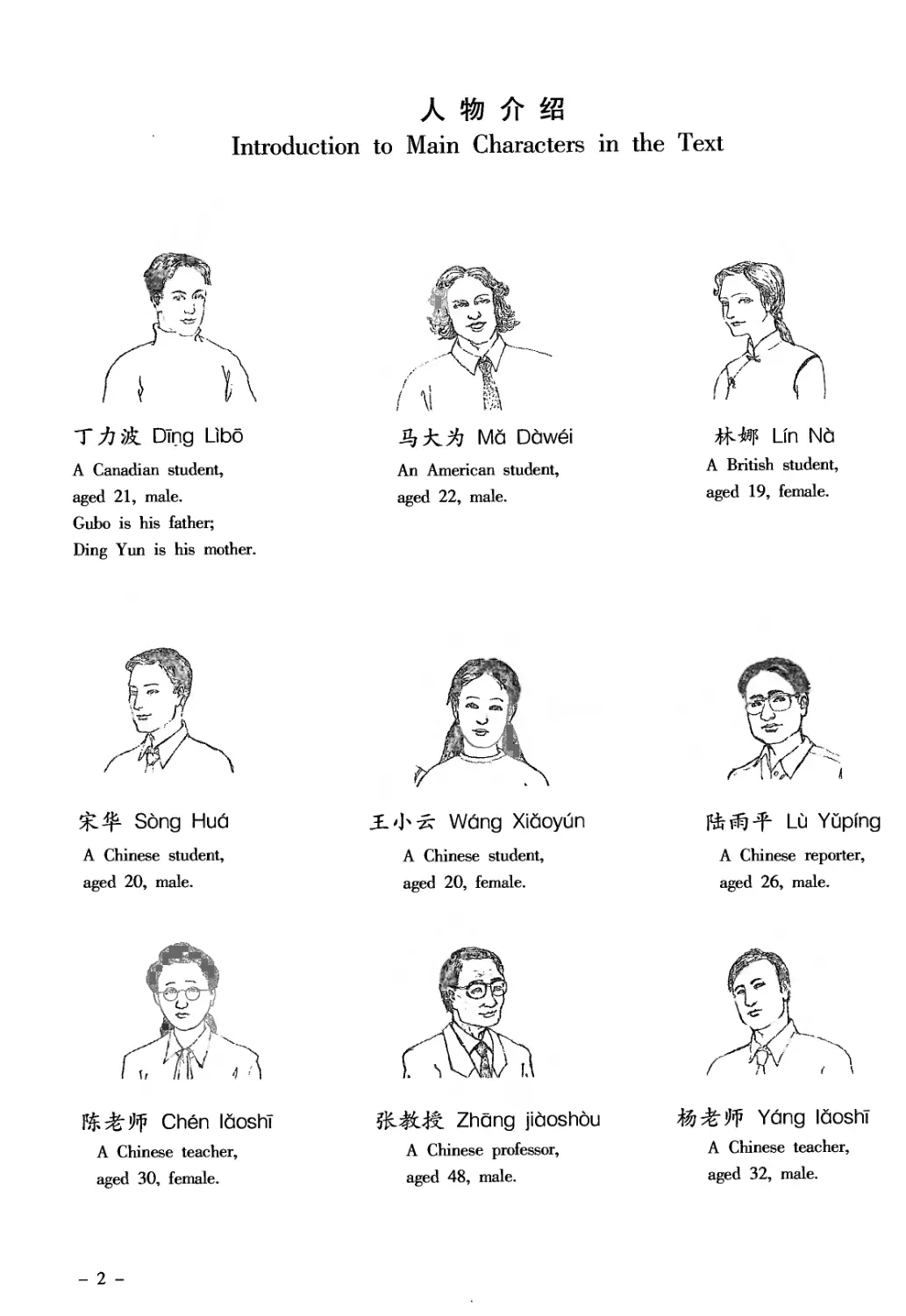
Introduction to Main Characters in the Text
~T il$L Ding Libo
A Canadian student,
aged 21, male.
Gubo is his father;
Ding Yun is his mother.
2? 3^% Md Ddwei
An American student,
aged 22, male.
fr$]$ Lin Nd
A British student,
aged 19, female.
£#■ Song Hud
A Chinese student,
aged 20, male.
i'h-s- Wdng Xidoyun
A Chinese student,
aged 20, female.
H^f Lu Yuping
A Chinese reporter,
aged 26, male.
%-%fy Chen IdoshT
A Chinese teacher,
aged 30, female.
%-%d&L Zhang jidoshou
A Chinese professor,
aged 48, male.
IfojtW Ydng Idoshi
A Chinese teacher,
aged 32, male.
- 2 -
This lesson begins by introducing some sounds unique !
i
! to the Chinese language, including tones. The Chinese writ- j
ing system dates back more than four thousand years, and it j
1 is especially intriguing to see how Chinese characters devel- j
J oped since their basically pictographic origins in ancient \
• China. By the end of the lesson, you will know eleven Chi- ;
nese characters and be able to express some everyday greet- j.
ings in Chinese. j
—lH Lesson 1 )
NT hao
-■ i"X
Text
Lu Yuping: Libo, nT hao.®
Libo.-
JltiLz
Qs
NT hao, Lu Yuping.
^ #, fa ifo
"rr,;
- 3 -
jLL- »=l New Words
l. n!
2. hdo
3. Lu Yupfng
4. Libo
Pr
A
PN
PN
*
*f
fam-f
^Sfc
you
good; well; fine; O.K.
(name of a Chinese reporter)
(name of a Canadian student)
Libo: Lin Nd, nT hdo ma? (
Lin Nd: Wo hen hdo, nT ne?
fa *P: & 4H *f, 4fc Sfc?
Lib6: Ye hen hdo.®
- 4 -
£isl
New Words
2. WO
3. hen
4. ne
5. ye
Pr
Adv
MdPt
Adv
*
#-
*
^w
1. mO QPt *^% (interrogative particle for question expecting
yes-no answer)
I; me
very
(a modal particle used for elliptical questions)
too; also
6. LID Nd PN &■■&£ (name of a British student)
—. )3E# Notes
® NT hoo.
"Hello!", "How do you do?"
This is the most common form of greeting in Chinese. It can be used at any time of
day when meeting people for the first time or for people you already know. The response to
this greeting form is also "{^j\£F'("NT hao").
(D NT hao ma?
"How are you?"
This is also a form of greeting, often used after you have not seen someone for some
time, and the response is usually "^^S^f'C'Wo hen hao") or other similar formulae.
IT ne?
"And (how are) you?"
(4) Ye hen hao.
"(I am) fine (literally, very good), too."
This is an elliptical sentence, with the subject "^"(w6) omitted. In spoken Chinese,
when the context is explicit and there is no ambiguity, the subject is often omitted. One
may also say "®£F("Hen hao") to answer the question "{W^? "("NT hao ma? ").
:zi- iaBs/i\<J Pronunciation Drills
;f?# Initials: D p m n I h
f5# Finals: a O e i U 0
ao en ie in ing uo
^1] Students are required to master the characters of the purple new words in this lesson.
1. #W Spelling
ba
pa
md
ne
le
he
bo
po
mo
nao
lao
hao
2. \&p The four tones
a
nT
hdo
IT
bo
ITn
nd
lu
yu
pTng
wo
ye
a
ni
hao
If
bo
lin
nd
lu
yu
ping
hen
ye
a
nT
hao
IT
bo
ITn
na
lu
yu
wo
hen
ye
bT
PT
mT
nie
lie
a
nl
hao
11
bo
lin
nd
lu
yu
wd
hen
ye
bu
pu
mu
luo
hud
bin bmg
pTn pTng
nT hdo
Libd
Lin Nd
Lu Yuping
wo hen hdo
ye hen hdo
3. m^ Sound discrimination
bd pd nu nu wu hu
(eight) (female) (five) (tiger)
bTng bTn pie bie hud wo
(ice) (left-falling strokes) (fire) (I)
4. ffiffl Tone discrimination
md md mu mu yT yi
(horse) (mom) (wood) (one)
ye ye li IT men men
(also) (night) (strength) (in) (door)
- 6 -
5. m^^i^ Third-tone sandhi
nT hao hen hao ye hao ye hen hao
6. ll^l~F^!j^^ffil^ Read the following classroom expressions aloud
NT hao.
NTmen hao.
|~Q. ^ifj£j^>) Conversation Practice
..........................................
: KEY SENTENCES :
: 1. NT hao. i
* ■
: 2. NT hao ma? \
i 3. Wo hen hao, nT ne? :
■ B
: 4. Ye hen hao. '
ft a ft * it ■ »-■*"■ > » » ■ i
■ ■ ■ ■ -ft ■ ■
[-) [FTfflff Saying hello]
1- ^J^Tv^'J^ilS Complete the following dialogue
Lin Nd: Libo, nT hao!
Llb6:
\^A
if? Make a dialogue based on the picture
(1) A:
B;
(2) A:
B;
( — ) [fnjfjl Greetings]
1- ^^T^^O^iS" Complete the following dialogue
Ma LI: NT hao ma?
LuYi: , ?
Ma LI: Wo ye hen hao. '
2. fifipc^rif!i' Situational dialogue
You run into a Chinese friend whom you haven't seen for a long time. What will you
say to him/her?
(H) RJfjiS Listen and repeat
"FT. ioi=r Phonetics
1. ^#fn^J# Initials and finals
A syllable in the common speech of modern Chinese usually consists of an initial, which
is a consonant that begins the syllable, and a final, which constitutes the rest of the syllable.
For example, in the syllable "ping", "p" is the initial and "ing" is the final. A syllable
can stand without an initial, such as "y&", but all syllables must have a final. In the
common speech of modern Chinese, there are altogether 21 initials and 38 finals.
2. 2t#l?$l Pronunciation key
Initials: m, n, I, h are pronounced similarly to their counterparts in the English language,
b like "p" in "speak" (unaspirated, voiceless)
p like "p" in "park" (aspirated, voiceless)
Note: Particular attention should be paid to the pronunciation of the aspirated
and unaspirated consonants: b-p.
Finals; 6 like "e" in "her"
IG like ye in yes
-ng (final) a nasalised sound like the "ng" in "bang" without pronouncing the "g"
Note; The pronunciation of the "e" in a compound final is different from that
of the simple final "e".
- 8 -
3. J^ffl Tones
Chinese is a tonal language in which the tones convey differences in meaning.
A(ba) #t(bd) $B(bd) ^(bd)
In common speech there are four basic tones, represented respectively by the following
*3ne marks:
for the first tone,
for the second tone,
for the third tone, and
for the fourth tone.
When a syllable contains only a single vowel, the tone mark is placed directly above
lie vowel letter as in "10" and "hen". The dot over the vowel "i" should be dropped if
ie tone mark is placed above it, as in "nT", "nfn" and "pfng". When the final of the
syllable is composed of two or more vowels, the tone mark should be placed above the
awel pronounced with the mouth widest open (e.g. hao).
The openness of the mouth for the vowels, from widest to smallest is as follows:
Q O e i u o
4 HJ^i^l Third-tone sandhi
A third tone, when immediately followed by another third tone, should be pronounced
z: the second tone, but with the tone mark "~" remaining unchanged. For example:'
nT hdo —► ni hdo Wo hen hdo. -* Wo hen hdo.
hen hdo -» hen hdo Ye hen hdo. —► Ye hen hdo.
: #f^MI Spelling rules
At the beginning of a syllable, "i" is written as "y" (e.g. iG ► ye), "i" is written
£* "yi" when it forms a syllable all by itself (e.g. T ► yT).
At the beginning of a syllable, "u" is written as "w" (e.g. UO —► WO), "u" is written
_> "wu" when it forms a syllable all by itself (e.g. U ► wu).
When "Q" is at the beginning of a syllable or forms a syllable by itself, a "y" is added
it and the two dots over it are omitted (e.g. U ► yu).
- 9 -
/Y i§3; Grammar
tXilfrlHlil^ Word order in Chinese sentences
The main characteristic of Chinese grammar is that it lacks of morphological changes in
person, tense, gender, number, and case in the strict sense. The word order, however, is
very important to convey different grammatical meanings. The subject of a sentence is usually
placed before the predicate. For example;
Subject
NT
Wo
Libo
Predicate
hao.
hen hao.
ifc ft. Mo
ye hen hao.
"fc. /J?.-?- Chinese Characters
Chinese characters originated from pictures. The history of their formation is very long,
dating back to remote antiquity. Present-day Chinese characters, which evolved from ancient
Chinese characters, are square-shaped. Here are some examples illustrating their long
evolution;
Picture
Oracle Bone
Inscription
»
Small Seal
Character
»
Official
Script
•
Complex
Character
in Regular
Script
tx5j
Simplified
Character
in Regular
Script
2,
-10-
1- St^lfcfc^ilHl Basic strokes of Chinese characters
Chinese characters are written by combining various kinds of "strokes". These strokes
can be divided into "basic" strokes and "combined" strokes.
Basic strokes of Chinese characters
stroke
• » \
' —■ —►
1 I
J /
i v^
^ /
Name
dicin
heng
shu
pie
nd
ti
Example
n
—
*
J]
yV
$K
Way to Write
The dot is written from top to bottom-right, as in
the first stroke of "H"-
The horizontal stroke is written from left to right.
The vertical stroke is written from top downward to
bottom, as in the second stroke of ";fc".
The downward-left stroke is written from top to
bottom-left, as in the second stroke of "jj".
The downward-right stroke is written from top to
bottom-right, as in the second stroke of "A.".
The upward stroke is written from bottom-left to
top-right, as in the fourth stroke of "fie".
2. ikM3&$$L^ Learn and write basic Chinese characters
(1)
y'
one
1 stroke
(2) yV / yV
bO eight 2 strokes
**
rx
(3) ft
li
7 ft
strength
2 strokes
<4) n en) ' r n
men door 3 strokes
■r~- "i
'f.
"I
(5) -&
yi Jv $i>
ye too; also
3 strokes
11
(6)-2f(«) n *!%
ma horse 3 strokes
' Note; ",%" is written as "4 " on the left side of a character.
rMr'M
a1' #
'm
(?) -k k k-k
nu female 3 strokes ^.-^
Note* "-£r" is written as "$ " on the left side of a character.
(8) JEL r^i
WU five 4 strokes
(9) ^ ^ f Jf JfL
mu wood 4 strokes
Notes *'^v" is written as "| " on the left side of a character.
;^
&w
do) ^L * ^ f ^ X W
hU0 fire 4 strokes «/^ ^ %
'Note; U$C' is written as "'«*" at the bottom of a character,
3. i^2fiSyttf,(&$X.^ Learn and write the Chinese characters appearing in the
texts
fo lin nM ##
^ —► % + ^ ^^ A*
^fcftK/R Cultural Notes
The Chinese Language (Hanyu) and "Common Speech" (Putonghua)
Scholars think Chinese writing originated almost four thousand years ago and that the
spoken language goes back to remote antiquity, making it one of the world's oldest languages.
In spite of its great age, Chinese is now one of the most widely used living languages. The
language is spoken in many dialects within China, as well as in many overseas Chinese
communities, especially in Southeast Asia, Europe, and the Americas. And there are more than
a billion native speakers of Chinese worldwide. It is one of the languages the United Nations
uses when conducting official business.
-12-
Chinese belongs to the Sino-Tibetan language family. Hanyu, literally "language of the
Han", refers to the standard Chinese language, and is spoken by the Han, Hui, Manchu,
and other ethnic groups that constitute 94% of the population of China. There are fifty-six
recognized ethnic groups in China, using as many as eighty different languages.
Chinese includes variants from seven main dialect groups. The northern or Mandarin
dialect covers three fourths of China's territory and includes two thirds of its population.
Standard Chinese is also known by its official designation, Putonghua, literally "common speech".
Putonghua is based on the northern dialect,using the dialect of Beijing as the basis for its
pronunciation and modern vernacular literature for its grammatical structure. This is the
Chinese that is taught in this textbook.
-13-
Have you ever wanted to say hello in i
Chinese to your friends? By the end of this j
lesson, you will be able to greet others and I
express your needs. i
NT mdng ma
# 'It V%
- i=X
Text
o>
Lin Nd: Lu Yuping, nT hao ma?
#■ *P: l& i^-f", ^ *? p3?
Lu Yuping: Wo hen hao. NT bdbaA mama hao ma?®
Lin Nd: Tamen dou hen hao.® NT mdng ma?
Lu Yuping: Wo bu mdng.
Lin Nd:
Ta hen mdng.
ndn pengyou ne?
-14
£t3 New
i. mdng
*2. ma
3. bdba
4. mama
5. tamen
ta
men
6. dou
7. bu
8. ndn
9. pengyoL
Words
A
QPt
N
N
Pr
Pr
Suf
Adv
Adv
A
J N
fc
*%
^~^
^
4Mi
%
in
#
*
^
m&
*io. ne MdPt
busy
(a particle used for questions expecting a
yes-no answer)llJ
dad
mom
they; them
he; him
(used after pronouns ^,^,ffe or certain
nouns to denote plural)
both; all
not; no
male
friend
(a modal particle used for elliptical questions)
Ding Libo: Gege, nT ydo kafei ma? ®
T ^i£: -IMP, #> 4h ^# p-%?
Gege: Wo ydo kafei.
Didi: Wo ye ydo kafei. ®
f #: ^ ^L £r ##o
DTng LibO; Hao, women dou he kafei.
iR§§] Asking
what someone wants!
^
ih
\V ? ■■ ■ 1 T
, —
vr-rr/z
[1] Words marked by an asterisk have appeared in previous lessons.
-15-
£i^I
l. gege
2, ydo
3. kafei
4. didi
5. wdmer
6. he
7. DTng
New Words
N
V
N
N
) Pr
V
PN
-if-lp
*
##
4wn
*%
T
elder brother
to want
coffee
younger brother
we; us
to drink
(a surname)
Z. )iS Notes
® NT bdba, mama hdo ma?
"How are your mom and dad?
nT bdba your dad, nT mama your mom,
nT ndn pengyou your boyfriend.
(D Tamen dou hen hdo.
"They are both fine (literally, very good)."
(3) NT ydo kafei ma?
"Do you want coffee?
"^^•••^? "("NT ydo ••• ma? ") is a sentence pattern commonly used when asking
what others want, whereas "=$g5c"""("W6 yQO •••") is used to express what "I want".
(§) Wo ye ydo kafei.
"I want coffee, too."
(5) Women dou he kafei.
"We all drink coffee."
—• 1/dbI|kS ' Pronunciation Drills
^# Initials: d t g k f
tW Finals: ei ou an ang eng iao iou(-iu)
l. #*
de
te
ge
ke
-16-
Spelling
dou
tou
gou
kou
dan
tan
gan
kan
dang
tang
gang
kang
bei
pei
fei
hei
ban
pan
fan
nan
beng
peng
feng
heng
|Z9^ The four tones
ta
men
wo
ni
nan
peng
you
bO
ge
dl
he
ka
fei
men
ni
nan
peng
you
bu
mdng
ge
di
he
fei
ta
wo
ni
nan
peng
you
bu
mcing
ge
dl
ka
fei
biao
piao
diO
niO
td
men
wd
ni
nan
peng
you
bu
ge
di
he
fei
tamen
women
nTmen
nan pengyou
bu mdng
gege
didi
he kafei
3. |$W Sound discrimination
dd td ke —
(big) (may)
dou duo gen —
(all) (many) (to follow)
ge
geng
kdu -
(mouth)
ding -
(nail)
- gou
(dog)
- ting
(to listen)
4. ffiffl Tone discrimination
dao ddo „ tu tu
(knife) (soil)
ni ni liu liu
(Buddhist nun)
(six)
you you
(again) (to have)
kdn kdn
(to see)
-17-
5. $£^ Neutral tone
bdba mama
nimen
hdo ma?
women
NT ne?
gege didi
tdmen
NT nan pengyou ne?
6. JRWHifjj|m Practice on disyllabic words
yTnlidO (drinks) yeye (grandpa)
kele (coke) meimei (younger sister)
hdnbdO (hamburger) fdyfn (pronunciation)
pinggUO (apple) heibdn (blackboard)
7. II^IT^!lW^M^ Read the following classroom expressions aloud
TTng wo fayTn. (Listen to my pronunciation.)
Kdn heibdn. (Look at the blackboard.)
eg. &sms
Conversation Practice
f * *- ■ a ■ * i
i m * ■ m m- >
KEY SENTENCES
1. Tdmen dou hen hdo.
2. NT mdng mo?
3. Wo bO mdng.
4. NT ydo kafei ma?
5. Wo ydo kafei.
6. Women dou he kafei.
* ■ -• ■ a » i
• ■■•■■ ■■- ■■ i
t■ -■" -■"«• ii ■ a ■-■
(-) [IqHEflJA Greetings]
^JjSjT^'JzHf'J Complete the following dialogues
(1) A: Dd Lin, nT mdng ma?
B
A
(2) A
B
A
ne?
bdba mama hdo ma?
. NT gege ne?
-18-
(3) A:
B:
A:
didi hdo ma?
. NT
ne?
{ ) [fnJilil Asking what someone wants]
1- ^J^T^'J'IHS' Complete the following dialogues
(1) A:
B:
A:
C:
(2) A:
B:
A:
C:
Nin ydo kafei ma?
Wo ydo kafei.
NT ne?
NT ydo m
NT ne?
2. ^f"HE|^ici]§ Make a dialogue based on the picture
(1) A: ?
B:
(2) A:
B:
) R/fi£ Listen and repeat
-19
£• iai=r Phonetics
1. %&P Neutral tone
In the common speech of modern Chinese, there are a number of syllables which are
unstressed and are pronounced in a "weak" tone. This is known as the neutral tone and is
indicated by the absence of a tone mark. For example:
"-% ma vJh ne iU men
2. $HfS£$( Pronunciation key
Initials: f is pronounced similarly to its counterpart in the English language
d like "t" in "stay" (unaspirated)
t like "t" in "tag" (aspirated)
g a soft unaspirated "k" sound
k like "k" in "kangaroo" (aspirated)
Note; Particular attention should be paid to the pronunciation of the aspirated and
unaspirated consonants: d-t, g-k.
Finals: ei like "ay" in "play" (light)
OU like o in so
an like "an" in "can" (without stressing the "n")
3. W^MWl Spelling rules
The compound final "iou" is written as "-ill" when it comes after an initial and the
tone mark is placed on "u". For example; liu (six).
A- il§)£ Grammar
1* J&^tfflMWi^} Sentences with an adjectival predicate
Subject
NT
ffe
Td
Wo
Tdmen
Predicate
0o
hdo.
m Co
heYi mdng.
>F 'Ito
bu mdng.
U ft. Mo
dou hen hdo.
-20-
Adjectives in Chinese can function directly as predicates. This kind of sentence is
called a sentence with an adjectival predicate. Adjectives in this kind of sentence can be
modified by adverbs such as "ffi", "til", and "itP". The negative form of sentences with an
adjectival predicate is generated by placing the negative adverb "^" before the adjective that
functions as the predicate. For example: "$c>f>'|t".
Note: Adverbs such as "^S", "til", and "lift" must be placed before the adjective they
modify.
2. %"m"tt%im*} "Yes-no" question with "«$"
A declarative sentence can be changed into a "yes-no" question by adding the question
particle "ffi^" at the end of it.
Statement
Question
NT hdo.
NT hao ma?
Ta baba mama dou hao.
Ta baba mama dou hao ma?
Ta mdng.
Ta mdng ma?
NT ydo kafei.
NT ydo kafei ma?
t- /)£-$- Chinese Charaeters
1. iMfli^St^ Learn and write basic Chinese characters
(i) T -T
ding nail
2 strokes
(2) 77 ~777
dQo knife 2 strokes
Note: "71" is written as " 'J " on the right side of a character.
O) 3L
7 X
you again 2 strokes
Note; "5C" was originally a pictograph of "the right hand'
(4) ^
dd
-J-&
big
3 strokes
r
0
(H
21
(5) n
kou
(6) i
] n n
mouth
3 strokes
- +i
tu earth 3 strokes
Note* "JLW is written as "i " on the left side of a character.
*v^Sj$&3i$Ps?i"
(7) 7T
liu
^ ^ ^ ^
S >*\
SIX
4 strokes
<s^>st>^P<
.ex
(8) ^
T^yf-
bu no, not
4 strokes
1
(9) til ~* * f p jl
nf Buddhist nun 5 strokes
(10) "^" i tt p "pj"
ke can, may
5 strokes
2. ■R^iSUt'FfiSfCt^ Learn and write the Chinese characters appearing in the
texts
(1) *% ma («£)
*% —► n + ^
("cr" denotes the meaning of speaking, "3j" denotes the pronunciation)
(2) % ne
* —► n + j&
("cr" denotes the meaning of speaking, ",/iL" denotes the pronunciation)
(3) MM mama (i%M)
("•A " denotes the meaning of woman, "M," denotes the pronunciation)
(4) -f-f gege
t?i_ v *»r
+ T
■22-
XftjfcDiR Cultural Notes
Chinese Characters and Simplified Script
The Chinese script is the only logographic writing system still in daily use in the world
today. Unlike the alphabetic systems used by most languages, Chinese script is made up of
characters, the majority of which are "pictophonetic". Most consist of one component
indicating the sound of the character, the phonetic, combined with one semantic component, the
signific or radical, which shows the category of meaning to which the character belongs.
Chinese characters represent monosyllables, and generally each character represents a
single morpheme. The total number of Chinese characters is estimated at over fifty thousand,
of which only five to eight thousand are frequently used, while three thousand are normally
adequate for everyday situations.
A considerable number of Chinese characters are composed of numerous strokes and are
therefore complicated to write. With a view to facilitating writing, modern scholars have made
continuous attempts to simplify the writing system. The object of these language reforms has
been twofold: to reduce the number of characters by eliminating complex variants, and to
reduce the number of strokes in certain characters. What are known as "simplified characters"
refer to graphs that have been thus altered; traditional characters, on the other hand, are
those that retain their earlier forms.
The use of simplified characters is now official policy in the People's Republic of China,
while traditional characters are restricted mainly to academic use or aesthetic purposes.
Simplified characters have the advantages of being easier to learn, memorize, read and write.
Here are two examples:
$k mother (simplified) ~i% mother (traditional)
J'! door (simplified) Pi door (traditional)
Simplified characters are used in this textbook, but traditional characters are also supplied
for the convenience of the reader.
-23-
ff
Now, would you like to use Chinese to learn more
about the people you meet? This lesson will show you how
to ask a person's occupation and nationality, as well as
introduce friends, family and others. In addition, we will
create compound words from basic words.
*wr«
zzlll Lesson 3 1
Ta shi na guo ren
m %.
i"X
Text
Gege: Libo, nd shi shei?
DTng LibO: Nd shi women IdoshT.
T ^&: *£ A. ^H %no
Gege: Td shi nd guo ren? ®
ifc A "^ HI A?
o?
Ding LibO: Ta shi Zhongguo ren. ® Women laoshi dou shi Zhongguo
Mj^
^^pa^il rips
I..' I
yd
! 11
J3-2U
■24-
i, ta
2. Sh!
3. no
4. guo
5. ren
6. nd
7. shei
8. laoshT
*9. dou
4=1 New Words
Pr
V
QPr
N
N
Pr
QPr
N
Adv
io. Zhongguo pn *p gj
she; her
to be
which
country, nation
people, person
that
who; whom
teacher
both; all
China
Ding LibO:
Chen laoshT, nin hdo! ® Zhe shi wo gege, ® ta shi wdiyu
i* %n, m m it a & -f-f-, & a *n&
Chen Idoshi;
DTng Libo:
T ^&:
Chen laoshT:
Pengyou:
Chen laoshT:
DTng Libo:
T j]>A:
Chen IdoshT;
1* &$$:
Idoshi.
NT hdo.
ft ^o
Zhe shi wo pengyou.
it A A M&o
\ r
NT hdo! NT ye shi IdoshT ma?
ft m ft & a %n p-%?
Nin hdo! Wo bu shi IdoshT, wo shi yTsheng.
M m A ^ A %n, & A &!ko
Libo, zhe shi nT ndinai ma?
J#i£,i* A ft^ty "-%?
Bu shi, ta shi wo wdipo. ®
* A, d& A & *Mto
Wdipo, nin hdo!
-25-
#,
*>£?
i£
&
£h?§-
#
EJi
^5^5
^*
I*
you (polite form)
this
she; her
foreign language
you
doctor; physician
grandmother on the father's side
grandmother on the mother's side
(a surname)
Z. )i# Notes
(D Ta shl na gu6 r6n?
"What's her nationality?
There are two Chinese characters for the third person singular "ta": one is "ftfe", used
for a male; the other "M", refers to a female.
(D Ta shl Zh6nggu6 r6n.
"She is a Chinese."
To indicate the nationality of an individual, the character "A"(fen) is usually placed
after the name of his/her country of origin. For example:
■fllKZhongguo) ^IIIA(Zhonggu6 ren)
(D Ch6n laoshT, nfn hflo!
In China, a person's position or occupation, such as the director of a factory, manager,
section head, engineer, movie director, or teacher, is frequently used as a title to address
him/her in preference to such expressions as Mr. or Miss. Surnames always precede the
titles. It is considered impolite for a student to address a teacher directly by his/her personal
name. "Surname + teacher" is the most proper form of address frequently used for a
teacher, eg., "Chen laoshT($^iJijj)".
"nfn(^)" is the polite form of "ifo", commonly used to refer to an elderly or a senior
person during a conversation or to a person of the same generation when speaking on a
formal occasion. People in Beijing are quite fond of using this form of address.
-26-
JlU *=1 New Words
L
2.
*3.
4.
*5.
6.
%
8.
9.
nin
zhe
ta
wdiyu
nl
yTsheng
nainai
wdipo
Chen
Pr
Pr
Pr
N
Pr
N
N
N
pin
(D Zhe shi w6 gege.
"This is my elder brother."
When introducing someone to a person, we often use the sentence pattern
("zhe Shi---"), "^"(shi) is pronounced as a weak syllable.
"&&•
Lib©, zh& shi nT nainai ma?
Bu shi, ta shi w6 waip6.
The Chinese language uses many words for referring to individuals in a family so that
their specific relationship to other members of the family is made clear. Different words are
used depending on whether a relative is on the mother's or wife's side or on the father's or
husband's side. Some examples are "yGye" and "nciinai" used by a child to address the
parents of his/her father, differentiated from "wdigong" and "wdipo" used to address his/
her mother's parents.
ToB
Pronunciation Drills
1. &% Spelling
j^# Initials: Zh Ch Sh X
IW Finals: -1 [\]
ai uai ong
zha
zhT
zhe
zhai
zhou
zhuo
zhuai
zhong
cha
chT
che
chai
chou
chuo
chuai
chong
sha
shT
she
shai
shou
shuo
shuai
rT
reng
rang
2. VMP The four tones
cha chd cha chd
ru ru ru
zhe zhe zhe zhe
shT shi shT shi
zhe shi
-27-
Ido
chen
wdi
yu
yr
sheng
zhong
guo
Ido
chen
yu
yi
sheng
guo
ren
Ido
chen
wdi
yu
yi
sheng
zhong
guo
ren
Ido
chen
wdi
yu
yi
sheng
zhong
guo
ren
Idoshi
Chen IdoshT
wdiyu
yTsheng
Zhongguo
Zhongguo ren
3. I^W Sound discrimination
zhong chong sheng
(middle) (to be born)
bi pi dong
(dagger) (to understand)
4. ffiffl Tone discrimination
shdng
tdng
n —
(sun)
rdu —
(meat)
re
(hot)
rud
5.
6.
shi
(ten)
pdi
shT zhe
zhe
(arrow) (person; thing) (this)
pdi cheng
(city)
^H/^ Half third tone
IdoshT
wd gege
nT wdipo
hdo ma
nT ydo
ndinai
wd pengyou
nT bdba
nT mdng
wd ydo
PM^/a Combination of tones
«"» , «M»
kdfei
it™"i_" f " «™
cheng
women
wd ndinai
nd guo ren
hen mdng
ye ydo
'jf « V "
Zhongguo heibdn
ren —
(person)
zhudi —
nTmen
kele
tt— JJ , « \ 99
shengdido
(tone)
- ren
— zhudi
Wn.u 0 w(1]
tdmen
[1] " " here represents the neutral tone.
-28-
yisheng he chd
(to drink tea)
shentT
(body)
chifdn
zhidao
(to eat a meal) (to know)
s »j , «■">»
it S jy a S »
/ V* . It \j » tt / 9> , if \ J9 it S 99 it0 19
+ + +
tushu chdngchdng niundi Null pengyou
(books) (often) (milk) (fluent)
chenggong yinhdng pinggud chiddo yeye
(success) (bank) (apple) (late)
7. ;$MF^Je£f£r Practice on disyllabic words
gongren (worker)
Shdngren (merchant)
lUShT (lawyer)
gdnbll (cadre)
Chdngzhdng (factory manager)
ndngmin (peasant)
YTnggud (England, UK)
DegUO (Germany)
MeigUO (America)
FdgUO (France)
EgUO (Russia)
Rlben (Japan)
8. M^IT^J^I^^^ Read the following classroom expressions aloud
Dd kai shu.
Gen wo nidn.
NTmen nidn.
Dong bu ddng?
Dong le.
Bu ddng.
(Open the book.)
(Read after me.)
(Read out.)
(Do you understand? )
(Yes, I/we understand.)
(No, I/we don't understand.)
Conversation Practice
KEY SENTENCES
1. Nd shi shei?
2. Nd shi women IdoshT.
3. To shi nd guo ren?
4. Td shi Zhongguo ren.
5. Zhe shi wd pengyou.
6. NT ye shi IdoshT ma?
7. Wd bu shi IdoshT, wd shi yTsheng.
( —) [iAJSA Identifying people]
^HEIzHS Make a dialogue based on the picture
(1) A: Nd sh) shei?
B- Nd sh)
ft
1 SG^jr
a \
(2) A: Td sh) shei?
B- Td sh)
(Z.) [|R]|I]ti Asking someone's nationality]
1- ^J^cT^'JzHHJ Complete the following dialogues
(1) A: Nin sh) nd guo ren?
B: .
A: Td ne?
B:
(2) A: Nin shi YTngguo ren ma?
B: Bu sh),
A- .
Nin sh) nd guo ren?
-30-
2. ^HE^rilS" Make a dialogue based on the picture
■K
**J ■ f
*P
1 Ur
i
m.
H~£
-"?iv-\
A: Ta shi na guo ren?
B:
H) [/MS Introducing people]
1- TtfiSCf^i^T^i Complete the following dialogues
(1) A: Zhe shi Lin yTsheng. Zhe shi Chen ISoshT.
B: .
C: Nin hao, Lin yTsheng.
(2) A
B
C
Zhe shi
. Zhe shi
2. fjfiflzHlS' Situational dialogue
Introduce your teacher and classmates.
P3 ) Pjf T&. Listen and repeat
-31-
£• iaQ Phonetics
1. H^3£iH Third-tone sandhi
A third tone, when followed by a first, second or fourth tone, or most neutral tone
syllables, usually becomes a half third tone, that is, a tone that only falls but does not rise.
The tone mark is unchanged. For example:
nT gege wo yao
nT mting ma?
2. "*"ft£iE Tone sandhi of "*"
u~7f>" is a fourth tone syllable by itself. But it becomes a second tone when followed by a
fourth tone. For example:
bu he bu mang bu hao
bu shi bu ydo
3. ^^^€5 Pronunciation key
Initials: zh like "j" in "jerk", but with the tip of the tongue curled farther back,
unaspirated.
Ch like "ch" in "church", but with the tip of the tongue curled farther
back, aspirated.
sh like "sh" in "ship", but with the tip of the tongue curled farther back.
r as in "right" in English, but with lips unrounded, and the tip of the
tongue curled farther back. Always pronounce the Chinese /r/ sound
with a nice smile! ©
Finals: di like "y" in "sky" (light)
-i [lJ ""i Li]" in "Zhi", "Chi", "shi" and "ri" is pronounced differently
from the simple final "i [i]". After pronouncing the initials "zh",
"ch", "sh" and "r", the tongue does not move. Care must be taken not
to pronounce the simple final "i [i]", which is never found after "zh",
ch , sh or r .
J\- /S.-31 Chinese Characters
1* \kM$&$$L¥ Learn and write basic Chinese characters
a) A. /A
ren people, person 2 strokes
Note: On the left side of a character, "A." is written as " -f ".
-32-
(2) -+■
■ +
Shi ten
(3) b ^ b
bT dagger
(4) ^ l r-rx^^
Zhong middle
(5) g
ri sun
i n fi ei
(6) moo i n jn jd
bei shell
2 strokes
2 strokes
4 strokes
4 strokes
/
£3
f£±^
4 strokes
(7) 3. " * li
yd jade 5 strokes
Note- On the left side of a character, "3x" is written as "? '\
(8) ^
//-/-.
^£
ShT arrow
5 strokes
(9)
±
/ /- >!r
t^4
Sheng to be born; suffix denoting person 5 strokes
(10)
#
- + .±-
^X-%%% C*+B)
ZhG person; thing
8 strokes
S?-
t
^
&-
2. iUfil|Ut4,Bir]&$t!tf^ Learn and write the Chinese characters appearing
in the texts
(l) d& ta
* —► i + ^L
(The "female" side, "-k ", denotes something related to a woman.)
33-
(2) *& ta
\& —* \ + ^L
(The "standing person" side, " \ ", denotes something related to a person.)
(3) >fn men (4ft)
*n -m + n
(The meaning side is " \ ", and the phonetic side is "H".)
(4) # nT
# -► >f + #
( fc : ' ^ 1* ^ fc 5 strokes)
(The "standing person" side " \ " denotes something related to a person.)
P (yOU'erduo) (the "right-ear" side) T F 2 strokes
7? (ndzlpang) (the "that" side) 1 ^ H fl 4 strokes
(5) *p nci
#p -> % + p
(6) <*? na
$p -> a + up
(The meaning side is "xj", and the phonetic side is "#p".)
(7) *p nd
#1$ -> i + #p
(The meaning side is "$ ", and the phonetic side is "$[S".)
(8) if dOU
4?
# + P
^" (laozitou) (the "old" top) " + J^^u
*y (jTnzir) (the "towel" character) ' >~7 rJ7
y (shTzipang) (the "teacher" side) ' jj
-34-
4 strokes
3 strokes
2 strokes
(9) 5&jnp laoshT (^-^)
* -> ^ + fc
tf
£&
w
ft
1—| (gu6z]kudng)(The "country" frame, "P", denotes the boundary of a country.)
I |J I—I 3 strokes
(10) t@I Zhongguo (tSI)
L_ (yiZlkudng) (the "doctor" frame) " [1
(li) E*L yTsheng (-£■£.)
—► C + *
. (E: ' *" * s * £E
2 strokes
7 strokes)
.^(pTzldT) (the "foot" bottom) t -f yp y£_
5 strokes
(12) 4. Shi
a + ^
Cultural Notes
Scheme for the Chinese Phonetic Alphabet
Chinese differs from alphabetic languages in that its written form is not directly related
to its pronunciation. In order to provide phonetic notation for Chinese characters and to
facilitate the consultation of dictionaries, phonologists drafted the "Scheme for the Chinese
Phonetic Alphabet", and in 1958 the Chinese government passed an act to promote the
application of this scheme, commonly known as the pinyin ("arranged sounds") system. Pinyin
adopts the Latin alphabet to transcribe Chinese sounds, and four diacritical tone marks to
indicate the different tones of Chinese characters. Pinyin is now widely used for the study of
Chinese language, and has aided the popularization of standard Chinese (Putonghua). The
use of pinyin in the study of Chinese provides many practical advantages for learning the
language.
-35-
; In this lesson, you will learn how to ask someone's
; name politely, how to introduce yourself, and how to ask
.j for permission. The pronunciations of the Chinese initials
i introduced in this lesson are different than similar-
"j
; sounding initials found in English, and so may seem
I unfamiliar to you. Don't be discouraged, however, for with
1 daily practice you will surely be able to master them.
JJ
Silfll Lesson 4) Renshi nT hen gaoxing
Text
Laoshi: Key! jinlai ma? ®
Lin Nd: QTng jin! ® Ydng IdoshT, nin hdo. Zhe shi wo pengyou,
# ^: * m %> %n, M *fo it A *, JUIiL,
td shi jizhe.
LdoshT: QTngwen, nin guixing? ®
o>
36-
Lu Yuping: Wo xing Lu, jido Lu Yuping. ®
LdoshT: NT hdo, Lu xidnsheng, renshi nT hen gdoxing.
Lu Yuping: Ydng IdoshT, renshi nin, wo ye hen gdoxing.
f& m-f: Mo %n, iki* &, & & & &^o
jtL. »=] New Words
1. renshi
2. gdoxing
3. keyT
4. jlnlai
jin
Idi
5. qTng
*6. nin
*7. pengyou
8, jizhe
9. qTngwen
wen
io. guixing
xing
li. jido
12. xidnsheng
V
A
OpV
vc
V
V
V
Pr
N
N
V
V
IE
V/N
V
N
iXi%
T^
it*
it
*
*
&
MA
■Mr
#j-i
i-i
3Ni
*fc
ml
*£
13. Ydng
PN
#
to know (somebody)
happy; pleased
may
to come in
to enter
to come
please
you (polite form)
friend
reporter
May I ask...?
to ask
what's your honorable surname?
one's surname is •••/surname
to be called
Mr.
(a surname)
Lin Nd:
Wo shi Yuydn Xueyudn de xuesheng. ® Wo xing Lin,
jido Lin Nd. Wo shi YTngguo ren. NT xlng shenme? ®
•37-
Ma Dawei:
Lin Na:
Ma Ddwei;
W6 xing Md, jido Ma Ddwei.
NT shi Jianddd ren ma?
Wo bu shi Jianddd ren, wo shi Meiguo ren, ye shi
& X &. >M^ A, * 4: *H A, ^ £
Yuydn Xueyudn de xuesheng. Wo xuexi Hdnyu.
/+- ^=1 New Words
l. yuydn
2. xueyudn
3. de
4, xuesheng
5, shenme
6. xuexi
7. Hdnyti
8. YTngguo
9. Ma Ddwei
10, Jianddd
11. Meiguo
N
N
Pt
N
QPr
V
N
PN
PN
PN
PN
%%-k
#&
#
*£
#£
#3
pU#
^©
4*Jfr
*»♦**.
*®
language
institute; college
(a possessive or modifying particle)
student
what
to leam; to study
Chinese (language)
Great Britain; England
(name of an American student)
Canada
the United States; America
-. ap
Notes
(D Key! jinlai ma?
"May I come in?
(D QTng jin!
"Come in, please!
"QTng(ijf )•••" is an expression used for making polite requests.
-38-
(3) QTngwen, nin guixing?
"May I ask what is your (honorable) surname?
This is a polite way of asking someone's surname. In China, when meeting someone for
the first time, it is considered more polite to ask his/her surname rather than his/her full
name. Notice that "guidf)" can only be used in combination with "nT(#)" or "nin(?&)",
and not with "w6($c)" or "tfl (WW-
"QTngwen(fltfBJ)" means "May I ask..." or "Excuse me, but...", and is a polite way of
asking a question.
(D W6 xing Lu, jido Lu Yuping.
"My surname is Lu, and my full name is Lu Yuping."
When answering the question "Nfn guixing? ", one can either give one's surname by
saying "W6 Xing---", or give one's full name by saying "W6 jido---" or say both "W6 Xing
••-, jiao -."
Note that in Chinese, one's surname always comes first, and the given name comes last.
(5) Renshi nT hen gdoxing.
"(I'm) glad to meet (literally, know) you."
(6) W6 shi Yuydn Xueyudn de xuesheng.
"I am a student at (literally, of) the Language Institute."
(7) NT xing shenme?
"What's your surname?
This informal way of asking someone's surname is appropriate when an adult is speaking
to a child, or when young people are talking with each other.
—■ laH§fr-3 Pronunciation Drills
^# Initials: j q X
f$# Finals: ia ian iang
uei(-ui) uen(-un) ue uan
1. &% Spelling
JT
jia
jidn
jicing
jTn
qT
qia
qian
qiang
qTn
xT
xia
xian
xicing
xTn
-39-
jmg
Ju
jue
judn
gui
zhun
qmg
qu
que
qudn
kuT
chun
xmg
xu
xue
xuan
huT
tun
2. mP The four tones
zhe
qTng
jTn
guT
xing
xicin
sheng
yu
ydn
xue
yuan
XT
nan
jia
zhe
qing
xing
xidn
sheng
yu
ydn
xue
yuan
XI
hdn
jia
zhe
qTng
■V
jin
guT
xTng
xidn
sheng
yu
ydn
xue
yuan
XI
hdn
jia
zhe
qing
jin
gui
xing
xidn
sheng
yu
ydn
xue
yuan
XI
hdn
jia
jizhe
qTng jin
guixing
xidnsheng
yuydn
xueyudn
xuexi
Hdnyu
Jidnddd
3. 3&# Sound discrimination
jiao
qiao
(to teach)
tidn ting
(field) (to stop)
yue ye
(month) (night)
ydn ydng
(speech) (sheep)
dui
tUI
(right)
zhT chT
(only) (ruler)
4. 3&ifi(! Tone discrimination
shdu shou xid -
(hand) (thin) (down)
-40-
xia
shuT -
(water)
shui
(to
xm
(heart)
xm
(letter)
bdi
(white)
bdi
xiao
(small)
xiao
(to laugh)
5. ^iSfUH.'n" Combination of tones
« V »»«""»>
IdoshT
BeijTng
(Beijing)
u \ »»«""»
Libo
midnbdo
(bread)
a V « , « / n
yuydn
luxing
(to travel)
u \ n a S n
wdipo
lidnxi
(exercise)
a V " , « V "
key!
yufd
(grammar)
u \ >» , « V »
HdnyCi
bdozhT
(newspaper)
«v™ u \ >»
qTng jin
kdoshi
(exam)
u \ >» « \ n
guixing
zhuyi
(to pay attention to)
« V " , « 0 "
women
jiejie
(elder sister)
U \ " , « o "
meimei
keqi
(courtesy)
6. ^OMf 15"j£f^ Practice on disyllabic words
tditai (Mrs) YfngyCi (English)
XidOJie (Miss) FdyD (French)
niJShl (Madam) DeyU (German)
jTnglT (manager) EyU (Russian)
tdngshl (colleague) RtyO (Japanese)
7- ©5^T^!J^I^^9^ Read the following classroom expressions aloud
Zhuyi fdyTh. (Pay attention to your pronunciation.)
Zhuyi ShengdidO. (Pay attention to your tones.)
DUI bU dUI? (Is it right? )
DUI le. (It's right.)
a. gi
Conversation Practice
a -«■■-■--■■• -a -■;■■■-«•■-■ a j
: KEY SENTENCES
: 1. KeyT jlnlai ma?
; 2. QTng jln!
: 3. Nin gulxing?
* 4. W6 xing Lu, jiao Lu Yuping.
: 5. Renshi nT hen gaoxing.
* 6. Wo shi Yuydn Xueyuan de xuesheng.
* 1. Wo xuexi Hdnyu.
(~) [iff^iti^ Asking for permission]
^Sl^iS Make a dialogue based on the picture
B:
) [f°l$i^ Asking someone's name]
TufdCFM^lfi Complete the following dialogues
(1) A: Nin gulxing?
B: Wo xlng , jido
A: Wo jido .
B:
(2) A: NT xlng shenme?
B:
(3) A: Td jido shenme?
B:
(4) A: Ta xlng shenme?
B:
_wo hen gaoxing.
-42-
(H) [g$t^>*S Introducing oneself]
WM^zzil^ Situational dialogue
Ask everyone to introduce himself/herself in a meeting by imitating Dialogue II in the
text.
(0) Wf$E Listen and repeat
~F\. lollf Phonetics
1. ^tOTIIK Pronunciation key
Initials: j is an unaspirated voiceless palatal affricate. To produce this sound, first raise
the front of the tongue to the hard palate and press the tip of the tongue
against the back of the lower teeth, and then loosen the tongue and let the air
squeeze out through the channel thus made. The sound is unaspirated and the
vocal cords do not vibrate.
q is an aspirated voiceless palatal affricate. It is produced in the same manner as
"j", but it is aspirated.
X is a voiceless palatal fricative. To produce it, first raise the front of the tongue
toward (but not touching) the hard palate and then let the air squeeze out. The
vocal cords do not vibrate.
Note:The finals that can be combined with "j", "q" and "X" are limited to "i",
"0" and compound finals that start with "j" or "Q*\
2. m^mm Spelling rules
(1) When the compound final "uei" is combined with initials, it is simplified to -ui and
the tone mark is written over "l". For example: gul.
(2) When the compound final "uen" is combined with initials, it is simplified to -un.
For example: lun.
(3) When "u" is combined with j, q and X, the two dots over it are omitted. For
example: xue. "y" is added to the compound finals which start with "u" and the two dots
over it are omitted. For example: Yuydn Xueyuan.
Note; V", "q", and "x" are never combined with "U" and "a".
-43-
7*\. i§)J Grammar
mM"^i(l) Sentences with "Ji" (1)
Subject
Ta
Ma Dawei
m
Ta
Predicate
Adv
bu
V£"
shi
shi
shi
N/NP
laoshT.
laoshT.
3*£
xuesheng
Pt
ma?
In an "A ^ B" sentence, the verb ";H" is used to connect the two parts. Its negative
form is made by putting "7f." before the verb ";!!". If the sentence is not particularly
emphatic, "fk" is read softly.
Note: The adverb "/f" must be placed before w^".
t- )J2.-?- Chinese Characters
1. %MMM Rules of stroke order
Example
-t"
A
^
XJ
n
i^
'j-
Stroke Order
- -t-
J A
■k $k
XJ XJ
r\ n
n n m
j 'j *
Rule to Write
Horizontal before vertical
Downward-left before downward-right
From left to right
From top to bottom
From outside to inside
Outside before inside before closing
Middle before two sides
-44-
2. "R^f 3£^$X.^ Learn and write basic Chinese characters
(i) -fc -^-b
qi seven
2 strokes
(2) 'h
xiao
(3) <C
J 'J >b
small, little
i *v_> *C> *C>
3 strokes
Xin heart 4 strokes
Note: On the left side of a character, "<<£" i$ written as " >\ ", as in "
&%
l\
(4) #- J 7j % 7jC
ShuT water 4 strokes
Note: On the left side of a character, "#■" is written as * j ", as in
yue moon
4 strokes
(6)
&
*•&
Shou hand 4 strokes
Note; On the left side of a character, "-f-" is written as "^
(7) & \ Xltftfl&J
tidn field
CD
5 strokes
(8) & ' < flft& (' + l=j)
bdi white 5 strokes
(9) X
ZhT only
y s\ { + y\)
5 strokes
(io) a ' = f ft a
ydn speech 7 strokes
Note; On the left side of a character, " ©"" is written as " i ", as in
3. iU^iflyt^'&JtX.^ Learn and write the Chinese characters appearing in
texts
(l) ikiz renshi (iMO
iL ~^ i + A
("i ", the meaning side plus the phonetic side, "/^".)
if.
■* i + X
(" i ", the meaning side, denotes language-related behavior.)
(2) j&f yuytin (ig-f)
-> i + i + a
«
/ (sandidnshuT)(the "three-drops-of-water" side)
(3) jsug- Hdnyu (&#•)
(4) M nin
i
+ X
% + .«
3 strokes
(yOUZltOU)(the "to have" top)
(5) M%l pengyou
m -> n + n
-/•
2 strokes
(6) #■» guixing (■$■&)
t + - + JA
'j (jidOZipdng) (the "calling" side) v *]
(7) p*j jido
*») —► a + >J
-46-
2 strokes
^(shQOZipang) (the "ladle" side) / ^*) 3 strokes
(8) ¥] de
-47-
ft How will you be able to find your way around in \
i | China? By the end of this lesson, you should be able to ;
! i ask directions, look for people, express gratitude and ;
! I '■
fi regret, and say goodbye in Chinese. Remember to keep :■
n . >
\ \ practicing your pronunciation and tones every day. j
flEiS Lesson 5
Canting zdi nar
- i=X
Text
Ma Ddwei:
QTngwen, zhe shi Wdng Xidoyun de sushe ma?
Nu xuesheng: Shi. QTng jin, qlng zud.
-k *£: Ao if it, if &o
Md Ddwei: Xiexie. Wdng Xidoyun zdi ma?1
Nu xuesheng:Td bu zdi.
-k #£: Jfe * £ o
Md Ddwei: Td zdi ndr? ©
-^ *J&: ¥l fc. P^;L?
Nu xuesheng: DuibuqT, wo bu zhldao.®
Md Ddwei: Mei gudnxi. Hdo, zdijidn.
Nu xuesheng: Zdijidn.
-k #£: #JL0
-48
, <3S'
/£- i=l New Words
l. canting
2. zdi
3. ndr
*4 qlngwen
wen
*5. zhe
6. sushe
7. nQ
*8. xuesheng
* 9. jin
lo. zud
11, xiexie
12. duibuqt
* 13, WO
14. zhTdao
15. mei guanxi
* 16. hdo
17. zdijidn
zdi
N
V
QPr
V
V
Pr
N
A
N
V
V
V
IE
Pr
V
IE
A
IE
Adv
#/f
*
$!Ul
#fl
1-1
it
^4"
-k
*£
it
^
##
$$?£&
A
frit
t8l£ %
*f
#J*L
#
dining room
to be (here,there); to be (in,on,at)
where
May I ask...?
to ask
this
dormitory
female
student
to enter
to sit
to thank
I'm sorry
I; me
to know
never mind; it doesn't matter
good; well; fine; O.K.
good-bye
again
18. Wdng Xidoyun PN jL'h^ (name of a Chinese student)
Md Ddwei: Xiaojie, qlngwen canting zdi ndr? ®
% *#: **&, *J5J $rff & *p;l?
Xiaojie: Zdi er ceng er ling si hdo.®
'H&: £ SL M: -^ O W -f 0
Md DdWei: Xiexie. <^ [atilH Expressing thanks^
-3/ *#: \% *_ rf~~
Xidojie: Buydng xie.^
CSS
M *
J^> V (_;»
^J- :!4SA,"i
t#
i 1
I1 ;7
y
1
i
i J-
i
'/,•
'■' \- /
s-yt
.-^ury
gw
_ _ .lri
49
Jiil
/jkP^X
Vv
Song Hud:
MO Ddwei:
^ *J&:
Wdng Xidoyun:
-3L 'h^-.
Ddwei
*:#,
, women zdi zher.
&4H
DuibuqT, wo
***&, A
Mei guanxi.
& :
/±_ »=] New Words
l. xidojie
2. er
3. ceng
4. ling
5. SI
6. hdo
7. buydng
8. zher
9. wdn
io, le
n. Song Hud
N
Nu
M
Nu
Nu
N
Adv
Pr
A
Pt
PN
&$o
>bJ$-
~-
>£
O
vg
-f
*#
£Ul
H&
T
*#
^ i^Jlo
Idi wan le. ®
& & To
Miss; young lady
two
story; floor
zero
four
number
need not
here
late
(modal partical/aspect partical)
(name of a Chinese student)
-50-
~. )i|f Notes
0 Wang Xiaoyun zdi ma?
"Is Wang Xiaoyun in?
(2) Ta zdi ndr?
"Where is she?
(3) DuibuqT, wo bu zhldao.
"duibuqT(Xif^F^)" is a phrase commonly used in making excuses or apologies, and
the response to it is usually "mei guanxi($U£^)".
(4) Canting zdi ndr?
"Where is the dining hall?
(D Zdi er ceng er Ifng si hdo.
"It's in No. 204 on the second floor."
In Chinese the ground floor of a building is considered to be the first floor.
(6) Buydng xie.
"Don't mention it."
This phrase is used as a response to an expression of thanks. One may also say, "Bu
xieOTif)".
(7) DuibuqT, wo Idi wdn le.
"Sorry, I am late."
zz. iaQ§K5) Pronunciation Drills
^# Initials: Z C S
HW Finals: -i [l] er
iong ua uan uang On
1- $NF Spelling
ZCI CO SCI
zT cT si
zu cu su
-51-
zuan
zuT
zun
zhuang
jiong
jun
gua
cuan
CUT
cun
chuang
qiong
qun
kud
suan
suT
sun
shuang
xiong
xun
hud
2. mp The four tones
zai
can
tTng
sT
ceng
wen
xie
jian
wan
yong
wang
yun
song
hua
cdn
ting
ceng
er
wen
xie
wdn
yong
wdng
yun
song
hud
zai
can
tTng
sT
er
wen
xie
jian
wdn
yong
wdng
yun
song
3. Wti£ Sound discrimination
zT —
(son)
qing
(blue-greer
-52-
— cT
jmg
0
qie
(and)
kud
zai
can
ting
SI
ceng
er
wen
xie
jian
wdn
yong
wdng
yun
song
hud
i
(quick)
jie
kud
zai
cdntTng
si ceng
er hdo
qTngwen
xiexie
zdijidn
Idi wdn le
buyong
Wdng Xiao]
Song Hud
jian
(to see)
huan
qian
huang
4. $i£9 Tone discrimination
si sT jTng qTng
(four) (well)
yong yong wen wen
(written language)
er
(two)
xiong
(bear)
5. ft£H$er$IJL4bt& Final "er" and retroflex ending
er (two) Zher (here)
erzi (son) ndr (there)
erdUO (ear) nar (where)
nfl'er (daughter) WCJnr (to play)
er
(son)
xiong
6. J^ffiiB/a Combination of tones
u—nu—n
canting
feijT
(plane)
kdiche
(to drive a car)
u / ji | u—n
mingtidn
(tomorrow)
shijidn
(time)
zudtidn
(yesterday)
u—ttu / n
YFnggud
shengci
(new word)
hudnying
(to welcome)
u / » « / n
xuexi
huidd
(answer)
zuqiu
(football)
a—»» « V '»
jTngIT
qidnbT
(pencil)
kdishT
(to start)
u / » u V "
yduydng
(to swim)
pijiu
(beer)
cididn
(dictionary)
7. ^tW^^^ Practice on disyllabic words
jidOShl (classroom)
ITtdng (auditorium)
COOChdng (playground)
CeSUO (toilet)
yTyudn (hospital)
Heldn (The
Aijl (Egypt)
Yuendn (v
« — J? U \ J?
gdoxing
gdngzud
(work)
shdngdidn
(shop)
u / » « \ »»
xueyudn
zdzhi
(magazine)
ciddi
(audio tape)
Netherlands )
ietnam )
TdigUO (Thailand)
YindU (India)
u—n u o "
xidnsheng
xiuxi
(rest)
qTzi
(wife)
u / n u o »
shenme
mingzi
(name)
hdizi
(child)
-53
8. ^ri^^frj&M Practice on polysyllabic words
tUShOguan (library) XTnjiQpO (Singapore)
Shiydnshl FeilubTn (the Philiphines)
bdngongshl XTnxTltin (New Zealand)
tTyuguan AoddliyCI (Australia)
WdJShlchU MdldixTyd (Malaysia)
tingchechdng YindunixTyd (Indonesia)
9. |)§^|~F^!l^l^^lM Read the following classroom expressions aloud
QTng nidn kewen. (Please read the text.)
QTng nidn ShengCI. (Please read the new words.)
W6 shuo, nTmen ting. (Listen to me.)
I~Q. ^i©S-E) Conversation Practice
( a a • a a a a a a a a a a a a a a a a a a a a a a a a a a a a a a a a a a a a a j
■ KEY SENTENCES i
• 1. QTng jin, qTng zud. \
; 2. Wo bu zhTdao. :
: 3. Zdijidn. ;
• 4. QTngwen, canting zdi ndr? *
■ 5. Xiexie. j
6. Buydng xie. :
7. DuibuqT. t
8. Mei gudnxi. \
( —) [iRlife/1^ Asking for directions]
1- tcJ^VM^I^ Complete the following dialogues
(1) A: QTngwen, cesuo zdi ndr?
B: .
A: Xiexie.
B:
-54-
(2) A; QTngwen, jidoshi zdi ndr?
B: DuibuqT,
2. fffJSzHiS' Situational dialogues
In an unfamiliar building:
(1) You are looking for the elevator (Efe^didntf).
(2) You are looking for Mr. Yang's office.
(H) [#cA Looking for someone]
1- ^J^cT^'JzsriiS' Complete the following dialogues
(1) A: QTngwen, Lin Nd zdi ma?
B:
A: Ta zdi ndr?
B: DuibuqT,
A: Mei gudnxi. Zdijidn
B:
(2) A:
B: Zdi. QTng jin.
2. iffESzHiS' Make a dialogue based on the picture
(1) Xuesheng: ? _, , ^-j ]
Ydng ldoshT: . A^'■■'■; t 9\
nWA
■ - <&
(2) Lin Nd: Libo zdi ma ?
Ma Ddwei:
r i
Lin Nd: ? p5^ fc^
W>I ,CI
Ma Ddwei: . /SJ i ^%\
Lin Nd;
Hv> ,.'
^H r
Ma Ddwei:
( —) VM§X Making an apology]
l^Av
if§ Make a dialogue based on the picture
(1) A:
B:
if:
m
§?3*
M -'J I
£L<i
(2) A:
B:
P,
r>
7.
y
w
HIT' />h <-
%4Jw' (if v4i
(E3) [l°]?RMk Asking about someone's occupation]
1. ^^"F^'J^iS" Complete the following dialogues
(1) A: Nin shi yfsheng ma?
B: Bu shi,
A: Nin ne?
., wo shi.
C: Wo ye shi xuesheng, wo xuexi Hdnyu.
(2) A:
B: Shi, ta shi wdiyu Idoshi.
A- NT
B: W6 bu shi wdiyu Idoshi. Wo shi
(3l) 9fx£ Listen and repeat
■wr-w
-56-
* * *
~H. iolir Phonetics
1. Jlitffi Retroflex ending (final)
The final "er" sometimes does not form a syllable by itself but is attached to another
final to form a retroflex final. A retroflex final is represented by the letter "r" added to the
final. In actual writing, "JL" is added to the character in question, as in "nar(@PJD".
2. ^H^HUf Pronunciation key
Initials:
Z
c
s
Finals:
-r(final)
like "ds" in "beds"
like "ts" in "cats", with aspiration
pronounced as in English, e.g. "s" in "see"
like "er" in "sister" (American pronunciation)
7v i§>£
Grammar
ffl!IEl^ftKllK)lHlyoJ Questions with an interrogative pronoun
Statement
Nd shi women Idoshl.
Wo xing Ma.
& %. ho
Canting zdi er ceng.
$rJ? fc. — &o
Ta shi Zhongguo ren.
Question
Nd shi shei?
NT xing shenme?
Canting zdi ndr?
$rJ? & p^;l?
Ta shi nd guo ren?
d*. A #p n A?
The word order in a question with an interrogative pronoun is the same as that in a
declarative sentence. In this kind of sentence, a question pronoun simply replaces the part
of the sentence to which the interrogative pronoun corresponds.
-57-
t. SR*
Chinese Characters
l.titiJ£JC'^HM(l) Combined character strokes (1)
Stroke
-^
1
7
1
T
]
Name
henggou
hengzhe
hengpie
hengzhegou
hengzheti
shugou
Example
#
-3,
>L
n
•»
T
Way to Write
The horizontal stroke with a hook, is written
like the fourth stroke in "jfo".
The horizontal stroke with a downward turn, is
written like the first stroke in "S/".
The horizontal stroke with a downward turn to
the left, is written like the first stroke in "J?.".
The horizontal stroke with a downward turn and
a hook, is written like the third stroke in
The horizontal stroke with a downward turn,
and then an upward turn to the right, is
written like the second stroke in "iff".
The vertical stroke with a hook, is written like
the second stroke in "~T~".
2. ik^Z&fctyL^ Learn and write basic Chinese characters
(1) — ~~ —
er two
(2) ;l(&) ) )L
er son
(3) -f"
Zl son
7^
(4)
(5)
it
Fng
wen
well
written
language
f-ft
■* ■* ■* ■*
^"X
2 strokes
2 strokes
3 strokes
4 strokes
4 strokes
?
f-
tt
tjJsBW^r?'
-58
<6)je,ou ' njnji
jidn to see 4 strokes ^
(7)jl i noi
qie and 5 strokes
Note* "JL" is the original character for w4B-"(zD, ancestor). When it became a
loaned function word, ";£&" was substituted for the original character.
(8) V$ \ YlVlYVVy
SJ four 5 strokes
(9)
A ' ^rr^A4i
*\
wo
(10) -fr
qlng
I, me
- s * J
blue-green
J
*~fr"frii"
7 strokes
8 strokes
3. iUlfi8l;Jt4lBEB5E$Jt3t^ Learn and write the Chinese characters appearing
in the texts
/f (zdizitOU) (the "location" top) ~~/~/f~ 3 strokes
(l) £ zdi
V.. -I
(2) ^ ZUO , « -r. ,f
^ —► * + * + i juL
(3) ^-jsj qTngwen (#P-1)
•if —► i + -fr
(The meaning side is " i ", and the phonetic side is "it"".)
-59-
1^ (ZOUZhTdT)(the "hurrying" side) 3 i^ 3 strokes
(4) it zhe (it)
(5) i£ jin (ig.)
2t —► # + is.
(6) -frJ*L zaijidn (-&JL)
# -> - + n + a
(TilHi!-! 6 strokes)
(XUezitOU) (the "study" top) ' 5 strokes
(7) #£. xuesheng (#£.)
f -► •*• + -f
(8) it? hao
(9) 'h:& xiaojie
ia -> i + jl
/J (yongzikudng) (the "use" frame) J /I 2 strokes
(10) ^J3 buyong
r = t)
-60-
3£tt$DiR Cultural Notes
Chinese Dictionaries
Unlike most English dictionaries, in which entries are arranged alphabetically, Chinese
dictionaries are organized in a number of different ways. Chinese dictionaries can be
compiled alphabetically (using pinyin or another romanization system), by the number of strokes
used to write the character in question, or by the radical of the character. Many dictionaries
published before the 1920s order their entries according to radical, whereas modem
dictionaries are often arranged alphabetically and include radical and stroke-number indexes.
The Xinhua Zidian (New Chinese Dictionary) and Xiandai Hanyu Cidian (Modern
Chinese Dictionary) are among the most widely used dictionaries at present in the People's
Republic of China. The first is a pocketsize dictionary, containing some eight thousand entries.
It deals mainly with individual characters, their definitions, pronunciations, and tones. The
second is a medium-sized dictionary including more than fifty-six thousand entries. It covers
single characters, compound words, set phrases, and idiomatic expressions.
The encyclopedic Cihai (Sea of Words) and the detailed Ciyuan (Sources of Words)
are both large dictionaries, often issued in multi-volume sets. Currently there are also many
dictionaries specially designed for international students who want to study Chinese language
and culture.
-61-
In this lesson, you will be able to learn what to do §
when you don't understand what another person has said. j
You will also learn how to make suggestions, how to
accept or decline suggestions, and how to make comments.
This lesson also provides a review of the pronunciation and
tones covered so far.
iSAfll Lesson 6 (SSl Review) }
Women qu youyong, hao ma
- mx
Wdng Xidoyun;
Lin Nd:
'h-z;
Wdng Xidoyun;
Lin Nd:
Wdng Xidoyun;
o
Lin Nd, zudtidn de jTngju zenmeydng? °
HSn you yisi. JTntidn tianqi hen hdo, wdmen qu
youydng, hdo ma?
Tdi hdo le! Shenme shihou qu?
£ # T! ff& *m *? %g^$J ,'Jt
Xidnzdi qu, key! ma? ®
Key!.
-62
jlL. »=j New Words
m]
1. qu V 4:
2. yduydng vo ^^c
3. zudtidn N H^il
4. jTngju N :fC$J
5. zenmeydng QPr S£#
6. you yisi IE ^M&
i. jTntidn N 4S^
tian N 3t
8. tidnqi n ^.^
9. tdi Adv i^
* 10. shenme QPr jf &
n. shihou N BtM
12. xidnzdi n IJL>^
to go
to swim
yesterday
Beijing opera
how is it?
interesting
today
day
weather
too; extremely
what
time; moment
now
DTng Libo:
T ^i£:
Ydng IdoshT:
DTng Libd:
Ydng Idoshi, mingtidn nin you shijidn ma?
Ydng Idoshi,
DuibuqT, qTng zdi shuo yi bidn.
*fr^&, if -if- *£ — i&z
Mingtidn nin you shijidn ma?
Women qu da qiu, hdo ma?
Hen bdoqidn, mingtidn wo
hen mdng, kdngpd bu xing. ®
Xiexie nTmen.
<££
fii^cJtJE] Asking]\
someone to repeat J)
something J i
f
( [JBBJg] Refusing
—'J=^ or declining politely
-63-
^fcml
l. mingtian
2. you
3. shijian
4. shud
5. bidn
6. da qiu
da
qiu
7. bdoqidn
i=8. mdng
9. kdngpd
io. xing
li. xiexie
12. nTmen
N
V
N
V
M
V 0
V
N
V/A
A
Adv
V
V
Pr
m&
%
h®
it
ii.
4t*
4t
sfc
&m
$£
m&
n
##
mn
-. %fc
tomorrow
to have
time
to say; to speak
number of times (of action)
to play ball
to play
ball
to feel sorry/sorry
busy
to be afraid that; perhaps
to be O.K.
to thank
you (pi.)
Notes
• 1) Zuotian de jmgju zenmeydng?
"How was yesterday's Beijing opera?
"••• zenmeydng? " is an expression commonly used to ask for someone's opinion.
Among the roughly 300 forms of opera in China, Beijing opera has enjoyed the greatest
popularity and has the most extensive influence. As a unique art form representative of
Chinese culture, it is loved by many people all over the world.
r2> Women qu youyong, hao ma?
"Shall we go swimming?
" • • •, hao ma ? " is a pattern used when making a suggestion.
.3) Tdi hdo le! Shenme shihou qu?
"That's great! When are we going?
"Tdi hdo le! (:fc(?FT! )" is an expression used to show enthusiastic approval. It i;
also used to express happy agreement with a suggestion. You may also use "hdo($J)" oi
"xing(tx)" as a response.
(3' Xidnzdi qu, key! ma?
"Is it O.K. to go right now?
"•••, keyT ma? " is another expression used to make a suggestion. If you agree witi
a suggestion, you may say "keyT(oJ])X)" or "hdo(£F)".
- 64 -
(5) Mingtian nin you shijian ma?
"Do you have time tomorrow?
© QTng zdi shud yi bidn.
"Pardon? Would you say it again?
This phrase is used when the speaker's words were not heard clearly and you would like
him/her to repeat them.
(7) Hen bdoqidn, mingtian wo hen mdng, kongpd bu xing.
"I'm sorry, but I'll be very busy tomorrow. I'm afraid I can't."
"kongpd bu xfng" is a phrase to express a courteous refusal.
—. iai=r ^ >) Pronunciation Review
1. &% Spelling
zhT
Ju
ben
zhdng
zdn
zhd
ge
chT
qu
peng
chdng
cdng
chd
ke
Zl
gu
tdn
gdn
jTn
zO
J'T
2. M}£ The four tones
you
ydng
zud
tidn
jTn
qi
xidn
jTng
ju
bdo
qidn
kdng
xTng
you
zud
tidn
ming
qi
xidn
ju
bdo
qidn
xfng
you
ydng
zud
tidn
jTn
ming
q"
xidn
jTng
ju
bdo
qidn
kdng
xTng
you
ydng
zud
tidn
jin
ming
qi
xidn
jing
ju
bdo
qidn
kdng
xing
-65-
Cl
kO
ddng
kdng
qTng
cO
qi
yduydng
zudtidn
jTntidn
mingtian
tidnqi
xidnzdi
j'Tngju
bdoqidn
kongpd
bu xing
3. $$W Sound discrimination
jiu —
(nine)
ql —
(air)
XIU
SI
(private)
dui —
shi
till
cun
(inch)
gudn
zun
judn
(to exchange)
4. WtM Tone discrimination
wdng wdng kdn -
(to die) (to see)
son son shen -
(three) (body)
5. J^M^iii Combination of tones
kern
shen
gong
(labor)
guai
gong
gudi
« V n ,u—n
IdoshT
yuyTn
(pronunciation )
xidoshud
(novel)
u V n u~ii
shdngbdn
(to go to work)
qlche
(car)
luyfn
(sound recording)
u V »*,« f "
yuydn
dd qiu
qTchudng
(to get up)
a V n u / »
sl ceng
kewen
(text)
fuxi
(review)
u V »,« V "
key!
yufd
(grammar)
fuddo
(coach)
u V n u V "
wdiyu
didnyTng
(movie)
didnndo
(computer)
u V "_i" ^ "
kdngpd
qTngwen
nushl
(Madam)
u V *> « V n
bdoqidn
huihud
(conversation)
Hdnzl
u V »j^« ii
jiejie
zenme
(how)
yTzi
(chair)
" V " , « 0 ii
xiexie
meimei
keqi
(Chinese character)
6. ^#^^1^1 Practice on disyllabic words
dudnlidn (to do physical training)
ChTfdn (to eat a meal)
Shdngke (to have lessons)
Xidke (class is over)
Chdngge (to sing a song)
tidOWU (to dance)
XlzdO (to take a bath)
ShUljidO (to sleep)
7. £?H^i§tl$£ Practice on polysyllabic words
Shud HdnyD (to speak Chinese) kdn lUXJdng (to watch video)
nidn ShengCI (to read the new words) ZUO lidnXI (to do exercise)
xie Hdnzi (to write Chinese characters) fonyl JUZJ (to translate sentence)
ting IDyTn (to listen to tape) ydng didnndO (to use computer)
- 66 -
8. I^^ITM^I^I^F Read the following poem aloud
Deng Gudn Que
«■ H
$-
Lou
*
(Tdng) Wdng Zhihudn
Of) £
Bai ri
$ EI
Huang He
* n
Yu qidng
£fc 3T
Genq shdnq
-"C-J^
yj
^L
ru
A
qian
f-
Vi
shan
a,
hai
#
IT
.£
cenq
jin,
*,
liu.
mu,
Bo
lou.
it -t - & #o
9. $8i^?~F#lil!Ui$li?fr Read the following classroom expressions aloud
QTng kdn shu.
QTng xie Hdnzi.
QTng zdi nidn yi bidn.
Women tTngxie.
(Please look at your books.)
(Please write the characters.)
(Please read it again.)
(Let's do dictation.)
a. #iSif 5
Conversation Practice
KEY SENTENCES
1. Zuotidn de jTngju zenmeydng?
2. JTntidn tianqi hen hao, women qu youyong, hao ma?
3. Tdi hao lei Shenme shihou qu?
4. Xidnzdi qu, key! ma?
5. KeyT.
6. Mingtidn nin you shijidn ma?
7. DulbuqT, qTng zdi shud yi bidn.
8. Hen bdoqidn, kdngpd bu Xing.
(—) [lM.i% Making suggestions]
^fEzHS Make a dialogue based on the picture
(1)
(2)
A:
B:
A:
B:
A:
B:
A:
B:
. hdo ma?
Tdi hao le! ?
. key! ma?
•
. hao ma?
Shenme shihou qu?
. key! ma?
DuibuqT.
A: Mei guanxi.
! MM
I
?,^t
(Use the word "tiaOWU"
which means "to dance".)
) [iff ^ Mil Asking someone to repeat something]
IfEzHfj Make a dialogue based on the picture
A: ?
B: DuibuqT, .
A- ?
#3
sfT
\J\ --'
M
{=.) [Wife Making comments]
I^T
i|§ Make a dialogue based on the picture
(1) A: QTngwen, zhe shi shenme?
B: Zhe shi wushu. Wushu zenmeydng?
A: .
(2) A: Zhe shi shenme?
B: Zhe shi xiongmao.
A: Xiongmao zenmeydng?
B:
-68-
(H) *ItliT®tfJ#i§iif5rt&>J Imitate the following dialogues
*■ if*.
(1) A: Nin hdo! .- ji
\> i '>■ ■?
B: Nin hdo! On -;J^.\
A: QTngwen, nin guixing? r#,\, T/J^M
B: W6 xing LT, jido LT Mali. QTngwen, nin xing shenme?
A: Wo xing Song, jido Song Hud. Nin shi nd gud ren?
B: Wo shi Meigud ren, shi Beijing Ddxue (university) de
xuesheng.
A: Renshi nin hen gdoxing.
B: Renshi nin, wo ye hen gdoxing. |f» ^ ^
rJ Vs-' r¥
(2) A: Llbd, nT hdo ma? A \"M5j>Kf \'
B: Wo hen hdo. Song Hud, nT ne? / t \ $y, & ^
^Ai
—-->. )x^
A: Wo hen mdng. NT wdipd hdo ma?
B: Xiexie, td hen hdo. NT bdba, mama dou hdo ma?
A: Tdmen dou hen hdo. Mali, zhe shi wo pengyou, DTng Libo.
B: NT hdo.
A: Zhe shi Mali.
C: NT hdo. Wo jido Mali, shi Beijing Ddxue de xuesheng. Wo
xuexi Hdnyu. QTngwen, nT shi Meigud ren ma?
B: Bu shi, wo shi Jidnddd ren.
(3) A: Td shi shei?
B: Td shi women Idoshl.
A: Td shi Zhdnggud ren ma? \fi ff%
B: Ta shi Zhonggud ren. Ta xing Chen. ; ; \/\^' « ^
A: Nd shi shei? T j, ^ "'(\M"
B: Td jido Lu Yuping.
A: Td ye shi Idoshl ma?
B: Td bu shi Idoshl. Td shi jizhe.
A ''U.^
!) Wfl
-69-
(4) A: Xiansheng, qlngwen, bdngongshi zdi ndr?
B: Zdi wu ceng.
v,
a
-* K
A: Chen laoshi zdi ma? #?%. r%^
B: Shei? DuibuqT, qTng zdi shuo yi bidn. ^^i)l^\
A: Chen Fangfang laoshi zdi ma? ; \ 4< "
B: Ta zai. U , \~~
A: Xiexie.
B: Bu xie.
(5) A: Key! jinlai ma? J}
B: Wang xiansheng, nin hdo. QTng jin,
qTng zud.
A: DuibuqT, wo Idi wan le. i>=£5
B: Mei gucinxi. Nin ydo kafei ma?
A: Wo bu ydo. Xiexie. Mingtidn women qu kdn jTngju, hdo ma?
B: DuibuqT, mingtidn wo hen mdng, kongpd bu xing.
(H) PJfj£ Listen and repeat
£• i§B Phonetics
1. "—"fi^iE Tone sandhi of "—"
Normally "—-" is pronounced in the first tone when it stands by itself, at the end of a
word, phrase or sentence, or is used as an ordinal number. However, "—-" is pronounced
in the fourth tone when it precedes a first tone, second tone, or third tone syllable. It is
read in the second tone when it precedes a fourth tone.
yT +
' —► yi +
V
yi bei (one cup)
' example: yi ping (one bottle)
v yi ben (one copy)
yi + v —► yi + v example; yi bidn (one time/once)
-70-
2. tlf^fifi^J^i Table of Combinations of Initials and Finals
In Common Speech
There are more than 400 meaningful syllables in the common speech of modern Chinese.
If we add the four tones to these, we can distinguish more than 1,200 syllables. The
syllables covered from Lesson 1 to Lesson 6 are shown in the table on the next page.
7*V ia)£ Grammar
^jMMWi^} Sentences with a verbal predicate
The main part of the predicate in a sentence with a verbal predicate is a verb. The
object usually follows the verb. One of its negative forms is made by placing the adverb
"7f~" before the verb.
Subject
NT
mm
Women
Canting
Wo
W6
Ta
4fc
Nin
Predicate
Adv
dou
bu
mfngtian
V
yao
xuexi
zai
zhldao.
xing
jiao
you
O
ME
kafei
Ut%0
Hanyu.
nar?
Lu.
Lin Na.
tHrfSJ
shfjian
mi? ma?
ma?
rej?
ma?
-71-
t- /X-tF- Chinese Characters
1- &3E£'tHSB(2) Combined character strokes (2)
Stroke
u-
V
^
z^
I
<
Name
shuzhe
shuti
shuzhezhegou
hengzhewan
gou
piezhe
piedian
Example
0*
vx
%
JL
&
-k
Way to Write
The vertical stroke with a horizontal turn to
the right, is written like the second stroke
in III .
The vertical stroke with an upward turn to
the right, is written like the first stroke in ,
"UT.
The vertical stroke with a horizontal turn to J
the right, and then a downward turn and a
hook, is written like the second stroke in i
"ZL"
The horizontal stroke with a vertical turn,
and then a horizontal turn to the right and
an upward hook, is written like the second
stroke in "jh".
The downward stroke to the left, and then a
horizontal turn to the right, is written like
the second stroke in "-£,".
The downward stroke to the left and then an
extended dot to the right, is written like the
first stroke in "^c".
2. ^mi&ii Combination of strokes
The relationship between strokes in a Chinese character can be essential to its meaning.
There are three ways to combine strokes in a character;
(1) Adjacent (not attached) like "A", "JL", "—", "/h";
(2) Crossing like "~f"", "jz", "%", "^c";
(3) Connecting like T", "T", "A", "ill", "^c".
- 72 -
3. iA.2§ j|^?3l^ Learn and write basic Chinese characters
(i) 3l ) 3l
JIU nine
2 strokes
(2) A L U
SI private
2 strokes
(3) -f ' fir
CUn a unit of inch
3 strokes
(4) X " T X
gong labour
3 strokes
^ x ■*
(5) XT — XT
wting to die
3 strokes
(6) .=.
SQn three
3 strokes
(7) \m '
qi air
-Xi
4 strokes
(8)
to stand 5 strokes
(9)
*
' f
0 1 l-!^
Shen body 7 strokes
Note: On the left side or in the middle of a character,
*•%" is written as "| ",
io) X>
du] to exchange
■» >s -*r »>r v£ ,^ ,/^
1 ^ ~>*X,
7 strokes
v
4. i^filUt^lfttX.^ Learn and write the Chinese characters appearing in the
texts
(1) * qu
* -► i + U
(2) ^"Tt® you yisi ta /£'
% -► ~?~ + /T
# —► Jl-+ tf + *c
® —► ^ + 'C
(3) 5^\ tidnqi (;£&)
*. -»• - + *.
(4) *. tdi
*. -»• *. + »
(5) #£ shenme (■£■>&)
£ -> ' + u
(6) B+-R ShihOU (Bf-fe)
0t ->• EI + -f
("EJ", the "sun" side denotes time.)
( ' \ 4 ¥' f '¥'¥:/^W^ 10 strokes)
(7) je£^ xidnzcii (%Lfe)
(8) *%$l mingtidn
m -»• ei + ^
("EI", the "sun" side and the "moon" side, "^1", denote light.)
-74-
(9) fl-ffl] shijian (Bf frl)
(si -► n + 0
(10) -St shuo (ifc)
•St —► i + JL
'I" (shuxinpang) < r »f" 3 strokes
(On the left side of a character, "<C>" is written as " 'f ".)
(li) 'It mdng
*f£ —►++-£:
(12) it-it xiexie (##)
it —► i + 4 + ^~
XfltfDiR
Cultural Notes
Beijing Opera
Beijing opera is a branch of traditional Chinese musical drama. It took shape in Beijing
about 150 years ago and has been popular ever since. Beijing opera is a theatrical art
synthesizing recitation, instrumental music, singing, dancing, acrobatics, and martial arts, and
featuring symbolic motions and stage design. The highly formulaic and suggestive movements
of the actors are accompanied by the rhythmic beats of gongs and drums, or the haunting
melodies of traditional instruments. All contribute to its uniqueness as a performing art.
Beijing opera is rooted deeply in Chinese culture and still appeals strongly to many Chinese.
-75-
The first six lessons of this textbook provide an overview of the
phonetic system of the Chinese language, which consists of twenty-one initials,
thirty-eight finals, and the four basic tones. There are only a litde over 1,200
ways of combining initials and finals in Chinese. Now that you can use
pinyin, you should be able to read any Chinese syllable correctly.
A major goal of language learning is to acquire the ability to
communicate in that language. For this purpose, you have learned how to respond to
a number of basic social situations. In addition, you have met with more
than one hundred words and expressions, have learned forty key sentences
and have studied twenty*two sentences of classroom Chinese.
So far, you have acquired sixty basic Chinese characters as well as
more than fifty new vocabulary items formed from them. You have also
learned some rules of stroke order for Chinese characters. This elementary
vocabulary will be useful when you start to learn compound words and
continue to build your vocabulary.
j From this lesson on, apart from continuing to work on \
improving your Chinese pronunciation, you will learn how to j
talk about everyday situations using a greater variety of ,
Chinese expressions than before. You will experiment with a i
! larger number of Chinese sentences, and will further explore '
j the culture, customs, and habits of Chinese-speaking peoples.
j This lesson will help you with making acquaintances, i
i discussing your studies, and asking questions in a different j
j way than you have previously learned. i-
"blS Lesson 1}
NT renshi bu renshi ta
v:£
Text
Lin Nd:
Ding LibO:
Libo, mingtian kaixue, wo hen gaoxing. NT kdn, td shi
bu shi women xueyudn de IdoshT?
A n -To® #ft, & ^ &4T3 *P£ tt
Wo wen yixid. QTngwen, nin shi women xueyudn de
%n «m ®
IdoshT ma?
-77-
Zhang jidoshou :
T i/fc
Ding LibO:
Zhang jidoshdu;
A, * A i&t *P£ ¥j %no
Shi, wo shl Yuydn Xueyudn de IdoshT.
m **?
[^J&JLMJ Meeting
someone for the first time"
Ding Libd:
Lin Nd:
Nin guixing?
A * &, AtfJ ildfc*—T, ii A & #1
Wo xing Zhang,women renshi yixid, zhe shl wo de
& n o
mingpidn.
mm0 <*%*) tT, m a & mto ®
Xiexie.(Kan mingpian) A, nin shl Zhang jidoshdu.
A ^ T ;#>&,#< ^ # ^o AtfJ * A
Wo jido Ding Llbd, td jido Lin Nd. Women dou shl
Yuydn Xueyudn de xuesheng.
m a &t #& # #.&, ikir. m, 4wn
Nin shi Yuydn Xueyudn de jidoshdu, renshi nin, women
1®J7n o
Zhang jidoshdu
Lin Nd:
Zhang jidoshdu
hen gaoxing.
iUX #^H, A *> ^ ilj^-o 4MH *)S *fr *-%?
Renshi nTmen, wo ye hen gaoxing. NTmen dou hdo ma?
Xiexie, women dou hen hdo. Zhang jidoshdu, nin mdng
bu mdng?
A fe 'Ho ft, Mtl * £, -ML!
Wo hen mdng. Hdo, nTmen qTng zud, zdijidn!
Ding Llbd:
#. dfesp s
Lin Nd:
-ML!
Zdijidn!
©W^K^SFS
ftrfrTC
©W^K 26 ^ 301 -t %©: 12345678
■78-
/+. 1=1 New Words
i. ft^ vo
ft
*2. #.
*3. J^^-
4. *
5. n
6. -T
V
Adv
A
A
V
V
kdixue
kai
hen
gdoxing
gao
kdn
wen
yfxid
*7. #P^ N
8. £% N
9. fl Int
io. 4fcit n
V
*n. Tfi$L pn
12. 5fc PN
xueyuan
mingpidn
d
jidoshdu
jido
DTng Llbo
Zhang
to start school
to open, to start
very ®M, «:, Ml:,®
happy, pleased ^SiS??^
high, tall
to watch, to look at ^f^jIfjJ, ^t$L)L
to ask mmm, mm$c
(used after a verb to indicate a short, quick,
random, informal action)
^*b--t, iua-T, ra-r, #-r
institute ifW^K, ?JUf#g6
calling card »j£#, jMfifcgtf
ah, oh
professor
to teach
(name of a Canadian student)
(a surname)
DTng Libd:
Jn Nd:
T ^&:
DTng Libd:
_in Nd:
T j#&:
DTng Llbd:
Lin Nd, nd shi shei?
^ ^ Sj ^%0 # iAtX * iUX ^?
Nd shi Md Ddwei. NT renshi bu renshi td?
Wo bu renshi td.
* #l ^Mg -To# #, *J&, & A & ffl&—
Wo Idi jieshdo yixid. NT hdo, Ddwei, zhe shi wo pengyou-
# m & %- T, »\ T j#£o Htft, # *1
NT hdo! Wo xing DTng, jido DTng Llbo. QTngwen, nT jido
-79-
shenme mingzi?
3* ^%: A tf t* ^H ^ *Jfro® 4k & X &
Md Ddwei: Wo de Zhongwen mingzi jido Md Ddwei. NT shi bu shi
Zhongguo ren?
T ^&: A A fat*L A0 A *W A tHI A, A ^
DTng Libo: Wo shi Jianddd ren. Wo mama shi Zhongguo ren, wo bdba
A fat^ A0 # JL A frt^ A n%?
shi Jianddd ren. NT ye shi Jianddd ren ma?
Md Ddwei: Bu shi, wo bu shi Jianddd ren, wo shi Meigud ren. NT
#3 fl-& *ik?
xuexi shenme zhuanye?
DTng Libd: Wo xuexi meishu zhuanye. NT ne?
4 *Jfr: A #3 X# -fik0 5JL£ A #3 *JS"o
Md Ddwei: Wo xuexi wenxue zhuanye. Xidnzdi wo xuexi Hdnyu.
#> ^F: 3WE. ^H ^ ^ *J§-, -& ^ A J5Lt§- & #J
Lin Nd: Xidnzdi women dou xuexi Hdnyu, ye dou shi Hdnyu xi de
xuesheng.
who
to come
to introduce ^#0, ^HSif W^$c
name «£?, Wjff££3=
Chinese *X%¥, ^X^ft
dad
/*- |=1 New Words
* 1. if QPr
*2. 4l V
3. j$-i% V
4..^^ N
5. ^Si N
*6. ^^ N
80-
shei
Idi
jieshdo
mingzi
Zhongwen
bdba
*x #3
*
8. ^"ik
9. Jt^
*
10. X#
11. &
V
V
N
N
A
N
N
xuexi
xue
zhuanye
mSishu
m6i
wenxue
XI
* 12. Sq J^^q PN
* 13. fa^X PN
14. Hi) pn
to learn, to Study *^>}t$X, ^>J$B§
to learn, to study ^*PX, f^if, ^MW
major; specialty tf^t^ik, Slig^ik, ifUl^rMk
fine arts ^^^7^, ft^ik
beautiful
literature 4* @Jt#, Jtf^ik
faculty; department $i§JI, i^W^, ^XM
M6 Ddwei ( name of an American student)
Jianada Canada
MeigtlO the United States
X|\ ~£f £t -JH] Supplementary Words
i. X.4&
2. Jft$L
3.##
4. -#&
5. ^J^
6. #:#
7. $?JS
8. 4t#
9.*t"f
0. i£#-
N
N
N
N
N
N
N
N
N
V
wenhuci
lishT
zhexue
yTnyue
jTngji
shuxue
wtilT
hudxue
jiaoyu
xuanxiu
Culture
history
philosophy
music
economy
mathematics
physics
chemistry
education
to take an elective course
-■ m
Notes
"—-~F" is used after a verb to indicate that an action is of short duration, or express
the idea "giving something a try". It can soften the tone of an expression so that it sounds
less formal. For example: "iUR-T", "4HB—T", "*—T", "j£*-T", "&-T",
"4*—T".
"J^C^^MS—~F" and "^fniA^iR—~f" are expressions commonly used when people meet
each other for the first time.
-81--
To indicate the place or organization where one works, plural pronouns are often used
as modifiers. For example, the following phrases are used: "ftkfll^l^", "ifciUMs.", "fcfH
g|?(gu6jia, country)", rather than "$&&", "WM", "MMM".
"P|5f" is read in the fourth tone, indicating a sudden understanding or expressing
admiration.
This is a casual way of asking someone's name, applicable to an adult talking with a
child, or used among youngsters. The answer is usually one's full name. For example: "fie
mlX^J$«[". You may also answer by giving your surname first, and then your full name.
For example: "»T, Wj T± Wi"■
(D mM*x%¥*m*i*o
A noun can be placed directly before a noun as its attributive modifier. For example:
To render a non-Chinese name into Chinese, we may choose two or three characters
based on the pronunciation or meaning of the original name. David March, for example, may
be rendered into Chinese as "±k^ki%j", and Natalie Lynn as "#$!$"; the surname "White"
can be translated as "(zj", and a girl by the name of Amy can be called "UH".
Both "tjp^C" and "^X-ilF' refer to the Chinese language. "^p^SC" has a broader
meaning, referring to the Chinese language in both its written and spoken forms. Originally, "tX.
ill" referred only to the spoken language of the Han people. Today, it is often used to
refer to both the written and spoken forms of the Han language. These words are now used
interchangeably by most people.
3/J\
-!=lTS==
Drills and Practice
: KEY SENTENCES
: l.
: 2.
1 3-
I 4.
: 5.
: 6.
fo&*&&ft%&tfj&W?
^iUR^iUR-ffc?
&mAi?,-T,Mt3l&%-
#^fl-&J£ik.?
Hl^A0 4fc%?
$L&$L$l$?%%m£,iL^A
«"l ■$*.# = :
«.*§-&##£ = ':
-82-
1* %&WrFfflfflill Master the following phrases
(1) %—T #.—T 4N3 —T iUR—T #^-T
(2) ikiy.y^iki?. fru^frn #^;f ^
Ar^A Jky^Jk W^m ^f^- fcy^fe- £yf-k ity^it
ft-®-® &M& &%m& ^n%n iMn%&
fotftz^ &fa%&L&j&w *§-f^i&##£. ^3lM$l%l
(3) &«-«-
(4) &tfl%%
(5) tBA
^p-f-
^*./- £^A- t@*^ ^^it £l^#£
3^ *-#^ Jf(#)£ *(#)£
2. ^J3!#& Pattern drills
(1) A: *Ml#?
B: ^M^Aq
A: #L/#,:fcMt£?
B: flL/M^0
*^fl
*»**.#£
£^*:fe.
&
T
#-
(2) A: #&■%*&?
B: &/1&A2) 'b&0
B: iiHai^ito
1SI4
?i^-^
Mr. White
W*.^
&-fr£
6-TJ3
(3) A: fcmAMjMM.^
A: #,/#,p^t^^^?
B: #,/*fc»| o
(4) A: M^At^^?
B: ^^4iMMo
A: fo&&fo£J^*2,'?
B: A,^^A^»^/vo
(5) A: itAytAjfrftmfi'?
B: it^A^^H^o
A: i£Ai£#J&>i?
B: &&&tf}mft0
im-®
*?3L%n
fc$LJt
&tii&W
&&%n
%%n
%n
*s££
t*&##&
^£
t^#£
£^«#£
T^&
%%J$L
mn%n
2,X%
«i4
®L\n%n
-83
(6) A: #ilift^ ilift4 ;fcjfr ?
B: &i^iRJ£*jfr 0
A: 4&/#^M^?
B: 4&/#^
(7) A: fe^£U£ £ fff ^£,#,■&?
B: d&^JL^ifrJUifAo
A: i^^R^^ii^^?
B: fc>bUA7^i&%&j%>k0
Al&
♦fc
#3
f #l%tf#4£
To 5
£^
i#t
(8) A: fc&]^&AKAv>LJfe'?
B: ^0
A: #^>tf-£-£-Jk?
B: ^^JLiM^,^?
A: &^X^Jk0
3. HHfjil'fej Make sentences according to the pictures
(1)
^3t(lishT)
#^(zhexue)
^ fc (yTnyue) ^ ^ (jTngj))
^Ajtn^
.#*Po
I-
^
-84
.^®A,
WLinAfm^,J&
.t@>*-c
(2)
V/A fMv* /""''N i-fc-tf
$L_
$L_
&m-£<
j&^s,^-
ISJ7>0
4. #ij§^>) Conversation practice
[$0#CJM Meeting someone for the first time]
(1) A: tfl,***?
B: &*£ ,p»1 0 &9fc?
A: &*] o 5£A&tf}£%o
B: iM-0
(2) A: ^UttiUR—To &"1
fa»\tt&&^'>
B: ^ David March0 ^fxif^^0
(3) A: ff^MfgA?
B: « 0 ^?
A: 4k?L o
(4) A: tl»l,M^t@A?
B: 4^>P;aL ,-^l^:_
(5) A: &4M3-T,i£Jt
B: iUX^#^^o
C; 0
.,&&_
(6) 4HW! &4kT,"lTJ]tiL,&to$*.^o Mlt&&kfco &*&&$%
[l^^rik Talking about one's major]
(1) A: Tt-R,#;&;F^5Ug-£##£?
B: &A^&&tf%£.o
A: ##3fl-&^ik?
A: &#^jkj| o
-85-
(2) A: #WH^^^#^?
A: 4^-fJk^;fA*>U#?
A: ^i£#(xuanxiGMf&?
B: ^^#tSx^(wenhua)0
5. ^^1^^ Communication exercises
(1) You come across a student whom you don't know. How do you carry out a conversation
with him/her in order to know more about him/her?
(2) Two of your friends do not know each other. How do you introduce them to each other?
(3) How do you introduce yourself in a meeting?
(4) How do you ask about your new friend's major?
#£3BE^ Student's Registration Form
$££ name
TM
MB
m^%
&ffl sex
J§
-k
H
¥& age
21
19
22
HUB nationality
*n#;fc
%m
mm
JpL-ffc institution
%tm¥$8X%s%
mn^umm
mn^umm
[~Q. |^|i^^D~}$ Reading Comprehension and Paraphrasing
frig- To^Ml^^"tiI^,^"tX^^oil^^^,^^^iI(YTnggu6)
-86-
Grammar
1* M^JM^Wi$}/]ZM Attributives expressing possession
In Chinese, an attributive must be placed before the word it modifies. When a noun or
a pronoun is used as an attributive to express possession, the structural particle "6ij" is
usually required.
NP / Pr + m + N
When a personal pronoun functions as an attributive and the modified word is a noun
referring to a relative or the name of a work unit, the "W between the attributive and the
word it modifies may be omitted. For example-."^cMM" ,"$>&&","%H]M","?£ Ill #§*;".
2. jE&J&fnJ^J V/A-not-V/A questions
A question can also be formed by juxtaposing the affirmative and negative forms of the
main element of the predicate (verb or adjective) in a sentence.
V/A + ^ V/A + 0
Subject
mi
Predicate
V/A
'It
Not V/A
yf 'It?
^ i^iR
O
^SA?
The response to such a question may be a complete sentence (affirmative or negative) or
a sentence with its subject or object omitted. One may respond with "JH" (affirmative
answer) or "^JH" (negative answer) at the beginning of an answer to a "JH^JH" question.
For example;
(fic)^'lto
(i) m)ito
(2) (^fn)iAiR(^)o
o) (xm&^mAo
3. ffia9Bwjf*Uftftj€tes£fnI*J Abbreviated questions with "W
An abbreviated question with "BJB" is made by adding "(%" directly after a pronoun or
a noun. The meaning of the question, however, must be clearly indicated in the previous
sentence.
-87-
Pr/NP + Pjg ?
iSt.f^lIM? OftHJDi&BB? = #^«'l«? )
^^ifl*iA,#%? (ifeUS? = «#n#AAn3? )
w^sim^A^? mx%m = H^^umm? )
4. "&"m"U"ffttiLM: The position of adverbs "&" and "#"
The adverbs "til" and "1$" must occur after the subject and before the predicative verb
or adjective. For example: "JfriMtfl&jN^XX","%mU&lN^XX". One cannot say "-&
##M#n# AA", "UiMmtu^XX".
If both "til" and "$>" modify the predicate, "til" must be put before "1$".
WU + v/a
Subject
«
#»
«
fifed
fifeCl
ftfefn
mm
Predicate
Adv
m
m
turn
tH#P
V/A
iUR ftfeo
'Ito
iUR {tfeo
Co
'Ito
iUR ftfeo
'Ito
In a negative sentence, "til" must occur before "^". "|f|$" may be put before or after
"^", but the meanings of "$> ^" and "^ 1$" are different.
WU + ^F + v/A
Subject
Predicate
Adv
V/A
Jl^Jifo (none of us)
J||;0o (not all of us)
-88-
A- /X^
Chinese Characters
1. tH^tlftlfttfr Chinese character components
There are three aspects to the structure of a Chinese character; the strokes, the
components and the whole character. For example, the character "^C" consists of four strokes:
"—■", " | "tuS "," v". It is a basic character and is also used as a component for some
other characters. For example, "#" consists of two "Jf." characters. The components are the
core structure of a Chinese character. Chinese characters can be divided into character-parts
and non-character-parts. For example, "|^" can be divided into the following three parts:
|3 ", ">->->", "tu" of which "tu" is a character-part, while " |5 " and "^-r" are the non-
character-parts. The key to learning Chinese characters well is to master their components.
2. i^.2f Sl^tX.5? Learn and write basic Chinese characters
d)^F-(W) "*' ^-f-fc
kQi to open 4 strokes
(":7r" looks like the bar or the bolt of a door; when the "-
in "^r" is removed, the door opens.)
(« a i n n n g
mu eye
(&
5 strokes
(3) T
TT
xid below, bottom 3 strokes
(in contrast with "_L", the " Y" under "—" denotes "bottom'
or "beneath")
^
P\
(4) 7G ^ 7 7G
y ud n first; primary
(5) >f
(6) j$L
pi
) y y-fi
pidn a flat,thin piece; slice
~rf&iL
skin
4 strokes
4 strokes
5 strokes
T
/s
1
33?
-89-
(7) ^
gong
(8) -fc (-&.)
zhang
(9) ^ (£)
lai
(10) ^h
jie
(11) 5C
fu
" * 3
an archer's bow
'-*f-fc
to grow
- r- r* J2- j|L jJl ^
to come
y /^^
be situated between; interpose
' '^'J"Jl
father
3 strokes
4 strokes
7 strokes
4 strokes
4 strokes
%
4f
<*^$
(12) Ci "* * * &
ba wait anxiously; cling to 4 strokes
("E" stands on the right side or at the bottom of a Chinese character,
and denotes the pronunciation of the character.)
(13) -3(f) 11^
to study
XI
3 strokes
(14)
-£"(4) '**^
zhuan special 4 strokes
(Note that the third stroke of "-$?" is one stroke, not two strokes.)
(is) ik(*) 1 II fl *ik
ye line of business; trade
5 strokes
(16) -f-
ydng sheep
»/* »/» »/» »/» »^
'-^-f-
6 strokes
V
(17) ^C (#f) - f yf" ^-^
Shu art; skill 5 strokes
(Note that "-?£." has one more dot than "%.".)
90-
(18) % " * * & # % %
department; system 7 strokes
XI
! I
/-ft. s*p
d9) % m • y %%
Wei act; to do
4 strokes
3. iMfiJmt'fcftjSX.^ Learn and write the Chinese characters appearing in the
texts
>f (shuangllren) (" i " is called the "single-standing-person" side; "% " is called the
"double-standing-person" side.) ^ A 3 strokes
|t gen ^ ^ ^ f J? Jl 6 strokes
(i) 4H hen
$L —► >f + JL 9 strokes
"—(iJUZltOU) (the "six" top) * —
-^(xingzitou) (the "excitement" top) x " *r *L
(2) %#; gdoxing (i^^-)
T^J
*
2 strokes
4 strokes
10 strokes
6 strokes
(kanzltou) (In a multi-component character the vertical stroke with a hook " J " in
"-f-" is written as a downward stroke to the left "J ".) ~~~~s 4 strokes
(3) % kdn
(Holding a hand "-f-" above one's eyes " £] " to gaze.)
P (zu6'erdU0) (the "left-ear" side) 5 |$
(4) #p& xueyuan (^p&)
9 strokes
m
X.
p +
+ 7Zj
2 strokes
9 strokes
-91-
(5) %% mingpidn
% —► j? + P 6 strokes
(6) fT a
^ —► a + P + ^T 10 strokes
"3 (zTzlpdng) (the "son" side) (The horizontal stroke in the character "-J-" is written as
an upward stroke, when the character becomes the left side component of another
character.) J -g 3 strokes
3C (fanwenpdng) (the "tapping" side) (The dot in "il" is written as " f ", a
downward stroke to the left, when the character becomes the right side component
of another character) y X 4 strokes
(shOUZltOU) (the "acceptance" top) ' 4 strokes
(tObdogdi) (the "bald cover" top) ' ^ 2 strokes
(7) %L%t jiaoshou x %. /
* ^ ^ + ^ + 1 11 strokes 7A r21^
;}J1 > % + "' + *~~* + X. 11 stroke:
3S
(8) TZiiJk. Ding Libo
8 strokes
(9) & zhang ($&)
7j£. ^ ^ + ~pC 7 strokes
(The meaning side is "6", and the phonetic side is "-fc".)
4^- zhuT / 4 4" ^ *f -fM* ^ 8 strokes
(10) if shei (#)
?jl ► -J, + >fi. 10 strokes
- 92 -
£ (jiaosTpdng)(| ) (the "floss silk" side) l * t
(li) fr% jieshdo (frig)
■> £ + 77 + a
^
3 strokes
8 strokes
/JS_^ (baogaitou)(the "roof" top)
(12) ^^ mingzi
^ _► ^> + -J-
3 strokes
(13) && bdba
^ —> 5L + £( 8 strokes
("5c" suggests the meaning and "EL" denotes the pronunciation.)
(tuweiydng)
(14) Ji^- meishu (Ji#f)
(15) iw^r^ Jianddd
;#p —► ^7 +
^ -> " +
¥ M
*.
a
—•
6 strokes
9 strokes
+ a + -$-
5 strokes
10 strokes
(Hands joined together to denote the meaning of "taking".)
xu&m
Cultural Notes
Personal Names
Like most names in the world, Chinese names are made up of two parts: family names
(xing) and given names (ming). While family names generally come from the father's side
(nowadays we also find family names which come from the mother's side), parents choose
given names for their children. In contrast to names in most European languages, where the
surname usually follows the given name, family names always precede given names in
Chinese. In the mainland, women retain their family names after marriage.
-93-
There are over a thousand Chinese family names. Zhang, Wang, Li, Zhao, and Liu
are among the most popular, with about seventy million Zhangs exceeding all others.
The majority of family names in Chinese consist of a single character, but there are
some, such as Ouyang and Sima, that have two, and hence are known as disyllabic or
double-character family names ifuxing). On the other hand, it is common to have single-
character or double-character given names, such as in Song Hua and Lu Yuping. Due to
the limited number of family names and shortness of given names, it is not unusual for
people to have identical names in China.
-94-
This lesson will teach you how to
i describe your family members, and how to talk
! j about your university and department. You will
j leam how to count to one hundred, and ask
; questions related to numbers and amount.
j:' Finally, we will introduce you to measure
i ! words, a grammatical category particularly
: 1 well-developed in the Chinese language.
<?"
AS Lesson 8
mn
^ ji p a
NTmen jia you jT kou ren
—• is=3t Text
# **: it a ^ a mi % tf mfi?
Lin Nd: Zhe shi bu shi nTmen jia de zhdopidn?
i <b^: AvHo®
Wang Xidoyun: Shi a.
#• ^F: 41 * —To mi t- % JLv Aj?
Lin Nd: Wo kdn yixid. NTmen jia you jT kou ren?
Wang Xidoyun: Women jia you si kou ren. Zhe shi wo bdba^ wo mama,
it a a -f-f- & Ao ® mi % *?
zhe shi wo gege he wo. NTmen jia ne?
-95-
* ^F: A # ^*%, # — ^ *B.*B."fr ft ^ *#o ®
Lin Nd: Wo you mama, you yi ge jiejie he lidng ge didi.
Women jia yigong you lid kou ren.
Wang Xidoyun: Zhe shi wu kou ren, hdi you shei?
Lin Nd: Hdi you Beibei.
i **r: JO A # ## p3?
Wang Xidoyun: Beibei shi nT meimei ma?
* * *, JO ^ A # * # 0
Lin Nd: Bu, Beibei shi wo de xido gou.
Wang Xidoyun: Xiao gou ye shi yi kou ren ma?
Lin Nd: Beibei shi women de hdo pengyou,ddngrdn shi women
% ¥j Ac A # - & JO # M>t, #*c
jia de ren. Wo you yi zhdng Beibei de zhdopidn, nT kdn
Wang Xidoyun: Zhen ke'di.
* ^F: #tt! £ # 'J- ¥l *%?
Lin Nd: NTmen jia you xido gou ma?
Wang Xidoyun: Women jia meiyou xido gou. Lin Nd, nT you meiyou ndn
MA?
pengyou?
* ^F: A # £ lAo
Lin Nd: Wo you ndn pengyou.
Wang Xidoyun: Td zud shenme gdngzud?
#- ^F: 4fc A E^o
Lin Nd: Td shi yfsheng.
-96-
/+- i=| New Words
1. %
2. /L
*3. n
4. J8U
5. ^
6. ^
7. Jfi^JL
8. $j
*9. %*%>
10. i£
11. — $c
12. ■*&*£■
13. 'h
14. %l
15. &
16. MM
17. &
18. Til
*
19. &
*20. ^
21. ®L
22. X#
N
QPr
M
N
Conj
M
N
Nu
N
Adv
Adv
N
A
N
M
A
A/AdA
A
V
Adv
A
V
V/N
jid
J"
kou
zhaopian
he
ge
jiejie
iiang
didi
hdi
yigdng
meimei
xido
gdu
zhcing
ddngrdn
/ zhen
ke'di
di
mei
nan
zud
gongzuo
family, home $HfW, WiUM, MWM.
how many, how much
(a measure word mainly for the number of people
in a family) Jin A, 31 PA
picture, photo $5MK\ fHfliCWMJt
and %%mm, n^mm, #fin&
(a measure word for general use)
ii^mm, —tmM, £«£, t^t^m, %^%
elder sister
two mpa, m^ms., w-h&w, ra-t^
younger brother
in addition T&M, T&M, 3iiUR, ^HS, j£#^
altogether — ^Uf\ R A
younger sister
little, small /MIH, /Jn$c$c
dog &m,ftMfrm
(a measure word for flat objects) W^Mti ,—JifK^Jt
as it should be; only natural that ^MJI, SM^
real/really %&, Mtfl, MM^:, JpfitS
lovely, cute XWS, ^WMia, BTgftjJifl-
to love %&%, m%M, St%%BB
not ?£;£
male J§P£, J§4!&£, JB^0
to do; to make
to work/work JtWXfK, #X#, #jf<aX#
23. i'J^^r pn Wdng Xidoyun ( name of a Chinese student)
24. jmi PN Beibei (name of a dog)
m^m Talking
#■■&?: 1&~$* ^% ^ ^f ^? ^-^^^about one's university
Lin Nd: Yuydn Xueyudn dd bu dd?
Wdng Xidoyun: Bu tdi dd.
* **: t#-r #f^ # ^ ^ *?
Lin Nd: Yuydn Xueyudn you duoshao ge xi?
Wdng Xidoyun: You shi'er ge xi.
fa 49: # -$-5fc #tt! *N# & *%?
Lin Nd: NT xThuan nlmen Wdiyu xi ma?
Wdng Xidoyun: Wo hen xThuan Wdiyu xi.
Lin Nd: NTmen Wdiyu xi you duoshao IdoshT?
Wdng Xidoyun: Wdiyu xi you ershiba ge Zhongguo IdoshT, shiyT ge
wdigud IdoshT. NTmen xi ne?
fa #t: ^Mn *.?§■ % #. ^D 4Kln % ¥j %n & fe
Lin Nd: Women Hdnyu xi hen dd. Women xi de IdoshT ye hen
duo, you yibdi ge. Tdmen ddu shi Zhongguo ren.
Women xi meiyou wdigud IdoshT.
big, large *MJt, *#g5
how many, how much g£^A, ^'PWA
many, much
few, less
to like, to prefer WfrMM, W&MW
£"ml
i. *
2. £ *Jr
$
9
3. -$-*£
-98-
New Words
A
QPr
A
A
V
dd
duoshao
duo
shdo
xThuan
4. ^H#
5. ftm
6. W
N
N
N
N
Nu
waiyu
wdi
yu
vvdigud
bai
foreign language M%^®n, PHlSMM
outside
language
foreign country ftMA, #@ll^, ^h@^^
hundred —B", ZlW, H"@\ EW, A"@"
1. ^ N
2. isj^k n
3. %J® N
4. ^-J- N
5. ^^f- N
6. *|^ N
7. $i#r N
8. $&4t N
9. #^ N
10. X#IjJ>fJ N
Supplementary Words
che
cididn
didnndo
hdizi
yeye
wdigong
xizhuren
zhujido
IQshT
gdngchengshT
car; vehicle
dictionary
computer
child
grandfather on the father's side
grandfather on the mother's side
chairman of the department
teaching assistant
lawyer
engineer
Z. >H¥ Notes
CD Mm0
"PfSf" is a modal particle expressing affirmation.
(D m^mm
The conjunction "ffl" is generally used to connect pronouns, nouns, or noun phrases,
e.g. "#fPM","^::^fP^^","^fn^ll(pfP#fn^ll(p". "ffl" cannot be used to connect two
clauses, and is seldom used to connect two verbs.
When the numeral "2" is used with a measure word in Chinese, the character "M" is
used instead of **-". For example.- "W&Mtf", "W^A" (we do not say "-«#",
"—'T'A"). When the numeral "2" is used alone, as in "— ,H ,H, ■••", or when it is
used in a multi-digit number, we still use "ZL", even if it is followed by a measure word.
For example: "+Z1", "" + -", "^L+Zl^A", "Zf".
-99-
One of the uses of "i£" is to make an additional remark. For example:
(D ^±±0
The adverb ">5c" can be used in a negative construction. "^^C" means "^fli*"", so
"Tf-JSL'JZ" means "^MH^", and "^^C'|t" means "^^H'lt". However, when ">fc" is used
in an affirmative construction, such as ">fe^C(T)", ">fc/MT)" or ">fc'|£(T)", it often
means "too much" or "excessively".
■z/s\^j-z)x±. " Drills and Practice
ilftitiiiiiiiiiiiipiiitiiisiiiiiiiiaiiaiiiiiiKg
KEY SENTENCES :
4. «J?JWilo j
5. #jyf£x#? i
7. *H§-&#—-f-zM-t^^e i
1 1 i 1 • 1 ■ ■ ■ 1 ■ 1 1 1 1 1
1* ^^IT^II^^. Master the following phrases
(l) mn^ &#!& ^Mn#p& ^\\%n
4fetfl£ *Mi*1$ 4Ml^P& $L\X\%;n
(2) &^ &**H% ^-f-f- &## &Ǥ. &*Mfc &JWJI
&%:& %m% #-f-f- ### #«§. &&■& #>^a
(3) t@^ t@#£ tMil t^^Ut tHIS^ t@>^
$\n%n *\>®%!k tf-mmx *\-q%l%l ^@e4 ^sa
(4) &%■)#)%% M&tfi'bm 4tfn¥f%&]%%- $K\\\%#)$\n%;n
fcttmti foin^tfiMfi fcm%m>¥i&w mnt^^n^n
(5) $>#, &\x\%frm^% ^%^%nfa\kA-\%tf)%n
-100-
2n7v
nfcmfi
s^^m
2>mu*
JluA
$>y^
4a7v
23M#
10^ %
4^>b-k3.
jifcmti
2'?(&)& fi
5aA
70&;& #
26^^^
89^ #^
;L>}-^
J^(^)JWJl
8ttA
100&;& #
900>h#£
37^A
Jl^&
*'*( + )&
2. ^}M#I^ Pattern drills
(1) A: fo%Z%*B3't
B: ^gtt^Jio
(2) A: fe^itfgll?
B: tfL%±mMAo
A: ^^ji^tnmAi
B: fe^i^^tglMAo
(3) A: 4Hn£6fr*h%#££;££?
B: lilll^Mii^tlo
A: #Clf^^:>'Jf g]#£?
B: 4Hr\&t20^$Ym%!ko
(4) A: tt^^nA?
B: 4M'li^6nv<v0
A: #^g-$Mt£J^t?
B: ^A^£o
*#&
&#
4(che)
*fej3?(didnncio)
Ri#i5j^-(cidian)
«-f-(haizi)
4M£
*MU£#
^^(zhujido)
t^#£
3
2
7
15
5
3
4
^^-(jizhe)
#^(lushT)
(5) A: 4Mn^jVL4^-^(hdizi)?
B: 4&^^-2>h«-f-,^^T^o
A: ^A^«-f-p-%?
3. JfftftP)5fcn3Mtt#7MI Solve the following math problems verbally
(1) E.g. 1+2=? A:—Mjia, p\us)^-A^,y?
3+7=?
28+22=?
42+35=?
56+12=?
68+32=?
(2) E.g. 15-12=? A: -t-JL&(jian, minus )-f-=-«;>'?
B: -\-£.}A-\-^-ASL0
36-16=?
47-29=?
53-38=?
90-69=?
100-12=?
(3) E.g. 4x3=? A: c?^L(cheng, times)^^:^ ^?
B: V9$lSL]l-t^-o
4x5=?
3x9=?
6x7=?
8x4=?
9x8=?
4. ^@fl$37 Conversation practice
[ijfc^jH Talking about one's family]
(1) A: 4fc4n&#/LtrA?
B: 0
A: ##&#^JH&:&?
B: ^^" ,&.# o 4fe*?.
A: &^~—>h ,^>h 0
-102-
(2) A: ^#^*HM-&X#?
B: &%%&. ,*MM: o 4fc%%Vktik1L'l
A: &%%& ,*H$*i#o
(3) A: #-f-IBMt£x#?
B: ^^#4.0
A: 4"f£-fjk?
B: 4 0
[isfc^^ Talking about one's university]
(1) A: #4H#BI;*.**.?
B: 0
A: ^MJ^R^WO*?
B: 0
A: iMr\$mt£-Jr(+)^jk'?
B: 0
A: #-$-3H£^-f JLhS,?
B: ^^^-i-J^o
(2) A: mnM-tenz^z-i
B: ^n%tf)%;n 0
b: mn&t^®%Wo
A: #fl^^^gl^^ ?
b: 4n\i&ifi^m%wfc'yo
(3) A: «'1R*#&<^££^£?
b: 4Mn&<^£ o
A: #4ftM #£(#)££'3?
b: *dn^^jf(#)im^,*(#)4_
A: #4-5^^-1-5*.^^^?
B: ^.m-i-J^o
5. 3£|S^£<? Communication exercises
(1) Introduce your family to your good friend.
(2) Talk about your friend's family.
(3) One of your friends inquires about your department. How do you answer him/her?
I~Q. f^JJil^Q ^ 3$ Reading Comprehension and Paraphrasing
(nidn, year)i>T(qidn, ago)^-^^u#^AiXT^r,^0t^,T^r^^^-§-
(Yingyu, English),-£- 2US-0
-f-f#^^^^Jk,^##6^^Jk^^^(jlngji)0
JMl6^^h^(wdipo)^^4b^:o ^iT^^Cchdngchdng, often)^-^#
£• ia>£ Grammar
1. 11—1006^^1$:^ Numbers from 11 to 100
11 -t— 12 -r-z: 13 += 19 -tA 20 n-t
21 r.~t— 22 —+— 23 Zl+H 29 Zl+^L 30 = +
31 =+— 32 = + - 33 H+H 39 H+A 40 m±
■ ■ ■ ■■
ill ■■
■ i ■ ■■
■ i i ■■
■ ■■ ■■
■ ■ ■ ■ ■
81 A+— 82 A-t— 83 A+H 89 A~\-% 90 %-\-
91 Jl-f— 92 JLfr 93 ft+H 99 %^% 100 —"g"
2. f&ftisJf^/liilf Numeral-measure words as attributives
In modern Chinese, a numeral alone cannot directly function as an attributive to
modify a noun but must be combined with a measure word. All nouns have their own
particular measure words.
-104-
Nu + M + N
5 P A
+- ^ m
-+ & mx
"4"" is the most commonly used measure word, applied before nouns referring to
people, things, and units. (It is read in the neutral tone), "iris:" is usually used before
nouns of objects with a flat surface such as paper, photographs, and business cards. The
measure word " P" is used to express the number of people in a family when it is combined
with "A"- For example:"EDA". In other cases, "^" should be used. For example; "$t
ClMZl+'hA." One cannot say "^fOT^+PA-"
3. "^"¥*} Sentences with "^j"
The sentence taking the verb " ^f " as the main element of the predicate usually
expresses possession. Its negative form is formed by adding the adverb "$£" before "^f".
(Note; "yfC" cannot be used here.) Its V-not-V form is "^fSW.
(«)+ ^ + 0
Subject
mam
mm
Predicate
(&m
o
lie
mm
pt
n§?
If the subject of a sentence with "^f" is a noun indicating a work unit, place or
location, this kind of sentence with "^f" is similar to the English sentence pattern of
"There is / are...".
4. m"Jln&"&!>n%n Questions with "Jl" or *&&"
The question pronouns "JL" and "^^!?" are used to ask about numbers. "JL" is often
used to ask about numbers less than 10, and a measure word is needed between it and the
noun. "^^!>" may be used to ask about any number, and the measure word after it is
optional.
Jl + M + N g& (+M) + N
-105-
/V /X-5- Chinese Characters
1. &^ft)^*f (1) Structure of Chinese characters(l)
Structurally speaking, Chinese characters fall into two categories: The single-component
characters and the multi-component characters. All of the basic Chinese characters we have
learned so far are simple-component characters, such as "A", "^", "77", "^", "41",
"¥•", "H", "M", "tK-"» "^", "_h", "~F"- The multi-component characters consist of two
or more components, such as "^", "$%", "ifo", "ffl", "fflP", "ia"- The order of writing
components in a character is similar to the stroke order of writing a character. There are
three basic types of configuration for multi-component characters:
The left-right structure CD
a. Equal left-right: (the numbers in the figure indicate the order of writing the
components.)
b. Sri
c. Bi
1
2
nail le:
1
2
g left-s
1
2
-3
m
t-big right
«.
small right
1
2
3
3*P
•tg-
2. iA.2f H^$5t^ Learn and write basic Chinese characters
(i) /L(H) ; /L
how many
2 strokes
(2) J^L " ^ -f ;f ^L
he standing grain 5 strokes
*I
/Y
(3) >Hl&)
/ /vyjv
ge (measure word)
3 strokes
(4) ft
i nftftftft
liang two
7 strokes
-106-
(5) :^L " "^ -f ^ ^L
wei have not 5 strokes
(6) it
quan dog
(?) -2r(*)
yun clouds
(8) !>'
Shao few; less
"i-^it
" ^^r^Z
I il ib^
4 strokes
4 strokes
4 strokes
Hat 'V-^ett-J^
Q-A S\
A
{-J f:y\ -J
(9) -±r
■+Jr
shi
do) it
qidn
(11) ^
xT
person
to owe
evening
3 strokes
/ A kr A-,
4 strokes
3 strokes
1) «k
d2) h I h
bu divination 2 strokes
(13) W ( — + &)
bai hundred 6 strokes
3. iMsiljUt4,#J$X.^: Learn and write the Chinese characters appearing in the
texts
7 strokes
-107-
(i) % jia
^C ► *-*-> + J$L 10 strokes
(The "roof top", "**»", denotes a hut. A hut with a pig
/ is, i
represents a house. The character " %" reflects the history of the ancient Chinese
people advancing from hunting to animal husbandry.)
'""* (sldiandl) (The character "^L" is written as "■»«" at the bottom of a multi-component
character, and is called the "four-dots" bottom.) ' <•*"««■» 4 strokes
(2) bs>7 zhdopidn
RR —> 0 + 77 + n + '"* 13 strokes
(The meaning part is "EJ", and the phonetic part is "-§".)
<3) #» he .
^pr —► ^ + a
8 strokes
(dlzltOU) (the "younger-brother" top) 2 strokes
(4) %% didi
*fr —► ' + jfi( " =* ^^^) 7 strokes
(5) i£ hdi (it)
ij, ► ^ + 1^ 7 strokes
(6) — 4k- yigdng
-^T —^ + /N 6 strokes
(7) ifcifc meimei
y^i. ** ^ + ^^ 8 strokes
(The "female" side "i ", indicates the character has a feminine connotation.)
4 (quanzipdng)(the "dog" side) y ^ I
y (baozitOU) (the "wrapping" top) / ^
(8) %i gdu
-108-
3 strokes
2 strokes
8 strokes
("it" is the original character for "$)". It is written as " 2 " on the left side of
characters indicating animals.)
(dangzitOU) (the "matching" top)
3=7 (hengshan) -7^3
(9) gj& ddngrdn (#&)
-> '" + 3
1 »1 »!'
3 strokes
3 strokes
6 strokes
$L —* £ + ^ + ,«* 12 strokes
(The combination of a "flesh" side, a "dog" side and a "fire" side, indicating
"to roast dog meat over the fire", produces the character, "M", which originally
meant "burning". Now this character carries other meanings.)
(10) % zhen
+ -ML +
y*>
10 strokes
(ID Tt: ke'di (Tt:)
+
+ X
10 strokes
X. shu
) n- n- n-
3 X.
12) & mei
at -
4 strokes
7 strokes
;i3) % ndn
tf + jl
7 strokes
(14) #fc ZUO
ft -
(15)
(16)
* 1
zh6 ' *~
j-tf gdngzud
^j>* dudshao
+
*
+ ^
+
if
11 strokes
5 strokes
7 strokes
6 strokes
-109-
(17) 4-sfc. xlhuan (4-$t)
-&- ► i+n+ " + ' + C^ 12 strokes
$}l —► % + j^ 6 strokes
(On the left side of a multi-component character, the second stroke of "J£" is
written as an extended dot.)
(18) *K-§- wdiyu (*h#)
$Y —> ft + \* 5 strokes
3£ft$DiR Cultural Notes
Forms of Address for Family and Relatives
While the Chinese words for "mother", "father", "son", and "daughter" are used in
ways similar to what we find in English, addressing siblings and relatives is fairly complex
in Chinese. Two principles govern how Chinese family members are addressed: 1) relatives
on the paternal side are distinguished from those on the mother's side; and 2) age relative
to the speaker is taken into consideration.
The English words "grandfather" and "grandmother" can refer to grandparents on either
the father's or mother's side. In Chinese, on the other hand, one has to indicate whether
they are the father's or the mother's parents. The parents of one's father are zufu
"grandfather" and zumu "grandmother" and are informally called yeye "grandpa" and nainai
"grandma". However, the terms for one's mother's parents are waizufu "maternal grandfather" and
waizumu "maternal grandmother", and in spoken Chinese, waigong (or laoye), and waipo
(or laolao), meaning literally "maternal grandpa" and "maternal grandma" respectively.
In Chinese special terms indicate whether siblings are older or younger than the
speaker. For instance, instead of a term equivalent to the English "brother", Chinese has gege
"elder brother" and didi "younger brother". Similarly, "elder sister" is jiejie, and "younger
sister" is meimei. In Chinese, one must always be sure to differentiate between elder and
younger siblings and use the correct term.
-110-
j! Have you ever wondered how Chinese celebrate their i
1 j birthdays? In this lesson we will talk about birthday j
j i customs in China, and you will learn how to ask the age j
!; and birthplace of others. You will begin learning the days, ;
| weeks, months, and years in Chinese, and look at the j-
| i Chinese zodiac animals, a remarkable creation of Chinese j
: culture. <
\TiiW Lesson 9
Ta jinnidn ershi sui
-• i==X
Text
\
cr
Wdng Xidoyun:
fa $p:
Lin Nd:
Wdng Xidoyun:
fa ^:
Lin Nd:
Wdng Xiaoyun;
fa *, # S£#?® <fc * **?
Lin Nd, nT zenmeydng? Mdng bu mdng?
Wo jlntian hen mdng.
Mingtian shdngwu nT you meiydu ke?
Mingtian shi xTngqT jT?
Mingtian shi xTngqTsi.
Lin Nd:
Wdng Xidoyun
Lin Nd:
Wdng Xidoyun;
Lin Nd:
Wdng Xidoyun;
Lin Nd:
Wdng Xidoyun;
Lin Nd:
-31 'h-S":
Wdng Xidoyun;
fa ^:
Lin Nd:
Wo shdngwu^ xidwu dou you ke.
4& M.M.% t BfrEJ *-%?
NT xingqiri you shTjidn ma?
M-Mn AJi-f?
Xingqiri shi jT hdo?
M-MQ A -tfi ^+-fc-f, A * #■ ^ £ej0
Xingqiri shi shiyue ershiqi hdo, shi Song Hud de shengri
A ^1® fa 4^ £ *.? ®
Shi ma? Ta jlnnidn dud da?
Song Hud yi jiu bd er nidn shiyue ershiqi ri chusheng,
4 too® fa ^ --t- ^o
shu gdu. Ta jlnnidn ershi sujL_
fa ^^JlAJ? ®
Ta shi ndr ren?
fa A &t ^o fa &b^ -tihM * £ fc-fco
Ta shi Beijing ren. Ta bdba^ mama dou zdi Beijing.
Xingqiri xidwu women you yi ge juhui, zhuhe ta de
£E}0 jj$L^ *.# 4)S -£,# 3^fa ^ |M^?
shengri. Libd^ Ddwei dou qu, nT cdnjid bu cdnjid?
* *? T! A £& $-foo t® ^ ^0
Tdi hdo le! Wo ddngrdn cdnjid. Zhdnggud ren shengri
*L « ^?
chl ddngdo ma?
Chi ddngdo.
A % — >h*. &&, n *%?
Wo mdi yi ge dd ddngdo, hdo ma?
-112-
i 'h«r: *fr fTo * £ ft #L £xigl§^0
Wdng Xidoyun: Hdo a. Wo mdi Hang ping hongputaojiu.
U_ »=j New Words
1.4^
+
2- f
*3. &&#
*4. 4"^-
5. i%
6. j:^
7. Jl.+
Jl
8. T^"
T
9. KM®
*io. -§-
11. *LEI
£
12. f *L
2
Jl
13. &£
til
14. ^
15- 1^
^
16. $t/fr
%l
N
N
M
QPr
N
N
N
N
N
N
N
N
N
N
V
IE
Adv
A
V
V
V
N
N
V
V
jTnnidn
nidn
SUI
zenmeydng
jTntian
kd
xTngqT
shdngwu
shdng
xidwu
xid
xTngqTri
hdo
shengri
sheng
duo da
duo
da
chusheng
end
shu
juhui
hui
zhuhe
zhu
this year
year 2002^, 2000#s 1998^, — *£, W¥
year (of age) 51^ , +A^ , —+^ , H+a\^
how is — JiHtM&W, #^<&>#
today 4-^Jl^F, 4^T^P
class; lesson ^M, $LWiW, XikM, —M, Mil
week mm-, mm=~, mmn, ~^mm
morning H)|?c±^P, — 4\h^
above; last ±M.M, ±SJfc, ±^R
afternoon I^^T^, —4"T^
below; next Til, TliH, T^M
Sunday S^H±^, gSBBT^F1
day of the month 3EJ3 M^, +JI — #
birthday 4fcft£H, Zl+^^B
to be born
how old 4^^:fc
how
old
to be born 1982^ & 4
to go out; to come out
to be born in the year of M$\, M±h
get-together; party £BR#, ^f—-f^#
meeting
to congratulate ^^^feB
to wish
-113-
17. $-jjQ
*18. T
19. p£
20. #4£
*
1*
2i. 35
22. $L
23. ktH^jM
Zx
m
*24. 5ft^
25. 4k^
V
Pt
V
N
N
N
V
M
N
A
N
N
PN
PN
canjia
le
chT
ddngao
dan
gao
mdi
ping
hongputaojiu
h6ng
putao
jiu
Song Hud
Beijing
to participate; to attend #jfjp
(modal partical/aspect partical)
to eat
cake -^Mm, f£S*£
egg
cake
to buy Jclilt
bottle — M7JC
red wine — ffiiEiJ^iSf
red
grape P£|f}^, |£fjl|
wine or liquor
(name of a Chinese student)
Beijing
l£
Lin Nd:
^1*
[*ft»B]
Song Hud, zhe shi shengri ddngdoA Celebrating someone'^
V^ birthday
Zhu nT shengri kudile!
-114-
Song Hud;
-% *#:
Md Ddwei:
**o « *
'JTr 5tj o
#tfj *., & #- ft*0
T J^&:
DTng Libd:
Wdng Xidoyun:
#. ■$$:
Lin Nd:
Song Hud;
#. if:
Lin Nd:
Song Hud:
Xiexie. Ddngao zhen pidoliang. NTmen Idi, wo hen gaoxing.
JTntidn women chT Beijing kdoyd. Wd hen xThuan chT
*Mo ®
kdoyd.
Women he shenme jiu?
Ddngrdn he hongputaojiCi, women hdi chT shoumidn.
ChT shoumidn? Zhen you yisi.
Lin Nd, nT de shengri shl nd tidn?
ShiyTyue shi'er hdo.
#, -f—J? +-=- -? AM # * ^ ##<,
Hdo, shiyTyue shi'er hdo women zdi Idi chT shoumidn.
M- 1=1 New Words
1. %kfc A
2.m%
*4. PM
6. ^®
A
N
N
V
Adv
N
N
kudile happy £H'$S
pidoliang pretty,beautiful; nice j^SftJ/hJI,
kdoyd roast duck Jt^Mfl, ffe^fl
yd duck
he to drink mWM, «i#(kafei)
Zdi again #3fc, #5£, ##, ##fc
Shoumidn (birthday) longevity noodles VfcMM
midn noodles UtM
mMMfi
■* L z£x M~ -i ~"| Supplementary Words
l. $LX
2. f$r
3. &j$r
4. ^
5. *T£
6- #Jt
7. ?-?-}§
8. 21 j£
9. &4ft
io. gr&
11. 4-^5
12. %L%L
N
N
N
N
N
N
N
N
N
N
N
N
wanshang
zhongcan
xTcan
chd
kel&
xuebi
pijiQ
hanbao
r&gou
midnbao
niundi
mTfdn
evening
Chinese food
Western food
tea
coke
Sprite
beer
hamburger
hotdog
bread
milk
(cooked) rice
. )$ ' Notes
This is also a form of greeting used among acquaintances and friends, and is similar to
The phrase "JUR^? " does not raise a question here, but expresses mild surprise on the
part of the speaker concerning something that he/she does not know. For example:
A: Tjimi^:%m%%mE.%Mo
B: J&KJ?
Sometimes it expresses doubt, or modesty when receiving praise. (See Lesson Eleven.)
(a) m^¥^jz?
Here "£?" is an adverb, followed by an adjective. The phrase "0 + A" is used to
raise a question, and in this case u~)z" refers to age.
In asking about age in Chinese, one has to choose different forms for different groups of
people. "^n^^^^C?" can only be used to ask the age of an adult, or people of the same
generation as the speaker. When asking the age of a child, we usually say "f^^^JL
%r1 ", and when asking the age of an elderly person or those older than the speaker, a
more polite form has to be used, which will be taught in Lesson Eleven.
-116-
It is customary for the Chinese to designate one's year of birth according to twelve
animals, which are arranged in the following order; rat, ox, tiger, rabbit, dragon, snake,
horse, ram, monkey, rooster, dog, and pig. These form a twelve-year cycle. For example,
the year 1982, 1994 and 2006 are all designated "dog" years. The people who are born in
these years are said to "belong to the year of dog", which, in Chinese, is written as "JH
$tj". The years 1988, 2000 and 2012 are dragon years. Those who are born in these years
all "j»*".
This is an expression usually used to ask someone's place of birth. It can also be said
as "ffelJPJLA? ", with "ji:" omitted; and in answering "fflPJL", it is usually necessary to
specify a province, city, or county. When asking about nationality, we use the expression
"MA? "
(6) ffi#£ H tfe& !
This is a familiar form of expression used to give greetings to someone on his/her
birthday. "$£$j\-"" is used to express good wishes, sometimes with the implication of
"congratulating in advance", whereas "$lj!riifc---" is commonly used to congratulate someone on
something that is already known or has already occurred. For example;
A; $cTMS9^^$|(jiehQn, to get married)0
B: umm
(z) mfo&ftvfcmm0
A verb or a verbal phrase can funtion as the object of the predicative verb. For
example:
When celebrating birthdays, a traditional Chinese custom is to eat "longevity noodles".
The length of noodles symbolizes "longevity".
-117-
-VJ\
Drills and Practice
i ■*»•■■■■■i
KEY SENTENCES
1. 4fe^MF-£ *.?
2. 4M*-?-—+#<,
3. M9 4,/L-§-?
4. L^iJi^*^^^^?
8. «fc£EM£&!
»■--* ■■ ■-■ '■ -I
■ -*»•■■•-»■» -M~«--!
1- ^^"F^fli^M. Master the following phrases
(2) -yL-b<0-^££ -yL/V^#3J5U§-
(3) ~->h«* i*«M$ i^-fl?^ -^>MDIiL -->HM*. ->Mt£*
(4) £4^£EJ ^4B 4fe4n#&4* *M*#£-& Z-'b-Zifim
(5) £EJ«£ *.£-*£ $iH\%m 4b^*ff|
2. *JIS#ife Pattern drills
(1) A: ^MJtC/Ljn/L-fr?
B: ^^.Jt±riaAilo
A: *%&&£.% J11
B: Bfl5UlMw0
ft
J
*
2002
27
s
Si
31
+
J3
*
2002
16
s
S8
—
(2) A.
B
A
B
2J
— — H E 31 A 0
12 3 4 5 6 7
8 9 10 11 12 13 14
15 16 17 18 19 20 21
22 23 24 25 26 27 28
-118-
(3) A:
B
A
B
M.M*.
£.%-
M.MV
*^^'J(jTngju)
$»**&&■
*fc*HI
(4) A: ifc$L£.fc*fc'?
B: 4i$L&fc'fco
A: &3.$RJl%#m
B: ^^.^JLT^^fN-fBlo
(5) A: 4fc/L-§\£.JbJC?
B: &Tfi—^r$L&to
A: Tfi—fJlM.MJl'?
B: T^—-f-4.^.^-o
*
*
*
ip^
ts
nm
(6) A: #>4^J^?
B: $>-^21j£ 0
A: 4fc#£.H4_#F;£?
B: «£EJ^M3H-o
19
20
22
U6B
3^ 12 0
4^ 22-f-
(7) A: ^^IWl/v?
B: ^^jb^/v0
A: jb^&£#?
B: jk^^^^p
(8) A: ^^M^iftlN^?
B: 4^MJ^0
A: 4i^mM^3MM.^^
B: #tfT,&£-->h*J^Lo
_h^(Shdnghai)
^-^-^(Wengehud)
^^^(Duolunduo)
lE^(Niuyue)
teit(Lundun)
^#L*T&(kele) i>hR#(hdnbdo)
-H-#L#Jt(xuebi) yv^^^(regou)
^■^^^(pijiu) yL^®&(midnbcio)
-119-
3. |Hl^~F^y(H)j@ Answer the following questions
(1) —MT/L>M?
(2) -*%*'?+£%?
(3) -^3_m%Jl**L.?
(4) -r-nt^y^
(5) -\—fi%Jl+g.MfL'?
(6) ^fLJlftJl^l M.MM
(7) S.M^&Jl'f'?
(8) g.M&4fr&ft&'?
(9) #-g-5fc»fcfl-&?
(10) #-g-*Jc'«(chd)^?
4. ^"SfUc^J Conversation practice
[^/^ Making an appointment]
(1) A: #&&#? fc^fc?
B: 0
A: MULT^^tf^? 4Ul* ,^"-%?
B: ;Uf 7,&£&*<,
(2) A: +-^4MrnJ|B|'9?
B: -f-—^IMl-E.^?
A: ^A.-f-^f-^MlWo ^nT^^|t^,#^^;fc?
B: ^t^^(du)buqT), ,,^#(k6ngpd)^#(xing)0
A: t§L&&(rc)e\ guanxi)0
[fnJ^^^ntB^Jtb, Asking about someone's age and birthplace]
(1) A: #4^*.?
B: &4^-+^(#)o
A: ##£E}^51?
B: ^M^4 0o
A: #l#£.g&fc!
B: «o
-120-
(2) A: m&WJlA.'?
B: ^_h^(Shanghai)A0
A: #^«^#£_t^?
B: &,4&4n$L&
A: 4jMft4W^?
b: **,^n^n^o
(3) A: #-f-f ^■■Jt^-(hdizi)^?
B: te^-^Hrl*^ o
A: #,4^/L^?
B: *fe 0
[l^i^^fe 0 Celebrating someone's birthday]
(1) A: TlJ^iM^WiB ,^^^o*^i?
B: &£&£0 ,#«%?
A: *HT! &£ o
(2) A: ^3L&fc&]£.$ ,fafc$-$fefcl
b: ^it0 #-fn^,^m^^-o
5. ;$!$F§§c^if Communication exercises
Your friend is trying to make an appointment with you. Please reply according to your
schedule for next week:
m:
mm
mx.
3/N
mn
±.f
umw
XitW
umn
m%w
m%
T¥
umw
umw
da qiu
£0
l£
wanshang
Ifl£*
y6uyong
jingju
-121-
D9- $3ilffi]~}$ Reading Comprehension and Paraphrasing
(dian, store K*f¥4^*u^,^#xiB 35>£0 jj)|iito;&5MM.Htfe£,*.
~F. i§)J Grammar
1. ^£>/!>B^lS$! Expressing the date and days of the week
In Chinese, the four figures making up the name of a year are read out as four
separate numbers and "^E" is put at the end. For example:
—%%A^- yT jiu jiu ba nian
rOOO^ er ling ling ling nian
zlOOzi^ er ling ling er nian
ZIO—O^ er ling yl ling nian
The names of the 12 months are produced by combining the cardinal numbers 1 to
12 with "M"- For example:
-n
~n
HJ!
mn
EJ!
AJI
ylyue
eryue
sanyue
siyue
wuyue
liuyue
January
February
March
April
May
June
■tn
An
%n
-m
-f-n
+=.n
qlyue
bayue
jiuyue
shiyue
shiylyue
shf eryue
July
August
September
October
November
December
-122-
The names of the dates are produced by combining cardinal numbers 1 to 30 (or 31)
with "-*|-"(spoken form) or "0" (written form). For example:
(HM )A"§- (eryue) liu hao February 6
("N! )+—-§■ (shiyue) shf'&r hao October 12
(+—M )—+—0 (shiylyud) ershf'er ri November 22
(-hn^)H+—0 (shf'dryue) sanshiyT ri December 31
If one mentions a date in the current month, one can omit "M" and simply say "•••*§■".
The cardinal numbers from 1 to 6 follow "MLM" to express Monday to Saturday. The
name for Sunday is "Jtlfii^c" (spoken form) or "MLM 0 " (written form).
HSU— XTngqTyT Monday JtlfilL xTngqlWU Friday
MLM^- XTngqT'er Tuesday J
MffiH XTngqTsQn Wednesday i
MM E XTngqTsi Thursday
]/% xmgqTIiu
] 0 xTngqTri
Saturday
Sunday
The word order for expressing the date and days of the week is;
¥ + n + 0 + mm
2000^ 12J! 25 0 MfflH
2. MffitftffiMMtfrftM Words expressing time as adverbials
Words expressing time, such as "Sfi^", "4^"> "~F^p", "—^11+^"" can function
as adverbials to indicate the time of occurrence of an action or a state. Adverbials of time
(Time-When) can be placed either (1) after the subject and before the main element of the
predicate or (2) before the subject to emphasize the time.
TW
VO/A
Subject
ft
n
*BA
<m
n
Predicate
T W
Sffi0
±^r\-Ff
£0
1982^10^27 0
4^
VO/A
^r falsi
U G Mo
ffe mm
tB^o
m. tto
m
WJ?
-123-
TW + S + VO/A
Time words
11^12^-
Subject
to
mm
mm
mm
m
Predicate
V O / A
# * fl£ flo
Note; 1, Adverbials of time (Time-When) can never be placed after the predicative verb.
For example, one cannot say "^cfn(fe^l|^7*^"»
2, If there is more than one word expressing time in one adverbial, a large unit of
time should be put before a smaller unit. For example: "^^^^"/'l^HT^""-
3. ;£5iff|ifHfH^ Sentences with a nominal predicate
Nouns, noun phrases, and numeral-measure words can function directly as the predicate
of a sentence and do not need the verb "/H". This kind of sentence is especially used to
express age, price (see Lesson 10), and so on. In spoken language, it is also used to express
time (see Lesson 11) or birth place.
S + Nu—M
Subject
mm
Predicate
Nu-M
4^ n-N£0
4. M"*M? "UN Using "W®i1 " to ask a question
Questions with "^JE^r? " are often used to give a suggestion or to ask for an opinion.
The first part of such a question is a declarative sentence, and its last part can also be "of
3E£*,nrum?
Some examples of affirmative answers are: "£pP|Sf", "£p", ";fc£FT".
-124-
/ V- )%.-$- Chinese Characters
1. &^ftJ^$K2) Structure of Chinese characters (2)
The left-right structure (2)
a. Equal left-middle-right
2. "R^f 36^331^ Learn and write basic Chinese characters
1
2
3
|Tn
(2) ^
nian
present day
year
4 strokes
6 strokes
gu6 fruit 8 strokes
(4)^ - r tf n- tfiLjt.&
qi he (his); she (her) 8 strokes
(5)_t I f-Jl
Shdng above 3 strokes
(Placing "_r_" on top of "-—" means "above".)
WU noon 4 strokes
a) ife *- ^ 4* tt tb
chQ to go/come out 5 strokes
("LJ" denotes a cave, and "»f»" denotes one foot stepping
out of the cave.)
8) gj (#©) 'Tftfififil^fi
midn noodles 9 strokes
shT corpse 3 strokes
(" J3" denotes a dead body or a carcass.)
do) 7
le
(particle)
2 strokes
(ii) &(A) ' ^^ ^i'jfe
Ch6ng insect; worm 6 strokes
(12) -^
r
TjTT^jp
er
ear
6 strokes
%
^i5-
(13) £i
.1
to beg
3 strokes
(14) ^(t T T >S
ITlT rice 6 strokes
(The four dots in "ifc." stand for grains of rice.)
4jk
(14) ^t(#) " * -£-^"^t
tOU head
5 strokes
d5) JL " r ILJL
wa tile
4 strokes
3. iMfiHUt^lHrK.^ Learn and write the Chinese characters appearing in the
texts
(l) f sui (A)
# -► 0/ + ^
6 strokes
(2) &&# zenmeydng (&>&$L)
# — * + 4
9 strokes
10 strokes
-126-
(3) i% ke (#)
if. —► i +
(4) j:^ xTngqT
5. -► * +
to — # +
#.
4
^
10 strokes
"^"(hciOZldT) (the "number" bottom)
(5) -f- hdo (&)
T
T
a + -^~
^C(jDzldT) " T 'T *T /T #-
(7) E^ j'uhui (£*)
» —► Jf + * + fe
&■-
* ^ + ^T
^f (shlZipdng)(the "manifestation"
(8) #L$f zhuhe (#/#)
Mj ~
K -
(9) *fc chT
*fc -
■> ^ + Xj
+ A + v
■> a + t*
side)
+ JA
(to use mouth "a" to eat ""£,")
/£. (pTzitou) (the "foot" top) ~~ T T T^_
(10) &M ddngao
* -»• * + *
9 strokes
12 strokes
2 strokes
5 strokes
(6) M, shu (4)
Mj —► /* + ^ + ^ + r"7 12 strokes
6 strokes
14 strokes
6 strokes
7 ^ ^f 4 strokes
9 strokes
9 strokes
6 strokes
5 strokes
11 strokes
^ 7f T /^r*x 16 strokes
(On the left side of a character, the sixth stroke in "ifc." is written as a dot
(h^nggou) (a horizontal stroke with a hook)
(li) £ mai (I)
1 stroke
6 strokes
(12) $L ping
-> " + f + R,
(13) £c hong (lz)
&. —► I + x
10 strokes
I n n i-iitif
(caOZltOU)(the "grass" top) —
if fu -
7±r fou
(14) 35 ^j putao
U -> -"- + *1 + jf
3 strokes
7 strokes
6 strokes
12 strokes
11 strokes
gjyou
(15) )@ jiu
>gj -
i nTTWWW
-> / + W
7 strokes
10 strokes
4
^X (sanpier)(the "three-downward-strokes-to-the-left" side)
(16) J^ canjia (-#->&»)
#- —> U + ;t + ^
(17) %%- Song Hud (££)
% —► ^ + ^
4k -> 4t + -j-
^ ^ ^
3 strokes
8 strokes
J 114
(18) 4b ^ Beijing
-128-
7 strokes
6 strokes
3 strokes
5 strokes
-$ —> — + a + *y
i^i (juezlpdng)(the "decision" side)
(19) &£ kudile (&&)
'\k —► t + £
-» n.
^£
<S&
(xiZltOll) (the "west" top)
(20) )$^ pidoliang
•f7 Jh 3r
* _
^7C
+
+
&
+ -- +
+
+
'i*
yu
(21) ^-f| kaoya (#1$)
3^ -> ^ + ^ + 5
( 5: ' 5)
8 strokes
4 strokes
7 strokes
6 strokes
14 strokes
9 strokes
10 strokes
10 strokes
(Tf.rrrrrr&xfr. %.'*>*> 6,^)
(22) "i he
p§ —► p +
(23) ^® shoumidn (#
^?
+ ^ +
+
12 strokes
7 strokes
Bargaining for discounts in China can make shopping j
! , quite an experience! This lesson will show you how Chinese j
1 • currency is used. Now is a chance to talk more about [
[! yourself: you will learn how to describe your likes, interests, I
\' and hobbies. You will also learn what to do when you can't <■■
i, J I
! \ think of the right thing to say.
J
"HH Lesson 101
Wo zdi zher mcii gudngpan
-. i"X
Text
Wang Xidoyun
Md Ddwei:
Wang Xidoyun
Md Ddwei:
Ddwei, nl zdi zher mdi shenme?
A £ *£ Mo
Wo mdi yTnyue gudngpan.
NT chdngchdng Idi zher ma?
Wo bu chdng Idi zher. XTngqitidn wo chdngchdng gen
# ** 4: *b M%o it * » #- ^o®
Lin Nd qu xido shangchdng.Zhe ge shangchdng hendd.
-130-
^-fc?
Wdng Xiaoyun: NT xThuan shenme yTnyue?
l^JX^F^JX]
Likes and dislikes"
Md Ddwei;
fo %&,
Wd xThuan Zhdnggud yTnyue.
Zhe zhang gudngpdn zenmeydng?
3-*h&i i* & *H #, A m
Wang Xiaoyun: Zhe zhang hen hao, shi (Liang Zhu», hen youming.
-%*.#: #, A £ i* ?£o i*X# &# % fa #L?
Md Ddwei: Hdo,wd mai zhe zhang. Zher you meiydu shu he bdo?
Wang Xiaoyun: Zher meiydu shu, ye meiydu bdo.
Md Ddwei: Benzi ne?
-£'hic: #, & %f>Jlg0 ^L A ifl, A 4L £ ^^o
Wdng Xidoyun: You, zdi ndr mai. Gen wd lai, wd ye mai benzi.
at; in; on £|C, £#g6,£&JL
CD -5!fcJte&
music W&3fefi, fym:g&JkM%&
market; bazaar; shopping mall I^M^o, j2;]§
trade; commerce
often «5£, ##*, 3TM, #»
often ^^
with/to follow m«, m#ite, ms^
famous m&mmMi w£#jm£
book *H^f5, Sl^fc, W£#HS, #^
newspaper J£$t, Wffi.
notebook —^^fclr, Jf^-^
there *$|Ul, &SPJL
/J_ »=j New Words
^1. fc.
2. jtA
3. -f-^
4. Tt|i%
*
5. Iff IjT
f
6. $1
7.^
8. %
MR
10. ^^f-
1L #|Ul
Prep
N
N
N
N
Adv
Adv
Prep/V
A
N
N
N
Pr
zdi
gudngpdn
yTnyue
shangchdng
shang
chdngchdng
chdng
gen
youming
shu
bdo
benzi
ndr
12. %t$l pn Liang Zhu ( name of a Chinese violin concerto)
-131-
ShTfU:
T j]$Lx
DTng Libo:
ShTfU:
T j]$L\
DTng Libo:
ShTfU:
T .#&:
DTng Libo:
ShTfu-
DTng Libo:
Xidnsheng, nin ydo shenme?
# #, «#o® #1-1, it A fl"^?
NT hdo, shTfu. QTngwen, zhe shi shenme?
M * iUX ^? it A «^Mlo
Nin bu renshi ma? Zhe shi xiangjiaopingguo
?t^&, & A W: it ^ 3SL« &&
DuibuqT, wo shi wen: Zhe ge Hdnyu zenme shuo?
A, nin shi wdiguo ren. Nin zdi ndr gongzud?
A * tg-f *P£ *^o
Wo zdi Yuydn Xueyudn xuexi.
Nin xuexi Hdnyu, shi bu shi?
it ^ «, it p1
Zhe jido xidngjido, zhe jido xiangjiaopingguo, zhe ye shi
pinggud, nd shi putao---
«U 3M^ #**& , - /T" *&
Xidngjido^ pinggud^ xiangjiaopingguo--, yi jTn pinggud
£ !>- &? ®
dudshao qidn?
Nin gen wo xue, hen rongy]
***&, it 4L A
[J^^H] Shopping
-132-
«#: - /f -H. & ~ JL Wo®
ShTfU: Yi jTn sdn kudi er mdo qidn.
DTng Libd: Nin de pinggud zhen gui.
ShTfU: Yi jTn sdn kudi er bu gui. Nin kdn, wo de pinggud dd. Hdo,
«L ^ JDJiL, -2- & 4£ - /f o
zud ge pengyou, son kudi qidn yi jTn.
DTng Libd: Yi jTn xidngjido dudshao qidn?
ShTfU: Liang kudi qT mdo wu fen yi jTn, wu kudi qidn lidng jTn.
T j]$Li A % -H. Jf && fr ft ft ♦iR^o
DTng Libd: Wo mdi sdn jTn xidngjido he lidng jTn xiangjiaopingguo.
«#: —* + ** * h\0 $t 3L £ — * ?^o £ i£
ShTfU: Yigdng shisi kudi qidn. Zdi song nin yi ge pinggud. Nin hdi
ydo shenme?
DTng Libd: Bu ydo le, xiexie. Gei nT qidn.
«#: *f, & ^ *, —+ * «,, * #1 & * * $L
ShTfU: Hdo, nin gei wo ershi kudi qidn, wo zhdo nin liu kudi qidn.
Zdijidn.
DTng Libd: Zdijidn!
/J_ »=j New Words
*i. &£. n xidnsheng Mr.; sir 3fcjfc£, l^fei
♦2.-^- V ydO to want ^fha, ^WiftM
3, ^# N ShTfU master worker 3Jcff#, 3E0ff
4, ^HR^^ N XidngjidOpinggUO apple with a banana taste ~^Nf^#^
#^ N Xidngjido banana 3£#H
3*
*5. Sfc£&
6. 4^
1. %-$]
8. ifi^j
9. 4\
10. /j"
N
IE
QPr
A
N
N
M
pinggud
duibuqT
zenme
rongyj
putdo
qidn
iln
apple —^^£^
I'm sorry
how ig^%, ig-^Jt £-&*, fc&lfrm
easy ®#lr, ^§M, ^#ir, ^^CW#
grape
money ^{P^
(measure word of weight,equal to 500g)
~jf*t&, mrtmrn
11. $t0%) M kUQi(qidn) (measure word of basic Chinese monetary
unit, equal to 10 %); dollar
12. %j(4%) M mdo(qidn) ( measure word of Chinese monetary unit,
equal to 1/10 %k); dime W%H, Ta^H
* 13. jq A gUI expensive,precious MM, MM, Tf^lM, ^
*14. #: V ZUO to be; to make $M^£, «HJ3£
15. ^(#Q M fen(qidn) ( measure word of Chinese monetary unit,
equal to 1/100 #0; cent — #&, A#4£
16. iH V SOng to give(as a present) Mlf^, M^MM
n. ^ v g§i to give ^nfe, ^0#, mm, ^#n
18. $1(4%) V ZhaO(qian) to give change U$%
•jr L t^- /f- -i ^ Supplementary Words
1. 7G M yuan (the same as "tfe", but used in written language)
2. ^ N bl pen
3. j>£_ M ZhT (measure word for stick-like things such as pens)
4. % M fen (measure word for publications such as newspapers)
5. ^- M ben (measure word for books and notebooks)
6. ^ M bSl cup of
7< H1*t jft N ShOUhUOyudn shop assistant; salesperson
8. #^ N ZUOJia writer
9. 4£*il A pianyi cheap; inexpensive
io. 3$M n shudidn book store
11, $f%}fe n tfyuguan gym
12. # V mdi to sell
-134-
Z. )i# Notes
CD jt^WMBIiCo
When the demonstrative pronoun " ^" or " D|S" is used as an attributive, a measure
word is generally inserted between it and the noun it modifies. For instance: "■&']%:j?t&",
"i^J»", "MM".
(D 5fc£,l^ft-^?
In addition to being used as a general form of address for a male adult, "^fe^fe" can be
used as a title of respect to address a senior scholar or specialist, regardless of sex.
Sometimes a woman also uses "$c5fe^fe" to refer to her husband.
The two expressions "^Scff""£>? ", "«S*ESIft"'£>? ", are commonly used to ask what
someone wants. Shop clerks or hotel attendants often use these phrases when offering help
to customers.
(B) Hlf.lli
"MW is a respectful form of address for workers, and people in the service trades. It
may be used to address taxi and bus drivers, ticket sellers, cooks, and hotel staff. There
is a tendency now to increase the range of its usage. Sometimes the people mentioned above
also use it to address people of other trades and professions.
"I am asking how to say this in Chinese. (What is this in Chinese? )"
"^-£> + VP" is often used to ask about the ways one should act or how one should do
something. "{&&" is an adverbial, modifying verbs. For example: "^-£,$&? ""^-^.f^?
(D m^um,^^
••", jH^FJH? " (or "•••, jUffiJ?") is a sentence pattern we use to express opinion or
speculation, with the expectation of a response from the listener. The affirmative answer to
this question is "JHW! ", and the negative answer is "^F>(jH)". For example:
A: im*xtPm^&,&m'?
B: &mo
"How much is one jin of apples?
-135-
"—-/t""'^^^? " is a common sentence pattern we use to ask the price of something
when shopping. This is a sentence with the noun phrase as the predicate. The predicate "^
4?"^t" is placed immediately after the subject "—/t^^"- Note that the first part (the
subject) and the second part (the predicate) can be inverted. We may also say:
A: £/>f|--/r(3MI)?
B: =ife--/ro
Although the official Chinese system of weights and measures stipulates that "-2^/t
(gongjTn, kilo)" is the basic unit, people are still accustomed to using the "Jt", which
is equivalent to half a kilogram.
In a super market or department store, people do not usually bargain over the price,
but when shopping in a free market or at a stall, they frequently bargain.
The various monetary units in A R rp (Renminbi), the Chinese currency are: " 7U
(yuan)", "$J (jido)", and "ft (fen)". In spoken Chinese, we often use "#£ (kliai)"
for "7C", and "^ (mdo)" for "^". When "€" or "#" is at the end, "€H" and
"^HsS" can be omitted. For example:
1.757C &-fc€3:(4HS)
4.80tc — mtkAi^m
Note: When "2^" is at the beginning of an amount of money, people say "W^i".
When "2ft" is at the end of an amount of money, the expression "Tift" is often used.
For example;
0.227C W€—(#)
® >FIT,iio
"No, thanks."
—• lS5)-§te== Drills and Practice
■ '•' • ■■■■•«■■■•■■■*■■•■<■ ■ ■ ■■■■«■■*■■•-»;»*•«■■*»■■■-■■• • *
: KEY SENTENCES •
j 1. i£>h«#^o \
\ 2. -ft&w.$'ym \
; 3. ffi$t^^£--Jfo ':
: 4. j&vMi^lx^? i
j 5. 4itt8MtL&3&)lo :
: 6. -&iH#-^^0 i
: 7. m&&~-rmio \
\ 8. i£>HX*#S&i&? I
■ »-■■»*-■*»-■-■■■■■**-■■-■-■■■■■-■-»-*-■■■* -■** ■■■*■»-•■■»»•*#■■ ■
1* $&1$rFMM%B. Master the following phrases
(1) i£fcJL& i£^%£- &>N^ ^>h#F£ it>H££. it^&m
W^'^tS. %f>^& #|^fx fyfam
yf^&i- «58p^-tJk «58p>h^^. ^p^^L-f
(2) £&■& &;&;* ^H% "£^«r « #tx# iUX# -i-Jfc-ffc
(3) fc^m^n £.tf>mz-tt &i£ji%% &%f>ji%n &t}%x.ft
#L&& 3M&* $L&# $b&*Pi£2Ug- $&ffl&£ti%
2. ^fcj!l#lfc Pattern drills
(1) A: #>j5t«58p;L#^?
B: &£-!-£ ffl%#30
A: ##34f£-fJk?
B: 	-g-ft^Jko
A: ^'It^f'It?
B: ^MH^o
fx,l
&*#&
*Ni-#F&
X#
Hl^
ft&
(2) A: #M^^iLi#?
B: ^^iJbJCX'fto
A: faWJfr & S-ftl
B: 4&4.4?U£o
A: 4Wp-2,?
B: \mm%,^'A^o
~%$k % it H (shouhuoyudn)
jb:fC ^t^(zuojid)
#F£ ££
(3) A: J^;U£f H^^L?
B: l^^ffiMc
A: 4fc$LiMrW%?
B: 4UMM^W%o
$;£(shudidn) 4lJIHiL
^•f^(tiyugudn) 4*l#
^■fl^(kdoyddidn) 4l##
(4) A: 4fei£4feJiJI>£'H-&?
B: WLi&tWA-fcJL&o
A: i£ &&&&&#?
B: ii&jfc&fllJto
(5) A: 4fe&*fc^-f-&4%?
B: fc&W^I-ik&o
(6) A: &£fl-&?
B: ^^^tf^o -*£*&?
A: -Jk£.ik4lo
-***&
—Jfcf^jjg
-**
-f£!i:(pidnyi)
«&
-&;&>*
-&J&J*
-4sM"
—^L^i#^
^Jt
£*P
*Mt
24 24
ft*fc>@
^JL(zhT)J£(bT)
-^L^^-#(fen)a
79.8 it
7.35 it
12.60 7t
(7) A: &>f^##%a(i *.;£*.?
B: i£^W#f 3§^*.,
*H§-#£
i£i^
iUi^^
i£5MS>f
£
££
*
7>Lt&&&]%£. '
^if.
nt)i#j)%&
apJMUi
3. K#fi^|^^P^c#TBif^^^ Practice the following exercises verbally with
one classmate
A game of giving change
E.g. A: — *3.24it,^^^5ito B;;&#.&1.76Jt0
->A: -*=.*^4,W,^^^i*0 B:&&&--#:-fc4,:fr0
(1) A: -^7.69it,^^^87t0 B:&&& 0
(2) A: "Jkl3A27t,4i^Ml57t0 B-&&M 0
(3) A: -&22.7S7b,&&M307bo B:&&& 0
(4) A: -&31A97t,4i&m07Lo B:&&£ 0
(5) A: -*84.92it,^^^100ito B:&&£ 0
-138-
4. m3TF^JI$&^M&f5|ttii03if»IM Change the Mowing declarative
into questions with interrogative pronouns
(1) J&^^f^MT^So (Ask two questions)
(2) —/r^^^J^-bAu%\o (Ask three questions)
(3) 4&iH^-H-#&$[Jo (Ask four questions)
(4) ^##^^^#(mdi)^^0 (Ask five questions)
(5) fo^tt^$l^%%75Li£0 (Ask six questions)
5. ^H§t§:^J Conversation practice
[H^C^FH^C Likes and dislikes]
(1) A: #-t*.Ht£^Jk?
B: &&± o
A: #-g-«g|^#?
B: A^t X^o
(2) A: #4^^*£##(zhexue)?
B: A ##,^-f-5^£o
A: ^£M#&,^##&f^£-fJk0
(3) A: &«&£#?
B: ii^^iUtfo ^-g-^-g-*!?
A: ^^^i^-i-^o
[5?^]8f Shopping]
(1) A: &£>ft£?
b: n^^nmmn^'?
A: ^-,it^^0
B: ?
A: ^&i-;to i£^£^?
B: ^^-E9^o
A: 0 m^-Ai-^ ,&&
(2) A: 'hJS.,i£)l%^*2}'?
A: £ !>-$,-;£?
B: i£fc ,*p;£ 0 MStW&'i
A: tfp^^^fdff"?
B: 4fl5#-*f0
A: ^,^#^,^i^^0
B: -* o £^& —-J-^^ftito
(3) A: &£,&:£Mf&?
B: ^^-^(bei)^#(kafei)D
A: i£^tf-£?
B: ^r ,mm0
I^^inWH^I Solving language problems]
(1) A: ^-|5I,il^^^-^^^L?
B: ^^3^,^,-iL^^iito
C: j£^#(cidian),£U£^jk0
A: iftifto
(2) A: £W, "cheap" *5U§-&£-&?
B: «.±(pidnyi),il^^Jf^|L'g.J:0
(3) A: ^-M-^-f-.^MM-*?
B: ***&,-*§-&-&#,—i£.(yf bian)D
ft HlzHfj Make a dialogue based on the picture
[fr^-^jiklR Introducing and identifying people]
(1) A: 4MHiUX^? ^Mlg-To
it;! ,
iti o
B: iA?X##-itj^0
C: iUR4fc,:lML#.^#0
(2) #jS|&jH£?
# ft &*•!#&;& 3= ?
-fMttiUX —T:
&& M
l^txi^-»l
[iij|nj Enquiring]
ft
£w
\zft-''
s\
%&.
<i
<i
(1)
Pg,?
\
(2) ^ft#£^£^;i?
A;
mud Wi
^« ^^^<9 Communicatioii exercises
1) Talk to your classmate about what you like or dislike.
2) Your classmate is a salesperson in a store and you are a customer.
QJ- Si^^D^JS Reading Comprehension and Paraphrasing
:Mngs)^^^0jM^^;L^^^^^,id^^^o^^^*5ttlSI-f
-141-
5- i§)£ Grammar
1- ^HSJiSJIB. Prepositional Phrase
In Lesson 5 the verb "^jE" was studied. "^jE" is also a preposition. When combined with
words expressing location (usually a noun or phrase), it forms a prepositional phrase. It is
used before the predicative verb to indicate the location of an action.
£ + PW + V 0
Subject
Predicate
Prep "ft" + N
V 0
The preposition " j8t ■ • •" is often combined with a noun or pronoun after it to form a
prepositional phrase and used in front of the predicative verb to indicate the manner of an
action.
U + Pr/N (person) + V 0
Subject
(#)
Predicate
Prep aW + Pr/N
m n
m m
V O
* 3*JLo
Note: The prepositional phrases "^jE"-" and "jSt---" must be placed before the verb. One
; cannot say ^^^Wf^Vfl^ffiiT.
-142-
2. MM^^iMMM^(l) Sentences with double objects (1):^J&
Some verbs can take two objects, one in front, referring to people; the other, following,
referring to things.
&/%. + Pr/N (person) + NP(thing)
Subject
4te
n
m)
Predicate
V
(&
#
m
Object 1
n
M
m
Object 2
-"H^o
"HffetSo
-tf*o
Note: Not all Chinese verbs can take double objects.
3. J&&MWMJt*}fflfflWW The adverb "W in sentences with an adjectival
predicate
Many sentences with an adjectival predicate have been studied so far. In this kind of
sentence, an adjective follows the subject directly and does not need the verb "J!". If there
are no other adverbs such as "jtt", ">fc" or "7f~" before the adjective, the adverb W;fS" is
usually placed before it.
S + U + A
mm-o
In this kind of sentence, if the adjective does not have an adverb before it, the sentence
has the meaning of comparison. For example:
«,W'|to
The meaning of "^M" here is not so obvious. "flclM'lt" and "$£'(£" are not much
different in degree. In V/A-not-V/A questions, "^M" cannot be used. For example: "ftfei^TN
^M^? " One cannot say "*fc*B]tfX*fg]tfX? "
-143-
7v jR*
Chinese Characters
1. W¥tft^¥$(3) Structure of Chinese characters (3)
The top-bottom structure:
a. Equal top-bottom
b. I
c. <
d. ]
1
2
Big tor
1
2
jmall 1
1
2
ilqual
1
2
3
.77 7<L
)-small bottom
#
top-big bottom
%
top-middle-bottom
]
2
3
L
2
3
-^- J2-
& JA
*£
<»*>
1
2
3
4
4fe
ft
2. iMIF j&$^3t¥ Learn and write basic Chinese characters
zhOU boat
6 strokes
(2) SSL \ r7 TT7 TT77 JUL.
mTn house hold utensiles 5 strokes
yue music 5 strokes
(4) A
ZU foot
7 strokes
(5) ^5(*) ^^r^
Shu book 4 strokes
-144-
(6) %-
-t***
b6n root of a tree 5 strokes
(The "—" at the bottom of "yfc" indicates the root.)
(7) -f" ' r r' "^-f-
ping flat 5 strokes
(8) &.
* J^Jf-^frj^
ZOU to walk 7 strokes
(The ancient character looks like a person running.)
jT oneself 3 strokes
(10) >V
xue cave
* * v~ *-~ *^
5 strokes
(ID fy ' ^tjfy
WU do not 4 strokes
d2) ^r y
jTn gold
8 strokes
(13) Jl[
r f-jf
jTn (measure word) 4 strokes
(The ancient character resembles an axe. It is used as
(14) -€j ' £ %L>
mdO (dime) 4 strokes
(15) \
\xx
ge an ancient weapon 4 strokes
3. iU?imt4,l$&^ Learn and write the Chinese characters appearing in the
texts
(1) && guangpdn (&#)
ytj ^ * + -7L» 6 strokes
jUt —> -fa + JZL 11 strokes
(2) -g-fc yTnyue (-§-£)
if" —► SL + 0 9 strokes
* (tUZipdng) (On the left side of a character, the third stroke of "i" is written
upward stroke. It is called the "earth" side.) * 3 strokes
ZJJ (changzibian) (the "arena" side) ^ ?] J? 3 strokes
(3) ~$t$n shangchdng (W^)
—^-JS-+ >' + rj+ " + P 11 strokes
—► £ + %] 7 strokes
as an
1 .1 .V .1'
(Chdngzit6ll)(the "constant" top) ' 5 strokes
(4) Ijrijf chdngchdng
^ —> ^ + V + J? 11 strokes
it (ZUZipdng)(On the left side of a character, the seventh stroke in "J£" is written as
an upward stroke.) ^ * S j? 7 strokes
(5) ^L gen
#|L —► # + |L 13 strokes
I (dan'erdUO)(the "single-ear" side) 7 P 2 strokes
(6) a bdo Ofr)
$L ~* ^ + P + X- 7 strokes
J/J* (lidngzijido)(the "millet" corner) "7 71 71 71- 4 strokes
(7) Ifcjft Lidng Zhu
Jfc —> /% + j# + ^ 11 strokes
-146-
Jk
(tUWeiniu)(the "tail-less ox" top)
(8) fc£. xiansheng
/ A- A?" .ffc.
4 strokes
6 strokes
(9) ■£- ydo
^
+ -k
9 strokes
(io) j^# shlfu (*F#)
^f- (fu) ~> \ + "jfr + ^ 12 strokes
(The meaning side is " \ ", and the phonetic side is ""#".)
(ii) 4-iR xiangjiao
*
a<>
+ ^ +
9 strokes
15 strokes
(12) ¥£. pingguo («)
-^ —>-"**■ + ^f- 8 strokes
(The meaning is indicated by """""^ and the pronunciation is indicated by
(13) tf^te. duibuql (#;f &)
^J" ► % + "*J 5 strokes
^5. ► ^_ + O 10 strokes
(14) £-^ rongyi
y^
+ n
+ ^7
10 strokes
8 strokes
^ (jlnzipdng)(the "metal" side). (On the left side of a character, "^r" is written
as "t".) ; A * k % 5 strokes
(15) \\ qidn (41)
4% —* % + ~~~ + \ 10 strokes
(16) ik kuai (&)
^ —► ^ + £ 7 strokes
(17) ^ fen
^ —► A- + 77 4 strokes
(To cut things in half with a knife.)
(18) iH song
lH ► + ^ + 1^ 9 strokes
(19) & gei (&-)
^ ► ^ + ^ 9 strokes
(20) $, zhao
%\ —► % + 3^i 7 strokes
SClkftKR Cultural Notes
Currency
The currency of the People's Republic of China is the renminbi, literally "people's
currency", abbreviated as "RMB". The basic unit of the RMB is the yuan or kuai. One-tenth of
a yuan is called a jiao or mao, and one one-hundredth of a yuan equals one fen. Chinese
money is issued in paper notes as well as coins, in thirteen different denominations;
Bills: 100 yuan, 50 yuan, 20 yuan, 10 yuan, 5 yuan, 2 yuan, 1 yuan
5 jiao, 2 jiao, 1 jiao
Coins: 1 yuan, 5 jiao, ljiao, 5 fen, 2 fen, I fen
-148-
0$ Tm^-zLtz**
S£3V
P$
JJ
TW^-«i'«L«-
GT6I5I9448 '^f, '<** v- .5-1
^
.J
fm^%.n.*^
CD49349235 ;X..{Qk -'* ;
'f*f:
^
: -s
,K.tgL*J-
i
s -
Ice* vv««
GF7287I545 %, ''''<- *
. i**-fSS3-t£7iC
* J
fEsn
4 W* OD /
&'"
^ -- .. . rf. ***. ...
;.>'S'B61254350 ^E
■-;•:&"
. •p SS --- IS. *g. *F " j0^~-'
• f i
*-'■■' %b.
5%
.'""'~s,,i).
■-« ^^S"
^■*'*rxi^x«>J
~ -*"
f&SS?
f;'*-
!*■
.. - '
'<6
-149-
By the end of this lesson, you will be able to ask the
time, hail a taxi, ask whether something is allowed, and [I
indicate your ability to accomplish tasks. We will pay !|
it
special attention to how Chinese people respond to j|
;i
compliments. ; j
^y
£+•
Lesson Hi]
25T
Wo hui shuo yidianr Hdnyu
—. i"5C Text
w A.
b, . . .
(->
SljT:
Lin Nd:
SljT:
Lin Nd:
?«>
SljT:
Xidojie, nin qu ndr?
* * tS-f ^F^o «♦, #fl *JWt A, .&?
Wo qu Yuydn Xueyudn. Shifu, qlngwen xidnzdi jT didn?
J. - M a. Ac & ^ #. #.?§■ fT!
Chd yi ke bd didn. Nin hui shuo Hdnyu a!
A & it -&)l *>U§-0® A A *£, 3WE. isf
Wo hui shuo yidianr Hdnyu. Wo shi xuesheng, xidnzdi hui
xueyudn shdngke.
Ml JL ,& -hiUl?
NTmen jT didn shdngke?
-150-
# if: /Y ,& _hi^0 J^f, -fttf] A. ,& & $] "-%?
Lin Nd: Bd didn shdngke. ShTfu, women bd didn neng ddo ma?
STjT: Neng ddo. Nin de Hdnyu hen hdo.
Lin Nd: Ndli, wo de Hdnyu bu tdi hdo. Nin hui bu hui shuo YTngyu?
^*L: & * 4t 1L $ti&o * -& -frsfc *N£, *f £
STjT: Wo bu hui shuo YTngyu. Wo ye xThuan wdiyu, chdngchdng zdi
jid xue didnr YTngyu.
# **: i% %L M £?£?
Lin Nd: Shei jido nin YTngyu?
STjT: W6 sunnur.
Lin Nd: Zhen you yisi. Td jTnnidn jT sui?
STjT.- Liu sui. Wo de suishu tdi dd le, xue YTngyu bu rongyi.
Lin Nd: Nin jTnnidn dud dd suishu?
STjT: W6 jTnnidn wushi'er. Yuydn Xueyudn ddo le. Xidnzdi chd wu
^ >V ,&, & i£ # JL ^Hf0 ®
fen bd didn, nin hdi you wu fenzhdng.
# ^: ##, .^ & to
Lin Nd: Xiexie, gei nin qidn.
€#*: & ^ * — +, -ft & JL & b?, OK?
STjT: Nin.gei wo ershi, zhdo nin wu kudi si, OK?
#. * & ^ ifc £?&!
Lin Nd: Nin hui shuo YTngyu!
STjT: W6 ye hui yididnr. Bdibdi!
Lfn Nd: Bdibdi!
/£- 4=1 New Words
\.4r
2. (-),&;t
3. ^J$L
4. ,&(#)
5. M.
6. t'J
7. IhJ
8. _hi^
_L
9. fe
10. fi|
11. ^X
12. ^L
13. ^tg-
14. ^Hc;L
-k)l
15. ^H
481
16. i£
17. ^
18. IW
OpV
Nu-M
N
N
V
M
V
vo
V
OpV
V
IE
V
N
N
N
N
N
Adv
M
IE
hui
(yi)didnr
SljT
dian(zhong)
end
ke
hui
shdngke
shdng
neng
ddo
ndli
jiao
YTngyu
sunnur
nO'er
suishu
shu
hdi
fen
bdibdi
to know how to, can ^H&2X.iff
a little bit £m-&)um, m-AJim
driver
o'clock W,&(#), A&ffl)
to be short of, lack
quarter (of an hour) —M{¥?), M—^'JA,&
to return ®^, ®M, S^B, HUfcjgC
to go to class (both students and teachers)
to ascend; to go to ±£li§i$, ±XitM
can; be able to fg5fc±iH
to arrive 3\M, 3\^U, SJlf *J3, MitM
no (an expression of modest denial)
to teach mum, wlx^
English £n-&)mm, &%$tm, ±mmi.
granddaughter on son's side
daughter
years (of age) ^JZ&WC
number
still jaWS^It
minute A/^jE^h HjE^rA^
bye-bye (transliteration)
T /JUL: $ 5&ff, % *.# 4^ * jtfe * Jl*0
DTng libo: Chen IdoshT, Md Ddwei jTntidn bu neng Idi shdngke.
I* 5&ff: % %tf& * & * Jiifc?
Chen IdoshT: Td weishenme bu neng Idi shdngke?
-152-
DTng Libd:
Zudtidn shi xTngqTri, td shdngwu qu shdngchdng mdi
*#, T+ * JWiL ^$tJl0& Ht_h +—
ddngxi, xidwu qu pengyou jid wdnr. Td wdnshang shiyT
didn ban hui xueyudn, shi'er didn xie Hdnzi, lidng didn-
zhdng shuijido. Xidnzdi td hdi meiydu qTchudng.
I* **P:
Chen IdoshT:
T jjtii:
DTng Libd:
ft £*P:
Chen IdoshT.-
T j}$Li
DTng Libd:
4fc ^.ij; ^
-tSfco
Td yTnggdi Idi shdngke.
%n,
LdoshT
T^o
KeyT.
4HH
A fe
, wd neng
%ft&
* f& ft M - + NM?
bu neng wen nin yi ge wenti?
j^m%}t¥f^±f^\
■^2^|P]^L, Expressing permission Jfj
Va j»ohibition,^^y-p&'
yV ,& Jii^?
Women weishenme bd didn shdngke?
/JL. »=j New Words
1. #fl"&
#
2. 0^
3. &&
4. #f_jl
*5. 0&Jl
H&
6.4-
7. ^
8. tSL%
*
9. B§£
8§
Qpr
Prep
N
N
V
N
A
Nu
V
N
N
VO
V
weishenme why
wei
zudtidn
ddngxi
wdnr
wdnshang
wan
ban
xie
Hdnzi
Zl
shuijido
shui
for
yesterday H^3^±^F, Bf^T^f
things; objects Wz%M, f&^sH, J^s©
to have fun, to play £ffl$CW5i)L, BW&WL
evening, night Hf^l&±, MfflAiU:, £W_t
late 5fcl&7
half ;fcjW, #5*C, *3s ^M$, *>hB ,
Iff*, #/f *«&
to write
Chinese character MVL^f, ~~^X'lr
character
to sleep -h-j&Uffi, aiSWB^:
to sleep
-153-
10. %J%.
£&
fc
11. 0.it
ik
12. fflM.
13. T^
VO
V
N
OpV
OpV
N
OpV
qTchudng
qi
chudng
yTnggai
gai
wenti
keyT
to get up A^^BJ^, iSM"^^
to get up,to rise
bed -%tm
should;ought to )MM^, lm£M, &1&MM
should;ought to
question —^mm, mnrn, %nm, &m
may mvm%, TOl^M, "TO*
i4. m
PN
Chen
(a surname)
*h?t£ill
J=i Supplementary Words
1,
2.
3.
4.
5.
6.
7.
8.
9.
10.
11.
12.
TW
*t%L
^
*%$L
i$L#
©^
^M
^T*
*T#
»&*gl
*
}$L
VO
VO
VO
VO
VO
V
N
V 0
VO
VO
N
A
xidke
chTfdn
kdiche
chdngge
tidowO
huidd
ITwu
dd qiu
dddT
xTyan
bido
nan
to get out of class; to finish class
to eat (a meal)
to drive a car
to sing (a song)
to dance
to answer
gift; present
to play ball
to take a taxi
to smoke
watch
difficult
z. >iP
Notes
P o
"—-,^UL" is an indefinite measure word expressing the idea of a small amount, and i
used to modify a noun. When the context allows of no ambiguity, the noun it modifies cai
be omitted. For example:
A: i&&mimm\
B: &&T&-&)L(Um)o
-154-
When "—,&JL" is not at the beginning of a sentence, "—■" may be omitted. For ex-
ample: "lfe(-)^JL^f|","(Ii(-)^JLM","#(-)^JL^".
(D wmMmxm^xMo
"IPS" is actually an interrogative pronoun, and has the same meaning as "1PJL", but
"lj$Pj||" here has a negative connotation. It is often used to express modesty when
responding to praise. We can also use "Jlffii? " to express doubt. For example: ";H:R^? f^W^X.
iH^>>&C$f•" Whether we use a word expressing negation or doubt, the purpose is to show
a modest attitude toward other people's compliments. In Chinese culture this is regarded as
an appropriate response.
"It is not easy to learn English."
This is a courteous way of asking the age of an elderly or senior person.
d mmmmmTa
"Here we are at the Language Institute."
6) IME^#o
"You still have five minutes."
One of the senses of "j^" already learned is to make an additional remark. Another
jise of "J2j" is to express the continuation of a state or action. For example:
B&_b"t'—^ffeJ^Xf^o (He is still working at eleven o'clock at night.)
ffeSB&S^f^fl"^Jtffio (He is still unable to read Chinese newspapers.)
ffe*£?S:W^iJ^o (He still hasn't got out of bed. /He is still in bed.)
Drills and Practice
KEY SENTENCES
1. itHM&Jl&?
7. faMit^o
8. ^vxnm—^HM^i
-155-
1* 3&i£rF^)i3lil£ Master the following phrases
(1) ^rni-g- 4tiH$ti& &%$L3F ^RlvM
(2) &£#& %mm% ®l^%
(3) T^i££
(4) &i£-&fc
(5) &&%&&
(6) iiUul^i£
2. ^]£![#& Pattern drills
(l) *jyt;L.*?
8:30
10:05
3:28
9:58
12:15
5:45
(2) fcJLA&fc-?
(3) #*>yt^;l?
&JJL£e3#F£0
#i3#F&#;Ht£?
Ti^(xidke)
^^(fdn)
3m^
Bi^
11:50
12:15
8:20
10:50
^■n%
jkmiLt-
"®%
^m
SLJL
^^r^Wj^
(4) ^^T^&«-?
ft % ft ^titf
-156-
x4L(wenhud)
x#
£^
-fr*
&3U£
i*,^.
^^■^
T'h-tB.
(5) ^^^^(youyong)^?
^-^(kaiche)
^i^(da qiu)
$k#(tidowu)
^-ffc(chdngge)
(6) ft fe* fife* titfl.?
&#Lfc&;Mfe;f txto
*
*
^^
(huida)
tm^^
RtS-
4fctf flj&
7) m^T^MiM^?
1&
®
*
^
£i£
£
4?
##4-(che)
*fc
^
SI
^^
M$
^L^(ITwu)
;8) b^^^^w^ej?
3. 4lt$^^|I^H£tiftl^)££ Ask a question concerning the underlined words in
each of the following sentences
(1) $L&ic,k2--Y^fr0
(2) 4fe.fc.& —n&^o
(3) ^-R~1r~JfAtfLtf]4LV0
(4) B^^Ht-h/vAfe-fn^-^^^o
4. <zH?fi£<3 Conversation practice
[(njBrflHj Asking about time]
(1) A: t%H ,M¥i&(b\QoM£.Jfl&t?
B: ,4l#i;M&(kudi, fast)—,*;L0
A: im%o
-157-
(2) A: 4^s&Jitt&;f Btfel?
B: &trtWo
A: ^^^XJI,:^?
B: iJ-fTo /L.&*?
A: ,&&#?
B: 0&— ,£JL, #"%?
A: #„
l^tTKllbyb Expressing one's ability]
(1) A: ft&X* ?
B: &^-.£jL0
A: «M£$/-%?
B: ^^BtfHj^-fn^^-f^aTyuguan)^^,,
(2) A: i&>H5L^;fe&^?
B: *t^&,&-&^^o
(3) A: ^SL^^^^^#(xuanxiu)##(zhexue)i^?
B: 3M££j& 0
A: 3H+&?
B: 4ktfjVL&&XlLft0
[^/J\fti^W^^ih Expressing permission or prohibition]
(1) A: ^T^ii^^?
B; *fr^&,^HKd§ng, to wait)—To
(2) A: TySA«SSLJta(xTyan)«%?
B: *t^&,iUl^^J>:* o
(3) A: ^■^,4^^^i^M^(ndn),^^-f-1^,^^^f-l^?
A: :&f,i4Bto
-158-
5. 3£B^I£^J Communication exercises
(1) Your classmate is a taxi driver, and you want to go to somewhere by taxi. How do
you converse with the taxi driver?
(2) Your watch has stopped. How do you ask a passerby the time?
(3) You are talking about families with your friend. How do you ask him/her about the
ages of his/her parents and about the children of his/her brothers and sisters?
(4) You are visiting somewhere and you want to find out whether or not you can take
pictures (JfifiS,paizhdo)or smoke(®.ffl,xTyan). How do you ask?
{E#(bidntido, note)
iM , *&**■ '.
$SL?^«iMtyfc
*%■>. 3Vn1-1?<4>;
***%? 4JLC
, & *ft . Bfl*->4> *
4ft*tffe^JN ? Z.&
fom tih* a
frif^fq
• f$4f]*>
Q3- l^li^^D~}$ Reading Comprehension and Paraphrasing
-159-
5- iS)£ Grammar
1. $f>j& Telling time
These words are used to tell time in Chinese: "j& (%$)", "~M" and u/jf".
When telling someone the time the following rules apply:
2:00 WiM&) (The "®>" in ",&$■" can be omitted.)
2:05 Wj^,(0)3£^* (When "ft" is a number less than ten, "O" may be
added before it.)
2:10 W£-hfr
2:12 jSj^~f"—($*) (When "ft" is more than 10, "ft" may be omitted.)
2:15 Mj^-Kj or W <£+£(#)
2:30 M/&¥ or m/&H+(#)
2:45 M^H^lJ or ^-|fj=^ or M^E+E(^)
2:55 ll^=ii or M^E+E(^)
The order of time expressions and expressions of date is:
¥ + £ + H + .t^/T^/Sfc± + #j6
r.OO-^ +^J3 -HUH &± Aj^-+E^
2000^ 12 J 1H 110 &± 8:25
2. t6JK&EHIHHU(l) Sentences with the optative verbs (1): "<£", "ffi",
Optative verbs such as "zs", "lis", "hTIU", "&!$.", and "Jff" are often placed
before verbs to express ability, possibility, or willingness.
Optative verbs such as "zs", "Us", and "nJ^Jl" indicate the ability to do something
and can be translated with the English word "can; be able to".
It should be noted, though, that "z?" emphasizes skills acquired through learning,
while "iis" and "^IVJ," express the possession of skills in general.
m + OpV + V 0
Subject
4*
®
it
Predicate
TW
4-^
OpV
m
m
V O
ift ?Xi£?
«?
ft ffe^^ni?
-IbU-
" f i§" and " RT UJ " are also be used to express permission or prohibition under specific
circumstances. For example:
Subject
Predicate
TW
A&
m^
OpV
V O
3\ M)L?
± Wo
The optative verb " }$[ \%" is used to express needs arising from moral or factual
necessity.
Subject
it
to
Predicate
OpV
v o
?F -t T^o
Note: 1- In a sentence with an optative verb, the affirmative-negative form (V/A-not-
V/A) is formed by juxtaposing the affirmative and negative forms of the optative verb, that
is OpV-not-OpV.
OpV + ^ + OpV + V 0
& * # m urn
m * m *
2. The negative form of "til'' and "rTIM" is usually "^fb"- "^PLftU" is only used to
express prohibition. For example: "^nj IcJfRffl (xlyan, smoke)". If the answer to the
question *&WlWTO4Hg—T#frm? " is negative, it should be *»i&ih*gfi$ffm."
One cannot say "^TO^HBM^."
3. To answer briefly, one may use only the optative verb. For example:
to^immm — ^„
Rm«3M9? btiMo
4. Some of the optative verbs are also general verbs. For example;
3. &*hfc}(l):$H7FB$} Sentences with serial verb phrases (1): Purpose
In a sentence with a verbal predicate, the subject may take two consecutive verbs or
verb phrases. The order of these verb phrases is fixed. In the sentences with serial verb
phrases introduced in this chapter, the second verb indicates the purpose of the action
denoted by the first verb.
-161-
S + V, 0 + V2 0
Subject
_
fife
fife
Predicate
TW
v, o
Ifil ¥ffi
*** mum
^ mum
v2
±
o
^o
4. M%m$}MT%m(2) Sentences with double objects (2): "&" , af5T
Such verbs as
and "|S]" can take double objects.
Subject
fife#£A
fife
fife
Predicate
V
(51
Object 1
fife
^fn
Object 2
fr£?
A- a*
Chinese Characters
1. $X.^#jgf$f(4) Stracture of Chinese characters (4)
The enclosure structure CD
a. Four-side enclosure
□
a i=7
b. Left-top-right enclosure
a
c. Top-left enclosure
M M
d. Top-left-bottom enclosure
e. Top-right enclosure
□
-162-
T n
2. i^^fil^tX.5^ Learn and write basic Chinese characters
0) £ ' h ^ £ *
zhdn to occupy 5 strokes
(2) JU*) ' ^7^^^^^.
IT inside 7 strokes
/q\ ^> ^ 2* 2* ^* ^
zhi to 6 strokes
(4) Jt * ^ jCL^z.j£.
yQng center 5 strokes
(5) &0|l) "" ^ £££
dong east 5 strokes
(6) © T rjflftjffi
XT west 6 strokes
(7) SL ' * ? * * 9" 3L
midn be excused from 7 strokes
(8) -f- - —-f-
bdn half 5 strokes
(9) i?(&) ~ *7-^7
yD and 3 strokes
(Please differentiate "-^" from "-2r".)
do) ^OC) """T"^^^
ye page 6 strokes
(li) VX V V VJ M
yT to use 4 strokes
3. iU^ilUt'f'ftJtK-^ Learn and write the Chinese characters appearing in the
texts
(1) *\%L STJT (3&)
&] ► 1 + "— + & 5 strokes
/p[^ ^ ^* + /(j 6 strokes
(2) ,&4t didnzhong (SH£)
■> * + t
#
9 strokes
9 strokes
(pieweiydng)(the "slanting-tailed-goat" top) (On the top of a character, the vertical
stroke in "-^-" is written as a downward stroke to the left "/ ".)
' T~ 6 strokes
"•' i£* "*£■ ■*£. i£
(3) A chd
^ + X
9 strokes
'J (l)daopdng)(On the right side of a multi-component character, "77" is written as " 'J
It is called the "standing knife" side.) ' 1J 2 strokes
~%[ Y\Q\ ~^~ ~*~ ~P~ If Ifc 6 strokes
(4) M ke
M —* i£ + '] 8 strokes
(5) ThJ hUl
® -> p + n
6 strokes
(6) & neng
&£ —
flb
A + J^ + & + & 10 strokes
(7) #] ddo
$!) —► $ + .J
8 strokes
-164-
(8) £*§ Yfngyu (£#)
^ —► "*** + ^fel 8 strokes
(9) #-£-;i sunnur (l&-k$L)
%'h —y -? + 'h 6 strokes
(10) #$£ suishu (Mfc)
#;—>*+ i + JC 13 strokes
7 pieshou (the "slanting-hand" side) (On the left side of a character, the fourth stroke
in "-J-" is written as " J ".) ' ^ t 4 strokes
(11) £f£f bdibdi
7^-f- —► 7^ + + "T" 9 strokes
(12) h^ zuotian
9 strokes
(The "sun" side, "0", shows the character has a temporal connotation.)
(13) stJL wtinr (^JtSt)
3?L —► ^ + 7G 8 strokes
(14) % Xi6 (^)
-^ * '~~*' + -=7 5 strokes
(15) h&Ji wdnshang
8& —► 0 + ^ 11 strokes
(The "sun" side, "0", shows the character has a temporal connotation.)
^ Chui (-f" + -*■+- + _=■ ) ' ~ -^-P-^-^r^# 8 strokes
(16) b^£ shuijido (B&f;)
*" R + i£" 14 strokes
(Please note the left side of the character is the "eye" side "@", not the "sun" side
"El". "Sleeping" is related to the "eyes".)
-165-
jj£ —► ^ + JUj 9 strokes
(The top of this character is the "study" top, not the "constant" top.)
(17) &fc qlchudng (&#.)
J^ ► ) + sf- 7 strokes
(18) Miz yfnggai Off m)
JSL —► f~ + SL 7 strokes
Tjt —► i + 1£ 8 strokes
(19) ft& wenti mm.)
^ —► ;*£_ + ~?j\ 15 strokes
(20) Rfc chen (pjjt)
F$ —> P + ^. 7 strokes
XteftKR Cultural Notes
Loanwords
Like other languages, Chinese also borrows words from foreign languages. Most loanwords
in Chinese come from English, French, Japanese, or Russian. They generally fall into five
groups: First are interpretative translations or semantic equivalents. Both terms refer to using
Chinese words to translate imported concepts. Words of this category usually do not appear
noticeably foreign. One example is the word %$E, dianshi "television", in which % diem (o-
riginally "lightning", later "electricity") is freely adapted to correspond to the prefix "tele"
(originally from the ancient Greek word meaning "far"), and ^J& shi literally translates as
"vision". The words %ij§ dianhua "telephone", and ^Lfli dianbao "telegram" fall under the
same category.
Second are transliterations, renditions that imitate the sound of the source word. The non-
native origin stands out in this group of words, for example-. f^Sc shqfa "sofa", $ipfl^ hefei
"coffee", ^TP^Tifc kekoukele for "coca cola", and 3fe]nL jiake "jacket".
-166-
Third is a combination of the first and second modes described above: partly free
paraphrasing/semantic matching, and partly transliteration. Examples can be found with B^M pijiu
"beer", |fif£$ motuoche "motorcycle", and i§.jnL$ tankeche "tank". While P|J pi is the
transliteration for "beer", Itl^B motuo for "motor", and jfi^ tanke for "tank"; M jiu
"alcoholic drink" and $ che "vehicle" are translations.
Fourth are roman letters plus Chinese words, such as AA fffil zhi "go Dutch", BP #1 ji
"pager", and B i£S chao "ultrasound". Fifth is the use of roman letters only, in a direct
borrowing of acronyms, for example; "CD", "DVD", "CPU", and "DNA".
As a rule, loanwords are added to the Chinese lexicon only in cases where available
Chinese expressions are inadequate to describe new concepts, situations, or other phenomena
that arise when Chinese and foreign cultures interact. However, words like ^^ baibai "bye-
bye" and "OK" do not represent new concepts and can be replaced by words of Chinese o-
rigin. Yet many people, especially the young, love such expressions precisely for their
foreign flavour.
-167-
In China, what should you do if you don't feel well? ij
H
; Here you will learn how to describe health problems to a |1
• doctor. You will also learn how to express volition, indicate j
', necessity, and learn a new way of asking questions. /
*.K- si
(§S+_iS Lesson 12
r^
Wo qudnshen dou bu shufu
-. v=X
Text
v=v'
DTng Libo: Ddwei, nT mei tidn dou liu didn qTchudng qu dudnlidn,
xidnzdi jiu didn yi ke, nT zenme hdi bu qTchudng?
Md Ddwei: Wo tou teng.
-168-
DTng Libd:
Md Ddwei;
DTng Libd:
-%*.#:
Md Ddwei;
DTng Libd:
Md Ddwei:
DTng Libd:
4fe *^ &*#?
NT sdngzi zenmeydng?
& *^ hL #o
Wo sdngzi ye teng.
A ft, 4fe £tf * EF& #^0®
Wo xidng, NT yTnggdi qu yTyudn kdnbing.
Wo shentT mei wenti, buydng qu kdnbing\ExPressing one's desire
& * &*, * ft * EF&0
wo ydo shuijido, bu xidng qu yTyudn.
# * * #*, #*. # a£ * & Jli^o
NT bu qu kdnbing, mingtidn nT hdi bu neng shdngke.
*? *60 A * EF&o® SLfc * &A T+ *?
Hdo ba. Wo qu yTyudn. Xidnzdi qu hdishi xidwu qu?
Dangrdn xidnzdi qu, wo gen nT yiqT qu. JTntidn tianqi hen
leng, nT ydo dud chudn didnr yifu.
/!_ *=l New Words
l.^t%
it
%
2. mt
3. 4$r
4. #t&
5. &
6, ^
7. ^-f
N
A
N
A
Pr
V
N
A
N
quanshen
quan
shen
shufu
m6i
dudnlidn
tou
teng
sdngzi
all over (the body) £#&, £#^0JK
whole
body
comfortable ^IL «#JR, 0IR*0BB
every; each 4555, $5^. 4ipMjMfe* 4f$
to do physical exercise il$t$£
head
painful £?$C, #^
throat m^-M, m^gfm
-169-
8. M
9. E
10. #5^
V/OpV xidng
9. EP£
ii. £#
*12. J|-
13. "ft
14. i£A
15. — M.
16. /£-
17. ^
18. fcMi
N
VO
N/V
N
OpV
MdPt
Conj
Adv
A
V
N
yTyudn
kdnbing
bing
shentT
ydo
ba
hdishi
yiqT
leng
chuan
yTfu
to think/to want to do sth. ijlit^, WMfc
hospital *M|t, W—i^ESc
to see a doctor £;^tM, ^E^J^
illness/to get sick S"fj*f, W#f, StW$!
body, health Mfoifr, «#{£
must, to want to do something SciH"^, Jcl$£$£
(modal particle)
or m&&&m±, m$t&&mm
together MlH©, —*££, -*g»
cold ?e^»
to wear
clothes £#JR, 3££JR, 4KJ1
DTng Libd:
Md Ddwei:
££:
YTsheng:
T j#£:
DTng Libd:
YTsheng:
DTng Libo:
E£:
YTsheng:
Md Ddwei:
££:
YTsheng:
-170-
* £ it;L#.A-T, * * ^ # a-fo ®
NT zdi zher xiuxi yixid, wo qu gei nT gudhdo.
Hdo.
8 -!-, 8 ^ a m
Bd hdo, bd hdo shi shei?
* A 8 -f-0
Wo shi bd hdo.
NT kdnbing hdishi td kdnbing?
Td kdnbing.
* ^ p&o 4fc Pll ^7 *J(r
QTng zud ba. NT jido Md Ddwei, shi bu shi?
A, & ^ % *J&0
Shi, wd jido Md Ddwei.
NT jTnnidn dud dd?
-,tf','-
rwu
* * *?
Md Ddwei: Wo jTnnidn ershfer sui
YTsheng: NT ndr bu shufu?
ar*
o
YTsheng
4 *.#
Md Ddwei: Wo tdu teng, qudnshen dou bu shufu.
YTsheng: Wo kdn yfxid. NT sdngzi youdidnr fdydn, hdi ydudidnr
£*&, A *fo
fdshdo, shi gdnmdo.
T ^&: 4fe * * * #&?
DTng Libd: Td ydo bu ydo zhuyudn?
E£: XM0 # * £ pi *, & & ^ ,&;l «0 #
Buyong. NT ydo dud he shuT, hdi ydo chT didnr ydo. NT
yudnyi chT zhdngydo hdishi yudnyi chT xTydo?
Md Ddwei: Wo yudnyi chT zhdngydo.
YTsheng: Hdo, nT chT yididnr zhdngydo, xid xTngqTyT zdi Idi.
to take a rest #,§,—T, fM.TfcifcB<
to; for i$mm, &J&4HS, ^fcfn±«
to register (at a hospital, etc.) ^ftfe^l^"
number A#, E;JL—#
somewhat; rather; a bit Wj'rUL^, W/^UL^t
to become inflamed W^JL^i^
to have a fever ^fA)l%L'$&
to burn
to have a cold/cold ^J&JUHII
to be in hospital; to be hospitalized
/J- 4=1 New Words
1. #-&
2. i^
3. a-f
*
4. #,£jL
5. JUL
6. £j&
*&
7. ^if
s. m&
V
Prep
VO
N
Adv
VO
VO
V
V/N
VO
xiuxi
gei
gudhdo
hdo
youdidnr
fdydn
fdshdo
shdo
gdnmdo
zhuyudn
9. 7JC
10. f§
U. Jilt
12. +H
13. ^H
N
N
OpV
N
N
N
ShuT water »l7jC
yOO medicine tfel§, KI5
yudnyi to be willing to do sth. BM^, &M±.M, ~^Ei
ZhongydO traditional Chinese medicine
xiyao
xT
Western medicine
west
#?E^^I
.2=1 Supplementary Words
1.
2.
3.
4.
5.
6.
7.
8>
9.
10.
11.
12.
if
JW
^f77
^tHr
jk
*/ft
'M£
4t#
&
'*'!&
£v£
&*
N
N
VO
V
N
N
N
VO
A
A
N
N
yd
duzi
kaiddo
hudydn
xie
ddbidn
xidobidn
ddzhen
re
iidngkuai
sheTighuo
Yfngwen
tooth
abdomen; stomach
to have an operation
to have a medical test
blood
stool
urine
to have an injection
hot
cool
life
English
Note*
-• as
CD #«l$A£^*»o
When the pronoun "4J" modifies a noun, a measure word should be used before the
noun it modifies as in the following examples: "#£4^^fe", "#£Jt^H". However,
before the nouns "^" and "4p" a measure word cannot be used, and measure words are
optional before "H". For example, we say "%%", "#^", and say either U£$H" or "4j|
4^ ". "%" is often used in combination with "%$". For example:
(D fl^^&^feflc?
172 -
'Why are you still in bed?
"it5^" can also be used to ask about the cause of something, and the difference
between "5a-&" and "j%ff"-^," is that the former indicates a sense of surprise on the part of
the speaker. For example:
Aj£±« MM £ Aj£¥#?
Note; "^-£." and "M^W are both interrogative pronouns, but "ijg<£," is often used
as an adverbial in a sentence, whereas "'&&W' usually functions as the predicate as in
"Wla-^ffll "» When asking the reason for something, "l&'&W" cannot be Used and so
one could not say *#^#j£^$c? "
"I think you must go to see a doctor."
In this sentence "JH" is a common verb.
"No problem with my health."
"MW-" means "body", but it may also mean "health". "ifoMW-fe&.W? " is also a
form of greeting among friends and acquaintances. The phrase " fit fa] jgj" means "no
problem" and it is often used in spoken Chinese to indicate an affirmative, confident
attitude. For example:
A: m^mmm?
b: m$m\ mm^o
D £?PBo ISiEKo
The modal particle "PE" has many uses. It is used to soften the tone of speech here
and it may also be used in sentences expressing requests, commands, persuasion and
consultation. For example:
"I'll go with you."
When the prepositional phrase "i?j|+Pr/NP" is placed before a verb as an adverbial
modifier, it is generally used with the adverb "—-^"; together they form the phrase "j?M+
Pr/NP+—&". For example:
-173-
(Z) $&£&$&o
"%n" is a verb (see Lesson Ten), but it can also function as a preposition. When used
as a preposition, "f£[" and the noun or noun phrase that follows it (usually the receiver of
the action's benefit) form a prepositional phrase, which is placed before the predicative verb
indicating that the object of "%n" is indirectly affected by the activity of the predicate.
(D #iUL«m?
"What's wrong with you?
This is an everyday expression used by doctors when talking to their patients.
The phrase "^( — )j£UL" (with "—" often omitted) is used before certain adjectives or
verbs as an adverbial modifier, indicating moderation. When used before an adjective, it
often implies dissatisfaction or negation. For example;
W/£UL*HJ)* W/SUL& W/SUU& W^JL^^g
Note; There is some difference between U^—^)L" and "—MJV- "W—/kUL" is used
adverbially, modifying the adjective or verb that follows it, whereas "—M.)L" is used as an
attributive, modifying a noun. For example*
The construction "—-^JL + N" is usually placed after a verb as its object. For example:
It is not permissible to replace "^f—j£UL" with "—/nUlA For example;
m^MJl^Mno (We cannot say "ffe-^JL^l^^".)
m^&JLMJ&o (We cannot say "3|-£JL£ir'.)
• ^53-^Jfeffl Drills and practice
KEY SENTENCES
1. &&&5£*-&fr.tl
5. ^^r^m^i
8. &£fr7SLn&,*fi4t%&o
-174-
1* ^StWTfMM^ Master the following phrases
(1) *^ -f^ 4^^ #34Mf ^^jU? ^#^
(2) T^^h&Jl
fc&A$L
(3) M*
MW'KJTngju)
(4) J6#*A*
(5) ^^ ^a-t *#t» **-iw*$ ^m^m *!$#.&.
2. ^S!#^ Pattern drills
(1) A: #jfe^jfe#^ -f-ft?
B: ^Mf^f^o
(2) A: &&£.&,&£■$%&&
B: ^#L*&0
A: H^i&M.M^^o
*
iAtX
*
fatk
%%n
^^(jTngju)
w&
m^
■£t£&.Wl
ftxt
*ft^
Jf**
*£**.
*&£.(Yfngw6n)&
(3) A: #>jt*^^i£^Jt#^M?
B: ^m*^t«o #5fc?
A: ^iS^t^^c
(4) A: Hjl.fe^^m?
B: *$0
"£«£
#3i£1r
^^Myouydng)
4^*
ftAife.
pt#^
#3x^
-*--#T^L(dO qiu)
93**
m&*k
^f-77(kaiclao) Tfrffl
'ftar(hudydn)Jk(xie) #•
4t|£(hudydn);M£(ddbidn) ^
4t|£(hudydn)',H£(xidobidn) -H-
-175-
(5) A: JJLfc^v ,& —M , 4fr & £ &;fr&^?
B: ^,^iL#^Lo
A: i^«58pJL^#^L?
B: &&_%.&)l&0
9:30
4:20
11:45
*Jii£
#t&
B§£
*^
#(y6)
fli^(duzi)
(6) A: l$%%£%i$m&*k'?
B: ^ffifftc
A: 4Mj^&£#?
B: 4&AVt&3Mo
(7) A: 4feJM£—&*?
B: 4&JM7&—jMt0
x#
%n
£>£(shenghu6)
t^JUfc
**#
flUfe fc
#
#t&
i£-/3Li-§-
4feJDiiL
£*F
t^JWii
(8) A: ^^^H-J-h^m-ft^?
B: ^^.h^R^
0&.L
T^
-k*
#*
m&$fr
Xi%.
3. ?f|fl jit^ Make up sentences according to the pictures
/
C,5
\* *t
4&
*£&&&
-176-
4. ^TJtHc^J Conversation practice
[IfcifcMiPtitU Talking about one's health]
(1) A: #&&#? ^^#11^?
B: ^ ^AJl^o
A: #;MMrEl%?
B: ^ffl.MM-To
(2) A: ^^S^^^^l?
B: fr,##,&JU£j&o #5iL>j«L^j||*Ji^,JH^4—To
A: famk%n$i—t,^p-%?
B: &l-mo
(3) A: #^^*#0
B: ^T,&#^*£l%o
A: ^^MWM^?
B: ^^T^MfMi^o
[ij&ii-^^l Expressing one's desire or need]
(1) A: W3LAKM3l,fcmtMf&'?
A: &^r-£r^%!%&Jl&ft0
(2) A: #^^^Btfi]^? 3Mn**r*l-(da qiu),^^?
B: ^;f&,^^^*#;UMKtaijiqiidn, taiji boxing)0 #^r(da)
;^fe^ (tdijiqutin) p-% ?
A: $^— ,*;l0
B: *Jfr7! &&#,#&#&''%?
(3) A: #iH+£^-#3£U§-?
b: ^-iMtisu-i-o ^m^—^^^^no
A: &^4-*14M^(hdiziMim#o
5. 3£RM$1>J Communication exercises
(1) You feel sick while reading together with your classmate in the library. How do you
tell him/her ?
(2) Your friend has a toothache (3W, yd t6ng). How do you help him/her tell the
doctor about it?
-177-
(3) You want to go to China to study Chinese and to visit the city of Shanghai, but your
friend thinks that in order to study Chinese well you should go to Beijing. How do
you talk to him/her about this?
MxIKciTngjicltiao, note requesting leave)
l~Q. JUBIiSffll ~ }$■ Reading Comprehension and Paraphrasing
&!k,fo&.ZJf ,fc¥j^iL&$»]%&%,4^F-22#0 4&^#,^
"FT. i§>J Grammar
1' :feilfilfiiH»J Sentences with a subject-predicate phrase as predicate
The main element of the predicate in this kind of sentence is a subject-predicate phrase.
In many cases the person or thing that the subject of the subject-predicate phrase (subject
2) denotes is a part of the person or thing denoted by the subject of the whole sentence
(subject 1).
-178-
Subject 1
to
Predicate 1
Subject 2
3t%
Predicate 2
m * tic
The negative adverb "^" is usually placed before the predicate of the subject-predicate
phrase (predicate 2). Its A/V-not-A/V form is produced by juxtaposing the affirmative and
negative forms of predicate 2.
2. 5^#^(nl/&I Alternative questions
An alternative question is created when two possible situations, A and B, are connected
by the conjunction "xEJqi". The person to whom the question is addressed is expected to
choose one of the alternatives.
Question
Alternative A
&£
Alternative B
mMvmm
Answer
SB^Eio (Alternative A)
\^MMo (Alternative B)
QEMfc^Mo (Alternative A)
^G/fk^^feo (Alternative B)
3. $&B$)MMMfe}(2) Sentences with an optative verb (2):MMMM
The optative verbs "H" and "M." both express subjective intention and desire. They are
basically the same in meaning. Sometimes "H" emphasizes intent or a demand, while "$§"
places more emphasis on intention or hope. For example:
The negative form for both "JH" and "H" (denoting desire) is "JfiM."-
"JSiS" is also used to express one's wishes. It means a willingness to do something or
a hope that something will occur according to the wishes of the person denoted by the
subject.
-179-
Subject
^±%
TAt^
ffe
m
Predicate
OpV
H
* &
Jgj£ ^Ml
v o
MUfco
#^ H*0
"ZT ESCTio
#*P £#?
The optative verb "5|" is also used to express need. Its negative form is "^^9". For
example:
A. a*
Chinese Characters
1. Tl¥$}^¥3 (5) Structure of Chinese characters (5)
The enclosure structure (2)
a. Left-bottom-right enclosure
IDI * ®
b. Left-bottom enclosure
n & fe *
2. i^^lr&^tX.^ Learn and write basic Chinese characters
(i) T
yu to give
4 strokes
(2) # z, 4 -4-4#
mu mother
5 strokes
(3)4-
dong
(4) 4"
ling
/
winter
y
order
^^
-180-
5 strokes
5 strokes
(5) if"
f#
ya tooth
4 strokes
(6) ^L ~~ 7" ;f ;f ^c
yT clothes 6 strokes
(7) tj c+b)
Zl self
6 strokes
(8) £(*) " /• * ^JC
fa to send out 5 strokes
>/v
(9) i ( - +i)
Zhu host
5 strokes
do) rv&) r
Chang factory
2 strokes
3. i^^f^l^t^^St^ Learn and write the Chinese characters appearing
texts
(1) 4r^ qudnshen
(2) #* ShQfU
#^
(meizitou)
(3) #■ mei
^ +
^ +
n +
• a-
+
-±-
#+ -f*
P + 3L
*
6 strokes
12 strokes
8 strokes
2 strokes
7 strokes
■7 (blngzipang)(the "illness" side, denoting disease or ailment.)
J~ f $~ 5 strokes
(4) ^ teng
$M- —► f~ + &- 10 strokes
(The "illness" side denotes the meaning, "%■" indicates the pronunciation.)
(5) Hl^- sangzi
^.—>>n+5, + 5, + 5,+^ 13 strokes
^ jian " t- %- if" £ 5 strokes
/ (huozlpdng, on the left side of a multi-component character, the fourth stroke in "j/c'
is written as a dot. It is called the " fire" side.) ' "* 7 J 4 strokes
(6) 4&& dudnlian (&#)
$$L —► % + -fit 14 strokes
(The meaning side is "^" , and the phonetic side is "Is:".)
—► ^ + %> 9 strokes
(7) & xiang
$(§. —► ^ + EJ + 'C 13 strokes
(The meaning part is "•£»", and the phonetic part is "^9".)
(8) ^ bing
^ —► -jT" + ^ 10 strokes
(The meaning side is "JT", and the phonetic side is "^".)
(9) ^#. shentT (^flt)
^ —► -{ + 4^ 7 strokes
(10) *£ ba
7 strokes
(The meaning side is "&", and the phonetic side is "GL".)
/ (HangdianshuT) (the "two-drops-of-water" side) x } 2 strokes
(li) ^ leng
/4" —y } + ^ 7 strokes
-182-
(12) ^ chuan
% -> *** + ^
(13) #.& xiuxi
%
+ <c>
(14) .tt-f gudheio (#*)
9 strokes
6 strokes
10 strokes
9 strokes
(15) *.& faydn (#&)
A
*'
+ *.
8 strokes
* (ydozitou) - < *
(the "eminent" top) (Please differentiate from ":&".)
(16) £& fashao (#&)
+ * + * + X
!*l»
3 strokes
10 strokes
(17) ^W gdnmdo
13 strokes
9 strokes
(18) fc}% zhuyudn
"H ► ^ + JL 7 strokes
(The meaning side is " \ ", and the phonetic side is "jL".)
(19) *}»£§ zhongydo (^H)
+ £ + ^
?£
*$
9 strokes
(20) &•& yudny) (/££)
14 strokes
-183-
XifcfcDiR Cultural Notes
Chinese Herbal Medicine
Chinese herbal medicine is used in traditional Chinese medical practice, which has a
history of thousands of years. According to tradition, a sage-emperor of remote antiquity called
Shennong ("Holy Farmer") experimented with many types of herbs in order to find cures for
his subjects. Traditional Chinese herbal medicine differs from modern Western medicine in that
basically it does not use artificially created chemicals but is extracted directly from natural
substances.
Traditional Chinese remedies can be divided into three categories, according to their
sources. First is medicine from vegetable sources, such as the roots, stems, leaves, and
fruits of plants. Second is medicine from animals, including their organs and secretions such
as bezoar (cow gallstones), snake venom, and deer musk. Third are medicines from mineral
sources, including gypsum and others.
Traditional Chinese medicine can be effective in treating many frequently occurring health
problems like the common cold and fevers. Most doctors agree that side effects from the
majority of herbal medicines are relatively mild. Currently, doctors in China, be they
practitioners trained in Chinese or Western medicine, are exploring ways to combine the two traditions
for use in treatment as well as prevention therapies.
-184-
Ma Dawei recently met a new female .)
friend. In this lesson, he will show us how to \,\
make phone calls, rent lodgings, ask for help, ; j
and invite people for a visit. ! j
v._
IS+zzlS Lesson 13
5 iUR 7 - ^ m&
Wo renshi le yi ge pidoiiang de guniang
-. iS8X
Text
I-
A y' " .v. \S> ^sL FH
W
tr'
\l# Wr-^ I- ?■ - .1 '
Van \f " '
'/ •-'
J
iti '
A
Song Hud: Ddwei, tingshuo nl de le gdnmdo, xidnzdi nl shenti
zenmeydng?
-% A^j: A * T EF£, ^T m ^ t^o® SWe. A *
Md Ddwei: Wo qu le yTyudn, chi le hen dud zhongydo. Xidnzdi wo tdu
hdi ydudidnr teng.
Song Hud: NT hdi yTnggdi duo xiuxi.
Md Ddwei: Song Hud, wo xidng gdosu nl yi jidn shir.
Song Hud: Shenme shir?
Md Ddwei: Wo renshi le yi ge pidoliong de guniong, td yudnyi zud wo
-k tec &m tt -&##,-&#
nQ pengyou. Women chdngchdng yiql sdnbu, yiql kdn
didnylng^ he kdfei, yiql tTng yTnyue.
* *: W% m it A # If- fTo
Song Hud: Zhuhe nl! Zhe shi hdo shi a.
Md Ddwei: Xiexie. Shi hdo shi, keshi wo de sushe tdi xido, td bu neng
t ** £Ui0®& » -ft - ra 4-^o
chdng Idi wo zher. Wo xidng zhdo yi jidn fdngzi.
* *: # » *L 4-?-?®
Song Hud: NT xidng zu fdngzi?
-% *.#: ^L 'ff,*, ft #■ — W * #4" #» JW # 4-^-,^
Md Ddwei: Shi a, wo xidng zu yi jidn you chufdng he cesuo de fdngzi,
%&■ x it * to
fdngzu bu neng tdi gin.
Song Hud: XTngqTIiu wo gen nl yiql qu zG fdng gongsT, hdo ma?
-%*.#: t t To
Md Ddwei: Tdi hdo le.
[|KEg££M*] Talking about"
something that has happened
-186-
£ill New
i. %*%
2. *fr$L
pjf
3. #
4. 4riff
5. #
6. ^;t
7. H#
#
8. %*
&
*
*9. Ilfa^
io. TA
*n. ^^
* 12. %\
13. 4^
14. $L
15. )ij
16. ^j-4-
17. JfJ#f
18. 4-^J.
19. &*}
fiords
N
V
V
V
V
M
N
VO
N
N
N
N
N
Conj
N
V
N
V
M
N
N
N
N
guniang
tTngshuo
ting
de
gdosu
jian
shir
sdnbu
bu
didnyTng
didn
yTng
kafei
keshi
sushe
zhdo
fdngzi
zu
jian
chufdng
cesuo
fdngzu
gongsT
girl m^bMJ&M, 'hi&m
to be told
to listen
to have, to get #^1, WM
to tell
(a measure word) piece —f^Iffc
matter; affair; thing —-#^JL, ff^^JL
to take a walk; to walk — j&WiS?
step
movie ^^M, tpM&B
electricity
shadow
coffee n|#fl#
but
dormitory #M#, @##
to look for nm?, jfeA, imn
house &B=f, &%%?, mBT
to rent UB^, U3t&
(a measure word for room, house, etc)—'$IB~F
kitchen — \n\MB
toilet —mmm, UMift, ±m^
rent (for a house, flat, etc)
company /M^U , A^-^I, M.ByA%
-%*.#:*!$ JS] J-^ J-^S- ^ *,# ifc, A &« && frf>
Md Ddwei: Nd jidn fdngzi fdngzu tdi gui, nT shuo, wo yTnggdi zenme ban?
-187-
* 4h 4fc & #. *£A * & #-?
Song Hud: NT xidng zu hdishi bu xidng zu?
Md Ddwei: Ddngrdn xidng zu.
Song Hud: Wo gei Lu Yuping dd ge didnhud, rang td Idi bangzhu
4un0
women.
Md Ddwei: Td hen mdng, hui Idi ma?
Song Hud: Td hui Idi.
& 3H": pfi, *? — fc fT? ®
Lu Yuping: Wei, nd yf wei a?
£ 4h * A £ #S *, #* *# $L& & ££ & 4
Song Hud: Wo shi Song Hud, wo he Ddwei xidnzdi zdi Jiamei Zu Fdng
GdngsT.
NTmen zenme zdi ndr?
[fTfeiS] Making
_^~G^ a phone call
Lu Yuping:
Song Hud:
*# £> fr 4^o
Ddwei ydo zu fdngzi.
I* ^^: 4Mfl * & * 4^?
Lu Yuping: NTmen kdn mei kdn fdngzi?
£ #-: Ato # 7 - ft 4^o # isj 4^- #. if, ^A
Song Hud: Women kdn le yi jidn fdngzi. Nd jidn fdngzi hen hdo, keshi
4#- #.#JL f-0
fdngzu ydudidnr gui.
I* AH^ 4H'l & T ^S &*? ®
Lu Yuping: NTmen zhdo le jTngIT meiydu?
-188-
& 4b
Song Hud:
Lu Yuping;
& 4b
Song Hud:
Lu Yuping;
Song Hud:
4^n f&% & ^s0
Women meiydu zhdo jTnglT.
Song Hud, zhe ge gongsT de jTnglT shi wo pengyou, wo gen
td shud yixid, qlng td bdngzhu nTmen, wd xidng keneng
&$ ft Mo ( ^
L Invitations
meiydu wenti.
Hdo a. Wdnshang women qlng nT he nT pengyou chifdn.
ft, Wn £ ^*] %■ &, -WLo
Hdo, nTmen zdi gongsT deng wd, zdijidn.
Wo
Zdijidn.
/+- ^=1 New Words
1. fa V
2. 4j&ifr VO
3. it
4. #J§£
5. ft
6. £l
7. i£2£
10. 4f
ii. ^Ji
N
V
V
Int
M
N
OpV
VO
N
V
ban to do 3g-£&
dd didnhud to make a phone call &Mffi&T£
didnhud telephone; phone call —'hfe'gF, ##r%Tf§
rdng to let; to allow; to make
bdngzhu to help
Wei hello; hey
Wei (a polite measure word for person)
-&/M&, -&%m, -itm*., «-&
JingIT manager
keneng maybe mm, mmw, mmm
chifdn to eat (a meal)
fdn meal «£|1M£
deng to wait f A, fit], f-T
pn Jiamei
(name of a house rental agency)
-189-
*h3££ml
=1 Supplementary Words
\.%H
2. EMl
3. %%
4. #
5. ^"j£
6. ^
7. ^it
8. &'«
9. &i#
io. ?K%*?r
ii. #f
12. l§Mf
N
N
N
M
A
A
A
A
V
N
A
N/VO
ketTng
woshi
shotting
too
fangbidn
qiao
heshi
rexTn
baokuo
shuTdianfei
xTn
huixin
living room
bedroom
a study
suite
convenient
coincidental
suitable
enthusiastic
to include
utility
new
reply/to reply
—• )iS Notes
When the adjectives " ^" and " {p" are used as attributive modifiers, we must put
adverbs such as "^g" before them. For example-. "^M^^l^" or "fll^^^E.", and not "^
t^M", "^#£". 'W may be left out after "fog".
"She cannot come to my place very often."
The objects of the verbs "^ ,-=fe ,3\ ,^E" and the preposition "^E" are generally words
of place or location; if they are not, then "KJL" and "SPJL" must be added to them. For
example: "*^SJL", "*;tf«JL", "f lj»» JL", "£»&JL".
We cannot say "3fefT or "£5gj)f ".
Generally, "^"^" and "S*" are used interchangeably.
A declarative sentence can be turned into a question by reading it with the same
intonation as an interrogative sentence.
-190-
"I want to rent a house with a kitchen and a bathroom."
We must add "t$" to a verb or verbal phrase to turn it into an adjective modifier. For
example:
• • •
SjifeftJlMi (the cake given to her)
^^c3|5|^A(the people who come today)
• • •
As has been said previously, the attributive must be placed before the words it modifies.
"What do you think I should do?
"f^i^." (or "jfcM") is used here to solicit the listener's opinion.
"Hello, who is speaking?
"Hfl" is an interjection often used in phone calls as a form of greeting or response. For
example:
i^,JiT;fj«?
The measure word "ji" applies to persons only and is a more polite and respectful form
than the measure word Uyf~". For example:
&fe5fe£ -+fi^0 m&WLn
(z) mmrmm^?
"Have you (found and) talked to the manager?
"ifeMS" here means "talk to the manager".
"We'll invite you and your friend to dinner this evening."
"B^IS" means "to eat (a meal)", "iif •••PfetS" means "to invite someone to dinner (or
lunch)".
-191-
Drills and practice
KEY SENTENCES
9. &&&.— WtM&frJ®0i#i&:fo
1* ^f^T^Ji^M. Master the following phrases
iHT-fcitA |^T->MM^ %J-Y^% p£T->r-«* «^Tin«;
(2)&&$, #l&#l 4^&f- £>&£ *>^* ffi&ft &&& xl&il
Jii^iLJii^ «&^& &&&&/£ «>it#l*$ #£«#£;&
(3)i£;i #l#;i :£«;i &£.#f;i &jujiL3F;i ^-f-fit;L i^s#;L
(4)Tffe^ T^* T^MSt *»T&^ *T3M& ^Tt&W Tf^TM-
(6)iM&#ii;M£
2. >&JM#& Pattern drills
(1) &&4-flHfc-*rf:;lo
&iUX7 — >HfrdgL0
*
£
^^a
^
-^t^&#^
—fr^UIR.
-*&<£
^--t-^H*^
-192-
(2) *Mnjr&Jr ,i±?
fattier—m&T,
%
"t
*%
**.
&m
%%m
3-ft
«
—m.
(3) #^73M-^&;fr?
(4) #^^^7^T^^^,^hS,?
&#ffi^<
"i
£
p^
ifa
A
*
*
&
& 8 3r4£
#|^t^#
*P&ifc£
«4"^
&i£;l
rfcjuwi
4&-icJ2J3il
&4SU£
(5) faTfrfc®Lflr&'?
#^f^
$e#
*%JlO*%.
^Hg t m £.4fc wenhud
*
A
*
*
(6) "R^IWi-fT?
i'h^r
fc*
&i^
T^&
T^7&4t^
«.*§■ &
*.*£
EP&
#J#te#3
■ftP&^W
*L3t4fcv#£.g
^f^
-193-
3. ^KUliHsj Make up sentences according to the pictures
£7* f?\
p I-
4fc
4. <z?i?fi£2J Conversation practice
[frffe© Making a phone call]
(1) B: «&,#? —tefT?
A: ^>L o
A: 0
(2) B: «fMW,-*R&-M?
A: MTili.UMAo
B: ^,-t^-To
C: «H,^Ti7&o
A: 4W,;#&,&&4-ifr#--#^L0
(3) A: *H,^403«^?
B: ^fT,&-W?
t\r4
f
f*M-.\
4fe
.->
pi
4fc o
-194-
A: i'h^r^-S,?
B: ^£0
A: ^l*l,#-«&-fc-f^^?
B: 823056470
A: «0
[Slltf Renting a house]
(1) A: $,&#.—ft4-^c
B: ##^4^*^?
A: 4i&]im& ,M o
b: ^r,^m^-^^m~^^^o
(2) A: mms-ftf^.
b: &,&tmm.~ts\t » ^^-^o
A: 4K4n&£m-&'Z-zi%fc£*f-&jf-o
B: jfcm.ftKft'?
A: *-fr,#^ ^Lo
B: &te(baokuo)7Jc&#(shuldidnfei)^?
A: ^&:fc0
B: T#^r—T"3?
A: £&T#o
[UE>tc^i^. Asking for suggestions]
(1) A: i!liUllM«4Bo #i£,4UflL^Hfc£fl-&?
B: #T^^ o
A: $,,&-&>jMML£ ?
B: o
(2) A: ^#j.^#^-^^;Lo
B: 4f&^;l?
B: 0
-195-
MAI An invitation]
(1) A: J.^ttHtl^?
B: 4K o
A: &&*H;
B:
(2) A: 6*:&,ifeJi4UJB$ ,*3-*%?
B: *fr*&,& o
A: #fl-&f*M£#Bfr|Bl?
B: 0
5. 3£B!5l§c^ Communication exercises
(1) Make a phone call from the university dormitory to a friend of yours to tell him/her
something that has happened recently in your life or studies.
(2) Your mother and father are coming to China to see you, and you want to rent a house
for them. Your request to the rental company is for a large house with a kitchen and
a bathroom. Your parents want to live in it for one week.
(3) Thanksgiving Day(^J§.i5", Gan'en Jie) is coming and you are inviting a few good
friends to dinner. Some of them can come and some cannot.
(4) You are buying things to make Thanksgiving dinner in a super market. How would you
ask the salesperson for help?
-196-
Sing a song.
mm mmm
Hit
Kangding Qingge
m)\\m
Pdomd
^ m
LTjia
- *
YT Idi
mm
Shijian
mm to
liuliu de
mm to
liuliu de
mm to
liuliu de
mm to
liuliu de
ill ±
shan shang
A M
ddjie
kdn shang
nuzT
- &
yi duo
A *
rencdi
A *
rencdi
mm to
liuliu de
mm to
liuliu de
mm to
liuliu de
mm to
ren wo liuliu de
5 Dll
yun yo
# ill
hdo yo
n- m
hdo yo
ai yo
m m mm to
Duanduan liuliu de
Zhangjia
r *
Er Idi
m m
Shijian
mm to
liuliu de
mm to
liuliu de
mm to
liuliu de
zhdo
A
ddge
zdi
T3T
kdn
±
shang
nanzi
Kangding
kdnshdng
£ Mf
hui dang
ffi ft
ren nT
mm to
liuliu de
mm to
liuliu de
mm to
liuliu de
mm to
liuliu de
*8 Dll
cheng yo
i& M
ta yo
M M
jia yo
qiu yo
/3 ^
Yuelidng
H 5%
Yuelidng
H ^
Yuelidng
Yuelidng
wan
wan
wan
wan
wan
wan
wan
wan
m% mmto nm
Kangding liuliude cheng yo
m± mmto mm
kdn shang liuliude ta yo
^ m mmto mm
hui dang liuliude jia yo
& % mmto $m
ren nT liuliude qiu yo
-197-
Q3- f^lil^D ~ 3$ Reading Comprehension and Paraphrasing
UX%^mM4^TWaoyanz\m-mn
# §L (qTn'ai, dear) #j *b j& ^f:
#*?*-%? $J^J-(xiang, miss)^o
MtTo
4MH£#^4t(huixln)0
12^ 10 EI
EI0EIE1II1S I F^1
-198-
tFT. icvJ Grammar
1. OTTT"(1) The Particle "T"(l)
The particle ""J*" can be used after a verb to indicate realization or completion of an
action. For example:
^TiM^H? Compare-. fl^il/M**?
(How many apples have you bought? ) (How many apples are you going to buy?
How many apples will you buy? )
(I have bought five apples.) (I'm going to buy five apples.
I will buy five apples.)
If the verb with a ""J"' takes an object, this object usually has an attributive, which,
in many cases, is a numeral-measure word, an adjective, or a pronoun.
V + T + Nu—M / A /Pr + 0
Subject
mmtc
Predicate
Verb
T
T
7
T
7
T
T
T
Nu-M / Pr / A Object
-|Bj
MM
^7o
*I?o
^:©Jo
^7o
If the object does not have an attributive (eg^'^fe^T^^" or "jzJy^TMk'fS"), other
elements are needed in the predicate to form a complete sentence. For example:
The negative form of this kind of sentence is made by placing "U" or "SI'" before
the verb and dropping ""J*" after the verb.
R^ + V 0
Note: One can never use "Tf." to negate this kind of sentence.
The V/A-not-V/A form is "V+?£(W)+V" or "V+7&W.
V + ?£(W)V + 0
-199-
V + T + 0 + tm
Note; "X" indicates only the stage of the realization or completion of an action, but
not the time at which this action occurs (which may be in the past, present, or future). In
this kind of sentence the action, in many cases, has already happened. It is also possible,
though, that the completion of the action will occur in the future. For example:
(Tomorrow afternoon I'll have supper after I have bought the notebooks.)
Not all past actions need the particle "T". If an action occurs frequently or a sentence
describes an action in the past but does not emphasize the completion of the action, "~f" is
not used. For example:
a*(gu6qu, in the pastMWt**$Co
^(qunian, last year)^£it^#l£#^ft^o
2. IBHiH*J Pivotal sentences
The pivotal sentence is also a sentence with a verbal predicate. Its predicate is
composed of two verbal phrases. The object of the first verb is simultaneously the subject of
the second verb. The first verb in a pivotal sentence should be a verb with a meaning of
"making" or "ordering" somebody to do something, such as "flf" or "ih".
Both "flf" and "ih" have the meaning of requiring others to do something, "flff" is
used in a formal situation and sounds polite, "ijf" also has the meaning of "to invite". For
example:
Subject
mm
Predicate
Verb 1
Ih
fit
*ih
Object 1 (Subject 2)
Verb 2
Object 2
3. fBigsfrisHI^OO) Sentences with an optative verb (3) S^tfe", "&"
The optative verb "RTtla" expresses possibility. Besides expressing ability, "<zc" is also
used to express possibility. For example:
a£A£,f«AT|£Bi:Eo
-200-
A- 31*
Chinese Characters
1. Ifft'tlSr^-^c Consulting a Chinese dictionary using radicals
Many Chinese character dictionaries are organized according to the order of the
characters' "radicals". Radicals are common components, located on the top, bottom, left,
right, or outer part of characters, which usually indicate the class of meaning to which a
character belongs. For example, "$?", "M", "$5", "M", "$fc", "#4", and "$$" are
grouped under the radical "j£c", which is the common component on the left side of these
characters. However, "]§C", "I", "W.", "1&", and "M" are grouped under the radical
"j|j»", which is the common component at the bottom of these characters.
In the radical index of a dictionary, radicals are listed in order according to the
number of their strokes. In the index of entries, characters of the same radical are arranged
in groups according to the number of their strokes exceeding those of the radical.
Therefore, after determining the radical of a character, you should count the number of
strokes in the radical and consult the radical index to obtain the page number where the
radical entry can be found in the index of entries. Then, count the number of strokes in the
character excluding the radical and consult the corresponding group to find the character and
its page number in the dictionary. For example, the character "f$t" will be found under the
" 4= " radical and in the section containing characters with 9 strokes more than those of the
radical.
2. iXM&J&BL^ Learn and write basic Chinese characters
(i) -£" (++*)
gu ancient 5 strokes
(2) fi ( '+£)
lidng good
7 strokes
Chl scold
5 strokes
(4)
Shi matter
&. si &.
8 strokes
*
1 y lVjk + **
(5) 3/ " r tt y
bu step 7 strokes
(The ancient character depicts two feet walking.)
-«&
-201-
(6) &(€) (tf + L ) % -4
*■.««, ?*:
dian electricity 5 strokes X, £]?*■/■. <v ?
(The ancient character depicts lightning.) -^ "*i50S»'~""*
(7) T7 (*+/*)
hu door 4 strokes
(The ancient character looks like a door with a single leaf.)
9
ii
Li*
(8)^ (*+3") ,. „.,
fang square 4 strokes X "*«J
*
zn\ t? ^ r"» C c» c? c£
(JOU bean 7 strokes
(The ancient character looks like a long-stemmed wine cup.)
(io) M^) 1 J] ft fr
ban to do 4 strokes
(11) % ' * + 'P+'Mf II ;/*
Zhli bamboo 6 strokes /^P ^**
(The ancient character resembles bamboo leaves.)
(12) jl ^ r 0 j$l
fan reverse 4 strokes
3. iMfilUt4,l$$X.^: Learn and write the Chinese chaiacters appearing in
the texts
(1) ■&■& guniang
"P^ * "X + "xb 8 strokes
(The meaning side is "■£ ", and the phonetic side is ""£"".)
"i|L —► -i + |L 10 strokes
("■£ " suggests that the character is connected with females.)
(2) -9J--SL tingshuo (lti>L)
^ —► XJ + )j 7 strokes
- 202 -
(3) # de
>f + a + — + -f
11 strokes
(4) 4-ift gdosu (-##)
-%T ~> ^ + & 7 strokes
(The meaning side is "P".)
*^f —► i + Jf 7 strokes
(The meaning side is "i ". Note how it differs from "Jf".)
(5) # jidn
4 + +
(6) $fc# sdnbu
6 strokes
12 strokes
(7) ifef* didnyTng («#)
15 strokes
(8) #># kdfei
# —> U + ^ + T^ 8 strokes
# —► E? + ^ 11 strokes
(The meaning side is "o", and the phonetic side is "AY"-)
(9) -?t^ sushe
^§ > *^~* + i + ~S 11 strokes
("**»" denotes a house, ""5"" shows a mat, and " i " suggests a person.)
& —► ^ + -£ 8 strokes
^«y^" (jgnQ^gg a shelter and "-g? " indicates the pronunciation.)
(10) %f fdngzi
Jfc —► J3 + 7] 8 strokes
(The meaning is suggested by "/'", and the pronunciation is shown by "7F
(11) #L ZU
10 strokes
(12) $-4- chufdng ($40
^" —► ]T + /|j"+ "*J~ 12 strokes
(13) >H3/3t cesuo (S]#f)
Jj>J —> r + JS1 + 'J 8 strokes
fit -> P + /f
8 strokes
(14) fe€\ gongsT
>£c —* S^ + A\ 4 strokes
(15) ft da
<^J" * < + "T" 5 strokes
(16) &-££ didnhud (€#)
*P^ —► "i + -^ 8 strokes
(Speaking is related to the tongue.)
(17) it rang (it)
ih —► i + JL
(18) $ji& bangzhu (f j&)
("^p" denotes the pronunciation.)
"J^. - r r tc
(19) *$. wei
"Jl. —► C? + ^ + T^ 12 strokes
- 204 -
5 strokes
9 strokes
7 strokes
4 strokes
(20) is. wei
\JL —► \ + SL
7 strokes
5. 7 * * * £ 5 strokes
(21) tS jTngIT (MS)
i£ ► £ + ^. 8 strokes
<i. ^ > H~ _y 11 strokes
("j£" indicates the pronunciation.)
(zhuzJt6ll)(The vertical stroke and the vertical stroke with a hook in "jft" are both
written as a dot, when this character is the top of a multi-component character.)
6 strokes
Ar*r
r f- Ar Ar' A*- Ar*r
(22) #- deng
12 strokes
V (shlZipdng) 7 A £ 3 strokes
(23) vL&l chTfan (*£/&)
'fe ~* ^ + iL 7 strokes
XfefcKR Cultural Notes
The Student Dormitory
One of the special features of Chinese universities is that student dormitories are usually
integrated into the university campus. Unlike most Western universities, where dormitories
usually do not meet the housing needs of all students, in China there is usually a residential
area on campus where many staff and faculty live, and several large dormitories where it is
mandatory for students to live.
Many students find living in dormitories convenient. Since the buildings are on campus
and close to classrooms and research facilities, students may go to class and libraries on foot
and save the time required to commute from off campus. Moreover, living in dormitories is
convenient for socializing, exchanging ideas, and interactive learning.
However, some students find sharing a room with others inconvenient at times. For
instance, a dormitory room cannot possibly provide the privacy needed for a date. In this
lesson, Ma Dawei is eager to move out of the dormitory in order to gain some private space.
-205-
You have reached the last lesson in this volume! By the end\
\ it
i of the lesson, you will know how to 1) make complaints and ■
I apologies; 2) send regards on someone else's behalf; 3) ask how a!
I friend is getting along and 4) express greetings at festival times, i
I This lesson also includes a summary and review of the major j
| grammatical points covered in the previous lessons. With this !>
! review you will be able to see how many Chinese sentence patterns [
• you have mastered, and evaluate your own progress. Congratulations i
\ on your achievements so far! /
S6+G3ii Lesson 14 (g33 Review]
Zhu nT Shengddn kudile
-. i==s:
Text
Md Ddwei:
DTng Libd:
Md Ddwei:
Libo, shdngwu shi didn bdn, nl mama gei nl dd le yi ge
didnhud. Wo gdosu td nl bu zdi. Wo rang td zhdngwu zdi
gei nl dd.
Xiexie. Wo gangcdi qu youju gei wo mama ji le dianr dongxi.
*l%, * 4^ *r4a T ^, # Mi Hi *JL£ £ To
Ddwei, wo jTntidn ddsdo le sushe, nl de zdng yTfu tdi dud le.
Bu hdoyisi. Zhe lidng tidn wo tdi mdng le, wo xidng
xTngqTIiu yiqT xT.
-206-
MdDdwei: Wei, nT hdo, nT zhdo shei? A, DTng Libo zdi, qTng deng
—To ;#&,# MM # &:p£o
yixid. Libo, nT mama de didnhud.
T ;#£: *»0 MM, ftm
Ding Lib6: Xiexie. Mama, nT hdo!
T &- JiiJL,4fc-ft *-%?
DTng Yun: Libo, nT hdo ma?
DTng Lib6: Wo hen hdo. NT he bdba shentT zenmeydng?
DTng Yun: Wo shentT hen hdo, nT bdba ye hen hdo. Women gongzuo
dou hen mdng. NT wdipo shentT hdo ma?
T ;#&: & =£# ^ ^0 & it A ft 4MH *J\
DTng Lib6: Tci shentT hen hdo. Ta rang wo wen nTmen hdo.
T ^r: &ATI & ft *fe ^o #*^## &&#?
DTng Yun: Women ye wen td hdo. NT gege. dldi zenmeydng?
T ;#&: 4MJ ^# ^ ^o ** 5ME. >fc — ^ t#
DTng Llb6: Tcimen ye dou hen hdo. Gege xidnzdi zdi yi ge zhongxue
ddgong, dldi zdi ndnfdng luxing. Women dou hen xiang
4MHo
nTmen.
DTng Yun: Women ye xiang nTmen. NT xidnzdi zenmeydng? NT zhu de
sushe dd bu dd? Zhu jT ge ren?
T ;#£: 4tfH W*£ # « ^Aft- Rio® A *& -
DTng Lib6: Women liuxuesheng lou lidng ge ren zhu yi jian. Wo gen yi
-207-
^ urn a. #, *&# tt ^ ^ -% *j&0
ge Meigud ren zhu, td de Zhongwen mingzi jido Md Ddwei.
DTng Yun: Td ye xuexi Hdnyu ma?
T J]yki *t, \& l<L%n VL&0 & & % & $ f®
DTng Libd: Dui, td ye xuexi Hdnyu. Wo hdi you hen dud Zhongguo
m&, fain %% %& A & ^n, %j$
pengyou, tdmen chdngchdng bdngzhu wo nidn shengcu fuxi
kewen^ lidnxi kouyu. Wo hdi chdngchdng wen tdmen yufd
' wenti, tdmen ddu shi wo de hdo pengyou.
T ^: it & Mo ^>&, 4^ # £r & tm *t
DTng Yun: Zhe hen hdo. Libo, jTnnidn nl ydo zdi Zhongguo gud
3* -f, ^ ^ & £, A frft && -f- & #
Shengddn Jie, bu neng hui jid, wo he nl bdba ydo song nl
— # ^M %JfaQ
yi jidn Shengddn ITwu.
T ^>&: ** 4WJ0 & & & 4H1 ^7 5H& *L4fco
DTng Libd: Xiexie nlmen. Wo ye gei nlmen ji le Shengddn ITwu.
T ^: A p-%? ^M IT $, fr # ^ ft -£ »|
DTng Yun: Shi ma? Shengddn Jie wo he nT bdba xidng qu Ouzhou
HMf o # 5fc? ^ * * * #.# ?
luxing. NT ne? NT qu bu qu luxing?
DTng Libd: Wo ydo qu Shanghai luxing.
T ^r: Ji* #. j£*0 ^#^# ^^!\Extending
DTng Yun: Shanghai hen pidoliang. Zhu nT luxing kudile.
T ^7>&: #*o *. & %L fcfr && £H& >}kfctez
DTng Libd: Xiexie. Wo ye zhu nT he bdba Shengddn kudile!
-208-
/4_ »=] New Words
1. 'f7^ N
2. W]JT Adv
3. &$Mj N
Mi n
4. ^p V
5. $TJ3 V
6. $£ A
7. ^J^#® IE
8. :St V
*9. ^h# N
10. ^# N
11. 4T-C- V
12. j|j^ N
13. %L4f V
*14. M V
15. ^#£ N
16. %L
17.*
18. *t
19. ^
20. ^^
21. %J$
22. i^X
23. J&^
V
N
A
V
N
A
N
V
N
V/N
V
ZhongWU noon ^^"l3^, B|^ltI41, JUS—^^F1
gangc&i just now
yOUJU post office
you to post; to mail
JU office; bureau
jl to post, to mail ^4$, %r?t&, W^ffi
dasao to clean fTfi^? fTfe?f#
SQO to sweep
zang dirty a±«
bU haoyiSi to feel embarrassed ^£?M,ij£, ^#?jft@£-
xt to wash m&m, m^, ift^m
WOlpO grandmother on the mother's side
Zhongxue middle school 4»#^!lrF, *£&£.
dQgong to have a part-time job &*p^ftX, &MM1JL
ndnfang south ^mw^f, £WJr
lUXing to travel ^jfifeff, tttatifctf, ^P^Mf
Xiang to miss; to remember with longing SSi^, W>W*
IJUXUeshSng student studying abroad; international student
4»Hm^£, *NS©^£, g^£?i#
to live; to stay
building A%m, mm, §§#»
right, correct 7fM
to read
zhu
I6u
dui
nidn
shengci
sheng
ci
fuxf
kewen
lidnxf
lidn
-*-
&m, m&m, ^*km, tsi
new word
new
word
to review
t^^n, %^m^, n^w¥
text &isut, m^nx, %mwx, wmx
to practice/exercise iS-S^fet*!!, i$L%M^3
to practice
24. P-ffi-
25. i%-y&
26. it
27, "f
* 28, jfrjfo
29. ^r
30. Ifctl]
*31. Jl^
N
N
V
N
N
kduyu
yufa
guo
jie
ITwu
spoken language !§>jni!f, tit 0 iff
grammar ^^Jiff?
tig?
to spend (time); to celebrate (a birthday, a holiday)
festival
present; gift -#^Ltf, SM^rLtJ, il«ltl
PN Shengdan Christmas ^i
PN OuZhOU Europe
PN Shdnghdi Shanghai
\Y%^M
i=l Supplementary Words
i. #*£
2. tfe^L
3. 31
4. EJ-fc
5. fl|j"
6. &M-
7. 'Itf-g-
8. ^rM^A
9. itJg-
10. ;#^
11. 4&&1?
12. A^rlT
V
N
A
N
A
N
N
N
N
N
N
N
zheng IT
didnshi
ludn
riji
qing
bdoguo
jTngxt
Shengddn Idoren
Yudnddn
Chun Jie
Gdn'en Jie
Fuhuo Jie
to put in order; to arrange; to sort out
TV
in disorder; in a mess
diary
sunny
parcel
pleasant surprise
Santa Claus
New Year's Day
the Spring Festival
Thanksgiving Day
Easter
m
Notes
(D WtS„
"^^JitLS" originally meant "to feel shy", or "to find it embarrassing to do something".
For example:
wssm wssibi Witmifc
- 210 -
At present, this phrase is often used to express apology. For example:
"I've been very busy during the last few days. I want to wash them all on Saturday."
"J3rj$j5c" means "during the last few days".
(D mitmmmWo
"She asks me to give her greetings to you."
"f5J ... + Pr/NP + $f" is a construction used to convey greetings. For example;
flilf|5H&$?o (He asked me to send you his greetings.)
(?£ilf'f&)l^]flil$?o (I would like to ask you to send him my greetings.)
"Is the dormitory you live in big?
When the subject-verb phrase is used as an attributive, "$j" must be placed between
the attributive and the head word it modifies. For example:
"Two students live in a dormitory in our international student building."
^>).*§}zx« Drills and practice
KEY SENTENCES
3. «J:^H4MWo
6. mkfo&mkfc\
■ -a a a a a a a a a • -a -a a • a a a a a a i
-211-
1- l&iilT^JisjiS. Master the following phrases
(1) 3H& &&& tfflli *k*\m\ £M&« &^%^M
(2) #*r->h&-&- -fr"£->h^ #&—#*.*& 4HL—i&.(bidin)
(3) rw£#;t m^fc^te^ rw£w#£# wtMrn-^fr
m*4?i*$Mi m**T&i%& mt^i^g- m*%r%>%
(4) 4feft#4fr m^nn^'Y^M ^h-MT^r^M1 (&)if#f3fr&W
(5) fljr-£#t*& ff isj^ ff-iMMf ft^^^^# ff £--&-& j*u§-
(6) #Mfc£B&£ %Lfcfalf>}kfc #L#3H&4fcfc *L^i#«^^
2. *JM#& Pattern drills
(1) WJ^T;ft&!H$:fc7-->hfe-%-o
«Mf £ ?
(2) i^M^ITc
(3) %&1&%Wfr*2}'!
(4) tf;^T^HM-£?
3UH J3&
^m(zhengll)
s&4
-212-
(5) 4M£6tl|^S£#?
(6) ^fa&WJlit&MU
3. 5n£JEiJt)Gifijf Complete the following conversation
b: *»0 &m*£%& o
A: 4&MM&4-^£&'?
B: 0
A: Mf^U#?
B: 0
A: ftfl'jLaA?
B: o
4. <^r@fi!£^? Conversation practice
[M$&^jWtW< Making a complaint or an apology]
(1) A:#^-—T#^^(biao, watch),51^/L.&?
B: ^'J^.&X^X^iM&To
(2) A: ^m*, «-^&-t0
B: ^^^^^m(zhenglT)-T#^j^? i$M]&&ii£o
B: #&fl-&HM&3£-3S?
A: 0
-213-
3B.
£
*
iTi
f
4-^
*L4fc
&#
fr*l
^
#J&
»N5& or
lift 7C
#
#£
ytS.
«
&&■$
£&■$
£EJ
tL2-
«
&«^
*J£^
48
iLJMfefc
4M*ftfc
&&1*&fc
ajTfrft*
£EI'fcfc
[$fifefRllic Passing on someone's regards]
(1) A: &&& ,##■!%?
B: & ,4*^*H&:£#&&#?
A: 4tMH 0
B: i$&&-kk-®4^f-£k$$k'?
A: &&%^%- ,*H& o
B: ^#|*14tMlWo
A: ##0 ^-ffl^R^^o
(2) A: ilg-¥-,#;&&#? x^'hr^fc?
B: & ,4fc#,?
A: &3Mt>fc ^3&^,-k4M*o
B: #J$JUtf^?
A: &#.#<, J&iL^R^ifo
B: «0 *JHfc& o
[l?H|51iS Extending holiday greetings]
(1) A: 4^£AiLJ^(Yudndan),*Mfc
B: && o
A: &t-ftll#,&4b0
B: <ft,& o «#o
(2) A: "fc,*^—4&fT?
B: &tL o
A: A fT! 4fc*f!%?
B; 0 4^^#<ft £ n t&g-fUfc
A: 3Hft0 4fc#£B ;&*?;£?
B: m3LAM!kVo
A: 4WH!4Hft$0
-214-
[U$£.-^jMflf Suggestions and invitations]
(1) A: m^fctHW'Si'?
B: W&&t*tfS\0 tt&^Jl1?
A: 4Mn -k>#• v%(youyong),#«%?
B: ;U?T! /L,&-£?
A: 0
(2) A: JJ&i#$fc*#:?
B: ^i^tfc0 ff-£^;l?
A: 4MH^I^,«ii«iiJ^?
B: «&$:(baoqian),
5. 3£P^I&-9 Communication exercises
(1) Your new roommate moved in yesterday. Today you returned to the dormitory to find
everything in a mess, including the kitchen and the bathroom. While you are
complaining, your roommate apologizes over and over.
(2) You come across an old classmate whom you haven't seen for a long time. You ask
how he/she is doing, and then ask him/her to give your regards to his/her family.
(3) On Christmas Eve, you and your friends are extending holiday greetings and wishes to
one another. One of them mentions that it is his/her eighteenth birthday, so everyone
wishes him/her a happy birthday.
^^^^t"««
/My p'
mux , Uve . <^ j"Y
-215-
[~Q. f^li^^O ~ }$ Reading Comprehension and Paraphrasing
12J118B M^S ^ Bf(qing)
TllMMlFo *&&&# — *.(dl yT CI, the first time)£ t iji±
^M^ o &£-*&*-^—^-^Ji^MMf o $L^ t HI ^^(nidnqTng, young)A.
^^-S-^it^M^o^^^^^^"^M^-^(laoren, old man)0tt^^
#]jfc£o ^^^*^^'J,^^^^i:,^^^Ml--^if-i-(jTngxT)0 A
t^^#^J(JiedaO, to receive) T4«lft&l#o AJI-ft^o ^g^g*^
£• iS>£ Grammar
1* ES^tXilHlI"?1 Four kinds of simple sentences
Simple Chinese sentences can be divided into four kinds according to the elements,
which comprise the main part of their predicates.
(l)^!j MM in /rJ Sentences with a verbal predicate
The majority of Chinese sentences have a verbal predicate and are relatively complex.
Several types have already been studied and more examples will be introduced in later
lessons. For example:
-216-
(2) 3|2§iffliP|if!'yRj Sentences with an adjectival predicate
In a sentence with an adjectival predicate "JH" is not needed. For example:
(3) 45 JSliftif!,yR] Sentences with a nominal predicate
In a sentence with a nominal predicate, nouns, noun phrases, or numeral-measure
words function directly as the main elements of the predicate, which especially describe age
or price. In spoken language, it is also used to express time, birthplace, and so on. For
example:
(4)iiftiftip'yR] Sentences with a subject-predicate phrase as predicate
In a sentence with a subject-predicate phrase as predicate, the thing denoted by the
subject of the subject-predicate phrase is usually a part of the thing denoted by the subject
of the whole sentence. The subject-predicate phrase describes or explains the subject of the
whole sentence. For example;
2. AC#|tfn!;2T$fe Six question types
(1) ffl"m,"^ Questions with "f^"
This is the most commonly used type of question. The person who asks this kind of
question has some idea concerning the answer. For example:
-217-
(2) lE&MfBJ'feJ V/A-not-V/A question
This type of question is also frequently used. The person who asks this kind of question
has no idea concerning the answer. For example:
(3) fflMlRjftiBjWlRl'nJ Questions with an interrogative pronoun
By using "it", "fl-4", "«$", "WJL", "^^", "££#", "&&" and "JL", this
type of question specifically asks who, what, which, where, how, how about, or how many.
For example:
(4) ffl":3ijl:"6ij3zfc|pf6J/Rj Alternative questions with "jSJi:"
There are two (or more) possibilities in this type of question for the person addressed
to choose from. For example;
fikSISBAikJiltBA?
(5) m"nmr\m"&^&r\"&mr\"^vm?")tt}^ Tag questions with unmi",
"»^?", "M?" or "mum?"
Questions with "$fB^? or "oTl^R^? " are usually used to ask someone's opinion
concerning the suggestion put forward in the first part of the sentence. Questions with "J|^F>
Jlk? " or "J|H^? " are usually used to confirm the judgement made in the first part of the
sentence. For example;
(6) ffl"BJ6"W€'Hg-i!Cf5]/n| Elliptical questions with the question particle "%"
The meaning of this type of question is usually illustrated clearly by the previous
sentence. For example:
mm Mm
- 218 -
A- SR*
Chinese Characters
1. W^3lt^$£ Consulting a Chinese dictionary arranged by pinyin alphabetic
order
In many Chinese dictionaries the entries are arranged alphabetically according to Chinese
Phonetics {Hanyu pinyin). Characters with the same pinyin spelling are put under the same
entry and then sub-divided according to their tones. Characters in the same tone group are
arranged in order, according to their number of strokes. When the pronunciation of a
character is known, characters are easy to find in this type of dictionary.
2. ikWi&fciX^ Learn and write basic Chinese characters
(1) ^~
cai
-+*
just
3 strokes
(2) $J 1 HH^ltl
you by
5 strokes
(3) ft] ' j '} '}\ ft ft]
Zhou state 6 strokes
("Jl|" is a drawing of a river and the three dots \" show its islets.)
3. ikWT&JCtyffaiX^ Learn and write the Chinese characters appearing in the
texts
^,(jidnzhTp6ng) (the "construction" side) 3 ^ 2 strokes
(l) &U Shengdan (^«£)
*
i + * + K
5 strokes
9 strokes
(2) mt gangcdi (»]&)
Hi -► W + 'J
(The pronunciation is indicated by "I*]".)
(3) &f>M] youju (#Mj)
(The pronunciation is shown by "&".)
6 strokes
7 strokes
-219-
Mi -> f + *]
7 strokes
(4) f- ji
3f-*
+ ^ + ^r
(5) *r£r dasao Ut#)
^3 —► 4 + 3
(The meaning is indicated by "4 "•)
(6) J& zang (Sf)
&-► ^ + f- + i
11 strokes
6 strokes
10 strokes
(7)
& xT
*-
(8) *Y^r wciipo
(The
- &
meaning is
+
+
A
-k
suggested
by
"-k"
■ )
*
»/ it ii
^
(9) i^i ^r ntinfang
jjj -► + + n + *
^ (IQzibian) (the "travel" side) ' ( f ^
~T chu " -^ T
(10) ;?Mf luxing
—» ^r + ^ + *.
n
A
9 strokes
11 strokes
A + T
5 strokes
9 strokes
4 strokes
3 strokes
10 strokes
6 strokes
(liuzijiao) (the "keeping" corner) ^ *
(ii) W#£ liuxuesheng ($#■£.)
3 strokes
10 strokes
- 220 -
(12) & nidn (<&)
£-
^ —> ^ + 'C>
, * <»
8 strokes
(13) *LisJ shengci (£.ig)
7 strokes
(The meaning side is "i ".)
(14) X% fCixf (ilf)
J. -> ^ +0 + ^
(15) t&% lidnxi (Iftf)
(16) *§-& yufa (ig-&)
9 strokes
8 strokes
8 strokes
(17) ¥ jie (tip)
+ V
5 strokes
■*] (niuzlpdng)(the "ox" side) (On the left side of a multi-component character, "-^■"
is written as "4"'.) ' " j $ 4 strokes
(18) J^m ITWU (?!#)
>f U ^ % + L 5 strokes
8 strokes
(The pronunciation is indicated by "if]".)
(19) M Ouzhou (itfti)
Hfc —* S + iL 8 strokes
/>!] —> ) + ^| 9 strokes
(The meaning side is " } ", and the phonetic side is ":H'|". The character "'$■]"
means an islet in a river or a continent in the ocean.)
(20) _h$- Shanghai
+ #
10 strokes
-221-
:£fc$DvR Cultural Notes
Beijing, Shanghai, the Changjiang River, the Huanghe River,
and the Great Wall
Beijing is the capital of the People's Republic of China as well as its chief cultural,
political, and economic centre. As the capital city for much of the last eight hundred years,
Beijing is rich in historic sites, including the Forbidden City (Palace Museum), the
Summer Palace, and the Temple of Heaven. Modern Beijing is fast becoming a cosmopolitan city
as its economy continues to develop.
Shanghai is China's biggest city in terms of population and its largest industrial centre.
The Changjiang, literally, the "Long River", is commonly known as the Yangtze River
in English. It is the longest river in China and one of the longest in the world. From its o-
rigin in western China, it stretches 6,300 kilometres to where it enters the East China Sea
near Shanghai on the east coast.
The Huanghe, or literally "Yellow River", is the second longest river in China, flowing
a total of 5,467 kilometres. The Huanghe River valley is considered by many to be the
cradle of ancient Chinese civilization.
Construction of the Great Wall began more than 2,200 years ago. It ranks among the
seven architectural wonders of the ancient world and is the only cultural artifact on the
earth visible from outer space with the naked eye. The present Great Wall extends more
than 2,500 kilometres, but there are actually over six thousand kilometres of walls, since
there are numerous stretches where several walls run parallel to each other. Six thousand
kilometres are more than twelve thousand li, so the Great Wall is often referred to as the
wanli changcheng or the "Long Wall of Ten Thousand Li".
-222-
Map of China
§»*7T
mn<
\T
itm,
^
osir
L«JE
m
#
1
\ -
.1
/
/
nw
C?
-223-
Pft ijc Appendices
ifj }S ft ilF iJf H& JT2 5£ — J^C iH Abbreviations for Grammar Terms
Abbreviations for Grammar Terms
Abbreviation Grammar Terms Grammar Terms Grammar Terms
in English in Chinese in Pinyin
A
Adv
AsPt
Conj
IE
Int
M
MdPt
N
NP
Nu
0
Ono
OpV
Pt
PN
Pr
Pref
Prep
PW
QPt
QPr
S
StPt
Suf
TW
V
vc
vo
VP
Adjective
Adverb
Aspect Particle
Conjunction
Idiom Expression
Interjection
Measure Word
Modal Particle
Noun
Noun Phrase
Numerals
Object
Onomatopoeia
Optative Verb
Particle
Proper Noun
Pronoun
. Prefix
Preposition
Place Word
Question Particle
Question Pronoun
Subject
Structural Particle
Suffix
Time Word
Verb
Verb plus Complement
Verb plus Object
Verbal Phrase
mmn
mm
%j£$hM
&M
guff®
nxm
MM
m%mn
%M
igwlwia
WlM
mm
W-pm
mm*hm
sb n
it^%m
ftm
W3k
AM
i&&ffl
MMSbM
mmttm
±©
mwmn
MM,
B^fgji^
ifom
i&ft&i&M
5&3^5&isl
$iMm%L
xfngrongcf
fucf
dongtdi zhucf
lidncf
xfgudn yongyu
tdncf
lidngcf
yuqi zhucf
mfngcf
mfngci cfzu
shucf
bTnyu
xidngshengcf
nengyudn dongcf
zhucf
zhuanyou mfngcf
ddicf
cftou
jiecf
dididncf
yfwen zhucf
yfwen ddicf
zhuyu
jiegou zhucf
cfwei
shfjiancf
dongci
dongbushi dongcf
dongbinshi dongcf
dongcf cfzu
- 224 -
Vocabulary Index
(Simplified Script with Traditional Version)
R#
nn
mn
*&n
«-f
fr
(Int)
a
ah, oh
B
"EL
&&
W
ftft
fr
*
0&
fc
&&
jb^jC
J3J3
4^
3^.
*
^^*&
^J3
^^P
#^T
jBi^r
M
M.
tf
t
#
f &
MM
$~iv
$rM
Mflr
M
(MdPt)
(N)
(Nu)
(IE)
(V)
(Nu)
(V)
(N)
(V/A)
(PN)
(PN)
(N)
(M)
(Adv)
(IE)
(Adv)
(V)
(N)
(N)
(M)
(V)
(Adv)
(Adv)
ba
bdba
bai
bdibdi
ban
ban
bangzhu
bdo
bdoqidn
Beijing
Beibei
benzi
bidn
bu
bu hdoyisi
buydng
C
canjia
canting
cesuo
ceng
chd
chdngchdng
chdng
(modal particle)
dad
hundred
bye-bye (transliteration )
to do
half
to help
newspaper
to feel sorry/sorry
Beijing
(name of a dog)
notebook
number of times (of action)
not; no
to feel embarrassed
need not
to participate; to attend
dining room
toilet
story; floor
to be short of, lack
often
often
12
2,7
8
11
13
11
13
10
6
9
8
10
6
2
14
5
9
5
13
5
11
10
10
-225-
I*
"fc
«t«.
4 4
#^-
%
^T&tf
frx
*T#.
*r43
*.
«£
IM
3J
#
¥i
*
9fa 9fa
Mm
%>■%■
fe#
T
T#&
&&
4fc
m&
*t
*t>F&
**
*
**■
£
1$.
«t«.
#>&
tfti£
*r#
#&
»(#)
**& va
*#
j^&
<£&*jt
#
#^&
(PN)
(V)
(VO)
(V)
(N)
(V)
(VO)
(V)
(VO)
(V)
(A)
(N)
(A)
(V)
(V)
(Pt)
(V)
(N)
(N)
(N)
(N)
(PN)
(PN)
(N)
(Adv)
(V)
(A)
(IE)
(IE)
(Adv)
(QPr)
(A)
Chen
chT
chTfdn
chusheng
chufdng
chudn
D
dd didnhud
ddgdng
ddqiu
ddsdo
dd
ddngdo
ddngrdn
ddo
de
de
deng
didi
didn(zhdng)
didnhud
didnylng
Ding
DTng Libd
ddngxi
ddu
dudnlidn
dui
duibuqT
dud dd
dud
dudshao
dud
(a surname)
to eat
to eat (a meal)
to be born
kitchen
to wear
to make a phone call
to have a part-time job
to play ball
to clean
big, large
cake
as it should be; only natural
that
to arrive
to have, to get
(a possessive or modifying
particle)
to wait
younger brother
o clock
telephone; phone call
movie
(a surname)
(name of a Canadian
student)
things; objects
both; all
to do physical exercise
right, correct
I m sorry
how old
how
how many, how much
many, much
3,11
9
13
9
13
12
13
14
6,11
14
8
9
8
11
13
4
13
2,8
11
13
13
2
7
11
2,3
12
14
5,10
9
9
8
8
- 226
E
(Nu)
er
two
2L&
JC&
4-f-
4-38-
^
^(#)
JL*
#&
#&
^(*t)
*1W
(VO)
(V)
(N)
(N)
(M)
(M)
(V)
fashao
faydn
fdngzi
fdngzu
fen
fen(qidn)
fuxi
to have a fever
to become inflamed
house
rent (for a house, flat, etc)
minute
( measure word of Chinese
monetary unit, equal to 1/
100 &);cent
to review
12
12
13
13
11
10
14
G
^
m
it
m
4r%
is
fr.
1t&
m.
(V/N)
(Adv)
(A)
(V)
(N)
(M)
(V)
(Prep)
(Prep/V)
(V/N)
(N)
(N)
(N)
(V)
(N)
(A)
(IE)
(N)
(V)
gdnmdo
gdngcdi
gdoxing
gdosu
gege
ge
gei
gei
gen
gdngzuo
gdngsT
gdu
guniang
gudhdo
gudngpdn
gui
gui xing
guo
guo
to have a cold/cold
just now
happy; pleased
to tell
elder brother
12
14
4,
13
2
(a measure word for general 8
use)
to give 10
to; for 12
with/to follow 10
to work/work 8
company 13
dog 8
girl 13
to register (at a hospital, 12
etc.)
CD 10
expensive, precious 10
what s your honorable sur- 4
name?
country, nation 3
to spend (time) ; to celebrate 14
(a birthday, a holiday)
H
i£
&A
'/SLi^r
fSL^F
^f
-f
*%
:fp
fc
£iitj ^>S
ig
3^.
>£^
$1
Ixf^pg
(Adv)
(Conj)
(N)
(N)
(A)
(N)
(V)
(Conj)
(Adv)
(N)
(V)
hdi
hdishi
Hdnyu
Hdnzi
hdo
hdo
he
he
hen
hong putaojiu
hui
in addition
or
Chinese (language)
Chinese character
good; well; fine; O.K.
number
to drink
and
very
red wine
to return
8,11
12
4
11
1,5
5,9
2,9
8
1,7
9
11
JL
§G;f)
1*1
ft
"1
at*
*
(QPr)
(N)
(V)
(PN)
(N)
(PN)
(M)
gp
4f&
it
*£.#-
(M)
(V)
(V)
(N)
(N)
(N)
(V)
(N)
(N)
(N)
(M)
(V)
(VC)
Jl
jizhe
J'
Jianddd
jia
Jiamei
jian
jidn
jido
jido
jidoshdu
jie
jiejie
jieshdo
jTnnidn
nidn
jTntian
jTn
jin
jinlai
how many, how much
reporter
to post, to mail
Canada
family, home
( name of a house rental
agency)
(a measure word for room,
house, etc)
(a measure word)piece
to be called
to teach
professor
festival
elder sister
to introduce
this year
year
today
( measure word of weight,
equal to 500g)
to enter
to come in
8
4
14
4,7
8
13
13
13
4
11
7
14
8
7
9
6,9
10
5
4
228
$L&
MS
.^
W*
#1$
ft
s^--3t^
(N)
(N)
(N)
(N)
(VO)
(V)
(VO)
(N)
(A)
(OpV)
(Conj)
(OpV)
(M)
(N)
(N)
(Adv)
(M)
cr# (N)
41) (M)
jTngju
jTngll
juhui
K
kdfei
kdixue
kdn
kdnbing
kdoyd
ke'di
keneng
keshi
keyT
ke
ke
kewen
kongpd
kdu
kduyu
kudi(qidn)
Beijing opera
manager
get-together; party
6
13
9
&
^
(A)
kudile
coffee 2,13
to start school 7
to watch, to look at 7
to see a doctor 12
roast duck 9
lovely, cute 8
maybe 13
but 13
may 4,11
quarter (of an hour) 11
class; lesson 9
text 14
to be afraid that; perhaps 6
(a measure word mainly for 8
the number of people in a
family)
spoken language 14
(measure word of basic Chi- 10
nese monetary unit, equal to
10 -€,); dollar
happy 9
7
4*.
&tf
&%
.#Lf
(V)
(N)
(A)
(N)
(PN)
(V/N)
(Nu)
(Pt)
Idi
IdoshT
leng
ITwu
Libo
lidnxi
lidng
le
(PN)
Lidng Zhu
to come
teacher
cold
gift; present
4
3
12
11,14
(name of a Canadian stu- 1
dent)
to practice/exercise 14
two 8
(modal partical/aspect parti- 5,9
cal)
(name of a Chinese violin 10
concerto)
-229-
#^|5
O
®#&
#
Rfci^-f-
mr
WW
%^%
vtU
%
tt
4,(3.)
&
&£&
*
£m
£*
^^
-m
^>t
%%
wx.
up
tfrUL
"*?.£
*p
#;l
^5^5
«*&
*
&*&-¥-
iU%
gj^M,
%
I
**{*.)
&WU*
&®
£#f
in
*p&
"*?£.
*P&
(PN)
(Nu)
(N)
(N)
(PN)
(V)
(N)
(PN)
(QPt)
(V)
(A)
(M)
(Adv)
(IE)
(Pr)
(PN)
(N)
(N)
(Suf)
(N)
(N)
(N)
(QPr)
(QPr)
(IE)
(Pr)
(Pr)
(N)
Lin Nd
ling
liuxuesheng
lou
Lu Yuping
luxing
M
mama
Ma Ddwei
ma
mai
mdng
mdo(qidn)
mei
mei gudnxi
mei
Meiguo
meishti
meimei
ta
mingpidn
mingzi
mingtian
N
na
ndr
ndli
nd
ndr
ndinai
(name of a British student)
zero
student studying abroad;
international student
building
(name of a Chinese reporter)
to travel
mom
(name of an American student)
(Interrogative particle for
question expecting yes-no answer)
to buy
busy
( measure word of Chinese
monetary unit, equal to 1/10
$k.) ; dime
not
never mind; it doesn t matter
every; each
the United States; America
fine arts
younger sister
(used after pronouns
4& or certain nouns to denote
plural)
calling card
name
tomorrow
which
where
no ( an expression of modest
denial)
that
there
grandmother on the father' s
side
1
5
14
14
1
14
2
4,7
1,2
9
2,6
10
8
5
12
4,7
7
8
2,3
7
7
6
3
5
11
3
10
3
- 230 -
u
&3r
3fc
^
#
4H'l
4-
&
*-
win
mx
Z8> -^r
#L
**
15 ^j
&vfc
a
^
Mtn
&
&4t
it
A
iAiR
-&-??
-$t#
*^
%%0
#f1
*
ib3+]
**
M
*
*W
tit
&$$.
%$k
(A)
(N)
(MdPt)
(OpV)
(Pr)
(Pr)
(V)
(Pr)
(A)
(PN)
(N)
(A)
(M)
(N)
(N)
(VO)
(N)
(V)
(V)
(V)
(N)
(V)
(N)
(V)
(A)
(VO)
(N)
(N)
nan
nanfang
ne
n6ng
nT
nTmen
nidn
nin
nu
O
Ouzhou
P
p6ngyou
pidoliang
ping
pingguo
putao
Q
qTchuang
qian
qTng
q!ngw6n
qu
quanshen
R
rang
r6n
r6nshi
rongyi
S
sdnbu
sdngzi
shangchdng
male
south
(a modal particle used for
elliptical questions)
can;be able to
you
you(pl.)
to read
you (polite form)
female
Europe
friend
pretty, beautiful; nice
bottle
apple
grape
to get up
money
please
May I ask... ?
to go
all over (the body)
to let; to allow; to make
people, person
to know (somebody)
easy
to take a walk; to walk
throat
market;bazaar;shopping mall
2,8
14
1,2
11
1,3
6
14
3,4
5
14
2,4
9
9
10
10
11
10
4
4,5
6
12
13
3
4
10
13
12
10
xm
Jl2£
Ji^
if
%fc
tt'A
tkn
$Lti
^M
]/^#
0=H£
BtfBl
^;l
^
^l&
%
#JR
*
l§-j£
B§
«.
^J^L
E?
^^
in
%&
$
#$L
Zb-k)l
*Mn
4fc
*
*
_t#
#
#n
M
£.*?
^#
#f#
Bf#
#W
*&
^■Ifi
♦
tfcjfc
«
fc*
Jt
&#:
#*&
*mh
(PN)
(VO)
(N)
(QPr)
(N)
(QPr)
(N)
(N)
(PN)
(N)
(N)
(N)
(N)
(V)
(N)
(N)
(A)
(N)
(VO)
(V)
(V)
(N)
(Nu)
(PN)
(N)
(N)
(M)
(N)
(N)
(Pr)
(Pr)
(Pr)
(Adv)
Shanghai
shangk6
shangwu
shei
shentT
sh6nme
shengci
shengri
Shengdan
shTfu
shfhou
shfjian
shir
shi
shoumian
shu
shufu
shuT
shuijiao
shui
shuo
sTjT
SI
Song Hua
song
sushe
sui
suishu
sunnur
T
tamen
ta
ta
tai
Shanghai
to go to class (both students
and teachers)
morning
who; whom
body, health
what
new word
birthday
Christmas
master worker
time; moment
time
matter; affair; thing
to be
(birthday)longevity noodles
book
comfortable
water
to sleep
to sleep
to say; to speak
driver
four
(name of a Chinese student)
to give (as a present)
dormitory
year (of age)
years (of age)
granddaughter on son' s side
they; them
he; him
she; her
too; extremely
14
11
9
3,7
12
4,6
14
9
14
10
6
6
13
3
9
10
12
12
11
11
6
11
5
5,9
10
5,13
9
11
11
2,3
2,3
3
6
- 232 -
*
5L
^\
»Jfi&
*
ft®
ft&
fti&
}JtJL
v&
v&Jt
i'h*r
%ft&
&
*H
x#
H
ft&
A
&fo
#3§
*
-l-sfc.
*
T^-
&£
$L£
««
«
&
*
'h:*R
:£&
SliS ?Xj
f%
ftWk
ftn
%t%
i*#
&&&
xf
w
r«5«
^YF5
^H
4-*
#,£
M«
(A)
(N)
(N)
(V)
(N)
(N)
(N)
(N)
(V)
(A)
(N)
(PN)
(Qpr)
(M)
(Int)
(N)
(V)
(N)
(Pr)
(Pr)
(N)
(V)
(V)
(N)
(N)
(N)
(N)
(N)
(N)
(V/OpV)
(A)
(N)
teng
tian
tianqi
fihgshuo
tou
W
wdiguo
wdipo
wdiyu
wdnr
w5n
wdnshang
Wang Xidoyun
weishenme
wei
wei
wenxue
wen
wenti
wo
women
X
xTydo
xT
xThuan
XI
xidwu
xiansheng
xidnzdi
xiangjiaopingguo
xiangjiao
xidng
xido
xidojie
painful
day
weather
to be told
head
foreign country
grandmother on the mother' s
side
foreign language
to have fun, to play
late
evening, night
(name of a Chinese student)
why
(a polite measure word for
person)
hello; hey
literature
to ask
question
I; me
we; us
Western medicine
to wash
to like, to prefer
faculty; department
afternoon
Mr.
now
apple with a banana taste
banana
to think; to miss/to want to
do sth.
little, small
Miss; young lady
12
6
6
13
12
8
3,14
3,8
11
5,11
11
5,8
11
13
13
7
7
11
1,5
2
12
14
8
7
9
4,10
6
10
10
12,14
8
5
-233-
%
m%
M.M
M.Mn
if
•&
#.&
#£
#3
#p&
#
n
*
-&
(-)A;l
-#
-&
-T
^LJR
E£
mm
-frfc
J&iZ
&®
£i£
*^Mj
J%-S-
*
%&)l
*&
#&®
*§•&
&£
^
HtUt
^^
^f
^Efc
^
^
(-)*^
"f£
-8-1%
-fr*
>m#
^n
#>^
tmSL
op JW-
OP 13
^^
(V)
(V)
(N)
(N)
(V)
(V/N)
(V)
(N)
(V)
(N)
(PN)
(N)
(V/OpV)
(Adv)
(Nu-M)
(Adv)
(Adv.)
(N)
(N)
(N)
(N)
(OpV)
(PN)
(N)
(N)
(VO)
(V)
(Adv)
(A)
(IE)
(N)
(N)
(OpV)
xie
xiexie
xTngqT
xTngqm
xing
xing
xiuxi
xuesheng
xuexi
xueyuan
Y
Yang
yao
yao
ye
(yi)dianr
yigong
yiqT
yixia
yTfu
yTsheng
yTyudn
yTnyue
yTnggai
YTngguo
YTngyu
youju
youyong
you
youdianr
youming
you yisi
yufa
yuydn
yuanyi
to write
to thank
week
Sunday
to be O.K.
one s surname is..
to take a rest
student
to learn; to study
institute; college
(a surname)
medicine
to want/must; to
sth.
too; also
a little bit
altogether
together
(used after a verb
./surname
want to do
to indicate
a short, quick, random,
informal action)
clothes
doctor; physician
hospital
music
should; ought to
Great Britain; England
English
post office
to swim
to have
somewhat; rather;
famous
interesting
grammar
language
a bit
to be willing to do sth.
11
5,6
9
9
6
4
12
4,5
4,7
4,7
4
12
2,10,12
1
11
8
12
7
12
3
12
7,10
11
4
11
14
6
6
12
10
6
14
4
12
- 234 -
ft-31
ft
£
m
&&
&&#
&
&
#
tWX)
mx
it
it)i
$r
•&&
ts
t*
fJf-
t#
t^
M,
m%
&
fat
fa
-tik
*&
^
^
#t
#JL
#
&>&
&JM&
j&
ik
#.(«)
it
*£&
*
4* @
t#
tn
4
fat
«
(IE)
(Adv)
(V)
(A)
(QPr)
(QPr)
(PN)
(M)
(V)
(V)
(N)
(Pr)
(Pr)
(A/Adv)
(V)
(PN)
(N)
(N)
(N)
(N)
(V)
(VO)
(V)
(V)
(V)
(N)
(V)
(N)
(V)
(V)
zdijidn
zdi
zdi
zdng
zenme
zenmeydng
Zhang
zhang
zhdo
zhdo(qidn)
zhdopidn
zhe
zher
zhen
zhTdao
Zhonggud
Zhongwen
zhongwu
zhongxue
zhongydo
shu
zhuyudn
zhu
zhuhe
zhu
zhuanye
zu
zudtidn
zuo
zuo
good-bye
again
to be ( here, there) ; to be
(in, on, at)
dirty
how
how is it?
(a surname)
(a measure word for flat
objects)
to look for
to give change
picture, photo
this
here
real/really
to know
China
Chinese
noon
middle school
traditional Chinese medicine
to be born in the year of
to be in hospital; to be
hospitalized
to live; to stay
to congratulate
to wish
major; specialty
to rent
yesterday
to sit
to do; to make
5
9
5,10
14
10
6,9
7
8
13
10
8
3,5
5
8
5
3
7
14
14
12
9
12
14
9
9
7
13
6,11
5
8,10
-235-
m&
w
m-Bi
# % i^J ?C
Supplementary Words
W&
H#
«#
&
(N)
(V)
(M)
(M)
(N)
(A)
(N)
B
bdoguo
baokuo
bei
ben
bT
pidnyi
biflo
parcel 14
to include 13
cup of 10
(measure word for books and 10
notebooks)
pen 10
cheap; inexpensive 10
watch 11
4Mp
4T#
(N)
(VO)
(N)
(N)
(N)
(VO)
(VO)
(N)
(N)
(N)
(N)
end
chdngge
che
Chun Jie
cidian
D
dadT
dazhen
ddbidn
didnncio
didnshi
duzi
tea
to sing(a song)
car; vehicle
the Spring Festival
dictionary
to take a taxi
to have an injection
stool
computer
TV
abdomen; stomach
9
11
8
14
8
11
12
12
8
14
12
7f&
tit
(A)
(M)
-l^T &Lft® (N)
fangbidn
fen
Fuhuo Jie
convenient 13
(measure word for publica- 10
tions such as newspapers)
Easter 14
&&■$
3-%%n
^t-j-
jSLj£
&it
K$
4£&
®&
@Mf
#ir
^
#-$■
ft*
ftn
*r&
^
^£
'*'l&
#^
31
£
iMJL
© &
*£
^
&&$
X#l^
&£
^it
4fc^
KJk.
&&t
«
«+
J$77
t*
■3MI
Jrit
^'1&
#*F
IL
f
*.#.
lfi&
#
(N)
(N)
(N)
(N)
(A)
(N)
(V)
(V)
(N/VO)
(N)
(N)
(N)
(VO)
(VO)
(N)
(N)
(N)
(A)
(N)
(A)
(V)
(N)
(N)
(A)
(N)
G
Gdn'en Jie
gongchengshT
H
htiizi
hdnbao
heshi
hudxue
hudydn
huidd
huixin
J
jidoyu
jingji
jingxT
K
kaiche
kaidao
k&e
keting
L
lishT
lidngkuai
IQshT
ludn
M
mdi
mlfdn
midnbao
N
nan
niundi
Thanksgiving Day
engineer
child
hamburger
suitable
chemistry
to have a medical test
to answer
reply/to reply
education
economy
pleasant surprise
to drive a car
to have an operation
coke
living room
history
cool
lawyer
in disorder; in a mess
to sell
(cooked) rice
bread
difficult
milk
14
8
8
9
13
7
12
11
13
7
7
14
11
12
9
13
7
12
8
14
10
9
9
11
9
-237
■^
(N)
pijiu
beer
Q
*5
J*
&
&#•>
jfe«^
EJ-fc
&
&#
&'U
Eiie,
(A)
(A)
(A)
(N)
(A)
(N)
qiao
qing
R
re
regou
rexln
rijl
coincidental
sunny
hot
hotdog
enthusiastic
diary
13
14
12
9
13
14
£>-£ (N)
IrM^A %M%/^ (N)
HM
45/S
^4-
i£#
^K&f
Hf I
*/S
t%
**
^€f
(N)
(N)
(N)
(N)
(N)
shenghuo
Shengddn
laoren
shouhuoyuan
shudidn
shufdng
shuxue
shuTdidnfei
life
Santa Claus
shop assistant; salesperson
book store
a study
mathematics
utility
12
14
10
10
13
7
13
frtft
Hit
®$r
mtn
%k%
(M)
(N)
(VO)
(N)
(N)
(N)
(N)
tdo
tTyuguan
tidowu
W
wdigdng
wenhud
wdshi
wulT
suite
gym
to dance
grandfather on the mother' s
side
culture
bedroom
physics
13
10
11
8
7
13
7
^m.
(N)
(VO)
X
xican
xlydn
Western food
to smoke
9
11
-238-
Ti£
jfa.
Til
it#
(N)
(VO)
(N)
(A)
(V)
(N)
(N)
xizhuren
xidke
xidobidn
xTn
xudnxiu
xuebi
xie
chairman of the department
to get out of class; to finish
class
urine
new
to take an elective course
Sprite
blood
8
11
12
13
7
9
12
Jf
**
-t-fc
£x
7L
7t2-
%%
#S
a
t*
JJfr#
#£
#-#■
-£-£
##
(N)
(N)
(N)
(N)
(M)
(N)
(N)
(V)
(M)
(N)
(N)
(N)
yd
yeye
yTnyue
YTngwen
yudn
Yudnddn
Z
zhexue
zhengIT
zhT
zhdngcdn
zhujido
zudjid
tooth
grandfather on the father' s
side
music
English
(the same as " $k " , but used
in written language)
New Year's Day
philosophy
to put in order; to arrange;
to sort out
(a measure word for
sticklike things such as pens)
Chinese food
teaching assistant
writer
12
8
7
12
10
14
7
14
10
9
8
10
-239-