/


Похожие



Текст
                    The Century of the Soldier series Warfare

c

1618-1721

www.helion.co.uk/centuryofthesoldier
'This is the Century ofthe Soldier', Falvio Testir, Poet, 1641
The 'Century of the Soldier' series covers the period of military history
c. 1618-1721, the 'golden era' of Pike and Shot warfare. This time frame
has been seen by many historians as a period of not only great social
change, but of fundamental developments within military matters.
This is the period of the 'military revolution', the development of standing

1618-1721

armies, the widespread introduction of black powder weapons and a
greater professionalism within the culture of military personnel.

The series examines the period in a greater degree of detail than has hitherto been attempted, and has
a very wide brief, with the intention of covering all aspects of the period from the battles, campaigns,
logistics and tactics, to the personalities, armies, uniforms and equipment.

Submissions
The publishers would be pleased to receive submissions for this series. Please contact us via email
(info@helion.co.uk), or in writing to Helion & Company Limited, 26 W illow Road, Solihull, West
Midlands, B91 1 UE.

Titles
No 1

'Famous by my Sword: The Army of Montrose

No 8

Charles Singleton

No 2

(ISBN 978-1-909384-97-2}-\<

Malcolm Wanklyn

Marlborough S Other Army. The British Army
and the Campaigns of the First Peninsula War,
1702-1712
Nick Dorrell

No 3

(ISBN 978-1-910294-63-5)

No 5

(ISBN 978-1-911096-23-8}-\<

(ISBN 978-1-911096-22- t)-\<

No 11 No Armour But Courage: Colonel Sir George Lisle,

Reconstructing the New Model Army VolumeI:

161�1648

Regimental Lists April 1645 to May 1649

SerenaJones

(ISBN 978-1-910777-10-7)

(ISBN 978-1-911096-47-4)

No 12 Cromwell's Buffoon: The Life and Career of the

To Settle the Crown: Waging Civil War in

Regicide, Thomas Pride

Shropshire, 1642-1648

Robert Hodkinson

(ISBN 978-1-910777-98-5)

(ISBN 978-1-911512-11-0)

No 14 Hey for Old Robin! The Campaigns and Armies

The First British Army, 1624-1628. The Army of

of the Earl of Essex During the First Civil War,

the Duke of Buckingham

1642-44

Laurence Spring

No 7

War in the Welsh Borderlands

Warwick Louth

Jonathan Worton
No 6

The Battle of Montgomery 1644. The English Civil

Military Manuals to Conflict Archaeology

(ISBN 978-1-910294-58- t)

Malcolm Wanklyn

(ISBN 978-1-910777-88-6}-\<

No 10 The Arte Militaire. The Application of 17th Century

War 1642-1646

No 4

No 9

Jonathan Worton

Cavalier Capital. Oxford in the English Civil
John Barratt

Reconstructing the New Model Army Volume 2:
Regimental Lists 1649 to 1663

and the Military Revolution

(ISBN 978-1-910777-95-·1)

Chris Scott

&

Alan Turton

(ISBN 978-1-911512-21-9}-\<

Better Begging Than Fighting. The Royalist Army
in Exile in the War against CromwellI656-1660
John Barratt

(ISBN 978-1-910777-72-5}-\<

Books within the series are published in two formats: 'Falconets' are paperbacks, page size 248mm x
180mm, with high visual content including colour plates; 'Culverins' are hardback monographs, page
size 234mm x 156mm. Books marked with

-l<

in the list above are Falconets, aB others are Culverins.

HEY FOR OLD ROBIN!
The Campaigns and Armies of the Earl of Essex
During the First Civil War, 1642-44

Chris Scott & Alan Turton

‘This is the Century of the Soldier’, Falvio Testir, Poet, 1641

Helion & Company

Helion & Company Limited
26 Willow Road
Solihull
West Midlands
B91 1UE
England
Tel. 0121 705 3393
Fax 0121 711 4075
Email: info@helion.co.uk
Website: www.helion.co.uk
Twitter: @helionbooks
Visit our blog at http://blog.helion.co.uk/
Published by Helion & Company 2017
Designed and typeset by Farr out Publications, Wokingham, Berkshire
Cover designed by Paul Hewitt, Battlefield Design (www.battlefield-design.co.uk)
Printed by Henry Ling Limited, Dorchester, Dorset
Text © Chris Scott & Alan Turton 2017
Images © as individually credited
Maps © as individually credited
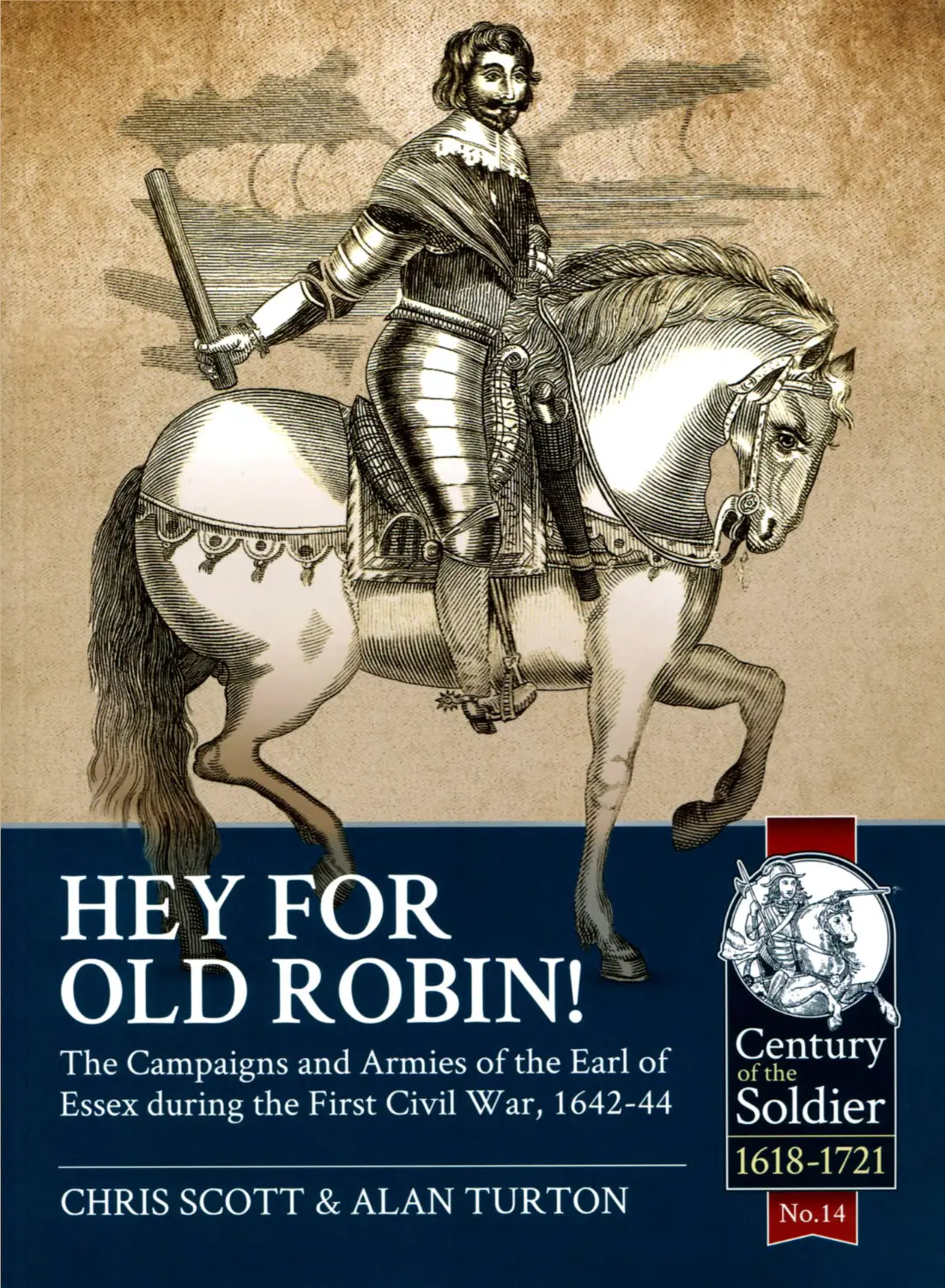
Front cover: The Earl of Essex, etching dated 1640s, artist unknown (Turton Collection).
Every reasonable effort has been made to trace copyright holders and to obtain their permission
for the use of copyright material. The author and publisher apologise for any errors or omissions in
this work, and would be grateful if notified of any corrections that should be incorporated in future
reprints or editions of this book.
ISBN 978-1-914377-31-0
British Library Cataloguing-in-Publication Data.
A catalogue record for this book is available from the British Library.
All rights reserved. No part of this publication may be reproduced, stored in a retrieval system, or
transmitted, in any form, or by any means, electronic, mechanical, photocopying, recording or
otherwise, without the express written consent of Helion & Company Limited.
For details of other military history titles published by Helion & Company
Limited, contact the above address, or visit our website: http://www.helion.co.uk
We always welcome receiving book proposals from prospective authors.

Contents
List of Illustrations within text
iv
List of Colour Plates
vi
List of Maps
vii
Prefaceviii
Acknowledgementsx
Introductionxi
Conventionsxiii
Glossaryxiii
Abbreviationsxiv
1
2
3
4
5
6
7
8
9
10
11

Background15
From Boyhood to Captain General
22
The Edgehill Campaign, Autumn 1642
34
The Turnham Green Campaign, Winter 1642
53
The Reading Campaign, Spring 1643
64
The Gloucester Campaign, Late Summer 1643
80
The First Newbury Campaign, Autumn 1643
103
The Thames Valley Campaign, Spring 1644
121
The Lostwithiel Campaign, Summer 1644
132
The Second Newbury Campaign, Autumn 1644
153
Summary and Conclusions
171

Appendices
I
The Foot
II The Horse
III The Dragoons
IV The Artillery

188
199
210
216

Colour Plate Commentaries
230
Bibliography234

List of Illustrations within text
The House of Commons – after an engraving of 1643, re-drawn
by Alan Turton.
Robert Devereux, 3rd Earl of Essex – Peter Stent..
The 2nd Earl of Essex, who was executed for rebellion in 1601,
from an old engraving.
Essex House, engraving after Hollar.
Frances Howard, Essex’s first wife, from an old engraving.
The House of Lords, after a contemporary engraving of 1643 redrawn by Alan Turton.
Elizabeth Pawlett, Essex’s second wife, engraving after Hollar.
The Earl of Essex as Captain General, engraving by Hollar.
The Artillery Gardens, engraving by Morden and Lea 1682.
William Russell, Earl of Bedford, commander of Essex’s Reserve
of Horse at Edgehill, engraving by J. Houbraken.
Sir William Balfour, commander of Essex’s Right Wing of Horse
at Edgehill, from an old engraving.
The Battlefield of Edgehill from the air. (Photo Richard Ellis)
Broughton Castle, from an 18th century engraving.
Philip Skippon from a contemporary print.
The Defences of London, George Virtue 1738.
Sir William Waller, engraving by Peter Stent 1643.
Reading from Caversham Hill, from an old print.
The Banner Royal, drawing by Alan Turton.
St. Giles Church, Reading.
John Hampden, engraving by S. Freeman.
John Pym, engraving by J. Houbraken.
London Trained Bands at Cheapside, after an engraving of 1638.
An Army on the March, engraving by S. Della-Bella.
View of Gloucester, from an old engraving.
Edward Massey, a contemporary engraving.
Aldbourne Chase, 1972 re-enactment on the battlefield.
The northern sector of the battlefield of First Newbury.
Richard Brown, a contemporary engraving.
Sir Philip Stapleton, engraving by Bullfinch.
Alexander Lesley, Lord Leven, from an old engraving.
View of Cheriton Down, site of the 1644 battle, viewed from
Waller’s headquarters at Hinton Ampner House.
The Guildhall, after an engraving of 1643.

iv

15
20
22
24
25
26
27
31
32
42
43
44
54
60
62
67
69
74
76
81
85
87
100
101
101
109
113
114
118
122
124
125

List of Illustrations within text
Robert Rich, Earl of Warwick, Lord High Admiral, a
contemporary engraving.
134
Lord Robartes, from a contemporary engraving.
135
Colonel Robert Blake, from an 18th century engraving.
137
Horsebridge, the gateway to Cornwall.
138
Restormal Castle. Source.
142
Lostwithiel Bridge.
144
Castle Dore.
146
Fowey harbour mouth and Polruan Blockhouse.
147
Brent Tor.
156
Southwick Park, rendezvous for Essex’s Army, an 18th century engraving. 159
Earl of Manchester, engraving after Hollar.
161
The Siege of Basing House, a contemporary engraving of 1644.
163
Donnington Castle.
166
Plan of Donnington Castle’s defences, a 19th century engraving.
166
Forbury Gardens, Reading, site of the reduction of Essex’s Infantry.
179
The Church of St Laurence, Reading, where many of Essex’s old
soldiers were re-enlisted into Fairfax’s New Model Army.
180
The “lately deceased” Robert Earl of Essex, from a contemporary engraving.180
Title page of the sermon preached at Essex’s funeral.
181
“The sword of the Lord and Gydeon”, medal struck in honour of
the Lord General from a 19th century engraving.
187
Pike drill from an 18th century copy of a 17th century drill manual.
190
Bandolier chargers.
193
Pikeman’s gorget or collar.
195
English Pikeman’s morion.
195
English Pikeman’s morion.
195
Cavalry in action from a c.1640 engraving by S. Della-Bella.
200
Wheel-lock cavalry pistols.
203
Cavalry pistol holster.
203
Cavalry Armour and Buff Coat.
205
Guidons of Colonel Wardlawe’s Dragoons.
212
English Dog Lock or Fire Lock Musket .
213
View of the Tower of London after a 1643 engraving, redrawn by
Alan Turton.
217
Reproduction of Civil War Saker with re-enactment crew.
219
Camp of a bridging train, c.1630 engraving.
224
“Queen Elizabeth’s Pocket Pistol” at Dover Castle, from an old postcard.
228
Large gun on the move, engraving of c.1630.
229

v

List of Colour Plates
Plate A
1. Pikeman
2. Musketeer
Plate B
3. Dragoon
4. Trooper
Plate C
5. Cuirassier
6. Harquebusier
Plate D
7. Ensign
8. Drummer
Plate E
9. Matross of the Bridging Trayne
10. Colonel of Foot
Plate F
11. Model of Cavalry Trooper of Essex’s own regiment, by
Anthony Barton, and used with his kind permission.
12. Model of Cavalry Trumpeter by Anthony Barton, and used
with his kind permission
Flags
Plate G
Col Arthur Goodwin’s Regiment of Horse
James Holborn’s Regiment of Foot, 2nd or 3rd Captain
Robert Devereux Earl of Essex’s Regiment of Horse
Captain Nicholas Chute, Earl of Essex’s Regiment of Horse
London Trained Bands Red Regiment, 3rd Captain
Robert Devereux Earl of Essex’s Regiment of Foot
Plate H
Sir Samuel Luke’s Horse
Thomas Lord Grey of Groby’s Horse
William Fiennes Lord Saye and Sele’s Regiment of Foot, 1st or 2nd Captain
Sir William Balfour’s Horse
Sgt Major John Gunter, Earl of Essex’s Regiment of Horse
William Russell Duke of Bedford’s Horse

vi

i
i
ii
ii
iii
iii
iv
iv
v
v
vi
vi

vii
vii
vii
vii
vii
vii
viii
viii
viii
viii
viii
viii

List of Maps
All maps drawn by Alan Turton
The Arrival at Edgehill.
The Edgehill Campaign.
The Battle of Edgehill.
The Route to Turnham Green.
The Battle of Brentford.
The Deployments at Turnham Green.
The Siege Defences of Reading.
The Approach to Reading.
Relief of Gloucester and 1st Newbury Campaign.
First Battle of Newbury.
The Oxford Campaign 1644.
Plan of the Oxford defences, engraving after A. Wood.
Essex’s March to the West Country.
Area of Operations Around Lostwithiel.
Second Newbury Campaign.
Newbury Flank March.
The Second Battle of Newbury.

41
41
45
55
56
61
69
70
90
115
128
129
137
149
164
167
168

vii

Preface
This book was first mooted at a lunch at The Fleece Hotel in Cirencester at
which Duncan Rogers and Charles Singleton of Helion asked if I, or any
of my friends, had anything in our piles of manuscripts pertaining to the
seventeenth and early eighteenth centuries which had not yet seen the light
of day. I knew I had lots of research notes on the Earl of Essex’s campaigns,
amassed during the preparation work for my book on the two Battles of
Newbury, and several discarded chapters about what his army was doing
prior to Waller’s defeat on Roundway Down. I also knew I had plenty of notes
from another book I had written with Alan Turton and Dr. Eric Gruber von
Arni about Edgehill. The thought of making use of all that work appealed, and
the idea of a book focusing upon Essex’s armies gradually evolved. However,
I felt I could not undertake such a task without Alan Turton whom I also
knew had a great respect for the Earl of Essex and a lifelong interest in the
forces which served under him. I recall him leading the cry of ‘Hey for Old
Robin!’ when the Roundhead Association marched past the site of Essex’s
London home. So another lunch, this time in Lychpit, near Basing House
where Alan was formerly the Curator, and the deal was sealed. Since then we
had the perfect excuse for monthly get-togethers in the Hatchet Inn in the
market place at Newbury where Wetherspoons’ hospitality and endless free
coffee refills kept us going, and from where my return to Swindon frequently
took me across the sites of the ‘victories’ of Essex’s army!
This resulting book seeks to address a gap in the military history
literature of what we are told we should now call the British Civil Wars, by
taking a comprehensive and hopefully fresh look at the armies which served
under Robert Devereux, Earl of Essex and what they achieved during his
time as Parliament’s Captain General. It does not purport however, to be an
academic tome. Obviously we have used primary sources and contemporary
commentaries but we have also made use of modern scholarship and recent
research as well as Alan’s earlier work on the regiments that fought for Essex
published in two booklets by Partizan Press: one concerning the Horse
entitled The Chief Strength of the Army, and another he co-wrote with Stuart
Peachy called Old Robin’s Foote. Similarly we have used my work on Essex’s
campaigns and battles in Edgehill, the Battle Re-Interpreted (written with
Alan Turton and Dr. Eric Gruber von Arni) and The Battles of Newbury, both
published by Pen & Sword.
The Battles of Newbury was criticised in a hobby magazine for putting
two battles in one publication and thus not spending enough time on each
viii

Preface

engagement; this was despite there being 64 pages devoted to the actual
fighting, far more than one usually finds in so many so-called battle books.
So rather than attempting to describe all those battles fought by Essex’s army
in one volume, we limit our descriptions to very brief summaries, and in
discussion focus on the direct influence Essex had on the strategy and any
personal part he played in them, as well as any significant action fought by
any of his regiments. We leave the in-depth description and analysis of each
engagement to more battle-specific books, and in each chapter we list those
volumes which readers who are interested in the relevant major battle, may
care to consult for details of the action.
Similarly we leave out the lists of regiments and the names of those
officers who served in them as they are a topic worthy of a dedicated work
which, having gathered a lot of the information, we may undertake in a later
book.


Chris Scott

ix

Acknowledgements
Firstly we would like to thank Duncan Rogers and Charles Singleton of
Helion for showing the initial interest and the subsequent support for this
work. Also to Maksim Borisov, Dr Lesley Prince and Anthony Barton for
their work on the maps and illustrations, and Ann Farr for the setting and
layout of the book.
No book can be undertaken without the help of others and we would
also like to thank the following people who have not only aided us in the
creation of this work but those who have unstintingly given their help and
support over the years. We would like to thank all the members of the various
institutions visited or contacted who have been helpful. Regrettably we have
not kept lists of places or names, but if any reader works or has worked in a
library, archive, museum, muniment room or record office and has assisted
with an obscure enquiry pertaining to the Earl of Essex or his armies, we
thank you all.
In addition to those who helped directly we would also like to thank
our friends in The Roundhead Association, especially Colonel Nicholas
Devereux’s Regiment, for their continued support and proffered ideas
about sources and interpretation. Similar thanks are due to colleagues in
The Battlefields Trust and The International Guild of Battlefield Guides;
the confidence derived from the support of these learned and enthusiastic
bodies is beyond measure.
Without the efforts and support of these people and institutions this work
would not have been possible. However, our deepest thanks go to our wives,
Pamela Golding and Nicola Turton who not only encouraged us through the
days when the work seemed interminable but also gave of their own expertise
in their respective fields but mostly for being there and … for everything.


x

Swindon and Lychpit 2016

Introduction
The Earl of Essex was the first commanding officer of the first army created
by the Parliament to combat the forces of King Charles I in August 1642.
However, despite overcoming the problems of scratch-building an army to
take a peaceful civil population to war, organising and managing several
admirable campaigns and orchestrating several successful battles, Essex does
not enjoy a good reputation in the modern literature. He is often dismissed
as rather indecisive and over-cautious, and somewhat ungenerously, as being
prone to pedantry and frequent bungling of operations. Much of the criticism
is based upon contemporary letters and pamphlets written by his personal
and political enemies, and those who wished to wage a far more aggressive
war against the king than was then the ‘party line’ in Parliament. Historians
make use of what period material is available and some can tend to ignore
the inherent bias and even personal agendas of its authors. Consequently,
we often have a one-sided view of Essex both as a man and as a general. It is
time for a reappraisal of Essex’s military abilities and an appreciation of the
achievements of the regiments who served under him. Hopefully this work
will begin that process.
This is certainly not an apologia for Essex but it does endeavour to reveal
him and his military career in a more favourable light than has hitherto been
seen. It does not pretend to an in-depth investigation into his abilities, but
despite volumes having been written about military leadership it is worth
noting that the old-fashioned ideas of the ability to see both the big and the
small pictures, flexibility, aggression, integrity, and consistency, have been
overlaid by a plethora of other qualities. It is now necessary to appreciate
the performance of an individual in terms of the strategic, operational
and tactical evidence as well as organisational attitudes, behaviours and
relationships.1 Moreover such a study should also examine the socioeconomic and religious factors of men in combat and period, culture and
human dynamics influences. It is the work of a far greater study to apply this
evolving set of notions to the achievements of Essex but it is worth noting
that given his ability to relate to his men, to understand their viewpoints and
to represent them to Parliament – even at his own cost – Essex demonstrated
a quality which Major General Frank Richardson, a psychiatrist in the Royal

1

Carpenter, S.D.M., Military Leadership in the British Civil Wars 1642-1651 ‘The Genius of
this Age’ (Abingdon, Cass, 2005).

xi

HEY FOR OLD ROBIN!

Army Medical Corps, advocated as a key element, that successful leadership
is intrinsically bound up in the preservation of high morale.2
There is an unfortunate modern trend which labels new insights or even
reinterpretations as revisionist but this is not the intention of this work.
Rather it endeavours to tell the story of both Essex’s achievements as a general
of the army and of those units which delivered them. Essex’s regiments had
their fair share of action including skirmishes both large and small, and the
major battles of Edgehill, Newbury I, Lostwithiel, and Newbury II. Moreover,
they took part in the successful taking of Reading and the relief of Gloucester.
They also spent plenty of time in the daily toil of soldiering, trudging the roads
of Southern England roads and slogging their way through rain and mud
as well as sitting in garrison and suffering the ravages of disease epidemics.
Being armies of the early war these regiments came fresh to conflict. Many of
the soldiers who served with Essex were initially raised from the inhabitants
of London and its surrounding region and were ordinary London tradesmen
and artisans and not merely its underclass. They came from all walks of life
and reflected a cross-section of the people determined to make a change to
the way in which they were governed.

2

xii

Ibid, p.15.

Conventions
Dates prior to 1752 are recorded with the year beginning 1 January not 25
March. Numbers up to nineteen are in words whilst numbers from 20 are in
figures except in quotations or for ease of comparison. All monetary values
and measurements stated are traditional English and Imperial.
The use of capital letters for military ranks or civil offices is restricted to
references made to specific people or offices, and not as descriptive terms,
hence King Charles I is referred to as the king. Capitals are also used for
delineating those parts of the army known as the Horse and Foot although
this convention is not followed when referring to the artillery. We do not use
the pejorative terms of ‘roundhead’ or ‘cavalier’, preferring parliamentarian
and royalists, nor do we confuse parliamentarian with parliamentary.
In spelling the text employs the use of the modern ‘ise’ rather than the ‘ize’
form of ending. The spelling of names often varied during the seventeenth
century and many of those mentioned in the text appear in several formats
in contemporary documents. The form chosen for each name is that used by
a recent published authority. Quotations are preceded and ended by the use
of the single parenthesis, whilst quotations of more than three lines in length
are contained within a discrete paragraph of restricted width and close set
type. Words from a foreign language are shown in italics.
In the footnotes works are cited first with author’s surname and initials
followed by the title and publishing details plus any relevant volume, chapter
or page reference. If the work is cited again, only the surname appears
followed by either the key word in the title or op.cit. or ibid. and any necessary
additional reference.

Glossary
Terms used throughout the text which may need some explanation?
Colour: An infantry flag or ensign. Ensign is also the rank and name of the
officer carrying it.
Cornet: A cavalry flag, and also the rank and name of the officer carrying it.
Cuirassier: Heavy cavalryman in three-quarter armour. There were very few
units in Essex’s Army.
Dragoon: Mounted infantryman.
xiii

HEY FOR OLD ROBIN!

Harquebusier: Light cavalryman in back & breast, often in buff coats and
who made up the majority of Essex’s Cavalry.
Musketeers: Soldiers trained in the use of single shot, muzzle-loading,
smoothbore firearms.
Officers: Men holding military rank and exercising authority over others.
General Officers: men holding the rank of brigadier and above.
Senior Field Officers: colonel, lieutenant-colonel and sergeant-major;
Inferior Officers: captain and captain-lieutenant.
Junior Officers: lieutenant, ensign and cornet.
Non-Commissioned Officers: quartermaster, sergeant and corporal.
Pikemen: Soldiers trained in the use of a sixteen foot ash pole tipped with a
razor sharp point.
Private Sentinel: An ordinary soldier with no rank.
Train /Trayne: The Artillery, Engineers and Baggage / Supply units of an
army.

Abbreviations
Record Offices

TNA.
HRO.
W&SHC.

Libraries:
BL.
Bod.

Museums:
BM.
NAM.

The National Archive, Kew.
Hampshire Record Office, Winchester.
Wiltshire & Swindon History Centre, Chippenham.
British Library, London.
Bodleian Library, Oxford.
British Museum.
National Amy Museum.

Documents:

BG.
CJ.
CL.
CSPD.
CSPT.
CSPV.
ExP.
SP.
TM.
TT.
WO

xiv

Bibliotheca Goucestriensis.
Journal of the House of Commons.
Journal of the House of Lords.
Calendar of State Papers, Domestic.
Calendar of State Papers, Treasury.
Calendar of State Papers Venetian.
Exchequer Papers.
State Papers.
Tanner Manuscripts.
Thomason Tracts.
War Office Papers.

1

Background
During the mid-seventeenth century, the
British Civil Wars gradually engulfed
England, Wales, Scotland, and then Ireland,
with repercussions for an already war-torn
Europe. The highly complex, interwoven
reasoning for why the civil wars were
fought was based upon a fundamental
desire for change which permeated the
inter-related social, economic, religious,
political and philosophical aspects of
society and manifested itself at international,
national, local and personal levels. It
was an all-encompassing affair. Fuelled
by individualism, self-confidence and
opportunism, it was also bound up in the
thinking behind the Reformation; in that
the new force of reason-led capitalism demanded change from the old ways
whilst faith-based feudalism resisted it. Thus a powerful sense of discontent
with the status quo, and pressure for change permeated all walks of life, being
described by those who lived through it as ‘the world turned upside down’.
England did not have the calibre of government to cope with such a
fundamental upheaval. King Charles I, blinkered by his father’s doctrine
of Divine Right, stubbornly resisted most evolutionary moves and within
five years of being crowned had called and dismissed three Parliaments and
reverted to the practice of personal rule. During the next eleven years he and
his advisors presided over the collapse of government and the decline into
national bankruptcy, culminating in an ill thought-out scheme to impose
the Anglican English Prayer Book upon Presbyterian Scotland which led
to the military and financial debacles known as The Bishops’ Wars. Almost
destitute, the king was obliged to summon his fourth Parliament in 1640.
This Parliament, led in the Commons by M.P. John Pym, epitomised
the desire for change, and fanned by resentment of the mismanagement of
Charles’ personal rule, Pym and his associates began lobbying to bring it
about. Royal prerogative was attacked and both Houses split into Court and

The House of Commons –
after an engraving of 1643,
re-drawn by Alan Turton.
(Turton Collection)

15

HEY FOR OLD ROBIN!

Country factions, dividing roughly along political and religious lines but
with a dangerous undercurrent of being for or against obeying the king’s
will. The wrangling between these two factions grew increasingly bitter in
1641, as they reacted to a rebellion in Ireland which ignited passions, fuelled
prejudices and prompted panic in England. Believing that this crisis handed
them a powerful lever to exert pressure on the king, Parliament then set out a
list of nineteen grievances which they wanted addressed. This list was called
the Grand Remonstrance and was a direct challenge to the king’s personal
rule as well as containing an open attack upon the Catholic influence of his
queen, Henrietta Maria of France. A furious Charles, apparently spurred
on by his queen, responded in January 1642 by abusing parliamentary
privilege and took an armed body into the House of Commons where he
tried unsuccessfully to arrest five of the most politically active members.
These men had been forewarned of their likely arrest and fled the House,
their ‘saviour’ being the Earl of Essex. Thwarted, frustrated, and fearful of
reprisals by similar unlawful acts, the king left London for Oxford taking
with him his most ardent supporters. Others followed, including the more
openly royalist members of Parliament from both Houses. Eventually there
then existed two bodies, both calling themselves the Parliament of England;
the Oxford Parliament which was predominantly traditional and the
London Parliament which was, by and large, reformist. By April 1642 there
was virtually open war and Charles was further infuriated by humiliating
attempts to demonstrate his power in the North, especially at Hull where Sir
John Hotham, the governor of this important port and arsenal, refused to
open the gates to the king’s forces.
Although the king and the Parliament in London were hardly on
speaking terms, the Irish problem did not go away and, amid lurid tales of
atrocities against Protestants, there was a general clamour for a force to be
sent to put down the insurrection and protect Protestants from the Catholics.
Parliament was charged with creating and sending five regiments for that
purpose and they set about recruiting on 6 July 1642. However, despite the
urgency and the furore, recruitment was slow. The men selected to lead these
regiments were Patrick Fitzmaurice, Lord Kerry; Philip, Lord Wharton;
Colonel William Bamfield; Colonel Thomas Ballard; and Colonel Charles
Essex. Lord Kerry was to be the commander-in-chief, and by 26 July it had
been decided that they were destined for Munster. However many of the
senior and inferior officers appeared to have changed their mind about going
and on 20 August their replacements were approved by Parliament. Set
against the rising tension in England, and with Parliament passing a second
recruitment order for an army of its own on 12 July, recruitment for the
this army for Ireland was understandably not very successful, although the
combined efforts of these new officers did manage to raise one full regiment,
Lord Kerry’s. It was deemed serviceable and was by order of 5 October
despatched to Munster under its lieutenant colonel, William St. Leger and
with a very different complement of officers than were originally enlisted.
They went despite the very obvious need for men in Parliament’s own army.
Their orders reveal that they were hopefully to consist of 200 volunteers
for each of the 10 captains’ companies, and that these 2,000 men were to
16

Background

take ship at Bristol or Minehead. The remainder of the men raised for the
other four regiments did not go to Ireland, but were retained for service in
England. So upon landing at Cork or Kinsale, 1,000 of Kerry’s men were used
to form the backbone of additional locally-raised Irish regiments. Kerry was
to be not only their Commander-in-Chief but also Governor of Munster and
Chief Governor of Ireland. Their instructions were all-embracing and were
effectively a carte-blanche to do whatever they wished.
… Lord of Kerry, and his said Regiment, shall have Power to invade, subdue, kill,
and slay, the said Rebels, and to do and perform all such Acts and Things which
shall conduce to the subduing of the said Rebels … 1

Their story does not concern us here, other than to note that they and
St Leger came back to England in 1643 to serve the king in the guise of the
Duke of York’s Regiment.
After being unsuccessful in gaining support and supplies in the North,
Charles returned to the Midlands and on 21 July 1642 he resolved to make
Nottingham the base for any further operations. Although not declared,
open armed conflict was inevitable and indeed the first blood of the looming
civil war was spilt on 27 July in Manchester during a skirmish between local
armed groups. Another outbreak of violence occurred at Marshall’s Elm near
Street in Somerset on 4 August. By then, declarations of intent to support one
of the two sides were being avidly sought, and caused many heated debates
across England.
Charles initially reacted by issuing a proclamation on 12 August, which
required every man capable of bearing arms and who lived within twenty
miles of Nottingham to assemble at the castle to witness the raising of
his royal standard. Before they could come together however, he tried a
demonstration of his power with the men he already had gathered about him
but was humiliated once again when he tried to enter Coventry on 20 August.
The citizens slammed shut their gates in the face of his force which then
proceeded to fire into the town, killing a man. On 22 August 1642 the king
took the dramatic last step into open war and duly raised his standard against
his Parliament; against the representatives of his own people. In reality it was
a pretty sorry affair, taking place in bad weather on Standard Hill outside the
walls of the derelict castle and indeed at one point the wind was so strong
it caught the heavy flag and dashed it to the muddy ground. The weather
had implications for the turnout and the ceremony was not well attended
and neither were three subsequent unfurlings on three successive days. He
expected thousands, but in total only about 300 men rallied to his call. He
then issued his Commission of Array to summon all loyal men across the
country to join him in his fight to reaffirm his right to rule his kingdom. The
war had begun.
Despite the inauspicious start, the raising of the royal standard caused
consternation in Parliament and forced the issue of choosing sides for many
1

Firth.C.H. & R S Rait, R.S.,(eds.) ‘October 1642: Order to raise Voluntiers for Munster.’,
in Acts and Ordinances of the Interregnum, 1642-1660, (London, 1911), p. 32; http://www.
british-history.ac.uk/no-series/acts-ordinances-interregnum/p32

17

HEY FOR OLD ROBIN!

men. The members were divided and in dramatic scenes they declared
openly for one side or the other. Many members of the Court faction who
had remained in London and tried to bring about conciliation joined those
who felt obliged to answer his call, and went to join the king, whilst those
members who remained behind tried to oppose the Country faction as it
passed the Militia Ordnance and ordered it read across England to raise
troops to defend themselves and the rights of Parliament. Events were now
driven by the need for change. When change by constructive means is denied
them, men will affect it by destructive means – or as Clausewitz was to say,
‘war is … a continuation of political activity by other means’.2
In order to wage war, both sides needed armies, so the opening moves
were based upon strategies to recruit volunteers and take control of fortresses
and arsenals, and other important bases for military activity, or places of
commercial significance such as the ports and manufacturing towns. London
declared for Parliament and across the country, cities, towns and even
counties declared their allegiance until the kingdom became a patchwork
of allegiances, alliances and spheres of influence. How a side was chosen
was a complicated matter although this was sometimes founded in things
other than loyalty to either cause, for example in rural areas the people were
often influenced to join whichever cause their local lord espoused. Reasons
as to why different persons or places aligned with a certain side are beyond
the scope of this work, many did not or could not take sides whilst among
those who did, divided loyalties split town councils, communities and even
families.
In this unheard of state of civil war, Parliament was keen to place their
reliance upon the established London Trained Bands for their defence, but
they were also very aware that they too needed an armed force capable and
willing to take the field if they were to match any strategic moves made by
the royalists gathering in Nottingham. Parliament had that small force of
troops which had been ostensibly for service in Ireland (the 6 July army),
and it had the beginnings of its own new army (the 12 July army) but both
were by no means sufficient, and indeed were not only small in numbers
but also poorly supplied and equipped. This combined force was however
to be its main fighting field force and they appointed a man to lead it. Their
choice fell upon Robert Devereux, Earl of Essex. He was indeed the natural
choice because he probably had the most military experience of all the
potential candidates and was not only a respected member of the nobility
but a well known public figure. Moreover he was an established leader of
the opposition to Charles’ personal rule and a charismatic and popular man.
Essex was appointed Captain-General of a partially non-existent army so his
first task was to dramatically increase the size of those units already raised
for Ireland and to add significant additional regiments to their number. It
was a formidable task but his fame and popularity coupled with his excellent
ability in staff work and organisation came to the fore.
2

18

Clausewitz, von, C. Howard, M. and Paret, P. (Trans.), Vom Krieg, (Princeton University
Press, 1976/84 from the original German published Berlin: Dumlers Verlag, 1832), pp.
75-89.

Background

Apart from these already constituted partial units, Essex’s army started
to form in late July 1642 when Parliament’s agents began listing men at the
New Artillery Gardens in the City as volunteers in an independent army for
Parliament.3 The men were principally drawn from the City of London and
Southwark; the two big urban conurbations on the north and south banks of
the Thames, and supposedly did not poach members of the London Trained
Bands. Again recruiting was not as popular as Parliament had hoped and
the listing clerks appear to have collected only enough names to fill the rank
and file of three regiments. However, the number of men who volunteered
to be commissioned as officers surpassed expectations; there were sufficient
officer volunteers to staff 20 regiments! These officer names on these lists
were allocated to companies, and on 1 August the men too were put into
companies and those companies subsequently grouped into regiments.4
These first three units were Colonel Denzil Holles’ Regiment, Colonel Sir
Henry Chomley’s Regiment and Sir John Merrick’s Regiment and each one
was up to the required strength of any drill book designed unit – that is
around 1,200 strong. Parliament’s solution to the shortage of forces was to
set itself a considerable target of some further 17 regiments of Foot and
to throw its recruitment net wider. The catchment area for enlistment was
spread beyond the City and Southwark to include the rest of London and the
surrounding area. This occurred between 16 and 21 August and conveniently
encompassed some of Essex’s estates to the north-east of the capital.5 Many
of the great men who were to assume colonelcies of these future units were
also permitted to encourage men on their estates and those of their friends to
enlist. It is interesting to note that the four units already recruited for Ireland
were included in this 17, supposedly because never having reached proper
strength they needed more men to complete them.
Robert Devereux, Earl of Essex was appointed to the elevated rank of
Lord-General of the Army, which technically placed him in command of this
first army and all other future armies to be raised; a distinction which was to
be the seed of future rancour and dissent among aspiring military-minded
aristocrats and gentlemen.
The twenty regiments of Foot destined for this first army were:
Transferred From the Army of Munster:
Col. Philip Lord Wharton’s Regiment
Col. William Bamfield’s Regiment
Col. Thomas Ballard’s Regiment
Col. Charles Essex’s Regiment
Initially Raised:
Col. Denzil Holles’ Regiment
Col. Sir Henry Cholmley’s Regiment
Col. Sir John Merrick’s Regiment
Subsequently Raised:
3
4
5

TT. E. 108 (15). Independent being supposedly not tied to London and also free of royal
association.
TT. E. 109 (35). It is not known how these allocations were made but to do so by parish
location would seem likely.
E. 239. (10):

19

hey for oLd roBin!

Robert Devereux, 3rd Earl of
Essex – Peter Stent. (Turton
Collection).

Lord General, Robert Devereux, Earl of Essex’s Regiment
General, Henry Mordaunt, Earl of Peterborough’s
Regiment
Col. Henry Grey, Earl of Stamford’s Regiment
Col. William Fiennes, Lord Saye and Sele’s Regiment
Col. Robert Greville, Lord Brooke’s Regiment
Col. Edward Montagu, Lord Mandeville’s Regiment
Col. John, Lord Robartes’ Regiment
Col. John Carey, Lord Rochford’s Regiment
Col. Sir William Constable’s Regiment
Col. Sir William Fairfax’s Regiment
Col. Thomas Grantham’s Regiment
Col. John Hampden’s Regiment
Col. Oliver St. John’s Regiment
Although a number of these colonels had previous
military experience the majority were in post because
they were leading figures in the Commons or Lords.
Being eminent, and supposedly busy men, the day to
day running and organization of their regiments was therefore left to their
lieutenant colonels and majors who were, where possible, military men. The
captains of companies in each unit, once they had received Essex’s signed
commission, set about recruiting. Volunteers in London left their names
at a number of recruiting stations and were then allocated to the various
regiments. Outside of the City recruiting was done by beat of drum on
market day in the many small towns of the surrounding counties. The age
of recruits was between 16 and 60 and they came from all walks of life.
Many of the London volunteers were apprentices and journeymen, such as
Nehemiah Wharton, who served as a sergeant in Holles’ Regiment. William
Allen, a felt-maker from Southwark, served in the same regiment until it’s
destruction and then in the newly raised regiment of Philip Skippon until
at least 1647. Amongst the first to enlist in the infantry were 71 dyers, 49
sadlers, 124 shoemakers, 157 tailors, 186 weavers and 88 butchers. Such were
the ordinary men who made up the new army.
It is interesting to note that the order to despatch Lord Kerry’s Regiment
to Ireland states that the men were to be issued with their arms when they
arrived in Ireland so it is not unreasonable to suggest that those weapons
initially designated for them were retained deliberately to arm soldiers in
this new army, as was a stock of clothing. Clothing for three of the four initial
regiments was drawn from that assembled for the Irish Expedition and the
commissioned official supplier, Stephen Eastwick, took delivery of it from
the Irish stores on 19 August and handed it over on 22 August. Whether
this clothing went directly to these regiments or via other middlemen for
transportation and delivery to the soldiers is unclear. However, this clothing
issue apparently honoured part of Parliament’s promise to clothe their
regiments at their own expense by an order of 6 August which states that
before they marched out of London the men were set to receive coats, shoes,
shirts and caps.6 The caps appear not to have been issued but the soldiers
6

20

Peachey, S., & Turton, A., Old Robin’s Foot (Leigh-on-Sea, Partizan Press, 1987), p.4.

Background

did receive snapsacks – tubular leather shoulder bags in which the soldier
carried his food rations (‘snap’), and any personal belongings.
This issue of coats is interesting as it implies that even if somewhat hastily
made, the demands of bulk purchasing would have meant they were uniform
in colour. The soldier’s coat was straight cut, made from one yard of woollen
broad cloth, and distinguished by small rolls of material at the top of the
sleeves. The coats of the 1642 issue were lined, usually with a contrasting
colour, but later ones were only faced. Initially soldiers were not given
breeches but were expected to supply their own, so many men ended in rags,
as exemplified by two of Sir Samuel Luke’s garrison at Newport Pagnell who
had only one pair of breeches between them, so that only one man could be
on duty at any one time. Eventually, through necessity, breeches began to
become part of normal issue. They too were usually of wool, lined with linen
and had a pair of deep leather pockets.
The basic undergarment was the knee-length, linen or hemp shirt. It
was an important item, as shirts were sometimes used as an inducement to
enlist, however only one shirt per man was issued. It was the lack of clean
linen which contributed to the numerous outbreaks of camp fever which
weakened both armies throughout the coming war.
Stockings were either of knitted wool or cloth cut on the cross, and were
kept up at the knee with leg ties. The foot soldiers were issued with a pair of
latchet shoes which were made of leather, low cut and straight lasted to fit
either foot. For many men the prospect of being clothed and shod at someone
else’s expense, and being given basic foodstuffs as well as the promise of a
daily rate of pay must have seemed a manna-like windfall.
Gradually the numbers grew; the regiments steadily filled their ranks and
gathered together the weapons to arm the men, along with the necessary
equipment and supplies until finally Parliament and its Lord General had
their army which was independent of the king and indeed willing to fight
him.

21

2

From Boyhood to Captain
General
Robert Devereux was born on 11 January 1591, in Seething
Lane, London, at the home of his maternal grandmother
Lady Walsingham, the only daughter of Sir Francis
Walsingham, who had been Queen Elizabeth I’s powerful
Secretary of State and personal advisor. Robert was born
into an eminent, noble and powerful family: his father was
Elizabeth’s favourite, Robert Devereux, 2nd Earl of Essex
and his mother was Frances Walsingham, Countess of Essex
and Clanricarde.

The Genealogy of the Earl of Essex

The 2nd Earl of Essex, who
was executed for rebellion in
1601, from an old engraving.
(Turton Collection)

Named after his father, Robert grew up in London and was
educated at Eton College. When not at school, he lived at
Essex House, his father’s extensive property on the banks
of the Thames, south of the Strand. He was brought up in
wealthy surroundings and moved in aristocratic company.
His father had been a popular, charismatic and influential
man in Elizabeth’s court and it has been suggested that he was also the queen’s
lover in a somewhat tempestuous relationship. After leading an unsuccessful
campaign in Ireland and quarrelling with Elizabeth he fell from royal favour.
Walter Devereux, 1st Earl of Essex m Lettice Knollys, Countess of Leicester
Robert Devereux, 2nd Earl of Essex m Frances Walsingham, Countess of Clanricarde
Robert Devereux, 3rd Earl of Essex m Frances Howard
2m Elizabeth Pawlett
Robert Devereux (died in infancy)
no further issue

22

Frances Devereux
m Wiliam Seymour
Earl of Hertford

Dorothy Devereux
1m Sir Henry Shirley
2m William Stafford

From Boyhood to Captain General

It was a dramatic fall which entailed being placed under house arrest and
brought about the loss of offices, status and influence. Determined to regain
his elevated position, and not meeting with any success in the diverse and
varied schemes he undertook, in 1601 he made a desperate attempt to force
the queen to restore him to what he believed to be his rightful place; and
he did it by armed rebellion! Although he maintained his intentions were
peaceful and that he had no intention of any harm befalling her majesty, he
did in fact try to seize her and the throne. It was a failure that ended in a siege
of the family home, Essex House. The house was stormed, Essex was arrested
and the young Devereux’s father was then tried and executed for treason.
The forfeiture of his titles, and with them their revenues, plunged the family
into desperate financial straits. The ten year old boy was obliged to leave Eton
and became a social outcast. It is only speculation but Essex probably learnt
the lesson of the cupidity of monarchs and how to deal with being in an
isolated position, possibly breeding resilience in the face of adversity.
The succession of James I saw the reversal of several of Elizabeth’s policies
which included the restoration of the Devereux family titles. The family had
a lot of powerful friends and indeed at the time of his father’s rebellion there
was a considerable faction whom, although they did not feel inclined to join
in his plot were in sympathy with it and his grievances and aspirations. These
people had to be wooed and brought back into the sphere of court influence.
The Earl Southampton who had been involved in the rebellion was released
from the Tower among others who had merely been suspected, and with
special permission from the king and Parliament, Robert became the 3rd
Earl of Essex in 1604, and was able to complete his studies. He attended
Merton College, Oxford from where he graduated as a MA in 1605. Probably
having the same charismatic personality as his father, he initially developed
a good relationship with the new Stuart royal family and became a friend
of the king’s eldest son Henry, Prince of Wales who was of a similar age.
However, Essex’s relationship with the royal family did not continue as a
happy one. He tended to favour the policies of those arguing for political
and legal reform and moved in circles that advocated resistance to the will of
the king, thus directly opposing James’ leanings towards personal rule. This
faction was frequently involved in heated disputes and exchanges with those
who favoured royal prerogative, or the Divine Right of Kings as it became
known. Even King James I himself quarrelled with the young Essex. During
one such passionate argument James is said to have made a violent outburst
recalling the rebellion of Essex’s father, and shouting ‘I fear thee not, Essex, if
thou wert as well beloved as thy father, and hadst 40,000 men at thy heels … ’
alluding to the perceived rebellious nature of the family. 1
Marriage in those times was often more of a business contract in a web
of family alliances in the pursuit of power and money than a love match
and with the permission of James I, at the age of 13, Robert was married
to Frances Howard, a 14 year old member of the influential Howard family.
The wedding was probably at the king’s instigation, in a yet another move
to woo the pro-Essex people and unite quarrelsome court factions, Frances
1

Devereux, W. B., Lives and Letters of the Devereux, Earls of Essex (London, J Murray,
1853), volume 2, p. 290.

23

hey for oLd roBin!

Essex House, engraving after
Hollar. (Turton Collection)

was the daughter of Thomas Howard, Earl
of Suffolk who had sat on the commission
that sent Essex’s father to the block. The
religious ceremonies completed, James
commissioned and paid for an extravagant
two-day event which included a court
masque, called Hymenaei, written by Ben
Jonson and staged by Inigo Jones, to which
the wealthy and influential members
of the court were invited and even took
part.2 Over 5-6 January 1606 this masque
and a staged grand ‘Fight at the Barriers’
were part of a spectacular display of unity
between both the Stuart/Devereux and
the Scots/English factions. The event
was politically far more than a simple
celebration of Essex’s marriage.3 Essex learnt at a young age how monarchs
used people as pawns in their power plays.
As both bride and groom were young teenagers they observed the
practice of the period among the aristocracy and never consummated their
marriage. She returned to her family home whilst he undertook to finish his
education with a grand European tour. He was absent from England from
1607 to 1609, and whilst he was away, his more mature bride took the king’s
favourite Robert Carr, Viscount Rochester to her bed. It was the scandal of
the day especially as Carr was rumoured to be the king’s bedfellow as well.
Upon his return Essex was stricken with smallpox which permanently
disfigured his face. After his recovery both he and his wife tried to have
the marriage annulled, Frances saying publically that her husband was
impotent and that he had never made love to her, due to his inability to
have an erection. Essex countered that indeed that might be the case but
it was only with her that this situation arose, brought on he said, by her
continuous nagging, name calling and rejection. He maintained that she
‘reviled him, and miscalled him, terming him a cow and coward, and beast’.4
Poor Essex was ridiculed but he did not suffer alone, Frances was examined
by a doctor and declared still a virgin which was a marvel since Carr had
been her lover for some time and, rumour had it, that she was not ‘unsullied’
before her wedding to Essex. The sorry situation was further scandalised
in a mocking ballad which included the line ‘The Dame was inspected, but
fraud interjected a Maid of greater perfection’. Possibly to Essex’s relief the
annulment was granted in September 1613 and Frances quickly married Carr
who was then Earl of Somerset, an ennoblement that galled Essex and further
soured his relationship with James I.5 In 1616 Essex may have had some grim
2
3
4
5

24

Shakespeare is supposed to have turned down an invitation to write this entertainment
although he is known to have attended.
It was part of an elaborate plan to instil a feeling of harmony and unity, paving the way
for James’ attempt to unify his two crowns of England and Scotland into one Britain.
Haynes, A., Sex in Elizabethan England (Wrens Park Publishing, 1997), p. 129.
James appears to have liked his favourites to marry, even those with whom he had
homosexual relationships.

from Boyhood To CAPTAin generAL

satisfaction when he was called to sit on in a jury to
pass judgement upon both husband and wife who were
charged for being parties to the murder of Sir Thomas
Overbury. The jury found them guilty and it is believed
Essex advocated the death penalty for both.6 That
decision was duly rendered but the sentence was never
executed, supposedly due to Carr’s erstwhile intimate
association with James.
Essex’s first experience of military service came in
1620 when he found a place with Sir Horace Vere who
was leading an English contingent which went to the
continent to fight for the Protestant cause in the Thirty
Years War, where he was to serve in five successive
campaigns. In 1621 he transferred to Prince Maurice of
Nassau’s army in the Palatinate and then, a year later, he
changed armies again, joining Count Ernst von Mansfeld
under whom he took part in the Battle of Fleurus in
August 1622.7 Essex spent a lot of time on Mansfeld’s
staff but saw action again as the colonel of a regiment in
1624 during the abortive attempt to relieve the Siege of
Breda, but then, having seen service in Germany and the
Low Countries, he returned to England.
Although Essex did not have a distinguished military career on the
continent he was in almost continual service and gained a lot of experience
in staff work, both in quarters and on campaign which meant he was well
versed in the management of military operations and the implementation of
strategy. One successful aspect of his time abroad was the development of a
remarkable ability to raise troops and recruit men to his units and his causes;
more evidence that he did indeed exert a winning charisma and could inspire
men. It was perhaps this ability that secured him another military position in
the service of his own country. In 1625 he was appointed vice-admiral of the
fleet and commanded a squadron of ships in the navy. Moreover he was also
appointed to a colonelcy of a regiment of Foot. Both commands involved
service in the ill-fated Expedition to Cadiz under Sir Edward Cecil. Again
he returned home having learnt a great deal, particularly about the effect of
poor intelligence.8
On his return he settled down to a life of a landed nobleman, dividing his
time between his house on the Strand in London when he sat in the House
of Lords in Parliament, and his estates in Essex. Although it no longer exists,
6
7
8

Frances Howard, Essex’s first
wife, from an old engraving.
(Turton Collection)

Somerset, A., Unnatural Murder – Poison at the Court of James (London, Weidenfeld &
Nicolson, 1997).
Cust, Sir E., Lives of the Warriors of the Civil Wars of France and England ( London, 1867),
p. 276.
Cecil initially got into Cadiz Bay but allowed the Spanish fleet to escape and found a
heavily defended city. He permitted his men to pillage local stocks of wine and although
his officers managed to get most of his inebriated force back onto the ships, they
abandoned over a thousand drunks who were murdered. Cecil then tried to capture
some Spanish galleons but they eluded him. Riddled with disease, the expedition
returned home having achieved nothing.

25

hey for oLd roBin!

The House of Lords, after a
contemporary engraving
of 1643 re-drawn by Alan
Turton. (Turton Collection)

Essex House was a great
Tudor mansion on the south
side of the Strand. 9
It was built in the 1570s
for Robert Dudley, Earl of
Leicester and it had been
passed on to Dudley’s stepson
the 2nd Earl of Essex in 1588
who renamed it Essex House.
It was a grand building set
in spacious gardens and
grounds which reached down
to the river, and had been
part of the lands belonging
to the Knights Templar. The
‘palace’ was recorded as
having 42 bedrooms as well
as a banqueting hall, picture
gallery and chapel and
extensive kitchens and stables
and sundry service buildings. Essex leased part of the house to his brotherin-law William Seymour, Marquis of Hertford, who shared his political
stance with regards to the king’s resistance to reform. This close relationship
came to an end when Hertford went over to the king and in time became a
general in the royal army during the first civil war. The property went out of
the Devereux family ownership after the Restoration because of debt and the
house itself was finally demolished in the mid-1670s and the land sold.
During the 1620s, and although by no means a commoner, Essex
espoused the Country faction, joining with men from both houses who were
bound together in their growing opposition to the views and beliefs of those
members directly influenced by the new king, Charles I. The Court faction
made no secret of either their rigid obedience to royal will or their enmity
towards this opposition. The division between the two sides became more
polarised during ‘the eleven years of personal rule’ when Charles eschewed
Parliament and ruled England without recourse to the representatives of its
people. However much as the king hoped this would put an end to political
debate and argument, and indeed to opposition meetings, it did not. Instead
the Country faction held both open and clandestine meetings and even more
plans were drawn up for reform. Essex rose in popularity and esteem as one
of the leaders of this opposition to government by the monarch, and his
small oligarchy of advisers. Other important opposition members originally
from the Lords were: Robert de Vere, Earl of Oxford; Thomas Wriothesley,
Earl of Southampton; Robert Rich, Earl of Warwick; William Fiennes,
Viscount Saye and Sele; and William, Baron Spencer. Essex was also friends
with one of the king’s strongest and most adversarial critics from the House
of Commons, John Pym, along with George Digby and John Hampden.
9

26

Essex Street named after the house is virtually opposite the modern Royal Courts of
Justice.

from Boyhood To CAPTAin generAL

In 1630, amid the political wrangling, Essex married
again. His second wife was Elizabeth Pawlett, the eldest
daughter of a former High Sherriff of Wiltshire, Sir William
Pawlett. Pawlett himself had died a year or two before the
wedding so marriage into the Devereux family must have
been an attractive proposition for the unmarried Elizabeth.
From Essex’s point of view she too must have held a certain
attraction as the Pawletts were well connected, and he could
do with friends at court. There was also the opportunity
for Essex to father sons and show that he was in no way to
blame for the scandal attached to his first marriage.
Sadly this marriage too was a failure and by 1631 the
couple had separated. Elizabeth kept to the London house
whilst Robert retired to the country where it is said he
involved himself with amateur military activities, possibly
the local trained bands. Despite their differences, the public
image of the marriage suggests that the couple were not as
mutually distant as Essex’s first marriage had been, and on 5
November 1636 they had a son, Robert Devereux, Viscount
Hereford. Yet even this event was coloured by private enmity
and tragedy. It appears that Elizabeth may well have taken
Sir Thomas Uvedale as her lover and that Essex threatened that he would not
acknowledge the child as his. The baby Robert’s birth and his father’s identity
remains a mystery as he died of the plague barely a month after being born.
If this was not all Essex had to bear, his brother-in-law, Hertford, fanned
the rumours of Essex being cuckolded again, although this was strenuously
denied by the man who would later become Elizabeth’s second husband, Sir
Thomas Higgons. Higgons had little motive for such a declaration but it was
probably not a coincidence that Hertford, now a political adversary, had also
stood to inherit Essex’s fortune and estates if Essex died without direct issue.
During the civil wars a lot of propaganda was made from Essex’s unfaithful
wives and indeed his lack of heirs. A modern historian has suggested that he
had the condition hypogonadism, popularly known today as ‘male hormone
deficiency’.10 However this is unlikely as portraits of him depict a man with
a full set of moustache and beard shaved and trimmed into the fashionable
T shape which would have been nigh on impossible if he suffered from this
affliction. Moreover he was known to quarrel easily and to maintain such
disputes aggressively with offers to fight duels or even less ritualised physical
combats (he was quick to raise his fists); again this is an unlikely disposition
for one suffering with this complaint.
Despite the whispering scandal and his opposition role in Parliament,
Essex was created a Knight of the Bath in 1638 and the following year was
appointed Lieutenant General of the Army of the North by Charles I for his
war against the Scots.11 However his leanings towards reform politics brought
him the distrust and dislike of the more traditional members of the court,
and despite him doing reasonably well in his military command. It must be

Elizabeth Pawlett, Essex’s
second wife, engraving after
Hollar. (Turton Collection)

10 Haynes, op.cit., p.131.
11 The First Bishops’ War.

27

HEY FOR OLD ROBIN!

noted however that he had hardly been in a demanding role in this effectively
bloodless war. This hostility from the Court faction continued when Charles
I was obliged to call Parliament in 1640 in an attempt to procure monies
for his second war against Scotland; and indeed for a war in Ireland where
a rebellion had broken out. Notably Essex did not receive the summons to
any command in the Second Bishops’ War, which made him even more
embittered and hostile to those who advised the king and whom he began to
perceive as personal enemies.
Parliament again became the forum for open and angry debates as those of
the Country faction allied with more moderate members who were outraged
by the failure of Charles’ government and the economic crisis into which it
had plunged the country. They saw opportunities for levering agreements to
reform from the king, and to hold to account those advisors who had steered
Charles on the disastrous course through the past years of misrule. This was
the infamous Short Parliament as, annoyed with the members’ effrontery
and non-compliance with his wishes, Charles rapidly dissolved it after only
two months.
However Essex was back in the House of Lords by November 1640 because
the king had found it impossible to raise money for anything without the
support of Parliament. This time Parliament was to sit almost continuously
until 1653, earning itself the soubriquet ‘The Long Parliament’. As part of an
orchestrated campaign to bring down Charles’ advisors, Parliament passed a
Bill of Attainder in 1641 against one of his chief ministers and senior officers
in the army, Thomas Wentworth, Earl of Strafford. The case against Strafford
is beyond the scope of this work but he was the first of Essex’s old enemies to
fall and King Charles, Strafford’s friend and erstwhile supporter was obliged,
albeit reluctantly, to sign his death warrant. Strafford sent an appeal to those
who had condemned him and Essex, recalling the hatred shown to him in
the past by the man now asking for his life, supposedly quoted the proverb
‘Stone Dead hath no Fellow’. Strafford went to the block for treason.
Part of an attempt at rapprochement between king and Parliament saw
Charles give seats on his Privy Council to those who were blatantly in
opposition to him, and Essex was among those who took them. He was
also reinstated to military command, becoming Captain General of all the
forces in the English army to the south of the River Trent. In July 1641 he
rose higher still and was appointed Lord Chamberlain. His star was in the
ascendancy but was about to come crashing down. The reformers apparently
pushed the king too far too quickly and, as is now believed, advised and
goaded by his queen Henrietta Maria, in January 1642 Charles took an
armed guard of soldiers into the House of Commons and tried to arrest
Pym and four other leading political dissenters: John Hampden, Arthur
Haselrig, Denzil Holles and William Strode. The king was frustrated in the
attempt, namely because all five men had been told of the king’s plans and
had fled into hiding. It would seem that Essex was the man who sent them
the warning. He was obviously under suspicion and began to absent himself
from Privy Council meetings and frequently stayed away from court. One
such absence occurred when the king called for the Council to meet in York
during April 1642 and his non-appearance resulted in his dismissal from the
28

From Boyhood to Captain General

office of Lord Chamberlain. Essex was wise not to be present in York as it
was from there that the king rode to Hull and tried to intimidate its governor
Sir John Hotham, into allowing his accompanying royal forces to occupy
the important port and replace the pro-Parliament garrison, and moreover
to appropriate its arsenal. As well as ceasing to hold high office in Council,
Essex’s appointment as Captain General of the army also seems to have been
deemed as having lapsed. The result of these moves against him drove him
to a greater degree of intransigence.
The split between the king and his Parliament widened and disagreements
flourished daily, one major point of contention being which institution,
court or Parliament, had authority and thus control over the London
Trained Bands, and this argument quickly spread to include all the militias
all over the country. These bodies of men were trained and drilled in the use
of weapons and acted as county or city defence forces which turned out in
national and indeed local emergencies, be they threats of foreign invasion
or civil disturbance.12 They may not have been steady professionals but they
were adequate and very numerous. The full-time royal army was however,
very small at the time. There was no standing army as such, just royal
guards and garrisons, so with both sides arguing about the control of the
part-time civilian military bodies and their stocks of weapons, the drift into
armed conflict seemed inevitable. It would appear that the trained bands
were in general pro-Parliament, so during early July 1642 in the face of this
increasingly worrying situation, Parliament set up The Committee of Safety
as a co-ordinating body to liaise between these various military institutions
and its own members. This official body was fifteen strong with ten members
of the House of Commons and five from the Lords. Hampden, Holles and
Pym were among those chosen from the Commons whilst Essex with Saye &
Sele were obvious choices to be included from the Lords.
In July 1642 the gulf between the king and Parliament had grown even
wider and it was fuelled by increasing anger and frustration as Charles
thwarted all moves towards reconciliation. Aware that the king was calling
to him such men as he could trust and briefing them to ready themselves
for armed service in his cause, on 12 July 1642 Parliament voted to raise
an army of its own. As a member of the nobility, a leader of the opposition
faction and possibly one of the most experienced military men in Parliament
a parliamentary ordinance was passed naming Essex as,
Captain-General and Chief Commander of the Army appointed to be raised,
and of all other Forces of the Kingdom … and that he the said Earl shall have
and enjoy all Power, Titles, Preheminence, Authority, Jurisdiction, and Liberties,
incident and belonging to the said Office of Captain-General, throughout the
whole Kingdom of England and Dominion of Wales, in as large and ample a
Manner as any other General of an Army in this Kingdom hath lawfully used
exercised, and enjoyed.13
12 For a history of the English Militia see Scott, C. L., The Maligned Militia (Farnham,
Ashgate, 2015).
13 The Parliament’s Commission to the Earl of Essex to be Captain-General of their Army.’
Acts and Ordinances of the Interregnum, 1642-1660 (1911), pp. 14-6. URL: http://www.

29

HEY FOR OLD ROBIN!

Not only did Parliament appoint him to be commander-in-chief of
its army, but reaffirmed his titles as Lord Lieutenant of Staffordshire and
Yorkshire and added Herefordshire, Montgomeryshire and Shropshire to his
list. 14
There is a curious seeming anomaly in Essex’s document of appointment
as it charges him with ‘preserving the Safety of His Majesty’s Person’.15 This
was a deliberate attempt to mollify those who felt that raising an army to
oppose the king was treason. They were content to struggle against Charles’
rule with words in legal debate, but were hesitant to draw the sword and
enter into what was construed as armed rebellion. By not actually stating
that Essex was to lead forces against the king it carefully avoided advocating
treasonous action and emphasised the argument that Parliament had taken
up arms not against the monarch but against ‘the cunning practice of Papists,
and malicious Counsels of divers ill-affected Persons, inciting his Majesty to
raise men’.16 The fighting, if there were to be any, was to be against those who
advised the king, not the king himself. They saw these ‘evil councillors’ as
leading Charles astray and threatening the peace and security of the country,
which, it was argued, was undoubtedly treason. Essex’s commission is an
interesting document as apart from its convoluted politics there is another
telling point made, which meant that Essex did not have the free reign to
do the job as he is likely to have wanted. It stated that he was to perform his
duties ‘in such Manner, and according to such Instructions, as he shall, from
Time to Time, receive from both Houses of Parliament.’17 This political and
controlling manoeuvring in his commission is an indication of the difficult
limitations and constraints placed upon him, and the deployment of the
martial skills and independent thinking for which he was appointed. Both
these points will be discussed further in the summary.
War became fact when Charles raised his royal standard at Nottingham
on 22 August 1642 and sent out commissions of array to all parts of his realm
for men to gather their forces and join him. He was declaring war upon the
representatives of his people. Although he did not have the large turnout for
which he was hoping, there were eventually sufficient men for him to form
the nucleus of an army. By late August Parliament and Essex too had an army
in London and the Home Counties. The London Trained Bands constituted
a significant part of the whole force but it also included regiments initially
raised for service in Ireland and those raised by the good and the great men
of the opposition faction.
Shortly before Essex had received his commission, Parliament had
already asked its supporters for loans of money, horses and equipment to
which he personally contributed £1,000 and twenty horses. Then in midJune, Parliament ordered,

british-history.ac.uk/report.asp?compid=55735
14 Cokayne, G.E. revised and much enlarged by White & Lea, The Complete Peerage
(London, St. Catherine Press, 1959).
15 The Parliament’s Commission to the Earl of Essex, op.cit .
16 Ibid.
17 Ibid.

30

from Boyhood To CAPTAin generAL
That the Horsemen that shall come to the
Commissaries to Guildhall, to be inrolled,
shall deliver Tickets where they lie, that they
may be ready to be trained upon Warning; and
that, so soon as Sixty Horses shall be enrolled,
Notice shall be given, by the Commissaries to
the Lord Admiral, the Earl of Essex, the Earl
Pembroke, the Earl of Holland, and the Lord
Viscount Say and Seale, Master of Court of
Wards, and Liveries, or some of them, Officers
may be appointed for the several Troops, to
command, train, and exercise them.18

Initially these were independent troops,
and it took a while to deploy them into
permanent regiments. Essex had his own
personal Life Guard of Horse as Lord
General which consisted of 100 cuirassiers
half of which were ranked as gentlemen,
many drawn from students at the Inns of
Court.
Among these young men was the future
general Edmund Ludlow, who records in
his memoirs that he and a number of
friends were,
… disposed to this service, in order to be
instructed together in the use of arms, to
render our selves fit and capable of acting in case there should be occasion to
make use of us. To this end we procured a person experienced in military affairs
to instruct us in the use of arms; and for some time we frequently met to exercise
at the Artillery-Ground in London’.19

The Earl of Essex as Captain
General, engraving by Hollar.
(Turton Collection)

He goes on to say that upon hearing of the raising of the Lifeguard, ‘most
of our company entered themselves therein, and made up the greatest part
of the said Guard’.20 In addition, Essex also raised his own ‘troop of carbines’
under Captain Matthew Draper, which soon became the first troop in the
Lord General’s Regiment of Horse.
On 14 July, Parliament appointed William Russell, Earl of Bedford as
Essex’s General of Horse. Bedford was chosen for his personal standing not
his experience, consequently Essex was very fortunate to secure Sir William
Balfour for his Lieutenant General of Horse. Balfour had plenty of military
experience having served as an officer with the Scots Brigade in the Dutch
army fighting the Spanish. He had been knighted in 1605 and was a former
Lieutenant Governor of the Tower of London, and although Scottish by birth,
18 Turton, A. The Chief Strength of the Army (Leigh-on-Sea, Partizan Press, undated), p. 3.
19 Edmund Ludlow, Memoirs, (Vivay, 1698), Volume 1, p. 43.
20 Ibid..

31

hey for oLd roBin!

The Artillery Gardens,
engraving by Morden and
Lea 1682. (Turton Collection)

took English nationality in May of 1642, causing an observer
to write, ‘for want of others, many Scotchmen are entertained
to assist the commander of the Parliament forces’.21
Unlike the Horse, the Foot was raised by twenty or so
influential men, most of whom sat in either the Lords or
Commons, including Essex who was also issued with a
colonel’s commission. The twenty included the four who had
already been recruiting for the Irish campaign. Each of them
received levy money to raise their own regiments in the areas
of the country where they held greatest personal influence.
The Lord General’s Regiment of Foot was mostly raised in
London and the County of Essex, and its officers included
a number of men with family connections to the earl. The
volunteers for the London regiments registered at the New
Artillery Ground and on 26 July it was reported that 10,000 of
them paraded in Moorfields. On 6 August an order was made,
‘that all the soldiers should have delivered unto them at their
first marching, coats, shoes, shirts and caps in all to the value
of 17/- for every man’.22
By the first two weeks of September, Essex, with most of
the regiments having been formed, had left London, albeit some without
their clothing issue. They were aware that the king was raising forces in the
midlands and so set out north-west from London. On 23 September, an
order was issued that all regiments of Foot and troops of Horse remaining in
the City were to march within 48 hours to join the Earl of Essex. Regiments
over 400 strong should march away as they were, whilst smaller regiments
would be cashiered. Parliament’s first army was now in the field.
However, Essex soon encountered difficulties with the level of support
he received from those who had ordered the raising of his army. Many of
the once-keen supporters of reform were loath to go into rebellion despite
all the arguments. They feared that as the king was the king, he naturally
would return to power after the war was over, and that they would become
answerable for any action they took during the conflict. There were several
groups of Members of Parliament not prepared to either give Essex their
full backing, or support their army and the stated intention to defeat the
royal forces in battle and force reform upon the king. One group of them
formed what became known as ‘the peace party’ – men who saw the way
forward as negotiating a settlement with the king, albeit from the position
of strength of having an army at its back. Amongst those who supported
Essex and his army, but taking a more openly confrontational line were ‘the
war party’. They wanted to force the king to meet their army in battle, defeat
it and having achieved dominance, to impose their conditions on a beaten
monarch. Essex’s friend Pym tried to mediate between the two elements.
Although not a member of the peace party, it is believed that Essex shared the
hopes that a compromise could be reached and this is often cited as a reason
for his unwillingness to prosecute the war to best of his abilities.
21 Calendar of State Papers Domestic Series, Charles I. 1642, (London, 1688), p. 367.
22 Ibid, p. 366.

32

From Boyhood to Captain General

With two opposing armies in being, bloodshed was inevitable and from
having been a boyhood friend of James I’s eldest son Henry, to becoming
captain general of Parliament’s army, Robert Devereux was set to take the
field against the royalist captain general, James I’s youngest son Charles
Stuart.

33

3

The Edgehill Campaign,
Autumn 1642
By raising his standard against his Parliament, King Charles I effectively
declared a state of civil war and although not easily done, both sides
managed to gather armies for the struggle. The early moves in the conflict
were outlined in the previous chapter, but having chosen Nottingham for his
base, the king soon discovered that the midlands were not enthusiastic for
his cause. Men did however come in slowly. To stem a gradual royalist buildup and to profit from their own cause’s popularity in the midland counties
Parliament ordered Essex to march with his newly-raised and essentiallysouthern army to Northampton in order to seek more recruits from that part
of the country.
The king had hoped to march south so as to go to the aid of Goring in
Portsmouth who, having purported to support Parliament, had turned his
coat and declared for the royal cause. He was soon besieged by experienced
soldiers, Sir William Waller and Sir John Meldrum. Once in the south,
Charles believed his presence would act as a magnet for reinforcements
from both the southern counties and the West Country, but on 7 September,
Goring and his desertion-depleted garrison surrendered, thus releasing
Waller and Meldrum to rejoin Essex’s army gathering in Northamptonshire.
The earl himself arrived in Northampton on 10 September and showed once
again he was adept at rallying men, recruiting significant numbers of local
volunteers to augment his regiments, so that he soon had a combined force
of around 20,000. As a consequence, the king changed his plans.
Realising the threat posed by this large parliamentarian army and taking
a degree of alarm, the king and his council abandoned Nottingham and
marched westward with their little army, via Derby to Shrewsbury, which
they reached on 20 September.1 Charles had been informed that the Severnside town was well-affected to his cause, and he was not to be disappointed,
for on the day of his arrival, he was joined by three regiments of Foot: Rivers’,
Fitton’s and Aston’s, the majority of their men raised in the Marches and
northwest Midlands.
1

34

A party also went to Chester to recruit in the northern Marches.

The Edgehill Campaign, Autumn 1642

Through his spy network Essex had learned of this increase to the royal
army, so moved to make the king’s task of attracting men more difficult by
establishing a presence in the Marches. This was designed to have a twofold
effect: to put pressure on potential royal recruits to think twice about joining
the king; and to encourage adherents to Parliament and waverers to enlist
under him. On 19 September, to cement this presence and shadow the king’s
movements, Essex marched from Northampton towards Worcester which
was fast threatening to become a royal stronghold.
On the same day Worcester was occupied by a small party of royalists. Sir
John Byron and 150 dragoons arrived from Oxford accompanying a convoy
of plate intended for the king’s treasure chest. Tempted by the potential prize,
Essex sent Colonel John Brown with about 1,000 Horse and dragoons in
advance of the army in the hope of intercepting Byron’s convoy, but they
were too late. Brown reached Worcester in the early hours of 22 September
but could not gain entry because of the already-manned eastern defences
so he withdrew southwards along the east bank of the Severn. He then
turned west and crossed to the west bank at Upton and retraced his steps
northwards towards the southern part of the city which was reputedly not so
well defended, intending to get over the Teme at Powick Bridge.2 However,
the city’s weaker western defences were not Brown’s objective. Apparently he
thought that the approach of Essex and his whole army would induce Byron
to run away and escape before it arrived, in which belief he was encouraged
by some intelligence from local people that the royalists intended to leave
Worcester the next day via the west gate, planning to turn north and follow
the west bank of the river to Shrewsbury. Consequently Brown had his force
spend the night south of the Teme meaning to cross over the next day and
advance up the Severn hoping to surprise Byron shortly after he left the city.
On 23 September Brown’s spies confirmed that Byron was preparing to
leave late that afternoon, so he ordered his dragoons to use the morning to
prepare, and in the early afternoon to advance to the bridge at Powick. His
plan was that covered by these dragoons, Colonel Sandys’ Regiment of Horse
would cross the bridge and occupy both the lane which led to it and Wick
Field to the east, so as to protect the crossing of the whole force. Once across
the Teme, Brown would then advance on Byron, intercept him and relieve
him of his treasure.
However back in Shrewsbury, when the king heard that Byron was at
Worcester and that he had a valuable convoy with him, he immediately
dispatched his nephew, Prince Rupert of the Rhine, with a considerable
force of cavalry and dragoons, to see if they could aid his endeavours. Upon
arrival, Rupert judged Worcester to be indefensible and once he had rested
his men and horses, decided upon evacuation. Some of his troopers were
sent south to rest in the fields around Powick and to watch the southern
approaches to the city. They were accompanied by dragoons to cover any
attempt by the enemy to cross Powick Bridge. The force arrived in those
fields around midday and the troopers unsaddled and took off their armour
whilst the dragoons dismounted and took up positions in the surrounding
hedges within small arms range of the bridge.
2

The Teme is a fairly substantial tributary of the Severn which it joins just east of Powick.

35

HEY FOR OLD ROBIN!

In the early afternoon Sandys’ troopers began their ordered crossing of
Powick Bridge, and the royalist dragoons opened fire upon them. The firing
must have been a shock to many of the royalist cavalrymen now recumbent
on the grass. Also surprised by being shot at, Sandys’ troopers launched
themselves forward in a disordered dash to drive the impudent dragoons
from their hedges and secure Wick Field immediately to the east of the lane.
They had some success, but when they got into the field they literally bumped
into Rupert’s men as they rapidly re-saddled and tried to get into some sort of
order. Rupert himself arrived, ostensibly to oversee the rest and recuperation
but responded quickly to the situation and organised the royalist riposte to
the unexpected engagement. He led a cavalry charge into the disorganised
parliamentarians and a bloody melée ensured. Sandys was killed, many of his
men seriously wounded and the regiment thrown into total confusion. They
streamed out of the field, back down the lane and over the bridge, closely
followed by the royalists hacking at their backs.
Fortunately Brown’s positioning of his own dragoons prevented the
complete destruction of Sandys’ Regiment and their fire halted Rupert’s
pursuit before they too thought better of their exposed position and mounted
up and rode off. In their panic Sandys’ men swept Brown’s remaining force
away and they all kept running, re-crossing the Severn at Upton before
continuing their rout to Pershore. In Pershore their panicked flight caused
them to disorder their supports. They supposedly crashed through the
cuirassiers of Essex’s Lifeguard, who were also heading for Worcester up
the same road. Fear communicated to these men too, although Rupert was
no longer pursuing. These supports joined the flight of Brown’s troops back
to the safety of the whole army. Rupert did not have sufficient numbers or
arms to risk a general engagement with an army, so believing it too great a
risk to remain in what he considered an open city, the royalists abandoned
Worcester, and took Byron’s plate with them to Shrewsbury.
This opening combat resulted in considerable loss of face and selfconfidence among the whole of Essex’s Horse and laid the foundation for the
fearsome reputation of Rupert’s cavalry. Although well-matched in numbers,
this royalist victory had repercussions out of all proportion to the actual
event. This first skirmish of the war at Powick Bridge on 23 September 1642
lasted for about 15 minutes, but the exaggerated and florid horror stories that
circulated after the incident were rapidly disseminated through both armies
and found fertile soil in the soldiers’ impressionable minds. For example,
one parliamentarian author stated
That many of their soldiers and Cavaliers, being fled into Worcester before the
end of the skirmish, were seen in the streets most woefully cut and mangled,
some having their ears cut off, some the flesh of their heads sliced off, some with
their very skulls hanging down, and they ready to fall down dead, their pistols
and carbines being hewed and hacked away in slices, which it seems they held up
for guard of their heads.3

3

36

J. Vicars, Jehovah Jireh, God in the Mount (1644), p.166.

The Edgehill Campaign, Autumn 1642

In similar vein, the letters of Nehemiah Wharton, a London volunteer
sergeant in Colonel Denzil Holles’ regiment of parliamentarian Foot, provide
a colourful summary of his experiences during the first few months of the
war and reflect the contemporary prevalence of exaggeration, rumour and
speculation
Our wounded men they brought into the city, and stripped, robbed, and slashed
their dead bodies in a most barbarous manner, and imbued their hands in their
blood. This relation I had from an gentleman that was in the front of the battle,
and was wounded with the sword and bullets in seven several places, was stripped
naked, and yet liveth. He afterwards thought that there were ten for one, yet
there were more slain and wounded of them than of us and I spoke with one
that heard the Prince, at his return, say, that our men fought more like lions then
men … Since their departure we hear that the Prince [Rupert] is wounded, but it
is certain Duke [Prince] Maurice is mortally wounded. They report unto the king
that they have slain eight hundred of our men, when there were but twenty-eight
slain in all, and some of them were Cavaliers.4

In reality, casualties at Powick Bridge were very light, although several
senior royalist officers were hurt leading their men: Prince Maurice received
two cuts on the head, Lord Wilmot was cut on the arm, Sir Lewes Dives was
wounded and the son of Sir John Strangeways taken prisoner. Total losses
on the parliamentarian side were heavier but no more than fifty including
Colonels Sandys and Brown who were mortally wounded.5 Major Douglas
was killed, and about ten junior officers were taken prisoner including
Captain Wingate, who was quickly exchanged for the young Strangeways.
Nevertheless, the widespread, over-blown and sensationalised descriptions
and images that circulated freely exerted a considerable and lasting influence
upon the troops’ morale, attitudes and subsequent folk-lore.
Essex was quick to understand that he needed to address his army in
order to counter the effects of the growing tales of invincibility of the royal
cavalry. The next day he did so, endeavouring to put heart into his troops
after this initial poor showing. Afterwards on 24 September he duly entered
the now-abandoned Worcester and immediately set Lieutenant General of
Ordnance, Du-Bois to fortifying the city for Parliament. However, there
was a degree of ill-discipline which Essex had to curb. Some troops, feeling
justified in that they had taken an enemy town, began looting and this
included the cathedral. However, even if burdened by local troubles, Essex
did not neglect the wider military picture. He sent a detachment under Lord
Stamford to secure Hereford and forward outposts were set up at Bewdley
and Kidderminster. Satisfied with these dispositions, Essex awaited the
expected royalist counter-attack to recover Worcester. It never came; Charles

4

5

Nehemiah Wharton’s letters provide considerable insight into the military life and
experiences of the times. They commence on 16 August 1642 and end at Worcester on
7 October 1642. S. Peachey, The Edgehill Campaign & the Letters of Nehemiah Wharton
(Leigh on Sea, Partizan Press, 1989), p. 18.
Atkin, M., The Civil War in Worcestershire (Stroud, Sutton, 1995), p.39.

37

HEY FOR OLD ROBIN!

was more interested in building up his army than risking losses in an assault
upon a fortified city.
In the Marcher counties the king found that his popularity was greater
than in the central and east midlands and that he could also draw upon
recruits and supplies from Wales. Moreover his excellent Lieutenant General
of Ordnance, Sir John Heydon had managed to assemble from various
sources a small but effective train of artillery. During late September and
early October Charles himself temporarily left Shrewsbury to take part in a
successful recruiting drive through the Welsh Marches and at Chester before
returning and busying himself in the modelling of his new army. With their
preparations made, the king and his council debated their next move and
came to the conclusion that a rapid advance on London could end the war
at a stroke, and if Essex interposed his army, then so be it – they would give
him battle. As a cover to gain time on the march, Rupert’s cavalry sought to
give the image of the expected counter attack and demonstrated towards
Worcester, causing a parliamentarian garrison at Kidderminster to fall back
on the main army convinced that the king’s main force was following them.
Instead, having mostly completed the build-up of his army early in the
month, the king marched out of Shrewsbury on 12 October and headed
southeast, appearing to threaten Essex’s communications with London.
Clarendon noted that it was considered better to obviously march towards
London, as they were sure that Essex would put himself in their way. Both
sides knew that a battle was coming and both sought it but the royalists
preferred such an engagement should take place where their cavalry would
have greater influence. Consequently their southeast direction took them
into more open countryside whereas an advance towards Worcester from
Shrewsbury meant that any fight would have to take place in the enclosed
terrain of the Severn Valley. Charles in fact having led his army out via his
outpost at Bridgnorth, marched by stages to Wolverhampton, reaching
Birmingham on 17 October. On 18 October they regrouped at Meriden
Heath then marched to the area around Kenilworth.
Essex meanwhile had left Worcester, trying once again to shadow the
king but as scouting was very much an as-yet-unacquired skill, neither side
knew exactly where their enemy was. Essex left the regiments of St John,
Stamford and Merrick to cover Worcester but his progress was comparatively
slow. Clarendon states that for Essex ‘his train was so very great, that he
could move but in slow marches’.6 His army marched on a broad front that
funnelled them across the Avon at the two bridges of Evesham and Stratford,
a dangerous thing to do when he had no idea where his enemy actually
was. Equally the king, lacking any intelligence of the route of Essex’s march,
decided surprisingly to divert from his plan of a quick descent on London
and to pause and take Banbury. As his forces took a wide berth of Lord
Brooke’s powerful castle at Warwick, some of his baggage fell into the hands
of a patrol from its garrison, and his plans for Banbury were discovered and
carried to Essex.
6

38

Edward, Earl of Clarendon, The History of the Rebellion and Civil Wars in England
(Oxford,University Press, 1843), p. 306.

The Edgehill Campaign, Autumn 1642

Clarendon claims the royalist army travelled light, ‘there being not one
Tent, and very few Wagons belonging to the whole Train’.7 The problems that
both armies probably experienced can be appreciated when it is realised
that Charles’ Ordnance Office estimated that a minimum of eight carts were
required for artillery projectiles, twelve for powder, twenty two for shot and
five for match – that is thirty five vehicles needed for ammunition alone,
before taking any other train stores or equipment into account. Despite what
Clarendon claims, the king’s train was heavy and cumbersome but Essex’s
was even larger and heavier.
The king moved towards Banbury where Parliament maintained a
garrison in its castle, but the home and estates of the staunchly royalist Earl of
Northampton were also close by. The royal army spent the night in Edgecote
and its surrounding hamlets, whilst Essex marched into Warwick. Hearing
of the exact location of the king from messengers from the Banbury garrison
who arrived asking for help, Essex ordered his men to set out straight away
for Kineton so as to threaten the enemy and draw their attention away from
an easy victory at Banbury. However, not all Essex’s army had come up, in
fact it had become somewhat dispersed by sending out recruiting parties,
strengthening garrisons and taking smaller places thought to be of significant
value. Despite not being at full strength Essex had them march towards the
enemy.
Aware that his army ought to make a decisive move before Essex’s arrival,
on 20 October Charles had ordered a muster at Southam, a small town that
had witnessed a sharp local skirmish earlier in the campaign when both
armies were marching west. Here his footsore soldiers were given a brief
rest. The next night, 21 October, they were billeted in villages around the
Wormington Hills and whilst the rest of the army took a rest day, the king and
his officers made detailed plans for the assault on Banbury the next day, with
Sir Nicholas Byron’s brigade assigned to the task. A scouting party of four
hundred horsemen was also sent out and had searched in vain the whole of
that day to find any sign of Essex’s forces. This was all to change dramatically,
but meanwhile the royal troops settled down for the night wherever they
could find shelter.
The overnight billets were sought out by troop and regimental
quartermasters, who rode out well in advance of the army, and allocated who
should be accommodated where. It was one of Essex’s quartermasters’ parties
entering Wormleighton on 21 October that fell in with a group of Rupert’s
men also looking for billets and, being surprised, the parliamentarians
were all taken. This was the first indication to either side of just how close
the armies were to each other. Rupert immediately sent out another small
scouting party of twenty-four men to determine whether Essex was at
Kineton.
Essex had indeed chosen the market town of Kineton as a rendezvous
point for the regrouping of his army and gave orders to quarter there for the
night of 22 October. The army was still marching gradually eastward in a
number of disparate groups along several different roads. A section of Essex’s
train of artillery was so far behind that Hampden’s and Grantham’s regiments
7

Ibid, p. 307.

39

HEY FOR OLD ROBIN!

of Foot were forced to march with them as guards. Once the junction of a
major portion of his forces had been made, Essex planned to march on the
thirteen miles from Kineton to Banbury to prevent the king’s designs on that
place. However before the parliamentarian army arrived at this rendezvous,
their billeting officers rode into Kineton, only to discover, like those at
Wormleighton, that their royalist counterparts there too. Fighting broke out
and although this time the parliamentarians were triumphant it seems some
royal troopers somehow managed to discover just how large a force was on
its way.
Kineton itself was quite a small town with its parish church standing at
the junction of four roads near its centre, whilst on the south side of the town
the little river Dene flowed in a deep gully. Essex’s infantry would have been
allotted billets in the town and immediately outside in the surrounding fields.
A main court of guard was probably set up somewhere near the church and
lookouts established in its tower. It was also likely that the baggage train, and
that part of the artillery that had kept up with the main body of the army, was
parked somewhere near the river to enable the watering of the hundreds of
draught animals; the carters sleeping in or under their wagons.8 There would
have been no room for the majority of the cavalry to quarter within the town,
so, as was normal practice, they were dispersed to neighbouring villages for
miles around. However, as the men settled down for the night in Kineton
and the surrounding fields and hamlets, they knew nothing of the men who
had escaped the skirmish between the two billeting parties and had taken
the news of Essex’s probable whereabouts to the king.
Although not certain, both commanders had a good idea that their
armies had come into very close proximity and plans for further strategic
moves appear to have been abandoned by both sides. Consequently on 23
October the royal council ordered a muster on Edgehill, part of the long
escarpment that dominated the Vale of the Red Horse. Upon receipt of these
orders, the royalist troops began to leave their quarters and pick their way
through the dark country lanes up to the rendezvous. They mustered upon
the narrow plateau between the steep northern escarpment of Edgehill and
the little village of Ratley. Rupert arrived at daybreak but it would be past
midday before the rear of the army came up with the train of artillery.
Meanwhile down in the valley, the parliamentarian army was beginning
to stir, the troops looking forward to a quiet Sabbath day rest. Cavalry pickets
would have been sent out at daybreak to expand the tight overnight security
perimeter of the camp and to take in any high vantage points. It was probably
such a picket sent to occupy Edgehill that first became aware of the royalist
presence upon it and reported back to the officer of the watch. The Reverend
Adoniram Bifield claimed to have made the first visual confirmation sighting
of the royalists, ‘by help of a prospective Glasse’.9 The news of the royalists’
appearance reached Essex at about 8 a.m. as he and his senior officers were
making their way to church for Sunday service. The alarm would have
8
9

40

This has been partially substantiated by the discovery of several items of everyday camp
life in the area. Pollard, T., & Oliver, N., Two Men in a Trench II (London: Penguin, 2003).
TT. E. 126 (38): Bifield, Rev. A., A Letter sent by a Worthy Divine to the Rt. Hon. The Lord
Mayor of London, being a true Relation of the battaile (London, 1642).

The edgehiLL CAmPAign, AuTumn 1642

The Edgehill Campaign. (Map drawn by Alan Turton)

The Arrival at Edgehill. (Map drawn by Alan Turton)

41

hey for oLd roBin!

William Russell, Earl of
Bedford, commander of
Essex’s Reserve of Horse
at Edgehill, engraving
by J. Houbraken. (Turton
Collection)

sounded through the town, and Essex ordered in his
cavalry from their scattered overnight stations and
no doubt, sent urgent messages to Hampden’s distant
detachment with the rest of the train to hurry to the
rendezvous.
Essex now had to make the decision whether to
stand and fight where he was, to fall back to join
Hampden and Grantham, or to advance and attack.
The two armies were of a roughly equal size, some
14,000 strong, but pressure on Essex at this point was
enormous, the whole weight of Parliament’s ‘Good
Old Cause’ rested upon his shoulders, for if he failed
in the coming fight, that cause would be utterly lost.
Critics of Essex have frequently attacked him for
being lethargic and indecisive, but that morning
he displayed neither of those traits. He decided to
take the fight to the king, but not on the ground the
monarch had chosen.
Essex had no intention of attacking the royal army
whilst it was positioned atop the steep rise of the
Edgehill escarpment but he did draw his army out of
Kineton to the east and onto a small ridge facing the village of Radway. It is
generally held that he deployed his army along this rise with Horse on both
flanks and Foot in the centre, some of it being protected by a thick hedge
and then allowed the royalists time to not only move down off their superior
heights but to also draw up in a similar formation opposite him. 10
The battle began with a cannonade from the king’s large guns which
appears to have startled Rupert’s cavalry on the royal right and launched
them into an all-out charge. Wilmot’s left wing of Horse followed suit, and
both forces engaged their opposite numbers in the parliamentarian army
who fought briefly then fled, taking several infantry regiments with them.
Rupert and Wilmot’s men pursued the fleeing men and left the field, leaving
the infantry of both sides to continue the action. After some dogged and
bitter fighting, with the line swaying first one way and then the other, Essex’s
men gradually gained the upper hand, and aided by their reserve of Horse,
swung forward pivoting on their left and driving the royalists back to a
defensive position on a ditch. By then however, the light was fading fast and
the victorious royal Horse returned too late to perform anything significant
to influence the outcome of the battle. The fighting ground to a halt and
during the night the king’s men retired back up Edgehill leaving the field in
Essex’s hands.
10 After much consideration we feel those authorities who support the reorientation of the
battlefield through more than 45 degrees for the deployment and opening engagements
are unjustified in doing so without explaining the inherent contradiction to the written
sources. To place the royalist right wing in a position to charge directly without having
to deal with hedgerows because horses do not like jumping, may make initial battlefield
sense, but it takes no notice of Sir Bernard Stuart, who was in command of the King’s
Lifeguard, and states in his memoir that he was obliged to jump five hedges during his
charge and he had no reason to lie.

42

The edgehiLL CAmPAign, AuTumn 1642

As stated in the preface it is not the intention of
this work to undertake the detailed description and
analysis of battles, we leave that to specialised books
with more pages to devote to maps, eye-witness
accounts and lists covering officers, units, battle
orders etc. However as also promised, we recommend
that readers interested in the story of the Battle of
Edgehill consult one or more of the following volumes
or articles.
• Davies, G., ‘The Battle of Edgehill’, English
Historical Review (Oxford, 1921), XXXVI.
• Miller, Rev. G., ‘The Battle of Edgehill’,
Journal of the Royal Archaeological Institute,
46, (1889).
• Roberts, K., & Tincey, J. Edgehill 1642,
First Battle of the English Civil War (Botley,
Osprey Publishing, 2001).
• Scott, C.L., Turton, A & Gruber von Arni, E.
Edgehill, the Battle Re-interpreted (Barnsley,
Pen & Sword, 2004).
• Walford, E.A., Edgehill:The Battle and
Battlefield (London, 1904).
• Young, P., Edgehill, 1642, The Campaign and the Battle (Kineton,
Roundway Press, 1967).
In secondary sources, much has been made of the poor battlefield morale
of Essex’s army and how so many units, once contacted then broke and fled.
This is understandable in an untried force and even more so by considering
the damage done to the fighting spirit of the Horse by events at Powick
Bridge and the sight of the wounded who escaped from that engagement.
However a redeeming feature of the battle pertaining to the discipline of the
parliamentarian army was the way in which units continued to come up and
join the fight even when they must have been passed on the road by men
fleeing the field. The routers did cause some of their number to run, but not
the majority. These reinforcing units included troops of Horse under Captain
Edward Kightley, and a troop of the Lord General’s Horse under Captain
Oliver Cromwell. One cannot but also admire much of Essex’s infantry for,
at the end of the fray, having fought all afternoon and by then mostly out of
shot they reformed their bodies and once again marched forward to attack.
The whole day seems to have been one of attack, melee, fall-back, regroup
and attack again, alternating musket and pike fighting as appropriate. It
must have been especially hard for Ballard’s brigade which appears to have
made three separate advances to contact. The end of the fight came almost by
mutual consent. Both sides ran out of energy and the will to fight as the day
ran out of light, ‘by this time it grew so dark and our Powder and Bullet so
spent that it was not held fit we should Advance upon them’.11
Under the cover of this early nightfall Essex’s army bedded down on the
ground they had so magnificently won. Many of the royalists also remained

Sir William Balfour,
commander of Essex’s Right
Wing of Horse at Edgehill,
from an old engraving.
(Turton Collection)

11 Official Parliamentary Account.

43

hey for oLd roBin!

The Battlefield of Edgehill
from the air. (Photo Richard
Ellis)

in the field, while
others regained the
high ground of Edgehill.
The king’s infantry was
ordered back up the
slope covered by those
elements of Rupert’s
exhausted
cavalry
which had returned.
Sir Philip Warwick of
the King’s Lifeguard of
Horse styles the battle,
‘our first and great
military misadventure’
and places the blame for
the defeat upon Byron
and Digby, ‘for both
reserves pursuing the
chase, contrary to all discipline of war, left the King and his Foot so alone,
that it gave Essex a title unto the victory that day’.12
That night Essex’s army stood their guard on the ground they had gained,
thus technically being able to claim Edgehill fight as a parliamentarian
victory, but the night of 23 October was bitterly cold; the wind dropped and
frost formed on the bodies of the dead, dying and wounded alike. Conditions
in the parliamentarian lines were unpleasant in the extreme. Few fires were
lit, the ground they stood upon was littered with corpses, and many men
had not eaten in two days. Ludlow describes how having lost his cloak and,
‘having nothing to keep me warm but a suit of iron, I was obliged to walk
around all night, which proved very cold by reason of a sharp frost’.13 The
cold did however save many lives as it inhibited the flow of blood from open
wounds.
In the early hours, John Hampden’s weary brigade came into the lines,
having spent part of the night in Kineton, but dawn revealed that the
royalists were in no position to renew the action that morning. To the relief
of his men, Essex pulled them all back into Kineton for a few hours rest
before again arraying them in the field from mid morning to early afternoon.
Rochford’s Regiment also arrived and marched onto the field where they
prevented the royalists from carrying off all their abandoned guns. Other
units of Essex’s army came onto the battlefield and appeared to draw up to
resume the battle of the previous day. This was forestalled by the king who
sent a herald to Essex, offering a pardon and terms for agreed cessation
to the war. However this herald was roughly handled by Essex’s men and
sent packing without making his terms known. Essex’s army then spent the
day on the battlefield, burying the dead, treating the wounded, gathering
weapons or anything useful and seeking information about missing friends.
Meanwhile the royal Foot rested and regrouped on their hilltop, and their
12 Sir Phillip Warwick, Memoirs of the Reign of King Charles I (Edinburgh, Ballantine, 1813).
13 Ludlow, op cit, pp. 44-5.

44

The edgehiLL CAmPAign, AuTumn 1642

lack of activity convinced Essex that the engagement was definitely over, so
he again pulled back his forces to Kineton in order to prepare to retire to
Warwick; some units began their withdrawal that evening.
That night the little town was packed with sick and wounded, but at least
the local country people were bringing in some provisions. Essex himself
rode that evening to Warwick whilst every wagon that still had a team
was readied for an early morning start. On the morning of 25 October the
preparations for Essex’s withdrawal had not gone unnoticed by the royalists
and Rupert argued for an attack upon their rear, and indeed tried to launch
one by marching down from the hill at a spot called Sun-Rising with two
regiments of Horse and two of dragoons. He was too late. By the time Rupert
arrived in Kineton, most of the rebel army were already on the road, helped
enormously by a great mist that concealed them and hindered a pursuit.
The royalists had to content themselves with a skirmish and the capture
of a number of arms and ammunition wagons plus Essex’s own transports
containing his plate and cabinet of private letters. This skirmish marked the
end of the Battle of Edgehill, the first and longest of the great field actions of
the English Civil War.
Before turning to campaign events post-Edgehill it is necessary to
summarise the performance of both Essex and his army and to say a little
about the earl’s care for his wounded. The leading expert in this field is Dr

The Battle of Edgehill. (Map
drawn by Alan Turton)

45

HEY FOR OLD ROBIN!

Eric Gruber von Arni and we strongly recommend readers to consult Gruber
von Arni, E.E., Justice to the Maimed Soldier (Aldershot: Ashgate, 2001).
Dr. Gruber gave permission for us to use and freely quote his work for
this section of our chapter.
Essex’s care for his men extended far beyond that of the general level of interest
of senior officers of the period. Not only did he see to it that the wounded were
sought out and attended to but he also set up hospitals nearby for their care. He
appears to have led an awakening to the idea that Parliament faced a consuming
national conflict, and he paved the way towards constructing a definitive health
and welfare service for those injured in service. Casualty estimates for Edgehill
have ranged across widely disparate figures that have, more often than not, been
grossly exaggerated or understated according to the persuasion of the author. A
combined total of up to 5,000 dead was widely reported by several contemporary
writers but as this would mean about 20% of those engaged such a number is
more likely to have embraced both killed and wounded and then may still be
incorrect.

The use of local communities to care for sick and wounded soldiers
was dependent to a great extent on local sympathies. On 29 October
1642, the Eydon parish register recorded that ‘a soldier of the King’s
Army and wounded in the battle of Edge-Hill was buried with us’ but the
predominantly parliamentarian sympathisers of the surrounding villages
were generally hostile to the royalist cause and gave scant care to casualties
left behind by the king’s army.14 However, many of Essex’s wounded were
carried by, or struggled to follow, the retiring army towards Warwick, whilst
others were taken in by local people. Up to 200 wounded men lay in Kineton
where, according to Ludlow, ‘the enemy having notice, sent out a party of
Horse under Prince Rupert, who on Tuesday night fell into the town of
Kineton, where our sick and wounded soldiers lay, and after they had cruelly
murdered many of them, returned to their army’.15 Other wounded soldiers
tried to struggle to their own homes, some at a considerable distance, whilst
the most severe cases were carried to Warwick and Coventry in recently
captured enemy carts requisitioned for ‘the relief of maimed soldiers which
were to the number of three or four hundred sent to Warwick to be cared for
and cured of their wounds’.16
When Essex finally returned to London on 7 November he took the
‘walking wounded’ with him. Many, together with the casualties that arose
from Rupert’s subsequent attack on Brentford on 12 November as will
14 Underdown, D., ‘The Problem of Popular Allegiance in the English Civil War’,
Transactions of the Royal Historical Society, XXXI (1981), pp. 69-94; Underdown, D.,
‘The Chalk and The Cheese: Contrast Amongst the English Clubmen’, Past and Present,
LXXXV (1979), pp. 25-48.
15 Howell, H.A.L., The Army Surgeon, and the care of the sick & wounded during the Great
Civil War, Journal of the RAMC (1904), VI, p.301; Ludlow, op. cit., I, p. 45.
16 N.A., SP28/253B, C.S.P.D.,op.cit., p. 693; C.S.P.D. Add., p.345; JHC, III, p.187; C.H.Firth,
Cromwell’s Army (1902), p.260; Kempthorne, G.A.,, ‘Notes on the medical services during
the Civil War and the Interegnum 1642 – 1660,’ Journal of the RAMC, LXXXVII (1941),
pp.192-202.

46

The Edgehill Campaign, Autumn 1642

be described below, found lodgings wherever they could in houses and
villages scattered throughout the western suburbs of London as well as in
the City itself. On 13 November, Parliament issued instructions for soldiers
requiring medical care to report to the Savoy Hospital for treatment and, on
3 December, ordered the establishment of a daily ‘sick parade’ at the Savoy,
where wounded soldiers carrying a certificate from their officer ‘shall with
their said certificates, repose to the Savoy Hospital where there shall be a
physician and surgeon appointed ready every morning between 8 and 9
o’clock to view their wounds and maims and to dress the same’. The physician’s
and surgeon’s fees were paid by Parliament whilst additional administrative
officials were instructed to pay each soldier who was sufficiently fit to remain
in lodgings the sum of 8d a day until their wounds were healed.17 Meanwhile
the care and subsistence of those not able to be moved immediately and
housed in Warwick, Stratford-upon-Avon or Coventry was also paid for by
funds from Parliament’s Committee for Sick and Maimed Soldiers.18
Payments were also made to enable soldiers to return to the army. Many
of the wounded were assisted financially to return to their homes, either
to recover or to die. At the root of such care of Essex’s wounded was an
appreciation that the recruitment of fresh soldiers was difficult and, in order
to conserve manpower, general officers had to ensure those wounded in their
service were looked after and returned to their regiments when possible.
After Edgehill, Essex’s army appears to have rested for a few days in the
Warwick area. It was obliged to requisition supplies and other necessaries
as well as appropriate what it needed from local people. One of the aspects
of the passage of an army was its voracious appetite for firewood, and thus
private log piles, gates, old furniture, dilapidated barns as well as woodlands
and even orchards were often ‘fair game’. Soldiers of most armies also caused
disturbances wherever they went, especially during war, when ‘living off the
land’ or ‘requisition and quartering’ often became a necessity. Essex’s army
was no exception, and although there are no accusations of atrocities, he
afforded a degree of licence to his men, who frequently overstepped the
boundaries of the law. There was nothing systematic about what we today
call a commissariat. Provisions were acquired and supplied by contractors
and by various military methods but feeding an army was always a problem.
Both their general and the parliamentarian army were fortunate in that many
of the people through whose counties they marched were sympathetic to their
cause and supplied not only provisions but information as well. Whereas we
have no record of any sympathetic ear in the royal camp, Parliament did offer
to pay for the expenses or damages incurred by the local populace during
their army’s occupation of the region. There is no way of telling if the claims
submitted were all accurate, unexaggerated or even true, but they do give a
reasonable picture of the variety of implications of having Essex’s men pass
through a community and fight a major engagement.
17 Journal of the House of Commons, II, p. 874.
18 For detailed lists of names and regiments of the wounded at Edgehill see. Scott, C.L.,
Turton, A & Gruber von Arni, E. Edgehill, the Battle Re-interpreted (Barnsley, Pen &
Sword, 2004).

47

HEY FOR OLD ROBIN!

The campaign that resulted in the Battle of Edgehill on 23 October 1642
was not professionally planned or executed by Essex or his army. Lord General
Essex, although an experienced staff officer, had never held overall command
before and was learning his trade. As indeed was his army, particularly in
its reconnaissance and scouting duties, which were so rudimentary that the
general was often obliged to make decisions in the dark and the army often
marched blind. At times the information he did receive led him to draw the
wrong conclusions. Rupert misled him on 10 October by taking a small force
out of Shrewsbury to Stourbridge thus giving the impression the royal army
was moving back to Worcester whereas the king was marching southeast and
reached Kenilworth before Essex realised he had been duped. Despite this
failing the army was able to manoeuvre satisfactorily against the king who
was also labouring under the same difficulties.
Military communications were dependent upon couriers and they could
always get lost or even be killed or captured. Essex appears to have done his
best to keep the senior officers of his army aware of his strategic intentions
and to coordinate their movements, but it is too easy in these days of radio,
mobile phone and even skype communications to criticise his failures to do
so perfectly. His army did get strung out on its final march and some units
were late in arriving at Kineton, and with better planning and a more efficient
order system the command and control of the army on campaign could have
been better organised, but then hindsight is a marvellous thing. Essex is also
criticised for not exerting command and control during the battle. He is
known to have prepared his order of battle well beforehand and made his
field deployment during the morning, then dismounted and, taking his halfpike in hand, placed himself in the front rank of his own regiment of Foot.
Being in the forefront of the action was very brave, but he was in no position
to respond to any crisis or to issue orders to any other part of his army other
than those companies in his immediate vicinity. For a commander to do this
may appear foolish today, but, in his defence, this was the way things were
done at that time; generals fought with their men, often leading by example.
When it came to fighting, Essex’s men in general were better equipped
than their royalist counterparts who had serious shortages in weaponry.
The parliamentarian musketeers in particular mostly had swords and other
accoutrements such as bandoleers, whilst many of their pikemen had been
issued with armour.19 The Horse appears to have been equally matched to
the king’s cavalry in equipment, indeed they possibly had far more firearms,
but Essex’s men complained of inferior horseflesh and in general they lacked
comparable skill in horsemanship. Essex’s artillery also seems to have been
comparable in number to those of the king’s army but seem to have not had
the ability to maintain the speed of march the general required for rapid
movement.
Regarding morale and discipline it must be acknowledged a large
proportion of Essex’s army was quickly overrun and ran, both at Powick and
then at Edgehill – firstly among the Horse and then the Foot. The scattered
Horse contributed to Essex’s wise decision not to pursue the king but to
retire to Warwick. Although it was a major factor this cannot completely
19 Whether they still had it by the time of the battle is a moot point.

48

The Edgehill Campaign, Autumn 1642

be attributed to them being raw troops for whom the prospect of fighting
was terrifying and the reality of it even worse. There was also the idea of
confused loyalties. Essex may have had charisma in order to win men over to
march with him, but to make them actually fight against their anointed king
was perhaps expecting too much. During the battle the ironically named Sir
Faithful Fortescue changed sides and rode with his entire troop out from
Essex’s ranks and into those of Rupert. The fact remains that the core of
Essex’s army was from London and at Edgehill they were very far from home.

Essex’s Army Order of Battle at Edgehill
As with most battle orders for this period the list below stems from research
from a wide variety of sources and a blending together of different evidence.
Until a definitive contemporary document listing the correct information is
discovered this can only be a ‘best-guess’ speculation.
RIGHT WING: Lieutenant General of Horse, Sir William Balfour.
15? troops of Horse + 12 troops of Dragoons
Flank Guard
Col. John Browne’s Regiment of Dragoons
1. Col. John Browne’s
2. Sgt. Maj. Gilbert Blair
3. Capt Sir John Browne’s
4. Capt. Rob. Mewer’s
5. Capt. William Buchan’s
6. Capt Robert Marine’s
Col James Wardlawe’s Regiment of Dragoons
1. Col. James Wardlawe’s
2. Lt.Col George Dundas’
3. Capt. Alexander Nerne’s
4. Capt. John Barne’s
5. Capt. James Stenchion’s
6. Capt. Archibald Hamilton’s
First Line
The Lord General’s Regiment of Horse
1. Sgt Maj John Gunter’s
2. Lord Brooke’s Troop
3. Capt James Sheffield’s
4. Capt Henry Ireton’s
5. Capt Edward Wingate’s
6. Capt Thomas Temple’s
Sir William Balfour’s Regiment of Horse
1. Sgt Maj William Pretty’s
2. Lord Grey of Groby’s
3. Capt Nathaniel Fiennes’
4. Sir Arthur Haselrig’s

537 in 6 companies

500? in 6 companies

360 in 6 troops

360 in 6 troops

49

HEY FOR OLD ROBIN!

5. Capt Walter Long’s
6. Capt Francis Dowett’s
Second Line
Basil, Lord Fielding’s Regiment of Horse
1. Col. Lord Fielding’s
2. ?
3. Maj. Robert Burghill’s
4. Capt John Hale’s
5. Capt Samuel Luke’s
6. ?

360 in 6 troops

CENTRE: Acting Sergeant Major General Thomas Ballard
Front and Second Line: Composed by checkerboarding alternate battalia
Right: Col. Sir John Meldrum’s Brigade
2,650 in 4 regiments
1. Sir John Meldrum’s Regiment of Foot
700
2. Sir William Fairfax’s Regiment of Foot
750
3. Sir William Constable’s Regiment of Foot
700
4. Lord Robartes’ Regiment of Foot
500
Centre: Col. Charles Essex’s Brigade
2,828 in 4 regiments
1. Col Charles Essex’s Regiment of Foot
600
2. Lord Wharton’s Regiment of Foot
500
3. Lord Mandeville’s Regiment of Foot
600
4. Sir Henry Cholmley’s Regiment of Foot
1,128
Left: Col. Thomas Ballard’s Brigade
3,604 {700 det}in 4 regiments
1. The Lord General’s Regiment of Foot, Earl of Essex’s*
958
2. Col Thomas Ballard’s Regiment of Foot
776 (300 det)
3. Lord Brooke’s Regiment of Foot
740
4. Col Denzil Holles’ Regiment of Foot
1,130 (400 det)
*

Previous writers have taken references to ‘some 24 troops’ to mean ‘24 exactly’. This does
not fit the evidence. We may not have unearthed every troop present but conclude the
rounding out to two dozen was an estimate qualified by the word ‘some’.

Third Line
Reserve of Horse Lord Lieutenant General of Horse William Russell, Earl of
Bedford
300 in 4 troops – Stapleton’s & Balfour’s were double troops
1. Sir Philip Stapleton’s (Essex’s Lifeguard)
2. Capt Mathew Draper’s (Essex’s Harquebusier)
3. Sir William Balfour’s
4. The Earl of Bedford’s Lifeguard
LEFT WING: Commissary General Sir James Ramsey:
24+* troops + Commanded Muskets from Ballard’s
300
Commanded Muskets from Holles’
400
Front and Second Line: Composed by pairing advanced and support troops
Unknown position of Sir James Ramsey’s Regiment of Horse

240 in 4 troops?
50

The Edgehill Campaign, Autumn 1642

1. Sir James Ramsey’s
2. Sgt. Maj. William Balfour’s
3. Capt Edward Clarke’s
4. Capt ? Crohn
5. ?
On the right Sir William Waller’s Regiment of Horse
1. Sir William Waller
2. Sgt. Maj. Horatio Carey
3. Capt Anthony Milemay
4. Sir Faithfull Fortesque
5. ?
On the left Col Arthur Goodwin’s Regiment of Horse
1. Col Arthur Goodwin’s
2. Sgt. Maj Sigismund Alexander
3. Capt Robert Vivers’
4. Capt Thomas Sanders’
5. Capt Richard Grenville’s
6. Capt. Philip, Lord Wharton’s
Unknown position Col. Edwin Sandys’ Regiment of Horse
1. Col. Edwin Sandy’s
2. Sgt. Maj. Edward Berry
3. Capt. George Austin’s
4. Capt. Thomas Lidcott
Unknown position Earl of Bedford’s Regiment of Horse
1. Capt John Flemming’s
2. Capt Adrian Scrope’s
Unknown position of Col. John Urry’s Regiment of Horse
1. Col. John Urry’s
2. Capt Arthur Evelyn’s
3. Capt Simon Rudgely
4. ?

240 in 4 troops?

360 in 6 troops?

240 in 4 troops?

120 in 2 troops?
360 in 4 troops?

Along the Line
The Artillery: 16 guns from a train of 29 of which 6 were mortars and would
not have been on the field and 7 were still being brought up. Any combination
from the list below is possible although we favour weighting it towards the
lighter pieces
2 long-barrelled 12pdrs
2 short-barrelled 12pdrs
4 6pdrs
11 short drake 3pdrs
Arriving Late:
Capt Oliver Cromwell’s troop of The Lord General’s Regiment of Horse
Capt John Fiennes’ troop
Capt Edward Kightley’s troop
Sgt Maj Alexander Douglas’ troop (part)
Lord Willoughby of Parham’s Regiment of Horse
51

HEY FOR OLD ROBIN!

Col. John Hampden’s Regiment of Foot
Arriving on 24th Oct:
Lord Rochford’s Regiment of Foot
Col.Thomas Grantham’s Regiment of Foot

710
800 ?

Elsewhere during the Action
Two companies on detachment are known to have been posted, but from
which regiment and where they were remains unclear.
Troops of Horse whose regimental allocation is unknown or unconfirmed
On the Right with Balfour:
1. ?
2. ?
3. ?
On the Left with either Bedford or Sandy’s
1. Sir James Ramsey’s
2. Lord Hastings’
On either Wing
1. Lord Wharton’s
2. Capt. Joseph Fleming’s
3. Sir Samuel Luke’s
In addition there were 251 Firelocks under Captains Devereux, Turner
and Tyndal that were originally members of the Lord General’s Regiment.
However when they left Worcester, they were converted to dragoons.20 They
took casualties at Edgehill but we have no evidence stating where or under
whom they fought, although it is possible they were guarding the artillery as
part of the force which came up late in the day with Hampden. There was
also a company of firelocks missing from Essex’s army who marched into
Gloucester on 21 October having escorted the Pontoon Train from London.

20 N.A., SP 28/36, f. 482.

52

4

The Turnham Green Campaign,
Winter 1642
During the evening of 24 September not only did several units of Essex’s
army begin their march for Warwick but the king’s army also began its
withdrawal from the Edgehill escarpment. Both sides drew apart. Who won
Edgehill has been debated for many years with supporters of Parliament
claiming the royalists left them holders of the field, whilst those of a royalist
persuasion argue that the king still held the strategic upper hand, being in
command of the road to London, Essex’s route home. It was, however, this
fact that determined the next phase of the campaign. With its way clear, the
royal army continued its march on the capital and it began by moving from
Edgehill to Edgecote.
It may have opened the road to London for his enemy, but by deciding
to regroup around the parliamentarian stronghold of Warwick, Essex made
a wise military decision to enable his scattered and badly battered force to
reform and reorder itself before undertaking any further offensive action.
The army was unusable in its current state and in practical terms the general
had no option but to allow the king the strategic initiative. He needed several
days before he could make a run for London and fortunately for Essex, the
king gave them to him. Unmolested by royalist probes and delaying actions,
he hastily re-gathered his army, provisioned and reordered as best he could
and then, although still not in ideal shape, the army set off to try and beat
the king to the capital.
Rupert had been all for making an immediate and decisive thrust to seize
London with what today we would call a ‘flying column’, but he had been
overruled by the king and his new lord general, Patrick Ruthven, Earl of Forth,
who both took a more cautious approach, preferring to steadily advance on
the capital with the whole army. They may have believed that the arrival
before London of the entire force would be more intimidating than just a
small part of it. Their route took them first to Banbury which they captured
on 27 October. The medieval castle of Banbury had been garrisoned by about
800 men from Lord Peterborough’s Regiment plus perhaps a company from
Lord Saye and Sele’s, but it would appear they had little stomach for a fight,
‘pretending it not to be sufficiently provided for a siege, they surrendered
53

hey for oLd roBin!

Broughton Castle, from
an 18th century engraving.
(Turton Collection)

it’.1 Some of the garrison changed
sides but most managed to avoid any
sanction, and being allowed to slip
away, were in a position to reform;
Peterborough’s Regiment did so
within a few weeks and under most
of its same officers. Nearby, more
men from Saye and Sele’s Regiment
put up a more determined resistance
behind the walls of their colonel’s
family home at Broughton Castle but
they too were obliged to surrender
when subjected to a heavy artillery
bombardment. The castle was plundered and subjected to ‘defacing, tearing
and burning’.2
After Broughton, Rupert reiterated his plea to be allowed to take a flying
column of cavalry, dragoons and 3,000 Foot and strike directly at London,
but again he was argued down. Instead they marched slowly on to take
Oxford, and Aylesbury. They left Oxford on 3 November and the next day
entered Reading unopposed; its governor, Colonel Henry Marten, and
its garrison had quit the place without offering any resistance. Although
several historians have argued that he took the correct decision, Marten had
sufficient men and defences to make some sort of resistance and buy time
for Essex, but it would appear that Marten was just one in a line of men who
plagued the lord general by putting their own safety above their duty.
Although marching as fast as he could for London, Essex was hopeful
that a peaceful settlement could be reached before another battle took place.
Parliament sent proposals to the king at Reading to enter into negotiations.
He answered that he would enter into talks but stalled for time by declaring
one of the men sent to treat with him, Sir John Evelyn, a traitor. Then,
after even more lobbying, Rupert finally got his wish and with the force he
requested, advanced to take Windsor. The castle had been garrisoned by
Colonel John Venn for only a couple of days, but unlike Marten, Venn and
his men were not cowed into quitting the place, despite Rupert calling up a
battery of five guns and bombarding the town and castle for seven hours from
the grounds of Eton College. Venn maintained his resistance and eventually
Rupert realised the defences were far too strong for him to subdue, so called
a halt to the bombardment. The royalists withdrew during the night to
Egham leaving Windsor, ‘mightily battered and ruined, and the inhabitants
very much damnified’.3 However, the combination of the king’s slow advance
and political chicanery as well as Rupert’s attempt at glory not only gave
Essex’s army time to rally and reorganise in Warwick but also to make a
rapid and essentially unopposed return march to London by a more direct
route. This march took him to Olney, then down an old Roman road leading
1
2
3

54

Ludlow, op. cit, p. 46.
Tennant, P.E., Edgehill and Beyond (Stroud, Sutton, 1992), p. 76.
‘Joyful Tidings from Windsor’ quoted in South, R., Royal Castle, Rebel Town
(Buckingham, Barracuda, 1991), p.33.

The TurnhAm green CAmPAign, winTer 1642

to Northampton, Woburn and St Albans, and then finally into northwest
London in early November. He might well have tried to intercept the king
or endeavoured to save the various parliamentarian garrisons which were
overrun, but he maintained his principal objective, which was the protection
of London, by interposing his army between his city and his king. It was
to be expected that the sacrifice of these garrisons, albeit a sound strategic
decision, was criticised.
Essex arrived in the City on 7 November and was given a rapturous
reception by the Londoners. He had fought the king to a standstill in a pitched
battle and brought his army home to be available for its defence. However,
London had not been totally unprotected. The London Trained Bands, about
6,000 strong, had been mustered and Robert Rich, Earl of Warwick had also
been commissioned to raise a further seven regiments of Foot especially to
resist any attempt to take the capital. With the Trained Bands and Warwick’s
‘army’, the arrival of Essex’s army meant Parliament could put a considerable
force in the field if called upon to do so. The proximity of the royalist army
made just such a demand.
Troops were dispatched westward to guard the approaches to London. One
body of 3,000 of Essex’s men was sent under Sir James Ramsey to garrison the
town of Kingston with its crossing of the Thames whilst smaller detachments
occupied Acton and Brentford. The royal army arrived at Hounslow on 11
November and whilst his army, now numbering some 13,000, encamped on
the heath, the king with a very large escort rode to Colnbrook where he again
entered into negotiations with a party of commissioners from Parliament.
He fully expected these men would bow to his authority but they quibbled

The Route to Turnham Green.
(Map drawn by Alan Turton)

55

hey for oLd roBin!

The Battle of Brentford. (Map
drawn by Alan Turton)

over the conditions of the talks,
so, to lend weight to his position,
he agreed to Rupert making an
immediate attack on the garrison
of Brentford as a demonstration
of royal strength. Parliament
meanwhile had ordered Essex not
to take any offensive action which
might upset the delicate nature of
the negotiations.
In 1642 the town of Brentford
consisted of the combined villages
of Brentford End, New Brentford
and Old Brentford spaced along
a single street about a mile in
length which was the road west
to Isleworth. The River Brent
looped eastwards around and
through the settlement before
running south and flowing into
the Thames. The road crossed this
river by means of an arched bridge
amid the most western houses
of Brentford End. South of the
urban sprawl were the orchards,
enclosures and parkland of Syon
House, the home of the Earl of
Northumberland.
The parliamentarian force in
Brentford consisted of Edgehill
units from Essex’s army: two regiments of Foot, those of Lord Brooke and
Denzil Holles which together numbered around 1,300 men, and two pieces of
light artillery. They were initially supported by a number of troops of Horse
who were, with the exception of Capt. Robert Vivers’ under-strength troop,
destined to flee at the start of the action. The parliamentarians had arrived
on 11 November but quite a few were without weapons, having loaded them
onto carts which had not been able to keep up with pace of march. Many of
Holles’ men who had weapons had been sent by their commander, Lieutenant
Colonel James Quarles, a short distance to the west along the Isleworth road
to fortify a large house belonging to Sir Richard Wynne, whilst he had others
take up positions among the houses, hedges and orchards near the bridge.
Those without arms built barricades or helped to nail up windows and doors
before seeking improvised weapons from farm sheds and smithies. In Old
Brentford , Brooke’s men ‘barricadoed the narrow avenues to the town, and
cast up some little breastworks at the most convenient places’.4 They also set
up their two guns to cover any advance up the thoroughfare. The troop of
Horse was posted in support to the rear.
4

56

Clarendon, op. cit, p. 319.

The Turnham Green Campaign, Winter 1642

Rupert, who commanded the attack and led his cavalrymen forward on
12 November under the cover of a thick morning mist, taking advantage of
sleepy sentries and poor visibility. Holles’ men were indeed taken by surprise,
not least because they were expecting a cessation of hostilities due to the
peace talks. However, as soon as the royalists were spotted, the alarm was
raised and a hasty stand-to organised, so that when Rupert’s horsemen came
down the Isleworth road and approached Wynne’s house they were met by
a ferocious volley of musketry which caused casualties and confusion. The
advance was halted and it became obvious that the house had been fortified
and could not be taken by cavalry. Rupert retired to wait for his Foot to come
up.
Forth arrived with the Foot and several small guns. They relieved the
cavalry and stormed through the suburbs and, in the face of determined
resistance from Holles’ redcoats, with the help of their small guns they took
Wynne’s house. The parliamentarians fell back into the town to their defence
which was centred upon the barricaded town bridge and the surrounding
houses and hedges. Forth’s men reformed, advanced and attacked. After
an hour of dogged persistence and in spite of the obstacles and houses
which they had to clear, here too they won the fight. They may have taken
the barricaded bridge, but they had not taken the town, because Holles’
men merely fell back to the other prepared position manned by Brooke’s
Regiment and supported by his two pieces of artillery. Forth had no option
but to launch a frontal assault. It took a lot longer than expected, but after
about two and half hours of attack after attack, the royalist numbers finally
carried the position and they broke through the grimly held line. Essex’s
men ran. Many streamed through the town heading for the safety of London
whilst others jumped into the Thames in an endeavour to get away. Of the
whole engagement the royalist officer, Captain John Gwyn, says that they
‘beat them from one Brainford to the other, and thence to the open field’
where an ‘abundance of them were killed and taken prisoner besides those
drowned in their attempt to escape by leaping into the river’.5 Just how many
drowned or managed to swim to safety is not recorded but those who did
manage to escape from the town found succour behind John Hampden’s
Regiment which had been coming down from Uxbridge to shore up the
garrison and arrived in time to provide a safe haven for survivors of the fight.
Forth’s men were far too exhausted and disordered to contemplate attacking
a fresh unit, so halted their pursuit. About 50 parliamentarian soldiers were
killed and whilst Essex’s men made a dejected retreat back to London, the
royalists rounded up about 300 prisoners, gathered six to eight colours, and
took away the two guns; they then set about pillaging and burning Brentford.
Rupert ordered the place to be sacked ‘as a punishment for having attached
itself to the side of the rebels’.6 The message of the fall of the town was carried
to king and the parliamentary commissioners in Colnbrook. It did not have
the effect the king sought.
5
6

Young, P. & Norman, T. (eds.), Military Memoirs of Captain John Gwyn (London 1967) p.
46.
C.S.P. Venetian 1642/43, (London 1925), p. 205.

57

HEY FOR OLD ROBIN!

News of the terrible destruction of an English town by an English army
under the command of a King of England sent shock waves through the
capital, and Parliament made good use of its propaganda value. The royalists
were said to be kin to the rapacious Spanish cavaliers who had terrorised
the Low Countries with their barbarity and wanton cruel destructiveness.
King Charles had broken his coronation oath to protect his subjects and by
ordering an attack whilst negotiating peace he was plainly untrustworthy
and clearly an unfit monarch. This unattractive and duplicitous nature would
eventually cost him his head. London was outraged and cries were heard
demanding that never again would a royal army be permitted to enter the
City and that the king was guilty ‘of Treachery, Perfidy and Blood; and that
he had given the Spoil and Wealth of the City as Pillage to his Army which
advanced with no other purpose’.7
Also believing that the peace negotiations would put an end to immediate
hostilities, Essex had attended the House of Lords that morning and was
surprised to hear the sound of the guns at Brentford. He left the House and
rode for Chelsea, where he had ordered a significant portion of his army
to muster. Before leaving Westminster he sent a message to the Common
Council of the City of London, asking them to release the Trained Bands and
send them to augment his defence force. At Chelsea he reviewed his men
and upon learning of the reversal at Brentford ordered that they prepared to
march westward to forestall any further royalist advances.
Believing the king’s true nature had been revealed and fearing his
intentions of vengeful slaughter, rape and pillage, Londoners rallied around
Essex as he gathered together all the forces he could muster to march out and
face the royal army in a desperate battle for London’s survival. As anger at
the news of the sacking of the neighbouring town spread through the capital,
large numbers flocked to the colours of the Trained Bands, the London
Auxiliaries and Warwick’s regiments.8 So on Sunday 13 November, together
with his original army, Warwick’s new army and the London Trained bands,
Essex mustered some 24,000 armed men on a large expanse of open land
enclosed by hedgerows in the outskirts of west London; a space comprising
Turnham Green, Chiswick Back Common and Acton Green. To its south
lay the village of Chiswick and the walled gardens of the Jacobean Chiswick
House.
Essex rode up in the company of members from both Houses and was
greeted by the regiments with loud cheers of “Hey for Old Robin!” He formed
the army into line across the open ground making use of whatever protective
cover the terrain provided. As the army was deployed, Essex rode amongst
them ensuring that his experienced units were intermingled with those who
were untried. The placing of battle-tested units next to those of no experience
was clever as it instilled confidence into his raw troops. They formed a single
long defensive line behind hedges and ditches and with infantry occupying
the centre and cavalry on the wings. The train of artillery was brought to
Hammersmith from its park at Knightsbridge to await deployment.
7
8

58

Clarendon, op. cit.
Even sailors left their ships to join the exodus of armed men to the west.

The Turnham Green Campaign, Winter 1642

The king’s army marched out of Hounslow towards Hammersmith
and as the first of the 13,000 royalists arrived to face the cobbled-together
parliamentarian force, Essex ordered up his guns from Hammersmith and
brought them into his line. He then detached Hampden northwards with two
regiments of Horse and four of Foot to occupy some high ground about Acton
and overlooking the royalist left flank. He also sent orders for Kingston to be
abandoned and for Ramsey, with its garrison, to cross London Bridge to the
south bank of the Thames. By vacating Kingston, Essex had sacrificed the last
bridge across the Thames west of London, and so ordered the construction
of a bridge of boats at Putney, paying watermen and workers £150 to bring
craft upriver from the city docks and to build it.9 He then countermanded
his previous instructions and recalled Hampden to rejoin the main army.
What Essex intended by these moves is unclear. The move onto the king’s
flank was sound but combined with moving Ramsey it would appear to have
weakened his strength and then having seen the folly of this action he set
about rescuing the situation. There are some grounds to believe that this
apparent vacillation was the result of some disagreements among the high
command; Essex was never good at sharing responsibility.10
A part of Ramsey’s infantry force and some more artillery was ordered
to be moved from Kingston by river in several large barges. As they came
down the Thames and drew level with Syon House, a battery of royalist guns
and their protective body of musketeers, placed in the parkland by Colonel
Thomas Blagge, opened fire on them. The barges tried to fire back but were
hopelessly outmatched and soon ran out of ammunition. One boat, under
the command of Captain George Phillips was blown up and the rest of the
barges were obliged to give up their attempt to ferry men downriver and put
about.
Two hours later the royalist deployment on Turnham Green was
completed. Their advance on the capital would only continue if they could
destroy the obstacle in their way. Essex’s army was arrayed in their path
offering battle, ‘in their brightest Equipage upon the Heath’ an army, ‘fit to
have decided the Title of a Crown’.11 By contrast Clarendon also notes the
royal army appeared ‘harassed, weather-beaten and half-starved’.12 Both
sides stood watching the other. Essex’s forces were nearly twice the king’s
numbers, many of whom were defending their homes, which made the king
loath to launch a general attack, whilst Essex too was reluctant to begin the
action, realising that a good half of his force was untried and many of the
others had run at Edgehill. The ordinary soldiers however were apparently
willing to fight. The London Trained Bands had been harangued by their
leader Sergeant Major General Philip Skippon with the words, “Come my
Boyes my Brave Boyes, let us pray heartily and fight heartily”.13 But instead of
9 N.A., SP 28/3A/96.
10 It is thought that Hampden had urged a plan to turn both flanks of the royal army via
Acton and Kingston. However, some professional officers on Essex’s staff thought it would
be unwise to trust the London militias to stand whilst a substantial part of the hard core
of the army marched away to effect this envelopment.
11 Clarendon, op. cit., p. 320.
12 Ibid.
13 Adair, H., The Patriot: A Life Of John Hampden (London, 1976), p. 199.

59

hey for oLd roBin!

Philip Skippon from a
contemporary print. (Turton
Collection)

charging into each other, both sides waited and did so until nearly
3.00 pm when each opened up with their artillery and also sent out
parties of dragoons and commanded muskets to skirmish, causing
some casualties but not many.14 At best the fighting was desultory.
Being November, daylight soon faded and towards the end
of the day the people of London brought provisions out to ‘their
army’. Around 100 cartloads of food and drink, including meals
from their own tables were freely distributed among the men. From
the royalists’ viewpoint it must have appeared they were also being
reinforced in their thousands.
As evening approached the gunfire died away. The king realised
that he did not have sufficient men to take the offensive against a
vastly numerically superior enemy, added to which he was rather
short of ammunition. Moreover as Essex was only offering a
defensive action and had a good position with adequate cover, any
attack would be costly. It could also be argued that even if the king
fought and won and then pressed on into London, his reception
would be very hostile, so he ordered a withdrawal. Covered by Rupert’s
Horse and some Foot under Sir Jacob Astley as a rearguard, Forth withdrew
the royal army back though the blackened timbers of Brentford. Rupert was
again annoyed, this time because Astley had only a handful of musketeers
holding Brentford Bridge rather than the force of 500 he had suggested.
So using his own troopers for the job and placing himself ‘in ye water set
his horse till ye others marched over ye Bridge’.15 The royal army marched
westward, some halting at Kingston and others all the way to their camp
on Hounslow Heath. The king slept at Hampton Court. Essex marched after
them but only as far as Brentford where he compassionately had the army do
whatever it could to aid the distressed inhabitants. Some of the food brought
to Turnham Green by the citizens of London was handed over.
No further offers of peace negotiations were advanced by Parliament.
Clarendon records that they fully intended to ‘keep off all Propositions
for Peace whilst the [royal] Army lay so near London’.16 After releasing the
common soldiers captured at Brentford as a more expedient option than
trailing them along with them, but keeping prisoner a number of officers
including Captains Vivers and John Lilburne, the royalists fell back first to
Reading where they left a garrison and then returned to Oxford, where the
king proposed to go into winter quarters and establish his court. Essex made
no attempt to follow them beyond Brentford other than sending men to once
again occupy Kingston; he marched back victorious into London. Nor did he
attempt to organise a pursuit as the royal army withdrew even further. The
king had failed and in the eyes of his supporters throughout his Edgehill
campaign, Essex had prevented the royalists the luxury of raising an army
undisturbed, sought them out and been victorious in a major battle, and then,
14 Clarendon claimed that Essex’s guns killed only four men and five horses. Ibid, p. 76. The
likely losses were about 20 per side.
15 W&SHC, ‘Prince Rupert’s Diary’ quoted in P. Young, op. cit. p. 286.
16 Clarendon, op.cit. p. 322.

60

The TurnhAm green CAmPAign, winTer 1642

having brought his
army safely home,
had been the hero of
the hour and saved
the capital.
However, Essex
had his enemies, and
his detractors were
already critical of his
lack of aggression
in not taking the
opportunity
to
destroy the king’s
army
when
he
outnumbered
it
so convincingly at
Turnham
Green.
They also questioned
why he had not
chased it and harried
it to disintegration
instead of permitting
it to occupy Reading
and retire to winter quarters in Oxford. It seemed to them, not comprehending
the unreliability and indeed fragility of raw troops, that Essex had missed the
chance to end the war at a stroke.
However, the telling result of Turnham Green was not only that the
royal army, even after their claim of an initial success at Edgehill, did not
dare attack Essex’s army in a defensive position, but also that the king and
his advisors finally realised that the Londoners were fully prepared to defy
both their monarch and his army. The citizen soldiers had flocked to Essex’s
banners and the ordinary people had also turned out, some to swell the ranks
and others to bring them provisions. What was even more revealing to those
supporting the royal cause was there had been no rising in London, not even
a demonstration in support of the king, even though the royal army was just
a few miles from the city. It must have been a sobering moment for both
Essex and the king as both men now knew that any future royalist march
on London was likely to meet a similar fate, and this meant that Essex could
now campaign without always fearing a royalist occupation of the capital.
Having outfaced the king, most of the army went into winter quarters
but the engineers and pioneers of Essex’s Train had now to switch their
attention to erecting substantial defences for London. When the war
broke out, hurried improvements had been made to the existing defences.
Gateways which gave access to the city on major roads were repaired whilst
improvised barriers were erected to permanently bar minor ones, or, where
frequent daily access was needed, great chains were installed which could be
raised at will (although not particularly defensible they would have provided
an impediment to any attacking force). Several guardhouses were also built

The Deployments at
Turnham Green. (Map drawn
by Alan Turton)

61

hey for oLd roBin!

The Defences of London,
George Virtue 1738. (Turton
Collection)

for troops on duty to respond to any surprise incursion and a few small
earthworks were raised.
On the 7 September 1642, the City authorities had ordered that the defences
be strengthened and the design and implementation of the work was put into
the hands of Philip Skippon who had seen service at the sieges of Breda and
Maastricht. As Skippon was also sergeant major general of the City and the
suburban Trained Bands, he was certainly the man to take charge, although
it may be that Dutch engineers were also involved in both the design and
construction.17 Work on these plans commenced but, following the fright
of Turnham Green in November 1642, London’s government, the Court of
Common Council, ordered a much fuller survey of the city’s defences, which
was undertaken in February 1643 by local alderman and colonel of a militia
regiment, Randall Mainwaring. His recommendations for further works and
the formation of a Committee of Fortifications were accepted but Skippon
remained in overall authority.
The plans to further extend the works were approved by Parliament on 7
March and by the end of the month labourers had succeeded in constructing
several important sections of the full defensive ring planned by Skippon and
Mainwaring. As the work proceeded, the men found the sheer enormity
of the task daunting and so sought help from the citizens. The cry went
out for volunteers to aid in the task. Supported by the Worshipful Livery
Companies of the City as well as the Council, the citizenry responded with
extraordinary zeal, and some 20,000 people are thought to have turned out
and laboured on the construction of earthworks and redoubts both north
17 Saunders, A., Fortress Britain (Liphook, Beaufort, 1979), p.72.

62

The Turnham Green Campaign, Winter 1642

and south of the Thames, complete with raised walls and ditches, forts and
barbican gates. With such a huge workforce, by mid May they had erected
a line of fortifications just over 11 miles in length.18 Hundreds of guns were
mounted upon these new works but they were never needed to be fired in
anger. Ironically the only time they were all fired was as a salute to the Earl of
Essex during his funeral in 1646.
With London now adequately protected, Essex and the army could, when
it came out of winter quarters, return to the business of fighting in the field.

18 Calendars State Paper Venetian, 1642-43, vol. 26, p.273.

63

5

The Reading Campaign, Spring
1643
As the royalists fell back from Turnham Green, first via Kingston and Oatlands,
then west through Bagshot towards Oxford, the king sent a command to the
mayor and aldermen of Reading instructing them to ensure that Caversham
Bridge was in good repair. He was concerned that it should be strong enough
for his army with their guns and wheeled transports to use. What he expected
them to do if it was not strong enough or even broken down, was unclear, but
at 8.00 am the next day on 19 November the royal army arrived and entered
Reading. The small parliamentarian garrison which had reoccupied it after
the royal army had left for London had hurriedly decamped a few days
earlier, abandoning their charge when news came of the royal retreat from
Turnham Green and the imminent arrival of the king’s forces. Although
most probably pro-Parliament a politically correct show of loyalty was made
on the king’s entry to the town with church bells and garlands in the streets,
and the royal army soon took full advantage of the stores left behind by the
parliamentarians and the accommodation afforded by the town; indeed they
stayed in Reading for most of the rest of November.1
During this stay large contracts were given to the town’s tailors to produce
a thousand suits of clothes and these craftsmen worked for many weeks to
complete this order which was distributed amongst the Oxford Army the
following spring. Eventually, leaving an occupying garrison of 2,000 Foot
under Sir Arthur Aston, the main royal army left Reading over Caversham
Bridge on 28 November and headed for Oxford and winter quarters.2
After the stand-off at Turnham Green and the end of the Edgehill
Campaign, the armies of both sides went into winter quarters. It being
reasonable to predict bad weather during the winter months, armies tended
to remain hunkered down in houses, outbuildings, barns or more substantial
huts for protection from the cold, snow, winter rain storms and biting winds.
Because of their numbers, armies were often dispersed among towns and
villages so as to find enough accommodation and supplies and do something
1
2

64

Disbury, D., Berkshire in the Civil War (Egham,1978).
It would interesting to speculate that part of the reason for this stay in Reading was due
to Caversham Bridge being repaired although there are no records pertaining to this.

The Reading Campaign, Spring 1643

to relieve the tremendous strain upon the forbearance and resources of local
populations. Essex was lucky that much of his army, being recruited mainly
from London and the surrounding area, could return home and not impose
billeting or feeding problems on the army. Naturally regiments also suffered
from desertions as not everyone returned to their colours.
One of the main billeting areas was in and around Windsor but other
parts of the army were more dispersed and went to selected venues in east
Berkshire and Buckinghamshire so as to prevent royalist raiding parties
‘from annoying the Countries’.3 Sir Samuel Luke as Scoutmaster General set
up his intelligence headquarters in Eton College from where he gathered
information which he continually relayed to Essex. However, just having
an army, albeit one in winter quarters, meant endless administration
to keep the men paid and fed, let alone drilled in the use of arms. There
were also new recruits and Warwick’s regiments to train and bring up to
an acceptable standard. Moreover, some units were kept on standby and
had to remain concentrated in order to respond to any threat so as to buy
time for the rest of the army to reassemble and deploy, and these men also
needed accommodation and food. The staff work this entailed must have
taken its toll on Essex and his senior officers. Part of this included organising
the defence of London. Essex positioned troops in the western suburbs,
particularly around Hounslow and Uxbridge; and he established his H.Q. at
Windsor Castle, lodging in the great Round Tower, a decision which caused
considerable friction with the governor, Colonel Venn. Essex and his staff
would also have been consulted on the overhaul of London’s defences – not
always easy work in the depths of winter, especially as an additional task.
In London cold winter conditions, exacerbated by the cutting off of coal
supplies from Newcastle, appeared to lend weight to the demands upon Essex
to make some sort of move against the king, including forcible suggestions
that he should at least attack Reading. Reading was of strategic importance
as it sat on the confluence of the Kennet and the Thames and had bridges
over both rivers. It was also a wealthy cloth town due the excellent trade
infrastructure of the river and road links to London, Bristol and the West as
well as Southampton and the South. It also controlled the Goring Gap – the
break in the Chilterns which allowed the easier passage of armies.
Charles thought that as long as his men held Reading as an outpost, Essex
would not be able to advance on him easily and the garrison scouts could
keep a wary eye on any parliamentarian troop movements in the Thames
Valley and make his intelligence officers aware of any likely developments. So
with his headquarters at Oxford and his garrison at Reading as his forward
base, he commenced setting up supporting major outposts at Abingdon and
Wallingford plus fortified garrisons in Banbury and Brill, and unfortified ones
in Faringdon and Burford. He also threw out a series of petty garrisons into
several villages which were partially fortified and the whole network soon
became known as ‘the ring of steel about Oxford’. He kept four regiments of
Foot in Oxford itself and they were used to both man the existing defences
and organise the digging of new earthworks including trenches, strongpoints and forts.
3

May, T., The History of the Parliament of England (1647), p.35.

65

HEY FOR OLD ROBIN!

In London, Essex’s position was under threat with more criticism of his not
following up the king’s retreat; moreover to his great annoyance Sir William
Waller was gradually becoming a firm favourite among his political enemies.
In a move that intensified the rivalry, Waller was given permission to take
the offensive with an independent command. Using units from Essex’s army,
which must have galled, he pushed out the boundaries of London’s influence
by taking Farnham, Winchester and Chichester and such was his success that
his reputation began to overshadow that of the commander-in-chief. Waller
was nicknamed ‘William the Conqueror’ and Essex’s detractors seized upon
him as their champion to rival the lord general, citing his active prosecution
of the war as a contrast with the endless preparations, administration and
political committee work that had become Essex’s lot. However, by December
1642, conditions for the townsfolk of Reading were also deteriorating.
The king’s governor, Sir Arthur Aston, was unpopular with his men and
the town alike. He was a professional soldier, having learnt his trade fighting
for the Poles against the Swedes. He was a strict disciplinarian and a Catholic
with little time for non-conformists and wealthy independents among the
garrison and townspeople. He was a ‘hanging governor’ and it was believed
he did so with little provocation. According to a parliamentarian writer,
‘Wednesday last, Colonel Aston feasted the Magistrates of Reading and
hanged a man or two’.4 One of the men was a soldier from London called
Boyes, who was believed to be a parliamentarian sympathizer and was tried
and executed for spying.5 Aston was ‘greatly esteemed where he was not
known and greatly detested where he was’.6
Aston soon began demanding money to finance the war. He was authorised
to impose a weekly ‘taxation’ from which he could draw a salary of £7 per
week from the loyal inhabitants but twice he also extracted additional forced
loans of £2,000 from the Corporation. They had to mortgage their Wool Hall
and other council properties, as well as raise money on their prospective
market tolls in order to pay. Petitions to the king for relief and repayment
were to no avail. Adding to the expense of having a royal garrison was the
demand to rebuild the town’s defences at the Corporation’s own cost. The
Free School became an arsenal used to store quantities of arms, and billeting
demands increased as even more soldiers arrived. More than 3,000 soldiers
were quartered upon 5,000 inhabitants, including Belasyse’s Regiment which
transferred in from Banbury. Aston was also allocated 4 brass 3-pounder
guns, 80 balls and 4 barrels of powder plus 9 crewmen as well as a quantity
of match and entrenching tools. He was later assigned more ammunition
and a further 8 guns.7 Men were quartered in the Reading Friary, in the royal
stables, and the old hospital of St John. Private houses were requisitioned
like John Kendrick’s ‘house of industry’ in Minster Street, and farms too
were occupied such as Thomas Harrison’s barn on Whitley Hill. Reading
itself became a large fortress and all the gates and ways into and out of the
town were guarded. Military patrols were out in the streets at night and quiet
4
5
6
7

66

Disbury, op.cit., p.41.
Records of the church of St. Laurence, Reading.
Clarendon, pp.cit. VIII, 121.
Barres-Baker, M.C., The Siege of Reading, April 1643 (Ottowa, eBooksLib., 1957), p.29.

The reAding CAmPAign, SPring 1643

townsmen supposedly went in fear of their
lives. Soldiers, especially if in want, are seldom
respecters of people and private property, and
ordinary townsfolk were openly robbed and
houses broken into. Where resistance to the
stripping of a house was encountered, the owner
was sometimes rewarded with having his home set
alight. Such was the contempt for law and order
that even several local magistrates were attacked
and beaten. Neither wagons nor packhorses
dared venture out for fear of being relieved
of their cargos. Additionally there were often
alarms at all times of the day and night, which
had their foundation in the fact that Essex was
just a short march away and could soon be before
the walls. Royalist propaganda rendered Essex a
bogeyman and his army the minions of the devil
incarnate. Trade collapsed, including Reading’s
famous cloth trade which had made the royal
soldiers suits. Although the clothiers were still
kept busy, continually fulfilling orders for even
more clothes for the garrison and those in Oxford,
they seldom, if ever, received the promised
payment. The garrison become disgruntled and
several of its officers requested permission to
leave due to overcrowding and lack of provisions
and sanitation. The whole town suffered. Word was sent to Parliament
complaining of the town’s distress for if the king would not listen perhaps
the honourable members would, and Essex might come to their rescue.
Parliament did listen and ordered Essex to investigate ways in which he
could throw the royalists out and take Reading back into their control. The
garrison of Reading was then around 3,000 and whilst Aston may have been
inferior in both numbers of infantry and cannon, his command was being
stocked with ammunition and provender ordered in from as far afield as
Newbury, and not only did he have the town’s existing defences, but he began
to undertake a complex array of new works so that the place would be well
prepared for a siege.
Reading is built in a natural defensive position, being protected from the
north by the Thames and having the Kennet run through its centre. It also
had some medieval walls of the old abbey. However, additional works were
needed to augment these features and they were constructed both east and
west of the Kennet and its several brooks. Throughout the early months of
1643 these works gradually formed an extensive four-sided array of earthwork
banks, ditches, palisades, ramparts and redoubts linking the old defences and
stone buildings fortified as strongpoints.8 These earth walls were said to have
been made as high as a house and topped with wooden palisades. Moreover
several other minor fortifications of ditches and drawbridges were created to
8

Sir William Waller, engraving
by Peter Stent 1643. (Turton
Collection)

Such fortified buildings included Grey Friars Priory and the Abbey.

67

HEY FOR OLD ROBIN!

protect all the entrances to the town as well other outworks erected to guard
places thought worthy of special attention, including larger redoubts erected
at Forebury, Harrison’s Barn and at the end of Pangbourne Lane.9 Another
such work was built southeast of Caversham Bridge. The bridge itself was
also modified to include a drawbridge whilst the fields to the east appeared
to have been strewn with caltrops or other similar anti-personnel/horse
devices. To the south of the town, the water meadows of the Kennet were
deliberately flooded, rendering them virtually impossible to cross. There was
disagreement about the strength of these fortifications. Clarendon thought
them ‘very mean to endure a formed siege’ whilst Luke reported ‘their forts
are well wrought, and strong both with trenches and pallisadoes.’10
The work was carried out not only by the garrison but Aston made
himself even more unpopular by using forced civilian labour, including that
of leading townsmen who were sent to work at Forebury. These wealthy men
could ‘buy’ their way out of this labour at a rate of 8d per diem and, further
reducing his popularity, he also commandeered bales of wool from the cloth
merchants to build into his works to enhance their ability to absorb shock.
He also levied a tax of £102 per household against which the inhabitants
petitioned the king, only to be met with a further instruction from Oxford to
raise a further £2,000. Aston also impressed a Reading Regiment raised from
townsfolk and men from the surrounding area, but they soon deserted.11
However, with all this preparation he was confident that by late spring he
had done what he could to withstand Essex and anything he could throw at
Reading.
Essex was already formulating plans to march on the town. On 21 January
1643, he had launched a surprise attack on Henley which he captured with
some ease, ejecting the royalist garrison and installing one of his own. Aston
sent a scout to discover this force’s numbers and state of readiness. There was
a counter attack but it was driven off with such loss that Aston hanged the
scout whom he accused of giving them false situation report. The king’s Army
Council interpreted this taking of Henley as a move to isolate Reading as a
preliminary to an attack on Oxford itself, so they ordered another attempt
to retake Henley. It was launched at night and failed miserably. By the close
of January 1643 Essex had fortified the place and established a supply depot
with a strong garrison. Henley had become his riverside base near to Reading
and a part of his plans to support a spring offensive.12
At this time yet another attempt was made by the peace faction to negotiate
terms with the king. These went on through January, February and March
only to fail again and break up mid April, ‘All our labours and hazards became
fruitless.13 The campaign to retake Reading, first designed to begin in March
9
10
11
12
13

68

Disbury, op.cit. p.41. Pangbourne Lane is the continuation of the Oxford/Caversham
Road.
Clarendon, op.cit., VII, 24.; Lords Journals, VI, 19.
Just how successful pressed regiments were in action was a debatable question, but so
too must be the ability of men to desert inside their own city. Where would they go and
where could they hide?
Tracts, Reading Reference Library. Good and True Newes from Redding.
Bulstrode Whitlock, Memorials of English Affairs During the Reign of King Charles the First
(1708), pp. 67-9. Whether deserters were indeed rounded up and hanged is unknown.

The reAding CAmPAign, SPring 1643

but was delayed due to these talks and then again
to lack of supplies and men. Edgehill had taken its
toll on Essex’s army. In November 1642 few of his
regiments had more than 600 men, and by February
1643 the situation was critical: the realisation that
Holles’ and Brooke’s Regiments had been more
seriously depleted at Brentford than first thought;
that men were not returning quickly to the colours
as expected; and that pay not being forthcoming
was leading to increased desertions meant that
the winter-quartered units were seriously under
strength, and the smaller units were amalgamated.
Mandeville’s Regiment mustered 139 and it along
with Wharton’s, was disbanded. In total seven regiments were disbanded
and four moved to other
theatres of operation.
The army was however
augmented in time for
Henley by the arrival
of Sir Phillip Skippon’s
Regiment and was then
allocated a further seven
new regiments. However,
apart from Skippon’s, they
too were under-strength
and needed to recruit.
Pay was finally sent
to Windsor and with
reports that the talks were
about to break up without
achieving anything, on
8 April Essex gave a last
chance to the men still
absent from their colours
to return to obedience. A
proclamation was made
‘on and about London by
the beating of a Drum
that all Officers and
Souldiers within the said
City belonging to the
Lord Generall’s Army
upon paine of death
should forthwith repaire
to their Rendezvous at
Windsor.’ Notice was also
given through the same proclamation that ‘the Lord Generall and his whole

Reading from Caversham
Hill, from an old print.
(Turton Collection)

The Siege Defences of
Reading. (Map drawn by
Alan Turton)

69

hey for oLd roBin!

The Approach to Reading.
(Map drawn by Alan Turton)

Army intending to advance upon
their designs … ’14 It was further
reported in a newspaper that Essex
had mustered considerable numbers
of horses and carts in Windsor and
that the army ‘will be in Action
suddainly’.15
All the local antagonism caused
by Aston throughout early 1643
ensured that Essex had almost daily
spy reports and consequently a very
good understanding of the strength
and weakness of the garrison and the
town’s defences. Moreover he had
received letters promising not only
support from the town but an internal armed rising should he attempt to
storm it.16 His army was ready and all the signs for a swift and decisive strike
against the town were good. He ordered the army to march.
On 13 April Essex and his army left Windsor and marched west. As the
force of some 16,000 Foot, 3,000 Horse and its siege artillery train left the
castle and town, the cry of ‘Hey for Old Robin’ echoed through the streets.17
Unfortunately the name of each troop is not known but the Foot regiments
were:
From his old army:
Ballard’s, Chomley’s, Constable’s, Essex’s, Hampden’s, Meldrum’s, Peterborough’s,
Roberts’s and Rochford’s
Newly raised:
Barclay’s, Holborn’s, Holmstead’s, Langham’s and Skippon’s
The artillery consisted of some 16 pieces, including siege guns such as ‘Roaring
Megs’ from the Tower.

There has long been a controversy about the route of this advance from
Windsor to Reading, with academic arguments being produced for both
a route north of the Thames and another south of it. We agree with those
who argue for the southern route and for a full explanation of this well
referenced argument we suggest readers refer to Barres-Baker Appendix
‘The Caversham Hill Fort and Essex’s Route to Reading’.18
En-route from Windsor to Reading, Essex kept strict discipline, having
two men hanged for mutiny and another shot for murder, and by 15 April
they reached Arborfield ready to cross the Lodden south of Reading. Calling
in the garrison of Henley, they threw new military bridges over the river
as Essex had previously ordered the old ones destroyed to prevent royalist
threats to Windsor. Having crossed the river, the army marched west then
14
15
16
17

TT. E. 247. (21).
TT. E. 96. (12).
Disbury,D., op.cit. p. 43.
The figure of 16,000 is derived from the newspaper A Perfect Diurnall and by our
reasoning seems to be an exaggeration. 12,000 is the more likely number. Rochford’s was
recorded at 315.
18 Barres-Baker, op.cit., pp.230-233.

70

The Reading Campaign, Spring 1643

swung north and, ‘late at night we sat before Reading, being Saturday at
night.’19 Essex did not approach the town from the east as expected, and where
he would encounter both forward redoubts and flooded fields, but marched
in a wide loop south around the town so as to appear on its western side,
thus placing his force in a position to attack any possible relief Aston might
receive from Oxford. To further prevent interference from that direction a
party was sent to take Caversham Bridge and its redoubt, which was quickly
achieved and the bridge broken down. The parliamentarian army did not
surround Reading but posed a significant threat from the south and the west.
Making use of the gathering darkness and substantial surviving hedges
which Aston had failed to remove, Essex was able to begin his entrenchments
a lot closer to the walls than he had expected. With Skippon’s men mounting
guard, 30 soldiers from each newly-arrived regiment were detailed to dig
works and build artillery platforms. Consequently by the morning they had
a battery erected for the ‘Great Ordinance’ which was able to open fire on the
royalist fortifications. Throughout the night more of Essex’s troops arrived,
taking shelter behind the hedges, whilst the lord general himself set up his
headquarters at Southcote in the fortified manor house of Sir John Blagrove.
Essex’s next move was to send a trumpeter to Aston to demand the
surrender of the town or, failing that, to allow all the women and children to
leave in safety. Aston sent back a very defiant refusal to both. With the return
of the trumpeter with this news Essex called a council to discuss plans. After
some debate it was decided not to launch an immediate assault which might
be costly, nor to bombard the town indiscriminately which could kill many
of the civilian population, but to concentrate fire upon the defences and thus
carry the town ‘by Gun and Spade’.20 The battery of guns re-commenced firing
and continued relentlessly for several days. Local legend has it that the guns
brought down the tower of the church of St. Giles where Aston had placed
a light gun. Under the cover of the bombardment Essex advanced more of
his Foot into the fields from where they too began firing on the soldiers who
lined the works. However, Essex then needed to make a decision concerning
how he would go about taking the town after ‘softening it up’. Given that
Aston would not surrender, there was only one choice – he had to storm once
a practical breach had been made. To stop Aston concentrating his forces
in the western part of the town, where the likely assault would be delivered,
Essex set about digging trenches in lines of contravallation and putting a
stranglehold on all communications as well as showing the garrison it was
surrounded and under pressure from all sides. Adding to his reluctance to
launch an immediate assault it is not unreasonable to suggest that he was also
aware of the high percentage of newly-raised regiments and newly-recruited
replacements in his army. He delegated the construction of the trench works
to the capable hands of Philip Skippon.
Skippon began his digging almost immediately and work progressed
well. However, as they neared the walls they came under musket fire. In the
west the royalists had omitted to hack down and grub out the hedges, so the
workmen had cover, but in the east there was none. They improvised a degree
19 Tracts, Reading Reference Library. A True Relation …
20 TT. E. 99. (2).

71

HEY FOR OLD ROBIN!

of protection by setting fire to several farm buildings and worked hidden by
the smoke. The speed at which these trenches were dug indicates that the
ground was soft and the work reasonably easy. With the men now in the
cover of their own trenches the siege works soon moved forward including
erecting more batteries closer to the walls. There was a setback however,
when a powder barrel exploded near one of the siege guns; its blast killed
four men and seriously wounded about a dozen others, including Captain St
John of the Lord General’s Regiment of Foot.
For a detailed account of the siege and the progress made by Essex and
Skippon we refer the reader to: Barres-Baker, M. C., The Siege of Reading,
April 1643 (Ottawa, eBooksLib, 1957).
After bombarding all day Sunday, on Monday 17 April Essex sent another
demand for surrender. Aston agreed to hand over the town if he and his
men were permitted to march out unmolested to rejoin the king in Oxford.
Essex refused as he had come ‘for the men, not for the town barely’.21 BarresBaker points out these words were also attributed to Lord Grey, but they do
explain Essex’s reason for rejecting the offer; to permit the reinforcement of
the Oxford Garrison was not part of his long-term strategy.
On 17 April Essex also sent a force to seize Mapledurham House, a few
miles up the road to Oxford and the home of Sir Charles Blount who was a
friend of Aston’s. Parliament sequestered the property. However, it was not
all plain sailing as the parliamentarian medical staff soon had to deal with
an outbreak of typhus in their camp, which was probably caused by poor
sanitation provision and the contamination of drinking water. One source
states that it was contracted from townspeople who fled Reading, but such
outbreaks are usually associated with unregulated and unhygienic, crowded
encampments. Gradually the sick toll mounted, followed by an alarming
number of deaths. Moreover, an additional problem Essex faced was that the
king had sanctioned financial inducements be made to any parliamentarian
soldier who deserted and went over. No records of this being successful have
been found but it must have persuaded some men to leave the attacking
army, especially as Parliament was not sending the men’s pay as they had
agreed to do.
What did arrive over the next two days however, were more men. Lord
Grey of Wark brought in an additional 4-5,000 men from the Army of the
Eastern Association; three regiments of Foot, six troops of Horse, two of
dragoons and three guns. With this reinforcement Essex was able to complete
his surrounding of the town. There was also a rumour in Reading that the
countrymen of Berkshire were flocking to Essex’s colours but this appears to
have been false.
The king also tried to send some help to the beleaguered Aston which he
did on 18 April, but the small force seen on the hills overlooking Reading
were only a diversion, for the royalists managed to get some aid into the
town by moving east up the Thames to Sonning. There they secured several
large boats by which means some 600 musketeers and a quantity of powder
and ball were sent by river to the besieged garrison, gaining access by sailing
21 John Vicars, Magnalia Dei Anglicana or England’s Parliamentary Chronicle (1646), TT. E.
247 (32).

72

The Reading Campaign, Spring 1643

upstream on the Thames then striking south up the Kennet and landing near
Abbey Bridge where they had the protection of two small redoubts. To prevent
a recurrence of this clever move, Essex had a further battery constructed on
the river bank that could play upon the Thames at close range and blow any
boat daring again to attempt a passage into the town out of the water. The
river was now sealed off. This ‘ownership’ of the river also helped alleviate
the camp fever problem as Essex had many of the sick taken back to London
by barge where they could be cared for. This took some of the strain off his
medical teams and meant that the soldiers no longer had to witness mass
burials of their comrades.
All through these events the siege guns did not stop firing. Aston is thought
to have actually sent word that he was again ready to consider surrender
on Essex’s terms, but after his arrogant refusal of the initial demand which
Essex saw as the direct cause of his army now suffering from disease, the
lord general was in no mood to agree to treat. Then Aston fell victim to
the siege guns. He was incapacitated by a severe wound to the head caused
by a piece of flying tile and took to his bed, and command devolved upon
Colonel Richard Fielding.22 Moreover, the bombardment grew heavier and
more devastating. On Thursday 20 April two regiments of Foot under the
command of Colonel Bulstrode and five troops of Horse under Major Gunter
provided support and cover to the artillerymen and their labourers as they
hauled some guns even nearer to the walls. By Friday 21 April they were
‘within pistoll shot’ of the Gallows Field bulwarks.23 However, before he was
struck down Aston had sent a message to the king asking that a relief force
be sent, and this request was repeated by Fielding stating that he could not be
expected to hold out alone but could only manage a week at the most. On 22
April, after the defences of Reading had suffered six days of almost continual
bombardment the king despatched a messenger, a man called Flower who
was a servant to Sir Lewis Dyve, bringing news of a proposed surprise relief.
Flower got into Reading by swimming the Thames, but was intercepted on
his way back, being hauled out of the water by a bluecoat drummer. He
was imprisoned with another royalist agent charged with plotting to blow
up one of Essex’s magazines and when questioned, presumably it was ‘hard
questioning’, he revealed the king’s plans.24 Essex now knew of the intended
relief force and sent out, over the now-repaired Caversham Bridge a strong
detachment of Horse which charged the approaching 2,500 royalist Horse
then, supported by musketeers from Barclay’s and Holborne’s Regiments,
beat them off.
During 24 May Fielding tried a last minute sortie against part of the
besiegers’ lines held by Chomley’s Regiment, but after some bitter fighting it
was driven back into Reading.
Following these two successes, during the evening of 24 May, Essex sent out
Middleton’s and Meldrum’s Horse along with four companies of dragoons to
beat up whatever royalist billets they could locate. At Dorchester-on-Thames
22 Young, P. & Norman, T. (eds.), op. cit., p.48.
23 Disbury, D., op.cit. p.46.
24 By alleging that he was plotting sabotage he could be charged with a hanging offence
whereas carrying a message was not. It must have added to the pressure to talk.

73

hey for oLd roBin!

The Banner Royal, drawing
by Alan Turton. (Turton
Collection)

they bumped into a party of a few hundred
royalist Horse and the King’s Lifeguard
Regiment of Foot. Taken by surprise, the
royalist Horse charged but were soon
put into disarray and finally driven from
the town in rout. This was a shock to the
royalists as their number included the king’s
own troop! A royal colour was captured
and a number of troopers killed and taken.
The rout communicated to the infantry and
most of the King’s Guard also took to their
heels although several small determined
parties defied their attackers and fought it
out in desperate last stand actions. They
were mostly all wiped out. One man who
hid and then escaped did so carrying a
treasured possession – the king’s own
standard which had been briefly captured
at Edgehill now missed being taken more
permanently. After their surprising success,
the parliamentarian Horse then reordered,
about faced and rode back to Reading with
their trophies.25
News of the raid lowered the morale of
the king’s main relief force which was now
gathering at Wallingford where Charles had brought together as large a force
as could be spared from Oxford and its surrounding garrisons. He mustered
nine infantry regiments, although they were numerically quite weak,
between 40 and 53 cavalry troops, and an impressive train of artillery. Joined
by Prince Rupert, fresh from his victory at Lichfield, the force set out early
on the morning of 25 April and marched south east in two separate columns
until, undetected by Essex’s scouts, they rendezvoused in Caversham Park
a mile or so from the bridge. But, they had arrived on the very day that
Fielding hoisted a white flag of surrender over Reading. What prompted him
to do so is a mystery, having told his king he could last a week. Perhaps it was
orders of the Army Council earlier in the year, or perhaps it was the sight of
the captured royal colour and believing the relief force had been defeated
thought that without aid he was unable to continue sustaining the siege, 26
especially as he had only 18 barrels of powder left.
However, just as Essex and his staff prepared to move forward to
begin the surrender negotiations, the king and his relief force arrived. The
royalist guns opened fire but bad weather made them relatively ineffective.
Between 9.00 am and 10.00 am about 1,000 Foot led by Rupert and Sir
Lewis Dyve’s Regiment poured down from the Oxfordshire hills towards
Caversham Bridge. Although not expecting an attack Essex had stationed
25 Tracts, Reading Reference Library. Another Happy Victory …
26 It is uncertain why Fielding should believe this captured colour was of greater
significance than having been lost by one company or one troop.

74

The Reading Campaign, Spring 1643

six companies of Colonel Barclay’s Regiment to guard the bridge and so they
were fortuitously in position to receive it when it came.27 Bitter fighting took
place on the north side of the bridge but even if this fell, Essex had contrived,
commented royalist Captain John Gwyn, to,
… put the broad deep river of Thames between them, and so confine his [the
king’s] army to march over a narrow straight pass (not much bigger than a sally
port) of an old wooden bridge, which was within cannon shot of the enemy’s
works and over which there they could not march five, or six at the most, in a
breast, and would have taken the remainder of the day to do it.28

Being densely packed on its narrow roadway the royal troops would
have come under devastating fire. The ideal thing to have happened for the
royalists was for the garrison to sally out and hit Essex’s men in the rear.
However, having proclaimed the garrison’s surrender, and indeed actually
negotiated its terms during the fighting, this expected sally from Fielding
never came and gradually the momentum of the attack stalled.
… the enemy raised a breast-work and a battery against the bridge-end, and the
commanded party, or forlorn hope of the King’s army, desperately attempted to
force over the bridge against the cannon’s mouth, and great bodies of small shot,
which cut them off as fast as they came.29

Amid foul weather, the fight went on for over an hour. Barclay’s men were
fortunate in that the cold east wind and driving rain was to their backs whilst
the royalists had to fight in its teeth, often having powder blown from their
pans and icy rain run down their barrels turning their charges to sludge.
Nevertheless such was the pressure they maintained that Barclay’s men must
have been heartily glad to be reinforced by Roberts’ Regiment.
The defence of Caversham was proving successful and to keep Fielding
assured of the perilous nature of his position Essex had a large siege gun
fire three times at one of their prominent forts. The royalists’ attempt on the
bridge came to a halt and was then repulsed. Being the attacker assaulting a
fortified position, royalist losses were significant; parliamentarian accounts
refer to some 200 to 300.30 Reluctantly they withdrew back up the hillside
pursued by the now victorious parliamentarians giving volleys as they
went, until the whole engagement petered out. Caversham Bridge had been
a remarkable feat of arms for two regiments of Essex’s army, for, although
obviously a propaganda lie, they claimed only three dead and ten badly
wounded. Barclay himself was lightly wounded.
Having gained and maintained the ascendency but wary of the large
relief force still outside Reading, Essex wrote to Parliament and assured
them of his expectation of overall success. His letter, dated 24 April 1643
27 Lords Journals, Vol.IV. 17. It is thought that the relief revealed by Flower was the earlier
all-Horse attempt seen off earlier, so this one was indeed unexpected.
28 Young, P. & Norman, T. (eds.), op.cit., p.50. Seemingly from Gwyn’s ‘narrow straight pass
… of an old wooden bridge’.
29 Ibid.
30 Most likely an exaggeration.

75

hey for oLd roBin!

St. Giles Church, Reading.
(Photograph by Nicola
Turton)

not only relates the state of affairs but reinforces
the care he took with his soldiers’ lives. ‘I am very
loath to venture the Souldiers upon such Works,
being probably that many may be lost in storming’.
However, even in this communication he could
not resist a criticism of Waller. ‘Sir William Waller
doth not come to me, according to my Expectation
and Order, though Prince Maurice be come … so
that I have now all the King’s forces to deal with …
without the Assistance which I had Reason to look
for’.31
Fielding was permitted by Essex to ride out
of Reading and meet the king and tell him of the
favourable surrender terms proffered, to which the
king reluctantly agreed. The assault on the bridge
had cost him about 200 dead and many more
wounded, so disconsolately he gave orders for
the relief force to retire to Oxford whilst Fielding
rode back into Reading to organise his garrison’s
departure. Fielding’s relationship with Essex was
interesting as they seem to have remained on
amicable terms throughout the siege. Fielding’s
brother, the earl of Denbigh, was a parliamentarian
senior officer who had fought under Essex at
Edgehill and Captain John Gwyn states he had
evidence of clandestine meetings between the two
before the surrender was announced.32
The capitulation document was signed on 26 April and the royal garrison
of Reading marched out over Caversham Bridge on the Oxford road the
following day. Although ragged and thin, like ‘a congregation of hedgerogues’, they did so with full honours of war, Essex allowing them to march
with colours and cornets flying, drums beating and trumpets sounding. They
were permitted wagons, several magnanimously lent by Essex, to carry their
wounded, personal belongings and stores for their march. They were also
followed by a mass of camp followers including children. Each man was
allowed to retain his sword and the musketeers marched with lighted match
as a mark of respect and honour towards a valiant enemy. However, it did
not go smoothly. Their route was via the gate at Grey Friars Corner on the
way to Caversham Bridge, the road to Oxford and safety. Essex had his men
lined up ready to march into the town after the royalists had left and to take
possession of it in the name of Parliament. But before Essex could formally
enter the town his soldiers began jeering and insulting their beaten foes. An
unsubstantiated accusation says that the royalists were trying to sneak out
more arms than they were entitled to carry under the terms of the surrender.
Angry exchanges followed and the parliamentarian officers were powerless to
stop acts of violence breaking out. With both sides being armed, a large ugly
31 Bod. Tanner Ms., Volume 62, folio 76.
32 Ibid, p.49.

76

The Reading Campaign, Spring 1643

brawl ensued, the royalists’ wagons were plundered, several nearby houses
broken into and stripped, particularly of alcohol. Royalist riders were sent up
the Oxford Road and two regiments in the relief force began retracing their
steps in the hope of preventing a massacre. However, with great restraint
royalist officers calmed their own men, and by their parliamentarian
counterparts following their example the two sides drew apart. This debacle
was used the following year by the royalists as an excuse for the bad treatment
given to Essex’s surrendered infantry at Lostwithiel. After the royalists made
a disordered scramble up the Oxford Road, the parliamentarian soldiers and
their violence spilled into the town. Gone was the welcome reception Essex
had envisaged as townsfolk barricaded their houses and the soldiers tried to
force entry into them. Although not substantiated, Essex is believed to have
ridden amongst his men laying about them with the flat of his sword.
This disorder was certainly not a propaganda invention, as it was
reported by both sides, but unfortunately the extent of this breakdown in
discipline varies according to the sympathies of the authors of the accounts.
Contemporary royalists and even modern authors who have read their
versions, say the parliamentarian troops rioted out of control as taverns
were plundered and their contents consumed, houses were sacked and other
atrocious acts meted out to the citizens, especially those with known royalist
sympathies. Parliamentarians admit it happened, blaming malcontents and
a few bad characters, and tend to say it was over fairly quickly, with Essex
and the officers getting the men back under control in a short time. It was
probably somewhere between the two views. There undoubtedly was a lack of
discipline which was lamentable but Essex prevented a sack by promising the
men twelve shillings each in lieu of plunder if they would return to order and
refrain from criminal damage and robbery. This they did, and even attended
church services on 30 April although the townspeople were understandably
very wary of them. A party of civic dignitaries made a present of several
diamond rings and sets of clothes to Essex.33 Over the following few days
Essex and his officers were kept busy not only with maintaining disciple
among their own men bent on seeking plunder, but also restraining vigilante
groups of pro-Parliament extremists both among his own men and Reading
civilians from hunting out royalist sympathisers.34
If the citizenry suffered badly and it is by no means certain what proportion
of them did, in Essex’s defence it must be mentioned that Aston denied the
garrison and townspeople the right of merciful treatment by refusing Essex’s
first call to surrender. Although the implications of a siege situation were
much more complicated, it could be construed that the accepted practice of
the period was that should a place surrender without the besiegers having
to make an attack then nobody, soldier or civilian would be harmed and
the townsfolk’s property would be inviolate. However should the call to
hand over the town be refused, making it necessary for the besiegers to
bombard or storm, then everything was hazarded which not only meant the
plundering of stores and houses but included a general sack even to the extent
33 It has been inferred that these had been stripped from dead royal officers.
34 High on their lists were those who had informed on Parliament sympathisers to Aston
who had inflicted double taxation on them as punishment.

77

HEY FOR OLD ROBIN!

of razing the town to the ground. All the town’s defences could be destroyed
including its corporation-funded walls, and all military senior officers and
town dignitaries could be summarily executed. As a reward for time spent
in trenches or having to undertake a dangerous storm, the victorious army
were permitted to pillage and ravish the town and its people committing
such outrageous acts as it wished. Very few commanders would contemplate
restraining their men from such excesses. It was the predetermined outcome
of a siege that met with resistance and such a rule of war meant the civilian
population would put pressure on any governor to agree to the initial
surrender. Aston did not agree and if Reading suffered, the fault lies at his
door. Essex’s agreement to allow the garrison to march out with honours was
both fair and quite usual although the attacks on the royalists as they did so
were unjustifiable. It could be argued that had they remained under control,
any plundering of Reading would not have taken place, yet Essex’s bribing of
his men to refrain from exercising their rights to total excess show a humane
side to his character which is often forgotten. It also illustrates that he could
also be a wise strategist as both he and Parliament needed an intact and welldisposed Reading as a forward base if they were to make any future attempt
on Oxford.
Gwyn criticises Essex’s decision to hold the bridge against the relief force,
in that he says that if he had more military skill he could have allowed the
royal army to cross the Thames. He could then have inflicted many more
casualties on them by deploying a larger portion of his Foot and artillery in
such a formation as to bring more fire upon a constricted bridge-head.35 This
sounds good in theory and made with the luxury of hindsight but it would
have been extremely risky to give up the defensive river line and the bridge
on a gamble with troops that were in the main not tried and tested. There
was also still the risk that Fielding would renege on his surrender or his men
ignore him and attack Essex in the rear.
Essex’s conduct of the siege was more than competent. He took Henley as
a forward base for a feinted eastern attack whilst intending to appear from
the west. He had repaired bridges as he advanced so as to have an expedient
means of retreat should he suffer a reverse and his excellent intelligence
coordinators supplied him with sufficient detail to enable him to make a
daring plan of attack that ignored the most hazardous approach. Having
arrived from an unexpected direction he took his time and built up his force
and their transports slowly. These operations were apt and systematic as he
first took Caversham Bridge which was the essential key to his whole plan of
attack. He realised the danger in making a foolhardy assault on the defences
with many untried troops and steadily encircled the place, all the time
maintaining a continuous bombardment from siege guns. He had trenches
dug under cover and later ordered guns moved forward to increase the
pressure on the garrison. He sent out parties to raid local royalist enclaves
and kept up patrols to forestall any surprise attack, and he also had a system
in place by which entrances to the town were watched and any agents picked
up and dealt with. He responded with alacrity to the threat of relief from
Oxford meanwhile offering acceptable terms to the royalist commander to
35 Ibid, p.51.

78

The Reading Campaign, Spring 1643

quit the place. He also made provision for dealing as best he could with the
outbreak of disease and the care of his men. Finally he showed compassion
to the people of Reading by not using his heavy mortars against the town
because of the indiscriminate damage they would cause and doing what he
could, even at personal risk to prevent them being sacked and looted by his
victorious troops. Overall it was an impressive record.
There is however, a certain irony concerning the siege of Reading in that
Clarendon notes that the royalist Army Council sitting in Oxford at the time
of Aston’s installation had agreed to hold the town until April 1643 when it
would be abandoned and its defences slighted. The garrison was then to be
used to reinforce a field army. This may of course be Clarendon minimising
the significance of its loss; which is perhaps reinforced by the attempts made
by the king to relieve it during the very month it was to be vacated. However,
it is worth pondering if Aston exceeded his instructions by refusing to
surrender and did Fielding also know of these plans when he refused to sally
out?
Essex’s success can also be measured in the impact of the capture of
Reading had upon royalist morale. In Oxford it caused near panic and the
Army Council began making plans for a rapid withdrawal to the north in
order to link up with the Earl of Newcastle’s army. Similarly the royalist
garrison at Wallingford, having ‘more than a panicke of fear upon them’
were reported to have made provision to destroy their own works around
the town, reduce their garrison by sending many to Oxford and withdraw
the rest into the castle.36 It would appear that without striking at them Essex
had broken their will to continue the fight. It can only be imagined with what
greater success he would have met if he had pushed on to Oxford.
However, the final twist in the tale came in June 1643 when, his army
debilitated by disease, Essex himself vacated Reading and left it for the
royalists to re-enter without any opposition.

36 E.100. (7): Anon, Mercurius Bellicus. The fourth Intelligence from Reading. Dated from
His Excellency his Quarters in Reading, April the last, at 5 a clock at night. Wherein is
the certain Relation of the taking of Hereford by Sir William Waller. London: Printed for
Samuel Gellibrand, May 1 1643.

79

6

The Gloucester Campaign, Late
Summer 1643
Essex does not appear to have made much use of the strategic gain of
taking Reading even though there was an expectation fed by some men in
Parliament that he should advance and attack Oxford, especially among the
pro-war faction. However the lord general had several problems. One was
the fact that his army was not up to strength and was much smaller than
people generally believed. It was said he allowed 30,000 men to be wasted
in sloth and idleness, yet royalist spies reported it to be nearer 19,000 and
that was after he had scoured the local garrisons for troops. Wark’s men
had returned to the Eastern Association so Essex was back to relying upon
his own army. He had had some success in rebuilding the regiments badly
mauled at Edgehill but, as mentioned earlier, during the siege of Reading that
scourge of all commanders in the field, a debilitating disease, struck Essex’s
army in early summer 1643.
In military parlance a whole variety of diseases were grouped together
under the general name of ‘camp fever’ but the particular one which hit
Essex’s men is now believed to have been typhus. Both during and after the
siege his men died in large numbers and even royalist intelligence accounts
state that many lay in their quarters unable to move whilst several hundred
were transported daily in barges back to London. The army was in dire straits
and whilst this sickness raged, Essex could not follow up his victory or make
any strategic moves to capitalise on his success. Nor indeed could he make
any attempt to aid Waller against Hopton.1
Moreover, he was desperately short of horses and army morale was far
from good. Not only was there a malaise born of the epidemic but also a
general disaffection about the hamstrung situation in which the men found
themselves. There was also a general discontent over Essex’s refusal to allow
the men to sack and pillage Reading. Parliament fuelled this resentment
not only by withholding the twelve shillings per man he had promised
1

80

The fact that the Reading garrison had carried a ‘plague’ with them to Oxford which
was taking its toll in the city, would further have discouraged Essex from going there,
especially with troops already weakened by one disease, and probably frightened by
exposure to yet another.

The gLouCeSTer CAmPAign, LATe Summer 1643

them in lieu of plunder, but their basic pay was also
late. Not backing Essex’s promise of a bounty to forego
pillage undermined his authority and led the men to
think their commander untrustworthy. To add to his
problems many disgruntled men deserted, driven by
fear of disease, poverty and a scarcity of provisions.
Even had the army been fit enough to undertake
offensive actions, its unwillingness to obey orders
would have made it unlikely they would have done so
with any enthusiasm.
Yet Essex did get them to move. In early June
1643 and with a supreme effort, he had his men shift
quarters from disease-ridden Reading to somewhere
different and presumably much healthier; he even
got them to move closer to Oxford, but it was a weary
and dispirited army that marched to Thame. It might
have been a wise move to occupy fresh quarters but
the royalists saw the move from Reading to Thame as
posing an increased threat to their capital – a view substantiated when Essex
then marshalled enough fit men to try to stage a hook around the north of
Oxford. It is remarkable that given all the trials and tribulations the army
suffered that they were still willing and indeed able to respond to his orders
– albeit unenthusiastically. This was not a very high profile event but it is
an indication of what an inspirational commander he was and far from the
achievement of the lacklustre dullard described by some historians.
Regrettably circumstances militated against Essex developing this
manoeuvre around the north of the royalist capital. Rupert sortied out to
threaten Thame which meant Essex had to fall back to protect both his
depot and his recovering sick soldiers. Further bad news reached him. John
Hampden his close friend and advisor, and indeed his likely successor, was
badly wounded in a battle fought at Chalgrove Field and died on 24 June.
The Battle of Chalgrove lies outside the remit of this work but as it was fought
by units of Essex’s army it is well worth studying. There is currently a serious
re-evaluation of the action and where it took place, and those interested
should refer to the recent work of Derek and Gill Lester.2 They make a most
convincing argument that rather than simply a large skirmish famed for the
death of Hampden, it should now be seen as a battle with wide-reaching
implications for Essex’s army. This is because the number of officers killed
and captured, including ‘thirteen captains and eighteen more men of note
murdered in Oxford gaol’, were a dramatic and influential loss to Essex’s
command and control and seriously debilitated Essex’s army for the rest of
its existence. 3
Hampden had been a staunch parliamentarian and effective military
leader, and his loss must have been both a professional and personal blow
2
3

John Hampden, engraving
by S. Freeman. (Turton
Collection)

Lester, D & G., ‘The Military and Political Importance of the Battle of Chalgrove. (1643)’
Oxoniensia journal of Oxfordshire Architectural and Historical Society, LXXX, 2015, pp.
27-39.
TT. E. 96. The Parliament Scoute Tuesday 20 June to Tuesday 27 June 1643.

81

HEY FOR OLD ROBIN!

to Essex as he had placed a lot of faith in his friend’s abilities and advice.
Moreover he still received forwarded reports of the political moves made
against him and letters complaining of his lack of aggression in the Thames
Valley. He had tried, but was powerless to attempt more.
Amid these trials, Essex also had news that Rupert had left Oxford on
30 June with a force of cavalry, and after some prodigious organisational
feats Essex followed him, shifting his army from Thame to Great Brickhill in
Buckinghamshire. To many this appeared to be a withdrawal from proximity
to Oxford but Essex was endeavouring to position his army in such a way that
it could both counter Rupert and intercept the great supply column, called
the Queen’s Convoy, which was known to be coming south from the north of
the country.4 From his new camp Essex wrote increasingly critical and bitter
letters to Parliament and by early July each side was making threats and
demands. Essex wanted horses sent to his army immediately and intimated
that without them his men could do nothing about the royalist cavalry. He
also unwisely openly supported moves being made by the peace faction to
seek negotiations with the king. He even suggested a sort of decisive battle
scenario, like a massive dual to resolve the war with both king and Parliament
agreeing to accept the decision. This was not only a somewhat silly idea but
it was also unpopular with all but the most entrenched anti-war members;
even Pym disapproved. London broadsheets accused him of undermining
the Cause, and Parliament responded with demands that he submit all his
military plans to them for approval. They obviously did not trust him.5
The Queen’s Convoy successfully avoided Essex and entered Oxford thus
heaping even more criticism on his already bowed head. However, before
leaping to conclusions regarding Essex’s or his army’s competence it might
be wise to enquire how on a practical level, if they were drastically short
of horses, were they to scout or seek out the convoy, let along strike at it.
Without his ‘eyes and ears’ and lacking a powerful mobile strike force it is
no wonder the convoy got through. It should also be remembered, as Essex
pointed out to his critics, that Cromwell and Grey had also been ordered to
stop the Queen’s Convoy and they too had failed.
Although sickness in his army plus the shortage of horses and other
supplies were the underlying factors behind this inability to undertake major
offensive measures during the summer of 1643, Essex’s political enemies
accused him of deliberate inactivity. Much was made of an accusation that
he wilfully allowed Waller to fail in his Western campaign so as to blight his
chances of succeeding him as lord general.6 However much the pro-Waller
camp argue that Essex should have prevented Wilmot and his cavalry from
4

5
6

82

Queen Henrietta Maria had landed in the north with a large amount of weapons,
ammunition and other provisions with which she intended to resupply the king’s army in
Oxford. To escort this convoy was the reason Rupert had left the city and why Essex tried
to follow him.
This was not an entirely new notion. It had been thought before Edgehill that one big
battle would be enough to settle the whole war. Essex was merely repeating that idea in a
different context, but it was enough to raise hackles and engender criticism.
With Hampden dead, Waller, who was also a popular Parliamentarian hero and enjoying
more military success than Essex, was seen as the champion of the pro-war faction who
advocated that he replaced Essex as soon as possible.

The Gloucester Campaign, Late Summer 1643

leaving Oxford to go to the relief of Devizes, it cannot mitigate the fact that
Waller was soundly beaten at Roundway Down in July 1643 by a royalist
army half the size of his own and lacking in Foot and artillery.7
During this period of enforced inactivity, unlike the parliamentarians, the
royalist Council of War capitalised on their successes which culminated in
Roundway, by mopping up centres of resistance in preparation for launching
a major attack upon London. Prince Rupert was despatched to seize Bristol
whilst Rupert’s brother Maurice was sent to Dorchester to eradicate all
parliamentarian garrisons in Dorset.
Whilst the king enjoyed a series of victories, Parliament appeared to lurch
from crisis to crisis amid an atmosphere of fear of plots. There was a rising
in Kent and the London mob was fractious due to food shortages and taxes
to finance the war. This time a new tax was levied to fund Henry Marten’s
radical pro-war group’s move to create ‘a godly army’. Marten’s Army of the
General Rising was to be based around the London Trained bands, thus
depriving Essex of the London regiments in his force and removing his
reserves from his command. Parliament agreed to this army’s formation, and
much to Essex’s chagrin gave command of it to Waller, who was also charged
with retaking the West Country.
June and July were not good months for Parliament. They first had to face
the defeat at Adwalton Moor and then the loss of Hampden at Chalgrove.
Then came the defeat of Waller at Roundway Down followed by the
surrender of Bristol. Amid the gloom Essex tried to re-establish his rapport
with Pym, but Parliament was wracked by internecine bickering and Essex’s
standing was continually threatened. Moreover there were also moves afoot
to negotiate the entry of the Scots into the conflict which further divided
those managing the war on Parliament’s behalf.
Meanwhile the king’s council concentrated upon military activities in
the southern Welsh Marches so as to open a corridor for future royalist
reinforcements and supplies from Wales. The main thrust of their strategy
was against Gloucester and its bridge across the Severn because they sat
astride a major route into England for potential resources for the king. In
fact the walled City of Gloucester dominated the Severn Valley and was also
a beacon of resistance for the parliamentarian cause. In early August 1643, at
the same time that Essex was wrangling with Parliament, various elements of
the king’s forces converged upon Gloucester and placed it under siege. It was
a formidable gathering of the king’s power. The momentous events of that
siege and the decisions and orders of the city’s commander Edward Massey
are beyond the scope of this book but suffice it to say that the defence by both
soldiers and citizens was dogged and courageous.8
Meanwhile Essex moved his headquarters and a significant portion of
his army to Uxbridge, even closer to London, and although this stimulated
even more criticism, yet another fresh encampment appears to have seen
7
8

Why this defeat came about will be argued in a forthcoming book on Roundway Down
by Chris Scott.
Recommended reading: Atkin, M., & Laughlin, W., Gloucester and the Civil War: A
City under Siege (Stroud, Sutton, 1992). Whiting, J.., Gloucester Besieged:: The Story of a
Roundhead City 1640-1660. (Gloucester, City Museum & Art Gallery, 1975).

83

HEY FOR OLD ROBIN!

the dreadful bout of camp fever finally loosen its grip. By early August 1643
his army had recovered sufficiently to begin further operations. However,
Essex again took the case of his army’s condition to Parliament asking
for reinforcements and supplies to make up deficiencies in numbers and
stores. His negotiations with Parliament were made more complicated by
his perennial military and political rivalry with Waller, but Essex exerted
pressure in his own interests and those of his now comparatively meagre
army. His force might have been small in number but having fought at
Edgehill and taken Reading it was the most experienced army in the field,
so Essex brought a strong hand to the negotiating table. The result of the
delicate and even fractious debate was overshadowed by the news of the
king’s siege of Gloucester. For a long time Parliament considered that mere
encouragement to hold out was all that was required to sustain the city’s
resistance, but gradually Gloucester began to be seen as a beleaguered
bastion of Parliament’s control and influence in the West. It was resolved
that it had to be rescued, and whilst Waller’s army was not yet ready, indeed
it too had very real problems raising men, Essex was given the opportunity
to redeem himself and his army by marching to Gloucester’s relief.9 However,
this came at a substantial cost to Parliament in that Essex made seven specific
demands which he required be met before he would willingly agree to march
out. These were that:
1. He received sufficient money not only to pay all arrears owing to
his men but also significant sums for inducing recruitment.
2. Each of his regiments received sufficient clothing to replace 1,000
uniforms.10
3. The army were sent 500 horses plus a further 200 per month to
mount such recruits as were attracted.
4. Recruitment for any other army in the region must be halted until
his army was up to strength.
5. Both Houses were to publish a vindication of his past actions and
those of his officers.
6. He should be granted personal authority for the signing of all
future commissions in any army raised by Parliament.
7. A public enquiry to be set up to examine why Waller was defeated
at Roundway Down. 11
Around 15 August Essex was consulted by Pym and Vane about whether
he thought he should relieve Gloucester or take Oxford, or even Exeter. This
meeting resolved that he should attempt Gloucester, but only upon the
acceptance of his terms. The first six demands were met, but Parliament would
9

One account tells of only 300 men being raised for Waller’s new army whilst the Venetian
Ambassador was sarcastically scathing about the populace’s professed zeal not translating
into action.
10 This is most likely for the Foot and unfortunately there is no specific definition of
‘uniform’.
11 Article 4 was a veiled attempted to thwart Waller’s recruitment for the Army of the
General Rising but article 6 meant that Waller’s commission for his new army had to be
signed by Essex before it could come into force. Obviously Essex refused to sign it, which
served to exacerbate the quarrels. Article 7 was a of way ensuring Waller got the full
blame for Roundway and further vindicating his own conduct.

84

The gLouCeSTer CAmPAign, LATe Summer 1643

not order the enquiry into Waller’s
defeat. However, Essex did manage
to have Waller assigned to defending
the capital in his absence thus putting
a hold on his aspirations to lead his
army into the West. In addition to his
demands he also received a fulsome
apology for criticism of his past
inactivity and his name was cleared
of all political slurs his enemies had
smeared upon it. It would appear that
he was still a popular figure among the
people, so Essex had Parliament’s trust
in him publicly affirmed.
Although back in favour, manpower
problems remained. Pay records for the
Foot indicate that eleven of his original
twenty regiments were available for the
expedition to Gloucester but they were
woefully under strength, mustering
only some four and a half thousand
whilst those still recovering from the
bouts of disease reduced that total to around three thousand effectives. Four
Foot regiments had been raised in London and Kent to supplement his
army but they had been drawn away to deal with the unrest in the southeast.
There were also three garrison regiments in the area, one each at Aylesbury,
Chichester and Windsor but they could not be spared from their defensive
role. Cavalry records show Essex had three and half thousand troopers
spread across eight regiments of Horse and some dragoons, but a critical
shortage of horses reduced them to about two and half thousand effectives.
Although lacking in the men to use them, the Tower arsenal, the
manufacturing companies of the Minories and the powder mills at
Rotherhithe ensured that Essex did have plenty of cannon, muskets and
hand weapons as well as copious supplies of ammunition.12 Money too was
forthcoming as the City of London dug deep into its pockets, whilst horse
round-ups and impressments yielded some success. Horses were needed
not just for riding into action but for hauling the vast train of artillery and
baggage any army required. To find sufficient stock to meet both needs was a
huge undertaking. The parliamentary commissioners tried to convince Essex
that he did not need to take as much artillery with him as he was planning, so
as to reduce the demand for horses. However, Essex argued that he needed
the guns, especially if he was to face a royal army sent to intercept him and
that he intended to deliver a good number to Massey for Gloucester’s future
defence. So horses had to be found and so too did men.

John Pym, engraving by
J. Houbraken. (Turton
Collection)

12 SP.63/260/66 and SP.16/490 most of these weapons had come from the handing in of
weapons by the Army of the North at the end of the wars with Scotland and large scale
foreign imports.

85

HEY FOR OLD ROBIN!

It was resolved not to try and recruit new regiments but to reinforce those
already in existence. Firstly orders were issued, saying that all those who had
been in Essex’s original army, and were able to do so should return to their
colours. An allowance was made for those still deemed incapable through
illness but imprisonment and execution for desertion was threatened
for those thought fit who did not answer the call. Parliament then tried
impressments, legislating that four thousand men drawn from London and
the surrounding counties were to be conscripted. They managed to gather
about a thousand by impressments, but they were carried out amid scenes
of protest and even fighting.13 Those already enlisted with Waller’s new army
claimed they could not be taken, which gave rise to false names being given
to the listing agents, and as for the thousand men listed, very few reached
the rendezvous area around Uxbridge, the majority slipping away and taking
to their heels having also given counterfeit names and addresses upon their
listing.
However, the returning men and some new recruits, possibly lured to
serve by some judicious spending of the money Essex acquired for such
purposes, managed to return the numbers to around the four and a half
thousand mark; but he was still short of men. The solution had to be to draw
upon the London Trained Bands. On 21 August the City of London Militia
Committee agreed to a considerable contingent of the London Militia, both
Trained Bands and Auxiliaries, to leave the capital and join his army. They
agreed to send eight thousand men in six regiments of Foot plus one and
half thousand Horse. Mainwaring’s Regiment was withdrawn from the force
serving in Kent suppressing the uprising, whilst the remaining five regiments
to go were chosen by ballot.
The London Regiments ascribed to Essex’s Army.
Randall Mainwaring’s City of London Regiment
The Red Regiment, London Trained Bands
The Blue Regiment, London Trained Bands
The Red Regiment, City of London Auxiliaries
The Blue Regiment, City of London Auxiliaries
The Orange Regiment, City of London Auxiliaries .14
The men were apparently happy to go, like many soldiers having
undergone the training and the endless hours of drill, they wanted to fight,
and many were enthusiastic about Parliament’s cause. Naturally there were
men who did not wish to leave London and initially they were to have been
exempted, but they were at first cajoled then threatened with court martial
and even death to make them agree to march out with their comrades.
At this stage it is worth noting the quality of the London Militia troops.
There is a perceived ‘belief ’ that they were the best units Parliament had in
13 CSPV,1643. 13-16. The Venetian Ambassador reported that this fighting resulted in
many objectors being injured as well as five being killed. Realising the liability these men
represented and the tremendous policing effort required to keep them in the ranks, many
these disaffected men were allowed to return to their homes by Essex. Impressments
were a fatuous waste of time.
14 Peachey, S., & Turton, A., Old Robin’s Foot (Leigh-on-Sea, Partizan Press, 1987), p. 10.

86

The gLouCeSTer CAmPAign, LATe Summer 1643

its service but even though at the beginning of their
campaigns they were probably better trained than
most other regiments they were still inexperienced
and raw where combat was concerned. One must
not think that these were fully-functioning elite
troops but they did have the proper weapons and
knew how to handle them, if not in anger. There
was peacetime training and much of it was geared
to show and parade-ground performance. As with
all large institutions different levels of proficiency
must have existed and some companies or regiments
probably trained more often or harder than others,
especially in winter or bad weather. The trained
bands had undergone a reorganisation in February 1642. The core of their
company structure of around 200 men remained much the same as it was
throughout the early 1600s but they were formed into six new regiments
with four seven-company regiments being created: the Red, the Blue, the
White and the Yellow; and a further two six-company regiments: the Green
and the Orange. These colour-based names are thought to reflect the colours
of their flags and not their coats.
Unlike the new regiments being raised for Essex’s army these volunteer
units did not have clothing issues so did not wear uniforms; they paid for
and wore their own civilian clothes – some of the wealthier men perhaps
stretching to buy a sleeveless buffcoat but these were not as universally
popular as some re-enactment regiments would pretend. They also paid for
their own weapons but had to meet the standards laid down in the Direction
for Musters of 1638.
Finding sufficient numbers of mounted troops was a very different
and more difficult task. There were no militia units of Horse similar to
the London Trained Bands but there were several troops raised in London
supposedly to defend the City. Two troops under Edmund Harvey, which
in May 1643 had been listed as having 147 troopers between them, were
serving in Kent, whilst Sir Samuel Luke’s troop was still in London. By
drawing in two independent troops from the surrounding regions and
making Luke a colonel, the City managed to raise a single regiment of Horse
and by also promoting Harvey to a colonelcy and instructing him to recruit
he soon had a regiment of 386 in five troops. Parliament then cast about
for other unattached or easily transferred units. They found three. One they
withdrew from the force watching events in Kent, namely Richard Norton’s
Regiment of Horse. Norton’s had come from Hampshire and he and Harvey
had previously served together in that county. Another two regiments were
acquired from the east midlands: Bazil Fielding, Earl of Denbigh’s Regiment
of Horse and Thomas, Lord Grey of Groby’s Regiment of Horse.
Because the Kent uprising was settling down, three of Essex’s Foot
regiments helping quell the unrest were also ordered to rejoin his army.

London Trained Bands
at Cheapside, after an
engraving of 1638. (Turton
Collection)

87

HEY FOR OLD ROBIN!

Kent Regiments ascribed to Essex’s Army
Sir Willam Brook’s Regiment of Foot
William Springate’s Regiment of Foot
Francis Thompson’s Regiment of Foot 15
Even with these augmentations, targets were not met and regiments were
incomplete, but overall it was a remarkable achievement. The combined
persuasive talents of Essex and Pym plus the enthusiastic support of the
London Militia Committee and those who allocated Parliament’s units to
various forces meant that within about one week Essex had his army, at least
on paper.
News of Essex’s preparations to march reached the king who left the siege
of Gloucester in order to meet with most of his senior military advisors in
a two-day Council of War in Oxford.16 Already concerned that they were
not making as much progress as they wanted with the siege, the thought of
a gathering relief force was worrying enough for the royalists to consider
abandoning their attempt. However, the Council apparently concluded that
Essex was too timid and cautious, and that even if he could be prevailed
upon to act, he was incapable of mounting such an operation. The royalist
propaganda broadsheet Mercurius Aulicus belittled his abilities and the
rumours of the size of his army and denounced a claim that Essex had some
10,000 men. In reality, the Council of War in Oxford was alarmed, for they
made even more improvements to the city defences and requested Hopton to
send whatever men he could spare from Bristol to Gloucester, so as to retain
a proportion of their own planned reinforcements of the siege. Moreover, the
defences at Abingdon, and Wallingford were strengthened and a cavalry force
under Wilmot was mustered around Banbury. After taking these decisions
the king and his entourage returned to Gloucester, but not before issuing
further orders that should Essex march, he was to be harried and delayed
but not engaged in a pitched battle. Wilmot was instructed to wait about
Banbury, then to retire before the enemy impeding their march wherever
practicable.
The reasoning behind this decision not to offer battle is unclear but it
undoubtedly suited Essex. His largely untried army at this early stage would
probably not have been a match for the royalists in a set piece field action
so he would have preferred to avoid fighting one. The strengthening of the
defences both in and around Oxford meant the simple strategy of threatening
the king’s capital to oblige him to raise his siege and fall back to its protection
was not an option; besides, such a move would not deliver the provisions,
ammunition and heavy artillery to Massey. So the immediate military
problem facing Essex was to select a route for his army to march to Gloucester.
The problem was threefold. The first was Oxford; as the royal capital and
base of military operations it was not only garrisoned-in-strength itself but
was surrounded by garrisons in fortified places strategically positioned to
15 Although both Brook’s and Springate’s were Kentish regiments, the original recruiting
area for Thompson’s is unknown.
16 There was very little anyone could do about the activities of spies and gathering of
intelligence by both sides.

88

The Gloucester Campaign, Late Summer 1643

control roads and bridges. As well as being part of a widespread and welldefended obstacle this ‘ring of steel around Oxford’ could send out parties to
strike at any passing enemy column of soldiers or supply convoy and it was
augmented by Wilmot’s free-ranging mounted force. Obviously Essex had to
go round it and keep sufficient distance from it to avoid interference from its
forces. He could either go north of the obstacle via Aylesbury, Bicester and
Stow-on-the-Wold or south of it via Newbury, Hungerford and Cirencester.
The second problem was the royalist cavalry. The parliamentarian Horse
had been easily overrun by them at Powick, Edgehill and Roundway, and
in innumerable skirmishes they had proved inferior especially to forces
commanded by Rupert. The rolling downs of Berkshire and Wiltshire and
the open uplands of the Cotswold was excellent cavalry country where
Essex would be at a disadvantage, so the decision would involve which route
provided the most enclosed terrain; infantry rather than cavalry country.
The third problem was that of available roads. Essex understood the
need for decent roads to facilitate the movement of the whole plethora of
transport known as the train. Again it would appear that Essex understood
the demands of logistics. However the massive organisation task that he and
Pym had orchestrated in London, of finding sufficient vehicles not only to
service both his own army’s needs and to carry the large amount of resources
being taken to resupply Gloucester, would have been in vain if he did not
choose a route over which they could travel.17
Essex chose to go via the northern loop. Not only could he put sufficient
distance between himself and Oxford to dissuade any sortie but this route,
although open in parts, led into the Severn Valley where there were hedges,
ditches and villages; ground more suited to Foot than Horse. He aimed to
approach Gloucester from the north via Stow-on-the-Wold then Prestbury
and Cheltenham. Although still having to cross the Cotswolds, this chosen
route meant he would spend the least amount of time in the open. There
was open country between Banbury and Prestbury where the royalist
Horse would have the upper hand but it was a risk he had to take. There
was also another danger. The northern route ran perilously close to royalist
Banbury but if he advanced upon it with his entire force then Wilmot,
who commanded mostly cavalry, would be obliged to withdraw rather
than engage a combined-arms army. He had defeated one under Waller at
Roundway but that was nowhere near the size of this one under Essex.
As mentioned earlier, Essex’s army was not mustered in one place nor
was it guaranteed to muster quickly, and in full. He had had eleven foot
regiments at the beginning of 1643 with paper strength of over 12,000, yet
as mentioned before his actual number was more like 3,000, and the forces
from London and Kent still had to join him. Similarly he had to wait for the
additional cavalry units to come in to add to his nine regiments of Horse.
Moreover there was the problem of loading the train and getting it moved
17 It is interesting to note that records show that the army did not carry much food for itself.
They had some but to all intents and purposes they were to live off the land. Whether
this was because of the shortage of draught horses or a deliberate decision by Essex
to exert a degree of pressure upon his army to move quickly so as not to run out of
provisions and go hungry, is not known.

89

hey for oLd roBin!

Relief of Gloucester and 1st
Newbury Campaign. (Map
drawn by Alan Turton)

from London to the Uxbridge
area.
Nor did the political
pressure on Essex cease
entirely. Although in theory
Waller and his army were
ordered to defend London,
there was a concern that it
was insufficient in number to
do so. Essex worried that he
had under his charge not only
Parliament’s strike weapon of
the most experienced soldiers
and regiments, but that his
reinforcements meant that
the capital had been stripped
of many of its volunteer
regiments and thus weakened
its defence. There was also
a concern among his old
adversaries in Parliament that
the London Militia Committee
had been bullied by Essex and
Pym into allocating such a
force to such a venture and
that despite Waller, London
could be deemed to have been
left open to attack. If Essex lost this army in a military debacle it would be
a disaster from which recovery would prove exceptionally difficult if not
impossible.
Essex’s and Waller’s were not Parliament’s only armies; it also had the
Army of the Eastern Association commanded by Edward Montagu, 2nd
Earl of Manchester, which was proving to be quite successful and there were
other minor commands operating, such as Grey’s. However, Essex’s was a
very precious army indeed. At this late hour, however, before beginning his
march Essex still found time for political shenanigans concerning giving his
official sanction to the appointment of some of Waller’s choices for senior
officers. Nor would he put his name to Waller’s own commission and it took
Pym himself to persuade him to sign the document.18
Finally having got everything as ready as he could and winning this latest
spat with his old enemy, Essex ordered his army to march. The London
Trained Bands having furthest to go had already left London. On 23 August,
according to Sgt. Henry Foster’s memoirs the Red Regiment had assembled

18 Even then he would not write Waller’s name into the commission. He left it blank so that
Parliament had to instruct a clerk to insert the general’s name. Although issued under
Essex’s signature he could still claim he had not signed Waller’s commission.

90

The Gloucester Campaign, Late Summer 1643

on the Artillery Ground and made a night march to Brentford.19 The other
trained bands similarly marched out of the City and took a couple of days to
reach Uxbridge where they met with some of Essex’s men on 26 August. That
day the majority of Essex’s original army from the Uxbridge/Colnbrook area
began their march northwest to Beaconsfield. Most of the London regiments
met up on 27 August at Chesham and both forces, Essex’s and the Londoners,
united in the Aylesbury/Bierton area over 28 to 30 August.20 Meanwhile, not
far away to the southwest, Harvey and the force from the southeast advanced
from Wokingham, whilst the east midlands Horse were heading for Bicester.
These marches were not conducted in huge columns of men but dispersed
wherever roads would allow vehicles to move. Foot and Horse took to the
fields and open countryside where possible which also facilitated a degree of
living off the land. Passing armies are not known for their kindly treatment
of country folk nor for their ready-payment for goods requisitioned but
Foster relates that his regiment had plenty of beer!21
At Bierton church Essex oversaw an issue of clothing to his own regiments.22
Records state that 4,260 pairs of shoes were handed out which might give an
indication of how many men were actually in his eleven regiments of Foot
but it might also be that only those whose shoes were beyond repair received
new ones; quartermasters have never been generous. Neither were any shirts
distributed although they had them and the men must have had need of
them. This was probably because only 1700 had been supplied, which was
not enough; so rather than give rise to recriminations or accusations about
favouritism and rekindling discontent, Essex decided to withhold them.
After the clothing issue the army pressed on via Waddeston to camp in the
area of Grendon Underwood on 30 August, and the next day bivouacked in
and around Bicester, most of the Horse was in Bicester itself whilst Essex’s
infantry were at Preston Bissett, and the Londoners around Stratton Audley.
The next day, 31 August, Harvey arrived with the two regiments of
southeast Horse, his own and Norton’s, as well as Mainwaring’s, Brook’s,
Springate’s and Thompson’s infantry regiments. However, their march
had not been without incident, having been attacked on 30 August south
of Thame by Wilmot and his cavalry. They lost five troopers captured and
some killed from their advance guard, and Wilmot sent news of their march
and estimated strength to the royalist intelligence gatherers. Wilmot was
also active in harassing Essex’s main army. Troops from Essex’s Lifeguard
of Horse, under Captain Robert Hammond, had clashed with Wilmot’s
men in the streets of Bicester before the main army arrived, and drove
them out, only to be thwarted by the appearance of a larger force some two
miles beyond the town. They duly called up reinforcements including the
rest of the Lifeguard and John Dalbier’s Regiment of Horse, and caused the
enemy to retire. Further parliamentarian cavalry arrived at Baynard’s Green,

19 TT: E. 69. (15): Foster, Sergeant Henry, A True and Exact Relation of the Marchings of the
Two Regiments of the Trained Bands of the City of London.(1644).
20 The London regiments were encamped around Aston Clinton.
21 Foster, op.cit.
22 The London regiments had their own clothes so had no need of an issue.

91

HEY FOR OLD ROBIN!

northeast of Bicester, on 1 September when Lord Grey brought in his and the
Earl of Denbigh’s regiments, which completed Essex’s total force.
Now with as many units as he was going to assemble, one of the first
things Essex as a wise commander did was to set up his Council of War and
draw up his army in battle formation.23 This he did at Baynard’s Green and
it was done so that each regimental officer knew where his unit was to be
positioned when the orders came to deploy for battle. Practising deployment
and understanding where units fitted into the general scheme of things
whilst under no threat, was intended to reduce confusion when called upon
to perform in more trying circumstances. It was also an opportunity to sort
out the relative strengths, experience and readiness of each of his twenty
regiments of Foot. To attempt such an analysis is difficult and fraught with
hindsight generalisations but what is known is that:
4 regiments had seen action and done well at Edgehill.
1 regiment had not been at Edgehill but had been at Reading.
6 regiments had been raised later but had been at Reading.
3 were untried London and Kent units but had some experience.
5 regiments were untried militia.
1 militia regiment had been in Kent but seen little action.
The Foot Regiments under Essex for the Relief of Gloucester
Colonel Henry Barclay’s Regiment
Colonel Sir William Brooke’s Regiment
Colonel Sir Henry Bulstrode’s Regiment
Colonel Sir William Constable’s Regiment
Lord General Robert Devereux, Earl of Essex’s Regiment
Colonel James Holborne’s Regiment
Colonel John Holmstead’s Regiment
Colonel George Langham’s Regiment
Sergeant-Major General Randall Mainwaring’s Regiment
Colonel Francis Martin’s Regiment
Colonel John, Lord Robartes’ Regiment
Sergeant-Major General Philip Skippon’s Regiment
Colonel Sir William Springate’s Regiment
Colonel Francis Thompson’s Regiment
Colonel Thomas Tyrell’s Regiment
The Red Regiment, London Trained Bands
The Blue Regiment, London Trained Bands
The Red Regiment, City of London Auxiliaries
The Blue Regiment, City of London Auxiliaries
The Orange Regiment, City of London Auxiliaries

23 At the start of the campaign Essex gathered together eight of his most senior and trusted
officers to act as his Council of War. This was most likely increased to thirteen when
the army finally joined together. Naturally Essex called the meetings and his secretary
Baldwyn kept minutes. Luke is believed to have acted as a quasi Chief of Staff, with John
Pym’s son Charles as an ex-officio liaison officer.

92

The Gloucester Campaign, Late Summer 1643

Their combined strength was around 10,500 and all but Essex’s, Skippon’s
and two of the London Trained Bands units had less than 500 men.
Using his experience as a staff officer on the continent Essex arrayed them
in the Dutch manner into five brigades, or battalia. These he placed under his
most senior and most experienced officers, although it must be remembered
that at this early stage in the war very few of them had seen a lot of action.
The Officers commanding Essex’s Foot
Lieutenant General Philip Skippon: a friend from the wars in the
Palatinate who had commanded the Trained Bands at Turnham Green.
Skippon was a devout, forceful and resourceful man with such a prestigious
experience pedigree that he also had overall command of the infantry.
Colonel James Holborne: a Scots professional who had also served on the
Continent.
Sergeant Major General Randall Mainwaring: no battlefield experience
but had been a strict enforcer whilst putting down the Kent uprising.
Colonel John, Lord Robartes: no foreign military experience but had
been at Edgehill.
Colonel Henry Barclay: a Scots professional who had also served on the
Continent.
Essex’s regiments and troops of Horse were even more of a mixed bag.
Some were veterans of Powick and Edgehill where they had varied fortunes,
some had fought well and escaped relatively unscathed, some had fought and
been badly cut-up whilst others had collapsed in melee and others had run
to a man. Several regiments were unknown to Essex but he was grateful for
their numbers. There were fifteen regiments of Horse, some with companies
of dragoons.
The Horse Regiments under Essex for the Relief of Gloucester
Lieutenant General Sir William Balfour’s Regiment
Colonel Hans Behre’s Regiment
Colonel John Dalbier’s Regiment
The Lord General, Earl of Essex’s Regiment
The Lord General, Earl of Essex’s Lifeguard
Colonel Bazil Fielding, Earl of Denbigh’s Regiment
Colonel Arthur Goodwin’s Regiment
Colonel Lord Grey of Groby’s Regiment
Colonel Edmund Harvey’s Regiment
Scout Master General Sir Samuel Luke’s Regiment
Colonel John Meldrum’s Regiment
Colonel John Middleton’s Regiment
Colonel Richard Norton’s Regiment
Commissary General Sir James Ramsey’s Regiment
Colonel James Sheffield’s Regiment
Again strengths varied and some were considerably under strength;
Essex’s Lifeguard was little more than a large troop.
93

HEY FOR OLD ROBIN!

Essex had no obvious choice for overall command of the cavalry. All
those who could have taken on such a role were unavailable. William Russell,
Earl of Bedford who had been Lieutenant General of Horse at Edgehill had
defected. The Commissary General, another veteran of Edgehill, Sir James
Ramsey, was not totally trusted either for his ability or his loyalty. Of the other
leading cavalrymen, John Hamden was dead and Arthur Goodwin who had
proved an effective commander, had died during the typhus epidemic, whilst
Sir William Balfour, who had been Bedford’s second in command at Edgehill,
was ill and had gone abroad for his health. So Essex put his trust in his friend
Sir Philip Stapleton who had proved himself alongside Hampden and had
commanded Essex’s own Regiment of Horse. He had fought well at both
Edgehill and Chalgrove and although a young man and not very politically
astute, he had become one of Essex’s senior advisors.
The various regiments of Horse were not so much brigaded together as
divided between two wings.
The Officers commanding Essex’s Horse
Lieutenant General Sir Philip Stapleton: a friend of Essex’s but considered
rash in some circumstances and somewhat old-fashioned in his ideas of how
Horse should be handled.
Commissary General Sir James Ramsey: a Scots professional whose
command at Edgehill had dissolved in the face of Rupert’s charge.
They were assisted by Hans Behr, a German, and John Middleton, a Scot,
both veterans of the wars on the continent. There was another commander
worthy of note in this hastily collected amalgam of officers and men, Captain
Carlo Fantom. He was a Croat and unashamedly only interested in money
and women. He was also a self-confessed ‘hard man’ who spread a story that
as a boy he had eaten certain herbs in the forest of the Balkans which made
him invulnerable to sword cuts and impervious to musket and pistol balls!24
The artillery plus its ammunition and impedimenta, was something of a
sponge where money was concerned, and was under the control of another
of Essex’s friends and close advisors, Sir John Merrick, who was both an
experienced and capable officer and a good administrator. The original
General of Artillery, John Mordaunt, Earl of Peterborough, had died and
the man who commanded it at Edghill, a Monsieur du Bois, had proved
somewhat inept.25 Although not burdened with the need to transport
much in the way of provisions or hordes of camp followers, Merrick’s train
consisted of some 50 artillery pieces, somewhere around 300 to 350 barrels
of powder and about 150 wagons and carriages pulled by some 750+ horses.
With no central governing body, being essentially civilian in nature and with
rampant private enterprise, seventeenth century artillery is a complicated
subject with classifications and descriptions varying from authority to
authority. Those assigned to Essex’s expedition were a mixed bag of ordnance
of various calibres and weights with guns ranging from culverins to falcons,
24 After an adventurous career during which he switched loyalties, Fantom was accused
of war crimes by both sides and seemingly escaped execution by firing squad but was
eventually hanged for rape by his new royalist employers.
25 Du Bois can appear as de Boyes.

94

The Gloucester Campaign, Late Summer 1643

even perhaps robinets. Below is an attempt to show comparative statistics of
various artillery pieces.
Table 6.1: Seventeenth Century Artillery
Name
Demi-cannon
Culverin
Demi-Culverin
Saker
Minion
Falcon
Robinet

Bore
Inches
6
5
4½
3¾
3¼
2¼
1½

Shot Wt. Charge
lbs.
Pounds*
27
18
15
12
11¾
9
5½
5½
3
5
2½
2½
¾
¾

Pt.Blnk
Yards
340
400
380
300
280
260
150

Utmost
Yards
1,700
2,500
1,800
1,500
1,400
1,200
700

Weight
Pounds
4,000
3,400
3,000
1,900
1,100
750
300

Horses
Needed
16/20
10/12
7/8
5/6
4
3
2

Men
Needed**
48
40
36
24
20
16
8

* In lbs of Serpentine (nor corned) powder.
** Usual crew needed to work or even drag a gun forward with all its equipment.
Source: National Archives, S.P. 12/242, ff. 64 and 65; R. Ward, Animadversions of Warre (London, 1639); W. Eldred, The
Gunners’ Glasse (London, 1646); A.R. Hall, Ballistics of the Seventeenth Century (Cambridge University Press, 1952).

Suggested Estimation of Merrick’s guns
5 culverins (perhaps including even 2 demi-cannon)
3 demi-culverins
10 sakers
30 minions, falcons and robinets
As mentioned previously, many of the heavier pieces were destined to swell
the numbers of guns being employed for the defence of Gloucester, but all
would have useful if the army was to fight a field battle either on its way to
the relief or afterwards as it made its way back to London.
On 1 September, with approximately a total of 15,000 men, the army
moved from the area around Bicester to that around Banbury with Essex’s
headquarters being established at Aynho. Banbury Castle was now a royalist
garrison but no attempt to take the place was made as Essex maintained his
primary objective of getting to Gloucester as soon as possible. The various
brigades were again dispersed so as to make living off the land easier and to
disguise their numbers; the intention was to convince royalist intelligence
that the countryside was alive with an unending torrent of parliamentarian
soldiers. Wilmot, who had been quartered in Bletchingdon, did his best to
harass them and there were skirmishes between scouts and patrols wherever
they went, but in accordance with his orders he did little more, apart from try
and make a stand at a crossing place of the River Cherwell, where although
he outnumbered the regiments sent against him, he was driven off.
On 2 September, once across the Cherwell, Essex called in his dispersed
columns to form one long body which must have been over five miles long
as it snaked its way down the road and across the countryside either side of
it. Marching in one body seriously impeded their ability to forage but it was
safer as they were moving into the Cotswold Hills where the royalist cavalry
would have a pronounced advantage and they could be attacked by a rapidly
95

HEY FOR OLD ROBIN!

assembled combined force from both Oxford and Gloucester. There was
another problem in that although now marching together, various elements
or components of the column marched at different speeds so it gradually
broke apart. Gaps began opening between portions of the army despite the
best efforts of Merrick to keep his vehicles moving and Luke to surround the
entire army with a protective screen. Luke, as Scoutmaster General, also kept
up a screen of patrols trying to keep an eye on Wilmot’s men who, even with
the terrain now being in their favour, still did not mount a serious attack.
But even Luke was not able to give much warning about a cavalry sortie
out of Banbury which had to be driven off by the rearguard which included
Essex’s own regiment of Horse. Several alarms were also raised which gave
some regiments a disturbed night. Luke may be forgiven for missing the
approach of some of these sporadic attacks because his attention, like that of
his commander, was fixed upon their goal and he was immersed in probing
the besieging army and finding out where they were quartered, which units
were where and trying to discover their state of readiness.
On Sunday 3 September Essex had the whole army attend drumhead
services before pressing on to Chipping Norton. There was another skirmish
in the evening which was driven off this time by Ramsey. Although royalist
numbers in these brief engagements are not known it would appear that Essex
ordered his standard defensive measure of sending two cavalry regiments to
see them off.
The weather turned cold. Despite the popular image of the Cotswolds
as warm sandstone villages amid a verdant, rural idyll, its open hills can be
bitterly cold and often shrouded in damp, low cloud when biting winds do
not disperse it. Due to this downturn in the weather the already disjointed
army eschewed camping in the fields and sought shelter in the villages
between Chipping Norton and Oddington, near Stow-on-the-Wold, thus
making them even more spread out.
There was however a much greater threat than the cold. The royalist
cavalry were gathering and Wilmot’s reports had caused Prince Rupert to
leave the siege lines at Gloucester, and now brought him to the Cotswolds
intent upon taking control and inflicting a defeat of some kind on Essex so as
to cause him to abandon the attempted relief. Rupert brought around 3,000
Horse with him and, resting in and around Northleach, he sent messages to
Wilmot to rendezvous with him as soon as possible. They met that evening
at Fifield, and with Wilmot’s 2,000, they mustered some 5,000 of the famous
Oxford Horse; the veterans of Edgehill. Wilmot relayed a more accurate
picture of Essex’s position and size of his army, but also gave reports of the
cavalry actions in which he had been engaged, coupled with the story that
this time Essex’s Horse did not appear to be as brittle in morale or as ineptly
controlled as they were wont to be. They were now a creditable fighting force.
Rupert did not know what to expect, but knew that if Essex could not exert
complete control to keep his army tightly together the royalists had a good
chance of a telling victory, especially if they could attack a somewhat isolated
part of it over open countryside. He ordered an advance to Bourton-on-theWater.
96

The Gloucester Campaign, Late Summer 1643

From information from Wilmot’s scouts, Rupert had selected their target –
the untried London Militia who had ventured too far forward and away from
the main body in their search for shelter and supplies. The London regiments
had the vanguard on 3 September and left Chipping Norton, marching
westwards towards Stow-on-the-Wold. Their march was free of the train
and consequently moved fairly quickly, bringing them to a cluster of villages
about two miles to the north of Stow, some distance from the rest of the army.
Although accounts of Rupert’s attack are detailed the intended camping area
of the London Brigade is not given but is believed they were to cross the River
Evenlode and bed down around Oddington west of the river. However, as the
Blue Regiment arrived it occupied the houses and outbuildings, it became
apparent that one small village could not accommodate the whole brigade.
News travelled back down the column and units left the road and fanned
out investing other villages to the north and south including Adelstrop and
Daylesford to the east of the river. This obliged the Red Regiment as the
last unit in the column, firstly to cross the river and then continue through
Oddington to Upper Oddington, about half a mile further west. Even then
not all of them could squeeze into the farm buildings and many spent a cold
night under the hedges.26 More importantly the inexperienced militia officers
had bivouacked on both sides of the Evenlode thus spreading out the already
isolated brigade and putting an obstacle in the way of their rallying together.
It was a catastrophe waiting to happen and the royalist Horse duly obliged.
Shortly after breakfasting Foster tells us that a rider on a horse which
had been shot in the neck gave the alarm that the royalists were upon
them.27 Details of the events are available in other works, but in summary,
their fast-thinking commanding officer, William Tucker immediately sent
people to rouse the rest of the brigade and to inform Essex of their plight.
He then ordered the seven companies of the Red Regiment to draw up in
the open on an east-running spur of Oddington Hill and prepare to make a
stand lining a stout hedgerow. Rupert however did not attack, his decision
being understandable in the light of the agreement taken by the king and
his Council at Oxford not to engage in a pitched battle although there may
also have been another influencing factor. Harvey caused a demi-culverin
to be deployed and it sent balls among the royalists. The affair went through
several phases but came to an end when more parliamentarian regiments
arrived. Essex called up more artillery and had them open up. No cavalry
formation willingly stands under artillery fire losing men and horses and
unable to reply. Rupert withdrew his entire force a short distance back
towards Stow. Essex countered this retirement by bringing up two heavier
guns with a greater range and recommenced firing on them and causing
them to retire again permitting the parliamentarians to resume their march.
Rupert’s force reformed on the slopes to the east of Stow, causing Essex
to halt and order his guns to deploy and fire. Rupert had no other option
but to give up and retire yet again. The army then passed through Stow and
marched on. Foster records ‘they all fled, and we pursued them and followed
26 Foster, op.cit.
27 Ibid.

97

HEY FOR OLD ROBIN!

them three miles’, but there they discovered Rupert once more deployed on a
hillside with a small stream on the low ground in front of them. 28 He appears
to have had some dragoons with him which were deployed dismounted in
front of his position. Essex once more repeated his previous aggressive course
of action, using 200 commanded muskets, 40 dragoons, two small guns and
two regiments of cavalry. They all got over the stream and deployed, with
the two guns opening fire. However, they were not powerful enough and
desultory shooting between the two forces continued until the remainder
of the parliamentarian army came up. Essex called up the London brigade
who formed in line of battalions some 6 deep and 800 wide, nearly 5,000 in
total. It must have been an impressive sight especially as other units could be
seen deploying in support. They crossed the stream and as they advanced up
the slope Rupert is reputed to have said that he thought all the roundheads
in England were there. He once again had no other option than to retire, in
fact to call off the whole business of trying to delay Essex. Some sporadic
skirmishing between cavalry screens continued the fight until nightfall
and Essex ordered a halt to the advance and to encamp for the night of 4
September around the village of Naunton.
They had covered thirteen miles from Chipping Norton and were almost
across the open Cotswolds. Moreover, the original part of the army had,
in the main, recovered its morale. Significant elements in this were: their
regimental numbers had been returned to somewhere near their pre-typhus
strengths; the army had been reinforced by the London Brigade; they had
received new issues of clothes; they had been paid; they had achieved a good
rate of march; and their Horse had been able to screen them effectively and
ward off Wilmot’s attacks. Now, causing Rupert and his experienced Oxford
Horse to fall back several times and finally leave the field, must have been very
heartening to both Essex and his men. However, Rupert had not only seen
the size of that army but also learnt it was capable of responding competently
under Essex’s adroit command.
However, all was far from comfortable for the men. Although they
continued to march, they were desperately short of food and very tired;
a situation that had gone on for about six days. Foster complains that he
and his fellows did not even have bread and water. The shortage of fresh
drinking water was so severe that Foster reported that men would often
‘run half a mile or a mile … [to] where they heard water was.’29 Added to
which, most witnesses complained of the cold that night, especially those
who had no houses or outbuildings to occupy and made do with sleeping
in the fields, huddled around fires. For late summer the weather was very
unkind. Despite an uncomfortable night they resumed their march; this
time instead of having the vanguard the London Brigade brought up the rear.
As they marched west towards Cheltenham there was little sign of Rupert,
for which Essex was thankful as he had to concentrate upon selecting the
most appropriate way down the Cotswold escarpment into the Severn Valley.
He could have chosen to go southwest via Andoversford or west and down
Prestbury Hill. Wary of getting caught as his army negotiated the steep
28 Ibid.
29 Ibid.

98

The Gloucester Campaign, Late Summer 1643

slopes and still worrying about the open nature of the countryside, Essex
elected to take the shortest way to the protection of the Severn Valley villages,
enclosures, coppices and generally more inhibited terrain. Fortunately Essex
went for Prestbury. Rupert was at Andoversford!
Prestbury is a large village northeast of Cheltenham and there Essex
had four big guns fired to let Massey, the inhabitants of Gloucester and the
royalists know they were there and even drew up in battle formation on a
hillside so any interested enemy could see them. It is interesting to speculate
as to why this demonstration occurred so far from Gloucester. Obviously
Essex was reminding his men of their battle formation and positions but
it was possibly to serve another purpose. A portion of the king’s army was
across the Severn, but during the siege the major area of operation was in
the vicinity of Gloucester’s East Gate, consequently Essex was announcing
that his position was on the flank of this part of the besieging force. To face
Essex meant the king had to gather the whole royal army together from its
attempted circumvallation of the city. To have done so would have been quite
a task but it was possible. Essex must have known that for the king to fight
him, it meant turning his back on Gloucester and thus become vulnerable
to a sortie attacking his rear. Perhaps Essex was hoping that as the royalists
could not both maintain the siege and defeat the relieving force, they would
abandon their siege.
Unbeknown to Essex the king and Lord General Patrick Ruthven, Earl of
Forth, had already ordered the evacuation of the lines. To have been caught
in their trenches, sandwiched between Essex and Massey would have been a
disastrous tactical mistake so, ordering Rupert to cover their withdrawal and
saying that they were going to fight Essex before his army reached the hedges
of the Severn Valley, they marched away on 5 September. They were too late;
Essex reached Prestbury the same day.
However, not only did Rupert manage to cover the quitting of the lines
but he also put a force across Essex’s route at the foot of Prestbury Hill. They
were dealt with in the same manner as before. A single demi-culverin put a
shot into the nearest body of Rupert’s men and they withdrew. It would seem
the four signal guns also directed their shot at the rest of the royalist blocking
force and it too wheeled about and went off.
With Essex again leading from the front, the forlorn hope of the
parliamentarian army descended Prestbury hill in the late summer twilight
but the weather turned nasty once more with high winds, driving rain and
biting cold. As the storm broke so did the columns as the exhausted and
nearly starving men slithered down the hillside making for the shelter of the
village and the hope of a dry, warm night with food and drink. Essex twisted
his leg on the descent and had to be helped to his billet. Once Prestbury
was full they began to spill out into the other villages and hamlets nearby.
Harvey was with a party of officers who rode ahead of the men to secure
better lodgings, but they had been beaten to it by two troops of Horse who
mistook them for enemy. The error was soon realised but not before they
had pistolled them, mortally wounding Cornet Flesher. The officers duly
crammed into the already crowded quarters whilst the army, relieved that
they were now in the hedged and relatively safe protection of the Severn
99

hey for oLd roBin!

An Army on the March,
engraving by S. Della-Bella.
(Turton Collection)

Valley, settled down to a well-deserved rest, but it was still an awful night
of privation. Many of the local inhabitants had prudently hidden what food
they had from royalist foraging parties and were not prepared to reveal it to
the newcomers.
Unfortunately not all the soldiers had buildings to sleep in. The London
Brigade once again missed out due to being ordered to remain on the hilltop
to protect the baggage wagons for which it was deemed too dangerous to
descend in such a storm. Some wagons were blown over on their sides and
others had slid in the mud and wrecked. Foster called it ‘a most terrible
tempestuous night wind and rain as ever men lay out in’.30 Up on the exposed
hilltop they had neither hedges nor trees to give them respite from the gales
and downpours, and many were so on edge that one man was shot by a
sentry who mistook him for the enemy.
In Gloucester Massey had not heard Essex’s guns but, having witnessed
the royalists withdrawing from their lines, the night of 5 September was
given over to celebrations. The siege was over and the city was relieved. Amid
the prayers of thanksgiving for their deliverance, the garrison also issued
forth and occupied the trenches, stealing anything of use left behind and
setting fire to the props in the royalist-dug mines and dismantling their gun
batteries. They thought the relief column must be near and sent scouts to
look for it, but they did not attempt to attack the rear of the retreating royal
army lest it occasioned them to turn about.
On 6 September, the king ordered an assembly of his entire army on
top of the Cotswold Escarpment on Birdlip Hill, about six miles southeast
of Gloucester. Meanwhile Essex got his remaining regiments and baggage
off Prestbury Hill, then nursing his injured leg, he personally led a probe
towards Cheltenham. In his absence the royalist cavalry made several
raids, beating up quarters and putting the army on alarm. The two largest
regiments of the London Brigade, vowing to take no more adverse conditions
took independent action and marched away to the west to Norton, north
of Gloucester on the Tewkesbury road where they installed themselves
30 Ibid.

100

The gLouCeSTer CAmPAign, LATe Summer 1643

receiving what Foster called ‘reasonable
accommodation and refreshment’.31 The rest
of the army also dispersed among the villages,
some moving closer to Gloucester others
remaining in Prestbury. The cause of this
dispersal was the news from Gloucester that
in the face of the relief force coming so close
the royalists had lifted their siege. However,
although overjoyed that they had been
relieved and looking forward to receiving
the triumphant army, after such a protracted
siege the citizens of Gloucester did not have
the wherewithal to feed it.
Essex’s army, being so spread out again
invited the attentions of royalist cavalry
raids. Dalbier’s Regiment was attacked on 6 September, and on 7
September it was the turn of Behre’s and Goodwin’s who had been
quartering in Winchcombe. They were driven out of the village by
the Queen’s Regiment who captured Major Boza’s cornet. Wilmot was
making a nuisance of himself just as he had in the early part of the
campaign; however his motives were more than the simple beating
up of quarters. He was beginning to systematically acquire territory
between Gloucester and Oxford in preparation for preventing Essex’s
return to London.
Meanwhile over 6 and 7 September in the city itself, a two day market
was held in an attempt to bring in provisions to feed Essex’s men. It
was successful, with the country people bringing in so much food that
the royalist citizens marvelled at the amount of provisions appearing
from areas they thought they had entirely stripped. Conversely Rupert
reported that he was having extreme difficulty in finding supplies
for his own men, let alone those of the king and the other generals, even
royalist garrisons and estates pleaded that they did not have anything to give
him. Parliamentarian patrols took no such refusals from royalist supporters
and their farms, manors and great houses were thoroughly searched, and
anything valuable including caches of crops from the summer’s harvests,
were quickly appropriated. Gloucester’s store of grain had been run down
during the siege but now it was replenished as Essex’s men started to gather
provisions for the army’s return journey.
The arrival of Merrick with the baggage train meant Massey’s ammunition
could be replenished and 40 barrels of powder were duly given to his
quartermasters along with the amounts of musket shot and match that had
been brought from London. Cannon balls would not have been in short
supply. Harvey noted that he was told that some 300-400 balls from heavy
guns alone had been shot into the city and these were gathered up, along with
those of lighter calibres, and put into the city arsenal. Essex also handed over
some of his heavy guns, including at least three of the culverins. It appears
he decided not to give them all to Massey as they had proved so useful on

View of Gloucester, from
an old engraving. (Turton
Collection)

Edward Massey, a
contemporary engraving.
(Turton Collection)

31 Ibid.

101

HEY FOR OLD ROBIN!

the march to Gloucester in persuading Rupert not to seriously oppose him.
He wisely thought they just might have to do the same job during his return
march.
Eventually, after rest and recuperation in the villages around the city,
on 8 September Essex and his men marched in to a feted triumph, and the
good citizens of Gloucester were able to inscribe on their South Gate the
immortal words, “A City assaulted by Man, but saved by God!” They also
incised the plea “Ever remember the Vth Sept.1643.” – a pledge honoured as
a public local holiday until recently. The army paraded through the streets
amid cheering crowds and was given two nights to enjoy the freedom of
alehouses without paying for a drink. This was just as well because Essex had
again run out of money and pay was not forthcoming, yet this was perhaps
understandable given his distance from London and the amount of enemy
territory between the Treasury and his army.
Essex’s relief of the Siege of Gloucester was a major achievement. His army
had marched in appalling weather from London to the Severn and caused
the king’s forces to withdraw before them. The gratitude of the citizens, their
celebrations, food, drink and free quarter went someway to reward them for
all their efforts but discontent was beginning to murmur in the background
despite the triumph. The men wanted to go home.
Everyone knew Essex had to march out. Royalist broadsheets were already
saying that the king intended to bottle them up in the city and starve them
and the rebellious citizens to death. They could not remain in Gloucester
because although food might have been adequate in the short term, if the
army stayed longer starvation would become a very real prospect for both
civilians and soldiers. The king was under no illusion that Essex would break
out with the intention of making for London. Charles and his advisors also
realised that if they could destroy Parliament’s major field army in open
battle, the war could be brought to speedy and dramatic end. They also knew
that, as they had done at Edgehill in October 1642, they only had to place
themselves between Essex and London, severing his lines of communication
and cutting off his line of retreat, that Essex would have to fight, and, if badly
mauled, the remnants of his force would fall prey to the troops in Oxford and
its ring of garrisons.

102

7

The First Newbury Campaign,
Autumn 1643
In Gloucester the pressure on Essex to return to London had been growing,
not least from his own men especially the Londoners who thought their job
done and their spell in the field army at an end. Although morale was better
than it had been and they had not lost many men since leaving London, Essex
had to select a route home which gave his army the best chance of getting
back intact. Again he was faced with the problems of the open countryside
of the Cotswolds and the garrisons of Oxford with its satellite fortified places;
in addition the royal army was now unfettered from its need to maintain a
siege so it could move and strike wherever it wanted. Essex however had a
plan: they would not retrace the steps of their advance and they would move
faster. Their march to Gloucester had been slowed down by their fully laden
supply wagons and heavy guns. Having handed over the provisioning stores,
ammunition and some of the guns, his train was not so cumbersome. He
retained some twenty guns to support the army – a few heavies and mediums
but the rest were light. Sources regarding the number of each type on this
return leg are elusive but an approximate split of six and fourteen seems
appropriate.1 By leaving the heavier guns behind and reducing the weight
and number of wagons in his train as well as redistributing the draught
horses and harnessing more beasts to each vehicle, Essex ensured that his
army could both march at a faster speed and utilise poorer roads, even
resorting to going cross country if the situation called for it.
Strategically the royalists had the upper hand, being able to intercept
Essex’s return where they wished. The king and his advisors knew that Essex
and his army had to get back to London and that they had sufficient men
to meet him in a pitched battle. Both sides had rough parity in artillery but
Essex had about 10,000 Foot to the king’s 9,000 whilst his 4,000 Horse was
outnumbered by the royalist’s 6,000. However, with no pay forthcoming and
provisions adequate but not abundant, despite their recent success, Essex’s
1

He had enough fairly large pieces to create a battery on Round Hill in the forthcoming
first battle of Newbury, whilst the majority of his artillery was spread out along his battle
line.

103

HEY FOR OLD ROBIN!

army’s morale was beginning to waver especially when news arrived of the
fall of Exeter to Prince Maurice.
Essex had two choices of route for the return march. The first was to
go north to Tewkesbury and then march in the protective lee of the two
parliamentarian garrisons of Warwick and Coventry in the midlands. This
would keep him in the Severn Valley and its more friendly terrain, as well
as enable him to gather food and take his army though the known country
of the Edgehill Campaign. Once at Tewkesbury he could switch river valleys
and follow the similar terrain of the River Avon through Pershore, Evesham
and Warwick. Moreover, by taking and holding the bridges as he went he
could keep the river between him and the king so he might be able to avoid
a battle. The second choice was to revisit a route he had contemplated for the
advance. That is to march rapidly across the dangerous open Cotswolds to
Cirencester and then across the similarly precarious Wiltshire Downs south
of Swindon to Hungerford where he could cross its bridge over the Kennet
and, keeping the river once again between him and the king, advance to
Newbury along the Kennet Valley where they would recross the river and
march along the Great West Road to the safety of Reading.
The choice of route seems to have been Essex’s alone although his Council
did meet. Day argues that Essex’s responsibility for the plan perhaps owed
much to his autocratic nature and the lack of experienced senior officers
available.2 The loss of so many at Chalgrove was beginning to tell. Whether
he had his various exit-strategy options prepared before he left Uxbridge is
debateable as so much depended upon what the king or Rupert did with the
royal army. His cavalry patrols and spy reports kept him as well briefed as
they could until he finally reached his decision. He decided to combine the
two routes.
Essex was no fool when deciding upon strategy and like many of his
contemporary general officers he employed deception as a campaign ploy.
On 10 September he marched out of Gloucester, north for Tewkesbury, where
he obliged the town to feed his men whilst he sent patrols into Herefordshire
to raid and gather provisions. He made this easier by throwing a bridge of
boats over the River Severn making use of his own bridging train which
had been towed up river from Gloucester where it had been stored since
before Edgehill. This bridge and the move northward were both a way to
feed his men and replenish stocks of corn, but they were also a ruse.3 Spies
on both sides were active and Essex relied upon word getting through to the
royalists that he was constructing a major bridge which implied that he was
going to cross into Herefordshire. By doing so he could threaten one of the
king’s most fruitful recruiting and supply regions, and take a more northern
route home; it could even indicate that he was contemplating an assault upon
Worcester. To strengthen the idea that an attempt upon Worcester was in the
offing Essex had a significant force of his cavalry move to Upton-on-Severn.
The royalists, then grouped around the small Cotswold market town
of Sudeley, were not completely lulled into thinking Essex was making
2
3

104

Day, J., Gloucester & Newbury 1643 (Barnsley, Pen & Sword, 2007), p.114.
Jennings, R.W., The Cotswolds in the Civil War (Cirencester, Corinium Museum, 1976),
p.12.

The First Newbury Campaign, Autumn 1643

for Worcester but they could not ignore it, especially as that city was a key
supporter of the royal cause and an important centre of supply and monies.
So the king ordered his army to Evesham and then Pershore from where
they could still strike at any force attempting to threaten Worcester but could
also thwart any attempt by Essex to use the Evesham and Warwick route to
London. Essex’s attempt to fool the king had not worked perfectly but it had
drawn his army northward, which was good enough, because Parliament’s
general had chosen to take the southern loop around Oxford.
One of the contributing reasons for this decision may have again been
food.4 Armies tend to denude areas through which they pass of foodstuffs
and firewood. They generally cut a ten mile wide swath of destruction and
depravation through the countryside. As they were no longer burdening
themselves with many supply wagons, Essex’s men would have been even
more dependent on living off the land and thus, returning via the northern
loop where they had already had a pretty torrid time would have been
courting severe shortages, especially in fodder for their horses. A modern
reader needs to appreciate just how vital horses were to life in the seventeenth
century, thus to place their care in jeopardy was unthinkable unless absolutely
necessary. Luke’s intelligence gatherers had also been busy probing this
new route home and had reported that despite there being a royalist supply
convoy for Prince Maurice’s army in royalist-held Cirencester, it was not
well guarded and that the town itself was well disposed toward Parliament.
Beyond that, Newbury would also be welcoming, so by capturing royalist
provender and having friendly townspeople to source further supplies, the
need for food could be greatly alleviated before reaching the army’s depot at
Reading.
On 13 September Luke reported that a strong body of royalist Horse was
trying to surround the parliamentarian cavalry at Upton, so orders were
sent for them to withdraw. They escaped in the nick of time and fell back
across the bridge of boats into Tewkesbury. Although Essex’s army was safe
in Tewkesbury, like Gloucester, it could not remain there long and by staying
put it would hand over more of the strategic initiative to the king. Being
further assured by Luke’s efficient intelligence system that the royal army
was concentrated in the Vale of Evesham, Essex ordered the army to march
out during the night of 14 September. The fate of the bridge of boats has not
been discovered but it is unlikely it would have been left to the enemy or
the delighted locals. The structure was probably dismantled and what boats
could escape returned downriver to Gloucester.
Essex marched south-east from Tewkesbury, leaving the king’s army
partially wrong-footed. According to Mercurius Aulicus the march was
evidently undertaken at speed and in relative silence although this royalist
broadsheet assigns the reasons for this to fear and a disordered run for it. The
men must have been wary because the area was full of royalist patrols and
one commanded by Rupert himself, successfully attacked Sir James Ramsey’s
Regiment as it prepared to leave its quarters at the village of Oxington.
Fortunately for Essex, Rupert retired in triumph, having failed to realise he
4

Some of the corn gathered around Tewkesbury was sent to help feed Gloucester.

105

HEY FOR OLD ROBIN!

was witnessing a full evacuation of the parliamentarian army.5 Meanwhile,
now on full alert to further incursions, the army made a rapid march of some
ten miles to Cheltenham. From there they climbed the Severn escarpment
and crossed the dangerous open Cotswolds. Whether the proximity of
Rupert’s men or the desire to leave the rest of the king’s army behind
prompted him or not, rather than rest around Cheltenham, Essex decided to
push on, exalting his men to a prodigious feat. Their advance guard reached
Cirencester during the night of 15 September, having marched over twenty
five miles in twenty four hours and the main body of the army was not far
behind including their artillery train.
Horse quickly surrounded Cirencester seeking to discover its outposts
and the location of its guards (yet another tribute to Luke’s men) and early on
the morning of 16 September Essex sent in an attack, initially led by Major
Robert Hammond of Essex’s own troop who took the first of the outguards.
Infantry, under the command of Sir Robert Pye, then rushed the other sentry
posts and after some desultory musketry, carried the town. There were few
casualties on either side but Pye was wounded in the arm.6 Essex’s attack was
a complete surprise and the royalist garrison was taken in its beds. Royalist
intelligence relayed to the officer in command at Cirencester believed Essex
to still be in the Severn Valley and about two days away. Digby records that
Essex managed the capture with great silence, secrecy and what he terms
‘strange diligence’.
To briefly digress: it seems that the idea of Essex being over-cautious
may have been a criticism of the Parliament pro-war and pro-Waller
factions but it was certainly seized upon and repeated in numerous royalist
writings, including asides such as that of Digby. It may be an exaggeration
of a frame of mind brought about by the genuine care of his men’s lives and
an understanding of their fragility and lack of experience, but historians
over the years appear to have taken this frequent repetition at face-value
and fanned the idea of Essex being lacklustre and lacking aggression. This is
not necessarily true because contemporary propaganda says it is. Cirencester
was certainly an example of his ability to make a decisive lightning strike.
As the rest of the army entered the town of Cirencester, the full extent
of their victory was realised. They had captured between 30 and 40 wagons
full of foodstuffs plus other provisions stacked in a schoolhouse, as well as
some two hundred prisoners from two regiments of Horse who supposedly
had been destined to fight in Kent. They paraded their captured cornets as
trophies of war, but more importantly by capturing their horses it meant
replacements could now be found for those whose mounts had broken down
or were showing signs of exhaustion; and the captured draught horses too
were invaluable additions to Essex’s force. He permitted his men to remain in
Cirencester for the rest of the day and night and spent most of 16 September
5

6

106

Historians have frequently to judge which sources to believe. Byron states that Rupert
ignored his reports informing him that Essex was on the move whilst Rupert’s Diary
claims he knew of the evacuation and informed the king, and that it was Charles and his
advisors, including Digby who ignored the vital intelligence.
One source ascribes the leadership of the action to a Colonel Alexander Brackley
(possibly Lieutenant Colonel Alexander Bayley) who might have taken over when Pye
was wounded.

The First Newbury Campaign, Autumn 1643

giving them time to eat, drink and sleep. Then, taking stock of what they had
acquired, putting it to use and roping the prisoners together in pairs, they
marched. A royalist raiding party entered the town shortly afterwards but
could do nothing to recapture their lost stores and regiments, so promptly
left, taking with them a few prisoners, captured because they were too drunk
to march out with their comrades.
During the afternoon of 16 September Essex covered another six miles
to Cricklade where they used its bridge across the Thames.7 En route in the
village of Latton, the London Brigade discovered that their arrival caused ten
cartloads of sick and wounded royalists, presumably recuperating from the
Siege of Gloucester, to suddenly recover from their ills to take to their heels,
leaving their beds, billets and provisions to many of the lucky Londoners.
Fosters recalls ‘ … when they heard we were marching to this place, they
found their legges and ran away’.8
The king’s army was slow to realise that Essex had got away and Essex
had managed his march in such a successful manner that it was several days
before the royalists discovered he had gone and just where he was. As the
parliamentarians entered Cricklade the royalists realised that their prey had
eluded them and then began the chase.
Essex’s army covered only five miles the next day and moved slowly
being encumbered with prisoners, the captured wagons and several herds
of sheep and cattle which, presumably had been taken by the king’s men
which they did not appear to be over-anxious to return to their owners.
They all reached Swindon on Sunday 17 September in the rain where they
rested once more and indeed had a sermon preached, before spreading out
among the smaller villages for the night. Essex and his staff as well as The
Red Regiment, quartered at Chiseldon, but whereas the officers stayed in
comfort in the grand Burderop House where once Elizabeth I had sojourned,
the Londoners bivouacked in the fields and had a thoroughly miserable
time of it.9 Foster called Chiseldon ‘a poor village … where we could get no
accommodation either for meat or drink, but what we brought with us in our
snapsacks; most of us quartered in the open field’.10
Essex was obviously taking his time and although he is often criticised
for this somewhat leisurely pace after Cirencester he was marching with
acquired booty and prisoners and acting on unreliable intelligence; Luke’s
men had finally let him down. He was told the king’s army was at Stowon-the-Wold and heading for Oxford and that even those who had raided
Cirencester after he had departed were now heading north towards Sudeley.
However, once they knew what was happening the king’s army, despite being
wrong-footed, had reacted surprisingly quickly to Essex’s swift change of
direction by using almost forced marches on interior lines to shorten the
distance between them. Whereas Essex was marching south east the king
used the more direct south route from Evesham down to Sudeley and then
7

Taking the prisoners with him meant they were not only being removed from the war
effort and denying them to the inevitable pursuing force but relieving the townspeople of
having to feed them.
8 Foster, op.cit.
9 Ibid.
10 Ibid

107

HEY FOR OLD ROBIN!

shadowed them on an approximately parallel course to Northleach. With
Essex’s army sleeping around Swindon, the main royalist army spent the
night of 17 September around Alvescot near Burford. It was a cold and frosty
night and the two main armies slept only about twenty miles apart.
Rupert’s force was even closer; consisting of about 5,000 Horse, 1,000
commanded musketeers and possibly four 6pdr guns, he had begun around
Broadway and moved faster than the main army. From Northleach he sent
a party of about 1,000 troopers under the turncoat Colonel Urrey into
Cirencester. It was this party that had re-entered the town shortly after Essex
had left it. They did what they could to restore royalist control, mainly by
killing several drunks and rounding up others, then left, not north to Sudeley
as reported to Essex but south east to rejoin Rupert. Meanwhile Rupert
had pushed on from Northleach to Fairford, and then over the Thames at
Faringdon and on to Stanford-in-the-Vale where they rested for the night,
some five miles nearer to Essex than the king.
Unbeknown to Essex both sides were in a race for Newbury and the Great
West Road to London, and although the king’s forces were moving as fast
as possible it looked as if Essex, even though oblivious to the proximity of
the danger, was going to win; he had about thirty miles to cover whilst the
king had nearer forty. Ostensibly Essex had a choice of routes to Newbury
but all three involved having to cross the North Wiltshire Downs. One
route lay marginally southwest between Liddington and Barbury Castles
to Marlborough and then east to Hungerford and Newbury. Another was
directly to Newbury taking the old Roman road of Ermin Street through
Wanborough, going east of Liddington then through Baydon and Stockcross
into Newbury, whilst a third lay between the two and was to take a track up
the west side of Liddington Hill and then pass through Snap to Albourne and
Chilton Foliat to Hungerford. He chose this third route, possibly because
Hungerford had a bridge over the Kennet and a main road to Newbury
via Kintbury. It also meant he would then have the river between him
and the royalists. This route would also avoid any enemy who might be in
Marlborough.
The royalist route to Newbury lay via Wantage so in order to slow Essex’s
progress Rupert decided to harass him. He ordered Urrey, recently returned
from Cirencester, to cut across country to intercept the parliamentarians
between Chiseldon and Aldbourne, hopefully on open rolling downland and
probably the last place where the royalist cavalry would have the advantage
before Essex’s army reached the Kennet Valley. Rupert appears to have taken
the initiative away from the king and relegated his lord general, Forth, to a
subordinate role.
Rupert’s supplanting of the royalist Lord General Lindsey at Edgehill
caused chaos, but this time his seizing of the initiative ensured that Urrey, with
about 1,000 Horse, surprised the parliamentarian column on 18 September.
Essex’s men were moving across Aldbourne Chase in a long winding column
with Stapleton leading with a good part of the Horse, followed by the Foot,
another block of Horse and then the artillery followed by the train, whilst
Middleton had command of about 1,000 men from several regiments of
Horse forming a rearguard. They were apparently caught as they marched
108

The firST newBury CAmPAign, AuTumn 1643

along the floor of the Snap Valley because, not expecting to see the enemy,
they had few scouts out, and so the army was strung out on the march in
what Foster describes as ‘a deep valley’ when the royalists made themselves
visible.11 Moreover Middleton’s rearguard was somewhat far in the rear,
perhaps up to a couple of miles away, supposedly escorting some of the
baggage as well as covering the rear of the army.
Rupert’s men were first spotted as they rode through Aldbourne Warren,
high above the marching column on a ridge of land running from Upper
Upham towards Aldbourne, and again Foster helps set the scene, ‘the enemy
upon the hills on our left flank’;12 There were between 3,000 and 5,000
royalist cavalry about to charge down the steep slopes onto the hapless
infantry. Rupert’s Horse appeared over a crest by the modern-day Upham
Farm, having travelled down what is today the B4192.
Again accounts of what happened at Aldbourne Chase are readily
available elsewhere but to summarise, Rupert’s men surprised and caught
Essex who was hard put to organise a defence. Urrey successfully attacked
Middleton and Rupert attacked the flank of the main force. Whether Essex
ordered it or it was upon the initiative of his colonels and brigade officers, the
parliamentarian army was obliged to form an impromptu defensive line in
the valley bottom. A desperate running battle gradually dragged in more and
more units. During the fight Essex apparently achieved two things: one was
to draw his rearmost regiments up the southwest slopes of the valley so as to
gain a terrain advantage; and the other was to close up the rest of his column
and get it off the open downs, into the lanes and among the enclosures around
Aldbourne. Moreover he ordered several pieces of artillery up those slopes so
as to play upon the royalists as they stood on the opposite hillside. Whether
through fear of these guns or realising that he did not have a sufficiently large
force, or indeed the necessary combined arms for a general engagement,
Rupert hesitated and the result was a succession of piecemeal actions, all

Aldbourne Chase, 1972 reenactment on the battlefield.
(Photo by Steve Brain)

11 Ibid.
12 Ibid.

109

HEY FOR OLD ROBIN!

bloody and hard fought but none constituted an all-out decisive engagement
and all of which petered out when Stapleton’s advance force was recalled and
joined in. Essex managed to salvage the day but they had been surprised
strung out in the valley without the protection of hedges and ditches and
with much of the Horse too far advanced to help them. Essex’s Foot could
have easily fallen prey to a determined cavalry attack.13 In his defence Rupert
argued in his Diary that much to his annoyance, he was advised by several of
his senior officers not to attack.14
At Aldbourne Essex ordered the army to proceed south to Hungerford.
This six mile march was completed that night and carried out in the dark and
in pouring rain. Progress was slow due to the conditions and the replacement
rearguard now consisting of Stapleton’s brigade and the London brigade
halted about a mile short of Hungerford and billeted in Chilton Foliat. The
main force reached Hungerford in the early hours of the morning and there
was a brief skirmish between them and a small royalist force holding the
town bridge. It resulted in the death of one royal soldier and the capture of
some 25, but most moved off, leaving the parliamentarians to use the bridge
to cross the Kennet where they occupied the town and took time to restore
order to their shaken army and tend to their casualties. Although a somewhat
remarkable post-action march in dreadful conditions, Essex had to abandon
seventeen wagons and several hundred sheep and cattle. His earlier concern
with feeding his army was subsumed by his desire not to have it destroyed or
wasted in another surprise encounter.
The results of Aldbourne Chase have been strangely played down in
accounts of the First Battle of Newbury, and despite it being a battle in its
own right it has been relegated to a minor skirmish by many historians. It had
the crucial effect of delaying the parliamentarian march, just as the royalists
needed. Essex’s performance at Aldbourne appears to have been somewhat
of a mixture of a disaster in scouting and skilful reaction to a dire situation.
Regrettably there are no records of what Essex actually did that day but his
army behaved well despite the chaos and confusion, and then executed a
night march to Hungerford. However, the result of the folly in believing
intelligence that placed the royalists at such a distance that they could not
contact him, Essex neglected the primary law of any army on the march and
failed to send out scouts to his flanks and rear. For this he is culpable, and the
losses he incurred in both manpower and abandoned stores were his fault15
Although Essex’s army had got away from Rupert it had been delayed
by about half a day and the race to Newbury was still a vital element in
the campaign. Newbury is about ten miles from Hungerford and Essex
permitted the army some sleep before being required to march again. They
13 Although some of the Horse was away in the rear with Middleton and most of it was at
the head of the column with Stapleton, again some distance away, there was also some
Horse in the centre as Byron, says Rupert, missed an opportunity to take it in the flank.
14 After the battle, Rupert’s men revisiting the field collected two abandoned wagons which
had overturned but were found to be still full of stores, ammunition and food. Details are
not corroborated but these may have been two wagons initially captured by Urrey early
in the fray.
15 Estimates of losses vary. The nearest approximation is about 80-100 per side killed and a
similar number wounded.

110

The First Newbury Campaign, Autumn 1643

appear to have left fairly early in the day but Essex, for some reason, seems
to have believed the royalist threat had been negated. Perhaps it was because
of poor intelligence, or because he now had the Kennet between him and
them, or perhaps he wished to keep his whole army together so he could
brush aside any opposition sent against him, but he appears to have been
somewhat overconfident. He neglected to leave orders for the destruction
of Hungerford Bridge once the rearguard had crossed it, which meant that
Rupert could still have pursued him. He was lucky Rupert had other ideas.
He also failed to send a significant force to secure the bridge at Newbury. It
could be construed that he did not send troops forward because he wanted
to keep his force together because there was a perceived threat of Maurice’s
army attacking him from the south.16 No matter the reason, the delay was to
lead to the very thing he was hoping to avoid – a major field battle with the
king’s army: the First Battle of Newbury.
Casting doubt upon Essex’s ability as a general, Young and Holmes deride
his slow march on 19 September, calling it moving at a snail’s pace. This is
unfair. He began his advance on Newbury soon enough, but an army takes
a long time to move out of a concentrated area, moreover not all units in
a large army can use the road. Roads were often reserved for the wheeled
transports, so many of the Horse and Foot would have been marching across
the wet marshland of the Kennet Valley. Even today with the area drained
to modern agricultural standards, with a managed river plus an eighteenth
century canal, it is still marshy in places, and generally wet and soft underfoot.
The summer of 1643 had been rainy and September had been a wet month
despite the cold, frosty nights. The rivers were high and on 19 September
there was more rainfall turning the road in the valley bottom into a quagmire,
bogging down men, guns and transport wagons alike. This route was safer
but there were several villages, such as Kintbury, which created bottlenecks
and the going was far more difficult involving lots of short, sharp gradients
with streams, brooks and hedges. The argument that the king and Rupert,
both with about fifteen miles between the Aldbourne area or Wantage and
Newbury, were better generals because their men reached their goal ahead
of Essex, who had but ten to cover, is curious. Although they had to contend
with the same poor weather, Rupert’s command was mostly cavalry and he
was not trying to keep a whole army and its train together, whilst the king’s
force moved across the drier, rolling chalk downs.
Whilst the royalists were force-marching across the windswept uplands,
Essex sent news ahead for the people of Newbury to prepare for the arrival
of his troops. He may not have sent a large force to secure the bridge but
despatched an escort with his quartermasters, whose job was to ensure the
men had dry accommodation. Local legend has it that great preparations were
made with thousands of welcoming meals cooked and even decorations put
up in the streets despite the rain. Essex’s scouts and billeting officers reached
Newbury from the west late that afternoon where they were surprised by
several parties of royal Horse. These were Rupert’s men, who had cut across
16 False intelligence had at one stage put Maurice’s army in Bath from where they could
have easily marched to a rendezvous with the Rupert and the king at Newbury and
between them destroyed Essex. In reality Maurice was at Totnes.

111

HEY FOR OLD ROBIN!

the hypotenuse of the Aldbourne-Hungerford-Newbury triangle. Pistol
shots were exchanged and some fell to sword play until numbers dictated it
prudent that the parliamentarians withdrew. This they did, leaving several
men as prisoners and all the cooked provisions in royalist hands.
Rupert promptly responded to the situation by ordering his cavalry to
push westward along the Hungerford road almost as far as Enborne, two
miles west of Newbury. Before they reached the village however, they halted
in a large open field where they had sufficient room to deploy ready for
action. Meanwhile Rupert’s Foot, a strong body of commanded musketeers
under Lisle, also made it into the town and they too were sent westward. They
passed through their Horse and deployed behind the hedges either side of
the road to the east of Enborne and thus brought Essex’s march to a standstill.
Having previously heard from his returning billeting officers that some
royalists were in Newbury, and now seeing a force deployed to resist his
further advance, Essex halted his army to the west of Enborne. Skippon
took some muskets forward, went through the village and engaged Lisle
in a brief skirmish but to no avail, so Essex had the wet and weary solders
make camp for the night on Crockham Heath. Some secondary accounts
and Victorian maps have them laying down in order of battle; although
likely they did actually camp in their brigades ready to fight in them the
next day, it is unsubstantiated and the notion of sleeping in battle array is
more of a romantic Napoleonic idea. However, Essex’s laying out of his camp
in proximity to the enemy was more than competent. With the right wing
protected by the Enborne River (often called the En Brook), the left protected
by the Kennet and the baggage on the high ground east of Hamstead below
Enborne Copse, they were secure; the official royalist account tells us the
baggage was fenced with hedges and ditches and was inaccessible except by
guarded defiles.
At nightfall Skippon was withdrawn from Enborne and given command
of the north flank whilst his muskets, also partially withdrawn, remained as
outguards. Essex traditionally rode through the camp to the cry of ‘Hey for
Old Robin!’ and later spent the night in a cottage belonging to a man called
Biggs in the southern sector of the field. This cottage seems rather distant
from the centre of the army, but it was near where the main attack on the
right was to go in the next day and was thus would have been convenient
for examining the ground at close quarters.17 Being denied Newbury, Essex
had to rethink his strategy and it appears he resolved to bypass the town by
hooking south of it, marching for Greenham and Aldermaston and thence to
Reading. If he had to fight his way through to do so, he would.
The army slept in the open and again their commissariat seems to have
broken down, the men having only what they carried in their snapsacks.
However, by halting, Essex had allowed the royal infantry and artillery to
catch up. By deploying to face Essex, Rupert had given him the idea that he
was squaring up to the whole royal army but it was a ruse de guerre. The main
body of royalists reached Newbury late that afternoon and evening, probably
much to Rupert’s relief as had Essex attacked he would have been obliged to
17 Whether Essex did sleep at Biggs’ Cottage cannot be verified, but naturally Essex’s ghost
is said to haunt it, although why he should do so is a mystery.

112

The firST newBury CAmPAign, AuTumn 1643

fall back just as he had done in the Cotswolds. Despite the town
being openly hostile with a noted pro-Parliament community,
it was made to billet many senior officers. However, the
quartermasters hurried the regiments through Newbury; not
only because of the anti-royalist disposition of many of the
townspeople, but to put the force into a position to support
Rupert if an attack came. The royalists too settled down for the
night tired and wet in the open. Some camped in the enclosures
west of the town but most of the royal army bivouacked on the
sloping high ground southwest of Newbury, in an area either
side of Wash Lane leading up to Wash Common. During the night Rupert
and Lisle quit the ground near Enborne and fell back to join the king.
The king had finally achieved his strategic aim of getting across Essex’s
line of retreat and had a field upon which the royal army could fight the
decisive tactical battle to bring about the swift termination of the war. By
sheer chance it was to be to the southwest of Newbury, where there were
both enclosures for the Foot and open heath for the Horse. However, it would
appear that Charles was unwilling to force the issue, and although ready to
fight if Essex obliged him to do so, he was not planning to force a general
battle. If it came, it came; but despite advice to go onto the offensive, the
king resolved to see what the morrow brought. Surprisingly Rupert’s Diary
indicates that he too was of the same mind, at least until the royal artillery
train had arrived. This strange lack of offensive spirit was to cost the royal
army dearly. As far as Essex was concerned, the tactical advantages lay with
the king: the high ground to the south, the enclosures around the town, plus
space to use Rupert’s vaunted Horse; however, he was determined that the
morrow would bring a general engagement.
Although Rupert would possibly have ridden the soon-to-be-field,
Charles and his staff did not. No written or drawn battle deployment for
either side has so far been discovered, and although having observed the
ground, it would seem the royalists formulated no plans on how to employ
it. Thinking Essex might yet again try to slip away they were not expecting
to fight.18 Conversely, Essex and his senior officers not only rode the ground
but made a study of it as a potential battlefield. There are no drawings, nor
personal diary, but his intention was to attack the next morning so he took
stock of the ground before him.
The full description of the battle is left to more specific battle books but
it is important to appreciate the lie of the land so as to understand Essex’s
generalship. From the heights north of the modern Enborne Road over to Red
Heath and Broom Hill, there is a slope which rises from the water meadows
of the River Kennett on Essex’s left (north) up a series of spurs to substantial
high ground on his right (south), only to drop away rather steeply down to
the En Brook (or the Enbourne or even the En River according to some old
maps). In plan this high ground looks rather like a giant irregular oak leaf,
with Monkey Lane, an eastward road to Greenham, and hence Reading, as its
stalk. Royalist Horse seem to have been on the northern portions of the ‘leaf ’

The northern sector of the
battlefield of First Newbury.
(Photo by Chris Scott)

18 Since the losses at the taking of Bristol, the king was reluctant to instigate a set piece
battle. He was not reluctant to fight but preferred to avoid it if he could.

113

hey for oLd roBin!

Richard Brown, a
contemporary engraving.
(Turton Collection)

around Wash Common, and to have pushed westward to the vicinity
of Wash Common Farm (not there in 1643), a little to the southeast
of what today is known as the Round Hill. However, the majority
of the open Wash Common, and the slopes opposite Boames Hill
(west), seemed unoccupied. This terrain, taking in what is today the
cricket field, and the high ground overlooking the Newbury by-pass
would have made an ideal defensive position for the royal army but
it was ignored.
Because Newbury was both easily defensible and in royalist
hands, Essex abandoned his plan to use the Great West Road north
of the Kennet and instead to go for another usable road south of
the river which led to Reading via Greenham Common. The first
part of this road was Monkey Lane which ran west to east across the
northern edge of Wash Common.
Essex divided his army into four tactical elements.

The divisions of Essex’s Army at First Newbury
•
•
•
•
•
•
•
•
•
•
•
•

The right under Essex
Essex with the Foot
Stapleton the Horse
The Centre under Skippon
Skippon with the Foot
Meyrick the Artillery
The Left under Robartes
Robartes with the Foot
Middleton the Horse
The Reserve under Brown and Mainwaring
Brown with the London Foot
The Baggage Train

As to a battle plan, Essex chose to feint at the town with Robartes and his left
and threaten the royal lines of communication with Oxford. But this force
would halt and hold his left in the area of Guyer’s Field in the northern sector
of the field. Robartes’ left flank was to rest on the Kennett, whilst the main
attack with Essex’s own command went in on the right up and onto Wash
Common; it was to be a right hook to open a route to London. This plan
needed Skippon in the centre to act as a pivot, and the senior parliamentarian
officers saw the high ground to the southeast of Skinner’s Green as being the
key to such an action, especially the promontory called Round Hill. It was
accessible by a road (now called Cope Hall Lane) which led directly onto the
northern part of Wash Common, and to Monkey Lane and thus the route
to Reading. Essex planned to make his punch across the Common on the
right, whilst Skippon held the central hill. Once Essex had secured the army’s
exit across the Common, Brown and Mainwaring were to come up the hill
and feed over the baggage and then the Reserve. Then Robartes’ command
would withdraw from the left and follow suit, marching behind the original
line of battle to the bottom of Round Hill behind Skippon where they would
114

The firST newBury CAmPAign, AuTumn 1643

swing east and up the lane
to the Common. Key to
the success of this plan
were Cope Hall Lane,
which led to the north of
the common, Wheatlands
Lane which led to its
centre and a third lane
to the south now called
Enborne Street, which
gave access to the south
of the Common. These
were the three essential
transport routes which
had to be taken, defended
and utilised if the army
was to have an easy
passage to Reading.
The ground up to Wash
Common was a rolling mixture of enclosures and scrubland with these
direct routes across the various spurs. There were also dense copses and
innumerable banked hedges with ditches flanking fields and lining sunken
lanes, which meant bodies of troops could move concealed from the enemy.
However, these hedges also impeded deployed movement and the fighting
styles employed by both armies. The battlefield drills and minor tactics of
both Foot and Horse required space and unimpeded ground in which to
manoeuvre. Although nearer to Newbury itself, the enclosures were more
numerous and much smaller, and the whole area was still criss-crossed by
lanes and hedgerows. The more open fields of the northern sector were useful
if not perfect, but formal battalia operations would be restricted in the centre
and the south apart from on the common itself. However, it was splendid
country for commanded muskets and dragoons, and for those officers who
could fight companies and troops rather than regiments i.e. those who could
make use of the enclosed ground by jamming lanes with pikemen, use lateral
lanes as defensive fieldworks for musketeers and line approach hedges with
dragoons. It would also suit those who understood combined arms: using
infantry to secure or cut gaps in hedges and then provide a protective
bridgehead or zone of fire cover for the cavalry to file through and deploy in
the fields. With dragoons covering the flanks, the Horse would then advance
and take the ground which the Foot, accompanied by light guns, would come
up and hold. Working together, a combined arms force could make Essex’s
plan work and due to his staff work, that combined force was well organised.

First Battle of Newbury.
(Map drawn by Alan Turton)

115

HEY FOR OLD ROBIN!

Essex’s Army at First Newbury
Lord General
Lieutenant General of Horse
Sergeant-Major General of Foot
General of Ordnance

Robert Devereux, Earl of Essex.
Philip Stapleton
Philip Skippon
Sir John Merrick

Right Wing: Lord General Robert Devereux, Earl of Essex
Right Wing First Line
Lieutenant General Sir Philip Stapleton’s Brigade of Horse
1. The Lord General., Earl of Essex’s Lifeguard Troop of Horse
(Robert Hammond)
2. The Lord General., Earl of Essex’s Regiment of Horse
3. Lieutenant General Sir William Balfour’s Regiment of Horse
4. Colonel John Dalbier’s Regiment of Horse
5. Colonel Arthur Goodwin’s Regiment of Horse (Gilbert Blare)
6. Colonel Edmund Harvey’s Regiment of Horse
7. Colonel Richard Norton’s Regiment of Horse
8. Comm. General Sir James Ramsey’s Regiment of Horse
9. Scout Master General Sir Samuel Luke’s Regiment of
Horse
10. Captain Jeremiah Abercrombie’s Dragoons
11. Captain Cornelius Shibborne’s Dragoons
Right Wing Second Line
Colonel James Holborne’s Brigade of Foot
1. Colonel James Holborne’s Regiment of Foot
2. Colonel George Langham’s Regiment of Foot
3. Colonel Francis Thompson’s Regiment of Foot
Colonel Henry Barclay’s Brigade of Foot
1. Colonel Henry Barclay’s Regiment of Foot
2. Colonel John Holmstead’s Regiment of Foot
3. Colonel Thomas Tyrell’s Regiment of Foot
Unbrigaded*
Lord General Robert Devereux, Earl of Essex’s Regiment of Foot
Centre and Left Wing: Sergeant-Major General Philip Skippon
Centre First Line
Sergeant-Major General Philip Skippon’s Brigade of Foot
1. Colonel Sir William Brooke’s Regiment of Foot
2. Colonel Sir Henry Bulstrode’s Regiment of Foot
3. Sergeant-Major General Philip Skippon’s Regiment of Foot
Second Line
Unbrigaded*
Col Sir William Springate’s Regiment of Infantry

116

The First Newbury Campaign, Autumn 1643

Left Wing First Line
Sergeant-Major Richard Fortescue’s Commanded Muskets
Left Wing Second Line
Colonel John, Lord Robartes’ Brigade of Foot
1. Colonel Sir William Constable’s Regiment of Foot
2. Colonel Francis Martin’s Regiment of Foot
3. Colonel John, Lord Robartes’ Regiment of Foot
Colonel John Middleton’s Brigade of Horse
1. Colonel John Middleton’s Regiment of Horse
2. Colonel Hans Behre’s Regiment of Horse
3. Colonel Bazil Fielding, Earl of Denbigh’s Regiment of Horse
4. Colonel Lord Grey of Groby’s Regiment of Horse
5. Colonel John Meldrum’s Regiment of Horse
6. Colonel James Sheffield’s Regiment of Horse
Reserve
Sergeant Major General Randall Mainwaring’s City of London Brigade of
Foot
1. Sergeant-Major General Randall Mainwaring’s Regiment of Foot
2. The Red Regiment, London Trained Bands (William Tucker/
Robert Davies)**
3. The Blue Regiment, London Trained Bands (Francis West)**
4. The Red Regiment, City of London Auxiliaries (Samuel Harsnett)
5. The Blue Regiment, City of London Auxiliaries (John Warner)
6. The Orange Regiment, City of London Auxiliaries (Thomas Gower)
General of Ordnance Sir John Merrick.
The Field Battery of Artillery ***
Sir John Merrick’s Company of Firelocks
*

Unbrigaded regiments were not usual unless they were set aside for specific tasks.
The Lord General’s Regiment was similar in strength to the other two infantry brigades in
the Wing. The size of Springate’s has not yet been discovered.
** One line of thought puts them with Essex
*** Although it is not known which guns were drawn up in the grand battery it is probable
they were the heavier pieces of ordnance.

The parliamentarian train consisted of:
Heavy
Medium
Light
2 demi- culverins
4
14 guns including drakes
Essex had left most of his heavier guns in Gloucester to aid the defence of
the city. It seems as if he had a few medium guns with him that formed the
battery on Round Hill but his 20 or so light pieces were, according to period
practice, probably spread along the line to accompany the Foot and increase
their firepower.
The story of the battle on 20 September is beyond the scope of this work
but we recommend these particular volumes for those who wish to study the
action in detail:
• Barratt, J., The First Battle of Newbury (Stroud, Tempus , 2005).
117

hey for oLd roBin!

Sir Philip Stapleton,
engraving by Bullfinch.
(Turton Collection)

• Day, J., Gloucester & Newbury 1643 (Barnsley, Pen & Sword,
2007).
• Scott, C.L., The Battles of Newbury (Barnsley, Pen & Sword,
2008).
Although bitter and hard contested, the outcome of the
fighting was indecisive and with nightfall both sides drew
apart. Sporadic shooting and skirmishing took place well
into the night, the glow of matches and the sporadic flash of
small arms served to show each side where the other lay, but
by midnight they had totally disengaged. Byron states ‘about
12 o’clock at night drew off all our men as if we had been
the beaten party’.19 The royal army retired back to its camp
down Wash Lane and back into Newbury. Byron was highly
critical of this decision calling it ‘another very great error’ and
complaining that they had ‘quitted all our advantages … ’20 The
Army Councils on both sides met that evening and discussed
the state of their armies, and their options for the next day.
Casualty returns were not collected and estimates vary, but
it would appear that Essex’s army had lost around 500 killed and less than
1,000 wounded, whereas the king seems to have lost about 1,000 killed and
over another 1,000 wounded. Charles is known to have lamented the loss of
Lucius Cary, Viscount Falkland, his Secretary of State and of Robert Dormer,
Earl of Carnarvon, and had their bodies retrieved and laid in state. Essex was
recorded as spending much of the night visiting his wounded.
The battle was a success for the parliamentarian forces. They had fought
the king’s army to a standstill and more importantly they, especially their
Horse, had not run. Sir Philip Stapleton who commanded Essex’s Right
Wing of Horse had engaged Rupert’s famous Oxford Horse and for a time
had driven them back. Even when they were finally overwhelmed and forced
to retire he rallied them and held them in reserve rather than permit them
to flee. It was the first time in a major battle that Essex’s Horse had not been
severely beaten.
Moreover although he had failed to secure the road to Reading, Essex’s
strategic plan was still feasible and his soldiers seem to have expected the
battle would continue the next day and loathe to give up the ground they had
taken, they virtually camped where they stood, making best use of whatever
cover they could find and make-do shelters they could erect. Despite postbattle fatigue, little provisions and another miserable but thankfully dry
night, their morale was strangely high: they had been held but not beaten,
and inexperienced units had been bloodied and done well, even those Horse
driven off by the superior royalist cavalry, had rallied and readied themselves
to fight again. They were determined that the next day they would force their
way through the enemy or die in the attempt, but it was a determination
encouraged by lack of food and a rather desperate strategic position – it was
long way back to Gloucester or even to run for Southampton. All this was
a far cry from the royalist perception of a battle lost and too much powder
19 Clarendon MSS, 1738.
20 Ibid.

118

The First Newbury Campaign, Autumn 1643

expended. Added to this, various royalist senior officers, including Byron,
severely criticised the decision to abandon the ground and even castigated
the men.
At daybreak on 21 September Essex again roused and arrayed his men in
battle formation, but this time they formed across the Common, facing north
and occupying the ground so fortuitously left them by the withdrawing royal
army. Essex had a gun fired to announce that they were ready to fight and
offered battle for the second day. Rupert was all for accepting and barring their
way to Reading with whatever force they could muster but he was out-voted
in Council by members who argued that the ground was as unfavourable as it
had been the day before when they could make little headway. The accepted
story is that without sufficient powder the royalists could not accept the
challenge and so the parliamentarians, still in battle array, began to prepare
to withdraw. They must have warily watched and regretted they had not the
stuff of war to fight them. Essex gave orders to local parishes to bury the dead
and Sergeant Foster noted seeing about 100 corpses which had been stripped
by looters.21 Essex had his wounded loaded into wagons and, after brushing
the enemy pickets aside and forming his army into column of march, made
his way somewhat cautiously over Wash Common. We do not know which
route the army took, Monkey Lane seems perilously close to the royal lines,
but there was another road available a little distance south. Covered by the
Horse, they slowly crossed Wash Common, and then marched to Greenham
Common, halting several times and seeming to deploy for a fight when they
faced some royalists under Wilmot who were shadowing them. This was a
repeat of the tactics used previously during the march to Gloucester, daring
the Horse to attack their Foot and guns, and done so as to ascertain the
royalists’ true intentions.
Given the reluctance of the king to order an attack, for whatever reason,
it has been argued that Essex should have attacked and forced another battle
but this does not seem to have entered his thinking as he maintained his
campaign objective and fell back to his base. There is danger in ‘what if ’
scenarios, but one can only imagine the casualties sustained if the king had
fallen back into and obliged Essex to assault a fortified Newbury. Judging
commanders with hindsight and armed with more information than they
could ever acquire is not a rewarding pastime.
But Rupert was not one for giving up and he organised a pursuit taking
much of his Horse with him, as well as Lisle’s commanded muskets. Shortly
before 4.00pm, in a narrow, hedged lane near Aldermaston, possibly at
Brimpton, they attacked the tail of the parliamentarian column and caused
some considerable damage and a near rout of the rearguard, made up of the
London regiments. The incident ended spectacularly near 5.00 pm. when
a powder wagon, having spilt its load when it was rolled over in the panic,
suddenly ignited. In the resulting confusion the Londoners divided. Some
went up the road away from the fray whilst others were apparently enraged
and went back, advancing against their foes. Rupert’s men withdrew, and
one account implies that they left several colours or cornets’ behind them.
Again the fighting had been vicious and bitter; Rupert had three horses killed
21 Foster, op.cit.

119

HEY FOR OLD ROBIN!

under him, and having been very frightened by this ferocious attack, the
Londoners were in no mood to take prisoners. Foster says they killed fallen
men like dogs, knocking out their brains with their muskets.22
Essex took stock of the situation and patched up the disaster as best he
could then pressed on in his march. The army crossed to the north bank
of the Kennet at Padworth and then marched into Theale about 10.00 pm.
that night. On Friday 22 September they continued to Reading which they
entered, and were met with great rejoicing.
By 26 September Essex himself was in London. His reception was ecstatic,
with the streets strewn and hung with laurel and the cry of ‘Hey for Old
Robin’ apparently on everybody’s lips. By 28 September the majority of
Essex’s army had retired to quarters in and around Windsor and the earl was
feted by the capital’s crowds with the London Brigade very much the heroes
of the hour as it joyfully entered the city in triumph. However, records state
that the Londoners’ numbers were somewhat reduced; having marched out
with around 4,400 they returned with some 3,300, although that included
absentees as well as casualties.
Essex and his army had not only relieved Gloucester, stormed and taken
Cirencester, driven Rupert off at Albourne and fought the king to a standstill
at Newbury, but had also come safe home.

22 Ibid.

120

PLATE A
1. Pikeman
(See colour plate
commentaries for full
caption.)

2. Musketeer
(See colour plate
commentaries for full
caption.)

i

PLATE B
3. Dragoon
(See colour plate
commentaries for full
caption.)

4. Trooper
(See colour plate
commentaries for full
caption.)

ii

PLATE C
5. Cuirassier
(See colour plate
commentaries for full
caption.)

6. Harquebusier
(See colour plate
commentaries for full
caption.)

iii

PLATE D
7. Ensign
(See colour plate
commentaries for full
caption.)

8. Drummer
(See colour plate
commentaries for full
caption.)

iv

PLATE E
9. Matross of the
Bridging Trayne
(See colour plate
commentaries for full
caption.)

10. Colonel of Foot
(See colour plate
commentaries for full
caption.)

v

PLATE F
11. Model of Cavalry Trooper of Essex’s own
regiment, by Anthony Barton, and used with his
kind permission.

12. Model of Cavalry Trumpeter by Anthony
Barton, and used with his kind permission

vi

PLATE G
Flags

Col Arthur Goodwin’s Regiment
of Horse

Captain Nicholas Chute, Earl of
Essex’s Regiment of Horse

James Holborn’s Regiment of Foot,
2nd or 3rd Captain

London Trained Bands Red
Regiment, 3rd Captain

Robert Devereux Earl of Essex’s
Regiment of Horse

Robert Devereux Earl of Essex’s
Regiment of Foot

vii

PLATE H
Flags

Sir Samuel Luke’s Horse

Thomas Lord Grey of Groby’s Horse

William Fiennes Lord Saye and Sele’s
Regiment of Foot, 1st or 2nd Captain

viii

Sir William Balfour’s Horse

Sgt Major John Gunter, Earl of
Essex’s Regiment of Horse

William Russell Duke of Bedford’s Horse

8

The Thames Valley Campaign,
Spring 1644
The opening weeks of 1644 found Essex’s army in winter quarters, most of
the infantry billeted in Aylesbury, St Albans, Windsor and Newport Pagnell,
‘a warm nest for a soldier in winter’.1 Unfortunately there had also been
another outbreak of camp fever but not on the same scale as they suffered
at Reading. The Horse was more widely dispersed with a force based on
the Hampshire/Sussex border keeping a watchful eye upon Hopton’s army
across the snow-covered Downs. Essex himself had returned to London to
consult with Parliament about recruiting and the supplying of his forces. He
was also dealing with problems stemming from the commission he had been
made to grant to Waller which he considered gave the major general too
much independence. After much wrangling, Parliament acceded to Essex’s
demands that Waller should take orders from him – but only after Essex
threatened to resign. Although this technically sorted things out, the jealousy
between the two commanders continued to fester beneath the surface.
In more open events, Essex attended a number of public meetings and on
18 January he took part in a thanksgiving service before joining a procession
with a large guard of honour made up of units of the City Trained Bands
to dinner at the Merchant Tailors’ Hall. Despite all the disagreement and
arguments of 1643, it would seem he was still popular with the worthies of
the City.
The next morning under the Treaty of Assistance, the first contingent
of the Scottish army under Lord Leven crossed the border into England as
Parliament’s allies, an action which was to have profound consequences on
the future progress of the war. A few days later the king called his own royalist
parliament together at Oxford where peace negotiations were debated. This
resulted in letters being prepared and sent by Lord Forth by a trumpeter
directly to Essex who replying on 30 January stated,
That he received the Letter and Parchment from his Lordship, but having no
address to, nor acknowledgment of the Parliament, he could not communicate
1

Davis, G. ‘The Parliamentary Army Under the Earl of Essex 1642-45’, English Historical
Review 39, (1934) Quoting Mercurius Britannicus 23 October 1643.

121

hey for oLd roBin!
it to them. That in maintenance of the Parliament and Privileges
thereof, they all resolve to spend their blood as the foundation of our
Laws and Liberties.2

Alexander Lesley, Lord Leven,
from an old engraving.
(Turton Collection)

This was a different man who had been criticised so
roundly and so frequently for being too open to making
peace. Accompanying this reply, Essex sent Forth a copy of the
National Covenant.
With the Scottish army now serving on English soil, Essex
felt that they should come under his overall control but the
Scots commander-in-chief Alexander Lesley, Lord Leven,
would have none of it. To manage this problem the old
Committee of Safety was dissolved and a new governing body
set up called the Committee of Both Kingdoms. This consisted
of fourteen members including Essex and Waller and also
four Scottish Commissioners. It met for the first time on 18
February 1644.
The campaigning season was now approaching fast, so on
the night of 28 February, Essex issued the following proclamation,
It is his Excellency’s will and pleasure, and I do hereby straightly charge and
command all Officers, and other Soldiers, as well Horse, Foot and Dragoones
belonging to the Army under my command, forthwith after Proclamation, made
hereof, to repair to their several Quarters upon paine of death.3

This was normal practice for, during the winter months, many troops
took leave of absence so that they might return home for better shelter and
food. That is not to say that units were left completely ineffective, particularly
those in the frontline outposts where there was constant bickering between
neighbouring hostile garrisons. Aylesbury, for instance, had suffered an
abortive royalist attack after an unsuccessful attempt to subvert the governor,
Colonel Aldrich and his deputy Lieutenant Colonel Mosley of Tyrrell’s
Regiment. Aldrich retaliated by an attack on the royalist position at Hilesden
House with 400 musketeers, but had to withdraw for lack of cavalry support,
the troopers having refused to march until they were paid. In a letter to the
Speaker, Colonel Aldrich described his men thus, ‘some much behind in
their arrears are not able to feed their bellyes nor clothe their nakedness,
they may well be called ragged regiments’.4
On 26 March, two days before the above letter was written, Parliament
passed an Ordinance stating that their armies were to be remodelled. It
stated that their major force,
[their] … Army, under the immediate Command of the Earl of Essex, should
consist of 7,500 Foot, besides Officers, (to be disposed into seven Regiments,
2
3
4

122

Whitlock, Bulstrode, Memorials of English Affairs During the Reign of King Charles the
First (1682), pp. 77.
Jones, S. F. (ed.), Mercurius Civicus Number40, pp. 60 (Tyger’s Head Books, 2013).
The Bodleian Library Tanner mss Volume 62 f.582.

The Thames Valley Campaign, Spring 1644
whereof the Generals to contain fifteen hundred Men, the rest a thousand a-piece,
and every Regiment to be divided into eight Companies and no more) and three
thousand Horse, besides Officers in six Regiments, each consisting of five hundred
Troopers, devided into six Troops; the Colonel’s to have a hundred Troopers, and
the other five Troops four score a-piece. And that for the maintaining of This
Army and a suitable Train of Artillery, and other incident Charges, there should
be monthly raised and paid, the Sum of thirty thousand five hundred and four
Pounds out of the Excise etc.5

This remodelling involved the disbandment of some regiments, changes
of commanding officers in others, as well as the transfer between armies of
several units. Whitlock commented on the lord general’s army that by this
ordinance, ‘thereby his officers were discontented and himself [Essex] not
well pleased’.6 This was an understatement, for when Essex heard of what he
thought a far more generous settlement, given to the Earl of Manchester’s
army, he sent a remonstrance to Parliament saying so in no uncertain terms,
however he concluded his protest with, ‘if it be your pleasure, I will, as I have
several times already, advantage my life for the service of this cause’.7 This
was a clear indication of the type of man he was.
Whilst Essex had been involved with these parliamentary matters, some of
his units had been actively engaged in a number of operations. Commissary
General Behre had been sent with a small cavalry brigade to assist in the
delivery of ammunition, arms and reinforcements to the still hard-pressed
garrison of Gloucester. Behre was to rendezvous with local midland forces
around Warwick on 14 March, but the presence of considerable enemy
concentrations in the area delayed the operation, and his supplies had to be
slipped through on horseback in dribs and drabs under cover of darkness.
Behre eventually reached Gloucester, but the Foot reinforcements he had
been escorting had been reduced to only fifty men by this stage, and he and
his troopers seem to have offered very little assistance to Colonel Massey
when they got there. By the time Behre and his brigade returned to base, the
only thing they seem to have achieved was a reputation for bad behaviour
and looting. Indeed regional commander Basil Fielding, Earl of Denbigh,
complained bitterly to the Committee of Both Kingdoms about them,
singling out Behre’s troop, who were mostly Dutch, as being amongst the
worst.
In the southern counties a more successful campaign was being waged by
Lieutenant General Balfour. Essex had agreed to support Waller in countering
the threat from Hopton’s army which was assembling in the Winchester area,
by sending Balfour with a strong cavalry brigade to his aid. It consisted of
the regiments of Balfour, Dalbier, Meldrum and Middleton, augmented by
a detachment of 753 mounted infantry under Colonel Adam Cunningham.
This last unit is unusual and the table below shows its reconstructed makeup.
5
6
7

Rushworth, John, Historical Collection, 1618-1649, The Third Part: Volume the Second,
(London, 1691) p. 653.
Whitlock, Bulstrode, op.cit., p. 80.
Devereux, Walter Bourchier, Lives and Letters of the Devereux Earls of Essex (John Murray,
1853), Chapter XVI, p. 392.

123

hey for oLd roBin!

Table 8.1: Constituent elements of Cunningham’s mounted infantry
Regiment
Cunningham

Captain

Lts. Ens. Sgts. Drums

Corps. Soldiers

Richbell

2

2

20

16

26

233

Holmstead

Birkenfield

-

-

6

1

6

25

Thompson

Reade

-

-

1

-

2

11

Tyrell

Bisco

2

2

8

2

9

99

-

2

2

6

3

6

74

Martin
Collingwood
Harrison

1

1

2

1

3

50

1

1

10

4

12

94

7

8

8

53

27

64

586

Constable
Martin
Langham
Totals

Total
753

Source: Surviving pay warrants in the National Archive, SP 28 series.

View of Cheriton Down, site
of the 1644 battle, viewed
from Waller’s headquarters
at Hinton Ampner House.
(Photo by Alan Turton)

124

It is interesting to note
the sixteen drummers from
Cunningham’s own regiment.
Of the men, one can only
presume they were experienced
soldiers gathered from other
amalgamated
units
who
could also ride, and whom
Cunningham wished to employ.
These mounted infantry were
drawn from seven of Essex’s foot
regiments, five of which were
to disappear during the coming
reorganisation of his army.
Balfour’s force, along with two
London Trained Band regiments,
under Richard Browne joined
Waller and contributed in the
convincing victory over the forces of Hopton and Lord Forth at Cheriton in
Hampshire on 29 March.
During the action, Colonel John Meldrum was killed and Quartermaster
General Dalbier was wounded, but considering that Cheriton was a day
long hard-fought action, casualties amongst the parliamentarians were
light. Balfour spent a few days in pursuit of the defeated royalists, capturing
General Lord Forth’s wife in her carriage near Newbury. Lady Forth was
allowed to keep her considerable quantity of plate and jewellery and was
given an escort to Oxford, but other valuables were deemed prizes and nearly
two hundred prisoners were taken. Balfour then returned east to rejoin
Essex’s main army, where there was controversy brewing over an alleged
remark made by the earl in the House of Lords. This stemmed from the
fact that Essex still smarted from not being given overall control of all army
operations in England and was supposed to have said that the newly arrived
Scottish army should be sent home. Commissary General Behre inflamed

The ThAmeS VALLey CAmPAign, SPring 1644

the situation by using bad language
about the honour and reputation of
the Scottish nation. He later denied
saying anything of the sort and
claimed the remarks had been made
up by hostile forces trying to drive
a wedge between the allies. However
Colonel John Middleton, a Scot,
would have none of this, calling
Behre a poltroon before resigning
from Essex’s army along with fellow
Scottish officers, including Colonel
James Holborne. They all offered
their services to Waller who was
happy to accept them. Essex’s army
was once again in need.
On 8 April, the Lords and
Commons met with the City of
London leaders in the Guildhall to impress upon them the need to send
wheat and all possible supplies and provisions as well as recruits and money
to Essex for the completing of his remodelled army. The infantry numbers
at this time, excluding officers, NCOs and drummers were exceedingly low,
and were as follows:

The Guildhall, after an
engraving of 1643 redrawn
by Alan Turton. (Turton
Collection)

Infantry Regiments April 1644
Lord General’s Regiment
Colonel Thomas Tyrrell’s Regiment
Colonel Edward Aldrich’s Regiment
Colonel John Lord Robartes’ Regiment
Sergeant Major General Philip Skippon’s Regiment
Colonel Adam Cunningham’s Regiment
Colonel Harry Barclay’s Regiment
Colonel William Davies’ Regiment
(formerly James Holborne’s Regiment)

698 men
297 men
(?)
363 men
258 men
233 men
(?)
196 men

It should be noted that Essex managed to retain eight regiments, not the
seven ordered. However, that Skippon’s had been a large regiment with over
1,000 men in the previous campaign is an indication of how serious the
manpower situation had become. They needed an influx of recruits, either
men fresh to service or drawn in from units being stood down.

125

HEY FOR OLD ROBIN!

Regiments stood down or left Essex’s army in the
reorganisation during April/May 1644
Colonel Francis Martin’s Regiment
Colonel Sir William Constable’s Regiment
Colonel George Langham/Samuel Carlton’s Regiment
Colonel Francis Thompson’s Regiment
Colonel John Holmstead’s Regiment

80 men
216 men
148 men
139 men
(?)

The Horse too underwent reorganisation. The regiments of Horse were
each trimmed of their company of dragoons, with the exception of the
Lord General’s Horse, which retained Abercrommy’s unit. This was the
only company of regular dragoons left in the entire army. There is no clear
evidence of what happened to the disbanded dragooners but they were
probably taken into the retained regiments of both Foot and Horse.
Despite absorbing the disbanded units, it was still difficult to fill the ranks
of the surviving regiments without resorting to large scale impressments. The
Venetian ambassador reported home that the recruiting stations in London
had been shut for lack of volunteers. During these upheavals, the Committee
of Both Kingdoms ordered Essex to rendezvous with the Earls of Manchester
and Denbigh at Aylesbury on Friday 19 April for a planned general advance
upon Oxford. However, Manchester was tied up in Lincolnshire and Essex’s
army was still too weak to take the field unsupported, so the order was
rescinded. A new plan was drawn up and the Committee requested from
the Common Council of London that three regiments of City Auxiliaries
(technically 4,200 men, but probably fewer than 3,000) should be sent to
reinforce Essex. This was agreed on 9 May and so on 18 May, a brigade
consisting of Sergeant Major General Whitchcott’s Green City Auxiliaries,
Colonel Gower’s Orange City Auxiliaries and Colonel Owen’s Yellow City
Auxiliaries joined Essex’s field army. This force had already begun marching,
with its train of artillery, on 1 May, and by 9 May was at Wickham near High
Wycombe. Waller had been ordered to mobilise his army near Farnham and
to join with Essex, both generals leaving their respective quarters in London
early on the morning of 14 May to join their commands. By 17 May Essex
was with his army at Henley where he ordered his pioneers to repair the
damaged bridge over the Thames. He was also joined by Colonel Venn’s
Regiment of Foot from Windsor, its place as the garrison of the castle being
temporarily taken by companies of the Berkshire militia.
With this impressive build up of forces aimed at Oxford, it was decided
by the royalist Council of War, held at Marlborough, that it would be
necessary to reinforce their capital. Prince Rupert was away in the north
with a considerable force drawn from the Oxford Army, and so Lord
Forth suggested the evacuation of Reading, thus allowing the release of its
3,000 strong garrison to bolster the defences at Oxford. Initially the king
prevaricated, but on 18 May he personally led the Reading garrison out
towards Oxford, leaving the defences of the town slighted, and Caversham
Bridge broken behind him. Charles left a sting in the tail however, by leaving
Colonel Hawkin with 300 men in garrison at Greenland House, just two
126

The Thames Valley Campaign, Spring 1644

miles from Henley, thus affording the royalists some control over passage
of the Thames. A number of Essex’s senior officers went to view this royalist
outpost and were shot at from a distance. Essex however, according to
Mercurius Civicus,
… intends not that that house shall interrupt or make him deferre his march to
Oxford, though the enemy in that house sent a very insolent message unto him, to
desire him to call as he went that way: to which he returned answer, that he would
not only call but knock.8

On 21 May, Waller, whose troops were now on the march, came to Henley
to hold conference with Essex and discuss future strategy on the reduction
of Oxford. Shortly afterwards, Essex’s scouts reported the evacuation of
Reading, so the earl immediately dispatched a flying column to secure the
town as well as engineers to repair the bridge. This he crossed with his main
force on 23 May, and entered the town which was now, finally, to stay in
parliamentarian hands for the rest of the war.
Essex’s next objective was Abingdon, upon which he began to march the
following day through Bradfield, camping that night at Blewberry and East
Hagbourne. The next morning, to everyone’s astonishment, scouts brought
the news that the royalist garrison at Abingdon had pulled out after hearing
of the approach of Lord Robartes with Essex’s advance guard. Upon entering
Abingdon on 26 May, Essex issued a proclamation throughout his army,
forbidding plundering upon pain of death, and announcing that, ‘these
countries have been much afflicted and oppressed by the enemy, and we
now come to relive of them of their base bondage’.9 According to the king’s
Secretary at War, Sir Edward Walker, these events had ‘enforced his Matie
to draw his Army on the North side of Oxford, there to feede on his Owne
Quarters and (the best he could) to keepe himselfe from being beseidged’.10
When news of these bloodless triumphs reached Waller’s army, still marching
up from the south, there was much jubilation amongst the soldiers who had
been trudging through torrential rain for some days. The summer of 1644
was to be a very wet one.
Waller’s army had now come up and had been instructed to cover Oxford
on the western side whilst Essex covered the east. Meanwhile the Londoner,
Sergeant Major General Richard Browne, with county forces drawn from
Buckinghamshire and Berkshire was to be installed in Abingdon and Reading
and Colonel Venn’s’ Regiment returned to secure Windsor.
Essex began his part of the pincer movement on 28 May, by crossing the
Thames at Sandford Ferry where his army spent the night. The next day’s
destination was Islip, the road to which took the army over Headington Hill
in full view of the defenders of Oxford, which was probably a deliberate choice
aimed at undermining their morale. Essex made a halt at Bullingdon Green
and with a small party of Horse, came within cannon shot of the defences
8 Jones (ed.), S. F., Mercurius Civicus Number 52, p. 128 (Tyger’s Head Books, 2013).
9 Rushworth, John, op. cit., p. 670. Obviously he means ‘relieve’.
10 Walker, Sir Edward, Historical Discourses upon Severall Occasions, (London, 1705),
folio. 12.

127

hey for oLd roBin!

The Oxford Campaign 1644.
(Map drawn by Alan Turton)

128

to take a view of the
works. His cavalry
spent some hours
riding up and down
in bravado to show off
their numbers, so as to
impress the watching
defenders including
the king himself
who observed the
march from the top
of Magdalene College
Tower. As mentioned
before many of the
Oxford colleges were
taken over by the
royalist military: the
king established his
court at Christchurch
whilst
Magdalene
served as the barracks for Rupert’s Regiment of Horse. The city was also now
well fortified, being now almost surrounded with earthworks, ditches and
drawbridges.
By evening, after some minor skirmishing, the army lay encamped at
Islip, which became Essex’s headquarters for the next couple of days. The
king, following the advice once more of Lord Forth (newly ennobled to the
Earl of Brentford), positioned the majority of his Foot in villages around the
north of Oxford, whilst the bulk of his Horse lay at Cassington, thus keeping
open an escape route.
Essex’s next move was an attempt on Oxford from the north, which
necessitated his taking the crossing of the river Cherwell at Gosford Bridge.
The bridge was defended by royalist musketeers who succeeded in holding
their position all day. In the evening they were pulled off to support an
abortive attempt to regain Abingdon, but their disappearance was thought
by Essex’s men to be a trap, and no attempt was made to cross the bridge.
In the hours of darkness, the royalists returned under the command of Sir
Jacob Astley, who had them throw up earthworks in which he mounted two
six-pounder guns. Fighting continued all the next day, but no progress was
made despite Essex sending up four pieces of artillery to support his infantry.
Although the fighting at Gosford went on for a further two days, Essex
decided to broaden his front and made assaults on two other possible
crossings further up the river; at Enslow Bridge and Tackley Ford using
elements of his own army and the London Auxiliaries. The royalists fiercely
contested these crossings, emplacing two six-pounders and a demi-cannon
at the bridge and putting musketeers in a mill which flanked the ford. The
assault started at day break, and continued until the initial attackers ran
short of powder and shot. They were relieved by a fresh party under Sergeant

The ThAmeS VALLey CAmPAign, SPring 1644

Major General Skippon, who kept up the action for the rest of the day. The
royalists, according to Mercurius Civicus,

Plan of the Oxford defences,
engraving after A. Wood.
(Turton Collection)

… being on the other side of the river did stand to it with much resolution, and
having advantage of the ground, cut off the bridge and kept the passage all that
day; not withstanding several attempts were made against it, it was not taken till
the Lord’s Day in the afternoon’.11

The capture of the bridge had cost Essex at least 40 men, plus a number
of officers killed and wounded, the most senior of which was Colonel Adam
Cunningham, whom, we are told, had his arm shot off by roundshot and is
reported to have held up his good arm, and said, ‘I have another Arm, yet left
to fight for the Parliament’.12 He died shortly afterwards.
Meanwhile, Waller had succeeded in crossing the Thames at Newbridge,
which he managed to take after several attempts by outflanking its defenders
by the use of punts. Early reverses had resulted in Waller’s men taking
out their frustration upon Abingdon which they looted and also smashed
its famous market cross.13 When news of Waller’s crossing of the Thames
reached the king, he held a Council of War at Woodstock, where it was
11 Richard Collings, Jones, S. F. (ed.), Mercurius Civicus Number54, p. 139 (Tyger’s Head
Books, 2013).
12 Rushworth, John, op.cit., p. 671.
13 It can only be supposed that Waller seeming to permit this atrocity was seen by Essex as a
deliberate direct contradiction of his previous edict.

129

HEY FOR OLD ROBIN!

decided to withdraw the troops defending the Cherwell crossings back to
Oxford, to where the king also returned. To cover their withdrawal during
the hours of darkness the royalist Foot used the old ruse of leaving burning
match-cord on the defences which deceived Essex’s men into thinking they
were still manned. Daylight revealed the truth. The net around Oxford was
gradually tightening. However, before Essex and Waller could close around
the city, the king made up his mind not to be trapped within their cordon,
especially as the city had supplies for only a fortnight. He decided to pull
out with the best part of his army that night and make for the west. 3,500
Foot and a Regiment of Horse were left under Sir Arthur Aston to defend
the city and feints were made towards Abingdon and Wallingford to confuse
the parliamentarians. The king’s plan worked to perfection, and he was
well on the road to Burford before Essex, who had just received a welcome
reinforcement of Colonel Harvey’s London Horse, was given definite
information of what was happening. The lord general immediately set out
in pursuit, bringing his main army over Enslow Bridge, and quartering that
night at Woodstock.
During this march, the army had to endure a raging hail and thunder
storm, which turned the road to a quagmire. This so dispirited the men,
particularly those of the City Auxiliaries, that it was reported by royalist
newsbooks that there were large scale desertions. Waller’s forces were also
on the move through the rain, and although hindered by damage done to
Newbridge, by the night of 4 June, had reached Whitney. That same evening
the king was at Bourton-on-the-Water and Essex, slowed by his large train,
was moving towards Chipping Norton. The next day according to the royalist
Captain Richard Symonds,
The King and all his army marched over Cotswold downes and Broadway hills,
and came to Evesham, his owne garrison, where young Colonel Knotsforth is
governor; which was the first night’s rest of our army.14

Here the king had intended to prepare for a stand against Essex, but,
panicked by false information that Waller was also close at hand, withdrew
to Worcester. He left behind a party with the task of pulling down the bridge,
which was only done at the cost of the lives of over twenty of his men.
By 6 June, Essex was at Chipping Norton and Waller had pushed up
to Stow-on-the-Wold. That morning, Essex called Waller to a conference;
their first meeting since Henley. Essex had received urgent requests from
the Committee of Both Kingdoms to send a relief force to the aid of closely
besieged Lyme Regis. Waller assumed, because of his previous service in the
West Country, that he would lead this expedition whilst Essex continued
pursuit of the king into the Midlands. Essex however had other ideas,
declaring that he would go himself into the West.
Why did Essex make this decision? It was probably obvious to him that
the king, with a much more mobile and lighter force could continue to lead
himself and Waller a merry dance throughout the midlands until he wore
14 Peachey, S., (ed.), Richard Symons The Complete Military Diary (Leigh-on-Sea, Partizan
Press, 1989).

130

The Thames Valley Campaign, Spring 1644

out both armies. The lord general’s army had a much heavier train of artillery,
with its supporting wagons and tumbrels, and far more Foot than Waller.
The only roads capable of taking this sort of traffic in seventeenth century
England were generally, with the exception of the London-Chester road, to
be found south of a line from the Wash via Gloucester to Weymouth. Other
roads were unsuitable and rendered even less so by the wet weather. Essex
gave Waller with his more mobile forces, the responsibility of shadowing the
king, and preventing Charles from interfering in this new western project.
Waller was obviously disgusted at being excluded at what he considered his
realm of influence, but he returned to his army resolved, ‘to follow the King
wherever an army can march’.15
The decision having been made, Essex immediately sent off a dispatch to
the Committee of Both Kingdoms telling them what he planned to do and
why. He concluded his communication,
I have therefore applied myself to the relief of Lyme, which, seeing you so
recommended it to me, I durst not undertake with less than an army … my
desire being only, to the best of my understanding, to approve myself for the
advancement of the public service, and of my being your humble servant,

Chipping Norton, 6 June 1644
Essex.16

Essex’s Thames Valley Campaign was over, and he and his army were
bound for the West Country.

15 Calendar of State Papers Domestic Series, Charles I. 1644, (London, 1888), p. 211.
16 Devereux, Walter Bourchier, Lives and Letters of the Devereux Earls of Essex (John Murray,
1853), Chapter XVI, p. 399.

131

9

The Lostwithiel Campaign,
Summer 1644
The relief of Gloucester had been a resounding success and even the Battle
of Newbury had seen Essex’s army fight the king’s forces to a standstill and
gain the moral and strategic victory. In 1644 Essex’s star was again in the
ascendant. It suffered a little by yet another comparison with Waller because
of his victory at Cheriton over Hopton, although Essex had ‘lent’ him Balfour
and his Horse to help him achieve this victory. In the previous chapter we
dealt with how the exigencies of war forced Essex to meet with Waller to
decide upon a strategy for dealing with the two major royalist threats in
Southern England. One was the king’s Army of Oxford loose in the south
midlands and the other was Prince Maurice’s Army deep in the south west
besieging the port of Lyme Regis and threatening Plymouth. It was decided
that whilst Waller would focus his attention upon the king Essex would march
west, although this decision, largely driven by Essex, did not sit comfortably
with Waller nor did it meet with Parliament’s approval.
Essex rapidly drew his forces together and began their march to the West
Country from Stow-on-the-Wold, stopping for the night of 7 June at Burford.
The next day, rather than taking the direct route – south via the Thames
crossing at Lechlade – Essex moved east, crossing the river at Radcot and
quartering at Faringdon. This may have been done to continue threatening
Oxford or in order to take supplies from the usually Royalist occupied area,
however the next day the army was back on course and quartered in the
Lambourn valley. The following night Essex billeted himself on the royalist
Marquis of Hertford’s house at Tottenham Park near Great Bedwyn, and the
next at his own house in Amesbury. Meanwhile Balfour and Stapleton were
sent ahead with a force of cavalry to clear Salisbury of some 200-300 royalist
Horse, who at their approach, fled towards Blandford in Dorset.
Essex himself reached this Dorset town by 14 June, according to the
royalist Sir Edward Walker seeking along the way to win local support,

132

The Lostwithiel Campaign, Summer 1644
endeavouring by counterfeit civily to draw the people to his party and speak truth
of him and his army, they were not guilty of those barbarous and ungentlemanlike
qualities which most of Waller’s army are possessed withal.1

Essex indeed had been successful in raising southern Wiltshire to the
parliamentarian cause, leaving behind Captain, promoted to Major, Henry
Wansey of Robartes’ Regiment to co-ordinate locally raised forces which
soon consisted of five companies of Foot and two troops of Horse.
At Blandford, however, Essex received notice of the Parliament’s
displeasure at his actions in a letter, which stated,
The Houses of Parliament do therefore think fit and direct that your Lordship
forthwith do send a considerable Party of Horse to Lyme … and your Lordship
shall receive further Directions, of the Committee of both Kingdoms, speedily. 2

The committee also sent word that it, ‘conceives Sir W Waller’s forces
enough for the West.’3 The Earl angrily answered these dispatches,
I conceived that you were not displeased with my march, because you were silent
for eight days, which I took for approbation, but now having advanced as far
as Blandford in Dorsetshire, you direct me to make a stand, and send away a
considerable party of horse for the relief of Lyme Regis. Give me leave to believe
that you are misinformed of late, or else I had not received, such an unexpected
countermand after my unwearied endeavours in pursuance of such instructions
as I received from your own hands.

Essex explained that a party of horse would be inadequate to carry out the
relief as, ‘the enemy’s strength of horse is far beyond that which you speak of
… ’ He was adamant that it would take a combined force to defeat Maurice.
He went on to say of Waller,
If you think fit to set him at liberty, and confine me, be pleased to make him
General and me the Major of some brigade, that my soldiers may have free quarter,
free plunder, and fair contributions besides, as his have without control. Finally,
that army which has the greatest strength of foot will be most able to reduce the
west, and I believe that I have the most resolute foot in Christendom; take heed
how you disaffect them, for if you lose them, either by commending me to lie still,
or putting them upon ordinary services, which are below them, you will repent
too late and I too soon. If you encourage me to advance further into the west, I
hope in a reasonable time to relieve Lyme Regis and distress Weymouth, but if
you call back Sir Wm Waller from pursuing the King, and stop me in my march to
the west, we are like to lose the benefit of both armies this summer …

He concluded,
1
2
3

Walker, Sir Edward Historical Discourses upon Several Occasions (London: 1705).
Journal of the House of Lords, VI p. 588.
Calendar of State Papers Domestic Charles I, 1644, p. 223.

133

hey for oLd roBin!
Consider what I have said, and if by following your advice, the west be not
reduced, Hopton’s army be recruited, and Lyme Regis lost, let not the blame be
laid upon me … 4

Robert Rich, Earl of Warwick,
Lord High Admiral, a
contemporary engraving.
(Turton Collection)

Later that day, Essex entered Dorchester unopposed, and there
received the good news that Lyme was relieved.
In the seventeenth century, Lyme Regis in Dorset was an important
commercial port on the south-west coast, and strategically it
commanded the shipping route between the Channel and Bristol. Early
in the war it had declared for Parliament and was garrisoned. In March
1644 the king sent Prince Maurice into the West Country to force Lyme
to surrender. Maurice began the siege in April and as well as bombarding
the town, made several attempts to storm it but Lyme and its governor
Colonel Thomas Ceeley resisted all efforts to take the place. With Essex
getting nearer Maurice abandoned the siege on 16 June and fell back
towards Exeter leaving garrisons in Taunton and Bridgwater. Essex’s initial
campaign objective had been achieved quickly, and essentially without loss.
However the ease with which he relieved Lyme encouraged Essex to plan
for a further move into the West, aiming at first to take Somerset and then
Devon – the task that Parliament had intended for Waller. Believing that his
rear would be protected by Waller shadowing the king, he was influenced
into contemplating invading Cornwall too, and was encouraged in this by
the blandishments of Lord Robartes. Robartes was a Cornishman who held
estates near Bodmin, and he swore that the Cornish people would welcome
and support him. Essex’s determination to ignore Parliament’s instructions
and relieve Lyme himself rather than send Waller had been rewarded with
outright success, so he communicated his intention of going even further
west to the Committee of Both Kingdoms, being possibly more malleable
than Parliament.5
Being a Sunday, the army rested in Dorchester for the day, although Essex
sent out a strong body of Horse under Balfour to confirm the situation at
Lyme. On his return journey Balfour demanded the royalist garrisons at
Melcombe Regis and Weymouth surrender to him but the governor, Colonel
William Ashburnham initially refused, although he had already begun to
withdraw part of his force to Portland Castle. Later four burgesses from the
two towns came to Essex to treat for surrender and after some debate they
agreed to yield upon quarter. The next day at 2.00 pm. what was left of the
royalist garrison, about 400 men, was allowed to march out without arms,
and it was ordered that the citizens were to bring to the town hall all the
weapons and ammunition they could find. A general search was made the
next day, and it was recorded that,
… taken near a hundred Pieces of Ordinance, great and small two thousand
Muskets, one thousand Swords, and one hundred and fifty Case of Pistols, two
hundred Barrels of Powder and about sixty Sail of Ships of all sorts in the Harbour.6
4
5
6

134

Calendar of State Papers Charles I, 1644, pp. 232-234.
Essex was a member and everyone on the Council knew him.
Rushworth, John., A Continuation of Historical Collections.Vol II, p. 683

The LoSTwiThieL CAmPAign, Summer 1644

In losing Weymouth the king lost his most important and easterly port
on the south coast without a shot being fired.
On 19 June the Earl of Warwick’s squadron anchored in Portland
Road and the lord admiral came ashore to hold consultations with Essex
who was now in Weymouth. Warwick wrote that day to the Committee
of Both Kingdoms suggesting the lord general should advance further
west to prevent the royalists from forming an association of the counties
of Cornwall, Devon, Somerset and Dorset and forcing many country
people to join them. He also suggested Parliament should set up its own
committees in various parts of Dorset to support the cause, as few gentry
had come forward to help Essex because they feared his army would soon
be withdrawn and they would be left defenceless. By forming committees
they could oversee the raising and maintaining of their own local defence
force. Likewise the lord general wrote to Parliament listing his reasons why
he should continue his march west, ‘assured by the Lord High Admiral that
the Western Counties will flock in from all parts to our body … ’ and that,
‘Plymouth men will take the field with Two Thousand Five Hundred Foot
and Horse, and fall upon the rear of the Enemy whilst we charge them in
the Front.’ He concluded, ‘that my Advance will (in all human reason), by
the Blessing of Heaven be effectual for the preserving of Lyme, breaking the
Enemies Association and reducing the West.’7
Parliament debated these dispatches on 25 June, and sent, according
to Rushworth, a ‘somewhat harsh’ reply to Essex, upbraiding him for his
remarks in previous letters to the Committee of Both Kingdoms.8 However,
they added that they, ‘would have your Lordship to take all Advantages of
the Enemy, and use your best Endeavours for reducing the West … ’9 Essex
had not waited for a reply, and had already prepared for a continuation of
his campaign bolstered by support from Warwick, who told him that as the
army moved by land, he would sail be sea and assist in clearing the Western
counties. The warships, James, Constant-Reformation and Expedition along
with some lesser ships were allocated to the task. Plymouth was to be relieved
by a combined naval and military operation.
To consolidate Weymouth, Essex had made Dorset man Colonel William
Sydenham its new governor, whose first task was to set about strengthening
its fortifications. The nearby Henrician Sandersfoot Castle was summoned
by Essex and after three hours, surrendered, but the castles of Portland and
Corfe held firm, as did the fortified town of Wareham where Prince Maurice
had posted around 500, mostly Irish, troops. Essex did not want to be delayed
by sieges, so left it to Sydenham to deal with these places with his local troops,
whose numbers were swelling with volunteers. Essex himself addressed a
speech to 300 of them, which was received with applause. To bolster this new
force, Essex detached Captain Robotham’s troop from Sheffield’s Horse and
the Yellow Regiment of the City Auxiliaries with the assurance that he would
not willingly call them away from Weymouth. This was the first of several
detachments which would gradually weaken his army. He was now slowly
7
8
9

Lord Robartes, from a
contemporary engraving.
(Turton Collection)

The Journals of the House of Lords VI p.603.
The Journals of the House of Lords VI p.683.
The Journals of the House of Lords VI p.684.

135

HEY FOR OLD ROBIN!

marching onwards via Bridport and Crewkerne, avoiding the war-ravaged
area around Lyme, to Chard in Somerset to show the flag within that county.
The marches were quite slow so as to rest the cavalry which had seen much
hard riding so far on the campaign. On 24 June Essex arrived at Chard, staying
for six days during which time he received Parliament’s official acceptance
of his plans for conquest of the West. A Council of War was called to discuss
the army’s next moves, one of which was to attempt the royalist garrison
in pro-Parliament Taunton. Essex issued orders to Sir Robert Pye to make
an attempt on Taunton, assisted by newly promoted Colonel Robert Blake,
who had made a great contribution as part of the garrison in the defence
of Lyme. They took with them Pye’s Regiment of Horse and a detachment
of Blake’s Foot from Lyme. Another plan debated was the capture of Exeter
where Queen Henrietta Maria lay recovering from the birth of her last child,
and requests were sent to Warwick for the loan of two demi-cannons and
two culverins for the purpose. Young and Holmes suggest that Essex’s move
deeper into the West was the temptation to capture the queen.10 Although
this may have been the political ‘icing on the cake’, the conquest of the West
was a far more strategic military goal. The primary immediate objective was
much more likely to be the relief of Plymouth.
The royalists under Sir Richard Grenville had begun besieging Plymouth
in March 1644 and by June it was apparent that, like Lyme, the parliamentarian
garrison had constructed adequate defences and they and the inhabitants
were managing to keep supplied, mainly by sea. Grenville and his royalists
were making little headway, and it seemed that Exeter similarly would be a
tough nut to crack for the parliamentarians.
Whilst the lord general’s army rested, an action took place in Oxfordshire,
which was to have a disastrous effect upon the campaign. On 29 June, on the
banks of the river Cherwell at Cropredy Bridge, Waller suffered a reverse
at the hands of the king’s army. The defeat caused the collapse of morale in
Waller’s forces, mutinies broke out, and many deserted their colours. Although
he held on to a hard core of regiments and troops, Waller’s fighting army
ceased to exist, and with it went the protection of the western expedition’s
rear. Waller had attacked when he was meant to be a threatening force and
the scale of this disaster was to have serious implications for both himself
and Essex. The danger now facing the lord general was not at first realised
by Essex or for that matter by Parliament, so with Parliament’s blessing he
continued his advance westward, entering Devon on 30 June.
Essex’s army reached Tiverton on 3 July, and quartered there for over two
weeks, during which time news came of a successful pro-Parliament revolt
amongst the inhabitants of Barnstaple, who were now in need of assistance.11
Essex immediately dispatched a brigade of three regiments of Foot and two
of Horse under the command of Lord Robartes, who reached the town on

10 Young, P. and Holmes, R., The English Civil War, A Military History of the Three Civil
Wars (London: Eyre Metheun, 1974), p.204.
11 In a letter of 3 July Essex mentions that the Queen had left Exeter, which could be proof
that her capture was not a prime reason behind his march deeper into the West. CSPD.
1644, pp. 303-304.

136

The LoSTwiThieL CAmPAign, Summer 1644

4 July where they were, ‘cheerfully entertained’. Robartes spent ten days
in Barnstaple setting up a new garrison under Devonshire man Colonel
Lutterall with elements of the local trained bands. To stiffen the garrison,
on his departure, Robartes left behind from his brigade three companies of
Foot: Captain Spooner’s (Robartes Regiment), Captain Needham’s (Barclay’s
Regiment), and Captain Deane’s (?).
Whilst lingering at Tiverton, awaiting the return of Robartes, Essex
received the welcome news of the great allied victory at Marston Moor
on 2 July, and also of the success of Pye and Blake’s detachment in taking
Taunton on 8 July. They had sat before Taunton for only one week before its
garrison commander, Sergeant Major William Reeve of Stawell’s Regiment
surrendered. He and his garrison were permitted to march out but left behind
a demi-culverin, six ‘murderers’, eighty muskets and pikes, two tons of match,
eight barrels of powder and a great quantity of bullet, plus a powder mill and
an array of provisions including wheatmeal, oatmeal and two loads of cheese
plus other valuables.13 Essex’s troops were even more cheered by the arrival,
on 15 July, of £20,000 for the army’s pay.
Essex also had the backing of his senior officers for his invasion of the
West; thirteen of them signed a letter to Parliament expressing their full
support. Things were looking good for Essex but he was just becoming aware
that Charles, now unfettered from Waller, had turned his army westward with
the intention of rescuing his queen from what looked like an imminent siege
12

Essex’s March to the West
Country. (Map drawn by
Alan Turton)

Colonel Robert Blake, from
an 18th century engraving.
(Turton Collection)

12 Cotton, R., Barnstaple and the Northern Part of Devonshire during the Great Civil War
1642-1646. (London: Unwin Bros., 1889), p. 279.
13 TT. E. 254. (3). A murderer was an old-fashioned artillery piece usually constructed of
bound iron hoops and mounted on a heavy garrison carriage.

137

hey for oLd roBin!

Horsebridge, the gateway
to Cornwall. (Photograph by
Nicola Turton)

of Exeter – although she
was in no need of such
a rescue. Essex had in
fact, given up on the
idea of besieging that
royalist stronghold, but
had, tongue-in-cheek,
sent a trumpeter to
its governor, Sir John
Berkeley, stating that
if Marston Moor was
a great victory for
Prince Rupert as the
royalists were claiming,
he,
Essex,
would
surrender Weymouth
and Melcombe Regis.
This was providing that
if Rupert was defeated, Berkeley would engage to surrender Exeter. Berkeley
refused the wager.
Essex also busied himself trying to raise more troops, but found that
although Devonshire countrymen were supposedly eager to join, he was
short of arms for those that did, and moreover soon became aware that the
new recruits were reluctant to serve under anyone other than Devonian
officers. He had been told that he would be joined by ‘1,000 or 1,200 men’ but
they ‘were not above 200 in all’.14 These were men brought in by local man
Colonel John Weare. He had success in raising a small regiment of Foot and
a few Horse, but he had little time to train them. On 17 July, Lord Robartes’
command rejoined the main body, and the army prepared to march against
Prince Maurice who lay about Okehampton. However, before they began to
move out the next morning, disturbing news was brought to Essex that the
king had already reached Bath with his army. Essex called a Council of War,
where it was decided that, still under the misapprehension that Waller was
still able to contain the king, they had time to continue in their pursuit of
Prince Maurice and relieve the siege of Plymouth.
The Council was not unanimous, despite the officers’ earlier letter of
support,
… there was great debate at the Council of War, whether they should march on
westward, or face about and meet the King, who was marching towards them, and
rather fight with him than with Prince Maurice. Most of the Council were of the
opinion to face about and meet the king but the Lord Roberts was very earnest for
them to advance into Cornwal … affirming that when they came into Cornwal,
which was his lordship’s countrey, they should find great assistance and many to
come in to them, by his interest amongst them.15
14 CSPD. 1644, (London, 1888), pp. 350-352.
15 Bulstrode Whitelocke, Memorials of the English Affairs … (London, 1692), p.92.

138

The Lostwithiel Campaign, Summer 1644

The army moved off, slowed by its train of over 350 wagons, first through
Crediton then Bow which was reached on 21 July. On hearing of Essex’s
advance, Maurice withdrew his 7,000 troops to Exeter, leaving Okehampton
to the earl’s men who entered the town on 22 July before then moving on to
occupy Tavistock on 23 July. The next day, Colonel Pye’s Regiment, coming
to rejoin Essex from Taunton, brushed successfully with some retreating
royalist Horse near Okehampton. Meanwhile the king was moving much
faster than Essex and on 26 July, joined with Maurice near Exeter.
Essex’s decision to march further west and not to turn and face the
king needs examination. With hindsight it is easy to see that fighting one
army in Devon would have been a better military solution to his problem,
rather that moving into the restrictive funnel that was Cornwall where he
had to fight three – the king’s, Maurice’s and Grenville’s. In his defence he
must have believed Robartes, that the county would rally to him, the major
towns would open to him and men and provisions would come flocking in,
moreover he had the promise of Warwick that what he could not get off the
land he would get from the sea and his naval support fleet. He also believed
Waller still capable of threatening the king’s army’s rear and cutting its lines
of communication, thus depriving them of provisions and drawing off
substantial forces to counter the threat, both of which would weaken them.
If all went horribly wrong, Essex also had a fall-back plan in that Warwick’s
ships could take his army off from the many small ports along the south
Cornish coast. All this was also set against the backdrop of his rivalry with
Waller and his desire to prove himself the right man for the job in the West.
For better or worse he chose to move even further west.
Tuesday 26 July was to be a fateful day for Essex for it was the day he invaded
Cornwall. The previous two days had seen his presence force Grenville to lift
his blockade of Plymouth and withdraw across the Tamar, leaving only a
detachment of about 150 men to defend his own house at nearby Fitzford.
This outpost was quickly stormed by a party sent by Essex, the victors only
too happy to pillage the home of the turncoat “Skellum” (meaning the vicious
beast) Grenville. The practice of pillage and vandalism was becoming more
widespread amongst Essex’s troops despite his best efforts to prevent it, and
it became worse when they entered Cornwall, mainly because the Cornish
were not as well disposed to the parliamentarian cause as Robartes had
promised.
Robartes, having been the chief advocate of the invasion in the Council
of War, led the spearhead of the advance. Essex had drawn out elements of
Plymouth’s garrison to strengthen the army and these were put under Robartes’
command for the forcing of the crossing of the Tamar at Horsebridge. They
consisted of about 1,500 men made up of detachments drawn from Colonels
Carr’s and Rouse’s Regiments of Foot and the cavalry regiment of Colonel
Leighton. Grenville contested the crossing for some time but was eventually
pushed aside and withdrew to Truro, having lost about 200 men in the
action compared to Robartes’ losses of about 40 or 50. As the rest of the army
triumphantly followed, Essex sent Colonel Sir Philip Stapleton on a mission
back to London with a letter to explain to the Committee of Both Kingdoms
the reasons for this further advance. He considered this of such import that
139

HEY FOR OLD ROBIN!

he sent a detachment of his own regiment of Horse to escort Stapleton on his
journey. In his letter, Essex stated,
I being drawn to this place of Plymouth, which is now accomplished, and being
advised to march westward into Cornwall to clear that country and settle the
same in peace, I have thought fit to send up Sir Philip Stapleton, and with him
Mr Herbert, one of the Commissioners appointed for my army, to give you an
account … 16

Pursued by Robartes, Grenville fell back to Launceston and then to
Bodmin which he also abandoned, leaving behind … two brasse peeces …
and 50 barrels of powder’.17 He withdrew further westward to Truro. By 28
July Essex had caught up with the main army, and the Bodmin stores were
gratefully absorbed by the parliamentarian train. As the army rested for a
few days in Bodmin Essex began to take stock of his situation and he began
to realise that things were not going well. Despite Robartes’ optimism that
Essex would gain vital support from dormant parliamentarian sympathy
amongst the Cornish population, the contrary was happening. The men
were not coming in.
… the people of the Country were summoned to surrender themselves to my
Army, but the enemy having before deceived them with false reports concerning
our army, there are not many come in, and through many Townes and Villages
where my Army passes there is none but women and children left.18

Another problem was that Essex’s intelligence reports were also
becoming scarce. His scouts were denied information by the locals, and he
seldom had accurate news of where the king’s army lay or indeed what was
happening with Waller’s army. Unbeknown to Essex, this force no longer
existed. Since his dishonourable defeat at Cropredy Bridge, Waller had not
been able to pull his army back together. He had formed a mounted brigade
of about 2,000 men out of what he could muster from his cavalry under John
Middleton which was dispatched westward. Middleton’s advance was slow,
and inexplicitly, he first went to Newbury to attempt Donnington Castle but
to no avail and of no use to Essex either.
Even the London news books began to publicly cry out for assistance
to be sent to Essex, Mercurius Civicus for instance declaring, ‘it is much
desired that Sir William Waller, or some other might be sent thither with a
considerable party of horse to attend the rear of the King’s Army … ’19
By 2 August Essex had information that the king was less than 20 miles
away, forcing him to abandon his original plans of taking Truro or Falmouth.
Although told the king had crossed the Tamar into Cornwall the day before,
he was also given false information that the royal army was a mere 7,000
16
17
18
19

140

C.S.P.D., 1644, p.379.
TT. E. 4. (14).
TT. E. 4. (32).
Richard Collings, Jones, S. F. (ed.), Mercurius Civicus (Tyger’s Head Books, 2013).No. 63.
1-8 August 1644.

The Lostwithiel Campaign, Summer 1644

strong. Believing he was still in a commanding position, he now decided to
march south to the coast so that his army could make use of the promised
support from Warwick’s naval squadron. Essex decided to use the port of
Fowey and hoped that there his men could receive much needed supplies
of food and pay and make a stand until the expected relief force fell on the
king’s rear. He wrote to the Committee of Both Kingdoms on 4 August that,
‘Then we can sell our lives at as dear a rate as maybe, for I have never seen
soldieries more willing to undertake anything nor to undergo wants with
patience … ’20
With his brigade, Lord Robartes was sent to occupy Fowey whilst Essex
himself moved the main army, covered by a small rearguard of Horse left
at Bodmin, into the little town of Lostwithiel. The small stone-built market
town of Lostwithiel with its tall church spire and a fine medieval bridge
which spanned the River Fowey, had a population of about 430 in 1641, and
they were completely overwhelmed by the unwelcome incomers.21 Essex
then prepared a strong if extended front line of defence on the high ground
north of the town running from Beacon Hill on the eastern side of the River
Fowey, flanked by its tributary the River Lerryn, westward to the partially
ruined but still formidable Restormal Castle. Respryn Bridge, half a mile
north of the castle, was the last post on the line and to the west of it lay Lord
Robartes’ home, Lanhydrock House, where Essex set up his headquarters to
await developments.
Meanwhile, the king had arrived at Liskeard where he lodged until
7 August. He had brought with him around 2,000 Horse, 5,000 Foot and
28 pieces of artillery to which was joined Prince Maurice’s Western Army,
bringing his total strength to around 16,000 men. To the west of Essex’s
positions lay Grenville’s smaller force of around 1,800 Foot and 600 Horse.
The royalists thus numbered some 18,500 whilst Essex had around 10,000.
On 4 August the first clash occurred between elements of the armies of
the king and Essex, when acting upon intelligence received, 1,000 royalist
Horse under Colonel Richard Neville, made a surprise attack upon Boconnoc
House which was the home of Lord Mohun who was with the king and lay
just to the east of Essex’s security perimeter. It was occupied by several of
Essex’s officers who were enjoying its comforts and were at dinner and the
raid took them completely by surprise. A number of senior officers were
taken prisoner, including Colonels Aldrich and Barclay as well as Lieutenant
Colonel Boteler of Essex’s own regiment. Quartermaster General Dalbier,
mistaken for a servant, managed to escape.
As the noose began to tighten around Essex’s army, the king was persuaded,
by some of his own senior military officers, to treat with the earl in an attempt
to make him defect to the king’s cause and on 6 August Lord Beauchamp,
Essex’s own nephew, was sent to him with a personal letter from Charles
himself. The mission was a failure, Essex replying, ‘That he would not Treat
with his majesty, but bid him go to the parliament at Westminster.’22 Essex was
still maintaining he was bound by the commission he held from Parliament
20 CSPD. Charles I, p. 399.
21 Buck, C. Walks Around Lostwithiel (Lostwithiel, local publication), no page numbers.
22 TT. E. 10. (19):Mercurius Aulicus, The 35 Weeke

141

hey for oLd roBin!

Restormal Castle. Source:
Photograph – Nicola Turton

and would not break
that
commitment.
Further clashes between
patrols followed, one on
7 August on Braddock
Down, the site of an
earlier
and
larger
encounter
between
Ruthven and Hopton on
19 January the previous
year.
Despite this, further
efforts to suborn Essex
were pursued by the
now-reorganised
royalist high command,
but on 10 August, they
were refused by the adamant lord general stating yet again that ‘ … I, having
no Power from Parliament (who have employed me) to Treat, cannot give
way to it without breach of Trust.’23 That same day Grenville fell upon the
parliamentarian cavalry outpost at Bodmin and drove them out of the county
capital before riding on to meet the king at Boconnoc House, which had, the
previous day, been made the main royalist HQ. The fall of Bodmin had left
exposed the parliamentarian detachment at Respryn Bridge, and thus forced
them to withdraw to the main army at Lostwithiel. Grenville quickly took
advantage of this by bringing his army, now reinforced by Lord Hopton with
2,000 foot and 1,000 Horse from Maurice’s army, back across the Fowey to
threaten Essex from the west again. By holding Respryn Bridge the royalists
had open communications between east and west of the river and to add
to Essex’s discomfiture, on 12 August, Grenville took the now abandoned
Lanhydrock House which he now made his HQ.
Essex established a good defensive ring around Lostwithiel. His left was
anchored by his cavalry in Chark whilst his Foot held the high ground to the
southwest of Restormal Castle plus the castle itself and the ford below it. More
Foot held more high ground east of the river including the dominant Beacon
Hill and a forward outpost on Druid’s Hill, with cavalry again on the right
flank. The king decided against the immediate storming of Essex’s well-chosen
positions as he knew the earl’s army was now running short of food, being as
it was cooped up in the confined area between Lostwithiel and Fowey. The
weather also was worsening; a constant westerly wind brought heavy rain and
was also preventing Warwick’s supply ships from entering Fowey’s harbour.
This situation was made even worse when the royalist Sergeant Major General
Astley moved south down the east side of the Fowey, and crossing the River
Lerryn, took the lightly defended positions of Hall Barton and Polruan Castle
which commanded the eastern bank of the Fowey estuary. By establishing
guns at Polruan the royal army closed the river to sea traffic and even if the
winds had permitted Warwick to come west, his ships would not be able to
23 TT. E. 8. (26):

142

The Lostwithiel Campaign, Summer 1644

reach Fowey. The port was now useless and, marooned on the west bank,
Essex was left with the small coves around Polridmouth and Polkerris as his
only access for relief from the sea, but then only by small boat.
Essex’s other hope of relief was the force Waller had been persuaded
to send under Middleton, which had at long last got as far as Somerset.
However on 14 August, a detachment from it had been ambushed by Sir
Francis Doddington near North Petherton. The ensuing rout communicated
itself to the whole force and caused Middleton’s entire brigade to retreat back
to Ilchester and it was not until 27 August that they advanced into Devon,
somewhat reduced in strength. By the end of the month they were in the
area of Barnstaple in north Devon, and there they halted. They would play
no further part in the relief of Essex’s beleaguered army.
Essex knew nothing of this event, indeed on 16 August, he had written,
Intelligence we have none, the country people being violent against us: if any of
our scoutes or soldiers fall into their hands they are more bloody than the enemy.

In the same letter to the Committee of Both Kingdoms he said,
If any forces had followed the King, as we expected, when we came into these
parts, in all probability the war would have had a quick termination.

He added on his army’s condition,
Braver men I never knew, but this army being environed by four armies leaves
us in great want of victuals, and the country so obstructed by passes, that we can
neither force the enemy to fight except when they wish, nor march off ourselves.
For aught I can perceive the enemy’s intention is to starve us out, yet both our
horse and foot keep their courage not withstanding the great extremity they
are put to. The foot as yet have never engaged, but the horse skirmish daily, and
invariably beat their opponents though they be three for one.24

The royalists, despite well organised supply trains and successful attempts
to keep the local Cornish people on their side, realised that they could not
sit indefinately in the fields around Essex’s stronghold of Lostwithiel. On 18
August the king called a Council of War at Boconnoc at which it was decided
that a general assault would be made simultaneously by all units upon the
north and east fronts of Essex’s positions. The attack was planned for the
morning of 21 August and when it went in at about 7.00 am. it did so under the
cover of morning fog. Grenville led a successful assault on the key position of
Restormal Castle which dominated the centre of Essex’s northern perimeter.
The castle was held by the raw recruits of Colonel Weare’s Devonshire regiment
who, seemingly lacking specific orders, deserted the castle, panicked and ran.
They were followed by those at the ford. At the same time, Prince Maurice fell
upon the parliamentarian right, first driving in 400 commanded musketeers
under Lieutenant Colonel Ingoldsby from their outpost at Druid’s Hill and
then forcing the whole of Essex’s right flank based near Beacon Hill to fall
24 Calendar of State Papers Domestic Charles I .1644. p. 433-434.

143

hey for oLd roBin!

Lostwithiel Bridge.
(Photograph by Nicola
Turton)

back to Lostwithiel.
Essex’s men, now half
starved and fearing
that they were cut off,
appear not to have much
stomach for the fight.
The casualties numbered
some ‘ … Forty persons
in both Armies.’25
As the day wore
on, Essex launched a
number of counterattacks, which were
hindered by a lack of
ammunition
(there
was a failed attempt
by royalist saboteurs
to blow up two of his
powder wagons). By nightfall he had recovered very little ground and the
royalists now held the hilly country overlooking the little town. He drew
in his line and appears to have adopted another defensive position in and
around Lostwithiel itself whilst still protecting his route to the coast.
According to local sources, during the night the attackers laboured to
erect a battery and redoubt on Beacon Hill. Once guns were emplaced, either
in this fortification or just on the hillside itself, they were used to bombard
Lostwithiel and soon the cottages on the eastern bank of the town bridge
were ablaze. For the next couple of days, there was very little fighting apart
from the continuing bombardment, and the royalists could see no movement
in the town. This made them suspect that Essex had withdrawn his main
body to Fowey, which in turn led the king to plan an advance. On 25 August,
extra cavalry were sent across Respryn Bridge to reinforce Grenville’s force
on the west bank but before they were deployed, scouts reported that Essex
had in fact not retreated; his troops were merely sheltering under cover from
the fire from Beacon Hill. On hearing this, the king postponed the attack
and rethought his strategy. The next day he sent 2,000 Horse and 1,000 Foot
under Lord Goring to St. Blazey to block any attempt Essex might make to
break through to the little port of Par and to deny him any chance of gaining
forage for his cavalry and baggage animals. To counter this move, Essex sent
Quartermaster General Behre with his regiment along with his own and the
Plymouth regiments of Horse and 500 commanded musketeers to cover this
western flank. They were soon engaged in skirmishes and prevented Goring’s
attempt to turn the flank.
However, Essex’s position was becoming untenable. There was no sign
of Warwick, they were under frequent artillery fire, ammunition was low,
food supplies almost used up and the royalists lay within musket shot of
their lines. Now aware that Waller was not coming, on 27 August he wrote to
Parliament expressing his concerns.
25 Sir Edward Walker, Historical Discourses (London 1705), p.67.

144

The Lostwithiel Campaign, Summer 1644
… had I known that Waller, who was to attend the King’s army, wanted either
power or will to have a care of it, no persuasion of those who are interested in
these counties should have engaged me so far in a country so ill-affected to the
Parliament.26

The writing was on the wall and he seems to already be analysing where
the blame for his impending defeat lay. Naturally he blamed Waller whom,
although his scapegoat for his decision to come this far west, he accused
of lacking the will to come to his aid.27 However, he also understood how
Robartes misled him.
On 30 August, he made the decision to instruct Lieutenant General Sir
William Balfour to get all his cavalry, with the exception of the Plymouth
Regiment, out to safety by breaking through the royalist lines under cover
of darkness, whilst he withdrew the rest of the army south down the spine
of the Fowey Peninsular. There he could more easily cover his flanks, and
be closer to any possible evacuation point on the coast. Preparations were
put in hand but towards evening two deserters were caught by the royalists
and taken to the king’s HQ at Boconnoc where they were questioned and
revealed Essex’s plans. The king immediately sent warnings out to his various
outposts and to Goring at St. Blazey where the majority of his cavalry lay. He
also sent a messenger to Sir Edward Waldegrave whose cavalry regiment was
billeted near Saltash, to be on his guard and to break down all the bridges
over the Tamar.
At about three in the morning of Saturday 31 August Balfour led his
2,000 or so Horse (including Cornish Parliamentarian officers who could
have expected no quarter from their fellow Cornishmen) over Lostwithiel
Bridge and into the darkness covered by a mist. He skilfully manoeuvred
his column between the royalist Oxford Army and that of Prince Maurice,
which were only a short distance apart, without raising the alarm until
he was almost clear. The patrolling screen was too thin to be secure and
the dragoons set to watch the Lostwithiel to Liskeard road are believed to
have been drunk when the majority of the parliamentarian Horse rode by.
A few shots were fired into the night but little or no harm was done. The
royalists, despite their advance warning, remarkably had only the cavalry
brigade of Lord Cleveland, numbering about 250 men, ready to pursue and
they only managed to capture a few stragglers being instructed to observe
and not engage with Balfour. The pursuit continued into the daylight with
Cleveland’s small command gradually being reinforced by stray troops of
Horse from other units who had received the alarm.
The Horse escaped. Apparently Essex reasoned that there was little use in
deploying the cavalry to hold the town, and it was not cavalry country. The
terrain of the Fowey Peninsular was far too hilly with steep inclines and the
plateau to the south of Lostwithiel was crossed with Cornish hedges which
were thick and tall, and set upon solid banks of earth and stone much like
the infamous bocage of Normandy. Rather than run the risk of having them
26 CSPD., 1644, p. 456.
27 Waller was at Farnham and did not actually set out west until early September by which
time he had received news of Essex’s surrender.

145

hey for oLd roBin!

Castle Dore. (Photograph by
Nicola Turton)

destroyed in a situation
in which they could not
function, he ordered
Balfour to try and save
them. He got them out
but then had to get them
to safety.
Balfour succeeded
in keeping his tiring
horsemen
together
as they rode in the
direction of Liskeard,
through St. Ives and
then down the narrow
lanes and through the
little village of Pillaton
towards Saltash. The
lieutenant
general
left behind a small rearguard largely made up of Jeremiah Abercrommy’s
Company of Dragoons to slow down his pursuers, Abercrommy’s men
periodically making a stand, firing a volley and then retiring. As the fugitives
neared the safety of Saltash they came under attack from more royalist
Horse and some infantry drawn from Tremanton Castle. Abercrommy
was eventually cut off from the main body and was trapped with 16 of his
dragoons in the small village of Leigh. There they barricaded themselves
in a house and made a final stand but were eventually taken prisoner by
overwhelming numbers. Through competence of command on his part, and
confusion on that of the royalists, Balfour had managed to bring the majority
of his Horse to the shore of the Tamar Estuary and the Saltash horse-boats
ferry. During the late afternoon, and early evening the boats carried and
towed nearly 2,000 horses and their riders to the shelter of the Plymouth
Garrison.
The lord general had no idea how successful Balfour’s break-out had been,
for he had been engaged in the most calamitous day of his career. From the
early hours of the morning, his army had been withdrawing from its camp in
Lostwithiel up and along the narrow hilly road to Fowey. Essex wrote,
… the ways were so extremely foul with excessive rain, and the harness for the
draught horses so rotten as in the marching off we lost three demi-culverins, and
a brass piece, and yet the Major General fought in the rear all day, he being loathe
to lose those pieces, thirty horses were put to each of them, but could not move
them, the night was so foul and the soldiers so tired that they were hardly to be
kept to their colours.28

By 7.00 am. it was clear to the king that Essex was indeed evacuating the
town and there were signs that his men were attempting to demolish Lostwithiel
Bridge. There is a local tale that some ill-disciplined parliamentarian soldiers
28 Rushworth, John., A Continuation of Historical Collections Vol II p. 702

146

The LoSTwiThieL CAmPAign, Summer 1644

tried to blow up the
parish church but recent
research says the tower
was damaged by the
royalist bombardment
whilst the setting off of
gunpowder at its base
was an unsuccessful
attempt
to
smoke
out several escaped
prisoners who had
taken shelter in the
belfry. They did however,
set fire to the town hall
destroying many of the
local records.
Charles
ordered
Goring and Grenville
to advance from the West and sent a party of 1,000 Foot into the town to
save the bridge and drive the remaining parliamentarians out. Skippon’s
rearguard stood on some rising ground south of the town covering the rest of
the retreating army which was now out of sight. The king advanced with his
Life Guard of Horse crossing the Fowey south of the town by a little known
ford shown to him by an officer who was a local man. Charles ordered up
artillery to bombard Skippon who was beginning to be flanked from the
west by Grenville and harassed by the Life Guard on the east. Eventually
Skippon, under threat of encirclement, made a fighting retreat back to
Essex’s new defence line which stretched across the high ground from east
of Tywardreath, then north of Castle Dore and down to Golant on the shore
of the Fowey. With the king pressing on the river side and Grenville doing
likewise in the west, fighting raged all along this line.
By mid-afternoon, from this position, Essex put in a spirited counterattack using his only remaining cavalry force consisting of the three troops
of the Plymouth Regiment of Horse led by Captain Reynolds. They were
backed up by the Lord General’s Regiment of Foot and 100 commanded
musketeers under Lieutenant Colonel Boteler who had, only the day before,
been exchanged by the royalists. Initially the attack was a success, and two
royalist Foot colours were taken which put much heart into Essex’s men;
but it was not to last. Increasing royalist reinforcements drove Essex’s men
back towards the old Iron Age hill fort of Castle Dore and on the western
side recent finds of thousands of musket balls laying by the ‘cannon proof ’
hedgerows above Tywardreath show the intensity of the fighting in the area.29
Skippon was later to claim that if he could have had a draft of fresher
men from some of the less-threatened positions, he would have had a great
advantage over the enemy; however, it was not be, for as Essex tried another
counter-attack, his army began to falter. The men of Colonel Weare’s regiment,

Fowey harbour mouth and
Polruan Blockhouse. (Turton
Collection)

29 Peachey, S., (ed.), Richard Symonds: The Complete Military Diary (Leigh-on-Sea: Partizan
Press, 1989), p.23. The Cornish banked hedges were known to stop cannon shot.

147

HEY FOR OLD ROBIN!

whom Essex was to call sheep, began to break and, ‘ran from the field with
their cannon and Colours’ causing the neighbouring regiments of Robartes
and Barclay to withdraw in confusion leaving a huge gap in Essex’s line.30
Fortunately for the parliamentarians, it was growing dark and the royalists
failed to take advantage of the situation. However, Essex’s Regiment withdrew
to Castle Dore trying to plug this gap but by doing so uncovered Fowey, thus
relinquishing one of the army’s main hopes of escape. The fighting had lasted
all day, yet despite this, Sir Edward Walker wrote that he believed that there
were fewer than 200 of both armies killed or taken prisoner.
As elsewhere in this book, readers who wish to make a fuller study of
the progress of the two battles of Lostwithiel, both that north of the town
and that around Castle Dore, should read a dedicated account. We do not
hesitate to recommend: Ede-Borrett, S., Lostwithiel 1644, The Campaign and
the Battles (Pike and Shot Society, 2004).
The casualties from both battles may have been low, but the spirit had
gone out of Essex and his army, which his staff advised him was about to
collapse. It was at this stage that Essex decided that he should look to himself.
It is possible that this drastic action had been planned a few days before at
a Council of War. As he was pondering this, he received messengers from
Skippon asking what their next plan of action should be. Essex replied that
Skippon should try to pull the army back to the area near Menabilly where
there was still a possibility of evacuation from the beaches there. Skippon
was however convinced that any attempt to fall back even further would see
the army disintegrate. Failing such a retreat, Essex told him, to position the
army around the train to obtain the best surrender conditions by using the
threat of blowing up this valuable asset as a bargaining counter.
In the early morning light of Sunday 1 September, Essex along with Lord
Robartes, Sir John Merrick and other members of staff, boarded a cock-boat
(a ship’s tender) and put to sea to meet one of Warwick’s ships which carried
them to Plymouth using the very winds which prevented them from sailing
to his assistance. Mercurius Aulicus jeeringly reported, ‘Onely wee desire to
know the reason, why the Rebels voted to live and die with the Earle of Essex,
since the Earle of Essex hath declared he will not live and die with them’.31
Some of Essex’s officers may well have thought the same when they were
called to a Council of War later that morning by Skippon who addressed
them thus,
Gentlemen, You see our General and many of our Chief Officers, have thought fit
to leave us, and our Horse are got away, we are left alone upon our defence: That
which I propound to you, is this, That we having the same Courage as our Horse
had, and the same God to assist us, may make the same Tryal of our Fortunes, and
endeavour to make our way through our Enemies, as they have done, and account
it better to die with Honour and Faithfulness, than to live dishonourable.32

30 TT. E. 10. (20): Mercurius Aulicus. The 36 Weeke.
31 Mercurius Aulicus The 35 Week Thomason Tracts E10.19.
32 Rushworth, John., A Continuation of Historical Collections Vol. II, p. 704

148

The LoSTwiThieL CAmPAign, Summer 1644

Despite this address,
the majority of the
Council disagreed with
Skippon as they were
dismayed at Essex’s
departure and knew
their
infantry
were
now exhausted, hungry,
dispirited and thus
incapable of making
a break out. It was
therefore concluded that
they would treat with the
king which they believed
the army would welcome
and whom they thought
would
accept
their
surrender with good
terms.
Criticism for leaving
his army did not come just
from his officers but from
Essex’s political enemies
in Parliament, and the
armies and indeed from
the public too. Without a
vindication of his actions
one can never know
what prompted this
decision. Throughout the
war other generals had
deserted their stricken
commands, leaving their
infantry to be destroyed; Waller at Roundway Down, Rupert at Marston
Moor, even the king at Naseby. For a man of Essex’s honour and pride
the decision would have been a heartbreaking one yet he did not want his
beloved infantry sacrificed in an obviously doomed last stand, hence his
final advice to Skippon. Essex also probably thought that in such a hopeless
situation, there was no sense in himself and the army’s senior officers being
captured as well. Until this debacle Essex had been a successful general and
he was Parliament’s leading military man who could ill be spared in the
context of the war. On the political side, if Essex went into captivity it would
seriously limit Parliament’s ability to continue the armed struggle and hand
an enormous propaganda victory to the king.
The day being quiet, both sides rested and Lieutenant Colonel Boteler
was sent to set up the negotiations. The mission was a success and a truce
was declared with articles of surrender for Skippon’s forces agreed by Prince

Area of Operations Around
Lostwithiel. (Map drawn by
Alan Turton)

149

HEY FOR OLD ROBIN!

Maurice representing his uncle, and Forth, lord general of the royal army.
They stated:
Articles of Agreement made the First of Septemb. 1644 between his Highness
Prince Maurice and his Excellency the Earl of Brainford and Forth, Generals
of his Majesty’s Armies, on the one Part: And Philip Skippon, Sergeant Major
General of the Army and Christopher Whichcote, Sergeant Major General of the
London Brigade, and the rest of the Officers of the Army, under the Command
of the Earl of Essex, now quartered on the West side of the River Foy on the other
part.
First, It is a greed that all the Officers and Soldiers, as well of Horse as Foot,
under the Command of the Earl of Essex, being at that time of the Conclusion of
this Treaty on the West side of the River Foy, shall to-morrow being the second
of September, by eleven of the Clock in the Morning, deliver up near the old
Castle on their own Quarters, all their Cannons and Train of Artillery, with
all Carriages, Necessaries and Materials thereunto belonging; and likewise all
the Arms offensive, both of Horse and Foot, and all Powder, Bullet, Match and
Ammunition whatsoever, unto such officers and the General of His Majesty’s
Artillery shall appoint to receive the same: Except only the Swords and Pistols of
all Officers above the degree of Corporals, who are by this agreement to wear and
carry the same away.
Secondly, It is agreed that immediately after the Delivery up of the said
Artillery, Arms and Ammunition, &c. that all Officers and Soldiers, both of Horse
and Foot, of the said Army, shall march out of their Quarters to Lestithiel, with
their Colours both of Horse and Foot, Trumpets and Drums; and that all Officers
of Foot above the degree of Serjeants shall take with them such Horses and
Servants as properly belong unto themselves, as also all reform’d Officers, their
Horses and Arms, (not exceeding the Number of Fifty) and likewise to take with
them all the Bag and Baggage and Waggons, with their Teams of Horses properly
belonging to the said Officers.
Thirdly, It is agreed that they shall have safe Convoy of one hundred Horse
from their Quarters to Lestithiel, and thence in their march the nearest convenient
way to Pool and Wareham: Provided that they secure the said Convoy’s return to
Bridgwater or his Majesty’s Army, and that in their march they touch not at any
Garison.
Fourthly, It is agreed that in case they shall march from Pool to any other
Place by Land, that neither they or any of them shall bear Arms (more than is
allowed in the Agreement) nor do any Hostile Act until the come to Southampton
or Portsmouth.
Fifthly, It is agreed that all the sick and wounded Officers and Soldiers of that
Army who are not able to march, shall be left at Foy, and there secured from any
Violence to their Persons or Goods and Care taken of them, until such time as
they can be conveniently transported to Plymouth.
Sixthly, It is agreed that all the Officer and Soldiers of that Army, for the
better conveniency of their march, shall be permitted to receive all such Monies,
Provisions of Victuals, and other Accommodations, as they shall be able to
procure from Plymouth; to which end they shall have a Pass granted for any
Persons, not exceeding the number of twelve, whom they shall send for the same.
150

The Lostwithiel Campaign, Summer 1644
Seventhly, It is agreed that there be no inviting of any Soldiers, but that such
will voluntarily come to his Majesty’s Service, shall not be hindered.
Lastly, The Subscribers on both sides do agree and engage their Faith and
Honour, that all the above-written Articles shall be kept inviolate.
Maurice.
Brainford.

Ph. Skippon.

Christopher Whichcote.33

Essex’s great gamble of the West Country Campaign was over. The
surrender was the only way of preventing the foregone conclusion of a
complete collapse of Essex’s Foot, and possible great loss of life. Even so
many old soldiers found the surrender dishonourable and broke their own
weapons rather than leaving them to the Royalists. This was the spirit that
was to carry survivors through the next couple of horrendous weeks.

Essex’s Army During the Lostwithiel Campaign
Horse
The Lord General’s Life Guard of Horse34
The Lord General’s Regiment of Horse
Lieutenant General William Balfour’s Lifeguard of Horse
Lieutenant General Sir William Balfour’s Regiment of Horse
Commissary General Hans Behre’s Regiment of Horse
Quarter Master General John Dalbier’s Regiment of Horse
Colonel Edmund Harvey’s London Regiment of Horse
Colonel Sir Robert Pye’s Regiment of Horse
Colonel James Sheffield’s Regiment of Horse
Colonel Leighton’s Plymouth Regiment of Horse
Foot
The Lord General’s Regiment of Foot
John, Lord Robartes’ Regiments of Foot
Sergeant Major General Philip Skippon’s Regiment of Foot
Colonel Henry Barclay’s Regiment of Foot
Colonel Adam Cunningham’s Regiment of Foot, under Richard Fortescue
Colonel Thomas Tyrrel’s Regiment of Foot
Colonel William Davis’s Regiment of Foot
Colonel Edward Aldrich’s Regiment of Foot
Colonel James Carr’s Regiment of Foot (Plymouth Garrison)
Colonel Anthony Rouse’s Regiment of Foot (Plymouth Garrison)35
Colonel John Weare’s Regiment of Foot (Devon)
The Green Auxiliary Regiment of the London Trained Bands
33 Rushworth, John, A Continuation of Historical Collections Vol. II, pp.705-706.
34 Subsumed as the first troop of the Lord General’s Regiment of Horse.
35 As Rouse’ Regiment fails to be mentioned in any account it is likely that during the
campaign they were subsumed by Carr’s.

151

HEY FOR OLD ROBIN!

Commanding Officer Major General Christopher Whichcote
The Orange Auxiliary Regiment of the London Trained
Commanding Officer Colonel Gower
The Yellow Auxiliary Regiment of the London Trained Bands
Commanding Officer Colonel Robert Tichborne
Dragoons
Captain Abercrommy’s Company
Artillery
Captain William’s Firelocks
General of the Ordnance Richard Deane
Wagon Master General Richardson

152

10

The Second Newbury
Campaign, Autumn 1644
The events of September 1644 at Lostwithiel obliged Essex’s army to surrender,
but rather than imprison and feed the men, the royalists allowed the army
to go free. At 10 o’clock in the morning on Monday 2 September in pouring
rain, Skippon led Essex’s dispirited Foot out of Fowey and Castle Dore
through the jeering ranks of the royalist army. In accordance with the terms
of capitulation the Foot relinquished its guns, muskets, pikes and equipment
and went ‘ … presst all of heap like sheep, though not so innocent. So durty
and so dejected as were rare to see’.1 As they shuffled through Lostwithiel, the
local population turned upon them, many taking up cudgels to attack them,
rob them and vent their anger at having been subjected to their deprivations
and the royalist bombardment, the blame for which they laid at their door.
Some of the parliamentarian officers were targets for these revenge attacks
and a few individuals suffered badly, and Skippon himself was robbed. The
unarmed men walked behind their rolled company colours carried by
mounted officers and, where they could, some had picked up staves of wood
to carry for protection. These were indeed needed, as it seems that the 100
strong royalist cavalry escort under Lieutenant Colonel Scroop, assigned
both to protect and convey Skippon’s men out of the West, was unable to
prevent these attacks. Then, contrary to the rules of war and the surrender
terms, many of the men were attacked and plundered of personal possessions
by royalist soldiers. They lost what remaining food they had, a lot of their
clothes, shoes and almost everything else of value or of use, and some were
even killed. In a sorry state and without weapons to defend themselves or
supplies to sustain them, they were obliged to march eastwards, keeping
together as best they could to deter potential attacks by locals.
Although the Horse suffered deprivation during their retreat, this return
of the Foot to central southern England has been called a ‘death march’. There
are reports of many having bound their feet with rags to prevent their feet
being cut to ribbons. With many of its leaders dead or gone, and now halfstarved and demoralised, Essex’s army had been knocked out of the war and
1

Richard Symonds, Long C.E., (ed.) Diary of the Marches of the Royal Army During the
Great Civil War (London, 1859), p.67.

153

HEY FOR OLD ROBIN!

virtually all the West Country was back under royalist control. In addition
to these setbacks, Parliament’s other army in the south, Sir William Waller’s
Army of the Southern Association, had not fully recovered from the disaster
at Cropredy. Even the victory at Cheriton and the deliberate detaching of
Middleton’s cavalry had taken its toll. Overall, it was in a poor state and
needed time to rebuild. It is unlikely that Waller could have gone to Essex’s
aid at Lostwithiel even if he had had the will to do so. The Calendar of State
Papers Domestic shows many of Waller’s Foot regiments being transferred
to garrisons in the south whilst his Horse was dispersed to premature winter
quarters. With both Essex’s and Waller’s armies severely cut up and in need
of rest and recuperation, the situation did not look good for Parliament.
Seeking to take advantage of this situation, the royalist Council of War
planned to advance out of the West and strike into East Anglia to set up
winter quarters. It would be a deliberate move into a major supply and
recruiting ground for Parliament and pose a threat to the army of the Eastern
Association and indeed to London. Before that however, they envisaged
mopping up what was left of parliamentarian resistance in southern England
by concentrating upon the region south of the royal capital of Oxford. The
objectives behind this strategic aim entailed first a march in strength through
the southwest, to impress their supremacy upon the population, and then to
raise the on-going sieges of Basing House near Basingstoke, of Donnington
Castle near Newbury, and of Banbury and its castle. Whilst the king’s army
had been in the west these garrisons had been temporarily isolated and left
to fend for themselves. Now succour was on the way as the royal army began
its steady if slow march eastward from Exeter.
However, Essex was not beaten yet. Upon his arrival at Plymouth, the first
thing he did was to write to Skippon explaining his actions and concluded
thus,
Sir, if you live I shall take as great care of you as of my Father if alive; if God
otherwise disposes of you, as long as I have drop of blood I shall strive to revenge
yours on the causers of it. The horse are come safe; nothing but fear of slavery and
to be triumphed on, should have made us have gone. Sir, I am yours till death,

Plymouth 2nd Sept., 1644
Essex
PS upon Notice from you that you subsist, and how long you can, no hazard shall
be let slip.2

The next day, by which time details of the surrender were known to him,
Essex sent a full relation of his defeat to Sir Philip Stapleton in London who
read it out in Parliament, bypassing the Committee of Both Kingdoms whom
the earl blamed for lack of support. In it he acknowledged,
It is the greatest blow that ever befell our Party: I desire nothing more than to
come to the Tryal: Such losses as these must not be smothered up. 3
2
3

154

John Rushworth, Historical Collection, 1618-1649, (London, 1691), p. 704.
Ibid, p. 703.

The Second Newbury Campaign, Autumn 1644

But he also showed a courageous heart, a determined resolution and
sound practical, military application. Plymouth saw the start of the process
of rebuilding.
I shall take the best care for the present for the security of this town; I intend to
lend them money, and if the Parliament will provide arms for the relief, and ships
to transport them to Portsmouth, and for a thousand men to be ready against
our men come thither, (for till then they can do no hostile act) I intend to stay at
Portsmouth until I know the Parliament’s pleasure, whether I shall presently come
up to give it an account, or tarry there till the Foot come up. This is a business
shall not sleep, if it be in the power of
Your humble faithful servant
Essex.4

He was also aware of the wider picture and the need for a feasible future
plan. Ever the sound organiser, he sent detailed propositions for the reequipping of his army, including:
For the Horse
First that five hundred horse may be speedily provided and sent down for ye
recruiting of His Excellency’s Cavalry there being so many troopers on foote
having lost their horses, some killed in the ye service. Some dead, and others
absolutely lamed with the extremity of duty. And 500 payre of pistols allready
ordered may be sent speedily likewise sent down with 500 potts and corsletts.
That one months pay for ye Horse may be speedily sent down, their very clothes
being worn and rotten upon their backs, with constant service abroad night and
day for 6 weeks together in very wet weather.
That the Chirurgians Chests may be new provided according to former
allowance.
That newe skarffs may be allowed to ye troopers in regard to ye great
inconvenience we find it upon service we cannot know one another from the
enemy.
For ye Foot
That six thousand complete suites, vizt Coates, Britches, Shirts, stockings &
shoes, six thousand Musketts, 6000 swords, 1000 pikes, 80 Partizans, 180 Halberts
and 180 Drums may be speedily sent away.
That the sum of £15 may be payed immediately to each Chirurgian for ye
renewing of his chest.
That one months pay for ye Army be speedily sent down.
For ye Trayne
Twenty pieces of ordinance, viz four Demi-Culverings, Sixteen small sakers,
where of six to be of 12lb weight and ten of 6lb weight if they may be had or
otherwise small Mynions of 5 or 6 lb wt, or some of these and some of the other
ye rest Drakes, as they may be had … 5
4
5

Ibid.
Bodleian Library. Tanner Manuscripts, volume 61, folio 149.

155

hey for oLd roBin!

Brent Tor. (Photograph by
Nicola Turton)

Nobody
could
accuse Essex of not
understanding what was
needed or of not being
thorough.
Having despatched
his requirements for
the army and also
done what he could for
Plymouth, Essex took
ship for Portsmouth
leaving behind Lord
Robartes to whom, on
11 September, he sent
his commission to be
the new governor. So as
to strengthen Robartes’
command,
Essex
ordered the London Yellow Auxiliaries, who were still in Dorset, to march to
take ship for Plymouth.
Whilst the earl was making his plans to rebuild it, his cavalry, and the
defeated and disarmed infantry were marching back out of the West. Each
had its own story.
With Scroop’s men shadowing them, the dejected Foot marched late into
the evening to escape from enemy Cornwall, reaching the bare fields around
Brent Tor, just inside the Devon border, where they snatched a few hours rest
in what was left of a bitter rainy night.
Next morning they marched on towards Okehampton where they hoped
to find food and shelter but, when they were within a mile of the town, they
received instructions that they must advance no further, as Lord Goring’s
troops were already quartered there. Once more they were forced to lie in the
fields all night without shelter or provisions. One survivor stated ‘that night a
penny loaf would have sold for half-a-crown and many thanks’.6
By Thursday they were marching on the London road and stopped for
the night in the area around Cheriton Bishop where, for the first time, they
managed to get some accommodation and provisions. The next day they
planned to halt at Tiverton but again royalist troops prevented them and
again that night they ‘lay in the hungry fields’.7 Despite the temptation to
disburse to seek food, or to fall out from sheer exhaustion, Skippon managed
to keep his men together and moving; he was proving a veritable tower of
strength. One officer noted ‘in all this trouble I observed Major General
Skippon in his carriage; but never did I see any man so patient, so humble,
and so truly wise and valiant in all his actions as he’.8
6
7
8

156

A True Relation of the Sad Passages Between the Two Armies in the West etc. London, Oct
2 1643.
Ibid.
Ibid.

The Second Newbury Campaign, Autumn 1644

On 12 September at Beare, Scroop’s royalist Horse that had been herding
them officially withdrew with a safe conduct to return to their own army,
signed by Skippon. The following night, 13 September, Skippon wrote to
Essex that the Foot had reached the safety of the Southampton area. Essex
sent this news to the Committee of Both Kingdoms describing his men as
‘our poor naked foot’ and continued,
I cannot as yet give your Lordship an account of their number, only Col Butler
who commands my regiment, thinks that between 800 and 900 men; but I intend
speedily to have a general muster both of horse and foot.9

To continue the story of the Horse who were not party to the surrender
and were thus still a legitimate fighting force; they spent less than a day in the
Plymouth area before recommencing their retreat eastwards. However, they
did so without Balfour who had fallen ill or had been injured in some way
during the night march and had withdrawn from the field.10 They divided
into two parties. The majority, now under Commissary General Behre, began
their own gruelling march in appalling weather conditions across the centre
of Dartmoor, reaching Crediton at about noon on 3 September. A smaller
body of horse, perhaps 500 or so, including Essex’s Life Guard, took an easier
but much longer route by riding along the western edge of Dartmoor and
then north eastwards.
On 4 September, as they were crossing Hatherleigh Moor, this smaller
group was attacked and pursued by royalist Horse under Sir Francis
Donnington. The running action lasted until they reached the church at
Little Torrington where they made a successful stand and Donnington was
beaten off. On 6 September, the fugitives reached the safety of Barnstaple
only to find that they had just missed the relief force under Middleton which,
although being sent to their aid, had pulled back towards the east the day
before.
Meanwhile Behre’s larger group had left Crediton and marched to
Tiverton where Sir John Berkley and part of the royalist garrison of Exeter
fell upon their rear and ‘forced them thence disorderly’ in the direction of
Taunton.11 However the proximity of Middleton’s brigade, was enough of a
threat to put paid to any further pursuit. The animosity existing between
Behre and Middleton was sufficient to prevent their two forces joining, and
they stayed at least ten miles apart. On hearing of this, Parliament sent various
dispatches stating that they desired the two officers to ‘upon contemplation
of the common interest, every man will lay aside all particular claims and
join heartily in all counsels and endeavours for the public service’.12
Parliament also wrote to Essex to send back Balfour to his command
to which the General replied on 13 September that he would ‘have been

9 C.S.P.D., 1644, p. 502.
10 It would appear that he managed to leave the army and retire to safety, where he went is
unknown.
11 Sir Edward Walker.Historical Discourses.
12 C.S.P.D., 1644, p. 491.

157

HEY FOR OLD ROBIN!

extremely willing to have complied with your desires if Sir William Balfour’s
health would have permitted it’.
He also added that Behre had pressed him
… with a great deal of earnestness that he may return to his own country, or at least
to have a pass for three months as soon as he has brought the horse to safety. For
present I hope there can be no dispute amongst them, for Col Dalbier writes me
word that my horse are so tired out that they must have seven or eight days rest.13

The next day Essex wrote
Our horse did extremely gallantly in their retreat, though I hear they lost 200
horses, not by the enemy, but being over tired by their long march and want of
shoeing … If these forces may have speedy relief of what is intended for them, I
doubt not they will give a very good account of their actions; expedition is much
in this, because winter comes on so fast.14

Not withstanding Essex’s assurances and the departure of Behre for
the continent, the Horse, now under Dalbier, continued their withdrawal,
marching towards Salisbury despite the pleas of the Committee of Both
Kingdoms that they should join with Waller’s forces, to hinder the king’s
march eastwards.15
Having defeated Essex at Lostwithiel and secured Cornwall and Devon,
the royal army began its return to central southern England and the relief
of Basing, Donnington and Banbury. As it marched through Somerset,
Charles was joined at South Perrot on 30 September by Prince Rupert with
a considerable force of Horse. Rupert came before his uncle to report the
detail of his defeat at Marston Moor and to endeavour to devolve much of
the blame. However, as the result of this battle meant Parliament was now
strong in the north it became even more imperative for the king to win the
south. Royal plans appear to have been revised so as to strike at Waller’s
scattered parliamentarian forces whilst it was recuperating, and any of those
belonging to Essex who might still be straggling. In this way it was hoped
to crush all potential pockets of parliamentarian forces, alongside ensuring
the relief of the three sieges. Rupert was not asked to join the main army but
was sent with his cavalry to take control of Bristol, to both strengthen the
garrison and in the hope that his presence there would attract part of Waller’s
depleted army to watch him and thus weaken Parliament’s remaining force
still further. Meanwhile, the king’s army made for Blandford and then
Salisbury, entering the city on or around 15 October.
Fortunately for Essex, Waller’s men were not totally broken and dispirited
by their recent defeats and whilst his Foot was in no condition to fight and
needing more time to recover, some of his cavalry had been rallied and put
13 Ibid, p. 497- 498.
14 Ibid, p. 502-503.
15 Waller’s army was still in some disarray after its defeat at Cropredy Bridge in June 1644.
Consequently Parliament felt any additional force sent to Waller would be very useful.
One can imagine what Essex thought of the idea.

158

The SeCond newBury CAmPAign, AuTumn 1644

in some sort of order. They
had not only managed to
find supplies including
remounts but also to rebuild
a portion of their numbers
through recruiting. Overall
Waller seems to have been
able to field a substantial
number of Horse, including
Middleton’s Brigade which
he had returned from
their excursion into the
West and covering the
final stages of Skippon’s
retreat to Southampton and
Portsmouth.
For a few days in mid
September Skippon led
in the pitiful remains of Essex’s once proud army. On 15 September, what
was left of the City regiments of Colonel Whichcote’s Green and Colonel
Gower’s Orange Regiments of the City of London Auxiliaries arrived, were
paid off, and promptly sent home to London. Weare’s16 Regiment, now under
Lieutenant Colonel Cory, was mustered into its 12 companies and found
to consist of only 150 men, plus officers. Of these, 36 men were taken into
Essex’s own company, the rest presumably were returned home.
As more and more units and parts of units limped into Portsmouth, it was
apparent that this number of unarmed men, many sick, could not be safely
billeted in the town especially as Essex reported that the port was ‘very ill
provided of all things’, and that there was ‘no magazine of corn, the works go
to decay, and few carriages able to endure a shot’.17 The lord general therefore
had many of his men ferried over to the Isle of Wight to recuperate and
await in safety the arrival of their new clothes and equipment. This was also
a way of keeping his men together to await their pay for as he said of his
officers, that so many were ‘so plundered that without money, to afford them
necessary accommodation, I shall hardly be able to make them take the field
again’.18 Having suffered in the past from high rates of desertion by wisely
putting his men on an island Essex was not only ensuring their safety but
preventing mass desertions.
Essex took over Southwick Park, the house of the parliamentarian cavalry
officer Colonel Richard Norton, a large country estate north of Portsmouth.
He made it his new army headquarters where he would concentrate his
resources for rebuilding his army.
On 21 September, the Committee of Both Kingdoms wrote to Essex to
inform him ‘there were sent down from hence 2,000 clothes, and 3,000 arms
for your army which will be conveyed from Godalming to Chichester by 40

Southwick Park, rendezvous
for Essex’s Army, an 18th
century engraving. (Turton
Collection)

16 This colonel’s name is sometimes spelt Ware.
17 C.S.P.D., 1644, p. 518.
18 Ibid, p. 498.

159

HEY FOR OLD ROBIN!

dragoons and from there to Portsmouth’.19 Essex’s Wagon Master General
Richardson, who was in charge of the shipment, records in his accounts
how 32 wagons were assembled in the New Artillery Grounds in London on
‘Thursday 19th September being the first day the clothes and arms began to
come in from Mr Harris and the gunsmiths’.20 The convoy had not reached
the lord general by 24 September, and he wrote despairingly to the committee
‘I hear nothing as yet of the coming of arms and clothes for want of which I
fear many of our men will abscond’.21 Eventually the wagons began to arrive,
followed by two further convoys of 10 and 20 wagons respectively. Upon their
arrival in Portsmouth, they were off- loaded and their cargoes distributed
among the men, some of whom had been ferried back from the Isle of Wight.
Wounded and sick soldiers were put aboard the empty vehicles for the return
journey to hospitals in London. Some of the first units re-equipped must
have been the Foot of the Plymouth garrison who were quickly returned by
sea to Devon. The Plymouth regiments included Colonel Carre’s Foot and
Colonel Layton’s Horse, of which Lord Robartes wrote disconsolately on 4
October, ‘the Plymouth foot which went from hence, 1,000, there come with
Lieutenant Colonel Martin, only 200’. 22
However, more troops were still arriving at Portsmouth, for on 2 October
the detachment of Essex’s troops left at Barnstaple marched in consisting
of three companies of Foot, Essex’s Life Guard and elements of Balfour’s
Horse. The Barnstaple Garrison had surrendered on terms, ‘indifferently
kept’, to Goring’s forces, on 17 September and had been allowed to march
out and keep their arms.23 Even the 16 dragoons captured at Saltash had
been released and also rejoined the ranks, but due to deaths and desertions
many other soldiers were never to return. By the time Parliament sent down
commissioners to Portsmouth to find out when Essex would be ready to
march, he had probably 3,000 fit infantry under his command. Most of them
had been re-equipped, but he complained,
… we have as yet neither drums, partisans, nor halberds. It will not only be difficult
to call the soldiers together without drums, but the enemy, now that we march
from them without sound of drums, will say we run away, they being more valiant
in voice than in action. If our speed in marching does not answer our expectations,
the commissioners here can best account for the reason of the delay.24

No matter the extraordinary feats accomplished by Essex and his
quartermasters, his army had lost substantial numbers of men since their
days in Cornwall. Some were casualties from action, some victims of the
horrible conditions endured during their retreat, and many had given up,
quit the army and returned to their homes and families.
To meet the need for men in the south Parliament ordered Edward
Montagu, Earl of Manchester and his Army of the Eastern Association, which
19
20
21
22
23
24

160

Ibid.
NA. SP.28/140.
C.S.P.D., 1644.
Many may have slipped away during the retreat and returned home of their own accord.
British Library. Perfect Occurrences etc No 7.
C.S.P.D., 1644, p. 26

The SeCond newBury CAmPAign, AuTumn 1644

had been part of the victorious forces on Marston Moor, to join with the
two southern generals, Essex and Waller, and form a tripartite command
of a major Army of Southern England. It was a sound military plan but
there were already significant tensions between the three parliamentarian
commanders. Essex had prevaricated over giving Waller a commission
as a field general as he saw him as a publicity-grabbing opportunist.
Waller had little time for Manchester whom both he and Essex saw as
an over-privileged interferer who used influence to unfairly acquire
supplies and favours. Manchester disliked both Waller and Essex and
took every opportunity to throw what he saw as his victory at Marston
Moor in their faces. Waller blamed Essex for his defeat at Roundway
Down, accusing him of deliberately permitting Wilmot to leave Oxford,
and Essex blamed Waller for his defeat at Lostwithiel accusing him
of attacking the king’s army in a vain-glorious attempt to enhance his
reputation. Essex also saw Manchester as a rival for supreme command
and was suspicious of him. Added to all this, Manchester had fallen out
with his lieutenant general of Horse, the up-and-coming Oliver Cromwell
who had risen from the rank of captain in Essex’s Regiment of Horse and
whom Manchester deeply distrusted. Despite their differences and personal
antagonism the three generals eventually met, although Manchester was
resistant to committing his entire army to any proposed project. He had not
wanted to join with Essex and Waller but his request to his political masters
to allow him to remain in the area of St Albans, was denied.
An uneasy Council of War responded surprisingly quickly to the
situation of a growing royalist threat and Parliament processed coordinated
orders. However, whilst Essex continued his build up in Portsmouth, Waller
gathered his scattered cavalry around Sherborne, and then once the king’s
army arrived in the area, they fell back to Andover. Meanwhile Manchester
rallied his regiments at Reading, where he took receipt of Essex’s new
train of artillery, and then interpreted his orders to march into the West as
instructions to join Adjutant General Horton’s siege of Donnington Castle
near Newbury.
The royalists advanced on Waller’s cavalry at Andover on 18 October, and
as he was heavily outnumbered, and had no Foot to hold ground, Waller
was forced to abandon the town and make a fighting withdrawal back to
Basingstoke. Meanwhile a little further north at Newbury, a royalist advance
party of Horse appeared before Donnington Castle where, although
Manchester’s men had joined Horton’s siege, he had been unwilling to
attempt a storm. Of his nine regiments of Foot he had eight at Donnington
which supposes one had yet to join the field army and was probably still
in Reading; it is likely it came up with the London Brigade which had also
been ordered to support Essex. Rather than face a full advancing royal
army, Manchester and Horton lifted the siege of Donnington, and on 17
October, Manchester’s advance guard also entered Basingstoke. The first
royalist garrison had been relieved, so the king’s army secured Newbury and
then began its march towards its second objective, Basing House. They set
off down the Basingstoke road, taking a southeast route across Greenham
Common.

Earl of Manchester,
engraving after Hollar.
(Turton Collection)

161

HEY FOR OLD ROBIN!

Despite feeling increasingly ill Essex worked on. The pressure, endless
administration work and a heavy cold which would not clear were taking
their toll. Essex took command of the whole theatre on behalf of Parliament
and had called for a General Rendezvous of the Three Armies at Basingstoke
on 20 October. He had written to the Committee of Both Kingdoms on
13 October that ‘I intend to march out on Wednesday the 16th, knowing
it to be of the utmost importance to make head against the King’s sudden
advancing.’25
On 15 October, boats were sent to collect those of his men still on the Isle
of Wight, a task made difficult because of bad weather. The following day all
the disparate elements of Essex’s Foot were brought together at Southwick
Park, from whence the 3,000 or so men, set out on their first day’s march,
stopping that night at Petersfield.26 Both groups of Essex’s cavalry had also
rejoined the slowly rebuilding army and were back under the command of
Sir William Balfour who had recovered from his illness. The lord general now
had an army to block any attempt the king might make on London or indeed
to stop his return to Oxford; if he could unite his own with Manchester’s and
Waller’s armies, their force would become truly formidable.
Dressed in their new clothes and carrying their new weapons, they
marched north towards Basingstoke. According to commissioners Pyndar
and Herbert, ‘the weather grew stormy and for three days and nights rain fell
incessantly, our foot marched with extraordinary diligence and cheerfulness
through deep ways’ adding that they ‘hoped to fight their Cornish enemies
whose barbarianism will never be pardoned’.27 Their second night was at
Alresford, the third at Alton, finally arriving at Basingstoke on 20 October.
One of the royalist defenders of Basing House noted the arrival ‘at noon
some regiments of Horse and Foot belonging to the Earl of Essex join in the
leaguer, their Army towards evening drawn in battalia that night keep the
field’.28
Essex’s timely arrival at Basing calmed the panic following the royalists’
taking of Andover, the news of which had almost caused Manchester to quit
Basingstoke and retreat to Odiham. Repercussions of this alarm were to
appear as part of the heated enquiry into Manchester’s conduct, which was
held by the Parliamentary Committee in the following November.
It must be remembered that secrecy was almost impossible in those days
due to activities of spies, so the royalists knew of this rendezvous of the three
armies and how big it was, even if exact numbers eluded them. Such was the
reported size of the amassed parliamentarian soldiery that the king decided
to delay his march to Basing and ordered a temporary halt at Kingsclere.
Royalist spies reported that not only was the enemy gathering in strength
around Basingstoke but also that it was numerically superior in cavalry and
that the Basingstoke countryside was rather open. It was felt that this open
25 Ibid, p. 36
26 Commons’ Journals 3, p. 676. This was not the only time Southwick has had military use.
During WWII it was the Allied headquarters for the D Day landings. Regrettably no roll
of Essex’s army at this muster survives.
27 Ibid.
28 A Description of the Siege of Basing Castle Kept by the Lord Marquis of Winchester.
Quoted in Adair. J., They Saw It Happen (Hampshire County Council, Winchester, 1993).

162

The SeCond newBury CAmPAign, AuTumn 1644

ground better suited Parliament’s preponderance in Horse; an apprehensive
view reinforced by a strong cavalry probe of Kingsclere sent by Essex and
led by a Captain Fincher from Waller’s army. Fincher’s party withdrew, but
not before it had spread disquiet. The king took advice and decided not
press ahead with his march. The Marquis of Winchester and his garrison at
Basing House was abandoned yet again to its fate as the royal army swung
north, retiring back to Newbury and the defensive safety of its hedges and
enclosures. They retreated and reached Newbury quickly and easily; the
army camping for the night on Red Heath, southwest of Wash Common,
whilst local legend has it that the king and his staff set up his headquarters in
Shaw House, although this cannot be substantiated.
Over the next few days the royal army rested in and around the busy
Berkshire town.
The royalists had held Donnington Castle since the first battle of
Newbury; Colonel John Boys had caused a large star fort earthwork around
the castle to be constructed and the whole edifice proved very effective at
controlling the area and subduing the pro-Parliament town. However, a
twelve day bombardment from Horton’s guns and a further nineteen days
from Manchester’s had brought down many of the medieval walls and
pounded much of the masonry to rubble. Only the gatehouse towers remain
today.
As the royalist army had marched north from Kingsclere to Newbury, the
parliamentarian Horse had kept in touch with it and regularly skirmished
with its rearguard troops. The pressure was on the rear and the eastern flank
as Essex sought a way to cut the royal lines of communication by getting
troops of Horse between them and their base at Oxford. They continued
these flanking and skirmishing manoeuvres and instead of offering an
outright battle or attacking the royalists on the march, the parliamentarians
worked their way east of Newbury. Essex’s intention was to both threaten the
king’s route to his capital at Oxford and to prevent them getting between him
and his own capital of London. It also meant he could protect their depots

The Siege of Basing House, a
contemporary engraving of
1644. (Turton Collection)

163

hey for oLd roBin!

Second Newbury Campaign.
(Map drawn by Alan Turton)

164

of Reading and Windsor.
However, the most
crucial advantage to
be gained by Essex’s
choice of route was that
the army could cross
the Kennet between
Thatcham and Theale
and
thus
advance
upon Newbury on the
north bank of the river,
rather than have to
cross it under fire. With
Manchester’s army in
the lead, this march of
the three armies took
them northeast from
Basingstoke, up the
Reading road before
swinging
westward.
The infantry marched
via Swallowfield and
cavalry via Aldermaston.
Gradually Manchester’s
men grew closer to
Newbury.
The Horse from
both
royalist
and
parliamentarian forces
patrolled incessantly, and they clashed around Thatcham, as the senior
officers of both sides sent out probes to seek intelligence so as to prepare
for a major engagement. Waller came up with some of his Horse to join
Manchester with the advance guard, but Essex’s illness had developed into
something more serious and incapacitated him, so he remained in his
carriage with the main force. In further clashes the parliamentarians tried
to ‘beat up’ various royalist cavalry quarters. According to Mercurius Aulicus
one such attack was repulsed by Lieutenant General Bovel (or Bovill) who
was serving as the Lieutenant Colonel of Sir Francis Donnington’s Regiment.
Around and in Newbury itself the royalists created fortified strong
points, dug entrenchments and mounted batteries seeking to create a ring
of steel around the town, using houses great and small, marshes and water
courses to form obstacles and barriers to thwart any attack. Meanwhile the
parliamentarians sought to bring their forces together, calling them in to
rally around Thatcham to the east of the town. Some units were marching
down from Reading whilst those with Essex marched to meet them, crossing
the Kennet at Lodge Farm, a ford near Padworth. Whilst Essex’s army and
Waller’s main force marched as fast as they could to rendezvous at Thatcham,
Manchester’s van settled down very near to a royal army which was unusually

The Second Newbury Campaign, Autumn 1644

short of cavalry.29 Like the first battle of Newbury the two armies had come
too close to each other for either to march away with impunity.
Essex and the main army settled at Bradfield and on Beenham Heath,
although the earl himself was now very ill. It is believed that in the past he
had suffered from tuberculosis and his recent exhaustion probably lowered
his immunity system so that his severe cold appears to have brought on
pneumonia with the complication of a reappearance of his TB plus possible
pleurisy.30 Essex remained in his carriage and, prostrate upon a feather
mattress, headed for Reading. His campaign was over. Indeed so too was
his military career. After his harrowing experience at Lostwithiel and his
prodigious efforts at Portsmouth his health had finally collapsed. Essex’s
absence was concealed from the troops although on Friday 25 October a
general rendezvous was staged upon the heath at Bucklebury, when it must
have become obvious he was not present. His army had to fight without him
and in this narrative we focus upon the role played in the action by Essex’s
regiments which were all concentrated in the western theatre of the battle
and with their own general absent, fought under Waller.
The king entrusted the defence of the western approach to the town to
his nephew Prince Maurice who held the village of Speen. This village sat
on a narrow plateau of an east-west ridge, along which ran a road from
Newbury to Hungerford. The gradients either side of this plateau were quite
marked, but the southern slope is considerably steeper. Although passable to
both Foot and Horse, any advance up either slope, from the north or south,
would be hard going. The only approach was therefore from the west. At the
time of the battle this road to Hungerford was beginning to assume greater
importance that the usual road to the West which was on the south side of
the Kennet and ran through Kintbury to Hungerford. As well as holding
Speen village on high ground, Maurice’s left flank rested on the River Kennet
and his right on the River Lambourne.
The Kennet was quite deep, and fast flowing and a lot wider than it is
today in its managed and canalised state, and whilst the Lambourne was
not a formidable river it was typical of those of the area being some 6 to
12’ wide, and about 3 to 6 feet deep. Both rivers had deep mud bottoms
and the recent rain fall ment they were quite full. Guns could not traverse
either and although other troops could find places to wade across them with
difficulty, they provided a significant impediment to movement, broke order
and halted charges from both Foot and Horse. Several sources say both
the Lambourne and the Kennet were also in flood at the time of the battle
which would have meant their flood plains were waterlogged and virtually
all troop movement through them very difficult if not impossible. The area
between the rivers was, apart from sloping, also full of enclosures, most with
thick surrounding hedges which also provided obstacles to attack and gave
cover. In the west, on Speen Hill it is presumed a series of trenches had been
dug and palisaded, including major traverses and even a large redoubt was
29 Sending Rupert and his cavalry to Bristol and Compton and his to Banbury had seriously
depleted the royal Horse.
30 Such a diagnosis can only be speculation but his condition was severe enough to totally
debilitate him.

165

hey for oLd roBin!

Donnington Castle.
(Photography by Nicola
Turton)

Plan of Donnington
Castle’s defences, a 19th
century engraving. (Turton
Collection)

166

begun at the entrance to Wickham Heath between
two hedges. There is a debate concerning the exact
nature of this work but it is known to have been a
large defensive feature with barricades, deep cross
ditches and guns set in embrasures, however any
potential archaeological study has been thwarted
by the creation of the A34 Newbury Bypass which
was cut through its likely position. Maurice had
the parliamentarian guns captured from Essex at
Lostwithiel put into this redoubt so as to fire upon
their former owners should they attack from the
west. Moreover, the ground between the rivers was
also covered by the guns of Donnington Castle.
Although only four in number they could be of
considerable nuisance, especially playing upon the
left flank of any advancing troops. Maurice had a
strong defensive position and its fortified work, or
indeed works, made it ominously difficult.
From the parliamentarian point of view they
had, with the aid of Essex’s drive, gained the
strategic advantage and the prospect of battle with
odds of virtually 2:1 in their favour. A major victory
at Newbury could destroy the king’s army and
bring the war to a rapid close. They had to attack,
so needed a strategy that would not only divide the
royalists’ fire power but also stretch their defensive
capability. The plan was to divide their forces
with Manchester with his 3,000 Foot, supported
by 1,500 Horse, including a portion of his Eastern
Association Horse and Waller’s, keeping the
royalists facing Clay Hill to the east and north-east
busy. Meanwhile Waller would, with all of Essex’s
army, as well as Harrington’s London Brigade
plus Cromwell with the other part of the Eastern
Association Horse, undertake a long, unseen march,
circumnavigating the whole royalist position to the
other side of Newbury to attack Maurice in Speen
from the west
Waller’s force began its 13 mile march late in
the evening of 26 October – one source says about
midnight. Moving by the major roads they marched
from Thatcham north via Cold Ash to Hermitage.
They then turned west to Prior’s Court and Chievely and North Heath, where
they stopped for a few hours of rest. En route they intercepted several royalist
provision wagons which they despoiled, and took about 100 prisoners. There
are no records saying which units did this, but as Balfour’s cavalry appears
to have had the van it was likely to have been one of Essex’s regiments.
From North Heath the force went south to Winterbourne and then swung

The SeCond newBury CAmPAign, AuTumn 1644

southwest for Boxford
and its bridge across
the Lambourne River.
This march subscribed a
giant inverted U around
the north of Donnington
Castle. However, they
did not completely
avoid the attentions
of the garrison, as
despite being vastly
outnumbered Sir John
Boys endeavored to
attack the column’s
rearguard somewhere
along the way. They did
not cause much damage
or slow down the march
but they did take 12
men captive.
Secondary accounts say that at daybreak of 27 October, Douglas who
commanded a royalist grand guard at Boxford was attacked and quickly
dispersed. After crossing the Lambourne, Waller occupied a spine of high
ground that ran parallel to the river and divided his column. Essex’s Foot
and the London Brigade, both under Skippon, as well as Essex’s Horse under
Balfour, took the high road which ran across Wickham Heath and through
Stockcross (today the B4000) although some Horse, possibly Balfour’s, might
have continued south and then swung east onto the Newbury to Hungerford
road (now the A4). Meanwhile, Cromwell and his Eastern Association
Horse worked their way along the valley bottom, through Huntspeen and
Woodspeen. The three elements of the force converged at the eastern end of
Wickham Heath, just west of Speen, but their progress had been slow. The
men were tired after marching virtually all night and it was not until 1.00pm
in the afternoon that the guns came up and not until 3.00 pm that they had
all got into position and deployed ready to attack. Cromwell, on the left,
deployed down the slope towards the Lambourne and Essex’s Foot were on
Speenlawn, today just west of the A4/A34 roundabout. However, they first
had to clear some royalist commanded muskets who had occupied a wooded
area, called Deans Wood, although the men allocated to the task would have
been some of Essex’s Foot, we have no account indicating who undertook it.
With Cromwell formed on the low ground to the left, Waller adopted
a traditional formation on top of the hill. Sir William Balfour and Essex’s
Horse formed on the right, whilst Skippon with Essex’s and the London Foot
were in three great bodies in the centre and supported by some light guns.
Several of these guns fired in an agreed signal to alert Manchester that they
were ready and to tell him to launch his major attack, but they heard nothing
in reply.

Newbury Flank March. (Map
drawn by Alan Turton)

167

hey for oLd roBin!

The Second Battle of
Newbury. (Map drawn by
Alan Turton)

In October darkness
fell early, so time was
short. If the combined
assault on the royalists’
position was to be
effective then Waller
could not wait, especially
as Colonel John Boys
(in Donnington) had
seen them and directed
his guns their way to
add to those Maurice
had
trained
upon
them. The fire from the
castle could not have
been as dangerous as
some writers suggest:
as already stated Boys only had four guns, but when added to those in the
works, one can appreciate why Waller later wrote, ‘Their cannon made our
ground very hot … there was no way left but to fall on with Horse and Foot,
and that without delay … ’31 Despite this comment it would seem that it still
took Waller about 30 minutes to put the attack into effect. Why this was
we have no way of telling but it must have been galling to Essex’s men not
only having to serve under an unknown commander but one who kept them
standing waiting under fire.32 Finally orders came to launch the attack.
As stated before, it is not our intention to give detailed accounts of major
battles but suffice to say that in the subsequent action Essex’s Foot stormed
and took Maurice’s redoubt with Essex’s own regiment being the first into
the works. For accounts of the action in much more detail we recommend:
• Barratt, J., The Second Battle of Newbury (Stroud, Amberley, 2014).
• Scott, C.L., The Battles of Newbury (Barnsley, Pen & Sword, 2008).
However, it should be mentioned that one contemporary account says the
attack on the redoubt by Essex’s men was driven by sheer fury and hatred of
the Cornish who defended it, an anger fed by their ill treatment on the march
from Lostwithiel. The royalists fled, leaving the jubilant parliamentarian
soldiers to overrun the guns deployed in the battery. Ludlow says that those
of Essex’s who had been at Lostwithiel recognised some of the pieces and
embraced them with tears in their eyes, as if in retaking them they wiped
out the shame of their surrender earlier in the year. The victorious soldiers
turned these guns around, and fired them into the rear of the retreating
royalists.
Having taken the redoubt and the southern heights, some of Barclay’s
Brigade swung to the left and covered Cromwell’s retreat after his Horse had
tried to break through a thick hedge and been thrown into confusion by a
charge from Goring and Cleveland. Gradually Barclay’s Foot supported by
31 Experiences., Quoted in Adair J., Roundhead General ( Macdonald, London 1969).
32 It might have been that more commanded muskets were proving a nuisance?

168

The Second Newbury Campaign, Autumn 1644

the London Brigade got the upper hand in a desperate struggle until the
royalists were driven off.
By 3.30pm the whole royalist first line had been driven back to Speen
village and Essex’s regiments were soon locked in house to house fighting. In
about thirty minutes Speen village fell to Skippon. Revenge for Lostwithiel
and the treatment handed out to the unarmed and starving survivors took
hold and the cry of ‘No Quarter!’ went up. The retreating Western Foot
broke into a rout, shouting, ‘Devils! Devils! They fight like Devils!’ They fled
until they came to a boundary called the Great Hedge between Speen and
Speenhamland where the attack appears to have stalled, perhaps due to the
royalists being reinforced by part of Blagge’s Tertio from the royal central
reserve.
However even this position was turned by Balfour and Essex’s Horse
sweeping around the south of Speen Church then fighting for hedgerow after
hedgerow until they broke out into the field beyond that Great Hedge where
they were met by Sir Humphrey Bennett’s Brigade of Horse and whom they
drove from the field. They would have captured the king himself who was on
some high ground nearby had not his Lifeguard saved him. Balfour’s advance
too came to an end thwarted by Foot and more Horse from the royalist
reserve. It was a stalemate with sporadic fighting lasting until evening when
Waller drew off his exhausted troops. Essex’s men occupied the erstwhile
royalist quarters at Speen and despite being weary they were in good heart
and readied themselves for an assault on that hedge in the morning.
For the men of Essex’s army, the second battle of Newbury, like the first,
stuttered to an end but, despite their exhaustion, spirits were high and its
commanders felt confident of victory the next day – a victory denied them
by a surprise withdrawal of the entire royalist force during the night. With
Essex their erstwhile general lying ill in Reading his men lay in the fields
unaware that they had fought their last battle as the Earl of Essex’s Army.

The Earl of Essex’s Army at the Second Battle of
Newbury
There were other formations under Waller’s command in his attack on
western Newbury but these were the units from Essex’s army.
West Wing: Major General Sir William Waller
Lieutenant General
Sir Arthur Haselrig
Sergeant-Major General of Foot Philip Skippon
Lieutenant General of the Horse: Sir William Balfour
Quartermaster General
John Dalbier
Quartermaster General of Foot Jeremy Baines
Scoutmaster General
James Pitsom

169

HEY FOR OLD ROBIN!

The Right: Lieutenant General of the Horse William Balfour
Lieutenant General William Balfour’s Brigade of Horse
1. The Lord General, Robert Devereux, Earl of Essex’s Lifeguard
Troop of Horse
2. The Lord General, Robert Devereux, Earl of Essex’s Regiment of
Horse (Philip Stapleton)
3. Lieutenant General Sir William Balfour’s Regiment of Horse (Maj.
William Balfour)
4. Quarter Master General John Dalbier’s Regiment of Horse
5. Commissary General Hans Behre’s Regiment of Horse (Samuel
Bosa)
6. Colonel Edmund Harvey’s Regiment of Horse
7. Colonel James Sheffield’s Regiment of Horse
8. Colonel Sir Robert Pye’s Regiment of Horse
9. Lieutenant General Sir Philip Stapleton’s Troop of Dragoons
The Centre: Sergeant-Major General of the Foot Philip Skippon
Lieutenant Colonel Butler
1. The Lord General, Robert Devereux, Earl of Essex’s Regiment of
Foot
Colonel Henry Barclay’s Brigade of Foot
1. Sergeant-Major General Philip Skippon’s Regiment of Foot
(Ashfield)
2. Lord Robartes’ Regiment of Foot (William Hunter)
3. Colonel Henry Barclay’s Regiment of Foot
Colonel Edward Aldrich’s Brigade of Foot
1. Colonel Edward Aldrich’s Regiment of Foot (W.Lloyd)
2. Colonel Adam Cunningham’s Regiment of Foot (Richard
Fortesque)
3. Colonel William Davies’ Regiment of Foot
4. Colonel Thomas Tyrell’s Regiment of Foot (Richard Ingoldsby)
The London Brigade of Foot
1. The Red Regiment of the London Trained Bands (William Tucker)
2. The Blue Regiment of the London Trained Bands (Francis West)
3. The Yellow Auxiliary Regiment of the Tower Hamlets of the
London Trained Bands. (William Willoughby)
4. The Red Auxiliary Regiment of the Liberty of Westminster of the
London Trained Bands (Sir James Harrington)

170

11

Summary and Conclusions
So what was the impact of Essex and his army on the military landscape of
the British Civil Wars? It is always difficult to judge a military commander let
alone one from another age, particularly if we do not have the comparative
military experience ourselves and have seldom had to cope with the
responsibility of command, or even the fear or pressure of being in a war
zone. Added to which, biographers spend years researching events in which
their subjects took part, as well as poring over personal papers and letters
in order to gain insights into character and ways of thinking. As much as
we might endeavour to understand the factual background by reading and
submerging ourselves in accounts, treatises and period texts we have to admit
that in the final analysis we can only have a feeling for the zeitgeist of the age
and so much eludes us simply because we were never there and so must rely,
no matter the primacy of the source, upon second hand witness. We arrive
at our interpretation of actions, decisions and events with argued reason and
logic based upon as good an understanding as we can manage, but it is only
interpretation and it is as secure as the next piece of contradictory evidence
to emerge.
We have attempted to give our opinions of the events surrounding the
military career of Robert Devereux, Earl of Essex during the 1640s, and
although they will not please everyone, we hope they will cast some light
on the man and his experiences, and upon the achievements of his army. In
this last part of the book we firstly summarise what we have described in the
previous chapters then focus on the more general picture of Essex’s career as
Parliament’s commander in chief during the early years of the wars.
Essex was not involved with the opening skirmishes but successfully
campaigned to bring about the first major engagement of the civil wars
at Edgehill, 23 October 1642. Although the royalist Horse swept the
parliamentarian cavalry from the field on both wings, Essex’s infantry and
his cavalry reserve fought a dogged and determined battle, driving the king’s
infantry back and taking the ground. Never short of courage or aggression,
Essex is known to have fought in the front rank of his own regiment with
a half-pike, although this leads modern critics to question his battlefield
command and control. He did however quickly learn his lesson and at First
Newbury he explored much of the battlefield beforehand and during the
171

HEY FOR OLD ROBIN!

fighting rode around his part of the field overseeing what was happening and
issuing orders in response to the changing situation.
Edgehill was an inconclusive affair with both sides claiming victory
although it somewhat reflected Essex’s military abilities. His innate military
skills had managed to bring the king’s army to battle but flaws in his planning
and strategy had him fight without having mustered all his forces. His
charisma encouraged his men to fight and to stand when everything looked
bleak whilst his personal bravery and aggression were models for his troops.
Yet at the crucial time he was found wanting in determination to exploit
the advantage his soldiers bought him thus revealing what today is called
a lack of killer instinct. Furthermore, probably responding to Parliament’s
charge not to endanger the king’s life, he permitted Charles and his army to
escape the field and left open their route to London. He did however, have
the ability to see the need to protect the capital, and having given orders for
the care of his wounded, and gathered and rested his forces, he engineered a
rapid march back to London before the king’s army could reap the rewards
of having their way clear. On 7 November Essex arrived back in the capital
to a hero’s welcome.
Five days later on 12 November Prince Rupert, the king’s German
nephew, led an attack upon the small parliamentarian garrison of Brentford
and heavily defeated them. The royalist troops then ran amok and sacked
the town. Their pillage and atrocities panicked Parliament and the City who
exhorted men to join the army to resist the king’s impending attack. The
royal army duly arrived at Turnham Green northwest of London where
Essex had not only assembled his own army but deployed his considerable
political skills and influence with the dignitaries and citizens of London to
muster a total of about 24,000 men to bar the king’s way. In this task he
enlisted the valuable help of Philip Skippon and the London Trained Bands.
Essex’s initial deployment at Turnham was sound but he vacillated and made
changes which he was later obliged to reverse. Although he said he was
ill-advised, this showed that he did not have a plan to which he adhered
regardless of changes in situation and implications. To some that is being
flexible, to others it is indecisive. However he did have the ability to admit he
might have erred and had the courage to do something about it. Moreover,
such was his charisma that appeals for provender for his troops resulted in
an exodus of common people from the City bringing foodstuffs and other
provisions to sustain their lord general and his men. At the end of the day,
seeing the numbers Essex had assembled in his force the royalists, being
substantially numerically inferior, withdrew after an exchange of gunfire and
musketry. Essex was again the hero of the hour and there are no records of
anybody demonstrating in favour of the king or lobbying for the legality of
his army being permitted to enter London.
The king was allowed to retire to Oxford where he set up his royalist court
and indeed his own subservient Parliament. Perhaps Essex should have
followed the king and fallen on his army as it retreated but it assumes his
army was in a fit state to do so. Admittedly there were an enormous number
of men on Turnham Green but how many of them could be relied upon to
take the offensive is debateable. Of Essex’s own army, very many of the Foot
172

Summary and Conclusions

were raw recruits hastily fed into the regiments to make up the numbers
post-Edgehill and those left in strategic garrisons. Even the Horse that had
seen action might understandably have been wary given their drubbings at
Powick and Edgehill. The London Trained Bands, although willing to march
out to the suburbs to defend the capital would hardly have been enthusiastic
about setting out for a greater march some distance away from their homes.
It is a foolish armchair general who criticises a decision without being in
full possession of the background of the army or an understanding of the
situation. Rather than set out on the folly of following the king, Essex wisely
let him go. Oxford may have become England’s royal capital and Charles
assembled a growing army of his own, but in and around London, Essex
rebuilt the regiments badly mauled at Edgehill, reorganised those which had
run and sought to profit from the sense of victory engendered by Turnham
and recruit more men. He even developed his relationship with those who
had authority over the Trained Bands.
It was not an easy task. By the close of 1642 Essex had a smaller army than
Charles, and his military problems were greater. Although he had to maintain
an offensive posture he had a frightened and apprehensive Parliament and
City to protect, whereas the king’s court could function wherever it moved
– which might have been highly inconvenient but was potentially far more
flexible. Although many of the university colleges openly supported the king,
there was no particular love lost between the majority of Oxford’s inhabitants
and their royalist occupiers, so the king could allow Oxford to fall. If London
fell it would spell disaster to the parliamentarian cause.
Parliament tried to keep Essex on a tight rein as his men were its principal
protection force but it created other field armies to take more offensive roles.
The two most successful of these forces were those of the Earl of Manchester
and Sir William Waller. Edward Montagu, Viscount Mandeville, later Earl of
Manchester, commanded the Army of the Eastern Association, which was
formed mainly from militia troops raised in Cambridgeshire, Hertfordshire,
Huntingdonshire, Lincolnshire, Norfolk and Suffolk. Sir William Waller, like
Essex a veteran of de Vere’s campaign and the wars in the Low Countries,
commanded a highly mobile force formed in the southeast but then switched
to the west. The careers of these two rival commanders and their forces are yet
another topic beyond the scope of this work, but suffice it to say that all three
men disliked each other and indeed were jealous of each others’ successes. As
commander-in-chief Essex proved unsupportive and uncooperative to both
so-called subordinates, reflecting the lessons learnt during his upbringing
among the power-plays and petty rivalries of the Stuart nobility.
Modern historians have made much of the quarrels between Essex
and Waller but they were not the only two supposedly-cooperating senior
officers whose arguments and mutual dislike inhibited their proficiency.
The animosity between Manchester and Cromwell permeated the actions
of the Army of the Eastern Association whilst in Wiltshire the two leading
parliamentarian officers of the county, Sir Walter Hungerford and Sir Edward
Baynton actually arrested each other. To single Essex out as particularly
difficult and a source of antagonism is unfair.
173

HEY FOR OLD ROBIN!

In 1643, Essex achieved three major military triumphs of his own. He
went onto the offensive with his army and his first success was in taking
the royalist-held town of Reading with its bridges over the Kennet and its
important bridge over the Thames at Caversham. He did so after a siege of
ten days and the occupation was remarkable in that he quickly quelled a
potentially disastrous breach in discipline, forbade looting and punished
those who disobeyed. Parliament may have expected him to push on to
attack Oxford, and it was highly critical when he did not do so, thinking him
again unwilling to actually destroy the royal army and capture the king. It
may be true that Essex still harboured a longing for a negotiated settlement
or foresaw the difficulties of dealing with the perfidious monarch that were
to bedevil Cromwell once he had secured his person. However, perhaps
the more military reason to explain Essex’s reluctance to launch a full scale
offensive is rather more telling. The change in the scale of the typhus outbreak
in Reading to epidemic proportions shortly after the fall, seriously weakened
the army’s numerical strength, whilst the loss of officers at the skirmishes of
Chinnor and South Weston, and the Battle of Chalgrove seriously weakened
its command and control. Moreover, the army’s pay was in arrears which
put a strain upon his men’s trust of their general and undermined discipline.
Again the full implications of a situation need to be appreciated in order to
arrive at a reasoned judgement. Essex was a good enough general not to take
the field in an assault upon the well-defended royal capital with a depleted
and disease-stricken army lacking in experienced officers, nor with one in a
potentially mutinous condition due to poverty and lack of resources. A good
measure of Essex the caring general can be seen in his willingness to risk
even more opposition in London and even more unpopularity with the civil
authorities as he fought hard to have money and supplies handed over to the
army, especially as it was not doing their bidding.
In the final analysis it should be noted that after his army had recovered,
been reinforced and was both fed and paid, Essex showed no reluctance to
go either on the offensive and to march to the relief of Gloucester.
Gloucester was one of the last remaining strongholds loyal to the
Parliament in the west and had been holding out against a siege by a large
king’s army. After some skilful work in the political manoeuvrings with
Parliament and the London authorities, and in dealing with his fellow senior
officers in assembling a suitable force, Essex got his venture to effect the relief
of Gloucester underway. His advance to that city was fraught with worry, and
operations involving several small engagements were planned and executed
with skill. Admittedly he was aided by the king’s instruction that he was not
to be met in a large open battle but merely to be hindered in his approach;
however he had to fight on a few occasions and did so competently, showing
understanding of the use of both mixed arms and terrain. He was also clever in
his choice of route to Gloucester especially in the final stages of the campaign
down the Severn Valley making good use of the type of countryside which
favoured his army rather than Rupert’s. Essex caused the king to abandon
the siege and triumphantly marched his men into Gloucester on 8 September,
bringing the hard-pressed defenders much needed provisions, ammunition
and even cannon.
174

Summary and Conclusions

However, although the royal army had withdrawn it was still within
striking distance of Gloucester, and Essex needed to return with his army
to London. He performed another competent piece of strategic planning
and execution by feinting north to Tewkesbury to gather provisions before
turning and racing for Hungerford and its bridge over the River Kennet. In
this he even organised his bridging train to accompany his move and erect a
bridge of boats over the Severn so as to facilitate both supply and continue the
ruse of going further north. After switching direction and marching south he
made a lightning and successful strike at Cirencester and managed to fight
off Rupert and a large detachment of cavalry sent to intercept him and delay
his progress to Hungerford. The battle fought on Aldbourne Chase south of
Swindon resulted from the royalist Horse being able to surprise Essex’s army
which must say something about poor arrangements for scouting, but Essex
and his senior commanders managed to repel this attack and continue the
march. Eventually the parliamentarians reached Newbury only to find the
royal army had cut across the Berkshire Downs and arrived before them.
Critics have said Essex was wrong to choose the Hungerford-KintburyNewbury road but it was a major route in its day and it had the benefit of
putting the Kennet between his strung-out column and any royalist attack.
The prior arrival of the king’s army occasioned the 1st Battle of Newbury,
20 September 1643, in which Essex demonstrated a sound understanding of
the need for battlefield reconnaissance and the practice of battlefield tactics.
The result was that his army, having fought the royalists to a standstill one day,
offered battle on the next. Essex had executed a ‘secure the centre, feint with
the left and punch with the right’ series of evolutions and on day two an early
occupation of ground and sound deployment worked perfectly. The offer to
renew the fight being refused, Essex, rather than be lured into attacking a
weakened royal army in a defensive position, wisely maintained his objective
and continued his homeward march to Reading and then London. Once
again Essex and his army were feted on arrival in the capital amid scenes of
great rejoicing. With the taking of Reading, the relief of Gloucester and the
tactically successful Battle of Newbury in one campaign season, Essex was
a hero.
Parliament’s representatives spent much of the winter of 1643/44
negotiating an alliance with the Scots Covenanters which was agreed and
formalised by disbanding the Committee of Safety and replacing it with
the Committee of Both Kingdoms; naturally Essex was a member. However,
there was a problem; the entrance of the Scots into the war fanned the
division between the peace party and those who favoured inflicting a total
defeat upon Charles. Pym died in December 1643 and the loss of this strong
character who kept these two arguing factions in relative harmony led to
more disagreements and recriminations.
The early months of 1644 were full of political problems for Essex who
found himself having to remodel his army and reduce its size at the same
time as supporting other generals’ theatres of operation. Essex was a believer
in continuity and his regiment’s esprit de corps, his rationale being that
comradeship and shared experiences were a great advantage in battlefield
175

HEY FOR OLD ROBIN!

situations. He was very keen that his best officers should not be reduced,
stating:
[with regard to] most of the officers of the field, I have scored them that I know
them to be fit. For the captains whomsoever shall be fit to have the charge the
colonel will give the best account to you … it will be a great encouragement to
have men who have ventured their lives in this just quarrel [and] not to remove
officers from regiments that are to continue without just proofs against them … 1

His experiences following the officer loses at Chalgrove were too fresh to
willingly repeat the situation.
It also says a great deal for the lord general that he was able successfully
remodel his army and keep up the morale of his reduced forces, so that
they were able to confidently take the field again in mid-May. The Thames
Valley campaign was one which the newly formed Committee of Both
Kingdoms had ordered Essex to undertake with the support of Waller’s army.
Despite the considerable animosity between the two men, they cooperated
successfully during the encirclement of Oxford and the initial pursuit of the
king, although they only met on two occasions during this period.
The whole expedition was handled with great assurance and decisiveness
by Essex, who, as soon as he had occupied and secured Reading, sent Robartes
with a flying column to threaten Abingdon. This was so successful that it
panicked the royalist garrison into abandoning the Thames-side town, a
decision that they were to bitterly regret. Essex’s orders to prevent the looting
of Abingdon reflect the Earl’s attempts to win the hearts and minds of the
oppressed inhabitants which unfortunately were undone by Waller’s troops
a few days later. Their bad behaviour was to be much highlighted in Essex’s
future letters to his political masters. After Abingdon, the lord general again
acted with great skill and alacrity by managing a night time crossing of the
River Thames at Sandford Ferry, unnoticed by the many royalist pickets who
were supposed to have been watching. It is no wonder that Lord Clarendon
wrote of ‘the deplorable condition to which the King was reduced by the
end of May.’2 However the delays in both parliamentarian armies in crossing
the Thames and Cherwell which allowed the king to escape Oxford resulted
in Essex changing his plans, and making the fateful decision to take on the
western relief campaign.
The quarrels at the political centre of the war persisted and increased
with his decision to allocate Waller to shadowing the king, albeit a perfectly
reasoned choice given the relative faster speed of Waller’s train. Essex withdrew
from the rancorous debate and took his army into the West Country much
against the wishes of many of the Committee of Both Kingdoms not only
because it thought the defeat of the king’s army was a higher priority but also
argued that whilst there was support for the Parliament in Somerset, Dorset
and Devon, ever since Hopton destroyed Chudleigh’s local force, Cornwall
had been dominated by the royalists. Essex was persuaded that recruits and
1
2

176

Wanklyn, M., Choosing Officers for the New Model Army JSAHR Vol. 92. No.370.
Summer 2014. p.115.
Clarendon,op.cit., p. 485.

Summary and Conclusions

supplies would be forthcoming in large numbers once he had demonstrated
that Parliament’s forces could operate that far west. The early part of the
campaign went well. In June he set out from central southern England and
went through Dorset and Somerset and into Devon taking town after town
and managing a notoriously difficult combined land and sea operation. It
would seem that this success was to be a weakness for it helped blind him to
fully appreciating future difficulties. He was also probably so accustomed to
continual criticism that he did not carefully assess the situation.
Having successfully marched through Tiverton, Tavistock and
Okehampton he then chose to demonstrate his and Robartes’ agreed
view that Cornwall was potentially supportive, and that he would clear
the southwest through his generalship. This might have been hubris and
a bid to challenge Waller’s reputation for triumph in the West. He duly
marched via Horsebridge to Bodmin but the support Robartes promised
and he envisaged was not forthcoming. To add to his troubles the king,
having defeated Waller’s shadowing army at Cropredy, was following him
with a strong force which was being reinforced and supplied by the local
inhabitants. However, his strategic brain did not desert him and he fell back
to a defensive position at Lostwithiel where he hoped he could be supplied
by sea by Warwick. Lostwithiel is often cited as Essex’s major mistake but it
is reasonable to ask what would have been history’s judgement if westerly
winds had not prevented Warwick’s relief from arriving? Had the ships upon
which he relied been able to resupply him, bring in more troops or even
lift his army off, or had the land-based relief force not met with a reverse at
Bridgwater, the end result may well have been very different.
As it was, the collapse of the Lostwithiel extended perimeter during
August 1644 saw Essex again perform competently in adverse circumstances
by the drawing in of his defensive position. With no sign of relief and the
situation being both desperate and hopeless, in order to save lives Essex not
only ordered Balfour to escape with as many Horse as possible but, after a
second fight in which he again demonstrated personal bravery, reluctantly
agreed to the army surrendering in early September. Again he has been
roundly criticised for escaping by boat himself, especially as his men suffered
terribly from their treatment as prisoners and in their long march back to
parliamentarian depots on the south coast. However, when one examines
the triumphal propaganda the royalists made of Essex’s failure one can only
imagine the jubilation his capture would have engendered. Essex realised
that although it was a distasteful decision he needed to avoid captivity.
Moreover, he was far too central to Parliament’s war effort to be taken out of
it at this stage. He was also a capable individual, able to both rally and recruit
men and lead them to victories. Although not universally popular among
the powerful institutions he still had considerable support in both Houses,
the City and even inside the Committee of Both Kingdoms. His decision to
escape may be besmirched with accusations of taking a dishonourable course
but not among those who understand the necessity of taking decisions that
win wars even though they have personal cost. Unfortunately Essex was not
to enjoy the time required to be proved right.
177

HEY FOR OLD ROBIN!

Lostwithiel was a disaster for Parliament and it needed a scapegoat.
Essex’s political enemies and jealous fellow senior officers swooped in a
series of vicious personal attacks. Essex fell ill, probably the reoccurrence
of tuberculosis made worse by nervous and physical exhaustion. However
this did not prevent him from rallying his army at Portsmouth. Here again
his experience as a staff officer came to the fore as he oversaw the feeding,
re-arming and re-clothing of his men. His strenuous efforts resulted in the
recreation of a fighting force that he took to a rendezvous of three armies at
Basingstoke and by late October his men were in action again at the Second
Battle of Newbury, 27 October 1644. Essex was not with them, however, nor
would it seem that he had any involvement in the planning of the battle.
This was left in the hands of Manchester and his old nemesis Waller who
persuaded his fellow commander that Essex’s army should be entrusted to
his direction. Essex had retired to his carriage which had been transformed
into a mobile sickbed and was conveyed to Reading.
Essex’s military career was over. Not only was he too ill to take the field
but since the deaths of Pym and Hampden, Cromwell had emerged as the
coming man in Parliament and he was very firmly in the camp of those who
wanted to wage a more aggressive war against the king. Gradually Essex’s
health improved and although not fully recovered, he returned to the political
fray. His name was linked with that of Manchester in Cromwell’s attempts
to attack and belittle the peace faction and both Essex and his reputation
became involved in the increasingly vitriolic feud between Cromwell and his
erstwhile senior officer.
The result of this protracted and bitter argument was the passing, on 19
December 1644 of The Self-Denying Ordnance, which forbade all current
members of Parliament from holding military commissions. Essex was well
aware that the Self Denying Ordnance was part of the moves to adopt more
aggressive policies in Parliament’s war effort, along with reorganising its
forces and the formation of the New Model Army. Essex, Manchester and
the House of Lords resisted the bill for a few months but so as to avoid the
implied disgrace of being dismissed under the terms of this legislation and
because he was still ill, Essex resigned his commission as commander in
chief of the army on 2 April 1645. The following day the Lords capitulated
and passed the act. The Self-Denying Ordnance did not preclude members
of either House being re-commissioned if deemed fit, but Essex’s detractors
and political enemies were too numerous for there to be a chance of this
happening and Sir Thomas Fairfax was appointed in his stead and made lord
general of the New Model Army.3
Although no longer its commander there were concerns about what his
army would do. The men who had fought for him for so long still retained
affection for their old general and it was wondered if they would go willingly
into the ranks of the New Model Army or accept disbandment and dispersal.
Consequently the considerable majority of Essex’s infantry was mustered
under Skippon at Forebury in Reading on 5 April 1645 where his regiments
were to be formally reduced.
3

178

Cromwell was one of the men deemed fit to be both an MP and an army officer.

SummAry And ConCLuSionS

However
before
being stood down, his
soldiers were promised
constant
payment
without excuses, a
bonus of two week’s
wages,
new
coats,
breeches, shirts, caps,
stockings, shoes, and
snapsacks, in addition
to new, more modern
weapons, if they would
enlist in the New Model
Army. This convinced
the vast majority that
re-enlistment was the
best option for their
future rather than face
dismissal and possible starvation.4 Both the officers and the soldiers were
quietly reduced and marched to the three parish churches of Reading and
were re-enlisted. Whitelock records that “Many expected a great Mutiny
upon this regulating of the old Army, but it came off better than was expected;
and much therein was attributed to the prudence and gallantry of the Major
General.”5
Essex had other interests. Alongside promoting the welfare of his former
soldiers and although not an active figure in its ranks, he was an eminent
supporter of the Presbyterians who were fast becoming a faction in their own
right. A leading Presbyterian was Edward Massey, the erstwhile Governor
of Gloucester whom Essex had relieved in 1643 and who had remained
Essex’s friend. He had been promoted to command the Army of the Western
Association in May 1644 and proved an adept general officer, so much so that
the Presbyterian faction saw in him and his army an opportunity to create
a force capable of being a counterbalance to Fairfax and Cromwell’s New
Model Army. Essex was embroiled in the plans to enlarge Massey’s force and
give it autonomy, but much to his disappointment Parliament forestalled
these efforts and ordered Massey to disband his army in October 1645. His
detractors claim Essex was bribed in late 1645 to cease his opposition and
making waves by Parliament’s gift of both Somerhill House, a sequestered
royalist property in Kent that had belonged to his half-brother Ulick
Burke, and a vote taken to create him a duke; although he received the
house his dukedom never materialised. The cause for which Essex fought
triumphed just before he died in 1646, although it is unlikely he would not
have appreciated the victory, he certainly would not have backed the king’s
execution, nor would he have had any part of it.
4
5

Forbury Gardens, Reading,
site of the reduction of
Essex’s Infantry. (Photograph
by Nicola Turton)

Many had given up or lost their previous employment or small businesses on going to the
wars.
Whitelock B., Memorials of the English Affairs. (London, 1683) p.135.

179

hey for oLd roBin!

The Church of St Laurence,
Reading, where many of
Essex’s old soldiers were reenlisted into Fairfax’s New
Model Army. (Photograph
by Nicola Turton)

‘Olde Robin’ was
very much liked by his
men, having on at least
two occasions fought
with his regiment with
pike in hand, and he
frequently marched at
the head of his army,
even in adverse weather.
It is with sadness then
that for a commander
who was so well liked
by his men that after the
closing of the last New
Model Army muster
book on the evening of
their ‘reducement’ and
re-enlistment,
Olde
Robin’s Foote and Olde Robin’s Horse were no more.
Still living at Essex House he was a guest at a hunting party in Windsor
Forest in early September 1646 when he suffered a severe heart attack.
Incapacitated he was taken back to his London home where he died four
days later, on 14 September 1645. He was 55.
Ever popular with Londoners his funeral was a magnificent
affair with a grand procession through the streets, people lining
the route to Westminster Abbey to bid farewell to their old hero.
Parliament contributed £5,000 to its costs. Inside the abbey the
chancel was fully draped in black and a funeral effigy of him in
the red breeches and buffcoat of his military uniform, and his
parliamentary robes was displayed beneath an ornate catafalque.
Essex was laid to rest with fitting pomp, ceremony and affection.
Richard Vines in his funeral oration for Essex spoke of,
… the honourable souldiery, whose great names which while they wore
his Orange in the field could have daunted death it self …

and of the lord general’s
… love and respect to the Souldiery, such as became as brave Christian, he
would not Turkishly fill ditches, or stop Cannon with them. His hand of
reliefe was not shut or short to rescue prisoners. He afforded honourable
respect to naked and wounded valour. His countenance paid and arm’d
his soldiers, when sometimes they wonted both: and no wonder if his
Schoole bred such a gallant Infantry which had such a Master, and such
an Usher.6

The “lately deceased”
Robert Earl of Essex, from
a contemporary engraving.
(Turton Collection)

6

180

Vines, R., The Hearse of the Renowned The Honourable Robert, Earle of Essex, (London,
1646), pp. 5 & 29.

SummAry And ConCLuSionS

His effigy was attacked by a Dorset farmer
thought to have been a fanatical ex-royalist
soldier who professed he had been visited by an
angel who told him to do it.7 Although repaired
it was totally removed at the Restoration on the
orders of Charles II. Fortunately this vengeful
monarch and his friends left Essex in his tomb
in the St. John the Baptist Chapel and spared
him the disgrace of being disinterred and
abused, a fate they shamefully inflicted upon
many of his dead friends and contemporaries.8
As he left no issue Essex’s earldom became
extinct but as quickly as 1661 it was revived by
Charles II and awarded to one of his supporters
Arthur Capel. His viscountcy was traced back
through his surviving relations and given to the
youngest grandson of his grandfather’s cousin.
Was Essex the dullard and incompetent
general portrayed in much of the modern
literature? It is our belief that this book has
shown him to be a man of some considerable
military staff work and indeed some battlefield
command experience when he was catapulted
into high command by the rapid spiral into civil
war. Once installed he demonstrated military
knowledge, competence and skill.
The best practice of the Art Militaire, of
the seventeenth century was divided between
several often conflicting theories advocated by
various military leading lights. Senior officers in the early part of the British
Civil Wars tended to adopt the theories of whichever military system they
had learnt and with which they had become familiar whilst serving on the
continent. The Thirty Years War had seen the evolution of various ways of
deploying and fighting armies. There were a complicated array of styles, but
when greatly simplified, they can be divided into four distinct ‘systems’: the
Spanish used by Ferdinando Alverez; the Dutch, produced by Maurice of
Nassau; the Swedish from Gustavus Adolphus; and the German which saw
a steady development under Tilly, Wallenstein and Mansfeld. Each of these
systems and the merits of following them gave rise to a plethora of manuals
and drill books, some of which were mere money-making ventures full of
copying, blending and even downright wild imaginings. Civil War generals
like Essex, had to synthesise what they read with what they were told and
model it according to their experience and what they had seen. For a full
explanation of these various systems as well as their advocated deployments
and tactics, we recommend the exceptional work of: Roberts, K., Pike and
Shot Tactics 1590 – 1660 (Oxford, Osprey Elite Series, 2010).
7
8

Title page of the sermon
preached at Essex’s funeral.
(Turton Collection)

Woolrych. A., Britain in Revolution 1625-1660 (Oxford, OUP. 2002), p. 348.
The inscribed stone can still be seen today.

181

HEY FOR OLD ROBIN!

In 1642 Essex appears, in line with the most common contemporary
practice, to have believed in training and readying his regiments for action
and in producing a tactical deployment plan based upon his chosen system
that enabled his army to fight in the manner he thought best. This was his
‘battle plan’. Usually this battle plan would be drawn up before a campaign
began and explained to the senior officers who formed his Council of War.
The army, once assembled, would be arrayed in this chosen form so that
regimental officers knew where they were in the line and what they were
expected to do. Essex began his command of the army favouring the Dutch
deployment system. He created three basic units: the Vanguard, the Battel
and the Rearguard; they would ostensibly march in that order and deploy
for action with the Van on the right, the Battel in the centre and the Rear on
the left.
How each of these large sub-units deployed was also a matter of the
general’s choosing. Again there were variations of each system, each favouring
a different style of tactical fighting. At Edgehill, Essex used one of three basic
Dutch battlefield deployments, placing his Foot in his centre with his two
flanks comprised of Horse. The infantry regiments were set up with pikes in
the centre and the musketeers in two ‘sleeves’ either side. They stood eight
ranks deep. The Horse was arrayed in six-deep formations of separate troops
so as to enable them to use their firepower in a variation of the complicated
‘caracole’; moreover they had ‘interlarded’ bodies of musketeers amongst
them to increase the destructiveness of the fire. Having arrayed his force
Essex placed himself in the front rank of his own regiment of Foot, half-pike
in hand, ready to fight. He had done his job and expected others to do theirs
according to their training and instruction.
Things did not go exactly to plan at Edgehill, and Essex was in no position
to order anything different during the battle. However, he was able to learn
lessons and adapt. Whilst still deploying in the initial Dutch manner at the
1st Battle of Newbury, he took overall command of the Van and was reported
as riding about its sector of the field exercising command and taking
battlefield decisions. He apparently also advocated this style of command
decision-making from a position of vantage to his sub-commanders Skippon
and Robartes. On a minor tactical level he seems to have used dragoons
to support his Horse rather than commanded muskets, which he used in a
forward-thinking advance position with a degree of flexibility to shift position
according to circumstances. Not all his commanders were adaptable to new
ways. Stapleton still favoured the firepower basis for the Horse, rejecting the
impact approach advocated by Gustavus and copied by Rupert. However, his
training of the men and his command and control over them improved to
such a degree that he was able to first beat Rupert’s vaunted Oxford Horse
then rally after retiring.
Essex’s own tactical innovation came with devising the way of attacking
first Wilmot’s and then Rupert’s unsupported Horse during the advance
to Gloucester. By taking and holding ground with Foot and using his own
cavalry to threaten any attempt to advance upon them, he brought up
artillery to hurt his enemy where they stood. Covered by guns and protected
by cavalry he then advanced musketeers to fire into the stationary royalists.
182

Summary and Conclusions

In this he evolved a successful tactic of combined arms, pin and hit which
meant his opponents could neither advance upon those menacing them, nor
reply to increasing losses, and thus forced them to retire and even quit the
field.
A somewhat familiar Dutch deployment was also employed by Essex’s
army at the 2nd Battle of Newbury. Although under the overall command
of Waller, both Skippon and Balfour made excellent use of the command
freedom with which Essex had entrusted them and the Horse were able
to liaise with their dragoons for clearing the hedges on the southern flank
and make great headway against the royal forces; something which eluded
Cromwell in the northern sector.
There are very few contemporary examples of parliamentarian battle
plans, and sadly none for any of Essex’s engagements, but those which do
exist for Marston Moor and Naseby show the same reliance upon the basic
Dutch system but with certain German modifications as lessons were learnt
and innovations proved to be successful. Essex cannot be said to have always
been a great battlefield commander but he knew enough to begin the war
by adopting a system that had a potential winning format and a degree
of familiarity, and then to adapt according to both terrain demands and
experience.
Essex repeatedly proved himself able to motivate men to enlist into his
armies and to follow him into danger. Not only was he able to form the focus
for raising Parliament’s initial army, his continual lobbying on its behalf
ensured it was maintained even in extreme circumstances of hardship and
despite personal attack. His rebuilding and re-equipping of his army after
both the outbreak of the typhus epidemic at Reading and the atrocious
nightmare return march from Lostwithiel are testaments to his abilities.
He appears to have had an affinity with his men and the common people
caught up in the war, which is surprising given his class and background. His
insistence upon forbidding plundering is remarkable in an age when such
compassion was not a trait usually found in the military. Even the king had
no scruples when allowing his men to beat up and even sack captured towns,
as Brentford discovered.
Essex was skilled in conducting strategic marches and led successful
protracted campaigns across carefully selected countryside chosen to
suit both his situation and the constituent elements of his forces. His use
of enclosed terrain to counter the advantages open country would give to
Rupert’s Horse in his advance to Gloucester showed sound military thinking
and so too did the use of the Kennet to shield his army from a flank attack
prior to Newbury. His march towards Tewkesbury as a combined resupplying
and deceptive operation was well conceived and executed, and the lightening
strike at Cirencester resulted in a triumphant coup. His series of marches and
planned operations to arrive and take Reading was well performed and so
too was his attempt on Oxford, obliging the king to quit his capital. He was
guilty of over-estimating his potential support in Cornwall, and should have
taken more care in understanding the situation before committing himself to
the venture which resulted in the surrender at Lostwithiel. It was a mistake
183

HEY FOR OLD ROBIN!

and all commanders make those, especially when fickle weather is involved
in denying support from the sea.
Tactically he understood both the micro and the wider pictures. His
refusal to attack up the Edgehill escarpment was an easy decision and so
too was the drawing in of the extended perimeter at Lostwithiel, but his
choice of routes to and from Gloucester and his approach to Reading from
an unexpected quarter demonstrated more military appreciation. So too
was the encirclement of Oxford. His management of larger battles is rightly
questioned at Edgehill when he placed himself in the front rank of his own
regiment of Foot, but his thorough understanding of the seizure of Round
Hill as a fulcrum for a punch across Wash Common whilst feinting toward
Newbury on the left, and using the reserve to plug gaps was masterful. His
use of the hill and staggered deployments to filter his force, including its
baggage, across the field in the face of the enemy and to get the army out of
danger and en route for Reading was almost text book battle tactics in the
grand manner, whilst his use of combined arms to pin and then oust the
royalist Horse from their positions at both Oddington Hill and Stow-onthe-Wold demonstrated an appreciation of minor tactical skill. Although he
might have made some errors, Essex was no incompetent when it came to
deploying and using troops both for the approach to and the engagement in
battle.
Essex has been criticised for not prosecuting the war as fervently as
some wished, for not driving after the defeat and destruction of the king’s
army and the capture of his person. For that he has been labelled slothful,
dilettante and incompetent. Before accepting this judgement uncritically it is
necessary to examine what he was actually asked to do by the Parliament that
gave him his commission and we make no excuse for printing it here in full.
Whereas, upon serious Consideration of the present and imminent Dangers of
Force and Violence, which, at this time, threaten the Parliament and the whole
Kingdom, through the cunning practice of Papists, and malicious Counsels
of divers ill-affected Persons, inciting his Majesty to raise men, make great
Provisions for War, and place Garrisons in Towns and other Places of Importance
within this Kingdom; and by Terror of Arms, to compel his Subjects to submit
to a Commission of Array, contrary to Law; whereby god’s true Religion and
the Liberty of the Kingdom are like to be suppressed, and the whole Frame of
the antient and well-tempered Government of this Realm to be dissolved and
destroyed, and the English Nation inthralled, in their Persons and Estates, to an
arbitrary Power; The Lords and Commons in this present Parliament assembled,
according to the Duty and Trust which lies upon them, for Prevention of these
great Mischiefs and Preservation of the Safety of his Majesty’s Person, the Peace
of the Kingdom, and the Defence of the Parliament, resolved and ordained, That
an Army be forthwith raised; and that the Trained Bands, and other Forces of
the Kingdom, be put into a Posture and Condition fit to oppose any Force and
Insurrection by Papists, or ill-affected Persons, against the Public Peace and
Laws of the Kingdom, however countenanced by any pretended Commission
or Authority from his Majesty, and finding it most necessary that some Persons
of Honour, Wisdom, and Fidelity, should be appointed to command the said
184

Summary and Conclusions
Army and Forces; and having had long Experience and certain Knowledge that
Robert Earl of Essex is, every Way, qualified for a Trust of so high a Nature and
Concernment, in regard of the Nobility of his Birth, his great Judgment in Martial
Affairs, approved Integrity and Sufficiency in divers Honourable Employments
and Commands in the said Public Service of this State; and in whom his Majesty
reposed such Confidence, that, when he went into Scotland the last Summer, he
left him General of all the South Parts of the Kingdom; and especially in regard
of his Faithfulness and good Affections to the Liberty, Peace, and Prosperity
of the Kingdom, in this present Parliament abundantly manifested; and of the
great Honour and Confidence among the well-affected People of the Kingdom,
which he hath hereby gained: The said Lords and Commons do constitute and
ordain him, the said Robert Earl of Essex, to be the Captain-General and Chief
Commander of the Army appointed to be raised, and of all other Forces of the
Kingdom, for the Ends and Purposes aforementioned; and that he the said Earl
shall have and enjoy all Power, Titles, Preheminence, Authority, Jurisdiction, and
Liberties, incident and belonging to the said Office of CaptainGeneral, throughout
the whole Kingdom of England and Dominion of Wales, in as large and ample
a Manner as any other General of an Army in this Kingdom hath lawfully used
exercised, and enjoyed; to have, hold, and execute the Office of Captain-General,
in such Manner, and according to such Instructions, as he shall, from Time to
Time, receive from both Houses of Parliament.
And do further grant and ordain, That the said Earl shall have Power to raise
and levy Forces, as well Men at Arms, as other Horsemen and Footmen of all kinds,
and meet for the Wars, in all Counties, Cities, Boroughs, Towns Corporate, and
other Places, of this Kingdom and Dominion of Wales, as well within Liberties
as without; and them to conduct and lead against all and singular Enemies,
Rebels, Traitors, and other like offenders, and every of their Adherents; and with
them to fight, and them to invade, resist, repress, subdue, pursue, slay, and kill;
to put in Execution all and singular other Things for the levying and governing
of the said Forces, preserving the Safety of his Majesty’s Person, Defence of the
Parliament, and the Conservation of this Realm and the Subjects thereof in Peace,
howsoever countenanced by any pretended Commission or Authority from his
Majesty, or otherwise; and shall have Power to assign and appoint a LieutenantGeneral under him, the said Earl, in his Stead to do and execute all and every the
Powers and Authority granted to him, the said Earl, also to appoint a LieutenantGeneral of the Troops of Horse and all such Commanders and Officers as shall
be necessary and requisite for the Government and Command of the said Army;
and likewise one Provost-Martial for the Execution of his Commands, according
to this Ordinance.
And for the better Execution of the Premises, it is ordered and ordained,
that the said Earl shall have Power to command all Forts and Castles, already
fortified or to be fortified; and to remove, displace, or continue, the Captains,
Lieutenants, and Soldiers: As likewise all Ships, Barks and Vessels, which he, the
said Earl, shall think meet, from Time to Time, for the Use and Service of the
said Army and Forces, under his Government and Command; likewise to give
Rules, Instructions, and Directions, for the Governing, Leading, and Conducting
the said Army, and for the Punishing of all Mutinies, Tumults, Rapines and other
Crimes, and Misdemeanors of any Person whatsoever in the same, according to
185

HEY FOR OLD ROBIN!
the Course and Custome of the Wars, and Law of the Land; and the said Rules and
Instructions to cause to be proclaimed, performed and executed; safety charging
and requiring both the said Lieutenant-Generals, Provost-Martial, and all other
Officers and Soldiers, of the said Army; as likewise all Lieutenants of Counties,
Sheriffs, Deputy Lieutenants, Officers of the Ordnance, Commanders of Forts,
Justices of Peace, Mayors, Bailiffs, and other his Majesty’s Officers and Subjects
whatsoever, to be aiding and assisting, and obedient to him, the said Earl, in the
Execution of the said Office of Captain-General, for the Ends and Purposes, and
in the Manner aforesaid.
And do likewise ordain and declare, That the said Earl, the Commanders and
Officers of the said Army, and all his Majesty’s Officers and Subjects whatsoever,
in the Execution of the Premises, shall be saved harmless, and defended by the
Power and Authority of both Houses of Parliament.9

15 July 1642

Essex was commissioned to put an end to the imminent dangers of force
and violence which threatened the kingdom and to oppose those ill-affected
persons who had enticed the king into war and compelled people to enlist
in their army by terrorising them. Neither the king himself nor his soldiers
were to blame. They were not the enemy, nor the target of Parliament’s wrath.
It was the king’s ‘evil advisors’, many of them papists who were trying to
suppress god’s true religion and the liberty of the kingdom as well as to
destroy the government of the realm so as to seize power themselves. Essex
was specifically charged to ensure the safety of his majesty’s person and the
preservation of peace. It does not say wage all out war to bring the king to
justice. Neither does it say he is appointed to kill the royalist soldiery and
destroy the king’s armies.
Indeed it says Essex was chosen for his martial experience and
understanding not his ability to wage war, and herein lies a distinction.
Throughout history men who have been chosen to lead armies have been
selected because of their personal qualities: in his commission Essex is
lauded not for his determination to achieve victories, for crushing enemies
or ruthless prosecution of an aim, but for more peaceable qualities. Although
charged to do it with an army, Essex was appointed to avert the dangers of
force and violence which threatened the kingdom, not be the author of more.
If he appears to lack the desire to seek battles, to fight and destroy other
men’s lives and sack towns it is not because he does not possess an aggressive
nature, it is more likely that being a man of honour, wisdom, and fidelity, he
simply adheres to what he has been commissioned to do. He does the job he
was given in the way his conscience tells him to do it.
If Essex had a personality flaw it was probably his arrogance and awareness
of rank and status that created enemies. His almost constant bickering with
Waller and his ill-management of Middleton and the Scots caused him
difficulties he could have done without, but he was a product of his social
system and accustomed to speaking his mind. He was a competent politician,
9

186

http://www.british-history.ac.uk/report.asp?compid=55735 July 1642: The Parliaments’
Commission to the Earl of Essex to be Captain-General of their Army.’, Acts and
Ordinances of the Interregnum, 1642-1660 (1911),

SummAry And ConCLuSionS

but not an adroit one. He was however capable of winning and
keeping friends even among the movers and shakers of the land,
as shown by the steadfastness of Hampden and Pym.
Like all men, Essex was a complex mixture of character
traits, personal private experience and social position put into
the pressure pot of high command in a civil war. He was a true
and faithful servant to Parliament being both personally brave,
unstinting in workload and militarily capable. Essex was not the
man we often see pilloried for inactivity and stupidity but overall
he emerges as a more than competent general and a man able to weather the
storms, even those he created himself.

“The sword of the Lord
and Gydeon”, medal
struck in honour of the
Lord General from a 19th
century engraving. (Turton
Collection)

187

Appendix I

The Foot
Essex’s armies were formed of the three basic arms: the infantry, called the
Foot, the cavalry, called the Horse and the artillery, called the Ordnance or
the Train. There were subdivisions of types of soldiers within each category.
Among the Foot, the array of special troops prevalent in Renaissance armies
crystallised into two distinct branches: the musketeers or the Shot, names
derived from their weapons or what they did; and the pikemen, called the
Pike or the Corselets, derived from either their weapons or the body armour
they initially wore.
In a well-balanced, mid-seventeenth century army, the Foot made up
about two thirds of its strength. However, before the outbreak of the Civil
War, there appears to have been only one regular regiment of infantry in
the whole of England, that which formed the garrison of the country’s main
naval base at Portsmouth. The vast majority of the national army were
the trained bands regiments: raised in the counties and larger cities, they
consisted of part-time soldiers meant for home defence only. However, as
the war developed, they were used increasingly by both sides in their field
armies and the numerous and well equipped London Trained Bands played
a conspicuous part in Essex’s campaigns. A Spanish report described the
Londoners as commanded by merchants, but that they proved to be very
good troops.
On paper an English regiment of infantry was supposed to be composed of
1,200 men divided into ten companies with the colonel’s company having 200
men, the lieutenant colonel’s160, the sergeant major’s 140, and the remaining
seven captains’ companies each with 100 men. Even at the beginning of the
war, only two of Essex’s regiments came near to having a full compliment:
Holles’ with 1,130 and Chomley’s with 1,128 men. Essex’s own regiment was
supposed to have twelve companies and muster 1,500 men which included
three extra companies of firelocks, but it never reached that number.
The men listed to serve in the Earl of Essex’s Army, and indeed in all
Parliament’s forces were to receive pay, which although not always regular,
was noted as being owed to them. The pay of those who commanded and
administered the regiments is set out below.

188

The Foot

Table A.I.1: Establishment and Pay per Day of a Regiment of Foot in
1642
Officers of the Field

Company

Officer Rank

Cost £.s.d

Colonel

£1.10.00

Lieutenant Colonel

£0.15.00

Sergeant Major

£0.09.00

Quarter Master

£0.05.00

Provost Marshall

£0.05.00

Carriage Master

£0.03.00

Preacher

£0.08.00

Surgeon

£0.04.00

Two Mates at 2/6 each

£0.05.00

Captain

£0.15.00

Lieutenant

£0.04.00

Ensign

£0.03.00

Two Sergeants at 1/6 each

£0.03.00

Two Drummers at 1/- each

£0.02.00

Three Corporals at 1/- each

£0.03.00

Source: T.N.A. SP 28/140/pt 17/400.

These figures do not include the pay of the ordinary ‘private sentinel’ as
the common foot soldier was called. If he volunteered, he was offered up
to ten shillings ‘entertainment money’ to buy necessities to enable him to
be conducted up to his new regiment, and then constant pay of between
four shillings and eight pence to six shillings per week. However, he received
this so infrequently that it caused continual problems with discipline and of
course desertion. Essex fought a constant battle with his political masters
the Committee of Safety (later the Committee of Both Kingdoms) and Sir
Gilbert Gerrard, the Treasurer of the Army, who was based at the Guildhall,
to supply adequate funds for his soldiers. It is testament to the lord general’s
relationship with his men that he could keep so many with him in the field
for so long, particularly as the reality and attrition of the war soon dried up
the supply of willing volunteers and reliance had to be put upon enforced
impressments to fill the ranks.
As mentioned and listed earlier in this book, the infantry of Essex’s first
field army consisted of twenty regiments, although from the very beginning
of the war, two units, Lord Stamford’s, and Sir John Merrick’s served on
detachment in the West, and had ceased to be part of his command by the
end of 1642.
To bolster London’s defences whilst Essex was engaged on the Edgehill
campaign, the Lord Admiral, Richard Rich, Earl of Warwick, was ordered
by Parliament on 22 October to raise a reserve army from the trained bands
of the capital and the eastern counties. These militia soldiers were reluctant
however to serve outside their own areas, so in the end Warwick stood down
and seven regular regiments of foot were eventually raised instead. How
189

hey for oLd roBin!

many of the men forming the new
regiments were lured away from
those trained bands with promises
of money, clothes and food is not
recorded.

Regiments acquired
after Warwick’s Army
stood down

Pike drill from an 18th
century copy of a 17th
century drill manual. (Turton
Collection)

190

Sergeant Major Philip Skippon’s
Regiment
Colonel
James
Holborne’s
Regiment
Colonel Harry Barclay’s Regiment
Colonel
John
Holmstead’s
Regiment
Colonel
George
Langham’s
Regiment
Colonel
Henry
Bulstrode’s
Regiment
Colonel
Anthony
Stapley’s
Regiment
These were joined in early 1643 by
Colonel Francis Thompson’s.
Both Holborne and Barclay
were Scots, as were a number of
their officers and men, and most
of the other units had officers
and possible men drawn from
the broken regiments of Holles,
Wharton and Charles Essex. All
these regiments, with the exception
of Stapley’s which went to garrison
Chichester, became part of Essex’s
main army by early 1643.
There were two further regiments of Foot that were raised in London the
autumn of 1642, Colonel Randall Mainwaring’s which served with Essex on
the Gloucester campaign, and Colonel Venn’s, which became the permanent
garrison of the strategically important Windsor Castle.
From surviving warrants, it would appear initially that that all these new
units were reasonably up to strength, and like Essex’s first army, were issued
with coats, shirts, shoes and snapsacks.

The Foot

Table A.I.2: Coat Colours of the Reserve Army
Regiment

Coat

Lining

T.N.A source

Skippon

Red

Yellow

SP 28/3B/412

Stapley

Red

Yellow

SP 28/3B/479

Barclay

Red

Blue

SP 28/3A/116

Holmstead

Red

White

SP 28/3/504

Langham

Blue

White

SP 28/127

Venn’s Regiment had grey coats lined yellow and Mainwaring’s red lined
white.1
The popular military handbook of the day stated that musketeers ‘ …
must be armed with a good musket, the barrel four foot long, the bore of 12
bullets in the pound … a rest, bandelier, head-piece, a good sword, girdle
and hangers.’ And that pikemen,
… must be armed with a pike seventeen feet long, head and all; the diameter of
the staff to be one inch 3/4, the head to be well steeled, 8 inches long, broad, strong
and sword-pointed; the cheeks 2 foot long, well riveted; the butt end bound with a
ring of iron, a gorget, back, breast, tassets and head piece, a good sword of 3 foot
long, cutting and stiff pointed with girdle and hangers.2

The smoothbore, muzzle-loading, matchlock musket was the main
weapon of the civil wars and Essex’s armies. Most existing examples are about
4 feet long and weigh about 12 pounds. Calibres, or barrel widths, vary from
½ to ¾ of an inch and the weight of the lead balls they fired varied from 10 to
16 to the pound. The muskets turned out during the rush to arms came from
a variety sources including the workshops of the Minories (the area north of
the Tower of London), but later vast quantities were imported from Holland.
Earlier muskets fired balls of about 2 ounces (8 bore) but, on average, those
first acquired for Essex’s men were anything from 8 to 14 bore. Their weight
also varied, the heavier ones 14 to 20 pounds, imitating the Swedish pattern
as advocated by Gustavus Adolphus’ preference for a heavier projectile, some
10 to 12 bore. As weapon manufacture became more organised muskets
produced under the influence of the Dutch military system and issued to
Essex’s men later in the war tended to be 12 to 14 bore with balls between
1¼ to 1½ ounces.
Essex’s early war musketeers would have carried a mixture of old and
newer muskets, the older, heavier weapons perhaps necessitating the use
of the rest. This was a hand-held barrel support, a simple metal ‘U’ shape
(looking like a rowlock) mounted on a shaft about four to five feet high
and resembling a walkers’ thumb stick. Manipulating the musket and the
rest was such a complicated business that rests came to be frowned upon
by young men or those equipped with the more modern, lighter pieces and
they fell out of use as the war progressed. Many of Essex’s men may have
carried rests at Edgehill but they had probably forsaken them by the relief
1
2

T.N.A 28/261.
Robert Ward, Directions for Musters (Cambridge1638).

191

HEY FOR OLD ROBIN!

of Gloucester because a benefit enjoyed by Essex’s Foot was that Parliament
had access to the London gunsmiths who were able to supply cheaper, massproduced muskets. These did not have as much wood in the stocks and were
consequently lighter, thinner and easier to handle.
Old or new, expensive or cheap, they were all single shot, muzzle-loaders
and most were fired by soldiers using a burning ‘match’, saltpetre-soaked
cord, which, on pulling the trigger, was pushed into the priming pan by
means of a cheap pivoting mechanism called a serpentine. Musketeers used
pre-measured charges of gunpowder which were contained in lead-capped,
wooden bottles suspended from a leather belt worn across the shoulder
called a bandolier.3 Some poorly equipped musketeers were known to
have used pre-measured charges of blackpowder in paper cartridges which
they carried in their breeches pockets! For a detailed description of how a
musketeer loaded and then fired his weapon please refer to our previous
book, Scott. C.L., Turton, A. & Gruber von Arni, E. Edgehill, the Battle Reinterpreted (Barnsley, Pen & Sword, 2004).
Musket technology had not advanced very far from that of the previous
two hundred years; they were still a metal tube secured to a piece of wood
using exploding gunpowder to propel a lead ball. They still had an extreme
range of about 300 yards but due to projectile velocity and angle only
veterans really attempted a shot at 200 yards aimed at a man’s chest, and then
another at one 150 yards aimed at the groin. Some other soldiers opened
fire at 100 yards when the knees became the point of aim, but most fired at
less than 100 but more than 50 yards, when the aim was at the feet. At less
than 50 yards the trajectory was fairly straight, but practice still encouraged
soldiers to aim low to allow for the weapon’s kick. It is conjecture but perhaps
the experienced officers and sergeants of muskets only fired their blocks at
distances below 100 yards and preached the universal doctrine of aiming low.
Hitting the human target was one thing, but injuring him was another. Many
of the Horse and pikemen wore armour; much of it supposedly shot proof,
although it was often not. However the musket of the civil wars era was still
a barn door weapon that relied upon massed fire rather than individual
accuracy.
The pike was regarded as the more ‘noble’ weapon of the Foot. It took time
to master and the associated postures and drill movements were considered
‘a display art’ worthy of public demonstration on London’s Artillery Ground.
It also took physical prowess to handle properly and fighting with it required
discipline and trust in ones’ neighbours. At its best it was a sixteen-foot long,
rounded, ash pole, which was tapered at both ends and fitted with a socketed,
razor-sharp, steel head with protective languets and a steel butt ring. The
taper of the fighting end was thinner but more gradual so as to compensate
for the weight of the steel point in the delicate production of a weapon that
had a precise point of balance about six feet off the ground. Handling the
pike depended upon the user becoming familiar with this balance until
control could be established by almost delicate shifting of handgrips or even
movement of the fingers. Pike drill was complicated and exponents were
3

192

There is no contemporary evidence for the use of the term ‘twelve apostles’ which appears
to be a nineteenth century myth.

The fooT

required to learn a series of postures which were
executed in unison to beat of drum. It was this
cohesion which made pike fighting so effective.
When a body of pikes are charged, the enemy sees
a mass of sharp, steel, stabbing spikes pointed
directly at them. If this entity is moving with the
impetus of a steady advance then the sight is both
awe-inspiring and daunting.
The optimum shape of the point of the pike was
much debated in military manuals of the period.
Types range from square-section spikes to flatsection lozenges. There was no universal pattern
of pike point in use in Essex’s armies. Various leaf
shapes including an inverted kite were current and
most were fashioned by blacksmiths from hollow
round tubes, which were flattened and beaten
into shape on the anvil, a process which also casehardened the metal. The other end of the tube was
left rounded so as to take the tapered end of the
shaft and was probably mounted while hot so as
to shrink into its fit. Nails then secured the prepierced tubular section of the point to the shaft.
Two strips of steel, each about two feet long, were
then similarly fastened on either side of the head of
the shaft just below the point. These ‘languets’ were
in place to stop the heads being lopped off in battle.
On more expensive pikes the languet was a forged part of the whole head
and a counter-weight butt ring or short spike was also added, but economies
could see both of them vanish altogether.
It is believed that during the early campaigns two pike-fighting methods
were in use: one for defending against Horse and the second for fighting
Foot. However the old fashioned ‘charge for Horse’ position with the butt
embedded in the ground in front on the right foot and the pike angled
forward to about a horse’s breast is thought to have been quickly abandoned
in favour of a combined ‘charge your pike’ used against anyone.4 This
involved a body of pikemen coming to ‘closest order’, meaning the men
packed together, shoulder-to-shoulder, to give density to the fighting mass,
fusing disparate individuals into a solid, unified block. On coming close to
an enemy body, Foot or Horse, the order to ‘charge your pike’ was given.
It involved standing with the right foot drawn back and turned at ninety
degrees to the left so that the body-weight was in balance – much like a
fencer’s ‘en-garde’ position. The left hand came across and secured the shaft
chest high, and the pike was then ‘allowed to fall forward’ from the upright
‘advance’ with its weight being taken by the left hand as the body weight was
adjusted to the front foot. The right arm was allowed to rise outstretched
with the fingers of the right hand checking the impetus whilst the heel of the
hand, now on the top of the flat-held weapon, pushed downwards to bring
4

Bandolier chargers
(National Civil War Centre).
(Photograph by Nicola
Turton)

The demonstration of this drill in the film ‘Cromwell’ has much to answer for.

193

HEY FOR OLD ROBIN!

the whole pike into balance with the left hand acting as the fulcrum. This
was then locked into place by the right arm rolling over the top of the shaft
which also added more weight to the rear portion and gave better control of
the point. Simply by leaning forward the steel tip could stab forward several
inches but a lean accompanied by a step and a push forward of both hands
and the thrust could reach another three to four feet, with the near bodyweight of the man concentrated behind its point. It was a hedge of bright
sharpened steel capable of dealing with infantry or cavalry.
At the beginning of the war, an infantry regiment was ideally to have
a ratio of two musketeers to one pikeman, but it is difficult to ascertain
from issue warrants for arms and armour whether this was achieved at first.
Certainly before the arms industry got into gear, and foreign imports could
be obtained, Essex had available to him only 1,367 muskets and 354 pikes in
the Tower, plus 7,238 muskets brought down from Hull. However by early
October 1642, the Committee of Safety’s agents had received from abroad,
and issued 2,690 muskets, 3,956 rests, 5,580 pikes, and 2,331 corselets5.
The most complete list we have for supplying a single unit is for Colonel
Langham’s Regiment, with:

Equipment Supplied to Langham’s Regiment.
711 Muskets
703 Rests
701 Bandoliers
538 Swords
466 Belts
366 Corselets
358 Headpieces
374 Pikes 6
The headpieces mentioned would have been open morions of a variety of
designs, and the corselets were back and breastplates of a longer variety than
that worn by cavalrymen. Many early war corselets included tassets which
were extensions that protected the groin and upper thighs. Some members
of the London Trained Bands wore buff coats, but this was not usual in other
infantry units. On 10 December 1642, £720 was paid for 800 muskets and
rests for Colonel Holmstead’s regiment, along with £80 for colours, drums,
halberds and partisans. As the war progressed, the issue of foot armour
ceased, and the number of pikes reduced as more and more muskets were
procured.
Combat during the seventeenth century was a much more personal thing
compared to the age of the long range firearm or the computer-game similarity
of modern warfare. Drill Manuals and treatises on the ‘Art Militaire’ were
forging a science of mutual bloodletting and despite the need for able bodied
men to handle the puissant pike, gunpowder had revolutionized war in that
a half-starved conscript could point a musket and pull a trigger. Moreover
the pike was hardly a skilful weapon. Both the pike and the musket were
5
6

194

T.N.A. SP 28/261/411.
T.N.A. SP 28/11/40.

The fooT

the arms of the unified mass – what they lacked in
quality they made up for in quantity.
Since he had seen military service on the
continent with the Dutch, Essex had his army
modelled along the lines of the best practice
of their army, and there were plenty of printed
military manuals available for novice officers and
NCOs to use, but sensibly the lord general ordered
his officers not to practise their men in ceremonial
drills but to instruct only what was necessary to
fight,
… to be careful in the exercising of your men, and
bring them to use their arms readily and expertly, and
not to busy them in practising the ceremonious forms
of military discipline; only let them be well instructed
in the necessary rudiments of war.7

That is, to fall on with discretion, retreat with
care, and maintain their order, and make good their
ground. The Dutch system for fighting a regiment
was to array the men in ranks six or more deep,
with the pike in the centre of the body, flanked by
two wings of musketeers. The musketeers would
fire by rank, after discharging their pieces each rank
would arc around to the rear to reload, thus keeping
up continuous fire when required. This procedure
could be carried out with the unit standing its
ground, advancing or withdrawing. The central
‘stand of pike’ would guard the colours and provide
a mobile defence to protect the regiment against
the charge of enemy cavalry. The pikemen were
also employed to spearhead assaults on enemy foot
regiments (coming to ‘push of pike’ as it was called),
with the musketeers using their muskets as clubs,
covering their flanks.
As most regiments were under strength, they
would be brigaded temporarily with other units
once arrayed upon a battlefield, and would be
commanded by an appointed brigade major. These
arrangements would be made at the beginning of
a campaign and a plan drawn up for the army’s
deployment which was flexible enough to be
adaptable to fit most battlefield situations.
7

Pikeman’s gorget or collar
(Stow on the Wold) photo
Nicola Turton

English Pikeman’s
morion (Exeter Museum).
(Photograph by Nicola
Turton)

English Pikeman’s morion
(Taunton Museum).
(Photograph by Nicola
Turton)

Davies, G., ‘The Parliamentary Army under the Earl of Essex’ in English Historical Review
(Oxford, 1934), XLIX, pp. 35-6 quoting from The Parliamentary or Constitutional History
of England (24 vols, London, 1751-1761), XI, pp. 436-9.

195

HEY FOR OLD ROBIN!

On the march and upon the battlefield the orders of the brigade or
regiment’s senior officer were transmitted by the drum. There were six
different beats of the drum which the soldier was required to learn.

The Calls of War
1. The Call, to listen out for orders or assemble by their colours.
2. The Troop, to shoulder muskets or advance pikes, close ranks or
files to order, and then follow their officer.
3. March, open order in rank, shoulder arms and march, quicker or
slower to the beat of the drum.
4. The Preparative, close for skirmish in both rank and file and make
ready.
5. The Battaile, to charge the enemy.
6. The Retreat, to retire backward, either for relief, to take advantage
of the ground, or to entice the enemy into an ambush.
Of the colours that Essex’s first army marched under, little is known for
certain. The Royalists claimed to have taken a number of colours at Edgehill
including all of Colonel Charles Essex’s and most of Lord Walton’s. Some of
these ensigns may be those that appear in William Dobson’s study of Prince
Charles, which was painted shortly after the battle. Four ensigns are shown,
stacked at the Prince’s feet, one red, one white, one orange and one blue.
These colours are shown furled with no devices visible. Strings and tassels are
shown attached to the blue and red ensigns in matching colours; the other
two have none. Three of the colour poles are tipped with lozenge pike heads
whilst the red has a pierced open work of brass – somewhat like a leading
staff.
Only two Parliamentarian infantry colours are known to survive, one of
Colonel John Gell’s regiment from the midlands, and the other possibly one
of Sir Alexander Carew’s regiment from the south west. Neither of these units
served with Essex, but they give a good idea of the type of ensign carried at
the time by a captain’s company of foot. In size, the yellow Carew colour is 79”
wide by 69” high with a white canton 21” square sewn into the top of the pole
side, onto which is sewn the red cross of St George. On the field of the colour
are painted distinctions of four black lions passant which suggest that this
is the seventh senior company of the regiment. The colonel’s colour would
have been plain, the lieutenant colonel’s with a canton alone, the sergeant
major’s with a canton and a streamer, or wave extending out into the field,
whilst the other captains had cantons plus increasing numbers of devices of
distinction. For the reserve army, we have one detailed payment for £40 for
Colonel Holborne’s regiment, ‘ … for ten ensigns made each of yellow taffetie
with distinctions of tawney in Starrs … ’8
After the first Battle of Newbury, the royalists claimed to have taken four
orange colours, with white stars and another with a white wavy, and at the
surrender of Lostwithiel, Captain Symonds recorded seeing ‘ … Colonel
Aldridge, blew colours with lions rampant or … Colonel Conyngham, green
8

196

T.N.A. SP 28/3/77.

The Foot

colours [and] Colonel Davis, white colours … ’9 This last flag was probably
that of Colonel William Davis who had taken command of Holborne’s old
regiment. The final and most complete list of colours we have for Essex’s
regiments is that for the refit following the army’s return from Cornwall.
In October 1644, an order was placed with Alexander Venner to make the
following:

Colours Manufactured for the Portsmouth Refit
Seven orange colours with white mullets made of Florence Sarsnet
Eight crimson “in graine florence” with yellow mullets
Eight green with yellow billets
Eight crimson with white balls
Eight green with yellow half moons
Eight green with white diamonds
And for repairing five existing ensigns
These colours were received in November 1644 but there is no information
regarding which regiments received which colours although it would seem
probable that the seven orange colours and the five repaired were for the
twelve companies of the Lord General’s Regiment. 10 Aldrich’s regiment
initially missed out on this issue, but was later equipped with ensigns, ‘ … of
blew florence sarsnet with distinctions of gould culler laurels and tassels.’11
These blue ensigns were the ones which were taken by Aldrich with his
regiment into the New Model Army in spring 1645. They were some of the
survivors of that ‘perfect infantry’ in which Robert Devereux himself had
proudly fought with in the front rank in some of the greatest battles of the
First Civil War.
To conclude this appendix on the Foot, these are regimental strengths
taken from Pay Warrants surviving in The National Archive. They are the
numbers of the private soldiers only and do not include officers, NCOs or
drummers. It is an amended and enlarged version of a list first published in
1987.12

Peachey, S., (ed), Richard Symonds, The Complete Military Diary (Partizan Press, 1989)
p.25.
10 T.N.A. SP 28/19/2/174
11 T.N.A. SP 28/21/220
12 Peachey, S., and Turton, A., Old Robin’s Foot (Partizan Press, 1987)
9

197

198
1,130
778
(700)
710
(600)
776
?
(700)
(799)
(500)
(740)
?
(479)
(600)
(750)
1,128
(950)
*
*
*

1,200
1,200
800
800
800
800
800
800

800

800
800

800

800
800
800
1,200
1,200
1,500

800

1,200

1,200

Harry Barclay
*
*
*

1,200

1,200

1,200

723

393

Not part of Essex’s army

456

458

467

522
?

275

?

?
329

816
127

553

Dec
1643

297

698

Apr
1644

524

1,292

24 Jun
1644

226

643

27 Dec 1644

365

358

?

?

300

200

Regiment no longer in existence

310
188
363
(700) 333
Regiment no longer in existence

324

Regiment no longer in existence
Regiment no longer part of Essex’s army
Regiment no longer in existence
Regiment no longer in existence
Regiment no longer in existence
250
253
85
80
Regiment no longer part of Essex’s army
Regiment no longer in existence
365
308
142
216
Regiment no longer in existence

450

726

21 Jun Jul-Aug Oct
1643
1643
1643

?

?
316

?

11
Apr
1643
?

*

688

?

900

1,000

669

*

?

660

?

?

?

*

908

?

?

?

613

?

548

777

636

462

555

351

431

290

496

416

376

238

268

249

391

331

310

81

80

111

138

89

110

139

148

196

?

233

377

173

Regiment no longer part of Essex’s army

Regiment no longer in existence

(316)

Regiment no longer in existence
282
475

634

Regiment no longer part of Essex’s army
Regiment no longer in existence
Regiment no longer in existence
552
529
Regiment no longer in existence
Regiment no longer part of Essex’s army
Regiment no longer in existence
946
?
1,033
657
516
518
161
258
(540) 295

139+
244

?
480

478

423
?
?

439
?
450
400

?
?

748

JanMar
1643
?

?
?

?

?

NovDec
1642
700

( ) denotes reconstructed muster from various warrants    * denotes regiment not yet formed

Holborne
/William Davis
Langham
/George Carleton
Francis Thompson

963

1,200

*

958

Oct
1642

1,500

Proposed

Lord General
Hampden
/Tyrrell
/Ingoldsby
Holles
Lord Stamford
Earl of Peterborough
Lord Rochford
Charles Essex
Ballard/Martin
Grantham
Constable
Lord Saye and Seale
/Meldrum
/Aldrich
Lord Robartes
Lord Brooke
Lord St John
/Thomas Essex
Lord Mandeville
Lord Wharton
Sir William Fairfax
Sir Henry Chomley
Sir John Merrick
Philip Skippon
Bulstrode
/Cunningham
/Fortescue
John Holmstead

Regiment

HEY FOR OLD ROBIN!

Table A.I.3: Regimental Strengths from Enlistment Target to Disbandment or Transfer

Appendix II

The Horse
The mounted forces of Essex’s army were also subdivided into two distinct
groups. In the first group the most prevalent were the quasi-heavy cavalry
who, usually wearing some form of armour, were somewhat contradictorily
styled ‘light horse’. The rest of this group, called cuirassiers, were indeed
heavy horse and wore three-quarter armour. The second group were not
really cavalry, but mounted infantry; called dragoons, this arm will be dealt
with in the next appendix.
Writing in 1661, J.B., the author of a book of instructions for the cavalry
stated that the Horse were,
The chief Strength of the Army … in these modern times.1

Yet in England in 1642 the only regular unit of Horse was the seven troop
regiment of Lord Wharton, which was being raised for service against the
Irish rebels. Essex managed to get at least four of these troops transferred
directly in his new army, although at Edgehill one troop, Sir Faithfull
Fortescue’s, deserted en-block to the enemy. As described in Chapter 2, the
new force began to build up in London from mid-June onwards.
The basic unit of the Horse was the troop and each troop usually
consisted of a captain, a lieutenant, a cornet and a quartermaster, besides
two trumpeters, three corporals, a saddler, and a farrier, plus the ordinary
troopers. Raised by leading figures at the start of the war, several of these
troops were first grouped into ad hoc regiments under the command of a
man of rank. Over time some of these units became semi-permanent whilst
others were broken up and regularly redistributed. At times one or more
troops were detached from their parent regiment for duty elsewhere and
gradually their officer might acquire more troops under his command until
he formed his own regiment. The troop captains whose units formed the Earl
of Essex’s Regiment of Horse at Edgehill virtually all went on to form their
own regiments later in the wars.
Initially there seems to have been no specific directions laid down for the
number of cavalry troops for each regiment. The order of 23 September 1642
1

J.B., Some Brief Instructions for the Exercising of the Cavalry, or Horse – Troopes, (London,
1661), p.3.

199

hey for oLd roBin!

Cavalry in action from a
c.1640 engraving by S. DellaBella. (Turton Collection)

for all units to leave London and join with the main army does not refer to
regiments and only states the minimum muster for individual troops as 40
men. However by the spring of 1643, the regiments were put on a far more
regular basis, most containing about six troops. The ordinance of 26 March
1644 for the reorganisation of Essex’s army included the instruction that the
Horse should consist of 3,000 men, placed in six regiments, which in turn
were to be divided into six troops, the colonel’s troop to have 100 troopers
besides officers, and each of the five captains’ troops of 80 troopers besides
officers. Although attempts were made to comply with this ordinance, right
up to the disbanding of the army, some regiments appear to have contained
more troops than others, and the numbers in a troop varied too.
Much of what is known about the composition of the Horse is drawn
from pay warrants.
Table A.II.1: The establishment and pay for the Horse
Pay for the Day
Officers General of the Horse

£

s

d

General of the Horse

5

00

00

Lieutenant General

2

00

00

Quarter Master General of the Horse

0

10

00

Two Horse Carabynes

0

05

00

Commissary for the Provisions

0

10

00

0

10

00

0

5

00

Plus four men and horses allowed him at 2/6- each
Provo Marshall
Plus eight horse carabynes at 2/6- each

200

1

00

00

Muster Master General

0

15

00

Two Deputies at 5/- each

0

10

00

A Preacher

0

08

00

A Chirugeon

0

04

00

Two mates

0

05

00

The Horse
A Troop of Cuirassiers
Captain
Plus six horses at 3/6Lieutenant
Plus four horses at 3/6Cornet
Plus three horses at 3/6Quarter Master
Plus two horses at 3/6-

1

04

00

1

01

00

0

08

00

0

14

00

0

06

00

0

10

06

0

04

00

0

07

00

Three Corporals at 4/-

0

12

00

Three Trumpets at 3/6-

0

10

06

One Sadler

0

03

06

One Smith

0

03

06

80 Cuirassiers at 3/6-

14

00

00

1

04

00

0

15

00

A Troop of Horse
Captain
Plus six horses at 2/6Lieutenant

0

08

00

0

10

00

0

06

00

0

07

06

0

04

00

0

05

00

Three Corporals at 3/- each

0

09

00

Two Trumpeters at 3/- each

0

06

00

One Sadler

0

02

06

One Smith

0

02

00

Sixty Harquebusiers at 2/6- each

7

10

00

Colonel of Horse [in addition to his pay as captain]

1

10

00

Major of Horse [in addition to his pay as captain]

1

02

00

Plus four horses at 2/6Cornet
Plus three horses at 2/6Quarter Master
Plus two horses at 2/6-

Source: Drawn mostly from SP 28/140/part4/17.

Besides his normal pay an officer, or NCO, upon his ‘entertainment’
[enlistment], received a lump sum known as an Advance or Mounting
Money, this was to cover the cost of equipment for himself and his horse

201

HEY FOR OLD ROBIN!

Table A. II.2: Other Payments to Officers
Advance Money
£

s

d

Captain

140

00

00

Lieutenant

60

00

00

Cornet

50

00

00

Quarter Master

30

00

00

Three Corporals

42

00

00

Two Trumpeters

16

00

00

Farrier

08

00

00

Saddler

08

00

00

At the start of the war money was also allotted for the provision of
transport wagons for the Horse, but this was soon changed and all baggage
for the cavalry was to be carried on sumpter horses. Whether these were the
responsibility of the individual troopers or a troop or indeed a regimental
matter is uncertain.
The proportion of Horse to Foot in Essex’s Army varied and depended
very much on what finances and number of animals were available. In most
of Western Europe, the cavalry were made up of three distinct types: lancers,
cuirassiers and harquebusiers, ideally in the ratio of 1:2:1. However in the
English armies of the civil wars, only the last two types were employed.2
Of the cuirassiers only three troops were raised for Essex’s army, the Lord
General Robert Devereux, Earl of Essex’s Lifeguard of Horse of 100 men,
General of Horse William Russell, Earl of Bedford’s Lifeguard of 100 men
and Lieutenant General of Horse Sir William Balfour’s Troop of 80 men.3 The
lord general’s horsemen were styled cuirassiers throughout the war, whereas
the men of the other two units by 1644 were listed as purely troopers. One
reason for the limited number of cuirassiers fielded by both sides in the war
was the lack of the ‘Great’ or ‘English Black Horses’ to carry them. In the
1540s, Henry VIII had passed a number of laws to promote the breeding of
these large warhorses but over the century these laws had been neglected by
the gentry in favour of breeding race horses. A powerful horse was needed
to carry the great weight of a fully equipped cuirassier.4 According to one
royalist source:
The Armes of Horse, Cuirassiers, are, Gorget, Curats, Cutases, Poldrons,
Vambraces, a left hand Gauntlet, Taces Cuisses, a Cask, a Sword, Girdle and
Hangers, a case of Pistolls, Firelocks, Saddle, Bridle, Bit, Peterell, Crooper, with
the leathers belonging to fasten his Pistolls, and his necessary sack of carriage … 5
2
3
4
5

202

Lances were used in Scots armies, especially by units raised among the border reivers.
Unlike on the continent where lancers were armoured heavy cavalry Scots lancers were
light horse.
Haselrig’s famous ‘lobsters’ were not part of Essex’s army.
The Morgan tends to be the nearest among modern breeding stock.
National Army Museum 7506-22, Military Orders and Articles established by his Majestie
(printed 1643).

The horSe

The three quarter armours
with their closed helmets were
made to be pistol proof and so
were of considerable weight,
and required a high degree of
fitness to wear. It is no wonder
that Sir Edmund Verney, the
king’s standard bearer remarked,
‘It will kill a man to serve in a
whole cuirass’.6 The cost of a suit
ranged from between 54/- and
80/- depending on quality.
The majority of Essex’s
cavalry were harquebusiers who,
quoting again from Military
Orders,
… hath succeeded in the place of Light – horsemen (and are indeed of singular
use almost in all actions of war) the Armes are a good Hargobus, or
Dragon, fitted with Iron work, to be carryed in a Belt, a Belt with a
flaske, Priming – Box, Key, and Bullet – bag, an open Head – piece,
with cheeks, a good Buff – coat with deep skirts, Sword Girdle and
Hangers, a Sadle, Bridle, Bit, Peterell, Crooper with straps for his
Sack of necessaries, and Horse of lesse force and lesse price than the
Cuirassier.7

Drill manuals of the period describe how Horse should
fire carbines and then pistols so as to disorder their enemy
formation before going in with the sword. Carbines were short
muskets usually fired by use of English locks or even wheellocks. Although some did have them after the early campaign,
most of Essex’s troopers did not carry a carbine but were
issued with a pair of pistols. Despite cavalrymen being deemed
socially superior to the infantry the pistol was not thought
of as a gentleman’s weapon of choice although Prince Rupert
who was known to be interested in them, owned a pair of
rifled pistols whose accuracy he supposedly demonstrated to his royal uncle
by twice hitting a church weathervane.8 Tests made in 1620 with standard
wheel-locks recorded an eighty-five percent success rate for hitting a mansized target at thirty yards plus reasonable rates of penetration of 2mm
steel plate.9 However, probably the best piece of advice given to troopers
regarding using their pistols was from Rupert who advocated that mounted
men should ‘receive the Enemy’s Shot, without firing either Carbin or Pistol,
6
7
8
9

Wheel-lock cavalry
pistols (Cotehele House).
(Photograph by Nicola
Turton)

Cavalry pistol holster
(Montgomery Old Bell
Museum). (Photograph by
Nicola Turton)

Quoted in Firth, C.H., Cromwell’s Army (London: Methuen, 1962) p.113.
National Army Museum 7506-22, Military Orders and Articles established by his
Majestie (printed 1643).
Akehurst, R., The World of Guns (London: Hamlyn, 1972. p. 16.
Honeywell, C., & Spear, G,, ‘The English Civil War’, Europa Militaria No.4 (London:
Windrowe & Greene, 1993), p.38.

203

HEY FOR OLD ROBIN!

til we broke in amongst the Enemy, and then to make use of our Fire-arms
as need should require’.10 In other words, do not fire until you can see the
whites of their eyes.
Pistols were carried in leather holsters mounted on either side of the
saddle bow, which had roll-down caps or covers to prevent damp reaching
the pistol. ‘English lock’ pistols were mostly favoured by Parliament’s
suppliers, as they commanded the London manufacturers, although wheellocks were purchased from aboard in the early stages of the war. A spanner or
key was required to wind up the mechanism of the wheel-lock and this was
either worn about the neck on a cord, or attached to the holster. Firestones
or flints were needed to fire the English locks, and large quantities were
purchased and distributed. The cost of a pair of pistols varied enormously
but the average seems to have been about £2. To complete his equipment,
a trooper carried a powder flask of horn and a bullet bag, either possibly
carried on the pistol holster or slung around the body. Where carbines were
provided they cost about 25/- and were attached to a girdle by a metal swivel,
with the whole assembly being worn over the left shoulder.
The parliamentarian Horse was also issued with back and breast plates.
This armour, along with a helmet cost around £2. There were two main types
of helmet worn by harquebusiers; the ‘English Pot’, and the ‘Dutch Pot’. The
English type could have had a skull forged in two halves, joined by a central
comb, or could be beaten from a single piece. They had a neck guard and a
pivoted peaked visor on which were mounted three interlocking face bars.
The skull of the imported Dutch helmet however was usually beaten from
a single sheet of metal, had a fixed peak through which a single nasal bar
passed and a neck guard made of articulated plates.
To protect their bodies from sword cuts, most parliamentarians who
could afford them wore thick leather coats. Called ‘buff coats’, they seem to
have been purchased by the men themselves. The cost of an ordinary buff
coat, made of ox hide, was around 30 shillings, but despite this expense,
they were so widespread amongst the cavalry that ‘buff coat’ became the
common name for a trooper. All troopers wore a sword, the basket hilted
being particularly popular but by no means the only type carried. Parliament
commissioned vast numbers of cheap unbalanced hacking short swords with
a rudimentary hand guard, called hangers or tucks, for most of the Foot, but
the Horse also carried something similar. The longer version of hangers made
in the Hounslow factory also seem to have been issued in large numbers to
the cavalry. Horsemen’s swords cost between 7/6d and 10/- and were carried
by means of a leather over-shoulder strap or baldrick or slung from a waist
girdle costing 1/6d. These ‘mortuary swords’, being slightly longer, were
useful for both cutting and thrusting and its guard gave better protection
to the user’s hand. Longer still and much more efficiently balanced was the
more expensive ‘Pappenheimer’, a German design rapier carried by many of
the ‘foreign-service’ men. These were far more useful and practical than the
cheaper issues. Cheap swords were notoriously weighty, blade-heavy, clumsy
and difficult to use. The idea of a trooper placing the point just to the side
10 Bulstrode, R., Memoirs and Reflections ( London, 1721).

204

The horSe

of a cuirass and thrusting in under the armpit as
opposing lines met was most likely an elusive dream.
Whether lines of horses moved into each other at
a good round trot or met with a crash of horseflesh,
both types of engagement were followed by a
protracted bashing match as the men used the chop
and hack of the blade coupled with the guard-punch.
Their target was more often than not their enemy’s
mount which, if felled, took its rider out of the fray
as well. The swords used by the Horse could cut, if
sharpened proficiently, but their design was nowhere
near as good as that of the extremely effective light
cavalry sabre of later eras. Consequently they were
not good for slicing down fleeing infantry.
The poleaxe was a favourite cavalry weapon early
in the war and its effective use features in several
accounts of Edgehill. As well as a cutting edge it
usually had a hammer head for crushing and a spike
for thrusting which made it a very useful all round
weapon. For a skilled smith, it was not difficult to
produce; it just took time and was consequently more
expensive. These weapons were not issued, but were
personal possessions brought from a private arsenal,
or were specially commissioned by the owner for
‘going to the wars’.
The only item of clothing issued by Parliament
to Essex’s troopers was their tawny orange scarves
or sashes which showed them to be part of the Lord
General’s Army. Ten shillings had been allocated for
each of these scarves in 1642, making them a more expensive item than a foot
soldier’s coat which at the time cost about 9/6d. The trumpeters of a Horse
troop were singled out by the amount of money lavished on their clothing
and equipment by their captains, the reason for this being that their duties
partly included dealing directly with the enemy, very much in the tradition
of the mediaeval herald. Colonel Harvey of the City of London Horse which
was attached to Essex’s Army on several campaigns, paid out in June 1643,
£7/10/8d for, ‘Clothing, boots, spurs and a hat for a trumpeter.’11
A trumpeter’s normal duty was to transmit the orders of their captain to
the rest of the troop by a series of trumpet calls:
1. Put on their saddles (Butte Sella)
2. Mount (Monte Cavallo)
3. Repair to their colours
4. March (Tucquet)
5. Charge (Carga, Carga)
6. Retire to their colours (Ala Standardo)
7. Prepare to go on guard (Auquet)

Cavalry Armour and Buff
Coat (Hartlebury Castle
Museum). (Photograph by
Nicola Turton)

11 T.N.A. SP 28/147.

205

HEY FOR OLD ROBIN!

The junior officer of a troop carried the unit’s cornet (standard) after
which his rank was named. Cavalry standards differed greatly from the
colours of the Foot, being approximately 24inches square and were far more
individual in style. We are fortunate in that a number of contemporary
illustrative sources survive to give us a reasonable amount of information
on the standards carried by Essex’s cavalry, particularly for the early part of
the war. Each troop carried an individual standard usually with some kind
of political cartoon or motto, and it is difficult to see how they fitted into the
regimental structure. It would appear that troops in the same regiment often
carried cornets with matching fields and parti-coloured fringes although
this was not always the case. It is doubtful that when a troop changed from
one regiment to another, quite a common practice in Essex’s Horse, that it
changed its cornet colour to match its new formation and it was only the
change in captain that would bring this about. For instance, in March 1643
Captain Adam Baynard upon being commissioned to take over the troop of
Captain Alexander of Goodwin’s Regiment bought new trumpet banners and
a standard costing him £17.12 Trumpet banners were suspended beneath the
trumpets themselves and from the few surviving illustrations, they were not
copies of the troop’s cornet, but were far more heraldic in nature, containing
devices from the captain’s family arms.
The design of cornets varied tremendously although the more senior
an officer was the plainer his cornet tended to be. Those carried by officers
attached to a general were of one colour and made of damasked silk whilst
a colonel’s troop mostly carried a plain taffeta or silk cornet in a regimental
hue. There seems to have been no general rank indication for majors or the
various captains in the parliamentarian Horse; their cornets were mostly
quite individual and featured a wide variety of painted designs.
The standard or cornet was usually mounted with a tasselled cord upon a
medieval-styled tapered lance with a metal side staple for attachment to the
carbine girdle-like belt worn by the carrying officer. One possible surviving
standard of Essex’s cavalry, which was, according to tradition, lost at the
First Battle of Newbury, is now in a private collection. Originally this silk
damasked cornet was pale green or blue in colour upon which on both sides,
is painted in gold and brown, a foliated banner bearing the motto “Constanter
Et Fideliter”, in black. It measures 59cm by 52.5cm, is lacking a fringe and is
damaged on the pole side. To whom it originally belonged is a mystery, and
it breaks convention by having a painted emblem upon a damasked cloth. To
lose a troop’s cornet to the enemy was deemed a great disgrace and emphasis
was put upon its defence. In action it was placed in the middle of the troop
with the best armed troopers surrounding it. The royalists claimed to have
captured up to 70 cornets and colours at Edgehill, but in the following years,
Essex’s cavalry became a force with which to be reckoned, and the capture of
one of its cornets, a rarity.
On the text-book battlefield, it was the job of the Horse to cover both
flanks of the main infantry formation, which formed the centre of the army.
At the beginning of the war, as with the infantry, the cavalry was trained
in the Dutch system of deployment, and operated more like mobile fire
12 T.N.A. SP. 28/33/483.

206

The Horse

platforms. This placed great emphasis on deep formations and the use of
firearms to break enemy attacking forces or conversely, to attack rank after
rank performing the caracole in a gradual wearing down of the enemy’s order
and morale. The parliamentarian Horse in the actions of the early war was
taken completely by surprise by the non-stop charge to contact of Rupert’s
cavalry who relied not on fire arms, but on speed and cold steel to break
them. However they learnt from their mistakes and by the second year, had
adapted their tactics to counter the royalists as demonstrated at Chalgrove,
where although they suffered a defeat, they amazed their enemies by their
resilience. They continued to demonstrate their prowess in the Gloucester
and Newbury campaigns.
Essex was always more at home with his Foot than with the Horse, but
he always chose excellent senior officers to command them. Despite various
absences due to ill health, Sir William Balfour served the lord general
remarkably well, as did the young Yorkshireman, Sir Phillip Stapleton,
commander of Essex’s Life Guard, who became Lieutenant General of Horse
when Balfour was promoted to General following the short-lived defection
of the Earl of Bedford to the king in 1643.
Over 130 captains of Horse served at different times under Essex during
his lord generalship, in a total of 15 different cavalry regiments, some of
which lasted until the reduction of his army, others only a few months.
Table A.II.3: Regiments of Horse of Essex’s Army 1642-45.
1642
Lord General Robert
Devereux Earl of Essex
Lieutenant General of Horse
Sir William Balfour
Commissary General Sir
James Ramsey
Commissary General Hans
Behre
Quarter Master of Horse
John Dalbier
Colonel Arthur Goodwin
Colonel Edwin Sands
Colonel James Sheffield
Colonel Bazil Lord Fielding
Colonel John Urry
Colonel John Middleton
Colonel Lord Willoughby of
Parham
Colonel John Meldrum
Colonel Sir Robert Pye
Colonel Sir William Waller

1643

1644

1645

?

At the formation of the New Model Army in spring 1645, the former
regiments of Dalbier and Behre were sent into the West Country to become
part of Sergeant Major General Massey’s brigade. All the troopers of the
other four surviving regiments were consolidated into three new units in
207

HEY FOR OLD ROBIN!

Fairfax’s army under Colonel Richard Greaves (formerly Lieutenant Colonel
of Essex’s own Regiment of Horse), Colonel Sir Robert Pye, and Colonel
Thomas Sheffield (formerly a captain in the regiment of his brother Colonel
James Sheffield).
Because of the mobility of the Horse, Essex’s cavalry tended to see more
action than the infantry and take the field earlier in the campaigning season.
Below is a list of some of the engagements in which they were involved.
Table A.II.4: Actions in which Essex’s Cavalry were involved.
Date
Year

Date

12 September

Siege of
Portsmouth
Siege of Sherborne
Castle
Babylon Hill,
Yeovil
Taking of Oxford

23 September

Powick Bridge

6 August
2 September
7 September
1642

Sir William Waller
Earl of Bedford
Earl of Bedford

23 October

Battle of Edgehill

12 November

Battle of Brentford

Captain Robert Vivers

13 November

Sir William Balfour

18 June

Turnham Green
Capture of
Winchester
Raid on Dorchester
on Thames
South Weston

23 April

Sir William Waller
Colonels Middleton and Meldrum
Sergeant Major Gunter

18 June

Chalgrove Field

Colonel John Hampden

31 August

Bicester

4 September

Stow-on-the-Wold

6 September

Cheltenham

Captain Robert Hammond
Commissary General Sir James
Ramsey
Colonel John Dalbier

7 September

Winchcombe
Capture of
Cirencester

16 September

208

Officers Commanding the Horse

Colonel Goodwin / Colonel Brown
Colonel Brown / Colonel Edwin
Sandys
Earl of Bedford

13 December

1643

Action

Sergeant Major Boza
Sergeant Major Robert Hammond

18 September

Aldbourne Chase

Acting General of Horse, Sir Philip
Stapleton

20 September

1st Battle of
Newbury

Stapleton / Ramsey

The Horse
29 March
30 March
June
15 June
1644

17 June
July
21 August
30-31 August
27 October

1645

April

Battle of Cheriton
General Sir William Balfour
Capture of
General Sir William Balfour
Winchester
Oxford Campaign
General Sir William Balfour
Relief of Lyme
General Sir William Balfour
Regis
Capture of
General Sir William Balfour
Weymouth
Relief of Plymouth
General Sir William Balfour
Battle of Beacon
General Sir William Balfour
Hill
Break-out from
Balfour / Behre
Lostwithiel
2nd Battle of
General Sir William Balfour
Newbury
Reduction of Essex’s Cavalry

According to Malcolm Wanklyn in his discussion of the New Model
being a national army, ‘in the cavalry regiments in particular there remained
a core of troopers alive in 1649 who had belonged to the pre-New Model
Army regiments’.13 Among these stalwarts would have been many veterans of
the Earl of Essex’s Horse.

13 Wanklyn, M., Reconstructing the New Model Army (Solihull, Helion & Company, 2015),
vol..I. p.30.

209

Appendix III

The Dragoons
The Dragoons were mounted infantry who rode rather than walked to the
battlefield. There they dismounted, tethered their horses and fought on foot.
If they came under pressure or were threatened by something with which
they could not cope, they fell back to their horses, remounted and rode away
to safety. As cavalry however, although they usually carried swords, they
were not melee troops but rather undertook patrols and scouting duties. As
a more mobile fire force they were particularly useful in holding objectives
such as bridges or fortified buildings during advances and covering retreats.
They were also very useful in working through woodland or lining hedgerows
from where they could fire into the flanks of enemy formations. Writing in
1616 in The Military Art Mounted, the professional soldier Captain Jean
Jacques Wallhausen stated of the dragoon that they were,
… a very convenient, appropriate and useful part of the cavalry,

and that they were,
… devised so that the infantry or a portion of it mounted on horse (since there
are a number of deeds which cannot be accomplished by cavalry alone), may
promptly and rapidly come to the aid of the cavalry.1

Essex initially raised two regiments of dragoons, Browne’s and Wardlaw’s,
as part of his first field army, and both were predominantly officered by Scots.
Table A.III.1: The Establishment and Pay for a Regiment of Dragoons in
1642.
Rank

Mounting Money per Day

Colonel

£1.10s.00d

£0.05s.00d

Sergeant Major

£0.09s.00d

£0.05s.00d

Quartermaster

£0.05s.00d

Preacher

£0.04s.00d

1

210

Daily Pay

Pearse, R., The Use Of The Matchlock When Mounted Journal of the Society of Historical
Research, Vol XLIV, p 203.

The Dragoons
Provost Marshall

£0.05s.00d

Surgeon

£0.04s.00d

Surgeon’s Mates x2

£0.02s.06d each

Captain

£0.15s.00d

£0.05s.00d

Lieutenant

£0.04s.00d

£0.03s.00d

Cornet

£0.03s.00d

£0.02s.00d

Sergeants x2

£0.01s.06d each

£0.01s.00d each

Corporals x3

£0.01s.00d each

£0.01s.00d each

Drummers x2

£0.01s.00d each

£0.01s.00d each

£0.01s.00d

£0.01s.00d

Smith
600 dragoons

£0.01s.06d each

Source: T.N.A. S.P. 28/140/part 17.

It is interesting to note that both the preacher and the blacksmith were
on the strength.
Raised in 1642, the first regiment of dragoons in Essex’s first army was
that of Colonel John Browne.
Table A.III.2: Colonel Browne’s Regiment of Dragoons.
Company Commander
Colonels Company
under Captain
Lieutenant John Carrs

First Pay Warrant
Issued

Numbers
Excluding
Officers

25 August 1642

94

Sergeant Major
Nathanial Gordon

27 August 1642

96

Sir John Browne

25 August 1642

100

Robert Mewer

27 August 1642

81

William Buchan
Robert Maine

30 September 1642

91

27 August 1642

75

Sir Anthony Irby

Remarks

Gordon left the
service 1 October 1642,
replaced by Gilbert
Blair

Originally listed with
Browne but does not
seem to have served

Source: Drawn from The National Archives (TNA) SP 28.

Browne’s quartermaster was John Blackman and his provost marshall
was Daniel Lyon. The regiment received £40 for its colours and drums on
19 August 1642.2 Browne was granted pay for his 600 men on 19 August
16423, and a week later he received 600 short muskets to arm them.4 Colonel
Browne, with part of his regiment, was involved with the action at Powick
Bridge where he was mortally wounded. Despite this, the regiment kept
2
3
4

T.N.A. SP 28/1/164.
T.N.A. SP 28/261/43.
T.N.A. SP WO 55/1937.

211

hey for oLd roBin!

up its numbers and served at Edgehill, but was
disbanded by the following spring.
Wallhausen recommended that dragoon
muskets had a sling of leather attached to the stock,
top and bottom, in order to hang the weapon from
the soldier’s back whilst riding. He also suggested
that their horses be the smallest and cheapest
possible so that when the dragoon was fighting on
foot its loss would be less great should he be unable
to return to it. In his Militarie Instructions for the
CAVALL’RIE John Cruso says that when alighted
from their horses the dragoons,
… every of them is to cast his bridle over the neck of his
side-man’s horse, in the same order as they marched:
Keeping them so together, by the help of such as
thereunto especially appointed.5

Guidons of Colonel
Wardlawe’s Dragoons.
Source: Alan Turton

Wallhausen suggests that the dragoon should ‘ …
not be equipped with boots or spurs, for they would
do more harm than good if he has to dismount’.6 In
fact there appear to be no surviving warrants for
the supply of footwear or indeed clothing to any of
Essex’s dragoons
James Wardlaw was the colonel of Essex’s
second regiment of dragoons and by 23 September
1642 it was listed as consisting of 600 dragoons, 12
sergeants, 23 corporals and 22 drummers.7 The company commanders were
Colonel James Wardlaw (his company under the command of Lieutenant
George Dundass), Captain Alexander Nerne (possibly the same Captain
Nerne who listed to serve as captain of horse for the Irish Expedition on 5
July 1642), Captain John Barne, Captain James Stenchion, Captain George
Forbes, and possibly Captain Archibald Hambleton. On 16 September 1642
a warrant was issued to supply the unit with 600 muskets, 600 swords with
belts, 600 bandoliers, 2,000 lb of powder and shot proportional.8 That no
match was issued suggests that the firearms which were delivered to Captain
Nerne on 19 September and referred to as ‘bastard muskets’ were in fact
firelocks.9
Dragoons carried guidons, which were more akin in size to cavalry
cornets, although rather than being rectangular the fly ended in a rounded
swallow tail. Each company had its own guidon which were usually of a
consistent regimental colour and distinguished in the same way as the Foot
5
6
7
8
9

212

Cruso, J., Militarie Instruction for the CAVALL’RIE (Kineton, The Roundwood Press,
1972), p. 44. The thick, stiff, heavy trooper’s boots as seen in the Northampton Shoe
Museum would be almost impossible for quick, agile movement.
Pearse, R., op.cit., p.203.
T.N.A. SP 28/2B/438.
T.N.A. SP. WO 55/1754.
T.N.A. WO 55/1937.

The drAgoonS

with cantons and rank-related
devices or , as in the case of
Wardlawe’s, with mottos .
Wardlaw’s Regiment saw
action at Edgehill and by early
December 1642 it was mustering
6 captains, 6 lieutenants, 6 cornets,
12 sergeants, 18 corporals
and 5 drummers but only 210
dragoons.10 By the beginning
of 1643 the regiment had been
reduced, but one company of 120 men under George Dundass was retained
to serve with the Lord General’s Regiment of Horse. 11
During his occupation of Worcester in September/October 1642, Essex
had decided to increase his mobile force by raising two more regiments of
dragoons which, however, were to be short lived. The first was put under
Lord Brooke who by 6 October had 370 men listed12 and was given £100
towards buying horses13 and on 10 October, £150 for 300 saddles.14 This is
the last we hear of this unit in connection with Essex’s army; it may have
been stood down for lack of horses or absorbed into local Midland forces.
The second ‘Worcester’ unit certainly took the field and consisted mostly
of the three existing companies of firelocks drawn from the Lord General’s
Regiment of Foot. They were placed under the command of Scotsman
Colonel John Middleton, and consisted of the companies of Captain
Robert Turner, Captain Ambrose Tyndell and Captain Nicholas Devereux.
Phillip Cotton was provost marshall, Richard Greville was quartermaster
and William Bickerton was wagon master. The unit served in the Edgehill
Campaign and took casualties but whether in the main action or on escort
duty to Hampden’s column is unclear. At the end of the year the regiment
was stood down and most of the men returned under Turner to the Lord
General’s Regiment of Foot, whilst Devereux remained in the West under
Colonel Thomas Essex, and Tyndell became a reformado. Devereux’s later
became a regiment of Foot and served as part of the Gloucester garrison
during the siege, after which it took part in Massey’s Severn Campaign and
eventually became the garrison of Malmesbury in Wiltshire.
For the campaign against Reading, Essex was joined by the regiment of
Colonel George Melve. This was a dragoon regiment originally raised in
London and Southwark for service in Kent under Colonel Sir John Seton. On
8 October 1642 it had received ‘9 dragoon colours with staves, belts, boots
and swivels, and 9 pairs of tassels and strings’ at a cost of £15/15/-. 15 At the
end of 1642 it consisted of eight companies.

10
11
12
13
14
15

English Dog Lock or Fire
Lock Musket (Basing House).
(Photograph by Nicola
Turton)

T.N.A. SP 28/4/189.
T.N.A. SP 28/4/291.
T.N.A. SP 28/2A/326.
T.N.A. SP 28/2A/328.
T.N.A. SP 28/2A/339.
T.N.A. SP 28/2B/674.

213

HEY FOR OLD ROBIN!

Table A.III.3: Colonel Seton’s Regiment of Dragoons.
Colonel Sir John Seton

117 men

Sergeant Major John Dunbar

?

Captain John Sparrow

105

Captain Peter Marrow

87

Captain Robert Hardy

?

Captain Richard Fincher

?

Captain Jeremy Baines

?

Captain Thomas Ayloffe

57

Source: Drawn from T.N.A. SP 28/5.

By the spring of 1643 at least five of these companies were in Melve’s
regiment which on 29 April mustered 397 dragoons and was made up of the
following companies:
Table A.III.4: Colonel Melve’s Regiment of Dragoons.
Colonel George Melve
Sergeant Major Jeremy Baines
Captain John Sparrow
Captain Peter Marrow
Captain Robert Hardy
Captain Francis Middleton
Captain Thomas Melve
Captain Thomas Maynard
Captain Hercules Langrish
Captain Simon Matthews
Source: Drawn from T.N.A. SP 28/7.

Isaac Smithers was surgeon and George Fogg chaplain. The regiment took
part in the siege of Reading and no doubt suffered from the same malaise as
that which struck the rest of Essex’s army.
For the Gloucester campaign the regiment was broken up, some of its
companies going to join Waller’s army, the rest were attached to individual
regiments of Essex’s Horse. This followed continental practice, which was
also adopted by the Scottish army.
Table A.III.5: The Attachment of Dragoon Companies to Regiments of
Horse.
Cavalry Regiment
Lord General’s Regiment of Horse
Colonel John Middleton’s Regiment of Horse
Colonel John Meldrum’s Regiment of Horse

214

Dragoon Company
Captain Jeremiah Abercrommy
Captain Hercules Langrish
Captain Thomas Melve
Captain Thomas Maynard

The Dragoons
Quartermaster General John Dalbier’s
Regiment of Horse
Colonel Sheffield’s Regiment of Horse

Captain Thomas Bosherton
Captain John Copley

Source: Drawn from T.N.A. SP 28.

The company of Captain Thomas Shilbourne is also mentioned in
accounts and may possibly have been attached to either Balfour’s or Behre’s
Regiments.
When Essex had to remodel his army in the spring of 1644, almost all
the dragoon units were stood down. The exception was Abercrommy’s
Company of the Lord General’s Regiment of Horse. Lieutenant Abercrommy
had temporarily taken command of his captain George Dundass’s 100 strong
company, when the latter had been taken prisoner at Chalgrove and by the
autumn of 1643 Abercrommy was confirmed in this post and commissioned
captain. Captain Jeremiah Abercrommy, a young Scotsman in his early 20s,
had begun his career as cornet in Colonel James Wardlaw’s Company on 22
September 1642.
Captain Abercrommy’s Company Musters
14 October 1643
52 Dragoons
November 1643
52 Dragoons
13 February 1644
77 Dragoons
Source: T.N.A. SP. 28.

On 3 May 1644 Abercrommy’s complete company consisted of one lieutenant,
one cornet, one quartermaster, three sergeants, three corporals, three
drummers and 64 dragoons (26 without horses). At Tiverton it mustered
nine officers and 65 dragoons. As mentioned in the chapter on Lostwithiel,
Abercrommy and a number of his men were captured whilst covering the
cavalry’s withdrawal to Saltash. Lieutenant Robert Rynd took command
of the unit. Rynd took muster of his surviving men on 2 September 1644
when the company consisted of two sergeants, two corporals, two drummers
and 36 men. A month or so later, Abercrommy was released and once again
took up his command which he held until, shortly after his marriage, he was
killed in a minor skirmish on 10 March 1645. A popular officer, his death
was much lamented and no further Captain of Dragoons was appointed. The
Lord General’s Company of Dragoons was reduced shortly afterwards.
Essex had used the dragoon forces at his disposal in all the text book ways
of the time, from flanking the army deployment at Edgehill, to serving with
the cavalry in advance guards and raids. At the siege of Reading, companies
served their turn dismounted in the trenches with the infantry, and during
the break-out from Lostwithiel had done sterling service covering the rear
of Balfour’s retreating cavalry. The general reduction in dragoon strength
within Essex’s forces very much reflected the changing nature of the lord
general’s army, from being Parliament’s main field army to that of being just
one of several and one very much reduced in size.

215

Appendix IV

The Artillery
Essex had a major advantage over his opponents, in that the nation’s main
stores of artillery and munitions lay within Parliament’s control. The Board
of Ordnance Headquarters was based at the Tower of London where the
Great Storehouse contained the largest store of gunpowder in the country.1
In warehouses which stood in the Minories to the north of the Tower, all
kinds of military equipment were kept, and heavy guns were parked on
Tower Wharf. However, a great part of these stores had been removed for
use in the Bishops’ Wars, and with the end of hostilities against the Scots,
had been placed in the Manor House within the walls of the northern port of
Hull. In May 1642, after the king had unsuccessfully tried to enter the town,
Parliament ordered the majority of those stores and equipment brought to
London by sea. Although not able to load everything, besides a large number
of small arms, and 906 barrels of powder, the ships carried:

Equipment Transferred from Hull to London in 1642
49 pieces of brass ordnance
40 carriages with shod wheels
8 shod wheels
105 grenadoes
1,170 great cannon shot
1,066 other cannon shot
118 ladles, sponges and worms
20 veals (water carriers on wheels)
1 mortar piece
17 petards
200 vats, each containing four tents2
Because most of the senior officials of the Ordnance within the Tower
remained loyal to the king, the newly landed supplies were not handed over to
them but instead were placed in warehouses with the City of London. These
Officers of the Ordnance were initially allowed to stay in post whilst there was
1
2

216

On the site of the present Waterloo Barracks.
T.N.A. SP 16/490/77.

The ArTiLLery

some hope of reconciliation with the
king, but by early June Parliament
demanded that nothing was to go in
or out of the Tower stores without the
king’s authority, as signified by both
Houses of Parliament. It was clever
wording that effectively prevented
the transfer of anything. However,
Sir John Heydon, Lieutenant General
of the Ordnance, stalled by staying
that he could do nothing without
the permission of his general –
Mountjoy Blount, Earl of Newport
– and he was in York. Newport was
a master of prevarication and sat on
the fence in the early part of the war
before siding with his friend Goring
and defecting to the king. Dealing
with the Ordnance was frequently a
communication and administration nightmare.
The train was a general name to describe the artillery but it was a complex
entity. It covered everything that is needed by an army on the move and
embraced not only its artillery but its baggage and thus, to some extent, the
camp followers. Although the general of the ordnance had oversight of the
guns and all things related to the train, it was the army’s carriage master who
had a key role within the set up. He was in charge of ensuring the wheeled
vehicles kept moving and were supplied with sufficient draught horses,
hence the Ordnance was essentially civilian but its transport was military.
Although Essex had the Board’s HQ at the Tower, the artillery caused him
continual problems at many levels.
By August the political diplomacy came to an end, and on 17 August,
an order was issued for the taking into custody of all pro-royalist officers,
but Heydon and other senior officials managed to escape and join the king.
On 20 August, the Committee of Safety took nominal charge of the stores
and from the remaining staff, a number were promoted to fill the posts of
the missing higher officials. Seven days later Essex ordered the seizure of
wagons and equipment which had been secreted by Heydon at and near his
home in the Minories. Shortly afterwards, a further 75 guns were discovered
near Woolwich which had been destined to be smuggled to the royalists at
Newcastle.
With the Ordnance Office sorted out, Essex could now prepare his Train
of Artillery. Shortly after Essex’s own installation as lord general, John
Mordaunt, Earl of Peterborough was appointed general of the ordnance.
Peterborough, who was suffering from consumption, and would die in June
1643, had little or no military experience, being chosen purely because of his
aristocratic standing and, it was said, pressure from his anti-monarchist wife.
To support this nobleman, a professional soldier and engineer was chosen as
his lieutenant general of artillery. He was a Frenchman, Philibert Emmanuel

View of the Tower of London
after a 1643 engraving,
redrawn by Alan Turton.
(Turton Collection)

217

HEY FOR OLD ROBIN!

de Boyes who had first come to England to offer his services in 1639 and
had been engaged to construct defences at Newcastle and South Shields
against the Scots. He obviously knew his profession well, and his surviving
account book shows the detail required in building up a train of artillery
with its associated support services.3 Thousands of items were purchased and
brought to the New Artillery Ground where temporary sheds, workshops
and a court of guard were constructed, at the cost of £227 15s 9d, to receive
them; they included:

Items listed in de Boyes’ Account Books
1,500 palizados with spikes
6 gins with ropes and shivers complete
100 numbered flags with poles to fix to wagons
120 arrows with heads for pistols and carbines
On 30 August, Essex issued a warrant to de Boyes to collect from the Tower
the following brass pieces of ordnance, mounted upon field carriages with
fore-carriages and all ladles and sponges belonging to them:

Pieces listed for de Boyes’ to bring from the Tower
2x 12 Pounders
4x short barrelled 12 Pounders
1 Demi-Culverin
1 short Culverin
4x 6 Pounders
11x short 3 Ponder Drakes
6x mortar pieces4
Shot and powder were also delivered, which included 84 barrels sent down
from the Hull stores, which had to be dressed and dried at a cost of 14s per
barrel.5
All the guns mentioned were cast brass (bronze) which was favoured
by gunners who considered them safer to use than cast iron although iron
guns cast in England at the time were possibly the safest in Europe. None
of the guns were ‘battering pieces’ or siege cannon, apart from the mortars,
so all were field pieces. This very much reflects the way the future conflict
was viewed at the time. It was thought the war would be quickly over after
the first major field action against the king, and not become, as it actually
developed, a long series of cat-and-mouse marches and drawn out sieges
punctuated by a small number of big battles.
The gunners would have been professionals taken on as contractors,
and were not regarded as being regular soldiers. Many of them had their
dwellings near to the Tower of London where they could easily be found
3
4
5

218

T.N.A. SP. 28/131/part 2.
T.N.A. WO55/1754.
Ibid.

The ArTiLLery

for hire for both land
and sea service. Most of
them would have learnt
‘the art of shooting
in great ordnance’, as
it was called, from
years
of
practical
experience
although
there were a number
of printed artillery
manuals available, some
translated from foreign
works, others by English
writers. William Eldred,
for instance, writing in
The Gunners Glasse of
1646 gives instructions
for loading a gun, and
says ‘let these words of direction be well regarded’, he then lists them:
1. Put back your Peece,
2. Order your Peece to Load,
3. Search your Peece,
4. Sponge your Peece;
5. Fill your Ladle.
6. Put in your Powder,
7. Empty your Ladle:
8. Put up your Powder,
9. Thrust home your wad,
10. Regard your shot.
11. Put home your shot gently,
12. Thrust home your last wad with three strokes.
13. Gage your piece.6
To staff the huge operation that was the ‘Trayne of Artillery’ all sorts
of specialists were required.7 The men in charge took responsibility for the
provision of ammunition to the whole army not just the guns so ensured
they carried numerous and various barrels of powder plus an array of musket
and cannon balls of all sizes. The train indeed moved the guns but also the
infantry’s and the cavalry’s other equipment, including sometimes tents and
hurdles for huts. The train’s draught horses pulled the food wagons, officers
‘necessaries’, and sometimes a smith’s forge as well as makeshift ambulances,
etc. 8 The numbers of draught horses needed by the train made a constant
demand upon an army and during marches halts had to be frequent in order
to ensure the horses were rested, even more so than the men. Halts also
6
7
8

Reproduction of Civil War
Saker with re-enactment
crew. (Photograph by Alan
Turton)

Eldred, W., The Gunners Glasse (London 1646).
Spelling for the ‘Trayne’ varies. We prefer ‘train’ although use ‘trayne’ if it appears in
contemporary documents.
The wounded were often transported in cavalry forage wagons where the grass and hay
would at least provide some relief from the jarring of the unsprung carriages.

219

HEY FOR OLD ROBIN!

gave time for enough grass to be cut, and wheat or oats to be requisitioned.
Transporting all this and their own guns about the countryside was a
mammoth task requiring exceptional organisational and administration
skills, more than a basic understanding of engineering, animal husbandry
and diplomacy; plus vast quantities of material, seemingly limitless
numbers of horses, carriages, wagons, drivers, carters, pioneers, craftsmen
and labourers. The train was a very expensive instrument, and one which
Clarendon calls ‘a spunge that could never be … satisfied.’9 The man whom
Essex detailed initially to ensure this behemoth kept moving was Carriage
Master Generall, Thomas Richardson. De Boyes’ account book lists the staff
and their daily pay.10
Table A.IV.1: Rates of Pay per day from de Boyes’ Account Book
Lieutenant General

2s 6d

His Assistant

6s

Surveyor or Comptroller

10s

2 Clerks each

2s

1 Chief Engineer

10s

1 Clerk

2s

4 Engineers for ordering trenches, fortifications and approaches, each

6s

4 Clerks
16 Guides or Conductors for the Works of Approaches for Fortifications
and trenches, each
1 Paymaster

2s
2s 6d
5s

2 Clerks, each

2s

2 Commissaries of the Ordnance, Materials and the Ammunition, each

5s

4 Clerks, each
20 Gentlemen of the Ordnance, each
1 Master of the Carriages, or Wagon Master for the Artillery
2 Assistants, each

2s 6d
4s
5s
2s 6d

25 Conductors to attend him, each

2s

1 Principal Conductor for the Draught Horses for Munitions

4s

1 Commissary for the Draught Horse for the Train

4s

1 Quarter Master

6s

1 Master of the Miners

6s

2 Miners, each

1s

3 Captains of Pioneers, each

5s

3 Lieutenants of Pioneers, each

3s

3 Overseers, each

2s

2 Petardiers or Fireworkers, each

4s

8 Attendants, each

2s

9 Clarendon, op. cit.
10 T.N.A. SP. 28/131/part2/folios 75-80.

220

£1 10s 0d

2 Clerks each

The Artillery
1 Master Gunner

6s 8d

3 Mates, each

2s 6d

20 Gunners, each

2s

30 Gunners, each

1s 6d

1 Provost Marshal

3s

3 Gaolers, each

1s

1 Battery Master
His Assistant
1 Ensign
1 Drummer

5s
3s 6d
5s
1s 6d

1 Trumpeter

3s

1 Master Carpenter

4s

2 Mates, each
23 Other Carpenters

2s
1s 6d

1 Blacksmith

4s

2 Mates, each

2s

6 Servants, each

1s 6d

1 Master Wheeler

3s

2 Mates, each

2s

8 Servants, each

1s 6d

1 Master Farrier

3s

6 Servants, each

1s 6d

3 Tent Keepers, each

1s 6d

9 Servants, each

1s

1 Armourer

3s

3 Servants, each

2s

4 Basket Makers, each

2s

1 Collar Maker

2s

4 Servants, each

1s 6d

1 Ladle Maker

2s 6d

2 Servants, each

1s 6d

1 Gun Maker

3s 6d

2 Servants, each

2s

1 Ropemaker

2s 6d

2 Servants, each

1s 6d

225 Labourers or Matrosses, each

1s

All these men had specific roles and responsibilities. However the plethora
of titles and quasi-military styling made jockeying for them in the political
manoeuvres of the period very interesting. What each man actually did is
hard to specify but their areas of work included:

221

HEY FOR OLD ROBIN!

General Job Descriptions for Members of the Train
General of the Ordnance – could at times be a nominal title given to a senior
man but it implies overall command of everything. It might be an award
to anyone in a position to provide and/or finance the train.
Lieutenant General of the Ordnance – command of the artillery
Assistant to the Lieutenant of the Ordnance – shared duties of the above.
Comptroller – head of logistics and transportation of the train to a rendezvous.
Engineer – kept everything in running order and dealt with both mechanical
and terrain transport problems.
Assistant Engineers – skilled men to share duties of above.
Commissaries of the Ordnance – supply of artillery materials and ammunition.
Commissary to distribute Victuals – feeding the men and horses.
Purveyor General – locating, purchasing and acquiring munitions and
everything else needed by the artillery.
Wagon Master for the Artillery – maintaining and ordering of all artillery
wheeled vehicles including carriages.
Principal Conductor – acquiring, allocating and looking after the draught
horses of the artillery.
Quarter-Master of the Train of Artillery – provisioning of the artillery.
Captains of Pioneers – command of the labour force.
Lieutenants Pioneers – assisted the above.
Master Gunner – responsibility for every gun in action and for all aspects of
artillery training.
Provost Marshall of the Artillery – policing and billeting of the
artillery.
Battery Master – placing, organising and coordinating grouping of guns.
Fireworker & Petardier – preparing explosive devices.
Bridge-Master for the Train of Artillery – building bridges including those
made of boats.
Physician – medical care of the personnel of the whole train.
Surgeon – surgical care of the personnel and animals of the whole train.
Gentlemen of the Ordnance – those who took care of everything else in a
variety of roles both on and off the field specified by the general, usually
experienced men.
In addition there was also de Boyes’ own company of firelocks, with its
Lieutenant, Ensign, two Sergeants, three Corporals, two Drummers, and 66
Soldiers, who incidentally were the only part of the Train to receive coats.
The captain of firelocks was in effect head of security and defence of the
whole train. Missing from de Boyes’ account, but mentioned in other official
documents11 are the following personnel:

11 T.N.A SP. 28/140 part 17/402-404.

222

The Artillery

Table A.IV.2: Pay of Other Members of the Bridging Train
1 Chaplain

4s

1 Barber Surgeon

4s

2 Under Barber Surgeons, each

3s

1 Bridge Master

6s

His Assistant
100 Matrosses for Works About Rivers, each
[the Matrosses were issued with swords]

3s 6d
1s

Bridge Master, Harman Browning, had charge of the Bridging Train which
consisted of 20 large, flat-bottomed pontoons (each costing £15) which had
been specially constructed in yards at Vauxhall. They were not completed
by the time Essex’s army had left London, but when they were they were
floated downstream to Bankside, where they were taken out of the water
and mounted upon new block carriages (each costing £14) to be carried to
the Artillery Gardens. Here they were finished with a coat of pitch and were
equipped with bridging timbers, 60 ash oars, ropes and 46 iron grapnels.
Browning had gone with Essex so it was left to his assistant Lieutenant
John Allerdine, with 80 Watermen to bring up the completed train when it
was ready. As the main rival armies manoeuvred in the Severn Valley, the
Bridging Train was escorted by 70 Firelocks across country to Gloucester,
where the boats were dismounted, and berthed. The horses and block
carriages for the Bridging Train do not seem to have been kept at Gloucester
and were probably sent on to the main army. Allerdine and some of his men
were to remain based at Gloucester for at least a year, which meant that when
Essex required the Thames to be bridged at Putney during the Turnham
Green action, Browning had to purchase or commandeer civilian lighters
and barges for the construction.
However, it was the guns themselves that most people think of as the
central element of the train. There have been several expert books written
about the artillery of the civil wars and there is little to be gained by repeating
it here. However there are one or two important aspects that need mentioning
that directly impinged on Essex’s army.
During Tudor times, Henry VIII had overseen and financed
developments in artillery design and manufacture and his style of guns were
still in use during the seventeenth century. Metal barrels were cast from
various proportionate amalgams of bronze, iron or brass according to the
specifications of the person placing the order. Bronze resists corrosion better
than iron and it can also withstand greater pressures without cracking. It was
however a ‘softer’ component and reportedly gave problems in the casting.
The introduction of muzzle-up pouring allowed better quality metal to form
the chamber and thus permitted parallel bores which saw the appearance
of the famous long guns. The development of better and faster gunpowder
production techniques in Germany gave rise to a dramatic improvement in
quality of propellant. And, finally, the shift to cast iron rather than masoncut stone projectiles led to heavier, more compact shot travelling longer
distances and delivering greater damage on impact as well as encouraging
a degree of conformity in production. By the civil wars these improvements
223

hey for oLd roBin!

Camp of a bridging train,
c.1630 engraving. (Used
by kind permission of Dr. E.
Gruber von Arni)

had been honed, and artillery was fast becoming a permanent feature of
battlefield warfare, a feature which Essex understood.
However, although there had been a gradual development of a poundage
system and a move towards agreement on calibres and weight of shot in
respect to charge, standardisation was far from universal. There was still a
diversity of guns in use despite Henry II of France introducing his Les Six
Calibres de France for his artillery in 1550, which was copied by Maurice of
Nassau (except that he styled his light pieces as ‘infantry guns’). There was
also a great pouring out of artillery manuals, books that expounded on the
art of the gunner and these often included a codified table of types of guns.
However, according to internationally respected, leading artefact scholar
Kay Douglas Smith, ‘the manuals say that guns conformed to a set system
but the artefacts do not – the surviving guns just do not corroborate what the
majority of the manuals say’.12
She further maintains that a lot of period artillery publications were
written not to discuss or share knowledge about gunnery but simply to make
money and that their authors knew little themselves, preferring to copy
from previous books or pamphlets, including mistakes in classification and
erroneous ways of thinking. ‘Standardisation in the manufacture of guns
is a nineteenth century concept applicable only in a post-industrialisation
12 Smith. K.D. Agincourt Conference, Southampton University, July 2015.

224

The Artillery

age’.13 Consequently we must regard all the usual gunners’ charts and precise
measurements we see published with more than a little caution when seeking
to discuss which guns were used by a certain army, especially as at the
beginning of the British Civil Wars. Guns of varying ages and manufacture
were gathered in from many sources so that the array of pieces assembled
had little chance of standardisation and thereby posed problems for the
supply of ammunition and appropriate quantities of powder.
Table A.IV.3: Types of Guns and their Ranges
Name of type of gun

Point blank range

Long Range

Demi-cannon

350 paces

1,700 paces

Culverin

420 paces

2,100 paces

Demi-culverin

380 paces

1,800 paces

Saker

300 paces

1,500 paces

Minion

280 paces

1,400 paces

Falcon

260 paces

1,200 paces

Robinet

150 paces

700 paces

Source: “Such ordnance as are usual in England” 1639 in Manganiello, S.C., The Concise
Encyclopaedia of the Revolutions and Wars of England, Scotland and Ireland 1639 – 1660
(Maryland, Toronto, Oxford, Scarecrow Press, 2004).

The first major action where the artillery of Essex’s Army was engaged was
of course Edgehill. Here the guns were deployed along the front of the army
in the gaps between Foot regiments, but as already mentioned in the chapter
on the Edgehill campaign, the whole train was not there; some of the guns
were still on the road being brought up, which in turn required an escort of
at least two regiments of Foot to stay with them. The absence of this force
from the field possibly cost Essex the chance of a complete victory. Rightly or
wrongly, the blame for the tardiness of the train fell upon de Boyes. As soon
as the army withdrew to Warwick after the battle, he was dismissed from his
command. He must have shown himself to be inadequate in other spheres
for even his personal goods were seized. Wagon Master Thomas Richardson
records that on 26 October, he ‘received of Captain Debois, late Lieutenant
General of the Ordnance’ 45 closed and open wagons.14 The command of the
firelock company was passed to its lieutenant, Thomas Price. However Essex
himself must have had some confidence in his skills, for shortly afterwards,
de Boyes was appointed quartermaster general of the Foot, a post he held
until his death the following year, his widow receiving on 17 August 1643,
£50 of his back pay.15 Sir Edward Peyto was chosen as the new lieutenant
general of the ordnance and took up his post immediately.
In early November Peterborough himself was stood down and his
replacement as general was the 58 year old Sir John Merrick, who had been
intended to be Essex’s sergeant major general until Skippon was eventually
13 Ibid.
14 T.N.A. SP. 28/140/Part 4.
15 T.N.A. SP. 28/9/96.

225

HEY FOR OLD ROBIN!

given this post. Merrick proved to be a safe pair of hands; successfully
directing the guns at the Siege of Reading, and managing their progress and
use during the Gloucester relief march, as well as playing a significant part
in Essex’s victory at the First Battle of Newbury. Serving under Merrick and
Peyto was a young officer, Richard Deane, who would, in the coming years,
become one of the leading artillery experts in the country, eventually rising
to become a general at sea.
In the 1644 campaigns, Essex’s train contained over 40 pieces of artillery.
The reason for this increase in weaponry was that the lord general had been
sent orders to take Oxford, which, because of its modern defences, would
have presented a major challenge. However, as described in a previous
chapter, the siege did not take place, and instead of static fixed siege lines,
the campaign developed into a very mobile pursuit of the king and his army.
The size and weight of the parliamentarian train was one of the reasons
Essex gave to the Committee of Both Kingdoms for passing this pursuit over
to Waller’s much lighter forces whilst he marched to the relief of the West
Country. The only known surviving piece of Essex’s artillery is the huge
basilisk known as Queen Elizabeth’s Pocket Pistol. This 24’ long, 12 Pounder
bronze gun had been made in 1544, but was still a formidable weapon. Set
upon a field carriage, it would have been over 36’ long, which would have
made it very difficult to negotiate the narrow lanes of the midlands, but Essex
did take it to Cornwall.
Surviving financial accounts for 1644 show little evidence for the use of
the guns until the engagements around Lostwithiel, but they do reveal the
general day to day experiences of the Train as it marched from Burford into
the West. For example:

Expenses of the Train in 1644
For two new pair of Demi Culverine wheels made near Blandford and
brought to Tiverton £16 15s
For clouts and nails bought at several places especially at Tiverton most part
of the smiths within seven miles compass being employed in that work
during the time the Army stayed there … £15.
For lead bought at divers places and cast into musket shot during the march
into the West the quantity of 5 tonnes £45.
For transporting of the Ammunition and other necessities for Plymouth to
Lostwithiel £8 15s. 16
The total bill for the wages paid for the train from when it left its winter
quarters in May 1644 until its surrender at Lostwithiel was £3,528 19s 9d
when all the guns and equipment were lost. Although part of Essex’s train
was saved, as it had been left behind at Plymouth, it is not clear of what
that portion consisted. Again in October although it is clear what guns
and equipment Essex wanted for his refit of the army at Portsmouth, what
actually reached him is not recorded.
16 T.N.A. SP. 28/140/Part 8.

226

The Artillery

Essex’s List of Equipment Requirements for the Train
in the Portsmouth Refit.
Twenty four Close Wagons
Fifteen long open wagons or 24 Carts
Twenty Tumbrels to carry shott
Artificers tools of all sorts which will cost about £150.
Six hundred draught horses/six hundred pair of new horse harness with
halters.
One hundred and twenty barrels of powder
One hundred barrels of Bastard musket shot
Six Tonnes of match
One Gin with a rope and appurtenances
6 pair of Hand Saws
2,000 Shovels, Spades and Pick Axes, ye shovels and spades of steel
One half tonne of ropes of all sorts
400 Axes, Bills and Hatchets
20 dozen of candles, ten dozen of links
200 Small Tents
200 great shott for every piece of ordnance
200 Ells of canvas for cartridges
four dozen of Bastard Musket Moulds with one dozen pair of Nippers to
make shott17
Also in the accounts there is a payment of £3 15s ‘for two hair cloths to
cover the powder being carried in open carts from Portsmouth to Basing and
for wood to make lockers and for canvas and thread … For grease bought at
Windsor for part of the Train that came from London to Basing and some at
Portsmouth for the carriages there £1 10s’18
Included among whatever pieces of artillery Essex did receive were those
in action at the Second Battle of Newbury where the accounts list:
For raising batteries before all the guns at Newbury and other extra-ordinary
service there £3 10s19.

During this action Essex’s infantry recaptured five of the guns lost
at Lostwithiel which were being used by their temporary royalist owners.
However Newbury was the last time Essex’s train saw action and with the
winter closing in, it was moved to quarters at Reading. At Reading it began
to receive more regular issues of pay which it had not done since the disaster
in Cornwall. On 26 December 1644 the accounts state:

17 Bod Lib Tanner MS. Vol. 61.f149
18 T.N.A. SP. 28/140/part 8/315.
19 Ibid.

227

hey for oLd roBin!

“Queen Elizabeth’s Pocket
Pistol” at Dover Castle, from
an old postcard. (Turton
Collection)

Paid to the train at Reading according to the muster then taken 14 days paid
and to some poor men that then came out of Cornwall thirty five days pay in all
amounting to £525 11s 6d20.

With the coming of spring 1645 the train, along with the rest of Essex’s
former forces saw its reduction, although a number of its members including
Richard Deane were transferred to the fledgling New Model Army.
The last pay accounts for the train are on 6 April:
Paid to that part of the train then at Reading upon the reducement 14 days pay
according to the muster then taken amounting to £528.21

On 16 April:
Paid to that part of the Train then at Windsor upon reducement according to
muster 14 days pay amounting to £23 16s.22

After the teething problems of the Edgehill Campaign, Essex’s train of
artillery seems to have been diected in a proficient way. At the one major
siege that the army undertook, Reading in 1643, the town’s defences were
quickly reduced by artillery fire despite Essex’s ban on the use of mortars
because of the indiscriminate damage to the civilian population they would
cause. The same year, during the approach march to Gloucester, Merrick’s
handling of batteries of small guns in conjunction with some larger pieces
to support parliamentarian advance parties sent to deal with blockading
royalist Horse, proved very successful as indeed did his service at the First
20 T.N.A. SP. 28/140/part 8/313.
21 T.N.A. SP. 28/140 /part 8.
22 Ibid.

228

The ArTiLLery

Battle of Newbury. At Lostwithiel the guns were initially useful in defence
but with difficulties of moving them in the narrow, enclosed lanes and up
and down the inclined fields, they became somewhat of an encumbrance.
Then in the appalling weather conditions, they became a liability to the army;
although eventually they proved a powerful bargaining tool in the surrender
negotiations. However post-Edgehill, Essex and his senior officers could
have nothing but admiration for the way in which the train was managed
and the artillery was handled .

Large gun on the move,
engraving of c.1630. (Uused
by kind permission of Dr. E.
Gruber von Arni)

229

Colour Plate Commentaries
PLATE A
1. Pikeman

A pikeman from the Earl of Essex’s Regiment of Foot, during the Edgehill Campaign.
He wears the tawny orange coat issued to the Regiment in September 1642. He is
equipped with an English-manufactured pikeman’s armour, but has lost the gorget
that was issued with it and in its stead wears a knotted cloth around his throat. The
London-made tuck (sword) is carried in a baldrick, and over his left shoulder, the
strap is visible of the soldier’s snapsack. The pikeman’s shoes are the only other part
of his issued clothing, and he wears his own civilian breeches and stockings. The
pike he carries is an English pike of 16’ in length, made of ash with a 4” long steel
tip. The pikeman’s role diminished as the war progressed, and after the initial issues
of armour, there are very few accounts of any later supplies being provided for the
Infantry.

2. Musketeer

Musketeers made up over half of each of Essex’s Foot Regiments from their formation.
This particular soldier is armed with a smooth bore matchlock musket, which has a
fish-tailed butt, and is light enough to be used without the use of a rest. Ammunition
for the weapon is carried in the bandolier, slung over the musketeer’s left shoulder.
Black powder is carried in the dozen or so bottles, or chargers, which hang from the
bandolier, and the bullets are held in the pouch at its base. Below the bullet pouch
can be seen a spare skein of match-cord, which when lit and cocked in the musket’s
serpent, was used to ignite the flash pan and thus fire the musket. The musketeer’s
secondary weapon was his tuck, but this was worn more for show than use, and the
musket butt used as a club was a far more effective close-quarters weapon, indeed
many reports on wounded soldiers record them being disabled by, “dry blows”. This
particular soldier wears a grey coat lined red issued to some of Essex’s Foot in 1643/44,
and upon his head he wears a knitted cap. In the large tubular snapsack, the soldier
carried his marching ration of bread and cheese, and any spare clothes he possessed.

PLATE B
3. Dragoon

Initially, there were two Dragoon regiments in Essex’s Army, Wardlawe’s and Brown’s,
neither of which survived intact into the summer of 1643. There is no indication
that they were issued with uniform clothing, so, like the cavalry, they were no doubt
expected to supply their own. This particular dragoon wears his civilian clothes,
consisting of coat and breeches and a brimmed knitted Monmouth cap. As advised

230

Colour Plate Commentaries
in the military manuals of the time, he does not wear riding boots, which would have
hindered him whilst fighting on foot, but instead has acquired a pair of much lighter
and flexible buttoned leather gaiters. However, the two regiments were supplied with
their weapons, consisting of swords and firelock muskets. In the illustration, the
dragoon is priming his firelock using a flask suspended from a bandolier, however in
some cases paper cartridges were used, which were carried in a leather or metal box.

4. Trooper

This cavalryman has been issued with a back and breast plate, and a “Dutch pot”
helmet, with its single sliding nasal bar. He also wears around his waist the tawney
orange scarf costing 10 shillings which was given to all troopers in Essex’s first army
to distinguish them from the enemy. To save money, some troopers raised later were
issued with only ribbons in lieu of scarves. The clothes he wears are his own, and
consist of coat and breeches over which he wears his riding coat. He wears riding
boots with their tops turned down, and upon his head he wears a grey felt hat with its
wide brim turned up in the front, a fashion popular with professional soldiers of the
time. He carries a “mortuary” sword, with a basket-hilt and a blade suitable for both
hacking and thrusting. He would also be issued with a pair of pistols, which would
be carried in covered holsters on either side of his horse’s saddle.

PLATE C
5. Cuirassier

Only three large troops of Cuirassiers served in Essex’s army, all as Life Guard units.
This cuirassier is dressed in three-quarter length armour, which has been russetted.
This is a process whereby the armour is treated with fats and acids to produce a surface
layer of oxide which prevents deeper penetration from moisture. The closed helmet
he wears is based upon one found in the moat of Whittington Castle, Shropshire.
Cuirassier armour gave good protection against sword cuts, and a certain amount
against pistol shot, but was heavy and uncomfortable to wear, particularly in very hot
or cold weather. This cuirassier is armed with a long sword and carries a wheel-lock
pistol which he is “spanning”. The spanner could be carried on a cord worn around
the neck, or attached to the pistol holsters on his horse. Around his waist he wears
his issued tawney sash, but the rest of his clothes he would have provided himself
including a heavy cloak or riding coat to be worn over the armour on the march.

6. Harquebusier

This fully equipped harquebusier is wearing an English three-barred cavalry helmet,
which has been blackened for protection against the elements. It would be lined with
wool or felt and when not in use, hung from the harquebusier’s saddle. He wears a
long sleeved buff coat, laced at the front. The long skirts of this coat give protection to
the thighs of its wearer when he is mounted especially in conjunction with his boots
fully pulled up. Although the buff-coat gives a certain amount of protection from wet
weather, a cloak or riding coat would have been worn over it when the harquebusier
was not in action. The ubiquitous tawney scarf is worn around the waist, and the
harquebusier wears two leather belts over his shoulders, one, the baldrick, which
has his basket-hilted sword slung from it, and the other, the sling, carries his shortbarrelled firelock carbine. In his hand he is holding one of his pair of firelock pistols.

231

HEY FOR OLD ROBIN!

PLATE D
7. Ensign

This young officer is carrying the company colour of the lieutenant colonel of his
regiment. He is fashionably dressed in a black suit, and a narrow-brimmed, “beaver”
hat. Over his doublet he is wearing a short, sleeveless buff-coat and his tawney
orange sash with its golden fringe. Beneath his lace collar, the ensign wears a black
gorget, which signifies him as an officer. This ensign is wearing turned down riding
boots, revealing heavily laced boot hose. Normally the ensign would be mounted on
campaign, and only carry his colour when in action or on parade. On the march the
colour would be carried by an NCO or a trusted soldier.

8. Drummer

The drummer was an essential part of any infantry or dragoon unit, providing not just
the cadence for the march, but for transmitting his officers’ orders on parade or on
the field. He was ranked as an NCO, and in fact the Drum Major was the senior NCO
of the regiment. The drummer in the illustration is from Skippon’s Regiment when
first raised in the autumn of 1642. We know from surviving delivery documents that
red coats lined yellow were issued to all private soldiers and NCOs in the regiment.
This drummer has augmented his plain soldier’s coat with a red and yellow waistcoat
and Montero cap. The field drum is carried under the left arm on a leather shoulder
belt, but it could equally be suspended by a fabric sash. The drummer’s only weapon
was a sword.

PLATE E
9. Matross of the Bridging Trayne

Browning’s Matrosses of the Bridging Trayne would probably have been recruited
from London watermen. There is no indication of any clothing issued to these men,
so they probably wore normal work wear. This matross is dressed in a grey coat
which was common among seafarers and a knitted woollen cap. Beneath the coat he
is wearing a shirt or waistcoat of yellow and red cloth, and a coloured neck cloth. He
is wearing stockings and shoes for marching with the Trayne, but when aboard the
pitch-coated pontoons, he would have been bare-footed. In his hand, he carries a
grappling hook, which was used to secure the pontoons when forming a bridge. The
only weapons issued to the men were swords.

10. Colonel of Foot

Officers wore what they wanted to wear, although it was quite common, as in this
case, to wear scarlet breeches decorated with braid and buttons. This colonel sports a
buff coat, again trimmed with gold braid, and laced with scarlet ribbon although the
actual fastenings were hooks and eyes beneath the ribbon. His highly embroidered
baldrick is held in place on his shoulder by a black ribbon laced through the shoulder
of the coat. Around his waist the tawney orange sash is made of the finest silk and
fringed with gold wire. The colonel wears his gorget beneath a lace collar and on his
head in his tall, broad-brimmed hat, he sports an expensive white ostrich plume. He
is armed with a basket hilted sword and a pole-arm known as a leading staff. This
was used for directing the movements of his troops, and as a badge of rank as much
as a weapon. He wears bucket-topped boots for riding on the march, but on the
battlefield, he would have fought on foot along with his men.

232

Colour Plate Commentaries

PLATE F

11. Model of Cavalry Trooper of Essex’s own regiment, by Anthony Barton, and used
with his kind permission.
12. Model of Cavalry Trumpeter by Anthony Barton, and used with his kind
permission

PLATES G AND H
Notes regarding the flags by Dr Les Prince

Infantry: The regimenting of the Foote was a recent innovation in military practice
imported from the Continent. The colours carried by English regiments followed
one of several patterns, the two most prominent being uniquely English. In the first
of these systems the Colonel’s company carried a plain colour with no devices; the
Lieutenant Colonel’s company bore a plain field with only a Saint George in the upper
left canton (actually roughly a third the length of the field); the Major’s company
bore a single device, such as a star or lozenge; the 1st Captain’s Company bore two
such devices, and son on through the order of seniority. In the second system, the
Colonel’s and Lieutenant Colonel’s companies bore colours as in the first; the Major’s
company carried a colour bearing a Saint George in the canton from the bottom
corner of which issued a pile wavy, looking like a little flame. This practice carried
on well into the nineteenth century with some regiments. In this system, then, the
1st Captain’s company bore a single device, the 2nd Captain’s company two devices,
and so on.
Cavalry: Unlike the infantry, Horse units, although nominally grouped into
‘regiments’, continued the Mediaeval practice of independent troops following a
Captain. We know, for instance, that trumpeters in the Horse bore the coat of arms
of the commanding Captain, not their Colonel. Thus unlike the foote colours, horse
cornets are of a decidedly individual character, sometimes bearing a similar coloured
field within a regiment, but not always. Each field officer of a horse regiment was also
captain of his own troop, which bore a cornet named for him. But general officers also
appear to have had ‘personal’ cornets, the precise use of which can only be guessed at.

233

Bibliography
Primary Sources
Bodleian Library, Oxford

Rawlinson Ms D942: Arms & Devices borne by captains on their cornets in 1642, 45 folios.
Tanner Ms Vol. 61, folio 149.
Ms Vol. 62, folio 582.
Ms Vol. 62, folio 76.
Vet. A3 d. 404: Wharton, P, Eight Speeches Spoken in Guildhall (London, 1642).
Vet. A3 e. 2108: Wharton, A, A True relation of a Great and Happy Victory (London, 1642).

British Library:
Thomason Tracts:

E 4. (14): Carre, James. A letter by the Lord Generals direction, from Collonel Carre
governour of Plimouth, to the Lord Admirall. London: Printed for Matthew Walbancke,
August. 5. 1644.
E 4. (32): Whalley, Henry (editor), The true informer London: Printed for Thomas Bates,
and J.W.J., 1643-1645. Number 42, 3rd-10th August 1644.
E. 10. (13): Mercurius Aulicus, The 35 Weeke.
E. 10. (20): Mercurius Aulicus, The 36 Weeke.
E. 69. (15): Foster, Sergeant Henry, A True and Exact Relation of the Marchings of theTwo
Regiments of the Trained Bands of the City of London.(1644).
E. 96: The Parliament Scoute Tuesday 20 June to Tuesday 27 June 1643.
E 96. (12): Pecke, Samuel (editor), A continuation of certaine speciall and remarkable
passages from both Houses of Parliament .. London: Printed for Francis Leach and
Francis Coles, 1642-1643. Number 40, 6th-13th April 1643.
E 99. (2): Good and true newes from Redding, London : Printed for J. G. to be sold at the
Galley in Corn-hill, 1643.
E.100. (7): Anon, Mercurius Bellicus. The fourth Intelligence from Reading. Dated from His
Excellency his Quarters in Reading, April the last, at 5 a clock at night. Wherein is the
certain Relation of the taking of Hereford by Sir William Waller. London: Printed for
Samuel Gellibrand, May 1 1643.
E 108. (15): Coke, Roger, July 28. 1642. Bad news from Ireland. London: Printed by T.P.
and M.S. in Gold-smiths-Alley, July 28. 1642.
E. 108. (23): The Parliaments Resolution concerning the Volunteers that are to be raised
under the Earl of Essex (1642).
E 109. (35): Baker, Thomas, (publisher.) Some speciall passages from London, Westminster,
Yorke Hull, Ireland and other partes [London]: Printed for Thomas Baker, Number 11,
1st-9th August 1642.
E. 126. (38): Bifield, Rev. A., A Letter sent by a Worthy Divine to the Rt. Hon. The Lord
Mayor of London, being a true Relation of the battaile (London, 1642).
E 239.(10): Pecke, Samuel, (editor.) Certaine speciall and remarkable passages from both
Houses of Parliament, London: Printed for Francis Leach and Francis Coules, 1642.
16th-23rd August 1642.

234

Bibliography
E 247. (21): Pecke, Samuel, (editor.) A perfect diurnall of the passages in Parliament Printed
at London : for Francis Coules, [ -1643] Number 43, 3rd-10th April 1643.
E. 247. (32): John Vicars, Magnalia Dei Anglicana or England’s Parliamentary Chronicle
(1646)
E. 254. (3): Walbancke, Matthew, (publisher.) A diary, or, An exact iovrnall faithfully
communicating the most remarkable proceedings in both houses of Parliament..
[London]:
Printed for Matthew Walbancke .., 1644-1646. Number 8, 11th-19th July 1644.
Calendar of State Papers, Domestic, Charles I, 1642 (London, 1888).
Calendar of State Papers, Venetian. (London, 1925).
Calendar of State Papers, Additional Manuscripts.
H.M.C., Calendar of the Manuscripts of the Duke of Portland, (London, 1892), I.
Journal of the House of Commons.
H.M.C., Calendar of the Marquess of Ormonde Vol II New Series (1903) A Brief Relation
of the Life and memoirs of John Belasyse Written and Collected by His Secretary
Joshua Moore Perfect Occurrences etc No 7.

National Army Museum:

Ms. 6807-53: The London Trained Bands Mustered in Finsbury Fields 26 September 1643;
Ensignes of the Regiments in the rebellious Citty of London.
Ms. 7506-22, Military Orders and Articles established by his Majestie (printed 1643).

The National Archives:
State papers
28/1/164.
28/2A/326.
28/2A/328.
28/2A/339.
28/2B/438.
28/2B/674.
28/3/77.
28/3A/96.
28/4/189
28/4/291.
28/5.
28/7.
28/9/96.
28/11/40.
28/12/242.
28/16/490.
29.16/490/77.
28/19/2/174.
28/21/220.

28/253B.
28/33/483.
28/36, f. 482.
28/63/260/66.
28/131/part 2.
28/140.
28/140/part 4.
28/140/part 4/17.
28/140/Part 8.
28/140/part 8/313.
28/140/part 8/315.
28/140/part 17/400.
28/140 part 17/402-404.
28/147.
28/261.
28/261/43.
28/261/411.
WO 55/1754.
WO 55/1937.

Reading Reference Library:

Good and True newes from Redding: Being an exact relation of the proceedings of His
Excellencie the Earl of Essex…
An exact relation of the delivering up of Reading to His Excellencie the Earl of Essex:…
235

HEY FOR OLD ROBIN!
A True Relation of the taking of the close at Litchfield…with the whole proceedings opf both
armies at Redding…
Another happy victorie obtained by His Excellencie the Earl of Essex…

Other Primary Sources:

Journals of the House of Lords.
Anonymous, Several Colonels, The Official Parliament Account, A True Relation of the
late Expedition of His Excellency Robert Earle of Essex for the Relief of Gloucester.
A True Relation of the Sad Passages Between the Two Armies in the West etc. (London, Oct
2 1643).
J.B., Some Brief Instructions for the Exercising of the Cavalry, or Horse – Troopes, (London,
1661).
William Barriffe, Militarie Discipline or the young Artillery-Man (Leigh-on-Sea, Partizan
Press, undated).
Sir Richard Bulstrode, Memoirs and Reflections upon the Reign and Government of King
Charles (London, 1721).
Clarendon, Edward Hyde, Earl of, The History of the Rebellion and Civil Wars in England
(Oxford, Clarendon Press, 1826 & 1846).
Richard Collings, Jones, S. F. (ed.), Mercurius Civicus (Tyger’s Head Books, 2013).
John Cruso, J., Militarie Instruction for the CAVALL’RIE (Kineton, The Roundwood Press,
1972).
William Eldred, The Gunners’ Glasse (London, 1646).
Foster, Sergeant Henry, A True and Exact Relation of the Marchings of the Two Regiments
of the Trained Bands of the City of London… (London, 1643).
John Gwyn, Young, P. & Norman, T. (eds.), Military Memoirs of Captain John Gwyn
(London, Longman, 1967).
Edmund Ludlow, Memoirs, (Vivay, 1698).

Samuel Luke, Philip, I.G. (ed,) Journal of Sir Samuel Luke (2 vols, Oxford, Oxfordshire
Record Society, 1947).
Mercurius Civicus, Jones, S.F. (ed.), (Tyger’s Head Books, 2013).
May, T., The History of the Parliament of England (1647).
Joshua Moore, A Brief Relation of the Life and memoirs of John Belasyse Written and
Collected by His Secretary Joshua Moore.
Royalist Ordnance Papers, 1642-46, Roy., I, (ed.) (Oxford, Oxfordshire Record Society,
1975).
Rupert, Pr., Lewis, J., (ed.) May It Please Your Highness: The Correspondence of Prince
Rupert transcribed by Rev John Webb 1856 (Leigh-on-Sea, Partizan, 1995).
John Rushworth, Historical Collection, 1618-1649 (London, 1691).
John Rushworth, A continuation of Historical Collection, 1618-1649, The Third Part:
Volume the Second, (London, 1691).
Richard Symonds, Long C.E., (ed.) Diary of the Marches of the Royal Army During the
Great Civil War (London, Camden Society, 1859).
John Vicars, Jehovah Jireh, God in the Mount (1644).
John Vicars, Magnalia Dei Anglicana or England’s Parliamentary Chronicle (1646).
Richard Vines, The Hearse of the Renowned The Honourable Robert, Earle of Essex,
(London, 1646).
Sir Edward Walker, Historical Discourses upon Severall Occasions, (London, 1705), folio.
12.
236

Bibliography
Robert Ward, Directions for Musters (Cambridge, 1638).
Robert Ward, Animadversions of Warre (London, 1639).
Sir Phillip Warwick, Memoirs of the Reign of King Charles I (Edinburgh, Ballantine, 1813).
Neremiah Wharton, Ede-Borrett, S.L., (ed.) The Letters of Neremiah Wharton (London:
Tercio Publications 1983).
Washbourn, J., (ed.), Bibliotheca Gloucestrensis: a collection of scarce and curious tracts
(Gloucester, 1825).
Pp. ixx-lvi Historical Introduction.
Pp. 1-152: Corbet, J., A Historicall Relation of the Military Government of Gloucester
to the
Removal of Colonel Massie from that Government to the Command of the Western
Forces (London, 1645).
Pp. 154-157. A True Relation of the Attempt upon Ciceter (London, 1642).
Pp. 161-174. A Particular Relation of the Action before Cyrencester (1642).
Pp. 175-186. A True Relation of the taking of Ciceter (London, 1642).
Pp. 194-197. The Victorious Proceedings of Sir William Waller in Wales since they left
Malmesbury
(London, 1643).
Pp. 200-203. The Late Fight Between the forces of Sir William Waller and those sent
from Oxford
(London, 1643).
Pp. 207-232. Dorney,J., A Brief and Exact Diurnall of the Siege before Glocester
(London, 1643).
Pp. 235-249 A True Relation of the Expedition for Relief of Gloucester with the
Description of the Fight at Newbury (London, 1643):
Pp. 284-324 Wicked Plot Against Gloucester (London, 1644).
Pp. 326-337 The Remarkable and Victorious Proceedings of Colonel Massey (London,
1644).
Pp. 340-342 A Great Victory of Colonel Massey… storming of Sir John Winter’s House.
(London, 1644).
Pp. 344-355. Four Ordinances for the Raising and Maintaining of the Garrison of
Gloucester (London, 1645).
Bulstrode Whitlock, Memorials of English Affairs During the Reign of King Charles the
First (1682),

Secondary Sources

Adair, J., Roundhead General (London, Macdonald, 1969).
Adair, J., The Patriot: A Life of John Hampden (London, Macdonald and Jane’s, 1976).
Adair. J., They Saw It Happen (Winchester, H.C.C., 1993).
Atkin, M., The Civil War in Worcestershire (Stroud, Sutton, 1995).
Atkin, M., & Laughlin, W., Gloucester and the Civil War: A City under Siege (Stroud,
Sutton, 1992).
Barratt, J. The Civil War in the South-West (Barnsley, Pen & Sword, 2005).
Barratt, J., The First Battle of Newbury (Stroud, Amberley, 2005).
Barratt, J., The Second Battle of Newbury (Stroud, Tempus, 2014).
Barres-Baker, M. C., The Siege of Reading, April 1643 (Ottawa, eBooksLib, 1957).
Buck, C. Walks Around Lostwithiel (Lostwithiel, n.p., n.d.).
Bull, S., The Furie of the Ordnance. (Woodbridge, Boydell Press, 2008).
237

HEY FOR OLD ROBIN!
Burne, A.H., & Young, P., The Great Civil War, a military history (London, Eyre &
Spottiswoode, 1959).
Carpenter, S.D.M., Military Leadership in the British Civil Wars 1642-1651 ‘The Genius of
this Age’ (Abingdon, Cass, 2005).
Chippendale, N., The Battle of Brentford 1642: The Hounslow Area in the ECW (Leighon-Sea,
Partizan, 1991).
Clausewitz, von, C. Howard, M. and Paret, P. (Trans.), Vom Krieg, (Princeton University
Press, 1976/84 from the original German published Berlin: Dumlers Verlag, 1832),
Cokayne, G. E. revised and much enlarged by White & Lea, The Complete Peerage
(London, St. Catherine Press, 1959).
Cotton, R., Barnstaple and the Northern Part of Devonshire during the Great Civil War
1642-1646. (London: Unwin Bros., 1889).
Cust, Sir E., Lives of the Warriors of the Civil Wars of France and England (London, John
Murray, 1867).
Day, J., Gloucester & Newbury 1643 (Bansley, Pen & Sword, 2007).
Devereux, W.B., Lives and Letters of the Devereux, Earls of Essex. (London, Murray, 1853),
2 Vols.
Disbury, D., Berkshire in the Civil War (Egham,1978).
Ede-Borrett, S. Lostwithiel 1644 (Farnham, The Pike and Shot Society, 1984 ).
Fassnidge, J., English Civil War Documents (York, Longmans Group Ltd.,1984).
Firth, C.H., Cromwell’s Army (London: Methuen, 1902. 2nd Ed. London, 1912).
Firth. C.H. & R S Rait, R.S., (eds.) ‘October 1642: Order to raise Voluntiers for Munster.’,
in Acts and Ordinances of the Interregnum, 1642-1660, (London, 1911).
Gardiner, S.R., History of the Great Civil War (London, Longman, 1889), vol. II.
Gaunt, P., The Cromwellian Gazetteer (Stroud, Tempus, 1987).
Griffin, S., The Siege of Reading (Bristol, Stuart Press, 1996).
Gruber von Arni, E.E., Justice to the Maimed Soldier (Aldershot: Ashgate, 2001).
Haynes, A., Sex in Elizabethan England (Wrens Park Publishing, 1997).
Hall, A.R., Ballistics of the Seventeenth Century (Cambridge, Cambridge University Press,
1952).
Holles, G., Memorials of the Holles Family, (Royal Historical Society, Camden Third
Series, Vol. LV,1937).
Holmes, E.R., (ed.) The Oxford Companion to Military History (Oxford, OUP, 2001).
Jennings, R.W., The Cotswolds in the Civil War (Cirencester, Corinium Museum, 1976).
Kenyon,J., & Ohlmeyer,J., The Civil Wars, A military History of England, Scotland and
Ireland,1638-1660 (Oxford, OUP., 1998).
Manganiello, S.C., The Concise Encyclopaedia of the Revolutions and Wars of England,
Scotland and Ireland 1639 - 1660 (Maryland, Toronto, Oxford, Scarecrow Press, 2004).
May, T., The History of the Parliament of England (1647).
Newman, P.R., Royalist Officers in England & Wales 1642 – 1660 (New York, Garland,
1981).
Peachey, S., The Edgehill Campaign & The Letters of Nehemiah Wharton (Leigh on Sea,
Partizan Press, 1989).
Peachey, S. (ed.), Richard Symonds: The Complete Military Diary (Leigh-on-Sea: Partizan
Press, 1989).
Peachey, S., & Prince, L., English Civil War Flags and Colours (Leigh-on-Sea, Partizan
Press, 1990).
238

Bibliography
Peachey, S., & Turton, A., Old Robin’s Foot: The Equipping & Campaigns of Essex’s Infantry
(Leigh-on-Sea, Partizan Press, 1987).
Peacock, E., The Army Lists of the Roundheads and Cavaliers (London: Chatto and Widnes,
1874).
Pearse, R., The Use Of The Matchlock When Mounted, Journal of the Society of Historical
Research, Vol XLIV.
Pollard, T., & Oliver, N., Two Men in a Trench II (London: Penguin, 2003).
Roberts, K., Pike and Shot Tactics 1590 – 1660 (Oxford, Osprey, 2010).
Roberts, K., & Tincey, J., Edgehill, 1642 (Oxford: Osprey, 2001).
Roberts, K., London & Liberty: The Ensigns and Regiments of the London Trained Bands
(Leigh-on-Sea, Partizan, 1987).
Rogers, H.C.B., Battles and Generals of the Civil Wars, 1642 -1651 (London, Seeley Service,
1968).
Ross, W.G., ‘The Battle of Edgehill’ (In Notes and Documents), English Historical Review
(1887), 2.
Ryder, I., An English Army for Ireland 1642 (Leigh-on-Sea, Partizan, 1987).
Saunders, A., Fortress Britain (Liphook, Beaufort, 1979).
Scott, C.L., Mounted Warfare, in Fighting Techniques of the Early Modern World 15001763 (Staplehurst, Spellmount, 2005).
Scott, C.L., Turton, A & Gruber von Arni, E. Edgehill, the Battle Re-interpreted (Barnsley,
Pen & Sword, 2004).
Scott, C.L., The Battles of Newbury (Barnsley, Pen & Sword, 2008).
Scott, C.L., The Maligned Militia (Farnham, Ashgate, 2015).
Somerset, A., Unnatural Murder - Poison at the Court of James (London, Weidenfeld &
Nicolson, 1997).
Snow, V. F., Essex the Rebel: Life of Robert Devereux, Third Earl of Essex, 1591-1646
(Lincoln, University of Nebraska Press, 1970).
South, R., Royal Castle, Rebel Town (Buckingham, Barracuda,1991).
Spring, L. Waller’s Army The Regiments of Sir William Waller’s Southern Association (The
Pike and Shot Association, 2007).
Tennant, P.E., Edgehill and Beyond (Stroud, Sutton, 1992).
Turton, A., The Chief Strength of the Army, Essex’s Horse (1642-1645) (Leigh-on-Sea,
Partizan Press, undated ).
Tonybee, M., & Young, P., Cropredy Bridge 1644, The Campaign and the Battle (Kineton,
Roundwood, 1970 ).
Underdown, D., Somerset in the Civil War and Interregnum (Newton Abbot, David &
Charles, 1973).
Walford, E.A., Edgehill: The Battle and Battlefield (Banbury, E.A. Walford, 1904).
Wanklyn, M., Reconstructing the New Model Army (Solihull, Helion & Company, 2015),
vol.I.
Whiting, J., Gloucester Besieged:: The Story of a Roundhead City 1640-1660. (Gloucester,
City
Museum & Art Gallery, 1975).
Woolrych, A., Britain in Revolution 1625-1660. (Oxford, Oxford University Press, 2002).
Young, P., Edgehill, 1642, The Campaign and the Battle (Kineton, Roundway Press, 1967).
Young, P., & Emberton, W., Sieges of the Great Civil War (London, Bell & Hyman, 1978).
Young, P. & Holmes, R., The English Civil War, A Military History of the Three Civil Wars
(London, Eyre Metheun, 1974).
239

HEY FOR OLD ROBIN!
Young, P., & Tucker, N., (eds.) Military Memoirs, The Civil War (London, Longmans, 1967).
Articles:
Davies, G., The Battle of Edgehill, English Historical Review (Oxford, 1921), XXXVI.
Davies, G., The Parliamentary Army under the Earl of Essex, English Historical Review
(Oxford,
1934), XLIX, quoting The Parliamentary or Constitutional History of England (24 vols.,
London, 1751-1761), XI.
Firth. C.H., Journal of Rupert’s Marches, English Historical Review, 1898, XIII.
Howell, H.A.L., The Army Surgeon, and the care of the sick & wounded during the Great
Civil War, Journal of the RAMC (1904), VI.
Kempthorne, G.A., Notes on the medical services during the Civil War and the Interegnum
1642–1660, Journal of the RAMC, LXXXVII (1941).
Lester, D & G., The Military and Political Importance of the Battle of Chalgrove. (1643),
Oxoniensia, Journal of Oxfordshire Architectural and Historical Society, LXXX, 2015,
pp. 27-39.
Miller, Rev. G., The Battle of Edgehill, Journal of the Royal Archaeological Institute, 46
(1889). Underdown, D., The Problem of Popular Allegiance in the English Civil War,
Transactions of the Royal Historical Society, XXXI (1981).
Underdown, D., The Chalk and The Cheese: Contrast Amongst the English Clubmen,
Past and Present,
Transactions of the Royal Historical Society, LXXXV (1979),
Wanklyn, M., Choosing Officers for the New Model Army, JSAHR Vol. 92. No.370.
Summer 2014.
Young, P., The Royalist Artillery at Edgehill, 23 October 1642, JSAHR, 31 (1938).

Internet sources

http://www.british-history.ac.uk/report.asp?compid=55735 July 1642: The Parliaments’
Commission to the Earl of Essex to be Captain-General of their Army.’, Acts and
Ordinances of the Interregnum, 1642-1660 (1911).
http://www.british-history.ac.uk/rushworth-papers/vol5/pp653-677.
http://www.british-history.ac.uk/no-series/acts-ordinances-interregnum/p32
http://dx.doi.org/10.3931/e-rara-122
Journals of the House of Lords. http://www.british-history.ac.uk/lords.jrnl/vols 4 - 8.
Journals of the House of Commons. http://www.british-history.ac.uk/commons.jrnl/vols
2 & 3.

Conference sources

Smith. K.D. ‘The development in Artillery’ Agincourt Conference, Southampton
University, July 2015.

240

Christopher Scott and Alan Turton have been working together on Civil War

projeets sinee 1975 when they were eonseeutive eommanding offieers of the
Roundhead Association Devereux's Regiment; Alan beeame the Major General
of Foot. Alan is a published military historian and his previous books include
Old Robin's Foot, The C hiefStrength ofth e Army, Civil War in Wessex and Castles in
Wessex, and they first eollaborated in writing Edgehill, The Battle Re-interpreted with

Dr. Erie Gruber von Arni. Alan worked in eivil engineering before beeoming the
Curator of the famous Civil War site of Basing House. Being retired Alan now
gives leetures and talks to aeademie eonferenees and loeal history groups. He is
a volunteer presenter for the Mary Rose Trust and a keen arehaeologist with
a lifelong faseination with eastles. He has appeared in numerous films and TV
doeumentaries and has had his own series for BBC South. Being steeped inECW
history they were approaehed by Helion to undertake a seeond eollaboration on
theEarl ofEssex to fill a longstanding gap in the eanon of published work on Civil
War generals and their armies.

About the illustrators:
Maksim Borisov is a Russian artist and illustrator who lives in Moseow. Maksim

has been studying the history of military eostume for many years. He works for
magazines and publishers in Russia, Europe and the United States as both an
illustrator and author. He has also taken part in a number of museum projects.
In 2012, He was awarded the Publie Couneil under the State Commission for
partieipation in the preparation of the 200th anniversary of Russia's vietory in the
Patriotie War of 1812. Email: mae-borisov@yandex.ru

Les Prince, BA(Hons)., PhD., C.Psyehol., AFBPsS

Les originally trained in graphie design at Loughborough College of Art & Design,
before working in design. Les is a Chartered Psyehologist, Associate Fellow of the
British Psyehologieal Soeiety, a Life Member of the Cromwell Association and
Eternal Member of the Roundhead Association.

HELlON&
COMPANY