/
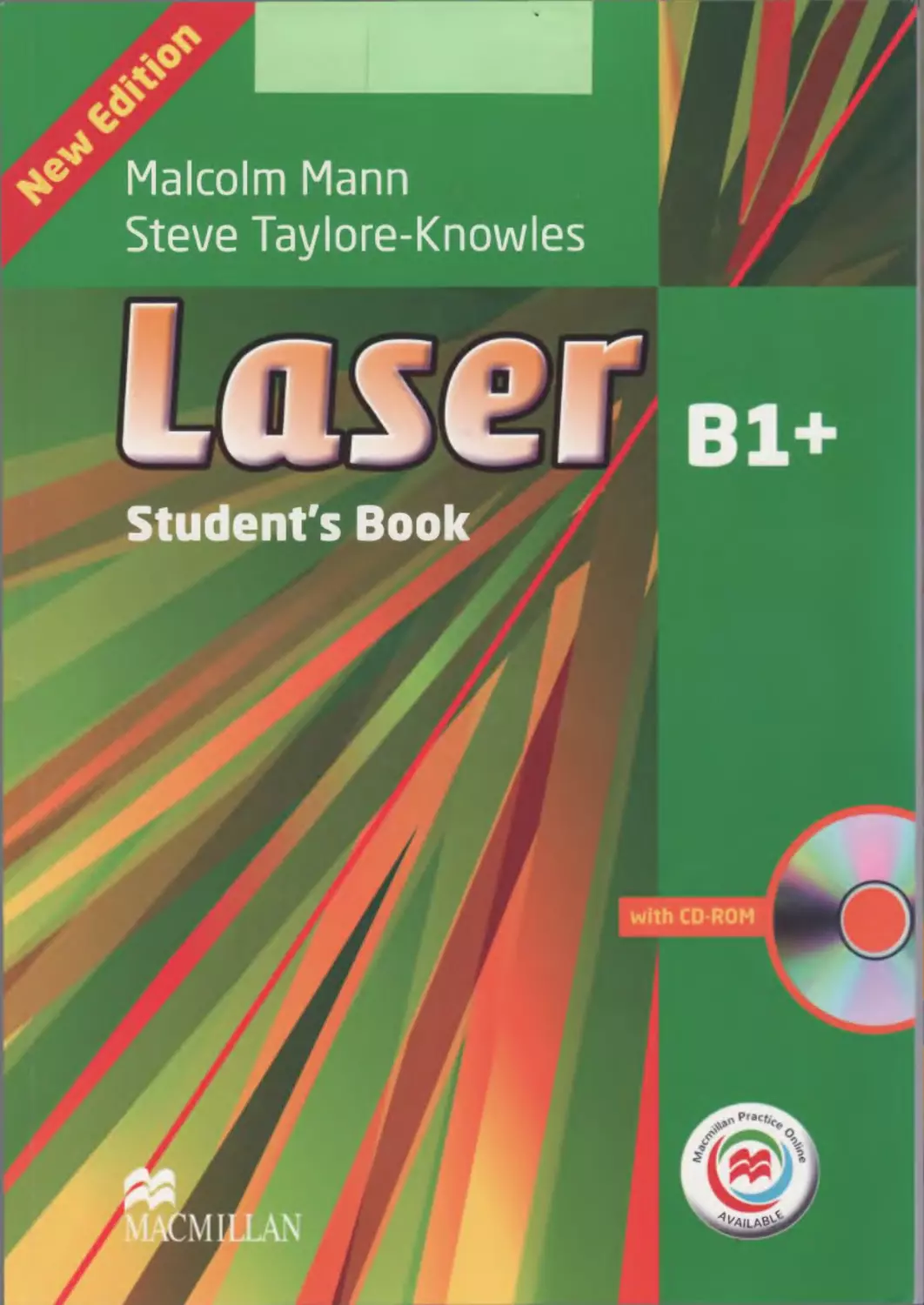


Автор: Taylore-Knowles S. Mann M.
Теги: linguistics english grammar english language student's book
ISBN: 978-0-230-47068-2
Год: 2013



Текст
^
Malcolm Mann
Steve Taylore-Knowles
Student's Book
&AILAg^
Malcolm Mann
Steve Taylore-Knowles
B1+
Student's Book
MACMILLAN
Contents
a
Topic
Reading
Grammar 1
Vocabulary
people and
scanning for
tense review:
key topic vocabulary,
relationships
specific
present (simple
word formation (prefixes),
information
and continuous) phrasal verbs with up,
metaphors (people)
transport
scanning for
specific
information
tense review:
past (simple and
continuous)
key topic vo cabulary,
co nfusable words,
collocations (transport)
free time
activities,
hobbies
reco gnising
discourse
markers
tense review:
present perfect
(simple and
continuous)
key topic vo cabulary,
idioms (time), phrasal
verbs with down,
metaphors (time)
o ccupations
scanning for
specific
information
tense review:
past perfect
(simple and
continuous)
key topic vocabulary,
word formation
(suffixes), confusable
words
the media,
scanning for
the passive
key topic vocabulary,
co mm unications specific
phrasal verbs with on,
information
idioms (the media)
the weather
understanding
main concepts
the future (1):
will, g oing to,
present (simple
and co ntinuous)
key topic vo cabulary,
collocations (weather),
co nfusable words
food and drink
grammatical
referencing
reported speech key topic vo cabulary,
phrasal verbs with out,
collocations (cooking)
8
travel and
text type and
full infinitiv es
key topic vo cabulary,
tourism
function
(with to) and
word formation
-ing forms
(irregular forms),
after verbs
metaphors (life)
Listening
Speaking
Use of English
Writing
predicting,
talking about family
stative verbs, word
selecting correct register,
Soundbite:/i/and/i:/
patterns
informal letter/email
dentifying location,
comparing
would, used to, be used to,
presenting an argument,
Soundbite: /as/and Id
word patterns
essay
understanding attitude,
Soundbite:/a /
making suggestions
articles, synonyms
awareness of target
reader, informal
letter/email
istening for specific
expressing uncertainty
co mparatives and
layout and text
information,
superlatives
structure, report
Soundbite: silent letters (1)
stening for gist,
Soundbite: h \!
talking about experiences countable and
uncountable nouns,
homonyms
using descriptive
language, story
stening for specific
speculating
question tags, connectors
selecting appropriate
nformation,
style, article
Soundbite: weak forms (1)
listening for specific
giving examples
prefer, would rather,
expressing opinion,
information,
had better, parts
review
Soundbite: Is/ and /z/
o f speech
C
o
n
t
e
n
t
s
Unit
nTopic
m
Reading
Grammar 1
Vocabulary
oOn the Run
PAGE 140
crime
-
scanning for
specific
information
conditionals (2):
third
----
.....
^
key topic vocabulary,
word formation
(irregular forms),
word patterns
■
Revision Units 15-16 • Pf IGE 148
Jffe
Writing database • PAGE 150
^
Writing planners 1-16 • PAGE 155
Word pattern database • PAGE 163
Phrasal verb database • PAGE 164
Speaking database • PAGE 165
Grammar database • PAGE 166
Webquests • PAGE 198
Listening
Speaking
Use of English
Writing
y.
stening for specific
talking about hopes
unless, in case, as long paragraphing,
nformation,
as, word patterns
informal letter/email
Soundbite: /s/ and /J7
y,
_ 'edicting,
expressing attitude
parts of speech,
cohesion,
Soundbite: /a/
and opinion
word formation: prefixes
essay
■
y-
: redicting,
prioritising
relative pronouns and
selecting correct register,
5Dundbite: stress (1)
prepositions,
informal
word patterns
letter/email
y,
stening for gist,
discourse management infinitives of purpose,
awareness of
Soundbite:
word patterns
purpose, report
a:, h\l and /u:/
ns)
y.
identifying relationships, talking about interests
gradable and ungradable making
Soundbite:
adjectives and adverbs,
recommendations, review
rs
: lent letters (2)
synonyms
y.
istening for specific
comparing
the unreal past,
selecting correct register,
nformation,
common mistakes
article
Soundbite: stress (2)
y.
understanding purpose,
expressing attitude
transferred negation,
using prompts,
Soundbite:
and opinion
word formation
formal letter/email
d'andhu/
y-
stening for specific
seeking clarification
w ishes and regrets, parts paragraphing, story
information,
of speech
Soundbite:
weak forms (2)
mm
-
m
Family Ties
Q Start thinking!
Do you have a large or small family?
How many ofyou live together?
How many cousins/uncles/aunts do you have?
Reading
1 $ 1.01 Read the post and comments on a social
networking site. Whose family sounds most like yours?
2 Read the post and comments again, and decide if the
following statements are true (T), false (F) or not stated (N).
1 Jenny has a very large family
_____
2 Gokhan has brothers and sisters.
_____
3 Masha isyounger than her sister.
_____
4 Pete regularly stays with his biological father.
_____
5 Alicia wants to meet her biological parents.
_____
6 Alex’s biological father lives in Greece.
_____
3 Write a word or short phrase from the comments to the post
to answer each question.
1 Who says that they have a pet?
_________________________
2 Why doesn’t Angie live with her father?
3 What’s Alex’s sister like?
4 When does Pete stay with his real dad?
5 What do some ofGokhan’s friends do?
6 What isMasha also doing right now?
_ ____________ ___ i __ _____ _________
p i school
e
^^
www.myfamily.com
Jenny
Hi all my MyFace
friends around the
world! W e ’re doini
a project at schoo
on families at the
moment and I nee
your help. Do you have a large or
small family? Who do you live with?
Do you all get on? I’d love to know
what your family’s like! Comments
please!
c il7 people like this.
I Gokhan
JP
ffc B Hi from Ankara,
jP - Turkey! Jenny,
IM
my fam ily’s Quite
j f ’/Q small because I’m
B jlrj an only child. In
‘ theflat where we
live, there’s just me and my mum and
dad. But my grandparents (my mum’s
parents) live in the flat upstairs, and
my dad’s parents live nearby too,
so it’s not too lonely! To be honest.
I sometimes wish I had a brother or
sister to play with, but at least I have
a bedroom to myself! Some of my
friends have to share a room with thei
brother or sister. I wouldn’t like that!
Masha
| We’re doing a
project on families
at school at the
moment too,
Jenny! I live with
my parents and
my older sister, Natalia, in Novosibirsk
in Siberia, Russia. Natalia and I
love each other (of course!), but we
don’t always get on. She’s always
complaining that I play my m usic
too loud! I often get annoyed with
her, though, because she borrows
my things without asking! (Natalia,
if you’re reading this, I want that
magazine back!)
ce
the
Ding
100I
he
neec
i?
i
i,
te
I’m
n
/ve
and
jm ’s
id
t,
Dr
ive
thei
at!
ilies
ith
d
birsh
\/e
Pete
Hello from California, USA!
My family’s a bit complicated,
j * My parents are divorced,
and I live with my mum
and my Stepfather. My dad
* 3 remarried after the divorce, and I spend
a r Dst every weekend with him and his wife (my
Me: mum). I’ve got a stepsister called Angie.
Th 's my stepfather Alan’s daughter from a
zn ious marriage, but she’s older and works in
York, so she doesn’t live with us. I ’ve also
got a half brother because my dad and my
mum have just had a baby! I told you it was
BOr : icated! It’s great, though. W e all get on
tm y well. My parents are still good friends, and
—.
;:epfather and stepmother like each other
t's actually a really loving family, and I’m
r . grateful for that.
Alicia
Hi, Jenny! My parents
adopted me just after I was
borrirSnd I live with them and
my brother and sister and our
dog, Cassie. Even though I’m
adopted and my brother and
s :er aren’t, our parents treat us all the same.
tally feel part of the family, and don’t want
: -eed to find my biological parents. As far as
concerned, my mum and dad are my real
z :'ents! (By the way, I live in Lublin, Poland.)
WORD BOX
4 Use words or phrases from the post and
comments to complete the sentences. You've
been given the first letter to help you.
1 Itwould be fun to have a brother, instead of
being an
,
_
c_
2 Lisa gets what she wants. She’s becoming
very selfish and I think she’s a bit
sJQitt
3 My parents are d_________________ and I see
my dad every weekend at his house.
4 Mymummetamanlastyearand she
s~\ \
1*^ *
P
5 Mydad marriedSarahs mumlastmonthso
Sarah’smys' 1
I ,- '______ .
6 It’simportantto grow up aspart ofa
1______ ____________family.
7
i'fj
7 I didn’t know you were a__________________ .
Do you want to findyour realparents?
8 Kevin and I have the same motherbut different
fathers, so he’s m y h __________________
b__(k/
Alex
Hi from Australia! I’m Greek-
Australian, so most of my
family live on the other side of
the world. Here in Brisbane,
there’s me, my mum and
my younger sister, Georgia.
I rDrgia’s a bit spoilt, to be honest. Anything
■ieasks for, my mum gives it to her!The rest of
.
mum’s family all live in Greece. That’s more
an 15,000km away! I’ve got three aunts, two
andparents and loads of cousins there, and I’ve
- /er met any of them in person. My mum keeps
touch with them by phone and email, and
■espoken to them (of course!), but it would be
/ely to meet them. I’m sure I will, one day!
Have your say!
What do you think are the advantages and
disadvantages ofbeing an only child?
Isitbetter to share a room with a brother or sister,
or have your own room? Why?
F
a
m
i
l
y
T
i
e
s
!
Grammar clinic
Present tense review
<5>Look at Grammar database pages 166-168 before you do the exercises.
1 Read these sentences and phrases from the comments to the post on pages 6 and 7. Match each one
with an explanation.
a This is a regular habit,
b Thisis an annoying habit,
c This is a temporary situation,
d This is a general, scientific truth,
e This is a feeling or situation, not an action.
1 That’s more than 15,000km away!
2 Natalia and I love each other (of course!), but we
don’t always get on.
3 I spend almost every weekend with him and his
wife ...
!~
4 We’re doing aproject on families at school at the
moment...
~
5 She’s always complaining that I play my music too loud!
2! Circle the correct tense in each sentence.
1 Our familygoes/isgoing on holiday to Spain every year.
2
3
4
%
Did you sayyou stay/arestaying with friends until yourhouse is ready?
My sister doesn’t have a car because she doesn’t drive/is not driving.
People live/are living in many different kinds of family.
Brothers and sisters often argue/are arguing about unimportant things.
3 Complete the sentences using the correct form of the
verbs in the box. You may need to use a negative form.
Jxy•go•learn•see
1 MybrotherandI .
live like
yv\
to the local
secondary school.
We___________________here until the new house is ready.
I _____
French for my trip to Paris next month.
Mygrandparents_____ !
________
milkshakes, but I do!
‘Wait a second. I __________________ to find my keys.’
We
our cousins every Christmas.
4 Use the notes to make complete sentences.
1 My brother/always/complain about/me to my parents.
2 In our house,/we/always/eat dinner together/and I/like it.
3 My stepsister/play/the piano and she/know/hundreds
of songs.
4 I/think/Mum/have a shower. She/usually/have a shower at
this time.
5 My relationship with my sister/get/better.
6 1/not believe/everything my brother/tell/me.
5 Read Jenny's comment about her own family. Find
six mistakes with verb tenses and correct them. Use
contractions (you're, etc) where you can.
O
Jenny
Thanks for all
your comments!
You all have
really interesting
families! Masha,
you do a project on families too,
so I thought I’d tell you about my
family. There are five of us in my
family - my mum and dad, me,
my older brother, Alex and my
younger sister, Lizzie. My mum’s
being a newsreader on TV and
my dad works in an office (I’m not
really knowjncj what he does!). I ’m
generally getting on very well with
Lizzie and Alex, but they’re always
playing tricks on me, and that’s very
annoying! I’ve also got two sets of
grandparents, and they often come
to visit us. In fact, Grandma Mollie
and Grandpa Doug stay with us at
the moment, which is nice. I ’m loving
my family!
r* j Vocabulary builder
Adjectives to describe people
1 Match the words in the box with the correct definitions.
selfish popular sensitive arrogant pessimistic
amusing
ambitious co nsiderate generous
optimistic modest
vou are ...
__ , you want to be very successful.
_
, you think the future is going to
be bad.
;J 0 m'tt:
MV15
. , you have lots of friends.
. , people thinkyou arefunny
_________
!
, you share what you have with
'ither people.
h<dI\
L' Wi
be good.
onsicle^
>P\/1P c f
achievements.
., you get upset very easily
., you think the future isgoing to
., you only care about yourself.
., you care about other people’s feelings.
_, you don’t like to talk about your
., you think you are better than
other people.
•Vord formation: prefixes
2 Complete the sentences with the correct negative form
ofthe word in bold. Usein, un, im, dis, ilorir.
’
'—
I’m sure Nigeldidn’t mean to be.
when he spoke to you this morning, kind
A lot of people think it is __________________ to visit
w ithout calling first, polite
Nadine thinks she’s _______________
,but Ithink she’s
quite p retty attractive
D on ’t b e ______________
.! Let your sister play with
you and your friends! fair
I think it’s very____________1
_
. ofyoutolietoyour
brother like that, honest
My mum is ___________________of being rude
to anyone, capable
Jenny is in trouble after doing something
ll
legal
Don’t include any _________________ points in your
description,
relevant
Phrasal verbs with up
Phrasal verbs with up often have
meanings connected to making things
appear or things suddenly appearing.
Match the phrasal verbs in the box with
the definitions.
makes up turns up comes up
thinks up * brings up
1 Ifaperson.
arrive unexpectedly.
2 Ifaproblem____________
., they
-v—
.it
appears unexpectedly.
hi 1/Ql/\p
3 Ifaperson,
they have it before anyone else.
4 Ifaperson__
they create it.
5 Ifaperson__
. anidea,
bn0\K€_ ^ b
. a story,
. a s ubject,
they m ention it in a conversation.
Magic metaphors
4 When we talk about people, we
sometimes use words or phrases that
have a connection with temperature.
Complete the sentences with the words
from the box.
warm
cool
cold-hearted
icy hot-tempered
1 I thought John was very
__________________whenhe saidhe
didn’t care about people who don’t have
enough money
2 My grandfather was a very
__________________, kind manwho
would do anything for anybody.
3 Our head teacher isquite
. a nd gets very angry
about unimportant things.
Tony is really _
He doesn’t let anything worry him.
When I asked Mrs Brown how old she
was, she didn’t answer me; shejust
gave me a (n) _________________ look
instead!
O
F
a
m
i
l
y
T
i
e
s
!
F
a
m
i
l
y
T
i
e
s
!
% You are going to listen to five people talking
about members of theirfamily. Before you
listen, read the questions and talk about what
each person might say in these situations.
1.02 You will now hear five people talking
about members of their family. For questions
1-5 , choose the best answer (A, Bor C).
You hear John talking to his friend. Why is his
dad angry?
A because John was late home
B because John was not studying
C because John broke something
You hear this woman speaking on the radio.
Whatjob does her sister do?
A doctor
B teacher
C architect
You hear this conversation on a bus. Who does
the boy miss?
A his father
B his brother
C his uncle
You hear this teenager speaking on the phone.
Why is she upset?
A because her sister uses her things
B because her sister goes out a lot
C because her sister is always annoyed
Youhear your friend on the phone inviting you
to a family party. Whose birthday is it?
A her cousin’s
B her brother’s
C her mother’s
Soundbite /i/ and /i:/
$ 1.03 Listen to someone saying 10words. Look
at the list of words and write down the number
of each word you hear. What is the secret 10-digit
number?
0bit 2pill 4seat 6mill 8still
1meal 3steal 5sit 7beat 9peel
Now write down your secret number. Say the
words and ask your partner to find your secret
number! Ifthey can, score a point!
w§c
Choose the most natural way of
expressing each idea.
a ‘There are three of us in my family.’
b ‘My family consists ofthree members’
a ‘I go to the second year of the Second High
School of my town.’
b ‘I’m in the second year at mylocal secondary
school.’
a ‘I have one sister and one brother and I am ok
than them.’
b‘I’ve got a sister and abrother and I’m the elde
0
In pairs, ask and answer the questions. Try tos
as much as you can. Use the phrases below to
help you.
Do you come from a large family?
Are you still at school?
What do your parents do?
Would you like to do the same job as they do?
Yes, I’m only
{
-
14, so I’m still at
My family s quite
,
,,
7
school. I go to
small/large.
a
There’s me, ..
My father s a
and my mother
works as a
<*> Look at Speaking database - Giving personal
information on page 165.
* | Speaking
Read what Julie says about her family.
‘There are five of us in my family. There’s me
mytwo sisters, my mum and mydad. Igo to
the local comprehensive and I’m in the first
year. I’m the eldest. My dad runs a shop and
mymum’s alawyer. Myambition istobe a
lawyer, like my mum, when Igrow up. ’
Use of English
Stative verbs
<I>Look at Grammar database pages 167-168
before you do the exercises.
1 Circle the correct tense in each sentence.
I think/am thinkingthat your family is the
most important thing in life.
.
My mum can see/isseeing my maths teacher
tomorrow.
Elaine isn’t looking/doesn’t look like h e r sister
at all.
The Robinson family owns/is owning a lot of
the land around here.
: Living with all your cousins sounds/is
sounding like chaos to me!
■ You look unhappy. What are you thinking/do
you think about?
Word patterns
2 Complete the sentences using the correct
form of the verbs in the box.
look accuse deal blame care
.mefor
1 My sister is alw ays_____________
her problems.
2 It’s h ard to __________________w ith people
who won’t listen to you.
3 Mum
_me
of lying, but it
was my brother’s fault, really!
4 Itryto
-_____________ about
the feelings of the other members of my
family.
5 Auntie Pat u su ally _________________ after
us when my mum’s at work.
3 For questions 1-10, read the text below and decide which answer (A, B, C or D) best fits each gap.
There is an example at the beginning (0).
Babysitting
Babysitting is a good (0)_____________ for teenagers to
earn some extra spending money, and it can teach
you some valuable skills too. Looking (1) Q|tLg »
young children - even for a few hours - isn't always easy.
Problems (2) Co'<\£
up, and kids don't always
do what they're told, especially when they know their
parents are away. At times (3)
!;'
that, you
have to stay calm - and that's an important lesson to
learn. You mustn't let the situation (4)
1
out
of control. However badly therkids behave, don't let them
(5) 0■
1’
. you - and don't get depressed! It's not your (6) -A/ ______ that they're
misbehaving, but it is your responsibility to solve the problem. (7) ‘
a solution to
problems like this is an extremely important skill, so where better to begin than trying to get
noisy kids to go to bed? The question is, how do you deal (8) ^ ' - _______a problem like that?
_
iyKvo-kdA
The secret is to be calm, but firm. Don't start shouting and (9)_______________ _ them of destroying
your evening. Just keep repeating in a calm, firm voice what you want them to do. It takes a bit
of practice, but it (10) ChQgc
work in the end! Good luck!
A path
B road
C way
D route
6 A fault
Bblame
C cause
D reason
1 Aabout Bto
Cfor
D after
7 A Doing B Finding C Making D Getting
2 A appear B come
Cgo
D get
8 Aover
B about
Cof
D with
3 Alike
B such
Cas
D similar
9 A accusing B attacking C criticising D blaming
4 Aturn
Bgo
Cget
D come
10 A makes B does
Cis
D has
5 A argue B complain C mind D annoy
F
a
m
i
l
y
T
i
e
s
!
Writing
An informal letter/email
<D Look at Writing database - informal letters/emails on page 154 before you do the exercises.
Read this writing task. Why
should your letter be informal?
Match the formal language with the informal language.
Your cousin, who lives abroad,
has recently written you aletter.
In it, she asked you to tell her all
the family news she has missed.
Write a letter, telling her what
she wants to know.
Write a letter of between 120 and
180 words in an appropriate style.
Working model
Read the answer to the writing task.
formal language
1 Dear Mr Smith / Dear Sir/Madam,
2 Ihope you are well.
3 I am writing to inform you ...
4 In addition,...
5 Iwonder ifyou could tell me ...
6 I look forward to hearing
from you.
7 Yours sincerely, / Yours faithfully,
informal language
a Let me tellyou about.
b Tell me ...
c All my love,
d Can't wait to hear all
your news!
e DearTina,
f Oh, and anotherthing!
g Hope everything's oka)
Pear Tina,
It was great to hear from you! Hope everything &okay. Have you started your exams yet?
6jood luck!
Anyway, you asked me to tell you all the family news. Well, a lot's happened since you
were here. The big news is that Uncle Tom got m arried! Can you believe it? His wife is
lovely - she's a doctor and she's really beautiful. We all went to the wedding and had a
wonderful time. (Grandad danced! It was so much fu n.
Oh, and another thing! Pad's got a newjob . Po you know the old shopping centre in
town? They've built new shops there and Pad applied fo r ajo b as a manager and he got
it! He's really excited. He starts next week.
One last thing. Po you remember Fluffy, the cat? Well, we can't find her anywhere. We've
got no idea where she's gone. It's a bit sad, really. We all miss her. We're hoping she'll
come back soon.
We all miss you too. Everybody sends their love. Can't wait to see you in the summer.
All my love,
Martin
4 Find these informal words and phrases in the letter.
Anyway,...
One last thing.
All my love,
Oh, and another thing!
Well,...
Dear Tina,
It was great to hear from you!
O
S ecideifthe statements are true (T) or false (F).
j informal writing,
» always use complete sentences.
I » . use exclamation marks (!).
1 » . use contractions (it’s, we’re, etc).
* » e write as ifwe are talking to the person.
► we use everyday vocabulary.
s ~adyto write!
6 -: ok at this writing task. Who are you writing
and why?
•
j are staying with your pen friend in
gland. Write a letter to your brother,
ran, telling him all about the family
y:j are staying with.
Write a letter of between 120 and 180 words in
i appropriate style. Do not write any addresses.
^ ' 'ake a plan of your answer. Use your
^ agination.
•
; 'Ware you going to start your letter?
i Dear Dean,
b!)ear Brother,
-
1)ear M r Jones,
•
V. hatsthe name ofthe familyyou are staying
with?
•
Which town are you staying in?
•
iyou like it? Why?
•
Y.'ho are the members of the family?
•
\ hat are they like?
•
V. hat do they do?
•
V. hat do you want to ask your brother about
nome?
•
low many paragraphs do you need?
•
How can you end your letter?
•
:low can you sign your letter?
complete Writing Planner 1 on page 155.
Now write!
8You are now ready to write your letter. Use
informal language and a conversational tone.
Check it out!
9 Check your work. Tick (/)
what you have done.
^1 Look Back
Can you answer these questions? Ifyou can't
remember, look through the unit for the answers.
1 What do we call someone who doesn’t have any
brothers or sisters?
2 What tense do we use to talk about general truths?
3 How would you describe somebody who gets
upset easily?
4 What’s the negative form of‘honest’?
5 What have you learned about stative verbs?
F
a
m
i
l
y
T
i
e
s
!
The Open Road
Start thinking!
How fast do you think ahorse can run?
Do you know who invented the aeroplane?
Do you know when people firstlanded on the Moon?
transport
(noun):
sssr--""
o,
Early humans dreamed of going faster and
further than they co&fd on fo'ot. They probably
first achieved this in northern countriesGUnC.
before 3000 BC (before Christ) using skis.
The wheel was invented around 3500 BC,
but carts were very slow without roads. So for
;, '-"‘v'^-J;
many centuries the fastest and most popular
means of transport was the horse, which
can run at about fifty-five kilometres an hour.
This record for speed was unbroken until
the end of the eighteenth century when the
hot-air balloon and the railway both began to
develop.
O-OAAAJ^
The hot-air balloon made its first free flight
in 1783. Two Frenchmen, the Montgolfier
brothers, were working as papermdkers
when they had the idea for the balloon. A
0\
fire heated the air, making the balloon rise.
During the first flight, the two passengers
were admiring the view when they suddenly
Reading
1 $ 1.04 Read this extract from an encyclopaedi
Asyou read, checkyour answers to the questions
opposite.
saw smoke! The balloon was burning but,
ViicTcity, they managed to put the fire out am
land safely.
VjiA
The railway developed gradually from cart;
on tracks. The first Vehicle with an engine
to run on tracks was develqp^inM 803 by
an Englishman, Richard Trevithick. In 180^
he took the first passengers, although the\
didn’t have to buy a ticket. Unfortunately, tl
were travelling in the train when it began t<
fall off the tracks and Trevithick realised th
the tracks were not strong enough to take
weight of the train. The passengers escap
Cl'
.
.
...
ojw
^ccoUA/tm ,
unharmed, but it was another example of
how dangerous the development of transp
can be.
Perhaps unexpectedly, the bicycle didn’t
appear until around 1840 when a Scotsm;
Kirkpatrick Macmillan, created the first on<
to have pedals. People rode bicycles with
pedals before then, but they were slow an
not very popular. It took around 140 years
Macmillan’s design to develop into moder
mountain bikes.
J.JUcrtM i
I amplete the sentences by writing a number
i- each gap. Look at the article again, but don't
■rad it in detail.
I .ople first skied a r o u nd __________________
BC.
! >ple first travelled by rail in
1DM
: - vcles with pedals didn’t exist before
19 Vo
Mountain bikes developed around
%
»ad the text again. For questions 1-5 , choose
•- e answer (A, B, C or D) which you think fits
r-est according to the text.
The wheel didn’t lead to fast means oftransport
'-.cause
A people could already travel fast.
R :hey invented it after skis.
C e 'od roads didn’t exist.
I> reople preferred to use horses.
I The passengers discovered the fire
A while they were checking the balloon.
Bwhile they were in the air.
C before they left the ground.
D after they landed on the ground.
5 The invention ofthe train
A came as a complete surprise.
B grew out ofthings that came before.
Ctook longer than anyone expected.
D didn’t make Trevithick much money.
I The writer is surprised by the fact that
A the inventor ofthe bicycle was Scottish.
B nobody had invented the bicycle earlier.
C Macmillan’s bicycle had pedals.
D we waited over a century for the
mountain bike.
> What can we say about the aeroplane?
A It had a great effect on people’s attitudes.
BItwasn’t aspopular asthe car was.
C It came to the Wright brothers in a dream.
D People didn’t want to allow it at first.
TN* -.ventieth century saw the
•r»elopment of many other means of
r t r soort, including the hydrofoil and the
icvercraft. Thepetrol-driven car (invented
r *-55 in Germany) completely changed
t * e .v a y people thought about transport,
a r c 50 did the aeroplane. People have
•ways dreamed offlying. One day, in
1903. that dream became a reality. Two
Are ncan brothers, Wilbur and Orville
Hfcrght. managed to make a short flight
r •'e ir aircraft, the Fiyer. From there, a
fg
3 liu
:e industry grew that allowed, and still
• I:as, people to visitthe whole world,
fcs ily and cheaply.
7>e challenge for the twenty-first century
"ansport in space. Since the first
11
JQ AOJ^P>rlM
U :n landing in 1969, technology has
> .eloped to give us the space shuttle
' r E1) and even the space tourist (2002).
future of transport will probably be as
r>: ting as its past.
WORD BOX
4Match the words from the text in the box
with the correct definitions.
cart tracks hydrofoil
pedal hovercraft
vehicle
1 This is a kind offast ship that partly lifts out of
the water.
2 Thisis ageneral word for a car, a bus, etc.
3 This floats on a cushion ofair on land or on
water.
4 Trains travel on two ofthese, made ofmetal.
5 Thishas four wheels and might be pulled
by a horse.
6 Youput your foot on this on abicycle.
1 3 Have your say!
•
Which form oftransport has had the biggest
influence on our lives?
•
Explain what difference your chosen form of
transport has made.
*<3 Grammar clinic
Past tense review
<*> Look at Grammar database pages 168-170 before you do the exercises.
Read the sentences and phrases from the text on pages 14 and 15. Match each one to an explanation.
1 The hot-air balloon made its first free flight
a This describes a repeated action in the past that
in 1783.
doesn’t happen now.
2 ... the two passengers were admiring the view
b This describes a past state.
when they suddenly saw smoke!
c
describes an action in progress when anotl:
3 People rode bicycles without pedals ...
action happened.
4 ... the fastest means oftransport was the horse ...
d This describes a single, completed action.
Look through the text again and find examples of:
a single completed action.
a repeated action in the past.
an action in progress when another action
happened.
a past state (a feeling or situation, not an action).
Complete the sentences using the correct form of
the verbs in brackets.
1We
j_(fly) by plane to Paris last
year on holiday.
2 W e __________________(fly) over the sea when one
engine suddenly stopped.
3 The pilot________________ (tell) us that there was
nothing to worry about.
4 While he
>____________ (tell) us this, the
second engine stopped.
5 I had my eyes closed when somebody
_________ ;
______
(shout), ‘Look!’
6 I looked out of the window and ________________
(see) that both engines had started again. Phew!
Correct the sentences that have mistakes in them.
One sentence has no mistakes. Which one?
1 As we were entering the train station, I was
noticing the train was late.
2 Isat in a taxi when the accident happened so I saw
the whole thing.
3 Mick was riding his bike almost every day over the
summer.
4 People were enjoying the journey when suddenly
the ship hit an iceberg.
5 When you called, I watched a programme about
the history of transport.
Complete the text using the verbs in the box. I
the verbs into the past simple or the past cont
You will use some verbs more than once.
be » do • fall get • have learn push ride
see shine start » take » teach tell • want
Learning to ride!
----
Till C
t
ride abike when I
(2)—1_
_
_
_
ei;
years old. My dad ^
(3) — ___________ m<
Iremember one day i
particular. The sun
(4) ------------ \
am
Dad (5)____________
me to the localpark
with my new bike. My old bike (6)___________
stabilisers (little wheels at the side, so you can’t
fall), but this one (7)
r
.Whenwe
(8)-----1
_________
there, I (9)______________
some children who (10)
their
bikes, and I (11)_____________ to be just like
them. I (12)--------------------on my bike and Dac
(13)------------------- to push me. After a momen
I (14)-------------------- m y dad he (15). jVAs
me too fast, and I couldn’t believe his answer!
‘I’m not pushing you! You’re doing it by
yourself!’he (16) 0-1
______
Of course, 1(17) ____________ off my bike
many times after that, but that
(18)
------- a very special day.
6 Do you remember learning to ride a bike? How
did you learn? Who taught you? Tell the class.
V'
er
ut
nu
S3
^ Vocabulary builder
P- blic transport
1 atch the words in the box with the correct
efinitio ns.There is one word you do not need
to use.
•: n taxi rank » fare »^irline
derground platform •oterminal
coach
his is where you stand to wait for a train,
his is a company that flies passengers by plane.
. his is abuilding for passengers at an airport,
his is a system oftrains in tunnels in alarge city,
hisishow much youhave to payfor aticket,
his is where you sleep on a ship.
his is whereyou find taxis waiting for
issengers.
his is abus that runs between towns and cities.
Gonfusable words
Circle the correct word in each sentence.
1 I think that travel/journey really teaches you
about other people.
2 Mr Carter has gone to Moscow on a business
trip/journey.
3 Hurry up, or we’re going to miss/lose the bus!
4 Don’t get on/in the train unless you know where
it’s going!
ht
getonIgetoff
Collocations: transport
3Complete the table with the
~ieans of transport.
:: cycle bus *2car * ^helicopter
- orse • hot-air balloo n4 train
:: ane * Qmotorbike •'f ferry *2ship
rowing boat »2taxi trolleybus
4
Decide which of the means of transport from
exercise 4 each person is talking about.
‘Wow! This is so cool! It’s the latest m odel too!
Let’s see if we can do 200!’
‘Come on! Let’s go and sit upstairs so we can see
everybody getting off.’
‘Call one now - and don’t forget to tell them
we’re going to the airport.’
‘I’m afraid the Inter-city doesn’t stop at Porton.
You’ll have to get a local one.’
‘It’s noisy during take-off, but you can’t even hear
the engines after that.’
5
5
i
2
3
4
Match words in list A with words in list Bto make
compound nouns.
A
B
express
bus
radio
car
double-decker
plane
jet^
taxi
sports
train
\
T
h
e
O
p
e
n
R
o
a
d
T
h
e
O
p
e
n
R
o
a
d
Listening
Work in pairs. Make a note ofwords and
phrases you know connected to these means of
transport. Try to list as many as you can.
bus: driver, tic k et , ________________
plane: airport, p ilo t, ________________
ship: voyage, captain,
train: driver, ticket,__
1.05 You are going to listen to extracts
from three conversations. For each extract,
choose the location where the conversation
is taking place.
Conversation 1
a at a train station
Conversation 2
a at a bus station
Conversation 3
aonaplane
bon abus
cinataxi
bon aship catanairport
bon atrain
cinataxi
Listen again and write a word or short phrase in
each gap.
Conversation 1
The man wants a(n) (1).
. r eturn ticket to York.
The woman tells him that he needs to catch the
(2)________ from Manchester.
Conversation 2
The man says it takes (3).
. to get to France.
Thewoman leaves the man to goto her (4)------
Conversation 3
The man explains that it’s quicker to go (5)------
The woman agrees, even though the fare will be
(6) -------------- •
* 1 Speaking
Make notes of things that trains and buses
have in common.
You have to buy a ticket to travel on them.
Make notes ofthings that are different
between trains and buses.
A train travels on tracks, but/while/whereas a
bus travels on the road.
Answer the questions.
Which means oftransport do you prefer, the
train or the bus? Why?
Work in pairs. One of you should read the
instructions and the other should talkfor
one minute.Then swap.
Compare and contrast these photographs
and say which means oftransportyou prefer.
/se/ and/e/
># 1.06 Circle two words in each line which have
the same vowel sound in them. Listen and check.
1 thank
bed
thirty
cat
2 head
had
said
paid
3 apple
ant
ape
arm
4 pet
hut
pat
send
<S>Look at Speaking database - Comparing and
Expressing preferences on page 165.
I
Use of English
Would, used to, be used to
<3>Look at Grammar database page 170 before
you do the exercises.
Circle the correct word or phrase in each
sentence.
1 Our old car would/was used tobreak down all
the time.
2 I usedtoIam used to going to schoolbybus
every day.
3 There would/used to be an aircraft factory in
this area.
4 I never used to/wouldn’t like travelling by
train.
5 Driving is complicated, but you soon are/get
used to it.
6 I found flying frightening because I didn’t use
to/wasn’t used to it.
Rewrite the sentences using the word in bold.
1 Whenhe wasaboy,mydad wouldwatch the
steam trains go past, used
2 Flying a helicopter is difficult at first, but you’ll
soon find it much easier, get
3 When she was four, my sister used to ride her
bike around the house, would
4 Mygrandfather took me for rides in his old car
when Iwas small, used
Word patterns
Complete the sentences using the correct
form of the verbs in the box.
work • insist • remind • complain • take
1 John________________ on goingbybus ashe’s
afraid of flying.
2 We decided to ________________ about the
delay to the ticket inspector.
3 We have to ________________ into account the
traffic at that time ofday.
4 To________________as a bus driver, you need
a special licence.
5 This old b u s _____________
. me ofthetime
we travelled around India.
4For questions 1-10, read the text below and
think of the word which best fits each gap.
Use only one word in each gap. There is an
example at the beginning (0). Write your
answers IN CAPITAL LETTERS.
THE SKY'S THE LIMIT!
Not so long (0)____A^rO____ , almost all pilots were
men. Women working for airlines (1)____________usually
be part of the cabin crew, serving drinks and meals to
passengers. And while it's still true that the majority of
people who work (2)____________pilots are men, more
women are entering the field. Sara Milton is one ofthem.
'I (3)------------ to be afraid of flying when I was a child,'
she says, 'but my parents insisted (4)____________taking us
on holiday abroad. I (5)
argue and cry, but it
never made any difference, so I eventually (6) _ _ _ _ _
used to it.Then, on one trip, we had a female pilot,
w hich I wasn't used (7)____________seeing, and I suddenly
thought that I'd love to do that job! My mum reminded
(8)____________of my fear of flying and how I always
complained (9)____________going on planes, but from that
moment on, I was determined to become a pilot. When
you (10)____________into account the long hours and all the
training you have to do, it might seem like hard work, but
it's w orth it!'
^
T
h
e
O
p
e
n
R
o
a
d
. J Writing
An essay
<3>Look at Writing database - essays on page 153 before you do the exercises.
1
3
Read this writing task.
•
Should your answer be formal or informal?
•
Do you agree with the statement?
Your class has been studying transport.
Your teacher has asked you to write an essay
explaining whether you agree or disagree with
the following statement:
People sh o uld be encoi
public transport more.
Write an essay ofbetween 120 and 180 words in
an appropriate style.
Complete the useful phrases with words from
the box.
addition argue begin • convinced
first*more•of«one other*to
to introduce your first point
To_________with,... In the_________place,... The
first thing to take into account is ...
to introduce a further point
Secondly,... W hat is____________________ , . . . In ____ to
this,... Anotherpointtobe madeisthat...
to express causes and results
Because ________ this,... This is due___________ _
As aresult,...
to express contrast
On the________ hand, ... On the_________
hand, ... However, ... Despite ...
to introduce a conclusion and express opinion
To conclude, ... In conclusion, ... I am _________
that... I would________ that...
0
Working model
4 Read the answer to the writing task. Does the
writer agree or disagree with the statement?
7Ttere is no doubt that traffic adds to pollution. Public
transport offers a possible solution to the problem,
since many people can be transported in one vehicle.
The government has a responsibility to encourage
the public to use buses and the underground more.
However, there are a nu mber o f changes which need to
be considered.
In the fi r s t place, public transport should be made
free. The government should raise taxes to pay f o r the
service. I f it was free, most people would decide to leave
their cars at home and travel by bus or train.
What is more, the service must be clean and reliable.
People need to know that they can get to work on
time. They also need to know that theirjo u rne y will be
comfortable.
To sum up, I would argue that a clean, reliable service
which was fre e would encourage many people to use
public transport. The government should take action on
this to prevent environmental damage.
5 Find words and phrases in the essay which mi
because • but firstly
in addition
in conclusion
Make notes to answer these questions. Then discuss your ideas as a class.
‘Public transport’includes which
forms oftransport?
What are two advantages of
public transport?
What are two things people don’t
like about public transport?
!
i
to
e-
vt
on
' Read the essay again and circle the
correct answer.
: In the first paragraph, the writer
a introduces the subject and generally
agrees or disagrees with the statement,
b lists all the reasons why she agrees or
disagrees with the statement in detail.
.
In the second paragraph, she
a explains some points against her point
o f view.
b explains some points in favour ofher
point ofview.
In the third paragraph, she
a introduces her conclusion and states
her opinion,
b explains more points in favour of her
point of view.
In the second and third paragraphs,
a the first sentence of each paragraph
expresses the main idea,
b the last sentence of each paragraph
expresses the main idea.
5 In the finalparagraph, she
a summarises her argument,
b introduces extra points.
Ready to write!
Look at this writing task. Do you agree
or disagree with the statement?
Your class has been studying the history
oftransport. Your teacher has asked you
to write an essay explaining whether
you agree or disagree with the following
statement:
The invention o f the car changed
the world.
J
Write an essay ofbetween 120 and 180
words in an appropriate style.
Look Back
8Make a plan ofyour answer.
•
Do you think the invention ofthe car changed the world?
Why? / Whynot?
•
What are you going to write in your first paragraph?
•
Which point(s) are you going to talk about in your second
paragraph?
Write the first sentence ofyour second paragraph in your
exercise book.
•
Which point(s) areyou going to talk about in your third
paragraph?
Write the first sentence ofyour third paragraph in your
exercise book.
•
Which phrase are you going to use to
aintroduce your concluding paragraph?
b introduce your opinion?
Now complete Writing Planner 2 on page 155.
Now write!
You are now ready to write your essay.
Check it out!
10Check your work.
Tick (/) what you
have done.
1have used formal language.
□
1
1have used some good
□1
connecting phrases.
1 1have explained why
□1
I 1agree/disagree with the statement.
1 1have used paragraphs.
1
I 1have summarised my argument
■ in the last paragraph.
1
1 1have checked my spelling and
1
■ my grammar.
My essay is between 120 and
□I
I
180 words long.
mea
Ian you answer these questions? Ifyou can't remember, look through the unit for the answers.
When did people first invent the wheel?
.
Who were the first people to fly a plane?
What tense describes an action in progress at a moment in the past?
-
What’s the difference between would and used to?
What is agood phrase for introducing your opinion?
O
T
h
e
O
p
e
n
R
o
a
d
Revision
Units 1-2
1 Choose the correct option.
1 People say my b rother’s _________________ He likes giving gifts to his friends.
A brave
Bmodest
C generous
D optimistic
2 The cruise was wonderful!And o u r________________ was really comfortable.
A cabin
Bpedal
Cterminal
D fare
3 I’ve always been quite_________________ I want to make a success of my life.
A depressing B amusing
C considerate
D ambitious
4 Emily is really_______________ !She seems to think she’s better than everyone ej
A loving
B arrogant
C sensitive
D caring
5 Many_________________children want to learn something about their real pareii
A adopted
B divorced
C selfish
D only
6 Did you hear that a train came offthe _________________ yesterday?
A vehicles
B carts
C bars
D tracks
7 We waited on th e ________________ for over an hour! Finally, the train arrived.
A terminal Brails
C platform
D airline
8 We should b e ________________ about the future. Things are getting better all
the time.
A amusing B optimistic
C shy
D pessimistic
9 Let’s take th e _________________to an island and spend some time on the beach!I
A ferry
B underground C fare
D coach
10 My dad’s really looking forward to his business________________ to Amsterdan
Atrip
B journey
Ctravel
D excursion
2Complete the sentences using the correct form ofthe verbs in brackets.
1 My sister__________________________ (stay) at her friend’s house for a few days.
2 I________________ (do) myhomework when suddenly Iheard aloud explosion
3 We__________________(eat) together as a family about three times a week.
4 I ________________ (get) better at remembering words in English these days.
5 In the winter, many birds________________ (fly) south to warmer countries.
6 ‘Hello? No, Tom________________ (have) a shower at the moment. Can I take a
message?’
7 I _______________________________ (swim) almost every day last summer.
8 My mum wants to learn to use a computer, so she________________ (have) lesso
3 Complete the sentences using the correct preposition.
1 Roger still keeps___________touch with all his old school friends.
2 When Jill laughs, she really reminds m e ___________her mother.
3 You can’t blame m e __________ all these problems!
4 Our teacher insists___________ giving us homework every day!
5 The police accused the m an ___________stealing the money.
6 I usually have to look___________my brother when my parents are out.
7 When planning a party, take___________account the cost of food and drink.
4Make these words negative.
^
positive
negative
positive
negative
1 legal
________________
5 kind
________________
2 fair
________________
6 relevant
________________
3 honest
________________
7 capable
________________
4 polite
________________
8 attractive
________________
Complete the sentences using an appropriate word.
1 Ifyour parents get_________________ , they end their marriage.
2 Ifyou are________________ , you have lots of friends.
3 A(n)________________ is a kind offast ship that lifts out ofthe water.
4 On abicycle, you put your feet on the_________________
5 Taxis wait for passengers at a taxi_________________
6 A(n)________________ is a kind ofbus that travels between towns and cities.
7 Ifyou only care about yourself and your own problems, you are_________________
6Complete the sentences using the correct form ofthe phrasal verbs in the box.
think up bring up turnup
come up makeup
1 I hate it when people________________ at my parties without an invitation.
2 A number ofproblem s________________ in the meeting yesterday.
3 When we see Mary, don’t ________________ her divorce.
4 I wonder who________________ the idea ofplaying games on computers.
5 Tony is always________________ stories about other people that just aren’t true.
Circle the correct word or phrase in each sentence.
1 Is that Ashton Kutcher in that car, or do I seelam I seeingthings?
2 I don’t believe/am not believing what Caroline told me about what happened.
3 Anybody who doesn’t understand/isn’t understanding can ask me for help after the lesson.
4 W hat’s in this soup? It tastes/is tasting delicious!
5 Why are you smiling? What do you think/are you thinking about?
8 Complete the following passage using one word in each gap.
Hi, Wendy! Just a quick email to let you know that I'm back from my business
(1) ______________________ to Paris. I had a great tim e, but I (2 )------------------ ------th ink that
Paris was a bit dirty! Everybody was complaining (3)----------------------- the traffic and the
pollution. I'm not used (4)______________________ such big cities, so it was a bit difficult to find
my way around. I kept getting (5)----------------------- the wrong bus and going to the wrong
place! And the weather was awful! One day, I was waiting at a taxi (6)------------------ -----for
an hour in the pouring rain! In the end, I had to call a(n) (7)----------------------- taxi to come
and get me. When it finally turned (8)______________________________ I looked like a drowned rat!
Anyway, I hope you dealt (9)________________________ everything at wo rk while I was away. We'll
have a meeting on Monday and you can (10)---------------------- - up any problems you had.
Take care,
Jackie
Score
160
^ajrts no.\aiy ilEXjM0Z ~0 i>|00I-raipoire jo j amp st}i aqAujAj Ot—lZ
jdnjidaajj jjesjS s,}ElLLOS-If1®nls
no^ jauop IPA'VO'J-IS
©
R
e
v
i
s
i
o
n
U
n
i
t
s
1
-
Killing Time
Do you have any hobbies? Do you collect anything?
What sort ofthings do people collect?
1t
Read this article about hobbies.
Underline all the hobbies which are mentioned.
Hobbies Past and Present
During the twentieth century, more and more
people found that they had leisure time -
time when they didn't have to work or study.
This raised an interesting question. What do
you do when you are free to do anything you
like? Many people took up a hobby, and it's
interesting to compare the hobbies people,
particularly young people, choose today with
the hobbies people chose, say, fifty or sixty
years ago.
Stamp collecting is one of the first things
that come to many people's minds when
they think about hobbies. Organising your
collection seems like the perfect way to relax
for a few hours. It seems that people have
been collecting valuable things since ancient
times. 1
W hen stamps appeared in the
nineteenth century, they were cheap and
colourful and children started to keep them. By
the middle of the twentieth century, collecting
stamps was a popular pastime for both
children and adults, with some stamps worth
a large amount of money - far more than most
children could afford.
There are still many people today who collect
stamps, but technology has had an impact.
Emails can be sent instantly and freely around
the world, which means that people aren't
buying stamps like they used to. 2
Rare
stamps are still in demand, and probably
always will be, but fifty years ago the number
of collectors was higher. It seems that stamp
collecting as a hobby of millions of young
people has had its day.
Another hobby that has changed because of
technology is building models. In the 1950s
and 60s, generations of young boys and girls
built plastic models of planes, boats and cars.
3
Young people are still making and
showing off these models, but the nature of
them has changed. In the past, they were
simply made of wood or plastic, with few
moving parts. Modern models have all kinds
of electronic and computerised parts, in some
cases making them more like robots than
traditional models!
Of course, we can't ignore computers when
it comes to free time. Computers have had
a huge impact on leisure since they were
invented in the middle of the twentieth century.
4
Gradually, however, the computer has
become a part of almost every home, where it
provides entertainment and a whole set of new
hobbies that people fifty years ago w ould have
thought were very weird. Today's teenagers use
their computers for playing computer games,
©
Match the words and phrases with the
explanations.
talk about what happened
:n the beginning
_____
introduce a result
_____
3 to introduce a contrast
_____
i m introduce an example
_____
a :o rinstance,...
b shich means ...
.
rlowever,...
4 \t first,...
' ng websites, communicating with
is around the world - all hobbies that
impossible until quite recently.
outers have changed hobbies in other
»a s ' too. These days, no matter what
. you're interested in, you will almost
inly find a huge amount of information
>n i- on the internet. 5
Today's
ipi :gers are instantly in touch with online
c . >and social networking sites that tell
"all they need to know. People have
>r :jced websites on almost every hobby
w can think of. You can get advice from
• -ts and easily buy equipment to take
r hobby to the next level. Taking up a
v
hobby, or developing one you already
has never been easier or more fun.
Sc ne hobbies, though, haven't changed
—
i. Many young people fill their free
r • with activities that their parents and
I clparents enjoyed. 6
Fishing is
>pular as it ever was. Young people
»
i good balance do gymnastics,
le nagers play sports and games like they
♦ avs have done. A teenager from the
: -* might be confused by a video arcade
«
: CD player, but many things haven't
nged, and perhaps never will. Ask
r parents what they did with their
ei'Ure time and you might be surprised at
> ime of the differences, but also at some of
r ■similarities.
Read the article again. Six sentences have been
removed from the article. Choose from the
sentences A-G the one which fits each gap
(1-6).There is one extra sentence which you do
not need to use.
A Hobbies seem to have become lessimportant as
time has passed.
B Youngpeople in the past had to rely on people
they knew, or perhaps the local library, to learn
about their hobby.
C Theyproudly put these on display in their
bedrooms, or wherever else their parents would
let them .
D However, most people in the past were too busy
and too poor to buy expensive works ofart or
coins.
E Atfirst, they were seen as strange machines used
by big businesses.
F That in turn means that fewer children are
becoming interested in the hobby.
G For instance, people still go dancing, even if the
rhythm ofthe music has changed.
WORD BOX
Use words or phrases from the article to complete
the sentences. You've been given the first letter to
help you.
1 One day, my collection ofbutterflies might be quite
v_________________
2 I don’tknow ifI can a________________ to buy any
new stamps for my collection.
3 Iprefer t_________________ songs to modern pop
songs.
4 It might sound a bit w________________ , but in my
free time I like to study grammar.
5 I like music that has a strong r______________
6 Id like to try gymnastics, but Iknow I would keep
losin g m y b __________________________________ !
7 Let s go down to the v________________
a_________________ and play Alien Invasion.
C y Have your say!
•
Which ofthe hobbies and activities mentioned
in the article do you think are the most/least
interesting? Why?
•
Would you consider taking any ofthem up?
Why? / Why not?
©
K
i
l
l
i
n
g
T
i
m
e
’t j Grammar clinic
Present perfect tense review
<3>Look at Grammar database pages 171 -172 before you do
the exercises.
Read the sentences and phrases from the article on pages
24 and 25. Match each one to an explanation.
1 Computers have had ahuge impact on leisure ...
2 ... people have been collecting valuable things since
ancient times.
3 People have produced websites on ...
a This is a series of actions continuing up to now.
b This is a situation which continues up to now.
c This is a completed action at atime in the past which is not
mentioned.
Decide if the statements are true (T) or false (F).
1 I’ve been studying English for about six years.
This person is still studying English now.
2 Peter Johnson has written five books
about fishing.
We know that PeterJohnson is still alive.
3 ‘I’ve been sorting out my stamp collection,’
said Candy.
Candyfinished this action a long time ago.
4 Jan has read Snowboardingfor Beginners.
Askher about it.
Jans present knowledge is the important thing.
Correct the sentences that have
mistakes in them. One sentence has no
mistakes. Which one?
1 I’ve seen Matt last week, when we were at
the karate club.
2 Ihave a long time to playMonopoly.
3 Sarah hasn’t played football since she
broke her leg.
4 This is the first time Ibuilt a model plane.
Complete the sentences using the
verbs in brackets in the present perfect
simple or continuous.
I ________________(play) tennis, so I’m
1
quite tired.
Lukesayshe.
. (never/
meet) anybody who plays the xylophone
________________ (you/follow)thenew
series that’s on TV at the moment?
My fingers are sore because I
________________ (practise)theguitar
all morning.
W e _____________
. (wait) for an hour
and our dance teacher still isn’t here!
6 Mydad.
(take up) a new
hobby - cooking!
Use the verbs in the box to complete the gaps. Use the present perfect simple or continuous.
join
make plan
read think • write
For the last few weeks, my friends and I (1)_______________________ the creation
of a free local library, and
now it's ready.The idea is that we have a blog that anyone can join for free. The blog's now online, and
about 20 people (2)______________________ already, so it seems it's popular. When we read a new book, we
upload a review of the book. My friends and I (3)______________________ and uploaded 16 reviews already!
When someone (4)______________________ a review, ifthe book sounds interesting, they can borrow it
from the person who owns it. We all live locally so that's not a problem.
Over the past couple ofdays, we (5)________________________about how we can expand the library so it's for
people all round the country. One idea is that we could post books to each other, but that might be
expensive, so we (6)______________________ a final decision yet. We'll see what happens!
©
9
n 1 Vocabulary builder
tree time activities
1 " 3tch the free time activities with the verbs go, do or play.
D et basketball » videogames
camping horse-riding karate swimming
.
:o
skiing gymnastics fishing
volleyball the piano canoeing
. is play.
. in myfree time.’
2 word in bold is correct, put a tick (✓). If it's incorrect, rewrite it correctly on the line.
Howlong have you been playing karate?
________________
[2 l<ts go horse-riding tomorrow.
________________
•
e you ever been skiing?
______________________
* Ho much time do you spend going video games?
________________
I to Dallet twice a week after school.
________________
do swimming in the sea every weekend in the summer.
________________
Idioms: time
J v vtch to make sentences using idioms about time. What do the idioms mean?
I ' :ncemymum retired,
I ! don’t really like TV so much,
!know you’re very busy with your hobbies
•
:iese days,
4 When you’re working with valuable stamps,
!hope the programme starts
6 Aegot to the pooljust
P+rasal verbs with down
• ; - -asal verbs with down often have negative
~ e anings. Match the phrasal verbs in the box
»th the correct definitions.
9K aown
look down on turndown
::
down with • put down
a you have to takeyour time and do it slowly,
b on time because I’ve set the video to record it.
c she’s got alot of time on herhands.
d in time to see Robert win the race,
e but Iwatch it when I want to kill time.
f but you have to make time for me!
Magic metaphors
When we talk about time, we sometimes use
words or phrases that have a connection with
money. Complete the sentences with the words
from the box.
valuable save spend
waste
ou_
i ntacceptit.
vou.
. a n offer, you refuse it, or
1To
.someone,youthinkyou
. time, we decided to get
everything ready first.
2 Stop_________________ time watching TV and get
r>etter than they are.
o u ________________ a minor illness, you start
H -:ering from it.
* If vet________________ an animal
your homework done.
3 I ________________ m ost of my free time playing
volleyball.
4 As a senior manager, Mr Harrison’s time is very
, theykillitbecause itis old or ill.
■- im ething________________ you
_______________, itdepressesyou.
G
K
i
l
l
i
n
g
T
i
m
e
Listening
i_
1.08 You aregoing to listen to two people talking about their hobbies. What do they say?
In the beginning, Speaker 1felt that this
hobby was
a enjoyable
b difficult
c boring
2 Speaker 2 feels that this hobby is
a uninteresting
b embarrassing c entertaining
2 ^ 1.09 Listen to the same two people and two other
people talking about their hobbies. For questions 1-4 ,
choose from the list (A-E) what each person says about
their hobby. Use the letters only once. There is one extra
letter which you do not need to use.
A Itteaches you about other cultures.
Speaker 1:__
B Youlearn to work with others.
Speaker 2:
C It demands alot offree time.
Speaker 3
D It can be stressful at times.
Speaker 4:
E It helps you to stop worrying.
Speaking
Circle the correct word or phrase to complete the
suggestions.
1 I suggest toget/getting a games console - we’d have great
fun!
2 Why don’t we buy/buying a video camera? Then we could
make films!
3 Let’sget/Getting apool table would be a good idea,
wouldn’t it?
4 A good idea might/can be to get a table-tennis table. It’s
cheaper than apool table.
5 I’d like to suggest to buy/buying atablet computer so we
can check our email.
6 What do you think about toget/getting some board games,
like chess and backgammon?
1Soundbite / a /
$ 1.10 Circle the two words in each
line that contain the same vowel
sound. Listen and check.
1 come though
luck
put
2 ran
run
won
rule
3 fun
far
full
fuss
4 truck trust
track
true
Work in pairs. Use the phrases
from exercise 1to help you make
suggestions.
Imagine you're planning to start
a youth club for teenagers in your
neighbourhood. Here are some of
the things you're thinking of getting
for the club. You have about €200
to spend. Discuss how much you
think members would enjoy these
activities and decide which things
you are going to buy for the club.
<3>Look at Speaking database - Giving/Asking for opinion on page 165.
Use of English
mng
ch
nW
©s
Articles
«3>Look at Grammar database pages 172-173
before you do the exercises.
j Circle the extra word in each sentence.
In my free time, I listen to the music, go to the
cinema and play the guitar.
The Head gave the Class 7permission to
organise an after-school club.
I go to the chess club at the weekend by the bus.
lenny loves the swimming and she’d like to
swim the English Channel.
We went to the USA and saw the Grand
Canyon and the Mount Rushmore.
You need a hobby, like playing the flute or
collecting the stamps.
2 Correct the sentences. Add articles where
necessary.
()scar had lot of time to start new hobbies
•■'henhe was in prison.
’ like comedies, whether they are on television
or on radio.
; 'ames has taken up new hobby and spends
■•hole evening making models,
iang-gliding is great fun, but you need hills
r even mountain nearby.
Myhobby is drawing, so when I grow up I’d
ke to be artist.
Synonyms
Match the expressions which mean the
same.
1 regret
2 wanttodo
3 look forward to doing
4 object to
a feel like doing
bnot approve of
cwish you hadn’t
dcan’t wait to do
For questions 1-6 , complete the second sentence so that it has a similar meaning to the first
sentence, using the word given. Do not change the word given. You must use between two and
five words, including the word given. Write the missing words IN CAPITAL LETTERS.
>lvparents asked me ifI wanted to have ballet lessons, felt
'v parents asked me if I _____________________________________ballet lessons.
:e teachers object to our playing football in the corridor, of
he teach e rs_____________________________________our playing football in the corridor.
'egret giving up the trumpet atthe age of12. wish
________ _____ _____________ ________
up the trumpet atthe age of12.
I .m really looking forward to joining my local basketball team, wait
I 'ea lly _____________________________________ m y local basketball team.
:\ e can’t wait to take part in the karaoke competition! looking
ive______________________________________p art in the karaoke competition!
'• hv don’t you approve of Sarah playing rugby? object
'■ h v ________________________________________________ S a rah pl aying rugby?
K
i
l
l
i
n
g
T
i
m
e
15 Writing
An informal letter/email
<2> Lo ok at Writing database - informal letters/emails
on page 154 before you do the exercises.
Read this writing task. Why should your email be
informal?
Craig, a friend of yours, is thinking of visiting
you and he wants to be able to go to a concert
while staying with you.The local tourist office
has given you this leaflet and you have made
these notes. Write an email giving him the
choice oftwo possible concerts.
Write an email ofbetween 120 and 150 words.
You must use grammatically correct sentences
with accurate spelling and punctuation in a style
appropriate for the situation.
Craig arriving June rfth
(I thinK)
I've seen f ry al Orchestra
-
very good!
I haven't got a lot o f money.
Washingtonflail
We've got some great concerts lined up
for you this season at Washington Hall.
There's something for everybody. Tickets are
available at the box office.
June 12th-18th
The Robbers This
rock group will get
you dancing and
screaming! They're
loud, they're fast, and
they're coming to
Washington H all.
Tickets: €15-30
June 20th-21st
Royal Orchestra
For classical music
lovers, the Royal
Orchestra is back,
bringing you some
old classics, and a
few new pieces.
Tickets: €20
June 22nd-29th
The Wilson Brothers Country music's most
famous brothers are here with their guitars!
Ifyou like your music with a good melody
and great singing, then let the Wilson Brothers
entertain you.
Tickets: €25-40
Decide if the statements are true (T) or false (F).
1 You should always use formal language
in an email.
2 We normally ask each other about our
news in informal letters/emails.
3 You have to include all the information
from your notes.
4 You can add extra relevant information
not in the notes.
Working model
Read the answer to the writing task.
From:
Kelly <kelly@dmail.com>
To:
Craig <CriagSmith@friend.com>
Subject: Your visit!
Dear Craig,
H i ! Flave your exams finished? I caiVt
wait for you to arrive!
You said you want to go to a concert
while youJre here. YouJre arriving on
the 19th, aren't you? 'The Robbers'
are playing up to the 18th, so we^ll
miss them. It's a shame because they’re
great!
So really you've got a choice of
two concerts. The first is the Royal
Orchestra on the 20th or 21st. I've seen
them and they were very good. Tickets
are €20 each.
The Wilson Brothers are playing after
that. Flave you heard of them? I don't
know what they’re like. Still, might be
interesting. I don't have much money so
w e Jd have to get the cheapest tickets.
They're €25. Decide which one you want
to see and let me know. I'll get the
tickets before you come.
Got to go! Mum's calling me.
See you soon,
Kelly
nderline where Kelly does these things in her
■?~ail on page 30.
• s a friendly question about her friend’s life
ecks a piece of information
' Craig what the first choice is
sCraig what the second choice is
' Craig what she wants him to do next
pves a reason for closing the email
y to write!
Look at this writing task. You are going to write a
• larem ail.
ine your friend,Tom, is coming to stay
you. While he is staying with you, he
-
:s to go to a concert. Use the leaflet on
rage 30 and the notes you have madeto
:e an email toTom, offering him the choice
sf t.vo concerts.
Write an email ofbetween 120 and 150 words.
You must use grammatically correct sentences
»:
accurate spelling and punctuation in a style
it -opriate for the situation.
Tom arriving on Tune 15th, leaving
on Tune Zlst (?)
£ost not a problem - birthday mone^!
Have to book tickets before U h
•e a plan ofyour answer. Use your
r- agination.
Ho* are you going to start your email?
HI itquestion are you going to ask Tom about
•■vn life?
piece ofinformation do you want to check?
W1 .it's the first choice you’re going to offer him?
. : syour opinion ofthis choice?
sthe second choice you’re going to offer
: >your opinion of this choice?
v is money not aproblem?
Wl itdoyou wanthim to do next?
W1 .ndoeshehavetodoitbefore?
are you going to end your email?
Now write!
You are now ready to write your email. Use
informal language. Include all the information
you have to.
Check it out!
Check your work.Tick (/) what you have done.
1 1have used informal language.
I
I 1have used all the information
I from the notes.
1
1 1have offered him a choice of
1 two concerts.
□1
1 1have used paragraphs.
□I
□I
I 1have summarised my argument
■ in the last paragraph.
1 1have checked my spelling
■ and my grammar.
□I
1 My email is between 120 and
1 150 words long.
□I
I ] Look Back
Can you answer these questions? Ifyou
can't remember, look through the unit for the
answers.
1 When did people first start collecting stamps?
2 What’s the difference between ‘He’s been to
India.’ a nd ‘He’s gone to India.’?
3 Which phrase using the word ‘time’means
‘do som ething slowly’?
4 Ifsomething ‘gets you down’, what does it do?
Can you think ofthe name of a country we
use ‘the’before?
complete Writing Planner3 on page 156.
4
Work Wonders
Q Start thinking!
Whatjob would you like to do in the future? Why?
Which is more important, money orjob satisfaction?
Would you like to do the samejob asyour parents?
Why? / Why not?
% Reading
1 Look at the paragraph headings in the article
below. Which ofthese types ofwork would you
rather do? Why?
MAKINGS LIVING by Ivy Saunders
©
‘What do you want to be when
you grow up?’ By the time I
was fifteen, I’d answered that
question a hundred different
ways. A doctor! An actor! An
astronaut! (OK, even I knew
that was n’t going to happen!)
By the time I was twenty-five,
I'd had lots of jobs, but none of
them had been on my list of careers. I'd flipped
burgers in a fast-food place. I’d worked in a shoe
shop and a pet shop. Then, gradually, I realised I
had been doing things I didn't like. I decided that
I liked writing, so I took a course and became a
journalist. The point is, it's okay to answer ‘I don’t
know what I want to be!'. Finding a career takes
time. If you've got no idea what career you want to
do, here are a few ideas to get you started.
WORKINANOFFICE
Whatever we
say we want to
be, a huge
number of us
will join the
staff of large
companies and
work in an
office. And that’s
not a bad thing. Office work can be secure, well-
paid, and many people like working in teams. You
could become a manager and go on trips abroad
with your expenses paid by the company. On the
other hand, some people find it hard to be at the
same desk working on the same computer day
after day. If you’re the outdoors type, then office
work might not be ideal for you!
OWORKWITHYOUR HANDS
-*
For some of us
s * applying forajc:
0m
^
in writing is all
the writing we
*
want to do! The
usual applicant
for jobs such as
these is
someone who
independent an
who prefers to use their physical skills, which cou«
involve being anything from a builder to a chef. TF
type of work might also suit people who perhaps
don’t expect to stay in education for a long time.
It’s wo rk that can involve long hours and you migt"
never make a fortune, but at the same time you
feel the satisfaction of making something, which
office work often doesn't provide.
0 DOVOLUNTARYWORK
It’s difficult to
make an entir-
career out of
voluntary wor-
because there!|
no money in t
butitcanbee
very useful sti
to something
else. You can
get lots of
experience and you can try out different jobs wh
you make up your mind. From helping older peop>J
to working with animals, voluntary work teaches
you skills that you can then use in a paid job. It ca
even take you to other countries, since many
charities do international work.
:
^
1.11 Read the article and decide ifthe statements
'.rye (T) orfalse (F).
The •vriter always wanted to be ajournalist.
T/F
Sfee •-.inksyoungpeople have to decide
fco ■■-.shat career they want.
T/F
v * ■r.:nksyoung people should stay in
ed .jation as long as possible.
T/F
ifc 'h:nks voluntary work can teach
'o m ethinguseful.
T/F
Sfc ■ inks people who work from home
car ■^et anotherjob.
T/F
H ' article is aimed at young people
■r.v Jering their future.
T/F
WITH THE PUBLIC
Working in a
shop or in
another service
where you deal
with members of
the public isn't
for everyone. It's
ideal for those of
you who like
meeting people,
ole you work with and customers. You might
es need a lot of patience, and it’s not always
- e ep calm when the customer is wrong. On
fete* 5 side, there are lots of opportunities to earn a
ar< ~ove up to the level of manager, and maybe
I Ngher!
£* U P YOUR OWN BUSINESS
form to get the
job! Seriously,
though,for
®**eone who likes working alone, running your own
■Mne;s can be very rewarding, even if it can also be
H w y hard work. You could take something that you
such as a hobby, and start making a salary from
These days, you can even start your business
ire and work from home alone, if you wish. You
• • e c ■ nave a lot of confidence, but there's nothing
Bte &• "g your own boss.
3 Read the article again. For questions
1-6 , choose from the types of
work(A-E). The types of work may be
chosen more than once.
According to the writer, which type(s)
of work:
would be good, ifyou like working on
your own?
1 ___
2 ___
doyou notgetpaidtodo? 3___
can you earn alot of money from?
would be good, ifyou haven’t chosen
a career?
6 ___
could allow you to travel?
7___
8 ___
would be good, ifyou like working with
other people? 9___
10___
WORD BOX
4Use words or phrases from the article to
complete the definitions. You've been given
the first letter to help you.
1 The amount of money you get paid every year to
do a job is called your s_________________
2 Ana_______________ f ________________
issomethingyou fillin when you applyfor ajob.
3 Ifa company pays your e_______________ , they
pay for taxis, meals, travel, etc.
4 Whenyou write aletterto applyfor ajob,you
applyi_________________w __________________
5 A person applying for ajob is called an
a_________________
6 Work which you do for a charity and which you
don’t get paid for is called v________________
w ___________
7 Thes_
work for a company.
. are allthepeoplewho
Have your say!
•
How important isit to earn ahigh salary?
•
Explain what other aspects ofwork you
think are important.
W
o
r
k
W
o
n
d
e
r
s
W
o
r
k
W
o
n
d
e
r
s
J
^
Grammar clinic
Past perfecttense review
<S>Look at Grammar database pages 174-175 before you do the exercises.
Read the sentences and decide ifthe statements are true (T) or false (F).
1 By the time I was twenty-five, I’d had lots ofjobs, ...
This describes an action before the main time in the past.
The action was completed before the main time in the past.
2 Then, gradually, I realised I had been doing things I didn’t like.
This describes a continuous action before the main time in the past.
The action was completed before the main time in the past.
Circle the correct tense in each sentence.
1 By the time Claire retired, she worked/had been working there for 20 years.
2 Before I filled in the application form, I had called/had been calling them to ask for more information.
3 It was the first time John was working/had worked on a computer.
4 The boss phoned before I hadfinished/hadn’tfinished the letter he asked me to write.
5 Mr Turner worked as a cheffor a while and then decided/haddecided to apply for ajob as afireman.
Correct the sentences that have mistakes in them. One sentence has no mistakes. Which one?
1 The staffwere quite tired because customers had been coming in all morning.
2 Because he had never been working from home, my brother didn’t know what to expect.
3 Somebody else got thejob before I hadn’t had a chance to send in my application form.
4 Dad had been driven all day so he was really tired when he got home from work.
Complete the sentences using the verbs in brackets in the past perfect simple or continuous.
1 When I started working here, it was the first time I ________________ (work) in an office.
2 Luckily, w e________________ (alreadywrite) the report when the boss arrived.
3 I________________ (wait) for the bus to work for half an hour when it finally turned up.
4 Helen decided to speak to her manager because she________________ (have) problems with the
others in the office.
5 Alex________________ (work) in a supermarket before, so he knew exactly what to do.
6 My uncle________________ (try) to find ajob for m onths when he finally found what he was
looking for.
©
Vocabulary builder
C :upations
X v itch the jobs in the box with the definitions.
*
: jntant * journalist • electrician
plumber
rep civil servant • civil engineer
d ^rer architect « miner
-
- person ...
4 -hard physical work, such as repairing roads.
zns houses and other buildings.
IfI •with the income and the expenses of abusiness.
»
- >articles and reports for a newspaper.
«*= • - in a government office, for example in a tax office,
i :oal or gold, etc from underground.
Urj - '.vith the water system in buildings.
igns and builds roads and bridges, etc.
Atj - with the electrical system in buildings.
«r_ : "oducts to businesses.
!
olete the explanations of the words and ph
: .vith one word.
'■
vou are on strike, you don’t _________
rases in
.in
id r to try to force your employer to change something,
vou get the sack, y o u _________________ y our job,
’ecause you did something wrong.
vou work overtime, you w o rk ________________
•
:r.an usual.
H k vour employerpromotesyou, you are given a(n)
_______________
job than before.
* 'ir vou retire,you.
. working
nentlybecause you are old enough to do that or
l_ -e vour health isbad.
Word formation: suffixes
Make the words into nouns using one
of the suffixes in the box. Be careful
with spelling.
- ness -ment -tion -ity
1 active
6 employ
2 enjoy 7 attract
3 kind
8 pay
4 major 9 promote
5 polite 10lazy
: :i zlete each sentence with one ofthe nouns you made in exercise 3. You may need to make the
mn ; olural.
_______ that I never have time just to relax!
. in advertising when I leave college.
I so many after-school _
f .loping to find______
I . ___________ ofpeople don’t decide on their career until their late 20s.
» rk in a shop, and___________towards customers is very important.
Iget alot of_______
_______ o ut of my job, even though the salary is quite low.
. ■!ost his job because of his ow n ___________and lack ofinterest.
* ' touched by the boss’s .
v. applied for a(n)______
One of th e ________
0 : manager gave us all an extra
__ when he said I looked ill and should go home.
_______
at work, and I hope I get it!
of working in the media is meeting famous people.
________forworking sohard!
@
W
o
r
k
W
o
n
d
e
r
s
W
o
r
k
W
o
n
d
e
r
s
1.12 You are going to listen to an extract
from an interview with two careers officers.
As you listen, complete the sentences with a
number.
Craig has been working as a careers officer for
________________
years.
He visits approxim ately ________________
schools every year.
Susan talks to ab o ut________________ pupils
about careers each year.
Each careers interview lasts about
________________
minutes.
1.13 Listen to the whole interview. For
questions 1-5 , choose the best answer (A, Bor C).
What does Craig say about the work of a careers
officer?
A It has changed completely over the years.
B It is similar to what it used to be.
C It’s better than the other jobs he’s done.
Only one in ten ofthe people who want to become
doctors
A succeed in their ambition.
B become lawyers.
C aresuccessful in other professions.
Craig suggested the air force to the young man
because he
A wanted to change his mind about being an
astronaut.
B thought it was probably the best wayto
achieve his aim.
C was sure that astronauts started in the
air force.
Craig s advice is that you should
A be ready to choose a completely different
career.
B only talk about your ambition ifyou really
mean it.
Cbecome a doctor ifyou can’t become an
architect.
Susans advice is that you should
A become a lawyer ifyou like helping people.
B get legal advice before choosing your career.
C find out more about the job you want to do.
*^j Soundbite silen t letters (1)
1.14 Read the words and underline any
silent letters. Listen and check.
listen
plumber
lamb
climber
comb
tomb
pneumonia
knight
Complete the words and phrases to express
uncertainty.
1 Idon’t know...
I’m n o t s___________________
I’m n o t c___________________
2 ... but I think...
...
bu t I s___________________
...
bu t I i___________________
...
may..
...
m ___
...
c____
In pairs, choose four or more of the questions to
talk about. Use the phrases from exercise 1 to
helpyou.
•
What do you think is important when choosing a
career?
•
Do you think people work too hard nowadays?
•
How do you think the world ofwork is changing''
•
What do you think it would be like to work from
home?
•
What problems do people face when they are
unemployed?
I haven't really
thought about that.
Isuppose...
I imagine the
biggest problem
is ...
<!> Lo ok at Speaking database - Giving/Asking for
opinion on pag e 165.
I
* 5 Use of English
: : - paratives and superlatives
^
look at Grammar database pages
175-176 before you do the exercises.
1
A ;: plete the sentences using eitherthe
a -parative or the superlative form of
e adjective in brackets.
This job is m u c h ________________ (easy)
r mmylastone!
I -'.agine the life of a lawyer is
_
_ ____________ (challenging) than that
OC . 'hop assistant.
Chris should make a good actor because
iv s _______________(confiden t) child I
know.
* rVxtors are generally________________
Complete each sentence so that it means the same
as the first sentence. Use the words given without
changing them. Use no more than five words.
I’ve never read such aboring book about being
an actor, interesting
This i s ______________________________ a b ou t
being an actor I have ever read.
I had expected the job to be more difficult than
it was. as
The j o b ______________________________ I ha d
expected.
Everyone in the office took much longer to finish
their work than Kim. quickly
Kim finished her w o rk _________________________
*»ell)paid than nurses.
everyone else in the office.
I got more satisfaction from my old job. less
I a m ______________________________ I w as
in my old job.
S ; .'questions 1-10, read the text below. Use the word given in capitals at the end of some ofthe
t"es to form a word that fits in the gap in the same line. There is an example at the beginning (0).
-ite your answers IN CAPITAL LETTERS.
AN UNUSUALJOB
Most people end up in fairly ordinary (0) OCCUPATIONS
OCCUPY
Ifyou’re a (1)______________ , a sales rep or a doctor, when
LABOUR
you tell people what you do, they understand what it is.
For some, though, their (2)______________ produces a
EMPLOY
surprised stare from the (3)______________of people. For
MAJOR
example, Emma Carter is ahand model. A what? Well, let
Emma explain. ‘It’s ( 4 ) ______________ paid than a lot o f
WELL
jobs, and in some ways I suppose it’s (5)_______________ EASY
Most people don’t understand what I do, even though
they’ve probably seen me do it! My hands appear on TV
and in magazine ads all the time. I don’t think I’ve got the
(6)_______________ hands in the world, but I know how
PRETTY
to do different ( 7 ) ______________ in different ways, to
ACTIVE
communicate ideas such as strength or love. The main
(8)______________ ofthis job are that I have a lot of
ATTRACT
freedom to choose when I work, and I get to go on trips
abroad with all my (9)______________ paid. I get a lot of
EXPENSE
(10)_______________ out ofit, and myhands are famous,
ENJOY
even if I’m not!’
y Writing
A report
<§>Look at Writing database - reports on page 151 before you
do the exercises.
Read this writing task. Who is the report to and what
is the subject?
Everyone in your class has spent a day at work with a
member of their family. Your teacher has now asked you
to write a report for her/him about the job you learned
about. She/He wants you to describe the main features
ofthe work, and to explain why it would or wouldn’t be
suitable for you as a career.
Write a report ofbetween 120 and 180 words in
an appropriate style.
Decide ifthe statements are true (T)
or false (F).
1 Theaim ofa report isto present
information in a clear way.
2 You should never give your
own opinion in a report.
3 Reports are usuallyquite
informal.
4 It’s usually a good idea to give
each paragraph a heading.
5 The last paragraph mightbe
a summary or mightcontain
suggestions.
6 Youputyournameattheend
ofa report, like in a letter.
Working model
Put these parts of a reportinto the
correct order (A-D).
1___ 2
___
3___ 4
___
0
CONCLUSION
Being an accountant would not be an
appropriate career choice for me. Firstly,
1 am not interested in working in an
office, and I would rather work outdoors.
Secondly, I have always wanted to
be a vet and work with animals. My
experience of a day with an accountant
has not changed my plans.
- rffaa-si.■jp.«
.
_
.LlWlWBgl—
f
r
INTRODUCTION
^
were each
To learn about care , ^
^
g
asked to spend a day ^
my aunt_
member of our^ I an accountant.
Rachel, who works as and
oDAILY ROUTINE
On most days, my aunt arrives at the
office at nine o’clock and works on
her computer until lunchtime. In the
afternoon, she visits businesses and
has meetings with people. This was her
routine on the day I spent with her.
SALARY AND JOB SATISFACTIONS
My aunt receives a good salary, and she
often earns more by doing overtime. As
well as a good salary, my aunt gets a
large amount of job satisfaction from her
work. I observed her solving people’s
financial problems and helping them
manage their money. She enjoys this
part of her job.
To: Mrs Edwards
From: Hannah Davies
Subject: My day with an accountant
I
:ne model again and complete the
tar 'ences with a word or short phrase.
K n ..wards asked the pupils to spend a day at
.to.
careers.
called
ah spent the day with a(n)_____
.
who is a member ofher family.
e day Hannah spent with Rachel, they spent
v rning i n _________
-rent the afternoon having _________with
■.e at their businesses.
. likes helping people with their_________
ah would rather be a (n) _________than an
untant.
dy to write!
: • at this writing task.Who is the report to
: ./hat is the subject?
.me in your class has been asked to find
■out a different career, either by speaking
pie you know or by searching online. Your
er has now asked you to write a report for
-m about the career you learned about.
: .e wants you to describe the main features
. work and to explain why it would or
'dn’t be suitable for you as a career.
■eareport ofbetween 120and 180wordsin
■propriate style.
Make a plan of your answer. Use your notes.
•
How are you going to start your report?
T o : .....................................................................
F r o m : ................................................................
Su b je c t : .............................................................
•
What’s the title ofyour first paragraph?
•
How are you going to start it?
•
What are the titles ofyour other paragraphs?
•
How are you going to start your final paragraph?
•
Do you think this career would be suitable for you?
•
What are the main two reasons? Why? / Why not?
•
Is there a career that would suit you better? Which?
Now com plete Writing Planner 4 on page 156.
Now write!
8You are now ready to write your report. Use
formal language and present your information
clearly. Make a clear recommendation.
Check it out!
Check your work.Tick (/)
what you have done.
I have started the report in
the correct way.
1have used formal language.
I have given my paragraphs
clear headings.
I have made a good
recommendation.
I have checked my spelling
and my grammar.
My report is between 120 and
180 words long.
9 ■■te short answers to these questions. Find
’ formation online, speak to someone you know,
■use your imagination where necessary.
I Whatjob have you found out about?
V -.ere did you get information about thatjob
T o m ? _______________________________________
1 ■hat is the usual salary for that job?
i What are the main things that person does each
^ y ? _____________________________________
part from money, what might a person doing that
>ob e n jo y ? ____________________________________
| 3 Look Back
Can you answer these questions? Ifyou can't
remember, look through the unit for the answers.
1 What do you fillin to applyfor ajob?
2 Who does a civil servant work for?
3 What’s the noun from ‘lazy’?
4 What do we call the person who gives us advice
on choosing ajob?
5 Which of these words has a silent letter?
mumble climber grumble
W
o
r
k
W
o
n
d
e
r
s
Revision
Units 3-4
1 Choose the correct option.
1 Allthe.
. for the job seem to have a lot of experience.
D applications
A expenses B applicants
C staff
My aunt’s really worried that she’s going to get the.
unemployed.
A sack
B strike
C post
Why don’t you send in an application___________
might get it!
Apaper
B form
C report
Dianes really successful! She’s just b een _________
Manager.
A employed B placed
C promoted
Greg’s a waiter, and h is _____________
A expenses B payment
C salary
.andbe
D vacancy
___ for the job? You
D list
. to Senior
D applied
isn’t really very high.
D wage
6 Imagine how exciting it must be to be a(n) _
interview famous people!
A sales rep
B journalist
C miner
.andto
D accountant
7 Thismight sound a bit____
Aweird
B valuable
8 Have you ever thought ofdoing______________
charity?
A expensive B worthless
C voluntary
9 My grandfather used to be a teacher, but he ____
A afforded
B promoted
10 I’d like to be a ______________
______
, but I love doing exams!
C traditional
D balanced
______________
work, maybe for a
D priceless
. years ago.
C balanced
D retired
_____________becauseyouhavealotofsecurityworking
for the government.
A sales rep
B civil servant
C plumber
D labourer
2 Complete the sentences using the correct form of the verbs in brackets.
1 I suppose I ________________ (know) Tony for six years now.
2 Bythe time Ian got to the station, the train ________________ (leave).
3 Diane________________ (cook) since five o’clock and she still hasn’t finished
dinner!
We___
I_____
__ (see) this programme before.
. (learn) English for about five years now.
I was tired when you saw me yesterday because I ____________
all day.
7 My dad ________________ (visit) China twice and India once.
. (work)
8 Let’sgotothecinema whenyou.
. (finish) your homework.
DM* tne correct verb in each sentence.
■
mer, I went/did/played fishing almost every day.
goes/does/plays gymnastics three times a week.
itm i Doing/Playing swimming is probably my only hobby.
.
tple spend too much time going/doing/playing video games.
•
looking forward to going/doing/playing camping next month.
Igtaek ore boys should think abo ut going/doing/playingballet.
9m c vc .. ever been/done/played skiing? It looks really difficult.
0
-
ete the sentences using an appropriate word.
h!_________________ your time and you’ll do a much better job.
■c ho are unemployed often have more time on their_____________
pot :o ' jhool just________________ time for the start of the lesson.
Bq. :ebusy,butItryto.
. time to do myhobbies.
3 o r e the correct option.
H bt teachers leave the profession___
» *>c ..se
B because of
. the long hours.
Iftic people.
______
that working overtime is agood way ofmaking more money.
B think so
_____________backfromtheshop!
i*? * hide and surprise Janette when she_____________
B will get
I n : . _d to ________________ a degree in architecture to become an architect.
Bgetto
:r
the correct article in each sentence. If no article is necessary, circle the hyphen (-
^ a/the/- 1980s, many people used computers at work for the first time.
41 - '.heI- United States, professional people work very long hours.
13i .to go to a/the/- university to study engineering,
tir
,i was off work last Monday with a/the/- cold.
Ifc ; Xo, Mr Green is at a/the/- work. Can I take a message?’
1h . thisjob. I work all week, and then Ihave to work on a/the/- Sunday morning too!
\ti , .r broke down so I went home on a/the/- foot.
J this text. For questions 1-10, use the word given at the end of each line to form a word that fills
a gap.There is an example at the beginning (0). You will get two marks for each correct answer.
bb people, perhaps even the (0)____ffldjor/fy
, are not particularly
_______________
for
_______________
at
ta; v in their job. They go to work, get paid, and (1)_____________
a m isjust a way ofpaying the bills. This leads to (2)____________
mo xand unhappy workers often don’t show enough (3)________________
toc .istomers or (4)________________ to their fellow workers. Many people
hat they have no chance of (5)________________ and they are unhappy
«
the (6)________________ conditions.
u want to get (7)______________
■jvolves doing an (8)______________
" . ob will have the same (9)______
t :ce now can save you alot of(10).
. from your work, make sure that it
_ that you like. Askyourselfwhether
_______
after five years. A careful
______________
in the future.
MAJOR
EMPLOY
LAZY
POLITE
KIND
PROMOTE
WORK
ENJOY
ACTIVE
ATTRACT
HAPPY
Score
/60
^ajns noA sjy iJEijAV()t*0 Hoojjaipoire j:oj sun} st}i3cj!fep\[0f~lZ
jdnitdaajjprajgsjbijx0£~lfiBnls
avou>[A[]ra.i nox jauop [pjvv 09~XS
The Global Village
4) Start thinking!
Whatdoes the word ‘media mean to you?
How much TV doyou watch?
Whatkinds ofTVprogramme doyoulike?
Reading
1
1.15 Read the magazine article. What is
surprising about what it says?
How it all began
Without even thinking about it, we click the
remote to turn ourTVs on.Then we turn over to
find a channel we want to watch and sit back to
enjoy full colour entertainment, news and sport.
Television is a global success story. How did it all
begin? Amazingly, it first took its modern form
in the mind of a thirteen-year-old Am erican boy
called PhiloT. Farnsworth.
The basis for modern telecommunications
was created in the nineteenth century.The
telegraph, which was invented in 1837, meant
that messages could be sent round the world.
The telephone followed in 1876. For the first
time, people's voices could be sent over long
distances. B H H
^ was or|ly with the invention
of the radio in 1901 that suddenly people were
capable of sending messages through the air
over long distances.The first radio shows were
almost twenty years away.
The idea of sending images along with sound
seemed to be an impossibility. Although cinema
had been invented in 1895, there seemed no way
to get these moving pictures to fly through the
air. At first, inventors such as John Logie Baird
in Britain worked on mechanical systems.This
used spinning discs inside the television which
allowed light through small holes.
In order to develop, television needed to be
electronic, and the story of electronic television
goes back to the small town of Rigby, Idaho,
in 1922.
PhiloT. Farnsworth was a very clever student. H
w as fascinated by electricity and built electrical
machines to make the work on his parents' farr
easier. He read an article in a magazine that
described mechanical television and realised
that it could never be fast enough to produce
good pictures. O H H Gradually, an idea
formed in his mind. Magnets could be used to
control electrons to make a picture.
He went to the only other person in Rigby
who he felt might understand the ideas - his
chemistry teacher, JustinTolman. He drew
diagram s on the blackboard explaining how it
wouldwork.E H I There was no waythey
could build a working model, though, and soor
Philo's family was forced to move to find work.
Eventually, Farnsworth went to BrighamYoung
University, where he continued to develop
Match these dates to what happened.
1837 _____
1876 _____
■ 1895 _____
i 1901 _____
’.922 _____
1927 _____
lectric TV was first explained,
he telephone was invented.
< he radio was invented.
4 he telegraph was invented,
e he first pictures were seen on electric TV.
he cinema was invented.
■;eas for electronic television. After
ersity, he set up his own business
i ring radios. All the time he was doing
«s. he was looking out for the chance to
> money to develop his world-changing
ition.
After work one day,
•sworth explained his idea and the men
1ed to provide some of the money and
« the rest.
sworth finally registered the patents for
:ea in 1927. Later that year, he managed
i^e the first images on his system. It was
-nany years before television became
■Dree it is today, but it was on its way.
-:ly after the end of the Second World
TV pictures were being broadcast into
-
es across America and, soon, across
oeand the rest ofthe world.[3
: ns of us every day around the world
up to date with the news headlines,
.v our favourite sports team or laugh
omedy show. And it's all because of
:ea in the mind of a young boy nearly
•
ndred years ago.
Read the article again. Six sentences have
been removed from the article. Choose from
the sentences A-G the one which fits each
gap (1-6).There is one extra sentence which
you do not need to use.
A Television became a part of everyday life, as it
still is.
B It finally came when he got ajob with two rich
investors, George Everson and Leslie Gorrell.
C However, wires were needed to connect people
who wanted to communicate.
D Nobody understood how it worked,but it was
very impressive.
E Over the next few weeks, they developed the
ideas together until they were convinced it
could succeed.
F Although images were sent, they were very
basic.
G Ashe worked in the fields, hisbrain played
with the idea of television.
WORD BOX
4 Find words or phrases in the article that mean
the following.You've been given the first letter to
help you.
1 change channels on a TV
t ----------- ------------- o
_
_______________
2 worldwide
g-------------------------
3 electronic means of communication
t
___________
4 pictures
5 send (aprogramme) through the air
b ________________
6 informed about the latest news
u ___ ______________ t_
_____________
d _______________ _
7 titles of news stories
h ________________
Have your say!
•
How do you think television has changed the world?
•
Do you think it will still be important in the future?
Why?/Whynot?
©
T
h
e
G
l
o
b
a
l
V
i
l
l
a
g
e
The passive
<2>Look at Grammar database pages 176-177 before you
1 Read the sentences and phrase from the magazine
article on pages 42 and 43. Tick (/) the reasons why
we might use the passive.
The basis for modern telecommunications was
created in the nineteenth century.
For the first time, peoples voices could be sent over
long distances.
Although cinema had been invented in 1895,...
We might use the passive when
a We don’t know who did something,
b It’s notimportant who did something,
c We want to emphasise something,
d We think our reader doesn’t understand.
Now underline all the examples of the passive
you can find in the article.
2 Rewrite the sentences in the passive.
1 Someone first suggested the idea of the internet in
thel960s in America.
2 They deliver our newspaper to the house every
morning.
3 Someone told me that the BBC is planning a new
channel.
4 People say that the internet is agreat way to receive
international news.
5 Jillgave me a great book about working in the media.
4 Read this short article about communication.Then rewrite it in the passive.
do the exercises.
3 Choose the correct passive version of eac-
sentence.
1 Theybroadcast the news report by satellite
a The news report broadcasts them
by satellite,
b The news report was broadcast by
satellite.
2 Satellite television is bringing people close:
to each other.
a People are being brought closer to each
other by satellite television,
b People are bringing satellite television
closer to each other.
3 They showed that new Spielberg film on
cable last night.
a Cable has shown that new Spielberg film
last night.
b That new Spielberg film was shown on
cable last night.
4 Somebody has stolen our television, so I
missed the big match,
a Our television was being stolen by
someone so I missed the big match,
b Our television has been stolen so I
missed the big match.
Someone sent the first m odern email
in 1971. Someone sent the first text
message in 1992. Both ofthese forms of
communication have changed the world.
They have brought people together and
they have made the world smaller. Today,
we send over 300 billion email messages
per day! And people send over 1billion
text messages per week - in just the UK!
I
Vocabulary builder
ision programmes
: - c lete the sentences with a word or phrase from
t** DOX.
ft? -entary
sitcom
game show
now
soap opera
chat show
. is funny and each programme
v lasts for half an hour. Every show has the same
Aaracters.
j______________ is a factual programme and it
4tn ■be about the environment or politics.
_______________
, famous people are
lewed about their careers and their recent work.
_____________
is a show about different
A -Jters who live in the same area or who work
er. They usually have very dramatic problems
M tc' e story continues for a long time.
O b i ________________ , m embers o f the public play
Si-- - or answer questions to try to win prizes.
________________,wewatchmembersofthe
: living together. We follow their relationships
i ne of them leaves each week.
Cj ■ou name one of each type of programme?
■fl vh types of programme do you prefer to watch?
• j :nthe people with the descriptions of what
ydo.
venter
a tries to win prizes on a game
show
:estant
btells people watching
about important events
»er
c films the show so that
people at home can see it
oucer
d watches a TV programme
.raman
e decides which TV programmes
should be made
■reader
f introduces the show and the
people o n it
Phrasal verbs with on
3 Phrasal verbs with on often have meanings
connected to starting something or
continuing something. Circle the correct
phrasal verb in each sentence.
1 Do you think you could open on/turn on the
TV for me, please?
2 Sorry, but I can’t hear the radio ifyou
carry on/put on making so much noise.
3 Ihated this programme at first, but now it’s
coming on/growing on me.
4 I’m going to bring on/log on and see ifI’ve
got any email.
5 There are two people on Life in theHouse
who just don’t take on/get on with each other
at all!
6 Idon’t think they shouldput on/come on
violent programmes in the early evening.
Now match each phrasal verb with a
definition. Put the phrasal verbs into the
infinitive.
have a good relationship
________________
broadcast on TV
________________
start something working
________________
connect to the internet
________________
continue
________________
become more attractive
to you after some time
________________
Which other phrasal verb means
‘c ontinu e’? ________________ o n
Idioms: the media
4 In pairs,talkaboutwhatyouthinkthese
idiomatic phrases might mean.
be front-page news
hit the headlines
a couch potato
be on the air
be on the spot
T
h
e
G
l
o
b
a
l
V
i
l
l
a
g
e
Listening
Soundbite fe'J
1.16 You are going to listen to extracts from
5M .18 Circle the words that have the same
five different programmes. As you listen, match
vowel sound in them. Listen and check.
each extract to a programme type.
1 word
sorry
fear
bird
Extract 1
a documentary
2 hard
heard
murder
bread
Extract 2
b sitcom
3 fair
fur
first
far
Extract 3
c game show
4 mean
meant
learn
burn
Extract 4
dchat show
5 sir
occur
part
sour
Extract 5
e soap opera
1.17 You will now hear the extracts again in
a different order. For questions 1-5 , choose the
best answer (A, B or C).
Youhear this woman speaking on the TV. What is
sh e saying?
A She is planning to get divorced.
B Brad isn’t who people thoughthe was.
C Brad’s cousin isn’t really her son.
You hear this man speaking on the TV. What does
the government say?
A The number of unemployed people has
gone down.
B The number ofbusinesses closing has
gone down.
C The number ofpeople missing has gone down.
Youhear this conversation on the TV. What does
Chris want?
A to take the dog with him
B to get something he leftbehind
C to prove that the woman is wrong
Youhear this man speaking on the TV. What does
the man say about his guest?
A The show she isin has made her famous.
B She was a failure in films.
C She is enjoying success at the moment.
You hear this man speaking on the TV.What does
the m an tell Amy?
A Ifshe is nervous, she won’t win the prize.
B If she loses, she will still get some money.
C If she wins the car, she’ll also win some money.
f | Speaking
Make notes to answer the questions.
Have you ever been on television?
When? What was itlike?
Wouldyou like to be? Why? / Why not?
2In pairs, ask and answer the questions.Try to sa.
as much as you can. Use the phrases below to
helpyou.
•
Have you ever watched TV programmes in
English?
•
Have you ever been on television? Would you like
to be?
•
Has anybodyyou know ever been in the news?
•
Do you like phone-in programmes? Have you
ever called one on TV or on the radio?
Actually, no, Ihaven't, but I
would like to because ...
In fact, yes, I
have. It was ..,
Yes, and it was a great
experience. I
...
No, luckily, and I
thinkthat...
<f> L o ok at Speaking database - Expressing
preferences on page 165.
Use of English
G: untable and uncountable nouns
^
: ok at Grammar database pages 177-178 before you do the exercises.
1*
^these nouns countable, uncountable or both?
«.ice sheep * equipment » furniture « wood « chicken paper • hair • news luggage chocolate
r"e s « information • fact * interest • jeans • money «journey trousers bone *
rice
Z! -ect the sentences that have mistakes in them and tick (/) the correct ones.
Lo television studio has a lot of valuable equipments in it.
programme was interrupted to bring the viewers an important news,
people who read the news on TV wear a suit, rather than ajean.
_
.d to write for apaper and give advices to readers with problems,
i Ik -: ofus get a great deal ofinformation through the media.
Bo nonyms
tea verb from the box to match each definition. You will use each verb twice.
feel order ® realise » run * suggest
^parrel, ro w _________
» ove quickly________
^rrr.:nd you of _______
tv .hwithyourhands.
•icUienly understand _
tu .:ge(abusiness)__
7 propose____
8 make apoint.
9 command__
10 experience an emotion.
11 ask f o r ______________
12 make(adream) come true.
: questions 1-10, read the text below. Use the word given in capitals at the end of some of the
i s to form a word that fits in the gap in the same line. There is an example at the beginning (0).
i :e your answers IN CAPITAL LETTERS.
THEHISTORYOFTVSHOWS
Whether youlike (0) P0CUM6NT/\P-I6f>or whetheryou prefer to watch a
(1)_________________ interview people on a chat show, we are all used to
seeing a (2)________________ of programmes on our screens. We often
forget, though, that someone had to invent each type of show. For example,
the first (3)________________ appeared on the first game show, called
SpellingBee, in America in 1938, although the (4)_______________ of
game shows really began to grow in the late 1950s. The first
(5)________________ of a sports event took place in 1936 and showed
the Berlin Olympics®. The first situation (6)_________________ (or ‘sitcom’)
was called Pinwright’s Progress and was made in 1946 by the BBC. The
first soap operas were on radio, and the (7)___________________ were often
companies that made soap powder - that’s where the name comes from!
They started to appear on TV in the 50s, and (8)__________________soon
fell in love with these shows. And what about (9)________________ shows?
They grew out of (10)________________ shows about ordinary people and
really took off with the first series ofBigBrother in the Netherlands in 1999.
DOCUMENT
PRESENT
VARY
CONTEST
POPULAR
BROAD
COMIC
PRODUCE
VIEW
REAL
EARLY
@
T
h
e
G
l
o
b
a
l
V
i
l
l
a
g
e
T
h
e
G
l
o
b
a
l
V
i
l
l
a
g
e
* 4 Writing
A story
<S> Look at Writingdatabase -stories on page 152 before you do the exercises.
1 When you write a story, descriptive language is important. Put the adjectives into the correct column.
Some ofthem may go in more than one column.
Add more adjectives to the boxes and compare your ideas.
2 Underline any adjectives from your lists that can be made into adverbs by adding -ly.
Working model
3 Read this writing task.Who do you think is going to
A local radio station isholding a competition
for stories written by listeners. The winning
stories will be read on the radio. The
competition rules state that all stories must
begin with these words:
I had never imaginedI would see myselfon
the news.
Write a story ofbetween 120and 180words
in an appropriate style.
4 Read the answer to the writing task.
Underline all the descriptive adjectives and
adverbs the writer has used.
read the story?
IT WAS/VT MS!
I had never imagined I would see myself on the- news. If
was awful! The newsreader was talking about a robbery
and there, on the screen, was a picture o f me. 'Mum! I'm
on television!' I shouted, and she ran into the living room.
'That's great!' she said and then suddenly stopped. She
looked at me, and then back at the screen.
7 didn't do it. I'm innocent!' I said quickly, 'vlhat should
I do?'
My mum suggested that we go to the police station. I
wasn't sure. I didn't want to go to prison fo r a crime I
hadn't committed! Mum said that I had to convince them
that they wanted the wrong person.
Vie got to the police station and I went inside nervously. I
explained who I was and they asked me lots o f questions.
I answered them honestly. Eventually, they believed I was
innocent. If was a wonderful feeling when I finally walked
out o f the police station!
The next night, they said on the news that the police had
caught the person who committed the robbery. He looked
a little like me. My nightmare was finally over.
3 Decide ifthe statements are true (T) or false (F).
'he writer starts with the right words.
.
Ihe writer sometimes uses short sentences
:’o r dramatic effect.
The writer uses direct speech to
tell us what people said.
he writer uses exclamation marks
:o add drama and excitement.
1he story doesn’t have a beginning,
amiddle or an end.
3eady to write!
6 You are going to write your own story to enter the
competition. Make a plan of your answer. Use your
imagination.
•
'.'here do you have to put the sentence you have
' een given?
•
■low did you feel when you saw yourself on
le news?
•
Whywere you on the news?
•
'.’ho else was involved?
!• iow did they feel? Did they say anything?
•
'.'hat happened after you saw the news?
Ihen what happened?
i What happened in the end?
i How did you feel in the end?
tow complete Writing Planner 5 on page 157.
Now write!
7 You are now ready to write your story. Make
sure you use good descriptive language.
Try to create drama by using direct speech.
Write between 120 and 180 words
Check it out!
8 Check your work. Tick (/) what you
have done.
I have started with the sentence
given and I haven't changed it.
I have used some good
descriptive adjectives.
I have used direct speech
at least once.
My story has a beginning,
a middle and an end.
I have used paragraphs.
I have checked my spelling
and my grammar.
My story is between 120
and 180 words long.
□
Look Back
Can you answerthese questions? Ifyou
can't remember, look through the unit for
the answers.
1 How old was Philo T. Farnsworth when
he had the idea for electronic TV?
2 Whatdowecallthetitleofa
news story?
3 We make the passive using which
auxiliary verb?
4 What isa couchpotato’?
5 Which noun is countable?
jeans news facts
6 What two meanings of ‘argue’do you
know?
T
h
e
G
l
o
b
a
l
V
i
l
l
a
g
e
What's the weather usually like in each season in your area?
Think about:
spring
summer
autumn
winter
Read this extract from a book. Would you like to
do what the writer suggests?
the writer ofthe book agrees or
disagrees with them?
Traditional wisdom isn’t very reliab
The professionals rely on the
amateurs.
You should know the usual weather
patterns.
You can benefit from your forecasts
o-lt-Younself Forecasts
When the wind is in the west,
the w eather is always best.
When the wind’s in the south,
the rains in its mouth.
Have you heard sayings like these before? Or have
you heard that when cows lie down it's going to rain?
Maybe you've heard that a sunny Christmas Day means
we're going to have a warm Easter. Many cultures have
traditional ideas about how to forecast the weather and
they all have one thing in common: they are not very
7 accurate. Most of them are abo ut as accurate as saying
that the weather tomorrow will be more or less the same
as today. The weather is too complicated to be forecast
easily and simply.
How do meteorologists go about trying to forecast
the weather?The first thing they need is information,
and lots of it. Data is constantly collected from weather
stations around the world. Weather balloons tell us what
is happening at high altitude. Satellites give us images
of cloud cover and wind direction. All this information is
processed by computer and combined with information
about the normal climate of a region to produce the
forecast. Even so, we can only accurately forecast the
weather for the next couple of days.
Can't we amateurs forecast the weather at all, then?
Yes, we can, but to be a great amateur meteorologist
you need to do some of the things the experts do. Fir;-
of all, collect your information. You need to know abo
the climate in the area where you live. What's a typical
summer like? How much rain normally falls in Octobe'
If your area never gets fog in the summer, then a for
of fog in July is unlikely to be accurate.
The next thing you need to take into account is local
geography. Are there any mountains nearby? They c
affect the wind. Are you by the coast? That could affect]
rainfall. All these factors need to be considered wher
are trying to understand what the weather is going tc
do next. You'll also need some basic equipment: a gc
thermometer, a barometer to measure pressure in the
atmosphere and, if possible, a wind meter. Start to kc
records of the temperature, pressure and wind speed
and direction each day.
Then it's a question of using your eyes, and even you-
ears. Listen to the radio. Is there a lot of static? Toget
with falling atmospheric pressure, that probably me
that the weather is going to get worse. Go outside a
listen. Do sounds seem clearer than usual? Is there a •
of ring around the Sun or Moon? It could mean that
Read the text again. For questions 1-6 ,
choose the answer (A, B, C or D) which you
think fits best according to the text.
What does ‘them’in line 7 refer to?
A different cultures
B traditional ideas about the weather
C most weather forecasts
D the weather on different days
The writer does not mention that forecasters
collect information about
A the weather very high in the atmosphere.
B the accuracy offorecasts in the past.
C the amount ofcloud over an area.
D the way the wind is blowing.
What does the writer sayyou need to know
about your area?
A the forecasts of the experts
Bthe general patterns ofweather
C how rain affects local people
Dhow summerfogiscaused
The writer suggests that the amateur forecaster
should
A buy alot ofaccurate equipment.
B get a good map ofthe area.
C make notes about changes in the weather.
D live in a flat area away from the sea.
You might be able to forecast good weather when
Athe reading on your barometer is falling.
Byou can hear sounds very clearly.
C low clouds start to disappear.
D the Moon is very bright in the sky.
To make accurate forecasts, you need to have
A experience of forecasting.
B good planning.
C time to watch the weather change.
D a good memory.
WORD BOX
: to rain. Is your barometer rising and
: - e clouds seem to be getting higher?
■: oably means that the weather is
ngup.
a little practice, your forecasts will
: Tie more accurate. Soon, you'll be
„>:o plan yo ur day better. Are you
ng football tomorrow? Well, a quick
« at your equipment and a few minutes
■: outside will tell you whether it's
ar gto rain or not. Are you going skiing
.veek? Maybe you should forget it if
isno chance of snow.
-ig your own forecasts can be a lot of
}nd who knows? You might even beat
-experts!
4 Match the words with the definitions.
1 forecast
a unwanted electrical noise
(on a radio)
b the general weather pattern
ofaplace
c (ofthe weather) become
better, less cloudy, etc
d person who studies the weather
(paragraph 1)
meteorologist
(paragraph 2)
3 data
(paragraph 2)
4 climate
(paragraph 2)
5 amateur
(paragraph 3)
6 barometer
(paragraph 4)
7 static
(paragraph 5)
8 clear up
(paragraph 5)
e predict
f information, especially in
the form of numbers
g device for measuring
atmospheric pressure
h person who does something for
pleasure, without being paid
^ 3 Have your say!
Are you interested in making your own amateur
weather forecasts?
Would you like to be a professional meteorologist
when you’re older?
O
C
o
m
e
R
a
i
n
o
r
S
h
i
n
e
C
o
m
e
R
a
i
n
o
r
S
h
i
n
e
Grammar clinic
The future (1)
<3>Look at Grammar database pages 178-179 before you do the exercises.
Lookatthe bookextract on pages 50 and 51. Find as many
examples as you can of these ways of referring to the
future and underline them.
• begoing to
• will
• could/might
• present continuous
Choose the correct option in each sentence.
1 Ahurricane isgoing to hit Florida in the next few days,
a This is an arrangement.
b This is a prediction.
2 Shall we check the weather forecast before we plan the picnic?
a This is a suggestion.
b This is an offer.
3 I’m sorry, but I’m not carrying your umbrella foryou.
a This is an arrangement.
b This is a refusal.
4 Ifthe weather’s okay, we’re visiting your grandma this weekend,
a This is an arrangement.
b This is a suggestion.
Circle the correct word or phrase to complete the email.
El
To:
Dackie
Date:
4th November
Subject: Hi!
Hi Zoe,
Thanks for your email!
This is just a quick message because (1) I Jm m eeting/IJ11 meet Alison at
the gym in a few minutes.
Anyway, hereJs what I need to know. (2) Do you still go/Are you still
going to DaveJs barbecue on Saturday afternoon? I hope so, because I think
(3) weJl l have/weJre
having a
great time!What do you think theweather
(4)will be/is being like? If itJs warm, (5) I/ IJ11 wear my new shorts.
(6) I Jmgoing to /I call Dave this evening to ask him what we should bring
with us. (7) A re/W ill you seeing him tomorrow?
Got to gonow. (8) IJmtexting/IJ11 text you later when (9)I/IJ11 get
back from the gym.
Bye for now!
Dackie
4 Correct the sentences that have mistakes in them. One sentence has no mistakes. Which one?
1 We should take coats with us. The forecast says it’s raining later today.
2 Ihope it stops snowing! I meet Ben at the cafe at six.
3 It’s getting very windy! We will have a storm!
4 Shall I turn the central heating on? It’s getting a bit cold, isn’t it?
5 That was lightning! It starts raining in a minute, I bet!
6 I think that in 100 years’time we are able to control the weather.
©
1 Vocabulary builder
"ne weather
'I
' atch the words in the box with the correct
refinitions.
ricane heatwave
blizzard
:wer • hail * frost • mist
I ■:s is frozen rain.
I T1 ,s is a short period when it rains.
I .s is aheavy snowstorm.
:s is white ice, like a powder on the ground.
> 11 .sis light fog.
H ' is a very strong storm with powerful winds.
T! .s is a period of very hot weather.
e can make adjectives by adding -yto three o f
c words in exercise 1. Which ones?
H hat other adjectives ending in -ydo you know
fa r describing the weather? Make a list.
* : mplete the words and phrases using the
» :'dsinthebox.
ie < gust • flake puddle flash drop
Collocations
Choose the correct option in each sentence.
1 We didn’t go to the concert in the end because it
w a s ________________ w ith rain.
a dripping
bshowering
c pouring
2 I heard that there were really________________
winds in France last night.
a strong
b heavy
c wet
3 Inourarea, we usually have warm summers and
winters.
a light
b mild
c easy
4 It looks like a ________________ shower, so we’ll
just wait for it to stop raining.
a moving
b travelling
c passing
5 Don’t go out without your coat. It’s raining
a hard
b greatly
c powerfully
Confusable words
4 Complete the sentences using the correct form
ofthe words in the boxes.
look • see • watch
1 We were__________
. the match when
suddenly it started to snow!
2 I love________________ at all the trees when it’s
been snowing.
3 Itwas the first time Lee had ever
snow.
nervous • upset
4 Daisy will be really _
. i fwecancel
the trip because ofthe weather.
5 Iget a bit________________ when Ihave to speak
in public.
have « spend ®pass
6 We always__________
countries.
7 D id y o u ____________
. ou rholidaysinhot
. a good time playing
in the snow?
Ifwe can’t play out because of the rain, let’s play
cards t o ________________ the time.
ofwind
o f water
©
C
o
m
e
R
a
i
n
o
r
S
h
i
n
e
C
o
m
e
R
a
i
n
o
r
S
h
i
n
e
Listening
1
1.20 You are going to listen to an extract
from an interview about rainbows. Answer
the questions.
1 What’s the programme called?
2 What does Nicola want to know?
3 Where does Kate work?
1.21 Listen to the whole interview. For
questions 1-7 , complete the sentences.
The sun’s energy is composed of 1
microwaves and light.
Light reaching the Earth isbent by 2
in the air.
Kate suggests looking closely at a(n) 3
We don’t see rainbows in winter because the
raindrops are 4
You can create a rainbow by 5
into
the air.
To do Kate’s experiment,you need a mirror, the
sun, a bowl ofwater and a(n) 6
The next question is about the causes of
7
Speaking
Here are some pictures of unusual
things. Talk about what you think
they might be. Use the phrases given.
I'm really not sure, but ^
Ithinkitcould ...
------------
It's not clear, but I
suppose it might ...
( Do you think it could be ...
M
One possibility is
thatit's...
I guess it might
be ...
@■K
^ Soundbite weakforms(l)
0 1.22 Some words are pronounced differentl
when they aren't stressed. Listen to how we say th
underlined words in these sentences.
and I get abit scared when there’s lots ofthunder
and lightning.
Don’t forget to take an umbrella.
It’s not as cold as yesterday, is it?
It started snowing at 10 o’clock and didn’t stop
If it’s warm, we can go to the beach.
It seems like it’s been raining for days.
Now try saying the sentences in the same way.
I f necessary, listen again.
an
as
at
can
for
In pairs, discuss the questions about the pictur-
Use the phrases from exercise 1 to help you.
• W here do you think the photograph was taken?
• W here do you think the people are going?
• How do you think they feel?
<§> Lo ok at Speaking database - Giving/Asking for
opinion on page 165.
Use of English
Question tags
f Look at Grammar database page
180 before you do the exercises.
1 Complete the questions.
ightning usually means there’s going
)be a storm ,________________ ?
I here’s been alot of unusual weather
this y ea r, ________________ ?
Nobody said we were going to have a
s t o r m , ______________________ ?
4 hey should put the weather on
■efore the n ew s, ________________ ?
:ou haven’t heard what they’re
'recasting for tomorrow,
_____________
?
Connectors
I Complete the sentences using the
connectors in the box.
Ithough • however despite
nee • so in spite
he weather affects us all,
_______________wecanprotect
urselves from some of its effects.
\ e can never protect ourselves
rom extreme weather completely,
_______________n atureistoo
powerful.
iurricanes will always be a threat,
________________
all ou r efforts.
For questions 1-10, read the text below and dead
which answer (A, B, C or D) best fits each gap.There
isan example atthe beginning (0).
SEASONAL AFFECTIVE DISORDER
Have you (0)_____ ever______ thought, ‘Oh, no!
Not another grey rainy day!’?Bad weather can really
affect your mood, (1)_________________ it? Most of
us get depressed at somepoint
(2) __________________the winter, and we cant
wait for spring to come. For some people,
(3)_________________ , those dark, cold winter
days can cause real medical problems.
Doctors have (4)________________ a condition
w hich is (5)________________ as SAD (Seasonal
Affective Disorder) and it can be abig problem in
countries in northern Europe where the winters
are long and dark. SAD sufferers find it difficult to
(6) ________________ , often feel depressed or
anxious and their behaviour affects the people
(7 ) ________________ th e m .
The wholeproblem is caused by alack ofsunlight.
Brightlight affects the chemistry ofthebrain,
although scientists don’t understand
(8) _________________ how. There are two main
cures. Thefirstisto travelto a country thathas
a warm (9)_______________ , with bright, sunny
winters. The second is to use (10)__________
light. So, if it’s raining andyou’re depressed,
perhapsit’stimeyouhad aholidayin the sun!
—
J
' dentists have made progress
0 A hardly
B ever
C soon
D every
:i controlling the weather,
1 A doesn’t
Bwouldn’t
C can’t
D isn’t
of the difficulties.
2 A during
B while
Cinto
Dof
'.’e can’t make rain fall in desert
3 A despite
B although Cyet
D however
reas.
drought is
4 A invented B developed C discovered D produced
-'.ill a problem.
5 A called
Bknown
C regarded
D named
ontrol over the weather could save
6 A imagine B consider C wonder
D concentrate
lan v lives.
.we
7 Aaround B among
C nearby
Dby
ion’t have the technology yet.
8 A accurately B mainly
C closely
D exactly
9 A weather B sunshine C climate
D season
10 A false
B artificial
Cfake
D pretend
C
o
m
e
R
a
i
n
o
r
S
h
i
n
e
*J| Writing
An article
<2>Look at Writing database - articles on page 153
before you do the exercises.
Read this writing task. Who is going to read
this article?
>
You have been asked by an international students’
magazine to write an article about your local
climate and how it affects people’s way of life.
....S
Write an article of between 120 and 180 words
in an appropriate style.
Choose the correct option in each sentence.
1 Your readers a r e________________ you.
a about the same age as b much older than
2 This kind of article________________ be very
formal.
a should
b sho uldn’t
3 Your main purpose is t o ________________
your readers.
a persuade
b entertain
4 Your style of writing should be quite
a conversational
bformal^
5 This kind o f w riting ________________ have
a title.
a should
b sho uldn’t
Working model
Read the answer to the writing task.
Is your idea of fun lying on the beach, or is
skiing more your style? In my area we are
doing both! I live on the east coast of Greece
and we have a Mediterranean climate. We do
have cold days, but the sun is never far away.
The summers are warm and dry. Temperatures
can reach at 40° Celsius, although it's not
usually so hot. The days are sunny and bright
and most people spend their time swimming
or sitting in cafes.
Autumn can be wet and windy. We have great
storms, with lots of thunder and lightnings,
and people usually visit friends or stay at
home.
The winters are mild and sunny. It might snow
in February or March, but it doesn't last long.
Everybody loves to go for the lunch in villages
in the mountains and play in the snow.
Spring finally arrives and the days get warmer
again. Some people like going for picnics in a
countryside.
My area has a wonderful climate, which is why
we get such many tourists. Everybody enjoys
themselves, whatever season it is.
©
t
-
.vriter has forgotten to give the article
:< ;age 56 atitle. Which ofthese would be a
p :d title? Why?
Vi _orological Phenomena and Humans
[ B p I Spend My Holidays
'1Year Round
vriter has made a few mistakes. Read
r -rticle again and find one mistake in
» - paragraph. Correct it.
l>»dy to write!
< .. ■atthiswritingtask.Whoisgoingto
your article?
Iave been asked by an international
-
nts’ magazine to write an article about
jr: . ms caused by the weather in your country.
in article of between 120 and 180 words
m ir. ppropriate style.
Ii'ta plan ofyour answer.
Itffci night be a g o od title for yo ur article?
i :cen good to start an article with a question
m c r ou r readers’ attention. What question
Mk vou start with?
the first kind of weather you’re going to
lA i out? What problems does it cause?
Vka the second kind of weather you’re going
fc ■jbout? What problems does it cause?
*''-i
'ne third kind of weather you’re going to
ik i >ut? What problems does it cause?
An vie are you going to use, formal or
■trrmal?
plete Writing Planner 6 on page 157.
write!
ku i e now readyto write your article for the
*»9:;ine. Use an appropriate style. Answer
*■ : -estion!
Check it out!
Check your work. Tick (/) what you
have done.
^ 1 Look Back
Can you answer these questions? Ifyou can't
remember, look through the unit for the answers.
1 What are the signs that it might rain soon?
2 What does a barometer measure?
3 What tense do we generally use to talk about
future arrangements?
4 What is a blizzard?
5 We use question tags to invite someone to agree
with us a n d _________________
O
C
o
m
e
R
a
i
n
o
r
S
h
i
n
e
Revision
Units 5-6
1 Choose the correct option.
1 This area has a very comfortable________________ all year round.
A weather
B climateCbarometerD data
2 About a hundred trees were destroyed in th e _________________
A static
B shower
C hurricane
D mist
3 Watch you don’t step in that great big ________________ o f water!
A flake
B gust
C flash
D puddle
4 On Win A Million, the game show, four________________ answer
questions to win money.
A producers B presenters
C contestants
D cameramen
5 We might have to cancel the trip because it’s starting to rain
A tough
B hard
C badly
D wetly
Put the news on. I just want to see th e _________________
A headlines
B titles
C headings D labels
Let’s hope the weather________________ up before the wedding.
A clears
B cleans
C comes
D goes
Last year it snowed, but this winter has been q uite.
Amild
B soft
C gentle
D smooth
I don’t like________________ at all. The stories are too dramatic and the
characters aren’t real.
Acartoons
B game shows
C sitcoms
D soap operas
10 Can I borrow your umbrella? It’s ________________ with rain outside.
Adropping Bpouring
C running
D flowing
2 Write nouns derived from these words.
1 real (adj) ________________ 5 know (v)
________________
2 argue (v)
________________
6 d ecid e (v) ________________
3 inform (v)
________________
7 relation (n) ________ ________
4 ente rtain (v) ________________ 8 advise (v) ________________
3Completethe questions with an appropriate question tag.
1 Joanne’s very k ind , ________________ ?
2 Tom’s party was a lot offun,_________________ ?
3 There’s some butter in the fridge,________________ ?
4 Ron’s been to W ashington,________________ ?
5 You won’t tell Sam what I said,________________ ?
6 Let’s get a pizza tonight,________________ ?
7 Lisa seems to know a lot about football,.
; :te the correct word in each sentence.
* ' ■ num was quite upset/nervous when she heard I’d broken her new vase.
Lf. - have a game of chess to spend/pass the time.
e yo u seen/watched the new exhibition at the museum yet?
I il ■ays get a bit upset/nervous before I have to speak in front of people.
spends/passes a lot of time watching her favourite programmes on TV.
- ip lete each sentence so that it means the same as the first sentence. Use the words given without
e~j nging them. Use no more than five words.You will get two marks for each correct answer.
>rm damaged the church near our house, by
! • nurch near our h o u s e __________________________________ a storm.
1» .s very noisy here while they were building the new road, being
fe l le the new road_________________________________ , it was very noisy here.
.'le think that TV news is very shocking, thought
TV n e w s __________________________________ v ery sho cking.
Sen eonehastakenmybooksoutofmybag!
have
Ifr ^ oo ks__________________________________ out o f m y bag!
:k South Africa will probably win the match, be
T i. m a tch _________________________________ South Africa.
IK J everyone about the changes to the timetable, been
Em -v o ne _________________________________ about the changes to the timetable.
V-.
num gave each of us €100 to spend at the fair, given
________________________________ €100tospendatthefair.
: -iplete the sentences using phrasal verbs with on.
: • . er used t o _________________ with my brother so well, but now we have a great relationship.
tb channels________________ a lot of violent programmes late at night, don’t they?
1 ■ Know, I didn’t like this so n g at first, but i t ________________ yo u after a while.
•
,i hot! Co uld w e ____________
^
the air-conditioning?
_____________sohe startedtolookforaplaceto spendthenight.
don’t you find someone your own size to ________________ , instead ofbullying small kids?
i soldier was too tired to .
< ite a word or phrase to match the definitions. You've been given the first letter to help.
* dwide
g_________________
fcouren rain
h _________________
gramme where famous people are interviewed
c_________________ s_ _ _ _ _ __
predict
f _________________
»
eone who introduces aTV show
p _________________
-
■m who studies the weather
m _________________
^
- - o n who does something for pleasure, without being paid a_______________
4 eriod ofvery hot weather
h _________________
a ke (a dream) come true
r _________________
i eavy snowstorm
b_________________
Score
/60
jam s noAaiy
0£~0 PI00I-raipoire ioj aim} scji aqAEp\TOf.'
1Z
;dn;i dssjj jiEaj8s<)Eqx,0£ ~ll7iBnls
no^ j3uop]pA\09~I£
©
R
e
v
i
s
i
o
n
U
n
i
t
s
5
-
6
A Matter of Taste
Q Start thinking!
Where do you think potatoes came from?
Who do you think invented chips?
When do you think crisps were invented?
Reading
1 W 1.23 Read this magazine article to check
your answers.
vv&
Imagine a tasty plate of chips, fried in hot oil
until golden-brown, topped with a little salt
and served with ketchup. Think of a hot jacket
potato, filled with butter and cheese, imagine
a packet of delicious crisps that leave the
flavour on your fingers to be licked off when
you've finished.
Wherever you go, you can't get away from
them. They are everywhere, eaten by everyone
with practically every meal. I
But have
you ever asked yourself where they came from?
(And l don’t mean the supermarket!)
It all started in Peru. There, they grew potatoes
over 2,000 years ago. They weren't like the ones
we know today.| Thefirst Europeans
to try the potato were the Spanish. In 1537,
Spanish explorers discovered people eating
what they called papas. They brought this
strange vegetable back to Spain in the 1550s.
People generally didn’t like the potato. Lots o*
other vegetables were introduced into Europe
at the same time, like tomatoes and sweet
potatoes, and people preferred those to the
unattractive potatoes. |
Very slowly, the
spread through Europe, although many peop
still thought potatoes were poisonous fo r qui*
a longtime.
There is a story that King Louis XVI (that’s 'the
sixteenth' to me and you) of France liked the
potato and wanted to encourage people to es
them. He planted them in the royal gardens,
since he knew this would make them seem
valuable and desirable. 4
Once they got
used to this strange plant, it became a popula'
part of the French diet.
So, what about chips? Well, the Belgians claim
that they invented fried potatoes, although
nobody really knows for sure. The first mentic'
of 'chips’ in England is by the w riter Charles
Dickens in 1859. | The Americans call
them 'French fries' because soldiers from
0
What do the words and phrases refer to?
Circle the correct option.
1 the ones (paragraph 3)
people in Peru/potatoes
2 those (paragraph 4)
attractive potatoes/other vegetables
3 he (paragraph 7)
the customer/George Crum
4 them (paragraph 8)
yourfriends/the chips
Read the article again. Six sentences have been
removed from the article. Choose from the
sentences A-G the one which fits each gap (1-6).
There is one extra sentence which you do not
need to use.
A He mentions ‘chips ofpotato’fried in oil in one of
hisbooks.
B He kept sending them back to be sliced again.
C Ordinary people stole them and planted them in
their own gardens.
D The original potatoes were smaller and tasted
bitter.
E They are a good source of vitamins, surprisingly.
F They were given to slaves and prisoners because
they were so cheap.
G We seem to love potatoes however they are
cooked.
WORD BOX
. rica went to France during the
. World War and loved the dish,
the Americans eat over 20
on tons of chips a year. (That’s
. aether, not each!)
.s are an American invention,
:ugh they call them ‘chips' (don't
ronfused!). Everybody agrees
• 3 Native-American chef, George
made the first crisps in 1853.
3ay, a difficult customer wanted
potatoes, sliced thinly. When
arrived, he said they weren't thin
gh. 6j In the end, Crum
annoyed and sliced the potato as
. as he could and fried it, then
lots of salt. The dish was an
diate success.
r : ,v you know. Next time you're
- . . -favouritefast-food place with
'lends eating chips, amaze them
. our potato knowledge! Who
s? They might even share their
with you.
4 Use words or phrases from the text to complete
the sentences. You've been given the first letter to
help you.
1 Doctors saythat eating too much food
f------------------------- in oil isn ’t v e r y h e alth y
2 They sell lots of different ice cream and my
favourite f________________ is banana!
3 In fast-food places in Britain, they ask for
c-----------------------—
, but inAmericathey askfor
F________________ f ________ _____ _____
4 When I went to New York,I askedfor apacket of
c----------------------- -- as a snack, but they said they
were called c _ _______________
5 Try to s___________ _
. the bread more thinly next
time, so it fits in the toaster!
6 Aj_
. is one that
has been baked in the oven with its skin on.
I
don’t like b _ _________tastes like coffee and
dark chocolate. I prefer something sweet.
Have your say!
•
Which ofthe facts in the article do you think is
most surprising? Why?
.©
A
M
a
t
t
e
r
o
f
T
a
s
t
e
* 3 Grammar clinic
Reported speech
<2>Look at Grammar database pages 181-182
before you do the exercises.
Read this sentence from the magazine article on
pages 60 and 61.
When they arrived, he said they weren’t thin
enough.
What did he actually say?
a ‘They weren’t thin enough.’
b ‘They aren’t thin enough.’
Choose the correct reported version of each
sentence.
1 ‘I ’m making chips for lunch,’said Linda.
a Linda said she will make chips for lunch,
b Linda said she was making chips forlunch.
2 ‘What have you been doing allday?’my father
asked me.
a My father asked me what had Ibeen doing
all day
b Myfather asked me what Ihad been doing
all day
3 ‘You must be more careful in the kitchen,’Mum
said.
a Mum saidIhad to be more carefulin the
kitchen.
b Mum said me to be more careful in the kitchen.
4 ‘We’ll be happy to keep a table for you,’the waiter
said.
a The waiter said we should be happy ifthey kept
a table for us.
b The waiter said they would be happy to keep a
table for us.
Rewrite the statements using reported speech.
1 We ate in a great restaurant last night,’
George said.
2 ‘I’llhave chicken and another glass ofthis wine,’
Mr Brown said.
3 ‘Don’t putyourknifeinyour mouth,Tom’
his father said.
4 ‘Are you having chips?’asked my friend.
5 ‘What have you cooked for dinner?’she asked
her husband.
Match the reporting verbs with the correct
meanings.
1 refuse
a say that something is true without
proof
2 deny
b saythat you won’t do something
3 suggest
c say that you did something wrong
4 admit d say that you didn’t do something you
are accused of
5 claim
e offer a plan or idea to be considered
Complete the sentences using the verbs in
the box.
refused suggested denied
admitted
claim e d
1 ‘We serve the best food in town,’ the owner said.
The o w n e r ________________________________
the best food in town.
2 ‘Yes, I ate the cake in the fridge,’ she said.
S h e _________________________________ th e
cake in the fridge.
3 ‘No, I won’t cook your dinner while you watch
TV,’Sally said to her husband.
. her
Sally _______________________________
husband’s dinner while he watched TV.
4 ‘Don’t look at me! I didn’t drink all of the orang;
juice!’ shouted Oliver.
______________________________all
O liv e r ______________________________
of the orange juice.
5 ‘How about all of us meeting outside BurgerBar
at nine?’ said Ron.
R o n _________________________________
outside BurgerBar at nine.
@
nn Vocabulary builder
^ o d and cooking
1 Match the ways of cooking with the definitions.
1 frv
a cook in the oven with oil (meat, etc)
Z boil
bcookinhotwater
1 bake
c cook under direct heat
4 grill
dcook in hot oil
} -oast
e cook in the oven (bread, a cake, etc)
Complete the paragraph using the words in
ie box.
meal > ingredients cooker
• raw dishes dairy
3ck • recipes
efs • saucepans
ery books are usually written byfamous
_____________________ These books are full of
^ _____________________ , telling you how to cook
■ •ere nt (3)_______________________ They usually tell
•vhat ( 4 )______________________ yo u need first.
e might be (5)______________________ meat,
w g e t a b le s or (6 )______________________ ---------------
H * and butter.Then, they tell you what equipment
p j need, such as (7)______________________ or bowls.
• -en you've got everything, and you've turned
8)____________ _________ on, you just follow
■instructions in the book. Anybody can cook!
A eth e r it's a complete (9)______________________ or
justa(n) (10)______________________ , all you have to do
•dIIo w the advice of an expert. It's easy with the
na'itbook.
Phrasal verbs with out
4 Phrasal verbs with out often have meanings
connected to something stopping or
disappearing. Read the sentences and match
the correct phrasal verb to each definition.
1 Firemen have finally
out the fire.
2 Itwas so hot that Ipassed outl
3 You can’t fracfc ouf of helping me now!
4 We’ve run out ofeggs so we can’t bake a cake.
5 Mybrother dropped out of his course at college.
6 Let’s notfall out over who is cooking dinner!
7 Just cut out the sugar and it’ll be fine,
a not have anyleft
bfaint, lose consciousness
c argue
d not include, remove
e leave a course before the end
f extinguish, stop something burning
g decide not to do something you had
agreed to do
Collocations: cooking
Match to make phrases.
1 frying
2 mixing
3 serving
4 carving
5 baking
a tray
bspoon
cbowl
dpan
e knife
Write a phrase from
exercise 5 under
each picture.
I rcle the correct word to describe each taste.
s rong coffee, dark chocolate spicy/bitter
emon
sour/salty
':sps, peanuts, sea water
sweet/salty
> *ar, strawberries, cake
sweet/spicy
:lli,Mexican food, curry
spicy/salty
©
A
M
a
t
t
e
r
o
f
T
a
s
t
e
*♦) Listening
1
1.24 You are going to listen to four short
conversations. Decide who the man is in each
conversation.
In Conversation 1,the man is
A a waiter
B a customer
C arestaurant manager
In Conversation 2, the man is
A achef
B a student
C a waiter
In Conversation 3, the man is
A a customer
B a waiter
C astudent
In Conversation 4, the man is
A achef
B a waiter
C arestaurant manager
Listen again. For questions 1-4 , choose the best
answer (A,BorC).
1 Why are they having this conversation?
A to plan for the coming month
B to decide what to have for dinner
C to appoint a new chef
2 Why does the woman want the man to try
the food?
A to show him that she’s a good cook
B to help him carry out his job better
C to show him what he’s doing wrong
f j Speaking
1 Match to make useful phrases for agreeing and
disagreeing.
1 Yes, I totally
a a good point.
2 You’re absolutely
b disagree.
3 Yes, I think that’s
c I agree with you.
4 I’m not sure
d agree with you.
5 I’m afraid I have to
e right.
3 What does the man think ofthe woman’s
suggestions?
A He follows them .
B He ignores them.
C He questions them.
4 What does the man suggest to go with the
lamb?
A a spicy dish
B something cheesy
C some simple food
SO lindblt© /k/,/g/and/g/
Listen to these words. Pay attention
to the ends of the words.
bag*bang•back*bank
Now listen to these sets of words. Decide in
what order you hear the words bywriting the
letters a to c next to the words.
1 thing_____
think _____ thick _____
2 sang_____
sank_____
sag_____
3 sick_____
sink_____
sing_____
4 bring_____ brick_____ brink_____
Work in pairs. Use the phrases from exercise 1
to help you agree and disagree.
•
Plan a special meal out for both your families
•
Talk about how much you think they would
like to eat these meals.
•
Decide which two choices you would like to
suggest to your families.
Use of English
Indirect questions
<® Look at Grammar database pages 182-183 before you do the exercises.
1 Read the questions. Decide ifthe statements are true (T) or false (F).
direct questions
indirect questions
What is a fortune cookie?
Could you tell me what a fortune cookie is?
What do they have inside?
I wonder ifyou could tell me what they have inside.
Where was the fortune cookie invented? Do you know where the fortune cookie was invented?
a The word order in indirect questions is the sa me as in direct questions.
b All indirect questions need a question mark at the end.
Z Rewrite the questions as indirect questions starting
with the words given.
Do you like Chinese food?
Iwonder___________
: Have you ever been to China? Could___________
What is the capital ofChina? Do you know _______
Iwould like________
4 How much does afortune
cookie cost?
Where is the nearest Chinese C ould.
restaurant?
Prepositions
! Complete the sentences using the prepositions in the
box. Use some prepositions more than once.
about•on•during•back•to•at in
Some traditions, like eating lamb at Easter, go
quite a long w a y ____________
I'dlike to welcome you here___________this very
special occasion.
__________
the end ofthe recipe, the chef says that it
- hould be served cold.
* ! wrote the number ofthe restaurant___________a
bit of paper, but I’ve lost it.
[ How much do you know___________the history of
••our country’sfood?
* ' ve always been interested _
different countries.
■ eoften eat special food __
celebrations.
# Nly parents w ent_________
. food from
. traditional
Read this passage about fortune
cookies and answer the questions in
exercise 1.
The fortune Cookie
Are you interested (0) M world cuisine?
Do you know anything (1)_______ Chinese
food? I wonder (2)_______ you have ever heard
of fortune cookies. Fortune cookies are small
biscuits that are traditio nally served (3).
the end of a meal in a Chinese restaurant. They
are sweet and have a piece of paper inside
them. Written (4)_______ the piece of paper is
your fortune. They often say things like 'You will
write a book one day'or'You will be lucky
(5)------- love'. Do you know how far (6)________
the tradition goes? The Chinese have always
given each other sweet Moon Cakes (7).
.an
expensive restaurant
:or their wedding anniversary.
special occasio ns. When the Mongols occupied
China in the 13th century, the Chinese needed a
way to send secret messages to each other. They
put the messages inside Moon Cakes.
When gold was discovered in California in 1849,
many Chinese people went (8)_______ America
to wo rk (9)_______ the railway. Life was hard,
but (1 0)------- celebrations they put messages
o f hope inside biscuits. When they settled
in California and opened restaurants, they
continued the traditio n.
Read the passage again. For questions
1-10, think of the word which best
fits each gap. Use only one word in
each gap.There is an example at the
beginning (0).Write your answers
IN CAPITAL LETTERS.
©
A
M
a
t
t
e
r
o
f
T
a
s
t
e
A
M
a
t
t
e
r
o
f
T
a
s
t
e
7
Writing
A formal letter/email
<S>Look at Writing database - formal letters/emails
on page 150 before you do the exercises.
Read this writing task. Why should your email
be formal?
You work for your school magazine. A local
chefhas agreed to do an interview but wants
more information. The editor ofthe school
magazine has sent you this article from the local
newspaper and asked you to write an email to
the chef. Using the information in the article
and the notes you have made, write your email.
Write an email ofbetween 120 and 150 words.
You must use grammatically correct sentences
with accurate spelling and punctuation in a style
appropriate for the situation.
Local Chef
Gets TV Series
Denise Jordan, chef at the Grand Hotel, has
finally made it to the top. Next week, her new
series, Full ofFlavour, begins on Channel 6.
Denise believes that it's never too early to start
cooking and her new series is aimed at children.
She hopes to give them good advice to get them
started in the kitchen. From sandwiches to pies,
she'll be showing us how good food doesn't
have to be hard work.
-
tell her what we'd lifce to asfc her about
-
suggest either 12th or 13th March, in the
morning
-
can she bring some examples of eas>( food?
-
can we tafce some photographs?
Working model
Read the answer to the writing task.
j&j [X)
From:
Mania
To:
Denise Dordan
Subject: Youn interview
Dear Mrs Jordan,
I work for my school magazine, “Talking
in Class-’. Our editor has asked me to
give you more information about the
interview you have agreed to do.
We are very interested in your new
series. Would you mind if we asked you
a few questions about it? We would also
like to ask you about your experiences
working in a hotel.
I wonder if you would be available on
either the 12th or the 13th of March.
The interview would take place at about
10 o Jclock in the morning, because of the
school timetable.
Your new series is about learning
cook
easy dishes. I wonder if you could bring
some examples to show us what you mean.
Would you mind if we took photographs
during the interview?
Please contact me if you need more
information.
Yours sincerely,
Maria Zerva
Underline sentences in the email where Maria:
1 tells Denise what she’d like to ask her about.
2 suggests possible days for the interview.
3 asks her to bring examples of easy food.
4 asks ifthey can take photographs.
Which of these are indirect questions?
Now write!
6 You are now readyto write your email to
Peter Murphy. Include all the information in
the notes. Ask him all the questions you have
to. Write between 120 and 150 words.
Check it out!
Check your work. Tick (/) what you
have done.
i££\
W
' have started and finished
the email in the correct way.
1have included all the
information in the notes.
I have asked him all the
questions I had to ask him.
I have used indirect questions
to be polite.
1have used paragraphs.
I have checked my spelling,
grammar and punctuation.
My email is between 120 and
150 words long.
□
ady to write!
wook at the extract from an article about
-•nother local chef.
oking in the Classroom
3 we all learn how to cook at school? Yes, says
Murphy, a local chef, whose new book, Fit for a
is published this week. He believes that schools
^ provide lessons in healthy cooking and healthy
g for all pupils. Peter thinks that fast food is great,
. Dung people can also make other delicious dishes,
mers at his restaurant in the centre of tow n
nly agree that he knows what he's doing!
Murphy has agreed to do an interview with your
magazine and you have been asked to give him
information. Here are the notes you have made:
• ./him what we’d like to interview him about
i.>jgest we interview him at his restaurant
. •<him to prepare one or two easy recipesfor
■ uients
n we take photographs?
Make a plan of your answer. Use your
pagination.
low are you going to start your email?
a Dear Peter,
b [)ear Peter Murphy,
.
:iear Mr Murphy,
V.hat’s your school magazine called?
■hat would you like to interview him about?
at least TWO things)
V. rite a formal sentence to suggest an interview at
his restaurant.
Write an indirect question to ask him to prepare
ecipes for students.
rite an indirect question to ask ifyou can take
photographs.
low are you going to end your email?
i Best wishes,
bYours sincerely,
c All the best,
•:iat will be the last thing you write?
hank you
b .our first name
'. o ur first and last names
complete Writing Planner 7 on page 158.
Can you answer these questions? If you can't
remember, look through the unit for the
answers.
1 In what year were crisps invented?
2 What’s the American word for crisps?
3 How would you describe the taste of a lemon?
4 Do all indirect questions need a question
mark?
5 When was gold discovered in California?
A
M
a
t
t
e
r
o
f
T
a
s
t
e
WLshy\ou w e
Out and About
Q Start thinking!
What isyour dream holiday like?
Where doyou want to go?
What doyou want to do?
Reading
1 ^ 1 .26 Read this magazine article. Which
holiday sounds most interesting to you?
2 Choose the correct option.
1 Where would you find a text like this?
a a magazine
b a business report
c a textbook
2 Who would read a text like this?
a hotel owners
b teenagers
c business travellers
3 Whywould they read it?
a to learn about tourism
b to plan their holiday
c to meet new friends
3 Read the article again. For questions 1-6 ,
choose from the reports (A-E).The reports may
be chosen more than once.
Which writer(s)...
was uncertain about the 1________
holiday at first?
found the journey tiring? 2 ________
mentions eating out?
3 ________
were bored by the end
of the holiday?
4 ______ 5
_____
made friends while
on holiday?
6 _ _____7
_____
usually go abroad
on holiday?
8 _______9
_____
Is it the beach as usualfor you thisyear, or are
you planning to do something a little more
adventurous? Togiveyou some ideas, we sentfi
daring teenagers offon holiday and wegot thei
to report back. Read on tofind out more...
A Nam Amy Barker, 14
Sydney, Australia
Holiday destination
We were exhausted when we arrived because the
flight takes about 24 hours, with a stopover in
Singapore. We all had jet lag and the first thing we
did was go to bed! We were there for ten days, so
we didn't have time to travel around too much -
Australia is huge and it takes days to get anywhere.
We stayed in Sydney, but there was plenty to do
there. I was a bit unsure when Dad suggested going
to the Sydney Opera House (dance music is more
my style!), but we saw a fantastic rock concert. The
Harbour Bridge is really impressive, and I bought
some great souvenirs as presents for my friends.
Definitely.
B Name Ryan Fletcher, 13
Skopelos, Greece
Holiday destination
We go abroad every year, and I'd been to Greece
twice before so I knew what to expect, but it was the
first time I'd been to Skopelos. We normally stay in
hotels, but this time we decided to try self-catering
rooms. Mum and Dad soon realised that they didn't
want to do much cooking so we went out every
night, which was great. I love Greek food, especially
seafood. We spent most of our time on the beach,
and Skopelos has some great beaches.The resort
o f Skopelos itself was a bit quiet, but I met a couple
o f local people my age so it wasn't too bad. I'd had
enough of the beach, really, after two weeks.
Yes, although I prefer staying at
a hotel.
*«•
Rebecca Key, 13
Summer Camp, France
,e first time I'd been on holiday without my parents
?r, so I was really looking forward to it. At the same
as a bit nervous about meeting so many new
It was a real adventure holiday.The camp was in the
side and they'd organised things like rock climbing,
ding and canoeing. I soon made friends and we had
jn. You can keep the rock climbing (I was never very
heights!), but the canoeing was brilliant! I keep in
ith some of the people by email and we're planning
in next year.
Great for action-lovers. Didn't meet any
oeople, though!
Srnon Watson, 12
Maldon Farm, Kent
:n't had a holiday in Britain for a very long time.
.
it's Italy or Spain. Maldon Farm looked nice in the
- re, and it's only an hour from where we live, so we got
. ~ry quickly. You stay in rooms on the farm and you're
.ed to help out with the animals every day. My mum
I thought it would be good for me and my brother to
‘ ro ut that sort of thing. Well, it just seemed to me more
J work than a holiday! I enjoyed swimming in the pool,
couldn't use it for three days because of the rain! There
~uchtodoandIwasgladtogethome.MumandDad
1to enjoy it, anyway.
OK for people who like looking
WORD BOX
4 Use words or phrases from the box to
complete the definitions.
destination stopover jet lag • souvenir
abroad • self-catering • resort
adventure holiday * brochure
1 Ifyoustayin.
. rooms,you
have to cook your own food.
2 A(n)__________ ___________ is a kind of small
magazine that often advertises holidays.
3 A(n)__________ ---------- is a town where lots of
people go on holiday.
4 You suffer fro m _________________ when you
arrive in a country where the time is very
different from the country you left.
is the place you are
5 Your___
going to.
6 A(n)___
of a very long flight.
. is abreak in the middle
ar mals.
7 ----------------------- --------------------------- s a re f u n
for people who enjoy physical exercise and
trying new activities.
8 When you go_________________ , m ake sure
you take your passport with you.
9 Igot a model ofthe Acropolis as a(n)
of my trip to Athens.
Hanna Bridgeman, 14
tination Disneyland®, Florida, USA
mum and dad said we were going to Disneyland®, I
That's great for my sister (she's nine), but what about
oo old for people in Mickey Mouse costumes.' I was
forward to going to America, though. When we finally
, I couldn't believe it. The whole theme park is like a
world. I ignored Mickey Mouse (and Donald Duck!)
ed straight for the rides. Space Cruiser was really
so was the roller coaster. In the end, we all had a
e. I'd say there's something there for everyone.
Yes, especially for fam ilies with
r g Have your say!
•
Which ofthe places that you’ve just read
about would you most like to visit? Why?
•
Are there any that you wouldn’t be interested
in visiting? Why?
ildren.
0
O
u
t
a
n
d
A
b
o
u
t
Grammar clinic
Full infinitives (with to) and -ing
forms after verbs
<I> Look at Grammar database pages 183-184
before you do the exercises.
Read these sentences from the article on pages
68 and 69.
...
or are you planning to do something alittle
more adventurous?
...
I prefer staying at a hotel.
Find other verbs in the article w hich are
followed by the full infinitive or the -ing form.
Complete the sentences using the correct form
of the verbs in brackets.
1 I don’t think we can really afford
________________ (go) abroadthisyear.
2 My dad is planning ________________ (find)
some cheap flights on the internet.
3 I’d quite lik e ________________ (visit) an Asian
country, like India.
4 Ifyou enjoy.
. (swim), why not
try an adventure holiday?
5 My friends and I have arranged
________________(meet)at summer camp again
next year.
6 China seems________________ (be) a very
popular tourist destination at the moment.
7 I would suggest________________ (book) a
room in a hotel before we leave.
Use the notes to make complete sentences.
1 Imagine/see/the sun/as it/go down/behind the
Pyramids!
2 A trip around the world/involve/make/a lot of
arrangements.
3 When I/be/there last year,/local people/seem/be/
very friendly and/offer/help us.
4 We decide/avoid/stay/in places where lots of
tourists go.
5 Tina/promise/bring/me back a souvenir from
South Africa.
6 Mygrandm other/refuse/consider/go/on foreign
holidays.
Read the situations. Circle the correct word or
phrase in each sentence.
You went to Paris last year. In your mind, you
can see the Eiffel Tower.
T remember to see/seeing the Eiffel Tower in
Paris last year. It was fantastic!’
You are in the car going to the beach. You want
to buy something to drink.
‘I ’m thirsty. Shall we stop to get/getting
something to drink?’
You and a friend are in a strange city and you
can’t find your hotel.
‘I think we’re lost. Why don’t we try
to ask/asking someone for directions?’
You get to the airport and you suddenly realise
that you haven’t got your passport.
‘Oh, no! I must have forgotten to pick/picking
up my passport when we left!’
You are staying in a hotel and you have
accidentally broken the key.
‘I’m sorry. I was trying to open/opening the
door and the key broke.’
Find eight mistakes
in this text message
and correct them.
©
Hi from New York! Got here last
night and planning staying for
about two days. The shops are
fantastic! I've managed finding
some great clothes! We hope
going up the Statue of Liberty
tomorrow. Sharon's refused
coming, but I've agreed going
with Mum and Dad. Not sure
if I'll enjoy to climb all
those stairs or not! I promise
getting you an IVNY T-shirt -
if I can afford buying it!
' avel and tourism
1 : earrange the letters to complete the definitions.
_______________
put the things you are taking with
u into your suitcase
tacp
. a person who arranges holidays and
Is tickets, etc
•ale / tagne
. the area of an airport where
>sengers waitto board their planes
pudrete / elogun
______________ haveyourticket checkedandhand
o•er your luggage when you are travelling byplane
. ^hke/ni
______________akind ofholidaywherethe
* jommodation, travel, etc are all organised foryou
• cjpaca/dailyoh
_______ _______ a person in a resort who looks after
r iple on a package holiday
j hoda/pre
______________
the way you go when you are
O veiling
ruoet
__ ____________ the people who check what you are
? nging into the country
' 'mucs
. visiting the interesting places,
^dings, etc in an area while on holiday
rhgtsensgi
I implete the story using the correct form of some of
■•ewords and phrases in exercise 1.
;rted to go wrong when we arrived at the airport. We
____________
and decided to go through passport
'. to the (2) _ --------------------- ■
la. ’ily realised that I ’dforgotten (3)----- --------------------
icbook, w ith all the information about the holiday.
________________ had given me a map when I
the holiday and I’dforgotten that too. Ijust hoped the
_____________ would be there to meet us when we
■he plane. We arrived in Jamaica seven hours later and
• us ages to get through (6)----------------------- — • They
: and checked every single bag we had! By the time we
• there was nobody else there! I couldn’t remember
-
we were supposed to take to the
■idthere weren’t any taxis around. Finally, we got to
:el, and it wasn’t even finished! That’s the last time Igo
Word formation: irregular forms
Complete the sentences with the correct
form of the word in bold.
1 The holiday rep explained the history of the
local area to us i n _________________ deep
2 I demanded a n ________________ from the
hotel manager asto why our room hadn’t
been cleaned, explain
3 There was such a wide________________
of interesting local dishes that I really didn’t
know what to choose, vary
4 I wasn’t sure we’d made the right
________________
when the rep told us
that we were visiting a volcano the next
day. choose
5 Idon’t think I’d be very good on an adventure
holiday because I’m quite scared of
high
6 It was very interesting to be in a country
that has such different religious
________________
believ e
Magic metaphors
When we talk about life, we sometimes use
words or phrases that have a connection
with travel andjourneys. Complete the
sentences with the correct form of the
words from the box.
direction arrive step go through
progress pace
1 Thefast.
. ofmodern life
causes a lot of stress for some people.
2 I feel like I’v e ________________ at an
important point in mylife.
3 You can never predict exactly which
your life is going to take.
4 Many teenagers find themselves
________________
a difficult period,
emotionally
5 I’ve got quite a good career, and I think the
nex t________________ is to get married.
6 Mylifehas got a bitboring recently
and I seem to have stopped making
P I Listening
1.27 You are going to listen to a woman
being asked questions about a recent holiday.
Which four of the problems does she mention?
•
problems with the food
•
problems with money
•
problems with thejourney
•
problems with other tourists
•
problems with pollution
•
problems with the weather
•
problems with the sights
•
problems with the hotel
Listen to the interview again. For questions 1-6 ,
complete the sentences.
They spent a total of 1
in a hotel in
Glasgow.
The hotel staffrecommended 1
which were inside.
They especially enjoyed the 1
in
Glasgow.
The woman says they should develop the
4
system.
Seeing f
reminded the woman of
another trip.
They didn’t have enough information when their
plane $
23 Soundbite /s/ and /z/
^
1.28 Sometimes the letter's'sounds like's'
in 'see' and sometimes it sounds like 'z' in 'zebra'.
How is 's' pronounced in these words? Listen
and check.
1 says
4 interested
7 increase
2 advise
5 doesn’t
3 stress
6 peas
Speaking
Write a word from the box in each gap.
another * for • instance » like * one » such
There are lots ofproblems you could have
when you go on holiday. (1).
problem might be with communicating when
you’re abroad. (2)_______ ______ example,
maybe you want to ask someone for directions
but you don’t speak the same language.
(3)_______________ problem might be with
your accommodation. For (4)_____________ ,
maybe your hotel isn’t as nice asyou expected.
Youmayhave big problems ifyou lose things,
(5)______________ as your wallet or passport.
Youmight also have problems ifyou don’t
know about the local culture - how much to tip
waiters, what you’re not allowed to wear on the
beach, things (6)______________ that.
In pairs, discuss the following question.
Remember to give examples. Use the words
and phrases in exercise 1 and the ideas below
to help you.
What problems can people have when they
go on holiday?
communication • accommodation
losing things • travel delays local culture
health * money * food weather
disagreements accidents
O
<S> Lo ok at Speaking database - Giving/Asking for
opinion on page 165.
>
Use of English
Drefer, would rather, had better
•* Look at Grammar database page 184 before you do the exercises.
1 Correct the sentences.
Complete each sentence so that it means the same as the first
sentence. Use the words given without changing them. Use no
more than five words.
1 Ithink I’d prefer to go to Spain thisyear and not France, than
This year, I w o u ld ___________________________go to France.
i’d prefer travelling by ferry
:o France when we go on
noliday this summer.
We would better call the
hotel to see if they still have
any rooms.
I prefer seeing the sights
than lying on the beach all
day.
Vietnam was great, but I
didn’t prefer to eat some of
:he local dishes.
Ihad rather not to stay in a
notel where there are lots of
ither tourists.
Mum says she prefers visiting countries she hasn’t been to before,
would
Mumsaysshe.
. she has been to before.
My doctor suggested taking some time offwork to relax, better
‘You___________________________ some tim e off work to relax,’ my
doctor said.
Ilike travelling, but sometimes I’d ratherjust stay at home, to
Sometimes, I __________________________ travelling.
3arts of speech
J Complete the table. Note: the brackets show negative forms.
'crb
noun
adjective
verb
noun
adjective
Jagree
Jappear
_ agree__
_ app ear_
jpply
ap pl--------
ap pl--------
iimage
damag
describe
descri
discuss
interest
difficult.
discuss_
inter___
difficult
_ )inte rest_
_J intere st_
A
visit
responsib.
v isit
v isit_____
lrespons_
4 For questions 1-6 , complete the second sentence so that it has a similar meaning to the first
sentence, using the word given. Do not change the word given. You must use between two and five
ords, including the word given. Write the missing words IN CAPITAL LETTERS.
\ Ivparents discussed where we were going to go on holiday, about
My parents__________________________ where we were going to go on holiday.
I ■might be cold in Poland, so take some warm clothes, better
You__________________________ some warm clothes in case it’s cold in Poland.
'rganising social events is usually the holiday rep’s responsibility, responsible
he holiday r ep ___________________________organising social events.
hey didn’t have many applicants for the job at the travel agent’s, receive
. hey didn’t __________________________ for the job at the travel agent’s.
; dmuch rather stay in hotels than go camping when I’m on holiday, prefer
I much ___________________________ than going camping when I’m on holiday.
I Aefound it difficult on holiday to understand the localpeople,
difficulty
Ae h a d __________________________________________________t h e lo c al p eople.
U Writing
A review
<2>Look at Writing database - reviews on page 152
before you do the exercises.
Read this writing task. In pairs or as a group,
discuss these questions.
•
Which tourist attractions in your area could you
write about?
•
What can people do there?
•
Wouldyou recommend them? Why? / Why not?
You recently saw this message on a website
for teenagers.
Working model
Read the answer to the writing task and decide r*
the statements are true (T) or false (F).
1 The review has a title.
2 The first paragraph is an introduction.
3 The second paragraph describes in
detail the activities in the park.
4 The finalparagraph summarises the
writer’s opinion.
5 Each paragraph has its own heading.
6 The writer uses contractions such as
don’t, there’s, I ’d, etc.
Write a review ofbetween 120 and 180 words in
an appropriate style.
Write a word from the box in each gap to
complete these sentences expressing opinion.
as inx2 personally to
1 _________________ my mind, most teenagers will
enjoy a tour ofthe castle.
2 ______________my view, people of all ages will
love a day out at Bodmin Park.
3 ________________ my opinion, there aren’t many
activities for teenagers to do there, so they will
probably find a trip there a little boring.
4 I ______________ believe that this is one of the
best attractions in the whole country.
5 _______________ far as I’m concerned, this is one
of the most expensive and least interesting places
in the area to visit.
Bodmin ?ark
Bodmin Park is one of the most popular tourist attract :>
in the £hudford area. The park is open all summer, anc
there are a large number of activities for people of all 3 .
to enjo'f.
The parks ju st a short 15-minute drive from the town
of £hudford. There is free parking for visitors, and the
entrance fee is not expensive: 610 for adults, €5 for chi 3
between 5 and 15. children under the age of five don't • .•
to pa'). There's also a family ticket which costs
Inside the park, there's a gift shop, a cafe and a lovely f c
area. The main attraction, though, is the adventure park
This has a large number of fun activities, such as death
slides, rope bridges and climbing walls. Safety equipment i
provided and there are always members of staff available
to help n| ou. For people who want a quieter time, there ar
beautiful walks through the forest.
I'd definitely recommend a trip to Bodmin Park, particular
if the weather's nice. In nty view, people of all ages will rt-i
enjo-f a da'/ out there.
id the answer to the writing task again and write YES
NO to answer each question.
Is le park open allyear round?___________
e park near the town ofChudford?___________
vou have to pay to parkyour car there?___________
r. a three-year-old child enter free?___________
families get a discount?___________
lthere places to eat in the park?___________
:heyprovide safety equipment in the
venture park?___________
aying at the adventure park the only
vityyou can do there?___________
■better to go there when it’s not raining?__________
_s the writer recommend the park only for
. ng people?___________
dy to write!
'
-
are going to write a review in answer to the same
i iting task. Choose an attraction in your area and
: ~ plete the chart.
|b e of attraction:
,
;-tion:
- c to get there:
inf'3ncefee(s):
i facilities (cafe, shop, etc):
activities you can
there:
Now write!
You are now ready to write your review.
Use your plan from exercise 6 to help you.
Write between 120 and 180 words.
Check it out!
8 Check your work.
Tick (/) what you
ha\/P Hnnp
I have given my review
a title.
I have written four
main paragraphs.
I have said where the
attraction is.
I have described the
main facilities.
I have described the
main activities.
I have said whether I
recommend the place or not.
I have checked my grammar
and spelling.
My review is between
120 and 180 words long.
» ^e a plan ofyour answer.
W1 it’s the title ofyour review?
-
^raph 1:What keyinformation will you give to
duce the place?
; graphs 2 and 3:You’ll go into detail here about how to
g rt'here, how much it costs and the facilities and activities
Ir Ter. W hat points will you make in each paragraph?
* ;graph 4:Areyou going to recommend the place?
I who to? Ifnot, why not?
Look Back
Can you answer these questions?
Ifyou can't remember, lookthrough
the unit for the answers.
1 Which Australian cityhas afamous
Opera House?
2 What kind of magazine tells you
about holidays?
3 Which of these verbs is followed by
the -mgform?
plan suggest hope
4 Write one noun from the verb vary.
5 Which ofthese do we not say?
would prefer would rather
would better
complete Writing Planner 8 o n page 158.
@
Revision
Units 7-8
1 Choose the correct option.
1 On our way to Australia, we had a .
A destination
B jet lag
_______
in Singapore.
C stopover
D resort
2 You.
A slice
__the bread and I’llbutter it and we’ll make some sandwic
B boil
C fry
D carve
Let’s look through some______
summer.
A souvenirs
B brochures
. a nd decide where we’re going this
C customs
D departures
I asked Eric ifhe’d broken the window, but he_______
A denied
B admitted
C accused
. it.
Could you pass me the_____
A mixing
B serving
. pan, please?
C carving
D refused
D frying
Don’t forgetyour swimming costume when you.
A put
B pack
C fill
.your suitca-
D place
7 Would you like.
A American
B German
D French
Then, you have to ________
A fry
B roast
. fries with yourburger?
C Belgian
__ your meat in the oven for about an hour.
C boil
D bake
9 I saw a flight to Germany in the______________ window for only€10!
A holiday rep’s
Bholiday brochure’s
C travel agent s D travel guide’s
10 When we get to the airport, the first thing we should do is check_________
Ain
B out
Cup
D off
2 Complete each sentence so that it means the same as the first sentence. Us*
words given without changing them. Use no more than five words. You wi
two marks for each correct answer.
1 ‘I’m meeting Mark outside the cinema,’said Philip, he
Philip said _____________________________ outside the cinema.
2 ‘I’ve been here before,’Marianna said as we entered the old house, there
As we entered the old house, Marianna said______________ ______________
before.
3 ‘Why don’t we see what’s on at the cinema?’said Alex, suggested
Alex _____________________________ on at the cinema.
4 ‘Put your dirty clothes in the washing basket,’my mum said, told
My m um _____________________________ dirty clothes in the washing bask-.
5 ‘I ’ve been working all day so I’m tired,’Mrs Lewis said, because
Mrs Lewis said sh e_____________________________ been working all day.
6 ‘No, I’m not going to lend you any money,’Nancy said to me. refused
N a n c y _____________________________ an y m on ey.
7 ‘I think Grandma will be here at the weekend,’ my dad said, there
My dad said h e _____________________________ at the weekend.
3 Circle the correct word or phrase in each sentence.
Do you remember togoIgoingto see that fantastic film last year?
2 I suggest to visit/visiting the Science Museum while you’re in town.
The old man appeared to be/beingquite ill when I saw him.
•
My sister avoids to eat/eating fast food because it’s unhealthy
-
I’m going to learn toplay/playing the drums this summer.
Do you think we can afford to goIgoing on holiday this year?
4 Complete the sentences using the correct preposition.
Iwas surprised when the hero got killed right___
I Couldyou please put your name______________ this piece ofpaper and give itback to me?
; Tell me more. I’m very interested______________local history.
What are you working__________
. the end ofthe film.
I’m afraidIdon’tknow much.
. ?CanIhave alook?
______ the Second World War.
5 Write a phrasal verb with out to match the definitions.
see w ith difficulty
________ _____ _____________ ____________ _____ ______ ___
out
1 not have any left
__________________________________________________
out of
not include, remove
________ _____ _____________ ____________ _____ ______ ___
out
4 beintheend
___ _____ _____________ ____________ _____ ______________
out
5 argue
________ _____ _____________ ____________ _____ ______ ___
out
6 Read this letter. For questions 1-10, use the word given at the end of each line to form a word
that fills the gap. There is an example at the beginning (0).You will get two marks for each
correct answer.
Dear Mr Coco,
Thankyou foryour (0) application for the position ofmanager. I am
afraid that after a long (1)_________________we have decided to appoint
someone else. We would like to explain our (2)_______________All of us
were a little surprised by your (3)___________
__________
when you came for the
interview. ‘Dressed like a clown’was the (4)______________ used by one
of us. A great (5)______________ of different people work for us, but we
thought the red nose showed alack of (6)_______________We were all in
(7)______________ that many of our customers would have great
(8)______________ in taking seriously a manager in size 76 shoes. We
hope this (9).
my (10) _____
____
helps. I would like to finish by expressing
. that you will go far in business ... show.
APPLY
DISCUSS
CHOOSE
APPEAR
DESCRIBE
VARY
RESPONSIBLE
AGREE
DIFFICULT
EXPLAIN
BELIEVE
Yours faithfully,
Justine C arter
Personnel Manager
Score
I60
^3ins noX a iy
0£~0 i^00! Jaqjoire joj suiii st}i 9qAEj/\[0f-\Z
;dn i]
sjeijx 0S~ll7 iUnlsJnoAm o u > [ no^ puop jp/yV09~I£
L\? Wi\PPETITE
FOR APPS!
fHow did apps become such an
important part of our lives.,
and where do we go from here?J
asks Jemima Deacon.
A few short years ago, phones were firmly stuck on
a piece of furniture, and were used mainly for calling
people. Then we all got mobile phones and got into
sending and receiving text messages on the go. Early
mobiles did have a few handy little features such as a
calculator and a calendar, but were still mainly used
for communicating with people we knew. And taking
a few poor quality photos that you didn't quite know
what to do with. And then - all of a sudden, it seemed
-
this useful little device morphed into an enormously
powerful computer with the potential to do ... well,
to do everything your PC did at home, and sometimes
more. What led to this development, and where does it
go from here?
Several key aspects had to come together to create
the modern smartphone as we know it. Firstly, battery
life had to improve. If you use a mobile phone for
more than just a few phone calls, you need a powerful
long-lasting battery. Batteries have become increasing .
powerful over the past ten years or so, and will
undoubtedly continue to do so.
Secondly, the cost of downloading large amounts of d r
onto a phone had to decrease. There's no point having
the ability to check your email on your phone if you
can't afford to use the service. Using the mobile phone
network for data is still too expensive for many people,
but they're able to make use of Wifi, which has become
e xtremely widespread and is essentially free. If we didr •
have wireless networks, we almost certainly wouldn't
have smartphones.
Thirdly, the actual functionality of phones has improvec
enormously.They have much better cameras than the;,
did just a few years ago, they can hold more data, thei-
sound quality is much clearer and louder, they have t o i :
screens, and they know when they're being rotated or
held or to uched in a certain way.
If you combine all these elements, and have reasonab
priced smartpho nes being used by millions of people
you create an environment where the uses of a
smartphone become almost infinite. All it takes is a
little imagination to think of a new way to use it, and
you've created so mething people want. And that's wha*
happened with apps. At the time of writing this article
there are hundreds of thousands of apps that can be
used for millions of different purposes. If you want an
app to tell you where the nearest chemist to where yo_ 1
standing is, it's available. If you need an app to send fret
How often do you do these things?
use computers
send andget emails
send andget text messages
buy something online
Do you or does anyone in your family have:
a netbook
a tablet computer
a smartphone
What new technology do you expect to see
in the next two or three years?
2.01 Quickly read the magazine article. Write the
number of a paragraph 1-6 next to each heading. There
is one heading you do not need to use.
a Better batteries
____
b Ahuge number ofuses
____
c Reasons to be concerned
____
d More functions, better functions ____
e In the past
____
f Tomorrow’s world
____
g Money matters
____
Reading
2 : ead the article again. Underline a phrase
n the article that has a similar meaning to
•ne phrase given.
weren’t mobile (paragraph 1)
I while doing things out ofthe house
paragraph 1)
( ■A'as important for different things to
a mbine (paragraph 2)
l | lo become more powerful in the future
; iragraph 2)
I « ' a waste oftime (paragraph 3)
I -•i.'v common (paragraph 3)
f hr.e a situation (paragraph 5)
H tf-.e chances are (paragraph 6)
to so meone else with the same app,
• .ou want an app to doyour online
-
play funny noises to your cat, or point
if * ; ~ies of all the stars and planets right
p m, youcanfindit.Andbythetimeyou
) Ihs. -nere will be thousands more apps
it oout the future? It's always dangerous
. hat technology's going to be like in
s time and we often get it wrong, but
• ely that the future apps will rely on
* dfunctions that current smartphones
For example, if future smartphones
<ind of air sensor, there will be a
range of apps which can tell you if the
'e athing is too polluted, or, for people
es, how much pollen is in the air. As
■gnition and video-streaming become
::ive, another range of apps might
e real and the digital. For example, in
-nere might be games we play on our
es where the background and setting
s room we're sitting in, or the street
’ ing in.
3 Write a word or short phrase from the article to
complete each sentence.
1 People started.
. while doing things
out ofthe house.
2 The______________ of cameras on early mobile
phones was not good.
3 It’s important that a mobile phone battery is
powerful a nd _______________
4 With smartphones today,_______________ are
downloaded onto the phone.
5 To access information, smartphones can use the
mobile phone network, o r _________________ .
6 A smartphone knows when it’s ______________ to
the left or right.
7 Many people u se______________ to pay bills
through their phone, computer or tablet.
8 A(n)______________ in afuture phone will be able
to detect pollution and pollen.
WORD BOX
4Find words in the article to match the definitions.
You've been given the first letter to help you.
-
(adj) useful
. (n) a machine or piece of equipment
1h
2d
that does a p;
3d
4i
5u
6d
7q
8r
9f
10d
-
(n) progress, improvement
. (v) get better
_ (adv) definitely, certainly
- (v) go down, become smaller/lower
- (n) how good something is
(adj) not too expensive
(n) the ability to do different things
(adj) electronic, no t physical
^
Have your say!
•
What are the most useful apps? Why are they so
useful? Can you think of any other apps that someone
might invent in the future?
©
L
a
b
R
e
p
o
r
t
L
a
b
R
e
p
o
r
t
Grammar clinic
Conditionals (1): zero, first, second
<S>Look at Grammar database page 185 before you
do the exercises.
Read the sentences from the article on pages 78
and 79. Match each one to an explanation.
1 Ifyouuseamobilephonefor more thanjust a
few phone calls, you need apowerful long-lasting
battery. ____
2 Iffuture smartphones have some kind of air
sensor, there will be a whole new range
of apps______
3 Ifwe didn’t have wireless networks, we almost
certainly wouldn’t have smartphones_____
a This expresses apresent or future possibility
b This expresses a general truth.
c This expresses an unlikely or hypothetical
situation.
Choose the correct option in each sentence.
1 IfIwere a scientist,______________ a new kind of
computer.
a Iwould invent b Iinvent
c Iwill invent
2 Smartphones______________ a possibility ifwe
didn’t have long-lasting batteries.
a won’t be
b isn’t
c wouldn’t be
3 Ifyou.
.nonsenseintoacomputer,
Put the verbs into the correct form to complete
the sentences. Use contractions (I'll, I'd, etc)
where possible.
1 I f I ______________ (be) y o u , _______________
(I/get) a smartphone.
2 The browser opens a new tab if______________
(you/click) on any of these links.
If the internet______________ (not/exist), we
_____________
(not/be) able to send emails
round the world.
Ifyoubuy a new tablet,.
(make
sure you get one with agood-quality camera.
5 If______________ (you/lower) the screen of a
netbook, it goes into ‘sleep’mode automatically
6 If______________ (you/use) a smartphone
bef o r e , ______________ (you/find) using a table:
very easy
4 Use this information about a student to make
six conditional sentences as in the examples.
fail:get ajob as a
lab assistant
you get nonsense out.
a would put
b put
c were putting
You should think carefully about what you need if
you ______________ to get a computer.
a are planning b were planning c would plan
An air sensor in a smartphone will be useful ifit
______________
people with allergies.
a would help
b helped
c helps
IfRichard had agirlfriend, he wouldfeel a lot happii
Richard wouldfeel a lot happier ifhe had a girlfriem
5 ence and technology
i'«'ite the correct letter to label the picture using the words and phrases from the box.
1or
a cable
9 memory
b CD-ROM
stick
c DVD-ROM h monitor
d external
i mouse
hard drive 9 printer
e key
k screen
f keyboard 1 USB port
I :mplete the sentences using the nouns in the
: x. Some ofthem may need to be in the plural.
r.ention
discovery theory laboratory
■reriment
research
The computer is one ofthe most important
„ ____________o f the late 20th century.
I :lawking has an interesting______________
i> 'lit how the universe developed.
Today’s _______________ have a lot of complicated
i entific equipment in them.
According to recent______________ , m o st
; pie don’t understand modern science.
. with white mice is designed
* :cst their intelligence.
■-:ronomers have announced the
. of a new planet.
ocations
■-ite each word or phrase from the box next to
* the verbs it can go with. Be careful! You will
i ite the words and phrases more than once.
* ~emory stick a theory an experiment
-.-arch software
*ixneup with.
4 -nload.
r >tall.
nect.
•
sin.
Phrasal verbs with off
4 Phrasal verbs with offoften have meanings
connected to removing, stopping or cancelling
something. Match the phrasal verbs in the box
with the correct definitions.
gooff make off
turnoff call off
to like
takeoff put off
stop liking something you used
2
3
4
5
6
. removeanitemofclothing,etc
. delay something until alater time
. cancelaplannedevent
. escape,oftenafteracrime
. stop a machine
5 Complete the sentences using the correct form
of the phrasal verbs from exercise 4.
1 The burglars stole a flat screen TV and
2 We’ve decided to
in a white car.
. the experiment
. u ntil the weather improves.
Before you go into the lab, please _
your shoes.
4 I’ve really _
. violent video games.
5 Mycousin was planning to marry awoman
over the internet, but atthe last minute they
______________
i t _______________ .
6 Don’t you think you should______________
your computer.
. andgoandplay
football outside with your friends?
L
a
b
R
e
p
o
r
t
Listening
Speaking
1 %9 2.02 You are going to listen to five people
talking about new computer games. Decide
which computer game each person enjoyed the
most.
A Night Thief
B Cave Warrior
CMad Driver City
D Tower ofEvil
E Cup Final
Speaker 1:
Speaker 2:
Speaker 3:
Speaker 4:
Speaker 5:
2 You will now hear the five speakers again.
For questions 1-5, choose the best answer
(A,BorC).
1 Youhear aboy talking. What did he not like about
Cave Warrior?
A He couldn’t find the lost treasure.
B He knew what was going to happen next.
C He thought there was too much action.
2 Youhear a woman talking. What was the problem
she had with some of the games?
A She doesn’t like playing sports.
B She couldn’t react quickly enough.
C She can’t drive a car.
3 You hear a girl being interviewed in the street.
Why doesn’t she like Night Thief?
A It seems like hard work.
B It involves criminal activities.
C She isn’t very good at maths.
4 Youhear aboy talking. What does he dislike
about Mad Driver City?
A He doesn’t have enough time to playit.
B Hisfriend ismuchbetter atit.
C They want to play at the same time.
5 Youhear agirl talking. What does she say about
computer games?
A Buying sports games is a waste of money.
B You can waste money ifyou make the wrong
decision.
C Driving games are the best value for money.
f f i Soundbite /s/ and/J"/
if 2.03 Listen and circle the words you hear.
1 Only half of the people were saved/shaved.
2 Could you get me a seat/sheet from the office,
please?
3 Did you sew/show all ofthem?
4 They have lots of different sorts/shorts.
1 What do you want to do in the future?
I’d like to go to university, ifI getgood exam resulu
I want to get m arried if______________________
I
hope to have a family if______________
It’d be nice to work as a(n).
i f ______________________
I’d love to visit__________
i f ___________ __________
.oneday
I’d like to live
i f __________
2 In pairs, ask and answer the questions.Try to sa.
as much as you can. Use the phrases below to
help you.
•
What would you like to do when you leave
school?
•
Whatjob would you like to do in the future?
•
Do you have any ambitions?
•
What are your hopes for the future?
•
Is there anything you’d really like to do one day?
That seems like a long way in the
future. I’d saythat...
IOn
m quite an ambitious person
One thing IJd like to do is
XT
rson. j
is_J
Well, if I had the chance,
I think I’d love to ...
I/-
<3>Lo ok at Speaking database - Expressing
preferences on page 165.
^
Use of English
Jnless, in case, as long as
» Look at Grammar database page 186 before
you do the exercises.
1 Rewrite the sentences using unless, in case or
as/so long as.
Promise to give it back tomorrow and you can
borrow my new computer game.
You c a n __________________________________
Inave to finish my homework before I can play
■inmy computer.
I can’t __________________________________
1Save your documents on an external hard
drive or memory stick - your computer might
get a virus.
Save your docum ents____________________
Word patterns
2 Choose the correct option in each sentence.
1 I think I’m a little scared of computers
______________
I don’t know much about
them .
abecause of
b because
2 Some people have complained about this game
______________
the violence.
a because of
b because
3 I didn’t ______________ Jason when he said he’d
got a new mobile phone.
a believe
b believe in
4 Some people don’t ______________ UFOs.
a believe
b believe in
5 When you buy the new K256 mobile, a hands
free set i s _______________
a provided with
bprovided
3 =or questions 1-12, read the text below and think of the word which best fits each gap.
Use only one word in each gap. There is an example at the beginning (0). Write your answers
IN CAPITAL LETTERS.
w
Time TrauEi
Scientists still aren’t sure whether the laws of physics allow us (0) ---------- -------------
build a time machine. Some scientists argue that it’s (1)-------------------- possible,
using this logic: if we built a time machine and travelled back into the past, we
(2 ) __________________ be able to stop our parents meeting. Then w e’d never be born!
(3 ) __________________ , however, argue that that isn’t a real problem. We just wouldn’t be
born in this universe, but we’d still be born in a parallel universe. Strange, isn’t it?
(4 ) __________________you want to travel into the past, it’s actually very easy. Ju st look
(5 ) __________________at the night sky. When you se e a star in the sky, (6)
you see it as it is right now? No, you see it as it was millions of years ago. This is
(7) ___________________ the light from the star has taken millions of years to travel across the
universe to reach your eyes.
Travelling into the future is more difficult, but Einstein proved (8 )--------------------
is theoretically possible. You can achieve this so (9)-------------------- as you have a
spaceship that goes really fast - nearly at the speed of light, (10)-------------------- is very
fast indeed. If you go off in your spaceship and fly around for, let’s say, six months, when
you come back (11)___________________ Earth you'll be in the future. How much in the future?
If your spaceship goes at 99.99% of light speed, all your friends you left behind
(1 2 )___________________ be almost 50 years older than you. It’s incredible, but it’s true!
Writing
An informal letter/email
Working model
<2>Look at Writingdatabase -informal letters/emails 3 Read the answer to the writing task. The
on page 154 before you do the exercises.
writer has not used paragraphs. Decide
where new paragraphs should begin.
1 Read this writing task.Why should your email
be informal?
To:
Ashley
Sent:
18th February
Subject: Technology!
Dear Miss Ashley Williams,
You have a friend who lives in another
country. She/He is writing a report for school
on technology and has asked you for some
information about how you and your family
use technology in your daily life. Write an email
to your friend, tellingher/him what she/he
needs to know.
Write an email ofbetween 120 and 180 words in
an appropriate style.
2 Decide if the statements are true (T) or false (F).
In informal letters/emails...
1 we usually ask our friend
about their health/news/etc first.
2 we never use contractions
(I’ve, don’t, can’t, etc).
3 it’s sometimes okay to write
incomplete sentences.
4 you should never use
exclamation marks (!).
5 you don’t need to write
in paragraphs.
6 you don’t need to worry
about answering the question.
How are you? How did your French test
go? I bet you passed! You asked me
about tecnology. Well, the first thing
I should tell you is that I've got a
new computer! So far, I've used it
for playing games and for serfing the
internet. It's not as complicated as
I thought. I'm even teaching my dad
how to use it! What else? Of course,
we've got things like a TV and a DVD
player. We watch a few hours of TV
every day, and we watch a DVD once a
weak. My brother watches more than I
do. Lazy boy! My dad says he's thinking
of getting satelite TV, so maybe
I'll start watching a bit more. The
only other thing I can think of is my
mobile phone. It's a smartphone and
it's really cool! I never go anywhere
without it. I use it all the time and
send about 20 text mesages every day!
(Luckily, Mum and Dad pay the bill.)
Got to go. Love to your sister.
Take care,
Jessica Saunders
4 There are mistakes with the names and five
spelling mistakes in the email. Correct them.
^eady to write!
5 You are going to answer the same question.
First, look at this extract from your pen friend's
last em ail.
.
and then there's this football
- atch on Saturday. If we win thatj
me1re in the final. Who knows? Ohj
eah. I wanted to ask you something,
•e have to write a report on
- e chnology for school. Could you
•ell me a few things about how you
■se technology in your life?
>ou knowj computersj m obilesj TVj
-at sort of thing. 0h_, and tell me
:mething about the other members
:- your family tooj and how they
. s e technology.
-
yway} I was talking to Sam the
erher day and he says that ...
Vhich ofthese things does your friend want to
■.now about?
• our opinion on violent video games
•vhatkind ofcomputer you want to get
now much television you watch
whether you have a computer at home
low good you are at football
whetheryour parents have mobile phones
vhat the best model of mobile phone is
Make a plan ofyour answer. Useyour
magination.
low are you going to start your email?
Vhat news are you going to askyour friend
.bout first?
What’s the first kind oftechnologyyou want to
ilk about?
:iowdoyou useit?
V.'hat’s the second kind oftechnology you want
talk about?
low do you use it?
'•'•'hat’s the third kind of technology you want to
,:’k about?
low do you use it?
Which phrases areyou going to use in your
.mail?
'•'■’hat name are you going to write at the end?
Now write!
You are now ready to write your email to your
friend. Use informal language. Write between
120 and 180 words.
Check it out!
8 Check your work.Tick (/) what you
have done.
1^ave started and ended
the email in the right way.
I have asked my friend
something about her/himself.
Jhave talked about different
kinds of technology.
I have mentioned the other
members of my family.
I have used paragraphs.
I have checked my spelling
and my grammar.
My email is between 120
and 180 words long.
□L_i
Look Back
Can you answer these questions? Ifyou can't
remember, look through the unit for the
answers.
1 What’s another way of saying ‘a wireless
network’?
2 Doyoucarryoutorcomeupwithanew
theory?
3 How many parts of a computer can you name?
4 What’s the difference between put offand
call off ?
5 Which phrase means ‘only if’?
complete Writing Planner 9 on page 159.
X ^ 2 .04 Read this newspaper column. Which
programme would you most like to watch?
13
Lucy Chong tells you
whot's new (and
not so new!) on your
screens this summer.
I always look forward to
this time of year, and I'm
always disappointed!
It's the time of year when theTV channels tell us
their plans for the summer and every year Itell
myself that it might be different. It never is. Take
SuperTV, for example. This channel, on our screens
for five years now, broadcasts a depressing mix of
game shows and music videos. So what do we find
in the new schedule? I'm The One, a game show
with holidays as prizes, and VJ-TV, yet another
music video programme with brainless presenters.
They're also planning to repeat the dreadful chat
show Star Quality, which is about as entertaining
as watching grass grow. Why can't they come up
with new ideas?
Channel 9 does a little better. Now that Train
has finished, they've decided to replace it wit-
StaffRoom, a reality show that follows teache
around all day. It should be the hit of the surrr
giving us an idea of what really goes on wher
lesson is over. Who doesn't want to see and he=
what teachers say about their students at the
of the schoolday? Great stuff! Together with L t
in Aylesford Street, the soap opera that everyo^
talking about, it looks like Channel 9 could be .
channel to watch this summer.
Over on BTV1, Max Read is back with Joke-a -C -
the comedy show. The first series was slightly
amusing, the second hilarious. Let's wait and
what the third series is like. Comedy is difficu •
get right, but it ought to be great. I wish I cou :l
say the same about the sitcom, Oh! Those Kids: I
enough to look at the expressions on the face,
of the cast! It's obvious they know it's rubbish
and the script isjust so badly written! Oh!Thcsi
writers!
*
ad the text again. For questions 1-6, choose
•ne answer (A, B, C or D) which you think fits best
according to the text.
this time ofyear
\ the TV channels change all their programmes.
B the writer disappoints the TV channels with
her reviews,
c the writer hopes for something that never
happens.
I) the writer’s favourite programmes often
disappear.
V.'hat does ‘They’in line 13 refer to?
\ SuperTV
B the TV channels
C the presenters of VJ-TV
D TV viewers
1 e writer says that StaffRoom will probably
K be successful.
B shock students,
t be worse than TrainDriver.
D be on instead of Life inAylesford Street.
: rogramme makers must think we'll
ianything. That's just not true. People
: have hundreds of channels on their
might live near a cinema with a
n screens.There is so much choice of
:ainment these days -TV , the cinema,
"e atre, even the internet - that they have
rk hard to keep their audience. What
hould be doing is making new, exciting
ammes. Where are the programmes that
people think they must stay in to watch
a:e to ask ourselves what entertainment
r have to think about what people do
■:heir leisure time. Television has been
ar for about 50-60 years, but it might not
pular forever. More people are going to
nema and theatre than ever before. More
.
e are surfing the internet or playing
: uter games than ever before. If Oh! Those
. is all that the TV can offer, why should
. atch it? With one or two exceptions, this
~ier's programmes will make more people
uffthan turn on.
The writer thinks that Joke-a-Cola is now
A more difficult to understand.
B more popular with viewers.
C funnier than before.
D more like a sitcom.
Because ofthe choice of entertainment
A people watch more television.
B people move to areas with more facilities.
C programme makers have to telllies.
D programmes have to be more exciting.
The writer thinks that television
A will never be aspopular as the theatre is.
B should show more programmes about hobbies.
C could lose its popularity in the future.
D ought to provide more than just entertainment.
WORD BOX
4 Use words or phrases from the text to complete
the definitions. You've been given the first letter
to help you.
1 M __________
_v
_
.are shortfilms
showing musicians singing their songs.
---------------- , it is enjoyable
2 Ifsomething is e.
and interesting.
3 A h ___________
4 Ifsomething is a___
funny, but not very.
5 Ifsomething ish___
. is a great success.
., it’s a little
., it’svery funny
6 Thegroup ofpeople who act in aprogramme, film
or play is called the c_______________
7 Thes_
. c o ntains all the words the
actors have to learn.
8 Anotherphrase meaning ‘free time’or ‘spare time’
is 1______________ t _______________
Have your say!
Which ofthe programmes mentioned in the TV
review would you like to watch?
Do you watch anyprogrammes similar to the ones
mentioned in the review?
L
e
t
M
e
E
n
t
e
r
t
a
i
n
Y
o
u
L
e
t
M
e
E
n
t
e
r
t
a
i
n
Y
o
u
Grammar clinic
Modals (1)
<3>Look at Grammar database pages 187-188
before you do the exercises.
Read the sentences and phrases from the article
on pages 86 and 87. Match each one to an
explanation.
1 ... every year I tell myselfthat it might
be different.
2 Why can’t they come up with new ideas?
3 Itshouldbethehitofthe summer,...
4 The programme makers mustthink we’ll
watch anything.
5 What they shouldbe doing is ...
6 We have to ask ourselves what entertainment is.
This expresses ...
a something which is probable,
b an ability/inability,
c something which is possible,
d a way of giving advice,
e a certain opinion,
f an obligation.
Choose the correct option to show the meaning
of the verb in italics.
1 They should close down the theatre in this town
because nobody ever goes.
a giving advice
b giving permission
2 Ithink I mightstay in and watch the film on
Channel 4 this evening.
a expressing obligation b expressing possibility
3 Mymum saysI canbein the schoolplay
a expressing ability
b giving permission
4 Do you have togo to university to become an
actor?
a asking about obligation
b asking about probability
Choose the correct verb in each sentence.
1 You really _
.goandsee
Spielberg’s latest. It’s brilliant!
a could
bshould
c might
2 Oh, Dad! D o w e _______________________ watch
that opera programme again?
amust
bshould
chave to
3 I read somewhere that Isla Fisher
_______________________
be on TV tonight.
a might
b can
chasto
4 Ask your parents ifyou ___________________
come to the concert with me.
a can
b ought to
c will
5 I really.
. getsome new
clothes to go to the theatre,
amight
b must
c could
4Rewrite the sentences using the verbs in
brackets.
1 Justin Bieber’s new song will probably win an
award, (should)
Ju s t i n _____________________________________
2 There’s a possibility that Madonna is recording
new album, (might)
M a d o n n a _________________________________
3 People’s ears are often damaged by listening to
very loud music, (can)
L is te n i n g __________________________________ ,
4 Youcanget me aCDifyoulike, butit’s not
necessary (have to)
Yo u ______________________________________
5 We should probably check to see ifthere are an\
tickets left, (ought to)
W e _______________________________________
6 I’m thinking ofgoing to the theatre while I’m in
London, (might)
I______________________________________
0
^
Vocabulary builder
Entertainment
X Use the words in the box to answer the questions.
nearsal auditio n
play critic
.iew
stage act
'
here do the actors perform in atheatre?
'
hat do we call adramatic performance in a theatre?
i hat do actors do?
’ hat do we call the test actors do before they get the part?
hojudges theatre performances for a newspaper or
: agazine?
here do we read ajudgement of a theatre performance?
hat do we call a practice of a performance?
Complete the sentences with the correct form of the
. ords in exercise 1.
. were terrible! I’m surprised the play
__________theotherdayBlueMurder,
didn’t close sooner.
e saw a great,
■as called.
:an’t meet you on Friday because I’m in the school play
•_dwe’ve got a(n) _______________
- he.
. absolutely loved the performance, but
e public just didn’t seem to be interested.
~.e c u rtain went up and two actors came out onto the
.. Hope I get
______ a nd I’m
n really nervous about the______
-.e part.
Iknow she’s beautiful, but she can’t .
: having her in my show.
nfusable words
I rcle the correct word or phrase in each sentence.
*as always very popular/famous at school.
nody seems to like my favourite group, but they’re very
pular/famous.
my free time, I like to hear/listen to music, especially rap
r.usic.
I think I can hear/listen to music coming from upstairs.
going to call Sarah to tell/say/speak to her about the
..•;ets.
hat did Mark tell/say/speak you about the film he saw?
■mepeople tell/say/speak that pop music is a kind of art.
ve reading/studying romantic books and books for
. n agers.
ve reading/studying English grammar, believe it or not!
Collocations: entertainment
4 Match to make common phrases about
entertainment.
1 get
aajoke funny
2 find
b the joke
3 tell
cfun
4 have
d fun of somebody
5 make
eajoke
I don't get it!
Write a word in each gap. Use the
phrases from exercise 4 to help you.
M'f friends and I often sit around and
C O -------------------- jo t e s .
We(2.)_____alotoffun, but
no-one ever (?)
jofces funnel I don't Know whf Ma'fbe Ijust
haven't got a good sense of humour. And I
hate it when someone te lls ajofce and I
don't ( 4 ) _________________ it. I always feel
stupid! I also don't litce it when someone
mates (5)
else in the
____________
of somebody
group - probably because it's
usually me they're making fun
W __________ 1
0
L
e
t
M
e
E
n
t
e
r
t
a
i
n
Y
o
u
Listening
You are going to listen to an interview on an online radio station. Before you listen, look at the
sentences in exercise 2. In pairs talk about:
•
what type ofword or phrase (noun, verb, etc) might fill each gap.
•
what actual words or phrases might fill each gap.
2 2.05 Listen to the interview. For
complete the sentences
questions 1 -8 pmSoundbite
In a previous show, they asked for ideas of enjoyable
things teenagers can do Q
Liz says making a short film is lots of fun and very
sIt's not a good idea to film yourselves without
s
Liz says that |]
is not necessary.
There may sometimes be difficulties with outdoor
quality.
You can choose whether to write a (n)
or just a rough outline.
The person holding the camera should also be
h/
9 2.06 Listen and pay attention to the vowe
sound in the syllables underlined.
There’s a new theatre across the road from me.
One syllable in each word contains the sound
hi. Underline the syllable. Listen and check
your answers.
letter
leisure
about
exercise
entertain
teacher
occur
Choose the characters, time and place carefully so
that the actors can
Were any ofyour guesses in exercise 1 right or nearly right?
Speaking
Decide what you like and dislike about the activities. Write something in each box. Use your imaginati
. . . reading books
. . . going to pop concerts
because...
because...
Ilike...
Idislike...
Work in pairs. One of you should read the
instructions and the other should talkfor
one minute.Then swap.
What do you like and dislike about each
form o f entertainment?
I’d like you to compare and contrast the two
photos and say what you like and dislike
about each form of entertainment.
<§>Look at Speaking database - Comparing and
Expressing preferences on page 165.
Use of English
Parts of speech
Choose the kind of word that is needed to
complete the sentences.
The audience clapped______________ and the
actors came back onto the stage,
a adverb
b adjective
_
The stadium is great for concerts because ofits
a adjective
I love reading _
bnoun
. books with
characters my age in them,
a adjective
b adverb
Doyou think we could_______
.what
were doing this evening?
anoun
b verb
I really get a lot o f __________
.outof
watching and reading about sports,
anoun
b adjective
Now decide what parts of speech the words in
the box are. Use five ofthem to complete the
sentences in exercise 1.
loud loudness sizeable * decide
enjoyable * exciting excited • decision
decisive size loudly • enjoyment
indecisive enjoy
Choose two words from the box you didn't
know before. Write sentences using those
words. In groups, compare your sentences.
Word formation: prefixes
Use the prefixes to form the negative of the
adjectives and nouns. One of them has two
answers.
un- dis- in-
able
believable
expected
ability
clear
lucky
advantage
comfort
organised
approve
comfortable
suitable
belief
employed
For questions 1-10, read the text below. Use the word given in capitals at the end of some of the
lines to form a word that fits in the gap in the same line. There is an example at the beginning (0).
Write your answers IN CAPITAL LETTERS.
Street (0).
o f(l)___
BOSKINGt
P£fZpO/ZM£PS___ , o r ‘buskers’, help make any city centre a place
_________________In everymajorEuropean cityyoucanfind
____________________
people juggling, playing the guitar or even
young , ( 2 ) -----------------------------
doing magic tricks for money. All they need is a(n) (3)______________________
place to perform and agood crowd.
Some people might (4)_______________________________of busking and find it
annoying, but most people in the city centre agree that it’s a(n)
5)_______________________ break from shopping and having to rush around
when there’s a(n) (6)________________________ show in the street. Some young
. to afford aluxury trip around the world,
______________________, butit
people, ( 7 ) _____________________
busk in order to travel. It can be (8).
:s a very cheap way to see the world. A few hours playing, unless you are
9)_______________________ , will pay for a bed or a bus ticket. The
(10)_______________________is that you need to have some talent or you
might go hungry!
PERFORM
ENTERTAIN
EMPLOY
SUIT
APPROVE
ENJOY
EXPECT
ABLE
COMFORT
LUCK
ADVANTAGE
10
=>
L
e
t
M
e
E
n
t
e
r
t
a
i
n
Y
o
u
Writing
An essay
<3> Look at Writing database - essays on page 153
before you do the exercises.
Working model
Read the answer to the writing task.
I children toda^ are under more pressure than eve-
and need to relay. The^ often do this watchin:
television. Although parents w orq about how it v.
affect them, I believe television should entertain,
rather than educate.
First of all, there is no reason wbf television for
children should be different from television for
adults. The most popular programmes tend to be
game shows and drama series. M ults watch them
to relay, after a bus^ da'f at work and children
should also be able to relay after a hard da^ at
IZ school.
Read this writing task. What kind of style would
be appropriate?
You have had a class discussion on TV
programmes for children. Now your English
teacher has asked you to write an essay giving
your opinions on this question:
Should childrens TV educate or entertain?
Write an essay ofbetween 120 and 180words in
an appropriate style.
“Secondly programmes such as these do teach us
things. 6iame shows improve '(our general
Knowledge. Drama series teach us about human
relationships and the problems people face. Desf i
their parents' disapproval, children learn a lot whil-
18 the'/ are being entertained.
To sum up, children's television should provide
quality entertainment. Instead of uninteresting
educational programmes, there should be game
shows and drama series made for children.
It should be a wa-f for them to escape their
2.4 problems, although watching too much television
might cause problems with schoolwork, fo r instant
4 Do you agree with the writer? Why? /Why not'
1
1
2
3
•
4
Make notes to answer the questions.
What programmes are there on TV for children?
Which programmes are popular?
Which ofthese would you like to see more of?
Why?
cartoons
drama for children
news for children
game shows for children
Should children’s TV educate or entertain? Why?
Talk about your answers with the class.
Explain clearly why you agree or disagree
with other students.
' - e words in red are important! Decide what
- 1ch word in red refers to.
T'-.ev (line 2)
5 these (line 13)
■--line2)
6 their (line 17)
* line 3)
7 It (line 23)
tj .-m (line 9)
8 them (line 23)
' - e words and phrases in blue are also
-
portant. Decide which words and phrases in
jeare used...
I eter to an example_______________
j introduce the conclusion_______________
a refer to a negative point.
_
_ __________ / _____________
ntroduce the first main point. _
ntroduce the next main point..
dy to write!
ad this writing task.
: have had a class discussion about television.
\ a-your English teacher has asked you to write
m essay, giving your opinions on this question:
0 'lildren nowadays watch too much TV?
-:te an essay ofbetween 120 and 180 words in
* ippropriate style.
i- ' ore you write, complete the essay plan.
Now write!
You are now ready to write your essay. Use
your notes to help you. Use some of the
connecting phrases. Use'it','this','them', etc
to connect your sentences.
Check it out!
10Checkyour work.Tick (/) what you
have done.
I have used an
appropriate formal style.
I have explained the reasons
for my opinion.
I have used some good
connecting phrases.
I have used'it;'this;'them', etc
to connect my sentences
together.
I have used paragraphs.
I have checked my spelling
and my grammar.
My essay is between 120
and 180 words long.
t I'm going to include
^ r a p h 1 ______________
:^raph2_
^raph 3_
tjraph4_
:omplete Writing Planner 70 on page 159.
Look Back
Can you answer these questions? Ifyou can't
remember, look through the unit for the
answers.
1 What is another word for a great success?
2 Which ofthese modals can be used for giving
ad vice? could should might
3 What do critics write?
Iflots ofpeople likeyou, are you popular or
famous?
5 What isabusker?
L
e
t
M
e
E
n
t
e
r
t
a
i
n
Y
o
u
Revision
Units 9-10
1 Choose the correct option.
1 I thought the new Ben Stiller film w as______________ !It’s the funniest film I’ve ever seen!
A famous
B entertaining
C hilarious
D amusing
2 I don’t have much time to _______________ the internet for things I’m interested in.
Aride
B surf
Ctravel
D tour
3 Mybrother wants to be an actor. He’s been to a hundred______________ so far, but he never gets the p
A auditions B reviews
C critics
D rehearsals
4 Mymum was in apop group that had a________________in the 90s and then she got married and
had a family.
A top
B screen
C hit
D win
5 All the members ofthe______________ were shocked when the leading actress left the show.
A script
B stage
C play
D cast
6 The______________ of America changed the way Europeans saw the world.
Adiscovery B invention
Ctheory
D research
7 I’d love to see the new James Bond film. It’s had really good_______________
A critics
B auditions
C reviews
D rehearsals
8 The action scenes were quite good, but the main actor really couldn’t ________________ He was rubb 4
A act
B play
Cstar
D appear
9 Our teacher didn’t ______________thejoke I told so Ihad to explain it to her.
A find
B have
Ctake
D get
10 I don’t think it’s nice to make fun________________kids who are younger than you.
Ato
Bof
Cat
D with
2 Match to make complete sentences.
i Ifwe had more money,
a we’ll go and getyou a new computer.
2 Ifyou open your computer,
b I’d find out about computer courses in the
3 Ifwe’ve got enough money,
local area.
4 Ifthe shop were closed,
c you wouldn’t do any damage to it.
5 IfIwere you,
d we can see where the hard drive is.
6 Ifyou opened your computer,
e the lights wouldn’t be on, would they?
f we’d be able to get a home cinema.
3 Write the negative form of these words using an appropriate prefix.
i comfortable
5 able
2 organised
6 approve
3 abilitv
or
7 suitable
4
/
comfort
8 emploved
J
Complete the sentences using the
: Direct form of the phrasal verbs in the
box.
-toff * calloff gooff
. " i off takeoff make off
I .sed to really like Leonardo DiCaprio’s
ms, but I ______________ him
recently.
I ink we’11have t o ______________ our
h :day until the end of the summer.
V '.Vdon’t you______________ that
b ' You look ridiculous.
T e thieves______________ with over
* million.
t less it stops raining, we’ll have to
_ ____________
the barbecue.
C n't forget to ______________ your
nputer beforeyou go to bed.
C: tiplete the explanations using the
■ : rds in the boxes.
fc -lous popular
f people like you, you are
___________ I f a lot of people know
.1 are, you are (2)_______________
be both, but it isn’t always true!
say » speak hear listen
ive some information or an
n, you can (3)______________
e about it. To do that, you
____________
to them. They
_ __________ to what you
___________
and talk to you, unless
j :sy that they can’t
_________
you!
read
vou (8)______________ som ething
a 'itten, you look at it to understand
i -ays. When you (9)______________
ng,you try hard to understand it
, irn it, often because your teacher
you to.
6 Complete this table.
noun
verb
adjective
adverb
1
X
loud
loudly
2
decide
decisive
decisively
enjoyment
enjoy
3
4
size
X
5
X
7 For questions 1-8 , choose the option which best
completes the passage.You will get two marks for
each answer.
BECOMING A SCIENTIST
Ifyou're interested in becoming a scientist, there are a
few things you (1)__________________ do. First of all, you
(2) ___________________ decide which area of science you
want to work in. Is it biology and animals or physics
and space that you think (3)___________________ interest
you most? Anotherthing you (4)____________
do is
speak to your science teacher about it. He or she will
tell you what your options are and (5)___________________
have some helpful experience.
You (6)_______________ ____alm o st certainly need to go
to university to study your chosen science. This can
be the hardest time because you (7)___________________
prove that you understand many different areas.
After your degree, you need to specialise in an area
that really interests you. It can be a long, hard road,
but at the end of it, you just (8) ___________________ make
a discovery that changes the world.
1 A should B shall
C will
D would
2 Acan
B may
C have to
D shall
3 Amight Bmust
Ccan
Dhasto
4 A shall
B will
C ought to
D would
5 Ahasto Bmay
Cmust
D can
6 Acan
B may
C might
D will
7 Amay
B might
C shall
D have to
8 Awill
B should
C might
D can
Score
/60
jamsnoXajy yeqM 0Z~0 R 00! -raipoirejoj auip s^i aqXej/VOf~lZ
jdn ji dasjfjjrajS sjuqx 0£~I^ iBnJs
jtjjBM no^ jauop ipM 09-IS
©
R
e
v
i
s
i
o
n
U
n
i
t
s
9
-
1
0
11
The Learning Curve
Q Start thinking!
What do you think makes agood school?
How would you improve your school?
Would you like to be a head teacher?
Reading
l
2.07 Quickly read the newspaper article.
Ignore the gaps for now. How has Abbot Hill
School changed since Elaine Atkins became
head teacher?
15
TOP
Marks!
Elaine Atkins, head teacher of Abbot Hill
School in Manchester, has turned one of the
worst schools in the country into one of the
best. Ollie Dawson finds out how she did it.
Three years ago, Abbot Hill School had a dreadful
reputation. Teachers didn’t want to work there.
Parents didn’t want to send their children there.
The pupils - as seen by the number of children
who regularly played truant from school - clearly
didn’t want to go there. It was a failing school,
and a school failing the community. Then Elaine
Atkins w as appointed head teacher. 1
So
how h a s she achieved the impossible?
‘It actually wasn’t that difficult,’ says Elaine with
her usual modesty. The school was in such a
bad state that no-one - not the parents, not
the students, not the teachers - valued
anything about it. That made it much easier for
an outsider to come in and say, “ 2
We’re
going to do it differently.” And I did have a lot of
help too.’
One of the first things Elaine did was call a
meeting of all the students, staff and parents.
‘Not all of them came, of course, but it was
actually very well attended. That’s when I
realised I had a chance. They hadn’t given up
completely.’ She told them some of the things
which she wanted to change and put some key
issues to the vote. 3
‘I said: “If I introduce
a school uniform, will you support me?” The vas
majority said they would.’
Elaine believes in things like school uniforms.
‘It’s all about creating an environment where
there’s discipline and a sense of pride. When
took over, Abbot Hill w as out of control. Childre
were being bullied, and no-one stopped the
bullies. 4
A uniform is a symbol that there are limits and
that we’re all part of the same community.’
Elaine is convinced that discipline is central to
students’ learning. ‘How can they learn anything
ifthere’s chaos in the classroom? 5
We',
managed to bring that back to Abbot Hill, and it's
clearly working. Students are now leaving the
school with the qualifications they need. That
never happened before. Of course, some stude'
still get in trouble. Children always will. But they
know what the rules are, and they know they’ll be
enforced. There’s much less bullying now.’
Some words and phrases in the text are in bold. For
each one, choose what you think it's referring to.
'he achieved the impossible (line 9)
a Elaine’sbecoming head teacher
b Elaine’s making the school successful
n outsider (line 15)
a Elaine
b someone else
a chance (line 22)
a the possibility ofbeing able to improve the school
b the opportunity to talk to the parents, staff and pupils
an environment (line 29)
a :he natural world b a school
•.r ings (line 51)
a lessons
b activities
he things which she’d done (line 63)
^ the changes Elaine has made to the school
bElaine’s jobs before coming to the school
*.s not all about punishment and
discipline, though. Elain e has also
Produced a large number of after-class
activities. ‘Everyone used to go home
ifter the last lesson. Now, there are a
uge number of things which the students
an choose from. None of them are
ompulsory, so the students don’t feel
rey’re beingforcedtodothem. 6
•:u name it- we offer it! We also have
egular school trips, which are educational
~d a lot of fun. Some parents come on
"'em too, and that’s a great way for us
to get to know each other better. I’ve
* .vays believed that the better you know
-«meone, the easier it is to work together.’
I .vondered what the students thought of
~eir head teacher and the things which
she’d done. Sharon Tucker, 16, who I met
jtside the school gates, summed up the
-o od of all the students: ‘I used to hate
:oming to this school. I dreaded it every
s ngle morning. Now, I look forward to
loming. 7
Mrs Atkins has changed
our lives. We owe her a lot.’
Read the article again. Seven sentences
have been removed from the article.
Choose from the sentences A-H the one
which fits each gap (1-7).There is one extra
sentence which you do not need to use.
A No, we’re not going to do itlike that
anymore.
B The teacher has to be in control.
C There were actually many occasions when
Ithought I’d never succeed in changing the
school.
D Iwanted them to feelthey were part of
what was going to happen.
E Ihave a great time while I’m here, and
Iknow it’s teaching me loads ofthings
I need.
F They can choose from sports, aerobics,
photography, pottery, drama, dance classes.
G Today, the main problem she faces is a
waiting list of parents who are desperate to
get their children into the school.
H The students thought they could get away
with anything.
WORD BOX
4 Use words or phrases from the whole article to
complete the definitions. You've been given the
first letter to help you.
1 If everyone at school wears a s______________
u----------------------, they all wear the same clothes.
2 Ifyou are b----------------------- o ther children often
make fun ofyou or even hit you.
People who have q_
exams and have received certificates
I f you are i______________ t
have passed
you are
going to be punished for doing something wrong.
If something is c______________ _ you have to do it.
, you go with
6 Ons_
your classmates to visit places like parks and
museums.
^ Have your say!
Do you think schools should offer after-
class activities?
Discuss some ofthe advantages and
disadvantages.
T
h
e
L
e
a
r
n
i
n
g
C
u
r
v
e
T
h
e
L
e
a
r
n
i
n
g
C
u
r
v
e
Grammar clinic
Relative clauses
<$>Look at Grammar database pages 189-190 before you do the exercises.
Read the sentences from the article on pages 96 and 97. Decide if statements a and b
true (T) or false (F).
1 Iwondered what the students thought oftheir head teacher and the things
which she’d done.
a Without the words in italics, the sentence makes complete sense,
b We could replace which with that.
2 We also have regular school trips, which are educational and a lot offun.
a Without the words in italics, the sentence makes complete sense,
b We could replace which with that.
are
Read through the article again and underline all the examples o f ‘which’ and ‘who’. Decide whether
they are like sentence 1 or sentence 2 above.
Decide whether the words in bold are defining (D) or non-defining (N) relative clauses.
1 My dad, who went to the same school as me, remembers all the teachers.
D/N
2 My favourite subject, which we have twice a week, is chemistry
D/N
3 We had a lesson last week that we all found interesting.
D/N
4 Mrs Edwards, who teaches us German, is very strict.
D/N
5 The only teacher thatIdon’tlike isMr Leech.
D/N
6 The room where we have science lessons is on the fifth floor.
D/N
Choose the correct option in each sentence.
1 Thestudents.
a whose
2 Our school, _
a that
________ had finished were allowed to leave.
b who
cwhom
_______ opened in 1975, has about 2,000 pupils.
b which
c who
I went to school in Germany, _
awhen
b where
_I was born.
c which
4 Theschool.
a whose
______ my parents went to has been knocked down.
bthat
c whom
5 Myfavourite teacher isMrs Woods,.
a whose
b that
. husband is also a teacher.
c which
6 Any student.
awhich
_______
in the school play should contact Mr Butler.
bwhose
c who’s
0
Education
Match the words and phrases in the box with the
co rrect definitions.
jspend play truant lesson breakup
efect • term expel subject
_____________
a period oftime (often 45
minutes) when students learn in a classroom
_ ________ _____ miss school without permission
r without agood reason
_ _____________
a period oftime (often 3 months)
hen a school is open
_______ _______ start a school holiday, such as the
hristm as holiday
_____________ tell a student they can’t come to
jhool for a short time because they did something
•vrong
_ _____________
something you study at school,
•.ich as maths, French, etc
______________ a
student who is given extra
. sponsibility for making sure other students obey
le rules
_ _____________
tell a student they can’t come to
•-hool ever again because they did something
•vrong
Complete the sentences using the correct form of
•ne words from the box in exercise 1.
Nick is having problems in history so he’s having
extra_______________
My cousin was caught______________ and got
to a lot of trouble.
ley usually choose older students to be
Vehave exams at the end of every______________
id at the end ofthe year.
!vbrother was______________ for two days for
ghting in the playground.
hey______________ a student last week for
ealing from other students’bags.
Ican’t wait until w e_______________ next week for
le summer holidays!
s difficult to choose a favourite______________ ,
at I quite like computer science.
Phrasal verbs with over
Phrasal verbs with over often have meanings
connected to movement or control. Choose
the correct option.
1 A car alm ost__________________ our cat just
outside our house. Luckily, she was OK.
a ran over
b got over
ctook over
2 Our teacher was very ill, but she finally
______________
it and came back to school.
atook over
b got over
c looked over
3 Whydon’t you_______________ to our house
for dinner tomorrow?
abring over
b look over
c come over
4 Mrs Rileyhad to leave the classroom so she
asked another teacher to ______________ .
a go over
b look over
ctake over
5 Ifyou ______________ the page, you’ll see the
answers.
aturn over
b pass over
c put over
Magic metaphors
When we talk about the mind, we sometimes
think of it as a container, like a box. Complete
the sentences with the phrases from the box.
inyourmind at the back of my mind
filled with an open mind out of my mind
1 What picture do you have______________ if I
say ‘summer holiday’?
2 I’ve been studying really hard and I feel like my
mind is______________ facts and figures.
3 Iheard a song on the radio this morning and I
can’t get i t _______________
4 When you meet people from other countries,
it’s important to keep_______________
5 I like our history teacher, but I’ve got a feeling
that she doesn’t really like me.
*fj) Listening
You are going to listen to five people talking about a school. Before you listen, talk about what the
people might mention.
The head teacher: exam results? achievements?
The caretaker: cleaning? damage?
A pupil: lessons?favo u rite teachers?
A parent: exam results? f/iez'r child?
A teacher: students?lessons?
2.08 Listen to five people talking about a school. For questions 1-5 , choose from the list (A-F)
what each person says about the school. Use the letters only once.There is one extra letter which you
do not need to use.
A This school doesn’t have such good sports teams.
B Someone is planning to leave the school.
C Pupils don’t have to do too much work athome.
D This school doesn’t cover modern subjects much.
E People contact me when they have a problem.
F This school isbetter than alot of others.
Speaker 1:.
Speaker 2:.
Speaker 3:.
Speaker 4:.
Speaker 5:.
SB Soundbite stress (1)
Speaking
$ 2.09 Read the phrases below and decide
which words you think are stressed the most.
Underline them. Listen and check.
Asfar asI’m concerned,...
Inmy opinion,...
Ifyouask m e,...
Tomymind,...
From my point ofview,...
Complete the phrases using the words in the boi
5 second least of
home
education
is a great
idea.
out
Xisnot
Ybecause...
The most useful
because...
After X, Y is the
Z is probably the
because...
Work in pairs. Use the phrases from exercise 1 to help you make suggestions
Discuss how popular these after-class activities would be at your school.
Decide which oneyou would recommend to your teacher.
a school website
a debating group
a dramagroup
an arts and crafts group
<S>Look at Speaking database - Comparing and
Giving/Asking for opinion on page 165.
Use of English
Relative pronouns and prepositions
«> Look at Grammar database page 190 before you do the exercises.
1 Match to make complete sentences.
Theyhad corporal punishment at the school which
.
The day which my dad left school
1 Yesterday, I saw the old head teacher ofthe school where
• Our school isthrowing abig party, to which
Thedaywhen mydad metmymum
■ Every year, we have a school play, which
Word patterns
2 Complete these phrases with the correct preposition.
1 fond___________ 3 aware___________ 5 refer__________
-
k e e n ___________
4 concentrate___________
6 complain
my mum anddad went,
was the school Sports Day.
my parents went to.
all parents are invited to.
all parents are invited,
on was his 16th birthday.
7 interested.
I For questions 1-10, read the text below and decide which answer (A,B,Cor D)best fits each gap.
There is an example at the beginning (0).
lesson
.oryou could go
. a t all! In Suffolk, in the United
.Vhat would you do if your teacher said you could either stay to have your (0).
nome? Well, just imagine a school where attendance wasn't (1 )_______________
Kingdom, that school (2)___________________Summerhill School was founded in 1921 by a man called A.S . Neill.
Neill was (3 )__________________ of the kinds of problems many children have at school and he believed that the
only solution was to give (4)_____________
__ __ ___ ___ __ _ c omplete freedom.
Children at Summerhill are under no (5)_________________at all to attend lessons. Most of them do,
5)___________________Often, they come from schools at (7)____________________they were unhappy and
8)__________________ to do any work at all. After a while, though, they settle down and usually decide that
attending lessons is more interesting.
' h e other unusual thing about Summerhill is the weekly meeting. All teachers and students decide the school
rules democratically, with one (9 )__________________ each. If a student wants to (10)__________________ about a
teacher or a teacher wants to tell everyone about a student's bad behaviour, they can do so in the meeting.
Life at Summerhill is full of all kinds of challenges, but most of the people there
agree that it's a very special place.
A subject
B work
C lesson
D timetable
A necessary
B compulsory
C needed
D forced
_
Ais
B runs
C exists
D opens
A interested
B concentrated
C expert
D aware
Athem
B these
C those
D their
A stress
B rules
C pressure
D control
A although
B however
Cyet
D despite
A that
B there
C where
D which
■ A refuse
B object
C deny
D oppose
A choice
B vote
C count
D decision
A refer
B mention
C discuss
D complain
What do you think of Summerhill School? Would you like to go to a school like that?
*
T
h
e
L
e
a
r
n
i
n
g
C
u
r
v
e
y Writing
An informal letter/email
<S>Look at Writing database - informal letters/emails on page 154 before you do the exercises.
Read this writing task. Why should your letter be informal?
Your pen friend is doing a class project on the
educational system in different countries. She has
asked you for some information about your country.
Read this extract from your pen friend's letter and use
the notes you have made to write yo ur letter.
Write a letter ofbetween 120 and 150words.
You must use grammatically correct sentences
with accurate spelling and punctuation in a
style appropriate for the situation. Do not write
any addresses.
nur&e-q, primary, secondary - mention ages
tafce- warns in school e-ve-q 'j&ar
tafce important w-ams at 1$ for university
Anyway, apartfrom that I wanted to ask you fo r a
favour. Vie re doing a project at school on education
in different countrie-s. Is there any chance you coulc
give me some information about your country? You
know, what Kind o f schools you have, when you take
exams, that sort o f thing.
Thanks.
6f0t to go (yes, more homework.1).
Love,
Andrea
Tick (/) the correct statements about the writing task in exercise 1.
1 You don’t need to write in paragraphs.
2 You can use contractions such as don’t.
3 You can use chat phrases such as lol.
4 Youdon’t need to write in sentences.
5 You should write addresses at the top.
Working model
Read the answer to the writing task written by
a French student.
4 Decide if the statements are true (T) or false (F).
1 The writer has included allthe information
hehad to.
2 He has used an informal tone.
3 He didn’t need to use paragraphs in an
informal letter.
4 He askshis friend about a piece of
news to begin.
□□
□
6 Correct spelling is important.
7 You should include all the
information given.
8 Correct punctuation is important.
J)ear Andrea^
"Thanks -foryour fetter! 'SJolo coas your y>aj-ty~
You as/(ed aAout the eduC.ajtionaJ SySte/yj here.
iOe//) oSt y>eoy>/ego to nUrSery SC-hoo/ Aet
ttoo and Si.V yearS o/d. X /<)ent ujhen X uJOS
■four and X /oVed it! "Then^ -fro/yi Scy oncoat-dS)
education iS Co/^yu/Sory and everyone, 'jor-5 to
/?r-i/*?ary school. ’The schoo/s ate usuaJ/y ffuitc
S/*iaJ/andyou Stay there untilyou re Iq.
FT-o/*i II to I*J)<'< go to Secondary SC-hoo/. At 15,
uje s>7oVe to another SChoof —a ^'t hl(e Senior
high in Asyierida.
stay there ti// is and then
eitherget ajo^ or go to un/VerS'ty.
l*Je taj(e ei<a/>is at Sdhoo/ every year, Aut the
reaj/y important ones do/yje at the. age o f i§. Yo
ha/e to getgoodgrades to get into University.
X has/e to g o Shoyy>ing toith 'yty wu/yi noco.
X hope that toaS use-fu/! I*!)rite Soon!
BeSt lO'SheS,
Pan/
dy to write!
Now write!
Complete the passage using the words and
rhrasesinthebox.
econdary sixth form • senior high
primary
lementary • junior high
nursery
ucation systems in Britain and
erica
in and America have different education
. ms. In both countries, most children go to
__________
school (or kindergarten) between
ges of three and five. Then, in Britain, they start
_ ________ ____ s chool, where they stay until they
1. This is followed by (3)_____________ school
age 16. If they stay at school, they go into the
__________
until they are 18. Sometimes, this
:is going to a special college.
:nerica, children go to (5)__
. school
tive to 11. Then, they go to middle school
called (6)_____________ school) until age 14.
15-18, American children attend high school
etimes called (7)_____________ school).
ou are going to answer the writing task in
exercise I.You are going to write about your
country. Make a plan of your answer.
iow are you going to startyour letter?
A'hat news are you going to askyour pen friend
bout first?
'■'hat are you going to tell her about nursery
jhools?
A'hat are you going to tell her about primary
•chools?
\'hat are you going to tell her about secondary
■chools?
• hat are you going to say about exams?
iow do you want to close your letter?
iow are you going to write your name at the end?
complete Writing Planner 77 onpage 160.
You are now ready to write your letter to your
pen friend. Use informal language. Include all
the information you have to. Write between
120 and 150 words.
Check it out!
Checkyour work. Tick(/) what you
have done.
I have started and finished
the letter in the correct way.
I have used informal language.
Ihave told my pen friend about the
educational system in my country.
I have included all the information
I nad to.
I have used paragraphs.
I have checked my spelling,
grammar and punctuation.
My letter is between 120 and
150 words long.
Look Back
□
I—j
Can you answer these questions? If you can't
remember, look through the unit for the answers.
1 What do the children at Abbot Hill School wear
now?
2 Which of these is correct?
schooljourney school trip school excursion
3 When a relative clausejust gives us extra
information, do we use commas or not?
4 What doyou not do ifyou ‘playtruant’?
5 What is unusual about Summerhill School in
the UK?
12
Fighting Fit
Q Start thinking!
How important iskeeping fit?
What do people do to keep fit?
What do you personally do to keep fit?
Reading
1
2.10 Read this information about a local
fitness centre. How popular are places like this
your country?
Your Chance to Make Wdves!
The Waves Fitness Centre is now open for business! It's the biggest and best fitness centre in the local
area, and it's got lots to offer the whole community.Whether you want to get in shape or you're just
looking to have fun, we've got everything you need at Waves! And many of our activities are availabl-
to non-members for a small fee!
Waves Pool
Our pool is much more than just a place to swim. It's big enough to keep the whole
family entertained! Our wave machine, our water slide and our Ducklings area for
pre-school children mean that there's something for everyone. And because swimrr
is low impact and easy on your body, it's a great form of exercise for the over-60s and
people with disabilities. It's never too late to start! We offer Water Walking sessions fr
10-llam on weekdays for those who are not used to exercise - walking against the
water really helps to build those muscles! - and Power Pool sessions at the weekend
from 9-1 Oam for those with more experience. Please note that the Waves Pool has a
strict admissions policy and children under eight must be accompanied by an adult
unless they are able to pass a sho rt swimming test (call for details).
Waves Gym
Come and work out in style at the Waves Gym. It's such a cool gym that you'll want
to come every day! And with opening hours from 7am-7pm you can! Simply sign up
wait a day for your gym membership to be approved, and then away you go! We offe-
everything from body building to simply getting fit, with an Active Start programme <
complete beginners (please book a place in advance) and a personal trainer for those
of you who really want to achieve their goals. On Tuesday and Thursday mornings,
you can join one of our aerobics classes, a great way to meet people and get fit, while
every Friday at 12 there's a chance to join our Expert Group, for those who really w an t;
challenge. Please note that no children under 12 are allowed in the gym.
Dance classes
Dance classes are such a great way to exercise that you won't want to stop! We have a
full schedule of classes, from modern dance (Mon-Fri, 2-3pm) to traditio nal ballroom
dancing (Weds-Sat, 1-2pm). Whether you want to improve yo ur social life or your
appearance, dance is a motivating way to a new you, and it's not just for the young an :
healthy. Our Senior Dance on Tuesday evenings is great for those over 55. It's so easy 1
anyone can do it! For those who are more adventurous, we also run high-energy Wor
Dance classes with fast music from around the world to keep you on your toes. Please
note that all dance classes need to be booked in advance and charge an individual
course fee. Children under 12 are welcome at all our sessions except World Dance.
2 Look through the information again
to find the answers to these questions.
Don't read the passage in detail.
Vhen can you do ballroom dancing?
'■hen can you do Water Walking?
•Vhen can you play squash?
4 When can you learn about Pilates?
'.Vhen does the Expert Group meet?
3 Read the information again. For questions 1-6 , choose
from the activities (A-E).The activities may be chosen
more than once.
Which activity/activities would you recommend for
someone who:
wants to take part in a competition?
1 ____
doesn’t want to spend more
than their membership fee?
2____ 3
_____
4 ____
wants to meet new people?
5 _____ 6
____
wants a healthier body and a healthier mind?
7 ____
wants to take part in an activity immediately?
8 ____
is 10and wants to do an activity
without an adult?
9 _____ 10____
Sports
er it's indoor tennis, badminton or squash, you can have
: dy workout on the court. Racket sport sessions are
■e during the centre's opening hours (7am-7pm, seven
■eek) and are included in the membership fee (extra
for equipment hire). Racket sports are so popular that
jrt s are often fully booked. Please make sure that you
Durts at least one day in advance, or two days in the case
members. For those of you who are competitive, we run
Contests in all racket sports, which are free to members -
• at Reception for an entry form and details of charges for
embers. Children under 12 must be accompanied at all
n the courts.
Classes
5 is a system of exercise that is designed to improve your
: and mental health. It is popular around the world, and
ieased to be able to offer five sessions a week with a
tonal instructor. Choose any two weeknights to suit you
Tie along to the session from 6 till 7pm. You'll strengthen
•ntral muscles and also train your mind to concentrate,
II help at work or in your studies. Our introductory
which everyone who is interested must attend before
a class, is on the first Saturday of each month and it
p you decide if Pilates is for you. Just bring along some
table clothes and a desire to learn! Please note that
sessions are adults-only and are not included in the
rship fee.
nher information on any of our activities, contact
Reception.
WORD BOX
4 Use words or phrases from the article to
complete the sentences. You've been given
the first letter to help you.
1 I really want to get i____________
s—
- --------------- >so I’ve started going to a
gym twice a week.
2 Youhave to be very careful when you
w ------------------- o ------------------- b e c au se it’s
easy to injure yourself.
3 Manyfamous people have their own
personal t-------------------who advises them
on their fitness.
4 My mum’s started going to a____________
c-------------------to get fit and she likes
meeting all the other women there.
5 I’m not used to alot ofexercise, so my
. starttohurt whenIplaytoo
m_
much sport.
Ifyou do b__
you have to work very hard to get ready for
shows and competitions.
^
Have your say!
•
Do young people you know get enough
exercise?
•
What could we do to encourage them to
exercise more?
F
i
g
h
t
i
n
g
F
i
t
F
i
g
h
t
i
n
g
F
i
t
Grammar clinic
Result clauses: s o , such, too, enough
<3>Look at Grammar database pages 191-192 before you do the exercises.
Read the extracts from the article on pages 104 and 105 and decide if the statements are
true (T) or false (F).
Racket sports are so popular that the courts
are often fully booked.
It’s big enough to keep the whole family
entertained!
Dance classes are such a great way to
exercise that you won’t want to stop!
It’s never too late to start!
1 So can be followed by an adjective
and a that clause.
2 Enough is followed by an adjective
or adverb.
3 Such is used in exactly the same way as so.
4 Too is followed by an adjective or
an adverb.
Complete each sentence with a word from the box. You will use some words more than once.
so * such too enough
1I’m.
. unfitthatIhavetojoin agym.
4 It’s.
2 I might be fit_______
3 The gym was_______
opened another one.
. to run a marathon soon! 5 Areyou old.
_a
success that they’ve
classes?
6 Thegymis_
. late to go to the gym today.
________ to join the dance
______
expensive I can’t affc
Complete each sentence so that it means the same as the first sentence. Use the words given without
changing them. Use no more than five words.
1 Fried food is very unhealthy, which means it can lead to a heart attack, so
Fried f o od ___________________________________it can lead to a h eart attack.
2 Some people take so many pills that it mustbe bad for them, such
Some people tak e ___________________________________ that it must be bad for them .
3 Mygrandma is too ill to leave the house, enough
. to leave the house.
M y g r a n d m a ____________________________
5 Lots ofpeople don’t do enough exercise, so
T h e r e _______________________________
6 I’m so clumsy that I couldn’t be a surgeon, too
I’m ___________________________________ a su rge on .
. people who don’t do enough exercise.
4 Complete the sentences to make statements about yourself. Use your imagination ifyou like!
1I’mso.
. that_
eg I’m sofit that I can run a marathon in three hours!
2 I’m su c h a ( n) ____________ t h a t __________________
egI’m such a lazyperson that I never tidy my room!
3 I’m n o t ____________ e n o u g h t o ________________
eg I’m not old enough to drive a car.
4 I’m t o o ____________ t o _______________________
eg I’m too short to be a basketballplayer.
Q Vocabulary builder
Medicine and health
.
Match the words in the box with the correct definitions.
prescription
diagnosis allergy cure symptom
surgery GP injection
. a sign such as spots or a cough that shows you are ill
. a general practitioner, a kind ofgeneral doctor you see when you think you are ill
. a doctor’soffice
. a piece ofpaper a doctor gives you which you take to a chemist to get the
right medicine
. a doctor’s opinion of what is wrong with you
. a rem edyortreatment
. the action ofputting medicine into your body using a syringe
. a m edical condition where your body reacts badly to some things you eat,
breathe, etc
Collocations: make/do
-
Complete the phrases using either make or do.
_an
appointment
_a
complaint
_some
exercise
. the housework
. a noise
. up your mind
.yourbest
. afuss
.amess
. a phone call
. the washing-up
. a suggestion
_your homework
_the bed
. friends
_a
mistake
.sure
_well at som ething
_a decision
.an
effort
.you good
.money
. the shopping
.ameal
3 Write sentences with three of the phrases from exercise 2.
In groups, compare your sentences.
Magic metaphors
4 When we talk about problems, we sometimes use words or phrases that have a connection with
illness. Complete the sentences with the words from the box.
headache unhealthy recover get over
Samantha’s been having a few problems at school
.ately, but she sh o uld ____________________ them
before her exams.
Frying to organise a wedding is a real
___________________
!There arejust so many
problems to deal with.
3 The company is in a(n) ____________________
financial situation and it doesn’t look like things
are going to get any better.
4 It took me a long time to ____________________
from failing my exams, but in the end I decided to
take them again.
Ctj Listening
iGr 2.11 Listen to an interview with a woman
who is on a diet. Decide whether each statement
istrue (T) orfalse (F).
Judy thinks that she is too fat.
____
Judy can eat fast food during
____
the diet.
3 Judyhas to think about different
____
types offood.
4 Judygets points when she
____
doesn’t eat something.
2 Listen again. For questions 1-5 , choose the best
answer (A, Bor C).
1 Judy started the diet after
A she realised she had to lose weight.
B she decided she needed more energy
Csomeoneat agym recommendedit.
2 With the diet, you need to
A know some facts about what you eat.
B understand that chips are bad foryou.
Clearn thatjunk food makes you fat.
3 Judy says we should eat
A more fruit and vegetables.
B all types of food.
C more fatty foods.
4 Cream isin
A the ‘Enjoyment’group.
B the same group as pasta.
Cthe same group as eggs.
5 How many points does Judy try to get each day?
A five
B nine
Cten
la:/, h'J and /u:/
2.12 Look at the vowel sounds that are
underlined in the words. In each group of
four, one word has a different vowel sound.
Circle the odd one out. Listen and check.
1 Complete the answer with words and phrases
from the box.
Of course so To begin with
but • Secondly For example
Do you think we are healthier than people
50 years ago?
Yes,we are..
diet_______
, we have a better
fruit and vegetables..
eat more fast food, _
our diet isbetter. ___
cure more illnesses,.
, people today eat more
_ _______
, we also
_ _______ generally
______
, doctors can
_ ________ we live
longer. Yes, we’re definitely healthier today.
In pairs, talk about the following questions.
Use the phrases from exercise 1 to help you.
•
Do you think we are healthier today than peopk
were 50 years ago?
•
What are the main health problems young
people face?
•
Do you think all medical care should be free?
•
What is a healthy diet?
I can see that there are arguments on
both sides. Asfa r as I ’m concerned, .
-- ----- ------------------ ------ k
- --- -- -------------------- -- -- ----------
cTeenagers face many health
problems, including ...
JAbsolutely. Yes.
People today ...
1 car
fat
father can’t
r
From what I’ve heard, I think
2 word
sword court
bored
3 boot
look
too
shoot
people need...
XT
<!> Lo ok at Speaking database - Giving/Asking
for opinion on page 165.
Use of English
Infinitives of purpose
<S>Look at Grammar database page 192 before
you do the exercises.
Rewrite the sentences using the phrase in bold.
The first one has been done as an example.
Ithought I should ask the doctor about going on
a diet so I went to the surgery, in order
I went to the surgery in order to asK about
going on a diet.
_________________________________
-
Ihad to lose some weight, so I went on a strict
diet, in o r d e r__________________________
Shedoesn’t want to get ill, so my mum takes
vitamin tablets, in order
Because they want to keep fit, many people take
u p sp o r ts, so a s ________________________ _
I want to stay healthy, so I try to eat lots of
fruit, in o r d e r__________________________
-
Ididn’t want to catch a cold, so I wore a warm
coat and a scarf, in order
Word patterns
Complete the sentences using the words in
the box. You may need to change the form of
the words.
object approve • prevent capable
congratulate • afraid • succeed * manage
1 Some people don’t .
. of smoking
because it’s bad for your health.
2 When you’re seriouslyill,you’re not really
of working.
3 If they _____________ to find a cure for cancer,
it’ll be a great discovery.
4 Some people believe that eating garlic can help
you from getting ill.
5 We rang mybrother to _____________ him on
passing his medical degree.
6 In order to _____________ in becoming a doctor,
you need to work very hard.
7 If I was a doctor, I’d constantly be _____________
of catching something from my patients!
8 Dr Frankenstein was surprised to discover that
some people_____________ to his medical
experiments.
.
Choose three of the words and write sentences. In groups, compare your sentences.
‘
For questions 1-10, read the text below and think of the word which best fits each gap.
Use only one word in each gap. There is an example at the beginning (0).Write your answers
IN CAPITAL LETTERS.
ALTERNATIVE MEDICINE
# ~at do you do when you’re ill? You probably call your doctor, (0)-----WHO
examines you, makes
agnosis and then gives you (1)----------------- prescription. These days, more and more people
e asking themselves (2)_________________this is the best way of dealing with illness. They object (3)
__________ taking too many pills and look around in (4 )------------------ to find other cures.
3St cultures practise some form (5 )----------------- traditional medicine. This is often based
______________ p lants, or other natural ingredients. They are usually prepared in some way
________________ a s to make them more effective, for example by drying them and making them
_______________ _
a powder.
-
- e Chinese, in particular, have a large number of traditional medical techniques. One of them
acupuncture, (9 )_____________— involves sticking needles into the patient! It might sound a little
ange, but many people have used acupuncture for everything (10)----------------- giving up smoking
i dealing with pain.
: the next time you’re ill, m aybe you should look for an alternative before you send for the doctor!
®
F
i
g
h
t
i
n
g
F
i
t
F
i
g
h
t
i
n
g
F
i
t
Writing
A report
<5>Look at Writing database - reports on page 151 before you do the exercises.
It's important to think about the purpose ofyour writing. Match the types of writing to
the purposes for writing.
a to be offered ajob or to get an interview for ajob
b to exchange information with someone you don’t know well, or
someone in a position of authority
c to interest the reader by givingyour opinion about abook you’ve
read, film you’ve seen, place you’ve visited, etc
d to entertain and inform your readers by writing on a subject that w:
interest them
e to present information and recommendations in a clear, well
organised and formal way
f to entertain your readers with interesting descriptions and characte
g to gossip and swap news or information in a friendly, chatty way
h to present an argument in a clear, logical way
1 story____
2 report____
3 review____
4 letter of application _
5 informal letter/email
6 formal letter/email _
7 essay____
8 article____
Read this writing task. Who is
going to read your report?
You work for a local tourist
office and your manager has
asked you to write a report
on health facilities in the area.
The report will be used to
produce a leaflet for tourists
coming to your area.
Write a report ofbetween
120 and 180words in an
appropriate style.
Working model
Read the answer to the
writing task.
4 This report was written by
Sharon Gilmore. Her manager
is Elizabeth Watson. Correct
the first part ofthe report.
To: My manager
From: Me
Subject: What you asked me to do
Introduction
As requested, I have done some research into health facilities in r
area. There is a hospital, an eye clinic and a large number of doc*
surgeries. This is very good for such a small town.
Westford Hospital
Westford Hospital is modern, with beds for about 1,000 patients. T
deal with illnesses and accidents, although people who are seriou
ill are moved to Pentonfield, 20 miles away. Tourists are treated at
hospital for free.
Westford Eye Clinic
Westford has very good facilities for eye problems. The eye clinic t
patients from all over the world and the doctors and surgeons are .
highly trained. It is unlikely that tourists would need the eye clinic.
Doctors’ surgeries
There are about 30 G Ps’ surgeries in Westford. They deal with mine
illnesses and accidents. Most of them charge for treating people wh:
not local residents.
Conclusion
In conclusion, it is clear that Westford has excellent medical facilities
for a small town. Tourists are welcome at the hospital and eye clinic,
although they may have to pay to see a local GP.
5 Decide ifthe statements about the report on
page 110 are true (T) or false (F).
he language used is generally informal.
2 r ach paragraph has its own heading.
; presents information in a clear way.
Ready to write!
> Look at this writing task. Who is going to read
/our report?
iu work for a sports shop and the manager is
. inking of starting a new gym. He has asked
>u to write a report on gym facilities in the
i.-ea. Your manager wants to know what you
■ _commend.
. ....... ..
mi...... ... ............
Write a report ofbetween 120 and 180 words in
n appropriate style.
^ '.'akea plan of your answer. Use your
imagination.
•
riow are you going to startyour report?
To:...................................................................
- o m : ................................................................
' u b je c t : .............................................................
•
'.'hat have you done / who have you spoken to in
rder to write your report?
•
'.’hat is the name ofthe first gym you are going to
••rite about?
A'hat are you going to say about it?
•
'.'hat is the name ofthe second gym you are
;oing to w rite about?
A'hat are you going to say about it?
•
A'hat is the name of the third gym you are going
•
' write about?
•‘■'hat are you going to say about it?
•
A'hat recommendations are you going to make in
vour conclusion?
Ifew complete Writing Planner 72 on page 160.
Now write!
8 You are now ready to write your report for
your manager. Use formal language. Keep
your purpose in mind.
Check it out!
Check your work. Tick (/) what you
have done.
I have started the report
in the right way.
1have used clear paragraphs
with appropriate headings.
I have used formal language.
I have made appropriate
recommendations.
I have described the
main activities.
I have checked my spelling
and my grammar.
My report is between
120 and 180 words long.
Look Back
Can you answer these questions?
Ifyou can't remember, look through the
unit for the answers.
1 Which phrasal verb means exercise’?
2 If something is ‘too big’, is that a good
thing or a bad thing?
3 What does a doctor give you to take to
the chemist?
4 Which ofthese is wrong?
do some exercise make a mistake
do a suggestion
5 Which preposition do we use with
‘c o ngratulate’?
F
i
g
h
t
i
n
g
F
i
t
Revision
Units 11-12
Jr Choose the correct option.
1 I’m going to try to get____________shape before the summer holidays.
A off
Bon
C over
Din
2 The doctor gave me a ____________ for some medicine for my throat.
A recipe
B diagnosis C prescription D cure
3 Both my parents work in ____________ education, teaching at a college.
A higher
B greater
C bigger
D larger
4 Maths is definitely my least favourite_____________
A lesson
Bterm
C subject
D timetable
5 Ifyou ever____________________truant again, you’ll be in big trouble.
A are
B play
Cdo
D make
6 I think the baby’s ill. Maybe we should call the_____________
APG
BDC
CGP
DMA
7 A boy in my class was____________for three days for fighting.
A suspended B qualified
C expelled
D troubled
8 Our school year is divided up into three_____________
A periods
B stages
Cterms
D halves
9 We’re going on a school______________to a local museum next week.
A excursion B journey
C travel
Dtrip
10 Try not to get____________ trouble so much this term!
Aon
Bin
Cat
D out
2 Choose the correct option.
1 Everybody______________meets John thinks he’s a really nice person.
Awho
B which
C whom
2 The Town Hall,_____________ was built in 1875, has been damaged in afire.
Awho
B that
C which
3 This is the restaurant_______________Peter took me on our first date.
A which
B that
C where
4 Everybody passed the test with top m arks,_________ _
was a little surpri'
A which
B that
C who
5 Stan Laurel,________________ partner was Oliver Hardy, was born in 1890.
A which
Bwhose
Cwhom
3Circle make or doto complete the phrases.
i make/do a suggestion
6 make/do up your mind
2 make/do the shopping
7 make/do friends
3 make/do a mess
8 make/do a complaint
4 make/do some exercise
9 make/do you good
5 make/do a mistake
10 make/do a meal
4 Complete the letter using the correct form of the phrasal verbs in
5 Circle the correct preposition
the box.
to go with each word.
get over • breakup takeover
run over « workout
i capable ofIon
2 complain in/about
Dear Kelly,
3 approve to/of
Hi! 1haven’t heard from you for ages. How are you? I’m fine. We
4 afraid on/of
<1)
for the Easter holidays last week so I
5 concentrate to/on
aware about/of
:ecided to join a gym at last! I’m really out of shape and I wanted to
6
start (21
before the summer comes.
7 keen on/of
8 succeed to/in
The first day at the gym was terrible, though! 1was almost
9 prevent on/from
(3)
by a car on my way there! 1managed
10 refer in/to
tojump out of the way just in time but I fell and hurt my ankle. I
rouldn’t do any exercise at all! The trainer got someone else to
14 ) ______________________________ his aero bics cla s s while he examined
~iy ankle. It w as n ’t broken, and I ( 5 ) ______________________________ it in
the end, but it w as a bit frightening, I can tell you.
Now I’m off to the gym to try again. Take care and write soon.
Love,
Sandy
6 Complete the sentences using the correct form
of the phrases in exercise 5.
Youshould put your car in the garage overnight to
________ ____________
i t _____________________
getting stolen.
|Z A number of custom ers_____________________
the service to the manager.
IWith all this noise, I can’t ______________________
myhomework!
■ I remember being very____________________ the
oark when I was little.
- A’ho do you think the head teacher was
____________________
when she said ‘a
- tar student’?
m 3y now, most people m ust b e __________________
the damage that smoking can do.
This mobile is _____________________ ru n n ing for
imonth without you charging the battery!
jl Mygrandparents don’t _____________________
voung people having a tattoo.
9 Idon’t like tomatoes much, but I am really
____________________
pizza - and that has
■>matoesonit!
■ I’d like to be a doctor, if I _____________________
getting into university.
7 Circle the correct word in each sentence.
1 I can’t wait until I’m old so/such/enough to ride a
motorbike.
2 My dad’s so/such/too forgetful that sometimes he
can’t find the car!
3 There were so/such/too many people at the party
that there was nowhere to dance.
4 Tommy is so/such/enougha good runner that he
might be in the next Olympics®!
5 Mygrandparents have always wanted to live in
Spain, but they’re so/such/too old to do it now.
8 Complete the definitions with one word. You
have been given the first letter to help.
1 Ifyou have to do something, itis
c______________________
2 A doctor’s office is called a s___________________
3 A person who advises you about fitness is
a t ______________________
4 The parts ofyour body that give you strength are
y our m______________________
5 Ifyou have letters such as ‘MA’after your name,
it tells p eople w h at q_____________________
you have.
Score
160
iamsnoiMy
0Z~0 i5!00! -tatflouBjojauiijs_jiaqXi3j/>jOf'-lZ
jdnji dsajj jjssjg sjeqx OS- iifnlsJno-' mou>[i|[Eai nq^jauop
09“I£
©
R
e
v
i
s
i
o
n
U
n
i
t
s
1
1
-
1
2
13
Art Attack
Start thinking!
Have you ever been to an art gallery?
Which ofthese works of art do you
prefer? Why?
Can you name any famous artists?
Do you like to paint or draw?
Reading
l $ 2.13 Quickly read the short story.
Ignore the gaps for now.
Describe briefly what happens.
The competition
‘Sadie, you’re creative,’ said Sadie’s mum , handing
her the newspaper. ‘Here’s something that’ll keep you
busy for five minutes.’
‘W hy are you giving me the crossword, Mum?’ said
Sadie.
‘You know I don’t like crosswords’
‘Not that,’said her mum. ‘This!’
Sadie’s mum pointed to a small advertisement on
the same page as the crossword. Sadie read it aloud.
‘Are you an artist? Painting competition. Free entry.
Open to all amateur artists. The top fifty paintings
received by August 15th will be displayed at an
exhibition in an art gallery in London.’ Sadie sat there
thinking. ‘Yeah, maybe,’ she said at last, but her mind
was racing. ‘August 15th,’ she thought to herself. ‘That
gives me three weeks. 1
All my friends are on
holiday But what am I going to paint?’
Sadie was too excited to sleep that night. ‘I know I can
do a good picture if I really try,’ she thought. ‘An art
gallery in London! Wouldn’t that be great?’For hours,
she ran through the options. ‘I’m not doing an abstract,
that’s for sure. |
It’s got to be something with
detail. A still life picture, like a bowl of fruit? Maybe,
but it’s a bit boring. A landscape? I could do the view
of the hill from my bedroom window No - it’s got
to be something that will stand out. Something that
expresses real emotion. Something that shows that
I can paint.’ As Sadie finally drifted off to slee-.
whispered the words to herself over and over
‘A portrait. I’m going to paint aportrait...’
Sadie got to work. She had it all planned out. Bas.
a photograph. Do a sketch first. And then when sh
happy with that, do the full painting. She spent
each day up in her room. Whenever her mum
her how it was going, all shed say was ‘Fine.’ W h .
mum asked her if she needed any help, all she’d s
‘No, thanks.’ W hen, two weeks later, the paintir.
finished, and Sadie’s mum said ‘Can I see it now?
replied ‘Not now. I’ll send it off. §
If I don''
it’s not worth seeing, anyway.’
August 15th, August 16th and August 17th can
went, and there was no news from the comp
judges. ‘Don’t worry, love,’ said Sadie’s mum . |
‘You’ll hear one way or the other in time. I’ve c
fingers crossed for you.’
‘Sadie!’ shouted her mum, up the stairs. ‘Thej
phone call for you!’ It was September 5th, and
had convinced herself that her painting hadn't
chosen. ‘W ho is it?’ she asked as she came dov •
stairs. Her mum just handed her the phone.
‘Hello?’ said Sadie.
‘Hello, is that Sadie Taggart?’ said the voice
other end.
Decide what each paragraph is about.
a working alone
b reading the
advertisement
c being at the event
d not understanding
e trying to make
Sadie feel better
f getting good news
g having different options
Paragraph 1
Paragraph 2
Paragraph 3
Paragraph 4
Paragraph 5
Paragraph 6
Paragraph 7
L:
idie,’ said the voice. ‘I ’m calling about the
g competition you entered.’ 5
udged all the paintings now and I’m very
to tell you that your painting has been
. I was one of the judges and, I have to tell
.
nsidering your age, I thought it was a real
:'art. Very well done! I do hope you’ll be able
it to London to the exhibition.’
»eeks later, Sadie and her m um were standing
pavement outside the Shoreham Gallery.
While they were standing there in silence,
at each other, the front door opened. A
. ^me out. ‘I recognise you,’ he said to Sadie’s
'iniling.
.it we’ve never met before!’ said Sadies mum
..rprise.
-t I’ve seen you before. In Sadie’s picture. Yes,
, a very good likeness. Very good indeed. Do
n. Everyone’s talking about Sadie’s wonderful
3Read the story again. Six sentences have been
removed from the story. Choose from the
sentences A-G the one which fits each gap (1-6).
There is one extra sentence which you do not
need to use.
A They might look good, but they don’t show off
your talent.
B It’ll take them abit oftime to choose the winners.
C Sadie’s heart started beating faster than it had ever
beaten before.
D That’s enough time, and I’ve got nothing else
to do.
E I alwaysknew you were a genius, Sadie.
F They were both nervous and needed to collect
their thoughts for a moment before entering.
G IfIwin, you can come and see it at the exhibition.
WORD BOX
Match the words or phrases in the box with the
correct definitions.
creative • portrait • talent • art gallery
sketch work of art » genius • abstract
something well
etc are displayed
3
4
5
without adding a lot of detail
_ n atural ability to do
- p lace where paintings,
- painting, etc ofhigh quality
. painting ofa real person
draw something quickly,
colour instead ofobjects or people
(of art) showing areas of
person who is naturally
extremely good at something
-------------------------------- having new ideas and a
good imagination
Have your say!
•
Did you enjoy reading this story?
•
Would you ever consider entering a competition
like the one Sadie entered?
A
r
t
A
t
t
a
c
k
Grammar clinic
The causative
<I>Look at Grammar database page 193 before you
do the exercises.
1 Read this sentence and choose the correct
option.
My mum’sgoing to have her portrait painted.
1 Who isgoing to paint the portrait?
athe speaker’s mother b an artist
2 What is the object of the sentence?
amymum
bherportrait
3 What verb is used here to form the causative?
___________________
+ object + past participle
What other verb could be used?
2Read the sentences. Choose one other sentence
which means the same.
1 We are paying an artist to paint a new picture
for the living room.
a We are having an artist painted for the
living room,
b We are having a new picture painted for
the living room.
2 Dad has asked someone to do a sculpture for
our garden.
a Dad ishaving a sculpture done for
our garden,
b Dad has done a sculpture for our garden.
3 Our art teacher arranged for our pictures to
be hung in the local art gallery.
a The local gallery got our pictures hung by
our art teacher,
b Our art teacher got our pictures hung in
the local gallery.
4 A local architect has been asked to design a
new restaurant for McBurger’s.
a McBurger’s are having their new restaurant
designed by a local architect,
b Alocal architect ishaving a new restaurant
designed by McBurger’s.
3Correct the sentences that have mistakes in
them. One sentence has no mistakes.
Which one?
1 Why don’tyou have cut your hair beforeyou ha1,
taken your photo?
2 You should get your new house designed by a
professional.
3 Not many people their portrait have had paintec
by a famous artist.
4 Mydad has had published abook about the
history of art.
5 Many companies have created for them new
works of art.
4Complete each sentence so that it means the
same as the first sentence. Use the words giver
without changing them. Use no more than five
words.
1 Theyhope the Queen will open the
new gallery, opened
They h o p e t o _______________________________
by the Queen.
2 Thieves have stolen 10 paintings from
the museum in the last four months, had
The m u s e u m _____________________________
in the last four months.
3 A famous graffiti artist is going to come
and paint a school wall for us. painted
We are g oing t o ____________________________
by a famous graffiti artist.
4 We have asked someone to write some
music especially for our wedding, written
We a r e ___________________________________
especially for our wedding.
5 Jen got a friend to design her poster, got
J e n ________________________________ a frienc.
6 Someone was redecorating their hall
when I went round, having
T h e y ________________________________ w he n 2
went round.
^
Vocabulary builder
Art and artists
1 Use the words in the box to describe the pictures.
easel fram e
brush statue
sculptor com po ser
2 Complete the sentences using the correct
form of the words from the box in exercise 1.
eethoven was one of the greatest
___________________ w ho ever lived.
| bought myself a new poster yesterday and now
need to get a (n)___________________ for it.
I Henry Moore was a fam ous__________________
••orks of art can be seen all over the world.
. , whose
vlost towns put up .
of local people
•••ho everyone respects.
Vhen painting with oils, it’s very important that you
'e m ember to clean you r____________________
ve got a small wooden___________________ that I can
:ke with me when I want to do some painting outside.
*ord formation: suffixes
Use the suffixes (endings) to create as many adjectives
derived from these words as you can. Write the negative
3 djectives where appropriate. Be careful with spelling.
: :t addition anxiety • believe • comfort create
••stfe effect end expense fame finance
■arm « help industry
nerve profession
reason
- ec ognise
Magic metaphors
4 When we talk about descriptions, we
sometimes use words or phrases that
have a connection with painting and
drawing. Complete the sentences
with the words from the box.
image colourful outline picture
1 In this chapter, the writer gives a very
____________
description of his early
childhood.
2 He was th e _____________of his
grandfather at the same age.
In this book, Dickens paints a detailed
____________
ofthepoorpeople of
London.
4 I’dliketo.
. for you the
company’s plans for next year.
ous
•mrvous
success
use value
II -ful
- less
II
| ( -able
- ive
successful
helpless
financial
desirable
expensive
13
A
r
t
A
t
t
a
c
k
’* ) Listening
Speaking
1
2.14 You are going to listen to five conversations in
an art gallery. As you listen, decide what the relationships
between the people are.
Conversation 1
Conversation 2
Conversation 3
Conversation 4
Conversation 5
2
a two friends who are at college
btwo friends who live together
can artist and the gallery owner
dtwo friends who work together
e a guide and a visitor to the gallery
You will now hear the conversations again. For questions
1-5, choose the best answer (A, B or C).
1 What does the woman say about Picasso?
A He was important in the development of art.
B He used light colours in all his paintings.
CHe started painting around 1905.
2 What does the man say about their manager?
A He doesn’t understand modern art.
B He doesn’t like works of art in the office.
CHe has traditional tastes in art.
3 What do the women have different opinions about?
A what to get for the living room
B the artist’s other paintings
Cwho the painting isby
4 Why are these two men visiting the gallery?
A to help them decide what furniture to get
B to look at other works of art to get ideas
Cto pass some time before their lectures
5 Why did the owner choose this position for the artist’s
work?
A His work is similar to another artist’s.
B It was one ofthe artist’s demands.
CShe wanted two different works next to each other.
Circle the correct words to complete
the phrases.
spend time to do/doing
make time to do/doing something
spend time on/at something
waste time to do/doing something
be short/small of free time
have enough time to do/doing
something
In pairs, ask and answer the question
Try to say as much as you can. Use the
phrases from exercise 1 to help you.
Do you have any hobbies?
How much timedoyou spend on them
each week?
Do you feelyou have enough free time*
Why? / Whynot?
What else do you do in your free tin.;
What kind of music do you like?
Do you play any musical instrument -
Wouldyou like to?
Are there any hobbies or free time
activities y ou’d like to take up?
Well, I don’t really have
much free time, but
whenIdo, I...
Yes, I have a fe\'
hobbies. I like
Soundbite silent letters (2)
Sr 2.15 Circle the words where you thinkthe'h 'issilent.
Listen and check.
1 hour
4 heir
7
heel
2 hello
5 handkerchief
8 humour
3 himself
6 honour
Actually, I think I have
quite a lot of free time.
I enjoy ...
"NT
<3>Look at Speaking database - Giving
personal information an d Expressing
preferences on page 165.
U Use of English
Gradable and ungradable adjectives and adverbs
<I>Look at Grammar database page 193 before you do the exercises.
1 Circle the correct word or phrase in each sentence.
1 My mum loves absolutely/really expensive modern works of art.
’,,,..
2 I find it completely/a little difficult to get the colours right.
3 I think Roy Lichtenstein’s art is absolutely/fairly brilliant.
4 I’ve made a few mistakes because I drew it totally/a bit quickly
5 Trying to paint like van Gogh is totally/very impossible.
6 It’s completely/quite hard to produce something that other people like.
compie-fe-l'f,fantastic!
Synonyms
Match the words and expressions which mean the same.
demolish
a think someone is someone else
2 take alook at
bturndown
3 take someone for someone else
c examine
4 not accept
^ work for
5 succeed in doing
e Pu^ down
6 be employed by
f tolerate
put up with
§manage to do
Rewrite the words in bold using phrases from exercise 2.
The old gallery’s going to be demolished tomorrow.
2 An expert examined the painting.
3 Sorry! I thoughtyou were a famous painter!
4 They didn’t accept my offer so I didn’t buy the sculpture.
5 You’ve managed to create a real work of art!
6 How long were you employed by that interior designer?
I don’t know how you tolerate all that criticism!
4 For questions 1-6 , complete the second sentence so that it has a similar meaning to the first
sentence, using the word given. Do not change the word given. You must use between two and
five words, including the word given. Write the missing words IN CAPITAL LETTERS.
1 I have a cousin who works for alocal record company by
I have a cousin w ho____________________ a local record company.
2 Walking round museums all day was extremely tiring, exhausted
We____________________ after walking round museums all day.
3 U2 were offered afee to perform a concert and they refused to accept it. down
U2____________________ they were offered to perform a concert.
4 I’m hoping that I can afford to pay aprofessional artist to paint my portrait, painted
I’m hoping that I can afford____________________ by a professional artist.
5 The school has said it will tolerate graffiti art on certain walls, put
The school has d ecid ed ____________________ graffiti art on certain walls.
6 Whydon’t you pay aprofessional decorator to decorate your living room? decorated
I
suggest______________ by a professional decorator.
Writing
A review
<S>Look at Writing database -reviews on page 152
before you do the exercises.
1 Read this writing task. What different kinds of
books would be suitable to write about? What
could you say about them? Use the words in the
box to help you.
autobiography • biography • dictionary
encyclopaedia • fiction • full-colour photographs
handbook • history • non-fiction
You recently saw this notice in an English-
language magazine called Art World.
Reviews needed!
Have you read a book about art or
artists recently? Ifso, could you write
us a review ofthe book? Include
information on what kind ofbook it is,
what it's about, and say whether you
would recommend the bookto other
people.
The best reviews will be published
next month.
Write a review ofbetween 120 and 180 words in
an appropriate style.
2 Circle the correct word to complete these
phrases we can use to make recommendations.
1 I’d strongly/greatly recommend reading/seeing/
etc...
2 I would advice/advise anyone who likes ... to
read/see/etc...
3 Don’t lose/miss the chance/opportunity to read/
see/etc...
4 Ifyou get the chance to read/see/etc ...,
do/make it!
5 This would create/make the perfect present for
anyone who likes...
Working model
3 Read the answer to the writing task.
ArtforT£ei/u*0ers
'Art for Teenagers', w ritte n by .Sharon
BollliA-ger a nd pu.bti.shed by Teenlearn'&ooks
is a wonderful handbook, with over two
hundred different activities for teenagers
interested in art. From, doing a simple sketcr
to making a mask out ofi/vewspapev; ‘Art for
Teenagers’ shows you. how to do it.
The boote Is divided into four sections:
'Drawing things', "Painting thli/vgs',
'Making things' and 'Know Ljour materials’
This fin al section shows things lltee the
difference between ollpaliA,ts a n d water-base.^
“paints, and the different teliA-ds of■pencils
available.
For each activity, Sharon Bollinger takes
u s step-by-step throu.gh the process. "There are
full-colour-photos of actual teenagers doing
the activities, and the results are ImpressIve.
I've already tried several of them, and they're
as easy todo asshesays. !can'twaittodo
more of them!
I'dstrongly recommend this bookto any
teen-ager who Is creative a nd lllees -painting,
drawing or mateliA-g things. Itwould make
the perfect Christmas or birthday present toe
4 Decide if the statements are true (T) orfalse (F).
The writer has given the review a title.
.
The writer has given each paragraph aheading.
The review contains the most important facts
about the book.
The writer only expresses their opinion
in the final paragraph.
The writer has used a very formal style and
hasn’t used any contractions (it’s, etc).
Ready to write!
5 You are going to write a review in answer to the
same writing task. Use your imagination to complete
the chart.
Title of book
Type of book
Written by
Published by
6 Make a plan of your answer. Use your imagination.
• W hat’s the title ofyour review?
Paragraph 1:What key information about
the book willyou include here?
Paragraphs 2 and 3: You’ll go into detail here
about two main aspects ofthe book. What
points will you make in each paragraph?
Paragraph 4: Are you going to recommend
thebook? Ifso, who to? If not, why not?
Now write!
You are now ready to write your review.
Use your plan from exercise 6 to help
you. Write between 120 and 180 words.
Check it out!
8 Checkyour work.Tick (/) what you
have done.
I have given my review a title.
I have said who the book was
written and published by.
I have written four main paragraphs.
Jhave said whether I recommend
this book or not.
My review is friendly and
interesting rather than formal.
I have checked my spelling
and my grammar.
My review is between 120
and 180 words long.
Look Back
Can you answer these questions? Ifyou
can't remember, look through the unit
for the answers.
1 What do we call apainting ofa real
person?
2 Which verbs do we use to form the
causative?
3 What adjectives come from the word
‘reason?
4 Which of these is incorrect? an honour
an handkerchief an hour
5 Why is ‘very perfect’not right?
■to* complete Writing Planner 73 on page 161.
14
Game, Set and Match
Start thinking!
How many Olympic® sports events can
you name? Quickly make a list.
Reading
1
2.16 Read the magazine article.
Which of the sports mentioned do you
prefer watching?
Decide in which paragraph the writer does these things.
a introduces the idea of athletes
competing in many events
Paragraph
b presents one athletes reasons
for doing the decathlon
Paragraph
c tells the reader where to find
further information
Paragraph
d raises the question of why athletes
choose the decathlon
Paragraph
e presents useful advice for
young athletes
Paragraph
Ten Events, One Champion:
THE DECATHLON
Fay Webster takes a look at the world of
athletics and finds out what it takes to be a
true champion.
1 The Olympic GamesTM have changed a lot since
their origins in Ancient Greece. Today, athletes
from countries all over the world take part and the
Olympics® are big business, watched by millions on
television. Some things, though, have stayed the
same. The athletes then could make a lot of
money from winning, just like today’s competitors.
In the ancient Games, a great champion might
have received as much as a year’s pay for winning
a race.
2 Another thing that hasn't changed is the search
for an all-round champion, somebody who can
defeat their opponents at a number of different
sporting events. In the ancient Olympics®, athletes
competed in the pentathlon. This co nsisted of the
long jump, the discus, the javelin, a running race
and wrestling. The first winner, in 708 BC, was
Lampis of Sparta, who must have been a great
athlete to beat so many others from all over the
Hellenic world. The pentathlon w as an importa''
part of the Olympics® until Emperor Theodosius
Rome banned the Games in 393 AD.
3 The Stockholm Olympics® of 1912 brought
back this tradition of the search for all-round
greatness. The modern pentathlon was include:
(shooting, swimming, fencing, riding and runnir;
and so was the modern decathlon (ten events
with the heptathlon (seven events) for women
being introduced later. So what drives someone t
take on this running, throwing, jumping challe n:-
and push their body to its limits? I met Am erica'
decathlete Bruce Thorpe in New York and told - -
he must have been crazy to take up the decatf :
He laughed.
4 ‘Yes, I think I probably was. I could have dou
bts of different sports, but I chose the decathlc'
It’s very tough and it demands a lot of different
skills. You have to train just as hard as other
athletes, only you have to do it in ten different
events! I think we’re probably all a little crazy, fc_
it’s very satisfying in the end,’ he said. I asked hr
to explain what happens in the decathlon.
©
Read the article again. For questions 1-6 ,
choose the answer (A, B, C or D) which you think
fits best according to the text.
The writer says that athletes today
A are more popular than in ancient times.
B are much better than in ancient times.
C treat the Olympics® like a business.
D can become wealthy through sport.
The ancient pentathlon didn’t test athletes’
abilities to
A throw things.
B jump high.
C run fast.
D jump far.
3
i
5 The way it works is you complete each event
j you get points, depending on how well you do
■:nat event. At the end of two days, the person with
r e most points is the champion and takes the gold
-dal, the second person gets the silver and the
-
'd the bronze medal. We start with the 100 metres,
r e long jump, the shot put, the high jump and the
•
j metres. The second day, it’s the 110-metre
• . 'dies, the discus, the javelin, the pole vault and
■- one that we all dread, the 1500 metres.’ I asked
i what made the 1500 metres such a struggle. ‘All
r*e other events demand speed or strength. With the
e rg race, it’s stamina. Really, decathletes aren’t built
• ' that event.’
Si So what tips does Bruce have for those of you
■<ing of taking up the decathlon? ‘Start as early
you can and join a good club,’ he said. ‘It takes a
time to master ten different events, or seven for
heptathlon, and you need expert help. And don’t
ct to have much free time!’
Ten events, one champion. Think you might be the
;? If you’re interested in finding out more about the
athlon, contact your local athletics club.
According to the passage, the heptathlon for women
A is much easier than the decathlon.
B is similar to the ancient pentathlon.
C tests the ability to ride a horse.
D became an Olympic® event after 1912.
Whatdoyouhave to do to win agold medalin the
decathlon?
A Score more points than all the other competitors.
B Beat the other competitors in at least three events.
C Finish each event in the top three.
D Complete the events in the right order.
What does Bruce say about the events?
A The 1500metres should be on the first day.
B The first day is tougher than the second.
C The 1500 metres is different from the other events.
D It looks easier than it actually is.
What is Bruce’s advice for people thinking of
becoming decathletes?
A Get a trainer to guide you.
B Get up early to start training.
C Take up the heptathlon instead.
D Try to get a good time in all the events.
WORD BOX
Use words from the article to complete the
definitions. You've been given the first letter
to help you.
1 The sport involving different events like
running around a track, throwing orjumping
isknown as a______
2 Someone taking part in a sports competition
is called a c
.
______________
3 The people you are competing against are
y o u r o _________________
4 S----------------------------- is th e ability to k e ep
going for a long time.
5 A c-------------------- --------- is m ad e up o f a
group ofpeople who are all interested in a
sport or hobby.
^
Have your say!
•
Do you think you’ll follow the decathlon during
the next Olympics®?
•
Would you ever consider taking part in a
decathlon? Why? / Why not?
0
G
a
m
e
,
S
e
t
a
n
d
M
a
t
c
h
Modals (2): modal perfect
<3>Look at Grammar database page 194 before you
do the exercises.
Read this sentence and circle the correct word.
‘You must have been very pleased to win the
decathlon.’
1 This refers to the past/present.
2 This sentence expresses certainty/possibility.
Find other examples ofthe modal perfect in the
article. Answer the questions above for each
example you find.
What do the sentences express? Choose the
correct option.
1 Youshould have asked Tim what time the race
starts when he called.
a I think you probably did this,
b You didn’t do this and I think that was wrong.
2 Look at Wendy’s face! They must have lost
the match.
a I am (almost) certain this happened,
b This didn’t happen, but itwas a possibility.
3 Becareful! You could have hit me with that
jav elin!
a Iam (almost) certain you hit me with the
javelin.
b Youdidn’t hitme with thejavelin, but itwas
a possibility.
4 Patrick might have forgotten about our
arrangement to play basketball.
a I am (almost) certain he has forgotten about it.
b It ispossible that he has forgotten about it.
5 You ought to have letyour dad win when you were
playing tennis.
a I am (almost) certain you did this,
b You didn’t do this and Ithink that was wrong.
6 They should have shown the match in the
evening, not the morning!
a It is possible that they did this,
b Theydidn’t do this and Ithink that was wrong.
Correct the sentences that have mistakes in
them. One sentence has no mistakes.
Which one?
1 Britney might has heard about the competition
from Sarah last week.
2 Look out! You should have killed someone
playing like that!
3 Oh, he’s missed! He really must have scored fron
that position!
4 Thinking about it now, we should play better in
last week’s m atch.
5 But Lauren is hopeless! She can’t have beaten
Oscar at tennis!
4What would you say in these situations?
Complete the sentences using a modal perfect
and the verbs in brackets.
1 Will has left his football behind. The only
explanation is that he forgot it. (forget)
‘W i l l ____________________ his football.’
2 George is very bad at football. You don’t
believe he scored a goal, (score)
‘G e o rg e ____________________ a go al!’
3 Your mum says she tried to call your sister an
hour ago. You are almost certain that your sister
was playing volleyball then, (play)
‘She ____________________ when you called.’
4 Your friend complains to the referee during a
match. Afterwards, you tell her/him that you
thought her/his behaviour was wrong,
(complain)
‘You____________________ during the match.’
9
Sport
1. Complete the sentences with words from the box.
jmpire
spectator * trainers defeat individual
trainer
referee team
medal victory
The___________________ blew his whistle and the footballers started the game.
I Simpson’s __________________ means that he is now the European heavyweight boxing champion.
Ihe ball went into the crowd and a(n)__________________ was injured.
•
The volleyball team I belong to has got a new fitness___________________
5 The winner felt very proud when the__________________ was placed around her neck.
I Mymum has promised to get me abrand new pair ofAdibok___________________!
You learn to work with others by taking part in ___________________ sports, such as football and basketball.
i The__________________________ shouted. ‘Play!’and the tennis match started.
I Iprefer__________________sports, such as running, where you don’t have to rely on other people.
1 Porttown City will find it difficult to recover from th eir__________________ on Saturday.
Match each ofthe sports to the
correct picture.
basketball cricket vo lleyball
rugby tennis » football * squash
hockey badminton
Collocations
Decide whether the sports in exercise 2 are
played on a court or on a pitch.
Phrasal verbs with other particles
Match the phrasal verbs in the sentences with the
correct definitions.
I Could you please put me through to the manager ofthe club?
United’s dream turnedinto a nightmare when they lost 8-0.
} Marktakes afterhis father. They’re both mad about running.
The match is going to be brought forward to this Saturday.
The thieves managed to get awaywith alot of expensive sports equipment.
The police are looking into the crowd violence at the match last Friday.
These trainers were really expensive so my mum said I have to look after them.
to escape
________
to keep in good condition
to become
________
to move to an earlier date or time
to investigate
________
to be like an older relative
to connect somebody on the phone
G
a
m
e
,
S
e
t
a
n
d
M
a
t
c
h
14
I
1
2
3
2.17 Listen to a short extract from
an interview with a snooker player.
Write a number or short phrase to
answer each question.
What is the programme called?
How old is Angela Oliver?
How old was Angela when she started
playing snooker?
When did Angela win the Lancashire
Amateur Snooker Championship?
What does she want to be when she’s
older?
Speaking
Write down three things that football
and the high jump have in common.
They are both sports.
Write down three differences between
football and the high jump.
Football is a team sport while/whereas
the highjump is an individual sport.
2
3
I 2.18 Listen to the interview. For questions 1-7,
complete the sentences.
Angela's father was both excited and Q
when she won.
A snooker game requires a table, a snooker cue, a white
ball, six coloured balls and @
You get five points if you successfully pot the
§
ball.
Once the red balls have been potted, the aim is to pot the
remaining balls 2
If a player accide ntly pots the black, @
are given to the opponent.
A'snooker'is when you are unable to
§
the ball you want to hit next,
because of an obstruction.
The side of the table you can hit a ball against is called
I Soundbite stress (2)
2.19 Underline the syllable you think is stressed
most in the words in each set. Listen and check.
The first word is an example.
1 photograph photographer photographic
2 athlete athletic
3 victory victorious
4 famous infamous
5 science scientific
6 concentrate
concentration
Answer the questions.
Which sport do you prefer to watch,
football or the high jump? Why?
Work in pairs. One of you should read
the instructions and the other should
talkforone minute.Then swap.
Which sport do you prefer to watch?
I’d like you to compare and contrast the
two photos and say which sport you
prefer to watch.
<S>Look at Speaking database - Comparing and Expressing
preferences on page 165.
Use of English
The unreal past
<2>Look at Grammar database page 194
before you do the exercises.
Circle the correct form in each
sentence.
It’s about time the team starts/started
working better together.
2 I would rather watch/watched water
polo than volleyball.
Iwish I have/had enough money to
go and see my team play tonight.
Iwould rather you play/played for
our side than for theirs.
Paul thinks it’s high time you
take/took athletics seriously.
I’d rather you don’t/didn’t tell
everyone that you beat me at tennis.
Use the notes to make complete sentences.
1 I wish 1/am better/football.
2 Laurence would rather you/not come/watch him play
this weekend.
3 It is about time we/get ready/the match.
4 Joanne/wish/she/not have to play handball this weekend.
5 Instead of a theatre, I’d rather the town/spend the
money/a new stadium.
Common mistakes
Circle the correct word in each sentence.
1 I’m really looking forward at/to/for the competition.
2 You need both/and/also strength and determination to
be a good long-distance swimmer.
3 My parents would better/like/rather I didn’t talk about
football all the time!
4 I wish/want/hope I was as fast a runner as Diane is.
5 It’s time hejoin/joins/joined our team.
For questions 1-12, read the text below and think of the word which best fits each gap.
Use only one word in each gap. There is an example at the beginning (0). Write your answers
IN CAPITAL LETTERS.
Ti_icj—of—w ar*
Every year, on (0) ____W&____ last Saturday of July, our
village has its Annual Tug-of-war Day. Everyone (1)_____________ ;
forward to it because it’s great fun - (2)_____________if it’s
pouring with rain!
We (3)_____________the whole afternoon watching and taking
(4 ) ___________ in tug-of-war competitions. In tug-of-war, you
have two teams - usually with eight people in each team -
trying to pull a rope across a line. In our village, we have four
categories of teams: men’s , women’s , under 16s and mixed,
(5 ) ___________ is men, women and children together.
You need both strength (6 )_____________determination
to be good at tug-of-war. Last year, our team
(7)_____________second in the under 16s category. I think we could (8)______________won - we were
strong enough - but it was very muddy because it had (9 )_____________raining and we all kept
falling over!
This year, my dad’s going to be in one of the men’s teams (10)_____________the first time. I’m really
pleased, because it’s about time he (11)_____________up a sport. His team ’s going to practise hard
throughout the winter, so it should keep him fit! My mum sa ys she (12)_____________rather he did
something less physical, like fishing, because she doesn’t want him to hurt himself!
.
©
An article
2
<®>Lo ok at Writing database - articles on pag e 153
1
before you do the exercises.
1
2
Read this writing task. Who is going to read this
article?
Your school magazine has asked you to write an
article to encourage people to join the school
athletics club. The editor has sent you this note:
4
The school athletics club is looking fo r more-
5
people to get involved. Po you think you could
write an article fo r the magazine? Mr P-ichards
(he's the teacher in charge) told me they meet
twice a week (Monday and Thursday, 5pm-1pm)
and they do all kinds o f athletics. I don't know
y
anything about it so I thought I'd ask you.
Thanks.
8
Anna.
Decide if the statements are true (T) or false (F
This article should be formal because
it isgoing to be in a magazine.
This article should be formal
because teachers might read it.
This article should be quite informal
because students will read it.
You should not use contractions
(it’s, don’t, etc) in this kind of article.
Your main aim is to criticise
students for being too lazy.
You can add relevant information
that is not mentioned in the question.
You should never use direct
speech in an article.
You should never use exclamation
marks (!) in an article.
Write an article ofbetween 120 and 180 words
in an appropriate style.
Working model
Read the answer to the writing task.
WHY YOU SHOULD THINK ABOUT JOINING
THE SCHOOL
ATHLETICS CLUB
WHICH ISRUN BYMR RICHARDS
We all know that we should get more exercise. We all know that sport is agreat way to enjoy
yourself and meet new friends. We all know that winning is a great feeling. So why aren't we
all in the athletics club?
'It's perfect for students who want to take up a new sport,'says Mr Richards, the teacher in
charge, and he's right! You can do almost anything at the club, including running, the pole
vault and the javelin. In fact, there's everything you need to become the next Olympic®
decathlon champion!
The members of the club meet every Monday and Thursday evening between 5pm and 7pm.
Ispoke to one ofthem to find out what she gets out ofbeing a member. 'Well, it's a lot offun,'
says Tracy Jones, who's been a member for two years. 'It can be hard work, but you see your
friends and you keep in shape. Oh, and it's completely free!'
Why not try it? If you're interested, ask Mr Richards for more details.
*
Underline where the writer does these things
in the article on page 128.
asks their readers a question
tells their readers what someone says
agrees with someone
makes a suggestion
tells their readers what to do next
5 Does the model have a good title? Can you
think of a better one?
3eady to write!
You are going to write a similar article about an
athletics club for the school magazine. Here is
the note the editor has sent you. Who does he
suggest you could speak to?
Mrs west (she runs the club) wa^ts
to eiA,cou.rage more people tojoLn the
athletics dub. could you write an
article for us? she said you. could
aste her about It, and you. might
astejam.es Edwards, a fewthlkvgs.
H-es been, a member for three years,
' thi-^te. -rhey meet on Tuesdays, a nd
Fridays, fepm-gpm.
ihavORs a lot.
Adam
’.lake a plan of your answer. Use your
pagination.
V. :iat title are you going to give your article?
V. hy should people join the club? Think ofthree
■easons.
V. hat did Mrs West tell you?
V nat did James Edwards tell you?
V. hen does the club meet?
V hat sports can you do at the club?
V nat should your readers do ifthey want more
b formation?
complete Writing Planner 14 on page 161.
Now write!
SYou are now ready to write your article for the
school magazine. Use the information you have
been given. Use at least one example of direct
speech. Your article shouldn't be very formal.
Write between 120 and 180 words.
Check it out!
Check your work. Tick (/) what you
have done.
I 1have given my article an
■ appropriate title.
□
I
1 1have included the information
■ about the club.
□
I
1 1have used fairly informal language.
1 1have used some direct speech.
I
□
I
1 1have checked my spelling
■ and mygrammar.
□
I
My article is between 120
1 and 180 words long.
1
Can you answer these questions? Ifyou can't
remember, look through the unit for the
answers.
1 What do women do instead ofthe
decathlon?
2 What do you getfor coming third in the
Olympics®?
3 In which event do athletes jump asfar as
they can?
4 What tense follows It’s about time... ?
5 Does tennis have a referee or an umpire?
0
Revision
Units 13-14
Choose the correct option.
1 I prefer____________ art to traditional art.
A abstract
B shape
C sketch
D gallery
2 We should get a ____________ for the painting that your Aunt Michelle bought you for
your birthday
A brush
B frame
C portrait
D sketch
3 The____________ blew his whistle, the players kicked the ball, and the Cup Final began.
A umpire
B trainer
C spectator
D referee
4 I always look forward to the Olympics® because I like watching _
A tracks
B clubs
C athletics
D trainers
5 The local____________ all cheered when the home side scored a goal.
A viewers
B audience
C spectators
D witnesses
6 Thekey to winning at tennis isto be fitter than your____________
.
A umpire
B opponent
C competitor
D trainer
7 Iwas always much better at____________ sports than at team sports.
A personal
B singular
C individual
D lonely
8 Ittakes alot of skill to be a ____________ and make works ofart out ofstone.
A statue
B composer
C painter
D sculptor
9 Ifwe can win this match against the champions, it would be agreat____________ •
A medal
B victory
C competitor
D prize
10 Some members ofthe crowd got onto the_____________ at the end ofthe football match.
A court
B surface
C earth
D pitch
Complete each sentence so that it means the same as the first sentence. Use the words
given without changing them. Use no more than five words. You will get two marks for each
correct answer.
1 Were thinking of asking aprofessional decorator to do our new house,
having
Were thinking of____________________________ by a professional decorator.
2 ‘Why don’t you get somebody to cleanyour carbefore you sell it?’said Mike,
cleaned
M ike su g g e ste d _________________________________________ b ef o r e I s old it.
3 You can’t read that sign? You should ask the optician to test your eyes! get
You sh ould ___________________________ ifyou can’t read that sign.
4 The dentist had removed a tooth, which meant Megan couldn’t speak properly, had
Megan couldn’t speak properly because she___________________________ removed.
5 I am going to the hairdresser’s tomorrow morning, so I can’t meet you at nine,
cut
I
tomorrow morning, so I can’t meetyou at nine.
6 I suggestyou ask someone to fixyour bike so we can go for a ride,
fixed
Why don’t you _____________________________so we can go for a ride?
> Circle the correct word or phrase in each sentence.
1 Our teacher made us write/to write four tests last week!
2 Police say the young woman which/who disappeared has
been found.
3 Ihope that/so thatJack asks me to go out with him!
4 It’s about time you learned/have learned to be a little
more polite.
5 I’ll meet you at the pool and we’ll go
swimming/for swimming.
4 Complete the sentences using the verbs in brackets.
Is this Sally’s bag? S h e ___________________ (must/forget)
itwhen she left.
I Pete’s very sensitive. You really ___________________
(should not/say) those things to him last night.
The evidence showed that the accused man
__________________
(could not/kill) the victim .
I’m sorry. I think w e ___________________ (might/meet)
before. At Bill’s party?
You _______________
look at it!
Mydad thinks I .
. (can’t/clean) your room. Just
__ (ought to/call) to
Complete the sentences using very or
absolutely.
1 I thought the concert was
wonderful.
2 When you stand next to an elephant you
realise that they a re __________________
huge.
3 Theresa is a ( n ) ___________________
difficult person to get on with.
4 Lady Gaga’s latest CD is
terrible.
5 Try this soup. It’s .
deliciou s!
6 It’s.
. tiring
spending hours in the art gallery.
7 This k nif e i s ___________________
useless! It won’t cut anything.
tell them I was going to be late.
Read this text. For questions 1-10, use the word given at the end of each line to form a word that fills
the gap.There is an example at the beginning (O).You will get two marks for each correct answer.
The key to being a (0)____professional____artist is to understand what the
art world wants and then produce it. The (1 )_________________________artist
needs to have a (2) _________________________style and to make wo rks of art
that other people find (3)
(4 ) __________________
(5 ) __________________
, It takes an artist
____________________practice to develop their own style, but the
___________________
rewards can be amazing. People don't just want
art. They w ant (6) _________________________art because they think that the
more (7 )_________________________a painting is, the better it is. Often, that is
true, but som etim es bad art sells for a(n) (8) _________________________price.
Many (9 )_________________________artists made very little money from their
art, but now we can see how important their (10)_________________________
really are.
PROFESSION
SUCCESS
RECOGNISE
DESIRE
END
FINANCE
EXPENSE
VALUE
BELIEVE
FAME
CREATE
Score
/60
^ams n oXaiy iJBq^vV 0E~0 i5!00! Jaxpoirejoj suip stj<
0f-\z
jdn 41d335[ jjrajS
0£-I^
anoXMon>[ b\\v3i no^ janop jpjW 09~I£
R
e
v
i
s
i
o
n
U
n
i
t
s
1
3
-
1
4
What are the main threats to the
environment today?
How can ordinary people help protect
the environment?
Do you do anything to protect the
environment?
' Reading
Quickly read the article.
Ignore the gaps for now. Why
should we care about the Amazon
rainforest?
Find the words in bold in the article.
What do they refer to?
1 It (line 13)
2 it (line 19)
3 their (line 29)
4 more (line 30)
5 That (line 31)
6 them (line 35)
Think about words like that, this
and these to help you with exercise 3.
13
19
Welcome fe>
A
M
A
Z
O
,
rainforest!
Do you know how big the Amazon rainforest is? It's b :
It covers 5.5 million square kilometres.That's about te'
times the size of France. It's the largest tropical rainfc--
in the world. Approximately 60% of the rainforest is in
Brazil, the rest being in Bolivia, Columbia, Ecuador, Fre' :
Guiana, Guyana, Peru, Suriname and Venezuela.
The Amazon rainforest is home to more than a third of a
the world's species of plants, birds and animals. Twent
per cent of all the birds in the world live in the rainfore
Scientists have discovered thousands of types of plant
and animal that can only be found there. |l
The
are at least 2.5 million species of insect there. Imagine
what would happen if they all lost their home. It coulc
happen, could it? Unfortunately, it's happening right i
Yes, the rainforest is big. But it's getting smaller. Every i
The problem is that people are cutting down the trees
mainly to make room for cows. |
This process c•
cutting down trees is called 'deforestation'.
The good news is that it is slowing down. In 2004, for
example, more than 27,000 square kilometres were cu:
down. That's an area bigger than Wales. In 2006, becau -
of all the campaigns to save the rainforest, it had drop:
Read the article again. Six sentences
have been removed from the article.
Choose from the sentences A-G the
one which fits each gap (1-6).There is
one extra sentence which you do not
need to use.
A The bad news is that it’s not enough.
B These provide meat and make money
for their owners.
C This sends gases into the Earths
atmosphere, which stop some ofthe
Earths heat escaping.
D As we’ve seen, they have been partly
successful.
E Some ofthem move to other areas, but
most ofthem die.
F How many new medicines are actually
found in the rainforest each year?
G There are thousands - probably millions
-
more that we haven’t discovered yet.
WORD BOX
Use words or phrases from the article
to complete the sentences. You've
been given the first letter to help you.
1 How many s_
.ofinsect
live in the rainforest?
I’d love to go on holiday to a
t-------------------country to see what it’s
like during the rainy season.
3 A tiger’s natural h_
jungle.
4 Everyanimalis a v_
part ofits environment and
its disappearance could be an
environmental disaster.
is a real problem and it could lead
to changes in the weather all over
the world.
Have your say!
What are the biggest environmental
problems facing your country?
W hat solutions can you suggest?
JSt over i 3,uuu bqudre Kiiumeueb. g
ouenubtb
- - edict that by 2030, the rainforest will have become
v^aller by 40%. It's possible that, by the end of the 21st
entury, the rainforest will have com pletely disappeared.
1th deforestation, thousands of the animals, birds, fish
~id plants that live in the Amazon rainforest lose their
: me, their natural habitat. 4
Many species
:. e already become extinct, and many more will if
: r'orestation continues. That will change the balance of
e in the rainforest and could cause enorm ous problems
the region's ecosystem .
' "vere's another problem too. Trees and plants are a vital
jrce of oxygen. If we cut them down, we lose that
■gen. But it's worse than ju st that. With deforestation,
e trees and plants are burnt. 5
That then leads
the tem perature here on the ground going
. ; This increase in the world's temperature is
• ed 'global warming', and most scientists
eve it's a very serious issue. If they
oped deforestation, it might help
: ri/ent global warming.
* -umber of environmental organisations
jr _ cam paigning to get the deforestation
□ped. '$
The deforestation has
decreased. But it's still happening. If we
• n t t o save the Amazon rainforest, and all
~ creatures and plants that live in it, the
deforestation has to stop com pletely - now!
S: f you want to help save the largest
a nforest on Earth, do some research on the
r-ernet. Find an environmental organisation
■;-t's working to save the region, and
v what you can do to help.
29
30
31
The future (2)
<§>Look at Grammar database page 195 before
you do the exercises.
Read this sentence from the article on pages 132
and 133 and answer the question.
. . . by the end of the 21st century, the rainforest will have
completely disappeared.
Which ofthese is the correct order of events?
a now ^ the 21st century ends ^ the rainforest
completely disappears
b now + the rainforest completely disappears m
the 21st century ends
Find another example of will + have + past
participle in the article and underline the sentence.
Write the events the sentence refers to in the
correct order.
Look at today's calendar for Jack, a student.
Write sentences using the future continuous as
in the example.
j all-day
I 8am
breakfast at Mike’s
j 9am
meeting with Charlie
10am
11am I attend lecture on the rainforest
12pm !
| 1pm
lunch with Kate
i 2pm
j 3pm
write essay on the rainforest
I4PmI
| 5pm
.
6pm
dinner with Harry
1
At 8:30am, Jack will be having breakfast at Mike -
At 9:30 am ,________________________________
now
2 At 11:30am,.
2i
2
3
Choose the event which happens first.
By the year 2100, we will have solved the problem
of the rainforest,
a The year 2150 comes,
b We solve the problem of the rainforest.
We will have lost 10% ofthe rainforest by the end
of the decade.
a We lose 10% of the rainforest,
b The decade ends.
Many species of animal will have disappeared by
the time we wake up to this problem,
a Many species of animal will disappear,
bWe wake up to this problem.
By eight o’clock, I ’ll have finished reading the
article.
a It is eight o’clock,
b I finish reading the article.
3 At 1 :3 0 p m , _______________________________
4 At 3 :3 0 p m , ________________________________
5 At 6 :30 pm , ________________________________
Complete the dialogue with the future
perfect or future continuous forms of the verb=
in brackets.
Jack: I went to a great lecture this morning. Did
you know that by this time next year an are.
of rainforest the size of30 million football
fields ( 1 ) _____________ (disappear)?
Kate: Really?
Jack: Yes, and that’s every year! Before we know it
we (2)______________(lose) the rainforest
forever!
0
Kate: Surely we (3)_____________ (solve) the
problem before that happens.
Jack: I’m not so sure. The lecturer said that world
leaders (4)______________(meet) next year
to discuss it, but I’m not hopeful.
Kate: Maybe there’s something we can do to help.
What are you doing this afternoon?
Jack: Well, 1 (5)______________(work) on my
essay on the rainforest after three o’clock, bu:
I
( 6 ) ________(finish) by five. W e can
meet for a coffee.
Kate: Great. I ’ll bring a few friends and we’ll
discuss it then.
^
Vocabulary builder
The environment
Complete the definitions using the words in
the box.
survive • extinct • green • countryside • litter
endangered fumes • pollution • farmland
Ifyou.
in spite of difficulties.
If a species is _______
, you continue to exist
_____
,thereisa
possibility that it could disappear.
The___________________ is m ade up of the
natural areas outside towns and cities.
Carsproduce___________________ , which are
gases that damage the environment.
Ifyou are ____________________ , you care about
the environment and try to help protect it.
The areas where plants are grown and animals are
raised for food are known as___________________
Ifan animal becomes____________________ , it
disappears forever from the world.
* Chemicals that damage the environment are
known generally a s ____________________
•
Rubbish that people drop in the streets is called
-
Complete the phrases with a word from the box.
friendly • lover bank bin species acid
.
a place to leave your bottles to be recycled:
bo ttle __________________
a kind of animal that is threatened with
extinction: endangered__________________
not damaging the environment:
environmentally____________
4 someone who cares about the natural world:
nature __ ________ _______
3 akind of rain that carries harmful chemicals:
___________
rain
6 a small container in the street for people to
put rubbish in: litter__________________
Confusable words
Circle the correct word in each sentence.
1 You can’t wear your favourite sweater because it isn’t
clear/clean.
2 We could see for miles because it was such a
clear/clean day.
3 Do you thinkyou could bring/take me to the bottle
bank?
4 Could you bring/take my books with you when you
come to my house?
5 My cousin is giving/taking a biology exam this
afternoon.
6 I hope Ipass/take the First Certificate with a
good grade.
Magic Metaphors
When we talk about ideas, we sometimes
use words or phrases that have a
connection with plants. Complete the
sentences with the words from the box.
gro w
grow on
roots • fruitful
1 I didn t really like the idea of recycling
plastic at first, but it’s beginning to
.me.
2 The idea of writing protest letters had its
-- - - -- - - - --------------------
in a discussion we had
in class.
3 We had a ve ry___________________
discussion about the local environmental
problems and we came up with alot ofideas.
4 Lisa suggested recycling everything we
use at home and the idea seemed to just
from there, really!
2.21 You are going to
listen to five people talking
about different aspects ofthe
environment. Decide what each
speaker's purpose is.
Speak e r 1 is explaining/denying
something.
Speaker 2 wants to persuade/
entertain people.
Speaker 3 is denying/complaining
about something.
Speaker 4 is trying to persuade/
entertain people.
Speaker 5 wants to explain/deny
something.
£
2.22 Listen to the speakers again, in a different order. Fo
questions 1-5 , choose from the list (A-F) what each person
says about the environment. Use the letters only once.There s
one extra letter which you do not need to use.
A The destruction of different habitats
Speaker 1________
is increasing.
B Some people’s appearance was
Speaker 2 _________
surprising.
C Changes in the law are to blame for
Speaker 3 ________
causing the problem.
D There are things ordinary people
Speaker 4 _________
might do.
E There are problems we can’t see.
Speaker 5 _________
F There is a lack of facilities.
*9 Soundbite /d/ and /su/
$ 2.23 Look at the words. The vowel in
each underlined syllable ispronounced /d/
(like hot) or /au/ (like hope). Put the words into
the correct boxes. Listen and check.
hotel
not
woke
forgotten
shopping lock boat
wrote
stop
hole bomb
comb
like ‘hot’
like ‘hope’
Match to make ways of expressing your
opinion.
1 I believe
2In
3 Asfaras
4 My personal
5 Itend
6To
my opinion,...
mymind,...
that...
d view isthat...
e I’m concerned,..
f tothinkthat...
Work in pairs. Use the phrases from exercise 1to help express your opinions.
Discuss how big these environmental problems are in the area whereyou live.
Decide which one is the biggest threat to your local environment.
industrial pollution
traffic pollution
rubbish
deforestation
<2>Look at Speaking database - Giving/Asking for opinion on page
P Use of English
Transferred negation
<3>Look at Grammar database page 195 before you
do the exercises.
Use the notes to make complete sentences about
each person. There is an example to help you.
1 Hanna (think): ‘The rainforests won’t survive
another 50years’
Hanna doesn’t think the rainforests will survive
another 50years.
2 Jacob (think): ‘I ’m not going to join Greenpeace.’
3 Mr Hussain (believe): ‘The rainforests are not my
problem.’
4 I (imagine): ‘Environmental problems won’t be
solved easily.’
5 My parents (think): ‘Recycling isn’t such a good
idea.’
6 People in the Amazon (hope): ‘The rainforest won’t
be completely destroyed.’
Local people (believe): ‘The council won’t solve the
litter problem.’
Word formation
Make people nouns derived from each of
the words. Be careful with your spelling.
Where there is a second gap, write
another noun.
director /
direction
direct
inspect
create
protect
science
biology
environmental
campaign
protest
vote
visit
politics
survive
For questions 1-10, read the text below. Use the word given in capitals at the end of some ofthe
lines to form a word that fits in the gap in the same line. There is an example at the beginning (0).
Write your answers IN CAPITAL LETTERS.
Mass Protest in City Centre
Vany (0).
VISITORS
. to the city yesterday were
>. 'prised to find the roads blocked by ( 1 )------------------ -------
i'ound ten thousand people took to the streets to try to
.-•e'suade (2) _______________________ to take seriously recent
•arnings from (3 )------------------------ •The protesters
: 3im that unless something is done urgently about the
-
_____ ____ ____ ____ ____ __
of our coastline, it is highly likely that
- a n y (5) _______________________ species of bird will disappear.
Among those facing (6) ------------------------- is the rare puffin,
*nich has seen its numbers reduced enormously over the past
: years. Some (7 )_______________________ say that unfortunately
t may already be too late for this bird, but immediate action
■needed to ensure the ( 8 ) ------------------------ of other rare
: 'd s.The (9) _______________________ of habitats all along our
s- ores and the effects of ( 1 0 )---------------------- — warming
■ ve been blamed.
VISIT
PROTEST
POLITICS
ENVIRONMENT
PROTECT
DANGER
EXTINCT
SCIENCE
SURVIVE
DESTROY
GLOBE
0
T J Writing
A formal letter/email
<$>Look at Writing database - formal letters/emails on page 150 before you do the exercises.
Decide whether the points are necessary, not necessary but relevant, or irrelevant for the writing task
exercise 2.
1 Mrs Collins’party didn’t help Greenpeace with their advertising costs.
2 Her party has around five million members across the country.
3 Tourists are put offby the pollution of the sea.
4 The river is no cleaner than it was two years ago.
5 Tourism has not increased due to pollution ofthe sea.
The local park is often full of litter.
6
2
didn't M p OfrunpMce.
with advertising costs
Read this writing task. How formal should
your letter be? Why?
Youhave read an article in your local
newspaper in which your local MP talks about
environmental problems. Read the extract
from the article, on which you have made some
notes. Then write a letter to the editor of the
newspaper, using all your notes.
Write aletter ofbetween 120 and 150 words.
You must use grammatically correct sentences
with accurate spelling and punctuation in a style
appropriate for the situation. Do not write any
addresses.
I then asked Mrs Collins about the
environmental problems in her local area.
[
‘We have made a lot of progress recently,’
she replied. ‘Our local river, for example,
is now much cleaner than it was two
years ago. We have made a real effort to
^support local environmental groups, and
we help them in whatever way we can.
Our beach-cleaning scheme has also been
a great success, with local young people
helping to attract tourism. My party is
proud of our record on these problems in
my area.
tourism still falling - sea dirt.
Working model
Read the answer to the writing task. Put the parts in the correct order.
^ Finally, I would like to point out that the
local council has not always supported
environmental groups. When Greenpeace
requested help with advertising co sts, the
request was turned down.
Q Firstly, it is not true that the river is cleaner
than it was two years ago. Local factories
are still polluting the river.
O You rs faithfully,
Lennon
^ ^ Could I suggest you interview local
people to discov er the truth about the
environmental problems facing our area?
Dear Sir/Madam,
I am writing in response to an article in your
newspaper on 25th February, in which my
local MP, Patricia Collins, w as interviewed.
She made a number of statements which I
would like to disag re e with.
O Secondly, the sea is also badly polluted.
Contrary to what Mrs Collins claims, touris"
is falling because of this problem. Tourists
and local people hav e also complained
about the park, which is often full of litter.
Find formal phrases in the letter on page 138
that mean the same as these informal phrases.
to reply to
Shesaid many things...
...
I think are wrong.
Disagreeing with what Mrs Collins says ...
Why don’t you ... ?
Lots of love,
fteady to write!
You are going to write a similar letter. You have
seen this interview with a local businessman in
your local paper. What information do you have
to include?
Now write!
You are now ready to write your letter to the
editor of the newspaper. Use formal language.
Include all the information you have to. Use the
model to guide you. Write between 120 and
150 words.
Check it out!
8 Check your work. Tick (/) what you have done.
i
not true - still lots o f litter!
Mr Frank Yates, a local businessman,
agrees. ‘The local council have done a lot
in our area. They’ve done a very good job
of cleaning up the city centre. They've also
done all the work they promised to do on
the local park, including building a new
basketball court. I ’m sure young people will
welcome that. They have also worked very
closely with local people to plan for the
future-
only organised
f f ■promised a new youth
one mating
r
>but didn't build it
I have started and ended the
'
ter in an appropriate way.
1have used formal language.
I have included all the information
I nad to.
I haven't written any addresses.
I have used paragraphs.
I have checked my spelling,
grammar and punctuation.
My letter is between 120 and
150 words long.
□
□
Make a plan of your answer. Use your
im agination.
How are you going to start your letter?
When did you see the article?
Which point are you going to talk about first?
What are you going to say about it?
Which point are you going to talk about second?
AThat are you going to say about it?
Which point are you going to talk about third?
What are you going to say about it?
Are there any other relevant points to add?
low are you going to close your letter?
What will be the final thing you write?
complete Writing Planner 15 on page 162.
Look Back
Can you answer these questions? Ifyou can't
remember, look through the unit for the
answers.
1 Which country is most oftheAmazon
rainforest in?
2 Where do we put bottles that we want to
recycle?
3 What does a species of animal or plant become
when it dies out completely?
%«l
Reading
^
IIIkifILHUp
How many differentkinds ofcrime canyou name?
IQ*
a crime?U°Fan^one ^ou know ever been the victim of
When a crime is committed, many people
are involved. We took one crime and spoke
to everybody it affected to see what really
happens when somebody breaks the law.
THE CRIMINAL
Carl Maxwell is currently in prison, serving a
six-month sentence. In July of last year, he was
arrested and a TV, a video recorder and a DVD
player were found in his car. He admits now
that he stole them, although at the time he
claimed that he was innocent. He says he has
no regrets about the burglary.
'I come from a very poor family. We never had
anything. We couldn't afford much and we
never went on holiday when I was a child. If my
childhood had been different, I would have got
a proper job. But as I grew up, I realised that I
could get things easily just by stealing them.
Well, if people are so stupid that they leave
their windows unlocked, it's not my fault. I've
never hurt anyone, so I think it's unfair that I'm
in here. Still, I'll be out in another four months.'
THE MANY SIDES
01ACRIME
Q THE VICTIM
Olivia Norton lives in a quiet suburb, alone
apart from her two cats. She says that what
happened that night in July has had a long-
lasting effect on her.
'You can always replace the things you own,
and I had insurance, but it takes a long time to
feel safe in your own home again. If I'd known
what was going to happen, I'd have been mor-
careful, but you never know, do you? The crirn-
rate around here is increasing and there just
aren't enough police officers. Their failure to
prevent crime means that many people are
afraid to leave their own homes.'
Olivia believes that poverty can push people
into crime but that it isn't an excuse. 'My
parents never had much money, either. But
they worked hard and saved what they coul:
If I'd decided to turn to crime, I could have g :
lots of things for free. I didn't, though, becau
believe that honesty is important.'
>THE POLICE OFFICER
'It wasn't the first time I'd stopped Maxwell
says Wendy Holmes, the police officer who
made the arrest.'I recognised him as soon
as I saw him and I knew he'd been in prison
»
2 Find the answers to the
questions. Do not read the
article in detail.
How long is Carl Maxwells
sentence?
I When did the crime take
place?
How much ofhis sentence is
left?
■Who doesMrsNorton live
with?
What made Officer Holmes
suspicious?
■ How long has George
Blackwell been ajudge?
3 Read the article again. For questions 1-9 , choose from the people
(A-D).The people may be chosen more than once.
Which person(s) makes the following points?
Putting people in prison doesn’t solve everything.
Burglars try to find houses that are unlocked.
Criminals who aren’t violent shouldn’t be in prison.
The victims ofcrime are to blame fortheir situation.
Losingyour things is not the worst effect ofa crime.
Thepolice were told about the crime by the victim.
People who turn to crime are frequently out ofwork.
It wasn’t Maxwells first crime.
8____9
_
There are more crimes in this area than in the past.
1
2.
3_
4_
5_
6_
7_
10_
11_
v'ore. Even if Ihadn't known who he was, I
:u ld have searched his car because he looked
r'y suspicious. He had a mask and a torch on the
eat beside him. When I opened the boot ofthe
it was obvious that he'd been on a burglary,
vhen Mrs Norton reported the crime, we knew
^at Maxwell was guilty, and we soon got a few
ngerprints from the house to prove it.'
fficer Holmes has some good advice for people
ho are afraid of this sort of crime.'Make sure you
xk all your doors and windows at night. Most
: urglars are just out looking for an opportunity.
Ion't give it to them. If Mrs Norton had locked all
er windows, Maxwell would have found another
"Ouse. Ifwe are going to lower the crime rate in
•nis area, people have to start being more careful.'
THE JUDGE
George Blackwell, QC, has seen all kinds of
criminal pass through his court in his ten years as
ajudge. He says that Carl Maxwell is no different
•'om hundreds ofyoung men he sees every year.
Maxwell is quite typical. Most burglars are young
men, often unemployed, who think that it's an
easy route to the lifestyle that other people work
nard for. It isn't. Crime destroys people's lives. Like
so many others, Maxwell pleaded not guilty at
the trial, but the police evidence was very clear.
It only took the jury a few minutes to decide he
was guilty, and, in my opinion, it was clearly the
correct verdict. It wasn't his first offence, and I
sentenced him to six months inside. Prison isn't a
perfect solution, but at least it keeps people like
him off the streets.'
WORD BOX
4 Use words or phrases from the article to
complete the definitions. You've been
given the first letter to help you.
1 s____________the punishment given to a
criminal, usually time in prison
2 i____
_
_
_
not having committed a
crime
3b_
things from a house
the crime of stealing
4c_
.a measure
ofhow much crimeiscommitted
5 g____________ having committed a crime
6£_
marks we leave behind
7c.
when we touch something
_________theplace wheredecisions
are made about who committed a crime
Have your say!
•
How big aproblem is crime in your local
area?
•
What do you think could be done about
the problem?
Grammar clinic
Conditionals (2): third
<2>Look at Grammar database page 196 before you do
the exercises.
Look at this sentence from the article and decide if the
statements are true (T) or false (F).
Ifmy childhood had been different, I would have got
a properjob.
condition
1 This sentence refers to the past.
2 The condition is impossible.
3 The result actually happened.
result
□
Look through the article again and find other examples
of sentences like the one above. Underline them.
Choose the sentence which expresses the same idea.
1 IfI hadn’t been caught, I wouldn’t have been sentenced
to prison.
a I wasn’t caught and I wasn’t sentenced to prison,
b Iwas caught and I was sentenced to prison.
2 Theburglar wouldn’t have got in ifIhad locked the
windows.
a I didn’t lock the windows and the burglar got in.
b Ilocked the windows and the burglar didn’t get in.
3 Ifthe police hadn’t found fingerprints, they wouldn’t have
had enough evidence.
a The police found fingerprints and they had enough
evidence.
b The police didn’t find fingerprints and they didn’t have
enough evidence.
4 IfIhadn’t had a mask in the car, the police officer wouldn’t
have been suspicious.
a Ihad a mask in the car and the police officer was
suspicious.
b Ididn’t have a mask in the car and the police officer
wasn’t suspicious.
Correct the sentences that have
mistakes in them. One sentence has
no mistakes. Which one?
1 Iwould have escapedifIhadn’thad-
faster car.
2 Ihadn’tbeen sentto prison ifIhad
committed a burglary.
3 He wouldn’t have become a thiefifhe
hashad more money whenhe was a
child.
4 Ifthere would be more police officer'
the crime rate wouldn’t have been so
high.
5 IfIhadn’t noticed the unlocked wincon
I would have tried to find another
house.
4 Decide what the people
would/wouldn't have done if
the past had been different.
1 Barbara stole adiamond ring so she v »
arrested.
2 Joe ended up in prison because he
attacked someone in the street.
3 The criminal was guilty so I sentences
him to six months in prison.
4 The evidence was very clear so the ju:
took only a few minutes to decide.
5 Your car was stolen because you didn
lock it.
6 Myfather was a police officer so I
became one.
Make true sentences about your past
In groups, compare your sentences.
If I had worfced harder I
would have passed the tes4
Q Vocabulary builder
Crime and punishment
Complete the definitions using the words in the box.
s hoplifting
murder • assault
robbery • blackmail arson
1 Ifyou kill somebody illegally, you are guilty
o f _____________
-
Ifyou deliberately start a fire, you are guilty
o f _____________
Ifyou steal items from shops, you are guilty
o f _____________
Ifyou attack someone physically, you are guilty
o f _____________
1 Ifyou steal things, eg money from abank,you
are guilty of _____________
Ifyou make somebody give you money so that
you don’t tell people their secrets, you are guilty
o f _____________
2 Match each punishment to the description.
You don’t go to prison. If, however, you commit another
crime in the near future, you will be sent to prison.
Z Youhave to pay some money to the court.
Youhave to do something foryour local area. The work you
are given might be connected to the crime you committed.
* You are sent to prison for a very long time for committing a
serious crime.
a alife sentence b afine c community service
d a suspended sentence
•Vord formation: irregular forms
3 Complete the sentences with the correct form ofthe word
in bold.
Most__
. a re eventually caughtby the
. ofthe
police, crime
There was an investigation into the.
police to catch the robbers, fail
’he woman was able to give a very detailed____________
>fher attacker to the police, describe
I accept that___________ is connected to crime, but not
all poor people become criminals, poor
The accused man walked free from the court because there
was n o ____________ that he had committed
:he crime, prove
Thegovernment are trying to ____________ the age at
which young people can be sent to prison, low
Word patterns
4 Complete the word patterns with
words from the box.
accuse charge suspect
apologise getaway • let off
sentence
blam e
1
2
something
. som ebodywithacrime
.somebody
. with a warning
. so m ebodyof(doing)
something
5
6
7
prison
. so m ebodyof(doing)
. with acrime
. somebodyforacrime
. somebodytotimein
. for (doing) something
Write a word or phrase from
exercise 4 in the correct form in each
gap. Add any other words you need.
It isn't e as y to (1 )___________________ a crim e
and the police often have an idea of who
might have committed an offence. If the
police (2 ) ___________________ co m m itting a
crime, they usually question that person
and collect evidence. If it's an unimportant
or minor offence, the police might
(3) ____________________w ith a w arn ing. If it's
not a minor offence, the police might
(4 ) __________________ w ith th e crim e and
then they are taken to court. If they are
guilty, the judge might give them a fine or
(5) ____________________s o me t im e in priso n.
1
2.25 You are going to listen to a man being
interviewed about crime. Answer the questions.
1 Why has Robert White been invited onto
the show?
2 What schemeishe on the show to talk about?
Listen to the interview again. For questions 1-6 ,
complete the sentences.
Local crime is increasing because crime is
increasing in Q
Many young people have time to get involved in
crime because of @
People don’t know @
because they travel to see friends or to work.
The crime that causes most problems in the
area is E
Fewer cars are stolen because of improved
People should visit their @
for further information about Neighbour Power.
Soundbite weak forms (2)
2.26 Listen to how we say the underlined
words in the sentences.
Do you always lockyour doors and windows at
night?
Mypurse has been stolen from mybag!
I think we need some advice about crime
prevention.
The crime rate has increased by more than 10
per cent.
Now try saying the sentences in the same way.
Look at the different ways of asking people to
make something clear. Cross out the ones that
are not polite.
J I ’m not sure I completely
Could you ask me that
again, please?
NT
C
Would you mind
repeating the question?
Could you expla
X means?
ainw- I
i
feu m-e what that
w,eniA,s.
Do you think you could
explain that again, please?
"NT
In pairs, choose four or more of the questions t :
talk about. Use the phrases from exercise 1 to
check anything you don't understand.
Do you think prison helps to prevent crime?
Why do people become criminals?
What problems of crime does your local area
face?
Would you like to work as apolice officer?
Why? / Why not?
Apart from prison, what other ways ofdealing
with crim e are there?
Yes, to a certain extent.
However, ...
cWell, around here crime
isn't such a problem, but..
No, I don't think
I'd like that at
all. I imagine ...
"xT
ikinq dc
<S>Look at Speaking database -Asking for
clarification and Giving/Asking for opinion on
page 165.
P Use of English
Wishes and regrets
<3>Look at Grammar database page 196
before you do the exercises.
Correct the sentences.
1 Iwish my new watch hasn’t been
stolen from mybagyesterday
2 Don’t you wish now you locked your
windows last night?
3 I’m sure everybody wishes they can
prevent crime in their area.
4 Iwish we didn’t get burgled when we
go on holiday this summer.
5 Iwish I didn’t mention the fact that
Kelly’s dad’s in prison when I saw her
last week.
Write what the people might say in each situation.
Use wish or if only.
1 Emily wants to become a police officer. She isn’t tall
enough.
‘I _________________________________ to b e c o m e a
police officer!’
2 I stole sweets from my local shop. I regret doing it now.
‘I f _________________________________ sw eets f r o m
my local shop!’
3 The thiefwasn’t careful enough and he got caught.
‘I f _________________________________ , I w o u l d n ’t
have got caught.’
4 I’m taking alaw exam next week. Idon’t want to do it.
‘I _________________________________ a law ex am
next week.’
5 There’s a crime thriller on at the cinema but I can’t
afford to go.
‘I f _________________________________ to the cinem a
to see the crime thriller!’
Parts of speech
Complete the phrases on the right so that they mean the same as the words and phrases on the left
using the verbs in the box. Use some of the verbs more than once.
find
pay • make * have
find it difficult to do
2 be worried about something
; not regret
• complain
5 visit someone
-
suggest
___________
difficulty in doing
___________
something worrying
___________
no regrets about
___________
a complaint about
___________
someone a visit
___________
a suggestion
For questions 1-5 , complete the second sentence so that it has a similar meaning to the first
sentence, using the word given. Do not change the word given. You must use between two and
five words, including the word given. Write the missing words IN CAPITAL LETTERS.
T’m sorry I didn’t let the police know about it sooner,’said Larry, wished
Larry _________________________________ the police about it sooner.
1 Myneighbours make so much noise that I complained to the police, complaint
I
my noisy neighbours to the police.
‘I regret starting the fire deliberately,’ said Alex, wished
A lex ______________________________________ ar so n .
Mackdoesn’t regret robbing the bank, regrets
M a c k _________________________________
. r obbing the bank.
Why don’t we visityour uncle in prison tomorrow?’said Mum. paying
Mum suggested____________________________in prison the following day.
f j Writing
A story
<2>Look at Writing database -stories on page 152 before you do the exercises.
Tick (/) the correct statements about writing stories.
1 Spelling and punctuation are lessimportant in stories.
2 It’s best to have lots of characters in a story.
3 You should know what isgoing to happen before you write.
4 Stories usuallyhave a beginning, a middle and an end.
5 A simple plot is better than a complicated plot.
6 Its good to use direct speech for the things people say.
Read this writing task. What do you think'an appropriate style'
would be?
A website foryoung people isholding a story competition. The
^
winning stories will be published on the website. The competition
rules state that all stories must have the following title:
The Missing Diamonds!
Write a story ofbetween 120 and 180 words in an appropriate style.
Working model
Read this entry to the competition. Use slashes (/) to divide the story into
paragraphs. Compare your choices with a partner and see ifyou agree.
□□□□□□
The Missing Diamonds!
Jake Johnson, the detective, was at a party being
given by Mrs Spender, the richest woman in the
area. It was a gorgeous evening and the guests
were chatting in the garden. Suddenly there was a
scream and Mrs Spender rushed out of the house.
‘My diamonds have been stolen!’ she cried. Jake
immediately took control. He ordered the guests not to
leave and he took Mrs Spender inside. He asked her
what exactly had been stolen. ‘My diamond necklace!
she replied. ‘I placed it on the table while I fed the cat.
And the next time I looked, it was gone! Jake told
her to rest and then he questioned all the guests. It
seemed that everyone had been in the garden at the
time the crime was committed. Jake suddenly heard a
sound like glass. He looked up and outside the window
was Mrs Spender’s cat, with a diamond necklace
around its neck! He picked up the cat and went into
Mrs Spender’s room. ‘I think I’ve solved the mystery of
the missing diamonds!’ he said, laughing.
Read the story again and find words that mean
the same as these words and phrases but which
are more descriptive.
nice
____________
2 talking
______ ______
loud shout
____________
ran
shouted
told
said
put
Now write!
6Your are now ready to write your story.
Make sure you write in paragraphs. Use
good descriptive language and use direct
speech for the things people say. Write
between 120 and 180 words.
Check it out!
Check your work. Tick (/) what you
have done.
©
Ready to write!
You are going to write your own story to enter
the competition. Make a plan of your answer.
Use your imagination.
Where does your story take place?
Who are the main characters?
Describe them .
Who do the missing diamonds belong to?
When do they go missing?
Does someone look for them? Where?
Have they been stolen?
Does someone find the diamonds? How?
Describe the plot ofyour story in one or two
sentences.
Now complete Writing Planner 76 on page 162.
I have used the title given
and I haven't changed it.
I have used some good
descriptive language.
I have written in paragraphs.
I have used direct speech
at least once.
My story has a simple
but interesting plot.
I have checked my grammar
and spelling.
My story is between
120 and 180 words long.
o Look Back
Can you answer these questions? If you
can't remember, lookthrough the unit
for the answers.
1 Whatisthe opposite of‘innocent’?
2 What is the third conditional used
to talk about?
thepresent the past thefuture
3 Which of these is a kind of stealing?
arson blackmail shoplifting
4 Write a noun that comes from ‘poor’.
5 What can you sayifyou don’t
understand someone’s question?
Revision
Units 15-16
1 Choose the correct option.
1 Many people feel th at___________________________ warming is a major problem.
A global
B earth
C world
D worldwide
2 The criminal’s _____________ were all over the stolen money.
A fingermarks
B fingertips
C fingerprints
D fingernails
3 The 12 members ofthe ______________ reached agreement after a long discussion.
A court
Bjury
Cjudge
D verdict
4 I’m a real nature_____________ and I enjoy long walks in the countryside.
A carer
B follower
C lover
D friend
5 The Prime Minister announced new laws to deal with the rising crime__________
A amount
B rate
C speed
D total
Don’t just drop your rubbish! Put it in the litter______________
A box
B bank
C tidy
D bin
7 Iwonder why all the dinosaurs_____________ extinct at the same time.
A did
Bmade
C became
Dwent
8 The giant panda faces extinction due to the destruction ofits_____________
A habitat
B habit
C inhabitant
D habitation
9 The accused man shouted, ‘I am _____________ !I didn’t do it!’
A guilty
B pure
C innocent
D faultless
10 The woman was_____________ with murder and placed in apolice cell.
A accused
B suspected
C sentenced
D charged
Write one word to answer these questions.
What crime have you committed ifyou ...
1 steal things from a shop?
_____________
5 attack someone physically?
__ _____ _____
2 deliberately set fire to thing s?_____________ 6 steal things from a house?
_________________
3 kill somebody on purpose?
_____________
7 threaten to reveal a secret unless
4 steal money from abank?
_____________
someone gives you money? -------------------
3 Choose the correct option.
1 I wish I _____________ with you to the zoo tomorrow. 5 I wish w e_____________pizza for lunch
A came
Bwill come
C could come
instead ofbeans - again!
2 Don’t you wish you_____________ Ed to your
Awere having B are having Chave
wedding?
6 If only I _____________ the bill, they
A invited
B had invited
C would invite
wouldn’t have cut the phone off!
3 Look what the dog’s done! If only I ____________him
Awas paying Bean pay
Chadp
outside when I went out earlier!
7 Jackie hopes that she_____________ to
A put
Bwould put
Chadput
university next year.
4 Mary told me she wishesyou____________about her
Awent
B will go
CwasL
all the time.
A gossip
Bwouldn’t gossip C won’t gossip
4 Complete the patterns with the correct prepositions.
sentence somebody__________________ time in prison
2 accuse somebody____________ committing a crime
3 charge som ebody____________ a crime
r blame somebody_____________something
T suspect somebody________________doing something
apologise_____________ something
get away___________________ com mitting a crime
5 Complete the sentences using the correctform ofthe wordsin brackets. You will gettwo marksfor each
correct answer.
My father says that you should never tru st______________ (POLITICS)
2 Apparently
_
have discovered a new species of ape in Africa. (SCIENCE)
Thousands of_____________filled the city centre today and demanded new
laws to control pollution.
(PROTEST)
1 The_____________ shouted Action!’and the actor started running towards the
burning house. (DIRECT)
: Rescue teams searched the area of the plane crash, but there were n o ______________ (SURVIVE)
Governm ent_____________ checked the factory and decided that levels of pollution
were unacceptable. (INSPECT)
6 Complete each sentence so that itmeans the same as the first sentence. Usethe wordsgiven without
changing them. Use no more than five words. You will get two marks for each correct answer.
I’ve gotyour school report here and I’m a little worried about it, George, find
I’ve got your school report here and I ____________________________ , George.
2 We could go and visit Hilary this weekend, ifyou like, pay
We could go a nd ____________________________this weekend, if you like.
I’d like to suggest something, ifyou’d let me. make
I’d like t o _____________________________ , i f y o u ’d let me.
-
Mydad gave up his career to look after us kids, but he sayshe doesn’t regret it at all. regrets
My dad says h e ____________________________giving up his career to look after us kids.
As Ileft, two hotel guests who wanted to complain were demanding to see the manager, make
As I left, two hotel guests w ho ___________________________ were demanding to see the manager.
Match to make complete sentences.
IfI had known there was a problem,
a we would have known itwas goingto rain.
2 Ifyou had invited Neil,
b we wouldn’t have started eating potatoes.
3 Ifwe’d seen the weather forecast,
c I would have given you some.
Ifthe weather had been bad,
d the concert in the park would have been cancelled.
5 Ifwe hadn’t discovered America,
e you would have been annoyed with her too!
6 Ifyou had told me you needed money,
fI would have done something about it.
IfLisa had said that to you,
g he would have really enjoyed the party.
Score
/60
pansnoA ajy ymjM 0Z~0 PP°Iiaqioire joj araij sji()f.~ IZ
jdnji
j}B3J§s)EijxOS-Itt}JnlsJno^moid[A\\eajno^ i3nopjj3^09 ~lS (||)
R
e
v
i
s
i
o
n
U
n
i
t
s
1
5
-
1
6
Writing database
Each piece of writing you do is different,
but there are a few general pieces of advice
you should remember every time you write
something.
First of all, you have to know who your
reader is.This tells you how formal your
writing should be. In general, use formal
language with strangers and people who are
in authority (managers, teachers, etc). Use
informal language with people you know
personally (family members, friends, pen
friends, etc).
Secondly, you have to know why you are
writing. Your purpose affects what you write.
Read the question carefully and make sure you
understand why you are writing.
Thirdly, you have to know what type of
text you are writing. Look at the following
descriptions of each text type. Follow this
guide when you write. Your writing should
look like the examples here. An article should
look like an article, a letter should look like a
letter, etc. Make sure you have everything in
the right place.
m
near ms Lawson,
Thank you for agreeing to be interviewed. Ia
writing to give you. further information and to
arrange the time and date ofthe interview.
Firstly, Iwould like to suggest we hold the
interview at -five o'clock, on either the ±±th or
12th. since you. are staying atthe H-oteltzsk, it
mightbebestifwe met there.
Theinterview should last halfan hour, and Iam.
■planning to ash you for a description of your
tour. ou r readers will also be interested in why
you came on the tour and whether you have met
a n y interesting people or other travellers.
Iwonder if you could bring any photos you have
ofplaces you have visited, we would also like to
take photographs during the interview, so ( hope
you do not mind if Iarrangethat.
Ilookforward to hearing from you soon.
Yours sincerely,
formal letters/emails
Formal letters/emails are letters/emails y.
write to someone you do not know well. Y
.
might write one to make a complaint, mak.
arrangements, give or request information
etc. When you are asked to write one,
you will be given a situation and some
information which you have to include. Yo«
should use formal language and start and
end the letter/email in an appropriate wav
Key things to remember:
•
make sureyou understand the situatk i
•
make sureyou understand who you art
writing to
•
decide whether your letter should be
formal or informal
•
start and end your letter/email in an
appropriate way
•
use paragraphs to separate key points
•
include all the information you are gi\e
•
use indirect questions
•< This is what a formal letter/email shou.
look like.
ja n Merton
reports
Areport is a way ofgiving information to
'o m ebody clearly. They are usually formal and
consist of separate paragraphs. It is a good idea
:o give your paragraphs headings to make your
aformation clear. You are given a situation and
- sked to write a report foryour employer, your
nanager, etc. You are often asked to give your
pinion/suggestions/recommendations.
Key things to remember:
make sureyou understand the situation
make sure you know who you are writing
the report for
start your report with
To: (the name ofthe person the report isfor)
From: (your name)
Subject: (what your report is about)
use separate paragraphs for each main point
use clearheadings for your paragraphs
use reported speech for things people said
use formal language
hisis what a report should look like. >-
To: Thomas Bdwards
From: Claire Bilot
subject: camping in this, area
Introduction
As requested, Ihave researched camping facilities
in the local area to help the group of students who
intend to visit. The results are presented below,
togetherwlth my recommendations.
campsites
There are two m ain campsites locally, camping
World and Sunshine Campsite. While Camping
World is cheaper, the facilities are also more
basic. Sunshine Camping is slightly more
expensive, bu.t It does have excellent shower a nd
cooking facilities.
Time ofyear
T=>othcampsites are open alt year round. Prices
are lower d u ring the winter, bu± the weather
in this part ofthe world can get very cold. The
campsites can be very bu.sy duringJuly and
Augi/tst.
C-lothl^vg
"This depends oiA-the tim e of year. H-owever, even in
summer the evenings aiA-d eights can be e^ulte
cold, so warm clothliA^j is needed, particularly
when camping.
izecommendations
Iwould recommend stayliA-g at Sunshine
cam psite becau.se o f the excellent facilities.
In my opinion, the best time to visit would be
September, whe^v the weather is still good, but the
campsites are i^ot as bu.sy as they are earlier in
the summer.
<u
£X
ro
*->
to
-O
CTI
C
v»
<:
W
r
i
t
i
n
g
d
a
t
a
b
a
s
e
stories
Stories are meant to be entertaining
and you need to use good descriptive
language. A simple plot with few
characters is usually better than a
complicated plot with lots of characters.
You are often given a sentence that you
should start or end your story with.
Key things to remember:
•
give your story a title
•
ifyou are given a sentence, use it in
the right place without changing it
•
have a clearbeginning, middle and
end to your story
•
keep your plot simple
•
don’t have too many characters
•
use good adjectives and adverbs
use direct speech for what your
characters say
This is what a story should look like. >•
The Message
■Suddenly, a m.essage appeared on the computer screen, i had
been surfing the internet and was su.rprc.sed to be interrupted.
I looked around the room, but everybody was working.
‘Hello. H-ow are you, c^egV who could it be? istarted typing.
Hello, who are you?' i waited for the answer, which appeared a
few seconds later.
A friend. ~s>ecareful, you are in great danger.’ ifelt cold, i
asked the mysterious strainer what kind ofdanger Iwas in.
Somebody isplanning something.' Nervously, itried to
rememberif Ihad upset anyone recently. As Isat there,
wondering what to do next, another message appeared.
'U>ok outl behind you!' Iturned, m y heart beati^ug c\uickly.
standing there was a ghost! ijumped up, closed my eyes and
screamed!
Then, i heard Laughter, i opened my eyes and standing in
front of me was m y friend, Michael, with a white sheet, o n
the other side ofthe room anotherfriend, simon, was typing
and laughing. ilooked at the computer screen and another
m essage appeared.
April Fool! Ha, ha!'
reviews
In a review, you give your opinion of
something you have seen (aplay, a TV
programme, etc) or read (abook,
a story, etc) or a placeyou have visited
(a restaurant, a hotel, etc).You should
describe the most important features,
explaining why you think they are positive
or negative things. A review often ends
with a suggestion or recommendation. The
formality depends on who your readers
are, but usually you should use a neutral
style (neither too formal nor too informal).
Key things to remember:
•
give your review a title
•
explain what you are reviewing
•
decide what key features your readers
are interested in
•
describe the key features in separate
paragraphs
•
give your opinions and the reasons for
them
•
make relevant suggestions/
recommendations
Thisis what a review should look like. >-
'The Perfect Crime' by A liso n c^reene
'The Perfect Crime' Is Aliso n c^reene's second novel.
in it, she describes what happens when a worte of art
Is stolen from, a museum. Thepolice have no lucte,
finding the criminal until detective Paul Milligan
solves the crime.
Although detective M illigan is a strong character,
m any ofthe others are very similarto each other.
c,yeene is a good descriptive writer, but the
dialogues between her characters seem, u n n atu ral
and old-fashioned. It's not always easy to rem,em.ber
who is speaking and Ioften had to go bacte a few
pages to checte.
Theplot's quite complicated, which is not surprising
for such a long thriller, w hen detective Milligan
finally solves the crime, it's a complete surprise to
learn that the thief was the museum director. H-owever,
he seems to solve it by lucte in stead of steill, which
spoils the ending ofthe boote.
Iwould recommend this booleforfans of crime
fiction, who will find that there's lots of action to teeep
them, interested. H-owever, m a n y people will fund the
boote too long and difficult to follow.
9
A Magical World
H-aveyou everwatched a pve> and thought it was
disappointing? So^e fllm.sjust don't seem. to worte
on the sm.all screen, do they? For today's action
fllm.s, there's only one way to see them.: In a modern
clnem.a.
everything about m.ost fllm.s, from- the picture to the
soui^d, Is designed for the big screein. special effects
that loote ordinary on a tv screen suddenly com.eto
life I n the clnem-a . There's n o thin g lltee the exci.tem.ent
of watching a scene, hearing the sound all around
you and really feeling lltee you're there, In the
middle of the action.
Apart from, that, going to the clnem.a Is a special
occasion. The sm ell of the popcorn, the feel of the
seats and the excltem-ent In the voices of the audience
all m.atee a visit to the clnem.a feel lltee entering a
m.aglcal world.
A c>vt>Is something you watch to pass the tlm.e. A
film, at the clnem.a Is an escape Into a dream., so , for
I'w.g, It's th e cAsV^tv^R evcy'ij t ivuci
articles
You are often asked to write articles for
magazines. Make sureyou know who you
are writing for because that tells you how
formalyour article should be. An article for
other students should be lively, interesting
and not too formal. You can use questions
to interest your readers.
Key things to remember:
•
give your article a title
•
make sure you know who your
readers are
•
use questions to interest your readers
•
use the right level offormality
•
use exclamation marks to give a
lively feel
•
use direct speech for things
people said
•< This is what an article should look like.
it has often been suggested that only someone who
m.atees m.usic can enjoy otherpeople's music. while
all of us can enjoy music In our own way, It Istrue
that playing a m.uslcal lnstru.rn .ent helps you to
understand apiece of music.
To begin with, It tatees long hours, of practice to
become a musician. ifyouplay an Instrument,
you understated how m.uch hard worte It has tateen
for the musician to become so good, you enjoy the
m.uslc more because you tenow how difficult It Is to
produce, you also recognise the ability of a talented
musician.
secondly, tM.us.ic expresses emotions. if you have
tried to express yourself through m,uslc, you have a
better Idea of what a m.uslclan Is trying to do. you
understand the meaning ofthe m.uslc and that
increases yo u r ei/yoyment.
To sum. up, i would argue that the ability to play an
Instrument helps you to appreciate music In m,any
ways. Understanding the effort and the em.otlon
behind the music makes listening to It more
enjoyable.
essays
Essays are formal and usually written
for your teacher. You usually have to
explain whether you agree or disagree
with a statement, what the advantages
and disadvantages of something are, etc.
You should use a new paragraph for each
main point and use good connectors to
link your sentences together.
Key things to remember:
•
use formal language
•
use good connecting words and
phrases
•
present your argument clearly
•
use a new paragraph for each main
point
•
only make points that are relevant to
the question
•
make sureyou do what the question
asksyou to do
- < Thisis what an essay should look like.
Informal letters/emails are written to a
friend or to a member ofyour family
You should use informal language and be
friendly. Even though the
letter/email is informal, you still need
to use paragraphs and include whatever
information the questions ask you to.
Key things to remember:
•
use informal language
•
start and end your letter/email in an
appropriate way
•
ask about a piece of news in the first
paragraph
•
use exclamation marks to give a
friendly feel
•
use separate paragraphs for each
main point
•
use direct questions
This is what an informal letter/email
should look like. >•
informal letters/emails
v>earsanjay,
Ht! How are you.? I hope everything is. oteny. How were y our
exams'! i bet you passed them all!
Thanks for your Letter. I can’t believe you've been offered
two summerjobs atthe same time! you said that one of
them was in a restaurant and the otherin a museum, if i
were you, i would definitely take the one in the restaurant.
Thefirst thing is that you'll bethere in the summer.
Thelastthing you wanttodois spend thesummerin
a museuml imagine how boring that would be! In a
restaurant, you'll meet people, it m ight be hard work, but
it 11be worth it. I've got a cousin who wortes in a restaurant
and hesays it's c^uitetiring, but he really enjoys It.
Thesecond thing is that you canprobably eat atthe
restaurant, you said the pay was the same, but you might
save kw-oney by eating there, so you'll be better off!
cjood luck with It, and Ihope you make the right dec-lslon.
Write soon!
Love,
Blaine
Formal and informal language
Once you have decided how formalyour writing
should be, you need to decide what language
you can use. Here are a few things you should
remember about formal and informallanguage.
formal language
•
We don’t use contractions (I’ve, it’s, etc) in
formal writing.
Mostpeople do not agree with thisposition.
•
We start and end letters in a formal way
Dear Sir,
DearMadam,
Dear Sir/Madam,
Dear M r Smith,
Dear Mrs Jones,
Yours sincerely, (after Dear + surname)
Yoursfaithfully, (after Dear Sir, etc)
(+ your full name)
•
We always write in complete sentences.
I hope thatyou will be able to come to speak to
the students on the 14th December.
•
We use formal vocabulary.
accommodation instead of aplace to stay
• We use indirect questions.
I would begrateful ifyou couldprovidefurther
information about the salary.
• We use the passive voice more.
A new law has been introduced to reduce crime.
•
We use formal connecting words and phrases
Moreover, it is clearf ro m statistics that more
people are getting divorced than ever before.
•
We don’t use exclamation marks in formal
writing.
informal language
•
We use contractions (I’ve, it’s, etc) in informal
writing.
I’vejust seen thefilm you mentioned. It’sgreat:
•
We start and end letters in an informal way.
Dear + first name
Lots o flove,
Take care,
(+ your first name)
•
We don’t always write in complete sentences.
Sorry to hear aboutyour dog.
•
We use informal vocabulary.
cool instead of impressive
•
We use direct questions.
Did you pass your Spanish exam?
•
We use the active voice more.
They’re pulling down the old theatre across the
road.
•
We use informal connecting words and phra*.
Anyway, what I wanted to tellyou about was th
party last night.
• We use exclamation marks.
I can’t wait to seeyou!
I
Laser writing Planner i
Informal letter/email
Completethe chart. Be careful! Do NOT write your letter until your teacher has seen your notes here.
purpose
notes
useful expressions
first line
greeting
Dear
,or
Hi
!
first
paragraph
say hello and ask about your
brother’s news
How are you? / 1hope you’re
well. / Didyou ... ?/ What
happened about... ?/ 1hope
you ...
second
paragraph
tell your brother in general
about where you are and
whether you’re having a good
time
So, here I am in ... / The family
I’m staying with are really
nice/friendly/etc
third
paragraph
describe the member of the
family
Dan’s dad is adoctor and ... / His
sister Elaine is two years older
than him ...
fourth
paragraph
say what you’ve done so far
and what you’re going to do
during the rest ofyour visit
Last weekend we went to ... / 1
haven’t ... yet / Tomorrow, I think
we’re going to ...
ending the
letter
end the letter in an
informal way
That’s all for now! / Have to
go! / Write soon! / Love, / Lots of
love,
final line
give your first name
Laser Writing Planner 2
ESS3y
Completethe chart. Be careful! Do NOT write your essay until your teacher has seen your notes here.
purpose
notes
useful expressions
first
paragraph
introduce the subject
It is clear th at... 1Some people claim
that... H would like to argue that...
second
paragraph
present your first main points
agreeing or disagreeing with
the statement
Firstly, ... 1The evidence shows
that... /Inaddition,... /Asa
result,...
third
paragraph
present further main points
Another important point is
that...1Weshould alsobear in
mind that...
fourth
paragraph
come to a conclusion
In conclusion, ... 1My view is
that...!Finally,...
.
•
Laser Writing Planner 3
Informal letter/email
Completethe chart. Be careful! Do NOT write your email until your teacher has seen your notes here.
purpose
notes
useful expressions
first line
greeting
Dear
.n
r
Hi
!
first
paragraph
say hello and ask about your
friend’s news
How are you? / 1hope you’re
well./Didyou ... ?/What
happened about... ?/ 1hope
you ...
second
paragraph
check when he is leaving
I know you’re arriving on ... bir
Ijust wanted to check somethir
When ... ?
third
paragraph
offer Tom choices and give
your opinion; explain why
money isn’t a problem
So, I’ve got two choices ... 1The
first oneis ... /1think... /If
you ask me,... 1Don’t worry
about... because ...
fourth
paragraph
ask him to letyouknow his
choice
Let me know ... because ...
ending the
email
end the email in an
informal way
That’s all for now! / Have to
go! / Write soon! / Love, / Lots <
love,
final line
give your first name
Laser Writing Planner 4
Report
Completethe chart. Be careful! Do NOT write your report untilyour teacher has seen your notes here.
purpose
notes
useful expressions
report
heading
say who the report is to, who it
is from and what the subject is
To:
From:
Subject:
first
paragraph
describe the background to
the report and what you have
done
Introduction
To prepare for this report, .../As
requested, ... 1My main sources o!
information were ...
middletwo
or three
paragraphs
present your main points
The usual daily routine of a(n)...
consists of... / A(n)... is also
responsible for ... / The salary is
generally ...1However,...
(heading)
(heading)
fourth
paragraph
conclude and present your
own opinion
Conclusion
In conclusion,... / Asfar asI’m
concerned,... /Iwould rather ...
than...
Laser Writing Planner 5
Story
Completethe chart. Be careful! Do NOT write your story until your teacherhas seen your notes here.
purpose
notes
useful expressions
title
first one
or two
paragraphs
say where and when the story
happened
I was watching TV, and
suddenly ... /Icalled my mum
and said ..’
middle
paragraph
say what happened after
seeing yourself on the news
and how you felt; say what
happened after that
I immediatelysaid ... 1
I decided to ... / 1couldn’t
believe ... 11felt...
final
paragraph
say what happened in the end;
describe how you felt
Finally, ... 11realised th a t ... 11
was relieved that...
Laser Writing Planner 6
Artid6
Complete the chart. Be careful! Do NOT write your article until your teacher has seen your notes here.
purpose
notes
useful expressions
title
first
paragraph
ask a question to get your
readers’ attention; introduce
the subject
Have you ever ... ?/ Where I live,
we have / there are ... / 1live ...
second
paragraph
describe the first kind of
weather and the problems it
causes
In the winter, we often/sometimes
have ... and that can cause ... 1We
also sometimes have ... / It also
sometimes... 1This can lead to ... /
People find it very difficult to ...
third
paragraph
describe the second kind of
weather and the problems it
causes
fourth
paragraph
describe the third kind of
weather and the problems it
causes
fifth
paragraph
conclude your article
X is a beautiful country, b u t... 1The
summer in Xiswonderful but in
the winter,you need ...1Come and
visit us in the ... when ...
Laser Writing Planner 7
Formal letter/email
Complete the chart. Be careful! Do NOT write your email until your teacher has seen your notes here.
purpose
notes
useful expressions
first line
greeting
Dear
first
paragraph
reason for writing
Thank you for agreeing to ...
I am writing to ...
second
paragraph
tell him about the interview
We would like the interview to
take place ... / We would like to
interview you about...
third
paragraph
ask him to prepare recipes and
ask about photos
I wonder ifyou could ...1I’m
sure our readers ... / Do you
think we could ... ?
ending the
email
end the email in a formal way
I look forward to hearing from
you. / Yours sincerely,
final line
give your full name
Laser Writing Planner 8
ReviGW
Completethe chart. Be careful! Do NOT write your review until your teacher has seen your notes here.
purpose
notes
useful expressions
title
first
paragraph
describe the place in general
one ofthe most popular ... 1open
all year/summer/etc / a number of
things/activities for ...
second
paragraph
say where it is, how to get
there, and how much the
entrance fees cost
a short/long walk/drive from ... /
Tickets cost... 1The entrance fee
is...
third
paragraph
describe the main facilities
a n d activities
there’s a(n) ... 1the main attraction
is ... / most people ...1such as/
Another thing you can do there
is...
fourth
paragraph
recommendation
I’d definitely recommend ...1
I wouldn’t recommend ... 1
X will really enjoy ...
.a s er Writing Planner 9
Informal letter/email
ampletethe chart. Be careful! Do NOT write your email until your teacher has seen your notes here.
purpose
notes
useful expressions
first line
greeting
Dear
.n
r
Hi
!
first
paragraph
say hello and ask about your
friend’s news
How are you? / 1hope you’re
well. / Did you ... ?/ What
happened about... ?/ 1hope
you...
second
paragraph
talk about the first kind of
technology and sayhow you
and/or your family use it
You asked me for/about.../Well,
I’ve got a smartphone/netbook/
etcandIuseit.../Mydad
doesn’t often ... / In the kitchen,
we’ve got ... / Another piece of
equipment I/we often use ... 1It’s
really useful for ...
third
paragraph
talk about the second kind of
technology and sayhow you
and/or your family use it
fourth
paragraph
talk about the third kind of
technology and sayhow you
and/or your family use it
ending the
email
end the email in an
informal way
That’s all for now! / Have to go! /
Write soon! / Take care! / Love, /
Lots of love,
final line
give your first name
Laser Writing Planner 10
ESSdy
Completethe chart. Be careful! Do NOT write your essay until your teacher has seen your notes here.
purpose
notes
useful expressions
first
paragraph
introduce the subject
Itisclear that.../Some people
claim that.../Iwould like to argue
that...
second
paragraph
present your first main points
agreeing or disagreeing with
the statement
Firstly, ... 1The evidence shows
that... /Inaddition,... /Asaresult,
... 1However,...
third
paragraph
present further main points
Another important point is
that ... / We should also bear in
mind that...IFinally,...
fourth
paragraph
come to a conclusion
To conclude,... / In conclusion, ... 1
Tosumup,... 1Myviewisthat...
Laser Writing Planner 11
Informal letter/emai
Complete the chart. Be careful! Do NOT write your letter until your teacher has seen your notes here.
-I
purpose
notes
useful expressions
first line
greeting
Dear
first
paragraph
say hello and ask about your
friend’s news
Hi! I hope you are well. / Oh,
whathappened with ... ?/ 1h
you managed to ...
second
paragraph
tell your friend about nursery
and primary education
Well, young children go to
nurseryattheageof.../Theni r
start primary school.../Some
children might...
third
paragraph
tell your friend about
secondary school
Most people start secondary
school a t... / We are there for
yearsand .../Attheend,weta• •
...
exams ...
fourth
paragraph
tell your friend any other
points
Some schools have uniforms,
while ... 1We also have private
schools, b u t ...
ending the
letter
end the letter in an
informal way
That’s all for now! / Have to
go! / Write soon! / Love, / Lots <
love,
final line
give your first name
Laser Writing Planner 1 2
Report
Complete the chart. Be careful! Do NOT write your report until your teacher has seen your notes here.
purpose
notes
useful expressions
report
heading
say who the report is to, who it
is from and what the subject is
To:
From:
Subject:
first
paragraph
describe the background to
the report and what you have
done
Introduction
To prepare for this report,... / As
requested,... 1Mymain sources c:
information were ...
middletwo
or three
paragraphs
present your main points
about each gym in turn
The facilities included ...11
noticed that there were no ... / Tht
cost of membership was
quite ... 1Generally, this gym
seemed to be ...
(name of gym)
(name of gym)
(name of gym)
final
paragraph
conclude and present your
recommendations
Recommendations
In conclusion,... / In my opinion,
... 11would like to recommend
that ...11would also suggest that.
x
Laser Writing Planner 13
Review
Complete the chart. Be careful! Do NOT write your review until your teacher has seen your notes here.
purpose
notes
useful expressions
title
first
paragraph
give key information about
the book
written b y ... / published
by... / is a wonderful/lovely/
fantastic/etc handbook/guide/
etc...
second
paragraph
describe the first m ain aspect
ofthe book
One great feature of the
book is ... / Readers will love
... 1This shows us how to ... /
This presents ... 1Another great
feature is ... / 1was particularly
impressed by ...
third
paragraph
describe the second main
aspect ofthe book
fourth
paragraph
recommendation
Id definitely recommend ...I
I wouldn’t recommend .../X
will really enjoy ... / It would be
perfect for ...
Laser Writing Planner 14
Article
Complete the chart. Be careful! Do NOT write your article until your teacher has seen your notes here.
purpose
notes
useful expressions
title
first
paragraph
introduce the topic; give three
reasons why someone should
join the club
Have you ever thought
about...?/Weallknow
th at... 1... is a great/fantastic
way to ...
second
paragraph
describe the club activities and
say what Mrs West told you
‘...1 says Mrs West, who ... 1You
can do ... / There’s also ...
third
paragraph
say when the club meets
and say what James Edwards
told you
The club meets ... / Ispoke
to .../\. says...
fourth
paragraph
conclude your article and tell
readers how to get further
information
Whynot...?/ Ifyou’d like more
information, contact...
0
Laser Writing Planner 15
Formal letter/email
Completethe chart. Be careful! Do NOT write your letter untilyour teacherhas seen your notes here.
purpose
notes
useful expressions
first line
greeting
Dear
Dear Sir/Madam, / Dear Editor.
first
paragraph
reason for writing
I am writing in response
to ... / 1would like to ...
second
paragraph
respond to the first point in
the article
First of all, M r Yates claims
that... 1However,...
third
paragraph
respond to the second point in
the article
He also states that... 1This is not
true, because ...
fourth
paragraph
respond to the third point in
the article
Finally, he says th at... 11would
like to disagree because ...
ending the
letter
end the letter in a formal way
Yours faithfully,
final line
give your full name
Laser Writing Planner 16
Story
Complete the chart. Be careful! Do NOT write your story until your teacher has seen your notes here.
purpose
notes
useful expressions
title
The Missing Diamonds!
first one
or two
paragraphs
say where and when the story
happened
Onedaylast summer,... /Itwas
earlywinter and Iwas at... /
Mr Jones, the detective, was ...
middletwo
paragraphs
say what happened at first and
how the story developed
It seemed thatsaid ... 1
She looked pale and worried. /
I felt... 1After speaking to her,
I... /Mr Jones decided to ...
final
paragraph
say what happened in the end;
describe how you felt
Finally, ... 1We realised that ... /
We were all shocked and amazed.
Word pattern database
(sb = somebody, sth = something)
able
be able to do
account
take into account
accuse
accuse sb of -ing
add
add sth to sth
admit
admit (to) -ing, admit th a t...
advise
advise sb to do, advise sb on, advise (sb)
against sth
afraid
afraid of
agree
agree with sth/sb, agree on sth, agree
to do
apologise
apologise for sth
apply
apply f°r>apply in writing
approve
approve of
argue
argue about sth, argue with sb
ask
asksbsth,asksbtodosth,asksb
about sth
had
bad at sth, bad for sb
Selieve
believe sth/sb, believe in sth/sb (God)
’lame
blame sb for sth
capable
capable of doing
care
care about, care for
daim
claim to be, claim that...
complain
complain about
congratulate congratulate sb on
continue
continue doing, continue to do
ieal
deal with
iecide
decide on, decide to do, decide th a t ...
iemand
demand that..., demand sth, a demand
for sth
ieny
deny -ing, deny that...
iepend
depend on sth/sb
respite
despite sth/-ing, despite the fact th a t ...
i ifference make a difference
ifficulty have difficulty in doing
-o
do your best/homework/the ironing/the
housework/the cooking/an experiment/
research/do you good
iream
dream of -ing
. ncourage
encourage sb to do sth
- :ijoy
enjoy yourself, enjoy sth/-ing
cam
take/do/have/fail/pass an exam, sit (for)
an exam
. tplain
explain sth to sb, explain th a t ...
>nd
be fond of sth/-ing
irget
forget (about) sth, forget to do, forget
doing
an
be/have fun, make fun of
. iod
good at sth, good for sb
ave
have a party/a good time/a meal/a bath/a
plan/an idea/an argument/a family
help
help sb (to) do, help sb with sth
homework do your homework, have homework
to do
insist
insist on sth/-ing, insist th a t...
in spite of in spite of sth/-ing, in spite of the fact
that...
interest
have/take/express an interest in sth
interested
interested in
keen
keen to do, keen on -ing
know
know about sth, know how to, be known
as
let
let sb do sth
listen
listen to (music)
look
look after, look for, look at, look forward
to -ing
make
make sb do, make the beds/a mess/
a decision/a difference/a complaint/
a fortune/a mistake/a noise/a phone call/
a suggestion/friends/make fun of
manage
manage to do
object
object to
occasion
on this occasion
part
take part in, be a part of sth
pay
pay for sth, pay sb
persuade
persuade sb to do, persuade sb th a t ...
prefer
prefer to do sth rather than (to)do sth
else, prefer sth/-ing to/rather than
sth/-ing
prevent
prevent from -ing
protect
protect from
recommend recommend (that) sb do
refer
refer to sth/sb
refuse
refuse to do
regret
regret (not) -ing, regret sth, regret to
inform you ...
rely
rely on
remind
remind sb of sth/sb, remind sb about sth
say
say sth (to sb), saythat...
sentence
sentence sb to
share
share sth with sb
stop
stop to do, stop -ing, stop sb from -ing
succeed
succeed in
suggest
suggest sth/-ing (to sb), suggest th a t ...
suspect
suspect sb of, suspect th a t ...
think
think about, think of
time
spend time -ing, spend time onsth, in
time, on time, it’s (about/high)time
touch
in touch with sb
work
work as/on/in sth
Phrasal verb database
bring up
to care for a child until they become
an adult
look down on to consider someone to be of less value
than you
bring up
to mention or start discussing a subject
look into
to investigate, to t ry to discover the facts
call off
to decide to stop something that is
about something
planned
look over
to have a view of from above
carry on
to continue doing something
look up
to try to find something (a word, etc) in a
carry out
to do something such as research, an
source of information (a dictionary, etc
experiment, an investigation, etc
make off
to escape (with something stolen)
come across to find something or meet someone
unexpectedly
make out
to see, hear, or understand someone or
something with difficulty
come down to become ill, usually with an illness that is
make up
to become friends with someone again aft
with
not serious
an argument
come on
start to be shown on television
make up
to invent a story, an excuse, a lie, etc
come up
(of problems, difficulties) appear suddenly
pick on
to keep treating someone badly or unfair/
come up with to think of something such as an idea
plug in
to connect a piece of equipment to anothe •
or a plan
piece of equipment, or to an electric socke:
cut out
to remove or not include
put down
to kill an animal because it is very old, ill.
fall out
to stop being friends because you have had
or dangerous
an argument
put off
to delay doing something
find out
to discover, to learn
put on
to start showing a programme on televis:
get away
to escape
put out
to make something (a fire, etc) stop
get down
to make someone feel sad or depressed
burning
get on
if people get on, they like each other and
put through connect on the telephone
are friendly to each other
run out of
to use all of something and not have
get on
if you get on with something, you continue
any left
working on it
run over
to hit someone or something with a car
get over
to recover from an illness, a shock, etc
stand out
to be easy to see or notice
give up
to stop doing something you do regularly
take after
to be or behave like an older relative
go about
to do something, particularly something
tak e off
to remove something you are wearing
difficult
take off
(of a plane, etc) to leave the ground
go off
to explode
tak e over
to replace someone in a position (of
go off
to stop liking something or somebody you
authority)
used to like
take up
to fill a particular amount of space or tin: -.
go on
to continue happening or continue doing
take up
to start doing something regularly as a
something
habit, etc
grow on
if something or someone grows on you, you
think up
to invent, to have the idea for the first time
start to like them after some time
throw away to get rid of something that you don’t war.
grow up
to become older and bigger, to become
an adult
turn down
to refuse to accept an offer or request
hurry up
to go somewhere or do something more
turn into
to become
quickly
turn off
to stop a machine, eg a television
keep on
to continue doing something
turn on
to start a machine, eg a television
let down
to disappoint by not doing what you are
expected to do
turn out
to develop in a particular way or have a
particular result
let off
to give someone little or no punishment for
turn over
to change to another channel on television
something they did wrong
turn over
to turn something so that the other side
let off
to make something (such as a bomb)
shows
explode
turn up
to appear unexpectedly
look after
to take care of somebody
look after
to keep something in good condition
Speaking database
1Greetings and farewells
• Hello.
• Good morning/afternoon.
• Howdoyoudo?
• Pleased to meet you.
• Nice to have met you.
• Goodbye.
nGiving personal inform ation
• Mynameis...
• I’m ... years old.
• I’m still at school and I go to ...
• I come from a big/small family. There are ... of us.
• I’m the eldest / youngest / second eldest / etc.
• I’ve g o t ... brothers and sisters.
• My dad’s a(n)... and my mum’s a(n) ...
• I enjoy.. .-ing and ...
• When I have free time, I like ... -ing and ...
<3
Comparing
• A is good, whereas/while B isn’t.
• A is much better/etc than B.
• Aisfarbetter/etcthanB.
• A isnotasgoodasB.
• A isnotnearlyasgoodasB.
• A isalmostasgoodasB.
• On the one hand,...
• On the other hand,...
Agreeing/Disagreeing
• I completely/totally agree.
• Yes, you’re right.
• I agree with you up to a point.
• That’s true, but...
• I’m not sure I agree with you.
• I’m afraid I disagree with you.
• I completely/totally disagree.
Giving/Asking for opinion
• In my opinion,...
• As far as I’m concerned,...
• Ifyou askme,...
• My view is that...
• What do you think?
• Do you agree?
• We should ..., shouldn’t we?
• What do you think of...?
• How/What about... ?
Asking for clarification
• Could you say that again, please?
• Could you explain it again, please?
• Could you say that again more slowly, please?
• I’m sorry. Would you mind repeating that?
• Do you mean ...?
*
Expressing preferences
• I prefer ... -ing to ... -ing because ...
• I would rather ... than ...
• I find ... more interesting than ... because ...
Grammar database
1 Present simple and present continuous
Present simple:
‘to be’
Positive
Negative
Question
I
am
Cm)
I
am not
(’m not)
Am
I
You
We
They
are
(’re)
late.
You
We
They
are not
(’re not)
(aren’t)
late.
Are
you
we
they
late?
He
She
It
is
(s)
He
She
It
is not
(’s not)
(isn’t)
Is
he
she
it
regular verbs
Positive
Negative
Question
I
You
We
They
I
Do
I
work.
You
We
They
do not
(don’t)
work.
Do
you
we
they
work?
He
She
It
works.
He
She
It
does not
(doesn ’t)
Does
he
she
it
*]BE CAREFUL!
I have - he/she/it has
I go - he/she/it goes
Ido - he/she/it does
The present simple is used to talk about...
• habits
My father drives to work.
• how often things happen
It rains almost every day in the rainforest,
(or don’t happen)
It never snows in the Sahara desert.
• permanent situations
I live in North London.
• general truths and facts
Water boils at 100° C.
• general abilities
I play the piano.
• states
I know him and his brother.
• the future in timetables
My train leaves in an hour, (see page 179)
• the future in time clauses
I’ll tell Carrie when I see her. (see page 179)
fjBE CAREFUL!
When we want to emphasise an action or situation in the present, particularly to emphasise that it actually
happens, or that it’s different to what someone else thinks, we can use the emphaticpresent simple, with do or
does.
‘Your brother plays the piano, doesn’t he?’
‘No, b ut he does play the guitar.’
‘I know you don’t like peanut butter.’
‘No, you’re wrong. Ido like peanut butter.’
(We don’t use the emphaticpresent simple with the verb to be.)
Present continuous:
Positive
Negative
Question
I
am
Cm)
I
am not
(’m not)
Am
I
You
We
They
are
(’re)
working.
You
We
They
are not
(’re not)
(aren’t)
working.
Are
you
we
they
working?
He
She
It
is
(s)
He
She
It
is not
(’s not)
(isn ’t)
Is
he
she
it
The present continuous is used to talk about...
• actions in progress at the moment of speaking
Come inside - it’s raining.
• temporary series of actions
I am learning to drive.
• temporary situations
We are staying at the Grand Hotel.
• changing situations
This city is getting bigger every year.
• an n oying habits (usually with always)
Oh! You are always losing your keys!
• definite arrangements and plans for the future
(seepage 179)
We are having a test tomorrow.
BE CAREFUL!
Some people use the term presentprogressive instead
ofpresent continuous. They mean the same thing.
^
QUICK CHECK
1 Which tense do we use to talk about scientific
facts?
2 Which tense do we use with phrases like ‘once a
month’?
3 Which tense do we use to talk about temporary
situations?
Stative verbs
Some verbs are not normally used in continuous
tenses because they don’t describe actions. These are
called ‘stative verbs’. For example, we say ‘I love you’,
not ‘I am loving you’. Some ofthese verbs can be used
in continuous tenses, but the meaning changes.
Stative verbs often refer to ...
thinking
eg believe, imagine, understand, know
emotions
eg love, hate, like, prefer, want, satisfy
the human senses
eg hear, see, smell, taste, sound
appearance
eg seem, resemble, appear, look
relationships between things
eg belong to, own, consist of, include, involve
Look at how the meaning changes when we use some
of these verbs in the continuous form.
The milk smells/tastes funny
I am smelling/tasting the milk to see if it is okay.
Isee much better with my new glasses.
I am seeing Debbie tomorrow about the car.
But Elvis Presley is dead! Imust be seeing/
hearing/imagining things!
©
G
r
a
m
m
a
r
d
a
t
a
b
a
s
e
*3 QUICK CHECK
1 Which of these is a stative verb?
play/hate/come
2 Which is correct?
You seem worried./You are seeming worried.
3 Which of these is not a stative verb?
und erstand/prefer/leave
With hear, see and smell, we often use can to describe
what ishappening now. For example:
I can hear a strange noise coming from the
kitchen.
I thinkyou’re wrong. (That is my opinion.)
Iam thinking of a famous person. Guess who!
(Ihave a picture in my mind.)
He looks just like his father. (He resembles his
father.)
He islooking at me in a funny way.
< ]BE CAREFUL!
2 Past simple and past continuous
Past simple:
‘to be’
Positive
Negative
Question
I
He
She
It
was
late.
I
He
She
It
was not
(wasn’t)
late.
Was
I
he
she
it
late?
You
We
They
were
You
We
They
were not
(weren’t)
Were
you
we
they
regular verbs
Positive
Negative
Question
I
You
We
They
He
She
It
worked.
I
You
We
They
He
She
It
did not
(didn’t)
work.
Did
I
you
we
they
he
she
it
work?
BE CAREFUL!
A number ofverbs form their past tense in an
irregular way.
The past simple is used to talk about...
• single completed actions
Iwalked to school yesterday morning.
• repeated actions which don’t happen now
My father walked to school every day when
he was a boy.
• past states
Iknew her when we were atprimary school.
When we want to emphasise an action or situation in th
past, particularly to emphasise that it actually happened,
or that it was different to what someone else thinks,
we can use the emphaticpast simple, with did.
‘You lived in Oxford, didn’t you?’
‘No, but Idid stay there once.’
‘I betyoudidn’t askMaryto go out.’
‘No, you’re wrong. Ididaskher and she said yes’
(We don’t use the emphaticpast simple with the verb to b
n BE CAREFUL!
. he past simple can also refer to the present in
conditional sentences (IfIhad more money,...) and
.■iter certain phrases (It’s high time we left/i’d rather
vou came at five o’clock). This is called the unrealpast
-ecauseitrefersto now,notthepast(seepage194).
Past continuous:
Positive
Negative
Question
I
I
I
He
was
He
was not
Was
he
She
She
(wasn’t)
she
It
working.
It
working.
it
working?
Vou
You
were not
(weren’t)
you
We
They
were
We
They
Were
we
they
•lost uses ofthe past continuous are like the uses of
le present continuous, but in the past.
; or example, the past continuous is used to talk
ibout...
• actions in progress at a point in the past
Iwas reading abook at 10o’clock yesterday
morning.
• temporary situations in the past
Iwas staying in a hotel until my flat was ready.
• changing situations in the past
At that time, unemployment was getting worse.
• annoying past habits
When I was a child, my parents were always
criticising me.
• arrangements and plans for the future in the past
Iwas worried on Monday nightbecause we were
having a test the next day.
We also use the past continuous to talk about...
• actions in progress over a period oftime
Iwas reading abook all morning.
• two actions in progress at the same time
Mum was washing up while I was doing my
homework.
• background information in a story
The sun was shining. The birds were singing.
Suddenly, a bomb exploded.
The past simple and the past continuous are often
used together to show that one action happened
(past simple) during the time defined by another
action (past continuous). For example, imagine I
started watching TV at 5pm and the phone rang
at 6pm. I can say:
‘I was watching TV when the phone rang.’
5pm
6pm
7pm
8pm
.. .when the phone rang.
I was watching TV..
G
r
a
m
m
a
r
d
a
t
a
b
a
s
e
Sometimes this means the action in progress is
interrupted or stopped.
I was reading when suddenly all the lights went
out.
U BE CAREFUL!
Some people use the term past progressive instead of
past continuous. They mean the same thing.
Compare the uses ofthe past continuous with those
ofthe present continuous (seepage 167). Often, it is
used in the same way,but in the past.
* 3 QUICK CHECK
1 Which tense do we use for a single completed
action?
2 Which tense do we use for background
information in a story?
3 It’s timeyou went to bed. Does this refer to the
present or the past?
Would, usedto, be used to
Would and used to can be used to talk about past
habits, especially for the distant past. Would can be
used like this:
When Iwas a child, my grandma wouldread to me
every night.
Used to can be used in the same way:
WhenIwas achild,mygrandma usedtoreadto
me every night.
The difference between them is that used to can be
used to talk about statesin the past, but would can’t.
Iusedtoliketomato soup,but now I hate it. (/)
Iwouldlike tomato soup, but now I hate it. (X)
We don’t use would or used to in the negative or in
questions very often. The negative of would is would
never or would not. The most common negative form
of used to is never used to.
Inever usedto be very good at languages.
You might also see these negative forms.
Ididn’t use to be very good at languages.
I used not to be very good at languages.
(This is quite formal.)
Used to has this question form.
Did you use to live abroad?
Be used to is used to talk about something that is
familiar to you, or that isn’t strange to you any mor .
Itisfollowed by a noun or an -ingform.
I didn’t like this town at first, but now I am used
to it.
I’m used to studying every day, but Ifound it ha:
at first.
Be used to can be used to talk about the past like th
I found studying every day hard at first because !
wasn’t used to it.
When we want to talk about the process ofbecom:: .
familiar with something, we use get used to.
It’s hard at first, but you’ll soon get usedto it.
Q B E CAREFUL!
Used to and be used to are pronounced differently
from the verb use.
I used an opener to open the bottle. (/ju:zd/)
I used to live around here. (/ju:sto/)
I am used to working hard, (/asmjuista/)
* 3 QUICK CHECK
1 Which of these is not used for past habits?
would/used to/be used to
2 Whatisthe most common negative form of
used to?
3 Which ofthese can be used to talk about past
states?
would/used to
0
3 Present perfect and present perfect continuous
Present perfect:
Positive
Negative
Question
I
I
I
You
have
You
have not
Have
you
We
They
(ve)
been...
done...
We
They
(haven’t)
been ...
done...
we
they
been...?
worked ... ?
He
She
It
has
(s)
worked... He
She
It
has not
(hasn’t)
worked...
Has
he
she
it
done...?
In general, present perfect tenses are used to connect
the past with the present.
The present perfect is used to talk about...
• actions and situations continuing up to now
I’ve known him for about 10 years.
• a series of actions continuing up to now
I’ve played chess every Friday for two years now.
• completed actions at atimein thepast
We’ve seen that film before.
• completed actions where the important thing is the
present result
Julian has broken his arm.
t]BE CAREFUL!
Anumber ofverbs form their past participle in an
irregular way.
he present perfect is used with words and
expressions like:just, yet, already, This is thefirst time
ever, never, for, since, sofar, up to now, etc.
Rachel has just left.
Have you seen the new James Bond film yet?
I’ve already told you once that you can’t go to the
party!
This isthe first time I’ve used a computer.
Have you ever met a famous person?
John has never eaten Indian food.
I’ve known Michael for seven years.
I’ve been at this school since 2002.
We’ve received over a hundred applications so far/
up to now.
< ]BE CAREFUL!
We don’t say: Ihave six months to see Tara. (/)
Instead, we say: Ihaven’t seen Tarafor six months. (/)
The present perfect can also be used to refer to the
future in time clauses after when, as soon as, etc.
I’ll callyou when I’ve finished myhomework.
Whenyou want to say exactlywhen something
happened, you should use thepast simple.
I saw that film last week at the cinema. (/)
I have seen that film last week at the cinema. (X)
*JBE CAREFUL!
With the verbgo, we sometimes use been as the past
participle. Compare:
John’s gone to Paris. (= He’s there or on his way
there.)
John’sbeen to Paris. (= He went there and now he is
back.)
G
r
a
m
m
a
r
d
a
t
a
b
a
s
e
G
r
a
m
m
a
r
d
a
t
a
b
a
s
e
Present perfect continuous:
Positive
Negative
Question
I
You
We
They
hav e
(’ve)
been -ing
I
You
We
They
have not
(haven’t)
(’ve not)
been -ing
Have
I
you
we
they
been -ing'
He
She
It
has
(s)
He
She
It
has not
(hasn’t)
(’s not)
Has
he
she
it
The present perfect continuous is used to talk
about...
• (temporary) actions and situations continuing up
to now
I’ve been working here for six months.
• (temporary) actions over a period oftime that has
recently ended
I’m out of breath because I’ve been running.
The present perfect continuous is often used with
words and phrases like all morning/day/week/etc,
just,for, since, etc. It can often mean that the action is
not complete.
I’ve been reading a great book about dinosaurs.
(I haven’t finished it.)
Sometimes, you have to look at the context to decide:
I’ve been working all morning and now I’m going
to watch TV. (I finished recently.)
I’ve been working all morning and I’ve only done
half of it. (I haven’t finished.)
Q B E CAREFUL!
We don’t normally use ever or never with the present
perfect continuous.
I’ve never been reading any ofhis books. (X)
I’ve never read any ofhis books. (</)
Q B E CAREFUL!
Some people use the term presentperfectprogressive
instead of present perfect continuous. They mean the
sam e thing.
19 QUICK CHECK
1 Which auxiliary verb is used to make the presen:
perfect?
______________
+ past participle
2 Which is correct?
I did ityesterday./I have done ityesterday.
3 Which word is missing?
Have y o u _______________ cooking all morning?
Articles
There are three articles in English: a, an and the. A
and an are called ‘indefinite articles’and both mear
the same thing. An is used with words which begin
with a vowel sound: an umbrella, an orange, an hou r
Notice that we say ‘a uniform’and ‘a US citizen’
because these begin with a ‘y’sound. Theis called th
‘definite article’.
We use the indefinite article (a, an) to talk abo ut..
• single countable nouns (not particular ones)
I saw an accident yesterday.
We use the definite article (the) to talk ab o ut...
• single countable nouns (particular ones)
There’s the man I mentioned yesterday.
• single countable nouns (in general)
Thelion is a very fierce animal.
• plural countable nouns
Where are the children?
• uncountable nouns
The weather is quite warm.
We don’t use an article when we are talking about.
• plural countable nouns in general
Lions are very fierce animals.
• uncountable nounsingeneral
Coffee is generally bitter.
0
Notice how we use articles in the following phrases:
• entertainment, media and sport
■* ‘the television’ = the piece of equipment
^ Turn on the TV.
■* watch television, on television
but: listen to the radio, on the radio
^ go to the cinema/the theatre
^ listen to music
• no article for games and sports
^ I love tennis.
• for years, usually no article
■*in 2002
• but: in the 1990s, in the 20th century, etc
• for seasons, with ‘in’and ‘during’the meaning is
usually the same either with or without article
^ in winter or in the winter
• for months and days, no article
^ in March, on Friday, on Sunday morning
^ in the morning/the afternoon/the evening
at night
• geographical areas use the with: seas, mountain
groups, rivers, island groups, regions
m the Mediterranean, the Alps, the Thames,
the Bahamas, theArctic
• don’t use the with: planets, continents, countries,
towns/cities, streets, lakes, most mountains,
individual islands
eg Mars, Europe, Germany, London,
Carnaby Street, Lake Superior, (Mount) Everest,
Crete
but: the Earth, the world, the Moon, the Sun,
the UK, the USA
• jobs usually with a or an
■* She is an engineer.
• use the with positions of authority
^ theMayor
• organisations usually use the
• the army, the navy, the police, etc
• publicbuildings usually use the
m the bank, thepost office, the Theatre Royal, etc
^ but: go toprison/hospital, be inprison/hospital
• nationalities, no article for particular people
^ She’s Nigerian.
• but: use the when talking about nationalities in
general
TheFrench drink a lot of wine.
• travel
• gohome
■*on thebus, in the car, etc
^ but: go by car/bus/bike/plane, etc
• education
^ go to school/university, etc
^ be at school/university, etc
be in Class 5
*1 BE CAREFUL!
He’s gone to the school is possible when the person is
only visiting.
• for subjects, usually no article
• I love chemistry.
<] BE CAREFUL!
Weput an before singular countable nouns with a
vowel sound. It doesn’t depend on spelling. So, we
say ‘an umbrella but ‘a university’, ‘an hour’but
‘a holiday’, etc.
* 9 QUICK CHECK
1 Which is incorrect?
an umbrella/an uncle/an uniform
2 Which of these is correct?
the Britain/the USA/the China
3 Which is incorrect?
in the morning/at the night/on Tuesday morning
i B E CAREFUL!
■'e’sgone to theprison/the hospital is possible when
le person is only visiting.
0
G
r
a
m
m
a
r
d
a
t
a
b
a
s
e
G
r
a
m
m
a
r
d
a
t
a
b
a
s
e
4 Past perfect and past perfect continuous
Past perfect:
Positive
Negative
Question
I
I
I
You
You
you
We
had
Cd)
been...
We
had not
(hadn’t)
been ...
we
been...?
They
done...
They
done...
Had
they
done...?
He"
worked... He
worked...
he
worked..
She
She
she
It
It
it
When we are talking about the past and we want to
talk about something earlier in the past, we can use
the past perfect.
The past perfect is used to talk about...
• actions and states before the main time in the past
we are interested in
Ihadheard about Aliciabefore I met her.
• what somebody said in reported speech
(seepages 181-182)
Emma said she had never been to Morocco.
• a hypothetical past in conditional sentences
(seepage 196)
IfI’dknown you were coming, I would have
bought a cake.
• wishes about the past (page 196)
Iwish Ihad studied harder for the test.
Past perfect continuous:
f]B E CAREFUL!
The past perfect is used with words and expressions
like: before, after, when, already, as soon as, It was the
first time..., etc. A number ofverbs form their past
participle in an irregular way.
<] BE CAREFUL!
The past perfect can sometimes be used with before
to talk about an action which didn’t happen or wasr.
completed in time.
Joel called before Ihad finished my homework.
(= Ihadn’tfinished my homework when Joel
called.)
Positive
Negative
Question
I
I
I
You
You
you
We
They
He
had
(’d)
been ...
- ing
We
They
He
had not
(hadn’t)
been ...
- ing
Had
we
they
he
been ...
- ing?
She
She
she
It
It
it
The past perfect continuous is used to talk about...
• longer actions which continued up to the main
time in the past we are interested in
I hadbeen running so I was out ofbreath when Igot
home.
• what somebody said in reported speech
(seepages 181-182)
Mrs Collins said she had been doing the garden.
The past perfect continuous is often used with words
and phrases like all morning/day/week/etc, just,for,
since, etc. It can often mean that the action was not
complete.
9] BE CAREFUL!
Wedon’t normally use ever or neverwith the past
perfect continuous.
I’d never been thinking ofdoing French until my
mum suggested it. (X)
I’d never thought ofdoing French until my mum
suggested it. ( /)
BE CAREFUL!
Some people use the term pastperfectprogressive
instead ofpastperfect continuous. They mean the
same thing.
'ompare the uses ofthe past perfect continuous
with those ofthe present perfect continuous (see page
172). Often, it is used in the same way, but in the past.
f j BE CAREFUL!
We can often use the past (simple or continuous)
instead of the past perfect (simple or continuous),
particularly if after or before make the order of the
actions clear:
I ate my lunch after my friend left.
:=1 ate my lunch after my friend had left.)
^ QUICK CHECK
1 Which tense do we use after It was thefirst time... ?
2 I wish I hadn’t spent my money. Does this refer to
the past or the present?
3 Which word is missing?
Lena______________ been working all morning
a n d was very tired.
Comparatives and superlatives
When we want to compare two or more things, we
can use the comparative and superlative forms of
adjectives and adverbs. We use the comparative
to compare things or people that are different and
separate from each other:
The blue book isbigger than all the red ones.
We use the superlative to compare one member of a
group with the whole group:
This book is the biggest one on the shelf,
one-syllable adjectives
• W ith most one-syllable adjectives, add -er, -est.
black - blacker - blackest,
young - younger - youngest
• Ifthe adjective ends in -e, add -r, -st.
late - later - latest, brave - braver - bravest
• Ifthe adjective has one vowel followed by one
consonant, double the final consonant, then add
-er, -est.
big - bigger - biggest, thin - thinner - thinnest
two-syllable adjectives
• Ifthe adjective ends in -y, replace the -y with -ier,
- iest.
happy - happier - happiest, lovely - lovelier -
loveliest
• Otherwise, use more and the most (or less and the
least).
boring - more boring - the most boring
Q B E CAREFUL!
With some two-syllable adjectives, there is a choice:
clever - cleverer - cleverest o r clever - more clever - the
most clever. We usually use the forms with more and
the most.
adjectives with three or more syllables
• Use more and the most (or less and the least),
interesting - more interesting - the most interesting
• Ifthe adjective is formed from a two-syllable
adjective ending in -y, then use either more - the
most or -ier - -iest.
unhappy - more unhappy - the most unhappy or
unhappy - unhappier - unhappiest
adverbs
• Use more and the most (or less and the least),
quickly - more quickly - the most quickly
(Superlative adverbs like this are not used in
English very much.)
G
r
a
m
m
a
r
d
a
t
a
b
a
s
e
A number ofadjectives and adverbs, and one or
two other words, form the comparative and the
superlative in an irregular way:
irregular adjectives
• good - better - best
• bad - worse - worst
irregular adverbs
• The adverbs early, late,fast, hard and often follow
the rules for adjectives.
• early - earlier - earliest
• often - more often - the most often
• far - farther/further -farthest/furthest
• badly - worse - worst
irregular determiners
• little - less - the least
• much/many - more
-
the most
With the comparative, we usually use than:
Rachel is older than all her cousins.
When you want to emphasise the difference, you can
use much:
My dad is much older than yours.
When you want to saythat two things are or aren’t tr
same, you can use
as ... as:
My computer is as fast as yours.
(= My computer is the same speed as yours.)
My computer isn’t as fast as yours.
(= My computer is slower.)
BE CAREFUL!
When we want to talk about the result of something;
increasing, we can use the + comparative,
the + comparative:
Theolder my grandfather becomes, the slower
he gets.
The more you exercise, the fitter you become.
* 9 QUICK CHECK
1 What is the comparative form ofbright?
2 What is the comparative form of comfortable?
3 Which word is missing?
M y bag isn’t as big______________ yours.
5 The passive
We make the passive by using an appropriate form of
the verb to be and the past participle ofthe main verb:
This castle was built in 1450.
Your papers willbe collected at the end of the
exam.
A good way to think about the passive is to start wi:
an ordinary active sentence:
Theytook the young man to hospital.
This sentence is in the past simple, with ‘They’as th.
subject and ‘the young man as the object. To make
it passive, we put the object first, then the verb to be
in the right tense (here, past simple), then the past
participle o f ‘take’:
They
took
the young m an
to hospital.
••••••
The
young man
was taken
to hospital.
"1
Notice that the verb ‘was’is in the same tense as
‘took’in the first sentence (past simple). Also notice
that we do not need to say who did the action. When
we do want to say whodid it, we normally use by.
We normally only do this when it isimportant
information. For example:
Gunpowder was invented bytheChinese.
When we want to saythat the action was done using
something, such as atool, we use with
Ihe dead man had been shot with apistol.
We use the passive ...
• when we don’t know who does/did something
The bank hasbeen robbed!
• when we aren’t interested in who does/did
something, or it’s obvious
A man was arrested at the airport as he got offthe
plane.
• for emphasis
The radio was invented by Marconi. (We are
mainly interested in the radio, not Marconi.)
Some verbs are not normally used in the passive.
They include intransitive verbs (without objects) and
verbs such as have, let, lack, seem, appear, resemble, fit
and suit.
Some verbs can take two objects: a direct object and
an indirect object. For example:
Our teacher gave us some photographs.
ihere are two possibilities in the passive. The first is
probably more common.
We were given some photographs
(by our teacher).
Some photographs were given to us
(by our teacher).
Some sentences have a clause as the object.
People think/say/believe that the economy
is in trouble.
here are two possibilities in the passive. The first is
robably more common.
The economy is thought/said/believed to be in
trouble.
It is thought/said/believed that the economy is in
trouble.
* 9 QUICK CHECK
1 Which word is missing?
The lottery______________ won by a manfrom
London.
2 Which ofthese is not normally used in the passive?
appear/break/make
3 Write one reason for using the passive voice.
Countable and uncountable nouns
There are different kinds of nouns: those we can
count (a book, two books) and those that we can’t
count (information, advice).
Please pass me those pencils, would you?
(countable)
The news was a bit of a shock, (uncountable)
Uncountable nouns often refer to collections of
things, materials and other things we think of as
‘m asses’rather than individual objects. Youhave to
be careful because nouns that are countable in your
language might be uncountable in English. Here are
some common uncountable nouns.
information, advice, luggage, baggage, knowledge,
money, news, travel,furniture
We use a singular verb with these nouns.
Your advice was really useful.
Some nouns can be countable with one meaning and
uncountable with another (coffee, a coffee). This often
happens when we talk about a material or substance
and athing made out ofit.
For example:
Chocolate is made using cocoa beans,
(uncountable, refers to the substance)
Would you like a chocolate?
(countable, refers to one from a box of chocolates)
You really should get your hair cut.
(uncountable)
There’s a hair in my soup!
(countable)
We often use different words with countable and
uncountable nouns. Here are some.
Countable nouns: many, how many, a lot of, lots of,
some, afew,few, a number of, a, an, one, two, three,
etc, the
Uncountable nouns: much, how much, a lot of, lots of,
some, a little, little, an amount of, apiece of, the
G
r
a
m
m
a
r
d
a
t
a
b
a
s
e
G
r
a
m
m
a
r
d
a
t
a
b
a
s
e
fjBE CAREFUL!
Use many and muchbefore a noun in negative
statements and in questions. In positive statements
(and also in negative statements and questions) use
a lot of, lots of, or a large number/amount of.(You can
use much or many in positive statements, but it’svery
formal.)
Few/little and afew /a little mean different things.
few (countable nouns)
Ihave few friends. (= not many)
afew (countable nouns)
Ihave a few days offwork. (= some)
little (uncountable nouns)
They gave us little information. (= not much)
a little (uncountable nouns)
Let me give you alittle advice. (= some)
Thephrase onlyafew ... means ‘not many’and
onlyalittle ... means ‘not much’.
Sometimes, you might want to use a countable nou:
instead of an uncountable noun. With many ofther
you can do that by using the phrase apiece of..., eg
Let me give you a piece of advice.
There are some uncountable nouns which are
plural and which take a plural verb. Theydo not
have a singular form. These include:jeans, trousers,
spectacles, scissors, groceries, etc.
We need a new scissors. (X)
We need some new scissors. (/)
We need a new pair of scissors. (/)
*9 QUICK CHECK
1 Which ofthese is countable?
money/advice/question
2 Which is correct?
The news was shocking./The news were shocking.
3 Which is incorrect?
inform ations/trousers/jeans
6 The future (1)
There are a number ofdifferent ways oftalking about
the future in English. It can be confusing because
often more than one of them could be correct.
Sometimesyou have to think about which is more
natural. Ithelps ifyou think about what you want to
express.
making predictions
When we make predictions that we are sure ofbased
on our own judgement or knowledge, we often use
will.
I think United will win the Championship this
year.
When we make predictions based on evidence we can
see now, we often use begoing to.
Look out! You’re going to drop the drinks!
In general, begoing to is more informal than will
and is mainly used in conversation. Often, we can
talk about predictions using both ofthem with no
difference in meaning.
Do you think we’ll seeTom at the party?
Do you think we’re going to see Tom at the party?
When we predict the future but we are not so sure o:
our predictions, we can use other modal verbs
(seep age 188).
Be careful! You might have an accident.
Do you think we might see Tom at the party?
I think United could win the Championship this
year.
making decisions
We often use willwhen we are making adecision.
Oh,Idon’tknow. Mmm ... I’llhave an omelette,
please.
I’m really tired. I think I’ll stay in tonight.
But we can also use begoing to ifwe want to
emphasise the intention.
I’m really tired. I think I’m going to stay in tonigh:
0
talking about plans, intentions and arrangements
When we want to tell somebody about our plans or
intentions, we often use begoing to.
I’m going to apply for ajob at that new factory.
I’m goingto be a teacher when Ifinish university.
(Not: I’m being a teacher...)
When we have made some arrangements (bought a
ticket, agreed to meet, etc), we often use the present
continuous.
I’m meeting Helen tomorrow outside the library.
We’re flying to Paris and then staying in a great
hotel.
We don’t normally use the present continuous for
talking about intentions. However, the difference
between an intention and an arrangement can be
quite small, so you could use begoing to in both of
:hese situations. Itdepends on what you want to
emphasise.
I’m goingto meet Helen tomorrow outside the
library.
We’re goingto flyto Paris and then stay in agreat
hotel.
making offers, promises, suggestions, refusals
•Vhen we make offers, promises or suggestions, we
generally use will or shall. In m odern English, shall is
juite rare and is usually used in questions. When we
'efuse to do something, we can use won’t, the present
.o ntinuous or begoing to.
• offers
I’ll help you, if you like.
ShallIopen the window foryou?
(Not: W illi...)
• promises
I’ll return your book as soon asI’ve read it.
• suggestions
Shall we try that new Chinese restaurant?
• r efusals
No, Iwon’tdoyourhomework foryou.
No, I’m notdoingyourhomework foryou.
No, I’m notgoingto do your homework for you.
talking about timetabled future events
The time or date when some things happen isdecided
in advance, usually by something like a timetable or
the calendar. When we want to talk about things like
this, we can use the present simple.
Our plane leaves at four in the morning.
Our exams start on 20th May.
Next year, my parents celebrate their 50th wedding
anniversary.
Christmas Day falls on a Friday this year.
These ideas can often be expressed using either the
present continuous (for arrangements), begoing
to (for intentions and predictions) or will (for
predictions).
Our plane isleaving at four in the morning.
Our exams are goingto start on 20th May.
Next year, my parents are celebrating their 50th
wedding anniversary.
Christmas Day will fall on a Friday this year.
Christmas Day isgoingto fall on aFriday this year.
Q BE CAREFUL!
The present simple is also used to talk about the
future in clauses after words like when, until, if, what,
etc, as well as in conditional sentences (see page 185).
I hope we see Mike when we are in York.
(Not: —. when we will be in York.)
I can’t call Mary until she gets home from school.
If I go to university, I ’ll probably study maths.
* 9 QUICK CHECK
1 Which is more informal?
will/be going to
2 Which tense do we use to talk about future
arrangements?
3 Which word is missing?
_
_
_
_
_
_
_
_
_
_
_
_
_
_
we go to the cinema this evening?
G
r
a
m
m
a
r
d
a
t
a
b
a
s
e
Question tags
Insentences with the verb be as a main verb, we make
question tags using be. We usually make the question
tag positive if the verb is negative and negative ifthe
verb is positive.
It’s warm, isn’t it?
You’re not nervous, are you?
In sentences with an auxiliary verb, we make question
tags using the auxiliary.
You’re going to Greg’s party, aren’t you?
You haven’t forgotten, have you?
I’m meeting you tomorrow, aren’tI?
(Not:..., amn’tl?)
Emily can play the piano, can’t she?
When the sentence doesn’t have an auxiliary verb,
we use the verb do.
You live in the town centre, don’tyou?
Phil plays football on Saturdays, doesn’t he?
Colin has a very big house, doesn’t he?
We use question tags when we want to ...
•
ask someone to agree with us
It’s a nice day, isn’t it?
• check whether something is true
You’ve been to Paris, Sue, haven’t you?
When we are asking someone to agree with us, our
voice goes down at the end ofthe sentence. When we
are checking whether something is true, our voice
goes up at the end.
CAREFUL!
We also use tags when we want somebody to do
something, either using let’s or an imperative.
When we want to add aquestion tag with let’s, weu- .
shall we?
Let’s order a pizza, shall we?
After a positive imperative, we use will/would/coula
you? and after a negative imperative, we use willyoi.'
Pass me the salt, will/would/could you?
Don’t go out with Sandra, willyou?
In sentences with a negative word like never, little, r. .
hardly, nobody, etc, we use a positive tag.
Younever turn up on time, doyou?
Nobody called while I was out, did they?
There’s no reason to leave now, is there?
In question tags where the subject is ‘there’, we repe..
‘there’in the tag.
There’s a lot of vocabulary to learn, isn’t there?
13 QUICK CHECK
1 You’ve met Paul,_______________ you?What is
missing?
didn’t/haven’t/aren’t
2 What question tag do we use after Let’s ...?
do we/will we/shall we
3 Write one reason we use question tags.
7 Reported speech
We use reported speech when we want to tell
someone what someone else said. We usuallyhave to
change the tense ifthe reporting verb is in the past.
We sometimes have to change other words as well,
This ishow the tenses change ...
Direct speech
Reported speech
Present simple
Past simple
‘Iam hungry,’said Tim.
Tim said (that) he was hungry.
such aspronouns (we, you, etc) or words that refer
to time and place (now, here, etc). We also have to
decide which reporting verb to use, for example, said,
admitted, suggested, etc.
Present continuous
Past continuous
‘I am writing a letter,’ said Alice.
Alice said (that) she was writing a letter.
Past simple
Past perfect simple
‘We had an ice cream on the beach,’
Colin said that they hadhad an ice cream on the beach,
said Colin
Past continuous
■* Past perfect continuous
‘We were talking about football,’
She said that they had been talking about football,
she said.
Present perfect simple^
Past perfect simple
‘I have had a great idea!’Simon said.
Simon said (that) he had had a great idea.
Present perfect continuous^
Past perfect continuous
‘Georgia has been waiting all day,’
My mum said (that) Georgia had been waiting all day.
my mum said.
(The past perfect simple and past perfect continuous tenses stay the same.)
Some modal verbs change ...
‘I can speak three languages,’ said Jerry.
Jerry said (that) he could speak three languages.
‘Ben will be at the party,’she said.
She said (that) Ben would be at the party.
All students must be on time,’said the head teacher.
The head teacher said (that) all students hadto be
on time.
With reported questions, we use ifor whether and
change the tense and the word order.
‘Have you finished?’Sarah asked me.
Sarah asked me if/whether I had finished.
With wh- questions (what, who, etc), we repeat the
question word and change the tense and the word
order.
‘Who left the fridge open?’asked Mrs Harris.
Mrs Harris asked who had left the fridge open.
We also often have to change words that refer to time
and place:
• here becomes there
• today becomes that day
• now becomes then or at that moment
• tomorrow becomes thefollowing day or the next day
• yesterday becomes the day before or theprevious day
• ago becomes before
G
r
a
m
m
a
r
d
a
t
a
b
a
s
e
G
r
a
m
m
a
r
d
a
t
a
b
a
s
e
The words this, that, these and those change as
follows:
• this/that + noun become the/that
• these/those + noun become the/those
• this/that (as subject or object) become it
• these/those (as subject) become they
• these/those (as object) become them
‘I hate this film,’ said Alice.
Alice said she h ated the/that film.
‘I want these books,’ Tony said.
Tony said he wanted the/those books.
‘This is a great show,’Dad said.
Dad said itwas a great show.
‘These are nice candles,’ said Mary.
Mary said they were nice candles.
‘I bought these in town,’said John.
John said he had bought them in town.
‘Ileftmy purse here five minutes ago,’ said Donna.
Donna said (that) she had left her purse there five
minutes before.
‘We can finish these exercises tomorrow
morning,’ our teacher said.
Our teacher said we could finish the exercises the
following morning.
We can also report what someone said using different
verbs, each with their own grammar.
‘I didn’t stealyour money!’Peter said.
Peter denied stealing/having stolen my money.
‘No, I won’t let you go,’my mother said.
My mother refused to let me go.
‘W hat about an ice cream?’my dad said.
My dad suggested an ice cream.
My dad suggested (our) having an ice cream.
My dad suggested (that) we (should) have an
ice cream.
‘I’m a great chess player,’said Will.
Will claimed to be a great chess player.
With imperative statements, we use a reporting verb
such as told, ordered, commanded, etc.
‘Sit still!’said the hairdresser.
The hairdresser told me to sit still.
‘Don’t say a word,’said Carol.
Carol told me not to say a word.
‘Form a line,’ said the officer.
The officer ordered them to form a line.
We often don’t make any changes to the verb when
we are reporting what somebody said very soon after
they said it, when we are reporting a scientific fact or
when something is still true.
‘It’s quite cold,’ said Harry.
Harry just said (that) it’s quite cold.
‘Light from the Sun takes eight minutes to reach
us,’the professor said.
The professor said (that) light from the Sun takes
eight minutes to reach us.
‘I have a niece in America,’Mr Wood said.
Mr Wood said (that) he has a niece in America.
We also don’t make changes to the verb when we use
a reporting verb in the present tense.
Mark says that he is staying in tonight.
19 QUICK CHECK
1 What do we use reported speech for?
2 What do we change ago to in reported speech?
3 Write three reporting verbs.
Indirect questions
We use indirect questions when we want to ask
questions politely. We use an introductory phrase
(Couldyou tell me where ...) followed by the normal
word order (... the bank is?). We don’t use question
word order in the second part. Some indirect
questions need a question mark at the end and some
don’t. Look at the list below.
Some introductory phrases ...
with a final question mark
Can/Could you tell me ... ?
Could you let me know ... ?
Do you know ... ?
Do you think you could tell me ... ?
without a final question mark
Iwonder ifyou can/could tell me ...
Iwonderifyou couldletmeknow...
Iwonder ifyou know ...
Iwouldliketoknow...
Here are some example sentences. Notice the word
order...
Do you know who that man is?
(Not: Do you know who is that man?)
Could you let me know where the meetingis?
Iwonder ifyou know where I can find a chemist’s.
I would like to know when I will receive my
refund.
Do you think you could tell me how this works?
When the direct question is a ‘yes/no’question, we
use ifor whether.
Direct question:
Areyou going to John’s dinner party?
Indirect question:
Could you let me know if/whether you are going
to John’s dinner party?
Ifthe relative pronoun (who, which, etc) is the subject
ofthe relative clause and there is no other noun or
pronoun, we just add an introductory phrase:
direct question
Who is responsible?
Which is better?
indirect question
I wonder ifyou could tell me who is responsible.
Do you know whichisbetter?
* 3 QUICK CHECK
1 Why do we use indirect questions?
2 Which word is missing?
_
_
_
_
_
_
_
_
_
_
_
_
_
_
you tell me what time it is, please?
3 Do all indirect questions need a question mark at
the end?
yes!no
8 Full infinitives (with to) and -ing forms after verbs
Some verbs are followed by the full infinitive and some by the -ingform. Some verbs can be followed by both,
sometimes with a change in meaning.
Here are some common verbs that are followed b y ...
the infinitive
the -ingform
both, with no (or very little) change in
meaning
afford, agree, appear, arrange, ask,
attempt, be pleased/able, etc, choose,
decide, expect, fail, happen, help, hope,
inte nd , learn, man age, offer, plan ,
prepare, pretend, promise, refuse, seem,
tend, want, wish, woidd like
a d mit, appre ciate, a void, be capable of,
good/bad at, be interested in, can’t help,
can t stand, consider, delay, fail, happen,
help, hope, deny, discuss, dislike, enjoy,
feel, like, fin is h , give up, imagin e, involve,
lookforward to, mention, mind, miss,
practise, su cceed in, suggest, talk about,
think of
begin, c on tinue , hate,
intend, love, prefer, start
These verbs mean different things when they are
followed by the full infinitive or the -ing form.
remember
• have a picture in your mind of apast event
Do you remember visiting Germany when you
were two?
• do something you are/were planning to do
Did you remember to call Diane this morning?
forget
• notbe able to remember apast event (usuallyI’ll
neverforget...)
I’ll never forget meeting Paula for the first time.
• n ot do something you are/were planning to do
Oh, I forgot to askDonna about this evening.
try
• do something as an experiment to solve a problem
It’s hot in here! Let’s try opening a window.
• m ake an effort to achieve something
I’ve been trying to open thisjar for 10 minutes!
stop
• stop an activity
I stopped smoking 10 years ago.
• pause and do something else in the middle of an
activity
I was studying all evening, but I stopped to have a
snack at seven.
G
r
a
m
m
a
r
d
a
t
a
b
a
s
e
G
r
a
m
m
a
r
d
a
t
a
b
a
s
e
go on
• continue
After the break, our teacher went on explaining
thegrammarto us.
• stop one activity and start a new one
After explaining the grammar, our teacher went
on totell us whatthehomework was.
regret
• be sorry about what has happened
You’ll regret speaking to me like that!
• be sorry about giving somebody bad news
We regret to inform you that the flight to Berlin
has been cancelled.
like
• enjoy
I’m sure we all like receiving presents.
• choose to/be in the habit of/think itis a good idea
Iliketoleavehome at seven so that Igetto work
on time.
Q B E CAREFUL!
When we want to use would like/preferfor a
particular occasion, we use thefull infinitive.
I would like going to the cinema this evening. (X)
I would like to go to the cinema this evening. (/)
I would prefer to meet on Saturday, ifpossible. (■/)
QUICK CHECK
1 Which of these is followed by the -ing form?
afford/suggest/refuse
2 Which ofthese is followed by the full infinitive?
deny/consider/plan
3 Which of these is correct?
I remember togo to schoolfor thefirst time./I
remembergoing to schoolfor thefirst time.
Prefer, would rather, had better
Prefer and would rather are both used to express
preferences. Had better is used for saying what
someone should do. Try not to confuse them. We
don’t say would better. They are used like this ...
prefer
I prefer basketball to football, (generally)
I prefer playing basketball, rather than football,
(generally)
I prefer playing basketball to (playing) football,
(generally)
I prefer to play basketball, rather than (play)
football, (generally, or on this occasion)
I prefer not to play basketball during the week,
(generally, or on this occasion)
I would prefer to playbasketball this weekend
rather than football, (on this occasion)
4 ] BE CAREFUL!
Wedon’t normally sayIdon tprefer...
would rather
I would rather play basketball than (play) footba
(generally, or on this occasion)
I’d rather not play basketball, (on this occasion)
had better
You’d better see a doctor.
You’d better do your homework, rather than sit an-
watch TV.
You’d better do your homework, instead of sitting
and watching TV.
You’d better not fail the test.
<9quick check
1 Which is correct?
I would rather stay here./I would rather to stay here
2 You______________ better see a doctor. Which
word is missing?
would/had/should
3 Which is correct?
I wouldn’t rather.. ./I don’t rather.. ./I would rathcr
not...
9 Conditionals (1): zero, first, second
There are many different kinds of sentence using if,
and it can be a little confusing. You have to decide
whetheryou’re talking about the past, the present or
the future. You also have to decide whether you’re
talking about a real possibility or an unreal possibility
unlikely, impossible or hypothetical).
i ) BE CAREFUL!
We can use would like (= want) in first conditional
sentences like this.
I would like to study French ifI pass my English
exam.
Real possibility, present and future
Zero conditional: if. .. present ten se... present tense
This is used to talk about general truths and scientific
facts.
Ifyou read a lot, you learn lots ofvocabulary.
Ifyou are making a cake, you need to use
fresh eggs.
You can also write all conditional sentences the other
way round, with the ifclause second.
You learn lots of vocabulary ifyou read a lot.
You need to use fresh eggs ifyou are making
a cake.
First conditional: if... present tense... w ill... bare
infinitive
Ihis is used to talk about real possibilities in the
present, in the future, or generally.
Ifyou read a lot, you will learn lots of vocabulary.
You will need a good dictionary ifyou are
learning English.
Ifyou have studied, you’ll do well in today’s test.
Instead of will, we can also use these other modals or
the imperative.
Ifyou are going to the party, you can take this cake
I made.
Ifit’s too late, we should call them tomorrow.
I might/may take up French ifI pass my English
exam.
Ifyou’ve finished, do the next exercise.
<) BE CAREFUL!
When we are talking about the future, we use if...
present tense, not if... w ill...
Ifyou will see Tina tomorrowrtell her I’m sorry. (X)
Ifyou seeTina tomorrow, tell her I’m sorry. (/)
*9 QUICK CHECK
1 Which kind ofconditional do we use to talk about
real possibilities?
2 Which of these is used for an unreal possibility?
If... present tense .../If... past tense ...
3 In conditionals, can you use other modals, apart
from would?
yes/no
Unreal possibility, present and future
Second conditional: if... past tense ...w ould...
bare infinitiv e
This is used to talk about unreal possibilities (things
that are unlikely, impossible or hypothetical) in the
present and in the future.
If I won the lottery, I would move to Hawaii.
I’d get a new car ifIhad enough money.
Ifyou weren’t having a lesson now, what would
you be doing?
The use of the past here is called the unrealpast,
because it refers to the present or the future, not the
past.
Instead of would, we can also use these other modals.
IfIwon the lottery, I couldleave myjob.
I might feel happier ifI went to another school.
Instead ofIfI was... we can also say IfIwere...,
especially in formal English.
IfIwere Prime Minister, Iwould introduce new
laws against pollution.
For information on talking about unreal possibilities
in the past (third conditional), see page 196.
G
r
a
m
m
a
r
d
a
t
a
b
a
s
e
G
r
a
m
m
a
r
d
a
t
a
b
a
s
e
Unless, in case, as long as
Unless
Unless means ‘except if’. We can use it to replace if...
not in some sentences. When it refers to the future, it
is followed by the present tense (like if).
I’ll be there unless it rains.
(= I’ll be there, except ifit rains.)
(= I won’t be there ifit rains.)
We can’t use unless to replace ifnot when ifnot
doesn’t mean except if.
IfIwasn’t ill, I’d play tomorrow. (/)
(ifnot doesn’t mean except z/here because you are
actually ill)
so we can’t say:
Unless I was ill, I’d play tomorrow. (X)
in case
In case means ‘because it might’. We use it to talk
about things we do to prevent an unwanted result.
When it refers to the future, it is followed by the
present tense (like if).
Write down the address in case you forget it.
(= Write down the address because you might
forget it.)
as long as
Aslongas means the same as onlyif.When it refers to
the future, it is followed by the present tense (like if).
You can also use so longas with the same meaning.
You can borrow my pen, as/so long asyou give it
back to me at the end ofthe lesson.
(= You canborrow my pen onlyifyougive itback
to me at the end of the lesson.)
* 3 QUICK CHECK
1 What does unless mean?
2 Which phrase means ‘because it might’?
3 What does as longasmean?
*
10 Modals(l)
Modal verbs are auxiliary verbs which express things
like possibility, obligation, etc.
Modal verbs ...
• don’t change for person or tense.
He might go to the cinema tonight.
(Not: He mights go to the cinema tonight.)
• don’t use do in questions.
Can you play the guitar?
(Not: Do you can play the guitar?)
• are followed by the bare infinitive (without to).
I think I will callJohn.
(Not: Ithink Iwill to call John.)
• can be made negative using not or -n’t.
You shouldn’t speak to your mother like that.
(Not:You don’t should speak to your mother like
that:)
• don’t have an infinitive. Youhave to use another
word or phrase.
Ihope to be able to attend the meeting.
(Not: Ihope to can attend the meeting.)
The modal verbs include will, would, can, could, may,
wuld, must, might, shall and ought to. We also use
le phrase have (got) to like a modal, although it
changes like an ordinary verb.
Hehastogoto work.(/)
He’s got to go to work. (■/)
Doeshehavetogotowork?(/)
Hashegottogo to work? (/)
Does he have got to go to work. (X)
■lavegot to is generally more informal than have to.
expressing ability: can, could
Can you open this jar? It’s stuck, (present ability)
My cousin can play 10 different musical
instrum ents, (general ability)
I couldwalk when I was just six months old.
general ability in the past)
I wish I could play the violin, (hypothetical ability)
<I]BE CAREFUL!
Like other modal verbs, can doesn’t have an infinitive,
so after other modals and when we need afull
infinitive we use (to) be able to.
I’ll be able to get a better job after I finish
university.
Imightbeableto see you tomorrow at six.
Ipretended to be able to speak Japanese.
expressing obligation: must, have to
Must is generally used for personal obligation
(feelings of the speaker and hearer, etc) and have (got)
to for external obligation (rules, laws, what other
people tell you to do, etc). They are both used to talk
about the present, the future and general obligation.
I must stop eating so much fast food.
(personal obligation)
You must make more of an effort in class.
(personal obligation)
I have to be at work at nine tomorrow.
(external obligation)
Do you have to wear a uniform at your school?
(external obligation)
Have you gotto wear a uniform atyour school?
(external obligation)
Q BE CAREFUL!
To talk about the past we use had to.
We all had to leave the building when the alarm
went off.
Like other modal verbs, must doesn’t have an
infinitive, so after other modals and when we need
a full infinitive we use (to) have to.
If I’m late, I ’ll have to apologise to the boss again.
I’m sorry to have to tell you this, but you’ve failed
the exam.
Mustn’t does not mean the same as don’t have to.
You mustn’t speak while the teacher is speaking.
(Don’t do it.)
You don’t have to get me a birthday present.
(It isn’t necessary, but you can ifyou want to.)
Although you can form questions beginning with
must, it’s very unusual and formal.
Must we argue about this all the time?
G
r
a
m
m
a
r
d
a
t
a
b
a
s
e
G
r
a
m
m
a
r
d
a
t
a
b
a
s
e
It’s more common to form questions using have to.
Do we have to argue about this all the time?
asking for and giving permission: can, could, may
We use can, could and may to ask for and give
permission now, in the future and generally.
May is more polite than could and can, and couldis
more polite than can.
Can I stay at Anna’s this weekend, Mum?
Excuse me. Could Iborrow your pen for a second?
MayIspeakto youfor a moment, MrConnors?
When talking about the past, we normally use could.
My parents said I could go to the party so I started
getting ready.
(see pages 181-182 for more about reported speech)
asking for and giving advice: should, ought to
We use should and ought to to ask for and give
advice about now, the future, or generally.
You should tell your teacher about your problems.
We ought to call if we’re going to be late.
Shouldn’t we start getting ready for the party?
(for criticising past actions, see page 194)
expressing possibility: may, might, could, can
We use can to talk about general possibilities.
In Russia, it can be quite hot in the summer.
We use may, might and could to talk about
possibilities in the present, the future and generally.
We sometimes use may to show that something is
more likely to happen.
Imaybe abitlate for Friday’s lesson.
Peter mighthave the right answer for number 10.
There couldbe some easy questions on the exam.
With non-stative verbs, we often use the continuous
infinitive (be -ing) to talk about actions happening
now or about possible future arrangements:
Ian maybedoinghishomework right now.
Sophia might be playing tennis at the moment.
Icouldbegoing to London this weekend.
(for deductions about past possibility, see page 194)
expressing probability: should, ought to
We use should and ought to to say that something is
probably true or will probably happen.
Mr Davies should have the report by now.
(= Mr Davies probablyhas the report by now.)
The exam results ought to be on the website by
now.
(= The exam results are probably on the website b
now.)
With non-stative verbs, we often use the continue.
infinitive (be -ing) to talk about actions happening
now or about probable future arrangements.
They should/ought to be having their dinner r.
Ben should/ought to be arriving at about sever,
o’clock.
expressing certainty: must, can’t
We use must when we are (almost) sure about
something now, in the future or generally, often
because we have seen some evidence.
Your father’s late. He must be stuck in traffic on r
way home.
Hi! You must be Mrs Johnson.
When we are (almost) sure that something isn’t true
often because we have seen some evidence, we use
cant.
That can’tbe the postman atthe door. He’s ahead',
been today.
With non-stative verbs, we often use the continuou-
infinitive (be -ing) to talk about actions happening
now or aboutprobable future arrangements.
They must/can’t behaving their dinner now.
Kelly must/can’t be going to Athens this weekend
(for the modal perfect, see page 194. for will and shu.
referring to the future, see pages 178-179. for would
in conditional sentences, see pages 185 and 196)
13 QUICK CHECK
1 Whatfollows amodal verb?
the infinitive without ‘to’/the infinitive with ‘to
2 Do modal verbs have an infinitive?
yes/no
3 Which modals do we often use for giving advice?
11 Relative clauses
Relative clauses tell us more about people and things.
The m an who started Microsoft® is now very rich.
A
relative clauses
*
Bill Gates, who started Microsoft®, is now very rich.
In the first sentence, the relative clause identifies the
man we are talking about. It is called a defining(or
identifying) relative clause. The sentence does n ot
make complete sense without the relative clause.
The man is now very rich. (Which man? We don’t
know.)
In the second sentence, the relative clause just gives
us extra information. It is called a non-defining
relative clause. The sentence makes complete sense
without it.
Bill Gates is now very rich.
Relative clauses are often introduced by relative
pronouns. We use ...
which ■* for things
Have you got the book which Ilent you?
who
^
for people
There’s the man who stole my bag!
that
^
for people, things, times and places
This is the bike that I got for Christmas.
whose
for possession
Tony, whose father is a lawyer, is in trouble with
the police.
when ^ for times
I still remember the moment when
Isaw her for
the first time.
where ^ for places
England, where football began, has strong sporting
traditions.
why ^ for reasons
That’s the reason why he’s always late.
whom
for people as the object of the relative
clause (in very formal English) and after prepositions
All students whom the Head has invited to dinner
must reply before 5pm.
That’s the man to whom Igave the money.
In defining relative clauses, we ...
• don’t use commas.
Those are the books which I told you about
yesterday.
• can use thatinstead of who or which (thatis more
informal).
Those are the books thatItold you about yesterday.
• often leave out the relative pronoun when it is the
object of the clause.
Those are the books I told you about yesterday.
In non-defining relative clauses, we ...
• separate the relative clause with commas.
Ronald Reagan, who was the President of the
United States, is ill.
• can’t use that as a relative pronoun.
Ronald Reagan, that was the President ofthe
United States, is ill. (X)
• can’t leave out the relative pronoun.
Ronald Reagan, was the President of the United
States, is ill. (X)
*1 BE CAREFUL!
When the relative pronoun (which, who, etc) is the
subject of the relative clause, you do not need another
subject.
That’s the girl who is going out with John. (/)
That’s the girl who she is going out with John. (X)
Which can also be used to refer to the rest ofthe
sentence:
He got an A in his exam, which impressed
everybody.
(This doesn’t mean his exam impressed everybody.
It means the fact that he got an A impressed
everybody.)
G
r
a
m
m
a
r
d
a
t
a
b
a
s
e
G
r
a
m
m
a
r
d
a
t
a
b
a
s
e
<3quick check
1 Which relative pronoun do we use for things?
who/which/whom
2 Here’s the book which I borrowedfrom John. D o es
this need any commas?
yes/no
3 Do we use thatas a relative pronoun in
non-defining relative clauses?
yes/no
Relative pronouns and prepositions
Where can be replaced by preposition + which.
The resort where we spent our holiday was very
quiet.
(= The resort in which we spent our holiday was
very quiet.)
Lessformally we can put the preposition at the end of
the clause. When the preposition is at the end ofthe
clause, we can also use that.
The resort which we spent our holiday in was very
quiet.
The resort that we spent our holiday in was very
quiet.
We can use other prepositions apart from in. The one
we choose depends on the normal meaning ofthe
preposition.
The school that/which my mum went to was very
traditional.
The restaurant at which we met was closed.
We can do the same thing with when.
The day when I won the lottery started badly.
(= The day on which I won the lottery started
badly.)
(= The day that/which Iwon the lottery on started
badly.)
When we use where and when, however, we don’t need
a preposition.
I will always love New York, the city where I was
born. (/)
I will always love New York, the city which/that I
was born in. (/)
I will always love New York, the city in which I was
born. (/)
I wHl always love New York, the city where I was
born in. (X)
*3 QUICK CHECK
1 Write the missing preposition.
This is the to w n ______________ which my mot):i -
was born.
2 This is the school to that my dad went. Is this
correct?
yes/no
3 Here ’s the house in where my grandma lives. Is th
correct?
yes!no
9
12 Result clauses:so, such, too, enough
So, such, too and enough can be used to talk about
results.
so
...so...
adjective
adverb
many/much + noun
... that...
My brother’s so handsome that he’s thinking of
becoming a model.
We drove to the station so slowly that we missed
our train.
Ihave to do so much homework that Idon’t have
time for hobbies.
<] BE CAREFUL!
When so is used to mean as a result, it isn’t followed
by that.
It was very late so I decided to leave. (/)
It was very late so that I decided to leave. (X)
such
. .. such... ( a/an + adjective
1 ...that...
+singular noun
adjective + plural noun |
a lot of+ noun
It was such a boring lesson that I fell asleep.
My cousins tell such funny jokes that I can’t help
laughing.
We’ve got such alot ofhomework that I don’t
think I can do it all.
In all the above examples, the word that is optional.
Mybrother’s so handsome he’s thinking of
becoming a model.
Ihave to do so muchhomework I don’t have time
for hobbies.
My cousins tell such funny jokes I can’t help
laughing.
Both 50 and such can be used without a that clause as
an emphatic way of saying ‘very’or ‘really’.
You’re so stupid!
It was such a great film!
too
too...
adjective
I
\
+for and/or I
adverb
•
full infinitive
.
many/much + noun , I
/
They told my dad he’s too old.
They told my dad he’s too old for thejob.
They told my dad he’s £oo old to do thejob.
You’re driving too slowly.
I can’t come out tonightbecause I’ve got too much
work to do.
It’s too difficult for me to do.
Q BE CAREFUL!
Too is used to refer to something that isbad or
negative or that prevents us from doing something.
It’s too cold to play outside. (/)
Don’t worry! You are too popular. (X)
When the meaning ispositive, use other words and
phrases, such as really, extremely (with adjectives or
adverbs) or lots of(with nouns).
Don’t worry! You are really popular.
enough
...
(not) enough + noun (+for and/or + fullinfinitive)
Yes, I ’ve got enough time.
Yes, I ’ve got enough time to help you.
No, I don’t have enough time to help you.
No, there isn’t enough time for us to go shopping.
+for and/or
full infinitive
You’re oldenoughto go to school on your
own now.
It’s not warm enough for us to go swimming.
I didn’t learn the vocabulary well enough to pass
the test.
(not)...
adjective
adverb
«
G
r
a
m
m
a
r
d
a
t
a
b
a
s
e
G
r
a
m
m
a
r
d
a
t
a
b
a
s
e
*]BE CAREFUL!
Too and enough are not followed by a that clause.
The coffee was too hot that Icouldn’t drink it. (X)
The coffee was not cold enough that Icould drink
itr(X)
* 3 QUICK CHECK
1 Whatdo we use too to refer to?
something positive/something negative
2 It was so hot that I got a headache. Is this correct?
yes/no
3 He’s old enough that he can drive a car. Is this
correct?
yes/no
Infinitives of purpose
We can use a full infinitive to refer to someone’s
purpose.
Irang to speak to George.
We left early to get to the station on time.
I rang for to speak to George. (X)
We left earlyfor getting to the station on time. (X)
We can also use the phrase in order before the full
infinitive. In general, in orderis more formal than the
full infinitive alone.
Iam writing in order to request further
information.
In formal contexts, we can use the phrase so as
before the full infinitive. So as isn’t very common in
conversation.
The Prime Minister today met MPs so as to inform
them ofhis decision.
With a negative infinitive and with stative verbs,
we normally use in order not or so as not. We don’t
normally use the full infinitive on its own.
We left early in order/so as not to be late.
I studied hard in order/so asto be ready for the
test.
^9 QUICK CHECK
1 I went homefor toget my keys. Is this correct?
yes/no
2 Which phrase means the same as in order?
so that/asfor/so as
3 Which is correct?
I studied not tofail the test./Istudied in order not r
fail the test.
i
(HI
13 The causative
I’m having my hair cut tomorrow.
We got our garden done last week.
William should have his car cleaned. It’s a mess!
We use the causative when somebody else does
something for us. We often use it for things we pay
other people to do. Like the passive (see pages
176-177), we use the causative when the person who
does the action is unimportant or obvious or for
emphasis. We form the causative using ...
• have in the right form + object + past participle
We can also use the verb get instead ofhave. Get isless
formal. As with the passive voice, we can use by when
we want to say who does the action.
You should have your arm looked atbyadoctor.
with when we want to refer to the tool or equipment.
You look likeyou’ve had your hair cut withaknife
and fork!
* ) BE CAREFUL!
This structure can also be used to refer to things that
other people did/have done to usbut which we didn’t
ask them to do, for example, stealing something of
ours.
I’ve had mybag stolen. (= Mybag has been stolen.)
^
QUICK CHECK
1 When do we use the causative?
2 Which verb can be used to form the causative,
apart from have7.
3 Which is correct?
Getyour hair cut./Get cutyour hair.
Gradable and ungradable adjectives
and adverbs
There are two different kinds of adjective and adverb.
Words like happy, big, angry, slowly, quickly, etc, are
gradable. This means we think ofthese ideas as a
scale.
big
very big
extremely big
incredibly big
Words like wonderful, impossible, perfect, etc, are
ungradable. We think ofthese as thingsyou either
are, or aren’t. In other words you are either perfect or
you aren’t. We don’t think ofthese ideas asbeing on
a scale.
We use different words with gradable and ungradable
adjectives and adverbs.
gradable adjectives and adverbs
James i s ............................... tall.
In this sentence, we can use words that refer to degree
or amount.
very
a little
a bit
rather
James is
quite
tall,
really
extremely
incredibly
ungradable adjectives and adverbs
The match w a s ............................... amazing.
In this sentence, we can use words that mean
‘co mpletely’.
a bsolutely
The match was completely amazing,
totally
<1 BE CAREFUL!
Quite with a gradable adjective means ‘fairly’.
Quite with an ungradable adjective means
‘co mpletely’.
'Qquick check
1 Which of these is gradable?
perfect/cool/wonderful
2 Which of these is ungradable?
beautiful/impossible/tall
3 Which ofthese do we use with ungradable
adjectives?
really/absolutely/very
G
r
a
m
m
a
r
d
a
t
a
b
a
s
e
G
r
a
m
m
a
r
d
a
t
a
b
a
s
e
14 Modals (2): modal perfect
Modal + perfect infinitive (have + past participle)
You musthave feltgreat when you got your exam
results.
You shouldn’t have spoken to her like that.
You drove without a licence? You might have killed
someone!
Paul might have forgotten ou r date.
Could you have left your keys at the hotel?
must, can’t, couldn’t
We use must/can’t + perfect infinitive to talk about
guesses about the past that we are (almost) sure of.
Often, we are (almost) sure because we have some
evidence.
There’s John’s coat. He must have forgotten it.
Angie hates sweet things. She couldn’t/can’t have
eaten the cake that was in the fridge.
should, ought to
We use should/ought to + perfect infinitive to criticise
people (or ourselves) for things they did/didn’t do.
Oh, no! I should have called Tony at six and I
forgot! (I didn’t call him.)
We shouldn’t have left the dog at home on its own.
(But we did.)
You really ought to have invited Maria to your
wedding. (But you didn’t.)
You ought not to have copied Rita’s homework.
(But you did.)
may, might, could
We use may/might/could + perfect infinitive to talk
about things that possiblyhappened/didn’thappen in
the past.
How does Lisa know about the party? I suppose
Jane m ay/might/could have told her.
The thieves might have escaped through the
window.
Peter mightnothave known about the meeting.
$)BE CAREFUL!
Might/could + perfect infinitive can also be used
to talk about an unreal (hypothetical) possibility,
something that was a possibility in the past but which
we know didn’thappen.
You might have hurt yourselfjumping off the wall
like that!
Don’t run across the road again! You could have
been killed!
The modal perfect continuous can be formed using
modal +have + been + -ingto referto actionsin
progress at a point in the past or to emphasise the
duration of an action.
You can’thave been doingyour homework all th: -
time! I don’t believe you!
Darren must have been sleeping when we called
him yesterday.
*9 quick check
1 When does the modal perfect refer to?
thepast/thepresent/thefuture
2 Which of these is used to criticise other people?
cant have done/should have done/must have done
3 Which modal is missing?
There’s John. H e ______________ have got back
from Canada.
The unreal past
The past simple is not always used to refer to the
past. It can be used to refer to the present, or even
the future, when it is used after certain phrases or in
certain types of sentence. This is called the unrealpa-:
Weuse the unrealpast...
• in hypothetical conditional sentences
IfIwon the lottery, I’d buy a new house.
(seep age 185)
• to talk about unlikely hypothetical situations using
suppose or imagine
Imagineyou got an A in the exam.
How would you feel?
• to talk about present wishes
I wish I had more money, (see page 196)
• after would rather when we are talking about thine
we want/don’t want other people to do
I’d rather you came at six tomorrow.
• after it’s (high or about) time
Don’t you think it’s about time we left?
• in polite requests and questions
I’m sorry, Sir. Did you want something?
*9 quick check
1 Does the past simple always refer to the past?
yes/no
2 Which is correct?
I’d ratheryou don’t do that./I’d ratheryou didn’t
do that.
3 Imagine you won the lottery. Does the speaker thin •
this is likely or unlikely?
likely/unlikely
15 The future (2)
We have already looked at some ways of talking about
the future in Unit 6 (see pages 178-179). Here are
some other ways.
Future perfect: will + have + past participle
I’llhave finished my homework by 8 o’clock.
Iwon’t have spoken to John by the time I see you.
We use the future perfect to show that an action will
happen at some point between now and atime in the
future.
I’llhave been living here for ten years at the end of
June.
I started
living here
now
the end ofJune
-
4-
j
now
8 o’clock
10 years
At the end ofJune, I can say: Ihave been livingherefor
10 years.
So, now I can say: I will have been livingherefor 10
years at the end ofJune.
*3quick check
1 I’ll havefinished by 6 o’clock. W h e n will I finish?
before 6/after 6
2 Can we use other modals instead of willin the
future perfect?
yes/no
3 What tense is used to talk about an action
happening at a point in the future?
I'll havefinished my homework by8o 'clock.
Ifinish myhomework at some point between
these times.
This means that at 8o’clock I can say: I havefinished
my homework.
So, now I can say: I will havefinished my homework by
8 o’clock.
We can also use other modals (might, may, should)
to talk about actions that will possibly or probably
happen between now and apoint in the future.
„
,
,.,x
Transferred negation
Cali me on my mobile because we may/might
have left by midnight, (possibly)
1don,t think Laura is coming to the party.
Tiui
I don’t suppose we’ll have the picnic because it’s
I shouldhave finished my homework by six, so
.
.
rr
r
give me a ring then, (probably)
raining.
When we want to express a negative idea using think,
„,
...
,
suppose, believe or imagine, we normally make these
Future continuous: will + be + -ing
,
.
,
,
,
verbs negative and not the second verb.
This time next week, I willbelying on a tropical
Ti-iT
>^j,.,w
^
1
r
I think I cant come on Saturday. (X) (not natural)
I don’t thinkI can come on Saturday. (/)
now
This time next week... (more natural)
eg Wednesday
(eg next Wednesday
Sam says she thinks she doesn’t have your book:
morning)
morning)
(/) (not natural)
" t ................................................................ ....... t
.....Sam says she doesn’t think she has your book. (/)
...
7 will be lying on
(more natural)
a tropical beach
........................................................................................ We don’t do this with the verb hope.
We use thefuture continuous to talk about an action
Idon’thope we lose the match tomorrow. (X)
Happening at a point in the future. (Compare
jhope we don’tlose the match tomorrow. (/)
his with the present continuous and the past
continuous.)
We can also use may and might to talk about actions*3 QUICK CHECK
possibly happening at a point in the future.
j Which is better?
Don’t call at one o’clock tomorrow because I
I think he’s not coming./I don’t think h e ’s coming.
may/might be having my lunch, (possibly)
„r,,,
,
,
,,T
°
'
2 1 don t hope my mum hasforgotten my birthday! is
this correct?
Future perfect continuous: will + have been + -ing
yes/no
Weuse the future perfect continuous to talk about
actions that are in progress up to a point in the future.
G
r
a
m
m
a
r
d
a
t
a
b
a
s
e
G
r
a
m
m
a
r
d
a
t
a
b
a
s
e
16 Conditionals (2): third
We cant change the past. When we want to imagine
the past being different, we can talk about it using the
third conditional.
hypothetical (unreal) possibility, past
Third conditional: if... past perfect... would have
. .. past participle
IfI hadknown about the party, I would have gone.
(Ididn’t know about the party. I didn’t go.)
We wouldn’t have been on time if we hadn’t run.
(We ran. We were on time.)
Instead of would, we can also use these other modals.
IfI had known about the party, I mighthave gone.
(I’m not sure.)
Ifwe had had enough money last night, we could
have gone to the cinema. (It would have been
possible.)
*9quick check
1 Does the third conditional refer to a real
possibility?
yes/no
2 What does the third conditional refer to?
thepast/thepresent/thefuture
3 Can we use other modals, apart from would?
yes/no
Wishes and regrets
The tenses we use with wish are like the tenses we use
in hypothetical conditional sentences (past to talk
about the present, past perfect to talk about the past).
Youcan see thisbecause we can use Ifonly... as an
emphatic form ofI wish ....
Wishes about the present/future: wish + past
(simple or continuous) (or past modal)
I wish I was/were taller. (If only I was/were taller!)
Don’t you wish you knew more languages?
I wish I was having German lessons.
I wish I could come with you next week.
Wishes about the past (regrets): wish + past perfect
We wish we had seen that film when we had the
chance.
I wish I hadn’t told Hannah all my secrets.
Wishes about other people’s behaviour:
wish + would
We can use wish to talk about things that other peopl
do that annoy or irritate us.
I wish you wouldn’t speak when I’m speaking.
I wish you would stop making that noise.
4 ] BE CAREFUL!
Wedon’t say:I wishIwould... (X)
We only use wish to talk about hypothetical
situations. When we want to talk about real
possibilities in the past, present or future, we usuallv
use hope.
I hope we have a good time next Saturday.
I hope you enjoyed the party last night.
iQ quick check
1 I wish I was still in bed! What does this refer to?
thepast/the present/thefuture
2 I wish I would stop smoking. Is this correct?
yes/no
3 I wish Ipass the exam next week. Is this correct?
yes/no
Alphabetical index of Grammar database points
Articles
172
Causative (The)
193
Comparatives and superlatives
175
Conditionals (1): zero, first, second
185
Conditionals (2): third
196
Countable and uncountable nouns
177
Future (1) (The)
178
Future (2) (The)
195
Gradable and ungradable adjectives and adverbs
193
Indirect questions
182
Full infinitives (with to) and -ing forms after verbs
183
Infinitives of purpose
192
Modals (1)
187
Modals (2): modal perfect
194
Passive (The)
176
Past continuous
168
Past perfect continuous
174
Past perfect
174
Past simple
168
Prefer, w o uld rather, had better
184
Present continuous
166
Present perfect continuous
171
Present perfect
171
Present simple
166
Question tags
180
Relative clauses
189
Relative pronouns and prepositions
190
Reported speech
181
Result clauses: so, such, too, enough
191
Stative verbs
167
Transferred negation
195
Unless, in case, as long as
186
Unreal past (The)
194
Wishes and regrets
196
Would, used to, be used to
170
Webquests
Units 1-2
Units 3-4
1 Find the answers online!
Find the answers online!
—3!
s^a
1 In what year did Facebook go online?
•!
'-••• 3
2 What was the plane called that the
Wright brothers made their first
successful flight in? _____________
3 Which state is Brisbane in?
4 Who was the main founder of
Facebook?______________
5 What did Frank Whittle invent
in 19 28?______________
6 What is the busiest airport in
New York called?____________
7 Who was the first man to step onto
the M o o n?______________
8 What is another name for the London
Underground? The T______________
9 In what year did the Space Shuttle
stop flying?______________
10 In which year did the first modern
helicopter take off?______________
1 A philatelist collects stamps.
What does a deltiologist collect?
2 What does an arctophile collect?
3 What’s the formal word (like the words
in questions 1 and 2) for someone who
collects coins?______________
4 What’s the formal word for someone
who collects wild birds’eggs?
3 5 If someone’s an amateur vexillologist,
a==3
what are they interested in?
6 The Prime Minister ofthe UK works
at 10 Downing Street in London. Who
works at number 11? (clue: the answer
is in the form the C... oftheE...)
7 PAYEin Britain stands for ‘pay asyou
earn. Pay what?______________
8 Ifsomeone describes him/herself as
a ‘tonsorial artist’, what do they cut?
9 In Britain, the letters NI stand for
‘Northern Ireland’. T hey also stand for
something that workers pay.What?
10 If a shop sells something ‘retail’, it sells
ittoacustomerwho’samember of
the public. What’s the word for when
a business sells something to a shop,
so the shop can later sell it retail?
Units 5-6
Units 7-8
Find the answers online!
1 Find the answers online!
L.---
--.
’’J
1 What did the first text message ever
sent say?______________
2 What was the hottest temperature ever
recorded in Europe?______________
3 In which country could you watch
CBS and NBC?______________
4 What are the seven colours ofthe
rainb ow ?______________
5 There used to be a show called Dallas
on TV. Was it a game show, a chat
show or a soap opera?______________
6 What do meteorologists measure with
the Beaufort scale?______________
7 The title of the show BigBrother comes
from which b ook?______________
8 Large storms in the Atlantic Ocean are
called hurricanes. W hat are they called
in the Pacific O cean?______________
9 When talking about the internet, what
does www stand for?______________
10 June is usually a sunny month in
London. What was unusual about 2nd
June 19 75?______________
eg.--'.... 3
c-.--.
Chinese food is often eaten using thin
pieces ofwood or plastic rather than
knives and forks. W hat are they called
in English?______________
In January 2012, the cruise ship Costa
Concordia had a very serious accident
when it hit a rock offwhich Italian
island?______________
Jamie Oliver, a famous chef, made
a TV series for people who need to
cook very quickly. What was the
programme called?______________
4 Which cityhas these airports: Newark
and LaGuardia?______________
5 Ifyou’re eating Bombay Duck,
whatkind ofmeat are you eating?
6 In which city is Waverley train station?
7 Which two men created
Worcestershire sauce?
8 In Britain, ifyou order ‘bangers and
mash’at a cafe or restaurant, you’ll
receive a dish with mashed potato and
what else?______________
9 Only one cityin the world isin
two continents. Which city?
10 The city in question 9had two names
in English before it got its modern
name. One starts with B and the
other starts with C. What are they?
l/>
+->
1/1(U3
C
-Q
Oi
Units 9-10
Find the answers online!
Units 11-12
1 Find the answers online!
=3
^=3
1 In which year did Apple® start selling
apps through their App Store?
2 Which Australian soap opera did
the actress Isla Fisher appear in?
3 In CD-ROM, what do the letters ROM
stand for?______________
4 What was Justin Bieber’s first album
called? _____________
5 What isMadonnas full name?
6 When was the iPhone® first released?
7 Which avenue in New Yorkis famous
for its theatres?______________
8 In which decade was the computer
mouse invented?______________
9 The Twilight series of novels are
popular children’s books. Who is the
writer?________ ___
10 When was Einstein born, and when
did he die?
1 The University ofWarwick isn’t
actually in the town of Warwick.
Which city is it in ? ____________
BAstands for Bachelor ofArts. MA
stands for Master of Arts. PhD stands
for aphrase in Latin. What isthe most
common English translation ofthis
Latin phrase?_____
You hear these words in a lecture:
integer, prime, differentiation, complex,
quadratic, imaginary. W hich subject is
the lecture about? ____________ __
The set of school exams that many
British students take when they’re 15
or 16years old changed its name in
1988. Wh at are the exams called now?
5 What were they called in 1987?
6 What’s another word for a chemist?
(clue: it starts with the letter ‘p ’)
7 Afamous writer gave a London
children’s hospital a great gift when
he said the hospital could have all the
money earned by aplay and novel he
had written. What was the name ofthe
writer?______________
8 What was the name of the hospital?
9 Whatwasthe name ofthe main
character in the play and novel?
10 What’s the more common wayto refer
to the scapula in the human body?
v
Units 13-14
Units 15-16
Find the answers online!
1 Find the answers online!
3
3
1 Who painted the Mona Lisa and where
is i t? ______________
2 Women first competed in the
heptathlon at the Olympic Games”
in which year and in which city?
3 How many symphonies did Beethoven
com pose?______________
4 In which decade was the game of
volleyball invented?______________
5 Which famous Spanish painter
was born in 1881 and died in 1973?
6 Which ofthese is not a race in the
Olympics®: 400m, 5,000m, 7,000m or
1 0 ,0 00 m ? ______________
7 How did the painter Vincent van Gogh
d ie ? ______________
8 Which country won the football
World Cup in 1950?______________
9 Which story by Charles Dickens
describes what happens to
Mr Scrooge?______________
10 Which famous tennis tournament
takesplace in London each summer?
g;... 3
g==i|
3
^3
§==3
1 What’s the name for a garden with a
number offruit trees? (clue: it starts
w ith the letter ‘o’) ______________
2 CFCscan be harmful to the
environment. What do the letters CFC
stand for?______________
3 What’s another noun from the word
‘environment’? ______________
4 Ifsomeone’s good at making plants
grow, we might say theyhave what
k in d o f fing ers? ______________
5 A meteorologist would say that rain
and snow are two different kinds of
what? (clue: the word starts with the
letters ‘pre’) ______________
6 Policemen are sometimes known as
‘bobbies’. This word refers to which
UK politician from the 1800s?
7 The word ‘jail’ means ‘prison. There’s
another word with a very similar
meaning and the same pronunciation.
How is it spelled?______________
8 Porridgewas the name of a very
popular British sitcom set in a prison.
What was the name of the fictional
prison in the show?______________
9 ‘Porridge’is a traditional dish eaten at
breakfast. In British slang, though, if
someone ‘does porridge’,what do they
do?
10 Aforest is bigger than a wood, and a
wood isbigger than a what? (clue: it’s
five letters and starts with the letter c’)
W
e
b
q
u
e
s
t
s
Macmillan Education
4 Crinan Street
London N19XW
A division ofMacmillan Publishers Limited
Companies and representatives throughout the world
ISBN 978-0 -230-43366-3
Text, design and illustration © Macmillan Publishers Limited
2013
Written by Malcolm Mann & Steve Taylore-Knowles
The authors have asserted their rights to be identified as
the authors ofthis work in accordance with the Copyright
Designs and Patent Act 1988.
This edition published 2013
Second edition published 2008
First edition published 2004
All rights reserved; no part of this publication may be
reproduced, stored in a retrieval system, transmitted
in any form, or by any means, electronic, mechanical,
photocopying, recording, or otherwise, without the prior
written permission ofthe publishers.
Original design by Peter Burgess
Page make up by Red Giraffe
Illustrated by Red Giraffe and Oxford Designers and
Illustrators
Cover design by Peter Burgess
Picture research by Susannah Jayes
Authors’acknowledgements
Malcolm and Steve would like to thank the staff at Macmillan
for all their hard work bringing this project to fruition, and
all the many people around the world - far too many to
mention - who continue to support and provide feedback on
the Laser series.
The authors and publishers would like to thank the following
for permission to reproduce their photographs:
Alamy/allOver Photography pl05(cl), Alamy/David
Bagnall p74, Alamy/Corbis Bridge pl06, Alamy/Corbis
Super RF plOO(bcr), Alamy/David Gee pl7(cr), Alamy/
GL Archive p83(cl), Alamy/Nick Hanna pl26(tl), Alamy/
Robert Harding Picture Library pl7(cl), Alamy/D. Hurst
p28(bcr), Alamy/Marmaduke St. John pl04(bl), Alamy/
Kacper Kida p7(cl), Alamy/Geoffrey Kidd p63(l), Alamy/
Oleksiy Maksymenko p79, Alamy/Jeff Morgan 06 p20,
Alamy/OJO Images Ltd pl27, Alamy/Sean Pavone p84,
Alamy/PhotoSpin Inc p83(bl), Alamy/Chris Rout pp6(tr),8,
Alamy/Sergiy Serdyukpl36(bcl), Alamy/supershoot
pl05(tcl), Alamy/David Young-Wolffpl34; Bananastock
pp7(tl),86; Brand Xpl33(bc); Corbis pl28(tcr), Corbis/
Albright-Knox Art Galleypi 14, Corbis/James L. Amos
pi 17(tr), Corbis/Ben Blankenburgpl51, Corbis/Marcus
Botzekpl37, Corbis/Geoffrey Clements/© ADAGP, Paris
and DACS, London 2012pll5, Corbis/Philip James Corwin
p90(bc), Corbis/jf/cultura pl8(cr), Corbis/Zero Creatives/
cultura pl7©, Corbis/Strauss/Curtis p39(cl), Corbis/Kerim
Okten/epapl26(br), Corbis/Ales Fevzerpl23, Corbis/Elmer
Frederick Fischer p29, Corbis/Scott Gibson pl40(cl), Corbis
Hulton-Deutsch Collection p i 17(tl), Corbis/Lawrence
Manning pl25(tr), Corbis/Ocean pp51,128(tcl), Corbis/
Gabe Palmer p32(br), Corbis/PictureNet pl25(br), Corbis/
Radius Images ppl32—133, Corbis/Chuck Savage p90(br),
Corbis/Shannon Fagan/Spaces Images p28(bl), Corbis/
Jean-Yves Ruszniewski/TempSportpl26(bcr), Corbis/Rob
Lewine/Tetra Images plOl, Corbis/Brian Tolbert pl40(tr),
Corbis/Troy House pl00(br); Getty Images p63(3,5), Gettv
Images/Altrendo Images p37, Getty Images/Asia Images
p33(bl), Getty Images/Blue Jean Images pp78,100(bl), Gettv
Images/Josefine Bolander p32(cl), Getty Images/ColorBlind
Images plOO(bcl), Getty Images/Creative Crop p28(bcl),
Getty Images/Nick David p44, Getty Images/Peter Dazeley
p38, Getty Images/Erik Dreyer p47, Getty Images/Digital
Vision p 10, Getty Images/Echo p32(bl), Getty Images/Fuse
pl9, Getty Images/John Giustina p6(cr), Getty Images/
Vladamir Godnik p6(br), Getty Images/Geri Lavrov p7(bl
Getty Images/Bernd Opitz pl46, Getty Images/Kibae Park
pl36(bl), Getty Images/Caroline Purser pi8(br), Getty
Images/Jon Riley p33(cl), Getty Images/Ned Frisk/Spaces
Images pi36(br), Getty Images/SW Productions pi 1, Gettv
Images/Stockbyte pl04(bcl); Goodshot p70; Image Source
p32(cr); Geoffrey Kidd p63(4); Photodisc pl36(bcr); Press
Association/Rick Gargiulo/AP pl04(cl), Press Association
Owen Humphreys p54; Paul Bricknell/Dean Ryan p63(2 :
© 2009 Sony Computer Entertainment Inc. All rights
reserved p28(br); Superstock p56.
These materials may contain links for third party websites.
We have no control over, and are not responsible for, the
contents of such third party websites. Please use care when
accessing them.
Although we have tried to trace and contact copyright
holders before publication, in some cases this has not been
possible. If contacted we will be pleased to rectify any error-
or omissions at the earliest opportunity.
Printed and bound in Thailand
2017 2016 2015 2014
131211109876
A lively, motivating and interesting B1+ level book specifically designed
with teenagers in mind, Laser B1+ provides comprehensive coverage
of the grammar, vocabulary and skills required at B1+ level as well as
focusing regularly on exam-type tasks.
Laser B1+ features
• Sixteen interesting and engaging topic-based units
Syllabus based on the B1+ level of the Council of Europe’s Common European
Framework of Reference
• Word Box sections covering topic-based vocabulary, collocations, phrasal verbs and
word formation
Useful Phrases sections presenting functional phrases and expressions
• Soundbite sections clarifying emphasis and stress patterns
• Revision sections after every two units
• Sixteen detailed and structured w riting planners
A page-faithful Digibook version of the Student's Book
• Student's CD-ROM with unit-specific exercises to reinforce the grammar and lexical
material
• Teacher's DVD-ROM with unit and term tests as well as a final test and a First (FCE)
lite Practice Test, a Test Generator and a series of teacher support videos
• Access to Macmillan Practice Online for Laser B1+ providing a range of interactive
revision activities for every unit in the Student's Book
Components
Student's Book with Student's CD-ROM and MPO
ISBN 978-0 -230-47068-2
Workbook with key, plus audio CD
ISBN 978-0 -230-43368-7
Workbook without key, plus audio CD
ISBN 978-0 -230-43369-4
Teacher's Book with Teacher's DVD-ROM andDigibook ISBN 978-0 -230-43375-5
Class Audio CD
ISBN 978-0 -230-43376-2
SYSTEM REQUIREMENTS
The Laser B1+ Student's CD-ROM is compatible with Windows XP, Vista, 7 8 8, and with Macintosh OSX 10.5 ,10.6 ,10.7 & 10.8 .
www.macmillanexams.com
COMMON EUROPEAN FRAMEWORK
MACMILLAN
www.macmillanenglish.com