/

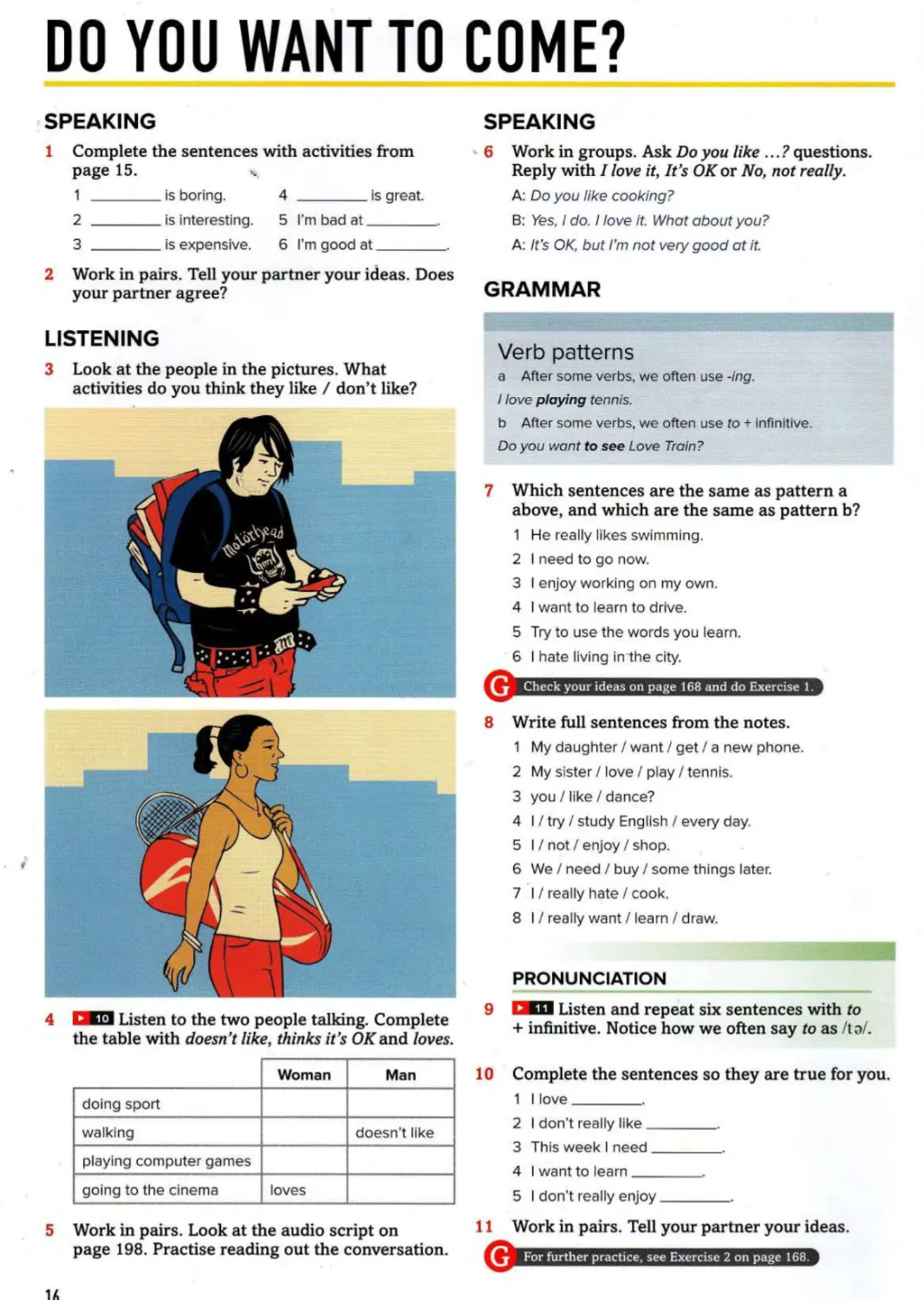

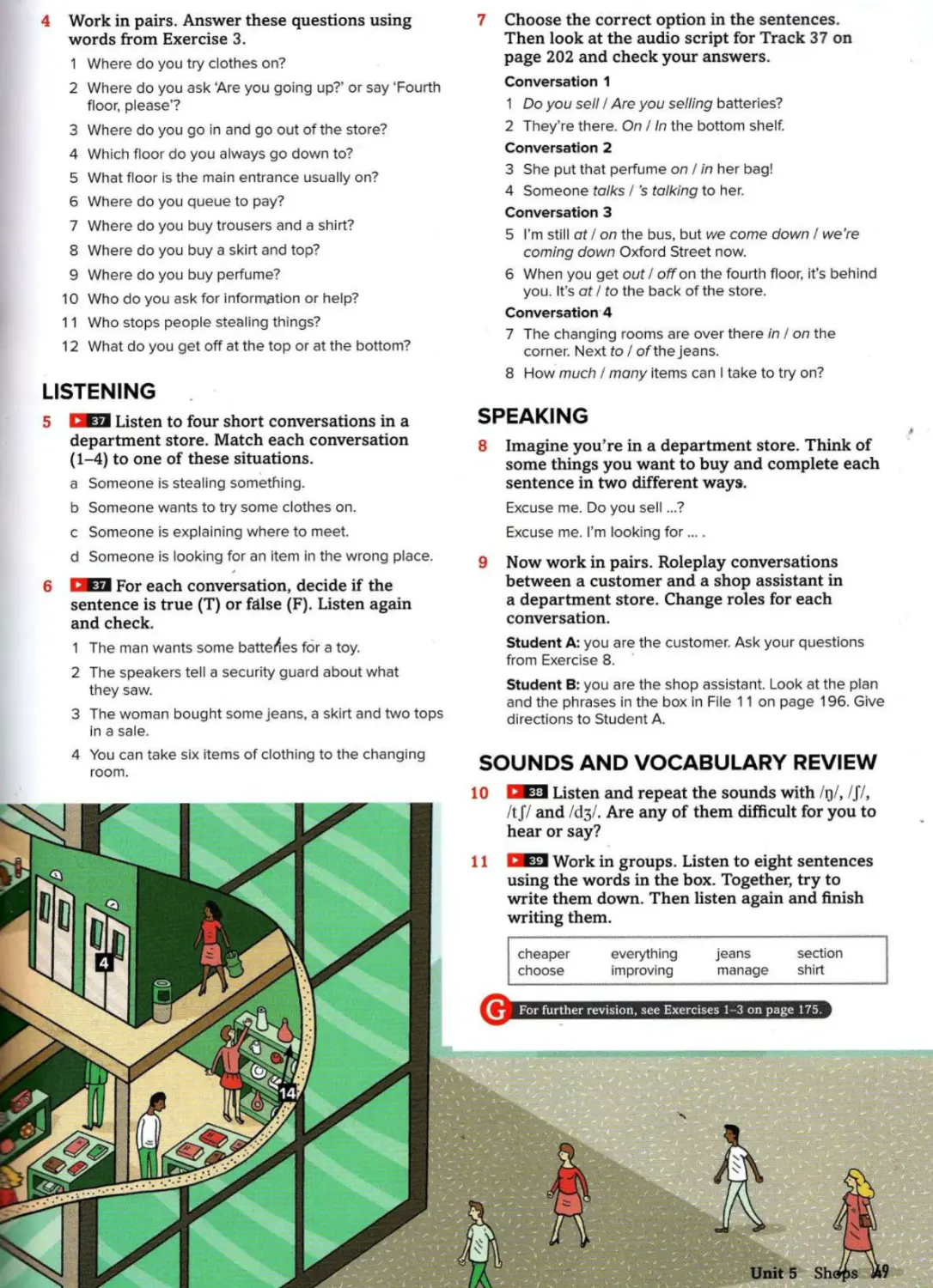

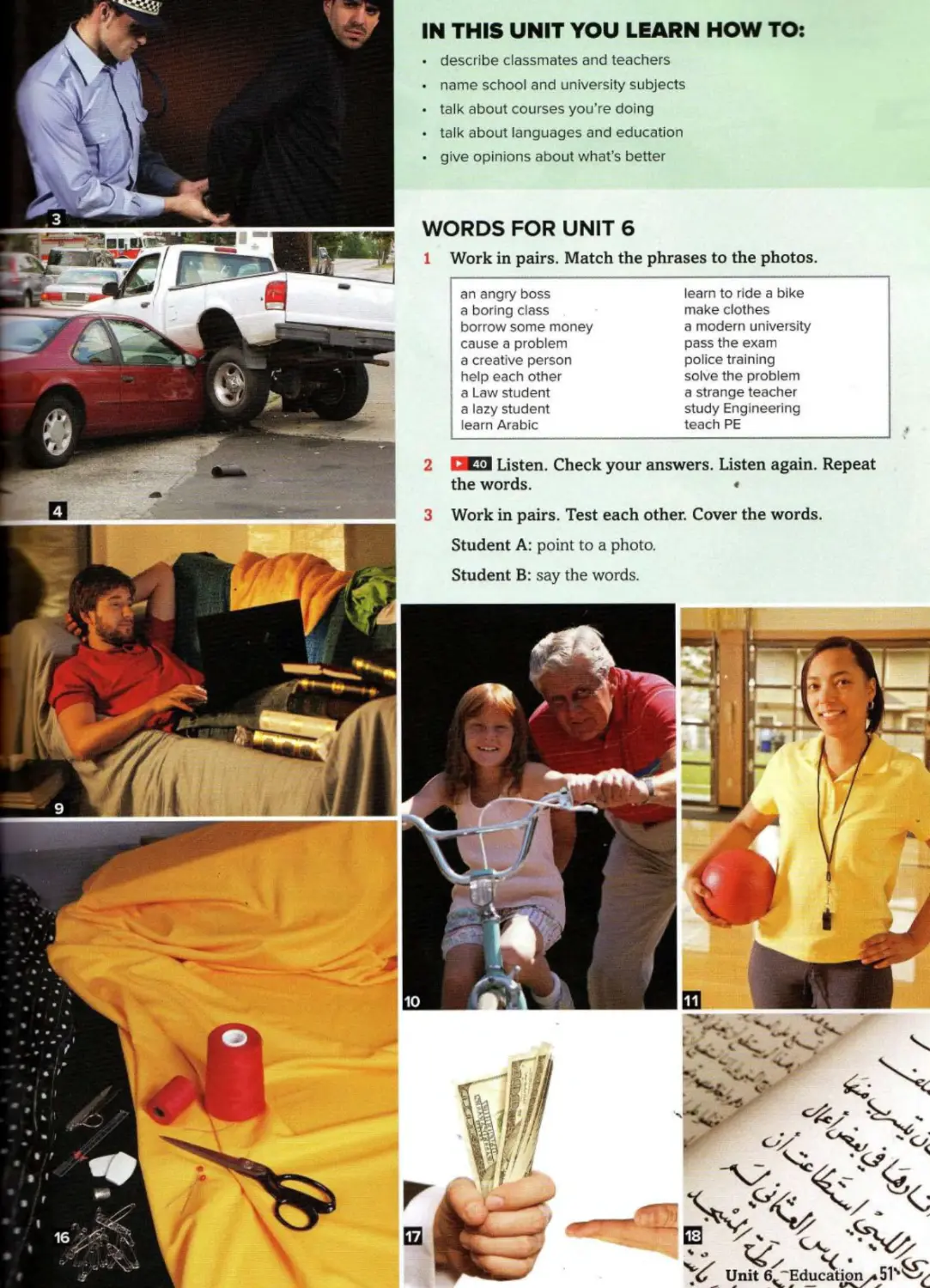
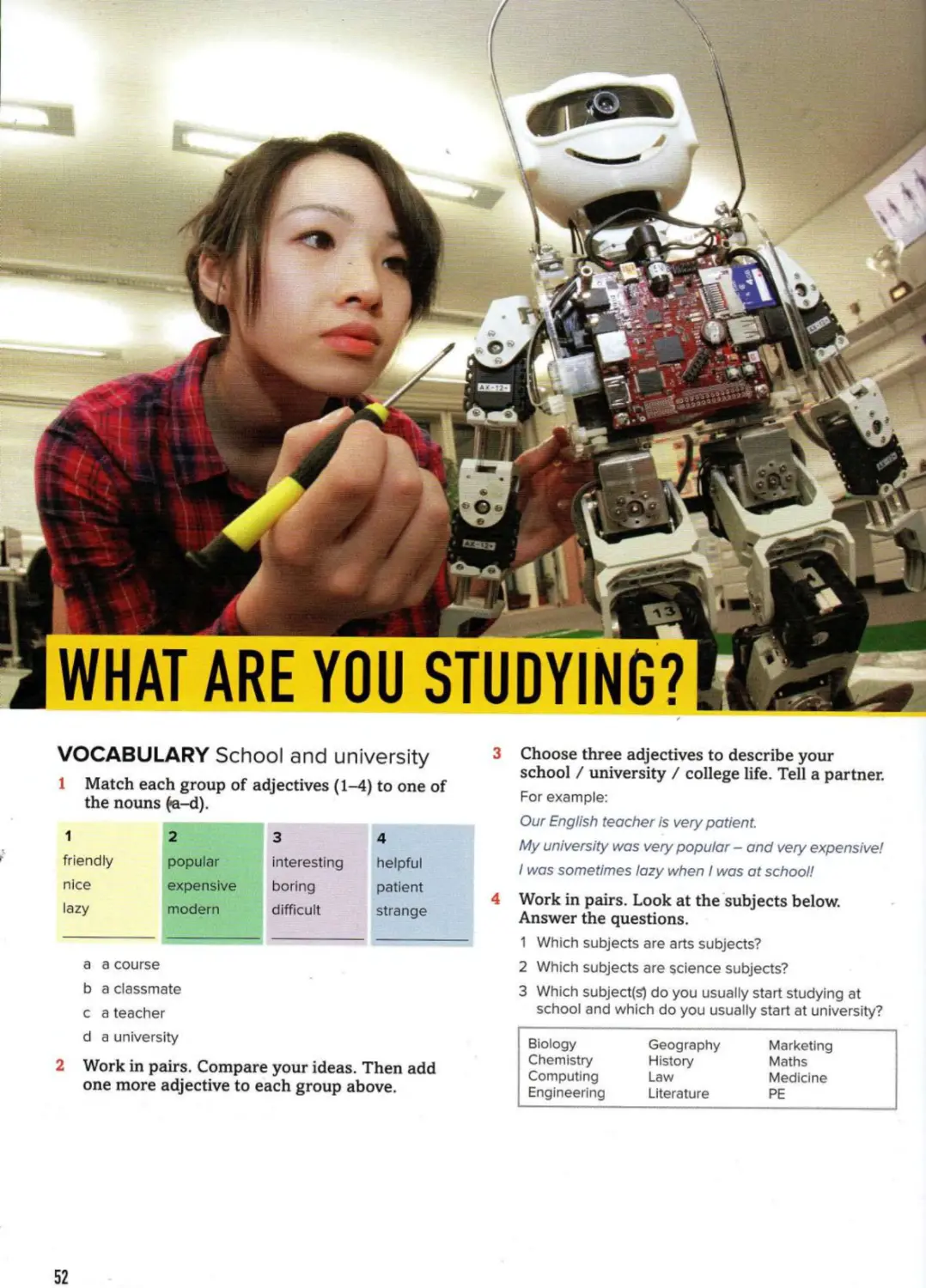
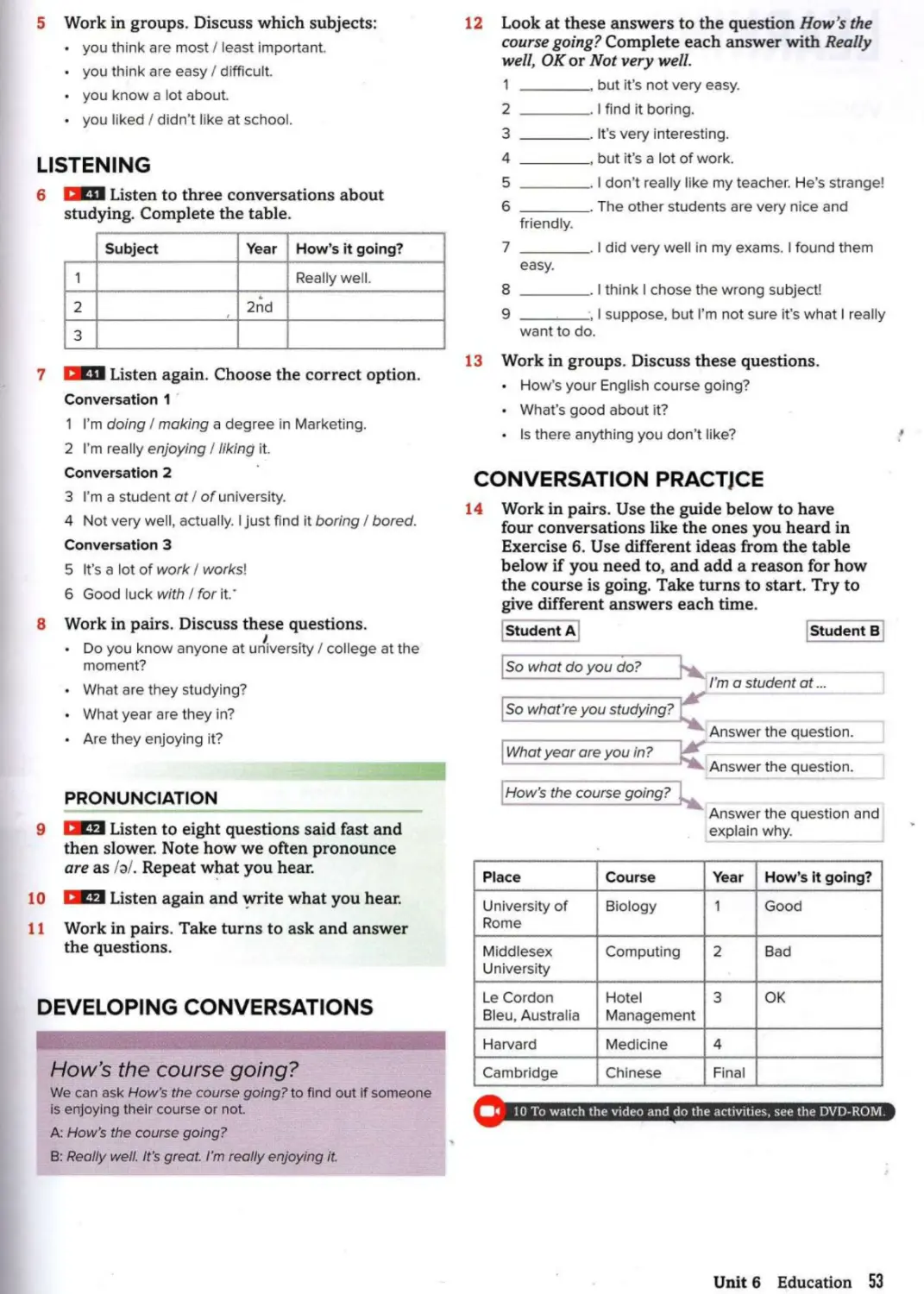



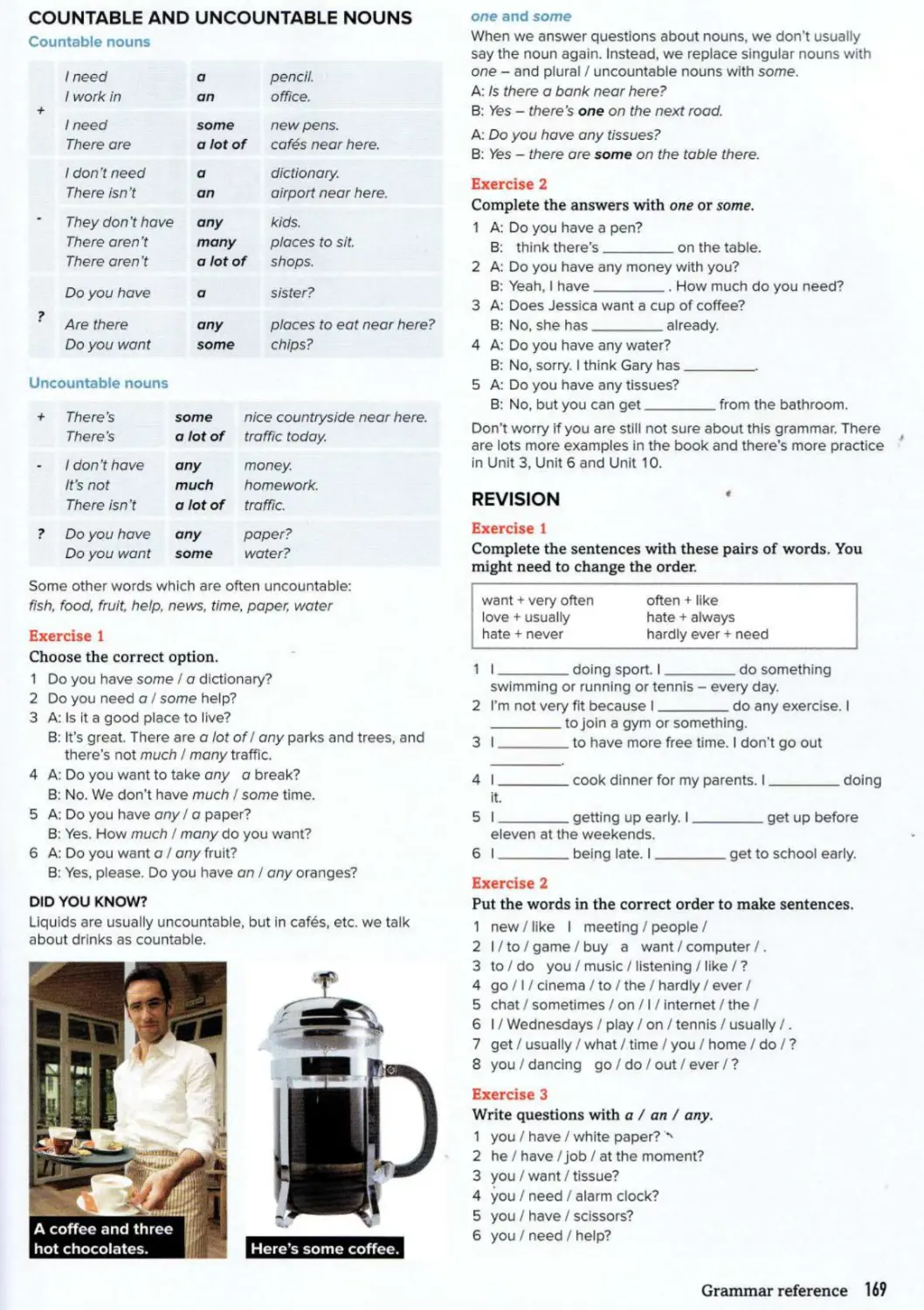
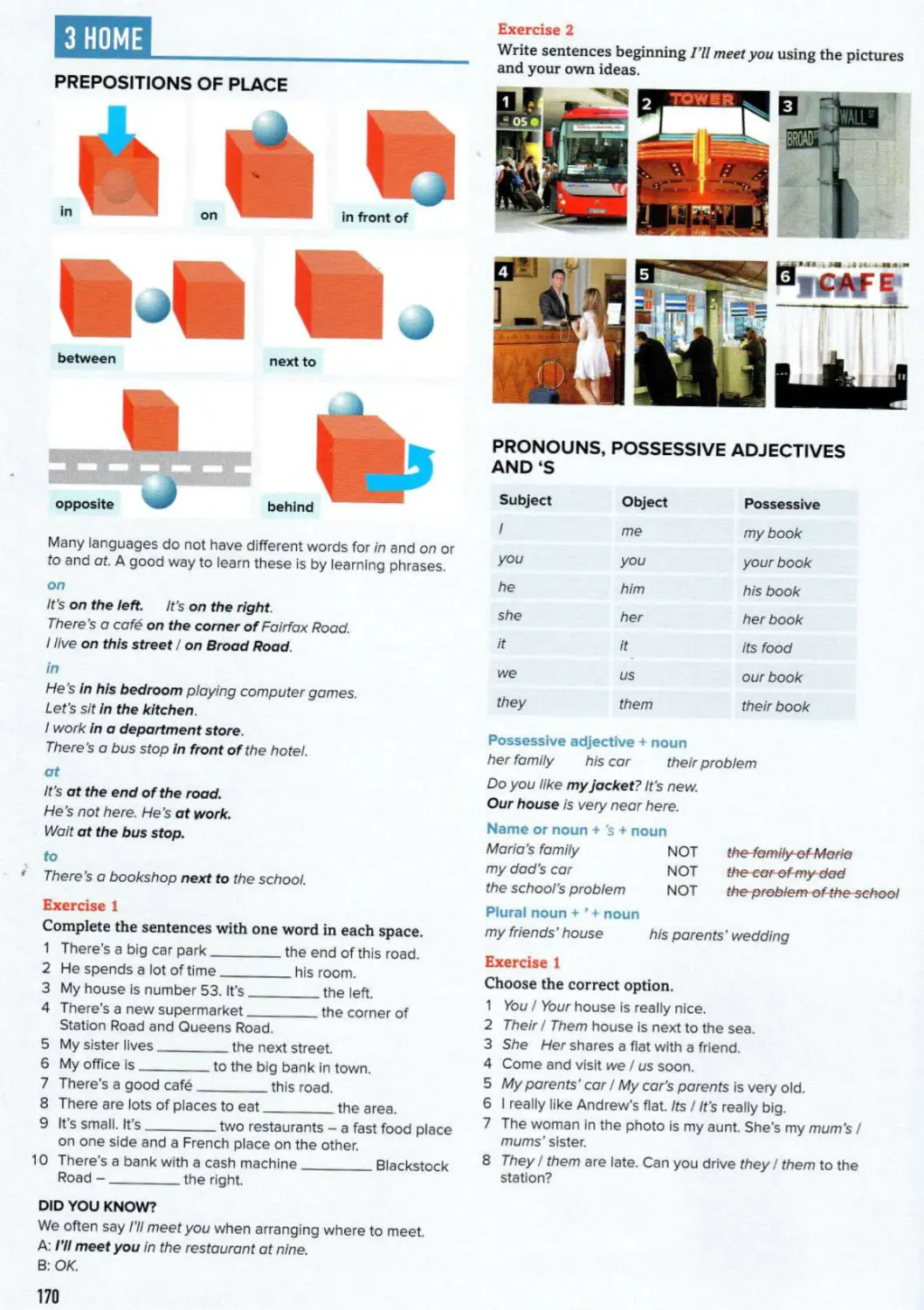
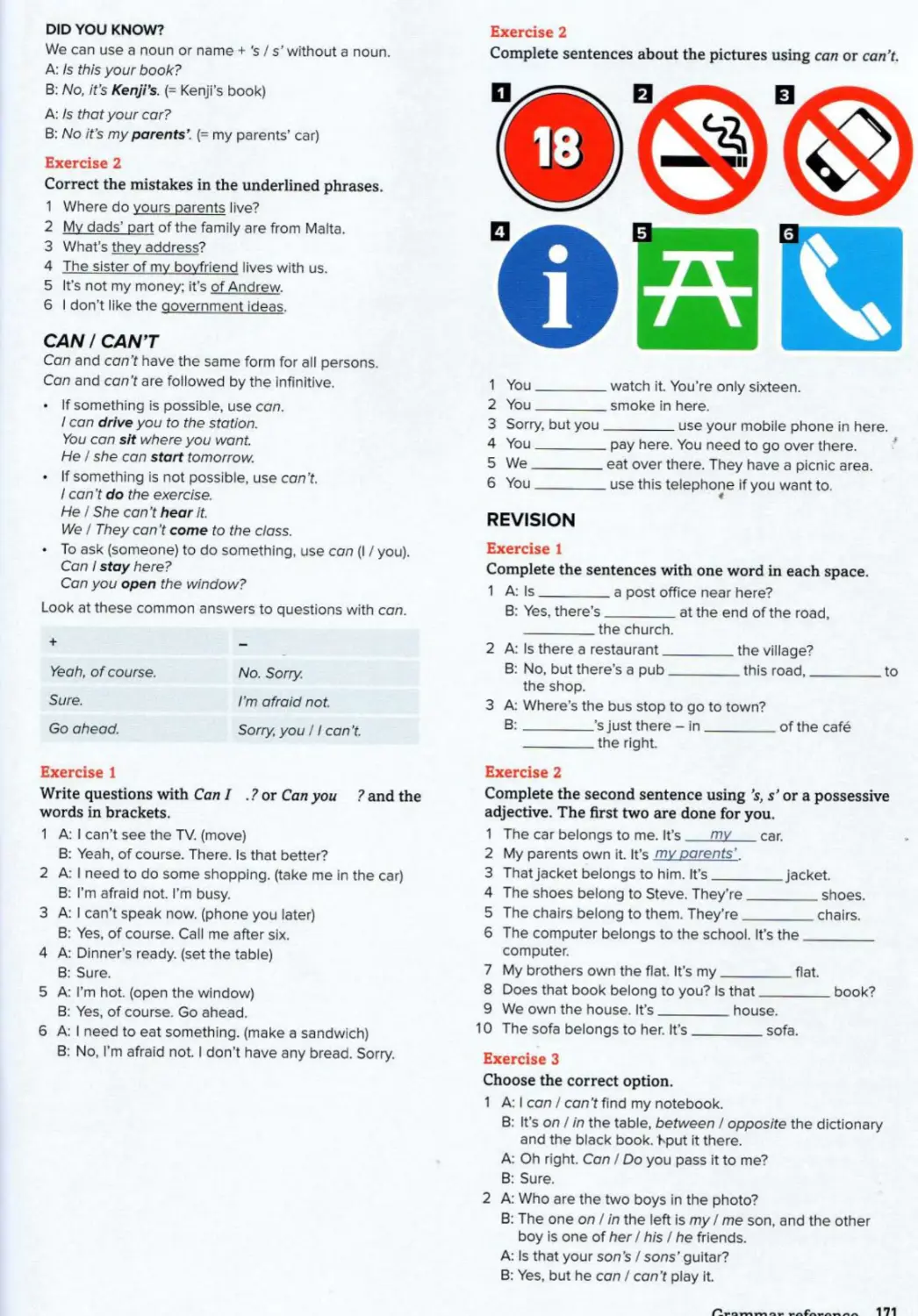
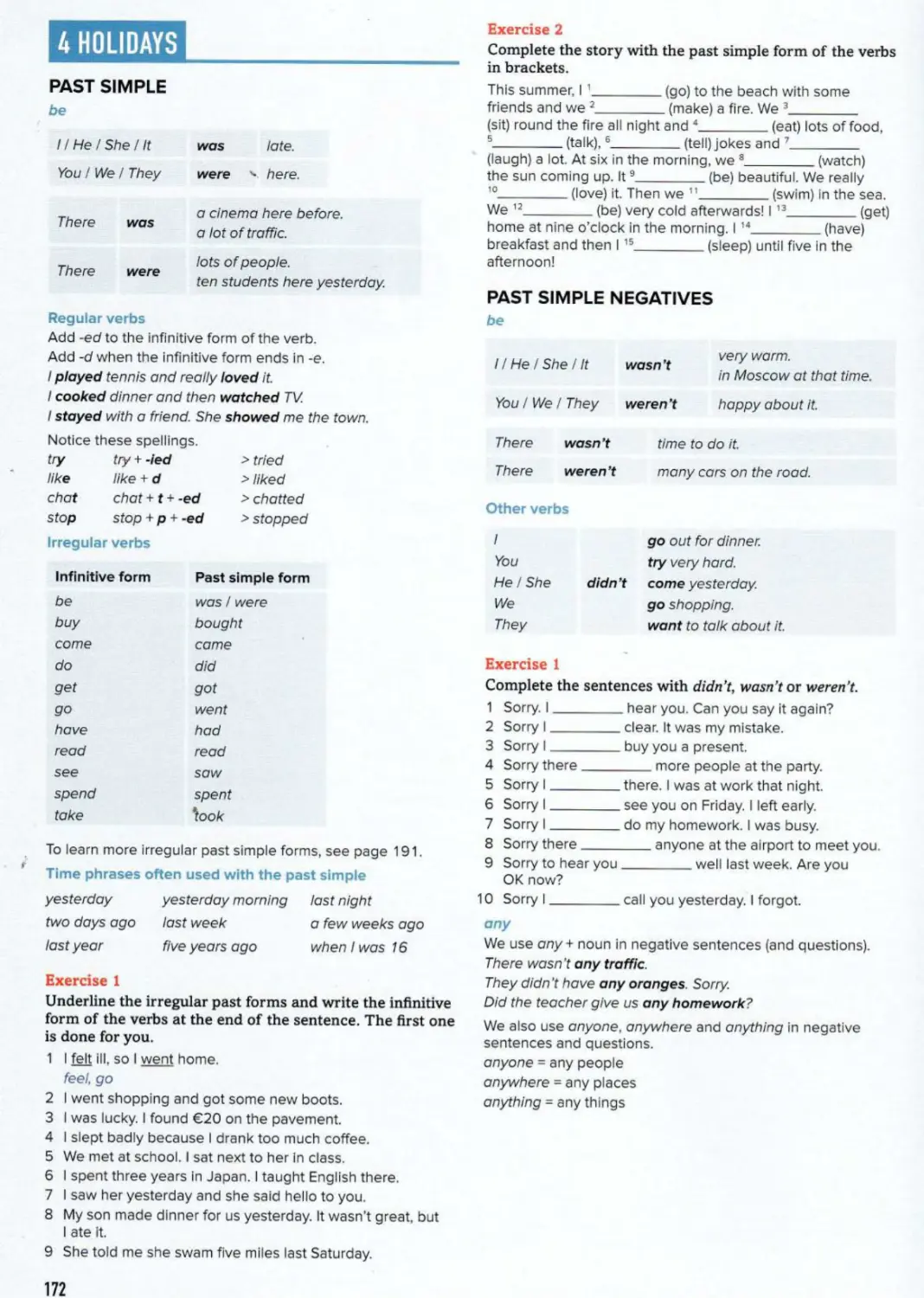
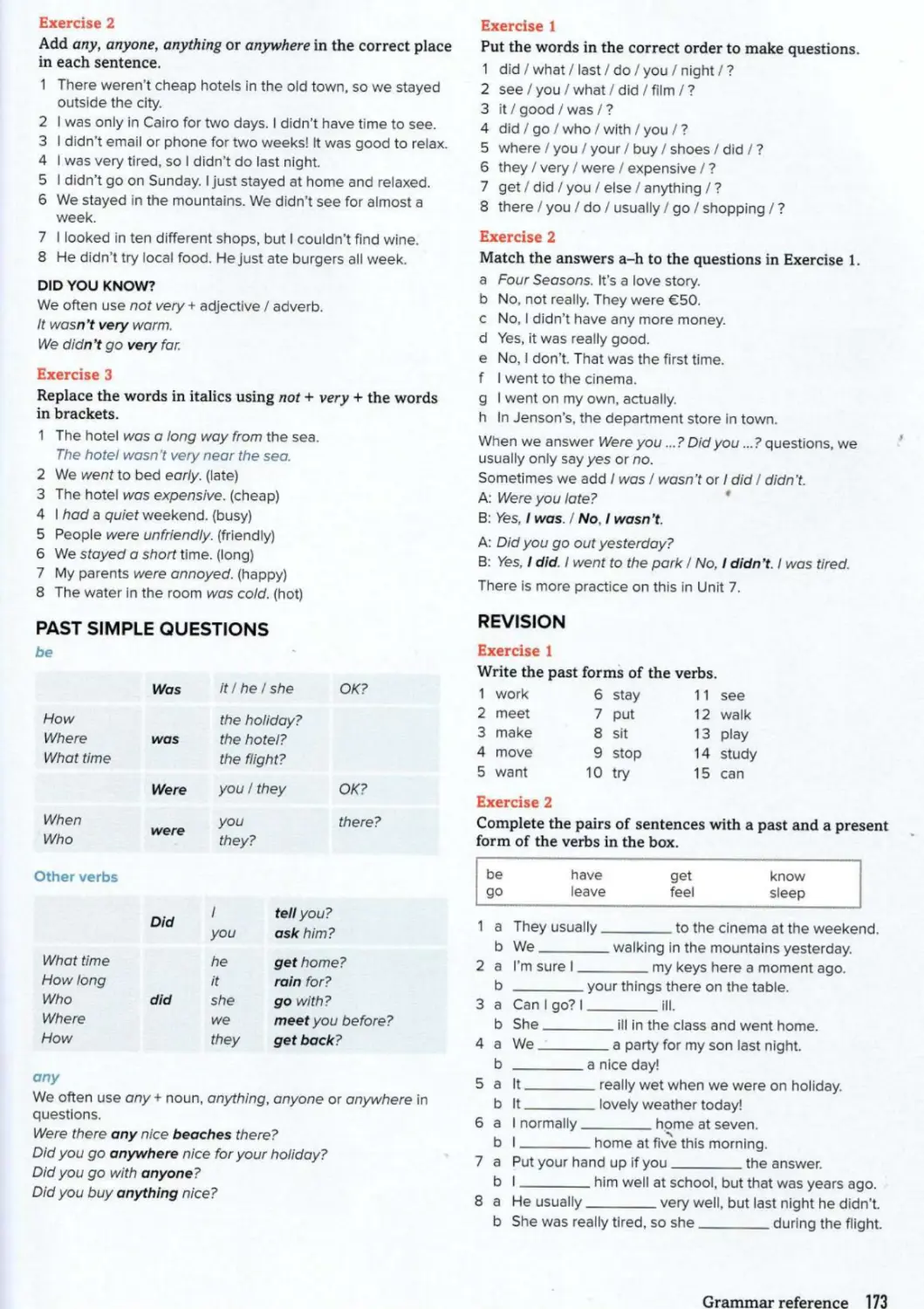
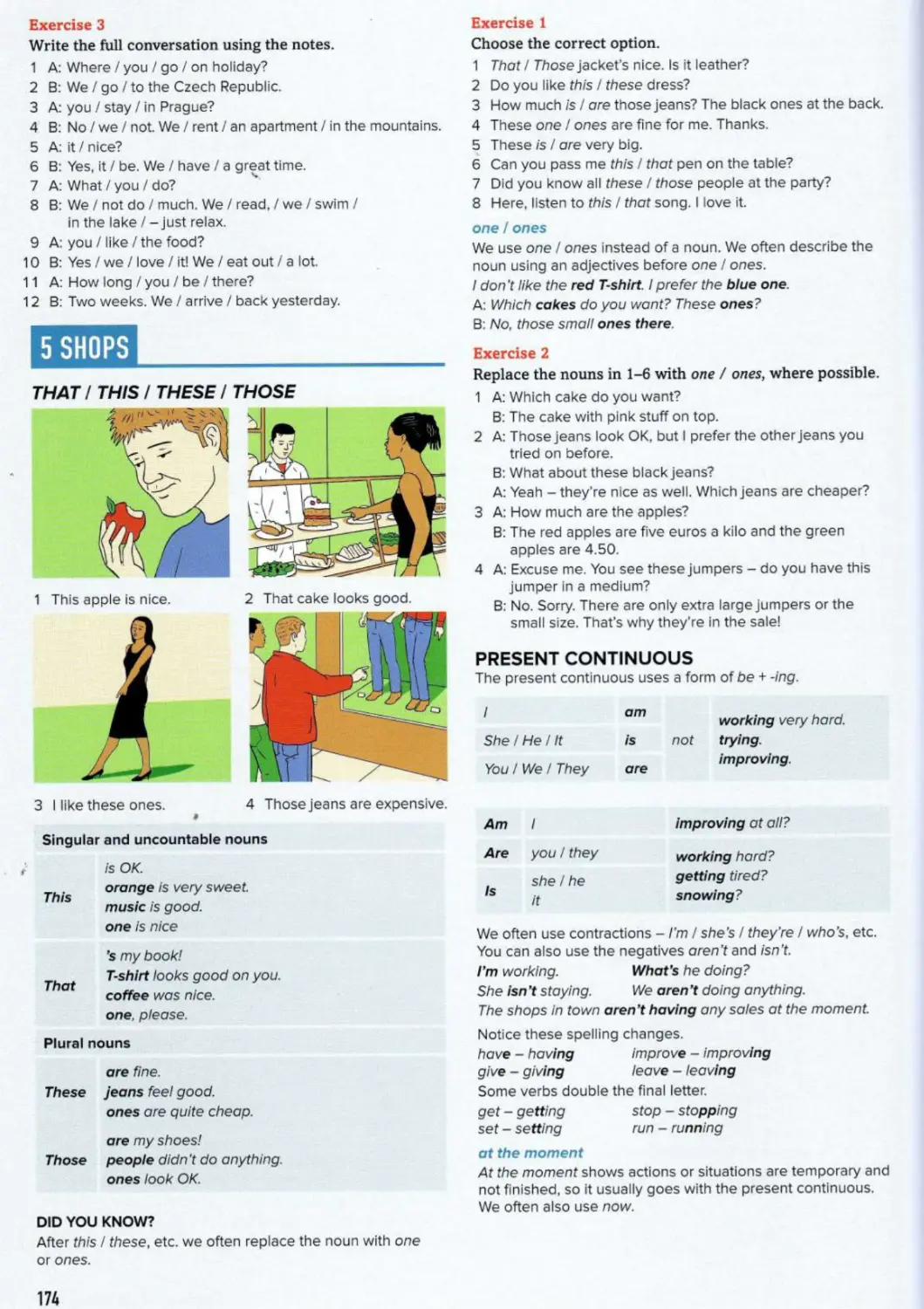
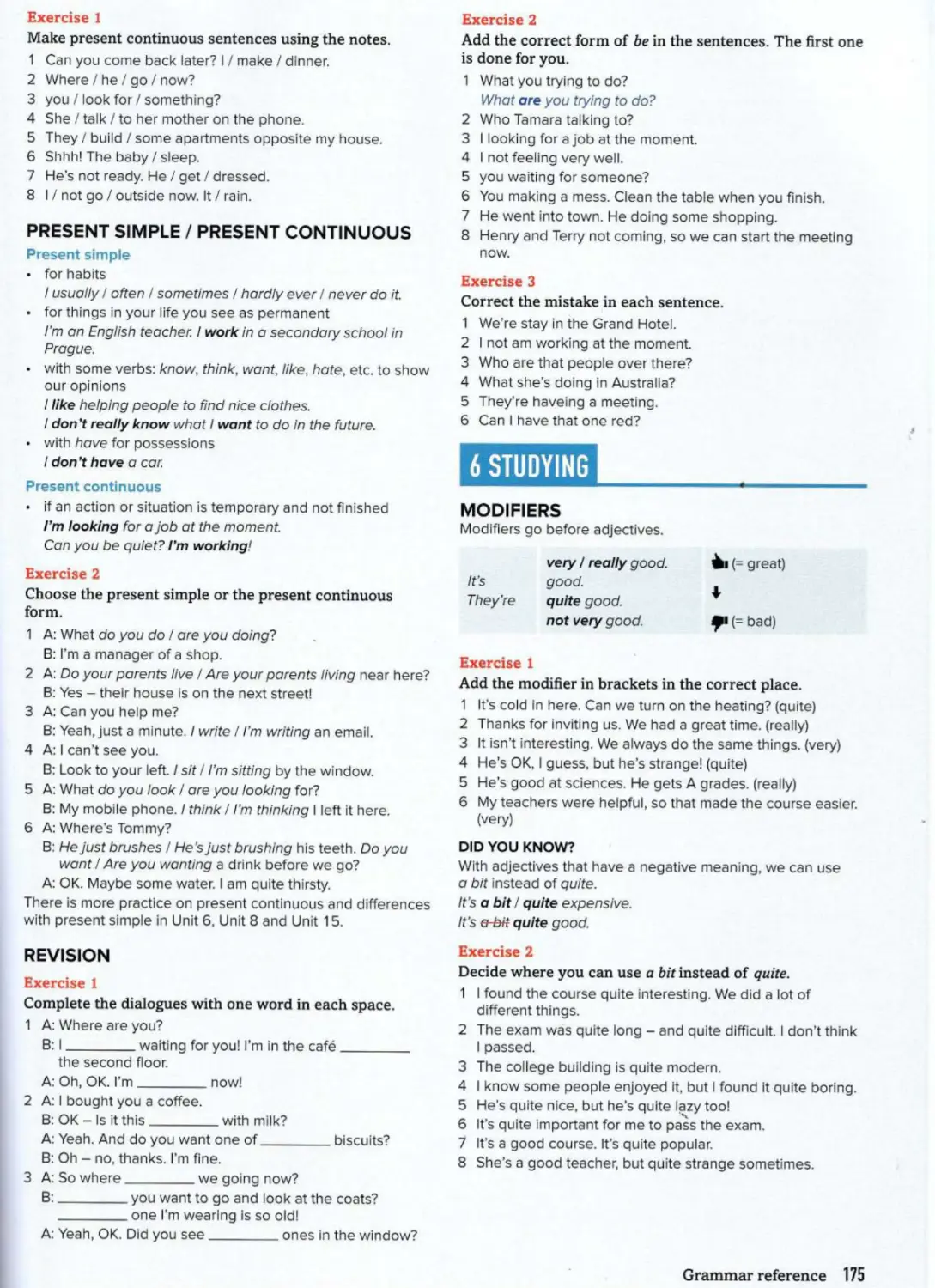
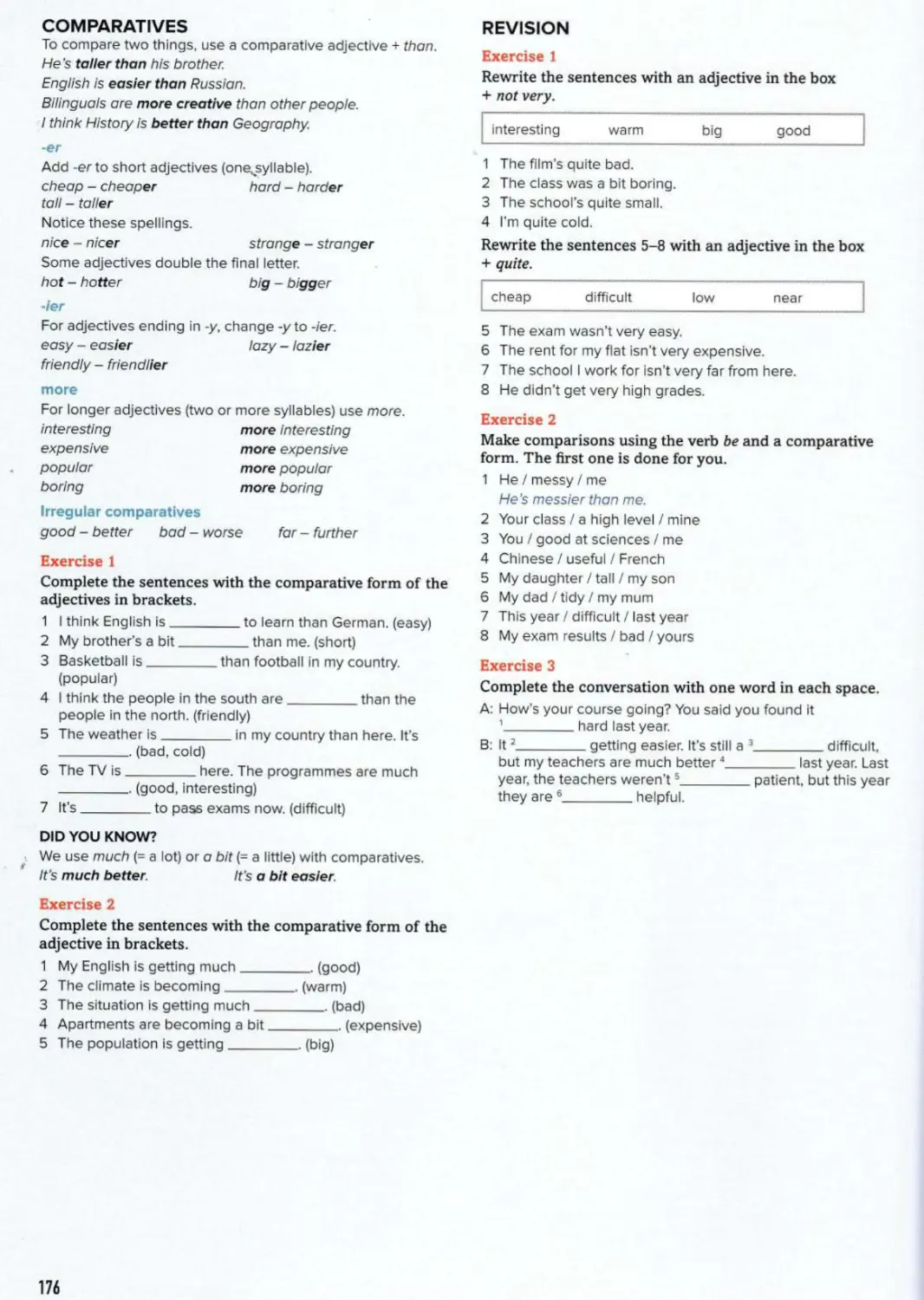

Автор: Dellar H. Walkley A.
Теги: english



Текст
                    HUGH DELLAR
ANDREW WALKLEY
ELEMENTARY
STUDENT'S BOOK

NATIONAL
GEOGRAPHIC
LEARNING
OUTCOMES
ELEMENTARY
STUDENT'S BOOK
HUGH DELLAR
ANDREW WALKLEY
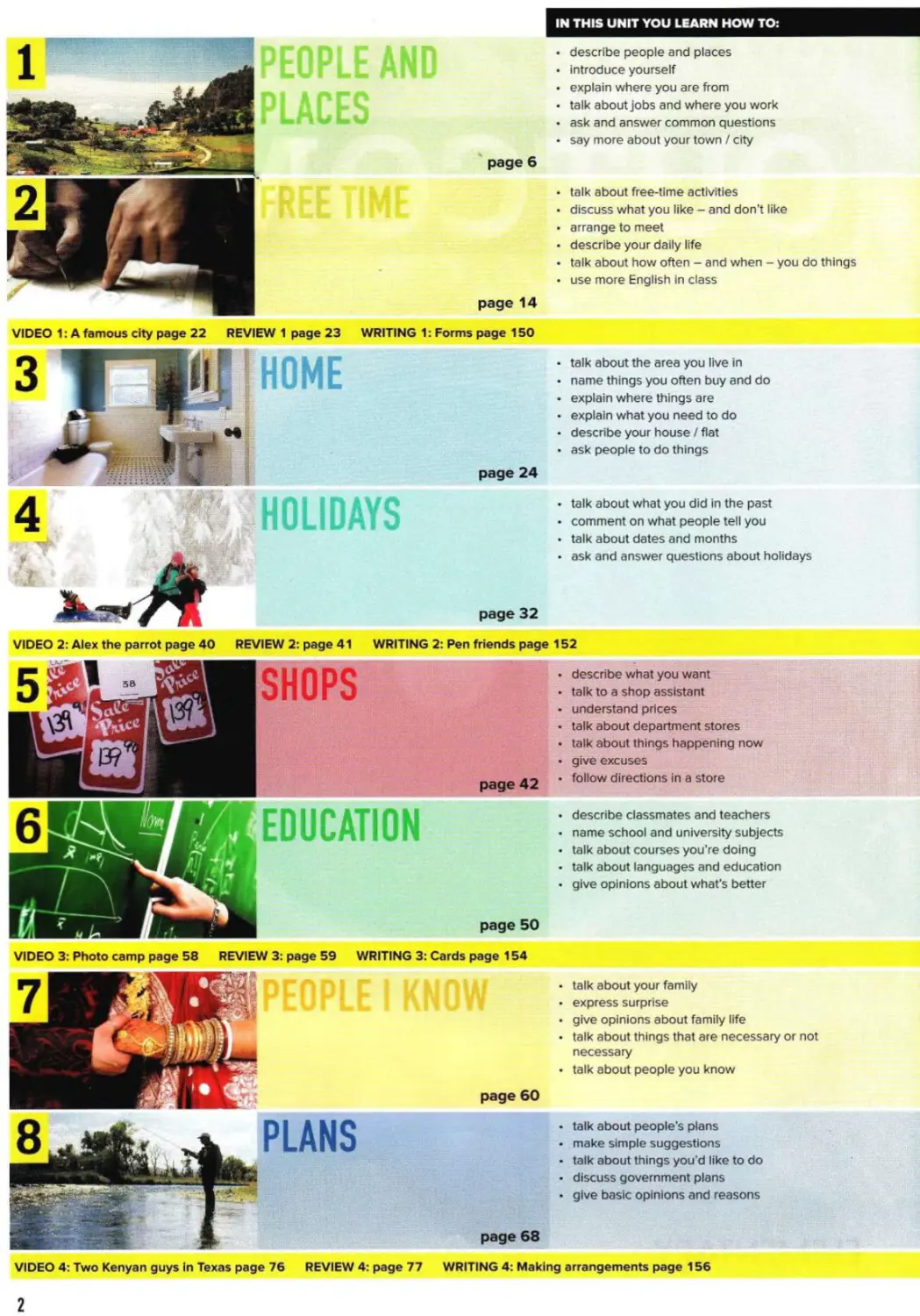
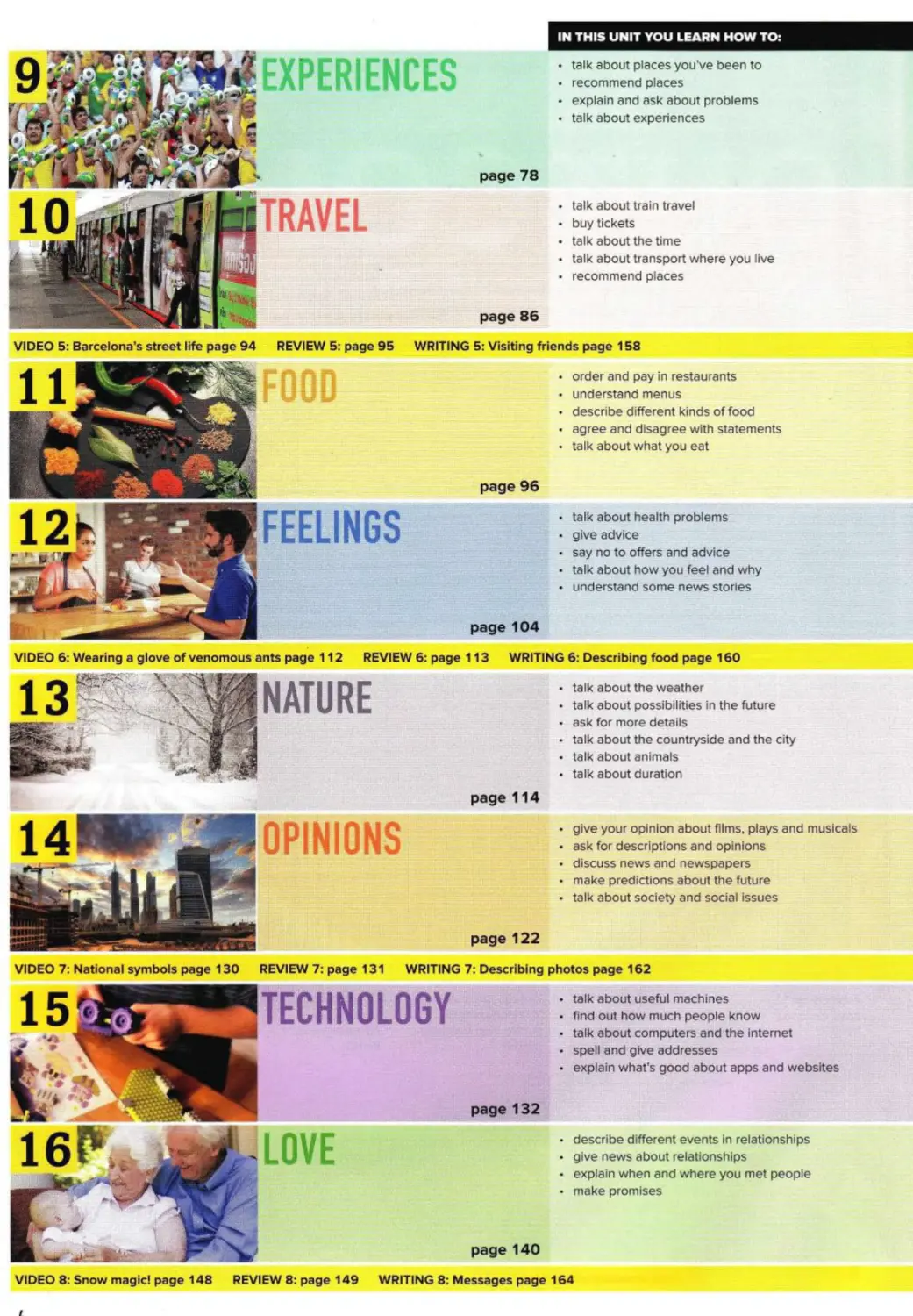
IN THIS UNIT YOU LEARN HOW TO:
4	HOLIDAYS
•	describe people and places
•	introduce yourself
•	explain where you are from
•	talk about jobs and where you work
•	ask and answer common questions
•	say more about your town I city
page 6
•	talk about free-time activities
•	discuss what you like - and don’t like
•	arrange to meet
•	describe your daily life
•	talk about how often - and when - you do things
•	use more English in class
page 14
VIDEO 1: A famous city page 22 REVIEW 1 page 23 WRITING 1: Forms page 150
•	talk about the area you live in
•	name things you often buy and do
•	explain where things are
•	explain what you need to do
•	describe your house / flat
•	ask people to do things
page 24
•	talk about what you did in the past
•	comment on what people tell you
•	talk about dates and months
•	ask and answer questions about holidays
page 32
VIDEO 2: Alex the parrot page 40 REVIEW 2: page 41 WRITING 2: Pen friends page 152
EDUCATION
SHOPS
•	describe what you want
•	talk to a shop assistant
•	understand prices
•	talk about department stores
•	talk about things happening now
•	give excuses
ло • follow directions in a store
page 42
•	describe classmates and teachers
•	name school and university subjects
•	talk about courses you’re doing
•	talk about languages and education
•	give opinions about what’s better
page 50
VIDEO 3: Photo camp page 58 REVIEW 3: page 59 WRITING 3: Cards page 154
•	talk about your family
•	express surprise
•	give opinions about family life
•	talk about things that are necessary or not
necessary
•	talk about people you know
page 60
•	talk about people’s plans
•	make simple suggestions
•	talk about things you’d like to do
•	discuss government plans
•	give basic opinions and reasons
page 68
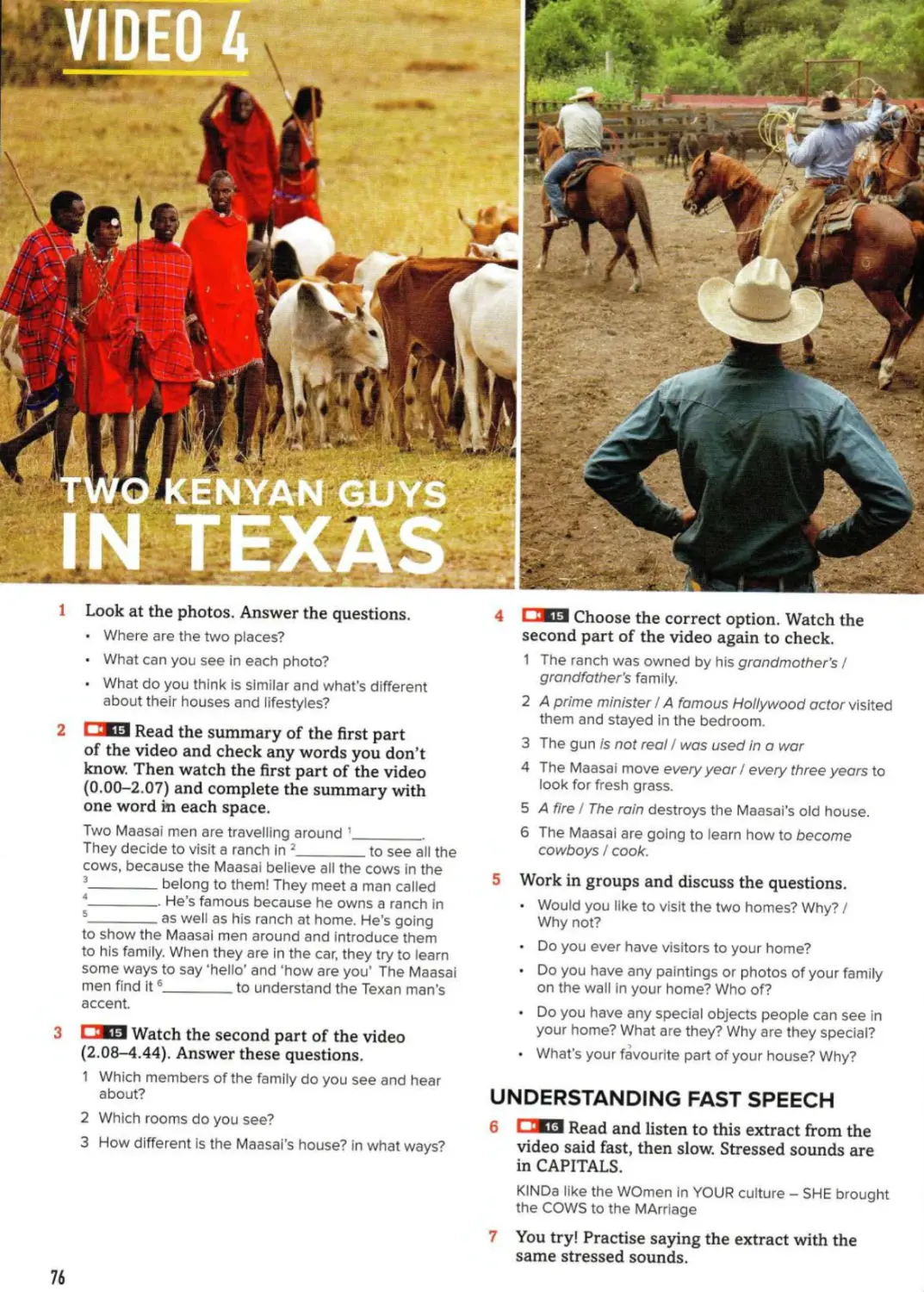
VIDEO 4: Two Kenyan guys in Texas page 76 REVIEW 4: page 77 WRITING 4: Making arrangements page 156
2
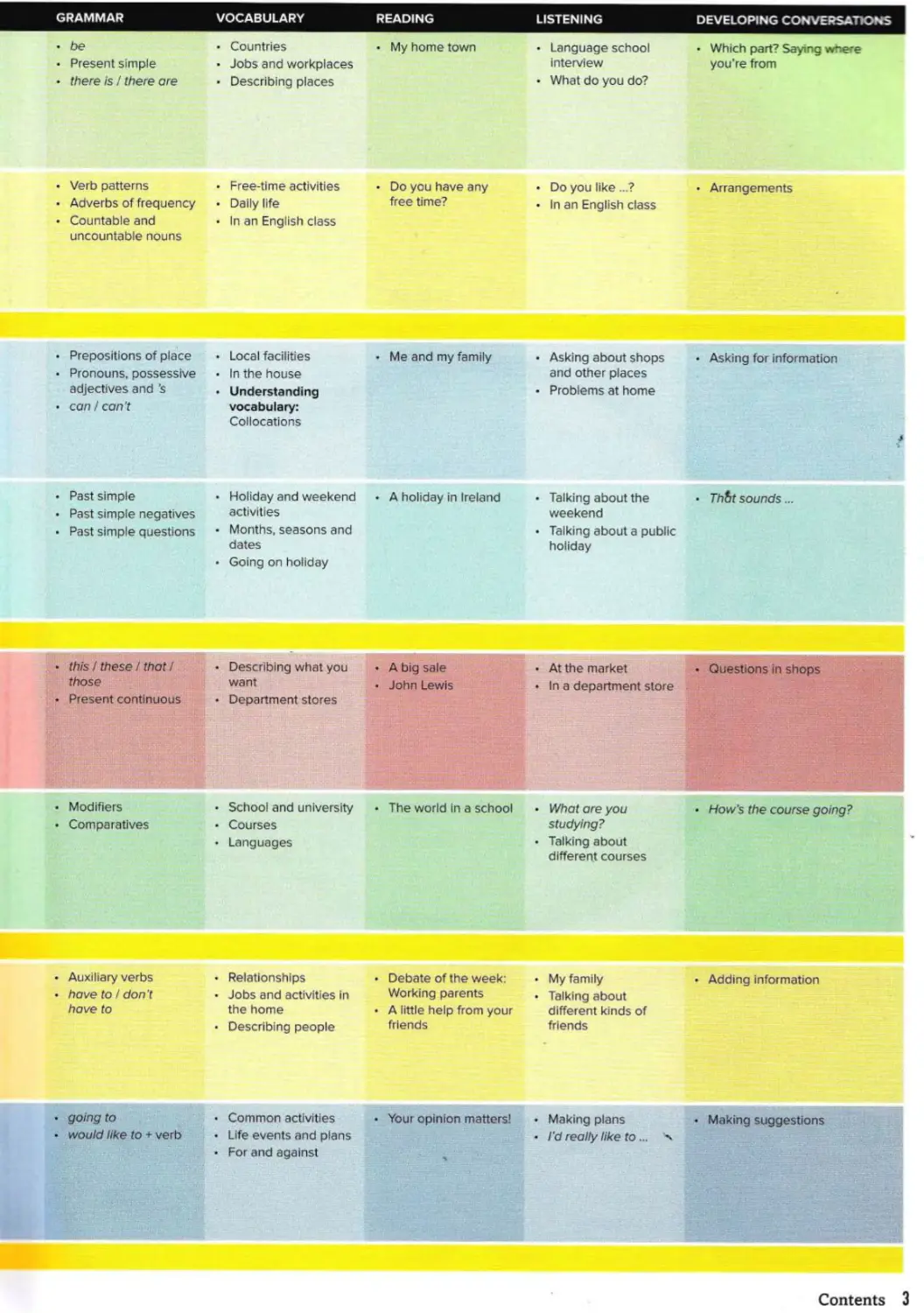
GRAMMAR
VOCABULARY
READING
LISTENING
DEVELOPING CONVERSATIONS
• be
•	Present simple
•	there is I there are
•	Countries
•	Jobs and workplaces
•	Describing places
• My home town
•	Language school
interview
•	What do you do?
• Which part? Saying where
you’re from
•	Verb patterns
•	Adverbs of frequency
•	Countable and
uncountable nouns
•	Free-tlme activities
•	Daily life
•	In an English class
• Do you have any
free time?
Do you like...?
In an English class
• Arrangements
•	Prepositions of place
•	Pronouns, possessive
adjectives and's
•	can / can’t
•	Local facilities
•	In the house
•	Understanding
vocabulary:
Collocations
• Me and my family
Asking about shops
and other places
Problems at home
• Asking for information
f
•	Past simple
•	Past simple negatives
•	Past simple questions
•	Holiday and weekend
activities
•	Months, seasons and
dates
•	Going on holiday
• A holiday in Ireland
•	Talking about the
weekend
•	Talking about a public
holiday
• Thfrt sounds...
• this / these / that /
those
• Present continuous
•	Describing what you • A big sale	• At the market
want	• John Lewis	• In a department store
•	Department stores
• Questions in shops
• Modifiers
• Comparatives
•	School and university
•	Courses
•	Languages
• The world in a school
•	What are you
studying?
•	Talking about
different courses
• How’s the course going?
•	Auxiliary verbs
•	have to /don't
have to
• Relationships	• Debate of the week:	• My family
• Jobs and activities in	Working parents	• Talking about
the home	• A little help from your	different kinds of
• Describing people	friends	friends
• Adding information
• going to
• would like to + verb
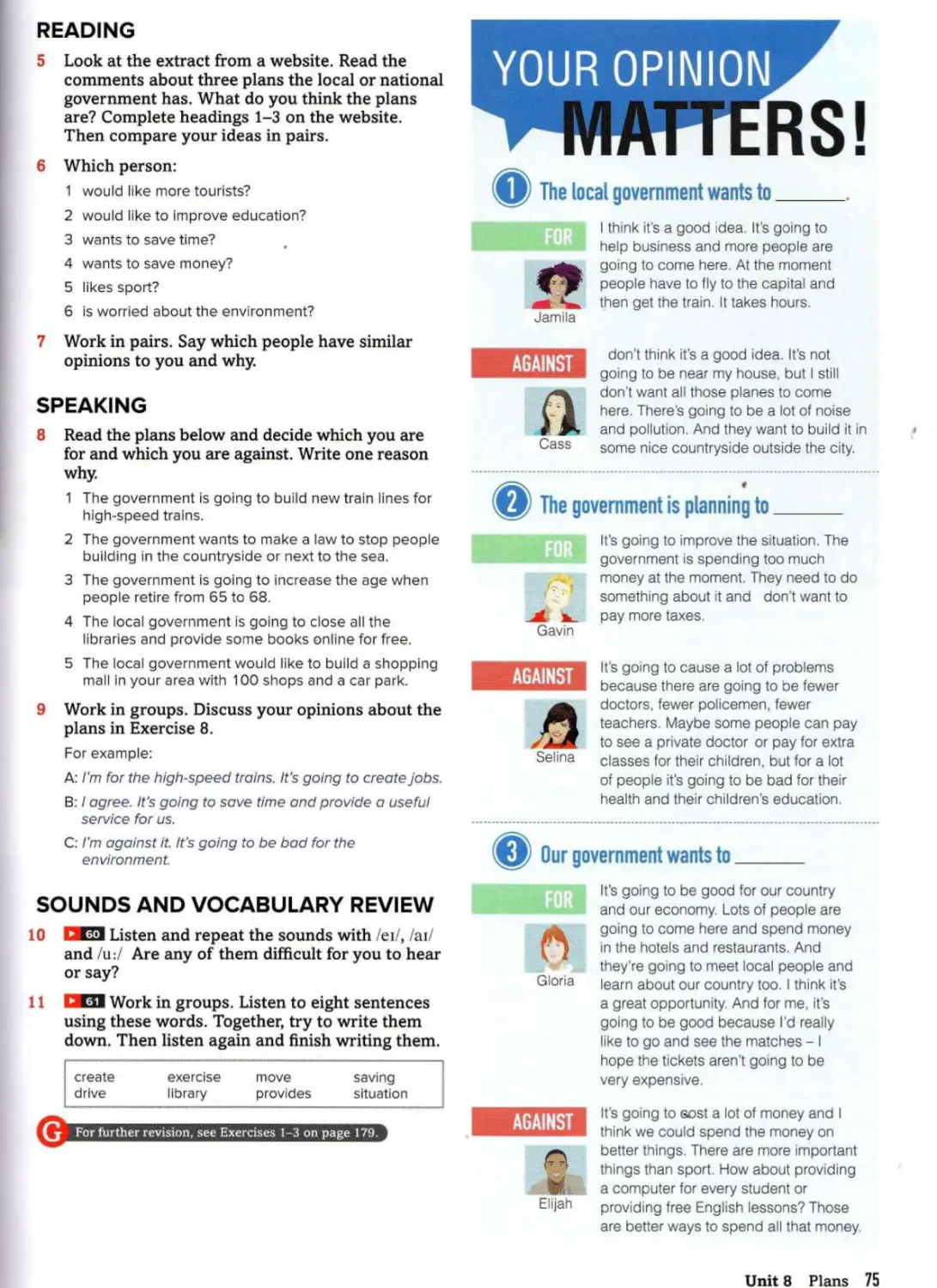
•	Common activities • Your opinion matters’ • Making plans
•	Life events and plans	• I’d really like to... 4
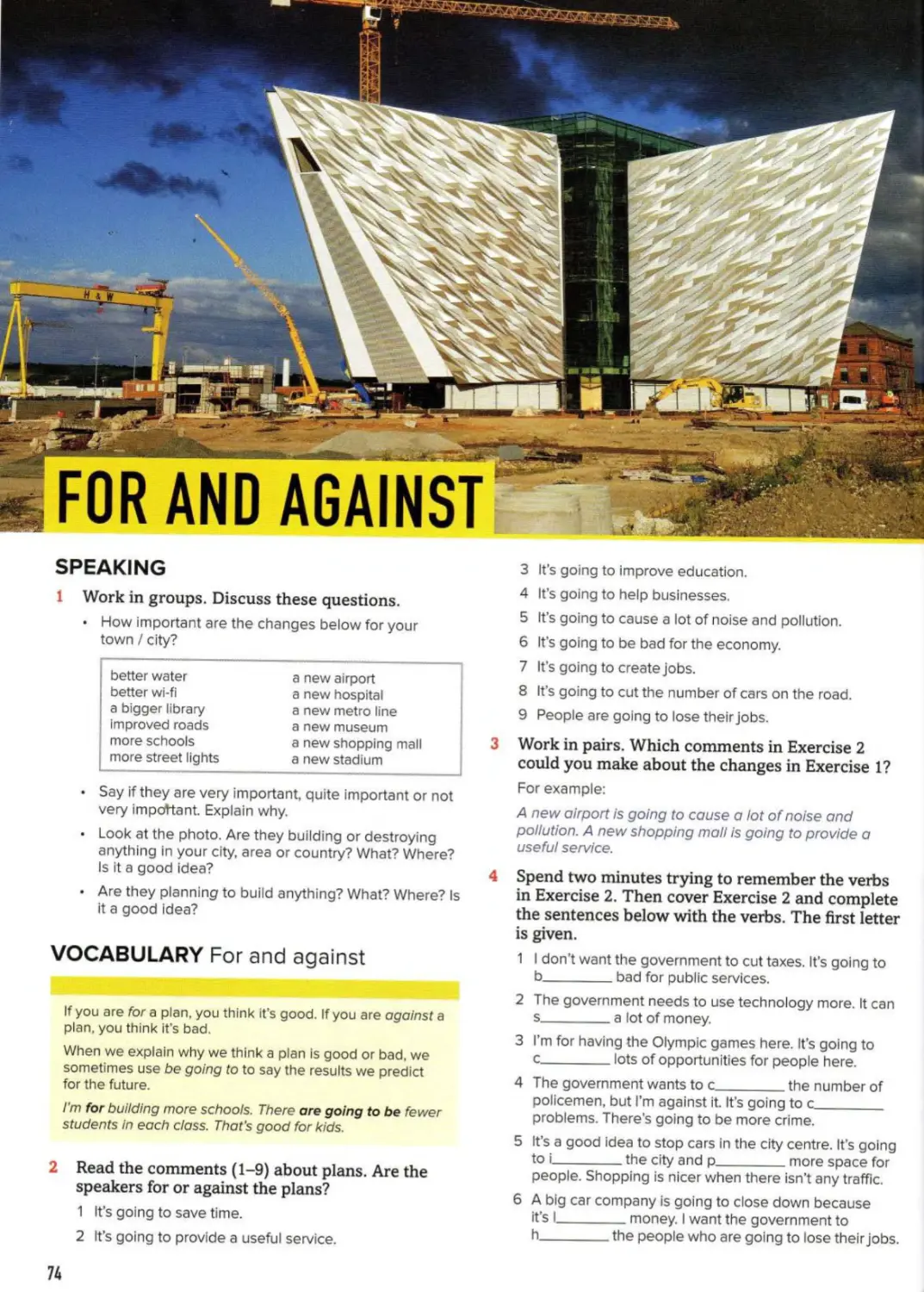
•	For and against
• Making suggestions
Contents 3
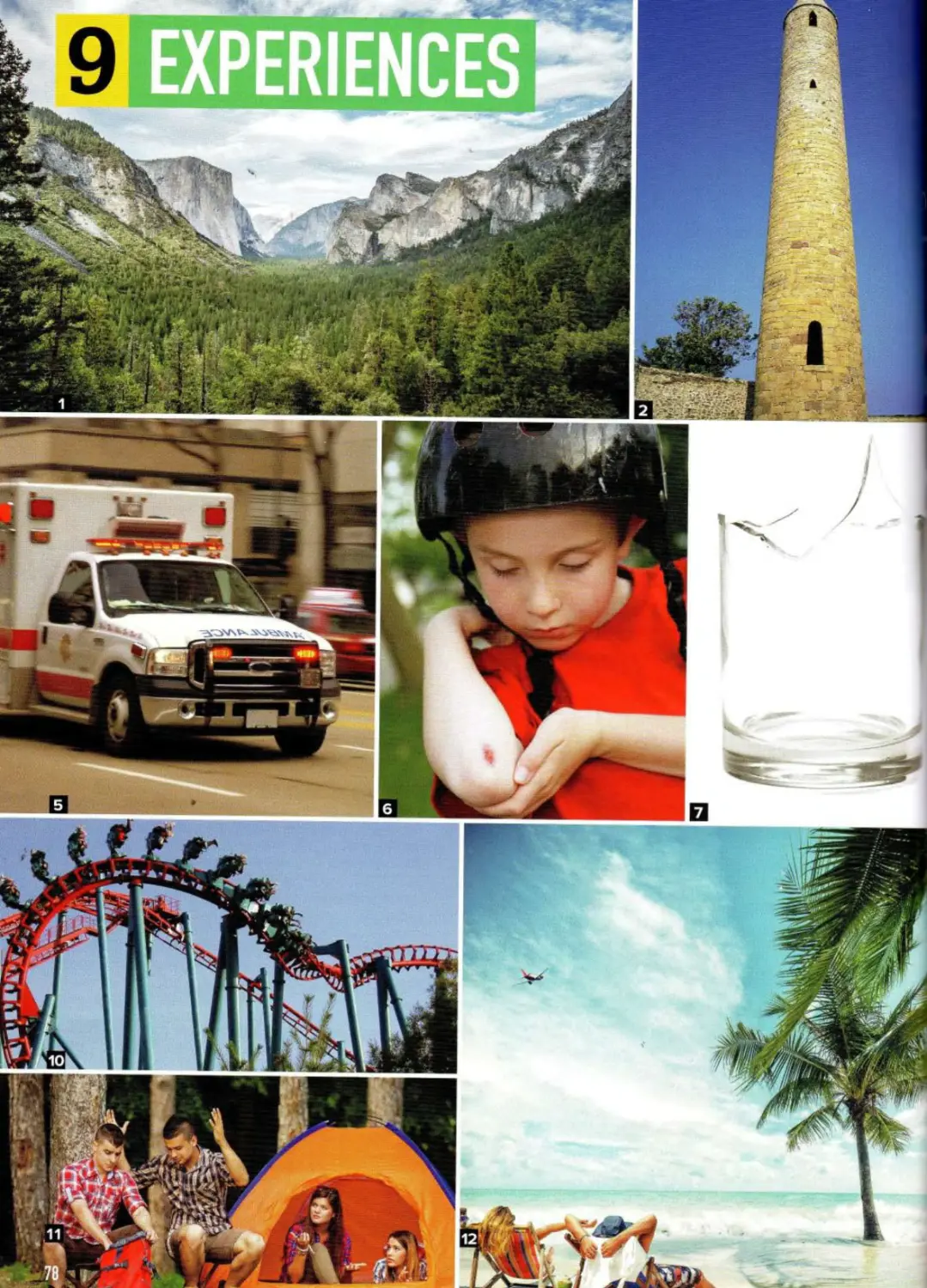
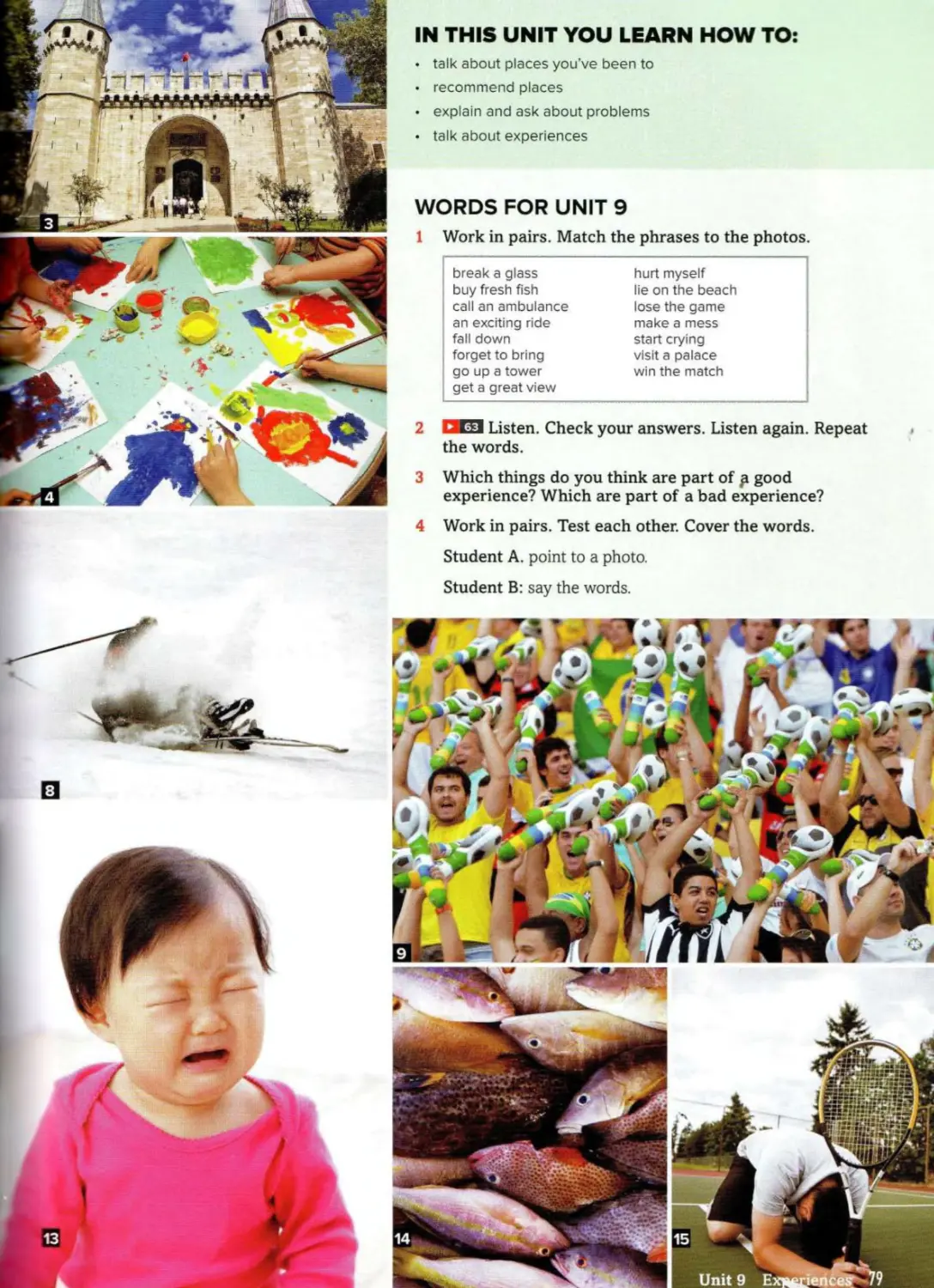
IN THIS UNIT YOU LEARN HOW TO:
•	talk about places you’ve been to
•	recommend places
•	explain and ask about problems
•	talk about experiences
page 78
TRAVEL
page 86
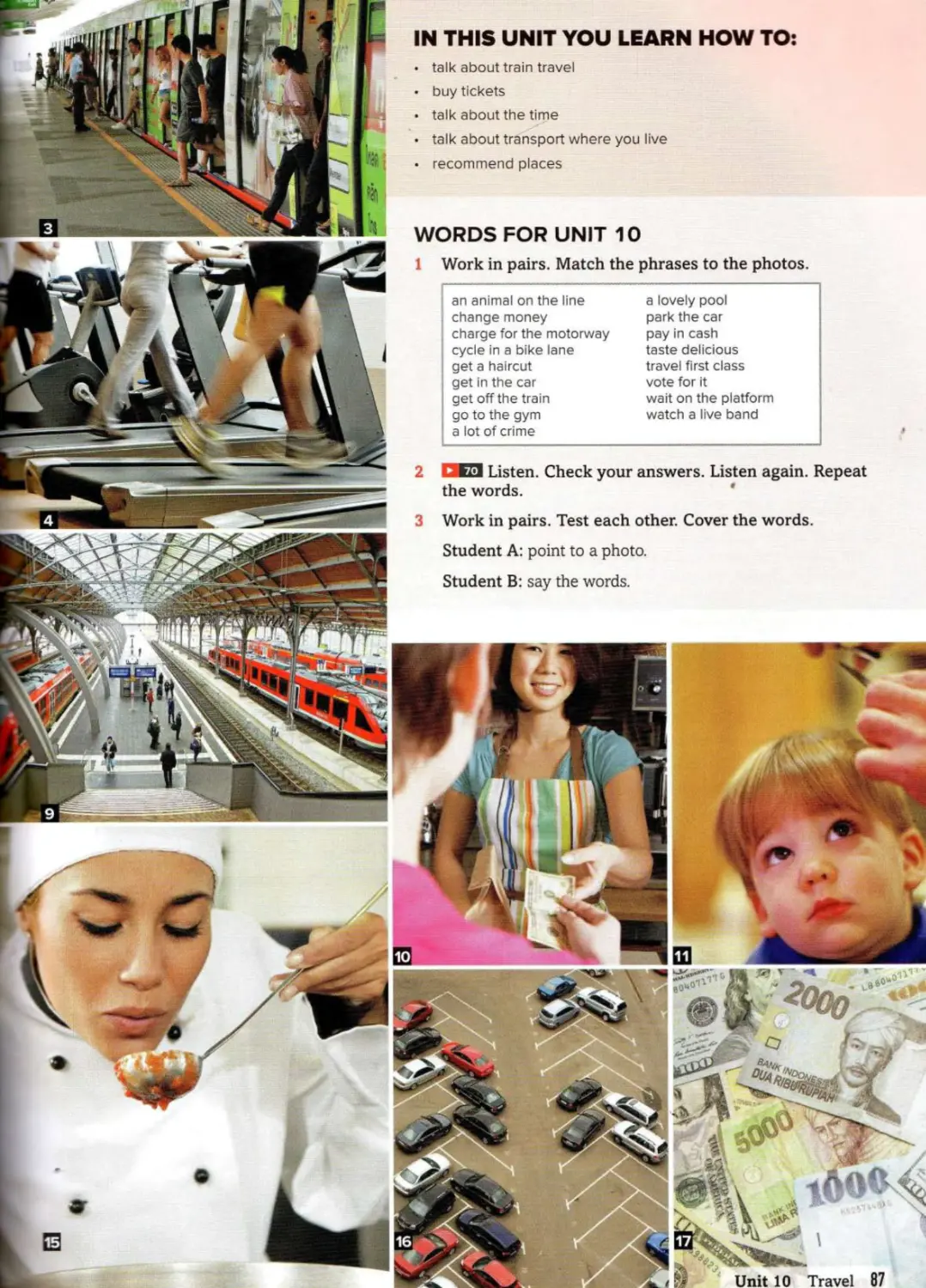
•	talk about train travel
•	buy tickets
•	talk about the time
•	talk about transport where you live
•	recommend places
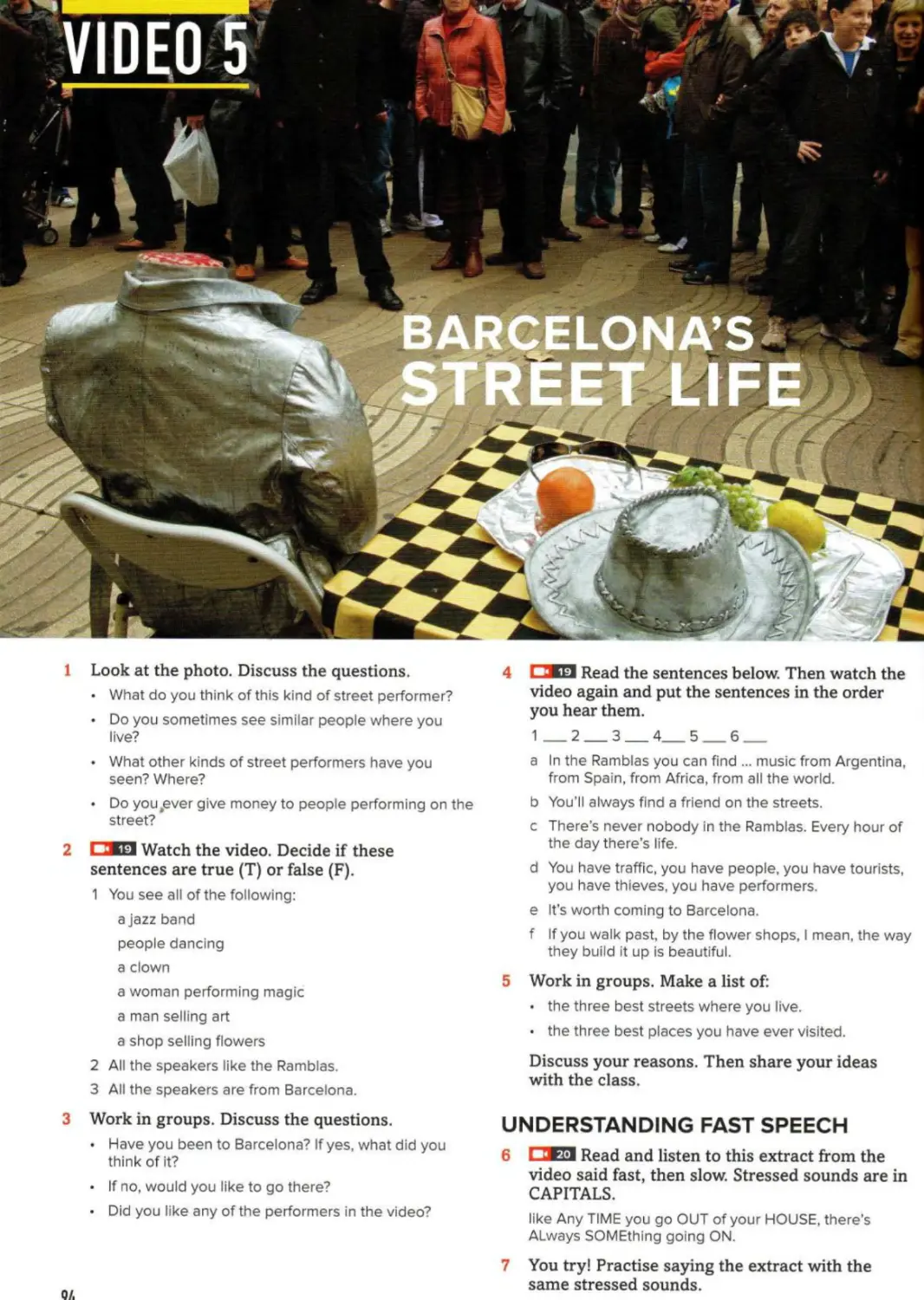
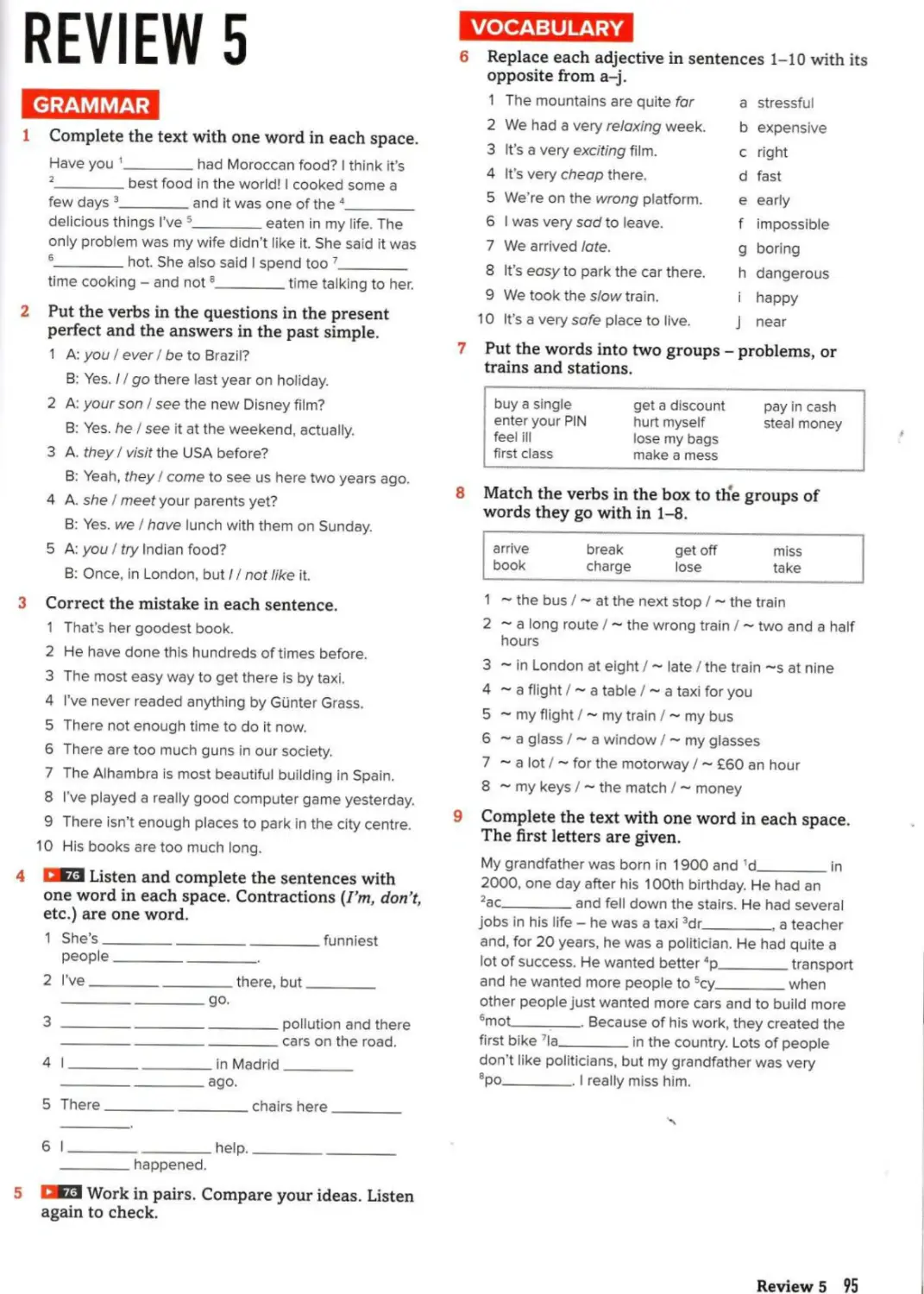
VIDEO 5: Barcelona’s street life page 94 REVIEW 5: page 95 WRITING 5: Visiting friends page 158
12fe
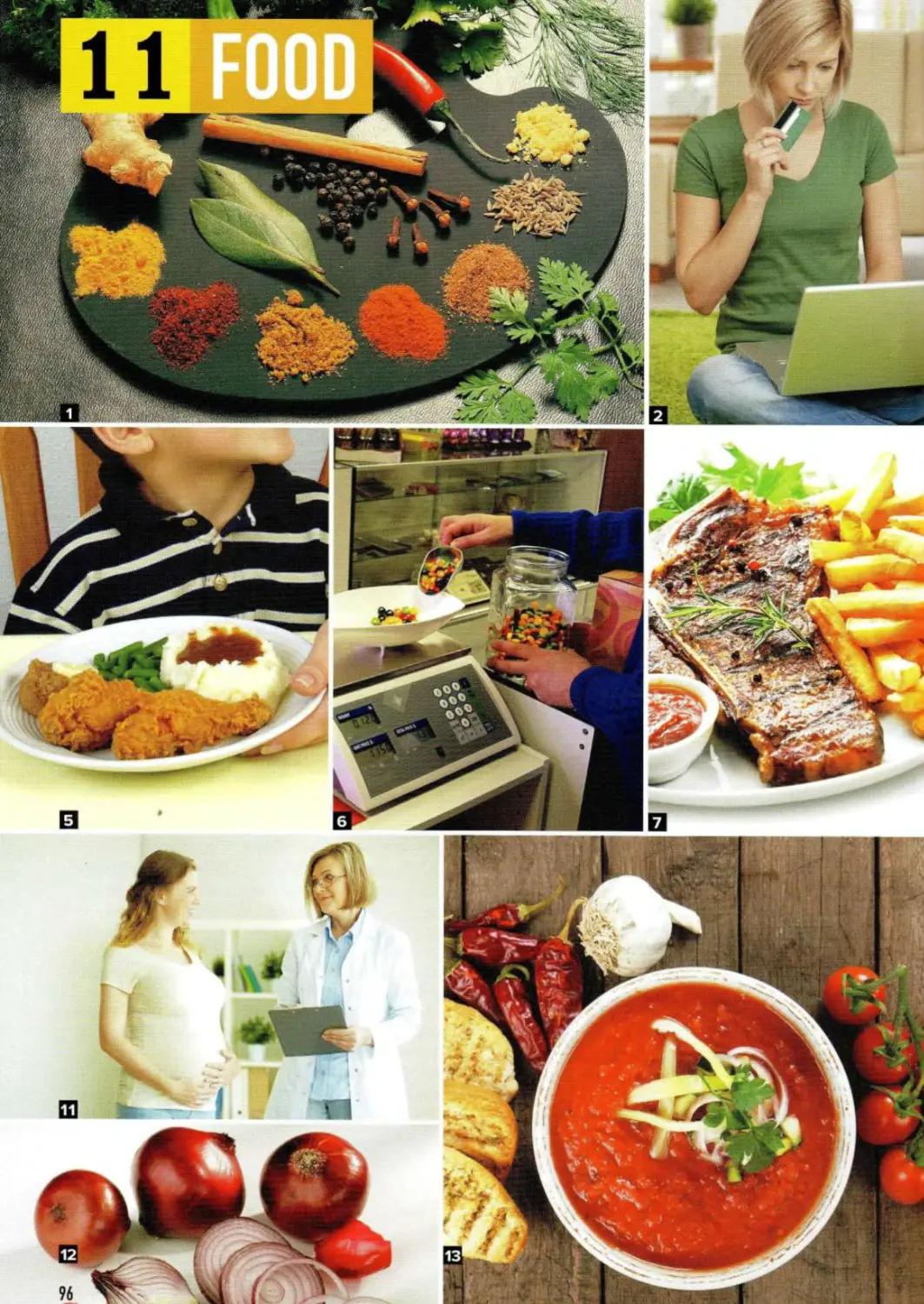
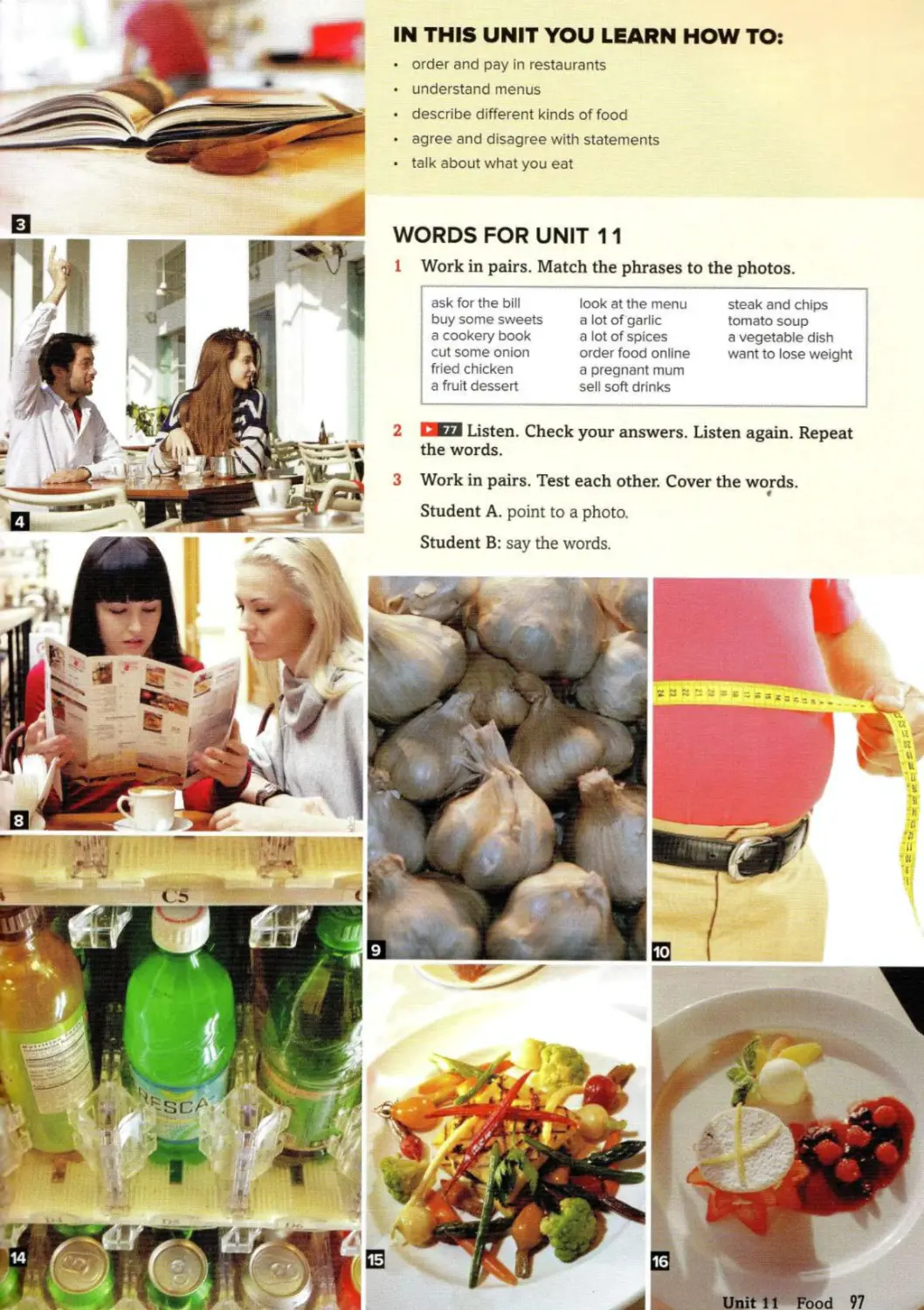
•	order and pay in restaurants
•	understand menus
•	describe different kinds of food
•	agree and disagree with statements
•	talk about what you eat
page 96
page 104
•	talk about health problems
•	give advice
•	say no to offers and advice
•	talk about how you feel and why
•	understand some news stories
VIDEO 6: Wearing a glove of venomous ants page 112 REVIEW 6: page 113 WRITING 6: Describing food page 160
page 114
•	talk about the weather
•	talk about possibilities in the future
•	ask for more details
•	talk about the countryside and the city
•	talk about animals
•	talk about duration
•	give your opinion about films, plays and musicals
•	ask for descriptions and opinions
•	discuss news and newspapers
•	make predictions about the future
•	talk about society and social issues
page 122
VIDEO 7: National symbols page 130 REVIEW 7: page 131	WRITING 7: Describing photos page 162
•	talk about useful machines
•	find out how much people know
•	talk about computers and the internet
•	spell and give addresses
•	explain what’s good about apps and websites
page 132
•	describe different events in relationships
•	give news about relationships
•	explain when and where you met people
•	make promises
page 140
VIDEO 8: Snow magic! page 148 REVIEW 8: page 149 WRITING 8: Messages page 164
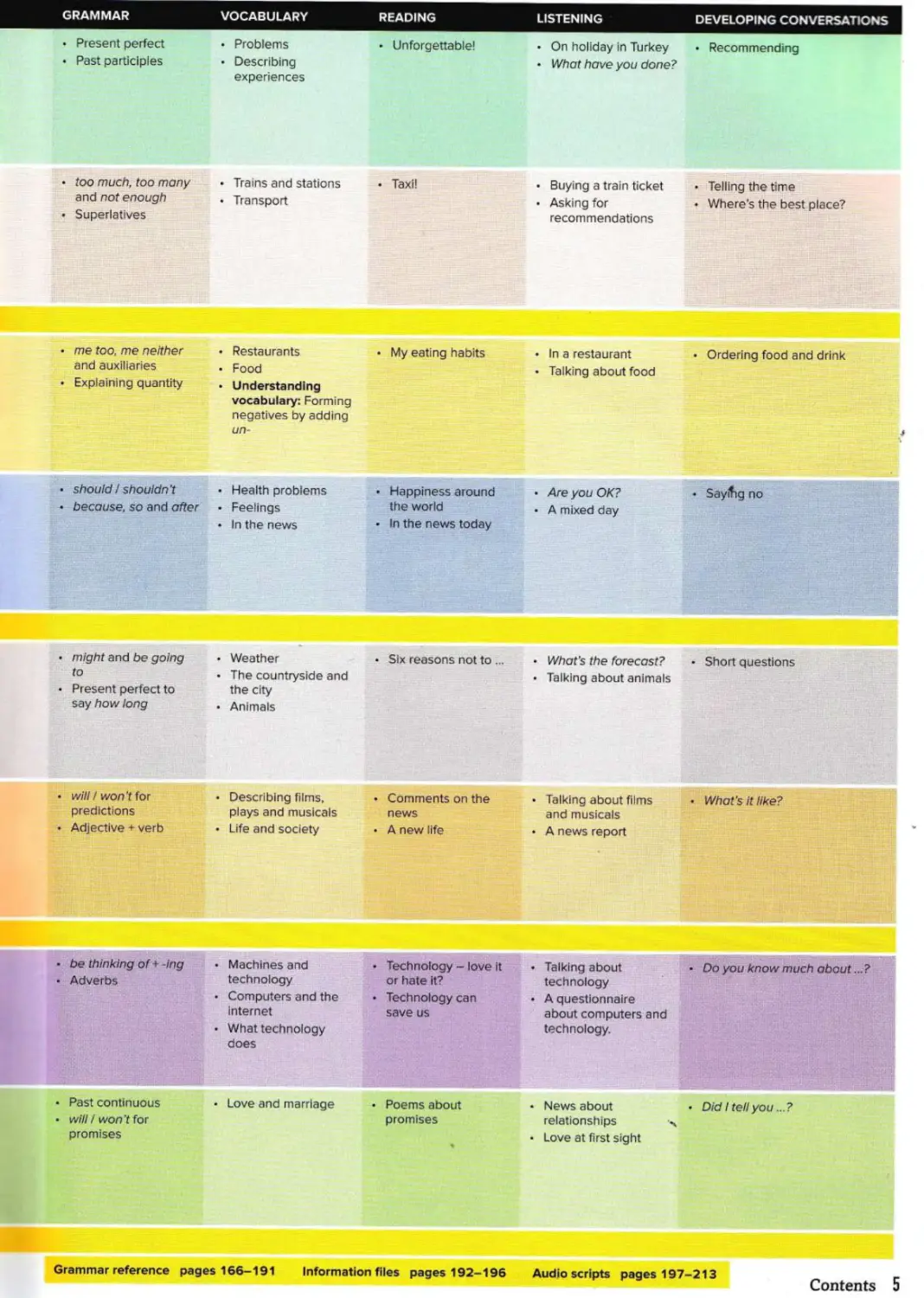
RAMMAR	VOCABULARY	READING	LISTENING	DEVELOPING CONVERSATIONS
Present perfect Past participles	•	Problems	• Unforgettable!	• On holiday in Turkey • Recommending •	Describing	• What have you done? experiences
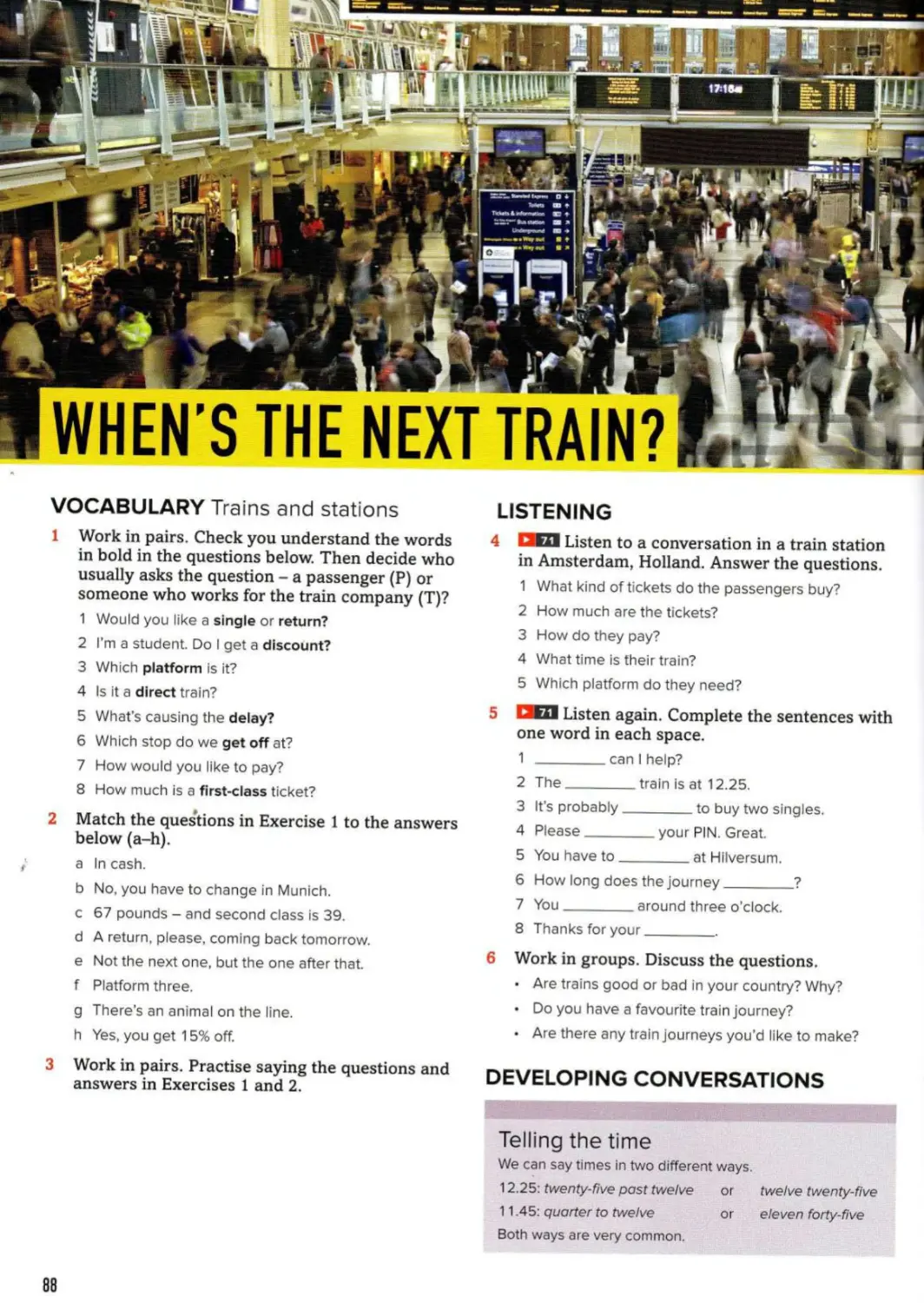
• too much, too many and not enough	• Trains and stations • Transport	• Taxi!	• Buying a train ticket • Asking for	• Telling the time • Where’s the best place?
• Superlatives			recommendations
me too, me neither and auxiliaries Explaining quantity	•	Restaurants	• My eating habits	• In a restaurant	• Ordering food and drink •	Food	• Talking about food •	Understanding vocabulary: Forming negatives by adding un-
should / shouldn't because, so and after	•	Health problems	• Happiness around	• Are you OK?	• Sayibg no •	Feelings	the world	. д mixed day •	In the news	• In the news today
• might and be going	• Weather	• Six reasons not to ...	• What's the forecast?	• Short questions
to	• The countryside and		• Talking about animals
• Present perfect to	the city
say how long	• Animals
• will/ won't for	• Describing films,	• Comments on the	• Talking about films	• What’s it like?
predictions	plays and musicals	news	and musicals
• Adjective + verb	• Life and society	• A new life	• A news report
• be thinking of + -Ing	• Machines and	• Technology - love it	• Talking about	• Do you know much about... ?
• Adverbs	technology •	Computers and the internet •	What technology does	or hate it? • Technology can save us	technology • A questionnaire about computers and technology.
• Past continuous	• Love and marriage	• Poems about	• News about	• Did 1 tell you...?
• will I won’t for promises		promises	relationships • Love at first sight
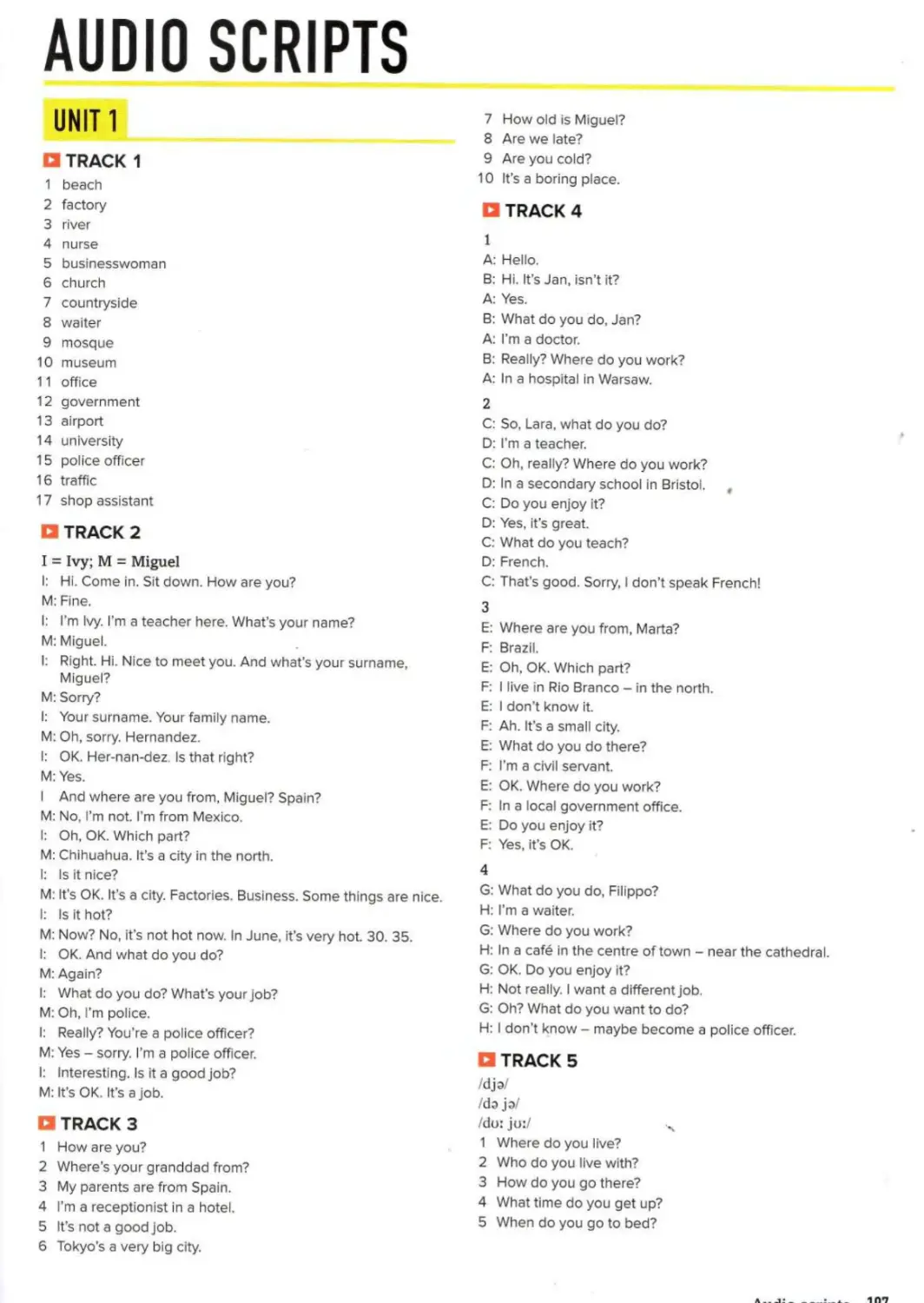
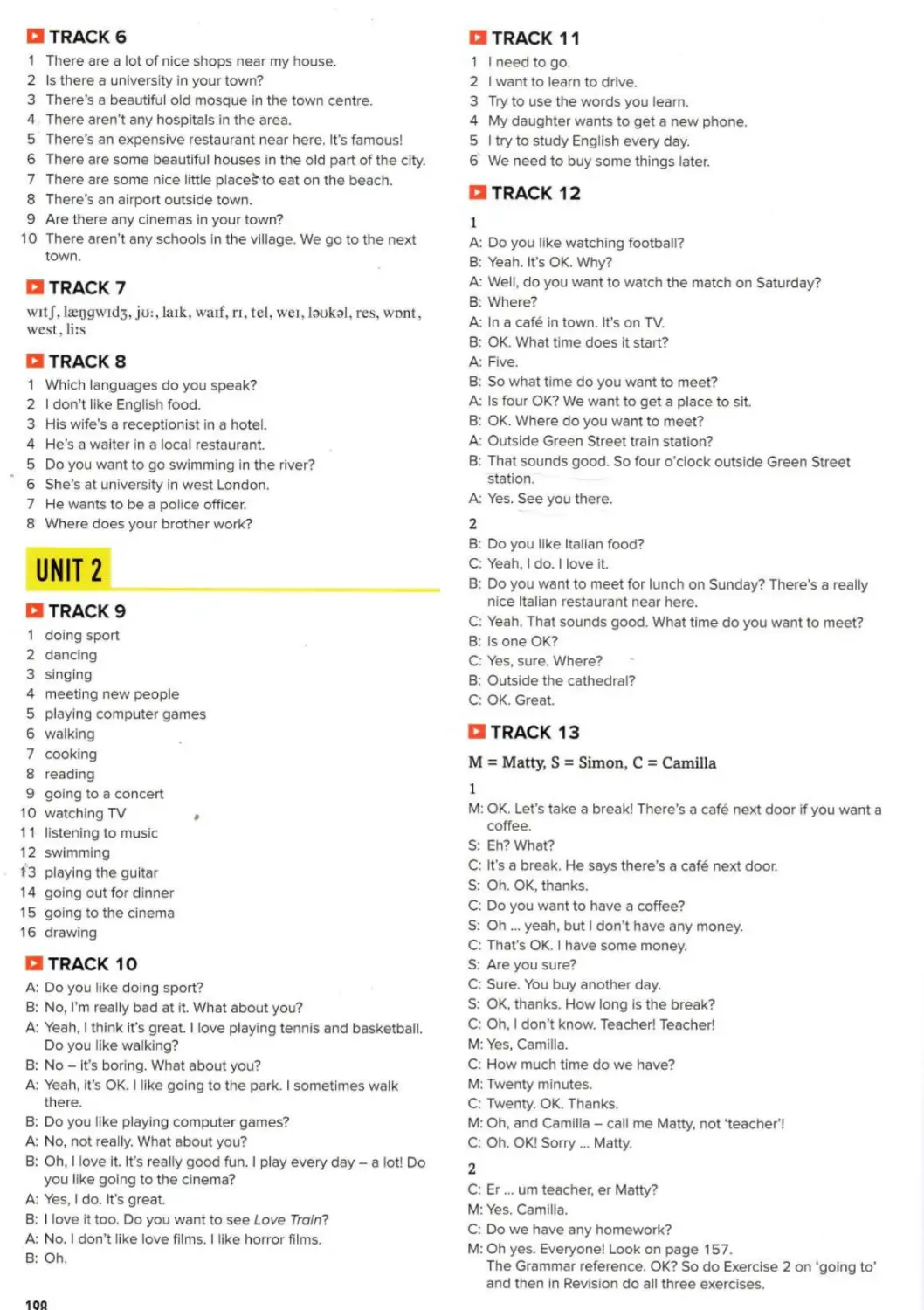
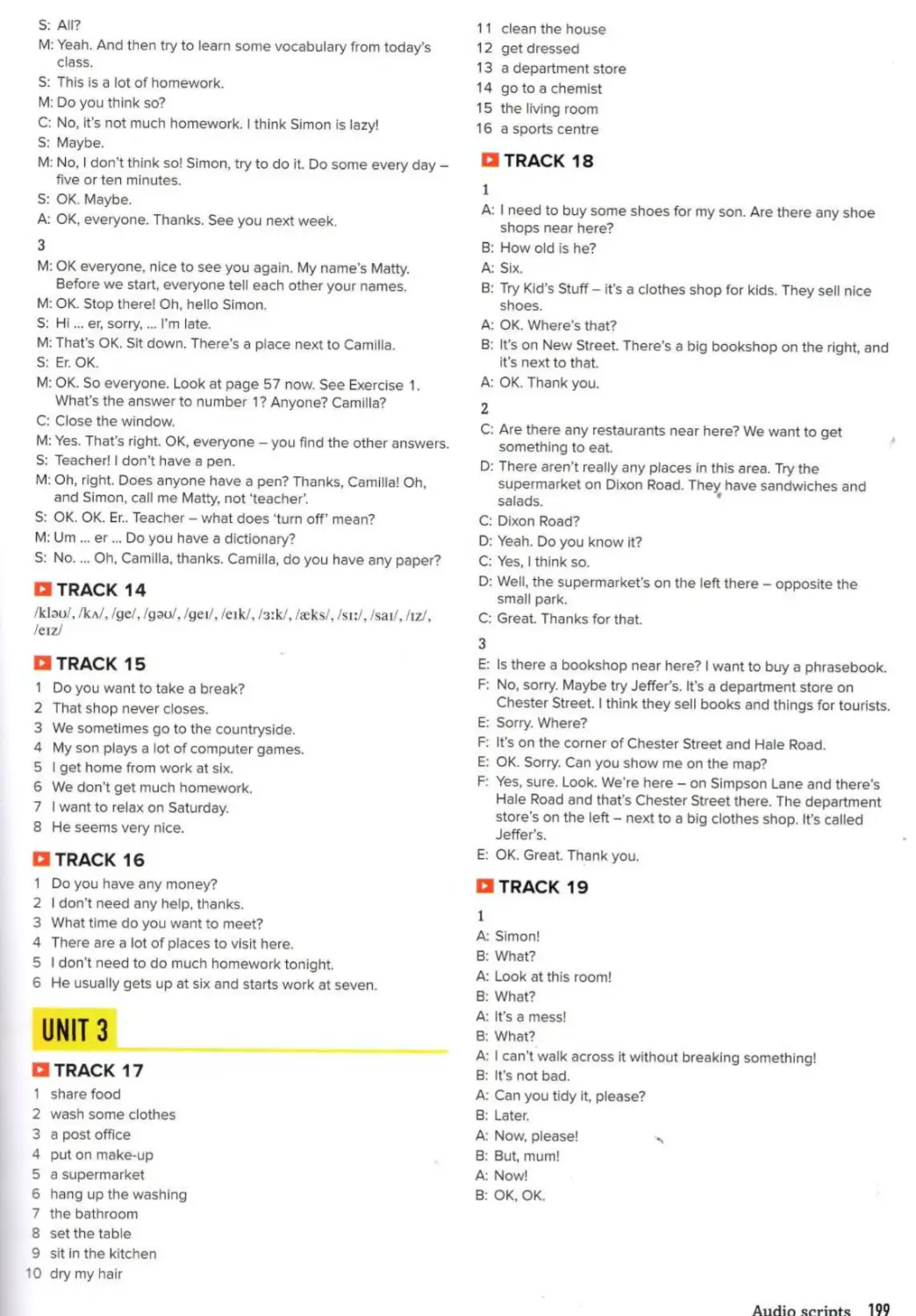
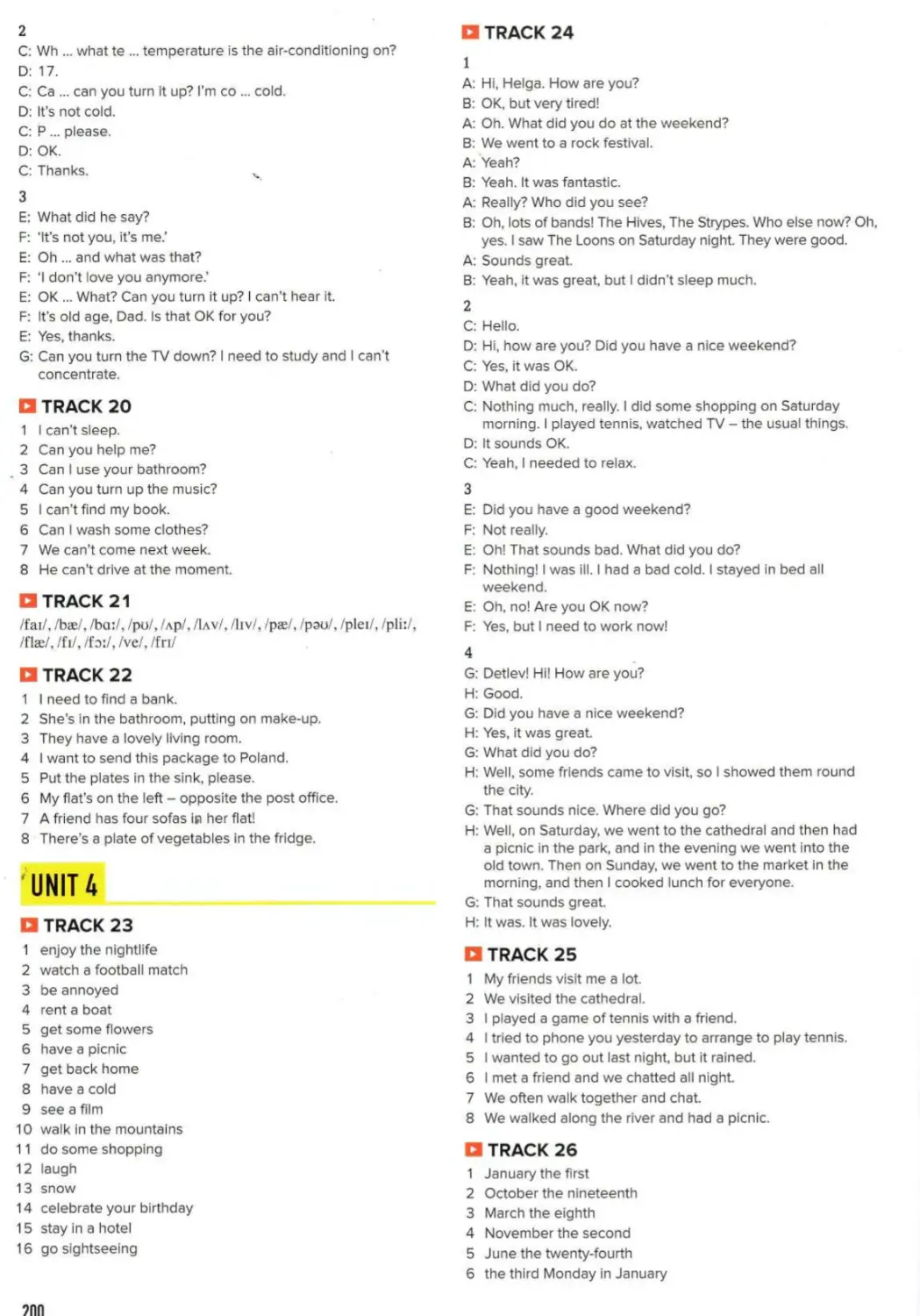
Grammar reference pages 166-191 Information files pages 192-196 Audio scripts pages 197-213
Contents 5
ШШ1 Ж..ИЮ
S33Vld ONV 33d03d
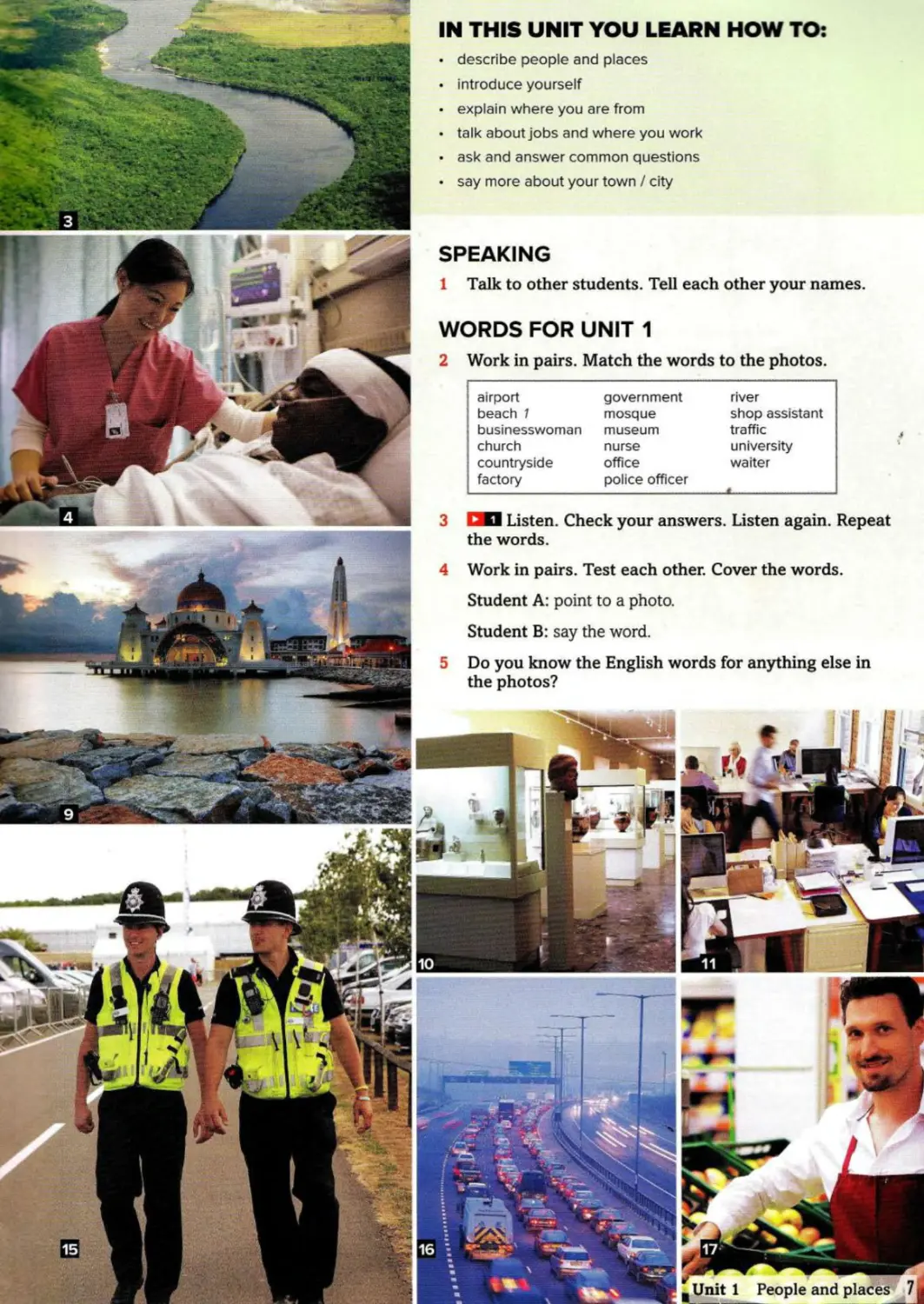
IN THIS UNIT YOU LEARN HOW TO:
•	describe people and places
•	introduce yourself
•	explain where you are from
•	talk about jobs and where you work
•	ask and answer common questions
•	say more about your town / city
SPEAKING
1 Talk to other students. Tell each other your names.
WORDS FOR UNIT 1
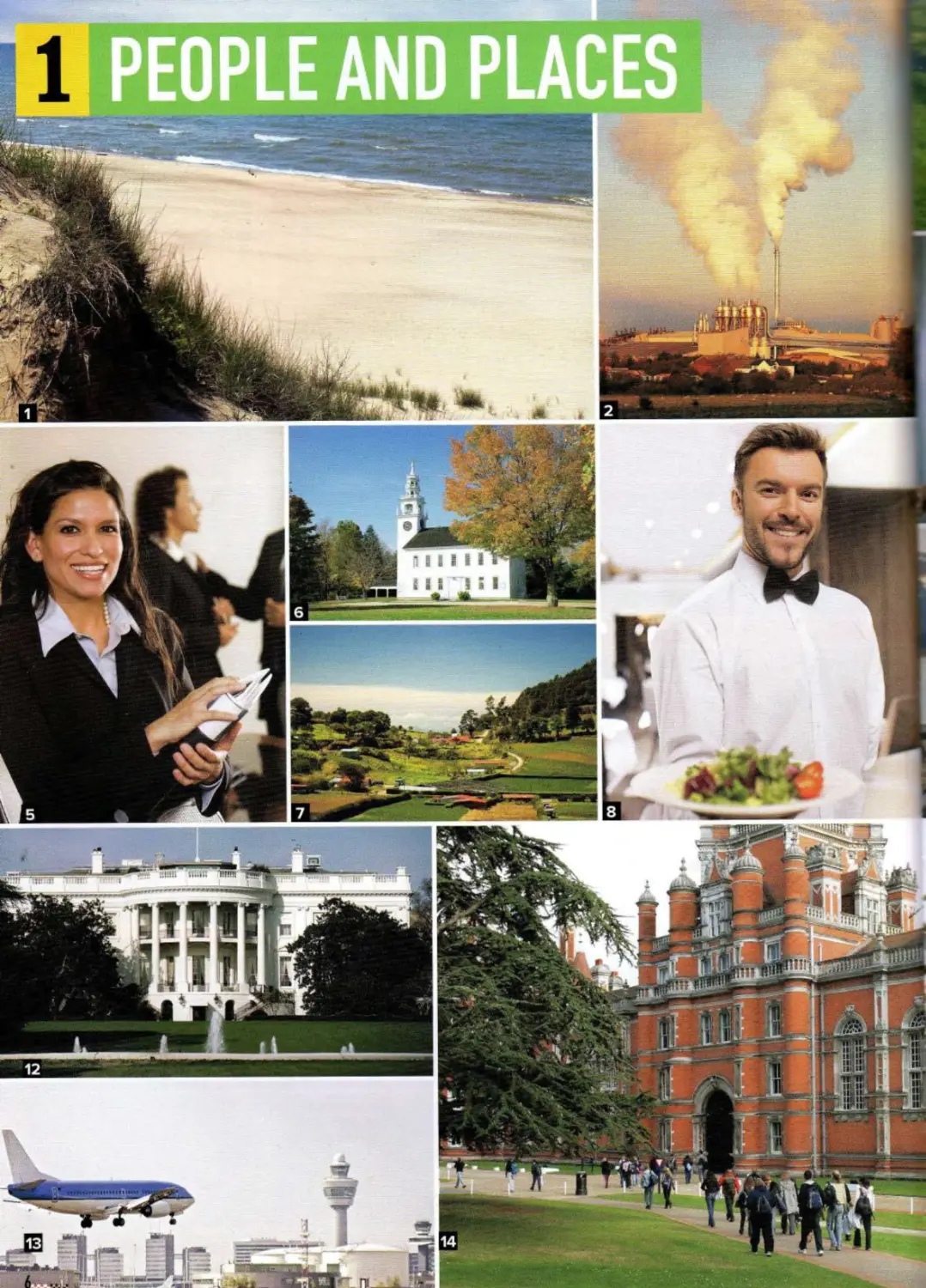
2 Work in pairs. Match the words to the photos.
airport	government	river
beach 1	mosque	shop assistant
businesswoman	museum	traffic
church	nurse	university
countryside	office	waiter
factory	police officer		1
3 КЖ1 Listen. Check your answers. Listen again. Repeat
the words.
4 Work in pairs. Test each other. Cover the words.
Student A: point to a photo.
Student B: say the word.
5 Do you know the English words for anything else in
the photos?
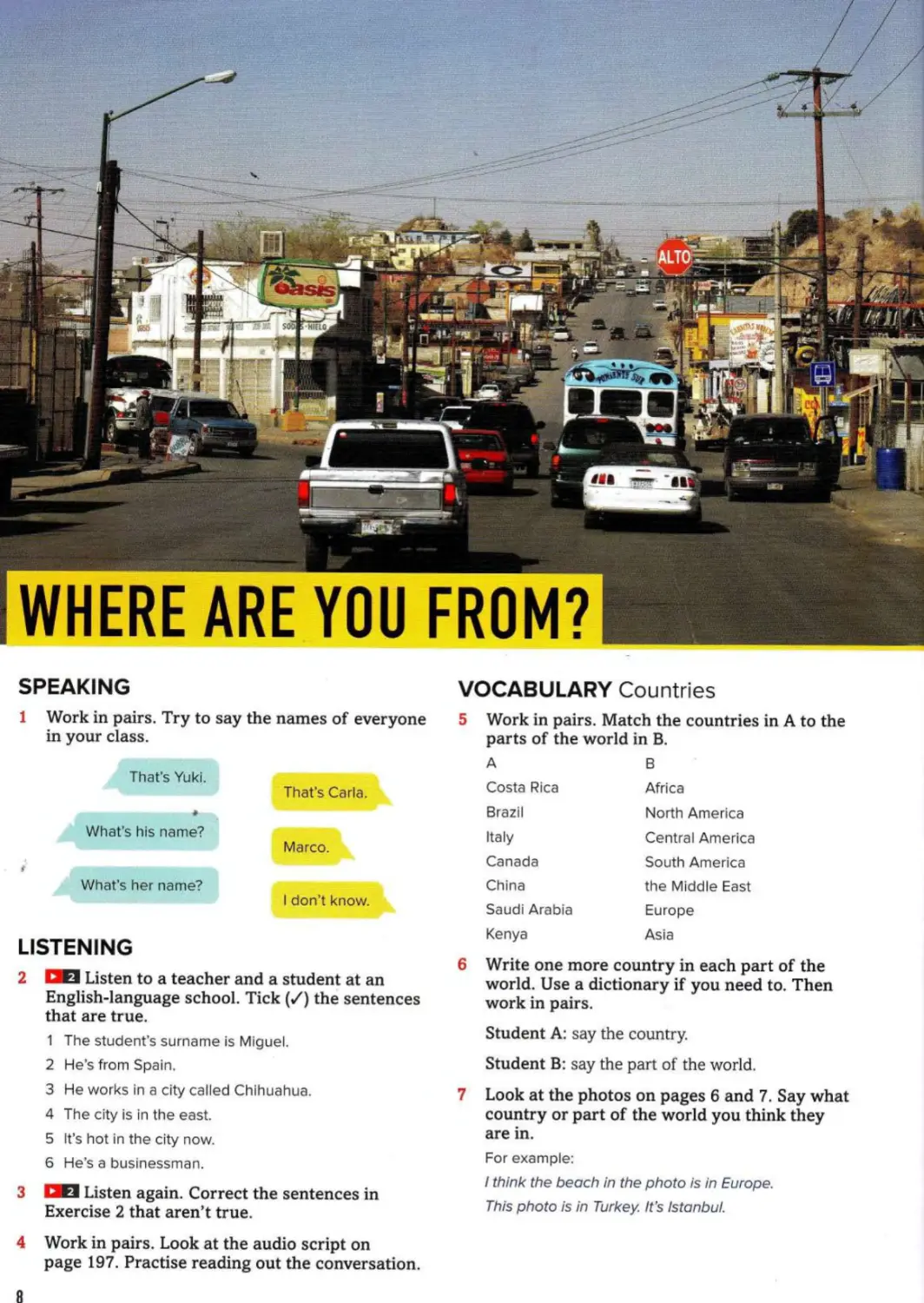
WHERE ARE YOU FROM?
SPEAKING
VOCABULARY Countries
1 Work in pairs. Try to say the names of everyone
in your class.
That’s Yuki.	That’s Carla.
What’s his name?	Marco.
What’s her name?	1 don’t know.
LISTENING
2 DEI Listen to a teacher and a student at an
English-language school. Tick (/) the sentences
that are true.
1	The student’s surname is Miguel.
2	He’s from Spain.
3	He works in a city called Chihuahua.
4	The city is in the east.
5	It’s hot in the city now.
6	He’s a businessman.
3 DEI Listen again. Correct the sentences in
Exercise 2 that aren’t true.
5 Work in pairs. Match the countries in A to the
parts of the world in B.
A	В
Costa Rica	Africa
Brazil	North America
Italy	Central America
Canada	South America
China	the Middle East
Saudi Arabia	Europe
Kenya	Asia
6 Write one more country in each part of the
world. Use a dictionary if you need to. Then
work in pairs.
Student A: say the country.
Student B: say the part of the world.
7	Look at the photos on pages 6 and 7. Say what
country or part of the world you think they
are in.
For example:
I think the beach in the photo is in Europe.
This photo is in Turkey. It’s Istanbul.
4 Work in pairs. Look at the audio script on
page 197. Practise reading out the conversation.
8
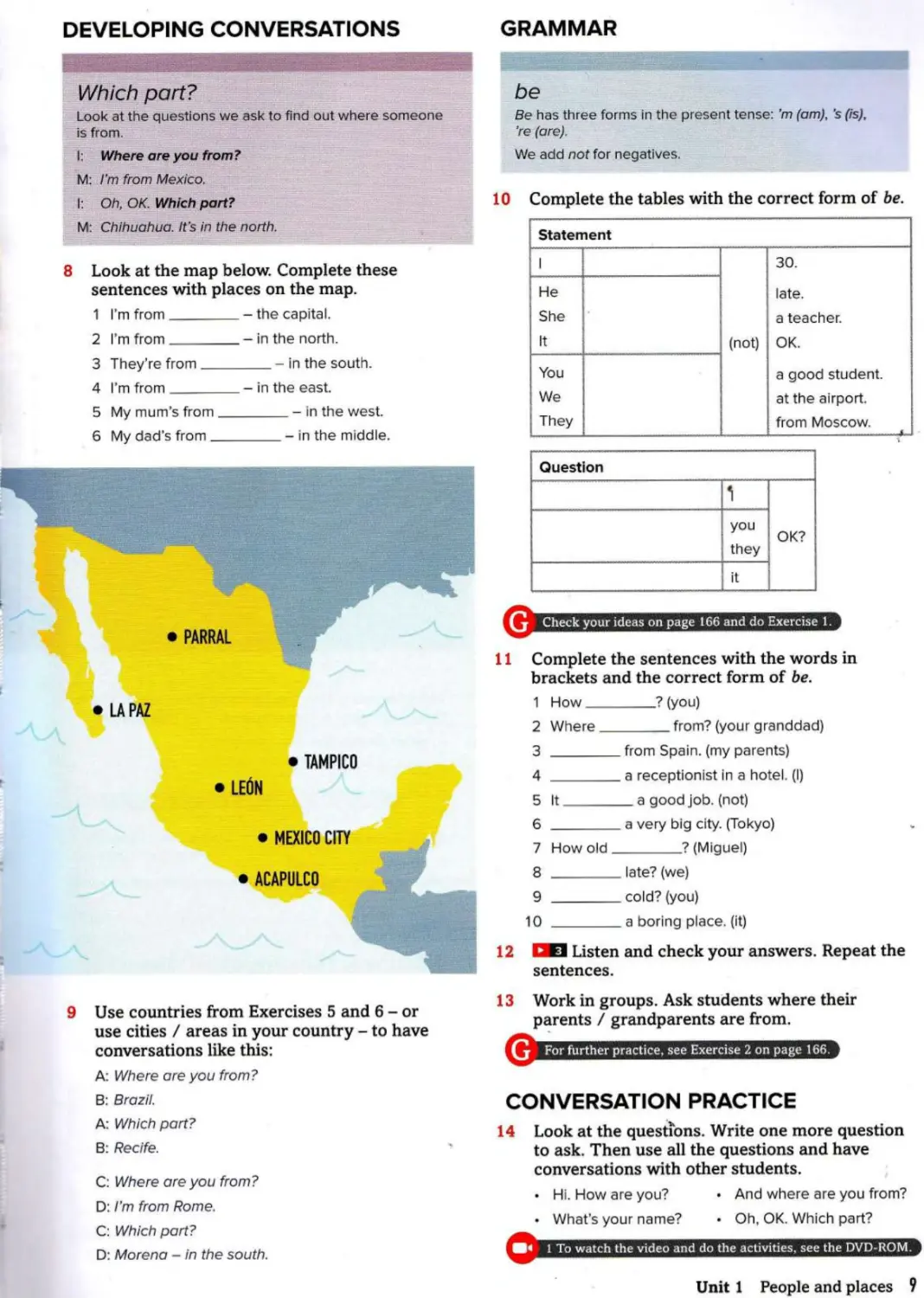
DEVELOPING CONVERSATIONS
GRAMMAR
Which part?
Look at the questions we ask to find out where someone
is from.
I: Where are you from?
M: Гт from Mexico.
I: Oh, OK. Which part?
M: Chihuahua. It's in the north.
8 Look at the map below. Complete these
sentences with places on the map.
1	I’m from- the capital.
2	I’m from- in the north.
3	They’re from- in the south.
4	I’m from- in the east.
5	My mum’s from- in the west.
6	My dad’s from- in the middle.
be
Be has three forms in the present tense: ’m (am), 's (is),
Ye (ore).
We add not for negatives.
10 Complete the tables with the correct form of be.
Statement
1			30.
He			late.
She			a teacher.
It		(not)	OK.
You			a good student.
We			at the airport.
They			from Moscow.
				   -4-
• LAPAZ
• TAMPICO
• LEON
9 Use countries from Exercises 5 and 6 - or
use cities / areas in your country - to have
conversations like this:
A:	Where are you from?
B:	Brazil.
A:	Which part?
B:	Recife.
C:	Where ore you from?
D:	Гт from Rome.
C: Which part?
D: Morena - in the south.
Question
	1	OK?
	you they
	it
Check your ideas on page 166 and do Exercise 1.
11 Complete the sentences with the words in
brackets and the correct form of be.
1	How? (you)
2	Where from? (your granddad)
3	from Spain, (my parents)
4	a receptionist in a hotel. (I)
5	It a good job. (not)
6	a very big city. (Tokyo)
7	How old? (Miguel)
8	late? (we)
9	cold? (you)
10	a boring place, (it)
12	D El Listen and check your answers. Repeat the
sentences.
13	Work in groups. Ask students where their
parents / grandparents are from.
For further practice, see Exercise 2 on page 166.
CONVERSATION PRACTICE
14	Look at the questions. Write one more question
to ask. Then use all the questions and have
conversations with other students.
•	Hi. How are you?	• And where are you from?
•	What’s your name?	• Oh, OK. Which part?
1 To watch the video and do the activities, see the DVD-ROM.
Unit 1 People and places 9
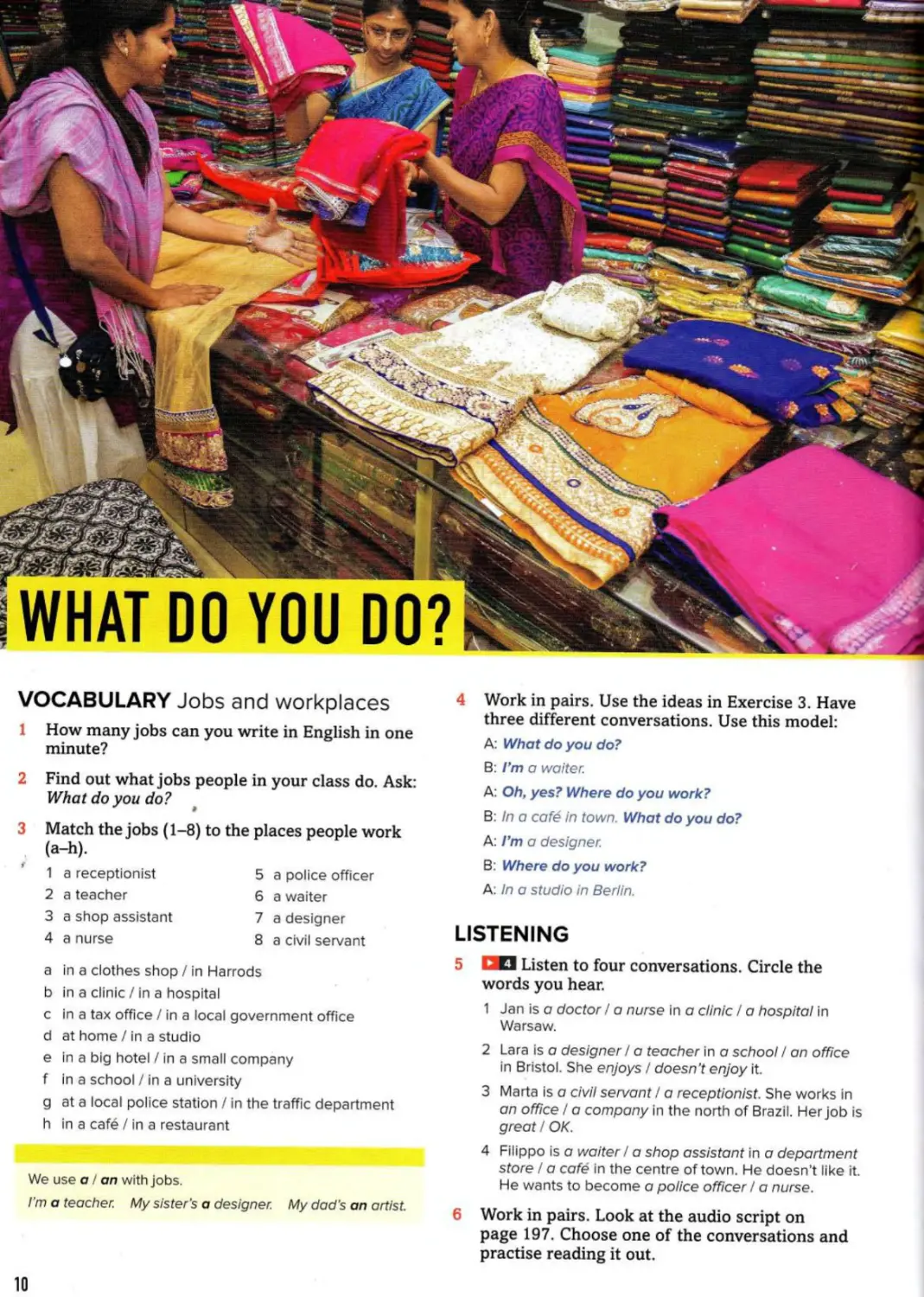
WHAT DO YOU DO?
VOCABULARY Jobs and workplaces
i
How many jobs can you write in English in one
minute?
2
Find out what jobs people in your class do. Ask:
What do you do?
3
a police officer
a waiter
a designer
a civil servant
5
6
7
8
1
2
3
4
Match the jobs (1-8) to the places people work
(a-h).
a receptionist
a teacher
a shop assistant
a nurse
4 Work in pairs. Use the ideas in Exercise 3. Have
three different conversations. Use this model:
A: What do you do?
B: Pm a waiter.
A: Oh, yes? Where do you work?
B: In a cafe in town. What do you do?
A: I’m a designer.
B: Where do you work?
A: In a studio in Berlin.
LISTENING
a
b
c
d
e
f
g
h
in a clothes shop I in Harrods
in a clinic / in a hospital
in a tax office / in a local government office
at home / in a studio
in a big hotel / in a small company
in a school / in a university
at a local police station I in the traffic department
in a cafe / in a restaurant
5
We use a / an with jobs.
Гт a teacher. My sister's a designer. My dad’s an artist.
6
1
2
DEI Listen to four conversations. Circle the
words you hear.
Jan is a doctor I a nurse in a clinic I a hospital in
Warsaw.
Lara is a designer I a teacher in a school I on office
in Bristol. She enjoys I doesn’t enjoy it.
Marta is a civil servant I a receptionist. She works in
an office I a company in the north of Brazil. Her job is
great I OK.
Filippo is a waiter / a shop assistant in a deportment
store / a cafe in the centre of town. He doesn’t like it.
He wants to become a police officer / a nurse.
3
4
Work in pairs. Look at the audio script on
page 197. Choose one of the conversations and
practise reading it out.
10
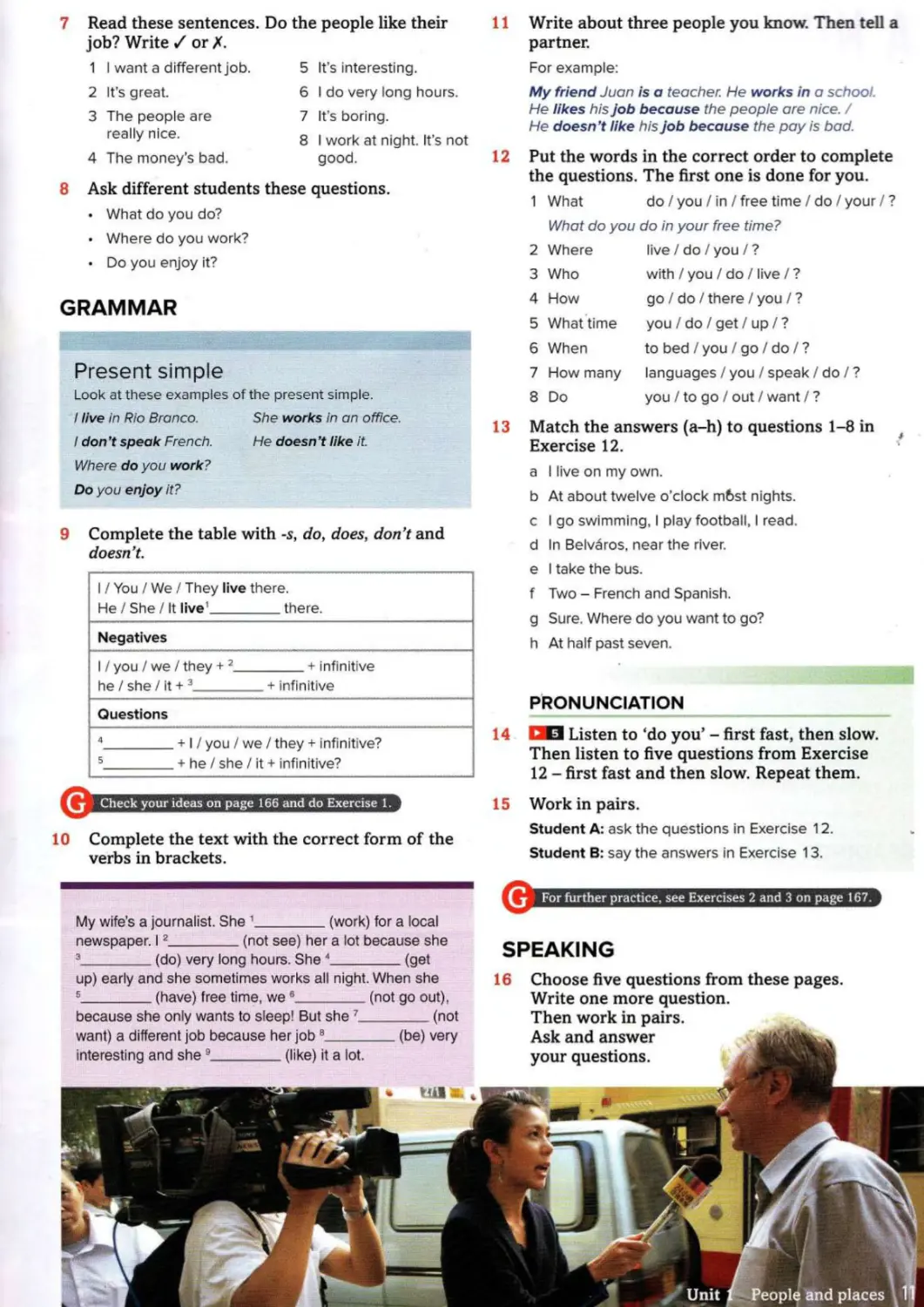
7 Read these sentences,
job? Write / or X.
1 I want a different job.
2 It’s great
3 The people are
really nice.
4 The money’s bad.
Do the people like their
5 It’s interesting.
6 I do very long hours.
7 It’s boring.
8 I work at night. It’s not
good.
8 Ask different students these questions.
• What do you do?
• Where do you work?
• Do you enjoy it?
GRAMMAR
Present simple
Look at these examples of the present simple.
I live in Rio Bronco. She works in on office.
I don’t speak French.	He doesn 7 like it.
Where do you work?
Do you enjoy it?
9 Complete the table with -s, do, does, don't and
doesn't.
I / You I We / They live there.
He / She I It live1 there.
Negatives
I / you / we / they + 2+ infinitive
he / she / it + 3+ infinitive
Questions
4+ I / you I we / they + infinitive?
5+ he / she / it + infinitive?
G* Check your ideas on page 166 and do Exercise 1.
10 Complete the text with the correct form of the
verbs in brackets.
11 Write about three people you know. Then tell a
partner.
For example:
My friend Juon is a teacher. He works in a school.
He likes his job because the people are nice. /
He doesn't like his job because the pay is bad.
12 Put the words in the correct order to complete
the questions. The first one is done for you.
1 What do/you/in/free time/do/your/?
What do you do in your free time?
2	Where	live / do / you / ?
3	Who	with / you / do / live / ?
4	How	go / do / there 1 you / ?
5	What time	you / do / get / up / ?
6	When	to bed / you / go / do / ?
7	How many	languages 1 you 1 speak / do / ?
8	Do	you / to go / out / want / ?
13 Match the answers (a—h) to questions 1-8 in
Exercise 12.
a I live on my own.
b At about twelve o’clock mbst nights.
с I go swimming, I play football, I read.
d In Belvaros, near the river.
e I take the bus.
f Two - French and Spanish.
g Sure. Where do you want to go?
h At half past seven.
PRONUNCIATION
14 CD Listen to ‘do you’ - first fast, then slow.
Then listen to five questions from Exercise
12 - first fast and then slow. Repeat them.
15 Work in pairs.
Student A: ask the questions in Exercise 12.
Student B: say the answers in Exercise 13.
l G F°r further practice, see Exercises 2 and 3 on page 167.
My wife’s a journalist. She 1(work) for a local
newspaper. 12______________(not see) her a lot because she
3____________(do) very long hours. She4_______________(get
up) early and she sometimes works all night. When she
’__________(have) free time, we6___________(not go out),
because she only wants to sleep! But she7______________(not
want) a different job because her job8____________(be) very
interesting and she9____________(like) it a lot.
SPEAKING
16 Choose five questions from these pages.
Write one more question.
Then work in pairs.
Ask and answer
your questions.
A NICE PLACE TO LIVE
VOCABULARY Describing places
1	Work in pairs. The first page of this unit has ten
words for places. How many do you remember?
2	Look at page 7 and check. Say the plural of the
words. Which word has an irregular plural?
Which two words have no plural?
3	Choose the correct words.
1	It’s a small I big city. Ten million people live there.
2	I don’t go swimming there because the beaches are
very quiet I dirty.
3	It’s very hot I cold in the summer: 35 or 40.
4	It’s a very expensive I famous town. Everyone
knows it.
5	It doesn’t have any shops. It’s busy I boringl
6	It’s very cheap I safe. My house is only 400 euros
a month.
7	A lot of people visit in the summer. It’s very busy I
quiet.
8	I really like it. It’s a great I boring place to live.
9	The countryside is very nice. It’s a dirty I beautiful
area.
10	It’s very famous I safe. I walk everywhere - day and
night.
4 Work in pairs. Say places you know using the
ideas below. Do you agree?
•	is a very big city.
•	is very quiet.
•	is very cold in the winter.
•	is very expensive.
•	is a beautiful area.
•	is a very famous town.
READING
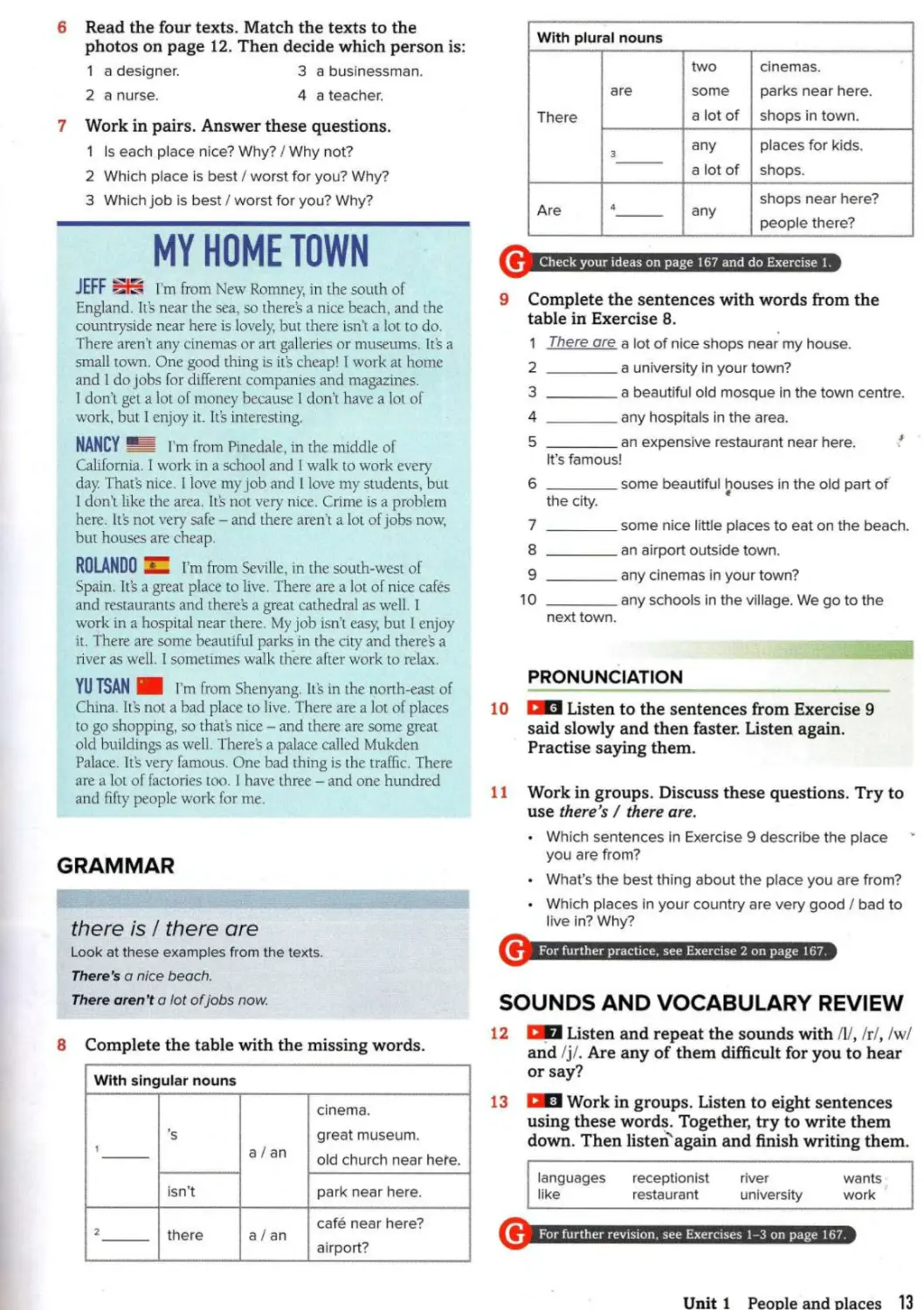
5 Work in pairs. Describe the places in the photos.
Use words from Exercise 3.
6 Read the four texts. Match the texts to the
photos on page 12. Then decide which person is:
1	a designer.	3 a businessman.
2	a nurse.	4 a teacher.
7 Work in pairs. Answer these questions.
1	Is each place nice? Why? I Why not?
2	Which place is best / worst for you? Why?
3	Which job is best / worst for you? Why?
MY HOME TOWN
With plural nouns
There	are	two some a lot of	cinemas. parks near here. shops in town.
	3	any a lot of	places for kids, shops.
Are	4	any	shops near here? people there?
Check your ideas on page 167 and do Exercise 1.
JEFF StS I’m from New Romney in the south of
England. Its near the sea, so there’s a nice beach, and the
countryside near here is lovely but there isn’t a lot to do.
There aren’t any cinemas or art galleries or museums. It’s a
small town. One good tiring is it’s cheap! I work at home
and 1 do jobs for different companies and magazines.
1 don’t get a lot of money because I don’t have a lot of
work, but 1 enjoy it. It’s interesting.
NANCY  I’m from Pinedale, in the middle of
California. I work in a school and I walk to work every
day. That’s nice. I love my job and I love my students, but
1 don’t like the area. It’s not very nice. Crime is a problem
here. It’s not very safe - and there aren’t a lot of jobs now,
but houses are cheap.
ROLANDO E I’m from Seville, in the south-west of
Spain. It’s a great place to live. There are a lot of nice cafes
and restaurants and there’s a great cathedral as well. 1
work in a hospital near there. My job isn’t easy but I enjoy
it. There are some beautiful parks in the city and there’s a
river as well. 1 sometimes walk there after work to relax.
YUTSAN  I’m from Shenyang. It’s in the north-east of
China. It’s not a bad place to live. There are a lot of places
to go shopping, so that’s nice - and there are some great
old buildings as well. There’s a palace called Mukden
Palace. It's very famous. One bad thing is the traffic. There
are a lot of factories too. I have three - and one hundred
and fifty people work for me.
GRAMMAR
there is I there are
Look at these examples from the texts.
There’s a nice beach.
There aren’t a lot of jobs now.
8 Complete the table with the missing words.
With singular nouns
i	’s	a / an	cinema. great museum. old church near here.
	isn’t		park near here.
2	there	a / an	cafe near here? airport?
9 Complete the sentences with words from the
table in Exercise 8.
1	There ore a lot of nice shops near my house.
2	a university in your town?
3	a beautiful old mosque in the town centre.
4	any hospitals in the area.
5	an expensive restaurant near here. *
It’s famous!
6	some beautiful houses in the old part of
the city.
7	some nice little places to eat on the beach.
8	an airport outside town.
9	any cinemas in your town?
10	any schools in the village. We go to the
next town.
PRONUNCIATION
10 DD Listen to the sentences from Exercise 9
said slowly and then faster. Listen again.
Practise saying them.
11	Work in groups. Discuss these questions. Try to
use there's / there are.
•	Which sentences in Exercise 9 describe the place
you are from?
•	What’s the best thing about the place you are from?
•	Which places in your country are very good / bad to
live in? Why?
For further practice, see Exercise 2 on page 167.
SOUNDS AND VOCABULARY REVIEW
12 D El Listen and repeat the sounds with /1/, /г/, /w/
and /j/. Are any of them difficult for you to hear
or say?
13 СП Work in groups. Listen to eight sentences
using these words. Together, try to write them
down. Then listen again and finish writing them.
languages	receptionist	river	wants
like	restaurant	university	work
For further revision, see Exercises 1-3 on page 167.
Unit 1 People and places 13

IN THIS UNIT YOU LEARN HOW TO:
•	talk about free-time activities
•	discuss what you like - and don’t like
•	arrange to meet
•	describe your daily life
•	talk about how often - and when - you do things
•	use more English in class
WORDS FOR UNIT 2
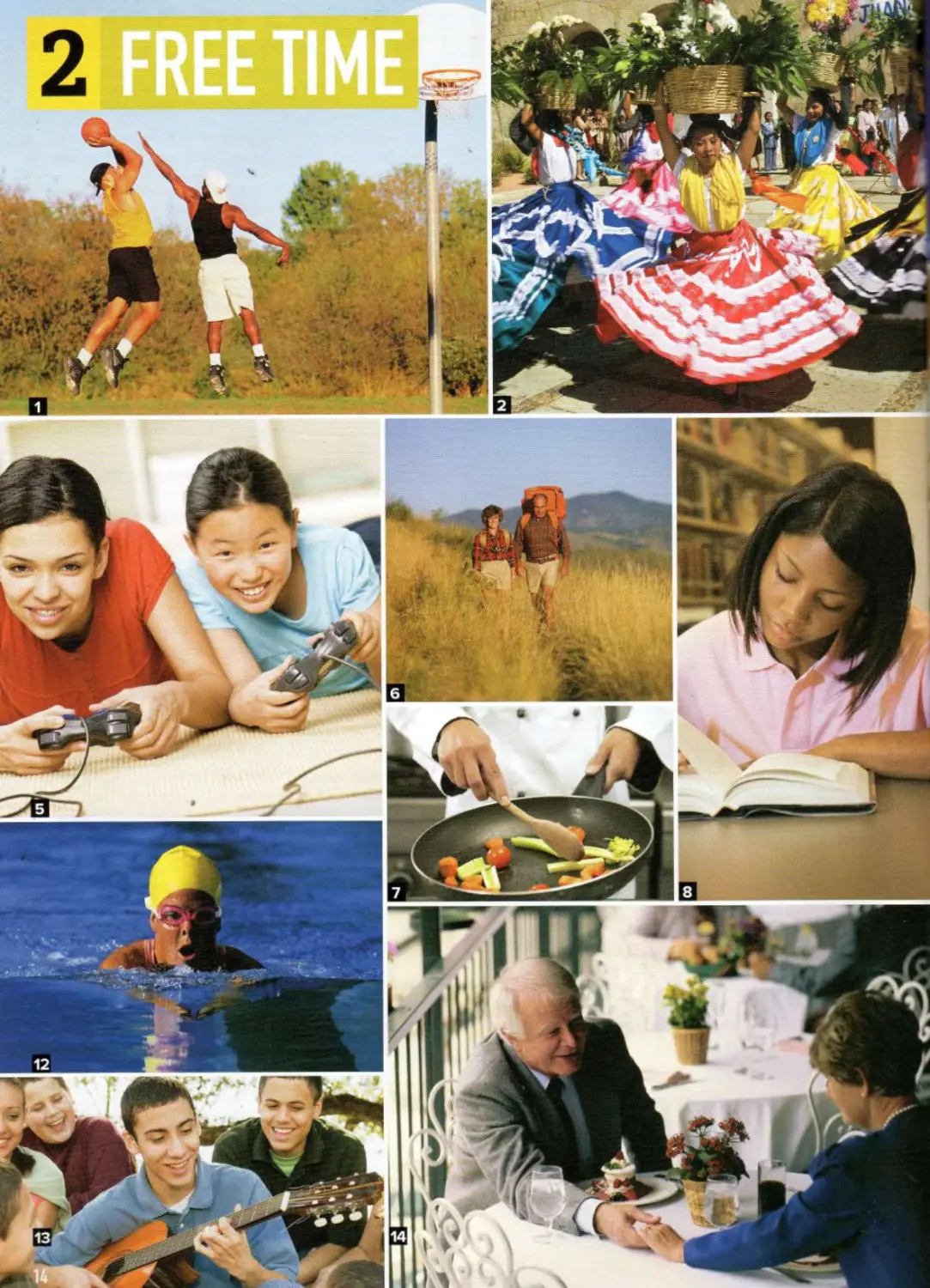
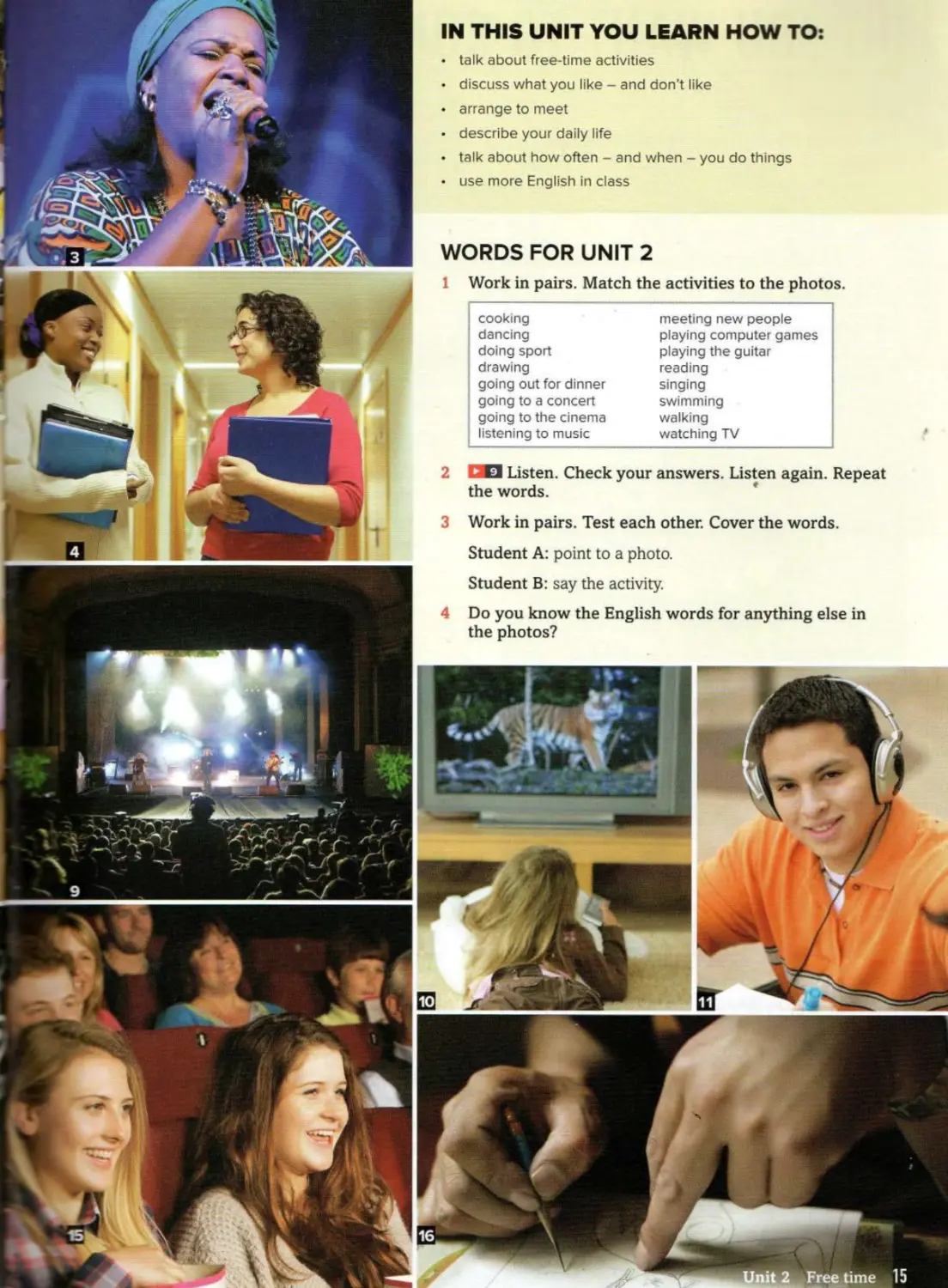
1 Work in pairs. Match the activities to the photos.
cooking	meeting new people
dancing	playing computer games
doing sport	playing the guitar
drawing	reading
going out for dinner	singing
going to a concert	swimming
going to the cinema	walking
listening to music	watching TV
2 CD Listen. Check your answers. Listen again. Repeat
the words.
3 Work in pairs. Test each other. Cover the words.
Student A: point to a photo.
Student B: say the activity.
4 Do you know the English words for anything else in
the photos?
DO YOU WANT TO COME?
SPEAKING
1 Complete the sentences with activities from
page 15.	x
1	is boring. 4 is great.
2	is interesting. 5 I’m bad at
3	is expensive. 6 I'm good at
2	Work in pairs. Tell your partner your ideas. Does
your partner agree?
LISTENING
3	Look at the people in the pictures. What
activities do you think they like / don’t like?
4	cm Listen to the two people talking. Complete
the table with doesn’t like, thinks it’s OK and loves.
	Woman	Man
doing sport
walking		doesn’t like
playing computer games
going to the cinema	loves
5	Work in pairs. Look at the audio script on
page 198. Practise reading out the conversation.
SPEAKING
6	Work in groups. Ask Do you like ...? questions.
Reply with / love it, It’s OK or No, not really.
A:	Do you like cooking?
B:	Zes, I do. I love it. What about you?
A: It's OK, but I'm not very good at it.
GRAMMAR
Verb patterns
a After some verbs, we often use -ing.
I love playing tennis.
b After some verbs, we often use to + infinitive.
Do you wont to see Love Train?
7	Which sentences are the same as pattern a
above, and which are the same as pattern b?
1	He really likes swimming.
2	I need to go now.
3	I enjoy working on my own.
4	I want to learn to drive.
5	Try to use the words you learn.
6	I hate living in the city.
Check your ideas on page 168 and do Exercise 1.
8	Write full sentences from the notes.
1	My daughter / want / get I a new phone.
2	My sister/love/play/tennis.
3	you / like I dance?
4	I/try/study English/every day.
5	I / not / enjoy I shop.
6	We / need I buy / some things later.
7	11 really hate I cook.
8	I/really want/learn/draw.
PRONUNCIATION
9	am Listen and repeat six sentences with to
+ infinitive. Notice how we often say to as /to/.
10	Complete the sentences so they are true for you.
1 I love.
2 I don’t really like.
3 This week I need.
4 I want to learn
5 I don’t really enjoy.
11 Work in pairs. Tell your partner your ideas.
For further practice, see Exercise 2 on page 168.
DEVELOPING CONVERSATIONS
Arrangements
We can make future arrangements using the present simple.
A:	Do you want to go shopping on Saturday?
B:	OK. Where do you wont to meet?
A:	Outside Harrods - the big department store.
B:	OK. What time?
A:	Is ten OK?
B:	Yeah. Fine.
12 Match the questions in the box to the pairs of
possible answers in 1-5.
Do you like going to the cinema?
Do you want to see Monsters 6 on Sunday?
What time do you want to meet?
Where?
What time does the film end?
1 A:___________________________________________
B: Is four good? I Is seven OK? The film starts at eight
2 A:___________________________________________
B: I’m not sure. About seven, I think. / About 11.30.
It’s a long film.
3 A:___________________________________________
B: OK. That sounds nice. / Sorry. I’m busy then.
4 A:___________________________________________
B: Yes, it’s OK. / No, not really.
5 A:___________________________________________
B: Outside the train station. I Outside the cinema.
13	D KEI Listen to two conversations where people
make arrangements. Choose the correct words
in the notes.
Lunch with Tina
9:47 AM
.«ill 3G .all 4G
Watch 'match I film with Jack
Meet outside 2cafe I Green Street station at
3four I five
^French I Italian restaurant
Meet 5one / two o’clock outside the 6cathedral I
restaurant
14	Work in pairs. Which day in the conversations
do you think sounds best - Saturday or Sunday?
Why?
CONVERSATION PRACTICE
15	Decide two things you want to do at the
weekend (on Friday night, Saturday or Sunday).
Decide where you want to meet and what time.
16	Work in pairs. Have conversations like the ones
in the box in Developing Conversations.
2 To watch the video and do the activities, see the DVD-ROM.
Unit 2 Freetime 17
VOCABULARY Daily life
1 When do people usually do the activities below?
Put them in the three groups in the table. *
4 Complete the table below with the adverbs in
the box. Then translate all the adverbs into your
language.
do homework	have a coffee
finish school	have a shower
get home from work	have lunch
get up	leave work
go to bed	watch the news
go to the theatre	write emails
always never often
100%
sometimes
in the morning*	in the afternoon	in the evening

usually
2
3
occasionally
hardly ever
0%	4_________
.Q Check your ideas on page 168 and do Exercise 1.
2	Work in pairs and compare your answers. Do
you always agree? If not, why not?
3	Look at the words in Exercise 1 for two minutes.
Close your books. Work in pairs. See how many
words you remember.
GRAMMAR
Adverbs of frequency
We use some adverbs to show how often we do
something. Notice their position in the sentence.
I always hove о shower in the morning.
I usually go to bed ot midnight.
5	Tick (/) the sentences that are true for you.
Change the adverbs in the other sentences to
make them true for you.
1	I always watch the news in the evening.
2	I usually have a coffee after my lunch.
3	I never drink beer or wine.
4	I hardly ever read novels.
5	I often listen to music when I go to sleep.
6	I occasionally go to rock concerts.
7	I always do my homework for my English class.
8	I sometimes go swimming at the weekend.
6 Work in groups. Take turns saying your
sentences. Who is most similar to you?
7 Write four true sentences using the phrases
in the box and an adverb. Then say them to a
partner.
cook dinner for friends	use English outside class
sleep in the afternoon	work at the weekend
For further practice, see Exercise 2 on page 168.
READING
8	Read an article about how three people spend
their free time. Answer these questions.
1	Who is most similar to you? Why?
2	Who do you think is the happiest person? Why?
9	Read the article again. Decide which person:
1	does sport or exercise.
2	spends a lot of money.
3	is tired at the weekend.
4	likes TV.
5	seems quiet.
6	has a busy social life.
7	goes to bed quite early.
8	works long hours.
10	Complete the sentences with the prepositions in
bold in the article.
1	I’m always very busy Mondays.
2	I always go running Sunday mornings.
3	I don’t usually work Fridays. It’s great. I get
up nine or ten.
4	Our school day finishes four.
5	The film starts eight and ends
10.30.
6	We don’t usually do very much the
weekend - just relax.
7	I sometimes have a short sleep the
afternoon.
8	I’m usually very tired the morning. I need to
have a coffee!
SPEAKING
11 Work in groups. Ask each other these questions.
•	What do you normally do on Friday nights?
•	What do you normally do on Saturdays?
•	What do you normally do on Sundays?
♦
•	Do you go out in the evening during the week? When?
What do you do?
Which person in the group has the best social life?
DO YOU HAVE ANY
FREE TIME
BIRGIT FROM GERMANY
I do something most nights. On Mondays and Wednesdays, I go to my
English class, and on Tuesdays, I usually go to the cinema with friends,
because the tickets are cheap then. On Thursdays, 1 always go to the
gym. I usually go out dancing on Saturday nights. 1 often get home at
four or five in the morning, so on Sundays, I sleep! 1 sometimes get up
at three in the afternoon.
FRANKIE FROM THE UK
Free time? 1 don’t have any free time because I have my own business. I
occasionally go to a rock concert - about once or twice a year - and 1 sometimes
go shopping at the weekend. 1 like buying expensive things with the money 1
earn. I have a very nice car and a very' big TV 1 like watching sport.
SVETLANA FROM RUSSIA
1 don’t go out much during the
week. 1 usually study for two hours
in the evening. I never watch TV,
really. 1 usually play the piano every
day. It helps me to relax. Then I
go to bed at nine or ten and read.
At the weekend, 1 go out with my
family to a park or the countryside,
and we go for a walk. 1 sometimes
go to a shopping centre with friends,
but 1 hardly ever buy anything!
Unit 2 Freetime 19
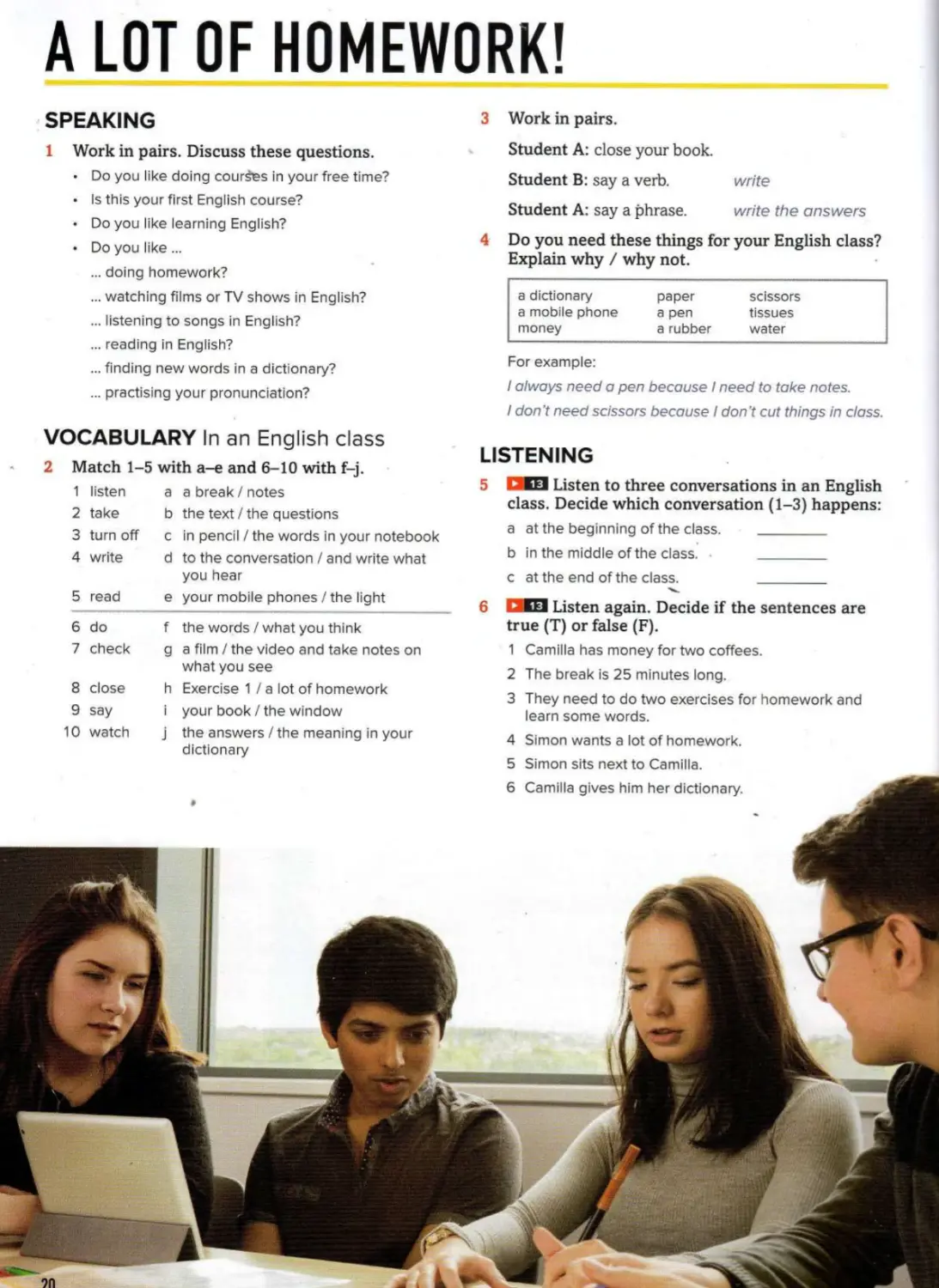
A LOT OF HOMEWORK!
SPEAKING
1 Work in pairs. Discuss these questions.
•	Do you like doing courses in your free time?
•	Is this your first English course?
•	Do you like learning English?
•	Do you like ...
... doing homework?
... watching films or TV shows in English?
... listening to songs in English?
... reading in English?
... finding new words in a dictionary?
... practising your pronunciation?
3	Work in pairs.
Student A: close your book.
Student B: say a verb.	write
Student A: say a phrase.	write the answers
4	Do you need these things for your English class?
Explain why / why not.
a dictionary	paper	scissors
a mobile phone	a pen	tissues
money	a rubber	water
For example:
/ always need a pen because I need to take notes.
I don’t need scissors because I don’t cut things in class.
VOCABULARY In an English class
2 Match 1-5 with a-e and 6-10 with f-j.
1	listen	a	a break / notes
2	take	b	the text / the questions
3	turn off	c	in pencil / the words in your notebook
4	write	d	to the conversation / and write what you hear
5	read	e	your mobile phones / the light
6	do	f	the words / what you think
7	check	g	a film 1 the video and take notes on what you see
8	close	h	Exercise 1 / a lot of homework
9	say	i	your book / the window
the answers / the meaning in your
dictionary
6
watch
Simon wants a lot of homework.
Simon sits next to Camilla.
Camilla gives him her dictionary.
> ______________________________
LISTENING
5
EKE] Listen to three conversations in an English
class. Decide which conversation (1-3) happens:
a
b
c
at the beginning of the class.
in the middle of the class.
at the end of the class.
□EE] Listen again. Decide if the sentences are
true (T) or false (F).
Camilla has money for two coffees.
The break is 25 minutes long.
They need to do two exercises for homework and
learn some words.
1
2
3
7 1ЖУ Listen again. Complete the sentences
with one word. Contractions (ft's, isn't, etc.) are
one word.
1	It’s a break. He says a cafe next door.
2	OK, thanks. How Is the break?
3	B: This is a lot of homework.
A: Do you so?
4	Simon -to do it. Do some every day. Five
or ten minutes.
5	Hi I’m late.
6	Teacher! What does ‘turn off’?
8 Work in pairs. Discuss the questions.
•	Are Camilla and Simon good or bad students?
•	Do you like the way Matty teaches? Why? I Why not?
•	How often are you late / do you forget things I do
you do homework?
GRAMMAR
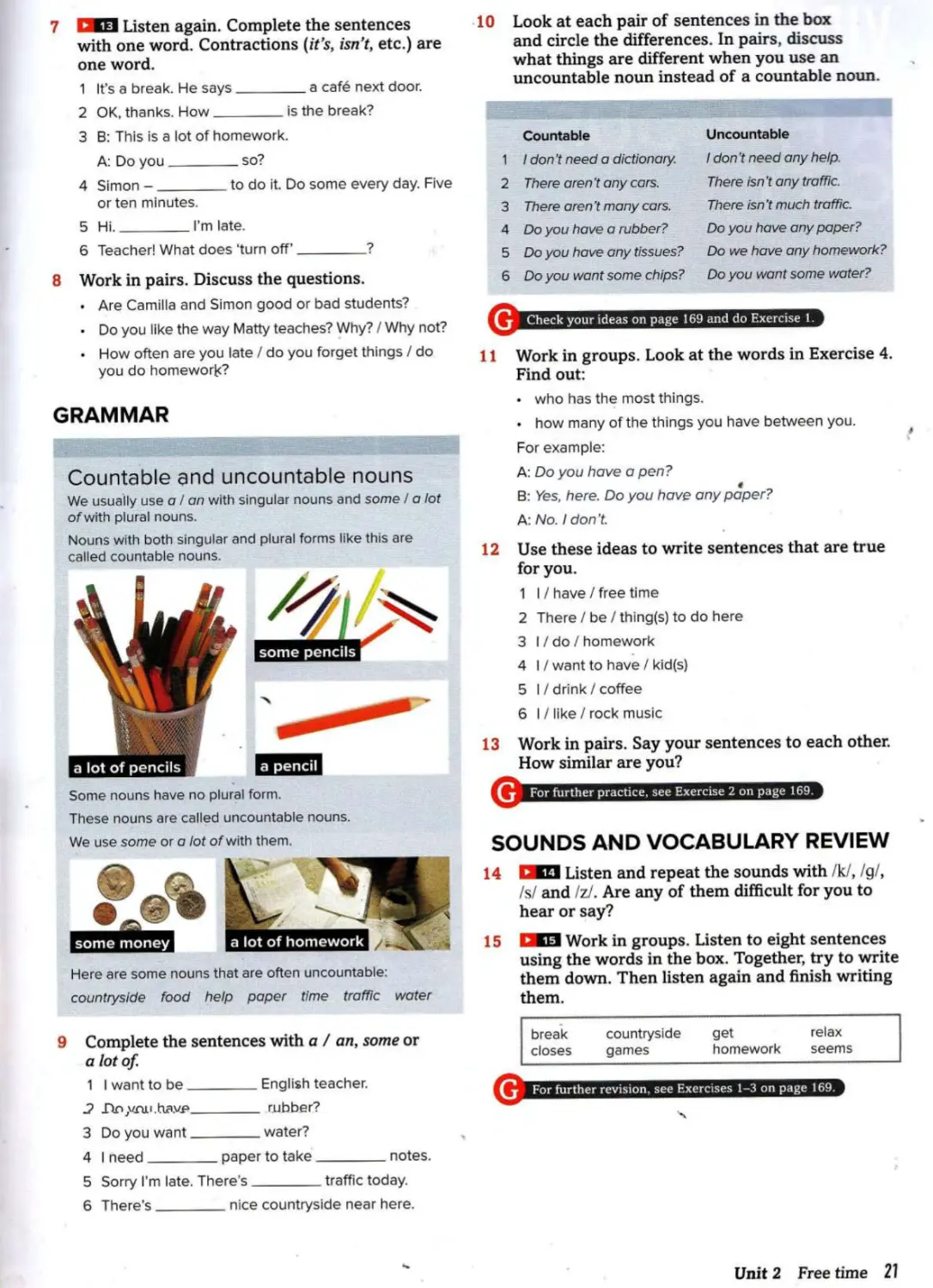
Countable and uncountable nouns
We usually use a I an with singular nouns and some / a lot
ofwith plural nouns.
Nouns with both singular and plural forms like this are
called countable nouns.
10 Look at each pair of sentences in the box
and circle the differences. In pairs, discuss
what things are different when you use an
uncountable noun instead of a countable noun.
Countable
1 I don’t need a dictionary.
2 There oren 't any cars.
3 There aren't many cars.
4 Do you have a rubber?
5 Do you have any tissues?
6 Do you want some chips?
Uncountable
I don't need any help.
There isn't any traffic.
There isn't much traffic.
Do you have any paper?
Do we have any homework?
Do you want some water?
Check your ideas on page 169 and do Exercise 1.
11 Work in groups. Look at the words in Exercise 4.
Find out:
•	who has the most things.
•	how many of the things you have between you.
For example:
A:	Do you have a pen?
B:	Yes, here. Do you have any paper?
A: No. I don't.
12 Use these ideas to write sentences that are true
for you.
1	11 have / free time
2	There / be / thing(s) to do here
3	I / do / homework
4	I / want to have / kid(s)
5	I/drink/coffee
6	11 like / rock music
13 Work in pairs. Say your sentences to each other.
How similar are you?
For further practice, see Exercise 2 on page 169.
Some nouns have no plural form.
These nouns are called uncountable nouns.
We use some or a lot of with them.
Here are some nouns that are often uncountable:
countryside food help paper time traffic water
SOUNDS AND VOCABULARY REVIEW
14 D KO Listen and repeat the sounds with /к/, Zg/,
ZsZ and ZzZ. Are any of them difficult for you to
hear or say?
15 □KO Work in groups. Listen to eight sentences
using the words in the box. Together, try to write
them down. Then listen again and finish writing
them.
9 Complete the sentences with a / an, some or
a lot of.
1 I want to be English teacher.
2 JTo>/nu.ha.vp rubber?
3 Do you want water?
4 I need paper to take notes.
5 Sorry I’m late. There’s traffic today.
6 There’s nice countryside near here.
break	countryside	get	relax
closes	games	homework	seems
Q- For further revision, see Exercises 1-3 on page 169.
Unit 2 Free time 21
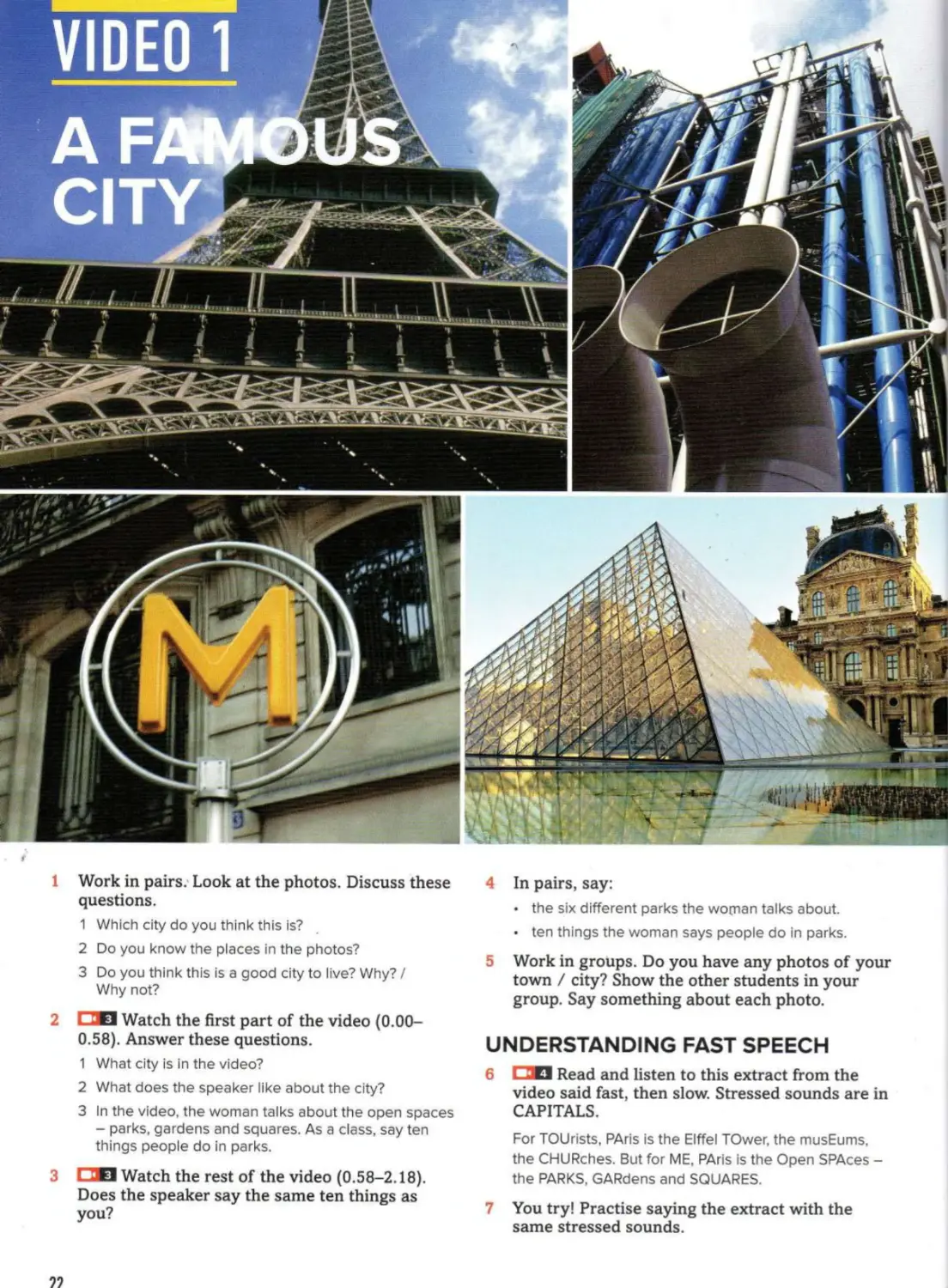
1 Work in pairs. Look at the photos. Discuss these
questions.
1	Which city do you think this is?
2	Do you know the places in the photos?
3	Do you think this is a good city to live? Why? /
Why not?
2 ПЕ1 Watch the first part of the video (0.00-
0.58). Answer these questions.
1 What city is in the video?
2 What does the speaker like about the city?
3 In the video, the woman talks about the open spaces
- parks, gardens and squares. As a class, say ten
things people do in parks.
3 ПЕ1 Watch the rest of the video (0.58-2.18).
Does the speaker say the same ten things as
you?
4 In pairs, say:
• the six different parks the woman talks about.
• ten things the woman says people do in parks.
5	Work in groups. Do you have any photos of your
town / city? Show the other students in your
group. Say something about each photo.
UNDERSTANDING FAST SPEECH
6	LJUtl Read and listen to this extract from the
video said fast, then slow Stressed sounds are in
CAPITALS.
For TOUrists, PAris is the Eiffel TOwer, the musEums,
the CHURches. But for ME, PAris is the Open SPAces -
the PARKS, GARdens and SQUARES.
7	You try! Practise saying the extract with the
same stressed sounds.
??
REVIEW 1
GRAMMAR
1 Choose the correct option.
1	A: Where are I is he from?
B: France.
2	A: Do you want to go I going to the cinema later?
B: OK. What time?
3	A: Do you have a /' any tissues?
B:	Yes. There are one / some in my bag.
4	A: Are I is you OK?
B:	Yes, /7п /от OK, thanks.
5	A: Do you like ploy / ploying tennis?
B:	Yes, it's / he's great.
6	A: Does / Is your town big?
B:	Not really. There is / are only about 10,000
people.
7	A: What you do / do you do at the weekend?
В: I usually stay at home. I don't / Гт not earn much
money.
8	A: Do / Does your son like football?
B: He love / loves watching, but he doesn’t play very
often / sometimes.
2 Write full questions to complete the dialogue.
Use the words in brackets.
A:	1? (do)
B:	I’m a doctor. }
A:2? (work)
B:	At a hospital in the north of Rome.
A:3? (enjoy)
B: Yes. It’s a great job.
3 Put the word(s) in bold in the correct place in
the sentence.
1	I need do some shopping, to
2	I play computer games, hardly ever
3	Sorry, I understand. What does ‘journalist’ mean?
don’t
4	Do you have pencil and paper? a
5	There’s a palace near the river. It’s great, beautiful
6	She speaks English very well, but she’s from the UK.
not
4 lAU Listen and complete the sentences with
one word in each space. Contractions (Гт, don't,
etc.) are one word.
1 you money?
2 need help,
- >
3 time want
__________j
4 There_____________________________
places to visit.
5 I need____________________________
homework.
6 gets up six and
work seven.
5 Work in pairs. Compare your ideas. Listen
again and check.
VOCABULARY
6 Match the verbs in the box to the groups of
words they go with in 1-8.
check	help	Play	turn off
close	live	say	watch
1	~ the news / ~ a football game / ~ a film
2	~ in the countryside / ~ in the capital Z ~ on my own
3	~ in the park / ~ the piano / ~ a game
4	~ what you think / ~ no / ~ a lot
5	~ the TV / ~ your phone / ~ the light
6	~ my grandparents / — me / ~ to do my homework
7	~ the answers / ~ the word in a dictionary / ~ it’s OK
8	~ your book / the shop ~s at nine / ~ the window
7 Put the words into three groups - places, jobs or
free time.
assistant	countryside	factory	officer
church	dancing	guitar	receptionist
clinic	department	the Middle East	swimming
concert	draw	nurse	waiter
8 Match each adjective in italics in 1-8 with its
opposite in a-h.
1	It’s a boring job.	a	cheap
2	I have a busy social life.	b	best
3	He has a big car.	c	quiet
4	It’s an expensive restaurant.	d	interesting
5	It’s the worst place to live in the UK.	e	west
6	It’s in east Paris	f	old
7	It’s a long film.	g	small
8	I have a new mobile phone.	h	short
9 Complete the text with the verbs in the box.
finish	go	like	spend
get	have	listen	work
11__________in a department store in town. I usually
start at eight o’clock and 2 at four. I leave the
house at seven and 3_________home at five or six. I
4 doing sport. I often 5 to the gym
after work. I usually %______about an hour there.
Then, in the evening I just7 dinner with my
wife and watch TV. We sometimes sit and 8
to music.
Review 1 23

IN THIS UNIT YOU LEARN HOW TO:
•	talk about the area you live in
•	name things you often buy and do
•	explain where things are
•	explain what you need to do
•	describe your house I flat
•	ask people to do things
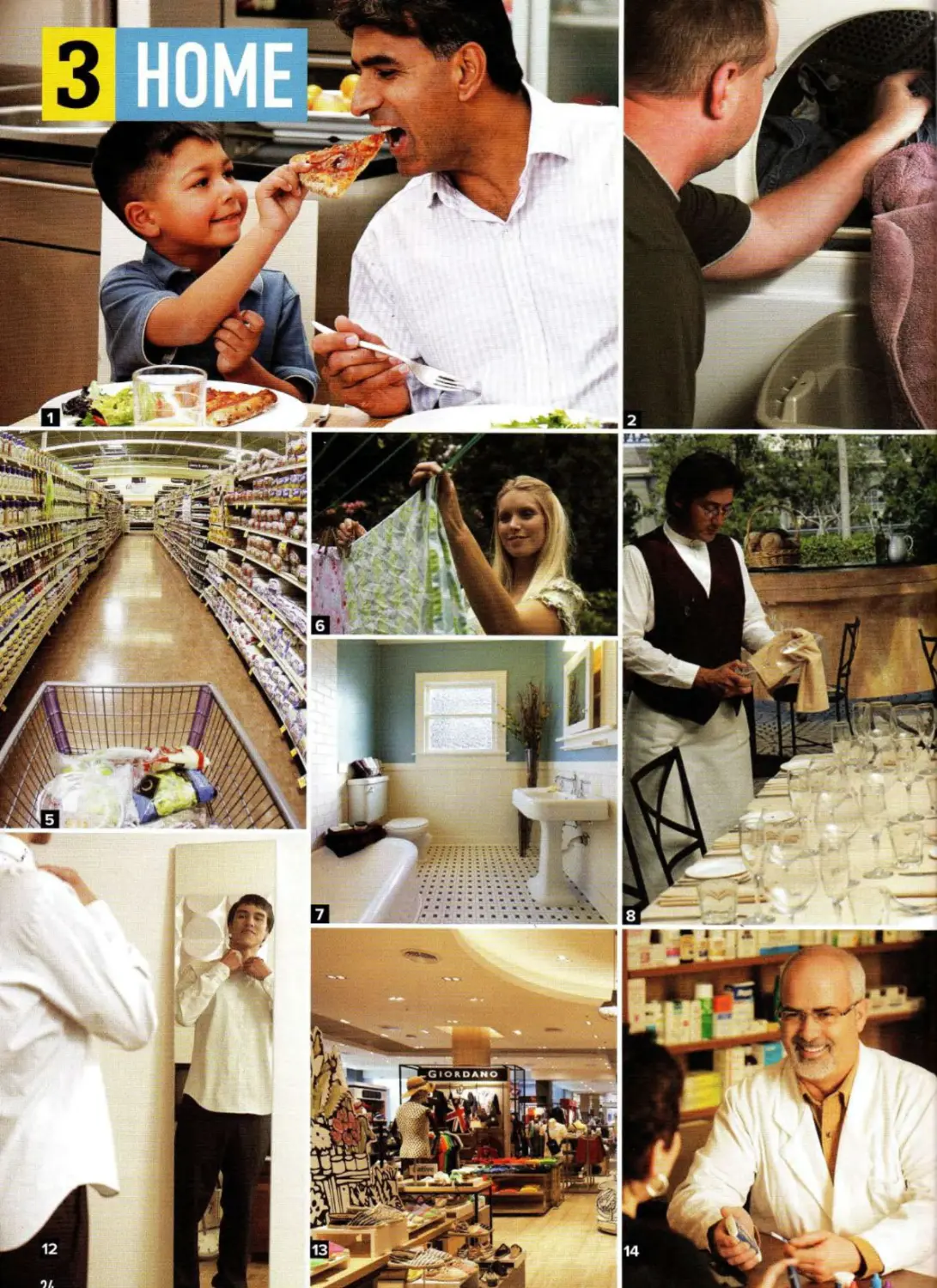
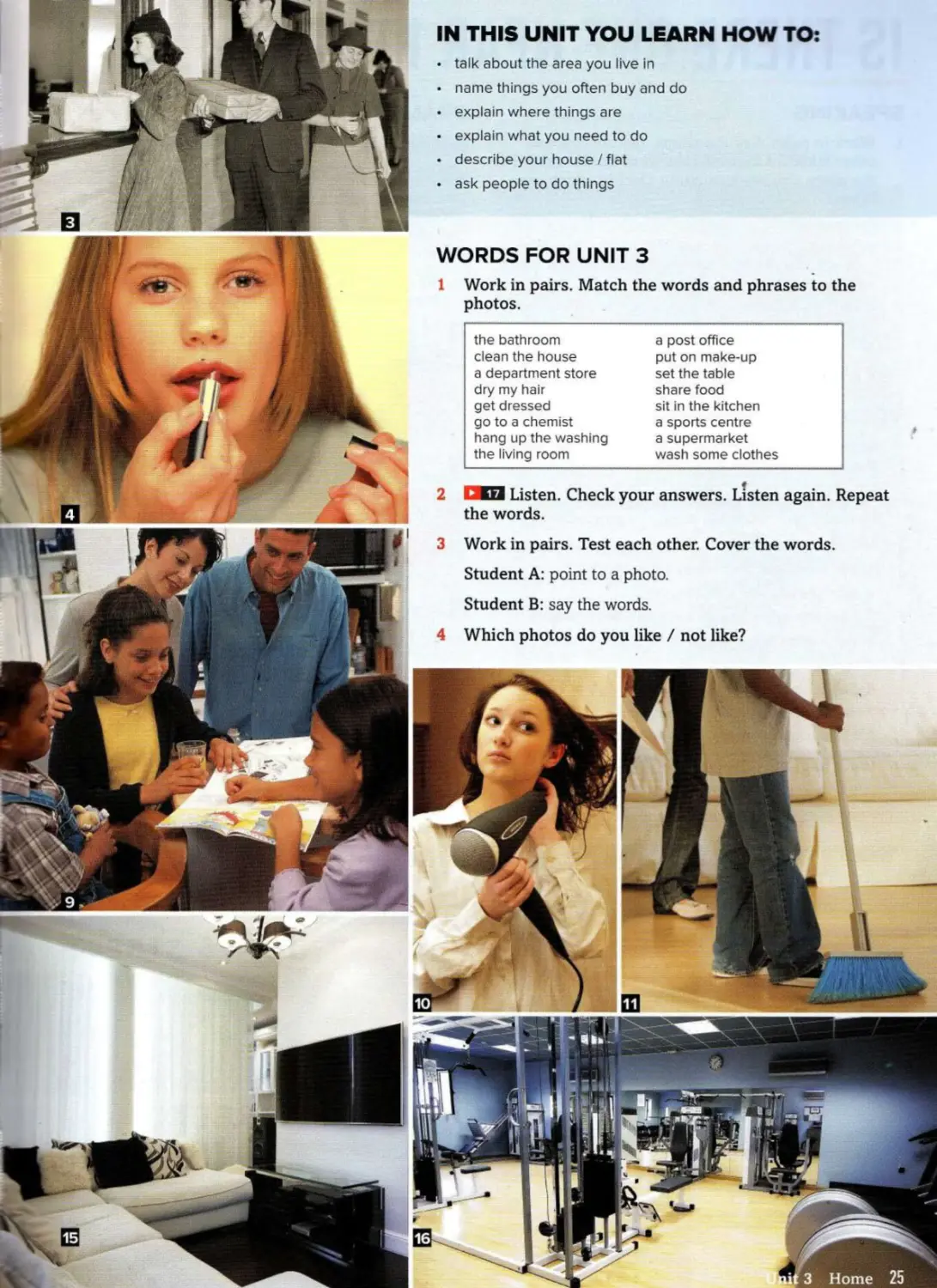
WORDS FOR UNIT 3
1 Work in pairs. Match the words and phrases to the
photos.
the bathroom	a post office
clean the house	put on make-up
a department store	set the table
dry my hair	share food
get dressed	sit in the kitchen
go to a chemist	a sports centre
hang up the washing	a supermarket
the living room	wash some clothes
2 iMil Listen. Check your answers. Listen again. Repeat
the words.
3 Work in pairs. Test each other. Cover the words.
Student A: point to a photo.
Student B: say the words.
4 Which photos do you like / not like?
IS THERE ONE NEAR HERE?
SPEAKING
1 Work in pairs. Say the shops, restaurants and
other facilities that are. near your home - and
the place you work or study. Decide which area
is best.
For example:
A: There's a really good supermarket near my home,
and there are lots of different restaurants and there's
a sports centre.
B: Near my house there's a small cafe, a bonk and two
shops. There's a small pork.
A:	I think my area is best, then.
B:	Maybe.
GRAMMAR
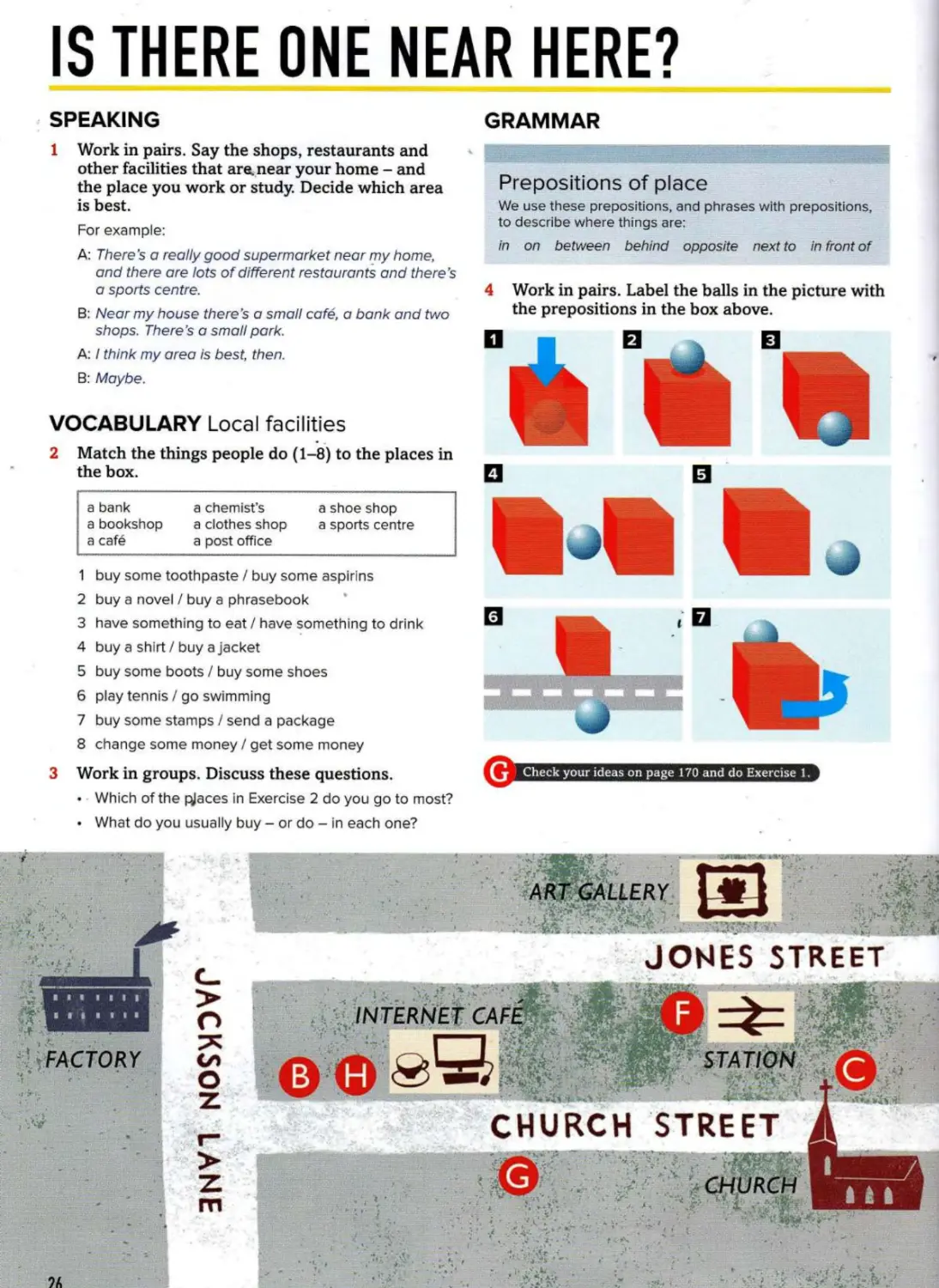
Prepositions of place
We use these prepositions, and phrases with prepositions,
to describe where things are:
in on between behind opposite next to in front of
4 Work in pairs. Label the balls in the picture with
the prepositions in the box above.
VOCABULARY Local facilities
2 Match the things people do (1-8) to the places in
the box.
a bank	a chemist’s	a shoe shop
a bookshop	a clothes shop	a sports centre
a cafe	a post office
1	buy some toothpaste I buy some aspirins
2	buy a novel / buy a phrasebook
3	have something to eat / have something to drink
4	buy a shirt / buy a jacket
5	buy some boots I buy some shoes
6	play tennis/go swimming
7	buy some stamps I send a package
8	change some money / get some money
Check your ideas on page 170 and do Exercise 1.
3 Work in groups. Discuss these questions.
• Which of the peaces in Exercise 2 do you go to most?
• What do you usually buy - or do - in each one?
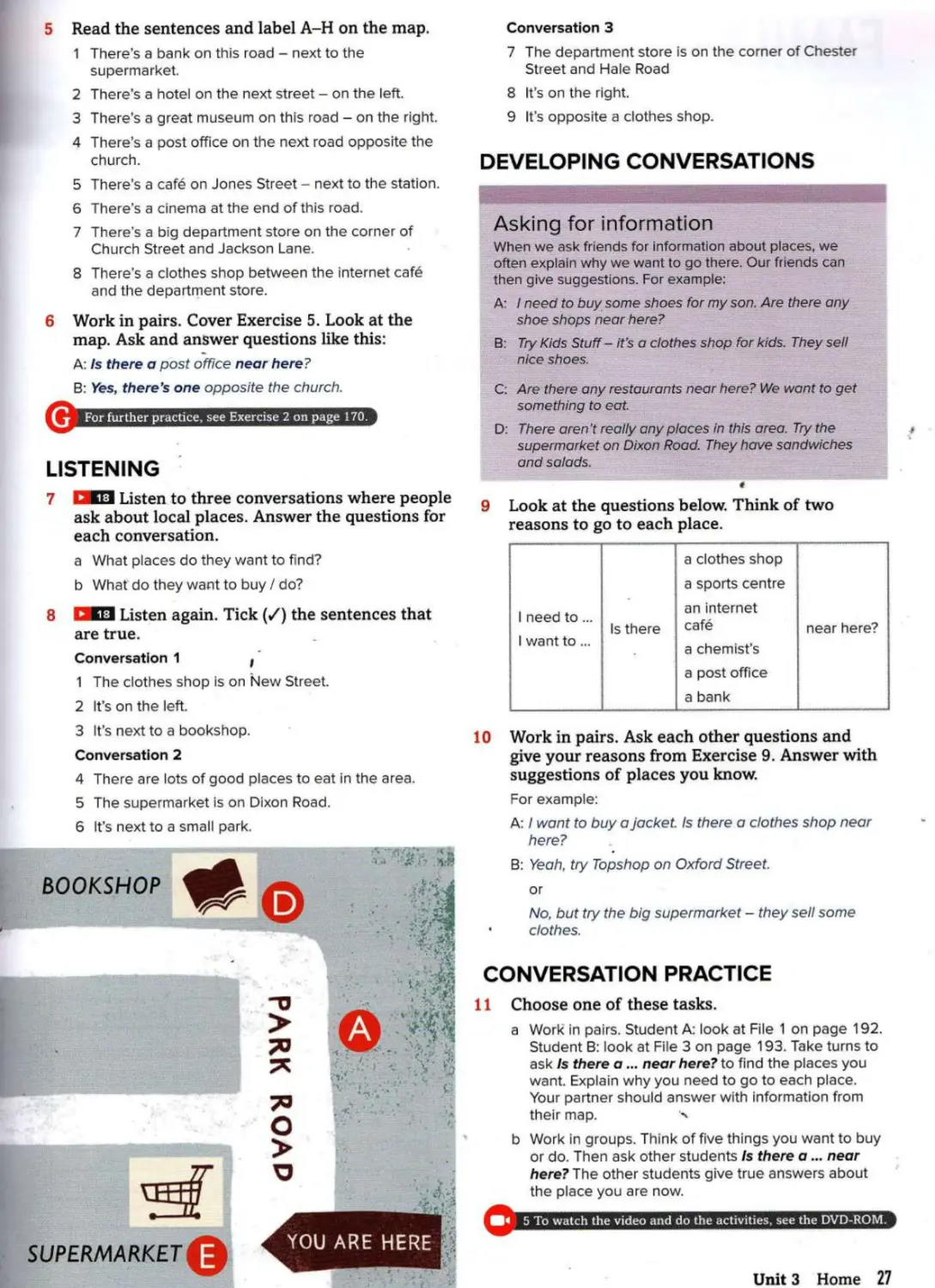
5 Read the sentences and label A-H on the map.
1 There’s a bank on this road - next to the
supermarket.
2 There’s a hotel on the next street - on the left.
3 There’s a great museum on this road - on the right.
4 There’s a post office on the next road opposite the
church.
5 There’s a cafe on Jones Street - next to the station.
6 There’s a cinema at the end of this road.
7 There’s a big department store on the corner of
Church Street and Jackson Lane.
8 There’s a clothes shop between the internet cafe
and the department store.
6 Work in pairs. Cover Exercise 5. Look at the
map. Ask and answer questions like this:
A: Is there a post office near here?
B: Yes, there's one opposite the church.
For further practice, see Exercise 2 on page 170.
LISTENING
Conversation 3
7 The department store is on the corner of Chester
Street and Hale Road
8 It’s on the right.
9 It’s opposite a clothes shop.
DEVELOPING CONVERSATIONS
Asking for information
When we ask friends for information about places, we
often explain why we want to go there. Our friends can
then give suggestions. For example:
A: I need to buy some shoes for my son. Are there any
shoe shops near here?
B: Try Kids Stuff- it's a clothes shop for kids. They sell
nice shoes.
C: Are there any restaurants near here? We want to get
something to eat.
D: There aren’t really any places in this area. Try the
supermarket on Dixon Road. They have sandwiches
and salads.
7 am Listen to three conversations where people
ask about local places. Answer the questions for
each conversation.
a What places do they want to find?
b What do they want to buy I do?
8 1ЖЫ Listen again. Tick (✓) the sentences that
are true.
Conversation 1	,
1	The clothes shop is on New Street.
2	It’s on the left.
3	It’s next to a bookshop.
Conversation 2
4	There are lots of good places to eat in the area.
5	The supermarket is on Dixon Road.
6	It’s next to a small park.
SUPERMARKET ф
9 Look at the questions below. Think of two
reasons to go to each place.
I need to... I want to...	Is there	a clothes shop a sports centre an internet cafe a chemist’s a post office a bank	near here?
10 Work in pairs. Ask each other questions and
give your reasons from Exercise 9. Answer with
suggestions of places you know.
For example:
A:	I want to buy a jacket. Is there a clothes shop near
here?
B:	Yeah, try Topshop on Oxford Street.
or
No, but try the big supermarket - they sell some
• clothes.
CONVERSATION PRACTICE
11 Choose one of these tasks.
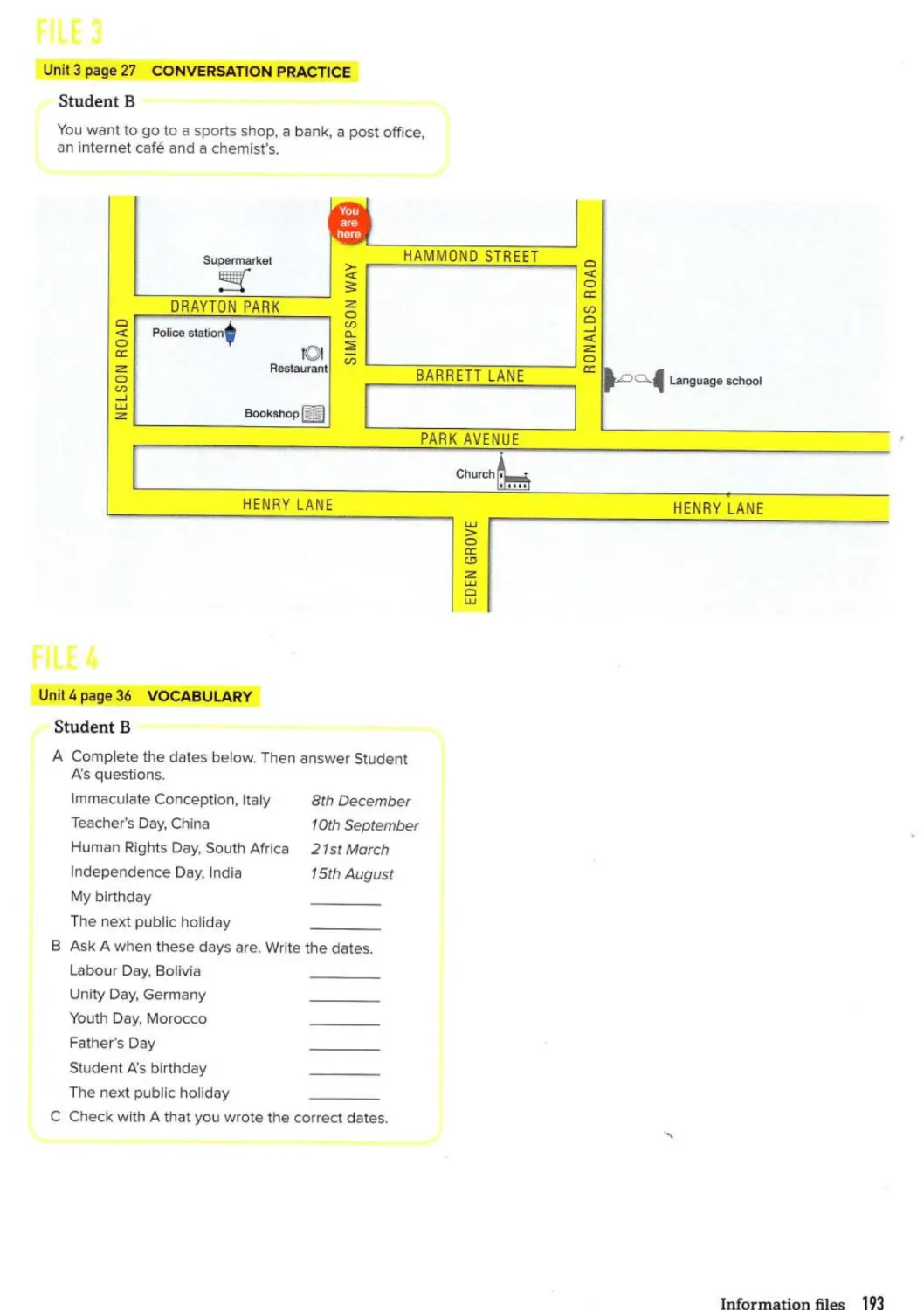
a Work in pairs. Student A: look at File 1 on page 192.
Student B: look at File 3 on page 193. Take turns to
ask Is there a... near here? to find the places you
want. Explain why you need to go to each place.
Your partner should answer with information from
their map.	s
b Work in groups. Think of five things you want to buy
or do. Then ask other students Is there a... near
here? The other students give true answers about
the place you are now.
5 To watch the video and do the activities, see the DVD-ROM. J
Unit 3 Home 27
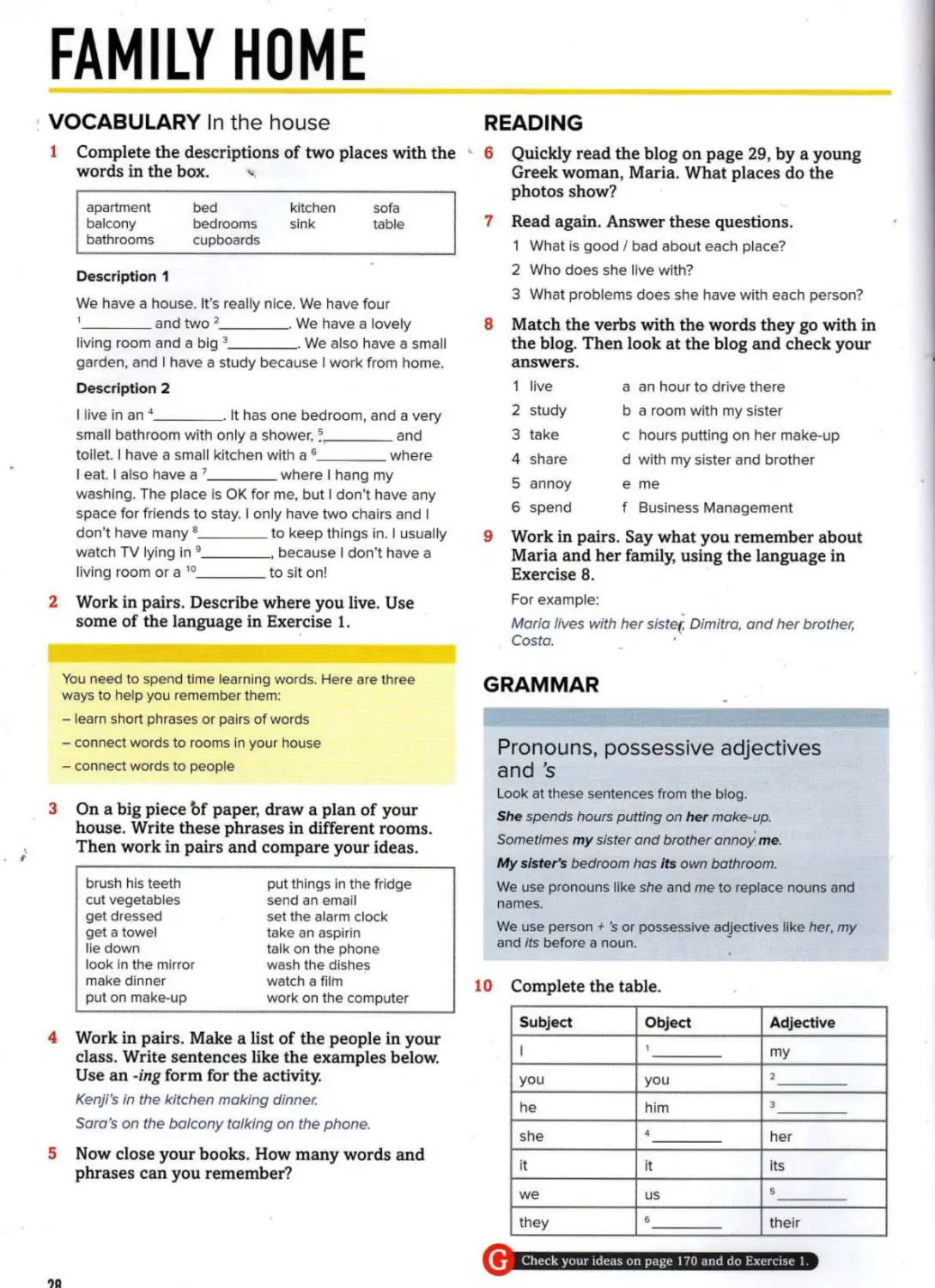
FAMILY HOME
VOCABULARY In the house
READING
1 Complete the descriptions of two places with the
words in the box. ч
apartment	bed	kitchen	sofa
balcony	bedrooms	sink	table
bathrooms	cupboards
Description 1
We have a house. It’s really nice. We have four
1 and two 2. We have a lovely
living room and a big 3. We also have a small
garden, and I have a study because I work from home.
Description 2
I live in an 4 It has one bedroom, and a very
small bathroom with only a shower, 9 and
toilet. I have a small kitchen with a 6 where
I eat. I also have a 7 where I hang my
washing. The place is OK for me, but I don’t have any
space for friends to stay. I only have two chairs and I
don’t have many8__________to keep things in. I usually
watch TV lying in 9_______, because I don’t have a
living room or a 10_______to sit on!
2 Work in pairs. Describe where you live. Use
some of the language in Exercise 1.
You need to spend time learning words. Here are three
ways to help you remember them:
- learn short phrases or pairs of words
- connect words to rooms in your house
- connect words to people
3 Ona big piece bf paper, draw a plan of your
house. Write these phrases in different rooms.
Then work in pairs and compare your ideas.
brush his teeth	put things in the fridge
cut vegetables	send an email
get dressed	set the alarm clock
get a towel	take an aspirin
lie down	talk on the phone
look in the mirror	wash the dishes
make dinner	watch a film
put on make-up	work on the computer
4 Work in pairs. Make a list of the people in your
class. Write sentences like the examples below.
Use an -ing form for the activity.
Kenji's in the kitchen making dinner.
Sara's on the balcony talking on the phone.
5 Now close your books. How many words and
phrases can you remember?
6 Quickly read the blog on page 29, by a young
Greek woman, Maria. What places do the
photos show?
7 Read again. Answer these questions.
1 What is good I bad about each place?
2 Who does she live with?
3 What problems does she have with each person?
8 Match the verbs with the words they go with in
the blog. Then look at the blog and check your
answers.
1	live	a	an hour to drive there
2	study	b	a room with my sister
3	take	c	hours putting on her make-up
4	share	d	with my sister and brother
5	annoy	e	me
6	spend	f	Business Management
9 Work in pairs. Say what you remember about
Maria and her family, using the language in
Exercise 8.
For example:
Maria lives with her sistef, Dimitro, and her brother,
Costa.
GRAMMAR
Pronouns, possessive adjectives
and’s
Look at these sentences from the blog.
She spends hours putting on her make-up.
Sometimes my sister and brother annoy me.
My sister's bedroom has its own bathroom.
We use pronouns like she and me to replace nouns and
names.
We use person + 's or possessive adjectives like her, my
and its before a noun.
10 Complete the table.
Subject	Object	Adjective
I	i	my
you	you	2
he	him	3
she	4	her
it	it	its
we	US	5
they	6	their
l G Check your ideas on page 170 and do Exercise 1.
Э0
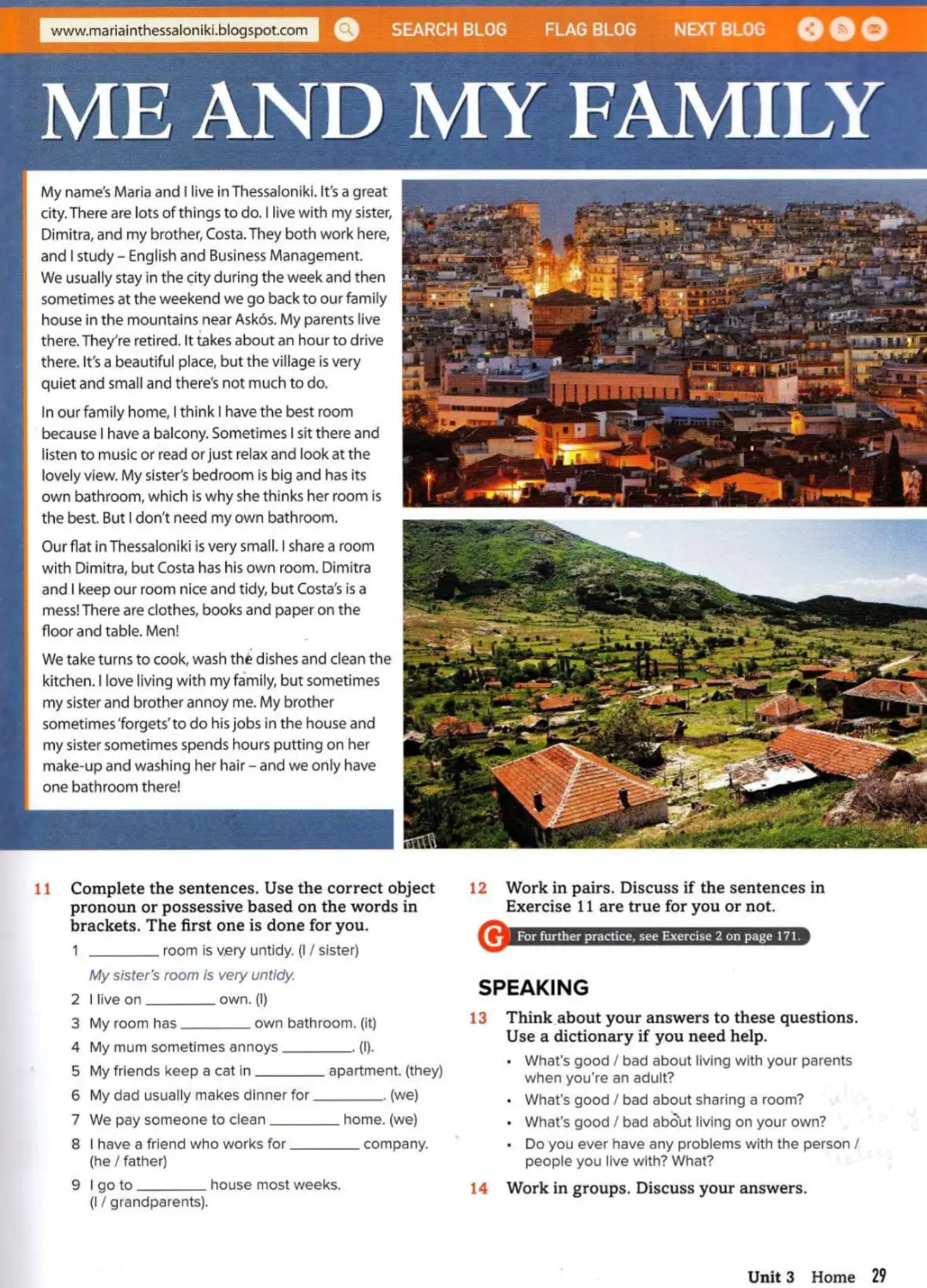
www.mariainthessaloniki.blogspot.com
Ф SEARCH BLOG FLAG BLOG NEXT BLOG ООО
ME AND MY FAMILY
My name's Maria and I live in Thessaloniki. It's a great
city. There are lots of things to do. I live with my sister,
Dimitra, and my brother, Costa. They both work here,
and I study - English and Business Management.
We usually stay in the city during the week and then
sometimes at the weekend we go back to our family
house in the mountains near Askos. My parents live
there. They're retired. It takes about an hour to drive
there. It's a beautiful place, but the village is very
quiet and small and there's not much to do.
In our family home, I think I have the best room
because I have a balcony. Sometimes I sit there and
listen to music or read or just relax and look at the
lovely view. My sister's bedroom is big and has its
own bathroom, which is why she thinks her room is
the best. But I don't need my own bathroom.
Our flat in Thessaloniki is very small. I share a room
with Dimitra, but Costa has his own room. Dimitra
and I keep our room nice and tidy, but Costa's is a
mess! There are clothes, books and paper on the
floor and table. Men!
We take turns to cook, wash the dishes and clean the
kitchen. I love living with my family, but sometimes
my sister and brother annoy me. My brother
sometimes'forgets'to do his jobs in the house and
my sister sometimes spends hours putting on her
make-up and washing her hair - and we only have
one bathroom there!
11 Complete the sentences. Use the correct object
pronoun or possessive based on the words in
brackets. The first one is done for you.
1	room is very untidy. (I I sister)
My sister’s room is very untidy
2	I live on own. (I)
3	My room has own bathroom, (it)
4	My mum sometimes annoys. (I).
5	My friends keep a cat in apartment, (they)
6	My dad usually makes dinner for. (we)
7	We pay someone to clean home, (we)
8	I have a friend who works for company,
(he I father)
9	I go to house most weeks.
(I / grandparents).
12 Work in pairs. Discuss if the sentences in
Exercise 11 are true for you or not.
l G For further practice, see Exercise 2 on page 171.
SPEAKING
13 Think about your answers to these questions.
Use a dictionary if you need help.
•	What’s good / bad about living with your parents
when you’re an adult?
•	What’s good I bad about sharing a room?
•	What’s good / bad about living on your own?
•	Do you ever have any problems with the person I
people you live with? What?
14 Work in groups. Discuss your answers.
Unit 3 Home 29
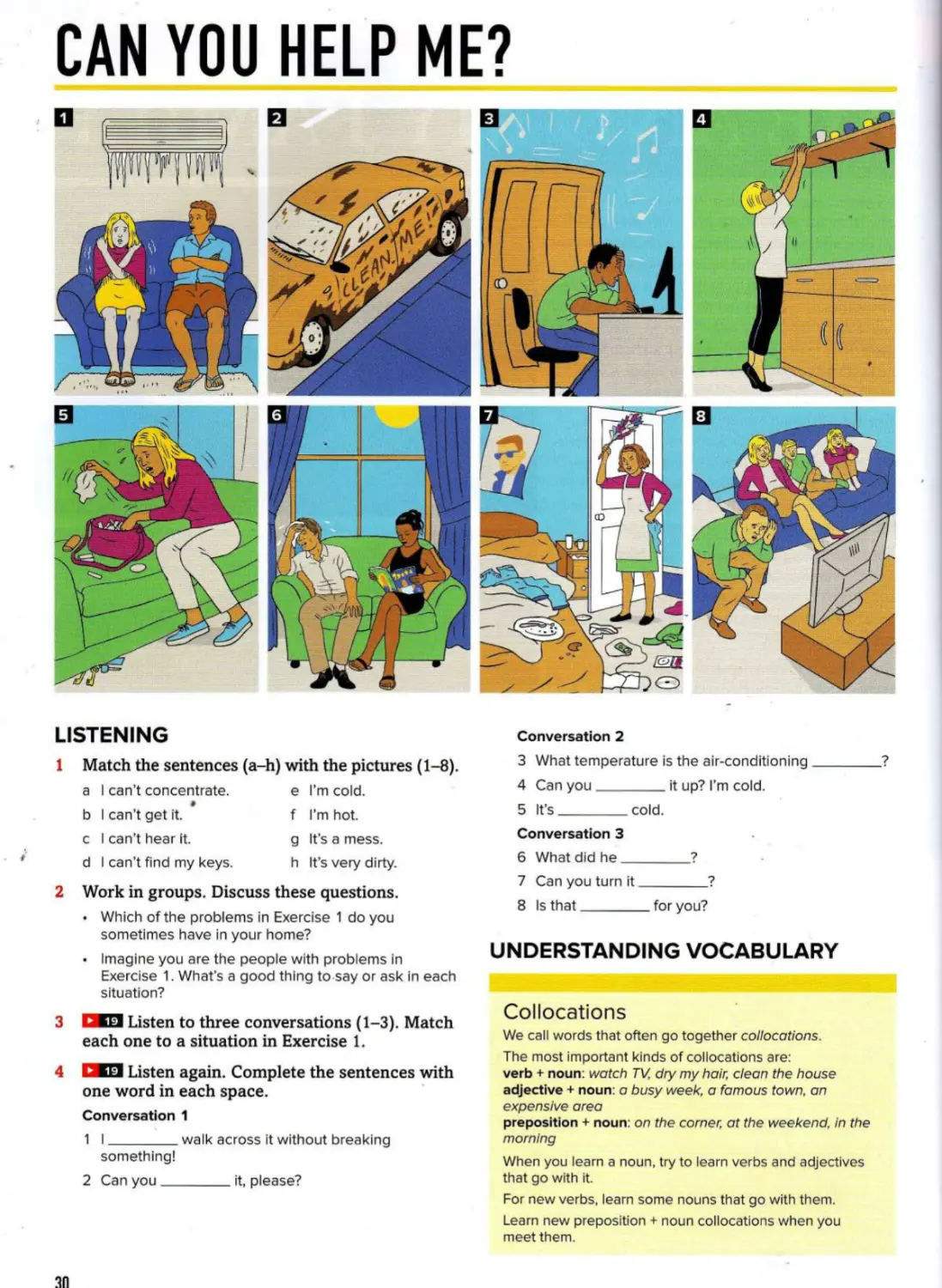
CAN YOU HELP ME?
LISTENING
1 Match the sentences (a-h) with the pictures (1-8).
a I can't concentrate.
b I can’t get it.
с I can’t hear it.
d I can’t find my keys.
e I’m cold.
f I’m hot.
g It’s a mess.
h It’s very dirty.
2 Work in groups. Discuss these questions.
•	Which of the problems in Exercise 1 do you
sometimes have in your home?
•	Imagine you are the people with problems in
Exercise 1. What’s a good thing to say or ask in each
situation?
Conversation 2
3	What temperature is the air-conditioning?
4	Can you it up? I’m cold.
5	It’s cold.
Conversation 3
6	What did he?
7	Can you turn it_____?
8 Is that for you?
UNDERSTANDING VOCABULARY
3 CKl Listen to three conversations (1—3). Match
each one to a situation in Exercise 1.
4
► 19
Listen again. Complete the sentences with
one word in each space.
Conversation 1
1 I walk across it without breaking
something!
2 Can you it, please?
Collocations
We call words that often go together collocations.
The most important kinds of collocations are:
verb + noun: watch TV, dry my hair, clean the house
adjective + noun: a busy week, a famous town, an
expensive area
preposition + noun: on the corner, at the weekend, in the
morning
When you learn a noun, try to learn verbs and adjectives
that go with it.
For new verbs, learn some nouns that go with them.
Learn new preposition + noun collocations when you
meet them.
ЗП
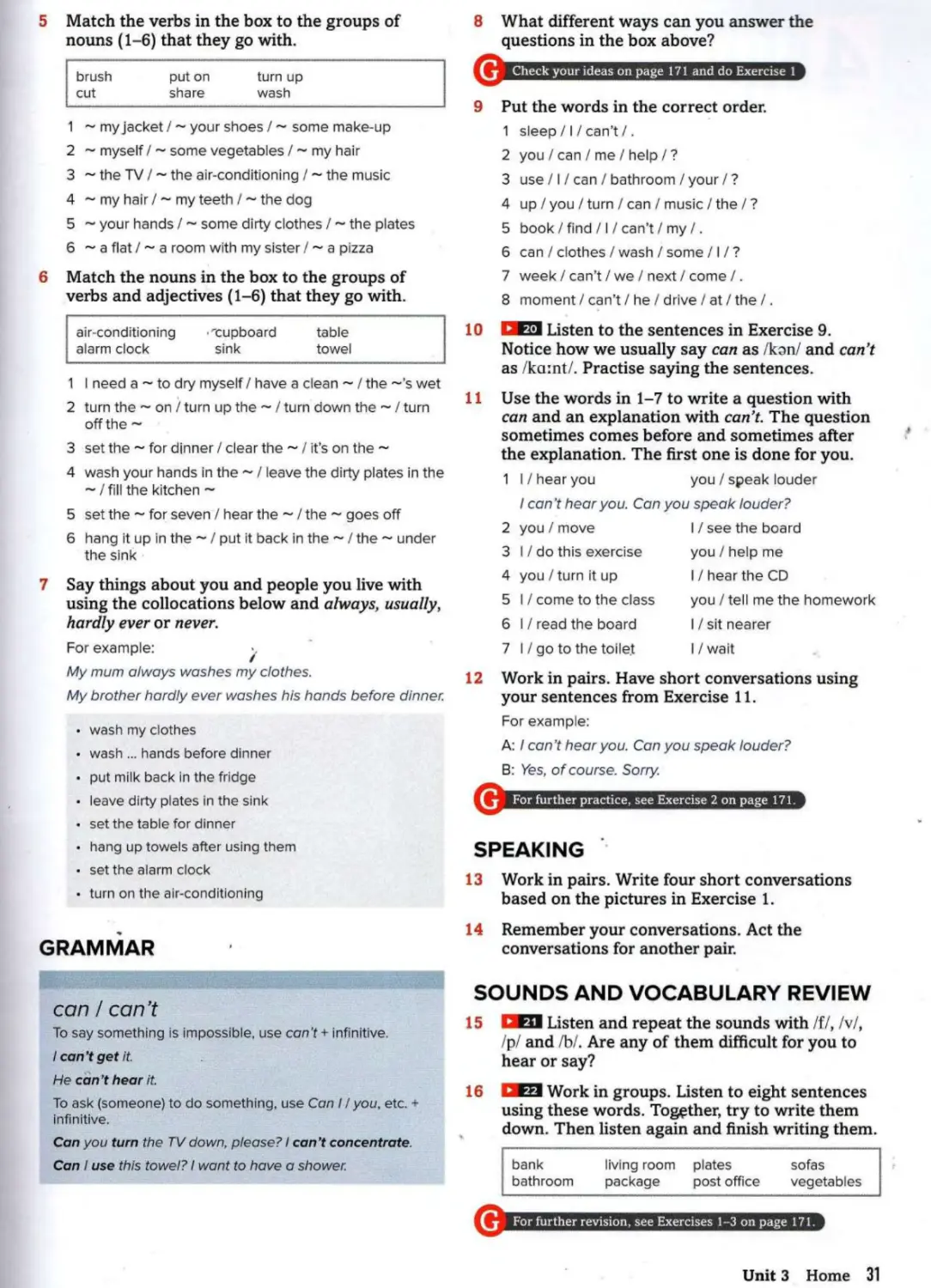
5 Match the verbs in the box to the groups of
nouns (1—6) that they go with.
brush	put on	turn up
cut	share	wash
1 ~ my jacket / ~ your shoes I ~ some make-up
2 ~ myself / ~ some vegetables / ~ my hair
3 ~ the TV / ~ the air-conditioning / ~ the music
4 ~ my hair / ~ my teeth / ~ the dog
5 ~ your hands I ~ some dirty clothes / ~ the plates
6 ~ a flat / ~ a room with my sister / ~ a pizza
6 Match the nouns in the box to the groups of
verbs and adjectives (1—6) that they go with.
air-conditioning	• "cupboard	table
alarm clock	sink	towel
1 I need a ~ to dry myself / have a clean ~ / the ~’s wet
2 turn the ~ on / turn up the ~ / turn down the ~ I turn
off the ~
3 set the ~ for dinner I clear the ~ I it’s on the ~
4 wash your hands in the ~ I leave the dirty plates in the
~ / fill the kitchen ~
5 set the ~ for seven / hear the ~ / the ~ goes off
6 hang it up in the ~ I put it back in the ~ I the ~ under
the sink
7 Say things about you and people you live with
using the collocations below and always, usually,
hardly ever or never.
For example:
My mum always washes my clothes.
My brother hardly ever washes his hands before dinner.
•	wash my clothes
•	wash ... hands before dinner
•	put milk back in the fridge
•	leave dirty plates in the sink
•	set the table for dinner
•	hang up towels after using them
•	set the alarm clock
•	turn on the air-conditioning
8 What different ways can you answer the
questions in the box above?
Check your ideas on page 171 and do Exercise 1
9 Put the words in the correct order.
1	sleep /1 / can’t /.
2	you / can / me / help / ?
3	use /1 / can / bathroom/your/?
4	up/you/turn/can/music/the/?
5	book/find/l/can’t/my/.
6	can / clothes / wash / some /1 / ?
7	week/can’t/we/next/come/.
8	moment/can’t/he/drive/at/the/.
10 DEI Listen to the sentences in Exercise 9.
Notice how we usually say can as /кэп/ and can’t
as /ко:nt/. Practise saying the sentences.
11 Use the words in 1-7 to write a question with
can and an explanation with can’t. The question
sometimes comes before and sometimes after
the explanation. The first one is done for you.
1 I / hear you	you /speak louder
I can't hear you. Can you speak louder?
2	you / move	I / see the board
3	I / do this exercise	you I help me
4	you / turn it up	I / hear the CD
5	11 come to the class	you / tell me the homework
6	I / read the board	11 sit nearer
7	I / go to the toilet	1 / wait
12 Work in pairs. Have short conversations using
your sentences from Exercise 11.
For example:
A: I can't hear you. Can you speak louder?
B: Yes, of course. Sorry.
For further practice, see Exercise 2 on page 171.
SPEAKING
13 Work in pairs. Write four short conversations
based on the pictures in Exercise 1.
GRAMMAR
14 Remember your conversations. Act the
conversations for another pair.
can I can’t
To say something is impossible, use can’t + infinitive.
I can’t get it.
He can’t hear it.
To ask (someone) to do something, use Can 11 you, etc. +
infinitive.
Con you turn the TV down, please? I can’t concentrate.
Can I use this towel? I want to have a shower.
SOUNDS AND VOCABULARY REVIEW
15 DEH Listen and repeat the sounds with /f/, /v/,
/р/ and /bl. Are any of them difficult for you to
hear or say?
16 C ESI Work in groups. Listen to eight sentences
using these words. Together, try to write them
down. Then listen again and finish writing them.
bank	living room	plates	sofas
bathroom	package	post office	vegetables
i G" F°r further revision, see Exercises 1-3 on page 171.
Unit 3 Home 31

IN THIS UNIT YOU LEARN HOW TO:
•	talk about what you did in the past
•	comment on what people tell you
•	talk about dates and months
•	ask and answer questions about holidays
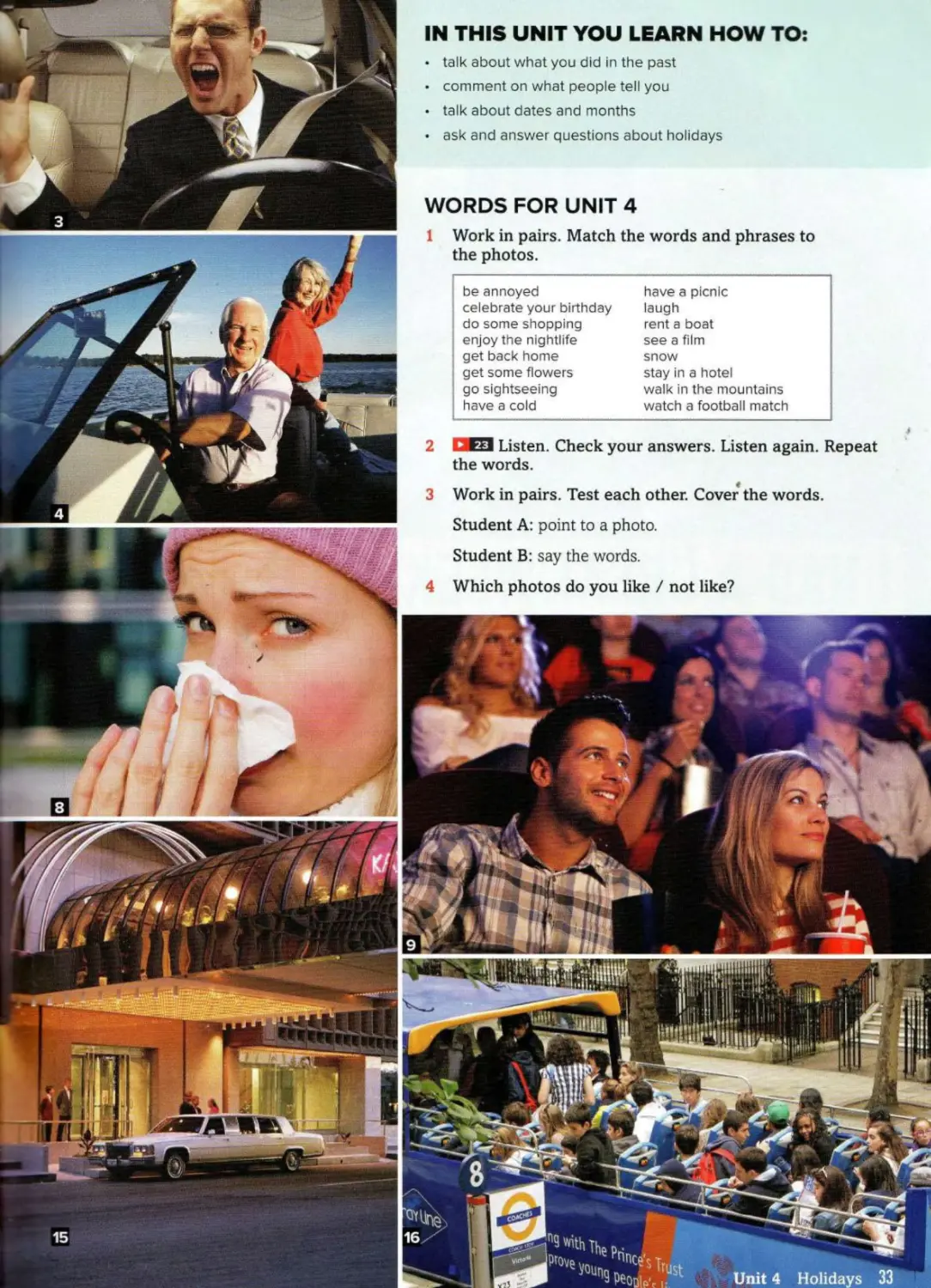
WORDS FOR UNIT 4
1	Work in pairs. Match the words and phrases to
the photos.
be annoyed	have a picnic
celebrate your birthday	laugh
do some shopping	rent a boat
enjoy the nightlife	see a film
get back home	snow
get some flowers	stay in a hotel
go sightseeing	walk in the mountains
have a cold	watch a football match
2	lAfl Listen. Check your answers. Listen again. Repeat
the words.
3	Work in pairs. Test each other. Cover the words.
Student A: point to a photo.
Student B: say the words.
4	Which photos do you like / not like?
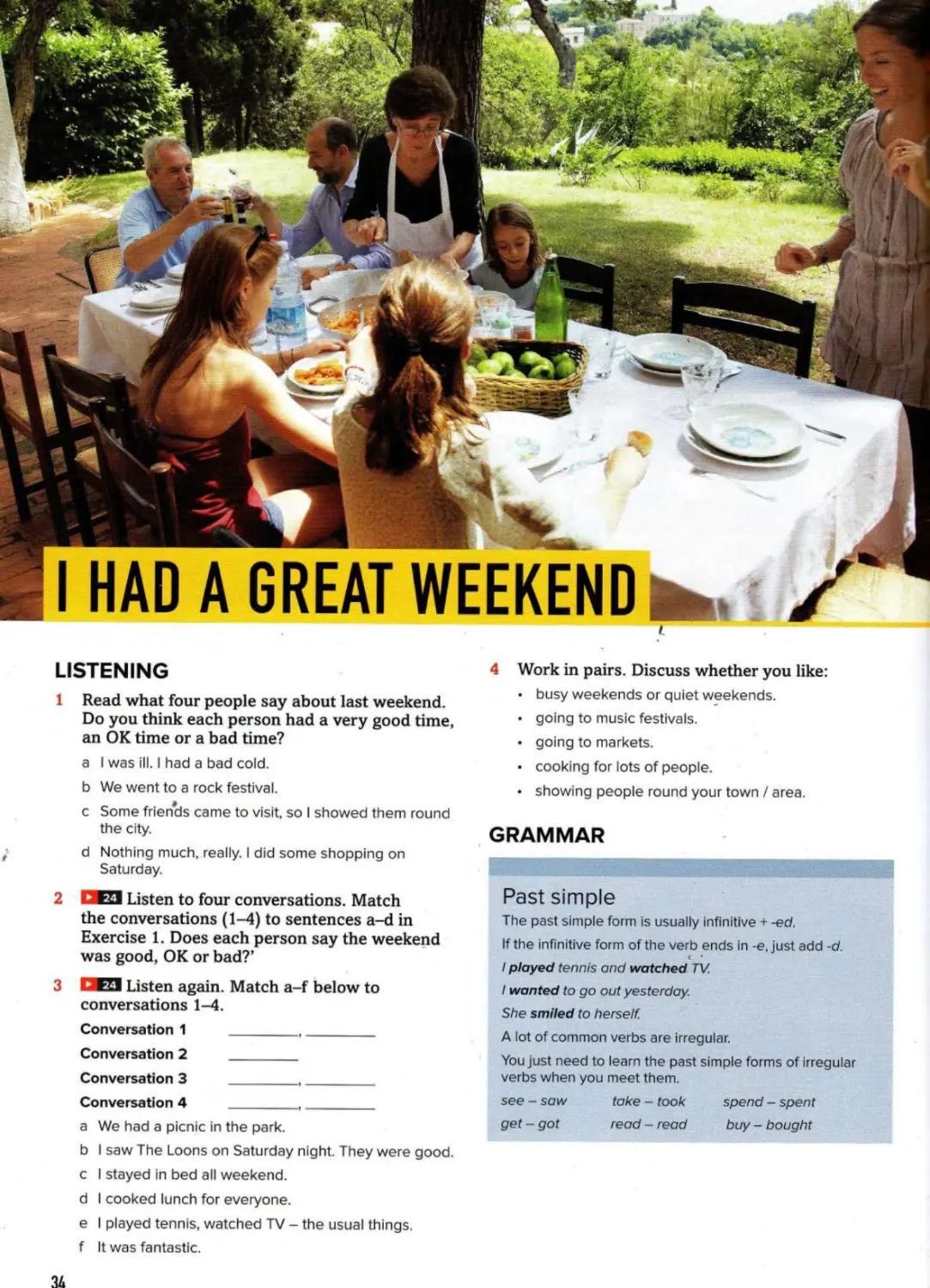
I HAD A GREAT WEEKENDS
t
LISTENING
1	Read what four people say about last weekend.
Do you think each person had a very good time,
an OK time or a bad time?
a I was ill. I had a bad cold.
b We went to a rock festival.
c Some friends came to visit, so I showed them round
the city.
d Nothing much, really. I did some shopping on
Saturday.
2	QEZ3 Listen to four conversations. Match
the conversations (1-4) to sentences а-d in
Exercise 1. Does each person say the weekend
was good, OK or bad?’
3	QE3 Listen again. Match a-f below to
conversations 1-4.
Conversation 1	,
Conversation 2
Conversation 3	,
Conversation 4	,
a We had a picnic in the park.
b I saw The Loons on Saturday night. They were good.
с I stayed in bed all weekend.
d I cooked lunch for everyone.
e I played tennis, watched TV - the usual things.
f It was fantastic.
34
4	Work in pairs. Discuss whether you like:
•	busy weekends or quiet weekends.
•	going to music festivals.
•	going to markets.
•	cooking for lots of people.
• showing people round your town I area.
GRAMMAR
Past simple
The past simple form is usually infinitive + -ed.
If the infinitive form of the verb ends in -e, just add -d.
I played tennis and watched TV.
I wanted to go out yesterday.
She smiled to herself.
A lot of common verbs are irregular.
You just need to learn the past simple forms of irregular
verbs when you meet them.
see - sow	take - took	spend - spent
get - got	read - read	buy - bought
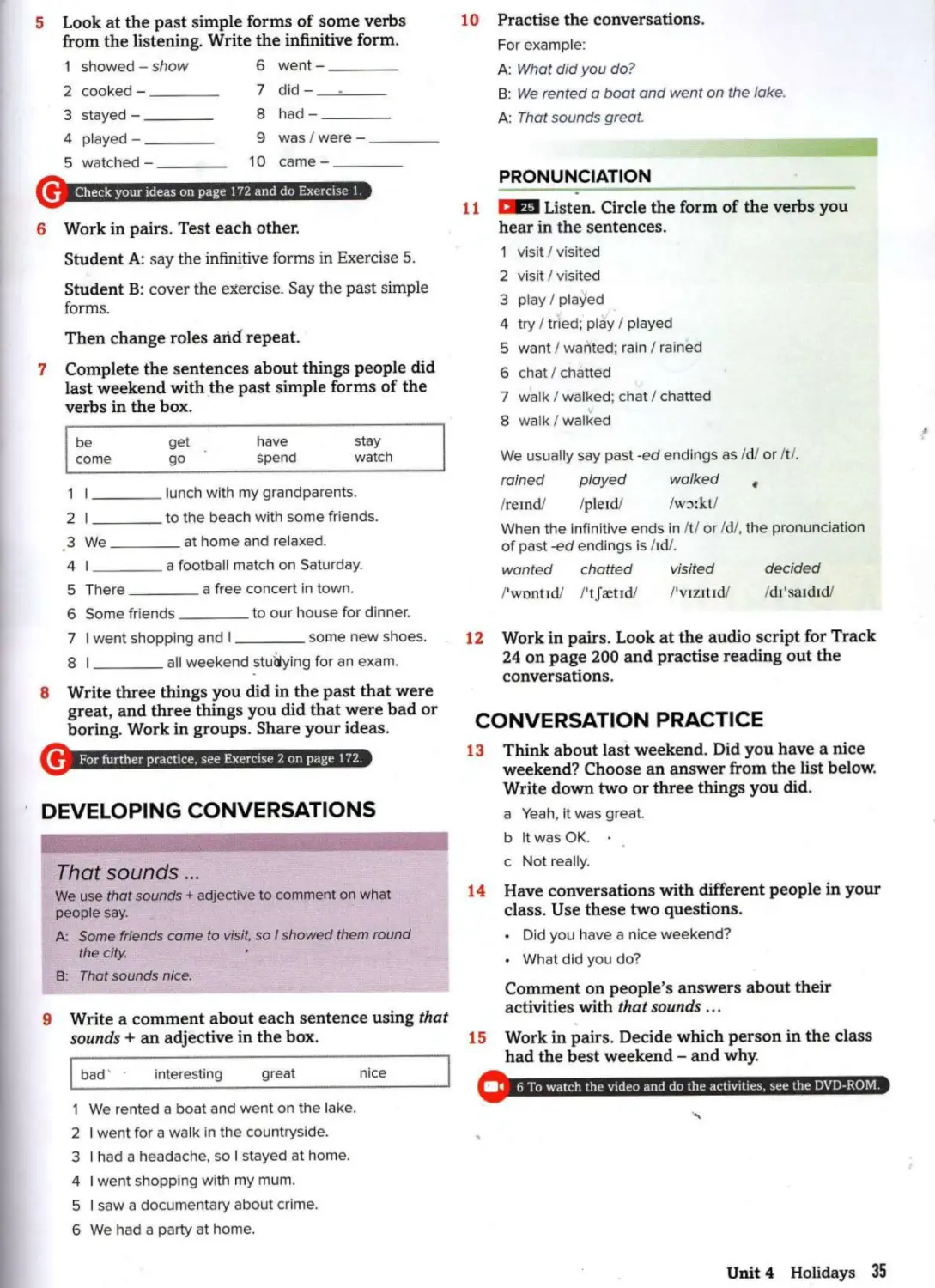
5 Look at the past simple forms of some verbs
from the listening. Write the infinitive form.
1	showed - show	6	went -
2	cooked -		7	did -
3	stayed -	 played -	 watched -		8	had -
4		9	was / were -
5		10	came -
Check your ideas on page 172 and do Exercise 1.
6 Work in pairs. Test each other.
Student A: say the infinitive forms in Exercise 5.
Student B: cover the exercise. Say the past simple
forms.
Then change roles and repeat.
7 Complete the sentences about things people did
last weekend with the past simple forms of the
verbs in the box.
be	get	have	stay
come	go	spend	watch
1 I lunch with my grandparents.
2 I to the beach with some friends.
3 We at home and relaxed.
4 I a football match on Saturday.
5 There a free concert in town.
6 Some friends to our house for dinner.
7 I went shopping and I some new shoes.
8 I all weekend studying for an exam.
8 Write three things you did in the past that were
great, and three things you did that were bad or
boring. Work in groups. Share your ideas.
For further practice, see Exercise 2 on page 172.
DEVELOPING CONVERSATIONS
инигамияпинвн
That sounds...
We use that sounds + adjective to comment on what
people say.
A: Some friends came to visit, so I showed them round
the city.
B: That sounds nice.
9 Write a comment about each sentence using that
sounds + an adjective in the box.
bad interesting great	nice
10
Practise the conversations.
For example:
A: What did you do?
B: И/е rented a boot and went on the lake.
A: That sounds great.
PRONUNCIATION
ШШ1 Listen. Circle the form of the verbs you
hear in the sentences.
1 visit / visited
2 visit / visited
3 play I played
4 try / tried; play / played
5 want/wanted; rain / rained
6 chat/chatted
7 walk/walked; chat/chatted
8 walk/walked
We usually say past -ed endings as /d/ or /t/.
rained	played	walked	*
/reind/	/pleid/	/wo:kt/
When the infinitive ends in /t/ or /d/, the pronunciation
of past -ed endings is /id/.
wanted	chatted	visited	decided
/'wontid/ /'tjaetid/	/‘vizitid/	/di'saidid/
12 Work in pairs. Look at the audio script for Track
24 on page 200 and practise reading out the
conversations.
CONVERSATION PRACTICE
13 Think about last weekend. Did you have a nice
weekend? Choose an answer from the list below.
Write down two or three things you did.
a Yeah, it was great.
b It was OK. •
c Not really.
14 Have conversations with different people in your
class. Use these two questions.
•	Did you have a nice weekend?
•	What did you do?
Comment on people’s answers about their
activities with that sounds ...
15 Work in pairs. Decide which person in the class
had the best weekend - and why.
АИ 6 To watch the video and do the activities, see the DVD-ROM.
1 We rented a boat and went on the lake.
2 I went for a walk in the countryside.
3 I had a headache, so I stayed at home.
4 I went shopping with my mum.
5 I saw a documentary about crime.
6 We had a party at home.
Unit 4 Holidays 35
VOCABULARY
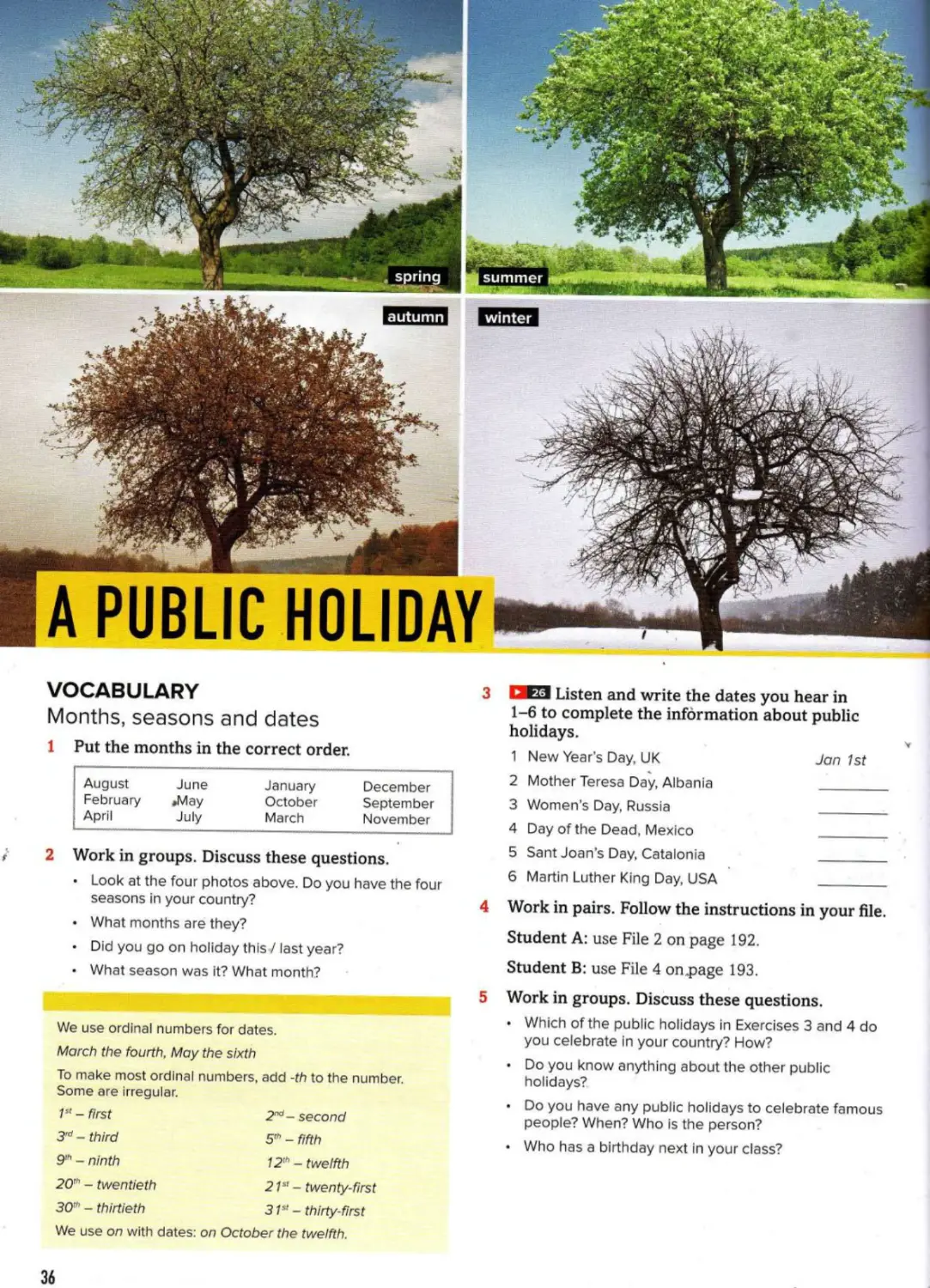
Months, seasons and dates
1 Put the months in the correct order.
August	June	January	December
February	♦May	October	September
April	July	March	November
r 2 Work in groups. Discuss these questions.
•	Look at the four photos above. Do you have the four
seasons in your country?
•	What months are they?
•	Did you go on holiday this / last year?
•	What season was it? What month?
We use ordinal numbers for dates.
March the fourth, Moy the sixth
To make most ordinal numbers, add -th to the number.
Some are irregular.
1st-first	2nd-second
3rd - third	5th - fifth
9th - ninth	12th - twelfth
3 QE3 Listen and write the dates you hear in
1-6 to complete the information about public
holidays.
1	New Year’s Day, UK	Jon 1st
2	Mother Teresa Day, Albania
3	Women’s Day, Russia
4	Day of the Dead, Mexico	_________.
5	Sant Joan’s Day, Catalonia
6	Martin Luther King Day, USA
4 Work in pairs. Follow the instructions in your file.
Student A: use File 2 on page 192.
Student B: use File 4 on.page 193.
5 Work in groups. Discuss these questions.
•	Which of the public holidays in Exercises 3 and 4 do
you celebrate in your country? How?
•	Do you know anything about the other public
holidays?
•	Do you have any public holidays to celebrate famous
people? When? Who is the person?
•	Who has a birthday next in your class?
20th - twentieth
30th - thirtieth
21st - twenty-first
31st- thirty-first
We use on with dates: on October the twelfth.
36
LISTENING
6 L*U Listen to three stories about what people
did on public holidays. Which public holiday
from Exercise 3 does each speaker talk about?
Work in pairs. Check you understand the
► 27
words below from the three stories. Then decide
which speaker used each group of words. Listen
again to check your ideas.
a missed - work - nice - presents - flowers - say -
room
b three - drove - clear - cloud - views - traffic - two
c fire - beach - night - songs - swam - warm - slept
8 Listen again. Complete the sentences with
one word in each(space.
Speaker 1
1	We a fire on the beach.
2	We songs and laughed.
3	Some of my friends swam in the
Speaker 2
4	I was in London for work, so I missed the____.
5	On Women’s Day, men usually us very well.
6	I didn’t go out for dinner. I didn’t get
flowers.
Speaker 3
7	We on Saturday the 16th at three in the
morning.
8	We drove to the.
9	It was very clear and sunny. There wasn’t a cloud in
the. r
9 Work in pairs. Say as much as you can about
what each speaker did, using the words in
Exercise 7.
For example:
They made a fire on the beach with some friends.
11 Write the negative form of the past simple verbs
in brackets.
1 I much on Sunday, (did)
2 I until eleven, (got up)
3	I wanted to have breakfast, but there any
coffee or bread in the house, (was)
4	I went to the shop, but I my keys, (took)
5	The shops open. It was a holiday! (were)
6	I tried to call my neighbour, but he
(answered)
7	I went to a cafe and I had a coffee, but then I saw
that I any money! (had)
8	I went back to my flat. I broke a window to get in. I
again after that, (went out)
In negative sentences, we often use any + noun after the
verb. We can also use anyone, anything, anywhere.
I didn’t get any flowers.
I didn’t have anyone to say nice things to me.
12 Complete the sentences by adding any, anyone,
anything and anywhere. 9
1	I wanted to buy it, but I didn’t have money.
2	The film was in English. I didn’t understand
____________i
3	The beach was very quiet. We didn’t see
there for maybe three days.
4	We went shopping in the morning, but I didn’t buy
5	I had a very quiet weekend. I didn’t go_____.
6	We stayed in a very small town. There weren’t
shops or banks!
7	I didn’t enjoy the party. There wasn’t I
knew there.
8	There wasn’t to park the car, so I drove
home.
GRAMMAR
For further practice, see Exercises 2 and 3 on page 173.
Past simple negatives
To make past simple negatives, we use wasn’t / weren’t for
the verb be.
For all other verbs, we use didn’t + infinitive.
10 Complete the sentences from the listening using
wasn't, weren't or didn't.
1	It was good, because there many cars on
. the road.
2	I go out for dinner.
3	The sea very warm.
SPEAKING
13 Write answers to these questions. Then work in
groups and say what you’ve written.
•	What’s your favourite public holiday? What do you
normally do?
•	When was the last public holiday? What did you do?
Check your ideas on page 172 and do Exercise 1.
Unit 4 Holidays 37
DID YOU GO ANYWHERE NICE?
VOCABULARY Going on holiday
go on holiday	4
If you go on holiday, you stop working and go away to a
different place to relax, usually for a few days or more.
1 Match the verbs (1-6) to the groups of words
they go with (a-f).
1	fly	a	a day in Rome / the week relaxing / lots of money
2	stay	b	to Helsinki / with British Airways / first-class
3	take	c	the train / the bus / a taxi
4	spend	d	with friends / in a hotel / in a bed and breakfast
5	rent	e	sightseeing / out for dinner / swimming
6	go	f	a car / a boat / a flat
2	Work in groups. Discuss these questions.
•	How often do you I does your family go on holiday?
•	Do you usually go to the same place or do you go to
different places?
•	What do you usually do when you are on holiday?
READING
3	Read an email from a Danish man to his Italian
friend. Put the photos in the order they are
talked about in the text.
To	mauro 1990@shotmail.it
Subject	Re: Ireland
Hi Mauro,
How are you? I hope you and your family are well.
How was your trip to Korea? I’m sure it was great.
Helena and I spent three fantastic weeks in Ireland
and had a really great time. We flew to Dublin, the
capital, and spent a week there. It’s a beautiful city.
We went sightseeing every day and saw all the old
buildings. Then in the evenings, we went out and
enjoyed the nightlife. It’s a fun city! You’d love it.
After that, we rented a car and spent two weeks
driving round the country. It’s really beautiful! I was
worried about the weather, but it didn’t rain once.
We stayed in little bed and breakfasts and met some
really lovely people.
My favourite place was the west of the country. We
went walking in the mountains in County Mayo for a
few days. It was lovely and quiet. On the first day we
didn’t see anyone else - we only saw sheep!
Anyway, now we’re back in Copenhagen and back at
work! How was your summer? Did you go on holiday
anywhere? Did you have a good time?
Please write and tell me everything! Or why not
come and visit us? Th^re are some cheap flights in
September and the weather is still OK.
Your friend,
Nicklas
4 Read the email again and answer these
questions.
1	Where did Nicklas go?
2	Did he go on his own?
3	How long was he there for?
4	Was the weather good?
5	What did he do there?
6	Do you think it was a good holiday? Why? I Why not?
5 Complete the sentences with one word in each
space. Look at the email if you need help.
1	We to Dublin.
2	We a week there.
3	It’s a city.
4	I was about the weather, but it didn’t rain
once!
5	My place was the west of the country.
6	We went in the mountains.
7	On the first day we didn’t see else!
8	How your summer?
9	Did you go on holiday_________7
10	There are some cheap in September.
SPEAKING
6 Work in pairs. Tell each other the best place in
your area / country:
•	to go sightseeing.
•	to go walking.
•	to go swimming. /
•	to spend a week relaxing.
•	for nightlife.
•	for driving around.
GRAMMAR
Past simple questions
For the verb be, make questions with was / were.
How was your summer?
How long were you there for?
For other verbs, use did. *
Where did you go?
Did you have a good time?
7 Use the notes below. Write past simple questions
you could use to ask a friend about their holiday.
1	you / go on holiday
anywhere?
2	where I go?
3	who I go with?
4	have a good time?
5	how long / there for?
6 where/stay?
7 it very expensive?
8 the weather good?
9 the food good?
PRONUNCIATION
8 DE3 Listen to did you - first fast, then slow.
Then listen to the did you questions from
Exercise 7 - first fast and then slow. Repeat
them.
1	Did you go on holiday anywhere?
2	Where did you go?
3	Who did you go with?
4	Did you have a good time?
5	Where did you stay?
9 Match the answers a-i to the questions (1-9) in
Exercise 7.
a Yes, I did. It’s a great country.
b Yes, great. They eat lots of fruit, lots of rice. It’s lovely.
с I stayed with friends in Rio and then in a hotel.
d Yes, I did. I went to Brazil.
e Two weeks.
f I went on my own.
g No, not really. Most things are quite cheap there.
h Rio de Janeiro and Salvador in the east.
i It was great, yes. Really hot and sunny.
For further practice, see Exercises 1 and 2 on page 173.
SPEAKING
10	Choose one of these things to talk about.
•	last weekend
•	the last public holiday
•	the last time you went on holiday
•	your last birthday
•	a special day in your life
11	Write five past simple questions for your partner
to ask you about your day / weekend / holiday.
12	Work in pairs. Swap questions and interview
each other.
SOUNDS AND VOCABULARY REVIEW
13	Listen and repeat the sounds with /d/, /t/,
/m/ and Ini. Are any of them difficult for you to
hear or say?
14	DEI Work in groups. Listen to eight sentences
using the words below. Together, try to write
them down. Then listen again and finish writing
them.
drove	missed	rented	time
June	mountains	x spent	warm
For further revision, see Exercises 1-3 on page 173.
Unit 4 Holidays 39
1 Look at the photo. Work in pairs. Discuss these
questions.
•	Which is the dog, the cat and the parrot?
•	For each animal, give a mark 0-5 in each row of the
table below.
•	Which do you think is the best pet / animal?
	Dog	Cat	Parrot
intelligent
clean
friendly
boring	•
beautiful
easy to keep
2 UU Watch the video about cognitive biologist
Irene Pepperberg and the project and tests she
does with a parrot called Alex. Which one of
the sentences below best explains what the
project shows?
1	Parrots are the best pets for children.
2	Parrots are more intelligent than cats.
3	Parrots can repeat sounds but they don’t understand
the meaning of words.
4	Parrots can show they understand size and colour.
5	Parrots can do the same maths as a five-year-old
human.
40
3	LJftl Complete the summary of the video with
these words. Then watch the video and check.
abilities	died	love	smaller
African	different ,	many	words
Irene Pepperberg worked with an 1 grey
parrot called Alex. Alex amazed scientists because he
understood words. He could answer questions like How
2? What colour? What’s the same? What’s
3? What Colour’s bigger? What colour’s
4? This showed cognitive 5 similar
to four- or five-year-old humans and so the scientists
believed adult parrots can think and communicate. Alex
6 in 2007. He learned around 150 7
in his life and his last ones to Irene were ‘18
you*.
4	Work in groups. Tell the people in your group
about someone you know who has / had a pet.
The others ask these questions to find out more.
Do you like it?
What’s its name?
How big is it?
Where does (s)he keep it?
How old is it?
Did you like it?
What was its name?
How big was it?
Where did they keep it?
How old was it when it died?
UNDERSTANDING FAST SPEECH
5	OD Read and listen to this extract from the
video said fast, then slow. Stressed sounds are in
CAPITALS.
ALex was ABIe to idENtify an OBject MANy WAYS - by
COIour, SIZE, and SO on.
6	You try! Practise saying the extract with the
same stressed sounds.
REVIEW 2
GRAMMAR
4 long you_______________?
5 There knew
6 I’m sorry.hear
1 Choose the correct option.
1	There’s a cafe on I in the corner of this road.
2	Our house is in front I next to a school.
3	Simon’s I Simon parents live on this road.
4	Can you give he I him the keys?
5	I’m sorry, I can’t / con see the board.
6	Did you went I go out last night?
7	They were Z was both ill at the weekend.
8	My house is at I in the end of this road, opposite I
between the church.
2 Complete the text with the past simple form of
the verbs in brackets.
We 1(have) a great holiday in Greece. We
2(fly) to Athens and 3(spend) three
days there and 4(see) all the famous sights.
After that, we 5(take) a boat to Mykonos and
we 6(stay) in a small hotel near the beach.
3 Rewrite the sentences as negatives (-) or
questions (?).
1	I can come to the next class. (-)
2	There’s a supermarket near here. (?)
3	The hotel was very good. (-)
4	He had a nice time. (?)
5	I understood everything. (-)
6	I can help you later. (?)
4 Write full questions to complete the dialogue.
Use the words in brackets.
A:	1? (nice weekend)
B:	Yes, it was great.
A:2_________? (do)
В: I went to stay with my brother.
A:	That’s nice.3? (live)
B:	Leeds. We went to the theatre on Saturday night.
A:	4? (see)
B:	Othello.
A:5_________? (good)
В:	I liked it, but my brother didn’t.
5 CEO Listen and complete the sentences with one
word in each space. Contractions (Гт, don't,
etc.) are one word.
1	bank’s road
___________________right.
2	think lives
own.
3	turn up?
__________hear it.
6 DEH Work in pairs. Compare your ideas. Listen
again to check.
VOCABULARY
7 Replace the adjectives in italics in 1-6 with their
opposites in a-f.
1	Do you have any dirty clothes?	a	bad
2	It’s very hot in here.	b	cold
3	That sounds great.	c	nice
4	It was clear and sunny.	d	wet
5	Is that towel dry?	e	clean
6	People were very unfriendly.	f	cloudy
8 Put the words into three groups - local facilities,
home or time of year.
apartment	chemist’s	Marcah	sofa
autumn	cupboard	October	spring
balcony	fridge	post office	sports centre
bookshop	kitchen	sink	winter
9 Match the verbs in the box to the groups of
words they go with in 1-8.
cut	send	share	turn down
get	set	show	wash
1	~ a flat with a friend / ~ a pizza I ~ your ideas
2	~ an email / ~ a package / ~ a message
3	~ some money I ~ dressed I ~ back home
4	~ the table / ~ your alarm clock / ~ a rule
5	~ the vegetables I ~ yourself / ~ it with scissors
6	~ your hair I ~ your hands / ~ the plates
7	~ the air-conditioning / ~ the TV / ~ the temperature
8	~ me on the map / ~ us round town / ~ him what to
do
10 Complete the text with the words in the box.
annoys	mess	rents	songs	visited
lay	nightlife	sightseeing	view	watched
My brother now lives in Rome and I 1 him in
the summer. He 2 a small flat in the centre
of town, so it was great to go 3 and enjoy
the great4. And his flat is on the top floor
of the building, so there was a nice 5 from
his balcony. That was all good, but sometimes my
brother really 6________me. The flat was a 7
when I arrived. I tidied it, but he didn’t say thanks. I
made dinner and he just8 on the sofa and
9_________a film. He also sings 10________in the
shower in the morning - very badly! So at the end of
the holiday I was happy to leave!
Review 2 41


IN THIS UNIT YOU LEARN HOW TO:
•	describe what you want
•	talk to a shop assistant
•	understand prices
•	talk about department stores
•	talk about things happening now
•	give excuses
•	follow directions in a store
WORDS FOR UNIT 5
1	Work in pairs. Match the words and phrases to the
photos.
a bar on the top floor
business is growing
the cheese section
choose a cake
fruit and vegetables
go up the escalator
have a sale
look round the market
a man with a brown jumper
the menswear department
queue to pay
steal some jeans
take the lift
a young woman with a blue top-*
a woman with a green dress
a woman with a leather jacket
worl^in a bakery
2	Ufc±J Listen. Check your answers. Listen again. Repeat
the words.
3	Work in pairs. Test each other. Cover the words.
Student A: point to a photo.
Student B: say the words.
4	What other colours can you see in the photos? What
other clothes can you see?
HOW MUCH IS THAT RED ONE?
DEVELOPING CONVERSATIONS
Questions in shops
Learning common questions for particular situations will
help you understand and have conversations.
1 Who usually asks each question 1-8: shop
assistants (A) or customers (С)?
1	Who’s next?
2	What are those made of?
3	How much are the apples?
4	Can I have some ...?
5	Which one(s)?
6	How much would you like?
7	How many would you like?
8	Anything else?
2 Match the questions (1-8) in Exercise 1 to the
pairs of possible answers (a-h).
a A:_____________________________________________
B: Sure. How much?
Of course. How many do you want?
b A:_____________________________________________
B: 50p each.
One forty-nine a kilo.
c A:_____________________________________________
B: Me.
This lady, I think.
d A:_____________________________________________
B: That much.
Haifa kilo.
e A:_____________________________________________
B: Those ones have fish in them and the others
have meat.
Leather.
f A:_____________________________________________
B: No, thanks, that’s all.
Yeah, can I have some of that, please?
g A:---------------------------------------------
B: Five or six.
Just one.
h A:_____________________________________________
B: The blue one.
The ones next to the apples.
3 Spend two minutes remembering one answer for
each question in Exercise 1. Then work in pairs.
Student A: ask questions.
Student B: close your book and give answers.
44
'LISTENING
4 IZE3 Listen to three conversations in markets.
Complete the table about what the people buy,
including number, size, colour, etc.
	Buys	Total cost
1	1	red	 2	peaches	3

2	4	cake Coffee cake with 5		6

3	7	8
	—
5 ОЕП Work in pairs and compare your answers.
Then listen again and check.
PRONUNCIATION
6 i*1* Listen to these numbers and mark the
main stress.
thirteen	fourteen	sixteen
thirty	forty	sixty *
7 DE3 Listen to the sentences and write the
numbers you hear. .
1 That’s €exactly.
2 That’s $altogether.
3 Everything is reduced by t %.
4 Those are at the moment, reduced from
5 It costs £___new.
6 Our apartment cost when we bought it.
SPEAKING
8 Work in groups. Discuss these questions.
•	How important is the price of things? Do you know
how much things cost?
•	What do you think is the average price of the things
below where you live? What’s the maximum you
think it’s OK to pay for them?
GRAMMAR this I these I that I those
9 Match the sentences (1-4) to the pictures (a-d).
1 I like these ones.
2 This apple is nice.
3 Those jeans are expensive.
4 That cake looks good.
Check your ideas on page 174 and do Exercise 1.
10 Complete the sentences with one word in each
space.
1 A: What this called in English?
B: A shirt.
2 A: What do you call things on your table?
B: They’re coins.
3 A: How much those jackets?
B: What? These leather?
A: Yes.
B: Well, it depends.brown one’s £100.
11 Work in groups. Ask each other the name in
English for different things in the classroom. Use
these questions.
•	What’s this called?
•	What’s that thing there called?
•	What are these / those things called?
For further practice, see Exercise 2 on page 174.
a cup of coffee	a	new car
a flat with two bedrooms	a	nice pair of shoes
a kilo of bananas	a	pair of jeans
a litre of petrol	a	piece of cake in	a cafe
a meal for two in a restaurant
• How much would you pay for the things in the
photos on page 44?
• Do you ever negotiate the price for things? What
things? Are you good at it?
CONVERSATION PRACTICE
12 Work in pairs. Have similar conversations to the
ones in the listening. Choose a shop from the
photos on page 44.
Student A: you are the shop assistant. Hold your
book open for Student В to see.
Student B: you are the customer. Buy two different
things in the photo. Try to negotiate the price! Use
as much of the language from this page as you can.
Choose a different picture. Change roles and
have another conversation.
9 To watch the video and do the activities, see the DVD-ROM. 1
Unit 5 Shoos 45
THEY’RE HAVING A SALE
READING
1	Work in groups. Discuss these questions.
•	How often do you go shopping? How often do you
buy things online? Which do you prefer?
•	Do you usually wait for shops to have a sale before
you buy things? Why? I Why not?
•	Where was the last sale you went to? Did you buy
anything?
•	Tell a partner about a time you got a bargain. Use
sentences like these.
/ bought a coat for the winter. It was €60, reduced
from 100.
I bought о mountain bike. It was reduced by 50%.
I bought my car for €2,000! I bought it from a friend.
•	Who in your group got the best bargain?
2	Work in groups of four: two As and two Bs. Read
about two shops that are having sales.
Student As: read about Emily.
Student Bs: read about Dalena.
Answer these questions for your text.
1	Where is she from?
2	What does she do?
3	Where does she work?
4	Why is the shop having a sale?
5	How’s she feeling? Why?
6	What does she want to do in the future?
3 Compare answers with the person in your group
who read the same text.
4 Now work in pairs: one Student A and one
Student B. Ask and answer the questions in
Exercise 2 to find out about your partner’s text.
5 Work with the same partner. Complete the
sentences with the words in bold from the texts.
Put one word in each space.
1	My granddad had his own business, but he sold it
when he____________
2	My dad works very. He has three jobs!
3	It’s that small shops are closing in our
town.
4	We want to find a new office because the business is
fast and we need more space.
5	In the future, I want to start my own business and
lots of money!
6	There are lots of to find a good job here.
7	How can I my German?
8	I the toy section in a department store in
town. It’s a good job.
SPEAKING
6	Work in pairs. Discuss these questions.
•	Do you know any shops that are closing? Do you
know why?
•	Are any shops opening where you live? What kind of
shops? Are you happy about it?
•	Do you know anyone who works very hard? What do
they do?
•	Do you want to be a manager in a company or shop
in the future? Why? I Why not?
•	Do you want to make lots of money? If yes, how?
If no, why not?
•	Are there a lot of opportunities for young people in
your country? Why? / Why not?
GRAMMAR
Present continuous
Look at these sentences from the texts.
Гт looking for a job at the moment.
We're having a sale because we’re closing the shop.
The store opened last year and it's doing very well.
The present continuous uses a form of be + -ing. We use
the present continuqusto talk about present actions or
situations that are temporary and not finished.
7	Complete the sentences with am / are / is.
1	The shops in town having sales at the
moment.
2	I working very hard at the moment.
3	My mother’s not here. She doing the
shopping.
4	The economy growing fast at the moment.
5	My football team doing really well now.
6	You really improving. You didn’t know
much English when we first met
7	Some friends staying with me at the
moment.
8	My brother	studying at university.
PRONUNCIATION
8	1*11 Listen to the present continuous
sentences from Exercise 7. Notice how they
use the short forms of am / are / is. Listen
again and repeat the sentences.
9	Look again at sentences 1 and 2 in Exercise 7.
1	What phrase shows the present actions or situations
are temporary and not finished?
2	Make a question and a negative from each sentence.
Check your ideas on page 174 and do Exercise 1.
46

A BIG SALE
EMILY, GERMANY . , -
We’re having a sale because we’re closing the shop. It’s sad,
because my grandfather opened it 60 years ago. When I
was small, 1 came here on Saturday mornings and sat and
read the childrens books.
When my granddad retired, 1 started to manage the
shop. Now there’s a sale, so there are lots of people and
they’re buying lots of books, but we don’t normally have
so many customers. There are lots of very big bookshops
now, which sell every book their customers want. They
often have cafes and famous writers come and give talks
for them, but we can’t do that. And then other people
look online to get books cheaper, so we don’t really make
much money.
Fm looking for a job at the moment, but I don’t really
know what 1 want to do in the future. I don’t really want to
work in another bookshop after 1 leave here.

GALENA, SLOVAKIA
Fm a sales assistant in a big clothes store. The store
opened last year and it’s doing very well. Were
having our summer sale at the moment, so I’m
working really hard. The shop is staying open later
than normal. We usually close at seven, but during
the sale we’re open until nine. Fm tired, but I like
my job. I like helping people to Find nice clothes
and, of course, everyone is happy when they find
a bargain.
I want to continue working with the company
and maybe become a floor manager and then a
store manager. I think it’s a good place to work,
and the business is growing at the moment and
opening new stores, so I think there are lots of
opportunities. Maybe I can get a job in one of their
shops in the UK and improve my English’

10	Work in pairs. Which sentences in Exercise 7 are
true for you? Change the other sentences so they
are true.
11	You are at a party or meeting. Write an excuse
using the present continuous to explain why
each of the people in the box can’t come.
Now have conversations using your sentences.
For example:
A:	Hi. How are you?
B:	Fine.
A:	Are your mum and dad coming?
B:	No. Some friends of theirs ore visiting.
your mum and dad
your wife or husband
Mr Smith (your boss)
Susie (your sister)
David (a friend / flatmate)
the President!
For further practice, see Exercise 2 on page 175.
Unit 5 Shnns 47
DO YOU SELL ...?
SPEAKING
1	Read the text about the store in the photo. Find
out what is unusual about John Lewis.
v
2	Work in groups. Discuss these questions.
•	Do you think it’s a good idea to share a company’s
profits between the workers? Why? I Why not? Do
you know any other company that does it?
•	What’s the biggest department store where you live?
Do you ever go there? Why? / Why not? What do you
know about the company?
•	What’s your favourite shop? Why?
VOCABULARY Department stores
3	Label the plan with the words in the box.
an assistant
the basement
the beauty department
the changing rooms
the escalator
the first floor
the ground floor
the lifts
the main entrance
the menswear department
the second floor
the security guard
the till
the top shelf
the womenswear department
John Lewis is the company with the most department
stores in the UK. The company started with one shop
in Oxford Street, London, in 1864. The store is still there
today. It has around 80 sections and sells everything
from cheese to baths, and perfume to foreign holidays.
After the war, the business grew a lot and it now has 32
department stores, eleven furniture shops, a small factory
and a farm. It also owns a supermarket with over 300
shops. John Lewis is an unusual company because all the
workers are partners in the business - when the company
makes money, the workers share some of the profits. John
Lewis made arourld £320 million last year and the 93,000
partners shared half of that money between them.
4	Work in pairs. Answer these questions using
words from Exercise 3.
1	Where do you try clothes on?
2	Where do you ask ‘Are you going up?’ or say ‘Fourth
floor, please’?
3	Where do you go In and go out of the store?
4	Which floor do you always go down to?
5	What floor is the main entrance usually on?
6	Where do you queue to pay?
7	Where do you buy trousers and a shirt?
8	Where do you buy a skirt and top?
9	Where do you buy perfume?
10	Who do you ask for information or help?
11	Who stops people stealing things?
12	What do you get off at the top or at the bottom?
LISTENING
5 ЯЯ Listen to four short conversations in a
department store. Match each conversation
(1-4) to one of these situations.
a Someone is stealing something.
b Someone wants to try some clothes on.
c Someone is explaining where to meet.
d Someone is looking for an item in the wrong place.
6 UftU For each conversation, decide if the
sentence is true (T) or false (F). Listen again
and check.
1	The man wants some batteries for a toy.
2	The speakers tell a security guard about what
they saw.
3	The woman bought some jeans, a skirt and two tops
in a sale.
4	You can take six items of clothing to the changing
room.
7	Choose the correct option in the sentences.
Then look at the audio script for Track 37 on
page 202 and check your answers.
Conversation 1
1	Do you sell I Are you selling batteries?
2	They’re there. On I In the bottom shelf.
Conversation 2
3	She put that perfume on I in her bag!
4	Someone talks I’s talking to her.
Conversation 3
5	I’m still at I on the bus, but we come down I we're
coming down Oxford Street now.
6	When you get out I off on the fourth floor, it’s behind
you. It’s at I to the back of the store.
Conversation 4
7	The changing rooms are over there in I on the
corner. Next to I of the jeans.
8	How much I many items can I take to try on?
SPEAKING
8	Imagine you’re in a department store. Think of
some things you want to buy and complete each
sentence in two different ways.
Excuse me. Do you sell...?
Excuse me. I’m looking for....
9	Now work in pairs. Roleplay conversations
between a customer and a shop assistant in
a department store. Change roles for each
conversation.
Student A: you are the customer. Ask your questions
from Exercise 8.
Student B: you are the shop assistant. Look at the plan
and the phrases in the box in File 11 on page 196. Give
directions to Student A.
SOUNDS AND VOCABULARY REVIEW
10	С БЗ Listen and repeat the sounds with /rj/, /J/,
/tJ7 and /d$/. Are any of them difficult for you to
hear or say?
11	i*Fl Work in groups. Listen to eight sentences
using the words in the box. Together, try to
write them down. Then listen again and finish
writing them.
l G F°r further revision, see Exercises 1-3 on page 175.
cheaper	everything	jeans	section
choose	improving	manage	shirt

IN THIS UNIT YOU LEARN HOW TO:
•	describe classmates and teachers
•	name school and university subjects
•	talk about courses you’re doing
•	talk about languages and education
•	give opinions about what’s better
WORDS FOR UNIT 6
1	Work in pairs. Match the phrases to the photos.
an angry boss	learn to ride a bike
a boring class	make clothes
borrow some money	a modern university
cause a problem	pass the exam
a creative person	police training
help each other	solve the problem
a Law student	a strange teacher
a lazy student	study Engineering
learn Arabic	teach PE
2	DE3 Listen. Check your answers. Listen again. Repeat
the words.	«
3	Work in pairs. Test each other. Cover the words.
Student A: point to a photo.
Student B: say the words.
VOCABULARY School and university
1 Match each group of adjectives (1-4) to one of
the nouns fa-d).
1	2	3	4
friendly	popular	interesting	helpful
nice	expensive	boring	patient
lazy	modern	difficult	strange

a a course
b a classmate
c a teacher
d a university
2 Work in pairs. Compare your ideas. Then add
one more adjective to each group above.
3 Choose three adjectives to describe your
school / university / college life. Tell a partner.
For example:
Our English teacher is very patient.
My university was very popular - and very expensive!
I was sometimes lazy when I was at school!
4	Work in pairs. Look at the subjects below.
Answer the questions.
1 Which subjects are arts subjects?
2 Which subjects are science subjects?
3 Which subject(S) do you usually start studying at
school and which do you usually start at university?
Biology	Geography	Marketing
Chemistry	History	Maths
Computing	Law	Medicine
Engineering	Literature	PE
52
5	Work in groups. Discuss which subjects:
•	you think are most / least important
•	you think are easy / difficult
•	you know a lot about
•	you liked I didn’t like at school.
LISTENING
6	L*A1I Listen to three conversations about
studying. Complete the table.
	Subject	Year	How’s it going?
1			Really well.
2		2nd
3
7	ЕКЛ Listen again. Choose the correct option.
Conversation 1
1	I’m doing I making a degree in Marketing.
2	I’m really enjoying I liking it.
Conversation 2
3	I’m a student at I of university.
4	Not very well, actually. I just find it boring / bored.
Conversation 3
5	It’s a lot of work I works'.
6	Good luck with I for it.'
8	Work in pairs. Discuss these questions.
•	Do you know anyone at university / college at the
moment?
•	What are they studying?
•	What year are they in?
•	Are they enjoying it?
PRONUNCIATION
9	EKS Listen to eight questions said fast and
then slower. Note how we often pronounce
are as /а/. Repeat what you hear.
10	DE3 Listen again and write what you hear.
11	Work in pairs. Take turns to ask and answer
the questions.
DEVELOPING CONVERSATIONS
How’s the course going?
\Ne can ask How's the course going? to find out if someone
is enjoying their course or not.
A:	How’s the course going?
B:	Really well. It’s great. I’m really enjoying it.
12	Look at these answers to the question How’s the
course going? Complete each answer with Really
well, OK or Not very well.
1		, but it’s not very easy.
2	I find it boring.
3	It’s very interesting.
4	, but it’s a lot of work.
5	I don’t really like my teacher. He’s strange!
6	The other students are very nice and
friendly.
7	. I did very well in my exams. I found them
easy.
8	I think I chose the wrong subject!
9	; I suppose, but I’m not sure it’s what I really
want to do.
13	Work in groups. Discuss these questions.
•	How’s your English course going?
•	What’s good about it?
•	Is there anything you don’t like?
CONVERSATION PRACTICE
14	Work in pairs. Use the guide below to have
four conversations like the ones you heard in
Exercise 6. Use different ideas from the table
below if you need to, and add a reason for how
the course is going. Take turns to start. Try to
give different answers each time.
explain why.
Place	Course	Year	How’s it going?
University of Rome	Biology	1	Good
Middlesex University	Computing	2	Bad
Le Cordon Bleu, Australia	Hotel Management	3	OK
Harvard	Medicine	4
Cambridge	Chinese	Final
10 To watch the video and do the activities, see the DVD-ROM. J
Unit 6 Education 53
LEARNING AND TRAINING
VOCABULARY Courses
1 Complete the texts (1-5) by putting the words in
brackets in the correct space.
1	I do an art class every Tuesday. The class
at eight in the evening and at ten. We
paint anything we want and the teacher
us help and advice, (finishes, gives, starts)
2	I’m a course at the moment. It’s for my
work, so the company is for it. It’s about
ways to improve sales. It’s very useful and I’m
a lot. (learning, paying, doing)
3	My brother’s to become a pilot. The
course three years and it’s very difficult.
It about £100,000 altogether. My family’s
the money from the bank to pay for
it. I hope he all his exams! (borrowing,
training, passes, lasts, costs)
4	I started learning Russian last year. I to
a class on Wednesday evenings. The teacher was
very good and patient and I_________the class, but
I was quite lazy and I didn’t very much.
We an exam at the end of the course and
I,	so I can’t do the next level, (study, had,
went, failed, enjoyed)
5	We a training session at work every
month. The sessions usually for about
three hours. We do different things. Sometimes
a trainer from outside the company,
sometimes our manager us information
about changes in the company, sometimes we all
our ideas about how to improve things.
They’re often very useful, but occasionally they’re
very boring, (comes, gives, have, share, last)
2 Work in pairs. Use verbs from Exercise 1 to say
things about your English class. How many of
the verbs can you use?
3 Complete the conversation with the questions in
the box.
How long does the course last?
What time does the class start?
Do you have any homework?
Why are you doing it?
Is it good?
What’s it about?
When are the classes?
How much did it cost?
A:	I’m doing an evening course at the moment.
B:	1__________
A:	Speaking in public.
B:	2__________
A:	I want to improve my opportunities at work.
B:	3__________
A:	Every Monday.
B:	4__________
A:	Yeah. I usually watch some videos online and
prepare a talk.
B:	5__________
A:	Six, and it ends at eight.
B:	6__________
A:	Ten weeks.
B:	7__________
A:	Two hundred pounds.
B:	8__________
A: Yeah. It’s very useful. I’m enjoying it.
4	Work in pairs. Practise reading the conversation.
LISTENING
5	Match these words and phrases to the photos.
Think of one more word for each photo.
an online course a horse a training session fashion

6	ОЕЗ Listen to four people talking about the
courses in the photos. Match the speakers to
the photos а-d and decide if all the learning
experiences you heard about were good. Then
compare your ideas with a partner.
7	ЕЖИ Listen again. Decide if the sentences are
true (T) or false (F).
Conversation 1
1	The course is 6.30 to ten, twice a week.
2	She works in fashion now.
Conversation 2
3	His manager told him to go to the training session.
4	He learned how to make gdod decisions.
Conversation 3
5	She always rides twice a week.
6	She rode horses when she was younger, but then
stopped.
Conversation 4
7	His wife didn’t like the course because there were
too many people.
8	He wants to become a journalist.
8	Complete the sentences from the listening with
the correct form of the verbs in brackets.
1	I to make clothes, (learn)
2	It for ten weeks, (last)
3	It only about an hour, (last)
4	We any choice, (not I have)
5	I in the countryside and I always wanted
_________. (grow up / ride)
6	My teacher very patient and I
quite good now. (be I get)
7	My wife it with me, but she.
(start I stop)
8	I taking exams. I always
(hate / fail)
9	Work in groups. Discuss these questions.
•	Which of the four courses sounds best to you? Why?
•	Do you know anyone who changed jobs? If yes, why
did they change?
•	Did you have any classes after school when you
were a child? If yes, what?
•	What’s good / bad about doing open online courses?
10	Work in pairs. Have conversations like the ones
in Exercise 3.
Student A: choose one of the courses from this
lesson or think about a course you are doing. Tell
your partner.
Student B: choose questions from Exercise 3 to ask.
For example:
А: Гт doing a training course at the moment.
B: What’s it about?
A: Making decisions.
GRAMMAR
Modifiers
Very, really and quite are modifiers. They go before
adjectives.
Very and really mean ‘a lot’.
It's really good.
The teachers are very helpful.
We often make adjectives negative by adding not very.
It wasn't very long - only about an hour.
Quite means ‘a little’.
I was quite angry by the end.
It’s quite expensive.
11	Choose the correct option.
1	Some of my classmates aren’t very I quite friendly.
2	The course is quite I really difficult! I don’t
understand anything!
3	It’s a great university. It’s very I not very popular.
4	She’s nice, but she’s quite / not very lazy.
5	Most of the students are really friendly, but one or
two aren’t really I very nice.
6	It’s a good course. It’s quite I not very interesting.
7	He’s a good teacher, but he’s not very / quite patient.
8	It’s a great university, but it’s quite I really expensive!
I can’t study there.
12	Work in groups. Tell each other about things - or
people - that you think are:
a really expensive.
b very popular at the moment.
c quite strange.
d not very modern.
e quite boring.
For further practice, see Exercises 1 and 2 on page 175.
Unit 6 Education 55
GROWING UP BILINGUAL
VOCABULARY Languages
1	Work in pairs. Say a country or area in the world
where each of these are official languages.
Arabic	French	Romanian	Turkish
Chinese	German	Russian
English	Japanese	Spanish
2	Work in pairs. Discuss these questions.
• How important is each of these languages in the
world:
-	very important?
-	quite important?
-	not very important?
•	Which of the languages sound nice to you?
•	Do you know any bilingual people? What languages
do they speak?
READING
3 Before you read, complete the sentences with
the words in the box.
caused	explaining	solving
creative	positive
1	I’m quite a person. I’m good at arts
subjects.
2	I’m good at problems. People often ask
me for help.
3	I’m a very person. I always try and think
about good things.
4	I’m good at ideas. I’d be a good teacher.
5	I sometimes problems at school and my
teacher got angry with me.
4	Work in pairs. Discuss which sentences in
Exercise 3 are true for you.
5	Read the first two paragraphs of the article on
page 57. Answer these questions.
1	How many languages do the students at Newbury
Park speak altogether?
2	What are some of the languages children learn
about?
3	Who teaches the words in these different languages?
4	How many students in England are bilingual?
5	Why do some teachers think it’s a problem?
6	What do you think of Newbury Park School and
the way they teach language? Do you agree with
the views in the second paragraph?
7	Read the rest of the article. What’s the writer’s
opinion about the questions in Exercise 6? Work
in pairs and compare your ideas. Say the reasons
the writer gives for their opinion.
8	Work in pairs. Discuss these questions.
•	Did you find any of the ideas surprising? Which ideas?
•	Do you agree with everything the writer says? If not,
why not?
•	Do / Did you have people from different countries at
your school? Where are I were they from?
•	Are there any bilingual schools in your city / region?
Do you think they are good? Why? I Why not?
GRAMMAR
Comparatives
You can compare how good two things are using
better than.
Growing up bilingual is better than only knowing one
language.
We often then use other comparatives to explain why.
Bilingual children get higher grades at school.
They are more creative
9	Choose the best comparative to complete the
explanations.
1	Her English is better than mine. She gets higher I
lower grades.
2	This computer js better than mine. My one’s slower/
faster.
3	Mr Platt is a better teacher than Mrs Jones. He’s
funnier / more boring.
4	I think Biology is better than English. It’s more
interesting / more difficult.
5	They’re better students than me. I’m more helpful /
lazier.
10	Work in pairs. Discuss what the basic adjective
is for each option in Exercise 9. When do we add
-er, -fer and more to make comparatives?
Check your ideas on page 176 and do Exercise 1.
11	Write sentences using comparatives and the
ideas below.
1	I’m / good at / swimming / you.
2	My house is / near to / the school / your place.
3	I’m/tall/you.
4	You’re / interested / in history / me.
5	My school was / small/your school.
6	It was / warm / last week / this week.
12 Work in pairs. Ask each other questions about
the sentences in Exercise 11. Find out who is
better at swimming, etc.
For example:
Are you good at swimming?
How for can you swim?
For further practice, see Exercise 2 on page 176.
56
THE WORLD IN A SCHOOL
Janet Scott finds the benefits of knowing two languages
The students at Newbury7 Park Primary School in London
speak over 40 languages! Each month, a teacher films a
student and asks the child to say simple things like hello and
thank you in their language. They show the film to the other
children in the school to teach them the foreign words. In
January and February, the students learned some Turkish and
Japanese. This month, they’re learning Romanian.
In England, one in seven children now speaks a foreign
language at home, and some teachers think its causing
problems. They think teaching is more difficult with bilingual
children in the class and that bilinguals can’t do well in any
subject if they don’t speak English at home.
It is true that starting school is difficult for some
bilingual children. Sometimes, the children had bad
experiences before they moved to the UK. Maybe they
experienced a war, or a parent died, or they lost their
home. Schools can help these children. For example,
the students feel more positive about school and their
new life if they occasionally do something at school in
their first language - like they do at Newbury Park.
But most bilingual children don’t have any problems
at school. In fact, growing up bilingual is usually
better than only knowing one language. Research
shows that bilingual children are better at solving
problems and they usually finish school with higher
grades. That's because they are more creative and
they're often better at explaining ideas. That’s good
news, because 70% of the worlds population speak
two or more languages!
SPEAKING
SOUNDS AND VOCABULARY REVIEW
13 Choose five things from the box. Decide if they
are better or worse now than before. Spend two
minutes thinking of one or two reasons why. Use
a dictionary if you need to.
the economy	parents	transport
exams	schools	universities
hospitals	sport	the weather
old people	teachers	young people
14 Work in groups. Say your ideas. What do the
other people in your group think?
15 IM ti Listen and repeat the sounds with /е/, /э/,
/□:/ and /з:/. Are any of them difficult for you to
hear or say?
16 ULJ Work in groups. Listen to eight sentences
using these words. Together, try to write them
down. Then listen again and finish writing them.
causes	education	learned	spent
course	friendly	popular	work
G F°r further revision, see Exercises 1-3 on page 176.
Unit 6 Education 57
1 Look at the photo of a refugee camp. Discuss
these questions.
•	Why do you think the different people in the photo
are there?
•	What things can help refugees in this situation?
•	Are there any refugees in your country? Where are
they from?»
2 СКП Watch the first part of the video
(0.00-2.15) about a special course. Answer
these questions.
1	Who are the teachers? Who do they work for?
2	Who are the students? Where are they from? Where
do they live now?
3	What is the course for?
3 Read the sentences (1-4) from the second part
of the video. Match them to the follow-up
sentences (a-d).
1	Life is difficult in the refugee camp.
2	Photo camp is an inspiration for many of the camp’s
residents.
3	Near the end of the programme, the students have
an exhibition.
4	These students received more than a certificate and
a new skill at photo camp.
a They are excited to show their work.
b Agonzi Grace, for example, wants to become a
professional photographer.
c They also learnt how to document their world.
d But Reza and the ofher photographers are showing
these young adults how to see their temporary home
in a new way.
4 СЖП Watch the second part of the video
(2.16-3.50). Put the pairs of sentences in
Exercise 3 in the order you hear them.
5 Work in pairs. Discuss these questions.
•	Do you think the course is a good idea?
Why? I Why not?
•	Do you like taking photos? Are you good at it?
•	Do you have any photos on your phone that
you like?
6	Work in groups. Show some photos you like to
each other. Ask each other questions like these.
•	Where was that?	• What are they doing?
•	When did you take it?	• Who’s that?
UNDERSTANDING FAST SPEECH
7	I—XLtJ Read and listen to this extract from the
video said fast, then slow. Stressed sounds are
in CAPITALS.
THEY are TEACHing Sixty YOUNG REfuGEES HOW to
tell the STOries of their LIVES in PHOtographs.
8	You try! Practise saying the extract with the
same stressed sounds.
58
REVIEW 3
5 English________________________________________
mine.
6 warmer last
GRAMMAR
1 Choose the correct option.
1 A: Can you pass me that I those cups over there?
B: Sure. Here.
2	A: You ore I Are you waiting to pay?
B: No. Go ahead.
3	A: How was the exam?
B:	Bad! It was more difficult I difficulter than last year.
4	A: Hello. Can I speak to Greg, please?
B:	Sorry, he does I he’s doing his homework.
5	A: Did you enjoy the film?
B:	It was quite I very good, but not great.
6	A: Do you like this dress?
В: I prefer the blue one I ones that you tried on
before. And it was more cheap I cheaper*.
7	A: Do you want to try some of this I that soup?
B: Oh, it’s nice. It’s more good I better than my one.
2 Write full questions to complete the dialogue.
Use the words in brackets.
A:	1? (do) -
B:	I’m at university.
A: Oh, right.2? (studying)
B: Business Management. z
A:3_________? (going)
B: Great. I’m really enjoying it. I really like Marketing.
A:4? (What year)
B: My second year. I have two more years after this.
A:	So 5 Business Management? (doing)
B:	My parents want me to manage their factory.
3 Complete the sentences with one word in each
space. Contractions (he’s, don’t, etc.) are one
word.
1	I lost my job. I’m working at the moment.
2	I can’t help you now.doing my homework.
3	What all those people looking at?
4	Do you have a coat?raining outside.
5	I love shoes. They’re nice.
6	A: I can’t do exercise. Can you help me?
B: Sure. It is a difficult.
4 Listen and complete the sentences with
one word in each space. Contractions (I’m, don’t,
etc.) are one word.
1	son’s Law university.
2	to a horse
___________________moment.
3	Excuse me____________________
changing rooms.
4	my classmates
__________friendly.
VOCABULARY
5 Match the verbs in the box to the groups of
words they go with in 1-8.
borrow	go up	leave	lasted
give	improve	look for	pay
1	~ your dictionary / ~ the money / ~ a pen
2	~ sales / ~ my grades / ~ my English
3	~ your opinion / ~ us information / ~ me some
advice
4	~ my job / ~ school / ~ home
5	~ my keys I ~ the toy section / ~ a new flat
6	~ at the till I ~ for my course I queue to ~
7	~ a long time / ~ two years / ~ about four hours
8	~ the escalator I ~ the stairs I ~ the mountain
6 Put the words into three groups - shops, study
or clothes.
bakery	fail	leather	shirt
Chinese	History	red top	subject
Engineering	jeans	security guard	training
entrance	jumper	shelf	vegetables
7 Choose the best option.
1 Lots of people do it It’s very populor I helpful I
special.
2 She’s 1.84 m. She’s quite high I slow I tall.
3 It’s an interesting course, but it’s quite friendly/
difficult / boring.
4	Our teacher’s nice. He’s very lazy / patient / hard.
5	I like art. I’m quite important / average / creative.
6	His cat died. It was really sad / worm / modern.
7	I found a bargain. I was very strange / hoppy / young.
8	I feel a bit easy / strange / stupid because I failed
the exam.
8 Complete the text with the words in the box.
assistant	ground	section	took
came out	perfume	size
experience	sale	store
I went to a big department1 to buy a dress
for my wife. I went to the womenswear2_______
and found a really nice dress in the 3. It was
reduced by $100, but it was the wrong 4
I asked the 5_______, but she said it was the only
one they had. I decided to buy some 6
instead. 17 the lift to the8_____________floor but
it stopped between floors. I waited for 20 minutes! I felt
ill and when 19 I went home. It was a bad
10
Review 3 59

IN THIS UNIT YOU LEARN HOW TO:
•	talk about your family
•	express surprise
•	give opinions about family life
•	talk about things that are necessary or not necessary
•	talk about people you know
WORDS FOR UNIT 7
1	Work in pairs. Match the words and phrases to
the photos.
clever	husband	repair a car
dead	look after children	strict
do some housework	male and female	surprised
do the washing	nursery school	very fit
feed the dog	old friends	a wedding
funny
2	СЕП Listen. Check your answers. Listen again. Repeat
the words.
3	Work in pairs. Test each other. Cover the words.
Student A: point to a photo.
VOCABULARY Relationships
1	Complete the table with the words in the box.
daughter	grandmother	mum	uncle
girlfriend	husband	sister
2	Complete the sentences with words from
Exercise 1.
1	Pat is my uncle. He’s my mum’s.
2	Clare is my She’s my aunt Stella’s
daughter.
3	Larry is my cousin. He’s my uncle Matthew’s
Male	Female
grandfather
	wife
dad
son
	aunt
boyfriend
brother
cousin
4	Tina’s my younger. I’m two years older
than her.
5	Mel is my brother’s They met a few
months ago.
6	My mum’s and are both dead
now, and so is my dad’s dad, but my is still
alive. She’s 88!
62
3	Work in pairs. Look at the photo. Say who you
think the people are.
For example:
I think she's the wife of this man here, and probably the
mother of these two here.
Maybe these three ore sisters - or cousins.
4	Write the names of six people in your family.
Then tell your partner who they are.
LISTENING
5	EK3 Listen to three conversations about
families. Which relations from Exercise 1 do
they mention?
6	UtU Listen again. What do you learn about the
family members?
GRAMMAR
Auxiliary verbs
We often use just auxiliary verbs (e.g. be, do, can) to
answer questions. We don’t need to repeat the main verb
and I or words that follow it.
A:	Did you go out yesterday?
B:	Yeah, I did go out
A: So, are you married, Ted?
B: Yes, I am-mortied.
7	Complete the answers in these short dialogues
with the correct auxiliary verbs.
1	A: Do you have any brothers or sisters?
B: Yeah, I.
2	A: Is he married?
B: Yes, he_________
3	A: Does she have a boyfriend?
B: Yes, she.
4	A: Do your children still live with you at home?
B: My son does, yes, but my daughter
5	A: Are you very similar?
B: Yes, we.
6	A: Are your grandparents still alive?
B: My mum’s parents are, yes, but my dad’s
7	A: Did you do anything nice at the weekend?
B: Yes, I.
8	A: Did it rain?
B: No, it.
8	Work in pairs. Take turns reading the questions,
but this time give opposite answers.
For example:
A:	Do you hove any brothers or sisters?
B:	No, I don't.
DEVELOPING CONVERSATIONS
Adding information
In conversations, we don’t normally just give short answers
to questions. We try to add comments.
9	Match the extra comments to the questions and
short answers in Exercise 7.
a Luckily! It was a bit cloudy, but it stayed dry.
b My grandfather had his 80th birthday party.
c A younger brother.
d They died a few years ago.
e She’s studying in the United States.
f We’re sisters, but we’re best friends too.
g The wedding was last month, actually.
h He’s a really nice guy. I like him.
10	Work in pairs. Practise the conversations in
Exercise 7, adding the comments above.
11	Write short answers to these questions and
then add comments. Then ask and answer the
questions in pairs.
1	Do you live near here?
2	Do you have any aunts or uncles?
3	Are you married?
4	Did you go anywhere during the holidays?
PRONUNCIATION
We often say Really? to show surprise / interest. The
intonation goes up high and then down.
Really?
12 UK±1 Listen and repeat Really? three times.
13 DE3 Work in pairs. Listen to six sentences.
After each sentence, say Really? if the
information is surprising or interesting. If it’s
not, say Oh, OK.
CONVERSATION PRACTICE
14 Write five questions about families to ask other
students in your class. Use ideas from these
pages.
For example:
Do you have any brothers or sisters?
Are they older or younger than you?
15 Ask your questions to different people in your
class. Add comments-.when you answer their
questions. Say Really? when you hear interesting
or surprising things. Ask extra connected
questions if you want to.
< 13 To watch the video and do the activities, see the DVD-ROM.
__________________________________________________________________________________j
For further practice, see Exercises 1 and 2 on page 177.
Unit 7 People I know 63
I HAVE TO DO A LOT OF HOUSEWORK
VOCABULARY
Jobs and activities in the home
1	Work in pairs. Wjiich jobs and activities can you
see in the photos?
2	Match 1-5 to a-e, and 6-10 to f-j.
1	look after	a	the washing
2	tell	b	songs together
3	sing	c	my baby brother
4	repair	d	jokes to each other
5	do	e	the roof
6	feed	f	my daughter from school
7	pick up	g	a story at bedtime
8	play	h	the dishwasher
9	empty	i	the dog
10	read	j	games together
3 Work in pairs. Discuss these questions.
•	Which of the jobs and activities in Exercise 2 do you
do? How often?
•	Which do you enjoy doing? Which don’t you like
doing? Why?
•	Which do you think are essential?
SPEAKING
4 Work in pairs. Read the introduction to a
discussion board on a website. Discuss the three
questions at the end.
DEBATE OF THE WEEK: WORKING PARENTS
Family life is changing. In the past, women stayed
at home and looked after the children. They did all
the housework, and men earned money and maybe
repaired a few things in the house. Now, both
parents often have full-time jobs. Who does all the
housework? How does both parents working affect
the kids and family life? Is it a good thing?
READING
5 Read the comments on the message board. Who
is writing each comment? Match each name to
one of the people below. There is one person
you do not need.
a grandmother  a mother
a father  a daughter
a nanny  an uncle
a son	________
64
MESSAGE BOARD
П Bertha, Canada My son Travis brings the kids
to my house three days a week - when he has to
work. They’re a bit difficult sometimes, but I love
being with them. We sing songs and play games.
I also think my son’s wife Clara is really great. I’m
happy that she has a job and doesn’t have to
stay at home all the time. She has a very full life.
6 hours ago Like
nJose, Chile I'm happy both my parents work
because they can buy me nice things.
5 hours ago Like t
П Sophie, Germany We have a dishwasher and
I have to fill it and empty it. Mum and Dad say
they don’t have time. It’s not fair! My friends don’t
have to do jobs in the home. Their parents do
them or they have a cleaner!
5 hours ago Like
П Hannah, Australia I recently started work
again after I had my baby, Lianna. My husband
takes her to nursery school at nine and I pick her
up at five. I then have to do housework and feed
Lianna. I also have to get up at night if she wakes
up. It’s difficult, but I still want to work. I love my
job and I feel like I’m doing something important
for society.
3 hours ago Like
П Roberto, Italy I think it’s better to have one
parent at home, but it doesn’t have to be the
woman. My wife had a better job than me, so I
left my job to stay with our kids.
2 hours ago Like
П David, England Of course both parents want
to work. Send your kids to live in a private
school. My brother does that and everyone’s
happy. The kids always have friends and get a
good education. The family spends the holidays
together.
1 hours ago Like
6	Read the comments again. Decide if each person
thinks both parents working is a good thing, a
bad thing, or both good and bad.
7	Work in pairs. Say if you like what each person
wrote or not.
GRAMMAR have to I don’t have to
8	Look at the comments again. Complete the
sentences with the missing words.
1	We have a dishwasher and I fill it and
empty it.
2	My son Travis brings the kids to my house three days
a week - when he work.
3	My friends do jobs in the home.
4	I’m happy that she has a job and stay at
home all the time.
9 Complete the explanation in the box by choosing
the correct option.
Have to and has to + infinitive show it’s 'necessary I
not necessary to do something.
Don’t have to and doesn’t have to + infinitive show it’s
2necessary I not necessary to do something.
Check your ideas on page 177 and do Exercise 1.
10 Complete the sentences with the correct form of
have to or don't have to.
1	We really do some shopping. We don’t
have any food.
2	The exam’s easy. You study very hard
to pass it.
3	I work today, so we can go out
somewhere, if you want.
4	She can’t play today. She finish her
homework.
5	We have lots of time. We leave now.
6	He can’t come today. He look after his
sister.
7	I go to bed now?
8	What time he be there?
11	Work in groups. Say things you have to do:
•	at home.
•	at work I school.
•	this week.
For further practice, see Exercise 2 on page 177.
SPEAKING
12	On your own, decide if it is good, bad or doesn’t
matter:
•	if both parents have to work.
•	if kids have to do lots of homework.
•	if kids don’t have to do jobs in the home.
•	if kids watch TV.
•	if families eat together.
•	if parents set lots of rules for children.
•	if parents send their kids to bed at eight o’clock.
•	if parents don’t go out on their own.
13	Work in pairs. Take turns saying your ideas.
Reply using I agree, I don't agree or it depends.
For example:
A:	It doesn’t matter if both parents hove to work.
B:	It depends. Sometimes it’s OK, but sometimes it’s
a problem.
14	Write two more opinions you have about family
life. Work in groups and tell each other your
ideas. Do you all agree?
Unit 7 People I know 65
MY CIRCLE OF FRIENDS
SPEAKING
1 Read the text on page 67. Then discuss these
questions in groups.
•	Which kind of friend is most / least important? Why?
•	What do you talk about with each kind of friend?
•	Which kind of friend do you meet I talk to the most?
•	What other different kinds of friends can you think of?
LISTENING
2 ОБ1 Listen to four people talking about friends.
Match the descriptions (1-4) to the different
kinds of friends in the text.
3 Ulii Listen again. Correct two mistakes in each
summary.
1	He met Johan at university. Johan lives in New York
now. He’s a doctor.
2	Her husband studies with Miguel. She doesn’t get on
well with Miguel. Miguel is 21.
3	He’s a student. He met Claire when he was on
holiday. Claire wants to come to England.
4	Liu is her grandmother. Liu is stupid. She lives in
Shanghai.
4 Match the verbs (1-6) with the words they went
with in the listening (a-f).
1	share	a	stupid things
2	go	b	face-to-face
3	say	c	college
4	meet	d	me feel good
5	leave	e	a house
6	make	f	to parties
5	Work in pairs. Discuss these questions.
•	Do you know people who share a house? Do they
like it?
•	What’s a good age to stop going to parties all night?
•	Do you know anyone who says stupid things? What
kinds of things do they say?
•	Who I What usually makes you feel good?
VOCABULARY Describing people
6 Work in pairs. Which of the adjectives in the box
do you think are positive? Which do you think
are negative? Why?
clever	fit	loud	reliable
confident	funny	quiet	strict
7 Complete the sentences with the adjectives in
Exercise 6.
1	She’s a very woman. She always makes
me laugh.
2	He’s really. He goes running every day
and plays basketball twice a week as well.
3 He’s quite. He doesn’t say very much.
4 She’s very She’s an engineer, she speaks
five languages and she’s very good with computers!
5 He’s very! When he’s talking, it’s difficult
for anyone else to say anything!
6 My dad’s quite. If I come home late or
don’t do well at school, he gets angry.
7 She’s very She always does what she
says. You can trust her.
8 She’s very I mean, she’s good at what she
does - and she knows it.
8 Work in groups. Discuss these questions.
•	Which adjectives describe people in your family?
Explain why.
•	Which adjectives do you think describe you?
SPEAKING
9 Think of four people you know - not family
members. Write their names and think about
how to answer the questions for each person.
There is an example for each question.
1	How did you meet each other?
We were in the same doss at secondary school.
2	What kind of person is he / she?
He’s great He’s very funny and very clever.
3	How often do you talk?
Two or three times a week. We talk on the phone
a lot.
4	How often do you go out together?
Maybe once or twice a month. We go out for dinner
or for a drink.
10 Work in groups. Ask and answer questions about
the people you know. Start like this:
I have a friend called...
SOUNDS AND VOCABULARY REVIEW
11 С El Listen and repeat the sounds with /i:/ and
/1/. Are any of them difficult to hear or say?
12 C El Work in groups. Listen to eight sentences
using these words. Together, try to write them
down. Then listen again and finish writing them.
agreed	feed	fit	similar
confident	female	leave	strict
Q- For further revision, see Exercises 1-3 on page 177.
66
A LITTLE HELP FROM YOUR FRIENDS
Some friends last a lifetime, but often we make friends for particular reasons at particular
times. Here, we look at a few of the different kinds of friends we make during our lives.
THE FRIEND OF SOMEONE
YOU KNOW
Perhaps this is a friend of a friend or of your husband
or girlfriend.The big problem is you don't get on with
them. You see them quite a lot and have to be nice
to them, but sometimes it's really hard to do.
THE ONLINE FRIEND
Many people make ‘friends' through the internet.
Sometimes these friendships move into the real
world, but usually they don't.
THE OLD FRIEND
Old friends are friends you met a long time ago
and that you are still close to. You have a shared
history. You enjoy talking about the past and
always stay in touch.
THE FRIEND OF THE FAMILY
These friends are always happy to help - and
they can be very useful. People that our parents
or brothers or sisters know can often teach us
things or help us to find a job.
it 7 People I know 67

IN THIS UNIT YOU LEARN HOW TO:
•	talk about people’s plans
•	make simple suggestions
•	talk about things you’d like to do
•	discuss government plans
•	give basic opinions and reasons
WORDS FOR UNIT 8
1	Work in pairs. Match the phrases to the photos. Which
two phrases do not match a photo?
a big clock	grow fruit
build a house	have a check-up
destroy a building	lose your job
do some exercise	the main square
drive someone round	move house
get married	provide help
get a taxi	a romantic dinner
go fishing	save money
go to the library	win the lottery
2	Cd Listen. Check your answers. Listen again. Repeat
the words.
3	Work in pairs. Match phrases that have a connection.
How many different connections can you make? Use
your own language to explain if you need to.
For example:
get a taxi I the main square: You can get a taxi in the
main square.
get a taxi I drive someone round: Taxi drivers drive people
round.
WHAT ARE YOUR PLANS?
SPEAKING
1 Work in pairs. Discuss the questions.
•	What entertainment is there where you live?
•	Do you go out much in the evening?
•	When do you go out - and where?
•	What do you do in your free time?
VOCABULARY Common activities
2 Complete each group of collocations with one
verb from the box.
do	get	go	go for
go to	have	Play	write
1	~ tennis/~ baseball
2	~ a few emails / ~ a letter
3	~ some shopping / ~ my homework
4	- a walk in the park / ~ a run
5	~ the library / the doctor’s for a check-up
6	~ a meeting with a client I ~ a romantic dinner
7	~ home / ~ fishing
8	~ something to eat / ~ a taxi home
3	Work in pairs. Use the language in Exercise 2
to say*
a two things people do at work.
b two things students do.
c two things people do if they feel ill.
d two things people do to keep fit.
e two things you did yesterday.
f two things you are planning to do soon.
g two things you really like doing.
h two things you never - or hardly ever - do.
LISTENING
4	ll$1 Listen to three conversations about plans.
Decide which conversation (1-3) happens:
a at work.
b at university. }
c on holiday.
5	dfcj Listen again. Find out in which
conversation someone:
a is going to go to a restaurant.
b arranges where to meet.
c asks someone out on a date.
d is going to tell some colleagues about something.
e doesn’t want to meet.
f is going to fly somewhere soon.
70
GRAMMAR
6	Look at these sentences from the listening. Then
complete the rules in the Grammar box.
A:	What’re your plans?
B:	I’m going to go running by the river later.
A:	What about tonight? Are you going to be busy then?
B:	No. Why?
going to
We use the present form of the verb 1.
to + 2 to talk about3________
to talk about plans we have.
_______+ going
- and especially
Check your ideas on page 178 and do Exercises 1 and 2.
7 Complete each sentence with the correct form
of be + going to + the verb in brackets.
1	A: My boyfriend me for a romantic dinner
tonight, (take)
B:	That’s nice. Where you? (go)
2	A: I tomorrow. My flight is at six in the
morning! (leave)
B:	Really? That’s early. What time? (get up)
3	A: Some friends next week, (visit)
B: That’s nice. How long? (stay)
4 A: I spoke to Sergei. He. He’s got another
bad headache, (not come)
B: Really?to the doctor’s for a check-up?
hope it isn’t anything serious, (go)
PRONUNCIATION
8 CE3 Listen to going to and six sentences
from Exercise 7 — first slow and then fast.
Notice how we often say going to as /длпэ/
9 Work in pairs. Practise reading out the
dialogues in Exercise 7 In each dialogue,
answer the final question.
10 Tell a partner which things below you are going
to do today / tomorrow / this week. Say when.
Your partner is going to ask a question to find
out more.
meet a friend
go on holiday
watch TV
go shopping
cook dinner / lunch
write an email / on my blog
do some studying / homework
get up early / late
For example:
А: Гт going to meet some friends tonight.
B: Really? Nice. Where are you going to meet?
A: In the centre of town. We’re going to hove dinner
somewhere.
DEVELOPING CONVERSATIONS
Making suggestions
We often make suggestions using How about...?
A:	Do you want to meet somewhere?
B:	Yes, OK. Where?
A: How about in the main square at eight?
11	Put the sentences in the correct order to make a
conversation.
1___2 3 4 5_______________6_____7____8 9
a How about in the main square, under the big clock?
b Is six OK?
c Oh, sorry. Well, how about seven thirty?
d What’re your plans for later?
e Perfect! See you later. Bye.
f Yes. Great. Where?
g I don’t have any. Why? Do you want to meet
somewhere?
h It’s quite early.	f
i Yes, fine. What time?
12	DEI Listen and check your ideas.
13	Write a suggestion with How about ? to
respond to each question.
1	What do you want to see at the cinema?
2	What are we going to get her for her birthday?
3	What do you want to eat tonight?
4	Do you know a good place to have a party?
CONVERSATION PRACTICE
14 Work in pairs. Have conversations about your
plans. Take turns being Student A and Student B.
Use the guide below to help you.
Student A
Student В
What’re your plans for
today?
I’m going to... What
about you?
I’m going to...
What about tonight?
Do you want to go out
somewhere?
Yes, great. Where?
How about...?
OK. Fine. What time?
How about... ?
Perfect. See you later.
Bye. __________ __________
14 To watch the video and do the activities, see the DVD-ROM, j
For further practice, see Exercise 3 on page 178.
Unit 8 Plans 71
HOPES AND DREAMS
LISTENING
1	You are going to hear four people talking about
things they want to do. The pictures show what
each person is thinking. Work in pairs. What do
you think they say?
2	ll-tl Listen and match each speaker to one of
the pictures. Then work in pairs and compare
your ideas.
Speaker 1 Picture
Speaker 2: Picture
Speaker 3: Picture
Speaker 4: Picture
3	СЖЗ Listen again. Tick (/) the sentences that
are true.
Conversation 1
1	He’s from Manchester.
2	He already does kung fu.
Conversation 2
3	She’s planning to leave her job this year.
4	She wants to have children before starting a
business.
Conversation 3
5	He thinks that retiring is going to be good.
6	He wants to grow flowers.
Conversation 4
7	She wants to be rich.
8	She wants to learn how to drive.
4	Read the audio script on page 205 to check your
answers. Underline the words that helped you
decide.
5	Work in groups. Would you like to do any of the
things the people talk about? Why? / Why not?
VOCABULARY Life events and plans
6	Complete each pair of sentences with one verb
from the box. One sentence is about a past event
and one is about a future plan. Use the correct
form in each sentence.
become	have	move	stop
get	leave	start	win
1	a My wife’s going to a baby in January,
b My friend a serious accident a few
years ago and he can’t work now.
2	a We to St Petersburg when was ten.
My dad got a job here.
b We’re going to house next year. We
need a bigger place!
3	a My mum working when she had me!
b My dad says he’s going to smoking.
I hope so!
4	a My grandparents a restaurant 50 years
ago and now I run it.
b I’d like to my own business when I’m
older.
5	a I a writing competition when I was 30,
and after that I left my job and became a writer.
b We’re going to the lottery and then we
can stop work and travel round the world.
6	a We’re going to married next year.
b My parents divorced when I was
younger.
7	a I home when I was 27 I went abroad to
work.
b I want to my job. I’d like to do
something different.
8	a I trained to a nurse after I left school.
b My brother’s an actor. He’d like to
famous, but he’s still waiting for his big
opportunity.
7 Work in pairs. Use verbs from Exercise 6 to talk
about your life up to now and your plans for
the future.
GRAMMAR
would like to + verb
We use would like to + infinitive to talk about things we
want to do - or hope to do - sometime in the future.
Ifd really like to learn Spanish.
rd like to go to Iran one day. Гт sure it's interesting.
Negatives
I wouldn’t like to do his job! It’s hard!
I wouldn’t like to live there. It’s not very nice.
Questions
Would you like to go out with me?
Would you like to try some of this food?
8 Use the notes to make sentences with the
correct form of would / wouldn't like (to).
1	11 really / spend a year in South America.
2	11 really / meet him sometime. I love his music!
3	My brother / learn how to cook.
4	She / change jobs sometime soon.
5	I / not / be famous!
6	It’s a nice apartment, but I / not / live in that area.
7	you I get something to eat after class?
8	you / come shopping with me tomorrow?
PRONUNCIATION _________________________________
9	iMdJ Listen and check the answers to Exercise 8.
Notice when we use the contraction *d.
10	Work in groups. Discuss which of the things
below you’d like to do sometime in the future.
There is an example for the first sentence.
1	buy my own house
A:	I’d really like to buy my own house one day.
В:	Гт OK just renting. I think it’s easier.
2	get married
3	have kids
4	travel round the world
5	move to a different country
6	speak really good English
7	write a book
8	get fitter
9	learn to play a musical instrument
10	learn another foreign language
11 Now tell other people in your group about:
•	a place you’d really like to visit.
•	a person you’d really like to meet.
•	something you’d really like to do.
•	something you’d like to learn.
•	something you’d like to stop doing.
For further practice, see Exercises 1 and 2 on page 178.
Unit 8 Plans 73
FOR AND AGAINST
SPEAKING
1 Work in groups. Discuss these questions.
•	How important are the changes below for your
town / city?
better water	a new airport
better wi-fi	a new hospital
a bigger library	a new metro line
improved roads	a new museum
more schools	a new shopping mall
more street lights	a new stadium
•	Say if they are very important, quite important or not
very important. Explain why.
•	Look at the photo. Are they building or destroying
anything in your city, area or country? What? Where?
Is it a good idea?
•	Are they planning to build anything? What? Where? Is
it a good idea?
VOCABULARY For and against
If you are for a plan, you think it’s good. If you are against a
plan, you think it’s bad.
When we explain why we think a plan is good or bad, we
sometimes use be going to to say the results we predict
for the future.
Гт for building more schools. There are going to be fewer
students in each class. That's good for kids.
2 Read the comments (1-9) about plans. Are the
speakers for or against the plans?
1	It’s going to save time.
2	It’s going to provide a useful service.
3	It’s going to improve education.
4	It’s going to help businesses.
5	It’s going to cause a lot of noise and pollution.
6	It’s going to be bad for the economy.
7	It’s going to create jobs.
8	It’s going to cut the number of cars on the road.
9	People are going to lose their jobs.
3 Work in pairs. Which comments in Exercise 2
could you make about the changes in Exercise 1?
For example:
A new airport is going to cause a lot of noise and
pollution. A new shopping mall is going to provide a
useful service.
4 Spend two minutes trying to remember the verbs
in Exercise 2. Then cover Exercise 2 and complete
the sentences below with the verbs. The first letter
is given.
1	I don’t want the government to cut taxes. It’s going to
b___________bad for public services.
2	The government needs to use technology more. It can
s a lot of money.
3	I’m for having the Olympic games here. It’s going to
c lots of opportunities for people here.
4	The government wants to c the number of
policemen, but I’m against it. It’s going to c
problems. There’s going to be more crime.
5	It’s a good idea to stop cars in the city centre. It’s going
to i the city and p more space for
people. Shopping is nicer when there isn’t any traffic.
6	A big car company is going to close down because
it’s I money. I want the government to
h the people who are going to lose their jobs.
74
READING
5 Look at the extract from a website. Read the
comments about three plans the local or national
government has. What do you think the plans
are? Complete headings 1-3 on the website.
Then compare your ideas in pairs.
6 Which person:
1	would like more tourists?
2	would like to improve education?
3	wants to save time?
4	wants to save money?
5	likes sport?
6	is worried about the environment?
YOUR OPINION

ERS!
The local government wants to
Jamila
I think it’s a good idea. It’s going to
help business and more people are
going to come here. At the moment
people have to fly to the capital and
then get the train. It takes hours.
7 Work in pairs. Say which people have similar
opinions to you and why.
AGAINST
SPEAKING
8 Read the plans below and decide which you are
for and which you are against. Write one reason
why.
1	The government is going to build new train lines for
high-speed trains.
2	The government wants to make a law to stop people
building in the countryside or next to the sea.
3	The government is going to increase the age when
people retire from 65 to 68.
4	The local government is going to close all the
libraries and provide some books online for free.
5	The local government would like to build a shopping
mall in your area with 100 shops and a car park.
9 Work in groups. Discuss your opinions about the
plans in Exercise 8.
For example:
А: Гт for the high-speed trains. It's going to create jobs.
В: I agree. It's going to save time and provide a useful
service for us.
С: Гт against it It's going to be bod for the
environment.
SOUNDS AND VOCABULARY REVIEW
10 UL21 Listen and repeat the sounds with /ei/, /ai/
and /u:/ Are any of them difficult for you to hear
or say?
11 Dili Work in groups. Listen to eight sentences
using these words. Together, try to write them
down. Then listen again and finish writing them.
A
Cass
don’t think it’s a good idea. It's not
going to be near my house, but I still
don’t want all those planes to come
here. There's going to be a lot of noise
and pollution. And they want to build it in
some nice countryside outside the city.
create	exercise	move	saving
drive	library	provides	situation
Q- For further revision, see Exercises 1-3 on page 179.
Gavin
It’s going to improve the situation. The
government is spending too much
money at the moment. They need to do
something about it and don’t want to
pay more taxes.
AGAINST
A
Selina
It’s going to cause a lot of problems
because there are going to be fewer
doctors, fewer policemen, fewer
teachers. Maybe some people can pay
to see a private doctor or pay for extra
classes for their children, but for a lot
of people it’s going to be bad for their
health and their children’s education.
Our government wants to
FOI
n
Gloria
It’s going to be good for our country
and our economy. Lots of people are
going to come here and spend money
in the hotels and restaurants. And
they’re going to meet local people and
learn about our country too. I think it’s
a great opportunity. And for me, it’s
going to be good because I’d really
like to go and see the matches - I
hope the tickets aren’t going to be
very expensive.
AGAINST
Elijah
It’s going to sost a lot of money and I
think we could spend the money on
better things. There are more important
things than sport. How about providing
a computer for every student or
providing free English lessons? Those
are better ways to spend all that money.
Unit 8 Plans 75
1 Look at the photos. Answer the questions.
•	Where are the two places?
•	What can you see in each photo?
•	What do you think is similar and what’s different
about their houses and lifestyles?
2 L3UJ Read the summary of the first part
of the video and check any words you don’t
know. Then watch the first part of the video
(0.00-2.07) and complete the summary with
one word m each space.
Two Maasai men are travelling around 1
They decide to visit a ranch in 2 to see all the
cows, because the Maasai believe all the cows in the
3 belong to them! They meet a man called
4.	He’s famous because he owns a ranch in
5 as well as his ranch at home. He’s going
to show the Maasai men around and introduce them
to his family. When they are in the car, they try to learn
some ways to say ‘hello’ and ‘how are you’ The Maasai
men find it6 to understand the Texan man’s
accent.
3	L JtU Watch the second part of the video
(2.08-4.44). Answer these questions.
1	Which members of the family do you see and hear
about?
2	Which rooms do you see?
3	How different is the Maasai’s house? in what ways?
4	UkLfl Choose the correct option. Watch the
second part of the video again to check.
1	The ranch was owned by his grandmother's /
grandfather's family.
2	A prime minister IA famous Hollywood actor visited
them and stayed in the bedroom.
3	The gun is not real / was used in a war
4	The Maasai move every year / every three years to
look for fresh grass.
5	A fire / The rain destroys the Maasai’s old house.
6	The Maasai are going to learn how to become
cowboys / cook.
5	Work in groups and discuss the questions.
•	Would you like to visit the two homes? Why? I
Why not?
•	Do you ever have visitors to your home?
•	Do you have any paintings or photos of your family
on the wall in your home? Who of?
•	Do you have any special objects people can see in
your home? What are they? Why are they special?
•	What’s your favourite part of your house? Why?
UNDERSTANDING FAST SPEECH
6	Uld Read and listen to this extract from the
video said fast, then slow. Stressed sounds are
in CAPITALS.
KINDa like the WOmen in YOUR culture - SHE brought
the COWS to the MArriage
7	You try! Practise saying the extract with the
same stressed sounds.
76
REVIEW 4
5 ftJtdJ Work in pairs. Compare your ideas. Listen
again to check.
VOCABULARY
GRAMMAR
1	Complete 1-7 with one word in each space.
1	A: Are you to be here for lunch today?
B: Yes, I I’m going to leave at about four
o’clock.
2	A: Do you have to work at the weekends?
B: No, I________
3	A: Who’s going make the dinner?
B: We.
4	A: Your grandmother’s 98! Wow! Can she still walk
OK?
B: Yes, she, but she’s very slow.
5	A. Do you enjoy studying?
B: No, I.
6	I can’t talk now. I have speak to my boss.
7	I don’t speak much English, but my wife___.
8	I like to visit Chile next year, but tickets are
very expensive.
2	Rewrite the sentences as negatives (-) or
questions (?).
1	I’m going to see him today. (-)
2	She has to come to the meeting. (-)
3	You’d like to be famous some day. (?)
4	I’d like to work for that company. (-)
5	He’s going to stay here. (?)
6	have to wait. (?)
7	We have to go to the meeting. (-)
8	She’d like a cup of coffee. (?)
3	Put the word in bold in the correct place in
the sentence.
1	She have to drive me to the station. I can take a taxi,
doesn’t
2	My parents speak Chinese and my older brother too.
does
3	My grandfather’s tall and my dad is. too
4	It’s OK. You don’t to do it. You decide, have
5	Would you like get something to eat? to
6	My husband is going to, but I’m not. go
4	am Listen and complete the sentences with
one word in each space. Contractions (Гт, don't,
etc.) are one word.
1	She’s______________________________________
the idea.
2	work
tomorrow,my wife.
3	you
__________________tomorrow?
4	really____________________________________
working and travel more.
5	to eat?
6	My daughter still___________________________
_________my sons__________
6 Complete the texts with the verbs in the boxes.
cut provide save stop
The government wants to 1 the speed limit
in cities to 40 km/h. It says the change is going to
2 accidents and 3 money in the
health service. The government would also like to
4 more bus services.
build create help improve
The government says it’s going to 5 more
jobs and opportunities for young people. It wants
to 6_________education and 7 a lot more
schools, roads and houses. It’s a big job, but it’s going
to8 businesses.
7 Complete the adjectives with the missing letters.
1 My dad’s very f_______. He ran aemarathon last year.
2	My sister’s very c_ver. She always gets A grades.
3	She’s doesn’t say much. She’s very qu_____
4	You can trust her. She’s very re__	_le.
5	On my birthday, he took me out for a ro_ _tic
dinner.
6	My granddad is very f__	__y. We laugh a lot
together.
7	She’s very s_ _ct with her kids. They can’t do
anything!
8	It’s very _d! Can you turn it down?
9	He’s very quiet. He’s not very c___fi_ _t.
10	She’s 53? I’m su_ _ed. I thought she was
younger.
8 Match the verbs in the box to the groups of
words they go with in 1-8.
do	go	lose	pick up	repair
get	have	move	Play	start
1	~ to Germany / ~ house / ~ to a nicer area
2	— a meeting with a client I don’t ~ time / ~ a check-up
3	~ my child from school / ~ a friend from the airport I
4	~ games / ~ an instrument I ~ tennis
5	~ running / ~ to a party I ~ home
6	~ my car/~ a broken chair/ ~ the roof
7	~ something to eat / ~ divorced / ~ a taxi home
8	~ my homework / ~ the washing / ~ some exercise
9	~ your job / ~ money / ~ some weight
10	- my own business a family / ~ smoking
Review 4 Plans 77
Й?/ л
EXPERIENCES
IN THIS UNIT YOU LEARN HOW TO:
•	talk about places you’ve been to
•	recommend places
•	explain and ask about problems
•	talk about experiences
WORDS FOR UNIT 9
1 Work in pairs. Match the phrases to the photos.
break a glass	hurt myself
buy fresh fish	lie on the beach
call an ambulance	lose the game
an exciting ride	make a mess
fall down	start crying
forget to bring	visit a palace
go up a tower	win the match
get a great view
2 Listen. Check your answers. Listen again. Repeat
the words.
3 Which things do you think are part of p good
experience? Which are part of a bad experience?
4 Work in pairs. Test each other. Cover the words.
Student A. point to a photo.
Student B: say the words.
SPEAKING
1 Work in pairs. Discuss the questions.
•	Do you know the building in the photo? If yes, what
do you know about it?
•	What do you know about the city of Istanbul?
* 2 Make a list of eight very famous buildings or
places around the world - and four very famous
ones in your country.
3 Work in groups and compare your lists. Did you
think of the same places?
GRAMMAR Present perfect
4 Look at the dialogues below, then complete the
rules in the Grammar box.
1	A: Have you visited the Hagia Sophia?
B:	No, never. Have you?
A. No, I haven't
2	A. Have you tried Turkish food?
B:	Yds, lots of times. I love it.
3	A. Have you been to Istanbul?
B:	Yes, I have Have you?
We use the present perfect to ask about an action before
now when we feel it is connected to the present situation
- to ask, for example, if someone has experience of
something.
To make the present perfect, we use a form of the verb
1+ a past participle.
Regular past participles end in 2.
Some past participles are irregular.
For example, be - 3
Check your ideas on page 179 and do Exercise 1.
5 Work in groups. Ask each other about the
famous buildings / places you thought of in
Exercise 2, and answer using the phrases in
the box.
For example:
A.	Have you (ever) been to...?/ Hove you ever
visited... ?
B:	Yes, I hove. Hove you?
Yes, I have. Have you?
No, I haven’t. Have you?
No, never, but I’d like to.
80
To give - or ask about - details of the past action (e.g.
exactly when) we use the past simple.
A:	Have you been to Moscow?
B:	Yes. I went there last year.
A:	Have you ever tried English food?
B:	Yes. I have. I had it in Manchester two years ago
к Did you like it?
B: No, not really.
10 Work in groups. Discuss the questions.
•	Which countries / cities would you really like to visit?
Why?
•	Do you know anyone who’s been to any of those
places already? Did they like them?
•	Which tourist places in your country have you never
been to? Why not?
DEVELOPING CONVERSATIONS
6 Choose the correct option.
1	A: Have you ever been to Africa?
B:	Yes. I went / have been to Nigeria and Ghana a
few years ago.
2	A. Have you tried the restaurant here in the hotel?
B:	No. Hove / Did you?
A: Yes. We went I have been there last night. It was I
hos been really good.
3	A: Have you ever been to Turkey?
B:	Yes. We hove been / went there last year on
holiday.
A:	Oh, really? Did you visit I Have you visited the
Hagia Sophia in Istanbul?
B:	No. We wonted I have wonted to, but we were
only I have only been in the city for a day.
4 A: Have you ever tried Thai food?
B: No, never.
A:	Really? Wow! Well, have you tried I did you try any
other Asian food?
B:	Yes. Once. I’ve been 11 went to an Indonesian
restaurant when I was in Holland, but I haven’t
really liked I didn’t really like it.
7	Change partners. Have similar conversations to
the ones in Exercise 6, but this time, add details
when you answer.
For further practice, see Exercise 2 on page 180. j
LISTENING
8	DEI Listen to a conversation between two
tourists in Istanbul and someone who lives
there. Put the questions in the order you hear
them. The first one is done for you.
1 _e_2___3____4____5____6____7____8_____
a How long did you spend there?
b Have you been to Topkapi Palace?
c What are your plans for this evening?
d Did you go up the Galata Tower?
e Have you been to Istanbul before?
f Have you tried the fish here?
g Where have you been?
h When did you arrive?
9	DE3 Work in pairs. Do you remember how the
speakers answer the questions in Exercise 8?
Listen again and note the answers.
Recommending
If someone hasn’t been to a place that we think is good,
we often say You should!
If someone hasn’t been to a place that we think is bad, we
often say Don't!
We can then explain why we are recommending (or not
recommending) the place.
A:	Hove you tried the fish here?
B:	No, we haven’t.
A: Oh, you should It's very good - very fresh.
C:	Have you visited the palace?
D: No, I haven’t.
C: Don ’t! It’s really boring.
11	Think of four places you think are good to visit
- and four places that you think are bad. Think
about why.
12	Work in pairs. Have conversations about your
places. Follow these patterns.
A:	Have you been to the zoo here?
B:	No, I haven’t.
A: Oh, you should! It’s great. They have lions!
C:	Hove you been to Harrods?
D:	No, never.
C: Don’t! It’s very expensive!
CONVERSATION PRACTICE
13	You are going to roleplay a conversation like the
one you heard in the listening.
Student A. you’re a local person. Ask the questions
below.
Student B: you’re a tourist. Answer Student As
questions. Use language from these pages.
Then change roles and have another
conversation.
•	Have you been here before?
•	When did you arrive?
•	Where have you been?
•	Did you like it?
•	Have you been to ...?
•	What are your plans for this evening?
< 17 To watch the video and do the activities, see the DVD-ROM.
Unit 9 Exneriences 81
VOCABULARY Problems
1 Match the verbs in each group with the correct
sentence endings.
1	I forgot	the wrong train.
2	I made	a mess.
3	I took	to turn off the gas.
4	I broke	on the floor.
'	5	It fell	my glasses.
6	I missed	my flight.
7	I lost	myself.
8	I hurt	a bit ill.
9	I felt	my passport.
2 How serious are the problems in Exercise 1,
in your opinion? Work in pairs and write the
sentences in the table below.
Very serious
Quite serious
Not very serious
3 Work in pairs. Take turns saying a different
sentence ending for each verb in Exercise 1
How long can you continue?
For example:
A.	I forgot to tell you.
B:	/ forgot his name.
A.	I forgot to turn off the light.
B:	/ forgot the word.
A. I don’t know another. 1 point to you! OK.
You start next.
В: I made...
LISTENING
4 L*dd Listen to five short conversations
where there is a problem. Decide in which
conversation (1-5):
a someone has made a mess.
b someone has lost something.
c someone has hurt themself.
d someone has taken the wrong road.
e someone has forgotten to bring something.
82
5 D£3 Work in pairs. Look at the sentences from
the listening. What are the two missing words in
each sentence? Listen again and check.
Conversation 1
1	Have you checked in your?
2	I’ve found them! They were by!
Conversation 2
3	’s thrown the plate on the floor.
4	Do you have a cloth or some tissues? There’s sauce
on.
Conversation 3
5	a bottle this morning.
6	It’s not in
Conversation 4
7	I’ve cut.
8	Do you have or something?
Conversation 5
9	Oh! You’ve come the Do you have a map?
10	You need to go back and then here.
6 Work in groups. Discuss how often you and
people you know*
• lose things.
• forget things.
• break things.
• hurt yourself.
• take the wrong direction.
• make a mess.
For example:
A: I’m quite good. I hardly ever lose things, but my dad
often loses things - especially his keys.
В: I think I’m average. I sometimes forget things but I
think it’s normal. My friend, Kenji - he never forgets
things. He hears something once and he remembers
it! He’s amazing.
GRAMMAR
8 Complete the sentences with the correct present
perfect form of the verbs in brackets.
1	my keys? I’m sure I put them down here
somewhere, (you I see)
2	I’m really sorry.your name! (I / forget)
3	I don’t believe it.my bag! (someone / take)
4	What was that noise? What? (you / do)
5	I’m really sorry.a glass. (I I break)
6	Can you help us?(our bags / not arrive)
7	Hi. This is Andrew. I’m really sorry, but our
flight, (we I miss)
8	Where? Is he going to come back?
(Martin I go)
9	the police? (anyone / call)
PRONUNCIATION
9 Listen to the present perfect forms in
Exercise 8 - first fast, then slow. Notice how
have can sound like /haev/, /hav/, /av/ or /v/
and how sometimes you don’t hear it at all in
fast speech.	«
10 □О Listen to the slower version and repeat
the sentences.
11 Work in pairs. Write a response to each
sentence in Exercise 8.
For example:
1	Have you seen my keys? I’m sure I put them down
here somewhere.
Yes. They’re in your hand!
2	I’m really sorry. I’ve forgotten your name!
That’s OK. I’ve forgotten yours too!
12 Work with another pair. Read out your
dialogues.
Past participles
Regular verbs have the same -ed ending for both the past
simple tense and the past participle, but many common
verbs are irregular.
7 Work in pairs. Decide if the verbs in the box
have a regular or irregular past participle. You
have seen all the verbs in this unit!
arrive	feel	plan
be	find	see
break	forget	stop
check	happen	study
come	hurt	take
cut	lose	throw
do	make	try
fall	miss	visit
.Check your ideas on page 180 and do Exercise 1.
For further practice, see Exercises 2 and 3 on page 180.
SPEAKING
13 Work in pairs. Discuss these questions. Give
some details.
•	Have you lost anything recently?
•	Have you broken anything recently?
•	Have you taken any exams recently?
•	Have you hurt yourself recently?
•	Have you missed anything recently?
•	Have you seen anything good recently? (TV or films)
Unit 9 Experiences 83
MEMORABLE EXPERIENCES
VOCABULARY Describing experiences
1 Match the sentences (1-8) to the pictures (a-h).
1	It was really relaxing. v
2	It was really annoying.
3	It was really boring.
4	It was really sad.
5	It was really embarrassing.
6	It was really exciting.
7	It was really scary!
8	It was really stressful.
2 Work in pairs. Discuss which adjectives in
Exercise 1 describe good experiences and which
describe bad experiences.
3 Work in pairs. Read the sentences about holiday
experiences and check you understand the
words in bold. Then discuss what adjective from
Exercise 1 best describes each experience.
1	We went to a big theme park with some amazing
rides.
2	The plane was delayed and we had to wait for hours.
3	Someone with a gun stopped us and stole our
money
4	We did nothing for a week. We just lay on the beach
and swam in the sea.
5	The airline lost our bags on the way there.
6	My boyfriend asked me to marry him.
7	There was an accident on the motorway and
several people died.
8	got up in the night to get some water from the
cooler and I forgot to take my room key!
9	We went over the city in a helicopter
W My wife’s parents stayed with us for a couple of
months last summer.
READING
4	Work in groups. Discuss the questions.
•	Has this been a good year for you or not?
•	What are you going to remember from this year?
5	Read about the memorable experiences people
had in one year. Which person talks about:
1	a celebration?
2	a theme park?
3	a concert?
4	a football match?
5	a holiday?
6	a baby?
6 Read again. What do you think of the
experiences in the text? Rank them from
1 (= the best) to 6 (= the worst).
4 The best 1
2_________
3_________
4_________
5_________
The worst 6
7 Work in pairs. Compare your lists from Exercise
6 and explain your ideas.
84
UNFORGETTABLE!
KRISSU, ESTONIA
I went to our national dance and
song festival in Tallinn. 18,000 of us sang
together and more than 100,000 people watched
us. When you sing with so many people, you create
an amazing sound. 1 actually started crying!
H JUANA. MEXICO
This year was very stressful at work,
but in November I went to a meditation
centre for ten days. In the centre, you don’t speak
to anyone, you can’t use your mobile phone or a
computer, or watch TV You try not to think. You
relax completely. It was exactly what 1 needed.
LAURA. SCOTLAND
I had a party for my 21st birthday. All
my family were there. It was really nice
- apart from when my dad gave a speech
about me. It was a bit embarrassing.
( ) MANUELA. ITALY
Having my daughter was obviously
unforgettable, but it was extra special
because I had her at home. The day it happened,
I started feeling her move at six in the evening.
We thought we had lots of time, but by seven
o’clock I was in a lot of pain! My husband called an
ambulance, but my daughter arrived first! It hurt
a lot and it was a bit scary without a doctor, but it
was very quick, and she’s beautiful and healthy!
We went to Ferrari World in Abu Dhabi. I love cars
- especially Ferraris. It was really good, but there
were some long queues. We waited for two hours
to go on the fastest roller coaster in the world!
Then the ride only lasted a minute, but it was really
exciting and I loved it!
On May the 30th, 1 went to see my team
Hull play in the Cup Final. We lost 3-2.
After the game, someone stole my wallet. I went
to the police, but they couldn’t help. 1 missed my
train, so it took a long time to get home. 1 would
like to forget that day, but I can’t!
8 Complete each pair of collocations with a verb
from the text.
1	an amazing sound / more jobs
2	your mobile phone / your computer
3	a speech / him a present
4	an ambulance / the police
5	for two hours / for a bus
6	3-2 / our last match
9 Work in pairs. Discuss the questions.
•	Have you ever been to a festival? Where?
Was it good?
•	Have you ever been to a theme park? Where?
Was it good?
•	Have you ever given a speech? When? In front of
how many people?
•	Have you ever queued for a long time? How long
for? What for?
•	Have you ever called an ambulance or the police?
Why? Was everything OK?
SPEAKING
10 Choose an experience that one of the adjectives
from Exercise 1 describes. Plan what you want
to say about the experience. Use a dictionary or
ask your teacher for help, if you need to. Write:
•	what the experience was.
•	when it happened.
•	where you were.
•	who you were with.
•	what happened first, second, etc.
For example:
One time I lost all my bags. Five years ago I went on
holiday to America with my family. И/е went to New
York. И/е arrived late and we missed our next flight.
When we got to San Francisco, our bags didn't arrive. It
took six days to get them!
11 Work in groups. Tell the group your story, but
don’t say the adjective. Can the other students
guess which adjective you chose?
For example:
A: It sounds very stressful. B: Yes, it was!
SOUNDS AND VOCABULARY REVIEW
12 Cd Listen and repeat the sounds with 1зе/, /о/, /
аи/ and /эи/ Are any of them difficult for you to
hear or say?
13 lMu Work in groups. Listen to eight sentences
using these words. Together, try to write them
down. Then listen again and finish writing them.
broken	found	planned	sad
forgot	lost	round	stole
jG For further revision, see Exercises 1-3 on page 180.
Unit 9 Experiences 85

IN THIS UNIT YOU LEARN HOW TO:
•	talk about train travel
•	buy tickets
•	talk about the time
•	talk about transport where you live
•	recommend places
WORDS FOR UNIT 10
1 Work in pairs. Match the phrases to the photos.
an animal on the line	a lovely pool
change money	park the car
charge for the motorway	pay in cash
cycle in a bike lane	taste delicious
get a haircut	travel first class
get in the car	vote for it
get off the train	wait on the platform
go to the gym a lot ofcrime	watch a live band
2 lAu Listen. Check your answers. Listen again. Repeat
the words.
3 Work in pairs. Test each other. Cover the words.

VOCABULARY Trains and stations
1 Work in pairs. Check you understand the words
in bold in the questions below. Then decide who
usually asks the question - a passenger (P) or
someone who works for the train company (Т)?
1	Would you like a single or return?
2	I’m a student. Do I get a discount?
3	Which platform is it?
4	Is it a direct train?
5	What’s causing the delay?
6	Which stop do we get off at?
7	How would you like to pay?
8	How much is a first-class ticket?
2	Match the questions in Exercise 1 to the answers
below (a-h).
a In cash.
b No, you have to change in Munich.
c 67 pounds - and second class is 39.
d A return, please, coming back tomorrow.
e Not the next one, but the one after that
f Platform three.
g There’s an animal on the line.
h Yes, you get 15% off.
3	Work in pairs. Practise saying the questions and
answers in Exercises 1 and 2.
LISTENING
4	iMll Listen to a conversation in a train station
in Amsterdam, Holland. Answer the questions.
1 What kind of tickets do the passengers buy?
2 How much are the tickets?
3 How do they pay?
4 What time is their train?
5 Which platform do they need?
5	СКП Listen again. Complete the sentences with
one word in each space.
1	can I help?
2	The train is at 12.25.
3	It’s probably to buy two singles.
4	Please your PIN. Great.
5	You have to at Hilversum.
6	How long does the journey?
7	You around three o’clock.
8	Thanks for your.
6	Work in groups. Discuss the questions.
•	Are trains good or bad in your country? Why?
•	Do you have a favourite train journey?
•	Are there any train journeys you’d like to make?
DEVELOPING CONVERSATIONS
Telling the time
We can say times in two different ways.
12.25: twenty-five past twelve	or
11.45:	quarter to twelve	or
Both ways are very common.
twelve twenty-five
eleven forty-five
88
7 Match the times (1-8) to the pictures (a-h).
1 half past three
2 quarter to four
3 four fifteen
4 five to nine
9 Work in groups. Discuss the questions.
•	What time is it now?
•	What time did your class start?
•	What time does it finish?
•	What time do you usually get up?
•	What time did you go to bed last night?
•	What time do you usually catch the bus I train in
the morning?
•	What time do you usually get home?
•	What time do you usually have dinner?
PRONUNCIATION
10 C El Listen to eight phrases and sentences
that use to between other words. Notice that
we often pronounce to as /ta/ Listen again
and write what you hear.
11 era Listen again. Repeat what you hear.
5 five past nine
6 six twenty-five
7 nine o’clock
8 two thirty
CONVERSATION PRACTICE
12 Work in pairs. You are going to roleplay a
conversation at a station.
Student A. you sell tickets. Look at File 8 on
page 195.
Student B: it’s nine in the morning. You’d like to buy
a ticket to Hull. Ask Student A for information.
13 Now roleplay the conversation. Use the guide
below to help you.
Student A	Student В
□
Ask: How can
I help you?______________
Say where you’d like to
go to.
Ask about the kind of
ticket:
Single or return?
First or second class?
Fast or slow train?
Direct or with a change? Say what ticket(s) you
__________________________ want.
Say the final price.
Confirm the platform
and time the train leaves
and arrives._____________
Thank Student A.
8
□
• I '
14 Change roles and have another conversation.
Student A. it’s four in the afternoon. You’d like to
buy a ticket to Hope. Ask Student В for information.
Student B: you sell tickets. Look at File 5 on
page 194.
18 To watch the video and do the activities, see the DVD-ROM, j
Work in pairs. Cover the times in Exercise 7
Say the times in the pictures (a-h) in two
different ways.
Unit 10 Travel 89
GETTING AROUND
VOCABULARY Transport
1 Complete each group of collocations with one
word from the box.
bike bus car flight taxi train
1 get the ~ I the 73 ~ / get off the - / wait at the ~
stop / the ~es run all night
2 go in the ~ I get in the ~ I park the ~ / my ~ broke
down I rent a ~
3 catch a ~ I get the 8.20 ~ a direct ~ I miss my ~ /
pick me up from the ~ station
4 ride a ~ / lock my ~ / fell off my ~ / have a mountain
~ / someone stole my ~
5 get a ~ I stop a ~ / the ~ driver took a long route /
the ~ driver charged too much
6 book my ~ I miss my ~ I the ~’s delayed / ~ FR09
to Rome
2 Tick the collocations you knew before and cross
the collocations that are new for you. Then work
in pairs. Compare what you knew. Check any
words you don’t know in a dictionary.
3 Work in groups. Discuss these questions.
•	What bus routes go near your house? Where do they
go? Do you take any of them? If yes, what stops do
you usually get off at?
•	Do you have a bike? What kind? Is it safe to ride a
bike where you live? Do people often steal bikes
there? Have you ever fallen off a bike?
•	Do you have a car? What kind? Is it easy to park
where you live? Has your car ever broken down?
Have you ever rented a car?
•	How often do you fly? When you book a flight how do
you choose the airline? Have you ever missed a flight?
•	Do you ever take taxis? Why? / Why not? Is there
much competition between taxi companies in your
city? Have you ever been charged too much or taken
a strange route?
READING
4 Read the article about taxis round the world.
Decide which of the ten paragraphs (1-10) is
not true.
5 Work in groups. Discuss your ideas about which
part of the article is not true. Then check in
File 10 on page 195 to see if you were right.
6 Work in pairs. Look at the things, places and
numbers below. Can you remember what the
article says about these things?
1 320 and 25%
2 the hippocampus
3 Uzbekistan
4 South Africa and 2,000
5 a company in Puebla
6 7,000 and 300
7 Olden and 550
8 Seoul and 17
9 Britain, Europe and 1
7 Read again and check your ideas.
TAXI!
KNOWLEDGE: London taxi drivers have to
take a course to learn 320 routes and all the
names of the roads on each route. Only 25%
of people finish the course and pass the exam.
BIGGER BRAINS: On average, taxi drivers
have a bigger hippocampus than other people.
The hippocampus is a part of the brain
connected to memory and learning.
EXPENSIVE: In Muscat, Oman, you can get
a one-million-dollar Ferrari Enzo taxi. The
driver charges clients $30 per kilometre.
I HAW A CAR. I AM A TAXI DRIVER:
In Tashkent, Uzbekistan, anyone with a car
can be a taxi driver. If they see someone
waiting at the side of the road, they can stop
and negotiate a price.
DANGEROUS: In South Africa in the 1990s,
competition between different taxi companies
caused ‘taxi wars’ in which more than
2,000 people died.
10
SAFER: Many women don't feel safe in taxis if a man is driving. But
there aren’t enough women taxi drivers because they don’t feel safe
picking up men! A company in Puebla, Mexico, has found a solution,
pink taxis. Women drive them and they only pick up women.
THE LONGEST JOURNEY: In 1930 two old ladies in Australia took
a taxi on a 7,000-mile trip across the desert, with taxi driver Charles
Heard. The trip cost around £300.
LOST IN TRANSLATION: A Spanish couple had to pay $3,000 when
they got a taxi in Norway. They wanted to go to Olden but the driver
understood Halden - more than 550 kilometres further away!
THATS BETTER: The city of Seoul, South Korea found foreign
tourists had difficulty using taxis because they don’t know enough
Korean. So now it provides a free translating service in seventeen
languages. Customers can phone a number and ask a translator to speak
to the driver.
THEY'RE THE BEST: Britain has some of the worst transport problems
in Europe. There’s too much traffic, there are too many delays on public
transport and it costs too much. However, the UK is number one for
taxis. International tourists voted on a website. They said Britain’s taxi
drivers are friendly and reliable: in fact, the best in the world!
90
GRAMMAR
too much, too топу and not enough
Too shows a situation is bad because it’s more than we want.
Not enough shows a situation is bad because it’s less than
we want
There's too much traffic.
There ore too many delays on public transport.
There aren't enough women taxi drivers.
They don't know enough Korean.
8	Look at the sentences above. Complete these
rules with too much, too many or not enough.
1 only goes with uncountable nouns.
2 only goes with plural nouns.
3 can go with uncountable noun or plurals.
10 Work in groups. In three minutes, see how many
sentences about the picture you can say using
too / not enough. Which group can get the most?
Q- For further practice, see Exercise 2 on page 181.
Check your ideas on page 181 and do Exercise 1.
9	Choose the correct option.
1	There aren't enough I are too many trains. They
need to run more often.
2	The government says there are too much I too many
accidents here, so it wants to reduce the speed limit.
3	I always travel by car. There is I are too much crime
on public transport.
4	There isn't I aren't enough buses at night. You have
to get a taxi after eleven in the evening.
5	Too much I many people are flying these days.
Flights are too cheap.
6	There are too many cars on the road. Travelling to
work takes too much time I hours.
SPEAKING
11 Work in groups. Talk about where you live using
too much, too many and not enough. Think about
the things in the box. Say what your town or city
needs to make things better.
For example:
The trains in my city ore OK, but there aren't enough
trains at night. They stop at midnight.
accidents	cyclists	places to park	taxis
airport	drivers	pollution	traffic
buses	flights	roads and motorways	trains
WHERE’S THE BEST PLACE TO GO?
DEVELOPING CONVERSATIONS
Where’s the best- place?
When we want to know good places to do things, we often
ask Where’s the best place to ...?
To suggest places, we often say Try + the name of a place.
1 Match the questions (1-8) to the suggestions
(a-h).
1	Where’s the best place to eat?
2	Where’s the best place to stay?
3	Where’s the best place to change money?
4	Where’s the best place to go shopping?
5	Where’s the best place to go dancing?
6	Where’s the best place to go cycling?
7	Where’s the best place to get some exercise?
8	Where’s the best place to get a haircut?
a Try the park. There are bike lanes there, so it’s
very safe.
b Try Melati’s. It’s small and friendly, and it has a really
nice atmosphere. The food is great as well.
c Try Embassy. It’s always really busy and the music’s
great. They have live bands every Friday as well.
d Try the post office. They usually give you a good
rate, especially for dollars.
e Try the Natural Fitness Centre. They have a good
gym and a nice swimming pool.
f Try the big department store in town. They sell a
good selection of different things.
g It depends what style you want.
h Try the Imperial. The rooms are nice and it’s not very
expensive, ft’s good value for money.
2	Work in pairs. Discuss what you think the words
in bold in Exercise 1 mean.
3	Now practise having conversations.
Student A. you are a tourist. Ask questions 1-8
from Exercise 1
Student B: suggest good places you know in your
town or city.
Then change roles.
LISTENING
4	CEO Listen to a conversation in a hotel between
two guests and a receptionist. Answer these
questions.
•	Which two questions from Exercise 1 do the
guests ask?
•	Which places does the receptionist recommend?
5 ЕЖИ Choose the correct option. Then listen
again and check your answers
1	How can 111 can help you?
2	We like / We’d like to go out for dinner.
3	It’s not the cheapest I cheaper place in town.
4	Need we / Do we need to book?
5	Which I What time would you like your table?
6	What’s the easy I easiest way to get there?
7	It takes I spends about half an hour to walk there.
8	Do I Would you like me to book one for you?
9	There’s a nice market in I at the main square.
10	No problem. It’s my I It was pleasure.
92
6 Work in pairs. Discuss these questions.
•	Are you happy to go to a more expensive restaurant
if the food there is very good?
•	How often do you eat fish and seafood? Do you have
a favourite place to eat fish?
•	What kind of places do you eat in when you are in a
town you don’t know?
•	Do you prefer walking or taking a taxi? Why?
•	Do you like shopping in markets or do you prefer
other kinds of places? Why?
•	Do you usually buy presents when you go on
holiday? If yes, what kind of things do you buy?
GRAMMAR
Superlatives
To compare more than two things, use the + a superlative
adjective.
To make superlative adjectives:
- add -est to short, one-syllable adjectives.
- for short adjectives ending in a consonant, double the
consonant.
- for adjectives ending in -y, change to -/est
- for longer adjectives (two or more syllables), use the
most + adjective.
A small number of superlative adjectives are irregular.
7 Read the information in the Grammar box
and complete the table with the correct
superlative forms.
Adjective	Comparative	Superlative
good	better
bad	worse
fast	faster
small	smaller
big	bigger
strange	stranger
hot	hotter
early	earlier
boring	more boring
interesting	more interesting
Check your ideas on page 181 and do Exercise 1.
8 Complete the conversations with the superlative
form of the adjectives in brackets.
1	A: What’s way to get back to our hotel?
(quick)
B:	Take the underground. It’s only two stops away.
2	A: How was Vienna?
B:	Amazing. It’s one of cities I’ve ever
been to. (beautiful)
3	A: Is it an expensive hotel?
B:	Well, it’s not place to stay, but it’s not
either, (cheap, expensive)
4	A: Is the crime bad there?
B:	Yes. It’s one of cities in the world!
(dangerous)
5	A: How was your journey?
B:	It was awful - one of flights I’ve had.
(bad)
6	A: How’s your course going?
B:	It’s impossible! It’s thing I’ve done!
(difficult)
For further practice, see Exercise 2 on page 182.
SPEAKING
9 Work in groups. Make questions by changing the
words in italics into superlatives.
1	Where’s good place to live in your town I city?
2	And where’s bad place to live?
3	Where’s old part of your town / city?
4	What’s easy way to get around your town I city?
5	Where’s cheap place to eat?
6	What’s big city in your country?
7	What’s beautiful part of your country?
8	What are popular places for tourists?
9	Who’s famous person from your country?
10	What’s delicious food from your country?
10 Now discuss your answers to the questions. Do
you agree with the other people in the group?
SOUNDS AND VOCABULARY REVIEW
11 D El Listen and repeat the sounds with /и/, /и:/,
/з:/ and /a:/ Are any of them difficult for you to
hear or say?
12 DE3 Work in groups. Listen to eight sentences
using the words in the box. Together, try to
write them down. Then listen again and finish
writing them.
booked	half	route	world
car	journey	rvalue	would
For further revision, see Exercises 1-3 on page 182.
Unit 1 П Travel QQ
BARCELONA’S*
STREET LIFE
1	Look at the photo. Discuss the questions.
•	What do you think of this kind of street performer?
•	Do you sometimes see similar people where you
live?
•	What other kinds of street performers have you
seen? Where?
•	Do youaever give money to people performing on the
street?
2	L*U Watch the video. Decide if these
sentences are true (T) or false (F).
1	You see all of the following:
a jazz band
people dancing
a clown
a woman performing magic
a man selling art
a shop selling flowers
2	All the speakers like the Ramblas.
3	All the speakers are from Barcelona.
3	Work in groups. Discuss the questions.
•	Have you been to Barcelona? If yes, what did you
think of it?
•	If no, would you like to go there?
•	Did you like any of the performers in the video?
4	LJBU Read the sentences below. Then watch the
video again and put the sentences in the order
you hear them.
1___2____3____4____5____6____
a In the Ramblas you can find ... music from Argentina,
from Spain, from Africa, from all the world.
b You’ll always find a friend on the streets.
c There’s never nobody in the Ramblas. Every hour of
the day there’s life.
d You have traffic, you have people, you have tourists,
you have thieves, you have performers.
e It’s worth coming to Barcelona.
f If you walk past, by the flower shops, I mean, the way
they build it up is beautiful.
5	Work in groups. Make a list of:
•	the three best streets where you live.
•	the three best places you have ever visited.
Discuss your reasons. Then share your ideas
with the class.
UNDERSTANDING FAST SPEECH
6	 w Read and listen to this extract from the
video said fast, then slow. Stressed sounds are in
CAPITALS.
like Any TIME you go OUT of your HOUSE, there’s
Always SOMEthing going ON.
7	You try! Practise saying the extract with the
same stressed sounds.
REVIEW 5
GRAMMAR
1	Complete the text with one word in each space.
Have you ’had Moroccan food? I think it’s
2 best food in the world! I cooked some a
few days 3 and it was one of the 4
delicious things I’ve 5 eaten in my life. The
only problem was my wife didn’t like it. She said it was
6_________hot. She also said I spend too 7
time cooking - and not8_________time talking to her.
2	Put the verbs in the questions in the present
perfect and the answers in the past simple.
1	A: you I ever I be to Brazil?
B:	Yes. 11 go there last year on holiday.
2	A: your son I see the new Disney film?
B:	Yes. he I see it at the weekend, actually.
3	A. they I visit the USA before?
B:	Yeah, they / come to see us here two years ago.
4	A. she / meet your parents yet?
B:	Yes. we I have lunch with them on Sunday.
5	A: you I try Indian food?
B:	Once, in London, but 11 not like it.
3 Correct the mistake in each sentence.
1	That’s her goodest book.
2	He have done this hundreds of times before.
3	The most easy way to get there is by taxi.
4	I’ve never readed anything by Gunter Grass.
5	There not enough time to do it now.
6	There are too much guns in our society.
7	The Alhambra is most beautiful building in Spain.
8	I’ve played a really good computer game yesterday.
9	There isn’t enough places to park in the city centre.
10	His books are too much long.
4 uftii Listen and complete the sentences with
one word in each space. Contractions (Гт, don't,
etc.) are one word.
1	She’s funniest
people_____________________
2	I’ve there, but
--------------------go.
3	pollution and there
______________________________cars on the road.
4	I in Madrid
____________________ago.
5	There chairs here
6	I help.
happened.
5 DE3 Work in pairs. Compare your ideas. Listen
again to check.
VOCABULARY
6 Replace each adjective in sentences 1-10 with its
opposite from a-j.
1	The mountains are quite for	a	stressful
2	We had a very relaxing week.	b	expensive
3	It’s a very exciting film.	c	right
4	It’s very cheap there.	d	fast
5	We’re on the wrong platform.	e	early
6	I was very sad to leave.	f	impossible
7	We arrived late.	g	boring
8	It’s easy to park the car there.	h	dangerous
9	We took the slow train.	i	happy
10	It’s a very safe place to live.	J	near
7 Put the words into two groups - problems, or
trains and stations.
buy a single	get a discount	pay in cash
enter your PIN	hurt myself	steal money
feel ill	lose my bags
first class	make a mess
8 Match the verbs in the box to the groups of
words they go with in 1-8.
arrive	break	get off	miss
book	charge	lose	take
1	~ the bus / ~ at the next stop I ~ the train
2	~ a long route / ~ the wrong train / ~ two and a half
hours
3	~ in London at eight / ~ late I the train ~s at nine
4	a flight I ~ a table / ~ a taxi for you
5	- my flight / ~ my train / ~ my bus
6	~ a glass I ~ a window / ~ my glasses
7	~ a lot / ~ for the motorway / ~ £60 an hour
8	~ my keys / ~ the match I ~ money
9	Complete the text with one word in each space.
The first letters are given.
My grandfather was born in 1900 and 1d in
2000, one day after his 100th birthday. He had an
2ac and fell down the stairs. He had several
jobs in his life - he was a taxi 3dr______, a teacher
and, for 20 years, he was a politician. He had quite a
lot of success. He wanted better 4p transport
and he wanted more people to 5cy when
other people just wanted more cars and to build more
6mot Because of his work, they created the
first bike 7la_______in the country. Lots of people
don’t like politicians, but my grandfather was very
8po I really miss him.
Review 5 95

IN THIS UNIT YOU LEARN HOW TO:
•	order and pay in restaurants
•	understand menus
•	describe different kinds of food
•	agree and disagree with statements
•	talk about what you eat
WORDS FOR UNIT 11
1	Work in pairs. Match the phrases to the photos.
ask for the bill
buy some sweets
a cookery book
cut some onion
fried chicken
a fruit dessert
look at the menu
a lot of garlic
a lot of spices
order food online
a pregnant mum
sell soft drinks
steak and chips
tomato soup
a vegetable dish
want to lose weight
2	CEE1 Listen. Check your answers. Listen again. Repeat
the words.
3	Work in pairs. Test each other. Cover the words.
Student A. point to a photo.
Student B: say the words.
ARE YOU READY TO ORDER? Y
SPEAKING
1 Work in groups. Discuss these questions.
•	How often do you eat in restaurants?
•	Do you have a favourite restaurant?
•	What do you usually eat when you go out for a meal?
•	Who usually pays?
5	A: Would you like any?
B:	Yes, please. Can I have________1
6	A. Can we have, please?
B: Yes, of course. Here you are.
A:	Thank you. Oh! It’s quite expensive. Does this
include?
B:	Yes, we add 10%.
VOCABULARY Restaurants
2 Complete the dialogues with the pairs of words
in the box.
3 Work in pairs. For each dialogue (1—6) in
Exercise 2, decide whether A is the waiter /
waitress or the customer.
the bill + service
course + like
dessert + the ice cream
order + the soup
ready + decide
a table + booked
1 A: Hello. Do you have for two?
B: Have you?
A. No, I’m afraid not.
2 A: Are you to order?
B: Not yet. We’re still trying to what we
want.
3 A. OK, so can I take your next please, sir?
B: Yes. Thanks. For starters, I’ll have,
please.
4 A: And for your main?
B: I’d the chicken, please.
LISTENING
4 EK3 Listen to two English people in a
restaurant in France. Answer these questions.
a What three problems do they have?
b What do they order?
c Do they enjoy the meal?
d Do you think they are going to leave any extra
money for the waiter? Why? / Why not?
5 DE3 Work in pairs. Who / What do these
adjectives describe? Discuss your ideas. Then
listen again to check.
busy delicious finished full well-cooked
98
7	CKD Listen to the sentences in the box - first
slow, then fast. Repeat what you hear.
8	Put a-f in the correct order in the two
conversations.
Conversation 1	1___2_____3_____4____5_____6_____
a Yes. Thanks. I’ll have the salad for starters, please,
b Can I get the chicken, please?
c Are you ready to order?
d Really? Oh. OK. Well, can I have the fish then, please?
e Certainly. And for your main course?
f I’m afraid the chicken’s finished.
Conversation 2	1___2_____3_____4____5_____6_____
a Yes, please. Can I get the ice cream?
b Without, please, so just black,
c Would you like any dessert?
d I’m really full. I’ll just have a coffee, please.
e Of course. And for you, madam?
f With milk - or without?
9	iMM Listen and check your answers. Then work
in pairs. Practise reading out the conversations.
CONVERSATION PRACTICE
10	Work in pairs. You are going to roleplay a
conversation like the one you heard in the
listening.
Student A. you are a customer. Look at File 9 on
page 195. Decide what you’d like to have.
6 Work in groups. Which of these sentences do
you agree with? Why? There is an example for
the first sentence.
• French food is the best in the world.
A:	I haven’t tried French food, so I don’t know.
Maybe it’s true.
B:	I’ve tried it, but I prefer Japanese food.
•	It’s always better to book a table before you go out
for dinner.
•	Waiters and waitresses usually just recommend
expensive things.
•	If you have a starter and a main course, it’s better not
to have a dessert.
•	It’s better if restaurants include service in the bill.
DEVELOPING CONVERSATIONS
Student В
Student B: you are a waiter / waitress. Choose
questions from these pages to ask. Remember them.
11 Now roleplay the conversation. Use the guide
below to help you. Then change roles and have
another conversation.
Student A
Ask for a table.
Ask if Student A has
booked.
Answer
Show Student A to a
table. Give them a menu.
Ask if Student A is ready
to order.
-----------------------JT
Order
Explain that one thing
Student A wants is
finished.
Ordering food and drink
We can use different phrases to order food and drink. They
all mean the same thing.
For starters, I’ll have the soup, please
Fd like the chicken, please.
Can I get a steak, please?
Can I have the ice cream?
Change your order.
Ask if Student A would
like dessert.
Unit 11 Food 99
WHAT’S THIS ON THE MENU?
VOCABULARY Food
1 Match the kinds of food in the box to the
photos.
beans	fish	nuts
dairy products	fruit	seafood
drinks	meat	vegetables
2 Work in pairs. Decide which word does
not go in each group (1-7). Use the
correct sentence from a-g to explain why.
The first one is done for you.
1	salt / sugar I pepper I spices / water
They're all things that we add for flavour
except water.
2	potatoes / pasta I cream / rice I bread
3	wine / milk / cheese / butter I cream
4	apples I oranges / eggs / kiwis / bananas
5	juice I coffee / carrots I tea I beer
6	lemons / onions / garlic / potatoes I spinach
7	tomatoes I beef I lamb I pork I steak
a They’re all basic foods except...
b They’re all vegetables except...
c They’re all things that we add for flavour
except...
d They’re all drinks except...
e They’re all kinds of meat except...
f They’re all dairy products except...
g They’re all kinds of fruit except...
3	Which of the foods from Exercise 2 can
you see in the photos?
4	Work in pairs. Practise asking about and
explaining the names of different foods.
Student A. look at File 7 on page 194.
Student B: look at File 12 on page 196.
LISTENING
5	ПГП Listen to three conversations
connected to food. What is happening in
each conversation?
a They’re discussing a place to go and eat.
b They’re discussing a place to go on holiday.
c They’re discussing a food programme on TV.
d They’re discussing things on a menu.
e They’re discussing what they are going to
cook.
Conversation 1
Conversation 2:
Conversation 3:
100
6	ЯП Listen again and complete the sentences
with two words in each space. Contractions
(that's, I've, etc.) are one word.
Conversation 1
1	A. Oh really?
C: Yeah, but if the restaurant has some fish or
, that’s OK.
2	B: Me neither. What’s?
A. It’s nice. It’s Italian - more or less.
3	B: OK. That’s fine.
C: Me too.
Conversation 2
4	A: No? Why not?
B:	It’s and I don’t like planes.
5	C: Hmm. I’m not sure. What’s like? Is it all
meat and barbecues?
B: No, not at all! There’s lots of great Asian food and
all kinds of different things.
6	B: Yeah. In fact, I had some of the best food I’ve
______________there.
A. It sounds great.
Conversation 3
7	B: Me too. Don’t you like any seafood?
A. Not really---------prawns before, but I prefer
meat.
8	B: Hmm. Good choice. I saw Jamie Oliver on TV last
night and he made a prawn curry.
C:	Oh yeah. I saw that too. Maybe I
thought of it!
9 A: OK, I think I’ll have the steak.
B:	Oh right -. OK. I’m going to have the
lamb.
7	Work in groups. Discuss these questions.
•	What different restaurants are there near your home?
What are they like?
•	What countries have you been to? What was the
food like?
•	What cookery programmes do you know? Do you
watch them? How often?
GRAMMAR
me too, me neither and auxiliaries
Look at two ways speakers in the listening agreed and
disagreed with each other.
Agree
8	Complete the rules with words and phrases in bold
from the Grammar box.
1	We use to agree with a statement with not
or never.
2	We use to agree with a positive statement.
3	To disagree with a statement in the present simple we
sometimes use I or I don’t.
4	We sometimes use other auxiliary verbs like hove, can
or to disagree.
Check your ideas on page 182 and do Exercise 1.
9	Work in groups of three. Discuss the foods in
Exercises 1 and 2. Find things that you all:
1	love.
2	don’t really like.
3	eat or drink too much.
4	don’t eat or drink enough.
Take turns to start. Your partners should agree or
disagree.
For example:
A. / love cheese, I eot it every day. <
B	: Me too.
C: Oh, I don’t. I don’t really like cheese.
10	Complete these sentences so that they are true
for you.
1	I love_________
2	I’ve never had food.
3	I can’t very well.
4	I’ve seen several times.
5	I’d really like to.
6	I last weekend.
11	Work in pairs. Read out your sentences to each
other. Your partner should agree or disagree. Try
and find out more by asking a question.
For example:
A.	I’ve never hod Russian food.
B:	Me neither Are there any Russian restaurants near
here?
or
A:	I’ve never had Russian food.
B:	Oh, I hove.
A:	Really? Was it nice?
B:	Yes. Delicious.
For further practice, see Exercise 2 on page 183.
A: / can’t decide.	B: Me neither.
A: OK. That’s fine with me.	B: Me too.
Disagree
A: Oh, 1 don’t like seafood.	B: Really? 1 do!
A: Really? I’d really like to go there.	B: Oh, 1 wouldn’t.
SPEAKING
12 Work on your own. Using your own language,
write a menu for a restaurant in your country.
Have six to eight dishes including starters, main
courses and desserts.
13 Work in pairs. Ask your partner to explain what
the things on their menu are in English. Then
decide what you would eat and who has the
best menu.
GRAMMAR
Explaining quantity
Some words that we use to show quantity go with both
countable and uncountable nouns.
Other words only go with one of these kinds of nouns.
1 Look at the pictures and the sentences (1-5)
that show quantity with an uncountable noun
(meat). Match them to the sentences (a-e) that
show the same quantities with a countable noun
(vegetables).
a I eat quite a lot of vegetables.
b I don’t eat many vegetables.
с I eat a lot of vegetables.
d I don’t eat any vegetables.
e I eat some vegetables.
2 Work in pairs. Answer these questions.
1	Which words in Exercise 1 go with both countable
and uncountable nouns?
2	Which word only goes with countable nouns?
3	Which word only goes with uncountable nouns?
4	Which words do we often use in negative sentences?
Check your ideas on page 183 and do Exercise 1.
1 I eat a lot of meat.
4 I don’t eat much meat.
2 I eat quite a lot of
meat
5 I don’t eat any meat.
3 Complete the sentences with one word in each
space.
1 I’m a vegetarian. I don’t eat meat or fish.
2 I don’t eat chocolate bars - maybe just
one or two a month.
3 I had biscuits half an hour ago, so I’m not
very hungry.
4 Most days, I don’t have time to cook, so I
just do something quick and easy.
5 A: Did you add salt to this? I can’t taste it.
B: Oh no! I forgot.
6 A: Do you eat a of pasta?
B: Yeah,a lot, but I sometimes have
potatoes instead.
4 Work in groups. Tell each other how much / how
many of these things you eat or drink. Follow
the example below. Who has the best diet?
I eat a lot of fruit - maybe three or four pieces a day.
chicken	fish	red meat	sweets
coffee	fruit	soft drinks	vegetables
For further practice, see Exercises 2 and 3 on page 183.
3 I eat some meat.
102
MY EATING HABITS
HANNA
I’m on a diet at the moment, so I’m eating a lot of cabbage
soup. I’m quite bored of it, but I already weigh five kilos less
than I did last month. In the past, I was quite unhealthy. 1 ate
a lot of sweets and cake and things like that, but I’ve stopped
completely. I feel great.
AGUSTIN
I’m from Argentina and we eat a lot of meat, especially beef.
In fact, I read somewhere recently that Argentinians eat more
meat per person than anyone else in the world! Maybe this is
because we have the best steaks! Some people think we don’t
eat a lot of vegetables, but that’s not true. We usually add them
to the main dishes, though, instead of cooking them separately.
ROBIN
1 don’t eat any meat or fish. I also avoid animal
products, so I don’t eat any cheese or milk or
butter. I don’t wear leather either. 1 eat a lot of
vegetables - fresh and raw usually - and quite
a lot of nuts and beans. Recently, I’ve started
eating a lot of papayas too. They’re a kind of
fruit. They’re very good for you. They’re full of
vitamins.
SOPHIA
I’m pregnant at the moment and my eating
habits have completely changed. I’m trying to
eat healthy food - a lot of salads and fruit and
vegetables - but sometimes 1 just really want a
burger. Or two! 1 also want unusual combinations
of food. For example, yesterday morning 1 had
chocolate cake and cheese - for breakfast!
READING
5 Read the article about eating habits. Which of
the four people do you think eats the healthiest
food? Why?
6 Decide if the sentences are true (T) or false (F).
1	Hanna is trying to lose weight.
2	She doesn’t eat a lot of sweets or cake.
3	Agustin thinks some excellent food comes from his
country.
4	Argentinians don’t eat many vegetables.
5	Robin eats some dairy products.
6	He doesn’t usually cook his vegetables.
7	Sophia has recently had a baby.
8	She sometimes wants to eat some strange things.
7	Work in pairs. Discuss the questions.
•	Which person is most similar to you? Why?
•	Do you think it’s good to go on a diet sometimes?
Why? / Why not?
•	Do you like raw food? If yes, what kind?
•	Are your eating habits the same as they were in the
past - or have they changed?
UNDERSTANDING VOCABULARY
Forming negatives by adding un-
We often form negatives of adjectives by adding the
prefix un-.
healthy - unhealthy
usual - unusual
8	Complete the sentences with either the
adjectives in the box or their negative form.
employed	friendly	happy	popular
fair	forgettable	healthy	tidy
1	I don’t eat any burgers or chocolate. I try to just eat
food like salads and fruit.
2	I spent two years working in a restaurant and hated
it! It was a very time in my life.
3	Luigi’s is the most restaurant in town. You
have to book if you want to eat there.
4	I’m at the moment, but I’m looking for a
job.
5	I work part-time in a cafe. The people I work with are
lovely. They’re all very
6	He’s very He always makes a terrible
mess when he uses the kitchen.
7	The girls at my school learn to cook, but the boys
don’t. It’s really
8	My dad took me to an amazing restaurant for my
birthday. It was an experience.
9	Can you think of two more adjectives that you
can add un- to?
10	Work in groups. Tell each other about:
1 two unusual things you’ve eaten I drunk.
2 an unforgettable meal you’ve had.
3 something that you know is unhealthy, but that you
still love eating.
4 something that makes you unhappy.
5 something that you think is unfair.
SOUNDS AND VOCABULARY REVIEW
11 C KU Listen and repeat the sounds with Лэ/, /еэ/
and л/ Are any of them difficult for you to hear
or say?
12 DO Work in groups. Listen to eight sentences
using these words. Together, try to write them
down. Then listen again and finish writing them.
anywhere	blood	here	unusual
beer	dairy	nuts	vegetarian
Q- For further revision, see Exercises 1-3 on page 184.
Unit 11 Food 103

FEELINGS
• talk about health problems
• give advice
• say no to offers and advice
• talk about how you feel and why
• understand some news stories
IN THIS UNIT YOU LEARN HOW TO:
WORDS FOR UNIT 12
1	Work in pairs. Match the phrases to the photos. Which
phrase does not match a photo?
a big storm	protest against it
complain to the staff	put ice on it
fans celebrating	put on sun cream
get some fresh air	read the news
have a big smile	she’s a bit upset
1 burnt my hand	she’s fallen asleep
it’s badly damaged	stop infection
my stomach hurts	stop shouting!	4
not interested in politics
2	ЕЖП Listen. Check your answers. Listen again. Repeat
the words.
3	Work in pairs. Test each other. Cover the words.
Student A: point to a photo.
Student B: say the words.
4	Match each of the phrases above to a person you know.
Then work in pairs and explain your choices.
For example:
get some fresh air - my friend Karen. She lives in the
countryside.
read the news - my dad. He reads the news a lot.
ARE YOU OK?
LISTENING
1	Find each of these parts of the body in the
pictures. What problems do you think each
person has? Why?
arm	foot	head	stomach
back	hand	leg
2	СЕЭ Listen to five conversations and match
them to the pictures. There is one picture you
don’t need.
3	Work in pairs. Decide which pair of words goes
with which conversation. Try to explain what
they said.
a sick / fresh air
b doctor / a bad cough
c hurts I lie down
d play / warm up
e broken / cancel
4	DEH Listen again and read the audio script on
page 208 to check your ideas.
106
VOCABULARY Health prob ems
5 Complete the sentences with these words.
PRONUNCIATION
burnt	cough	headache	hurts	sick
cold	cut	hungry	infection	stiff
1	Do you have any aspirin? I have a.
2	Do you have a plaster? I’ve my foot on a
piece of broken glass.
3	You shouldn’t carry that if your back.
4	That sounds terrible. Maybe you should
stop smoking.
5	I’m really I haven’t eaten all day.
6	I needed antibiotics to stop the.
7	I’m going to take the day off. I have a. I
don’t want anyone else to get it.
8	Can we go a bit slower? My legs are a bit
after my run yesterday.
9	I feel terrible. I think I’m going to be
10	A: What’s up? Why did you shout?
В: I just my hand on the hot frying pan.
It’s OK. I just need to put some ice on it.
6	Work in groups. Discuss these questions.
•	Have you hurt I cut I burnt yourself recently? How?
•	Have you ever broken a bone? Which one? How?
•	When was the last time you had a cold I a cough / a
headache - or were sick?
•	Did you go to the doctor? If yes, what did they do?
GRAMMAR
should I shouldn’t
We use should(n’t) + infinitive to give advice.
Should shows we think it’s a good idea to do the action.
Shouldn't shows we think it’s a bad idea.
7	Complete the sentences with should or shouldn't.
1	A: That cough sounds terrible. Maybe you
stop smoking.
В: I know, but that’s easy for you to say!
2	A. You carry that if you have a bad back.
Let me take it.
B: Oh, thanks.
3	A: You sit in the sun. You can burn easily.
B: It’s fine. I’ve put on some sun cream.
4 A. That’s a bad cough.
B: know. I go to the doctor’s.
5 A. He looks really tired.
B: know. He work so hard.
A: Yeah. He take a holiday.
Check your ideas on page 184 and do Exercise 1.
8 Work in pairs. Give two or three pieces of advice
for each person in the pictures on page 106.
9 ПЕЗ Listen to six sentences with should /
shouldn’t - first fast, then slow. Notice that
you sometimes don’t hear the /d/ or /t/ at the
end of the words.
10 ULU Listen again and repeat what you hear.
DEVELOPING CONVERSATIONS
Saying no
When we say no to offers and advice, we often give a
reason. It’s polite.
A:	Maybe you should lie down.
B:	No, it's OK. I think Гт Just hungry.
A:	Are you sure?
B:	Honestly, /7/ be fine after I have something to eat.
11 Write four similar conversations starting with
sentences 1-4. Say no to the advice or offers. Give
reasons. Use your own ideas, or phrases from the
box below.
1	Maybe you should go to hospital.
2	Would you like any more to eat?
3	Maybe you should take the day off.
4	You shouldn’t stay here on your own.
No, thanks.	I’m fine.
No, it’s OK,	it’s not serious.
Honestly,	it’s just a small cut.
Really,	it’s just a cold.
I just need to sit down.
I just need to put some ice on it
I’ll be OK in a few days.
I’ll be fine in a moment.
12 Read out your conversations in pairs.
CONVERSATION PRACTICE
13 Have conversations with different students.
Use the guide below to help you. For each new
conversation, change partner and choose a
different problem.
Student В
Student A
22 To watch the video and do the activities, see the DVD-ROM. J
For further practice, see Exercise 2 on page 184.
Unit 12 Feelings 107
FEELING GOOD?
SPEAKING
1 Read the short text on page 109. Then work in
groups and discuss the questions.
•	Why do you think Switzerland was at the top of the
list?
•	Why do you think Syria was near the bottom?
•	Why do you think the Texan women were happier
with friends than with their children?
•	What things make you happy?
•	Do you think governments can improve people’s
happiness?
VOCABULARY Feelings
2	Decide if the words in the box describe positive
or negative feelings.
angry	excited	relaxed	tired
annoyed	happy	stressed	upset
3	Complete the sentences with words from
Exercise 2.
1	Some friends are getting divorced. I’m very
about it. I cried when I heard the news.
2	On my way to work yesterday, someone almost hit
my car. We had an argument and I shouted at him. I
was very!
3	I’m really I passed my driving test.
4	I worked from six until seven today, so I was very
when I got home. I fell asleep watching
TV.
5	I have to do a lot of work this week, and my boss
isn’t very patient, so I’m feeling very at the
moment.
6	I was a bit because I had to wait for 20
minutes to pay the bill. I actually complained to the
manager about it.
7	He’s much more now he’s on holiday. He’s
actually started smiling and joking again! The last
few months have been terrible for him.
8	I’m going to go to France with my school. I’m really
because it’s my first time away without my
parents. I’m really looking forward to it.
4 Work in pairs. Answer these questions about the
words in bold from Exercise 3. Use a dictionary
if you need to.
•	Why might you cry?
•	Why might you shout at someone?
•	What other tests do people do?
•	In what places do people often fall asleep?
•	Why else might you complain in a restaurant?
•	When might you smile?
•	What other things might you look forward to?
5	Tell a partner about the last time you did four of
the things in Exercise 4.
LISTENING
6	Listen to a woman talking about what she
did yesterday. For each of the nine things she
talks about, choose how she felt.
1	tired / happy / annoyed
2	angry / upset I excited
3	stressed / tired / relaxed
4	happy/angry/bored
5	positive I annoyed / stressed
6	bored / angry I surprised
7	worried / happy / annoyed
8	excited / relaxed / tired
9	bored I tired I stressed
7	Work in pairs. Why did she have each feeling?
8	CKH Listen again and check.
GRAMMAR
because, so and after
We use because, so and after to join two parts of a sentence.
She was upset because her boss shouted at her.
The bus was full, so I couldn't sit and read.
After the meeting finished, I sat and thought about
everything I had to do.
After dinner, I watched the news on TV.
9	Complete the rules with because, so or after
1	shows when a situation or action happens.
2	shows why a situation or action happens.
3	shows the result of a situation or action.
4	The phrases following and so always have
a verb, but can start a phrase that only has
a noun and no verb.
Check your ideas on page 185 and do Exercise 1.
10	Complete the sentences with your own ideas.
•	I’m really stressed because
•	I was stressed, so.
•	I was really tired after.
•	After work,
•	He cried
•	She shouted at me.
For further practice, see Exercise 2 on page 185.
11	Work in groups. Think of a day and describe it
to the group. Say what you did, where you went
and who you met. Describe your feelings.
108
Happiness around the world
 (6.98-7.59)
 (6.51-6.98)
 (5.98-6.51)
| (5.75-5.98)
(5.20-5.75)
(4.90-5.20)
(4.68-4.90)
 (4.33-4.68)
 (3.90-4.33)
 (2.84-3.90)
No data
In 2015 the World Happiness Report
found that Switzerland was the
happiest country in the world and
Syria was one of the unhappiest. The
report shows that money is not the only
thing for a happy life. For example,
Singapore was the third richest country
in the world but only 24th on the list,
and Costa Rica is twelfth in the list, and
only the 68th richest country. Research by
Daniel Kahneman found that this was also
true for individual people. He asked some
women in Texas to write down how they
felt at different times in their day. Most
of them were happy most of the time -
rich and poor! The thing that made them
happiest was spending time with friends
and relatives. They enjoyed this more than
looking after their children! They didn’t
like travelling to and from work.
Now some economists think that
governments should do more to improve
people’s happiness and not only worry
about the economy and money.
The higher figures (green colours on the map) show higher levels of happiness.
GOOD AND BAD NEWS
SPEAKING
1 Work in groups. Discuss the questions.
• How often do you read / watch / listen to the news?
• Where do you get your news from? Why?
• How do you feel about these different kinds of news?
What kind do you read most?
business	entertainment	politics	sport
crime	foreign	science	weather
VOCABULARY In the news
2 Work in pairs. Decide if you think each headline
describes good news or bad news.
° PLANS TO BUILD 800 NEW HOMES
“ New supermarket opens in
town centre
El ,
Teachers protest against pay cuts
Q PRIME MINISTER’S CAR HIT
WITH EGGS
0 Bad weather causes delay at airport
0 Country celebrates Independence Day
° FIRE DAMAGES FACTORY
0 EIGHT. KILLED IN MOTORWAY
ACCIDENT
3 Match 1-4 with а-d, then match 5-8 with e-h.
1	build	a a new restaurant / to the public
2	open	b the car in front / your head
3	protest	c against job cuts / against changes to working hours
4	hit	d a new stadium / more hospitals
5	cause	e the environment 1 your health
6	celebrate	f animals for sport / ten people
7	damage	g serious damage / a lot of problems
8	kill	h a win / your birthday
5 Work in groups. Use the phrases in Exercise 3 to
say true things about where you live.
For example:
The government building is sometimes open to the
public.
There was a terrible accident last week. A bus killed
three people.
READING
6 Read the four short newspaper articles on
page 111 Decide in which article people felt:
a happy.
b excited.
c angry.
d upset.
7 Work in pairs. Compare your answers and
explain your ideas.
8 Work in pairs. Say what you remember about
these numbers from the article.
1 2,500
2 a small number
3 77
4 2-1
5 eleven
6 over 100
7 hundreds
8 six months
9 Read again and check your ideas.
SPEAKING
10 Think of a news story that made you feel happy,
upset or angry. Spend two minutes planning how
to explain the story. Use a dictionary if you need
to. Then work in groups and share your stories.
Do you all feel the same way about the stories?
SOUNDS AND VOCABULARY REVIEW
11 DEl Listen and repeat the sounds with /h/, /0/
and /д/ Are any of them difficult for you to hear
or say?
12 D El Work in groups. Listen to eight sentences
using these words. Together, try to write them
down. Then listen again and finish writing them.
4 Work in pairs.
Student A. close your book.
Student B: say a verb. build
Student A. say a phrase.	build a new stadium
birthday	headache	hospital	weather
hand	health	hungry	without
For further revision, see Exercises 1-3 on page 185.
110
IN THE NEWS TODAY:
Police have stopped a protest by workers at the
main national airline office. After yesterday’s news
that the company are planning to cut 2,500 jobs,
workers met this morning to express their feelings.
The police took action when a small number of
people started throwing bottles.
Fans of the Black Bears are today still celebrating
after their team won the King’s Cup for the first
time in 77 years. In the most exciting final in a
long time, the Bears won 2-1. The winning goal
came in the last minute of the game, and caused
celebrations across the whole city.
Big storms in the Pacific Ocean have killed eleven
people and caused serious damage to many
parts of Vanuatu. In the capital, Port Vila, the bad
weather destroyed over 100 houses. Families
are now sleeping outside - and hoping that the
government is going to send help.
Tickets for a concert by the pop group One
Dimension went on sale today at the national
stadium. Hundreds of fans queued through the
night to get the best seats. This is going to be the
group’s only concert this year because singer
Harry Payne is going to get married in the autumn
and is planning to then take a break for six months.
1 Look at the photo and read the text to find out
what initiation is.
4 L.Jfrfl Complete the sentences from the video
with the nouns in the box. Watch again to check.
Initiation is when someone does something to
become part of a group. For example, it could be
when:
•	a child becomes an adult.
•	a person joins a religion.
•	a person joins an army or a gang.
•	a person ends their education and begins work.
During the initiation, the person often has to do
something difficult or show a skill. For example,
they have to do something painful or kill
something or concentrate for a long time. They
also often change the way they look in some way.
For example, someone cuts off all their hair or
they have to wear special clothes or make-up.
Initiation is often a celebration. People can dance
and sing, eat nice food or drink something special
and some people give presents or money.
boat
dance
gloves
mind
pain
trust
turn
24 hours
1	The boy struggles not to show his.
2	After five minutes, the come off.
3	All too soon, it’s my
4	The pain keeps building and it’ll last for.
5	The ends and I’m alone with my pain.
6	I had hoped that this ordeal would simply earn me
some____________
7	Here in a forest in Brazil, I’m losing my
8	How did we get on the?
5 Work in groups. Discuss these questions.
•	What do you think of the presenter and the
programme?
•	Would you like to do anything like this?
•	Are you good with pain?
•	What has been your best feeling ever?
2	Work in pairs. What examples of initiation can
you think of? What happens?
3	l ДГМ Watch part of a programme called The
Beast Hunter The presenter of the programme
takes part in an initiation ceremony in a village.
Which of the things in the text in Exercise 1 do
you see? What feelings does he have?
UNDERSTANDING FAST SPEECH
6	LJtU Read and listen to this extract from the
video said fast, then slow. Stressed sounds are in
CAPITALS.
when i PUT my HANDS in the ICE WAter, it’s the BEST
feeling on EARTH. It feels SO GOOD.
7	You try! Practise saying the extract with the
same stressed sounds.
112
REVIEW 6
5 They didn’t tables,
we there.
6 I think pay
________________________________pounds for it.
GRAMMAR
1 Complete the sentences with one word in each
space.
1	A: I have a headache.
B:	Maybe you lie down.
2	A: I hate carrots.
B:	Me. I never eat them.
A: Me.
3	A: I’ve never tried spinach.
В:	I I like it. It’s good for you.
4	A: I thought the food was delicious.
В:	I I thought it was awful.
5	I feel a bit sick. I need to get fresh air.
6	There are too cookery programmes on TV.
7	Do your homework you finish dinner.
8	I can’t buy it. I didn’t bring money with me.
2	Choose the correct option.
1	I need to send a few / a bit of emails.
2	There’s not many I much risk of rain today.
3	You’re pregnant. I think you shouldn’t / / don’t think
you should eat that.
4	We don’t use о lot of/ much spices in our cooking.
5	I don’t eat any / much pork because it’s against my
religion.
6	I had a headache because / so I drank too much
coffee.
7	You’re always late! You should get up early / earlier /
the earliest.
8	There was an accident on the motorway, so /
because / after there were big delays.
3	Correct the mistakes underlined in 1-6.
1	A: I don’t drink wine or beer. B: Me too.
2	A: don’t like cheese.
B: Really? I like. It’s one of my favourite things.
3	We should leave some money because they know
we liked the service.
4	The factories there cause many pollution.
5	We don’t have no bread. Can you buy some?
6	I don’t eat many pasta. I prefer potatoes.
4 i<-M Listen and complete the sentences with
one word in each space. Contractions (Гт, don't,
etc.) are one word.
1	We eat________________________________________
rice and fish.
2	I was sick______________________________________
seafood.
3	There eat
near here.
4	tell him
__________stressed.
VOCABULARY
5 Put the words into three groups - restaurants,
health problems or news.
the bill	kill twelve people
build a new stadium	protest against cuts
cause delays	put a plaster on
dairy products	take antibiotics
include service	a terrible cough
an infection	a well-cooked steak
6 Complete the sentences with these adjectives.
annoyed	busy	excited	full	tired
bored	delicious	fried	healthy	unfair
1	The film was really slow and I got quite
2	I can’t eat anything else. I'm really
3	For my main course, I’d like the chicken.
4	I’m really about the trip. It’s going to be
great!
5	How did you make this soup? It’s!
6	I have quite a diet.
7	I complained because I was about the
terrible service.
8	I was very when I got home last night. I fell
asleep on the sofa!
9	You should book a table before you go. They’re
usually very
10	Male workers get more money than female workers.
It’s so!
7 Match the verbs in the box to the groups of
words they go with in 1-8.
burn	celebrate	damage	open
cancel	cut	hit	order
1 ~ my foot on a piece of glass / ~ jobs / ~ some garlic
2 ~ my hand / ~ the dinner / ~ easily in the sun
3	- my head / ~ the car in front / ~ me in the face
4	~ your health / ~ a building / ~ the environment
5	~ to the public / ~ at nine o’clock / ~ a new store
6	~ a starter / ~ online / Are you ready to ~?
7	~ your birthday / ~ the win / ~ Independence Day
8	~ the meeting / ~ my flight / ~ my credit card
8 Complete the text with one word in each space.
The first letters are given.
I’m trying to keep my ’v^e under control. It’s
hard, because I love eating 2de like cake
and ice 3c! Now, though, I eat lots of fruit and
4ve and I don’t eat red meat, because it has
too much 5f_________. I avoid 6s drinks and
7sw too, because they have too much
8su in them.
Review6 113


IN THIS UNIT YOU LEARN HOW TO:
•	talk about the weather
•	talk about possibilities in the future
•	ask for more details
•	talk about the countryside and the city
•	talk about animals
•	talk about duration
WORDS FOR UNIT 13
1	Work in pairs. Match the phrases to the photos.

a bit windy	an icy road
chase each other	it smells bad
check the forecast	jump off a mountain
climb a hill	pick up rubbish
a cloudy day	scared of spiders
a crowded street	the top of a wall
don’t let it bite	surrounded by fields
an empty road	want attention
a farmer using chemicals	a warm summer’s day
2	Uli Listen. Check your answers. Listen again. Repeat
the words.
3	Work in pairs. Test each other. Cover the words.
Student A: point to a photo.
Student B: say the words.
4	Put the phrases into two groups: My life and Not my life.
Then work in pairs and explain your choices.
WHAT’S THE FORECAST?

VOCABULARY Weather
1 Which words in the box can you use with each
sentence starter (1-4)?
1	It’s going to ...
2	It’s going to be ...
3	There’s going to be a lot of...
4	There’s going to be a ...
cloudy	dry	ice	snow	sunny	wet
cold	hot	rain	storm	warm	windy
2 Work in pairs. What’s the weather forecast for
today? For tomorrow? For the rest of the week?
3 Work in groups. Discuss these questions for
your country. There is an example for the first
question.
•	What’s the weather like in the spring? In the summer?
In the spring, it's usually quite warm. Sometimes lt*s
very sunny, but sometimes there are storms and it
rains. Occasionally it snows and it’s very cold.
•	What’s the weather like in the autumn? In the winter?
•	Which season do you like most? Why?
•	Which places have the best / worst weather? Why?
LISTENING
4	lAU Listen to three conversations in which
people decide what to do. Complete the table.
	Forecast	They decide to ...
1
2
3
GRAMMAR might and be going to
5	Look at these extracts from the listening.
Complete the rules in the Grammar box below.
1	It’s going to be quite hot. They said it might reach 35
degrees.
2	It might rain this morning, but it’s going to be dry this
afternoon.
3	I think it’s going to be cold. They said it might snow.
We use might + infinitive and be going to + infinitive to talk
about the future.
1	shows certainty.
2	shows possibility.
Check your ideas on page 186 and do Exercise 1.
6 Complete the sentences with might or the correct
form of be going to.
1	A: Do you have any plans for later?
В:	I go shopping, but I’m not sure.
2	A: What are they doing to that church?
B:	They’re pulling it down. They build
some new flats there.
3	A: What are you going to do when you leave school?
B:	I’d like to continue studying, but I have
to get a job. My family needs the money.
4	A: What’s the forecast for tomorrow?
B:	It definitely be cold - and
they said it possibly snow!
5	It said on the news it continue raining
for the next two days. There possibly be
some flooding.
116
PRONUNCIATION
7	ШЗ Listen to six sentences with might.
Notice that you don’t always hear the final t.
Now listen again and write the sentences
you hear.
8	О EH Listen again. Repeat what you hear.
9	Write four things you might do in the next week,
month or year. Think about why they are just
possibilities. Is it because of the weather, money,
other people or some other reason?
10	Work in groups. Explain your ideas.
For example:
A.	I might go to Germany this summer. I’m not sure yet. I
need to save some money first.
B:	That sounds good. I might start learning Chinese this
year. First, I want to learn more English, but maybe
after that...
For further practice, see Exercise 2 on page 186.
DEVELOPING CONVERSATIONS
Short questions
In conversation, we often use short questions without verbs.
A:	Why don’t we go to the swimming pool?
B:	We could do. Which one?
A:	The open-air one.
11 Choose the best short question to complete each
conversation.
1 A: Why don’t we go and see Insanity? It’s on at
King Cinema.
B:	Yeah, maybe. Where? / What film? / What time?
A:	There’s a showing at 8.40.
2 A. I might go for a walk later.
B:	Oh, OK. Who with?/ When exactly?/ Where?
A:	Just round town. Would you like to come?
3 A: Do you want to go into town later?
B:	Maybe. How? / What for? / What time?
A:	I don’t know. To maybe have a drink or something.
4 A: Look, we’re both stressed. Why don’t we take
a holiday?
B:	We could do. How long for? / When?/ Where?
A:	Just a few days.
5 A. Why don’t you invite some friends for dinner?
B:	Who?/ Why?/ When?
A:	Do you need a reason? It’s just a nice thing to do!
6 A: It’s nice and sunny. Why don’t we go to the beach?
B:	Yeah. We could do. Which one? I What time? /
How? Is there a bus?
A. No, but I can borrow my friend’s car.
12	Work in pairs. Practise reading out the
conversations in Exercise 11
13	Change partners.
Student A. say the first line of each conversation in
Exercise 11
Student B: ask a different short question.
Student A. give an answer.
CONVERSATION PRACTICE
14	You are going to have similar conversations to
the ones you heard in Exercise 4. Work in pairs.
Look at the guide below and spend two minutes
thinking about what you are going to say.
Student A	Student В
Ask Student В what
he / she wants to do
tomorrow.
Ask what the forecast is.
Answer
Make a suggestion: Why
----->^don ’t we ... ?
Ask a short question.
Answer
Agree to the suggestion.
15	Now roleplay the conversation. Then change
roles and have another conversation.
< 25 To watch the video and do the activities, see the DVD ROM. 1
TTriif 1 Mofiira 117
COUNTRY GIRL?
VOCABULARY
The countryside and the city
1 Work in pairs. For each category, decide two
things for the city and two for the countryside.
1	the most common animals
2	the main entertainment I activities outside the home
3	things people are often scared of
4	things people often complain about
2 Compare your ideas with another pair. Did they
have the same ideas as you?
3 Work in groups. Check you understand the
words in bold. Decide if the descriptions are by
people living in the countryside or the city.
1	We’re surrounded by big blocks of flats.
2	I live on a farm, so we’re surrounded by fields.
3	They grow a lot of rice in the area. It’s hot and wet.
4	It’s very flat and the wind is always blowing.
5	It’s very quiet. We live on the edge of a big forest.
6	We live on top of a hill, so we have a nice view.
7	It’s completely empty. There’s just a few sheep.
8	The smell is from the big chemical factory near here.
9	There are a lot of empty houses and the roads are in
bad condition.
10	The streets are crowded and there’s a lot of
pollution.
11	The water in the river has a lot of chemicals in it.
12	It’s convenient for shops and transport.
13	It’s very clean. You don’t see any rubbish on the streets.
14	It’s dangerous. There are a lot of violent gangs.
4 Work in pairs/For each sentence in Exercise 3,
say
•	if you think it’s a good environment to live in.
•	a place you know the sentence could describe.
READING
5 You are going to read a post on a funny
blog called Six reasons not to Read the
introduction and complete the title of the post.
SIX REASONS NOT TO
I saw a programme on TV yesterday about a couple
building their perfect house. It cost almost a million
dollars and they built it in the countryside.They
said they wanted to escape the city and the crime
and pollution. They wanted fresh air and ’a good
environment for their children'. I shouted at the TV,
'Are you crazy? Don't waste all that money - don't
move to the countryside"
6 What do you think the six reasons might be?
7 Read the article and match the headings (a-f)
to the paragraphs (1-6). Decide what the writer
doesn’t like about each thing.
a The jobs
b The smell
c The shops
d The animals
e The scenery
f The clothes
8 Read the article again and decide if these
sentences are true (T) or false (F), according to
the article.
1	Everything in the country is natural.
2	A cow once hurt the writer.
3	All the shops close early.
4	It’s difficult to keep your clothes clean.
5	Most of the countryside looks the same.
6	There’s a good internet connection everywhere.
9 Work in pairs. Discuss what you think of each
of the six reasons not to live in the country. Do
you agree or disagree with them? You might use
some of these adjectives.
funny	strange	true
sad	stupid	wrong
SPEAKING
10 Work in pairs. Choose one of these tasks (a or b).
a Think of six reasons not to live in the city.
b Discuss these questions based on the vocabulary in
Exercise 3.
•	Do you think being a farmer is a good job in your
country? What are the main things they grow or
produce?
•	Are there any factories near you? What do they
produce?
•	Are there any forests near where you live? Do you
ever go there?
•	What hills or mountains are there near where you
live? Have you been to the top of any of them?
•	Do you know any empty buildings in your town? Why
are they empty?
•	Is your home in a convenient place?
•	How good is the water and air where you live?
118
People say the country has fresh air, but the country
is full of animals: pigs, cows, horses. They're all dirty
and they smell bad. And farmers put chemicals on the
fields. The countryside doesn't smell fresh - it's horrible!
My parents took me on a walk once. In one field, a
group of cows started following us. I didn't like the
cows following me and looking at me with their big eyes.
My parents said I shouldn't worry, but I didn't believe them.
I ran and I climbed on a wall at the edge of the field and
the cows came and looked at me with their big scary eyes
and I cried. I hate cows now.
The country might be full of cows, but can you buy
milk at eight o'clock in the evening? No chance! And
if you want to buy anything during the day, you have to
travel half an hour by car to get it!
You have to spend a lot of time outside in the wind
or rain and your clothes and shoes get dirty from all
the earth and grass.That's why people in the countryside
wear big boots and old coats or jeans. I like fashion. You
can't wear nice fashionable clothes in the country.
I like hills and mountains. I don't like climbing them,
but I like looking at them. The problem is, there aren't
enough hills and mountains. When you travel through the
countryside by train, you look out of the window and what
do you see? A field, another field and another field, a small
forest, a field, a farmer in a field, field, field, cows (No!!!!),
field, field. It's very flat and very boring!
And how do you earn money in the country? Let's
be honest, the choice of work is very limited - be
a farmer, work in a forest, work with cows (no thank
you!). I know you can work on the internet these days,
but where do you get cafes with nice
cappuccino and wi-fi in the country?
cafes with nice	«
n the country?	/ ****
Six reasons not to ..
have a boyfriend.
watch sport.
vote.
drink beer.
have a dog.
THEY'RE LOVELY ANIMALS!
VOCABULARY Animals
1	Label the photos with the words in the box.
cat	dog	horse	rat
cow	fox	pig	sheep
2	Work in groups. Look at the photos. Discuss
the questions. There is an example for the first
question.
•	Which animals do you like? Are there any you don’t
like?
I like horses. They're beautiful animals.
I don’t like pigs. I think they’re really dirty.
•	Can you say one good or bad thing about each
animal?
•	Does anyone you know own any of these animals?
3	Choose the two words that fit in each sentence
(1-8). Cross out the word that doesn’t fit. The
first one is done for you.
1	They’re very friendly. They sometimes sit I jump / ride
on you.
2	They need a lot of exercise I noise I attention.
3	I try to avoid them. They often sit I smell I bite.
4	They’re very useful. They provide us with disease I
milk I leather
5	They’re fun to play with / ride I smell.
6	They sometimes make a terrible exercise / mess /
noise.
7	They sometimes chase I jump I kill other animals.
8	They can cause attention / damage / disease.
4	Work in pairs. Use the ideas in Exercise 3 to talk
about the animals in the photos.
For example:
Cots are very friendly. They sometimes sit on you. My
cot sits on me when I’m watching TV.
LISTENING
5	1X3 Listen to three conversations about
animals. Answer the questions.
a Which of the animals in Exercise 1 is each
conversation about?
b Why are they talking about these animals?
c Have you had good or bad experiences with these
animals?
6	Work in pairs. Decide what conversations these
phrases came from. Explain your decisions.
a We need to pay someone to come in and kill them.
b Scary!
c How annoying!
d I found it outside the next day.
e He’s huge!
f I see them quite a lot.
g I think they’re a bit scared of her.
h We have more space now.
i I worry they’ll bite the kids one day.
7	Work in groups. Have you ever had any good /
bad experiences with any animals? Tell your
stories.
1ПП
GRAMMAR
Present perfect to say how long
8	Look at the extracts from the listening where
people talk about duration (how long). Then
choose the correct option to complete the rules
in the Grammar box below.
1	B: How long have they been there?
A. For a few months, I guess.
2	D: How long have you had him?
C: Five years.
3	We Ve been here a year now.
1 We can use the present perfect to talk about the
duration of something from ...
a one time in the past to another time in the past.
b a time in the past to now.
c now to the future.
2 When we say the duration, we ...
a always
b sometimes
c never
... use for at the start of the time phrase.
3 How long married? (they / be)
4 How long each other? (they I know)
5 How long in this house? (you / live)
6 How long there? (she / work)
10	DE3 Listen and check your ideas. Write the
answers you hear to the questions.
11	Practise saying the questions and answers.
12	Work in groups. Find out:
•	who has had a pet the longest.
•	who has known their best friend the longest.
•	who has lived in their house / apartment the longest.
•	if anyone knows a couple who have been together
for fifty years or more.
For further practice, see Exercise 2 on page 186.
SOUNDS AND VOCABULARY REVIEW
13	DE3 Listen and repeat the sounds with /кг/, /dr/,
Ztr/ and /st rZ Are any of them difficult to hear
or say?
14	□El Work in groups. Listen to eight sentences
using these words. Together, try to write them
down. Then listen again and finish writing them.
Check your ideas on page 186 and do Exercise 1.
9	Complete the questions using the present perfect
form of the verbs in brackets.
1 How long your cat? (you / have)
2 How long together? (you / be)
countryside	crowded	dry	streets
crime	drive	strange	transport
For further revision, see Exercises 1-3 on page 186.
Unit 13 Nature 121

IN THIS UNIT YOU LEARN HOW TO:
•	give your opinion about films, plays and musicals
•	ask for descriptions and opinions
•	discuss news and newspapers
•	make predictions about the future
•	talk about society and social issues
WORDS FOR UNIT 14
Work in pairs. Match the phrases to the photos. Which
phrase does not match a photo?
the acting was bad	leader of a team
advert for a musical	lost the election
arrive at the border	more efficient
don’t get on well	a scary film
extra wages	start peace talks
get treatment	a strong economy
go and see a play	support each other
have insurance	there’s been a murder
injure herself	use violence
ill Listen. Check your answers. Listen again. Repeat
the words.
Work in pairs. Test each other. Cover the words.
Student A: point to a photo.
Student B: say the words.

I
WHAT WAS THE FILM LIKE?
SPEAKING
1 Work in pairs. Discuss these questions.
•	When was the last time you saw:
a film?
a concert?
a play?
a musical?
•	What did you see? What did you think of it?
•	Have you seen any of the films in the posters?
What did you think of them?
SlUMDDIHfllllONAIRE
-< WHAT IS THE BIGGEST PRIZE OF ALL? У-
-C A M0NEY	B: FAME	У------------
< C : LOVE	D : SUCCESS	>
"A NEAR-PERFECT MOVIE."
•JEMMY RENNER SLOWLY REVEALS THE STRENGTH CONRDFNCE AND UNPRE DICT ABILITY Of A YOUNG RUSSELL CROWE'
 now» cxmjss, TIME
"A FULL-TILT ACTION PICTURE."
MARK cnee* Los Angeles Junes
"FEROCIOUSLY SUSPENSEFULf'
KATHRYN BIGELOW TURNS THE DISCIPLINE OF ACTION FILM MAXING INTO A KIND OF VISCERAL VISUAL POETRY'
*a scon iN’fln Ijork Simes
WINNER МГГ P-LM « Г ' ~	V J	Г
«Mttr >.IMHim. •J...NHMWAX: T-. A .„flfZFx... A 4 rMMYIUa»* A
You don't have to bo a hero to do thia job. But rf hotpa.
llWTS^IWNtW^-’
/..’ЖГЖ ??Г_У «МЙВЧШМК»
WiXSTIWBe
шит жмжк. .wiH2L
iia'.LHSA
•«Ш? Ж96 .«i wpwj u em и*
r' 'tWH-ffiiA «В < VJftFp ж
5	MAPLE
COMING SOON
19A
VOCABULARY
Describing films, plays and musicals
2 Complete the sentences with these adjectives.
brilliant	funny	scary	terrible
depressing	predictable	strange	violent
entertaining	sad
1	It was. It really made me laugh.
2	It was really. I cried a lot at the ending.
3	It was very. There was a lot of killing and a
lot of blood in it.
4	It was really. I spent half the time hiding
behind the sofa.
5	It is very. After ten minutes, you know how
it’s going to end.
6	It was- one of the best things I’ve ever
seen in my life.
7	It was- one of the worst things I’ve seen
in a long time.
8	It was very- very unusual.
9	It was very. I felt sad for days afterwards.
10	It was really I really enjoyed it.
3 Work in pairs. Which of the descriptions in
Exercise 2 do you think are positive and which
are negative? Why?
LISTENING
4 UHl Listen to two conversations, one about a
film and the other about a musical. Answer these
questions about each conversation.
1	Have both people seen the film I musical?
2	What did they think of it?
3	Do you think the person who didn’t see it would like
it? Why? I Why not?
5 UfcJ Complete each of the sentences below
with one word. Then work in pairs and compare
your ideas. Then listen again and check.
Conversation 1
1	Have you ever seen a film 28 Days Later?
2	I’ve heard it, but I’ve never seen it.
3	What’s it?
4	It terrible!
5	No, it’s great!!
Conversation 2
6	What did you think it?
7	It was quite entertaining in, I suppose.
8	The and the music were great.
9	But what about the?
10	I it really sad.
6 Work in pairs. Discuss these questions.
•	Would you like to see 28 Days Later or Dogs?
Why? I Why not?
•	Can you think of something you found: really scary?
too violent? very predictable?
DEVELOPING CONVERSATIONS
What’s it like?
If we want someone to describe something or someone,
we often ask What is / was ... like?
A: I’ve never seen it. What’s it like?
B:	It’s brilliant. It’s really, really scary.
7 Match the questions (1-8) to the answers (a-h).
1	What was the film like?
2	What was the acting like?
3	What was the band like?
4	What was the ending like?
5	What’s the food like there?
6	What’s your boss like?
7	What’re your parents like?
8	What was your holiday like?
a Very sad. I couldn’t stop crying.
b She’s great. She’s very easy to talk to.
c Quite good. They played their roles very well.
d It started well, but I didn’t like the ending.
e Oh, it was wonderful. It was very relaxing and we
were very lucky with the weather.
f They were great. They played for two hours and did
all their most famous songs.
g My mum’s great, but I don’t get on with my dad.
h Amazing! They do a delicious garlic chicken!
8	Work in pairs.
Student A. ask the questions in Exercise 7
Student B: say the correct answer from a-h.
9	Change roles.
Student B: ask the questions in Exercise 7
Student A. invent your own answers.
10	Write three What is / was like? questions. Then
ask other students in the class your questions.
CONVERSATION PRACTICE
11	Make a list of six films, plays, concerts or
musicals you have seen in the last few months.
12	Work in pairs. Take turns asking about the things
on your list. Follow this model and continue the
conversations for as long as you can.
A:	Have you seen...?
B:	No, I haven't. What was it like?
or	-s
Zes, / loved it! What did you think of it?
26 To watch the video and do the activities, see the DVD-ROM. J
Unit 14 Opinions 125
what do you think will happen?
LISTENING
1 Work in groups. What are the big news stories
at the moment connected to each of the areas
below? What do you think about each story?
Explain your opinions.
sports news	international news
entertainment news	national news
business news	the weather forecast
2 Work in pairs. What order do the different kinds
of news usually appear on news reports?
3
► 100
► 100
Listen to a news report. Match each story
(1-5) to an area of news in Exercise 1
Listen again. Tick (/) the sentences that
are true. Correct the sentences that aren’t true.
1 Most people think that the Popular Front are going to
win the election.
2	The final result is going to be sometime on Monday.
3	NBE lost nearly four hundred million dollars last year.
4	They’re planning to close two factories and cut
500 jobs.
5	Adjikistan and Kamistan have started peace talks.
6	The problem is about where the two countries begin
and end.
7	Shaneez has been with her boyfriend for a long time.
8	Her boyfriend is also a singer.
9	Florian Mendy hurt himself during the recent match
against Brazil.
10	Mendy is definitely going to miss the rest of the
World Cup.
5 Choose one of the following to talk about.
Decide if you think the story was a good thing
or a bad thing - and why. Spend a few minutes
preparing what you want to say.
•	an important election result
•	a company with big problems
•	a war
•	a couple getting married
•	a player who got injured
6 Work in groups. Share your stories and explain
your thoughts and feelings.
GRAMMAR
will I won’t for predictions
In Units 8 and 13, you saw that we use be (not) going to +
infinitive to say what we think is certain or probable in the
future.
We can also use will I won’t + infinitive to do this.
Tomorrow’s general election will probably be the closest
in many years.
There’s a chance he won’t play in the rest of the
competition.
We often use the contraction of will - ’ll.
126
Which of the comments in Exercise 7 are
optimistic (= think good things will happen) and
which are pessimistic (= think bad things will
happen)?
Complete the sentences with will or won't.
1	I probably come out with you tonight. I
need to finish some work.
2	You can try and talk to her if you want, but it
make any difference.
3	I think he be a very good leader.
4	They don’t have a very good team. They
win the game.
5	The new law might help a bit, but it
completely solve the problem.
6	I don’t expect I pass the exam. I haven’t
done enough work for it.
7	We probably arrive sometime in the
evening. It depends on the traffic.
8	The company lost a lot of money this year. I hope we
lose our jobs.
PRONUNCIATION
► 101
Listen and write the sentences
you
hear. Notice that ’ll is pronounced /э1/ - and
won’t is pronounced /waont/
► 101
Listen again. Repeat what you hear.
7 Below are five comments from the chat room on
the radio station’s website. Match each comment
to one of the five stories you heard in Exercise 3.
This will be terrible for the whole area. It’ll
have a really bad effect on local communities
because people will have to move to
find work.
It won’t last. They’ll probably be divorced by
the end of the year.
This loss won’t make any difference. They’ll
still have a very strong team tonight.
□
I don’t think the situation will get any worse.
They both have too much to lose. Their big
neighbours will push for more talks, and
they’ll all find a solution to the problem.
It’ll be better if there’s no clear winner. It’ll
mean they all have to work together!
12 Work in pairs. Ask and answer the questions.
Use the answers in the box below.
1	Do you think you’ll ever speak perfect English?
2	Do you think you’ll live to be 80?
3	Do you think your country will ever win the
World Cup?
4	Do you think you’ll ever live or work abroad?
5	Do you think you’ll ever be really rich or famous?
6	Do you think we’ll find life on other planets?
7	Do you think there’ll ever be world peace?
8	Do you think we’ll ever learn how to look after the
environment?
•	Yes, definitely.
•	Yes, probably.
•	Maybe.
•	No.
13 Write two predictions of your own about what
will / won't happen in the future. You might want
to think about these areas:
holidays politics relationships sport work
---------------------------x--------------------------
14 Work in groups. Explain your ideas. Do your
partners agree with you?
For further practice, see Exercises 1 and 2 on page 187.
Unit 14 finininnc 1?7
VOCABULARY Life and society
1	Choose the sentence (a or b) that best matches
each sentence 1-5.
1	The economy is quite weak.
a There’s a lot of unemployment.
b Wages are high and it’s easy to find work.
2	Crime is a huge problem.
a I have insurance, but I’ve never needed to use it.
b You see a lot of violence and murder on the news.
3	The people are very nice and friendly.
a I get on with my neighbours and we really support
each other.
b People are polite but they don’t talk to you much.
4	The climate’s good.
a It’s dry and warm all year round.
b It’s really cold in winter and too hot in summer.
5	I’m unhappy with the health system.
a Treatment is expensive, so you need health
insurance.
b Treatment is free and the service is quite efficient.
2	Spend two minutes remembering the sentences
in Exercise 1 Then work in pairs and test each
other.
Student A. keep your book open. Say the a or b
sentence in 1-5.
Student B: close your book. Say the correct
sentence (1-5) or the opposite.
For example:
A:	Wages are high and it's easy to find work.
B:	The economy is strong.
3	Work in pairs. Write one more sentence about
each of the things in bold in Exercise 1
4	Work in groups. Read your sentences. Can the
rest of the group guess what each sentence is
about?
For example:
A:	Everything is very expensive.
B:	The economy.
A:	Right.
100
READING
5	Work in pairs. Discuss these questions.
•	Are there many people from your country living
abroad? Why? In which countries?
•	Do you know anyone who has moved to another
country or city? Why did they move?
•	What other reasons are there to move to another
country?
6	Work in groups of four* two As and two Bs. Read
about two people who have moved to live in a
different country.
Student As: read the text below.
Student Bs: read the text in File 6 on page 194.
Decide how the writer of your text would
answer these questions.
1	How long have you lived here?
2	Why did you move here?
3	Do you like it here?
4	What do you think of the people?
5	What do you think of the climate?
6	What do you think of the health system?
7	How’s the economy doing?
8	Is there much crime?
9	Do you think you’ll ever go back home?
A NEW LIFE Maja
I came here to work. It’s really easy to get a job
in computing because there are so many tech
companies here and wages are high. I’ve lived here for
five years now. I love it.
1 don’t miss anything about my country*. People here are
very relaxed and open and 1 get on very7 well with my
neighbours. We don’t have long, dark, cold winters here -
it’s warm all year round. But if 1 want snow, I can go to the
mountains and I can still watch ice hockey here. The only
problem is, it’s difficult to find time to do those things
because 1 work long hours.
Before I came here, I heard crime was bad and that the
health system was expensive, but I haven’t had any
problems. In big cities, it can be dangerous to walk at
night and there’s gun violence, but in my small town I’ve
never seen anything like that. I don’t always lock my front
door and no-one has ever stolen anything. As for the
health system, the sendee is expensive, but my company
provides health insurance, so I’ve had no problems when
I’ve needed treatment.
8 Now work in pairs: one Student A and one
Student B. Without looking at your texts, ask
and answer the questions in Exercise 6 to find
out about your partner’s text.
9 With the same partner, discuss which of the two
writers has a better quality of life.
GRAMMAR
Adjective + verb
We can use an adjective and a verb together.
It's really easy to get a job in computing.
10 Work in pairs. Look back at the texts and answer
these questions.
Text A
1	What is difficult for the writer?
2	What is dangerous sometimes?
Text В
3	What was dangerous?
4	What is difficult?
Can you see the same pattern in the five
different sentences?
Check your ideas on page 187 and do Exercise 1.
11 Make true sentences about the place you live or
work, using the pattern from Exercise 10.
1	It’s easy
2	It’s important.
3	It’s nice.
4	It’s cheap
5	It can be difficult
For further practice, see Exercise 2 on page 187.
SPEAKING
12 Work in groups. Discuss what you think of the
things in the box in your country or city. Do you
think they are better or worse than other places?
crime	the health system	politics
the climate	the quality of life	work
SOUNDS AND VOCABULARY REVIEW
13
► 102
Listen and repeat these common word
7 Compare answers with the person in your group
who read the same text. Which country do you
think the writer is from and where do you think
they are living?
endings: /ans/, /mant and fan Are any of
them difficult for you to hear or say?
14
► 103
Work in groups. Listen to eight sentences
using these words. Together, try to write them
down. Then listen again and finish writing them.
differences	environment	situation	treatment
election	insurance	solution	violence
UQ For further revision, see Exercises 1-3 on page 188.
Unit 14 Opinions 129
1 Work in groups. Look at the photos of different
national symbols. Discuss these questions.
•	Do you know which countries these things are
national symbols of?
•	Do you know what connects the four countries?
•	Why do you think these things became national
symbols?
2	Read the short text to find the answers to the
questions in Exercise 1
3	Work in groups. Discuss these questions.
•	Does your country have a national animal I bird I
tree I flower?
•	How much do you know about each one?
•	Are there any other things that you think are national
r	symbols of your country?
4	dEEl You are going to do a quiz. Work in teams.
Watch the video and answer the ten questions.
5	СЮ Watch the second part of the video
(4.34-8.37) to find the answers. Write one new
piece of information you hear about each answer.
The winner is the team with the most correct
answers and /or the most extra information.
6	Choose one of the things below to talk about.
Spend two minutes planning what to say.
•	a time you went to one of the countries mentioned in
the quiz
•	the country that you would most like to visit
•	three symbols of your town I city - and how you feel
about them
•	a good symbol for your family
•	a good symbol for the class you’re studying in
7 Work in pairs. Share your ideas.
The photos show national symbols of
the four countries that make the United
Kingdom. The thistle is the national flower
of Scotland. For example, there’s a thistle on the
national rugby team shirt. An old story says that one
night, Vikings tried to quietly enter Scotland from
the sea, but one of them stepped on a thistle and
screamed loudly. Scottish soldiers then woke up and
won the fight.
The leek is a national symbol of Wales. An old
story says Welsh soldiers once wore leeks when
fighting to show who they were. Other stories say
that hundreds of years ago, Welsh doctors used
leeks to make all kinds of medicine.
The blue flax flower is a symbol of Northern
Ireland. The country is famous for making cloth
from flax. Northern Ireland is home to people of
different religions - Protestants and Catholics - and
there have been problems in the past, but both
groups like the flower.
The only lions in England live in zoos, but the lion
is still Englands national animal - maybe because a
famous English king, Richard 1, was called Richard
the Lionheart. The national football team wear three
lions on their shirt, and there are also big statues of
lions in Trafalgar Square, in London.
130
REVIEW 7
GRAMMAR
1 Complete the sentences with one word in each
space.
A: What’s the forecast for tomorrow?
B:	It said it’s 1 to continue raining.
A:	Oh no! When do you think it2 stop?
B:	It’s difficult3_____say. It can sometimes rain for
days. When are you going 4 go home?
A:	I don’t know now. 15 go back early. It’s
horrible to 6 sightseeing in the rain.
B:	No, stay. You haven’t been here very 7-
and there’s a 8 the weather will get better
over the weekend.
2	Put the word(s) in bold in the correct place in
the sentence.
1	They said it might be very cold next weekend, not
2	They said it’s going to very cold and it snow tonight,
may
3	How long you worked here? have
4	Let’s go out somewhere. It’s hot to stay in all day. too
5	I’ve had a cough a few days now. for
6	I don’t think things will get worse, any
7	I haven’t known him long, very
8	Do you think you’ll move? ever
3	Rewrite the sentences as positive statements (+),
negatives (-) or questions (?).
1	I’ll do it before Friday. (-)
2	Is it easy to find work there? (+)
3	I might go to the party. (-)
4	I don’t think they’ll miss her. (+)
5	It’s good to be scared at times like that. (-)
6	I think they’ll win. (?)
VOCABULARY
6 Choose the best adjective.
1	He’s a very famous I icy I convenient writer.
2	The film was really dangerous I violent I relaxing.
3	Crime’s a big problem there. It’s an efficient / a free I
a scary place to live.
4	The countryside there is very worm / flat I brilliant
and boring.
5	The economy’s very weak / sad / high at the
moment.
6	Hospital treatment here is quite polite I expensive I
strange.
7	It’s a predictable I a huge I an empty country.
8	We’ve had some really sunny I crowded I
entertaining weather.
7 Match the verbs in the box to the group of words
they go with in 1-8.
check	find	have	need
fail	grow	make	vote
1	~ the forecast / ~ with my wife / ~ the meaning
2	~ for the Peace Party / ~ in a general election I ~
against the idea
3	~ insurance I ~ long, cold winters / ~ problems
4	~ rice I the economy ~s / ~ in the field
5	~ a solution to the problem I ~ work / ~ time to do it
6	peace talks ~ / ~ an exam / ~ to win
7	~ a big difference I ~ friends / ~ a terrible noise
8	~ a lot of attention / ~ some help / ~ a lot of exercise
8 Put the words into three groups - weather,
animals or society.
cause disease	provide leather
cloudy	reach 40 degrees
friendly neighbours	ride across the fields
a good climate	smell terrible
a lot of unemployment	wet and windy
low wages	win the election
Listen and complete the sentences with
► 104
one word in each space. Contractions (Гт, don't,
etc.) are one word.
1 lived life.
2 How known
________this?
3 It’s difficult worry
what.
4 try, but I
change things.
5 economy
stronger next year.
6 They said_______________________________
hot and a storm.
9 Complete the text with one word in each space.
The first letters are given.
I moved here from the city a few years ago. I prefer
it. There were so many people in the city. The streets
were always 1cr__________and there was always
2ru everywhere as well. Once there was a
3mu near my house. It was awful. It’s safer
here - and cleaner. There isn’t any 4po
because there aren’t any factories. I live on the
5e of a big forest and I’m 6su by
fields. My house was in a bad 7co when I
bought it, but I’ve repaired it. I keep cows, and they
8pr__________me with milk and meat.
5
► 104
Work in pairs. Compare your ideas. Listen
again and check.
Review 7 131

IN THIS UNIT YOU LEARN HOW TO:
•	talk about useful machines
•	find out how much people know
•	talk about computers and the internet
•	spell and give addresses
•	explain what’s good about apps and websites
WORDS FOR UNIT 15
1 Work in pairs. Match the phrases to the photos.
change the battery	produce electricity
design a website	read the instructions
do a search	save energy
I dropped it	shelves of food
install solar power	try to repair it
keep files	various apps
plug it in	very heavy
press the button
► 105
the words.
Listen. Check your answers. Listen again. Repeat
2
3 Work in pairs. Test each other. Cover the words.
Student A: point to a photo.
Student B: say the words.
CAN YOU RECOMMEND ANYTHING?
VOCABULARY
Machines and technology
1	Label the pictures with the words in the box.
LISTENING
► 106
Listen to three conversations about
technology. What kind of machine do they talk
about in each one - and why?
digital camera
dishwasher
hairdryer
laptop
mobile phone
tablet
vacuum cleaner
washing machine
Listen again. Complete the table.
2	Work in groups. Discuss these questions.
•	Which of the things in the photos do you have?
•	Which brands do you have?
•	Which is most useful? Why?
•	What other piachines or technology do you own?
•	Are there any you don’t have, but would like to get?
3 Check you understand the words in bold. Then
work in pairs. Look at the photos again and
point to:
1	a screen.
2	a plug.
3	a keyboard.
4	where you turn them on and turn them off.
5	where the battery goes.
6	buttons you can press.
5
► 106
	Brand	What’s good about it?
1	i	•	Quite a lot of2	 •	Not too heavy •	The 3	lasts a long time.
2	Kotika	•	They4	great. •	Nice and 5	 •	Huge 6	- great for playing 7	and watching videos
3	Bonny	•	Quite strong, so hard to 8 •	Takes great pictures - even when it’s 9	 •	Not very 10
6 Work in pairs. Discuss these questions.
1	Do you think the things they recommend sound
good or not? Why?
2	Is there anything else they should think about for
each piece of technology?
3	How much does each thing cost in your country?
134
GRAMMAR
DEVELOPING CONVERSATIONS
be thinking of+ -ing
To talk about plans that we are not 100% sure about,
we often use be thinking of+ -ing.
m thinking of buying a laptop.
She’s thinking of starting her own internet company.
•'/e’re thinking of getting a new washing machine.
Do you know much about...?
To find out how much people know about general topics,
we often say Do you know much about... ? To answer, say
No, not really. IA bit. I Yeah, quite a lot.
A: Do you know much about computers?
B: A bit. Why?
Complete the sentences with the correct form of
be thinking of and the verbs in brackets.
1 I my dad some new clothes, but I don’t
know any good shops, (buy)
2 My brother an English course, (do)
3 We to the cinema later, (go)
4 I the mobile phone company I use.
(change)
5 My parents a new car. (buy)
6 They to Japan for their holiday, (go)
7 I a pet for my younger sister, (get)
8 My sister Engineering at university, (study)
i Work in pairs.
Student A. say each sentence in Exercise 7 Then
ask Can you recommend anything I anywhere?
Student B: make recommendations.
Then change roles and repeat.
9 Write three sentences about things you - or
people you know - are thinking of doing. Explain
your ideas to a partner.
10 You are going to find out how much people in
your class know about the topics in the box.
First, add two extra topics. These could be things
you know a lot about - or things you want to
learn about.
history	the moon	cows
Australia	cars	tennis
geography	computers
11 Now find out how much other people in your
class know about each of the topics.
CONVERSATION PRACTICE
12 Decide on two pieces of technology you’re
thinking of buying. Decide how much you want
to spend on them.
13 Talk to some other students. Explain what you’re
thinking of buying - and why. Ask for and make
recommendations.
14 Tell a partner who gave you the best advice.
28 To watch the video and do the activities, see the DVD-ROM. J
For further practice, see Exercises 1 and 2 on page 188.
Unit 15 Technology 135
EMAIL ME THE LINK
VOCABULARY
Computers and the internet
1 Complete the dialogues with these pairs of nouns.
computer + memory stick
files + email
photo + email address
software + download
video + search
website + link
1 A: That’s a lovely of us.
В: I know. I’ll send it to you if you want What’s your
_____________?
2 A: Do you always save everything like that?
В: I do, yeah. My old died last year and I
lost a lot of files, so now I keep copies of everything
online and on this
3 A: I read a great article about Lisbon on the Graddy
________________last night.
B: Oh really? Can you send me the? I’d like
to read that.
4 A: I don’t know why it’s working so slowly.
B: You need the latest version of their You
don’t need to pay for it - just it from their
website.
5 A: Did you get those I sent you?
B: I’m not sure, actually. I haven’t checked my
_____________today.
6 A: Have you seen that of the singing dog -
the one that everyone’s talking about?
B: No. What’s that?
A: Oh, just do a for it. It’s really funny!
2 Complete each group of collocations (1-5) with
one noun from the box in Exercise 1
1	send an —
check my -
get an —
delete an ~ by accident
2	buy a new ~
check on the -
restart the -
my ~ died
3	design a ~
build a ~
visit our new —
have a look on their ~
4	create new —
open -
copy —
save all my - on a memory stick
5	write -
download -
use -
install -
3 Work in pairs. Discuss these questions.
•	Which websites do you visit most?
•	Do you have a memory stick? If yes, what do you
keep on it?
•	How many email addresses do you have? Why?
•	Can you remember the last search you did? Did you
find what you wanted?
•	How often do you install new software?
136
TECHNOLOGY - LOVE IT OR HATE IT?
PRONUNCIATION
4 kiqi Listen to each group of letters and repeat them.
	1	Zi:Z	b, c, d, e, g, p, t, v
	2	Ze/	f, I, m, n, s, x, z
	3	/ei/	a, h.j, к
	4	Zju:/	q, u, w
	5	/ai/	hy
	6	/эи/	о
	7	/а:/	r
none
one
two or more
Maybe an hour or two - if I turn it on.
Four or five hours. Most of the evening.
I never turn it off.
Maybe once a day, maybe less.
Two or three times a day.
I check it all the time on my phone.
5 Work in pairs. Take turns saying the letters
of the alphabet in the correct order.
For example:
A. о
В: b
A. c
Which letters are the most difficult for you to
say?
When we say website and email addresses, we say ‘dot’
for and ’at’ for @.
We usually say ‘co’ ‘com’ 'net' ‘org’, etc. as one word.
O —
0-10
10-30
30-100
The most basic pay-as-you-go phone.
An OK phone with quite a good camera. It does
everything I need it to d&
The very best, latest model.
► 108
Listen and write the three different
What do you mean? Phoning people, of course!
] I use the camera, I listen to music, and I sometimes
play games.
i Apart from the camera, I use the diary, Facebook,
maps - all kinds of things. I can't list them all.
6
addresses.
1 Her website address:
2	Her email address:
3	Her home address:
7 Write a website address, an email address and
a home address. Then work in pairs. Say your
addresses and spell them for your partner to
write down.
LISTENING
8 You are going to listen to - and answer - a
questionnaire about computers and technology.
First, work in pairs and read the options in
the questionnaire. Discuss what you think the
questions are.
Listen and check your ideas. Try to write
9
109
the questions you hear. Then compare your
ideas with your partner.
Now listen to the whole questionnaire and
10
110
tick (✓) the answers that are best for you.
11 Work in pairs. Compare your answers. Who do
you think likes technology more?
12 Change partners. Tell your new partner
about two people you know - one who loves
technology and one who hates it. Give examples
of how they love / hate it.
Yes, I've deleted files on my computer by accident.
Yes. I sent an email to the wrong person once.
C No, of course not.
0—---------------------------------------------
I ask someone to show me the very basic things.
J I read the instructions and learn to do a few things.
I'm not interested in the complicated things.
I just start playing about with it and teach myself.
To find out more detailed things, I watch videos or
look at the instructions or their website.
0—-----------------------------------------
Get angry, shout and jump up and down - until
someone tells me I need to plug it in.
] Check it's plugged in and, if it is, call someone to
repair it.
Check everything is plugged in. Turn it off and on
again - and if it still doesn't work, I repair it myself.
©—-----------------------------------------
Hardly ever. Why do I need it when my old
things work?
Sometimes. Some things are better, and I change
when my old things break.
All the time. I like to have all the latest things.
Unit 15 Tprhnnlopv 137
IT'LL SOLVE ALL OUR PROBLEMS
VOCABULARY What technology does
1 Match 1-4 with а-d and 5-8 with e-h.
1	It allows you to keep 4
2	It allows you to develop
3	It allows you to check
4	It allows you to produce
a electricity at home.
b your own apps quickly and easily.
c all your files in one safe place.
d your heart rate easily.
5	It allows you to create
6	It allows you to solve
7	It allows you to control
8	It allows you to save
e a lot of energy because it’s so efficient.
f tests for the vocabulary you’ve learned.
g problems with the computer quickly.
h everything in your house from your phone.
2 Work in pairs. Discuss what you think each
sentence in Exercise 1 might refer to.
a a mobile app or computer software
b a machine or some other piece of technology
READING
3 Work in pairs. You are going to read an article
about technology. First, discuss these questions.
1	What do you think are the biggest problems in the
world now?
2	Look at the title of the article on page 139. Do you
think the writer is optimistic about the future, or not?
3	Look at the photos in the article. What do you think
the technology is? What problems do you think it will
solve?
4	Now read the article and find out what the
writer thinks.
5	Work in pairs. Discuss why the writer mentions
these things. Then read the article again to
check your ideas.
1	the economy
2	Morocco
3	paint
4	offices
5	LED lights
6	a cupboard
7	chemicals
6 Work in pairs. Discuss if you agree or disagree
with these statements.
•	I’m also excited about the future and the possibilities
of technology.
•	I feel better about the future after reading about this
technology.
•	This technology might work well, but it won’t solve
the problem of unemployment.
•	We should help more people install solar power in
our country.
•	I wouldn’t want to eat food from a pink farm.
•	I don’t think these are the most important
developments in technology now.
GRAMMAR
Adverbs
Adverbs can describe verbs - how we do things. The most
common one is well (= good).
This technology works really well.
A:	How well do you speak English?
B:	Not very well
7	Work in pairs. Ask each other these questions.
Use the answers below.
1 How well do you speak English?
2 How well do you know your country?
3 How well can you draw?
4 How well can you use presentation software?
5 How well did you do in your last test / exam?
6 How well are your local football team doing?
Really well. Not very well.
Quite well. Not very well but better than before!
8	Work in pairs. Read the sentences and underline
the adverbs and the verbs they describe. Then
complete the rules in the box below.
1	The economy’s doing quite badly, but our company
is growing.
2	I had a problem, but the company solved it very
quickly.
3	I have an app that allows me to check my heart rate
easily.
4	Things in the digital world are changing very fast.
To make most descriptive adverbs, we add 1 to
an adjective. A few have the same form as the adjective,
for example2
We can modify descriptive adverbs with quite and
3 the same way as adjectives.
l G Check your ideas on page 188 and do Exercises 1 and 2
100
TECHNOLOGY CAN SAVE US
There are lots of problems in the world: in many places the economy's doing badly;
there are too many people and the world doesn't produce enough jobs, food, or
energy for all of them. It's easy to get depressed with all the bad news we hear, but I
don't worry. In fact, I'm excited about the future, because I think technology will solve
these problems. Here are just two amazing things that are already happening.
Pink farms could feed the world.
ELECTRICITY-PRODUC NG HOMES
Only 1% of the world's electricity comes from solar power at
the moment, but this is changing fast. Many countries, such as
Morocco, are building huge solar farms, and some companies
are developing very, very small solar cells for homes and
offices. They have created some'nano-cells'successfully,
but the cells aren't very efficient and don't produce enough
electricity yet. However, when they work more efficiently, the
nano-cells could be used in windows and in paint to put on
the outside of houses. Then, millions and millions of homes
could become electricity producers and we'll have enough
energy for all!
VERTICAL PINK FARMS
Plants need light to grow, but it's actually
red and blue light that they need most.
'Pink farms' use red and blue LED lights
that allow the plants to grow very quickly.
LED lights are bright, last longer than
other lights and don't get too hot, so the
farms can work all year. The farms save
space too, because the plants don't
need earth and so they can be grown
on shelves. And because conditions
are always perfect, the farmer doesn't
need to use chemicals to kill insects
and diseases. Maybe one day, homes
will have pink gardens: we won't just
keep food in a cupboard, we'll grow
it there!

These solar cells are huge
compared to the new nanocells’ ч
SPEAKING
SOUNDS AND VOCABULARY REVIEW
9 Think of a website, app or piece of software for
each category below. Then work in groups and
share your ideas.
1	I use it all the time.
2	I’ve recently found / started using it.
3	It’s good fun.
4	I’ve tried it, but I don’t like it.
5	I used it a lot in the past, but now don’t.
6	It’s good for learning English.
10 C HUU Listen and repeat the sounds for the letter
‘а’’ /а:/, /ае/, /1/, /ei/, /еэ/, /о/, /э/, /э:/ Are any of
them difficult for you to hear or say?
11 C UU Work in groups. Listen to eight sentences
using these words. Together, try to write them
down. Then listen again and finish writing them.
allows	change	installed	various
app	hard	language	washing
For further revision, see Exercises 1-3 on page 189.
Unit 15 Technolop v 139
LOVE

IN THIS UNIT YOU LEARN HOW TO:
•	describe different events in relationships
•	give news about relationships
•	explain when and where you met people
•	make promises
WORDS FOR UNIT 16
1 Work in pairs. Match the phrases to the photos. Which
two phrases do not match a photo?
be in love	celebrate their anniversary
Don’t slip!	encourage each other
goto a nightclub	hold the baby
1 don’t approve	I’m jealous!
1 promise 1 will	knock at the door
make an appointment	musical instruments
negotiate the price	plant some flowers
remove the paint	protect your head
2	UUU Listen. Check your answers. Listen again. Repeat
the words.
3	Work in pairs. Test each other. Cover the words.
Student A. point to a photo.
Student B: say the words.
4	Choose five of the photos. Write one more word or
phrase to go with each photo. Then work in pairs and
say your words or phrases. Can your partner guess
the photo?
KJ
DID I TELL YOU MY NEWS?
5ЙКта<1’
VOCABULARY Love and marriage
1 Work in pairs. Discuss these questions.
1	What’s the difference between a girlfriend, a wife
and a partner?
2	What’s the equivalent for men?
We often say partner instead of girlfriend / boyfriend when
the couple are older or have been together a long time.
We can also use it when we don’t know if a couple are
married or not.
2 Work in pairs. Discuss which pairs of words in
the box only refer to married couples, which
refer to unmarried couples and which can refer
to both.
married + wedding
a date + asked me out
saved + move
anniversary + together
broken up + getting on
divorced + jealous
in-laws + approve
pregnant + baby
3 Complete the sentences with the pairs of words
in Exercise 2.
1 We’re going to have a party for my parents’ wedding
on Saturday. They’ve been for
25 years.
2	My daughter is six months. She’s due to
have her on Christmas Day!
3	We’re getting next summer. Would you
like to come to the?
4	Sorry I can’t go with you. I have on Friday.
This boy at school and I’ve liked him for
ages.
5	I’m pleased they’re going to get. I never
liked him. He was very and controlled
what she did.
6	We lived with my in-laws while we enough
money to into our own place.
7	Sorry, but I’m a bit upset. I’ve with Toni!
To be honest, we weren’t very well. We
argued quite a lot and now he’s met someone else.
8	I get on with my now, although they didn’t
of our marriage at first.
4 Choose three or four sentences from Exercise 3
and imagine you are talking to the people
who said them. Write what you would say in
response.
For example:
А: И/е ’re going to have о party for my parents ’
wedding anniversary on Saturday. They've been
together for 25 years.
B: That's nice. Where are you going to have it?
5	Work in pairs. Read out your conversations
from Exercise 4 together. Try to continue each
conversation.
LISTENING
6	Listen to four short conversations where
someone gives news about a relationship.
Correct the wrong piece of information in each
sentence below.
1	Owen has broken up with his girlfriend after around
three months.
2	Her brother Gerrard Is going to get married to one of
her friends.
3	Fiona and Kieran are getting divorced because
Kieran met someone else.
4	She’s going on a date with a guy from work. They’re
going to do karaoke.
7	1*111 Choose the correct option. Then listen
again and check your answers.
Conversation 1
1	How long ore they / have they been together?
2	She’s very well-looking I good-looking.
Conversation 2
3	A: When’s the wedding?
B:	Next May sometimes / sometime.
4	What's I What does his partner like?
Conversation 3
5	Did I tell I soy you Fiona and Kieran are going to get
divorced?
6	What a shame I mistake. They’re both such nice
people.
Conversation 4
7	He sees / seems very nice. He’s quite quiet, but he’s
funny.
8	He’s quite high / tall and he has lovely eyes.
8	Work in groups. Discuss these questions.
•	Do you know anyone who moved in with a partner /
got married after only being together a short time?
•	Does anyone you know have a partner you don’t
like?
•	What divorces have you heard of in the news
recently? What was the cause?
•	Do you think karaoke is a good thing for a first date?
Why? / Why not? What might be better?
DEVELOPING CONVERSATIONS
Did I tell you...?
We often introduce news we want to give by asking
Did I tell you...? The news might be about the future, past
or present, so we use different tenses.
Did / tell you my brother Gerrard is going to get married?
(future)
Did I tell you Fiona and Kieran have got divorced?
(present perfect)
Did I tell you I saw Maria and Colin last weekend?
(past simple)
Did I tell you my sister’s pregnant? (present)
9	Complete the Did I tell you ? questions using
the correct tense and the verb in brackets.
1	A. Did I tell you Mena and me travelling
next year? (go)
B: Really? That’s exciting. How long are you going to
go for?
2	A: Did I tell you Rebecca a new boyfriend?
(have)	t
B: No. Have you met him yet?
3	A. Did I tell you I Martin’s parents last
week? (meet)
B: No. How did it go?
4	A. Did I tell you Lucia and Marc? (break up)
B: No, but it doesn’t surprise me. When did that
happen?
5	A. Did I tell you we finally a flat?
(find)
B: No. That’s great! Where is it?
6	A: Did I tell you we a party for our
anniversary? (have)
B: No! Is that an invitation?
10	Work in pairs. Practise reading out the dialogues
in Exercise 9. In each dialogue, answer the
second question.
CONVERSATION PRACTICE
11	Write a piece of news about a relationship
starting Did I tell you ? Your news can be true
or invented. Look at the audio script for Track
114 on page 213 if you need to, and underline
the questions the people use to continue the
conversations.
12	Have conversations with other students in the
class. Tell them your piece of news, starting
Did I tell you	? They should ask questions to
continue the conversation.
29 To watch the video and do the activities, see the DVD-ROM. J
Unit 16 Love 143
► 115
SPEAKING	4
1	Work in groups. Discuss these questions.
•	What do you think love ot first sight means?
•	Have you ever heard any stories about love at first
sight? Do you believe them?
•	Do you think it’s possible to fall in love with things or
places - as well as people - at first sight?
•	Can you give any examples?
LISTENING
2	Work in pairs. Look at the photos. Discuss how
each photo might be connected to the idea of
love at first sight.
For example:
Maybe two people met in this house and when they
met it was love at first sight.
3	СЖПЗ Listen to three people talking about their
experiences of love at first sight. Match each
person to a photo and check your ideas from
Exercise 2.
144
Listen again. Tick (✓) the sentences that
are true.
1	a They needed to move quickly because they
planned to start a family.
b They didn’t have an appointment to visit the
house they bought.
c They tried to negotiate a better price.
2	a His first guitar was a present.
b His uncle was a very important person in his life.
c He now plays music for a living.
3	a Second Life is an online dating company.
b The speaker met her future husband in a
nightclub.
c The speaker isn’t actually married yet.
Work in pairs. Discuss these questions.
•	Where would your dream house be? What would it
be like?
•	Can you play any musical instruments? How well?
•	Which people have had a big influence on you?
•	Have you heard of Second Life before?
•	What do you think is good / bad about it?
GRAMMAR Past continuous
6 Look at these sentences from the listening.
Underline one example of the past continuous
and one example of the past simple in each
sentence. Then complete the rules in the
Grammar box below.
1	I was working in a Second Life nightclub when one
night, I met my future husband.
2	We were driving home from another appointment
when we suddenly saw it - the house of our dreams!
3	We weren't getting on very well, so I started
spending a lot of time online.
To make the past continuous, we use was 11
(not) + the -ing form of the verb.
We often use the past continuous and the past simple in
the same sentence. We use the past2________to show
one action started and was in progress at the time that a
past3_________action happened.
7 Complete the sentences with the correct past
continuous form of the verbs in the box.
do	have	stay	walk
fly	listen	take	watch
1	We dinner in a restaurant when she came
in and sat at the next table.
2	I in a hotel in Singapore when one day he
got in the same lift as me.
3	I the underground across town when she
got on and sat opposite me.
4	We to Vienna to visit some friends when
we saw him at the airport.
5	I through a street market one day when I
saw it on a table.
6	I some shopping in town when I saw it in
one of the shops. It was love at first sight!
7	I TV one night when an advert for it came
on and I just thought it looked amazing.
8	I to the radio one day when this song
came on and just fell in love with it.
PRONUNCIATION
8 Work in pairs. Practise reading out the
sentences below. The stressed sounds are in
bold. Note that in positive past continuous
sentences, was and were aren’t usually
stressed. Instead, we use the weak forms
/woz/ and /wo/ In negative past continuous
sentences, was and were are stressed.
1	I was doing some shopping when I met an old friend.
2	She was running for the bus when she fell.
3	They were working in Greece when it happened.
4	I wasn’t enjoying it, so I left.
5	She wasn’t feeling very well, so she went home.
6	We weren’t getting on, so we broke up.
► 116
Listen and check. Repeat the sentences.

SPEAKING
10 Choose one of these topics to talk about. Spend
two minutes planning what to say. Describe
what happened and say where the people were
and what they were doing. Try to use the past
continuous.
•	something you saw or heard - and fell in love with
•	any famous people you have met I seen
•	how and when you first met your best friends
•	how and when some couples you know first met
ч
11 Work in groups. Share your ideas.
To link the two actions together, we often use the words
4__________and so.
G Check your ideas on page 189 and do Exercise 1.
Unit 16 Love 145
I PROMISE
SPEAKING
1 Work in groups. Discuss these questions.
•	Which of these ideas do you prefer? Why?
a Promise little, do о lot.
b It’s better to break о promise than never to
moke one.
•	Do you ever make promises? Who to?
•	What’s the last promise you made? For example:
/ promised to take my son to the cinemo.
GRAMMAR
will / won’t for promises
To make promises, we usually use will / won’t. We
sometimes add I promise.
A: Dad, can we go to the cinema today?
B: Sorry, I’m too busy. HI take you next week, I promise.
2 Work in pairs. Make promises using will / won't
and these ideas.
1	Promise to call later.
2	Promise not to tell anyone.
3	Promise to try harder.
4	Promise not to be late.
5	Promise not to make a mess.
We often promise something by using will I won’t as a
short response.
A: Coll me later.	A: Don’t be late.
В: I will.	В: I won’t.
3 Work in pairs. Take turns to say and respond to
the sentences. Respond using I will. / I won't.
1	Don’t start before I get back.
2	You need to pay me back tomorrow.
3	Remember to go to the bank.
4	Don’t forget to call your grandmother to thank her.
5	Be careful.
6	I don’t want you to miss the train.
For further practice, see Exercises 1 and 2 on page 190.
READING
4 You are going to read some poems based on
promises. First, discuss these questions.
•	Who are the most famous poets in your country?
•	Did you study them at school? Did you like them?
•	Do you read poems now? By which poets?
•	Have you ever written a poem? When? What about?
5 Match the words in the box with the meanings
(1-8). Use a dictionary to help you.
double	fade	remain	trust
encourage	let go	trouble	weeds
1	stop holding something
2	two times
3	help someone do well by saying positive things
4	become less strong (of a colour, sound or memory)
5	plants / flowers that you don’t want in your garden
6	stay
7	believe someone is honest
8	problems or difficulties
6 Read the poems and match them to these titles.
Then work in groups and check your ideas.
In memory	Breaking up
New born	A threat kept
7 Decide who is making the promises in each
poem - and who to.
8 Work in groups. Discuss these questions.
•	Which poem did you like most?
•	Were there any lines you didn’t understand? Can
your partners explain them?
SPEAKING
9 Work in pairs. Think of promises (or threats)
that these people might make.
1	a couple who are in love
2	a child to a parent
3	a student to a teacher
4	a teacher
5	a boss
6	a politician
10 Now choose one of the people in Exercise 9 - or
use your own ideas - and write a short poem.
11 Read out your poems and vote for the best one.
SOUNDS AND VOCABULARY REVIEW
12 C lit! Listen and repeat the sounds for the letter
‘о’’ /ао/, л/, /о:/, /о/, /и/, /и:/, /эи/, /э/ Are any of
them difficult for you to hear or say?
13
118
Work in groups. Listen to eight sentences
using these words. Together, try to write them
down. Then listen again and finish writing them.
born	flowers	knock	love
control	hold	looking	remove
к G For further revision, see Exercises 1-3 on page 190.
LUG IN
AEJUUI
POEMS
CONTACT
I'll pay you back.
I've asked before.
I'll do what you want.
I've waited,
but I'll wait no more.
This promise.
I'll try to be a person you want to love.
I'll try to encourage and not to complain -
Try to ask, not to tell.
I'll protect you and be there to hold you,
But promise I'll let go-
Let you grow.

I'm sorry.
How could you?
I'll be better; I'll be stronger
How can I know?

I'll be here; won't slip and fall.
How can I trust you?
Because I'll love you.
And you didn't before?
I'll look after your garden.
I'll remove the weeds that may cover it.
I'll plant new flowers when others die.
won't let it fade.

I'll keep it alive.
And you'll remain -
In my heart.

I'll pay you double.
I've given you chances,
said there'd be trouble.
Unit 16 Love 147
SNOW
MAGIC!
1	Work in groups. Discuss the questions.
•	Can you think of three kinds of business that do well
when the weather is hot and sunny?
•	Can you think of three kinds of business that do well
when it’s cold and it snows?
•	What do you think the photo above shows?
•	Why do you think people use machines like this?
2	ПЕ1 Watch the first part of the video
(0.00-1.25). Answer these questions.
1	Where does D/in Raedeke live?
2	What business does he run?
3	How can weather be a problem for him?
4	What did he study?
3	Watch the next part of the video
(1.26-2.30). Complete the summary below.
The person making the snow has to watch the
1	, the air temperature and the direction of the
2	Snow guns are always quite tall to allow the
water to 3 before it hits the ground. Real snow
is drier, softer and is 4 for skiing, but man-
made snow5__________longer.
Dan Raedeke’s newest machines are called water
6_________They can produce a lot of snow 7
The snow is very8. It’s almost as good as
snow from the sky. These machines can cover a trail in
one9 and they use them on 10 of
the trails on Wild Mountain.
4	dEl Watch the final part of the video
(2.31-4.10). Choose the correct option.
1	Six I Sixteen Sixty pumps control the water that go
through all the pipes.
2	If a pipe freezes, it’s useless for the next day I for a
week or two I for the rest of the winter
3	The reservoir on top of the mountain provides 3,000
gallons of water a minute I an hour I a day.
4	Dan Raedeke sometimes I often I always spends all
day and most of the night checking the system.
5	If there’s not enough / the right amount of/ too much
water, the snow gets soft.
5	Work in pairs. Discuss the questions.
•	Have you ever been skiing? If yes, when? Where?
Did you enjoy it?
•	If no, would you like to? Why? / Why not?
•	What other things do you like to do when it snows?
•	Would you like to have a business like Dan
Raedeke’s? Why? / Why not?
•	What are your five most important machines?
UNDERSTANDING FAST SPEECH
6	Ljfcil Read and listen to this extract from the
video said fast, then slow. Stressed sounds are in
CAPITALS.
they make VEry SOFT snow, and it’s Almost, Almost as
GOOD as SNOW from the SKY and in ONE NIGHT we
can COver this enTIRE TRAIL. They’re GREAT
7	You try! Practise saying the extract with the
same stressed sounds.
148
REVIEW 8
► 119
Work in pairs. Compare your ideas. Listen
again and check.
GRAMMAR
1 Complete the conversation with one word in
each space. Contractions (won't, weren't, etc. are
one word).
A:	What 1 you doing last night? I called you,
but you didn’t answer.
B:	Yeah, sorry. My phone was turned off and I saw your
message too2 to call.
A. Don’t worry. 13 doing anything special. I
just thought you might like to go out.
B: Actually, I was with Simon. He asked me to marry
him!
A:	Really!4 you say yes?
B:	Of course!
A:	That’s great news. When are 5 thinking of
having the wedding?
B:	6_______thinking of August next year, but I
7 let you know! Obviously, you’re invited!
A: Great. I promise I’ll8 there.
2 Complete the sentences with the correct form of
the verb be.
1	I thinking of going to the cinema later.
2	I broke my leg when I playing football.
3	We met when we working for a local
company.
4	They thinking of moving house. They want
somewhere smaller.
5	What you thinking of doing this evening?
6	I saw Mariah Carey once when she
coming out of a hotel.
3 Add the adverb form of the adjective in brackets
in the correct place in the sentence.
1	I can’t run very because I have a bad leg. (quick)
2	He works too. (hard)
3	How can you swim? (good)
4 I didn’t do in my exam, (bad)
5 We arrived so that we could get a seat, (early)
6 It only worked for a while, (successful)
Listen and complete the sentences with
► 119
one word in each space. Contractions (I'm, don't,
etc.) are one word.
1 We met______________________________________________
studying Germany.
2 asking
__________marry me.
3 do without talking
_____________________first.
4	I saw I
__________New York.
5	He crashed_________________________________
_____________________fast.
6	tell when
__________news.
VOCABULARY
6 Complete the description with the words in the
box.
allows	creates	fast	help	rate
app	energy	fit	improve saves
I like keeping 1 and I recently got a new
2 for my phone to 3 me. It tells me
how far I’ve run and how 4 I’ve done it. I also
have a special watch that5 me to check my
heart6 and how much 7 I’m using
when l‘m doing exercise. Then the app 8___________
all these details on the phone and 9 a
programme of activities to show me how I can
10 It’s amazing.
7 Put the words into three groups - computers, the
internet or love.
anniversary	download	laptop	screen
battery	jealous	link	search
button	in-laws	plug	tablet
date	keyboard	pregnant	website
8 Match the verbs in the box to the groups of
words they go with in 1-8.
produce	delete	develop	join
knock	hold	keep	send
1	~ an email / ~ a package / ~ me the link
2	~ the file / ~ my old emails / it by mistake
3	~ electricity I ~ apple juice I ~ energy
4	- an app / ~ your ideas I ~ it successfully
5	~ on the door I ~ hard I ~ loudly
6	~ my hand / ~ the door open / ~ the baby
7	~ a gym / ~ a chat group I ~ the army
8	~ it safely / ~ him alive / ~ it in a cupboard
9	Choose the correct option.
1 The guy promised I threatened to shoot us if we
didn’t give him the money, but we persuaded him to
let go I fall of the gun.
2 I don’t trust I honest him. He’s broken I damaged his
promises too many times.
3 We often argued I jumped about who should do the
washing-up, so we bought a dishwasher / washing
machine.
4 I tried to turn I moke on the computer, but nothing
happened. Then I saw someone had pulled the
plug I keyboard out.
5 I didn’t read the instructions I rules, so I put / pressed
the wrong button and it stopped working.
Review 8 Love 149
1 WRITING Forms
VOCABULARY Common questions
1 Complete the conversation below with the
questions in the box.
•	What’s your surname?
•	Do you have a middle name?
•	Where do you live?
•	What’s your email address?
•	What’s your first name?
•	What’s your telephone number?
•	Where are you from?
•	When were you born?
A:	I need to ask you some questions so we can
complete this form.
B:	OK.
A:	Right,1______
B:	David.
A:	And 2________
B:	Abbott - that’s а-double b-o-double t.
A:	OK. I’ve got it. And 3
B:	Yes, it’s Sebastian.
A:	OK and 4
B:	Canada. I’m Canadian.
A:	Oh, OK. Right. And 5_____
B:	In Dublin. 25 Cook Street.
A:	And 6________
B:	It’s 07791-773-119.
A:	And 7________
B:	It’s david abbott at shotmail dot com.
A:	OK - nearly finished. One more question:8
B:	1987 October the fourth.
A: OK. Great That’s everything. Thanks.
2 Work in pairs. Take turns to ask and answer the
eight questions in the conversation above.
VOCABULARY Nationalities
4 Complete the table.
Country	Nationality
	Canadian
the United States
Ireland
India
	Scottish
England
	Australian
China
	Thai
	Japanese
France
Germany
	Italian
	Polish
Russia
*	Spanish
Brazil
	Mexican
Turkey
	Egyptian
WRITING Completing forms
3 Complete the form for the person in the conversation in Exercise 1 The first answer is given.
SURNAME
Abbott
DATE OF BIRTH
FIRST NAME
ADDRESS
MIDDLE NAME
GENDER
Male
Female
TELEPHONE NUMBER
NATIONALITY
EMAIL ADDRESS
un
The nationality words in Exercise 4 are adjectives. We can
use them to describe food, people, etc.
I love Mexican food.
I live with two Australian women and о Polish man.
I watch a lot of Italian football.
5	Work in pairs. Discuss what you can see in the
photos.
For example:
A:	Is that the Spanish football team?
B:	No. They wear red.
6	Work in groups. Discuss these questions.
•	Can you think of famous people from each of the
countries in Exercise 4?
•	Do you have any friends from any of these countries?
If yes, who?
•	What do you know about the different kinds of food
from each country?
•	Do you know any other famous things from each
country?
PRACTICE
7	Complete the form with your own information.
SURNAME ___________________________________
FIRST NAME ________________________________
MIDDLE NAME _______________________________
GENDER Male Female
NATIONALITY _______________________________
DATE OF BIRTH _____________________________
ADDRESS -----------------------------------
TELEPHONE NUMBER ___________________________
EMAIL ADDRESS ______________________________
Writing 151
2 WRITING Pen friends
SPEAKING
1 Work in groups. Discuss these questions.
•	Which people in the photos like doing the same things as you?
•	How often do you do these things?
•	Are you good at them?
•	Are there any activities in the photos you really don’t like doing? Why not?
152
WRITING
2 Complete the internet profile with the words in
the box.
brothers	first	full	parents	student
evenings	foreign	meeting	playing	usually
3	Work in pairs. Discuss how you are similar to
Tiiu and how you are different.
For example:
She likes swimming, and I like it too.
She lives with her parents, but I live on my own.
KEY WORDS FOR WRITING
and
And is a linking word. We use and to join words and
phrases together.
I live with my mum and dad. I live with my three brothers.
= I live with my mum and dad and Hive with my three
brothers.
Note that here we don’t need to repeat I live with.
When more than two words or phrases are connected, we
only use and between the last two.
I like swimming. I like playing tennis. I like reading.
= I like swimming, Hike-playing tennis and reading.
Note that here we don’t need to repeat I like.
4	Connect these sentences using and. Don’t repeat
any words that you don’t need to repeat.
1	I play volleyball. I play golf.
2	Bangkok is really crowded. It’s polluted.
3	I like reading. I like learning languages. I like
computers.
4	My brother lives in Dubai. My sister lives in Istanbul.
Hi,
My name's Tiiu (pronounced Tee-you). Well, that's
my 1 name. My2 name is Tiiu
Lipping, but people3 just call me T! I'm
from Estonia, in the north of Europe - it's next to
Russia and above Latvia - and I want to write to
someone in a4 country. It's a good way
to practise my English.
I live in the capital city, Tallinn. I'm a5 at
Tallinn University. I'm studying Medicine. I want
to be a doctor in the future. I also work in a shop
three6 a week. I enjoy it because like
7 people and the money's OK.
I like swimming,8 tennis and reading.
I live with my mum and dad and my three
9___________It's OK. I really want to have my own
flat, but my10___________say I'm too young -
I'm 19.
Anyway, if you want to write to someone from
Estonia, try me! Tell me about yourself.
Tiiu
5 I live with my mum and dad. I live with my sister. I live
with my aunt. I live with my grandfather.
PRACTICE
5 Write a reply to Tiiu. Use some of phrases in the
box and tell her
•	where you are from and where you live.
•	what you do.
•	what you like doing.
•	who you live with.
•	My full name is, but people usually call me
•	I’m from and I live in.
•	I live with 11 live on my own.
•	I like__________,____________and.
Writing 153
3 WRITING Cards
SPEAKING
1	Match the cards in the box to the pictures.
a birthday card	4 a Valentine card
a get well soon card a Mother’s Day card
a Christmas card
a wedding card
□
1R/.
2	Work in groups. Discuss these questions.
•	Do you ever send cards or e-cards? Who to? When?
Why?
•	Can you remember the last card you sent?
•	Can you remember the last card you received?
•	What kind of thing is good to write in the different
kinds of cards in the box?
VOCABULARY
Beginning and ending cards
To show who a card is for, we usually write Dear + first
name. For example:
Dear Yoichi,
Dear Tom and Susanna,
\Ne usually finish with one of these expressions and then
our first name.
Regards,	(for people we don’t know very well)
Best wishes, (for friends)
All the best,
Lots of love,	(for family members and old friends)
Love,
3 Cover the information box above. Complete the
cards with one word in each space.
1 Sally,
Happy birthday!
I hope you have a great day.
2 wishes,
Trini
Dear Maria 3___________________
Miguel,
Congratulations on your new baby boy.
I hope you are all well.
Lots of4___________________,
Rebecca
Dear Aaron,
Good luck with your new job.
I hope everything goes well.
All the5___________________
Suzie

KEY WORDS FOR WRITING
hope
We use hope to show what we want to be true now -
or what we want to happen in the future.
/ hope you are all well. (= now / at the moment)
I hope everything goes well. (= in the future)
When we use hope to talk about the future, we usually use
a verb in the present simple form after it.
4 Match the sentences with the follow-up
comments.
1	Sorry to hear you were ill.
2	Sorry to hear about your computer.
3	Good luck with your exams next week.
4	Good luck with your interview.
5	Happy birthday.
6	Happy Christmas and New Year.
a I hope you have a fantastic day.
b I hope you get the job. t
с I hope it isn’t too expensive to replace.
d I hope you’re feeling better now.
e I hope you enjoy your holiday.
f I hope you pass them all.
5 Work in pairs. Discuss why people hope the
things in the sentences below. There is an
example for the first sentence.
1 I hope it doesn’t rain.
A. Maybe the person wants to go to the beach.
B: Yes, or maybe they want to play football in the park.
2 I hope it’s open tonight.
3 I hope she got home OK.
4 I hope you like it.
5 I hope they lose!
6 I hope it doesn’t take too long.
6 Think of two things you hope are true - or that
you hope happen in the future. Then tell your
partner your ideas.
PRACTICE
7 Write three cards to different people. They can
be birthday cards, cards wishing someone good
luck, wedding cards, etc. Use some language
from these pages.
Writing 155
4 WRITING Making arrangements
SPEAKING
1	Work in groups. Discuss these questions.
•	Where are the most popular meeting places in your
town I city?
•	Where do you usually meet your friends?
•	Do you usually arrive before, at or after the time you
agree to meet? Why?
•	What are good meeting places for these different
kinds of people:
parents with children?
teenagers?
older people?
people going on a date?
WRITING
2	Complete the email with the words in the box.
four me that what where
3	Complete Mel’s reply with the words in the box.
can easy from on	near
To emma2001Jenkins@shoemail.gb
Subject Re: Tomorrow
Hi Emma,
I don’t finish work until about five tomorrow. Maybe
we can meet somewhere ’my office.
There’s a cafe near there called Cafe Blue. It’s quite
nice. They do good food there if you want to have
something to eat.
It’s 2 Clarendon Street, which is off Bedford
Road. When you come out of the station, turn right
and walk down Bedford Road. Clarendon Street is
the first on the left. The cafe is two minutes’ walk
3_________there. It’s 4______to find. It’s a big
place with chairs and tables outside. You 5
always phone me on your mobile if you can’t find it.
See you,
Mel
To melkent@shoemail.gb
Hi Mel
All the best,
Emma
Subject Tomorrow
Let me know _________time you want to meet
tomorrow - and 2________My class finishes at
3_________, so any time after4_____is fine with
4 Match the names of the places from Mel’s email
to а-d on the map. Then work in pairs and
compare your ideas.
GRAMMAR
Present simple to talk about the
future
We use the present simple to talk about timetables in the
future - trains, planes, buses, classes, work, films, etc.
My class finishes at four.
I don’t finish work until about five tomorrow.
5 Complete the sentences with the present simple
form of the verbs in brackets.
1 What time you work tomorrow?
(finish)
2 What time your flight on Sunday? (be)
3 I work until twelve tomorrow, so we can
meet in the morning, (not / start)
4 I don’t want to miss the last bus. It at
11.30. (leave)
5	The shop until ten, so let’s meet at around
half past nine, (not / open)
6	My train at eight. We can meet after that,
(arrive)
7	The cafe at eight, so we need to get there
before then, (close)
8	think the film at about ten. (end)
6 Work in pairs. Discuss these questions.
•	What time does your class finish today?
•	When is your next English class? What time does it
start and finish?
•	What time do you start work / school tomorrow?
KEY WORDS FOR WRITING
when
We use when to join two actions in a sentence. The when
part of the sentence happens first.
When you come out of the station, turn right and walk
down Bedford Rood.
(= First, come out of the station. Second, turn right and
walk down Bedford Road.)
Call me when you're ready.
(= First, be ready. Second, call me.)
Note that we use the present simple after when to talk
about the future.
When I have my next holiday, Гт going to watch every
episode of Breaking Bad.
7 Decide which action happens first in each pair
(1-5). Then write a sentence and connect the
ideas with when.
1	you can see the hotel I you come out of the station
2	you get to the end of Main Street / turn right
3	take a bus to the centre of town / you come out of
the airport
4	call me / you get to the station
5	I’m going to go out and celebrate /1 finish my exams
8 Work in pairs. Give directions from where you
are now to where you live - or another place you
know well.
For example:
When you leave this building, take the 29 bus. Stay
on the bus for about half on hour. When you get to St
Ann’s Road, get off the bus. Wolk down Green Lanes.
When you get to Seymour Road, turn left. I live there.
9 Work in groups. Take turns to complete each
sentence in different ways. Use going to. How
many different sentences can you make?
1	When I have my next holiday,
2	When my English is really good,.
3	When I become President,!
PRACTICE
10 Write your own reply to Emma’s email in
Exercise 2. Arrange what time to meet - and
where. Use Mel’s email to help you.
Writing 157
5 WRITING Visiting friends
SPEAKING
WRITING 1
1 Work in groups. Discuss these questions.
•	Do you have any friends or relatives in other towns,
cities or countries?*
•	Where do they live? What do they do there?
•	Have you ever visited them? If yes, when? How long
for? Did you have a good time?
•	Have they ever visited you? If yes, when? How long
for? Did you take them anywhere special?
VOCABULARY Places to visit
2	Match the words in the box to the photos.
beach	church	island	mosque	waterfall
castle	gallery	lake	tower
3	Work in pairs. Discuss these questions.
•	Which of the places in the box do you have near
where you live?
•	Do you ever visit these places? How often?
•	Which places do you recommend the most? Why?
4 Complete the email with the words in the box.
can	like	planning	when	where
To	jackcracker@shoemail.gb
Subject	Visiting the UK!
I’m 1 to come to the UK in the summer. I’d
2 to visit you in Nottingham, if possible.
3 you send me an email to tell me if and
4 I can visit? Also,5_________________else do you
think I should go when I’m in England? I’m going to
stay for about three weeks.
Best,
Giorgio
158
5 Look at this email. Underline everything that is
the same as in Giorgio’s email.
KEY WORDS FOR WRITING
To	f.cremers@shoemail.gb
Subject	Visiting Germany!
Hi Frank,
I’m planning to come to Germany on holiday in April.
I’d like to visit you in Frankfurt, if possible. Can you
send me an email to let me know if and when I can
visit? Also, where else do you think I should go when
I’m in Germany? I’m only going to stay for about
three weeks.
Best,
Tanya
6 Write an email to a friend in another country.
Use language from the two emails above.
WRITING 2
7 Below is a reply to one of the emails from
Writing 1 Complete it with the words in the box.
your plans	your email	a spare room
cities	the weather	the countryside
To	ttucker@shoemail.gb
Subject	Re: Visiting Germany!
Hi Tanya,
Thanks for1. It was really nice to hear from
you again. I’m really pleased to hear you're planning
to come to Germany in April. If you like, you can stay
at my flat. I have 2. I’m afraid it’s not very
big, but you can sleep there, if that’s OK with you.
You asked about places to visit. Well, it depends
what you want to do. If you like 3_________, you
should go to Berlin. It’s great, and there are lots of
things to do there. It’s also good if you’re interested
in history. If you prefer4, you should go to
the Allgau, in the south. It’s a really lovely place to
go if5__________’s nice. There are lots of rivers and
lakes, and some amazing old castles.
Anyway, write to me again when 6___________are
clearer. I’m really looking forward to seeing you
again.
Best,
Frank
8 Which place sounds better to you - Berlin or the
Allgau? Why?
if
We often make suggestions using If you.... you should...
If you like cities, you should go to Berlin.
If you prefer the countryside, you should go to the Allgdu.
9 Match the two parts of the sentences.
1 If you like tennis,
2 If you like the countryside,
3 If you like the sea,
4 If you like shopping,
5 If you’re interested in history,
a you should go to the Komensky Museum.
b you should go to Wangfujing Street. That’s where the
big department stores are.
c you should go to Albufeira. It has some great
beaches.
d you should watch some games at Wimbledon.
e you should go to Brittany. It’s*really beautiful.
10 Write three similar sentences about your own
country.
If you you should
If you, you should
If you__________, you should
We use lots of other expressions with if.
Гт afraid the room's not very big, but you can sleep there,
if that's OK with you.
11 Complete the //-expressions with the words in
the box.
like necessary OK possible weather
1 You can stay at our house, if you.
2 I’d like to come and visit you when I’m in London, if
3 I really need some help. I can pay someone, if
4 Taking a boat down the river’s great if the
___________’s nice.
5 I’m going to arrive at your house at around six
o’clock, if that’s with you.
12 Translate the five expressions with //from
Exercise 11 into your language.
PRACTICE
4
13 Write to a foreign friend who is planning to visit
your country. Before you write, underline any
language in Frank’s email that you want to use.
Writing 159
6 WRITING Describing food
SPEAKING
1 Work in groups. Discuss the questions. Use some
of the expressions in bold in the box below.
•	What do you know about each of the different kinds
of food in the photos?
•	Which have you tried? Where did you have it? Did
you like it?
•	What other different kinds of food have you tried?
When? Where? What did you have?
I think it’s a Japanese dish.
It’s called tagine.
It’s made from beetroot.
It’s quite spicy.
It looks really nice.
I cook it sometimes.
I had it when I was in England.
1АП
WRITING
2 Complete the email with the words in the box.
grill	heard	pork	share
healthy	pasta	red	typical
To	pshaw@shoemail.gb
Subject	Food!
Hi again,
How’re you? I hope you’re well. You asked me about
1 Argentinean food. Well, let me tell you
about it. In Argentina, we eat a lot of2
meat. Some people say we eat too much meat and
it’s not very 3_______, but I love it. I think we have
the best beef in the world. Our cows are free to run
around in the countryside! We usually 4 the
beef on a barbecue, and we cook lots of other meat
like this too - lamb,5 and chicken. We
usually eat the meat with salad or chips.
We also eat a lot of pizza and 6 because
there are lots of Italians living here. We have great
ice cream, too!
Oh, I nearly forgot, we have a special drink called
mate, which is very important here too. Have you
7 of it? It’s a kind of tea and we 8
it with friends. It’s very nice.
Anyway, write and tell me about the food in your
country.
All the best,
Hector
3 Work in pairs. Discuss these questions.
•	Have you ever tried Argentinean beef - or any other
Argentinean food?
•	From Hector’s email, do you think Argentinean food
sounds good? Why? I Why not?
•	What sounds best to you?
•	Have you ever heard of mate?
• What kinds of food I drinks do you usually share
with friends?
KEY WORDS FOR WRITING
too
Too has two main uses:
a Before adjectives, adverbs or much I many to show
something is bad because it’s more than we want.
Some people say we eat too much meat.
I don’t like Indian food. It’s too spicy.
b At the end of a sentence or clause to mean also.
We have great ice cream too!
We cook lots of other meat like this too - lamb, pork,
chicken.
4 Read the explanation box and decide if too
has meaning a or meaning b in each of these
sentences.
1 I mainly eat vegetarian food, but I eat some seafood
too.
2 I think people use too much salt in their food here.
3 Baklava is a typical dessert in Turkey but I find it a bit
too sweet.
4 I love cooking. I make a lot of nice pasta dishes and I
do good pizzas too.
5 There are a lot of Chinese restaurants in the city and
there are quite a few other Asian places too - Thai,
Indian, Korean.
5 Put too in the correct place in these sentences.
1 I tasted the soup but it was hot and I burnt my mouth!
2 We have the best beef in the world and the lamb we
produce is really good.
3 I make dinner at home most days, but my husband
and son cook.
4 I don’t eat out round here because the restaurants
are expensive.
5 He drinks a lot of cola and he eats many sweets. It’s
not healthy.	•
PRACTICE
6 Choose the words that are true for you and your
country.
1	We eat a lot of/ don’t eat much red meat.
2	We usually grill / fry / roost meat.
3	We eat a lot of / don’t eat much fish and seafood.
4	We eat a lot of/ don’t eat much fresh fruit and
vegetables.
5	We eat quite a lot of potatoes / pasta / rice.
6	The food here is quite / isn’t very spicy.
7	I think /1 don’t think we eat very healthily.
8	I think /1 don’t think our food is the best food in
the world!
7 Now write an email to Hector in Argentina.
Tell him about the food in your country. Use
language from Exercise 6 and from Hector’s
email. Start like this:
Dear Hector,
Hi, how’re you? Thanks for your lost email. It was really
interesting. So let me tell you about the food in...
Writing 161
7 WRITING Describing photos
SPEAKING
1	Work in groups. Discuss these questions.
•	Do you like taking photos? Are you good at it?
•	What do you take photos of?
•	Do you share photos on the internet? On which
websites?
•	Do you often look at other people’s photos?
•	Do you like seeing photos of yourself? Why? / Why
not?
•	Have you got any photos on your mobile phone?
What of?
WRITING
2	You are going to read two descriptions of the
photos on this page. First, look at the photos.
Which words in the box do you think go with
each photo?
her tail	protected	forest
cheer up	wolves	cute
3	Now read the texts and see if you were right.
fl*_________
This is a photo of me with my new cat,
Twinky. I’ve been ill, so my parents bought
her to cheer me up. And it worked! She
looks so cute and she’s really funny -
especially when she chases her tail! She
makes me laugh. She’s seven months old
now and she runs around and plays all the
time. 1 love her. I’m feeling a lot better now,
so I might go back to school next week or
the week after.
his is a photo of me and my friends walking
in Great Bear Forest. It's near where I live in
Vancouver, so we often go there - sometimes just
for the day and sometimes longer. As you can see,
the scenery is amazing with the mountains and
rivers and trees. The area is protected because
some of the trees are 1,000 years old and there are
animals like bears and wolves - oh, and there are
salmon too. It's sunny sometimes, but the day we
took this photo, it rained all day. We decided to
walk across the river because we were already so
wet! Luckily, it was also a warm day, so we didn't
get cold. I know I don't look happy, but we really
had a good time!
4	Work in pairs. Discuss these questions.
•	Which photo do you like best? Why?
•	Do the photos and text:
make you want to have a cat? Why? I Why not?
make you want to go to Great Bear Forest? Why? /
Why not?
•	Has anyone ever bought you something to cheer
you up? What? Why were you sad in the first place?
•	Have you ever been for a walk in the rain? Where?
Why did you go?
1 /О
KEY WORDS FOR WRITING
PRACTICE
so
a We use so to link a reason to an action.
reason action
I’ve been ill, so my parents bought her to cheer me up.
b We also use so to mean very.
She looks so cute.
5	Find an example of each use of so in text 2.
6	Put so in the correct place in the sentences.
1	I look strange in this photo.
2	It was his birthday I made him a cake.
3	It rained a lot we spent most of the holiday indoors.
4	I was happy when I opened the present.
5	You can’t see her very well in the photo because it
was dark.
6	We missed our plane we had to wait in the airport for
six hours.
7	Rewrite these sentences with so.
1 You look very young there!
2 We didn’t go because it snowed.
3 I took a photo because I wanted to show you my
dog.
4 You look very bored. Were you?
GRAMMAR
Linking verbs
Linking verbs like be and look can be followed by an
adjective.
She looks so cute.
I know I don’t look happy, but we hod о good time.
Other linking verbs are: get, feel, seem, sound and taste.
8	Complete the sentences with the correct form of
the verb and the adjective in brackets.
1	I hate this photo. I in it. (look / stupid)
2	This is a photo of me when I was trying the local tea
- it. (taste / horrible)
3	I didn’t have a jersey with me, so I(get I
really cold)
4	I didn’t speak to her very much, but she
(seem / nice).
5	This is a photo of the band I went to see. It’s a shame
you can’t hear their music - they. (sound /
great)
6	You can see my brother at the back of the photo. It’s
the man who(look / bored)
9	You are going to write about a photo. Work in
pairs. Choose one of the photos on this page or
one of your own. Talk about:
•	where the photo was taken.
•	who the people are.
•	what they are doing.
•	the weather.
•	how they look, feel, etc.
•	anything that happened before or after the photo
was taken.
10 Write a short description of between 40 and
100 words.
Writing 163
8 WRITING Messages
SPEAKING
1 Work in pairs. Discuss how you share news
about yourself and give messages.
• Which of these ar£ most common / least common for
you?
for helping us move into the flat last
week. We really needed the support! We’re still
organising everything, but when we finish, come
for lunch. I’ll call you.
post a public update on social media (Facebook,
Twitter, etc.)
send a private message through social media
send a text
send an email
write a note / a letter / a card
phone and speak to someone
wait to speak face-to-face
•	Does the way you share news depend on the kind of
news / message?
•	Have you shared any news or written any messages
recently? What about?
- can’t come for the meal. Not
feeling well. Will call you next week. Hope you
all have a nice time, xxx
I can’t come to the cinema with you tonight. I
have too much work to do___________________ I don’t
think we should continue seeing each other.
It’s not you - it’s me. I’m not ready for a serious
relationship. I have too many other things to
think about.
about your new job.
Congratulations. Want to meet for a drink
sometime soon to celebrate?
WRITING
2 Read the different messages. Complete the texts
with one word in each space.
to see you at the weekend. Really
enjoyed it. Send us the photos you took when
you get the chance. Thanks. N.
Thanks	Very sadly	Back	In fact
Lovely	Great news	Sorry	Listen
Work in pairs. How would you give each
message? Use the ideas in Exercise 1
О
Hi Andrew. I’m sorry I haven’t been in contact
for a long time______________ my father died three
months ago. As you can imagine, it was a big
shock and it’s been very difficult for me. I am
very slowly trying to get back to my normal life.
It would be really great to hear from you.
Love J xx
Gone to town.___________about 8.
Text me if you want anything from the shops.
XX
Bill.________, I’m going to be in Boston next
Tuesday. Could I come and stay with you? I
have some work there. I’ll be with you for three
days. I really hope I can!
GRAMMAR
KEY WORDS FOR WRITING
Shortening messages
We often write messages in note form by leaving out some
grammar words:
-	pronouns (/, it, you, etc.) if it is obvious who we are
referring to
-	auxiliary verbs (am, have, etc.), if the time is obvious
-	articles (a i the)
Sorry - can’t come to the meal.
(= I’m sorry. I can’t come to the meal.)
Want to meet for a drink sometime soon?
(= Do you want to meet for a drink sometime soon?)
We also often use imperatives instead of con I could you
... ? if we know the person well.
Send us the photos you took.
(= Could you send us the photos you took?)
4	Look at the messages in Exercise 2. Which ones
use note form and which ones don’t? Why do
you think that is?
5	Write the full grammatical messages where note
forms are used.
6	Write these messages in note form.
1	Can you go to the shops? We need some milk and a
packet of pasta.
2	I had to go out. Your dinner is in the fridge. I’ll be
back at eleven.
3	I’m going to be late. There’s a lot of traffic. I’ll
hopefully be there at 9.30.
prepositions
We often use specific prepositions with certain words or
expressions.
Thanks for helping us.
You must come for lunch.
Great news about your job.
Lovely to see you at the weekend.
Гт sorry I haven’t been in contact for a long time.
7	Choose the correct preposition.
1	That’s awful news about I with your dad. Гт so sorry.
2	Thanks to everyone about I for all your messages of
support. They were really helpful.
3	Sorry I haven’t been for / in contact recently. I’ve
been very busy
4	Do you want to meet about I for a drink later tonight?
5	I was thinking about I on you yesterday. I hope the
exam went well.
6	We’re all ready for I of your visft and really looking
forward at I to seeing you.
7	Would you like to come at I for dinner at / on the
weekend?
8	Gone to I for the gym. Will be back at I on 6.
8	Complete each sentence in two ways.
1 Thanks__________
2 Great news.
3 Would you like to come?
4 Gone Will be back.
PRACTICE
9	Work in pairs. Write two messages to your
partner. Choose from the ideas below Use
language from these pages.
•	Share some good news.
•	Share some bad news.
•	Thank them for something.
•	Say sorry for something.
•	Invite them to do something.
•	Offer to do something.
•	Ask them to do something.
10	Exchange your messages. Write a reply.
Writing 165
GRAMMAR REFERENCE
1 PEOPLE AND PLACES
BE
Hello. Гт Bruce. (= I am)
You're late! (= You are)
He's о doctor. (= He is)
She's 21 (=Sheis)
It's cold today. (= It is)
We're from Venezuela. (= We are)
They're our friends. (= They are)
In normal spoken English, we usually use the short forms.
Negatives
I'm not hungry. (= I am not)
You're not in the right class. (= You are not)
He's not French. (= He is not)
She's not very interesting. (= She is not)
It's not cheap. (= It is not)
We're not hoppy about it. (= We are not)
They're not married. (= They are not)
DID YOU KNOW?
We also use the negative short forms isn't and aren't. Choose
the one you like!
My dad isn't from here. They aren't married.
Questions
Am 1 next?	Where am 1 on the map?
Are you OK?	How are you?
Is he hoppy here?	Where is he from?
Is she ill today?	Who is she?
Is it cold outside?	What time is it?
Are we late?	Why are we here?
Are they good?	What are their names?
Exercise 1
Complete the conversation with the correct form of be.
I: Hi. Come in. Sit dovyn. How 1 you?
M: Fine.
I: I’m Ivy. What2________your name?
M: Miguel Hernandez.
I And where 3____________you from, Miguel? Spain?
M: No. 14 from Mexico.
I: Which part?
M: Chihuahua. It5________a city in the north.
I: 6 it nice?
M: Yeah. Some things 7 nice.
I: 8 it hot?
M: Now? No, it9 not. In June, it’s very hot. 30, 35.
I: OK. And what do you do?
M: Oh, I’m police.
I: Really? You 10________a police officer?
M: Yes.
DID YOU KNOW?
When we answer Are you I Is it...? questions, we usually only
say yes or no. Sometimes we add I от I it is, etc.
A:	Are you from here?
B:	Yes, I am. / No, I'm not.
A: Is it cold outside?
B: Yes, it is. /No, it isn't.
There is more practice on this in Unit 7.
166
Exercise 2
Put the words in the correct order.
1	teacher / a / French / I’m /.
2	where from I you / are / ?
3	it / time is / what I ?
4	not / sure / I’m /
5	the / they / airport / are / at /.
6	big / it / is / a / not / place I
7	are / grandparents / old / how / your! ?
8	winter / it / is / cold / in / ?
PRESENT SIMPLE
I / you / we / they
The present simple form is the same as the infinitive.
I go swimming every day.
You drink a lot of coffee!
We live in the north of the country.
They work at the University of Salamanca.
it I he / she
Add -s to the infinitive form.
It rains a lot in the winter. He likes swimming.
She wants to be a doctor.
Look at these spelling changes for he I she I it forms.
have - has	do - does	try - tries
go - goes	cry - cries
Negatives
11 you I we I they + don't + infinitive
I don't like the town very much. (= do not)
You don't know my town, I'm sure.
We don't go there a lot.
They don't visit us very often.
he I she / it + doesn't + infinitive
He doesn't have any brothers or sisters. (= does not)
She doesn't feel safe.
It doesn't snow here.
Questions
Do + I / you I we I they + infinitive
Where do I go now?
Where do you live?
How do we go there?
Do they have any children?
Does + she I it! he i they + infinitive
Where does she work?
When does it start? What does he do?
Exercise 1
Choose the correct option.
1	She work I works for a big company.
2	Does he like I likes his job?
3	We get up I gets up at five every morning.
4	What time do you /he finish work?
5	Where do / does your grandparents live?
6	He’s 40 and he live / lives with his mum.
7	I doesn't / don't like football.
8	My brother have / has three children.
9	It don't / doesn't rain a lot there.
10	How many cars do he / they have?
Exercise 2
Complete the questions.
1 Where your parents live?
2 When she finish work?
3 How many hours your mum work every day?
4 What music you like?
5 What your father do?
6 Why they like him? He’s awful!
DID YOU KNOW?
When we answer Do you I Does she...? questions, we usually
only say yes or no.
Sometimes we add I do / you don't I she doesn't, etc.
A:	Do you enjoy your job?
B:	Yes, I do. I No, I don’t.
A:	Does he work with you?
B:	Yes, he does. I No. he doesn’t.
There is more practice on this in Unit 7.
Exercise 3
Complete the questions and answers with do, does, don’t
or doesn’t
1	A: What you do?
B:	I’m a cleaner.
2	A: What he do?
В:	I know.
3	A: Where your mother work?
B:	She have a job at the moment.
4	A: Where your parents live?
B: Halifax.
5 A:you enjoy working there?
B: No, I_________
6 A: We live near my office, so I take the train to
work.
B: So what time you leave home?
7 A:they have any kids?
B: Yes, they. Two, I think.
THERE IS... I THERE ARE...
With singular nouns
There Is	’s		cinemo. great museum. old church near here. pork near here. cafe near here? airport?
	isn’t there	о / on о 1 on
With plural nouns		two	cinemas.
	are	some	parks near here.
There		a lot of	shops in town.
	aren’t	any a lot of	places for kids, shops.
Are	there	any	shops near here? people there?
Notice: any in questions and negatives, but some in positive
sentences
You will learn more about there is I there ore in Unit 2, Unit 3
and Unit 7.
Exercise 1
Choose the correct option.
1	There's I There ore a cinema in the town.
2	It’s nice. There’s I There are a lot of trees and parks.
3	There’s I There are a lot of hotels near the station.
4	There's I There are a beautiful river near here. I sometimes
go swimming there.
5	It’s not a bad place to live. There's I There are a nice feel
to the area.
6	It’s a nice city, but there's I there ore a lot of cars!
7	There’s I There ore some nice shops and restaurants near
here.
8	It’s OK. There's I There are a nice beach and there's I
there ore a few cafes.
Exercise 2
Correct the mistake in each sentence.
1	Not there are any jobs here.
2	Have a lovely river in the town.
3	There are a lot expensive houses in this area.
4	There aren’t good shops here.
5	Is a nice place to eat near here?
6	There is not cheap hotels in the centre.
REVISION
Exercise 1
Rewrite the sentences as negatives.
1	I like French food._____________________________________
2	I’m hungry._____________________________________________
3	She works here._________________________________________
4	They’re from this country.______________________________
5	I work at the weekends._________________________________
6	He’s in the office today.______________________________
7	They live together._____________________________________
8	It’s cold today.________________________________________
9	There are some shops in the village.
10	There’s a hotel near the airport.
Exercise 2
Complete the sentences with the present simple form of
the verbs. Use short forms where possible.
1	She sport, (not I like)
2	There any nice shops near there, (not / be)
3	What time you usually your house in
the morning? (leave)
4	There a bank in the village, (not I be)
5	We English. We Scottish, (not I be,
be)
6	there a post office near here? (be)
7	My father a new job. (have)
8	they open today? (be)
9	I’m sorry. I. (not / understand)
10	Where she? (live)
Exercise 3
Complete the sentences with one word in each space.
1	Where you from?
2	Where you work?
3	My sister two children.
4	I 26 and my sister 33.
5	It’s a nice house, but it have a garden.
6	I like shopping, but my wife loves it! ,
7	My boyfriend a teacher. He in a
school in Graz.
8	your mother work?
Grammar reference 167
2 FREE TIME
VERB PATTERNS
A Some verbs are often followed by -ing.
I love playing tennis.
He really likes swimming.
I enjoy working on my own.
I hate living in the city.
Notice the spelling changes.
dance - dancing
hove - having
live - living
chat - chatting
run - running
swim - swimming
В Some verbs are often followed by to + verb.
I don't want to live in an old building.
I want to learn to drive.
I need to go now.
Try to use the words you learn.
DID YOU KNOW?
These verbs can also be followed by nouns.
I love Mexico.
I don't like the traffic in my city.
Do you want a drink?
Try the food. It's great.
Exercise 1
Complete the sentences with the correct form of the
verbs in brackets.
1	I don’t like swimming much, (swim)
2	Do you want later? (go out)
3	I try running every day. (go)
4	I hate and I’m very bad at it. (dance)
5	How do you learn a teacher? (be)
6	They really enjoy music together, (play)
7	My dad loves tennis, (play)
8	We need where to have lunch, (decide)
DID YOU KNOW?
We also use -ing forms after prepositions such as at.
He’s really good at learning languages.
Гт really bad at remembering names.
Exercise 2
Correct the mistake in each sentence.
1	* My brother really likes read.
2	I hate sing. I’m really bad at it
3	My parents want have more free time.
4	don’t really enjoy to work in an office.
5	I always try go to bed before eleven.
6	I need finishing my homework before I go out.
7	I’m not very good at play the guitar.
8	She’s bad at draw, but she enjoys doing it.
ADVERBS <	DF FREQUENCY
1	100%	always
We	usually / normally have a coffee after lunch.
They	often
	sometimes
He	occasionally
She	hardly ever	hos a co^ee ofter lunch.
0%	never
Negatives
We use usually and often in negative sentences.
/ don't usually drink coffee after six in the evening.
I don't often go out. I don't go out very often
Questions
Look at the adverbs we use to ask questions about
frequency.
A: Where do you usually go out at night?
В: I normally go into town, but I sometimes go to the beach.
A:	What do you normally do at the weekend?
В:	I usually go to the countryside with my family.
We use ever to ask about habits. It means at any time.
A:	Do you ever go to the theatre?
B:	No, never.
A:	Do you ever go swimming?
B:	Occasionally, but not very often.
Exercise 1
Choose the best adverb.
1	I usually read novels, but I sometimes / normally read
history books.
2	I don’t earn much money, so I hardly ever / sometimes go
out for dinner.
3	I really like football, but I never I often go and watch
matches at the stadium.
4	My mum usually I always finishes work at six, but she
sometimes works late - until eight or nine.
5	never I occasionally drink coffee. I hate the taste and I
think it’s bad for your health.
6	I love cooking. I always I occasionally make dinner for my
family.
Exercise 2
Put the adverb in the correct place in each sentence.
1	I sleep until twelve on Sunday mornings, (often)
2	My parents do sport, (hardly ever)
3	I don’t go shopping, (very often)
4	I decide what to do in my family, (never)
5	A: Do you go out dancing? (ever)
B: Yes, sometimes. With friends.
6	A: What time do you get up? (usually)
B: At seven o’clock during the week.
168
COUNTABLE AND UNCOUNTABLE NOUNS
Countable nouns
	1 need	a	pencil.
	1 work in	an	office.
+
	1 need	some	new pens.
	There are	a lot of	cafes near here.
	1 don’t need	a	dictionary.
	There isn’t	an	airport near here.
-	They don’t have	any	kids.
	There aren’t	many	places to sit.
	There aren’t	a lot of	shops.
	Do you have	a	sister?
7	Are there	any	places to eat near here?
	Do you want	some	chips?
Uncountable nouns
+ There’s There’s	some a lot of	nice countryside near here, traffic today.
/don’t have	any	money.
It’s not	much	homework.
There isn’t	a lot of	traffic.
? Do you have	any	paper?
Do you want	some	water?
Some other words which are often uncountable:
fish, food, fruit, help, news, time, paper, water
Exercise 1
Choose the correct option.
1	Do you have some I a dictionary?
2	Do you need a I some help?
3	A: Is it a good place to live?
B: It’s great There are a lot of/ any parks and trees, and
there’s not much / many traffic.
4	A: Do you want to take any a break?
B:	No. We don’t have much / some time.
5	A: Do you have any / a paper?
B:	Yes. How much / many do you want?
6	A: Do you want a / any fruit?
B:	Yes, please. Do you have on / any oranges?
DID YOU KNOW?
Liquids are usually uncountable, but in cafes, etc. we talk
about drinks as countable.
one and some
When we answer questions about nouns, we don’t usually
say the noun again. Instead, we replace singular nouns with
one - and plural / uncountable nouns with some.
A:	Is there a bank near here?
B:	Yes - there’s one on the next road.
A:	Do you have any tissues?
B:	Yes - there are some on the table there.
Exercise 2
Complete the answers with one or some.
1	A: Do you have a pen?
B:	think there’s on the table.
2	A: Do you have any money with you?
B:	Yeah, I have. How much do you need?
3	A: Does Jessica want a cup of coffee?
B:	No, she has already.
4	A: Do you have any water?
B:	No, sorry. I think Gary has.
5	A: Do you have any tissues?
B:	No, but you can get from the bathroom.
Don’t worry if you are still not sure about this grammar. There
are lots more examples in the book and there’s more practice
in Unit 3, Unit 6 and Unit 10.
REVISION
Exercise 1
Complete the sentences with these pairs of words. You
might need to change the order.
want + very often
love + usually
hate + never
often + like
hate + always
hardly ever + need
1	I doing sport. I do something
swimming or running or tennis - every day.
2	I’m not very fit because I do any exercise. I
to join a gym or something.
3	I to have more free time. I don’t go out
4	I cook dinner for my parents. I doing
it.
5	I getting up early. I get up before
eleven at the weekends.
6	I being late. I get to school early.
Exercise 2
Put the words in the correct order to make sentences.
1	new / like I meeting / people /
2	I / to / game / buy a want / computer /.
3	to / do you / music / listening / like / ?
4	go /1 / cinema / to / the / hardly / ever /
5	chat / sometimes / on / I / internet / the /
6	I / Wednesdays / play / on / tennis / usually /.
7	get / usually / what / time / you / home / do / ?
8	you / dancing go / do / out / ever / ?
Exercise 3
Write questions with a / an / any.
1 you / have / white paper? 4
2 he / have/job / at the moment?
3 you / want / tissue?
4	you / need / alarm clock?
5	you / have / scissors?
6	you / need / help?
Grammar reference 169
3 HOME
PREPOSITIONS OF PLACE
Many languages do not have different words for in and on or
to and at. A good way to learn these is by learning phrases.
on
It’s on the left. It’s on the right.
There’s a cafe on the corner of Fairfax Road.
I live on this street I on Broad Road
in
He’s in his bedroom playing computer games.
Let’s sit in the kitchen.
I work in a department store.
There’s a bus stop in front of the hotel.
at
It’s at the end of the road.
He’s not here. He’s at work.
Wait at the bus stop.
to
There’s a bookshop next to the school.
Exercise 1
Complete the sentences with one word in each space.
1 There’s a big car park the end of this road.
2 He spends a lot of time his room.
3 My house is number 53. It’s the left.
4 There’s a new supermarket the corner of
Station Road and Queens Road.
5	My sister lives the next street.
6	My office is to the big bank in town.
7	There’s a good cafe this road.
8	There are lots of places to eat the area.
9	It’s small. It’s two restaurants - a fast food place
on one side and a French place on the other.
10	There’s a bank with a cash machine Blackstock
Road -the right.
DID YOU KNOW?
We often say I’ll meet you when arranging where to meet.
A: I’ll meet you in the restaurant at nine.
B: OK.
Exercise 2
Write sentences beginning I'll meet you using the pictures
and your own ideas.
PRONOUNS, POSSESSIVE ADJECTIVES
AND‘S
Subject	Object	Possessive
/	me	my book
you	you	your book
he	him	his book
she	her	her book
it	it	its food
we	us
our book
they	them
their book
Possessive adjective + noun
her family his car their problem
Do you like my jacket? It’s new.
Our house is very near here.
Name or noun + ’s + noun
Maria's family
my dad’s cor
the school’s problem
NOT
NOT
NOT
Plural noun + ' + noun
my friends ’ house his parents ’ wedding
Exercise 1
Choose the correct option.
1	You I Your house is really nice.
2	Their I Them house is next to the sea.
3	She Her shares a flat with a friend.
4	Come and visit we I us soon.
5	My parents’ car I My car’s parents is very old.
6	I really like Andrew’s flat. Its / It’s really big.
7	The woman in the photo is my aunt. She’s my mum’s /
mums’ sister.
8	They I them are late. Can you drive they I them to the
station?
170
DID YOU KNOW?
We can use a noun or name + ‘s / s’ without a noun.
A:	Is this your book?
B:	No, it’s Kenji's. (= Kenji’s book)
A:	Is that your cor?
B:	No it’s my parents'. (= my parents’ car)
Exercise 2
Correct the mistakes in the underlined phrases.
1	Where do yours parents live?
2	My dads’ part of the family are from Malta.
3	What’s they address?
4	The sister of my boyfriend lives with us.
5	It’s not my money; it’s of Andrew.
6	I don’t like the government ideas.
CAN I CAN'T
Can and can’t have the same form for all persons.
Con and can’t are followed by the infinitive.
•	If something is possible, use can.
I can drive you to the station.
You con sit where you want.
He I she can start tomorrow.
•	If something is not possible, use can’t.
I can’t do the exercise.
He I She can’t hear it.
We I They can’t come to the class.
•	To ask (someone) to do something, use con (I I you).
Con I stay here?
Con you open the window?
Look at these common answers to questions with can.
Yeah, of course.	No. Sorry.
Sure.	I’m afraid not.
Go ahead.	Sorry, you 11 can’t.
Exercise 1
Write questions with Can I . ? or Can you ? and the
words in brackets.
1 A: I can’t see the TV. (move)
B: Yeah, of course. There. Is that better?
2 A: I need to do some shopping, (take me in the car)
B: I’m afraid not. I’m busy.
3 A: I can’t speak now. (phone you later)
B: Yes, of course. Call me after six.
4 A: Dinner’s ready, (set the table)
B: Sure.
5 A: I’m hot. (open the window)
B: Yes, of course. Go ahead.
6 A: I need to eat something, (make a sandwich)
B: No, I’m afraid not. I don’t have any bread. Sorry.
Exercise 2
Complete sentences about the pictures using can or can't.

1	You watch it. You’re only sixteen.
2	You smoke in here.
3	Sorry, but you use your mobile phone in here.
4	You pay here. You need to go over there.
5	We eat over there. They have a picnic area.
6	You use this telephone if you want to.
REVISION
Exercise 1
Complete the sentences with one word in each space.
1	A: Is a post office near here?
B: Yes, there’s at the end of the road,
the church.
2	A: Is there a restaurant the village?
B: No, but there’s a pub this road,to
the shop.
3	A: Where’s the bus stop to go to town?
B:’s just there - in of the cafe
__________the right.
Exercise 2
Complete the second sentence using’s, s’ or a possessive
adjective. The first two are done for you.
1	The car belongs to me. It’s my car.
2	My parents own it. It’s my parents’.
3	That jacket belongs to him. It’s jacket.
4	The shoes belong to Steve. They’re shoes.
5	The chairs belong to them. They’re chairs.
6	The computer belongs to the school. It’s the
computer.
7	My brothers own the flat. It’s my flat.
8	Does that book belong to you? Is that book?
9	We own the house. It’s house.
10	The sofa belongs to her. It’s sofa.
Exercise 3
Choose the correct option.
1 A: I con I can’t find my notebook.
B: It’s on / in the table, between I opposite the dictionary
and the black book. Kput it there.
A:	Oh right. Con I Do you pass it to me?
B:	Sure.
2 A: Who are the two boys in the photo?
B: The one on I in the left is my I me son, and the other
boy is one of her/his / he friends.
A: Is that your son’s / sons’ guitar?
B: Yes, but he can / can’t play it.
171
4 HOLIDAYS
PAST SIMPLE
be
11 He I She I It	was	late.
You ! We! They	were	here.
There was
There were
a cinema here before,
a lot of traffic.
lots of people.
ten students here yesterday.
Regular verbs
Add -ed to the infinitive form of the verb.
Add -d when the infinitive form ends in -e.
I played tennis and really loved it.
I cooked dinner and then watched TV.
I stayed with a friend. She showed me the town.
Exercise 2
Complete the story with the past simple form of the verbs
in brackets.
This summer, I 1(go) to the beach with some
friends and we2___(make) a fire. We 3
(sit) round the fire all night and 4_(eat) lots of food,
5(talk),6(tell) jokes and 7
(laugh) a lot. At six in the morning, we 8(watch)
the sun coming up. It9(be) beautiful. We really
10______(love) it. Then we 11(swim) in the sea.
We 12(be) very cold afterwards! 113___(get)
home at nine o’clock in the morning. I 14(have)
breakfast and then 115(sleep) until five in the
afternoon!
PAST SIMPLE NEGATIVES
be
11 He I She I It wasnT
You I We I They weren't
very worm.
in Moscow at that time.
happy about it.
Notice these spellings.
There wasn't time to do it
fry
like
chat
stop
try + -Zed
like + d
chat + t + -ed
stop + p + -ed
> tried
> liked
> chatted
> stopped
Irregular verbs
Infinitive form	Past simple form
be	was / were
buy	bought
come	came
do	did
get	got
go	went
have	had
read	read
see	saw
spend	spent
take	'took
There weren't
Other verbs
I
You
He / She didn't
We
They
many cars on the road.
go out for dinner.
try very hard.
come yesterday.
go shopping.
want to talk about it.
Exercise 1
To learn more irregular past simple forms, see page 191.
Time phrases often used with the past simple
yesterday
two days ago
last year
yesterday morning last night
last week	a few weeks ago
five years ago when I was 16
Complete the sentences with didn't, wasn't or weren't,
1 Sorry. I hear you. Can you say it again?
2 Sorry I clear. It was my mistake.
3 Sorry I buy you a present.
4 Sorry there more people at the party.
5	Sorry I there. I was at work that night.
6	Sorry I see you on Friday. I left early.
7	Sorry I do my homework. I was busy.
8 Sorry there anyone at the airport to meet you.
9 Sorry to hear you well last week. Are you
OK now?
10 Sorry I call you yesterday. I forgot.
Exercise 1
Underline the irregular past forms and write the infinitive
form of the verbs at the end of the sentence. The first one
is done for you.
1 I felt ill, so I went home.
feel, go
2 I went shopping and got some new boots.
3 I was lucky. I found €20 on the pavement.
4 I slept badly because I drank too much coffee.
5 We met at school. I sat next to her in class.
6 I spent three years in Japan. I taught English there.
7 I saw her yesterday and she said hello to you.
8 My son made dinner for us yesterday. It wasn’t great, but
I ate it.
9 She told me she swam five miles last Saturday.
any
We use any+ noun in negative sentences (and questions).
There wasn't any traffic
They didn't have any oranges. Sorry.
Did the teacher give us any homework?
We also use anyone, anywhere and anything in negative
sentences and questions.
anyone = any people
anywhere = any places
anything = any things
172
Exercise 2
Add any, anyone, anything or anywhere in the correct place
in each sentence.
1	There weren’t cheap hotels in the old town, so we stayed
outside the city.
2	I was only in Cairo for two days. I didn’t have time to see.
3	I didn’t email or phone for two weeks! It was good to relax.
4	I was very tired, so I didn’t do last night.
5	I didn’t go on Sunday. I just stayed at home and relaxed.
6	We stayed in the mountains. We didn’t see for almost a
week.
7	I looked in ten different shops, but I couldn’t find wine.
8	He didn’t try local food. He just ate burgers all week.
DID YOU KNOW?
We often use not very + adjective / adverb.
It wasn't very warm.
We didn't go very far.
Exercise 3
Replace the words in italics using not + very + the words
in brackets.
1	The hotel was a long way from the sea.
The hotel wasn't very near the sea.
2	We went to bed early, (late)
3	The hotel was expensive, (cheap)
4	I had a quiet weekend, (busy)
5	People were unfriendly, (friendly)
6	We stayed a short time, (long)
7	My parents were annoyed, (happy)
8	The water in the room was cold, (hot)
PAST SIMPLE QUESTIONS
be
	Was	it /he /she	OK?
How		the holiday?
Where	was	the hotel?
What time		the flight?
	Were	you / they	OK?
When	were	you	there?
Who		they?
Other verbs	Did	1	tell you?
		you	ask him?
What time		he	get home?
How long		it	rain for?
Who	did	she	go with?
Where		we	meet you before?
How		they	get back?
any
We often use any + noun, anything, anyone or anywhere in
questions.
Were there any nice beaches there?
Did you go anywhere nice for your holiday?
Did you go with anyone?
Did you buy anything nice?
Exercise 1
Put the words in the correct order to make questions.
1	did I what / last / do / you / night I ?
2	see I you / what I did I film / ?
3	it / good / was I ?
4	did / go / who / with / you / ?
5	where/you/your/buy / shoes / did/?
6	they / very / were / expensive / ?
7	get / did / you / else / anything / ?
8	there I you / do / usually / go / shopping / ?
Exercise 2
Match the answers a-h to the questions in Exercise 1.
a Four Seasons. It’s a love story.
b No, not really. They were €50.
c No, I didn’t have any more money.
d Yes, it was really good.
e No, I don’t. That was the first time.
f I went to the cinema.
g I went on my own, actually.
h In Jenson’s, the department store in town.
When we answer Were you ...? Did you...? questions, we
usually only say yes or no.
Sometimes we add I was I wasn't or I did / didn’t.
A:	Were you late?
B:	Yes, I was. / No, I wasn't.
A:	Did you go out yesterday?
B:	Yes, I did. I went to the park I No, I didn't. I was tired.
There is more practice on this in Unit 7.
REVISION
Exercise 1
Write the past forms of the verbs.
1	work	6	stay	11	see
2	meet	7	put	12	walk
3	make	8	sit	13	Play
4	move	9	stop	14	study
5	want	10	try	15	can
Exercise 2
Complete the pairs of sentences with a past and a present
form of the verbs in the box.
be	have	get	know
go	leave	feel	sleep
1	a b	They usually	to the cinema at the weekend.
		We			walking in the mountains yesterday.
2	a	I’m sure I _		my keys here a moment ago.
	b			your things there on the table.
3	a	Can I go? I		ill.
	b	She			ill in the class and went home.
4	a	We			a party for my son last night.
	b	—		a nice day!
5	a	It		_ really wet when we were on holiday.
	b	It		_ lovely weather today!
6	a	I normally _		home at seven.
	b	I		_ home at five this morning.
7	a	Put your hand up if you	the answer.
	b	I		_ him well at school, but that was years ago.
8	a	He usually		very well, but last night he didn’t.
	b	She was really tired, so she	during the flight.
Grammar reference 173
Exercise 3
Write the full conversation using the notes.
1 A: Where / you / go / on holiday?
2 B: We / go / to the Czech Republic.
3 A: you / stay I in Prague?
4 B: No / we / not. We I rent I an apartment / in the mountains.
5 A: it / nice?
6 B: Yes, it I be. We / have I a great time.
7 A: What / you I do?
8 B: We I not do I much. We / read, I we / swim /
in the lake / - just relax.
9 A: you / like/the food?
10 B: Yes / we / love / it! We / eat out / a lot
11 A: How long / you / be / there?
12 B: Two weeks. We / arrive / back yesterday.
5 SHOPS
THAT I THIS I THESE I THOSE
1 This apple is nice.
4 Those jeans are expensive.
3 I like these ones.
Exercise 1
Choose the correct option.
1 That I Those jacket’s nice. Is it leather?
2 Do you like this / these dress?
3 How much is I are those jeans? The black ones at the back.
4 These one I ones are fine for me. Thanks.
5 These is I are very big.
6 Can you pass me this I that pen on the table?
7 Did you know all these / those people at the party?
8 Here, listen to this I that song. I love it.
one I ones
We use one / ones instead of a noun. We often describe the
noun using an adjectives before one / ones.
I don’t like the red T-shirt. I prefer the blue one.
A: Which cakes do you wont? These ones?
B: No, those small ones there
Exercise 2
Replace the nouns in 1-6 with one / ones, where possible.
1 A: Which cake do you want?
B: The cake with pink stuff on top.
2 A: Those jeans look OK, but I prefer the other jeans you
tried on before.
B: What about these black jeans?
A: Yeah - they’re nice as well. Which jeans are cheaper?
3 A: How much are the apples?
B: The red apples are five euros a kilo and the green
apples are 4.50.
4 A: Excuse me. You see these jumpers - do you have this
jumper in a medium?
B: No. Sorry. There are only extra large jumpers or the
small size. That’s why they’re in the sale!
PRESENT CONTINUOUS
The present continuous uses a form of be + -ing.
/	am		working very hard.
She /He/It	is	not	trying.
You / We / They	are		improving
Singular and uncountable nouns
is OK.
orange is very sweet
music is good.
one is nice
”s my book!
T-shirt looks good on you.
coffee was nice.
one, please.
Plural nouns
are fine.
These jeans feel good,
ones ore quite cheap.
are my shoes!
Those people didn’t do anything,
ones look OK.
DID YOU KNOW?
After this I these, etc. we often replace the noun with one
or ones.
Am	1	improving at all?
Are	you / they	working hard?
	she / he	getting tired?
Is	it	snowing?
We often use contractions - Гт I she’s I they’re / who’s, etc.
You can also use the negatives aren’t and isn’t.
I’m working.	What’s he doing?
She isn’t staying. We aren’t doing anything.
The shops in town aren’t having any sales at the moment.
Notice these spelling changes.
hove - having improve - improving
give - giving	leave - leaving
Some verbs double the final letter.
get - getting	stop - stopping
set - setting	run - running
at the moment
At the moment shows actions or situations are temporary and
not finished, so it usually goes with the present continuous.
We often also use now.
174
Exercise 1
Make present continuous sentences using the notes.
1 Can you come back later? 11 make / dinner.
2 Where / he / go / now?
3 you I look for I something?
4 She I talk I to her mother on the phone.
5 They I build / some apartments opposite my house.
6 Shhh! The baby/sleep.
7 He’s not ready. He / get I dressed.
8 11 not go / outside now. It I rain.
PRESENT SIMPLE I PRESENT CONTINUOUS
Present simple
•	for habits
I usually / often I sometimes / hardly ever I never do it
•	for things in your life you see as permanent
I’m on English teacher. I work in a secondary school in
Prague.
•	with some verbs: know, think, want, like, hate, etc. to show
our opinions
I like helping people to find nice clothes.
I don’t really know what I want to do in the future.
•	with have for possessions
/ don’t have a cor.
Present continuous
• if an action or situation is temporary and not finished
I’m looking for a job at the moment.
Can you be quiet? I’m working!
Exercise 2
Choose the present simple or the present continuous
form.
1 A: What do you do I ore you doing?
B: I’m a manager of a shop.
2 A: Do your parents live I Are your parents living near here?
B: Yes - their house is on the next street!
3 A: Can you help me?
B: Yeah, just a minute. I write I I’m writing an email.
4 A: I can’t see you.
B: Look to your left. I sit I I’m sitting by the window.
5 A: What do you look I ore you looking for?
B: My mobile phone. I think / Гт thinking I left it here.
6 A: Where’s Tommy?
B: He just brushes / He's just brushing his teeth. Do you
want I Are you wonting a drink before we go?
A: OK. Maybe some water. I am quite thirsty.
There is more practice on present continuous and differences
with present simple in Unit 6, Unit 8 and Unit 15.
REVISION
Exercise 1
Complete the dialogues with one word in each space.
1 A: Where are you?
В: I waiting for you! I’m in the cafe
the second floor.
A: Oh, OK. I’m now!
2 A: I bought you a coffee.
B: OK - Is it this with milk?
A: Yeah. And do you want one of biscuits?
B: Oh - no, thanks. I’m fine.
3 A: So where we going now?
B:you want to go and look at the coats?
one I’m wearing is so old!
A: Yeah, OK. Did you see ones in the window?
Exercise 2
Add the correct form of be in the sentences. The first one
is done for you.
1	What you trying to do?
What are you trying to do?
2	Who Tamara talking to?
3	I looking for a job at the moment.
4	I not feeling very well.
5	you waiting for someone?
6	You making a mess. Clean the table when you finish.
7	He went into town. He doing some shopping.
8	Henry and Terry not coming, so we can start the meeting
now.
Exercise 3
Correct the mistake in each sentence.
1	We’re stay in the Grand Hotel.
2	I not am working at the moment.
3	Who are that people over there?
4	What she’s doing in Australia?
5	They’re haveing a meeting.
6	Can I have that one red?
6 STUDYING
MODIFIERS
Modifiers go before adjectives.
very I really good.
It’s	good.
They’re	quite good.
not very good.
ti (= great)
♦
(= bad)
Exercise 1
Add the modifier in brackets in the correct place.
1 It’s cold in here. Can we turn on the heating? (quite)
2 Thanks for inviting us. We had a great time, (really)
3 It isn’t interesting. We always do the same things, (very)
4 He’s OK, I guess, but he’s strange! (quite)
5 He’s good at sciences. He gets A grades, (really)
6 My teachers were helpful, so that made the course easier,
(very)
DID YOU KNOW?
With adjectives that have a negative meaning, we can use
a bit instead of quite.
It’s a bit I quite expensive.
It’s a bit quite good.
Exercise 2
Decide where you can use a bit instead of quite.
1	I found the course quite interesting. We did a lot of
different things.
2	The exam was quite long - and quite difficult. I don’t think
I passed.
3	The college building is quite modern.
4	I know some people enjoyed it, but I found it quite boring.
5	He’s quite nice, but he’s quite lazy too!
6	It’s quite important for me to pass the exam.
7	It’s a good course. It’s quite popular.
8	She’s a good teacher, but quite strange sometimes.
Grammar reference 175
COMPARATIVES
To compare two things, use a comparative adjective + than.
He's taller than his brother.
English is easier than Russian.
Bilinguals are more creative than other people.
I think History is better than Geography.
-er
Add -er to short adjectives (one^syllable).
cheap - cheaper	hard - harder
tall - toller
Notice these spellings.
nice - nicer	strange - stranger
Some adjectives double the final letter.
hot - hotter	big - bigger
•ier
For adjectives ending in -y, change -y to -ier.
easy - easier	lazy - lazier
friendly - friendlier
more
For longer adjectives (two or more syllables) use more.
interesting	more	interesting
expensive	more	expensive
popular	more	popular
boring	more	boring
Irregular comparatives
good - better bad - worse for - further
Exercise 1
Complete the sentences with the comparative form of the
adjectives in brackets.
1	I think English is to learn than German, (easy)
2	My brother’s a bit than me. (short)
3	Basketball is than football in my country,
(popular)
4	I think the people in the south are than the
people in the north, (friendly)
5	The weather is in my country than here. It’s
(bad, cold)
6	The TV is here. The programmes are much
. (good, interesting)
7 It’s to pass exams now. (difficult)
DID YOU KNOW?
We use much (= a lot) or a bit (= a little) with comparatives.
It’s much better	It's a bit easier.
Exercise 2
Complete the sentences with the comparative form of the
adjective in brackets.
1 My English is getting much(good)
2 The climate is becoming(warm)
3 The situation is getting much. (bad)
4 Apartments are becoming a bit(expensive)
5 The population is getting(big)
REVISION
Exercise 1
Rewrite the sentences with an adjective in the box
+ not very.
interesting warm big good
1	The film’s quite bad.
2	The class was a bit boring.
3	The school’s quite small.
4	I’m quite cold.
Rewrite the sentences 5-8 with an adjective in the box
+ quite.
cheap
difficult
low near
5	The exam wasn’t very easy.
6	The rent for my flat isn’t very expensive.
7	The school I work for isn’t very far from here.
8	He didn’t get very high grades.
Exercise 2
Make comparisons using the verb be and a comparative
form. The first one is done for you.
1	He I messy / me
He’s messier than me.
2	Your class I a high level / mine
3	You / good at sciences I me
4	Chinese / useful I French
5	My daughter / tall / my son
6	My dad / tidy / my mum
7	This year! difficult / last year
8	My exam results / bad / yours
Exercise 3
Complete the conversation with one word in each space.
A:	How’s your course going? You said you found it
1 hard last year.
B:	It* 1 2 getting easier. It’s still a 3________difficult,
but my teachers are much better4__________last year. Last
year, the teachers weren’t5 patient, but this year
they are 6_________helpful.
176
7 PEOPLE I KNOW
AUXILIARY VERBS
We can use auxiliary verbs in short answers. They help us
avoid repeating information.
Are you over 18?
Is he staying with you?
Do you live near here?
Did you get the tickets?
Can you see the board?
Yes, I am. I No, Гт not.
Yes, he is. I No, he isn't.
Yes, I do I No, I don't.
Yes, I did. I No, I didn't.
Yes, I can. / No, I can't.
We can also use auxiliary verbs when comparing things using
but and so I too.
My brother went to the party, but I didn't.
I can drive, but my husband can't.
Гт quite tall, and my sister is too.
I speak French and so does my son, but my husband doesn't.
Exercise 1
Choose the correct option.
1	A: Can you take me to the airport later?
B: I’m sorry, but I con / can't. I’m busy.
2	A: Did you see the film on Channel Six last night?
B: Yes, I saw the film 11 did. It was really good.
3	A: Do you two like football?
В: I did I do, yes, but Jack don't I doesn't.
4	A: Are you feeling OK?
B: No, / aren't I I'm not, actually. I’ve got a bad headache.
5	A: Do your children still live at home with you?
B: My son lives I does / do, yes, but my daughter left home
last year.
6	I stayed till the end of the party, but Tom don't / didn't.
7	Thanks for the present. I love it and the kids do I love too.
8	If he can become president, then so can / do I.
We can also use auxiliaries to correct information when we
reply to something we think is wrong.
A:	I'm sure they hove children.
B:	They don't have-ehadfen!
A:	He just doesn't like me very much.
B:	He doeslikeyou. He's just not very good at showing his
feelings.
Exercise 2
Complete the replies with the correct form of be, do or
can.
1	A: I’m sure Russ isn’t from New Zealand.
B:	He He was born there. He told me!
2	A: She doesn’t know what she’s doing.
B:	She! You just need to give her more time.
3	A: I’m sure we saw that film together before.
B: No, we I don’t remember anything about it!
4	A: We can’t sit here.
B: We I mean, there’s nothing to say we
__________i
5	A: That’s a really bad idea!
B: No it! It’s good.
6 A: You didn’t put the milk back in the fridge last night.
B: Yes, I. Maybe someone else took it out
after me.
HAVE TO / DON’T HAVE TO
Have to I has to shows it’s necessary to do something.
We have a dishwasher and I have to fill it and empty it.
My son Travis brings the kids to my house three days a week
- when he has to work.
Don't have to I doesn't have to shows it’s not necessary to do
something. It means you can choose to do it.
My friends don't have to do jobs in the home.
I'm happy that she has a job and doesn't have to stay at
home all the time.
Make questions like this:
Do you /11 we have to do it? Does she I he have to go?
Exercise 1
Choose the correct option.
1	I can’t come to the cinema with you. I have to I don't have
to pick up my little brother from school.
2	It’s your dog, so you have to I don't have to feed it and
take it for walks.
3	My dad sometimes has to I doesn't hove to work really
long hours.
4	I set the table this morning. You hove to I don't hove to do
it now. It’s your turn.
5	Tell Simon he has to / doesn’t hove to pick me up. I already
got a taxi.
6	I’m afraid I can’t repair it. You hove1 to I don't have to take it
to a shop.
7	We have to I don't have to play computer games if you
don’t want to. We can do something else.
8	He’s very ill. He has to I doesn't hove to go to hospital.
9	I love spending time with my sister’s kids. I tell them stories
and we sing I have to sing songs together. It’s fun.
10	It’s good that we eat together as a family. We chat and
have to tell I tell jokes to each other. It’s nice.
Exercise 2
Complete the sentences with the correct form of have to
or don't have to and the verbs in the box.
do go leave wait work
1	It’s late. I now. I don’t want to miss my bus.
2	Start eating. You for me.
3	My son a lot of homework. He says it’s hard.
4	Tomorrow is a public holiday, but our boss said we all
It’s not fair.
5	She to school tomorrow. It’s a public holiday.
REVISION
Exercise 1
A Match the questions (1—6) to the answers (a-f).
1	Is your cousin working here?
2	Were you angry about it?
3	Are they very similar?
4	Can you speak French?
5	Does she have a boyfriend at the moment?
6	Did she have a good time?
a No, she doesn’t
b No, I can’t.	A
c Yes, she is.
d Yes, she did.
e No, they aren’t really.
f Yes, I was.
В Now write opposite answers for questions 1-6.
Grammar reference 177
Exercise 2
Replace the words in italics with do, does or did. The first
one is done for you.
1 I studied marketing at university and my brother did
studied marketing too.
2 My father doesn’t like sweet things, but I like sweet things.
3 We don’t usually eat together during the week, but we
always eat together on Sunday.
4 I didn’t write any notes, but Juan wrote some notes.
5 I don’t have any money, but my sister has some money.
6 You went to Hill School! I went to Hill School too!
Exercise 3
Write the second sentence using the words in brackets
and the correct form of have to or don't have to.
1 Sorry, I can’t talk now. (I I go.)
2 Johan says sorry he can’t come. (He I work late.)
3 Is it an important exam? (you I pass it?)
4 She’s lucky. (She / travel far to get to work.)
5 I’m bored, (we I stay?)
6 We can stay quite late. (We / get up early tomorrow.)
PLANS
GOING TO
We use the present form of the verb be + going to + infinitive
to talk about the future - especially the plans we have.
/	am	start work this week.
You		work with me.
И/е	are	stay in a hotel.
They		(not) going to arrive tomorrow night.
He		finish school this year.
She	is	study Fashion.
It		take a very long time.
We usually use contractions - Гт, you’re, she’s, it’s, we’re,
they’re, etc. You can also use the negatives aren’t I isn’t.
Questions
Am 1	see you later?
Are you	stay here?
Are we	eat later?
Are they	going to	meet us?
Is he	come with us?
Is she	get a taxi there?
Is it	be expensive?
Exercise 1
Match the questions (1-6) to the answers (a-f).
1 What are you going to do later?
2 What time are you going to leave?
3 Where are you going to stay?
4 How are you going to get there?
5 How long are you going to stay?
6 Why aren’t you going to come?
a I think we’re going to get a taxi.
b Nothing. I’m going to go to bed early. I’m very tired.
c Three weeks. I’m going to come back on the 30th.
d We’re going to be at a friend’s for a week, then in Rome.
e I’m not going to be here. I’m going to go to Zurich that day.
f The flight is at seven so the taxi’s going to collect us at four.
Look at these future time words and phrases we use with
going to.
in a minute	soon	tonight	next week
in an hour	later	tomorrow	next year
Exercise 2
Complete the sentences with the correct form of going to.
1 We(go) for a run in the park later.
2 My grandparents(celebrate) 50 years together
next month.
3 I think I(get) a taxi home.
4 He(not I like) your decision.
5 Where(your cousins I stay)?
6 How long(it / take)?
7 Where(you I meet) Abdul?
8 I(miss ) you. I(not / see) you for a
long time.
Exercise 3
Correct each sentence by adding one word.
1 I’m not to do anything special tonight.
2 How are you going get home?
3 Where they going to go on holiday this year?
4 What your sister going to study?
5 How much it going to cost?
6 I going to have dinner with my parents tonight.
WOULD LIKE TO + INFINITIVE
We use would like (or love) to + infinitive to talk about things
we want - or hope - to do in the future.
He’d like to I love to spend less time working.
I wouldn’t like to be him!
With would like to we often use time phrases like one day,
sometime in the future, sometime in the next few years.
We’d like to move to a bigger house sometime in the next
few years.
Would you like to have dinner with me tomorrow night?
Exercise 1
Complete the sentences with the pairs of words in
the box.
get + lose	leave + get	save + buy
learn + go	retire + relax	start + become
1 I’d like to fitter and maybe some
weight.
2 I’d like to sometime in the next ten years and
then I’d just like to more.
3 I’d like to Arabic and to Egypt.
4 I’d like to my own business and
a successful businessperson.
5 I’d like to home and my own
apartment.
6 I’d really like to some money and
a car.
DID YOU KNOW?
We can offer people things using would you like + a noun.
It means the same as do you wont..., but it is more polite.
178
Exercise 2
A Rewrite the questions using would like.
1	Do you want a cup of tea??
2	Do you want a seat??
3	Do you want a cigarette??
4	Do you want a drink??
5	Do you want some more cake??
6	Do you want milk in your coffee??
В Match the answers a-f to the questions in A.
a No, thanks. I don’t smoke.
b I prefer coffee if you have any.
c No, thanks. I can’t. I have to drive later.
d No, thanks. I can’t. I’m full.
e No thanks. I like it black.
f Oh, thank you. That’s very kind of you. Now I can rest
my legs!
REVISION
Exercise 1
Complete the sentences with one word in each space.
1	Where your brother going to study?
2	I’d really like learn Spanish.
3	It’s an OK city, but I wouldn’t to live there.
4	We going to have a party on Friday.
5	What you like to eat tonight?
6	I’m just going go home and sleep.
7	When your parents going to arrive?
8	I’m going to tell you again!
Exercise 2
Choose the correct option.
1	I wouldn’t like to I Гт not going to come to the meeting
tomorrow. I have to be somewhere else.
2	I’d like to / Гт going to learn to drive, but I don’t have
enough money.
3	I’d like to / I’m going to go to the concert tomorrow. A
friend bought me a ticket.
4	/ wouldn’t like to I I’m not going to be her!
5	Would you like to I Are you going to see my holiday
photos?
6	Sorry. I can’t come to the class tomorrow. I’d like to / I’m
going to go to the dentist.
Exercise 3
Put the underlined words in the correct order to make
time phrases.
1	I’m going to see my grandparents weekend this.
2	I’m going to have a meeting about it afternoon later this.
3	I’d like to study abroad the sometime in future.
4	Unfortunately, I’m not going to have a holiday summer this.
5	I’mgoingtodoit next weeks in sometime few the.
6	I’m going to be busy this later evening.
7	The government would like to change the education
system years the next in few.
8	I hope we’re going to move the three months in sometime
next or four.
9 EXPERIENCES
PRESENT PERFECT
We use the present perfect to talk about actions before now,
when we feel they’re connected to the present situation.
We can use the present perfect to ask if someone has
experience of something.
Have you been to London before?
A friend of mine is going to move to Istanbul. Have you been
there?
We’d like to maybe go to Turkey on holiday this year. Have
you ever been there?
There’s a new Turkish place near here. Have you tried
Turkish food?
To make the present perfect, use a form of the verb have + a
past participle.
Regular past participles are the same as regular past simple
forms: we add -edto the infinitive.
Remember these spellings.
arrive - arrived	change - changed
plan - planned	stop - stopped
try - tried	study -studied
Some past participles are irregular, for example be - been.
You learn more about irregular past participles on page 180.
DID YOU KNOW?
In questions, we sometimes add ever to mean ‘at any time in
your life’.
Have	we I you I they	visited Paris?
(ever)	tried sushi?
Has	she / he	been to India?
Answer with Yes, I have. / No, never. I No, I haven’t. I No, but
I’d like to.
Exercise 1
Complete the dialogues with one word in each space.
1	A:your friend been Mexico before?
B: No, never.
2	A: Have you ever to Cairo in Egypt?
B: No, never, but I’d really to one day.
3	A: Have you tried German food?
B: Yes, I Have?
A:	No. Is it good?
B:	It’s not bad.
4 A: Have you ever Russian food?
B: No, I Have you?
5 A: Have you Poland before?
B: No, never. This is my first time.
Statements
11 You I We I They have (not I never) been there.
He I She	has (not / never)	tried it.
Common mistakes
We don’t use the present perfect with past time expressions.
To give - or ask about - details of the action, we use the past
simple.
Have you seen Did you see the film yesterday?
I've been I went to the supermarket a few days ago
Grammar reference 179
Exercise 2
Complete the sentences using the correct form of the
verb in brackets (present perfect or past simple).
1 A: I’m going to go to Tokyo for work next week.
B: Wow!(you / go) there before?
A: Yes, I have, actually. I(go) there last year on
holiday.
2 A: Is this your first time in Moscow?
B: No, I(be) hete before, actually. I
(come) here a few years ago.
A:	Oh really? Where(you I stay)?
B:	With friends.
3 A: So when(you I arrive) here?
B: Last Friday.
A: And(you I go) to the cathedral?
B: Yes,(we / go) yesterday. We
(love) it!
4 A: It’s a lovely city. I’m really enjoying it.
B:(you / try) the local food?
A: No, I haven’t.
B: Oh, you should try it! A friend(take) me to his
favourite restaurant last night and it(be) great.
5 A: I’m planning to go to Krakow for a few days next month.
B: Nice!(you I visit) the city before?
A: No, never. Have you?
B: Yes. I(be) there a few times, actually. The last
time I(go) was maybe three or four years ago.
A:	OK. And(you I like) it?
B:	Yeah. Very much.
PAST PARTICIPLES
The present perfect is have I has + past participle. Past
participles usually have the same form as the past simple, but
some are different.
Regular		Irregular
present	past simple 1	present	past	past
	past participle		simple	participle
arrive	arrived	be	was/were	been
change	changed	break	broke	broken
check	checked	come	came	come
happen	happened	cut	cut	cut
miss	missed	do	did	done
plan	planned	fall	fell	fallen
stop	stopped	feel	felt	felt
study	studied	find	found	forgotten
try	tried	forget	forgot	found
visit	visited	go	went	gone
		have	had	had
		hurt	hurt	hurt
		leave	left	left
		lose	lost	lost
		make	made	made
		see	saw	seen
		take	took	taken
		throw	threw	thrown
For a full list of verbs forms, see page 191.
Exercise 1
Put the irregular verbs in the box above into groups that
you think follow the same pattern.
cut / hurt They don't change (cut-cut-cut and hurt-hurt-hurt).
Exercise 2
Decide if the past participles in the sentences are correct
or not. Change the ones that are wrong.
1	Have you saw my wallet?
2	I need to go home. I’ve forget to bring my travel card.
3	Where have you been? We were worried.
4	I’m sorry I can’t drive you there. My wife’s took the car
today.
5	I’m sorry. We’ve done everything we can. We can’t do any
more.
6	I’m sorry. We’ve make a mistake. We’ve charged you too
much.
7	The government’s done a lot to help poor people.
8	Things here are quite difficult because the government’s
cutted a lot of services.
Remember that we use the present perfect to talk about an
action before now - because it’s connected to the present
situation. We don’t use the present perfect with past time
expressions.
We use the past simple to give details.
A:	Hove you seen Karina?
B:	Yes -1 have seen saw her ten minutes ago. She was in her
office.
Exercise 3
Choose the correct option.
1	A: Have you seen any good films recently?
B:	Yeah. I saw I have seen ‘Big Storm’ last week. Have you
seen / Did you see it?
A: No, but I’d like to.
B:	You should. It’s great.
2	A: Did you lose I Hove you lost something?
B:	Yeah. I think I left / have left my book in the classroom
last night.
A: Oh no! Hey, maybe someone else took / has token it
with them after the lesson.
3	A: You look tired.
B:	Yes, I am - and I’m hungry. I got up I hove got up late
this morning and I missed I have missed breakfast.
A:	Oh no.
B:	And I didn't stop / haven't stopped all day. I didn’t eat!
haven't eaten anything.
A: Well, sit down. Dinner’s almost ready.
REVISION
Exercise 1
Complete the set of forms for each verb (present, past
simple, past participle).
1	buy - bought -
2	- chose - chosen
3	come - came -
4	cut -- cut
5	do - did -
6	drive -- driven
7	-felt-felt
8	get - got -
9	know - knew -
10	-left-left
11	put - put -
12	- sold - sold
13	steal -- stolen
14	take--taken
180
Exercise 2
Match the questions (1-8) with the answers (a-h).
1	Have you ever been to the King Hotel restaurant?
2	Have you ever read War and Peace?
3	Have you ever met anyone famous?
4	Have you ever eaten oysters?
5	Have you ever lived abroad?
6	Have you ever seen a dead body?
7	Have you done kung fu before?
8	Have you played this game before?
a No, but I’ve played something similar.
b Yes, I have. I worked in Dubai for two years.
c No, I’ve never read anything by Tolstoy.
d Yes. I had some once, but I didn’t really like them.
e No, but I once saw Al Pacino in a pizza place in New York.
f No, never, but I did karate when I was little.
g I studied Medicine, so we saw them as part of our degree.
h Yes. I took my wife there once. It was very romantic.
Exercise 3
Complete the questions using the present perfect or past
simple.
A:	1 London before? (visit)
B:	No, this is our first time.
A:	When 2? (arrive)
B:	Two days ago. We’re really enjoying it.
A:	Where 3_________? (be)
B:	Well, on Sunday we went to Buckingham Palace and Hyde
Park, and yesterday we went on the London Eye.
A:4 it? (enjoy)
B: Yeah, it was great. You get a great view from the top.
A:	Yes.5 round any of the museums? (look)
B:	No, but we’re going to the British Museum tomorrow.
10 TRAVEL
TOO MUCH, TOO MANY AND NOT ENOUGH
too much
Too much only goes with uncountable nouns.
There is too much crime. The government needs to do more.
You can’t ride a bike here. There's too much traffic.
too many
Too many only goes with plural nouns.
You can*t sit on the bus. There are too many people.
There are too many cars I can’t park.
not enough
Not enough can go with uncountable nouns or plurals.
There isn't enough help for old people on public transport.
~here aren't enough places to park
-emember to use there is with uncountable nouns - and
there are with plural nouns.
Exercise 1
Complete the sentences with is or are.
1	There too much traffic on my street.
2	There too many accidents on our roads.
3	There n’t enough cheap seats on the trains.
4	Sorry, there not enough space for all those
bags in my car.
5	There too many people in our city.
6	The government says there not enough money
to repair the roads.
too + adjective I adverb
You can also use too with an adjective when you’re not happy
with something.
/ don’t like going on the bus. It’s too slow.
I can’t take everyone in my car. It’s too small.
Exercise 2
Complete the sentences with too, enough, too much or
too many.
1	There are trucks on the motorways.
2	I don’t drive into town. It’s difficult to park.
3	The local government is going to cut some bus services
because it costs money.
4	People are complaining because they say they’re paying
____________tax.
5	Taxi drivers find it difficult to make money. There are
taxis, so there’s competition.
6	The government says there aren’t flights
coming here because the airport is small.
DID YOU KNOW?
If we feel happy / OK about something, we don’t use too. Use
lots of/ very.
It’s good. There are too many lots of trains.
The train is tee very fast. It only takes ten minutes.
SUPERLATIVES
To compare more than two things, use the + a superlative
adjective.
-est
Add -est to short adjectives (one syllable).
cheap - the cheapest	fast - the fastest
small - the smallest
Notice these spellings.
strange - the strongest nice - the nicest
Some adjectives double the final letter.
hot - the hottest	big - the biggest
-iest
For adjectives ending in -y, change to -iest.
early - the earliest lazy - the laziest
the most + adjective
For longer adjectives (two or more syllables), use the most +
adjective.
boring	the most boring
interesting	the most interesting
Irregular superlative adjectives
good - the best bad - the worst for - the furthest
Exercise 1
Choose the correct option.
1	Yesterday was hottest / the hottest day of the year.
2	That was the more / most difficult exam I’ve ever taken.
3	They were the loudest / most loud band I’ve ever heard!
4	I live in one of the busyiest / busiest streets in town.
5	It was the worse / worst day of my life!
6	The easiest / most easy way to get around is on foot.
7	They were the most nice / nicest people I’ve ever met.
8	I’m the tallest / most tallest person in my class.
DID YOU KNOW?
We often use superlatives with the present perfect.
That was the funniest film I've (ever) seen.
It’s the best holiday I've (ever) had.
We also often use this pattern with superlatives:
It was one of the worst meals I’ve (ever) had.
He's one of the most creative people I know.
Grammar reference 181
Exercise 2
Complete the sentences with either a comparative or
superlative form of the adjectives in brackets.
1	She’s one of teachers I’ve had. She’s
than my last teacher, that’s for sure, (good)
2	October is the time of year in Zambia, so it was
much than it is here, (hot)
3	Moussa is He’s six years than my
daughter, Mariam. She’s seven - and Salif is
He’s only four, (old, old, young)
4	He’s changed! For a long time, he was one of
people I know - and now he’s than me! (quiet,
loud)
5	Berlin is actually than my city. I’m from Jakarta,
one of the cities in the world! (small, big)
6	That was one of things I’ve ever seen! Her last
film was much! (boring, good)
REVISION
Exercise 1
Correct the underlined mistake in each sentence.
1	There are too cars parked on my road.
2	There were too much people on the train.
3	Getting the bus is easyest way to get here.
4	There is too many rubbish on public transport.
5	It’s bad because there are too many buses at night and
taxis are expensive.
6	The most fast train you can get only takes three hours.
Exercise 2
Complete the sentences with the superlative form of the
adjective in brackets.
1	It’s the restaurant in the area, (cheap)
2	The way to get here is on the motorway, (quick)
3	What’s the film you’ve ever seen? (funny)
4	The chapter in the book was the one about the
war. (interesting)
5	Where’s the metro station? (near)
6	That was the day of my life! (exciting)
7	The time of the year is July, (hot)
8	The way to travel is by bicycle, (nice)
Exercise 3
Complete the text with one word in each space.
f I love New York. I think it’s 1 greatest city in the
world. It has every kind of shop and museum and restaurant.
There’s almost too 2 choice because I can’t decide
what to do!
The transport system is really good. I don’t drive because
there aren’t3 cheap places to park, but I really
don’t need a car anyway. The subway is quite cheap and
reliable and there are 4 of buses and taxis, but
5	best way get around is on foot. That way, you can
see all the fantastic buildings and feel the great atmosphere.
It’s 6 nice.
There aren’t many things I don’t like here, but the 7
thing for me is the weather in the summer. It’s terrible. It’s
often over 35°C in August. It’s 8 hot for me and I
find it difficult to work.
11 FOOD
ME TOO, ME NEITHER AND AUXILIARIES
me neither
We use me neither to agree with a statement with not or
never.
A:	/ can't decide.
B:	Me neither. It all looks so delicious.
A:	I don't like lamb.
B:	Me neither
A:	I've never hod Mexican food before.
B:	Me neither but this is really good, isn't it?
A: Yeah, great.
me too
We use me too to agree with a positive statement.
A:	I hate tomatoes.
B:	Me too.
A:	I'm going to go to the cinema later.
B:	Oh, me too! What are you going to see?
A:	I’ve been there several times.
B:	Yeah, me too It's great.
/ do / don't
To disagree with a statement in the present simple, we often
use I do or I don't.
Statement
A: I don't eat much meat.
A: I don't like reading.
A: I love seafood.
A: I work near my home.
Reply - disagree
B: Oh, I do. I have it every day.
B: Really? I do
B: Really? I don't.
B: Oh, I don't. You're lucky!
We use did I didn’t to disagree with a statement in the past
simple.
Other auxiliary verbs
We sometimes use other auxiliary verbs like have, would,
can, be, etc. to disagree. We use the same auxiliary verb as
the one in the statement we disagree with.
Statement
have
A: I haven't had Mexican food.
A: I've been there before.
would
A: / wouldn't like to try it.
A: I'd like to go there.
can
A: I can't see him.
A: I can cook quite well.
be
A: I'm not going to go.
A: I'm hungry.
Reply - disagree
В: I have. It‘s nice.
В: I haven't. What’s it like?
B: Oh, I would!
B: Really? I wouldn't.
В: I can. He's over there.
B: That's good, because
I can't!
B: Why not? I am
B: I'm not. Con you wait?
For other uses of auxiliaries see Unit 7.
1Й?
Exercise 1
Replace the words in brackets with a phrase for agreeing
or disagreeing, using me too, me neither or an auxiliary
verb.
1	A: I love cheese.
В:	(I love cheese.) What’s your favourite?
2	A: I don’t like seafood.
В:	(I don’t like seafood.) It makes me feel ill.
3	A: I drink too much coffee.
B:	Really? (I don’t drink too much coffee). I hate coffee!
4	A: I don’t drink enough water.
В:	(I drink enough water.) I always have a bottle with me.
5	A: I’d like to learn to drive.
B:	Really? (I wouldn’t like to learn to drive.) It’s too
expensive and I prefer to cycle.
A: (I prefer not to cycle.) It’s too dangerous with all the cars
on the roads!
6	A: I’ve never been abroad.
B:	(I’ve never been abroad.) I’m scared of flying.
A: (I’m not scared of flying.) I just haven’t had the chance.
Exercise 2
Complete the dialogues with one word in each space.
Contractions (don’t, can’t, etc.) are one word.
1	Ann: Are you going to go to Jean’s birthday dinner next
week?
Ben: No, I can’t.
Ann: No, me___________, but I want to get him something.
Ben: Me Let’s put our money together.
2	Ann: The writing’s too small. I can’t read the instructions.
Ben: I Let me have a look.
Ann: I need to get my eyes tested.
Ben: Me, actually! I was wrong. I can’t read
them either!
3	Ann: What are you going to have?
Ben: I haven’t decided.
Ann:. There’s too much choice.
Cal: Well, I think I’m going to have the cheese bake.
Ann: Really? I hate cheese.
Ben: Oh,. I love it.
Cal:. How can anyone not like
cheese?
Ann: I don’t know. I just don’t.
EXPLAINING QUANTITY
•	(Quite) a lot of, some and any go with both uncountable
(singular) nouns and countable (plural) nouns.
•	We use many with countable (plural) nouns.
•	We use much with uncountable (singular) nouns.
•	We often use much, many and any in negative sentences
and questions.
Exercise 1
Decide if both options are possible, or only one.
1	I usually use much I a lot of onions when I cook.
2	I try not to eat many / any meat. It’s better for the
environment.
3	I drink a lot of/ quite a lot of coffee!
4	I eat quite a lot of/ some meat, but I don’t eat many / any
pork. It’s against my religion.
5	We don’t really drink much / some wine - just a glass once
or twice a month.
6	I don’t drink any / many soft drinks like Cola. They have a
lot of/ much sugar in.
7	A: Do you eat many / any dairy products?
B: No, not many / Yes, quite a lot.
8 A: Did you use much / many cream in the sauce?
B: Yeah, some / quite a lot.
DID YOU KNOW?
We often say not a lot of instead of not much / not many.
I don’t eat much / a lot of rice.
I don’t eat many / a lot of cakes.
Instead of some, we can use a bit of with uncountable nouns
and a few with countable nouns.
I eat some / a bit offish. I have it maybe two or three times a
month.
I usually add some / a few beans tothe soup, but today I
forgot.
Exercise 2
Replace the words in italics with much, many, a bit of or
a few.
1	I don’t eat a lot of sweet things.
2	I eat some foreign food, but I mainly eat things from my
country.
3	I like some of their songs.
4	He doesn’t eat a lot of meat.
5	Do you eat a lot of fruit?
6	We had some drinks.
7	I’m about 90% vegetarian, but I eat some fish sometimes.
8	Do you use a lot of spices when you’re cooking?
Exercise 3
Both options in each sentence (1-6) are correct. Decide if
the words in italics show the same quantity or a different
quantity. If the quantities are different, which quantity is
less?
1	I use a lot of/ a bit of salt in my cooking.
2	I don’t put much / any sugar in my coffee.
3	Do you eat any / many sweets?
4	I have some / a bit of fat in my diet, but not much.
5	I don’t drink a lot of/ many cups of coffee a day.
6	I eat quite a lot of/ some eggs.
	Uncountable nouns	Plural nouns
Do you eat	much meat? any fruit?	many chips? any vegetables?
1 eat	a lot of ice cream. quite a lot of sugar. some fish.	a lot of biscuits. quite a lot of sweets. some beans.
1 don’t eat	much rice. any cheese.	many cakes, any eggs.
Grammar reference 183
REVISION
Exercise 1
Choose the correct option.
1	I ate a lot of/ a few chocolate and I feel a bit sick now.
2	I only have tea in the house, I’m afraid. I don’t have any /
much coffee.
3	I used quite a lot of/ quite much chilli, so it’s spicy.
4	Have you seen much / anygood films recently?
5	I watch a lot of/ any comedies, but not many / some
dramas.
6	A: What vegetables would you like?
B: Just some / any potatoes and a bit of/ a few carrots,
please.
Exercise 2
Decide if the words in italics are correct or not. Correct
the wrong ones.
A: I’d like 'any coffee, please.
B:	2/too.
C:	Do you take sugar?
A: No, thanks.
В: 13take. One for me, please.
A:	I think we eat too 4much sugar.
B:	It’s fine. I only have it in coffee and a 5few sugar every day
is fine. Or do you think it’s bad to have 6ony sugar?
A: No, but I’d like to be thinner.
В: 17don’t. I’m happy as I am. And you look fine too.
A: I don’t think so.
B: Well, l8too!
Exercise 3
Complete the text with one word in each space.
I love cooking. I started when I was eight or nine. I made
1 chocolate biscuits with my mum. I really enjoyed
it. After that, we made a 2 of cakes together. My
poor dad had to eat them all and he put on 3 lot of
weight!
Now I cook other kinds of food. I make the dinner a4
times a week. Tonight I’m going to do steak with 5
bit of sauce and some chips. I actually don’t cook6
meat. I prefer doing fish, but my dad bought the steak.
12 FEELINGS
SHOULD I SHOULDN'T
We use should(n’t) + infinitive to suggest actions.
Should shows we think it’s a good idea to do the action.
Shouldn’t shows we think it’s a bad idea to do the action.
/
you should
He / She
We
Thcw shouldn't
stop smoking,
go to the doctor,
have a holiday
sit in the sun so long,
work so hard.
DID YOU KNOW?
We often add maybe. It makes the advice sound less strong.
Maybe you should lose some weight.
Exercise 1
Complete the sentences with a pronoun + should /
shouldn't.
1 A: I feel a bit sick.
B: Maybe lie down.
2 A: My stomach hurts and I think I’m going to be sick.
B: Maybe have any more to eat
today.
3	A: He says he’s really stressed and has no energy.
B:	Maybe take some time off work.
4	A: Hurry up! We’re late.
B:	Perhaps take a taxi.
5	A: The kids are always tired in the morning.
B:	Perhaps stay up so late.
6	A: She often says her back’s stiff and it hurts a lot.
B:	Maybe go and see someone
about it
We often use a comparative with should.
You should go to bed earlier.
She’s so thin! She should eat more.
I think the government should spend more money on health.
I think they should spend less money on the army.
Exercise 2
Complete the sentences with the word in brackets and
a comparative, or a comparative form of the word in
brackets. The first one is done for you.
1 I shouldn’t spend so much money eating out. I should
____________(cook)
/ shouldn’t spend so much money eating out. I should cook
more.
2 I think people should work before they retire,
(long)
3 I think the government should to improve the
health service, (do)
4 I should do I’m getting fat. (exercise)
3 Maybe you should eat(sugar)
4 My son is getting bad grades at school. He should study
____________. (hard)
5 He shouldn’t try to do everything so quickly. He should
take his time and(concentrate)
6 Maybe he should spend complaining and
working, (time, time)
184
DID YOU KNOW?
Most people say I don't think we should - not I think we
shouldn't.
I don't think the government should spend so much money.
I don't think we should go there.
BECAUSE, SO AND AFTER
We use because, so and after to join two parts of a sentence.
after
After shows when a situation or action happens. The phrase
with after can have a verb.
After the meeting finished, I sat and thought about
everything I hod to do.
After I did some shopping, I went home.
My dad sold his business after he retired.
After is often used as a preposition. It can go with a phrase
that has a noun and no verb.
After dinner, I watched the news on TV.
After work, I often meet friends for a drink.
He started his business after the war.
He was off work for six weeks after the accident.
because
Because shows why a situation or action happens. The
phrase following because always has a verb.
She was upset because her boss shouted at her.
I was upset because he didn't call.
I stayed at home last night because I was tired.
so
So shows the result of a situation or action. The phrase
following so always has a verb.
The bus was full, so I couldn't sit and read.
I was tired, so I stayed at home last night.
I passed my driving test, so I went out and celebrated
Exercise 1
Complete the sentences with because, so or after.
1	I had a headache,I went home early.
2	I had lunch, I felt a bit sick.
3	She can’t come with us she’s broken her leg.
4	the war, my parents decided to stay here.
5	Our flight was delayed for hours the weather
was so bad.
6	They told him he’s going to lose his job,he’s
quite upset.
7	My back was quite stiff the match yesterday.
8	I was quite annoyed my brother took my house
keys.
Exercise 2
Join the pairs of sentences using the words in brackets.
You may need to change the order. The first one is done
for you.
1	I’m really happy. I passed all my exams, (so)
/ passed all my exams, so I'm really hoppy.
2	I’m very stressed. I have my final exams soon, (because)
3	He’s quite upset. He really wanted the job, but he didn’t
get it. (so)
4	They lost the final. He sat on the sofa and cried for an
hour! (after)
5	I really love opera. I’m really looking forward to going to
see La Troviata. (so)
6	I moved to London. Then I met my wife, (after)
7	I’m going to go on holiday next week. I’m happy, (because)
DID YOU KNOW?
We also use so to talk about the result we want to get from
an action.
I'm going to go with him so he doesn't get lost.
I think the government should build more houses so rents
become cheaper.
REVISION
Exercise 1
Complete each sentence with should or shouldn't and one
of these verbs.
be carry drive eat see take
1	A: That’s a bad cough.
В: I know. I’ve had it for a week. Maybe I a
doctor about it.
2	A: I feel really strange.
B: Well, you home. Would you like me to call a
taxi instead?
3	A: I cut my finger playing with a knife.
B:	That was stupid! You more careful in future.
4	A: I’ve got a really bad headache.
B:	Really? Maybe you a couple of aspirin.
5	A: The doctor said I need to lose weight.
B: Well, maybe you so many sweets!
6	A: My back hurts.
B: Really? Well, you those boxes.
Exercise 2
Rewrite the sentences using the words in bold. The first
one is done for you.
1 I finished work and then I went to the cinema, after
I went to the cinema after work.
2 Why don’t we take the bus? should
3 I didn’t sleep well last night, so I’ve been tired all day.
because
4 I think he drives too fast, shouldn’t
5 He had an accident, but he didn’t need to go to the
hospital, after
6 He’s gone to bed because he’s not feeling very well, so
Exercise 3
Complete the text with one word in each space.
Contractions (shouldn't, doesn't, etc.) are one word.
Research has shown that if people want to be happier
they 1 work so hard and they should spend
2 time with their family and friends. Children
shouldn’t3 so much TV, especially if there are a
lot of adverts,4 the adverts make children want
things that they can’t have. The main thing children need for
happiness is love from their parents.
The economist Richard Leyard thinks that the government
should do 5 to help. He thinks the government
6 increase taxes 7 people don’t work
too hard. He also wants provide lessons at school on how to
be a good parent, but he 8________think the government
should change lots of things because a lot of change makes
people unhappy!
Grammar reference 185
13 NATURE
MIGHT AND BE GOING TO
We use might + infinitive and be going to + infinitive to talk
about the future.
We use be (not) going to to show certainty - especially about
plans we have.
We use might (not) to show possibility.
A: I need to give this book bock to Dan.
В: I can give it to him, if you like. Гт going to see him later.
I might not go to the party. I might stay at home instead.
DID YOU KNOW?
We can use may instead of might.
I may be a bit late. It depends what time my meeting ends.
We often use these expressions with might.
possibly Гт not sure	I haven ’t decided
it depends	I don ’t know
Exercise 1
Choose the correct option.
1	We might I We're going to have a barbecue on Sunday.
Would you like to come?
2	We might I We’re going to be free at the weekend, but I
need to speak to my wife first and check.
3	Oh no! It’s raining! We might / We’re going to get really
wet!
4	Look at those black clouds up there! It might / It’s going to
rain soon.
5	I might possibly / definitely get a new car soon. It depends.
6	She may / She’s going to come with us. It depends if she
can get time off work.
Exercise 2
Match the two parts of the sentences.
1	I might come tomorrow. It depends if
2	I might buy one. It depends how much
3	I might phone you later. It depends what time
4	I might do it this weekend. It depends how
5	I may get the job. It depends how many
6	They may have something you like. It depends what
a I get home.
b busy I am.
r c people apply for it, I guess.
d they cost.
e style you want.
f my girlfriend wants to.
PRESENT PERFECT TO SAY HOW LONG
We can use the present perfect to talk about the duration
of something (how long) from the past to now. When we say
the duration, we sometimes use for at the start of the time
phrase, but it’s also OK not to use it.
A:	How long have they been there?
B:	For about six years now.
A:	How long have you had him?
B:	Ten years.
We’ve been here a year now.
Exercise 1
Correct the mistake in each sentence.
1 How long you been here?
2 How long you have lived here?
3 How long have you did that?
4 She has that dog for five years.
5 I live here for three months now.
6 I don’t have had it very long.
Exercise 2
Complete the responses by putting the words in brackets
in the correct order.
1	A: How long have you had your cat?
B:	(about / ten / for / years)
2	A: How long have you been together?
B:	(time / now / a / long / quite / - / ten / nine / or / years /
maybe)
3	A: How long have you been married?
B:	We met in 2004 - (now / is / twelve / so / it / years).
4	A: How long have they known each other?
B:	(long / not / very / — / a / months / only / few)
5	A: How long has she worked there?
B:	Ages. She started in 1997 - (twenty / now / so / years /
is / almost / it).
REVISION
Exercise 1
Rewrite the sentences using might to show possibility.
1	They said it’s going to rain later.
2	I’m definitely not going to be in the office tomorrow.
3	She’s going to call you this afternoon.
Rewrite the sentences using be going to to show certainty.
4	It said there might be a storm tonight.
5	We might go to Bulgaria for our holiday this year.
6	My dad might drive us to the station.
Exercise 2
Complete the present perfect sentences using the past
participles of these verbs.
be feel know have live see want
1 How long have you two each other?
2 How long has he unemployed?
3 How long have you here in Liverpool?
4 How long have you to be a doctor?
5 I’ve this cold for two weeks now.
6 That’s the best film I’ve for a long time.
7 I haven’t this good for a long time.
Exercise 3
Correct the mistake in each sentence.
1	I don’t might see you tomorrow.
2	We is going to finish the work by Tuesday.
3	She is been there for twelve years now.
4	I don’t going to do it I’m too busy.
5	They might probably move to the country next year.
6	How long they are lived there?
186
14 OPINIONS
WILL I WON’T FOR PREDICTIONS
We can use will / won’t (= will not) + infinitive to make
predictions about the future in the same way as we use be
(not) going to + infinitive. They both show certainty.
It'll be fine.
It won't be a problem. Гт sure of it.
think + will
We often use will (but not won’t) with / think / don’t think....
I think he'll get the job.
I don’t think I'll go. (NOT I think I worr’t go.)
We usually ask questions using do you think + will + infinitive.
Do you think you'll see her tonight?
Who do you think will win?
Do you think you'll ever (= at any time in your life) have kids?
will probably
We can add probably to show we’re not 100% sure. Note the
different position with will / won’t.
We'll probably go somewhere in Greece.
It probably won't make any difference.
Exercise 1
Choose the correct option.
1 I think they’ll I they’ll to finish it next year.
2 They said there’ll be I there be will snow tonight.
3 When will the meeting start I will start the meeting?
4 She won’t / won’t not be happy about it.
5 I’m sure they don’t will I won’t be late.
6 I don’t think you’ll / you won’t pass the exam.
7 I probably won’t I won’t probably see you before then.
8 What will I will be your parents do about it?
DID YOU KNOW?
We often use (don’t) expect and doubt with will.
Expect means you think something will happen.
Doubt means you think something is unlikely to happen.
I don't expect I’ll pass my exam. I haven’t done enough work.
We con complain if you wont, but I doubt it'll moke any
difference. (= I don’t think it will)
Exercise 2
A Put the words in the correct order to make predictions.
1 take I you / a / need /1 / expect / will / to / test
2 be I don’t I will / necessary / it / expect 11
3 quite / year 111 will / expect I difficult I next / be
4 offer / doubt / will I they / the / me /1 / job
5 expensive / it / be /1 / will / very / doubt
6 him / can I doubt I but I listen / ask /1 / he /1 / will
В Rewrite sentences 4-6 above using think instead
of doubt.
ADJECTIVE + TO + INFINITIVE
We can describe or give our opinion about an action I
situation using the pattern below.
It con be means ‘it sometimes is’.
		Adjective	Action 1 situation
is	really	easy	to find work in computing.
was	very	difficult	to find the time.
			to really know people.
con be	quite	dangerous	to walk at night.
to live there.
not to do
We sometimes talk about negative situations I actions.
It was difficult not to tell people, but I didn’t say anything until
I knew the baby was OK.
It was stupid not to ask for help.
Exercise 1
Complete the sentences with the correct verb. Use to +
infinitive or not to + infinitive.
read	park	vote	see
find	walk	offer	worry
1 It was quite difficult somewhere to live.
2 It’s perfectly safe round there at night
3 It’s almost impossible the car in town.
4 I think it is very rude a drink to a visitor.
5 I think it can be helpful children’s books when
you study a new language.
6 It’s interesting the differences between the two
countries.
7	I think it’s important about making mistakes.
8	I think it’s stupid in the elections.
More patterns with adjective + to + infinitive
Look at these other examples of adjective + to + infinitive.
It was crazy to spend so much money on a cor.
It’s too late to phone them now.
It’s too cloudy to go to the beach. Let’s do something else.
DID YOU KNOW?
We can show we’re talking from personal experience by
starting sentences I find it 11 found it instead of it is / it was.
I find it difficult to make friends.
I found it easy to find work when I lived there.
Exercise 2
Match the two parts of the sentences. Translate the
sentences into your language.
1	It’s too far away	a
2	It was too warm	b
3	I think it’s wrong	c
4	It’s too early	d
5	It can be fun	e
6	I found it difficult	f
to make friends when I was there,
to go skiing when we were there,
to travel there every day.
to spend the day shopping,
to ever use violence.
to know what will happen.
Grammar reference 187
REVISION
Exercise 1
Change the sentences into negatives (-) or questions (?).
1	They’ll win. (-)
2	He’ll get the job. (?)
3	It was difficult to laugh in that situation. (-)
4	I’ll probably see you before Christmas. (-)
5	I think the economy will improve this year. (-)
6	It’s easy to find work. (?)
Exercise 2
Complete the sentences with the correct form of the
verb in brackets (to / not to + infinitive or will / won't +
infinitive).
1	It’s important the contract carefully, (read)
2	Do you think the Social Democrats the election
next year? (lose)
3	It can be very expensive here, (eat out)
4	I think it’s good and meet new people, (travel)
5	Do you think it’s easy abroad? (move)
6	It definitely soon. You’ll have to wait, (not
happen)
7	It’s bad someone when they need it. (help)
8	I don’t think it any difference to the result,
(make)
Exercise 3
Correct the mistake in each sentence.
1	It was lovely see you again.
2	It don’t will cost too much.
3	What you will do with the money you won?
4	Was difficult to learn Russian?
5	It’s difficult don’t think about it.
6	It’s no rude to talk about money in my country.
15 TECHNOLOGY
BE THINKING OF + -ING
We use be thinking of+ -ing to talk about plans we are not
100% sure of, but have already thought about.
Гт thinking of doing о Web design course next year.
We’re not thinking of buying a new one yet.
Where are you thinking of going?
t
Exercise 1
Write full sentences using be thinking of and the ideas
below.
1	I/think/join a gym.
2	What brand / you I think I buy?
3	They / think / move sometime next year.
4	I hope he / not / think / leave the company.
5	Who/you/think/ask?
6	They said on TV that they I not / think I change the price.
7	Which university she I think I apply to?
8	I/think/try to make my own computer.
9	Why / he / think / retire? He’s only 48.
10	Please tell me you / not / think / marry him!
DID YOU KNOW?
When we use be thinking of+ -ing, we often then ask for
recommendations.
A: Гт thinking of buying my dad some new clothes, but
I don't know any good shops. Can you recommend
anywhere?
B: Well, there’s a good place for older men in the centre of
town. It’s called Carter’s.
Exercise 2
Match the questions 1-6 with the recommendations a-f.
1	My brother is thinking of doing an English course next
year. Can you recommend anywhere?
2	We’re thinking of going to the cinema later. Can you
recommend anything?
3	I’m thinking of changing the mobile phone company I use.
Can you recommend anything?
4	My sister’s thinking of buying a new car. Can you
recommend anything?
5	We’re thinking of going somewhere warm over Christmas.
Can you recommend anywhere?
6	I’m thinking of getting a pet for my younger brother. Can
you recommend anything?
a Well, you could try Dubai. It’s always hot at that time of
year - and not too expensive.
b I’m not really sure, to be honest. I haven’t seen any films
for ages!
c Well, I use Blue and they’ve always been great - very
reliable and good value for money.
d That’s a nice idea. Cats are always good - and they need
less attention than dogs!
e Well, I spent two years at Cambridge House and really
enjoyed it. I had great teachers.
f You’re asking the wrong person, I’m afraid. I can’t drive, so
I don’t know much about it.
ADVERBS
-ly
We form descriptive adverbs by adding -ly to an adjective.
Adjective	Adverb
a bad man	do badly
a quick run	solve it quickly
an easy exercise	check it easily
a successful sportsman	develop it successfully
an efficient service	work efficiently
a slow computer	drive slowly
a quiet room	leave quietly
a happy child	work happily
a nice day	ploy nicely
a safe place	keep it safely
Irregular adverbs
The most common irregular adverb to describe a verb is well.
A few adverbs have the same form as the adjective, such as
fast and long.
Adjective	Adverb
a good time	do it well
a fast train	change fast
a long time	not last long
a hard job	work hard
a late night	go out late
early morning	get up early
a loud noise	talk loud / loudly
Modifiers
We can modify descriptive adverbs with quite, very, really
and too.
The economy’s doing quite badly.
I hod a problem, but the company solved it very quickly
Things are changing really fast.
For more information on modifiers, see Unit 6.
Exercise 1
Complete the sentences using adverbs formed from the
adjectives in the box.
bad	easy	good	late	nice
early	hard	happy	long	slow
1	A: Can you speak more_______? I can’t follow.
B: Oh yes, sorry. So ... what... I... said ... was ...
2	A: The bank has an app I use. It allows you to manage your
money really.
B: Yeah - my bank has something similar.
3	A: You look tired.
В:	I am. I went to bed and had to get up
4	A: How did his exam go?
B:	Oh! It went really He’s a bit upset about it
because he worked quite
A: What a shame. Still, l‘m sure he’ll do better next time.
5	A: I don’t like their website. The search doesn’t work very
, so It’s difficult to find what you want.
B: Yeah, I know, but the main page is designed.
6 A: My son can spend all day quite playing video
games.
B: That’s like my son. We sometimes have to give him a
time limit so he doesn’t play too
Comparatives
We can make comparatives in the same way as with
adjectives.
Tm sure he’ll do better next time.
LED lights last longer than other lights.
Can you speak more slowly? I can’t follow.
They hope the cells will work more efficiently in the future.
For more information on comparatives, see Unit 6.
Exercise 2
Complete the second sentence in each pair with the
correct adverb, so the two sentences have the same
meaning. In 6-8 you need a comparative.
1	a It’s not a very efficient system.
b They don’t organise things very
2	a I didn’t sleep very well.
b I slept quite last night.
3	a The app is a safe place to keep all your passwords.
b It allows you to keep all your passwords in
one place.
4	a The app provides a quick and easy solution.
b The app solves the problem and
5	a We didn’t leave early enough.
b We left too.
6	a Don’t speak so quietly.
b Can you speak a bit?
7	a I’m not improving - I got a better mark in my last test.
b I think I’m doing than I was before.
8	a I need to do more work for my next test,
b I need to study for my next test.
REVISION
Exercise 1
Rewrite each sentence as a positive statement (+),
a negative statement (-) or a question (?), using the
pronoun in brackets.
1	I’m thinking of changing jobs. (? I she)
2	Is he thinking of making his own website? (-1 we)
3	They’re not thinking of having children yet. (+11)
4	Are you thinking of buying a new one? (+1 he)
5	She’s thinking of applying for a Master’s. (- /1)
6	We’re not thinking of selling the company. (? / they)
Exercise 2
Choose the correct option.
1	He’s a very confident I confidently speaker.
2	It’s a really old car. It’s really slow / slowly.
3	I got home really late I lately last night.
4	My gran drives really slow I slowly.
5	I’m not very well I good at maths.
6	You speak Italian very good I well.
1 He’s quite bad I badly at tennis, but he tries really hardly /1
hard.
8 I understand Chinese quite good I well, but my
pronunciation is awful / awfully.
Exercise 3
Correct the mistake in each sentence.
1	He really quickly speaks!
2	Where you thinking of moving to?
3	I’m thinking to complain to the company about it.
4	You look really nicely in that suit.
5	He’s studying hardly for his exams at the moment.
6	The camera works perfect now.
7	We’re thinking get married next year.
8	You drive too fastly.
16 LOVE
PAST CONTINUOUS
To make the past continuous, we use was I were + (not) + the
-ing form of the verb.
I was working in a Second Life nightclub when one night I
met my future husband.
We were driving home from another appointment when we
suddenly saw it - the house of our dreams!
We often use the past continuous and the past simple in the
same sentence. We use the past continuous to show one
action started and was already in progress at the time that a
past simple action happened.
И/е were both doing a Spanish course when we met.
To link the two actions together, we often use the word when.
I was shopping in town when I saw one on sale.
We were both working in the same office when we met.
We can also start with the past simple.
I saw one on sale when I was shopping in town.
Grammar reference 189
DID YOU KNOW?
We often use a negative past continuous clause + a clause
with so and the past simple.
We weren't getting on very well, so I started spending a lot
of time online.
I wasn't feeling very well, so I just went home and went
to bed.
She wasn't enjoying it, so she decided to stop and do
something else.
Exercise 1
Complete the sentences with the past continuous form of
the verbs in brackets.
1	Sorry I didn’t answer your call. I(talk) to
someone on another line when you called.
2	What(you / do) when you heard the news?
3	It(not / work) very well, so I took it back to
the shop.
4	We(have) dinner when my sister suddenly told
us she was pregnant!
5	They(not / get on) very well, so they decided
to break up.
6	We(sit) in the cinema when he suddenly tried
to kiss me. It was horrible!
Exercise 2
Match the two parts of the sentences.
1	We were studying at the same university when
2	I first met him when
3	They were living in Syria when
4	She broke her leg when
5	It was a lovely surprise. They were all waiting for me when
6	Sorry I didn’t answer, but you phoned when
a he was working in a cafe near my office.
b she was skiing in Scotland.
c the war started, so they decided to leave.
d I arrived at the airport.
e I was sleeping.
f we first met.
WILL I WON’T FOR PROMISES
To make promises, we usually use will / won't.
We sometimes add I promise.
A: Dad, can we go to the cinema today?
Ц: Sorry, I'm too busy. I'll take you next week, I promise.
We can also use will I won't in short answers.
A:	You need to be careful.
B:	/ will.
A:	Don't forget.
В:	I won't.
Exercise 1
Choose the correct option.
1	I promise I'll 11 won't tell anyone.
2	I’ll come with you. You'll I You won't have to go on your
own.
3	Don’t worry. I'll 11 won't be there on time.
4	I'll 11 won't bring you back a nice present, I promise.
5	A: Have you spoken to the bank yet?
B:	I'll 11 won’t do it as soon as possible.
6	A: I hope you’re not going to do that again.
B:	Don’t worry. I will 11 won't.
7	A: Take care.
В:	I will /1 won't.
Exercise 2
Write a promise to follow each request. Use the words in
brackets. The first one is done for you.
1	Can she go on her own? (be careful)
Can she go on her own? She'll be careful.
2	Could I borrow some money? (pay back)
3	Can I borrow your umbrella? (lose)
4	Is it OK if some friends come over tonight? (make noise)
5	Can I borrow your jacket? (look after)
6	Could we have a break? (be back)
7	Could I stay with you? (stay)
REVISION
Exercise 1
Rewrite the sentences as statements (+), negatives (-) or
questions (?), using the pronouns in brackets.
1	I was working yesterday, so I couldn’t answer your email,
(-/he)
2	I was living there when they met. (? I you)
3	I will tell him. (-/I)
4	I was paying attention during the meeting. (-1 they)
5	Will you do it for me? (+/1)
6	We were cycling when the big storm started. (? I you)
7	She wasn’t listening when you made that promise. (+ / we)
8 Was he driving too fast when the accident happened? (+11)
Exercise 2
Complete the sentences with the correct form of the
verbs. Use the past simple for one verb and the past
continuous for the other.
1	I in the park when I my leg. (play,
hurt)
2	I 20 euros when I home, (find, walk)
3	We when we for a train, (meet, wait)
4	I to one of her concerts when she in
a band, (go, play)
5	We a few times when I. (move, grow
up)
6	He down a quiet road when a car
him and his horse, (ride, hit)
7	She the course, so she to stop, (not /
enjoy, decide)
8	They friends in Peru when the earthquake
__________. (visit, hit)
Exercise 3
Correct the mistake in each sentence or dialogue.
1	I call you tonight, I promise.
2	What you were doing when this happened?
3	I will always to love you.
4	I was runing down the street when I fell and hurt my arm.
5	The children was all studying quietly when I went into the
classroom.
6	Someone was stealing my bike when I was buying some
things in the shop.
7	A: Don’t be late.
В: I don’t.
8 A: What did he say?
В: I don’t know. I wasn’t listen. Sorry.
10П
IRREGULAR VERBS
present	past simple	past participle
be	was/were	been
become	became	become
begin	began	begun
break	broke	broken
bring	brought	brought
build	built	built
burn	burnt / burned	burnt / burned
buy	bought	bought
catch	caught	caught
choose	chose	chosen
come	came	come
cost	cost	cost
cut	cut	cut
do	did	done
draw	drew	drawn
drink	drank	drunk
drive	drove	driven
eat	ate	eaten
fall	fell	fallen
feel	felt	felt
fight	fought	fought
find	found	found
fly	flew	flown
forget	forgot	forgotten
get	got	got
give	gave	given
go	went	gone
have	had	had
hear	heard	heard
hurt	hurt	hurt
keep	kept	kept
know	known	known
learn	learnt	learnt / learned
leave	left	left
present	past simple	past participle
lend	lent	lent
light	lit	lit
lose	lost	lost
make	made	made
mean	meant	meant
pay	paid	paid
put	put	put
read	read	read
ride	rode	ridden
run	ran	run
say	said	said
see	saw	seen
sell	sold	sold
send	sent	sent
sing	sang	sung
sit	sat	sat
sleep	slept	slept
speak	spoke	spoken
spell	spelt	spelt
spend	spent	spent
stand	stood	stood
steal	stole	stolen
stick	stuck	stuck
swim	swam	swum
take	took	taken
teach	taught	taught
tell	told	told
think	thought	thought
throw	threw	thrown
understand	understood	understood
wake	woke	woken
wear	wore	worn
win	won	won
write	wrote	written
Irregular verbs 191
INFORMATION FILES
I
I
I
Unit 3 page 27 CONVERSATION PRACTICE
Student A
You want to go to a supermarket, a restaurant, a
church, a language school and a bookshop.
DRAYTON PARK
Police station ф
I^You^l
are
Lhere ,
Sports shop
PARK AVENUE
HENRY LANE
HENRY LANE
UJ
>
О
ОС
CD
z
Ш
Q
UJ
Unit 4 page 36 VOCABULARY
Student A
A Ask Student В when these days are. Write the
dates.
Immaculate Conception, Italy
Teacher’s Day, China
Human Rights Day, South Africa
Independence Day, India
Student B’s birthday
The next public holiday
В Complete the dates below. Then answer
Student B’s questions.
Labour Day, Bolivia	1st May
Unity Day, Germany	3rd October
Youth Day, Morocco	12th August
Father’s Day	The first Sunday
My birthday	in June
The next public holiday
C Check with В that you wrote the correct dates.
192
Unit 3 page 27 CONVERSATION PRACTICE
Student В
You want to go to a sports shop, a bank, a post office,
an internet cafe and a chemist’s.
Supermarket
DRAYTON PARK
Police station^
co
HAMMOND STREET
Bookshop |J
You
are
here
о
Restaurant
PARK AVENUE
BARRETT LANE
HENRY LANE
Church
HENRY LANE
Unit 4 page 36 VOCABULARY
Student В
A
В
C
Complete the dates below. Then answer Student
A’s questions.
Immaculate Conception, Italy
Teacher’s Day, China
Human Rights Day, South Africa
Independence Day, India
My birthday
The next public holiday
Ask A when these days are. Write the dates.
Labour Day, Bolivia
Unity Day, Germany
Youth Day, Morocco
Father’s Day
Student A’s birthday
The next public holiday
Check with A that you wrote the correct dates.
8th December
10th September
21st March
15th August
Information files 193
Unit 10 page 89 CONVERSATION PRACTICE
Student В
Use the table below to help you give information
about trains to Hope.
I TRAINS TO HOPE	LEAVE	ARRIVE	CHANGES	COST		PLATFORM
slow	4:15	7:28	direct	Single 1st: £180	2nd:£135	13
				Return 1st: £210	2nd:£165
fast	4:45	7:15	direct	Single 1st: £288	2nd: £250	9
				Return 1st: £314	2nd:£265
slow	5:45	8:45	change at Sheffield	Single 1st: £35	2nd:£42	11
Return
1st: £35 2nd: £55
Unit 14 page 129 READING
Student В
Unit 11 page 100 VOCABULARY
Student A
Adnan
Icame here two years ago because of the war in my
country. It was dangerous to live there. Of course,
there is crime here - someone stole my bike once -
but it’s not dangerous. •
People here complain about the health sendee, but for
me it has been great. I was injured in the war and when
r I came here, I had treatment. The doctors were kind and
efficient, and it was free. People here are polite, but it’s
difficult to really know them. In my country, our home
was always open. There were always lots of friends and
family sharing food, talking, laughing. I really miss that.
My friends here are other foreigners. We play football in
the park every7 Sunday.
I’ve found cleaning and building work here. It’s not what
I want to do, but wages are OK, so 1 can support my
family. One day, I hope I’ll go back home and do a more
important job. When I go, I would also like to take the
climate with me! I know it rains a lot here, but back
home, its too hot and there’s not enough water.
•	Ask your partner what these foods are. Listen to
your partner’s explanation. Write the word in your
own language. Then, look at your partner’s photos
and check. Did you have the right word?
almonds	coriander	mussels
cabbage	mackerel	strawberry
•	Answer your partner’s questions. Use the photos
to help you explain what the foods are. Use
actions or draw if you need to. Don’t let your
partner see your photos.
B: What’s a carrot?
A: It’s a vegetable. It's orange and long.
prawns
chilli
goat
Unit 10 page 89 CONVERSATION PRACTICE
Student A
Use the table below to help you give information
about trains to Hull.
TRAINS TO HULL	LEAVE	ARRIVE	CHANGES	COST			PLATFORM
slow	9:15	12:35	change at Leeds	Single 1st: £175 2nd: £125 Return 1st: £245 2nd: £185	3
slow	9:45	12:45	direct	Single 1st: £160 2nd: £110 Return 1st: £200 2nd: £150	|7~~
fast	10:05	12:30	direct	Single 1st: £325 2nd: £155 Return	• 1st: £380 2nd: £225	7	*
Unit 11 page 99 CONVERSATION PRACTICE
MENU
Unit 10 page 90 READING
Paragraph 3 is not true.
A photo of the ‘Ferrari taxi’ was shown on the internet, but
the taxi wasn’t real. Someone used image-editing software
to create the photo and then they invented the story about
how much the taxi cost.
© STARTERS
Soup • Salad	ЦВЛ
© MAIN COURSES
Pizza • Steak • Fish • Chicken
© DESSERTS
Ice cream • Chocolate cake • Cheese
© DRINKS
Red wine • White wine • Beer
Water • Orange juice
Information files 195
Unit 11 page 100 VOCABULARY
Unit 5 page 49 SPEAKING
SHOES
Student В
• Answer your partner’s questions. Use the photos
to help you explain what the foods are. Use
actions or draw if you need to. Don’t let your
partner see your photos.
A: What’s a carrot?
B: It’s a vegetable. It’s orange and long.
strawberry mackerel
coriander
WOMENSWEAR
SECTION
HANDBAGS
GROUND FLOOR
Lifts
• Ask your partner what these foods are. Listen to
your partner’s explanation. Write the word in your
own language. Then, look at your partner’s photos
and check. Did you have the right word?
BEAUTY
DEPARTMENT
chickpeas	goat	plum
chilli	noodles	prawns
KITCHENWARE
JEWELLERY
BASEMENT
Lifts
ELECTRONICS
MUSIC
COMPUTERS
BOOKS
•	It’s over there.
•	It’s on the bottom / top shelf I by the till I on this floor I
on the fourth floor.
•	Try the sports section / the third floor.
•	Take the lift I escalator.
•	When you come out of the lift,... I When you get off
the escalator,...
•	... turn right/turn left.
•	... it’s in front of you / behind you / at the back / in the
corner.
•	It’s next to the jeans / the beauty department.
196
AUDIO SCRIPTS
UNIT 1
□ TRACK 1
1	beach
2	factory
3	river
4	nurse
5	businesswoman
6	church
7	countryside
8	waiter
9	mosque
10	museum
11	office
12	government
13	airport
14	university
15	police officer
16	traffic
17	shop assistant
□ TRACK 2
I = Ivy; M = Miguel
I: Hi. Come in. Sit down. How are you?
M: Fine.
I: I’m Ivy. I’m a teacher here. What’s your name?
M: Miguel.
I: Right. Hi. Nice to meet you. And what’s your surname,
Miguel?
M: Sorry?
I: Your surname. Your family name.
M: Oh, sorry. Hernandez.
I: OK. Her-nan-dez Is that right?
M: Yes.
I And where are you from, Miguel? Spain?
M: No, I’m not. I’m from Mexico.
I: Oh, OK. Which part?
M: Chihuahua. It’s a city in the north.
I: Is it nice?
M: It’s OK. It’s a city. Factories. Business. Some things are nice.
I: Is it hot?
M: Now? No, it’s not hot now. In June, it’s very hot. 30. 35.
I: OK. And what do you do?
M: Again?
I: What do you do? What’s your job?
M: Oh, I’m police.
I: Really? You’re a police officer?
M: Yes - sorry. I’m a police officer.
I: Interesting. Is it a good job?
M: It’s OK. It’s a job.
□ TRACK 3
1	How are you?
2	Where’s your granddad from?
3	My parents are from Spain.
4	I’m a receptionist in a hotel.
5	It’s not a good job.
6	Tokyo’s a very big city.
7	How old is Miguel?
8	Are we late?
9	Are you cold?
10	It’s a boring place.
□ TRACK 4
1
A:	Hello.
B:	Hi. It’s Jan, isn’t it?
A:	Yes.
B:	What do you do, Jan?
A:	I’m a doctor.
B:	Really? Where do you work?
A: In a hospital in Warsaw.
2
C:	So, Lara, what do you do?
D:	I’m a teacher.
C: Oh, really? Where do you work?
D: In a secondary school in Bristol. ,
C: Do you enjoy it?
D: Yes, it’s great.
C:	What do you teach?
D:	French.
C: That’s good. Sorry, I don’t speak French!
3
E:	Where are you from, Marta?
F:	Brazil.
E: Oh, OK. Which part?
F: I live in Rio Branco - in the north.
E: I don’t know it.
F: Ah. It’s a small city.
E: What do you do there?
F: I’m a civil servant.
E: OK. Where do you work?
F: In a local government office.
E:	Do you enjoy it?
F:	Yes, it’s OK.
4
G:	What do you do, Filippo?
H:	I’m a waiter.
G: Where do you work?
H: In a cafe in the centre of town - near the cathedral.
G: OK. Do you enjoy it?
H: Not really. I want a different job.
G: Oh? What do you want to do?
H: I don’t know - maybe become a police officer.
□ TRACK 5
/dja/
/da ja/
/du: ju:/	x
1	Where do you live?
2	Who do you live with?
3	How do you go there?
4	What time do you get up?
5	When do you go to bed?
1M
□ TRACK 6
1	There are a lot of nice shops near my house.
2	Is there a university in your town?
3	There’s a beautiful old mosque in the town centre.
4	There aren’t any hospitals in the area.
5	There’s an expensive restaurant near here. It’s famous!
6	There are some beautiful houses in the old part of the city.
7	There are some nice little placed to eat on the beach.
8	There’s an airport outside town.
9	Are there any cinemas in your town?
10	There aren’t any schools in the village. We go to the next
town.
□	TRACK 7
witj\ keggwids, jo:, laik, waif, n, tel, wei, foukal, res, wont,
west, liis
□	TRACK 8
1	Which languages do you speak?
2	I don’t like English food.
3	His wife’s a receptionist in a hotel.
4	He’s a waiter in a local restaurant.
5	Do you want to go swimming in the river?
6	She’s at university in west London.
7	He wants to be a police officer.
8	Where does your brother work?
|UNIT 2
□ TRACK 9
1	doing sport
2	dancing
3	singing
4	meeting new people
5	playing computer games
6	walking
7	cooking
8	reading
9	going to a concert
10	watching TV	•
11	listening to music
12	swimming
13	playing the guitar
14	going out for dinner
15	going to the cinema
16	drawing
ПTRACK 10
A:	Do you like doing sport?
B:	No, I’m really bad at it. What about you?
A:	Yeah, I think it’s great. I love playing tennis and basketball.
Do you like walking?
B:	No - It’s boring. What about you?
A:	Yeah, it’s OK. I like going to the park. I sometimes walk
there.
B:	Do you like playing computer games?
A:	No, not really. What about you?
B:	Oh, I love it. It’s really good fun. I play every day - a lot! Do
you like going to the cinema?
A:	Yes, I do. It’s great.
В:	I love it too. Do you want to see Love Train?
A:	No. I don’t like love films. I like horror films.
B:	Oh.
C TRACK 11
1	I need to go.
2	I want to learn to drive.
3	Try to use the words you learn.
4	My daughter wants to get a new phone.
5	I try to study English every day.
6	We need to buy some things later.
DTRACK 12
1
A:	Do you like watching football?
B:	Yeah. It’s OK. Why?
A: Well, do you want to watch the match on Saturday?
B: Where?
A:	In a cafe in town. It’s on TV.
B:	OK. What time does it start?
A:	Five.
B:	So what time do you want to meet?
A:	Is four OK? We want to get a place to sit.
B:	OK. Where do you want to meet?
A:	Outside Green Street train station?
B:	That sounds good. So four o’clock outside Green Street
station.
A:	Yes. See you there.
2
B:	Do you like Italian food?
C:	Yeah, I do. I love it.
B: Do you want to meet for lunch on Sunday? There’s a really
nice Italian restaurant near here.
C: Yeah. That sounds good. What time do you want to meet?
B: Is one OK?
C: Yes, sure. Where?
B: Outside the cathedral?
C: OK. Great.
□ TRACK 13
M = Matty, S = Simon, C = Camilla
1
M: OK. Let’s take a break! There’s a cafe next door if you want a
coffee.
S: Eh? What?
C: It’s a break. He says there’s a cafe next door.
S: Oh. OK, thanks.
C: Do you want to have a coffee?
S: Oh ... yeah, but I don’t have any money.
C: That’s OK. I have some money.
S: Are you sure?
C: Sure. You buy another day.
S: OK, thanks. How long is the break?
C: Oh, I don’t know. Teacher! Teacher!
M: Yes, Camilla.
C: How much time do we have?
M: Twenty minutes.
C: Twenty. OK. Thanks.
M: Oh, and Camilla - call me Matty, not ‘teacher’!
C: Oh. OK! Sorry ... Matty.
2
C: Er... urn teacher, er Matty?
M: Yes. Camilla.
C: Do we have any homework?
M: Oh yes. Everyone! Look on page 157.
The Grammar reference. OK? So do Exercise 2 on ‘going to’
and then in Revision do all three exercises.
S: All?
M: Yeah. And then try to learn some vocabulary from today’s
class.
S: This is a lot of homework.
M: Do you think so?
C: No, it’s not much homework. I think Simon is lazy!
S: Maybe.
M: No, I don’t think so! Simon, try to do it. Do some every day -
five or ten minutes.
S: OK. Maybe.
A: OK, everyone. Thanks. See you next week.
3
M: OK everyone, nice to see you again. My name’s Matty.
Before we start, everyone tell each other your names.
M: OK. Stop there! Oh, hello Simon.
S: Hi... er, sorry,... I’m late.
M: That’s OK. Sit down. There’s a place next to Camilla.
S: Er. OK.
M: OK. So everyone. Look at page 57 now. See Exercise 1.
What’s the answer to number 1? Anyone? Camilla?
C: Close the window.
M: Yes. That’s right. OK, everyone - you find the other answers.
S: Teacher! I don’t have a pen.
M: Oh, right. Does anyone have a pen? Thanks, Camilla! Oh,
and Simon, call me Matty, not ‘teacher’.
S: OK. OK. Er.. Teacher - what does ‘turn off’ mean?
M: Um ... er... Do you have a dictionary?
S: No.... Oh, Camilla, thanks. Camilla, do you have any paper?
a TRACK 14
/к!эи/, /кл/, /де/, /дэи/, /gei/, /ei к/, /з:к/, /aeks/, /si:/, /sai/, /iz/,
/eiz/
□ TRACK 15
1	Do you want to take a break?
2	That shop never closes.
3	We sometimes go to the countryside.
4	My son plays a lot of computer games.
5	I get home from work at six.
6	We don’t get much homework.
7	I want to relax on Saturday.
8	He seems very nice.
□ TRACK 16
1	Do you have any money?
2	I don’t need any help, thanks.
3	What time do you want to meet?
4	There are a lot of places to visit here.
5	I don’t need to do much homework tonight.
6	He usually gets up at six and starts work at seven.
UNIT 3
□ TRACK 17
1	share food
2	wash some clothes
3	a post office
4	put on make-up
5	a supermarket
6	hang up the washing
7	the bathroom
8	set the table
9	sit in the kitchen
10	dry my hair
11	clean the house
12	get dressed
13	a department store
14	go to a chemist
15	the living room
16	a sports centre
□ TRACK 18
1
A:	I need to buy some shoes for my son. Are there any shoe
shops near here?
B:	How old is he?
A:	Six.
B:	Try Kid’s Stuff - it’s a clothes shop for kids. They sell nice
shoes.
A:	OK. Where’s that?
B:	It’s on New Street. There’s a big bookshop on the right, and
it’s next to that.
A: OK. Thank you.
2
C:	Are there any restaurants near here? We want to get
something to eat.
D:	There aren’t really any places in this area. Try the
supermarket on Dixon Road. They have sandwiches and
salads.
C:	Dixon Road?
D:	Yeah. Do you know it?
C: Yes, I think so.
D: Well, the supermarket’s on the left there - opposite the
small park.
C: Great. Thanks for that.
3
E:	Is there a bookshop near here? I want to buy a phrasebook.
F:	No, sorry. Maybe try Jeffer’s. It’s a department store on
Chester Street. I think they sell books and things for tourists.
E: Sorry. Where?
F: It’s on the corner of Chester Street and Hale Road.
E: OK. Sorry. Can you show me on the map?
F: Yes, sure. Look. We’re here - on Simpson Lane and there’s
Hale Road and that’s Chester Street there. The department
store’s on the left - next to a big clothes shop. It’s called
Jeffer’s.
E: OK. Great. Thank you.
□ TRACK 19
1
A: Simon!
B: What?
A: Look at this room!
B: What?
A: It’s a mess!
B: What?
A:	I can’t walk across it without breaking something!
B:	It’s not bad.
A: Can you tidy it, please?
B: Later.
A: Now, please!	ч
В: But, mum!
A: Now!
B: OK, OK.
Audin srrint.q 199
2
C:	Wh ... what te ... temperature is the air-conditioning on?
D:	17.
C: Ca ... can you turn it up? I’m co ... cold.
D: It’s not cold.
С:	P... please.
D:	OK.
C: Thanks.	v
3
E:	What did he say?
F:	‘It’s not you, it’s me.’
E: Oh ... and what was that?
F: ‘I don’t love you anymore.’
E:	OK ... What? Can you turn it up? I can’t hear it.
F:	It’s old age, Dad. Is that OK for you?
E: Yes, thanks.
G:	Can you turn the TV down? I need to study and I can’t
concentrate.
□ TRACK 20
1	I can’t sleep.
2	Can you help me?
3	Can I use your bathroom?
4	Can you turn up the music?
5	I can’t find my book.
6	Can I wash some clothes?
7	We can’t come next week.
8	He can’t drive at the moment.
D TRACK 21
/fai/, /Ьж/, /ba:/, /ри/, /лр/, /1л v/, /liv/, /рае/, /рэо/, /plei/, /pli:/,
/flae/,/fi/,/fo:/,/ve/,/fn/
D TRACK 22
1	I need to find a bank.
2	She’s in the bathroom, putting on make-up.
3	They have a lovely living room.
4	I want to send this package to Poland.
5	Put the plates in the sink, please.
6	My flat’s on the left - opposite the post office.
7	A friend has four sofas ip her flat!
8	There’s a plate of vegetables in the fridge.
UNIT 4
C TRACK 23
1	enjoy the nightlife
2	watch a football match
3	be annoyed
4	rent a boat
5	get some flowers
6	have a picnic
7	get back home
8	have a cold
9	see a film
10	walk in the mountains
11	do some shopping
12	laugh
13	snow
14	celebrate your birthday
15	stay in a hotel
16	go sightseeing
□ TRACK 24
1
A: Hi, Helga. How are you?
B: OK, but very tired!
A:	Oh. What did you do at the weekend?
B:	We went to a rock festival.
A:	Yeah?
B:	Yeah. It was fantastic.
A:	Really? Who did you see?
B:	Oh, lots of bands! The Hives, The Strypes. Who else now? Oh,
yes. I saw The Loons on Saturday night. They were good.
A:	Sounds great.
B:	Yeah, it was great, but I didn’t sleep much.
2
C:	Hello.
D:	Hi, how are you? Did you have a nice weekend?
C:	Yes, it was OK.
D:	What did you do?
C: Nothing much, really. I did some shopping on Saturday
morning. I played tennis, watched TV - the usual things.
D: It sounds OK.
C: Yeah, I needed to relax.
3
E:	Did you have a good weekend?
F:	Not really.
E: Oh! That sounds bad. What did you do?
F: Nothing! I was ill. I had a bad cold. I stayed in bed all
weekend.
E:	Oh, no! Are you OK now?
F:	Yes, but I need to work now!
4
G:	Detlev! Hi! How are you?
H:	Good.
G: Did you have a nice weekend?
H: Yes, it was great.
G: What did you do?
H: Well, some friends came to visit, so I showed them round
the city.
G: That sounds nice. Where did you go?
H: Well, on Saturday, we went to the cathedral and then had
a picnic in the park, and in the evening we went into the
old town. Then on Sunday, we went to the market in the
morning, and then I cooked lunch for everyone.
G: That sounds great.
H: It was. It was lovely.
□ TRACK 25
1	My friends visit me a lot.
2	We visited the cathedral.
3	I played a game of tennis with a friend.
4	I tried to phone you yesterday to arrange to play tennis.
5	I wanted to go out last night, but it rained.
6	I met a friend and we chatted all night.
7	We often walk together and chat.
8	We walked along the river and had a picnic.
□ TRACK 26
1	January the first
2	October the nineteenth
3	March the eighth
4	November the second
5	June the twenty-fourth
6	the third Monday in January
2ПП
□ TRACK 27
1
The night before the holiday, we made a fire on the beach with
some friends. We sat round the fire all night and we drank and
ate and sang songs and laughed. We had a great time. Some
of my friends swam in the sea, but I didn’t. The sea wasn't very
warm. It usually isn’t in June. Then on the 24th, I slept until four
in the afternoon.
2
I wasn’t in Russia in March, I was in London for work, so I
missed the holiday. They don’t have this holiday in the UK.
It was sad. On Women’s Day, men usually treat us very well.
They do nice things and give us presents. But I didn’t go out
for dinner. I didn’t get any flowers. I didn’t have anyone to say
nice things to me. I just sat in my hotel room and watched TV! It
wasn’t very nice.
3
For the holiday, we went to Snowshoe Mountain in West
Virginia. The snow’s good in January. We left on Saturday the
16th at three in the morning and we drove to the mountains.
It was good because there weren’t many cars on the road. We
got there at eight and spent the whole weekend skiing. It was
very clear and sunny. There wasn’t a cloud in the sky. We had
great views. We came home on the afternoon of the holiday
Monday, but the traffic was bad. We didn’t get back home to
Washington until two in the morning.
□ TRACK 28
/dja/
/di dja/
/did jo:/
1 Did you go on holiday anywhere?
2	Where did you go?
3	Who did you go with?
4	Did you have a good time?
5	Where did you stay?
□ TRACK 29
/u:n/, /aund/, /ent/, /man/, /maont/, /aem/, /dei/, /drao/, lx id/,
tx ik/, /tin/, /t 31/, /1st/, /ait/
□ TRACK 30
1	We drove round the country.
2	We went to Germany in June.
3	We missed our flight when we came home.
4	We went walking in the mountains.
5	We rented a boat and swam in the river.
6	We spent a day in the capital city.
7	We had a fantastic time.
8	The weather was warm and sunny.
□ TRACK 31
1	The bank’s on this road on the right.
2	I think she lives on her own.
3	Can you turn it up? I can’t hear it.
4	How long were you there for?
5	There wasn’t anyone I knew there.
6	I’m sorry. I didn’t hear what you said.
UNIT 5
□ TRACK 32
1	a bar on the top floor
2	the menswear department
3	a man with a brown jumper
4	take the lift
5	a young woman with a blue top
6	have a sale
7	work in a bakery
8	go up the escalator
9	choose a cake
10	look round the market
11	fruit and vegetables
12	queue to pay
13	business is growing
14	a woman with a green dress
15	the cheese section
16	steal some jeans
17	a woman with a leather jacket
□ TRACK 33
1
A:	Who’s next?	•
B:	Me.
A:	What would you like?
B:	Can I have some apples?
A:	These ones?
B:	No, those red ones.
A:	How many would you like?
B:	Six.
A:	OK. Anything else, my love?
B:	Yes. Those things there. What do you call them in English?
A:	These?
B:	Yes.
A:	Peaches. Do you want the yellow or the orange ones?
B:	Three yellow ones.
A: There you go. That’s three pounds ten altogether. Thank
you. Next?
2
C:	Those look nice.
D:	Mmm. That yellow one especially.
C: Hello. Do you speak English?
E:	A little.
C:	You see the yellow cake? Is it lemon?
E: Yeah.
C: Mmm. Can we have some of that?
E: How much? Like this?
D:	A bit more. That’s fine.
C: And the brown one above it - with the orange stuff on top?
What’s that?
E:	That’s coffee cake with orange.
С: OK. Г11 have a piece of that.
E: Like this?
C: That’s great.
E:	Five euros forty-six. 4
3
F:	English?
G:	Yes. How much are those?
F: Depends, seven dollars fifty, ten, fifteen dollars. Which do
you like?
G: How much is that red one?
F: This one?
Audio scripts 201
G: No, the other one, there at the top. With ‘Egypt’ on it.
F: This one?
G: Yes.
F: Fifteen.
G: Really?
F: For you, two for twenty five.
G: You have another one like that?
F: Of course.	v
G: What size?
F: Any size.
G: OK. What about two for twenty dollars?
F: OK. What size do you want?
G: Can I have one in medium and a small one? Thanks.
F: Here you are.
a TRACK 34
thirteen	fourteen	sixteen
thirty	forty	sixty
□ TRACK 35
1	That’s eighteen euros exactly.
2	That’s seventy dollars and sixteen cents altogether.
3	Everything is reduced by fifteen percent.
4	Those are thirteen ninety-nine at the moment - reduced
from seventeen.
5	It costs fourteen thousand pounds new.
6	Our apartment cost two hundred and forty thousand when
we bought it.
□ TRACK 36
1	The shops in town are having sales at the moment.
2	I’m working very hard at the moment.
3	My mother’s not here. She’s doing the shopping.
4	The economy’s growing fast at the moment.
5	My football team’s doing really well now.
6	You’re really improving.
7	Some friends are staying with me at the moment.
8	My brother’s studying at university.
□ TRACK 37
1
A: Excuse me. Do you sell batteries?
B: Yes, madam. They’re over there, by the till.
' A: Really?
B: No? Let’s see. Yes, look. They’re there. On the bottom shelf.
A:	Oh, yes. Thanks. Oh, wait! They don’t have this kind. It’s for a
camera.
B:	Oh, right. Try the basement. Take the lift over there and the
camera section is in front of you when you get out. Ask an
assistant.
A:	OK. Thanks.
B:	You’re welcome.
2
C: Did you see that?
D: What? That woman with the blue coat?
C:	Yeah. She put that perfume in her bag!
D:	I know. Tell the security guard.
C: No, you tell him.
D: Why me? You saw her first!
C: No - I didn’t
D: Oh, wait! Someone’s talking to her.
C: Oh dear...
3
E:	Hi there.
F:	Where are you?
E: I’m still on the bus, but we’re coming down Oxford Street
now.
F: Oh, OK. Well, I’m just queuing to pay for these things.
E:	Did you get what you wanted?
F:	Yeah, I got a pair of jeans and a really nice skirt and
two tops.
E:	That sounds a lot!
F:	They were all in the sale.
E:	Right. Anyway. Where do you want to meet?
F:	There’s a cafe on the fourth floor.
E:	Is there?
F:	Yeah. Go in the main entrance and up the escalator and
when you get off on the fourth floor, it’s behind you. It’s at
the back of the store in the left corner.
E: OK - I’m sure I can find it. See you in a moment.
4
G:	Excuse me. Are these all the sizes you have?
H:	Yes.
G: OK. Can I see if these fit?
H: Of course. The changing rooms are over there in the corner.
Next to the jeans.
G: Oh. OK. Thanks. How many items can I take to try on?
H: Six.
G: Great. Thanks.
□ TRACK 38
/irj/, /virj/, /Oirj/, //з: /, /Jan/, ZiJ/, /it J/, /ids/» A J u:/, /t Ji:/, /dsi:/,
/d3A/
□ TRACK 39
1	Which one is cheaper?
2	Choose what you want.
3	They’re selling everything they can.
4	My English is really improving.
5	She’s wearing jeans and an orange jumper.
6	Can you manage with all those bags?
7	There’s a big fish section in the market.
8	He’s just changing his shirt.
| UNIT 61________________________________________________
□ TRACK 40
1	solve the problem
2	a boring class
3	police training
4	cause a problem
5	study Engineering
6	help each other
7	a Law student
8	pass the exam
9	a lazy student
10	learn to ride a bike
11	teach PE
12	an angry boss
13	a creative person
14	a modern university
15	a strange teacher
16	make clothes
17	borrow some money
18	learn Arabic

DTRACK 41
1
A: So what do you do, Imke?
B: I’m a student.
A: Oh, OK. What’re you studying?
B: I’m doing a degree in Marketing.
A:	Right. And what year are you in?
B:	My first. I only started this year.
A:	How’s the course going?
B:	Really well. It’s great. I’m really enjoying it. It’s very
interesting and the other students are very nice and friendly
too, so that’s good.
2
C:	So what do you do, Tom? Are you working?
D:	No, I’m a student at university.
C: Oh, right. What’re you studying?
D: Geography.
C:	Really? What year are you in?
D:	My second.
C: And how’s it going?
D: Not very well, actually. I just find it boring.
3
E:	What do you do? Are you working?
F:	No, I’m not, actually. I’m at the local technical college.
E: Oh, right What’re you studying?
F: Engineering.
E: Wow! OK. What year are you in?
F: My third. I finish next year.
E: And how’s it going?
F: OK, but it’s quite difficult. It’s a lot of work!
E: I’m sure. Well, good luck with it.
□ TRACK 42
1	How are you?
2	Where are you from?
3	What are you studying?
4	What year are you in?
5	Are you enjoying it?
6	Are you good at English?
7	Are you doing anything now?
8	Are you hungry?
D TRACK 43
1	Astrid
I’m doing a great course at the moment. I’m learning to make
clothes. It’s every Monday and Wednesday evening from 6.30
to 9 and it lasts for ten weeks. It’s quite expensive, but it’s really
good. The teachers are very helpful and I’m learning a lot I
love seeing what the other students make as well. I want to
change my job and work in fashion, so doing this course is a
good start.
2	Peter
We had a training session at work last week. It wasn’t very long
- it only lasted about an hour - but it was awful. My boss told
everyone to go, so we didn’t have any choice. It was about how
to make good decisions. I didn’t learn anything new. I was quite
angry by the end of it.
3	Kate
I’m learning to ride. I started taking classes about six months ago
and I ride once or twice a week. It depends how busy I am. I grew
up in the countryside and when I was young I always wanted to
ride and have a horse, but my parents didn’t have much money
so I didn’t have the chance. I’m really enjoying the lessons. My
teacher is very patient and I’m getting quite good now.
4	Neil
I’m doing an online Creative Writing course at the moment.
My wife started it with me, but she stopped. She didn’t like it
because it’s an open course and she said it was strange doing
it with thousands of other students. On the course, we watch
lots of videos and people comment. Then we do our own
writing. I’m trying to write a novel. I’m spending about ten hours
a week on it. Another thing I like about the course is there’s no
exam at the end. I hate taking exams. I always fail.
□ TRACK 44
/е/, /э/, /з:/, /□:/, /1э/, /1э:/, /1з:/, /епЛ /з:п/, /Jan/, /mant/, /з:в/,
/a:z/
□ TRACK 45
1	It causes a lot of problems.
2	The last course was more interesting.
3	The government’s made education worse.
4	My classmates are quite friendly.
5	We learned a lot about the law.
6	The sports teacher’s very popular.
7	I spent four hours preparing the talk.
8	The training at work was very boring.
□ TRACK 46
1	My son’s studying Law at university.
2	I’m learning to ride a horse at the moment.
3	Excuse me. I’m looking for the changing rooms.
4	Some of my classmates aren’t very friendly.
5	Your English is better than mine.
6	It was much warmer last summer.
UNIT 7
a TRACK 47
1	dead
2	clever
3	old friends
4	funny
5	look after children
6	repair a car
7	a wedding
8	strict
9	feed the dog
10	do some housework
11	do the washing
12	nursery school
13	very fit
14	husband
15	male and female
16	surprised
□ TRACK 48
1
A:	Do you have any brothers or sisters, Zoe?
B:	Yes, I do. I have two brothers.
A:	Oh, right. How old are th^y?
B:	Well, I’m the middle child. My older brother’s 28 and my
younger one is nineteen.
A:	What do they do?
B:	Neil - my older brother - is a teacher, and my younger
brother, Tim, is in his second year at university.
A: Oh, OK. What’s he studying?
B:	Chemistry.
Aii/4iz4	ЭЛ9
2
C:	Did you go out yesterday?
D:	Yeah, I did. I met my cousin and his girlfriend for a drink.
C: Oh, OK. Is he visiting?
D: No, he lives here. He’s English.
C: Really?
D: Yes. My uncle Giorgio met my aunt Ruth in London and they
stayed in England.
C: So, how old is your cousin?
D: Nineteen. He’s a year younger than me.
C:	Do you have any other cousins here?
D: No, I don’t, but I have twelve back in Italy.
C: Really? How many aunts and uncles do you have?
D:	Nine. My dad has eight brothers and sisters!
3
E:	So, are you married, Ted?
F:	Yes, I am - 30 years next year.
E: Wow! Really?
F: Yep.
E: So, what does your wife do?
F: She’s a nurse.
E: And do you have any children?
F: Yeah, just one son - Ted junior. He’s finishing college
this year.
E: Really? OK. What’s he studying?
F: Medicine. He wants to be a doctor.
□ TRACK 49
Really? Really? Really?
□ TRACK 50
1	My dad has ten brothers and sisters.
2	My brother’s fifteen years older than me.
3	My wife is a nurse.
4	It’s my birthday today.
5	My grandma’s 98.
6	My sister’s in her last year at school.
□ TRACK 51
1 Johan and I grew up together. We first met at school and
later we shared a house,together in Malmo. He’s very
creative. He’s a photographer and he lives in New York now,
but we’re still very close. We talk all the time. We’re friends
for life, I’m sure.
2 I only know Miguel because my husband works with him.
I don’t really get on with him very well, but what can I do?
They were already friends when we met and I respect that.
He likes going out a lot. He goes to parties all night. I think
he’s a bit stupid. He’s 38, but he thinks he’s still 21! He also
sometimes says stupid things about women.
3 In some ways, Claire and I don’t know each other at all. She
lives in Wisconsin and I live in Leeds. We never meet face-
to-face. We only meet in chat rooms and we talk through
Messenger. She’s very sensitive and she really understands
me. My friends think I’m crazy, but when I leave college, I
want to go to the US and meet her in person!
4 Liu Bing - or Auntie Liu as I call her - isn’t really my aunt.
She’s an old friend of my mum’s. They went to school
together and she came to our house a lot when I was a kid.
She’s a strong and confident woman, and she made me feel
good about myself. When I moved to Shanghai, she helped
me find a place to live and a job, so now she’s not only my
mother’s friend, she’s mine as well!
□ TRACK 52
/gri:/, /gli/, /mi:/, Zki/, /fi/, /fi:/, /Ji;/, /swi/, /si/, /stn/
□ TRACK 53
1	We agreed to meet tonight.
2	I’m not very confident about my English.
3	I need to feed my kids.
4	She’s my best female friend.
5	She swims a lot, so she’s very fit.
6	I need to leave at six.
7	We’re sisters, but we’re not very similar.
8	Why is your dad so strict with your sister?
|UNIT 8
□ TRACK 54
1	the main square
2	grow fruit
3	move house
4	destroy a building
5	win the lottery
6	provide help
7	go fishing
8	have a check-up
9	go to the library
10	a romantic dinner
11	a big clock
12	do some exercise
13	build a house
14	save money
15	get a taxi
16	get married
□ TRACK 55
1
A: Hey ... urn ... Katie ... listen, do you want... urn ... do you have
time for a coffee?
B: No, sorry, I don’t. I’m going to study in the library and do
some reading for my Literature course.
A: Oh, OK. Well, maybe later?
В: I can’t really. I’m not going to have time. I’m just going to go
home because I really need to study. I have my exams next
week, you know, so ...
A:	Oh, right. Well, good luck with them. What about after your
exams? Do you want to go out somewhere then? Maybe
dinner one night?
B:	I’m really sorry, but I can’t. I... I have to work that night. Bye.
A: But I didn’t say which night!
2
C:	So what’re your plans for today?
D: Oh, I need to write a few emails, so I’m going to find a cafe
with Wi-Fi and do that - and I have to check the details of
my flight for next week as well, so, you know. What about
you? What’re your plans?
C: I’m going to go running by the river later. I need to do some
exercise!
D:	Good idea! What about tonight? Are you going to be busy
then?
C: No. Why? Do you want to meet somewhere?
D: Yes, OK. Where?
C: How about in the main square at eight?
D: OK. Great.
C: Then I can show you some nice places where there aren’t
too many tourists.
2ПА
3
E: Are you going to go to the meeting?
F: No, I’m not. I’m going to meet some clients and have lunch
with them.
E: Oh, right. Where are you going to eat?
F: A new French place in Harajuku.
E: Oh, that sounds good.
F: Yeah. What about you? What’re your plans?
E: I have to give a presentation at the meeting, but after that
I’m going to go out somewhere. Do you want to come?
F: Maybe, yeah. Call me later, OK?
E: OK.
F: Great. See you.
□ TRACK 56
going to
1 Where are you going to go?
2 I’m going to leave tomorrow.
3 What time are you going to get up?
4 Some friends are going to visit.
5 How long are they going to stay?
6 He’s not going to come.
□ TRACK 57
A: What’re your plans for later?
В: I don’t have any. Why? Do you want to meet somewhere?
A: Yes. Great. Where?
B: How about in the main square, under the big clock?
A: Yes, fine. What time?
B: Is six OK?
A: It’s quite early.
B: Oh, sorry. Well, how about seven thirty?
A: Perfect! See you later. Bye.
□ TRACK 58
1
I’m from the Czech Republic, but at the moment, I’m living in
Manchester. I’m doing a degree here. I also work part-time and
I’m saving money because, after university, I’d really like to go
to China to study kung fu. I practise three times a week here,
and I’d like to take it to the next level.
2
I work for a big design company in Sao Paulo, but I’d like to
leave and start my own business sometime in the next two
or three years. I don’t like having a boss. I’d like to work for
myself. I’d also like to start a family, have children, but maybe
that has to wait!
3
I’m going to retire next year, after working for 38 years. It’s
going to be strange, but I’m looking forward to it. I’d like to
spend more time gardening. I have a small piece of land and I’d
like to grow my own fruit and vegetables. I’d also like to spend
more time with my wife and children.
4
I’d like to be really famous. I’d like to have my own TV show
and I’d like to have lots and lots of money. I’d like someone
to drive me round in a big car and I’d like to eat in expensive
restaurants - and I’d like everyone in the world to know my
name!
□ TRACK 59
1 I’d really like to spend a year in South America.
2 I’d really like to meet him sometime. I love his music!
3 My brother would like to learn how to cook.
4 She’d like to change jobs sometime soon.
5 I wouldn’t like to be famous!
6 It’s a nice apartment, but I wouldn’t like to live in that area
7 Would you like to get something to eat after class?
8 Would you like to come shopping with me tomorrow?
□ TRACK 60
/ei/, /ai/, /uV, /eiv/, /aiv/, /u:v/, /eit/, /fei /, /dei/, /bai/, /lai/, /du:/,
/Ju:/
□ TRACK 61
1	They’re going to create 800 new jobs.
2	I’m going to drive there, so I can take you.
3	I do exercise every day to keep fit.
4	The university has a famous library.
5	I’d like to move to a nicer place.
6	The school provides all the books.
7	I’m saving money to buy a motorbike.
8	It’s going to improve the situation.
a TRACK 62
1	She’s not going to like the idea.
2	I don’t have to work tomorrow, but my wife does.
3	What time are you going to arrive tomorrow?
4	I’d really like to stop working and travel more.
5	Would you like something to eat?
6	My daughter still lives at home, but my sons don’t.
UNIT 9
□ TRACK 63
1	get a great view
2	go up a tower
3	visit a palace
4	make a mess
5	call an ambulance
6	hurt myself
7	break a glass
8	fall down
9	win the match
10	an exciting ride
11	forget to bring
12	lie on the beach
13	start crying
14	buy fresh fish
15	lose the game
□ TRACK 64
A: Have you been to Istanbul before?
B: Well, it’s my first time, but Harry’s been here before.
C: Yeah, once - but it was for work. I didn’t see much then.
A:	When did you arrive?
B:	Friday. We’re really enjoying it.
A:	So where have you been?
B:	Well, this morning we went round the Bazaar. That was
great. Then we went over to Galata and walked round there.
A: Did you go up the Galata Tower?
C:	No. There was a long queue and we didn’t want to wait.
A:	Really? You get a great view from the top.
C: Yeah, I heard. Another time, maybe.
A: Have you been to Topkapi Palace?
B:	Yes, we went there at the weekend. It’s amazing, and it’s
so big!
Audio errintc ?flR
A:	I know. How long did you spend there?
B:	All day! We were tired at the end.
C: Yeah, really tired!
A: I’m sure.
B:	We also went to the Hagia Sophia.
A: Did you? I’ve never been in there.
B: But you live here!
A: I know, but sometimes you don’t think about visiting places
when they’re near.
B: That’s true. We live in London and I’ve never been to
Buckingham Palace.
A: So, what are your plans for this evening?
C: We’d like to go out for dinner somewhere, but we’re not
sure where.
A: Well, have you tried the fish here?
B: No, we haven’t.
A: Oh, you should! It’s very good - very fresh. There’s a great
place quite near here. I can take you there, if you want.
C: Oh, that sounds great. Thank you.
□ TRACK 65
1
A:	Have you seen my glasses?
B:	No. Have you checked in your jacket pocket?
A:	Yeah. They’re not there. They were on the table before.
B:	Maybe they’ve fallen on the floor.
A:	I can’t see them. Can you?
B:	No. You went to the toilet. Did you look there?
A: No.... I’ve found them!! They were by the sink!
2
D: Sammy! No!
C:	Can I help?
D: Yes, sorry. My son’s thrown the plate on the floor.
C: Don’t worry. These things happen. Let me clean everything.
D:	Do you have a cloth or some tissues? There’s sauce on my
trousers.
C: Oh, yes, of course. And do you want more spaghetti for
your son?
D: Er... no, that’s OK.
3	#
E:	Do you have any water?
F:	Yeah - there’s some in the bag.
E: I can’t see any.
F: Really? I filled a bottle this morning.
E: No. There’s no bottle.
F: It’s not in the pocket?
E:	No.
F:	I guess I left it at home, then.
E: Don’t worry. I can buy some.
4
G:	Ow!
H:	What have you done?
G:	I’ve cut my hand.
H:	Ffffff.
G: Do you have a plaster or something?
H: Yeah, but go to the sink and wash it under the cold
water first.
5
I:	I think we’ve come the wrong way
J:	It’s just two or three more streets.
I:	Please. Can we ask someone?
J:	Oh ... OK. Excuse me. Do you speak English?
K:	Sure.
I:	We’re looking for Stockmann’s.
K: Oh! You’ve come the wrong way. Do you have a map?
J:	Yes, but it’s not very good.
K:	Let me look. OK. You’re here ... and Stockman’s is here. So
you need to go back and then turn right here.
J: OK. Thanks.
I: I told you it was that way.
□ TRACKS 66 & 67
1	Have you seen my keys?
2	I’ve forgotten your name.
3	Someone’s taken my bag.
4	What have you done?
5	I’ve broken a glass.
6	Our bags haven’t arrived.
7	We’ve missed our flight.
8	Where’s Martin gone?
9	Has anyone called the police?
□ TRACK 68
/ае/, /о/, /аи/, /эи/, /аеп/, /аип/, /гаи/, /гэо/, /1ае/, /1о/, /эи1/, /до/,
/эик/
□ TRACK 69
1	Sorry. I’ve broken your window.
2	I forgot to tell you.
3	I found it on the floor.
4	We lost the match.
5	Have you planned your holiday?
6	I can show you round the town.
7	He sounded sad when we spoke.
8	He stopped me and stole my phone.
UNIT 10
□ TRACK 70
1	a lovely pool
2	a lot of crime
3	get off the train
4	go to the gym
5	get in the car
6	an animal on the line
7	vote for it
8	charge for the motorway
9	wait on the platform
10	pay in cash
11	get a haircut
12	cycle in a bike lane
13	watch a live band
14	travel first class
15	taste delicious
16	park the car
17	change money
□ TRACK 71
A Hello. I’m sorry. Do you speak English?
B: Of course. How can I help?
A: Hi. We’d like two tickets to Groningen, please.
B: Groningen. Certainly. Travelling today?
A: If possible, please, yes.
B: No problem. The next train is at 12.25, so you have lots
of time.
oru
A: Good.
В: A single or return?
A: Return, I think, but we’re not sure when we’re going to come
back.
B: Ah, so it’s probably best to buy two singles. Return tickets
only last one day.
A: Oh, OK. How much are the single tickets?
B: First class is fifty-two euros fifty and second class is twenty-
seven euros ten.
A: Two second class is fine, thank you.
B: That’s fifty-four euros and twenty cents, please. How would
you like to pay?
A: Is Visa OK?
B: Yes, of course. Please enter your PIN. Great. Thank you.
A: Thank you. What platform does the train leave from?
B: You need platform six, and you have to change at Hilversum.
A: Oh, really? It’s not direct?
B: No, there are no direct trains to Groningen from here.
A:	I see. How long does the journey take?
B:	It’s about two and a half hours in total. You have to wait thirty
minutes in Hilversum. You arrive around three o’clock.
A: OK. And it’s platform six, yes?
B: Yes, platform six at 12.25.
A: OK. Thanks for your help.
C: Did you get the tickets OK?
A: Yes, it’s at twenty-five past twelve. What time is it now? Do
we have time for a coffee?
C: Yeah - plenty of time. It’s quarter to twelve.
□ TRACK 72
1	Quarter to seven.
2	Five to twelve.
3	Twenty-five to three.
4	Ten to ten.
5	Talk to me.
6	I’d love to go to Thailand.
7	We have to change here.
8	I don’t have to go to work today.
□ TRACK 73
A:	Good evening, sir, madam. How can I help you?
B:	Hi. We’d like to go out for dinner. Where’s the best place to
eat?
A: Try Captain Nemo’s. It’s a lovely little restaurant by the sea.
It’s not the cheapest place in town, but the fish there is really
excellent.
C:	Oh, that sounds great. Do we need to book?
A:	I can do that for you, if you like. What time would you like
your table?
B:	About half past eight?
C:	Yes, that sounds fine. What’s the easiest way to get there?
Can we walk?
A:	Not really. It takes about half an hour to walk there. It’s
probably best to take a taxi. Would you like me to book one
for you?
C: Yes, please. That’s great.
B: Oh, there’s one other thing, before I forget. We’d like to buy
some presents. Where’s the best place to go shopping?
A: There’s a nice market in the main square tomorrow. They
have some nice things. Try there. It starts at around eight
and goes on until about two.
B:	It sounds perfect. Thanks for your help.
A: No problem. It’s my pleasure.
a TRACK 74
/wu/, Луз:/,/ha:/,/ик/,/а:к/,/до/,/с!зз:/,/Гз:/,/du: . pa: , ru:
□ TRACK 75
1	I booked a return ticket.
2	You can’t park the car near here.
3	Their flight’s at half past two.
4	The train journey took too long.
5	Which route do you prefer?
6	First-class seats aren’t good value.
7	It’s the worst place in the world.
8	Would you like me to ask?
□ TRACK 76
1	She’s one of the funniest people I know.
2	I’ve never been there, but I’d love to go.
3	There’s too much pollution and there are too many cars on
the road.
4	I visited them in Madrid a few weeks ago.
5	There aren’t enough chairs here for everyone.
6	I need your help. Something terrible has happened.
UNIT 11
□ TRACK 77
1	a lot of spices
2	order food online
3	a cookery book
4	ask for the bill
5	fried chicken
6	buy some sweets
7	steak and chips
8	look at the menu
9	a lot of garlic
10	want to lose weight
11	a pregnant mum
12	cut some onion
13	tomato soup
14	sell soft drinks
15	a vegetable dish
16	a fruit dessert
□ TRACK 78
A:	Hello. I’m sorry. Do you speak English?
B:	A little, yes.
A:	Great. Can we have a table for two, please?
B:	Have you booked?
A: No, I’m afraid we haven’t.
B: Ah. We are very busy tonight. Can you wait ten minutes?
A:	Yes.
C: Can we see the menu, please?
B:	Of course.
C:	Ah. You don’t have English menus?
B: We don’t. I’m sorry, but I can help you. This is chicken, this is
fish - but I don’t know the name of the fish in English - this
is steak, this is soup and this is a bird - I don’t know the
name - it’s similar to a^hicken, but smaller. It’s very, very
good. I recommend this.
C: Oh. I’d like to try that, please.
B: Certainly, madam. And for you, sir?
A: The fish, please.
B: I’m sorry, sir, but the fish is finished. We don’t have any more.
Audio scripts 207
A: Oh, right. Well, can I get a steak, please? Well-cooked.
No blood.
B: As you prefer.
B: Can I take your plates?
C: Thank you. That was delicious.
B: Would you like any dessert?
A: No, I’m fine. I’m really full. Can we have the bill, please?
B: Of course. One moment.
B: Here you are.
A:	Thanks. Does this include service?
B:	Yes, we add 15 per cent.
C:	OK. Thank you.
□ TRACK 79
1	For starters, I’ll have the soup, please.
2	I’d like the chicken, please.
3	Can I get a steak, please?
4	Can I have the ice cream?
□ TRACK 80
1
A: Are you ready to order?
B: Yes. Thanks. I’ll have the salad for starters, please.
A:	Certainly. And for your main course?
B:	Can I get the chicken, please?
A: I’m afraid the chicken’s finished.
B: Really? Oh. OK. Well, can I have the fish then, please?
2
C:	Would you like any dessert?
D:	Yes, please. Can I get the ice cream?
C: Of course. And for you, madam?
E:	I’m really full. I’ll just have a coffee, please.
C: With milk - or without?
E: Without, please, so just black.
□ TRACK 81
1
A:	So where do you want to eat?
В:	I don’t mind. I eat anything.
A: Yes, me too.
C:	Actually. I don’t eat meat.
A: Oh, really?
C; Yeah, but if the restaurant has some fish or vegetable dishes,
that’s OK.
A:	Have you been to the place on the corner?
C: No.
B:	Me neither. What’s it like?
A: It’s nice. It’s Italian - more or less.
B: OK. That’s fine with me.
C: Me too.
2
A:	Did you go away anywhere in the summer?
B:	Yeah, we went to Australia.
A:	Really? I’d really like to go there.
C: Oh, I wouldn’t.
A: No? Why not?
C: It’s too far and I don’t like planes.
B:	It IS a long way, but it’s amazing. You should go.
C: Hmm. I’m not sure. What’s the food like? Is it all meat and
barbecues?
B:	No, not at all! There’s lots of great Asian food and all kinds of
different things.
A: Yeah. I saw a programme about it on TV.
C:	Really?
B: Yeah. In fact, I had some of the best food I’ve ever had there.
A: It sounds great. I’d LOVE to go there. When I have more
money - or time.
3
A: What are you going to have?
В: I can’t decide.
A:	Me neither.
C: Hmm. it all looks delicious. What about the mussels?
A: Oh, I don’t like seafood.
C: Really? I do! I love it.
B:	Me too. Don’t you like any seafood?
A: Not really. I’ve eaten prawns before, but I prefer meat.
B: OK.
C: OK. I’ve decided. Talking of prawns, I’m going to have the
prawn curry.
B: Hmm. Good choice. I saw Jamie Oliver on TV last night and
he made a prawn curry.
C: Oh yeah. I saw that too. Maybe that’s why I thought of it!
B: Yeah.
A:	OK, I think I’ll have the steak.
B:	Oh, right - decisions, decisions. OK. I’m going to have
the lamb.
□ TRACK 82
/wea/, /ю/, /ma/, /hia/, /bia/, /Ыл/, /еэп/, /nAts/, /лп/
□ TRACK 83
1	Do you know anywhere good to eat near here?
2	I hate the taste of beer.
3	I’d like my steak well-cooked - no blood.
4	She can’t eat any dairy products.
5	Here are your drinks.
6	I can’t eat nuts because they make me ill.
7	It has a very unusual taste.
8	There’s a great vegetarian restaurant near here.
UNIT 12
□ TRACK 84
1	it’s badly damaged
2	she’s a bit upset
3	I burnt my hand
4	she’s fallen asleep
5	my stomach hurts
6	protest against it
7	have a big smile
8	complain to the staff
9	put on sun cream
10	read the news
11	fans celebrating
12	get some fresh air
13	stop infection
14	a big storm
15	put ice on it
16	stop shouting!
□ TRACK 85
1
A:	Are you OK?
B:	Yeah, I’m OK. My stomach hurts a bit.
A:	Maybe you should lie down.
B:	No, it’s OK. I think I’m just hungry.
208
A: Are you sure?
B: Honestly, I’ll be fine after I have something to eat.
2
C: Hi, it’s Johnny.
D: Johnny! How are you?
C: Basically, I’m OK, but I fell off my bike and I’ve broken my arm!
D: Oh dear. Maybe we should cancel the meeting for tomorrow.
C: No, it’s OK. It’s my left arm, so I can write.
D:	Are you sure?
C: Yeah, honestly, it’s fine. It doesn’t really hurt.
3
E:	Are you OK?
F:	No, I feel a bit sick.
E:	Maybe you should go out and get some fresh air.
F:	Yes, I think I will. I’ll be back in a moment.
E: OK. Take your time. There’s no rush.
4
G:	Are you OK?
H: Yeah, yeah.
G: Have you been to the doctor?
H:	No. It’s just a cold.
G: Are you sure? You have a very bad cough. I really think you
should see someone. Maybe it’s an infection.
H: Honestly, it’ll be fine in a couple of days.
5
I:	Are you OK?
J:	Yeah, I’m fine. My back hurts a bit, that’s all.
I: Maybe you shouldn’t play tennis, then.
J: It’s OK. I told Kevin I’m going to.
I: Yeah, but are you sure you can play?
J: Yeah, I’ll be fine after I warm up.
□ TRACK 86
1	You should try it.
2	We should go.
3	I should stop.
4	You should call him.
5	They shouldn’t be here.
6	He shouldn’t do that.
□ TRACK 87
1	I got the bus to work. I was lucky because there was a seat. I
sat and read my book. It was quite a nice journey.
2	When I got to work, we had a meeting. The boss was quite
angry. He shouted a bit and told us we need to work harder. It
was really horrible, but I tried not to cry.
3	After the meeting finished, I sat and thought about everything
I had to do. I got a headache. I sent a few emails and tried to
concentrate.
4	I had lunch with my aunt She lives near work. She always
makes me smile. I felt better after seeing her.
5	In the afternoon, I went to see some clients. It was a
successful afternoon. I sold a few things, and it’s always nice
meeting people.
6	Back in the office, I had to answer about 30 emails. It was
slow and not very interesting.
7	After work, I had to wait for the bus for half an hour and then it
was full, so I couldn’t sit and read.
8	When I got home, I went for a run with my friend, Viv. We’re
going to go on holiday together, so we talked about that. It
was a lovely warm evening.
9	After dinner, I watched the news on TV. I wanted to watch a
film as well, but I fell asleep on the sofa.
□ TRACK 88
/hau/,/з:г0/,/Ьз:г/, /hae/,/hed/,/Ьэи/, /helO/,/haet . hos . Ълп
/да/, /wedar/, /wid/, /widaot
□ TRACK 89
1	How are you going to celebrate your birthday?
2	How did you hurt your hand?
3	I had a headache, so I stayed at home.
4	It’s really bad for your health.
5	I have to go to hospital.
6	I’m really hungry because I haven’t eaten all day.
7	I’m happy the weather is warm.
8	Do you want your coffee with milk - or without?
□ TRACK 90
1	We eat quite a lot of rice and fish.
2	I was sick after I ate some seafood.
3	There aren’t many places to eat near here.
4	Maybe you should tell him you’re feeling stressed.
5	They didn’t have any tables, so we didn’t eat there.
6	I don’t think we should pay more than thirty pounds for it.
UNIT 13
□ TRACK 91
1	an icy road
2	a bit windy
3	a cloudy day
4	a farmer using chemicals
5	an empty road
6	climb a hill
7	pick up rubbish
8	the top of a wall
9	scared of spiders
10	check the forecast
11	a warm summer’s day
12	a crowded street
13	surrounded by fields
14	chase each other
15	want attention
16	jump off a mountain
17	don’t let it bite
18	it smells bad
a TRACK 92
1
A:	What do you want to do tomorrow?
В:	I don’t know. What’s the forecast?
A:	It’s going to be quite hot. They said it might reach 35 degrees.
B:	Really? Why don’t we go to the swimming pool?
A: Oh, we could do. Which one?
B:	The open-air one - and we can have lunch at the cafё.
A: OK. Let’s do that.
2
C:	What do you want to do today?
D:	I don’t know. What’s thd forecast? It looks a bit cloudy.
C: It said it might rain this morning, but it’s going to be dry this
afternoon.
D: OK. Well, why don’t we relax this morning and then go for a
walk this afternoon?
C:	Could do. Where?
D:	How about taking the car and going to the hills?
C: OK. Let’s do that. We haven’t been to the hills recently.
cnririi-c 9П0
3
E:	Do you want to go away at the weekend?
F:	I’m not sure. What’s the forecast?
E: I think it’s going to be cold. They said it might snow.
F: Really? Why don’t we just stay here? I don’t want to drive if
there’s snow or ice on the roads.
E: That’s true. Maybe we should do some shopping for
Christmas.	v
F: We could do. When exactly?
E: Early on Saturday morning. We can take the train.
F: Can we be back before the football starts?
E: Maybe. What time?
F: It starts at three.
E: I guess - if we go early.
F: OK. Let’s do that. We have to do it sometime.
□ TRACK 93
1	There might be a storm later.
2	They said it might snow tonight.
3	I might go for a run after class.
4	We might go to Spain in the summer.
5	I might not come to class tomorrow.
6	I might have to work this weekend.
□ TRACK 94
1
A:	Hey, did I tell you? I have foxes in my garden.
B:	Really? Living there?
A:	I think so, yes. I see them quite a lot, anyway.
B:	Wow! So how long have they been there?
A:	For a few months, I guess.
B:	And are they OK? I mean, do they cause problems?
A:	Not really, no. Well, sometimes they use the garden as a
toilet... but I love having them there and watching them play.
B:	Have they ever tried to come inside?
A:	Once, yes. They stole one of my shoes, actually! I found it
outside the next day - half-eaten.
B:	Oh!
A: I haven’t had any problems recently, though, because I have
a cat now and I think they’re a bit scared of her!
2
C:	Look. This one’s a picture of my dog. Here.
D:	He’s huge!
С: I know. He weighs fifty-one kilos.
D: Really? That’s amazing. What’s his name?
C: He’s called Sheriff.
D: And how long have you had him?
C: Five years. I got him when we moved out of the city. We
have more space now, so ...
D: Mmm.
C:	He’s very friendly. He always jumps on you when you come
home.
D:	Woah! Scary!
C: No, it’s fine. And he’s very funny too. I mean, he plays very
well with our cat, Kira. He chases her around - and they’ve
never had any fights or anything.
3
E:	What’s that noise?
F:	That? Oh, we have rats in the house. Didn’t I tell you?
E: No. How annoying! How long have you had them?
F: Well, we’ve been here a year now and they’ve been here
the whole time.
E: Ugh!
F: I know. They eat our food and I worry they’ll bite the kids
one day.
E: So what’re you going to do?
F: Well, we’ve tried all kinds of things already, but nothing has
worked, so I think we need to pay someone to come in and
kill them.
□ TRACK 95
1	A: How long have you had your cat?
B:	Two years.
2	A: How long have you been together?
B:	A few months now.
3	A: How long have you been married?
B: For 15 years now.
4 A: How long have they known each other?
B: Not very long.
5 A: How long have you lived in this house?
B: All my life!
6 A: How long has she worked there?
B: Ages.
□ TRACK 96
/кг/, /krai/, /кгао/, /dr/, /drai/, /tr/, /tri/, /traen/, /str/, Zstrii/, /strei/
□ TRACK 97
1	I love living in the countryside.
2	I don’t take public transport because of the crime.
3	The streets in the centre are always crowded.
4	I need to drive a friend to the station.
5	It’s always dry in April.
6	I agree it was a very strange article.
7	He lives three streets from me.
8	There are lots of problems with transport.
UNIT 14
□ TRACK 98
1	a strong economy
2	extra wages
3	arrive at the border
4	there’s been a murder
5	get treatment
6	use violence
7	don’t get on well
8	leader of a team
9	advert for a musical
10	injure herself
11	lost the election
12	start peace talks
13	more efficient
14	a scary film
15	have insurance
16	support each other
17	go and see a play
□ TRACK 99
1
A:	Have you ever seen a film called 28 Days Later?
B: No, I haven’t. I’ve heard of it, but I’ve never seen it. What’s
it like?
A: It’s brilliant. It’s really, really scary. It’s about a terrible
disease that makes people hungry for blood, and they want
to kill.
B:	Really? It sounds very violent!
A: Yeah, it is, but it’s great! It’s a very clever film. It’s not a
normal horror movie. It’s also about the environment and
politics and everything.
B:	It sounds terrible - definitely not my kind of film!
A: No, it’s great! Honestly!
2
C:	Have you seen that new musical Dogs yet?
D:	Yes, I have. I saw it last week, actually.
C: Oh really? We went to see it last night. What did you think of
it?
D: It was OK. Nothing special. It was quite entertaining in
places, I suppose, but the story was stupid.
C: Really? Do you think so? I thought it was brilliant - one of
the best things I’ve seen in a long time.
D: Yeah? OK.
C: The dancing and the music were great and it was very
funny. I couldn’t stop laughing!
D: But what about the ending? It was so predictable!
C: Not for me! I found it really sad. I started crying!
D: Really? Oh well. I suppose we just don’t share the same
tastes.
D TRACK 100
1 Tomorrow’s general election will probably be the closest in
many years. Both the People’s Party and the Popular Front
say they expect to win, but most people think that they will
probably have to share power. Voting starts at seven in the
morning and closes at ten, and they’re expecting the final
result early on Monday morning.
2 The country’s largest chemical company, NBE, has said
that it is going to cut five thousand jobs. The company lost
385 million dollars last year and now plans to close its two
biggest factories in the north of the country.
3 Abroad, peace talks between Adjikistan and Kamistan have
failed and there are worries that war will now follow. The two
countries disagree about where the border between them
should be.
4 Next, pop music. Last year’s TV Idol winner, Shaneez, has
got engaged. The singer is planning to marry her boyfriend
of two months, actor and model Kevin Smith.
5 And finally, France go into their important World Cup match
against Brazil tonight without their captain and star player,
Florian Mendy. Mendy injured himself in training yesterday
and there’s now a chance he won’t play in the rest of the
competition.
a TRACK 101
1	It’ll be fine.
2	I probably won’t vote this year.
3	It won’t be easy.
4	It won’t cost much.
5	I think he’ll have a few problems.
6	We’ll probably be a bit late.
7	We won’t win.
8	It won’t kill you. You’ll live.
D TRACK 102
ans: violence, difference, insurance
moot: treatment, environment, government
Jan: election, situation, solution
□ TRACK 103
1	I’ve noticed a few differences.
2	There were celebrations when she won the election.
3	The government should do more for the environment.
4	They stole my phone, but I had insurance.
5	The president didn’t comment on the situation.
6	There’s no easy solution to unemployment.
7	My insurance paid for my treatment.
8	I really hate all violence.
□ TRACK 104
1	She’s lived there all her life.
2	How long have you known about this?
3	It’s difficult not to worry about what will happen.
4	You can try, but I don’t expect it’ll change things.
5	I doubt the economy will be stronger next year.
6	They said it’s going to be hot and there might be a storm.
UNIT 15
a TRACK 105
1	produce electricity
2	very heavy
3	plug it in
4	shelves of food
5	various apps
6	read the instructions
7	do a search
8	install solar power
9	save energy
10	press the button
11	I dropped it
12	design a website
13	try to repair it
14	keep files
15	change the battery
□ TRACK 106
1
A:	Do you know much about computers?
B:	A bit. Why?
A:	I’m thinking of buying a laptop. Can you recommend
anything?
B:	Well, it depends. How much do you want to spend?
A:	I’m not sure - about five or six hundred pounds.
B:	OK. Well, for that price, try a Bell. They have quite a lot of
memory, they’re not too heavy and the battery lasts quite a
long time.
A: That sounds perfect. Thanks.
2
C:	What happened to your phone?
D:	Oh, I dropped it last night and broke the screen.
C: Oh, how annoying!
D: I know. I’ll need to replace it, but I’m actually thinking of
getting one of those new model 8s everyone’s talking
about.	x
C: The Kotika ones?
D: Yeah.
C:	Ooh! I see. Someone’s feeling rich, then!
D:	Why? What? Are they really expensive?
Audio scripts 211
C: Well, they’re not cheap ... but they are amazing phones. I
mean, they look great, they’re nice and light and they’ve
got a huge screen, so they’re great for playing games and
watching videos on.
D: Wow. OK. Well, I guess I should have a look at one this
weekend, then.
3
E:	Hi. How’re you?	ч,
F:	Oh hi. What’re you doing here?
E: I’m trying to find a birthday present for my brother. It’s taking
me ages.
F: What kind of thing are you looking for?
E: Well, I’m thinking of buying him a digital camera, but I don’t
know much about them!
F: Well, Bonny does a really good one. It’s quite strong, so it
won’t break if you drop it..., it takes really good pictures -
even in the dark - and it’s not very expensive either.
E: OK. Well, that sounds good.
□ TRACK 107
1	bcdegptv
2	f I m n s x z
3	a h j к
4	q u w
5	iy
6	о
7	r
□ TRACK 108
1 A: www.peiterzx.co.gu. That’s p-e-i-t-e-r-z-x dot co dot
g-u.
B: OK, p-e-i-t-e-r-z-x dot co dot g-u.
A:	Yes.
2 A: My email’s nomashy@jmal.com. That’s n-o-m-a-s-h-y
atj-m-a-l dot com.
B:	OK, n-o-m-a-s-h-y, that’s all one word, right?
A:	Yes. At jmal dot com.
3 A: Flat four, 65 Farquhar Drive. That’s f-a-r-q-u-h-a-r
and d-r-i-v-e.
B:	OK. Flat four, 65 Farquhar Drive - f-a-r-q-u-h-a-r.
A: That’s right
□ TRACK 109
1	How many computers do you have in your home?
2	How long is your computer on every day?
3	How often do you check your email?
4	How many emails do you get every day?
5	What kind of mobile phone do you have?
6	What do you use your phone for?
7	Have you ever done anything stupid on your computer?
8	If you buy a piece of technology, how do you learn to use it?
9	What do you do if you have a problem with a piece of
technology?
10	How often do you buy a new piece of technology?
□ TRACK 110
1	How many computers do you have in your home?
a None.
b One.
c Two or more.
2	How long is your computer on every day?
a Maybe an hour or two - if I turn it on.
b Four or five hours. Most of the evening.
с I never turn it off.
3	How often do you check your email?
a Maybe once a day, maybe less.
b Two or three times a day.
с I check it all the time on my phone.
4	How many emails do you get every day?
a Nought to ten.
b Ten to thirty.
c Thirty to a hundred.
5	What kind of mobile phone do you have?
a The most basic pay-as-you-go phone.
b An OK phone with quite a good camera. It does
everything I need it to do.
c The very best, latest model.
6	What do you use your phone for?
a What do you mean? Phoning people, of course!
b I use the camera, I listen to music, and I sometimes play
games.
c Apart from the camera, I use the diary, Facebook, maps -
all kinds of things. I can’t list them all.
7	Have you ever done anything stupid on your computer?
a Yes. I’ve deleted files on my computer by accident.
b Yes. I sent an email to the wrong person once.
c No, of course not.
8	If you buy a piece of technology, how do you learn to use it?
a I ask someone to show me the very basic things.
b I read the instructions and learn to do a few things. I’m
not interested in the complicated things.
с I just start playing about with it and teach myself. To find
out more detailed things, I watch videos or look at the
instructions or the website.
9	What do you do if you have a problem with a piece of
technology?
a Get angry, shout and jump up and down - until someone
tells me I need to plug it in.
b Check it’s plugged in and, if it is, call someone to repair it.
c Check everything is plugged in. Turn it off and on again -
and if it still doesn’t work, I repair it myself.
10	How often do you buy a new piece of technology?
a Hardly ever. Why do I need it when my old things work?
b Sometimes. Some new things are better, and I change
them when my old things break.
c All the time. I like to have all the latest things.
□ TRACK 111
/а:/, /ае/, /i/, /ei/, /еэ/, /о/, /а/, /эх/
□ TRACK 112
1	The software allows you to manage your money.
2	It’s a really amazing app.
3	I need to change the battery on my camera.
4	It’s not hard to create a nice website.
5	They damaged the wall when they installed the machine.
6	It allows you to translate any language.
7	I save all my files in various places.
8	I have to repair my washing machine.
UNIT 16
□ TRACK 113
1	hold the baby
2	Don’t slip!
3	make an appointment
4	I'm jealous!
5	protect your head
6	knock at the door
7	encourage each other
8	celebrate their anniversary
9	musical instruments
10	negotiate the price
11	be in love
12	go to a nightclub
13	remove the paint
14	plant some flowers
□ TRACK 114
1
A: Did I tell you Owen’s going to move in with his girlfriend?
В: I didn’t know he had a girlfriend! How long have they been
together?
A: Two or three months, I think.
B:	That’s not long! What’s she like?
A: She’s nice, and she’s very good-looking!
B: That’s great I’m pleased for him. So, where are they going
to live?
A: Pickwick somewhere.
2
C: Did I tell you my brother Gerrard is going to get married?
D: No. When’s the wedding?
C:	Next May sometime.
D: That’ll be nice. So what’s his partner like?
C: She’s quite annoying, actually. We don’t really get on.
D:	Oh dear.
3
E:	Did I tell you Fiona and Kieran are going to get divorced?
F:	No! Why’s that?
E: I think she wanted kids, but he didn’t.
F: Oh, that’s sad! How long have they been married?
E:	Not very long. Four years, I think.
F:	What a shame. They’re both such nice people.
E: I know. I hope we can stay friends with both of them.
4
G:	Did I tell you I have a date on Friday?
H:	No. Who with?
G: A guy in my French class.
H: So what’s he like?
G: He seems very nice. He’s quite quiet, but he’s funny.
H: Is he good-looking?
G: Yeah, not bad. He’s quite tall and he has lovely eyes.
H: OK. So what are you going to do?
G: We’re going to have a drink together and then we’re going
to meet some of his friends for karaoke.
a TRACK 115
1 My husband and I spent two years looking for the right
place to live. We didn’t look seriously to begin with, but
then I got pregnant and we had to find somewhere fast.
We saw five houses every weekend for four months, but
didn’t like any of them. One day, we were driving home from
another appointment when we suddenly saw it - the house
of our dreams! And, incredibly, it was for sale. We knocked
at the door and offered the price they were asking for it
immediately.
2 When I was a kid, I always loved music and musical
instruments. For my twelfth birthday, my uncle gave me a
guitar - and it was love at first sight. My uncle was a really
important person for me at that time. He was playing in a
band at the time, and I went to see them one night. That
had a big influence on me. After that, the guitar became the
centre of my world. I played it 24 hours a day, seven days
a week. Later, I studied music at university and now I make
guitars for a living. All because of that special day!
3 I love Second Life, an online world where you create virtual
characters - you design them, choose their names and
then create Ilves for them. Last year, I was in a relationship,
but we weren’t getting on very well, so I started spending a
lot of time online. I was working in a Second Life nightclub
when one night I met my future husband. He came in and
it was love at first sight. His ‘character’ soon asked my
‘character’ to marry him and I said yes. We were married
online in July. He then asked me in the real world and I
accepted. We haven’t actually met yet, but he’s the one for
me.
□ TRACK 116
1	I was doing some shopping when I met an old friend
2	She was running for the bus when she fell.
3	They were working in Greece when it happened.
4	I wasn’t enjoying it, so I left.
5	She wasn’t feeling very well, so she went home.
6	We weren’t getting on, so we broke up.
□ TRACK 117
/аи/, /л/, /о:/, /о/, /и/, /и:/, /эи/, /о/
□ TRACK 118
1	Her baby was born on Monday.
2	I control how long my son spends on the computer.
3	Those flowers look lovely.
4	It’s polite to hold the door open for people.
5	Knock on the door before you go in.
6	Her boyfriend’s not very good-looking.
7	I’d love a house of my own.
8	You don’t have to remove your shoes.
□ TRACK 119
1	We met when we were both studying in Germany.
2	I’m thinking of asking her to marry me.
3	I won’t do anything without talking to you first.
4	I saw it when I was staying in New York.
5	He crashed because he was driving too fast.
6	I’ll tell you when I hear more news.
Audio scripts 213
NATIONAL
GEOGRAPHIC
LEARNING
Outcomes Elementary
Student's Book
Hugh Dellar and Andrew Walkley
Publisher. Gavin McLean
Publishing Consultant: Karen Spiller
Development Editor: Clare Shaw
Editorial Manager: Scott Newport
Head of Strategic Marketing ELT: Charlotte Ellis
Senior Content Project Manager: Nick Ventullo
Manufacturing Manager: Eyvett Davis
Cover design: emc design
Text design: Alex Dull
Compositor: emc design
National Geographic Liaison: Leila Hishmeh
Audio: Tom Dick & Debbie Productions Ltd
DVD: Tom Dick & Debbie Productions Ltd
© 2017 National Geographic Learning, a Cengage Learning Company
ALL RIGHTS RESERVED. No part of this work covered by the copyright
herein may be reproduced or distributed in any form or by any means,
except as permitted by U.S. copyright law, without the prior written
permission of the copyright owner.
"National Geographic", "National Geographic Society" and the Yellow
Border Design are registered trademarks of the National Geographic
Society ® Marcas Registradas
For product information and technology assistance, contact us at
Cengage Learning Customer & Sales Support, cengage.com/contact
For permission to use material from this text or product,
submit all requests online at cengage.com/permissions
Further permissions questions can be emailed to
permissionrequest@cengage.com
Student Book ISBN: 978-1-305-09346-1
Student Book w/o Access Code ISBN: 978-1-305-65191-3
National Geographic Learning
Cheriton House, North Way, Andover, Hampshire, SP10 5BE
United Kingdom
National Geographic Learning, a Cengage Learning Company, has a
mission to bring the world to the classroom and the classroom to life.
With our English language programs, students learn about their world by
experiencing it. Through our partnerships with National Geographic and
TED Talks, they develop the language and skills they need to be successful
global citizens and leaders.
Locate your local office at international.cengage.com/region
Visit National Geographic Learning online at NGL.Cengage.com/ELT
Visit our corporate website at www.cengage.com
CREDITS
Although every effort has been made to contact copyright holders before publication, this has not always been possible. If contacted,
the publisher will underfake to rectify any errors or omissions at the earliest opportunity.
Photos
6 (tl) © Jim Jurica/iStockphoto; 6 (tr) © Digital Vision/Getty Images; 6 (ml) © Golden Pixels LLC/Shutterstock.com; 6 (mmt) © Creatas/
Jupiterimages; 6 (mmb) © BGSmith/Shutterstock.com; 6 (mr) © g-stockstudio/Shutterstock.com; 6 (bit) © PhotoDisc/Getty Images; 6
(bib) © Devy Masselink/Shutterstock.com; 6 (br) © Joe Gough/Shutterstock.com; 7 (t) © Janne Hamalainen/Shutterstock.com; 7 (mt) ©
RubberBall Selects/Alamy Stock Photo; 7 (mbl) © macbrianmun/Shutterstock.com; 7 (mbm) © Kheng Guan Toh/Shutterstock.com; 7
(mbr) © Monkey Business Images/Shutterstock.com; 7 (bl) © Howard Sayer/Shutterstock.com; 7 (bm) © Digital Vision/Getty Images; 7
(br) © Kzenon/Shutterstock.com; 8 © Frontpage/Shutterstock.com; 10 © Graham Prentice/Alamy Stock Photo; 11 © Agencja
Fotograficzna Caro/Alamy Stock Photo; 12 (t) © ziggy.mars/Shutterstock.com; 12 (m) © Tom Hanslien Photography/Alamy Stock Photo;
12 (bl) © trekandshoot/Shutterstock.com; 12 (br) © Marques/Shutterstock.com; 14 (tl, mmt, bit, br) © PhotoDisc/Getty Images; 14 (tr) ©
Glow Images/Getty Images; 14 (ml) © AVAVA/Shutterstock.com; 14 (mmb) © Diego Cervo/Shutterstock.com; 14 (mr) © Thinkstock
Images/Jupiterimages; 14 (bib) © Somos Images/Corbis; 15 (t) © criben/Shutterstock.com; 15 (mt) © Digital Vision/Getty Images; 15
(mbl) © PhotoSmart/Shutterstock.com; 15 (mbm) © lukaszfus/Shutterstock.com; 15 (mbr) © Creatas Images/Jupiterimages; 15 (bl) ©
Monkey Business Images/Shutterstock.com; 15 (br) © Yang Liu/Corbis; 17 © Nick David/Getty Images; 18 © Hybrid Images/Getty
Images; 19 (t) © Caiaimage/Tom Merton/Getty Images; 19 (bl) © Vladimir Godnik/Getty Images; 19 (br) © Helder Almeida/Shutterstock.
com; 20 © Cultura RM/Alamy Stock Photo; 21 (tl) © SuperStock; 21 (tr) © urfin/Shutterstock.com; 21 (mr) © Cengage Learning; 21 (bl) ©
PhotoDisc/Getty Images; 21 (br) © Image Source/SuperStock; 22 (tl) © DigitalStock/Corbis; 22 (tr, bl) © John Foxx Images/lmagestate;
22 (br) © Zoran Karapancev/Shutterstock.com; 24 (tl) © BananaStock/Jupiterimages; 24 (tr) © Rob Byron/Shutterstock.com; 24 (ml) ©
Patrick Strattner/Getty Images; 24 (mmt) © Ford Photography/Shutterstock.com; 24 (mmb) © Iriana Shiyan/Shutterstock.com; 24 (mr)
© PhotoDisc/Getty Images; 24 (bl) © Kalle Singer/bilderlounge/Jupiterimages; 24 (bm) © Lana Smirnova/Shutterstock.com; 24 (br) ©
Don Hammond/Design Pics/Corbis; 25 (t) © Everett Collection/Shutterstock.com; 25 (mt) © DigitalStock/Corbis; 25 (mbl) © Digital
Printed in China by RR Donnelley
Print Number: 05 Print Year: 2018
Vision/Getty Images; 25 (mbm; - Hastoo Group Production Studio/Shutterstock.com; 25 (mbr) ©JGI/Tom Grill/Getty image: 25 -
Gorin/Shutterstock.com; 25 (br) t dafne/Shutterstockxom; 29 (t) © MONTICO Lionel/Hemis.fr/Getty Images; 29 (b) t N •: з
Spasenoski/Shutterstock.com; 32 (tl) = G. к. Shuuerstock.com; 32 (tr) © Randy Faris/Corbis; 32 (mtl) © BlueMoon Stock/Aiamy
Photo; 32 (mtm, br) © Digital Vision/Getty mages; 32 (mtr) ©Jo Ann Snover/Shutterstock.com; 32 (mbl) © PhotoDisc/Getty Images 32
(mbm) © Andrey Armyagov/Shutterstock.com. 32 (mbr) © Yuri Arcurs/Shutterstock.com; 32 (bl) © Image Source/Alamy Stock Photo 33
(t) © Ryan McVay/Getty Images; 33 (mt. bl) j PhotoDisc/Getty Images; 33 (mbl) © DPiX Center/Shutterstock.com; 33 (mbr) © Stockute
Shutterstock.com; 33 (br) © Peten/Shutterstoc* :om; 34 © Rolf Bruderer/Getty Images; 36 © Smit/Shutterstock.com; 38 (tl) © Design
Pics Inc/National Geographic Creative; 38 (tr) 1 Peter Zoeller/Design Pics; 38 (bl) © Raul Touzon/Getty Images; 38 (br) © GeoStock/
Getty Images; 40 © Simon Hathaway/Alamy Stock Photo; 42 (tl) © jirawatfoto/Shutterstock.com; 42 (tr) © fiphoto/Shutterstock.com;
42 (ml) © Phase4Photography/Shutterstock.com; 42 (mmt, mr, bit) © PhotoDisc/Getty Images; 42 (mmb) © Juice Images/Alamy Stock
Photo; 42 (bib) © Sergey Nivens/Shutterstock.com; 42 (br) © coka/Shutterstock.com; 43 (t) © BananaStock/Jupiterimages; 43 (mt) ©
Stephen Orsillo/Shutterstock.com; 43 (mbl) © image Source/Getty Images; 43 (mbm) © Vasiliki Varvaki/iStockphoto; 43 (mbr) ©
Tupungato/Shutterstock.com; 43 (bl) © Maren Caruso/Getty Images; 43 (bm) © Fotosenmeer/Shutterstock.com; 43 (br) © PhotoDisc/
Getty Images; 44 (t) © aceshotl/Shutterstock.com; 44 (m) © Bruce Dale/National Geographic Creative; 44 (b) © age fotostock/Alamy
Stock Photo; 47 © Andrew Cowie/Stringer/Getty Images; 48 © Images of Birmingham Premium/Alamy Stock Photo; 50 (tl) © SvedOliver/
Shutterstock.com; 50 (tr) © BananaStock/Jupiterimages; 50 (mtl) © michaeljung/Shutterstock.com; 50 (mtmt, mtmb) © PhotoDisc/
Getty Images; 50 (mtr) © Blend Images/Alamy Stock Photo; 50 (mbl) © imtmphoto/Shutterstock.com; 50 (mbr) © DigitalStock/Corbis;
50 (bl) © George Dolgikh/Shutterstock.com; 50 (br) © Ollyy/Shutterstock.com; 51 (t) © lafotografica/Shutterstock.com; 51 (mt) ©
Katherine Weiles/Shutterstock.com; 51 (mbl) © Photographee.eu/Shutterstock.com; 51 (mbm, bl) © PhotoDisc/Getty Images; 51 (mbr) ©
Big Cheese Photo/Getty Images; 51 (bm) © Alex Studio/Shutterstock.com; 51 (br) © Keith Wheatley/Shutterstock.com; 52 © Peter Cade/
Getty Images; 54 (I) © Pavel L Photo and Video/Shutterstock.com; 54 (tr) © Yoon S. Byun/The Boston Globe/Getty Images; 54 (br) ©
Monty Rakusen/Getty Images; 55 © David Epperson/Getty Images; 57 ©John Giustina/Getty Images; 58 © Sam DCruz/Shutterstock.
com; 60 (tl, bl) © PhotoDisc/Getty Images; 60 (tr) © michaeljung/Shutterstock.com; 60 (ml) © iofoto/Shutterstock.com.com; 60 (mmt)
© Tyler Olson/Shutterstock.com; 60 (mmb) © Redshinestudio/Shutterstock.com; 60 (mr) © Aflo/Corbis; 60 (br) © Ellen Moran/
iStockphoto; 61 (t) © Ariel Skelley/Getty Images; 61 (mt) © PhotoDisc/Getty Images; 61 (mbl) © Monika Wisniewska/Shutterstock.com;
61 (mbm) © Vitalinka/Shutterstock.com; 61 (mbr) © Hill Street Studios/Blend Images/Jupiterimages; 61 (bl) © Pankaj & Insy Shah/Getty
Images; 61 (br) © Asier Romero/Shutterstock.com; 62 © Aaron Huey/National Geographic Creative; 64 (t) © Vince Talotta/Toronto
Star/Getty Images; 64 (m) © JOKER/Petra Steuer/ullstein bild/Getty Images; 64 (b) © Joel Sartore/National Geographic Creative; 67 (t)
© Images by Christina Kilgour/Getty Images; 67 (ml) © Wendy МаеЬаЯЬе Boston Globe/Getty Images; 67 (mr) © Anne Cusack/Los
Angeles Times/Getty Images; 67 (b) © Roberto Westbrook/Getty Images; 68 (tl) © Photobac/Shutterstock.com? 68 (tr) © yxowert/
Shutterstock.com; 68 (ml) © Marijus Auruskevicius/Shutterstock.com; 68 (mm) © Lisa F. Young/Shutterstock.com; 68 (mr) © PhotoDisc/
Getty Images; 68 (bit) © Pressmaster/Shutterstock.com; 68 (bib) © Mirelle/Shutterstock.com; 68 (br) © vichie81 /Shutterstock.com; 69
(t) © David Papazian Photography Inc./Jupiter Images/Getty Images; 69 (mt) © PhotoDisc/Getty Images; 69 (mbl) © Asterisco.org/
Corbis; 69 (mbm) © Stocksearch/Alamy Stock Photo; 69 (mbr) © Fuse/Getty Images; 69 (bl) © Andresr/Shutterstock.com; 69 (bm) ©
Photos.com/Jupiterimages; 69 (br) © emin kuliyev/Shutterstock.com; 70 © Pixachi/Shutterstock.com; 74 © Chris Hill/National
Geographic Creative; 76 (I) © Danita Delimont/Alamy Stock Photo; 76 (r) © Macduff Everton/Getty Images; 78 (tl) © weltreisender.tj/
Shutterstock.com; 78 (tr) © Stockbyte/Getty Images; 78 (ml) © Bryant Jayme/Shutterstock.com; 78 (mm) © Suzanne Tucker/
Shutterstock.com; 78 (mr) © Aaron Amat/Shutterstock.com; 78 (bit) © R. S. Ryan/Shutterstock.com; 78 (bib) © bokan/Shutterstock.com;
78 (br) © Netfalls - Remy Musser/Shutterstock.com; 79 (t) © Ivo Vitanov Velinov/Shutterstock.com; 79 (mt) © Rightdisc/Alamy Stock
Photo; 79 (mbl) © Alexander Ishchenko/Shutterstock.com; 79 (mbr) © Celso Pupo/Shutterstock.com; 79 (bl) © aslysun/Shutterstock.
com; 79 (bm) © PhotoDisc/Getty Images; 79 (br) © aremafoto/Shutterstock.com; 80 © Mehmet Cetin/Shutterstock.com; 82 © Joel
Sartore/National Geographic Creative; 86 (tl) © gh19/Shutterstock.com; 86 (tr) © bikeriderlondon/Shutterstock.com; 86 (ml) ©Juice
Images/age fotostock; 86 (mmb) © C_Gara/Shutterstock.com; 86 (mr) © bikeriderlondon/Shutterstock.com; 86 (bit) © TasfotoNL/
Shutterstock.com; 86 (mmt) © thebezz/Shutterstock.com; 86 (bib) © Jeremy Woodhouse/Blend Images/Getty Images; 86 (br) © locrifa/
Shutterstock.com; 87 (t) © 1000 Words/Shutterstock.com; 87 (mt) © Skydive Erick/Shutterstock.com; 87 (mbm) © katatonia82/
Shutterstock.com; 87 (mbr) © SuperStock; 87 (bl) © PhotoDisc/Getty Images; 87 (bm) © Diego Cervo/Shutterstock.com; 87 (mbl) ©
Andrey Khrolenok/Shutterstock.com; 87 (br) © cesc_assawin/Shutterstock.com; 88-89 © Keith Gentry/Shutterstock.com; 91 (I) © Jose
Castafiares/AFP/Getty Images; 91 (r) © Bruno Vincent/Getty Images; 92 © Scott S. Warren/National Geographic Creative; 94 © Mark
Bolton/Corbis; 96 (tl) © Digital Vision/Getty Images; 96 (tr) © StockLite/Shutterstock.com; 96 (ml) © 3445128471/Shutterstock.com; 96
(mm) © PhotoDisc/Getty Images; 96 (mr) © bolsher/Shutterstock.com; 96 (bit) © Pressmaster/Shutterstock.com; 96 (bib) ©
Foodcollection RF/Getty Images; 96 (br) © Igor Dutina/Shutterstock.com; 97 (t) © Halfpoint/Shutterstock.com; 97 (mt) ©
mimagephotography/Shutterstock.com; 97 (mbl) © Lena S/Shutterstock.com; 97 (mbm, bm, br) © PhotoDisc/Getty Images; 97 (mbr) ©
Ljupco Smokovski/Shutterstock.com; 97 (Ы) © Lissandra Melo/Shutterstock.com; 98-99 © TravelCollection/Alamy Stock Photo; 100 (t)
© Anton Jankovoy/Shutterstock.com; 100 (mtl) © PhotoDisc/Getty Images; 100 (mtr) © Cultura Creative (RF)/Alamy Stock Photo; 100
(mml) © Oleksandra Naumenko/Shutterstock.com; 100 (mmr) © Mario Tama/Getty Images; 100 (mbl) © epsylonJyrae/Shutterstock.
com; 100 (mbr) © amphotos/Alamy Stock Photo; 100 (bl) © Digital Vision/Getty Images; 100 (br) © Cardinal/Corbis; 102 © Owen Price/
Getty Images; 104 (tl, bib) © PhotoDisc/Getty Images; 104 (tr) © wavebreakmedia/Shutterstock.com; 104 (ml) © Gang Liu/Shutterstock.
com; 104 (mm) © rrodrickbeiler/Shutterstock.com; 104 (mr) © Jose Luis Pelaez. Inc/Blend Images/Jupiterimages; 104 (bit) © William
Perugini/Shutterstock.com; 104 (br) © Alexander Raths/Shutterstock.com; 105 (t) © Africa Studio/Shutterstock.com; 105 (mt) ©
leungchopan/Shutterstock.com; 105 (mbl) © wavebreakmedia/Shutterstock.com; 105 (mbm) © TravnikovStudio/Shutterstock.com; 105
(mbr) © Blend Images/Shutterstock.com; 105 (bl) © Zacarias Pereira da Mata/Shutterstock.com; 105 (bm) © Eugene Sergeev/
Shutterstock.com; 105 (br) © PhotoDisc/Getty Images; 109 © BananaStock/Jupiterimages; 111 (t) © ausnewsde/Shutterstock.com; 111 (b)
© Sergei Bachlakov/Shutterstock.com; 112 © National Geographic Channel/National Geographic Creative; 114 (tl) © David Sacks/Getty
Images; 114 (tr) © Thomas Skjaeveland/Shutterstock.com; 114 (mtl, mtmt) © PhotoDisc/Getty Images; 114 (mtmb) © Leland Bobbe/
Corbis; 114 (mtr) © Jelena990/Shutterstock.com; 114 (mbl) © antb/Shutterstock.com; 114 (mbr) © Creatas/Jupiterimages; 114 (bl) ©
Digital Vision/Getty Images; 114 (br) © Mastering_Microstock/Shutterstock.com; 115 (t) © Neil Overy/Getty Images; 115 (mt) © Digital
Vision/Getty Images; 115 (mbl) © Cheryl Casey/Shutterstock.com; 115 (mbm) © tulpahn/Shutterstock.com; 115 (mbr) © Antonio Jorge
Nunes/Shutterstock.com; 115 (bl) © PhotoDisc/Getty Images; 115 (bm) © Art_man/Shutterstock.com; 1K5 (br) © Gelpi JM/Shutterstock.
com; 116-117 © Pete/Getty Images; 119 (t) ©John Foxx Images/lmagestate; 119 (m) © Cultura RM/Alamy Stock Photo; 119 (b) © SrdjanPav/
Getty Images; 120 (tl) © ArTDil 01/Shutterstock.com; 120 (tr) © Konstantin Tronin/Shutterstock.com; 120 (bl) © Heiko Kiera/Shutterstock.
com; 120 (br) © Denisa Doudova/Shutterstock.com; 121 (tl) © chrupka/Shutterstock.com; 121 (tr)© Anders Moden/Shutterstock.com; 121
(bl) © Ian Rentoul/Shutterstock.com; 121 (br) © Roman Mikhailiuk/Shutterstock.com; 122 (tl) © nodff/Shutterstock.com; 122 (tr) © Anna
Hoychuk/Shutterstock.com; 122 (ml) © Alexander Raths/Shutterstock.com; 122 (mmt) © Dariush M/Shutterstock.com; 122 (mmb) ©
Radius Images/Alamy Stock Photo; 122 (mr) © Andresr/Shutterstock.com; 122 (bl) © Rob Bayer/Shutterstock.com; 122 (bm) © Grove
Pashley/Brand X Pictures/Jupiterimages; 122 (brt) © Cultura/Alamy Stock Photo; 122 (brb) © emilie zhang/Shutterstock.com; 123 (t) ©
John Foxx Images/lmagestate; 123 (mt) © Corepics VOF/Shutterstock.com; 123 (mbl) © Aleutie/Shutterstock.com; 123 (mbm) ©
Jupiterimages/BananaStock/Alamy Stock Photo; 123 (mbr) ©John Gomez/Shutterstock.com; 123 (bl) © CREATISTA/Shutterstock.com;
123 (br) © Igor Bulgarin/Shutterstock.com; 124 (I, br) © Photos 12/Alamy Stock Photo; 124 (tr) © AF archive/Alamy Stock Photo; 126-127
© Drop of Light/Shutterstock.com; 128 © Agencja Fotograficzna Caro/Alamy Stock Photo; 130 (tl) © Scott S. Warren/National Geographic
Creative; 130 (tr) ©Joseph H. Bailey/National Geographic Creative; 130 (bl) © Al Petteway & Amy White/National Geographic Creative;
130 (br) © Tom Murphy/National Geographic Creative; 132 (tl) © Andrew Zarivny/Shutterstock.com; 132 (tr) © Martin Good/Shutterstock.
com; 132 (ml) © Denys Prykhodov/Shutterstock.com; 132 (mm) © Corbis Premium RF/Alamy Stock Photo; 132 (mr) © Franck Boston/
Shutterstock.com; 132 (bit) © rangizzz/Shutterstock.com; 132 (bib) © jacglad/iStockphoto; 132 (br) © ronstik/Shutterstock.com; 133 (t) ©
Christian Delbert/SHutterstock.com; 133 (mt) © Lui, Tat Mun/Shutterstock.com; 133 (mbl) © Elena Elisseeva/Shutterstock.com; 133 (mbr)
© bubutu/Shutterstock.com; 133 (bl) © Comstock Images/Jupiterimages; 133 (bm) © Ervin Monn/Shutterstock.com; 133 (br) ©
SpeedKingz/Shutterstock.com; 134(tl)©John Foxx Images/lmagestate; 134(tr)© Elnur/Shutterstock.com; 134(bl)© Pung/Shutterstock.
com; 134 (br) © 1000 Words/Shutterstock.com; 135 (tl) © Sandra Kemppainen/Shutterstock.com; 135 (tr) © Marta Nardini/Getty Images;
135 (bl) ©Judith Collins/Alamy; 135 (br) © Stephen Lam/Getty Images; 136 ©Jonathan Knowles/Getty Images; 139 (t) © Greg Dale/
National Geographic Creative; 139 (b) © ton koene/Alamy Stock Photo; 140 (tl) © Monkey Business Images/Shutterstock.com; 140 (tr)
© Michael Hawk/Shutterstock.com; 140 (ml) © Geir Olav Lyngfjell/Shutterstock.com; 140 (mmt) © JHDT Stock Images LLC/Shutterstock.
com; 140 (mmb) ©Jupiterimages/Brand X Pictures/Getty Images; 140 (mr) © bikeriderlondon/Shutterstock.com; 140 (bl) © originalpunkt/
Shutterstock.com; 140(br)© Mila Atkovska/Shutterstock.com; 141 (t)©John Foxx Images/lmagestate; 141 (mt) © Anelina/Shutterstock.
com; 141 (mbl) © Nancy Brammer/iStockphoto; 141 (mbr) © Jeremy Richards/Shutterstock.com; 141 (bl) © PhotoDisc/Getty Images; 141
(br) © Ozgur Coskun/Shutterstock.com; 142 © Lynsey Addario/National Geographic Creative; 144 (t) © Friedrich Stark/Alamy Stock
Photo; 144 (b) © Stockbyte/Getty Images; 144-145 © Andrey Armyagov/Shutterstock.com; 148 © Ivan Smuk/Shutterstock.com; 151 (tl)
© Maxisport/Shutterstock.com; 151 (tm) © Radu Razvan/Shutterstock.com; 151 (tr, ml, mr, br) © PhotoDisc/Getty Images; 151 (mm) ©
Gorosi/Shutterstock.com; 151 (bl) © Darren Brode/Shutterstock.com; 152 (tl) ©Juriah Mosin/Shutterstock.com; 152 (tr) © Hasloo Group
Production Studio/Shutterstock.com; 152 (mr) © Tinxi/Shutterstock.com; 152 (bl) © Bloomimage/Corbis; 152 (br) © Aurora Photos/
Alamy Stock Photo; 153 © microl Ox/Shutterstock.com; 156 © Lewis Tee Pui Lung/Shutterstock.com; 158 (tl) © PhotoDisc/Getty Images;
158 (tm) © Sean Justice/Corbis; 158 (tr) © Stockbyte/Getty Images; 158 (ml) © Drazen Vukelic/iStockphoto; 158 (mm) © Rui Vale de
Sousa/Shutterstock.com; 158 (mr) © ARTEKI/Shutterstock.com; 158 (bl) © DigitalStock/Corbis; 158 (bm) © Filip Fuxa/Shutterstock.com;
158 (br) © Slawek Staszczuk/500px; 160 (t) © Foodio/Shutterstock.com; 160 (ml, br) © John Foxx Images/lmagestate; 160 (mtr) ©Joe
Gough/Shutterstock.com; 160 (mbr) © PhotoDisc/Getty Images; 160 (bl) © Bernd Juergens/Shutterstock.com; 162 (t) © Happy monkey/
Shutterstock.com; 162 (b) © Taylor S. Kennedy/Getty Images; 163 (t) © Lynn Johnson/National Geographic Creative; 163 (m) ©
Thinkstock/Corbis; 163 (b) © William Perugini/Shutterstock.com; 164-165 © Greg McNevin/Alamy Stock Photo; 169 (I) © fStop/Alamy
Stock Photo; 169 (r) © Stockbyte/Getty Images; 170 (tl) © Art Konovalov/Shutterstock.com; 170 (tm) © Karin Hildebrand Lau/
Shutterstock.com; 170 (tr, br) © PhotoDisc/Getty Images; 170 (bl) © Sandra Gligorijevic/Shutterstock.com; 170 (bm) © Franz Pfluegl/
Shutterstock.com; 194 (tl, tm) © Stockbyte/Getty Images; 194 (tr) © ValentynVolkov/iStockphoto; 194 (bl) © Volosina/Shutterstock.
com; 194 (bm) © John Foxx Images/lmagestate; 194 (br) © Life on white/Alamy Stock Photo; 196 (tl) © Stockbyte/Getty Images; 196 (tm)
© JIANG HONGYAN/Shutterstock.com; 196 (tr) © FoodCollection/StockFood America; 196 (bl) © MetaTools; 196 (bm) © SEAGULL.L/
Shutterstock.com; 196 (br) © Eric Gevaert/Shutterstock.com.
Cover
Cover photograph © Dheny Patungka.
Illustrations
9,26,61,89,102,109,147,154 (ml), 157,170,171 (tr, bl, bm, br), 192,193 EMC Design; 16,30,45,72,73,84 (tl, tr, mbl, mbr, bl, br), 91,154
(tl, tr, mr, bl, br), 171 (tl, tm), 174 KJA Artists; 26-27 Gary Venn; 48-49 Phil Hackett; 84 (mtl, mtr) Daniel Limon; 106 Glenn Thomas.
Text
The publisher would like to thank Sustainable Development Solutions Network (SDSN) for the world happiness data.
Acknowledgements
The publishers and authors would like to thank the following teachers who provided the feedback and user insights on the first
edition of Outcomes that have helped us develop this new edition: Rosetta d'Agostino, New English Teaching, Milan, Italy; Victor
Manuel Alarcdn, EOI Badalona, Badalona, Spain; Isidro Almendarez, Universidad Complutense, Madrid, Spain; Ana Bueno Amaro, EOI
Roquetas de Mar, Almeria, Spain; Isabel Andrds, EOI Valdemoro, Madrid, Spain; Brian Brennan, International House Company Training,
Barcelona, Spain; Nara Carlini, Universita Cattolica, Milan, Italy; Karen Corne, UK; Jordi Dalmau, EOI Reus, Reus, Spain; Matthew
Ellman, British Council, Malaysia; Clara Espelt, EOI Maresme, Barcelona, Spain; Abigail Fulbrook, Chiba, Japan; Dylan Gates, Granada,
Spain; Blanca Gozalo, EOI Fuenlabrada, Madrid, Spain; James Grant, Japan; Joanna Faith Habershon, St Giles Schools of Languages
London Central, UK; Jeanine Hack; English Language Coach.com, London, UK; Claire Hart, Germany; David Hicks, Languages4Life,
Barcelona, Spain; Hilary Irving, Central School of English, London, UK; Jessica Jacobs, Universita Commerciale Luigi Bocconi, Milan,
Italy; Lucia Luciani, Centro di Formaziones Casati, Milan, Italy; Izabela Michalak, ELC, Lddz', Poland; Josep Millanes Moya, FIAC
Escola d'ldiomes, Terrassa, Catalonia; Rodrigo Alonso Paramo, EOI Viladecans, Barcelona, Spain; Jonathan Parish, Uxbridge College,
London, UK; Merce Falco Pegueroles, EOI Tortosa, Tortosa, Spain; Hugh Podmore, St Giles Schools of Languages London Central,
UK; James Rock, University Cattolica, Milan, Italy; Virginia Ron, EOI Rivas, Madrid, Spain; Coletto Russo, British Institutes, Milan,
Italy; Ana Salvador, EOI Fuenlabrada, Madrid, Spain; Adam Scott, St Giles College, Brighton, UK; Olga Smolenskaya, Russia; Carla
Stroulger, American Language Academy, Madrid, Spain; Simon Thomas, St Giles, UK; Simon Thorley, British Council, Madrid, Spain;
Helen Tooke, Universita Commerciale Luigi Bocconi, Milan, Italy; Chloe Turner, St Giles Schools of Languages London Central, UK;
Sheila Vine, University of Paderborn, Germany; Richard Willmsen, British Study Centres, London, UK; Various teachers at English
Studio Academic management, UK.
Authors' acknowledgements
Thanks to Karen Spiller and Clare Shaw, and to Dennis Hogan, John McHugh and Gavin McLean for their continued support and
enthusiasm.
Thanks also to all the students we’ve taught over the years for providing more inspiration and insight than they ever realised.
And to the colleagues we've taught alongside for their friendship, thoughts and assistance.
OUTCOMES
Real situations, real language, real outcomes
T-e second edition of Outcomes has been fully revised and updated to
provide contemporary, global content and stunning National Geographic
s^otos and videos. Its trademark lexically-rich approach shows students
now vocabulary works, and the evenly-paced grammar syllabus provides
examples and tasks based on what people actually say and write. With a
~_ge variety of talking points and practice, Outcomes teaches students the
English they need to communicate outside the classroom.
Student’s Book with DVD-ROM
•	E«ght nspiring National Geographic videos provide real, global input
•	S «teen Conversation Practice videos provide a model for real, natural output
•	’ --=• u^oerstanding Fast Speech feature helps students hear language as it’s really used
•	-- e «sanded and updated online Vocabulary Builder allows students to personalise
vocabulary learning by developing their own word lists and testing themselves
к
Your Vocabulary Builder
is now online!
•V -5 cengage.com/outcomes
Password: outcomes!C4#
Workbook with Audio CD
•	Aobtc^ai language practice
•	-earner tips
•	_=rouage notes
•	Wbcaou ary Builder quizzes
MyELT Online Resource
•	Лоотсге grammar, vocabulary and skills practice
•	<jEr-a:>caUy-marked activities with feedback provided via the Gradebook,
-eoxts available at class, group or individual level
leecher s Book with Class Audio CD
•	fceOy-to-teach notes
•	Bam 7 -»und language and culture notes
•	Емгa oeas and developmental tips
t—’iirrjve Whiteboard DVD-ROM
W —> onge of IWB functionality, including zoom in/zoom out, hide/show parts of the screen,
I	tools
WHfcr- Wian 500 interactive tasks per level with easy-to-access audio and video
“abated grammar summaries and accompanying tasks
.ocabulary incorporates target words and their definitions from the Vocabulary
Ь<к:< =r z ^exible preparation of exams and online tests, either creating questions or
I jstc supplied test bank
IWei У exam layouts and printing options