/


































































































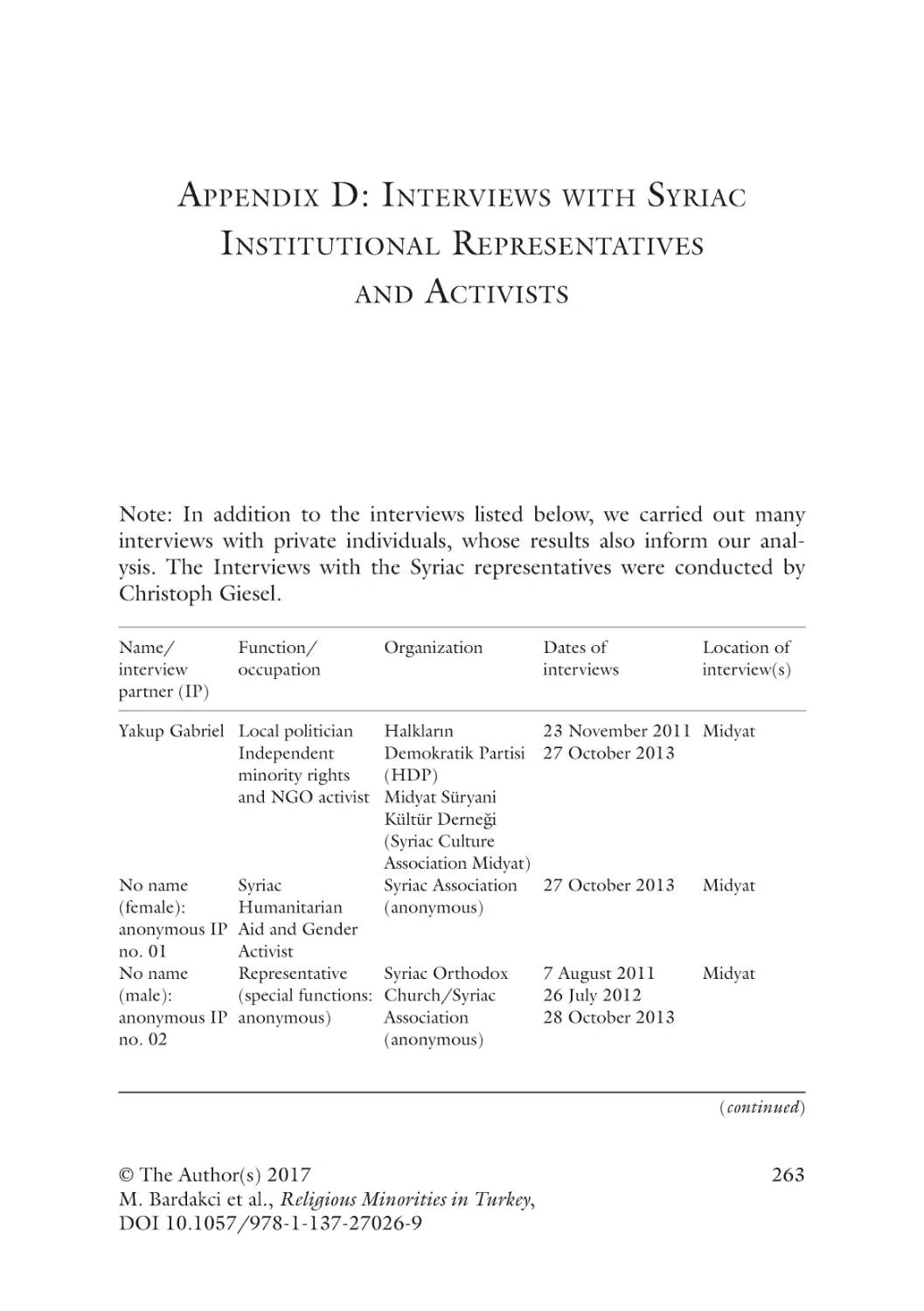
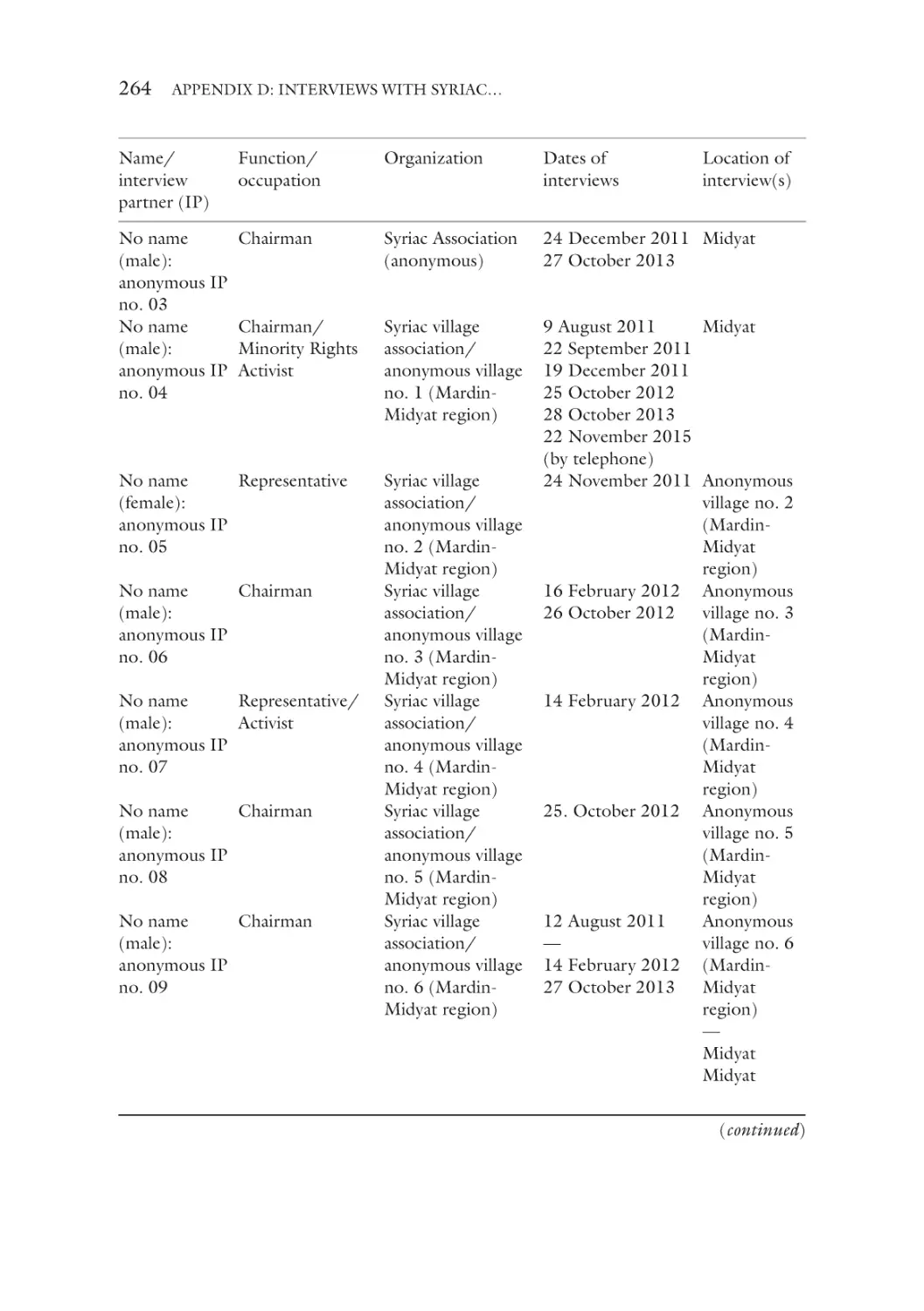
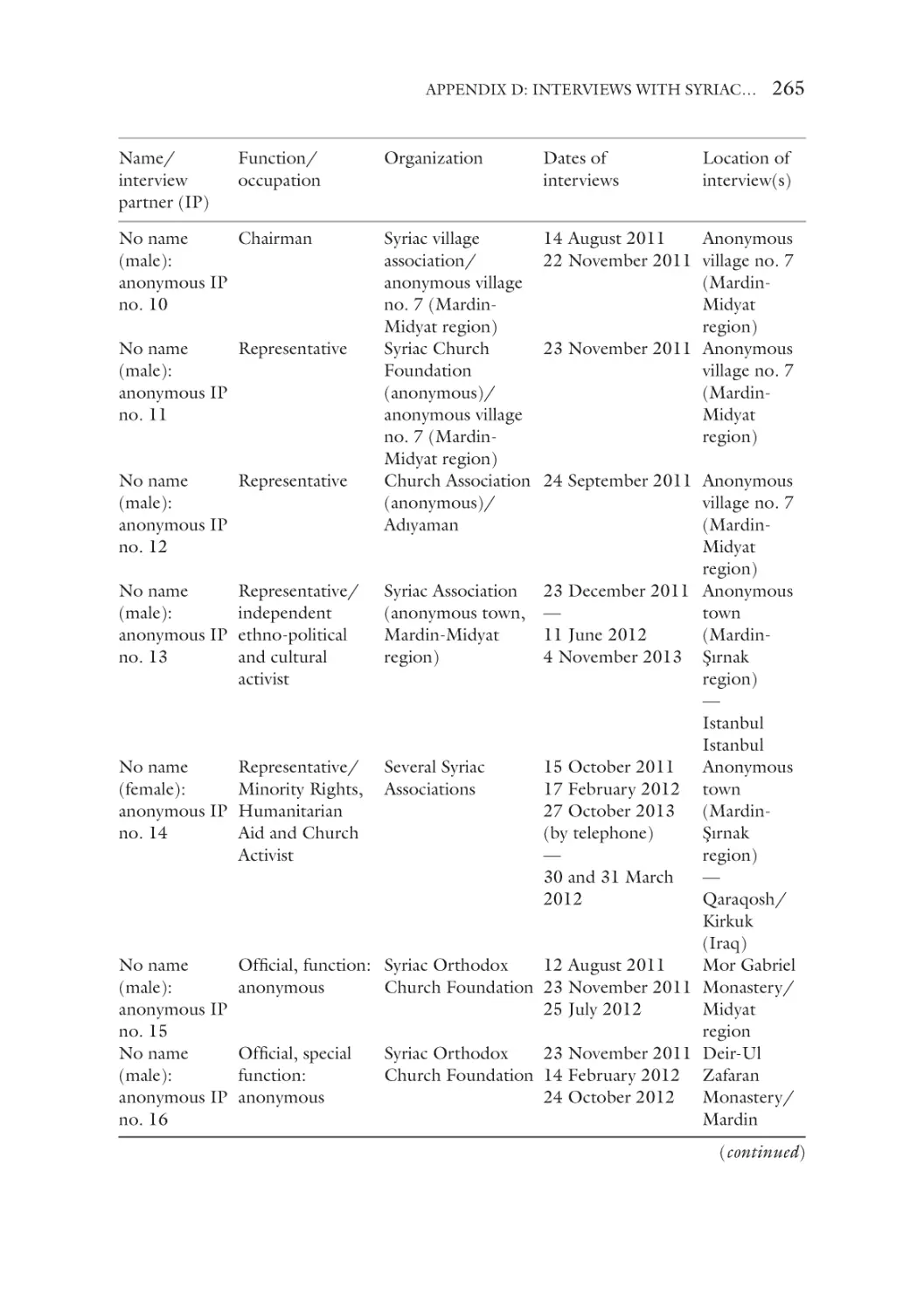
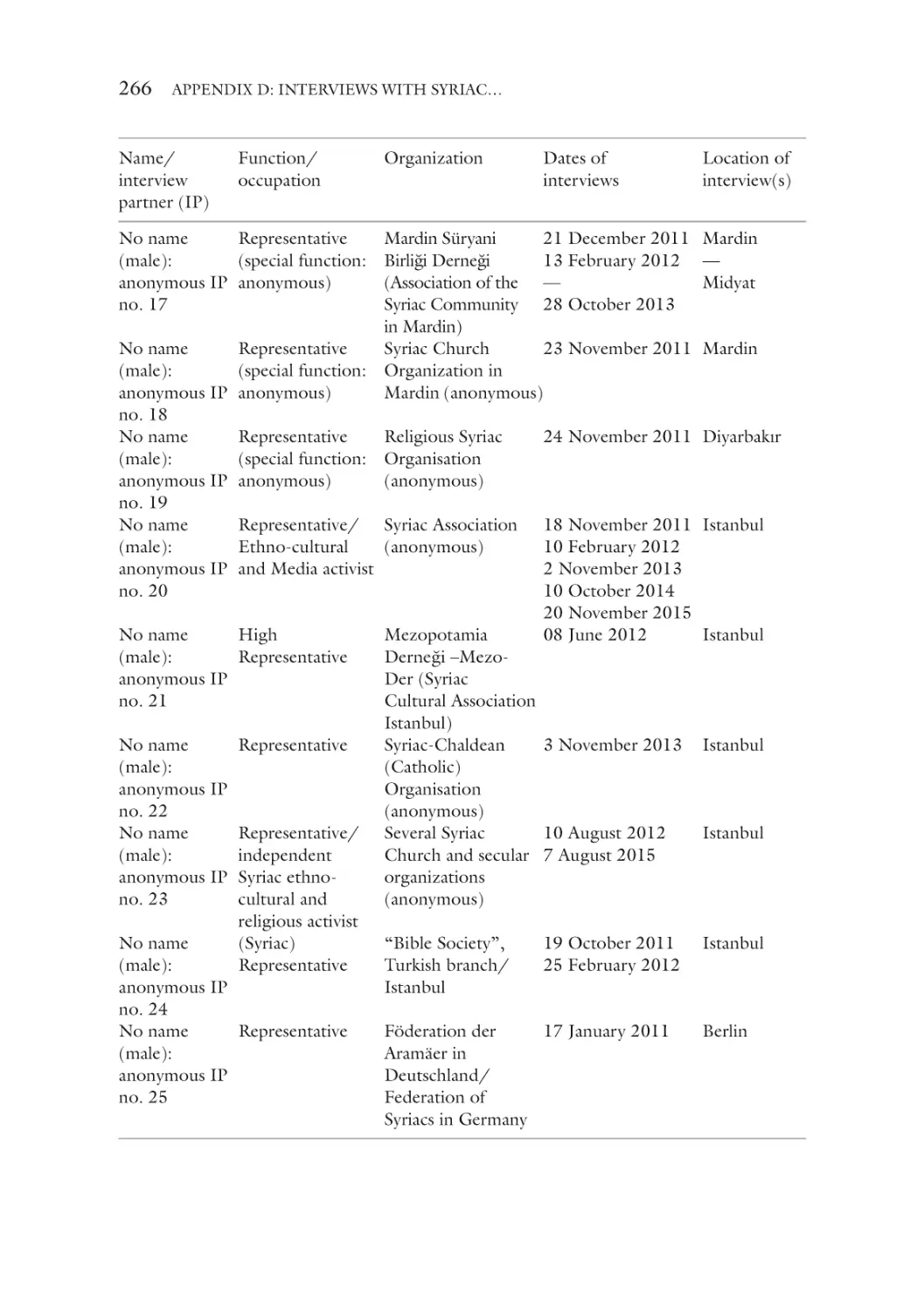


Автор: Bardakci M. Freyberg-Inan A. Giesel C. Leisse O.
Теги: religion
ISBN: 978-1-137-27025-2
Год: 2017


Текст
Religious
Minorities
in Turkey
Alevi, Armenians, and Syriacs
and the Struggle to Desecuritize
Religious Freedom
Mehmet Bardakci, Annette Freyberg-Inan,
Christoph Giesel and Olaf Leisse
Religious Minorities in Turkey
“This is a timely book looking at the complex issues of religious minorities and
their security problems in Turkey. It provides a much needed analysis in an area
previously understudied and addresses a gap in the literature.”
—Professor Meltem Müftüler-Baç, Sabancı University, Turkey
“Turkey has made temporary, partial political and social progress which has made
life a little easier for minorities, before taking alarming steps backwards recently.
This book will be able to contribute to a better understanding of the social and
political prospects of the country and gives scientific insights into the difficult situation of religious minorities.”
—Professor Thede Kahl, Friedrich-Schiller-Universität Jena, Germany
Mehmet Bardakci • Annette Freyberg-Inan • Christoph Giesel • Olaf Leisse
Religious Minorities
in Turkey
Alevi, Armenians, and Syriacs and the Struggle to
Desecuritize Religious Freedom
Mehmet Bardakci
Department of Political Science and
International Relations
Yeni Yüzyil University,
İstanbul, Turkey
Christoph Giesel
Department of Slavonic and
Caucasian Studies
Friedrich Schiller University Jena
Jena, Thüringen, Germany
Annette Freyberg-Inan
University of Amsterdam
The Netherlands
Olaf Leisse
University of Jena
Jena, Germany
ISBN 978-1-137-27025-2 ISBN 978-1-137-27026-9
DOI 10.1057/978-1-137-27026-9
(eBook)
Library of Congress Control Number: 2016961241
© The Editor(s) (if applicable) and The Author(s) 2017
The author(s) has/have asserted their right(s) to be identified as the author(s) of this work
in accordance with the Copyright, Designs and Patents Act 1988.
This work is subject to copyright. All rights are solely and exclusively licensed by the
Publisher, whether the whole or part of the material is concerned, specifically the rights of
translation, reprinting, reuse of illustrations, recitation, broadcasting, reproduction on
microfilms or in any other physical way, and transmission or information storage and retrieval,
electronic adaptation, computer software, or by similar or dissimilar methodology now
known or hereafter developed.
The use of general descriptive names, registered names, trademarks, service marks, etc. in this
publication does not imply, even in the absence of a specific statement, that such names are
exempt from the relevant protective laws and regulations and therefore free for general use.
The publisher, the authors and the editors are safe to assume that the advice and information
in this book are believed to be true and accurate at the date of publication. Neither the
publisher nor the authors or the editors give a warranty, express or implied, with respect to
the material contained herein or for any errors or omissions that may have been made.
Cover illustration: Images & Stories / Alamy Stock Photo
Printed on acid-free paper
This Palgrave Macmillan imprint is published by Springer Nature
The registered company is Macmillan Publishers Ltd.
The registered company address is: The Campus, 4 Crinan Street, London, N1 9XW, United
Kingdom
Preface
and
Acknowledgments
When we applied for a European Commission enlargement grant “PRINCE
2009—EU27” in 2009 as a consortium of three universities—Izmir Gediz
University, University of Amsterdam, and Friedrich Schiller University of
Jena—we included a research project on minorities in Turkey as part of the
overall project, which also included a broad range of outreach activities to
familiarize the public with Turkey’s accession process. This was because
“respect for and protection of minorities” was one of the Copenhagen criteria that were laid down at the June 1993 European Council and that EU
candidates had to fulfill in order to become members. Moreover, in view
of the EU progress reports, minority rights was one of the fields in which
Turkey had to undertake far-reaching reforms in order to align its legislation with that of the EU. This stems from the fact that the very existence
of minorities has historically been highly securitized in the Turkish nation-
building process, which has stood in the way of strengthening minority
rights. Thus, we wanted to find out to what extent Turkey has indeed met
the EU demands and improved the lives of its minorities. To what extent
and how have minorities been desecuritized in the context of Turkey’s
EU candidacy, and how do the minorities in Turkey themselves evaluate
this process and its results? We chose a focus on religious minorities and
in particular on the Alevi, Armenians, and Syriacs (Assyrians). For each of
these groups, we collected extensive new primary data by means of surveys
as well as in-depth interviews and relied on a broad range of other sources.
We analyzed our data using both qualitative and quantitative methods.
Each chapter in this book on a respective minority group (4–6)
can be read individually for detailed information about the respective
v
vi
PREFACE AND ACKNOWLEDGMENTS
group. They are written in such a way that they are comprehensible as
freestanding texts. Chapters 2 and 3 provide the necessary background
for understanding why and how religious minority rights are an issue for
Turkey and for its European integration process. They also clarify our
theoretical vocabulary of securitization and desecuritization. Chapter
7 allows the reader to compare the situations, perceptions, and characteristics of the examined groups and draw important general conclusions. Our volume thereby provides a very rare opportunity to explore
the situation of the covered minorities in comparative perspective. The
book should be of interest to scholars, practitioners, and interested citizens curious about minority rights, religious minorities more particularly, Europeanization processes, Turkey, or any of the specific groups
analyzed in depth here.
This book has been prepared by four authors, and it seems useful to
indicate our respective responsibilities. The project was developed, discussed, and planned by all four authors. The interview questions for civil
society representatives and experts were designed by Mehmet Bardakci.
The survey for ordinary citizens was co-designed, tested, and re-designed
by Christoph Giesel with the support of Olaf Leisse. All field research was
conducted by Mehmet Bardakci and Christoph Giesel. The Alevi were
interviewed and surveyed by Mehmet Bardakci (with some support from
Christoph Giesel); the Armenians and Syriacs were interviewed and surveyed by Christoph Giesel. Mehmet Bardakci authored Chap. 4 and Sects.
2.2. and 3.3. Christoph Giesel authored Chaps. 5 and 6 and Sects. 3.2.
and 3.4. Olaf Leisse conducted the statistical analysis: (with some support
from Christoph Giesel) and authored Chap. 7 as well as Sect. 2.1. Annette
Freyberg-Inan authored Chap. 1, Sect. 3.1., and Chap. 8 and reworked
and edited the entire manuscript.
As always, a project of this magnitude could not have been realized without the support, professional and personal, of others. We wish to thank the
European Commission for the funding granted as well as our three respective universities—Izmir Gediz University, University of Amsterdam, and
Friedrich Schiller University of Jena. Annette Freyberg-Inan thanks her
partner, Boris Slijper, for being there with heart and mind and challenging
her to write better books. Our gratitude also goes out to all those whom
we were able to interview and who filled in our survey as well as the many
colleagues and participants in events who inspired and supported us in the
larger context of the PRINCE 2009 project.
PREFACE AND ACKNOWLEDGMENTS
vii
Christoph Giesel in particular gives his heartfelt thanks to all Syriacs and
Armenians as well as all Turks and Kurds of both Alevi and Sunni background who offered him their kind support throughout years of extensive
fieldwork. He thanks those many persons who, with their helpfulness, selflessness, kindness, and patience, added to the successful execution of this
study and without whom this book would not have been possible. For reasons of personal security, given the circumstances then and now in Turkey,
these people have chosen to remain anonymous. Christoph further thanks
the persons surrounding him at home for their patience, helpfulness, and
emotional support during the tough stages of research, evaluation, and
writing, especially Dr. Karolin Weigel and Paul-Anton Giesel as well as Dr.
Katja Richters and Stephanie Luther. He dedicates his work and his part
in the book to all members of minorities and ethnic groups in Turkey who
are facing an adverse political, legal, and social situation. The country has
made temporary, partial political and social progress, which has made life
a little easier for those concerned, before taking alarming steps backward
recently. He wishes that, in future, all persons concerned will have better
existential, social, and political prospects and hopes that the knowledge
and insights this book can provide will at least make a small contribution
to better their difficult situation and heighten the understanding of its
background. Christoph dedicates his work most particularly to the Syriac
people, whose religious, cultural, and even physical existence is seriously
threatened not only in Turkey but in all countries of the Near East, even
as they have a particularly long history within this area and been a strong
influence on regional cultures and societies.
Contents
1
Introduction 1
1.1 Turkey-EU Relations and Turkish Politics
Since the Helsinki Summit 1
1.2 The Evolution of Minority Rights in Turkey
Since the Helsinki Summit: Contributions of this Book,
Approach, Methodology, and Data 11
1.3 Overview of the Book’s Contents 17
Notes 21
Bibliography 23
2
European Integration and Minority Rights 25
2.1 EU Enlargement and the Evolution
of Minority Rights Governance 25
2.2 The EU’s Evaluation of Turkey’s Progress in the
Field of Minority Rights from 1998 to 2015 37
Notes 47
Bibliography 49
ix
x
Contents
3
Securitization and Desecuritization of Minority Rights 55
3.1 Minority Rights in Political Context: The Vocabulary
of “Securitization” and “Desecuritization” 55
3.2 The History of Securitization of Minority
Rights in Turkey: Ethnic and Religious Diversity
and the Political Perception of the Minority Question 59
Multi-ethnicity and Multi-religiousness in Turkey:
An Overview 59
The Phenomenon “Minority” as a Social Category
in the Turkish Context 63
The History of Securitization of Minority Rights in Turkey 67
3.3 Desecuritization of Minority Rights Since
the 1999 Helsinki Summit 77
3.4 Conclusion 87
Notes 90
Bibliography 91
4
The
4.1
4.2
4.3
Alevi, the AKP Government and the Alevi Initiative 97
Introduction 97
The Development of Alevi Identity in Turkey 99
Alevi Demands and Grievances 102
Recognition of Cem Houses (Alevi Places of Worship) 103
Recruitment in the State and Public Tenders 104
Diyanet (The Presidency of Religious Affairs) 104
4.4 Different Interpretations of Alevism
and Divergent Demands 106
4.5 The Alevi Initiative of the AKP Government 108
4.6 The Alevi Workshops and Their Outcomes 115
4.7 Deterioration of Alevi-AKP Relations 121
4.8 The AKP Government’s Efforts Under
Prime Minister Davutoğlu to Bridge the Gap
with the Alevi Community 125
4.9 Conclusion 127
Notes 128
Bibliography 128
Contents
xi
5
The Ambivalent Situation of Turkey’s Armenians: Between
Collective Historical Trauma and Psychological Repression,
Loyal Citizenship and Minority Status, Social Integration
and Discrimination, Assimilation and Self-assertion 133
5.1 Introduction 133
5.2 The Origin, Religion, Number, Spread, and
Ethno-religious Environment of the Armenians in Turkey 135
5.3 Historical Situation and Circumstances 137
The Armenians in the Ottoman Empire and
the 1915 Events 137
The Situation of the Armenians in the Turkish Republic
from 1923 Until the End of the Twentieth Century 142
5.4 Contemporary Situation and Circumstances 145
Aspects and Ambivalence of Improvements of the Political
and Social Situation of Turkey’s Armenians
in the 2000s and the Role of the EU 145
General and Specific Political and Social Problems
in Contemporary Turkey 148
Forms of Ethnic and Religious Organization 152
Integration and Experiences in Their
Social Environment and Socio-political
Attitudes of Turkey’s Armenians 154
5.5 Final Remarks, Latest Developments, and Prospects 158
Notes 160
Bibliography 162
6
Like a Drop in the Ocean: The Last Syriacs in Turkey
in a Maelstrom of Nationalism, Islamism, Assimilation,
and Diverging Socio-political Interests 165
6.1 Introduction165
6.2 Ethnic and Confessional Group Identities
and Differentiations 167
6.3 Distribution, Group Size, Linguistic Idiosyncrasies,
and Ethnic and Religious Environment of Syriacs
in Contemporary Turkey 168
6.4 Historical Development and Genesis of
the Persecution of the Syriacs in the
Ottoman Empire and the Turkish Republic 170
xii
Contents
Situation and Conflicts of the Syriacs in the
Ottoman Empire 170
Situation and Conflicts of Syriacs in the Turkish Republic
until the End of the 1990s 171
6.5 Syriacs in the Twenty-first Century: Conditions
and Situation in the Context of Political and Social
Transformations 174
Fundamental Improvements 175
General Legal and Political Problems 177
Selected Local Issues, Problems, and Circumstances
and the Role of Different Political Actors 179
Aspects of Kurdish-Syriac Cooperation, Pro-Syriac
Attitudes, and the Role of BDP/HDP 182
Group-internal Distinctions and Regional
Differences in the Syriac Community Regarding
Ethno-cultural and Ethno-political Activities 184
6.6 Latest Developments and Concluding Remarks 186
Notes 190
Bibliography 190
7
General and Comparative Analysis 193
7.1 General Information 193
7.2 Patterns of Identification 194
7.3 State and Religion 207
7.4 Society and Discrimination 218
7.5 The Role of the European Union 226
Note 230
8 Conclusions 231
8.1 Looking Back 231
8.2 Looking Forward 235
Note 238
Bibliography 238
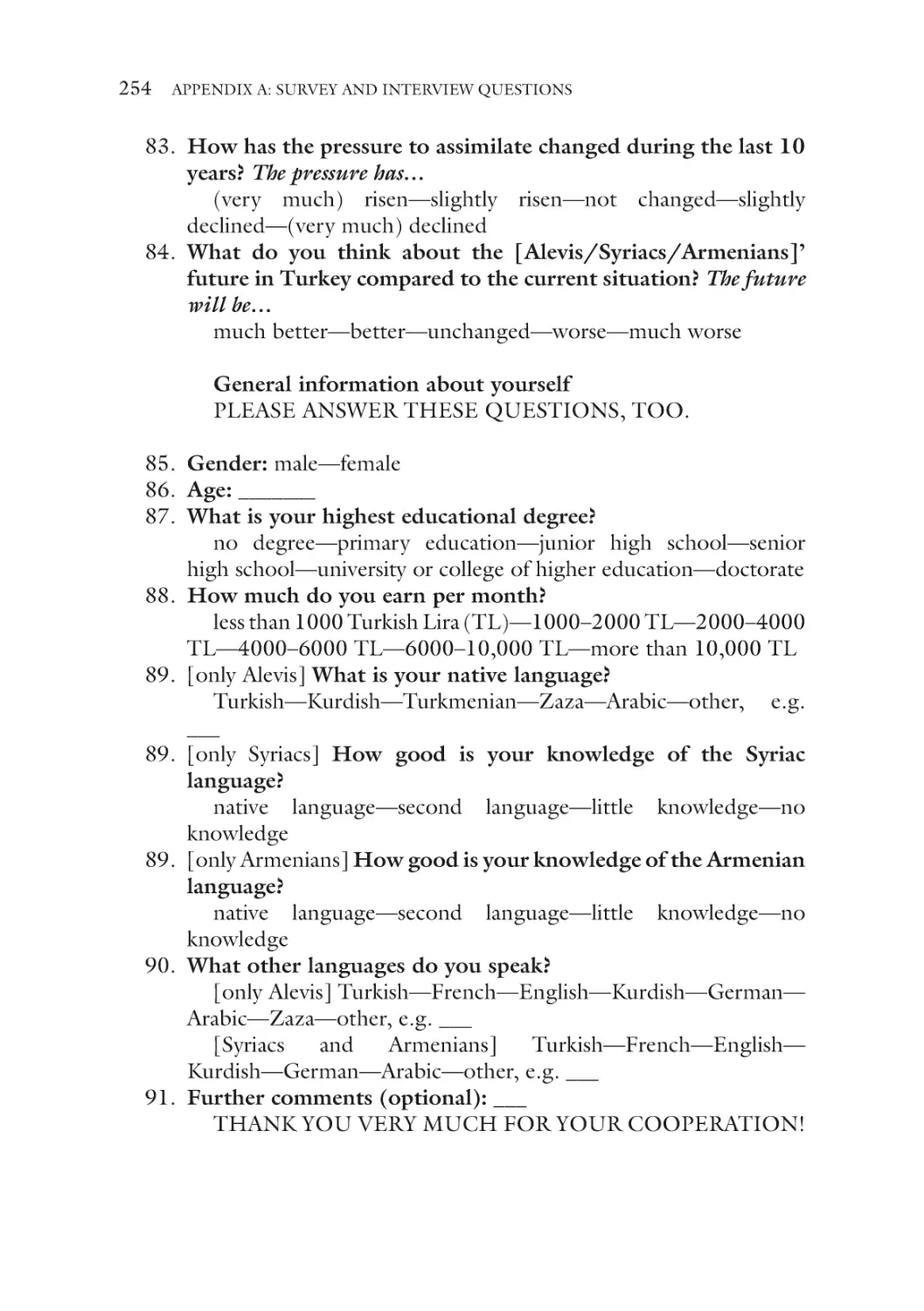
Appendix A: Survey and Interview Questions 239
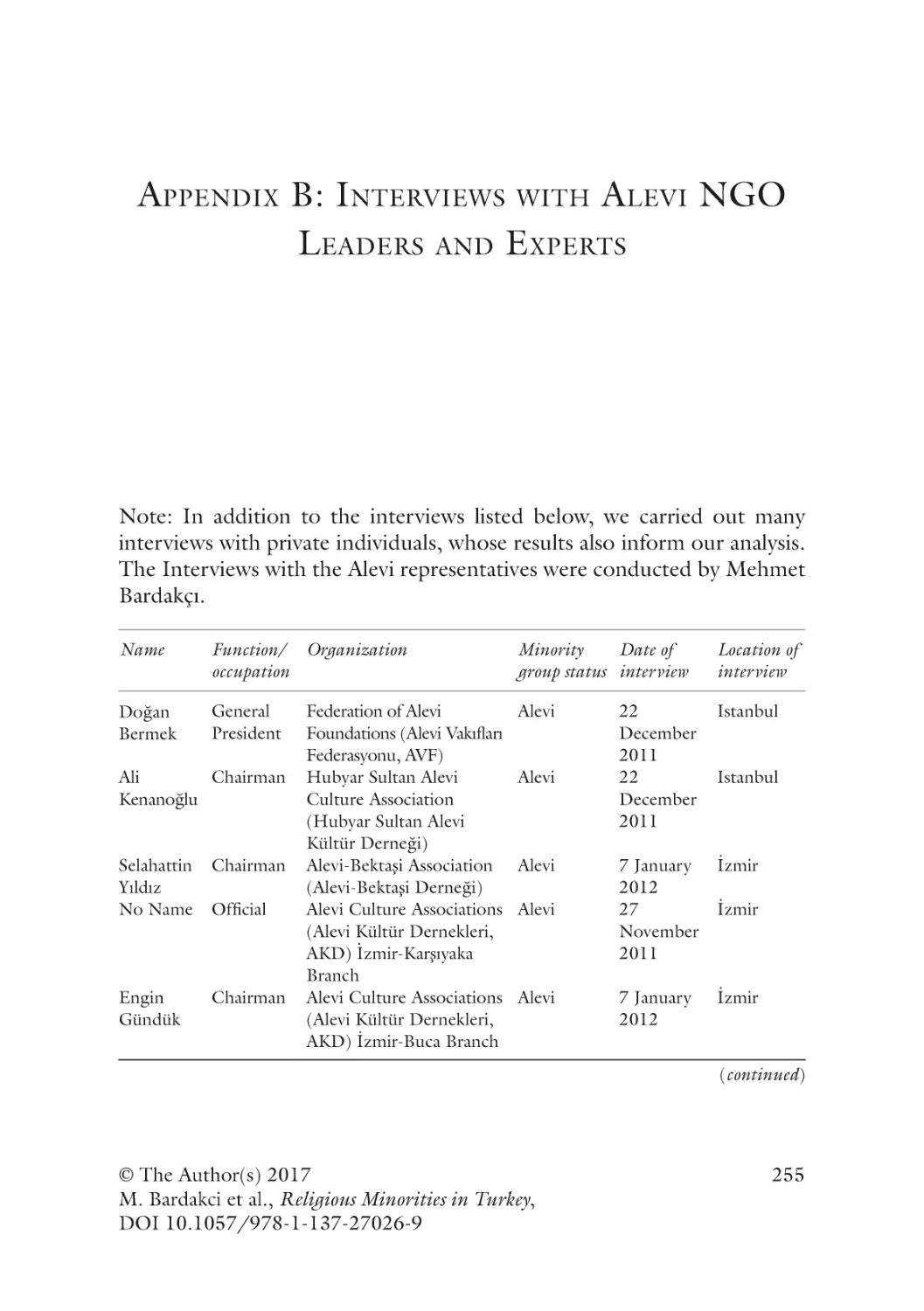
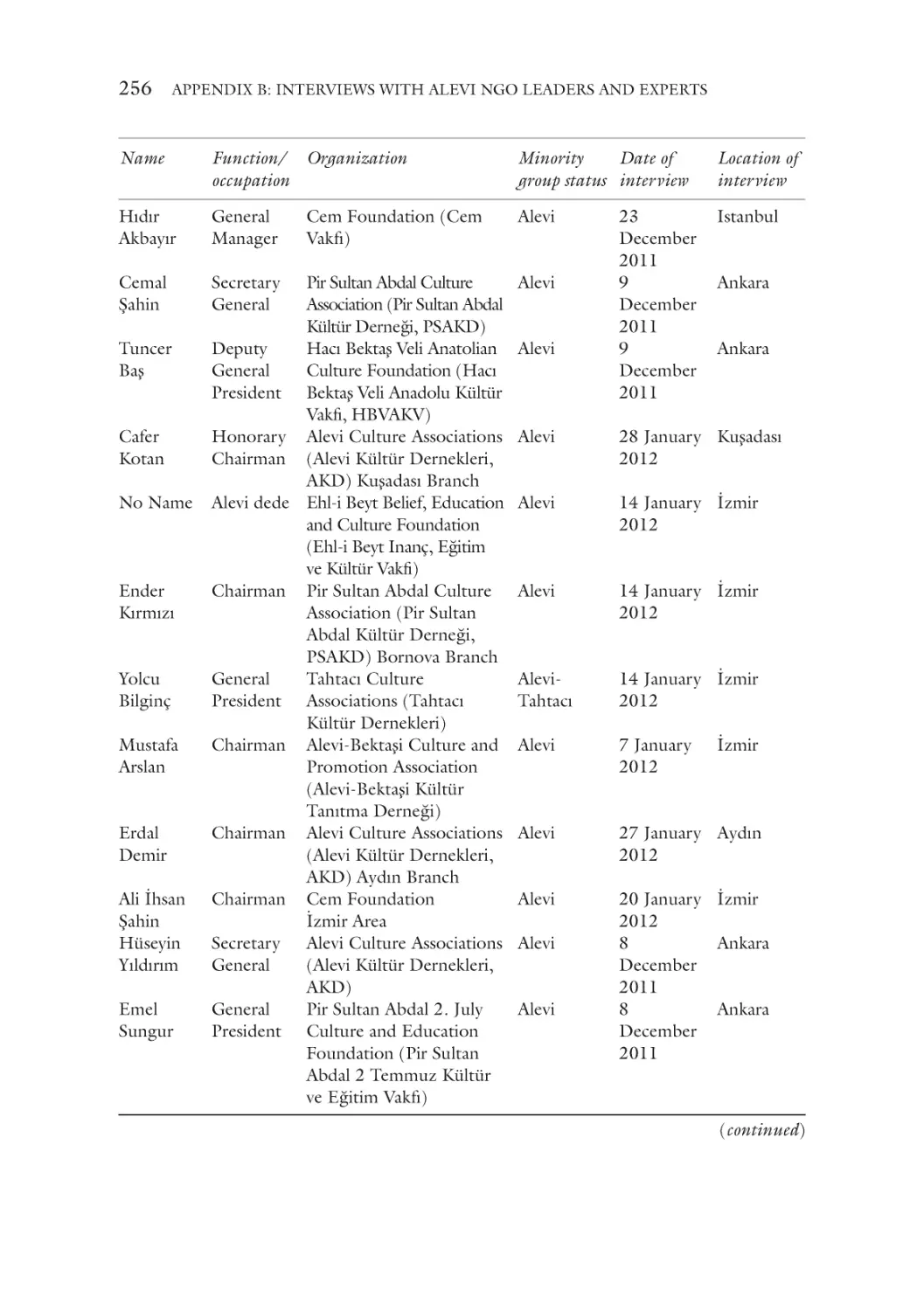
Appendix B: Interviews with Alevi NGO Leaders and Experts 255
Contents
xiii
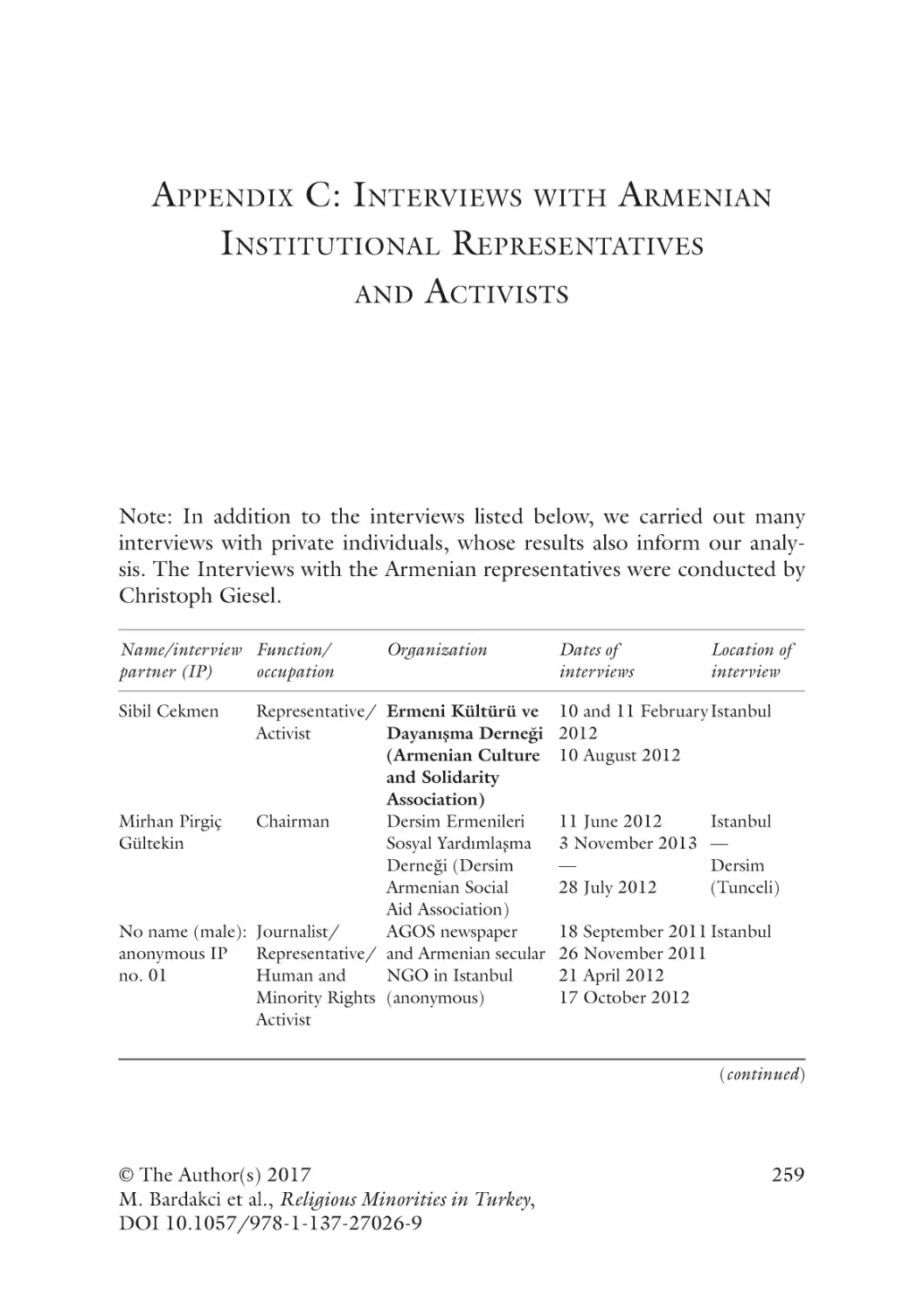
Appendix C: I nterviews with Armenian Institutional
Representatives and Activists 259
Appendix D: I nterviews with Syriac Institutional
Representatives and Activists 263
Appendix E: Expert Interviews 267
Bibliography 269
Index271
List
of
Figures
Fig. 7.1 Minority identities (mean values)
Fig. 7.2 Identity as Turkish citizen (mean values)
Fig. 7.3 Characteristics of identity—religion (mean values)
Fig. 7.4 Characteristics of identity—culture (mean values)
Fig. 7.5 Characteristics of identity—history (mean values)
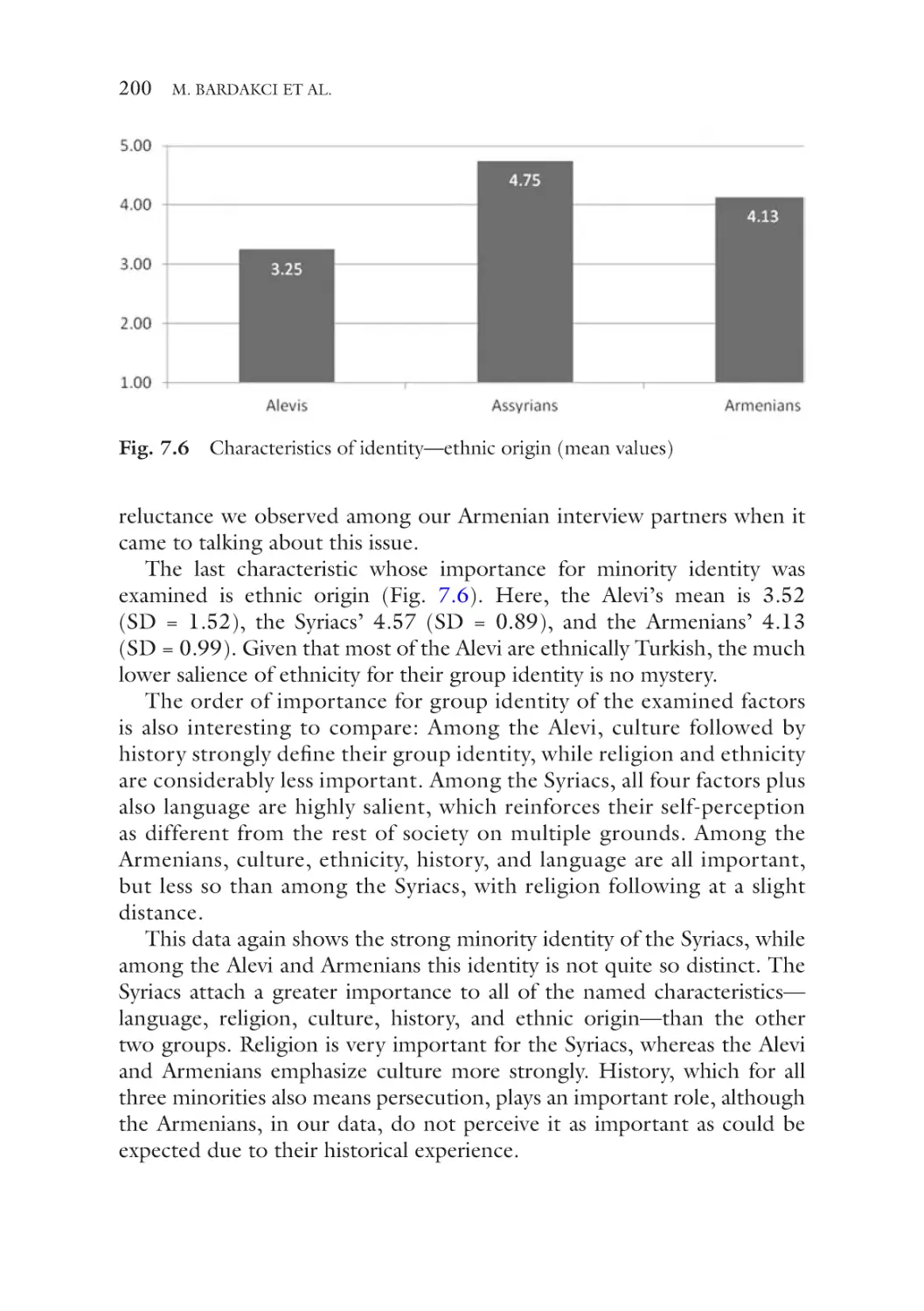
Fig. 7.6 Characteristics of identity—ethnic origin (mean values)
Fig. 7.7 Importance of marriage for the sustainment of the own group
(mean values)
Fig. 7.8 Acceptance of marriage of relatives to members of the own
group and of the Sunni majority society (mean values)
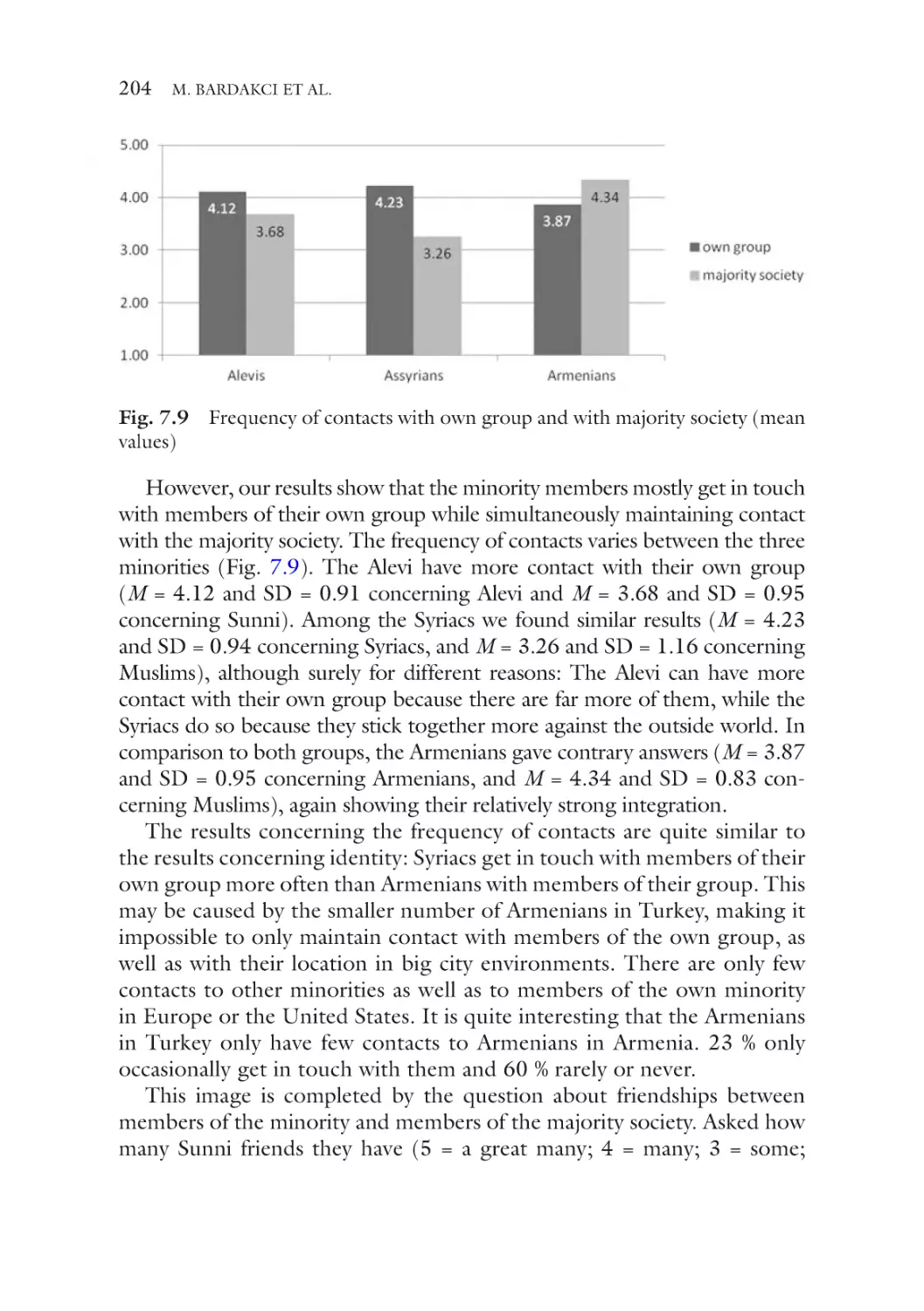
Fig. 7.9 Frequency of contacts with own group and with majority
society (mean values)
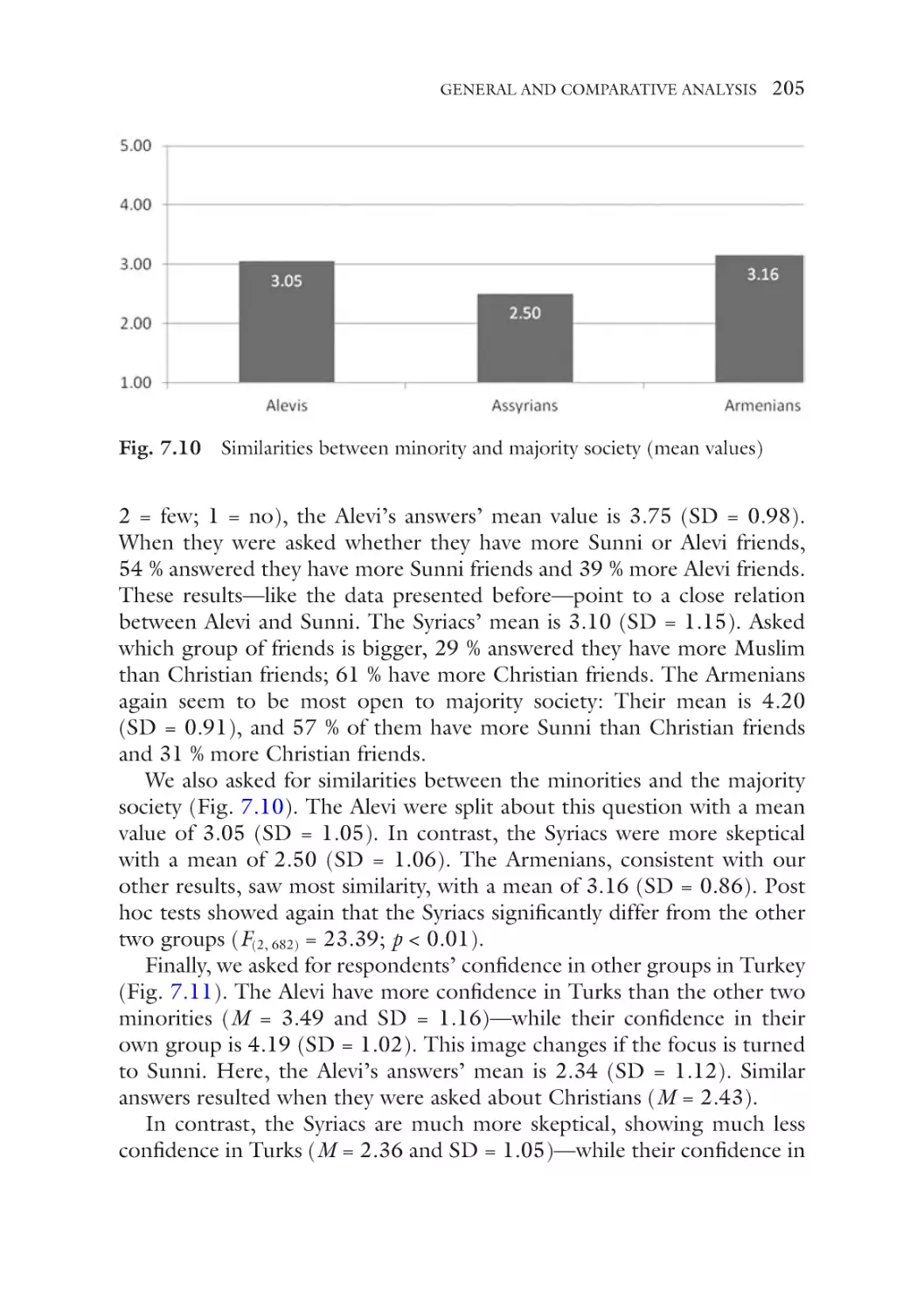
Fig. 7.10 Similarities between minority and majority society (mean values)
Fig. 7.11 Confidence in Turks (mean values)
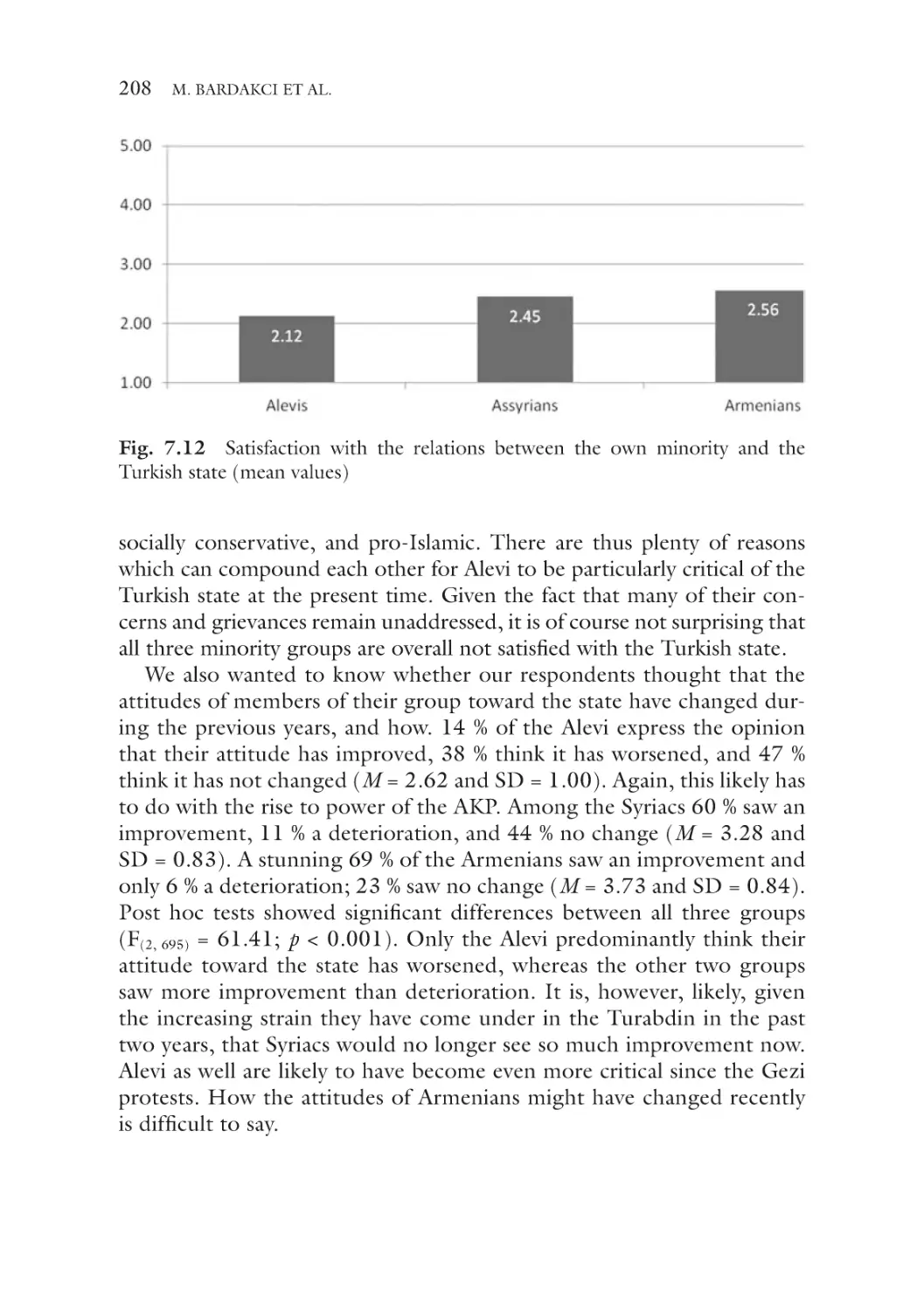
Fig. 7.12 Satisfaction with the relations between the own minority
and the Turkish state (mean values)
Fig. 7.13 Opinion about the state’s attitude toward minorities
Fig. 7.14 Frequency of discrimination against the own minority by
the Turkish state
Fig. 7.15 Frequency of discrimination against the interviewee by the
Turkish state
Fig. 7.16 Change of the Turkish state’s attitude toward the three
minorities during the last ten years
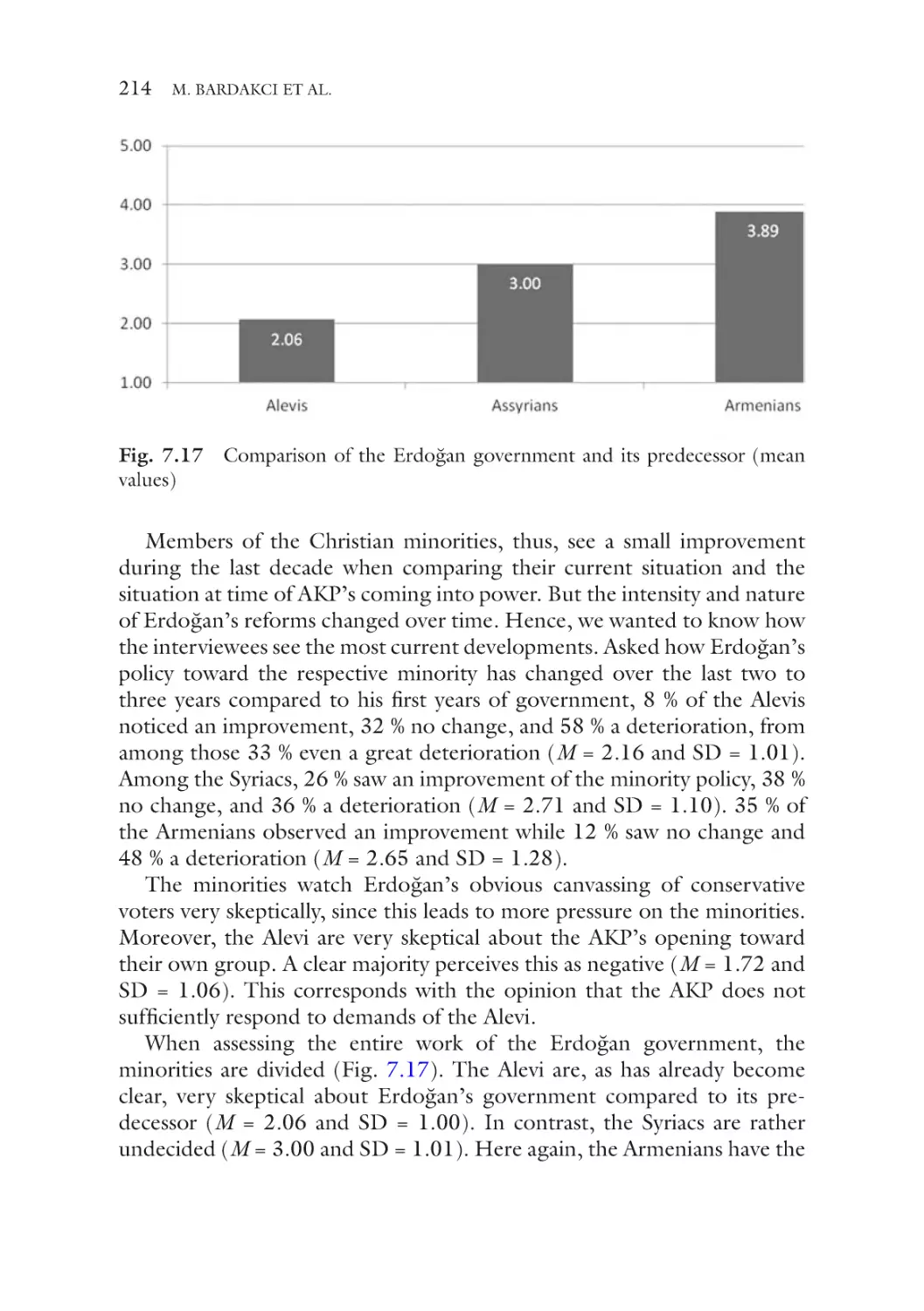
Fig. 7.17 Comparison of the Erdoğan government and its predecessor
(mean values)
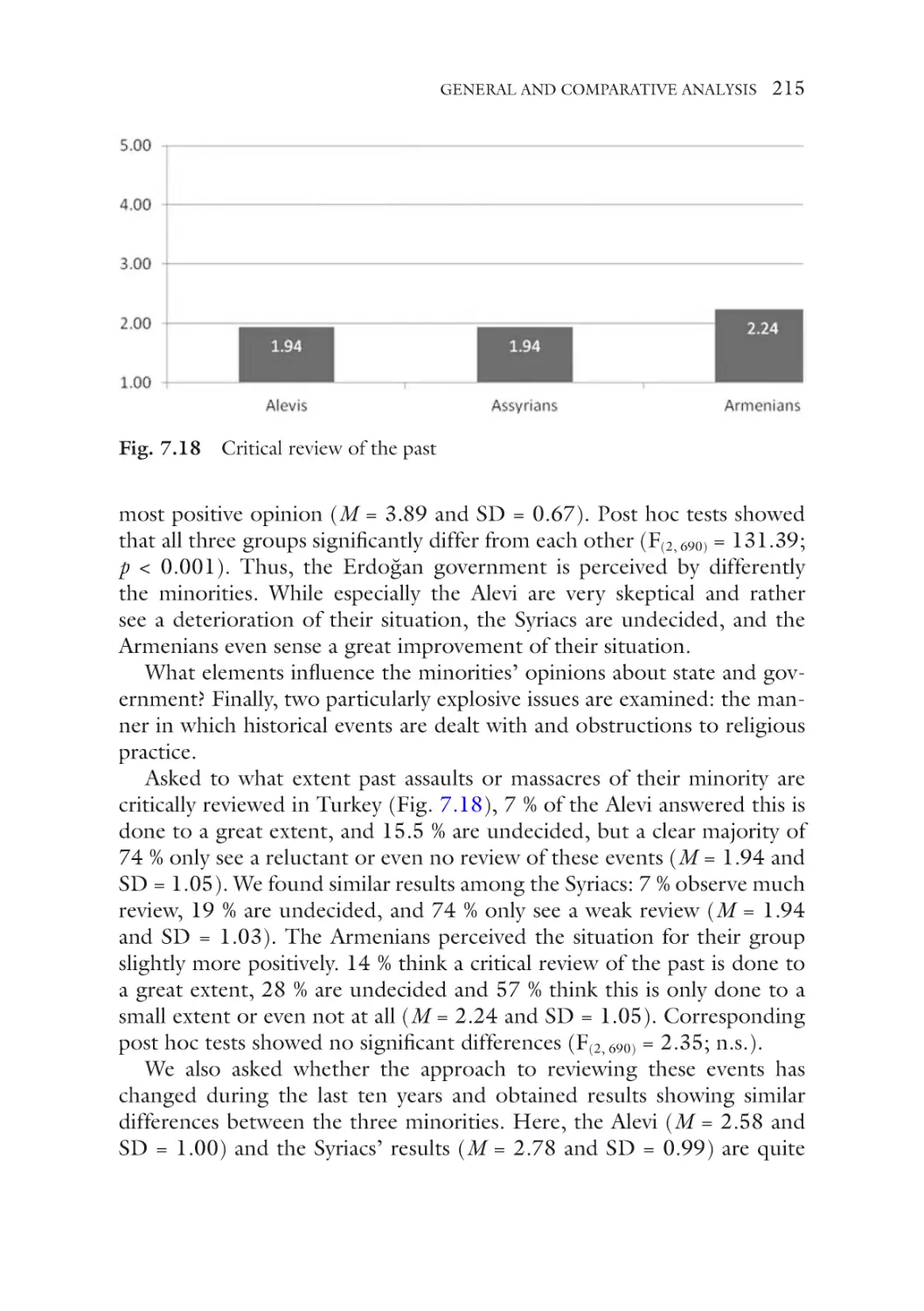
Fig. 7.18 Critical review of the past
Fig. 7.19 Obstruction of religious practice (mean values)
195
196
198
199
199
200
202
202
204
205
206
208
209
211
211
213
214
215
216
xv
xvi
List of Figures
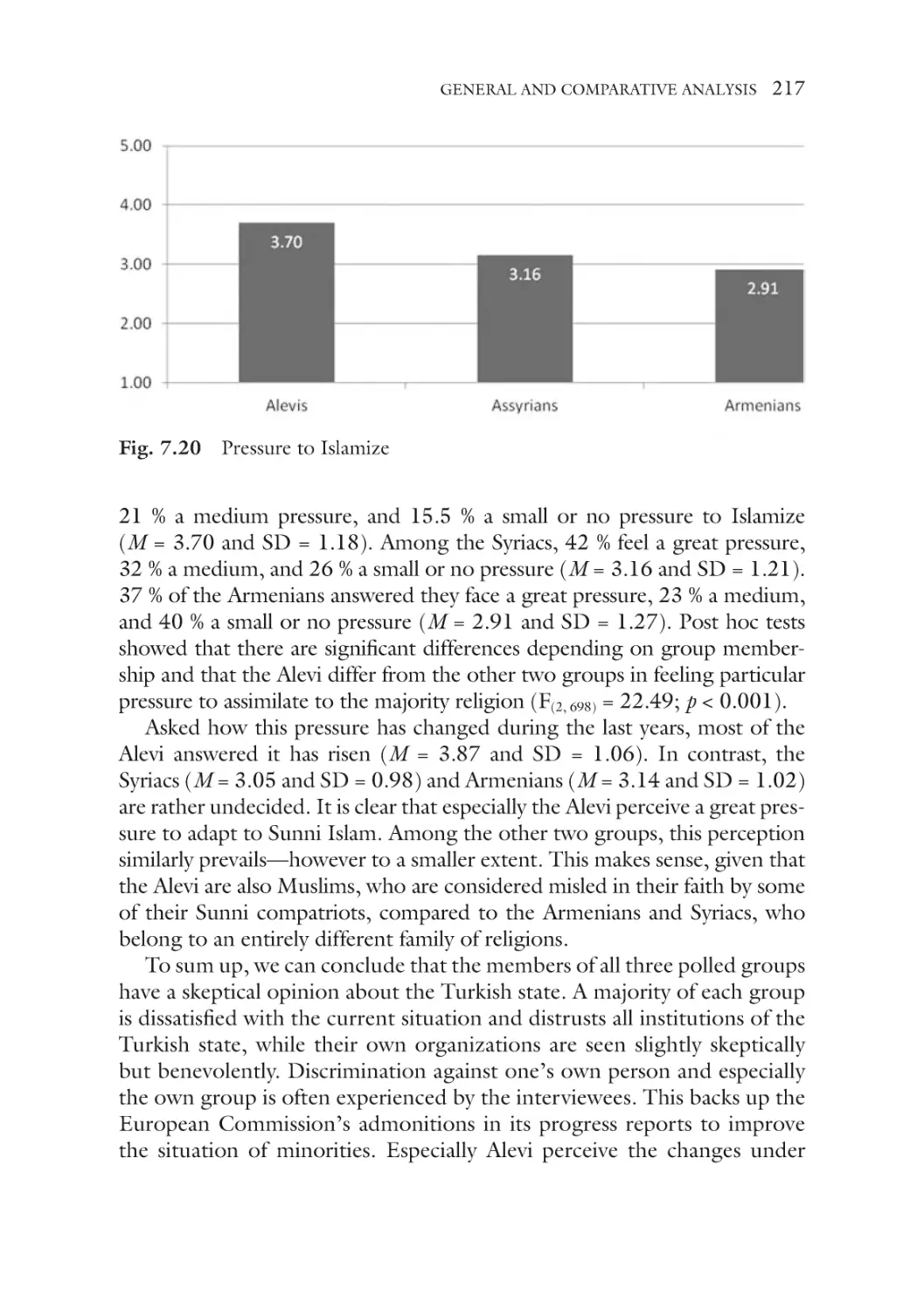
Fig. 7.20 Pressure to Islamize
Fig. 7.21 Satisfaction with the relations to the Turkish majority society
(mean values)
Fig. 7.22 Change of relations to the Turkish majority society
(mean values)
Fig. 7.23 Frequency of discrimination by the majority society
Fig. 7.24 Changes of the discrimination by the Turkish majority society
(mean values)
Fig. 7.25 Pressure to emigrate by the majority society
Fig. 7.26 Pressure to assimilate by the majority society
Fig. 7.27 Change of attitude toward the state (mean values)
Fig. 7.28 Engagement of the European Union for minorities
Fig. 7.29 Effect of the accession negotiations on the respective
minority’s position (mean values)
Fig. 7.30 The European Union’s role regarding minority protection
(mean values)
Fig. 7.31 Evaluation of a future EU membership of Turkey
217
218
219
220
222
223
224
225
226
227
228
229
CHAPTER 1
Introduction
1.1 Turkey-EU Relations and Turkish Politics
Since the Helsinki Summit1
The long story of relations between Turkey and the European Union (EU)
can be read as one of gradual assimilation by Turkey to many expectations
and standards formulated by European counterparts. But it is hardly a
straightforward story of Europeanization. It displays leaps and bounds of
reform in line with EU demands, but also loops and detours, standstills,
and reversals, varied dynamics and varied outcomes across different issue
areas and different historical periods—in short, it is a multifaceted and
anything but uniform or linear process. This introductory chapter will first
provide a general overview of relations between Turkey and the European
Union and of Turkish politics in this context, before zooming in on the
specific focus of this book: the evolution of the rights of religious minorities in Turkey. In the second section we explain the contribution made by
this volume to understanding the changing situations of religious minorities in Turkey before the backdrop of European integration and AKP government, and outline our approach, methodology, and data. The third
section provides an overview of the book’s contents.
The time-line of relations between Turkey and what is now the
European Union began with Turkey’s application for associate membership of the European Economic Community (EEC) in September 1959.
© The Author(s) 2017
M. Bardakci et al., Religious Minorities in Turkey,
DOI 10.1057/978-1-137-27026-9_1
1
2
M. BARDAKCI ET AL.
A form of association agreement, the Ankara Agreement, was signed soon
after in September 1963, to lay the foundations for the later customs union
with the EEC; it envisioned eventual full EEC membership. In January
1973 an Additional Protocol to the Ankara Agreement entered into force,
which laid out the concrete steps for establishing the customs union.
Following the failure of diplomatic efforts to resolve conflicts between
Turkish and Greek Cypriots, in July 1974 Turkey invaded Cyprus. This
came in response to a coup d’état orchestrated by the Greek junta which
ousted Archbishop Makarios III, the Greek Cypriot President of Cyprus,
and installed in his place the pro-Enosis nationalist politician and journalist Nikos Sampson.2 After gaining control over 40 % of the island, Turkey
unilaterally declared a ceasefire, and Turkish Cypriots established their
own state in the north of the island, which to this day Turkey alone recognizes as a sovereign state.
In June 1980 the EU-Turkey Association Council moved to decrease
customs duties on almost all agricultural products to zero by 1987, but
after the military coup d’état in Turkey of September 1980, relations with
the EEC stagnated for about four years. On 14 April 1987, Turkey then
applied for full EEC membership. In December 1989 the Commission
confirmed Turkey’s eligibility for membership but deferred the assessment
of its application. In March 1995 the Association Council finalized the
agreement on the customs union, which entered into force on 1 January
1996. However, in what was a major blow to the Turkish side, at the
Luxembourg summit in December 1997 EU leaders declined to grant candidate status to Turkey. Turkish elites reacted with evident anger, temporarily freezing relations and contacts. Candidate status was finally granted
at the December 1999 Helsinki summit, Turkey accepted the associated
conditions with some reluctance, and a new period in Turkish-EU relations began. Turkey was now engaged in an accession process and met the
full force of the EU’s external governance through conditionality, including in the field of minority rights. The period since then is the one on
which we focus in this book.
In March 2001 the EU Council of Ministers adopted the EU-Turkey
Accession Partnership (revised in 2003, 2006, and 2008), and the Turkish
government adopted its first National Program for the Adoption of the
Acquis. On 13 December 2002 the Copenhagen summit decided that
the EU would open accession negotiations with Turkey if the European
Council were to conclude in December 2004, on the basis of a report
and recommendation from the Commission, that Turkey fulfills the
INTRODUCTION
3
Copenhagen political criteria for membership: democracy, the rule of law,
human rights, and respect for and protection of minorities. In the meantime, EU leaders agreed to provide Turkey with increased pre-accession
financial assistance. A massive reform process was set in motion in Turkey,
which was referred to by many as a “silent revolution”. In autumn 2001
the Turkish parliament adopted over 30 amendments to the constitution
to meet the Copenhagen political criteria. In August 2002 it passed further sweeping reforms to meet EU human rights criteria, including the
abolition of the death penalty except in times of war and the lifting of bans
on Kurdish-language education and broadcasting.
On 3 November 2002, the conservative Justice and Development party
(AKP, Adalet ve Kalkınma Partisi) won a landslide victory in the general
elections. An Islamic party, it had nonetheless run on pledges both to
stick to the secularist principles of the constitution and to keep pursuing
Turkey’s EU accession. And it did continue the associated reform process, especially in its first years in power. In December 2002 the Turkish
parliament overwhelmingly approved a package of human rights reforms,
including sanctions against torture. In June and July 2003 it passed further legal changes easing restrictions on freedom of speech, expanding
Kurdish-language rights, and reducing the political role of the military. In
January a protocol was signed and strongly welcomed by the EU which
banned the death penalty in all circumstances. In September 2004 the
Turkish parliament adopted a revised penal code, improving media freedom and introducing tougher measures to prevent torture and violence
against women (in force since 1 June 2005).3 A controversial proposal on
criminalizing adultery was dropped. The 17 December 2004 European
Council then decided to open accession negotiations with Turkey.
Ironically, for a number of reasons it was precisely around the time that
accession negotiations officially started that the reform process in Turkey
would slow down.
In the meantime, relations between the EU and Turkey had been significantly strained by the fact that the EU had accepted Cyprus as a member even though the Greek Cypriots had rejected the Annan Plan for a
settlement to the division of the island.4 Much disinformation has been
in circulation regarding what happened at that time. In fact, the EU had
agreed on the accession of the Republic of Cyprus even without unification before the referendum on the Annan Plan even took place. Days
before the referendum, the Greek Cypriot President Papadopoulos went
on TV and tearfully urged his people to vote against the Plan (which he
4
M. BARDAKCI ET AL.
had negotiated), openly admitting that he had lied to the EU. On 21 April
2004 EU Enlargement Commissioner Günter Verheugen addressed the
European Parliament and recalled angrily that in 1999 the Greek Cypriot
government of the time had promised to do everything in its power to
secure a settlement. In return the EU had agreed not to make a solution to the Cyprus conflict a prerequisite for accession. Verheugen’s anger,
however, had no consequences. Cyprus became a member, and the Greek
Cypriot government promptly undermined the Council decision of 26
April 2004 to lift the sanctions on Northern Cyprus. The EU’s acceptance
of such maneuvering on the part of Greek Cyprus created impressions of
dishonesty and favoritism on the Turkish side and fed emotions of humiliation and distrust. In this context, Turkey was pushed hard to sign the
Additional Protocol to the Ankara Agreement, which extended the customs union to the ten new member states, including Cyprus. It eventually
did on 29 July 2005, but simultaneously issued a declaration on non-
recognition of Cyprus and continued to refuse to apply the Additional
Protocol to Cyprus, which would have required it to open its ports and
airports to Cypriot traffic. Actors on the EU side displayed little understanding for just how difficult it was at that moment for Turkey to continue on its track of European integration.
Aside from the issue of Cyprus, the cool-down in EU-Turkey relations
at the time was further reinforced by critical voices regarding Turkey’s
accession raised by leading EU powers, such as France and Germany; by
the EU constitutional crisis triggered by the rejection of the EU constitutional treaty by France and the Netherlands in separate referenda in
2005; and by the announcement on the EU side of additional conditions
to be placed on Turkey’s accession, such as a permanent ban on Turkish
workforce even after Turkey’s full membership. This helped render EU
accession increasingly unattractive for Turks, contributing significantly to
the rise of Euroskepticism in the country (Dikici Bilgin 2016).
Accession talks with Turkey were symbolically opened on 3 October
2005 after months of intense bargaining, and began de facto on 12 June
2006. The negotiating framework specifies 35 chapters, each of which
needs to be unanimously opened and closed by the Council. The Council
agreed to open and close the chapter on science and research immediately. However, a new period of difficulty in EU-Turkey relations was
just around the corner. In the same month of June 2006 the Turkish
parliament reacted to a series of terrorist attacks by passing a new antiterror law, which was criticized by human rights groups as an invitation to
INTRODUCTION
5
t orture and also drew criticism from the EU. In July 2006 a court ruling
against the journalist and Armenian community leader Hrant Dink for
“insulting Turkishness”5 raised concerns over freedom of expression in
Turkey; observers also worried about the appointment of the hard-line
general Yaşar Büyükanıt as chief of the Turkish military. Partly in response
to these developments, a September 2006 European Parliament report on
Turkey’s progress in preparing for membership complained that the country had made insufficient progress in the areas of freedom of expression,
minority rights, corruption, and violence against women. The November
2006 Commission progress report was similarly critical on Turkey’s accession progress, complaining also about Ankara’s failure to open its ports
and airports to Cypriot traffic. The Commission recommended partial
suspension of membership negotiations. In December 2006 the EU foreign ministers followed these recommendations and suspended talks with
Turkey on eight of the 35 negotiation chapters. Accession negotiations
have proceeded very slowly ever since then.
On 22 July 2007 the ruling AKP government was re-elected. In
July 2008 the Turkish Constitutional Court narrowly rejected allegations that the party was undermining the secular constitution and
trying to establish an Islamist state. Had the court ruled differently,
this would have led to the closure of the party and banning of 71
leading party members from politics for five years—and thereby to a
fundamental restructuring of the Turkish political landscape. With the
beginning of the AKP government’s second term in office, various
developments instead began to point toward an increasing entrenchment of AKP power structures and attempts to clear the political landscape of opponents which could be seen to challenge its rule. October
2008 saw the beginning of the Ergenekon trials, in which initially 86
members of the military and security establishment stood accused of
plotting a series of attacks and provoking a military coup against the
government. Several additional rounds of indictments followed. In
September 2009 the government-controlled tax authorities raised tax
fraud charges to the tune of $2.5 billion against the Doğan Media
Holding, which had taken a critical stance against the government. In
February 2010 nearly 70 members of the military were arrested over
the alleged “Sledgehammer” plot to destabilize the country and justify
̇
a military coup. While Chief of General Staff I lker
Başbuğ insisted that
coups were a thing of the past, 33 officers were charged with conspiring to overthrow the government.6
6
M. BARDAKCI ET AL.
The EU expressed concern, yet the Europeanization process also
c ontinued at the same time. The AKP government at the time was able
to instrumentalize the reform pressure associated with EU accession to
adjust the domestic playing field in ways which would benefit its own
power against the secularist and military groups which have traditionally
been opposed to Islamic parties (Akşit and Şenyuva 2016). This could
be seen, e.g. in July 2009, when a law was passed meeting EU criteria to
limit the power of military courts, despite warnings from the army that
this might escalate tensions between the government and the military.
New legislation proposed by the AKP gave civilian courts the power to
try military personnel for threatening national security or involvement
in organized crime. Since then, further reforms to civil-military relations
have served to radically reduce the power in Turkish politics of the military—the traditional guardian of secularism in the country.
In 2009 as well, again in line with EU demands and beginning with a
meeting between Erdoğan and the leader of the pro-Kurdish Democratic
Society Party (DTP, Demokratik Toplum Partisi), Ahmet Türk, the government launched its Kurdish initiative, announcing an extension of cultural
and linguistic rights to the Kurdish minority. In December it introduced
measures in parliament to increase Kurdish-language rights and reduce the
military presence in the mainly Kurdish southeast. In the field of foreign
policy, rapprochement between Turkey and Armenia was seen as a precondition for Turkish accession. In October 2009 the two countries signed
a peace accord in Zurich aimed at opening the borders between them.
However, on the Turkish side the border opening has been made conditional on progress in resolving the Nagorno-Karabakh dispute between
Armenia and Azerbaijan (Akin and Khorguashvili 2016).
On 12 September 2010, on the 30th anniversary of the coup of 1980, the
AKP won a landmark referendum on constitutional reform bringing about
major constitutional changes to increase parliamentary control over the army
and judiciary. These changes contributed to a normalization of civil-military
relations, modifying them from a model in which the armed forces acted as
guardians of the regime to one approximating liberal-western standards, by
which the military is subordinated to civilian authority. However, they also
served to further strengthen the hold of the AKP over Turkish politics, given
its parliamentary majority, which was resoundingly confirmed in the June
2011 general elections. Prime Minister Erdoğan embarked on a third term
in office. In August 2011 President Gül appointed top military leaders after
their predecessors had resigned en masse. This became the first time a Turkish
civilian government decided who commands the armed forces.
INTRODUCTION
7
On 17 May 2012 a so-called Positive Agenda was launched by the EU
and Turkey to bring fresh dynamism into EU-Turkey relations, but the
2012 Commission report on Ankara’s progress toward membership still
highlighted numerous concerns about democracy and human rights. Then
came the Gezi protests. Originally sparked by plans to develop one of
Istanbul’s few green spaces, in May and June 2013 mass anti-government
protests spread to 72 of Turkey’s 82 provinces, leaving six dead and more
than 8000 injured. While both President Gül and Deputy Prime Minister
Arinç apologized for the excessive violence used by the police to suppress
the demonstrations, Prime Minister Erdoğan remained defiant and displayed increasingly autocratic reflexes. In June 2013, at Germany’s instigation, the EU put membership talks with Turkey on hold until November.
In September 2013 court proceedings began against former senior military officers accused of plotting to overthrow an earlier pro-Islamic government led by Necmettin Erbakan in 1997. In November 2013 Chap.
22 (Regional policy & coordination of structural instruments) of the
accession negotiations was opened. This brought the number of chapters
opened so far to 14; 17 chapters still remain blocked at the time of writing. In December 2013 and January 2014 police detained dozens of persons, including the sons of three ministers, as part of an investigation into
corruption allegations. The government responded by sacking numerous
police chiefs. Prime Minister Erdoğan denounced the inquiry as a “dirty
operation” and a “coup plot” by political rivals, confirming speculation
about a feud between him and former AKP ally and influential US-based
Muslim cleric Fethullah Gülen, who had maintained influence in the
police and judiciary. A new internet law passed by the Turkish parliament
in February 2014, which allowed the telecommunications authority (TIB)
to block any website within four hours without first seeking a court ruling, raised concerns about government-imposed censorship in Turkey. In
March 2014 the Turkish parliament passed a bill to shut down private preparatory schools, many of which were run by Gülen’s Hizmet (“Service”)
movement. In August 2014 Erdoğan won the first direct popular election for president. Former foreign minister Ahmet Davutoğlu succeeded
Erdoğan as prime minister. In December 2014 police raided media outlets close to Gülen and arrested 24 journalists on suspicion of plotting to
seize power. In March 2015 parliament approved a controversial security
bill giving the police sweeping new powers. The AKP government under
Erdoğan continued to consolidate its hold on power, while unrest continued to simmer among both progressive and secular-nationalist groups.
8
M. BARDAKCI ET AL.
With the 7 June 2015 parliamentary elections, Erdoğan and his AKP
suffered a temporary set-back. Not only did the AKP fail to win the two-
thirds, or 367-seat, majority required to carry out its plans to rewrite the
constitution to change Turkey from a parliamentary into a presidential system tailored to entrench Erdoğan’s personal power. It also failed to obtain
an outright parliamentary majority for the first time since coming to power
in 2002. The blame was placed on the entry into parliament of the pro-
Kurdish HDP. In response, Erdoğan dropped the peace process with the
PKK; fighting resumed in the Turkish southeast. Coalition negotiations
failed as Erdoğan campaiged with the idea that only a strong single-party
government of the AKP could re-establish security in the country. New
elections in November 2015 then handed governmental power back to
the AKP. In June 2016 the government employed a temporary lifting of
constitutional protections to lift the parliamentary immunity of 138 parliamentarians. This measure, directed in particular against the HDP, exposed
the parliamentarians to persecution while freeing their seats for new elections, to the benefit of further consolidating AKP power. After a falling out
with Erdoğan, prime minuister Davutoğlu resigned. The new prime minister and loyal Erdoğan-supporter Binali Yildirim announced that Turkey
is de facto already a presidential system. A constitutional change should
be quickly pushed through to legitimize this fact. As further priorities he
announced a fight against “terrorist organizations”, the IS, the PKK, and
supporters of the Gülen movement.7 As we put the finishing touches on
this manuscript in July 2016, a massive crack-down is underway in Turkey
against a great many persons in various positions accused of supporting a
coup attempt on July 15th. It is too early to tell what really happened, and
where the currently unfolding, deeply disturbing events will lead. What
seems clear is that they are not good news for Turkey’s religious minorities, nor for the country’s relations with the European Union.
Looking back in time, we can see the period 2001–2005 as the “golden
age” of Turkey-EU relations. It saw a massive amount of domestic political reform, as EU accession still enjoyed high credibility in Turkey. But
in the post-2005 period, precisely when accession talks actually started,
Turkey’s EU drive lost momentum. Between 2010 and 2013 it then stagnated, before gradually succumbing to a slide toward increasing authoritarianism and shifted priorities on the part of the Turkish government
as well as the EU. The initial period of Turkey’s EU accession process,
which was marked by significant democratization reforms, high economic
growth rates, close relations with the EU, and a soft power approach in
INTRODUCTION
9
external relations, was replaced by a new era that might even be called one
of “de-Europeanization”, which is characterized by regression in reforms,
declining economic growth rates, deterioration of Turkey’s relations with
some of its neighbors, and reorientation in Turkish foreign policy away
from Europe and toward the Middle East and Eurasia.
On the EU side, not enough attention has been paid to the fact that
pro-EU Turks have become increasingly and bitterly disappointed with EU
leadership, especially since June 2013. This is also clearly visible in our own
survey results. There is a feeling of great disillusionment among Turkish
pro-EU groups (comprising mostly the educated, urban, Europeanized
elite) that they and the country have been let down and abandoned by
the EU, as EU leaders have stood aside doing nothing while watching
Erdoğan’s increasingly autocratic policies and efforts to erode the rule
of law and impartiality of the legal system, while turning the police and
secret service into power tools to serve a regime facing massive corruption
allegations. In good part due to Turkey’s role as a migration buffer for EU
member states, only a few critical words have been uttered against these
developments, with no real consequences. In this context, freezing the
already frozen accession talks has not helped democracy in Turkey or its
further Europeanization, but only added to the disappointment of those
who would otherwise carry the Europeanization process forward.
From the point of view of the disappointed pro-EU Turks, the passivity
the EU and its leading members have shown in relation to developments
in Turkey stands in strange contrast to the past, in which every move of a
Turkish government was scrutinized and every small diversion from EU
norms magnified and criticized by EU institutions. It raises suspicions that
anti-Turkish membership elites within the EU might have been secretly
rejoicing in Erdoğan’s anti-democratic moves, as these have provided
legitimation for them to present Turkey as “unfit for membership”. Such
suspicions are after all consistent with a track record of EU actors being less
interested in democracy or secularism than in stability and business—not
only in Turkey but more generally in their near abroad—and with expressions by some western European leaders who evidently see a secular and
modern Turkey as a historical aberration and the move toward a corrupt
authoritarian regime with an Islamist ideology as a return to what they
expect as normal for a majority-Muslim country. While one might argue
in the EU’s defense that it has been preoccupied with its internal problems
as of late, Turks have also watched EU reactions to events in Ukraine and
the support it has given to the Russia-critical opposition there. In contrast,
10
M. BARDAKCI ET AL.
the Turkish demonstrators in Gezi Park and its aftermath were left alone
to be beaten, even killed, and cowed back into silence. The reasons for the
different levels of engagement by the EU in these two processes have not
been clear, which has fed distrust. Moreover, the EU has been signing visa
waivers for the Schengen area for citizens of many other countries, big or
small, from the Balkans to South America, but not for Turkey, which has
had an association agreement for over 50 years (and some visa-free travel
rights which have been ignored). This is experienced in Turkey as gross
discrimination, even as denigrating. In short, many Turks who have been
supporters of closer relations with the EU are increasingly feeling betrayed
and losing faith in the good will of EU actors.
This overview of the evolution of relations between Turkey and the EU
reveals a number of basic facts, which must be understood as a backdrop
for any analysis of Turkish politics in relation to the EU. First, Turkey is no
push-over. Domestic factors and developments play an absolutely vital role
for understanding where and when Europeanization processes, including
EU-inspired reforms of minority rights, succeed, and where and when they
do not. Second, the impact of EU conditionality in this candidate country
is not necessarily only beneficial, but can also be deeply problematic. With
their use of conditionality EU actors have not only aided in the partial desecuritization of minority rights (see below), they have also, if inadvertently,
aided in the consolidation of AKP rule. This has had some positive consequences for the accession process, but can also be viewed critically, as is
becoming increasingly obvious. Third, the continuation of Europeanization
and accession in Turkey, and of the associated reform processes, cannot
be taken for granted. The EU has massively disappointed those groups in
Turkey which have always supported accession. We have come to a point
where there really is no telling what the future will bring.
Eleven years after the beginning of accession negotiations, conditions
on both sides, in the EU and in Turkey, as well as the relationship between
the two have changed in ways which call into question the teleology of
this accession process. The EU today, reeling from financial and migration
crisis and Brexit and struggling to maintain integration momentum with
its current members, neither displays a drive to continue enlargement nor
projects a particularly attractive future for Turkey. On the Turkish side,
the increasing authoritarianism under Erdoğan and the AKP government,
arguable macroeconomic success on its own, and foreign policy reorientation all serve to undermine a strong focus on fulfilling accession criteria
to please the European Union. Public and elite opinions on both sides
INTRODUCTION
11
are at best mildly supportive of accession to begin with (Freyberg-Inan
et al. 2016), and mutual perceptions are not improving. In this context,
the accession process is stalled and increasingly seems open-ended. This
has consequences for everyone on both sides, including the struggling
religious minorities in Turkey, on whom we focus in this book.
1.2 The Evolution of Minority Rights in Turkey
Since the Helsinki Summit: Contributions of this
Book, Approach, Methodology, and Data
This book focuses on one specific issue area which has been a key part of
the Copenhagen criteria and therefore of Turkey’ EU accession process.
This is the issue of minority rights. As we will see, the EU, alongside the
European Court of Human Rights,8 has been instrumental in stimulating changes in this policy area in Turkey. We focus on the situations of
three main religious minority groups in Turkey—Alevi, Armenians, and
Syriacs—as they have evolved over the past 17 years, since the beginning
of Turkish EU candidacy. We pay special attention to the impact of the
European integration process on the lived situation of minority members
and their organizations as well as to the impact of AKP rule (i.e. government by an Islamic party) since 2002.
The Armenians, Syriacs, and Alevi were chosen for our in-depth empirical analysis because they can plausibly represent also other religious minority communities in Turkey. First, the Armenians are a non-Muslim minority
community officially recognized in the Treaty of Lausanne (1923), and
thus a group which has enjoyed official minority status throughout the
history of the Turkish Republic. In this sense, the Armenians can represent also other officially recognized non-Muslim minority communities, such as the Greek and Jewish minorities.9 Second, the Syriacs are an
officially unacknowledged non-Muslim minority community and thus a
non-Muslim group which has been deprived of minority status. Both the
Armenians and the Syriacs follow versions of the Christian faith. Third,
the Alevi also lack official minority status, while, like the Sunni majority of
Turkey, they are Muslim. They follow a different version of Islam. As we
will see, this poses unique problems for this sizable group.
Minorities in Turkey are an under-researched topic, in part because in
Turkey calls for minority rights have long been regarded as threatening the
unity and integrity of the Turkish state and nation. Also, until the 1990s,
the Cold War stand-off, in which Turkey was a strategic player, eclipsed
12
M. BARDAKCI ET AL.
the relevance of identity politics in the region. Since the end of the Cold
War, however, human and minority rights have moved up the agenda of
Turkish politics as well (Giesel 2016b; Giesel 2016c: 80–99). Turkey’s
EU candidacy has given further impetus to the promotion of the rights
of minorities—and thereby their so-called “desecuritization”—their being
moved away from being considered and addressed primarily in relation to
national security concerns. To characterize this broad trend we draw on
the vocabulary of securitization theory, which will be explained in Sect.
3.1. Since the obstacles to improving minority rights in Turkey originate
in good part from such rights being tied to security concerns, this vocabulary is useful for explaining the recent relative opening-up and democratization concerning the rights of minorities in the country in the context of
European integration, as well as the precariousness of this process.
Traditionally, minority rights were highly securitized in Turkey, in short
because minorities were widely viewed as the fifth column of foreign powers seeking to destroy the Turkish state. Thus, owing to the historical
experiences of Turkey, which included the destruction of the Ottoman
Empire at the hands of Western powers and its partitioning among them,
the Turkish ruling elite kept the issue of minority rights out of the realm
of “normal politics” and firmly connected to national security concerns.
However, boosted by the country’s EU candidacy granted at the Helsinki
Summit in 1999, the security-first approach of the Turkish state concerning minorities (at least temporarily) weakened and a new trend toward
desecuritization (and democratization) of minority rights began, albeit
slowly, incompletely, and not irreversibly.
Because of the recent rise in interest in the issue, international NGOs
such as Minority Rights Groups International have published short reports
on the rights of minorities in Turkey (Kaya and Baldwin 2004; Kurban
2007; Kaya 2009). While these reports are indeed valuable sources of
insight into developments since 2000, they are aimed at practitioners in
the field and lack socio-cultural, historical, and political framing as well
as theoretical analysis. More scholarly works on the minorities in Turkey
either focus on a single minority group (Poyraz 2005; Toktaş 2005,
2006b, 2008) or take the form of journal articles, which leads to a narrow focus and precludes in-depth analysis (Toktaş 2006a; Toktaş and Aras
2009/10; Grigoriadis 2007; Soner 2010).10
Despite the increasing interest shown in the minorities in Turkey in
the democratizing and more open political context of the 2000s, there
are thus still no empirically and theoretically anchored studies dealing
INTRODUCTION
13
with the issue of minorities in Turkey in a comprehensive manner. This
study fills this gap. This is the first book taking up the issue of minority
rights in Turkey in a broad comparative way and employing the conceptual apparatus of securitization theory. Moreover, it presents entirely new
and comprehensive data on three very different religious minority groups
(in addition to synthesizing the existing state of knowledge about them).
Our research objectives are
• to describe the current political and daily life situations of the selected
religious minorities in Turkey, as viewed from the perspective of civil
society-based advocacy organizations (NGOs, foundations, monasteries), key experts, and ordinary minority citizens
• to describe the evolution since the 1999 Helsinki Summit of the
political and daily life situations of the selected religious minorities
in Turkey, as viewed from the perspective of civil society-based advocacy organizations, key experts, and ordinary citizens
• to link the observed changes in the political and daily life situations
of the selected religious minorities to the dynamics of the EU accession process
• to assess the impact of AKP government on the lives of religious
minorities in Turkey.
Our research questions are: How have the political and daily life situations of the analyzed groups evolved since the beginning of Turkey’s
EU candidacy? What has been the impact of the European integration
process on this evolution? By the “political situations” of religious
minorities we understand the extent to which they enjoy human, minority, and political rights, such as the right to assemble for worship under
the same conditions as the majority religion, to serve in public office, or
to access state-provided benefits available to members of other religious
groups. To assess these situations (and their evolution over time) we
employed (a) analysis of relevant legal documents; (b) interviews with
the most important NGOs and experts working on the rights of these
groups; (c) interviews and surveys of non-organized members of each
group;11 (d) analysis of relevant governmental and non-governmental
reports and secondary literature. By the “daily life situations” of religious minorities we understand their perceptions of their societal status
and image and the extent to which they experience repression, restrictions, ostracism, or hostility not only from agents of the state but also
14
M. BARDAKCI ET AL.
from fellow-citizens. To assess these situations we rely first and foremost
on our in-depth interviews and observations as well as on our questionnaires (see appendix).
The impact of the EU integration process is of course impossible to
assess directly. We focus on the impact of the attempts to influence Turkish
policy-making which are evident from the statements and actions of the
key actors in EU enlargement policy: primarily the European Commission
and secondarily the European Council, its members, and the European
Parliament Committee on Foreign Affairs. We employ methodological triangulation to strengthen the validity of any claims we make regarding the
causal impact of activities by these actors on changes in the situation of
religious minorities in Turkey by combining three methods:
Method 1: Policy Comparison (Matching)
EU actors, first and foremost the Commission, formulate particular demands
toward candidate countries. If the candidate country makes an adjustment
(through legal changes or novel policies) that brings it closer to fulfilling
these demands, this is the first indication of EU influence. The relevant data
is contained in EU and Turkish public documents and legal texts. Media and
analytical reports and secondary literature are also consulted.
Method 2: Process Tracing (Mapping)
This method tries to get as close as possible to the policy process to see
whether the measures for change taken by Turkish authorities are actually
responses to contacts with EU actors. Since large-scale interviews with
Turkish government (or EU) officials were not feasible in the context of
this project, this method relies (besides on secondary data) on a close
examination of relevant media reports as well as publicly available statements by elites involved in the process.
Method 3: Discourse Analysis (Reporting)
By this method we analyze published statements by the relevant EU
actors as well as Turkish authorities regarding the relationship between
EU involvement and adaptations in Turkey. For example, evidence for EU
impact exists if the EC observes that Turkey has made changes it has asked
for, or if Turkish authorities declare having made a change to satisfy EU
INTRODUCTION
15
demands. The analysis of public reports and speeches is triangulated with
media and expert analysis. Importantly, we also questioned our interview
partners and survey respondents on this point, i.e. whether they observe
any impact of EU involvement on the political and daily life situations of
the selected religious minorities. However, since most of them are not
experts on the technicalities of the pre-accession process, we supplement
the interview and survey data with the three other methods mentioned
here in order to improve the validity of our conclusions regarding the
causal impact of EU accession.
Our empirical analysis is based on extensive fieldwork conducted
since 2011 and partly financed by the European Commission’s PRINCE
2009 grant program. Fieldwork focused on both organized representatives (NGOs, foundations, monasteries) and on “ordinary” members of
the minority groups. Both qualitative and quantitative data were created and both qualitative and quantitative methods of analysis were used.
Regarding the qualitative aspects of the study, the method of in-depth,
semi-structured interviewing in the context of ethnographic field study
was chosen, since it is particularly suitable for research on “vulnerable”
people, who with this method gain an opportunity to express their experiences and feelings in their own words (Liamputtong 2007). Interviews
were held in Turkish, either by a native speaker or with the help of an
interpreter.12 They were held with representatives of NGOs, other civil
society organizations and foundations of minority communities, as well as
with ordinary citizens belonging to these communities.
Next to the interviews, a questionnaire (in Turkish language) with closedended questions was used to enlarge the database and enable comparative
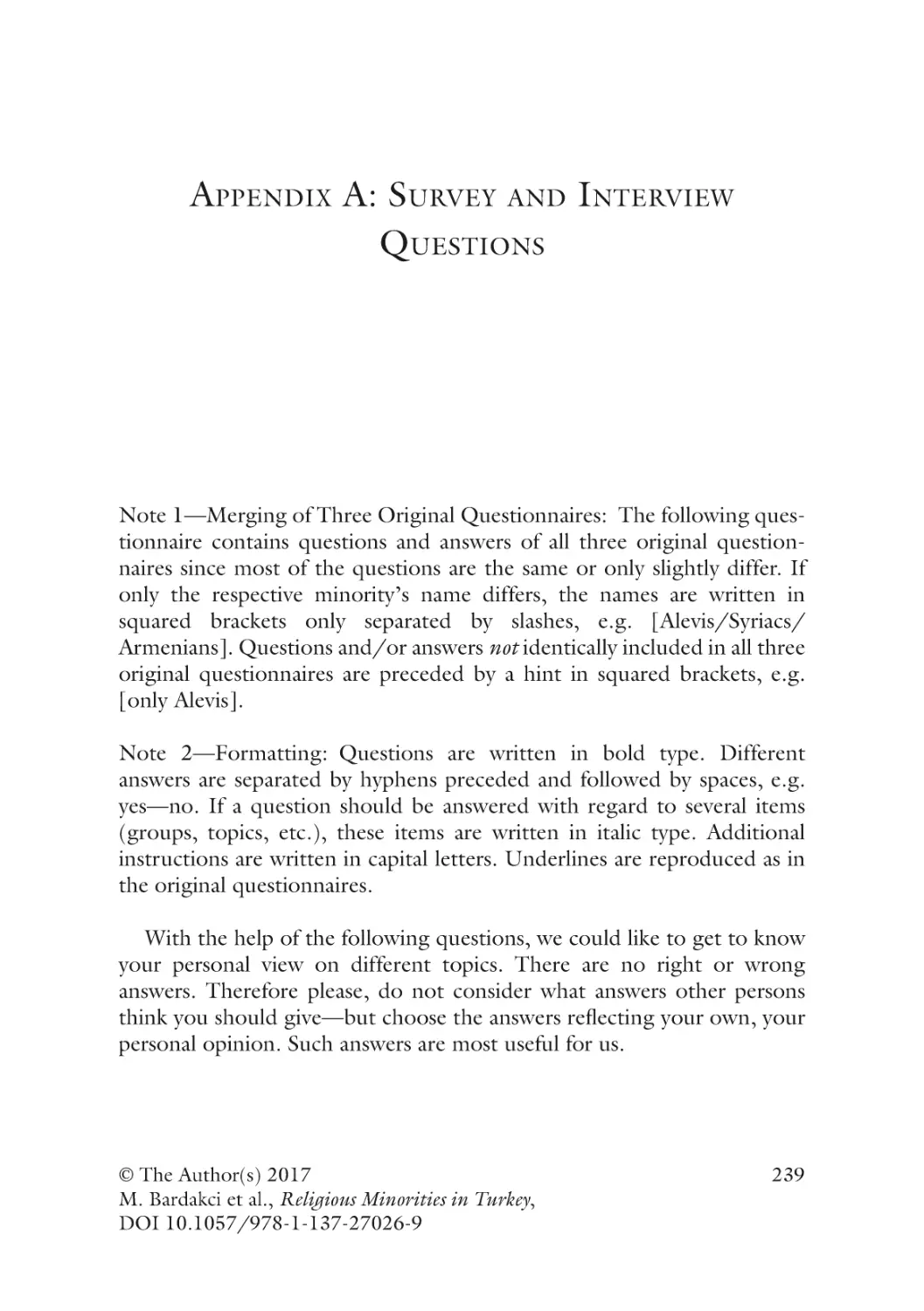
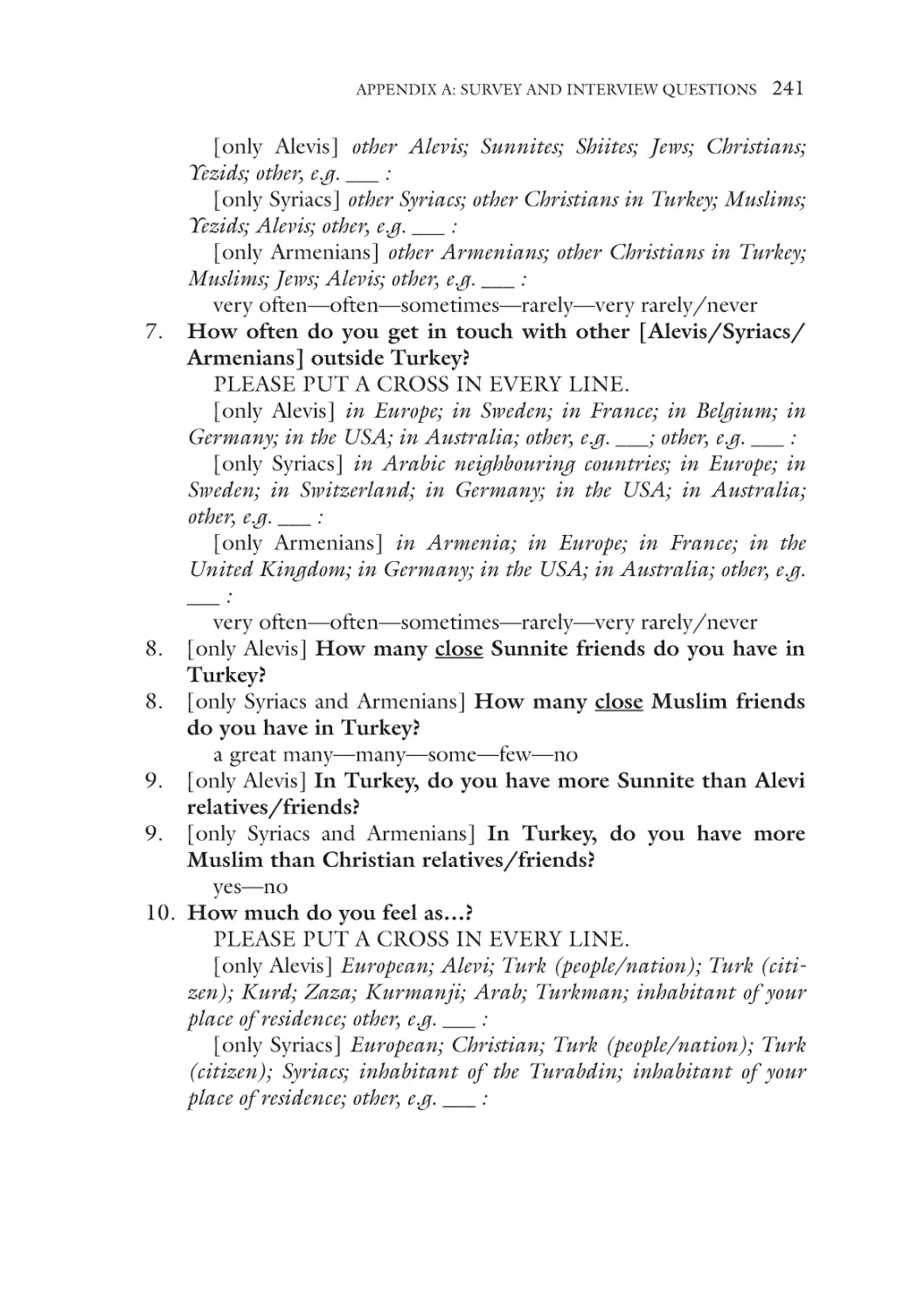
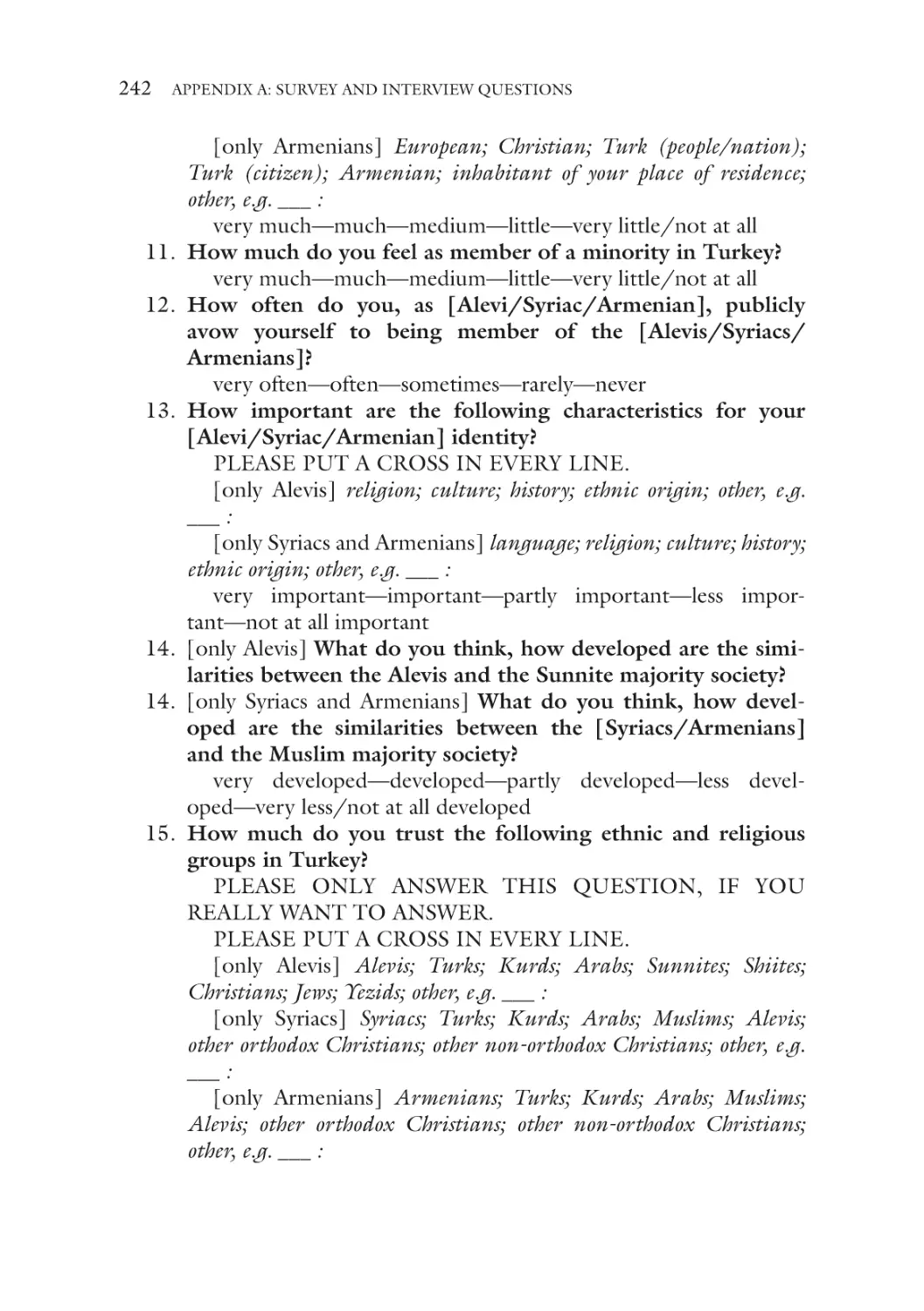
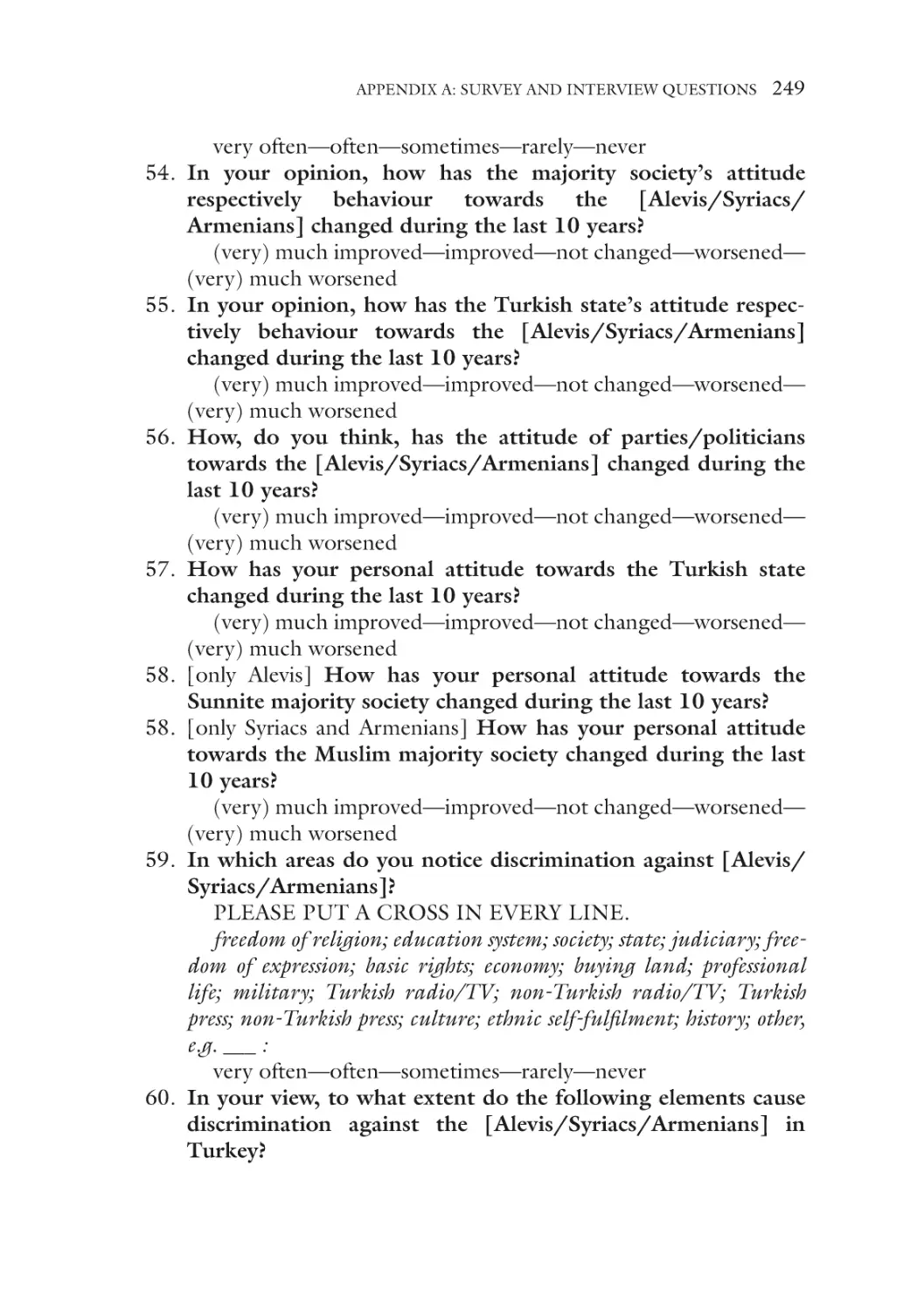
and quantitative analysis (see appendix). Our original data thus encompasses a large-scale survey of 708 members of the minorities (401 Alevi,
242 Syriacs, and 65 Armenians) as well as a large range of in-depth interviews and observations in rural locations as well as Turkey’s major cities;
moreover, it includes in-depth interviews with all significant representative
organizations of the minority groups (see appendix).13 We analyze this data
and connect it with other available data to trace the evolution of religious
minority rights in Turkey, analyze the impact of European integration and
AKP government, and assess the extent to which minority rights in Turkey
have been desecuritized (and democratized) in recent years.
In addition to providing an in-depth analysis using our original and a great
deal of second-hand data for the three separate minority groups, a key contribution of our book is that it also allows us to compare experiences, grievances,
16
M. BARDAKCI ET AL.
opinions, and developments across the groups. All members of religious
minority groups and all representatives of organizations of religious minority
groups were asked the same questions in the questionnaires and interviews.
This allows us to compare groups on the following key dimensions:
• how religious minority members and organizations perceive their standing and status in Turkish society (incl. politics and economics) today
• what the main problems and complaints are which they experience as
members of their minority group
• how they perceive their standing, status, problems, and complaints
to have changed, esp. since the beginning of Turkey’s candidate status with the EU
• how they judge the impact of European integration on their situations as minorities in Turkey
The first three dimensions in part assess the extent to which and the
manner in which the issue of religious minorities in Turkey is securitized/
desecuritized in the perceptions and experiences of religious minority
members. The fourth dimension then serves to link the notions of securitization/desecuritization with that of Europeanization (the impact of
the European Union on the above processes). Since this impact is difficult
to judge for our respondents, as we have explained, document analysis of
legal texts and the broader political discourse in Turkey as well as secondary data analysis is used to triangulate our findings regarding the impact of
European integration on the lives of religious minorities.
To sum up, the distinctive aspects of the contribution made by this
book are that:
• it is based on up-to-date and thorough empirical research on the
minorities in question; a great amount of original data has been collected for each community across various parts of Turkey;
• it is the first comparative study undertaken across religious minorities
in Turkey on the basis of comparable questionnaires; this comparative aspect of the research helps us discover and understand variation
among different minority groups in terms of their perceptions and
experiences;
• it evaluates the reforms and progress made with respect to the rights
of minorities in Turkey from a clear and general theoretical perspective by applying the concepts of securitization theory;
INTRODUCTION
17
• it is the first book focusing on the religious minorities in Turkey
in the contemporary political context of European integration and
AKP government.
1.3 Overview of the Book’s Contents
Chapter 2 first provides the necessary background on European-level
governance of minority rights and the use of accession conditionality by
the EU for advancing minority rights in candidate countries like Turkey.
The purpose is to establish why and how minority rights in Turkey are a
European issue, and not merely a Turkish one. This is also why the relevant changes in Turkey must be analyzed before the broad backdrop of
Europeanization, even as they are of course shaped (also) by a variety of
important domestic factors. The chapter reveals, inter alia, that although
the EU has made the protection of minorities an explicit criterion for
accession, it has not provided an unequivocal definition of minority rights.
This ambiguity has supported diverse conceptualizations and differences
in policy and implementation across candidate (and member) countries.
The second part of the chapter then provides an overview of how the EU
has evaluated Turkey’s progress in the field of minority rights by analyzing
the Commission’s annual regular reports from 1998 to 2015.14 This gives
us a first sense of the problems faced by Turkey’s minorities, which will be
analyzed in detail in the remaining chapters of this book.
Chapter 3 first lays out our theoretical vocabulary by explaining what
we mean by the “securitization” and “desecuritization” of minority rights.
In a nutshell, where changes to minority rights are primarily framed as
having strong implications for (majority) societal or state security, they
are securitized. When they are instead increasingly discussed in reference
to other than security values (such as in connection with improvements
to democracy or human rights), and when societal actors representing
other than security interests become increasingly involved in their contestation, they are desecuritized. The second section of the chapter traces
the securitization of minority rights back to Ottoman times, through the
establishment of the Turkish Republic, into the 1990s. Its third section
examines the partial and precarious trend of desecuritization of minority
rights since the 1999 Helsinki Summit and the coming to power of the
AKP. Arguably, the most important contribution of the EU to this trend
has been that it has enhanced the domestic credibility and clout of the proEU, reformist segments of the Turkish society and elite, helping to c reate
18
M. BARDAKCI ET AL.
an environment conducive to democratization more broadly and the
desecuritization of minority rights more specifically. Secondly, the coming
into power of the Islamic yet (at least initially) pro-EU AKP government
also supported this trend. However, more recently both the declining EU
membership prospects and shifting priorities of the AKP are threatening
the desecuritization of minority rights.
The following three chapters (4–6) treat our three minority groups.
Chapter 4 focuses on the Alevi. It discusses the paradoxical relationship
of the Alevi community with the Turkish state and covers the awakening among the Alevi community during the 1990s and the impact of the
recent EU-supported democratization reforms on the Alevi community.
Having suffered as a heretical sect and been alienated from the center
under the Sunni-dominated Ottoman rule, the Alevi welcomed the establishment of the Turkish Republic in the hope that the new state with its
explicitly secularist vision would put an end to their persecution and marginalization. However, although their status was relatively improved in
this period, the Republican state did not extend any official recognition to
heterodox Muslims. In the Republican era Muslim subjects were totalized
under the all-inclusive category of the millet-i Muslime. Prioritizing the
“one and indivisible” unity of the Turkish nation and state, free expression
and legal accommodation of diversity within Islam were prohibited. When
the Soviet Union collapsed and the Communist threat disappeared in
1989, identity politics resurged and Alevilik as a religious identity gained
importance. Furthermore, the upsurge of Islamist movements during the
1990s (temporarily) boosted the Alevi’s reputation as moderate representatives of Islamic belief in the eyes of the Turkish state. Furthermore, the
EU accession process, which started in 1999, led to the removal of some
restrictions on Alevi political participation and an expansion of human
rights and freedoms. The Alevi community became more vocal in the
expression of their demands and grievances. However, the chapter will
show that, while the recent Alevi opening of the Turkish government has
satisfied some demands to some extent, still many steps need to be taken
to achieve full reconciliation with the Alevi community. We argue that the
limited progress achieved by the Alevi opening is a result of a number of
factors including the mutual mistrust between the Alevi community and
the Sunni Islamic AKP government, the entrenched dispute between the
two sides as to whether Alevilik is a sect of Islam or a cultural community,
as well as deeply rooted social prejudices.
INTRODUCTION
19
In Chap. 5 we present our findings on the Armenians who, unlike the
other two groups studied in this book, have official minority status according to the Treaty of Lausanne (1923). The relations between the Turkish
state and majority society, on the one side, and the Turkish-Armenian
community, on the other, have been affected by the historical controversies over the incidents of persecution of Armenians at the hands of
Turks and Kurds during WWI. The fact that Armenian militant groups
carried out assaults on Turkish diplomatic representations abroad from
1975 to the 1980s as well as the Azeri-Armenian conflict further contributed to the securitization of policy toward Turkish-Armenians. The
chapter shows, however, that due to the trend toward democratization
and improvement of minority rights stimulated by the EU accession process, and the corresponding rise in pluralism and empowerment of NGOs,
the visibility of the Armenian community has lately been enhanced. It has
become easier for the Armenian community to have their voices heard
by the Turkish state and society at large. This, in turn, has enhanced the
perceived legitimacy of the Armenian minority’s grievances and demands.
The difference between the 1990s, when Armenians were often targeted
by Islamist groups and militant nationalists, and the present time, when
even the Nationalist Action Party (MHP) considered nominating a member of the Armenian community in the parliamentary elections in June
2011, is striking. The murder of the Turkish-Armenian journalist Hrant
Dink in 2007 by a member of an extreme right-wing group was widely
condemned and actually aided the Armenian cause. Yet, this incident is
also a telling indication of the fact that changing prejudices takes time
and is more difficult than changing laws. Despite the recent encouraging
reforms aiming to overhaul the shortcomings in the legal system concerning the rights of minorities, such as the new Foundations Law in 2008,
which enables (some) minorities to reacquire their previously confiscated
properties, there are still many unresolved problems facing the Armenian
community, such as lack of restitution of confiscated properties sold to
third parties, shortage of priests, limitations to self-government in schools
and churches, lack of education for and lack of teachers in Armenian
schools, lack of education in native language at schools, discrimination
regarding employment in the civil service and the right to hold political office, anti-minority rhetoric in textbooks in Turkish schools, negative
framing of minority issues in the media, and difficulties with the restoration and protection of Armenian churches and historical sites.
20
M. BARDAKCI ET AL.
Chapter 6 presents our findings on the Syriacs. The lack of legal minority
status according to the Treaty of Lausanne (1923) has put the Syriac community in a disadvantaged position as compared to the other, officially
recognized minority groups. They have been banned from using their languages in schools and media, and from exercising their religious rights to
the full extent. The issue of recognition not only has legal implications but
also leads to ramifications for the survival and development of the identities
of minority communities. Various studies have shown that minority groups
whose identities are not officially recognized are more prone to assimilate
into the larger society, since they might wish to put an end to the difficulties
resulting from their ambiguous status by means of such assimilation (e.g.
Taylor 1994). Another important point rendering the case of the Syriacs
distinct from those of the other non-Muslim minorities is that they suffered
most from the violence in the southeastern part of Turkey between the state
security forces and the Kurdish secessionist groups as well as Islamist actors
during the second half of the 1980s and 1990s. Due to these conflicts,
many members of the Syriac community emigrated from their ancestral
lands in the Turabdin region (the Eastern part of Mardin) to Istanbul, other
European cities, and other parts of the world. When many of them sought
to return to their homes during the 2000s, following the (temporary) end
of the conflicts in the area, they had to struggle against a number of problems to reacquire their lands and properties, which had in the meantime
been occupied by others. Other problems the Syriacs struggle with today
include registering ancient land holdings of the Mor Gabriel Monastery,
recognition of the legal status for their historical and religious sites, return
of the properties and lands belonging to their churches and monasteries,
recognition of Syriac clergymen, opening of Syriac teaching schools, and
acceptance of the usage of names and surnames in the Syriac language.
Chapter 7 compares our findings on the three religious minority groups
on the basis of the outcomes of the closed-ended questionnaires and interviews with representatives and members-at-large of the minority communities. It analyzes and explains a wide range of similarities and differences
between the perceptions and experiences of the different minority groups.
First we examine how strongly the members of minorities identify with
their group and which factors are seen as salient for constituting their
groups’ collective identities. For this purpose we study the perceived relevance of the classic elements of minority group identity—language, culture, history, ethnicity, and religion—but also the perceived relevance of
origin and marriage within the group as well as social connections with
INTRODUCTION
21
other groups. Second, we examine the minority members’ relationships
with the state and their judgments of the governance of religion in Turkey.
Third, we look at their relationships with society and experiences of discrimination. Fourth, we study how they perceive the role played for their
situations by the European Union. This analysis allows us not only to
compare experiences and perceptions across the three groups and over
time but also to draw general conclusions regarding the effects of the EU
accession process as well as AKP government on the rights of religious
minorities in Turkey, as perceived by our respondents.
The final chapter concisely summarizes some key conclusions to be drawn
from our research and briefly elaborates on their relevance, including policy
implications for the EU and other promoters of religious minority rights.
Notes
1. This section of the chapter is based on part of the introductory chapter of
Freyberg-Inan et al. (2016) by the same authors.
2. Enosis, meaning “union”, is an umbrella term for the movements of various Greek communities that live outside Greece and strive for the incorporation of the regions they inhabit into the Greek state.
3. In May 2005 the Turkish parliament approved amendments to the new
penal code after EU complaints that the previous version still restricted
media freedom. The EU welcomed the move but maintained that the code
still failed to meet all its human rights concerns.
4. EU legislation is suspended in the territory occupied by Turkey until a final
settlement of the Cyprus conflict.
5. This was not the first time Hrant Dink had been accused in this manner. In
January 2007, he was assassinated. The murder provoked outrage in both
Turkey and Armenia and was instrumentalized by the Erdoğan government to present its nationalist-secularist enemies as threats to freedom of
expression and democracy.
6. In September 2012 a court would jail three generals for 20 years for plotting the alleged Operation Sledgehammer coup. Another 330 officers
received lesser sentences. All maintained their innocence. In August 2013
Başbuğ and several other generals received life sentences for plotting to
overthrow the government in the culmination of the trials of the government’s secularist opponents. On June 19 2014 all the accused were ordered
released from prison, pending a retrial, after a finding by the Constitutional
Court that their rights had been violated. On March 31 2015 all 236 suspects were finally acquitted after the case’s prosecutor had established that
important evidence submitted in the case was fake.
22
M. BARDAKCI ET AL.
7. Cited in “Designierter Premier der Türkei: Yildirim erklärt Verfassungsänderung
zur Priorität”, Der Spiegel 22 May 2016, http://www.spiegel.de/politik/ausland/tuerkei-binali-yildirim-erklaert-verfassungsaenderung-zurprioritaet-a-1093526.html.
8. There are of course many other external actors which also push for an
improvement of minority rights in Turkey. However, this book focuses on
the EU, while given its high relevance the impact of the European Court
of Human Rights will also become evident.
9. We have not included the Greek minority in our primary data analysis
because the number of members of the Greek minority living in Turkey,
mostly concentrated in Istanbul, is by now very small. There are only
around 3,000 Greeks in Turkey (in comparison, the number of Armenians
is between 20 and 25 times higher). This would make it difficult to survey
a sufficiently large sample to include this group in our quantitative analysis.
Our focus on the Armenians as opposed to the Greeks is also justified by
their currently (although not historically) greater importance for the theoretical aims of the book. Turkish responses to the Armenian genocide
debate and Turkish-Armenian relations have great international repercussions, reveal deeper national-ideological paradigms and strategies of
Turkish foreign and domestic policy, and have feedback effects on the situation of the Armenian minority living in Turkey. In comparison, international relations between Greece and Turkey have in the period under
investigation been relatively unproblematic, of less symbolic importance,
and less connected to the situation of the Greeks in Turkey. For this reason, the case of the Armenians is more revealing of the international
dimension of Turkish religious minority policy, of limits and difficulties to
the desecuritization of minority rights, and of the role of European integration in desecuritization processes.
10. One of the very few monographs taking up the issue is Baum (2006). While
Baum provides a thorough historical analysis of the status of the Christians
in Turkey, his book does not provide much information about developments
since 1999 (i.e. during Turkish EU candidacy). A significant part of the
book is dedicated to the Christian minorities under Ottoman rule.
11. Official representatives of a group may exaggerate problems for personal or
political reasons or trivialize problems or keep secrets because they are
afraid of potential problems with state officials. So the analysis of perceptions among “ordinary” group members is not only interesting in its own
right but also serves as a “control group” that can confirm or call into
question the results of elite interviews or provide new and important perspectives on the groups’ problems.
12. All translations from Turkish of interview material are our own.
INTRODUCTION
23
13. We honor the request by the majority of the interviewed Syriacs and
Armenians not to provide any personal or place names for the interviews
we conducted with them. We also refrain from providing detailed descriptions of particular incidents and their circumstances—thus reducing the
risk of informants being identified on basis of particular details. Some of
the Alevi respondents did agree to be identified, in which cases we do provide the relevant information.
14. These reports also refer to non-EU documents, such as the European
Convention on Human Rights, the major OSCE documents of the early
1990s, and UN Declarations, when evaluating laws and practices in the
candidate states.
Bibliography
Akin, B., & Khorguashvili, N. (2016). Turkey’s Politics towards the South
Caucasus and its Potential Contributions to EU Policies. In A. Freyberg-Inan
et al. (Eds.), Growing together, growing apart: Turkey and the European Union
Today (pp. 235–246). Baden-Baden: Nomos.
Akşit, S., & Şenyuva, Ö. (2016). Domestic Politics and Perceptions of Turkey-EU
Relations. In A. Freyberg-Inan et al. (Eds.), Growing together, growing apart:
Turkey and the European Union today (pp. 55–72). Baden-Baden: Nomos.
Baum, W. (2006). The Christian minorities in Turkey. Baker Hill, Kerela, South
India: Ephrem Ecumenical Research Institute (SEERI).
Dikici Bilgin, H. (2016). Attitudes of Turkish Political Parties towards Turkey-EU
Relations: Euroskepticism Revisited. In A. Freyberg-Inan et al. (Eds.), Growing
together, growing apart: Turkey and the European Union today (pp. 165–186).
Baden-Baden: Nomos.
Freyberg-Inan, A., et al. (Eds.). (2016). Growing together, growing apart: Turkey
and the European Union today. Baden-Baden: Nomos.
Giesel, C. (2016b). Erosion des ethnopolitischen Homogenisierungsdogmas
sowie offene Entfaltungsmoglichkeiten ethnischer Gruppen im Rahmen politisch-gesellschaftlicher Liberalisierungsansatze in der Turkei im 20. Jh. (Teil 2:
1980–1999). (2016). Elektronik Siyaset Bilimi Araştırmaları Dergisi/Electronic
Journal of Political Science Studies, 7(2), 1–52. www.esbadergisi.com/images/
sayi13/christoph_giesel_esba_2_teil_2016.pdf. Accessed 1 Aug 2016.
Giesel, C. (2016c). The Erosion of the Kemalist Dogma of Ethno-Political
Homogeneity in the Context of Partial Socio-political Liberalisation Processes
in Turkey in the Second Half of the 20th Century. In A. Freyberg-Inan et al.
(Eds.), Growing together, growing apart: Turkey and the European Union today
(pp. 73–99). Baden-Baden: Nomos.
24
M. BARDAKCI ET AL.
Grigoriadis, I. N. (2007). Türk or Türkiyeli: The Reform of Turkey’s Minority
Legislation and the Rediscovery of Ottomanism. Middle Eastern Studies, 43(3),
423–438.
Kaya, N. (2009). Forgotten or assimilated? Minorities in the education system of.
Turkey: Minority Rights Group International.
Kaya, N., & Baldwin, C. (2004). Minorities in Turkey. London: Minority Rights
Group International.
Kurban, D. (2007). A Quest for Equality: Minorities in Turkey. London: Minority
Rights Group International.
Liamputtong, P. (2007). Researching the vulnerable: A guide to sensitive research
methods. London: Sage.
Poyraz, B. (2005). The Turkish State and Alevis: Changing parameters of an
uneasy relationship. Middle Eastern Studies, 41(4), 503–516.
Soner, B. A. (2010). The justice and development party’s policies towards non-
Muslim minorities in Turkey. Journal of Balkan and Near Eastern Studies,
12(1), 23–40.
Taylor, C. (1994). Multiculturalism: Examining the politics of recognition.
Princeton: Princeton University Press.
Toktaş, Ş. (2005). Citizenship and minorities: A historical overview of Turkey’s
Jewish minority. Journal of Historical Sociology, 18(4), 394–429.
Toktaş, Ş. (2006a). EU enlargement conditions and minority protection: A reflection on Turkey’s non-Muslim minorities. East European Quarterly, 40(4),
489–518.
Toktaş, Ş. (2006b). Perceptions of anti-semitism among Turkish Jews. Turkish
Studies, 7(2), 203–223.
Toktaş, Ş. (2008). Cultural identity, minority position and immigration: Turkey’s
Jewish minority vs Turkish Jewish immigrants in Israel. Middle Eastern Studies,
44(3), 511–525.
Toktaş, Ş. & Aras, B. (2009/2010). The EU and Minority Rights in Turkey.
Political Science Quarterly, 124(4): 697–720.
CHAPTER 2
European Integration and Minority Rights
2.1 EU Enlargement and the Evolution
of Minority Rights Governance
After the end of the Cold War, the situation of minorities returned to
the political agenda of Europe. Before, the bipolar system and the rivalry
between the two political blocs had frozen many conflicts that had prevailed
within Europe until the Second World War. With the fall of Communism,
the breakup of its sealed world, and the foundation of new states in Central
and Eastern Europe, the autochthonous ethnic, religious, and linguistic
minorities could raise their voices again. This chapter will first provide an
overview of the evolution of minority rights governance in Europe and then
turn to how Turkey’s performance in this policy area has been judged by the
European Commission over the course of its accession negotiations. The
purpose is to make clear why and how minority rights in general, and religious minority rights in particular, are an issue for European governance, EU
enlargement, and Turkey-EU relations in particular.
Europe is a multiform continent. With the exception of Iceland, all
European territorial states possess national minorities (Cordell and Wolff
2004). The size of these groups varies from larger ones, like the 7 million
Catalans, to smaller ones, like the Sorbs in Eastern Germany. Some of
these peoples are currently undergoing a revival, like the Scots and Welsh,
while others seem to be dying, like the Italian Arbëreshe and the scattered
Aromanians on the Balkan Peninsula (Gauß 2001). The European Union
© The Author(s) 2017
M. Bardakci et al., Religious Minorities in Turkey,
DOI 10.1057/978-1-137-27026-9_2
25
26
M. BARDAKCI ET AL.
of 15 members contained 73 minorities. After the 2004 enlargement,
there were already 156, and since the enlargement of 2007 the EU comprises 187 minorities. Roughly 42 million EU citizens, or 8.8 % of the EU
population, belong to an autochthonous minority. In all of Europe there
are 338 minorities with ca. 103 million members (Pan 2003: 3–9).
Before the end of the Cold War, only 90 ethnic minority groups with 38
million members had been officially counted in Europe. Due to the introduction of democracy, human rights, and the rule of law, however, many
members of minorities could redefine and express their minority identities.
Moreover, the number of states has risen considerably since the decline of the
Eastern bloc. Fourteen of the currently 46 states in Europe emerged during
the post-Cold War years. Although these states only account for approximately one-third of the European states, more than half of the European
minorities, that is, 142 ethnic groups, live in these states.
Minority languages range from recently rediscovered idioms to dying
languages that are not expected to have a future. There are linguistic
islands, cross-border languages, and connections between related but
far-off cultural and linguistic groups. Basically, languages can be systematized as follows (Trifunovska 2001; Schröder 1995): First of all, there
are languages that only exist in one EU member state, like Breton in
France, Welsh in the United Kingdom, and Sardinian and Friulian in Italy.
Secondly, languages may exist in several member states, like Basque in
France and Spain or Lapp in Finland and Sweden. Thirdly, there are languages that are spoken by a minority in one state but are official language
in another state, like Danish in Schleswig-Holstein and Denmark, German
in South Tyrol and Austria, or Hungarian in Romania and Hungary.
Lastly, a language may be not be bound to a certain geographical region,
like Yiddish, Aromanian, or the languages of the Sinti and Roma. In some
regions, minority languages are spoken by a majority of the population,
like Russian in some areas of the Baltic. Catalan underwent an unexpected
renaissance after the end of the repression by Franco’s Spain. Even smaller
languages, like Ladin, whose extinction had already been predicted, enjoy
more and more attention.
Acceptance, promotion, and status of minority languages differ from
member state to member state. In 1972, the former French president
Georges Pompidou still stated: “Il n’y a pas de place pour les langues
minoritaires dans une France destinée à marquer l‘Europe de son sceau”
(There is no room for minority languages in France, which is destined to
create Europe in its own likeness). The Greek constitution acknowledges
EUROPEAN INTEGRATION AND MINORITY RIGHTS
27
no minority languages, and the Romanian constitution defines Romanian
as the only language although minority languages are recognized. In contrast, multilingualism is constitutionally honored in Spain, Finland, and
Belgium. Minorities and minority languages are politicized and respected
to different extents.
Since the European Union enlarged in 2004, 2007, and 2013 toward
Central and Eastern European states, the minority issue plays a more
important role (Stroschein 2012; Weller 2008). While the situation of
minorities in Western Europe seemed to have been settled by liberalization, integration, and legalization of minority rights supported by a long
period of economic prosperity, the Union now expanded across areas that
have distinctive, historically shaped minority traditions. As the conflicts
in the former Yugoslavia showed, this can hold considerable potential for
conflicts. The different answers by the EU member states to the declaration of independence of Kosovo show the difficulties they have in reacting
adequately to secessions based on minority conflicts. Until now, the Union
has not been able to find a common position with regard to Kosovo and to
accept its independence. Some member states with large minorities fear a
precedent. Moreover, during the last years, some member states have tried
to use the existence of a minority within their own borders, or nationals
outside their borders, to push their political interests. For instance, since
2002 Hungary has granted special rights to citizens living abroad with
the help of the “Hungarian ID card” (Kántor 2004; Gál 2002). This “ID
card” facilitates work permits, free medical care, free study in Hungary,
and help in promoting the Hungarian language abroad. The affected
countries have rejected such activities as interference with their domestic
affairs and efforts to contest the results of the Treaty of Trianon.
It has become more and more apparent that the EU has imported
instability by its Eastern enlargements (Palermo and Woelk 2003; Riedel
2006). In western states, too, minority parties have gained new support,
for example, in Catalonia, the Basque region, Northern Italy, Flanders,
Scotland, and Wales. Their radicalization might threaten further integration. The political controversies concerning this topic between some
states, but also the silence of other states, indicate an unresolved legacy of
European history. The treatment of minorities puts a country’s sensitivities and political culture into sharp relief.
The growing integration of the European Union members in the past
seems not to have led to an easing of the minority problem. On the contrary, many languages and other identity distinctions have undergone a
28
M. BARDAKCI ET AL.
“revival” in the age of information and communication. However, with
the important exception of Yugoslavia, the conjured up armed nationalist or ethnic conflicts did not appear after the political change in the east
of the continent within the territory of the expanding EU. The situation
could be pacified in most Central and East European countries during the
process that finally led to European Union membership and, although
these states treat their minorities differently, the rights of minorities could
be codified (Stoel 2001; Blumenwitz and Gornig 1993; Gogolin 1991).
In doing so, the Union could also rely on previous and parallel work done
by other European and global institutions.
In spite of manifold efforts of international institutions to protect
minorities, there is no common consent upon a definition of minority. The
concept is interpreted differently in different states and societies. Some
contemporary scholars are reluctant to use the word “minority”, claiming
that it is closely connected with the system of nation states. They prefer
the terms “communities”, “communalities”, “social groups”, or “peoples” (Lerner 1991). The most widely recognized definition comes from
Francesco Capotorti, Special Rapporteur of the UN Sub-Commission
on Prevention of Discrimination and Protection of Minorities, who indicated in accordance with Article 27 of the Covenant on Civil and Political
Rights that a minority is “a group which is numerically inferior to the
rest of the population of a State and in a non-dominant position, whose
members possess ethnic, religious or linguistic characteristics which differ
from those of the rest of the population and who, if only implicitly, maintain a sense of solidarity, directed towards preserving their culture, traditions, religion or language” (Capotorti 1979; see also Capotorti 1997).
Other legal definitions differ from Capotorti’s in minor respects, considering other elements like residence in the territory of a majority-dominated
state, granted minority status, non-dominant position, or sense of solidarity among minority members who want to preserve their distinguishing
characteristics like religion, language, and ethnicity (Thornberry 1991).
It is a well-known legal problem that in western constitutions only
individuals are the objects of protective rights. The constitutions do not
comprise group-related rights since groups are no legal entities. In order
to still concede a certain level of legal protection to minority groups, relevant legal documents assume that, although individuals are the objects of
protection, this protection can be related to their membership in a certain
definable group. This idea is based on the consideration that certain rights,
like the use of one’s own language, can only be realized within a certain
EUROPEAN INTEGRATION AND MINORITY RIGHTS
29
group. Minority rights can thus not be understood as group-related but
as rights that may refer to individuals as members of groups. Hornburg
(2009: 24) describes this as an “individual-rights-related approach with
reference to a collective”.
By now, a certain minimum standard of minority rights which states are
expected to abide by has emerged from numerous agreements (Hofmann
2002: 563):
1. The right to belong to a national minority. This right is primarily
based on the independent decision of the concerned person from
which disadvantages must not arise.
2. The right to keep and develop the independent identity of the
respective minority, and especially the prohibition of any assimilation policy based on coercion.
3. The right of freedom from discriminatory measures. However, these
European minimum standards comprise no right to government
measures of positive discrimination in favor of members of national
minorities.
4. The right to use the native language in private and in public.
5. The right to learn the native language.
6. The right to found organizations of national minorities, especially
for educational, cultural, and social purposes.
7. The right to in principle unrestricted cross-border contacts including the right to receive and spread information freely.
8. The right to participate in principle in political decision processes
related to minority issues.
The protection of minorities in Europe is regulated by several bodies of international law. The European Convention on Human Rights
(ECHR) of 1950 already included a prohibition of discrimination which
also applies to minorities. Art. 14 ECHR states: “The enjoyment of the
rights and freedoms set forth in this Convention shall be secured without
discrimination on any ground such as […] national origin, […] association with a national minority.” However, due to its general nature, the
Convention on Human Rights cannot provide full protection of minorities since this must always be connected with special rights named by the
Convention, such as the right to non-discrimination (Medda-Windischer
2003; Hillgruber 1993). No right to special promotion of culture or language, for example, can thus be derived from the Convention. However,
30
M. BARDAKCI ET AL.
there have been legal cases in the past where signatories were forced not to
restrict the political and cultural life of their minorities. For example, the
European Court of Human Rights (ECtHR) repeatedly decided in favor
of the Kurdish minority in Turkey that freedom of opinion, association,
and assembly according to Art. 10 and 11 ECHR apply for all groups.
With regard to the legal action “Sejdi-Finci vs. Bosnia-Herzegovina” the
judges agreed with the claimants that the Dayton agreement discriminated
against them—as members of a minority (Jewish and Roma)—by excluding them from civil service. As a result, a reform of the constitution of the
deeply divided country became necessary.
The Council of Europe’s Cultural Convention, signed on 19 December
1954 in Paris, for the first time explicitly speaks about the cultural diversity
in Europe and its contribution to a common European heritage. However,
minorities are not explicitly named. The participating states only commit
themselves to promoting the study of the languages, history, and civilizations of the other contracting parties.
The United Nations’ International Covenant on Civil and Political
Rights of 19 December 1966 assures minorities of the fostering of their
languages, religions, and cultures. Members of minorities must not be
discriminated against in political and social life und must not be forced to
assimilate. Article 27 states: “In those States in which ethnic, religious or
linguistic minorities exist, persons belonging to such minorities shall not
be denied the right, in community with the other members of their group,
to enjoy their own culture, to profess and practice their own religion, or to
use their own language.” This article is phrased so that states have to protect their minorities actively and to ensure that their independent identity
is stabilized by language courses, financial support of cultural activities,
and participation in economic life. The article was seen as a compromise
between the stress on individual and that on collective rights. “In its literal wording, the article appears to confer rights only on individuals, but
in fact it allows the exercise of collective rights” (Benoit-Rohmer 1996:
23). However, minorities cannot derive a right to autonomy or secession
from it. This Covenant was joined by Turkey on 23 September 2003.
It has been supplemented by the “Declaration on the Rights of Persons
Belonging to National or Ethnic, Religious and Linguistic Minorities”
adopted by the UN’s General Assembly on 18 December 1992.
In 1982, the then European Community founded the European
Bureau for Lesser-Used Languages (EBLUL) seated in Dublin. Its
aim was to retain the diversity of languages in Western Europe and to
EUROPEAN INTEGRATION AND MINORITY RIGHTS
31
romote minority languages. This means retaining regional languages as
p
well as promoting languages by legislation on European, national, and
regional levels. According to information from the bureau itself, its tasks
are providing “EU institutions with any information, documentation or
draft documents to develop activities for the defence and promotion of
regional and minority languages […]; disseminating information to the
linguistic minority communities about policies and activities carried out
by the European Commission, the European Parliament, the EU Council
of Ministers; providing expertise to linguistic minorities on particular
problems and servicing the communities’ needs, particularly in seeking
partners, contacting the European institutions and providing adequate
information on EU programmes, specifically on examples of good practice” (http://eblul.eurolang.net).
These actions are supplemented by activities of the European Parliament
to promote minority languages. On 16 October 1981, the so-called Arfé-
resolution was adopted, named after the leading Italian member of parliament (MEP) Gaetano Arfé. This resolution demands a community charter
of regional languages and cultures as well as a charter of the rights of
ethnic minorities. Two years later, the second Arfé-resolution asked the
European Commission and the Council of the EU to intensify their measures for linguistic minorities. In 1993 the European Parliament for the
first time approved financial support for regional languages. The Kuijpers-
resolution of 30 October 1987, named after a Flemish MEP, calls upon
the European institutions and member states to establish measures to
acknowledge linguistic rights in education, media, judiciary, administration, and the economy.
The primary law of the old European Community contained no explicit
regulations concerning minorities. With regard to the European institutions this time period has therefore been labeled “blind to minorities”
(Arnold 2001: 237). Until the 1990s, the protection of minorities was
exclusively managed on the national level. Not until the changing situation in Central and Eastern Europe did awareness of the claims of minorities and of the political importance of the minority issue increase. Minority
policy was now increasingly perceived as part of the comprehensive transformation the states of Central and Eastern Europe had to embark on.
The conflicts in CEE which had before been frozen by Soviet hegemony
and the Cold War threatened to break out again. The best example for this
is the split-up of the Soviet Union itself into new sovereign nation states.
But the manifold entanglements of the peoples of Central and Eastern
32
M. BARDAKCI ET AL.
Europe as well, a legacy of these multiethnic states, added significant
explosiveness to the post-communist transformations. Over centuries, the
peoples of Central and Eastern Europe have lived together and against
each other. Now, old conflicts threatened to turn the region into a powder
keg (Van Evera 1990–91). However, with the exception of Yugoslavia,
within the region encompassed by the enlarging European Union the
situation stayed peaceful, in good part due to the protection of minority rights by international agreements and institutions (Arp 2008; Bloed
1999; Lantschner and Medda 2002; de Witte 1993).
The Copenhagen document of the Conference on Security and
Cooperation in Europe (CSCE) concerning the “human dimension”,
signed on 29 June 1990 in the early days of the post-Cold War era, includes
most fundamental minority rights listed above (Bloed 1996). It explicitly mentions the right to teach a minority language in public educational
institutions, respectively, to use it as language of instruction. Moreover,
members of a minority must be allowed to maintain own cultural institutions. Based on this agreement, the High Commissioner on National
Minorities, whose task was to mitigate minority conflicts by diplomatic
means, was introduced early in 1993 (Heintze 2000; Kemp 2001). For
the first time, there was a transnational institution in Europe dealing with
minorities. The Organization for Security and Cooperation in Europe
(OSCE) from now on engaged the minority issue as well by declarations
and actions, especially in Southeastern Europe. The OSCE report of 1999
concerning the linguistic rights of members of national minorities, which
compared international standards of minority rights, is another important
document in this context.
The Council of Europe began to act in the field of minority protection, too. The European Charter for Regional or Minority Languages
(ECRML), signed on 5 November 1992 and in force since 1 March 1998,
emphasizes the importance of nations for a Europe built on the principles
of democracy and cultural diversity (Hofmann 2005; Pfeil 2000; idem
2003). However, it stresses the national sovereignty and territorial integrity as well as the absolute discretion of national states in promoting minority languages. The Charter thus contributes little to the standardization of
minority rights. Furthermore, Art. 3 §1 allows each state to define in its
ratification or adoption document the regional and minority languages
to which the Charter shall apply. By this means, member states can grant
their minorities different rights or even exclude particular minorities. The
Charter’s value is that it elaborates a list of measures legitimized by the
EUROPEAN INTEGRATION AND MINORITY RIGHTS
33
European international community. Immediate rights cannot be derived
from it since it sets up no sanctions if its rules are not followed. Moreover,
Art. 22 allows every state to resign from the Charter with six months’
notice. By its Killilea-resolution of 9 February 1994 concerning linguistic
and cultural minorities within the European Community, proposed by the
Irishman Mark Killilea, the MEPs supported the ECRML as an “effective
but still flexible instrument for the protection and promotion of minority
languages” and requested the member states to ratify. However, many EU
member states have not yet done so; neither has Turkey.1
The Charter was amended and elaborated by the Framework Convention
for the Protection of National Minorities signed on 1 February 1995. This
was the first pan-European multilateral treaty which explicitly deals with
minorities and their rights. In the preamble, the members of the Council
of Europe explained their motivation as “being resolved to protect within
their respective territories the existence of national minorities, and considering that the upheavals of European history have shown that the protection of national minorities is essential to stability, democratic security
and peace in European continent”. Due to its nature as a framework, the
Convention is no law immediately exercised in the contracting states. The
states are nevertheless bound to implement it within their national legislative processes. The Convention encompasses a long list of minority
rights. Some of the basic rights are the principle of non-discrimination
and the promotion of equality (Art. 4). Culture, religion, language, and
traditions of minorities shall be promoted in particular (Art. 5 and 6).
More generally, freedom of assembly, association, thought, conscience,
and faith shall be granted to minorities (Art. 7 and 8). Particular rights
regarding languages concern the use of minority languages in private and
public (Art. 10), the right to have a name in one’s own language (Art. 11),
learning and teaching by using the own language (Art. 12, 13 and 14), as
well as the prohibition of forced assimilation (Art. 5 and 16). The right to
establish peaceful cross-border contacts to members of the same ethnic,
cultural, linguistic, or religious group without hindrance (Art. 17) is its
politically most sensitive component (Weller 2005).
Though the Framework Convention contains general aims rather than
compulsory normative requirements, the reporting system it includes
forces the signatory states to regularly disclose their measures—or the
lack thereof—to the critical eyes of a European institutional public. States
are thus forced to justify their minority policies. The decisive institution
assessing the member states’ efforts is the ministerial committee, which
34
M. BARDAKCI ET AL.
relies in its conclusions and recommendations on reports from the concerned state and consults with it about common measures to implement
the Charter. The Framework Convention has so far been ratified by all EU
member states with the exception of France and Greece. Turkey has also
not yet acceded to the agreement.
The last resolution up to now was adopted by the European Parliament
on 13 December 2001 and goes back to the initiative of the Welsh MEP
Eluned Morgan. The Morgan-resolution requests the Commission and the
Council to ensure with regard to the EU’s enlargement that the joining
countries respect the regions’ and minorities’ languages and cultures as well
as Art. 22 of the Charter of Fundamental Rights of the European Union.
A final element of standardization of minority policy in Europe, pursued
by different parties after the political turn in Central and Eastern Europe,
has not yet been achieved. The framework agreements assure basic rights at
least, and the upcoming accession of the Central and East European countries revealed that the European Union had to demand minority rights
actively (Toggenburg 2006). For the first time, the European Council
of Copenhagen 1993 explicitly defined the protection of minorities as an
inseparable part of the democracy and rule of law accession criteria. This
turned out to be a motivation for the countries of CEE to act in this long
neglected policy area. All states in this region have minorities; they can be
rather small, as in Hungary, or so big that they can hardly be perceived as
a minority, like the Russian citizens in the Baltic States. Some countries
only have few minorities, like the Czech and Slovak Republics; others, like
Romania, have many. Minority issues are politically explosive if a neighboring country wants to protect or otherwise interfere with members of
its own ethnic group, like Russia in the Baltic or Hungary in Romania
(Huber and Mickey 1999). Recently, in March 2014, the existence and
assumed threat to the Russian population on Crimea served the Russian
president Putin as pretext to occupy the peninsula and annex it to Russia.
The Copenhagen criteria served the joining countries of Central and
Eastern Europe as a political guideline for their transformation toward
democracy and market economy. Although they were not legally binding, their impact was substantial, as they comprised the conditions for
the much-coveted EU accession. The Commission’s “conditionality
regime” (Schimmelfennig 2005; Grabbe 2006; Sedelmeier 2011) noted
progress in the process of Europeanization of national policies, granted
financial rewards but also imposed sanctions for failure to perform
(Vachudova 2005; Pridham 2005; Papadimitriou and Phinnemore 2004).
The settlement of the minority issue thus became part of the convergence
EUROPEAN INTEGRATION AND MINORITY RIGHTS
35
process of the states of Central and Eastern Europe with the European
Union (Schwellnus 2005; Hughes and Sasse 2003). Progress occurred,
even as political elites and populations did not always seem convinced of
its intrinsic value. The states of the region drew up bilateral treaties, the
Baltic States sought for ways to naturalize the Russian minority.
With regard to the incorporation of minority protection in the acquis
communautaire, however, the European Union has proceeded with considerable hesitation (Henrard 2002; Toggenburg 2012). Some member
states, notably France and Greece, to date do not acknowledge minorities
on their territory. Others, like Spain, do not want to set a judicial precedent regarding their minorities on the European level. With the coming
into force of the Treaty of Amsterdam in 1999, the EU nevertheless succeeded in incorporating issues of minority rights into its primary law (Bell
1999). Article 13 of the Treaty establishing the European Community
(TEC) states: “Without prejudice to the other provisions of this Treaty
and within the limits of the powers conferred by it upon the Community,
the Council, acting unanimously on a proposal from the Commission and
after consulting the European Parliament, may take appropriate action to
combat discrimination based on sex, racial or ethnic origin, religion or
belief, disability, age or sexual orientation.”
A legal quarrel arose about the provision’s efficacy. Cautious readers advanced the view that the Treaty of the European Union did not
incorporate a passage which explicitly refers to minorities. The European
Commission’s (2003: 12, fn. 2) opinion is different:
In the meantime, through the entry into force of the Treaty of Amsterdam
in May 1999, the political criteria defined at Copenhagen have been essentially enshrined as a constitutional principle in the Treaty on European
Union. Article 6 (1) of the consolidated Treaty on European Union reads:
‘The Union is founded on the principles of liberty, democracy, respect for
human rights and fundamental freedoms and the rule of law.’ Accordingly,
Article 49 of the consolidated Treaty stipulates that ‘Any European State
which respects the principles set out in Article 6 (1) may apply to become a
member of the Union.’ These principles were emphasized in the Charter of
Fundamental Rights of the European Union, which was proclaimed at the
Nice European Council in December 2000.
To this day, this policy area remains a domain where the member states
tread very carefully. But despite the absence of a phrase explicitly referring
to minorities in the respective primary law, the European Union can be
36
M. BARDAKCI ET AL.
perceived as having a minority regime. The Charter of Fundamental Rights
of the European Union, incorporated in the Treaty of Lisbon, also does
contain a provision to respect the diversity of cultures, religions, and languages (Art. 22 of the Charter) which mentions minorities explicitly. Art.
21 (1) stipulates: “Any discrimination based on any ground such as sex,
race, colour, ethnic or social origin, genetic features, language, religion or
belief, political or any other opinion, membership of a national minority,
property, birth, disability, age or sexual orientation shall be prohibited.”
Art. 21 (2) adds: “Within the scope of application of the Treaty establishing the European Community and of the Treaty on European Union,
and without prejudice to the special provisions of those Treaties, any discrimination on grounds of nationality shall be prohibited.” Similar phrases
can be found in the anti-racism guideline of 29 June 2000 (Bell 2002).2
This guideline banned discrimination based on ethnic or racial origin and
allowed measures to promote disadvantaged groups. During the last years
there have been no profound changes in primary law, although the motto
of the constitutional treaty elaborated by the Convent on the Future of
the European Union in 2003 was “United in diversity”, although the
preamble of the European Union explicitly speaks about an integration of
the states and peoples, and although many concepts of European identity
refer to a special experience and valuation of diversity. The provisions of
the Amsterdam Treaty found their way, nearly word by word, into the
Treaty of Lisbon (Art. 19).
The outlined development of minority rights governance in Europe shows
that during the last years the European Union has sought to strengthen the
rights of minorities and promote their existence. However, the adopted
norms cannot crucially change or improve the situation of some linguistic
and other minorities, since national legal systems determine norm implementation and not all member states are willing to accept restrictions to their
sovereignty in this sensitive area (Arntz 1998: 59). No resolution or decision
restricts the sovereignty and territorial integrity of the member states, and
they are not obliged to implement the demanded measures.
While the European Union’s internal law is only very mildly interventionist, with regard to the accession of the states of Central and Eastern Europe
the EU places stronger emphasis on legal commitment. The protection of
minorities was incorporated in several accession treaties and was increasingly
perceived as binding. In general, this also applies for the trading partners of
the ACP states. A provision was, e.g. included in the agreement of Cotonou
in 2000 which states that financial support and trade facilitation must not
EUROPEAN INTEGRATION AND MINORITY RIGHTS
37
be granted in the presence of discrimination due to race, ethnic origin, or
religion. But especially regarding Central and Eastern Europe, compliance
with minority protection and anti-discrimination norms became a treaty
norm and was thus painstakingly controlled. Violation of this norm was from
now on considered a treaty violation. Negative sanctions, so-called suspensive provisions, were particularly integrated into the last accession treaties
with Bulgaria, Romania, and Croatia.
Financial support for the Balkan states was granted dependent upon
the protection of minority rights and explicitly served “the creation of an
institutional and legislative framework to underpin democracy, the rule of
law and human and minority rights, reconciliation and the consolidation
of civil society”.3 This provision also applies in the current accession process with Turkey. Financial support and the strengthening of the rights of
minorities are perceived as connected in an unambiguous relationship of
conditionality: “The projects and programmes financed with this support
must further Turkey’s economic and social development, help to promote
the defence of human rights and respect for, and the protection of, the
country’s minorities, and contribute to the reform of its development policies and the restructuring of its institutional and legal framework in order
to ensure compliance with these principles.”4 Provisions for minority protection were also included in accession partnerships between the Union
and states moving toward membership (Saatçioğlu 2009).5 Turkey is thus
bound to this norm as elaborated above, and the protection of minorities has become a building block of a possible accession to the European
Union (Saatçioğlu 2011). Differently put, the development of minority protection has become an element of Turkey’s Europeanization and
its European integration process. This has pushed the transformation of
legal, political, and social conditions in this policy area toward European
norms. However, this process has clearly not been completed, as we will
see in the following section.
2.2 The EU’s Evaluation of Turkey’s Progress
in the Field of Minority Rights from 1998 to 2015
The European Union plays an important role for the political, economic,
and social changes in Turkey, especially since the beginning of the accession process. A first approach was made by the government of Tansu Ciller,
who signed a customs union agreement with the EU in March 1995. In
1999, Turkey officially received the long-desired candidate status by the
38
M. BARDAKCI ET AL.
EU’s Helsinki summit, which accelerated domestic political reforms. On
8 March 2001 the European Council adopted an Accession Partnership
(AP) with Turkey with the goal of setting out in a single framework the
priority areas which need to be focused on in order to facilitate accession. In turn, Turkey adopted its National Program for the Adoption of
the Acquis (NPAA) on 19 March 2001. The AP was revised in 2003,
2006, and 2008, updating the priorities that Turkey should fulfill in the
short- and medium-term. In response, Turkey adopted two more NPAAs
in 2003 and 2008.
Between 2001 and 2004 far-reaching constitutional changes and other
reforms were passed—some of them also affecting minorities. After his
coming into power, Prime Minister Erdoğan continued to pursue these
reforms, so that the European Commission, in its progress report of
2004, confirmed that Turkey had sufficiently met the Copenhagen political criteria. The Commission thus recommended starting direct negotiations for membership, which finally began on 3 October 2005. After a
short and intensive episode of Europeanization, the pace of reforms then
lessened, for different reasons. Especially some member states’ reservations nearly stopped the dialogue. Still, before the end of our research
period, Commissioner for Enlargement Štefan Füle and Turkish Minister
for EU Affairs Egemen Bağış moved to continue the process from May
2012 onward within the framework of the “Positive Agenda”, which was
also supported by the member states. This persistence was rewarded, as
in November 2013 a new negotiation chapter (on regional policy) was
opened and the accession negotiations continued.
The annual progress reports prepared by the European Commission
on EU candidate countries are the main source of information for EU
institutions and member states on the extent to which the candidate
countries comply with the Copenhagen criteria. The reports also serve
the candidate countries to indicate their shortcomings and the areas
in which improvement is needed. From 1998 to 2015 the European
Commission drafted 18 progress reports on Turkey. Below we provide
a summary of the sections of these reports dealing with the protection
of minorities, with a particular focus on religious minorities. The aim is
to reveal which, from the point of view of the Commission, are the challenges and shortcomings with respect to (religious) minority rights in
Turkey. In addition to the European Commission progress reports, the
issue of Turkey’s minorities was also taken up in the European Parliament
by way of written and oral questions. The EU-Turkey Joint Parliamentary
EUROPEAN INTEGRATION AND MINORITY RIGHTS
39
Committee meetings have been another occasion at which the situations
of minorities have been discussed frequently. Information on the evaluations provided there is added below where appropriate.
The first regular report by the European Commission on Turkey’s
progress toward accession was drafted at the end of 1998 in response to
the request of the Cardiff European Council of June 1998. Since Turkey
was not categorized as an EU candidate yet at that time, the 1998 regular
report on Turkey was the shortest among all the progress reports. While
it touches upon the non-Muslim minorities very briefly, it allocates the
bulk of the heading “minority rights and protection of minorities” to the
Kurdish issue.6 The report also draws attention to the difficulties faced
by the Syriac community due to not being recognized by the Lausanne
Treaty and mentions the situation of the Alevi very briefly. The 1999
Regular Report on Turkey’s Progress toward Accession was prepared prior
to the Helsinki European Council meeting in December 1999. The report
mentions the Kurdish issue very briefly.7 Apart from pointing to the difference of treatment between those religious minorities acknowledged by
the Lausanne Treaty and other religious minorities, the report is silent on
the case of the non-Muslim minorities.
The 2000 Regular Report on Turkey’s Progress Towards Accession is the
first full-fledged report for Turkey and was drafted after the Helsinki European
Council meeting of December 1999, where Turkey was granted the status
of official candidate for accession to the EU. The report highlights international instruments adopted by Turkey in the field of human rights in 2000.
In the 2000 regular report, too, the case of religious minorities occupies little
space.8 While the report acknowledges increased tolerance toward non-Muslim religious minorities, it stresses the importance of expanding this positive
approach to include the minorities not covered by the Lausanne Treaty and
draws attention to continuing closure of the Khalki Seminary. This had been
the main school of theology of the Eastern Orthodox Church’s Ecumenical
Patriarchate of Constantinople until the Turkish parliament enacted a law
banning private higher education institutions in 1971. Ever since then, efforts
to have the seminary reopened have met with no success. The report also
covers the Alevi complaints regarding compulsory Sunni religious education
in schools and school books as well as availability of financial aid only for the
construction of Sunni mosques and religious foundations.
The 2001 Regular Report on Turkey’s Progress Towards Accession
highlights the fact that the Turkish government issued a circular in June
2001 to local authorities on the return of Syriacs to their villages in
40
M. BARDAKCI ET AL.
Southeastern Turkey, which they had had to evacuate in the preceding
years.9 It mentions the permission given by President Ahmet Sezer for the
opening of a new Syrian Orthodox church in Istanbul. While the report
praises the fact that churches and other buildings owned by minority foundations no longer need to acquire official permission for restoration, it,
however, emphasizes hardships confronted by Christian churches, in particular with respect to ownership of property. The report points to the
unchanged status of the Khalki Seminary and the lack of recognition of
the legal status of various churches. The section regarding the Alevi in this
year’s report is almost the same as in previous report. Additionally, the
2001 report points out that Alevi complaints have not been dealt with by
the Presidency of Religious Affairs (Diyanet).10
The 2002 Regular Report on Turkey’s Progress Towards Accession is
the last regular report published during the Motherland Party (ANAP)Nationalist Action Party (MHP)-Democratic Left Party (DSP) coalition
government era and comments on some significant changes adopted by
that government regarding the non-Muslim minorities, in particular an
amendment to the Law of Foundations.11 Thanks to an amendment made
to the Law on Foundations under the so-called “third reform package”,
“community foundations” were allowed, as of August 2002, to acquire and
dispose of property, irrespective of whether or not they own the statute of
foundations. The report, however, points out that the Law on Foundations
has a number of shortcomings when it comes to its implementation, such as
the necessity of obtaining permission from the Council of Ministers for the
purpose of acquisition and disposal of new property and the impossibility
of the return of confiscated property. The report praises Turkey’s ratification of the 1969 UN Convention on the Elimination of All Forms of Racial
Discrimination. Furthermore, it takes up the difficulties of the training of
clergy for religious minorities as well as the lack of autonomy at the schools
of the religious communities that are supervised by Turkish deputy heads,
who have greater authority than the heads represented by the religious communities themselves. The report draws particular attention to the difficulties
faced by the Syriac community in teaching its liturgical language to the new
generations, since it lacks the right to establish schools. It also reiterates the
subjective and inaccurate content of compulsory religion courses in schools
concerning descriptions of other religions.
The 2003 Regular Report on Turkey’s Progress Towards Accession is
the first regular report that was issued during the tenure of the AKP.12
It welcomes the ratification of the UN International Covenant on Civil
EUROPEAN INTEGRATION AND MINORITY RIGHTS
41
and Political Rights (ICCPR) and the UN International Covenant on
Economic, Social, and Cultural Rights (ICESCR) in June 2003 by the
Turkish Parliament. Yet, Turkey had made reservations to the former
international regulation regarding the rights of national minorities. As a
result of the amendment to the Law on Foundations as part of the “fourth
reform package” and a regulation issued in January 2003, foundations no
longer need permission from the Council of Ministers in order to acquire,
dispose of, and register properties. Also, under the “sixth reform package”, the deadline for the registration of minority foundations’ properties
was extended from six to 18 months. Following the amendment to the
Law on Public Works in 2003, the word “mosque” was replaced with
the phrase “places of worship”, covering churches and synagogues and
facilitating construction of places of worship other than mosques. When
it comes to the situation of the Alevi, the previously banned Union of
Alevi and Bektaşi Associations obtained legal status in April 2003. In
January 2003 Turkish authorities for the first time allowed the OSCE
High Commissioner on National Minorities to visit Turkey with a view to
launching a dialogue on the situation of national minorities.
The 2004 Regular Report on Turkey’s Progress Towards Accession
constituted the basis on which the European Commission formulated
its recommendation as to whether Turkey meets the Copenhagen political criteria prior to the European Council meeting in Brussels in 2004.13
Therefore, the report not only provides an assessment of the developments
in 2004, but also includes a broader evaluation of Turkey’s progress concerning the political criteria since the Helsinki European Council meeting
in December 1999. It also evaluates the extent to which Turkey has fulfilled
the Accession Partnership priorities. A Regulation on the Methods and
Principles of the Boards of Non-Muslim Religious Foundations adopted
in June 2004 aims to tackle the difficulties concerning the elections to the
boards of foundations, which is a legal requirement in order to prevent
the confiscation of their properties. The new regulation helps enlarge the
geographical area within which elections may be held to the adjacent province. The report criticizes that efforts to restore churches must undergo
a slow and cumbersome authorization procedure. As regards the status of
the Alevi, no improvement was reported. A significant development on the
minorities is the abolition in January 2004 of the “Secondary Committee
for Minorities”, which became operational with a secret decree in 1962
with the aim of conducting surveillance on minorities. This body was
replaced by another called the “Minority Issues Assessment Board”, now
42
M. BARDAKCI ET AL.
tasked with tackling the difficulties faced by non-Muslim minorities. The
report states that the Greek minority on the island Gökçeada (Imvros) has
faced problems when it came to the reopening of their schools and the
current land registry. It also underlines that very few Syriacs were able
to return from abroad, in particular because of the harassment they face
when doing so.
From 2005 onwards, after the start of accession talks, regular reports
on Turkey are labeled “progress reports”. According to the 2005 Progress
Report, Turkey had made limited progress in the area of freedom of religion since October 2004 in terms of both legislation and practice.14 In
spite of improvements in the legislation on associations, the religious communities still do not have the right to establish associations with legal personality for the promotion and protection of their religions. In June 2005,
the Council of State’s ruling overturned the decision of the Directorate
General of Foundations to take over the management of the Büyükada
Greek Girls’ and Boys’ Orphanage Foundation in 1997 on the grounds
that it was no longer in a position to carry out charitable services. As in the
preceding year, no change was reported with respect to the rights of the
Alevi. The report also raises concern over the reservation made by Turkey
to the ICCPR concerning the rights of minorities and its reservation to
the ICESCR with respect to the right of education.
While the 2006 Progress Report on Turkey acknowledges that freedom
of worship is generally respected, it also points to the difficulties experienced by non-Muslim religious communities on the ground.15 The report
underlines the difficulties faced by the Syriac community with respect to
property, pointing out that those who have lost their Turkish nationality
are not able to register their property in the land registry. As in the previous reports, it is stressed that Turkey has not signed the Council of Europe
Framework Convention for the Protection of National Minorities or the
European Charter for Regional or Minority Languages. No progress was
reported on the status of the Alevi.
The 2007 Progress Report on Turkey draws attention to the ongoing
dialogue between the government and the non-Muslim communities.16 It
laments an increase in attacks carried out on non-Muslim communities,
and cautions that missionaries have been portrayed in the media or by the
authorities as a threat to the integrity of the country. The report highlights
a circular issued by the Ministry of Interior in June 2007, asking the governors of all provinces to take the necessary precautions in order to prevent the
recurrence of attacks on non-Muslim citizens. According to the regulation
EUROPEAN INTEGRATION AND MINORITY RIGHTS
43
implementing the Law on Demographic Services, which took effect in
November 2006, a written statement by citizens would be necessary for the
entry, amendment, or deletion of the information requested on religion in
the family registries. With respect to compulsory religious classes, which
Alevi pupils also had to attend, it is reported that the European Court of
Human Rights (ECtHR) took a unanimous decision in October 2007 that
with this practice Turkey had violated Article 2 of Protocol No. 1 (right to
education) to the European Convention of Human Rights (ECHR). The
report also complains that the Ecumenical Patriarch is not allowed to use
the ecclesiastical title Ecumenical on all occasions.
The 2008 Progress Report on Turkey welcomes the government’s initiative aimed at addressing the grievances of the Alevi community.17 It also
notes that for the first time a municipal council recognized a cem house as a
place of worship and received the same water charges from it as it did from
a mosque. The report states that in March 2008, in two separate cases, the
Council of State ruled that children of Alevi families were exempted from
attending compulsory religious culture and ethics classes. Furthermore,
the new Law on Foundations adopted in February 2008 brought some
improvements to the rights on foundations belonging to the non-Muslim
minorities, such as in the rights to own and manage property without
prior permission, set up firms and commercial bodies, transfer properties
to another foundation, and register in the Land Registry immovable property which was either entered in their 1936 declarations or owned by community foundations after their 1936 declarations but not registered under
their names. Despite these significant changes to the Law on Foundations,
it still does not tackle the issue of properties seized and sold to third parties, nor that of properties of foundations that were fused before the new
legislation was adopted. Another development concerning the properties belonging to non-Muslim communities was that on 8 July 2008, the
ECtHR ruled that Turkey was not entitled to deprive the Ecumenical
Patriarchate of its property acquired in 1902 without providing for appropriate compensation, and that Turkish authorities had violated the ECHR.
The 2009 Progress Report on Turkey reports that the Turkish authorities answered the Ecumenical Patriarchate’s applications for work permits
positively in December 2008.18 Dialogue between the Turkish authorities
and representatives of non-Muslim communities continued. With respect
to the situation of the Alevi community, significant developments took
place. In December 2008, on the occasion of the inauguration ceremony
of the first Alevi Institute, the Minister of Culture apologized to the Alevi
44
M. BARDAKCI ET AL.
community for the wrongdoings committed by the state. Workshops
were held by the government to address the problems of the Alevi. In an
important gesture, state television TRT broadcast programs concerning
the Alevi Muharram celebrations. Cem houses were granted recognition
as places of worship by three municipal councils and were given the same
financial advantages as mosques. Administrative courts in Antalya, Ankara,
and Istanbul decided that Alevi students should be exempted from attending the compulsory religious culture and ethics course. In March 2009,
the ECtHR decided that Turkey was in violation of the property rights of
a Greek Orthodox church on the island of Bozcaada (Tenedos). Similarly,
the ECtHR held Turkey responsible for violating property rights of two
Armenian foundations.
The 2010 Progress Report on Turkey states that the Turkish authorities allowed Ecumenical Patriarch Bartholomew to celebrate on 15 August
2010, after a hiatus of nine decades, the Divine Liturgy of the Dormition
of Theotokos at the Soumela Monastery in the Black Sea province of
Trabzon.19 In a similar vein, 19 September 2010 witnessed the first religious service held since 1915 at the Armenian Holy Cross church on
the Akhdamar Island in Lake Van. The fact that the 14 members of the
Greek Orthodox clergy obtained Turkish citizenship eased the work of
the Patriarchate and of the Holy Synod. In May 2010, the first circular
was issued by the Prime Ministry to all relevant authorities with a view to
protecting the rights of non-Muslim Turkish minorities. In the framework
of the government’s Alevi initiative, seven workshops were held with the
participation of various occupational categories. On 15 June 2010, the
ECtHR ruled that Turkey had to re-register in the land register, in the
applicant’s name, the property of the Ecumenical Patriarchate that had
been expropriated in 1902 and dedicated to a specific use in 1903 via
the Foundation of the Büyükada Greek Orphanage for Boys. The report
draws attention to the fact that anti-Semitism is an important problem, in
particular in the pro-Islamist and ultra-nationalist media.
The 2011 Progress Report on Turkey again draws attention to the
ongoing dialogue between the representatives of non-Muslim communities and the Turkish authorities, including a visit by a deputy prime minister
to the Ecumenical Patriarchate, the first visit by a high-ranking official to
the Patriarchate since the 1950s.20 Concerning the Alevi, after seven workshops were held during 2009, a final report was drafted in March 2011.
New religious education textbooks were prepared which contained information on the Alevi faith. Madımak Hotel in Sivas, where on 2 July 1993
EUROPEAN INTEGRATION AND MINORITY RIGHTS
45
37 Alevi had died in an arson attack, was nationalized and converted into
a Science and Culture Center. But the report reiterates that missionaries
are often portrayed as a threat to the integrity of the country and to the
Muslim religion. As for the property rights of non-Muslim communities,
the Law on Foundations was amended for the fourth time since 2002. The
new legislation allowed non-Muslim community foundations to register
in the Land Registry, under their names, immovable property entered in
their 1936 declarations for which either the owner entry was left blank, or
which are registered in the name of the Treasury, the Directorate General
for Foundations, municipalities and special provincial administrations, or
cemeteries and fountains registered in the name of public institutions. A
major shortcoming in the previous legislation was overhauled by providing compensation at market values for foundation properties currently registered with third parties, i.e. properties seized and sold to third parties,
and which cannot be returned to the foundations. In March 2011, Turkey
transferred the property titles for the Kimisis Theotokou Greek Orthodox
church on the island of Bozcaada to the Bishop of Imvros and Tenedos on
the basis of the ECtHR judgment of March 2009. The Ministry of National
Education helped minority schools by providing support for the translation
into Armenian of mathematics and introduction to science textbooks and
distributing them free of charge for the 2010–2011 academic year.
The 2012 Progress Report on Turkey complains that concrete followup on the Alevi initiative of 2009 was lacking.21 Despite the so-called Alevi
opening which had been visible for a few years, cem houses still lack official
recognition. The report underlined that missionary activities continue to
be perceived as a threat. For instance, a Diyanet five-year strategy includes
objectives to monitor and evaluate missionaries in Turkey and abroad.
Concerning property rights, following the publication of the implementing regulation for the Foundations Law in October 2011, the Foundations
Council approved the return of 58 properties and the payment of compensation for 8 properties as of 18 September 2012. Nevertheless, a great
number of properties belonging to the Latin Catholic Church remain
confiscated by the state. Furthermore, improvements concerning the Law
on Foundations do not cover fused foundations and properties confiscated from Alevi foundations. An important development with respect to
minority rights was that for the first time representatives of officially non-
recognized minorities were invited to parliament to express their opinions
on a new constitution. However, the report finds that Turkey’s overall
stance on minorities continues to be restrictive.
46
M. BARDAKCI ET AL.
The 2013 Progress Report on Turkey confirms once more that Turkey
generally respects freedom of worship.22 However, the report stresses that
non-Muslim groups continue to face difficulties because of the problems
in connection with acquiring legal personality. These problems include
difficulties regarding property rights, access to justice, fundraising, and the
ability of foreign clergy to obtain residence and work permits. Regarding
property rights, by August 2013, while the return of 253 properties and
the payment of compensation for 18 properties were approved by the
Foundations Council, 878 applications were not found eligible. No progress was made with respect to the Alevi initiative of the AKP government.
Dialogue between the government and the representatives of minorities
continued. As a good will gesture, a Turkish minister called on minorities
who had been forced to leave Turkey to return. As a result of a Court
decision in August 2013, Syriacs became able to open their own schools.
The 2014 Progress Report on Turkey reiterates that the Alevi issue
has not been settled yet, stressing the importance of recognizing the cem
houses and of introducing a system whereby school children could be
exempted from compulsory religious culture and ethics courses without
their parents having to disclose their religious beliefs.23 While it points out
that the Foundations Council approved the return of 318 properties and
the payment of compensation for 21 properties by April 2014, it stresses
the importance of proper and swift implementation of the 2011 legislation
regarding the Law on Foundations. The report acknowledges the return
of 12 parcels of land to Mor Gabriel monastery in October 2014 and
the fact that Mor Gabriel monastery received the title deeds in February.
However, the report highlights the fact that Syriacs still confront a number of problems regarding property and land registration.
The 2015 Progress Report on Turkey stresses the importance for Turkey
to harmonize its legislation with ECtHR rulings, drawing particular attention
to the implementation of rulings on exemption from compulsory religious
classes, indication of religious convictions on identity cards, legal personality of religious bodies and institutions, regulations regarding participation
in religious elections, places of worship, and work and residence permits
for foreign clergy.24 The report asks Turkey to implement the recent Court
of Cassation judgment on the recognition of cem houses. The report also
draws attention to the fact that the authorities have not yet granted official
permission to the Ecumenical Patriarchate that it may use the “ecumenical”
title freely; the restrictions on the training of clergy continue; the Armenian
Patriarchate’s demand to open a university department for the Armenian
EUROPEAN INTEGRATION AND MINORITY RIGHTS
47
language and Armenian clergy has still not been met; the Syriac Orthodox
community is not able to provide training at official schools; problems continue for Greek nationals in inheriting and registering property.
In conclusion, it is clear that progress in the area of the rights of religious minorities in Turkey has, from the point of view of the European
Commission, been uneven and mixed. When we look across time at how
Turkey has responded to the criticisms and comments by the EU as laid out
above, in the form of accession partnership documents (ACPs), reforms
delivered, and actual practice, we can see that it has displayed a tendency
to interpret European standards on minority rights in a narrow and restrictive manner, emphasizing individual human rights and democratic stability rather than prioritizing minority rights. While the Foundations Law
has been repeatedly amended, granting minority communities important
practical benefits, an opening toward the Alevi community in particular
was clearly visible for a few years, and some progress has also been made
in allowing for minority religious education and language use, many problems remain, and in the past few years there have been no significant further improvements. The following chapter will explain why and how these
difficulties have come about and are so difficult to address, by taking us
through a detailed history of Turkey’s religious minority history. It will
argue that progress in the field of minority rights has been slow due to
minority rights being viewed in the context of a political culture giving
primacy to national unity and security. Yet, despite its restrictive interpretation of minority rights, Turkey’s progress since the 1990s shows a
marked contrast to the Cold War past. These trends are explained using
the concepts of securitization and desecuritization, which will be laid out
on the following pages.
Notes
1. EU members who have not ratified are Belgium, Bulgaria, Estonia, France,
Greece, Ireland, Italy, Latvia, Lithuania, Malta, and Portugal.
2. Council directive 2000/43/EC of 29 June 2000 implementing the principle
of equal treatment between persons irrespective of racial or ethnic origin.
3. Council regulation (EC) No 2666/2000 of 5 December 2000 on assistance for Albania, Bosnia and Herzegovina, Croatia, the Federal Republic
of Yugoslavia and the Former Yugoslav Republic of Macedonia, repealing
Regulation (EC) No 1628/96 and amending Regulations (EEC) No
3906/89 and (EEC) No 1360/90 and Decisions 97/256/EC and
1999/311/EC, Art. 2, No. 2, b.
48
M. BARDAKCI ET AL.
4. Regulation (EC) No 257/2001 of the European Parliament and of the
Council of 22 January 2001 regarding the implementation of measures to
promote economic and social development in Turkey, No. 12 and Art. 4, 1, h.
5. Council decision of 23 January 2006 on the principles, priorities and conditions contained in the Accession Partnership with Turkey, 2006/35/EC.
6. European Commission Regular Report on Turkey’s Progress Towards
Accession, Brussels, 1998, COM(1998) 771.
7. European Commission Regular Report on Turkey’s Progress Towards
Accession, Brussels, 1999, COM(1999) 513.
8. European Commission Regular Report on Turkey’s Progress Towards
Accession, Brussels, 8.11.2000, COM(2000) 713.
9. European Commission Regular Report on Turkey’s Progress Towards
Accession, Brussels, 13.11.2001, SEC(2001) 1756.
10. The Presidency of Religious Affairs (Turkish: Diyanet Iş̇ leri Başkanlığı)
was established in 1924 after the abolition of the Ottoman Caliphate by
the Grand National Assembly as a successor to the previous religious
authority Sheikh ul-Islam. According to its statute, the duties of the
Diyanet are “to execute the works concerning the beliefs, worship, and
ethics of Islam, enlighten the public about their religion, and administer
the sacred worshiping places”
11. European Commission Regular Report on Turkey’s Progress Towards
Accession, Brussels, 9.10.2002, SEC(2002) 1412.
12. European Commission Regular Report on Turkey’s Progress Towards
Accession, Brussels, 2003, (no document classification).
13. European Commission Regular Report on Turkey’s Progress Towards
Accession, Brussels, 6.10.2004, SEC(2004) 1201.
14. European Commission Turkey Progress Report, Brussels, 9.11.2005,
SEC(2005) 1426.
15. European Commission Turkey Progress Report, Brussels, 8.11.2006,
SEC(2006) 1390.
16. European Commission Turkey Progress Report, Brussels, 6.11.2007,
SEC(2007) 1436.
17. European Commission Turkey Progress Report, Brussels, 5.11.2008,
SEC(2008) 2699.
18. European Commission Turkey Progress Report, Brussels, 14.10.2009,
SEC(2009) 1334.
19. European Commission Turkey Progress Report, Brussels, 9.11.2010,
SEC(2010) 1327.
20. European Commission Turkey Progress Report, Brussels, 12.10.2011,
SEC(2011) 1201 final.
21. European Commission Turkey Progress Report, Brussels, 10.10.2012,
SWD(2012) 336 final.
EUROPEAN INTEGRATION AND MINORITY RIGHTS
49
22. European Commission Turkey Progress Report, Brussels, 16.10.2013,
SWD(2013) 417 final.
23. European Commission Turkey Progress Report, Brussels, 8.10.2014,
SWD(2014) 307 final.
24. European Commission Turkey Report, Brussels, 10.11.2015, SWD(2015)
216 final.
Bibliography
Arnold, R. (2001). Europäische Union und Minderheitenschutz. In G. Manssen &
B. Banaszak (Eds.), Minderheitenschutz in Mittel- und Osteuropa (pp. 237–259).
Frankfurt a. M.: Peter Lang.
Arntz, R. (1998). Das vielsprachige Europa: Eine Herausforderung für Sprachpolitik
und Sprachplanung. Hildesheim: Hildesheimer Universitätsschriften.
Arp, B. (2008). International norms and standards for the protection of national
minorities: Bilateral and multilateral texts with commentary. Leiden: Martinus
Nijhoff Publishers.
Bell, M. (1999). The new article 13 EC treaty: A sound basis for European anti-
discrimination law? Maastricht Journal of European and Comparative Law, 6, 5–23.
Bell, M. (2002). Anti-discrimination law and the European Union. Oxford:
Oxford University Press.
Benoit-Rohmer, F. (1996). The minority question in Europe. Strasbourg: Council
of Europe Press.
Bloed, A. (1996). Die OSZE und nationale Minderheiten: Eine neue
Herangehensweise. In M. Mohr (Ed.), Friedenssichernde Aspekte des
Minderheitenschutzes in der Ära des Völkerbundes und der Vereinten Nationen in
Europa. Berlin: Springer.
Bloed, A., & van Dijk, P. (Eds.). (1999). Protection of minority rights through bilateral treaties: The case of central and Eastern Europe. The Hague: Kluwer Law
International.
Blumenwitz, D., & Gornig, G. (Eds.). (1993). Minderheiten- und Volksgruppenrechte
in Theorie und Praxis. Bielefeld: Verlag Wissenschaft und Politik.
Capotorti, F. (1979). Study on the Rights of persons Belonging to Ethnic, Religious
and Linguistic Minorities. UN Doc. E/CN.4/Sub.2/384/Rev. I.
Capotorti, F. (1997). Minorities. In R. Bernhardt (Ed.), Encyclopedia of public
international law (Vol. III). Amsterdam: North-Holland Publishing Company.
Cordell, K., & Wolff, S. (Eds.). (2004). The ethnopolitical encyclopedia of Europe.
Basingstoke: Palgrave.
de Witte, B. (1993). The European Community and its Minorities. In C. Brölmann,
R. Lefeber, & M. Zieck (Eds.), Peoples and minorities in international law.
Dordrecht: Martinus Nijhoff Publishers.
50
M. BARDAKCI ET AL.
EU Progress Report. (2005). European Commission Turkey Progress Report.
Brussels: SEC(2005) 1426.
EU Progress Report. (2006). European Commission Turkey Progress Report.
Brussels: SEC(2006) 1390.
EU Progress Report. (2007). European Commission Turkey Progress Report.
Brussels: SEC(2007) 1436.
EU Progress Report. (2008). European Commission Turkey Progress Report.
Brussels: SEC(2008) 2699.
EU Progress Report. (2009). European Commission Turkey Progress Report.
Brussels: SEC(2009) 1334.
EU Progress Report. (2010). European Commission Turkey Progress Report.
Brussels: SEC(2010) 1327.
EU Progress Report. (2011). European Commission Turkey Progress Report.
Brussels: SEC(2011) 1201 final.
EU Progress Report. (2012). European Commission Turkey Progress Report.
Brussels: SWD(2012) 336 final.
EU Progress Report. (2013). European Commission Turkey Progress Report.
Brussels: SWD(2013) 417 final.
EU Progress Report. (2014). European Commission Turkey Progress Report.
Brussels: SWD(2014) 307 final.
EU Regular Report. (1998). European Commission Regular Report on Turkey’s
Progress Towards Accession. Brussels: COM(1998) 771.
EU Regular Report. (1999). European Commission Regular Report on Turkey’s
Progress Towards Accession. Brussels: COM(1999) 513.
EU Regular Report. (2000). European Commission Regular Report on Turkey’s
Progress Towards Accession. Brussels: COM(2000) 713.
EU Regular Report. (2001). European Commission Regular Report on Turkey’s
Progress Towards Accession. Brussels: SEC(2001) 1756.
EU Regular Report. (2002). European Commission Regular Report on Turkey’s
Progress Towards Accession. Brussels: SEC(2002) 1412.
EU Regular Report. (2003). European Commission Regular Report on Turkey’s
Progress Towards Accession. Brussels, (no document classification).
EU Regular Report. (2004). European Commission Regular Report on Turkey’s
Progress Towards Accession. Brussels: SEC(2004) 1201.
EU Turkey Report. (2015). European Commission Turkey Report. Brussels:
SWD(2015) 216 final.
Gál, K. (2002). The Hungarian legislation on Hungarian living in neighbouring
countries. In Council of Europe (Ed.), The protection of national minorities by
their kin-state. Strasbourg: Council of Europe Press.
Gauß, K.-M. (2001). Die sterbenden Europäer. Vienna: Paul Zsolnay Verlag.
Gogolin, I., et al. (Eds.). (1991). Kultur- und Sprachenvielfalt in Europa. Münster:
Waxmann Verlag.
EUROPEAN INTEGRATION AND MINORITY RIGHTS
51
Grabbe, H. (2006). The EU’s transformative power: Europeanization through conditionality in central and Eastern Europe. Basingstoke: Palgrave Macmillan.
Heintze, H.-J. (2000). Minority issues in Western Europe and the OSCE high
commissioner on national minorities. International Journal on Minority and
Group Rights, 7(4), 381–392.
Henrard, K. (2002). The impact of the enlargement process on the development
of a minority protection policy within the EC: Another aspect of responsibility
burden-sharing? Maastricht Journal of European and Comparative Law, 9(4),
357–392.
Hillgruber, C., & Jestaedt, M. (1993). Die Europäische Menschenrechtskonvention
und der Schutz nationaler Minderheiten. Berlin: Kulturstiftung d. dt.
Vertriebenen.
Hofmann, R. (2002). Der Schutz von Minderheiten in Europa. In W. Weidenfeld
(Ed.), Europa-Handbuch (2nd ed.). Bonn: Bertelsmann Stiftung.
Hofmann, R. (2005). New Standards for Minority Issues in the Council of Europe
and the OSCE. In J. Kühl & M. Weller (Eds.), Minority policy in action: The
Bonn-Copenhagen declarations in a European Context (pp. 1955–2005).
Flensburg and Aabenraa: European Centre for Minority Issues and Institut for
Graenseregionsforkning og forfatterne.
Hornburg, H. (2009). Transnationales Minderheitenrecht im Lichte des gemeinschaftlichen Diskriminierungsverbots. Baden-Baden: Nomos.
Huber, K., & Mickey, R. W. (1999). Defining the Kin-State: An Analysis of its
Role and Prescriptions for Moderating its Impact. In A. Bloed & P. Van Dijk
(Eds.), Protection of minority rights through bilateral treaties: The case of central
and Eastern Europe. The Hague: Kluwer Law International.
Hughes, H., & Sasse, G. (2003). Monitoring the monitors: EU enlargement conditionality and minority protection in the CEECs. Journal on Ethnopolitics and
Minority Issues in Europe, 1(1), 1–36.
Kántor, Z. (2004). The Concept of Nation in the Central and Eastern European
‘status Law’. In I. Osamu (Ed.), Beyond sovereignty. from status law to transnational citizenship. Sapporo: Slavic Research Center, Hokkaido University.
Kemp, W. A. (Ed.). (2001). Quiet Diplomacy in Action: The OSCE High
Commissioner on National Minorities. The Hague: Kluwer Law International.
Lantschner, E., & Medda, R. (2002). Protection of national minorities through
bilateral agreements in South Eastern Europe. European Yearbook on Minority
Issues, 2(2001), 535–564.
Lerner, N. (1991). Group Rights and Discrimination in International Law.
Dordrecht: Martinus Nijhoff Publishers.
Medda-Windischer, R. (2003). The European court of human rights and minority
rights. Journal for European Integration, 5(3), 249–272.
Palermo, F., & Woelk, J. (2003). No representation without recognition: The
Right to political participation of (National) minorities. Journal for European
Integration, 5(3), 225–248.
52
M. BARDAKCI ET AL.
Pan, C. (2003). Minderheitenschutz in Europa und in der EU: Theorie und
Praxis. Europa Ethnica, 1, 3–9.
Papadimitriou, D., & Phinnemore, D. (2004). Europeanization, conditionality
and domestic change: The twinning exercise and administrative reform in
Romania. Journal of Common Market Studies, 42(3), 619–639.
Pfeil, B. S. (2000). Die Erhaltung der Minderheitensprachen in Europa und das
aktuelle Europarat-Instrumentarium. Europa Ethnica, 1–2, 1–18.
Pfeil, B. S. (2003). Ziele der Europäischen Charta der Regional- oder
Minderheitensprachen und Möglichkeiten staatlicher Umsetzung. Europa
Ethnica, 1, 24–35.
Pridham, G. (2005). Designing Democracy: EU Enlargement and Regime Change
in Post-Communist Europe. Houndmills: Palgrave Macmillan.
Riedel, S. (2006) Regionaler Nationalismus: Aktuelle Gefahren für die europäische
Integration. SWP-Studie S 5. Berlin.
Saatçioğlu, B. (2009). How closely does the European Union’s membership conditionality reflect the Copenhagen criteria? Insights from Turkey. Turkish
Studies, 10(4), 559–576.
Saatçioğlu, B. (2011). Revisiting the role of credible EU membership conditional̇ kiler (International
ity for EU compliance: The Turkish case. Uluslararası Iliş
Relations), 8(31), 23–44.
Schimmelfennig, F., & Sedelmeier, U. (Eds.). (2005). The Europeanization of
Central and Eastern Europe. New York: Cornell University Press.
Schröder, K. (1995). Zur Problematik von Sprache und Identität in Westeuropa:
Eine Analyse aus sprachenpolitischer Perspektive. Sociolinguistica, 9, 56–66.
Schwellnus, G. (2005). The Adoption of Nondiscrimination and Minority
Protection Rules in Romania, Hungary, and Poland. In F. Schimmelfennig &
U. Sedelmeier (Eds.), The Europeanization of Central and Eastern Europe.
New York: Cornell University Press.
Sedelmeier, U. (2011). Europeanisation in new member and candidate countries.
Living Reviews in European Governance, 6(1).
Stroschein, S. (2012). Ethnic struggle, coexistence, and democratization in Eastern
Europe. Cambridge: Cambridge University Press.
Thornberry, P. (1991). International Law and the Rights of Minorities. Oxford:
Oxford University Press.
Toggenburg, G. N. (2006). A Remaining Share or a New Part? The Union’s Role
vis-à-vis Minorities After the Enlargement Decade (EUI Working Papers No.
15/2006).
Toggenburg, G. N. (2012). The dark and the bright side of the moon: Looking at
linguistic diversity through the telescope of the common market. In F. Palermo
et al. (Eds.), Globalization, technologies and legal revolution: The impact of global
changes on territorial and cultural diversities, on supranational integration and
constitutional theory. Baden-Baden: Nomos.
EUROPEAN INTEGRATION AND MINORITY RIGHTS
53
Trifunovska, S. (Ed.). (2001). Minority rights in Europe: European minorities and
languages. The Hague: T.M.C. Asser Press.
Vachudova, M. A. (2005). Europe Undivided. Democracy, Leverage, and Integration
after Communism. Oxford: Oxford University Press.
Van der Stoel, M. (2001). Peace and Stability through Human and Minority
Rights. Baden-Baden: Nomos.
Van Evera, S. (1990–1991). The new Europe: Threat or promise? Primed for
peace: Europe after the cold war. International Security, 15(3), 7–57.
Weller, M. (Ed.). (2005). The rights of minorities in Europe: A commentary on the
European Framework convention for the protection of national minorities.
Oxford: Oxford University Press.
Weller, M. (2008). The protection of minorities in the wider Europe. Basingstoke:
Palgrave Macmillan.
CHAPTER 3
Securitization and Desecuritization
of Minority Rights
3.1 Minority Rights in Political Context:
The Vocabulary of “Securitization”
and “Desecuritization”
To make sense of the results of our empirical analysis of the evolution
and experience of minority rights in Turkey before and since the Helsinki
Summit of 1999, we employ the vocabulary of “securitization” and
“desecuritization”. This theoretical vocabulary has been developed by the
Securitization Theory school of thought within Critical Security Studies.
The relevant theoretical literature is large and encompasses many debates
regarding the proper interpretation and usage of the concepts. We do not
enter these debates here, nor do we attempt to do justice to this large and
complex body of thought. Instead, this section will briefly develop the
concepts of “securitization” and “desecuritization” as they are used in this
book and establish their usefulness for thinking about our questions: how
minority rights have been dealt with (or neglected) in Turkish politics, and
the role the EU has played in this process.
Securitization Theory (e.g. Buzan et al. 1998; Buzan 2006; Waever
2000, 1995; Bagge Lautsen and Waever 2000; Balzacq 2009; Bigo
2006a, b, c, 2005, 2002, 1996; Bigo et al. 2009; Guild 2009; Guild and
Carrera 2009; Guild et al. 2009; Huysmans 2006, 2000; de Wilde 2008)
draws attention to the politics of how security agendas are formed and
© The Author(s) 2017
M. Bardakci et al., Religious Minorities in Turkey,
DOI 10.1057/978-1-137-27026-9_3
55
56
M. BARDAKCI ET AL.
how political issues that do not necessarily have to be viewed in relation
to security concerns, come to be so viewed. Buzan et al. (1998: 25), representatives of the so-called Copenhagen School of Securitization Theory,
define securitization as the “intersubjective establishment of an existential
threat with a saliency sufficient to have substantial political effects”. If
an issue is securitized, it “is presented as an existential threat, requiring
emergency measures and justifying actions outside the normal bounds of
political procedure” (Buzan et al. 1998: 24). By successfully evoking security concerns, a state of exception is constructed in which extraordinary
measures appear justified as a response to the perceived threat, even as
“securitisation does not necessarily lead to the adoption of exceptional
measures” (Balzacq 2009: 18, emphasis in original). The solutions to the
perceived security threat put forward by securitizing actors can be coercive not only by virtue of expanding opportunities for applying coercive
means to deal with the supposed threat (e.g. supposed threats posed by
minorities), but more generally by virtue of being predominantly control-
oriented as opposed to rights-based (see e.g. Bigo et al. 2009; Guild 2009;
Guild and Carrera 2009; Guild et al. 2009).
Securitization stands in contrast to “normal politics” in liberal democracies, where issues are dealt with in the context of adherence to liberal
political values and an open political process (Buzan 2006). Securitization
“lifts” an issue above normal politics “with an urgency and ‘necessity’
that often has anti-democratic effects” (Bagge Lautsen and Waever 2000:
708). A logic akin to that of war emerges, as the sources of the constructed threat are identified as (potential) enemies of society (Waever
1995: 55). As Schmitt (1996 [1932]) pointed out already in the 1930s,
the perception of an enemy has the unique capacity to unite the functionally fragmented society of the liberal state (and in this sense provide a
willing audience for securitization) (cf. Huysmans 2006). Securitization
can therefore be seen as a political technique that relies on an invocation
of threat to create political power that is otherwise unachievable in liberal
society (Schmitt 1996[1932]), while simultaneously threatening that society’s liberal order (or preventing its liberal reordering). Desecuritzation, as
the opposite process, moves an issue “out of emergency mode and into the
normal bargaining process of the political sphere” (Buzan et al. 1998: 4).
It represents a normalization toward liberal-democratic politics.
The second section of this chapter will explain that and how minority
rights, even the very existence of minorities in Turkey, have historically
been securitized within Turkish politics (Karakya Polat 2009, 2008; Soner
SECURITIZATION AND DESECURITIZATION OF MINORITY RIGHTS
57
2010). This has stood in the way of developing and implementing liberal
democratic policies with respect to minority rights. The third section of
this chapter will explain, and the remainder of this book will illustrate, that
partly as a consequence of the EU accession process and associated conditionalities, minority rights in Turkey have been partially desecuritized,
with mixed consequences (cf. Karakya Polat 2009, 2008; Soner 2010;
Onar and Özgüneş 2010; Grigoriades 2008; Erdogan 2006).
The Copenhagen School has studied securitization as predominantly
a discursive process (Buzan et al. 1998; Waever 2000: 251). Securitizing
agents use dramatic invocation to declare an issue to be an existential
threat to a referent object (traditionally the state), citing exceptional
urgency and the need to move beyond normal politics. This can make
restrictive policies which can interfere with liberal values politically feasible. This approach is, however, usefully complemented by a focus on the
bureaucratic elements of securitizing regimes and the role of securitizing
agents as political actors. According to the Paris School of Securitization
Theory (cf. Bigo 2005; Huysmans 2006), securitization relies on routines
wherein the existence of a bureaucratic field of security-relevant knowledge is crucial. Political actors maneuver themselves into and employ such
positions of perceived expertise as “protectors” of society. This allows us
to more clearly see securitization as a political intervention: It tangibly
reflects securitizing agents’ identities and interests. Securitization and
desecuritization are political and politically embattled processes, because
the construction and deconstruction of critical threats serves to legitimize
and empower actors above one another and transforms the governance of
an issue area and even the polity itself (de Wilde 2008: 597). In the case
of the securitization of minority rights in Turkey, state and military actors
for many decades colluded as a securitizing bureaucracy, as will be further explained in section two below (see also Karakaya Polat 2008). The
process of partial desecuritization since the 1990s has gone hand in hand
with the relative disempowerment of those actors and the empowerment
of another composite elite, headed by the AKP government, as we will
discuss in section three (see also Grigoriades 2008; Cebeci 2007).
Since the securitization of minority rights in Turkey is a long-term historical process with roots dating back to the late Ottoman Empire, it fits
the vision of securitization advanced by Jef Huysmans (2006), who argues
that securitization should be seen as a sustained, historically informed, and
longer term move away from (what could have been) normal liberal to
exceptional politics. We follow Huysmans (2006: 61) in conceptualizing
58
M. BARDAKCI ET AL.
securitization as “characterised by a circular logic of defining and modulating hostile factors for the purpose of countering them politically and
administratively”. Complementary to Huysmans’ (2000, 2006) approach
and also inspirational for our work is Didier Bigo’s (2002, 2006a, b, c)
conceptualization of securitization as “governmentality of unease”, a
developing process of bureaucratic routines involving a wide range of
techniques and technologies for control. Bigo (1996) has coined the term
“security continuum” to describe a situation in which different policy areas
are linked together under the banner of security. Such a “security continuum” has been evident in Turkey with respect to the linked policy fields of
human and minority rights and governance of religion, as nationalism and
secularism in conjunction have been intrinsically tied to the security of the
state in the Kemalist Republic. While these structures and routines have
shifted in the past decades, and partial desecuritization of minority rights
is in evidence, they have been so deeply embedded in the Turkish society
and state that they are not easily dislodged. Moreover, desecuritization of
minority rights is not necessarily all good news for minorities, as we will
see throughout this book. Both the extent of the challenge facing this
desecuritization process and its potential negative externalities have been
underestimated by the European Union as an external agent for domestic
change in Turkey.
As has been shown in the previous chapter, the issue of minority rights
rose high on the EU’s agenda after the end of the Cold War as a response
to the threats of multiple conflicts emerging, especially in Central and
Eastern Europe, once the relations between minorities and majorities
there had become “unfrozen”. In this sense the reasons for which minority rights rose to prominence in European governance had a great deal
to do with security concerns. Among other, perhaps more altruistic reasons, European governments sought to alleviate minority grievances to
minimize security challenges to them that might otherwise arise due to
instability and war in Europe. Still, it is fair to say that the EU’s intervention in this issue area in the form of accession conditionality, as overviewed
in Chap. 2 and further elaborated throughout this book, aimed to provide a desecuritizing impulse for minority rights in candidate countries.
Perhaps counterintuitively, the very fact that EU members have security interests in stability in Turkey and the surrounding region provides
an impetus for the desecuritization of religious minority rights there. It
does so through the various components of enlargement policy and the
broader Europeanization process in which it is embedded, which support
SECURITIZATION AND DESECURITIZATION OF MINORITY RIGHTS
59
a “normalization” of religious minority politics according to liberal-democratic values. Arguably, the most important contribution of the EU to the
desecuritization of minority rights in Turkey is its enabling impact (other
possible types of impact being compulsory, connective, and constructive;
Diez et al. 2006). This is because desecuritizing actors in Turkish politics
can use the legal and normative framework of the EU to justify their complaints and delegitimize previously dominant securitizing stances. In other
words, without the enabling impact of the EU, which legitimizes the desecuritizing moves of critical actors in Turkish politics, a change of discourse
and policy and democratization concerning the rights of minorities would
likely have been and be more difficult.
However, EU actors have shown little comprehension of or understanding for the fact that minority rights have been heavily securitized
domestically for Turkey’s entire Republican history, and to some extent
even before. They have in this sense underestimated both the challenge
facing the struggle for improved minority rights in Turkey and their own
relevance for this struggle. The next section of the chapter will reveal the
deep roots and long history of the securitization of minority rights in
Turkey, while the third and final part will examine the slow and incomplete desecuritization of minority rights which we have seen since 1999, at
least in part as a result of EU influence.
3.2 The History of Securitization of Minority
Rights in Turkey: Ethnic and Religious Diversity
and the Political Perception of the Minority
Question
Multi-ethnicity and Multi-religiousness in Turkey: An Overview
Turkey’s multi-ethnic and multi-religious nature is characterized by various interethnic, interreligious and confessional links and multi-lateral relationships. This makes this topic very varied, complicated, and complex.
Already at the time when Ottoman rule was established, the Anatolian
space was characterized by the co-existence of different ethnicities and
religions. This diversity increased over the course of the following centuries due to the Empire’s gradual expansion into parts of Southeast Europe,
Asia Minor, North Africa, and the Caucasus. The heyday of ethnic diversity was reached in the nineteenth century, as the Empire’s gradual loss
60
M. BARDAKCI ET AL.
of the non-Anatolian regions and the resulting consequences led to the
migration of numerous members of Muslim, non-Turkish ethnic groups to
Anatolia (especially from the Caucasus and Balkan regions). This increased
not only the region’s diversity, but also the relative proportion of Muslims
in the population. This process continued in the twentieth century, but
was accompanied by a relative loss of ethnic diversity due to persecution,
murder, emigration, and expulsion of a large part of the non-Muslim resp.
Christian population (see Giesel 2013: 321–344).
From the foundation of the Turkish Republic until the end of the twentieth century, the policies toward ethnic and national groups or minorities pursued in the Anatolian and West Thracian heartland of the former
Ottoman Empire, which was destroyed in the 1920s, were shaped to a significant extent by rigid ethnic homogenization or Turkification attempts.
Their main features were forced assimilation and measures aimed directly
or indirectly at the expulsion of certain groups (see below). While this
has reduced the country’s diversity both qualitatively and quantitatively,
Turkey has remained home to a multi-ethnic and multi-religious society
until today. Since the 1990s non-Turkish ethnic identities have, however, been partially strengthened as a result of socio-political liberalization and processes of ethnic revival. In this context, it is important to
recognize that ethnicity is a flexible social category within multi-ethnic
societies which is shaped by decades, even centuries-long assimilation and
amalgamation processes. These often produce a variety of dual, multiple,
hybrid, partial, and mixed ethnic as well as sub- or quasi-ethnic identities.
It is therefore difficult to draw clear ethnic boundaries between Turks and
many members of certain ethnically non-Turkish groups (Ibid.: 348–350
and 358–362 (Giesel 2015a: 4ff)).
Due to this complexity, the lack of information on the numbers and
strength of ethnic and religious groups in the last censuses, but also due
to manipulations based on political interests and lack of reliability of
census data in general, it is difficult to obtain precise figures regarding
ethnic and religious groups in contemporary Turkey. The available statistics rely on estimates which can vary greatly and which are difficult to
verify. Today, the Turks as the titular nation represent the country’s largest ethnic group. Most of them adhere to Sunni Islam. The majority of
the other ethnic groups are also of Sunni background (see below). The
different groups can be subdivided or categorized in various ways. The
different categories might overlap or be related to each other. One way
of categorizing the groups in question is according to the length of time
SECURITIZATION AND DESECURITIZATION OF MINORITY RIGHTS
61
they have lived on the territory which today makes up the Turkish state.
This can be problematic, as some ethnic groups’ presence in the area is
highly controversial or generally difficult to determine. If one was to
divide the groups purely according to classical ethnographic criteria, one
obtains the following result (the classification of the groups in brackets is
based on contested aspects regarding their origin and is therefore preliminary):1 Turkic group: Turks, Azer(baijan)i, Balkars, Gagauz, Karachay,
Kasakhs, Kyrgyz, Kumuks, Meskhetians, Nogais, Tatars, Turkmens,
Uygurs, Uzbeks, (Yörüks), and others; Iranian group: Kurmanji resp.
Kurds, Ossetians, Zaza; North Caucasian group: Abkhazians, Abazins,
Avars, Dargins, Ingush, Kaytaks, Laki, Lesgians Circassians, Chechens;
Kartvelian group: Georgians, Adjarians, Laz; Semitic group: Arabs,
Syriacs resp. Assyrians/Arameans, Jews, (Mhallami); Slavic group:
Bosniacs, Bulgarians, Muslim Macedonians resp. Torbesh, Poles, Pomaks,
Russians: Molokans (and Kuban Cossacks), Serbs; Armenian group:
Western Armenians (and Hemshinli); and other ethnic groups with IndoEuropean origin: Albanians, Aromanians resp. Vlachs, Greeks, Roma
(Gypsies), and so on. Furthermore, it has recently been revealed that a
very limited number of Germans, Estonians, Levantines, and Sudanese
exist in Turkey who migrated there during Ottoman times. Their current
numbers are, however, very low or uncertain due to processes of assimilation and migration (see Andrews and Benninghaus 1989; Giesel 2013;
Şener 2004 and ZfT 1998).
Membership size varies greatly between the different groups. Some of
them count no more than several hundred or thousand persons, whereas
others have a membership exceeding ten million. These figures must be
seen against the background of a total population in Turkey of approximately 75 million. In the last decades, a significant number of Turkish
citizens of different ethnic and religious backgrounds has emigrated and
settled abroad for economic, but also political and religious reasons. In
some cases, this has resulted in the number of people belonging to an
ethnic or religious group in Turkey living abroad significantly exceeding
that of those who have remained in Turkey (e.g. the Syriacs and Yezidi).
Turkey’s religious diversity is shaped by the world religions of Islam,
Christianity, and Judaism as well as Yezidism, which is only represented
locally. Among Turkey’s small religious groups, the “Dönme” who are
crypto-Jews but outwardly practice Sunni Islam, are unique. An uncertain
but significant number of the Turkish population identify themselves as
atheists, while a very small percentage belongs to religious sects. Both
62
M. BARDAKCI ET AL.
Islam and Christianity in Turkey are subdivided into several branches or
denominations. Muslims can be divided into Sunnis (mainly Hanafi, but
also Shafi’i and rarely also Hanbali), Shiites, Alevi, and Alawites (Nusayris).
Another Turkish particularity in the Muslim world is the different mythical Sufi orders which, depending on their origin and history, might display
Sunni, Shiite, or Alevi and mixed Shiite-Sunni elements as well as influences from other religions.
Each of the main branches of Christianity, i.e. Orthodoxy, Catholicism, and
Protestantism, are divided into different subgroups. Different confessional
groups can be represented among single ethnic groups in a variety of forms
or denominations. Similarly, single confessional groups can be spread across
different ethnic groups, so that a number of denominations or autocephalous churches with variable national terms or characters co-exist, for example, Armenian Orthodox/Catholic/Protestant Church, Syriac Orthodox/
Catholic/Protestant Church, Greek Orthodox/Catholic/Protestant Church,
Arabic Orthodox/Catholic Church, Bulgarian Orthodox/Catholic, and
others. Catholicism is represented in Turkey both in its Roman and its
Eastern variety, e.g. in the form of the (Syriac) Chaldean and (Arab) Melkite
Christians. Generally speaking, if a church has a national or ethnic element in
its name, this rarely indicates that it only accepts members from this nation
or ethnic group. The national or ethnic elements mostly refer to either its
region of origin or the language or rite in which the liturgy is celebrated. But
in Turkey we can observe the tendency that many confessions resp. churches
with ethnic/national terms aim to include only members with this referred
to ethnicity. Exceptions to those practices are, among others, the Orthodox,
Greek Apostolic Church as well as different Protestant and free church organizations. A very small number of Turks and Kurds have converted from Islam
to Christianity and joined these Protestant and free churches. The majority of
Christians in Turkey belong to the Orthodox branch.
While some ethnic groups are almost exclusively characterized by their
religious background (i.e. the migrant groups from the Caucasus and
Southeast Europe which adhere to Sunni-Hanafi Islam), the members of
most other ethnic groups are divided between two or more religions or
denominations. For example, Kurds traditionally adhere to Sunni-Hanafi
and Sunni-Shafi’i Islam, Alevism and Yezidism, but some of them also
identify as Christians or Jews. Most of the Arab population professes
Sunni-Shafi’i Islam, but some also adhere to the Alevi resp. Nusayris,
Orthodox Christianity (Greek Orthodox Patriarchate of Antioch) or
Catholic Christianity (Melkite or Syrian-Catholic Patriarchate of Antioch).
SECURITIZATION AND DESECURITIZATION OF MINORITY RIGHTS
63
The dominant denomination among those ethnic groups which predominantly adhere to Islam is Sunnism. Among ethnic Turks and Kurds the
Hanafi school prevails, whereas Arabs tend to follow the Shafi’i school and
some Azeris the Hanbali one. Nevertheless, those ethnic groups which
predominantly belong to Sunnism also tend to have strong non-Sunni
Muslim minorities. These are, for example, the Alevi among the Turks
and Kurds, the Alevi (Nusayris) among the Arabs and the Shiites (Ja’fari
jurisprudence) among the Azeris. On the other hand, however, Yezidism
is only represented among one ethnic group, the Kurds. This is in stark
contrast to Sunnism, which is followed by the majority of the members of
more than 30 ethnic groups in Turkey (see above). Alevism is adhered to
by parts of the Turkish, Kurdish, Zaza, Turkmen, and Yörük communities
and also a very limited number of Azeris (see Ibid.).
Research has shown on more than one occasion that the different groups must not be regarded as homogenous entities and that the
boundaries between them can be fluid and diffuse. Many groups are
characterized by multi-layered distinctions and different points of view
which vary depending on the members’ socio-economic status, personal,
political, and social experiences and attitudes as well as on the degree of
their assimilation or absorption of the socio-political premises held by
mainstream society. They also tend to vary over time. This results in a
great variety of individual and collective attitudes held within ethnic and
religious groups. These political and social beliefs and experiences also
play a role in the stance which the group as a whole or individual members take toward the Turkish discourse on minorities (see Giesel 2013:
360–62; Giesel 2015a: 4ff. Giesel 2014b: 10,21; Giesel 2015b: 39ff.;
Giesel 2016b: 24–27, 58–60).
The Phenomenon “Minority” as a Social Category in the Turkish
Context
Basically, the identifier “minority” is a politico-sociological term which
refers to the relationships between the different parts of a whole resp. a collective. In other words, it hints at the relationship between “all”, “many”,
and “few” members of this collective. At a very general level, this term
pertains to all groups within a social structure that can be distinguished
on the basis of different criteria or features which do not characterize the
majority. In a territorial-political or national context, one normally speaks
about a minority if a group makes up less than half of the population of a
64
M. BARDAKCI ET AL.
given state and if it is seen to be distinct or sees itself as distinct from the
rest of the population or the majority of a given society due to certain social
or economic differences, political convictions, or ethnic, national, religious,
cultural, and/or linguistic features. Members of these groups which are
perceived as minorities are often discriminated against on a social, political,
cultural, and economic level. The commonly identified minority forms are:
(a) ethnic minorities (i.e. groups that live in the territory of a state in which
a different group is the titular one), (b) national minorities (i.e. ethnic
minorities whose kin-state does not correspond to the state within which
they live, (c) linguistic minorities (these usually do not represent an ethnic
or national minority, but have a different mother tongue than the majority
of a state’s population), and (d) religious minorities (these usually do not
represent an ethnic or national minority, but profess a different religion
than the majority of a given state’s population). Often, more than one of
these characteristics applies to any one group (see Scherrer 1997).
Social psychologists basically distinguish between two types of minorities, i.e. between numeric or statistical ones and social ones. The latter
refers to a minority which differs from the rest of society in cultural and/
or psychological ways and which is regarded as inferior by the majority
population and is treated accordingly. Based on these considerations it can
be noted that in a multi-ethnic society, which is dominated by a majority
group or mainstream, the status of an ethnic group as a social minority is
not only derived from ethnic characteristics and the identities associated
with this. When determining whether or not a numeric minority group
represents a social minority, it is crucial to consider the degree of its members’ economic, social, and political integration into the mainstream and
the resulting social status which is given to them by the majority group
and which is accepted as such by the given ethnic group. In other words,
the quality of the relations between the members of the different ethnic
groups and the (nation-)state as well as the dominant or titular ethnicity
influence to a significant extent the social status which members of these
ethnic groups or the group as a whole have within the state. A group’s
collective memory is heavily influenced by past and current conditions and
threats, which can have problematic consequences and facilitate the emergence of new social minority groups as a result of past experiences (see
Ibid. and Tajfel 1982: 143–46). On the other hand, positive social experiences (made by distinct ethnic groups dominated by a majority) can prevent the emergence of social minority groups. In such a context, “ethnic
groups” cannot automatically be equated with “social minority groups”.
SECURITIZATION AND DESECURITIZATION OF MINORITY RIGHTS
65
This is shown clearly by the example of Turkey. Kemalist nationalism
aimed at Turkifying ethnically non-Turkish groups and regarded adherence to Sunni Islam as a key component of Turkishness despite the state’s
official secularism. In this context, only three groups that differed from
the Turkish nation in an ethno-religious way were officially recognized
as minorities (see below for a discussion of the legal implications of an
officially recognized minority status). Nevertheless, it seems problematic
from today’s perspective to automatically classify ethnically non-Turkish
groups or ethnically Turkish but non-Sunni groups as social minorities—
as Tuncay (1983: 1563ff) and Rumpf (1993: 173) do, for example. This
applies especially to members of ethnically non-Turkish Sunni groups.
Although they have characteristics which distinguish them from ethnic
Turks, most of them have integrated into the Turkish mainstream on economic, political, social, and (partly) national-ideological levels to such an
extent that they no longer perceive themselves as a minority. Ethnic Turks
usually do not regard them as members of a minority either, although
most of them are conscious of certain differences. In this regard, different
perceptions within a group might develop. Also, certain groups might display features of a minority only in specific socio-cultural areas. Diverging
political and social attitudes and experiences within an ethnic and/or religious group can have the effect, due to various reasons, that a fraction of
this group no longer regards itself or does not want to be regarded from
outside as a minority, whereas another part of the same group continues
to do so (see Giesel 2013: 362; 2014a: 17, 258, 311ff, 351ff and 384;
2016a: 122; 2016b: 27–32; 2016d; 2016e: 656ff. 2017; Kaya 2004).
The latter is due to the fact that “minority” as a term has strong negative connotations in Turkish society and politics (as well as in many other
states). Against the background of ethno-national conflicts which have
taken place in Anatolia in the nineteenth and twentieth centuries, as well as
nationalist propaganda, minorities are generally regarded as enemies of the
state, agents of foreign powers, people harmful to society, traitors, and an
imminent danger for Turkey’s territorial integrity. They are characterized
accordingly, for example, in state school books, media, and public speeches.
Generally speaking, not only non-Muslim groups with a recognized minority status (like the Armenians, Greeks, and Jews) or groups without a recognized minority status (Nusayri, Yezidi, Syriacs, etc.), but also Muslim groups
of non-Turkish ethnicity that have a pronounced ethnic identity or a strong
sense of distinctiveness (foremost the Kurds, but also partially Arabs and
Circassians, etc) are stigmatized as minorities by Turkish mainstream soci-
66
M. BARDAKCI ET AL.
ety. Today, Turkey is home to a sizeable number of people of Kurdish origin
who have been assimilated into mainstream Turkish society and who value
their Turkish citizenship and membership in the Sunni community more
than their Kurdish heritage. In contrast to many members of their own
ethnic group and to persons belonging to most other Sunni, non-Turkish
ethnic groups, these people tend to see themselves no longer as a minority,
but as an integral part of mainstream Turkish society. Due to the influence
of the Turkish national ideology, members of both Sunni groups that are
loyal to the state live with the latent fear that certain circumstances might
lead to their being identified as persons belonging to ethnically non-Turkish
communities and being consequently regarded as a member of a minority,
which would result in their being politically and socially stigmatized. They
therefore try to distance themselves from recognized minorities and tend
to stigmatize their members, although they themselves have features that
distinguish them from ethnic Turks (Giesel 2013: 349, 362; Giesel 2014b:
10, 21; Giesel 2015a: 13–15; Giesel 2015b: 24–26, 58–60; Giesel 2016b:
24–27; Giesel 2016c: 90ff.).
A considerable number of non-Turkish, non-Muslim groups or Turkish
groups of non-Sunni background are also divided among themselves in
regard to their minority status. Due to their embeddedness in Turkish
mainstream society, they often tend not to consider themselves as a minority, although their members experience stigmatization and discrimination
in certain social contexts. This can apply to Turkish Alevi or highly assimilated Turkish Jews who tend not to consider themselves members of an
ethnic or national minority, but maybe as adherents to a minority faith. It
can also apply to successful Armenians who live in the metropolitan area
of Istanbul and who support secularism while paying little attention to the
Christian religion of their ancestors. In the case of the Alevi, the ethno-
national differences inside this group lead to disagreements about their
self-perception as a minority. In contrast to the Turkish (and the Turkmen
and Yörük) Alevi, the Alevi Kurmanji or Kurds and the Zaza see themselves as a minority both in the ethno-national and the religious sense. This
occasionally leads to severe national-ideological disputes within the Alevi
religious community. The example of the Kurds shows that also within
an ethnic group which does not belong to the titular ethnicity and which
is widely perceived as an ethno-national minority, religious and/or political reasons can lead to different minority forms and problems within the
group. The double stigma as a religious and ethnic minority is attached not
only to Kurdish Alevi and Yezidis, but also to (parts of) groups including
SECURITIZATION AND DESECURITIZATION OF MINORITY RIGHTS
67
the Christian Syriacs, Jews, Armenians, Greeks, Arabs, and Arabic Nusayri
(see below as well as Giesel 2013: 362; 2014a: 91, 187, 194, 378; 2014b:
10, 21; 2015a: 4ff.; 2015b: 24–26, 58–60, 2016a: 140ff., 147; 2016b:
27–32).
Due to the abovementioned social conditions, ethnic, religious or
ethno-religious groups should only be referred to as social minorities if
the context clearly warrants this. Nevertheless, there is a general consensus
that the Armenians and Syriacs and non-Turkish Alevi represent ethno-
religious minorities and that the Turkish Alevi are a religious minority. It
is also commonly agreed that, from a socio-psychological perspective, the
majority of these groups’ members can be considered part of a minority
in a social sense.
The History of Securitization of Minority Rights in Turkey
In the Ottoman state system it was the subjects’ religious rather than their
ethnic affiliation which played an important role. Based on the Koran,
Muslims were granted considerably more privileges than non-Muslims.
Under Ottoman rule, the treatment and social status of non-Muslims differed according to their religious affiliation, was not always consistent,
and changed over time. Adherents to monotheistic religions with clearly
defined texts were given a protected status as “Dhimmi”, which was linked
to the payment of a special tax and the granting of certain limited rights.
Adherents to most pagan and/or polytheistic religions (as well as those
Muslim groups which were considered heretics) remained without rights,
but there were a few exceptions to this rule (for Hindus, for example).
A large group of followers of Abrahamitic faith resp. the members of the
Greek Orthodox Church, the Armenian Orthodox Church, and Judaism
were subdivided into three different “millets” or “faith nations”. The
millet system can be understood as a specific political and legal system
as well as a social order. Other Christian communities (for example, the
Chaldeans, Catholics, and others) were not integrated into the millet system and were often regarded as sects. For a long time, they only had a
general Dhimmi status, which was accompanied by fewer rights than the
millet status. Ultimately, the situation of the non-Muslim millet groups
was characterized by a mixture of self-determination, wide-ranging religious freedom, and opportunities for political, economic, and cultural
development or participation in the Ottoman state and society, on the
one hand, and by discrimination, lack of privileges, limiting rules, and
68
M. BARDAKCI ET AL.
occasional persecution, on the other hand. Nevertheless, a fragile, but
generally functioning social and political balance between widespread
tolerance and open inequalities was found in the Ottoman Empire for
several centuries. However, this balance was more and more disturbed by
the extensive economic, social, and political transformation processes and
their consequences which spread from Europe to the Ottoman Empire
from the eighteenth century onwards. In certain areas, it was lost completely by the end of the nineteenth century due to historical developments (see Giesel 2013: 328–333).
The violent confrontations with the western powers, especially with
Russia, affected the attitude of the Ottomans toward the minorities. Areas
in the Balkans and the Caucasus came under the control of Christian great
power states or national movements, most of which were dominated by
Orthodox Christians. As a result, the Ottomans suffered massive territorial and human losses. In this context, diplomatic and political experiences
that Ottoman and Turkish statesmen have lived through since the midnineteenth century have affected their understanding of democracy and
pluralism, state and minority rights, as well as their perception of the West.
“To save the state” from domestic as well as foreign threats became a major
preoccupation driving their policies. This is the deeper historical context
before which we must also understand the securitization of minority policy.
As a reaction to the Ottoman Empire’s increasing economic, military, and territorial decline, the Ottoman rulers initiated liberalizing and
modernizing policies during the so-called Tanzimat-period, which lasted
from 1839 to 1876. These reforms were also designed to secure equality and guarantees of life, liberty, and estate to the Christian communities of the Ottoman Empire. They aimed at politically counteracting the
ethno-nationalistically motivated uprisings of several ethnic groups and
to ensure stability and security in the Empire. The way in which these
so-called “Tanzimat” reforms were designed and implemented was influenced by both domestic impulses and external pressure exercised by the
European great powers that wanted the Ottomans to reform. On the one
hand, the European powers were driven by the intention to improve the
socio-political situation for their respective non-Muslim kin groups, which
they sought to protect. On the other hand, however, they also intended
to further weaken the Ottoman Empire by instrumentalizing the local
ethno-religious minorities with the aim of expanding their own power
and influence. This was important because it first supported the percep-
SECURITIZATION AND DESECURITIZATION OF MINORITY RIGHTS
69
tion among the Ottomans of concepts like human rights, democracy, and
reforms as instruments of foreign intervention in Turkish politics.
The intended improvements in civic rights also brought about positive
changes in the formal status of the non-Muslim minorities. The reform
edict of 1856 (Islahat Fermanı), which abolished the “Dhimmi status”
and the “millet system”2 at least theoretically and officially granted subject
rights to members of all faith-based groups, left certain religious immunities and privileges untouched, but nevertheless created normative and
civic equality for all residents irrespective of their religious affiliation (see
Koutcharian 1989: 42–44). The rules formulated in 1856 were elaborated when the first Ottoman constitution, which was based on French
constitutional laws, was drawn up in 1876. It, nevertheless, emerged that
the expansion of freedom and liberties during the second half of the nineteenth century facilitated independence movements among the Christian
subjects of the Ottoman State, rather than making them more loyal to
it. The Sultan suspended this constitution as early as 1878 due to anti-
Ottoman uprisings and wars led by several Southern Slavic, Christian
Orthodox people in the Balkans in 1875–1876 and due to the Turkish-
Russian war of 1877–1878 and the results of the negotiations at the Berlin
Congress in 1878 (see Matuz 1996: 224–41).
At the same time, gradually, a pro-Turkish, Islamic-oriented nation-
building process emerged to avoid the Empire’s further segregation or
to even reverse the result of previous segregation. Among the Young
Turks, who were the main carriers of this national movement, different
national-political conceptions developed. This led to the emergence of
several trends. The common political denominator was pro-Islamic and
pro-Turkic attitudes, which were shaped by a diffuse conceptual equation of Ottomanness and Turkishness. Thus, the basis was created for the
development of the political movement concerned with the creation of a
homogeneous nation-state (see Giesel 2013: 337f.). The intensification
of interethnic and interreligious tensions, conflicts of interest and escalations, and more serious and occasionally existentially threatening territorial losses, e.g. as a result of the first Balkan War, World War One, and the
Turkish wars of independence, led to an increase in Turkish nationalism
and its radicalization during the last decades of the Ottoman Empire’s
existence. During this period, the idea developed that the profession of
Islam was a necessary prerequisite for membership in the Turkish nation.
Therefore, nationalist activities mainly targeted the country’s non-Muslim, Christian residents. After the Young Turkish Revolution of 1908,
70
M. BARDAKCI ET AL.
which was carried out under a Turkish-nationalist and modernizing banner, there were hints at the resolution of the problems faced by minorities.
Due to this, Christians (including Armenians) and Jews were amongst those
who initially supported the Young Turks. It, however, did not take long
for the Young Turkish movement, which was split into several fractions,
to experience the marginalization of its liberal members and to become
dominated by fervently pro-Islamic, Turkish-
nationalist, and Turanist3
representatives who acted against non-Muslim and non-Turkish groups
(cf. Akçam 1996: 30–39; Giesel 2013: 330–324; Kreiser and Neumann
2003: 358–63; Matuz 1996: 253ff; Ternon 1996: 141ff).
The loss of territory and population continued during the First World
War (WWI), when the Arab subjects of the Empire were split from it with
the support of the British. Now, Anatolia was Turkey’s only homeland.
The worst was yet to come for the Turkish national movement: The Treaty
of Sèvres, signed by the Ottoman Sultan on 10 August 1920 following the
defeat in WWI, ensured the partition of Anatolia among the Western powers, Greeks, Kurds, and Armenians. The Treaty of Sèvres became the most
important symbol of Turkish distrust of the West as well as of the minorities, becoming part and parcel of Turkish national identity and turning
into a form of collective paranoia in the course of time (see Sect. 3.3).
After the Turkish Republic was established in 1923 following the war
of independence, Turkish society still was multi-ethnic and socially very
heterogeneous. This made it difficult for Mustafa Kemal to promote a
clearly defined nationalist concept, and it took until the 1930s for such a
concept to truly emerge. The main audience for his nation-building concept were the members of the numerous, mostly pro-Ottoman inclined
ethnic groups from Muslim backgrounds that represented a cohesive factor for Turkish nationalism. Within this context, most non-Muslim or
non-Sunni groups and especially Christians were perceived as dangerous
alien elements and played the role of outsiders, a role which was accepted
by society and promoted by the state. This perception would later have
serious consequences for them. Due to the Treaty of Lausanne (1923)
and the “Greek-Turkish population transfer” codified in it, in a further,
far-reaching step, the remaining Turkish-Ottoman territory was mostly
cleansed from Christian inhabitants. These transfers afflicted between 1
and 1.5 million Anatolian Greeks. Taking into account historical experiences from intervention efforts by the European superpowers, which had
used non-Muslims from Ottoman territory for their purposes, the remaining members of these groups were considered to be a potential threat to
SECURITIZATION AND DESECURITIZATION OF MINORITY RIGHTS
71
public security in the new Turkish Republic, and thus their right to remain
on Turkish territory was questioned. Nonetheless, due to political pressure from the superpowers, they had to be given minority rights; these,
however, only followed from the Treaty of Lausanne and were not made
part of the Turkish constitution or any other body of Turkish laws (see
Rumpf 1993: 175, 182, 208ff. and below).
Even though the political leaders were striving for a shift of paradigms
from a religious to an (ethno-)national state, the Turkish delegation in
Lausanne chose to define their “nation” and its minorities alongside the
Islamic notion of “millet”. A security-based approach also affected the
way the Lausanne Treaty was drafted. Despite the fact that some of these
groups were not specifically named in the Treaty of Lausanne, the Turkish
government only accepted Greeks, Armenians, and Jews—those being
former so-called “millet”-nations. Other non-Muslim groups such as the
Syriacs were not granted this status. Among other political and social conditions which reigned during these decision processes, especially crucial
factors were the organizational group size, the international importance
of and support for the respective group, as well as the strength of national
and international lobbies.4 Although the Kurds were ascribed with ethnic
idiosyncrasies by the Turkish delegation, they and other Muslim, non-
Turkish ethnic groups were not taken into account in the definition of
minorities (despite the efforts by some European superpowers). This was
mostly due to the official intention to assimilate the Muslim non-Turkish
groups into an ethnically and nationally homogenized “Turkishness”. To
reach this aim, the common fight of Kurds and Turks during the war of
independence was stressed (see Giesel 2015a: 9–15; Rumpf 1993: 179ff.,
207). It cannot be ignored, however, that another intention clearly was
to prevent future interventions from international forces on Turkish territory, the protection of minorities to some extent being a Potemkin village.
Thus, not only the non-recognized, non-Muslim groups found themselves in a legal and social vacuum as minorities. Also certain Muslim
groups with a strong consciousness of their ethnic idiosyncrasies entered
a legal gray zone. The importance which the Kemalist vision of ethnicity
and nationality attached to Islam as a key component of Turkishness contradicted the basic principles of secularism as it prevented the state from
maintaining an equal distance from all religious groups.
The Republican elite continued policies aiming at the homogenization of the population, an attempt that had already been started by their
predecessors, the Young Turks. Accordingly, they sought to achieve
72
M. BARDAKCI ET AL.
Turkification almost in any field, including education, law, language, and
economic life.5 The distinction between being “Turk” and a “Turkish citizen” in Article 88 of the 1924 Constitution was reflected in all the laws
adopted during this period. On the basis of this distinction, non-Muslim
communities were viewed as “Turkish citizens” but not as “Turks”.
At the same time, Muslim and ethnically non-Turkish parts of society and their leaders put up increasing resistance to the implementation
of secularist policies, which contradicted deeply rooted social norms and
Islamic-religious structures, as well as the increasingly Turkish-centric orientation of the new state. This applied, for example, to groups of migrants
(muhacir) like the Circassians and Pomaks and especially to those groups
that perceive themselves as ethnic Kurds. The latter organized a violent
revolt against the Turkish state as early as spring 1925 (Şeyh Sait rebellion). The state reacted by passing the Takrir-i Sükun Law, which outlawed
all existing opposition parties and led to the closure of all non-Turkish
ethno-political and ethno-cultural organizations, associations, and parties.
It also prevented their inception or activity and suppressed the (mostly
left-wing and liberal) press (see Andrews and Benninghaus 1989: 36,
102, 171ff; Giesel 2015a: 9–15; Çağlar 2000: 108, 508–519; ZfT 1998:
27–29, 106–108). This was followed by a ban on virtually all Islamic Sufi
or Dervish orders in autumn 1925.6 Thus, the basis was created for the
development of the political concept concerned with the transformation
of the multi-ethnic and multi-religious Ottoman Empire into a homogeneous nation-state. These measures, which were justified with the alleged
need to modernize society and politics, represented a significant turning
point toward an open and rigid homogenization or assimilation drive,
which partially contradicted secularist, Republican, and constitutional
premises as well as concepts of minority rights. During the following years
and decades, a number of other measures of a persecutory, repressive, and
marginalizing nature were introduced and gradually increased.
When it comes to legally recognized minorities, according to Article
37 the minority rights codified in the Treaty of Lausanne take precedence
over the Turkish body of laws. However, in accordance with international
law, Turkey is only obligated toward those signatories of the treaty who
are not the respective minority in question itself. Within Turkey, again,
only the regulations by the constituent power or general Turkish constitutional law apply. According to constitutional law, international treaties are
of the same value as Turkish laws. Thus the legislator is given the power to
revise or undermine particular regulations codified in the Lausanne Treaty
SECURITIZATION AND DESECURITIZATION OF MINORITY RIGHTS
73
by additional laws and regulations—even though this entails a violation of
international law (cf. Rumpf 1993: 186).
The Kurdish revolts in the eastern parts of the country from the 1920s
to the 1930s, following the inception of the Republic, provided further
confirmation of the deep fears of disintegration. Once the Republic was
established, the Turkish state elite sought to put efforts into liberalizing
the political system, albeit with little success. Thus, according to a modern
Turkish scholar (Aydinli 2004: 116), the Turkish elite’s failed attempts at
liberalization “not only […] consolidated their perceptions of a zero-sum
gain between political liberalization and security, but also […] turned the
dichotomy into a national/regime security syndrome”. This paved the
way for the permanent securitization of non-security issues like democratic and minority rights. Those political reactions were highly influenced
by the negative political experiences in the late phase of the Ottoman
Empire at the end of the nineteenth/beginning of the twentieth century
(see above).
The single-party era during the 1940s saw the deterioration of conditions for the non-Muslim minorities. Undoubtedly, it was the Wealth
Tax (Varlık Vergisi) imposed in 1942 that had some of the most devastating impacts on the existence of the non-Muslim minorities in Turkey.
Officially, the objectives of the Wealth Tax were to tax the speculative profits obtained as a result of the lack of goods supplied in the market during
the Second World War and to reduce the currency in circulation. Yet, in
the phase of implementation, the wealth tax turned into an instrument to
eliminate the non-Muslim minorities from the market. Those who could
not pay their taxes were sent to labor camps in Aşkale, a town in the
Erzurum province of Eastern Turkey. A significant impact of the Wealth
Tax (as well as the experience of the anti-Jewish “Thrace progrom” in
1934) was that after the foundation of Israel, 30,000 Jews left for Israel
in a matter of two years between 1948 and 1949 (see Giesel 2014b: 10ff.;
Giesel 2015b: 40–42; Ökte, n.d.: 38, 207).
Securitization of minority rights continued in the multi-party era. With
the end of the one-party system of the Republican People’s Party (CHP)
in 1946 and as a consequence of considerations concerning both foreign
affairs and campaign strategies, the CHP and Democrat Party (DP) for a
short time slightly liberalized policies toward the recognized minorities.
Apart from the political orientation toward the West following from the
new world order, they also recognized the electoral potential of the non-
Muslim groups (which could, in some cases, even be decisive). At this
74
M. BARDAKCI ET AL.
time, approximately one-third of the eligible voters in Istanbul were non-
Muslim, and non-Muslims still dominated the economic sector—despite
far-reaching Turkification efforts. Yet, party-internal strategy documents
and non-official directives especially from within the CHP prove that
opinion mostly stood against non-Muslims. They were still not accepted
as full members of the Turkish nation and often considered disloyal traitors and threats to the Turkish state, who could by no means be integrated—which gradually led to their marginalization both economically
and socially. In general, the policy pursued by the CHP was felt to be
merely a continuation of the Kemalist nationalism that had reigned in the
totalitarian period. This, however, proved beneficial for the also nationalistic and more pro-Islamic DP, which was considered to be the more reliable
alternative for minorities because of its program of general democratization and liberalization as well as its efforts and pledges in favor of the
minorities (e.g. to pay back the extraordinary property tax certain members of minorities had had to pay between 1942 and 1944). Eventually,
the support for DP by non-Muslim minorities played an important role in
its election victories of 1950 and 1954. However, as the minority policy
pursued by the DP was motivated by the wish to gain the voters’ support and accompanied by a nationally engrained mistrust toward those
minorities, many important pledges were not kept (e.g. paying back the
property tax) and several liberal and tolerant regulations were replaced
again with more rigid measures. Thus the political and social situation of
non-Muslims already deteriorated again after 1953 and got even worse as
the Cyprus conflict grew more acute in 1954 (see Giesel 2015a: 22–25;
Güven 2012: 118–135).
From the 1950s onwards, the fortunes of the Greek minority diverged
significantly from those of the other minority groups in Turkey, due to
the conflict over Cyprus. Both Ankara and Athens used their respective
minorities, i.e. the Turkish minority in Western Thrace and the Greek
community in Istanbul, against each other as trump cards to enhance their
positions in the Cyprus dispute. The Greek-Turkish rivalry contributed
significantly to the 6–7 September 1955 events, which would deal a severe
blow to the existence of the minorities in Turkey. On 6–7 September 1955
pogroms occurred in the context of the ongoing conflicts between the
Turkish and Greek Cypriot communities in Cyprus. In reaction to a false
report that Atatürk’s house in Thessaloniki had been bombed, thousands
of people gathered in Istanbul to protest the incident. The protesters soon
directed their anger against real estate owned by the Greeks and other
SECURITIZATION AND DESECURITIZATION OF MINORITY RIGHTS
75
minorities. After the 6–7 September incidents, emigration of especially the
members of the Greek community in Turkey gained momentum.
As a result of the escalating tension between Turkey and Greece
because of the Cyprus crisis, during 1964 all the établi Greeks, who numbered 12,562, were expelled on the ground of posing a security threat to
the country. The increasing tension also led Ankara to impose a series of
restrictions in the fields of economy and education on the Greek minority
and other minority groups. 1971 saw the shutting down by Ankara of all
private universities, including the Khalki Seminary, which was attached to
the Patriarchate and educated clergy for it.
Moreover, Ankara imposed restrictions on the properties belonging to
the minority foundations. At the zenith of the Cyprus crisis, on 8 May
1974 the Turkish Supreme Court issued a controversial verdict. This
verdict considered the minority institutions as “foreign” and found their
property ownership to be dangerous.7 From 1972 onwards, the General
Directorate of Foundations asked for the charters (vakıfname) from the
minority foundations proving their establishment. The minority foundations originally have no charters and were established in the Ottoman
era by the order of the sultans (ferman). The Turkish officials had back
in 1936 asked for the declarations of ownership of their properties from
all the foundations. In the absence of a charter, the General Directorate
of Foundations considered the 1936 declarations of the foundations as a
charter and stated that it would seize all the properties obtained by the
foundations after 1936. These properties were then confiscated, one by
one, through cases filed by the Directorate General of Foundations and
the Treasury.
In the following decades two main factors strengthened the desire for
stronger and more comprehensive social, civil society, and democratic
development and liberalization among many political groupings (including left-wing radical, left-wing liberal, neo-liberal, neo-conservative,
Kemalist, and conservative-Islamic circles) as well as among many rather
apolitical Turkish citizens. These factors were (a) developments in domestic politics (e.g. the consequences of the authoritarian policies pursued by
the right-wing nationalist military junta after the military putsch of 1980
and the wave of violent Kurdish nationalism) and (b) the new political,
social, and economic conditions and challenges on the global level, especially the collapse of communism and the bipolar world and the partial
democratization and social liberalization processes in Central and Eastern
Europe that resulted from this. These changes increasingly led to public
76
M. BARDAKCI ET AL.
debates that had an effect on state policies and that, from the mid-1980s
onwards, gave social and political impulses for liberalization processes that
were initially slow and modest, but that gathered pace during the 1990s.
The same can be said about the easing of ethno-political policies as the
conflict with the Kurds resulted in more public attention being paid to
the existence of non-Turkish ethnic groups that were perceived as a part
of Turkey’s social reality by the majority of Turkish society despite the
restrictions imposed on them (see Andrews and Benninghaus 1989: 18;
Giesel 2016b: 8–27, 41; Giesel 2016c). Within this context, also the Alevi
became increasingly self-confident and started to fight for public recognition of their identity and religion.
Turgut Özal, the controversial former military advisor and prime minister in office from 1983 to 1991, advocated, for example, a political solution
to the conflict with the Kurds, modest democratization, and Turkey’s membership in what was the EC at the time. On the basis of his economically
neo-liberal, neo-conservative and simultaneously pro-Islamic orientation,
Özal held the view that the ailing Turkish economy could only be revived by
democratic reforms and integration into global processes. In this context,
the idea that Turkey’s economic and political expansion on the global level
required a fundamental openness toward non-Turkish and non-Muslim
groups played a very important role. These thoughts led to criticism of the
Kemalist principles of statism, secularism, and at times also nationalism that
were considered obstacles to Turkey’s economic, social, and political progress (see Çağlar 2000: 61–63, 106, 109–117; Giesel 2013: 355ff; 2014a:
91ff.; 2016b: 11–17; 2016c: 80–91; Göle 1993; ZfT 1998: 73).
Initially, it was mainly ethnically non-Turkish Sunni groups (e.g. the many
émigré groups from Southeast Europe, the Caucasus, Crimea, and Central
Asia) that benefited from the easing of the ethno-political homogenization
principle. These groups were already partially Turkified and were generally
considered loyal to the state. The same can be said about the religiously heterogeneous Kurds that were nevertheless confronted with greater difficulties than other groups. The ban on the Kurdish language was lifted in 1991.
Except for the partial improvements experienced by the Kurds, these developments did not make life much easier for most other ethnic and religious
groups of non-Turkish and non-Sunni heritage (e.g. Armenians, Greeks,
Syriacs, Muslim and Christian Arabs, Yezidis, etc.), as they continued to be
viewed through the established prism of Kemalist nationalism, which stigmatized most of them as enemies of the state or as a threat to Turkishness
and the country’s territorial integrity (see Giesel 2013: 358; 2014a: 91–93;
2016b: 18, 41–48; 2016c: 89–96; ZfT 1998: 73–76).
SECURITIZATION AND DESECURITIZATION OF MINORITY RIGHTS
77
3.3 Desecuritization of Minority Rights
Since the 1999 Helsinki Summit
It was not until Turkey became a candidate for EU membership that the
human and minority rights situation improved considerably and a shift
became visible in Turkey’s traditional understanding of citizenship based
on Kemalist premises. These improvements built on the developments of
the 1980s and 1990s which provided a basis for further improvements.
The EU candidacy of Turkey obtained at the European Union Helsinki
Summit on 10–11 December 1999 represents not only a turning point
in Turkey-EU relations but also in Turkey’s conceptualization of minority rights. Through annual progress reports published by the European
Commission, as surveyed in Chap. 2, the EU asked Turkey not only
to improve the conditions of the minorities officially recognized in the
Lausanne Treaty, such as the Armenians, Greeks, and Jews, but also to
extend its minority regime to include officially non-recognized communities, including the Kurds, the Alevi, and the Syriacs. As a candidate
to the EU, the Turkish state has progressively come to extend recognition of cultural, ethnic, and religious diversity and heterogeneity in the
country.
The EU has supported a transformation in Turkish state identity by
creating a new opportunity structure. The accession process changed
the domestic opportunity structure by enhancing the role of the political
elite and societal actors vis-à-vis the Kemalist-dominated civilian-military
bureaucracy. The EU became a major ally of the political elite represented
by the AKP (Justice and Development Party). Furthermore, civil society
was also strengthened through a series of EU-stimulated democratization
reforms that expanded freedom of expression. In turn, empowered civilian
input into politics helped push previously securitized issues such as minority rights into the realm of normal politics, while limiting the discretion
of securitizing actors. In this process, actors other than military, such as
journalists, academics, and politicians, have shown an increasing interest
in national security issues (Cizre 2003). As a consequence of their being
wrestled away from security-focused bureaucracies, these issues were
slowly moved off the security agenda and back into the realm of public political discourse and “normal” political dispute and accommodation
(Williams 2003). Once the taboo regarding the minorities was broken, the
number of academic and literary books and films focusing on minorities
also rose dramatically.
78
M. BARDAKCI ET AL.
In the post-Helsinki era, democratization reforms in general and
reforms focusing on minorities in particular can be divided into five distinct periods in terms of their pace, scope, and substance: the era between
1999 and 2002, the period between 2002 and 2005, the period between
2005 and 2008, the time between 2008 and 2011, and the post-2011 era.
In the following pages we will look at each phase in turn.
The first reform period came during the tenure of the DSP (Democratic
Left Party)-MHP (Nationalist Action Party)-ANAP (Motherland Party)
coalition government between 1999 and 2002. Taking the first step and
passing legislation in such a sensitive issue area as minority rights was not
easy in this period. During the coalition government era, the pace of the
reforms improving minority rights was relatively slow due to the strong
resistance coming from the nationalist MHP, a junior partner in the coalition government, as well as the military to the use of Kurdish in education
and television broadcasting on the grounds that this would help separatism (Avcı 2003). Therefore, the National Programme for the Adoption
of the Acquis (NPAA) of 2001 came in well short of the EU demand to
permit broadcasting in languages other than Turkish and did not envisage
TV/radio broadcasting in minority languages. Yet, the reforms that would
be adopted by the coalition government turned out to be beyond what
was promised in the NPAA (Kirişçi 2011: 339).
In the second reform package, which entered into force on 9 April
2002, an amendment to Article 5 of the Law on Associations removed the
clause banning the establishment of associations to protect languages or
cultures other than Turkish and the prohibition on the “claim that there
are minorities based on racial, religious, sectarian, cultural or linguistic differences”. Through the adoption of the third reform package in August
2002, the public use of Kurdish was liberalized substantially. Through
an amendment to Article 4 of the Law on the Establishment of Radio
and Television Enterprises, the restrictions on broadcasting in different
languages and dialects used by Turkish citizens in their daily lives, such as
Kurdish, were removed. An amendment to the Law on Foreign Language
Teaching and Education lifted the restrictions on the learning of different
languages and dialects used by Turkish citizens in their daily lives. Like the
previous reform step allowing broadcasting in any language, this measure
also specifically aimed at teaching and learning Kurdish. The third reform
package also included significant improvements concerning the property
rights of non-Muslim minority foundations. Law no. 4771 made it possible for non-Muslim foundations to acquire and dispose immovables and
SECURITIZATION AND DESECURITIZATION OF MINORITY RIGHTS
79
to register them in their name irrespective of whether they had any statute
or not.8 The underlying objective of this law was to end the confiscation by
the state of the real estate owned by the non-Muslim minority foundations
since the 1974 Supreme Court ruling on the basis of the 1936 declaration
that they did not have a legal status. However, because of the opposition
of the MHP, the nationalist wing of the coalition, to the reforms, in particular to the third reform package, the coalition government broke down
and early elections were held in November 2002.
The second period in reforms began after the AKP took office following the 3 November 2002 elections and lasted until 2005. Having been
underdogs of authoritarian secularism of the Kemalist Republic in the
past, it was not a surprise that the AKP adopted liberal rhetoric as one
of its guiding principles. The AKP’s emphasis on democracy and human
rights also gained them the support of liberal-democratic groups both
inside Turkey and abroad. Having won a sweeping victory in the elections
with 34.3 % of the vote, the AKP pursued an ambitious reform agenda
and initially made significant headway toward turning Turkey into a multicultural, plural, and democratic polity. In the sixth reform package that
went into effect on 19 July 2003, through an amendment to Article 4 of
the Law on the Establishment and Broadcasts of Radio and Television
Stations, private as well as public radio and television corporations were
allowed to broadcast in different languages and dialects traditionally used
by Turkish citizens in their daily lives. The AKP government followed up
this reform by the offer to broadcast programs on the state channel TRT
in different minority languages such as Kurdish, Arabic, Albanian Bosniac,
Zaza, and Circassian on 7 June 2004. This offer was, however, taken up
only by some of the addressed groups, so that until now TV programs
exist only in Kurdish, Zaza, and Arabic. Representatives of official associations of other Sunni groups of ethnically non-Turkish heritage (e.g.
Bosniaks) even criticized this offer, which had not been previously agreed
upon with them, and expressed the fear that these kinds of measures might
threaten Turkey’s territorial integrity. A part of the Kurdish political elite
also rejected this policy as it was feared that the state would influence
program content and thus instrumentalize public Kurdish activities for its
own purposes (see Aktaş 2004; Giesel 2014a: 96, 120f; 2016d; 2016e:
576, 2017; Saymaz 2004).
As for the non-Muslim minorities, the AKP government introduced a
second amendment (Law no. 4778) to the Law on Foundations in January
2003 that moved the authority to give permission to enjoy the property
80
M. BARDAKCI ET AL.
rights obtained through Law no. 4771 from the Council of Ministers to
the Directorate General of Foundations (DGF).9 The third amendment
to the Law on Foundations that came with the adoption of Law no. 4928
increased the time given to apply for the registration of the immovables
of non-Muslim foundations from 6 months to 18 months.10 A regulation took effect on 24 January 2003 to put Law no. 4778 into practice.
According to this regulation, the DGF is able to seek the opinion of the
relevant Ministry, public institutions, and organizations in the evaluation
process of the applications, if necessary.11 Foundations can acquire property only with the aim of meeting their religious, charitable, social, educational, health-related, and cultural needs. A significant limitation to the
regulation was that only 160 foundations listed in the attachment of the
regulation as active non-Muslim foundations were given the right to register their immovables in their names.
An important symbolic indication of the desecuritization of minority
rights in Turkey was the dissolution of the Sub-Commission on Minorities
(SCM) and its replacement with the Council for the Evaluation of Minority
Issues (CEMI) in January 2004 (Küçükşahin 2004). Having been established in 1962 with a secret memorandum, the SCM aimed at monitoring
the activities of the minorities deemed detrimental to state security. The
National Security Council, the Office of the Chief of Staff, and the National
Intelligence Organization had been represented in the SCM. Reflecting its
civilianized nature, its replacement, the CEMI, in contrast includes representatives from the Ministries of Internal Affairs, Foreign Affairs, and
National Education, as well as the Ministry charged with the Foundations.
The new body, in accordance with EU norms, was charged with helping
to address the problems of minorities rather than monitoring their activities.
The third period in reforms came between 2005 and 2008. Ironically,
this period in the aftermath of the start of the formal accession talks with
the EU in October 2005 witnessed a considerable slow-down in terms
of the democratic reforms adopted in general and minority rights in particular, as well as setbacks in terms of their implementation. This can be
explained by three major developments: weakening of the EU anchorage
and thus the EU’s transformative capacity in Turkey because of the deterioration of Turkey’s prospects of joining the EU; a rise in nationalism in
Turkey; and finally, the tug-of-war between the Kemalists and the AKP
government. We look more closely at each factor in turn.
First, ironically, just as Turkey began accession talks with the EU in
October 2005, Turkey’s aspiration to actually be included in the EU
SECURITIZATION AND DESECURITIZATION OF MINORITY RIGHTS
81
became increasingly elusive. This significantly weakened the conditions
conducive to reform in Turkey. The more likely the prospect of Turkish
membership became, it seemed, the stronger the European reluctance
to the idea of Turkish accession became as well. Unlike in the previous
enlargements, the European Council’s decision in December 2004 to
open accession negotiations with Turkey in October 2005 included a
strong emphasis on the open-ended nature of the accession process and
the possibility of permanent safeguards in areas such as freedom of movement.12 This reinforced the perception among the Turkish public that the
EU applied double standards to Turkey. Furthermore, Austria, France,
and Germany vocally expressed their opposition to Turkey’s EU accession. Then, the negotiations were effectively brought to an impasse, when
the EU froze talks on eight chapters of the negotiations concerning customs union issues, such as transportation, customs union, and fisheries in
December 2006 in reaction to Turkey’s refusing to open its harbors and
airports to Greek Cypriot traffic. Under these circumstances, the reform
drive of the AKP government subsided.
Secondly, a rise in nationalistic sentiments impacted the reform environment negatively. The rise in nationalism originated from the resumption of
the PKK (Kurdish Workers’ Party) attacks in 2005 as well as growing antiEU and anti-Western attitudes. The fact that the PKK launched incursions
into Turkey from the Kurdish-dominated northern Iraq, a protégé of the
USA, aggravated Turkish public resentment toward both the Iraqi Kurds
and Americans. The outrage of the public targeted the European states
as well, since despite democratic reforms demanded by the EU, which
granted a set of cultural rights to the Kurdish community, PKK terrorism
did not subside. These circumstances helped revive the Sèvres Paranoia,
the belief that the West continually seeks to undermine Turkey’s unity.
Sèvres Paranoia, which was quickly exploited by ultra-
radical groups,
occasionally led to physical attacks on and killings of members of non-
Muslim communities. Father Andrea Santoro, a Roman Catholic priest
in Northern city of Trabzon, Hrant Dink, a journalist belonging to the
Turkish-Armenian community, and three Protestant missionaries were
killed during the 2006–2007 period.
Finally, the tug-of-war between the Kemalists and the AKP over the
nature of the regime during 2007 became a source of political instability
and delayed reforms. The growing power of the AKP and its perceived
hidden agenda to Islamize the country were causes for concern for the
CHP and the Kemalists, who dominated the military, the judiciary, and
82
M. BARDAKCI ET AL.
the higher education institutions in the state.13 Events such as the huge
public rallies held by the Kemalists prior to the Presidential election and
cancelation of the election of Abdullah Gül, former prime minister and
AKP member, as president by the AKP-dominated parliament by a controversial verdict of the Kemalist-dominated Constitutional Court epitomized
the Kemalist-AKP struggle for power. The tension peaked following the
so-called e-coup launched by the General Staff on its website, containing
an implicit warning that it might intervene in the political process. The
battle between the two camps was decided in favor of the AKP, when it
was granted a strong mandate by the public with a 12 % increase of its vote
to 46.6. Under these circumstances, Abdullah Gül was smoothly elected
as president. The Kemalists made a further attempt to oust the AKP government from power, as it was indicted on the grounds of having become
the center of anti-secular activities in Turkey. Yet, its boosted international
and domestic legitimacy helped the AKP to avoid being banned by the
Constitutional Court with a slight margin.
The fourth period in reforms came between 2008 and 2011. The
domestic political turmoil began to subside, after the tug-of-war between
the Kemalists and the AKP government had been decided with the second
election to office of the AKP government and appointment of its candidate
Abdullah Gül as president in the summer of 2007. The AKP government
returned to the reform agenda, albeit timidly, in 2008. The controversial
Article 301 of the Turkish Penal Code, which made it a crime to “insult
Turkishness” was amended in order to thwart its misuse (Radikal 2008b).
Ultra-radical groups had used it as an instrument to punish liberal intellectuals for expressing their views on the Kurdish and Armenian issues. In
its new form, denigration of “Turkishness” was replaced with the phrase
“the Turkish nation”. The maximum penalty was reduced from three years
to two. Permission of the Ministry of Justice is required to file a case.
Concerning the non-Muslim minorities, the AKP government took a
further step to deal with the grievances in relation to the property ownership rights of the non-Muslim foundations through an amendment to the
Law on Foundations (Law no. 5555). Following the election of Abdullah
Gül as president in August 2007, it enacted further amendments (Law
no. 5737) to the Law on Foundations without making any changes to
the nine articles vetoed by the previous President Ahmet Necdet Sezer,
known for his Kemalist outlook.14 The Law on Foundations no. 5737
improved the property ownership rights of the non-Muslim community
foundations significantly. Accordingly, the non-Muslim foundations could
SECURITIZATION AND DESECURITIZATION OF MINORITY RIGHTS
83
acquire new property, dispose of existing properties, and replace existing properties and rights with more useful ones under certain conditions.
Another foundation of the same community could take over the real estate
not used for charitable purposes, or such immovable properties could be
turned into rent-yielding ones. Non-Muslim foundations would be able to
receive donations from domestic as well as foreign institutions. They could
earn revenues by establishing firms. Most significantly, the law ensured the
return of some of the seized properties of the non-Muslim foundations.
While the law thus brought substantial improvements to the governance
of properties owned by non-Muslim foundations, a major flaw in it was
the lack of any kind of indemnification for immovables that had passed on
to third parties.15
In spite of the amendments undertaken to the Law on Foundations, it
remained far from meeting the demands of the non-Muslim minority foundations. In turn, the foundations took their cases to the European Court
of Human Rights (ECtHR) and won. In the face of the increasing number
of European Court of Human Rights (ECtHR) verdicts that sentenced
Turkey to pay compensation to the applicants for the immovables confiscated by the state, the AKP government issued a regulation that entered
into force on 1 October 2011.16 This regulation enabled the minority
foundations to reclaim the immovables that they had declared back in
1936, provided that they apply for registration within 12 months after the
regulation took effect. It also ensured compensation for the immovable
properties sold to third parties. Nevertheless, the rate of return of the
properties during the permitted time was quite low. Only 51 immovable
properties out of 430 applications filed were returned as of August 2012
(Bianet 2012).
In 2009 minority rights reforms gained pace. The AKP government
initiated so-called openings toward the Alevi and Kurdish communities.
It aspired to put an end to the burning issue of PKK (Kurdistan Workers
Party) violence by expanding the rights of the Kurdish community further
and encouraging the insurgent PKK members to lay down their arms.17
With this objective in mind, the AKP government initiated a process
of “Kurdish opening”. As part of this initiative, TRT Şeş (six) channel
began broadcasting programs in Kurdish language on a 24-hour basis on
1 January 2009. The time limit that private TV channels were subjected
to in broadcasting in minority languages including Kurdish was removed.
The AKP government started to restore the names of Kurdish villages
which had been Turkified in the past. The state-owned Martin Artuklu
84
M. BARDAKCI ET AL.
University set up an Institute of Living Languages, where Kurdish, Persian,
Arabic, and Aramaic could be taught, but most private or religious schools
for Aramaic language that are aimed at Aramaic children were unable to
obtain an official permit for their activities. A more courageous part of
the opening was the amnesty given to the PKK members in return for
laying down arms. However, the occasion at which a group of PKK militants entered Turkey from Northern Iraq in October 2009 turned into a
show of victory and support for PKK head Öcalan, provoking nationalist
reactions across the country. In turn, the Kurdish opening was quickly
shelved. Thereafter, the Kurdish issue was rapidly re-securitized, with the
PKK attacking a military vehicle and killing all the soldiers on board in
December 2009. Nevertheless, after security discourse dominated the
agenda on the Kurdish issue for three years following the first attempt
of a Kurdish opening in 2009, 2013 began with a promising step toward
the settlement of the Kurdish issue. The AKP government launched an
open dialogue with Abdullah Öcalan, the imprisoned PKK head, which
was expected to lead to a negotiated resolution of the Kurdish issue.
Concerning the Alevi community, the AKP government held seven workshops between 2009 and 2010 with a view to meeting the identity-related
demands of the Alevi. However, these workshops did not generate an
actual settlement to Alevi concerns.
The final period regarding democratization and progress in minority rights began in 2011. The AKP’s reformist drive, which had already
been undermined by the declining importance of EU anchorage and
the dissolution of the coalition between the liberals and the AKP, took a
back seat after the 2011 elections, in which the AKP increased its share
of the vote to 50 % and achieved its third consecutive electoral victory.
Further, the Ergenekon investigation, whereby groups within the military were allegedly implicated in illegal activities to overthrow the AKP
government, swept the military out of politics by delegitimizing the
political role of the armed forces. Moreover, the constitutional changes
accepted through a constitutional referendum on 12 September 2010
helped diversify the composition of the higher judiciary, hitherto a major
bastion of the Kemalist establishment. In this new environment the AKP
leaned toward conservative politics, rather than opting for democratic
reforms. For instance, teaching the Quran was introduced as an elective
course in public schools. Defining abortion as murder, Prime Minister
Erdoğan demanded the preparation of a law to restrict abortion practices.
The events related to Gezi Park in the summer of 2013, which began as
SECURITIZATION AND DESECURITIZATION OF MINORITY RIGHTS
85
a small-scale protest to save a park on the iconic Taksim Square in the
heart of Istanbul from demolition, soon led to massive anti-AKP government demonstrations across the country, which were brutally repressed.
Following this, a corruption scandal surfaced in December 2013 that was
exposed through illegal recordings of conversations between high-level
government officials. These were milestones in the public perception of
the increasingly authoritarian drive of the AKP government. These developments have without doubt put the AKP government on the defensive
and affected its reformist drive negatively.
On the other hand, a government initiative in October 2011 led to the
creation of a constitutional assembly, comprising all parliamentary parties,
which has been working on a new constitution or (liberalizing) reforms
to the 1982 constitution which was put in place after the military coup
in 1980 and heavily influenced by the authoritarian military junta. This
process was catalyzed by the pressure the EU was exerting on the country.
Within this context, it was intended to considerably strengthen minority
rights and protective measures. However, standstill set in when the constitutional assembly could only agree on 60 of approximately 120 articles.
The AKP government consequently dissolved the constitutional assembly
in November 2013 and thereby put a preliminary stop to the constitutional reform process. The main bones of contention were minority rights,
greater political freedom, and the independence of the judiciary. While the
AKP insisted on a presidential system in which the constitution granted
extensive rights to the head of state, the opposition parties preferred a
system in which the parliament had more power.
Owing to the Gezi protests, growing societal opposition against the
AKP government, the deadlocked negotiations with the Kurds, and the
increasing resentment among the Alevi against the AKP, the AKP government unveiled a new democratization package at the end of October
2013. The proposal of this package should be seen as compensation from
the government for the disappointment caused by the failure to carry out
constitutional reforms (see above) which were intended to give religious
and ethnic minorities in particular more fundamental rights and official
recognition to different groups. The package particularly targeted the
Kurdish community to break the deadlock in the ongoing negotiations
with the Kurds aimed at a settlement of the Kurdish issue. As part of the
package, the 10 % threshold for parliamentary representation was opened
up to debate and it was proposed that it could be reduced up to 5 %.
The Kurdish political parties, above all the BDP (Peace and Democracy
86
M. BARDAKCI ET AL.
Party), would benefit most from a lowering of the electoral threshold.
They would not need to enter the parliamentary elections as independent
candidates to bypass the high electoral barrier any longer.
With an amendment to the first additional article of the Law on Political
Parties (LPP), the threshold to receive state aid was reduced from 7 to 3
% for political parties. This change, too, favors the BDP. With a change
to Article 20 of the LPP, political parties no longer need to have local
(belde) branches. Inclusion of a change to Article 15 of the Election Law
legalized co-chairmanship in political parties. This was a practice already
observed by the Kurdish BDP. Obstacles to political party membership
were removed. All persons who are entitled to vote can now also register
as political party members. This change also favors the BDP, since a significant number of Kurdish politicians were either imprisoned or convicted
of violating Anti-Terror Law. This change would pave the way for their
re-entry into politics. Amendments to the LPP would also allow for political propaganda in languages and dialects other than Turkish. This amendment as well would benefit the Kurdish political parties, since it legalizes
the use of Kurdish in political activity. Articles which ban the use of w, x,
and q, which exist in the Kurdish alphabet and not in the Turkish one,
would be removed from the Turkish Penal Code. Instruction in different
languages and dialects other than Turkish was allowed in private schools.
This amendment has made possible the opening of Kurdish-instructed
private schools, if not state ones. With new regulation, villages whose
names were changed to Turkish ones before 1980 in accordance with
Turkification policies, would be able to use their former names. These
regulations regarding non-Turkish mother tongues in private schools and
name changes of villages applied not only to the Kurds, but also to other
ethnic groups or minorities (see Chap. 6 on the Syriacs).
The democratization package has also for the first time criminalized hate
crimes and crimes resulting from discrimination. Furthermore, a board for
equality and struggle against discrimination was to be set up. The package has also expanded the right to demonstration. As a gesture to the
Alevi community, the University of Nevşehir in central Anatolia would be
renamed Hacı Bektaş-ı Veli University, honoring a historically significant
Alevi figure. A Roma Institute for Language and Culture subordinated to
a university would be established with a view to conduct research on Roma
culture and language and on the problems they encounter and to make
proposals for their settlement. The democratization package contained
other positive points that mean an improvement of the Syriacs’ situation,
SECURITIZATION AND DESECURITIZATION OF MINORITY RIGHTS
87
including e.g. regulations regarding the expropriation and return of church
properties. Nevertheless, the Syrian Orthodox church has so far only been
able to achieve a partial legal victory over the state and the neighboring
Kurdish villages in the numerous proceedings regarding the ownership of
the Mor Gabriel monastery and its real estate, which were initiated in 2008
and which have attracted considerable international attention (see Stieger
2009; Villelabeitia 2009; and Chap. 6 on the Syriacs).
On the negative side, however, the package did not meet the expectation of the Alevi community regarding the recognition of cem houses as
places of worship. Contrary to expectations, the Khalki Seminary was not
reopened either. Moreover, the package did not amend the articles in the
Anti-Terror Law which make no distinction between violence and freedom
of thought and thus facilitate the criminalization of struggles for minority rights. No regulations were enacted for the local administration of the
newly proposed legal provisions either. In the opinion of an observer of
Turkish politics, the democratization package was a masterfully designed
one, which would not stir up the nationalist electorate before the local
elections in March 2014 and would yet create the sense among the Kurds
̇
that some progress was being made (Insel
2013).
3.4 Conclusion
Turkey is a country with a deep-seated political tradition associating
minority rights with a security threat, which is supported by a strong
nationalistic ideological paradigm of national homogeneity. Nevertheless,
as a result of an EU-induced desecuritization and democratization process, minority issues that used to be viewed through the lens of security
previously have more and more come to be seen as normal political issues.
As part of its liberalization policy in the early years of its reign, the AKP
sought to reverse the homogenizing policies of the Kemalist Republic and
did some work to recognize ethno-cultural distinctions of minorities and
other ethnic groups of non-Turkish origin.
However, the policies pursued by the AKP and the living conditions experienced by Turkey’s minorities have remained ambivalent until today and are
characterized by a constant mixture of improvements and measures against
the minorities. Despite the obvious partial successes, their situation still does
not meet the lowest international standards for human and minority rights in
some areas. The scope and effects of the reforms and associated political cultural changes remain limited, many important problems remain unresolved,
88
M. BARDAKCI ET AL.
and new regulations are often implemented very slowly or counteracted in
practice (see, for example, Chap. 6 on the Syriacs.) With a few exceptions,
it is mainly the numerous ethnically non-Turkish groups with a Sunni background which do not have an interest in having a social and legal status as a(n
ethnic, not religious!) minority that benefit from the ethno-political liberalization (see Giesel 2013: 357–362; 2014a: 91, 96–98; 2014b: 27f; 2015b:
72f; 2016b: 2–5, 43–49; 2016c: 90ff.; 2016a, d, e, f; Kaya 2004).
The contradictory situation and the approach taken by the government
can be explained by the dilemma experienced by the AKP in which it
is performing a delicate balancing act between keeping its promises to
the EU, realizing its own political interests (both on the regional and on
the national level), and consideration for its politically very heterogeneous
electorate. The latter consists of rather liberal and pro-EU circles as well
as conservative or Islamist and nationalistic ones. In order to maintain
its power and to create a balance of interests, the AKP’s policies need to
further the constant and flexible preservation of a socio-political balance
(see Giesel 2014b: 27f; 2015b: 72f). When considering the policy changes
made so far, one occasionally gets the impression that the government’s
advances in regard to improving minority rights are nothing more than
strategic acts aimed at proving critics on the national and international
levels wrong and at preventing a further worsening of Turkey’s relationship with the EU, which has deteriorated in recent years. The promise
and partial implementation of general improvements, which coincide with
a denial of genuine equality for non-Muslims by the AKP government,
can be seen as an indicator for the party’s orientation toward Ottoman
political premises, which granted non-Muslims generous rights in some
areas as part of the millet system, but nevertheless placed them on a legally
lower status than Muslims (see Giesel 2013: 357; 2016b: 47ff). In this
context, the Islamic-conservative government’s affinity with the adherents of non-Muslim, Abrahamitic religions of the book like Christians and
Jews is probably greater than with the secularist and atheist parts of the
population that tend to demand generally greater political freedoms and
improvements in the human rights situation. Especially in recent years,
developments in the country are viewed with increasing concern by parts
of Turkey’s ethnic and religious (as well as other social and political)
groups. This is caused by the increase of Islamist (strategically placed)
nationalist and authoritarian policies that coincide with the government’s
vehement attempts at counteracting secularization and at placing further
public, political, and social spheres under its direct control or making
SECURITIZATION AND DESECURITIZATION OF MINORITY RIGHTS
89
them dependent on the government (see Giesel 2013: 359; 2014b: 28;
2015b: 73f.; 2016b: 47ff). In line with the generally ambivalent situation
for minorities in Turkey, the people affected by these developments are
wavering between hope and resignation.
Despite the successes of the assimilation policies and the adoption of
national-ideological premises, through which non-Turkish groups have
been suppressed for decades and the members of many ethnic groups have
been partially assimilated to a greater or lesser extent, Turkey’s ethnic
and religious diversity has recently become very visible again. Members
of ethnically non-Turkish and/or religiously non-Muslim (or non-Sunni)
groups are no longer so clearly considered a threat to the security and
territorial integrity of the Turkish state as long as they primarily identify
with Turkishness in a civic sense and give a secondary or peripheral place
to their (sub-) ethnic identities. Due to the cultural and social fusion processes between Sunni Turks as the titular nation and other groups, we
are dealing with a two-partite, hierarchized identity concept which now
almost dominates Turkish mainstream society and which is more or less
widely accepted (see Giesel 2013: 360; 2014a: 200; 2015a: 4ff; 2016b:
24–32, 38–42). Finally, it can be noted that the political liberalization
processes which gradually set in during the 1980s, gathered pace in the
1990s, and reached their peak in the 2000s due to the catalytic role played
by the EU have produced a tangible partial desecuritization of the rights
enjoyed by Turkey’s ethnic and religious groups and minorities, although
this process is far from complete (see Giesel 2013: 357–359; 2016b, c).
In the final analysis, EU pressure on Turkey to improve its minority
rights provisions will not be sufficient to eliminate the still widely held
view that Jews and members of other ethno-religious groups or minorities
are foreign elements in the country’s society and politics, who should be
treated accordingly. It is important in this regard to bring about a general
change in social attitudes and to further strengthen civil society values and
activism. Dedicated and responsible governmental policies, geared toward
achieving these aims, should play an important role in this context (see
Giesel 2014b: 28f.; 2015b: 74; 2016b: 43ff., 47–49).
After this general introduction into the issue of (religious) minority
rights in Turkey in historical and contemporary context and the role of the
EU in supporting changes in minority rights governance toward desecuritization, the following three chapters will zoom in on our three specific
minority groups. We begin with the Alevi as a large, for the most part
ethnically Turkish, and Muslim though not Sunni minority group.
90
M. BARDAKCI ET AL.
Notes
1. This applies to the Yörüks (of Turkish origin, a group of quasi-ethnic character with historically shaped, socio-cultural idiosyncrasies that usually displays a strong consciousness of its distinctiveness and practices endogamy,
but has a diffuse ethnic self-consciousness), the Mhallami (there are alternative theories regarding their Syriac or Kurdish origin), Kuban Cossacks
(Orthodox old believers with partial Turkic heritage, subject to strong
Russification), and Hemshinli (who speak a tongue related to Armenian, but
vehemently refuse to be considered Armenians). Among the Turkic people,
the Turkmens, Tatars, and Azeris and among the Caucasians, the Circassians
are divided into several subgroups. All of them have a strong sense of their
distinctive identity and some of them, depending on the group, context, and
circumstances, can be considered separate (quasi-) ethnic groups.
2. Despite this reform, the Ottoman Empire continued to recognize a further
17 religious groups until the beginning of World War One. Among them
were many Protestant and Catholic groups (the Caldeans who accept the
Pope as the highest authority and the Arab Melkiten) as well as the Syrian
Orthodox Church, which was granted millet status in 1882 (see
Koutcharian 1989: 42–44).
3. Turanism, Pan-Turanianism or Pan-Turanism is a nationalist political and
cultural movement which proclaims ethnic and cultural unity for disparate
people with a supposed common ancestral origin in Central Asia. The
Iranian term Turan is used as the name for this region.
4. For the case of the Jews see Giesel (2014b: 9ff., 2015b: 37–40); for the
Armenians and Syriacs see the respective chapters in this book.
5. For a detailed account of Turkification policies, see, for instance, Aktar
(2000).
6. This primarily affected the non-Sunni Alevites or Bektashi, whose membership comes from various ethnic groups of Turkish, Turkic, and nonTurkish (including Kurdish) background.
7. Decision of the General Assembly for Civil Matters, substance no:
1971/2–820, numbered 1974/505, dated 08.05.1974.
8. Article 4, Law No. 4771 Amending Various Laws, 3 August 2002, Official
Gazette No. 24841, 9 August 2002.
9. Law No. 4778 Amending Various Laws, 2 January 2003, Official Gazette
No. 24990, 11 January 2003.
10. Law Amending Various Laws, No: 4928, 15 July 2003, Official Gazette
No: 25173, 19 July 2003.
11. Regulation on Acquisition and Disposal of Immovables by Non-Muslim
Foundations and Registration of Immovables in their Possession to their
Names, Official Gazette No. 25003, 24 January 2003.
SECURITIZATION AND DESECURITIZATION OF MINORITY RIGHTS
91
12. The Presidency Conclusions of the European Council meeting on 16–17
December 2004, available at http://www.consilium.europa.eu/ueDocs/
cms_Data/docs/pressData/en/ec/83201.pdf.
13. For a detailed review of the events regarding the struggle between the
Kemalists and the AKP government, see, for instance, Özel (2008).
14. Law on Foundations, No. 5737, 20 February 2008, Official Gazette No.
26800, 27 February 2008.
15. For an elaboration of the shortcomings of Law no. 5737, see Kurban and
Hatemi (2009: 28–31).
16. Regulation on the Implementation of Article 11 of the Law on Foundations
No. 5737, Official Gazette No. 28071, 1 October 2011.
17. The PKK is a Kurdish secessionist organization that has been carrying out
an armed struggle against the Turkish state since 1984 for the autonomy
of the Kurdish-populated areas in eastern and southeastern Turkey. Its
leader Abdullah Öcalan has been held in prison in Turkey since he was
captured in 1999.
Bibliography
Akçam, T. (1996). Armenien und der Völkermord : Die Istanbuler Prozesse und die
türkische Nationalbewegung. Hamburg: Hamburger Edition.
Aktar, A. (2000). Varlık Vergisi ve Türkleştirme Politikaları [The Wealth Tax and
̇
Turkification Policies]. Ankara: Iletiş
im Yayınları.
Aktaş, P. (2004, June 8). Rüyalarımız bile Türkçe. Milliyet (online). www.milliyet.
com.tr/2004/06/08/guncel/agun.html. Accessed 20 Jul 2016.
Andrews, P. A. (1989). Ethnic groups in the Republic of Turkey. Wiesbaden:
Reichert.
Avcı, G. (2003). Turkey’s slow EU candidacy: Insurmountable hurdles to membership or simple Euro-scepticism? Turkish Studies, 4(1), 149–170.
Aydınlı, E. (2004). The Turkish pendulum between globalization and security:
From the late Ottoman Era to the 1930s. Middle Eastern Studies, 40(3),
102–133.
Balzacq, T. (2009). Constructivism and Securitization Studies. In M. Dunn
Cavelty & V. Mauer (Eds.), The Routledge handbook of security studies. London:
Routledge.
Bianet. (2012, August 31). Malları Bulmak da Kanıtlamak da Zor [Finding and
Proving the Properties are both difficult]. Bianet. http://www.bianet.org/
bianet/azinliklar/140621-mallari-bulmak-da-kanitlamak-da-zor. Accessed 25
Sept 2014.
Bigo, D. (1996). Polices en réseaux: l’expérience éuropéenne. Paris: Presses de
Sciences Po.
92
M. BARDAKCI ET AL.
Bigo, D. (2002). Security and immigration: Toward a critique of the governmentality of unease. Alternatives, 27, 63–92.
Bigo, D. (2005). La mondialisation de l’(in)sécurité? Réflexions sur le champ des
professionels de la gestion des inquiétudes et analytique de la transnationalisation des processus d’(in)sécurisation. Cultures et conflits, 58, 53–100.
Bigo, D. (2006a). Liberty, whose Liberty? The Haque Programme and the
Conception of Freedom. In T. Balzacq & S. Carrera (Eds.), Security vs freedom?
A challenge for Europe’s future (pp. 35–44). London: Ashgate.
Bigo, D. (2006b). Globalized (In)security: The Field and the Ban-opticon. In
D. Bigo & A. Tsoukala (Eds.), Illiberal practices of liberal regimes: The (in)
security games (pp. 5–49). Paris: L’Harmattan.
Bigo, D. (2006c). Global (in)security: The field of the professionals of unease
management and the Ban-opticon. In J. Solomon & N. Sakai (Eds.), Traces: A
multilingual series of cultural theory (pp. 109–157). Hong Kong: University of
Hong Kong Press.
Bigo, D., Carrera, S., & Guild, E. (2009). The CHALLENGE Project: Final
Recommendations on the Changing Landscape of European Liberty and
Security. Challenge Liberty & Security. (Research Paper No. 16). Available from
ceps.eu.
Buzan, B. (2006). Will the “global war on terrorism” be the New Cold War?
International Affairs, 82(6), 1101–1118.
Buzan, B., Waever, O., & De Wilde, J. (1998). Security: A new framework for
analysis. Boulder: Lynne Rienner.
Cebeci, M. (2007). Democratization as Desecuritization: The Case of Turkey,
ECPR SGIR Turin Conference, 31 August 2007.
Cizre, Ü. (2003). Demythologizing the national security concept. Middle East
Journal, 57(2), 213–230.
Çağlar, G. (2000). Staat und Zivilgesellschaft in der Türkei und im Osmanischen
Reich. Frankfurt: Peter Lang.
de Wilde, J. H. (2008). Environmental Security Deconstructed. In H. G. Brauch
et al. (Eds.), Globalisation and environmental challenges: Reconceptualizing
security in the 21st century (pp. 595–602). Berlin: Springer.
Diez, T., Stetter, S., & Albert, M. (2006). The European Union and border conflicts: The transformative power of integration. International Organization,
60(3), 563–593.
Erdogan, B. (2006, September 21–23). Compliance with EU Democratic
Conditionality: Turkey and the Political Criteria of EU. ECPR Standing Group
on the European Union, 3rd Pan-European Conference on EU Politics,
Istanbul.
European Council. (2004). The Presidency Conclusions of the European Council
meeting on December 16–17, 2004. http://www.consilium.europa.eu/ueDocs/cms_Data/docs/pressData/en/ec/83201.pdf.
SECURITIZATION AND DESECURITIZATION OF MINORITY RIGHTS
93
General Assembly. (1974). Decision of the General Assembly for Civil Matters.
Substance no: 1971/2-820, numbered 1974/505, dated 08.05.1974.
Giesel, C. (2013). Facetten von Multiethnizität und Multireligiosität in der Türkei:
Historische Entwicklungslinien und aktuelle Bedingungen im Rahmen
politisch-gesellschaftlicher Transformationen. In O. Leisse (Ed.), Die Türkei im
Wandel – Innen-und außenpolitische Dynamiken. Baden-Baden: Nomos.
Giesel, C. (2014a) Identität und Sprachgebrauch der slawophonen bosniakischen
Auswanderer in Istanbul. Unpublished Ph.D thesis, Jena University.
Giesel, C. (2014b). Status and situation of the Jews in Turkey: Historical lines of
development and contemporary circumstances in the context of socio-political
transformations. Elektronik Siyaset Bilimi Araştırmaları Dergisi/Electronic
Journal of Political Science Studies, 5(2), 1–32. Accessed 1 Aug 2016.
Giesel, C. (2015a). Genese und Erosion des ethnopolitischen Homogenisier
ungsdogmas sowie offene Entfaltungsmöglichkeiten ethnischer Gruppen im
Rahmen politisch-gesellschaftlicher Liberalisierungsansätze in der Türkei im 20.
Jh. (Teil 1: 1919-1980). Elektronik Siyaset Bilimi Araştırmaları Dergisi/
Electronic Journal of Political Science Studies, 6(2), 1–44. www.esbadergisi.com/
images/sayi11/aufsatz_giesel_esba_1_teil_2015.pdf. Accessed 1 Aug 2016.
Giesel, C. (2015b). Status and Situation of the Jews in Turkey: Historical Lines of
Development and Contemporary Circumstances in the Context of Socio-
political Transformations. In R. N. Bali & L.-O. Mallet (Eds.), Turkish Jews in
Contemporary Turkey (2nd ed., pp. 23–81). Istanbul: Libra.
Giesel, C. (2016a). Die muslimischen Georgier in der Türkei zwischen Assimilation
und „ethnic revival“ – ein allgemeiner Überblick. In N. Reineck & U. Rieger
(Eds.), Kaukasiologie heute: Festschrift für Prof. Heinz Fähnrich (pp. 111–154).
König: Greiz.
Giesel, C. (2016b). Erosion des ethnopolitischen Homogenisierungsdogmas
sowie offene Entfaltungsmöglichkeiten ethnischer Gruppen im Rahmen
politisch-
gesellschaftlicher Liberalisierungsansätze in der Türkei im 20. Jh.
(Teil 2: 1980-1999). Elektronik Siyaset Bilimi Araştırmaları Dergisi/Electronic
Journal of Political Science Studies, 7(2), 1–52. www.esbadergisi.com/images/
sayi13/christoph_giesel_esba_2_teil_2016.pdf. Accessed 1 Aug 2016.
Giesel, C. (2016c). The Erosion of the Kemalist Dogma of Ethno-Political
Homogeneity in the Context of Partial Socio-political Liberalisation Processes
in Turkey in the Second Half of the 20th Century. In A. Freyberg-Inan et al.
(Eds.), Growing together, growing apart: Turkey and the European Union today
(pp. 73–99). Baden-Baden: Nomos.
Giesel, C. (2016d). The Bosniaks in Turkey between Assimilation and Ethnic
Revival – Developments of Historical, Social and Political Conditions,
Experiences and Attitudes Since the Migration From the Balkans Until Today.
In T. Kahl & I. Nechiţi (Eds.), Ethnic and linguistic diversity in Southeast
Europe and the Caucasus. Wien: Österreichische Akademie der Wissenschaften.
94
M. BARDAKCI ET AL.
Giesel, C. (2016e). Jezičke karakteristike i sociolingvistički stavovi kod iseljenih
Bošnjaka Sandžačkog porijekla u Istanbulu (Turska). In A. Kalajdžija (Ed.),
Zbornik radova Drugog simpozija o bosanskom jeziku (12–13 mart 2015):
Istraživanje, normiranje i učenje bosanskoga jezika – dosadašnji rezultati, potrebe
i perspektive. Sarajevo: Insitut za Jezik. (pp. 563–601)
Giesel, C. (2017). Ethnizität der Türkei-Bosniaken in Istanbul: Soziale Erfahrungen,
Identitäten, Attitüden und Sprachgebrauch. Leipzig: Biblion Media.
Göle, N. (1993). Liberal yanılgı. Türkiye Günlüğü, 24, 12–17.
Grigoriadis, I. N. (2008). On the Europeanization of minority rights protection:
Comparing the cases of Greece and Turkey. Mediterranean Politics, 13(1),
23–41.
Guild, E. (2009). Security and migration in the 21st century. Cambridge: Polity
Press.
Guild, E., & Carrera, S. (2009). Towards the Next Phase of the EU’s Area of
Freedom, Security and Justice: The European Commission’s Proposals for the
Stockholm Programme (CEPS Policy Brief No. 196). Available at ceps.eu.
Guild, E., Carrera, S., & Atger, A. F. (2009). Challenges and Prospects for the
EU’s Area of Freedom, Security and Justice: Recommendations to the
European Commission for the Stockholm Programme (CEPS Working
Document No. 313). Available at ceps.eu.
Güven, D. (2012). Nationalismus und Minderheiten: Die Ausschreitungen gegen
die Christen und Juden der Türkei vom September 1955. München: Oldenbourg.
Huysmans, J. (2000). The European Union and the securitization of migration.
Journal of Common Market Studies, 38(5), 751–777.
Huysmans, J. (2006). The Politics of Insecurity Fear: migration and asylum in the
EU. Abingdon: Routledge.
̇
Insel,
A. (2013, October 1). Temel haklarda azla kifayet meziyet midir? [Is it an
ability to be satisfied with little regarding basic rights?]. Radikal.
Karakaya Polat, R. (2008, April 1–3). The European Union as a Desecuritizer:
Securitization and Desecuritization of Turkey’s Kurdish Question. 58th Political
Studies Association Annual Conference, Democracy, Governance and Conflict:
Dilemmas of Theory and Practice. Swansea University.
Karakya Polat, R. (2009). The 2007 parliamentary elections in Turkey: Between
securitisation and desecuritisation. Parliamentary Affairs, 62(1), 129–148.
Kaya, A. (2004). Political participation strategies of the Circassian Diaspora in
Turkey. Mediterranean Politics, 9(2), 221–239.
Kirişçi, K. (2011). The Kurdish issue in Turkey: Limits of European Union reform.
South European Society and Politics, 16(2), 335–349.
Koutcharian, G. (1989). Der Siedlungsraum der Armenier unter dem Einfluss der
historisch-politischen Ereignisse seit dem Berliner Kongress 1878 Eine politisch-
geographische Analyse und Dokumentation. Berlin: Reimer.
Kreiser, K., & Neumann, C. K. (2003). Kleine Geschichte der Türkei. Stuttgart:
Reclam.
SECURITIZATION AND DESECURITIZATION OF MINORITY RIGHTS
95
Küçükşahin, Ş. (2004, February 23). Gizli Genelgeyle Azınlık Devrimi [Minority
Revolution with a Secret Memorandum]. Hürriyet.
Kurban, D., & Hatemi, K. (2009). The Story of an Alienation: Real Estate
Ownership Problems of Non-Muslim Foundations and Communities in Turkey.
Istanbul: TESEV.
Matuz, J. (1996). Das Osmanische Reich: Grundlinien seiner Geschichte. Darmstadt:
Primus.
Official Gazette No. 24841. (2002, August 9) Article 4, Law No. 4771 Amending
Various Laws, August 3, 2002, Official Gazette No. 24841.
Official Gazette No. 24990 (2003, January 11) Law No. 4778 Amending Various
Laws, January 2, 2003, Official Gazette No. 24990.
Official Gazette No. 25003 (2003, January 24) Regulation on Acquisition and
Disposal of Immovables by Non-Muslim Foundations and Registration of
Immovables in their Possession to their Names, Official Gazette No. 25003.
Official Gazette No. 25173 (2003, July 19) Law Amending Various Laws, No:
4928, July 15, 2003, Official Gazette No: 25173.
Official Gazette No. 26800 (2008, February 27) Law on Foundations, No. 5737,
February 20, 2008, Official Gazette No. 26800.
Official Gazette No. 28071 (2011, October 1) Regulation on the Implementation
of the Article 11 of the Law on Foundations No. 5737, Official Gazette No.
28071.
Onar, N. F., & Özgüneş, M. (2010). How deep a transformation? Europeanization
of Greek and Turkish minority policies. International Journal on Minority and
Group Rights, 17(1), 111–136.
Ökte, F. (n.d.) Varlık Vergisi Faciası [The Wealth Tax Disaster]. Istanbul: Nebioğlu
Yayınevi.
Özel, S. (2008). Turkey: The year of living dangerously. The International
Spectator, 43(1), 5–13.
Radikal (2008b, May 1) TCK 301 Nihayet Değişti [TPC 301 Has Finally
Changed]. Radikal.
Rumpf, C. (1993). Minderheiten in der Türkei und die Frage nach ihrem rechtlichen Schutz. Zeitschrift für Türkeistudien, 2, 173–209.
Saymaz, I.̇ (2004, June 8). Boşnaklar sitemkâr. Radikal (online). www.radikal.
com.tr/haber.php?haberno=118774. Accessed 10 Oct 2010.
Scherrer, C. P. (1997). Mehrheiten versus Minderheiten. Zur Kritik erklärungsbedürftiger Konzepte. Wissenschaft und Frieden, 1. www.wissenschaft-und-
frieden.de/seite.php?artikelID=1200.
Schmitt, C. (1996 [1932]). The Concept of the Political. Chicago: University of
Chicago Press.
Soner, B. A. (2010). The justice and development party’s policies towards non-
Muslim minorities in Turkey. Journal of Balkan and Near Eastern Studies,
12(1), 23–40.
96
M. BARDAKCI ET AL.
Stieger, C. (2009, December 15). Gefährdete Identität der Aramäer im Tur Abdin:
Die syrisch-orthodoxe Minderheit im Südosten der Türkei kämpft um die
Erhaltung ihrer Sprache. Neue Zürcher Zeitung (online). www.nzz.ch/aktuell/
startseite/gefaehrdete-identitaet-der-aramaeer-im-tur-abdin-1.4196339.
Accessed 20 Jul 2016.
Şener, C. (2004). Türkiye’de yaşan etnik ve dinsel gruplar. Istanbul: Etik Yayınları.
Tajfel, H. (1982). Gruppenkonflikt und Vorurteil. Entstehung und Funktion sozialer Stereotypen. Bern: Huber.
Ternon, Y. (1996). Der verbrecherische Staat: Völkermord im 20. Jahrhundert.
Hamburg: Hamburger Edition.
Tunçay, M. (1983). Azınlıklar Nüfusu. Cumhuriyet Dönemi Türkiye Ansikopedisi
̇
6. Istanbul: Iletiş
im Yayınları.
Villelabeitia, I. (2009, January 21). Christian monastery in Turkey fights to keep
land. Reuters (online). www.reuters.com/article/us-religion-turkey-christiansidUSTRE50L08720090122. Accessed 1 Aug 2016.
Waever, O. (1995). Securitisation and Desecuritisation. In R. D. Lipschutz (Ed.),
On Security. New York: Columbia University Press.
Waever, O. (2000). The EU as a security actor: reflections from a pessimistic constructivist on post-sovereign security orders. In M. Kelstrup & M. C. Williams
(Eds.), International Relations Theory and the Politics of European Integration
(pp. 250–294). London: Routledge.
Williams, M. C. (2003). Words, images, enemies: Securitization and international
politics. International Studies Quarterly, 47(4), 511–531.
ZfT (Zentrum für Türkeistudien). (1998). Das ethnische und religiöse Mosaik der
Türkei und seine Reflexionen auf Deutschland. Münster: LIT-Verlag.
CHAPTER 4
The Alevi, the AKP Government and
the Alevi Initiative
4.1 Introduction
During the 1980s, the rise of Kurdish nationalism, which was followed
by calls from the Alevi community for recognition of their identity, posed
significant challenges to the Kemalist paradigm of nationhood. As a result,
the challenge of Kurdish nationalism was a contributing factor in the gradual acceptance of a more liberal understanding of citizenship among the
state elite in Turkey in its approach to the Kurdish issue and minorities
more generally. However, Turkey’s EU candidacy also clearly had a significant impact on changes to Turkey’s traditional understanding of citizenship as based on Kemalist premises.
Since becoming a candidate for EU accession at the European Union
Helsinki Summit in December 1999, the Turkish state has continued to
extend its recognition of the cultural, ethnic, and religious diversity and
heterogeneity in the country. With the entry into political office of the
AKP in 2002, reform efforts were accelerated, including those targeting
the minorities in the country. Undoubtedly, one of the most challenging
minority issues faced by the AKP government was the Alevi community’s
identity demands, which were daunting for the AKP government for two
reasons: First, some of the Alevi demands, such as the recognition of cem
houses (Alevi places of worship), changes to the compulsory religious education classes in schools, and changes to the status of Diyanet (Presidency
© The Author(s) 2017
M. Bardakci et al., Religious Minorities in Turkey,
DOI 10.1057/978-1-137-27026-9_4
97
98
M. BARDAKCI ET AL.
of Religious Affairs) required a re-definition of the state’s identity, which
hitherto had been based on the dominant form of Sunni-Hanefi Islam.
Second, they also posed a challenge to the AKP’s own conservative identity, which is based on Sunni-Hanefi Islam. As a conservative party, the
AKP had to walk a tightrope between not offending the Sunni-Hanefi segments of its electorate and causing alienation within its party ranks, on the
one side, and tackling the grievances of the Alevi community, on the other.
The objective of this chapter is to unravel the demands and grievances
of the Alevi community as well as the AKP government’s attempts to
address them. It proceeds in eight sections. In the next section, the genesis of the Alevi issue and trajectory of development of the Alevi identity
in Turkey are mapped, while the following section deals with the identity-
based problems and demands of the Alevi community. The fourth section
draws attention to the two groupings within the Alevi community which
have divergent interpretations of Alevism and thus different proposals for
the settlement of some of the Alevi-related problems. Section 5 evaluates the so-called Alevi opening of the AKP government, drawing attention to the identity dilemma and other difficulties facing the government
when attempting to meet the Alevi demands. Section 6 deals with the
so-called Alevi workshops, highlighting the mistakes the AKP government
made in their organization, which exacerbated the already existing mistrust between the parties. The seventh section throws light on the factors
that contributed to the deterioration of the relationship between the AKP
government and the Alevi community in the aftermath of the Alevi workshops. Section 8 elucidates efforts of the AKP government under Prime
Minister Davutoğlu to mend fences with the Alevi community. Finally, the
ninth section concludes the chapter, emphasizing that Turkey needs to
adopt a more liberal understanding of the definition of the nation in order
to tackle the Alevi issue.
The chapter heavily draws upon field research conducted during
December 2011 and January 2012 in Istanbul, Ankara, and Izmir and its
surroundings, where Alevi are especially numerous, with the people in leadership positions in Alevi organizations. During the field research, 23 Alevi
organizations were visited and 21 in-depth interviews with Alevi NGO
leaders were held (see Appendix). The semi-structured interviews enabled
us to see the Alevi issues from the perspective of the Alevi themselves.
Ten of the interviews were held in Izmir; four in Istanbul; four in Ankara;
one each in Aydin, Kusadasi, and Selçuk. The interviews with Alevi civil
society organizations not only included the officials in their h
eadquarters
THE ALEVI
99
in Istanbul and Ankara but also representatives in local o
rganizations in
Izmir and Aydin as well as in smaller cities such as Kusadasi and Selçuk.
This enabled us to paint a fuller and more diverse picture of the Alevi
issue, increasing the reliability and accuracy of the data collected. The
representatives of the Alevi organizations with whom the interviews were
held have been involved in the Alevi movement for years and are therefore
closely acquainted with the problems and difficulties of the Alevi community. Compared to the cases of the Armenians and Syriacs, getting in
touch with the Alevi community was easier; the members of the Alevi
community were generally open and ready to answer our interview questions. This primarily stems from the fact that despite having faced religious discrimination, the Alevi community view themselves as part of the
Turkish nation and founders of the Turkish Republic through their close
association with Kemalism. Moreover, since the end of the Cold War the
Alevi issue has come into the public realm and the Alevi community has
been more visible than ever. As a result, the Alevi’s minority rights have
been less securitized than those of the non-Muslim minorities.
4.2 The Development of Alevi Identity
in
Turkey
The Alevi are a heterodox Islamic community that can be found mostly in
central-eastern Anatolia, in the larger Turkish cities, and in small pockets
in the rural areas along the southern and western coasts. They are said to
constitute between 10 and 14 % of the total population (Erdogan 2006).
Despite similarities with the Shiite in Iran and the Alewite (Nusayri) in
Syria, Alevism in Turkey has evolved in the Turkish Islamic context under
Turkish spiritual leaders.1 Most of the Alevi are Turkish-speaking, while
15–20 % are Kurdish-speaking. There are notable differences between the
Alevi’s interpretation of Islam and that of the Sunni. The Alevi revere Ali,
the fourth caliph and son-in-law of the Prophet Muhammad, and unlike
the Sunni, instead of frequenting mosques and conducting the ritual
prayer five times a day, the Alevi hold cem gatherings in cem houses (cem
evi), where they play the lute (saz), recite, sing religious poems (deyiş or
nefes), and perform ritual dances (semah).
Being a heterodox and non-conformist Islamic community and having
supported the rival Shiite Turco-Persian Safavid state, the Alevi were subject
to persecution under Sunni Ottoman rule. Thus, it is not surprising that they
extended their support to Mustafa Kemal during the War of Independence
and welcomed the establishment of the secular Republic in the hope that
100
M. BARDAKCI ET AL.
the new state would be at an equal distance from all belief systems and
would bring Sunnism under control. The secularizing reforms of Mustafa
Kemal indeed eased the plight of the Alevi to a significant extent, since they
brought an end to the (Sunni) Islamic political domination witnessed during the Ottoman era (Koçan and Öncü 2004: 472). That said, the Republic
adopted an uncompromising approach to all sub-identities including religious ones, in an effort to create a modern, civilized, and homogeneous
nation state. Under the repressive policies of the state during the singleparty era, the Alevi went underground and followed their beliefs in secret.
The relatively more liberal and democratic political context brought about
by the 1961 constitution then helped the Alevi issue surface in public space
for the first time. The annual Alevi festival in Hacıbektaş, a major Alevi cult
center in central Anatolia, started in 1964. First Alevi newspapers and magazines were published. The first Alevi-oriented party, Birlik Partisi (Party of
Union), was established in 1965.
Beginning in the 1960s, the Alevi began to associate themselves with
leftist ideology and Marxism. In an environment of increasing political
instability and economic crisis during the 1970s, society became polarized
between the left and the right. In this period of polarization, the Alevi
came to be considered an internal threat due to their close affinity with
the leftist movements by some factions in the state, ultra-nationalists, and
radical Islamists; they became the target of a series of massacres in the
southeastern Turkish city of Maraş and the central and eastern Turkish
cities of Malatya, Sivas, and Çorum during the 1978–1980 period. In the
bloodiest attack, 110 people of Alevi origin were killed in Maraş, according to official figures (Massicard 2007: 63).
The Alevi and the leftist groups also suffered the most severe persecution under the military regime following the coup on 12 September 1980.
Through the so-called Turkish-Islamic synthesis (an ideology combining
Turkish nationalism and Sunni Islam), the military regime leaned toward
the state-controlled Islamization (Sunnification) of society in an attempt
to counterbalance the socialist currents that were seen as a major threat to
Turkish unity and integrity. The military-drafted 1982 constitution made
lessons on religious culture and ethics compulsory in primary and secondary
school, which had been optional under the 1961 constitution. These courses
were based on the Sunni-Hanefi denomination of Islam and excluded Alevi
teaching. In the same vein, the role of the Diyanet in the educational system and society was expanded, and the state sped up efforts to construct
mosques across the country, even in Alevi-dominated villages (Ibid.: 72).
THE ALEVI
101
Toward the end of the 1980s, the Alevi community started to rediscover
Alevism, owing to the fact that leftist ideology fell from favor and increasingly
lost its appeal following the demise of the Soviet Union and under the pressure
of the state’s anti-leftist attitude. Given that religion became a major point of
reference for political identity formations in the post-1980 era, the traditionalreligious dimension of Alevi identity also gained importance for many Alevi
(Dressler 2008: 286). The relatively liberal environment in the post-1983
period paved the way for a revitalization of minority identities, which came to
raise their voices in the public sphere more strongly and openly. In 1989 the
Alevi in Germany published a manifesto which called for the recognition of
Alevism in Turkey as well as in Germany. In this period, the first Alevi associations started to be established. Publications on Alevism began to appear. In
the meantime, as a result of the educational and economic opportunities provided by urbanization, the Alevi started to form an intelligentsia and middle
class, helping them to express their identity demands more forcefully.
Undoubtedly, the 1993 Sivas incident, in which 37 participants at a
leftist-cum-Alevi cultural festival were killed in a hotel fire by Sunni fanatics, became a milestone in the growth of the Alevi movement. The fact
that the left-wing SHP (Social Democratic People’s Party) in the coalition
government, which had enjoyed the support of the Alevi community, had
been unable to protect those killed in the incident further convinced Alevi
society that it could not rely on anybody but themselves for protection.2
Consequently, it came as no surprise that following the Sivas massacre a
number of Alevi leaders decided to unite under a single party, the Peace
Party (Barış Partisi), which was founded in 1996. Only two years later, the
1995 Gazi incident, in which more than two dozen people were killed by
security forces in the predominantly Alevi Istanbul neighborhood of Gazi,
served as a further catalyst for the flourishing of the Alevi movement (Van
Bruinessen 1996), and numerous new Alevi organizations were established
to give the Alevi a stronger voice in expressing their identity demands.
Moreover, the rise in political Islam during the 1990s enhanced the
perceived legitimacy of the Alevi in the eyes of the Kemalists in the state
apparatus and in the population at large, who came to consider the Alevi
as a form of insurance for the secular Republic, as they are liberal representatives of Islamic belief (Erman and Göker 2000: 100). In parallel to the
creeping Islamization in politics, the ongoing war in the southeast against
the Kurdish secessionist forces further led the state to welcome the Alevi
and emphasize the Turkish nature of their identity as loyal citizens of the
state (Van Bruinessen 1996).
102
M. BARDAKCI ET AL.
As a result of Turkey’s EU candidacy during the 2000s, the EU became
an important external actor helping to legitimize the Alevi demands by
raising the problems faced by the Alevi community in its annual progress
reports on Turkey (see Chap. 2). Furthermore, EU-inspired democratic
reforms have expanded the legal space of the Alevi, who have come to win
cases in the European Court of Human Rights (ECtHR), further boosting the legitimacy of their claims for recognition. We will now take a closer
look at what these demands and claims entail.
4.3 Alevi Demands and Grievances
The Alevi believe that the crux of the Alevi issue lies in the fact that the
state is organized on the basis of the Sunni-Hanefi version of Islam. This
is in contrast to the equal-citizenship understanding of Article 10 of the
Constitution, which prohibits any kind of discrimination by the state
toward its citizens. They also point out that in this sense, the Diyanet is in
violation of Article 136 of the Constitution, which requires the Diyanet
“to exercise its duties prescribed in its particular law in accordance with
the principles of secularism (emphasis added), removed from all political
views and ideas”. Furthermore, they find the inclusion of a religious body
like the Diyanet in the Constitution to be problematic, claiming that since
the start of the multi-party era, the problem has become aggravated, since
governments have made concessions in order to win the support of the
Sunni electorate, expanding the role of Sunnism in the state and society.
Most Alevi NGO leaders believe that a major step in the resolution of their
problems and grievances would be an assurance of their rights through the
adoption of a new democratic Constitution and its full implementation by
state officials, and demand that the new constitution grant them the status
of equal citizenship.
In addition to the status of the Diyanet and the lack of recognition for
cem houses, the Sunni-biased compulsory religious instruction at schools
stands out as a major issue for the Alevi community. In addition, the Alevi
community is also calling for the settlement of issues related to the education and status of Alevi religious leaders, such as dede and zakir, an end to
discrimination in public employment and public tenders, a change in the
status of the Madımak Hotel to stress the commemoration of the massacre
that occurred there, the removal of religious affiliation from identity cards,
the eradication of anti-discriminatory elements from the school curriculum, an apology from the state for the wrong-doings committed in the
THE ALEVI
103
past, acknowledgment of the Dersim massacre, and the return to the Alevi
community of religious shrines confiscated by the state.
Depending on their ideological preferences and their views of Alevism,
that is, as a separate culture or as a belief system within Islam, there is
disagreement within the Alevi community in some respects regarding how
these problems may be resolved. There are two Alevi NGO groupings: the
Cem Vakfı, the AVF (Federation of Alevi Foundations) and affiliated organizations; and the ABF (Alevi-Bektaşi Federation) and the NGOs associated with it. These two groupings have made different proposals for the
settlement of the Alevi grievances, as will be further explained in Sect. 4.4.
First, we will look at the three most frequently mentioned grievances in
turn: the status of cem houses, Alevi access to public offices and tenders,
and the role of the Diyanet.
Recognition of Cem Houses (Alevi Places of Worship)
The acknowledgment of cem houses as places of worship has significant
implications for the Alevi community, because unlike the mosques of
Sunni Muslims, cem houses serve not only for cem ceremonies, which
are communal gatherings led by a dede, but also as important facilities in
catering for the socio-cultural needs of the Alevi community. They play
a very important role in the lives of the Alevi community. If recognized
by the state, they would be eligible to receive water and electricity free of
charge, as is the case with mosques. Deprived of official recognition by the
state, the Alevi community sought to surpass the hurdle of recognition at
the local level. In 2008, the Kuşadası, Didim, and Tunceli municipal councils and in 2009 the municipal council of Antalya exempted cem houses
from utility costs by granting them official recognition as places of worship (Çarkoğlu and Bilgili 2011: 357). However, these were exceptions.
Similar decisions taken by other municipal councils were reversed by the
province governors. The biggest problem regarding the recognition of
cem houses, however, is that since they are not granted official recognition
by the state, the Alevi cannot obtain construction permits to build cem
houses in areas that are designated for places of worship in the municipal
construction plan. That is, they are not allocated lands owned by the state.
Therefore, they have to construct cem houses on private lands. They initiate donation campaigns among the congregation members to raise the
money in order to purchase the land.
An Alevi NGO manager explained the situation as follows:3
104
M. BARDAKCI ET AL.
Since you pay for the land on which cem house will be built from your
own pocket, no money remains for the expenses to construct the cem house
building. You start the construction, but you cannot complete it. Therefore,
for instance, there are some halfway built cem houses, whose construction
work could not be finished for 25 years. You turn to the local administration for help. If you have close relations with the officials, then they help
you. If not, then you have to rely on your own resources for cem house
construction.
As another Alevi NGO official confirmed, some municipalities seek to take
care of the demands of the Alevi concerning cem houses for reasons of
political expediency, providing services to cem houses in various forms
ranging from allocation of land to cleaning services; such support is, however, neither systematic nor permanent.4
Recruitment in the State and Public Tenders
Another of the difficulties faced by the Alevi is the issue of employment in the
state. Since each ruling party chooses to appoint officials close to it to higher
ranking bureaucratic posts, the Alevi maintain that they are discriminated
against and are disproportionally under-represented in the state. They perceive
that in order to come to higher posts in the state one must be Sunni-Hanefi
and Turk. They point out that it is not possible to see people of Alevi faith
in the bureaucratic posts, underlining that, until today, one can hardly find
any Alevi as director-general, under-secretary, province governor in the civilian
bureaucracy, or general in the army. They also complain that one can rarely
find school directors, chiefs of police, or district governors of Alevi origin.
Besides, as an Alevi NGO leader in Istanbul maintained, the Alevi have
been one of the most impoverished social groups in Turkey as a result
of the years of neglect and marginalization on the part of the state and
society.5 He pointed out that in the last ten years, the Alevi have benefited
less from state resources, and Alevi businessmen have won very few public
tenders. Therefore, he added, the Alevi community has continued to be
relatively poor and to suffer from high unemployment.
Diyanet (The Presidency of Religious Affairs)
Without a doubt, a major issue which needs to be settled for the Alevi
community is the role of the Diyanet in the state and society and the issue
THE ALEVI
105
of representation of the Alevi community in it. Established in 1924, the
Diyanet was designed by the secular Republic to “put orthodox Islam
(Sunnism) under the state control” and “to nationalize it” (Gözaydin
2008: 217). While the Diyanet’s duty is officially, among other tasks, to
illuminate society about religion, it is widely seen by the Alevi community
as a stronghold of Sunni-Hanefi Islam. This is because despite its professed secularism, the Republic paradoxically promoted Sunni Islam for
the sake of solidarity among the citizens, while excluding the Alevi and
other religious categories from the Diyanet (Koçan and Öncü 2004: 472).
After the inception of the multi-party era in 1950, political parties have
shown sensitivity to the demands of the large Sunni constituency because
of electoral competition. Thus, the role of religion in politics and alongside it the Diyanet’s role in the state have expanded (Güler 2008: 59–60).
After the 1980 coup, the Diyanet turned into a constitutional institution in the military-drafted 1982 constitution (Article 136). Alongside
Prayer Leader and Preacher schools (imam-hatip okullari), faculties of
divinity, compulsory religious lessons, and mosques, it became an instrument of social engineering by the Kemalist establishment. On the basis
of a Turkish-Islamic synthesis, the state aimed not to leave the teaching
of Islam to uncontrolled Islamist groupings as well as to counterbalance communist currents in society, which were seen as a major threat
to the unity and integrity of the country. Following this logic, the same
article of the constitution assigned the Diyanet the duty to “promote
and consolidate national solidarity and unity”. Because of the important
role that the Diyanet plays in shaping societal attitudes, Article 89 of
the Turkish law on political parties, which was also drafted under the
military regime, makes it an offense to question the status of the Diyanet
and calls for the closure of political parties which demand its abolition
(Yıldırım 2011). After the coup, staff membership in the Diyanet grew
significantly, which turned it into a huge bureaucratic body over the
years. The Diyanet’s budget is larger than those of 11 ministries combined (Taraf 2015). Its 2016 budget amounts to 6 billion 400 million
Turkish Lira (ca. 2 billion Euro) (Hürriyet 2015). The Diyanet’s role
becomes problematic when it comes to services to be offered to Muslim
groups other than the Sunni-Hanefi sect. Demands of the Alevi community concerning the status of the Diyanet in the state and society vary
significantly, depending on their interpretations of Alevism and their
ideological stances, as we will now explain.
106
M. BARDAKCI ET AL.
4.4 Different Interpretations of Alevism
and Divergent Demands
There are two major Alevi NGO groupings, which differ in some respects
in their views on how the Alevi issue should be settled. These are the
ABF (Alevi-Bektaşi Federation), on the one side, and Cem Vafkı (the
Republican Education and Culture Centre Foundation) and the AVF
(Federation of Alevi Foundations), on the other. The ABF is an umbrella
organization, which brings around 200 Alevi NGOs together under its
roof. It acts together with the HBVAKV (Hacı Bektaş Veli Anatolian
Culture Foundation) and the AABK (Confederation of European Alevi
Unions). The ABF and its affiliated organizations consider Alevism as a
form of “societal opposition and resistance” and as “a socialist liberation
theology” (Erman and Göker 2000: 110), using leftist discourse when
advocating the Alevi concerns. Deemphasizing its religious nature, they
define Alevism as a cultural formation and a way of life that embraces
various religious influences, including Zoroastrianism, Christianity, and
Islam (Bilici 1998: 52). The ABF believes that the current role of religion
in the state should be changed radically, since the state is not sufficiently
secular in the true sense of the word, and suggests that the state should
adopt a neutral stance with respect to all religious categories. They suggest
that the Diyanet has been used as an instrument by the state to monopolize Islam and Sunnify the Alevi, and consider this institution to be the
major impediment to the settlement of the Alevi issue. They are against
the representation of the Alevi within the Diyanet, believing that it would
harm the pluralism within Alevism, and believe that the state should not
interfere with the institution of dede, fearing that doing so could pave
the way for the creation of a new form of Alevism. The payment of state
salaries to dede would be, in their view, a violation of the “civil religiosity”
of Alevism, which is meant to be free from the influence of the state. Each
religious community, they believe, should instead fund its own religious
services. Since the state should not finance religious beliefs in a truly secular system, Prayer Leader and Preacher schools and faculties of divinity as
well as Quran courses providing religious education should be shut down.
They are also against the compulsory Sunni-oriented religious classes at
schools. In short, they believe that the state should stay out of religion,
including Alevism.
The Cem Vafkı (the Republican Education and Culture Centre
Foundation) is, economically, a more powerful group, and is a staunch
THE ALEVI
107
supporter of Kemalism and the Republican regime. Along with Alevi
NGOs with similar ideological stances, it is organized under the AVF. In
contrast to the ABF’s claim that Alevism is a syncretic cultural formation that is influenced by various belief systems and cultures, Cem Vafkı
maintains that Alevism falls under Islam and the Turkish interpretation
of Islam, while Sunnism is its Arab understanding. The Cem Vakfı seeks
to institutionalize and pay attention to the education of dede in order
to spread “true” Alevism and overcome misrepresentations which interpret Alevism as a “culture” rather than as a religion (Cem Vakfi, “Alevilik
Nedir?”). Having close connections with the Alevi dede and the Bektasi
baba in the Balkans, Central Asia, and the Middle East, they set up Alevi
Religious Services (DAIRS) in 2003, bringing together 2700 Alevi representatives (dede and baba) from all over the world in order to upgrade the
organizational structure of Alevism-Bektaşism to an equal status as that
found in Sunni-Hanefism. They hope that the DAIRS could be integrated
into the Diyanet in future, representing all the Alevi.
This group as well emphasizes that the state should be at an equal
distance to all religious groups. While they are not against the Diyanet in
principle, they demand its reorganization to allow for the representation
of all religious categories, including non-Muslim communities, in proportion to their percentage in the total population. They point out that
abolishing the Diyanet is difficult for political parties for electoral reasons.
Further, they find the Diyanet necessary in order for the state to control
anti-secular tendencies. In a restructured Diyanet all faith groups should
have an autonomous status and should stand in a non-hierarchical relationship with each other. The state should allocate these groups financial
aid from the state budget in a just manner (Cem Vakfı web page: http://
www.cemvakfi.org.tr/).
Unlike the ABF, the Cem Vakfi does not call for drastic changes to the
role of religion in the state; instead it supports the integration of the Alevi
faith into the Diyanet and the state. Accordingly, it requires Alevi dede
and Bektaşi baba to be paid salaries and granted other personal benefits
(national insurance, pension) in order for them to be able to conduct religious services properly. For the education of religious leaders for the Alevi
community, they believe that departments of religion (tasavvuf) should
be established in universities in the faculties of divinity. They propose that
regardless of whether or not religious instruction is compulsory, all belief
categories, including Alevism, should be treated impartially in schools
(Cem Vakfı 2010). Besides, as part of their efforts to ensure recognition of
108
M. BARDAKCI ET AL.
Alevism by the state and the Sunni majority and to achieve reconciliation
between Sunnism and Alevism, they tend to deemphasize the conflictual
past between the Alevi and the Sunni, in stark contrast to the rhetoric of
the ABF.
4.5 The Alevi Initiative
of the
AKP Government
After the Islamists had faced suppression under the staunchly secular
Kemalist regime, the Islamic AKP embraced the EU, adopting a pro-
democratic and human rights line of rhetoric and practice, undertaking
a number of significant EU-inspired democratization reforms. An important reason why the AKP government initiated attempts to appease the
Alevi community was, without a doubt, their liberal and democratic discourse and self-positioning. Moreover, the AKP government claims to be
a party of Turkey, implying that they are keen to resolve the problems of
all the Turkish people, irrespective of whether they support the AKP or
not. The struggles for recognition by Alevi organizations through such
instruments as protest rallies, court cases, and lobbying in the EU, as well
as EU pressure in the form of European Commission progress reports,
have also played a part in the AKP’s Alevi initiative. It can be said that the
timing of the Alevi initiative was shaped by the increasing number of court
cases won by members of the Alevi community against the Turkish state in
the ECtHR. Furthermore, Islamist intellectuals have played a significant
role by encouraging the AKP government to launch the Alevi initiative.
As Soner and Toktaş put it, “Islamist intellectuals, instead of debating
Alevism as a religious issue, adopted a libertarian discourse and formulated
it as a socio-political question embedded in the authoritarian practices of
Republican secularism” (Soner and Toktaş 2011: 427).
Nevertheless, relations between the Alevi community and the AKP
government were problematic from the outset. There was already an
ideological mismatch between the AKP and the Alevi community, as in
contrast to the Muslim conservative ideology of the AKP, most Alevi retain
secularist, pro-Republican, and social democratic tendencies. In addition,
due to the Islamic heritage of the AKP, the Alevi have frequently harbored
qualms about its true intentions, and have questioned its sincerity in its
moves to settle the Alevi issue. Alevi and Alevi organizations could be
found among the most enthusiastic participants of the so-called “Republic
rallies” that were organized to keep an AKP MP, Abdullah Gül, from being
elected president in 2007. Similarly, in the constitutional referendum in
THE ALEVI
109
September 2010, many Alevi organizations called upon their membership to vote against the constitutional amendments proposed by the AKP
government, and supported the opposition secular-left CHP, which campaigned against the constitutional changes. Moreover, the rhetoric used
by AKP officials with respect to the Alevi issue was a cause of resentment
in the Alevi community. For instance, PM Erdoğan said: “If Alevism is loving Ali and following in his footsteps, I am more Alevi” (Radikal 2004).
Such criticism, targeting the left-wing segments of the Alevi community,
has further galvanized the Alevi in opposing the AKP.
In view of the mistrust between the parties, the AKP government
should have adopted a more prudent approach to the Alevi initiative in
order to mend fences; yet it failed to gain the trust of the Alevi community for a number of reasons. Above all, the strategy adopted by the AKP
government was not well-suited to tackle the Alevi issue. Its clientelistic
policy, which excluded well-known Alevi NGOs from the process, helped
to perpetuate mistrust between the larger Alevi community and the AKP
government. The AKP government forged close ties with one group of
Alevi NGOs, the Cem Vafkı, leaving out the left-leaning ABF and its affiliated organizations. This was based on the fact that the demands of the
Cem Vafkı are less radical, as unlike the left-wing Alevi organizations, the
Cem Vakfı aims for the integration of Alevism into the Diyanet rather
than targeting its dissolution. Moreover, although interpreting Islam differently from the Sunni-Halefi understanding, the Cem Vakfı still views
Alevism as being a part of Islam.
As a first step to tackling the Alevi issue, the AKP government nominated and ensured the election of three Alevi representatives as MPs in the
22 July 2007 parliamentary elections, who were then given the responsibility of preparing a package for the settlement of the Alevi issue. The AKP
initiated a three-stage Alevi plan that foresaw the provision of financial
assistance to cem houses in the short term, extend them legal recognition
in the medium term, and set up an institution for the representation of
Alevi beliefs in the long term (Milliyet 2007). PM Erdoğan then went on
to appoint MP Reha Çamuroğlu, an Alevi from the Cem Vafkı wing of the
Alevi community, as his advisor on the Alevi issue. As part of Erdoğan’s
efforts to resolve the Alevi issue, Çamuroğlu organized a breaking-the-
fast (iftar) dinner on 11 January 2008 in the holy month of Muharram.
Erdoğan attended the dinner, during which the Alevi mourn the assassination of the sons of Hüseyin and Hasan, the sons of Ali, the son-in-law
of the Prophet Muhammad. During the dinner, Erdoğan stated that he
110
M. BARDAKCI ET AL.
shared their grief and underlined the necessity of ensuring freedom of
conscience for all categories of faith (CNN Turk 2008). All these moves
were aimed at winning the hearts and minds of the Alevi community.
The dinner, however, did not generate the expected result. The fact
that the dinner was hosted by Abdal Musa Vakfı, a not-so-active Alevi
organization with a small following, led the Alevi community to the conclusion that the AKP government was seeking to create its own Alevi
organizations, so-called Ak-Alevi. The fast-breaking dinner sparked anger
among the Alevi NGOs, with the ABF protesting the dinner, criticizing
the Alevi initiative of the government as “an operation to AKP-ize the
Alevi”. They maintained that the iftar dinner had been organized with
the aim of appeasing the EU after it had called for the democratization of
minority rights (Öktem 2008). Because of this protest, attendance at the
dinner was quite low, with only eight of the 298 Alevi NGOs taking part.
It is likely that the AKP could have gained broader trust in the Alevi community by embracing all the Alevi NGOs, so as not to alienate any of them
from the Alevi initiative.
Another important mistake made by the AKP government concerned the
importance of symbols in religion. In fact, the iftar dinner does not exist
as a practice in the Alevi belief, but is rather a practice that is undertaken
by the Sunni during the month of Ramadan. The Alevi call it fast-breaking ceremony (oruç açma). The AKP could have taken a more cautious
approach toward such small but important symbols, as rather than achieving
the desired effect the dinner contributed to the sense among the Alevi community that the AKP was aiming to “Sunnify” the Alevi (Özyürek 2009:
246). Arguably, if PM Erdoğan had visited a cem house, which are unique
to the Alevi, he would have sent a stronger signal to them in terms of their
recognition, and could have broken the ice with them more easily.
Despite these symbolic gestures, there was no tangible progress in the
three-stage Alevi reform, leading MP Çamuroğlu to step down as advisor
to the prime minister with the claim that the promises given on the Alevi
issue had not been fulfilled. He claimed that discrimination against the
Alevi was continuing, and that there was uneasiness within the AKP concerning the Alevi initiative (Milliyet 2008). Owing to the ongoing atmosphere of mistrust, many Alevi NGOs maintained that the AKP’s Alevi
initiative was motivated by its desire to appease the EU, rather than being
a sincere effort to resolve the Alevi issue. One of the Izmir-based Alevi
NGO leaders emphasized the issue of trust:
THE ALEVI
111
If the Alevi community had trusted the AKP government and had believed
that the AKP government would meet the Alevi demands, then they would
have extended their support en masse to it, as they supported the centre-
right DP in the 1950s.
Another Alevi NGO representative in Izmir, like many others, underlined
the fact that the Alevi community does not find the AKP government
sincere:
On the one hand, there were efforts on the part of the AKP government
to settle the Alevi issue, which culminated in the organization of the Alevi
workshops; while on the other, for instance, when we sought to commemorate those killed in Sivas, Çorum, Maras, and in other places, we were
obstructed by the state.
The AKP government held seven workshops from 3 June 2009 to 30
January 2010 to address the Alevi issue, which will be further analyzed
below. However, the end result was a widening of the gap between the
Alevi community and the AKP. The rhetoric used by the AKP during
the campaign for a constitutional referendum in 2010 and the 2011
election campaign was perceived to be discriminatory by the Alevi.
For instance, some Alevi NGO leaders pointed out that in the rallies
held in the run-up to the referendum on the constitutional change on
12 September 2010, PM Erdoğan underlined many times the Alevi
origin of the opposition party CHP’s leader Kemal Kılıçdaroğlu when
addressing the Sunni electorate. After the 2011 elections, the Alevi
issue was dropped from the agenda of the AKP government. In the
previous Parliament there had been three parliamentarians of Alevi origin; however, in the Parliament formed following the 2011 elections
there was only one. Faruk Çelik, the state minister in charge of the government’s Alevi agenda, was appointed as Minister of Labor and Social
Security in the cabinet reshuffle of May 2009, after being in charge of
the Diyanet in the previous cabinet. Bekir Bozdağ took over the position in the newly formed cabinet, while no minister was assigned the
task of the Alevi initiative. Moreover, the new government program
contained no reference to the Alevi issue, and, as an Alevi civil society
organization has pointed out, since the appointment of Bozdağ as state
minister the AKP government has been remarkably indifferent to the
Alevi issue.
112
M. BARDAKCI ET AL.
Despite the initial courageous steps, therefore, the AKP government’s
Alevi initiative fell short of resolving the Alevi issue, and the AKP’s ideology can be held responsible to some extent for its failure to satisfy all
the demands of the Alevi. Despite its pro-democracy and human rights
credentials, the AKP is at the same time a conservative party, although
in the matter of religious freedom it has taken a liberal approach. The
party documents make clear references to religious freedom, with different beliefs recognized as part of the birth rights of all people in the
AKP’s Constitution, as well as an emphasis on secularism and the need for
the state to take an impartial attitude to beliefs to preserve its secularist
nature (AK Parti Tüzüğü 2002: Article 4). Nevertheless, the conservative
aspect of its ideology shapes the boundaries of the AKP’s liberal attitude
to religious freedom. As a result of its Sunnite reflex, the AKP government
has failed to view the Alevi issue from the perspective of human rights,
taking it rather in the light of the Sunni-Hanefi understanding of Islam.
This approach led the AKP government to remain silent on the more
serious problems of the Alevi, such as the recognition of cem houses. The
AKP evinced a similar conservative attitude concerning the removal of
compulsory religious instruction, with AKP officials maintaining that it
was not possible to remove them from the curriculum because they were
under constitutional protection. Subsequently, their position concerning
the issue became much clearer, and they expressed explicit opposition to
the removal of the lessons. MP Faruk Çelik, who was responsible for the
coordination of the Alevi initiative said (Milliyet 2010b):
There are demands for the removal of religion instruction. What problem
do you have with religion? Why should it be removed? This nation has no
problem with religion. I would like to make it clear that our government
does not consider such an approach to be right.
This statement exposed clearly the dilemma between the liberal discourse
of the AKP government related to religious freedom and its conservative
identity.
The AKP exhibited a similar stance with respect to the issue of adultery back in 2004, when PM Erdoğan attempted to make adultery illegal.
Following the reaction both from within the country and from the EU,
he was forced to give up the issue. This shows the tension in the party
between liberal democratization and conservatism. As Yavuz explains
(Yavuz 2009: 169):
THE ALEVI
113
Its identity (conservative) does not always facilitate its democratizing
policies. The EU requirements are in conflict with the conservative value
structure of the AKP. The grass roots of the party are less likely to support
full-scale EU-guided democratization in Turkey.
Whenever an issue lies at the very heart of these conservative values, as is
the case for compulsory religion instruction and the recognition of cem
houses, this tension becomes more apparent.
Furthermore, it is important to note that the AKP government more
generally lost its reformist zeal in the post-2005 era, when the accession
negotiations with the EU started. As a result, the steps taken by the AKP
government in the areas that need to be reformed, such as the Alevi issue,
have remained limited. When the accession talks with the EU began in
2005, Turcoskeptic voices, particularly in Germany and France, became
more vocal. Further, Turkey’s EU accession negotiations were draped
with many “ifs and buts”, opening the door to a privileged partnership
status rather than full membership. Countries such as France, Germany,
Greece, and the Republic of Cyprus have blocked many of the negotiation
chapters, and in December 2006 negotiations were suspended, partially
on the grounds that Turkey had not kept up its side of the bargain to
open its harbors and airports to Greek Cypriot traffic. In an environment
of decreasing likelihood of EU membership, the AKP government has
adopted a “passive activism” (Avci 2011: 419) approach to its relations
with Brussels, with the result that the reform process at home has slowed
down.
Besides, after the constitutional referendum in 2010 and the Ergenekon
trials, the conservative aspect of the AKP took on increased importance.
The breakdown of the coalition that the AKP had forged with liberal-
democratic groups in Turkey, in tandem with the declining importance
of the EU anchorage in the post-2005 era, had already hamstrung its
reformism. This served to shift the balance within the party between conservatism and liberal democratization in favor of the former. The conservative nature of the AKP government became even more pronounced
after the June 2011 elections, in which it increased its share of the vote
to 50 % and won the elections for the third consecutive time. The weakening of the military’s guardianship role for secularism as a result of the
Ergenekon investigation, in which groups within the military were implicated in activities to overthrow the AKP government, has also surely
strengthened the AKP’s self-confidence. Furthermore, the constitutional
114
M. BARDAKCI ET AL.
changes accepted through a constitutional referendum on 12 September
2010 helped diversify the composition of what had hitherto been a major
bastion of the Kemalist establishment: the higher judiciary. No longer subjected to checks by the traditional guardians of the secular regime, the
AKP government has increasingly prioritized its conservative agenda. For
instance, teaching of the Quran has been introduced as an elective course
in public schools. Defining abortion as murder, PM Erdoğan demanded
the preparation of a law to restrict abortion practices. As part of this initiative, a doctor’s prescription was made compulsory for the morning-after
pill, which prevents pregnancy. As noted by a Turkish scholar (Keyman
2010: 325):
Despite its reformist politics, the AKP experience has been unable to establish a balance between its conservatism and its commitment to democratic
consolidation. In fact, there has been a disconnection between conservatism
and democracy in the conservative democratic political identity of the party.
It has been conservative, for sure, but, the extent to which it has a political
will to democratic consolidation has remained doubtful.
Last but not least, the AKP government, which achieved numerous
democratization reforms up until 2006, became reform-fatigued thereafter. The longer it has stayed in power, the more it has become part of the
state. As a result, the political conservatism of the Republic has influenced
the attitude of the AKP government, with an adverse impact on its reformist nature.
When it comes to the role of the EU for the promotion of the status of
the Alevi in Turkey, a significant majority of the Alevi NGO leaders interviewed consider the EU involvement in the Alevi issue to be positive and
necessary, given that the EU promoted the legitimacy of the Alevi demands
and provided some leverage for the Alevi community over the Turkish
state. At the same time, a minority of Alevi NGO leaders express skeptical
attitudes toward the EU, seeing it as an imperialistic power. After all, the
Alevi movement has a strong leftist and anti-imperialistic background, and
a significant number of the Alevi have Kemalist-nationalist inclinations,
perceiving the West and Europe as a source of threat for Turkish unity and
integrity. Alevi NGO leaders point to the fact that Turkey’s EU candidacy
was not a strong enough instrument to put pressure on the state to satisfy
the major demands of the Alevi community, such as the reorganization
or dismantlement of Diyanet, the recognition of cem houses as places of
THE ALEVI
115
worship, and removal of the compulsory religious courses at schools. They
stress that, although they have won cases at the ECtHR regarding the
removal of compulsory religious courses at schools and removal of the
section revealing religious identity in identity cards, the EU governments
could not push the AKP government to go along with the rulings of the
ECtHR. Some Alevi NGO leaders argued that limited influence of the EU
on the Turkish government was a result of the EU prioritizing its relationship with the government over the Alevi community.
Despite the increasing importance of the EU for the Alevi community,
its involvement as an outside actor in the Alevi issue was not without
problems. Definition of the Alevi as a “non-Sunni Muslim minority” in
the 2004 European Commission progress report on Turkey sparked off
heated debates in Turkey, with nationalist circles accusing the EU and
the Alevi of seeking to dismember the country. According to the Turkish
minority understanding, only non-Muslim minorities such as the Jews,
Greeks, and Armenians, which were enumerated in the 1923 Lausanne
Treaty, are recognized as official minorities. Moreover, the minority concept has a negative connotation in Turkey and invoking it conjures up
nightmares of the disintegration of the country, raising memories of the
collaboration of minority communities with the occupying powers after
WWI. Because of the pejorative meaning associated with being a minority, the Alevi NGOs interviewed strongly rejected being categorized as a
minority.
4.6 The Alevi Workshops and Their Outcomes
From 3 June 2009 to 30 January 2010, seven workshops, hosted by the
AKP government under the auspices of the Ministry of State, brought
together 304 participants with the aim of tackling the Alevi issue. Those
taking part included not only members of the Alevi community, but also
people chosen from a wide spectrum of society, from Alevi civil society
representatives, academicians, labor union representatives, via the media
and political parties, to experts on religion from the Faculties of Divinity
and representatives from the Diyanet.
All of the prominent Alevi organizations were represented at the first
workshop, held in June 2009, including the ABF, AVF, Cem Vakfı, Pir
Sultan Abdal Vakfı and Alevi Kültür Dernekleri, as well as many smaller
Alevi NGOs, such as Ehl-i Beyt Vakfı. The Alevi workshops were significant in the sense that they were the first time that the state had given a
116
M. BARDAKCI ET AL.
s erious ear to the demands and grievances of the Alevi, but also in that they
brought together representatives of all the Alevi organizations around the
same table, which had previously not been possible. The ABF and affiliated organizations, however, withdrew from the seventh and final workshop, entitled “Alevism: Framing Issues”, claiming that the workshop was
aimed at defining the Alevi (Radikal 2010a).
The final report on the Alevi Workshops was released on 31 March
2011 (Alevi Çalıştayları Nihai Rapor 2010), drawing attention to the perils
of the emergence of Alevism as a differentiating identity, and underlining
the importance of tackling the issue in such a way that the sensitivities of
the nation state would be respected. The report made a number of recommendations for the settling of the Alevi issue. According to the report, in
the new Constitution, the law related to religious covenants and dervish
lodges (Tekke ve Zaviyeler Kanunu) and the law on unification of education (Tevhid-i Tedrisat Kanunu), which were significant legal obstacles to the
recognition of the Alevi identity, should be re-considered. The Alevi should
have the right to use the services provided by the Diyanet, which requires
a restructuring of the organization. The report also stressed the necessity of
an amendment to the Constitution concerning compulsory religious classes,
and proposed that in addition to the current compulsory religious culture
and ethics lessons, optional religious education could be provided. Current
religious classes should be reviewed to ensure that their content is at equal
distance to all belief categories. It was further suggested that a corner in the
recently nationalized Madımak Hotel in Sivas should be dedicated to the
commemoration of those who had lost their lives in the fire of 2 July 1993.
Cem houses should be granted legal status, and their utility requirements,
such as electricity and water, should be provided by the state. Other recommendations in the report included recognition of Ashura day in the holy
month of Muharram as an official holiday for the Alevi; a revival of the Alevi
pilgrimage site of the town of Hacıbektaş and the opening of a university
there carrying the name of the town; and the removal of the insulting names
that had been given to some Alevi villages. Although the report in this way
made significant recommendations for the settlement of Alevi grievances, the
AKP government opted rather to make only symbolic gestures as a response,
rather than putting them all into practice. As pointed out by an observer, one
of the most significant shortfalls of the report was that it over-emphasized
the modernization process as the main cause of the plight of the Alevi community; the political dimension of their problems and state’s discriminatory
practices were largely overlooked (Ulusoy 2013: 306).
THE ALEVI
117
The day after the report was made public, the oppositional Alevi NGOs
affiliated with the ABF voiced their criticism, and stated that the document
far from met the expectations of the Alevi community (Radikal 2011a).
They maintained that the recommendations made in the report helped
serve the assimilation of the Alevi, and were a product of the perspective
of the Sunni theologians. They pointed out that the rights and demands
of the Alevi were taken up from a “security” angle in the report, since the
Alevi were depicted as a community that could be easily exploited by foreign powers. Here we see quite clearly how the securitization of minority
rights continued to played a role in blocking progress. The proposed solutions suggested in the report to the issue of compulsory religion classes at
schools called for the introduction of optional religion classes in addition
to the existing ones, but the Alevi NGOs argued that this would further
increase the assimilation of Alevi children in school. They bemoaned the
proposal in the report related to turning Madımak Hotel into a museum,
and expressed their disagreement with the recommendation of paying
a salary to dede (Alevi religious leaders), as this would clear a path for
bringing them under state control. They also stated that the AKP government was in no position to define cem houses, saying that regardless of the
AKP government’s efforts to define them, cem houses were Alevi places
of worship.
Although the workshops did not live up to the expectations of the Alevi
community, some symbolic and less costly steps were taken by the AKP
government. Following the conclusion of the Alevi workshops in January
2010, the AKP government prepared a new curriculum that introduced
Alevism into the religious culture and ethics knowledge classes that would be
given from the 4th to 12th grades in schools from September 2011. This
further expanded the place allocated to Alevism in compulsory religious
education in school that the AKP government had initially granted in
2008, following a ruling of the ECtHR on the application of Hasan
Zengin, a Turkish citizen of Alevi faith. Zengin had asked the Istanbul
National Education Directorate to exempt his seventh-grade daughter
from compulsory religious culture and ethics knowledge lessons. After the
directorate refused, he took the case to the ECtHR on 2 January 2004,
after exhausting all domestic legal options. In the Zengin/Turkey case,
the ECtHR ruled unanimously that religious culture and ethics knowledge
lessons in Turkey did not meet necessary objectivity and pluralism criteria
for students, since their content was based on the Sunni-Hanefi denomination of Islam.6 Furthermore, the Court found that the Turkish e ducational
118
M. BARDAKCI ET AL.
system did not provide a suitable means of respecting the beliefs of the
parents, and found that religious classes in Turkey were in violation of
Article 9 of the European Convention of Human Rights (ECHR), related
to freedom of conscience, and Article 2 of Protocol No. 1, which ensures
the right to education. The Court also found the status of religious culture
and ethics knowledge classes in Turkey to be in violation of Article 24 of
the Turkish Constitution, which stipulates that no-one should be forced
to disclose his or her religious beliefs or orientation. The ECtHR imposed
a fine on the Turkish state for the violation and asked it to revise the status of its religious culture and ethics knowledge lessons on the basis of the
points raised in the ruling.
In response, the AKP government argued that the religious culture and
ethics knowledge lessons being given in the schools were indeed balanced,
and that the decision of the ECtHR was not binding for Turkey on the
grounds of the reservation it had made, referring to the Tevhid-i Tedrisat
Kanunu of 1924 (law of unification of education) (Kotan 2007), which is
one of the “laws of revolution” under constitutional protection according
to the 1982 Constitution. The AKP government preferred to revise the
content of the religious culture and ethics knowledge lessons in the 12th
year of high school in 2008 by dedicating five pages to the Alevi faith
rather than removing compulsory religious classes from the curriculum
altogether.
Another case that was taken to the ECtHR involved an Alevi citizen called Sinan Işık, who initially applied to a national court in 2004
to change the stated religion on his ID card from “Muslim” to “Alevi”.
On the basis of the argument made by the Diyanet that Alevism was “a
sect, not a religion”, the Turkish court rejected Işık’s request, and after
losing an appeal in the Supreme Court of Appeals, Işık took his case to
the ECtHR in 2005, which ruled in 2010 that not only was the lack of
an “Alevi” option a violation of human rights, the mere existence of a
“religion” category on a mandatory government identity card was itself
a violation of fundamental human rights, and asked the Turkish government to remove it (Milliyet 2010a). The Turkish government is yet to act
on this verdict.
With respect to the major Alevi demands of the recognition of cem
houses as official places of worship and a change in the status of the Diyanet,
no step was taken by the AKP government following the workshops. The
AKP government declined to extend official recognition to cem houses on
the grounds that a constitutional change would be necessary for such a
THE ALEVI
119
change, based on the law related to religious covenants and lodges (Tekke
ve Zaviyeler Kanunu) known as the laws of revolution (inkilap kanunlari),
which are under constitutional protection (Çalışlar 2011). Furthermore,
the AKP government also refused to change the status of the Diyanet,
pointing to the same law and the constitutional foundation of the office
(Berkan 2007). It expressed the view that mosques are common religious
centers for all Muslims, which is the also the official view expressed by the
Diyanet. The leadership of the Diyanet, which is dominated by representatives of Sunni Islam, opposed the recognition of cem houses as places of
worship on the grounds that the move would turn Alevism, which they
consider to be a part of Islam, into an independent religion, thus separating the Alevi from Islam (Radikal 2008a). The Diyanet considers cem
houses to be part of Turkey’s cultural richness rather than an alternative
to the mosques, which is a viewpoint shared by the AKP government. In
2012, a demand from an Alevi MP to open a cem house in Parliament
alongside the mosque was turned down by the AKP government on the
basis of the Diyanet’s negative opinion of cem houses. Like the Diyanet,
AKP officials argue that there is only one place of worship recognized in
Islam: the mosque (Radikal 2010b).
Nevertheless, the workshops did result in some symbolic steps on certain issues, such as the status of Madımak Hotel. Concerning the issue of
turning Madımak Hotel into a museum, the AKP government sought to
come up with a solution that would both please the Alevi and not irritate the Sunni majority, in particular the pious inhabitants of Sivas. As a
result, in June 2011 the confiscated Madımak Hotel was transformed into
a Centre for Science and Culture, with one corner devoted to the commemoration of those killed in the fire of 2 July 1993. This was not in fact
what many of the Alevi required from the state, as they wanted the hotel
to be converted into a museum; the Alevi were also offended that the
memorial listing those who had died in the fire included also the names of
the perpetrators, who were among those killed (Türker 2011).
Another symbolic gesture that aimed at winning over the hearts and
minds of the Alevi was the launch of programs on TRT 2 (second channel state television) devoted to the Alevi faith during the holy month of
Muharram, starting in January 2009. In a further move in November
2011, PM Erdoğan apologized for the Dersim massacre of Alevi in the
Tunceli province that had been carried out by state forces in 1936–1939
as they sought to suppress an Alevi-Kurdish uprising. Despite these efforts
of appeasing the Alevi, the government continued to fail to address the
120
M. BARDAKCI ET AL.
more important issues, such as the recognition of cem houses as places
of worship and the status of the Diyanet. The AKP government again
pointed out that repealing the law for the closure of shrines and dervish
lodges (tekke ve zaviyelerin kapatılmasını öngören kanun), which had been
adopted on 30 November 1925 as part of the laws of revolution (inkılap
kanunları), would be required if legal recognition was to be granted to
cem houses (Çalışlar 2011). AKP officials maintained that the laws of revolution are under constitutional protection. Thus, without a change to the
Constitution, it would not be legally possible to recognize cem houses. It
is important to note that a significant part of the Alevi community would
also oppose the abolition of the law for the closure of shrines and dervish lodges, since such a move would allow for the proliferation of radical
Sunni movements, which the Alevi staunchly oppose. This further complicates the matter.
The Alevi workshops in the end actually widened the rupture between
the AKP government and the Alevi community. One significant error of
judgment was giving Sunni academicians from Faculties of Divinity and
members of the Diyanet the responsibility of shaping the workshops. This
was perceived by the Alevi as yet another attempt of the AKP government
to define Alevism and to create a state version of it. The invitation of the
Sunni theologians to the Alevi workshops was based on the understanding
that the Sunni should also be consulted on the Alevi issue, but was problematic in the sense that the basic rights of a community (the Alevi) were
considered as being open to debate. Another blunder was the invitation
of Ökkeş Şendiller (Kenger), an ultra-nationalist and among the prime
suspects of the Kahramanmaraş massacre committed against the Alevi in
1978, to the workshops. Following protests from the Alevi community,
the AKP government chose to withdraw his invitation.
One Alevi NGO leader in Istanbul remarked that the Alevi community
had initially been hopeful of the results of the Alevi workshops, but was
frustrated in the end:
The Alevi policy of the AKP is not well-planned and not well-followed up.
The Alevi workshops have only defined the Alevi problems, rather than
bringing a resolution to them. Moreover, irrelevant people, such as Ökkeş
Şendiller, were invited to the workshops. Numerous Alevi NGO representatives were invited, but we do not recognize them. It should have been
the leaders of the Alevi community that the government officials consulted
with, not irrelevant people.
THE ALEVI
121
Another important shortcoming of the Alevi workshops that was noted by
observers was that they were geared toward identifying to what extent the
state could satisfy the Alevi community’s demands,7 which was in opposition to the claim put forward by the organizers of the workshops that
the objective was to learn, understand, and deliberate on the Alevi complaints related to the state (Subaşı 2010). During the workshops, the state
sought to negotiate the Alevi demands down to an acceptable level for the
AKP government, which had red lines with respect to the Alevi issue due
to their own understanding of Alevism, which was based on the SunniHanefi interpretation. For many Alevi, this approach of the AKP government was unacceptable, since their beliefs were non-negotiable.
Moreover, the fact that the Alevi workshops were organized under the
auspices of the Ministry of State was an important factor that contributed
to the alienation of left-wing Alevi organizations, culminating in their
withdrawal from the workshops. From the outset, the AKP government
had wanted to keep the organization of the workshops under its control;8
but if it had been civil society organizations rather than the state that had
been at the helm of the organization, there would have been greater participation from the Alevi organizations, and the Alevi community would
have been more inclined to embrace the results of the workshops. What
actually transpired was that the state control of the workshops gave credence to the claims among the Alevi community that the AKP government has been seeking to Sunnify the Alevi.
4.7 Deterioration
of
Alevi-AKP Relations
It was not only the purely cosmetic improvements that came out of the
Alevi initiative to address their identity concerns that frustrated the Alevi
community. There was also some resentment at the AKP approach to such
Alevi-related issues as the Sivas massacre trial, as well as the rhetoric being
used by AKP officials related to the Alevi, which was perceived as being
derogatory. As a result, the already existing gap between the AKP government and the Alevi has widened, and the AKP’s authoritarian style of
governance and its increasing conservative rhetoric and policies after 2011
have further reinforced the fury of the Alevi community, the overwhelming majority of which prefer the secular lifestyle. It is fair to say that since
the AKP, a party with a pronounced Sunni-Hanefi identity, came to power
in 2002, the Alevi community has become increasingly alienated from the
state.
122
M. BARDAKCI ET AL.
One of the reasons for the growing mistrust in the AKP government
among the Alevi community was the court verdict related to the perpetrators of the Sivas massacre. In 1993, 37 people, mostly intellectuals, were
burned to death by a large group of Sunni extremists in Madımak Hotel
in Sivas. Although most of the perpetrators of the massacre were given
prison sentences, six managed to escape in 1997 and remained unpunished as a result of a 13 March 2012 court verdict, which ruled that the
case had passed the statute of limitations (NTVMSNBC.com 2012). On
that day, PM Erdoğan had said: “May this bring good fortune” (Hürriyet
2012). The next day, demonstrators protesting the decision were brutally suppressed. Moreover, the close proximity between the lawyers of
the defendants and the AKP—eight are MPs and many are local politicians—raised questions about the AKP’s sincerity in taking Alevi concerns
seriously. The verdict of the court and the perceived insensitivity of the
AKP government to the Alevi concerns served to bring together all of the
Alevi associations and foundations, the AVF, the ABF, and the Federation
of Alevi Associations (ADF), in a very rare event indeed, to issue a joint
declaration protesting the decision (Cem Vakfı Bildiri).
Similarly, when the AKP government decided to name the third
Bosphorus bridge “Yavuz Sultan Selim”, the Alevi were outraged, Yavuz
Sultan Selim being an infamous Ottoman ruler who is carved into the collective memory of the Alevi community as the murderer of tens of thousands of Alevi in Anatolia. Besides, the AKP government prohibited the
commemoration of the Kahramanmaraş massacre, committed against the
Alevi in 1978, in recent years, citing a need to maintain civil order.
Another, recent cause of resentment is the perception that the AKP
government has taken a sectarian line toward the Syrian crisis, supporting
the Muslim Brotherhood and jihadist Islamic groups among the Syrian
opposition, who bear a deep resentment against the Alevi-Nusayri community. This has pitted the Alevi community against the AKP government
also in the Syrian crisis, and Alevi organizations have protested the Syria
policy of the AKP government in demonstrations all across the country.
Moreover, the Alevi community felt humiliated by the statements of AKP
officials about Kemal Kılıçdaroğlu, the Alevi and Kurdish head of the main
opposition CHP. After Kılıçdaroğlu questioned the AKP government’s
Syrian policy, officials from the ruling party, including the PM, implied
that the CHP leader’s support for the Assad regime was based on his Alevi
origins, exacerbating the annoyance of the Alevi (Beyazgazete.com 2012;
Radikal 2011b).
THE ALEVI
123
Owing to increasingly authoritarian tendencies of the AKP government, its emphasis on conservative policies and its majoritarian understanding of democracy, especially after 2011 when the military was all
but removed from politics as a result of the delegitimizing influence of
the Ergenekon investigation and a number of coup plots, a great number
of secularist Turks sensed that their lifestyles, as well as their freedom of
expression, were under threat. As put by a keen observer of Turkish politics, “perhaps more than the substance of the AKP’s recent policies, it is
the angry, condescending, and authoritarian tone of Erdoğan’s statements
that aggravates concern within the secular sectors” (Özbudun 2014: 3).
Finally, a new law, ratified in June 2013, which put further restrictions on
the sale, promotion, and advertising of alcohol, was the straw that broke
the camel’s back for the more secularist segments of the society. All of
these factors came to a head with a social explosion against the AKP government’s policies at Gezi Park in the heart of Istanbul.
At the end of May 2013, people began holding peaceful demonstrations against the municipal government’s controversial plan to demolish
Gezi Park, a small public park in the iconic Taksim Square, in order to
build a shopping mall. The brutal response of the police, which dispersed
the crowd with teargas, triggered a series of larger demonstrations against
the AKP government that shook the country for several weeks, during
which four people died and 7832 were injured (Hürriyet 2013). In later
demonstrations, two more people died from among the heavily injured.
All six people who were killed during the protest wave were Alevi. The
Alevi community had been one of the greatest supporters of the Gezi Park
demonstrations, believing that their secular lifestyle was under threat from
the AKP government’s conservative policies; just as there was an accumulated resentment resulting from the failure of the AKP government to
meet the Alevi demands for recognition, the AKP government’s perceived
Sunni-leaning Syria policy, the invocation of the statute of limitations on
the Sivas massacre trial, and the rhetoric and practices adopted by the AKP
related to their plight.
As stated above, since the AKP came to power in 2002, there has been an
increasing sense of alienation from the state among the Alevi community.
With the coming to power of the AKP, the Sunni-Hanefi identity of the
state has been widely promoted, at the expense of its secular character. The
Alevi, by contrast, are known for their secularist outlook, and have traditionally supported Republican values, including secularism. Furthermore,
as a result of the clientelistic policies of the AKP government, civil service
124
M. BARDAKCI ET AL.
posts have in the main been filled by the AKP supporters, and the transformation of the state identity from a secular into one that is more SunniHanefi in nature, as well as the alienation of the Alevi community, not
only reinforces the Alevi opposition against the AKP but also provides a
fertile ground for the flourishing of radical political ideas and organizations among the Alevi. According to one observer, the feeling of exclusion
from the state has come to such a point among the Alevi that they are even
objecting to urban transformation projects that aim to demolish old buildings and construct new more robust ones that can resist earthquakes.9
Despite the massive support of the Alevi for the Gezi Park demonstrations, the AKP government has opted to prioritize the Kurdish issue
over the Alevi problem, hoping to break the deadlock in the negotiations
for the settlement of the Kurdish problem. Contrary to the expectations
that the Gezi incidents and the growing resentment of the AKP government among the Alevi would prompt the AKP to recognize the rights
of the Alevi community, the AKP government decided to deal with the
Alevi issue as a separate package. This is based on the AKP’s belief that
the rights to be granted to the Alevi community are intimately linked
to the Sunni-Hanefi identity of the AKP government. In addition to the
sensitivity of the Alevi issue for the identity of the AKP government, constitutional hurdles surrounding the recognition of Alevi rights, as well
as the upcoming elections, have contributed to the delay in recognizing
Alevi rights. Accordingly, the only gesture to the Alevi community in the
democratization package announced by the AKP government at the end
of October 2013 was that the University of Nevşehir in central Anatolia
was renamed Hacı Bektaş-ı Veli University, honoring a historically significant Alevi figure.
The relations between the AKP government and the Alevi community continued to go downhill in the aftermath of the Gezi Park demonstrations. When Berkin Elvan, a 15-year-old Turkish Alevi, died after
remaining in a coma for 269 days, new clashes between Turkish police and
protesters erupted in Istanbul and Ankara in March 2014. Berkin Elvan,
then aged 14, had been caught up in the clashes between the demonstrators and the police in Istanbul in June 2013 during the Gezi Park events
and had been hit in the head by a teargas cartridge fired by the police.
Alevi neighborhoods in Istanbul, in particular Okmeydani, have continued to be the scene of violent anti-AKP government protests since the
Gezi Park events.
THE ALEVI
125
4.8 The AKP Government’s Efforts Under Prime
Minister Davutogl̆ u to Bridge the Gap
with the Alevi Community
Following the election of Erdoğan to the presidency on 10 August 2014
with 52 % of the vote cast, Foreign Minister Ahmet Davutoğlu was elected
as the AKP’s new leader and the country’s new prime minister. One of the
most sensitive issues Davutoğlu was faced with in his term were the Alevi
identity demands. The fact that these demands had not been met by the
AKP government despite the Alevi opening and the fact that the Alevi
community was infuriated by the practices and rhetoric used by the AKP
government officials in the aftermath of the Alevi initiative turned the
Alevi issue into a significant societal fault line in Turkey, which threatened
to increase instability. Thus, after coming to office, one of Davutoğlu’s
first initiatives as prime minister was to renew efforts to win the hearts and
minds of the Alevi community.
Also the ECtHR ruling in September 2014 regarding compulsory
religious instruction at schools in Turkey pressured the new AKP government to take further steps on the Alevi issue. The ECtHR decided
on an appeal filed in Ankara in 2011 by 14 Turkish members of Alevi
faith concerning the compulsory religious culture and ethics knowledge
course at Turkish schools (Hürriyet 2014). The Court did not find
satisfactory the recent changes made to the content of course books,
including the inclusion of information about the Alevi faith, in regard
to their neutrality and impartiality; it found that the religion courses
violated Article 2 of ECHR Protocol No. 1 (right to education). The
ECtHR proposed that, like Christian and Jewish pupils, who already
have the possibility to be exempted from religion classes, pupils of Alevi
faith should also have the right to opt out of these courses. The initial
reaction of the AKP government to the ruling of the ECtHR was that
religious culture and ethics knowledge classes are instructed at Turkish
schools in such a way that all the religious beliefs are taught (Milliyet
2014a). Furthermore, PM Davutoğlu defended religious instruction at
schools in Turkey by pointing out that such courses prevent radicalizing trends in religion by imparting appropriate religious knowledge. In
addition, he suggested that new changes could be made to the religious
instruction courses in order to correct the possible mistakes and complete lacking content (Milliyet 2014b). On 18 December 2014 Turkey
appealed the ECtHR ruling.
126
M. BARDAKCI ET AL.
As part of his initiative to mend fences with the Alevi community, on
8 November 2014, PM Davutoğlu visited the predominantly Alevi town
of Hacıbektaş in the Central Anatolian province of Nevşehir in order to
spend the day of Ashura with Alevi citizens and commemorate the martyrs
of Karbala. On his visit to Hacıbektaş, Davutoğlu pledged that visiting
the tomb of Alevi mystic Hacı Bektaş Veli would become free of charge
(Ibid.). He also stated that Madımak Centre for Science and Culture could
be transformed into a living museum in line with the demands of the Alevi
community. The same month, Davutoğlu paid a visit to a cem house in the
predominantly Kurdish-Alevi populated Eastern province of Tunceli and
met Alevi dede. It was the first time during the term of the AKP government that a prime minister visited a cem house. On his visit to Tunceli,
Davutoğlu pledged that the old military barracks in Tunceli would be
turned into a museum, religious sites in Tunceli would be renovated and
the roads leading to these sites would be re-built, and Tunceli University
would be renamed Munzur University, after the region’s Munzur river
(Milliyet 2014c). Following former Prime Minister Erdoğan’s previous
apology, he once more apologized for the killing of people by state forces
during an uprising of the Alevi-Kurdish population in Dersim (Tunceli) in
1937. Besides, Davutoğlu stressed equal-citizenship rights and spoke out
against any kind of discrimination.
Despite these gestures, the major Alevi demands, such as those regarding the status of cem houses, the Diyanet, and compulsory religious
instruction at schools, still remained unresolved because of their controversial status among the AKP government officials and voters. The AKP
government rather preferred to continue the consultation process with the
Alevi community representatives on these more significant Alevi identity
demands. In this sense, the AKP government’s strategy concerning the
Alevi issue appears hesitant and at best incrementalist. Cosmetic changes
announced by the AKP government have been viewed with considerable
skepticism among the Alevi, as they once again fail to grant recognition to
core Alevi demands (T24 2014).
Amid Davutoğlu’s efforts to gain the sympathies of the Alevi community, the ECtHR announced its verdict on the status of cem houses
in Turkey. With respect to the 2010 appeal of Cem Vakfı, a major Alevi
NGO, which claimed that the fact that the Turkish government did not
pay the electricity bills of Yeni Bosna Center of Culture in Istanbul, which
includes a cem house, while exempting mosques, churches, and synagogues
from paying electricity bills, was discriminatory, the ECtHR decided on 2
THE ALEVI
127
December 2014 in favor of the complainant (Radikal 2014). The Court
based its verdict on Article 9 and Article 14 of the ECHR, which prohibit
discrimination. This verdict of the international court further strengthened the Alevi community’s argument that cem houses should be granted
official status as sites of worship.
4.9 Conclusion
Since 2007, the AKP government has been making moves to deal with the
Alevi’s grievances, but, in making only symbolic gestures, it has failed to
address the core Alevi demands related to their group identity, such as the
recognition of cem houses as places of worship, changes in the status of the
Diyanet, and amendments to the compulsory religion classes in schools.
The failure of the AKP government’s Alevi initiative may be linked to the
AKP’s desire not to offend the more conservative members of the party,
as well as the pious segments of its electorate. The AKP government’s
attitude of viewing the demands of the Alevi from a religious standpoint
rather than as a human rights issue is a significant hurdle in the way of
resolving the Alevi’s problems, and the Diyanet has stood out as a significant actor in this equation in its veto of the recognition of cem houses
as places of worship. Moreover, the fact that tackling the Alevi concerns
would require changing laws that are under constitutional protection has,
to some extent, deterred the AKP government from acting, while Turkey’s
stalled EU accession negotiations are a further factor undermining progress on the issue. Besides, also Kemalist segments of the Alevi community
would not easily agree with the overturning of the laws of revolution. Last
but not least, it is worth noting that the AKP government has prioritized
a conservative agenda since the 2010 constitutional referendum and the
Ergenekon trials, which have shifted the power balance in the state in its
favor, and this has surely contributed to the postponement of the settlement of the Alevi concerns.
In order to resolve the Alevi concerns, sooner or later Turkey will
be obliged to re-evaluate its notion of the nation, and to adopt a more
inclusive understanding of it. This will necessitate a change in the current
definition of the Turkish nation, which is based on Sunni-Hanefi Islam
and bears a striking resemblance to the Ottoman conceptualization of the
Muslim millet (Aktürk 2009). This definition is exclusive of the Alevi community from the latter’s point of view, since it views the Alevi as part of the
Muslim millet and the Turkish nation, but promotes Sunni-Hanefi Islam
128
M. BARDAKCI ET AL.
in the state and society. In short, Turkey will need to adopt a more liberal,
non-religious, and citizenship-based definition of the Turkish nation if it is
to come to terms with the Alevi demands in a satisfactory manner.
Following the 1 November 2015 parliamentary elections, which
brought a landslide victory for the AKP, enabling it to continue its singleparty government, Prime Minister Davutoğlu appointed the former coordinator of the Alevi initiative, Necdet Subaşı, as one of his head consultants.
Further, the AKP government expressed its intention to overcome the
issue of recognition of cem houses. Furthermore, the Syrian refugee crisis
and Turkey’s strained relations with the Russian Federation have led to a
tentative rapprochement between the EU and Turkey. It remains to be
seen whether the AKP’s comfortable electoral position and a rising importance of Turkey’s relations with the EU would revive the AKP’s reformist
drive to resolve the core identity issues of the Alevi community.
Notes
1. For more details on the similarities and differences between the Turkish
Alevi and the Syrian Alewite, see Aringberg-Laanatza (1998: 151–65).
2. Information obtained through an interview with an Alevi NGO representative in Istanbul, 22 December 2011.
3. Interview with an Alevi NGO representative in Aydın, 27 January 2012.
4. Interview with an Alevi NGO Representative in Izmir, 7 January 2012.
5. Interview with an Alevi NGO representative in Istanbul, 22 December
2011.
6. Hasan and Eylem Zengin v. Turkey, Application No. 1448/04, Judgment
of 19 October 2007.
7. Interview with Ruşen Çakır, Vatan Daily, Istanbul, 7 October 2013.
8. Interview with Ruşen Çakır, Vatan Daily, Istanbul, 7 October 2013.
9. Interview with Yüksel Taşkın, Marmara University, 18 September 2013.
Bibliography
AK Parti Tüzüğü [The Constitution of the AKP]. (2002). Ankara: AK Parti
Yayınları.
Aktürk, Ş. (2009). Persistence of the islamic millet as an Ottoman Legacy: Mono-
religious and anti-ethnic definition of Turkish nationhood. Middle Eastern
Studies, 45(6), 893–909.
Alevi Çalıştayları Nihai Rapor [The Final Report on the Alevi Workshops]. (2010).
Ankara: T.C. Devlet Bakanlığı.
THE ALEVI
129
Aringberg-Laanatza, M. (1998). Alevis in Turkey—Alewites in Syria: Similarities and
Differences. In T. Olsson, E. Ozdalga, & C. Raudvere (Eds.), Alevi identity:
Cultural, religious and social perspectives. Istanbul: Swedish Institute in Istanbul.
Avci, G. (2011). The justice and development party and the EU: Political pragmatism in a changing environment. South European Society and Politics, 16(3),
409–421.
Berkan, I.̇ (2007, December 4). Din ve Vicdan Özgürlüğü Çıkmazı [Deadlock on
freedom of conscience and religion]. Radikal.
Beyazgazete.com. (2012, March 21). Erdoğan: ‘Kişi arkadaşının dinindendir, bunu
unutmayın’ [Erdoğan: ‘Do not forget; a person belongs to his friend’s religion’].
Beyazgazete.com. http://www.beyazgazete.com/haber/2012/3/21/erdogankisi-arkadasinin-dinindendir-bunu-unutmayin- 1101602.html. Accessed 30
June 2013.
Bilici, F. (1998). The Function of Alevi-Bektashi Theology in Modern Turkey. In
T. Olsson, E. Ozdalga, & C. Raudvere (Eds.), Alevi identity: Cultural, religious
and social perspectives. Istanbul: Swedish Institute in Istanbul.
̇
Cem Vakfı. (2010). Cem Vafkı 5. Uluslararası Inanç
Önderleri Toplantısı kitapçığı
[The Cem Vakfı 5th International Leaders of Faith Meeting Booklet]. Istanbul:
Cem Vafkı.
Çalışlar, O. (2011, April 1). Cemevlerinin statüsü kritik alan [Status of Cem houses
is a critical area]. Radikal.
Çarkoğlu, A., & Bilgili, N. Ç. (2011). A precarious relationship: The Alevi minority, the Turkish state and the EU. South European Society and Politics, 16(2),
351–364.
CNN Turk. (2008, January 11). Tartışmalı Alevi iftarı gerçekleşti [Controversial
Alevi fast-breaking dinner took place]. CNN Turk. http://www.cnnturk.
com/2008/turkiye/01/11/tartismali.alevi.iftari.gerceklesti/418305.0/
index.html. Accessed 5 Feb 2014.
Dressler, M. (2008). Religio-secular metamorphoses: The re-making of Turkish
Alevism. Journal of American Academy of Religion, 76(2), 280–311.
Erdogan, B. (2006, September 21–23). Compliance with EU Democratic
Conditionality: Turkey and the Political Criteria of EU. ECPR Standing Group
on the European Union, 3rd Pan-European Conference on EU Politics,
Istanbul.
Erman, T., & Göker, E. (2000). Alevi politics in contemporary Turkey. Middle
Eastern Studies, 36(4), 99–118.
Gözaydin, I.̇ B. (2008). Diyanet and politics. The Muslim World, 98(2–3), 216–227.
Güler, S. (2008). Aleviliğin Siyasal Örgütlenmesi: Modernleşme, Çözülme ve
Türkiye Birlik Partisi [Political Organization of Alevism: Modernization,
Dissolution and Turkish Party of Union]. Ankara: Dipnot Yayınları.
Hasan and Eylem Zengin v. Turkey. (2007). Application No. 1448/04, Judgment
of October 19, 2007.
130
M. BARDAKCI ET AL.
Hürriyet. (2012, March 13). Erdoğan’dan çok tartışılacak Sivas davası yorumu [A
very controversial Sivas trial comment from Erdoğan]. Hürriyet.
Hürriyet. (2013, June 21). Gezi Parkı Bilançosu: 4 ölü 60’ı ağır 7832 yaralı [Gezi
Park balance sheet: four dead, 7832 injured, 60 of them heavily]. Hürriyet.
̇
Hürriyet. (2014, September 17). Din dersi için AIHM
freni [ECtHR brake on
religious instruction]. Hürriyet.
Hürriyet. (2015, October 12). Bütçede tavan teklifler belirlendi [Upper limits
were set in the budget]. Hürriyet.
Keyman, E. F. (2010). Modernization, globalization and democratization in
Turkey: The AKP experience and its limits. Constellations, 17(2), 312–327.
Koçan, G., & Öncü, A. (2004). Citizen Alevi in Turkey: Beyond confirmation and
denial. Journal of Historical Sociology, 17(4), 464–490.
̇
Kotan, B. (2007, October 11). Hükümet AIHM’yi
duymazdan geldi [The government turned a deaf ear to the ECtHR]. Radikal.
Massicard, É. (2007). Türkiye’den Avrupa’ya Alevi Hareketinin Siyasallaşması
̇ im
[Politicization of the Alevi Movement from Turkey to Europe]. Istanbul: Iletiş
Yayınları.
Milliyet. (2007, November 24). Aleviler için üç aşamalı reform [A three-stage
reform for the Alevi]. Milliyet.
Milliyet. (2008, June 13). AKP’de Alevi sıkıntısı [The Alevi discomfort in the
AKP]. Milliyet.
̇
Milliyet. (2010a, February 3). AIHM:
Din hanesi insan hakları ihlali [The ECtHR:
the existence of religious category in IDs is a violation of human rights]. Milliyet.
Milliyet. (2010b, October 11). Ne derdiniz var dinle, dersle? [What problem do
you have with religion and religious classes?]. Milliyet.
Milliyet (2014a, September 17) Davutoğlu’ndan ‘zorunlu din dersi’ cevabı
[Response from Davutoğlu on compulsory religious education]. Milliyet.
Milliyet. (2014b, November 8). Davutoğlu’ndan flaş din dersi açıklaması
[Statement from Davutoğlu on religious instruction]. Milliyet.
Milliyet (2014c, November 23) Davutoğlu’ndan Tunceli mesajları [Tunceli messages from Davutoğlu]. Milliyet.
NTVMSNBC.com. (2012, March 13). Sivas katliamına göz göre göre zamanaşımı
[A blatant case of lapse of time in the Sivas massacre]. NTVMSNBC. http://
www.ntvmsnbc.com/id/25328616/. Accessed 13 Apr 2013.
Official Gazette No. 24990 (2003, January 11) Law No. 4778 Amending Various
Laws, January 2, 2003, Official Gazette No. 24990.
Öktem, K. (2008). Being Muslim at the Margins: Alevis and the AKP. Middle East
Report Online, 38(246). http://www.merip.org/mer/mer246/being-muslim-
margins. Accessed 13 Aug 2012.
Özbudun, E. (2014). AKP at the Crossroads: Erdoğan’s Majoritarian Drift. South
European Society and Politics, 19(2), 155–167.
THE ALEVI
131
Özyürek, E. (2009). The Light of the Alevi Fire Was Lit in Germany and then
Spread to Turkey: A Transnational Debate on the Boundaries of Islam. Turkish
Studies, 10(2), 233–253.
Radikal. (2004, October). Başbakan: Ben daha Aleviyim [The prime minister: I am
more Alevi]. Radikal.
Radikal. (2008a, April 10). Cemevi camiye alternatif olamaz [Cem house can not
be an alternative to mosque]. Radikal.
Radikal. (2010a, January 29). Son Alevi çalıştayı buruk başladı [The last Alevi
workshop began unpleasantly]. Radikal.
Radikal. (2010b, July 10). Bozdağ’dan Alevilik Tartışması Yorumu: Cahillik
[Bozdağ’s Comment on Alevism: Ignorance]. Radikal.
Radikal. (2011a, April 1). Hükümet Vatikan değil [The government is not
Vatican]. Radikal.
Radikal. (2011b, September 8). Çelik’ten Kılıçdaroğlu’na ‘mezhep’ suçlaması
[‘Sect’ accusation by Çelik about Kılıçdaroğlu]. Radikal.
̇
Radikal. (2014, December 2). AIHM’den
tarihi Alevi kararı [Historic ruling from
the ECtHR on the Alevi issue]. Radikal.
Soner, B. A., & Toktaş, Ş. (2011). Alevis and Alevism in the changing context of
Turkish politics: The justice and development party’s Alevi opening. Turkish
Studies, 12(3), 419–434.
Subaşı, N. (2010). The Alevi opening: Concept, strategy and process. Insight
Turkey, 12(2), 165–78.
Taraf. (2015, August 17). 5.7 milyar TL’lik bütçe Diyanet’e yetmedi. 700 milyon
TL ek ödeme isteyecek [ Since a budget of 5.7 billion TL was not enough,
Diyanet will ask for an additional budget of 700 million TL]. Taraf.
T24. (2014, November 25). AKP’nin Alevi açılımında güzel sözler var ama haklarımız
yok [The Alevi opening of the AKP government is full of nice words but it does
not include our rights]. T24. http://t24.com.tr/haber/akpnin-alevi-acilimindaguzel-sozler-var-ama-haklarimiz-yok,278236. Accessed 15 Feb 2015.
Türker, Y. (2011, July 4). Madımak Helalleşmesi [Coming to Terms over
Madımak]. Radikal.
Ulusoy, K. (2013). The ‘Europeanization’ of the religious cleavage in Turkey: The
case of the Alevis. Mediterranean Politics, 18(2), 294–310.
Van Bruinessen, M. (1996). Kurds, Turks and the Alevi Revival in Turkey. Middle
East Report Online, 26(200). http://www.merip.org/mer/mer200/kurds-
turks-alevi-revival-turkey. Accessed 13 Feb 2012.
Yavuz, M. H. (2009). Secularism and Muslim Democracy in Turkey. Cambridge:
Cambridge University Press.
Yıldırım, M. (2011). Diyanet: The Elephant in Turkey’s religious freedom room?
F18News. http://www.forum18.org/archive.php?article_id=1567. Accessed
18 May 2014.
CHAPTER 5
The Ambivalent Situation of Turkey’s
Armenians: Between Collective Historical
Trauma and Psychological Repression, Loyal
Citizenship and Minority Status, Social
Integration and Discrimination, Assimilation
and Self-assertion
5.1 Introduction
The Armenians are the most researched group among Turkey’s non-
Muslim ethnic and religious minorities (see especially Özdoğan et al.
2009; Özdoğan and Kılıçdağı 2012). We carried out interviews with
members of the Armenian minority between September 2011 and August
2015 during 12 field trips. The distribution and collection of the questionnaires used (see appendix) took place between October 2011 and
January 2013. As was also the case with Syriacs and the Alevi, we stayed
in touch with selected Armenian interviewees by several electronic means
of communication and were thus able to obtain up-to-date information
and to receive answers to open questions also later. As most members
of Turkey’s Armenian community live in the urban area of Istanbul, the
interviews, collection of materials, and questionnaires were focused on the
Bosporus region. In addition, field research was also conducted during a
trip to Iskenderun, Samandağ, and Vakıflı Köyü in Turkey’s Southeastern
© The Author(s) 2017
M. Bardakci et al., Religious Minorities in Turkey,
DOI 10.1057/978-1-137-27026-9_5
133
134
M. BARDAKCI ET AL.
Mediterranean region in February 2012 and during an excursion to
Dersim (Tunceli) in Eastern Anatolia in August 2012.
Gaining information on the situation of Turkey’s Armenian community and its social and political attitudes with the help of empirical social
research methods proved, generally speaking, much more complicated and
required noticeably higher amounts of time, energy, and patience than
doing the same for the Syriac community. Despite our regular presence in
Istanbul and numerous and patient attempts at making contacts and establishing personal relationships, it proved very time-consuming to obtain
information and data, as representatives of the Armenian community were
generally reluctant to talk about the topics relevant for this study and often
seemed to lack interest in providing support for this research project. This
applies primarily to members of the Armenian population that were not
involved in ethno-cultural and ethno-political activities, but sometimes
also religious functionaries and activists belonging to various non-religious
civil society institutions. Trust in the interviewer seemed very difficult to
develop, which limited the opportunities for research within the Armenian
community. Especially obtaining quantitative data was problematic, as can
be seen in the difference between the number of questionnaires completed
by representatives of the Syriac and Armenian communities (see Chap. 7).
The latter tended to criticize the length of the questionnaire. The generally
strong rejection of questionnaires or the very low preparedness to complete them became unexpected challenges for those Armenians who supported our survey and who made a concerted effort to recruit respondents
among their Armenian friends and relatives, which often eventually led to
amazement and resignation. Activists for the Turkish-Armenian organization “Nor Zatonk”, who had carried out a survey of Armenian political
attitudes in 2007 (Nor Zatonk 2007), complained about very similar difficulties, although they had a better group-internal network at their disposal
due to their Armenian background and therefore had significantly easier
starting conditions for their survey than us.
Generally speaking, these problems can be explained by several interconnected factors. Due to the living conditions typical for urban areas and the
days being filled with private, professional, and social commitments, it was
noticeable that both potential and active interviewees faced an acute shortage of time. Other crucial social and political reasons will be elaborated
on in Sect. 5.4. It must be emphasized very strongly in this context that
these observations are not intended as criticism of Armenians’ views and
behavior toward the authors. Ultimately, experiencing these difficulties has
contributed positively to critical self-evaluation on our part and to adjusting
THE AMBIVALENT SITUATION OF TURKEY’S ARMENIANS:...
135
our study to the local situation, and has allowed us to better record, understand, and evaluate the Armenians’ situations, sensitivities, and concerns.
5.2 The Origin, Religion, Number, Spread,
and Ethno-religious Environment of the Armenians
in Turkey
The historical origin and movements of the Armenians are still in dispute in academia. The existence of the ancestors of the Armenians in
East Anatolia can nonetheless be traced back for about 2700 years. Their
original area of settlement is mostly congruent with the region of the former Uratians and spans the East Anatolian high plateau (with the region
Van in its center) as well as the Southern Caucasian Mountains—which
today are their main area of settlement. Since the Middle Ages and the
establishment of the Ottoman reign, the Armenians also gradually spread
to the West. Historians thus label those Armenians living in the Eastern
part of their area of settlement under Persian and later Russian authority East Armenians, and those in the Ottoman Empire West Armenians
(Koutcharian 1989: 22–25; Ternon 1996: 139f.). Up to the First World
War, when many Armenians in Anatolia were killed or displaced, West
Armenians were mostly distributed in the East and Central Anatolian area
(including the Northern and Southern parts) as well as the numerous cities in the West of today’s Turkey (especially Istanbul and Izmir). In their
core area in Eastern Anatolia, they often constituted a strong minority of
over 40% of the total population, whereas in a very few areas they constituted the majority with more than 50%.
Just as with the Syriacs, the Christianization of the Armenians most
probably began as early as in the first century. Officially, the church most
Armenians outside of Turkey belong to is the autocephalous Armenian
Apostolic (resp. Orthodox) Church. Further, a small number of Turkey’s
Armenians belong to the Armenian Catholic and Armenian Protestant
churches. Besides, an uncertain number of Armenians belong to several
free evangelical churches or are atheists.
It is estimated that the number of Armenians with Turkish citizenship and a traditional Christian background lies between 40,000 and
70,000 in today’s Turkey. As a consequence of emigration, circular migration, and assimilation, however, the number of Turkish Armenians tends
to decrease. In addition to this, there are an estimated 100,000–170,000
illegal Armenian economic migrants in Turkey, some of whom already
have integrated socially to a great extent.
136
M. BARDAKCI ET AL.
Furthermore, there is a rather large group of Muslim Armenians,
whose ancestors were forced to convert to Sunni or Alevi Islam to escape
displacement and death in the massacres in the 1910s. Also countless
children were adopted by Kurdish, Zaza, Turkish, and Arabic families,
brought up with new religious and ethnic standards, and thus became
assimilated. There is also a number of Armenian Crypto-Christians
distributed in Anatolia, who keep their identity, customs, and habits
secret and practice Islam in the public sphere. The number of Islamized
Armenians and Crypto-Armenians, which are sometimes called “Dönme”
(“returnee” or “convert”), is very difficult to estimate; according to the
source it ranges from 30,000 to several million (!) people (Estukyan
2015; Hofmann 1997: 172ff.; Hrant Dink Vakfı 2015; Koutcharian
1989: 169–172; Radikal 2013; Ziflioğlu 2011). In the context of the
Armenian question also, the origin and ethnicity of the Hemşinli group
is still highly disputed. Their language can be categorized as a dialect
of the Armenian language, and it seems probable that their formerly
Christian ancestors started to convert to Islam from the fifteenth century
onward. The vast majority of the Hemşinli see themselves as a distinct
ethnicity or a group stemming from Turk ancestors – thus refusing any
association with the Armenian group (Andrews 1989: 130ff.).
Today, the main area of settlement of the Armenians is located in
Istanbul as a gravitational center of Armenian life in Turkey, where they are
embedded in an environment mostly dominated by Sunnites. This urbane
milieu features old-established Armenians as well as many Armenian families who immigrated to Istanbul in the last decades, coming from diverse
rural and urban parts of Anatolia. Another group of approx. 2000 people,
rather concentrated yet not closely settling together, can be found in the
South East Turkish province of Antakya (mostly in the cities of Iskenderun
and Antakya and in the vicinity of Samandağ). Apart from Armenians, this
area is inhabited by Turkish, Syriac, Arabic, and other Christians from
diverse confessions. The multi-ethnic and multi-religious appearance of
this region is mostly shaped by Turkish, Kurdish, and Arabian Sunnites
as well as a greater number of Arabian Alawites (Nusairi). The village
Vakıflı (Köyü) near Samandağ with its 120 inhabitants is the only village
in Turkey inhabited by Armenians only.
According to our interviews and research, small groups or single families of Christian Armenians remain in particular cities in Turkey, for example,
Kayseri, Kastamonu, Malatya, Adiyaman, Diyarbakır, Izmir, Elazığ, and Sivas,
and in the regions of Van, Adana-Mersin, and Muş. Furthermore, as a result
THE AMBIVALENT SITUATION OF TURKEY’S ARMENIANS:...
137
of the massacres resp. the 1915 events during and after World War I, a significantly large diaspora of Armenians from Turkey now lives in the Middle East,
in Central and Western Europe (especially France), overseas (especially in the
USA), and in some Eastern European countries (e.g. Russia and Bulgaria).
5.3 Historical Situation
and
Circumstances
The Armenians in the Ottoman Empire and the 1915 Events
The granting of the millet status to the Armenians of the Armenian Apostolic
church by the Ottomans1 brought with it the associated disadvantages in
comparison to Muslims. However, it also meant that they were given special
rights, for example, in regard to running their own community. Given this
context, they were able to reach a significant economic, social, and cultural
position within the Ottoman Empire, and some of them were employed
in the political arena, for example, as ministers or diplomats. Due to their
loyalty to the Ottomans and the fact that both groups had shared interests
both the Armenians and the Jews were recognized as so-called millet-i sadika
(loyal nation) by the Ottomans (see Anschütz 1989: 456–459). A number
of different historical, social, political, geographic, demographic, and psychological factors ultimately caused the relationship between the Armenians
and the Ottomans to deteriorate, whereas the Jewish-Ottoman relationship
developed differently (see Giesel 2013: 340; 2014b: 7; 2015b: 33ff.). The
conflict between the Ottomans and the Armenians, which started to intensify
in the second half of the nineteenth century and which ultimately had very
serious, existential consequences for the Armenians in Anatolia, is based on
a mixture of social and political conflicts. Here, the development of Turkish
and Armenian nationalism plays a crucial role which was effected by the
emergence and spread of nationalism or nationalist movements in most of
Europe and the expansionary ambitions by several European great powers
toward the Ottoman Empire. In this context, several escalatory factors not
only overlapped, but also reinforced each other in the course of the nineteenth and the beginning of the twentieth century.
In the course of the nineteenth century, the Armenians became more
and more discontent with their social and political situation of inequality
within the Ottoman Empire because of, among other factors:
• the gradual pauperization especially of the East Anatolian Armenian
population caused by (i) an increase in corruption, (ii) illegal Kurdish
138
M. BARDAKCI ET AL.
acts to gain money from the Armenians, and (iii) the high burden of
taxes put upon non-Muslims;
• too little protection and indeed denial of legal security by Ottoman
authorities; and
• slow progress of the “Tanzimat” reforms or insufficient realization
of the concessions and legal improvements for non-Muslims.
These grievances promoted the emergence and development of
Armenian nationalism. In this context, especially Russia played an important part, as it declared itself the protector of the Anatolian Armenians and
used them as a destabilizing factor to fragment the Ottoman Empire and
thus enforce its own expansionary policy (just as did the other super powers France, Great Britain, and Austria-Hungary, with the Armenians and
other groups). This as well as the Armenian support of the foreign powers’ pressure to realize reforms led to mistrust, antipathy, and accusations
of disloyalty of the Ottomans toward the Armenians and other Christian
groups and resulted in an increase of Turkish/pro-Ottoman nationalism (which had only been diffuse before) as well as in the resolution not
to accept further attempts towards segregation and destabilization by
the Christian groups in the Ottoman Empire. In this context, OttomanArmenian relations were dramatically influenced by the consequences of
the wars on the Balkan and in the Caucasus in the 1870s as well as the
Berlin congress in 1878. In conflicts with local Christian rebels and due to
the military intervention of European countries, the Ottomans lost great
parts of their territory on the Balkan and in the Caucasus (mostly inhabited by Christians), which led to the killing and expulsion of great parts
of the Muslim population of these areas. Thereby, the politically forced
demand for Armenian autonomy was considered meaningless by the
Ottomans for demographic reasons. (Giesel 2013: 330–334, 337ff.; Gust
1993: 74ff.; Hofmann 1997: 85ff.; Koutcharian 1989: 45–50, 58–64, 71;
Ternon 1996: 140ff.).
As a result of this increasing tension as well as of the lack of political
reforms and concessions made by the Ottoman state after 1878, parts
of the Western Armenian population became further radicalized. In the
1880s and 1890s, these circumstances facilitated the creation of several
Armenian political parties, paramilitary self-defense groups, and terrorist
underground movements which, depending on their orientation, aimed at
achieving (with peaceful and/or violent means) more rights, autonomy,
or independence for their ethnic group. The Ottomans reacted to the
THE AMBIVALENT SITUATION OF TURKEY’S ARMENIANS:...
139
increasing Armenian militancy as of the 1890s by supporting paramilitary
Kurdish groups (Hamidiye), which were used against the Armenians in
Anatolia and acted with pronounced brutality. These circumstances led to a
spiral of violence and counter-violence between Armenians and Muslims/
Ottomans. These attacks reached their climax in the countrywide pogroms
of 1894–1896 and the Adana massacre in 1909. It was mainly Armenian
civilians who became the victims of this violence, so that their number
in the Ottoman Empire was significantly reduced in the decades before
World War I. Numbers regarding Armenian deaths before World War I
(e.g. because of the attacks 1894–1896 and 1909) range between just
above 80,000 and 300,000. The majority of Armenians was, however, not
involved in nationalist revolutionary activities and remained loyal to the
Ottomans to a greater or lesser extent. This is why the Armenian nationalists’ attempts to organize local uprisings throughout the Empire or mobilize the population in other ways did not succeed. This happened, among
other reasons, because they expected to be able to bring about changes
in domestic politics by supporting liberal Turkish-Ottoman forces resp.
the liberal wing of the Young Turks (Akçam 2006: 42; Balakian 2004:
54ff.; Giesel 2013: 334–341; Gust 1993: 110ff.; Hofmann 1997: 85ff.;
Koutcharian 1989: 77, 91–113; Kreiser and Neumann 2003: 372–374;
Matuz 1996: 245; Ternon 1988: 61ff., 69, 96ff.; Ternon 1996: 141ff.).
Due to the Ottomans’ defeat in the war of Tripolis and the Balkan
war of 1912, a forced agreement with Russia on 8 February 1914, which
was meant to further pro-Armenian reforms supervised by European officials in East Anatolia, and due to the fact that the Russian Army was supported by Armenian volunteers from Anatolia during the failed Ottoman
Caucasus campaign in 1914/1915 (all had led to further persecution,
expulsion, and murder of Muslims and losses of their territory), the Young
Turkish nationalism and racism became even more radical as it already had
been before. Although the majority of the Armenian civilians, political
parties, and soldiers2 also had remained loyal toward the Ottoman Empire
after its entry in World War I, the government now blamed all Armenians
for the military problems in East Anatolia. Under the influence of the
experiences, incidences, and attitudes in the decades before (see above
and Chap. 3), the willingness to solve the Armenian question by means of
expulsion and extermination of the Armenian civilian population became
strong after early 1915.3 The Armenians were seen as the greatest non-
Muslim danger when it came to maintaining control over the territories
in Anatolia and the creation of homogeneous conditions in both religion
140
M. BARDAKCI ET AL.
and ethnicity. Furthermore, they constituted a racial, demographic, and
geographic obstacle to the unification of the Anatolian Turks/Muslims
with the Turkish people of the South Caucasus and Central Asia—a central aim of the Turanist ideology propagated by the Young Turkish leaders (Barth 2006: 64–68, 72ff.; Koutcharian 1989: 109–115; Kreiser and
Neumann 2003: 372–374; Özkırımlı and Sofos 2008: 124–129; Ternon
1988: 105–108; Ternon 1996: 141–143).
This situation led to the well-known large-scale anti-Armenian massacres and deportations to East Anatolia and the Syrian desert from spring
1915 until mid-1916, which were accompanied by detentions, forced
labor, expropriation, robbery, looting, rapes, abductions and enslavement,
torture, and mass exodus. Apart from planned executions and random
killings, countless people were killed on the deportation marches as well
as at their end points due to malnutrition, illnesses, exhaustion and as a
consequence of forced labor. Some Ottoman officials, Kurdish local elites
and parts of the Muslim population, however, refused to sympathize or
comply with the orders to kill and/or deport and tried to protect and
support Christians; the same was done by some of the German soldiers
stationed on site. Some of the Ottoman Armenians could flee from the territories in the South Caucasus and the Middle East controlled by Russia,
Britain, and France and were hidden, sheltered, or assimilated by Sunnite
or Alevi families (especially women and children) and/or converted (voluntarily or not) to Islam to stay alive (Barth 2006: 71; Gust 2005: 219,
537ff.; Koutcharian 1989: 115–126; Kreiser/Neumann 2006: 372–377;
Libaridian 1987: 206; Ternon 1996: 143–146).
The incidences of 1915 and 1916 still constitute a collective trauma,
remembered as Aghet—catastrophe—by the Armenians. They have been
termed genocide both by the Armenians themselves and by the greatest
part of international political actors as well as historiography—as assessment
which is based on a broad spectrum of sources (Akçam 1996; Gust 2005:
69, 210, 219; Kévorkian 2006b; Koutcharian 1989: 118–120; Orbay 1963:
179; Ternon 1996: 143, 146–149). Significant parts of Turkish politicians,
society, and academia, however, although they admit that there have been
hundreds of thousands of Armenian casualties during that period, deny
the deliberateness of the genocide. The deportations are depicted as necessary protective measures to maintain security, in an emergency situation
or as actions of self-defense and self-protection in times of war. According
to these statements, these measures only affected disloyal Armenians who
posed a danger to the Muslim (and the loyal Armenian) civilian popula-
THE AMBIVALENT SITUATION OF TURKEY’S ARMENIANS:...
141
tion. The many deaths of Armenian civilians are ascribed to unfavorable and
unplanned circumstances like epidemics, supply shortages, and occasional
assaults by non-state actors or irregular troops which could not have been
controlled by the Ottoman government. Additionally, several documents
are presented as forged, statements by foreign witnesses, as being biased,
and procedures during the Istanbul trials as having been faulty (Barth 2006:
77ff.; Göçek 2006; Kévorkian 2006b; Kreiser and Neumann 2003: 376ff.;
Lewy 2005: 121; Özdemir 2005; Ternon 1996: 149–153; ZfT 1998: 58;
Zürcher 1997: 121). High-ranking Kurdish political actors in Turkey itself
and in other countries, however, acknowledge the actions having been
genocidal and accept and regret a Kurdish active involvement; yet at the
same time they call attention towards the instrumental use of the Kurds by
the political elite of the Young Turks. We do not here find it necessary to
employ the term “genocide”, as the battle around the label seems to damage rather than strengthen the necessary consensus regarding the abhorrent
nature of the events in question.
The following combat operations which took place between 1917
and 1922 during World War I and the Turkish War of Independence
alternately ended in both loss and gain of territory for the young Turkish
and later Turkish nationalist Kemalist organizations. Until 1922 at the
latest Turkish troops led by Mustafa Kemal could gradually re-conquer
and secure extensive territories in West and East Anatolia as well as South
Caucasia. This affected mostly Armenians which had fled in 1915/1916
and had returned on their own account or been systematically repatriated
by the Allied Powers. Due to their military successes, the Kemalists were in
a strategically good position for the peace talks in Lausanne 1922/1923.
Thus, for example, the establishment of an Armenian state—a condition
which had been part of the treaty of Sèvres in 1920—was not considered
at all anymore. Furthermore, the “population exchange” condition of the
Lausanne treaty between Turkey and Greece also affected several tens of
thousands of Armenians. As a consequence of these events, the number
and spread of all Anatolian Christians was reduced to a minimum (Barth
2006: 70ff.; Koutcharian 1989: 129–171).
There exist diverse, often unreliable and conflicting numbers and estimates regarding the quantitative-demographic total extent of the pogroms
against the Armenians, starting from the first systematic attacks in the nineteenth century until the end of the Ottoman Empire. Depending on particular political interests, the numbers are also often exaggerated or understated.
Apart from this, not only the time frame of the particular source (though
142
M. BARDAKCI ET AL.
it can often not be identified reliably) is of interest but also how many
Armenians indeed lived in the Ottoman Empire before the beginnings of
the 1915 events. According to Ottoman figures, this number would amount
to 1.29 million; Armenian statistics speak of 2.1 million. Estimates concerning the victims of the genocide are often not limited to the climax in
1915/1916 but also include the following events until the end of World
War I or the Turkish War of Independence. The diverse numbers in general
vary between 200,000 and 1.8 million, with the Turkish data ranging from
200,000 to 800,000 and international sources mostly speaking about 1–1.2
million deaths. Especially difficult to determine and thus rather controversial are those figures concerning the number of survivors (estimates range
from 600,000 to 1 million) who could flee death (Akçam 2006: 42, 199ff.;
Barth 2006: 71; Gürün 1985: 227; Gust 2005: 519; Kévorkian 2006a: 781;
Koutcharian 1989: 122, 126–129, 266; Lang 1981: 37; Libaridian 1987:
206; Matuz 1996: 265; Orbay 1963: 179; Ternon 1996: 145, 151).
The Situation of the Armenians in the Turkish Republic
from 1923 Until the End of the Twentieth Century
Due to the pressure put up by the European great powers resp. as a result
of the Treaty of Lausanne, the Armenians were explicitly recognized as a
minority within the newly founded Turkish Republic in 1923. Based on this
status, they were granted certain rights to save and develop their own culture, language, and identity as an ethno-religious group, including, among
others, the right to maintain their own institutions like schools, hospitals,
and cemeteries, and the right to preserve their specific non-Turkish first and
family names. Despite its embrace of the principles of laicism and republicanism, however, the Kemalist national ideology made an inextricable link
between membership in the Turkish nation and adherence to Islam. The
majority of Turkish society and its national-political leadership therefore
regarded non-Muslims as foreign elements in Turkish society which allegedly had been placed there by the international powers. In the subsequent
years and decades, the Turkish government used legal, administrative, and
practical measures to undermine and violate the rights of these minorities,
who became the targets of the discriminatory nationalist policies of an assimilatory Turkification and ethnic homogenization (Bali 2006; Giesel 2013:
349–353; 2015a: 16ff.; Güven 2012: 85–118; Rumpf 1993:178, 186, 189).
While laws were passed in the 1920s which prohibited escaped Armenians
from returning to their Anatolian homeland, measures were also undertaken
THE AMBIVALENT SITUATION OF TURKEY’S ARMENIANS:...
143
that aimed at driving the remaining Armenians out of Turkey. These included
social pressure, restrictions on their freedom of activity and movement, and
threats and attacks by state authorities and members of the local population.
This resulted in the emigration of several thousands of Armenians to Syria in
1929/1930, the forced resettlement and deportation of the Armenian population from rural areas (especially in Central and Eastern Anatolia) to larger
towns and cities (especially Istanbul) in 1934, and in the flight of nearly all
Armenians from the “Sanjak of Alexandretta” region after its integration into
Turkey in 1939. Another group of Armenians left Turkey in 1945/1946
as a result of a repatriation campaign by the Soviet Union (Güven 2012:
106–108, 123–125; Koutcharian 1989: 172; Pekesen 2006).
The Kemalist demographic policies aimed at increasing the state’s control over those Armenians who were unwilling to leave and at transferring
their property to the ownership of ethnic Turks at very low prices. Initially,
the state authorities tried to avoid giving the impression that they were
encouraging Armenian emigration and to instrumentalize the local Muslim
population against the Armenians. They were, however, only partially successful in this, as several sources indicate that, at this time, Armenians
and Turks (as well as the new arrivals from the Balkans) c o-existed and
cooperated peacefully in many areas. Despite these positive examples and
temporary improvements, the Armenians’ political and social situation
and that of their religious communities was characterized by many comprehensive problems in the Kemalist Turkey of the twentieth century, for
example, harassment by state authorities and the local population; violent attacks that occasionally led to deaths; forced expropriation of the
properties owned by Christian communities, schools, and private citizens;
the illegal occupation of Armenian properties by Muslims; security forces,
authorities, and courts’ refusal to work for the Armenians, their interests,
or civic rights; discrimination by the public sector; bureaucratic obstacles
imposed on religious and educational institutions which hindered the
organization of their activities; harassment and attacks against Armenian
recruits in the army; discrimination in Turkish school textbooks; libelous allegations against Armenians in the press (which depended on political circumstances and interests); the destruction and looting of religious
and cultural buildings and their misuse as barns, warehouses, museums,
and sports halls or for raw materials; the denial of refurbishment or construction permits for church or school buildings; direct or social pressure to convert to Islam, and so on. (Bali 2006; Güven 2012: 106–108;
Koutcharian 1989: 172–179).
144
M. BARDAKCI ET AL.
While the late 1940s and early 1950s were a short period of relative ease
for the Armenians, their situation remained difficult also during this time
and deteriorated more significantly in the 1970s and 1980s. Apart from
the problems mentioned above, especially the activities of the Armenian
Apostolic church and schools were restricted. These developments were
caused by the following circumstances:
• the negative synergy effects of the Greco-Turkish conflict on the
Armenians, which were first seen in the September pogroms of 1955
and which escalated during the Cypriot crisis;
• the Lebanese war, which was accompanied by an increase in anti-
Christian sentiments;
• the attacks by the Armenian terror organization ASALA (Armenian
Secret Army for the Liberation of Armenia) on Turkish institutions
and diplomats in the 1970s and 1980s, which resulted in 79 deaths;4
• the right-wing military coup in 1980, which fuelled an increase in
Turkish nationalism on the political and social level; and
• the armed Kurdish-Turkish conflict, which reinforced the political
and public stigmatization of minority groups and which also had an
effect on the remaining Armenians in Eastern Anatolia who were at
the mercy of the PKK, the Turkish army, and other Kurdish actors5
(Güven 2012: 118–135; Koutcharian 1989: 171–176).
• and the eruption of the violent conflict between Armenia and
Azerbaijan in 1988.
This overall situation and the associated political and social pressure
increased the Armenians’ vulnerability to being blackmailed, their intimidation, and public restraint and encouraged those few who had remained
in rural areas to resettle abroad or in Istanbul. The tendency to migrate
within Turkey or internationally has affected the Armenian community
throughout. According to the Armenian Patriarchate, approximately
25,000 Armenians left Turkey, and 15,000–20,000 persons moved to
Istanbul between 1955 and 1981 (Koutcharian 1989: 174). The gradual
and modest social liberalization processes and the lifting of restrictions
on ethno-political activities in the 1980s and 1990s had little effect on
the Armenians, as these changes applied primarily to ethnically Turkish
or Sunni groups. In 1994, the Armenian side started publishing the
Turkish-language political-cultural weekly Agos with the aim of leading
the Armenian community out of its isolation from the Turkish mainstream
THE AMBIVALENT SITUATION OF TURKEY’S ARMENIANS:...
145
and to facilitate mutual exchange. The publisher Hrant Dink emphasized
(as had several high ranked Armenian clerics and journalist in the decades
before, despite the huge problems of their community) that the Armenians
regarded themselves as loyal Turkish citizens and a part of Turkish society
which needed to become more articulate (Dink, 1994, 20).
5.4 Contemporary Situation
and
Circumstances
Aspects and Ambivalence of Improvements of the Political
and Social Situation of Turkey’s Armenians in the 2000s
and the Role of the EU
In contrast to members of other minorities in Turkey (e.g. the Syriacs), a
great majority of the Armenian interview partners (people from the street
as well as intellectuals and activists) do not see the beginning of membership negotiations between the EU and Turkey in 1999 as the main trigger
for the positive changes of their situation. Rather, they identify the results
of and public reactions toward the 2007 murder of Hrant Dink, socio-
critical Turkish-Armenian journalist, activist, and co-editor of Agos, as the
starting point for this process. Dink, who intensively pointed toward and
criticized the problems and situations of the Christian minorities as well
as the lack of interest in dealing with the past (especially when it comes
to 1915/1916) in Turkey, was in the focus of the Turkish justice system, media, and nationalists. After his killing by Turkish nationalists, the
Armenian community received more public attention than ever before.
There were, for example, pro-Armenian public mass demonstrations of
solidarity with the participation of many Turks. In this context, Armenians,
Turks, and members of other ethnic groups marched together also against
shortcomings of the Turkish democracy as well as violations of human
rights. Even the amount of declarations of sympathy by leading Turkish
politicians (including Erdoğan) and mainstream media, which called the
murder an act of treason and an attack against the whole of Turkey, was
extraordinarily high. As a consequence of the murder, a change of mind
seemed to be triggered in greater parts of the Turkish society, which
included a change in the perception of the Armenians and other minorities as well as a heightened sensitivity to their problems. This, in turn, led
to stronger support on part of society as well as an increased acceptance of
the Armenians; prejudices and distrust decreased while interest and curiosity grew. The advanced support by a relatively great number of Turks also
146
M. BARDAKCI ET AL.
inspired many (especially younger) Armenians to deal with their problems and their history within Turkey and to stand up for their rights—a
development which also increased the self-confidence of the Armenian
community itself. General information on the Armenians, their recent and
historical problems, the discriminations and crimes against them, as well
as the issue of Islamized/Crypto-Armenians became increasingly interesting for the public and thus were popular topics of print, online and
TV media, specialist literature, and many conferences. This also led to a
stronger awareness and discussion of the 1915 events—which ultimately
conquered one of the biggest political and social taboos.6 These developments also effected a further ethnic and religious revival of the Islamized
Armenians (see Sect. 5.2).
Apart from these developments which prove to be positive for the
Armenians, there have been more social and political improvements of
their situation since the 2000s. These include relatively more freedom of
opinion to talk about particular topics such as the 1915 events; relatively
less stigmatization, offenses, and attacks; better possibilities to openly
demand political and social rights, to publicly show their religious and
ethnic afiliation, and to carry out ethno-cultural activities and found organizations; better dialogue and relations with the government; small scale
governmental support for educational system and media; more approvals for renovations and for the rebuilding of historic Christian buildings;
return of expropriated goods to the Armenians churches; and a positive
impact on the Turkish Armenians of Turkey’s better relations with the
Republic of Armenia.
Although the tangible improvements in the Armenians’ situation that
occurred after Hrant Dink’s murder resulted primarily from the abovementioned political and social impulses within Turkey itself, they were also
facilitated by further internal and external factors. The EU’s influence on
political changes represents an external factor. On the domestic level, the
coming to power of the AKP was also a catalyst for changes in the policy
on minorities which interacted with the EU’s influence. As the AKP government sought a rapprochement with the EU, it was more willing to at
least partially fulfill Brussels’ demands than its predecessor. Furthermore,
the AKP and its supporters’ desire for socio-political changes led to partial democratization processes and the gradual fall from power of the
strongly nationalist Kemalist establishment which was generally hostile to
minorities. This was true especially during the first two terms of the AKP
government.
THE AMBIVALENT SITUATION OF TURKEY’S ARMENIANS:...
147
There are different views within the Armenian community regarding the role of the EU in the improvement of their living conditions.
While the majority deny that the EU played a more important role
than the internal transformation processes, they nevertheless concede
that the negotiations with Brussels laid certain foundations for later
developments. The European Court of Human Rights in Strasbourg is,
however, considered an important international actor in the struggle for
better minority rights protection, as it has repeatedly reached verdicts
in favor of the Armenian community (e.g. in regard to the return of
expropriated properties) and the Turkish government is legally bound
by its decisions.
Generally speaking, attitudes toward the role of the EU among the
Armenians are often critical. Some interviewees highlighted that the EU
deals with minority rights issues in a superficial and insufficient way that
focused too much on PR measures and failed to sufficiently influence
change within Turkey. Others worried that too much EU pressure could
be counterproductive and lead the Turkish government to abandon all
attempts at improving the country’s minority rights provisions. They argue
that further changes could only be brought about by domestic actors. This
is why they advocate that the EU should limit itself to financing and otherwise supporting projects and scientific research into potential solutions
to the existing conflicts. With regards to their critical attitudes towards
current EU politics, interviewees also declared that Armenians are no longer willing to act as a plaything for the interests of international political
actors, as they had done in the past. In this context, a significant part
of Armenian intellectuals and activists also has shown fundamental reservations regarding our EU-funded study. Several of them expressed their
over-saturation with foreign-led research projects on Turkey’s Armenian
community. They criticized that the recently improved conditions had led
to a flood of scientific and political interest in their group after its situation
had been ignored by international academics and politicians for decades.
The studies that have been conducted so far are perceived as half-hearted,
superficial and serving mainly the researchers’ interests rather than leading
to tangible improvements for the Armenian minority.
Despite the many abovementioned improvements, most Armenian
interviewees emphasized that these changes merely amounted to relative
and ambivalent changes in comparison to the situation in the twentieth
century before the AKP came to power. Generally speaking, the government’s policies represent a mix of moderate, concrete improvements, on
148
M. BARDAKCI ET AL.
the one hand, and delays or blockades, on the other. This is why a number
of problems remain that are either solved only partially or not at all, which
is the focus of the following section.
General and Specific Political and Social Problems
in Contemporary Turkey
Almost all remaining basic problems are characteristic of the problematic situation the Armenians have been facing for several decades.
A general problem is that the Christian communities or churches do
not have the status of legal personality. Their properties are therefore
owned by private persons, so that the potential danger persists that the
church as a community loses access to a given property. As a result of an
expropriation campaign that targeted both religious and private property and lasted several decades, all Christian groups in today’s Turkey
were deprived of their real estate so that they now only own a fraction of
the churches, monasteries, land, and other properties that they owned
before the foundation of the Turkish Republic. Despite the improvement
of some legal provisions concerning the return of confiscated property
in the first half of the 2000s, the implementation of these changes is still
slow and incomplete. Additionally, the non-Muslim religious groups do
not have the same status and the same rights and support for their religious communities as the state is giving to Sunni Muslims. Turkish citizens of Christian faith pay the same taxes as Turkey’s Muslim citizens,
but the state is excluding the Christian communities from tax-funded
initiatives that are accessible to Sunni Muslims only.7 Furthermore, the
Armenian religious community still faces several other problems, for
example, the ban on training clergy, restrictions on acquiring or donating property, and the systematic denial or obstruction of the legally
required permits for constructing new churches. Due to a lack both
in priests and in churches, the Armenian churches are not at all able
to sufficiently meet the basic and by now (as a consequence also of
the strong religious and ethnic revival processes among the Islamized
and Crypto-Armenians) increased need for spiritual succor outside
of Istanbul. Many existing churches or other places of prayer (e.g. in
Diyarbakır, Van, Kayseri, Elazığ, Sivas, Iskenderun, and Vakıflı) depend
on irregular and short visits by a small number of circular priests. This
is also related to basic problems and obstacles when it comes to the
acknowledgment and registration of Islamized and Crypto-Armenians
THE AMBIVALENT SITUATION OF TURKEY’S ARMENIANS:...
149
as Armenian Christians. As they are officially registered as Muslims,8
they do not have the legal status of an “Armenian minority” and thus
do not have the confirmed rights for minorities (e.g. usage and building
of Armenian schools, churches, and cemeteries).
Another important issue is the difficult financial, organizational, and
cultural situation of the Armenian schools. Main problems are: the strict
control and interference (e.g. through a dual leadership structure) in
Armenian schools and their curriculum, syllabi, teaching concepts, and
school books by the Turkish state; several restrictions on and repression
of Armenian parents, pupils, the Patriarchate, and the school leadership
by Turkish authorities; financial discrimination; arbitrarily school closures;
difficulties in training Armenian teachers; and many more. These measures and the obvious “Turkification” policy reduced the Armenian scope
for independent action, resulted in a decline of students at Armenian
schools, gradually led to a “drying out” of Armenian schools (similarly to
Armenian Christian parishes), and significantly speed up assimilation processes in general as well as the loss of the Armenian language in particular
(in contrast to the original aim of the schools to preserve of the Armenian
culture, language, and identity) (for further information about the minority school issue see Giesel 2014b: 14ff.; 2015b: 68ff.; Koutcharian 1989:
176–178; Özdoğan and Kılıçdağı 2012: 37–48).
Furthermore, numerous Armenian (as well as Syriac) interviewees complained of feeling partially and occasionally severely restricted in their freedom of expression. These complaints are especially based on the regular
use of the controversial Article 301 of the Turkish Criminal Code (see
Chap. 3) against Armenians and other Turkish citizens. This affects, for
example, the designation of the mass murder of the Armenians as genocide, as this continues to be denied by the Turkish government.9
Christians and Jews are described as trouble-makers, barbarians, traitors, and spies in the currently outdated textbooks for secondary schools
accredited by the ministry of education (see BvdAD 2012). This form of
discrimination in school textbooks reflects the fundamental problem of
extensive discrimination in the public and political sphere, which all nonMuslim groups irrespective of their legal status experience. In contrast to
Turkey’s Muslim citizens and despite their normative equal legal status as
Turkish citizens, non-Muslims are usually denied opportunities for social
and professional advancement. This pertains especially to the public sector, for example, in the sphere of politics, administration, the legal and
medical professions, education, defense, and security, at the local, regional,
150
M. BARDAKCI ET AL.
and national levels. While some non-Muslims have succeeded in obtaining low-level work in these areas, they are deprived of equal opportunities
for career advancement and top-level jobs in comparison to their Muslim
peers. In addition to this, numerous interviewees of all ages complained
of harassment, insults, and mistreatment by their fellow recruits and superiors during their military service.10 As mentioned in the section above,
this problematic situation, which has continued for decades, has recently
shown signs of modest improvement.
However, the main demand of most ethno-political, ethno-religious
and ethno-cultural Armenian actors is a general improvement of the situation and the solution to the problems stated above with the help of appropriate normative and practical measures on a legal, political, and social
level. The general aim is to achieve respect toward the minorities as well
as to effect the political, social, and cultural equality; free development;
and promotion of their members.11 Virtually all Armenian activists are
aware that these normative ideas and demands are inspired by the vision
of an ideal situation which will be difficult and slow to attain. The hope
for tangible improvements in minority rights as a part of a fundamental
overhaul of the constitution is nevertheless high. There are, however, different opinions within the Armenian community in regard to the already
implemented changes or improvements and future prospects. One group
expects a long-term continuation of the improvements in minority rights
provisions and tends to look optimistically toward the future despite partial setbacks and stagnation. Members of this group often emphasize that
their political rights remain insufficient, but that they experience less tension and discrimination in their daily lives so that they feel more at ease.
They therefore understand to a certain extent why the government’s policies on minorities are progressing slowly and explain that the pace of transformations in Turkey tends to be slow and fraught with difficulties. They
further highlight that the AKP has so far displayed good will and that the
party needs more time to implement the necessary changes as it has to
take several interest groups and difficulties (e.g. the heterogeneous opposition, the party’s own electorate and foreign allies, the Kurdish question,
etc.) into account. A different group of Armenians criticizes the slow pace
of the reforms and their rather symbolic character. They believe that the
country’s fundamental problems remain unsolved and that the situation
for minorities continues to be unfavorable despite some changes.
Since the early 2010s and the AKP’s third election victory in 2011 at
the latest, the Armenians have become increasingly skeptical as certain
THE AMBIVALENT SITUATION OF TURKEY’S ARMENIANS:...
151
political developments have set in that continue until the time of writing.
Their skepticism is due to, for example, the continuous increase in authoritarian, nationalistic, and Islamist elements in the AKP’s policies, setbacks
in the democratization process (Giesel 2013: 359), the deterioration of
Turkey’s relationship with the EU, and the failure to reform the constitution. At the same time, the pace of reform of minority rights as well
as the expansion of Turkey’s relationship and cooperation with Armenia
have stagnated. Apart from domestic factors, external or foreign policy
factors also play a role in this. One of these factors is the pressure which
Azerbaijan, a close ally and cooperation partner of Turkey, is putting on
the Turkish government due to the unsolved Nagorno-Karabakh conflict.
Another factor was the planned enactment of a French law which criminalized the denial of the Armenian genocide, a law which provoked strong
reactions in Turkish politics and society. Even leading representatives of
Armenian lay and religious institutions in Turkey heavily criticized this law
and declared it counterproductive. They argued that it restricted freedom
of opinion and expression and fuelled Turkish nationalism on the social
and political levels which in turn had and continues to have a detrimental
effect on the Armenian community.12
Between 2010 and 2013, these political developments were accompanied
by several anti-Armenian incidents which were noted with particular attention and concern by the Armenian community. These included Erdoğan’s
threat in 2010 to expel all economic migrants from Armenia in response
to the Armenian government’s increased efforts to have the events of
1915/1916 recognized as genocide by the international community; the
destruction of an Armenian church and the adjacent cemetery in Malatya by
the local authorities; the violent murder of an ethnically Armenian soldier in
the Turkish army; an increased marking of Armenian buildings in Istanbul;
anti-Armenian mass protests; and an extensive PR campaign in 2012 to
commemorate the massacre of Azeris in Hocalı by Armenian soldiers during
the Nagorno-Karabakh conflict. This commemoration, in which AKP and
MHP politicians actively participated, portrayed the massacre as genocide.
However, apart from these incidents and the slowing down or stagnation of
the reform process, this period was also marked by some state concessions
and improvements, for example, financial support for Armenian newspapers,
greater access allowance to Armenian schools, consultation of institutions
regarding constitutional reform (see above), and official declarations of sympathy by the Turkish Foreign Minister Davutoğlu in 2013 and by President
Erdoğan in 2014, when they bemoaned the mass killings and the suffering
152
M. BARDAKCI ET AL.
of the Armenians during World War I yet also called for the commemoration
of the victims on both sides as well as mutual reconciliation. This mixture of
contradictory tendencies causes confusion within the Armenian community,
but also fuels hopes for further positive developments.
Forms of Ethnic and Religious Organization
The range of today’s ethno-religious, ethno-cultural, and ethno-political
organizations of Armenians and their activities is wide and will only be
broadly outlined in the following. An official recognition of the Armenians
as a minority afforded them with more opportunities for a broader religious and ethno-cultural development in the public. For decades, these
opportunities had been bound to religious institutions, as i) following the
Lausanne treaty and its reliance on the historical millet model, Armenians
(just as Greeks and Jews) were only seen and acknowledged as a religious
minority, not an ethnic one and ii) the organization of a group on the basis
of affiliation to a (non-Turkish) ethnic minority only was forbidden under
Turkish law. The religious head of the Armenian community in Turkey is
the “Armenian Patriarchate of Constantinople” in Istanbul. Due to their
much lesser number of members, the “Armenian Catholic Archdiocese of
Constantinople” plays a minor role within the Armenian community as a
whole. Even though there are hundreds of Armenian churches in Turkey,
the Armenian community actively only uses 33 orthodox/apostolic, 12
catholic, and 3 protestant churches, most of which are to be found within
the city of Istanbul. The other churches are being used for other purposes
or in ruins. Apart from that, the Armenian Church holds 2 hospitals and
2 orphanages as well as 19 schools (ranging from pre-schools, primary
schools, and junior high to high schools) in Istanbul.13
Additionally, the Armenian community has issued several publications,
like, for example, the Armenian daily newspapers Jamanak (established
in 1908) and Marmara, the mostly Turkish weekly newspaper Agos,
the trilingual (English, Turkish, Armenian) Lraper, official organ of the
Armenian Apostolic Patriarchate, the journal Surp Pergiç issued by the
hospital of the same name, the satirical magazine Jbid, as well as some
periodicals titled Kulis, Şoğagat and Norsan. There are also several printed
magazines which are issued irregularly by diverse Armenian associations
(see below), mostly in Turkish. Apart from online versions of the periodicals mentioned, in the last few years also purely online information
gateways in Turkish and Armenian have been established by Armenian
THE AMBIVALENT SITUATION OF TURKEY’S ARMENIANS:...
153
organizations and associations (e.g. bolsohays.com and hyetert.com). In the
course of the social and political liberalization processes in Turkey, also
the number of possibilities for an ethno-cultural, ethno-religious, and
ethno-political participation of non-Turkish and non-Sunnite groups has
increased remarkably. Since 2000, these possibilities have been used by
parts of the Armenian community, too. Next to the foundation of diverse
non-religious associations, also on the church level, many new foundations and associations emerged—in Istanbul as well as in towns that are,
by now, inhabited by only a few Armenians.
The socio-political developments in Turkey also triggered a pluralization of the Christian-Armenian religious community itself – which, in
turn, led to the formation of subgroups and discussions about the structure, activities and socio-political stance of the churches in the future. As
part of a diversification of the Christian-Armenian religious community
itself, also the generation gap becomes more evident within the Apostolic
Patriarchate. One side is formed by the established officials, mostly elderly
men, conservative, and pro-government, which are, in general, not
interested in a change of either the current situation or direction of the
apostolic church. The other side, however, mostly comprising younger
members of the community, insists on deeper reforms and more democracy within the church. They accuse the established elites of being nontransparent, power-obsessed, and authoritarian, of not doing enough for
the preservation of the Armenian culture, language, and identity as well
as of only supporting some modest ethno-cultural activities, which can be
controlled and channeled by the state, and of blocking all those plans that
might interfere with their power or bring about something new.14
Generally speaking, the activities of the non-religious associations are
much more diverse than those of the religious groups; their political orientations ranging across being contra-, neutral or pro-governmental and
including a wide array of political ideologies and affiliations. One of the
more critically oriented and socio- as well as ethno-politically active organizations is the “Hrant Dink Foundation”, which was founded in 2007
and since then has organized many studies; publications; conferences;
public discussions; workshops (e.g. for journalists); cultural and art events;
Turkish-Armenian exchange programs; the establishment of an archive;
exchange, education, and scholarship programs; awards; and so on. Some
of its aims are (in memory of the visions of Hrant Dink): to combat racism and discrimination based on ethnic and religious grounds, support
Turkey’s democratization process, and develop cultural relations among
154
M. BARDAKCI ET AL.
the peoples of Turkey, Armenia, and Europe. It also explores the historical
and current political and social situation of the Armenians, with the 1915
events and the fate of the Islamized Armenians being only two of several
focal points. With this work, the Hrant Dink Foundation has achieved a
highly positive reputation and a strong authority in academia, politics, and
society as well as with many Armenians within and outside of Turkey. Even
though it is originally Armenian and although its activities often refer to
Armenian culture, the foundation is open for all those interested, regardless
of their ethnic or religious backgrounds, and also examines other ethnic,
religious, and other social minorities. This also holds true for some other
Armenian ethno-cultural and ethno-political organizations, for example,
the “Ermeni Kültürü ve Dayanışma Derneği” or “Nor Zatonk”. Most of
the other Armenian associations in Turkey, however, merely focus on the
Christian Armenians. One especially remarkable example is the association
“Dersim Ermenileri Sosyal İnanç ve Yardımlaşma Derneği” in Istanbul.
Its members are originally from Dersim/Tunceli and turned their former
Zaza Alevi identity into a Christian or atheist Armenian identity.
The manner and amount of support of the Armenian organizations by
the Armenian public both actively and passively as well as their attitudes
toward the activities and positions of the associations are highly diverse
and erratic—thus reflecting the heterogeneity of the interests and attitudes of the Armenian community as well as the associations. It can be
noted, however, that the majority of the Armenians in Turkey (aside from
attendance at church) are barely involved in the different religious and
non-religious organizations and their activities. The causes for this are
linked to the Armenian population’s social embeddedness, experiences,
and the resulting social and political attitudes which are the focus of the
following section.
Integration and Experiences in Their Social Environment
and Socio-political Attitudes of Turkey’s Armenians
The social conditions of the metropolis of Istanbul are characterized by
several” important features which have significantly reduced the degree
of everyday threat and discrimination of the non-Muslim minorities like
Armenians in comparison to the rest of Anatolia: (i) anonymity due to its
population size, (ii) ethnic and religious diversity, and (iii) tendency to
tolerant, liberal views, and ways of life by a sizeable part of its inhabitants.
Nevertheless, the Armenians’ as well as Syriacs’ situation in the capital
THE AMBIVALENT SITUATION OF TURKEY’S ARMENIANS:...
155
has been characterized by nationalistically and religiously motivated conflicts, especially in the twentieth century. Everyday problems in the form
of discrimination or hostility in people’s social lives arose from the fact
that Armenians as well as members of other minority groups no longer
populated areas densely or dominantly after 1955. Instead, they have been
embedded into a Muslim-dominated environment which contains residents who could hold nationalistic, Islamist, and xenophobic views.
This specific situation in Istanbul has led many Armenians to adopt strategic types of behavior to avoid discrimination, that is, efforts to remain
inconspicuous, quiet, and outwardly adapted to or integrated into mainstream society to gain appreciation by the Muslim environment, avoidance of political expressions and activities, a conscious choice of typical
Turkish first names, a reduction or total avoidance of church visits, and so
on. In this way, they can interact with and gain recognition by their social
environment without making many Muslims aware of their Christian,
Armenian heritage. In this context, a part of the Turkish Armenians prefer
not or refuse to identify themselves as a member of a (social) minority
due to their relatively strong social integration and assimilation into the
Turkish mainstream in connection with their secular attitudes resp. weak
affiliation to the Christian religion practiced by their ancestors and group
members (Giesel 2013: 362). Many of Istanbul’s Armenians have succeeded in establishing themselves economically, so that a greater part of
them can be considered members of Turkey’s middle and upper social
classes today.
The fear of losing their social achievements and their high economic
status and of being socially stigmatized as ethno-religious minorities with
all the associated consequences encouraged most of Istanbul’s Armenians
even in the context of the social and political liberalization processes in
the 2000s to retain their strategic types of behavior and to avoid open
ethno-cultural and ethno-political activities and demands, as they feared
that they still might provoke the Turkish state and mainstream society.
The improved political, social, and economic conditions in the last decade
have even led many of Istanbul’s Armenians to develop a stronger attachment to the Turkish state and its government (see below). This attitude is
supported by the majority of Istanbul’s Armenian clergy, who are dependent on good relations with the Turkish government.
Within this context, a significant part of the urban Armenian population seems disinterested in a (too close) personal or externally conducted examination of certain aspects of the Armenians’ historical or
156
M. BARDAKCI ET AL.
political situation in Turkey, as they often do not see how this would
help with their everyday lives and their social needs. For social and psychological reasons, (...) most potential respondents in our research
wished to avoid being confronted with the negative aspects of their
history and current situation as they were mainly interested in their
social and economic advancement and in good mutual relations with
the mainstream society today and in the foreseeable future.15 In this
context also the historical trauma caused by the 1915 events is of relatively lesser importance in everyday life or plays a less important role as
a psychologically present fact for many Armenians living in Istanbul. In
this respect there is a discrepancy between many “ordinary” members
of the Armenian community, on the one hand, and intellectuals and
activists, on the other (especially regarding the question how to deal
with the 1915 events).
Ultimately, these circumstances and attitudes, which prioritize a secure
and economically successful life, facilitate a loss of significance of the
Armenians religion, history, culture, and heritage and advance a further
assimilation of Istanbul’s Armenian community into Turkey’s mainstream
society. The most significant indicator for this is that the Turkish language
has marginalized its Armenian counterpart as a means of communication
in the private and family sphere, and command of the Armenian language
is declining.16 This tendency particularly strongly affects the younger generation. On the other hand, especially members of the younger generation
have shown an increased interest in the history and fate of the Armenians
and especially the 1915 events since the 2000s. This interest is noticeably
less pronounced among the older generation.
Those Armenians who live in the multi-ethnic and multi-religious
region of Iskenderun-Hatay-Samandağ (e.g. in Vakıflı) are embedded in
an environment which is mostly dominated by Arabic Alawites (Nusairi),
with whom most Armenians have friendly and cooperative relations. They
tend to share common problems, fears, and attitudes, for example, in
regard to economic and political difficulties and the fragile security situation in this border region as a result of the Syrian civil war.17 Problems that
are specific to the Armenian community in this area are the limited financial and logistical opportunities for ethno-cultural and ethno-religious
development and the preservation of traditions.
The situation of those Armenian families who are scattered around
Anatolia is particularly difficult. For them, the need to assimilate and integrate
is comparatively higher, as most of them lack access to local e thno-religious
THE AMBIVALENT SITUATION OF TURKEY’S ARMENIANS:...
157
networks so that their opportunities for linguistic, cultural, and religious
development and preservation are very limited.18 Their everyday social
situation alternates between good working relationships with their Sunnidominated environment and the latent fear or danger of being victimized
by nationalists or Islamists. Some of the parents living in these regions send
their children to Istanbul to receive a Christian-Armenian religious and language education. The above-described social and political conditions and
attitudes are also a responsible factor for the lack of support for our study by
many Armenians, as described in the first section of this chapter.
The political affiliations of Turkey’s Armenians are very heterogeneous, as was also indicated by a study of social and political attitudes (and
many more aspects) published by the Armenian NGO “Nor Zatonk” in
2007. Basically, there are Armenian activists in many Turkish political parties. In this, they resemble other Muslim and non-Muslim groups in the
country, like the Jews (see Giesel 2014b: 21–24; 2015a: 23–25; 2015b:
60–64; 2016b: 4; Güven 2012: 120, 127; Nor Zatonk 2007: 3, 25–33;
ZfT 1998: 30). Currently, most Armenians sympathize with and vote for
the three parliamentary parties CHP, AKP, and HDP. Nevertheless, many
Armenians keep critical attitudes toward parts of the agendas pursued by
their “favorite” political parties and therefore support or elect those that
exhibit the most common ground with their individual views, that is, the
ones they regard as the “lesser evil”. Since the 2015 parliamentary elections, the HDP, CHP, and AKP each have an ethnically Armenian member
of parliament. This is the first time that Armenians are represented in the
Turkish parliament since 1961.
A number of Armenians support the CHP due to that party’s secularist and republican credentials and the fear that the country’s society might
become too dominated by Islam under the AKP’s leadership. In this context, the CHP is perceived as a face of modernity as also as a politically leftist
resp. social-democratic party. Given the attempts at internal liberalization
by parts of the CHP and its status as the strongest opposition party in the
parliament, the CHP’s Armenian supporters hope that this party would be
able to not only counterbalance the AKP’s one-party rule but also promote
further socio-political innovation and thereby improve minority rights.
In contrast to this, the AKP is supported by a different group among
the Armenians due to the short-term economic successes achieved under its
leadership (and its neo-liberal orientation), its (former) politically and socially
liberal agenda, and its policies which at least partially improved the situation
for the minorities, even if the progress is clearly perceived as insufficient. The
158
M. BARDAKCI ET AL.
Armenians who sympathize with the AKP object to the CHP’s past and the
open hostility toward minorities expressed by its radically nationalist wing.
In this context, it is often emphasized that it was not the Kemalists with
their secularist and republican ideals who stood up for the relative improvement of the rights of non-Muslim groups, but the AKP, despite its Islamicconservative or even Islamic and nationalist orientation. Noticing the AKP’s
gradual policy shift (see above), however, Armenians have started to tend
to turn away from this party in the last few years. But especially due to the
political developments since 2015 the AKP has lost a significant part of its
(even formerly strong) supporters within the Armenian community.
Since its foundation, the HDP, which is dominated by Kurdish activists but understands itself as a movement uniting both the political left
and all ethnic, religious, or otherwise stigmatized social minority groups,
has become an alternative political force for Armenian voters. The party’s
electorate includes persons who generally belong to the wide spectrum of
the political left, including radical and moderate groups (e.g. former ÖDP,
BDP, or CHP voters), as well as persons who do not genuinely support
the political left, but whose main concerns are improvements in minority
rights provisions and the prevention of a radicalization of political nationalism (e.g. former CHP and AKP voters or non-voters and even some
Kurdish Islamists from Southeastern Anatolia, who strategically politically
oppose the AKP). Apart from this, two Armenian Christians were candidates for the radically nationalistic parliamentary party MHP in the 2014
local elections. They described the as a “culturally nationalistic party” in
which ethnic and religious belonging were unimportant (sic!). They also
said that they were not assimilated and proud of their Armenian identity
as well as their Turkish homeland, and that they believed that all groups
should cooperate for the benefit of the country (Ertani 2014). Although
these views do not represent the majority of Turkey’s Armenians views of
the MHP, they do echo what most of them think regarding their identities.
5.5 Final Remarks, Latest Developments,
and Prospects
To sum things up, the historical, social, political, and psychological situation of the Armenians in the Turkish Republic is characterized by the
ambivalent interplay of collective historical trauma vs. psychological
repression, strong loyal citizenship vs. minority status, social integration
vs. discrimination, and assimilation vs. self-assertion. In this context, one
THE AMBIVALENT SITUATION OF TURKEY’S ARMENIANS:...
159
can also find differences within the group and ambivalences, especially
when it comes to social and political attitudes. Just as ambivalent is the
strategically multi-pronged governmental policy toward the Armenians
(and other minorities), constituting an interplay between blockades and
the granting of concessions. It is striking that the social situation of the
Armenians in the country is far better than their situation within the political and administrative sectors.
Many Armenians see the ongoing development toward Islamic, nationalist, and authoritarian government since 2010 as well as the regression of
the process of liberal democratization which had only just begun not only
as a deterioration of their integration as a minority but as a setback on the
social and political level of their situation as Turkish citizens. The violent
suppression of protest movements since 2013, the stronger persecution of
political opponents, and the restriction of the freedom of press and of opinion as well as of judicial independence have led to anxieties and fears. These
developments are expected to worsen the situation of the Armenians as a
minority, as the solution to minority-related problems is clearly seen in further liberal democratization. The domestic crisis and its consequences after
the Turkish parliamentary elections in 2015—the explosiveness of which,
surprisingly, even exceeded the potential for conflict created by the precarious Armenian and international commemoration of the 100th anniversary of the 1915 events—intensified the already existing anxieties and fears
about the future. For parts of the Armenian population, these developments have led to an increase in their willingness to emigrate. Other parts
still feel strongly connected to their Turkish homeland and try to come to
terms with the social and economic conditions as successfully and inconspicuously as possible and refrain from most political entanglements and
activities. Especially some younger people, however, still stand up for better
minority rights, the preservation of the Armenian identity and democratization. What unites Turkey’s Armenian community is the recognition
that the country’s general political situation and the government’s interests tend to be subject to rapid changes, so that it is ultimately uncertain
whether or not there will be improvements in minority rights conditions.
Despite the currently difficult and unpredictable situation, some interviewees expressed their hopes for further improvements for minorities on the political and legal level, for example, by the “democratization package” announced
by the government. Some, however, believed that further changes in favor of
the minorities would not take place before 2016 due to the great potential
for tensions and conflicts caused by the elections in March 2015 as well as the
160
M. BARDAKCI ET AL.
activities concerning the 100th anniversary of the 1915 events, which are not
looked upon favorably. They believed that the AKP planned to capitalize on
the nationalist, anti-Armenian atmosphere within the Turkish society caused
by the genocide controversy and to wait for the mood to cool down after the
calculated election victory before once again taking up a reform agenda. The
changes which have been announced and are hoped for by the Armenians
would, among other measures, include a revision of the law regarding the
freedom of religion, including a change of the legal status of church as well
as civil/non-church institutions. As a consequence of another AKP election
victory in November 2015 and of Turkey and the EU drawing closer again
because of the refugee crisis, parts of the Armenian population started to hope
anew for a more stable political situation as well as the possibility of a constitutional amendment with a special focus on minority rights. There are, however, controversial discussions within the Armenian community on whether
the plan for the new constitution, which would simultaneously bring more
minority rights and the implementation of a presidential system (as demanded
by the AKP), should indeed be supported—as the planned presidential rights
would damage Turkish democracy even further. Recent political and social
developments in the context of the AKP’s reaction to the failed military coup
in summer 2016 have shattered most of the Armenians’ (and other minorities’) above-mentioned political hopes for the time being.
Notes
1. Not only the Christian Orthodox Armenians but also the Christian
Orthodox Syriacs, Georgians, Ethiopians, and Copts were included in this
so-called Millet-i Arman.
2. Approx. 60,000 Ottoman-Armenian soldiers took part in the Ottoman
military campaign in the Caucasus in 1914.
3. It should not be forgotten that the aggressive and provocative foreign
policy of expansion conducted by Russia (which also attacked and deported
Armenians living in the Russian-controlled, Eastern Armenian areas of
settlement; see Koutcharian 1989: 16) contributed to and can be held
responsible at least in part for the escalation. It is obvious that the main aim
of Russia was not to protect the Armenians but to exploit them to enforce
Russian interests.
4. These activities provoked attacks on Armenian schools, religious organizations, and private citizens as well as anti-Armenian rhetoric in the Turkish
press.
5. The affected Armenians’ situation and problems strongly resemble those
of the Syriacs in Eastern Anatolia.
THE AMBIVALENT SITUATION OF TURKEY’S ARMENIANS:...
161
6. Similar attempts and activities had also already been conducted sporadically before 2007. An important milestone here was the 2005 conference
held at Bilgi University in Istanbul, where, for the first time in Turkey, the
pogroms were discussed publicly within an academic environment.
7. This financial support enables Sunnis to build and run mosques as the state
picks up the bills for, for example, repairs and personnel. Religious, cultural, or charitable organizations, institutions, activities, projects, and publications are also funded or co-funded by the state.
8. A basic problem which emerges from this context and is usually criticized
as a “door opener” for open acts of discrimination is the “religious affiliation” entry in Turkish IDs.
9. The recognition and reappraisal of and compensation for the crimes committed against Armenians (and Syriacs) in the twentieth century, including
an official apology by the Turkish government, is one of the main and
psychologically most important demands of the Armenian (and Syriac)
communities.
10. Some Armenian (and Syriac) interviewees, however, also mentioned that
some superiors tried on occasion to stop this kind of treatment. A significant proportion of those who were spared harassment were soldiers of
Alevi background, according to the respondents.
11. Additionally, other specific demands that touch on ethno-cultural and
ethno-political aspects are the right to unlimited ethno-cultural development, more financial support for non-religious Armenian institutions and
for the preservation of the Armenians’ historical and cultural heritage (as
an integral part of the Turkish state’s general cultural heritage), an end to
politically and religiously motivated legal proceedings against Armenian
persons and institutions, and many more.
12. Hrant Dink expressed similar views regarding a similar bill that was discussed in the French parliament in 2006.
13. Due to administrative and organizational problems as well as the progression of assimilation as a consequence of social and political circumstances,
the number of Armenian students has decreased in the last 20–30 years
from approx. 6000 to 3000 at the time of writing.
14. This controversy is directly related to the years-old conflict surrounding
the Patriarchal elections. For further information, see Özdoğan and
Kılıçdağı (2012: 49–58).
15. In this context, the activities and demands against the Turkish government
that are pursued by the Armenian diaspora, especially in France and the
US, are seen as too radical, exaggerated, and detrimental to their situation
and are criticized accordingly.
16. For statistical data, see Melkonyan (2012).
17. In the Dersim region, the relationship between Armenians and the Alevi is
similar and generally symbiotic (Hür 2008). However, many people’s increased
162
M. BARDAKCI ET AL.
rejection of the Zazaist-Kurdish and Alevi identities in favor of an Armenian
one does on occasion lead to some tensions and controversial discussions.
18. Many of these communities are so small that they have no church and lack
the financial potential or do not obtain state permission to build churches
or organize schools. Here, the worship is held at private places or hidden
locations in the countryside. Especially the Krypto-Armenians or converted, formerly Islamized Armenians, face this problem (Estukyan 2015;
Radikal 2013; Ziflioğlu 2011).
Bibliography
Akçam, T. (1996). Armenien und der Völkermord : Die Istanbuler Prozesse und die
türkische Nationalbewegung. Hamburg: Hamburger Edition.
Akçam, T. (2006). A shameful act: The Armenian Genocide and the question of
Turkish responsibility. New York: Metropolitan Books.
Andrews, P. A. (1989). Ethnic Groups in the Republic of Turkey. Wiesbaden:
Reichert.
Anschütz, H. (1989). Christliche Gruppen in der Türkei. In P. A. Andrews &
R. Benninghaus (Eds.), Ethnic Groups in the Republic of Turkey. Wiesbaden: Reichert.
Balakian, P. (2004). The burning tigris: The Armenian Genocide and America’s
Response. New York: Harper Collins.
Bali, R. N. (2006). The Politics of Turkification During the Single Party Period.
In H.-L. Kieser (Ed.), Turkey beyond nationalism: Towards post-nationalist
identities (pp. 43–49). London: Tauris.
Barth, B. (2006). Genozid: Völkermord im 20. Jahrhundert. Geschichte, Theorien,
Kontroversen. München: Beck.
Dink, H. (1994, 12.4). Ermenilerin Yeni haftalik Gazetesi: Agos. Cumhuriyet
Hafta, 16, 20.
Ertani, E. (2014, February 27). Kiliseye giderim, Allah’ımı bilirim, MHP’liyim.
Agos (online). www.agos.com.tr/tr/yazi/6583/kiliseye-giderim-allahimi-
bilirim-mhpliyim. Accessed 1 Aug 2016.
Estukyan, V. (2015, January 26). Armenians in Anatolia wait for clergy, Agos
(online).
www.agos.com.tr/en/article/10352/armenians-in-anatolia-waitfor-clergy. Accessed 1 Aug 2016.
Giesel, C. (2013). Facetten von Multiethnizität und Multireligiosität in der Türkei:
Historische Entwicklungslinien und aktuelle Bedingungen im Rahmen
politisch-gesellschaftlicher Transformationen. In O. Leisse (Ed.), Die Türkei im
Wandel – Innen-und außenpolitische Dynamiken. Baden-Baden: Nomos.
Giesel, C. (2014b). Status and situation of the Jews in Turkey: Historical lines of
development and contemporary circumstances in the context of socio-political
transformations. Elektronik Siyaset Bilimi Araştırmaları Dergisi/Electronic
Journal of Political Science Studies, 5(2), 1–32.
THE AMBIVALENT SITUATION OF TURKEY’S ARMENIANS:...
163
Giesel, C. (2015b). Status and Situation of the Jews in Turkey: Historical Lines of
Development and Contemporary Circumstances in the Context of Socio-
political Transformations. In R. N. Bali & L.-O. Mallet (Eds.), Turkish Jews in
Contemporary Turkey (2nd ed., pp. 23–81). Istanbul: Libra.
Giesel, C. (2016a). Die muslimischen Georgier in der Türkei zwischen Assimilation
und „ethnic revival“ – ein allgemeiner Überblick. In N. Reineck & U. Rieger
(Eds.), Kaukasiologie heute: Festschrift für Prof. Heinz Fähnrich (pp. 111–154).
König: Greiz.
Giesel, C. (2016b). Erosion des ethnopolitischen Homogenisierungsdogmas
sowie offene Entfaltungsmöglichkeiten ethnischer Gruppen im Rahmen
politisch-
gesellschaftlicher Liberalisierungsansätze in der Türkei im 20. Jh.
(Teil 2: 1980-1999). Elektronik Siyaset Bilimi Araştırmaları Dergisi/Electronic
Journal of Political Science Studies, 7(2), 1–52. www.esbadergisi.com/images/
sayi13/christoph_giesel_esba_2_teil_2016.pdf. Accessed 1 Aug 2016.
Göçek, F. M. (2006). Defining the Parameters of a Post-Nationalist Turkish
Historiography: The Case of the Anatolian Armenians. In H.-L. Kieser (Ed.),
Turkey beyond nationalism: Towards post-nationalist identities (pp. 86–103).
London: Tauris.
Gust, W. (1993). Der Völkermord an den Armeniern. München: Hanser.
Gust, W. (2005). Der Völkermord an den Armeniern 1915/16: Dokumente aus dem
Politischen Archiv des deutschen Auswärtigen Amtes. Springe: Zu Klampen Verlag.
Gürün, K. (1985). Ermeni Dosyası. Ankara: Türk Tarih Kurumu Basımevi.
Güven, D. (2012). Nationalismus und Minderheiten: Die Ausschreitungen gegen
die Christen und Juden der Türkei vom September 1955. München: Oldenbourg.
Hofmann, T. (1997). Annäherung an Armenien: Geschichte und Gegenwart.
München: Beck.
Vakfı, H. D. (2015). Müslümanlaş(tırıl)mış Ermeniler. Istanbul: Hrant Dink
Vakfı Yayınları.
Hür, A. (2008). Dersim dört dağ içinde gülü var bardağ içinde. Chronicle,
10(2008), 70–79.
Kévorkian, R. (2006a). Le Génocide des Arméniens. Paris: Odile Jacob.
Kévorkian, R. (2006b). Armenian Population of Diarbekir Province. In
R. Hovannisian (Ed.), Armenian Tigranakert/Diarbekir and Edessa/Urfa
(pp. 251–284). Costa Mesa, CA: Mazda Publishers.
Koutcharian, G. (1989). Der Siedlungsraum der Armenier unter dem Einfluss der
historisch-politischen Ereignisse seit dem Berliner Kongress 1878 Eine politisch-
geographische Analyse und Dokumentation. Berlin: Reimer.
Kreiser, K., & Neumann, C. K. (2003). Kleine Geschichte der Türkei. Stuttgart: Reclam.
Lang, D. M. (1981). The Armenians: A People in Exile. London: George Allen &
Unwin.
Lewy, G. (2005). Revisiting the Armenian Genocide. Middle East Quarterly,
12(4), 3–12.
164
M. BARDAKCI ET AL.
Libaridian, G. J. (1987). The Ultimate Repression: The Genocide of the
Armenians, 1915–1917. In M. N. Dobkowski & I. Wallimann (Eds.), Genocide
and the Modern Age: Etiology and Case Studies of Mass Death (pp. 203–235).
New York: Greenwood Press.
Matuz, J. (1996). Das Osmanische Reich: Grundlinien seiner Geschichte. Darmstadt:
Primus.
Melkonyan, R. (2012). La communauté arménienne d’Istanbul: des années 1920 à
nos jours. Alfortville: Éd. Sigest.
Nor Zatonk. (2007, May 9). Being a Minority in Turkey: Survey Results 2007.
Norzartonk.org. http://www.norzartonk.org/files/survey2007.pdf. Accessed
6 Aug 2016.
Orbay, R. (1963). Rauf Orbay’ın Hatıraları. Yakın Tarihimiz Dergisi, 3, 1–52.
Özdemir, H. (2005, July 15) Wir haben keinen Genozid begangen. Die Welt
(online). www.welt.de/print-welt/article682595/Wir-haben-keinen-Genozidbegangen.html. Accessed 1 Aug 2016.
Özdoğan, G. G., Üstel, F., Karakaşlı, K., & Kentel, F. (2009). Türkiye’de Ermeniler:
Cemaat-Birey-Yurttaş. Istanbul: Istanbul Bilgi Üniversitesi Yayınları.
Özdoğan, G. G., & Kılıçdağı, O. (2012). Hearing Turkey’s Armenians: Issues,
Demands and Policy Recommendations. Istanbul: TESEV Publications.
Özkırımlı, U., & Sofos, S. A. (2008). Tormented by History: Nationalism in Greece
and Turkey. London: Hurst.
Pekesen, B. (2006). The exodus of Armenians from the Sanjak of Alexandretta in
the 1930s. In H.-L. Kieser (Ed.), Turkey Beyond Nationalism: Towards Post-
nationalist Identities (pp. 57–66). London: Tauris.
Radikal. (2013, February 16). Anadolu’nun ‘gizli’ Ermenileri. Radikal (online).
www.radikal.com.tr/turkiye/anadolunun-gizli-ermenileri-1121576/.
Accessed 1 Aug 2016.
Rumpf, C. (1993). Minderheiten in der Türkei und die Frage nach ihrem rechtlichen Schutz. Zeitschrift für Türkeistudien, 2, 173–209.
Ternon, Y. (1988). Tabu Armenien: Geschichte eines Völkermordes. Frankfurt a. M:
Ullstein.
Ternon, Y. (1996). Der verbrecherische Staat: Völkermord im 20. Jahrhundert.
Hamburg: Hamburger Edition.
ZfT (Zentrum für Türkeistudien). (1998). Das ethnische und religiöse Mosaik der
Türkei und seine Reflexionen auf Deutschland. Münster: LIT-Verlag.
Ziflioğlu, V. (2011, June 24). Hidden Armenians in Turkey expose their identities. Hürriyet Daily News (online). www.hurriyetdailynews.com/default.
aspx?pageid=438&n=hidden-armenians-in-turkey-expose-their-identities-
2011-06-24. Accessed 1 Aug 2016.
Zürcher, E.-J. (1997). Turkey: A Modern History. London: Tauris.
CHAPTER 6
Like a Drop in the Ocean: The Last Syriacs
in Turkey in a Maelstrom of Nationalism,
Islamism, Assimilation, and Diverging
Socio-political Interests
6.1 Introduction
The quantitative and qualitative data on the Syriacs used for this study
were collected in the period from July 2011 to October 2013, during
12 excursions to Istanbul and the Southeastern Anatolian provinces
Diyarbakır, Mardin, and Şırnak. The main focus, however, was on the
province Mardin, the field studies being conducted in the municipal centers Mardin and Midyat as well as another town, eight villages, and five
inhabited church premises (including the biggest and best-known monasteries in the region, Mor Gabriel and Deir-ul-Zafaran). Additional, updated
qualitative data was collected during sojourns in Turkey in October 2014
and August and November 2015.
Since the genesis of Turkish nationalism, that is, from the end of the
nineteenth until today, the ethnic group of Syriacs has been reduced
remarkably in those areas previously dominated by them. Consequently,
this group—which for historical reasons is firmly rooted in the area of
Mesopotamia—is imminently threatened with extinction on the territory
of present-day Turkey as well as in the Middle East. Both the shared historical as well as today’s experiences of marginalization, threat, discrimination,
and persecution left great parts of the affected Syriacs with psychological
traumata, existential fears, as well as suspicion and little or no openness
in public and toward strangers. This applies especially to the few Syriacs
who have remained in Southeast Anatolia. On the local level, they are
© The Author(s) 2017
M. Bardakci et al., Religious Minorities in Turkey,
DOI 10.1057/978-1-137-27026-9_6
165
166
M. BARDAKCI ET AL.
embedded into a Muslim mainstream society which is more strongly characterized by a conservative and radical Islam and antipathy toward nonMuslims than other areas in Southeast Anatolia or Turkey in general. This
can also be felt in everyday life. These circumstances also influenced the
field research, so that the collection of useable data often proved difficult.
Additionally, the tense conditions in general and the volatile security situation at the border triangle between Turkey, Syria, and Iraq due to the
armed conflict between Turks and Kurds and the fighting in Syria and Iraq
often affected the field research. Thus, at times, this work was accompanied and sometimes constricted by particular challenges and precautionary measures. Those experiences, however, already gave important insight
into the everyday lives of the local Syriacs, as also the field researcher perceived the concentration of military and police forces, secret service, and
several groups prone to violence as well as the generally hostile attitude
of a bigger part of the local majorities toward non-Muslims. Nonetheless,
during the course of the study, mutual trust between the interviewer and
the informants increased, and data collection became easier.1 In the urban
area of Istanbul, the research conditions and results were similar to those
encountered when dealing with the local Armenian community.
In contrast to other non-Turkish and/or non-Sunni religious and ethnic groups and minorities in Turkey (i.e. Alevi, Armenians, Kurds, etc.),
the Syriacs and their conditions do not attract much attention in the media,
specialized literature, the public, or politics and thus also mostly lack a
public and/or political lobby. This is the case both on a national level,
that is, in Turkey itself, and on the international level. Reasons for this are,
among others: the relatively small size of the group; their shared closeness
and reserved stance; the marginalization and small public, political, and
economic significance of the group; and the peripheral location of their
home region. This chapter thus fills an important void in the literature.
Given the unique value of the extensive fieldwork we conducted there,
it focuses most strongly on the situation of the Syriacs in the Southeast
Anatolian area of their traditional origin.
Both from the national viewpoint (in relation to the Sunnite [Hanafite]
Turkish majority) and the regional one (in relation to the Sunnite [Sha’afite]
Kurdish majority), the Christian Syriacs comprise a religious and, at the
same time, ethnic minority. The term Syriac refers to a very heterogeneous
ethnic group, whose members belong to the Eastern Christian churches of
the Syriac tradition, whose services tend to feature liturgical language use
of ancient Syriac resp. Middle Aramaic. They usually identify themselves as
“Suroye” (turk. “Süryani”) and trace their origins to the ancient Assyrians
LIKE A DROP IN THE OCEAN: THE LAST SYRIACS IN TURKEY IN A MAELSTROM...
167
or Arameans. The Christian religion, which was probably adopted by parts
of the Syriac community as early as the first century AD, plays an important role in the group’s historical, cultural, and social consciousness. The
different subgroups of Syriacs speak several modern Aramaic dialects—in
case they were not assimilated by other language groups (see below).
The members of this group refer to the (cross-border) consistency
of Syriac settlement for thousands of years in the Mesopotamia region,
although they do not inhabit an independent state. Currently, there are
Middle Eastern Syriac groups in Turkey, Iran, Iraq, Syria, and Lebanon,
mostly surrounded by a (mainly Sunni) Muslim majority. There exists a
great diaspora in Central, Western, and Northern Europe as well as in
Australia, the US, and also—to a lesser degree—in South America.
6.2 Ethnic
and
and
Confessional Group Identities
Differentiations
The greater group of Syriacs in the Middle East and in the diaspora is further divided into diverse confessional, regional, and sub-ethnic groups—
cross-border as well as within the context of their respective home
countries. Within these particular groups again, there exist particularities related to religious history, confession, ethnicity and culture, origins,
social psychology, history, and national ideologies. These are the reasons
for the various names and labels assigned to specific subgroups (Arameans,
Assyrians, Nestorians, Chaldeans) as well as collective names for larger
groups (Assyro-Arameans, Assyrians/Arameans/Chaldeans, Chaldo-
Assyrians, “Syrian/Syriac Christians” or “Christian Syrians/Syriacs”,
etc.). Highly important here is the confessional affiliation with a particular
church of the Syriacs, who separated into diverse groups from the fifth
century AD onward. The main branches are the monophysite, jacobite West
Syrian Church (Syriac Orthodox Church of Antioch, the Syriac Catholic
Church, and the Syrian Maronite Church of Antioch) and the diphysite
East Syrian Church (Chaldean Catholic Church, the Assyrian Church of
the East resp. “Nestorian Church”, and the Ancient Church of the East).
Both the Syriac Catholic Church and the Chaldean Catholic Church
are united with Rome. Additionally, there are several forms of Syriac
Protestant Churches in Turkey. Many confessional subgroups, for a variety
of reasons, split into further independent subgroups. As a consequence, a
great variety of (partially autocephalous) forms of Syriac Christianity are
to be found on all continents today (especially in the developing world,
e.g. the Saint Thomas Christians in India); but the adherents to these
168
M. BARDAKCI ET AL.
religious denominations do not belong to the group of Syriacs/AssyroArameans from the ethnic point of view. Apart from geographical (East/
West), ecclesiastic (diphysite/monophysite) and national-ideological
(Assyrians/Arameans) criteria, there are also (sub-)ethnic differentiations
between East and West Syrians based on their dialect (Surit/Turoyo) (cf.
Andrews and Benninghaus 1989: 166).
Whereas in some Middle Eastern regions and countries as well as in
the diaspora there are clear differentiations (e.g. in Iraq), Assyrians and
Arameans in Turkey mostly agree on a super-ordinate, ethnic, and national
unity due to historical and social merging processes. The questions of differentiation play a minor role for the majority of Turkish Syriacs (Assyro-
Arameans) in view of the development of their social and political situation.
Nonetheless there exist diverse views on the precise classification of the
subgroups, Chaldeans and especially Nestorians mostly tending toward
considering themselves Assyrians, Syriac Orthodox Christians mostly seeing themselves as Arameans. As a consequence of this complex and unclear
situations as well as mixed marriages between the (sub-) groups, it proves
difficult for both the external observer as well as members of the broad
group of Syriacs themselves to grasp the dimensions of the greater group
as well as the size of the respective subgroups.
6.3 Distribution, Group Size, Linguistic
Idiosyncrasies, and Ethnic and Religious
Environment of Syriacs in Contemporary Turkey
In the past, the Syriacs were spread within Turkey in the broad area of
South Anatolia, parts of East Anatolia, Antioch, and Cilicia. Especially the
contemporary Turkish region of Turabdin became a center of Syriac settlement and Christian religion. This region (an extensive plateau spreading
from Mardin in the West to Midyat to the banks of the river Tigris in
the East, bordering the Mesopotamian plains in the South) even today
features dozens of churches and monasteries from early Christian times/
late Antiquity. Whereas the West Syrian Church was mostly common in
today’s Turabdin and those regions to the West and Northwest of it (South
East and East Anatolia), East Syrian settlements were mostly found in the
regions East and Northeast of the Turabdin, starting from the areas around
Silopi in the West to Hakkari in the East (and, from there, spread into Iraq)
as well as Siirt and Van in the North. As a consequence of extensive measures taken to exterminate and displace the Syriacs in the twentieth century
(see below), these have mostly vanished from their original areas, except
LIKE A DROP IN THE OCEAN: THE LAST SYRIACS IN TURKEY IN A MAELSTROM...
169
for the Turabdin. Today, the Syriacs’ main residential area in Turkey is
Istanbul. Due to migration, an estimated number of 12,000–18,000 Syriacs
live here. Only in one of their former main settlement areas, the Turabdin,
on a strip from Mardin to Idil (Azekh), 2000–3000 Syriacs still live. At the
moment, these are spread among 30 villages, hamlets, and towns (including those villages which were depopulated and repopulated again as part
of a return movement), the population structure of which is sometimes
dominated by Syriacs but also by Kurds. The cultural and economic center
of the Syriacs in this region is the provincial town of Midyat, located in
the heart of the Turabdin, where there are around 500 Christians remaining. More precise numbers about the Christian-Syrian inhabitants are not
easy to find, as a considerable part of those Syriacs who mostly live abroad
spend weeks or months every year in the Turabdin (they are mostly registered only in their new home countries but still owning houses and lands
in Southeast Anatolia). Additionally, there are a few Syriac Christians in
Izmir and Ankara, as well as in Iskenderun, Diyarbakır, Adıyaman, Malatya,
Elazığ, and a few other places.
Among the Western Syrian Churches, it is the Syriac Catholic Church
(which has at least several hundred members) and the Syriac Orthodox
Church of the Antioch Patriarchate that are present in Turkey today. The
Orthodox Church has some 10,000 members throughout the country
and thus dominates Syrian Christianity in Turkey. The Chaldean Catholic
Church, which is in communion with Rome, only counts a maximum of
several hundred members, most of whom live in Istanbul and in very small
communities in Mardin province. The Assyrian Church of the East or the
“Nestorian Church”, which used to be active in Turkey, seized to exist as
an organization. Nevertheless, a very small number of Nestorians or persons of Nestorian ancestry continue to live in Turkey, but most of them
have converted to Islam. Apart from this, the Syriac Protestant Church is
present in the country and counts several hundred faithful (before the civil
war in Southeastern Anatolia since 2015).
Ethno-linguistic differences can also be found depending on the location. While those Syriacs who are resident in the Turkish heartland and in
the vast expanses of the Turabdin speak Aramaic as their mother tongue,
Syriacs living in the border regions of the Turabdin either speak Arabic
(e.g. in Mardin and Idil/Azekh) or Kurdish (e.g. in Hah/Anıtlı) as their
mother tongue. Most of the Syriacs living in Istanbul only speak Turkish,
while those migrants with an origin from Mardin partially still speak Arabic
as their mother tongue.
170
M. BARDAKCI ET AL.
6.4 Historical Development and Genesis
of the Persecution of the Syriacs in the Ottoman
Empire and the Turkish Republic
Situation and Conflicts of the Syriacs in the Ottoman Empire
The major settlement areas of Syriacs came under Ottoman rule in the
sixteenth century. The law granted the Syriacs of the Ottoman Empire the
legal status of “Dhimmi”, and they were included into the Armenian millet.
It was not until the second half of the nineteenth century that the Chaldean
Catholic, the Syriac Protestant, and the Syriac Orthodox churches were
recognized as religious organizations in their own right, a development
that must be seen in the context of reforms that were being implemented
at that time (see Giesel 2013: 328ff., 333; Koutcharian 1989: 42–44).
Over the course of the centuries, Muslim Kurdish and Arab tribes made
concerted efforts to gain access to the Turabdin from the North and the
South, respectively, and thus entered the Syriac heartland, which was considered desirable due to its fertility. This resulted in armed conflicts and
the settlement of Kurds, Mhalami and Arabs in this region. Apart from
economic factors, religion also played a decisive role during the course of
these conflicts.
Important demographic changes did not occur until the late nineteenth or
early twentieth century when the Ottoman Empire witnessed the emergence
and spread of Turkish nationalism. In the context of the implementation of
nationalistic ideas and the violent conflict between Turkish and Armenian
nationalists, also other Christians in some locations became subject to largescale and severe persecution and massacres by (pro-)Ottoman, Muslim
actors, that is, the Kurdish “Hamidiye” used by Sultan Abdülhamid II in the
1890s. These attacks also affected the Syriacs, who within the context of the
religiously oriented and ethnically indifferent millet system were often seen
as belonging to the same group as the Armenians due to their adherence to
(Eastern Orthodox) Christianity (see Hosfeld 2015: 72ff., 103ff.).
Furthermore, Great Britain took advantage of the Syriacs’ precarious
situation to further her colonial ambitions in the Near East and made certain promises especially from the World War I until 1920 (in the context
of the Treaty of Sèvres) which encouraged parts of the Syriac community
to openly revolt against the Ottoman administration. Other (minimal)
parts of the Syriac community joined forces with the Russian Empire in
its fight against the Ottomans, which ultimately led to further attacks
and persecution. (Ottoman-) Turkish nationalists consider these kinds of
LIKE A DROP IN THE OCEAN: THE LAST SYRIACS IN TURKEY IN A MAELSTROM...
171
activities as treason and use them to explain the Ottoman attacks on the
Syriacs (see Sonyel 2001; The World War I Document Archive 2014; ZfT
1989: 127). These violent measures against the Syriacs reached their climax
in the 1915 mass murder of the Armenians, which also strongly affected
the Syriacs, and continued throughout the First World War and occasionally also during the Turkish wars of liberation until the early 1920s (see
e.g. Hosfeld 2015: 177ff.). These attacks (especially in 1915), which the
Syriacs call Seyfo (Aramaic: “sword”, derived from the expression “the year
of the sword”), resulted in a strong numerical decline and a reduction of
the regional spread of the Syriac community in Southeast Anatolia, including the Urmia region in today’s Northwestern Iran. According to some
estimates, approximately 1 million Syriacs lived in the Ottoman-controlled
areas at the beginning of the twentieth century. Academic researchers have
put the number of Syriac victims of the mass murder in Iran and Turkey
at between 250,000 and 750,000 persons (see Khosoreva 2007; Rummel
1996: 228ff.; Travis 2010: 237–277, 293ff.), while some Syriac actors
believe that the number of victims could be as high as 900,000.
As a result of the violent attacks since the beginning of the First World
War, continuing pressure and fear of renewed persecution, Syriacs emigrated in large waves from Southeast Anatolia from 1915 until the 1920s.
They settled in Iran, Iraq, Syria, Lebanon, Europe, and overseas. Small
sections of the Syriac community also decided or were forced to convert
from Christianity to Islam in order to escape pressure, displacement, or
murder. A small number of Syriacs married Muslim partners, a process
which was regularly expedited by the abduction of young Syriac women.
This tendency continued for decades, even after the 1920s. These events
(especially those of 1915) until today continue to play an extraordinarily
important and traumatic role in the collective consciousness of the Syriacs,
who agree with the Armenians and the majority of international historians
and political scientists that they amounted to genocide.
Situation and Conflicts of Syriacs in the Turkish Republic
until the End of the 1990s
Prosecution, displacement, and assimilation also shaped (to varying degrees,
depending on place and time) the decades following the founding of the
Turkish Republic. The situation of the Syriacs in the Turkish Republic was
shaped by a raison d’état based on Turkish (Kemalist) national ideology
and the assimilatory and discriminating measures against ethnic groups
and minorities stemming from it.
172
M. BARDAKCI ET AL.
The Syriacs never received the official status of a national minority in
Turkey and the rights connected to this according to the Treaty of Lausanne
(1923). This had a great impact on their opportunities to live their religion
and culture in public (see below). There are several reasons why the Syriacs
did not receive the official minority status in the 1920s. An important
one was that the lack of organization within the particular churches and
separations within the group, rivalries, and conflicts prevented a unified
and organized course of action of the diverse branches. This situation was
exploited by the Turkish government to politically weaken the positions
and possibilities of the Syriacs in these negotiations and put important religious representatives under pressure or altogether win them over to prevent the application of the internationally established minority rights to this
group. Additionally, and in contrast to other minorities, the Syriacs lacked
an international protector state which could have advocated the application
of minority rights to them in the negotiations in Lausanne (see Anschütz
1989: 455; Giesel 2013: 348; Rumpf 1993: 182).
On the ethno-cultural and ethno-religious levels, this resulted in linguistic, cultural, religious, and other restrictions and bans on the Syriacs
throughout the twentieth century. Like the recognized non-Muslim
minorities, they were subject to violent attacks for many decades, most of
which were either condoned or even organized by the Turkish state. These
kinds of incidents not only affected the Syriacs in their region of origin in
Southeastern Anatolia, but also in the urban space of Istanbul (e.g. during
the September pogroms in Istanbul in 1955).
A second, equally decisive development in the twentieth century,
which, in the long run, affected the decimation of the Syriacs in Turkey
until today, began in the Turabdin in the 1960s. First, also the Syriacs living in the highly underdeveloped Southeast Anatolia were affected by the
common domestic migration and guest worker movements during these
years. Apart from economic reasons, however, emigration was furthered
by the consistent pressure issued by the Turkish administration but, above
all, by the local Muslim population with a strong Kurdish majority—
whose number grew consistently in this area. A particular problem for
the Christian population was the deterioration of their safety conditions.
They experienced violence at the hands of the Muslim civilian population
(spontaneous as well as organized; threats, coercions, assaults, extortion,
abductions, robbery, homicide, destruction of farmland, etc.). These acts
became more frequent especially during international political and military conflicts between Christians and Muslims like in Cyprus or Lebanon.
LIKE A DROP IN THE OCEAN: THE LAST SYRIACS IN TURKEY IN A MAELSTROM...
173
Furthermore, in the second half of the 1970s, some of the Mhalami (originally from the Turabdin) who had fled from Lebanon took violent revenge
on the Christian people in the Turabdin because of the Lebanese Christian
parties’ severe assaults against the local Mhalami. However, it was the
escalation of the conflict between Kurds and Turks in the 1980s that led
to a climax in the persecution, flight, and expulsion of the Syriacs, who
had become caught in the cross fire between the two conflicting parties
(see Giesel 2013: 252ff.).
Those groups of Kurds who were allied with the Turkish government
and supplied with arms to fight Kurdish rebels (so-called village guards)
used their power to freely take violent actions against the Christian inhabitants based on religious and economic motivations. Due to the relocation measures taken by the government to move Kurdish people from
remote mountain regions to the Turabdin and the Mesopotamian plains
to fight the PKK, the need for farmland by the Kurds grew—which again
added to the social conflicts between local Christians and Muslims. A
further important role is played by the economic and political interests
of local Kurdish landowners (Ağas, main pillar of the feudal-like social
structure in this region), who supported the Turkish government to safeguard their individual interests and privileges. To secure this support by
the local elites, the Turkish government not only accepted these violations
of the law against Syriacs but sometimes even furthered them directly or
indirectly and to various degrees on national-ideological or pro-Islamic
grounds. Also the activity of a radical Sunni “Hezbollah” devising terrorist acts from the underground has been related to these political alliances.
Especially in the 1990s, this group committed attacks to kill Syriacs as
well as Kurds who were perceived as secularist, socialist, and/or separatist
and businessmen, for example, traders of alcohol. If Syriacs were accused
of cooperating with the PKK, often the testimony by Kurdish “village
guards” or village communities without any evidence sufficed for legal
prosecution and deadly retaliation measures by the Turkish security. In
turn, there also were attacks... There also were attacks by PKK members
on local Christian people as they were accused of cooperating with the
Turkish government or Kurdish “village guards”.
The activities and interests of Turkish governments within the Kurdish-
Syriac conflict still remain opaque and contradictory (Ibid.). Yet, despite
the oppressive measures taken by the Turkish administration and security
forces against Christians in Turabdin, especially the military posts around
some villages (e.g. Hah [Anıtlı] and Midin [aram.; turk.: Öğündük)
174
M. BARDAKCI ET AL.
helped to preserve these—as armed local Muslim groups were kept from
violent attacks and further measures to subdue the villagers. Nonetheless,
in the 1990s the number of attacks on those Syriacs still remaining in the
area increased again.
These highly dangerous and life-threatening conditions led to large-
scale emigration of Syriacs from the Turabdin. In the beginning, the
majority of emigrants (especially from the region of Mardin) moved to
Istanbul. Later many went on to settle in Western and Northern Europe
but also in Australia and North America. In effect, many villages and town
districts were left without any inhabitants, fell into disrepair, and were
destroyed or settled by Kurdish families. Thus it proves rather difficult
to measure the quantitative dimension of the migration processes from
the 1960s onward; it is estimated that up to 100,000 Syriacs have left the
country since then. This process has been accompanied by significant economic and social marginalization of this group in its area of origin.
6.5 Syriacs in the Twenty-first Century:
Conditions and Situation in the Context
of Political and Social Transformations
The previous pages have shown that in the twentieth century the Syriacs
did not benefit from the moderate liberalization tendencies that had set in
in the political and social spheres as of the 1980s. While the improvements
which resulted from this trend—despite certain setbacks—could be felt by
most Sunni-Muslim groups which were ethnically non-Turkish and contributed to the (temporary) political settlement of the Kurdish question
in the 1990s, the opposite was true for the Syriacs (see Giesel 2016b: 35;
Giesel 2016c: 95ff.). It was at this time that attacks and forced displacement reached their negative climax and affected especially the Syriacs living in the Turabdin.
It took until the late 1990s or early 2000s for the existential, social,
and political situation of the Syriacs in the Turabdin to improve, a development that was again accompanied by political and social transformation
processes. In the context of a need for political liberalization and reforms
within the Turkish society and the start of EU accession negotiations
in 1999, the Turkish government made an effort to improve its minority and human rights record and to find a non-military solution to the
Kurdish conflict. Part of this effort was the official and media savvy invitation in 2001 by the then Prime Minister, Bülent Ecevit, addressed at
LIKE A DROP IN THE OCEAN: THE LAST SYRIACS IN TURKEY IN A MAELSTROM...
175
the displaced Syriacs to return to the Turabdin and his offer of state support if they were to take up this invitation. Also the PKK issued security
guarantees and welcoming statements toward the Syriacs. Furthermore,
the Sunni terrorist organization Hezbollah ceased to operate, a development which fuelled allegations of state tutelage of this organization. Due
to these changes, the security situation in the Turabdin as well as the
local Syriacs’ political, cultural, and social situation improved gradually
as of the early 2000s. This led to a modest repatriation movement, but
the permission to return was limited to roughly the Turabdin region.
It was mainly Syriacs who had fled to Germany, Sweden, France, and
Switzerland who repatriated; their numbers reached their climax between
2005 and 2010. Those who wished to settle further east, for example, in
the regions of Şırnak and Hakkari, were refused permission to do so by
the Turkish authorities (see ESU 2014). The long-term development of
the Syriacs’ general social and political situation has proven highly ambivalent until today. Those gradual improvements which have taken place
since the turn of the twenty-first century have slowed in recent years,
especially in the Turabdin region. They are also relativized by certain
setbacks, so that most Syriacs consider them insufficient. The following
pages will summarize the main improvements as well as the most important remaining grievances and the manner in which they are addressed by
the Syriac community.
Fundamental Improvements
It is, first of all, the enhanced security situation in the Turabdin which
represents a fundamental improvement. It is, however, relative, as the
situation in the region remains volatile and continues to be characterized by latent tensions and occasional attacks (see below). Secondly, the
political and social liberalization and EU accession processes have afforded
Turkey’s Syriacs with new opportunities for public activities and ethno-
cultural and religious expansion. This includes ethno-political activities
and improved (potential) opportunities for political participation. Thirdly,
the legal situation has partially improved, so that Syriacs have, in a limited
way, found it easier to seek redress for legal violations in the country’s
courts. While the Turkish authorities tend to look critically at and occasionally tried to restrict the Syriacs’ modest, but increasing ethno-cultural
and religious activities, they are nevertheless increasingly inclined to tolerate or permit them.
176
M. BARDAKCI ET AL.
The increased opportunities for ethno-cultural development are
reflected in the following: (i) the creation of ethno-cultural clubs and
religious foundations (some in Istanbul, but most of them in several villages and towns in Turabdin); (ii) online activities, for example, the information and exchange platform www.suryaniler.com, the publishing of a
Turkish-Syriac periodical (Sabro) and a short weekly online radio program;
(iii) partial use of Aramaic in some publications; (iv) privately organized
Aramaic language courses; (v) the creation of a chair for Aramaic language
at the state Artuklu University in Mardin in 2012; (vi) the publication
of numerous Turkish-language monographs and articles on cultural, religious, historical, ethnic, philosophical, political, sociological, and psychological aspects of the Syriac community; and so on.
Due to the liberalization of Turkish public life and the activities by
parts of their intellectual elite, the Syriacs have received an unprecedented
amount of attention in the media and academia in the last decade (for the
similar developments in the case of the Armenians, see Sect. 5.4). This has
resulted in a modest, but tangible increase in the interest that parts of the
Muslim mainstream have in the situation, culture, history and even the language of the Syriacs. In addition to this, many Turks have taken advantage
of the increased domestic tourism opportunities and the improved security
situation to undertake educational trips to the historically, culturally, and
architecturally significant Turabdin region. This has led to increased contacts with local Syriacs and more attention being paid to their living conditions. The social and political problems experienced by the Syriacs as a
minority in Turkey are, however, treated in a differentiated and critical way
only by few media outlets (e.g. by the left-liberal daily newspaper Radical
and the Armenian Turkish-language weekly Agos). In some cases, the available Islamistic and nationalistic publications portray the Syriacs in a negative light (for example by considering the Syriac repatriation movement as
a political conspiracy aimed at the creation of a Syriac state on Turkish soil).
The process of making far-reaching changes to the Turkish constitution has led to the involvement of certain Syriac activists in the consultations and discussions of the provisions for minority rights in the new
constitution since 2012. This process has also resulted in an official state
evaluation of the Syriac community’s situation and the opportunity for its
representatives to express wishes for improvement in the socio-political
sphere. After the attempts at fundamentally re-writing the constitution
failed, the government promised further concrete measures aimed at
improving the Syriacs and other religious minorities’ living conditions as
part of a “democratization package”. The first remarkable result in this
LIKE A DROP IN THE OCEAN: THE LAST SYRIACS IN TURKEY IN A MAELSTROM...
177
regard is the permission to construct a new Syriac Orthodox church in
Istanbul, which was granted in January 2015. This construction permit
was the first to be issued for a church building since the establishment of
the Turkish Republic in 1923.
General Legal and Political Problems
Irrespective of these positive developments, Turkey’s Syriacs still face fundamental and serious problems. In contrast to the country’s Armenians,
Jews, and Greeks, they are not officially recognized as a minority in the
1923 Treaty of Lausanne. Nevertheless, as the rights for recognized
minority groups stipulated in 1923 were legally and practically undermined in the subsequent years and decades (see Rumpf 1993: 186), the
Syriacs often face the same problems and obstacles as recognized minority groups. Mainly, these are issues related to the legal status of Christian
communities and churches; the return, use, construction, and repairing of
church buildings; the denial of clergy training; discrimination in the public
and political sphere; restrictions in the freedom of expression (e.g. regarding Article 301 of the Turkish Criminal Code; for information about this
issue see e.g. Hürriyet 2000; Schwaigert 2002: 21ff.); discrimination in
school textbooks (e.g. in the edited history textbook for the 10th grade
from 2011; see BvdAD 2012); mistreatments during the military service;
and so on (see Chap. 5 on the similar Armenian concerns).
In addition, as they do not enjoy the status of an officially recognized minority, Syriacs do not have the same cultural, linguistic, religious, and organizational rights or opportunities for developments as
the Jews, Armenians, and Greeks. This applies especially to religion and
language issues. While practicing their religion is not forbidden, it is subject to stronger restrictions than for the recognized groups. Syriacs also
regard the denial of rights concerning the public preservation, use, and
transmission of Aramaic as particularly problematic, as their ethnic self-
perception is not only closely related to their Christian religion but also
to their language. Syriacs were forced to change their Assyro-Aramaic
names to Turkish ones, and during the twentieth century, Aramaic language teaching was officially forbidden, and opportunities for religious
instruction were severely restricted, so that the Syriacs were unable to
display or pass on their language in contrast to the abilities of recognized
minority groups. Especially in Istanbul, these restrictions led to the loss
of the Aramaic (as well as the Mardin Arabic) idiom, which was increasingly replaced by Turkish, and to a tangible reduction in knowledge about
178
M. BARDAKCI ET AL.
the significance of religious and ethno-cultural traditions. This situation
encouraged some Syriacs in the Turabdin to secretly teach the Aramaic
language and religion in monasteries or private locations throughout the
twentieth century. When these initiatives were discovered, the monasteries
and churches as well as the parents of the Syriac students who had been
taught this way faced legal proceedings.
Syriacs are permitted to officially run own private schools. As of 2002,
instruction in languages that are spoken in Turkey is no longer forbidden,
but instructors nevertheless tend to need official authorization, which has
so far very often been denied to the Syriacs. This, however, contradicts
other practices, for example, the provision of Aramaic language teaching
at the state university in Mardin and the tolerance regarding print publications in Aramaic. The unclear legal situation and uneven implementation
of the law have increasingly been used in the last ten years to organize
Aramaic language classes in selected monasteries and churches as well as
on private premises. Quite often, language instruction is unofficially integrated into Syriac-Christian religious education, which has been authorized by the state. It should be highlighted that this is a status quo which
could change at any time and might lead to arbitrary suppression of and
punitive sanctions against the Syriacs involved. Similar problems with the
Turkish authorities as well as coping mechanisms tend to arise in regard to
the renovation or extension of historical church buildings used by Syrian
Christian parishes. As the bureaucratic procedures are often deliberately
delayed and the legal permits are usually denied by the relevant authorities, there has been a trend toward unauthorized and risky refurbishment,
restoration, and architectural extension initiatives since the early 2000s.
Most of these are financed by Syriacs living abroad or by states or NGOs
in “the West”. This trend has also affected several church buildings in the
Turabdin which are more than 1000 years old. The relevant state authorities in Turkey are aware of this, but are currently turning a blind eye. This,
however, happens on the understanding that this status quo might change
at any time and that the semi-legal or illegal activities might be outlawed,
suppressed, and/or sanctioned. The destruction of the buildings altered
in this way also remains a possibility. In this regard as well as in regard to
Aramaic language education (with some exceptions), the actual situation
on the ground has involved fewer tensions or has even improved, relatively
speaking, since the 2010s, but remains insecure and precarious.
Administrative measures of this kind (such as in regard to construction projects and native language teaching) create psychological, social,
and political dependencies that allow the state to control, channel, and
LIKE A DROP IN THE OCEAN: THE LAST SYRIACS IN TURKEY IN A MAELSTROM...
179
restrict the Syriacs’ political and ethno-cultural activities in the interests
of the state. In order to preserve the status quo and to maintain the modest advantages described above, many Syriacs try not to criticize shortcomings and stay away from political activities that might put them on a
confrontational course with the central or local state authorities. But not
only due to these contradictory circumstances and the unstable legal situation explained above, many Syriacs, especially those in the Turabdin, feel
insecure, intimidated, or frightened of the future. The following chapter
will discuss further aspects of specific and serious problems in more detail.
Selected Local Issues, Problems, and Circumstances and the Role
of Different Political Actors
Apart from the fundamental problems related to Turkey’s domestic and
minority policies and the nature of the mainstream attitudes in Turkish
society that were discussed in the previous section, the Syriacs are faced
with a wealth of further specific problems in their respective environments.
In order to adequately understand and evaluate these problems, it is necessary to bear in mind that the Syriac population living in a) Istanbul, b)
Mardin, and c) the remaining rural areas and small towns of the Turabdin
tends to differ in regard to their socio-political situation, problems, experiences, integration, and attitudes. The circumstances experienced by the
Syriacs in Istanbul strongly resemble the situation and attitudes encountered by the Armenians in this city, as described in the previous chapter.
The conditions and problems in the Turabdin, however, differ significantly
from those in Istanbul (with the city of Mardin representing an exception
in this area, as it displays mixed phenomena).
The Syriacs’ situation in the Turabdin is particularly strongly linked to
the Kurdish issue as well as the AKP’s domestic and foreign policy and
social and religious interests. Within the context of the relations between
the Syriacs and the Kurds in the Turabdin, the political and social polarization of Kurdish society plays a decisive role. On the one hand, it can
be argued that a great part of the local Kurdish population can be divided
into two very different blocks: i) an Islamic-conservative and/or radical
block that also includes a wide range of increasingly successful businessand tradesmen, the “village guard” families and large parts of the local
power elite; this block tends to sympathize with the AKP and is protected
by it, especially in the Turabdin; ii) a collective of Kurdish-nationalist,
politically liberal, partially or at times secularist and socialist forces (including parts of the population with a parallel moderate as well as stronger
180
M. BARDAKCI ET AL.
Muslim identity) that have displayed their proximity to the DTP, BDP,
and HDP parties in recent years. On the other hand, a significant part of
the Kurdish community positions itself between these two political blocks
and is torn between their positions in diffuse ways.
Especially members from group i) tend to view the remaining Christians
(especially the returnees) and the Syriacs who live abroad now but return
every year, sometimes in order to sue the Turkish state for the return of
their property, not only as a threat to their social and economic interests
and needs, but also as a group that challenges their perception of the region
as being predominantly Muslim. This part of the local Kurdish population
is therefore often hostile toward the Syriacs and tends to express this in their
behavior toward them in various ways (see below). In the last few years, this
situation has resulted in some violent attacks and assassinations (including the use of firearms and explosives) with several serious injuries, the
destruction of agricultural land and crops (especially grape yards for wine
production due to religious motivations) in order to deprive the Syriacs
of their means of subsistence, kidnappings with ransom demands, smallscale fights, theft, and so on. Especially those Syriacs who have returned
to the Turabdin or who are ethnic, political, or human rights activists have
been attacked in this way. Apart from this, the Syriac population and its
ethno-political activists in the Turabdin are subject to occasional provocations, harassment, intimidation, insults, threats, and other types of abuse
by members of the Muslim population and sometimes also by Turkish or
Kurdish state officials (see below). These kinds of incidents do not happen
on a daily basis, but they are nevertheless regular occurrences.
In this context, especially the return of property formerly belonging
to Syriacs has led to many conflicts and drawn-out legal battles. After the
legal owners had fled between the 1970s and 1990s, these properties
were acquired by local Muslims (especially families of the village guards).
While many Kurds and some Arabs continued to use some of this land for
agricultural purposes without the permission by the Syriac owners, other
properties fell into disuse and began to grow wild. Today, this land is covered by shrubs and bushes, so that the Turkish state administration tends
to arbitrarily declare it as forest and gradually take it over since the surveys stipulated by the 2006 land registry law had been conducted. Even
if this property is not really covered by trees and the Syriac owners are
able to produce written evidence of their claims to this land, the Turkish
state insists that the relevant land registry legislation stipulates that “forested” areas should be considered as property of the state. The conflict
LIKE A DROP IN THE OCEAN: THE LAST SYRIACS IN TURKEY IN A MAELSTROM...
181
surrounding the ca. 1700-year-old Syriac Orthodox monastery Mor
Gabriel, which has attracted a considerable amount of international attention, should be seen in this context.2
These conflicts highlight that it is especially the return of former Syriac
refugees that represents a central problem for the Muslims that are affected
by it. In this context it is important to point to the socio-economic dimension to this problem, due to the fact that the rapidly increasing Muslim
community has an urgent need to use the disputed land for economic
purposes resp. to survive at all, as their income is already very low. This
situation has an effect on the policies pursued by the AKP government
toward the Syriacs in the Turabdin. For one, the AKP shares much common ground with the strongly Islamic-conservative or even Islamist attitudes held by the local Muslim population. Moreover, given the AKP’s
decreasing grip on power in Southeast Anatolia, Turkey’s governing party
relies more and more on the political support especially of these members
of Kurdish society, for example, in order to emerge as the dominant force
in regional elections in competition with the BDP resp. HDP. This trend
becomes noticeable, for example, in the lack of or insufficient protection
of the Syriac community’s security, or inadequate investigations of attacks
on Syrian Christians, delays in the associated legal processes, controversial legal judgments against Syriac litigators, harassment and disadvantages
when applying for all kinds of state permits, discrimination against Syriac
villages in regard to infrastructural projects, and so on. Furthermore, parts
of their properties declared as nationalized ‘forests’ are often given or sold
to loyal local Muslim clans by the authorities for strategic, political and/
or financial reasons. Syriacs experience long delays when litigating against
the Turkish state or the trial never reaches the judgment stage. Often,
Syriac plaintiffs also only achieve partial legal successes even if the evidence is clearly in their favor. Furthermore, police officials threatened the
Syriacs with serious consequences if they made these incidences and physical attacks against them known publicly. This is in stark contrast to the
publicly articulated and heavily mediatized concessions made by the AKP
government towards the Syriacs (especially towards the returnees).3
The practical everyday and legal situation of the returnees is the most
difficult, as they are most affected by the problems described above. They
are the weakest and most vulnerable part of the region’s population. The
state authorities often act in an uncooperative or hostile manner and, on
occasion, arbitrarily refuse to accept applications for a variety of permits or
other registration documents. In this context, it is worth mentioning that
182
M. BARDAKCI ET AL.
many returnees are citizens of the countries they lived in before returning to the Turabdin and are treated as foreign visitors or tourists by the
relevant authorities. This is a circumstance that complicates many administrative procedures, creates a situation of uncertainty, and makes the
affected people susceptible to blackmail. Due to the regulations in place,
only certain returnees are able to immediately claim Turkish citizenship,
whereas the applications for others are often delayed or turned down.
Despite these problems and uncertainties, numerous families who have
returned from abroad have been able to establish themselves socially and
economically over time due to their strong persistence and support from
the Syriac diaspora in Europe. Until at least 2013/2014, when we spoke
with many of them, they were trying to look positively toward the future.
In areas of Syriac settlement that are less affected by these problems,
other relations with and attitudes toward the AKP can be detected. While
people in these areas are aware of the abovementioned problems associated with the AKP government, they also view the party as the main actor
responsible for the improvements in minority rights and regard it as a
more agreeable alternative or lesser evil in comparison to other parties.
The improved political and social conditions in the last decade have even
led many of Istanbul’s Syriacs to develop a stronger attachment to the
Turkish state resp. AKP government, which they perceive as a guarantor of their economic success. As some Syriacs obviously feel the need
not to turn down all opportunities for political participation or seek a
professional affiliation to administrative and political structures, a very
small number of Syriacs work for the AKP at the local level in Mardin and
Istanbul. It is worth noting in this context that most Syriacs are more critical of the CHP than of the AKP, as they consider the former as traditional
defenders of a strong (Kemalist) Turkish nationalism and a “laicism” with
a strong national-ideological preference for “Turkish” Sunnis (see Giesel
2014b: 22; Giesel 2015a: 14; Giesel 2015b: 61) that has had serious
consequences for Turkey’s Syriac community.
Aspects of Kurdish-Syriac Cooperation, Pro-Syriac Attitudes,
and the Role of BDP/HDP
Especially the predominantly Kurdish Peace and Democracy Party (BDP)
activists and sympathizers have since the 2000s been trying to establish
good relations with Syriacs and other ethnic and religious minority groups
(e.g. Armenians, Jews, Kurdish Yezidis). This policy is aimed at gaining
the support of other stigmatized and discriminated groups in Turkey, to
LIKE A DROP IN THE OCEAN: THE LAST SYRIACS IN TURKEY IN A MAELSTROM...
183
involve them in the BDP’s political activities and to establish this party
as the representative of these groups’ interests on a local and national
level. This organizational concept has also led to the creation of the closely
affiliated Peoples’ Democratic Party (HDP) in 2012. These developments
are accompanied by a noticeable increase in interest in the Syriacs on the
part of the Kurdish community, which includes the extension of contacts
between both groups and the open recognition of the mass murder of
Armenians and Syriacs as genocide and an apology for the part played by
Kurds in these attacks. Most of the Syriac community in the Turabdin
region reacts with caution, careful openness, and some suspicion to these
recent developments. Most Syriacs regard the serious conflicts of the
past and present as fundamentally religious and not so much ethnically
motivated. Due to their negative experience with Muslim groups in the
past and their collective historical trauma, they perceive and mistrust also
moderate and tolerant religious and secular representatives of Muslim
groups resp. origin in a fundamental and undifferentiated way primarily
as Muslims. In this context, many of them fear to be instrumentalized by
Kurdish politicians for their own political interests and aims and to thus
be drawn involuntarily into the Turkish-Kurdish conflict, which they had
traditionally tried to avoid as much as possible. They fear further stigmatization, discrimination, and punitive measures implemented by the state
and by mainstream Turkish society based on the allegation that they were
supporting Kurdish separatists and terrorists.
Nevertheless, many Syriac Christians in the Turabdin are aware that the
BDP/HDP is currently the only political force represented in the Turkish
parliament which listens to their concerns and offers them opportunities
for fundamental political participation as well as a platform for the articulation of essential political interests as a minority. This has encouraged a
majority of Syriacs in the Turabdin to view the BDP/HDP in a more positive light and ascribe it more democratic credentials than the other Turkish
parties, even though some of the party’s political-ideological program and
(a more radical) Kurdish ethno-nationalism itself receive less support from
many members of this group. A core of Syriac ethno-political activists has
emerged, which not only sympathizes or cooperates with the BDP, but
has also taken advantage of the opportunities for political participation on
the regional and national levels. For example, there are several Syriac BDP
members in the Mardin regional parliament since 2009, among them since
2011 the Syriac-Chaldean BDP/HDP representative Erol Dora, who is
the first Christian MP in the Turkish parliament after 60 years, and the
female BDP politician Februniye Akyol, who became Mardin’s vice-mayor
184
M. BARDAKCI ET AL.
in 2014, which is the first time in Turkish history that a female Christian
was elected to such an office. In the meantime, however, besides growing
critical attitudes toward the AKP, parts of the local Syriac population are
also growing increasingly skeptical of the BDP/HDP as a result of the
returning PKK operations in the Turabdin as of summer 2015, which have
also affected Syriac villages.
When considering Kurdish-Syriac relations, it must not be forgotten that
there are moderate Islamic or conservative Kurds (who are not affiliated to
the BDP and its environment), which appreciate the Syriacs to an extent,
do not perceive them as a threat especially due to their small number, recognize their historical roots and their cultural significance in this region,
and on occasion try to support them either directly or indirectly (this also
leads to conflicts within the Kurdish community). At times, this also applies
to parts of the local Kurdish power elite, i.e. in the case of interventions in
favor of the local Syriacs’ security during the Islamist, anti-Christian riots
in Midyat in 2006 which formed part of the international dispute surrounding the caricatures of the prophet Mohammed. Certain Syriac actors’
economic power also has a positive effect on the attitudes of parts of the
local Kurdish community toward the Syriacs, as this region is structurally
weak and deprived and Kurds benefit from these Syriac actors’ businesses.
Especially those Syriacs who have returned from abroad and who are often
quite wealthy play an important role in this regard as well as more broadly
for the economic development of the Turabdin.
Group-internal Distinctions and Regional Differences
in the Syriac Community Regarding Ethno-cultural and Ethno-
political Activities
Despite the complicated and overall still quite hostile circumstances
detailed above, Syriac Christians in Turkey have made use of the available opportunities to organize ethno-cultural and ethno-political activities,
albeit modestly. For social, political, psychological, and financial reasons,
the establishment of such activities and institutions as well as the mobilization of supporters have been slow and long-winded since the early 2000s.
Nevertheless, a number of ethno-political and religious actors mainly from
the Turabdin (especially representatives of the Syriac Orthodox church and
Syriac refugee associations from abroad) openly criticize the situation of the
Syriac community. Apart from the demand for official recognition of the
Syriacs as a minority group, they are calling for constitutional safeguards for
LIKE A DROP IN THE OCEAN: THE LAST SYRIACS IN TURKEY IN A MAELSTROM...
185
minority rights (see Chap. 5 on the Armenians), a solution to the specific
problems described in the section above, and thorough improvements of
their living conditions, so that they can be brought in line with the social
and political needs and expectations of the Syriacs living in the Turabdin.
A sizeable part of Turkeys’ Syriac community, however, distances itself
unofficially and officially from these kinds of demands and claims, which
are controversially discussed within the community itself. Some Syriac
interest groups (mainly from Istanbul) express public criticism of these
kinds of ethno-political and ethno-cultural activities. For example, the
foundation and running of an independent association in Istanbul (MezoDer, active from 2004 until 2013) by a small number of Syriac activists,
who tended to be independent and critical of the state, was massively
obstructed and boycotted by members of the mainstream of the Syriac
community in Istanbul itself. Most of those who oppose this kind of organization are part of the capital’s Syriac economic elite, who are largely
successful in terms of socio-economic integration into Turkish society and
tied to or dependent in one way or another on the Turkish state. Ethnocultural, ethno-political, and confrontational religio-political activities are
considered by them as detrimental to their interests as they fear social and
political discrimination, losing their social achievements and their high
economic status, and being socially stigmatized as ethno-religious minorities with all the associated consequences. Therefore, they do not wish for
their group to attract public attention or provoke the Turkish state and
mainstream society even potentially. This attitude is strongly supported
by the representatives of Istanbul’s Syriac Orthodox church in Istanbul
(in concurrence with those in Turabdin), who are dependent on good
relations with the Turkish government as well as on financial support
from their mainly affluent lay believers. Despite these controversies, an
umbrella organization, which had succeeded in winning a considerable
part of the individual Syriac associations in Turabdin as members, was
founded in 2014 and competes with a number of Syriac cultural organizations which are critical of the state. Representatives of the latter accuse the
active umbrella organization activists (many of whom are from Istanbul)
of acting on behalf of the Turkish state and for their personal (mostly
economic) gains and to the detriment of the Syriac community’s interests.
Representatives of the umbrella organization counter these allegations by
highlighting that contact and cooperation with the state made the organization of ethno-cultural activities easier and opened up opportunities for
new ones (for detailed information see Güsten 2012 and 2013).
186
M. BARDAKCI ET AL.
Regarding the ethno-cultural activities organized by Syriacs in Istanbul,
it is noticeable that their ethno-organizational vitality is significantly less
than that of the Armenians, who make up a larger number of the city’s
population, despite a visible increase in their activities. This is so despite
the fact that there are many parallels between these two groups in regard
to their social attitudes, experiences, sensitivities, and behavioral norms.
Finally, in this context it can be stated that most Syriac Christians from
Southeast Anatolia strongly value Syriac culture, history, language, heritage, ethnicity and especially the Christian religion. This stands in obvious
contrast to the developments in Istanbul’s Syriac community, which has
certain traces of a social, economic and partially cultural assimilation into
Turkey’s mainstream society and lost some psychological attachment to
their Turabdin heritage after decades of living in the urban sphere. This has
attracted the criticism of the majority of the Turabdin-based Syriacs, most
of whom live in economically and socially challenging conditions. In this
context they also complain about the insufficient or virtual lack of social
and political support from the Syriac Christian community in Istanbul.
6.6 Latest Developments
Remarks
and
Concluding
Although Turkey’s Syriac community is numerically very small, their
situation is highly complex and affords interesting insights into various
aspects of Turkish politics and society as well as into the consequences
on vulnerable people’s lives of Turkish social and political dynamics.
Generally speaking, their situation is very ambivalent and contradictory.
It is characterized by a constant interplay of improvements and measures
taken against them. Given the specific social and political situation in
Turkey, the Syriacs’ socially, politically, psychologically, and historically
conditioned internal differences weaken their ethno-political position and
prevent them from achieving a higher degree of organization and representation of their interests as a group. Despite the gradual improvement
in their situation under the AKP government, numerous unsolved problems remain on many levels. Today, many of Turkey’s Syriacs continue to
be treated as second-class citizens and are discriminated against although
they are Turkish citizens who, according to the constitution, should have
equal rights to the Muslim mainstream population and although they
behave basically loyally and peacefully toward the Turkish state (despite
their many negative experiences).
LIKE A DROP IN THE OCEAN: THE LAST SYRIACS IN TURKEY IN A MAELSTROM...
187
It is obvious that the Syriacs’ fundamental situation in the twenty-first
century (especially in the Turabdin) continues to be influenced by the
same problems as during the late Ottoman Empire and Kemalist Turkey
of the twentieth century. These include the repercussions of the Kurdish
conflict, the lack of legal status as a recognized minority, religious intolerance or Islamic radicalism, and social competition with parts of the
Muslim population whose lives are characterized by poverty, lack of arable
land and infrastructure, as well as rapidly rising birth rates.
While changes are promised and Syriacs have been invited to return to
the Turabdin, their peers who live there, including the returnees, are subject to discrimination, hostility, and restrictions by state institutions and
their local allies who make them feel unwelcome and seriously threatened
in Turkey. The impressive public statements made by high-ranking government representatives about liberalism and tolerance and the invitation
to return (e.g. by Ecevit in 2001 or Bülent Arınç as deputy prime minister
in 2013; see Çevik 2013) are perceived by many Syriacs as a political PR
strategy. They contrast markedly with the developments in the Turabdin,
which the people affected view as a creeping and hidden continuation of
the expulsion policies pursued earlier. Besides, the current policies pursued
by the Turkish government are increasingly characterized by nationalistic,
authoritarian, and Islamist elements, which is why many Syriac Christians
are fearing a further deterioration of their living conditions.
On the other hand, there are positive hopes for the future as Turkey’s
Syriac community is gradually being discovered as the carrier of a culture with deep historical and regional roots and as a factor that encourages tourism in the Turabdin. Furthermore, some people hope that they
will provide new impulses for the Turabdin region’s economic and social
development. Due to the limited improvements in their overall situation
and the social situation of many Syriacs in Istanbul, the group is occasionally referred to as an indicative example for Turkey’s social and political
progress, despite the complex social and political problems detailed above
(see ESU 2014). A development which has fuelled the Syriacs’ hopes for
an improvement of their situation is the “democratization package” (see
Chap. 3) which the AKP government proposed in 2014 and which is
supposed to benefit all religious minorities irrespective of their legal status. According to the agenda of the package, the positive outcomes for
the Syriac community in the future could be: the accreditation of private Aramaic language schools (even in monasteries), re-introduction of
traditional Aramaic names for towns and villages, return of confiscated
188
M. BARDAKCI ET AL.
properties to religious Syriac organizations and an end to further confiscations or misappropriations, official recognition as a minority group and
the guarantee of the associated rights, etc. (see Alaturka 2014).
All these circumstances indicate the two-faced and strategically flexible character of the Turkish government’s policies. The Turabdin region’s
contradictory political conditions can be explained by, among other factors, the dilemma which emerged for the current (and the previous) government that is torn between keeping the promises it has made to the EU
and realizing its own political interests in the region and the whole country. Given the political experiences of the past, the concessions toward
the Syriac community might be suspected of being a deliberate strategy
aimed at proving critics at the national and international levels wrong
and at avoiding a further deterioration of Turkey’s relationship with the
EU.4 In this context it is also important to note that the promise and
partial implementation by the AKP government of general improvements
for non-Muslims while thorough equality is being withheld is reminiscent of Ottoman political premises which at times accorded non-Muslims
extensive rights within the millet system, but nevertheless gave them a
lower legal status than Muslims (see Giesel 2013: 357; Giesel 2016b: 41).
Nevertheless, some representatives of the Syriac leadership perceive the
revival of these key Ottoman traditions as more desirable than the policies
pursued by previous Turkish administrations and as a fundamental chance
for gradual improvements.5 The Syriac community is, however, split on
this question, especially in the Turabdin, and wavers between resignation
and hope (Ibid.).
This general situation, which was noted during the main research
period which ended in late 2013, has taken a turn for the sinister in 2014
and 2015 due to political developments in Turkey and the Near East.
The Syriacs’ security situation in the Turabdin has deteriorated or was
further destabilized, which has become a cause for concern. Two factors
are responsible for this development: (i) the violent but successful establishment of the IS in large parts of Syria and Iraq and the consequent
strengthening of radically Islamist terrorist forces in Southeastern Anatolia
and (ii) the refugee crisis which was caused by IS violence and the fighting
in Syria and Iraq and which brought innumerable Muslim and Christian
refugees to Turkey. The stalemate which resulted from the outcome of
the elections on 7 June 2015 furthermore led to an intensification of the
political crisis in Turkey and encouraged the AKP to employ destabilization tactics which were aimed at increasing its power. This provoked an
LIKE A DROP IN THE OCEAN: THE LAST SYRIACS IN TURKEY IN A MAELSTROM...
189
escalating return of the violent Kurdish conflict, which in turn resulted in
a serious deterioration of the Syriacs’ situation in the Turabdin. Their existence in the Turabdin is again existentially threatened, as the PKK and the
Turkish army have re-started military operations in summer 2015, which
now also directly affect some Syriac villages in the Turabdin in the form
of fires which destroy their arable land, the creation of military exclusion
zones, additional military posts, and shooting incidents. In addition, an
increase in harassment, hostilities, threats, pressure, and isolated attacks
by different Kurdish/Muslim and/or state actors toward the Turabdins’
Syriacs can be noted. Apart from the severe limits to freedom of movement, which had been regained in the 2000s, these tensions pose an acute
threat to investments, basic economic development, and personal security
of the Syriacs.
After the number of returning families had already stagnated since the
2010s due to the lack of tangible improvements in the basic local social
and political conditions and the consequences of the refugee crisis, the
re-emergence of the Kurdish conflict has led to an increasing number of
returned (and even established) Syriac families choosing to re-emigrate
to those European countries where they had been before. It is possible to
conclude from this that the mood in the local population has changed significantly between 2013 and 2015 in that a strong pessimism has replaced
the slight optimism that had previously existed. Not even the situation after
the new elections of 1 November 2015 was able to bring about a shortterm easing of the tensions. At the time of writing, it remains unclear and
questionable whether the AKP government is willing and able to take care
of the problems faced by small minority groups like the Syriacs, because it
is involved in numerous social and political domestic conflicts. It is therefore also unclear if the Syriacs have a medium- or long-term future in the
Turabdin. The danger of a severe decimation of their numbers, however,
also remains in Istanbul because of the strong assimilation processes in
this urban space and the future possibility that political and social conflicts
might affect the Syriacs there, too.
After having looked at our three religious minority groups in detail
in the preceding chapters, we will now turn to a comparative analysis of
these groups. We focus on how they view their identities and situations
as minorities, what main problems they encounter in their relations with
state and society, to what extent and how they perceive the political climate and circumstances to have changed, and how they view the role
played by the EU and the accession process for their situations.
190
M. BARDAKCI ET AL.
Notes
1. However, the closeness and self-isolation of the Syriac interviewees was less
strong than with those Jewish people in Turkey who were studied in another
research project conducted by the author of this chapter within the same
time period (see Giesel 2014b: 19; 2015b: 56).
2. For more details see, for example, Stieger (2009), Villelabeitia (2009).
3. For further information and examples see, for example, Benli 2012; Jacob
(2011); Jahrbuch Türkei (2011, 2012: 47); Suryoye Augsburg (2010).
4. In this context, the Syriacs (especially from the Turabdin) perceive the EU’s
activities aimed at promoting democracy and human rights in Turkey in a
more positive light than the Armenians. They nevertheless accuse the EU of
passivity and failing to vehemently and effectively fight for improvements in
the Syriacs’ situation despite its nature as a union of countries with majority
Christian populations.
5. In this context, a new trend is visible in which the AKP government applies
the socio-political dogma of the primacy of religion to occasionally show
more public appreciation for representatives and members of non-Muslim,
Abrahamic religions than for atheist or secular actors in Turkey.
Bibliography
Alaturka. (2014, July 21). Turabdin: Aramäer begrüßen die Ankündigungen
Erdogans. Alaturka. Retrieved July 20, 2016, from http://www.alaturka.
info/de/kultur/religion/726-tur-abdin-aramaeer-begruessen-die-ankuendigungerdogans
Anschütz, H. (1989). Christliche Gruppen in der Türkei. In P. A. Andrews &
R. Benninghaus (Eds.), Ethnic Groups in the Republic of Turkey. Wiesbaden: Reichert.
Andrews, P. A. (1989). Ethnic Groups in the Republic of Turkey. Wiesbaden:
Reichert.
Benli, M. H. (2012, October 13). İzbırak’ıp giden Süryanilerin ‘işgal’ çığlığı.
Radikal (online) Retrieved November 27, 2015, from http://www.radikal.
com.tr/turkiye/izbirakip-giden-suryanilerin-isgal-cigligi-1103847
BvdAD—Bundesverband der Aramäer in Deutschland. (2012, October 30).
Türkisches Schulbuch bezeichnet Aramäer als Landesverräter. BvdAD. Retrieved
July 20, 2016, from http://www.bvdad.de/index.php/pressemitteilungen/
175-tuerkisches-schulbuch-bezeichnet-aramaeer-als-landesverraeter
Çevik, İ. (2013). Bülent Arınç, azınlıklardan özür dileyip ‘dönün çağrısı’ yaptı.
Zaman, 6(3). http://www.zaman.com.tr/politika_bulent-arinc-azinliklardanozur-dileyip-donun-cagrisi-yapti_2061591.html
Erman, T., & Göker, E. (2000). Alevi politics in contemporary Turkey. Middle
Eastern Studies, 36(4), 99–118.
LIKE A DROP IN THE OCEAN: THE LAST SYRIACS IN TURKEY IN A MAELSTROM...
191
ESU—European Syriac Union. (2014, May 28). ESU presented its annual report
entitled ‘The situation of the Syriacs in Turkey—2014’ to European Commission
Enlargement authorities. ESU. Retrieved July 20, 2016, from http://www.
syriacsnews.com/european-syriac-union-esu-presented-annual-reporteu-commission/
Giesel, C. (2013). Facetten von Multiethnizität und Multireligiosität in der Türkei:
Historische Entwicklungslinien und aktuelle Bedingungen im Rahmen
politisch-gesellschaftlicher Transformationen. In O. Leisse (Ed.), Die Türkei im
Wandel – Innen-und außenpolitische Dynamiken. Baden-Baden: Nomos.
Giesel, C. (2014b). Status and situation of the Jews in Turkey: Historical lines of
development and contemporary circumstances in the context of socio-political
transformations. Elektronik Siyaset Bilimi Araştırmaları Dergisi/Electronic
Journal of Political Science Studies, 5(2), 1–32.
Giesel, C. (2015b). Status and Situation of the Jews in Turkey: Historical Lines of
Development and Contemporary Circumstances in the Context of Socio-
political Transformations. In R. N. Bali & L.-O. Mallet (Eds.), Turkish Jews in
Contemporary Turkey (2nd ed., pp. 23–81). Istanbul: Libra.
Giesel, C. (2016b). Erosion des ethnopolitischen Homogenisierungsdogmas
sowie offene Entfaltungsmöglichkeiten ethnischer Gruppen im Rahmen politisch-gesellschaftlicher Liberalisierungsansatze in der Turkei im 20. Jh. (Teil 2:
1980–1999). Elektronik Siyaset Bilimi Araştırmaları Dergisi/Electronic
Journal of Political Science Studies, 7(2), 1–52. Retrieved August 1, 2016, from
http://www.esbadergisi.com/images/sayi13/christoph_giesel_esba_2_
teil_2016.pdf
Giesel, C. (2016c). The erosion of the kemalist dogma of ethno-political homogeneity in the context of partial socio-political liberalisation processes in Turkey
in the second half of the 20th century. In A. Freyberg-Inan et al. (Eds.),
Growing together, growing apart: Turkey and the European Union today (pp.
73–99). Baden-Baden: Nomos.
Güsten, S. (2012, March 16). Der Nahe Osten ist furchtbar für Christen: Syrische
Christen fliehen vor dem Krieg in die Türkei. Deutschlandfunk (online).
Retrieved July 20, 2016, from http://www.dradio.de/dlf/sendungen/
einewelt/2043483/
Güsten, S. (2013). Verfolgung: Bitte bleibt hier! Christundwelt (online), 10.
Retrieved July 20, 2016, from http://www.christundwelt.de/themen/detail/
artikel/bitte-bleibt-hier/
Hosfeld, R. (2015). Tod in der Wüste: Der Völkermord an den Armeniern. München:
Beck.
Hürriyet. (2000, October 4). Iç̇ imizdeki hain. Hürriyet (online). Retrieved July,
20, 2016, from http://arama.hurriyet.com.tr/arsivnews.aspx?id=-186566
Jacob, S. (2011, May 4). Kafro—Rückkehrer von kurdischem Hirten angeschossen—Interview mit der Familie 1.9.2010. nordirak-turabdin.info. www.
192
M. BARDAKCI ET AL.
nordirak-turabdin.info/cms/index.php?option=com_content&task=view&id=
539&Itemid=1. Accessed 20 Jul 2016.
Jahrbuch Türkei 2011. (2012). Mai 2011: Gendarmerie lässt Täter nach
Mordanschlag auf Assyrer laufen. In A. Künnecke & W. Gieler (Eds.), Jahrbuch
Türkei 2011. Bonn: Scientia Bonnensis.
Khosoreva, A. (2007). The Assyrian Genocide in the Ottoman Empire and
Adjacent Territories. In R. G. Hovannisian (Ed.), The Armenian Genocide:
Cultural and Ethical Legacies. New Brunswick: Transaction Publishers.
Koutcharian, G. (1989). Der Siedlungsraum der Armenier unter dem Einfluss der
historisch-politischen Ereignisse seit dem Berliner Kongress 1878 Eine politisch-
geographische Analyse und Dokumentation. Berlin: Reimer.
Rummel, R. J. (1996). Death by Government. Genocide and Mass Murder Since
1900. New Brunswick: Transaction Publication.
Rumpf, C. (1993). Minderheiten in der Türkei und die Frage nach ihrem rechtlichen Schutz. Zeitschrift für Türkeistudien, 2, 173–209.
Schwaigert, W. (2002). Zur Situation der Christen in der Türkei. In M. Tamcke
(Ed.), Daheim und in der Fremde. Beiträge zur jüngeren Geschichte und
Gegenwartslage der orientalischen Christen. Hamburg: LIT.
Sonyel, S. (2001). The Assyrians of Turkey. Victims of Major Power Policy. Ankara:
Turkish Historical Society Printing House.
Stieger, C. (2009, December 15). Gefährdete Identität der Aramäer im Tur Abdin:
Die syrisch-orthodoxe Minderheit im Südosten der Türkei kämpft um die
Erhaltung ihrer Sprache. Neue Zürcher Zeitung (online). www.nzz.ch/aktuell/
startseite/gefaehrdete-identitaet-der-aramaeer-im-tur-abdin-1.4196339.
Accessed 20 Jul 2016.
Suryoye Augsburg. (2010). Kurden bedrohen Aramäer im Tur Abdin. Retrieved
1, 2015, from http://www.suryoye-augsburg.de/index.php?type=review&are
a=1&p=articles&id=43
The World War I Dokument Archive. (2014). The Treaty of Sèvres 1920. Section
III (Kurdistan)—Article 62. www.lib.byu.edu/index.php/Section_I,_Articles_
1_-_260. Accessed 20 Sept 2014.
Travis, H. (2010). Genocide in the Middle East: The Ottoman Empire, Iraq, and
Sudan. Durham, NC: Carolina Academic Press.
Villelabeitia, I. (2009, January 21). Christian monastery in Turkey fights to keep
land. Reuters (online). www.reuters.com/article/us-religion-turkey-christiansidUSTRE50L08720090122. Accessed 1 Aug 2016.
CHAPTER 7
General and Comparative Analysis
7.1 General Information
The survey whose results are discussed below was conducted by the
authors and their team in different regions and cities of Turkey between
2011 and 2013. As it focused on the situation of minorities, not only
people from the city of Istanbul were surveyed but especially those from
other regions where most members of the target groups live. The questionnaires used comprised 91 questions, most of which were similar or
identical across the groups, while each questionnaire also contained some
group-specific questions. As the remainder of our data collection, also the
survey focused on the Alevi, the Syriacs (or Assyrians), and the Armenians.
It thus encompassed a large religious minority, the Alevi; a smaller scientifically neglected Christian minority, the Syriacs; and the Armenians, a
minority which is politically very sensitive due to the 1915 events.
All in all, 708 persons answered a questionnaire, including 401 Alevi,
242 Syriacs, and 65 Armenians. As it is difficult in Turkey to obtain reliable
information from the Christian minorities, Syriac and Armenian respondents were usually met individually, and the questionnaire was completed
while a member of the survey team was present. Beforehand, the team had
to find interviewees, gain their confidence, and ease possible suspicions
especially regarding the further use of the answers. Therefore, the number
of interviewees from the Christian minorities was not very high, but the
raised data is rare and of high quality.
© The Author(s) 2017
M. Bardakci et al., Religious Minorities in Turkey,
DOI 10.1057/978-1-137-27026-9_7
193
194
M. BARDAKCI ET AL.
71 % of the Alevi interviewees were male and 29 % female; 73 % of the
Syriacs were male and 27 % female; and 56 % of the Armenians were male
while 44 % were female. The respondents’ age varied between 18 and 85 years.
There were many interviewees under 30 among the Syriacs. Most of the surveyed Alevi and Syriacs possess a secondary-school diploma, and among the
Armenians most persons even have a diploma from a university or a college
of higher education. Asked for their highest educational degree, 19.5 % of
the Alevi stated primary education, 10 % junior high school, 33 % senior high
school, and 30 % university or college of higher education. Among the Syriacs,
20 % have a primary school degree, 27 % junior high school, 35 % senior
high school, and 15 % university or college of higher education. 9 % of the
Armenians stated that they only achieved a degree from a primary school, 19 %
from a junior high school, 27 % from a senior high school, and 36 % from a
university or a college of higher education. Despite the rather good to very
good education of the interviewees, their monthly earnings are not particularly
high. 42 % of the Alevi earn less than 1000 Turkish Lira per month (less than
372 Euro), 36 % earn between 1000 and 2000, and another 10 % up to 4000
Lira. Among the Syriacs, 48 % earn less than 1000 Lira, 26 % up to 2000, and
13 % up to 4000. 17 % of the Armenians have a monthly income of less than
1000 Lira, 40 % between 1000 and 2000, and another 28 % up to 4000.
Knowledge of the corresponding language is an important criterion for
the affiliation to a minority. Asked for their language skills, 81 % of the
Syriacs named Syriac as their native language and 4.5 % as their second
language. 9.5 % only have little and 4.5 % no knowledge of the Syriac
language. The situation is quite different with regard to the Armenians.
Only 49 % of them named Armenian as their native language and another
32 % as their second language. 14 % have little and 1.5 % no knowledge
of the Armenian language. Turkish is spoken and understood by all interviewees. 80 % of the Syriacs have Kurdish, 45 % Arabic, 29 % English, 20 %
German, and 4.5 % French language skills. Among the Armenians, 57 %
know English, 23 % French, 14 % Arabic1, and 9 % German. This shows
preferences for certain foreign languages. However, the questionnaires did
not inquire about the level of language skills.
7.2 Patterns of Identification
Our empirical analysis begins with the minorities’ self-perception. This
places issues of identity and self-definition into the focus of the examination. The following presentation is based on the theoretical assumption
GENERAL AND COMPARATIVE ANALYSIS
Fig. 7.1
195
Minority identities (mean values)
that a person’s identity is socially constructed and communicated. With
regard to the formation of her identity, a human is not a solitary but a
social creature. She is anchored in group-specific contexts which shape a
human’s assumptions about herself, her self-perception. The formation of
identity thus is a social and communicative process that is indispensable
for the formation of personality and at the same time constitutive for the
development and formation of groups by the adoption of certain identity-
defining elements. Such basic elements may, for example, be language,
religion, culture, or origin. With regard to the examination of minorities,
these elements gain special importance since members of these groups
use them to distinguish themselves from other members of society, as do
the latter with the former. Identity is measured by means of items widely
used by the empirical identity research and well-established by numerous studies. The most interesting and relevant answers to selected questions are presented below. The complete questionnaire can be found in
the appendix.2
Asked how much the interviewees feel as Alevi, Syriac, or Armenian
on a scale of 1–5, 5 being the highest value, all three minorities strongly
identified with their group (Fig. 7.1). The Alevi’s answers’ mean value is
4.39 and the standard deviation 0.85, which indicates quite homogeneous
answers, as we find also in the other two groups. Among the Syriacs the
mean is 4.8 and the corresponding standard deviation 0.57, while the
Armenians’ mean with regard to this question is 4.39 and the standard
deviation 0.79.
196
M. BARDAKCI ET AL.
Fig. 7.2
Identity as Turkish citizen (mean values)
These results reveal the strongest minority identity among the Syriacs,
while the Armenians and Alevi’s identity is somewhat less distinct. This is
fully in line with what we would expect based on the qualitative analysis
presented in the preceding chapters. A one-way analysis of variance shows
that the differences with regard to identity are significant (F(2, 678) = 22.1;
p < 0.001). The corresponding post hoc tests confirm that the Syrians
identify more strongly with their group than the other two minorities.
Asked how much they feel as Turkish citizen (Fig. 7.2), a majority of
the Alevi answered “very much” or “much” (M = 3.73 and SD = 1.27).
In contrast, the Syriacs feel much less as citizens of Turkey (M = 3.00 and
SD = 1.3), while the Armenians’ answers lie in between with a mean value
of 3.11 (SD = 1.14). This fits with the answers to the previous question
and also with our expectations based on the qualitative analysis.
A one-way analysis of variance shows significant differences (F(2,
617) = 45.88; p < 0.001). The corresponding post hoc tests reveal that the
Alevi’s identification as Turkish citizens is significantly stronger than that
among the other two groups. The latter minorities’ values for identification do not significantly differ.
This data makes visible an ethnic and confessional division. Especially
the Syriacs strongly experience their own minority identity, which moreover goes along with a strong identification with the respective place of
residence. 76 % of the Syriacs feel much or very much as residents of their
city or village, while only 9 % hardly identify themselves with their place of
residence (M = 4.17 and SD = 1.14). Among the Alevi, 32 % have a strong
identification as residents of their city or village, compared to 13.5 % with
GENERAL AND COMPARATIVE ANALYSIS
197
a weak one (M = 3.19 and SD = 1.49); 42 % of the Armenians show a
strong identification as residents of their city or village, compared to 18 %
that show a weak one (M = 3.32 and SD = 1.14). Again we see that the
experience of their singularity and distinctiveness as a group separate from
others in society is strongest among the Syriacs and weakest among the
Alevi, with the Armenians falling in the middle.
Two further questions confirm this tendency. Asked how much they
feel as members of a minority in Turkey, the Alevi were rather undecided
(M = 2.95 and SD = 1.42). In contrast, the Syriacs feel much more as
members of a minority (M = 3.63 and SD = 1.27). The Armenians feel
even more as a minority (M = 3.72 and SD = 1.04), which can probably
be explained by the fact that unlike the Syriacs they actually have official
minority status and by the salience of their minority status due to the
genocide debate. A one-way analysis of variance shows that the Alevi significantly differ from the other two groups (F(2, 691) = 23.25; p < 0.001),
which unlike the Alevi clearly feel as members of a minority.
A difficult question probes the commitment to minority membership in public. Here, the Alevi were again undecided (M = 3.00 and
SD = 0.95). But nearly no one said that he never outs himself as Alevi
in public. Among the Syriacs, the public commitment is more distinct,
while the Armenians’ answers lie between the other two groups’ answers
(M = 3.29 and SD = 0.86). Corresponding post hoc test confirmed that
Syriacs significantly differ from the other two groups (F(2, 696) = 37.18;
p < 0.001). The data thus again indicates that especially Syriacs feel as
members of their own group and also show this in public. The other two
groups are less likely to present themselves as members of a minority in
public. However, they are definitely aware of their origin and position as
minority members.
In comparison to the other two groups, the Alevi are an exception,
since they are a religious minority in the first place. This identity can be
combined with different ethnic/national identities, generally the Turkish
or the Kurdish one. The relationship of Alevism to the majority version
of Islam is, however, contested. If the Alevi are asked how they see themselves, a majority of 54 % answer that they are Muslims and therefore part
of Islam. Only 8 % perceive themselves as an independent religious group,
and 21 % are undecided (M = 4.29 and SD = 1.00). However, the Alevi
are becoming more and more aware of their special position. 37 % think
that their Alevi identity is evolving into an independent ethnic identity;
25 % do not think so; and 29 % are undecided (M = 3.99 and SD = 0.95).
198
M. BARDAKCI ET AL.
Fig. 7.3
Characteristics of identity—religion (mean values)
If one believes these statements, the Alevi seem to be developing toward
a more independent group.
After the analysis of the intensity of minority identities, we will now
examine the characteristics that the interviewees perceive as constitutive
for their identities. What elements make up their group identities, and
which of them play a special role for the formation of the minority identity?
Only Syriacs and Armenians were asked about the importance of language
as characteristic of their identity. The results show that the Syriacs perceive
their own language as more important than the Armenians (M = 4.71 and
SD = 0.78 for the Syriacs, compared to M = 4.19 and SD = 0.87 for the
Armenians). The Syriacs attribute a greater role to their own language,
especially since 83 % of them value this characteristic as very important.
This may also be connected to different levels of language skills.
The second major characteristic which may form identity is religion
(Fig. 7.3). The Alevi’s answers have a mean of 3.41 (SD = 1.44), the
Syriacs’ 4.71 (SD = 0.74), and the Armenians’ 3.72 (SD = 1.15). The
Alevi’s low mean value is surprising, given that they normally try to distinguish themselves from the ruling Sunni Islam. Especially the Syriacs
perceive religion as an important characteristic.
While surprisingly religion is not very important for the Alevi’s minority
identity, the question regarding cultural specificity gives a rather different
result (Fig. 7.4). Asked how important culture is for their identity as Alevi,
the mean value is 4.57 (SD = 0.79). The Syriacs’ mean is 4.76 (SD = 0.74)
and the Armenians’ 4.25 (SD = 1.0). The lower importance of religious
as compared to cultural specificity expressed by Alevi can
perhaps be
GENERAL AND COMPARATIVE ANALYSIS
Fig. 7.4
Characteristics of identity—culture (mean values)
Fig. 7.5
Characteristics of identity—history (mean values)
199
explained by their generally secularist orientation, due to which also religious characteristics may be perceived and valued less as elements of religion and more as cultural attributes of the own group.
History was analyzed as the fourth characteristic of identity formation
(Fig. 7.5). Here, the Alevi’s answers’ mean is 4.33 (SD = 0.92), the Syriacs’
4.70 (SD = 1.09), and the Armenians’ 4.02 (SD = 1.09). Thus, among
the Armenians the characteristic “history” is least important. This result is
surprising, given the extensive public debate on the historical experiences
of the Armenians vis-à-vis the Turkish state and society. It might be that
the results reflect some backlash against being strongly associated with the
debate around the 1915 events, which would be in line with the general
200
M. BARDAKCI ET AL.
Fig. 7.6
Characteristics of identity—ethnic origin (mean values)
reluctance we observed among our Armenian interview partners when it
came to talking about this issue.
The last characteristic whose importance for minority identity was
examined is ethnic origin (Fig. 7.6). Here, the Alevi’s mean is 3.52
(SD = 1.52), the Syriacs’ 4.57 (SD = 0.89), and the Armenians’ 4.13
(SD = 0.99). Given that most of the Alevi are ethnically Turkish, the much
lower salience of ethnicity for their group identity is no mystery.
The order of importance for group identity of the examined factors
is also interesting to compare: Among the Alevi, culture followed by
history strongly define their group identity, while religion and ethnicity
are considerably less important. Among the Syriacs, all four factors plus
also language are highly salient, which reinforces their self-perception
as different from the rest of society on multiple grounds. Among the
Armenians, culture, ethnicity, history, and language are all important,
but less so than among the Syriacs, with religion following at a slight
distance.
This data again shows the strong minority identity of the Syriacs, while
among the Alevi and Armenians this identity is not quite so distinct. The
Syriacs attach a greater importance to all of the named characteristics—
language, religion, culture, history, and ethnic origin—than the other
two groups. Religion is very important for the Syriacs, whereas the Alevi
and Armenians emphasize culture more strongly. History, which for all
three minorities also means persecution, plays an important role, although
the Armenians, in our data, do not perceive it as important as could be
expected due to their historical experience.
GENERAL AND COMPARATIVE ANALYSIS
201
The above results mostly correspond with the answers to the question which characteristic respondents perceive as very important for their
group’s sustainment. The possible answers here were similar to the possible
answers explained above. 91 % of the Syriacs perceive language as important for the sustainment of their group and 82 % even as very important;
only 1 % regard it as not important (M = 4.74 and SD = 0.63). Among the
Armenians, 52 % regard language as very important and 29 % as important, compared to 1.5 % that perceive it as not important (M = 4.33 and
SD = 0.85).
Asked for the importance of religion for the sustainment of their
group, 48 % of the Alevi answered “important” and 20 % “not important”
(M = 3.49 and SD = 1.33). This corresponds with the result that a majority
but not a broad one regard religion as an important characteristic. Among
the Syriacs, 92 % perceive religion as important, while 2 % have the contrary opinion (M = 4.69 and SD = 0.68). 60 % of the Armenians answered
“important” and 6 % “not important” (M = 3.87 and SD = 1.00).
With regard to culture all three groups show similar results. 86 % of the
Alevi attach a great importance to culture for their group’s sustainment,
compared to 1 % that has a contrary opinion (M = 4.52 and SD = 0.70).
Among the Syriacs, we found 89 %, compared to 2 % (M = 4.66 and
SD = 0.73), and among the Armenians, 74 % compared to 8 % (M = 4.17
and SD = 1.03). In contrast, the results concerning the relevance of origin
are quite different. 63 % of the Alevi regard origin as important and 14 % as
not important (M = 3.88 and SD = 1.26). Among the Syriacs the answers
showed 85 % compared to 2 % (M = 4.51 and SD = 0.76), and among
the Armenians 79 % and 6 % (M = 4.20 and SD = 0.99). Here again, the
high result of the Syriacs, who perceive origin as an important element of
their group’s sustainment, attracts attention. The data concerning history
is very similar. 69 % of the Alevi regard this as important and 5 % as not
important (M = 4.16 and SD = 1.03); among the Syriacs, 85 % regard history as important and 2.5 % as not important (M = 4.50 and SD = 0.80).
68 % of the Armenians perceive history as important, 13 % as not important, and 21.5 % as partly important (M = 3.87 and SD = 1.16). The
comparatively low importance of history expressed among the Armenians
is again surprising (see above).
Finally, the interviewees were asked about the importance of marriage
for the sustainment of their group (Fig. 7.7). All three groups perceive
this characteristic as important; however, there are differences: The Alevi’s
answers lie in between the others (M = 3.63 and SD = 1.29), while the
202
M. BARDAKCI ET AL.
Fig. 7.7
values)
Importance of marriage for the sustainment of the own group (mean
Fig. 7.8 Acceptance of marriage of relatives to members of the own group and
of the Sunni majority society (mean values)
Syriacs (M = 4.44 and SD = 0.87) see this factor as more important than
the Armenians (M = 3.58 and SD = 1.02). Among the Armenians, we
thus find a majority attaching significant importance to marriage as an element of group sustainment, but there are also many members not sharing
this opinion. Post hoc tests showed significant differences depending on
group membership and confirmed that the Syriacs differ from the other
two groups (F(2, 668) = 40.17; p < 0.001). Among the Syriacs, marriage
within the own group is very important.
Asking for the acceptance of marriage of relatives to members of other
ethnic or religious groups, we received similar results (Fig. 7.8). The Alevi
have varied opinions: 25 % regard a marriage with Sunni as very a cceptable
GENERAL AND COMPARATIVE ANALYSIS
203
or acceptable, but 34 % as rather not or not acceptable; 36 % are undecided (M = 2.83 and SD = 1.21). 91 % of the Alevi support marrying
among Alevis while 5 % are undecided (M = 4.67 and SD = 0.66). Among
the Syriacs, only 4 % perceive a marriage to Muslims as acceptable, 6 %
are undecided, 8 % perceive it as rather not acceptable, and 78.5 % as
not acceptable (M=1.35 and SD=0.84). In contrast, marrying Syriacs is
perceived as very positive (M = 4.81 and SD = 0.64), and marriage to
other Christians is accepted. Among the Armenians, 18 % perceive marriage with Muslims as acceptable; 37 % are undecided; and 40 % perceive
it as (rather) not acceptable (M = 4.45 and SD = 0.71). Although all three
minorities regard marriage within the own group as a relevant but not
very important element of their identity, their attitude toward a marriage
to Sunni is clearly negative. Among the two Christian groups, this attitude
is expectably even more distinct. Corresponding post hoc tests proved
that also here the Syriacs significantly differ from the other two groups
and see marriage into the Turkish majority society more negatively (F(2,
676) = 137.87; p < 0.001).
Each identity changes over time, incorporates new elements, and loses
others. Each generation newly decides on the “content” of its group’s
identity and has to find its way between self-determination and adaptation. In Turkey with its Sunni-dominated majority culture and the
long-time term of office of the conservative-Islamic AKP, this pressure
is particularly high. We thus asked whether the young generation adopts
elements of the Sunni culture. 20 % of the Alevi have the opinion the
young generation often adopts elements of the majority culture, 40 %
see this only rarely, and 39 % are undecided (M = 2.69 and SD = 1.02).
Among the Syriacs, only 14 % think such an adoption often happens, and
61 % think it rarely happens. 23 % of them are undecided (M = 2.18 and
SD = 1.16). However, 37 % of the Armenians are convinced the young
generation often adopts elements of the Sunni culture, while 18 % see
this rarely and 45 % are undecided (M = 3.20 and SD = 0.92). Analogous
to the results about the minorities’ identity, we find a low willingness to
adopt majority culture elements among the Syriacs, a medium willingness among the Alevi, and a high one among the Armenians. This can
be caused by the low number of Armenians in Turkey but also by their
place of residence. Elements of the majority culture are faster and more
willingly adopted by people living in a big city than in the countryside.
Moreover, there are considerably more opportunities to get to know
other people and their culture in a big city.
204
M. BARDAKCI ET AL.
Fig. 7.9 Frequency of contacts with own group and with majority society (mean
values)
However, our results show that the minority members mostly get in touch
with members of their own group while simultaneously maintaining contact
with the majority society. The frequency of contacts varies between the three
minorities (Fig. 7.9). The Alevi have more contact with their own group
(M = 4.12 and SD = 0.91 concerning Alevi and M = 3.68 and SD = 0.95
concerning Sunni). Among the Syriacs we found similar results (M = 4.23
and SD = 0.94 concerning Syriacs, and M = 3.26 and SD = 1.16 concerning
Muslims), although surely for different reasons: The Alevi can have more
contact with their own group because there are far more of them, while the
Syriacs do so because they stick together more against the outside world. In
comparison to both groups, the Armenians gave contrary answers (M = 3.87
and SD = 0.95 concerning Armenians, and M = 4.34 and SD = 0.83 concerning Muslims), again showing their relatively strong integration.
The results concerning the frequency of contacts are quite similar to
the results concerning identity: Syriacs get in touch with members of their
own group more often than Armenians with members of their group. This
may be caused by the smaller number of Armenians in Turkey, making it
impossible to only maintain contact with members of the own group, as
well as with their location in big city environments. There are only few
contacts to other minorities as well as to members of the own minority
in Europe or the United States. It is quite interesting that the Armenians
in Turkey only have few contacts to Armenians in Armenia. 23 % only
occasionally get in touch with them and 60 % rarely or never.
This image is completed by the question about friendships between
members of the minority and members of the majority society. Asked how
many Sunni friends they have (5 = a great many; 4 = many; 3 = some;
GENERAL AND COMPARATIVE ANALYSIS
Fig. 7.10
205
Similarities between minority and majority society (mean values)
2 = few; 1 = no), the Alevi’s answers’ mean value is 3.75 (SD = 0.98).
When they were asked whether they have more Sunni or Alevi friends,
54 % answered they have more Sunni friends and 39 % more Alevi friends.
These results—like the data presented before—point to a close relation
between Alevi and Sunni. The Syriacs’ mean is 3.10 (SD = 1.15). Asked
which group of friends is bigger, 29 % answered they have more Muslim
than Christian friends; 61 % have more Christian friends. The Armenians
again seem to be most open to majority society: Their mean is 4.20
(SD = 0.91), and 57 % of them have more Sunni than Christian friends
and 31 % more Christian friends.
We also asked for similarities between the minorities and the majority
society (Fig. 7.10). The Alevi were split about this question with a mean
value of 3.05 (SD = 1.05). In contrast, the Syriacs were more skeptical
with a mean of 2.50 (SD = 1.06). The Armenians, consistent with our
other results, saw most similarity, with a mean of 3.16 (SD = 0.86). Post
hoc tests showed again that the Syriacs significantly differ from the other
two groups (F(2, 682) = 23.39; p < 0.01).
Finally, we asked for respondents’ confidence in other groups in Turkey
(Fig. 7.11). The Alevi have more confidence in Turks than the other two
minorities (M = 3.49 and SD = 1.16)—while their confidence in their
own group is 4.19 (SD = 1.02). This image changes if the focus is turned
to Sunni. Here, the Alevi’s answers’ mean is 2.34 (SD = 1.12). Similar
answers resulted when they were asked about Christians (M = 2.43).
In contrast, the Syriacs are much more skeptical, showing much less
confidence in Turks (M = 2.36 and SD = 1.05)—while their confidence in
206
M. BARDAKCI ET AL.
Fig. 7.11
Confidence in Turks (mean values)
their own group is 4.46 (SD = 0.95). When explicitly asking about confidence in Muslims, the mean was even lower (M = 2.04 and SD = 1.08).
They only have slightly more confidence in Alevi (M = 2.95 and SD = 1.05).
Their attitude toward Orthodox Christians is different, showing quite
great confidence (M = 4.07 and SD = 0.92). The results concerning other
Christians are similar.
The Armenians show attitudes similar to the Syriacs’. They also have
less confidence in Turks (M = 2.89 and SD = 0.91)—while their confidence in their own group is 3.75 (SD = 0.78). Explicitly asked about
Muslims, they gave similar answers (M = 2.86 and SD = 0.80). However,
their confidence in Alevi is slightly higher (M = 3.47 and SD = 1.00).
The Armenians’ attitude toward Orthodox Christians is not as positive as
among the Syriacs (M = 3.31 and SD = 0.70). The results concerning non-
Orthodox Christians are again similar. All differences between the groups
proved to be significant in post hoc tests (F(2, 595) = 68.78; p < 0.01).
To sum up, especially Syriacs tend to form an own, strong group. All
in all, but also with regard to selected elements of identity, they showed
a stronger minority identity than the other two groups. Alevi seems to
be more integrated into the majority society, while Armenians rank in
between the other two but also occasionally exhibit quite strong tendencies
to counteract their distinctiveness. All three groups clearly show the classic elements of a socially constructed minority group identity, however
to a different extent, based on individual characteristics, preferences
with regard to inter-group contacts and marriage as well as confidence
in the surrounding majority society. The answers sometimes considerably
GENERAL AND COMPARATIVE ANALYSIS
207
iffered within the groups, revealing deep divisions among the interviewd
ees concerning certain questions. However, the awareness of deviating
from the majority society in central characteristics and thus belonging to
a special group seems to be high among all interviewed persons. Despite
the differences in origin, social status, income, and other individual-level
characteristics of the interviewees, an awareness of being part of a minority obviously shapes their attitudes and behavior. In this sense, they can
clearly be seen as social minorities (see Chap. 3), even if they might sometimes prefer not to be seen as such.
7.3 State and Religion
The relations between the Turkish state and the minorities in Turkey
are a delicate issue. For a long time, the Turkish government denied the
existence of minorities. Since the coming into power of the conservative-
Islamic AKP, even more pressure on non-Islamic minorities to adapt to
norms of the majority society is being exercised. Minority rights were
included in the EU’s conditionality regime as part of the Copenhagen
criteria. This made the protection and strengthening of minority rights,
like the teaching and use of the own language, an important issue of
EU-Turkish relations. The associated pressure definitely helped lead to
some progress since 1999, although it did not cause profound changes in
the Turkish state’s behavior toward its minorities. This had to do with the
fact that the EU accession process seems open-ended and is fraught with
frustrations for both sides, but also with many other factors which have
been discussed in the previous chapters. In the following paragraphs, we
will have a closer look at the minorities’ attitudes toward the state, issues
of discrimination, and the governance of religion.
Asked about their satisfaction with the relations between Alevi and the
Turkish state (Fig. 7.12), the Alevi are the least satisfied group (M = 2.12
and SD = 1.09). The Syriacs are slightly more satisfied (M = 2.45 and
SD = 1.19), while the Armenians are even a bit more satisfied (M = 2.56
and SD = 1.14). Post hoc tests showed significant differences depending
on group membership and that the Alevi differ from the other two groups
(F(2, 698) = 8.57; p < 0.001). These results reveal comparable tendencies
among all three minorities, although the Alevi are most dissatisfied. This
most likely has to do with the fact that many of them tend toward left-wing,
progressive views, and secularism, while the AKP government, which had
been in power for years at the time of the survey, is e conomically liberal,
208
M. BARDAKCI ET AL.
Fig. 7.12 Satisfaction with the relations between the own minority and the
Turkish state (mean values)
socially conservative, and pro-Islamic. There are thus plenty of reasons
which can compound each other for Alevi to be particularly critical of the
Turkish state at the present time. Given the fact that many of their concerns and grievances remain unaddressed, it is of course not surprising that
all three minority groups are overall not satisfied with the Turkish state.
We also wanted to know whether our respondents thought that the
attitudes of members of their group toward the state have changed during the previous years, and how. 14 % of the Alevi express the opinion
that their attitude has improved, 38 % think it has worsened, and 47 %
think it has not changed (M = 2.62 and SD = 1.00). Again, this likely has
to do with the rise to power of the AKP. Among the Syriacs 60 % saw an
improvement, 11 % a deterioration, and 44 % no change (M = 3.28 and
SD = 0.83). A stunning 69 % of the Armenians saw an improvement and
only 6 % a deterioration; 23 % saw no change (M = 3.73 and SD = 0.84).
Post hoc tests showed significant differences between all three groups
(F(2, 695) = 61.41; p < 0.001). Only the Alevi predominantly think their
attitude toward the state has worsened, whereas the other two groups
saw more improvement than deterioration. It is, however, likely, given
the increasing strain they have come under in the Turabdin in the past
two years, that Syriacs would no longer see so much improvement now.
Alevi as well are likely to have become even more critical since the Gezi
protests. How the attitudes of Armenians might have changed recently
is difficult to say.
GENERAL AND COMPARATIVE ANALYSIS
Fig. 7.13
209
Opinion about the state’s attitude toward minorities
While all three minorities exhibit a rather negative attitude toward the
Turkish state, they also perceive a negative attitude of the state toward the
minorities (Fig. 7.13). Only 4.5 % of the Alevi think the Turkish state has
a positive opinion about Alevi, while 86 % think it has a negative one; 9 %
see a neutral attitude (M = 1.90 and SD = 0.79). Among the Syriacs, 11 %
perceive the state’s opinion as positive, 61 % negative, and 26 % neutral
(M = 2.33 and SD = 1.00). 12 % of the Armenians see a positive attitude
but 60 % a negative and 28 % a neutral one (M = 2.32 and SD = 0.93).
Post hoc tests showed significant differences depending on group membership and that the Alevi differ from the other two groups again by being
particularly critical of the state (F(2, 700) = 19.62; p < 0.001).
These values show the complicated relationship between the Turkish
state and its minorities. Their general disappointment is underlined when
the minorities are asked about their confidence in governmental institutions
regarding minority protection. They show strong distrust of these institutions. Below, the first value always illustrates trust with regard to a certain
institution and the second distrust. The Alevi have nearly no confidence in
the Turkish president (5 % trust–79 % distrust), just as in the government
(3.5 %–86 %), the parliament (5.5 %–67 %), the political parties (8 %–55 %),
authorities (5 %–70 %), the judiciary (8 %–61 %), the police (4 %–76 %), the
military (14 %–54 %), the Turkish press (8 %–54 %), as well as the education system (5 %–72 %). Only the Alevi press receives a high degree of trust
(65 %–10 %). These results reveal the dramatically low confidence in many
central public institutions regarding minority protection.
Comparable results can be found among the other minorities. The Syriacs
also show a low confidence in the Turkish president in terms of minority protection (11.5 %–61 %), just as in the government (7 %–68 %), the parliament
(8 %–62 %), the political parties (5 %–59.5 %), authorities (3 %–69 %), the
210
M. BARDAKCI ET AL.
judiciary (10 %–65 %), the police (9.5 %–65 %), the military (10 %–68 %), the
Turkish press (8 %–54 %), as well as the education system (11 %–58 %). Only
the Syriac press receives a high degree of trust (67 %–14.5 %).
The results among the Armenians are as follows: President (23 %–40 %),
just as the government (18.5 %–51 %), the parliament (18 %–34 %),
the political parties (8 %–32 %), authorities (11 %–51 %), the judiciary
(15 %–55 %), the police (5 %–62 %), the military (6 %–58 %), the Turkish
press (17 %–24 %), as well as the education system (11 %–58.5 %). Similarly,
only the Armenian press receives a higher degree of trust (48 %–15 %).
Regarding minority protection, these results show a considerable distrust of Turkish public institutions among all three minorities. Although the
Armenians have slightly more confidence, their opinion is also overall not
positive. These very negative opinions with respect to all public institutions
are quite unusual. Comparable studies in other countries indicate that minorities normally only mistrust some institutions (especially political parties, the
government, and the press) while other institutions receive some trust, as they
are perceived as more neutral. In contrast, all three groups interviewed by us
distrust all public Turkish institutions including the president and only trust
their own institutions. This should be serious cause for concern, as it indicates
a general climate of fundamental insecurity for minorities and makes their
inclusion into a pluralized and democratized Turkey very difficult.
The question whether the minorities see themselves as represented by
public institutions led to similar results. The minorities are only satisfied with
their own institutions. 74 % of the Alevi think Alevi organizations represent
them well in Turkey; only 5.5 % have a contrary opinion (M = 4.09 and
SD = 0.93). 76 % think religious Alevi organizations represent them well;
only 7 % do not think so (M = 4.14 and SD = 0.97). Among the Syriacs,
57.5 % see themselves well represented by their organizations, but 19 % see
themselves poorly represented (M = 3.70 and SD = 1.00). 69 % think their
church represents them well and 11 % not (M = 4.00 and SD = 1.00). 49 %
of the Armenians see themselves well represented by their organizations but
17 % poorly (M = 3.45 and SD = 1.01). About the Armenian church 37 %
think it represents them well and 21 % that it does this poorly (M = 3.13 and
SD = 1.22). The members of the minorities are thus skeptical regarding their
own institutions, too, but a positive attitude prevails here.
Discrimination certainly is one of the most difficult issues of minority
policy. The Turkish history of the twentieth century displays a continuous
series of pogroms, massacres, and many forms of persecution and repression. Up to the present time, members of minorities have to act carefully
GENERAL AND COMPARATIVE ANALYSIS
211
Fig. 7.14
state
Frequency of discrimination against the own minority by the Turkish
Fig. 7.15
state
Frequency of discrimination against the interviewee by the Turkish
in public. Even though murders, like that of the Armenian journalist
Hrant Dink, occur rather rarely, everyday discrimination, for example, by
the state is still common. At first we asked for the frequency of discrimination of the own group (Fig. 7.14). 79 % of the Alevi think discrimination by the state appears very often or often, 13.5 % sometimes, and 5 %
rarely (M = 4.15 and SD = 0.86). Among the Syriacs, 57 % think the state
discriminates against them very often or often, 28 % sometimes, and 12 %
rarely (M = 3.64 and SD = 1.05). 41.5 % of the Armenians see discrimination very often or often, 45 % sometimes, and 12 % rarely (M = 3.50 and
SD = 1.00). Post hoc tests showed significant differences depending on
group membership and that the Alevi differ from the other two groups
by being more critical (F(2, 691) = 27.59; p < 0.001). Again the Armenians
stand out by being relatively content compared to the other groups.
These values correspond with the results of the question asking for
personal experience of discrimination (Fig. 7.15). Asked how often they
212
M. BARDAKCI ET AL.
have experienced discrimination by the state, 52 % of the Alevis answered
often, 27 % sometimes, and 18 % rarely (M = 3.49 and SD = 1.18). 40 %
of the Syriacs often experienced such discrimination, 34 % sometimes, and
26 % rarely (M = 3.15 and SD = 1.15). Among the Armenians, 24 %
often suffered discrimination, 40 % sometimes, and 23 % rarely (M = 3.10
and SD = 1.10). Post hoc tests showed significant differences depending on group membership and again that the Alevi differ from the other
two groups (F(2, 6920) = 7.84; p < 0.001). They are more skeptical than
the Syriacs and even much more skeptical than the Armenians. The data
also shows that the members of minorities think the state more often discriminates against their group as a whole than against themselves, a result
which is in line with research on this topic in general: Respondents almost
invariably sense more discrimination “around them” than they indicate
experiencing personally.
It is also interesting to see in which areas discrimination is noticed.
Below, areas where the interviewees noticed very much or much discrimination are listed in descending order. Multiple answers were allowed.
The Alevi see most discrimination in the following areas: education
system (68 %), freedom of expression (67 %), state (66 %), basic rights
(59 %), society (54 %), ethnic self-fulfillment (53 %), history (53 %), culture (51 %), economy (48 %), judiciary (45 %), Turkish press (39 %),
professional life (36 %), military (35 %), and Turkish television (34 %).
Among the Syriacs, discrimination is noticed as follows: education system (64.5 %), basic rights (55 %), state (54 %), military (52.5 %), history
(52 %), freedom of expression (51 %), judiciary (49 %), society (47.5 %),
ethnic self-fulfillment (44 %), culture (38 %), Turkish television (30 %),
economy (30 %), professional life (29 %), and Turkish press (27 %). The
Armenians experienced discrimination in the following areas: freedom
of expression (69 %), history (65 %), education system (60 %), military
(49 %), ethnic self-fulfillment (49 %), basic rights (46 %), culture (42 %),
judiciary (41.5 %), state (41.5 %), society (29 %), Turkish press (28 %),
Turkish television (23 %), professional life (14 %), and economy (12 %).
Comparing all three minorities, it is noticeable that all three see much
discrimination within the education system and the areas freedom of
expression, basic rights, and history. These areas affect the minorities’ cultural life and identity directly. The state in general is perceived as more
discriminatory than single institutions like the military and the judiciary.
Compared to them, the Turkish press and television are judged less negatively. It is also noticeable that less discrimination is experienced in the
GENERAL AND COMPARATIVE ANALYSIS
213
Fig. 7.16 Change of the Turkish state’s attitude toward the three minorities
during the last ten years
economy and in professional life. There the minorities, and especially the
Armenians, seem to be better integrated.
Our survey clearly indicates that the state is perceived as having a negative
opinion about minorities. We also wanted to find out whether the interviewees see a change in the state’s opinion over the past years. Asked how the
state’s attitude toward the respective minority has changed during the last
ten years (approximately since the coming into power of the AKP), 1 % of
the Alevis saw a great and 13 % a small improvement (Fig. 7.16). 49 % saw
no change, while 15 % saw a small and 20 % a great deterioration (M = 2.61
and SD = 0.99). 2.5 % of the Syriacs perceive the state’s attitude as much and
32 % as slightly improved. 48 % saw no change, and 10 % perceive its attitude
as slightly and 7 % as much worsened (M = 3.14 and SD = 0.87). In contrast,
11 % of the Armenians saw great and 52 % small improvements. Only 29 %
saw no change, 6 % a small, and 1.5 % a great deterioration (M = 3.64 and
SD = 0.82). Thus, only the Armenians predominantly perceive the state’s
development as positive. Post hoc tests showed that all three groups significantly differ from each other (F(2, 695) = 46.85; p < 0.001).
This judgment corresponds to the opinions about the development of
minority protection in Turkey. Asked whether the state’s minority protection has changed over the last ten years, 1.5 % of the Alevis saw a great and
16.5 % a small improvement. 47 % saw no change while 10 % saw a small
and 22 % a great deterioration (M = 3.64 and SD = 0.82). In contrast, 3 %
of the Syriacs noticed a great and 40 % a small improvement. 40.5 % of
them noticed no change, 8 % a small deterioration, and 7 % a great one
(M = 3.24 and SD = 0.92). Among the Armenians, 11 % saw a great and
66 % a small improvement, while 19 % saw no change, 1.5 % a small, and
1.5 % a great deterioration (M = 3.84 and SD = 0.69).
214
M. BARDAKCI ET AL.
Fig. 7.17
values)
Comparison of the Erdoğan government and its predecessor (mean
Members of the Christian minorities, thus, see a small improvement
during the last decade when comparing their current situation and the
situation at time of AKP’s coming into power. But the intensity and nature
of Erdoğan’s reforms changed over time. Hence, we wanted to know how
the interviewees see the most current developments. Asked how Erdoğan’s
policy toward the respective minority has changed over the last two to
three years compared to his first years of government, 8 % of the Alevis
noticed an improvement, 32 % no change, and 58 % a deterioration, from
among those 33 % even a great deterioration (M = 2.16 and SD = 1.01).
Among the Syriacs, 26 % saw an improvement of the minority policy, 38 %
no change, and 36 % a deterioration (M = 2.71 and SD = 1.10). 35 % of
the Armenians observed an improvement while 12 % saw no change and
48 % a deterioration (M = 2.65 and SD = 1.28).
The minorities watch Erdoğan’s obvious canvassing of conservative
voters very skeptically, since this leads to more pressure on the minorities.
Moreover, the Alevi are very skeptical about the AKP’s opening toward
their own group. A clear majority perceives this as negative (M = 1.72 and
SD = 1.06). This corresponds with the opinion that the AKP does not
sufficiently respond to demands of the Alevi.
When assessing the entire work of the Erdoğan government, the
minorities are divided (Fig. 7.17). The Alevi are, as has already become
clear, very skeptical about Erdoğan’s government compared to its predecessor (M = 2.06 and SD = 1.00). In contrast, the Syriacs are rather
undecided (M = 3.00 and SD = 1.01). Here again, the Armenians have the
GENERAL AND COMPARATIVE ANALYSIS
Fig. 7.18
215
Critical review of the past
most positive opinion (M = 3.89 and SD = 0.67). Post hoc tests showed
that all three groups significantly differ from each other (F(2, 690) = 131.39;
p < 0.001). Thus, the Erdoğan government is perceived by differently
the minorities. While especially the Alevi are very skeptical and rather
see a deterioration of their situation, the Syriacs are undecided, and the
Armenians even sense a great improvement of their situation.
What elements influence the minorities’ opinions about state and government? Finally, two particularly explosive issues are examined: the manner in which historical events are dealt with and obstructions to religious
practice.
Asked to what extent past assaults or massacres of their minority are
critically reviewed in Turkey (Fig. 7.18), 7 % of the Alevi answered this is
done to a great extent, and 15.5 % are undecided, but a clear majority of
74 % only see a reluctant or even no review of these events (M = 1.94 and
SD = 1.05). We found similar results among the Syriacs: 7 % observe much
review, 19 % are undecided, and 74 % only see a weak review (M = 1.94
and SD = 1.03). The Armenians perceived the situation for their group
slightly more positively. 14 % think a critical review of the past is done to
a great extent, 28 % are undecided and 57 % think this is only done to a
small extent or even not at all (M = 2.24 and SD = 1.05). Corresponding
post hoc tests showed no significant differences (F(2, 690) = 2.35; n.s.).
We also asked whether the approach to reviewing these events has
changed during the last ten years and obtained results showing similar
differences between the three minorities. Here, the Alevi (M = 2.58 and
SD = 1.00) and the Syriacs’ results (M = 2.78 and SD = 0.99) are quite
216
M. BARDAKCI ET AL.
Fig. 7.19
Obstruction of religious practice (mean values)
similar, but the Armenians’ again differed (M = 3.34 and SD = 0.98). The
latter are the only group thinking the critical review of assaults or massacres of their minority in Turkey has improved during the last years.
We also examined how freely the minorities can practice their religion
in Turkey. This includes asking about the level of obstruction of religious
practice as well as the pressure to Islamize. 55 % of the Alevi feel constrained to a great extent in practicing their religion, 18.5 % are undecided,
and 25 % feel constrained to a small extent (M = 3.47 and SD = 1.20).
Similar results can be found among the Syriacs. 53 % feel constrained to a
great extent, 24 % are undecided, and 23.5 % feel constrained to a small
extent (M = 3.48 and SD = 1.16). 28 % of the Armenians feel constrained
to a great extent, while 38.5 % are undecided and 31 % feel constrained to
a small extent (M = 2.94 and SD = 1.13). Post hoc tests showed that there
are significant differences depending on group membership and that the
Armenians differ from the other two groups (F(2, 694) = 5.94; p < 0.001).
The Armenians feel less constrained in practicing their religion than members of the other two groups (Fig. 7.19).
Again, the interviewees were also asked to assess the development during the last years. With regard to obstruction of religious practice, the
Alevi (M = 3.15 and SD = 1.00) and the Syriacs (M = 3.32 and SD = 0.99)
tended not to see improvements. However, the Armenians rather think
the situation has improved (M = 3.66 and SD = 0.90).
The last question of this section aimed at a particularly sensitive issue. The
interviewees were asked whether and to what extent they face pressure to
Islamize (Fig. 7.20). 52 % of the Alevi answered they face a great pressure,
GENERAL AND COMPARATIVE ANALYSIS
Fig. 7.20
217
Pressure to Islamize
21 % a medium pressure, and 15.5 % a small or no pressure to Islamize
(M = 3.70 and SD = 1.18). Among the Syriacs, 42 % feel a great pressure,
32 % a medium, and 26 % a small or no pressure (M = 3.16 and SD = 1.21).
37 % of the Armenians answered they face a great pressure, 23 % a medium,
and 40 % a small or no pressure (M = 2.91 and SD = 1.27). Post hoc tests
showed that there are significant differences depending on group membership and that the Alevi differ from the other two groups in feeling particular
pressure to assimilate to the majority religion (F(2, 698) = 22.49; p < 0.001).
Asked how this pressure has changed during the last years, most of the
Alevi answered it has risen (M = 3.87 and SD = 1.06). In contrast, the
Syriacs (M = 3.05 and SD = 0.98) and Armenians (M = 3.14 and SD = 1.02)
are rather undecided. It is clear that especially the Alevi perceive a great pressure to adapt to Sunni Islam. Among the other two groups, this perception
similarly prevails—however to a smaller extent. This makes sense, given that
the Alevi are also Muslims, who are considered misled in their faith by some
of their Sunni compatriots, compared to the Armenians and Syriacs, who
belong to an entirely different family of religions.
To sum up, we can conclude that the members of all three polled groups
have a skeptical opinion about the Turkish state. A majority of each group
is dissatisfied with the current situation and distrusts all institutions of the
Turkish state, while their own organizations are seen slightly skeptically
but benevolently. Discrimination against one’s own person and especially
the own group is often experienced by the interviewees. This backs up the
European Commission’s admonitions in its progress reports to improve
the situation of minorities. Especially Alevi perceive the changes under
218
M. BARDAKCI ET AL.
Fig. 7.21
values)
Satisfaction with the relations to the Turkish majority society (mean
the Erdoğan government during the last years negatively, whereas the
Christian minorities have a more positive opinion—the Syriacs a slightly
more positive and the Armenians a clearly more positive one. However, all
minorities feel—to a different extent—obstructed when practicing their
religion, and especially the Alevi sense an intensifying pressure to Islamize.
The critical review of crimes of the Turkish state against its minorities is
still in its infancy. Despite all progress and positive symbolic gestures by
the government during the past years, there is still much historical review
to accomplish. All in all, our empirical results fits with claims made in the
scientific literature that the Erdoğan government does pursue a strengthening of minority rights but uses its minority policy rather instrumentally.
Activities in favor of minorities end when minority policy cannot be used
for certain political aims, like securing majorities in parliament or complying with demands of the EU, or when values and norms of the minorities
are contrary to Erdoğan’s Islamic-conservative world view.
7.4 Society and Discrimination
After the last section analyzed the relations between the three minorities and
the Turkish state, the following section focuses on social relations between
the minorities and the Sunni majority society. This will show some similarities
but also some differences compared to the relations to the state.
First, the interviewees were asked about their satisfaction with the relations between their minority and the Turkish society (Fig. 7.21). The
GENERAL AND COMPARATIVE ANALYSIS
Fig. 7.22
219
Change of relations to the Turkish majority society (mean values)
Alevi spoke out rather critically (M = 2.73 and SD = 1.02). The Syriacs
answered in a similar way (M = 2.79 and SD = 1.02). In contrast, the
Armenians perceive their relations to the Turkish society slightly more
positively (M = 3.11 and SD = 0.99). Post hoc tests showed that there
are significant differences depending on group membership and that the
Armenians significantly differ from the other two groups (F(2, 695) = 3.57;
p < 0.05).
Asked whether these relations have changed over the last ten years
(Fig. 7.22), the Alevi were divided (M = 2.86 and SD = 1.04). However,
the Syriacs (M = 3.22 and SD = 0.84) and Armenians (M = 3.68 and
SD = 0.80) both see a noticeable improvement. Post hoc tests showed significantly different values for all three groups (F(2, 700) = 25.64; p < 0.001).
As became apparent in the previous section, the Alevi are the most skeptical group, seeing no improvement of their relation toward the Turkish
majority society during the last years.
But the Christian minorities also have no illusions about their reputation among the majority society. Only 5.5 % of the Alevi think that Turkish
society has a positive image of them; 13 % see a neutral and 81 % a negative attitude toward them (M = 2.08 and SD = 0.73). Among the Syriacs,
13 % see a positive attitude, 28.5 % a neutral, and 57 % a negative one
(M = 2.44 and SD = 0.95). Only 6 % of the Armenians think that majority
society has a positive image of them; 40 % see at least a neutral but 52 % a
negative image (M = 2.45 and SD = 0.73). The quite low standard deviation of all three minorities’ answers indicates that most of the interviewees
agree that the Sunni majority society has a negative image of their group.
220
M. BARDAKCI ET AL.
Fig. 7.23
Frequency of discrimination by the majority society
Analogous to the question about discrimination by the state, we also
asked about discrimination by the majority society (Fig. 7.23). First, we
investigated the frequency of discrimination against the respective minority
by the Sunni majority society. 68 % of the Alevi have the opinion that such
discrimination occurs often, 21 % sometimes, and 8 % rarely (M = 3.83
and SD = 0.91). From the Syriacs we got comparable results: 62 % see
frequent, 26 % occasional, and 11 % rare discrimination (M = 3.69 and
SD = 0.95). In contrast, the Armenians were less critical: 34 % see frequent,
48 % occasional, and 17 % rare discrimination (M = 3.29 and SD = 0.88).
Post hoc tests showed that there are significant differences depending on
group membership and that the Armenians again differ from the other
two groups by seeing less discrimination (F(2, 695) = 9.99; p < 0.001).
Again, we compared these general—group-related—perceptions to
respondents’ personal experiences. Asked how often they personally experience discrimination by the society, 46 % of the Alevi answered often,
35 % sometimes, and 17 % rarely (M = 3.37 and SD = 1.00). Likewise,
46 % of the Syriacs often experience such discrimination, 29 % sometimes, and 25 % rarely (M = 3.30 and SD = 1.12). Among the Armenians,
32 % answered “often”, another 32 % “sometimes”, and 34 % “rarely”
(M = 2.98 and SD = 1.07). Post hoc tests showed that there are significant
differences depending on group membership and that the Armenians differ from the other two groups (F(2, 694) = 3.68; p < 0.05).
Comparing these values and the respective results concerning discrimination by the state and by society, we can see that Alevi and Syriacs experience slightly more discrimination by the state than by the majority society.
The Armenians were divided; the questions about discrimination by the
state revealed higher as well as lower values. But all in all the results show
that discrimination by the state as well as by society is common in Turkey.
GENERAL AND COMPARATIVE ANALYSIS
221
Especially Alevi and Syriacs experience a high degree of discrimination by
the majority society—nearly half of the interviewees have personal experience with discrimination.
There are many different reasons or pretexts for discrimination.
Therefore, we asked about several elements of minority group identity
that might cause discrimination. The Alevi named the following reasons
for discrimination (listed in descending order; multiple answers were
allowed): Alevism in general (79 %), the Alevi history (72 %), the Alevi
culture (65.5 %), their ethnic origin (57 %), and the Sunni’s social and
economic fears (48 %). The Syriacs named the Christian religion (85 %),
their ethnic origin (73 %), historical events (69 %), die Syriac culture
(67 %), the Syriac language (64 %), and the Muslims’ social and economic
fears (52.5 %). The Armenians also most frequently named the Christian
religion (80 %), then historical events (75 %), ethnic origin (71 %), the
Armenian language (48 %), the Armenian culture (45 %), and the Muslims’
social and economic fears (35 %). All minorities see religion (in the Alevi’s
case “Alevism”) as the main reason for discrimination, followed by historical events. Linguistic and cultural aspects are named often but not very
often. Similar to the experience of discrimination by the state, as discussed
above, discrimination by society in economic life or due to the minorities’ economic position occurs relatively rarely. This shows again that the
minorities are quite well-integrated into economic life.
What about changes concerning this topic? Did the political and social
changes in Turkey during the last years reduce discrimination against
minorities (Fig. 7.24)? Here, the Alevi again answered very skeptically
(M = 2.03 and SD = 1.12). A majority thinks discrimination against Alevi
has hardly changed during the last years. The Syriacs were skeptical, too
(M = 2.52 and SD = 1.05), whereas the Armenians’ attitude is slightly
more positive (M = 2.89 and SD = 1.21). Post hoc tests showed that
there are significant differences between all three groups (F(2, 692) = 25.32;
p < 0.001).
Seeing that the three minorities judge the current situation quite critically, questions about expected future developments seem called for. How
do members of the minorities see their personal futures as well as their
group’s future in Turkey? At first, we generally asked whether they think
the present political, economic, religious, social, and cultural situation will
change during the following years, due to the current political developments. The Alevi were again very skeptical (M = 2.68 and SD = 1.16).
In contrast, the members of the other two minorities gave more positive
222
M. BARDAKCI ET AL.
Fig. 7.24 Changes of the discrimination by the Turkish majority society (mean
values)
answers. Syriacs (M = 3.24 and SD = 0.98) and Armenians (M = 3.15 and
SD = 0.91) expect a small improvement. The Syriacs expressed the most
positive attitude of the three examined minorities, which is in line with
the positive developments of the years preceding our survey, as laid out in
Chap. 6. However, as explained above, it is likely that this impression has
already soured again since our survey was conducted.
Asking about a minority’s future involves questions about felt autonomy,
adaptation, participation, and exclusion as well as prospects and limits of
building one’s own life. We thus finally examine the potential pressures on
minorities to assimilate and to emigrate. Asked to what extent the Sunni
majority society applies pressure on them to emigrate (Fig. 7.25), 10 % of
the Alevi answered there is a great pressure, 51 % a medium or small pressure, and 36 % no pressure (M = 2.11 and SD = 1.09). The Syriacs’ answers
were quite different. 36 % of them feel a great pressure, 46 % medium or
small pressure, and 16.5 % no pressure (M = 2.95 and SD = 1.25). Among
the Armenians, 18 % think there is a great pressure, 49 % medium or small
pressure, and 29 % no pressure (M = 2.33 and SD = 1.13). Post hoc tests
showed significant differences depending on group membership and that the
Syriacs differ from the other two groups (F(2, 688) = 38.69; p < 0.001). Thus,
the pressure on Christians to emigrate seems higher than on the Alevi, with
the Syriacs feeling particular pressure. The latter may also have to do with the
fact that many of them live in rural areas, where social pressures are in general
felt more strongly than in urban environments. Perhaps surprising and certainly worrisome is that even Alevi often do feel some pressure to emigrate.
GENERAL AND COMPARATIVE ANALYSIS
Fig. 7.25
223
Pressure to emigrate by the majority society
What about pressure to emigrate applied by the Turkish state? 16 %
of the Alevi answered this pressure is great, 46 % that there is medium to
small pressure, and 36 % there is no pressure (M = 2.19 and SD = 1.18).
The results from the Syriacs are again different. 36 % of them think there
is great, 45 % a medium or small, and 18 % no pressure (M = 2.94 and
SD = 1.31). Among the Armenians, 14 % feel great, 58.5 % medium or
small, and 25 % no pressure (M = 2.22 and SD = 1.05). Pressure to emigrate by the state and by society is thus experienced quite similarly by all
groups. Only the Alevi feel a slightly higher pressure by the state. All in all,
these questions reveal alarmingly high levels of pressure to emigrate, given
that the three minorities have lived together with the majority society for
centuries. The minorities’ feeling of such pressure exhibits great deficits of
integration into society and politics.
This leads to the question whether the pressure to emigrate has
changed during the last ten years. A relative majority among the interviewed minorities across all groups thinks there was no change. Among
the other interviewees, the Alevis see a deterioration of their situation
(M = 3.21 and SD = 1.15) while Syriacs (M = 2.76 and SD = 0.97) and
Armenians (M = 2.42 and SD = 1.05) rather see an improvement. Post
hoc tests showed that there are significant differences depending on group
membership and that the Alevi differ from the other two groups (F(2,
601) = 19.72; p < 0.001).
Asked about the intensity of the second kind of pressure—the pressure to assimilate by the Sunni majority society (Fig. 7.26), 58 % of the
Alevi answered there is great, 36 % medium or small, and 4 % no pressure
(M = 3.57 and SD = 1.11). Among the Syriacs, 17 % feel great pressure,
66 % medium or small, and 11 % no pressure (M = 3.27 and SD = 1.05).
37 % of the Armenians answered there is great pressure, 54 % medium or
224
M. BARDAKCI ET AL.
Fig. 7.26
Pressure to assimilate by the majority society
small pressure, and 4 % no pressure (M = 3.21 and SD = 1.04). Post hoc
tests showed that there are significant differences depending on group
membership and that the Alevi differ from the other two groups (F(2,
690) = 7.43; p < 0.001). Especially the Alevi sense the pressure to assimilate. Among the Christian groups, the Armenians sense this pressure more
than the Syriacs. As we have seen, they also often succumb to this pressure.
The number of interviewees feeling no pressure is very low in all groups.
We then asked to what extent the Turkish state applies pressure on the
minorities to assimilate. 67 % of the Alevi answered this pressure is great,
28 % that it is medium or small, and 3 % that there is no such pressure
(M = 3.80 and SD = 1.03). Among the Syriacs, 45 % think there is great,
45 % medium or small, and 7 % no pressure (M = 3.31 and SD = 1.15).
31 % of the Armenians think the Turkish state applies pressure to assimilate to a great extent, 58 % to a medium or small extent, and 8 % not at all
(M = 3.02 and SD = 1.17). Again, the Alevi sense a higher pressure by the
state than by society, as in this case do the Syriacs, whereas the Armenians
do not. The number of interviewees feeling no pressure is again very low.
We also examined whether the pressure to assimilate has changed over
the last ten years. Here, the Alevi feel a deterioration of their situation
and a rising pressure to assimilate (M = 3.90 and SD = 1.04)—in contrast
to the Syriacs (M = 2.97 and SD = 0.94) and Armenians (M = 2.75 and
SD = 0.83). Post hoc tests showed significant differences depending on
group membership and that the Alevi differ from the other two groups
(F(2, 656) = 77.78; p < 0.001). This corresponds to their answers with regard
to the pressure to emigrate, where the Alevi see deterioration, too. In contrast, both Christian minorities at the time of our survey perceive a rather
stable situation with a slight tendency to improve.
GENERAL AND COMPARATIVE ANALYSIS
Fig. 7.27
225
Change of attitude toward the state (mean values)
We can thus conclude that discrimination against the minorities by state
and society is common in Turkey, although especially discrimination by
the state should not exist, given that as member of the Council of Europe
Turkey is obliged to meet basic and human rights. All interviewees have
experienced discrimination. Among them, especially Alevi and Syriacs
sense much discrimination by the majority society. The positive economic
situation and revival of the last years induced a positive development from
the minorities’ perspective. According to our results, integration into economic life seems to be working. Here, discrimination is sensed to a lesser
extent. However, especially the Alevi feel a high pressure to emigrate and
to assimilate, which has even intensified during the last years, while the
Christian minorities see their situations slightly eased, albeit from a highly
problematic starting point.
The answers to the question whether the interviewees’ attitude toward
the state has changed over the last ten years show patterns similar to the
results above (Fig. 7.27). With regard to the state, a majority of the Alevi
is skeptical (M = 2.55 and SD = 0.96), thinking their attitude has worsened. In contrast, the Syriacs (M = 3.17 and SD = 0.90) and Armenians’
attitudes (M = 3.33 and SD = 1.04) have slightly improved.
Asking the same for the change of the interviewees’ attitudes toward the
majority society, we got similar results. Here, the Alevi were slightly skeptical (M = 2.89 and SD = 0.82), while Syriacs (M = 3.08 and SD = 0.85)
and Armenians (M = 3.33 and SD = 0.87) see a slightly improved attitude
on the part of their own group toward majority society. Thus, the slightly
improved relations between the Christian minorities and the Turkish state
226
M. BARDAKCI ET AL.
and majority society have led to a more positive attitude among them. But
among the Alevi skepticism dominates. Majority society and minorities
remain rather alien to each other.
7.5 The Role of the European Union
Minority rights are an important issue in Turkey’s accession negotiations
with the EU, and it is fair to say that the EU tries to be a positive force
for the improvement of minority rights in the country. We thus asked how
the minorities judge the EU’s engagement for their rights (Fig. 7.28).
17 % of the Alevi are satisfied by the EU’s actions, 54 % judge them as neither good nor bad, and 25 % consider them disappointing (M = 2.88 and
SD = 0.92). Among the Syriacs, 38 % are satisfied, 42 % judge the EU’s
engagement neither good nor bad, and 19 % consider it disappointing
(M = 3.22 and SD = 0.96). 28 % of the Armenians answered they are satisfied, 45 % judge the EU’s engagement neither good nor bad, and 23 %
consider it disappointing (M = 3.05 and SD = 1.01). The Alevi are thus
mostly skeptical toward the EU’s engagement while the other minorities are cautiously satisfied. Post hoc tests showed significant differences
especially between the Alevi as least satisfied and the Syriacs as most satisfied with the EU’s engagement on their group’s behalf (F(2, 686) = 9.42;
p < 0.001).
The above results are quite similar to the following results concerning
representation of minorities by the EU. 20 % of the Alevi think the EU represents them very well or well, 34 % neither well nor badly, and 36 % badly or
not at all (M = 2.73 and SD = 1.14). However, 44 % of the Syriacs see themselves well represented, 32 % neither well nor badly and 20 % badly or not at
Fig. 7.28
Engagement of the European Union for minorities
GENERAL AND COMPARATIVE ANALYSIS
227
Fig. 7.29 Effect of the accession negotiations on the respective minority’s position (mean values)
all (M = 3.32 and SD = 1.10). Among the Armenians, 23 % answered that
the EU represents them well, 43 % neither well nor badly, and 29 % badly or
not at all (M = 2.84 and SD = 0.96). Post hoc tests showed significant differences depending on group membership and that the Syriacs differ from the
other two groups by being relatively satisfied with how the EU represents
them (F(2, 654) = 20.14; p < 0.001). Although the Alevi and Armenians are
mostly skeptical about the EU, they are less skeptical about it than toward
the most important national institutions, like president and government,
as shown above. Still, given that the EU prioritizes their rights strongly in
the accession negotiations, the relatively low degree of satisfaction with it
among the minorities is food for thought. It may, for example, indicate that
they feel the EU is not fighting for them with enough determination (e.g.
by being too lenient with the Turkish government), or that its involvement
has unwanted negative repercussions for them (e.g. by drawing attention to
them which increases pressure on them), or both.
The following two questions consequently examined to what extent
the EU is seen to influence domestic Turkish reforms. At first, we asked
how the accession negotiations since 1999 have affected the respective
minority’s position (Fig. 7.29). The Alevi were mostly skeptical, seeing only a small influence (M = 2.39 and SD = 0.97). The Syriacs were
divided (M = 2.94 and SD = 1.04), just as the Armenians (M = 2.95 and
SD = 0.75). Post hoc tests showed significant differences depending on
group membership and that the Alevi differ from the other two groups by
being most skeptical (F(2, 696) = 26.68; p < 0.001).
228
M. BARDAKCI ET AL.
Fig. 7.30 The European Union’s role regarding minority protection (mean
values)
The more specific question what role the EU plays with regard to
minority protection in Turkey was answered similarly (Fig. 7.30). Here,
the Alevi think the EU plays a rather small role (M = 2.77 and SD = 1.05),
whereas the Syriacs (M = 3.30 and SD = 0.99) and Armenians (M = 3.16
and SD = 0.74) see this role as somewhat stronger. Post hoc tests showed
that there are significant differences depending on group membership and
that the Alevi once again differ from the other two groups (F(2, 694) = 21.21;
p < 0.001). These results show that the Alevi perceive the EU’s influence
as rather small, while the Christian minorities are less skeptical. Especially
the Syriacs do see an influence of the EU.
Finally, the interviewees were asked to generally judge the relations
between Turkey and the European Union. We first asked whether these
relations have changed over the past ten years. Here, the Alevi mostly see
a deterioration (M = 2.72 and SD = 0.96) while the Syriacs (M = 3.37 and
SD = 0.84) as well as the Armenians (M = 3.63 and SD = 0.95) perceive
an improvement. Post hoc tests showed significant differences depending
on group membership and that the Alevi differ from the other two groups
(F(2, 695) = 51.45; p < 0.001).
The following two questions examined how the interviewees see the
Turkish government and society’s interest in joining the EU. The Alevi
think the Turkish government only has a small interest in joining the
European Union (M = 2.68 and SD = 1.19). In contrast, the Syriacs
(M = 3.27 and SD = 1.02) and Armenians (M = 3.13 and SD = 0.99) see a
rather strong interest in EU membership of the Turkish government. Post
GENERAL AND COMPARATIVE ANALYSIS
Fig. 7.31
229
Evaluation of a future EU membership of Turkey
hoc tests showed significant differences depending on group membership and that the Alevi differ from the other two groups (F(2, 693) = 21.42;
p < 0.001).
We obtained similar answers to the same question with regard to
Turkish society. Again the Alevi see a rather small interest (M = 2.83
and SD = 0.91), while especially Syriacs (M = 3.39 and SD = 0.87), but
Armenians as well (M = 3.14 and SD = 0.98), perceive a greater interest.
Post hoc tests showed here, too, that the Alevi significantly differ from
the other two groups (F(2, 693) = 28.58; p < 0.001). These results indicate
that many Alevi not only distrust the AKP government when it claims to
be serious about pursuing EU membership, but are more generally quite
alienated from the political direction the country has been taking since the
AKP’s rise to power. They are considerably more likely than members of
the other minorities examined here to belong to Turkey’s disenchanted
left-liberal-progressive and western-oriented part of society, which not
only has become increasingly concerned with Erdogan’s leadership but
also feels betrayed and politically alienated by the EU.
At the end of this part of the survey, the interviewees were requested
to judge a future EU membership of Turkey (Fig. 7.31). 28 % of the
Alevi answered that they see this positively, 34 % are undecided, and 36 %
see it negatively (M = 2.87 and SD = 1.13). The Christian minorities’
answers were different: 39 % of the Syriacs judge a future membership
positively, 34 % are undecided, and 26.5 % see it negatively (M = 3.22 and
SD = 1.17). Among the Armenians, 51 % see it positively, 28 % are undecided, and 17 % judge it negatively (M = 3.48 and SD = 1.10). Post hoc
tests again showed that the Alevi significantly differ from the other two
groups (F(2, 695) = 12.09; p < 0.001). In line with the above, a majority of
the Alevi judges a future EU membership of Turkey skeptically. The other
230
M. BARDAKCI ET AL.
two minorities have a more positive attitude although there is no absolute
majority in favor of membership among the Syriacs.
Asked how probable a future EU membership of Turkey is, 5 % of the
Alevi answered “probable” or “very probable”, 22 % “medium likely”,
and 72 % “unlikely” or “very unlikely” (M = 2.13 and SD = 0.81). Among
the Syriacs, 13 % answered “(very) probable”, 45 % “medium likely”, and
41 % “(very) unlikely” (M = 2.62 and SD = 0.89). 11 % of the Armenians
answered “(very) probable”, 40 % “medium likely”, and 46 % “(very)
unlikely” (M = 2.54 and SD = 0.82). Post hoc tests showed that the Alevi
significantly differ from the other two groups (F(2, 696) = 27.04; p < 0.001).
Thus, a majority of the interviewees assess this issue very realistically. A
future accession of Turkey to the European Union would definitely mean
several additional years of tough negotiations, and it remains quite uncertain whether it will end with a regular EU membership.
The following, concluding chapter will highlight some of the most
important findings across Chaps. 4, 5, 6, and 7 and place them in the
larger context of the challenges which now and for the foreseeable future
face Turkey, its religious minorities, and its relationship with the European
Union.
Note
1. This result is not representative for the Armenians in Turkey, only few of
whom speak Arabic. It is due to the fact that we received several questionnaires from the Arabic dominated region of Iskenderun-Atakya-Samandag
in south(-east) Turkey. In this region we can find a maximum of ca. 1,5002,000 Armenians, compared to the about 60,000 Armenians in Istanbul,
who include almost no Arabic speakers.
2. All following numbers were rounded up or down for clarity and ease of
comparison. It may occur that the sum of values does not add up to 100 %.
The difference comprises missing answers due to non-response.
CHAPTER 8
Conclusions
8.1 Looking Back
In conclusion, we sum up some of the most important among the many
findings this book has presented regarding the evolving situations of religious minorities in Turkey in the context of European integration and
changes in Turkey’s domestic politics since the late 1990s. Chapter 2
has explained how minority rights have risen to prominence as a topic in
European governance, and how minority rights protection norms have
evolved and been incorporated into the EU’s accession conditionality.
We have learned that there is a European minority rights regime, even
as minority rights policy is neither supra-nationalized nor, at least explicitly, strongly developed in the EU’s primary legislation, due to political
sensitivities among the member states. We also learn that minority rights
protection is an important part of the EU’s accession conditionality, which
was inspired by the rise of ethnic conflict observed in Central and Eastern
Europe after the end of the Cold War. The chapter’s second part then
zoomed in on how the EU has been judging Turkey’s performance on
minority rights protection, revealing a pattern of incomplete progress that
has recently stalled.
Chapter 3 first explained our analytical concepts of securitization and
desecuritization. It then provided an overview of how Turkey has dealt
with its (religious) minorities since Ottoman times, with a focus on the
past decades. It revealed a historical background of strong securitization
© The Author(s) 2017
M. Bardakci et al., Religious Minorities in Turkey,
DOI 10.1057/978-1-137-27026-9_8
231
232
M. BARDAKCI ET AL.
of minority rights emerging from the last decades of the Ottoman Empire
and the beginnings of the Turkish Republic. It then showed how EU
accession negotiations have provided an important impetus toward a desecuritization process already begun in the 1980s, which however remains
partial, incomplete, and far from irreversible.
Chapter 4 analyzed the Alevi, a large heterodox Muslim minority, in
many locations well-integrated into mainstream society, who however
often experience obstacles to living their distinctiveness due to assimilation pressures by Sunni Islam. Being Muslim but not part of the majority
version of it was revealed to create its own problems. Throughout at least
the pre-AKP Turkish Republican history, the expectation was that Alevi
should blend in with the rest of the Turkish population under the banner of secularism, even though divisions within Islam continued to play a
significant role in society (see also Grigoriadis 2006). The existence of the
Alevi has in fact been seen as “a threat to the integrity of Islam as a religion and as a unifying force for the nation” (Erdogan 2006: 26). While in
Turkish public discourse the Kurdish issue has recently been talked about
more frankly,1 the same trend is not visible for the Alevi. They seem to
struggle still to find their place within a state founded on secular values but
with the implicit state religion of Sunni Islam. The Alevi belief has never
been officially recognized, and their practices are not represented in the
compulsory religion courses in schools. In sum, “problems of Alevi groups
are mostly related to the recognition of their religious identity” (Erdogan
2006: 28). Key demands of the Alevi have not been met in spite of persistent struggle. This is also partly due to internal divisions among the Alevi
between those more supportive of the AKP and working to fit in with
mainstream society, on the one side, and those who are critical of the AKP
government, on the other. The latter tend to be left-liberal-progressive,
Kemalist, traditional CHP supporters, firmly secularist, and recently sympathetic to the anti-government protests. They are, in short, in trouble in
today’s Turkey. Another important fact revealed in this and the seventh
chapter, where our survey results are presented, is that, although the EU
has been a major factor for the promotion of the rights of minority communities, the Alevi have displayed a critical attitude not only toward the
AKP government but also toward the EU. This can be due to left-wing
economic views which clash with the EU’s neoliberal orientation as well
as to their strong anchoring in pro-Republican ideology, which has portrayed the West as a potential source of threat for Turkish unity and integrity. Compared to the other minorities under examination here, the Alevi
CONCLUSIONS
233
most strongly identify with the Turkish Republican tradition, which has
placed them in a historically paradoxical position between suffering from
state-led repression and identifying strongly with the same state.
While the Alevi suffer the unique form of lack of recognition caused by
being a Muslim minority expected to not accentuate its being different,
non-Muslim minorities have other primary problems, notably “restrictions on their institutional, property and educational rights” (Erdogan
2006: 28). The Armenians have been recognized as a minority according to the Lausanne treaty and enjoyed the corresponding formal rights.
According to Erdogan (2006), this has contributed to their grievances
being neglected. They are “not seen, discussed or taken into account as a
party in the democratisation process, in spite of efforts to the contrary by
the EU institutions” (Ibid.: 26). The full reasons for their neglect are that
1) their rights were guaranteed in Lausanne, so the perception is that they
have no legitimate reasons to complain; 2) they never engaged in armed
conflict to protect their rights and so the media largely ignored them;
and 3) they are few in numbers. “In sum”, according to Erdogan (2006),
“they did not constitute any threat to the security considerations of the
state. They were simply ignored.” This might indeed explain the many
remaining grievances of this community, which were presented in Chap.
5. Notable is also that the Armenians, like the Syriacs, live with a history
of massive persecution. Today they appear deeply divided between seeking
accommodation toward, even assimilation into mainstream society, and
actively striving for more rights.
The Syriacs’ history of persecution and emigration has brought them
to the brink of extinction in Turkey. While a Christian minority like the
Armenians, they are not recognized as a minority according to the Lausanne
treaty. This has put them under consistent pressure to either leave their
homelands in Turkey or assimilate. As is also the case for the Armenians,
we see especially high levels of assimilation in Istanbul, the big-city environment. However, since the 2000s we can also see some more organizing on the part of Syriac civil society. The beginning of the EU accession
process might have been a turning point in this regard. Today, the Syriacs
receive more attention in Turkey, and there have been some advances in
their situation. However, our interviews and surveys have revealed a deep
sense of caution and suspicion, a fear of asking for too much. Syriacs still
experience much harassment, especially in the Turabdin. Generally speaking, in the countryside, conflict between distinct groups is exacerbated by
struggles over scarce resources and by less liberal attitudes. The Syriacs
234
M. BARDAKCI ET AL.
returning to their homelands after emigration have it most difficult, as the
AKP government does not really seem willing to help them: It needs the
support of the conservative Kurds, with whom the Syriacs often experience conflict, to control the region. Still, at the time of our survey the
Syriacs were quite supportive of the AKP, stating that it has brought about
an improvement of their situation. The CHP has been seen as problematic, because of its traditional propagation of Turkish-Muslim nationalism.
The BDP/HDP has been gaining cautious support as the party aiming to
represent Turkey’s minorities. Most recently, as a result of renewed fighting in the Turabdin region, the Syriacs are again existentially threatened
and might soon lose, if they have not already, all sense of improvements
they have gained over the preceding years.
Comparing our minority groups in Chap. 7 has revealed a host of interesting findings, of which we will only stress a few here. When we compare
our respondents’ sense of their groups’ collective identities, we can see
that the Syriacs’ group identity is most distinct. The Alevi’s is less distinct
but seems to be in the process of becoming stronger. Armenians lie in the
middle but also show stronger tendencies to assimilation than the other
two groups. This may surprise readers, as one might expect that an Islamic
community would be more prone to progressively integrate in Turkey,
while the Armenians, given all the disputes over their history, would be
developing a more pronounced sense of distinction. The opposite seems
to be the case. It is the Alevi who are currently undergoing a process of
alienation from Turkish mainstream society, while Armenians are moving
in the opposite direction and the Syriacs are hedging their bets.
The reported relationships of all three groups with the Turkish state
are very bad indeed. Armenians stand out as being relatively more content
compared to the other groups and as seeing improvement in the state’s
attitude since the AKP came to power—again this might surprise those
who associate Armenians primarily with the genocide debate. It is quite
clear that other issues matter more to Turkey’s Armenians. Members of
both Christian minorities generally see a small improvement when comparing their current situation (at the time of our survey) and that at the
time of the AKP’s coming to power. The Erdoğan government as such is
perceived differently by the minorities. While especially the Alevi are very
skeptical and rather see a deterioration of their situation as a result of AKP
government, the Syriacs are undecided, and the Armenians even sense
an improvement of their situation until recently. However, at the time of
writing the tables have already turned again, and the minorities’ situations
CONCLUSIONS
235
are no longer improving, in some respects even deteriorating. This is also
to do with declining EU influence—we will return to this point below.
A further and particularly alarming finding reported in Chap. 7 is that
the members of the minorities polled have basically no trust at all in any
state or other majority public institution. This should be serious cause
for concern, as it indicates a general climate of fundamental insecurity for
minorities and makes their inclusion into a pluralized and democratized
Turkey very difficult, even in the best case scenario that Turkish governments would consistently seek to move in this direction. Alarming is also
the felt pressure to emigrate: Syriacs report that they feel very strong pressure to emigrate, followed by the Armenians, but even the Alevi feel such
pressure. All three groups also feel pressure to assimilate; particularly the
Armenians seem likely to give in to such pressure at the present time. In
regard to this as many other problems, the Alevi see further deterioration
while the other groups see some improvement, atleast until recently.
In spite of all differences between them, the religious minorities studied
here share some important basic demands: All want official recognition as
a minority group; all want expanded constitutional safeguards for minority rights; and all want solutions to their specific and often very practical
problems. It is also evident that they are haunted by fear of losing what
little they have—this is visible even among the Alevi but especially among
the Armenians and Syriacs. It must be seen as a further indication of a
fundamental sense of insecurity of religious minorities within the Turkish
state and society.
8.2 Looking Forward
As a result of partial desecuritization of minority rights in the last decade
alongside Turkey’s EU accession process, real improvements have been
made in the situation of minorities in Turkey. For instance, the new
Foundation Laws adopted in 2008, despite some shortcomings, support
the restitution of previously confiscated properties. Notwithstanding the
significant progress made, these reform efforts need to be complemented
by further improvements in the fields of education rights, political participation of minorities, the media—in minority languages and about
minorities, religious education, right to property, right to association and
peaceful assembly, freedom of movement, and prohibition of discrimination. The new constitution in preparation by the Turkish government will
prove to be a test case for the democratic credentials of the state as regards
236
M. BARDAKCI ET AL.
the treatment of minorities. The removal of discriminatory provisions
against minorities, such as mandatory religious education, from the current constitution, which was drafted in the aftermath of the 1980 coup,
would help continue the desecuritization process.
A caveat here is that the desecuritization of minority rights, while generally a beneficial process aligning such rights to liberal norms and values,
does not automatically lead to improvement for the situations of minorities. Being made part of “normal politics” can also mean that the issue
area becomes hijacked by other actors with other interests, which might
not necessarily coincide with those of the affected minorities. In Turkey,
the securitization of minority rights was clearly tied to the Kemalist,
Republican tradition, and a strong role of the military-secular establishment. Desecuritization has been facilitated by and gone hand in hand with
their declining relevance and power and the rise to power of different
elites. But this does not necessarily have to be all good news. It might not
solve old societal conflicts but rather rearrange them, or create new ones.
What we can observe in Turkey is a growing influence of the majority
Sunni version of Islam under the leadership of a populist and increasingly
autocratic government. This might mean that minorities might once again
be framed as “other” and suffer the consequences, only now based on
different premises, such as on open religious and cultural divisions which
were previously kept under tabs by a secularist state ideology.
Given these conditions, the best hope for Turkey’s religious minorities
might now be a paradigm shift from active to passive secularism (Warhola
and Bezci 2010). This could address the Alevi’s worries about increasing
threats to secularism and counter the polarization which would otherwise
result naturally from the rising societal salience of religion since the AKP’s
rise to power (and which would harm also Armenians and Syriacs). In any
case, it is clear that in order to really improve the lives of its minorities,
Turkey needs liberal democratization, not religious-conservative majoritarianism, or increasing authoritarianism.
Turning, lastly, to the role of the European Union, undoubtedly the
EU has played a significant part in the desecuritization of minority rights
in Turkey. The new political environment which it helped construct
made it possible to question the previously dominant exclusivist notion
of Turkish citizenship and helped to remove hurdles to the free exercise
of religious, political, and cultural rights for minority groups. Indicative
of this change, the number of minority associations rose significantly,
and there is now more print and visual material published on minorities.
CONCLUSIONS
237
As a result of legislative changes, more and more members of minorities
lodge cases with the Turkish courts as well as with the European Court of
Human Rights.
But can the accession process continue to help improve the situation
of minorities in Turkey? Not the way things are going now. As Onar and
Özgüneş (2010: 121) point out, the European minority regime is a “flawed
model of best practice for at least three reasons”: there is no consensus on
what constitutes a minority; there is a gap between directives to members
and candidates (double standards); and there is a “discrepancy between
the EU’s compelling normative thrust and lack of concrete guidelines”
(Ibid.: 122). This all means that “the carrot and sticks approach to minority protection can spur the enactment of reform, but does not guarantee the internalization of the norm nor ensure that formal reform will be
translated into practice” (Ibid.: 123).
A second problem is that, at the moment, given the obvious reluctance on the part of the EU, the accession perspective is no longer credible to Turkey, and EU conditionality therefore does not properly work.
Europeanization in Turkey basically continues, to the extent that it does,
for fear of the alternatives, not because the EU is able to exert “soft
power”. It has become a mainly technocratic process, carried on by the
negotiating teams and bureaucrats on both sides, that lacks political vision
and guidance. The AKP government increasingly prioritizes domestic and
foreign policy concerns that lead it to diverge from EU expectations. The
EU seems to care less and less about what is happening in Turkey, which
is shortsighted for a whole range of reasons and which does not help
Turkey’s minorities.
A third problem is that European counterparts have shown little comprehension of nor understanding for the fact that minority rights had
been heavily securitized domestically for Turkey’s entire Republican history, and to some extent even before. They have thereby been ill-prepared
for the task at hand. As evidenced by our surveys, the EU does not get a
good rap among Turkey’s religious minorities. The Alevi are again most
skeptical, followed by the Armenians and the Syriacs (who again do not
ask for much). The Alevi have even turned in their majority against EU
membership (while Armenians remain clearly supportive and Syriacs lie
in between).2 This may indicate that the minorities feel the EU is not
fighting for them with enough determination (e.g. by being too lenient
with the Turkish government), or that its involvement has unwanted negative repercussions for them (e.g. by drawing attention to them which
238
M. BARDAKCI ET AL.
results in increased pressure), or both. More research is needed to help us
understand these views and develop lessons on how EU and other external
actors might actually be more and more consistently helpful for the struggling Turkish religious minorities.
Note
1. At least this was the case until summer 2015, when relations between the
AKP and the PKK as well as the HDP began to deteriorate again.
2. These are the results of our quantitative analysis. Our qualitative research
has delivered somewhat different results on this point, with Syriacs and especially Armenians appearing also highly critical of EU membership. We cannot here resolve this puzzle.
Bibliography
Erdogan, B. (2006, September 21–23). Compliance with EU Democratic
Conditionality: Turkey and the Political Criteria of EU. ECPR Standing Group
on the European Union, 3rd Pan-European Conference on EU Politics,
Istanbul.
Grigoriadis, I. N. (2006). Political participation of Turkey’s Kurds and Alevis: A
challenge for Turkey’s democratic consolidation. Southeast European and Black
Sea Studies, 6(4), 445–461.
Onar, N. F., & Özgüneş, M. (2010). How deep a transformation? Europeanization
of Greek and Turkish minority policies. International Journal on Minority and
Group Rights, 17(1), 111–136.
Warhola, J. W., & Bezci, E. B. (2010). Religion and state in contemporary Turkey:
Recent developments in Laiklik. Journal of Church and State, 52(3), 427–453.
Appendix A: Survey and Interview
Questions
Note 1—Merging of Three Original Questionnaires: The following questionnaire contains questions and answers of all three original questionnaires since most of the questions are the same or only slightly differ. If
only the respective minority’s name differs, the names are written in
squared brackets only separated by slashes, e.g. [Alevis/Syriacs/
Armenians]. Questions and/or answers not identically included in all three
original questionnaires are preceded by a hint in squared brackets, e.g.
[only Alevis].
Note 2—Formatting: Questions are written in bold type. Different
answers are separated by hyphens preceded and followed by spaces, e.g.
yes—no. If a question should be answered with regard to several items
(groups, topics, etc.), these items are written in italic type. Additional
instructions are written in capital letters. Underlines are reproduced as in
the original questionnaires.
With the help of the following questions, we could like to get to know
your personal view on different topics. There are no right or wrong
answers. Therefore please, do not consider what answers other persons
think you should give—but choose the answers reflecting your own, your
personal opinion. Such answers are most useful for us.
© The Author(s) 2017
M. Bardakci et al., Religious Minorities in Turkey,
DOI 10.1057/978-1-137-27026-9
239
240
Appendix A: Survey and Interview Questions
Please, answer all questions on your own! Follow the given order of
questions and please do not omit any question. While answering, do not
look back to pages with already answered questions and do not look at the
following pages. Your answers will be treated with the utmost discretion
and will only be used for scientific purposes.
Thank you very much for your participation!
1.
2.
3.
4.
5.
6.
With my current life, I am…
very satisfied—satisfied—neither satisfied nor dissatisfied—dissatisfied—very dissatisfied
I look forward to the coming year…
with great hope—with some hope—with neither hope nor
fears—with some fears—with great fears
[only Syriacs] A. Place of residence in Turkey
I am living in Turkey nearly all the time.—I am living in Turkey
since my return or emigration in ___—I am living in Turkey for
several months per year and also have a place of residence abroad.
How many inhabitants does the place of residence have where
you have grown up?
up to 200—200–1000—1000–5000—5000–10,000—10,000–
50,000—50,000–100,000—100,000–500,000—
500,000–1,000,000—more than 1,000,000
How many inhabitants does the place of residence in Turkey
have where you are currently living for the most time?
up to 200—200–1000—1000–5000—5000–10,000—10,000–
50,000—50,000–100,000—100,000–500,000—
500,000–1,000,000—more than 1,000,000
At the place of residence in Turkey where you are living for the
most time, there are…
[only Alevis] (nearly) only Alevis—mostly Alevis—a balanced
number of Alevis and Sunnites—mostly Sunnites—(nearly) only
Sunnites
[only Syriacs and Armenians] (nearly) only Christians—mostly
Christians- a balanced number of Christians and Muslims—mostly
Muslims—(nearly) only Muslims
In daily life, how often do you get in touch with the following
groups?
PLEASE PUT A CROSS IN EVERY LINE.
Appendix A: Survey and Interview Questions
241
[only Alevis] other Alevis; Sunnites; Shiites; Jews; Christians;
Yezids; other, e.g. ___ :
[only Syriacs] other Syriacs; other Christians in Turkey; Muslims;
Yezids; Alevis; other, e.g. ___ :
[only Armenians] other Armenians; other Christians in Turkey;
Muslims; Jews; Alevis; other, e.g. ___ :
very often—often—sometimes—rarely—very rarely/never
7. How often do you get in touch with other [Alevis/Syriacs/
Armenians] outside Turkey?
PLEASE PUT A CROSS IN EVERY LINE.
[only Alevis] in Europe; in Sweden; in France; in Belgium; in
Germany; in the USA; in Australia; other, e.g. ___; other, e.g. ___ :
[only Syriacs] in Arabic neighbouring countries; in Europe; in
Sweden; in Switzerland; in Germany; in the USA; in Australia;
other, e.g. ___ :
[only Armenians] in Armenia; in Europe; in France; in the
United Kingdom; in Germany; in the USA; in Australia; other, e.g.
___ :
very often—often—sometimes—rarely—very rarely/never
8. [only Alevis] How many close Sunnite friends do you have in
Turkey?
8. [only Syriacs and Armenians] How many close Muslim friends
do you have in Turkey?
a great many—many—some—few—no
9. [only Alevis] In Turkey, do you have more Sunnite than Alevi
relatives/friends?
9. [only Syriacs and Armenians] In Turkey, do you have more
Muslim than Christian relatives/friends?
yes—no
10. How much do you feel as…?
PLEASE PUT A CROSS IN EVERY LINE.
[only Alevis] European; Alevi; Turk (people/nation); Turk (citizen); Kurd; Zaza; Kurmanji; Arab; Turkman; inhabitant of your
place of residence; other, e.g. ___ :
[only Syriacs] European; Christian; Turk (people/nation); Turk
(citizen); Syriacs; inhabitant of the Turabdin; inhabitant of your
place of residence; other, e.g. ___ :
242
Appendix A: Survey and Interview Questions
11.
12.
13.
14.
14.
15.
[only Armenians] European; Christian; Turk (people/nation);
Turk (citizen); Armenian; inhabitant of your place of residence;
other, e.g. ___ :
very much—much—medium—little—very little/not at all
How much do you feel as member of a minority in Turkey?
very much—much—medium—little—very little/not at all
How often do you, as [Alevi/Syriac/Armenian], publicly
avow yourself to being member of the [Alevis/Syriacs/
Armenians]?
very often—often—sometimes—rarely—never
How important are the following characteristics for your
[Alevi/Syriac/Armenian] identity?
PLEASE PUT A CROSS IN EVERY LINE.
[only Alevis] religion; culture; history; ethnic origin; other, e.g.
___ :
[only Syriacs and Armenians] language; religion; culture; history;
ethnic origin; other, e.g. ___ :
very important—important—partly important—less important—not at all important
[only Alevis] What do you think, how developed are the similarities between the Alevis and the Sunnite majority society?
[only Syriacs and Armenians] What do you think, how developed are the similarities between the [Syriacs/Armenians]
and the Muslim majority society?
very developed—developed—partly developed—less developed—very less/not at all developed
How much do you trust the following ethnic and religious
groups in Turkey?
PLEASE ONLY ANSWER THIS QUESTION, IF YOU
REALLY WANT TO ANSWER.
PLEASE PUT A CROSS IN EVERY LINE.
[only Alevis] Alevis; Turks; Kurds; Arabs; Sunnites; Shiites;
Christians; Jews; Yezids; other, e.g. ___ :
[only Syriacs] Syriacs; Turks; Kurds; Arabs; Muslims; Alevis;
other orthodox Christians; other non-orthodox Christians; other, e.g.
___ :
[only Armenians] Armenians; Turks; Kurds; Arabs; Muslims;
Alevis; other orthodox Christians; other non-orthodox Christians;
other, e.g. ___ :
Appendix A: Survey and Interview Questions
243
very much—much—moderately—somewhat—hardly/not at all
16. What do you think, how developed are equal opportunities of
[Alevis/Syriacs/Armenians] within the Turkish society with
regard to the following areas?
PLEASE PUT A CROSS IN EVERY LINE.
politics; society; culture; professional life; daily life; recreational
activities; values and norms; language; religion; all in all; other, e.g.
___ :
very developed—developed—partly developed—less developed—very less/not at all developed
17. How has the equality of opportunity of [Alevis/Syriacs/
Armenians] developed during the last 10 years?
great improvement—small improvement—no change—small
deterioration—great deterioration
18. As how important do you perceive the following characteristics for the sustainment of your group?
PLEASE PUT A CROSS IN EVERY LINE.
[only Alevis] religion; culture; origin; history; marriage only
among Alevis; other, e.g. ___ :
[only Syriacs] language; religion; culture; origin; history; marriage only among Syriacs; other, e.g. ___ :
[only Armenians] language; religion; culture; origin; history;
marriage only among Armenians; other, e.g. ___ :
very important—important—partly important—less important—not at all important
19. [only Alevis] In your view, does the young Alevi generation
increasingly adopt elements of Sunnite culture and identity?
19. [only Syriacs and Armenians] In your view, does the young
[Syriac/Armenian] generation increasingly adopt elements of
Muslim (respectively Turkish or Kurdish) culture and
identity?
very often—often—sometimes—rarely—not at all
20. [only Alevis] In your opinion, what attitude towards the Alevis
does the Sunnite majority society have?
20. [only Syriacs and Armenians] In your opinion, what attitude
towards the [Syriacs/Armenians] does the Muslim majority
society have?
(very) positive—rather positive—neutral—rather negative—
(very) negative
244
Appendix A: Survey and Interview Questions
21. In your opinion, what attitude towards the [Alevis/Syriacs/
Armenians] does the Turkish state have?
(very) positive—rather positive—neutral—rather negative—
(very) negative
22. To what extent do you are religious?
very great extent—great extent—medium extent—small
extent—not at all
23. How important is religion in your daily life?
very important—quite important—neither quite nor less important—less important—not at all important
24. [only Alevis] What do you think, to what extent does the Alevi
religious education affect Alevi children and teenagers?
24. [only Syriacs and Armenians] What do you think, to what extent
does the Christian religious education affect [Syriac/
Armenian] children and teenagers?
very great extent—great extent—medium extent—small
extent—not at all
25. [only Alevis] What do you think, to what extent does the
Sunnite-
Islamic religious education in Turkey affect Alevi
children and teenagers?
25. [only Syriacs and Armenians] What do you think, to what extent
does the Islamic religious education in Turkey affect [Syriac/
Armenian] children and teenagers?
very great extent—great extent—medium extent—small
extent—not at all
26. To what extent do you feel constrained while practising your
religion in Turkey?
very great extent—great extent—medium extent—small
extent—not at all
27. How have the opportunities to practise your religion changed
during the last years? They have…
(much) improved—slightly improved—not changed—slightly
deteriorated—(much) deteriorated
28. [only Alevis] In your view, what attitude towards the Alevis do
official representatives of the Sunnite-Islamic religious community have?
28. [only Syriacs and Armenians] In your view, what attitude
towards the [Syriacs/Armenians] do official representatives of
the Islamic religious community have?
Appendix A: Survey and Interview Questions
29.
29.
30.
30.
31.
32.
33.
34.
245
(very) positive—rather positive—neutral—rather negative—
(very) negative
[only Alevis] In your view, how has the attitude of official representatives of the Sunnite-Islamic religious community
towards the Alevis changed during the last years?
[only Syriacs and Armenians] In your view, how has the attitude
of official representatives of the Islamic religious community
towards the [Syriacs/Armenians] changed during the last
years?
(much) improved—slightly improved—not changed—slightly
deteriorated—(much) deteriorated
[only Alevis] Do you encounter pressure to Sunnite Islamize in
Turkey?
[only Syriacs and Armenians] Do you encounter pressure to
Islamize in Turkey?
very great pressure—rather great pressure—medium pressure—
rather small pressure—very small pressure/no pressure at all
How has this pressure to Islamize changed during the last
years? The pressure to Islamize has…
very much risen—risen—not changed—declined—very much
declined
Do you get involved with political aims?
very much—much—moderately—somewhat—not at all
Where do you get involved?
MULTIPLE ANSWERS POSSIBLE
political party, movement etc.—trade union—association,
club—citizen’s group—national association—cultural activities—
church/religious association—youth organisation—other, e.g.
___—nowhere at the moment
How much do you trust the following institutions in Turkey
with regard to protection of (religious) minorities?
PLEASE PUT A CROSS IN EVERY LINE.
president; government; parliament; political parties; opposition;
authorities; judiciary; police; military; Turkish radio/TV; Turkish
press; non-Turkish radio/TV from Turkey; non-Turkish press from
Turkey; [Alevi/Syriac/Armenian] radio/TV; [Alevi/Syriac/
Armenian] press; international radio/TV; international press; education system; elected regional administration/mayor; centrally
appointed regional administration; local administration :
246
Appendix A: Survey and Interview Questions
very much—much—moderately—somewhat—not at all
35. How many of the currently four parties/party associations in
the Turkish parliament do you not like?
four (all)—three—two—one—none
36. How many of the current parties/party associations in the
Turkish parliament would you maybe support?
four (all)—three—two—one—none
37. To what extent do you feel represented by the following
institutions?
PLEASE PUT A CROSS IN EVERY LINE.
[only Alevis] president; government; parliament; political parties;
opposition; authorities; Alevis religious organisations (Cem Evleri);
Alevi organisations in Turkey; Alevi organisations from abroad;
Turkish human rights organisations; foreign human rights organisations; European Union :
[only Syriacs] president; government; parliament; political parties; opposition; authorities; Syriac Church; Syriac organisations in
Turkey; Syriac organisations from abroad; Turkish human rights
organisations; foreign human rights organisations; European Union:
[only Armenians] president; government; parliament; political
parties; opposition; authorities; Armenian Church; Armenian
organisations in Turkey; Armenian organisations from abroad;
Turkish human rights organisations; foreign human rights organisations; European Union :
very well represented—quite well represented—neither well nor
poorly represented—rather poorly represented—very poorly/not
at all represented
38. In your opinion, to what extent has the EU’s political pressure
on the Turkish government changed/improved your legal,
political, social, and religious situation during the last years?
very great extent—great extent—medium extent—small
extent—very small extent/not at all
39. How would you judge the EU’s actions in Turkey in favour of
the [Alevis/Syriacs/Armenians]?
very satisfying—satisfying—moderately—disappointing—very
disappointing
40. [only Alevis] How have the relations between Turkey and the
EU changed during the last 10 years?
Appendix A: Survey and Interview Questions
247
40. [only Syriacs] How have the relations between Turkey and
other Christian countries changed during the last 10 years?
40. [only Armenians] How have the relations between Turkey and
Armenia changed during the last 10 years?
(very) much improved—improved—not changed—worsened—
(very) much worsened
41. [only Alevis] How satisfied are you with the relations between
the Alevis and the Sunnite majority society in Turkey?
41. [only Syriacs and Armenians] How satisfied are you with the
relations between the [Syriacs/Armenians] and the Muslim
majority society in Turkey?
(very) satisfied—rather satisfied—neither satisfied nor dissatisfied—rather dissatisfied—(very) dissatisfied
42. How satisfied are you with the relations between the [Alevis/
Syriacs/Armenians] and the Turkish state?
(very) satisfied—rather satisfied—neither satisfied nor dissatisfied—rather dissatisfied—(very) dissatisfied
43. [only Alevis] In your view, how have the relations between
Alevis and the Sunnite majority society changed during the
last 10 years?
43. [only Syriacs and Armenians] In your view, how have the relations between [Syriacs/Armenians] and the Muslim majority
society changed during the last 10 years?
(very) much improved—improved—not changed—worsened—
(very) much worsened
44. In your view, how have the relations between [Alevis/Syriacs/
Armenians] and the Turkish state changed during the last 10
years?
(very) much improved—improved—not changed—worsened—
(very) much worsened
45. In your opinion, marriage of relatives with members of other
ethnic or religious groups is…
PLEASE PUT A CROSS IN EVERY LINE.
[only Alevis] Sunnites; Shiites; Christians; Yezids; Jews; Alevis;
other, e.g. ___ :
[only Syriacs] Muslims; Syriacs; other orthodox Christians (e.g.
Armenians, Greek); other non-orthodox Christians; Alevis; Yezids;
Jews; other, e.g. ___ :
248
Appendix A: Survey and Interview Questions
46.
46.
47.
47.
48.
49.
50.
50.
51.
52.
53.
[only Armenians] Muslims; Armenians; other orthodox Christians
(e.g. Syriacs, Greek); other non-orthodox Christians; Alevis; Yezids;
Jews; other, e.g. ___ :
(very) acceptable—rather acceptable—neither acceptable nor
unacceptable—rather unacceptable—(very) unacceptable
[only Alevis] How often do you participate in Sunnite cultural
and religious festivities and other events (marriages, Mevlud,
Kurban Bajram etc.)?
[only Syriacs and Armenians] How often do you participate in
Muslim cultural and religious festivities and other events
(marriages, Barjam, Ramadan etc.)?
very often—often—sometimes—rarely—never
[only Alevis] How often do you invite Sunnites to Alevi
cultural-religious festivities?
[only Syriacs and Armenians] How often do you invite Muslims
to Christian respectively [Syriac/Armenian] cultural-religious
festivities?
very often—often—sometimes—rarely—never
If you are invited by Sunnites, how often are these invitations
culturally obligatory?
very often—often—sometimes—rarely—never
To what extent are these invitations and visits motivated by
your personal interest or positive sentiments?
very great extent—great extent—medium extent—small
extent—very small extent/not at all
[only Alevis] How often, do you think, does the Sunnite majority society discriminate against Alevis?
[only Syriacs and Armenians] How often, do you think, does the
Muslim majority society discriminate against [Syriacs/
Armenians]?
very often—often—sometimes—rarely—never
How often, do you think, does the Turkish state discriminate
against [Alevis/Syriacs/Armenians]?
very often—often—sometimes—rarely—never
How often did you personally experience discrimination by
the majority society?
very often—often—sometimes—rarely—never
How often did you personally experience discrimination by
the Turkish state?
Appendix A: Survey and Interview Questions
249
very often—often—sometimes—rarely—never
54. In your opinion, how has the majority society’s attitude
respectively behaviour towards the [Alevis/Syriacs/
Armenians] changed during the last 10 years?
(very) much improved—improved—not changed—worsened—
(very) much worsened
55. In your opinion, how has the Turkish state’s attitude respectively behaviour towards the [Alevis/Syriacs/Armenians]
changed during the last 10 years?
(very) much improved—improved—not changed—worsened—
(very) much worsened
56. How, do you think, has the attitude of parties/politicians
towards the [Alevis/Syriacs/Armenians] changed during the
last 10 years?
(very) much improved—improved—not changed—worsened—
(very) much worsened
57. How has your personal attitude towards the Turkish state
changed during the last 10 years?
(very) much improved—improved—not changed—worsened—
(very) much worsened
58. [only Alevis] How has your personal attitude towards the
Sunnite majority society changed during the last 10 years?
58. [only Syriacs and Armenians] How has your personal attitude
towards the Muslim majority society changed during the last
10 years?
(very) much improved—improved—not changed—worsened—
(very) much worsened
59. In which areas do you notice discrimination against [Alevis/
Syriacs/Armenians]?
PLEASE PUT A CROSS IN EVERY LINE.
freedom of religion; education system; society; state; judiciary; freedom of expression; basic rights; economy; buying land; professional
life; military; Turkish radio/TV; non-Turkish radio/TV; Turkish
press; non-Turkish press; culture; ethnic self-fulfilment; history; other,
e.g. ___ :
very often—often—sometimes—rarely—never
60. In your view, to what extent do the following elements cause
discrimination against the [Alevis/Syriacs/Armenians] in
Turkey?
250
Appendix A: Survey and Interview Questions
61.
62.
63.
64.
64.
64.
65.
65.
65.
PLEASE PUT A CROSS IN EVERY LINE.
[only Alevis] Alevism in general; ethnic origin; Alevi culture;
Alevi history; the Sunnites’ social and economic fears; other, e.g. ___ :
[only Syriacs and Armenians] Christian religion; ethnic origin;
[Syriac/Armenian] culture; [Syriac/Armenian] history; the
Muslims’ social and economic fears; other, e.g. ___ :
very much—much—moderately—somewhat—hardly/not at all
To what extent have the political and social changes in Turkey
during the last years reduced discrimination against the
[Alevis/Syriacs/Armenians]?
very much decreased—considerably decreased—slightly
decreased—hardly decreased—not at all decreased
How has the state’s protection of (religious) minorities
changed during the last 10 years?
(very) much improved—improved—not changed—worsened—
(very) much worsened
In your opinion, how has the attitude of state-owned and
privately-
owned media towards the [Alevis/Syriacs/
Armenians] changed during the last 10 years?
(very) much improved—improved—not changed—worsened—
(very) much worsened
[only Alevis] In your view, to what extent are past assaults
respectively massacres of Alevis (e.g. 1938, 1978, 1993) critically reviewed in Turkey?
[only Syriacs] In your view, to what extent are past assaults
respectively massacres of Christians (e.g. 1915) critically
reviewed in Turkey?
[only Armenians] In your view, to what extent are past assaults
respectively massacres of Armenians (e.g. 1915) critically
reviewed in Turkey?
very much—much—moderately—somewhat—hardly/not at all
[only Alevis] How has the critical review of past assaults respectively massacres of Alevis (e.g. 1938, 1978, 1993) changed
during the last 10 years?
[only Syriacs] How has the critical review of past assaults
respectively massacres Christians (e.g. 1915) changed during
the last 10 years?
[only Armenians] How has the critical review of past assaults
respectively massacres of Armenians (e.g. 1915) changed during the last 10 years?
Appendix A: Survey and Interview Questions
251
(very) much improved—improved—not changed—worsened—
(very) much worsened
[only Syriacs] B. Do you think the Syriacs in Turkey are
made responsible for conflicts between Turkey and other
Christian states (e.g. the Cyprus conflict or the cartoon controversy 2006) by the Turkish state?
very much—much—moderately—somewhat—hardly/not at all
[only Armenians] B. Do you think the Armenians in Turkey
are made responsible for conflicts between Turkey and Armenia
(or other Christian states) by the Turkish state?
very much—much—moderately—somewhat—hardly/not at all
[only Syriacs] C. Do you think the Syriacs in Turkey are
made responsible for conflicts between Turkey and other
Christian states (e.g. the Cyprus conflict or the cartoon controversy 2006) by the Turkish majority society?
very much—much—moderately—somewhat—hardly/not at all
[only Armenians] C. Do you think the Armenians in Turkey
are made responsible for conflicts between Turkey and Armenia
(or other Christian states) by the Turkish majority society?
very much—much—moderately—somewhat—hardly/not at all
[only Syriacs and Armenians] D. Has this treatment (C)
changed during the last 10 years?
(very) positively—rather positively—neither positively nor negatively—rather negatively—(very) negatively
[only Alevis] E. In your opinion, who are the Alevis?
Muslims/part of the Islam—partly Muslims, partly an independent religious group—an independent religious group—I don’t
know
[only Alevis] F. Do you think the Alevi identity gradually
evolves into an independent ethnic identity?
yes—maybe—no—I don’t know
[only Alevis] G. How do you see the AKP’s opening towards
the Alevis?
(very) positive—rather positive—neither positive nor negative—rather negative—(very) negative
[only Alevis] H. In your view, how much does the AKP’s
opening towards the Alevis follow the demands of the Alevi
community and solve its problems?
very much—much—moderately—somewhat—not at all
252
Appendix A: Survey and Interview Questions
66. [only Alevis] As Alevi, to what extent do you feel understood
and supported by the member states of the European Union
with regard to political, legal, and religious problems?
66. [only Syriacs and Armenians] As [Syriac/Armenian], to what
extent do you feel understood and supported by the Christian
member states of the European Union with regard to political,
legal, and religious problems?
(very) well—rather well—neither well nor poorly—rather
poorly—(very) poorly
67. How did your (political, legal, religious etc.) situation change
under the Erdoğan government compared to its predecessor?
(very) much improved—improved—not changed—worsened—
(very) much worsened
68. How has the Erdoğan government’s policy towards the
[Alevis/Syriacs/Armenians] as religious minority changed
during the last 2 to 3 years compared to its first years of
government?
(very) much improved—improved—not changed—worsened—
(very) much worsened
69. In your opinion, how much is the Turkish government interested in joining the European Union?
very much—much—moderately—somewhat—hardly/not at all
70. [only Alevis] In your opinion, how much is the Sunnite majority society interested in joining the European Union?
70. [only Syriacs and Armenians] In your opinion, how much is the
Muslim majority society interested in joining the European
Union?
very much—much—moderately—somewhat—hardly/not at all
71. How do you see the future EU-membership of Turkey?
very positive—rather positive—neither positive nor negative—
rather negative—very negative
72. What do you think, how likely is a future accession of Turkey
to the EU?
very likely—likely—medium likely—unlikely—very unlikely
73. How have the EU-accession negotiations affected the [Alevis/
Syriacs/Armenians]’ position in Turkey since 1999?
very much—much—moderately—somewhat—hardly/not at all
74. In your view, what role does the EU play with regard to minority protection in Turkey?
Appendix A: Survey and Interview Questions
253
very great role—great role—medium role—small role—no role
75. Do you think [Alevis/Syriacs/Armenians] are economically
been disadvantaged due to their different religious
orientation?
very much—much—moderately—somewhat—hardly/not at all
76. Do you think an improvement of the [Alevis/Syriacs/
Armenians]’ legal, religious, political, and social position also
improves their economic situation?
very much—much—moderately—somewhat—not at all
77. What do you think, in view of the current political developments in Turkey, how will the political, economic, religious,
social, and cultural situation of the [Alevis/Syriacs/
Armenians] change during the next years?
(very) much improve—improve—not change—worsen—(very)
much worsen
78. [only Alevis] To what extent does the Sunnite majority society
force the Alevis to emigrate?
78. [only Syriacs and Armenians] To what extent does the Muslim
majority society force the [Syriacs/Armenians] to emigrate?
very great extent—great extent—medium extent—small
extent—not at all
79. To what extent does the Turkish state force the [Alevis/
Syriacs/Armenians] to emigrate?
very great extent—great extent—medium extent—small
extent—not at all
80. If yes, how has the pressure to emigrate changed during the
last 10 years? The pressure has…
(very much) risen—slightly risen—not changed—slightly
declined—(very much) declined
81. [only Alevis] To what extent does the Sunnite majority society
force the Alevis to assimilate?
81. [only Syriacs and Armenians] To what extent does the Muslim
majority society force the [Syriacs/Armenians] to assimilate?
very great extent—great extent—medium extent—small
extent—not at all
82. To what extent does the Turkish state force the [Alevis/
Syriacs/Armenians] to assimilate?
very great extent—great extent—medium extent—small
extent—not at all
254
Appendix A: Survey and Interview Questions
83. How has the pressure to assimilate changed during the last 10
years? The pressure has…
(very much) risen—slightly risen—not changed—slightly
declined—(very much) declined
84. What do you think about the [Alevis/Syriacs/Armenians]’
future in Turkey compared to the current situation? The future
will be…
much better—better—unchanged—worse—much worse
General information about yourself
PLEASE ANSWER THESE QUESTIONS, TOO.
85. Gender: male—female
86. Age: _______
87. What is your highest educational degree?
no degree—primary education—junior high school—senior
high school—university or college of higher education—doctorate
88. How much do you earn per month?
less than 1000 Turkish Lira (TL)—1000–2000 TL—2000–4000
TL—4000–6000 TL—6000–10,000 TL—more than 10,000 TL
89. [only Alevis] What is your native language?
Turkish—Kurdish—Turkmenian—Zaza—Arabic—other, e.g.
___
89. [only Syriacs] How good is your knowledge of the Syriac
language?
native language—second language—little knowledge—no
knowledge
89. [only Armenians] How good is your knowledge of the Armenian
language?
native language—second language—little knowledge—no
knowledge
90. What other languages do you speak?
[only Alevis] Turkish—French—English—Kurdish—German—
Arabic—Zaza—other, e.g. ___
[Syriacs
and
Armenians]
Turkish—French—English—
Kurdish—German—Arabic—other, e.g. ___
91. Further comments (optional): ___
THANK YOU VERY MUCH FOR YOUR COOPERATION!
Appendix B: Interviews with Alevi NGO
Leaders and Experts
Note: In addition to the interviews listed below, we carried out many
interviews with private individuals, whose results also inform our analysis.
The Interviews with the Alevi representatives were conducted by Mehmet
Bardakçı.
Name
Function/ Organization
occupation
Minority
Date of
group status interview
Location of
interview
Doğan
Bermek
General
President
Alevi
Istanbul
Ali
Chairman
Kenanoğlu
Selahattin
Yıldız
No Name
Chairman
Engin
Gündük
Chairman
Official
Federation of Alevi
Foundations (Alevi Vakıfları
Federasyonu, AVF)
Hubyar Sultan Alevi
Culture Association
(Hubyar Sultan Alevi
Kültür Derneği)
Alevi-Bektaşi Association
(Alevi-Bektaşi Derneği)
Alevi Culture Associations
(Alevi Kültür Dernekleri,
AKD) İzmir-Karşıyaka
Branch
Alevi Culture Associations
(Alevi Kültür Dernekleri,
̇
AKD) Izmir-Buca
Branch
Alevi
Alevi
Alevi
Alevi
22
December
2011
22
December
2011
7 January
2012
27
November
2011
7 January
2012
Istanbul
̇
Izmir
̇
Izmir
̇
Izmir
(continued)
© The Author(s) 2017
M. Bardakci et al., Religious Minorities in Turkey,
DOI 10.1057/978-1-137-27026-9
255
256
Appendix B: Interviews with Alevi NGO Leaders and Experts
Name
Function/ Organization
occupation
Minority
Date of
group status interview
Location of
interview
Hıdır
Akbayır
General
Manager
Alevi
Istanbul
Cemal
Şahin
Secretary
General
Tuncer
Baş
Cafer
Kotan
No Name
Ender
Kırmızı
Yolcu
Bilginç
Mustafa
Arslan
Erdal
Demir
̇
Ali Ihsan
Şahin
Hüseyin
Yıldırım
Emel
Sungur
Cem Foundation (Cem
Vakfı)
Pir Sultan Abdal Culture
Association (Pir Sultan Abdal
Kültür Derneği, PSAKD)
Deputy
Hacı Bektaş Veli Anatolian
General
Culture Foundation (Hacı
President Bektaş Veli Anadolu Kültür
Vakfı, HBVAKV)
Honorary Alevi Culture Associations
Chairman (Alevi Kültür Dernekleri,
AKD) Kuşadası Branch
Alevi dede Ehl-i Beyt Belief, Education
and Culture Foundation
(Ehl-i Beyt Inanç, Eğitim
ve Kültür Vakfı)
Chairman Pir Sultan Abdal Culture
Association (Pir Sultan
Abdal Kültür Derneği,
PSAKD) Bornova Branch
General
Tahtacı Culture
President Associations (Tahtacı
Kültür Dernekleri)
Chairman Alevi-Bektaşi Culture and
Promotion Association
(Alevi-Bektaşi Kültür
Tanıtma Derneği)
Chairman Alevi Culture Associations
(Alevi Kültür Dernekleri,
AKD) Aydın Branch
Chairman Cem Foundation
İzmir Area
Secretary Alevi Culture Associations
General
(Alevi Kültür Dernekleri,
AKD)
General
Pir Sultan Abdal 2. July
President Culture and Education
Foundation (Pir Sultan
Abdal 2 Temmuz Kültür
ve Eğitim Vakfı)
Alevi
Alevi
Alevi
23
December
2011
9
December
2011
9
December
2011
Ankara
Ankara
28 January Kuşadası
2012
Alevi
̇
14 January Izmir
2012
Alevi
̇
14 January Izmir
2012
Alevi-
Tahtacı
̇
14 January Izmir
2012
̇
Izmir
Alevi
7 January
2012
Alevi
27 January Aydın
2012
Alevi
Alevi
Alevi
̇
20 January Izmir
2012
8
Ankara
December
2011
8
Ankara
December
2011
(continued)
Appendix B: Interviews with Alevi NGO Leaders and Experts
257
Name
Function/ Organization
occupation
Minority
Date of
group status interview
Düzgün
Çelik
Chairman
Alevi
28 January Selçuk
2012
No Name
Deputy
Chairman
Alevi
27 January Menderes
2012
Selahattin
Özel
General
President
Fermani
Altun
Chairman
Alevi Culture Associations
(Alevi Kültür Dernekleri,
AKD) Selçuk Branch
Alevi Culture Associations
(Alevi Kültür Dernekleri,
AKD) Menderes Branch
Alevi Culture Associations
(Alevi Kültür Dernekleri,
AKD)
World Ehl-i Beyt
Foundation (Dünya Ehl-i
Beyt Vakfı)
Alevi
Alevi
Location of
interview
̇
20 January Izmir
2012
22
December
2011
Istanbul
Appendix C: Interviews with Armenian
Institutional Representatives
and Activists
Note: In addition to the interviews listed below, we carried out many
interviews with private individuals, whose results also inform our analysis. The Interviews with the Armenian representatives were conducted by
Christoph Giesel.
Name/interview Function/
partner (IP)
occupation
Organization
Representative/ Ermeni Kültürü ve
Activist
Dayanışma Derneği
(Armenian Culture
and Solidarity
Association)
Mirhan Pirgiç
Chairman
Dersim Ermenileri
Gültekin
Sosyal Yardımlaşma
Derneği (Dersim
Armenian Social
Aid Association)
No name (male): Journalist/
AGOS newspaper
anonymous IP
Representative/ and Armenian secular
no. 01
Human and
NGO in Istanbul
Minority Rights (anonymous)
Activist
Sibil Cekmen
Dates of
interviews
Location of
interview
10 and 11 February Istanbul
2012
10 August 2012
11 June 2012
3 November 2013
—
28 July 2012
Istanbul
—
Dersim
(Tunceli)
18 September 2011 Istanbul
26 November 2011
21 April 2012
17 October 2012
(continued)
© The Author(s) 2017
M. Bardakci et al., Religious Minorities in Turkey,
DOI 10.1057/978-1-137-27026-9
259
260
APPENDIX C: INTERVIEWS WITH ARMENIAN…
Name/interview Function/
partner (IP)
occupation
Organization
No name (male): Armenian
Multi-ethnical/
anonymous IP
Co-Organiser / -cultural/ -religious
no. 02
Representative Internet radio
project “Nor Radyo”
No name (male): Armenian
Protestant Christian
anonymous IP
(religious)
Church Organisation
no. 03
Activist
(anonymous)
Dates of
interviews
Location of
interview
19 October 2011 Istanbul
9 June 2012
2 November 2013
19 October 2011 Istanbul
29 December 2011
6 January 2012
3 November 2013
23 August 2014
6 August 2015
16 November 2011 Istanbul
Ermeni Kültürü ve
Dayanışma Derneği
(Armenian Culture
and Solidarity
Association)
No name (male): Representative/ CSO “Nor Zatonk” 25 November 2011 Istanbul
anonymous IP
Activist
20 April 2012
no. 05
No name
Representative/ Hrant Dink Vakfı
26 November 2011 Istanbul
(female):
Activist
(-Foundation)
anonymous IP
no. 06
No name (male): Journalist,
AGOS newspaper and 27 December 2011 Istanbul
anonymous IP
Representative, Armenian Orthodox 10 August 2012
no. 07
Activist
Church Organisation 2 November 2013
in Istanbul
12 October 2014
(anonymous, no. 1)
7 August 2015
No name (male): Representative/ Armenian Orthodox 7 January 2012
Istanbul
anonymous IP
Activist, special Church Foundation
no. 08
function:
in Istanbul
anonymous
(anonymous, no. 2)
No name (male): Chairman
Armenian secular
4 and 23 February Istanbul
anonymous IP
NGO in Istanbul
2012
no. 09
(anonymous)
4 November 2013
No name (male): Functionary and Armenian Orthodox 5 February 2012 Istanbul
anonymous IP
altar server
Church Foundation/ 13 October 2014
no. 10
in Istanbul
(anonymous, no. 3)
No name (male): Representative, Vakıflı Köyü Ermeni 19 February 2012 Vakıflı
anonymous IP
special function: Ortodoks Kilisesi
Köyü
no. 11
anonymous
Vakfı (Vakıflı Köyü
Armenian Orthodox
Church Foundation)
No name (male): Part of the
anonymous IP
leadership
no. 04
(continued)
APPENDIX C: INTERVIEWS WITH ARMENIAN…
Name/interview Function/
partner (IP)
occupation
Organization
Dates of
interviews
No name (male): Representative/ Vakıflı Köyü
20 February 2012
anonymous IP
Activist
Kalkındırma ve
no. 12
Dayanışma Derneği
(Vakıflı Köyü Village
Development and
Solidarity Association)
No name (male): Religious
Armenian Church
22 February 2012
anonymous IP
Representative Organisation in the
no. 13
and Activist,
Iskenderun- Antakya
special function: region (anonymous)
anonymous
No name (male): active Armenian CHP—Cumhuriyet 18 April 2012
anonymous IP
political party
Halk Partisi
no. 14
member/local (Republican People’s
politician
Party)
No name (male): Journalist
Armenian newspaper 12 June 2012
anonymous IP
from Istanbul in
no. 15
Armenian language
(anonymous)
No name (male): Representative, Cultural and social
28 June 2012
anonymous IP
special function: organization for
no. 16
anonymous
Kurdish/Zaza Alevi
converts with
Armenian Christian
Orthodox roots
No name (male): (Armenian)
Christian religious
29 June 2012
anonymous IP
Representative organization
no. 17
(anonymous) from
Malatya
No name
Representative/ Cultural, religious
3 November 2013
(female):
Minority Rights and charitable
anonymous IP
and Social
Organisation of
no. 18
Activist
Islamized and
Crypto-Armenians
(anonymous
organisation and town
[no. 1] in Anatolia)
No name (male): Representative Religious and cultural 4 November 2013
anonymous IP
Armenian Association
no. 19
(anonymous
organisation and town
[no. 2] in Anatolia)
261
Location of
interview
Samandağ
Iskenderun
Istanbul
Istanbul
Dersim
(Tunceli)
Dersim
(Tunceli)
Istanbul
Istanbul
Appendix D: Interviews with Syriac
Institutional Representatives
and Activists
Note: In addition to the interviews listed below, we carried out many
interviews with private individuals, whose results also inform our analysis. The Interviews with the Syriac representatives were conducted by
Christoph Giesel.
Name/
interview
partner (IP)
Function/
occupation
Yakup Gabriel Local politician
Independent
minority rights
and NGO activist
No name
(female):
anonymous IP
no. 01
No name
(male):
anonymous IP
no. 02
Organization
Dates of
interviews
Location of
interview(s)
Halkların
23 November 2011 Midyat
Demokratik Partisi 27 October 2013
(HDP)
Midyat Süryani
Kültür Derneği
(Syriac Culture
Association Midyat)
Syriac Association 27 October 2013
Midyat
(anonymous)
Syriac
Humanitarian
Aid and Gender
Activist
Representative
Syriac Orthodox
(special functions: Church/Syriac
anonymous)
Association
(anonymous)
7 August 2011
26 July 2012
28 October 2013
Midyat
(continued)
© The Author(s) 2017
M. Bardakci et al., Religious Minorities in Turkey,
DOI 10.1057/978-1-137-27026-9
263
264
APPENDIX D: INTERVIEWS WITH SYRIAC…
Name/
interview
partner (IP)
Function/
occupation
Organization
Dates of
interviews
No name
(male):
anonymous IP
no. 03
No name
(male):
anonymous IP
no. 04
Chairman
Syriac Association
(anonymous)
24 December 2011 Midyat
27 October 2013
Chairman/
Minority Rights
Activist
Syriac village
association/
anonymous village
no. 1 (MardinMidyat region)
9 August 2011
Midyat
22 September 2011
19 December 2011
25 October 2012
28 October 2013
22 November 2015
(by telephone)
24 November 2011 Anonymous
village no. 2
(MardinMidyat
region)
16 February 2012 Anonymous
26 October 2012
village no. 3
(MardinMidyat
region)
14 February 2012 Anonymous
village no. 4
(MardinMidyat
region)
25. October 2012 Anonymous
village no. 5
(MardinMidyat
region)
12 August 2011
Anonymous
—
village no. 6
14 February 2012 (Mardin27 October 2013
Midyat
region)
—
Midyat
Midyat
No name
Representative
(female):
anonymous IP
no. 05
No name
Chairman
(male):
anonymous IP
no. 06
No name
Representative/
(male):
Activist
anonymous IP
no. 07
No name
Chairman
(male):
anonymous IP
no. 08
No name
Chairman
(male):
anonymous IP
no. 09
Syriac village
association/
anonymous village
no. 2 (MardinMidyat region)
Syriac village
association/
anonymous village
no. 3 (MardinMidyat region)
Syriac village
association/
anonymous village
no. 4 (MardinMidyat region)
Syriac village
association/
anonymous village
no. 5 (MardinMidyat region)
Syriac village
association/
anonymous village
no. 6 (MardinMidyat region)
Location of
interview(s)
(continued)
APPENDIX D: INTERVIEWS WITH SYRIAC…
Name/
interview
partner (IP)
Function/
occupation
No name
Chairman
(male):
anonymous IP
no. 10
No name
Representative
(male):
anonymous IP
no. 11
No name
Representative
(male):
anonymous IP
no. 12
265
Organization
Dates of
interviews
Location of
interview(s)
Syriac village
association/
anonymous village
no. 7 (MardinMidyat region)
Syriac Church
Foundation
(anonymous)/
anonymous village
no. 7 (MardinMidyat region)
Church Association
(anonymous)/
Adıyaman
14 August 2011
Anonymous
22 November 2011 village no. 7
(MardinMidyat
region)
23 November 2011 Anonymous
village no. 7
(MardinMidyat
region)
24 September 2011 Anonymous
village no. 7
(MardinMidyat
region)
No name
Representative/ Syriac Association 23 December 2011 Anonymous
(male):
independent
(anonymous town, —
town
anonymous IP ethno-political
Mardin-Midyat
11 June 2012
(Mardinno. 13
and cultural
region)
4 November 2013 Şırnak
activist
region)
—
Istanbul
Istanbul
No name
Representative/ Several Syriac
15 October 2011
Anonymous
(female):
Minority Rights, Associations
17 February 2012 town
anonymous IP Humanitarian
27 October 2013
(Mardinno. 14
Aid and Church
(by telephone)
Şırnak
Activist
—
region)
30 and 31 March
—
2012
Qaraqosh/
Kirkuk
(Iraq)
No name
Official, function: Syriac Orthodox
12 August 2011
Mor Gabriel
(male):
anonymous
Church Foundation 23 November 2011 Monastery/
anonymous IP
25 July 2012
Midyat
no. 15
region
No name
Official, special
Syriac Orthodox
23 November 2011 Deir-Ul
(male):
function:
Church Foundation 14 February 2012 Zafaran
anonymous IP anonymous
24 October 2012
Monastery/
no. 16
Mardin
(continued)
266
APPENDIX D: INTERVIEWS WITH SYRIAC…
Name/
interview
partner (IP)
Function/
occupation
No name
Representative
(male):
(special function:
anonymous IP anonymous)
no. 17
No name
(male):
anonymous IP
no. 18
No name
(male):
anonymous IP
no. 19
No name
(male):
anonymous IP
no. 20
Dates of
interviews
Representative
(special function:
anonymous)
Mardin Süryani
21 December 2011
Birliği Derneği
13 February 2012
(Association of the —
Syriac Community 28 October 2013
in Mardin)
Syriac Church
23 November 2011
Organization in
Mardin (anonymous)
Representative
(special function:
anonymous)
Religious Syriac
Organisation
(anonymous)
Representative/ Syriac Association
Ethno-cultural
(anonymous)
and Media activist
No name
High
(male):
Representative
anonymous IP
no. 21
No name
(male):
anonymous IP
no. 22
No name
(male):
anonymous IP
no. 23
Organization
Representative
Representative/
independent
Syriac ethnocultural and
religious activist
(Syriac)
Representative
No name
(male):
anonymous IP
no. 24
No name
Representative
(male):
anonymous IP
no. 25
Mardin
—
Midyat
Mardin
24 November 2011 Diyarbakır
18 November 2011 Istanbul
10 February 2012
2 November 2013
10 October 2014
20 November 2015
08 June 2012
Istanbul
Mezopotamia
Derneği –MezoDer (Syriac
Cultural Association
Istanbul)
Syriac-Chaldean
3 November 2013
(Catholic)
Organisation
(anonymous)
Several Syriac
10 August 2012
Church and secular 7 August 2015
organizations
(anonymous)
“Bible Society”,
Turkish branch/
Istanbul
Location of
interview(s)
19 October 2011
25 February 2012
Föderation der
17 January 2011
Aramäer in
Deutschland/
Federation of
Syriacs in Germany
Istanbul
Istanbul
Istanbul
Berlin
Appendix E: Expert Interviews
Professor Günay Göksu Özdoğan
Faculty of Political Sciences/Department of Political Science
and International Relations
Marmara University Istanbul
Interview Date and Place: 3 July 2011/Jena (Germany)
Professor Hüseyin Bağcı
Faculty of Economics and Administrative Sciences/Department
of International Relations
Middle East Technical University Ankara
Interview Date and Place: 25 July 2011/Ankara
Professor Ayhan Yalçınkaya
Faculty of Political Sciences
Ankara University
Interview Date: 9 December 2011
Dr. Ohannes Kılıçdağı
Faculty of Social and Human Sciences/Department of Sociology Bilgi
University Istanbul
Interview Date and Place: 23 February 2012/Istanbul
Phone Interview with Professor Yüksel Taşkın
Faculty of Political Sciences
© The Author(s) 2017
M. Bardakci et al., Religious Minorities in Turkey,
DOI 10.1057/978-1-137-27026-9
267
268
Appendix E: Expert Interviews
Marmara University
Interview Date: 18 September 2013
Phone Interview with Journalist Ruşen Çakır
Vatan Daily Newspaper
Interview Date: 7 October 2013
Phone Interview with Visiting Researcher Dilek Kurban
Stiftung Wissenschaft und Politik
Berlin
Interview Date: 16 October 2013
Assistant Professor Burak Gümüş
Faculty for Economics and Administrative Sciences/Department
of Political and Social Sciences)
Trakya University Edirne
Interview Dates and Place: 17 October 2012, 31 October 2013,
21 August 2014 and 6 August 2015/Edirne
Hazal Hürman
̇ News) and Human Rights Activist/Istanbul
Journalist (BIA
Interview Dates and Place: 10 August 2012, 13 October 2014
and 7 August 2015/Istanbul
Bibliography
Alevi Report. (2011). Aleviler Artık Burada Oturmuyor: Alevi Çalıştayları Nihai
Raporu Üstüne Bir Değerlendirme [The Alevi do not live here any more: An
Evaluation on the Final Report of the Alevi Workshops]. Ankara: Hacı Bektaş Veli
Anadolu Kültür Vakfı.
Bagge Laustsen, C., & Waever, O. (2000). In defence of religion: Sacred referent
objects for securitisation. Millennium, 29(3), 705–739.
Cem Vakfi. Alevilik Nedir? [What is Alevism?]. http://www.cemvakfi.org.tr.
Accessed 20 May 2014.
Cem Vakfı Bildiri. Alevilerden ortak bildiri [Joint declaration from the Alevi].
http://www.cemvakfi.org.tr/tum-haberler/alevilerden-ortak-bildiri/.
Accessed 5 Sept 2013.
Çaha, Ö. (2004). The role of the media in the revival of Alevi identity in Turkey.
Social Identities, 10(3), 325–338.
Gürbey, G. (2014). Der fragile Verfassungsprozess in der Türkei. Euractiv. www.
euractiv.de/sections/eu-aussenpolitik/der-fragile-verfassungsprozess-dertuerkei-302886. Accessed 20 Jul 2016.
Rainer, A. (2001). Europäische Union und Minderheitenschutz. In G. Manssen &
B. Banaszak (Eds.), Minderheitenschutz in Mittel- und Osteuropa. Frankfurt:
Peter Lang.
Taşkın, Y. (2013). Hegemonizing conservative democracy and the problems of
democratization in Turkey: Conservatism without democrats? Turkish Studies,
14(2), 292–310.
Van Evera, S. (1990–1991). The New Europe: Threat or Promise? Primed for
Peace: Europe after the Cold War. International Security, 15(3), 7–57.
© The Author(s) 2017
M. Bardakci et al., Religious Minorities in Turkey,
DOI 10.1057/978-1-137-27026-9
269
Index1
NUMBERS
1915, 44, 137–42, 145, 146, 151,
154, 156, 159, 171, 193, 199, 250
A
ABF (Alevi Bektaşi Federation), 103,
106–10, 115–17, 122
accession (EU), 2–11, 13, 15, 17–19,
21, 25, 34, 36–42, 47, 57, 58,
77, 80, 81, 97, 113, 127, 174,
175, 189, 207, 226, 227, 230–3,
235, 237, 252
negotiations see European Union
accession negotiations
Agos (newspaper), 145, 152, 176,
257, 258
AKP (Justice and Development Party),
1, 3, 5–8, 10, 11, 13, 15, 17, 18,
21, 40, 46, 57, 77, 79–85, 87,
88, 91n13, 97, 98, 108–28,
146–7, 150, 151, 157–60,
1
179–84, 186–9, 190n5, 203,
207, 208, 213, 214, 229, 232,
234, 236, 237, 238n1, 251
Alevi
Alevi initiative, 44–6, 108–12, 121,
125, 127, 128
Alevi workshops, 98, 111, 115–21
Alevism, 62, 63, 98, 99, 101, 103,
105–9, 116–21, 197, 221, 250
Ankara, 2, 4, 5, 7, 44, 74,
75, 98, 99, 124, 125,
169, 256
Antakya (Hatay), 136, 261
Armenians (language), vi, vii, 5, 11,
15, 19, 22n9, 23n13, 44–7, 61,
62, 65–7, 70, 71, 76, 77, 81, 82,
90n1, 90n4, 99, 115, 133–62,
166, 170, 171, 176, 177, 179,
182–6, 190n4, 223–30, 233–7,
239–54, 259–61
Arinç, Bülent, 7, 187
Article 301, 82, 149, 176
Note: Page numbers followed by ‘n’ refer to footnotes.
© The Author(s) 2017
M. Bardakci et al., Religious Minorities in Turkey,
DOI 10.1057/978-1-137-27026-9
271
272
INDEX
Atatürk (Mustafa Kemal), 70, 74, 99,
100, 141
authoritarianism, 8, 10, 236
AVF (Federation of Alevi
Foundations), 103, 106, 107,
115, 122, 255
C
cem houses, 44–6, 87, 97, 99, 102–4,
109, 112–14, 116–20, 126–8
Cem Vakfı, 103, 107, 109, 115, 122,
126, 256
Chaldeans, 62, 67, 167–70, 183, 266
CHP (Republican People’s Party), 73,
74, 81, 109, 122, 157, 158, 182,
232, 234, 261
Christianity
Catholic, 62
Orthodox, 62, 170
Protestant, 260
Christians, 11, 22n10, 40, 60–2,
66–70, 76, 88, 106, 125, 135,
136, 138, 140–1, 143–6, 148–9,
153–5, 157–8, 160n1, 166–73,
177, 178, 180–4, 186–8, 193,
203, 205, 206, 214, 218, 219,
221, 222, 224, 225, 228, 229,
233, 234, 240–2, 244, 247, 248,
250–2, 260, 261
churches, 19, 20, 40, 41, 62, 126,
135, 146, 148, 152–3, 162n18,
166–70, 172, 177
constitution (of Turkey), 3, 5, 8,
26, 27, 30, 45, 69, 71–2,
85, 100, 102, 105, 112, 116,
118, 120, 150, 151, 160, 176,
186, 235, 236
converts, 45, 62, 119, 136, 140, 143,
162n18, 169, 171, 261
Copenhagen criteria, v, 11, 34, 38, 207
Coup, military, 2, 5, 85, 144
Crypto-Armenians, 136, 146, 148, 261
D
Davutoğlu, Ahmet, 7, 8, 98, 125–8, 151
Dersim (Tunceli), 103, 119, 126, 134,
161n17, 259, 261
Dervish orders / lodges, 72, 116, 119,
120, 235
desecuritization, vi, 10, 12, 16–18,
22n9, 47, 55–91, 231, 232, 235,
236
Dink, Hrant, 5, 19, 21n5, 81, 136, 145,
146, 153–4, 161n12, 211, 260
discrimination, 10, 19, 21, 28, 29, 33,
35–7, 40, 66, 67, 86, 99, 102,
110, 126, 127, 133–62, 165,
177, 181, 183, 185, 187, 207,
210–12, 217–25, 235, 248–50
Diyanet, 40, 45, 97, 100, 102–7, 109,
111, 114–16, 118–20, 126, 127
Diyarbakır, 136, 148, 164, 165, 169
DP (Democrat Party), 73, 74, 111
E
ECtHR. See European Court of
Human Rights (ECtHR)
Ecevit, Bülent, 174, 187
Erdoğan, Recep Tayyip, 6–10, 21n5, 38,
57, 79, 84, 99, 109–12, 114, 119,
122, 123, 125, 126, 145, 151,
214, 215, 218, 229, 232–4, 252
Ergenekon, 5, 84, 113, 123, 127
ethnicity, 20, 28, 60, 62, 64–6, 71,
136, 140, 167, 200
European Convention of Human
Rights, 43, 118
European Court of Human Rights
(ECtHR), 11, 22n8, 30, 43, 83,
102, 147, 237
Europeanization, vi, 1, 6, 9, 10, 16,
17, 34, 37, 38, 58, 237
European Union
accession, v, 2–4, 6–11, 13, 15,
17–19, 21, 25, 34, 36–40, 47,
INDEX
57, 58, 77, 80, 81, 97, 113, 127,
174, 175, 189, 207, 226, 227,
230, 233, 235, 237, 252
accession negotiations, 2, 3, 5, 7,
10, 25, 38, 81, 113, 127, 174,
226, 227, 252
F
foundations, 2, 13, 15, 19, 25,
39–47, 60, 73, 75, 78–80,
91n14, 103, 106, 119, 122,
147, 148, 153–4, 158, 176, 185,
235, 255–7, 260, 265
Foundations, Law on, 40, 41, 43, 45,
46, 79, 80, 82, 83, 91n14, 91n16
G
Gezi protests, 7, 85, 208
Greeks, 2–4, 11, 21n2, 22n9, 26, 42,
44, 45, 47, 61, 62, 65–7, 70, 71,
74–7, 81, 113, 115, 152, 177,
247, 248
Gül, Abdullah, 6, 7, 82, 108
Gülen, Fethullah, 7, 8
H
Peoples’ Democratic Party (HDP),
8, 157–8, 180, 182–4, 234,
238n1, 263
Helsinki Summit, 1, 2, 11–17, 38, 55,
77, 97
I
identity, 12, 18, 20, 27, 29, 30, 36, 46,
65, 70, 76, 77, 84, 89, 90n1,
97–102, 112–16, 118, 121, 123–8,
136, 142, 149, 153–4, 158–9, 180,
194–200, 203, 204, 206, 212,
221, 232, 234, 242, 243, 251
273
insecurity, 210, 235
integration, 10, 76, 107, 109, 143,
154–8, 179, 204, 223, 225
European, vi, 1, 4, 11–13, 15–17,
22n9, 25–49, 231
Iskenderun, 133, 136, 148, 156,
169, 261
Islamism, 165–90
Islamized Armenians, 136, 146, 154,
162n18
Istanbul, 7, 20, 22n9, 40, 44, 66, 74,
85, 98, 99, 101, 104, 117, 120,
123, 124, 126, 128n2, 128n5,
128n7, 128n8, 133–6, 143, 144,
148, 151–7, 161n6, 165, 166,
169, 172, 174–7, 179, 182,
185–7, 189, 193, 233, 255, 257,
259–61, 265, 266
Izmir, v, vi, 98, 99, 110, 111, 128n4,
135, 136, 169, 256
J
Jews, 61, 62, 65–7, 71, 73, 77, 88, 89,
90n4, 115, 137, 149, 152, 157,
177, 182, 241, 242, 247, 248
K
Kemalism, 99, 107
Khalki Seminary, 39, 40, 75, 87
Kılıçdaroğlu, Kemal, 111, 122
Kurdish, 3, 6, 8, 12, 20, 30, 39,
63, 66, 73, 75, 76, 78, 79,
81–7, 90n1, 90n6, 91n17, 97,
99, 101, 119, 124, 126, 136,
137, 139, 144, 150, 158,
162n17, 166, 169, 170, 172–4,
179, 180–4, 189, 194, 197, 232,
243, 254, 261
Kurds, vii, 19, 61–3, 65, 66, 70–2, 76,
77, 81, 85–7, 166, 169, 170, 173,
179, 180, 183, 184, 234, 241, 242
274
INDEX
L
language, 3, 6, 15, 19, 20, 26–34,
36, 40, 42, 47, 62, 72, 76, 78,
79, 83, 84, 86, 136, 142, 149,
153, 156–7, 166, 167, 176–8,
194, 195, 198, 200, 201,
207, 221, 235, 242, 243,
254, 261
Lausanne, Treaty of, 11, 19, 20, 70–2,
77, 115, 141, 172, 177
M
Madımak, 44, 102, 116, 117, 119,
122, 126
majority, 6, 8, 9, 11, 13, 17, 19, 23,
26, 28, 60, 62–4, 67, 76, 108,
114, 119, 121, 139, 142, 145,
147, 154, 155, 158, 166–8, 171,
172, 174, 183, 188, 196–8,
201–207, 214, 215, 217–26,
229, 230, 232, 235–7, 242,
243, 247–9, 251–3
Mardin, 20, 165, 168, 169, 174,
176–9, 182, 183, 264–6
MHP (Nationalist Movement Party),
19, 40, 78, 79, 150, 157
Midyat, 165, 168, 169, 263–6
migration, 9, 10, 60, 61, 75, 135, 143,
169, 172, 174, 233, 234, 240
military, 2, 3, 5–7, 57, 68, 75–8, 81,
84, 85, 100, 105, 113, 123, 126,
138, 139, 141, 144, 150, 160n2,
166, 172–4, 177, 189, 209, 210,
212, 236, 245, 249
millet system, 67, 69, 88, 170, 188
minorities
cultural, 33
ethnic, 31, 64, 85
linguistic, 25, 30, 31, 64
religious, vi, 1, 8, 11, 13–17, 21,
38–40, 47, 64, 67, 68, 133, 156,
176, 185, 187, 230, 231, 235–8,
245, 250
minority protection, 32, 35, 37, 209,
210, 213, 228, 237, 252
minority rights, v, vi, 2, 5, 10–19, 21,
22n8, 25–49, 55–91, 99, 110,
117, 147, 150, 151, 157–60,
172, 176, 182, 185, 207, 218,
226, 231, 232, 235–7, 259,
261, 263–5
minority status, 11, 19, 20, 28, 65,
66, 133–62, 172, 197
mistrust/distrust, 4, 10, 18, 70, 74,
98, 109, 110, 122, 138, 145,
183, 209, 210, 229
Mor Gabriel monastery, 20, 46, 87,
265
mosques, 39, 41, 43, 44, 99, 100,
103, 105, 119, 126, 159n7
N
nationalism, 58, 65, 69, 70, 74–6, 80,
81, 97, 100, 137–9, 144, 151,
158, 165–90
O
Ottoman Empire, 12, 57, 60, 68, 69,
72, 73, 90n2, 135, 137–42,
170–4, 187, 232
P
pogroms of 6–7 September 1955,
144
Prayer Leader and Preacher schools,
105, 106
priests, 19, 81, 148
property, 36, 40, 42–7, 74, 75,
78–80, 82, 83, 143, 148, 180,
233, 235
INDEX
R
religious covenants and dervish
lodges, 116
religious culture and ethics knowledge
classes, 117, 125, 128
Republic (of Turkey), 3, 11, 17,
18, 34, 47n3, 58–60, 70–3,
79, 87, 99–101, 105–8, 113,
114, 123, 142–5, 148, 157,
158, 170–4, 177, 231, 232,
236, 237, 261
republicanism, 142
S
Samandağ, 133, 136, 156, 261
schools, 7, 19, 20, 39, 40, 42, 45–7,
55–7, 63, 65, 84, 86, 97, 100,
102, 104–7, 114, 115, 117,
118, 125–7, 142, 144, 149,
151, 152, 160n4, 162n18,
177–8, 194, 232, 254
secularism, 6, 9, 58, 65, 66, 71, 76,
79, 102, 105, 108, 112, 113,
123, 207, 232, 236
securitization, vi, 12, 13, 16, 17, 19,
47, 55–91, 117, 231, 236
Sèvres, Treaty of, 70, 141, 170
Shiite, 62, 63, 99, 242, 247
Sunni, Vii, 11, 18, 39, 60–3, 65, 66,
70, 76, 79, 89, 90n6, 98–112,
275
115, 117, 119–24, 127, 136,
144, 148, 157, 166–7, 173,
174, 198, 202–5, 217–21,
222, 223, 232, 236
Syriacs (Assyrians), v–vii, 11, 15, 20,
23n13, 39, 42, 46, 61, 65–7,
71, 76, 77, 86–8, 90n4, 99,
133, 135, 145, 160n1, 160n5,
161n9, 165–90, 193–230,
233–7, 266
T
teachers, 19, 149
trust, 109, 110, 134, 166, 209, 210,
235, 242, 245
Tur Abdin/Turabdin, 20, 168–70,
172–89, 190n4, 208, 233,
234, 241
Turkification, 60, 72, 74, 86, 90n5,
142, 149
Turkishness, 5, 65, 69, 71, 76, 82,
89
W
wealth tax, 73
Y
Yezidi, 61–3, 65, 66, 76, 182