/


Текст
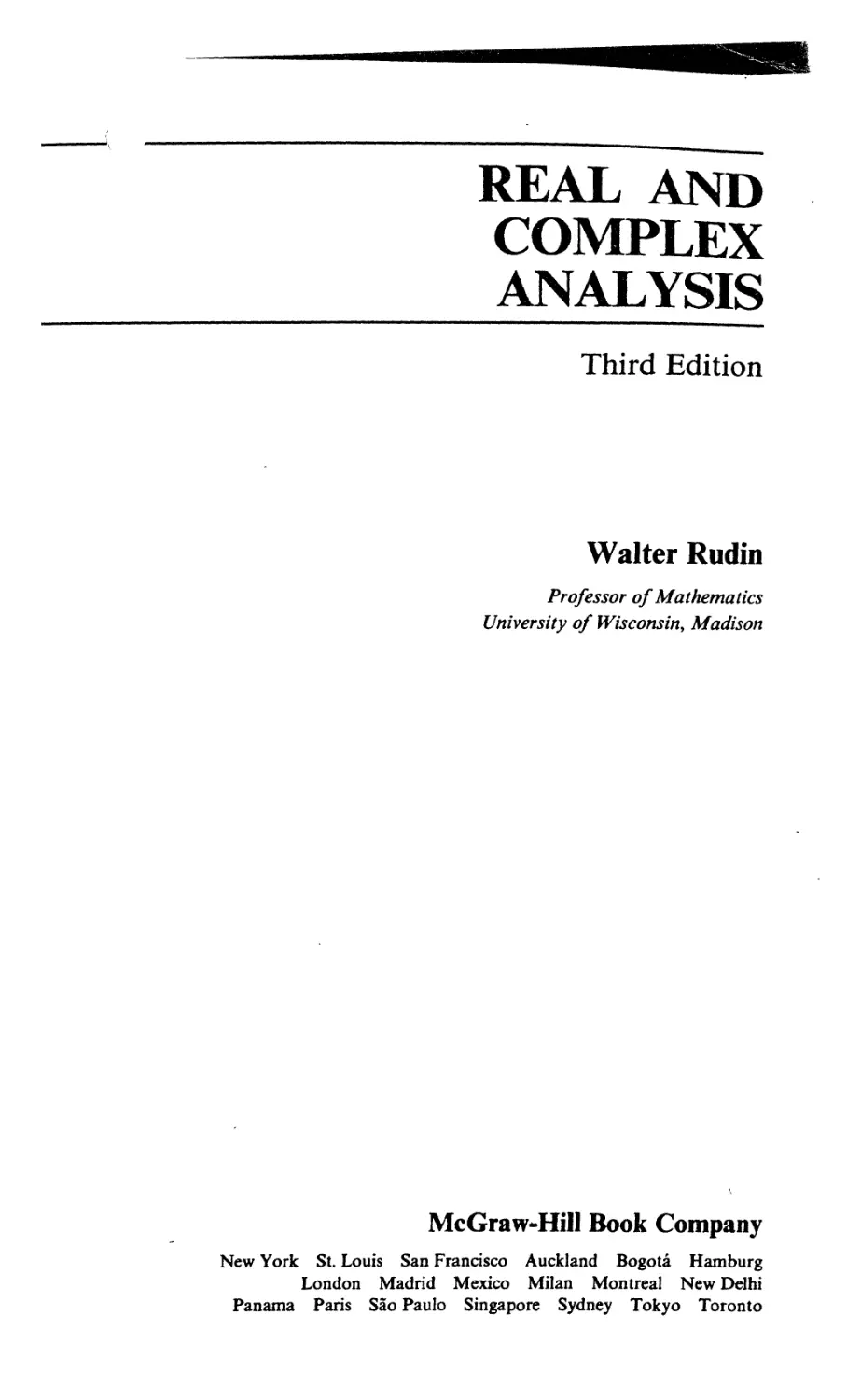
                    REAL AND
COMPLEX
ANALYSIS
Third Edition
Walter Rudin
Professor of Mathematics
University of Wisconsin, Madison
McGraw-Hill Book Company
New York St. Louis San Francisco Auckland Bogota Hamburg
London Madrid Mexico Milan Montreal New Delhi
Panama Paris Sao Paulo Singapore Sydney Tokyo Toronto

REAL AND COMPLEX ANALYSIS
INTERNATIONAL EDITION
Copyright ^ 1986
Exclusive rights by McGraw-Hill Book Co., Singapore
for manufacture and export. This book cannot be re-exported
from the country to which it is consigned by McGraw-Hill.
2nd Printing 1987
Copyright s- 1987, 1974, 1966 by McGraw-Hill, Inc.
All rights reserved. No part of this publication may be
reproduced or distributed in any form or by any means,
or stored in a data base or a retrieval system, without
the prior written permission of the publisher.
This book was set in Times Roman.
The editor was Peter R. Devine.
The production supervisor was Diane Renda.
Project supervision was done by Santype International Limited.
Library of Congress Cataloging-in-Pub!ication Data
Rudin, Walter, 1921 —
Real and complex analysis.
Bibliography: p.
Includes index.
1. Mathematical analysis. I. Title.
When ordering this title use ISBN 0-07-100276-6
Printed and bound in Singapore by В & Jo Enterprise Pte Ltd.

ABOUT THE AUTHOR
Walter Rudin is the author of three textbooks, Principles of Mathematical
Analysis, Real and Complex Analysis, and Functional Analysis, whose widespread
use is illustrated by the fact that they have been translated into a total of 13
languages. He wrote the first of these while he was a C.L.E. Moore Instructor at
M.I.T., just two years after receiving his Ph.D. at Duke University in 1949. Later
he taught at the University of Rochester, and is now a Vilas Research Professor
at the University of Wisconsin-Madison, where he has been since 1959.
He has spent leaves at Yale University, at the University of California in La
Jolla, and at the University (?f Hawaii.
His research has dealt mainly with harmonic analysis and with complex vari-
variables. He has written three research monographs on these topics, Fourier
Analysis on Groups, Function Theory in Polydiscs, and Function Theory in the
Unit Ball ofCn,

CONTENTS
Preface хш
Prologue: The Exponential Function l
Chapter 1 Abstract Integration 5
Set-theoretic notations and terminology 6
The concept of measurability 8
Simple functions 15
Elementary properties of measures 16
Arithmetic in [0, oo] 18
Integration of positive functions 19
Integration of complex functions 24
The role played by sets of measure zero 27
Exercises 31
Chapter 2 Positive Borel Measures 33
Vector spaces 33
Topological preliminaries 35
The Riesz representation theorem 40
Regularity properties of Borel measures 47
Lebesgue measure 49
Continuity properties of measurable functions 55
Exercises 57
Chapter 3 Lp-Spaces 61
Convex functions and inequalities 61
The ZAspaces 65
Approximation by continuous functions 69
^ Exercises 71
vii

viii contents
Chapter 4 Elementary Hilbert Space Theory 76
Inner products and linear functional 76
Orthonormal sets 82
Trigonometric series 88
Exercises 92
Chapter 5 Examples of Banach Space Techniques 95
Banach spaces 95
Consequences of Baire's theorem 97
Fourier series of continuous functions 100
Fourier coefficients of Ll -functions 103
The Hahn-Banach theorem 104
An abstract approach to the Poisson integral 108
Exercises 112
Chapter 6 Complex Measures H6
Total variation 116
Absolute continuity 120
Consequences of the Radon-Nikodym theorem 124
Bounded linear functionals on Lp 126
The Riesz representation theorem 129
Exercises 132
Chapter 7 Differentiation 135
Derivatives of measures 135
The fundamental theorem of Calculus 144
Differentiable transformations 150
Exercises 156
Chapter 8 Integration on Product Spaces 160
Measurability on cartesian products 160
Product measures 163
The Fubini theorem 164
Completion of product measures 167
Convolutions 170
Distribution functions 172
Exercises „ 174
Chapter 9 Fourier Transforms 178
Formal properties 178
The inversion theorem 180
The Plancherel theorem 185
The Banach algebra Ll 190
Exercises 193

CONTENTS IX
Chapter 10 Elementary Properties of Holomorphic
Functions
Complex differentiation
Integration over paths
The local Cauchy theorem
The power series representation
The open mapping theorem
The global Cauchy theorem
The calculus of residues
Exercises
196
196
200
204
208
214
217
224
227
Chapter 11 Harmonic Functions
The Cauchy-Riemann equations
The Poisson integral
The mean value property
Boundary behavior of Poisson integrals
Representation theorems
Exercises
231
231
233
237
239
245
249
Chapter 12 The Maximum Modulus Principle
Introduction
The Schwarz lemma
The Phragmen-Lindelof method
An interpolation theorem
A converse of the maximum modulus theorem
Exercises
253
253
254
256
260
262
264
Chapter 13 Approximation by Rational Functions
Preparation
Runge's theorem
The Mittag-LefTler theorem
Simply connected regions
Exercises
266
266
270
273
274
276
Chapter 14 Conformal Mapping
Preservation of angles
Linear fractional transformations
Normal families
The Riemann mapping theorem
The class <f
Continuity at the boundary
Conformal mapping of an annulus
Exercises
278
278
279
281
282
285
289
291
293

X CONTENTS
Chapter 15 Zeros of Holomorphic Functions 298
Chapter 16
Chapter 17
Chapter 18
Chapter 19
Chapter 20
Infinite products
The Weierstrass factorization theorem
An interpolation problem
Jensen's formula
Blaschke products
The Miintz-Szasz theorem
Exercises
Analytic Continuation
Regular points and singular points
Continuation along curves
The monodromy theorem
Construction of a modular function
The Picard theorem
Exercises
iP-Spaces
Subharmonic functions
The spaces Hp and N
The theorem of F. and M. Riesz
Factorization theorems
The shift operator
Conjugate functions
Exercises
Elementary Theory of Banach Algebras
Introduction
The invertible elements
Ideals and homomorphisms
Applications
Exercises
Holomorphic Fourier Transforms
Introduction
Two theorems of Paley and Wiener
Quasi-analytic classes
The Denjoy-Carleman theorem
Exercises
Uniform Approximation by Polynomials
Introduction
Some lemmas
Mergelyan's theorem
Exercises
298
301
304
307
310
312
315
319
319
323
326
328
331
332
335
335
337
341
34*2
346
350
352
356
356
357
362
365
369
371
371
372
377
380
383
386
386
387
390
394

CONTENTS XI
Appendix: Hausdorff's Maximality Theorem 395
Notes and Comments 397
Bibliography 405
List of Special Symbols 407
Index 409

PREFACE
This book contains a first-year graduate course in which the basic techniques and
theorems of analysis are presented in such a way that the intimate connections
between its various branches are strongly emphasized. The traditionally separate
subjects of "real analysis" and "complex analysis" are thus united; some of the
basic ideas from functional analysis are also included.
Here are some examples of the way in which these connections are demon-
demonstrated and exploited. The Riesz representation theorem and the Hahn-Banach
theorem allow one to " guess " the Poisson integral formula. They team up in the
proof of Runge's theorem. They combine with Blaschke's theorem on the zeros of
bounded holomorphic functions to give a proof of the Muntz-Szasz theorem,
which concerns approximation on an interval. The fact that L2 is a Hilbert space
is used in the proof of the Radon-Nikodym theorem, which leads to the theorem
about differentiation of indefinite integrals, which in turn yields the existence of
radial limits of bounded harmonic functions. The theorems of Plancherel and
Cauchy combined give a theorem of Paley and Wiener which, in turn, is used in
the Denjoy-Carleman theorem about infinitely differentiable functions on the real
line. The maximum modulus theorem gives information about linear transform-
transformations on Zf-spaces.
Since most of the results presented here are quite classical (the novelty lies in
the arrangement, and some of the proofs are new), I have not attempted to docu-
document the source of every item. References are gathered at the end, in Notes and
Comments. They are not always to the original sources, but more often to more
recent works where further references can be found. In no case does the absence
of a reference imply any claim to originality on my part.
The prerequisite for this book is a good course in advanced calculus
(settheoretic manipulations, metric spaces, uniform continuity, and uniform
convergence). The first seven chapters of my earlier book u Principles of Mathe-
Mathematical Analysis " furnish sufficient preparation.

Xiv PREFACE
Experience with the first edition shows that first-year graduate students can
study the first 15 chapters in two semesters, plus some topics from 1 or 2 of the
remaining 5. These latter are quite independent of each other. The first 15 should
be taken up in the order in which they are presented, except for Chapter 9, which
can be postponed.
The most important difference between this third edition and the previous
ones is the entirely new chapter on differentiation. The basic facts about differen-
differentiation are now derived from the existence of Lebesgue points, which in turn is an
easy consequence of the so-called " weak type " inequality that is satisfied by the
maximal functions of measures on euclidean spaces. This approach yields strong
theorems with minimal effort. Even more important is that it familiarizes stu-
students with maximal functions,% since these have become increasingly useful in
several areas of analysis.
One of these is the study of the boundary behavior of Poisson integrals. A
related one concerns Hp-spaces. Accordingly, large parts of Chapters 11 and 17
were rewritten and, I hope, simplified in the process.
I have also made several smaller changes in order to improve certain details:
For example, parts of Chapter 4 have been simplified; the notions of equi-
continuity and weak convergence are presented in more detail; the boundary
behavior of conformal maps is studied by means of Lindelof's theorem about
asymptotic valued of bounded holomorphic functions in a disc.
Over the last 20 years, numerous students and colleagues have offered com-
comments and criticisms concerning the content of this book. I sincerely appreciated
all of these, and have tried to follow some of them. As regards the present edition,
my thanks go to Richard Rochberg for some useful last-minute suggestions, and I
especially thank Robert Burckel for the meticulous care with which he examined
the entire manuscript.
Walter Rudin

PROLOGUE
THE EXPONENTIAL FUNCTION
This is the most important function in mathematics. It is defined, for every com-
complex number z, by the formula
The series A) converges absolutely, for every z and converges uniformly on every
bounded subset of the complex plane. Thus exp is a continuous function. The
absolute convergence of A) shows that the computation
k)\ %
„% n!
is correct. It gives the important addition formula
exp (a) exp (b) = exp (a + b\ B)
valid for all complex numbers a and b.
We define the number e to be exp A), and shall usually replace exp (z) by the
customary shorter expression ez. Note that e° = exp @) = 1, by A).
Theorem
(a) For every complex z we have e* Ф 0.
(b) exp is its own derivative: exp' (z) = exp (z).

2 REAL AND COMPLEX ANALYSIS
(c) The restriction of exp to the real axis is a monotonically increasing positi
function, and
ex—* oo as x—* oo, ex—» 0 as x—> — oo.
(J) There exists a positive number n such that eni/2 = i and such that ez = 1
and only ifz/Bni) is an integer,
(e) exp is a periodic function, with period 2ni.
(/) The mapping t-* elt maps the real axis onto the unit circle,
(g) Ifw is a complex number and w Ф 0, then w = ez for some z.
Proof By B), ez • e~z = ez~z = e° = 1. This implies (a). Next,
exp (z + h) - exp (z) exp (h) - 1
exp (z) = hm — f ^-^ = exp (z) hm = exp (z).
/i->0 " A-0 П
The first of the above equalities is a matter of definition, the second follows
from B), and the third from A), and (b) is proved.
That exp is monotonically increasing on the positive real axis, and that
ex-+ oo as x—* oo, is clear from A). The other assertions of (c) are conse-
consequences of ex • e~x = 1.
For any real number t, A) shows that e~lt is the complex conjugate of elt.
Thus
\eu\2 = eu • e* = e" • e""ft = ей"й = e° = 1,
or
|^| = 1 (rreal). C)
In other words, if t is real, elt lies on the unit circle. We define cos t, sin t to
be the real and imaginary parts of elt:
cos t = Re [eir], sin * = Im 0й] (* real). D)
If we differentiate both sides of Euler's ideutity
elt = cos t + i sin t, E)
which is equivalent to D), and if we apply (b), we obtain
cos' t -f- i sin' t = ielt = —sint + i cos t,
so that
cos' = —sin, sin' = cos. F)
The power series A) yields the representation
t2 t4 t6
cost=l--4-----b. -. G)

prologue: the exponential function 3
Take t = 2. The terms of the series G) then decrease in absolute value (except
for the first one) and their signs alternate. Hence cos 2 is less than the sum of
the first three terms of G), with t = 2; thus cos 2 < —\. Since cos 0 = 1 and
cos is a continuous real function on the real axis, we conclude that there is a
smallest positive number t0 for which cos t0 = 0. We define
n = 2t0. (8)
It follows from C) and E) that sin t0 = ± 1. Since
sin' {t) = cos t > 0
on the segment @, t0) and since sin 0 = 0, we have sin t0 > 0, hence sin tQ =
1, and therefore
eKi/2 = I (9)
It follows that £?*'" = i2 = -1, e2ni = (-1J = 1, and then e2nin = 1 for
every integer n. Also, (e) follows immediately:
If z = x + iy, x and у real, then e2 = exely; hence | e21 = ex. If ez = 1, we there-
therefore must have ex = 1, so that x = 0; to prove that y/2n must be an integer, it
is enough to show that eiy ф 1 if 0 < у < 2л, by A0).
Suppose 0 < у <2n, and
eiyl* = u + iv {u and v real). A1)
Since 0 < у/4 < я/2, we have и > 0 and f > 0. Also
el> = (м + ivL = u4 - 6u2v2 + u4 + 4ш1;(м2 - t;2). A2)
The right side of A2) is real only if u2 = v2; since u2 + v2 = 1, this happens
only when i/2 = f2 = j, and then A2) shows that
This completes the proof of (d).
We already know that t —> elt maps the real axis into the unit circle. To
prove (/), fix w so that | w | = 1; we shall show that w = elt for some real r.
Write w = и + iv, и and и real, and suppose first that и > 0 and t; > 0. Since
и < 1, the definition of я shows that there exists a f, 0 < t < я/2, such that
cos t = m; then sin2 f = 1 — u2 = v2, and since sin t > 0 if 0 < t < я/2, we
have sin t = v. Thus w = elt.
If м < 0 and v > 0, the preceding conditions are satisfied by — iw. Hence
_ iw = elt for some real t, and w = el{t + nl2). Finally, if v < 0, the preceding
two cases show that — w = e" for some real t, hence w = elit + 1t). This com-
completes the proof of (/).
If w Ф 0, put a = w/1 w |. Then w = | w | a. By (c), there is a real x such
that \w\ = ex. Since |a| = 1, (/) shows that a = eiy for some real y. Hence
w = ex + iy. This proves (g) and completes the theorem. ////

4 REAL AND COMPLEX ANALYSIS
We shall encounter the integral of A + x2) l over the real line. To eva
it, put cp(t) = sin t/cos t in (—тг/2, я/2). By F), <p' = 1 + q>2. Hence <^isam
tonically increasing mapping of ( —я/2, я/2) onto (— oo, oo), and we obtain
dx Гя/2 <p\t) dt f*/2

CHAPTER
ONE
ABSTRACT INTEGRATION
Toward the end of the nineteenth century it became clear to many mathemati-
mathematicians that the Riemann integral (about which one learns in calculus courses)
should be replaced by some other type of integral, more general and more flex-
flexible, better suited for dealing with limit processes. Among the attempts made in
this direction, the most notable ones were due to Jordan, Borel, W. H. Young,
and Lebesgue. It was Lebesgue's construction which turned out to be the most
successful.
In brief outline, here is the main idea: The Riemann integral of a function/
over an interval [a, b] can be approximated by sums of the form
1=1
where Ex, ..., En are disjoint intervals whose union is [a, b], т(Е() denotes the
length of Ei9 and tt e E{ for i — 1, ..., n. Lebesgue discovered that a completely
satisfactory theory of integration results if the sets Et in the above sum are
allowed to belong to a larger class of subsets of the line, the so-called
"measurable sets," and if the class of functions under consideration is enlarged to
what he called "measurable functions." The crucial set-theoretic properties
involved are the following: The union and the intersection of any countable
family of measurable sets are measurable; so is the complement of every measur-
measurable set; and, most important, the notion of "length" (now called "measure")
can be extended to them in such a way that
тЦЕх и Е2 и Е3 и • • •) = niEi) + m(E2) + m(E3) + • • •

6 REAL AND COMPLEX ANALYSIS
for every countable collection {£,} of pairwise disjoint measurable sets. This pro-
property of m is called countable additivity.
The passage from Riemann's theory of integration to that of Lebesque is a
process of completion (in a sense which will appear more precisely later). It is of
the same fundamental importance in analysis as is the construction of the real
number system from the rationale.
The above-mentioned measure m is of course intimately related to the
geometry of the real line. In this chapter we shall present an abstract (axiomatic)
version of the Lebesgue integral, relative to any countably additive measure on
any set. (The precise definitions follow.) This abstract theory is not in any way
more difficult than the special case of the real line; it shows that a large part of
integration theory is independent of any geometry (or topology) of the underlying
space; and, of course, it gives us a tool of much wider applicability. The existence
of a large class of measures, among them that of Lebesgue, will be established in
Chap. 2.
Set-Theoretic Notations and Terminology
1.1 Some sets can be described by listing their members. Thus {xl5..., xn} is the
set whose members are xu ..., xn; and {x} is the set whose only member is x.
More often, sets are described by properties. We write
{x:P}
for the set of all elements x which have the property P. The symbol 0 denotes
the empty set. The words collection, family, and class will be used synonymously
with set.
We write x e A if x is a member of the set A; otherwise x ф A. If В is a subset
of A, i.e., if x e В implies x e A, we write* В a A. If В c= A and A a B, then
A = B. If В a A and А Ф В, В is a proper subset of A. Note that 0 a A for every
set A.
А и В and A n В are the union and intersection of A and B, respectively. If
{Ал} is a collection of sets, where a runs through some index set /, we write
[JAa and (]Aa
ael ael
for the union and intersection of {Ал}:
(J Aa = {x: x e Aa for at least one a e /}
ael
f] Ал = {x: x e Ал for every a e /}.
<xel
If / is the set of all positive integers, the customary notations are
\jAn and f]An.

ABSTRACT INTEGRATION 7
If no two members of {Aa} have an element in common, then {Aa} is a
disjoint collection of sets.
We write A — В = {x: x e A, x ф В}, and denote the complement of A by Ac
whenever it is clear from the context with respect to which larger set the com-
complement is taken.
The cartesian product Ax x ••• x An of the sets Au ..., An is the set of all
ordered n-tuples (al9..., an) where a{ e A( for i — 1,..., n.
The real line (or real number system) is JR1, and
R'-R1 x ••• x JR1 (k factors).
The extended real number system is JR1 with two symbols, oo and — oo, adjoined,
and with the obvious ordering. If — oo < a < b < oo, the interval [д, b] and the
segment (a, b) are defined to be
[a, b] = {x: a < x < b}, (a, b) = {x: a < x < b}.
We also write
[a, b) = {x: a < x < b}, (a, b] = {x: a < x < b}.
If E a [— oo, oo] and E ф 0, the least upper bound (supremum) and great-
greatest lower bound (infimum) of E exist in [ — oo, oo] and are denoted by sup E and
inf E.
Sometimes (but only when sup E e E) we write max E for sup E.
The symbol
means that/is a. function (or mapping or transformation) of the set X into the set
Y; i.e., / assigns to each xelan element f(x) e Y. If A a X and В a Y, the
image of A and the inverse image (or pre-image) of В are
f(A) = {у: у =/(x) for some x e A},
f~\B) = {x:f(x)eB}.
Note that/ " Х(Б) may be empty even when В Ф 0.
The domain of/is X. The range offisf(X).
lff(X) = 7,/is said to map X onto Y.
We write/-1(у), instead of/^}), for every у e Y. lff~1(y) consists of at
most one point, for each ye 7,/is said to be one-to-one. If/ is one-to-one, then
f~l is a function with domain/(X) and range X.
If/: A"-> [—oo, oo] and E a X, it is customary to write supxe£; f(x) rather
than sup/(£).
If/: X—* У and g: Y-+ Zy the composite function g of: X—> Z is defined by
the formula

8 REAL AND COMPLEX ANALYSIS
If the range of/lies in the real line (or in the complex plane), then /is said to
be a real function (or a complex function). For a complex function/, the statement
"/> 0" means that all values/(x) of/are nonnegative real numbers. *
The Concept of Measurability
The class of measurable functions plays a fundamental role in integration theory.
It has some basic properties in common with another most important class of
functions, namely, the continuous ones. It is helpful to keep these similarities in
mind. Our presentation is therefore organized in such a way that the analogies
between the concepts topological space, open set, and continuous function, on the
one hand, and measurable space, measurable set, and measurable function, on the
other, are strongly emphasized. It seems that the relations between these concepts
emerge most clearly when the setting is quite abstract, and this (rather than a
desire for mere generality) motivates our approach to the subject.
1.2 Definition
(a) A collection x of subsets of a set X is said to be a topology in X if x has
the following three properties:
(i) 0 e x and X ex.
(ii) If V{ e x for i = 1,..., n, then V1 n V2 n • • • n Vn e x.
(iii) If {Va} is an arbitrary collection of members oft (finite, countable, or
uncountable), then \^а Va e x.
(b) If x is a topology in X, then X is called a topological space, and the
members of x are called the open sets in X.
(c) If X and У are topological spaces and if/is a mapping of X into Y, ther^
/is said to be continuous provided that/~1(K) is an open set in X for
every open set V in Y.
1.3 Definition
(a) A-eollection Ш of subsets of a set X is said to be a a-algebra in X if ЯЯ
has the following properties:
(i) X e Ж
(ii) If A e Ш, then Ac e Ш, where Ac is the complement of A relative to
X.
(iii) If Л = Un°°=:i 4, and if АпеШ{отп= 1, 2, 3,..., then А еЖ
(b) If ЯЯ is a a-algebra in X, then X is called a measurable space, and the
members of SOI are called the measurable sets in X.
(c) If X is a measurable space, У is a topological space, and / is a mapping
of X into У, then/is said to be measurable provided that/^) is a
measurable set in X for every open set V in У.

ABSTRACT INTEGRATION 9
It would perhaps be more satisfactory to apply the term "measurable space"
to the ordered pair (X, Ш), rather than to X. After all, X is a set, and X has not
been changed in any way by the fact that we now also have a <r-algebra of its
subsets in mind. Similarly, a topological space is an ordered pair (X, т). But if this
sort of thing were systematically done in all mathematics, the terminology would
become awfully cumbersome. We shall discuss this again at somewhat greater
length in Sec. 1.21.
1.4 Comments on Definition 1.2 The most familiar topological spaces are the
metric spaces. We shall assume some familiarity with metric spaces but shall give
the basic definitions, for the sake of completeness.
A metric space is a set X in which a distance function (or metric) p is defined,
with the following properties:
(a) 0 < p(x, y) < oo for all x and у е X.
(b) p(x, y) = 0 if and only if x = y.
(c) p(x, y) = p(y, x) for all x and у е X.
(d) p(x, y) < p(x, z) + p(z, y) for all x, y, and z e X.
Property (d) is called the triangle inequality.
If x e X and r > 0, the open ball with center at x and radius r is the set
{yeX:p{x,y) < r}.
If X is a metric space and if т is the collection of all sets E с X which are
arbitrary unions of open balls, then x is a topology in X. This is not hard to
verify; the intersection property depends on the fact that if x e B± n B2, where
#! and B2 are open balls, then x is the center of an open ball В a Bx n B2. We
leave this as an exercise.
For instance, in the real line R1 a set is open if and only if it is a union of
open segments (я, b). In the plane R2, the open sets are those which are unions of
open circular discs.
Another topological space, which we shall encounter frequently, is the
extended real line [— oo, oo]; its topology is defined by declaring the following
sets to be open: (a, b\ [ — oo, a), (a, oo], and any union of segments of this type.
The definition of continuity given in Sec. 1.2(c) is a global one. Frequently it
is desirable to define continuity locally: A mapping/of X into Y is said to be
continuous at the point x0 e X if to every neighborhood V of/(x0) there corre-
corresponds a neighborhood W of x0 such that f{W) a V.
(A neighborhood of a point x is, by definition, an open set which contains x.)
When X and У are metric spaces, this local definition is of course the same
as the usual epsilon-delta definition, and is equivalent to the requirement that
lim/(xn) =/(x0) in У whenever lim xn = x0 in X.
The following easy proposition relates the local and global definitions of con-
continuity in the expected manner:
1.5 Proposition Let X and Y be topological spaces. A mapping f of X into Y is
continuous if and only iff is continuous at every point ofX.

10 REAL AND COxMPLEX ANALYSIS
Proof If/ is continuous and x0 e X, then/'^F) is a neighborhood of x0,
for every neighborhood V of/(xo). Since /(/"ЧЮ) ^ ^ it follows that/is
continuous at x0. •<*
If/is continuous at every point of X and if V is open in Y, every point
x ef~\V) has a neighborhood W, such that /(ИУ с V. Therefore V/Xa
f~\V\ It follows that/""ЧЮ is the union of the open sets Wx, %of~\V) is
itself open. Thus/is continuous. ////
1.6 Comments on Definition 1.3 Let SW be a a-algebra in a set X. Referring to
Properties (i) to (iii) of Definition 1.3(д), we immediately derive the following
facts.
(a) Since 0 = Xе, (i) and (ii) imply that 0 e Ш.
(b) Taking An+l = An+2 = • • • = 0 in (iii), we see that A^ u A2 и • • • и Л„
еЯЯ if /i£ eaRfori = 1,...,л.
(c) Since
5Ш is closed under the formation of countable (and also finite) intersec-
intersections.
(d) Since A - В = & n A, we have Л - Я е 9Я if Л е ЭД and В е Ш.
The prefix a refers to the fact that (iii) is required to hold for all countable
unions of members of 5Ш. If (iii) is required for finite unions only, then 5Ш is called
an algebra of sets.
1.7 Theorem Let Y and Z be topological spaces, and let g: Y—>Z be contin-
continuous.
(a) IfX is a tomtogical space, iff: X—* Y is continuous, and ifh — g o/ then
h: X-* Z is continuous.
(b) IfX is a measurable space, iff: X—* Y is measurable, and ifh = g of then
h: X-+Z is measurable.
Stated informally, continuous functions of continuous functions are contin-
continuous; continuous functions of measurable functions are measurable.
Proof If V is open in Z, then g~1(V)is open in Y, and
If/is continuous, it follows that h~l(V) is open, proving (a).
If/is measurable, it follows that h~\У) is measurable, proving (b). ////

ABSTRACT INTEGRATION 11
1.8 Theorem Let и and v be real measurable functions on a measurable space
X, let Ф be a continuous mapping of the plane into a topological space Y, and
define
h(x) = Ф(и(х), v(x)) •
for x e X. Then h: X-* Y is measurable.
Proof Put/(x) = (u{x\ v(x)). Then/maps X into the plane. Since h = Ф of
Theorem 1.7 shows that it is enough to prove the measurability of/.
If R is any open rectangle in the plane, with sides parallel to the axes,
then R is the cartesian product of two segments It and I2, and
which is measurable, by our assumption on и and v. Every open set V in the
plane is a countable union of such rectangles Д,, and since
f~l(V)is measurable. ////
1.9 Let X be a measurable space. The following propositions are corollaries of
Theorems 1.7 and 1.8:
(a) If f — и + iv, where и and v are real measurable functions on X, then f is a
complex measurable function on X.
This follows from Theorem 1.8, with Ф(г) = z.
(b) Iff — и + iv is a complex measurable function on X, then u, v, and |/| are real
measurable functions on X.
This follows from Theorem 1.7, with g(z) = Re (z), Im (z\ and \z\.
(c) Iff and g are complex measurable functions on X, then so aref+ g andfg.
For real/and g this follows from Theorem 1.8, with
ФE, t) = S + t
and ФE, t) = st. The complex case then follows from (a) and (b).
(d) If E is a measurable set in X and if
ifxeE
if хфЕ
then xE ™ a measurable function.
This is obvious. We call Xe *ne characteristic function of the set E. The
letter x will be reserved for characteristic functions throughout this book.
(e) Vf is a complex measurable function on X, there is a complex measurable
function a on X such that \ a \ ~ 1 andf = a | /1.

12 REAL AND COMPLEX ANALYSIS
Proof Let E = {x:f(x) = 0}, let Y be the complex plane with the origin
removed, define <p(z) = z/ \ z | for z e Y, and put
a(x) = cp(f(x) + x^x)) (x e X).
If x e E, a(x) = 1; if x ф E, a(x) =/(*)/|/(x)|. Since <p is continuous on Y
and since E is measurable (why?), the measurability of a follows from (c), (J),
and Theorem 1.7. ////
We now show that a-algebras exist in great profusion.
1.10 Theorem // 3F is any collection of subsets of X, there exists a smallest
a-algebra Ш* in X such that & а Ш*.
This ЯЯ* is sometimes called the a-algebra generated by #\
Proof Let Q be the family of all a-algebras Ш in X which contain &. Since
the collection of all subsets of X is such a a-algebra, Q is not empty. Let Ш*
be the intersection of all Ш e Q. It is clear that & с ЯЯ* and that $R* lies in
every a-algebra in X which contains #\ To complete the proof, we have to
show that $R* is itself a a-algebra.
If An e Ш* for n = 1, 2, 3,..., and if Ш e Q, then Л„ е ЯК, so (J An e ЯЯ, '
since 5Я is a a-algebra. Since [j ЛпеШ for erery ЯЯ e Q, we conclude that
(J Л„ е 5Ш*. The other two defining properties of a a-algebra are verified in
the same manner. ////
1.11 Borel Sets Let I be a topological space. By Theorem 1.10, there exists a
smallest a-algebra $ in X such that every open set in X belongs to ^. The
members of 8& are called the Borel sets of X.
In particular, closed sets are Borel sets (being, by definition, the complements
of open sets), and so are all countable unions of closed sets and all countable
intersections of open sets. These last two are called Fff's and G/s, respectively,
and play a considerable role. The notation is due to Hausdorff. The letters F and
G were used for closed and open sets, respectively, and a refers to union (Summe),
S to intersection (Durchschnitt). For example, every half-open interval [a, h) is a
G^and an F^in R1.
Since $ is a a-algebra, we may now regard X as a measurable space, with the
Borel sets playing the role of the measurable sets; more concisely, we consider the
measurable space (X, ^). If/: Z-> Y is a continuous mapping of X, where Y is
any topological space, then it is evident from the definitions that/~l(^) e Я for
every open set V in У. In other words, every continuous mapping of X is Borel
measurable.
Borel measurable mappings are often called Borel mappings, or Borel func-
functions.

ABSTRACT INTEGRATION 13
1.12 Theorem Suppose $R is a a-algebra in X, and Y is a topological space.
Let f map X into Y.
(a) IfQ is the collection of all sets E a Y such thatf~l(E) e УЯ, then Q is a
a-algebra in Y.
(h) Iff is measurable and E is a Borel set in У, thenf ~ l(E) e Ш.
(c) If Y = [—00, oo] andf~l({<x, oo]) e Wlfor every real a, then f is measur-
measurable.
(d) Iff is measurable, if Z is a topological space, if g: Y—+Z is a Borel
mapping, and ifh = g of then h: X—+ Z is measurable.
Part (c) is a frequently used criterion for the measurability of real-valued
functions. (See also Exercise 3.) Note that (d) generalizes Theorem l.l(b).
Proof (a) follows from the relations
and f'HA, uA2u ■•■)=f-\Al) vf~\A2) u •••.
To prove (b), let Q be as in (a); the measurability of/implies that Q
contains all open sets in У, and since Q is a <r-algebra, Q contains all Borel
sets in Y.
To prove (c), let Q be the collection of all E a [— oo, oo] such that
f~l(E) e ffl. Choose a real number a, and choose а„ < a so that а„—> a as
n—> oo. Since (а„, oo] e Q for each n, since
[-00, a) = 0 [-ao, aj = (j (а„, oo]',
n=l n=l
and since (a) shows that Q is a (т-algebra, we see that [— oo, а) е Q. The same
is then true of
(а, Я = [-«>,/On (a, oo].
Since every open set in [ —oo, oo] is a countable union of segments of the
above types, П contains every open set. Thus/is measurable.
To prove (d), let V с Z be open. Then g~l(V) is a Borel set of Y, and
since
(b) shows that h ~ *(V) e Ш. ////
1.13 Definition Let {а„} be a sequence in [- oo, oo], and put
fck = sup {ak,ak+l, flk+2,...} (*= 1,2,3,...) A)

14 REAL AND COMPLEX ANALYSIS
and
p = int{bl9b29b3,...}. B)
We call p the upper limit of {an}, and write
p = lim sup an. C)
л-*оо
The following properties are easily verified: First, bx > b2 > b3 > • • •, so
that bk-+ P as /c—► oo; secondly, there is a subsequence {ani} of {an} such that
an.—► p as z—► oo, and p is the largest number with this property.
The lower limit is defined analogously: simply interchange sup and inf in
A) and B). Note that
lim inf an — —lim sup ( — an). D)
n-* oo n~* oo ^v
If {an} converges, then evidently
lim sup an ~ lim inf an = lim an. E)
n-* oo n~* oo n~*oo
Suppose {/„} is a sequence of extended-real functions on a set X. Then
sup/, and lim sup/n are the functions defined on X by
x)-sup(/nW)} F)
n
(lim sup f\x) = lim sup (/„(*)). G)
\ Я-+00 / И-+00
If
№ = lim /„(*), (8)
n-*oo
the limit being assumed to exist at every x e X, then we call / the pointwise
limit of the sequence {/„}. -* ,
1.14 Theorem ///„: X—> [ — oo, oo] is measurable, for n = 1, 2, 3,..., and
g = snpfn, h = lim sup/n,
n^: 1 n->oo
then g and h are measurable.
Proof q~\(ol9 oo]) = (J^°=1 /„"^(a, oo]). Hence Theorem 1.12(c) implies that
g is measurable. The same result holds of course with inf in place of sup, and
since
h = inf <sup/j>,
*>1 li>k J
it follows that h is measurable. ////

ABSTRACT INTEGRATION 15
Corollaries
(a) The limit of every pointwise convergent sequence of complex measurable
functions is measurable.
(b) Iff and g are measurable (with range in [ — 00, 00]), then so are max {/, g)
and min {/, g). In particular, this is true of the functions
f+ = max {/ 0} and /~ = -min {/ 0}.
1J5 The above functions/+ and/" are called the positive and negative parts of/
We have |/| =/+ +/~ and/=/+ -/"", a standard representation of/as a
difference of two nonnegative functions, with a certain minimality property:
Proposition ///= g — h9 g > 0, and h > 0, thenf+ < g andf~ < h.
Proof /< g and 0 < g clearly implies max {/ 0} < g. ////
Simple Functions
1.16 Definition A complex function s on a measurable space X whose range
consists of only finitely many points will be called a simple function. Among
these are the nonnegative simple functions, whose range is a finite subset of
[0, 00). Note that we explicitly exclude 00 from the values of a simple func-
function.
If ocl9 ..., <xn are the distinct values of a simple function 5, and if we set
At = {x: s(x) = a,}, then clearly
where xA. is the characteristic function of Ai9 as defined in Sec. 1.9(d).
It is also clear that 5 is measurable if and only if each of the sets A( is
measurable.
1.17 Theorem Let f: X—► [0, 00] be measurable. There exist simple measur-
measurable functions sn on X such that
(a) 0<ss1<s2<--- <f
(b) sn(x)-+f(x) flsn-> 00, for every x e X.
Proof Put dn = 2~n. To each positive integer n and each real number t cor-
corresponds a unique integer к = kn(t) that satisfies kSn < t < (k 4- l)Sn. Define
(kn(t)Sn ifO<t<n
*M-\n ifn<t<oo. A)

16 REAL AND COMPLEX ANALYSIS
Each <pn is then a Borel function on [0, oo],
t - Sn < <pn(t) <t ifO<t<n, B)
0 <(pi<<p2<- < t, and <pn(t)-+t as n-+ oo, for every t e [0, oo]. It
follows that the functions -
Sn = <Pn°f C)
satisfy (a) and (b); they are measurable, by Theorem 1.12(d). ////
Elementary Properties of Measures
1.18 Definition
(a) A positive measure is a function \i, defined on a a-algebra ffi, whose range
is in [0, go] and which is countably additive. This means that if {At} is a
disjoint countable collection of members of %R, then
To avoid trivialities, we shall also assume that ц(А) < oo for at least one
АеЖ
(b) A measure space is a measurable space which has a positive measure-
defined on the G-algebra of its measurable sets.
(c) A complex measure is a complex-valued countably additive function
defined on a cr-algebra.
: What we have called a positive measure is frequently just called a
measure; we add the word "positive" for emphasis. If ц(Е) = 0 for every E еШ,
then \i is a positive measure, by our definition. The value oo is admissible for a
positive measure; but when we talk of a complex measure ju, it is understood that
li(E) is a complex number, for every E еШ. The real measures form a subclass of
the complex ones, of course.
1.19 Theorem Let \ibe a positive measure on a o-algebra Ш. Then
(a)
(b) \i{A± и • • • u An) — ц{Ах) -f • • • + }i(An) ifAlf..., Anare pairwise disjoint
members ofWl.
(c) А с В implies /л(А) < ц(В) if А еШ,ВеШ.
(d) ii{A^-> ii{A) as n-> oo if A = \J?Bl An,Ane Ш, and
Ax<=. A2<z Аъ <=.'•-.
(e) p(An)-+ АЛ) as я- oo if A = р|Г=1 Лп,Апе Ш9
A± :э А2 з Аъ з • • •,
and ii{At) is finite.

ABSTRACT INTEGRATION 17
As the proof will show, these properties, with the exception of (c), also hold
for complex measures; (b) is called finite additivity; (c) is called monotonicity.
Proof
(a) Take A e 9R so that ii{A) < oo, and take Ax = A and A2 = Л3 = • • • =
0 in 1.18A).
(ft) Take Л„+1 = Ля + 2 = • •• = 0 in 1.18A).
(c) Since J5 = A u (J5 - A) and Л n (J3 - A) = 0, we see that (b) implies
fi(B) = ii{A) + KB~A)> »{А).
(d) Put Bt = Л15 and put Bn = Лл - Л^ for n = 2, 3, 4, .... Then Bn e Ш,
B( n Bj= 0 if i Ф), An = Bx u • • • u Bn, and Л = (J^i J5,. Hence
and £
Now (rf) follows, by the definition of the sum of an infinite series.
(e) Put Cn = Ax - Л„. Then Cx с С2 с С3 с • • •,
Л! — Л = (J Cn, and so (</) shows that
fi(At) ~ fi(A) = ii[A, -A)= \imii{Cn) =
n-»oo n-»oo
This implies (e). • ////
1.20 Examples The construction of interesting measure spaces requires some
labor, as we shall see. However, a few simple-minded examples can be given
immediately:
(a) For any E с X, where X is any set, define fi(E) = oo if E is an infinite set,
and let ц(Е) be the number of points in £ if £ is finite. This \i is called the
counting measure on X.
(b) Fix x0 e X, define /*(£) =1 if x0 e E and /<£) = 0 if x0 $ E, for any
E a X. This /i may be called the unit mass concentrated at x0.
(c) Let /x be the counting measure on the set {1, 2, 3, ...}, let An = {n, n + 1,
n + 2,...}. Then f] An = 0 but //(/1J = oo for л = 1, 2, 3, .... This
shows that the hypothesis
oo
is not superfluous in Theorem 1.19(e).
1.21 A Comment on Terminology One frequently sees measure spaces referred to
as " ordered triples " (X, 9ОД, ц) where X is a set, Ш is a d-algebra in X, and ц is a
measure defined on 5Ш. Similarly, measurable spaces are " ordered pairs " (X, Щ.

18 REAL AND COMPLEX ANALYSIS
This is logically all right, and often convenient, though somewhat redundant. For
instance, in (X, Щ the set X is merely the largest member of Ш, so if we know Щ
we also know X. Similarly, every measure has a a-algebra for its domain, by
definition, so if we know a measure \i we also know the <r-algebra Ш on which \i
is defined and we know the set X in which Ш is a (T-algebra.
It is therefore perfectly legitimate to use expressions like "Let ц be a
measure" or, if we wish to emphasize the (т-algebra or the set in question, to say
" Let \x be a measure on УЯ " or " Let \i be a measure on X"
What is logically rather meaningless but customary (and we shall often
follow mathematical custom rather than logic) is to say "Let X be a measure
space"; the emphasis should not be on the set, but on the measure. Of course,
when this wording is used, it is tacitly understood that there is a measure defined
on some a-algebra in X and that it is this measure which is really under dis-
discussion.
Similarly, a topological space is an ordered pair (X, r), where x is a topology
in the set X, and the significant data are contained in t, not in X, but "the
topological space X " is what one talks about.
This sort of tacit convention is used throughout mathematics. Most mathe-
mathematical systems are sets with some class of distinguished subsets or some binary
operations or some relations (which are required to have certain properties), and
one can list these and then describe the system as an ordered pair, triple, etc.,
depending on what is needed. For instance, the real line may be described as a
quadruple (R1, +, *, <), where +, • and < satisfy the axioms of a complete
archimedean ordered field. But it is a/safe bet that very few mathematicians think
of the real field as an ordered quadruple.
Arithmetic in [0, oo]
1.22 Throughout integration theory, one inevitably encounters oo. Qne reason is
that one wants to be able to integrate over sets of infinite measure; after all, the
real line has infinite length. Another reason is that even if one is primarily inter-
interested in real-valued functions, the lim sup of a sequence of positive real functions
or the sum of a sequence of positive real functions may well be oo at some points,
and much of the elegance of theorems like 1.26 and 1.27 would be lost if one had
to make some special provisions whenever this occurs.
Let us define a + ao = oo + a = ooifO<a<oo, and
Гоо if 0 < а < oo
oo = oo • я = < л
if я = 0;
sums and products of real numbers are of course defined in the usual way.
It may seem strange to define 0 • oo = 0. However, one verifies without diffi-
difficulty that with this definition the commutative, associative, and distributive laws
hold in [0, oo] without any restriction.

ABSTRACT INTEGRATION 19
The cancellation laws have to be treated with some care: a + b = a + с
b = с only when a < oo, and ab = ac implies b = с only when 0 < a < oo.
Observe that the following useful proposition holds:
//0 < tfj < a2 < • ", 0 < b{ < b2 < • ••, fln—> tf, awd bn-+b, then anbn-^ ab.
If we combine this with Theorems 1.17 and 1.14, we see that sums and pro-
products of measurable functions into [0, oo] are measurable.
Integration of Positive Functions
In this section, Ш will be a a-algebra in a set X and \i will be a positive measure
1.23 Definition If 5: X—> [0, 00) is a measurable simple function, of the form
n
Е (i)
where al9 ..., а„ are the distinct values of s (compare Definition 1.16), and if
E e ЯЯ, we define
i'
B)
The convention 0 • oo = 0 is used here; it may happen that a,- = 0 for some i
and that n(At n E) = oo.
If/: X—> [0, oo] is measurable, and E e Ш, we define
dfi, C)
the supremum being taken over all simple measurable functions s such that
0 < s </.
The left member of C) is called the Lebesgue integral of/over E, with
respect to the measure \i. It is a number in [0, oo].
Observe that we apparently have two definitions for \E f d\i if/is simple,
namely, B) and C). However, these assign the same value to the integral,
since/is, in this case, the largest of the functions 5 which occur on the right
ofC).
1.24 The following propositions are immediate consequences of the definitions.
The functions and sets occurring in them are assumed to be measurable:
(a) //0 <^/< g, then JE /dp <\Eg dp.
(b) If A cz В andf> 0, then \A f d\k < fs fdfi.

20 REAL AND COMPLEX ANALYSIS
(c) ///5: 0 and с is a constant, 0 ^ с < oo,
{<fdp = c f
Je Jb
(J) J//(x) = 0/or a// x e E, then J£ /^ = 0, even iffi(E) = oo.
(e) Iffi{E) = 0, then JE /d// = 0, е^ел i//(x) = oo/or ei?ery x e E.
{f) Iff> 0, ;Ji*n J£ J
This last result shows that we could have restricted our definition of integra-
integration to integrals over all of X, without losing any generality. If we wanted to
integrate over subsets, we could then use (/) as the definition. It is purely a
matter of taste which definition is preferred.
One may also remark here that every measurable subset £ of a measure
space X is again a measure space, in a perfectly natural way: The new measur-
measurable sets are simply those measurable subsets of X which lie in £, and the
measure is unchanged, except that its domain is restricted. This shows again that
as soon as we have integration defined over every measure space, we automati-
automatically have it defined over every measurable subset of every measure space.
1.25 Proposition Let s and t be nonnegative measurable simple functions on X.
For EeWl, define
<p(£) = I s dp. A)
ТЛел ф is a measure on УЯ. Also
Г С
dfi. B)
Jx
Jx Jx
(This proposition contains provisional forms of Theorems 1.27 and 1.29.)
Proof If 5 is as in Definition 1.23, and if ЕиЕг, ... are disjoint members of
Ш whose union is E, the countable additivity of \i shows that
n n со
cp(E) = £ а,р(А, n £) = £ a, £ /<Л, n £r)
i=l i=l r=l '
I 1 I
r-1 1 = 1 r=l
Also, <p@) = 0, so that (p is not identically oo.

ABSTRACT INTEGRATION 21
Next, let s be as before, let pl9 ..., Pm be the distinct values of t, and let
Bj={x: t(x) = fij}. If Eu = Л, п Я,., then
I
E + t) d\i = (af + PI
Г Г
and 5^+ t d\i —
JEij JEij
Thus B) holds with E(j in place of X. Since X is the disjoint union of the sets
Eu A < i < n, 1 <j < m), the first half of our proposition implies that B)
holds. ////
We now come to the interesting part of the theory. One of its most remark-
remarkable features is the ease with which it handles limit operations.
1.26 Lebesgue's Monotone Convergence Theorem Let {/„} be a sequence of
measurable functions on X, and suppose that
{a) 0 <Мх) <f2(x) <•--< со for every x e X,
(b) fn(x)-+f(x) asn-+ 00, for every x e X.
Then f is measurable, and
Г Г ,
\ fn и/л—* \ f d\i as n-> 00.
Jx Jx
Proof Since \fn < jfn + 1, there exists an a e [0, 00] such that
fn d\i-+ a as n—> 00. A)
1-
By Theorem 1.14,/is measurable. Since/„ </, we have \fn < J/for every и,
so A) implies
Г
B)
Let 5 be any simple measurable function such that 0 < s <f let с be a
constant, 0 < с < 1, and define
£.n — \X./n(XJ ^ C5^XJ/ (П — 1, Z, J, ...J. (^
Each En is measurable, £x с £2 c: £3 c: • • •, and X = (J £„. To see this
equality, consider some x e X. If /(x) = 0, then x e Ex; if /(x) > 0, then
cs(x) </(x), since с < 1; hence x e En for some n. Also
(n= 1,2,3,...). D)

22 REAL AND COMPLEX ANALYSIS
Let м-> oo, applying Proposition 1.25 and Theorem 1.19(d) to the last inte-
integral in D). The result is
a > с \sdfi. E)
Since E) holds for every с < 1, we have
Js d\x F)
x
for every simple measurable s satisfying 0 < s </, so that
fdii. G)
a> h
Jx
Jx
The theorem follows from A), B), and G). ////
1.27 Theorem ///„: X-^ [0, oo] is measurable Jor n = 1, 2, 3,..., and
fix) = t ЛМ (* e ^ A)
= I U^. B)
n=l JX
Proof First, there are sequences {$;•}, {s-'j of simple measurable functions
such that s|—>yi and s"i-^f1, as in Theorem 1.17. If s,-= sj + sj', then
Sf-^/x +/2, and the monotone convergence theorem, combined with Propo-
Proposition 1.25, shows that
f \diL C)
Next, put gN=fi + ••• +/^. The sequence {^} converges monotoni-
cally to/, and if we apply induction to C) we see that
= I Г/.Ф. D)
Applying the monotone convergence theorem once more, we obtain B), and
the proof is complete. ////
If we let pi be the counting measure on a countable set, Theorem 1.27 is a
statement about double series of nonnegative real numbers (which can of course
be proved by more elementary means):

ABSTRACT INTEGRATION 23
Corollary Ifa(j > Ofor i andj = 1, 2, 3, , then
00 00 00 00
/ 1 IJ / • / Л IJ '
1=1 j=l J=l1=1
1.28 Fatou's Lemma ///„: X—> [0, oo] is measurable, for each positive integer
n, then
С ( \ С
I lim inf/rt I d\x < lim inf /„ d\i. A)
Jx \ n->oo / n->oo JX
Strict inequality can occur in A); see Exercise 8.
Proof Put
gk(x) = inf fix) (к = 1, 2, 3,...; x e X). B)
»>fc
Then#k <A,so that
:dfi (*= 1,2,3,...). C)
Also, 0 < gt <g2<"m, each gk is measurable, by Theorem 1.14, and
gk(x)—> lim inf/n(x) as k—> oo, by Definition 1.13. The monotone convergence
theorem shows therefore that the left side of C) tends to the left side of A), as
k-+ oo. Hence A) follows from C). ////
1.29 Theorem Supposef: X—> [0, oo] is measurable, and
{E e Щ. A)
JE
Then (p is a measure on ffi, and
\gdcp=\gfdn B)
JX JX
for every measurable g on X with range in [0, oo].
Proof Let El9 E2, E3, ... be disjoint members of ffl whose union is E.
Observe that
Xe/= txEjf C)
and that
cp(E) = f Хв/Л/л, <p(Ej) = f XEjfdii. D)
J

24 REAL AND COMPLEX ANALYSIS
It now follows from Theorem 1.27 that
cp(E) = | <p(Ej). E)
Since <p@) = 0, E) proves that <p is a measure.
Next, A) shows that B) holds whenever g = %E for some £g1. Hence
B) holds for every simple measurable function g, and the general case follows
from the monotone convergence theorem. ////
Remark The second assertion of Theorem 1.29 is sometimes written in the
form
dip —fdj.L F)
We assign no independent meaning to the symbols dip and d\i\ F) merely
means that B) holds for every measurable g > 0.
Theorem 1.29 has a very important converse, the Radon-Nikodym
theorem, which will be proved in Chap. 6.
Integration of Complex Functions
As before, \i will in this section be a positive measure on an arbitrary measurable
space X.
1.30 Definition We define 1}(/л) to be the collection of all complex measur-
measurable functions/on X for which
Г
I/I djx< oo.
Note that the measurability of/implies that of |/|, as we saw in Propo-
Proposition \.9(b); hence the above integral is defined.
The members of 1}(ц) are called Lebesgue integrable functions (with
respect to /x) or summable functions. The significance of the exponent 1 will
become clear in Chap. 3.
1.31 Definition If/= и + iv, where и and v are real measurable functions on
X, and if/ g Lx(/4 we define
/ dfi — \ и+ dfi — \ и d\i + i \ v+ d\i — i \ v dji
}e je je je je
A)
for every measurable set E.
Here u+ and u~ are the positive and negative parts of м, as defined in
Sec. 1.15; v+ and v~ are similarly obtained from v. These four functions are
measurable, real, and nonnegative; hence the four integrals on the right of A)
exist, by Definition 1.23. Furthermore, we have u+ < \u\ < |/|, etc., so that

ABSTRACT INTEGRATION 25
each of these four integrals is finite. Thus A) defines the integral on the left as
a complex number.
Occasionally it is desirable to define the integral of a measurable func-
function/with range in [— oo, oo] to be
= [f+dfi- \
JE JE
/~ dfi, B)
provided that at least one of the integrals on the right of B) is finite. The left
side of B) is then a number in [— oo, oo].
1.32 Theorem Suppose f and g e 1}(ц) and a and p are complex numbers. Then
<xf > fig e J}(ji\ and
[ (a/+ fig) dfi = x[fdli + pL dfi. A)
Jx Jx Jx
Proof The measurability of ocf+ fig follows from Proposition 1.9(c). By Sec.
1.24 and Theorem 1.27,
\g\dii<ao.
= |a| f |/|d/i+ |/»| f
Jx Jx
Thus a/+ pg e L1
To prove A), it is clearly sufficient to prove
f(/+0)^= [fdft+ [gdfi B)
Jx Jx Jx
and
Г С
C)
!(af)dfi = oc f
Jx Jx
and the general case of B) will follow if we prove B) for real/and g in L1^).
Assuming this, and setting h =/+ #, we have
or
h+ +/" +g- =/+ +g+ +h~. D)
By Theorem 1.27,
J*-+J/-+J,-f/*+f.*+J.-. E,
and since each of these integrals is finite, we may transpose and obtain B).

26 REAL AND COMPLEX ANALYSIS
That C) holds if a > 0 follows from Proposition 1.24(c). It is easy to
verify that C) holds if a = —1, using relations like ( — u)+ = u~. The case
a = i is also easy: If/= и -f iv, then
Combining these cases with B), we obtain C) for any complex a. ////
1.33 Theorem Iffe 1}(ц), then
fdn
< \f\dpL
Proof Put z = §x f dfi. Since z is a complex number, there is a complex
number a, with |a| = 1, such that az =\z\. Let и be the real part of a/ Then
«<|a/| = J/|. Hence
[fdn =a \fdii= \afdpL= [udn< f \f\dn.
Jx Jx Jx Jx Jx
The third of the above equalities holds since the preceding ones show that
Ja/d/nsreal. ////
We conclude this section with another important convergence theorem.
1.34 Lebesgue's Dominated Convergence Theorem Suppose {/„} is a sequence
of complex measurable functions on X such that
f(x) = lim fj[x) A)
n-* oo
exists for every x e X. If there is a function g e 1}{ц) such that
\Ux)\<g{x) (n=l,2,3,...;xeX), B)
thenfe I}(jx\
n-oo JX
-f\dp=O, C)
n-oo JX
and
lim I /„ dfi = I f dfi. D)
И—ОО

ABSTRACT INTEGRATION 27
Proof Since \f\<g and / is measurable, /e 1)(ц). Since \fn-f\< 2g,
Fatou's lemma applies to the functions 2g — \fn —/| and yields
[2<7^<liminf [Bg-\fn-f\)dfi
JX n-+oo JX
= [23^ + iiminff- f \L-f\dfi)
JX n->oo \ JX /
= \2gdfi-limsup \ \fn-f\d(i.
JX и->оо JX
Since I 2g d\i is finite, we may subtract it and obtain
limsup Г |/M-/|<fy<0. E)
If a sequence of nonnegative real numbers fails to converge to 0, then its
upper limit is positive. Thus E) implies C). By Theorem 1.33, applied to
/„-/C) implies D). ////
The Role Played by Sets of Measure Zero
1.35 Definition Let P be a property which a point x may or may not have.
For instance, P might be the property "/(*) > 0" if/is a given function, or it
might be " {/„(*)} converges" if {/„} is a given sequence of functions.
If /г is a measure on a cr-algebra Ш and if E e УЯ, the statement " P holds
almost everywhere on E " (abbreviated to " P holds a.e. on E ") means that
there exists an N e Ш such that n(N) = 0, N с E, and P holds at every point
of E — N. This concept of a.e. depends of course very strongly on the given
measure, and we shall write "a.e. [XT' whenever clarity requires that the
measure be indicated.
For example, if/and g are measurable functions and if
д({х:/(х)*0(х)}) = О, A)
we say that/= g a.e. |ju] on X, and we may write/ ~ g. This is easily seen to
be an equivalence relation. The transitivity (/~ g and g ~ h implies/~ h)
is a consequence of the fact that the union of two sets of measure 0 has
measure 0.
Note that if/- g, then, for every E e Ш,
= \g dfi. B)
To see this, let N be the set which appears in A); then E is the union of the
disjoint sets E - N and E n N; on E - N,f= g, and fj(E n N) = 0.

28 REAL AND COMPLEX ANALYSIS
Thus, generally speaking, sets of measure 0 are negligible in integration.
It ought to be true that every subset of a negligible set is negligible. But it
may happen that some set N e Ш with fi(N) = 0 has a subset E which is not
a member of УЛ. Of course we can define fi(E) = 0 in this case. But will this
extension of \i still be a measure, i.e., will it still be defined on a a-algebra? It
is a pleasant fact that the answer is affirmative:
1.36 Theorem Let (X, Ш, fi) be a measure space, let Ш* be the collection of all
E a X for which there exist sets A and В е Ш such that А с Е а В and
ц(В — A) = 0, and define fi(E) = fi(A) in this situation. Then УЯ* is a o-algebra,
and \x is a measure on 9ОД*.
This extended measure fi is called complete, since all subsets of sets of
measure 0 are now measurable; the a-algebra ffi* is called the ^-completion of 5Ш.
The theorem says that every measure can be completed, so, whenever it is conve-
convenient, we may assume that any given measure is complete; this just gives us more
measurable sets, hence more measurable functions. Most measures that one
meets in the ordinary course of events are already complete, but there are excep-
exceptions; one of these will occur in the proof of Fubini's theorem in Chap. 8.
Proof We begin by checking that \i is well defined for every E e УЯ*.
Suppose AaEczB, AlaEc:Bl, and fi(B - A) = ц{Вх - At) = 0. (The
letters A and В will denote members of УЛ throughout this proof.) Since
A - AY с E - AY a Bx - Ax
we have fi(A — AJ = 0, hence ц(А) = ц(А n Ax). For the same reason,
l4,Ay) = fi(Al n A). We conclude that indeed fi(Ay) = fi(A).
Next, let us verify that Ш* has the three defining properties of a a-
algebra.
(i) X e Wl*, because X e Ш and Ш а Ш*.
(ii) If Ac: Ecz В then Bc a Ec a Ac. Thus E e Ш* implies Ec e Ш**, because
Ac -Bc = Ac r\ B = B-A.
(in) If At с Et с BL, E - U Ei9 А = {]А19В={] Bi9 then Ac£cBand
В - A = Q {B{ - A) cz Q (Bt - Ad.
l l
Since countable unions of sets of measure zero have measure zero, it follows
that E e Ш* if Et e Ш* for f = 1, 2, 3,
Finally, if the sets Et are disjoint in step (iii), the same is true of the sets
A(, and we conclude that
1 1
This proves that fi is countably additive on Ш*. ////

ABSTRACT INTEGRATION 29
1.37 The fact that functions which are equal a.e. are indistinguishable as far as
integration is concerned suggests that our definition of measurable function
might profitably be enlarged. Let us call a function / defined on a set E e 9Л
measurable on X if fi(Ec) = 0 and iff~\V) n E is measurable for every open set
V. If we define/(x) = 0 for x e £c, we obtain a measurable function on X, in the
old sense. If our measure happens to be complete, we can define / on Ec in a
perfectly arbitrary manner, and we still get a measurable function. The integral of
/over any set A e Ш is independent of the definition of/on £c; therefore this
definition need not even be specified at all.
There are many situations where this occurs naturally. For instance, a func-
function/on the real line may be differentiable only almost everywhere (with respect
to Lebesgue measure), but under certain conditions it is still true that / is the
integral of its derivative; this will be discussed in Chap. 7. Or a sequence {/„} of
measurable functions on X may converge only almost everywhere; with our new
definition of measurability, the limit is still a measurable function on X, and we
do not have to cut down to the set on which convergence actually occurs.
To illustrate, let us state a corollary of Lebesgue's dominated convergence
theorem in a form in which exceptional sets of measure zero are admitted:
1.38 Theorem Suppose {/„} is a sequence of complex measurable functions
defined a.e. on X such that
I [i/.i
л = 1 Д
d\i < oo. A)
Then the series
/M = | № B)
converges for almost all x,fe l}(p), and
Г £ Г
\ f dfi = 2^ fn dp- C)
JX n=l JX
Proof Let Sn be the set on which/, is defined, so that n(Scn) = 0. Put <p(x) =
Z I /„(*) |, for x e S = f) Sn. Then fx(Sc) = 0. By A) and Theorem 1.27,
< oo. D)
If £ = {x e S: q>(x) < oo}, it follows from D) that fi(Ec) = 0. The series B)
converges absolutely for every x e E, and if f(x) is defined by B) for x e £,
then |/Ml < (p(x) on £, so that/e L1^) on £, by D). If ^ =Л + • ■ • +/„,
then | #„ | < (p, gn(x)-^f(x) for all x e £, and Theorem 1.34 gives C) with £ in
place of X. This is equivalent to C), since fi(Ec) = 0. ////

30 REAL AND COMPLEX ANALYSIS
Note that even if the/, were defined at every point of X, A) would only imply
that B) converges almost everywhere. Here are some other situations in which we
can draw conclusions only almost everywhere:
1.39 Theorem
(a) Suppose/: X-> [0, oo] is measurable, E e Wl, and JE f dfi = 0. Thenf= 0
a. e. on E.
(b) Suppose/e I}{ji) and \E / d\i^ 0/or every E e Ш. Then/= 0 a.e. on X.
(c) Suppose/e I}(pi) and
\fdn = f
JX JX
\f\dii.
Then there is a constant a such that a/ — \/\ a.e. on X.
Note that (c) describes the condition under which equality holds in Theorem
1.33.
Proof
(a) If 4 = {xe E:f(x) > 1/n}, n = 1, 2, 3,..., then
n
so that ц(Ап) = 0. Since {x e E:/(x) > 0} = (J An, (a) follows.
(b) Put /= и + it?, let £ = {x: u(x) > 0}. The real part of JE /dp is then
J£ u+ d\i. Hence J£ u+ J// = 0, and (a) implies that u+ = 0 a.e. We con-
conclude similarly that
u~ = v* = v~ = 0 a.e.
(c) Examine the proof of Theorem 1.33. Our present assumption implies that
the last inequality in the proof of Theorem 1.33 must actually be an
equality. Hence j (\/\ - u) dfx = 0. Since |/|-u>0, (a) shows that
|/1 = и а.е. This says that the real part of a/is equal to |a/| a.e., hence
a/= I <tf I = I /1 a.e., which is the desired conclusion. ////
1.40 Theorem Suppose ц(Х) < oo,/e i/(/i), S is a closed set in the complex
plane, and the averages
lie in S/or every EeWl with ц(Е) > 0. Then/(x) e S/or almost all x e X.

ABSTRACT INTEGRATION 31
Proof Let A be a closed circular disc (with center at a and radius r > 0, say)
in the complement of S. Since Sc is the union of countably many such discs, it
is enough to prove that fi(E) = 0, where E = /~ *(A).
If we had/*(£)> 0, then
which is impossible, since A^f) e S. Hence /n(E) = 0. ////
1.41 Theorem Let {Ek} be a sequence of measurable sets in X, such that
Then almost all x e X lie in at most finitely many of the sets Ek.
Proof If A is the set of all x which lie in infinitely many Ek, we have to
prove that ц(А) = О. Put
00
g(x) = £ z*M (x e X). B)
For each x, each term in this series is either 0 or 1. Hence x e A if and only if
g(x) = oo. By Theorem 1.27, the integral of g over X is equal to the sum in
A). Thus g e l}(ji\ and so g(x) < oo a.e. ////
Exercises
1 Does there exist an infinite ст-algebra which has only countably many members?
2 Prove an analogue of Theorem 1.8 for n functions.
3 Prove that if/is a real function on a measurable space X such that {x:/(x) ^ r} is measurable for
every rational r, then/is measurable.
4 Let {an} and {bH} be sequences in [— oo, oo], and prove the following assertions:
(a) lim sup ( — aH) = — lim inf aH.
n-»ao Я-»оо
(b) lim sup (aH 4- bJ <, lim sup д„ + lim sup bH
n-*oo n-»ao n-»ao
provided none of the sums is of the form oo — oo.
(c) If aH <> bn for all n, then
lim inf an <; lim inf bH.
я-*оо n-»oo
Show by an example that strict inequality can hold in (b).

32 REAL AND COMPLEX ANALYSIS
5 (a) Suppose/: X—> [— со, со] and g: X—> [— со, со] are measurable. Prove that the sets
{x:f(x)<g(x)},{x:f(x)
are measurable.
(b) Prove that the set of points at which a sequence of measurable real-valued functions con-
converges (to a finite limit) is measurable.
6 Let X be an uncountable set, let Ш1 be the collection of all sets E с X such that either E or Ec is at
most countable, and define //(£) = 0 in the first case, p{E) — 1 in the second. Prove that $R is a
ff-algebra in X and that \x is a measure on 5Ш. Describe the corresponding measurable functions and
their integrals.
7 Suppose /„: X-+ [О, со] is measurable for n = 1, 2, 3, ..., /t £/2 >/3 > • • • > 0, /„(x)-*/(x) as
n—> oo, for every x e X, and/t e L1^). Prove that then
lim
я-оо JX
JX
and show that this conclusion does not follow if the condition '*/, e l}(fi)" is omitted.
8 Put fH = Xe ^ n is °dd, /„ = 1 — /£ if n is even. What is the relevance of this example to Fatou's
lemma?
9 Suppose \i is a positive measure on X,f: X~+ [0, со] is measurable, J* fdp = c> where 0 < с < со,
and a is a constant. Prove that
lim n
я-оо JX
log [1 4- (f/nf] dii =
oo if 0 < a < 1,
с if a == 1,
0 if 1 < a < со.
Яш?: If a ;> 1, the integrands are dominated by af. If a < 1, Fatou's lemma can be applied.
10 Suppose |х(Л") < со, {/„} is a sequence of bounded complex measurable functions on X, and/n—>/
uniformly on X. Prove that
lim [/.<*/!= f
H=Q0 JX JX
and show that the hypothesis " ц{Х) < со ** cannot be omitted.
11 Show that
я = 1 к = я
in Theorem 1.41, and hence prove the theorem without any reference to integration.
12 Suppose/e L1^). Prove that to each e > 0 there exists a <5 > 0 such that JE|/j dp. < e whenever
li{E) < S.
13 Show that proposition 1.24<c) is also true when с = со.

CHAPTER
TWO
POSITIVE BOREL MEASURES
Vector Spaces
2Л Definition A complex vector space (or a vector space over the complex
field) is a set V, whose elements are called vectors and in which two oper-
operations, called addition and scalar multiplication, are defined, with the follow-
following familiar algebraic properties:
To every pair of vectors x and у there corresponds a vector x + y, in
such a way that x + у = у + x and x + (y + z) = (x + y) + z; V contains a
unique vector 0 (the zero vector or origin of K) such that x + 0 = x for every
xeF; and to each x e V there corresponds a unique vector — x such that
x + (-x) = 0.
To each pair (a, x), where x e V and a is a scalar (in this context, the
word scalar means complex number), there is associated a vector ax e K, in
such a way that lx = x, a(/?x) — (a/?)x, and such that the two distributive
laws
a(x + y) = ax + ay, (a + /?)x = ax + /be A)
hold.
A linear transformation of a vector space F into a vector space Vx is a
mapping A of К into Vx such that
A(ax + py) = aAx + £Aj; B)
for all x and у e V and for all scalars a and p. In the special case in which Vx
is the field of scalars (this is the simplest example of a vector space, except for
the trivial one consisting of 0 alone), A is called a linear functional. A linear
functional is thus a complex function on V which satisfies B).
Note that one often writes Ax, rather than A(x), if A is linear.
33

34 REAL AND COMPLEX ANALYSIS
The preceding definitions can of course be made equally well with any field
whatsoever in place of the complex field. Unless the contrary is explicitly stated,
however, all vector spaces occurring in this book will be complex, with one
notable exception: the euclidean spaces Rk are vector spaces over the real field.
2.2 Integration as a Linear Functional Analysis is full of vector spaces and linear
transformations, and there is an especially close relationship between integration
on the one hand and linear functionals on the other.
For instance, Theorem 1.32 shows that L}(fi) is a vector space, for any posi-
positive measure /*, and that the mapping
1
f-*\fdii A)
is a linear functional on I}(fi). Similarly, if g is any bounded measurable function,
the mapping
1
/-> fg dii B)
Jx
is a linear functional on £}($; we shall see in Chap. 6 that the functionals B) are,
in a sense, the only interesting ones on 1}(ц).
For another example, let С be the set of all continuous complex functions on -
the unit interval / = [0, 1]. The sum of the two continuous functions is contin-
continuous, and so is any scalar multiple of a continuous function. Hence С is a vector
space, and if
Af=[f{x)dx (feC), C)
the integral being the ordinary Riemann integral, then A is clearly a linear func-
functional on C; A has an additional interesting property: it is a positive linear func-
functional. This means that A/> 0 whenever/> 0.
One of the tasks which is still ahead of us is the construction of the Lebesgue
measure. The construction can be based on the linear functional C), by the fol-
following observation: Consider a segment (a, b) a I and consider the class of all
feC such that 0 </< 1 on / and f(x) = 0 for all x not in (a, b). We have
A/ < b — a for all such /, but we can choose / so that A/ is as close to b — a as
desired. Thus the length (or measure) of (д, b) is intimately related to the values of
the functional A.
The preceding observation, when looked at from a more general point of
view, leads to a remarkable and extremely important theorem of F. Riesz:
To every positive linear functional A on С corresponds a finite positive Borel
measure /л on I such that
Л/= j/d/i (/e C). D)

POSITIVE BOREL MEASURES 35
[The converse is obvious: if ц is a finite positive Borel measure on / and if Л is
defined by D), then Л is a positive linear functional on C]
It is clearly of interest to replace the bounded interval / by R1. We can do
this by restricting attention to those continuous functions on Rl which vanish
outside some bounded interval. (These functions are Riemann integrable, for
instance.) Next, functions of several variables occur frequently in analysis. Thus
we ought to move from R1 to Rn. It turns out that the proof of the Riesz theorem
still goes through, with hardly any changes. Moreover, it turns out that the
euclidean properties of R" (coordinates, orthogonality, etc.) play no role in the
proof; in fact, if one thinks of them too much they just get in the way. Essential
to the proof are certain topological properties of Rn. (Naturally. We are now
dealing with continuous functions.) The crucial property is that of local com-
compactness: Each point of Rn has a neighborhood whose closure is compact.
We shall therefore establish the Riesz theorem in a very general setting
(Theorem 2.14). The existence of Lebesgue measure follows then as a special case.
Those who wish to concentrate on a more concrete situation may skip lightly
over the following section on topological preliminaries (Urysohn's lemma is the
item of greatest interest there; see Exercise 3) and may replace locally compact
HausdorfT spaces by locally compact metric spaces, or even by euclidean spaces,
without missing any of the principal ideas.
It should also be mentioned that there are situations, especially in probability
theory, where measures occur naturally on spaces without topology, or on topo-
topological spaces that are not locally compact. An example is the so-called Wiener
measure which assigns numbers to certain sets of continuous functions and which
is a basic tool in the study of Brownian motion. These topics will not be dis-
discussed in this book.
Topological Preliminaries
2.3 Definitions Let X be a topological space, as defined in Sec. 1.2.
(a) A set E a X is closed if its complement Ec is open. (Hence 0 and X are
closed, finite unions of closed sets are closed, and arbitrary intersections
of closed sets are closed.)
(b) The closure Ё of a set E a X is the smallest closed set in X which con-
contains E. (The following argument proves the existence of Ё: The collec-
collection Q of all closed subsets of X which contain E is not empty, since
X e Q; let Ё be the intersection of all members of П.)
(c) A set К a X is compact if every open cover of К contains a finite sub-
cover. More explicitly, the requirement is that if {Va} is a collection of
open sets whose union contains K, then the union of some finite sub-
collection of { Va} also contains K.
In particular, if X is itself compact, then X is called a compact space.
(d) A neighborhood of a point p e X is any open subset of X which contains
p. (The use of this term is not quite standardized; some use

36 REAL AND COMPLEX ANALYSIS
"neighborhood of p" for any set which contains an open set containing
P)
(e) X is a Hausdorff space if the following is true: If p e X, q e X, and p Ф q,
then p has a neighborhood U and q has a neighborhood V such that
U nV = 0. I
(/) X is locally compact if every point of X has a neighborhood whose
closure is compact.
Obviously, every compact space is locally compact.
We recall the Heine-Borel theorem: The compact subsets of a euclidean space
Rn are precisely those that are closed and bounded ([26],f Theorem 2.41). From
this it follows easily that jR" is a locally compact Hausdorff space. Also, every
metric space is a Hausdorff space.
2.4 Theorem Suppose К is compact and F is closed, in a topological space X.
IfFaK, then F is compact.
Proof If {Va} is an open cover of F and W = Fc, then W и \Ja Va covers X;
hence there is a finite collection { Ул.} such that
KaW и УЛ1и •- v Van.
ThenFc: Vai и ••• u Ка„. ////
Corollary If А а В and if В has compact closure, so does A.
2.5 Theorem Suppose X is a Hausdorff space, К a X, К is compact, and
p e Kc. Then there are open sets U and W such that p e U, К a W, and
U nW = 0.
Proof If q e K, the Hausdorff separation axiom implies the existence of dis-
disjoint open sets Uq and Vq, such that p e Uq and q e Vq. Since К is compact,
there are points ql9...,qHe К such that
K<=Vqiu---v Vqn.
Our requirements are then satisfied by the sets
U = Uqin---nUqa and W=Vqiu---uVqn. ////
Corollaries
(a) Compact subsets of Hausdorff spaces are closed.
(b) If F is closed and К is compact in a Hausdorff space, then F n К is
compact.
Corollary (b) follows from (a) and Theorem 2.4.
f Numbers in brackets refer to the Bibliography.

POSITIVE BOREL MEASURES 37
2.6 Theorem // {Ka} is a collection of compact subsets of a Hausdorff space
and iff]a Ka = 0, then some finite subcollection of {Ka} also has empty inter-
intersection.
Proof Put Va = Kca. Fix a member Kt of {Кл}. Since no point of Ki belongs
to every Ka, {Va} is an open cover of Kt. Hence Xx с Vai и ••• и K,n for
some finite collection {Va.}. This implies that
2.7 Theorem Suppose U is open in a locally compact Hausdorff space X,
К a U, and К is compact. Then there is an open set V with compact closure
such that
KcFcFcl/.
Proof Since every point of К has a neighborhood with compact closure,
and since К is covered by the union of finitely many of these neighborhoods,
К lies in an open set G with compact closure. If U — X, take V = G.
Otherwise, let С be the complement of U. Theorem 2.5 shows thatjo
each p e С there corresponds an open set Wp such that К с Wp and p ф Wp.
Hence {C n G n Wp}, where p ranges over C, is a collection of compact sets
with empty intersection. By Theorem 2.6 there are points piy..., pn e С such
that
С nGnWpi
The set
= G n\Vpin -" nWPH
then has the required properties, since
V<=GnWpin
pi
2.8 Definition Let / be a real (or extended-real) function on a topological
space. If
{*:/<*) > «}
is open for every real a,/is said to be lower semicontinuous. If
{x:/(x)<a}
is open for every real a,/is said to be upper semicontinuous.
A real function is obviously continuous if and only if it is both upper and
lower semicontinuous.
The simplest examples of semicontinuity are furnished by characteristic func-
functions :

38 REAL AND COMPLEX ANALYSIS
(a) Characteristic functions of open sets are lower semicontinuous.
(b) Characteristic functions of closed sets are upper semicontinuous.
The following property is an almost immediate consequence of the defini-
definitions: •
(c) The supremum of any collection of lower semicontinuous functions is lower
semicontinuous. The infimum of any collection of upper semicontinuous func-
functions is upper semicontinuous.
2.9 Definition The support of a complex function/on a topological space X
is the closure of the set
{*:/(*) #0}.
The collection of all continuous complex functions on X whose support is
compact is denoted by CC(X).
Observe that CC(X) is a vector space. This is due to two facts:
(a) The support of/+ g lies in the union of the support of/and the support
of g, and any finite union of compact sets is compact.
(b) The sum of two continuous complex functions is continuous, as are
scalar multiples of continuous functions. /
(Statement and proof of Theorem 1.8 hold verbatim if "measurable function" is
replaced by "continuous function," "measurable space" by "topological space";
take O(s, t) = s + t, or <E>(s, t) = st, to prove that sums and products of contin-
continuous functions are continuous.)
2.10 Theorem Let X and Y be topological spaces, and letf: X-> Y be contin-
continuous. If К is a compact subset ofX, thenf(K) is compact.
Proof If {Va} is an open cover off(K), then {/~\V^} is an open cover of K,
hence К с/^) и ••■ u/^) for some ai> •••> a«> and therefore
/Wc^u-uF,. ' ' ////
Corollary The range of any fe CC(X) is a compact subset of the complex
plane.
In fact, if К is the support of/e Ce(X), then/(X) af(K) u {0}. If X is not
compact, then 0 ef(X\ but 0 need not lie in f(K), as is seen by easy examples.
2.11 Notation In this chapter the following conventions will be used. The
notation
K<f A)

POSITIVE BOREL MEASURES 39
will mean that К is a compact subset of X, that/e CC(X), that 0 <f(x) < 1
for all x e X, and that/(x) = 1 for all x e K. The notation
f< У B)
will mean that V is open, that/e CC(X), 0 </< 1, and that the support of/
lies in V. The notation
К <f< V C)
will be used to indicate that both A) and B) hold.
2.12 Urysohn's Lemma Suppose X is a locally compact Hausdorff space, V is
open in X, К a V, and К is compact. Then there exists anfe Cc{X),such that
К <f< V. A)
In terms of characteristic functions, the conclusion asserts the existence of a
continuous function f which satisfies the inequalities Хк ^f^ Xv Note that it is
easy to find semicontinuous functions which do this; examples are Хк and Xv •
Proof Put rx = 0, r2 = 1, and let r3, r4, r5, ... be an enumeration of the
rationals in @, 1). By Theorem 2.7, we can find open sets Vo and then Vx such
that Vo is compact and
К с Vx с Vx с Vo с Fo с К. B)
Suppose n > 2 and Vri, ..., VTn have been chosen in such a manner that
rt < rj implies Vrj с Vr.. Then one of the numbers rx,..., rn, say r,, will be the
largest one which is smaller than rn+1, and another, say rj9 will be the smal-
smallest one larger than rn+1. Using Theorem 2.7 again, we can find КГп+1 so that
Continuing, we obtain a collection {J^} of open sets, one for every
rational r e [0, 1], with the following properties: К a Vl9 Vo a V, each Vr is
compact, and
s> r implies Vs a Vr. C)
Define
f(x\ _ JГ H X £ KP, _ 11
w ; @ otherwise, УЛ ' \s
ifx6Ks,
otherwise,
and
/=sup/r, ^ = inf^s. E)
г s
The remarks following Definition 2.8 show that / is lower semi-
continuous and that g is upper semicontinuous. It is clear that 0 </< 1, that

40 REAL AND COMPLEX ANALYSIS
f(x) = 1 if x e K, and that / has its support in Vo. The proof will be com-
completed by showing that/ = g.
The inequality/r(x) > gs(x) is possible only if r > s, x e Vr, and x ф Vs.
But r>s implies Kr с J/. Hence/r < gs for all r and 5, so/< g.
Suppose f(x) < g(x) for some x. Theri there are rationals r and 5 such
that f(x) <r < s < g(x). Since f(x) < r, we have x ф Vr; since g{x) > s, we
have x e VsBy C), this is a contradiction. Hence/= g. ////
2.13 Theorem Suppose Vl9 ..., Vn are open subsets of a locally contact Haus-
dorff space X, К is compact, and
К a Vx и ••• u Vn.
Then there exist functions ht -< Vt (i = 1,..., n) such that
*iM+ •• + /*„(*)= * (xeK). A)
Because of A), the collection {hl9 ..., hn} is called a partition of unity on K,
subordinate to the cover {Vl9..., Vn}.
Proof By Theorem 2.7, each x e К has a neighborhood Wx with compact
closure Wx с Ц for some 1 (depending on x). There are points xu ..., xm such
that WX1 и ••• и WXmzD К. If 1 </<n, let Ht be the union of those
WXj which lie in V(. By Urysohn's lemma, there are functions gt such that
Hi<Qi< Ц- Define
= 0 -
B)
Then /if -< Ц. It is easily verified, by induction, that
g2)---(l-gn). C)
Since К с #x u • • • и #„, at least one д({х) = 1 at each point x e K; hence
C) shows that A) holds. ////
The Riesz Representation Theorem
2.14 Theorem Let X be a locally compact Hausdorff space, and let A be a
positive linear functional on CC(X). Then there exists a o-algebra Ш in X which
contains all Borel sets in X, and there exists a unique positive measure /л on ЯЯ
which represents A in the sense that
(*) Л/= $xfd»for every fe CC{X\
and which has the following additional properties:

POSITIVE BOREL MEASURES 41
(b) fi(K) < oo for every compact set К а X.
(c) For every E e Ш, we have
ц(Е) = inf {{i(V): EaV,V open}.
(d) The relation
fi{E) = sup {ii{K)\ К а Е, К compact}
holds for every open set E, and for every E e Ш with ц(Е) < со.
(e) IfE еШ,Л^Е, and ц(Е) = 0, then A e Ш.
For the sake of clarity, let us be more explicit about the meaning of the word
"positive" in the hypothesis: Л is assumed to be a linear functional on the
complex vector space CC(X), with the additional property that Л/is a nonnegative
real number for every / whose range consists of nonnegative real numbers.
Briefly, iff(X) a [0, oo) then Л/е [О, oo).
Property (a) is of course the one of greatest interest. After we define Ш and //,
(b) to (d) will be established in the course of proving that Ш is a (т-algebra and
that \i is countably additive. We shall see later (Theorem 2.18) that in
"reasonable" spaces X every Borel measure which satisfies (b) also satisfies (c)
and (d) and that (d) actually holds for every E e Щ in those cases. Property (e)
merely says that (X, Ш, ц) is a complete measure space, in the sense of Theorem
1.36.
Throughout the proof of this theorem, the letter К will stand for a compact
subset of X, and V will denote an open set in X.
Let us begin by proving the uniqueness of \i. If \i satisfies (c) and (d), it is clear
that \i is determined on 90? by its values on compact sets. Hence it suffices to
prove that fii(K) = fi2(K) for all K, whenever цх and \i2 are measures for which
the theorem holds. So, fix К and e > 0. By (b) and (c), there exists a V zd К with
ViiV) < V-iiK) + €; by Urysohn's lemma, there exists an / so that К <f< V;
hence
= [ Xk dfi, ^ \fdfi, = Л/= \
Jx Jx Jx
< Xv dn2 = HiiY) < ii2{K) + e.
IX
Thus Hi(K) < ц2(КУ If we interchange the roles of fix and \i2, the opposite
inequality is obtained, and the uniqueness of \i is proved.
Incidentally, the above computation shows that (a) forces (b).
Construction offi and ЭД1
For every open set V in X, define
}. A)

42 REAL AND COMPLEX ANALYSIS
If V1 aV2, it is clear that A) implies /|(КХ) < fi(V2). Hence
fx(E) = inf {fi(V): EczV,V open}, B)
if E is an open set, and it is consistent with A) to define fi(E) by B), for every
EaX.
Note that although we have defined fi(E) for every E с X, the countable
additivity of \i will be proved only on a certain a-algebra Ш in X.
Let ШР be the class of all E a X which satisfy two conditions: fi(E) < oo, and
fi(E) = sup {fi{K): К а Е, К compact}. C)
Finally, let Ш be the class of all E c= X such that E n К е 4RF for every compact
K.
Proof that \i and Ш have the required properties
It is evident that \x is monotone, i.e., that fi(A) < fi(B) it Ac В and that
li{E) = 0 implies E e WF and E e Ш. Thus (e) holds, and so does (c), by defini-
definition.
Since the proof of the other assertions is rather long, it will be convenient to
divide it into several steps.
Observe that the positivity of Л implies that Л is monotone: f < g implies
Af<Ag. This is clear, since Ад = Л/+ A(g — /) and g—f>0. This monot-
onicity will be used in Steps II and X.
step i IfEi,E29E3,... are arbitrary subsets ofX, then
4) D)
\» = i / ; = i
Proof We first show that
V2) < №) + fi(V2), E)
if V1 and V2 are open. Choose g -< V1 и V2. By Theorem 2.13 there are func-
functions h1 and h2 such that ht< Vx and /ix(x) + h2(x) = 1 for all x in the
support of g. Hence ^д<Уг,д = hxg + /i2 #, and so
Л0 = Л(М + Л(Л2 ^) < МП) + МП)- F)
Since F) holds for every g <Vl kj V2, E) follows.
If fi(Ei) = oo for some i, then D) is trivially true. Suppose therefore that
//(£,) < oo for every I Choose e > 0. By B) there are open sets Vx zd Et such
that

POSITIVE BOREL MEASURES 43
Put V = [jf Vt, and choose/-< V. Since/has compact support, we see that
y-< Vi и • • • u Vn for some n. Applying induction to E), we therefore obtain
Since this holds for every f< V, and since \J Et с V, it follows that
\i=l / £=1
which proves D), since e was arbitrary. ////
step и If К is compact, then К е ШР and
tiK) = inf{Af:K<f}. G)
This implies assertion (b) of the theorem.
Proof If К <f and 0 < a < 1, let Va = {x\ f(x) > a}. Then К с va, and
<xg </whenever g <Va. Hence
- sup {Л^: g<Va}< a~lAf.
Let a—> 1, to conclude that
li{K) < Л/. (8)
Thus fi(K) < oo. Since К evidently satisfies C), К еШР.
If e > 0, there exists К з К with ц(У) < //(К) + е. By Urysohn's lemma,
К <f< V for some/. Thus
which, combined with (8), gives G). ////
step in Every open set satisfies C). Hence ffiF contains every open set V with
oo.
Proof Let a be a real number such that a < fi(V). There exists an/-< V with
a < Л/. If W is any open set which contains the support К of/, then/-< W,
hence Л/ < n(W). Thus Л/ < ц(К). This exhibits a compact К а V with
a < jx(K), so that C) holds for V. ////
step iv Suppose E = (J?Lx £f, w/iere Eu E2, E3,... are pairxvise disjoint members
of ШР. Then
fi(E)= %№д. (9)
If in addition, fi(E) < oo, then also E e 9JlF.

44 REAL AND COMPLEX ANALYSIS
Proof We first show that
fi(KluK2) = »(Kl) + fi(K2) A0)
if Kt and K2 are disjoint compact sets. Choose e > 0. By Urysohn's lemma,
there exists feCc(X) such that f(x) = 1 on Kl9 f(x) = 0 on K2, and
0 </< 1. By Step II there exists g such that
Kt u K2<g and A# < /*(^i u K2) + 6.
Note that Ki <fg and /£2 "<A —f)d- Since A is linear, it follows from (8)
that
J + fi(K2) < A(fg) + A(g ~fg) = Ag < ^Kx и K2) + e.
Since € was arbitrary, A0) follows now from Step I.
If fi(E) = oo, (9) follows from Step I. Assume therefore that fi(E) < oo,
and choose € > 0. Since Et e WRF, there are compact sets Ht a Et with
d > ii{Et) - 2-<e (i = 1,2,3,...). A1)
Putting Kn = Hl u • • • и Нп and using induction on A0), we obtain
№ * ti(Kn) = t АЩ > t /i(£t) - 6. A2)"
Since A2) holds for every n and every e > 0, the left side of (9) is not smaller
than the right side, and so (9) follows from Step I.
But if ц(Е) < oo and € > 0, (9) shows that
»(E)< %№) + € A3)
for some N. By A2), it follows that y.(E) < fi(KN) + 2e, and this shows that E
satisfies C); hence E e WlF. ////
step v If E e Шр and e > 0, there is a compact К and an open V such that
KaEa Vandfi(V-K)<e.
Proof Our definitions show that there exist К a E and V => E so that
Since V - К is open, V - К e WlF, by Step III. Hence Step IV implies that
fi(K) + ^(F - X) - МП < /!(*) + 6. ////
step vi If A e sIflF and Be mF,then A - В, А и B,and A n В belong to <№F.

POSITIVE BOREL MEASURES 45
proof If € > 0, Step V shows that there are sets Kt and Vt such that
Kx с А с Viy K2 с В с V2, and /л(Ц - Kt) < e, for f = 1, 2. Since
Л - В c Fx - K2 c: (Fx - /Ц) и (К, - V2) u (K2 - K2), ^
Step I shows that
//(Л ~ B) < e + ^ - V2) + 6. A4)
Since Xj — F2 is a compact subset of A — B, A4) shows that А — В satisfies
C), so that Л - Be$RF.
Since А и В = (A — В) и В, an application of Step IV shows that
Аи В е ШР. Since A n В = Л - (Л - J5), we also have Л п Б е $TCF. ////
step vii УЯ is a o-algebra in X which contains all Borel sets.
proof Let К be an arbitrary compact set in X.
If Л g W, then Ac n К = К - (Л n K\ so that Лс п К is a difference of
two members of J(¥. Hence Ac n К е ШРу and we conclude: Л е УЯ implies
АсеШ.
Next, suppose Л = (Jj° Лj, where each Л,- е 5Ш. Put В^Л^Х, and
Bn = (Лп n K) - (Бх u • • • и £„_,) (w = 2, 3, 4, ...). A5)
Then {Bn} is a disjoint sequence of members of $RF, by Step VI, and
A n К = U f Bn. It follows from Step IV that Л n К е <mF. Hence Л е 9И.
Finally, if С is closed, then CnXis compact, hence С п К e $RF, so
С e 9W. In particular, X e Ш.
We have, thus proved that Ш is a G-algebra in X which contains all
closed subsets of X. Hence УЯ contains all Borel sets in X. ////
step vni %RF consists of precisely those sets E e Wlfor which ц(Е) < oo.
This implies assertion (d) of the theorem.
Proof If £g2Kf, Steps II and VI imply that En КеШР for every
compact K, hence E e Ш.
Conversely, suppose E e Ш and ц(Е) < oo, and choose € > 0. There is an
open set V :=> E with fi(V) < oo; by HI and V, there is a compact К а V with
fj{V — K) < €. Since E n К е УЛР, there is a compact set H с E n К with
ME n X) < ц(Н) + €.
Since £ с (£ n X) u (K - K), it follows that
№) < /x(£ n K) + /x(K - K) < МЯ) + 2c,
which implies that £ g 9ЛР. ////
step ix ^ is a measure on Ш.

46 REAL AND COMPLEX ANALYSIS
Proof The countable additivity of ju on Ш follows immediately from Steps
IV and VIII. ////
step x For every fe CC(X), Л/= JV f &\i.
This proves (a), and completes the theorem.
Proof Clearly, it is enough to prove this for real / Also, it is enough to
prove the inequality
1
A/< fd/i A6)
for every real/e CC(X). For once A6) is established, the linearity of A shows
that
; Г(-/)^= -
Jx h
fdfi,
which, together with A6), shows that equality holds in A6).
Let К be the support of a real/e CC(X), let [a, b] be an interval which
contains the range of/(note the Corollary to Theorem 2.10), choose e > 0,
and choose yt, for i = 0, 1, ..., n, so that yt — yf_ x <e and
Уо <«< Ух < <Уп = Ь. A7)
Put
< yi] ^K (i= 1 и). A8)
Since / is continuous, / is Borel measurable, and the sets Et are therefore
disjoint Borel sets whose union is K. There are open sets Vt zd Et such that
- 0 = 1,...,") A9)
n
and such that/(x) < y, + € for all x e Vt. By Theorem 2.13, there are func-
functions ht < Vt such that ^ К - 1 on K. Hence /= £ fc£/, and Step II shows
that

POSITIVE BOREL MEASURES 47
Since hif<(yi + e)h{, and since yk — e <f(x) on £f, we have
n n
£=1
< Kiel + У, + еЫЕд + е/п] - |в
л
1
Since € was arbitrary, A6) is established, and the proof of the theorem is
complete. ////
Regularity Properties of Borel Measures
2.15 Definition A measure \i defined on the a-algebra of all Borel sets in a
locally compact Hausdorff space X is called a Borel measure on X. If \x is
positive, a Borel set E a X is outer regular or inner regular, respectively, if E
has property (c) or (d) of Theorem 2.14. If every Borel set in X is both outer
and inner regular, \i is called regular.
In our proof of the Riesz theorem, outer regularity of every set E was
built into the construction, but inner regularity was proved only for the open
sets and for those E e Ш for which /*(E) < oo. It turns out that this flaw is in
the nature of things. One cannot prove regularity of \i under the hypothesis
of Theorem 2Л4; an example is described in Exercise 17.
However, a slight strengthening of the hypotheses does give us a regular
measure. Theorem 2.17 shows this. And if we specialize a little more,
Theorem 2.18 shows that all regularity problems neatly disappear.
2.16 Definition A set £ in a topological space is called o-compact if E is a
countable union of compact sets.
A set £ in a measure space (with measure y) is said to have o-finite
measure if £ is a countable union of sets Et with //(E£) < oo.
Fci example, in the situation described in Theorem 2.14, every a-
compact set has cr-finite measure. Also, it is easy to see that if £ e ffl and £
has cr-finite measure, then £ is inner regular.

48 REAL AND COMPLEX ANALYSIS
2.17 Theorem Suppose X is a locally compact, o-compact Hausdorff space. If
ЯЯ and \x are as described in the statement of Theorem 2.14, then УЯ and \i have
the following properties:
(a) If E e УЛ and e > 0, there is a closed set F and an open set V such that
F aEa Vandn(V-F)<e.
(b) ft is a regular Borel measure on X.
(c) If E e$R, there are sets A and В such that A is an Fa, В is a Gd,
А с Е с В, and ц(В - A) = 0.
As a corollary of (c) we see that every E e ЯЯ is the union of an Fa and a set
of measure 0.
Proof Let X = K1 и K2 u K3 u • • •, where each Kn is compact. If E e УП
and € > 0, then fi(Kn n E) < oo, and there are open sets Vn :=> Kn n E such
that
- (Kn n E)) < фт (n = 1, 2, 3,.. .)• A)
If V = (J yn, then V - E с (J (Vn - (Kn n E)\ so that
Apply this to Ec in place of E: There is an open set W zd Ec such that
\i{W - Ec) < €/2. If F = W\ then Fc£, and E - F = W - Ec. Now (a)
follows.
Every closed set F a X is a-compact, because F = (J (F n XJ. Hence
(a) implies that every set E e Ш is inner regular. This proves (b).
If we apply (a) with e = \/j (j == 1, 2, 3,...), we obtain closed sets Fj and
open sets Vj such that Fy с £ c P} and //(Fy - F;) < 1//. Put A = |J F7- and
В = f| p}. Then А с F с Б, Л is an Fff, В is a G,,, and /*(£ - Л) = 0 since
B-AaVj-Fj for; = 1,2, 3, .... This proves (c). ////
2.18 Theorem Let X be a locally compact Hausdorff space in which every open
set is a-compact. Let X be any positive Borel measure on X such that X(K) < oo
for every compact set K. Then X is regular.
Note that every euclidean space Rk satisfies the present hypothesis, since
every open set in Rk is a countable union of closed balls.

POSITIVE BOREL MEASURES %9
Proof Put Л/= J* fdX, forfe CC(X). Since X(K) < oo for every compact K,
Л is a positive linear functional on CC(X), and there is a regular measure //,
satisfying the conclusions of Theorem 2.17, such that
= fdn (/£ CC{X)). A)
x
We will show that X = \i.
Let V be open in X. Then V = [j Kt, where Xf is compact,
i = 1, 2, 3, .... By Urysohn's lemma we can choose/j so that Kt <ft -< F. Let
gn = max (/x, ...,/„). Then gn e CC(X) and gn(x) increases to xv{x) at every
point x e X. Hence A) and the monotone convergence theorem imply
X{V) = lim [ gn dk = lim \ gn dfi = fi(V). B)
n -* oo «/ЛГ n -* oo JX
Now let £ be a Borel set in X, and choose € > 0. Since ^ satisfies Theo-
Theorem 2.17, there is a closed set F and an open set V such that F a E a V and
- F) < €. Hence fi(V) < //(F) + € < //(£) + e.
Since К - F is open, B) shows that X(V - F) < €, hence A(F) < A(£) + ^
Consequently
< X(V) =
and M£)
so that | X(E) - ц(Е) \ < e for every € > 0. Hence X(E) = //(£). ////
In Exercise 18 a compact Hausdorff space is described in which the com-
complement of a certain point fails to be (T-compact and in which the conclusion of
the preceding theorem is not true.
Lebesgue Measure
2.19 Euclidean Spaces Euclidean /c-dimensional space Rk is the set of all points
x = (<*!,..., £k) whose coordinates £f are real numbers, with the following alge-
algebraic and topological structure:
If x = (f!,..., £k), у = (rji9..., rjk\ and a is a real number, x + у and ax are
defined by
x + y = (ii + »h, ..., £* + >/*), ax = (a£b ...,affc). A)
This makes Rk into a real vector space. If x • у = ]Г f^. and |x| = (x • xI/2, the
Schwarz inequality |x-y|<|x||y| leads to the triangle inequality
|x->-|<|x-z| + |z-3/|; B)
hence we obtain a metric by setting p(x, y) = | x — у \. We assume that these facts
are familiar and shall prove them in greater generality in Chap. 4.

50 REAL AND COMPLEX ANALYSIS
If E cz Rk and x e Rk, the translate ofEbyx is the set
E + x = {у + х: у е Е}. C)
A set,of the form
W = {x:ai<ti<pi,l<i<k}, D)
or any set obtained by replacing any or all of the < signs in D) by <, is called a
k-cell; its volume is defined to be
vol (W) = П (Pi ~ «<)• E)
lfaeRk and <5 > 0, we shall call the set
Q(a; S) = {x: a, < £t <ai + S,l<i< k} F)
the S-box with corner at a. Here a = (al9 ..., ak).
For n = 1, 2, 3,..., we let Pn be the set of all x e Rk whose coordinates are
integral multiples of 2~", and we let Cln be the collection of all 2~n boxes with
corners at points of Pn. We shall need the following four properties of {Q.n}. The
first three are obvious by inspection.
(a) Ifn is fixed, each x e Rk lies in one and only one member of Qn.
(b) IfQ e Qn, Q" eQr,andr< n, then either Q' с Q" or Q n Q" = 0.
(c) If QeQr, then vol (Q) = 2~rk; and if n > r, the set Pn has exactly 2in~r)k
points in Q.
(d) Every nonempty open set in Rk is a countable union of disjoint boxes belonging
to Qi u Q2 u ^з u ''' •
Proof of (d) If V is open, every x e V lies in an open ball which lies in V;
hence x e Q с V for some Q belonging to some Qn. In other words, V is the
union of all boxes which lie in V and which belong to some Qn. From this
collection of boxes, select those which belong to Qb and remove those in Q2»
п3, ... which lie in any of the selected boxes. From the remaining collection,
select those boxes of Cl2 which lie in V, and remove those in Q3, £t4, ...
which lie in any of the selected boxes. If we proceed in this way, (a) and (b)
show that (d) holds. ////
2.20 Theorem There exists a positive complete measure m defined on a a-
algebra УЯ in Rk, with the following properties:
(a) m{W) = vol (W)for every k-cell W.
(b) $ft contains all Borel sets in Rk; more precisely, E e Ш if and only if there
are sets A and В a Rk such that A a E a B, A is an Fa, В is a Gd, and
m(B — A) = 0. Also, m is regular.

POSITIVE BOREL MEASURES 51
(c) т is translation-invariant, i.e.,
m(E + x) = m(E)
for every E e Ш and every x e Rk.
(d) If fi is йпу positive translation-invariant Borel measure on Rk such that
fi(K) < oo for every compact set K, then there is a constant с such that
fi(E) = cm(E)for all Borel sets E с Rk.
(e) To every linear transformation T of Rk into Rk corresponds a real number
A{T) such that
m{T(E)) = A(T)m(E)
for every E e 5ER. In particular, m(T(E)) — m(E) when T is a rotation.
The members of УЯ are the Lebesgue measurable sets in Rk; m is the Lebesgue
measure on Rk. When clarity requires it, we shall write mk in place of m.
Proof If/is any complex function on Rk, with compact support, define
Лг ^-nk V^ /7v\ /m 101 4 /1\
n J — l la J\Xf \П — X» ^> ■*» •••/» A)
xePn
where Pn is as in Sec. 2.19.
Now suppose /e Cc(Rfc),/is real, W is an open /c-cell which contains the
support of/, and € > 0. The uniform continuity of/([26], Theorem 4.19)
shows that there is an integer JV and that there are functions g and h with
support in W, such that (i) g and h are constant on each box belonging to
QN, (ii) g </< h, and (iii) h - g < e. If n > N, Property 2.19(c) shows that
AN0 = Ang < AJ< Anh = ANh. B)
Thus the upper and lower limits of {Л„/} differ by at most e vol (W), and
since € was arbitrary, we have proved the existence of
A/=limAn/ {feCc(Rk)). C)
It is immediate that Л is a positive linear functional on Cc(Rfc). (In fact, Л/
is precisely the Riemann integral of/ over Rk. We went through the preceding
construction in order not to have to rely on any theorems about Riemann
integrals in several variables.)
We define m and $R to be the measure and a-algebra associated with this A
as in Theorem 2.14.
Since Theorem 2.14 gives us a complete measure and since Rk is a-
compact, Theorem 2.17 implies assertion (b) of Theorem 2.20.

52 REAL AND COMPLEX ANALYSIS
To prove (a), let W be the open cell 2.19D), let Er be the union of those
boxes belonging to Qr whose closures lie in W, choose fr so that Er -<
fr -< W, and put gr = max {fl9... ,fr}. Our construction of Л shows that
vol (Er) < A/r ^ \gr < vol W. D)
As r—► oo, vol (Er)-+ vol (W), and
A#r = \grdm-+m{W) E)
by the monotone convergence theorem, since gr(x)~> Xw(x) f°r all x e Rk.
Thus m(W) = vol {W) for every open cell W, and since every /c-cell is the
intersection of a decreasing sequence of open Ac-cells, we obtain (a).
The proofs of (c), (d), and (e) will use the following observation: If Я is a
positive Borel measure on Rk and X(E) = m(E) for all boxes E, then the same
equality holds for all open sets E, by property 2A9(d), and therefore for all
Borel sets E, since X and m are regular (Theorem 2.18).
To prove (c), fix x e Rk and define X(E) = m(£ + x). It is clear that X is
then a measure; by {a), X(E) = m(£) for all boxes, hence m(E + x) = m(E) for
all Borel sets E. The same equality holds for every E e Ш, because of (b).
Suppose next that \i satisfies the hypotheses of (d). Let Qo be a 1-box, put
с = n(Qo). Since Qo is the union of 2nk disjoint 2~n boxes that are translates
of each other, we have
2nkfi(Q) = fi(Q0) = cm(Q0) = с • 2nkm(Q)
for every 2~n-box Q. Property 2A9(d) implies now that //(£) = cm(E) for all
open sets E с Rk. This proves (d).
To prove (e), let T: Rk-+ Rk be linear. If the range of Г is a subspace Y
of lower dimension, then m(Y) = 0 and the desired conclusion holds with
A(T) = 0. In the other case, elementary linear algebra tells us that Г is a
one-to-one map of Rk onto Rk whose inverse is also linear. Thus T is a
homeomorphism of Rk onto Rk, so that T(E) is a Borel set for every Borel set
E, and we can therefore define a positive Borel measure \i on Rk by
ц(Е) =
The linearity of T, combined with the translation-invariance of m, gives
lx(E + x) = m(T(E + x)) = m(T(E) + Tx) = m(T(E)) =
Thus // is translation-invariant, and the first assertion of (e) follows from
(d), first for Borel sets E, then for all E e Ш by F).
To find А(Г), we merely need to know m(T(E))/m(E) for one set E with
0 < m(£) < oo. If T is a rotation, let £ be the unit ball of Rk; then T(E) = E,
and A(T) = 1. ////

POSITIVE BOREL MEASURES 53
2.21 Remarks If m is the Lebesgue measure on Rk, it is customary to write l}(Rk)
in place of l}{m). If £ is a Lebesgue measurable subset of Rk, and if m is restricted
to the measurable subsets of E, a new measure space is obtained in an obvious
fashion. The phrase "/e & on E" or "/e L^E)" is used to indicate that / is
integrable on this measure space.
If к = 1, if I is any of the sets (a, b), (a, b], [a, b), [a, b], and if/e £(/), it is
customary to write
f(x) dx in place of f dm.
Since the Lebesgue measure of any single point is 0, it makes no difference over
which of these four sets the integral is extended.
Everything learned about integration in elementary Calculus courses is still
useful in the present context, for iff is a continuous complex function on \_a, b],
then the Riemann integral off and the Lebesgue integral off over [я, b~] coincide.
This is obvious from our construction if f(a) = f(b) = 0 and if/(x) is defined to be
0 for x < a and for x > b. The general case follows without difficulty. Actually
the same thing is true for every Riemann integrable / on [я, b]. Since we shall
have no occasion to discuss Riemann integrable functions in the sequel, we omit
the proof and refer to Theorem 11.33 of [26].
Two natural questions may have occurred to some readers by now: Is every
Lebesgue measurable set a Borel set? Is every subset of Rk Lebesgue measurable?
The answer is negative in both cases, even when к = 1.
The first question can be settled by a cardinality argument which we sketch
briefly. Let с be the cardinality of the continuum (the real line or, equivalently,
the collection of all sets of integers). We know that Rk has a countable base (open
balls with rational radii and with centers in some countable dense subset of Rk),
and that $lk (the collection of all Borel sets of Rk) is the <r-algebra generated by
this base. It follows from this (we omit the proof) that &k has cardinality с On
the other hand, there exist Cantor sets E a R1 with m(E) = 0. (Exercise 5.) The
completeness of m implies that each of the 2C subsets of E is Lebesgue measur-
measurable. Since 2C > c, most subsets of E are not Borel sets.
The following theorem answers the second question.
2.22 Theorem If A a R1 and every subset of A is Lebesgue measurable then
m(A) = 0.
Corollary Every set of positive measure has nonmeasurable subsets.
Proof We shall use the fact that R1 is a group, relative to addition. Let Q be
the subgroup that consists of the rational numbers, and let £ be a set that
contains exactly one point from each coset of Q in R1. (The assertion that

54 REAL AND COMPLEX ANALYSIS
there is such a set is a direct application of the axiom of choice.) Then E has
the following two properties.
(a) (E + r) n (E + s) = 0 if reQ,seQ,r*s.
(b) Every x e R1 lies in E + r for some r e Q.
To prove (a), suppose x e (E + r) n (E + s). Then x = y + r = z + sfoi
some у e E, z e E, у Ф z. But у — z = s — r e Q, so that у and z lie in the
same coset of Q, a contradiction.
To prove F), let у be the point of E that lies in the same coset as x, put
r = x — y.
Fix t e G, for the moment, and put At = A n (E + £). By hypothesis, Л,
is measurable. Let К a At Ы compact, let H be the union of the translates
К + r, where r ranges over Q n [0, 1]. Then H is bounded, hence m(H) < oo.
Since К с: £ + t, (a) shows that the sets X + r are pairwise disjoint. Thus
™(Я) = Er W(K + Л Bu* w(^ + r) = *"(*)- К follows that m(/Q = 0. This
holds for every compact К a At. Hence m(Ar) = 0.
Finally, (h) shows that A = [J An where t ranges over Q. Since Q is
countable, we conclude that m(A) = 0. ////
2.23 Determinants The scale factors A(T) that occur in Theorem 2.20(e) can be
interpreted algebraically by means of determinants.
Let {el9 ..., ek} be the standard basis for Rk: the ith coordinate of ei is 1 if
i =;, 0 if i Ф). If T:Rk-*Rk is linear and
Tej=Y.OLijei (l<j<k) A)
then det T is, by definition, the determinant of the matrix [T] that has ol^ in row
/and column;.
We claim that
A(T) = |detT|. B)
If T = 7^, it is clear that A(T) = ДG!)Д(Г2). The multiplication theorem
for determinants shows therefore that if B) holds for 7i and T2, then B) also
holds for T. Since every linear operator on Rk is a product of finitely many linear
operators of the following three types, it suffices to establish B) for each of these:
(I) {Teu ..., Tek} is a permutation of {eu ..., ek}.
(II) Tel = ael9 Te{ = et for j = 2,..., k.
(Ill) Те, =e, +e2, Te{ = et for i = 2, ..., fc
Let Q be the cube consisting of all x =($l9..., £k) with 0 < ^ < 1 for
i = 1,..., k.
If Г is of type (I), then [Г] has exactly one 1 in each row and each column
and has 0 in all other places. So detT=±l. Also, T(Q) = Q. So
- 1 «|det T\.

POSITIVE BOREL MEASURES 55
If T is of type (II), then clearly А(Г) = | a | = | det T |.
If T is of type (III), then det T = 1 and T(Q) is the set of all points £ £.£?.
whose coordinates satisfy
Zi < Z2 < Zi + 1, 0 < Zt < 1 if i Ф 2. 'C)
If S1 is the set of points in T(Q) that have £2 < 1 and if S2 is the rest of T(Q), then
Si ^ (S2 - e2) = g, D)
and Sx n (S2 - e2) is empty. Hence Л(Г) = m^ u S2) = m^) + m(S2 - e2) =
m(Q) = l, so that we again have A(T) = | det T |.
Continuity Properties of Measurable Functions
Since the continuous functions played such a prominent role in our construction
of Borel measures, and of Lebesgue measure in particular, it seems reasonable to
expect that there are some interesting relations between continuous functions and
measurable functions. In this section we shall give two theorems of this kind.
We shall assume, in both of them, that \i is a measure on a locally compact
Hausdorff space X which has the properties stated in Theorem 2.14. In particular,
ji could be Lebesgue measure on some Rk.
2.24 Lusin's Theorem Suppose f is a complex measurable function on X,
ц(А) < oo, f(x) = 0 ifx £ A, and e > 0. Then there exists age CC(X) such that
А{х:/(х)Фд(х)})<€. A)
Furthermore, we may arrange it so that
sup|0M|<sup|/(x)|. B)
xeX xeX
Proof Assume first that 0 </< 1 and that A is compact. Attach a sequence
{sn} to/, as in the proof of Theorem 1.17, and put tx = sx and tn = sn — sn_1
for и = 2, 3, 4, .... Then 2ntn is the characteristic function of a set Tn a A, and
fix) = t Ф) (x e X). C)
я=1
Fix an open set V such that A a V and V is compact. There are compact
sets Kn and open sets Vn such that Kn a Tn a Vn a V and fi(Vn - Kn) < 2~"e.
By Urysohn's lemma, there are functions hn such that Kn<hn<Vn. Define
д{х)=%2-*НАх) (хеХ). D)
This series converges uniformly on X, so g is continuous. Also, the support of
g lies in V. Since 2~"hn(x) = tn(x) except in Vn- Kn, we have g(x) =/(*)

56 REAL AND COMPLEX ANALYSIS
except in (J (Vn — Kn), and this latter set has measure less than e. Thus A)
holds if A is compact and 0 </< 1.
It follows that A) holds if A is compact and/is a bounded measurable
function. The compactness of A is easily removed, for if ц(А) < oo then A
contains a compact set К with ц(А — К) smaller than any preassigned posi-
positive number. Next, if / is a complex measurable function and if Bn =
{x: I/Ml > n}, then f)Bn = 0, so //(£„)—0, by Theorem 1.19(e). Since/
coincides with the bounded function A — Хвп) '/except on Bn, A) follows in
the general case.
Finally, let R = sup {|/(x)|: xel}, and define cp{z) = z if |z|<#,
<p(z) = Rzj \z\ if | z | > R. Then cp is a continuous mapping of the complex
plane onto the disc of radius JR. If g satisfies A) and gi = (p ° g, then gv
satisfies A) and B). ////
Corollary Assume that the hypotheses of Lusin's theorem are satisfied and that
|/1 < 1. Then there is a sequence {gn} such that gn e CC(X), \gn \ < 1,and
f{x) = lim gn(x) a.e. E)
Proof The theorem implies that to each n there corresponds a gn e CC(X),
with \gn\ < I, such that fi(En) < 2~n, where En is the set of all x at which
f(x) Ф gn(x). For almost every x it is then true that x lies in at most finitely
many of the sets En (Theorem 1.41). For any such x, it follows that/(x) =
gn(x) for all large enough n. This gives E). ////
2.25 The Vitali-Caratheodory Theorem Suppose fe I}(pi),fis real-valued, and
€ > 0. Then there exist functions и and v on X such that и </< v, и is upper
semicontinuous and bounded above, v is lower semicontinuous and bounded
below, and
(v — и) dpi< €. A)
Proof Assume first that / > 0 and that / is not identically 0. Since / is the
pointwise limit of an increasing sequence of simple functions sn, f is the sum
of the simple functions tn = sn — sn_! (taking s0 = 0), and since tn is a linear
combination of characteristic functions, we see that there are measurable sets
Et (not necessarily disjoint) and constants ct > 0 such that
B)

POSITIVE BOREL MEASURES 57
Since
с °°
C)
1
the series in C) converges. There are compact sets Xt and open sets Vt such
that Кг с Ei a V{ and
сг/1{Ц - Kt) < 2-'-1€ (i = 1, 2, 3, ...)• D)
Put
oo N
v= Z^Xfp w= !>***, E)
i = i i = i
where N is chosen so that
^j. F)
w +1 z
Then v is lower semicontinuous, u is upper semicontinuous, и <f<v, and
N ac
1=1 N + 1
so that D) and F) imply A).
In the general case, write/ = /+ — /", attach ux and vx to/ + , attach u2
and v2 to/", as above, and put u = мх — i?2, i> = i?i — м2- Since —1;2 is upper
semicontinuous and since the sum of two upper semicontinuous functions is
upper semicontinuous (similarly for lower semicontinuous; we leave the
proof of this as an exercise), и and v have the desired properties. ////
Exercises
1 Let {/„} be a sequence of real nonnegative functions on Rl, and consider the following four state-
statements:
(a) If/t and/2 are upper semicontinuous, then/! +/2 is upper semicontinuous.
(b) If/j and/2 are lower semicontinuous, then/! +/2 is lower semicontinuous.
(c) If each/, is upper semicontinuous, then £j° /„ is upper semicontinuous.
(d) If each/, is lower semicontinuous, then Ya fn is lower semicontinuous.
Show that three of these are true and that one is false. What happens if the word "nonnegative"
is omitted? Is the truth of the statements affected if Rl is replaced by a general topological space?
2 Let/be an arbitrary complex function on R1, and define
Ф(х, 5) = sup {|/(s) -f(t) |:Me(x-^(x + S)},
Prove that q> is upper semicontinuous, that / is continuous at a point x if and only if q>(x) = 0, and
hence that the set of points of continuity of an arbitrary complex function is a Gs.
Formulate and prove an analogous statement for general topological spaces in place of Rl.

58 REAL AND COMPLEX ANALYSIS
3 Let X be a metric space, with metric p. For any nonempty E с X, define
p^x) = inf {p(x, у): у e E}.
Show that pE is a uniformly continuous function on X. If A and В are disjoint nonempty closed
subsets of X, examine the relevance of the function
to'Urysohn's lemma.
4 Examine the proof of the Riesz theorem and prove the following two statements:
(a) If El с Vl and E2 a V2, where Vx and V2 are disjoint open sets, then p[Ex u E2) =
/4^) + №2I even ^ ^l an<* &2 are not ш ^*
(b) If E e %RF, then E = N и Kx \j K2 и ••-, where {/£,} is a disjoint countable collection of
compact sets and p{N) = 0.
In Exercises 5 to 8, m stands for Lebesgue measure on Rl.
5 Let E be Cantor's familiar "middle thirds" set. Show that m(E) = 0, even though E and Rl have
the same cardinality.
6 Construct a totally disconnected compact set К a Rl such that m(K) > 0. (K is to have no con-
connected subset consisting of more than one point.)
If v is lower semicontinuous and v <, Хк> show that actually v ^ 0. Hence Хк cannot be approx-
approximated from below by lower semicontinuous functions, in the sense of the Vitali-Caratheodory
theorem.
7 If 0 < € < 1, construct an open set E с [0, 1] which is dense in [0, 1], such that m(E) = €. (To say
that A is dense in В means that the closure of A contains B)
8 Construct a Borel set E с Д1 such that
0 < m(E n /) < m(I)
for every nonempty segment /. Is it possible to have m(E) < сю for such a set?
9 Construct a sequence of continuous function/, on [0, 1] such that 0 <,fn <, l,such that
lim
im ;
-♦oo Jo
but such that the sequence {/„(x)} converges for no x e [0, 1].
10 If {/„} is a sequence of continuous functions on [0, 1] such that 0 <>fn <> 1 and such that/n(x)-
as n-> oo, for every x e [0, 1], then
lim
я-*оо JO
fH{x) dx = 0.
Try to prove this without using any measure theory or any theorems about Lebesgue integration.
(This is to impress you with the power of the Lebesgue integral. A nice proof was given by W. F.
Eberlein in Communications on Pure and Applied Mathematics, vol. X, pp. 357-360, 1957.)
11 Let //bea regular Borel measure on a compact Hausdorff space X; assume ji(X) = 1. Prove that
there is a compact set К с X (the carrier or support of p) such that p{K) = 1 but p(H) < 1 for every
proper compact subset Я of K. Hint: Let К be the intersection of all compact Ka with ц{К^ = 1;
show that every open set V which contains К also contains some Кл. Regularity of p. is needed;
compare Exercise 18. Show that Kc is the largest open set in X whose measure is 0.
12 Show that every compact subset of R1 is the support of a Borel measure.

POSITIVE BOREL MEASURES 59
13 Is it true that every compact subset of R1 is the support of a continuous function? If not, can you
describe the class of all compact sets in R1 which are supports of continuous functions? Is your
description valid in other topological spaces?
14 Let /be a real-valued Lebesgue measurable function on Rk. Prove that there exist Borel functions
g and h such that g(x) = h(x) a.e. [m], and g(x) <f(x) <, h(x) for every x e Rk.
15 It is easy to guess the limits of
f H)'-*and f (i+f)Vta*
as n-+ oo. Prove that your guesses are correct.
16 Why is m(Y) = 0 in the proof of Theorem 2.2ОД?
17 Define the distance between points (xv yt) and (x2, y2) in the plane to be
\У1~У2\ if*i=x2, l + l^i-Jbl ifxi^xj.
Show that this is indeed a metric, and that the resulting metric space X is locally compact.
life CC(X\ let xXi...,xn be those values of x for which/(x, у) ф 0 for at least one у (there are
only finitely many such x!), and define
Let ^ be the measure associated with this Л by Theorem 2.14. If E is the x-axis, show that ц(Е) = oo
although fx(K) = 0 for every compact К с Е.
18 This exercise requires more set-theoretic skill than the preceding ones. Let X be a well-ordered
uncountable set which has a last element coXi such that every predecessor of co1 has at most countably
many predecessors. ("Construction ": Take any well-ordered set which has elements with uncountably
many predecessors, and let wi be the first of these; cox is called the first uncountable ordinal.) For
a e Xy let Pa[S J be the set of all predecessors (successors) of a, and call a subset of X open if it is a Pa
or an Sfi or a Pa n Sp or a union of such sets. Prove that X is then a compact Hausdorff space. (Hint:
No well-ordered set contains an infinite decreasing sequence.)
Prove that the complement of the point <x>x is an open set which is not c-compact.
Prove that to every/e C(X) there corresponds an а Ф (ox such that/is constant on 8Л.
Prove that the intersection of every countable collection {KH} of uncountable compact subsets of
X is uncountable. (Hint: Consider limits of increasing countable sequences in X which intersect each
KH in infinitely many points.)
Let 2H be the collection of all EaX such that either E u {coj} or Ec u {coj} contains an
uncountable compact set; in the first case, define MJZ) = 1; in the second case, define A(£) = 0. Prove
that 2W is a c-algebra which contains all Borel sets in X, that Я is a measure on Ш which is not regular
(every neighborhood of a>l has measure 1), and that
Jx
f(CD1)= \fdk
Jx
for every /e C(X). Describe the regular ^ which Theorem 2.14 associates with this linear functional.
19 Go through the proof of Theorem 2.14, assuming X to be compact (or even compact metric)
rather than just locally compact, and see what simplifications you can find.
20 Find continuous functions /„: [0, l]-> [0, сю) such that /я(х)-*0 for all x 6 [0, 1] as n-* oo,
Jo /«(*) dx-+ 0, but supn /„ is not in I}. (This shows that the conclusion of the dominated convergence
theorem may hold even when part of its hypothesis is violated.)
21 If X is compact and/: X~*( — oo, сю) is upper semicontinuous, prove that/attains its maximum
at some point of X.

60 REAL AND COMPLEX ANALYSIS
22 Suppose that X is a metric space, with metric d, and that/: X—> [0, oo] is lower semicontinuous
/(/?) < oo for at least one p € X. For n=l,2,3 xeX, define
and prove that
(») \gn(x)-9n(y)\<nd(x,y),
(ii) 0<gi<g2 <•••</
(Hi) &,M->/(*) as n-> oo, for all x e X.
Thus / is the pointwise limit of an increasing sequence of continuous functions. (Note that the con-
converse is almost trivial.)
23 Suppose V is open in Rk and ц is a finite positive Borel measure on Rk. Is the function that sends x
to /i(K + *) necessarily continuous? lower semicontinuous? upper semicontinuous?
24 A step function is, by definition, a finite linear combination of characteristic functions of bounded
intervals in Rl. Assume/e L^jR1), and prove that there is a sequence {gn} of step functions so that
Лоо
Km I
ft-*oo J- oo
25 (i) Find the smallest constant с such that
log A 4- e') < с 4-1 @ < t < oo).
(ii) Does
lim - j log {1 +(?fM}dx
exist for every real/e L1? If it exists, what is it?

CHAPTER
THREE
Z/-SPACES
Convex Functions and Inequalities
Many of the most common inequalities in analysis have their origin in the notion
of convexity.
3.1 Definition A real function cp defined on a segment (a, b), where
— go < a < b < cc, is called convex if the inequality
<p((l - X)x + ky) < A - Х)ф) + ЫУ) A)
holds whenever a < x < b, a < у < b, and 0 < X < 1.
Graphically, the condition is that if x < t < y, then the point (t, (p(t))
should lie below or on the line connecting the points (x, cp(x)) and (y, <p(j>)) in
the plane. Also, A) is equivalent to the requirement that
<p(t) - ф) < ф) - q>(t)
t — s ~ и — t
whenever a<s<t<u<b.
< The mean value theorem for differentiation, combined with B), shows imme-
immediately that a real differentiable function cp is convex in (a, b) if and only if
a < s <t < b implies (p'(s) < (p\t\ i.e., if and only if the derivative (pr is a mono-
tonically increasing function.
For example, the exponential function is convex on ( — oc, oo).
3.2 Theorem Ifcp is convex on (a, b) then cp is continuous on (a, b).
61

62 REAL AND COMPLEX ANALYSIS
Proof The idea of the proof is most easily conveyed in geometric language.
Those who may worry that this is not "rigorous" are invited to transcribe it
in terms of epsilons and deltas.
Suppose a < s < x < у < t < b. Write S for the point E, (p(s)) in the
plane, and deal similarly with x, y, and t. Then X is on or below the line SY,
hence Y is on or above the line through S and X; also, Y is on or below XT.
As y—> x, it follows that Y —> X, i.e., q>(y)-+ (p(x). Left-hand limits are handled
in the same manner, and the continuity of cp follows. ////
Note that this theorem depends on the fact that we are working on an open
segment. For instance, if cp(x) = 0 on [0, 1) and cp(\) = 1, then cp satisfies 3.1A) on
[0, 1] without being continuous.
3.3 Theorem (Jensen's Inequality) Let ц be a positive measure on a a-algebra
УЯ in a set Q, so that //(Q) = 1. iff is a real function in 1}{ц\ if a <f(x) < bfor
all x e Q, and if cp is convex on (a, b), then
Note: The cases a = — 00 and b = oc are not excluded. It may happen that cp of
is not in L}(fi); in that case, as the proof will show, the integral of cp о /exists in
the extended sense described in Sec. 1.31, and its value is + 00.
Proof Put t =fn f dp. Then a < t < b. If P is the supremum of the quotients
on the left of 3.1B), where a < s < t, then p is no larger than any of the
quotients on the right of 3.1B), for any и е (t, b). It follows that
cp(s) > cp(t) + p(s-t) (a<s< b). B)
Hence
<?(/(*)) ~ cp(t) - p(f(x) - t) > 0 C)
for every x e Q. Since <p is continuous, cp °/is measurable. If we integrate
both sides of C) with respect to ц, A) follows from our choice of t and the
assumption ц(П) = 1. ////
To give an example, take cp(x) = ex. Then A) becomes
. D)
IfQis a finite set, consisting of points pb..., P«,say, and if
= 1/4
f

If-SPACES 63
D) becomes
exp \- (xj + • • • + xn)[ < - (exi + • • • + ex«), E)
(и J n
for real x,-. Putting yt = eXi, we obtain the familiar inequality between the arith-
arithmetic and geometric means of n positive numbers:
(У1У2 ''' УпУ/п <-(У1+У2 + '- + Уп\ F)
Going back from this to D), it should become clear why the left and right sides of
exp j log g d\i > < \g dfi G)
are often called the geometric and arithmetic means, respectively, of the positive
function g.
If we take /4{pJ) = a,- > 0, where £ a,- = 1, then we obtain
a2y2 + • • • + хпуп (8)
in place of F). These are just a few samples of what is contained in Theorem 3.3.
For a converse, see Exercise 20.
3.4 Definition If p and q are positive real numbers such that p + q = pq, or
equivalently
then we call p and q a pair of conjugate exponents. It is clear that A) implies
1 < p < 00 and 1 < q < 00. An important special case is p = q = 2.
As p—> 1, A) forces q—> 00. Consequently 1 and 00 are also regarded as a
pair of conjugate exponents. Many analysts denote the exponent conjugate
to p by p\ often without saying so explicitly.
3.5 Theorem Let p and q be conjugate exponents, 1 < p < 00. Let X be a
measure space, with measure fi. Let f and g be measurable functions on X, with
range in [0, 00]. Then
and
The inequality A) is Holder's; B) is Minkowski's. If p = q = 2, A) is known
as the Schwarz inequality.

64 REAL AND COMPLEX ANALYSIS
Proof Let A and В be the two factors on the right of A). If A = 0, then/= 0
a.e. (by Theorem 1.39); hence fg = 0 a.e., so A) holds. If A > 0 and В = go, A)
is again trivial. So we need consider only the case 0 < A < go, 0 < В < oo.
Put
This gives
\ D)
\ Fp dfi= \Gqdn= 1.
Jx Jx
If x e X is such that 0 < F(x) < oo and 0 < G(x) < oo, there are real
numbers s and t such that F(x) = es/p, G(x) = er/*. Since 1/p + 1/^ = 1, the
convexity of the exponential function implies that
p"V + g"V. E)
It follows that
F(x)G(x) <p~'FixY + q~lG(xy F)
for every x e X. Integration of F) yields
L
1 +q~1 = 1, G)
by D); inserting C) into G), we obtain A).
Note that F) could also have been obtained as a special case of the
inequality 3.3(8).
To prove B), we write
(/+ g)p =/• (/+ gY'1 + g-(f+ gV1. (8)
Holder's inequality gives
J
V (/+ g)p'1 <
Let (9') be the inequality (9) with / and g interchanged. Since (p — l)q = p,
addition of (9) and (9') gives
Clearly, it is enough to prove B) in the case that the left side is greater
than 0 and the right side is less than oo. The convexity of the function tp for
0 < t < oo shows that

Zf-SPACES 65
Hence the left side of B) is less than oo, and B) follows from A0) if we divide
by the first factor on the right of A0), bearing in mind that 1 — 1/q = I/p.
This completes the proof. ////
It is sometimes useful to know the conditions under which equality can hold
in an inequality. In many cases this information may be obtained by examining
the proof of the inequality.
For instance, equality holds in G) if and only if equality holds in F) for
almost every x. In E), equality holds if and only if s = t. Hence " Fp = Gq a.e." is
a necessary and sufficient condition for equality in G), if D) is assumed. In terms
of the original functions/and g, the following result is then obtained:
Assuming A < oo and В < oo, equality holds in G) if and only if there are
constants a and /?, not both 0, such that afp = figq a.e.
We leave the analogous discussion of equality in B) as an exercise.
The IF-spaces
In this section, X will be an arbitrary measure space with a positive measure ц.
3.6 Definition If 0 < p < oo and if/is a complex measurable function on X,
define
and let IF(fi) consist of all/for which
II/IIp<oo. B)
We call ||/Ц, the If-norm of/
If \i is Lebesgue measure on Rk, we write H(Rk) instead of Щц), as in
Sec. 2.21. If fi is the counting measure on a set A, it is customary to denote
the corresponding If-space by ip{A\ or simply by <fp, if A is countable. An
element of £p may be regarded as a complex sequence x = {<!;„}, and
|1Ap
3.7 Definition Suppose g: X~> [0, oo] is measurable. Let S be the set of all
real a such that
0. A)
If S = 0, put p = oo. If S ф 0, put p = inf S. Since
= 0 *~1

66 REAL AND COMPLEX ANALYSIS
and since the union of a countable collection of sets of measure 0 has
measure 0, we see that /? e S. We call /? the essential supremum of g.
If/is a complex measurable function on X, we define Ц/Ц» to be the
essential supremum of |/|, and we let L^(ji) consist of .all / for which
||/|| да < oo. The members of L°°(//) are sometimes called essentially bounded
measurable functions on X.
It follows from this definition that the inequality \f(x)\ < X hqldsfor almost all
As in Definition 3.6, L?{Rk) denotes the class of all essentially bounded (with
respect to Lebesgue measure) functions on Rk, and £°°(А) is the class of all
bounded functions on A. (Here bounded means the same as essentially bounded,
since every nonempty set has positive measure!)
3.8 Theorem Ifp and q are conjugate exponents, 1 < p < oo, and iffe /?(//)
and g e Щц), thenfg e Lx(/z), and
\\fgh<\\f\\P\\g\\q. (i)
Proof For 1 < p < oo, A) is simply Holder's inequality, applied to |/| and
| g |. If p — oo, note that
\f(x)g(x)\<\\f\\Jg(x)\ B)
for almost all x; integrating B), we obtain A). If p = 1, then q = oo, and the
same argument applies. ////
3.9 Theorem Suppose 1 < p < oo, and f"e #(/Д g e H(fi). Thenf+ g e
and
||Р<11/11р+1Ы1р- (l)
Proof For 1 < p < oo, this follows from Minkowski's inequality, since
\\f+g\pdn< \
Jx Jx
For p — 1 or p — oo, A) is a trivial consequence of the inequality
\f+g\<\f\ + \g\. Illl
3.10 Remarks Fix p, 1 < p < oo. Iffe Lp(fi)'and a is a complex number, it is
clear that a/e Щц). In fact,
ll«/llp = I «Ill/lip- A)
In conjunction with Theorem 3.9, this shows that U(fi) is a complex vector
space.

LP-SPACES 67
Suppose/, g, and h are in !?(/*). Replacing/by/— g and g by g — h in
Theorem 3.9, we obtain
||/-Л||р^||/-^|||,+ ||^-й||р. B)
This suggests that a metric may be introduced in IF(ji) by defining the dis-
distance between / and g to be \\f— g\\p. Call this distance d(f g) for the
moment. Then 0 < d{f, g) < oo, <2(/, /) = 0, d{f g) = %, /), and B) shows
that the triangle inequality d(f9 h) < d{f g) + d(g, h) is satisfied. The only
other property which d should have to define a metric space is that
d{f Я) = 0 should imply that/= g. In our present situation this need not be
so; we have d{f, g) = 0 precisely whenf(x) = g(x)for almost all x.
Let us write f~gif and only if d(f, g) — 0. It is clear that this is an
equivalence relation in Щц) which partitions U(ji) into equivalence classes;
each class consists of all functions which are equivalent to a given one. If F
and G are two equivalence classes, choose /e F and g e G, and define
d(F, G) = a\f g)\ note that/^/x and g ~ g1 implies
d(f, g) = d(fu 9l),
so that d(F, G) is well defined.
With this definition, the set of equivalence classes is now a metric space.
Note that it is also a vector space, since /~/i and g ~ g1 implies f+g~
fx +gx and a/- <tfv
When IF(ji) is regarded as a metric space, then the space which is really
under consideration is therefore not a space whose elements are functions, but
a space whose elements are equivalence classes of functions. For the sake of
simplicity of language, it is, however, customary to relegate this distinction to
the status of a tacit understanding and to continue to speak of If(ju) as a
space of functions. We shall follow this custom.
If {/„} is a sequence in ВД, if/e Щл\ and if lim,^ ||/rt -f\\p = 0, we
say that {/„} converges to fin IF(ji) (or that {/„} converges to/in the mean of
order p, or that {/„} is Zf-convergent to /). If to every € > 0 there corre-
corresponds an integer N such that \\fn — /J|p < € as soon as n > N and m> N,
we call {/„} a Cauchy sequence in If(ju). These definitions are exactly as in any
metric space.
It is a very important fact that И(ц) is a complete metric space, i.e., that
every Cauchy sequence in Lp(ju) converges to an element of
3.11 Theorem H(p) is a complete metric space, for 1 < p < oo and for every
positive measure \i.
Proof Assume first that 1 < p < oo. Let {/„} be a Cauchy sequence in И(ц).
There is a subsequence {/nJ, nx < n2 < • • •, such that
\\fnt+1-fni\\p<2-i 0= 1,2,3,...). A)

68 REAL AND COMPLEX ANALYSIS
Put
Qk- Y\fni+l-fni\, 9 = Zl/*l+l "/■,!• B)
1 = 1 1=1
Since A) holds, the Minkowski inequality shows that \\gk\\P < 1 for fc = 1,
2, 3, .... Hence an application of Fatou's lemma to [g{] gives \\g\\p < 1. In
particular, g{x) < oo a.e., so that the series
/Я1М+ Z(/,+1W-/,W) C)
i=l
converges absolutely for almost every x e X. Denote the sum of C) by f(x),
for those x at which C) converges; put f(x) = 0 on the remaining set of
measure zero. Since
we see that
f(x) = lim /„,.(*) a.e. E)
i->oo
Having found a function / which is the pointwise limit a.e. of {/„,}, we
now have to prove that this / is the IF -limit of {/„}. Choose € > 0. There
exists an N such that \\fn — fm \\p < e if n > N and m> N. For every m> N,
Fatou's lemma shows therefore that
[\f-fm \" dp <; Hm inf f \fn -fm \>dp£.
JX i-h>qo JX
F)
We conclude from F) that f-fm e Н(ц), hence that/eZ?(/i) [since / =
(f—fm) +/ml anc^ finally that \\f — fm\\p—>0 as m—> oo. This completes the
proof for the case 1 < p < oo.
In n°(fi) the proof is much easier. Suppose {/„} is a Cauchy sequence in
L°°(^), let Ak and Bmn be the sets where 1ЛМ1 > ИЛИоо and where
I/«W -/mWI > IIL ~fm IIoo» and let E be the union of these sets, for k, m,
n= 1, 2, 3,.... Then fi(E) = 0, and on the complement of E the sequence {/„}
converges uniformly to a bounded function/. Define/(x) = 0 for x e E, Then
/g L^(fi), and И/, -/|L-> 0 as n-> oo. ////
The preceding proof contains a result which is interesting enough to be
stated separately:
3.12 Theorem // 1 < p < oo and if {/„} is a Cauchy sequence in Щц), with
limit /, then {/„} has a subsequence which converges pointwise almost every-
everywhere tof(x).

Zf-SPACES 69
The simple functions play an interesting role in I?(/z):
3.13 Theorem Let S be the class of all complex, measurable, simple functions
on X such that
//({*: s(*)^0})< oo. A)
//1 < p < oo, then S is dense in В(ц).
Proof First, it is clear that S с 1ЗД. Suppose/> 0,/e IF(ji), and let {sn} be
as in Theorem 1.17. Since 0 < sn </, we have sn e IF(fi), hence sn e S. Since
I/— sn\p <fp, the dominated convergence theorem shows that
II/— sn lip—*0 as n~* °°- Thus/is in the If-closure of S. The general case
(/complex) follows from this. - ////
Approximation by Continuous Functions
So far we have considered П(р) on any measure space. Now let X be a locally
compact Hausdorff space, and let \i be a measure on a a-algebra ЯЯ in X, with
the properties stated in Theorem 2.14. For example, X might be Rk, and /i might
be Lebesgue measure on Rk.
Under these circumstances, we have the following analogue of Theorem 3.13:
3.14 Theorem For 1 < p < oo, CC(X) is dense in Е(ц).
Proof Define S as in Theorem 3.13. If s e S and € > 0, there exists a g e
CC(X) such that g(x) = s(x) except on a set of measure <e, and |#| < ||s||^
(Lusin's theorem). Hence
^ML. A)
Since S is dense in Zf(/i), this completes the proof. ////
3.15 Remarks Let us discuss the relations between the spaces H(Rk) (the IP-
spaces in which the underlying measure is Lebesgue measure on Rk) and the
space Cc(Rk) in some detail. We consider a fixed dimension k.
For every p e [1, oo] we have a metric on Cc(Rk); the distance between/
and g is \\f— g\\p. Note that this is a genuine metric, and that we do not
have to pass to equivalence classes. The point is that if two continuous func-
functions on Rk are not identical, then they differ on some nonempty open set V,
and m(V) > 0, since V contains a /c-cell. Thus if two members of Cc(Rk) are
equal a.e., they are equal. It is also of interest to note that in Cc(Rk) the
essential supremum is the same as the actual supremum: for/e Cc(Rk)
ll/IL=sup|/(x)|. A)

70 REAL AND COMPLEX ANALYSIS
If 1 < p < oo, Theorem 3.14 says that Cc(Rk) is dense in Lp(Rk), and
Theorem 3.11 shows that If(R*) is complete. Thus E(Rk) is the completion of
the metric space which is obtained by endowing Cc(Rk) with the H-metric.
The cases p = 1 and p = 2 are the ones of greatest interest. Let us state
once more, in different words, what the preceding result says if p = 1 and
к = 1; the statement shows that the Lebesgue integral is indeed the " right"
generalization of the Riemann integral:
If the distance between two continuous functions f and g, with compact
supports in R1, is defined to be
Г
\f(t)-g(t)\dt, B)
the completion of the resulting metric space consists precisely of the Lebesgue
integrable functions on R1, provided we identify any two that are equal almost
everywhere.
Of course, every metric space S has a completion S* whose elements may be
viewed abstractly as equivalence classes of Cauchy sequences in S (see [26],
p. 82). The important point in the present situation is that the various П-
completions of Cc(Rk) again turn out to be spaces of functions on Rk.
The case p = oo differs from the cases p < oo. The L°-completion ofCc(Rk) is
not L°°(i?fe), but is C0(Rk), the space of all continuous functions on Rk which "vanish
at infinity" a concept which will be defined in Sec. 3.16. Since A) shows that the
L°°-norm coincides with the supremum norm on Cc(Rk), the above assertion
about C0(Rk) is a special case of Theorem 3.17.
3.16 Definition A complex function/on a locally compact Hausdorff space
X is said to vanish at infinity if to every e > 0 there exists a compact set
К с X such that | f(x) | < e for all x not in K.
The class of all continuous / on X which vanish at infinity is called
It is clear that CC(X) a C0(X\ and that the two classes coincide if X is
compact. In that case we write C(X) for either of them.
3.17 Theorem If X is a locally compact Hausdorff space, then C0(X) is the
completion ofCe(X), relative to the metric defined by the supremum norm
||/|| = sup |/(x)|. A)
xeX
Proof An elementary verification shows that C0(X) satisfies the axioms of a
metric space if the distance between/and g is taken to be J|/— g\\. We have
to show that (a) CC(X) is dense in C0(X) and (b) C0(X) is a complete metric
space.

LP-SPACES 71
Given / e C0(X) and e > 0, there is a compact set К so that | f(x) | < e
outside K. Urysohn's lemma gives us a function g e CC(X) such that
0 < g < 1 and #(x) = 1 on K. Put fc = /#. Then h e CC(X) and \\f- h\\ < e.
This proves (a).
To prove F), let {/„} be a Cauchy sequence an C0(X), i.e., assume that
{/„} converges uniformly. Then its pointwise limit function / is continuous.
Given e > 0, there exists an n so that \\fn — f\\ < e/2 and there is a compact
set К so that | fn(x) \ < e/2 outside K. Hence | f{x) \ < e outside K, and we
have proved that/vanishes at infinity. Thus C0(X) is complete. ////
Exercises
1 Prove that the supremum of any collection of convex functions on (a, b) is convex on (a, b) (if it is
finite) and that pointwise limits of sequences of convex functions are convex. What can you say about
upper and lower limits of sequences of convex functions?
2 If <p is convex on (a, b) and if ф is convex and nondecreasing on the range of cp, prove that ф о ц> is
convex on (a, b). For (p > 0, show that the convexity oflog <p implies the convexity of cp, but not vice
versa.
3 Assume that (p is a continuous real function on (a, b) such that
V *
for all x and у е (a, b). Prove that (p is convex. (The conclusion does not follow if continuity is omitted
from the hypotheses.)
4 Suppose /is a complex measurable function on X, /i is a positive measure on X, and
** = II/IIJ @ < P < °o)-
Let £ = {p: <p(p) < oo}. Assume \\f\\aa>0.
(a) If r < p < s,r e E, and s e £, prove that p e £.
(b) Prove that log (p is convex in the interior of £ and that q> is continuous on £.
(c) By (a), £ is connected. Is £ necessarily open? Closed? Can £ consist of a single point? Can £
be any connected subset of @, oo)?
(d) If r < p < s, prove that ||/||p < max (||/||P, II/IIJ. Show that this implies the inclusion
E(fi) n Е(ц) cr IJ(n).
{e) Assume that ||/||P < oo for some r < oo and prove that
11/11,-41/ilco asp->oo.
5 Assume, in addition to the hypotheses of Exercise 4, that
)= 1.
(a) Prove that ||/||r ^ ||/||sif 0 < r < s ^ oo.
(b) Under what conditions does it happen that 0 < r < s ^ oo and ||/||P = ||/||s < oo?
(c) Prove that XT(/i) => Д/t) if 0 < r < s. Under what conditions do these two spaces contain the
same functions?
{d) Assume that ||/ ||P < oo for some r > 0, and prove that
lim||/||p = exp \ log |/|^>
p-o U* J
if exp {— oo} is defined to be 0.

72 REAL AND COMPLEX ANALYSIS
6 Let m be Lebesgue measure on [0, 1], and define ||/||p with respect to m. Find all functions Ф on
[0, oo) such that the relation
Ф(Ит Ц/11,) = I {<b°f)dm
„-о Jo
holds for every bounded, measurable, positive/ Show first that
сФ(х) 4- A - с)ФA) = <Цхс) (х > 0, 0 < с <; 1).
Compare with Exercise 5{d).
7 For some measures, the relation r < s implies Е(ц) с: E{ji)\ for others, the inclusion is reversed; and
there are some for which П(ц) does not contain Lfy) if г Ф s. Give examples of these situations, and
find conditions on /* under which these situations will occur.
8 If g is a positive function on @, 1) such that g(x)—> oo as x—> 0, then there is a convex function h on
@, 1) such that h < g and h{x)—> oo as x—>0. True or false? Is the problem changed if @, 1) is
replaced by @, oo) and x—> 0 is replaced by x—> oo?
9 Suppose / is Lebesgue measurable on @, 1), and not essentially bounded. By Exercise 4{e)y
ll/llp—*■ °° as P—► °°- Can ||/||p tend to oo arbitrarily slowly? More precisely, is it true that to every
positive function Ф on @, oo) such that Ф(р)—> oo as p—> oo one can find an/such that ||/||p—> oo as
p—> oo, but Il/Hp < Ф(р) for all sufficiently large pi
10 Suppose/, £ Lp(/i), for л = 1, 2, 3, ..., and \\fn — f\\p-+0 and/,—>g a.e., as n—> oo. What relation
exists between/and #?
11 Suppose /*(fi) = 1, and suppose/and g are positive measurable functions on Q such that /gr > 1.
Prove that
gd\x>\.
12 Suppose /i(Q) = 1 and Л: Q-* [0, oo] is measurable. If
= Ihdfi,
prove that
2 ^ Г л
If \x is Lebesgue measure on [0, 1] and if Л is continuous, h =/', the above inequalities have a simple
geometric interpretation. From this, conjecture (for general Q) under what conditions on h equality
can hold in either of the above inequalities, and prove your conjecture.
13 Under what conditions on/and g does equality hold in the conclusions of Theorems 3.8 and 3.9?
You may have to treat the cases p — 1 and p = oo separately.
14 Suppose 1 < p < oo,/e IF = IF((O, oo)), relative to Lebesgue measure, and
(a) Prove Hardy's inequality
) = - I f(t) dt @ < x < oo).
\\F\\p<,~\\fl
which shows that the mapping/-> F carries IF into IF.

LP-SPACES 73
(b) Prove that equality holds only if/= 0 a.e.
(c) Prove that the constant p/{p — 1) cannot be replaced by a smaller one.
(d) If/> 0 and/e L\ prove that F £ L1.
Suggestions: (a) Assume first that/> 0 and/e Cc(@, oo)). Integration by parts gives
Fp(x) dx= -p Fp-l(x)xF(x) dx.
Note that xF =/— F, and apply Holder's inequality to { Fp lf. Then derive the general case, (c)
Take/(x) = x~1/p on [1, Л],/(х) = 0 elsewhere, for large A. See also Exercise 14, Chap. 8.
15 Suppose {an} is a sequence of positive numbers. Prove that
?«
if 1 < p < oo. Hint: If an > an + i, the result can be made to follow from Exercise 14. This special case
implies the general one.
16 Prove EgoroiTs theorem: If pi{X) < oo, if {/„} is a sequence of complex measurable functions
which converges pointwise at every point of X, and if e > 0, there is a measurable set E с X, with
/x(X — £)<€, such that {/„} converges uniformly on E.
(The conclusion is that by redefining the/, on a set of arbitrarily small measure we can convert a
pointwise convergent sequence to a uniformly convergent one; note the similarity with Lusin's
theorem.)
Hint: Put
S(n,k)= Г
show that n{S{n, к))-+ц{Х) as n—> oo, for each k, and hence that there is a suitably increasing
sequence {nk} such that E — {\ S(nk, k) has the desired property.
Show that the theorem does not extend to tr-finite spaces.
Show that the theorem does extend, with essentially the same proof, to the situation in which the
sequence {/„} is replaced by a family {/}, where t ranges over the positive reals; the assumptions are
now that, for all x e X,
(i) lim/(x)=/(x)and
t-QO
(ii) t-*ft{x) is continuous.
17 {a) If 0 < p < oo, put yp = max A, 2"), and show that
for arbitrary complex numbers a and /?.
, (fo) Suppose \x is a positive measure on X, 0 < p < oo,/e Lp(/4/n e Zf(^), /„(x)->/(x) a.e., and
II/яlip-*1 ll/llp as л-* oo. Show that then lim ||/-/J|P = 0, by completing the two proofs that are
sketched below.
(i) By EgorofTs theorem, X = A u В in such a way that |л |/|p < e, /i(B) < oc, and /„->/
uniformly on B. Fatou's lemma, applied to jB | /„ |p, leads to
lim sup | /„ \p dp <, €.
Ja
(ii) Put hn = yp{\f\p + I/, |p) - \f-fn \p> and use Fatou's lemma as in the proof of Theorem
1.34. "
(c) Show that the conclusion of {b) is false if the hypothesis U/Jp-> ||/||p is omitted, even if
oo.

74 REAL AND COMPLEX ANALYSIS
18 Let ц be a positive measure on X. A sequence {/„} of complex measurable functions on^Y is said
to converge in measure to the measurable function/if to every e > 0 there corresponds an N such that
for all n> N. (This notion is of importance in probability theory.) Assume ц(Х) < oo and prove the
following statements:
(a) If/,(x)->/(x) a.e., then/,-»/ in measure.
(b) If/, e Zf(/i) and K/, -/|(p-> 0, then/,-*/ in measure; here 1 < p <, oo.
(c) If/,-*/ in measure, then {/,} has a subsequence which converges to /a.e.
Investigate the converses of (a) and (b). What happens to (a), (b), and (c) if fi(X) = oo, for
instance, if // is Lebesgue measure on JR1?
19 Define the essential range of a function /e £*(//) to be the set Rf consisting of all complex
numbers w such that
ti{x:\f(x)-w\<€})>0
for every € > 0. Prove that Rf is compact. What relation exists between the set Rf and the number
Let Af be the set of all averages
1
where £ e Ш and //(£) > 0. What relations exist between Af and Rf1 Is Лу always closed? Are there
measures \i such that Af is convex for every fe L°°(//)? Are there measures \x such that Af fails to be
convex for some/e L°°(/ji)?
How are these results affected if L°°(//) is replaced by LfC/i), for instance?
20 Suppose <p is a real function on R1 such that
J{lf(x)dx)<, \\{f)dx
\Jo / Jo
for every real bounded measurable/. Prove that cp is then convex.
21 Call a metric space У a completion of a metric space X if X is dense in Y and У is complete. In
Sec. 3.15 reference was made to "the" completion of a metric space. State and prove a uniqueness
theorem which justifies this terminology.
22 Suppose X is a metric space in which every Cauchy sequence has a convergent subsequence. Does
it follow that X is complete? (See the proof of Theorem 3.11.)
23 Suppose \i is a positive measure on Xy ц{Х) < oo,/e Lf{pt)t \\f\\ao>0, and
-b
V (« = 1,2,3,...).
Prove that
24 Suppose /i is a positive measure,/ e Lp04 # e Е{р).
(a) IfO <p < 1, prove that
J \\f\p-\g\p\dn<, \\f-g\pd»
that A(/ #) = j" | / - g \p dp. defines a metric on Lp(//), and that the resulting metric space is complete.

Zf-SPACES 75
(b) If 1 < p < oo and ||/||p < R, ||^j|p < Я, prove that
\\\f\p-\g\p\d^<2PR"-l\\f-g\\p.
Hint: Prove first, for x > О, у > 0, that
"*) if 1 < p < oo.
Note that (a) and (b) establish the continuity of the mapping/—> \f\p that carries Eiji) into I}{p).
25 Suppose /i is a positive measure on X and /: X->@, oo) satisfies jx fdfi= 1. Prove, for every
£ с A" with 0 < pi(E) < oo, that
1
and, when 0 < p < 1,
26 If/is a positive measurable function on [0,1], which is larger,
Г/М log fix) dx or j/(s) <fc flog fit) df>

CHAPTER
FOUR ^
ELEMENTARY HILBERT SPACE THEORY
Inner Products and Linear Functionals
4.1 Definition A complex vector space H is called an inner product space (or
unitary space) if to each ordered pair of vectors x and у е Н there is associ-
associated a complex number (x, y), the so-called " inner product" (or *' scalar
product") of x and y, such that the following rules hold:
(a) (y, x) = (x, y). (The bar denotes complex conjugation.)
(b) (x + y,z) = (x, z) + (y, z) if x, y, and z e H.
(c) (ax, y) = a(x, y) if x and у е Н and a is a scalar.
(d) (x, x)>0 for all хеЯ.
(e) (x, jc) =
Let us list some immediate consequences of these axioms:
(c) implies that @, у) = О for all уеЯ.
F) and (c) may be combined into the statement: For every у е Я, £/i£
mapping x —> (x, y) i's a linear functional on H.
(a) and (c) show that (x, ay) = a(x, y).
(л) and F) imply the second distributive law:
(z, x + У) = (z, x) + (z, y).
By (^), we may define ||x||, the norm of the vector x e Я, to be the non-
negative square root of (x, x). Thus
76

ELEMENTARY HILBERT SPACE THEORY 77
4.2 The Schwarz Inequality The properties 4.1 (a) to (d) imply that
](*,>')!< IN IMI
for all x and у е H.
Proof Put A = \\x\\2, B=\(x,y)\, and С = ||y||2. There is a complex
number a such that | a | = 1 and cc(y, x) = B. For any real r, we then have
{x - my, x - my) = (x9 x) - m(y, x) - m(x, y) + r\y, y). A)
The expression on the left is real and not negative. Hence
A-2Br + Cr2 > 0 B)
for every real r. If С = 0, we must have В = 0; otherwise B) is false for large
positive r. If С > 0, take r = B/C in B), and obtain B2 < AC. ////
4.3 The Triangle Inequality For x and у е H,we have
\\x + y\\ < \\x\\ + \\y\\.
Proof By the Schwarz inequality,
II* + y\\2 = (x + y,x + y) = (x, x) + (x, y) + (y, x) + (y9 y)
4.4 Definition It follows from the triangle inequality that
\\x-z\\<\\x-y\\ + \\y-z\\ (x,y,zeH). A)
If we define the distance between x and у to be ||x — y||, all the axioms for a
metric space are satisfied; here, for the first time, we use part (e) of Definition
4.1.
Thus H is now a metric space. If this metric space is complete, i.e., if every
Cauchy sequence converges in H, then Я is called a Hilbert space.
Throughout the rest of this chapter, the letter Я will denote a Hilbert space.
4.5 Examples
(a) For any fixed n, the set С of all л-tuples
where £l9 ..., £n are complex numbers, is a Hilbert space if addition and
scalar multiplication are defined componentwise, as usual, and if
n
(x,y)= X Zjfjj (y = Oh, ...,*!„)).

78 REAL AND COMPLEX ANALYSIS
(b) If \i is any positive measure, !?(/*) is a Hilbert space, with inner product
(f,9)= \f0dfi.
Jx
The integrand on the right is in Ь\ц), by Theorem 3.8, so that (/ g) is
well defined. Note that
The completeness of L2(/i) (Theorem 3.11) shows that L2(/i) is indeed a
Hilbert space. [We recall that I}{y) should be regarded as a space of
equivalence classes of functions; compare the discussion in Sec. 3.10.]
For H = L2(//), the inequalities 4.2 and 4.3 turn out to be special
cases of the inequalities of Holder and Minkowski.
Note that Example (a) is a special case of (b). What is the measure in
(a)?
(c) The vector space of all continuous complex functions on [0, 1] is an
inner product space if
Jo
but is not a Hilbert space.
4.6 Theorem For any fixed у е #, the mappings
x-+(x,y), x->(y, x), x->||x||
are continuous functions on H.
Proof The Schwarz inequality implies that
l(*i, У) ~ (*2, У)\ = l(*i - x2,y)\ < \\Xl - x2\\ \\y\\,
which proves that x-> (x, y) is, in fact, uniformly continuous, and the same is
true for x-> (y, x). The triangle inequality \\xt\\ < ||xx - x2\\ + ||x2|| yields
Wxd - \\x2\\ £ \\Xl - x2\\,
and if we interchange x1 and x2 we see that
| ll*lH-U*2ll | < 11*1 ~*2ll
for all Xj and x2 e H. Thus x—> ||x|| is also uniformly continuous. ////
4.7 Subspaces A subset M of a vector space V is called a subspace of К if M is
itself a vector space, relative to the addition and scalar multiplication which are
defined in V. A necessary and sufficient condition for a set M a V to be a sub-
space is that x + у e A/ and ax e M whenever x and j/eM and a is a scalar.

ELEMENTARY HILBERT SPACE THEORY 79
In the vector space context, the word "subspace" will always have this
meaning. Sometimes, for emphasis, we may use the term "linear subspace" in
place of subspace.
For example, if V is the vector space of all complex functions on a set 5, the
set of all bounded complex functions on S is a subspace of V, but the set of all
feV with |/(x)| < 1 for all x e S is not. The real vector space R3 has the follow-
following subspaces, and no others: (a) R3, (b) all planes through the origin 0, (c) all
straight lines through 0, and (d) {0}.
A closed subspace of Я is a subspace that is a closed set relative to the topol-
topology induced by the metric of Я.
Note that ifM is a subspace ofH, so is its closure M. To see this, pick x and у
in M and let a be a scalar. There are sequences {xn} and {yn} in M that converge
to x and y, respectively. It is then easy to verify that х„ + уп and <xxn converge to
x + у and ax, respectively. Thus x+yeM and ax e M.
4.8 Convex Sets A set £ in a vector space V is said to be convex if it has the
following geometric property: Whenever x e E, у e E, and 0 < t < 1, the point
zt = A - t)x + ty
also lies in E. As t runs from 0 to 1, one may visualize zt as describing a straight
line segment in V, from x to y. Convexity requires that E contain the segments
between any two of its points.
It is clear that every subspace of V is convex.
Also, if E is convex, so is each of its translates
E + x = {у + х: у е Е].
4.9 Orthogonality If (x, y) = 0 for some x and у е Я, we say that x is orthogonal
to y, and sometimes write xly. Since (x, y) = 0 implies (y, x) = 0, the relation 1
is symmetric.
Let Xх denote the set of all у e H which are orthogonal to x; and if M is a
subspace of Я, let Mx be the set of all у е Н which are orthogonal to every
xe M.
Note that x1 is a subspace of Я, since xly and xly' implies x 1 (y + y')
and x 1 ay. Also, xx is precisely the set of points where the continuous function
y-> (x, y) is 0. Hence xx is a closed subspace of Я. Since
M± = П *L,
xeM
M1 is an intersection of closed subspaces, and it follows that M1 is a closed
subspace ofH.
4.10 Theorem Every nonempty, closed, convex set E in a Hilbert space H con-
contains a unique element of smallest norm.

80 REAL AND COMPLEX ANALYSIS
In other words, there is one and only one x0 e E such that ||xo|| < ||x|| for
every x e E.
Proof An easy computation, using only the properties listed in Definition
4.1, establishes the identity
II* + У\\2 + II* ~ У\\2 = 2||x||2 + 2|M|2 (x and у е Я). A)
This is known as the parallelogram law: If we interpret ||x|| to be the length
of the vector x, A) says that the sum of the squares of the diagonals of a
parallelogram is equal to the sum of the squares of its sides, a familiar propo-
proposition in plane geometry.
Let S — inf {||л:||: x e E}. For any x and у e E, we apply A) to jx and
and obtain
Since E is convex, (x + y)/2 e E. Hence
||x - j/||2 < 2||x||2 + 2||j/||2 - 4<52 (x and у е Е). C)
If also ||x|| = \\y\\ = 3, then C) implies x = y, and we have proved the unique-
uniqueness assertion of the theorem.
The definition of 3 shows that there is a sequence {yn} in E so that
\\yn\\ -» 3 as n—► oo. Replace x and у in C) by yn and ym. Then, as и—► oo and
m-> oo, the right side of C) will tend to 0. This shows that {yn} is a Cauchy
sequence. Since Я is complete, there exists an x0 e H so that yn->x0, i.e.,
\\yn ~~ *oll~~*" 0, as и—♦ oo. Since yn e E and E is closed, x0 e E. Since the
norm is a continuous function on Я (Theorem 4.6), it follows that
4.11 Theorem Let M be a closed subspace of a Hilbert space H.
(a) Every x e H has then a unique decomposition
x = Px + Qx
into a sum ofPxeM and Qx e M1.
(b) Px and Qx are the nearest points to x in M and in M1, respectively.
(c) The mappings P: Я—► M and Q: Я—> ML are linear.
(d) ||x||2=||Fx||2 + ||Gx||2.
Corollary IfM ф H, then there exists у e H, у ф 0, such that у 1 M.
P and Q are called the orthogonal projections of Я onto M and A/1.

ELEMENTARY HILBERT SPACE THEORY 81
Proof As regards the uniqueness in (a), suppose that x' + y' = x" -f y" for
some vectors x', x" in M and y', y" in M1. Then
x' - x" = y" - /.
Since x' — x" e M, y" — y' e M1, and M n ML = {0} [an immediate conse-
consequence of the fact that (x, x) = 0 implies x = 0], we have x" = x', y" = y'.
To prove the existence of the decomposition, note that the set
x + M = {x + у: у e M)
is closed and convex. Define Qx to be the element of smallest norm in
x + M; this exists, by Theorem 4.10. Define Px = x — Qx.
Since Qx e x + M, it is clear that Px e M. Thus P maps H into M.
To prove that Q maps Я into M1 we show that (Qx, у) = О for all yeM.
Assume ||y|| = 1, without loss of generality, and put z = Qx. The minimizing
property of Qx shows that
(z, z) = ||z||2 < ||z - ay||2 = (z - ay, z - ay)
for every scalar a. This simplifies to
0 < -a(y, z) - a(z, y) + aa.
With a = (z, y), this gives 0 < - | (z, y) |2, so that (z, y) = 0. Thus Qx e M1.
We have already seen that Px e M. If у е М, it follows that
и* - yii2 = и g* + (Px - y)\\2 = ne*n2 + и px - yii2
which is obviously minimized when у = Px.
We have now proved (a) and (b). If we apply (a) to x, to y, and to
ax + Py, we obtain
P(ax + py) - aPx - pPy = aQx + pQy - Q(ax + py).
The left side is in M, the right side in ML. Hence both are 0, so P and Q are
linear.
Since Px 1 Qx, (d) follows from (a).
To prove the corollary, take x e H, x ф M, and put у = Qx. Since
PxgM,x^ Px, hence у = x - Px Ф 0. ////
We have already observed that x—>(x, y) is, for each у е Я, a continuous
linear functional on Я. It is a very important fact that all continuous linear
functional on H are of this type.
4.12 Theorem If L is a continuous linear functional on H, then there is a
unique у е Н such that
Lx = (x, y) (x e H). A)

82 REAL AND COMPLEX ANALYSIS
Proof If Lx = 0 for all x, take у = 0. Otherwise, define
M = {x:Lx = 0}. B)
The linearity of L shows that M is a subspace. The continuity of L shows
that M is closed. Since Lx ф 0 for some x e Я, Theorem 4.11 shows that Ml
does not consist of 0 alone.
Hence there exists z e M1, with ||z|| = 1. Put
и = (Lx)z - (Lz)x. C)
Since Lu = (Lx)(Lz) - (Lz\Lx) = 0, we have и e M. Thus (u, z) = 0. This
gives
Lx = (LxXz, z) = {Lz%x, z). D)
Thus A) holds with у = az, where a = Lz.
The uniqueness of у is easily proved, for if (x, y) = (x, y') for all x e H, set
z = у — у'; then (x, z) = 0 for all x e Я; in particular, (z, z) = 0, hence z = 0.
Orthonormal Sets
4.13 Definitions If V is a vector space, if xl9 ..., xk e V, and if cl9 ..., ck are
scalars, then CjXj + ••• + ckxk is called а /шеаг combination of xl5 ..., xfc.
The set {xb ..., xk} is called independent if c^ + • • • + ck xk = 0 implies that
ct — • • • = ck = 0. A set S cz F is independent if every finite subset of S is
independent. The set [S] of all linear combinations of all finite subsets of S
(also called the set of all finite linear combinations of members of S) is clearly
a vector space; [5] is the smallest subspace of V which contains S; [5] is
called the span of S, or the space spanned by S.
A set of vectors ua in a Hilbert space H, where a runs through some
index set A, is called orthonormal if it satisfies the orthogonality relations
("a, щ) = 0 for all a ^ /?, a e A, and /? e Л, and if it is normalized so that
||ыя|| = 1 for each а е A. In other words, {ua} is orthonormal provided that
If {ua: а е Л} is orthonormal, we associate with each x e H a complex
function x on the index set A, defined by
x(a) = (x, tij (a e Л). B)
One sometimes calls the numbers x(a) the Fourier coefficients of x, relative to
the set {ua}.
We begin with some simple facts about finite orthonormal sets.

ELEMENTARY HILBERT SPACE THEORY 83
4.14 Theorem Suppose that {ua: a e A} is an orthonormal set in H and that F
is a finite subset of A. Let MF be the span of {ux: a e F}.
(a) If cp is a complex function on A that is 0 outside F, then there is a
vector у e MF, namely
У= Z ФК A)
aeF
that has y(a) = (p(a)for every a e A. Also,
Ыг= 1\Ф)\2. B)
aeF
(b) Ifx eHand
sAx) = I ЧФа C)
<xeF
then
\\x - sAx)\\ < \\x - s\\ D)
for every s e MF, except for s — 5^(х), and
£|x(a)l2<ll*||2. E)
aeF
Proof Part (a) is an immediate consequence of the orthogonality relations
4.13A).
In the proof of (b), let us write sF in place of sA*\ and note that sF(oc) =
Jc(a) for all a e F. This says that (x — sF) JL ua if a e F, hence (x — sF) JL
(sF — s) for every s e MF, and therefore
||x - s||2 = ||(x - 5f) + (sF - s)\\2 = ||x - sF||2 + \\sP - s\\2. F)
This gives D). With s = 0, F) gives ||sF||2 < ||x||2, which is the same as E),
because of B). ////
The inequality D) states that the " partial sum " sF(x) of the " Fourier series "
Y, х(ос)иа of x is the unique best approximation to x in MF, relative to the metric
defined by the Hilbert space norm.
4.15 We want to drop the finiteness condition that appears in Theorem 4.14
(thus obtaining Theorems 4.17 and 4.18) without even restricting ourselves to sets
that are necessarily countable. For this reason it seems advisable to clarify the
meaning of the symbol Y^eA <Р(а) when a ranges over an arbitrary set A.
Assume 0 < <p(a) < oo for each a e A. Then
Z Ф) A)
aeA
denotes the supremum of the set of all finite sums <p{<Xi) + • • • + <p(otn), where
ccu ..., oin are distinct members of A.

84 REAL AND COMPLEX ANALYSIS
A moment's consideration will show that the sum A) is thus precisely the
Lebesgue integral ofcp relative to the counting measure // on A.
In this context one usually writes £P(A) for H(fi). A complex function cp with
domain A is thus in £2{A) if and only if
X \Ф)\2<«>. B)
aeA
Example 4.5(fr) shows that £2(A) is a Hilbert space, with inner product
(<P, Ф) = I ^(«Ш C)
Here, again, the sum over A stands for the integral of <рф with respect to the
counting measure; note that (рф е £\A) because (p and ф are in £2(A).
Theorem 3.13 shows that the functions cp that are zero except on some finite
subset of A are dense in £2{A).
Moreover, if cp e <f2(A), then {a e A: q>(a) ф 0} is at most countable. For if An
is the set of all a where | (p(a) | > 1/n, then the number of elements of A is at most
I \пф)\2<п2 £ \ф)\\
ле Ап а е А
Each An (n = 1, 2, 3,...) is thus a finite set.
The following lemma about complete metric spaces will make it easy to pass
from finite orthonormal sets to infinite ones.
4.16 Lemma Suppose that
(a) X and Y are metric spaces, X is complete,
(b) f:X-+Y is continuous,
(c) X has a dense subset XQ on which f is an isometry, and
(d) f(X0) is dense in Y.
Then f is an isometry ofX onto Y.
The most important part of the conclusion is that/maps X onto all of Y.
Recall that an isometry is simply a mapping that preserves distances. Thus,
by assumption, the distance between/(хх) and/(x2) in Y is equal to that between
x1 and x2 in X, for all points xi5 x2 in Xo.
Proof The fact that/is an isometry on X is an immediate consequence of
the continuity of/, since Xo is dense in X.
Pick у e Y. Since f(X0) is dense in Y, there is a sequence {xn} in Xo such
that/^J—► у as n-+ oo. Thus {/(*„)} is a Cauchy sequence in Y. Since/is an
isometry on Xo, it follows that {xn} is also a Cauchy sequence. The com-
completeness of X implies now that {xn} converges to some x e X, and the con-
continuity of/shows that/(x) = lim/(xn) = y. ////

ELEMENTARY HILBERT SPACE THEORY 85
4.17 Theorem Let {ua: a e A} be an orthonormal set in H, and let P be the
space of all finite linear combinations of the vectors ua.
The inequality
I \Щ\2^\\х\\2 A)
zeA
holds then for every x e H, and x —► x is a continuous linear mapping ofH onto
£2(A) whose restriction to the closure PofP is an isometry of P onto £2(A).
Proof Since the inequality 4.14E) holds for every finite set F a A, we have
A), the so-called Bessel inequality.
Define/on H by f(x) = x. Then A) shows explicitly that/maps H into
S2(A). The linearity of/is obvious. If we apply A) to x — у we see that
Thus/is continuous. Theorem 4.14(я) shows that/is an isometry of P onto
the dense subspace of £2(A) consisting of those functions whose support is a
finite set F a A. The theorem follows therefore from Lemma 4.16, applied
with X = P, Xo = P, Y = t\A)\ note that P, being a closed subset of the
complete metric space H, is itself complete. ////
The fact that the mapping x-> х carries H onto £2{A) is known as the Riesz-
Fischer theorem.
4.18 Theorem Let {ua: a e A} be an orthonormal set in H. Each of the follow-
following four conditions on {ua} implies the other three:
(i) {ua} is a maximal orthonormal set in H.
(ii) The set P of all finite linear combinations of members of {ua} is dense in H.
(iii) The equality
holds for every x e H.
(iv) The equality
= (x, y)
<xeA
holds for all x e H and у е Н.
The last formula is known as Parseval's identity. Observe that x and у are in
t2{A), hence xy is in t\A\ so that the sum in (iv) is well defined. Of course, (iii) is
the special case x = у of (iv).
Maximal orthonormal sets are often called complete orthonormal sets or
orthonormal bases.

86 REAL AND COMPLEX ANALYSIS
Proof To say that {ua} is maximal means simply that no vector of Я can be
adjoined to {ил} in such a way that the resulting set is still orthonormal. This
happens precisely when there is no x Ф 0 in Я that is orthogonal to every и9.
We shall prove that (i)-> (ii)-> (iii)-> (iv)-> (i).
If P is not dense in Я, then its closure P is not all of Я, and the corollary
to Theorem 4.11 implies that P1 contains a nonzero vector. Thus {ua} is not
maximal when P is not dense, and (i) implies (ii).
If (ii) holds, so does (iii), by Theorem 4.17.
The implication (iii)—► (iv) follows from the easily proved Hilbert space
identity (sometimes called the "polarization identity")
4(x, y) = ||x + y\\2 - \\x - y\\2 + i||x + iy\\2 - i||x - iy\\2
which expresses the inner product (x, y) in terms of norms and which is
equally valid with x, у in place of x, y, simply because £\A) is also a Hilbert
space. (See Exercise 19 for other identities of this type.) Note that the sums in
(iii) and (iv) are \\x\\l and (x, y), respectively.
Finally, if (i) is false, there exists и ф 0 in Я so that (и, ua) = 0 for all
a e A. If x = у = и, then (x, у) = ||м||2 > 0 but x(a) = 0 for all a e A, hence
(iv) fails. Thus (iv) implies (i), and the proof is complete. ////
4.19 Isomorphisms Speaking informally, two algebraic systems of the same
nature are said to be isomorphic if there is a one-to-one mapping of one onto the
other which preserves all relevant properties. For instance5 we may ask whether
two groups are isomorphic or whether two fields are isomorphic. Two vector
spaces are isomorphic if there is a one-to-one linear mapping of one onto the
other. The linear mappings are the ones which preserve the relevant concepts in a
vector space, namely, addition and scalar multiplication.
In the same way, two Hilbert spaces Ях and H2 are isomorphic if there is a
one-to-one linear mapping Л of Hx onto H2 which also preserves inner products:
(Лх, Ay) = (x, y) for all x and у e Hv Such а Л is an isomorphism (or, more
specifically, a Hilbert space isomorphism) of Ht onto H2. Using this terminology,
Theorems 4.17 and 4.18 yield the following statement:
If {ua: cc e A} is a maximal orthonormal set in a Hilbert space Я, and ifx((x) =
(x, ма), then the mapping x—>xisa Hilbert space isomorphism ofH onto
One can prove (we shall omit this) that t\A) and £2(B) are isomorphic if and
only if the sets A and В have the same cardinal number. But we shall prove that
every nontrivial Hilbert space (this means that the space does not consist of 0
alone) is isomorphic to some £2(A), by proving that every such space contains a
maximal orthonormal set (Theorem 4.22). The proof will depend on a property of
partially ordered sets which is equivalent to the axiom of choice.
4.20 Partially Ordered Sets A set & is said to be partially ordered by a binary
relation < if

ELEMENTARY HILBERT SPACE THEORY 87
(a) a < b and b < с implies a < c.
ф) a < a for every ae^,
(c) a <b and b < a implies a = b.
A subset J of a partially ordered set & is said to be totally ordered (or lin-
linearly ordered) if every pair a,b e £ satisfies either a < b or b < a.
For example, every collection of subsets of a given set is partially ordered by
the inclusion relation с .
To give a more specific example, let & be the collection of all open subsets of
the plane, partially ordered by set inclusion, and let Q be the collection of all
open circular discs with center at the origin. Then £ a <?, £ is totally ordered by
с, and & is a maximal totally ordered subset of 0>. This means that if any
member of 0> not in £ is adjoined to Д the resulting collection of sets is no
longer totally ordered by с .
4.21 The Hausdorff Maximality Theorem Every nonempty partially ordered
set contains a maximal totally ordered subset.
This is a consequence of the axiom of choice and is, in fact, equivalent to it;
another (very similar) form of it is known as Zorn's lemma. We give the proof in
the Appendix.
If now Я is a nontrivial Hilbert space, then there exists аи e H with ||u|| = 1,
so that there is a nonempty orthonormal set in H. The existence of a maximal
orthonormal set is therefore a consequence of the following theorem:
4.22 Theorem Every orthonormal set В in a Hilbert space H is contained in a
maximal orthonormal set in H.
Proof Let 0> be the class of all orthonormal sets in H which contain the
given set B. Partially order 0> by set inclusion. Since В е ^, 0> Ф 0. Hence
£P contains a maximal totally ordered class Q. Let S be the union of all
members of Q. It is clear that В с S. We claim that S is a maximal orthonor-
orthonormal set:
If u1 and u2 e S, then u1 e Ai and u2 e A2 for some Ax and A2 e п.
Since Q is total ordered, A1 a A2 (or A2 с Ax), so that ui e A2 and u2 e A2.
Since A2 is orthonormal, (ul5 u2) = 0 if u1 фи2, (ul9 u2) =\[ful = u2. Thus
S is an orthonormal set.
Suppose S is not maximal. Then S is a proper subset of an orthonormal
set S*. Clearly, S* ф Q, and S* contains every member of Q. Hence we may
adjoin S* to Q and still have a total order. This contradicts the maximality
ofQ. ////

88 REAL AND COMPLEX ANALYSIS
Trigonometric Series
4.23 Definitions Let T be the unit circle in the complex plane, i.e., the set of
all complex numbers of absolute value 1. If F is any function on T and if/ is
defined on R1 by
/@ = F(e% A)
then/is a periodic function of period 2n. This means that/(f + 2я) =f(t) for
all real t. Conversely, if/ is a function on R1, with period 2n, then there is a
function F on T such that A) holds. Thus we may identify functions on T
with 2rc-periodic functions'on R1; and, for simplicity of notation, we shall
sometimes write/(t) rather than f{e% even if we think of/as being defined
on T.
With these conventions in mind, we define E{T\ for 1 < p < oo, to be
the class of all complex, Lebesgue measurable, 27i-periodic functions on Rl
for which the norm
B)
f 1 fя
is finite.
In other words, we are looking at П(р), where \i is Lebesgue measure on
[О, 2тг] (or on Г), divided by 2я. П°(Т) will be the class of all 27i-periodic
members of /^(R1), with the essential supremum norm, and C(T) consists of
all continuous complex functions on T (or, equivalently, of all continuous,
complex, 27t>periodic functions on R1), with norm
II/IL = sup i/wi, C)
t
The factor 1/Bя) in B) simplifies the formalism we are about to develop.
For instance, the Zf-norm of the constant function 1 is 1.
A trigonometric polynomial is a finite sum of the form
N
f(t) = a0 + X (an cos nt + bn sin nt) (t e Rl) D)
where a0, alf..., aN and bu ...,bN are complex numbers. On account of the
Euler identities, D) can also be written in the form
f(t)= E cneint E)
n=~N
which is more convenient for most purposes. It is clear that every trigono-
trigonometric polynomial has period 2n.

ELEMENTARY HILBERT SPACE THEORY 89
We shall denote the set of all integers (positive, zero, and negative) by Z,
and put
uJLt) = eint {n e Z). F)
If we define the inner product in I}(T) by
{f'g)=h Г/(t)^dt G)
[note that this is in agreement with B)], an easy computation shows that
Thus {«„: n e Z} is an orthonormal set in !}{T), usually called the trigono-
trigonometric system. We shall now prove that this system is maximal, and shall then
derive concrete versions of the abstract theorems previously obtained in the
Hilbert space context.
424 The Completeness of the Trigonometric System Theorem 4.18 shows that the
maximality (or completeness) of the trigonometric system will be proved as soon
as we can show that the set of all trigonometric polynomials is dense in l3{T).
Since C{T) is dense in l3{T\ by Theorem 3.14 (note that T is compact), it suffices
to show that to every fe C(T) and to every e > 0 there is a trigonometric poly-
polynomial P such that ||/- P\\2 < e. Since \\g\\2 < Ы\оо for еуегУ 9 e C(T)9 the esti-
estimate И/— P\\2 < € will follow from II/— P||oo < e, and it is this estimate which
we shall prove.
Suppose we had trigonometric polynomials Ql9 Q2, бз> •••» with the follow-
following properties:
(a) Qk{t) > 0 for t e R1.
(b)
(с) IfrjkE) = sup {Qk(t): 5 < \ t\ < тс}, then
lim rjk(d) = 0
for every д > 0.
Another way of stating (c) is to say: for every S > 0, <2*@—► 0 uniformly on
[ —тс, —8] и [^, тс].
To each/e C(T) we associate the functions Pk defined by
ds (k = 1,2,3,...). A)

90 REAL AND COMPLEX ANALYSIS
If we replace 5 by —5 (using Theorem 2.20(e)) and then by s — t, the periodicity of
/and Qk shows that the value of the integral is not affected. Hence
Pk(t) = ^n fЯ f№k(t - s) ds (к =1,2,3,...).
B)
Since each Qk is a trigonometric polynomial, Qk is of the form
QM= E в..**1*, C)
and if we replace t by t — 5 in C) and substitute the result in B), we see that each
Pk is a trigonometric polynomial.
Let e > 0 be given. Since /is uniformly continuous on T9 there exists a S > 0
such that I /(£) —/E) I < 6 whenever 11 — s \ < S. By (b), we have
-ДО = г- {fit - 5) -f(t)}Qk(s) ds,
2n J-n
and (a) implies, for all t, that
I Pk(t) -f(t) | < ~ Г | f(t - 5) -/(Г) | Qk(s) ds = Ax + A2,
where Лх is the integral over [—5, <5] and A2 is the integral over [ — я, — £] и
[E, я]. In Л1? the integrand is less than €Qk(s), so Ax < e, by (b). In Л2, we have
Qk(s) < rjkC), hence
^2 ^ ^ll/ll^ • ^fc(^) < e D)
for sufficiently large k, by (c). Since these estimates are independent of t, we have
proved that
lim ||/- Pk\\oo=0. E)
It remains to construct the Qk. This can be done in many ways. Here is a
simple one. Put
1 ' ™ *' F)
where ck is chosen so that (b) holds. Since (a) is clear, we only need to show (c).
Since Qk is even, (b) shows that
w,c , , * , w« *, . ct f fl + cos r)fc . .. 2cfe
cfc f71 f 1 + cos t}\ ck C* fl
w Jo I 2 J л: Jo 1
2 j %{k + 1)
Since Qfc is decreasing on [0, я], it follows that
G)

ELEMENTARY HILBERT SPACE THEORY 91
This implies (c), since 1 + cos <5<2ifO<<5<rc.
We have proved the following important result:
4.25 Theorem If fe C(T) and e > 0, there is a trigonometric polynomial P
such that
\f(t)-P(t)\<e
for every real t.
A more precise result was proved by Fejer A904): The arithmetic means of the
partial sums of the Fourier series of any fe C(T) converge uniformly to f For a
proof (quite similar to the above) see Theorem 3.1 of [45], or p. 89 of [36], vol. I.
4.26 Fourier Series For any/e I}(T), we define the Fourier coefficients of/by the
formula
/М = ;Г [ f(t)e~int dt (neZ), A)
where, we recall, Z is the set of all integers. We thus associate with each/e L}(T)
a function /on Z. The Fourier series of/is
t f(n)ein\ B)
- oo
and its partial sums are
%«=Е/(«У" (AT = 0,1,2,...). C)
-N
Since I3(T) с Ll(T\ A) can be applied to every/e I3(T). Comparing the defi-
definitions made in Sees. 4.23 and 4.13, we can now restate Theorems 4.17 and 4.18
in concrete terms:
The Riesz-Fischer theorem asserts that if {cn} is a sequence of complex
numbers such that
£ к„|2<оо, D)
n= - oo
then there exists an/e I?(T) such that
The Parseval theorem asserts that
£ Ш = ^ Г/МО* F)
n=-oo 27Cj_JC

92 REAL AND COMPLEX ANALYSIS
whenever fe L2(T) and g e L2(T); the series on the left of F) converges absolu-
absolutely; and if sN is as in C), then
lim ||/-sw||2=0, G)
ЛГ-юо
since a special case of F) yields
ll/-%lli= Z l/(«)l2- (»)
Note that G) says that every/e l3(T) is the L2-limit of the partial sums of its
Fourier series; i.e., the Fourier series of/con verges to/, in the L2-sense. Pointwise
convergence presents a more delicate problem, as we shall see in Chap. 5.
The Riesz-Fischer theorem and the Parseval theorem may be summarized by
saying that the mapping/«-»/is a Hilbert space isomorphism of L2(T) onto <?2(Z).
The theory of Fourier series in other function spaces, for instance in I}(T)9 is
much more difficult than in L2(T), and we shall touch only a few aspects of it.
Observe that the crucial ingredient in the proof of the Riesz-Fischer theorem
is the fact that L2 is complete. This is so well recognized that the name " Riesz-
Fischer theorem " is sometimes given to the theorem which asserts the complete-
completeness of L2, or even of any IF.
Exercises
In this set of exercises, H always denotes a Hilbert space.
1 If M is a closed subspace of #, prove that M = (M1I. Is there a similar true statement for sub-
spaces M which are not necessarily closed ?
2 Let {хп: и = 1, 2, 3, ...} be a linearly independent set of vectors in H. Show that the following
construction yields an orthonormal set {un} such that {xlt ..., xN} and {м1, ..., uN} have the same
span for all N.
Put ux = x1/fjx11|. Having ul,...iun_l define
и- 1
v» = xH - £ {xH,Ui)ui9 un = vj\\vj.
Note that this leads to a proof of the existence of a maximal orthonormal set in separable
Hilbert spaces which makes no appeal to the Hausdorff maximality principle. (A space is separable if
it contains a countable dense subset.)
3 Show that ЩТ) is separable if 1 <> p < oo, but that L°{T) is not separable.
4 Show that H is separable if and only if H contains a maximal orthonormal system which is at most
countable.
5 If M = {x: Lx = 0}, where L is a continuous linear functional on H, prove that M1 is a vector
space of dimension 1 (unless M = Я).
6 Let {uH} (n = 1, 2, 3, ...) be an orthonormal set in H. Show that this gives an example of a closed
and bounded set which is not compact. Let Q be the set of all x e H of the form
» / 1\
x - Lj cn un \ where | cn \ <, - 1.
i V nJ
Prove that Q is compact. (Q is called the Hilbert cube.)

ELEMENTARY HILBERT SPACE THEORY 93
More generally, let {SH} be a sequence of positive numbers, and let S be the set of all x e H of
the form
00
x = Z cnun (where \cH\< 5J.
i
prove that S is compact if and only if £f S2 < oo.
Prove that H is not locally compact.
7 Suppose {aH} is a sequence of positive numbers such that £ an bn < oo whenever bn ^ 0 and
* < oo. Prove that £ д* < oo.
Suggestion: If £ a;J = oo then there are disjoint sets £л (/с = 1, 2, 3,...) so that
I a? > I-
ne£k
Define Ьи so that bn = ck an for n e Ek. For suitably chosen ck, £ аи Ьи = со although £ fe;J < oo.
8 If Hx and H2 are two Hilbert spaces, prove that one of them is isomorphic to a subspace of the
other. (Note that every closed subspace of a Hilbert space is a Hilbert space.)
9 If Л cz [0, 2it] and A is measurable, prove that
lim cos nx dx = lim sin nx dx = 0.
л-оо JA и-oc JA
10 Let nx < n2 < n2 < • • • be positive integers, and let E be the set of all x e [0, 2л;] at which
{sin nkx} converges. Prove that m(E) = 0. Hint: 2 sin2 a = 1 — cos 2a, so sin nkx—* ± 1Д/2 a.e. on E,
by Exercise 9.
11 Find a nonempty closed set E in I3{T) that contains no element of smallest norm.
12 The constants ck in Sec. 4.24 were shown to be such that k~lck is bounded. Estimate the relevant
integral more precisely and show that
0 < lim k~1/2ck < oo.
13 Suppose/is a continuous function on R1, with period 1. Prove that
lim -J- X f{noL)
N-oo N n=l
\f{t) dt
Jo
for every irrational real number a. Hint: Do it first for
f(t) = exp B*1*0, * = 0, ±1, ±2, ....
14 Compute
and find
f1
min \хъ — a— bx — схг\2 dx
a,b,c J-l
f1
max хъд(х) dx,
J-i
where # is subject to the restrictions
Г g(x) dx=T xg(x) dx = t* x2g{x) dx = 0; [' \g(x)\2 dx = L

94 REAL AND COMPLEX ANALYSIS
15 Compute
min | x3 — a — bx — ex2 \2e x dx.
a,b,c JO
State and solve the corresponding maximum problem, as in Exercise 14.
16 If x0 e Я and M is a closed linear subspace of Я, prove that
min {||x - xo||: x e M} = max {|(x0, y)\:ye M1, \\y\\ = 1}.
17 Show that there is a continuous one-to-one mapping у of [0, 1] into H such that y(b) — y(a) is
orthogonal to y(d) — y(c) whenever 0^д^Ь^с^Л<1. (у may be called a "curve with orthogonal
increments.") Hint: Take H = L2, and consider characteristic functions of certain subsets of [0, 1].
18 Define us(t) = еш for all s e R1, t e Я1. Let Jf be the complex vector space consisting of all finite
linear combinations of these functions us. If/e X and g e X> show that
1 CA
1 ГА —
/, д) = ton -- f{t)g(t) dt
exists. Show that this inner product makes X into a unitary space whose completion is a non-
separable Hilbert space H. Show also that {«,: s e R1} is a maximal orthonormal set in H.
19 Fix a positive integer N, put со = e2ni/N, prove the orthogonality relations
1 N f 1 if к — 0
^ „Гi ^ ~\0 if 1 ^ it <, N - 1
and use them to derive the identities
1 N
(x,y) = -- £ ||x4-a>")>||V
#„=1
that hold in every inner product space if N ^ 3. Show also that
=h ]

CHAPTER
FIVE
EXAMPLES OF BANACH SPACE TECHNIQUES
Banach Spaces
5.1 In the preceding chapter we saw how certain analytic facts about trigonomet-
trigonometric series can be made to emerge from essentially goemetric considerations about
general Hilbert spaces, involving the notions of convexity, subspaces, orthog-
orthogonality, and completeness. There are many problems in analysis that can be
attacked with greater ease when they are placed within a suitably chosen abstract
framework. The theory of Hilbert spaces is not always suitable since orthogonality
is something rather special. The class of all Banach spaces affords greater variety.
In this chapter we shall develop some of the basic properties of Banach spaces
and illustrate them by applications to concrete problems.
5.2 Definition A complex vector space X is said to be a normed linear space if
to each x e X there is associated a nonnegative real number ||x||, called the
norm of x, such that
(a) || x + у || < ||x|| + || у || for all x and у е X,
(b) \\ax\\ = | a | ||x|| if x e X and a is a scalar,
(c) \\x\\ = 0 implies x = 0.
By (a), the triangle inequality
||x-y||< \\x-z\\ + \\z-y\\ (x9y,zeX)
holds. Combined with (b) (take a = 0, a = — 1) and (c) this shows that every
normed linear space may be regarded as a metric space, the distance between
x and у being ||x — y||.
A Banach space is a normed linear space which is complete in the metric
defined by its norm.
95

96 REAL AND COMPLEX ANALYSIS
For instance, every Hilbert space is a Banach space, so is every U(jx)
normed by \\f\\p (provided we identify functions which are equal a.e.) if
1 < p < oo, and so is C0(X) with the supremum norm. The simplest Banach
space is of course the complex field itself, normed by ||x|| = | x |.
One can equally well discuss real Banach spaces; the definition is exactly
the same, except that all scalars are assumed to be real.
5.3 Definition Consider a linear transformation Л from a normed linear
space X into a normed linear space У, and define its norm by
|:xeX, ||x||<l}. A)
If ||Л|| < oo, then Л is called a bounded linear transformation.
In A), ||x|| is the norm of x in X, \\Ax\\ is the norm of Лх in Y; it will
frequently happen that several norms occur together, and the context will
make it clear which is which.
Observe that we could restrict ourselves to unit vectors x in A), i.e., to x
with ||x || = 1, without changing the supremum, since
\\Л(<хх)\\ = \\аЛх\\=\а\\\Лх\\. B)
Observe also that ||Л|| is the smallest number such that the inequality
II Ax || < || A || W| C)
holds for every x e X.
The following geometric picture is helpful: Л maps the closed unit hall in
X, i.e., the set
{xeX:\\x\\<l}, D)
into the closed ball in У with center at 0 and radius ЦЛЦ.
An important special case is obtained by taking the complex field for У;
in that case we talk about bounded linear functionals.
5.4 Theorem For a linear transformation A of a normed linear space X into a
normed linear space У, each of the following three conditions implies the other
two:
(a) A is bounded.
(b) A is continuous.
(c) A is continuous at one point ofX.
Proof Since \\A(xx - x2)\\ < \\A\\ \\xj_ -x2||, it is clear that (a) implies (b),
and (b) implies (c) trivially. Suppose Л is continuous at x0. To each e > 0 one
can then find a S > 0 so that ||jc — xo|| < S implies ||Лх — Лхо|| < 6. In other
words, ||x|| < S implies

EXAMPLES OF BANACH SPACE TECHNIQUES 97
But then the linearity of Л shows that ||Лх|| < €. Hence ||Л|| < e/8, and (c)
implies (a). ////
Consequences of Baire's Theorem
5.5 The manner in which the completeness of Banach spaces is frequently
exploited depends on the following theorem about complete metric spaces, which
also has many applications in other parts of mathematics. It implies two of the
three most important theorems which make Banach spaces useful tools in
analysis, the Banach-Steinhaus theorem and the open mapping theorem. The third
is the Hahn-Banach extension theorem, in which completeness plays no role.
5.6 Baire's Theorem // X is a complete metric space, the intersection of every
countable collection of dense open subsets of X is dense in X.
In particular (except in the trivial case X - 0), the intersection is not empty.
This is often the principal significance of the theorem.
Proof Suppose Vt, V2i V3,... are dense and open in X. Let W be any open
set in X. We have to show that f] Vn has a point in W if W Ф 0.
Let p be the metric of X; let us write
S{x,r) = {yeX:p(x,y)<r} A)
and let S(x, r) be the closure of S(x, r). [Note: There exist situations in which
S(x, r) does not contain all у with p(x, y) < H]
Since Vx is dense, W n Vv is a nonempty open set, and we can therefore
find xt and rx such that
S(xx, rJcW n Vx and 0 < rx < 1. B)
If n > 2 and xn_i and ги_х are chosen, the denseness of Vn shows that Vn n
S(xn-.t, ги_х) is not empty, and we can therefore find xn and rn such that
S(xH9rlic:VHnS(xH.l9r^l) and 0 </•„<-. C)
n
By induction, this process produces a sequence {xn} in X. If i > n and
j > n, the construction shows that x, and Xj both lie in S(xn, rn), so that
p(x,-, Xj) < 2rn < 2/n, and hence {xn} is a Cauchy sequence. Since X is com-
complete, there is a point x e X such that x = lim xn.
n~* oo
Since xf lies in the closed set S(xn, rn) if i > n, it follows that x lies in each
S(xn, rn), and C) shows that x lies in each Vn. By B), x e W. This completes
the proof. ////
Corollary In a complete metric space, the intersection of any countable collec-
collection of dense Gd's is again a dense Gd.

98 REAL AND COMPLEX ANALYSIS
This follows from the theorem, since every Gd is the intersection of a count-
countable collection of open sets, and since the union of countably many countable
sets is countable.
5.7 Baire's theorem is sometimes called the category theorem, for the following
reason.
Call a set E с X nowhere dense if its closure Ё contains no nonempty open
subset of X. Any countable union of nowhere dense sets is called a set of the first
category; all other subsets of X are of the second category (Baire's terminology).
Theorem 5.6 is equivalent to the statement that no complete metric space is of the
first category. To see this, just take complements in the statement of Theorem 5.6.
5.8 The Banach-Steinhaus Theorem Suppose X is a Banach space, Y is a
normed linear space, and {Ла} is a collection of bounded linear transformations
of X into У, where a ranges over some index set A. Then either there exists an
M < oo such that
IIAJI < M A)
for every aeA,or
sup ||Лах|| = oo B)
не А
for all x belonging to some dense G6 in X.
In geometric terminology, the alternatives are as follows: Either there is a
ball Б in У (with radius M and center at 0) such that every Ла maps the unit ball
of X into B, or there exist x e X (in fact, a whole dense Gd of them) such that no
ball in Y contains Лах for all a.
The theorem is sometimes referred to as the uniform boundedness principle.
Proof Put
<p(x) = sup||Aax|| (хеХ) C)
aeA
and let
Vn = {x: ф) > п} (и= 1,2,3,...). D)
Since each Ла is continuous and since the norm of У is a continuous function
on У (an immediate consequence of the triangle inequality, as in the proof of
Theorem 4.6), each function x-> ||Лах|| is continuous on X. Hence q> is lower
semicontinuous, and each Vn is open.

EXAMPLES OF BANACH SPACE TECHNIQUES 99
If one of these sets, say VN, fails to be dense in X, then there exist an
x0 e X and an r > 0 such that ||x|| < r implies x0 + x ф VN; this means that
ф(х0 + x)<N, or
+ jc)|| <N E)
for all a e A and all x with ||x|| < r. Since x = (xo + x)-xo, we then have
ЦЛвх|| £ ||Ла(х0 + jc)|| + ||Лах0|| < 2N, F)
and it follows that A) holds with M = 2N/r.
The other possibility is that every Vn is dense in X. In that case, f] Vn is a
dense G,, in X, by Baire's theorem; and since q>(x) = oo for every x e f] Vn,
the proof is complete. ////
5.9 The Open Mapping Theorem Let U and V be the open unit balls of the
Banach spaces X and Y. To every bounded linear transformation К of X onto
Y there corresponds а д > 0 so that
A(U) =э SV. A)
Note the word "onto" in the hypothesis. The symbol SV stands for the set
{5y: у e V}, i.e., the set of all у e Y with ||y|| < S.
It follows from A) and the linearity of Л that the image of every open ball in
X, with center at x0, say, contains an open ball in У with center at Лх0. Hence
the image of every open set is open. This explains the name of the theorem.
Here is another way of stating A): To every у with \\y\\ < S there corresponds
an x with || x || < 1 50 that Ax = y.
Proof Given у e Y, there exists an x e X such that Лх = у; if ||x|| < /c, it
follows that у e Л(Ш). Hence У is the union of the sets Л(Ш), for
к = 1, 2, 3,.... Since У is complete, the Baire theorem implies that there is a
nonempty open set W in the closure of some A(kU). This means that every
point of W is the limit of a sequence {AxJ, where xt e kll; from now on, к
and W are fixed.
Choose y0 e W, and choose r\ > 0 so that y0 + у e W if \\y\\ < r\. For
any such у there are sequences {x't}, {xj'} in kU such that
Лх;->уо> AxJ'-^o + y (i->oo). B)
Setting х^ = x'i — x'i9 we have \\xt\\ < 2k and Лх,-> у. Since this holds for
every у with ||y|| < rj, the linearity of Л shows that the following is true, if
S = rj/2k:
To each у e Y and to each e > 0 there corresponds an x e X such that
W£8-l\\y\\ and \\y~Ax\\<€. C)
This is almost the desired conclusion, as stated just before the start of the
proof, except that there we had e = 0.

100 REAL AND COMPLEX ANALYSIS
Fix у e SV, and fix e > 0. By C) there exists an xx with \\xt\\ < 1 and
Wy-Ax^Kifc. D)
Suppose xu ..., xn are chosen so that
||у-Лх1-----АхЛ<2--в€. E)
Use C), with у replaced by the vector on the left side of E), to obtain anxn + 1
so that E) holds with n + 1 in place of и, and
||хи + 1||<2-€ (и = 1,2,3,...). F)
If we set sn = Xi + • - • + xn, F) shows that {sn} is a Cauchy sequence in
X. Since X is complete, there exists an x e X so that sn —> x. The inequality
\\xx\\ < 1, together with F), shows that ||x|| < 1 + 6. Since Л is continuous,
Asn —► Ax. By E), Asn -> y. Hence Лх = у.
We have now proved that
Л(A + e)U) :э 8V, G)
or
A + €)-^F, (8)
for every e > 0. The union of the sets on the right of (8), taken over all e > 0,
is SV. This proves A). ////
5.10 Theorem // X and Y are Banach spaces and if A is a bounded linear
transformation of X onto Y which is also one-to-one, then there is a S > 0 such
that
\\Ax\\ > S\\x\\ (xeX). A)
In other words, А~г is a bounded linear transformation of Y onto X.
Proof If S is chosen as in the statement of Theorem 5.9, the conclusion of
that theorem, combined with the fact that Л is now one-to-one, shows that
||Лх|| < 5 implies ||x|| < 1. Hence ||x|| > 1 implies ||Лх|| > <5, and A) is
proved.
The transformation Л is defined on Y by the requirement that
Л^ = x if у = Лх. A trivial verification shows that Л is linear, and A)
implies that ЦЛ!! < 1/S. ////
Fourier Series of Continuous Functions
5.11 A Convergence Problem Is it true for every fe C(T) that the Fourier series of
f converges tof(x) at every point x?

EXAMPLES OF BANACH SPACE TECHNIQUES 101
Let us recall that the nth partial sum of the Fourier series of/at the point x
is given by
Snif;x) = bz\ /Ю°Л*-')Л (и = 0,1,2,...), A)
where DJf) = £ eik>. B)
k = -n
This follows directly from formulas 4.26A) and 4.26C).
The problem is to determine whether
lim sJJ\ x) =/(x) C)
n-*ao
for every/e C(T) and for every real x. We observed in Sec. 4.26 that the partial
sums do converge to/in the L2-norm, and Theorem 3.12 implies therefore that
each/e I3{T) [hence also each/e C(T)] is the pointwise limit a.e. of some sub-
subsequence of the full sequence of the partial sums. But this does not answer the
present question.
We shall see that the Banach-Steinhaus theorem answers the question nega-
negatively. Put
s*(f;x) = sup \sAf;x)\. D)
n
To begin with, take x = 0, and define
Л„/=5„(/;0) (/е С(Т); п =1,2,3,...). E)
We know that C(T) is a Banach space, relative to the supremum norm H/IL- It
follows from A) that each Л„ is a bounded linear functional on C(T), of norm
^ Г
^ (t)|rft=||Dn||1. F)
We claim that
||An|| —► oo as 7t-> oo. G)
This will be proved by showing that equality holds in F) and that
HDJIi-^oo asn->oo. (8)
Multiply B) by eitl2 and by e~it/2 and subtract one of the resulting two equa-
equations from the other, to obtain

102 REAL AND COMPLEX ANALYSIS
Since I sin x I < I x I for all real x, (9) shows that
2 f
1
|sin"
7
li^r
4 " 1
2
|sin t| Л = —
which proves (8).
Next, fix n, and put g(t) = 1 if Dn(t) £ 0, g(t) = -1 if Dn(t) < 0. There exist
fj e C(T) such that -1 </y < 1 and//r)-> g(t) for every t, as;-> oo. By the domi-
dominated convergence theorem,
lim
fj) = lim J- P /,(-0^@ Л = ^- P ^(-r
Thus equality holds in F), and we have proved G).
Since G) holds, the Banach-Steinhaus theorem asserts now that s*(/; 0) = oo
for every/in some dense G,,-set in C(T).
We chose x = 0 just for convenience. It is clear that the same result holds for
every other x:
To each real number x there corresponds a set Ex с С(Т) which is a dense Gd
in C(T% such that s*(f; x) = oofor every fe Ex.
In particular, the Fourier series of each/e Ex diverges at x, and we have a
negative answer to our question. (Exercise 22 shows the answer is positive if mere
continuity is replaced by a somewhat stronger smoothness assumption.)
It is interesting to observe that the above result can be strengthened by
another application of Baire's theorem. Let us take countably many points xit
and let E be the intersection of the corresponding sets
EXic:C{T).
By Baire's theorem, £ is a dense Gd in C(T). Every/e E has
s*(fl xt) = °°
at every point x{.
For each/ s*(/; x) is a lower semicontinuous function of x, since D) exhibits
it as the supremum of a collection of continuous functions. Hence
{x: 5*(/; x) = oo} is a Gd in jR1, for each/. If the above points xt are taken so that
their union is dense in (-я, п), we obtain the following result:
5.12 Theorem There is a set E с С(Т) which is a dense Gd in C(T) and which
has the following property: For eachfe £, the set
is a dense Gd in R1.

EXAMPLES OF BANACH SPACE TECHNIQUES 103
This gains in interest if we realize that E, as well as each Qf, is an uncount-
uncountable set:
5ЛЗ Theorem In a complete metric space X which has no isolated points, no
countable dense set is a Gd.
Proof Let xk be the points of a countable dense set E in X. Assume that E is
a G5. Then E = f] Vn, where each Vn is dense and open. Let
Wn = K ~ JJ {Xk}'
Then each P^, is still a dense open set, but f] Wn = 0, in contradiction to
Baire's theorem. ////
Note: A slight change in the proof of Baire's theorem shows actually that
every dense G5 contains a perfect set if X is as above.
Fourier Coefficients of L1-functions
5.14 As in Sec. 4.26, we associate to every fe I}(T) a function/on Z defined by
/(л) = y j * f(t)e~int dt (n e Z). A)
It is easy to prove that/(n)—>0 as |n\—> oo, for every/e L1. For we know that
С(Г) is dense in I}(T) (Theorem 3.14) and that the trigonometric polynomials are
dense in C(T) (Theorem 4.25). If e > 0 and/e I}{T\ this says that there is a
geC(T) and a trigonometric polynomial P such that ||/~fif|li<€ and
||flf-P||00<€. Since
\\д-Р\\1<\\д-Р\\*
if follows that ||/— P\\x < 2e;andif \n\ is large enough (depending on P), then
1/001 =
Yn Г {/№ - P(t)}e~int dt
B)
Thus/(n)—► 0 as «-> ±oo. This is known as the Riemann-Lebesgue lemma.
The question we wish to raise is whether the converse is true. That is to say,
if {an} is a sequence of complex numbers such that а„->0 as n-> ± oo, does it
follow that there is an/e D(T) such that/(n) = an for all n e Z? In other words,
is something like the Riesz-Fischer theorem true in this situation?
This can easily be answered (negatively) with the aid of the open mapping
theorem.

104 REAL AND COMPLEX ANALYSIS
Let c0 be the space of all complex functions 9 on Z such that <p(n) -*0 as
n—> ± 00, with the supremum norm
\\cp\\n = sup {\<p(n)\:neZ}. C)
Then c0 is easily seen to be a Banach space. In fact, if we declare every subset of
Z to be open, then Z is a locally compact Hausdorff space, and c0 is nothing but
C0(Z).
The following theorem contains the answer to our question:
5.15 Theorem The mapping f—>f is a one-to-one bounded linear transformation
ofl}(T) into (but not onto) cQ.
Proof Define Л by A/=/ It is clear that Л is linear. We have just proved
that Л maps I}(T) into c0, and formula 5.14A) shows that \f(n)\ < \\f\\l9 so
that |! Л || < 1. (Actually, ||Л|| = 1; to see this, take/= 1.) Let us now prove
that Л is one-to-one. Suppose/e I}(T) and/(и) = 0 for every n e Z. Then
f
f(t)g(t) dt = O A)
if g is any trigonometric polynomial. By Theorem 4.25 and the dominated
convergence theorem, A) holds for every g e C(T). Apply the dominated con-
convergence theorem once more, in conjunction with the Corollary to Lusin's
theorem, to conclude that A) holds if g is the characteristic function of any
measurable set in T. Now Theorem 1.39(b) shows that/= 0 a.e.
If the range of Л were all of c0, Theorem 5.10 would imply the existence
of а д > 0 such that
Il/IL><5|I/Ili B)
for every /e I}(T). But if Dn(t) is defined as in Sec. 5.11, then Dn e L\T\
llAilL = 1 for и = 1, 2, 3, ..., and ||DJi-> 00 as «-> 00. Hence there is no
S > 0 such that the inequalities
hold for every n.
This completes the proof. ////
The Hahn-Banach Theorem
5.16 Theorem If M is a subspace of a normed linear space X and iff is a
bounded linear functional on M, then f can be extended to a bounded linear
functional FonXso that \\F\\ = \\f\\.
Note that M need not be closed.

EXAMPLES OF BANACH SPACE TECHNIQUES 105
Before we turn to the proof, some comments seem called for. First, to say (in
the most general situation) that a function F is an extension of/means that the
domain of F includes that of/and that F(x) =f(x) for all x in the domain of/.
Second, the norms ||F|| and ||/|| are computed relative to the domains of F and
/; explicitly,
11/Ц = sup {|/(x)|: x e M, ||x|| < 1}, ||f || = sup {\F(x)\: x e X, \\x\\ < 1},
The third comment concerns the field of scalars. So far everything has been
stated for complex scalars, but the complex field could have been replaced by the
real field without any changes in statements or proofs. The Hahn-Banach
theorem is also true in both cases; nevertheless, it appears to be essentially a
"real" theorem. The fact that the complex case was not yet proved when Banach
wrote his classical book " Operations lineaires " may be the main reason that real
scalars are the only ones considered in his work.
It will be helpful to introduce some temporary terminology. Recall that V is
a complex (real) vector space if x -f у e V for x and у e V, and if ax e V for all
complex (real) numbers a. It follows trivially that every complex vector space is
also a real vector space. A complex function <pona complex vector space К is a
complex-linear functional if
cp{x + y) = <p(x) + (p(y) and <p{(xx) = acp(x) A)
for all x and у е V and all complex a. A real-valued function cp on a complex
(real) vector space К is a real-linear functional if A) holds for all real a.
If и is the real part of a complex-linear functional/, i.e., if u(x) is the real part
of the complex number f(x) for all x e V, it is easily seen that и is a real-linear
functional. The following relations hold between/and u:
5.17 Proposition Let V be a complex vector space.
(a) If и is the real part of a complex-linear functional f on V, then
f(x) = u(x) - iu{ix) (x e V). A)
(b) If и is a real-linear functional on V and iff is defined by A), then f is a
complex-linear functional on V.
(c) If V is a normed linear space and f and и are related as in A), then
11/11 = Mi-
Proof If a and /? are real numbers and z = a + ifi, the real part of iz is — p.
This gives the identity
z = Re z - i Re (iz) B)
for all complex numbers z. Since
ReA/(x)) = Re/(ix)-«(/x), C)
A) follows from B) with z =/(x).

106 REAL AND COMPLEX ANALYSIS
Under the hypotheses (b), it is clear that/(x + y) =/(x) + /(y) and that
/(ax) = a/(x) for all real a. But we also have
f(ix) = w(*x) - iu(-x) = u(ix) + iu(x) = i/(x), D)
which proves that/is complex-linear.
Since |m(x)| < |/(x)|, we have ||u|| < ||/||. On the other hand, to every
x e V there corresponds a complex number a, | a | = 1, so that a/(x) = | /(x) |.
Then
||u|| • ||x||, E)
which proves that ||/|| < ||w||. ////
5.18 Proof of Theorem 5.16 We first assume that X is a real normed linear
space and, consequently, that/is a real-linear bounded functional on M. If
H/ll = 0, the desired extension is F = 0. Omitting this case, there is no loss of
generality in assuming that ||/|| = 1.
Choose x0 e X, хоф M, and let M t be the vector space spanned by M
and x0. Then Mx consists of all vectors of the form x + Ax0, where x e M
and X is a real scalar. If we define/x(x + Xx0) =/(x) + Xa, where a is any
fixed real number, it is trivial to verify that an extension of / to a linear
functional on Ml is obtained. The problem is to choose a so that the
extended functional still has norm 1. This will be the case provided that
I /(x) + Xol I < ||x + Xx01| (x g M, X real). A)
Replace x by — Xx and divide both sides of A) by |Я|. The requirement is
then that
|/(x)-a|<||x-xo|| (xgM), B)
i.e., that Ax < a < Bx for all x e M, where
Ax=f(x)-\\x-x0\\ and Бх=/(х)+||х-х0||. C)
There exists such an a if and only if all the intervals [Ax, В J have a common
point, i.e., if and only if
Ax < By D)
for all x and у е М. But
/W ~f(y) =f(x ~y)< \\x - y\\ < ||x - xo|| + ||у - xo||, E)
and so D) follows from C).
We have now proved that there exists a norm-preserving extension/! of/
on Mv
Let 0> be the collection of all ordered pairs (M', /'), where M' is a sub-
space of X which contains M and where/' is a real-linear extension of/to
M\ with ||/'|| = 1. Partially order ^ by declaring (M',/') < (M",/") to mean
that W с M" and/"(x) =/'(x) for all x e M'. The axioms of a partial order

EXAMPLES OF BANACH SPACE TECHNIQUES 107
are clearly satisfied, 0> is not empty since it contains (M,/), and so the Haus-
dorff maximality theorem asserts the existence of a maximal totally ordered
subcollection п of 0>.
Let Ф be the collection of all Af such that (Af1,/') e Q. Then Ф is totally
ordered, by set inclusion, and therefore the union M of all members of Ф is a
subspace of X. (Note that in general the union of two subspaces is not a
subspace. An example is two planes through the origin in R3.) If x e M, then
x e Af for some М'еФ; define F(x) =/'(*), where/' is the function which
occurs in the pair (Af, /') e Q. Our definition of the partial order in Q shows
that it is immaterial which Af e Ф we choose to define F(x), as long as Af
contains x.
It is now easy to check that F is a linear functional on M, with ||F|| = 1.
If M were a proper subspace X, the first part of the proof would give us a
further extension of F, and this would contradict the maximality of Q. Thus
M = X, and the proof is complete for the case of real scalars.
If now/is a complex-linear functional on the subspace Af of the complex
normed linear space X, let и be the real part of/, use the real Hahn-Banach
theorem to extend и to a real-linear functional U on X, with \\U\\ = ||м||, and
define
F(x) = U(x) - iU(ix) (x e X). F)
By Proposition 5.17, F is a complex-linear extension of/, and
||F|| = ||l/|| = W = 11/11.
This completes the proof. ////
Let us mention two important consequences of the Hahn-Banach theorem:
5.19 Theorem Let M be a linear subspace of a normed linear space X, and let
x0 e X. Then x0 is in the closure M of M if and only if there is no bounded
linear functional f on X such thatf{x) — Ofor all x e M butf(x0) ф 0.
Proof If x0 e M,/is a bounded linear functional on X, and/(x) = 0 for all
x e M, the continuity of/ shows that we also have/(x0) = 0.
Conversely, suppose x0 ф M. Then there exists a S > 0 such that
II* — *o II > <5 ^r all x e M. Let Af be the subspace generated by M and x0,
and define/(x + Ax0) = A if x e M and A is a scalar. Since
<5|A|<|A|||xo + A-^H
we see that/is a linear functional on Af whose norm is at most S'1. Also
/(x) = 0 on M,/(x0) = 1. The Hahn-Banach theorem allows us to extend this
/from M' to X. ЦП
5.20 Theorem J/ X is a normed linear space and if x0 e X, x0 ф 0, there is a
bounded linear functional f on X, of norm 1, so thatf(x0) = ||xo||.

108 REAL AND COMPLEX ANALYSIS
Proof Let M = {>bc0}, and define/(/bc0) = Я||хо||. Then/is a linear function-
functional of norm 1 on M, and the Hahn-Banach theorem can again be applied. ////
5.21 Remarks If X is a normed linear space, let X* be the collection of all
bounded linear functionals on X. If addition and scalar multiplication of
linear functionals are defined in the obvious manner, it is easy to see that X*
is again a normed linear space. In fact, X* is a Banach space; this follows
from the fact that the field of scalars is a complete metric space. We leave the
verification of these properties of X* as an exercise.
One of the consequences of Theorem 5.20 is that X* is not the trivial
vector space (i.e., X* consists of more than 0) if X is not trivial. In fact, X*
separates points on X. This means that if Xj ф x2 in X there exists an/e X*
such that/(xj) #/(x2). To prove this, merely take x0 — x2 — xx in Theorem
5.20.
Another consequence is that, for xel,
||x|| = sup {|/(x)|:/el», ||/|| = 1}.
Hence, for fixed x g X, the mapping/—*f(x) is a bounded linear functional
on X*, of norm ||x||.
This interplay between X and X* (the so-called " dual space" of X)
forms the basis of a large portion of that part of mathematics which is known
as functional analysis.
An Abstract Approach to the Poisson Integral
5.22 Successful applications of the Hahn-Banach theorem to concrete problems
depend of course on a knowledge of the bounded linear functionals on the
normed linear space under consideration. So far we have only determined the
bounded linear functionals on a Hilbert space (where a much simpler proof of
the Hahn-Banach theorem exists; see Exercise 6), and we know the positive
linear functionals on CC(X).
We shall now describe a general situation in which the last-mentioned func-
functionals occur naturally.
Let К be a compact Hausdorff space, let Я be a compact subset of K, and let
Л be a subspace of C(K) such that 1 e A A denotes the function which assigns
the number 1 to each x e K) and such that
ll/ll* =11/11* (feA). A)
Here we used the notation
ll/ll* = sup{|/(x)|:xe£}. B)
Because of the example discussed in Sec. 5.23, H is sometimes called a bound-
boundary of K, corresponding to the space A.

If/e A and x e K, A) says that
EXAMPLES OF BANACH SPACE TECHNIQUES 109
II/IIh. C)
In particular, if f(y) = 0 for every у е #, then f(x) = 0 for all x e K. Hence if/x
and /2 e A and /^ =/2(y) for every у e tf, then /t =/2; to see this, put / =
Let M be the set of all functions on H that are restrictions to H of members
of A. It is clear that M is a subspace of C{H). The preceding remark shows that
each member of M has a unique extension to a member of A. Thus we have a
natural one-to-one correspondence between M and A, which is also norm-
preserving, by A). Hence it will cause no confusion if we use the same letter to
designate a member of A and its restriction to H.
Fix a point x e K. The inequality C) shows that the mapping/->/(x) is a
bounded linear functional on M, of norm 1 [since equality holds in C) if/= 1].
By the Hahn-Banach theorem there is a linear functional Л on C(H\ of norm 1,
such that
Л/=/(х) (/еМ). D)
We claim that the properties
Л1 = 1, ||A|| = 1 E)
imply that Л is a positive linear functional on C(H).
To prove this, suppose /e C(#), 0</<l, put g = 2/— 1, and put
Л# = a + ip, where a and /? are real. Note that — 1 < # < 1, so that
|# + ir |2 < 1 + r2 for every real constant r. Hence E) implies that
(P + rf < I a + ЦР + r)\2 = \A(g + z>)|2 < 1 + r2. F)
Thus /?2 + 2r/? < 1 for every real r, which forces /? = 0. Since Ц^Ц^ < 1, we have
I a I < 1; hence
A/-=iA(l+0) = i(l+a)£a G)
Now Theorem 2.14 can be applied. It shows that there is a regular positive
Borel measure fix on H such that
Л/= \ fd\ix (fe C(H)l (8)
In particular, we get the representation formula
f(x)=[fdfix (feA). (9)
JH
What we have proved is that to each x e К there corresponds a positive
measure \xx on the "boundary " H which ''represents " x in the sense that (9) holds
for every fe A.

ПО REAL AND COMPLEX ANALYSIS
Note that Л determines \xx uniquely; but there is no reason to expect the
Hahn-Banach extension to be unique. Hence, in general, we cannot say much
about the uniqueness of the representing measures. Under special circumstances
we do get uniqueness, as we shall see presently.
5.23 To see an example of the preceding situation, let U = {z: \z\ < 1} be the
open unit disc in the complex plane, put К = U (the closed unit disc), and take
for H the boundary T of U. We claim that every polynomial/, i.e., every function
of the form
/(z)= Y,anz\ A)
л = 0
where a0,..., aN are complex numbers, satisfies the relation
II/IId=II/IIt- B)
(Note that the continuity of/shows that the supremum of |/| over U is the same
as that over U.)
Since U is compact, there exists azoef/ such that | /(z0) | > | f(z) | for all
z e U. Assume z0 e U. Then
/(z) = £ h(* - *o)", C)
n = 0
and if 0 < r < 1 — | z01, we obtain
- = i- Г \f(zo + rei9)\2de<±- f
£K J-n l% J-n
so that bx = b2 = - - - = bN — 0; i.e.,/is constant. Thus z0 e T for every noncon-
stant polynomial/ and this proves B).
(We have just proved a special case of the maximum modulus theorem; we
shall see later that this is an important property of all holomorphic functions.)
5.24 The Poisson Integral Let A be any subspace of C(U) (where U is the closed
unit disc, as above) such that A contains all polynomials and such that
holds for every fe A. We do not exclude the possibility that A consists of
precisely the polynomials, but A might be larger.
The general result obtained in Sec. 5.22 applies to A and shows that to each
z e U there corresponds a positive Borel measure \ix on T such that
f(z) = у 4л, (fe A). B)
(This also holds for z e T, but is then trivial: nz is simply the unit mass concen-
concentrated at the point z.)

EXAMPLES OF BANACH SPACE TECHNIQUES 111
We now fix z e U and write z = reie, 0 < r < 1, в real.
If un(w) = w", then un e A for n = 0, 1, 2,...; hence B) shows that
Since и-„ = «попТ, C) leads to
This suggests that we look at the real function
Note that the series E) is dominated by the convergent geometric series J] r1, so
that it is legitimate to insert the series into the integral F) and to integrate term
by term, which gives F). Comparison of D) and F) gives
for/= uny hence for every trigonometric polynomial/, and Theorem 4.25 now
implies that G) holds for every fe C(T). [This shows that \iz was uniquely deter-
determined by B). Why?]
In particular, G) holds if/ e A, and then B) gives the representation
The series E) can be summed explicitly, since it is the real part of
This is the so-called " Poisson kernel." Note that Pr@ -r)>OifO<r<l.
Wre now summarize what we have proved:

112 REAL AND COMPLEX ANALYSIS
5.25 Theorem Suppose A is a vector space of continuous complex functions on
the closed unit disc U. If A contains all polynomials, and if
sup|/(z)| = sup|/(z)| A)
zeU zeT
for every fe A (where T is the unit circle, the boundary ofJJ), then the Poisson
integral representation
is valid for every fe A and every z e U.
Exercises
1 Let X consist of two points a and b, put fi{{a}) = fi{{b}) — J, and let E{fi) be the resulting real
If-space. Identify each real function/on X with the point (/(#),/(£>)) in the plane, and sketch the unit
balls of If(fi), for 0 < p <> oo. Note that they are convex if and only if 1 <, p <, oo. For which p is this
unit ball a square? A circle? If fi({a}) Ф fi{b), how does the situation differ from the preceding one?
2 Prove that the unit ball (open or closed) is convex in every normed linear space.
3 If 1 < p < oo, prove that the unit ball of Щц) is strictly convex; this means that if
then || Л ||p < 1. (Geometrically, the surface of the ball contains no straight lines.) Show that this fails in
every I}(fi\ in every L?(ji), and in every C(X). (Ignore trivialities, such as spaces consisting of only one
point.)
4 Let С be the space of all continuous functions on [0, 1], with the supremum norm. Let M consist of
all/e С for which
Л1/2 Л1
f(t) dt -
Jo Jip
fit) dt = 1.
/2
Prove that M is a closed convex subset of С which contains no element of minimal norm.
5 Let M be the set of all/e Zi([O, 1]), relative to Lebesgue measure, such that
г
Jo
fit) dt = 1.
Show that M is a closed convex subset of Lx([0, 1]) which contains infinitely many elements of
minimal norm. (Compare this and Exercise 4 with Theorem 4.10.)
6 Let / be a bounded linear functional on a subspace M of a Hilbert space H. Prove that / has a
unique norm-preserving extension to a bounded linear functional on Я, and that this extension van-
vanishes on M1.
7 Construct a bounded linear functional on some subspace of some I)(ji) which has two (hence
infinitely many) distinct norm-preserving linear extensions to I}(ji).
8 Let X be a normed linear space, and let X* be its dual space, as defined in Sec. 5.21, with the norm
11/11= sup {|/(x)|: ||x||<Sl}.
{a) Prove that X* is a Banach space.
(b) Prove that the mapping f-+f(x) is, for each x e X, a bounded linear functional on X*, of
norm ||x||. (This gives a natural imbedding of X in its "second dual" X**t the dual space of X*.)

EXAMPLES OF BANACH SPACE TECHNIQUES 113
(c) Prove that {||xj|} is bounded if {xH} is a sequence in X such that {/(*„)} is bounded for
every/eX*.
9 Let c0, Z1, and /да be the Banach spaces consisting of all complex sequences x = {fj,
i = 1, 2, 3,..., defined as follows:
x e Z1 if and only if ||x||x = £ | £,-1 < oo.
хеГ if and only if ||x||e = sup |£f| < oo.
c0 is the subspace of/00 consisting of all хеГ for which <!;,-> Oas i-> oo.
Prove the following four statements.
(a) If у = {>7,} e Z1 and Лх = £ £,>7, for every x e c0, then Л is a bounded linear functional on
cQ, and ||Л|| = Hyllj. Moreover, every Л e (c0)* is obtained in this way. In brief, (c0)* = £l.
(More precisely, these two spaces are not equal; the preceding statement exhibits an isometric
vector space isomorphism between them.)
(b) In the same sense, (^x)* = /°°.
(c) Every у е Z1 induces a bounded linear functional on /", as in (a). However, this does nor
give all of (if00)*, since (/")* contains nontrivial functionals that vanish on all of c0.
(d) c0 and Z1 are separable but /°° is not.
10 If X a, ^ converges for every sequence (£,•} such that £,-> 0 as i-> oc, prove that J] | a, | < oo.
11 For 0 < a <, 1, let Lip a denote the space of all complex functions/on [a, b~] for which
„ 1/0-/@1
Prove that Lip a is a Banach space, if ||/|| = \f(a) | + Mf; also, if
H/ll =Mf + sup |/(x)|.
x
(The members of Lip a are said to satisfy a Lipschitz condition of order a.)
12 Let К be a triangle (two-dimensional figure) in the plane, let H be the set consisting of the vertices
of K, and let A be the set of all real functions/on K, of the form
/(x, y) = ax + py + у (a, 0, and у real).
Show that to each (x0 ,yo)eK there corresponds a unique measure /юпЯ such that
(Compare Sec. 5.22.)
Replace К by a square, let H again be the set of its vertices, and let A be as above. Show that to
each point of К there still corresponds a measure on H, with the above property, but that uniqueness
is now lost.
Can you extrapolate to a more general theorem? (Think of other figures, higher dimensional
spaces.)
13 Let {/„} be a sequence of continuous complex functions on a (nonempty) complete metric space X,
such that/(x) = lim/n(x) exists (as a complex number) for every x e X.
(a) Prove that there is an open set V Ф 0 and a number M < oo such that |/n(x)| < M for all
x e К and for/i= 1,2, 3,....
(b) If € > 0, prove that there is an open set V Ф 0 and an integer JV such that |/(x) -/и(х)| <, e
ifxe V and n £ N.
Hint for (b): For N = 1, 2, 3,..., put
AN = {x:\ fjx) -/я(х)| ^ e if m 2> N and n ;> JV}.
Since AT = U >4N, some A^ has a nonempty interior.

114 REAL AND COMPLEX ANALYSIS
14 Let С be the space of all real continuous functions on / = [0, 1] with the supremum norm. Let X
be the subset of С consisting of those/for which there exists a t € I such that j/(s) —/@1 ^ n \s -1\
for all s e /. Fix w and prove that each open set in С contains an open set which does not intersect
Xn. (Each/e С can be uniformly approximated by a zigzag function g with very large slopes, and if
||£ - h|| is small, h ф XH.) Show that this implies the existence of a dense Gs in С which consists
entirely of nowhere differentiable functions.
15 Let A = (a0) be an infinite matrix with complex entries, where i9j = 0, 1, 2,.... A associates with
each sequence {sj} a sequence {o-J, defined by
(/=1,2,3,...),
provided that these series converge.
Prove that A transforms every convergent sequence {sj} to a sequence {at} which converges to
the same limit if and only if the following conditions are satisfied:
(fl) lim atj = 0 for each j.
i-oo
(<0 lim £ аи = 1.
The process of passing from {sj} to {(Г,} is called a summability method. Two examples are:
1
ГГГ
0 if i
and ai} = (l _ rf)rj
Prove that each of these also transforms some divergent sequences {sj} (even some unbounded ones)
to convergent sequences {or,}.
16 Suppose X and У are Banach spaces, and suppose Л is a linear mapping of X into У, with the
following property: For every sequence {х„} in X for which x = lim xn and у = lim Лх„ exist, it is
true that у = Лх. Prove that Л is continuous.
This is the so-called "closed graph theorem." Hint: Let X ф У be the set of all ordered pairs
(x, y\ x e X and у e Y, with addition and scalar multiplication defined componentwise. Prove that
X ф У is a Banach space, if ||(x, y)\\ = ||x|| + \\y\\. The graph G of Л is the subset of X ф У formed by
the pairs (x, Лх), x e X. Note that our hypothesis says that G is closed; hence G is a Banach space.
Note that (x, Лх)-> x is continuous, one-to-one, and linear and maps G onto X.
Observe that there exist nonlinear mappings (of Rl onto R\ for instance) whose graph is closed
although they are not continuous:/(*) = 1/x if x Ф 0,/@) = 0.
17 If ц is a positive measure, each/e L°°(/z) defines a multiplication operator Mf on l3{ji) into l3{ji\
such that Mj{g) =fg. Prove that ||M/|| ^ ||/||e. For which measures fx is it true that \\Mf\\ = ||/L
for all/e L°°(/0? For which/e L00^) does М7тар l3(fi) onto L2(/*)?
18 Suppose {Ли} is a sequence of bounded linear transformations from a normed linear space X to a
Banach space У, suppose ||Л„|| <> M < oo for all n, and suppose there is a dense set E a X such that
{Лих! converges for each x e E. Prove that {Аях} converges for each x € X.

EXAMPLES OF BANACH SPACE TECHNIQUES 115
j9 if sn is the nth partial sum of the Fourier series of a function/e C(T), prove that sjlog n->0
uniformly, as n-+ oo, for each/e C{T). That is, prove that
On the other hand, if XJ\og n~>0, prove that there exists an /e С(Г) such that the sequence
{$„(/; 0)/Яи} is unbounded. Hint: Apply the reasoning of Exercise 18 and that of Sec. 5.11, with a
better estimate of ||Х>П|| i than was used there.
20 (a) Does there exist a sequence of continuous positive functions fn on R1 such that {/„(*)} is
unbounded if and only if x is rational?
(b) Replace " rational" by "irrational" in (a) and answer the resulting question.
(c) Replace "{/„(*)} is unbounded" by "/я(х)-> oo as n—> oo" and answer the resulting ana-
analogues of (a) and (b).
21 Suppose £ с Л1 is measurable, and m{E) = 0. Must there be a translate E + x of £ that does not
intersect £? Must there be a homeomorphism h of K1 onto Rl so that h(E) does not intersect £?
22 Suppose/ e C(T) and/e Lip a for some a > 0. (See Exercise 11.) Prove that the Fourier series of/
converges to /(x), by completing the following outline: It is enough to consider the case x — 0,
/@) = 0. The difference between the partial sums $„(/; 0) and the integrals
Ц-.
sin nt
f(t) — dt
tends to 0 as n—> oo. The function f{t)/t is in l}(T). Apply the Riemann-Lebesgue lemma. More careful
reasoning shows that the convergence is actually uniform on T.

CHAPTER
SIX
COMPLEX MEASURES
Total Variation
6.1 Introduction Let Ш1 be a cr-algebra in a set X. Call a countable collection {£,.}
of members of УЯ a partition of E if Et n Ej = 0 whenever i Ф), and if E -
[j Et. A complex measure \i on Ш is then a complex function on Ш such that
ц(Е) = £ /4EJ (£ e Щ A)
1 = 1
for every partition {£,} of £.
Observe that the convergence of the series in A) is now part of the require-
requirement (unlike for positive measures, where the series could either converge or
diverge to oo). Since the union of the sets Et is not changed if the subscripts are
permuted, every rearrangement of the series A) must also converge. Hence ([26],
Theorem 3.56) the series actually converges absolutely.
Let us consider the problem of finding a positive measure к which dominates
a given complex measure /л on Ш, in the sense that | ц(Е) \ < X(E) for every E e Ш,
and let us try to keep Я as small as we can. Every solution to our problem (if
there is one at all) must satisfy
Я(Е)= £^>f>(£,)l, B)
;=i l
for every partition {£,} of any set E e 9R, so that X(E) is at least equal to the
supremum of the sums on the right of B), taken over all partitions of E. This
suggests that we define a set function \ \i \ on Ш by
£ (ЕеЩ C)
1 = 1
the supremum being taken over all partitions {£j ofE.
116

COMPLEX MEASURES 117
This notation is perhaps not the best, but it is the customary one. Note that
\p|(E) > | ji(£)|, but that in general \ц\{Е) is not equal to |ц(Е)|.
It turns out, as will be proved below, that | ц | actually is a measure, so that
our problem does have a solution. The discussion which led to C) shows then
clearly that | /i | is the minimal solution, in the sense that any other solution Я has
the property A(E) > | \i \ (E) for all E e Ш.
The set function | /л \ is called the total variation of /л, or sometimes, to avoid
misunderstanding, the total variation measure. The term "total variation of ^" is
also frequently used to denote the number | /л \ (X).
If \x is a positive measure, then of course | \i \ — /л.
Besides being a measure, |^| has another unexpected property: \fi\(X) < oo.
Since | fi(E) | < | [л | (E) < | ц \ (X), this implies that every complex measure /л on
any ff-algebra is bounded: If the range of \i lies in the complex plane, then it
actually lies in some disc of finite radius. This property (proved in Theorem 6.4) is
sometimes expressed by saying that \i is of bounded variation.
6.2 Theorem The total variation \ц\ of a complex measure ц on SSI is a positive
measure on ffl.
Proof Let {£,} be a partition of E e ЯЛ. Let tt be real numbers such that
t( < | /x| (£,). Then each Et has a partition {A^} such that
y .). A)
j
Since {Atj} {i,j = 1, 2, 3,...) is a partition of £, it follows that
II B)
Taking the supremum of the left side of B), over all admissible choices of {tj,
we see that
1И№)<Ы№). C)
i
To prove the opposite inequality, let {Aj} be any partition of E. Then for
any fixed;, {Aj n Et} is a partition of Ajt and for any fixed i, {Aj n E(} is a
partition of Et. Hence
j i
1
j
I
i J

118 REAL AND COMPLEX ANALYSIS
Since D) holds for every partition {Aj} of E, we have
E)
By C) and E), | [i | is countably additive.
Note that the Corollary to Theorem 1.27 was used in B) and D).
That | \i | is not identically oo is a trivial consequence of Theorem 6.4 but
can also be seen right now, since | \i \ @) — 0. ////
6.3 Lemma If zu ..., zN are complex numbers then there is a subset S of
{1,..., N} for which -^
:*£i k
Proof Write zk = \zk\eiak. For -п<в <n, let S@) be the set of all к for
which cos (oik — 9) > 0. Then
Choose 0O so as to maximize the last sum, and put 5 = SF0). This
maximum is at least as large as the average of the sum over [—n, k], and this
average is n~l Y, I zk I > because
к
for every a.
6.4 Theorem 7/*^ is a complex measure on X, then
III!
Proof Suppose first that some set E e ЯЯ has |^|(E) = oo. Put
t — 7c(l +| ^(£) |). Since | fi | (E) > t, there is a partition {£,-} of £ such that
for some N. Apply Lemma 6.3, with zt = ^(Е(), to conclude that there is a set
А с £ (a union of some of the sets Et) for which
Setting В = E - Л, it follows that
t
n

COMPLEX MEASURES 119
We have thus split E into disjoint sets A and В with |^(Л)| > 1 and
| ц(В) | > 1. Evidently, at least one of | \i \ (A) and |/i|(B) is oo, by Theorem 6.2.
Now if \ц\(Х) = oo, split X into Al9 Bu as above, with |^(-4i)| > 1,
\fi\iB,) = oo. Split Bx into A2,B2, with \p(A2)\ > 1, |ji|(B2) = oo. Contin-
uing in this way, we get a countably infinite disjoint collection {At}, with
|ц(А()\ > 1 for each i. The countable additivity of/x implies that
But this series cannot converge, since /л(А() does not tend to 0 as i-* oo. This
contradiction shows that | [i \ (X) < oo. ////
6.5 If \i and Я are complex measures on the same a-algebra 9ОД, we define \i + A
and c^ by
№ e Ш) A)
for any scalar c, in the usual manner. It is then trivial to verify that \x + Я and c/z
are complex measures. The collection of all complex measures on Ш is thus a
vector space. If we put
B)
it is easy to verify that all axioms of a normed linear space are satisfied.
6.6 Positive and Negative Variations Let us now specialize and consider a real
measure ц on a cr-algebra Ш. (Such measures are frequently called signed mea-
measures.) Define | jx \ as before, and define
/^=КЫ+/4 A*"=i(lA*|-Ai). A)
Then both \i" and fx~ are positive measures on ЯЯ, and they are bounded, by
Theorem 6.4. Also,
H = H+-H~, Ы=^+ + AT- B)
The measures ^+ and /x~ are called the positive and negative variations of /j,
respectively. This representation of \i as the difference of the positive measures ц+
and \T is known as the Jordan decomposition of /j. Among all representations of
/iasa difference of two positive measures, the Jordan decomposition has a
certain minimum property which will be established as a corollary to Theorem
6.14.

120 REAL AND COMPLEX ANALYSIS
Absolute Continuity
6.7 Definitions Let \i be a positive measure on a cr-algebra 5Ш, and let X be an
arbitrary measure on ЯЯ; X may be positive or complex. (Recall that a
complex measure has its range in the complex plane, but that our usage of
the term "positive measure" includes oo as an admissible value. Thus the
positive measures do not form a subclass of the complex ones.)
We say that X is absolutely continuous with respect to /л, and write
Л < V A)
if X(E) = 0 for every EeWl for which fx(E) = 0.
If there is a set A e Ш such that X(E) = X(A n E) for every E e Ш, we
say that Я is concentrated on A. This is equivalent to the hypothesis that
X{E) = 0 whenever £ n Л = 0.
Suppose ^j and X2 are measures on *№, and suppose there exists a pair of
disjoint sets A and В such that At is concentrated on A and X2 is concen-
concentrated on B. Then we say that Xt and A2 are mutually singular, and write
Я.И2. B)
Here are some elementary properties of these concepts.
6.8 Proposition Suppose, /л, A, Xu and X2 are measures on a a-algebra Ш, and ц
is positive.
(a) Ifl is concentrated on A, so is \X\.
(b) If К ±X2ythen\X1\l\X2\.
(c) If Xx -L /л and k2 _L /л, then Xl + k2 А. /л. J
(d) IfXx <^ Ц and X2 ^ ц, then Xx + X2 ^ \л. /
(e) IfX<n,then\X\ </x.
(Л ЧК < A*and *2 -i P, then Xx 1 k2.
fe) ^/^ <pandk ± ц> then X = 0.
Proof
(a) If £ n Л = 0 and {£^} is any partition of £, then Я(£у) = 0 for all;.
Hence|A|(£) = 0.
(b) This follows immediately from (a).
(c) There are disjoint sets Ax and Bx such that Xx is concentrated on At and
/i on Bu and there are disjoint sets A2 and B2 sucn that ^2 is concen-
concentrated on A2 and fi on B2. Hence ^ + Я2 is concentrated on A - Аг и
A2, ^ is concentrated on Б = Bx n B2, and /4 n В = 0.
(J) This is obvious.
(e) Suppose ^(£) = 0, and {Ej} is a partition of £. Then ^(£y) = 0; and since
X < & X(Ej) = 0 for all;, hence £ | Щ) \ = 0. This implies | Я | (£) = 0.

COMPLEX MEASURES 121
(/) Since X2 J- Ц, there is a set A with ii{A) = 0 on which X2 is concentrated.
Since Xx < jx, XX{E) = 0 for every E с A. So Xx is concentrated on the
complement of A.
(g) By (/), the hypothesis of (g) implies, that И 1, and this clearly forces
X = 0. - ////
We come now to the principal theorem about absolute continuity. In fact, it
is probably the most important theorem in measure theory. Its statement will
involve cr-finite measures. The following lemma describes one of their significant
properties.
6.9 Lemma If\x is a positive o-finite measure on a a-algebra 2ft in a set X, then
there is a function w e 1}(ц) such that 0 < w(x) < I for every x e X.
Proof To say that \i is cr-finite means that X is the union of countably many
sets En e Ш (n = 1, 2, 3, ...) for which ^(En) is finite. Put wn(x) = 0 if x e
X — En and put
wn(x) = 2 A
if x e En. Then w = £5° wn has the required properties. ////
The point of the lemma is that \x can be replaced by a finite measure Ji
(namely, dpi = w dju) which, because of the strict positivity of w, has precisely the
same sets of measure 0 as ц.
6.10 The Theorem of Lebesgue-Radon-Nikodym Let \i be a positive o-finite
measure on a o-algebra Ш in a set X, and let Л be a complex measure on УЯ.
(a) There is then a unique pair of complex measures Xa and Xs on ffl such that
X = Xa + Xs, h<& Л, ± ji. A)
If X is positive and finite, then so are Xa and Xs.
(b) There is a unique h e l}{pi) such that
Xa(E) = I ft dpi B)
for every set E e УЯ.
The pair (Xa, Xs) is called the Lebesgue decomposition of X relative to \i. The
uniqueness of the decomposition is easily seen, for if (X'a, X's) is another pair which
satisfies A), then
Xa — Xa = Xs — Xs, C)
К — Хл <£ ц, and Xs — X's 1 /*, hence both sides of C) are 0; we have used 6.8(c),
6.8ДО, and 6.8(g).

122 REAL AND COMPLEX ANALYSIS
The existence of the decomposition is the significant part of (a).
Assertion (b) is known as the Radon-Nikodym theorem. Again, uniqueness of
h is immediate, from Theorem 1.39(b). Also, if h is any member of I}(p), the
integral in B) defines a measure on $R (Theorem 1.29) which is clearly absolutely
continuous with respect to ix. The point of the Radon-Nikodym theorem is the
converse: Every X 4, \i (in which case Xa — X) is obtained in this way.
The function h which occurs in B) is called the Radon-Nikodym derivative of
Xa with respect to /л. As noted after Theorem 1.29, we may express B) in the form
dXa = h dfi, or even in the form h = dXJdfi.
The idea of the following proof, which yields both (a) and (b) at one stroke, is
due to von Neumann.
Proof Assume first that Я is a positive bounded measure on 2Я. Associate vv
to /л as in Lemma 6.9. Then dcp — dX + vv d\i defines a positive bounded
measure cp on Ш. The definition of the sum of two measures shows that
\fdq>= Г fdX + Г fw
Jx Jx Jx
D)
X£> hence for simple/, hence for any nonnegative measurable/. If
/ e L2(<p), the Schwarz inequality gives
Since cp(X) < oo, we see that
Г
E)
is a bounded linear functional on L2(<p). We know that every bounded linear
functional on a Hilbert space H is given by an inner product with an element
of H. Hence there exists a g e l3(cp) such that
\fdk=\
Jx Jx
for every/e l3{cp).
fg dcp F)
Observe how the completeness of 1}{ф) was used to guarantee the exis-
existence of g. Observe also that although g is defined uniquely as an element of
&(ф\ 9 is determined only a.e. \_cp] as a point function on X.
put/= Xe in F), for any E e Ш with cp{E) > 0. The left side of F) is then
A(£), and since 0 < X < cp, we have
L ^il. G)

COMPLEX MEASURES 123
Hence g(x) e [0, 1] for almost all x (with respect to q>\ by Theorem 1.40. We
may therefore assume that 0 < g(x) < 1 for every x e X, without affecting F),
and we rewrite F) in the form
= f
Jx
fgw dii. (8)
Jx
Put
A = {x: 0 < g{x) < 1}, В = {x: g(x) = 1}, (9)
and define measures ka and Xs by
Aa(£) = Я(Л n £), АДЕ) = Я(В п £), A0)
for all Ее Ж
If/ = Хв in (8), the left side is 0, the right side is JB w dfi. Since w(x) > 0
for all x, we conclude that ц(В) = 0. Thus As _L //.
Since g is bounded, (8) holds if/is replaced by
A + 0 + • • •
for л = 1, 2, 3,..., E e 5Ш. For such/, (8) becomes
f A - ^n + 1) ^Я =
0A +0+-" + 0>4u. A1)
At every point of B, g(x) = 1, hence 1 — gn+1{x) = 0. At every point of A,
gn + 1(x)—>0 monotonically. The left side of A1) converges therefore to
X(A n E) = Xa{E) as л— со.
The integrands on the right side of A1) increase monotonically to a non-
negative measurable limit h, and the monotone convergence theorem shows
that the right side of A1) tends to f£ h d\i as n—> oo.
We have thus proved that B) holds for every E e Ш. Taking E = X, we
see that h e !?(/*), since Xa(X) < oo.
Finally, B) shows that Aa < \i, and the proof is complete for positive A.
If A is a complex measure on ЯЛ, then A = At + iX2, with Aj and A2 real,
and we can apply the preceding case to the positive and negative variations
If both [i and Я are positive and <7-finite, most of Theorem 6.10 is still true.
We can now write X = (J Xn, where /х(Х„) < oo and Л(Х„) < oo, for n = 1, 2, 3,
— The Lebesgue decompositions of the measures X(E n XJ still give us a
Lebesgue decomposition of A, and we still get a function h which satisfies
Eq. 6.10B); however, it is no longer true that h e L1^), although h is "locally in
L1," i.e., J^ h dfi < oo for each л.
Finally, if we go beyond a-finiteness, we meet situations where the two theo-
theorems under consideration actually fail. For example, let \i be Lebesgue measure
on @, 1), and let A be the counting measure on the cr-algebra of all Lebesgue

124 REAL AND COMPLEX ANALYSIS
measurable sets in @, 1). Then X has no Lebesgue decomposition relative to /г, and
although \i < X and \i is bounded, there is no h e I}(X) such that dn = h dX. We
omit the easy proof.
The following theorem may explain why the word "continuity" is used in
connection with the relation X <^ ц.
6.11 Theorem Suppose \i and X are measures on a a-algebra 9Ry /л is positive,
and X is complex. Then the following two conditions are equivalent:
(a) Х<ц-
(b) To every e > 0 corresponds a S > 0 such that \ X(E) \ < e for all E e 5Щ
with ц{Е) < S.
Property (b) is sometimes used as the definition of absolute continuity.
However, (a) does not imply (b) if X is a positive unbounded measure. For
instance, let \i be Lebesgue measure on @, 1), and put
= (V1 dt
JE
X(E)
for every Lebesgue measurable set E с @, 1).
Proof Suppose (b) holds. If ц(Е) = 0, then ц(Е) < S for every д > 0, hence
| X(E) | < e for every e > 0, so X(E) = 0. Thus (b) implies (a).
Suppose (b) is false. Then there exists an e > 0 and there exist sets En e
Ш (n = 1, 2, 3, ...) such that //(£„) < 2~n but |X(En)\ > e. Hence | X\(En) > e.
Put
An=[JEi> Л=С]Ап. A)
i = n л=1
Then ц(Ап) < 2"n + 1, An => An + li and so Theorem 1.19(e) shows that ц(А) = 0
and that
\X\(A)=lim\X\(An)>€>0,
n-* oo
since \М(Ап)>\ЩЕ„).
It follows that we do not have \X\ <^ /x, hence (a) is false, by Proposition
6.8(e). ////
Consequences of the Radon-Nikodym Theorem
6.12 Theorem Let \ibe a complex measure on a a-algebra Ш in X. Then there
is a measurable function h such that \ h(x) \ — \for all x e X and such that
A)

COMPLEX MEASURES 125
By analogy with the representation of a complex number as the product of
its absolute value and a number of absolute value 1, Eq. A) is sometimes referred
to as the polar representation (or polar decomposition) of ц.
Proof It is trivial that \i <£ \ц\, and therefore the Radon-Nikodym theorem
guarantees the existence of some h e I}( \ \i \) which satisfies A).
Let Ar = {x:\ h(x) \ < r}, where r is some positive number, and let {£,} be
a partition of Ar. Then
I Г
hd\ii\
so that \fi\(Ar)< r\fi\(Ar). Ifr < 1, this forces |^|(Лг) = 0. Thus | /i| > 1 a.e.
On the other hand, if | \x \ (E) > 0, A) shows that
1
hd\ii\
\№\
< 1.
We now apply Theorem 1.40 (with the closed unit disc in place of S) and
conclude that | h \ < 1 a.e.
Let В = {x e X: \ h(x)\ ф 1}. We have shown that \\i\{B) = 0, and if we
redefine h on В so that h(x) = 1 on B, we obtain a function with the desired
properties. ////
6.13 Theorem Suppose \i is a positive measure on$R,ge l}(fi), and
Я(£)= \gdfi (Ее m). A)
Then
\k\{E)=[\g\dii (ЕеЩ. B)
Proof By Theorem 6.12, there is a function h, of absolute value 1, such that
dX = h d | Я |. By hypothesis, dk = g d\i. Hence
hd\X\=gdii.
This gives d | Я | = hg d\i. (Compare with Theorem 1.29.)
Since |Я| > 0 and \i > 0, it follows that hg > 0 a.e. [/z], so that hg = \g\
a.e. Qi]. ////
6.14 The Hahn Decomposition Theorem Let \i he a real measure on a a-
algebra Ш in a set X. Then there exist sets A and В е Ш1 such that

126 REAL AND COMPLEX ANALYSIS
AuB = X, Ar\B = 0, and such that the positive and negative variations
H+ and \i~ ofц satisfy
Е1 /л-(Е)=-АВпЕ) (£ e 9И). A)
In other words, X is the union of two disjoint measurable sets A and B, such
that "A carries all the positive mass of /i" [since A) implies that ц(Е) > О if
E с A\ and "B carries all the negative mass of ^" [since ц(Е) < 0 if E с В]. The
pair (A, B) is called a Hahn decomposition of X, induced by \i.
Proof By Theorem 6.12, dy — h d\p\9 where \h\ = 1. Since \i is real, it fol-
follows that h is real (a.e., and therefore everywhere, by redefining on a set of
measure 0), hence h = ± 1. Put
A = {x: h(x) =1}, В = {*: fc(x) = -1}. B)
Since /x+ = i( IMI + A*)> and since
on В,
we have, for any E e 9R,
+{E) = \ f(l+fc)i|Ai|= f
D)
Since fi(E) = ц{Е n A) + fi(E n B) and since \i — ц+ — \i , the second half of
A) follows from the first. ////
Corollary lf\i = Ях — Я2, vv/iere Ях <з«^ Я2 are positive measures, then kx > ц+
and X2 > \i~".
This is the minimum property of the Jordan decomposition which was men-
mentioned in Sec. 6.6.
Proof Since \i < Яь we have
fi+(E) = /x(£ n Л) < At(£ n Л) < At(£). ////
Bounded Linear Functional on Lp
6.15 Let дЬеа positive measure, suppose 1 < p < oo, and let # be the exponent
conjugate to p. The Holder inequality (Theorem 3.8) shows that if g e Z?(/x) and if
Фл is defined by
Ф,(/)= [fgdiA, A)

COMPLEX MEASURES 127
then Фд is a bounded linear functional on I?(ji), of norm at most \\g\\q. The ques-
question naturally arises whether all bounded linear functional on Н(ц) have this
form, and whether the representation is unique.
For p = oo, Exercise 13 shows that the answer is negative: l}(m) does not
furnish all bounded linear functional on U>(m). For 1 < p < oo, the answer is
affirmative. It is also affirmative for p = 1, provided certain measure-theoretic
pathologies are excluded. For tx-finite measure spaces, no difficulties arise, and we
shall confine ourselves to this case.
6.16 Theorem Suppose 1 < p < со, fi is a a-finite positive measure on X, and Ф
is a bounded linear functional on H(ji). Then there is a unique g e I3(fi% where q
is the exponent conjugate to p, such that
<W)=[fgdii (feH(fi)). A)
h
Moreover, i/Ф and g are related as in A), we have
ЦФ|| = Ы1€. B)
In other words, I3(fi) is isometrically isomorphic to the dual space of B(p),
under the stated conditions.
Proof The uniqueness of g is clear, for if g and g' satisfy A), then the integral
of g — g' over any measurable set E of finite measure is 0 (as we see by taking
XE for/), and the tx-finiteness of /л implies therefore that g — g' = 0 a.e.
Next, if A) holds, Holder's inequality implies
ЦФЦ < 1Ы1,- C)
So it remains to prove that g exists and that equality holds in C). If ||Ф|| = 0,
A) and B) hold with g = 0. So assume ||Ф|| > 0.
We first consider the case fi(X) < oo.
For any measurable set E с X, define
Since Ф is linear, and since XAkjb = Xa + Хв ^ А апс* В are disjoint, we see
that Я is additive. To prove countable additivity, suppose E is the union of
countably many disjoint measurable sets Et, put Ak = Ex u •• • u Eki and
note that
\\Xe - Хл> lip = ЫЕ - Л)]1/p- 0 (k-> oo); D)
the continuity of Ф shows now that k(Ak)—> A(£). So Я is a complex measure.
[In D) the assumption p < oo was used.] It is clear that A(£) = 0 if \i{E) = 0,

128 REAL AND COMPLEX ANALYSIS
since then \\xe\\p = °- Tnus *-< & and tne Radon-Nikodym theorem ensures
the existence of a function g e L}(fi) such that, for every measurable E с Xt
ФЫ= \g dn= \ xE9dfi. E)
Je Jx
By linearity it follows that
dii F)
holds for every simple measurable /, and so also for every / e L°°(/4 since
every/e L°°(/i) is a uniform limit of simple functions^-. Note that the uniform
convergence of/f to/implies \\ft — /||p-> 0, hence Ф(/)—► Ф(/)>as'—* °°-
We want to conclude that g e I3(ii) and that B) holds; it is best to split
the argument into two cases.
Case 1 p = 1. Here E) shows that
It*
<ЦФ|| • WxeWi = 11ФЦ
JE
for every E e 9W. By Theorem 1.40, | gf(x) | < ||Ф|| a.e., so that ||^|| „, < ||Ф||.
Case 2 1 < p < oo. There is a measurable function a, |a| = 1, such that
«0 = 101 [Proposition 1.9(e)]. Let En = {x: |^(x)|<n}, and define/=
ХЕ„\дГ1ос. Then \f\P = \g\«on EnJe L«M and F)gives
=L
\g\q dfi= fg ^ = Ф(/)< \\ФЦ I \g\<
)x
so that
(n= 1,2,3,...). G)
I
If we apply the monotone convergence theorem to G), we obtain \\g\\q <> ЦФЦ.
Thus B) holds and g e I3(fi). It follows that both sides of F) are contin-
continuous functions on I?(n). They coincide on the dense subset Ь°°(/х) of U(ji);
hence they coincide on all of Щц), and this completes the proof if /л(Х) < oo.
If fi(X) = oo but /л is a-flnite, choose w e I}(fi) as in Lemma 6.9. Then
djl = w dfi defines a finite measure on 5Ш, and
F-> w1/pF (8)
is a linear isometry of U{Jl) onto П{ц\ because w(x) > 0 for every x e X.
Hence
Ф^1^) (9)
defines a bounded linear functional 4* on Lp(/i), with ||*F|| = ||Ф||.

COMPLEX MEASURES 129
The first part of the proof shows now that there exists G e I3{Ji) such that
*F(F) = I FG dji (F e Zf(/i)). A0)
Put g = wi/qG. (If p = 1, g = G.) Then
Jx
(ll)
if p > 1, whereas ML = ||G|L = ||¥|| = ||Ф|| if p = 1. Thus B) holds, and
since G dp. = w1/p# d/z, we finally get
Jx Jx
dji=[fg йц A2)
Jx
for every/е!ЗД. - ////
6.17 Remark We have already encountered the special case p = q = 2 of
Theorem 6.16. In fact, the proof of the general case was based on this special
case, for we used the knowledge of the bounded linear functional on L2(/x) in
the proof of the Radon-Nikodym theorem, and the latter was the key to the
proof of Theorem 6.16. The special case p = 2, in turn, depended on the
completeness of L2(^), on the fact that L2(/z) is therefore a Hilbert space, and
on the fact that the bounded linear functional on a Hilbert space are given
by inner products.
We now turn to the complex version of Theorem 2.14.
The Riesz Representation Theorem
6.18 Let X be a locally compact Hausdorff space. Theorem 2.14 characterizes the
positive linear functional on CC(X). We are now in a position to characterize the
bounded linear functionals Ф on CC(X). Since CC(X) is a dense subspace of C0(X\
relative to the supremum norm, every such Ф has a unique extension to a
bounded linear functional on C0(X). Hence we may as well assume to begin with
that we are dealing with the Banach space C0(X).
If ^ is a complex Borel measure, Theorem 6.12 asserts that there is a complex
Borel function h with | h \ = 1 such that d\i = h d \ ft \. It is therefore reasonable to
define integration with respect to a complex measure ц by the formula
:= \fhd\n\. A)
The relation J Xe dp = /i(£) is a special case of A). Thus
*£ <*(A* + Я) = (a* + A)(E) = piJE) + Я(£) = Zb ^ + Хв ^ B)
Jx Jx Jx

130 REAL AND COMPLEX ANALYSIS
whenever /л and X are complex measures on Ш and E e Ш. This leads to the
addition formula
f
C)
which is valid (for instance) for every bounded measurable/
We shall call a complex Borel measure /л on X regular if | \i | is regular in the
sense of Definition 2.15. If \i is a complex Borel measure on X, it is clear that the
mapping
1
/-> fdii D)
is a bounded linear functional on C0(X), whose norm is no larger than | /л | (I).
That all bounded linear functionals on C0(X) are obtained in this way is the
content of the Riesz theorem:
6.19 Theorem If X is a locally compact Hausdorff space, then every bounded
linear functional Ф on C0(X) is represented by a unique regular complex Borel
measure /л, in the sense that
Ф/= ftp A)
JX
for every/e C0(X). Moreover, the norm ofФ is the total variation of ц:
||Ф||=|М1Ш. B)
Proof We first settle the uniqueness question. Suppose ^ is a regular
complex Borel measure on X and jfdfi = O for all/e C0(X). By Theorem
6.12 there is a Borel function h, with |h| = 1, such that dfi = h d\n\. For any
sequence {/„} in C0(X) we then have
!\h-
Jx
\fi\(X)= \(h-fn)hd\fi\^ |Л-/Я|<*|А1|, C)
Jx
and since CC(X) is dense in J}( \ \i \) (Theorem 3.14), {/„} can be so chosen that
the last expression in C) tends to 0 as «-> oo. Thus | \i \ (X) = 0, and \i — 0. It
is easy to see that the difference of two regular complex Borel measures on X
is regular. This shows that at most one /л corresponds to each Ф.
Now consider a given bounded linear functional Ф on C0(X). Assume
||Ф|| = 1, without loss of generality. We shall construct a positive linear func-
functional Л on CC(X\ such that
|Ф(/)|<Л(|/|)< H/ll (/еОД, D)
where ||/|| denotes the supremum norm.

COMPLEX MEASURES 131
Once we have this Л, we associate with it a positive Borel measure X, as
in Theorem 2.14. The conclusion of Theorem 2.14 shows that X is regular if
X(X) < oc. Since
X(X) = sup {Л/: О </< 1,/e CC(X)}
and since | Л/| < 1 if ||/|| < 1, we see that actually X(X) < 1.
We also deduce from D) that
= \\f\dX~\\fU (feCc(X)). E)
The last norm refers to the space I}(X). Thus Ф is a linear functional on CC(X)
of norm at most 1, with respect to the 1}(X)-norm on CC(X). There is a norm-
preserving extension of Ф to a linear functional on Ii{X\ and therefore
Theorem 6.16 (the case p ~ 1) gives a Borel function g, with \g\ < 1, such
that
= \fgdX (feCc(X)). F)
Jx
Each side of F) is a continuous functional on C0(X\ and CC(X) is dense in
C0(X). Hence F) holds for all/e C0(X), and we obtain the representation A)
with dpi — g dX.
Since ||Ф|| = 1, F) shows that
[\g\ dl > sup {|Ф(/)|:/е C0(X\ \\f\\ < 1} = 1. G)
Jx
We also know that X(X) < 1 and \g\ < 1. These facts are compatible only if
X(X) = 1 and Ы = 1 a.e. [Я]. Thus d \ д| = \g\ dX = dX, by Theorem 6.13,
and
\ti\(X) = X(X)=l = \\<$l (8)
which proves B).
So all depends on rinding a positive linear functional Л that satisfies D).
If/e C*(X) [the class of all nonnegative real members of CC(X)~\, define
Л/ = sup {I Ф(Л) \:he CC(X), \h\<:f}. (9)
Then Л/> О, Л satisfies D), О <Л </2 implies A/t < Л/2, and Л(с/) = сЛ/if
с is a positive constant. We have to show that
Л(/ + g) = Л/ + \g (f and g e C?(X)), A0)
and we then have to extend Л to a linear functional on CC{X).
Fix / and g e C+(X). If e > 0, there exist ht and h2 e CC(X) such that
A1)

132 REAL AND COMPLEX ANALYSIS
There are complex numbers a,, |a,| = 1, so that a(tyhj) = |Ф(й()|, i =
Then
) + 2е,
so that the inequality > holds in A0).
Next, choose h e CC(X), subject only to the condition \h\ <f+g, let
V = {x:f(x) + g(x) > 0}, and define
hM Ax№ g(x)h(x)
Ш = А^Ых-у k2{x) = 7WT^) (X " П . A2)
hx{x) = h2(x) = 0 (хф V).
It is clear that hi is continuous at every point of V. lix0 $ V, then h(x0) = 0;
since h is continuous and since l/i^x)! < I^WI for all x e X, it follows that
x0 is a point of continuity of hv Thus hx e CC(X), and the same holds for h2.
Since hx+h2 = h and | /i! | <f, | /i2 | < ^, we have
|Ф(ЛI = l«(*i) + Ф(*2I ^ |Ф(^1>1 + \Щ2)\ < Л/+ Ад.
Hence Л(/+ д) < Af+ Ад, and we have proved A0).
If/is now a real function,/e CC(X), then 2/+ = |/| +/ so that/+ e
C*(X); likewise,/" e CC+(X); and since/=/+ — /", it is natural to define
Af= Л/+ - Л/" (/6 Cc(X),/real) A3)
and
A(u + ш) = Aw + 1Л1;. A4)
Simple algebraic manipulations, just like those which occur in the proof of
Theorem 1.32, show now that our extended functional A is linear on CC(X).
This completes the proof. ////
Exercises
1 If /z is a complex measure on a (т-algebra ЯИ, and if E e 9И, define
Л(£) = sup £>№)!>
the supremum being taken over all finite partitions {£,} of E. Does it follow that к = \ц | ?
2 Prove that the example given at the end of Sec. 6.10 has the stated properties.
3 Prove that the vector space M(X) of all complex regular Borel measures on аПосаНу compact
Hausdorff space X is a Banach space if ||/j|| = \fi\(X). Hint: Compare Exercise 8, Chap. 5. [That the
diiference of any two members of M{X) is in M(X) was used in the first paragraph of the proof of
Theorem 6.19; supply a proof of this fact.]

COMPLEX MEASURES 133
i SupPose * ^ P — °°» anc* ^ *s ^е exPonent conjugate to p. Suppose \i is a positive <r-finite measure
j ^ is a measurable function such that/gf e L1^) for every /e U{fx). Prove that then g e I?(/x)
I SupPose x consists of two points a and b; define fi{{a}) = 1, ц{{Ь}) = /*(X) = сю, and /40) = 0. Is it
^ for this fi, that L°°(^) is the dual space of 1}{цI
I SupPose 1 < P < °o and prove that L%) is the dual space of U{jx) even if \i is not сг-finite. (As usual,
7 Suppose /z is a complex Borel measure on [0, In) (or on the unit circle T), and define the Fourier
efficients of/z by
Г
(n = 0, ±1, ±2,...).
Assume that £(n)—> 0 as n—> + oo and prove that then £(n)—> 0 as n—> — сю.
Hint: The assumption also holds with/rf/i in place of d\i if/is any trigonometric polynomial,
hence if/is continuous, hence if/is any bounded Borel function, hence if &\i is replaced by d \ \i \.
g In the terminology of Exercise 7, find all \i such that p. is periodic, with period k. [This means that
l^n + /c) = £(n) for all integers и; of course, к is also assumed to be an integer.]
9 Suppose that {gn} is a sequence of positive continuous functions on J = [0, 1], that \i is a positive
Borel measure on J, and that
(i) Hm^^ gn{x) = 0 a.e. [m],
(ii) f, gn dm = 1 for all n,
(iii) lim^^ J, fgn dm = J, fdfi for every/e C(/).
Does it follow that \i 1 ml
10 Let (X, 3R, /z) be a positive measure space. Call a set Ф с ifO*) uniformly integrable if to each € > 0
corresponds a 5 > 0 such that
[fdli
whenever/e Ф and fx{E) < 5.
(a) Prove that every finite subset of I}{p) is uniformly integrable.
(fe) Prove the following convergence theorem of Vitali:
If (i) fi(X) < oo, (ii) {/„} is uniformly integrable, (iii)/n(x)->/(x) a.e. as n —> oo, and (iv) | /(x)|
< oo a.e., thenfe 1}{ц) and
lim
im |/n-j
-do JX
Suggestion: Use Egoroff's theorem.
(c) Show that (b) fails if \i is Lebesgue measure on (-oo, oo), even if {Ц/Jj is assumed to be
bounded. Hypothesis (i) can therefore not be omitted in (b).
(d) Show that hypothesis (iv) is redundant in (b) for some \i (for instance, for Lebesgue measure
on a bounded interval), but that there are finite measures for which the omission of (iv) would make
(fe) false.
{e) Show that Vitali's theorem implies Lebesgue's dominated convergence theorem, for finite
measure spaces. Construct an example in which Vitali's theorem applies although the hypotheses of
Lebesgue's theorem do not hold.
(/) Construct a sequence {/„}, say on [0, 1], so that/n(x)—► 0 for every x,f /„-> 0, but {/„} is not
uniformly integrable (with respect to Lebesgue measure).
(g) However, the following converse of Vitali's theorem is true:
Ifl4X)<ao,fHe
\d\i
exists for every E e 2R, then {/„} is uniformly integrable.
lim )/„<
n-oo JE

134 REAL AND COMPLEX ANALYSIS X
Prove this by completing the following outline.
Define p(A> В) = j \Xa~Xb\ dP- Tnen BR, p) is a complete metric space (modulo sets of measust
0), and E—> jE fn d/л is continuous for each n. If € > 0, there exist £0, d, N (Exercise 13, Chap. 5}ц,
that
II"-
<€ if p(£, Eo) <S> n> N.
If fx(A) < 3, (*) holds with В = £0 - A and С = Eo u A in place of £. Thus (*) holds with A i
of E and 2c in place of c. Now apply (a) to {fi,...,fN}:There exists 3' > 0 such that
II'
if /*(Л)<<5', и =1,2,3,....
11 Suppose fi is a positive measure on X> ц(Х) < oo,fH e 1}{ц) for n = 1, 2, 3,...,fH{x)-*f{x) a.e., and
there exists p > 1 and С < oo such that jx \fn \p dfi < С for all n. Prove that
Яш*: {у^} is uniformly integrable.
12 Let 9И be the collection of all sets £ in the unit interval [0, 1] such that either £ or its complement
is at most countable. Let ft be the counting measure on this (т-algebra 9И. If g(x) = x for 0 ^ x £ lt
show that g is not SW-measurable, although the mapping
/->!*/(*)= \fgdix
makes sense for every fe 1}{ц) and defines a bounded linear functional on 1}{ц). Thus (L1)* # L00 in
this situation.
13 Let L°° = L°°(m), where m is Lebesgue measure on / = [0, 1]. Show that there is a bounded linear
functional Л Ф 0 on I? that is 0 on C(/), and that therefore there is no g e l}(m) that satisfies Л/=
j, fg dm for every/e L00. Thus (L00)* # L1.

CHAPTER
SEVEN
DIFFERENTIATION
In elementary Calculus we learn that integration and differentiation are inverses
of each other. This fundamental relation persists to a large extent in the context
of the Lebesgue integral. We shall see that some of the most important facts
about differentiation of integrals and integration of derivatives can be obtained
with a minimum of effort by first studying derivatives of measures and the associ-
associated maximal functions. The Radon-Nikodym theorem and the Lebesgue decom-
decomposition will play a prominent role.
Derivatives of Measures
We begin with a simple theorem whose main purpose is to motivate the defini-
definitions that follow.
7.1 Theorem Suppose \i is a complex Borel measure on R1 and
M(-°o,x)) (xeR1). A)
If x e R1 and A is a complex number, each of the following two statements
implies the other:
(a) fis differentiable at x andf'(x) — A,
(b) To every € > 0 corresponds а д > 0 such that
135

136 REAL AND COMPLEX ANALYSIS
for every open segment I that contains x and whose length is less than <5.
m denotes Lebesgue measure on jR1. , *;
7.2 Definitions Theorem 7.1 suggests that one might define the derivative of
/л at x to be the limit of the quotients //(/)/m(/), as the segments / shrink to *
and that an analogous definition might be appropriate in several variables,
i.e., in Rk rather than in R1.
Accordingly, let us fix a dimension к, denote the open ball with center
x e Rk and radius r > 0 by
B(x, r) = {yeRk:\y-x\<r} (i)
(the absolute value indicates the euclidean metric, as in Sec. 2.19), associate
to any complex Borel measure /л on Rk the quotients
where m = mk is Lebesgue measure on jR\ and define the symmetric derivative
of fi at x to be
(DMx) = lim {QrMx) C)
r->0
at those points x e Rk at which this limit exists.
We shall study D/л by means of the maximal function M\x. For /л > О, this
is defined by
(Af/iXx) = sup (ft дХ*Х D)
0<r<oo
and the maximal function of a complex Borel measure /л is, by definition, that
of its total variation | \i \.
The functions Мц: Rk—> [0, oo] are lower semicontinuous, hence measur-
measurable.
To see this, assume /л > 0, pick Я > 0, let E = {M^ > Я}, and fix x e E.
Then there is an r > 0 such that
x, r)) = tm(i?(x, r)) E)
for some t > A, and there is a S > 0 that satisfies
(r + S)* < rtyl F)
It\y-x\<S, then B(y, r 4- S) zd Б(х, г), and therefore
tm(B(x, r)) - t[r/{r + 5)]fcw(B(y, г + 5)) > Дт(В(у, г + E)).
Thus B(x, S) с E. This proves that E is open.
Our first objective is the "maximal theorem" 7.4. The following covering
lemma will be used in its proof.

DIFFERENTIATION 137
7.3 Lemma // W is the union of a finite collection of halls B(xf, rt), 1 < i < JV,
then there is a set S a {1,..., JV} so that
(a) the balls B(xIS rf) with i e S are disjoint,
(b) Wa\J B(
(c) m{W)<^k
ieS
Proof Order the balls B{ = B(xi9 r() so that rx > r2 > • • • > rN. Put il = 1.
Discard all B} that intersect Bh. Let Bi2 be the first of the remaining Bj9 if
there are any. Discard all Bj with j > i2 that intersect Bi2, let Bh be the first
of the remaining ones, and so on, as long as possible. This process stops after
a finite number of steps and gives S = {il9 i2,...}.
It is clear that (a) holds. Every discarded B} is a subset of B(xi9 3rt) for
some i e S, for if r' < r and B(x\ rf) intersects B(x, r), then B(xf, rf) с В(х, 3r).
This proves (b\ and (c) follows from (b) because
m(B(x, 3r)) = 3km(B(x, r))
inRk. mi
The following theorem says, roughly speaking, that the maximal function of
a measure cannot be large on a large set.
7.4 Theorem If pis a complex Borel measure on Rk and к is a positive number,
then
m{Mii >Х\<ЪкГ1Ы\. A)
Here \\fi\\ = |/x|(Rfc), and the left side of A) is an abbreviation for the
more cumbersome expression
m({xeRk:(Mfi)(x)>X}). B)
We shall often simplify notation in this way.
Proof Fix \i and X. Let К be a compact subset of the open set {М/л > А}.
Each x e К is the center of an open ball В for which
\fx\(B)>Xm(B).
Some finite collection of these B's covers K, and Lemma 7.3 gives us a dis-
disjoint subcollection, say {Bv ..., Bn}, that satisfies
The disjointness of {Bx,..., Bn} was used in the last inequality.
Now A) follows by taking the supremum over all compact
A}. ////

138 REAL AND COMPLEX ANALYSIS
7.5 Weak L1 If/e 1/(Я*) and X > 0, then
m{\f\>X}<X-1\\f\\l A)
because, putting £ = { \f\ > X], we have
Xm(E)< \\f\dm< f l/IAnHI/L. B)
Accordingly, any measurable function/for which
X-m{\f\>X} C)
is a bounded function of X on @, oo) is said to belong to weak L1.
Thus weak L1 contains L1. That it is actually larger is shown most simply by
the function l/x on @, 1).
We associate to each /e Ll(Rk) its maximal function Mf: Rk—> [0, oo], by
setting
= sup -j- f |
0<r<oo "M/V jB(Jc,r)
m. D)
[We wrote Br in place of B(x, r) because m(B(x, r)) depends only on the radius г.]
If we identify/with the measure /л given by d\x =fdm, we see that D) agrees with
the previously defined Мц. Theorem 7.4 states therefore that the "maximal
operator" M sends L1 to weak L1, with a bound (namely 3*) that depends only on
the space Rk:
For every/e !/(#*) and every X > 0,
7.6 Lebesgue points If/e I}(Rk), any x e Rk for which it is true that
lim -?^ [ i/w -/(*)i <*WM = ° w
is called a Lebesgue point off.
For example, A) holds if/is continuous at the point x. In general, A) means
that the averages of \f—f(x)\ are small on small balls centered at x. The
Lebesgue points of/are thus points where /does not oscillate too much, in an
average sense.
It is probably far from obvious that every/ e L1 has Lebesgue points. But the
following remarkable theorem shows that they always exist. (See also Exercise
23.)
7.7 Theorem Iffe I}(Rk), then almost every x e Rk is a Lebesgue point off.

DIFFERENTIATION 139
Proof Define
(T'm=^k)ljf-fix)ldm A)
for x e Rk, r > 0, and put
(T/Xx) = limsup(Tr/)(x). B)
We have to prove that 7/ = 0 a.e. [m].
Pick у > 0. Let n be a positive integer. By Theorem 3.14, there exists
g E C(Rk) so that ||/- flii! < l/л. Puth=f-g.
Since g is continuous, Tg — 0. Since
1 f
(Tr Kfoc) < —— | fc | dm + | ft(x) | C)
m(fir) jB(x.r)
we have
Tfc ^ Af Л + | fc |. D)
Since Trf<Trg + Trh, it follows that
Tf<Mh + \h\. E)
Therefore
{Т/>2у}С{МЙ>>-}и{|й|>з;}. F)
Denote the union on the right of F) by E(y, n). Since ||ft||j < 1/n,
Theorem 7.4 and the inequality 7.5A) show that
m(E(y, n)) < C* + Щуп). G)
The left side of F) is independent of n. Hence
{Tf>2y}^ (\E(y,n). (8)
This intersection has measure 0, by G), so that {Tf> 2y] is a subset of a set
of measure 0. Since Lebesgue measure is complete, {Tf> 2y] is Lebesgue
measurable, and has measure 0. This holds for every positive y. Hence T/= 0
a.e. [m]. ////
Theorem 7.7 yields interesting information, with very little effort, about
topics such as
{a) differentiation of absolutely continuous measures,
(b) differentiation using sets other than balls,
(c) differentiation of indefinite integrals in Rl,
(d) metric density of measurable sets.

140 REAL AND COMPLEX ANALYSIS
We shall now discuss these topics.
7.8 Theorem Suppose /л is a complex Borel measure on Rk, and ц<т. Let f be
the Radon-Nikodym derivative of fi with respect to m. Then D\i =/ a.e. [m\
and
ц(Е) = (Dfi) dm A)
JE
for all Borel sets E c= Rk.
In other words, the Radon-Nikodym derivative can also be obtained as a
limit of the quotients Qr fi.
Proof The Radon-Nikodym theorem asserts that A) holds with/in place of
Dfi. At any Lebesgue point x of/, it follows that
с, r)Y
Thus (D/i)(x) exists and equals /(x) at every Lebesgue point of /, hence a.e.
M. ////
7.9 Nicely shrinking sets Suppose x e Rk. A sequence {E,} of Borel sets in Rk is
said to shrink to x nicely if there is a number a > 0 with the following property:
There is a sequence of balls f?(x, r,), with lim rt = 0, such that Et с £(х, r,) and
m(Ei) > a - m(B(x, rt)) A)
for f = 1,2,3,....
Note that it is not required that x e E,-, nor even that x be in the closure of
Ef. Condition A) is a quantitative version of the requirement that each E( must
occupy a substantial portion of some spherical neighborhood of x. For example,
a nested sequence of /c-cells whose longest edge is at most 1,000 times as long as
its shortest edge and whose diameter tends to 0 shrinks nicely. A nested sequence
of rectangles (in R2) whose edges have lengths 1/f and (I/O2 does not shrink
nicely.
7.10 Theorem Associate to each x e Rk a sequence {E,(x)} that shrinks to x
nicely, and letfe L\Rk). Then
-~— f
ЩЬЛХ)) jEi(x)
fdm A)
at every Lebesgue point off, hence a.e. [m].

DIFFERENTIATION 141
Proof Let x be a Lebesgue point of/and let a(x) and B(x, rt) be the positive
number and the balls that are associated to the sequence {£,{*)}• Then,
because Et{x) с В(х, rt),
«(*)
m(£,{x))
f \f-f(x)\dm< l f \f-f(x)\dm.
jEi(x) ЩЩХ, Гг)) JB{Xt ri)
The right side converges to 0 as i—► со, because r,->0 and x is a Lebesgue
point of/. Hence the left side converges to 0, and A) follows. ////
Note that no relation of any sort was assumed to exist between {Et{x)} and
}, f°r different points x and y.
Note also that Theorem 7Л0 leads to a correspondingly stronger form of
Theorem 7.8. We omit the details.
7.11 Theorem Iffe ^(R1) and
f*
F(x) — I f dm (— oo < x < oo),
J- oo
then F(x) =/(x) at every Lebesgue point off hence a.e. [m].
(This is the easy half of the fundamental theorem of Calculus, extended to
Lebesgue integrals.)
Proof Let {<5,} be a sequence of positive numbers that converges to 0.
Theorem 7.10, with Et{x) = [x, x -f <5J, shows then that the right-hand deriv-
derivative of F exists at all Lebesgue points of x of/and that it is equal to/(x) at
these points. If we let Ef(x) be [x — St, x] instead, we obtain the same result
for the left-hand derivative of F at x. ////
7.12 Metric density Let £ be a Lebesgue measurable subset of Rk. The metric
density of E at a point x e Rk is defined to be
m(E n B(x, r))
5 W
provided, of course, that this limit exists.
If we let / be the characteristic function of E and apply Theorem 7.8 or
Theorem 7.10, we see that the metric density of E is 1 at almost every point of E,
and that it is 0 at almost every point of the complement ofE.
Here is a rather striking consequence of this, which should be compared with
Exercise 8 in Chap. 2:
Ife > 0, there is no set E a R1 that satisfies
-<l-€ B)
myi)
for every segment I.

142 REAL AND COMPLEX ANALYSIS
Having dealt with differentiation of absolutely continuous measures, we now
turn to those that are singular with respect to m.
7.13 Theorem Associate to each x e Rk a sequence {Et{x)} that shrinks to x
nicely. Iffi is a complex Borel measure and /л 1 m, then
Proof The Jordan decomposition theorem shows that it suffices to prove A)
under the additional assumption that ^ > 0. In that case, arguing as in the
proof of Theorem 7.10, we have
) fi(B(x, rd)
т(Е((х)) ' m(B(Xi rf)) " m(B(x, rj) *
Hence A) is a consequence of the special case
= O a.e.[>], B)
C)
which will now be proved.
The upper derivative /ty, defined by
= lim Г sup (GrriM 1 (x e Rk)
n-*oo L0<r<l/« J
is a Borel function, because the quantity in brackets decreases as n increases
and is, for each n, a lower semicontinuous function of x; the reasoning used
in Sec. 7.2 proves this.
Choose A > 0, e > 0. Since /л J_ m, \i is concentrated on a set of Lebesgue
measure 0. The regularity of ц (Theorem 2.18) shows therefore that there is a
compact set K, with m(K) = 0, ц(К) > ||ji|| - €.
Define /ii(£) = ц(К n E), for any Borel set E с Rk, and put /i2 = \i — fiv
Then ||^21| < 6, and, for every x outside K,
(DMx) = (D»2Xx) < (Mfi2)(x). D)
Hence
{Dfi > Я} с К u {Мц2 > Я}, E)
and Theorem 7.4 shows that
> X] < З'уГ1 \\fi2 II < 3*уГ *€. F)
Since F) holds for every e > 0 and for every k > 0, we conclude that
Dfi = 0 a.e. [m], i.e., that B) holds. ////
Theorems 7.10 and 7.13 can be combined in the following way:

DIFFERENTIATION 143
7.14 Theorem Suppose that to each x e Rk is associated some sequence {E^x)}
that shrinks to x nicely, and that [i is a complex Borel measure on Rk.
Let dn=fdm + dns be the Lebesgue decomposition of fx with respect to m.
Then
In particular, \i 1 m if and only if(Dfx)(x) = 0 a.e. [m].
The following result contrasts strongly with Theorem 7.13:
7.15 Theorem If \i is a positive Borel measure on Rk and \i ± w, then
=co a.e. Qi]. A)
Proof There is a Borel set S с Rk with m(S) = 0 and fi(Rk - 5) = 0, and
there are open sets Vj => S with m( JQ < 1//, for 7 = 1, 2, 3,....
For N = 1, 2, 3, ..., let £N be the set of all x e 5 to which correspond
radii r( = r,-(x), with lim rt = 0, such that
гд) < Nm(B(x, r;)). B)
Then A) holds for every x e S - [j EN.
N
Fix N and 7, for the moment. Every x e EN is then the center of a ball
B^cFj that satisfies B). Let px be the open ball with center x whose radius is
1/3 of that of Bx. The union of these balls fix is an open set WjtN that con-
contains EN and lies in Vj. We claim that
KWj.N)<3kN/j. C)
To prove C), let К с Wh N be compact. Finitely many px cover K.
Lemma 7.3 shows therefore that there is a finite set F a EN with the follow-
following properties:
(a) {fix: x e F} is a disjoint collection, and
(b) Kc:\jBx.
xeF
Thus
mx)^ ZA<jy<^Eway
jceF xeF
= 3*iV X Hh) <> VNntVj) < 3kN/j.
xeF
This proves C).
Now put QN = П WjN. Then EN a QNy QN is a G*, /4QN) = 0, and
j
(Dfx)(x) = 00 at every point of 5 - (J П*. ////
N

144 REAL AND COMPLEX ANALYSIS gf
The Fundamental Theorem of Calculus
7.16 This theorem concerns functions defined on some compact interval [a, fr] щ
Л1. It has two parts. The first asserts, roughly speaking, that the derivative of the
indefinite integral of a function is that same function. We dealt with this iV
Theorem 7.11. The second part goes the other way: one returns to the original
function by integrating its derivative. More precisely
f(x) -f(a) = f 7'(t) it (a<x< b). A)
Ja
In the elementary version of this theorem, one assumes that/is differentiable at
every point of [a, ft] and that/' is a continuous function. The proof of A) is then
easy.
In trying to extend A) to the setting of the Lebesgue integral, questions such
as the following come up naturally:
Is it enough to assume that/' e L1, rather than that/' is continuous?
If/ is continuous and differentiable at almost all points of [a, ft], must A)
then hold?
Before proving any positive results, here are two examples that show how A)
can fail.
(a) Put f(x) = x2 sin (x~2) if x ф 0, /@) = 0. Then / is differentiable at every
point, but
\f'(t)\dt = со, B)
Г
Jo
so/' ф I}.
If we interpret the integral in A) (with [0, 1] in place of [a, ft]) as the
limit, as €-► 0, of the integrals over [e, 1], then A) still holds for this/
More complicated situations can arise where this kind of passage to the limit
is of no use. There are integration processes, due to Denjoy and Perron (see [18],
[28]), which are so designed that A) holds whenever/is differentiable at gvery
point. These fail to have the property that the integrability of/implies that of
|/|, and therefore do not play such an important role in analysis.
(ft) Suppose/is continuous on [a, ft],/is differentiable at almost every point of
[a, ft], and/' e L1 on [a, ft]. Do these assumptions imply that A) holds?
Answer: No.
Choose {Sn} so that 1 = So > d1 > S2 > • • •, <5л-> 0. Put Eo = [0, 1].
Suppose n > 0 and En is constructed so that En is the union of 2" disjoint
closed intervals, each of length 2~nSn. Delete a segment in the center of each
of these 2" intervals, so that each of the remaining 2n + 1 intervals has length

DIFFERENTIATION 145
2~"~1йп+1 (tms is possible, since Sn + 1 <($„), and let £л+1 be the union of
these 2n + 1 intervals. Then Ex => E2 => • • •, т(£л) = д„, and if
л=1
then E is compact and m(E) = 0. (In fact, E is perfect.) Put
C)
9п = КгХЕп and /„(*) = j\(r) <*t (n = 0,1,2,...). D)
Then/n@) = 0,/„A) = 1, and each/, is a monotonic function which is con-
constant on each segment in the complement of En. If / is one of the 2" intervals
whose union is En, then
^ ^+l(t)dt = 2-\ E)
It follows from E) that
/«+iM =/„(*) (хфЕп) F)
and that
IШ -/„ + iM| < [|gn~gn+l\< 2""+1 (x e En). G)
Hence {/„} converges uniformly to a continuous monotonic function/, with
/@) = 0,/(l) = 1, and/'(x) = 0 for all x ф Е. Since m(E) = 0, we have/' = 0
a.e.
Thus A) fails.
If dn = B/3)n, the set E is Cantor's "middle thirds " set.
Having seen what can go wrong, assume now that/' e L1 and that A) does
hold. There is then a measure /г, defined by dfi =/' dm. Since ц <^ m,
Theorem 6.11 shows that there corresponds to each e > 0 a ^ > 0 so that
\fi\(E) < e whenever £ is a union of disjoint segments whose total length is less
than S. Since/(y) — f(x) = ц((х, у)) if a < x < у < b, it follows that the absolute
continuity of/, as defined below, is necessary for A). Theorem 7.20 will show that
this necessary condition is also sufficient.
7.17 Definition A complex function / defined on an interval / = [a, ft], is
said to be absolutely continuous on / (briefly, / is AC on /) if there corre-
corresponds to every €>0a<5>0so that
i\m-n*d\<c a)

146 REAL AND COMPLEX ANALYSIS
for any n and any disjoint collection of segments (аь /?х), ..., (а„,
whose lengths satisfy
Such an/is obviously continuous: simply take и = 1.
In the following theorem, the implication (ft)->(c) is probably the most
interesting. That (a)—*(c) without assuming monotonicity of/is the content
of Theorem 7.20.
7.18 Theorem Let I = [a, b], fer/: /—> JR1 be continuous and nondecreasingt
Each of the following three statements about f implies the other two:
(a) fis AC on I.
(b) fmaps sets of measure 0 to sets of measure 0.
(c) fis differ entiable a.e. on /,/' e L1,
Ja
f(x) -/(a) = /'@ Л (a < x < b). (I)
Note that the functions constructed in Example 7Л6(Ь) map certain compact
sets of measure 0 onto the whole unit interval!
Exercise 12 complements this theorem.
Proof We will show that (д)-> (b)-+ (c)-+ (a).
Let Ш denote the а-algebra of all Lebesgue measurable subsets of R1.
Assume/is AC on /, pick E a I so that E e Ш1 and m(E) = 0. We have to
show that/(£) e Ш and m(f(E)) = 0. Without loss of generality, assume that
neither a nor b lie in E.
Choose 6 > 0. Associate 5 > 0 to/and e, as in Definition 7.17. There is
then an open set V with m(V) < S, so that E cz V a I. Let (a/? &) be the
disjoint segments whose union is V. Then £ (Д- — af) < <5, and our choice of S
shows that therefore
I (/(A) -/(«,)) ^ e. « B)
[Definition 7.17 was stated in terms of finite sums; thus B) holds for every
partial sum of the (possibly) infinite series, hence B) holds also for the sum of
the whole series, as stated.]
Since E с VJ(E) с (J [/(аД/(/У]. The Lebesgue measure of this union
is the left side of B). This says that/(£) is a subset of Borel sets of arbitrarily
small measure. Since Lebesgue measure is complete, it follows that/(£) e Ш
and m(f(E)) = 0.
We have now proved that (a) implies (b).

DIFFERENTIATION 147
Assume next that (b) holds. Define
g(x) = x +/(x) (a < x < b). C)
If the/-image of some segment of length r\ has length ц\ then the #-image of
that same segment has length r\ + n'. From this it follows easily that g
satisfies (b), since/does.
Now suppose E с /, E e Ш. Then E = Ex и Eo where m(E0) = 0 and £j
is an Fff (Theorem 2.20). Thus Et is a countable union of compact sets, and
so is g(Et), because g is continuous. Since g satisfies (b), m(g(E0)) = 0. Since
g(E) = g{Ex) и g(E0\ we conclude: g(E) e !Ш.
Therefore we can define
l№ = mfe(£)) (EdI,Ee Щ. D)
Since # is one-to-one (this is our reason for working with g rather than /),
disjoint sets in / have disjoint ^-images. The countable additivity of m shows
therefore that \i is a (positive, bounded) measure on Ш. Also, ц <m, because
g satisfies (b). Thus
E)
for some h e l}(m\ by the Radon-Nikodym theorem.
If E = [a, x], then #(£) = [<?(д), g(x)l and E) gives
= \hdm= Г ft
h(t) dt.
JE Ja
If we now use C), we conclude that
/(x) -f(a) = !\h(t) - 1] dt (a < x < b). F)
Thus/'(x) = h(x) - 1 а.е. [ж], by Theorem 7.11.
We have now proved that (b) implies (c).
The discussion that preceded Definition 7.17 showed that (c) implies (a).
Ill/
7.19 Theorem Suppose/: /-> R1 is AC, / = [д, Ь]. De/zne
N
F(x) = sup X \№ -/fri-i)l (a < x < b) A)
where the supremum is taken over all N and over all choices of {tt} such that
The functions FyF +f,F —fare then nondecreasing and AC on I.

148 REAL AND COMPLEX ANALYSIS
[F is called the total variation function of/ If/is any (complex) function oq /
AC or not, and F(b) < oo, then/is said to have bounded variation on /, and F(b)
is the total variation of/on /. Exercise 13 is relevant to this.]
Proof If B) holds and x < у < b, then
F(y) > | f(y) -f{x) | + £ | /ft) -/ft _ >) |. C)
i— 1
Hence F(y) > | /(y) -/(*) | + F(x). In particular
F(j;) >f(y) -f(x) + F(x) and F(>>) >/(*)-/(>>) +F(x). D)
This proves that F, F +/, F — /are nondecreasing.
Since sums of two AC functions are obviously AC, it only remains to be
proved that F is AC on /.
- F(a) = sup £ | /(tf) -/ft_ 01, E)
l
the supremum being taken over all {t,} that satisfy a = t0 < • • • < tn = p.
Note that E('i-ti-i) = ]»-«.
Now pick 6 > 0, associate 5 > 0 to/and e as in Definition 7.17, choose
disjoint segments (ау,Д7)с:/ with £ (/^ — «,-) < <5, and apply E) to each
(a,., ^). It follows that
F(aj.))<6, F)
j
by our choice of S. Thus F is AC on /. ////
We have now reached our main objective:
7.20 Theorem /// is a complex function that is AC on I = [a, b], then f is
differentiable at almost all points oflj' e I}(m), and
= Г
dt (a<x< b). A)
Proof It is of course enough to prove this for real / Let F be its total
variation function, as in Theorem 7.19, define
/г=№-П B)
and apply the implication (a)-* (c) of Theorem 7.18 Ю/г and/2. Since
/=/i -/2 C)
this yields A). ////

DIFFERENTIATION 149
The next theorem derives A) from a different set of hypotheses, by an entirely
different method of proof.
7.21 Theorem ///: [a, ft]-»/^1 is differentiable at every point of [a, ft] and
f e 1} on [a, ft], then
/M-/(fl) = J f'(t)dt (a<x<b). A)
Note that differentiability is assumed to hold at every point of [a, ft].
Proof It is clear that it is enough to prove this for x = ft. Fix e > 0.
Theorem 2.25 ensures the existence of a lower semicontinuous function g on
[a, ft] such that g >/' and
A < Г/'М Л + в.
B)
Actually, Theorem 2.25 only gives g ^/', but since m([a, ft]) < oo, we can
add a small constant to g without affecting B). For any r\ > 0, define
= I
Ja
dt -f(x) +/(a) + ri(x — a) (a<,x<. b). C)
Keep rj fixed for the moment. To each x e [a, ft) there corresponds a
such that
g{t)>f'(x) and mtZfx{X) </'(*) + >/ D)
for all £ e (x, x + <5J, since # is lower semicontinuous and #(x) >/'(*)• For
any such t we therefore have
FJLt) - F,(x) = f^E) ds - lf(t) -/W] + rj(t - x)
> (t - x)/'(x) - (t - x)[/'(x) + r(]+ rj(t - x) = 0.
Since F^a) = 0 and Fn is continuous, there is a last point x e [a, ft] at which
F^(x) = 0. If x < ft, the preceding computation implies that Fn{t) > 0 for
t e (x, ft]. In any case, Fn(ft) > 0. Since this holds for every ц > 0, B) and C)
now give
-Да) < \\{t) dt
№-f(a)< I g{t)dt< I /'W^t + e, E)
and since e was arbitrary, we conclude that
t. F)

150 REAL AND COMPLEX ANALYSIS
If / satisfies the hypotheses of the theorem, so does —/; therefore Щ
holds with —/in place of/, and these two inequalities together give A). /щ
Differentiable Transformations
7.22 Definitions Suppose V is an open set in JRfc, T maps V into Rk, and
x e V. If there exists a linear operator A on JRfc (i.e., a linear mapping of Rk
into JR\ as in Definition 2.1) such that
ft-0 I"I
(where, of course, h e Rk\ then we say that T is differentiable at x, and define
T(x) = A B)
The linear operator 7"(x) is called the derivative of T at x. (One shows
easily that there is at most one linear A that satisfies the preceding require-
requirements; thus it is legitimate to talk about the derivative of T.) The term differ-
differential is also often used for T{x).
The point of A) is of course that the difference T(x + h) - T(x) is
approximated by T'(x)h, a linear function of h.
Since every real number a gives rise to a linear operator on R1 (mapping
h to ah), our definition of T'(x) coincides with the usual one when к = 1.
When A: Rk~* Rk is linear, Theorem 2.20(e) shows that there is a number
A(A) such that
m(A(E)) = A(A)m(E) C)
for all measurable sets E с Rk. Since
A'(x) = A (x e Rk) D)
and since every differentiable transformation T can be locally approximated
by a constant plus a linear transformation, one may conjecture that
for suitable sets E that are close to x. This will be proved in Theorem 7.24,
and furnishes the motivation for Theorem 7.26.
Recall that A(A) = | det A | was proved in Sec. 2.23. When T is differen-
differentiable at x, the determinant of T'(x) is called the Jacobian of T at x, and is
denoted by J^x). Thus
Л(Г'(х)) = и^)|. F)
The following lemma seems geometrically obvious. Its proof depends on the
Brouwer fixed point theorem. One can avoid the use of this theorem by imposing

DIFFERENTIATION 151
stronger hypotheses on F, for example, by assuming that F is an open mapping.
But this would lead to unnecessarily strong assumptions in Theorem 7.26.
7.23 Lemma Let S = {x: |x| = 1} be the sphere in Rk that is the boundary of
the open unit ball В = B@, 1).
IfF: В—> JR* is continuous, 0 < e < 1, and
|F(x)-x|<€ A)
for all xeS, then F(B) id B@, 1 - e).
Proof Assume, to reach a contradiction, that some point a e B@, 1 — б) is
not in F(B). By A), | F(x) |> 1 - e if x e S. Thus a is not in F(S), and there-
therefore а ф F(x), for every x e B. This enables us to define a continuous map
G:B->Bby
If x e S, then x • x = | x |2 = 1, so that
x • (a - F(x)) = x • a 4- x • (x - F(x)) - 1 < \a\ + e - 1 < 0. C)
This shows that x • G(x) < 0, hence x Ф G(x).
If x e B, then obviously x Ф G(x), simply because G(x) e S.
Thus G fixes no point of B, contrary to Brouwer's theorem which states
that every continuous map of В into В has at least one fixed point. ////
A proof of Brouwer's theorem that is both elementary and simple may be
found on pp. 38-40 of "Dimension Theory" by Hurewicz and Wallman,
Princeton University Press, 1948.
7.24 Theorem //
(a) V is open in Rk,
(b) T: V-> Rk is continuous, and
(c) Т is differentiable at some point x e V, then
Note that T(B(x, r)) is Lebesgue measurable; in fact, it is a-compact, because
B(x, r) is cr-compact and T is continuous.
Proof Assume, without loss of generality, that x = 0 and T(x) = 0. Put
A = T'@).
The following elementary fact about linear operators on finite-
dimensional vector spaces will be used: A linear operator A on Rk is one-to-

152 REAL AND COMPLEX ANALYSIS
one if and only if the range of A is all ofRk. In that case, the inverse A'1 of 4
is also linear.
Accordingly, we split the proof into two cases.
Case i A is one-to-one. Define
F(x) = A-1T(x) (xeV). {2)
Then F@) = A~1T\Q) = A~1A=I, the identity operator. We shall prove
that
Since T(x) = AF(x\ we have
m(T(B)) = m(A(F(B))) = A(A)m(F(B)) D)
for every ball B, by 7.22C). Hence C) will give the desired result.
Choose 6 > 0. Since F@) = 0 and F'@) = /, there exists a S > 0 such that
0 < I x I < S implies
|F(x)-x|<£|x|. E)
We claim that the inclusions
B@, A - £)r) c= F(B@, г)) с B@, A + e)r) F)
hold if 0 < r < S. The first of these follows from Lemma 7.23, applied to
B@, r) in place of B@, 1), because | F(x) - x \ < er for all x with | x | = r. The
second follows directly from E), since | F(x) | < A + e) | x |. It is clear that F)
implies
and this proves C).
Case ii A is not one-to-one. In this case, A maps jRk into a subspace of lower
dimension, i.e., into a set of measure 0. Given e > 0, there is therefore an
rj > 0 such that m(E^ < e if Ец is the set of all points in Rk whose distance
from A(B@, 1)) is less than rj. Since A = Г'@), there is a £ > 0 such that
| x | < S implies
| T(x) — Ax | < rj | x |. (8)
If r < S, then T(B@, r)) lies therefore in the set E that consists of the points
whose distance from A(B@, r)) is less than rjr. Our choice of rj shows that
m(E) < er*. Hence
m(T(B@, r))) < erk @<r<S). (9)

DIFFERENTIATION 153
Since r* = m(B@, r))/m(J3@, 1)), (9) implies that
This proves A), since А(Г'@)) = А(Л) = 0. ////
7.25 Lemma Suppose E с Rk, m(E) = 0, T maps E into Rk, and
r \Ш-Т(х)\
lim sup —L-L- < oo
\У-х\
for every x e E, as у tends to x within E.
Then m(T(E)) = 0.
Proof Fix positive integers n and p, let F = Fn p be the set of all x e E such
that
\T(y)-T(x)\<n\y-x\
for all у e B{x, \/p) n E, and choose e > 0. Since m(F) = 0, F can be covered
by balls Bt = J5(xf, rf), where xt e F, rf < 1/p, in such a way that Y, m(^t) < e-
(To do this, cover F by an open set W of small measure, decompose W into
disjoint boxes of small diameter, as in Sec. 2.19, and cover each of those that
intersect F by a ball whose center lies in the box and in F.)
If x e F n Bt then | xt - x \ < r, < 1/p and xt e F. Hence
\T(xi)-T(x)\<n\xi-x\ <nrt
so that T(F n J5t) с В(Т(х£), «rf). Therefore
T(F) c= U
The measure of this union is at most
m(B(T(Xi), nrd = nk £ ш(В,) < n*e.
(
Since Lebesgue measure is complete and e was arbitrary, it follows that T(F)
is measurable and m(T(F)) = 0.
To complete the proof, note that E is the union of the countable collec-
collection {Fn,p}. ////
Here is a special case of the lemma:
// V is open in Rk and T: F-> Rk is differentiable at every point of V, then T
maps sets of measure 0 to sets of measure 0.
We now come to the change-of-variables theorem.
7.26 Theorem Suppose that
(i) X с V с Я\ V is open, T:V-*Rk is continuous;

154 REAL AND COMPLEX ANALYSIS -r
(ii) X is Lebesgue measurable, T is one-to-one on X, and T is differentiable m
every point of X;
(iii) m(T(V - X)) = 0.
Then, setting Y = T(X),
dm=[(f*T)\JT\dm щ
for every measurablef: Rk-+ [0, oo].
The case X = V is perhaps the most interesting one. As regards condition
(iii), it holds, for instance, when m(V — X) = 0 and T satisfies the hypotheses of
Lemma 7.25 on V - X.
The proof has some elements in common with that of the implication
(ft)-* (c) in Theorem 7.18.
It will be important in this proof to distinguish between Borel sets and
Lebesgue measurable sets. The cr-algebra consisting of the Lebesgue measurable
subsets of Rk will be denoted by Ж
Proof We break the proof into the following three steps:
(I) IfEemandEaV, then T(E) e Wl.
(II) For every ЕеШ,
m(T(EnX))= [xE\JT\dm.
Jx
(III) For every AeWl,
*= [(XA°T)\JT\dm.
JY
X
If Eo еШ, Eoa V, and m(E0) = 0, then m(T(E0 - X)) = 0 by (iii), and
m(T(E0 n X)) = 0 by Lemma 7.25. Thus m(T(E0)) = 0.
If Ex с V is an Fa, then Ex is cr-compact, hence T(EX) is a-compact,
because T is continuous. Thus T{EX) e Ш.
Since every E e УЯ is the union of an Fa and a set of measure 0
(Theorem 2.20), (I) is proved.
To prove (II), let n be a positive integer, and put
Vn = {xeV:\T(x)\<n}, Xn = XnVn. B)
Because of (I), we can define
= m(T(E n Xn)) (E e W). C)
Since T is one-to-one on Xn, the countable additivity of m shows that цп is a
measure on №. Also, /zn is bounded (this was the reason for replacing X
temporarily by Xn\ and \xn < m, by another application of Lemma 7.25.

DIFFERENTIATION 155
Theorem 7.8 tells us therefore that (Dfin)(x) exists a.e. [m], that Djin g J}(m\
and that
[ dm (£ e 9И). D)
We claim next that
(D/inXx) = |Jr(x)| (xeXn). E)
To see this, fix x e Xn, and note that B(x, r) aVn for all sufficiently small
r > 0, because J^, is open. Since Vn — XnaV — X, hypothesis (Hi) enables us
to replace Xn by Vn in C) without changing /*„(£). Hence, for small r > 0,
А1я(В(х, г)) = m(T(B(jc, г))). F)
If we divide both sides of F) by m(B(x, r)) and refer to Theorem 7.24 and
formula 7.22F), we obtain E).
Since C) implies that nJJE) = цп(Е п Xn\ it follows from C), D), and E)
that
m(T(E n Xn)) = \ Xe I Jt \dm (Ее Щ. G)
If we apply the monotone convergence theorem to G), letting n-> oo, we
obtain (II).
We begin the proof of (III) by letting A be a Borel set in Rk. Put
E = T~\A) = {xe V: T(x) g A}. (8)
Then Xe — 1a ° T. Since Xa ^s a Borel function and T is continuous, #£ is a
Borel function (Theorem 1.12), hence E e Ж Also
T(E nX) = A n Y (9)
which implies, by (II), that
\xa dm = m(T(£ n X)) =, f (Xa о T)\Jt\ dm.
A0)
Finally, if N e Wl and m(N) = 0, there is a Borel set A id N with
= 0. For this A, A0) shows that (xA ° 71)| JT\ = 0 a.e. [m]. Since 0 <
Xn ^> Xa> ^ follows that both integrals in A0) are 0 if Л is replaced by N.
Since every Lebesgue measurable set is the disjoint union of a Borel set and a
set of measure 0, A0) holds for every A e Ш. This proves (III).
Once we have (III), it is clear that A) holds for every nonnegative
Lebesgue measurable simple function/ Another application of the monotone
convergence theorem completes the proof. ////

156 REAL AND COMPLEX ANALYSIS
Note that we did not prove that /о Т is Lebesgue measurable for all
Lebesgue measurable/ It need not be; see Exercise 8. What the proof does estab-
establish is the Lebesgue measurability of the product (/ о Т) \ JT \.
Here is a special case of the theorem :
Suppose <p: [a, b]-> [a, /Г] is AC, monotonic, <p{a) = a, cp(b) = ft, andf> 0 is
Lebesgue measurable. Then
Г/W dt = f bf(q)(x)W(x) dx. A5)
Jot Ja
To derive this from Theorem 7.26, put V = (д, Ь), Т = <p, let fi be the union
of the maximal segments on which cp is constant (if there are any) and let X be
the set of all x e V — Q where (p'{x) exists (and is finite).
Exercises
1 Show that | f(x) | < (M/Xx) at every Lebesgue point of/if/ e L\Rk).
2 For <5 > 0, let 1C) be the segment (-<5, <5) с R1. Given a and /?, 0 ^ a < ^ < 1, construct a measur-
measurable set E a R1 so that the upper and lower limits of
m(E n I{3))
23
are f} and a, respectively, as 3-+ 0.
(Compare this with Section 7.12.)
3 Suppose that E is a measurable set of real numbers with arbitrarily small periods. Explicitly, this
means that there are positive numbers p,, converging to 0 as i —> oo, so that
E + Pi = E (j= 1,2,3,...).
Prove that then either E or its complement has measure 0.
Hint: Pick a e R\ put F(x) = m(E n [a, x]) for x > a, show that
F(x + pi - F(x - pj = f(y + pi - F[y - pi
if a + Pi < x < y. What does this imply about F(x) if m(E) > 0?
4 Call t a period of the function /on Д1 if/(x + f) =/(x) for all x g R1. Suppose/is a real Lebesgue
measurable function with periods s and t whose quotient s/t is irrational. Prove that there is a con-
constant с such that/(x) = с а.е., but that/need not be constant.
Hint: Apply Exercise 3 to the sets {/> Я}.
5 If А с Л1 and В с R\ define Л + В = {a + fc: a e Л, fe e B}. Suppose т(Л) > 0, m(B) > 0. Prove
that A + В contains a segment, by completing the following outline.
There are points aQ and b0 where A and В have metric density 1. Choose a small 3 > 0. Put
co = flo + ^o • F°r each e, positive or negative, define Be to be the set of all c0 4- e — b for which b e В
and | b - b01 < 3. Then Яе с (а0 + € - 3, a0 + e + E). If <5 was well chosen and | e | is sufficiently
small, it follows that A intersects Bt, so that A + В => (c0 — e0 > co + €o) ^or some e0 > 0.
Let С be Cantor's "middle thirds" set and show that С + С is an interval, although m{Q — 0.
(See also Exercise 19, Chap. 9.)
6 Suppose G is a subgroup of R1 (relative to addition), G ф R1, and G is Lebesgue measurable. Prove
that then m(G) = 0.
Hint: Use Exercise 5.

DIFFERENTIATION 157
7 Construct a continuous monotonic function / on Rl so that/is not constant on any segment
although/'(x) = 0 a.e.
& Let V = (a, b) be a bounded segment in R1. Choose segments Wn <=. V in such a way that their
union W is dense in V and the set К = К — W has m(K) > 0. Choose continuous functions <pn so that
фДх) = 0 outside Wn, 0 < (pn(x) < 2~" in И^. Put <p = £ (?„ and define
T(x) = (p(t) dt (a < x < b).
Ja
Prove the following statements:
(a) T satisfies the hypotheses of Theorem 7.26, with X = V.
(b) Г is continuous, T\x) = 0 on K, m{T(K)) = 0.
(c) If £ is a nonmeasurable subset of К (see Theorem 2.22) and A = T(£), then хл is Lebesgue
measurable but Xa ° ^ *s not-
(J) The functions фи can be so chosen that the resulting T is an infinitely differentiable homeo-
morphism of V onto some segment in Rl and (c) still holds.
9 Suppose 0 < a < 1. Pick t so that f = 2. Then i > 2, and the construction of Example (b) in
Sec. 7.16 can be carried out with Sn = {2/t)H. Show that the resulting function / belongs to Lip a on
[0, 1].
10 If/e Lip 1 on [a, b], prove that/is absolutely continuous and that/' e L00.
11 Assume that 1 < p < oo,/is absolutely continuous on [a, b],/' e If, and a = 1/q, where q is the
exponent conjugate to p. Prove that/e Lip a.
12 Suppose (p: [a, b]—> R1 is nondecreasing.
(a) Show that there is a left-continuous nondecreasing / on [a, b] so that {/^ <p] is at most
countable. [Left-continuous means: if a < x <b and e > 0, then there is a <5 > 0 so that
|/(x) —/(x — t)\<€ whenever 0 < t < <5.]
(b) Imitate the proof of Theorem 7.18 to show that there is a positive Borel measure \i on [a, b]
for which
(c) Deduce from (b) that/'(x) exists a.e. [m], that/' e 1>(т), and that
/(*) -f{a) = I /'@ Л + 5(x) (a < x < b)
where s is nondecreasing and s'(x) = 0 a.e. [m].
(J) Show that //Imif and only if/'(x) = 0 a.e. [m], and that \i <^ m if and only if/ is AC on
[а, Ы
{e) Prove that ^'(x) =/'(x) a.e. [m].
13 Let BV be the class of all / on [д, b] that have bounded variation on [a, b], as defined after
Theorem 7.19. Prove the following statements.
(a) Every monotonic bounded function on [a, b] is in BV.
(b) If/e BV is real, there exist bounded monotonic functions/! and /2 so that f — f^ —/2.
Hint: Imitate the proof of Theorem 7.19.
(c) If /e BV is left-continuous then fx and /2 can be chosen in (b) so as to be also left-
continuous.
(d) If/e BV is left-continuous then there is a Borel measure \i on [a, b] that satisfies
li < m if and only if/is AC on [a, b].
(e) Every/ e JBF is differentiable a.e. [m], and/' e £}(т).
14 Show that the product of two absolutely continuous functions on [a, b] is absolutely continuous.
Use this to derive a theorem about integration by parts.

158 REAL AND COMPLEX ANALYSIS ;
15 Construct a monotonic function/on R1 so that/'(x) exists (finitely) for every x e Rl, but/' is щ
a continuous function.
16 Suppose £ с [a, b], m(£) = 0. Construct an absolutely continuous monotonic function/on
so that/'(x) = oo at every x e E.
Hint: E czf] VHiVH open, ntiVJ cz 2~\ Consider the sum of the characteristic functions of these
sets.
17 Suppose {/ij is a sequence of positive Borel measures on Rk and
Assume /4^*) < oo. Show that ft is a Borel measure. What is the relation between the Lebesgue
decompositions of the \in and that of \i\
Prove that
(ЭДМ = I ФШ a.e. [ml
и = 1
Derive corresponding theorems for sequences {/„} of positive nondecreasing functions on R1 and
their sums/= ]Г /и.
18 Let (po(t) = 1 on [0, 1), (po(t) = -1 on [1, 2), extend (p0 to R1 so as to have period 2, and define
<?,(') = <PoB, л = 1,2,3,....
Assume that £ | cn |2 < oo a«J prove that the series
f wo о
и = 1
converges then for almost every t.
Probabilistic interpretation: The series £ (±cj converges with probability 1.
Suggestion: {<pH} is orthonormal on [0, 1], hence (*) is the Fourier series of some /e L2. If
a =j • 2~N, b = (j + 1) • 2"", a < f < b, and s^ = c^ + • • • + c^^, then, for n > N,
\ Cb If*
= 7 5^ Jm - sH dm,
b-a}a b-aja
and the last integral converges to JJ fdm, as n-* oo. Show that (*) converges to f{t) at almost every
Lebesgue point of/
19 Suppose/is continuous on RlJ{x) > 0 if 0 < x < l,/(x) = 0 otherwise. Define
hc(x) = sup {ncf{nx): n = 1, 2, 3,...}.
Prove that
(a) /icisinL1(K1)if0<c< 1,
(b) ht is in weak L1 but not in I}(Rl),
(c) hc is not in weak L1 if c> 1.
20 (a) For any set £ с R2, the boundary 5£ of E is, by definition, the closure of E minus the interior
of £. Show that £ is Lebesgue measurable whenever m(dE) = 0.
(b) Suppose that £ is the union of a {possibly uncountable) collection of closed discs in R2 whose
radii are at least 1. Use (a) to show that £ is Lebesgue measurable.
(c) Show that the conclusion of {b) is true even when the radii are unrestricted.
(d) Show that some unions of closed discs of radius 1 are not Borel sets. (See Sec. 2.21.)
{e) Can discs be replaced by triangles, rectangles, arbitrary polygons, etc., in all this? What is
the relevant geometric property?

DIFFERENTIATION 159
21 If/is a real function on [0, 1] and
*') = * + «КО,
the length of the graph of/is, by definition, the total variation of у on [0, 1]. Show that this length is
finite if and only if/e BV. (See Exercise 13.) Show that it is equal to
'1 + U\t)Y dt
Jo
if/is absolutely continuous.
22 (a) Assume that both / and its maximal function M/ are in I}(Rk). Prove that then /(x) = 0 a.e.
[m]. Hint: To every other/e £(£*) corresponds a constant с = c(/) > 0 such that
whenever | x | is sufficiently large.
(b) Define/(x) = x^flog x)~2 if 0 < x < \,f{x) = 0 on the rest of Rl. Then/e l}(Rl). Show that
^ 12x log Bx) |"J @ < x < 1/4)
so that JJ (M/Xx) dx = oo.
23 The definition of Lebesgue points, as made in Sec. 7.6, applies to individual integrable functions,
not to the equivalence classes discussed in Sec. 3.10. However, if F e I}(Rk) is one of these equivalence
classes, one may call a point x e Rk a. Lebesgue point of F if there is a complex number, let us call it
(SF)(x), such that
for one (hence for every)/ e F.
Define (SFXx) to be 0 at those points x e Rk that are not Lebesgue points of F.
Prove the following statement: If/e F, and x is a Lebesgue point of/, then x is also a Lebesgue
point of F, and/(x) = (SFXx). Hence SF e F.
Thus S ** selects n a member of F that has a maximal set of Lebesgue points.

CHAPTER
EIGHT
INTEGRATION ON PRODUCT SPACES
This chapter is devoted to the proof and discussion of the theorem of Fubini
concerning integration of functions of two variables. We first present the theorem
in its abstract form.
Measurability on Cartesian Products
8.1 Definitions If X and Y are two sets, their cartesian product X x Y is the
set of all ordered pairs (x, y), with x e X and ye Y. If А с X and В с 7, it
follows that A x В a X x Y. We call any set of the form A x В a rectangle
in X x Y.
Suppose now that (X, £f) and (У, ЗГ) are measurable spaces. Recall that
this simply means that У is a <x-algebra in X and 2Г is a c-algebra in Y.
A measurable rectangle is any set of the form A x B, where A e £f and
Be ЗГ.
lfQ = RiU"'uRn, where each Rt is a measurable rectangle and R( n
Rj = 0 for i т^у, we say that Q e S, the class of all elementary sets.
У x^is defined to be the smallest c-algebra in X x Y which contains
every measurable rectangle.
A monotone class Ш is a collection of sets with the following properties:
If At e Ш, Bt em,Ai<= Ai + 1, Bt з Bi + 1, for i = 1, 2, 3, ..., and if
00 00
A={jAi, B=f)Bt, A)
then A e Ш and В е Ш.
160

INTEGRATION ON PRODUCT SPACES 161
lfEaXxY,xeX,yeY,WQ define
Ex = {y: (x, y) e £}, E* = (x: (x, >>) е Е}. B)
We call Ex and Ey the x-section and y-section, respectively, of £. Note that
Ex с У, £' с #.
8.2 Theorem If E e S? x f, then Exe3~ and Ey e Sf, for every x e X and
yeY.
Proof Let Q be the class of all Ee^xJ such that Ex e 2Г for every
x e X. If £ = A x Б, then £x = Б if x e A, Ex = 0 if x ф A. Therefore every
measurable rectangle belongs to Q. Since 2Г is a cr-algebra, the following
three statements are true. They prove that Q is a c-algebra and hence that
Q = y хЗГ:
(a) X x Y ей.
(b) If £ e fl, then (Ec)x = (£x)c, hence £c e Q.
(c) If £4 е П (i = 1, 2, 3,...) and E = (J £t., then £x = (J (£,),, hence £ e П.
The proof is the same for Ey. ////
8.3 Theorem £f x ^ is the smallest monotone class which contains all elemen-
elementary sets.
Proof Let Ш be the smallest monotone class which contains S\ the proof
that this class exists is exactly like that of Theorem 1.10. Since Sf x £T is a
monotone class, we have Ш с $f x ЗГ.
The identities
(Ax x Bt) n (A2 x B2) = (A1 n A2) x (Bx n B2),
(A, x Bx) - (A2 x B2) = [(A, - A2) x BJ u [(A, n A2) x (B, - B2)]
show that the intersection of two measurable rectangles is a measurable rec-
rectangle and that their difference is the union of two disjoint measurable rec-
rectangles, hence is an elementary set. If P e $ and Q e &, it follows easily that
P n Q e & and P - Q e S. Since
and (P - 0 n Q = 0, we also have P и g e <f.
For any setPcIxF, define fi(P) to be the class of all Q с X x У such
that P - Q e Ш, Q - P e ЭД, and P и G e 9Я. The following properties are
obvious:
(a) Q e Q(P) if and only if P e Q(Q).
(b) Since ЯЯ is a monotone class, so is each Q(P).

162 REAL AND COMPLEX ANALYSIS
Fix P fe S. Our preceding remarks about $ show that Q e Q(P) for
Q e S, hence $ a Q(P\ and now (b) implies that Ш с fi(P).
Next, fix б е Ш. We just saw that Q e Q(P) if P e S. By (a), P e
hence <£* с Q(g), and if we refer to (b) once more we obtain 4DI с fi@.
Summing up: IfP and g e 8И, then P - Q e Ш and P u g e Ш.
It now follows that Ш is a cr-algebra in I x F:
(i)IxF^. Hence Ix7et
(ii) If Q e Ш, then Qc e 9W, since the difference of any two members of 5Щ Js
in9W.
(iii) IfPfeSRfon^ 1, 2, 3,..., and P = (J P,,put
Since Ш1 is closed under the formation of finite unions, Qn e SO?.
Since Qn с gn + 1 and P= (J Qn, the monotonicity of 2Я shows that
РеШ.
Thus Ш1 is a <r-algebra, $ с 9W с У x ^", and (by definition) У х ^ is
the smallest a-algebra which contains ^. Hence Ш = ¥ x <T. ////
8.4 Definition With each function / on X x Y and with each x e X we
associate a function fx defined on Y by fx(y) =/(*, y).
Similarly, if у e Y,fy is the function defined on X hyfy(x) =/(x, y).
Since we are now dealing with three c-algebras, У, ЗГ> and У x ,f, we
shall, for the sake of clarity, indicate in the sequel to which of these three
cr-algebras the word "measurable" refers.
8.5 Theorem Let f be an (£f x ^-measurable function on X x Y. Then
(a) For each x e X9fx is а У-measurable function.
(b) For each у е Y,fy is an У-measurable function.
Proof For any open set V, put
Q = {(x,y):f(x,y)eV].
L 11C11 \/ xz Z/ X *s ctnCl
Qx = {y:№ e V).
Theorem 8.2 shows that Qx e #". This proves (a); the proof of (b) is
similar. ////

INTEGRATION ON PRODUCT SPACES 163
Measures
8.6 Theorem Let (X, У, ц) and (У, &~, X) be a-finite measure spaces. Suppose
QeS? xZT.lf
v(x) = X(Qx), Ф(у) = №у) (l)
for every x e X and у е У, then cp is У-measurable, ф is &~-measurable, and
\ cp dfi= \ф
Jx Jy
dX, B)
tfotes: The assumptions on the measure spaces are, more explicitly, that \i and X
are positive measures on $f and 5^ respectively, that X is the union of countably
many disjoint sets Xn with fi(Xn) < oo, and that У is the union of countably
many disjoint sets Ym with X(Ym) < oo.
Theorem 8.2 shows that the definitions A) make sense. Since
№ J = f Xq(^ У) dl(y) (x e X), C)
with a similar statement for fi(Qy), the conclusion B) can be written in the form
\xQ{x, y) dX{y) = \<Щу) f *Q(x, y) dfi(x). D)
JY JY JX
Proof Let Q, be the class of all Q e У* х 2Г for which the conclusion of the
theorem holds. We claim that Q has the following four properties:
(a) Every measurable rectangle belongs to Q.
(b) If Q, с Q2 с Q3 с • • •, if each Qt e Q, and if Q = (J Q,, then Q e Q.
(c) If {(),.} is a disjoint countable collection of members of Q, and if
Q = U Go then ge П.
(d) If |ф4) < oo and X{B) < oo, if ^4 x В ^ Qx =d g2 =d Q3 =d • • •, if Q= f] Qt
and 6, e Q for i = 1, 2, 3,..., then geQ.
If Q = Л x В, where Л е ^, Б е ^", then
and ix{Q') = ix{A)x^y\ E)
and therefore each of the integrals in B) is equal to ц(АЩВ). This gives (a).
To prove (b), let (pt and ^ be associated with Qt in the way in which A)
associates (p and ф with Q- The countable additivity of [i and X shows that
q>ix)-><p{x), Ш-+Ф(У) (*-»«), F)
the convergence being monotone increasing at every point. Since <p{ and ф1
are assumed to satisfy the conclusion of the theorem, (b) follows from the
monotone convergence theorem.

164 REAL AND COMPLEX ANALYSIS
For finite unions of disjoint sets, (c) is clear, because the characteristic
function of a union of disjoint sets is the sum of their characteristic functioni
The general case of (c) now follows from (Ь). ' ;
The proof of (d) is like that of (b), except that we use the dominated
convergence theorem in place of the monotone convergence theorem. This i$
legitimate, since ц(А) < oo and X(B) < oo.
Now define
Qmn = Q n (Xn x Ym) (w, n = 1, 2, 3, ...) G)
and let Ш be the class of all Q e tf x <Г such that Qmn e Q for all choices of
m and n. Then (b) and (d) show that ЯЯ is a monotone class; (д) and (c) show
that $ с 2Я; and since ЯГС с ^ x «^", Theorem 8.3 implies that 2Я = Sf x У.
Thus Qmn e Q for every Qe^xf and for all choices of m and и. Since
Q is the union of the sets Qmn and since these sets are disjoint, we conclude
from (c) that Q e Q. This completes the proof. ////
8.7 Definition If (X, £f, jj) and (У, ^, Л) are as in Theorem 8.6, and if
ge^x J,we define
Ja: Jy
(l)
y
The equality of the integrals in A) is the content of Theorem 8.6. We call
ix x X the product of the measures ^ and X. That /x x X is really a measure
(i.e., that \i x Я is countably additive on «9* x ЗГ) follows immediately from
Theorem 1.27.
Observe also that \i x X is a-finite.
The Fubini Theorem
8.8 Theorem Let (X, У, /л) and (Y, ЗГ, X) be a-finite measure spaces, and letf
be an (£f x &")~measurable function on X x Y.
(a) IfO<f< oo, and if
q>(x) = f fx dX, ф(у) =[fydfi (xeX,ye Y), A)
Jy Ja:
then cp is Sf-measurable, ф is &~-measurable, and
L B)
\<pdn=\
Ja- Jx
\
Jx x y
(b) Iff is complex and if
<P*(x) =[\f\xdX and f <p* dn < oo, C)
Jy Ja-
thenfe 1}{ц х X).

INTEGRATION ON PRODUCT SPACES 165
(c) ///e L\ii x A), thenfx e J}(X)for almost all x e XJy e I}(p)for almost all
у е Y; the functions q> and ф, defined by A) a.e.y are in 1}(ц) and I}{X\
respectively, and B) holds.
Notes: The first and last integrals in B) can also be written in the more usual'
form
f dy{x) \f{x, y) dk(y) = \dk(y) f /(x, y) dfa). D)
JX JY JY JX
These are the so-called "iterated integrals" of/. The middle integral in B) is often
referred to as a double integral.
The combination of (b) and (c) gives the following useful result: /// is
(У7 x 3~)-measurable and if
\dfx(x) I |/(x,jO|dA(y)<oo, E)
JX JY
then the two iterated integrals D) are finite and equal.
In other words, "the order of integration may be reversed" for (Sf x 3~)~
measurable functions / whenever / > 0 and also whenever one of the iterated
integrals of | /1 is finite.
Proof We first consider (a). By Theorem 8.5, the definitions of cp and \j/
make sense. Suppose 2еУх5" and/= Xq- By Definition 8.7, B) is then
exactly the conclusion of Theorem 8.6. Hence (a) holds for all nonnegative
simple (Sf x ^-measurable functions s. In the general case, there is a
sequence of such functions sn, such that 0 < sl < s2 < ••• and sn(x, y)~>
/(x, y) at every point of I x У. If cpn is associated with sn in the same way in
which cp was associated to/, we have
Г А Г
)x Jx
(n= 1,2,3,...). F)
The monotone convergence theorem, applied on G, ЗГ, X\ shows that cpn(x)
increases to <p(x), for every x e X, as n-> oo. Hence the monotone con-
convergence theorem applies again, to the two integrals in F), and the first
equality B) is obtained. The second half of B) follows by interchanging the
roles of x and y. This completes (a).
If we apply (a) to | /1, we see that (b) is true.
Obviously, it is enough to prove (c) for real 1}(ц х Л); the complex case
then follows. If /is real, (a) applies to/+ and to/~. Let q>x and (p2 corre-
correspond to/+ and/" as q> corresponds to/in A). Since/eL1^ x A) and

166 REAL AND COMPLEX ANALYSIS
/+ < I/I, and since (a) holds for/+, we see that cp^ e 1}{ц). Similarly,
I}(/i). Since
/* = (/+)* -IT), G)
we have/, e L1^) for every x for which cp^x) < oo and cp2(x) < oo; since 9
and <p2 are in L1^), this happens for almost all x; and at any such x, we have
(p(x) = (Pi(x) — cp2{x). Hence cp e L1^). Now B) holds with (p1 and /+ and
with cp2 and/", in place of cp and/; if we subtract the resulting equations, we
obtain one half of (c). The other half is proved in the same manner, with/*
and ф in place of/x and (p. f/ц
8.9 Counterexamples The following three examples will show that the various
hypotheses in Theorems 8.6 and 8.8 cannot be dispensed with.
(a) Let X = Y = [0, 1], \i — X — Lebesgue measure on [0, 1]. Choose {Sn} so
that 0 = Sl < <52 < <53 < • • •, <5„—► 1, and let gn be a real continuous function
with support in (dn, Sn+ Д such that JJ gn(t) dt = 1, for n = 1,2, 3,.... Define
Note that at each point (x, y) at most one term in this sum is different from 0.
Thus no convergence problem arises in the definition of/. An easy computa-
computation shows that
[dx f 7(*, y) dy = 1 Ф 0 = f ^ f 7(x, у) Лс,
Jo Jo Jo Jo
so that the conclusion of the Fubini theorem fails, although both iterated
integrals exist. Note that/is continuous in this example, except at the point
A,1), but that
Jo Jo
\f(x,y)\ dy= 00.
(b) Let X = Y = [0, 1], \i — Lebesgue measure on [0, 1], Я = counting measure
on У, and put/(x, y) = 1 if x = y,/(x, y) = 0 if x Ф y. Then
for all x and у in [0, 1], so that
f dMy) f /(x, y) dfi(x) = 0 / 1 = f dux) f /(x, y)
Jy J^ JX JY
This time the failure is due to the fact that Я is not d-finite.
Observe that our function / is (&* x ^-measurable, if £f is the class of
all Lebesgue measurable sets in [0, 1] and & consists of all subsets of [0, 1].

INTEGRATION ON PRODUCT SPACES 167
To see this, note that/ = xD, where D is the diagonal of the unit square.
Given 7t, put
and put
Qn = {Ix x It) u (/2 x /2) u • • • и (/„ x /„).
Then Qn is a finite union of measurable rectangles, and D = f] Qn.
(c) In examples (a) and (b), the failure of the Fubini theorem was due to the fact
that either the function or the space was " too big." We now turn to the role
played by the requirement that/be measurable with respect to the a-algebra
<f x ^\
To pose the question more precisely, suppose \i{X) = Л(У)= 1, 0 </< 1
(so that "bigness" is certainly avoided); assume/, is ^"-measurable and/* is
У-measurable, for all x and y; and assume cp is ^-measurable and ф is
^-measurable, where <p and ф are defined as in 8.8A). Then 0 < <p < 1,
0 < ф < 1, and both iterated integrals are finite. (Note that no reference to
product measures is needed to define iterated integrals.) Does it follow that
the two iterated integrals of/are equal?
The (perhaps surprising) answer is no.
In the following example (due to Sierpinski), we take
(X, Sf, ft) = (У, Г, Я) = [0, 1]
with Lebesgue measure. The construction depends on the continuum hypoth-
hypothesis. It is a consequence of this hypothesis that there is a one-to-one mapping
j of the unit interval [0, 1] onto a well-ordered set W such that j(x) has at
most countably many predecessors in W, for each x e [0, 1]. Taking this for
granted, let Q be the set of all (x, y) in the unit square such that j(x) precedes
j(y) in W. For each x e [0, 1], Qx contains all but countably many points of
[0, 1]; for each у е [0, 1], Qy contains at most countably many points of
[0, 1]. If/= Xq> it follows that/, and/y are Borel measurable and that
<p(x) = f(x, у) dy = 1, ф(у) = I f(x, y)dx = >
Jo
Jo
for all x and y. Hence
[dx [f{x, y) dy = 1 Ф 0 = [dy [f(x, y) dx.
Jo Jo Jo Jo
Completion of Product Measures
8.10 If (X, £f, fi) and (Y, &~, Я) are complete measure spaces, it need not be true
that (X x У, У x «f, // x A) is complete. There is nothing pathological about

168 REAL AND COMPLEX ANALYSIS
this phenomenon: Suppose that there exists an A e У, А Ф 0, with fi(A) = 0;
and suppose that there exists а Б с У so that В ф ЗГ. Then А х В с А х у\
(/л х Х)(А х Y) = 0, but /IxB^xf. (The last assertion follows from
Theorem 8.2.)
For instance, if ц = A = mx (Lebesgue measure on R1), let A consist of any
one point, and let В be any nonmeasurable set in R1. Thus ml x ml is not a
complete measure; in particular, mx x m1 is not m2, since the latter is complete,
by its construction. However, m2 is the completion ofmt x mv This result gener-
generalizes to arbitrary dimensions:
8.11 Theorem Let mk denote Lebesgue measure on Rk, If к = r + s, r > 1,
5 > 1, then mk is the completion of the product measure mr x ms.
Proof Let 09k and $Rk be the cr-algebras of all Borel sets and of all Lebesgue
measurable sets in Rk, respectively. We shall first show that
09ксШгхШасШк. A)
Every /c-cell belongs to 9Rr x 2fls. The tx-algebra generated by the /c-cells is
03k. Hence 03к с Шг x Ш3. Next, suppose E e Шг and F e 5Ш,. It is easy to
see, by Theorem 2.20(ft), that both E x Rs and Rr x F belong to Шк. The
same is true of their intersection E x F. It follows that Шг х *Ш3 с УЯк.
Choose Q e Шг x Ш5. Then Q e Wlk, so there are sets Px and P2 e ^ft
such that Px с Qc P2 and /nfc(P2 — Pt) = 0. Both mk and mr x ms are trans-
translation invariant Borel measures on Rk. They assign the same value to each
/c-cell. Hence they agree on 03k, by Theorem 220(d). In particular,
(щ x ms)(Q - PJ < (mr x ms)(P2 - Px) = wfc(P2 - PJ = 0
and therefore
К x mj(e) - (mr x ms)(Pi) = m^PJ
So wr x ms agrees with mk on fflr x %RS.
It now follows that УЯк is the (mr x mj-completion of 9Rr x Ш5, and this
is what the theorem asserts. ////
We conclude this section with an alternative statement of Fubini's theorem
which is of special interest in view of Theorem 8.11.
8.12 Theorem Let (X, £f, y) and (У, ^", X) be complete a-finite measure spaces.
Let {У x вГ)* be the completion of У х 2Г, relative to the measure \i x X. Let
f be an (Sf x вГ)*-measurable function on X x Y. Then all conclusions of
Theorem 8.8 hold, the only difference being as follows:
The 3~-measmability of fx can be asserted only for almost all x e X,
so that (p(x) is only defined a.e. \ji] by 8.8A); a similar statement holds for fy
and ф.

INTEGRATION ON PRODUCT SPACES 169
The proof depends on the following two lemmas:
Lemma 1 Suppose v is a positive measure on a o-algebra Ш, Ш* is the com-
pletion of 9R relative to v, and f is an 9R*-measurable function. Then there
exists an УЛ-measurable function g such thatf— g a.e. \y~\.
(An interesting special case of this arises when v is Lebesgue measure on
Rk and УЯ is the class of all Borel sets in Rk.)
Lemma 2 Let h be an (&* x ^)*-measurable function on X x Y such that
h = 0 a.e. Ifi x A]. Then for almost all x e X it is true that h(x, у) = 0 for
almost all у е Y; in particular, hx is 3"-measurable for almost all x e X. A
similar statement holds for hy.
If we assume the lemmas, the proof of the theorem is immediate: If/is as in
the theorem, Lemma 1 (with v = \x x A) shows that f=g + h, where h = 0 a.e.
[fi x A] and g is (У х «^-measurable. Theorem 8.8 applies to g. Lemma 2 shows
that fx = gx a.e. [A] for almost all x and that fy — gy a.e. [^] for almost all y.
Hence the two iterated integrals of/ as well as the double integral, are the same
as those of g, and the theorem follows.
Proof of Lemma 1 Suppose/is $tt*-measurable and/> 0. There exist Ш*-
measurable simple functions 0 = s0 < st < s2 < • • • such that sn(x)—>f{x) for
each x e X, as л—► oo. Hence /= £ (sn + l — sn). Since sn + 1 — sn is a finite
linear combination of characteristic functions, it follows that there are con-
constants c, > 0 and sets E, e 9Я* such that
The definition of 9ОД* (see Theorem 1.36) shows that there are sets A{ e Ш,
Bt e Ш, such that At с Et с Bt and t;(£t - At) = 0. Define
Then the function g is $R-measurable, and g(x) =/(*), except possibly when
x e (J (Et — Ад с (J (Bt — At). Since v(Bt — At) = 0 for each i, we conclude
that g =/a.e. [y]. The general case (/real or complex) follows from this. ////
Proof of Lemma 2 Let P be the set of all points in X x Y at which
h{x, у) ф 0. Then P e (У х ЗГ)* and (/i x X)(P) = 0. Hence there exists a
Q e Sf x У such that P с Q and Qx x X)(Q) = 0. By Theorem 8.6,
I;
= o.

170 REAL AND COMPLEX ANALYSIS
Let N be the set of all x e X at which A(QX) > 0. It follows from A) that
H(N) = 0. For every x ф N, k{Qx) = 0. Since Px с Qx and (Y, &, X) is а сощ.
plete measure space, every subset of Px belongs to F if x ф N. If у ф PXJ then
hx(y) = 0. Thus we see, for every x ф N, that hx is ^-measurable and that
Convolutions
8.13 It happens occasionally that one can prove that a certain set is not empty
by proving that it is actually large. The word " large" may of course refer to
various properties. One of these (a rather crude one) is cardinality. An example is
furnished by the familiar proof that there exist transcendental numbers: There
are only countably many algebraic numbers but uncountably many real
numbers, hence the set of transcendental real numbers is not empty. Applications
of Baire's theorem are based on a topological notion of largeness: The dense G/s
are "large" subsets of a complete metric space. A third type of largeness is
measure-theoretic: One can try to show that a certain set in a measure space is
not empty by showing that it has positive measure or, better still, by showing
that its complement has measure zero. Fubini's theorem often occurs in this type
of argument.
For example, let/and g e I^jR1), assume/> 0 and g > 0 for the moment,
and consider the integral
h(x) = f{x - t)g(t) dt (- oo < x < oo). A)
щ) 00
For any fixed x, the integrand in A) is a measurable function with range in
[0, oo], so that h{x) is certainly well defined by A), and 0 < h(x) < oo.
But is there any x for which h(x) < oo? Note that the integrand in A) is, for
each fixed x, the product of two members of L1, and such a product is not always
in [}. [Example: /(x) = g(x) = 1Д/х if 0 < x < 1, 0 otherwise.] The Fubini
theorem will give an affirmative answer. In fact, it will show that h e L1^1),
hence that h(x) < oo a.e.
8.14 Theorem Suppose/e L}(Rll g e L^R1). Then
\f(x~y)g(y)\dy< oo A)
for almost all x. For these x, define
h(x) = f" f(x - y)g(y) dy. B)
J- oo
Then h e Ll(Rl), and
C)

INTEGRATION ON PRODUCT SPACES 171
where
00 \№\dx. D)
J— oo
We call /i the convolution of/and g, and write h =f* g.
Proof There exist Borel functions/0 and g0 such that/0 =/a.e. and g0 = g
a.e. The integrals A) and B) are unchanged, for every x, if we replace/by/0
and g by gQ. Hence we may assume, to begin with, that / and g are Borel
functions.
To apply Fubini's theorem, we shall first prove that the function F
defined by
F(x, У) =f(x - y)g{y) E)
is a Borel function on JR2.
Define q>: R2-> R1 and ф: R2-> Rl by
cp(x, y) = x-y, ф(х, у) = у. F)
Then/(x — y) = (/° cp)(x, у) and g(y) = (g о ^)(x, y). Since cp and ф are Borel
functions, Theorem 1.12(d) shows that/о ^ and g ° ф are Borel functions on
R2. Hence so is their product.
Next we observe that
Г dy Г \F(x,y)\dx= Г \g{y)\dy Г |/(x - у)|Лс = UliMu (?)
J—oo J—oo J-oo J-oo
since |/(х-у)|Лс = Il/H! (8)
J— 00
for every у e R1, by the translation-invariance of Lebesgue measure.
Thus F e I}{R2), and Fubini's theorem implies that the integral B) exists
for almost all x e JR1 and that h e L1^1). Finally,
l|ft|li= П \h(x)\dx< Г dx Г \F(x,y)\dy
J — oo J— oo J— oo
/*oo /*со
= dy\ \F{x,y)\dx=\\f\\l\\g\\u
J— oo J— oo
by G). This gives C), and completes the proof. ////
Convolutions will play an important role in Chap. 9.

172 REAL AND COMPLEX ANALYSIS '***
Distribution Functions
8.15 Definition Let /л be a сг-finite positive measure on some cr-algebra щ
some set X. Let/: X-» [0, oo] be measurable. The function that assigns to
each t e [0, oo) the number
»{f> t} = ц({х e X:f(x) > t}) A)
is called the distribution function of/ It is clearly a monotonic (nonincreasing)
function of t and is therefore Borel measurable.
One reason for introducing distribution functions is that they make it
possible to replace integrals over X by integrals over [0, oo); the formula
= /i{/> t} dt B)
O
is the special case <p(t) = t of our next theorem. This will then be used to
derive an Lp-property of the maximal functions that were introduced in Chap.
7.
8.16 Theorem Suppose that f and /л are as above, that <p: [0, со]—)- [О, со] is
monotonic, absolutely continuous on [0, T~\for every T < oo, and that q>@) — 0
and (p(t)-+ cp{oo) as t—► oo. Then
\(
(<P »/)*= [/{/> t](p'[t) dU
Proof Let E be the set of all (x, t) e X x [0, oo) where/(x) > t. When/is
simple, then £ is a union of finitely many measurable rectangles, and is there-
therefore measurable. In the general case, the measurability of E follows via the
standard approximation of/by simple functions (Theorem 1.17). As in Sec.
8.1, put
Е* = {хеХ:(х,1)еЕ} @ < t < oo). B)
The distribution function of/is then
K&) = [ xfc, t) di4x). C)
The right side of A) is therefore
Гд(£>'@ dt = [dtix) Гы*. i)<p\t) dt, D)
Jo jx Jo
by Fubini's theorem.

INTEGRATION ON PRODUCT SPACES 173
For each x e X, x£(x, t) = 1 if t </(x) and is 0 if t >/(x). The inner
integral in D) is therefore
J[/(V(O dt = <p(f(x)) E)
by Theorem 7.20. Now A) follows from D) and E). ////
g,i7 Recall now that the maximal function M/lies in weak L1 when/e l}(Rk)
(Theorem 7.4). We also have the trivial estimate
IIM/l^ii/il (l)
valid for all/e L°°(JRk). A technique invented by Marcinkiewicz makes it possible
to "interpolate" between these two extremes and to prove the following theorem
of Hardy and Littlewood (which fails when p = 1; see Exercise 22, Chap. 7).
8.18 Theorem If I < p < oo andfe H(Rk) then Mfe U(Rk).
Proof Since M/= M(|/|) we may assume, without loss of generality, that
/> 0. Theorem 7.4 shows that there is a constant A, depending only on the
dimension k, such that
m{Mg>t}<*\\g\\l A)
for every g e l}(Rk). Here, and in the rest of this proof, m = mk, the Lebesgue
measure on JR\
Pick a constant c, 0 < с < 1, which will be specified later so as to mini-
minimize a certain upper bound. For each t e @, oo), split/into a sum
f=Qt + K B)
where
\ C)
JO iff{x)<ct. (J)
Then 0 < ht{x) < ct for every x e Rk. Hence h, e L00, Mh, < ct, and
M/< Mg, + Mht < Mg, + ct. D)
If (M/Xx) > t for some x, it follows that
(M0r)(x) > A - c)t. E)
Setting £, = {/> ct}, E), A), and C) imply that
m{Mf> t} £ m{Mgt >A - c)t} < —^— ||ff,|li = 7~-Tt \
\l — C)t [I — C)t JEt
f dm.

174 REAL AND COMPLEX ANALYSIS
We now use Theorem 8.16, with X = Rk, \i = w, cp(t) = tp, to calculate
Г Г00 Ля Г00 Г
(MfYim = p m{Mf>t}tp~1 it к—1- tp~2 it fim
jRk Jo 1 ~~ C Jo j£t
This proves the theorem. However, to get a good constant, let us choose с so
as to minimize that last expression. This happens when с = (p — l)/p = l/qt
where q is the exponent conjugate to p. For this c,
and the preceding computation yields
\\Mf\\p<Cp\\f\\p F)
where Cp = (AepqI". ////
Note that Cp-> 1 as p-> oo, which agrees with formula 8.17A), and that
Kxercises
1 Find a monotone class ЭД in Rl which is not a (T-algebra, even though R1 e 9C« and R1 - A e Ф* for
every A g да.
2 Suppose/is a Lebesgue measurable nonnegative real function on R1 and A{f) is the ordinate set of
/ This is the set of all points (x, y) e R2 for which 0 < у <f(x).
(«) Is it true that A(f) is Lebesgue measurable, in the two-dimensional sense?
ih) If the answer to {a) is affirmative, is the integral of/over Rl equal to the measure of /!(/)?
(<■) Is the graph of/a measurable subset of R2t>
(d) If the answer to (c) is affirmative, is the measure of the graph equal to zero?
3 I'ind an example of a positive continuous function/in the open unit square in R2, whose integral
(relative to Lebesgue measure) is finite but such that (p{x) (in the notation of Theorem 8.8) is infinite
for чотсх е @, 1).
4 Suppose 1 <, p ^ co,/e Ll{Rl)y and g e L^R1).
(«) Imitate the proof of Theorem 8.14 to show that the integral defining (/* g)(x) exists for
almost all x, that/* g e Zf^1), and that
ib) Show that equality can hold in (a) if p = 1 and if p = oo, and find the conditions under which
ibis happens.
(<) Assume 1 < p < oo, and equality holds in {a). Show that then either/= 0 a.e. org = 0 a.e.
(d) Assume I <; p ^ oo, e > 0, and show that there exist/e l}(Rl) and g e Lp{Rl) such that
\\f*g\\p>(l-€)\\f\\l\\g\\p-

INTEGRATION ON PRODUCT SPACES 175
с let M be the Banach space of all complex Borel measures on R1. The norm in M is ||^|| = I^KR1).
Associate to each Borel set E <= R1 the set
£2 = {(xj):x + y6 £} <=R2.
jf ^ and ieM, define their convolution ц * Я to be the set function given by
{M * ЯХ£) = {м x ЯХ£2)
for every Borel set £ с R1; ^ x Я is as in Definition 8.7.
(a) Prove that /i*leM and that Ц/i * A|| ^ H/z|l ||A||.
(b) Prove that \i * X is the unique oeM such that
for every/e CofR1). (All integrals extend over R1.)
(c) Prove that convolution in M is commutative, associative, and distributive with respect to
addition.
(d) Prove the formula
ЫЕ~1
[ц * ЯХ£) = ЫЕ - t) dX(t)
for every \i and Xe M and every Borel set E. Here
E - t = {x - t: x e E}.
(e) Define /z to be discrete if /z is concentrated on a countable set; define /z to be continuous if
M{*}) = 0 for every point x e Rl; let m be Lebesgue measure on R1 (note that /л ^ М). Prove that
/t * Я is discrete if both \i and Я are discrete, that \i * Я is continuous if /z is continuous and X e M,
and that /z*A^mif/4«^m.
(/) Assume dfx=fdm, dX = g dm, /e L^R1), and g e I}{Rl), and prove that
d(/x * X) = (/ * g) dm.
(g) Properties (a) and (c) show that the Banach space M is what one calls a commutative Banach
algebra. Show that (e) and (/) imply that the set of all discrete measures in M is a subalgebra of M,
that the continuous measures form an ideal in M, and that the absolutely continuous measures
(relative to m) form an ideal in M which is isomorphic (as an algebra) to I}{Rl).
{h) Show that M has a unit, i.e., show that there exists a S e M such that 6 * ^ = ц for all
@ Only two properties of R1 have been used in this discussion: R1 is a commutative group
(under addition), and there exists a translation invariant Borel measure m on R1 which is not identi-
identically 0 and which is finite on all compact subsets of R1. Show that the same results hold if R1 is
replaced by Rk or by T (the unit circle) or by Tk (the /c-dimensional torus, the cartesian product of к
copies of Г), as soon as the definitions are properly formulated.
6 (Polar coordinates in Rfc.) Let Sk_ г be the unit sphere in R\ i.e., the set of all и е Rk whose distance
from the origin 0 is 1. Show that every x e R\ except for x = 0, has a unique representation of the
form x = ru, where г is a positive real number and и е Sk_ v Thus Rk — {0} may be regarded as the
cartesian product @, 00) x Sk_v
Let mk be Lebesgue measure on Rfc, and define a measure ak_x on Sk_ x as follows: If A cz Sk_l
and Л is a Borel set, let Л be the set of all points ru, where 0 < г < 1 and и е Л, and define

176 REAL AND COMPLEX ANALYSIS
Prove that the formula
fdmk=\ r* 1 dr\ f{ru)dak_l{u)
№ Jo JSk-i
is valid for every nonnegative Borel function / on Rk. Check that this coincides with familiar results
when к = 2 and when к = 3.
Suggestion: If 0 < rx <r2 and if A is an open subset of Sk_lt let £ be tbe set of all ru with
/-j < г < r2, u e A, and verify that the formula holds for the characteristic function of E. Pass from
these to characteristic functions of Borel sets in Rk.
7 Suppose (X, Sf, fi) and (Y, ^~, X) are ff-finite measure spaces, and suppose ф is a measure on
У x & such that
0(Л x В) = /*(Л)Л(Я)
whenever Л е У and BeJ. Prove that then ^(f) = (/ix >*X£) for every E e У х F.
8 (a) Suppose/is a real function on R2 such that each section/^, is Borel measurable and each section
fy is continuous. Prove that/is Borel measurable on R2. Note the contrast between this and Example
8.9(c).
{b) Suppose g is a real function on Rk which is continuous in each of the к variables separately.
More explicitly, for every choice of x2,..., xk, the mapping xl -> g(x^ x2,..., xj is continuous, etc.
Prove that g is a Borel function.
Hint: If (/ — l)/n = a,._! ^ x < a, = //л, put
№ J) /(,! Й /(„ У)
a, — a,-! at — а,_!
9 Suppose £ is a dense set in R1 and/is a real function on R2 such that {a)fx is Lebesgue measurable
for each x e E and (b)/y is continuous for almost all ye R1. Prove that /is Lebesgue measurable on
R2.
10 Suppose/is a real function on R2,fx is Lebesgue measurable for each x, and/y is continuous for
each y. Suppose g'.R1—> R1 is Lebesgue measurable, and put h(y) =f{g(y), y). Prove that h is
Lebesgue measurable on Rl.
Hint: Define/, as in Exercise 8, put hn(y) =fn(g(y\ y\ show that each hn is measurable, and that
11 Let &k be the <r-algebra of all Borel sets in Rk. Prove that Ят+Я = &m x &n. This is relevant in
Theorem 8.14.
12 Use Fubini's theorem and the relation
1 f00
- = e~xt dt (x > 0)
x Jo
to prove that
,. Г* sin
hm —
л-оо Jo >
, sm x n
hm j dx — -.
x 2
13. If fi is a complex measure on a <7-algebra 9И, show that every set E e 9R has a subset Л for which

INTEGRATION ON PRODUCT SPACES 177
Suggestion: There is a measurable real function в so that d/л — eiB d \ \i \. Let Ax be the subset of
£ where cos @ — a) > 0, show that
= cos+ {в-a)
Re [e-ixfi(AJ] = cos+ (в - a) d\/i |,
and integrate with respect to a (as in Lemma 6.3).
Show, by an example, that l/тс is the best constant in this inequality.
14 Complete the following proof of Hardy's inequality (Chap. 3, Exercise 14): Suppose/> 0 on
@, oc),/e Lp, 1 < p < oo, and
F(x) = ± \Xf(t) dt.
Write xF(x) — Jo f{t)txt~x dt, where 0 < a < 1/g, use Holder's inequality to get an upper bound for
F(x)p, and integrate to obtain
Fp(x) dx<,{\- щУ -p{ap)~l fp{t) dt.
Show that the best choice of a yields
15 Put tp{t) = 1 - cos t if 0 < t < 2tc, cp(t) - 0 for all other real t. For - oo < x < oo, define
f(x) = 1, g(x) = <p\x\ h{x) = Г (p(t) dt.
J-00
Verify the following statements about convolutions of these functions:
(ii) (g * ЛХх) = (cp* v>Xx) > 0 on @, 4tc).
(Hi) Therefore (/* g) * h = 0, whereas/ * (# ♦ h) is a positive constant.
But convolution is supposedly associative, by Fubini's theorem (Exercise 5(c)). What went wrong?
16 Prove the following analogue of Minkowski's inequality, for/^ 0:
if 11/(x'y) d4y) I ^(x)l ' * 111/P(x> y) ^w]1^)-
Supply the required hypotheses. (Many further developments of this theme may be found in [9].)

CHAPTER
NINE
FOURIER TRANSFORMS
Formal Properties
9.1 Definitions In this chapter we shall depart from the previous notation
and use the letter m not for Lebesgue measure on R1 but for Lebesgue
measure divided by y/2n. This convention simplifies the appearance of
results such as the inversion theorem and the Plancherel theorem. Accord-
Accordingly, we shall use the notation
i
=.-j= Г
fix) dm{x) =.-7= . fix) dx, A)
о v 2я .La,
where dx refers to ordinary Lebesgue measure, and we define
11/11, = { Г I /W lp dmix)]1'" (l<:p< oo), B)
V.J- oo J
(/* 9\x) = f °° /(x - y)g(y) dmiy) (x e Rl), ' C)
J — oo
and
f(x)e~ixt dm(x) (t e R1). D)
foo
fit)=
J-c
Throughout this chapter, we shall write If in place of HiR1), and Co will
denote the space of all continuous functions on Rl which vanish at infinity.
If/e L1, the integral D) is well defined for every real t. The function/is called
the Fourier transform of/. Note that the term " Fourier transform " is also applied
to the mapping which takes /to/
178

FOURIER TRANSFORMS 179
The formal properties which are listed in Theorem 9.2 depend intimately on
the translation-invariance of m and on the fact that for each real a the mapping
x~+ eiax is a character of the additive group Rl. By definition, a function <p is a
character of R1 if | cp(t) | = 1 and if
ф + t) = <p(s)q>(t) E)
for all real s and t. In other words, q> is to be a homomorphism of the additive
group Rl into the multiplicative group of the complex numbers of absolute value
1. We shall see later (in the proof of Theorem 9.23) that every continuous charac-
character of R1 is given by an exponential.
9.2 Theorem Suppose fe L1, and a and A are real numbers.
(a) Ifg(x) = f(x)eiax, then g(t) =f(t - a).
(b) Ifg{x) =f(x - a), then g(t) =f(t)e~iat.
(c) Ifg el}andh=f*g, then fi(t) =f(t)g\t).
Thus the Fourier transform converts multiplication by a character into
translation, and vice versa, and it converts convolutions to pointwise products.
(d) Ifg(x)=f(-x),theng(t)=W).
(e) Ifg(x) =f(x/X) and X > 0, then g(t) - Af(lt).
(/) Ifg(x) = -ixf(x) and g e L\ then f is differentiable andf\t) = g(t).
Proof (a), (b), (d), and (e) are proved by direct substitution into formula
9.1D). The proof of (c) is an application of Fubini's theorem (see Theorem
8.14 for the required measurability proof):
ftt) = Г e~ilx dHx) [°° /(x - y)g(y) dm(y)
J-oo J-oo
= Г 9iy)e~"y dm(y) \ f(x - зОе"*1*-»» dm(x)
J- oo J— oo
= Г 9(y)e-ity dniy) \ f(x)e-"x dm{x)
J-oo J-oo
Note how the translation-invariance of m was used.
To prove (/), note that
-fit) _ Г
s _ t) dnix) (s

180 REAL AND COMPLEX ANALYSIS
where <p{x, u) = (e~ixu - l)/w. Since | q>(x9 u) \ < \ x | for all real и Ф 0 and since
(p(x, u)—> —ix as «—* 0, the dominated convergence theorem applies to A)? %
s tends to t, and we conclude that
. /'(*)= -i Г xf(x)e~ixt dm(x). B)
J-oo
9.3 Remarks
(a) In the preceding proof, the appeal to the dominated convergence
theorem may seem to be illegitimate since the dominated convergence
theorem deals only with countable sequences of functions. However, it
does enable us to conclude that
lim 7VB/_JW = -i xf(x)e-'xt dm(t)
п-* со **п t J-oo
for every sequence {sn} which converges to t, and this says exactly that
х/(х)е~{
We shall encounter similar situations again, and shall apply con-
convergence theorems to them without further comment.
(b) Theorem 9.2(b) shows that the Fourier transform of
[/(x + a) -/(x)]/«
is
This suggests that an analogue of Theorem 9.2(/) should be true under
certain conditions, namely, that the Fourier transform of/' is itf(t). If
fe I},f e L1, and if/ is the indefinite integral of/', the result is easily
established by an integration by parts. We leave this, and some related
results, as exercises. The fact that the Fourier transform converts differ-
differentiation to multiplication by ti makes the Fourier transform a useful
tool in the study of differential equations.
The Inversion Theorem
9.4 We have just seen that certain operations on functions correspond nicely to
operations on their Fourier transforms. The usefulness and interest of this corre-
correspondence will of course be enhanced if there is a way of returning from the
transforms to the functions, that is to say, if there is an inversion formula.

FOURIER TRANSFORMS 181
Let us see what such a formula might look like, by analogy with Fourier
series. If
с„ = — I f(x)e-"xdx (neZ), A)
then the inversion fonnula is
/М=£с,У*. B)
- oo
We know that B) holds, in the sense of L2-convergence, iffe L2(T). We also know
that B) does not necessarily hold in the sense of pointwise convergence, even if/
is continuous. Suppose now that/e I}(T), that {cn} is given by A), and that
I \cn\< со. C)
- oo
Put
g{x)=tcne"-*. D)
- oo
By C), the series in D) converges uniformly (hence g is continuous), and the
Fourier coefficients of g are easily computed:
= ck. E)
Thus/and g have the same Fourier coefficients. This implies/= g a.e., so the
Fourier series of/converges tof{x) a.e.
The analogous assumptions in the context of Fourier transforms are that
/e L1 and/e L1, and we might then expect that a formula like
/•o
J-
" dm(t) F)
is valid. Certainly, if/e L1, the right side of F) is well defined; call it #(x); but if
we want to argue as in E), we run into the integral
f
dx, G)
which is meaningless as it stands. Thus even under the strong assumption that
/e L1, a proof of F) (which is true) has to proceed over a more devious route.

182 REAL AND COMPLEX ANALYSIS
[It should be mentioned that F) may hold even if/ф L\ if the integral over
(—00, oo) is interpreted as the limit, as A—► oo, of integrals over (—A, A\
(Analogue: a series may converge without converging absolutely.) We shall not
go into this.]
9.5 Theorem For any function f on Rl and every у е jR1, letfy be the translate
of f defined by
fJLx)=f(x-y) (xeR1). (I)
If I <* p < oo and iffe II, the mapping
y~+fy B)
is a uniformly continuous mapping ofR1 into U(Rl).
Proof Fix e > 0. Since / e II, there exists a continuous function g whose
support lies in a bounded interval [ —Д A~\> such that
(Theorem 3.14). The uniform continuity of g shows that there exists a
S e @, A) such that | s - t \ < 5 implies
\g(s)-g(t)\<CA)-^€.
If | s - 11 < <5, it follows that
|g(x - s) - g(x - t)\p dx < CA)'l€pBA + S) < ep,
о
so that \\gs-gt\\p<€.
Note that If-norms (relative to Lebesgue measure) are translation-
invariant: ||/||p = ||/J,. Thus
II/, -ft\\p <> ||/5 - gs\\p + ||flfs - gt\\P + lift ~ft\\p
= IK/- g)s\\P + II& - fcll, + life -ЛИ, < Зб
whenever | s - 11 < д. This completes the proof. ////
9.6 Theorem ///e L1, thenfe Co and
11/11 oo ^ 11/111- A)
Proof The inequality A) is obvious from 9.1D). If rn-> t, then
\f(x)\\e^x^e-itx\dm(x). _ B)
J— Q

FOURIER TRANSFORMS 183
The integrand is bounded by 2\f(x)\ and tends to 0 for every x, as n-> oo.
Hence /(tj—>/@> by the dominated convergence theorem. Thus /is contin-
continuous.
Since e** = -1, 9.1D) gives
fit) = ~ f" /Me-"(*+*/f) dm(x) = - [°° f(x - тг/ф"^ dm(x). C)
J— oo J— oo
Hence
= 1" {/(*)-/(*-y)
1 {(y)}"*<Mx), D)
so that
2\f(t)\<\\f-fnlth, E)
which tends to 0 as t —> ± oo, by Theorem 9.5. ////
9.7 A Pair of Auxiliary Functions In the proof of the inversion theorem it will be
convenient to know a positive function H which has a positive Fourier transform
whose integral is easily calculated. Among the many possibilities we choose one
which is of interest in connection with harmonic functions in a half plane. (See
Exercise 25, Chap. 11.)
Put
e~" A)
and define
= Г
J-
H(Xt)eitx dm(t) (X > 0). B)
J-00
A simple computation gives
= Д
V n
V n A2 + x2
and hence
f
J—
ftA(x) dm(x) = 1. D)
o
Note also that 0 < H(t) ^ 1 and that H(A*)-> 1 as A-> 0.
9.8 Proposition Iffe L\ then
(/*Mx)= f °° H{Xt)f{t)eix
J-oo

184 REAL AND COMPLEX ANALYSIS
Proof This is a simple application of Fubini's theorem.
lty dm(t)
(/*/u)(x) = f°° f(x-y)dm(y) f°°
J- oo J- с
= Г H(Xt) dm(t) Г /(х - у)еи" dm(y)
J— oo J- oo
foo Гоо
H(Xt) dm(t) f(y)eit(x~y) dm(y)
J- oo J- oo
H(Xt)f(t)eJtx dm(t).
r
9.9 Theorem Ifg e L00 and g is continuous at a point x, then
lim (g * hx){x) = g{x). A)
A-+0
Proof On account of 9.7D), we have
Л 00
(9 * hx)(x) - g(x) = lg(x - y) - g{x)~]hx(y) dm(y)
J-oo
= f"
= Г
•/— o
The last integrand is dominated by 2||g||00/!1(s) and converges to 0 pointwise
for every 5, as X—»0. Hence A) follows from the dominated convergence
theorem. ////
9.10 Theorem If 1 <p <oo andfe If, then
lim ||/♦ hx -/II, = 0. A)
A-*0
The cases p = 1 and p = 2 will be the ones of interest to us, but the general
case is no harder to prove.
Proof Since hx e 13, where q is the exponent conjugate to p, (/* hx)(x) is
defined for every x. (In fact,/* hx is continuous; see Exercise 8.) Because of
9.7D) we have
(/ * hx)(x) -f(x) = Г [/(x - у) -f(x)-]hx(y) dm{y) B)

FOURIER TRANSFORMS 185
and Theorem 3.3 gives
l(/* hx)(x) -/(x)|* < Г |/(x - y) -f(x)\>hA(y) dm{y\ C)
0 J- oo
Integrate C) with respect to x and apply Fubini's theorem:
||/* hk -/И* < Г°° \\fy -fVphk{y) dm(y). D)
J- oo
If g(y) = \\fy —/||J, then g is bounded and continuous, by Theorem 9.5, and
= 0. Hence the right side of D) tends to 0 as A-> 0, by Theorem 9.9. ////
= Г
J-
9.11 The Inversion Theorem Iffe 1} andfe L\ and if
f(t)eixt dm(t) (x e Я1), A)
o
then g e Co andf(x) = g(x) a.e.
Proof By Proposition 9.8,
(/ * ЛдХ*) = f °° H(h)f(t)eixt dm(t). B)
J- oo
The integrands on the right side of B) are bounded by | f(t) \, and since
H{Xt)-+ 1 as A—► 0, the right side of B) converges to #(x), for every x e Rl, by
the dominated convergence theorem.
If we combine Theorems 9.10 and 3.12, we see that there is a sequence
{Xn} such that /„—► 0 and
Hm (/*Ух)=/(х)а.е. C)
n-*co
Hence/(x) = g(x) a.e. That g e Co follows from Theorem 9.6. ////
9.12 The Uniqueness Theorem IffeL1 and f(t) = 0 for all t e R\ then
f(x) = 0 a.e.
Proof Since /= 0 we have/e L1, and the result follows from the inversion
theorem. ////
The Plancherel Theorem
Since the Lebesgue measure of jR1 is infinite, L2 is not a subset of L1, and the
definition of the Fourier transform by formula 9.1D) is therefore not directly
applicable to every fe L2. The definition does apply, however, if/e L1 n L2, and
it turns out that then/e L2. In fact, ||/||2 = ||/||2! This isometry of L1 n 13 into
£2 extends to an isometry of L2 onto L2, and this extension defines the Fourier

186 REAL AND COMPLEX ANALYSIS
transform (sometimes called the Plancherel transform) of every fe L2. The
resulting L2-theory has in fact a great deal more symmetry than is the case in L1.
In L2,/and/play exactly the same role.
9.13 Theorem One can associate to each fe L2 a function fe 1} so that the
following properties hold:
(a) Iffe L1 n L2, then/is the previously defined Fourier transform off
(b) For every/e L2, ||/||2 = ||/||2.
(c) The mapping f—^f is a Hilbert space isomorphism of13 onto L2.
(d) The following symmetric relation exists between f and /: //
<pA(t)=[A f(x)e-ixtdm(x) and фА(х) = Г f(t)eixt dm(t),
J-A J-A
then \\<pA -/||2-> 0 and \\фА -/||2-> 0 as Л-> оо.
Note: Since L1 n L2 is dense in L2, properties (a) and (b) determine the mapping
f—>f uniquely. Property (d) may be called the L2 inversion theorem.
Proof Our first objective is the relation
II/II2HI/II2 (fellnL2). A)
We fix/e L1 n L2, put/(x) = /(-*), and define 0 =/ */ Then
0M = I °° /(* ~ tf/FJO AKy) = Г f(x + y)/W 4я(Л B)
J- 00 J- 00
or
0(x) = (/_x,/), C)
where the inner product is taken in the Hilbert space L2 and/_x denotes a
translate of/, as in Theorem 9.5. By that theorem, x-*/_x is a continuous
mapping of R1 into L2, and the continuity of the inner product (Theorem 4.6)
therefore implies that g is a continuous function. The Schwarz inequality
shows that
I^MI<II/_J|2||/Il2 = ll/Ili D)
so that g is bounded. Also, gel} since/ e L1 and/e L1.
Since g e L1, we may apply Proposition 9.8:
-г
J-o
H(W(t) dm(t). E)
Since g is continuous and bounded, Theorem 9.9 shows that
lim (g ♦ MO) = 9@)= \\f\\l F)

FOURIER TRANSFORMS 187
Theorem 9.2(d) shows that g = |/|2 > 0, and since H(Xt) increases to 1 as
A—> 0, the monotone convergence theorem gives
lim Г" ЩЩA) dm{t) = f" | /(t) |2 <ta(t). G)
A-+0 J— oo » J- oo
Now E), F), and G) shows that/e L2 and that A) holds.
This was the crux of the proof.
Let У be the space of all Fourier transforms/ of functions fe L1 n L2. By
A), У с L2. We claim that У is dense in L2, i.e., that YL = {0}.
The functions x—► е|а*Я(Лх) are in L1 n L2, for all real a and all X > 0.
Their Fourier transforms
f00
fc^a - Г) = ^1ЛХЯ(Ях)г-'хГ dm(x) (8)
J- 00
are therefore in Y. If w e L2, w g У1, it follows that
(hx * vv)(a) = f °° hk{0L - r)vv(t) im(r) = 0
J-oo
(9)
for all a. Hence w = 0, by Theorem 9.10, and therefore У is dense in L2.
Let us introduce the temporary notation Ф/for/. From what has been
proved so far, we see that Ф is an L2-isometry from one dense subspace of L2,
namely L1 n L2, onto another, namely У. Elementary Cauchy sequence argu-
arguments (compare with Lemma 4.16) imply therefore that Ф extends to an
isometry Ф of L2 onto L2. If we write/for 3>/, we obtain properties (a) and (b).
Property (c) follows from (b), as in the proof of Theorem 4.18. The Par-
seval formula
Г ЯхШ dnix) = f" f(t)W) dm(t) A0)
J-oo J-oo
holds therefore for all/e L2 and g e L2.
To prove (d), let kA be the characteristic function of [ — A, A]. Then
kAfel} nL2if/eL2,and
<PA = (kAff. A1)
Since || / — ^a / II2 —> 0 as >4 —> oo, it follows from (b) that
/i A2)
as A-> oo.
The other half of (d) is proved the same way. ////
9.14 Theorem Iffe L2 andfe L1, then
f{x) = [" /(t)ete dm{t) a.e.
J

188 REAL AND COMPLEX ANALYSIS
Proof This is corollary of Theorem 9A3(d). ////
9.15 Remark If/e L1, formula 9.1D) defines/(t) unambiguously for every t. If
/e L2, the Plancherel theorem defines/uniquely as an element of the Hilbert
space L2, but as a point function f(t) is only determined almost everywhere.
This is an important difference between the theory of Fourier transforms in
L1 and in L2. The indeterminacy of f(t) as a point function will cause some
difficulties in the problem to which we now turn.
9.16 Translation-Invariant Subspaces of I? A subspace M of I? is said to be
translation-invariant if fe M implies that/a e M for every real a, where fa(x) =
f(x — a). Translations have already played an important part in our study of
Fourier transforms. We now pose a problem whose solution will afford an illus-
illustration of how the Plancherel theorem can be used. (Other applications will occur
in Chap. 19.) The problem is:
Describe the closed translation-invariant subspaces of I}.
Let M be a closed translation-invariant subspace of L2, and let M be the
image of M under the Fourier transform. Then M is closed (since the Fourier
transform is an L2-isometry). If/a is a translate of/, the Fourier transform of/a is
fea, where ea(t) = e~iat\ we proved this for/e Ll in Theorem 9.2; the result
extends to L2, as can be seen from Theorem 9.13(d). It follows that M is invariant
under multiplication by eajor all ос е R1.
Let E be any measurable set in JR1. If M is the set of all (pel? which vanish
a.e. on E, then M certainly is a subspace of L2, which is invariant under multipli-
multiplication by all ea (note that |ej = 1, so cpea e L2 if cp e L2), and M is also closed.
Proof: (p g M if and only if (p is orthogonal to every ф e 13 which vanishes a.e. on
the complement of E.
If M is the inverse image of this M, under the Fourier transform, then M is a
space with the desired properties.
One may now conjecture that every one of our spaces M is obtained in this
manner, from a set £ с JR1. To prove this, we have to show that to every closed
translation-invariant Mai} there corresponds a set E с JR1 such that/e M if
and only if f(t) = 0 a.e. on E. The obvious way of constructing E from M is to
associate with each/e M the set Ef consisting of all points at which/(t) = 0, and
to define E as the intersection of these sets Ef. But this obvious attack runs into
a serious difficulty: Each Ef is defined only up to sets of measure 0. If {Л,} is a
countable collection of sets, each determined up to sets of measure 0, then (°) Ai
is also determined up to sets of measure 0. But there are uncountably many
/e M, so we lose all control over f] Ef.
This difficulty disappears entirely if we think of our functions as elements of
the Hilbert space L2, and not primarily as point functions.
We shall now prove the conjecture. Let M be the image of a closed
translation-invariant subspace M a L2, under the Fourier transform. Let P be the

FOURIER TRANSFORMS 189
orthogonal projection of L2 onto M (Theorem 4.11): To each/e L2 there corre-
corresponds a unique PfeM such that/— Pf is orthogonal to M. Hence
f-PflPg (fund gel2) A)
and since M is invariant under multiplication by ea, we also have
/- Pf ± (Pg)ea (/and g e L2, a e R1). B)
If we recall how the inner product is defined in L2, we see that B) is equivalent to
(f-Pf)-Jg- e.adm = 0 (/and g e L2, a e Rl) C)
О
and this says that the Fourier transform of
(/- Pf) • Уд D)
is 0. The function D) is the product of two L2-functions, hence is in L1, and the
uniqueness theorem for JFourier transforms shows now that the function D) is 0
a.e. This remains true if Pg is replaced by Pg. Hence
f-Pg = (Pf) • (Pg) (f and g e I2), E)
Interchanging the roles of/and g leads from E) to
f-Pg=g-Pf (f and geL2). F)
Now let g be a fixed positive function in L2; for instance, put g(t) = e~uK
Define
(Pg)(t) may only be defined a.e.; choose any one determination in G). Now F)
becomes
Pf=<P'f (/eL2). (8)
If /e M, then P/ = / This says that P2 = P, and it fellows that <p2 = q>9
because
(p2 • g = (p • Pg = P2g = Pg = (p • g. (9)
Since cp2 = 9, we have <p = 0 or 1 a.e., and if we let E be the set of all t where
(p(t) = 0, then M consists precisely of those /e L2 which are 0 a.e. on £, since
/e M if and only if/= P/= cp •/
We therefore obtain the following solution to our problem.

190 REAL AND COMPLEX ANALYSIS
9.17 Theorem Associate to each measurable set E с Rl the space ME of all
fell such thatf— 0 a.e. on E. Then ME is a closed translation-invariant swk
space ofB. Every closed translation-invariant subspace ofli is MEfor some Et
and MA = MB if and only if
m{(A -B)kj(B- A)) = 0.
The uniqueness statement is easily proved; we leave the details to the reader.
The above problem can of course be posed in other function spaces. It has
been studied in great detail in L1. The known results show that the situation is
infinitely more complicated there than in L2.
The Banach Algebra Ll
9.18 Definition A Banach space A is said to be a Banach algebra if there is a
multiplication defined in A which satisfies the inequality
< 11*11 11*11 (* and у е A\ A)
the associative law x(yz) = (xy)z, the distributive laws
*(У + z) = ** + xz> (У + z)x = yx + zx (x, y, and z e A), B)
and the relation
(ах)у = x(ay) = <x(xy) C)
where a is any scalar.
9.19 Examples
(a) Let A = C(X\ where X is a compact Hausdorff space, with the
supremum norm and the usual point wise multiplication of functions:
(f9%x) =/(*)#(*)• This is a commutative Banach algebra (fg = gf) with
unit (the constant function 1).
(b) CgiR1) is a commutative Banach algebra without unit, i.e., without an
element и such that w/=/for all/e CoiR1).
(c) The set of all linear operators on Rk (or on any Banach space), with the
operator norm as in Definition 5.3, and with addition and multiplication
defined by
{A + B\x) = Ax + Bx, (AB)x = A(Bx\
is a Banach algebra with unit which is not commutative when к > 1.
(d) 1} is a Banach algebra if we define multiplication by convolution; since
II/* 0lli< 11/111 Mli,
the norm inequality is satisfied. The associative law could be verified
directly (an application of Fubini's theorem), but we can proceed as

FOURIER TRANSFORMS 191
follows: We know that the Fourier transform off*gisf-g, and we
know that the mapping /—►/is one-to-one. For every t e JR1,
by the associative law for complex numbers. It follows that
In the same way we see immediately that f*g = g*f. The remaining
requirements of Definition 9.18 are also easily seen to hold in L1.
Thus L1 is a commutative Banach algebra. The Fourier transform is
an algebra isomorphism of L1 into Co. Hence there is no fe L1 with
/si, and therefore L1 has no unit.
9.20 Complex Homomorphisms The most important complex functions on a
Banach algebra A are the homomorphisms of A into the complex field. These are
precisely the linear functional which also preserve multiplication, i.e., the func-
functions q> such that
фх + fiy) = <x(p(x) + pcp(yl фу) = ф)<р{у)
for all x and у е A and all scalars a and p. Note that no boundedness assumption
is made in this definition. It is a very interesting fact that this would be
redundant:
9.21 Theorem Ifcp is a complex homomorphism on a Banach algebra A, then
the norm of(p, as a linear functional, is at most 1.
Proof Assume, to get a contradiction, that \фо)\ > \\xo\\ for some x0 e A.
Put Я = фо\ and put x = xo/L Then ||x|| < 1 and cp(x) = 1.
Since || Xя || < ||x IP and ||x|| < 1, the elements
sn= -x- x2 Xя A)
form a Cauchy sequence in A. Since A is complete, being a Banach space,
there exists а у e A such that ||j; — sj —► 0, and it is easily seen that x + sH =
xsH-l9 so that
x + y = xy. B)
Hence ф) + cp(y) = ф)<р{у\ which is impossible since ф) = 1. ////
9.22 The Complex Homomorphisms of L1 Suppose q> is a complex homo-
homomorphism of L1, i.e., a linear functional (of norm at most 1, by Theorem 9.21)
which also satisfies the relation
<p(f* 9) = <PifMg) (/and g e L1). A)

192 REAL AND COMPLEX ANALYSIS
By Theorem 6.16, there exists a /5 e L00 such that
<p(f) = f" /MM dm(x) (fe L1). B)
J- oo
We now exploit the relation A) to see what else we can say about /?. On the one
hand,
V(f
0) = Г
J-o
= Г
J-
= Г
J-
f0
J-
dm{x) Г /(.v -
J- oo
dm(y) Г /y(x)flx) dm(x)
J
J-00
C)
J-GO
On the other hand,
I 9(У)Р(У) dm(y). D)
J-
Let us now assume that <p is not identically 0. Fix / e Ll so that ф(/) Ф 0.
Since the last integral in C) is equal to the right side of D) for every g e L\ the
uniqueness assertion of Theorem 6.16 shows that
<Р(ЛР(У) = <Pify) E)
for almost all y. But j->/y is a continuous mapping of R1 into L1 (Theorem 9.5)
and ф is continuous on L1. Hence the right side of E) is a continuous function of
y, and we may assume [by changing fi(y) on a set of measure 0 if necessary, which
does not affect B)] that p is continuous. If we replace у by x + у and then/by fx
in E), we obtain
+ 30 = <P(fx+,) =
so that
/5(x + y) = Жх)Ду) (x and у € Rl). F)
Since P is not identically 0, F) implies that Д0) = \s and the continuity of /?
shows that there is a <5 > 0 such that
Г/
/ЮО <*У = с # 0. G)

FOURIER TRANSFORMS 193
Then
cp(x) = fWx) dy = Г«У + x) dy = fX+^W dy. (8)
Jo Jo Jjc
Since p is continuous, the last integral is a differentiable function of x; hence (8)
shows that p is differentiable. Differentiate F) with respect to y, then put у = 0;
the result is
(9)
Hence the derivative of p(x)e~Ax is 0, and since /?@) = 1, we obtain
p(x) = eAx. A0)
But p is bounded on Rl. Therefore A must be pure imaginary, and we conclude:
There exists a t e R1 such that
P(x) = e-itx. A1)
We have thus arrived at the Fourier transform.
9.23 Theorem To every complex homomorphism cp on L1 (except to cp = 0)
there corresponds a unique t e R1 such that <p(f) =f(t).
The existence of t was proved above. The uniqueness follows from the obser-
observation that if t Ф s then there exists an/e L1 such that/W #/(«); take for f(x) a
suitable translate of е~ы.
Exercises
1 Suppose/e L\f> 0. Prove that \f(y)\ </@)for every у Ф 0.
2 Compute the Fourier transform of the characteristic function of an interval- For n = 1, 2, 3,..., let
9„ be the characteristic function of [ — n, и], let Л be the characteristic function of [—1, 1], and
compute gn * h explicitly. (The graph is piecewise linear.) Show that gn * h is the Fourier transform of
a function/, e I); except for a multiplicative constant,
sin x sin nx
/.«=——
Show that II/,|| j —► oo and conclude that the mapping/—>-/maps L1 into a proper subset of Co.
Show, however, that the range of this mapping is dense in Co.
3 Find
lim eitx dt (-oo<x<oo)
.. Iм sin;
hm
^Coj-,4 t
where X is a positive constant.
^ Give examples of/e L2 such that/£ L1 but/e L1. Under what circumstances can this happen?

194 REAL AND COMPLEX ANALYSIS
5 If/e 1} and J \tf{t)\ dm{t) < oo, prove that/coincides a.e. with a differentiable function whose
derivative is
i Г
J- a
' dm(t).
6 Suppose/e JL\/is differentiable almost everywhere, and/' e I}. Does it follow that the Fourier
transform of/' is tif(t)?
7 Let S be the class of all functions/on Rl which have the following property:/is infinitely differen-
differentiable, and there are numbers A^if) < oo, for m and n — 0, 1, 2,..., such that
Here D is the ordinary differentiation operator.
Prove that the Fourier transform maps S onto S. Find examples of members of S.
8 If p arid q are conjugate exponents,/e If, g e 13, and Л =/* #, prove that h is uniformly contin-
continuous. If also 1 < p < oo, then h e Co; show that this fails for some/e L1, g e L00.
9 Suppose 1 ^ p < oo,/e Lp, and
=
J*
№i
Prove that g e Co. What can you say about g if/6 £"?
10 Let C00 be the class of all infinitely differentiable complex functions on Rlt and let Cc°° consist of
all g e C00 whose supports are compact. Show that Cc°° does not consist of 0 alone.
Let L}oc be the class of all/which belong to Ll locally; that is,/e L/oc provided that/is measur-
measurable and J; | /1 < oo for every bounded interval J.
If/6 L}oc and g e Cc°°, prove that/* g e C°°.
Prove that there are sequences {д„} in Cc°° such that
as л-> oo, for every /e L1. (Compare Theorem 9.10.) Prove that {#„} can also be so chosen that
(/* 0JM-*/(*) a-e., for every/e JL/0C; in fact, for suitable {#„} the convergence occurs at every fxnnt
x at which/is the derivative of its indefinite integral.
Prove that (/♦ ЛАХх)-*/М a.e. if/e L1, as A-*0, and that/* Лд е С00, although hk does not
have compact support. {hk is defined in Sec. 9.7.)
11 Find conditions on/and/or/which ensure the correctness of the following formal argument: If
and
then F is periodic, with period 2я, the /ith Fourier coefficient of F is (p(n), hence F(x) = £ <p(n)e'nx. In
particular,
±-Г f(x)e-itxdx
I fBkn)=
к = — ao
More generally,

FOURIER TRANSFORMS 195
#fcat does (*) say about the limit, as a-* 0, of the right-hand side (for " nice" functions, of course)? Is
jjjj5 in agreement with the inversion theorem?
[(*) is known as the Poisson summation formula.]
\l Take/(x) = e~w in Exercise 11 and derive the identity
e2™ + 1 _ ^ " a
— ^ ~2 i „2 *
e2"-l
13 If 0 < с < oo, define/c(x) = exp ( — ex2).
(a) Compute/c. Hint: If (p =/c, an integration by parts gives 2c(p'{t) + tcp(t) = 0.
(b) Show that there is one (and only one) с for which fc —fc.
(c) Show that/a * fb = yfc; find у and с explicitly in terms of a and b.
(d) Take/ = /c in Exercise 11. What is the resulting identity?
14 The Fourier transform can be defined for/e l}{Rk) by
fiy) = f
{yeRk),
where x • у = £ f^if^x = (^,..., £к), у = (^ ..., цк), and mk is Lebesgue measure on R\ divided by
Bл)к/2 for convenience. Prove the inversion theorem and the Plancherel theorem in this context, as
well as the analogue of Theorem 9.23.
15 If/e I}{Rk), A is a. linear operator on R\ and g{x) =f{Ax\ how is g related to/? If/is invariant
under rotations, i.e., if f(x) depends only on the euclidean distance of x from the origin, prove that the
same is true of/
16 The Laplacian of a function/on Rk is
provided the partial derivatives exist. What is the relation between /and g if g = A/and all necessary
integrability conditions are satisfied? It is clear that the Laplacian commutes with translations. Prove
that it also commutes with rotations, i.e., that
whenever/has continuous second derivatives and A is a rotation of Rk. (Show that it is enough to do
this under the additional assumption that/has compact support.)
17 Show that every Lebesgue measurable character of R1 is continuous. Do the same for Rk. (Adapt
part of the proof of Theorem 9.23.) Compare with Exercise 18.
18 Show (with the aid of the Hausdorff maximality theorem) that there exist real discontinuous func-
functions/on Rl such that
/(* + y)=/(x)+/(y) A)
for all x and у е R1.
Show that if A) holds and/is Lebesgue measurable, then/is continuous.
Show that if A) holds and the graph of/is not dense in the plane, then/is continuous.
Find all continuous functions which satisfy A).
19 Suppose A and В are measurable subsets of R1, having finite positive measure. Show that the
convolution Xa * 1b is continuous and not identically 0. Use this to prove that A 4- В contains a
segment.
(A different proof was suggested in Exercise 5, Chap. 7.)

CHAPTER
TEN
ELEMENTARY PROPERTIES OF
HOLOMORPHIC FUNCTIONS
Complex Differentiation
We shall now study complex functions defined in subsets of the complex plane. It
will be convenient to adopt some standard notations which will be used through-
throughout the rest of this book.
10.1 Definitions If r > 0 and a is a complex number,
Z)(a;r) = {z:|z-a|<r} A)
is the open circular disc with center at a and radius r. D(a; r) is the closure of
D{a; r), and
D'(a;r) = {z:0<\z-a\<r} B)
is the punctured disc with center at a and radius r.
A set £ in a topological space X is said to be not connected if E is the
union of two nonempty sets A and В such that
A n В = 0 = A n B. C)
If A and В are as above, and if V and W are the complements of A and
B, respectively, it follows that A c= W and В cz V. Hence
EczV kj W, E c\V Ф0, E c\W # 0, £nFnPf = 0. D)
Conversely, if open sets V and W exist such that D) holds, it is easy to
see that E is not connected, by taking Л = E n W,B = E n V.
If E is closed and not connected, then C) shows that E is the union of
two disjoint nonempty closed sets; for if A <z А и В and A n В = 0, then
196

ELEMENTARY PROPERTIES OF HOLOMORPHIC FUNCTIONS 197
If E is open and not connected, then D) shows that E is the union of two
disjoint nonempty open sets, namely E n V and E n W.
Each set consisting of a single point is obviously connected. If x e £, the
family Фх of all connected subsets of E that contain x is therefore not empty.
ТЪе union of all members of Фх is easily seen to be connected, and to be a
maximal connected subset of E. These sets are called the components of E. Any
two components of £ are thus disjoint, and E is the union of its components.
By a region we shall mean a nonempty connected open subset of the
complex plane. Since each open set п in the plane is a union of discs, and
since all discs are connected, each component of Q is open. Every plane open
set is thus a union of disjoint regions. The letter Q will from now on denote a
plane open set.
10.2 Definition Suppose/is a complex function defined in П. If z0 e пand if
lim ™-™ (!)
z-zo
Z ~~ ZO
exists, we denote this limit by fr(z0) and call it the derivative of/at z0. lff'(z0)
exists for every z0 e Q, we say that / is holomorphic (or analytic) in fiL The
class of all holomorphic functions in Q will be denoted by H(Q).
To be quite explicit, f'(z0) exists if to every € > 0 there corresponds a
S > 0 such that
f(z) ~f(z0)
- -
z — z0
<€ for all z e D'{z0; S). B)
Thus f'{z0) is a complex number, obtained as a limit of quotients of
complex numbers. Note that/is a mapping of П into R2 and that Definition
7.22 associates with such mappings another kind of derivative, namely, a
linear operator on R2. In our present situation, if B) is satisfied, this linear
operator turns out to be multiplication byf'(z0) (regarding R2 as the complex
field). We leave it to the reader to verify this.
10.3 Remarks If /e H(Q) and g e H(Q), then also f+деЩп) and
fg g H{Q), so that H(Q) is a ring; the usual differentiation rules apply.
More interesting is the fact that superpositions of holomorphic functions
are holomorphic: Iffe H(Q), iff(Q) a al9 if g e Щп^ and ifh = gof9 then
h e Я(П), and W can be computed by the chain rule
h'(z0) = 0'(/(W(*o) (*o e Q). A)
To prove this, fix z0 e Q, and put w0 =/(z0). Then
/(z) -f(z0) = [/'(z0) + Ф)](* " zo\ B)
g(w) - g{w0) = [fif'(wo) + i/(w)](w - w0), C)

198 REAL AND COMPLEX ANALYSIS
where ф)-> 0 as z-> z0 and rj(w)-+ 0 as w-> w0. Put w =/(z), and substitute
B)intoC):Ifz^z0,
Z + ФЛ- D)
The differentiability of/forces/to be continuous at z0. Hence A) follows
from D).
10.4 Examples For и = 0, 1, 2,..., z" is holomorphic in the whole plane, and
the same is true of every polynomial in z. One easily verifies directly that 1/z
is holomorphic in {z: z фО). Hence, taking g(w) = \/w in the chain rule, we
see that if/x and/2 are in #(Q) and Qo is an open subset of Q in which/2 has
no zero, then fjf2 e H(Q0).
Another example of a function which is holomorphic in the whole plane
(such functions are called entire) is the exponential function defined in the
Prologue. In fact, we saw there that exp is differentiable everywhere, in the
sense of Definition 10.2, and that exp' (z) = exp (z) for every complex z.
10.5 Power Series From the theory of power series we shall assume only one fact
as known, namely, that to each power series
1ф-аУ A)
я = О
there corresponds a number R e [0, oo] such that the series converges absolutely
and uniformly in D(a; r), for every r < R, and diverges if z ф D(a; R). The "radius
of convergence " R is given by the root test :
^ = limsup|cJ1"\ B)
K 11-00
Let us say that a function /defined in Q is representable by power series in Q
if to every disc D(a; r) cQ there corresponds a series A) which converges to/(z)
for all zeD(a;r).
10.6 Theorem Iff is representable by power series in Q, then j'e H((l) andf is
also representable by power series in Q. In fact, if
f(z) = f ф - a)" A)
11 = 0
for z e D(a; r), then for these z we also have
Г(г)=%пф-аГК B)

ELEMENTARY PROPERTIES OF HOLOMORPHIC FUNCTIONS 199
Proof If the series A) converges in D(a; r), the root test shows that the series
B) also converges there. Take a = 0, without loss of generality, denote the
sum of the series B) by g(z\ fix w e D(a; r), and choose p so that | w | < p < r.
If z ф w, we have
О)
The expression in brackets is 0 if n = 1, and is
n-l
if n > 2. If | z | < p, the absolute value of the sum in D) is less than
^— Pn~2 E)
so
> -/(w)
z — w
F)
Since p < r, the last series converges. Hence the left side of F) tends to 0 as
z—> w. This says that/'(w) = ^(w), and completes the proof. ////
Corollary Since f is seen to satisfy the same hypothesis as f does, the theorem
can be applied to /'. It follows that f has derivatives of all orders, that each
derivative is representable by power series in Q, and that
/<*>(z) = £ n{n - 1) • • • (n - к + l)cB(z - аГк G)
if (I) holds. Hence A) implies that
k\ck=fk)(a) (* = 0,1,2,...), (8)
so that for each a e Q there is a unique sequence {cH}for which A) holds.
We now describe a process which manufactures functions that are represent-
representable by power series. Special cases will be of importance later.
10.7 Theorem Suppose \x is a complex (finite) measure on a measurable space
X, q> is a complex measurable function on X, Q is an open set in the plane
which does not intersect (p(X\ and
Thenfis representable by power series in Q.

200 REAL AND COMPLEX ANALYSIS
Proof Suppose D(a; г) с П. Since
z — a
<p@-a
for every z e D(a\ r) and every (el, the geometric series
£ (z - ay 1
C)
converges uniformly on X, for every fixed z e D(a; r). Hence the series C)
may be substituted into A), and/(z) may be computed by interchanging sum-
summation and integration. It follows that
f{z) = £ ф - a)" (z 6 D{a; r)) D)
0
where
Г йп(Г\
(n = 0,1,2,...). E)
-i
Note: The convergence of the series D) in D(a; r) is a consequence of the
proof. We can also derive it from E), since E) shows that
(« = 0,1,2,...). F)
Integration over Paths
Our first major objective in this chapter is the converse of Theorem 10.6: Every
f e Н(п) is representable by power series in Q. The quickest route to this is via
Cauchy's theorem which leads to an important integral representation of holo-
morphic functions. In this section the required integration theory will be devel-
developed; we shall keep it as simple as possible, and shall regard it merely as a useful
tool in the investigation of properties of holomorphic functions.
10.8 Definitions If X is a topological space, a curve in X is a continuous
mapping у of a compact interval [a, fflci?1 into X; here a < /5. We call
[a, p] the parameter interval of у and denote the range of у by y*. Thus у is a
mapping, and y* is the set of all points y(t), for a ^ t < f$.
If the initial point y(a) of у coincides with its end point y(/?), we call у а
closed curve.
A path is a piecewise continuously differentiable curve in the plane. More
explicitly, a path with parameter interval [а, Д] is a continuous complex
function у on [a, /?], such that the following holds: There are finitely many

ELEMENTARY PROPERTIES OF HOLOMORPHIC FUNCTIONS 201
points sjta = s0<s1 < • • • < sn = /?, and the restriction of у to each interval
[sy-i, S;] has a continuous derivative on [s,--!, sj; however, at the points
sl9.. •, 5n_! the left- and right-hand derivatives of у may differ.
A closed path is a closed curve which is also a path.
Now suppose у is a path, and / is a continuous function on y*. The
integral off over у is defined as an integral over the parameter interval [a, /?]
ofy:
Jy
f(z) dz = [ f(y{t))y\t) dt. A)
Joe
Let ф be a continuously differentiable one-to-one mapping of an interval
[a1? /?J onto [a, /?], such that ^(aj = a, <?(/?!) = Д, and put У1 =y ° (p. Then
yx is a path with parameter interval [ax, ^J; the integral of/over yt is
П/МОММ Л = Гf(y(<p(tW(cp{tW(t) dt = f VmWW ds,
J«l J«l Ja
so that our " reparametrization " has not changed the integral:
I /B) dz. B)
f f(z) dz = f j
Jyi Jy
Whenever B) holds for a pair of paths у and yx (and for all/), we shall
regard у and yx as equivalent.
It is convenient to be able to replace a path by an equivalent one, i.e., to
choose parameter intervals at will. For instance, if the end point of yt coin-
coincides with the initial point of y2, we may locate their parameter intervals so
that yx and y2 join to form one path y, with the property that
Jy Jyi Jy2
/ C)
Jy
for every continuous/on y* = y\ и yf.
However, suppose that [0, 1] is the parameter interval of a path y, and
yi(t) = y(l — t\0 <t < 1. We call yt the path opposite to y, for the following
reason: For any/continuous on yf = y*, we have
Г1 P f1
I /(?i@)/i@ Л = — I /(?A — 0)/(l — t) dt = — I /(yE))y'(s) ds,
Jo Jo Jo
so that
D)

202 REAL AND COMPLEX ANALYSIS
From A) we obtain the inequality
j
f(z)dz
E)
where Ц/Ц^ is the maximum of |/| on y* and the last integral in E) is (by
definition) the length of y.
10.9 Special Cases
(a) If a is a complex number and r > 0, the path defined by
y(t) = a + reu @^t< 2n) A)
is called the positively oriented circle with center at a and radius r; we have
Г f(z) dz = ir \f(a + rew)eie d6,
Jy Jo
and the length of у is 2nr, as expected.
(b) If a and b are complex numbers, the path у given by
B)
-a)t @<t<l) C)
is the oriented interval [a, b]; its length is | b — a \, and
f /(г) dz = (b - a) f V[a + (b - a)t] dt. D)
Jla, fc] JO
If
a
we obtain an equivalent path, which we still denote by [a, />]. The path
opposite to [a, 6] is [b, a],
(c) Let {a, Ь, с} be an ordered triple of complex numbers, let
A = A(a, b, c) .
be the triangle with vertices at a, bt and с (A is the smallest convex set which
contains a, b, and c), and define
f/=f /+f /+f /,
JeA J[a,6] J[b,c] J[c,a]
F)
for any/continuous on the boundary of A. We may regard F) as the defini-
definition of its left side. Or we may regard dA as a path obtained by joining [a, b]
to [b, c] to [c, a], as outlined in Definition 10.8, in which case F) is easily
proved to be true.

ELEMENTARY PROPERTIES OF HOLOMORPH1C FUNCTIONS 203
If {a, b, c} is permuted cyclically, we see from F) that the left side of F) is
unaffected. If {a, b, c} is replaced by {a, c, b}, then the left side of F) changes
sign.
We now come to a theorem which plays a very important role in function
theory.
10.10 Theorem Let у be a closed path, let Q be the complement ofy* (relative
to the plane), and define
Then Indy is an integer-valued function on Q, which is constant in each com-
component ofQ and which is 0 in the unbounded component ofQ.
We call Indy (z) the index of z with respect to y. Note that y* is compact,
hence y* lies in a bounded disc D whose complement Dc is connected; thus Dc lies
in some component of Q. This shows that Q has precisely one unbounded com-
component.
Proof Let [a, /?] be the parameter interval of y, fix z e Q, then
Since w/2ni is an integer if and only if ew = 1, the first assertion of the
theorem, namely, that Indy (z) is an integer, is equivalent to the assertion that
q>(P) = 1, where
cp(t) = exp j£ ^~z ds} (oc^t< P), C)
Differentiation of C) shows that
<?'(*)_ УХО
(Pit) y(t) -z K)
except possibly on a finite set S where у is not differentiable. Therefore
cp/(y - z) is a continuous function on [а, /Г] whose derivative is zero in
[а, Д] — S. Since S is finite, (p/(y — z) is constant on [a, /?]; and since
(p(<x) = 1, we obtain
We now use the assumption that у is a closed path, i.e., that yifi) = y(a);
E) shows that <p(P) = 1, and this, as we observed above, implies that Indy (z)
is an integer.

204 REAL AND COMPLEX ANALYSIS
By Theorem 10.7, A) shows that Indy e ЩП). The image of a connected
set under a continuous mapping is connected ([26], Theorem 4.22), and since
Indy is an integer-valued function, Indy must be constant on each component
of Q.
Finally, B) shows that | Indy (z) | < 1 if | z | is sufficiently large. This
implies that Indy (z) = 0 in the unbounded component of Q. //ц
Remark: If X(t) denotes the integral in C), the preceding proof shows that
2n lndy (z) is the net increase in the imaginary part of X{t\ as t runs from a to
P, and this is the same as the net increase of the argument of y(t) — z. (We
have not defined " argument" and will have no need for it.) If we divide this
increase by 2n, we obtain " the number of times that у winds around z," and
this explains why the term "winding number" is frequently used for the
index. One virtue of the preceding proof is that it establishes the main
properties of the index without any reference to the (multiple-valued) argu-
argument of a complex number.
10.11 Theorem If у is the positively oriented circle with center at a and radius
r, then
if \z — a\ <r,
if |z- a\ > r.
Proof We take у as in Sec. 10.9(a). By Theorem 10.10, it is enough to
compute Indy (a), and 10.9B) shows that this equals
2nijyz-a 2nJ0
till
The Local Cauchy Theorem
There are several forms of Cauchy's theorem. They all assert that if у is a closed
path or cycle in D, and if у and Q satisfy certain topological conditions, then the
integral of every fe H(Q) over у is 0. We shall first derive a simple local version
of this (Theorem 10.14) which is quite sufficient for many applications. A more
general global form will be established later.
10.12 Theorem Suppose F e H(Q) and F' is continuous in Q. Then
j F'{z) dz = 0
for every closed path у in п.

ELEMENTARY PROPERTIES OF HOLOMORPHIC FUNCTIONS 205
Proof If [a, /?] is the parameter interval of y, the fundamental theorem of
calculus shows that
\f\z) dz = f V(y(fM0 dt = F№) - F(y(a)) = 0,
Jy Ja
since y(P) = y(a). ////
Corollary Smce z" is the derivative ofzn + 1/(n + l)for a// integers n ф — 1, we
z" dz = 0
/or every closed path у ifn = 0, 1, 2, ..., and for those closed paths у for which
0£у*1/и=-2,-3,-4,....
The case л = — 1 was dealt with in Theorem 10.10.
10.13 Cauchy's Theorem for a Triangle Suppose A is a closed triangle in a
plane open set п,ре Q,fis continuous on Q, andfe H(Q — {p}). Then
f(z) dz = 0. A)
lA
For the definition of dA we refer to Sec. 10.9(c). We shall see later that our
hypothesis actually implies that/e #(Q), i.e., that the exceptional point p is not
really exceptional. However, the above formulation of the theorem will be useful
in the proof of the Cauchy formula.
Proof We assume first that p ф A. Let a, b, and с be the vertices of A, let a',
b\ and d be the midpoints of [Ь, с], [с, a], and [a, &], respectively, and con-
consider the four triangles Aj formed by the ordered triples
{a, c', b% {b, a', с'}, {с, *', a'}, {a', b\ c% B)
If J is the value of the integral A), it follows from 10.9F) that
J = £ f № dz. C)
j=i JdA>
The absolute value of at least one of the integrals on the right of C) is there-
therefore at least |J/4|. Call the corresponding triangle Al9 repeat the argument
with Ax in place of A, and so forth. This generates a sequence of triangles An

06 REAL AND COMPLEX ANALYSIS
such that A => At => A2 з • • •, such that the length of dAn is 2~nL, if L k tb* '
length of dA, and such that л j
\J\<4
" J /(s)<fe
1,2,3,...).
There is a (unique) point z0 which the triangles An have in common. Since Д
is compact, z0 6 A, so/is differentiate at z0.
Let e > 0 be given. There exists an г > 0 such that
l/(s) -/(*o) -/'№ - s0)I < e|z - zo| E)
whenever |z — zo| < r, and there exists an n such that |z — zo| < г for all
z e An. For this n we also have | z - z01 < 2 ~"L for all z e An. By the Corol-
Corollary to Theorem 10.12,
f f(z) dz = f [/(z) -/(z0) -/'(*oXs " so)] ds, F)
so that E) implies
\l
/(s) dz
G)
and now D) shows that \J\< eL2. Hence J = 0 if p ф А.
Assume next that p is a vertex of A, say p = a. If a, b, and с are collinear,
then A) is trivial, for any continuous/ If not, choose points x e [д, Ь] and
>' e [a, c], both close to a, and observe that the integral of/ over ЗА is the
sum of the integrals over the boundaries of the triangles {a, x, y}t {x, b, y}r
and {b, c9 y). The last two of these are 0, since these triangles do not contain
p. Hence the integral over dA is the sum of the integrals over [a, x], [x, y],
and [y9 d], and since these intervals can be made arbitrarily short and/is
bounded on A, we again obtain A).
Finally, if p is an arbitrary point of A, apply the preceding result to
{<*, b, p}, {bt c, p}9 and {c, a, p} to complete the proof. ////
10.14 Cauchy's Theorem in a Convex Set Suppose Q is a convex open set,
p e П, / is continuous on Д and fe H(Q — {/>}). Then f=F' for some
F e ЩП). Hence
■\f(z)dz = 0 A)
/or every closed path у in £1.

ELEMENTARY PROPERTIES OF HOLOMORPHIC FUNCTIONS 207
Proof Fix ae Q. Since Q is convex, Q contains the straight line interval
from a to z for every z e £1, so we can define
= f
Jla, 2]
F(z) = f /(£) d{ (z e Q). B)
Jla, 2]
For any z and z0 e П, the triangle with vertices at a, z0, and z lies in Q;
hence F(z) - F{z0) is the integral of/ over [z0, z], by Theorem 10.13. Fixing
z0, we thus obtain
*—%& -/(z0) = —~ f [/@
"~ Z0 z "~ z0 J[zo, z]
О)
if z Ф z0. Given 6 > 0, the continuity of/ at z0 shows that there is a S > 0
such that |/(£) -/(zo) |<€if|{-zo|<5; hence the absolute value of the
left side of C) is less than e as soon as \z — z01 < S. This proves that/=^ F;.
In particular, F e Н(п). Now A) follows from Theorem 10.12. ////
10.15 Cauchy's Formula in a Convex Set Suppose у is a closed path in a
convex open set Q, andfe Н(п). Ifz e Q and z ф у*, then
The case of greatest interest is, of course, Indy (z) = 1.
Proof Fix z so that the above conditions hold, and define
z B)
Then g satisfies the hypotheses of Theorem 10.14. Hence
Z = 0. C)
If we substitute B) into C) we obtain A). ////
The theorem concerning the representability of holomorphic functions by
power series is an easy consequence of Theorem 10.15, if we take a circle for y:
10.16 Theorem For every open set Q in the plane, every j'e H(C1) is represent-
able by power series in Й.

208 REAL AND COMPLEX ANALYSIS
Proof Suppose fe H(Q) and D(a; R) с Q. If у is a positively oriented ci
with center at a and radius r < R, the convexity of D(a; R) allows us to
Theorem 10.15; by Theorem 10.11, we obtain
« (zeD(a:r))- * to
But now we can apply Theorem 10.7, with X = [0, 2я], cp = у, and
=/(yM)/M Л» anc* we conclude that there is a sequence {cn} such that
/00= icn{z-af (zeD(a;r)). Bj
i« = 0
The uniqueness of {cn} (see the Corollary to Theorem 10.6) shows that the
same power series is obtained for every r < R (as long as a is fixed). Hence
the representation B) is valid for every z e D(a; R), and the proof is complete.
Corollary Iffe #(O), thenf e Щп).
Proof Combine Theorems 10.6 and 10.16. ////
The Cauchy theorem has a useful converse:
10.17 Morera's Theorem Suppose f is a continuous complex function in an
open set Q such that
f(z) dz = 0
л
for every closed triangle Acfi. Thenf e H(Q).
Proof Let V be a convex open set in П. As in the proof of Theorem 10.14,
we can construct F e H(V) such that F' =/ Since derivatives of holomorphic
functions are holomorphic (Theorem 10.16), we have fe H(V)9 for every
convex open FcQ, hence/ e Щп). ////
The Power Series Representation
The fact that every holomorphic function is locally the sum of a convergent
power series has a large number of interesting consequences. A few of these are
developed in this section.
10Л8 Theorem Suppose Q is a region, fe H(Q), and
6Q:/(a) = 0}. A)

ELEMENTARY PROPERTIES OF HOLOMORPHIC FUNCTIONS 209
Then either Z(f) = Q, or Z(f) has no limit point in Q. In the latter case there
corresponds to each a e Z(f) a unique positive integer m = m{a) such that
f(z) = (z - a)mg(z) (z e П), B)
where g e Н(п) and g(a) Ф 0; furthermore, Z(f) is at most countable.
(We recall that regions are connected open sets.)
The integer m is called the order of the zero which / has at the point a.
Clearly, Z(/) = П if and only iff is identically 0 in Q. We call Z(/) the zero set of
f Analogous results hold of course for the set of a-points of/, i.e., the zero set of
y- a, where a is any complex number.
Proof Let A be the set of all limit points of Z(/) in Q. Since/is continuous,
A cz Z(f).
Fix a g Z(f\ and choose r > 0 so that D(a; г) с Q. By Theorem 10.16,
/(z) = f>n(z - af (z e D(a; r)). C)
There are now two possibilities. Either all с„ are 0, in which case D(a; r) <z A
and a is an interior point of A, or there is a smallest integer m [necessarily
positive, since/(a) = 0] such that cm ф 0. In that case, define
~a)~mf(z) (zeQ- {a}),
(z = a).
Then B) holds. It is clear that g e Н{п - {a}). But C) implies
00
Hence g e H(D(a; r)), so actually g e Щп).
Moreover, g(a) Ф 0, and the continuity of g shows that there is a neigh-
neighborhood of a in which g has no zero. Thus a is an isolated point of Z(/), by
B).
If a e A, the first case must therefore occur. So A is open. If В = п — A,
it is clear from the definition of Л as a set of limit points that В is open. Thus
Q is the union of the disjoint open sets A and B. Since Q is connected, we
have either A = Q, in which case Z(/) = Q, or A = 0. In the latter case,
Z(/) has at most finitely many points in each compact subset of П, and since
Cl is tx-compact, Z(/) is at most countable. ////
Corollary If f and g are holomorphic functions in a region Q and if f(z) = g(z)
for all z in some set which has a limit point in Q, thenf(z) = g(z)for all z e Q.

210 REAL AND COMPLEX ANALYSIS
In other words, a holomorphic function in a region Q is determined by Jts
values on any set which has a limit point in Q. This is an important uniqueness
theorem.
Note: The theorem fails if we drop the assumption that Q is connected: If
Q = Qo u Qu and Qo and Qt are disjoint open sets, put/= 0 in Qo amJ/ = 1 jn
10.19 Definition If a e ft and/e #(ft - {a}\ then /is said to have an iso-
lated singularity at the point a. If/ can be so defined at a that the extended
function is holomorphic in Q, the singularity is said to be removable.
10.20 Theorem Suppose fe #(ft — {a}) and f is bounded in D'(a; r\for some
r > 0. Then f has a removable singularity at a.
Recall that D'{a; r) = {z: 0 < \z - a\ < r).
Proof Define h(a) = 0, and h(z) = (z - aJ/(z) in Q - {a}. Our boundedness
assumption shows that h\a) = 0. Since h is evidently differentiable at every
other point of ft, we have h e #(ft), so
Kz) = X cn(z ~ л)л (z e Дл; г)).
We obtain the desired holomorphic extension of/by setting/(д) = c2, for
then
/(*) = I c.+2(z - a)" (z e Дл; г)). ////
я = 0
10.21 Theorem If a e Q and fe #(Q — {д}), then one of the following three
cases must occur:
(a) fhas a removable singularity at a.
(b) There are complex numbers cl9..., cm, where m is a positive integer and
cm Ф 0, such that
has a removable singularity at a.
(c) Ifr > 0 and D(a; г) с Q, thenf(D\a; r)) is dense in the plane.
In case (b),/is said to have a pole of order m at a. The function
k=l

ELEMENTARY PROPERTIES OF HOLOMORPHIC FUNCTIONS 211
a polynomial in (z — д), is called the principal part of/ at д. It is clear in this
situation that | /(z) | —► 00 as z —► a.
In case (c),/is said to have an essential singularity at a. A statement equiva-
equivalent to (c) is that to each complex number w there corresponds a sequence {zn}
such that zn —> a and/(zn)—> w as,?i—► 00.
Proof Suppose (c) fails. Then there exist r > 0, S > 0, and a complex
number w such that \f(z) — w\> S in D'(a; r). Let us write D for D(a; r) and
/У forD^a; r). Define
Then g e H(D') and \g\ < 1/E. By Theorem 10.20, g extends to a holo-
morphic function in D.
If g(a) ф 0, A) shows that/is bounded in D'(a; p) for some p > 0. Hence
(a) holds, by Theorem 10.20.
If g has a zero of order m > 1 at a, Theorem 10.18 shows that
g(z) = (z- a)mgi(z) (z e D), B)
where gt e H(D) and g^a) ф 0. Also, gt has no zero in D\ by A). Put h =
l/gfi in D. Then h e H(D), h has no zero in D, and
f(z) - w = (z - a)" тед (z g £>')• C)
But h has an expansion of the form
h(z) = | bn(z - a)" (z g D), D)
with b0 ^ 0. Now C) shows that (b) holds, with ck = bm_k,k= 1, ..., m.
This completes the proof. ////
We shall now exploit the fact that the restriction of a power series
\ cn(z — a)" to a circle with center at a is a trigonometric series.
10.22 Theorem //
/(*)= 1ф-а)" (zeD(a;R)) A)
I ifO < r < R, then
, + reie)\2 dO. B)
1П J-

=h f f{a
212 REAL AND COMPLEX ANALYSIS
Proof We have
For r < R, the series C) converges uniformly on [ — я, я]. Hence
nB dO (n = 0, 1, 2,...), Dj
and B) is seen to be a special case of Parseval's formula. /m
Here are some consequences:
10.23 Liouville's Theorem Every bounded entire function is constant.
Recall that a function is entire if it is holomorphic in the whole plane.
Proof Suppose/is entire, |/(z)| < M for all z, and/(z) = £ cnzn for all z.
By Theorem 10.22,
for all r, which is possible only if cn = 0 for all n > 1. ////
10.24 The Maximum Modulus Theorem Suppose Q is a region, fe H(Q), and
D(a; г)сП. Then
\f{a)\<max\f(a + ret()\. A)
в
Equality occurs in A) if and only iff is constant in Q.
Consequently, |/| has no local maximum at any point of Q, unless/is con-
constant.
Proof Assume that \f(a + rei9)\ < \f{a)\ for all real 0. In the notation of
Theorem 10.22 it follows then that
Hence cx = c2 = c3 = • • • = 0, which implies that/(z) =j[a) in D(a; r). Since
Q is connected, Theorem 10.18 shows that /is constant in Q. ////
Corollary Under the same hypotheses,
|/(a)|>min|/(a + re'e)| B)
в
iff has no zero in D(a; r).

ELEMENTARY PROPERTIES OF HOLOMORPHIC FUNCTIONS 213
Proof If f(a + rew) = 0 for some 0 then B) is obvious. In the other case,
there is a region Qo that contains D(a; r) and in which/has no zero; hence
A) can be applied to 'Iff, and B) follows. щ/
10.25 Theorem Ifn is a positive integer and
P(z) = z" + л,-!*"-' + • • • + a xz + aQ,
where a0, ..., an _ 1 are complex numbers, then P has precisely n zeros in the
plane.
Of course, these zeros are counted according to their multiplicities: A zero of
order m, say, is counted as m zeros. This theorem contains the fact that the
complex field is algebraically closed, i.e., that every nonconstant polynomial with
complex coefficients has at least one complex zero.
Proof Choose г > 1 +2|яо| + \ах\ + •■• + la^
(O<0<27i).
If P had no zeros, then the function /= 1/F would be entire and would
satisfy | /@) | > | f(rew) | for all 0, which contradicts the maximum modulus
theorem. Thus P(z^) = 0 for some zv Consequently, there is a polynomial Q,
of degree n — 1, such that P(z) = (z — z^Qiz). The proof is completed by
induction on n. ////
10.26 Theorem (Cauchy's Estimates) Iffe H(D(a; R)) and \f(z)\ < M for all
z e D{a\ R), then
l/(n)(a)l<^T A=1,2,3,...). A)
Proof For each r < R, each term of the series 10.22B) is bounded above by
M2. ////
If we take a = 0, R = 1, and f(z) = z", then M = l,/(n)@) = n!, and we see
that A) cannot be improved.
10.27 Definition A sequence {fj} of functions in Q is said to converge to f
uniformly on compact subsets of Q if to every compact К cz Q. and to every
€ > 0 there corresponds an N = N(K, e) such that |/,{z) — f(z)\ < e for all
zeK if/ > N.
For instance, the sequence {z"} converges to 0 uniformly on compact
subsets of D@; 1), but the convergence is not uniform in D@; 1).

214 REAL AND COMPLEX ANALYSIS
It is uniform convergence on compact subsets which arises most natu-
naturally in connection with limit operations on holomorphic functions. The term
" almost uniform convergence " is sometimes used for this concept.
10.28 Theorem Suppose f} e H(Q),forj — 1, 2, 3, ..., and/}-*/uniformly on
compact subsets ofQ. Thenfe H(Q), andf'j—>f' uniformly on compact subsets
ofCl.
Proof Since the convergence is uniform on each compact disc in Q, / is
continuous. Let A be a triangle in Q. Then A is compact, so
f f(z) dz = lim f //z) dz = 0,
by Cauchy's theorem. Hence Morera's theorem implies that/e H(Q).
Let К be compact, К с Q. There exists an r > 0 such that the union E of
the closed discs D(z; r), for all z e K, is a compact subset of Q. Applying
Theorem 10.26 to/—/}, we have
\f\z)-f>J{z)\<r-'\\f-fj\\E (zeK),
where ||/||£ denotes the supremum of |/| on E. Sincefj—►/uniformly on £, it
follows that/}—>/' uniformly on K. ////
Corollary Under the same hypothesis, f^-^f™ uniformly, asj-+ oo, on every
compact set К czQ, and for every positive integer n.
Compare this with the situation on the real line, where sequences of infinitely
differentiable functions can converge uniformly»to nowhere differentiable func-
functions!
The Open Mapping Theorem
IfQ is a region andfe H(Q), thenf(Cl) is either a region or a point.
This important property of holomorphic functions will be proved, in more
detailed form, in Theorem 10.32.
10.29 Lemma Iffe
then g is continuous
Щп) and g
g(zy w) =
in QxQ,
is defined in
№ - /(w)
z — w
п
xuby
if w Ф z,
if w = z,

l ELEMENTARY PROPERTIES OF HOLOMORPHIC FUNCTIONS 215
Proof The only points (z} w) g Q x Q at which the continuity of g is poss-
possibly in doubt have z = w.
Fix aeu Fix e > 0. There exists r > 0 such that D(a; r) a Q and
1ЯС) -/'W | < € for all С e D(a; r). If z and w are in D(a; r) and if
C(t) = A - *)z + tw,
then CW g D(a; r) for 0 < f < 1, and
z, w) - afo я) = f \fX№) -ГШ dt.
Jo
The absolute value of the integrand is <€, for every t. Thus
|g(z, w) — g(a, a)\ <e. This proves that g is continuous at (a, a). ////
10.30 Theorem Suppose q> e Н(п\ z0 e Q, and q>\z^ Ф 0. Then Q contains a
neighborhood V ofz0 such that
(a) q> is one-to-one in V,
(b) w — <p{V) is an open set, and
(c) if\l/\W-+Vis defined by ф{ф)) = z, then ф е H(W).
Thus <p:V—>W has a holomorphic inverse.
Proof Lemma 10.29, applied to cp in place of/, shows that Q contains a
neighborhood V of z0 such that
if z1 e V and z2 e F. Thus (a) holds, and also
cp\z) ^0 (zen B)
To prove (b), pick a e V and choose r > 0 so that D(ay r) a V. By A)
there exists с > 0 such that
| р(л + reie) - <p(a)\>2c (-n < 0 < n). C)
If к e D(<p(a); c), then | Я - ф) \ < с, henCe C) implies
min | Я - cp(a + re1'0) | > с D)
0
By the corollary to Theorem 10.24, Я — q> must therefore have a zero in
/)(д; r). Thus Я = <p(z) for some z e D(a; r) cz F.
This proves that D((p(a); c) cz <p{K). Since a was an arbitrary point of V,
(p(V)is open.
To prove (c), fix и>! e W. Then ^(zj = wt for a unique zt e V. Hw e W
and i/f(w) = z g V, we have

2!6 REAL AND COMPLEX ANALYSIS
By П), z~>z1 when w-> wx. Hence B) implies that ^'(wj) = W(zi)- Thus
'A e #(W). ////
10.31 Definition For m = 1, 2, 3, ..., we denote the "mth power function"
z~>z»bynm.
Each w Ф 0 is tiJz) for precisely m distinct values of z: If w = re10, г > 0,
then ttJz) = w if and only if z = rv»y<e+2fc*>/« k=l,...,m.
Note also that each 7rw is an open mapping: If V is open and does not
contain 0, then nm(V) is open by Theorem 10.30. On the other hand,
nJD@; r)) = D@; rm).
Compositions of open mappings are clearly open. In particular, nm о у [s
open, by Theorem 10.30, if <p' has no zero. The following theorem (which
contains the more detailed version of the open mapping theorem that was
mentioned prior to Lemma 10.29) states a converse: Every nonconstant holo-
morphic function in a region is locally of the form nm о <р, except for an
additive constant.
10.32 Theorem Suppose Q is a region, fe H(Q),fis not constant, z0 e п, and
w0 =/(z0). Let m be the order of the zero which the function f — w0 has at z0.
Then there exists a neighborhood V of z0, KcQ, and there exists
<P e H(V\ such that
(a) f(z) r, vv0 + [<p(z)]m/or all z e V,
(b) (pf hiiA no zero in V and <p is an invertible mapping of V onto a disc D@; r).
I hus/- vv0 = nm о ф in V. It follows that/is an exactly m-to-1 mapping of
{-o} onto O'(w0; rm), and that each w0 ef{Q) is an interior point of /(Q).
Hence/(Q) is open.
PR(X)r Without loss of generality we may assume that Q is a convex neigh-
neighborhood of z0 which is so small that/(z) Ф w0 if z e П - {z0}. Then
f(z)-wo = (z-zorg(z) (zeQ) ■ A)
Tor some g e Н(п) which has no zero in п. Hence g'/g e H(Q). By Theorem
M. 14, g'lg = h' for some h e H(Q). The derivative of g • exp (~/i) is 0 in П. If
'* is modified by the addition of a suitable constant, it follows that
tl = cxp (A). Define
^(z) = (z - z0) exp ^ (z б Д). - B)
Then («) holds, for all zed.
Also, ф(г0) - о and <p'(z0) ф 0. The existence of an open set V that
satisfies (b) follows now from Theorem 10.30. This completes the proof. ////

ELEMENTARY PROPERTIES OF HOLOMORPHIC FUNCTIONS 217
The next theorem is really contained in the preceding results, but it seems
advisable to state it explicitly.
10.33 Theorem Suppose Q is a region, fs H(Q), and/is one-to-one in Q. Then
f'(z) ф Ofor every z e П, and the inverse off is holomorphic.
Proof If f'(z0) were 0 for some z0 e Q, the hypotheses of Theorem 10.32
would hold with some m > 1, so that / would be m-to-1 in some deleted
neighborhood of z0. Now apply part (c) of Theorem 10.30. ////
Note that the converse of Theorem 10.33 is false: If/(z) = e\ then/'(z) Ф 0
for every z, but/is not one-to-one in the whole complex plane.
The Global Cauchy Theorem
Before we state and prove this theorem, which will remove the restriction to
convex regions that was imposed in Theorem 10.14, it will be convenient to add a
little to the integration apparatus which was sufficient up to now. Essentially, it is
a matter of no longer restricting ourselves to integrals over single paths, but to
consider finite "sums" of paths instead. A simple instance of this occurred
already in Sec. 10.9(c).
10.34 Chains and Cycles Suppose yl9..., yn are paths in the plane, and put К =
у* u • • • uyj. Each yt induces a linear functional yt on the vector space C(K\ by
the formula
= J
J z. A)
Define
Г^ + '-' + у.. - B)
Explicitly, f (/) = уЛЯ + ' • • + %(f) for all fe C(K). The relation B) suggests
that we introduce a " formal sum "
Г = У1 + --- + уя C)
and define
i>
dz = T(f). D)
Then C) is merely an abbreviation for the statement
(f(z)dz= t [f(z)dz (feC(K)). E)
Note that E) serves as the definition of its left side.

218 REAL AND COMPLEX ANALYSIS
The objects Г so defined are called chains. If each y,- in C) is a closed path
then Г is called a cycle. If each yj in C) is a path in some open set Q, we say thai
Г is a chain in Q.
If C) holds, we define
Г* = у? и •-• и у*, щ
If Г is a cycle and а ф Г*, we define the index of a with respect to Г by
1 f dz
Id() J '
just as in Theorem 10.10. Obviously, C) implies .
n
Indr (a) = £ Indyi (a). (8)
i=i
If each уi in C) is replaced by its opposite path (see Sec. 10.8), the resulting
chain will be denoted by — Г. Then
f(z) dz = - Г f(z) dz (/e С(Г*)). (9)
In particular, Ind_r (a) = — Indr (a) if Г is a cycle and а ф Г*.
Chains can be added and subtracted in the obvious way, by adding or sub-
subtracting the corresponding functional: The statement Г = Гх -f Г2 means
[f{z)dz= f f(z)dz+ { f(z)dz
Jr Jri Jr2
A0)
for every/e С(Г1[ и TJ).
Finally, note that a chain may be represented as a sum of paths in many
ways. To say that
means simply that
i Jyi
for every/that is continuous on yf и • • • и у* и ^f и • • • и ^*. In particular, a
cycle may very well be represented as a sum of paths that are not closed.
10.35 Cauchy's Theorem Suppose/e H(Q), where Q is an arbitrary open set in
the complex plane. I/Г is a cycle in Q that satisfies
Indr (a) = 0 /or every a not in Q A)

ELEMENTARY PROPERTIES OF HOLOMORPHIC FUNCTIONS 219
then
f(z) • Indr (z) = — -=^-J- dw for z ей- Г* B)
2m Jr w - z
/(z) Jz = 0. C)
IfF0 and Г\ are cycles in Q such that
Indro (a) = IndFl (a) for every a not in Q, D)
then
f f(z) dz = f /(z) dz. E)
Jr0 Jri
Proof The function g defined in Q x Q by
g(z, w) =
if w Ф z,
F)
f\z) if w = z,
is continuous inflxfi (Lemma 10.29). Hence we can define
^B) = T^ fiffo vv) dw (z g П). G)
For z e Q — Г*, the Cauchy formula B) is clearly equivalent to the assertion
that
h(z) = 0. (8)
To prove (8), let us first prove that h g Н(п). Note that g is uniformly
continuous on every compact subset of Q x п. If z g £2, zn e П, and zn-> z, it
follows that g(zn, w)-> g(z, w) uniformly for vv g Г* (a compact subset of п).
Hence h(zn)-> h(z). This proves that h is continuous in Q. Let A be a closed
triangle in Q. Then
For each w g П, z —> ^(z, w) is holomorphic in Q. (The singularity at z = w is
removable.) The inner integral on the right side of (9) is therefore 0 for every
w g Г*. Morera's theorem shows now that h g H(Q).

0 REAL AND COMPLEX ANALYSIS
Next, we let Qx be the set of all complex numbers z for which Indr M
0, and we define
If z 6 Q n Ql5 the definition of Пх makes it clear that h^z) = /i(z). nct
there is a function cp e H(Q uQt) whose restriction to Q is h and whose
restriction to Qx is V
Our hypothesis A) shows that Dx contains the complement of Q. Thus щ
is an entire function. Qx also contains the unbounded component of the com*
plement of Г*, since Indr (z) is 0 there. Hence
lim (p(z) = lim h^z) = 0. ([jj
|z|->00 |z|~>00
Liouville's theorem implies now that cp(z) = 0 for every z. This proves (8), and
hence B).
To deduce C) from B), pick a e Q - Г* and define F(z) = (z - a)f{z\
Then
~ \f(z) dz = -^ f -^- rfz = F(e) • Indr (л) = 0,
2я1 Jr 2ni Jr z — a
A2)
because F(fl) = 0.
* Finally, E) follows from D) if C) is applied to the cycle Г = Гх - Го.
This completes the proof. ////
10.36 Remarks
(a) If у is a closed path in a convex region Q and if а ф Q, an application of
Theorem 10.14 to f(z) = (z — a) shows that Indy (a) = 0. Hypothesis
A) of Theorem 10.35 is therefore satisfied by every cycle in Q if Q is
convex. This shows that Theorem 10.35 generalizes Theorems 10.14 and
10.15.
(b) The last part of Theorem 10.35 shows under what circumstances integra-
integration over one cycle can be replaced by integration over another, without
changing the value of the integral. For example, let Q be the plane with
three disjoint closed discs Д- removed. If Г, yt, y2, y3 are positively
oriented circles in Q such that Г surrounds Dx и D2 u D3 and yt sur-
surrounds Dt but not Dj for j Ф i, then
dz= i f.
f(z) dz
for every/g H(Q).
(c) In order to apply Theorem 10.35, it is desirable to have a reasonably
efficient method of finding the index of a point with respect to a closed
path. The following theorem does this for all paths that occur in practice.

ELEMENTARY PROPERTIES OF HOLOMORPHIC FUNCTIONS 221
It says, essentially, that the index increases by 1 when the path is crossed
"from right to left." If we recall that Indy (a) = 0 if a is in the unbounded
component of the complement W of y*, we can then successively deter-
determine Indy (a) in the other components of W, provided that W has only
finitely many components and that у traverses no arc more than once.
10.37 Theorem Suppose у is a closed path in the plane, with parameter interval
[а, Д]. Suppose tx<u<v<P,a and b are complex numbers, \ b \ = r > 0, and
(i) y(u) = a- b, y(v) = a + b,
(ii) | y(s) — a | < r if and only ifu<s< v,
(iii) | y(s) — a \ = r if and only ifs = uors = v.
Assume furthermore that D(a; r) — y* is the union of two regions, D+ and
D- , labeled so that a + bi e D+ and a — bi e 5_ . Then
Indy (z) = 1 + Indy (w)
ifx e D+ andw e D_.
As y(t) traverses D(a; r) from a — b to a + b, D_ is "on the right" and
D+ is " on the left" of the path.
Proof To simplify the writing, reparametrize у so that и = 0 and v = n.
Define
C(s) = а-Ье" @ < s < 2тг)
f C(s) @ < s < n)
/{S) [уBк -s) (n<s< 2n)
[C(s) (n<s< 2tc)
_ J?(s) (a < s < 0 or л: < s < ^)
(S) " \C(s) @ < s < тс).
Since y@) = C@) and y(n) = C(n),f, g, and h are closed paths.
If E с D(a; г), \ С - a \ = r, and С Ф E, then E lies in the disc DBa - C; 2r)
which does not contain £. Apply this to E = g*, ( = a — bi, to see [from
Remark 10.36(д)] that Indfl (a — bi) = 0. Since D_ is connected and D_ does
not intersect #*, it follows that
Indg(w) = 0 ifweD_. A)
The same reasoning shows that
Indf(z) = 0 ifzsD+. B)

222 REAL AND COMPLEX ANALYSIS
We conclude that
Indy (z) = IndA (z) = IndA (w)
= Indc (w) + Indy (w) = 1 4- Indy (w).
The first of these equalities follows from B), since h = у +f. The second holds
because z and w lie in D(a; r), a connected set which does not intersect A*t
The third follows from A), since h 4- g = С -f y, and the fourth is a conse-
consequence of Theorem 10.11. This completes the proof. ////
We now turn to a brief discussion of another topological concept that is
relevant to Cauchy's theorem.
10.38 Homotopy Suppose y0 and yt are closed curves in a topological space X,
both with parameter interval / = [0, 1]. We say that y0 and yt are X-homotopic if
there is a continuous mapping H of the unit square I2 = I x I into X such that
H(s, 0) = yo(s), H(s, 1) = 7l(s), Я@, t) = H(l t) A)
for all 5 e / and t e /. Put yt(s) = H(s, t). Then A) defines a one-parameter family
of closed curves yt in X, which connects y0 and yv Intuitively, this means that y0
can be continuously deformed to yu within X.
If y0 is AMiomotopic to a constant mapping yx (i.e., if yj consists of just one
point), we say that y0 is null-homotopic in X. If X is connected and if every closed
curve in X is null-homotopic, X is said to be simply connected.
For example, every convex region Q is simply connected. To see this, let y0 be
a closed curve in Q, fix zx e Q, and define
ЯE, t) = A - t)yo(s) + tzt @ < 5 < 1, 0 < t < 1). B)
Theorem 10.40 will show that condition D) of Cauchy's theorem 10.35 holds
whenever Го and Ft are Ф-homotopic closed paths. As a special case of this, note
that condition A) of Theorem 10.35 holds for every closed path Г in Q ifCl is simply
connected.
10.39 Lemma Ify0 and yt are closed paths with parameter interval [0, 1], if a
is a complex number, and if
@<5<l) A)
then Indn (a) = Indyo (a).
Proof Note first that A) implies that <x ф у* and а ф yf. Hence one can
define у = (у, - a)/(y0 - a). Then
t = V'i _ /o n)
У 7i ~ a y0 - a

ELEMENTARY PROPERTIES OF HOLOMORPHIC FUNCTIONS 223
and 11 - у | < 1, by A). Hence у* с D(l; 1), which implies that Indy @) = 0.
Integration of B) over [0, 1] now gives the desired result. ////
10.40 Theorem IfT0 and Г1 are Q-homotopic closed paths in a region Q, and if
афп, then
Indri (a) = Indro (a). A)
Proof By definition, there is a continuous H: I2-*Q such that
H(s, 0) = ГМ H(s9 1) = ГМ Я@, t) = ЯA, t). B)
Since I2 is compact, so is H(I2). Hence there exists e > 0 such that
|а-ЯE,*)|>2б if E, t)€l2. C)
Since Я is uniformly continuous, there is a positive integer n such that
\H(s, t) - H(s', 01 < € if |s - 5'| + \t - t'\ < \/n. D)
Define polygonal closed paths y0,..., yn by
.., n;
-г.*
0
s)\
n;O<s
<s<
<«.
1).
F)
G)
(8)
yk(s) = Я^, fyns + 1 - 0 + Я^, ^(f - ns) E)
if/ — 1 < hs < i and i = 1,..., n. By D) and E),
\yk(s) - H(s, k/n)\ <€ (k = 0, ..
In particular, taking к = 0 and к = n,
I УоМ - ГоE) | < €, I У„(
By F) and C),
I а - yfc(s) I > e (fc = 0, ..
On the other hand, D) and E) also give
|y*-i(s) - УьШ < * (/c = 1, ..., n; 0 < s < 1). (9)
Now it follows from G), (8), (9), and n + 2 applications of Lemma 10.39
that a has the same index with respect to each of the paths Го, y0, у 1? ..., yn,
Tv This proves the theorem. ////
Note: If Ft(s) = H(s, t) in the preceding proof, then each Гг is a closed curve,
but not necessarily a path, since Я is not assumed to be differentiable. The paths
yk were introduced for this reason. Another (and perhaps more satisfactory) way
to circumvent this difficulty is to extend the definition of index to closed curves.
This is sketched in Exercise 28.

224 REAL AND COMPLEX ANALYSIS
The Calculus of Residues
10.41 Definition A function / is said to be meromorphic in an open set Q jf
there is a set A a Q. such that
(a) A has no limit point in Q,
(b) fe H(C1 - A\
(c) /has a pole at each point of A.
Note that the possibility A = 0 is not excluded. Thus every fe H(Q) js
meromorphic in fi.
Note also that (a) implies that no compact subset of Q contains infinitely
many points of A, and that A is therefore at most countable.
If/and A are as above, if a e A, and if
6W= |c,(z-a)-k A)
is the principal part of/at a, as defined in Theorem 10.21 (i.e., if/— Q has a
removable singularity at a), then the number c1 is called the residue of/at a:
Cl = Res (/; 4 B)
If Г is a cycle and а ф Г*, A) implies
-^ g(z) dz = cx Indr (a) = Res (Q; a) Indr D C)
2m Jr
This very special case of the following theorem will be used in its proof.
10.42 The Residue Theorem Suppose f is a meromorphic function in Q. Let Л
be the set of points in Q at which f has poles. If Г is a cycle inQ — A such that
Indr(a) = 0 for all ol ф П, A)
then
Jr
— f{z) dz = X Res (/; a) Indr (a). . B)
aeA
Proof Let В = {a e A: Indr (a) ф 0}. Let W be the complement of Г*. Then
Indr (z) is constant in each component V of W. If V is unbounded, or if V
intersects п\ A) implies that Indr (z) = 0 for every z e V. Since A has no
limit point in Q, we conclude that В is a finite set.
The sum in B), though formally infinite, is therefore actually finite.
Let au ..., an be the points of B, let Qu ..., Qn be the principal parts off
at al9 ..., an, and put g =/— Fi + " ' + Qn)- (If В = 0, a possibility which
is not excluded, then g =/) Put п0 = Q - (A - B). Since g has removable

ELEMENTARY PROPERTIES OF HOLOMORPHIC FUNCTIONS 225
singularities at au ..., а„, Theorem 10.35, applied to the function g and the
open set ft0, shows that
jg(z) dz = 0. . C)
Hence
-J-. \f(z) dz=tj-. !qk{z) dz=£ Res (Qk; ak) Indr (ak),
and since/and Qk have the same residue at ak, we obtain B). ////
We conclude this chapter with two typical applications of the residue
theorem. The first one concerns zeros of holomorphic functions, the second is the
evaluation of a certain integral.
10.43 Theorem Suppose у is a closed path in a region ft, such that Indy (a) = 0
for every a not in ft. Suppose also that lndy (a) = 0 or 1 for every a e ft — y*,
and let ftx be the set of all a with Indy (a) = 1.
For anyfe H(Q) let Nf be the number of zeros off in Ql9 counted accord-
according to their multiplicities.
(a) Iffe H(Q) and f has no zeros on y* then
where Г = / ° y.
(b) If also g e H(Q) and '
\f(z)-g(z)\<\f(z)\ forallzey* B)
thenNg = Nf.
Part (b) is usually called Rouche's theorem. It says that two holomorphic
functions have the same number of zeros in Qx if they are close together on the
boundary of ftj, as specified by B).
Proof Put <p —f'lf a meromorphic function in ft. If a e Q and/has a zero
of order m = m(a) at a, then f(z) = (z — a)mh(z\ where h and \jh are holo-
holomorphic in some neighborhood V of a. In V — {a},
f\z) m h'(z)
*B) = 7й = ^+ад- C)
Thus
Res((p;a) = mD D)

REAL AND COMPLEX ANALYSIS
Let A = {a e Q2 :f(a) = 0}. If our assumptions about the index of у ;
combined with the residue theorem one obtains
This proves one half of A). The other half is a matter of direct computation:
1 Г dz If271 r(s) J
Indr @) = —- — = —- --77 ds
r ' 2ni Jr z 2ni Jo F(s)
The parameter interval of у was here taken to be [0, 2я].
Next, B) shows that g has no zero on у *y Hence A) holds with g in place
of/ Put Г0 = ^оу. Then it follows from A)^B), and Lemma 10.39 that
Ng = Indrtf @y= Indr @) = Nf. ////
10.44 Problem For real t,fitidphe limit, as A —> oo, of
sin x . , ,
elxt dx. A)
Solution Since z, • sin z • eff2 is entire, its integral over [ — A, A~\ equals
that over the path TA obtained by going from — A to — 1 along the real axis,
from — 1 to 1 along the lower half of the unit circle, and from 1 to A along
the real axis. This follows from Cauchy's theorem. TA avoids the origin, and
we may therefore use the identity
2i sin z = eiz - e~iz
to see that A) equals cpA(t + 1) — cpA(t — 1), where
1 ^ 1 f eisz ,
~ (Pa(s) — ^— — dz.
B)
Complete TA to a closed path in two ways: First, by the semicircle from
A to — Ai to —A; secondly, by the semicircle from A to Ai to —A. The
function eisz/z has a single pole, at z = 0, where its residue is 1. It follows that
1 • 1 f°
- (pA(s) = — exp (isAew) dQ C)
D)
and
1 1 f*
n A x 2n Jo

ELEMENTARY PROPERTIES OF HOLOMORPHIC FUNCTIONS 227
Note that
| exp (isAei9) | = exp (- As sin 0), E)
and that this is < 1 and tends to 0 as A -> oo if s and sin в have the same
sign. The dominated convergence theorem shows therefore that the integral
in C) tends to 0 if 5 < 0, and the one in D) tends to 0 if s > 0. Thus
if 5 > 0,
ib<o, F)
and if we apply F) to s = t + 1 and to 5 = t — 1, we get
CA sin x itx \n if -1 < t < 1,
hm eltx dx = {л G)
л-*>]-л х @ if|r|>l. K}
Since (pA@) = я/2, the limit in G) is n/2 when t = ± 1. ////
Note that G) gives the Fourier transform of (sin x)/x. We leave it as an exer-
exercise to check the result against the inversion theorem.
Exercises
1 The following fact was tacitly used in this chapter: If A and В are disjoint subsets of the plane, if Л
is compact, and if В is closed, then there exists а б > 0 such that | a - p \ > 5 for all a e A and p e B.
Prove this, with an arbitrary metric space in place of the plane.
2 Suppose that/is an entire function, and that in every power series
f(z) = £ ф - of
n = 0
at least one coefficient is 0. Prove that/is a polynomial.
Hint:n\cn=fin)(a).
3 Suppose / and g are entire functions, and | /(z) | <, \ g{z) \ for every z. What conclusion can you
draw?
4 Suppose/is an entire function, and
\f{z)\<A + B\z\k
for all z, where A, B, and к are positive numbers. Prove that/must be a polynomial.
5 Suppose {/„} is a uniformly bounded sequence of holomorphic functions in Q such that {/„(z)}
converges for every z e Q. Prove that the convergence is uniform on every compact subset of Q.
Hint: Apply the dominated convergence theorem to the Cauchy formula for/n —fm.
6 There is a region Q that exp (Q) = D{\; 1). Show that exp is one-to-one in Q, but that there are
many such fi. Fix one, and define log z, for | z - 11 < 1, to be that w e Q for which e" = z. Prove that
log' (z) = 1/z. Find the coefficients an in

228 REAL AND COMPLEX ANALYSIS
and hence find the coefficients cn in the expansion
log z = I ф - if.
n = 0
In what other discs can this be done?
7 If/e Я(П), the Cauchy formula for the derivatives of/,
is valid under certain conditions on z and Г. State these, and prove the formula.
8 Suppose P and Q are polynomials, the degree of Q exceeds that of P by at least 2, and the rational
function R = P/Q has no pole on the real axis. Prove that the integral of R over (- oo, oo) is 2ni times
the sum of the residues of R in the upper half plane. [Replace the integral over (— A, A) by one over a
suitable semicircle, and apply the residue theorem.] What is the analogous statement for the lower
half plane? Use this method to compute
f.
-^rAc.
9 Compute Jf e eitx/(\ 4- x2) dx for real t, by the method described in Exercise 8. Check your answer
against the inversion theorem for Fourier transforms.
10 Let у be the positively oriented unit circle, and compute
11 Suppose a is a complex number, | a | Ф 1, and compute
^0
Г
1 - 2a cos 0 4- a2
by integrating (z — a) \z — I/a) l over the unit circle.
12 Compute
tx dx (for real t).
13 Compute
(n = 2, 3,4,...).
[For even n, the method of Exercise 8 can be used. However, a different path can be chosen, which
simplifies the computation and which also works for odd n: from 0 to R to R exp {2ni/n) to 0.]
Answer: (n/n)/sm (я/и).
14 Suppose Qt and Q2 are plane regions,/and g are nonconstant complex functions defined in Qt
and Q2, respectively, and/(Qt) с Q2. Put h = g °/ If/and gr are holomorphic, we know that h is
holomorphic. Suppose we know that/and h are holomorphic. Can we conclude anything about gi
What if we know that g and h are holomorphic?
15 Suppose Q is a region, <p e H(Q), <p' has no zero in Q,/e #((?(O)), gf =/0 <p, z0 e Q, and w0 =
<p(z0). Prove that if/has a zero of order m at w0, then gr also has a zero of order m at z0. How is this
modified if <p' has a zero of order /c at z0?

ELEMENTARY PROPERTIES OF HOLOMORPHIC FUNCTIONS 229
16 Suppose ц is a complex measure on a measure space X, Q is an open set in the plane, cp is a
bounded function onftxX such that <p(z, t) is a measurable function of ty for each zefl, and <p(z, t)
is holomorphic in fi, for each f € X. Define
f(z)
Jx
for zefl. Prove that/e H(fi). Hint: Show that to every compact К с Q there corresponds a constant
Af < со such that
17 Determine the regions in which the following functions are denned and holomorphic:
Hint: Either use Exercise 16, or combine Morera's theorem with Fubini's.
18 Suppose/e H(Q), D(a; r) cz Q, у is the positively oriented circle with center at a and radius r, and/
has no zero on y*. For p = 0, the integral
2ni
is equal to the number of zeros of/in D{a\ r). What is the value of this integral (in terms of the zeros
of/) for p = 1, 2, 3,...? What is the answer if zp is replaced by any cp e H(Q)?
19 Suppose/e H{U), g e H(U), and neither/nor gr has a zero in I/. If
find another simple relation between/and g.
20 Suppose Q is a region,/, e Н(П) for n = 1, 2, 3, ..., none of the functions/, has a zero in Q, and
{/,} converges to/uniformly on compact subsets of Q. Prove that either/has no zero in П or/(z) = 0
for all z efl.
If O' is a region that contains every fJQ), and if/is not constant, prove that/(O) с П'.
21 Suppose/e H(Q), f) contains the closed unit disc, and |/(z)| < 1 if \z\ = 1. How many fixed
points must/have in the disc? That is, how many solutions does the equation/(z) = z have there?
22 Suppose/e tf(ft), Q contains the closed unit disc, | /(z) | > 2 if | z | = 1, and/@) = 1. Must/have a
zero in the unit disc?
23 Suppose Pn{z) = 1 4- z/1! 4- • • • 4- zn/n\, Qn{z) = Pn(z) - 1, where n = 1, 2, 3, .... What can you say
about the location of the zeros of Pn and Qnfor large n? Be as specific as you can.
24 Prove the following general form of Rouche's theorem: Let Q be the interior of a compact set К in
the plane. Suppose/and g are continuous on К and holomorphic in O, and |/(z) - g{z)\ < |/(z)| for
all z e К — п. Then/and g have the same number of zeros in П.
25 Let Л be the annulus {z: rt < | z | < r2}, where rt and r2 are given positive numbers.
{a) Show that the Cauchy formula
is valid under the following conditions:/e Я(Л),
rt 4-€<М<Г2-€,

230 REAL AND COMPLEX ANALYSIS
and
7i(t) = (r2 - Ф" @ ^ ^ 2я).
F) Show by means of (a) that every/e Я(Л) can be decomposed into a sum/=/j +/2j where/
is holomorphic outside 5@; rt) and/2 e Я(/)@; r2)); the decomposition is unique if we require tW
yiW—OasM-x».
(c) Use this decomposition to associate with each/e Я(Л) its so-called "Laurent series"
which converges to /in A Show that there is only one such series for each/ Show that it converges to
/uniformly on compact subsets of A.
(d) If/e ЩА) and/is bounded in A, show that the components fx and /2 are also bounded.
(e) How much of the foregoing can you extend to the case rt = 0 (or r2 = oo, or both)?
(/) How much of the foregoing can you extend to regions bounded by finitely many (more than
two) circles?
26 It is required to expand the function
1 1
in a series of the form £ cn z".
— oo
How many such expansions are there? In which region is each of them valid? Find the coeffi-
coefficients cH explicitly for each of these expansions.
27 Suppose Q is a horizontal strip, determined by the inequalities a < у < b, say. Suppose fe H(Q\
and f(z) = f(z 4- 1) for all :eQ. Prove that/has a Fourier expansion in П,
/w-Z сУ""'
- oo
which converges uniformly in {z: a 4- e ^ у ^ b — e}, for every € > 0. Hint: The map z—> e2%iz con-
converts/to a function in an annulus.
Find the integral formulas by means of which the coefficients cn can be computed from/
28 Suppose Г is a closed curve in the plane, with parameter interval [0, 2л]. Take a $ Г*. Approx^.
imate Г uniformly by trigonometric polynomials Гя. Show that lndrH (a) = Indr<H (a) if m and X are
sufficiently large. Define this common value to be Indr (a). Prove that the result does not depend on'
the choice of {Гя}; prove that Lemma 10.39 is now true for closed curves, and use this to giyc a
different proof of Theorem 10.40.
29 Define
1 Г1 Г* dO
= - rdr — .
71 Jo J-* ^ + 2
Show that/B) = 2 if j z | < 1 and that/(z) = 1/z if | z \ £ 1.
Thus/is not holomorphic in the unit disc, although the integrand is a holomorphic function of
z. Note the contrast between this, on the one hand, and Theorem 10.7 and Exercise 16 on the other.
Suggestion: Compute the inner integral separately for г < f z \ and for г > f z \.
30 Let Q be the plane minus two points, and show that some closed paths Г in Q satisfy assumption
A) of Theorem 10.35 without being null-homo topic in Q.

CHAPTER
ELEVEN
HARMONIC FUNCTIONS
The Cauchy-Riemann Equations
11.1 The Operators д and д Suppose/is a complex function defined in a plane
open set Q. Regard/as a transformation which maps Q. into R2, and assume that
/ has a differential at some point z0 e £}, in the sense of Definition 7.22. For
simplicity, suppose z0 =/(z0) = 0. Our differentiability assumption is then equiv-
equivalent to the existence of two complex numbers a and ft (the partial derivatives of/
with respect to x and у at z0 = 0) such that
f(z) = ax + py + rj(z)z (z = x + iy\ A)
where rj(z) —> 0 as z —> 0.
Since 2x = z + z and 2iy — z — z, A) can be rewritten in the form
f{z)=z+z + tl{z)z.
This suggests the introduction of the differential operators
Now B) becomes
Ш = (a/)@) + C/X0) • | + >/(z) (z # 0). D)
For real z, z/z = 1; for pure imaginary z, z/z = — 1. Hence/(z)/z has a limit
at 0 if and only if E/)@) = 0, and we obtain the following characterization of
holomorphic functions:
231

232 REAL AND COMPLEX ANALYSIS
11.2 Theorem Suppose f is a complex function in Q that has a differential m
every point ofQ. Thenfe H(Q) if and only if the Cauchy-Riemann equation
(df)(z) = 0 A)
holds for every z e П. In that case we have
f\z) = (df)(z) (z e П). B)
If/= и 4- ivy и and v real, A) splits into the pair of equations
where the subscripts refer to partial differentiation with respect to the indicated
variable. These are the Cauchy-Riemann equations which must be satisfied by the
real and imaginary parts of a holomorphic function.
11.3 The Laplacian Let/be a complex function in a plane open set Q, such that
fxx &ndfyy exist at every point of п. The Laplacian of/is then defined to be
Af=fxx+fyy. A)
If/ is continuous in Q and if
A/=0 B)
at every point of П, then /is said to be harmonic in П.
Since the Laplacian of a real function is real (if it exists), it is clear that a
complex function is harmonic in Cl if and only if both its real part and its imaginary
part are harmonic in Q.
Note that
Д/= 4ddf C)
provided that fxy = fyx, and that this happens for all / which have continuous
second-order derivatives.
If/is holomorphic, then df= 0,/has continuous derivatives of all orders, and
therefore C) shows:
11.4 Theorem Holomorphic functions are harmonic.
We shall now turn our attention to an integral representation of harmonic
functions which is closely related to the Cauchy formula for hoiomorphic func-
functions. It will show, among other things, that every real harmonic function is
locally the real part of a holomorphic function, and it will yield information
about the boundary behavior of certain classes of holomorphic functions in open
discs.

HARMONIC FUNCTIONS 233
Poisson Integral
Poisson Kernel This is the function
pr(t) = £ rw«?fa' @ < г < l9t real). A)
- 00
W'e may regard Fr(t) as a function of two variables r and t or as a family of
functions of t, indexed by r.
If z = re10 @ < r < 1, 0 real), a simple calculation, made in Sec. 5.24, shows
that
From A) we see that
i Л = 1 @ < г < 1). C)
From B) it follows that Pr{t) > 0, Pr(t) = Pr(-t\ that
Pr(t)<Pr(S) @<<5<U|<;r), D)
and that
lim Pr(S) = 0 @ < S < n). E)
r-»l
These properties are reminiscent of the trigonometric polynomials Qk(t) that
were discussed in Sec. 4.24.
The open unit disc D@; 1) will from now on be denoted by U. The unit circle
- the boundary of U in the complex plane - will be denoted by T. Whenever it is
convenient to do so, we shall identify the spaces U(T) and C(T) with the corre-
corresponding spaces of 27i-periodic functions on Rl9 as in Sec. 4.23.
One can also regard Pr(9 - t) as a function of z = rew and eil. Then B)
becomes
for 2 e U, e" e T.
11.6 The Poisson Integral If/e I}(T) and
F(.re") = ^-K [ РАО ~ t)f(t) dt, A)
then the function F so defined in U is called the Poisson integral of/. We shall
sometimes abbreviate the relation A) to
F = PUl B)

234 REAL AND COMPLEX ANALYSIS
If/is real, formula 11.5B) shows that P[/] is the real part of
1 Cn elt 4- z
j
which is a holomorphic function of z = rew in £/, by Theorem 10.7. Hence P[ n
is harmonic in £/. Since linear combinations (with constant coefficients) of harmo.
nic functions are harmonic, we see that the following is true:
11.7 Theorem Iffe I}(T) then the Poisson integral P[/] is a harmonic func-
function in U.
The following theorem shows that Poisson integrals of continuous functions
behave particularly well near the boundary of U.
11.8 Theorem Iffe C(T) and ifHfis defined on the closed unit disc U by
thenHfeC(U).
Proof Since Pr(t) > 0, formula 11.5C) shows, for every g e C(T)9 that
\P[glreie)\<\\g\\T @<r<l), B)
so that
\\Hg\\v = \\g\\T (geC(T)). C)
(As in Sec. 5.22, we use the notation ||g||£ to denote the supremum of \g \ on
the set E) If
9(eie)= £ cneine D)
n= -N
is any trigonometric polynomial, it follows from 11.5A) that
(Hg)(reie)= £ cnr^ein\ E)
n= -N
so that Eg e C(U).
Finally, there are trigonometric polynomials gk such that \\gk—f\\T~*^
as k-+ oo. (See Sec. 4.24.) By C), it follows that
\\Hgk-Hf\\v=\\H(gk~f)\\v-»0 F)
as k-+ cc. This says that the functions Hgk e C(U) converge, uniformly on U,
to Hf Hence Hf e C( U). ////

HARMONIC FUNCTIONS 235
Mote: This theorem provides the solution of a boundary value problem (the
Dirichlet problem): A continuous function/is given on T and it is required to find
a harmonic function F in U "whose boundary values are/." The theorem exhibits
a solution, by means of the Poisson integral of /, and it states the relation
between / and F more precisely. The uniqueness theorem which corresponds to
this existence theorem is contained in the following result.
11.9 Theorem Suppose и is a continuous real function on the closed unit disc U,
and suppose и is harmonic in U. Then (in U) и is the Poisson integral of its
restriction to T, and и is the real part of the holomorphic function
1 f * elt + z
= T\ ir—u{e«)dt (zeU).
A)
Proof Theorem 10:7 shows that/e H(U). If ut = Re/, then A) shows that
ut is the Poisson integral of the boundary values of u, and the theorem will
be proved as soon as we show that и = uv
Put h = и — uv Then h is continuous on U (apply Theorem 11.8 to мД h
is harmonic in U, and h = 0 at all points of T. Assume (this will lead to a
contradiction) that h(z0) > 0 for some zQ e U. Fix e so that 0 < € < h(zo\ and
define
g(z) = h(z) + €\z\2 (zeU). B)
Then g(z0) > h(zQ) > e. Since g e C(U) and since g = e at all points of Г,
there exists a point zt e U at which g has a local maximum. This implies that
gxx < 0 and gyy < 0 at zv But B) shows that the Laplacian of g is Ae > 0, and
we have a contradiction.
Thus и — ux < 0. The same argument shows that ux — и < 0. Hence и =
uu and the proof is complete. ////
11.10 So far we have considered only the unit disc U = D@; 1). It is clear that
the preceding work can be carried over to arbitrary circular discs, by a simple
change of variables. Hence we shall merely summarize some of the results:
If и is a continuous real function on the boundary of the disc D(a; R) and if и
is defined in D(a\ R) by the Poisson integral
щи -г re ) I 2 --> г>~ ~ /л j.\ i „2 v "■" / ^ '
then и is continuous on D{a\ R) and harmonic in D(a; R).
If и is harmonic (and real) in an open set Q. and if D(a; R) с п, then и
satisfies A) in D(a; R) and there is a holomorphic function/defined in D(a\ R)
whose real part is u. This / is uniquely defined, up to a pure imaginary additive
constant. For if two functions, holomorphic in the same region, have the same
real part, their difference must be constant (a corollary of the open mapping
theorem, or the Cauchy-Riemann equations).

236 REAL AND COMPLEX ANALYSIS
We may summarize this by saying that every real harmonic function is locdl
the real part of a holomorphic function.
Consequently, every harmonic function has continuous partial derivatives of
all orders.
The Poisson integral also yields information about sequences of harmon^
functions:
11.11 Harnack's Theorem Let {un} be a sequence of harmonic functions in #
region Q.
(a) Ifun—* и uniformly on compact subsets ofQ, then и is harmonic in Q.
(b) If ut < u2 < u3 < • • •, then either {un} converges uniformly on compact
subsets ofQ, or un(z)—> oo for every z e Q.
Proof To prove (a\ assume D(a; R) с Q, and replace и by un in the Poisson
integral 11.10A). Since un-> и uniformly on the boundary of D(a; R\ we con-
conclude that и itself satisfies 11.10A) in D(a; R).
In the proof of (b), we may assume that ux > 0. (If not, replace un by
un ~~ uv) Ри^ и = sup un, let A = {z e Q: u(z) < oo}, and В = Q — A. Choose
D(a; R) с Q. The Poisson kernel satisfies the inequalities
R2 -r2
R + r ~ R2 - 2rR cos (в - t) + r " R - r
for 0 < r < R. Hence
—-1 ия(а) < un(a + rew) < —— un(a).
К + Г К — Г
The same inequalities hold with и in place of un. It follows that either
u(z) = oo for all z g D(a; R) or u(z) < oo for all z e D(a; R).
Thus both A and В are open; and since Q. is connected, we have either
A = 0 (in which case there is nothing to prove) or A = D. In the latter case,
the monotone convergence theorem shows that the Poisson formula holds
for и in every disc in Q. Hence и is harmonic in Q. Whenever a sequence of
continuous functions converges monotonically to a continuous limit, the con-
convergence is uniform on compact sets ([26], Theorem 7.13). This completes the
proof. ////

HARMONIC FUNCTIONS 237
е Mean Value Property
11.12 Definition We say that a continuous function и in an open set П has
the mean value property if to every z e Q there corresponds a sequence {rn}
such that rn > 0, rn—► 0 as n~> oo, and
u(z) = — I ф + r. e") Jr (л = 1, 2, 3, ...). A)
In other words, u(z) is to be equal to the mean value of и on the circles of
radius rn and with center at z.
Note that the Poisson formula shows that A) holds for every harmonic
function u, and for every r such that D(z\ г) с Q. Thus harmonic functions
satisfy a much stronger mean value property than the one that we just
defined. The following theorem may therefore come as a surprise:
11.13 Theorem If a continuous function и has the mean value property in an
open set Qy then и is harmonic in Q.
Proof It is enough to prove this for real u. Fix D(a; R) с Q. The Poisson
integral gives us a continuous function h on D(a; R) which is harmonic in
D(a; R) and which coincides with и on the boundary of D(a; R). Put
v = и — h, and let m = sup {v(z): z e D(a; R)}. Assume m > 0, and let E be
the set of all z e D(a; R) at which v(z) — m. Since v — 0 on the boundary of
D(a; R), £ is a compact subset of D(a\ R). Hence there exists a z0 e E such
that
\zo~a\>\z-a\
for all z e E. For all small enough r, at least half the circle with center z0 and
radius r lies outside E, so that the corresponding mean values of v are all less
than m = v(z0). But v has the mean value property, and we have a contradic-
contradiction. Thus m = 0, so v < 0. The same reasoning applies to — v. Hence v = 0,
or и = h in D(a; R\ and since D(a; R) was an arbitrary closed disc in D, и is
harmonic in fi. ////
Theorem 11.13 leads to a reflection theorem for holomorphic functions. By
the upper half plane П+ we mean the set of all z = x 4- iy with у > 0; the lower
half plane П" consists of all z whose imaginary part is negative.
11.14 Theorem (The Schwarz reflection principle) Suppose L is a segment of
the real axis, Q+ is a region in П+, and every t e L is the center of an open disc
Dt such that П+ n Dt lies inQ + . Let Q.~ be the reflection of п* :
и' ={z:zeu+}. A)

238 REAL AND COMPLEX ANALYSIS
Suppose f= и + iv is holomorphic in Q+, and
lim v(zn) = 0 ^
for every sequence {zn} in Q+ which converges to a point ofL. \
Then there is a function F, holomorphic in Q+ u L u Q~, such that •
F(z) =/(z) i«fi + ; this F satisfies the relation \
The theorem asserts that / can be extended to a function which is hole*
morphic in a region symmetric with respect to the real axis, and C) states that f
preserves this symmetry. Note that the continuity hypothesis B) is merely
imposed on the imaginary part of/
Proof Put fl = fl+uLufi". We extend v to Q by defining v(z) = 0 for
z e L and v(z) = — v(z) for z e Q~. It is then immediate that v is continuous
and that v has the mean value property in Q, so that v is harmonic in Q, by
Theorem 11.13.
Hence v is locally the imaginary part of a holomorphic function. This
means that to each of the discs Dt there corresponds an / e H(Dt) such that
Im ft = v. Each ft is determined by и up to a real additive constant. If this
constant is chosen so that/(z) =f(z) for some z e Dt n П+, the same will
hold for all z e Dt n П+, since/—/ is constant in the region Dt n П+. We
assume that the functions/ are so adjusted.
The power series expansion of/ in powers of z — t has only real coeffi-
coefficients, since v = 0 on L, so that all derivatives of/ are real at t. It follows
that
/(z) = W) (ze Dt). D)
Next, assume that Ds n Dt Ф 0. Then/ =/=/ in Dt n Ds n П+; and
since Dt n Ds is connected, Theorem 10.18 shows that
ft(z) =№ (zeDtn Ds). E)
Thus it is consistent to define
f(z) for z e Q+
F(z)= /(z) forzeD, F)
/(z) for z g Q~
and it remains to show that F is holomorphic in Q~. If D(a; r)cQ~, then
D(a; r) a Q+, so for every z e D(a\ r) we have
№ = I Ф - a)\ G)

HARMONIC FUNCTIONS 239
Hence
F(z) = Ъп(* - *T (* € Ща\ r)). (8)
This completes the proof. ////
Boundary Behavior of Poisson Integrals
Ц.15 Our next objective is to find analogues of Theorem 11.8 for Poisson inte-
integrals of XT-functions and measures on T.
Let us associate to any function и in U a family of functions ur on T, defined
by
ur(eie) = u{reie) @ < r < 1). A)
Thus ur is essentially the restriction of и to the circle with radius r, center 0, but
we shift the domain of ur to T.
Using this terminology, Theorem 11.8 can be stated in the following form:
If fe C(T) and F = P[/], then Fr->f uniformly on T, as r-> 1. In other
words,
lim||Fr-/|L = 0, B)
which implies of course that
r-l
at every point of T.
As regards B), we shall now see (Theorem 11.16) that the corresponding
norm-convergence result is just as easy in IF. Instead of confining ourselves to
investigating radial limits, as in C), we shall then study nontangential limits of
Poisson integrals of measures and Zf-functions; the differentiation theory devel-
developed in Chap. 7 will play an essential role in that study.
11.16 Theorem 7/1 < p < aoje B{T\ and и = Р[/], then
\ЫР< 11/11 p @^r<l). A)
If I < p < oo, then
Proof If we apply Jensen's inequality (or Holder's) to
' = i [* f(*)Ptf-t)dt C)

240 REAL AND COMPLEX ANALYSIS
we obtain
I ur(eie) \p<y\ \ Ш \PPr@ - t) dt. D)
»/—и
If we integrate D) with respect to 6, over [ — я, я] and use Fubini's theorem
we obtain A).
Note that formula 11.5C) was used twice in this argument.
To prove B), choose e > 0, and choose g e C(T) so that \\g —/|| <t
(Theorem 3.14). Let v = P[g]. Then
Щ -/= ("r т vr) + (vr ~ 9) + (9 -Л- E)
By A), \\ur - vr\\p = ||(u - v)r\\p < ||/- g\\p < e. Thus
\\ur-f\\p<2€+\\vr-g\\p F)
for all r < 1. Also, ||fr — g\\p < \\vr — fiflL, and the latter converges to 0 as
r—► 1, by Theorem 11.8. This proves B). ////
11.17 Poisson Integrals of Measures If /x is a complex measure on Г, and if we
want to replace integrals over T by integrals over intervals of length 2к in JRlf
these intervals have to be taken half open, because of the possible presence of
point masses in ц. То avoid this (admittedly very minor) problem, we shall keep
integration on the circle in what follows, and will write the Poisson integral
и = P[dn~] of \x in the form
A)
where P(z, eil) = A - | z |2)/1 eil - z |2, as in formula 11.5F).
The reasoning that led to Theorem 11.7 applies without change to Poisson
integrals of measures. Thus u, defined by (I), is harmonic in U.
Setting ||i*|| = \ц\(Т\ the analogue of the first half of Theorem 11.16 is
Mi=^j' \*ге*)\М*Ы. B)
To see this, replace [i by \\i\ in A), apply Fubini's theorem, and refer to formula
11.5C).
11.18 Approach Regions For 0 < a < 1, we define Ua to be the union of the disc
D@; a) and the line segments from z — 1 to points of D@; a).
In other words, Qa is the smallest convex open set that contains D@; a) and
has the point 1 in its boundary. Near z = 1, Qa is an angle, bisected by the radius
of U that terminates at 1, of opening 29, where a = sin 9. Curves that approach 1
within Qa cannot be tangent to T. Therefore Qa is called a nontangential approach
region, with vertex 1.

HARMONIC FUNCTIONS 241
The regions Qa expand when a increases. Their union is U9 their intersection
is the radius [0, 1).
Rotated copies of Qa, with vertex at el\ will be denoted by е"Па.
11.19 Maximal Functions If 0 < а < 1 and и is any complex function with
domain U, its nontangential maximal function Nau is defined on T by
(TV, u)(e") = sup {| m(z) |: z e e(tila}. A)
Similarly, the radial maximal function of и is
(Mrad u){eu) = sup {| n(re") |: 0 < r < 1}. B)
If u is continuous and Я is a positive number, then the set where either of
these maximal functions is <X is a closed subset of T. Consequently, iVau and
Mrad" are /ewer semicontinuous on T; in particular, they are measurable.
Clearly, Mradw < New, and the latter increases with a. If и = P[dpi]9 Theorem
11.20 will show that the size of Nau is, in turn, controlled by the maximal func-
function Mfi that was defined in Sec. 7.2 (taking к = 1). However, it will simplify the
notation if we replace ordinary Lebesgue measure m on T by а = m/2n. Then с is
a rotation-invariant positive Borel measure on T, so normalized that <x(T) = 1.
Accordingly, M\i is now defined by
^р C)
The supremum is taken over all open arcs I cz T whose centers are at ew, includ-
including T itself (even though T is of course not an arc).
Similarly, the derivative D\i of a measure ц on T is now
^ D)
as the open arcs I cz T shrink to their center e10, and е1в is a Lebesgue point of
feLl(T) if
lim-— |/-
<*v) Ji
Mm— |/-/(ew)|Ax = 0, E)
<*) J
where {/} is as in D).
If a1]* = f da + dfis is the Lebesgue decomposition of a complex Borel
measure [i on T, where fe I?(T) and ц3 1 с, Theorems 7.4, 7.7, and 7.14 assert
that
c{Mii> })£j\\nl F)
that almost every point of T is a Lebesgue point of/, and that Djx =/, D^s = 0
a.e. [<7].

242 REAL AND COMPLEX ANALYSIS
We will now see, for any complex Borel measure \i on Г, that the non-
tangential and radial maximal functions of the harmonic function P[dfi] are con-
controlled by M\i. In fact, if any one of them is finite at some point of Г, so are the
others; this can be seen by combining Theorem 11.20 with Exercise 19.
11.20 Theorem Assume 0 < a < 1. Then there is a constant ca > 0 with the
following property: If ц is a positive finite Borel measure on T and и =
is its Poisson integral, then the inequalities
ca(Na u)(eie) < (Mrad ulew)
hold at every point еш е Т.
Proof We shall prove A) for 0 = 0. The general case follows then if the
special case is applied to the rotated measure цв{Е) = ц(е1вЕ).
Since u(z) = Jr P(z, eil) dp.{e% the first inequality in A) will follow if we
can show that
саРB,е«)<Р(\2\,е1') B)
holds for all z e Пл and all eif e T. By formula 11.5F), B) is the same as
cj^-r|2<|^-z|2 C)
where r = \z\.
The definition of Da shows that |z - r|/(l - r) is bounded in fia, say by
ya. Hence
\eit-r\<\eit-z\ + \z-r\
< \eil ~ z\ + ya(l - r) < A + yj\eu - z\
so that C) holds with ca = A + ya)~2. This proves the first half of A).
For the second half, we have to prove that
1
Pr(t) dn{eil) < (M/i)(l) @ < r < 1). D)
Fix r. Choose open arcs /; cz Г, centered at 1, so that It a I2 с •• • с 1п„ь
put /„ = Т. For 1 <j <n, let Xj be the characteristic function of /,, and let h}
be the largest positive number for which hjXj < Pr on T. Define
where hn + l =0. Since Pr(t) is an even function of t that decreases as t
increases from 0 to тг, we see that hi - hj+1 > 0, that К = h} on 1} - /,_i
(putting /0 = 0), and that К < Pr. The definition of M\i shows that

HARMONIC FUNCTIONS 243
Hence, setting (M^)(l) = M,
К dii = £ (A, - hJ+lM*j) ^m£ (hj - hj+ Mh)
f
JT
= M К da<M Prda = M.
G)
Finally, if we choose the arcs I} so that their endpoints form a sufficiently fine
partition of T, we obtain step functions К that converge to Pr, uniformly on
T. Hence D) follows from G). ////
11.21 Nontangential Limits A function F, defined in U, is said to have non-
tangential limit к at eie e T if, for each a < 1,
lim F(zj) = к
for every sequence {zj} that converges to eiB and that lies in eieQa.
11.22 Theorem If ix is a positive Borel measure on T and (Dfi)(ew) = Ofor some
9, then its Poisson integral и = P[dfi] has nontangential limit 0 at ew.
Proof By definition, the assumption (Dfi)(ew) = 0 means that
lim ii(l)Kl) = 0 A)
as the open arcs I с Т shrink to their center eie. Pick e > 0. One of these
arcs, say /0, is then small enough to ensure that
ji{I) < eaG) B)
for every I c Io that has eie as center.
Let fi0 be the restriction of \i to /0, put ^x = \i — ц0, and let щ be the
Poisson integral of \i{ (i = 0, 1). Suppose z} converges to eiB within some
region ewQa. Then Zj stays at a positive distance from T — Io. The inte-
integrands in
Г
P(zj9 elt) dn(elt) C)
converge therefore to 0 as7 -> 00, uniformly on T — /0. Hence
lim Ul(zj) = 0. D)
Next, use B) together with Theorem 11.20 to see that
c*(Nau0)(eie)<(Mfi0)(ew)<€. E)

:1s
244 REAL AND COMPLEX ANALYSIS
In ewQa, uo(z) < (Na uo\eie). Hence E) implies that
Mm sup uo(Zj)<€/ca. to
Since и = u0 + ut and e was arbitrary, D) and F) give
lim u(zj) = 0. Gj
11.23 Theorem Iffe I}(T), then P[f] has nontangential limit f(eie) at every
Lebesgue point е1в off
Proof Suppose ew is a Lebesgue point of/ By subtracting a constant from/
we may assume, without loss of generality, that/(e10) = 0. Then
lim-^ t\f\da = 0 A)
as the open arcs 1 a T shrink to their center eie. Define a Borel measure \x on
Г by
-i
№= \f\d* B)
Then A) says that (Dn)(eie) = 0; hence P[^] has nontangential limit 0 at el\
by Theorem 11.22. The same is true of F[/], because
C)
The last two theorems can be combined as follows.
11.24 Theorem If йц —f da + dns is the Lebesgue decomposition of a complex
Borel measure \i on T, where fe 1?(Г), fis 1 a, then P[dii] has nontangential
limit f(ei9) at almost all points ofT.
Proof Apply Theorem 11.22 to the positive and negative variations of the
real and imaginary parts of /xs, and apply Theorem 11.23 to/ ////
Here is another consequence of Theorem 11.20.
11.25 Theorem For 0 < a < 1 and 1 < p < oo, there are constants
A(a, p) < oo with the following properties:

HARMONIC FUNCTIONS 245
(a) If l* is a complex Borel measure on T, and и — P[_d[i], then
a{Na и > X] < ^y-^ H| @ < Я < oo).
л
(b) Ifl<p< oo,/e If(T), and и = Р[/], then
\\Няи\\р£А(а9р)\\/\\р.
Proof Combine Theorem 11.20 with Theorem 7.4 and the inequality G) in
the proof of Theorem 8.18. ////
The nontangential maximal functions Na и are thus in weak 1} if и = P[_dff\,
and they are in H(T) if и = P[/] for some/e Lp(r), p > 1. This latter result may
be regarded as a strengthened form of the first part of Theorem 11.16.
Representation Theorems
11.26 How can one tell whether a harmonic function и in U is a Poisson integral
or not? The preceding theorems A1.16 to 11.25) contain a number of necessary
conditions. It turns out that the simplest of these, the Zf-boundedness of the
family {ur: 0 < r < 1} is also sufficient! Thus, in particular, the boundedness of
\\ur\\u as r—> 1, implies the existence of nontangential limits a.e. on T, since, as we
will see in Theorem 11.30, и can then be represented as the Poisson integral of a
measure.
This measure will be obtained as a so-called " weak limit" of the functions ur.
Weak convergence is an important topic in functional analysis. We will approach
it through another important concept, called equicontinuity, which we will meet
again later, in connection with the so-called " normal families" of holomorphic
functions.
11.27 Definition Let 3F be a collection of complex functions on a metric space X
with metric p.
We say that 3F is equicontinuous if to every e > 0 corresponds a 3 > 0 such
that | f(x) — f(y) | < € for every /e & and for all pairs of points x, у with
p(x, y) < 3. (In particular, every/e J*7 is then uniformly continuous.)
We say that 3F is pointwise bounded if to every x e X corresponds an
M(x) < oo such that | f(x) \ < M(x) for every/ e J*\
П.28 Theorem (Arzela-Ascoli) Suppose that 3F is a pointwise bounded equi-
equicontinuous collection of complex functions on a metric space X, and that X contains
a countable dense subset E.
Every sequence {/„} in 3F has then a subsequence that converges uniformly on
every compact subset ofX.

46 REAL AND COMPLEX ANALYSIS
Proof Let xi9x2,x3, ... be an enumeration of the points of £. Let So be Цц.
set of all positive integers. Suppose к > 1 and an infinite set Sk_t с S ^
been chosen. Since {/n(xJ:neSk_i} is a bounded sequence of compW
numbers, it has a convergent subsequence. In other words, there is an infinite
set Sk cz *Sfc_j so that lim/n(xfc) exists as n—> oo within Sk.
Continuing in this way, we obtain infinite sets So =э S1 =э S2 => • •
the property that \imfn(xj) exists, for 1 <j < k, if n—> oo within 5k.
Let гл be the fcth term of Sfc (with respect to the natural order of the
positive integers) and put
S = {ri9r29r3,...}.
For each к there are then at most к — 1 terms of S that are not in Sk.
Hence lim/n(x) exists, for every x e £, as n—> oo within S.
(The construction of S from {Sk} is the so-called diagonal process.)
Now let К czX be compact, pick e > 0. By equicontinuity, there is a
E > 0 so that p(p, g) < <5 implies |/„(/>) -/„(<?)! < e, for all л. Cover К with
open balls Bl9..., Бм of radius S/2. Since £ is dense in X there are points
Pi e Bt n £ for 1 < f < M. Since pf 6 £, lim/n(p,) exists, as «—> oo within S.
Hence there is an integer N such that
if m > N, n > N, m e S, n e S. ////
11.29 Theorem Suppose that
(a) X is a separable Banach space,
(b) {An} is a sequence of linear functionals on X,
(c) supHAJ = M < go.
n
Then there is a subsequence {An.} such that the limit
Ax = lim Лп. x A)
f-00
exists for every x e X. Moreover, A is linear, and \\A\\ < M.
(In this situation, Л is said to be the weak limit of {Ani}; see Exercise 18.)
!
for i = 1, ..., M, if m > N, n > N, and m and n are in *S. {
To finish, pick x e K. Then x e Б, for some i, and p(x, p,) < S. Our
choice of S and N shows that
IШ -№ | < | fjx) -fjpd I +1 fjpd -fjpd I ■

HARMONIC FUNCTIONS 247
Proof To say that X is separable means, by definition, that X has a count-
countable dense subset. The inequalities
|Лях| < M||x||, |Л„х' - Л„х"| < M||x' - *1
show that {Лп} is pointwise bounded and equicontinuous. Since each point
of X is a compact set, Theorem 11.28 implies that there is a subsequence
{Лп,} such that {An.x} converger., for every x e X, as i—> oc. To finish, define
Л by A). It is then clear that Л is linear and that ||Л|| < M. ////
Let us recall, for the application that follows, that C(T) and H(T) (p < oo) are
separable Banach spaces, because the trigonometric polynomials are dense in
them, and because it is enough to confine ourselves to trigonometric polynomials
whose coefficients lie in some prescribed countable dense subset of the complex
field.
11.30 Theorem Suppose и is harmonic in U, 1 < p < oo, and
sup |!tv||p=M <oo. A)
0<г<1
(a) If p — 1, it follows that there is a unique complex Borsl Treasure ц on T so
that и = P\_dii].
(b) Ifp > 1, it follows that there is a unique fe LF(T) so that и - ,'[/].
(c) Every positive harmonic function in U is the Poisson inter,?".! of a unique
positive Borel measure on T.
Proof Assume first that p = 1. Define linear functional Лг on C(T) by
Arg= \gurda @ < r < 1). B)
By A), ||\|| < M. By Theorems 11.29 and 6.19 there is a mer^ure /,: on Г,
with ||/j|| < M, and a sequence r,—> 1, so that
lim gurj da= g d\x
j-oo JT JT
C)
for every g e C(T).
Put hj(z) = u{r}z). Then h} is harmonic in I/, continuous on U, and is
therefore the Poisson integral of its restriction to T (Theorem 11.9). Fix
z e U, and apply C) with
g(elt) = F(z, el\ D)

248 REAL AND COMPLEX ANALYSIS
Since hjie11) = ur.(eu), we obtain
lim
j
lim Г F(z, e%{el'r) da{elt)
j Jt
u(z) = lim u(rjz) = lim hj(z)
j j
If 1 < p < oo, let q be the exponent conjugate to p. Then /?(Г) is separa-
separable. Define Лг as in B), but for all g e I3(T). Again, ||ЛР|| < M. Refer to Theo-
Theorems 6.16 and 11.29 to deduce, as above, that there is an fe ЩТ\ with
II/||p < M, so that C) holds, with f da in place of d\x, for every g e B(T). The
rest of the proof is as it was in the case p = 1.
This establishes the existence assertions in (a) and (b). To prove unique-
uniqueness, it suffices to show that P[_dfi] = 0 implies \i = 0.
Pick/g CG), put и = P[/], v = Pldfi]. By Fubini's theorem, and the
symmetry P(rew, elt) = P(rel\ eie\
. dn= \ vrfda @<r < 1). E)
When v = 0 then vr = 0, and since мг—►/ uniformly, as r—► 1, we conclude
that
1
for every/e C{T) if P[d/i] = 0. By Theorem 6.19, F) implies that /i -- 0.
Finally, (c) is a corollary of (a), since u > 0 implies A) with p = 1:
|ир| Аг = иР Жг = «@) @ < r < 1)
F)
G)
by the mean value property of harmonic functions. The functional Лг used
in the proof of (a) are now positive, hence \x > 0. ////
11.31 Since holomorphic functions are harmonic, all of the preceding results (of
which Theorems 11.16, 11.24, 11.25, 11.30 are the most significant) apply to holo-
holomorphic functions in U. This leads to the study of th.; #p-spaces, a topic that will
be taken up in Chap. 17.
At present we shall only give one application, to functions in the space Я00.
This, by definition, is the space of all bounded holomorphic functions in U; the
norm
H/IL=sup{|/(z)|:z6l/}
turns Я°° into a Banach space.

HARMONIC FUNCTIONS 249
As before, П°(Т) is the space of all (equivalence classes of) essentially
founded functions on T, normed by the essential supremum norm, relative to
Lebesgue measure. For g e 1?{Т\ \\g\\л stands for the essential supremum of | g \.
11.32 Theorem To every fe tf°° corresponds a function f* e U°(T)9 defined
almost everywhere by
f*(ew) = lim f(rew). A)
The equality \\f\\„ = \\f * Upholds.
Iff*(eiG) = Ofor almost all eie on some arc I с Г, thenf(z) = Ofor every
zgU.
(A considerably stronger uniqueness theorem will be obtained later, in
Theorem 15.19. See also Theorem 17.18 and Sec. 17.19.)
Proof By Theorem 11.30, there is a unique g e П°(Т) such that/ = P[g]. By
Theorem 11.23, A) holds with/* = g. The inequality Ц/IL < ||/*|L follows
from Theorem 11.16A); the opposite inequality is obvious.
In particular, iff* = 0 a.e., then Ц/*^ = 0, hence Ц/Ц^ = 0, hence /= 0.
Now choose a positive integer n so that the length of / is larger than
2к/n. Let a = exp {2ni/n} and define
F(z) = П /(Л) (z e U). B)
Then F e Я00 and F* = 0 a.e. on T, hence F(z) = 0 for all z e U. If Z(/), the
zero set of/ in U, were at most countable, the same would be true of Z(F),
since Z(F) is the union of n sets obtained from Z(/) by rotations. But
Z(F) = t/. Hence/ = 0, by Theorem 10.18. ////
Exercises
1 Suppose и and v are real harmonic functions in a plane region Q. Under what conditions is uv
harmonic? (Note that the answer depends strongly on the fact that the question is one about real
functions.) Show that u2 cannot be harmonic in Q, unless и is constant. For which/e H(Q) is |/|2
harmonic?
2 Suppose /is a complex function in a region Q, and both/and/2 are harmonic in Q. Prove that
either/or/is holomorphic in Q.
3 If м is a harmonic function in a region ft, what can you say about the set of points at which the
gradient of и is 0? (This is the set on which ux = uy = 0.)
4 Prove that every partial derivative of every harmonic function is harmonic.
Verify, by direct computation, that Pr{6 - t) is, for each fixed t, a harmonic function of reie.
Deduce (without referring to holomorphic functions) that the Poisson integral Р[ф] of every finite
Borel measure ^ on T is harmonic in U, by showing that every partial derivative of P[^] is equal to
the integral of the corresponding partial derivative of the kernel.
5 Suppose/e H(Q) and/has no zero in Q. Prove that log |/| is harmonic in Q, by computing its
Laplacian. Is there an easier way?

250 REAL AND COMPLEX ANALYSIS
6 Suppose/e H(U), where U is the open unit disc,/is one-to-one in U, Q =/(£/), and/B) = V e **
Prove that the area of Q is "**.
Яш*: The Jacobian of/is J /' |2.
7 (a) If/e H(Q),f(z) ф 0 for z e Q, and - 00 < a < 00, prove that
by proving the formula
in which ^ is twice differentiable on @, 00) and
(p{t) = W(t) + Ш
(b) Assume / e H(Q) and Ф is a complex function with domain f(Q), which has continuous
second-order partial derivatives. Prove that
Show that this specializes to the result of (a) if Ф(и>) = Ф(| w J).
8 Suppose Cl is a region, fn e Я(П) for n = 1, 2, 3, ..., «„ is the real part of/,, {«„} converges uni-
uniformly on compact subsets of Q, and {fn(z)} converges for at least one z e Q. Prove that then {/J
converges uniformly on compact subsets of Q.
9 Suppose и is a Lebesgue measurable function in a region Q, and « is locally in I}. This means that
the integral of j и | over any compact subset of Q is finite. Prove that и is harmonic if it satisfies the
following form of the mean value property:
u(a) = -г «(*, У) <fr <ty
whenever D(a; г) с Q.
10 Suppose / = [a, b] is an interval on the real axis, cp is a continuous function on /, and
Show that
+ i€)-/(x-i€)] (€>0)
exists for every real x, and find it in terms of ср.
How is the result affected if we assume merely that cp e L1 ? What happens then at points x at
which (p has right- and left-hand limits?
11 Suppose that / = [a, fe], Q is a region, / с Q,/is continuous in Q, and/e H(Q — /). Prove that
actually/ e tf(Q).
Replace / by some other sets for which the same conclusion can be drawn.
12 (Harnack's Inequalities) Suppose Q is a region, К is a compact subset of Q, z0 e fi. Prove that
there exist positive numbers a and /? (depending on z0, K, and Q) such that
a«(z0) < u(z) < Pu(z0)
for every positive harmonic function и in Q and for all z e K.

HARMONIC FUNCTIONS 251
If {un} is a sequence of positive harmonic functions in Cl and if un{z0)—> 0, describe the behavior
of {wB} ш l^e rest °^ ^- ^° l^e same ^ u«(zo)~* °°- Show that the assumed positivity of {и„} is
essential for these results.
13 Suppose и is a positive harmonic function in U and w@) = 1. How large can u(\) be? How small?
Get the best possible bounds.
14 For which pairs of lines Llt L2 do there exist real functions, harmonic in the whole plane, that are
Oat all points of L^ u L2 without vanishing identically?
15 Suppose и is a positive harmonic function in U, and u(reie)—>0 as r—> 1, for every eM ^ 1. Prove
that there is a constant с such that
u(r<?w) = сР,(в).
16 Here is an example of a harmonic function in U which is not identically 0 but all of whose radial
limits are 0:
u(z) = I
Prove that this и is not the Poisson integral of any measure on T and that it is not the difference of
two positive harmonic functions in U.
17 Let Ф be the set of all positive harmonic functions и in U such that u@) = 1. Show that Ф is a
convex set and find the extreme points of Ф. (A point x in a convex set Ф is called an extreme point of
ф if x lies on no segment both of whose end points lie in Ф and are different from x.) Hint: If С is the
convex set whose members are the positive Borel measures on T, of total variation 1, shov/ that the
extreme points of С are precisely those ^ e С whose supports consist of only one point of T.
18 Let X* be the dual space of the Banach space X. A sequence {Л„} in X* is said to converge weakly
to Л g X* if Anx—> Ax as n—> oo, for every x e X. Note that Лп—> Л weakly whenever Ли—► Л in the
norm of X*. (See Exercise 8, Chap. 5.) The converse need not be true. For example, the functionals
/->/(«) on 13{T) tend to 0 weakly (by the Bessel inequality), but each of these functionals has norm 1.
Prove that {||AJ} must be bounded if {Ля} converges weakly.
19 {a) Show that SPr{S) > 1 if S = 1 - r.
(b) If \i > 0, и = P[<i/i], and Id a T is the arc with center 1 and length 23, show that
and that therefore
(с) If, furthermore, ц 1 m, show that
u{reie)-+ oo a.e. [/x].
Hint: Use Theorem 7.15.
20 Suppose E с T, m{E) = 0. Prove that there is an/e Я00, with/@) = 1, that has
r-l
at every eie e E.
Suggestion: Find a lower semicontinuous ф е 1}{Т), ф > 0, ф = 4- oo at every point of E. There
is a holomorphic g whose real part is P[i>]. Let/= l/g.
21 Define /e H(U) and g e H(t/) by f(z) = exp {A + z)/(l - z)}, <?(z) = A - z) exp { -f(z)}. Prove
that
g*(ew) = \im g(reie)
exists at every ew e T, that g* e C(T), but that # is not in tf °°.

252 REAL AND COMPLEX ANALYSIS
Suggestion: Fix s, put
t 4- is - 1
'-ГПГТТ @<t<co)-
For certain values ofs, |^г,)|-* oo as t—> oo.
22 Suppose и is harmonic in U, and {«r: 0 ^ г < 1} is a uniformly integrable subset of I}(T).
Exercise 10, Chap. 6.) Modify the proof of Theorem 11.30 to show that и = P[/] for some/e
23 Put0n = 2"" and define
for zeG. Show that и is the Poisson integral of a measure on T, that u{x) = 0 if — 1 < * < 1, but
that
u{\ - e 4- ie)
is unbounded, as e decreases to 0. (Thus и has a radial limit, but no nontangential limit, at 1.)
Hint: If e = sin в is small and z = 1 - e 4- ie, then
P(z, e*) - P(z, «Г*) > 1/c.
24 Let /)„(*) be the Dirichlet kernel, as in Sec. 5.11, define the Fejer kernel by
K {D DD)
put LN(t) = min (JV, n2/Nt2). Prove that
1 1 - cos Nt
and that Jr LN da < 2.
Use this to prove that the arithmetic means
•• +SN
of the partial sums sM of the Fourier series of a function/6 ZiG) converge to/Vе) at every Lebesgue
point of/ (Show that sup | aN | is dominated by Mf, then proceed as in the proof of Theorem 11.23.)
25 If 1 <; p <, oo and/e L^R1), prove that (/♦ ЛЯХ^) is a harmonic function of x 4- U in the upper
half plane. (Лх is defined in Sec. 9.7; it is the Poisson kernel for the half plane.)

CHAPTER
TWELVE
THE MAXIMUM MODULUS PRINCIPLE
Introduction
12.1 The maximum modulus theorem A0.24) asserts that the constants are the
only homomorphic functions in a region ft whose absolute values have a local
maximum at any point of ft.
Here is a restatement: If К is the closure of a bounded region ft, iffis contin-
continuous on К and holomorphic in ft, then
l/OOI<ll/llen A)
for every z e ft. If equality holds at one point z e ft, then f is constant.
[The right side of A) is the supremum of |/| on the boundary dft of ft.]
For if \f(z) | > ||/IIen at some z e ft, then the maximum of |/1 on К (which is
attained at some point of K, since К is compact) is actually attained at some
point of ft, so/is constant, by Theorem 10.24.
The equality Ц/IL = ||/*!!«,, which is part of Theorem 11.32, implies that
I/O0l<ll/*IL И1/,/еЯ«(Ц)). B)
This says (roughly speaking) that | f(z) | is no larger than the supremum of the
boundary values of/, a statement similar to A). But this time boundedness on U
is enough; we do not need continuity on U.
This chapter contains further generalizations of the maximum modulus
theorem, as well as some rather striking applications of it, and it concludes with a
theorem which shows that the maximum property "almost" characterizes the
class of holomorphic functions.
253

254 REAL AND COMPLEX ANALYSIS
The Schwarz Lemma
This is the name usually given to the following theorem. We use the notation
established in Sec. 11.31.
12.2 Theorem Supposefe Я°°, \\/\\п < 1, andf@) = 0. Then
i; B)
if equality holds in A) for one z e U — {0}, or if equality holds in B), then
f(z) — Az, where X is a constant, \k\ — 1.
In geometric language, the hypothesis is that/is a holomorphic mapping of
U into U which keeps the origin fixed; part of the conclusion is that either/is a
rotation or/moves each z e U — {0} closer to the origin than it was.
Proof Since /@) = 0, f(z)/z has a removable singularity at z = 0. Hence
there exists g e H(U) such that/(z) = zg{z). If z e U and | z | < r < 1, then
Letting r-> 1, we see that \g{z)\ < 1 at every z eU. This gives A). Since
/'@) = 0@), B) follows. If | g(z) \ = 1 for some z e U, then g is constant, by
another application of the maximum modulus theorem. ////
Many variants of the Schwarz lemma can be obtained with the aid of the
following mappings of U onto U:
12.3 Definition For any tx g U, define
z — a
1 -az
12A Theorem Fix a e U. Then срх is a one-to-one mapping which carries T
onto T, U onto U, and a to 0. The inverse of q>ais <p-a. We have
Proof <рл is holomorphic in the whole plane, except for a pole at I/a which
lies outside U. Straightforward substitution shows that
(P-Mz)) = z. B)

THE MAXIMUM MODULUS PRINCIPLE 255
Thus (pa is one-to-one, and <p_a is its inverse. Since, for real t,
elt - a
1 - die11
e"-<x
i- = 1 C)
(z and z have the same absolute value), <pa maps T into T; the same is true of
ср_л\ hence <ря(Т) = Т. It now follows from the maximum modulus theorem
that (px(U) a U, and consideration of <p_a shows that actually cpa(U) = U. ////
12.5 An Extremal Problem Suppose a and ft are complex numbers, |a| < 1, and
|/}| < 1. How large can |/'(a)| be iff is subject to the conditions fe Я00, Ц/Ц^ < 1,
andf(a) = 0?
To solve this, put
g = (pp°f° (p-a. A)
Since <p-a and ^ map U onto £/, we see that g e Я00 and UgH^ < 1; also,
0@) = 0. The passage from f to g has reduced our problem to the Schwarz
lemma, which gives | g'@) | < 1. By A), the chain rule gives
>'-M B)
If we use Eqs. 12.4A), we obtain the inequality
C)
-M
This solves our problem, since equality can occur in C). This happens if and
only if | g'@) | = 1, in which case g is a rotation (Theorem 12.2), so that
f(z) = <p-№<pJLz)) (zeU) D)
for some constant X with | A | = 1.
A remarkable feature of the solution should be stressed. We imposed no
smoothness conditions (such as continuity on U, for instance) on the behavior of
/ near the boundary of U. Nevertheless, it turns out that the functions / which
maximize |/'(a)| under the stated restrictions are actually rational functions.
Note also that these extremal functions map U onto U (not just into) and that
they are one-to-one. This observation may serve as the motivation for the proof
of the Riemann mapping theorem in Chap. 14.
At present, we shall merely show how this extremal problem can be used to
characterize the one-to-one holomorphic mappings of U onto U.
12.6 Theorem Suppose fe H(U% f is one-to-one, f(U) = U, a e U, and
/(a) = 0. Then there is a constant A, \X\ = 1, such that
f(z) = XtpJLz) (z e U). A)
In other words, we obtain/by composing the mapping cpa with a rotation.

256 REAL AND COMPLEX ANALYSIS
Proof Let g be the inverse of/, defined by g(f(z)) = z, z e L/. Since/is ^
to-one, /' has no zero in U, so g e H(U), by Theorem 10.33. By the chain
rule,
The solution of 12.5, applied to/and to g, yields the inequalities
By B), equality must hold in C). As we observed in the preceding problem
(with P = 0), this forces/to satisfy A). цц
The Phragmen-Lindelof Method
12.7 For a bounded region ft, we saw in Sec. 12.1 that if/is continuous on the
closure of ft and if/e H(ft), the maximum modulus theorem implies
ll/lln =11/11*1. A)
For unbounded regions, this is no longer true.
To see an example, let
ft = \z = x + iy: - \ < у < %K B)
ft is the open strip bounded by the parallel lines у — ±n/2; its boundary dQ is
the union of these two lines. Put
f(z) = exp (exp (z)). C)
For real x,
tie') D)
since exp (ni/2) = i, so |/(z) | = 1 for z e dft. But/(z)—► oo very rapidly as x-> oo
along the positive real axis, which lies in ft.
"Very" is the key word in the preceding sentence. A method developed by
Phragmen and Lindelof makes it possible to prove theorems of the following
kind: If/g H(ft) and if |/| < g, where g(z)-> oo "slowly" as z-> oo in ft (just
what "slowly" means depends on ft), then/is actually bounded in ft, and this
usually implies further conclusions about/, by the maximum modulus theorem.
Rather than describe the method by a theorem which would cover a large
number of situations, we shall show how it works in two cases. In both, ft will be
a strip. In the first, / will be assumed to be bounded, and the theorem will
improve the bound; in the second, a growth condition will be imposed on/which
just excludes the function C). In view of later applications, ft will be a vertical
strip in Theorem 12.8.

THE MAXIMUM MODULUS PRINCIPLE 257
First, however, let us mention another example which also has this general
flavor: Suppose fis an entire function and
|/(z)|<l + |*|1/2 EX
(Qx all z. Then/is constant.
This follows immediately from the Cauchy estimates 10.26, since they show
that/(n)(O) = 0 for n= 1,2,3,....
12.8 Theorem Suppose
Q z= {x + iy: a < x < b), п = {x + iy: a<x<b}, A)
f is continuous on П, fe Я(П), and suppose that \f(z)\ < В for all z e Q and
some fixed В < со. If
M(x) = sup {\f(x + iy)\: - oo < у < oo} (a < x < b) B)
then we actually have
M(x)b ~a < M(af ~ xM(b)x ~a (a<x<b). C)
Note: The conclusion C) implies that the inequality \f\< В can be replaced by
|/| < max (M(a), M{b)\ so that |/| is no larger in Q than the supremum of |/|
on the boundary of Q.
If we apply the theorem to strips bounded by lines x = a and x = /?, where
a < a < p < b, the conclusion can be stated in the following way:
Corollary Under the hypotheses of the theorem, log M is a convex function on
(a, b).
Proof We assume first that M{a) = M(b) = 1. In this case we have to prove
that | f(z)| < 1 forallzeQ.
For each e > 0, we define an auxiliary function
{zeu)-
Since Re {1 + ф - a)} = 1 + e{x - a) > 1 in ft, we have |h€\ < 1 in fi, so
that
\f{z)ht(z)\<\ (zedQ). E)
Also, 11 + e(z - a) \ > € \ у \, so that
\f(z)h£(z)\ <^| (z = x + iyeU). F)
Let R be the rectangle cut off from Q by the lines у = ±В/е. By E) and
F), |/U < 1 on dR, hence |y?ij < 1 on /?, by the maximum modulus
theorem. But F) shows that \fhe\ < 1 on the rest of п. Thus \f{z)h£z)\ < 1

258 REAL AND COMPLEX ANALYSIS
for all z g ft and all e > 0. If we fix z e ft and then let €—► 0, we obtain the
desired result |/(z) | < 1.
We now turn to the general case. Put
g(z) = M{af-mb~a)M{bfz~a)l{b~a\ G)
where, for M > 0 and w complex, Mw is defined by
Mw = exp (w log M), C)
and log M is real. Then g is entire, g has no zero, l/g is bounded in ft,
| g(a + iy) | = M(a\ \ g(b + iy) | = M{b)9 (9)
and hence f/g satisfies our previous assumptions. Thus | f/g \ < 1 in ft, and
this gives C). (See Exercise 7.) ////
12.9 Theorem Suppose
(i)
Supposef is continuous on Й,/е Я(П), t/iere лге constants a < I, A < со, such
that
|/(z)| < exp {A exp (a |x |)} (г = x + iye П), B)
and
)|1 (-оо<х<сю). C)
< iforallzeQ.
Note that the conclusion does not follow if a = 1, as is shown by the function
exp (exp z).
Proof Choose p > 0 so that a < /? < 1. For 6 > 0, define
/i£(z) = exp{-€(^z + e-^)}. D)
For ze(i,
Re |VZ + £T"Z] = (^ + £?-'*) cos jSy > ^л + £?-'*) E)
where <5 = cos (рк/2) > 0, since | j8| < 1. Hence
I he(z) | < exp {-€5{ef>x + e~^x)} < 1 (z e ft). F)
It follows that \fh£\<londQ and that
I f(z)ht(z) | < exp {А?™ - €&{е*х + e~^)} (z g. fl). G)

THE MAXIMUM MODULUS PRINCIPLE 259
Fix € > 0. Since ed > 0 and p > a, the exponent in G) tends to - oo as
x-+ ±00. Hence there exists an x0 so that the right side of G) is less than 1
for all x > x0. Since | fh£ \ < 1 on the boundary of the rectangle whose ver-
vertices are ± x0 ± (niJ2), the maximum modulus theorem shows that actually
\fht\ < 1 on this rectangle. Thus \fh£\ < 1 at every point of Q, for every
€ > 0. As €-»0, h£(z)—> 1 for every z, so we conclude that |/(z)| < 1 for all
z e n. mi
Here is a slightly different application of the same method. It will be used in
the proof of Theorem 14.18.
12.10 Lindelof 's Theorem Suppose Г is a curve, with parameter interval [0, 1],
such that |T(t)\ <lift<l and ГA) = 1. Ifg e Я00 and
lim g(T(t)) = L, A)
then g has radial limit L at 1.
(It follows from Exercise 14, Chap. 14, that g actually has nontangential
limit L at 1.)
Proof Assume \g\ < 1, L = 0, without loss of generality. Let e > 0 be given.
There exists t0 < 1 so that, setting r0 = Re Г(г0), we have
\g(T(t))\<€ and Rer(t)>ro>i B)
as soon as t0 < t < 1.
Pick r, r0 < r < 1.
Define h in D = £>@; 1) n DBr; 1) by
h{z) = g{z)g^)g{2r - z)gBr - z). C)
Then /z g H(Q) and | h \ < 1. We claim that
\h(r)\<e. D)
Since h(r) = | ^f(r) |4, the theorem follows from D).
To prove D), let E± — T([tu 1]), where tt is the largest t for which
Re T(t) = r, let E2 be the reflection of £t in the real axis, and let E be the
union of E1 и £2 and its reflection in the line x = r. Then B) and C) imply
that
|й(*I<е if zeQnE. E)
Pick с > 0, define
hc(z) = ада - *)cBr - i - zf F)

260 REAL AND COMPLEX ANALYSIS
for z eQ, and put hc(l) = hcBr - 1) = 0. If К is the union of E and the
bounded components of the complement of E, then К is compact, hc is con-
continuous on K, holomorphic in the interior of K, and E) implies that | hc | < €
on the boundary of K. Since the construction of E shows that r e K, the
maximum modulus theorem implies that | hc(r) | < e.
Letting c-> 0, we obtain D). цц
An Interpolation Theorem
12.11 The convexity theorem 12.8 can sometimes be used to prove that certain
linear transformations are bounded with respect to certain Zf-norms. Rather than
discuss this in full generality, let us look at a particular situation of this kind.
Let X be a measure space, with a positive measure \i, and suppose {фп}
(n = 1, 2, 3, ...) is an orthonormal set of functions in L2(/x); we recall what this
means:
l ifm = n,
Let us also assume that {фп} is a bounded sequence in П°(]л): There exists an
M < oo such that
\фп(х)\<М A1=1,2,3, ...;xeX). B)
Then for any/e П{ц\ where 1 < p < 2, the integrals
f(n)= ("#„■
Jx
(n= 1,2,3,...) C)
exist and define a function/on the set of all positive integers.
There are now two very easy theorems: For/e I}(fi), B) gives
ll/lloo< Will, D)
and for/G I3(fi), the Bessel inequality gives
II/II2 ^ II/II2. E)
where the norms are defined as usual:
F)
and H/ll^ = suPfi|/(n)|.
Since A, 00) and B, 2) are pairs of conjugate exponents, one may conjecture
that \\f\\q is finite whenever /e Щц) and 1 < p < 2, q = p/(p - 1). This is indeed
true and can be proved by "interpolation" between the preceding trivial cases
p = 1 and p = 2.

THE MAXIMUM MODULUS PRINCIPLE 261
12.12 The Hausdorff-Young Theorem Under the above assumptions, the
inequality
p A)
holds if I <p<2and iffe U{ji\
Proof We first prove a reduced form of the theorem.
Fix p, 1 < p < 2. Let/be a simple complex function such that ||/||p = 1,
and let bl9 ..., bN be complex numbers such that £ \bn\p = 1. Our objective
is the inequality
I bJin)
<Mi2-p)fp. B)
Put F = \f\p, and put Bn = \bn\p. Then there is a function (p and there
are complex numbers f}l9..., /?N such that
[^=1, C)
Jx
and
bH = BlJ>pn9 |Д„| = 1, ЕВЛ=1. D)
л=1
If we use these relations and the definition of/(n) given in Sec. 12.11, we
obtain
I bj(n) = I ВУ% \f1^h dfL E)
n = 1 n = 1 JX
Now replace 1/p by z in E), and define
F^dA* F)
for any complex number z. Recall that Лг = exp (z log Л) if A > 0; if Л = 0,
we agree that Az = 0. Since F is simple, since F > 0, and since Бл > О, we see
that Ф is a finite linear combination of such exponentials, so Ф is an entire
function which is bounded on
{z:a<Re(z)<b}
for any finite a and b. We shall take a = \ and b — 1, shall estimate Ф on the
edges of this strip, and shall then apply Theorem 12.8 to estimate ФA/р).
For — oo < у < oo, define
[. G)

262 REAL AND COMPLEX ANALYSIS
The Bessel inequality gives
JX
\F\dfi=l,
n = 1 JX JX
and then the Schwarz inequality shows that
N fNN
n=l
n=l
1/2
The estimate
1»|<М (-оо<у<со)
follows trivially from C), D), and F), since H^JL ^ M-
We now conclude from (9), A0), and Theorem 12.8 that
oo
oo).
With x = 1/p and у = 0, this gives the desired inequality B).
The proof is now easily completed. Note first that
i/q
= sup
A0}
A1)
A2)
the supremum being taken over all {bu ..., bN} with 5] I bn \p = 1, since the I*
norm of any function on any measure space is equal to its norm as a linear
functional on H. Hence B) shows that
{b/wr}'
A3)
for every simple complex fe
If now/g IF(fi), there are simple functions fj such that ||/; —/||p->0 as
;-» oo. Then//n)—>/(n) for every n, because i/^ e I5(ji). Thus since A3) holds
for each^., it also holds for/. Since N was arbitrary, we finally obtain A). ////
A Converse of the Maximum Modulus Theorem
We now come to the theorem which was alluded to in the introduction of the
present chapter.
The letter; will denote the identity function:j(z) = z.
The function which assigns the number 1 to each z e U will be denoted by 1.
12.13 Theorem Suppose M is a vector space of continuous complex functions
on the closed unit disc U, with the following properties:
(a) 1 e M.
(b) Iff sM, then also jfeM.
(c) Iffe M,then
Then every fe M is holomorphic in U.

THE MAXIMUM MODULUS PRINCIPLE 263
Note that (c) is a rather weak form of the maximum modulus principle; (c)
asserts only that the overall maximum of | /1 on U is attained at some point of
the boundary Г, but (c) does not a priori exclude the existence of local maxima of
|/| in V.
Proof By (a) and (b), M contains all polynomials. In conjunction with (c),
this shows that M satisfies the hypotheses of Theorem 5.25. Thus every fe M
is harmonic in U. We shall use (b) to show that every fe M actually satisfies
the Cauchy-Riemann equation.
Let д and д be the differential operators introduced in Sec. 11.1. The
product rule for differentiation gives
=/' (ddg) + {df) • (dg) + (df) • (dg) + (ddf) • g.
Fix fe M, and take g =j. Then f] e M. Hence / and jj are harmonic, so
33/= 0 and C3)(J5) = 0. Also, 3/ = 0 and 3; = 1. The above identity therefore
reduces to df = 0. Thus/ e H(U). ////
This result will be used in the following proof.
12.14 Rado's Theorem Assume fe C(U\ П is the set of all z e U at whichf(z) ф 0,
and f is holomorphic in Q. Then f is holomorphic in U.
In particular, the theorem asserts that U — Q is at most countable, unless
Proof Assume ft ф 0. We shall first prove that ft is dense in U. If not, there
exist (xeQsind pe U -Cl such that 2|j8-a|<l-|j8|. Choose n so that
2" I/(a) | > ll/llr- Define h(z) = (z - P)~nf(z\ for z e U. If z e U n 3ft, then
/(z) = 0, hence ft(z) = 0. If z e T n dQ, then
This contradicts the maximum modulus theorem.
Thus ft is dense in U.
Next, let M be the vector space of all g e C(L7) that are holomorphic in
ft. Fix g e M. For n = 1, 2, 3, ..., /#" = 0 on U n 3ft. The maximum
modulus theorem implies therefore, for every a e ft, that
I/Ml I0(a)l"< ll/0l*>= !l/0lr< И/ЫЫГг.
If we take nth roots and then let n-* oo, we see that \g(a)\ < \\g\\T, for every
a g ft. Since ft is dense in U, \\g\\v = ||^||T.
It follows that M satisfies the hypotheses of Theorem 12.13. Since/e M,
/is holomorphic in U. ////

264 REAL AND COMPLEX ANALYSIS
Exercises
1 Suppose A is a closed equilateral triangle in the plane, with vertices a, 6, c. Ffr$4
max (\z-a\\z-b\\z -c\)asz ranges over A.
2 Suppose/e H(II+), where II+ is the upper half plane, and |/| < 1. How large can |/'(i)| be? FiR|
the extremal functions. (Compare the discussion in Sec. 12.5.)
3 Suppose fe ЩС1). Under what conditions can |/| have a local minimum in Q?
4 (a) Suppose Q is a region, D is a disc, D au,fe H(Q),f is not constant, and |/| is constant on the
boundary of D. Prove that/has at least one zero in D.
(b) Find all entire functions/such that \f(z)\ = 1 whenever \z\ = 1.
5 Suppose Q is a bounded region, {/„} is a sequence of continuous functions on Q which are holo.
morphic in Q, and {/,} converges uniformly on the boundary of Q. Prove that {/„} converges uni-
uniformly on П.
6 Suppose/e H(Q), Г is a cycle in Q such that Indr (a) = 0 for all а ф Q, |/(£)| < 1 for every С е Г\
and Indr (z) Ф 0. Prove that |/(z)| < 1.
7 In the proof of Theorem 12.8 it was tacitly assumed that M(a) > 0 and M(b) > 0. Show that the
theorem is true if M{a) = 0, and that then/(z) = 0 for all zefi.
8 If 0 < JRt < JR2 < oo, let A{RU R2) denote the annulus
There is a vertical strip which the exponential function maps onto A{Rlt R2)- Use this to prove
Hadamard's three-circle theorem: If/e H(A(Rlt jR2)), if
M(r) = max |f(rew)| (Rl<r<R2),
в
and ifjR1<a<r<fr<JR2, then
log (b/r) log (r/a)
log M(r) £ т1^—: log M{a) 4- г~т{ log M(b).
log (Ь/а) log (b/fl)
[In other words, log M(r) is a convex function of log г.] For which / does equality hold in this
inequality?
9 Let П be the open right half plane (z e П if and only if Re z > 0). Suppose/is continuous on the
closure of П (Re z > 0),/e Я(П), and there are constants A < oo and a < 1 such that
for all z e П. Furthermore, | f(iy) | <, 1 for all real >\ Prove that |/(z) | <, 1 in П.
Show that the conclusion is false for a = 1.
How does the result have to be modified if П is replaced by a region bounded by two rays
through the origin, at an angle net equal to л?
10 Let П be the open right half plane. Suppose that/e Я(П), that |/(z)| < 1 for all z e П, and that
there exists a, -n/2< a< я/2, such that
-oo as r-> oo.
Prove that/= 0.
Him: Put gn(z) =f(z)e"z, n = 1, 2, 3,.... Apply Exercise 9 to the two angular regions defined by
-n/2 < в < a,tx < в < я/2. Conclude that each gn is bounded in П, and hence that | gn | < 1 in П, for
all л.
11 Suppose Г is the boundary of an unbounded region Q,fe #(Q),/is continuous on Q u Г, and
there are constants В < oo and M < oo such that |/| ^ M on Г and |/| ^ В in fl. Prove that we
then actually have |/| <, M in £1

THE MAXIMUM MODULUS PRINCIPLE 265
Suggestion: Show that it involves no loss of generality to assume that U n Q = 0. Fix z0 e Q,
jct n be a large integer, let К be a large disc with center at 0, and apply the maximum modulus
theorem to the function fn(z)/z in the component ofKnfll which contains z0.
12 Let/be an entire function. If there is a continuous mapping у of [0, 1) into the complex plane such
that y(t)-^ oo and/(y(r))-> a as t—> 1, we say that a is an asymptotic value of/. [In the complex plane,,
»y(t)—> oo as t—> 1" means that to each JR < oo there corresponds a tR < 1 such that |y(t)| > JR if
rA < f < 1.] Prove that every nonconstant entire function has oo as an asymptotic value.
Suggestion: Let En = {z: \f(z)\ > n]. Each component of En is unbounded (proof?) and contains
a component of En + v by Exercise 11.
13 Show that exp has exactly two asymptotic values: 0 and oo. How about sin and cos? Note: sin z
and cos z are defined, for all complex z, by
eiz -e~iz eiz + e~iz
sin z =
2. , 2 •
14 If/is entire and if a is not in the range of/, prove that a is an asymptotic value of/unless/is
constant.
15 Suppose fe H{U). Prove that there is a sequence {zn} in U such that |zj->l and {/(zn)} is
bounded.
16 Suppose Q is a bounded region,/e H(Q), and
limsup \f(zn)\ <M
for every sequence {zn} in Q which converges to a boundary point of Q. Prove that |/(z)| ^ M for all
zed.
17 Let Ф be the set of all/e H{U) such that 0 < \f(z)\ < 1 for z e I/, and let Фс be the set of all/б Ф
that have/@) = c. Define
M(c) = sup {|/'@)| :/6 Фс}, M = sup {|/'@)|:/e Ф}.
Find M, and M(c) for 0 < с < 1. Find ап/еФ with/'@) = M, or prove that there is no such/
Suggestion: log /maps U into the left half plane. Compose log/with a properly chosen map that
takes this half plane to U. Apply the Schwarz lemma.

CHAPTER
THIRTEEN
APPROXIMATIONS BY RATIONAL
FUNCTIONS
Preparation
13.1 The Riemann Sphere It is often convenient in the study of holomorphic
functions to compactify the complex plane by the adjunction of a new point
called oo. The resulting set S2 (the Riemann sphere, the union of R2 and {oo}) is
topologized in the following manner. For any r > 0, let D'(°°; r) be the set of all
complex numbers z such that \z\>r, put D(oo; r) = Z>'(oo; r) u {oo}, and
declare a subset of S2 to be open if and only if it is the union of discs D(a; r),
where the a's are arbitrary points of S2 and the r's are arbitrary positive numbers.
On S2 — {oo}, this gives of course the ordinary topology of the plane. It is easy to
see that *S2 is homeomorphic to a sphere (hence the notation). In fact, a homeo-
morphism (p of *S2 onto the unit sphere in R3 can be explicitly exhibited: Put
<p(oo) = @, 0, 1), and put
2r cos 0 2r sin 0 r2 - 1
for all complex numbers reie. We leave it to the reader to construct the geometric
picture that goes with A).
If/is holomorphic in D'(co; r), we say that/has an isolated singularity at oo.
The nature of this singularity is the same as that which the function/ defined in
Z)'@; 1/r) by/(z) =/(l/z), has at 0.
Thus if /is bounded in D'(oo; r), then limz_00/(z) exists and is a complex
number (as we see if we apply Theorem 10.20 to /), we define /(oo) to be this
limit, and we thus obtain a function in D(oo; r) which we call holomorphic: note
that this is defined in terms of the behavior of/near 0, and not in terms of
differentiability of/at oo.
266

APPROXIMATIONS BY RATIONAL FUNCTIONS 267
If/has a pole of order m at 0, then/is said to have a pole of order mat oo;
the principal part of/at oo is then an ordinary polynomial of degree m (compare
Theorem 10.21), and if we subtract this polynomial from/, we obtain a function
a removable singularity at oo.
Finally, if/has an essential singularity at 0, then/is said to have an essential
singularity at oo. For instance, every entire function which is not a polynomial
has an essential singularity at oo.
Later in this chapter we shall encounter the condition " S2 — ft is connected,"
where ft is an open set in the plane. Note that this is not equivalent to the
condition " the complement of ft relative to the plane is connected." For example,
if п consists of all complex z = x + iy with 0 < у < 1, the complement of ft rela-
relative to the plane has two components, but S2 — ft is connected.
13.2 Rational Functions A rational function/is, by definition, a quotient of two
polynomials P and Q:/ = P/Q. It follows from Theorem 10.25 that every noncon-
stant polynomial is a product of factors of degree 1. We may assume that P and
Q have no such factors in common. Then/has a pole at each zero of Q (the pole
of/ has the same order as the zero of Q). If we subtract the corresponding prin-
principal parts, we obtain a rational function whose only singularity is at oo and
which is therefore a polynomial.
Every rational function/= P/Q has thus a representation of the form
A)
where Ao, Au ..., Ak are polynomials, Al9 ..., Ak have no constant term, and au
..., ak are the distinct zeros of Q; A) is called the partial fractions decomposition
of/
We turn to some topological considerations. We know that every open set in
the plane is a countable union of compact sets (closed discs, for instance).
However, it will be convenient to have some additional properties satisfied by
these compact sets:
13.3 Theorem Every open set ft in the plane is the union of a sequence {Kn},
n — 1, 2, 3,..., of compact sets such that
(a) Kn lies in the interior of Kn + 1,for n= 1, 2, 3,....
(b) Every compact subset o/ft lies in some Kn.
(c) Every component ofS2 — Kn contains a component of S2 — ft, for n = 1, 2,
3,....
Property (c) is, roughly speaking, that Kn has no holes except those which are
forced upon it by the holes in ft. Note that ft is not assumed to be connected.
The interior of a set E is, by definition, the largest open subset of E.

268 REAL AND COMPLEX ANALYSIS
Proof For n = 1, 2, 3,..., put
m
and put /С„ = S2 - Vn. [Of course, а ф oo in A).] Then /Cn is a closed and ♦
bounded (hence compact) subset of Q, and П = (J Xn. If z e £„ and 1
г = л~1— (л-М)~\ one verifies easily that Z)(z; r) c= Kn + 1. This gives (a), \
Hence fi is the union of the interiors Wn of Kn. If К is a compact subset of Q,
then X с J^ и • • • \j WN for some N, hence К с KN.
Finally, each of the discs in A) intersects S2 — П; each disc is connected;
hence each component of Vn intersects S2 — Q; since Vn id S2 — П, no corn,
ponent of S2 — fi can intersect two components of Vn. This gives (c). //// j
13.4 Sets of Oriented Intervals Let Ф be a finite collection of oriented intervals in
the plane. For each point p, let ^(^[mrfp)] be the number of members of Ф that
have initial point [end point] p. If mj(p) = mE(p) for every p, we shall say that Ф is
balanced.
If Ф is balanced (and nonempty), the following construction can be carried
out.
Pick yx = [a0, aj e Ф. Assume к > 1, and assume that distinct members yb
..., yk of Ф have been chosen in such a way that y{ = [at-u a[\ for 1 < / < k. If
ak = ao г stop. If акф aOi and if precisely r of the intervals yu ..., yk have ak as
end point, then only r — 1 of them have ak as initial point; since Ф is balanced, Ф
contains at least one other interval, say yk+u whose initial point is ak. Since Ф is
finite, we must return to a0 eventually, say at the nth step.
Then }>!,..., yn join (in this order) to form a closed path.
The remaining members of Ф still form a balanced collection to which the
above construction can be applied. It follows that the members of Ф can be so
numbered that they form finitely many closed paths. The sum of these paths is a
cycle. The following conclusion is thus reached.
//Ф = {yl5..., yN} is a balanced collection of oriented intervals, and if
then Г is a cycle.
13.5 Theorem If К is a compact subset of a plane open set п(Ф0), then there
is a cycle Г inQ. — К such that the Сauchy formula
Jr С
holds for every fe H(Q) and for every z e K.
Proof Since К is compact and Q is open, there exists an rj > 0 such that the
distance from any point of К to any point outside Q is at least 2rj. Construct

APPROXIMATIONS BY RATIONAL FUNCTIONS 269
a grid of horizontal and vertical lines in the plane, such that the distance
between any two adjacent horizontal lines is rj9 and likewise for the vertical
lines. Let Qi> •••> Qm be those squares (closed 2-cells) of edge rj which are
formed by this grid and which intersect K. Then Qr a Q for r = 1,..., m.
If ar is the center of Qr and ar 4- b is one of its vertices, let yrk be the
oriented interval
yrft = [ar + ^,ar + ffc + 1b] B)
and define
dQr = Уп + Уг2 + Угз + Уг4 (г = 1, ..., m). C)
It is then easy to check (for example, as a special case of Theorem 10.37, or
by means of Theorems 10.11 and 10.40) that
1 if a is in the interior of Qr,
0 ifaisnotiner. №
Let Z be the collection of all yrk A < r < m, 1 < к < 4). It is clear that Z
is balanced. Remove those members of Z whose opposites (see Sec. 10.8) also
belong to Z. Let Ф be the collection of the remaining members of Z. Then Ф
is balanced. Let Г be the cycle constructed from Ф, as in Sec. 13.4.
If an edge E of some Qr intersects K, then the two squares in whose
boundaries E lies intersect K. Hence Z contains two oriented intervals which
are each other's opposites and whose range is E. These intervals do not occur
in Ф. Thus Г is a cycle in Q — K.
The construction of Ф from Z shows also that
Indr (a) = £ Indec, (a) E)
r=l
if a is not in the boundary of any Qr. Hence D) implies
fl if a is in the interior of some Qr,
Indr (a) = <л .„ ,. . F)
r v ' [0 if a lies in no Qr. J
If z e K, then z $ Г*, and z is a limit point of the interior of some Qr.
Since the left side of F) is constant in each component of the complement of
Г*. F) gives
0 if z ф Q.
Now A) follows from Cauchy's theorem 10.35. ////

270 REAL AND COMPLEX ANALYSIS
Runge's Theorem
The main objective of this section is Theorem 13.9. We begin with a slightly
different version in which the emphasis is on uniform approximation on one
compact set.
13.6 Theorem Suppose К is a compact set in the plane and {a;} is a set which
contains one point in each component ofS2 —K.IfQ is open, Q => K,fe #(Q)f
and € > 0, there exists a rational function R, all of whose poles lie in the pre-
prescribed set {a;}, such that
\f(z)-R(z)\<e (!)
for every z e K.
Note that S2 — К has at most countably many components. Note also that
the preassigned point in the unbounded component of S2 — К may very well be
oo; in fact, this happens to be the most interesting choice.
Proof We consider the Banach space C(K) whose members are the contin-
continuous complex functions on K, with the supremum norm. Let M be the sub-
space of C(K) which consists of the restrictions to К of those rational
functions which have all their poles in {a7}. The theorem asserts that/is in
the closure of M. By Theorem 5.19 (a consequence of the Hahn-Banach
theorem), this is equivalent to saying that every bounded linear functional on
C(K) which vanishes on M also vanishes at/, and hence the Riesz represent-
representation theorem (Theorem 6.19) shows that we must prove the following asser-
assertion:
If \i is a complex Borel measure on К such thai
{Rdfi = O B)
Jk
for every rational function R vrith pole: only in the set {a;}, and iffe Я(О),
then we also have
L'
fdn = 0. C)
So let us assume that ц satisfies B). Define
(z e S2 - K). D)
Hz) = f
JK
JK С ~" z
By Theorem 10.7 (with X = K, cp(Q = Q,he H(S2 - K).

APPROXIMATIONS BY RATIONAL FUNCTIONS 271
Let Vj be the component of S2 — К which contains a,, and suppose
D(pLj\ r) a Vj. If OLj Ф oo and if z is fixed in D((Xp r), then
4 Z D X)
uniformly for С е К. Each of the functions on the right of E) is one to which
B) applies. Hence h(z) = 0 for all z e D(a;; r). This implies that h(z) = 0 for all
z e Vjt by the uniqueness theorem 10.18.
If a,- = oo, E) is replaced by
—— =-lim Xz--1*;" (CeK,|z|>r), F)
<■> — Z iV-oo n = 0
which implies again that h(z) = 0 in D(oo; r), hence in Vj. We have thus
proved from B) that
h(z) = 0 (zeS2 - K). G)
Now choose a cycle Г in Q — K, as in Theorem 13.5, and integrate this
Cauchy integral representation of / with respect to \i. An application of
Fubini's theorem (legitimate, since we are dealing with Borel measures and
continuous functions on compact spaces), combined with G), gives
= - — /(w)fc(w) dw = 0.
2m Jr
The last equality depends on the fact that Г* c= ft — K, where h(w) = 0.
Thus C) holds, and the proof is complete. ////
The following special case is of particular interest.
13.7 Theorem Suppose К is a compact set in the plane, S2 — К is connected,
andfe H(ft), where Q is some open set containing K. Then there is a sequence
{Pn} of polynomials such that Pn(z)-+f(z) uniformly on K.
Proof Since S2 — К has now only one component, we need only one point
0L} to apply Theorem 13.6, and we may take a,- = oo. ////
13.8 Remark The preceding result is false for every compact К in the
plane such that S2 — К is not connected. For in that case S2 — К has a
bounded component V. Choose oc e V, put /(z) = (z — a), and put

272 REAL AND COMPLEX ANALYSIS
m = max {| z - a |: z e K}. Suppose P is a polynomial, such that
| P(z) -f(z) | < 1/w for all zeK. Then
| (z - a)F(z) - 11 < 1 (zeK). (I)
In particular, A) holds if z is in the boundary of V; since the closure of V is
compact, the maximum modulus theorem shows that A) holds for every
z e V; taking z = a, we obtain 1 < 1. Hence the uniform approximation is
not possible.
The same argument shows that none of the a,- can be dispensed with in
Theorem 13.6.
We now apply the preceding approximation theorems to approximation
in open sets. Let us emphasize that К was not assumed to be connected in
Theorems 13.6 and 13.7 and that Q will not be assumed to be connected
in the theorem which follows.
13.9 Theorem Let Cl be an open set in the plane, let A be a set which has one
point in each component of S2 — Q, and assume f e H(Q). Then there is a
sequence {Rn} of rational functions, with poles only in A, such that Rn->f uni-
uniformly on compact subsets ofQ.
In the special case in which S2 — Q is connected, we may take A = {oo}
and thus obtain polynomials Pn such that Pn—>f uniformly on compact subsets
ofa
Observe that S2 — Q may have uncountably many components; for instance,
we may have S2 - Q = {oo} и С, where С is a Cantor set.
Proof Choose a sequence of compact sets Kn in Q, with the properties speci-
specified in Theorem 13.3. Fix n, for the moment. Since each component of
S2 - Kn contains a component of S2 — Q, each component of S2 — Kn con-
contains a point of A, so Theorem 13.6 gives us a rational function Rn with poles
in A such that
\Rn{z)-f{z)\<-n (zsKn). A)
If now К is any compact set in Q, there exists an N such that К <=. Kn for
all n > N. It follows from A) that
\Rn(z)-f(z)\<- {zeK,n>N\ B)
n
which completes the proof. ////

f APPROXIMATIONS BY RATIONAL FUNCTIONS 273
% The Mittag-Leffler Theorem
t Runge's theorem will now be used to prove that meromorphic functions can be
I constructed with arbitrarily preassigned poles.
I
* 13.10 Theorem Suppose Q /5 an open s$t in the plane, A cz Q, A has no limit
I point in Q, and to each a e A there are associated a positive integer m(tx) and a
I rational function
] . Then there exists a meromorphic function f in Q, whose principal part at each
I a e A is Pa and which has no other poles in Q.
i. Proof We choose a sequence {Kn} of compact sets in Q, as in Theorem 13.3:
\ For n = 1, 2, 3,..., Kn lies in the interior of Kn +1? every compact subset of Q
I lies in some Kn, and every component of S2 — Kn contains a component of
} S2 - Q. Put At = A n Ku and An = A n (Kn - K^J for n = 2, 3, 4, ....
f Since /!„ cz Kn and Л has no limit point in Q (hence none in Kn\ each An is a
I finite set. Put
<Ш= iPJfi ("= 1,2,3,...). A)
a 6 An
\ Since each An is finite, each Qn is a rational function. The poles of Qn lie in
; Kn — Kn_1? for n>2. In particular, Qn is holomorphic in an open set con-
I taining Kn_!. It now follows from Theorem 13.6 that there exist rational
I functions Rn, all of whose poles are in S2 — П, such that
[ \Rn(z)-Qn(z)\<2~n (zeK^y B)
1 We claim that
| f{z) = Q,{z) + £ (Gn(^) - Яя(г» (z 6 Q) C)
J has the desired properties.
I Fix N. On KN, we have
1 /= Qx + I (fl, - «J + I (ft. - *„). D)
* n = 2 ЛГ+1
! By B), each term in the last sum in D) is less than 2~n on KN; hence this last
I series converges uniformly on KN, to a function which is holomorphic in the
f interior of KN. Since the poles of each Rn are outside Q,

274 REAL AND COMPLEX ANALYSIS
is holomorphic in the interior of KN. Thus / has precisely the prescribed
principal parts in the interior of KN, and hence in Q, since N was arbitrary
Simply Connected Regions
We shall now summarize some properties of simply connected regions (see
Sec. 10.38) which illustrate the important role that they play in the theory of
holomorphic functions. Of these properties, (a) and (b) are what one might call
internal topological properties of П; (c) and (d) refer to the way in which Q is
embedded in S2; properties (e) to (h) are analytic in character; (/) is an algebraic
statement about the ring #(Q). The Riemann mapping theorem 14.8 is another
very important property of simply connected regions. In fact, we shall use it to
prove the implication (/)—> (a).
13.11 Theorem For a plane region Q, each of the following nine conditions
implies all the others.
(a) Q. is homeomorphic to the open unit disc U.
(b) Q is simply connected.
(c) Indy (a) = Ofor every closed path у in Q and for every a e S2 — Q.
(d) S2 — Q is connected.
(e) Every fe H(Q) can be approximated by polynomials, uniformly on compact
subsets ofQ..
(/) For every fe H(Q) and every closed path у in Q,
f(z) dz = 0.
(g) To every fe H(Q) corresponds an F e #(ft) such that F =/.
(h) Iffe H(Q) and l/fe H(Q), there exists age Н(П) such thatf= exp (g).
(/) Iffe Н(п) and l/fe #(Q), there exists a (p e #(Q) such thatf= cp2.
The assertion of (h) is that / has a "holomorphic logarithm" g in П; (j)
asserts that/has a "holomorphic square root" <p in Q; and (/) says that the
Cauchy theorem holds for every closed path in a simply connected region.
In Chapter 16 we shall see that the monodromy theorem describes yet
another characteristic property of simply connected regions.
Proof (a) implies (b). To say that П is homeomorphic to U means that there
is a continuous one-to-one mapping ф of Q onto U whose inverse ф'1 is also
continuous. If у is a closed curve in Q, with parameter interval [0, 1], put
Then H: I2-+Q is continuous; H(s, 0) = ф~\0), a constant; #(s, 1) = y(s);
and Я@, t) = #A, t) because y@) = y(l). Thus П is simply connected.

APPROXIMATIONS BY RATIONAL FUNCTIONS 275
(b) implies (c). If (b) holds and у is a closed path in ft, then у is (by
definition of " simply connected ") ft-homotopic to a constant path. Hence (c)
holds, by Theorem 10.40.
(c) implies (d). Assume (d) is false. Then S2 — ft is a closed subset of S2
which is not connected. As noted in Sec. 10.1, it follows that S2 — ft is the
union of two nonempty disjoint closed sets H and K. Let H be the one that
contains oo. Let W be the complement of #, relative to the plane. Then
W = ft u K. Since К is compact, Theorem 13.5 (with/ = 1) shows that there
is a cycle Г in W - К = ft such that Indr (z) = 1 for z e K. Since К Ф 0, (с)
fails.
(d) implies (e). This is part of Theorem 13.9.
(e) implies (/). Choose fe #(ft), let у be a closed path in ft, and choose
polynomials Pn which converge to /, uniformly on y*. Since Jy Pn(z) dz = 0
for all n, we conclude that (/) holds.
(/) implies (g). Assume (/) holds, fix z0 e ft, and put
Jnz)
F(z) = /(C) d£ (z e Q) A)
Jr(z)
where T(z) is any path in Q from z0 to z. This defines a function F in Q. For if
F^z) is another path from z0 to z (in П), then Г followed by the opposite of
Tl is a closed path in Q, the integral of/over this closed path is 0, so A) is
not affected if T(z) is replaced by r\(z). We now verify that F =/. Fix a e Q.
There exists an r > 0 such that D(a; r) cz ft. For z e D(a; r) we can compute
F(z) by integrating/over a path Г(д), followed by the interval [a, z]. Hence,
for z e D'(a; r),
B)
and the continuity of/at a implies now that F\a) =f{a\ as in the proof of
Theorem 10.14.
(g) implies (h). If/e H(Q) and/has no zero in П, then/'//e H(Q), and (g)
implies that there exists age #(ft) so that g' =/7/ We can add a constant
to g, so that exp {g(z0)} =/(z0) for some z0 e п. Our choice of g shows that
the derivative offe~9 is 0 in ft, hence fe~9 is constant (since ft is connected),
and it follows that/= e9.
(h) implies (/)■ By (ft),/= e5. Put q> = exp (|д).
(/) implies (a). If ft is the whole plane, then ft is homeomorphic to U:
map z to z/(l H-|z|).
If ft is a proper subregion of the plane which satisfies (/)> then there
actually exists a holomorphic homeomorphism of ft onto U (a conformal
mapping). This assertion is the Riemann mapping theorem, which is the main
objective of the next chapter. Hence the proof of Theorem 13.11 will be com-
complete as soon as the Riemann mapping theorem is proved. (See the note
following the statement of Theorem 14.8.) ////

276 REAL AND COMPLEX ANALYSIS
The fact that (h) holds in every simply connected region has the following
consequence (which can also be proved by quite elementary means):
13.12 Theorem Iff e ЩО), where Q is any open set in the plane, and iff has «q
zero in Q, then log | /1 is harmonic in Q.
Proof To every disc DcQ there corresponds a function g e H(D) such that
/= e9 in D. If и = Re g, then и is harmonic in D9 and \f | = eu. Thus log |/| js
harmonic in every disc in Q, and this gives the desired conclusion. цц
Exercises
1 Prove that every meromorphic function on S2 is rational.
2 Let Q = {z: |z| < 1 and |2z - 11 > 1}, and suppose/e H(Q).
{a) Must there exist a sequence of polynomials Pn such that PH-*f uniformly on compact
subsets of Q?
(b) Must there exist such a sequence which converges to/uniformly in ft?
(c) Is the answer to (b) changed if we require more off, namely, that / be holomorphic in some
open set which contains the closure of Q?
3 Is there a sequence of polynomials Pn such that Pn{0) = 1 for n = 1, 2, 3,..., but Pn{z) —> 0 for every
z #0, as л-> oo?
4 Is there a sequence of polynomials Pn such that
1 if Im z > 0,
0 if z is real,
-1 ifImz<0?
5 For n = 1, 2, 3, ..., let Аи be a closed disc in U, and let Ln be an arc (a homeomorphic image of
[0, 1]) in U — А„ which intersects every radius of U. There are polynomials Pn which are very small
on Аи and more or less arbitrary on Ln. Show that {AJ, {LH}, and {Pn} can be so chosen that the
series/= S Pn defines a function/£ H{U) which has no radial limit at any point of T. In other words,
for no real в does limr_ !/(«'•) exist.
6 Here is another construction of such a function. Let {nk} be a sequence of integers such that nx > 1
and nk+l > 2knk. Define
h{z) = £ 5*2-*.
Prove that the series converges if | z | < 1 and prove that there is a constant с > 0 such that
|h(z)\ > с - 5m for all z with |z| = 1 - A/nJ. [Hint: For such z the wth term in the series defining Щ
is much larger than the sum of all the others.]
Hence h has no finite radial limits.
Prove also that h must have infinitely many zeros in U. (Compare with Exercise 15, Chap. 12)
In fact, prove that to every complex number a there correspond infinitely many z e U at which
h(z) = a.
7 Show that in Theorem 13.9 we need not assume that A intersects each component of S2 - Q. It is
enough to assume that the closure of A intersects each component of S2 — Q.
8 Prove the Mittag-Leffler theorem for the case in which Q is the whole plane, by a direct argument
which makes no appeal to Runge's theorem.
9 Suppose Q is a simply connected region, /e H(Q),/has no zero in Q, and n is a positive integer.
Prove that there exists a g e H{Q) such that gn =f

APPROXIMATIONS BY RATIONAL FUNCTIONS 277
Ю Suppose Q is a region, /e H(Q), and/# 0. Prove that/has a holomorphic logarithm in Q if and
only if/has holomorphic nth roots in Q for every positive integer n.
Ц Suppose that/,, e H(Q) (n = 1, 2, 3, ...),/is a complex function in ft, and/(z) = lim,,.^ fn(z) for
cVery zefl. Prove that ft has a dense open subset К on which / is holomorphic. Hint: Put
л = sup | /„ j. Use Baire's theorem to prove that every disc in Q contains a disc on which <p is
bounded. Apply Exercise 5, Chap. 10. (In general, V Ф Q. Compare Exercises 3 and 4.)
12 Suppose, however, that /is any complex-valued measurable function defined in the complex plane,
and prove that there is a sequence of holomorphic polynomials Pn such that lim,,^^ Pn{z) =f{z) for
almost every z (with respect to two-dimensional Lebesgue measure).

CHAPTER
FOURTEEN
CONFORMAL MAPPING
Preservation of Angles
14.1 Definition Each complex number z ф 0 determines a direction from the
origin, defined by the point
AM-j^ A)
on the unit circle.
Suppose/is a mapping of a region Q into the plane, z0 e Q, and z0 has a
deleted neighborhood D'(z0; r) cz Q in which/(z) #/(z0). We say that /pre-
/preserves angles at z0 if
lime-ieAlf(z0 + re*) -/(z0)] (r > 0) B)
r->0
exists and is independent of 9.
In less precise language, the requirement is that for any two rays L and
L', starting at z0, the angle which their images/(L) and/(£') make at/(z0) is
the same as that made by L and L', in size as well as in orientation.
The property of preserving angles at each point of a region is character-
characteristic of holomorphic functions whose derivative has no zero in that region.
This is a corollary of Theorem 14.2 and is the reason for calling holomorphic
functions with nonvanishing derivative conformal mappings.
14.2 Theorem Let f map a region Q into the plane. Iff\z0) exists at some
z0 e Q andf'{z0) Ф 0, then f preserves angles at z0. Conversely, if the differen-
differential off exists and is different from 0 at z0, and iff preserves angles at z0, then
f'(z0) exists and is different from 0.
278

CONFORM A L MAPPING 279
Here/'(z0) = lim [/(z) -/(zo)]/(z - z0), as usual. The differential of/at z0 is
a linear transformation L of Я2 into Д2 such that, writing z0 = (x0, y0),
/(x0 + x, y0 + y) =/(x0, y0) + Цх, у) + (x2 + y2I/2>/(x, у), A)
where rj(x, >')—> 0 as x—> 0 and у —> 0, as in Definition 7.22.
Proof Take z0 = /(z0) = 0, for simplicity. If/;@) = а Ф 0, then it is imme-
immediate that
e~ief(reie} a
^-тг fr-* B)
so/preserves angles at 0. Conversely, if the differential of/exists at 0 and is
different from 0, then A) can be rewritten in the form
/(z) = az + /E + |z|iKz), C)
where n(z)-+ 0 as z—> 0, and a and j5 are complex numbers, not both 0. If/
also preserves angles at 0, then
exists and is independent of в. We may exclude those в for which the
denominator in D) is 0; there are at most two such в in [0, 2л). For all other
#, we conclude that a + f$e~2W lies on a fixed ray through 0, and this is
possible only when /5 = 0. Hence а Ф 0, and C) implies that/'(O) = a. ////
Note: No holomorphic function preserves angles at any point where its
derivative is 0. We omit the easy proof of this. However, the differential of a
transformation may be 0 at a point where angles are preserved. Example: f(z) —
\z\z,z0 = 0.
Linear Fractional Transformations
14.3 If a, b, c, and d are complex numbers such that ad — be ф 0, the mapping
cz -f a
is called a linear fractional transformation. It is convenient to regard A) as a
mapping of the sphere S2 into S2, with the obvious conventions concerning the
point oo. For instance, —djc maps to oo and oo maps to a/c, if с ф 0. It is then
easy to see that each linear fractional transformation is a one-to-one mapping of
S2 onto S2. Furthermore, each is obtained by a superposition of transformations
of the following types:
(a) Translations: z—> z + b.
(b) Rotations: z -> az, | a \ = 1.

280 REAL AND COMPLEX ANALYSIS
(c) Homotheties: z—► rz9 r > 0.
(d) Inversion: z —> 1/z.
If с = 0 in A), this is obvious. If с Ф 0, it follows from the identity
az + b a X be — ad
cz + d~ с cz + d' ~ с ' ™
The first three types evidently carry lines to lines and circles to circles. This is
not true of (d). But if we let J5" be the family consisting of all straight lines and ail
circles, then <F is preserved by (d), and hence we have the important result that
J* is preserved by every linear fractional transformation. [It may be noted that
when J^ is regarded as a family of subsets of S2, then !F consists of all circles on
S2, via the stereographic projection 13.1A); we shall not use this property of 2F
and omit its proof.]
The proof that fF is preserved by inversion is quite easy. Elementary analytic
geometry shows that every member of J5" is the locus of an equation
olzz + pz + pz + у = 0, C)
where a and r are real constants and P is a complex constant, provided that
PP > ay. If a Ф 0, C) defines a circle; a = 0 gives the straight lines. Replacement
of z by 1/z transforms C) into
<* + pz + pz + yzz = 0, D)
which is an equation of the same type.
Suppose a, b, and с are distinct complex numbers. We construct a linear
fractional transformation <p which maps the ordered triple {a, b, c] into
{0, 1, oo}, namely,
There is only one such q>. For if (p(a) = 0, we must have z — a in the numer-
numerator; if q>(c) = oo, we must have z — с in the denominator; and if (p(b) = 1, we are
led to E). If a or b or с is oo, formulas analogous to E) can easily be written
down. If we follow E) by the inverse of a transformation of the same type, we
obtain the following result:
For any two ordered triples {a, b, c} and {a\ b\ c'} in S2 there is one and only
one linear fractional transformation which maps a to a\ b to b', and с to c\
(It is of course assumed that аФЬ.аФс, and b ф с, and likewise for a\ b\
and с'.)
We conclude from this that every circle can be mapped onto every circle by a
linear fractional transformation. Of more interest is the fact that every circle can
be mapped onto every straight line (if oo is regarded as part of the line), and
hence that every open disc can be conformally mapped onto every open half plane.

CONFORMAL MAPPING 281
Let us discuss one such mapping more explicitly, namely,
?(*) = frf- F)
This q> maps { — 1, 0, 1} to {0, 1, oo}; the segment (— 1, 1) maps onto the positive
real axis. The unit circle T passes through — 1 and 1; hence (p(T) is a straight line
through cp(-l) = 0. Since T makes a right angle with the real axis at -1, <p(T)
makes a right angle with the real axis at 0. Thus (p(T) is the imaginary axis. Since
<p@) = 1, it follows that <p is a conformal one-to-one mapping of the open unit disc
onto the open right half plane.
The role of linear fractional transformations in the theory of conformal
mapping is also well illustrated by Theorem 12.6.
14.4 Linear fractional transformations make it possible to transfer theorems con-
concerning the behavior of holomorphic functions near straight lines to situations
where circular arcs occur instead. It will be enough to illustrate the method with
an informal discussion of the reflection principle.
Suppose Q is a region in I/, bounded in part by an arc L on the unit circle,
and/is continuous on Q, holomorphic in Q, and real on L. The function
maps the upper half plane onto U. If g =/o ф, Theorem 11.14 gives us a holo-
holomorphic extension G of g, and then F = G о ф~1 gives a holomorphic extension
F of/which satisfies the relation
B)
where z* = 1/z.
The last assertion follows from a property of ф: If w = ф(г) and wt = ф(г),
then wi = w*, as is easily verified by computation.
Exercises 2 to 5 furnish other applications of this technique.
Normal Families
The Riemann mapping theorem will be proved by exhibiting the mapping func-
function as the solution of a certain extremum problem. The existence of this solution
depends on a very useful compactness property of certain families of holo-
holomorphic functions which we now formulate.
14.5 Definition Suppose #" с Я(П), for some region Q. We call 2F a normal
family if every sequence of members of & contains a subsequence which con-
converges uniformly on compact subsets of Q. The limit function is not required
to belong to &.

282 REAL AND COMPLEX ANALYSIS
(Sometimes a wider definition is adopted, by merely requiring that ever*
sequence in !F either converges or tends to со, uniformly on compact subsets of
Q. This is well adapted for dealing with meromorphic functions.)
14.6 Theorem Suppose 3F cz H(Q) and fF is uniformly bounded on each
compact subset of the region Q. Then !F is a normal family.
Proof The hypothesis means that to each compact KcQ there corresponds
a number M(K) < oo such that | f(z) \ < M(K) for all/e & and all z e K.
Let {Kn} be a sequence of compact sets whose union is Q, such that К
lies in the interior of Kn + 1; such a sequence was constructed in Theorem
13.3. Then there exist positive numbers Sn such that
D(z;2Sn)czKn + 1 (zeKn). A)
Consider two points z' and z" in Kn, such that | z' — z" \ < Sn, let у be the
positively oriented circle with center at z' and radius 2<5Я, and estimate
\f(z') —f(z")\ by the Cauchy formula. Since
1 1 z' - z"
we have
and since |£ — z'\ = 2dn and \£ — z"\> 5n for all £ е 7*, B) gives the inequal-
inequality
"'" ^\z'-z"\, C)
valid for allfe JF and all z' and z" e Kn, provided that \z' — z"\<6n.
This was the crucial step in the proof: We have proved, for each Kn, that
the restrictions of the members of IF to /Cnform an equicontinuous family.
Iffj e J^, for ; = 1, 2, 3,..., Theorem 11.28 implies therefore that there
are infinite sets Sn of positive integers, St => S2 ~=> S3 -=> • • •, so that {fj} con-
converges uniformly on Kn as;-^ oo within Sn. The diagonal process yields then
an infinite set S such that {fj} converges uniformly on every Kn (and hence
on every compact К с Q) as;—► oo within S. ////
The Ricmann Mapping Theorem
14.7 Conformal Equivalence We call two regions Ql and Q2 conformally equiva-
equivalent if there exists aipe Я(ПХ) such that <p is one-to-one in Qx and such that
(p(Cli) = Q2, i.e., if there exists a conformal one-to-one mapping of Qt onto Q2-

CONFORMAL MAPPING 283
Under these conditions, the inverse of cp is holomorphic in Q2 (Theorem 10.33)
and hence is a conformal mapping of Q2 onto Q1.
It follows that conformally equivalent regions are homeomorphic. But there
is a much more important relation between conformally equivalent regions: If cp
js as above, /—>/° cp is a one-to-one mapping of H(Q2) onto Щп^ which pre-
preserve's sums and products, i.e., which is a ring isomorphism of H(Q2) onto H(Q1).
If Qx has a simple structure, problems about H(Q2) can be transferred to prob-
problems in H(QX) and the solutions can be carried back to H(Q2) with the aid of the
mappmg function cp. The most important case of this is based on the Riemann
mapping theorem (where П2 is the unit disc U), which reduces the study of H(Q)
to the study of H(U), for any simply connected proper subregion of the plane. Of
course, for explicit solutions of problems, it may be necessary to have rather
precise information about the mapping function.
14.8 Theorem Every simply connected region Q in the plane (other than the
plane itself) is conformally equivalent to the open unit disc U.
Note: The case of the plane clearly has to be excluded, by Liouville's
theorem. Thus the plane is not conformally equivalent to U, although the two
regions are homeomorphic.
The only property of simply connected regions which will be used in the
proof is that every holomorphic function which has no zero in such a region has
a holomorphic square root there. This will furnish the conclusion "(j) implies (a)"
in Theorem 13.11 and will thus complete the proof of that theorem.
Proof Suppose Q is a simply connected region in the plane and let w0 be a
complex number, w0 $ Q. Let Z be the class of all ф е #(Q) which are one-
to-one in Q and which map Q into U. We have to prove that some ф e Z
maps Q onto U.
We first prove that Z is not empty. Since Q is simply connected, there
exists a cp e H(Q) so that cp2(z) = z — w0 in D. If cp(zl) — cp(z2\ then also
cp2(z1) = cp2(z2\ hence zx = z2; thus cp is one-to-one. The same argument
shows that there are no two distinct points zt and z2 in Q such that cp(z1) =
— cp(z2). Since cp is an open mapping, cp(Q) contains a disc D(a; r), with
0 < r < \a\. The disc D( — a\r) therefore fails to intersect <p(Q), and if we
define ф = r/(cp + a), we see that ф еЪ.
The next step consists in showing that if ф e X, if i^(Q) does not cover all
of U, and ifz0 e Q, then there exists а ф1 е Z with
It will be convenient to use the functions cpa defined by
z — a
1 -OLZ'

284 REAL AND COMPLEX ANALYSIS
For a e U, (pa is a one-to-one mapping of U onto [/; its inverse is m
(Theorem 12.4). ~'
Suppose ф eZ, a e U, and a ^ «Д(П). Then срл о ф s^L, and фя о ф nas Ro
zero in П; hence there exists age #(Q) such that g2 = (pa ° ф. We see that о
is one-to-one (as in the proof that S Ф 0), hence g e S; and if ^ = <p o -
where /? = g(z0), it follows that ф1еЪ. With the notation w2 = s(w), we now
have
ф = ф_а о S о g z= (р_л о s о q)_p о ^1#
Since ^i(z0) = 0, the chain rule gives
where F = ср_л о s о (p_fi. We see that F(L0 с G and that F is not one-to-
one in U. Therefore | F'@) | < 1, by the Schwarz lemma (see Sec. 12.5), so that
| i/r'(z0) | < №i(z0) |. [Note that i/фо) Ф °> since ф is one-to-one in П.]
Fix z0 e П, and put
rj = sup {\ф'(го)\:фе1,}.
The foregoing makes it clear that any h e 2, for which \ h'(z0) | = rj will map Q
onto U. Hence the proof will be completed as soon as we prove the existence
of such an h.
Since | ф(г) | < 1 for all ф e L and z e Q, Theorem 14.6 shows that 2 is a
normal family. The definition of rj shows that there is a sequence {фп} in L
such that | i/^(z0) | —► rj, and by normality of L we can extract a subsequence
(again denoted by {фп}, for simplicity) which converges, uniformly on
compact subsets of ft, to a limit h e H(Q). By Theorem 10.28, | hf(zQ) \ = ц.
Since I Ф 0, r\ > 0, so h is not constant. Since фп(п) с I/, for n = 1, 2, 3,...,
we have /i(Q) c= t/, but the open mapping theorem shows that actually
h(Q) с U.
So all that remains to be shown is that h is one-to-one. Fix distinct
points zt and z2efl; put a = h(z^) and an = ^„(zj for n = 1, 2, 3, ...; and let
б be a closed circular disc in Q with center at z2, such that zl ф D and such
that h — a has no zero on the boundary of D. This is possible, since the zeros
of h — a have no limit point in Q. The functions ф„ — ал converge to h — a,
uniformly on 5; they have no zero in D since they are one-to-one and have a
zero at zx; it now follows from Rouche's theorem that h — a has no zero in
D; in particular, h(z2) Ф h(z^).
Thus /i e E, and the proof is complete. ////
A more constructive proof is outlined in Exercise 26.

CONFORMAL MAPPING 285
14.9 Remarks The preceding proof also shows that h(z0) = 0. For if h(z0) = ft
and P ф 0, then cpp о h e L, and
i (ф, о h)b0) i = ^
It is interesting to observe that although h was obtained by maximizing
\ф'(го)\ for ф е L, h also maximizes |/'(zo)| if/is allowed to range over the
class consisting of all holomorphic mappings of П into U (not necessarily
one-to-one). For if/is such a function, then g =/o h'1 maps U into t/,
hence | g'@) \ < 1, with equality holding (by the Schwarz lemma) if and only if
g is a rotation, so the chain rule gives the following result:
Iffe H(O),/(Q) с U9 and z0 e fi, then |/'(zo)| < \h'(zo)\. Equality holds
if and only iff(z) — Xh(z\for some constant X with | Я | = 1.
The Class У
14.10 Definition 9 is the class of all/e H(U) which are one-to-one in U and
which satisfy
/@) = 0, /'@) = 1. A)
Thus every/e 9 has a power series expansion
/(*) = *+ 14 z- Mt/). B)
The class «9е7 is not closed under addition or multiplication, but has many
other interesting properties. We shall develop only a few of these in this
section. Theorem 14.15 will be used in the proof of Mergelyan's theorem, in
Chap. 20.
14.11 Example If|a|< 1 and
then/a g Sf.
For if /a(z) =/a(w), then (z - wXl - a2zw) = 0, and the second factor is
notOif|z| < 1 and|w| < 1.
When | a | = l,/a is called a Koebe function. We leave it as an exercise to
find the regions fa(U).
14.12 Theorem (a) Iffe Sf, \ a \ = 1, and g(z) = a/(az), then geSf. (b) Iffe У
there exists a g e £f such that
g2(z)=f(z2) (zeU). A)

REAL AND COMPLEX ANALYSIS
Proof (a) is clear. To prove (b), write/(z) = z(p(z). Then cp e H(U), <p@) _
and <p has no zero in U, since/has no zero in U — {0}. Hence there exists ш
h e H(U) with h@) = 1, h2(z) = ф). Put
<?(z) = zh(z2) (z e U).
Then g\z) = z2h\z2) = z>(z2) =/(z2), so that A) holds. It is clear thai j
g@) = 0 and gf@) = 1. We have to show that g is one-to-one. J
Suppose z and w e U and g(z) = g(w). Since / is one-to-one, A) implie$
that z2 = w2. So either z = w (which is what we want to prove) or z = -w *
In the latter case, B) shows that g(z) = — g(w); it follows that g(z) = #(w) = 0 i
and since g has no zero in U — {0}, we have z = w = 0. цц j
14.13 Theorem IfF e H(U - {0}), F is one-to-one in U, and \
F(z) = i+|anz« (zeU), A) j
!
then I
v'
I«|aJ2<l- B) I
i
i
I
s is usually called the area theorem, for reasons which will become apparent in
proof.
Proof The choice of a0 is clearly irrelevant. So assume a0 = 0. Neither the
hypothesis nor the conclusion is affected if we replace F(z) by XF(Xz) :
(| Я | = 1). So we may assume that ax is real. \
Put C/p = {z: |z|<r}, Cr = {z:|z| = r}, and Vr = {z:r<\z\<l}, for I
0 < r < 1. Then F(Ur) is a neighborhood of oo (by the open mapping
theorem, applied to 1/F); the sets F(Ur), F{Cr\ and F(Vr) are disjoint, since F j
is one-to-one. Write t
F = u 4- ft>, and
F(z) = i + axz 4- ф) (z e l/X C)
A = - + «jr, В = - - axr. D)
r r
For z = re1'0, we then obtain
и = Л cos в + Re q> and и == —Б sin ^ 4- Im ^. E)

CONFORMAL MAPPING 287
Divide Eqs. E) by A and B, respectively, square, and add:
u2 v2 , 2 cos в n /Re ©У 2 sin 0 „ /Im
В
By C), q> has a zero of order at least 2 at the origin. If we keep account of D),
it follows that there exists an rj > 0 such that, for all sufficiently small r, e
£ + V± < 1 + чгэ (г = re«). F)
. This says that F(Cr) is in the interior of the ellipse Er whose semiaxes are
+ т/г3 and B^/l + rjr3, and which therefore bounds an area
пАЩ + nr*) = n(- + аЛ(- - air\l + t,r3) < 4 A + пЛ G)
Since F(Cr) is in the interior of £r, we have Er c= F(t/r); hence F(Vr) is in
the interior of Er, so the area of F(Vr) is no larger than G). The Cauchy-
Riemann equations show that the Jacobian of the mapping (x, y) —> (u, v) is
| F' |2. Theorem 7.26 therefore gives the following result:
V,
-г / МЛИ Г с at/
= [\dt Г*|-Г2е
Jr Jo
£И|а„|2A-г2'1)}. (8)
1
~2
If we divide (8) by n and then subtract r 2 from each side, we obtain
for all sufficiently small r and for all positive integers N. Let r—► 0 in (9), then
let N -> oo. This gives B). ////
Corollary (/nrfer r/ie same hypothesis, \(xi\ < 1.
That this is in fact best possible is shown by F(z) = A/z) 4- az, |a| = 1,
which is one-to-one in U.

288 REAL AND COMPLEX ANALYSIS
14.14 Theorem Iffe Sf, and
f(z) = z + f>nz«,
then (a) | a2| <; 2, and (b)f(U) з D@; i).
The second assertion is thatf(U) contains all w with | w | < £.
Proof By Theorem 14.12, there exists a # e У so that g2(z) =/(z
G = l/#, then Theorem 14.13 applies to G, and this will give (a). Since
we have
and hence
G(z) =ЛA-
The Corollary to Theorem 14.13 shows now that | a21 < 2.
To prove (b), suppose w $f(U). Define
Then /i e H(U), h is one-to-one in U, and
z
w
= z
so that h e Sf. Apply (a) to Л: We have | a2 + A/w) | < 2, and since | a21
we finally obtain 11/w | < 4. So | w | > i for every w ф/(и).
This completes the proof.
Example 14.11 shows that both (a) and (b) are best possible.
Moreover, given any а Ф 0, one can find entire functions ^ with /@)
/'@) = 1, that omit the value a. For example,
Of course, no such/can be one-to-one in U if | a | < £.
14.15 Theorem Suppose F e H(U — {0}), F is one-to-one in U, F has a po
order 1 at z — 0, with residue 1, and neither wx nor w2 are ш F((/).
Tnen | wx — w21 < 4.

CONFORMAL MAPPING 289
Proof If/ = 1/(F - wj, then/e ^, hence/A7) => D@, £), so the image of t/
under F — wt contains all w with | w| > 4. Since w2 — wt is not in this image,
we have \w2 — w1\<t4. ////
Note that this too is best possible: If F(z) = z + z, then F(t/) does not^
contain the points 2, — 2. In fact, the complement of F(U) is precisely the interval
[-2, 2] on the real axis.
Continuity at the Boundary
Under certain conditions, every conformal mapping of a simply connected region
0 onto U can be extended to a homeomorphism of its closure Q onto U. The
nature of the boundary of Q plays a decisive role here.
14.16 Definition A boundary point fi of a simply connected plane region Q
will be called a simple boundary point of Cl if p has the following property: To
every sequence {an} in Q such that an—>($ as n—> oo there corresponds a
curve y, with parameter interval [0, 1], and a sequence {tn}, 0 < t1 < t2 <
• - •, £„-> 1, such that y(tn) = а„ (n = 1, 2, 3,...) and y(t) e П for 0 < t < 1.
In other words, there is a curve in П which passes through the points а„
and which ends at p.
14.17 Examples Since examples of simple boundary points are obvious, let
us look at some that are not simple.
If Q is U — {x: 0 < x < 1}, then Q is simply connected; and if 0 < ($ < 1,
P is a boundary point of Q which is not simple.
To get a more complicated example, let Qo be the interior of the square
with vertices at the points 0, 1, 1 + i, and i. Remove the intervals
1 1 n - 1 Л ,
+ \ and
from Qo. The resulting region Q is simply connected. If 0 < у <> 1, then iy is
a boundary point which is not simple.
14.18 Theorem Let Q be a bounded simply connected region in the plane, and
let f be a conformal mapping ofQ onto U.
(a) If p is a simple boundary point of Q, then f has a continuous extension to
П и {p}. Iff is so extended, then \f(p)\ = 1.
(b) Ifpy and p2 are distinct simple boundary points ofQ and iff is extended to
п и {jJJ и Ш as in (a), thenf(Py) *f(p2).
Proof Let g be the inverse of/ Then g e H(U), by Theorem 10.33, g(U) = Q,
g is one-to-one, and g e H00, since Q is bounded.

90 REAL AND COMPLEX ANALYSIS
Suppose (a) is false. Then there is a sequence {aj in Q such that ося-+ я
A%2n)—* wu /(a2»» + i)—* W2» and Wj # w2. Choose у as in Definition 14 l$*
and put Г@ =/Ш), for 0 < t < 1. Put Kr = #F@; r)), for 0 < r < 1. Then
Kr is a compact subset of Q. Since y(t)-> P as t—> 1, there exists a t*<j
(depending on r) such that y{t) ф Kr if r* < t < 1. Thus |Г(г)|>г у*
t*<t<l. This * says that |Г@|->1 as r-> 1. Since r(t2J->Wl and
n*2/i + i)—> w2, we also have | wt | = | w2| = 1.
It now follows that one of the two open arcs J whose union is
T — ({Wi} u {w2}) has the property that every radius of U which ends at a
point of J intersects the range of Г in a set which has a limit point on T.
Note that g(T(t)) — y(t) for 0 < t < 1 and that g has radial limits a.e. on T
since g e H°°. Hence
lim g(reu) = p (a.e. on J), A)
r-*l
since g(F(t))—> p as t—> 1. By Theorem 11.32, applied to g — /?, A) shows that
g is constant. But g is one-to-one in U, and we have a contradiction. Thus
wx = w2, and (л) is proved.
Suppose (b) is false. If we multiply / by a suitable constant of absolute
value 1, we then have px ф p2 but/(j5t) =/(/?2) = 1-
Since px and p2 are simple boundary points of Q, there are curves yt with
parameter interval [0, 1] such that ^([0, 1)) с Q for i = 1 and 2 and yf(l) =
ft. Put rX0=/W0). Then ГХ[О, 1» <= t/, and ГАA) = Г2A) = 1. Since
0(Г,(О) = 7/@ on [0, 1), we have
Иш^ГХО) = Pi (i=U 2)- B)
Theorem 12.10 implies therefore that the radial limit of g at 1 is Pl as well as
P2. This is impossible if px ф Р2. ////
14.19 Theorem IfQ is a bounded simply connected region in the plane and if
every boundary point ofQ is simple, then every conformal mapping ofQ onto U
extends to a homeomorphism ofQ onto U.
Proof Suppose /e H(Q),f(Q) = U, and/is one-to-one. By Theorem 14.18
we can extend/to a mapping of Q into U such that /(aj —>f(z) whenever
{an} is a sequence in Q which converges to z. If {zn} is a sequence in Q which
converges to z, there exist points ane Q such that \an — zn\ < \/n and
l/(aJ — /(zjl < l/л. Thus an->z, hence/(a,,)—>/(z), and this shows that
We_have_now proved that our extension of/is continuous on Q. Also
^^/(П) с U. The compactness of U implies that/(fi) is compact. Hence
/(Й) = V.

CONFORMAL MAPPING 291
Theorem 14.18F) shows that/is one-to-one on Q. Since every contin-
continuous one-to-one mapping of a compact set has a continuous inverse ([26],
Theorem 4.17), the proof is complete. ////
14.20 Remarks
(a) The preceding theorem has a purely topological corollary: If every bound-
boundary point of a bounded simply connected plane region Q is simple, then the
boundary о/П is a Jordan curve, and Q is homeomorphic to U.
(A Jordan curve is, by definition, a homeomorphic image of the unit
circle.)
The converse is true, but we shall not prove it: If the boundary of Q
is a Jordan curve, then every boundary point of П is simple.
(b) Suppose /is as in Theorem 14.19, a, b, and с are distinct boundary points
of Q, and Л, B, and С are distinct points of T. There is a linear fractional
transformation <p which maps the triple {f(a), f(b), f(c)} to {А, В, С};
suppose the orientation of {А, В, С} agrees with that of {f(a),f(b),f(c)}\
then (p(U) = U, and the function g = q> of is a homeomorphism of Q
onto U which is holomorphic in п and which maps {a, b, c} to pre-
prescribed values {А, В, С}. It follows from Sec. 14.3 that g is uniquely
determined by these requirements.
(c) Theorem 14.19, as well as the above remark (b), extends without difficulty
to simply connected regions Q in the Riemann sphere S2, all of whose
boundary points are simple, provided that S2 — Cl has a nonempty inte-
interior, for then a linear fractional transformation brings us back to the case
in which Q is a bounded region in the plane. Likewise, U can be
replaced, for instance, by a half plane.
(d) More generally, if/t and/2 map Qt and п2 onto *A as in Theorem 14.19,
then / = /2l °/i is a homeomorphism of U1 onto п2 which is holo-
holomorphic in Qj.
Conformal Mapping of an Annulus
14.21 It is a consequence of the Riemann mapping theorem that any two simply
connected proper subregions of the plane are conformally equivalent, since each
of them is conformally equivalent to the unit disc. This is a very special property
of simply connected regions. One may ask whether it extends to the next simplest
situation, i.e., whether any two annuli are conformally equivalent. The answer is
negative.
For 0 < r < R, let
A(r,R) = {z:r<\z\<R} A)
be the annulus with inner radius r and outer radius R. If Я > 0, the mapping
z—> Xz maps A(r, R) onto А(лг, ЛЯ). Hence A(r, R) and A(rl9 RJ are conformally
equivalent if R/r — RJrv The surprising fact is that this sufficient condition is

292 REAL AND COMPLEX ANALYSIS
also necessary; thus among the annuli there is a different conformal type associ-
associated with each real number greater than 1.
14.22 Theorem A(ru Rt) and A{r2, R2) are conformally equivalent if and only
fK/ R/
Proof Assume rt = r2 = 1, without loss of generality. Put
Ax = A(l ЯД A2 = A(l9 R2l A)
and assume there exists fe H(AX) such that/is one-to-one andf(At) = Az.
Let К be the circle with center at 0 and radius r = yjR~2. Since/~l: A2 —► Ai
is also holomorphic,/^) is compact. Hence
A(l, l+6)nf~\K) = 0 B)
for some 6 > 0. Then V =f(A(l9 1 + e)) is a connected subset of A2 which
does not intersect K, so that V a A(l, r)orFc A(r, R2). In the latter case,
replace/by R2/f. So we can assume that V с ЛA, r). If 1 < \zn\ < 1 + e and
\zn\—> 1, then/(zn) g V and {f(zn)} has no limit point in A2 (since/ is
continuous); thus \f(zn)\—> 1. In the same manner we see that \f(zn)\-+ R2 if
Now define
a=^ C)
log Rt '
and
u(z) = 2 log | /(z) | - 2a log | z | (re 4J. D)
Let 3 be one of the Cauchy-Riemann operators. Since df= 0 and df=f, the
chain rule gives
dB log |/|) = 3(log(l)) =/'//, E)
so that
Thus м is a harmonic function in At which, by the first paragraph of this
proof, extends to a continuous function on A t which is 0 on the boundary of
Ax. Since nonconstant harmonic functions have no local maxima or minima,
we conclude that и = 0. Thus

CONFORMAL MAPPING 293
Put y(t) = >/R^Vr (-ж <t<n); put Г=/оу. As in the proof of
Theorem 10.43, G) gives
Thus a is an integer. By C), а > 0. By G), the derivative of z~af(z) is 0 in A v
Thus/(z) = cza. Since/is one-to-one in Al9 а = 1. Hence R2 = Rim ////
Exercises
1 Find necessary and sufficient conditions which the complex numbers a, ft, c, and d have to satisfy
so that the linear fractional transformation z-> (az -f b)/(cz -f d) maps the upper half plane onto itself.
2 In Theorem 11.14 the hypotheses were, in simplified form, that П с П+, L is on the real axis, and
Im/(z)-> 0 as z—> L. Use this theorem to establish analogous reflection theorems under the following
hypotheses:
(a) Cl с П+, L on real axis, | /(z) | -> 1 as z ~> L.
(b) Cl с С/, L с Г, |/(z)|— las z-+L.
(c) Oc[/,Lc Г, Im/(z)-> 0 as z-> L.
In case (b), if/has a zero at а е П, show that its extension has a pole at 1/5. What are the
analogues of this in cases (a) and (c)?
3 Suppose R is a rational function such that | R(z)\ = 1 if |z\ = 1. Prove that
R(z)
:ег"Дггт
where с is a constant, m is an integer, and alt..., ak are complex numbers such that а„ т^ О and
I а„ | ф 1. Note that each of the above factors has absolute value 1 if | z | = 1.
4 Obtain an analogous description of those rational functions which are positive on T.
Hint: Such a function must have the same number of zeros as poles in U. Consider products of
factors of the form
(z - aXl - az)
(z - № ~ M
where | a | < 1 and | ft \ < 1.
5 Suppose /is a trigonometric polynomial,
/@)= £ a^"",
and/@) > 0 for all real в. Prove that there is a polynomial P{z) = co + cxz + •■- + cnz" such that
f(9) = \P(ei9)\2 (flreal).
Hmr: Apply Exercise 4 to the rational function Sakz*. Is the result still valid if we assume/@) > 0
instead of/@) > 0?
6 Find the fixed points of the mappings <pa (Definition 12.3). Is there a straight line which q>a maps to
itself?
7 Find all complex numbers a for which fa is one-to-one in U, where
Describe/a(l0 for all these cases.

294 REAL AND COMPLEX ANALYSIS
8 Suppose/(z) = z + A/z). Describe the families of ellipses and hyperbolas onto which /maps circJct
with center at 0 and rays through 0.
9 (a) Suppose ft = {z: -1 < Re z < 1}. Find an explicit formula for the one-to-one conform*!
mapping/of ft onto U for which/@) = 0 and/'@) > 0. Compute/'@).
(b) Note that the inverse of the function constructed in (a) has its real part bounded in у
whereas its imaginary part is unbounded. Show that this implies the existence of a continuous real
function и on U which is harmonic in U and whose harmonic conjugate v is unbounded in U. [v j,
the function which makes u -f iv holomorphic in U; we can determine v uniquely by the requirement
№ = 0.]
(c) Suppose g e H(U), | Re g \ < 1 in £/, and g@) = 0. Prove that
\д(ге)\<\о&.
TL 1 — Г
Hint: See Exercise 10.
(d) Let ft be the strip that occurs in Theorem 12.9. Fix a point a + ip in ft. Let h be a conformal
one-to-one mapping of ft onto ft that carries a + ip to 0. Prove that
|ft'(a + ij?)| = 1/cos p.
10 Suppose/and g are holomorphic mappings of U into ft,/is one-to-one,/(£/) = ft, and/@) = g@).
Prove that
<?(Z)@; r)) c/(Z)@; r)) @ < r < 1).
11 Let ft be the upper half of the unit disc U. Find the conformal mapping/of ft onto U that carries
{-1, 0, 1} to {- 1, -i, 1}. Find z e ft such that/(z) = 0. Find/(i/2). Hint:f= q> о s о ф, where <p and
ф are linear fractional transformations and s(X) = X2. '
12 Suppose ft is a convex region,/ e H(ft), and Re/'(z) > 0 for all z e ft. Prove that/is one-to-one in
ft. Is the result changed if the hypothesis is weakened to Re/'(z)^0? (Exclude the trivial case
/= constant.) Show by an example that "convex" cannot be replaced by "simply connected."
13 Suppose ft is a region, fn e H(ft) for n = 1, 2, 3,..., each/, is one-to-one in ft, and/—►/uniformly
on compact subsets of ft. Prove that/is either constant or one-to-one in ft. Show that both cases can
occur.
14 Suppose ft = {x + iy: -1 <y < l},/e H(ft), |/| < 1, and/(x)->0 as x-> oo. Prove that
and that the passage to the limit is uniform if у is confined to an interval [ — a, a], where a < 1. Hint:
Consider the sequence {/„}, wherefH(z) = z + n, in the square |x| < 1, |j>| < 1.
What does this theorem tell about the behavior of a function g e H°° near a boundary point of
U at which the radial limit of g exists?
15 Let & be the class of all /e H(U) such that Re /> 0 and /@) = 1. Show that & is a normal
family.Can the condition '/@) = 1" be omitted? Can it be replaced by "|/@)| <. 1"?
16 Let & be the class of all/e H(U) for which
Я
\f{z)\2dxdy<L\.
Is this a normal family?
17 Suppose ft is a region,/, e H(ft) for n = 1, 2, 3,... ,/,->/ uniformly on compact subsets of ft, and
/is one-to-one in ft. Does it follow that to each compact К <= ft there corresponds an integer N{K)
such that/, is one-to-one on К for all n > N(K)! Give proof or counterexample.

CONFORMAL MAPPING 295
18 Suppose ft is a simply connected region, z0 e ft, and/and g are one-to-one conformal mappings
of П onto U which carry z0 to 0. What relation exists between/and gi Answer the same question if
fBo) = g{z0) = a, for some a e U.
19 Find a homeomorphism of U onto U which cannot be extended to a continuous function on U.
20 life 6^ (Definition 14.10) and n is a positive integer, prove that there exists a g e ¥ such that
0*D=/(zn) for all z e U.
21 Find all/e Sf such that (a)f(U) z> [/, (b)/(l/) => £/,(c) |e2| = 2.
22 Suppose/is a one-to-one conformal mapping of U onto a square with center at 0, and/@) = 0.
Prove that/(iz) = if{z). If/(z) = X^z", prove that cn = 0 unless n - 1 is a multiple of 4. Generalize
this: Replace the square by other simply connected regions with rotational symmetry.
23 Let Qbea bounded region whose boundary consists of two nonintersecting circles. Prove that
there is a one-to-one conformal mapping of ft onto an annulus. (This is true for every region ft such
that S2 — ft has exactly two components, each of which contains more than one point, but this
general situation is harder to handle.)
24 Complete the details in the following proof of Theorem 14.22. Suppose 1 < R2 < Rt and/is a
one-to-one conformal mapping of /1A, Rx) onto /1A, R2). Definefx =/and/, =/o/n_1. Then a sub-
subsequence of {/„} converges uniformly on compact subsets of /1A, RJ to a function g. Show that the
range of g cannot contain any nonempty open set (by the three-circle theorem, for instance). On the
other hand, show that g cannot be constant on the circle {z: \z\2 = Rx}. Hence/cannot exist.
25 Here is yet another proof of Theorem 14.22. If/is as in 14.22, repeated use of the reflection
principle extends/to an entire function such that |/(z)| = 1 whenever \z\ = 1. This implies/(z) = az",
where | a | = 1 and n is an integer. Complete the details.
26 Iteration of Step 2 in the proof of Theorem 14.8 leads to a proof (due to Koebe) of the Riemann
mapping theorem which is constructive in the sense that it makes no appeal to the theory of normal
families and so does not depend on the existence of some unspecified subsequence. For the final step
of the proof it is convenient to assume that ft has property {h) of Theorem 13.11. Then any region
conformally equivalent to ft will satisfy (Л). Recall also that (Л) implies (/), trivially.
By Step 1 in Theorem 14.8 we may assume, without loss of generality, that 0 e ft, ft с £/, and
(l Ф U. Put ft = ft0. The proof consists in the construction of regions Ql9 ft2, ft3,... and of func-
tionsfvf2 ,/3, ..., so that/n(ftn_ J = ft,, and so that the functions/, °/я_ i ° • • • °/2 °ft converge to a
conformal mapping of ft onto U.
Complete the details in the following outline.
(a) Suppose ftw_x is constructed, let rH be the largest number such that Z)@; rjcfl^,, let а„ be
a boundary point of ftw_ x with | а„ | = rH, choose ftn so that $\ = — а„, and put
(The notation is as in the proof of Theorem 14.8.) Show that Fn has a holomorphic inverse Gn in ftw_x,
and put /„ = Xn Gn, where Xn — \ с \ /c and с = G'n@). (This fn is the Koebe mapping associated with
ty,_!. Note that/, is an elementary function. It involves only two linear fractional transformations
and a square root.)
(b) Compute that/;(O) = A + r^lJVn > 1.
(c) Put фо{г) = z and фп(г) =fn{tyn-\{z)). Show that фп is a one-to-one mapping of ft onto a
region ftw с U, that {^@)} is bounded, that
and that therefore rn~* 1 as л~> оо.
(d) Write фп(г) = zhn(z), for z e Q, show that | hn | <, | hn + x |, apply Harnack's theorem and Exer-
Exercise 8 of Chap. 11 to {log \hn\} to prove that {фп} converges uniformly on compact subsets of ft, and
show that lim фн is a one-to-one mapping of ft onto U.

296 REAL AND COMPLEX ANALYSIS
27 Prove that £*= x A — rnJ < oo, where {rH} is the sequence which occurs in Exercise 26. Hint:
2^ 2^
28 Suppose that in Exercise 26 we choose «„elJ-Q,,.! without insisting that |aB| = r . Fo
example, insist only that
Will the resulting sequence {фп} still converge to the desired mapping function?
29 Suppose ft is a bounded region, aeQJe H(ft),/(ft) с ft, and/(a) = a.
(а) Put/i =/and/B =/о/я-1,compute/;(a),and conclude that \f\a)\ < 1.
(б) If/'(fl) = 1, prove that/U) = z for all zsa Hint: If
/W^z + cjz-£!)" + •••,
compute the coefficient of (z — a)m in the expansion of fH(z).
(c) If | f\a) | = 1, prove that/is one-to-one and that/(ft) = ft.
Hint: If у =/'(д), there are integers nk-* oo such that y"*-> 1 and/Bjk->£. Then #'(<*) = t,
#(ft) a ft (by Exercise 20, Chap. 10), hence g(z) = z, by part (b). Use g to draw the desired conclusions
about/.
30 Let Л be the set of all linear fractional transformations.
If {a, /?, y, 5} is an ordered quadruple of distinct complex numbers, its cross ratio is defined to be
г r /n (« ~ /0G ~ *)
If one of these numbers is oo, the definition is modified in the obvious way, by continuity. The same
applies if a coincides with ft or у or S.
{a) If q>(z) = [z, a, /?, y], show that <p e Л and <p maps {a, /?, y} to {0, 1, oo}.
(b) Show that the equation [w, a, 6, c] = [z, a, j?, y] can be solved in the form4 w = <p(z); then
(p g A maps {a, /?, y} to {a, Ь, с}.
(c) If <p e Л, show that
O(a), cp(P\ <p{y)y cp(S)-] = [a, ft y, <5].
(rf) Show that [a, /?, y, ^] is real if and only if the four points lie on the same circle or straight
line.
{e) Two points z and z* are said to be symmetric with respect to the circle (or straight line) С
through a, /?, and у if [z*, a, /?, y] is the complex conjugate of [z, a, /?, y]. If С is the unit circle, find а
simple geometric relation between z and z*. Do the same if С is a straight line.
(/) Suppose z and z* are symmetric with respect to C. Show that <p(z) and <p(z*) are symmetric
with respect to <p(C), for every <реЛ.
31 (a) Show that Л (see Exercise 30) is a group, with composition as group operation. That is, if
cp e A and ф g Л, show that cp о ф е Л and that the inverse q> ~x of <p is in Л. Show that Л is not
commutative.
(b) Show that each member of Л (other than the identity mapping) has either one or two fixed
points on S2. [A fixed point of <p is a point a such that <p(a) = a.]
(c) Call two mappings cp and ^еЛ conjugate if there exists ai^eA such that (р1 — ф~1о(роф.
Prove that every (p e Л with a unique fixed point is conjugate to the mapping z—>z -f 1. Prove that
every q> e A with two distinct fixed points is conjugate to the mapping z—> oz, where a is a complex
number; to what extent is a determined by (pi

CONFORMAL MAPPING 297
(d) Let a be a complex number. Show that to every q> e Л which has a for its unique fixed point
there corresponds а /? such that
(p(z) — a z — a
lei Ga be the set of all these <p, plus the identity transformation. Prove that Ga is a subgroup of Л and
that Gx is isomorphic to the additive group of all complex numbers.
(e) Let a and /? be distinct complex numbers, and let Ga fi be the set of all q> e Л which have a
and P as fixed points. Show that every q> e Ga $ is given by
(p{z) — a z — a
where у is a complex number. Show that Ga fi is a subgroup of Л which is isomorphic to the multipli-
multiplicative group of all nonzero complex numbers.
(/) If <p is as in (d) or (e), for which circles С is it true that <p(C) = C? The answer should be in
terms of the parameters a, /?, and y.
32 Forze U, z2 Ф 1, define
f(z) = exp < i log —-
choosing the branch of log that has log 1=0. Describe /(£) if £ is
(a) Uy
{b) the upper half of Г,
(c) the lower half of Г,
(d) any circular arc (in U) from — 1 to 1,
{e) the radius [0, 1),
(/) any disc {z: \z — r\ < 1 — r}, 0 < r < 1.
(g) any curve in U tending to 1.
33 If сря is as in Definition 12.3, show that
(a) - Г \cp'J2dm=U
71 Ju
1 -I
Here m denotes Lebesgue measure in R2.

;'ffi
CHAPTER
FIFTEEN
ZEROS OF HOLOMORPHIC
FUNCTIONS
Infinite Products
15.1 So far we have met only one result concerning the zero set Z(/) of a non-
constant holomorphic function/in a region Q, namely, Z(/) has rio limit point in
Q. We shall see presently that this is all that can be said about Z(/), if no other
conditions are imposed on / because of the theorem of Weierstrass (Theorem
15.11) which asserts that every A cQ without limit point in Q is Z(/) for some
/e #(Q). If A = {an}, a natural way to construct such an/is to choose functions
fn e H(Q) so that/, has only one zero, at an, and to consider the limit of the
products
as n—> go. One has to arrange it so that the sequence {pn} converges to some
/e H(Q) and so that the limit function/is not 0 except at the prescribed points
an. It is therefore advisable to begin by studying some general properties of infin-
infinite products.
15.2 Definition Suppose {un} is a sequence of complex numbers,
and p — limn_00 pn exists. Then we write
P = П A + <O- B)
n=l
The pn are the partial products of the infinite product B). We shall say that the
infinite product B) converges if the sequence {pn} converges.
298

ZEROS OF HOLOMORPHIC FUNCTIONS 299
In the study of infinite series Han it is of significance whether the an
approach 0 rapidly. Analogously, in the study of infinite products it is of
interest whether the factors are or are not close to 1. This accounts for the
above notation: 1 + un is close to 1 if un is close to 0.
15.3 Lemma Iful9 ..., uN are complex numbers, and if
Pjv=na + «n), p£= П (i + i«„I), (i)
n=l n=l
then
pS<£exp(|ti1| + --- + |tijV|) B)
and
\pN-l\<P*N-l. C)
Proof For x > 0, the inequality 1 4- x < ex is an immediate consequence of
the expansion of e* in powers of x. Replace x by | ut |, ..., | uN | and multiply
the resulting inequalities. This gives B). For N = 1, C) is trivial. The general
case follows by induction: For к = 1, ..., N — 1,
Pk+i ~ * =
so that if C) holds with к in place of N9 then also
|pk+i ~ II < (Pt ~
15.4 Theorem Suppose {un} is a sequence of bounded complex functions on a
set S, such that £ | un(s) \ converges uniformly on S. Then the product
f(s) = ft A + «-.(*)) A)
converges uniformly on S, and f(s0) = 0 at some s0 e S if and only if un(s0) =
— 1 for some n.
Furthermore, if{nl9n29n3,...} is any permutation of {1, 2, 3, ...}, then we
also have
As) = П U + М-«М) (s 6 S)- B)
Proof The hypothesis implies that E|m,,(s)| is bounded on S, and if pN
denotes the Nth partial product of A), we conclude from Lemma 15.3 that
there is a constant С < oo such that | p^s) | < С for all N and all 5.

300 REAL AND COMPLEX ANALYSIS
Choose €, 0 < € < j. There exists an No such that
£ |ttB(s)|<€ (seS).
n = No
Let {«!, n2, n3,...} be a permutation of {1, 2, 3, ...}. If N > No, if
so large that
{1, 2, ..., N} с {nl5 n2, ..., nM},
and if qM(s) denotes the Mth partial product of B), then
<?м - Pn = Р*(П (* + О - О-
The лл which occur in E) are all distinct and are larger than ЛГ0. Ther
C) and Lemma 15.3 show that
км - Pn I ^ I Pn I (^ - !) ^ 2 IP* I € < 2Сб.
If nk = к (к = 1, 2, 3, ...), then qM = pM, and F) shows that {pN}
verges uniformly to a limit function/ Also, F) shows that
so that | pM | > A - 2e) \ pNo \. Hence
| (seS),
which shows that/(s) = 0 if and only if pNo(s) = 0.
Finally, F) also shows that {qM} converges to the same limit as {pN}>
15.5 Theorem Suppose 0 < un < 1. Then
oo oo
Y\ A — un) > 0 if and only if ]T un < oo.
n=l n=l
Proof If pN = A - wj • • • A - мД then pt > p2 > • • •, pN > 0, hence
lim pN exists. If Zwn < oo, Theorem 15.4 implies p > 0. On the other hand
p < pN = П A - "J ^ exP { ~ui ~ U2 ~ "jv}>
l
and the last expression tends to 0 as N~> oo, if Ем„ = oo.
We shall frequently use the following consequence of Theorem 15.4:
15.6 Theorem Suppose fn e H(Q) for n = 1, 2, 3, ..., no fn is identically
any component o/П, and
ЕИ-.Ш1
11 = 1

т
| ZEROS OF HOLOMORPHIC FUNCTIONS 301
converges uniformly on compact subsets ofQ. Then the product
■ /(*) = fi Ш) B)
11=1
converges uniformly on compact subsets ofQ. Hence fe H(Q).
Furthermore, we have
m(f; z) = £ m(fn; z) (z e Я), C)
n = l
where m(/; z) is defined to be the multiplicity of the zero off at z. [If/(z) Ф 0,
then m(f; z) = 0.]
> Proof The first part follows immediately from Theorem 15.4. For the second
part, observe that each z e П has a neighborhood V in which at most finitely
many of the/n have a zero, by A). Take these factors first. The product of the
* remaining ones has no zero in V, by Theorem 15.4, and this gives C). Inci-
Incidentally, we see also that at most finitely many terms in the series C) can be
positive for any given z e Q. ////
! The Weierstrass Factorization Theorem
; 15.7 Definition Put E0(z) = 1 - z, and for p = 1, 2, 3, ...,
f z2 *pl
: Ep(z) = A - z) exp iz + - + • • • + - У
These functions, introduced by Weierstrass, are sometimes called elementary
factors. Their only zero is at z = 1. Their utility depends on the fact that they
I are close to 1 if | z | < 1 and p is large, although Ep(l) = 0.
[ 15.8 Lemma For \ z \ < 1 and p = 0, 1, 2,...,
Proof For p = 0, this is obvious. For p > 1, direct computation shows that
- E'p{z) = 2" exp jz + — + • • • + -\.
So — E'p has a zero of order p at z = 0, and the expansion of — E'p in powers
of z has nonnegative real coefficients. Since
1 - Ep(z) = - I E'p(w) dw,
J[0, 2}

302 REAL AND COMPLEX ANALYSIS
1 - Ep has a zero of order p + 1 at z = 0, and if
then <p(z) = Zdnzn, with all an > 0. Hence \<p(z)\ < cp(l) = 1 if \z\ < 1, and this
gives the assertion of the lemma. /m
15.9 Theorem Let {zn} be a sequence of complex numbers such that zn^0 and
I zn \~* °° as n~~> °°- V {Pn} *5 a sequence of nonnegative integers such that
<C0 A)
for every positive r (where rn = | zn |), then the infinite product
B)
defines an entire function P which has a zero at each point zn and which has no
other zeros in the plane.
More precisely, if a occurs m times in the sequence {zn}, then P has a zero
of order m at a.
Condition A) is always satisfied if pn — n— I, for instance.
Proof For every r, rn > 2r for all but finitely many n, hence r/rn < \ for these
n, so A) holds with 1 + pn = n.
Now fix r. If | z | < r, Lemma 15.8 shows that
1 - EJ j\\<
z
if rn > r, which holds for all but finitely many n. It now follows from A) that
the series
converges uniformly on compact sets in the plane, and Theorem 15.6 gives
the desired conclusion. ////
Note: For certain sequences {rn}, A) holds for a constant sequence {pn}. It is
of interest to take this constant as small as possible; the resulting function B) is
then called the canonical product corresponding to {zn}. For instance, if
Zl/rn < со, we can take pn = 0, and the canonical product is simply

ZEROS OF HOLOMORPHIC FUNCTIONS 303
jf £i/rn = oo but Ll/rJ < oo, the canonical product is
Canonical products are of great interest in the study of entire functions of
finite order. (See Exercise 2 for the definition.)
We now state the Weierstrass factorization theorem.
15.10 Theorem Let f be an entire function, suppose /@) Ф 0, and let zu z2, z3,
...be the zeros off listed according to their multiplicities. Then there exist an
entire function g and a sequence {pn} of nonnegative integers, such that
/(*) = **> П *Jfl (i)
\Z/
Note: (a) If/has a zero of order к at z = 0, the preceding applies to f(z)/zk. (b)
The factorization A) is not unique; a unique factorization can be associated with
those/whose zeros satisfy the condition required for the convergence of a canon-
canonical product.
Proof Let P be the product in Theorem 15.9, formed with the zeros of/
Then f/P has only removable singularities in the plane, hence is (or can be
extended to) an entire function. Also,//P has no zero, and since the plane is
simply connected, f/P — e9 for some entire function g. ////
The proof of Theorem 15.9 is easily adapted to any open set:
15.11 Theorem Let Q be an open set in S2, Q Ф S2. Suppose A cz Q. and A has
no limit point in Q. With each a e A associate a positive integer m(a). Then
there exists anfe H(Q) all of whose zeros are in A, and such that f has a zero
of order m(a) at each aeA
Proof It simplifies the argument, and causes no loss of generality, to assume
that ooefi but oo $ A. (If this is not so, a linear fractional transformation
will make it so.) Then S2 — Q is a nonempty compact subset of the plane,
and oo is not a limit point of A.
If A is finite, we can take a rational function for/.
If A is infinite, then A is countable (otherwise there would be a limit
point in Q). Let {an} be a sequence whose terms are in A and in which each
a e A is listed precisely m(a) times. Associate with each <xn a point /?„ e
S2 - Q such that | pn - <xn \ < \ p - an \ for all p e S2 - Q; this is possible
since S2 — Q is compact. Then
IA.-o.H0

304 REAL AND COMPLEX ANALYSIS
4
as n —► oo; otherwise A would have a limit point in Q. We claim that i
has the desired properties.
Put rn = 2 | cnn — j$n |. Let К be a compact subset of П. Since rn-> 0, there
exists an N such that | z — fin \ > rn for all z e К and all n> N. Hence
which implies, by Lemma 15.8, that
and this again completes the proof, by Theorem 15.6. ////
As a consequence, we can now obtain a characterization of meromorphic
functions (see Definition 10.41):
15.12 Theorem Every meromorphic function in an open set Q. is a quotient of
two functions which are holomorphic in Q.
The converse is obvious: If g e H(Q), h e #(Q), and h is not identically 0 in
any component of Q, then g/h is meromorphic in Q.
Proof Suppose /is meromorphic in П; let A be the set of all poles of/in Q;
and for each a e A, let m(a) be the order of the pole of/at a. By Theorem
15.11 there exists ап/ie H(£l) such that h has a zero of multiplicity m(a) at
each a e A, and h has no other zeros. Put g =fh. The singularities of g at the
points of A are removable, hence we can extend g so that g e Я(О). Clearly,
f=glhmU-A. ЦП
An Interpolation Problem
The Mittag-Leffler theorem may be combined with the Weierstrass theorem
15.11 to give a solution of the following problem: Can we take an arbitrary set
А с П, without limit point in Q, and find a function /e H(Q) which has pre-
prescribed values at every point of A? The answer is affirmative. In fact, we can do
even better, and also prescribe finitely many derivatives at each point of A:
15.13 Theorem Suppose Q is an open set in the plane, A a Q, A has no limit
point in П, and to each a e A there are associated a nonnegative integer m(a)

ZEROS OF HOLOMORPHIC FUNCTIONS 305
and complex numbers wna, 0 < n < m(a). Then there exists an f e H(Q) such
that
/(«>(«) = n! wn> a (a g A, 0 < n < m(a)). A)
Proof By Theorem 15.11, there exists а g e Н(п) whose only zeros are in A
and such that g has a zero of order m(a) + 1 at each a e Л. We claim we can
associate to each a e A a function Pa of the form
1 + m(a)
pJL*)= 1 cU*-*rJ B)
such that gPa has the power series expansion
g(z)Pa(z) = w0, e + wlt JLz - a) + • • • + ww(a), a(z - a)m(a) + • • • C)
in some disc with center at a.
To simplify the writing, take a = 0 and m(cc) — m, and omit the subscripts
a. For z near 0, we have
^(z) = b1zw+1 + b2zw+2 + ---, D)
where bt Ф 0. If
P(z) = c1z-1 + --- + cw + 1z-"'-1, E)
then
g(z)P(z) = (сж + 1 + cmz + • • • + Clzm) (bj + b2z + b3z2 + • • •). F)
The b's are given, and we want to choose the c's so that
g(z)P(z) = w0 + Wlz + • • • + wmzm + • • •. G)
If we compare the coefficients of 1, z, ..., zm in F) and G), we can solve the
resulting equations successively for cm+ u cm, ..., cl9 since bx Ф 0.
In this way we obtain the desired Pe's. The Mittag-Leffler theorem now
gives us a meromorphic h in Q whose principal parts are these Pe's, and if we
put/= gh we obtain a function with the desired properties. ////
The solution of this interpolation problem can be used to determine the
structure of all finitely generated ideals in the rings H(Q).
15.14 Definition The ideal [gl9..., gfj generated by the functions gu ..., gn e
H(Q) is the set of all functions of the form 2/jgf,-, where /, e H(Q) for
i = 1, ..., n A principal ideal is one that is generated by a single function.
Note that [1] = H(Q).
If/e Я(П), a € Q, and/is not identically 0 in a neighborhood of a, the
multiplicity of the zero of/at a will be denoted by m(/; a). If/(a) Ф 0, then
m(f; a) = 0, as in Theorem 15.6.

306 REAL AND COMPLEX ANALYSIS
15.15 Theorem Ever у finitely generated ideal in H(Q) is principal.
More explicitly: lfgl9...,gHe H(Q), then there exist functions g,fi9 ht e ЩЩ
such that
n
0=ЕЛ& and 9i = \9 (l<i<n).
Proof We shall assume that Q is a region. This is done to avoid problems
posed by functions that are identically 0 in some components of Q but not in
all. Once the theorem is proved for regions, that case can be applied to each
component of an arbitrary open set Q, and the full theorem can be deduced.
We leave the details of this as an exercise.
Let P(n) be the following proposition:
Ifgiy..., gn e H(Q), if no g{ is identically 0, and if no point ofQ is a zero of
every 0i, then [gu ..., д„] = [1].
P(l) is trivial. Assume that n > 1 and that P(n — 1) is true. Take #l5...,
gn e H(D), without common zero. By the Weierstrass theorem 15.11 there
exists <p e H(Q) such that
m(cp\ a) = min {m@,.; a): 1 < i < n — 1} (ae Q). A)
The functions/ = gj(p A < i < n — 1) are in H(Q) and have no common zero
in Q. Since P(n - 1) is true, [/x, ...,/„_!] = [1]. Hence
\j9u -~,9«-i> 0j = [<3P, flfj. B)
Moreover, our choice of <p shows that gn(<x) Ф 0 at every point of the set
A = {a e Q: (p(cc) — 0}. Hence it follows from Theorem 15.13 that there exists
h e H(Q) such that
m(l -hgn;a)> m(q>; a) (a e Q). C)
Such an h is obtained by a suitable choice of the prescribed values of h{k\a)
for a e A and for 0 < к < т(ср; а).
By C), A — hgn)/cp has removable singularities. Thus
l=hgn+f(p D)
for some/e H(Q). By B) and D), 1 e [_gu ..., gnl
We have shown that P(n — 1) implies P(n). Hence P(n) is true for all л.
Finally, suppose Gv ..., Gn e H(Q), and no G, is identically 0. (This
involves no loss of generality.) Another application of Theorem 15.11 yields
(p e H(Q) with m((p; <x) = min mifi^ a) for all a e Q. Put g{ = GJcp. Then gx e
H(Q), and the functions ^l5..., gn have no common zeros in Q. By P(«),
[<h> •--^n] = [!]• Hence [Gl5..., GJ = [(/?]. This completesihe proof. ////

ZEROS OF HOLOMORPHIC FUNCTIONS 307
Jensen's Formula
15.16 As we see from Theorem 15.11, the location of the zeros of a holomorphic
function in a region Q is subject to no restriction except the obvious one concern-
concerning the absence of limit points in Q. The situation is quite different if we replace
Я(П) by certain subclasses which are defined by certain growth conditions. In
those situations the distribution of the zeros has to satisfy certain quantitative^
conditions. The basis of most of these theorems is Jensen's formula (Theorem
15.18). We shall apply it to certain classes of entire functions and to certain sub-
subclasses of H( U).
The following lemma affords an opportunity to apply Cauchy's theorem to
the evaluation of a definite integral.
1 С2л
15.17 Lemma — log 11 - eie \ dO = 0.
Proof Let Q = {z: Re z < 1}. Since 1 — z Ф 0 in Q and Q is simply con-
connected, there exists an/ie H(Q) such that
exp {h(z)} = l-z
in Q, and this h is uniquely determined if we require that h@) = 0. Since
Re A — z) > 0 in П, we then have
Re h(z) = log |1 - 2|, |Im h(z)\ < ^ (ze Q). A)
For small д > 0, let Г be the path
eil E<t<2n- <5), B)
and let у be the circular arc whose center is at 1 and which passes from eiS to
e ~id within U. Then
The last equality depended on Cauchy's theorem; note that h@) = 0.
The length of у is less than nS, so A) shows that the absolute value of the
last integral in C) is less than Cd log A/E), where С is a constant. This gives
the result if E->0 in C). ////
15.18 Theorem Suppose U = D@; R), /e H(Q), /@) Ф 0, 0 < r < R, and als
..., aN are the zeros off in D@; r), listed according to their multiplicities. Then
) I de
Ц -[ту = exP {^ J"

308 REAL AND COMPLEX ANALYSIS
This is known as Jensen's formula. The hypothesis/@) Ф 0 causes no harmf
applications, for if/has a zero of order к at 0, the formula can be applied t*
f(z)/zk. й
Proof Order the points a, so that al9..., am are in D@; r) and |«m+ u
• • • = | oln | = r. (Of course, we may have m = N or m = 0.) Put
Then g e H(D), where D = D@; r + e) for some 6 > 0, g has no zero in О
hence log | g \ is harmonic in D (Theorem 13.12), and so
log \g@)\=^ Г log \g(rei&)\de. C)
By B),
1 J^J- D)
For 1 < n < m, the factors in B) have absolute value 1 if | z | = r. If а„ = гг'*в
for m < л < N, it follows that
log | g{rew) | = log | f{reie) | — ]T log 11 — ei{e~0n) |. E)
Lemma 15.17 shows therefore that the integral in C) is unchanged if g is
replaced by/ Comparison with D) now gives A). ////
Jensen's formula gives rise to an inequality which involves the boundary
values of bounded holomorphic functions in U (we recall that the class of these
functions has been denoted by Я00):
15.19 Theorem Iffe H^Jnot identically 0, define
= T- [П log \firei»)\de @<r<l) A)
and
^og\f4ew)\de B)
where/* is the radial limit function off as in Theorem 11.32. Then
if 0<r<s<l C)
05 m0, D)

j ZEROS OF HOLOMORPKIC FUNCTIONS 309
and
VAT) £ /**(/) '/ 0 < r < 1. E)
> Note the following consequence: One can choose r so that/(z) Ф 0 if | z \ =■ r;
then /xr(/) is finite, and so is /**(/), by°E). Thus log |/* | e ^(Г), andf*(ew) Ф 0
# almost every point of T.
Proof There is an integer m > 0 such that/(z) = zmg(z\ g e Я00, and g@) ф
0. Apply Jensen's formula 15.18A) to g in place of/. Its left side obviously
cannot decrease if r increases. Thus \ir(g) < fis(g) if r < 5. Since
Mr(/) = Vr(9) + ю log r,
we have proved C).
Let us now assume, without loss of generality, that |/| < 1. Write fr(eie)
in place of f(rew). Then/r->/@) as r-»0, and/r-*/* a.e. as r~> 1. Since
log (l/|/r|) > 0, two applications of Fatou's lemma, combined with C), give
D) and E). ////
15.20 Zeros of Entire Functions Suppose/is an entire function,
M{r) = sup If(reie)I @<r<oo), A)
0
and n(r) is the number of zeros of/in 5@; r). Assume/@) = 1, for simplicity.
Jensen's formula gives
if {an} is the sequence of zeros of/, arranged so that | <хг \ < \ cc2 \ < • • •. Hence
n(r) log 2 < log MBr). B)
Thus the rapidity with which л(г) can increase (i.e., the density of the zeros of
/) is controlled by the rate of growth of M(r). Suppose, to look at a more specific
situation, that for large r
M{r) < exp {At*} C)
where A and к are given positive numbers. Then B) leads to
log n(r)
lim sup , w <; k. D)
log'*
For example, if к is a positive integer and
/(*)=!-**, E)

310 REAL AND COMPLEX ANALYSIS
then n{r) is about n~ lkrk, so that
This shows that the estimate D) cannot be improved.
Blaschke Products
Jensen's formula makes it possible to determine the precise conditions which the
zeros of a nonconstant/e Я00 must satisfy.
15.21 Theorem //{an} is a sequence in U such that an ф 0 and
if к is a nonnegative integer, and if
- Z \CCn
(z e U),
A)
B)
then В е Я00, and В has no zeros except at the points an (and at the origin, if
k>0).
We call this function В a Blaschke product. Note that some of the <xn may be
repeated, in which case В has multiple zeros at those points. Note also that each
factor in B) has absolute value 1 on T.
The term " Blaschke product" will also be used if there are only finitely many
factors, and even if there are none, in which case B(z) — 1.
Proof The nth term in the series
1 -
l«.
— a*
is
A-Й.
(l-|aj)<f^(l-|an|)
1 — Г
if | z | < r. Hence Theorem 15.6 shows that В e H(U) and that В has only the
prescribed zeros. Since each factor in B) has absolute value less than 1 in I/,
it follows that | B(z) | < 1, and the proof is complete. ////
15.22 The preceding theorem shows that
A)

ZEROS OF HOLOMORPHIC FUNCTIONS 311
is a sufficient condition for the existence of an/e Я00 which has only the presc-
prescribed zeros {an}. This condition also turns out to be necessary: Iffe H°° andf is
not identically zero, the zeros off must satisfy A). This is a special case of Theorem
15.23. It is interesting that A) is a necessary condition in a much larger class of
functions, which we now describe.
For any real number t, define log+t = log t if t > 1 and log* t = 0 If t < 1.
We let N (for Nevanlinna) be the class of all/e H{U) for which
sup — log+ \f(ret9)\ dO < oo. B)
0<г<1 ^n J-n
It is clear that H°° с N. Note that B) imposes a restriction on the rate of growth
| as | z|-> 1, whereas the boundedness of the integrals
^ Г log | ffye19) | dB C)
imposes no such restriction. For instance, C) is independent of r if/ = e9 for any
д e H{U). The point is that C) can stay small because log | /1 assumes large nega-
negative values as well as large positive ones, whereas log+ |/| > 0. The class N will
be discussed further in Chap. 17.
15.23 Theorem Suppose/e N,fis not identically 0 in U, and al5 a2, a3,... are
the zeros off, listed according to their multiplicities. Then
i(i-i«j)<oo. a)
(We tacitly assume that / has infinitely many zeros in U. If there are only
finitely many, the above sum has only finitely many terms, and there is nothing to
prove. Also, IanI < |aB + 1|.)
Proof If/has a zero of order m at the origin, and g{z) = z~mf(z), then g e N,
and g has the same zeros as /, except, at the origin. Hence we may assume,
without loss of generality, that/(O) ф 0. Let n(r) be the number of zeros of/
in D@; r), fix k, and take r < 1 so that n(r) > k. Then Jensen's formula
I /@) I fl ~ = exp {^ fП log I f(reie) \ del B)
n = i lan! (/Я J-л J
implies that
I/@) I П 777 * exP \т Г 1os+ I/<«">I de\ ®

312 REAL AND COMPLEX ANALYSIS
Our assumption that/e N is equivalent to the existence of a constant
С < oo which exceeds the right side of C) for all r, 0 < r < 1. It follows that
к
n=l
The inequality persists, for every k, as r-> 1. Hence
fl\«n\>C-l\f@)\>0. E)
n— 1
By Theorem 15.5, E) implies A). цц
Corollary Iffe H°° (or even iffe N), if olu ol2, oc3, ... are the zeros of fin Vs
and i/Z(l - | an |) = oo, thenf(z) = Ofor all z e U.
For instance, no nonconstant bounded holomorphic function in U can have
a zero at each of the points (n — \)/n (n = 1, 2, 3, ...).
We conclude this section with a theorem which describes the behavior of a
Blaschke product near the boundary of U. Recall that as a member of Я00, В has
radial limits B*(ew) at almost all points of T.
15.24 Theorem If В is a Blaschke product, then \ B*(eie) \ = 1 a.e, and
1 Гя
lim — log | B(reie) | dO = 0. A)
r-i 2n J-n
Proof The existence of the limit is a consequence of the fact that the integral
is a monotonic function of r. Suppose B(z) is as in Theorem 15.21, and put
B)
Since log (|B/BN\) is continuous in an open set containing T, the limit A) is
unchanged if В is replaced by BN. If we apply Theorem 15.19 to BN we
therefore obtain
log | BN@) | < lim J- !П log | B(reie) \ dO < ^~ Г log | B*(ew) \dO<0. C)
As N-> oo, the first term in C) tends to 0. This gives A), and shows that
f log | B* | = 0. Since log | Б* | < 0 a.e., Theorem 1.39(д) now implies that
log|B*|=0a.e. ////
The Mtintz-Szasz Theorem
15.25 A classical theorem of Weierstrass ([26], Theorem 7.26) states that the
polynomials are dense in C(/), the space of all continuous complex functions on

ZEROS OF HOLOMORPHIC FUNCTIONS 313
the closed interval / = [0, 1], with the supremum norm. In other words, the set of
all finite linear combinations of the functions
1, t, t2, t\ ... A)
is dense in C(/). This is sometimes expressed by saying that the functions A) span
This suggests a question: If 0 < Xx < X2 < ^з < * * * > under what conditions is
it true that the functions
l,t\ tx\tx\ ... B)
span C(/)?
It turns out that this problem has a very natural connection with the
problem of the distribution of the zeros of a bounded holomorphic function in a
half plane (or in a disc; the two are conformally equivalent). The surprisingly neat
answer is that the functions B) span C(I) if and only £/*Е1/Лп = oo.
Actually, the proof gives an even more precise conclusion:
15.26 Theorem Suppose 0 < Xx < X2 < ^з < ' * * <м& let X be the closure in
C(I) of the set of all finite linear combinations of the functions
1 +*1 f*2 f^Z
1,1. , t ,1 , . . . .
(a) IfZl/K = oo, then X = C(l).
(b) If 1,1/Xn < oo, and if Л ф {!„}, X ф 0, then X does not contain the function
Proof It is a consequence of the Hahn-Banach theorem (Theorem 5.19) that
q> g C(l) but cp ф X if and only if there is a bounded linear functional on C(/)
which does not vanish at <p but which vanishes on all of X. Since every
bounded linear functional on C(I) is given by integration with respect to a
complex Borel measure on /, (a) will be a consequence of the following pro-
proposition:
//Х1/Лп = oo and if fi is a complex Borel measure on I such that
j (n= 1,2,3,...), A)
then also
\tkdti(t) = O (k= 1,2,3,...). B)
For if this is proved, the preceding remark shows that X contains all
functions t*; since lei, all polynomials are then in X, and the Weierstrass
theorem therefore implies that X = C(J).

314 REAL AND COMPLEX ANALYSIS
So assume that A) holds. Since the integrands in A) and B) vanish at 0
we may as well assume that \x is concentrated on @, 1]. We associate with и
the function
f(z) = IV dtft). C)
For t > 0, f — exp (z log t\ by definition. We claim that / is holo-
morphic in the right half plane. The continuity of/is easily checked, and we
can then apply Morera's theorem. Furthermore, if z = x + iy, if x > 0, and if
0 < t < 1, then \tz\ = tx < 1. Thus/is bounded in the right half plane, and
A) says that/(in) = 0, for n = 1, 2, 3, .... Define
Then # g Я°° and #(an) = 0, where cnn = (kn — l)/(An + 1). A simple computa-
computation shows that £A — |an|) = oo if £1Д„ = оо. The Corollary to Theorem
15.23 therefore tells us that g(z) = 0 for all z e U. Hence/= 0. In particular,
f(k) = 0 for к = 1, 2, 3, ,.., and this is B). We have thus proved part (a) of
the theorem.
To prove (b) it will be enough to construct a measure ft on I such that C)
defines a function / which is holomorphic in the half plane Re z > -1
(anything negative would do here), which is 0 at 0, Al5 /l2, /l3, ... and which
has no other zeros in this half plane. For the functional induced by this
measure ц will then vanish on X but will not vanish at any function tx if
к Ф 0 and Я ф {А„}.
We begin by constructing a function / which has these prescribed zeros,
and we shall then show that this /can be represented in the form C). Define
Since
kn - z 2z + 2
1 -■
the infinite product in E) converges uniformly on every compact set which
contains none of the points — kn — 2. It follows that/is a meromorphic func-
function in the whole plane, with poles at —2 and — An — 2, and with zeros at
0, kl9 k2, A3, .... Also, each factor in the infinite product E) is less than 1 in
absolute value if Re z > -1. Thus |/(z)|<l if Re z > -1. The factor
B + zK ensures that the restriction of/to the line Re z = — 1 is in L1.
Fix z so that Re z > —1, and consider the Cauchy formula for /(z),
where the path of integration consists of the semicircle with center at — 1,
radius R > 1 + | z |, from -1 - iR to -1 + R to -1 + iR, followed by the

ZEROS OF HOLOMORPHIC FUNCTIONS 315
interval from -1 + iR to -1 - iR. The integral over the semicircle tends to
0 as R—> oo, so we are left with
F)
But
1 Г1 .
G)
—г = f 1t1-to dt (Re z > -1).
Uz-is Jo
Hence F) can be rewritten in the form
t. (8)
z)=f tffe Г f(~
The interchange in the order of integration was legitimate: If the integrand in
(8) is replaced by its absolute value, a finite integral results.
Put g(s) =/( -1 + is). Then the inner integral in (8) is g(\og t), where д is
the Fourier transform of д. This is a bounded continuous function on @, 1],
and if we set dfi(t) = g(log t) dt we obtain a measure which represents/in the
desired form C).
This completes the proof. ////
15.27 Remark The theorem implies that whenever {1, tXl, tXl, ...} spans C(/),
then some infinite subcollection of the tki can be removed without altering
the span. In particular, C(I) contains no minimal spanning sets of this type.
This is in marked contrast to the behavior of orthonormal sets in a Hilbert
space: if any element is removed from an orthonormal set, its span is dimin-
diminished. Likewise, if {1, tXl, tXl ...} does not span C(/), removal of any of its
elements will diminish the span; this follows from Theorem 15.26(fr).
Exercises
1 Suppose {an} and {bH} are sequences of complex numbers such that £ \an — bn\ < oo. On what sets
will the product
converge uniformly? Where will it define a holomorphic function?
2 Suppose/is entire, Я is a positive number, and the inequality
|/(z)|<exp(|z|A)
holds for all large enough \z\. (Such functions / are said to be of finite order. The greatest lower
bound of all Я for which the above condition holds is the order of/.) If/(z) = T.anz"f prove that the
inequality

316 REAL AND COMPLEX ANALYSIS
holds for all large enough n. Consider the functions exp (z*), к = 1, 2, 3,..., to determine whether the
above bound on | an | is close to best possible.
3 Find all complex z for which exp (exp (z)) = 1. Sketch them as points in the plane. Show that there
is no entire function of finite order which has a zero at each of these points (except, of course,/— 0).
4 Show that the function
71 COt *Z = nl
has a simple pole with residue 1 at each integer. The same is true of the function
1 £ 2z . * 1
f{z) = - + 2^  2 = "m 2j -——.
Show that both functions are periodic [/(z + 1) =/(z)], that their difference is a bounded entire
function, hence a constant, and that this constant is actually 0, since
fw dt
lim f(iy) = -2i = -ni.
y-oo Jo 1+'
This gives the partial fractions decomposition
1 * 2z
к cot nz = - + У -z 7.
(Compare with Exercise 12, Chap. 9.) Note that n cot nz is (gf/g\z) if g{z) = sin nz. Deduce the
product representation
5 Suppose к is a positive integer, {zn} is a sequence of complex numbers such that £|zj * 2 < 00,
and
(See Definition 15.7.) What can you say about the rate of growth of
M{r) = max I f{re») |?
9
6 Suppose /is entire,/@) ф 0, \f{z)\ < exp (\z\p) for large \z\, and {zn} is the sequence of zeros of/,
counted according to their multiplicities. Prove that Z|zn|~p~€ < 00 for every € > 0. (Compare with
Sec. 15.20.)
7 Suppose/is an entire function,/(^/n) = 0 for n = 1, 2, 3,..., and there is a positive constant a such
that I f(z) 1 < exp (|z\a) for all large enough \z\. For which a does it follow that f{z) = 0 for all z?
[Consider sin {nz2).']
8 Let {zH} be a sequence of distinct complex numbers, zH Ф 0, such that zn—> 00 as n—► 00, and let
{mn} be a sequence of positive integers. Let g be a meromorphic function in the plane, which has a
simple pole with residue mn at each zn and which has no other poles. If z $ {zH}y let y{z) be any path
from 0 to z which passes through none of the points zn, and define
f(z) = cxpU giQdC

ZEROS OF HOLOMORPHIC FITNCTIONS 317
Prove that/(z) is independent of the choice of y(z) (although the integral itself is not), that/is
holomorphic in the complement of {zn}, that / has a removable singularity at each of the points zn,
and that the extension of/has a zero of order mn at zn.
The existence theorem contained in Theorem 15.9 can thus be deduced from the Mittag-Leffler
theorem.
9 Suppose 0 < a < 1, 0 < fi < 1,/e H{U),f{U) с С/, and/@) = a. How many zeros can/have in the
disc D@; 0)? What is the answer if {a) a = £, $ = |; (b) a = J, Д = £; (c) a = ■§, 0 = 4; {d} a = 1/1,000,
10 ForN = 1,2,3,..., define
Prove that the ideal generated by {gN} in the ring of entire functions is not a principal ideal.
11 Under what conditions on a sequence of real numbers yn does there exist a bounded holomorphic
function in the open right half plane which is not identically zero but which has a zero at each point
1 + iynt In particular, can this happen if (a) yH = log n,(b) yn = ^/ny{c) yn = n,{d) yn — n2?
12 Suppose 0 < | aw | < 1, Z(l - | aj) < oo, and В is the Blaschke product with zeros at the points а„.
Let E be the set of all points I/a,, and let Q. be the complement of the closure of E. Prove that the
product actually converges uniformly on every compact subset of П, so that В e H(ft), and that В has
a pole at each point of E. (This is of particular interest in those cases in which Q is connected.)
13 Put ая = 1 — n~2, for n — 1, 2, 3, ..., let В be the Blaschke product with zeros at these points a,
and prove that lim,..^ B{r) = 0. (It is understood that 0 < r < 1.)
More precisely, show that the estimate
\B{r)\<
is valid i^ <xN_1 < r < aN.
14 Prove that there is a sequence {an} with 0 < а„ < 1, which tends to 1 so rapidly that the Blaschke
product with zeros at the points а„ satisfies the condition
lim sup | B{r) | = 1.
r-l
Hence this В has no radial limit at z = 1.
15 Let <p be a linear fractional transformation which maps U onto U. For any z e U define the
(p-orbit of z to be the set {(pH(z)}> where <po(z) = z, cpn{z) = <p{q>n-x{z)\ n = 1, 2, 3, .... Ignore the case
Ф) - z.
(a) For which cp is it true that the <p-orbits satisfy the Blaschke condition Ц1 — \(pn(z)\) < oo?
[The answer depends in part on the location of the fixed points of (p. THre may be one fixed point in
U, or one fixed point on Г, or two fixed points on T. In the last two cases it is advantageous to
transfer the problem to (say) the upper half plane, and to consider transformations on it which either
leave only oo fixed or leave 0 and oo fixed.]
(b) For which cp do there exist nonconstant functions / e H00 which are invariant under q>, i.e.,
which satisfy the relation/(<p(z)) =/(z) for all z e £/?
16 Suppose |aj < |a2| < |a3| ^ •• • < 1, and let n(r) be the number of terms in the sequence {a,-}
such that | <Xj \ <, r. Prove that
Г
rir)dr=
17 If B(z) = 4Lckzk is a Blaschke product with at least one zero off the origin, is it possible to have
= 0, 1,2,...?

318 REAL AND COMPLEX ANALYSIS
18 Suppose В is a Blaschke product all of whose zeros lie on the segment @, 1) and
f(z) = (z - lJB(z).
Prove that the derivative of/is bounded in U.
19 Put/(z) = exp [-A + z)/(l - z)]. Using the notation of Theorem 15.19, show that
lim
Г-1
< /!*(/),
although/6 H°°. Note the contrast with Theorem 15.24.
20 Suppose X1 > X2 > •••, and Л„->0 in the Miintz-Szasz theorem. What is the concl
theorem, under these conditions?
21 Prove an analogue of the Muntz-Szasz theorem, with L2(/) in place of C(I).
22 Put/,(t) = tne~' @ <, t < oo, n = 0, 1, 2,...) and prove that the set of all finite linear с
of the functions fn is dense in L2@, oo). Hint: If g e L2@, oo) is orthogonal to each fH and if
F(z)
-JV.
Jo
g{t) dt (Re z > 0),
then all derivatives of F are 0 at z = 1. Consider F(l + i».
23 Suppose Q э С7,/е Я(П), |/(^e)| ^ 3 for all real 0,/(O) = 0, and Xl9 Я2, ..., Aw are
1 —/in [/, counted according to their multiplicities. Prove that
Suggestion: Look at B/(l —/), where В is a certain Blaschke product.

CHAPTER
SIXTEEN
ANALYTIC CONTINUATION
In this chapter we shall be concerned with questions which arise because func-
functions which are defined and holomorphic in some region can frequently be
extended to holomorphic functions in some larger region. Theorem 10.18 shows
that these extensions are uniquely determined by the given functions. The exten-
extension process is called analytic continuation. It leads in a very natural way to the
consideration of functions which are defined on Riemann surfaces rather than in
plane regions. This device makes it possible to replace "multiple-valued
functions" (such as the square-root function or the logarithm) by functions. A
systematic treatment of Riemann surfaces would take us too far afield, however,
and we shall restrict the discussion to plane regions.
Regular Points and Singular Points
16.1 Definition Let D be an open circular disc, suppose/ e H(D\ and let /? be
a boundary point of D. We call /? a regular point of/if there exists a disc D1
with center at p and a function g e Я^) such that g(z) =f(z) for all z e D n
Dv Any boundary point of D which is not a regular point of/is called a
singular point of/.
It is clear from the definition that the set of all regular points of/ is an open
(possibly empty) subset of the boundary of D.
In the following theorems we shall take the unit disc U for D, without any
loss of generality.
319

320 REAL AND COMPLEX ANALYSIS
16.2 Theorem Suppose/e H(U\ and the power series
has radius of convergence 1. Then/has at least one singular point on the unit
circle T.
Proof Suppose, on the contrary, that every point of T is a regular point of/
The compactness of T implies then that there are open discs Dl9..., Dn and
functions Q'} g H(DJ) such that the center of each D} is on T, such that Г с
D± и • • • и Dn, and such that gfz) =f(z) in Dj n U, forj = 1, ..., n.
If Dt n Dj^ 0 and .^ = D, n Dy n I/, then ^ # 0 (since the centers
of the Dj are on T), and #,- =/= д$ in J^-. Since D{ n D;- is connected, it
follows from Theorem 10.18 that gt = ^ in Д. n D7. Hence we may define a
function Л in Q = U u Dx u • • • uDnby
Since ПэО and Q is open, there exists an 6 > 0 such that the disc
D@; 1 + б) с Q. But h e H(Q), h(z) is given by A) in U, and now Theorem
10.16 implies that the radius of convergence of A) is at least 1 + 6, contrary
to our assumption. ////
16.3 Definition If/e H(U) and if every point of T is a singular point of/
then T is said to be the natural boundary of/ In this case,/has no holo-
morphic extension to any region which properly contains U.
16.4 Remark It is very easy to see that there exist /e H(U) for which T is a
natural boundary. In fact, if Q is any region, it is easy to find an /e Щп)
which has no holomorphic extension to any larger region. To see this, let A
be any countable set in Q which has no limit point in Q but such that every
boundary point of П is a limit point of A. Apply Theorem 15.11 to get a
function /e H(Q) which is 0 at every point of A but is not identically 0. If
g e H(Q1), where Qt is a region which properly contains Q, and if g =/in Q,
the zeros of g would have a limit point in Ql9 and we have a contradiction.
A simple explicit example is furnished by
/(Z)= £Z2" = Z + Z2 + Z* + Z8 + ... (Z6l7). A)
n = 0
This/satisfies the functional equation
/(z2)=/(z)-z, B)
from which it follows (we leave the details to the reader) that/is unbounded
on every radius of U which ends at exp {2nik/2n}, where к and и are positive

ANALYTIC CONTINUATION 321
integers. These points form a dense subset of T; and since the set of all
singular points of/is closed,/has T as its natural boundary.
That this example is a power series with large gaps (i.e., with many zero
coefficients) is no accident. The example is merely a special case of Theorem
16.6, due to Hadamard, which we shall derive from the following theorem of-
Ostrowski:
16.5 Theorem Suppose A, pk,and qk are positive integers,
р1<р2<Рз<"',
and
Xqk>(X+l)pk (*= 1,2,3,...). A)
Suppose
/(*)= х>п*и B)
has radius of convergence 1, and an — 0 whenever pk < n < qk for some k. If
sp(z) is the pth partial sum of B), and if ($ is a regular point off on T, then the
sequence {spk(z)} converges in some neighborhood of p.
Note that the full sequence {sp(z)} cannot converge at any point outside U.
The gap condition A) ensures the existence of a subsequence which converges in
a neighborhood of Д hence at some points outside U. This phenomenon is called
overconvergence.
Proof If g(z) =f(fiz), then g also satisfies the gap condition. Hence we may
assume, without loss of generality, that p = 1. Then / has a holomorphic
extension to a region Q which contains U u {1}. Put
(p(w) = %w* + wx+1) C)
and define F(w) =/(<p(w)) for all w such that (p(w) e Q. If | w\ < 1 but w Ф 1,
then |<p(w)| < 1, since |1 + w| < 2. Also, <p(l) = 1. It follows that there exists
an 6 > 0 such that q>(D@; 1 + e)) с Q. Note that the region cp(D@; 1 4- e))
contains the point 1. The series
00
m = 0
converges if | w | < 1 + e.

322 REAL AND COMPLEX ANALYSIS
The highest and lowest powers of w in [<p(w)]n have exponents (A -f i)n
and Xn. Hence the highest exponent in [(p(w)]Pk is less than the lowest expo-
nent in [<p(w)]«\ by A). Since
n = 0
the gap condition satisfied by {an} now implies that
Pk (A 4- l)pjt
Z fln[^(wKn = Z bmwm (k — 1, 2, 3, ...). F)
n=0 m=0
The right side of F) converges, as k-+ oo, whenever |w| < 1 -f e. Hence
{sPk(zj} converges for all z e cp(D@; 1 + e)). This is the desired conclusion. ////
Note: Actually, {spk(z)} converges uniformly in some neighborhood of /?. We
leave it to the reader to verify this by a more careful examination of the preceding
proof.
16.6 Theorem Suppose X is a positive integer, {pk} is a sequence of positive
integers such that
(fc=l,2, 3, ...), A)
and the power series
/(z) = |ctz" B)
has radius of convergence 1. Then f has T as its natural boundary.
Proof The subsequence {spk} of Theorem 16.5 is now the same (except for
repetitions) as the full sequence of partial sums of B). The latter cannot con-
converge at any point outside U; hence Theorem 16.5 implies that no point of Г
can be a regular point of/. ////
16.7 Example Put an — 1 if n is a power of 2, put an = 0 otherwise, put rjn =
exp (— y/n), and define
00
/(z)= £>„>/„ z". A)
n = 0
Since
limsup |аи^11/и = Ь B)

ANALYTIC CONTINUATION 323
the radius of convergence of A) is 1. By Hadamard's theorem,/has T as its
natural boundary. Nevertheless, the power series of each derivative of/,
/<*>(z) = £ n(n - 1) • • • („ - к + l)annnz»-\ C)
n = k
converges uniformly on the closed unit disc. Each f{k) is therefore uniformly
continuous on U, and the restriction of/to T is infinitely differentiable, as a
function of 0, in spite of the fact that T is the natural boundary of/.
The example demonstrates rather strikingly that the presence of singularities,
in the sense of Definition 16.1, does not imply the presence of discontinuities or
(stated less precisely) of any lack of smoothness.
This seems to be the natural place to insert a theorem in which continuity
does preclude the existence of singularities: :
16.8 Theorem Suppose Q is a region, L is a straight line or a circular arc,
Q — L is the union of two regions fix and Q2, / is continuous in Q, and f is
holomorphic in Qx and in Q2. Then/ is holomorphic in Q.
Proof The use of linear fractional transformations shows that the general
case follows if we prove the theorem for straight lines L. By Morera's
theorem, it is enough to show that the integral of/over the boundary dA is 0
for every triangle A in Q. The Cauchy theorem implies that the integral of/
vanishes over every closed path у in A n Qx or in A n Q2. The continuity of
/shows that this is still true if part of у is in L, and the integral over ЗА is the
sum of at most two terms of this sort. ////
Continuation along Curves
16.9 Definitions A function element is an ordered pair (/ D), where D is an
open circular disc and/e H(D). Two function elements (/0, JD0) and (fu Dx)
are direct continuations of each other if two conditions hold: Do n Dt ф 0,
and/0(z) =/i(z) for all z e Do n Dv In this case we write
(/o,£o)~(/i,£>i). A)
A chain is a finite sequence # of discs, say # = {Do, Dl9..., Dn}, such that
Д _! n D; Ф 0 for i = 1, ..., n. If (/o, Do) is given and if there exist elements
(/., Dt) such that (/_l5 D^) - (/, Df) for i = 1, ..., л, then (/„, Dn) is said to
be the analytic continuation of(f0, Do) along %>. Note that/, is uniquely deter-
determined by/o and # (if it exists at all). ToJ see this, suppose A) holds, and
suppose A) also holds with gx in place of/t. Then g1 =/0 =/x in Do n D1;
and since Dt is connected, we have gx =/1 in Dv The uniqueness of/, now
follows by induction on the number of terms in <€.

324 REAL AND COMPLEX ANALYSIS
If (/„, Dn) is the continuation of (/0, Do) along #, and if Dn n Воф 0, it
need not be true that (/0, Do) ~ (/„, DJ; in other words, the relation ~ is not
transitive. The simplest example of this is furnished by the square-root func-
function: Let Do, Du and D2 be discs of radius 1, with centers 1, со, and со2,
where со3 — 1, choose fi e H(Dj) so that f]{z) = z and so that (/0, Do) ~~
(fu #i)> (/l5 DJ - (/2, D2). In Do n D2 we have/2 = -f0 #/0.
A chain # = {Do,..., Dn} is said to cover a curve у with parameter inter-
interval [0, 1] if there are numbers 0 = s0 < sx < • • • < sn = 1 such that y@) is the
center of Do, y(l) is the center of Dn, and
УAЛ, si + lj) <= Dt (i = 0,..., n - 1). B)
If (/o > ^o) can be continued along this # to (/„, JDJ, we call (fn, Dn) an
analytic continuation of (f0, Do) fl/o«^ у (uniqueness will be proved in
Theorem 16.11); (/0, Do) is then said to admit an analytic continuation along
y.
Although the relation A) is not transitive, a restricted form of transitivity
does hold. It supplies the key to the proof of Theorem 16.11.
16.10 Proposition Suppose that Do n Dt n D2 Ф 0, Фо,/О) ^ (^i,/i), and
№i./i) - Ф2.Л). ТЛви (Do,/о) - Ф2,/2).
Proof By assumption,/0 =ft in Do n Dt and/i =/2 in Dx n D2. Hence
/o =/2 m the nonempty open set Do n Dt n D2. Since/0 and/2 are holo-
morphic in Do n D2 and Do n D2 is connected, it follows that /0 =f2 in
16.11 Theorem //(/, D) is a function element and if у is a curve which starts at
the center ofD, then (/, D) admits at most one analytic continuation along y.
Here is a more explicit statement of what the theorem asserts: If у is covered
by chains <€x = {Ao, Al9 ..., Am} and #2 = {Bo, Bu ... Bn}, where Ло = Бо = D,
if (/, D) can be analytically continued along (€1 to a function element (gm, Л J,
and if (/, D) can be analytically continued along #2 to (/in, 2?J, then #w = hn in
Since Лш and Bn are, by assumption, discs with the same center y(l), it follows
that gm and hn have the same expansion in powers of z — y(l), and we may as well
replace Am and Bn by whichever is the larger one of the two. With this agreement,
the conclusion is that gm = hn.
Proof Let ^^ and #2 be as above. There are numbers
and 0 = a0 < ay < • • • < an = 1 = an+ x such that
7&st, 51 + i]) cz Ai9 y([<Tj, aJ+ J) с Bj @<i<m,0<j< n). A)

ANALYTIC CONTINUATION 325
There are function elements (gi9 A^ ~ (gi + l, Ai+l) and (hj9 Bj) ~ (hJ+1, BJ+l),
for 0 < i < m - 1 and 0 < j < n - 1. Here g0 = /i0 =/
We claim that if 0 < i < m and 0 <j < n, and if [sf, si+1] intersects
[(Tj, <7i+1], then (gi9 A^ ~ (fy, £,).
Assume there are pairs (i, j) for which this is wrong. Among them there is
one for which i + j is minimal. It is clear that then i +j > 0. Suppose st > di.
Then i > 1, and since [5,., si+l] intersects [pj, cri+1], we see that
y(sl)eAi_l n AirsB}. B)
The minimality of i+j shows that {gi-i, A^J ~ (hj9 Bj); and since
(#;_!, А{_у) - fefj, i4j), Proposition 16.10 implies that (gi9 At) - (hj9 Bj). This
contradicts our assumption. The possibility 5,- < g} is ruled out in the same
way.
So our claim is established. In particular, it holds for the pair (m, n), and
this is what we had to prove. ////
16.12 Definition Suppose a and p are points in a topological space X and cp
is a continuous mapping of the unit square I2 = I x I (where / = [0, 1]) into
X such that <p@, t) — a and <p(l, t) = ft for all t e I. The curves yt defined by
yJLs) = ф, t) (sel,te I) A)
are then said to form a one-parameter family {yt} of curves from a to p in X.
We now come to a very important property of analytic continuation:
16.13 Theorem Suppose {yt} @ < t < 1) is a one-parameter family of curves
from cc to p in the plane, D is a disc with center at a, and the function element
(/, D) admits analytic continuation along each yt, to an element (gt, Dt). Then
01 =00-
The last equality is to be interpreted as in Theorem 16.11:
and Do and Dy are discs with the same center, namely, p.
Proof Fix t e I. There is a chain # = {Ao,..., An} which covers yt, with
Ao = D, such that (gt, Dt) is obtained by continuation of (/, D) along #.
There are numbers 0 = s0 < • • • < sH = 1 such that
Et = У,(|Л, 5i+1]) с A, (i = 0, 1, ..., n - 1). A)
There exists an 6 > 0 which is less than the distance from any of the compact
sets Et to the complement of the corresponding open disc At. The uniform
continuity of q> on I1 (see Definition 16.12) shows that there exists a S > 0
such that
Ш-7М\<* Xsel,uel,\u-t\<6. B)

326 REAL AND COMPLEX ANALYSIS
Suppose и satisfies these conditions. Then B) shows that # covers yU9 and
therefore Theorem 16.11 shows that both gt and gu are obtained by continua-
continuation of (/, D) along this same chain #. Hence gt = gu.
Thus each t e I is covered by a segment Jt such that gu = gt for all и e
I n Jt. Since / is compact, / is covered by finitely many Jt; and since / is
connected, we see in a finite number of steps that дг — g0. /щ
Our next item is an intuitively obvious topological fact.
16.14 Theorem Suppose Го and Г\ are curves in a topological space AT, with
common initial point <x and common end point /?. If X is simply connected, then
there exists a one-parameter family {yt} @ < t < 1) of curves from ol to p in ЛГ,
such that y0 — Го and yi = Г\.
Proof Let [0, n~] be the parameter interval of Го and Г\. Then
-s) {n<s<2n) A)
defines a closed curve in Z. Since X is simply connected, Г is null-homotopic
in X. Hence there is a continuous H: [0, 2%\ x [0, 1] -> X such that
0) = T(s), H(s, 1) = cgI, Я@, t) = ЯBя, t). B)
КФ: 17->Z is defined by
O(refe) = H@, 1 - r) @ < r < 1, 0 < в <; 2я),
B) implies that Ф is continuous. Put
yt@) = Ф[A - t)ew + te~ieli @<0<n,0<t<l).
Since Ф(г/в) = Я@, 0) = Г@), it follows that
= Г@) = a @ ^ t < 1),
= Го@) @ < в<> п)
and
7l@) = ф(г"£в) = ф(г'Bя-0)) = ГBя - 0) = Г^в) @ < в < п).
This completes the proof. ////
The Monodromy Theorem
The preceding considerations have essentially proved the following important
theorem.

ANALYTIC CONTINUATION 327
16.15 Theorem Suppose Q is a simply connected region, (f D) is a function
element, DcQ, and (/, D) can be analytically continued along every curve in Q
that starts at the center of D. Then there exists g e H(Q) such that g(z) = f(z)
for all z e D.
Proof Let Го and Гг be two curves in Q from the center a of D to some
point P e Q. It follows from Theorems 16.13 and 16.14 that the analytic con-
continuations of (/, D) along Го and Гх lead to the same element (gp, Dp), where
Dp is a disc with center at p. If D/Jl intersects Dp, then (gfil, Dfil) can be
obtained by first continuing (/, D) to p, then along the straight line from p to
pv This shows that gh = gfi in DPl n Dr
The definition
g(z) = gjiz) (z g D,)
is therefore consistent and gives the desired holomorphic extension of/. ////
16.16 Remark Let Q be a plane region, fix w ф Q, let D be a disc in Q. Since
D is simply connected, there exists / g H(D) such that exp [/(z)] — z — w.
Note that/'(z) = (z — w)~l in D, and that the latter function is holomorphic
in all of Q. This implies that (/, D) can be analytically continued along every
path у in Q that starts at the center a of D: If у goes from a to P, if Dp =
D(P; г) с Ц if
Гг = у + [/>, z] (z g JD,) A)
and if
then (gfi, Dp) is the continuation of (/, D) along y.
Note that gfp(z) = (z - w)~x in D^.
Assume now that there exists g e H(Q) such that g(z) =f(z) in D. Then
g\z) = (z — w)~x for all z e П. If Г is a c/ose^ path in Q, it follows that
Indr(w) = — »'Wir = 0. C)
We conclude (with the aid of Theorem 13.11) that the monodromy theorem
fails in every plane region that is not simply connected.

'- - -f
328 REAL AND COMPLEX ANALYSIS
Construction of a Modular Function
16.17 The Modular Group This is the set G of all linear fractional transform-
ations cp of the form I
< ч aZ + b
cz + d v*
where a, b, c, and d are integers and ad — be = 1.
Since a, b, c, and d are real, each <p e G maps the real axis onto itself (except
for oo). The imaginary part of (p(i) is (c2 + d2) > 0. Hence
<р(П+) = П+ . (<peG), B)
where П+ is the open upper half plane. If <p is given by A), then
_«, ч dw - b
cp 1(w) = C)
-cw + a v '
so that cp~l g G. Also cpoij/eGtfcpeG and ф е G.
Thus G is a group, with composition as group operation. In view of B) it is
customary to regard G as a group of transformations on П + .
The transformations z—> z+1 (a = b = d = 1, с = 0) and z—> —I/2
(я = d = 0, b = — 1, с = 1) belong to G. In fact, they generate G (i.e., there is no
proper subgroup of G which contains these two transformations). This can be
proved by the same method which will be used in Theorem 16.19(c).
A modular function is a holomorphic (or meromorphic) function / on П +
which is invariant under G or at least under some nontrivial subgroup Г of G.
This means that/° cp =/for every cp eT.
16.18 A Subgroup We shall take for Г the group generated by a and т, where
One of our objectives is the construction of a certain function Я which is invari-
invariant under Г and which leads to a quick proof of the Picard theorem. Actually, it
is the mapping properties of I which are important in this proof, not its invari-
ance, and a quicker construction (using just the Riemann mapping theorem and
the reflection principle) can be given. But it is instructive to study the action of Г
on П+, in geometric terms, and we shall proceed along this route.
Let Q be the set of all z which satisfy the following four conditions, where
z = x + iy:
У>0, -1<х<1, |2z+l|>l, |2z-l|>l. B)
Q is bounded by the vertical lines x = — 1 and x = 1 and is bounded below
by two semicircles of radius |, with centers at -\ and at \. Q contains those of
its boundary points which lie in the left half of ГТ+. Q contains no point of the
real axis.

ANALYTIC CONTINUATION 329
We claim that Q is a fundamental domain о/Г. This means that statements (a)
and (b) of the following theorem are true.
16.19 Theorem Let Г and Q be as above.
(a) If(pt and <p2 e Г and срг ф <p2, then cp^Q) n cp2(Q) = 0.
(b) 1Лег<Р@ = П+.
(c) Г contains all transformations cp e G of the form
az + b
/or which a and d are odd integers, b and с are even.
Proof Let Г\ be the set of all cp e G described in (c). It is easily verified that
Г\ is a subgroup of G. Since a e Г\ and т е Tl9 it follows that ГсГ1( То
show that Г = Г\, i.e., to prove (c), it is enough to prove that {a') and (b)
hold, where {a') is the statement obtained from (a) by replacing Г by Г^ For
if (л') and (fr) hold, it is clear that Г cannot be a proper subset of Г\.
We shall need the relation
which is valid for every cp e G given by A). The proof of B) is a matter of
straightforward computation, and depends on the relation ad — be = 1.
We now prove {a'). Suppose <pl and cp2 e Tl9 (pt Ф q>2, and define cp =
(Pi1 ° <p2- ^ z e (Pi(Q) n (p2(Q), then q>ll(z) e Q n <p{Q). It is therefore
enough to show that
Q n cp(Q) = 0 C)
if cp e Г\ and <p is not the identity transformation.
The proof of C) splits into three cases.
If с = 0 in A), then ad = 1, and since a and d are integers, we have
a = d = ±1. Hence <p(z) = z + 2n for some integer n ф 0, and the description
of Q makes it evident that C) holds.
If с = 2d, then с = ± 2 and d = ± 1 (since ad — be = 1). Therefore
<p(z) = <j(z) + 2m, where m is an integer. Since a(Q) с б(|; ^), C) holds.
If с # 0 and с Ф Id, we claim that | cz + <J| > 1 for all z e Q. Otherwise,
the disc D( — d/c; 1/1 с |) would intersect Q. The description of Q shows that if
се Ф — \ is a real number and if £>(a; r) intersects Q, then at least one of the
points — 1, 0, 1 lies in D(a; r). Hence |cw + d\ < 1, for w = — 1 or 0 or 1. But
for these w, cw + d is an odd integer whose absolute value cannot be less
than 1. So |cz + d\ > 1, and it now follows from B) that Im cp(z) < Im z for

330 REAL AND COMPLEX ANALYSIS '
every z e Q. If it were true for some z e Q that <p(z) e Q, the same argument
would apply to cp ~l and would show that
Im z = Im (p~\<p(z)) < Im <p(z). Dj
This contradiction shows that C) holds.
Hence (a1) is proved.
To prove (fr), let D be the union of the sets (p(Q), for cp eT.lt is clear that
1сП+. Also, £ contains the sets xn(Q\ for n = 0, ±1, ±2,..., where
xn(z) = z + 2n. Since a maps the circle 12z + 11 = 1 onto the circle
12z — 1| = 1, we see that £ contains every z e П+ which satisfies all inequal-
inequalities
|2z-Bm+l)|>l (m = 0, ±1, ±2,...). E)
Fix w g П + . Since Im w > 0, there are only finitely many pairs of inte-
integers с and d such that | cw + d | lies below any given bound, and we can
choose <pQ e Г so that | cw + d | is minimized. By B), this means that
Im <p(w) < Im <po(w) (cp e Г). F)
Put z = <Po(w)- Then F) becomes
Im <p(z) <Imz (<pe Г). G)
Apply G) to <p = ax~n and to cp = сг~ 1т~". Since
it follows from B) and G) that
|2z-4n+l|>l, \2z-4n-\\> 1 (и = 0, ±1, ±2,...). (9)
Thus z satisfies E), hence z e 2; and since w = Фо 4Z) and «Po1^, we have
This completes the proof. ////
The following theorem summarizes some of the properties of the modular
function X which was mentioned in Sec. 16.18 and which will be used in Theorem
16.22.
16.20 Theorem J/Г and Q are as described in Sec. 16.18, there exists a func-
function X g #(П+) such that
(a) X о cp = Xfor every <p e Г.
(b) X is one-to-one on Q.
(c) The range п of X [which is the same as X(Q), by (я)], is the region consist-
consisting of all complex numbers different from 0 and 1.
(d) X has the real axis as its natural boundary.

ANALYTIC CONTINUATION 331
Proof Let Qo be the right half of Q. More precisely, QQ consists of all
z g П+ such that
0<Rez<l, |2z-l|>l. A)
By Theorem 14.19 (and Remarks 14.20) there is a continuous function h on
<20 which is one-to-one on go and holomorphic in Qo, such that h(Q0) = П+,
h{0) = 0, h(l) = 1, and /z(oo) = oo. The reflection principle (Theorem 11.14)
shows that the formula
h(-x + iy) = h(x + iy) B)
extends h to a continuous function on the closure Q of Q which is a confor-
mal mapping of the interior of Q onto the complex plane minus the non-
negative real axis. We also see that h is one-to-one on Q, that h(Q) is the
region Q described in (c), that
h(- 1 + iy) = h{\ + iy) = h(x(- 1 + iy)) @ < у < oo), C)
and that
K-\ + Ю = Щ + У(л~в)) = W-i + &*)) @<в< n). D)
Since h is real on the boundary of Q, C) and D) follow from B) and the
definitions of a and т.
We now define the function Я:
j A(z) = h(cp ~ \z)) (z e <p(Q\ <p e Г). E)
By Theorem 16.19, each z e П+ lies in (p(Q) for one and only one cp eT.
Thus E) defines A(z) for z g П + , and we see immediately that Я has properties
(a) to (c) and that Я is holomorphic in the interior of each of the sets (p(Q).
It follows from C) and D) that Я is continuous on
hence on an open set V which contains Q. Theorem 16.8 now shows that Я is
holomorphic in V. Since П+ is covered by the union of the sets <p(V), (p e Г,
and since Я ° cp = Я, we conclude that Я g Я(П + ).
Finally, the set of all numbers (p@) = b/d is dense on the real axis. If Я
could be analytically continued to a region which properly contains П+, the
zeros of Я would have a limit point in this region, which is impossible since Я
is not constant. ////
The Picard Theorem
16.21 The so-called "little Picard theorem" asserts that every nonconstant entire
function attains each value, with one possible exception. This is the theorem
which is proved below. There is a stronger version: Every entire function which is
not a polynomial attains each value infinitely many times, again with one possible
exception. That one exception can occur is shown by f(z) = ez9 which omits the

332 REAL AND COMPLEX ANALYSIS
value 0. The latter theorem is actually true in a local situation: Iff has an isolated
singularity at a point z0 and if f omits two values in some neighborhood ofz0i then
z0 is a removable singularity or a pole off. This so-called " big Picard theorem " is
a remarkable strengthening of the theorem of Weierstrass (Theorem 10.21) which
merely asserts that the image of every neighborhood of z0 is dense in the plane if/
has an essential singularity at z0. We shall not prove it here.
16.22 Theorem Iff is an entire function and if there are two distinct complex
numbers <x and p which are not in the range off, then f is constant.
Proof Without loss of generality we assume that a = 0 and p = 1; if not,
replace / by (/— a)/(/? — a). Then / maps the plane into the region Q
described in Theorem 16.20.
With each disc Dt czu there is associated a region Vt c= П+ (in fact,
there are infinitely many such Vi9 one for each <p e Г) such that Я is one-to-
one on V1 and MYi) — I^u each such Vx intersects at most two of the
domains <p{Q). Corresponding to each choice of V1 there is a function \j/x e
Яфх) such that ih(A(z)) = z for all z e Vv
If D2 is another disc in Q and if D1 n В2Ф 0, we can choose a corre-
corresponding V2 so that Vx n V2 Ф 0. The function elements (фи DJ and
OA2» D2) will then be direct analytic continuations of each other. Note that
Since the range of/is in Q, there is a disc Ao with center at 0 so that
f{A0) lies in a disc Do in П. Choose ф0 e H(D0\ as above, put g(z) = \l/0(f(z))
for z e Ло, and let у be any curve in the plane which starts at 0. The range of
/ о у is a compact subset of Q. Hence у can be covered by a chain of discs,
Ao,..., An, so that each f(A() lies in a disc Dt in Q, and we can choose
\j/{ g H(Dt) so that (ф(, Dt) is a direct analytic continuation of {^/{-и Di-i\ for
i = 1, ... 71. This gives an analytic continuation of the function element
(#, Ao) along the chain {Ao,..., An}; note that фп о /has positive imaginary
part.
Since (#, Ao) can be analytically continued along every curve in the plane
and since the plane is simply connected, the monodromy theorem implies"
that g extends to an entire function. Also, the range of g is in П+, hence
(в — i)/(g + 0 is bounded, hence constant, by Liouville's theorem. This shows
that g is constant, and since \j/0 was one-to-one оп/(Л0) and Ao was a non-
nonempty open set, we conclude that/is constant. ////
Exercises
1 Suppose/(z) = Ianzw, an ^ 0, and the radius of convergence of the series is 1. Prove that/has a
singularity at z = 1. Hint: Expand /in powers of z — \. If 1 were a regular point of/, the new series
would converge at some x > 1. What would this imply about the original series?
2 Suppose (/, D) and (g, D) are function elements, P is a polynomial in two variables, and P(f, g) = 0
in D. Suppose / and g can be analytically continued along a curve y, to /x and g\. Prove that

ANALYTIC CONTINUATION 333
P(/i> 0i) — 0- Extend this to more than two functions. Is there such a theorem for some class of
functions P which is larger than the polynomials?
3 Suppose ft is a simply connected region, and и is a real harmonic function in ft. Prove that there
exists an/e H(ft) such that и = Re/. Show that this fails in every region which is not simply con-
connected.
4 Suppose X is the closed unit square in the plane,/is a continuous complex function on AT, and/has
no zero in X. Prove that there is a continuous function g on X such that/ = e9. For what class of
spaces X (other than the above square) is this also true?
5 Prove that the transformations z —► z + 1 and z —> — 1/z generate the full modular group G. Let R
consist of all z — x + iy such that \x\ < -j, у > 0, and \z\ > 1, plus those limit points which have
x < 0. Prove that R is a fundamental domain of G.
6 Prove that G is also generated by the transformations <p and ф, where
ф)=-~, фB)=—.
z z
Show that (p has period 2, ф has period 3.
7 Find the relation between composition of linear fractional transformations and matrix multiplica-
multiplication. Try to use this to construct an algebraic proof of Theorem 16.19(c) or of the first part of
Exercise 5.
8 Let £ be a compact set on the real axis, of positive Lebesgue measure, let ft be the complement of
£, relative to the plane, and define
-Jr:
JE l Z
ft).
Answer the following questions:
(a) Is/constant?
(b) Can/be extended to an entire function?
(c) Does lim zf{z) exist as z—► oo ? If so, what is it?
(d) Does/have a holomorphic square root in ft?
(e) Is the real part of/bounded in ft?
(/) Is the imaginary part of/bounded in ft?
[If " yes " in (e) or (/), give a bound.]
(g) What is |y f(z) dz if у is a positively oriented circle which has E in its interior?
(h) Does there exist a bounded holomorphic function <p in ft which is not constant?
9 Check your answers in Exercise 8 against the special case
£ = [-1,1].
10 Call a compact set E in the plane removable if there are no nonconstant bounded holomorphic
functions in the complement of E.
(a) Prove that every countable compact set is removable.
(b) If £ is a compact subset of the real axis, and m(£) = 0, prove that £ is removable. Hint: E
can be surrounded by curves of arbitrarily small total length. Apply Cauchy's formula, as in Exercise
25, Chap 10.
(c) Suppose £ is removable, ft is a region, £ <z ft,/ e H{Q - £), and/is bounded. Prove that/
can be extended to a holomorphic function in ft.
{d) Formulate and prove an analogue of part (b) for sets £ which are not necessarily on the real
axis.
(e) Prove that no compact connected subset of the plane (with more than one point) is remov-
removable.

334 REAL AND COMPLEX ANALYSIS
11 For each positive number a, let Fa be the path with parameter interval ( — oo, oo) defined by
— t — ni (— oo < t <. — a),
nit
a H (— a <^ t <, <x)j
a
t + ni (a <, t < oo). *
Let Qa be the component of the complement of FJ which contains the origin, and define
•"v/ 27rijre w-z
Prove that^ is an analytic continuation of/, if a < fi. Prove that therefore there is an entire function/
whose restriction to Qa is/,. Prove that
lim f(reie) = 0
r-*oo
for every eie ^ 1. (Неге г is positive and 9 is real, as usual.) Prove that /is not constant. [Hint: Look
at/(r).] If
prove that
lim ^re1'*) = 0
for every eie.
Show that there exists an entire function h such that
if z = 0,
if z ?t 0.
12 Suppose
Find the regions in which the two series converge. Show that this illustrates Theorem 16.5. Find the
singular point of/which is nearest to the origin.
13 Let Q = {z: \ < |z\ < 2}. For n = 1, 2, 3,... let Xn be the set of all/e Я(П) that are nth deriv-
derivatives of some g e H(Q). [In other words, Xn is the range of the differential operator Dn with domain
(a) Show that fe Xx if and only if Jy f(z) dz = 0, where у is the positively oriented unit circle.
(b) Show that/б Xn for every n if and only if/extends to a holomorphic function in Z)@; 2).
14 Suppose Q is a region, p e Q> R < oo. Let & be the class of all/e H(fi) such that \f(p) | ^ Л and
ДО.) contains neither 0 nor 1. Prove that У is a normal family.
15 Show that Theorem 16.2 leads to a very simple proof of the special case of the monodromy
theorem A6.15) in which П and D are concentric discs. Combine this special case with the Riemann
mapping theorem to prove Theorem 16.15 in the generality in which it is stated.

CHAPTER
SEVENTEEN
#P-SPACES
This chapter is devoted to the study of certain subspaces of H(U) which are
defined by certain growth conditions; in fact, they are all contained in the class N
defined in Chap. 15. These so-called #p-spaces (named for G. H. Hardy) have a
large number of interesting properties concerning factorizations, boundary
values, and Cauchy-type representations in terms of measures on the boundary of
U. We shall merely give some of the highlights, such as the theorem of F. and M.
Riesz on measures \i whose Fourier coefficients fi(n) are 0 for all n < 0, Beurling's
classification of the invariant subspaces of Я2, and M. Riesz's theorem on conju-
conjugate functions.
A convenient approach to the subject is via subharmonic functions, and we
begin with a brief outline of their properties.
Subharmonic Functions
17.1 Definition A function и defined in an open set Q in the plane is said to
be subharmonic if it has the following four properties.
(a) — oo <> u(z) < oo for all z e Q.
(b) и is-upper semicontinuous in П.
. (c) Whenever D(a; г) с Q, then
1 f*
Ф) <S — u(a + reie) dO.
(d) None of the integrals in (c) is — oo.
335

336 REAL AND COMPLEX ANALYSIS
Note that the integrals in (c) always exist and are not + oo, since (a) and (Ь)
imply that и is bounded above on every compact KcQ. [Proof: If Kn is the set
of all z e К at which u{z) > n, then К => Kt r> K2 * * *, so either Kn = 0 for some
л, or f] Kn ф 0, in which case u{z) = oo for some z e K.] Hence (d) says that the
integrands in (c) belong to l}(T).
Every real harmonic function is obviously subharmonic.
17.2 Theorem If и is subharmonic in Q, and if cp is a monotonically increasing
convex function on Rl9 then cp о и is subharmonic.
[To have cp о и defined at all points of Q, we put cp{ — oo) = lim <p(x) as
x-> —oo.]
Proof First, cp о и is upper semicontinuous, since cp is increasing and contin-
continuous. Next, if D(a; r) <= Q, we have
cp(j- Г u(a + rew) do\ < ^ Г
cp(u(a))
The first of these inequalities holds since cp is increasing and и is sub-
subharmonic; the second follows from the convexity of (p, by Theorem 3.3. ////
17.3 Theorem //Q is a region, fe H(Q), and f is not identically 0, then log |/|
is subharmonic in Q, л/irf so are log" | /1 ли^ | / \p @ < p < oo).
Proof It is understood that log \f(z)\ = -oo if /(z) = 0. Then log |/| is
upper semicontinuous in Q, and Theorem 15.19 implies that log |/| is sub-
subharmonic.
The other assertions follow if we apply Theorem 17.2 to log |/| in place
of м, with
<p(t) = max @, t) and <p(t) = ept. ////
17.4 Theorem Suppose и is a continuous subharmonic function in Q, К is a,
compact subset ofQ, h is a continuous real function on К which is harmonic in
the interior V of K9 and u(z) < h(z) at all boundary points of K. Then
u(z) < h(z)for all ze K.
This theorem accounts for the term " subharmonic." Continuity of и is not
necessary here, but we shall not need the general case and leave it as an exercise.
Proof Put ux — и — h, and assume, to get a contradiction, that ux(z) > 0 for
some z g V. Since ux is continuous on K, ux attains its maximum m on K\
and since ux < 0 on the boundary of K, the set E = {z e K: ux(z) — m} is a
nonempty compact subset of V. Let z0 be a boundary point of E. Then for

HP-SPACES 337
some r > 0 we have D(z0; r) a V, but some subarc of the boundary of
D(z0; r) lies in the complement of E. Hence
i Гя
Ml(z0) = m > — Ml(z0 + ге1в) d99
and this means that ux is not subharmonic in V. But if и is subharmonic, so
is и — h, by the mean value property of harmonic functions, and we have our
contradiction. ////
17.5 Theorem Suppose и is a continuous subharmonic function in U, and
m(r) = ^[nu(reie)de @<r<l). A)
//>! < r2, then m^J < m(r2).
Proof Let h be the continuous function on 5@; r2) which coincides with и
on the boundary of Z)(Q; r2) and which is harmonic in D@; r2). By Theorem
17.4, и < h in D@; r2). Hence
^ Г
The Spaces Hp and N
17.6 Notation As in Sees 11.15 and 11.19, we define/,, on T by
fr(eie) =f(rei9) @ < r < 1) A)
if/is any continuous function with domain G, and we let a denote Lebesgue
measure on T, so normalized that a(T) = 1. Accordingly, If-norms will refer to
B{o). In particular,
(О < р < сю), B)
/rlL=sup|/(reie)|, C)
в
and we also introduce
II/.||о — exp log* |/| da. D)
17.7 Definition If/e #(l/) and 0 ^ p < oo, we put
0^r<l}. A)

338 REAL AND COMPLEX ANALYSIS
If 0 < p < oo, Hp is defined to be the class of all fe H(U) for which
H/llp < oo. (Note that this coincides with our previously introduced terrni-
nology in the case p = oo.)
The class N consists of all/ e H(U) for which ||/||0 < oo.
It is clear that Я00 с Hp с Hs с N if 0 < 5 < p < oo.
17.8 Remarks (a) When p < oo, Theorems 17.3 and 17.5 show that ||/r|| js a
nondecreasing function of r, for every fe H(U); when p = oo, the same
follows from the maximum modulus theorem. Hence
(b) For 1 < p < oo, ||/||p satisfies the triangle inequality, so that Hp is a
normed linear space. To see this, note that the Minkowski inequality gives
y,= y, + ff,ll,^ll/rll,+ ifl,ll, B)
if 0 < г < 1. As г—> 1, we obtain
11/+</ИР<11/11Р + 1Ы1р- (З)
(c) Actually, Hp is a Banach space, if 1 < p < oo: To prove completeness,
suppose {/„} is a Cauchy sequence in Hp, \z\ < r < R < 1, and apply the
Cauchy formula to/n —/m, integrating around the circle of radius R, center 0.
This leads to the inequalities
(R - r)|/n(z) -fjz)\£ ||(/„ -fm)R\\i < \\(L -Ш\„ < II/. -/.II,
from which we conclude that {/„} converges uniformly on compact subsets of
U to a function fe H(U). Given e > 0, there is an m such that \\fH — fm\\p < €
for all n > m, and then, for every г < 1,
ll(/-/m)rllp = Hill ||(/n -fm)r\\p ^ €. D)
n-* oo
This gives ||/—/m||p-> 0 as m—> oo.
(d) For p < 1, Hp is still a vector space, but the triangle inequality is no
longer satisfied by || /1| p.
We saw in Theorem 15.23 that the zeros of any/e N satisfy the Blaschke
condition Z(l — |aj) < oo. Hence the same is true in every Hp. It is interesting
that the zeros of any/ e Hp can be divided out without increasing the norm:
17.9 Theorem Suppose fe N,f=fi 0, дл<* В is the Blaschke product formed with
the zeros off Put g =f/B. Then g e N and \\g\\0 = ||/||0.
Moreover, iffe Hp, then g e Hp and \\g\\p = ||/||p@ < p < oo).

#P-SPACES 339
Proof Note first that
\g(z)\>\f(z)\ (zeU). A)
In fact, strict inequality holds for every z e U, unless/has no zeros in U, in
which case В = 1 and g = /
If 5 and t are nonnegative real numbers, the inequality
log+ (st) < log+ s + log+ t B)
holds since the left side is 0 if st < 1 and is log s + log t if st > 1. Since
\9\ = 1/1/1*1, B) gives
log+l^log+l/l + log^-. C)
By Theorem 15.24, C) implies that ||gf||0 < ||/||0, and since A) holds, we
actually have ||flf||o = ll/l|o.
Now suppose feHp for some p > 0. Let Bn be the finite Blaschke
product formed with the first n zeros of/(we arrange these zeros in some
sequence, taking multiplicities into account). Put gn=f/Bn. For each л,
\Bn(reie)\->l uniformly, as r-> 1. Hence ||^n||p = ||/||p. As n-> oo, \gn\
increases to | g |, so that
Ш, = Mm \\(gn)r\\P @ < r < 1), D)
by the monotone convergence theorem. The right side of D) is at most ||/||p,
for all г < 1. If we let r-> 1, we obtain ||^||p < ||/||p. Equality follows now
from A), as before. ////
17.10 Theorem Suppose 0 < p < oo, /e #p, /# 0, and В is the Blaschke
product formed with the zeros off Then there is a zero-free function h e H2
such that
/= В • №». A)
In particular, every fe H1 is a product
f=gh B)
in which both factors are in H2.
Proof By Theorem 11.9, f/В e Hp; in fact, ||//Я||р = ||/||p. Since f/B has no
zero in U and U is simply connected, there exists cp e H(U) so that
exp((p)=f/B (Theorem 13.11). Put h = exp (p<p/2). Then h e H(U) and
| h |2 = | f/B |p, hence h e Я2, and A) holds.
Infact,||fc|||=||/||;.
To obtain B), write A) in the form/= (Bh) • h. ////

340 REAL AND COMPLEX ANALYSIS
We can now easily prove some of the most important properties of the HP-
spaces.
17.11 Theorem If 0 < p < oo andfe Hp, then
(a) the nontangential maximal functions Na fare in H(T),for all a < 1;
(b) the nontangential limitsf*(ew) exist a.e. on T, andf* e E(T)\
(c) Ximr^\\f*-fr\\p = band
W) ||/*||, = 1/11,.
Iffe H1 then f is the Cauchy integral as well as the Poisson integral off*.
Proof We begin by proving (a) and (b) for the case p > 1. Since holomorphic
functions are harmonic, Theorem 11.30(b) shows that every fe Hp is then the
Poisson integral of a function (call it/*) in П(Т). Hence Nafe B(T\ by
Theorem 11.25(b), and/*(ew) is the nontangential limit of/ at almost every
ew e Г, by Theorem 11.23.
If 0 < p < 1 and/e Hp, use the factorization
/= Bh2/p A)
given by Theorem 17.10, where В is a Blaschke product, h e Я2, and h has
no zero in U. Since | /1 < | h \2/p in U, it follows that
(МЛ)р<(Млп)\ B)
so that NJe ЩТ), because Nahe l3(T).
Similarly, the existence of B* and h* a.e. on T implies that the non-
nontangential limits of/(call them/*) exist a.e. Obviously, |/* | < Naf wherever
/* exists. Hence/* e LP(T).
This proves (a) and (b), for 0 < p < oo.
Since/—>/* a.e. and |/| <iVa/, the dominated convergence theorem
gives (c).
If p > 1, (d) follows from (c), by the triangle inequality. If p < 1, use Exer-
Exercise 24, Chap. 3, to deduce (d) from (c).
Finally, if/e H\ r < 1, and/(z) =f{rz\ then/ e H(D@, l/r)), and there-
therefore/ can be represented in U by the Cauchy formula
and by the Poisson formula
$' )dt. D)

HP-SPACES 341
For each z e U, 11 — e~hz\ and P(z, eix) are bounded functions on T. The
case p = 1 of (c) leads therefore from C) and D) to
1
= ^ Г P(z,
and /(z) = ^ Г P(z, e'O/V) Л- F)
The space H2 has a particularly simple characterization in terms of power
series coefficients:
17.12 Theorem Supposefe H(U) and
Thenfe H2 if and only i/^o I «„I2 < oo.
Proof By Parseval's theorem, applied to/r with r < 1,
|aj2 = lim £ KIV- = lim \\fr\2 da =
111- ////
The Theorem of F. and M. Riesz
17.13 Theorem If pi is a complex Borel measure on the unit circle T and
JV'"' dix(t) = 0 A)
for n = —1, —2, —3, ..., t/геп ^ is absolutely continuous with respect to
Lebesgue measure.
Proof Put/= P[dii\. Then/satisfies
ll/Ji^lNI @<r<l). B)
(See Sec. 11.17.) Since, setting z = reiB,
P(z,eu)= f г|п|Л"ы, C)

342 REAL AND COMPLEX ANALYSIS
as in Sec. 11.5, the assumption A), which amounts to saying that the Fourier
coefficients fi(n) are 0 for all n < 0, leads to the power series
/(z) = £ fl(n)zn (z e U). D)
By D) and B), /еЯ1. Hence /= P[/*], by Theorem 17.11, where
/* g 1}(T). The uniqueness of the Poisson integral representation (Theorem
11.30) shows now that d\i =/* do. ////
The remarkable feature of this theorem is that it derives the absolute contin-
continuity of a measure from an apparently unrelated condition, namely, the vanishing
of one-half of its Fourier coefficients. In recent years the theorem has been
extended to various other situations.
Factorization Theorems
We already know from Theorem 17.9 that every/g Hp (except /=0) can be
factored into a Blaschke product and a function g e Hp which has no zeros in U.
There is also a factorization of g which is of a more subtle nature. It concerns,
roughly speaking, the rapidity with which g tends to 0 along certain radii.
17.14 Definition An inner function is a function M e Я00 for which | M* | = 1
a.e. on T. (As usual, M* denotes the radial limits of M.)
If cp is a positive measurable function on T such that log q> e 1}{T\
and if
|^ J* J
Q(z) = с exp |^ J J^ log qtf») dtj A)
for z e U, then Q is called an outer function. Here с is a constant, \c\ = 1.
Theorem 15.24 shows that every Blaschke product is an inner function,
but there are others. They can be described as follows.
17.15 Theorem Suppose с is a constant, | с | = 1, В is a Blaschke product, \i is a
finite positive Borel measure on T which is singular with respect to Lebesgue
measure, and
M(z) = cB(z) exp | -
Then M is an inner function, and every inner function is of this form.
Proof If A) holds and g = M/B, then log | g | is the Poisson integral of -dp,
hence log | g \ < 0, so that g e Я00, and the same is true of M. Also Dp = 0
a.e., since \x is singular (Theorem 7.13), and therefore the radial limits of

#P-SPACES 343
log I g | are 0 a.e. (Theorem 11.22). Since | B* | = 1 a.e., we see that M is an
inner function.
Conversely, let В be the Blaschke product formed with the zeros of a
given inner function M and put g = M/B. Then log | g | is harmonic in U.
Theorems 15.24 and 17.9 show that \g\< linU and that \g*\ = 1 a.e. on Т.*
Thus log \g\ < 0. We conclude from Theorem 11.30 that log|#| is the
Poisson integral of — dp, for some positive measure ц on T. Since
log I g* I = 0 a.e. on T, we have Dpi = 0 a.e. on T, so ц is singular. Finally,
log I g I is the real part of
and this implies that # = с exp (/z) for some constant с with | с | = 1. Thus M
is of the form(l).
This completes the proof. ////
The simplest example of an inner function which is not a Blaschke product is
the following: Take с — \ and В = 1, and let \i be the unit mass at t — 0. Then
M(z)=expji±lj,
which tends to 0 very rapidly along the radius which ends at z = 1.
17.16 Theorem Suppose Q is the outer function related to cp as in Definition
17.14. Then
(a) log IQI is the Poisson integral of"log (p.
(b) limr_! I Q(reie) | = <p(ew) a.e. on T.
(c) QeHp if and only if cp e L?(T). In this case, || Q \\p = |H|p.
Proof (a) is clear by inspection and (a) implies that the radial limits of
log ISI are equal to log cp a.e. on Г, which proves (b). If Q e Hp, Fatou's
lemma implies that \\Q*\\P< \\Q\\p, so \\<p\\p< \\Q\\p, by (b). Conversely, if
(p e ЩТ), then
^ Г
Q(reie) \> = exp j^ Г Рг(в - t) log p V)
by the inequality between the geometric and arithmetic means (Theorem 3.3),
and if we integrate the last inequality with respect to в we find that ||Q||P <
IIФlip ^P < °°- The case p = oo is trivial. ////

344 REAL AND COMPLEX ANALYSIS
17.17 Theorem Suppose 0 <p < oo,/e Hp, and f is not identically 0. Then
log |/* | e Ll(T), the outer function
( 1 C* eif + z . )
Qr(z) = exp<—- —t log \f*(elt)\ dt> (\\
I2n J_n elt - z J v ;
is m Hp, and there is an inner function Mf such that
f=MfQf. B)
Furthermore,
log \f*(e(t)\ dt. C)
Equality holds in C) if and only if Mf is constant.
The functions Mf and Q/ are called the inner and outer factors of/, respec-
respectively; Qy depends only on the boundary values of | /1.
Proof We assume first that/e Hi. If В is the Blaschke product formed with
the zeros of/ and if g —f/B, Theorem 17.9 shows that g e Я1; and since
| g* | = | /* | a.e. on T, it suffices to prove the theorem with g in place of/
So let us assume that/has no zero in U and that/(O) == 1. Then log |/|
is harmonic in U, log |/@)| = 0, and since log = log+ -W~, the mean
value property of harmonic functions implies that ^—
^ Г log- \f{reiQ)\ dO = i- Г log+ \f(reie) d6 < ||/||0 < Ц/Ц, D)
for 0 < r < 1. It now follows from Fatou's lemma that both log+ |/*| and
log" | /* | are in L\T), hence so is log | /* |. v
This shows that the definition A) makes sense. By Theorem 17.16, Qf e
H1. Also, \Q} | = |/* | Ф 0 a.e., since log \f*\e I}(T). If we can prove that
\f(z)\<\Qf(z)\ (zeU\ E)
then//Qy will be an inner function, and we obtain the factorization B).\
Since log | Qf | is the Poisson integral of log | /* |, E) is equivalent to the
inequality \
which we shall now prove. Our notation is as in Chap. 11: P\K\ is the
Poisson integral of the function h e li{T).
For | z | < 1 and 0 < R < 1, put/R(z) =f(Rz). Fix z e U. Then
log IШ | = P[log+ | fR |](z) - P[log" | fR | ](z). G)

Я'-spaces 345
Since |log+ и - log+ i71 < \u - v\ for all real numbers и and i>, and since
II/r —jT*|li —»• 0 as Я-> 1 (Theorem 17.11), the the first Poisson integral in G)
converges to P[log+ \f* |], as R—> 1. Hence Fatou's lemma gives
niog" |/*|]<liminfP[log- |/*|] = P[log+ |/*|]-log|/|, (8)
R-H
which is the same as F).
We have now established ~ftie factorization B). If we put z = 0 in E) we
obtain C); equality holds in C^f and only if | /@) | = | Qf@) |, i.e., if and only
if |Му@)| = 1; and since ЦМуЦ^ = 1, this happens only when Mf is a con-
constant.
This completes the proof for the case p = 1.
If 1 < p < oo, then Hp с Я1, hence all that remains to be proved is that
Qf e Hp. But if/e Hp, then |/* | e ЩТ), by Fatou's lemma; hence Qf e Hp,
by Theorem 17.16(c).
Theorem 17.10 reduces the case p < 1 to the case p = 2. ////
The fact that log |/* | e I}(T) has a consequence which we have already used
in the proof but which is important enough to be stated separately:
17.18 Theorem //0 < p < oo,/e Hp, and f is not identically 0, then at almost
all points ofT we havef*(eie) Ф 0.
Proof If/* = 0 then log | /* | = — oo, and if this happens on a set of posi-
positive measure, then
= -oo.
Observe that Theorem 17.18 imposes a quantitative restriction on the loca-
location of the zeros of the radial limits of an / e Hp. Inside U the zeros are also
quantitatively restricted, by the Blaschke condition.
As usual, we can rephrase the above result about zeros as a uniqueness theo-
theorem:
Iffe Hp, g e Hp, andf*(eie) = g*{eie) on some subset of T whose Lebesgue
measure is positive, thenf(z) = g(z)for all z e U.
17.19 Let us take a quick look at the class N, with the purpose of determining
how much of Theorems 17.17 and 17.18 is true here. iffeN and/# 0, we can
divide by a Blaschke product and get a quotient g which has no zero in U and
which is in N (Theorem 17.9). Then log | g | is harmonic, and since
|log|0|| = 2 1og+|0|-log|<7| A)

346 REAL AND COMPLEX ANALYSIS
and
J- [* log \g{rew)\de = log \g@)\, B)
*-П J-n
we see that log | g | satisfies the hypotheses of Theorem 11.30 and is therefore the
Poisson integral of a real measure ц. Thus
= cB(z)exp il'tft—dKt», C)
where с is a constant, | с | = 1, and В is a Blaschke product.
Observe how the assumption that the integrals of log+|#| are bounded
(which is a quantitative formulation of the statement that | g | does not get too
close to oo) implies the boundedness of the integrals of log" \g\ (which says that
| g | does not get too close to 0 at too many places).
If \x is a negative measure, the exponential factor in C) is in #°°. Apply the
Jordan decomposition to \i. This shows:
To every fe N there correspond two functions b± and b2 e Я00 such that b2 has
no zero in U andf — bl/b2.
Since b\ ф 0 a.e., it follows that/has finite radial limits a.e. Also,/* Ф 0a.e.
Is log |/* | g jL?(T)? Yes, and the proof is identical to the one given in
Theorem 17.17.
However, the inequality C) of Theorem 17.17 need no longer hold. For
example, if
f(z) = exp |i±|}f D)
log IДО)| = 1 >0 = ^ | log |/V)I dt. E)
The Shift Operator
17.20 Invariant Subspaces Consider a bounded linear operator S on a Banach
space X; that is to say, S is a bounded linear transformation of Xjnto X. If a
closed subspace Y of X has the property that S(Y) c= Y, we call У arTSwvariant
subspace. Thus the S-invariant subspaces of X are exactly those which are
mapped into themselves by S.
The knowledge of the invariant subspaces of an operator S helps us to visual-
visualize its action. (This is a very general—and hence rather vague—principle: In
studying any transformation of any kind, it helps to know what the transform-
transformation leaves fixed.) For instance, if S is a linear operator on an л-dimensional
vector space X and if S has n linearly independent characteristic vectors xi9...»

Я'-spaces 347
xn, the one-dimensional spaces spanned by any of these x{ are 5-invariant, and
we obtain a very simple description of S if we take {xl5..., хя} as a basis of X.
We shall describe the invariant subspaces of the so-called " shift operator " S
on *f2. Here *f2 is the space of all complex sequences
x = {£0, £,£,£,...} ° A)
for which
I 1/2
f oo
U=o
< со, B)
and S takes the element x e ^2 given by A) to
It is clear that S is a bounded linear operator on S2 and that ||S|| = 1.
A few 5-invariant subspaces are immediately apparent: If Yk is the set of all
xe/2 whose first к coordinates are 0, then Yk is S-invariant.
To find others we make use of a Hilbert space isomorphism between £2 and
Я2 which converts the shift operator S to a multiplication operator on Я2. The
point is that this multiplication operator is easier to analyze (because of the
richer structure of Я2 as a space of holomorphic functions) than is the case in the
original setting of the sequence space t2.
We associate with each x e ^2, given by A), the function
/(*)=£ {„2" Ml/). D)
By Theorem 17.12, this defines a linear one-to-one mapping of <f2 onto H2. If
and if the inner product in H2 is defined by
lifl, F)
the Parseval theorem shows that (/, g) = (x, y). Thus we have a Hilbert space
isomorphism of £2 onto Я2, and the shift operator S has turned into a multiplica-
multiplication operator (which we still denote by S) on H2:
E/Xz) = z/(z) (feH2,zeU). G)
The previously mentioned invariant subspaces Yk are now seen to consist of
all/e H2 which have a zero of order at least к at the origin. This gives a clue:
For any finite set {<xu ...,ak)cl/, the space Y of all/e Я2 such that/(aj =
• • • =/(aJk) = 0 is S-invariant. If В is the finite Blaschke product with zeros at ccl9
...,ak9 then/ e Y if and only if//JB e Я2. Thus У = ЯЯ2.

348 REAL AND COMPLEX ANALYSIS
This suggests that infinite Blaschke products may also give rise to S-invariant
subspaces and, more generally, that Blaschke products might be replaced by arbi-
arbitrary inner functions <p. It is not hard to see that each cpH2 is a closed S-invariant
subspace of Я2, but that every closed S-invariant subspace of H2 is of this form is
a deeper result.
17.21 Beurling's Theorem
(a) For each inner function cp the space
<pH2 = {<pf:fe H2} / A)
is a closed S-invariant subspace ofH2. \
(b) Ifcpi and cp2 are inner functions and if (pxH2 = (p2H2, then (pj(p2 *5 constant.
(c) Every closed S-invariant subspace Y of Я2, other than {0}, contains an inner
function <p such that Y = cpH2.
Proof H2 is a Hilbert space, relative to the norm
1/2
f 1 Гя
B)
If <p is an inner function, then | cp* \ — 1 a.e. The mapping/—> cpf is there-
therefore an isometry of H2 into Я2; being an isometry, its range cpH2 is a closed
subspace of Я2. [Proof: If (pfn->g in Я2, then.{(p/n} is a Cauchy sequence,
hence so is {/„}, hence fn->fe Я2, so g = (pfe <рЯ2.] The S-invariance of
<рЯ2 is also trivial, since z • (pf= <p • zf Hence (a) holds.
If ^Я2 = cp2H2, then (pi = (p2f for some fe Я2, hence q>J(p2 e H2.
Similarly, <p2/<Pi G H2. Put cp = <pj(p2 and h = cp + (l/<p). Then h e Я2, and
since | <p* | = 1 a.e. on T, h* is real a.e. on T. Since h is the Poisson integral of
h*, it follows that h is real in L/, hence h is constant. Then cp must be con-
constant, and (b) is proved.
The proof of (c) will use a method originated by Helson and Lowdensla-
ger. Suppose У is a closed 5-invariant subspace of Я2 which does not consist
of 0 alone. Then there is a smallest integer к such that У contains a function/
of the form
C)
Then f$zY, where we write zY for the set of all g of the form
g(z) = zf(z),fe У. It follows that zY is a proper closed subspace of У [closed
by the argument used in the proof of (a)], so У contains a nonzero vector
which is orthogonal to zY (Theorem 4.11).

Hp-spaces 349
So there exists a cp e У such that ||<p||2 = 1 and cp 1 zY. Then cp _L zn<p,
for n = 1, 2, 3,.... By the definition of the inner product in H2 [see 17.20F)]
this means that
~ |Я \cp*(eie)\2e-in9 d6 = 0 (n = 1, 2, 3, ...). D)
These equations are preserved if we replace the left sides by their complex
conjugates, i.e., if we replace n by — n. Thus all Fourier coefficients of the
function | cp* |2 g I}{T) are 0, except the one corresponding to n = 0, which is
1. Since Lf-functions are determined by their Fourier coefficients (Theorem
5.15), it follows that | cp* | = 1 a.e. on T. But cp e H2, so cp is the Poisson
integral of (p*, and hence | cp \ < 1. We conclude that cp is an inner function.
Since <p e Y and У is S-invariant, we have cpzn e Y for all n > 0, hence
cpP e Y for every polynomial P. The polynomials are dense in H2 (the partial
sums of the power series of any/e H2 converge to / in the H2-norm, by
Parseval's theorem), and since У is closed and |<p|<l, it follows that
cpH2 с У. We have to prove that this inclusion is not proper. Since q>H2 is
closed, it is enough to show that the assumptions h e Y and h _L (pH2 imply
/2 = 0.
If h 1 q>H2, then h 1 cpzn for n = 0, 1, 2,..., or
J-
h*(eiQ)(p*(eie)e-in9 dO = 0 (n = 0, 1, 2, ...). E)
If Л е У, then znh e zY if n = 1, 2, 3, ..., and our choice of <p shows that
zn/i _L <p, or
(n = -1, -2, -3,...). F)
Thus all Fourier coefficients of /i*<p* are 0, hence fc*<p* = 0 a.e. on T; and
since | <p* | = 1 a.e., we have Л* = 0 a.e. Therefore h = 0, and the proof is
complete. ////
17.22 Remark If we combine Theorems 17.15 and 17.21, we see that the
S-invariant subspaces of H2 are characterized by the following data: a
sequence of complex numbers {an} (possibly finite, or even empty) such that
| сип | < 1 and 2A — | ая |) < oo, and a positive Borel measure \i on T, singular
with respect to Lebesgue measure (so D\i = 0 a.e.). It is easy (we leave this as
an exercise) to find conditions, in terms of {an} and fi, which ensure that one
S-invariant subspace of H2 contains another. The partially ordered set of all
S-invariant subspaces is thus seen to have an extremely complicated struc-
structure, much more complicated than one might have expected from the simple
definition of the shift operator on t2.
We conclude the section with an easy consequence of Theorem 17.21
which depends on the factorization described in Theorem 17.17.

350 REAL AND COMPLEX ANALYSIS
17.23 Theorem Suppose Mf is the inner factor of a function f e H2, and Y is
the smallest closed S-invariant subspace ofH2 which contains f Then
In particular, Y = H2 if and only iff is an outer function.
Proof Let / = Mf Qf be the factorization of / into its inner and outer
factors. It is clear that/e MfH2; and since MfH2 is closed and S-invariant,
we have У czMfH2.
On the other hand, Theorem 17.21 shows that there is an inner function
<p such that У = cpH2. Since/ e У, there exists an h = Mh Qh e H2 such that
MfQf = <pMhQh. B)
Since inner functions have absolute value 1 a.e. on Г, B) implies that Qf =
Qh, hence Mf = cpMh e У, and therefore У must contain the smallest S-
invariant closed subspace which contains Mf. Thus MfH2 с У, and the
proof is complete. ////
It may be of interest to summarize these results in terms of two questions to
which they furnish answers.
If /e H2, which functions g e H2 can be approximated in the Я2-погт by
functions of the form/P, where P runs through the polynomials? Answer: Pre-
Precisely those g for which g/Mf e H2.
For which/e H2 is it true that the set {fP} is dense in Я2? Answer: Precisely
for those/for which
log |/@)| = — log I/V) I*.
2Л !_„
Conjugate Functions
17.24 Formulation of the Problem Every real harmonic function и in the unit disc
U is the real part of one and only one/e H(U) such that/(O) == u@). If/= и + iv,
the last requirement can also be stated in the form v@) — 0. The function v is
called the harmonic conjugate of м, or the conjugate function of м.
Suppose now that и satisfies
sup K||p < oo A)
for some p. Does it follow that A) holds then with v in place of м?
Equivalent^, does it follow that/e Hpl
The answer (given by M. Riesz) is affirmative if 1 < p < oo. (For p = 1 and
p = oo it is negative; see Exercise 24.) The precise statement is given by Theorem
17.26.

HP-SPACES 351
Let us recall that every harmonic и that satisfies A) is the Poisson integral of
a function м* e E(T) (Theorem 11.30) if 1 < p < oo. Theorem 11.11 suggests
therefore another restatement of the problem:
//1 < p < oo, and if we associate to each h e H(T) the holomorphic function
h(e") dt (z e U), B)
do all of these functions \j/h lie in Hpl
Exercise 25 deals with some other aspects of this problem.
17.25 Lemma // 1 < p < 2, д = я/A + p), a = (cos д)~\ and fi = ocp(l + a),
then
1 < №os (p)p - a cos pep ( - - < <p < - j. A)
Proof If S < \ (p \ < я/2, then the right side of A) is not less than
— a cos pep > —a cos pS = a cos 5 = 1,
and it exceeds 0(cos <5)P - a = 1 if | <p | < 5. ////
17.26 Theorem //1 < p < oo, £йеи there is a constant Ap < oo swc/i r/iar t/ie
inequality
mwP<Ap\\h\\p a)
holds for every h e LP(T).
More explicitly, the conclusion is that i/ffc (defined in Sec. 17.24) is in Hp,
and that
Г \(фН)г\р da < A* \\h\pda @<r<l)
Jr Jr
B)
where da = d6/2n is the normalized Lebesgue measure on T.
Note that h is not required to be a real function in this theorem, which
asserts that ф: П—> Hp is a bounded linear operator.
Proof Assume first that 1 < p < 2, that h e E(T), h > 0, h ф 0, and let и be
the real part of/= \j/h. Formula 11.5B) shows that и = Р[Л], hence м > 0 in
(/. Since U is simply connected and/has no zero in U, there is a g e H(U)
such that g =/p, #@) > 0. Also, и = |/| cos (p, where (p is a real function
with domain U that satisfies \(p\ < я/2.
If a = ap and 0 = /?p are chosen as in Lemma 17.25, it follows that
[| fr\pda<P \{ur)p da-oi f |/r\p cos (рФг) rfer C)
forO < r < 1.

352 REAL AND COMPLEX ANALYSIS
Note that | / |p cos pep = Re g. The mean value property of harmonic
functions shows therefore that the last integral in C) is equal to Re #@) > 0.
Hence
I \fr\pda<p \hp*da @<r<l) D)
because и = P[/z] implies ||wjp < \\h\\p. Thus
\\фЦр<р1/р\\Щр E)
ifheLp(T),h>0.
If h is an arbitrary (complex) function in U(T\ the preceding result
applies to the positive and negative parts of the real and imaginary parts of h.
This proves B), for 1 < p < 2, with Ap = 4p1/p.
To complete the proof, consider the case 2 < p < oo. Let w e I3(T),
where q is the exponent conjugate to p. Put w(eie) = w(e~ie). A simple compu-
computation, using Fubini's theorem, shows for any h e ЩТ) that
(Щг w do = Г (фп), hda @ < r < 1). F)
Since q < 2, B) holds with w and q in place of h and p, so that F) leads to
<Aq\\w\\q\\h\\p. G)
\(i//h)rwdcT
Now let w range over the unit ball of I3(T) and take the supremum on the
left side of G). The result is
|f
q\ h\p del @ < r < 1). (8)
Hence B) holds again, with Ap < Aq. ////
(If we take the smallest admissible values for Ap and Aq, the last calculation
can be reversed, and shows that Ap = Aq.)
Exercises
1 Prove Theorems 17.4 and 17.5 for upper semicontinuous subharmonic functions.
2 Assume/ e H{Q) and prove that log A + | /1) is subharmonic in Q.
3 Suppose 0 < p < oo and/e H(U). Prove that fe Hp if and only if there is a harmonic function и in
U such that \f{z)\p < u{z) for all z e U. Prove that if there is one such harmonic majorant и of |/|p,
then there is at least one, say ur (Explicitly, \f\p <>uf and uf is harmonic; and if \f\p ^ u and u is
harmonic, then ux < u.) Prove that ||/||p = и/0I1р. Hint: Consider the harmonic functions in ДО; Я),
R < 1, with boundary values |/|p, and let Л-> 1. *
4 Prove likewise that/e N if and only if log+ j/| has a harmonic majorant in U.

Я'-SPACES 353
5 Suppose/e Яр, <p е ЯA/), and <p(U) с С/. Does it follow that/о ^ e Яр? Answer the same ques-
question with N in place of Hp.
6 If 0 < r < s ^ oo, show that H* is a proper subclass of Я1".
7 Show that tf °° is a proper subclass of the intersection of all Hp with p < oo.
8 If/e Я1 and/* e Zf(T), prove that/б Hp.
9 Suppose/e Я(£/) and f(U) is not dense in the plane. Prove that/has finite radial limits at almost
all points of T.
10 Fix a 6 U. Prove that the mapping /->/(a) is a bounded linear functional on H2. Since Я2 is a
Hilbert space, this functional can be represented as an inner product with some g e H2. Find this g.
11 Fix a 6 U. How large can |/'(a)| be if ||/||2 ^ 1? Find the extremal functions. Do the same for
12 Suppose p^ 1,/e tfp, and/* is real a.e. on Г. Prove that/is then constant. Show that this result
is false for every p < 1.
13 Suppose /e ЯA/), and suppose there exists an M < oo such that/maps every circle of radius
г < 1 and center 0 onto a curve yr whose length is at most M. Prove that/has a continuous extension
to U and that the restriction of/to T is absolutely continuous.
14 Suppose ft is a complex Borel measure on T such that
0 (n= 1,2,3,...).
Prove that then either ц = 0 or the support of ц is all of T.
15 Suppose К is a proper compact subset of the unit circle T. Prove that every continuous function
on К can be uniformly approximated on К by polynomials. Hint: Use Exercise 14.
16 Complete the proof of Theorem 17.17 for the case 0 < p < 1.
17 Let q> be a nonconstant inner function with no zero in U.
(a) Prove that \/<p $ Hp if p > 0.
(b) Prove that there is at least one еш е Т such that lim^^re") = 0.
Hint: log | <p | is a negative harmonic function.
18 Suppose q> is a nonconstant inner function, |a| < 1, and a $ <p{U). Prove that limr_»1<p(re'e) = a for
at least one eie 6 T.
19 Suppose/б Я1 and l//e Я1. Prove that/is then an outer function.
20 Suppose/б Я1 and Re [/(z)] > 0 for all zeU. Prove that/is an outer function.
21 Prove that/e N if and only if/= g/h, where g and h e #x and h has no zero in U.
22 Prove the following converse of Theorem 15.24:
lffeH(U) and if
lim fЯ |
r-*l J-K
og|/(r^)||^ = 0, (♦)
then/is a Blaschke product. Hint: (*) implies
g+ \f(reie)\d9 = 0.
lim 1(
r-l J-x
Since log+ |/| S: 0, it follows from Theorems 17.3 and 17.5 that log+ |/| = 0, so |/| ^ 1. Now
/= Bgy g has no zeros, |#| <, 1, and (*) holds with l/g in place of/ By the first argument, | l/g\ ^ 1.
Hence |0| = 1.
23 Find the conditions mentioned in Sec. 17.22.

354 REAL AND COMPLEX ANALYSIS
24 The conformal mapping of U onto a vertical strip shows that M. Riesz's theorem on conjugate
functions cannot be extended to p = oo. Deduce that it cannot be extended to p = 1 either.
25 Suppose 1 < p < oo, and associate with each/e ЩТ) its Fourier coefficients
f(n) = ~{ f(eu)e-intdt (n = 0, ±1, ±2,...)-
Deduce the following statements from Theorem 17.26:
(a) To each/б ЩТ) there corresponds a function g e ЩТ) such that g(n) =f(n) for n 2:0 but
£(л) = 0 for all n < 0. In fact, there is a constant C, depending only on p, such that
\\g\\P<c\\f\\p.
The mapping/—► # is thus a bounded linear projection of E{T) into Zf(T). The Fourier series of g is
obtained from that of/by deleting the terms with n < 0.
(b) Show that the same is true if we delete the terms with n < fc, where к is any given integer.
(c) Deduce from (b) that the partial sums sn of the Fourier series of any/e ЩТ) form a bounded
sequence in Zf(T). Conclude further that we actually have
lim \\f-sJp = O.
«-♦00
(d) life If(T) and if
then F б Яр, and every F e Hp is so obtained. Thus the projection mentioned in {a) may be regarded
as a mapping of ЩТ) onto Hp.
26 Show that there is a much simpler proof of Theorem 17.26 if p = 2, and find the best value of A2.
27 Suppose/(z) = Y,o an^in U and Z КI < °°- Prove that
г
Jo
I f'(reie) \ dr < ao
Jo
for all (
28 Prove that the following statements are correct if {nk} is a sequence of positive integers which
tends to oo sufficiently rapidly. If
then | f\z) | > nJ(\0k) for all z such that
"k Z W
Hence
I f'(rete) | dr =
Jo
for every 0, although
lim Г f'(rei9) dr
я-i Jo

Я'-spaces 355
exists (and is finite) for almost all 0. Interpret this geometrically, in terms of the lengths of the images
under/of the radii in U.
29 Use Theorem 17.11 to obtain the following characterization of the boundary values of Hp-
functions, for 1 <, p <, oo:
A function g e ЩТ) is/* (a.e.) for some/e Hp if and only if
^ Г
for all negative integers n.

CHAPTER
EIGHTEEN
ELEMENTARY THEORY OF
BANACH ALGEBRAS
Introduction
18.1 Definitions A complex algebra is a vector space A over the complex field
in which an associative and distributive multiplication is defined, i.e.,
x(yz) = (xy)z, (x + y)z = xz + yz, x(y + z) = xy + xz A)
for x, y, and z e A, and which is related to scalar multiplication so that
cc(xy) = x(<xy) = (<xx)y B)
for x and у e A, <x a scalar.
If there is a norm defined in A which makes A into a normed linear space
and which satisfies the multiplicative inequality
11*)>11<1М111у11 (xandye^), C)
then Л is a normed complex algebra. If, in addition, Л is a complete metric
space relative to this norm, i.e., if Л is a Banach space, then we call A a
Banach algebra.
The inequality C) makes multiplication a continuous operation. This
means that if xn—► x and yn—> y, then xnyn—> xy, which follows from C) and
the identity
х*Уп ~xy = (xn - x)yn 4- x(yn - y). D)
Note that we have not required that A be commutative, i.e., that xy = yx
for all x and у е A, and we shall not do so except when explicitly stated.
356

ELEMENTARY THEORY OF BANACH ALGEBRAS 357
However, we shall assume that A has a unit. This is an element e such
that
xe — ex — x (x g A). E)
It is easily seen that there is at most one such e (ё = ее = e) and that
|| e || > 1, by C). We shall make the additional assumption that
1И = 1. F)
An element x g A will be called invertible if x has an inverse in A, i.e., if
there exists an element x~l e A such that
x-1x = xx = e. G)
Again, it is easily seen that no x e A has more than one inverse.
If x and у are invertible in A, so are x~ * and xy, since (xy)~l — y~*x~l.
The invertible elements therefore form a group with respect to multiplication.
The spectrum of an element x e A is the set of all complex numbers X
such that x — Xe is not invertible. We shall denote the spectrum of x by <j(x).
18.2 The theory of Banach algebras contains a great deal of interplay between
algebraic properties on the one hand and topological ones on the other. We
already saw an example of this in Theorem 9.21, and shall see others. There
are also close relations between Banach algebras and holomorphic functions:
The easiest proof of the fundamental fact that cr(x) is never empty depends on
Liouville's theorem concerning entire functions, and the spectral radius formula
follows naturally from theorems about power series. This is one reason for re-
restricting our attention to complex Banach algebras. The theory of real Banach
algebras (we omit the definition, which should be obvious) is not so satisfactory.
The Invertible Elements
In this section, A will be a complex Banach algebra with unit e, and G will be the
set of all invertible elements of A.
18.3 Theorem Ifx e A and \\x\\ < 1, then e + x e G,
(e + x)~l= £(-l)V, A)
it = 0
and
Proof The multiplicative inequality 18.1C) shows that ||x"|| ^ ||x||". If
sN = e - x + x2 + (- lfxN, C)

358 REAL AND COMPLEX ANALYSIS
it follows that {sH} is a Cauchy sequence in A, hence the series in A) con-
converges (with respect to the norm of A) to an element у е A. Since multiplica-
multiplication is continuous and
(e + x)sN = e' + (- lfxN+l = s^e + x), D)
we see that (e + x)y = e = y(e + x). This gives A), and B) follows from
|| iW'-rrjr-jr. E)
n = 2 II n = 2 л = 2 l НЛ11
18.4 Theorem Suppose x e G, Цх!! = I/a, A g Л, a«rf ЦАЦ = 0 < a.
x + li e G,
Proof ||x lh\\ < p/a < 1, hence e 4- x lh e G, by Theorem 18.3; and since
x 4- A = x(e 4- x ~ * A), we have x 4- A e G and
(x 4- A) = (e 4- xA)x. B)
Thus
and the inequality A) follows from Theorem 18.3, with x~1hm place of x. ////
Corollary 1 G is an open set, and the mapping x—* x is л homeomorphism of
G onto G.
For if xgG and ||A||->0, A) implies that ||(x 4-A) - x^ 0. Thus
x—* x is continuous; it clearly maps G onto G, and since it is its own inverse, it
is a homeomorphism.
Corollary 2 The mapping x—>х~г is differentiable. Its differential at any
x g G is the linear operator which takes A e A to — x~1Ax~1.
This can also be read off from A). Note that the notion of the differential of a
transformation makes sense in any normed linear space, not just in Rk, as in
Definition 7.22. If A is commutative, the above differential takes A to —x~2h,
which agrees with the fact that the derivative of the holomorphic function z~l is
"~"~ Z ,
Corollary 3 For every x e A, a(x) is compact, and | Я | ^ ||x|| if Л е <x(x).

ELEMENTARY THEORY OF BANACH ALGEBRAS 359
For if |A| > ||x|], then e — X~lx e G, by Theorem 18.3, and the same is true
of x — Xe = — Це — A*); hence X ф a(x). To prove that a(x) is closed, observe
(a) X e cr(x) if and only if x — Xe ф G; (b) the complement of G is a closed subset of
A, by Corollary 1; and (c) the mapping X-+x - Xe is a continuous mapping of
the complex plane into A.
18.5 Theorem Let Ф be a bounded linear functional on A, fix x e A9 and define
/(Я) = Ф[(х-^)] (Хфо{х)). A)
Thenfis holomorphic in the complement ofa(x), andf(X)—+ 0 as X—> oo.
Proof Fix X ф g(x) and apply Theorem 18.4 with x — Xe in place of x and
with (X — ix)e in place of h. We see that there is a constant C, depending on x
and X, such that
||(x _ ^)-i _ (x - j*)-i + (Я - ,zXx - ЛеГ2|| < С|/i - X\2 B)
for all \x which are close enough to X. Thus
as ц-+ X, and if we apply Ф to both sides of C), the continuity and linearity of
Ф show that
ДЙ^ад.-Л-Ч ,4)
So/is differentiable and hence holomorphic outside &(x). Finally, as X—* oo
we have
Ф(-е), E)
by the continuity of the inversion mapping in G. ////
18.6 Theorem For every x e A, a(x) is compact and not empty.
Proof We already know that a(x) is compact. Fix x e A, and fix Xo ф а(х).
Then (x — Xoe)'1 ф 0, and the Hahn-Banach theorem implies the existence
of a bounded linear functional Ф on A such that/(A0) Ф 0, where/is defined
as in Theorem 18.5. If <фс) were empty, Theorem 18.5 would imply that/is
an entire function which tends to 0 at oo, hence f{X) = 0 for every A, by
Liouville's theorem, and this contradicts f(X0) Ф 0. So a(x) is not empty. ////
18.7 Theorem (Gelfand-Mazur) If A is a complex Banach algebra with unit in
which each nonzero element is invertible, then A is (isometrically isomorphic to)
the complex field.

360 REAL AND COMPLEX ANALYSIS
An algebra in which each nonzero element is invertible is called a division
algebra. Note that the commutativity of A is not part of the hypothesis; it is part
of the conclusion.
о Proof If x e A and Xt Ф A2, at least one of the elements x — Xxe and
x — X2 e must be invertible, since they cannot both be 0. It now follows from
Theorem 18.6 that a(x) consists of exactly one point, say A(x), for each x e A.
Since x — X(x)e is not invertible, it must be 0, hence x — X(x)e. The mapping
x—► A(x) is therefore an isomorphism of A onto the complex field, which is
also an isometry, since | A(x) \ — \\X(x)e\\ — ||x|| for all x e А. цц
18.8 Definition For any x e Л, the spectral radius p(x) of x is the radius of
the smallest closed disc with center at the origin which contains a(x)
(sometimes this is also called the spectral norm of x; see Exercise 14):
p(x) = sup {\X\: Ae a(x)}.
18.9 Theorem (Spectral Radius Formula) For every x e A,
\im \\xn\\l/n = Р(*У A)
n-»oo
(This existence of the limit is part of the conclusion.)
Proof Fix x e A, let n be a positive integer, X a complex number, and
assume Xn ф а(хп). We have
(xn - Xne) = (x - Xe)(xn~l + Ax"~2 + • • • + Xn~4 B)
Multiply both sides of B) by (xn — Xne)~1. This shows that x — Xe is invert-
invertible, hence X ф <т(х).
So if X e a(x), then Xn e a(xn) for « = 1, 2, 3,.... Corollary 3 to Theorem
18.4 shows that | Xn \ < \\xn\\, and therefore | X | < ||x"||1/n. This gives
p(x)<liminf ||xT/n. C)
П-» 00
Now if IAI > ||x||, it is easy to verify that
(Ae-x)f;A-n-1x'I = £?. D)
n = 0
The above series is therefore — (x — Xe)~l. Let Ф be a bounded linear func-
functional on A and define/as in Theorem 18.5. By D), the expansion
-%Ф(хп)Х-п-1 E)
л = 0

ELEMENTARY THEORY OF BANACH ALGEBRAS 361
is valid for all X such that |A| > ||x||. By Theorem 18.5, /is holomorphic
outside a(x), hence in the set {X: \X\ > p(x)}. It follows that the power series
E) converges if | X \ > p(x). In particular,
8ир|Ф(Я-ихи)|<оо (| Я | > p(x)) F)
л
for every bounded linear functional Ф on A.
It is a consequence of the Hahn-Banach theorem (Sec. 5.21) that the
norm of any element of A is the same as its norm as a linear functional on
the dual space of A. Since F) holds for every Ф, we can now apply the
Banach-Steinhaus theorem and conclude that to each X with | A | > p(x) there
corresponds a real number C(X) such that
\\Х-пуГ\\<С(Х) (И= 1,2,3,...). G)
Multiply G) by | Я Iй and take nth roots. This gives
II*T/W<|A|[C(A)]1A' (n = 1,2,3,...) (8)
if | X | > p(x), and hence
Mm sup \\xn\\1/n < p(x). (9)
л-+оо
The theorem follows from C) and (9). ////
18.10 Remarks
(a) Whether an element of A is or is not invertible in Л is a purely algebraic
property. Thus the spectrum of x, and likewise the spectral radius p(x),
are defined in terms of the algebraic structure of A, regardless of any
metric (or topological) considerations. The limit in the statement of
Theorem 18.9, on the other hand, depends on metric properties of A.
This is one of the remarkable features of the theorem: It asserts the
equality of two quantities which arise in entirely different ways.
(b) Our algebra may be a subalgebra of a larger Banach algebra В (an
example follows), and then it may very well happen that some x e A is
not invertible in A but is invertible in B. The spectrum of x therefore
depends on the algebra; using the obvious notation, we have aA(x) z>
<7B(x), and the inclusion may be proper. The spectral radius of x, however,
is unaffected by this, since Theorem 18.9 shows that it can be expressed
in terms of metric properties of powers of x, and these are independent of
anything that happens outside A.
18.11 Example Let C(T) be the algebra of all continuous complex functions
on the unit circle T (with pointwise addition and multiplication and the
supremum norm), and let A be the set of all/e C(T) which can be extended
to a continuous function F on the closure of the unit disc I/, such that F is
holomorphic in U. It is easily seen that Л is a subalgebra of C(T). Hfn e A

362 REAL AND COMPLEX ANALYSIS
and {/„} converges uniformly on T, the maximum modulus theorem forces
the associated sequence {Fn} to converge uniformly on the closure of U. This
shows that Л is a closed subalgebra of C(T), and so A is itself a Banach
algebra.
Define the function/0 by/0(£?'f) = ew. Then F0(z) = z. The spectrum of/0
as an element of A consists of the closed unit disc; with respect to C(T), the
spectrum of/0 consists only of the unit circle. In accordance with Theorem
18.9, the two spectral radii coincide.
Ideals and Homomorphisms
From now on we shall deal only with commutative algebras.
18.12 Definition A subset / of a commutative complex algebra A is said to be
an ideal if {a) I is a subspace of A (in the vector space sense) and (b) xy e I
whenever x e A and у e I. If / ф Л, / is a proper ideal. Maximal ideals are
proper ideals which are not contained in any larger proper ideals. Note that
no proper ideal contains an invertible element.
If В is another complex algebra, a mapping <p of A into В is called a
homomorphism if <p is a linear Tnapping which also preserves multiplication:
(p(x)<p(y) = cp(xy) for all x and у е A. The kernel (or null space) of cp is the set
of all x g A such that cp(x) = 0. It is trivial to verify that the kernel of a
homomorphism is an ideal. For the converse, see Sec. 18.14.
18.13 Theorem If A is a commutative complex algebra with unit, every proper
ideal of A is contained in a maximal ideal. If in addition, A is a Banach
algebra, every maximal ideal of A is closed.
Proof The first part is an almost immediate consequence of the Hausdorff
maximality principle (and holds in any commutative ring with unit). Let / be
a proper ideal of A. Partially order the collection 0* of all proper ideals of A
which contain / (by set inclusion), and let M be the union of the ideals in
some maximal linearly ordered subcollection 1 of 0>. Then M is an ideal
(being the union of a linearly ordered collection of ideals), I a M, and M ф
A, since no member of 0> contains the unit of A. The maximality of J2 implies
that M is a maximal ideal of A.
If Л is a Banach algebra, the closure M of M is also an ideal (we leave
the details of the proof of this statement to the reader). Since M contains no
invertible element of A and since the set of all invertible elements is open, we
have M ф A, and the maximality of M therefore shows that M = M. ////
18.14 Quotient Spaces and Quotient Algebras Suppose J is a subspace of a vector
space A, and associate with each x e A the coset
cp(x) = x + J = {x + 3;: у e J}. A)

ELEMENTARY THEORY OF BANACH ALGEBRAS 363
If xy- x2e J, then фх) = cp(x2). If *! - x2 $ J, <р(хА) n (p(x2) = 0. The set of
all cosets of J is denoted by A/J; it is a vector space if we define
<p(x) + (p(y) = <p(x + y), A<p(x) = cp(Xx) B)
for x and у e A and scalars A. Since J is a vector space, the operations B) are well*
defined; this means that if <p(x) = (p(xr) and cp{y) — (p{y'\ then
Ф) + <Р(У) = Ф(х') + <?(/)> Л^(х) = Лф'). C)
Also, (p is clearly a linear mapping of A onto A/J; the zero element of A/J is
<p@) = J.
Suppose next that A is not merely a vector space but a commutative algebra
and that J is a proper ideal of A. If x' — x e J and / — у e J, the identity
x'y1 - xy = (x' - x)y' + x(y' - у) D)
shows that x'y' — xy e J. Therefore multiplication can be defined in A/J in a
consistent manner:
(p(x)(p(y) = фу) (х and у e A). E)
It is then easily verified that A/J is an algebra, and cp is a homomorphism of A
onto A/J whose kernel is J.
If A has a unit element e, then cp(e) is the unit of A/J, and A/J is afield if and
only if J is a maximal ideal.
To see this, suppose x e A and x ф J, and put
I = {ax -\- y: a e А, у e J}. F)
Then / is an ideal in A which contains J properly, since x e /. If J is maximal,
/ = A, hence ях + у = e for some л е A and jeJ, hence ср(а)ф) = <р(е); and
this says that every nonzero element of A/J is invertible, so that A/J is a field. If J
is not maximal, we can choose x as above so that l ф A, hence e ф I, and then
<p(x) is not invertible in A/J.
18.15 Quotient Norms Suppose Л is a normed linear space, J is a closed subspace
of A, and <p(x) — x + J, as above. Define
||rtx)||=inf{|x + j||:j>6J}. A)
Note that ||<p(x)|| is the greatest lower bound of the norms of those elements
which lie in the coset <p(x); this is the same as the distance from x to J. We call
the norm defined in A/J by A) the quotient norm of A/J. It has the following
properties:
(a) A/J is a normed linear space.
(b) If A is a Banach space, so is A/J.
(c) // A is a commutative Banach algebra and J is a proper closed ideal, then A/J
is a commutative Banach algebra.
These are easily verified:

364 REAL AND COMPLEX ANALYSIS
If x e J, \\(p(x)\\ = 0.Ifx<£J, the fact that J is closed implies that \\(p(x)\\ > o.
It is clear that ||A(p(x)|| = |Л| \\<р(х)\\. If xt and x2 e A and e > 0, there exist yt
and y2 e J so that
ll*i + ttll <11<Р(*;)И + * (i = 1, 2X B)
Hence
M*i + x2)\\ < ||xi + x2 + ^ + ^21| < ll^xJII + ||<p(x2)|| + 2e, C)
which gives the triangle inequality and proves (a).
Suppose A is complete and {<?(*„)} is a Cauchy sequence in A/J. There is a
subsequence for which
\\фп) - фт+1)\\ < 2~l (i = 1, 2, 3,...), D)
and there exist elements z{ so that z{ — xme J and ||z; — z1 + 1|| < 2~\ Thus {zj is
a Cauchy sequence in Л; and since A is complete, there exists z e A such that
||Zf — z\\ —►O. It follows that (p(xn) converges to cp(z) in A/J. But if a Cauchy
sequence has a convergent subsequence, then the full sequence converges. Thus
A/J is complete, and we have proved (b).
To prove (c), choose xx and x2 e A and 6 > 0, and choose уг and y2 e J so
that B) holds. Note that (xt + 3>iXx2 + У2) e *i*2 + «A so
y2||. E)
Now B) implies
F)
Finally, if e is the unit element of A, take xl ф J and x2 — e in F); this gives
\\(p{e)\\ > 1. But e e cp(e\ and the definition of the quotient norm shows that
||<p(e)|| < ||e || = 1. So \\(p(e)\\ = 1, and the proof is complete.
18.16 Having dealt with these preliminaries, we are now in a position to derive
some of the key facts concerning commutative Banach algebras.
Suppose, as before, that A is a commutative complex Banach algebra with
unit element e. We associate with A the set A of all complex homomorphisms of
A; these are the homomorphisms of A onto the complex field, or, in different
terminology, the multiplicative linear functionals on A which are not identically 0.
As before, a(x) denotes the spectrum of the element x e A, and p(x) is the spectral
radius of x.
Then the following relations hold:
18.17 Theorem
(a) Every maximal ideal M of A is the kernel of some h e A.
(b) Я g <t(x) if and only ifh(x) — к for some h e A.
(c) x is invertible in A if and only ifh(x) ф Ofor every h e A.
(d) h(x) e o{x)for every x e A and h e A.
(e) I h{x) I < p(x) <\\x\\ for every xeAandheA.

ELEMENTARY THEORY OF BANACH ALGEBRAS 365
Proof If M is a maximal ideal of A, then A/M is a field; and since M is
closed (Theorem 18.13), A/M is a Banach algebra. By Theorem 18.7 there is
an isomorphism j of A/M onto the complex field. If h = j о <р, where cp is the
homomorphism of A onto A/M whose kernel is M, then h e A and the kernel
of Л is M. This proves (a).
If к e (t(x), then x — ke is not invertible; hence the set of all elements
(x — ke)y, where у e A, is a proper ideal of A, which lies in a maximal ideal
(by Theorem 18.13), and (a) shows that there exists an h e A such that
h(x — ke) = 0. Since h(e) — 1, this gives h(x) = A.
On the other hand, if Я £ a(x\ then (x — ie)j; = e for some yeA It
follows that h(x — ke)h(y) = 1 for every h e A, so that /i(x — ie) ^ 0, or
h(x) ф к. This proves (b).
Since x is invertible if and only if 0 ф <т(х), (с) follows from (b).
Finally, (d) and (e) are immediate consequences of (b). ////
Note that (e) implies that the norm of h, as a linear functional, is at most 1. In
particular, each h e A is continuous. This was already proved earlier (Theorem
9.21).
Applications
We now give some examples of theorems whose statements involve no algebraic
concepts but which can be proved by Banach algebra techniques.
18.18 Theorem Let A(U) be the set of all continuous functions on the closure U
of the open unit disc U whose restrictions to U are holomorphic. Suppose fu ...,
/„ are members of A(U), such that
+|/nB)|>0 A)
for every z e U. Then there exist дъ ..., gn e A(U) such that
i =1 (ze U). B)
Proof Since sums, products, and uniform limits of holomorphic functions
are holomorphic, A(U) is a Banach algebra, with the supremum norm. The
set J of all functions £/)#,-, where the gt are arbitrary members of A(U), is an
ideal of A(U). We have to prove that J contains the unit element 1 of A(U).
By Theorem 18.13 this happens if and only if J lies in no maximal ideal of
A(U). By Theorem 18.17(я) it is therefore enough to prove that there is no
homomorphism h of A(U) onto the complex field such that h(fi) = 0 for every
i (l<i< n).

366 REAL AND COMPLEX ANALYSIS
Before we determine these homomorphisms, let us note that the poly,
nomials form a dense subset of A(U). To see this, suppose/e A(U) and e > О-
since / is uniformly continuous on U, there exists an r < 1 such that
|/(z) -f(rz)\ < e for all z g U; the expansion of/(rz) in powers of z con-
converges if | rz | < 1, hence converges to/(rz) uniformly for z g U, and this gives
the desired approximation.
Now let ft be a complex homomorphism of A(U). Put /0(z) = z. Then
/0 g Л(С7). It is obvious that a(f0) = U. By Theorem l$.ll(d) there exists an
<xe U such that ft(/0) = a. Hence ft(/S) = a" =/o(a), for л = 1, 2, 3,..., so
ft(P) = P(ol) for every polynomial P. Since ft is continuous and since the poly-
polynomials are dense in A(U), it follows that ft(/) =/(a) for every/g ЛA/).
Our hypothesis A) implies that |/{a)|>0 for at least one index i,
1 < i < n. Thus h(fi) ф 0.
We have proved that to each ft g A there corresponds at least one of the
given functions / such that h(ft) ф 0, and this, as we noted above, is enough
to prove the theorem. ////
Note: We have also determined all maximal ideals of A(U), in the course of
the preceding proof, since each is the kernel of some ft g A: //a g U and ifMa is
the set ofallfe A(U) such that f (a) = 0, then Ma is a maximal ideal of A(U), and
all maximal ideals of A(U) are obtained in this way.
A(U) is often called the disc algebra.
18.19 The restrictions of the members of A(U) to the unit circle T form a closed
subalgebra of C(T). This is the algebra A discussed in Example 18.11. In fact, A is
a maximal subalgebra of C(T). More explicitly, if А а В a C(T) and В is a closed
(relative to the supremum norm) subalgebra ofC(T), then either В = A or В = C(T).
It is easy to see (compare with Exercise 29, Chap. 17) that A consists pre-
precisely of those/g C(T) for which
f(n) = ^-[* f(eie)e~in<f d6 = 0 (n = -1, -2, -3, ...). A)
Hence the above mentioned maximality theorem can be stated as an approx-
approximation theorem:
18.20 Theorem Suppose g g C(T) and g(n) Ф Ofor some n < 0. Then to every
fe C(T) and to every e > 0 there correspond polynomials
m(n)
such that
I f(ew) - £ Pn(eie)gn(eie) | < e (ei9 e T). B)

ELEMENTARY THEORY OF BANACH ALGEBRAS 367
Proof Let В be the closure in С = C(T) of the set of all functions of the form
1Х<Л C)
The theorem asserts that В — С. Let us assume В ф С.
The set of all functions C) (note that N is not fixed) is a complex algebra.
Its closure Б is a Banach algebra which contains the function /0, where
fo(eie) = ew. Our assumption that ВфС implies that l//0 ф Б, for otherwise В
would contain /J for all integers n, hence all trigonometric polynomials
would be in B; and since the trigonometric polynomials are dense in С
(Theorem 4.25) we should have В = С.
So/0 is not invertible in B. By Theorem 18.17 there is a complex homo-
morphism h of В such that h(f0) — 0. Every homomorphism onto the
complex field satisfies h(l) — 1; and since h(fQ) = 0, we also have
Kfl) = LX/оИ" = 0 (n = 1, 2, 3, ...). D)
We know that h is a linear functional on B, of norm at most 1. The
Hahn-Banach theorem extends h to a linear functional on С (still denoted by
h) of the same norm. Since /i(l) = 1 and \\h\\ < 1, the argument used in Sec.
5.22 shows that h is a positive linear functional on C. In particular, h(f) is
real for real/; hence h(f) = h(f). Since/o" is the complex conjugate of/J, it
follows that D) also holds for n = — 1, — 2, — 3, .... Thus
Since the trigonometric polynomials are dense in C, there is only one
bounded linear functional on С which satisfies E). Hence h is given by the
formula
*)d0 (feQ. F)
Now if n is a positive integer, gfn0 e B; and since h is multiplicative on B,
F) gives
(~n)=h Г ^
=%ЖГо)=0> G)
by E). This contradicts the hypothesis of the theorem. ////
We conclude with a theorem due to Wiener.
18.21 Theorem Suppose
/(**)= I *.** £ kJ<oo, A)

368 REAL AND COMPLEX ANALYSIS
andf(eie) ф Ofor every real 0. Then
1
= Z УпеШ with X Ш <°°- B)
Proof We let A be the space of all complex functions / on the unit circle
which satisfy A), with the norm
11/11= Z \cn\. C)
— oo
It is clear that Л is a Banach space. In fact, A is isometrically isomorphic to
£l, the space of all complex functions on the integers which are integrable
with respect to the counting measure. But A is also a commutative Banach
algebra, under pointwise multiplication. For if g e A and g(eie) — ЪЪп е*пв,
then
D)
and hence
\\fg\\=l
H/ll 'hi E)
Also, the function 1 is the unit of A, and || 11| = 1.
Put/0(O = e{\ as before. Then/0 e A, l//0 e A, and ||/5|| = 1 for n = 0,
±1, + 2, .... If h is any complex homomorphism of A and h(fQ) — A, the fact
that || fi|| < 1 implies that
1Л = \Kfo)\ < 11/511 = 1 in = 0, +1, ±2, ...). F)
Hence |A| = 1. In other words, to each h corresponds a point eia e T such
that h(f0) = e{\ so
Kfl) = ein* =fn0(eia) (n = 0, +1, + 2,...). G)
If/is given by A), then/= Есп/о- This series converges in A; and since
h is a continuous linear functional on A, we conclude from G) that
4f)=f(eia) (feA). (8)
Our hypothesis that / vanishes at no point of T says therefore that / is
not in the kernel of any complex homomorphism of A, and now Theorem
18.17 implies that/is invertible in A, But this is precisely what the theorem
asserts. * ////

ELEMENTARY THEORY OF BANACH ALGEBRAS 369
Exercises
1 Suppose B(X) is the algebra of all bounded linear operators on the Banach space X, with
(Al+A2)(x) = Alx + A2x, {AlA2)(x) = Al(A2x)i \\A\\ = sup
if Л, Alt and A2 e B(X). Prove that B(X) is a Banach algebra.
2 Let n be a positive integer, let X be the space of all complex n-tuples (normed in any way, as long
as the axioms for a normed linear space are satisfied), and let B{X) be as in Exercise 1. Prove that the
spectrum of each member of B{X) consists of at most n complex numbers. What are they?
3 Take X = L2( —oo, oo), suppose q> e L°°( —oo, oo), and let M be the multiplication operator which
takes / e L2 to (pf. Show that M is a bounded linear operator on L2 and that the spectrum of M is
equal to the essential range of (p (Chap. 3, Exercise 19).
4 What is the spectrum of the shift operator on <f2? (See Sec. 17.20 for the definition.)
5 Prove that the closure of an ideal in a Banach algebra is an ideal.
6 If X is a compact Hausdorff space, find all maximal ideals in C(X).
7 Suppose Л is a commutative Banach algebra with unit, which is generated by a single element x.
This means that the polynomials in x are dense in A. Prove that the complement of a(x) is a con-
connected subset of the plane. Hint: If X $ a{x\ there are
A. Prove that Pn(z)-~> (z - X)~l uniformly for z e a{x).
8 Suppose £o k.,1 < oo, f(z) = Y.o cn^ I/WI > 0 for every z e U, and l//(z) = £o anz". Prove
that^o Kl< °°-
9 Prove that a closed linear subspace of the Banach algebra I}(Rl) (see Sec. 9.19) is translation
invariant if and only if it is an ideal.
10 Show that I}(T) is a commutative Banach algebra (without unit) if multiplication is defined by
1 f«
) = — f(t-
s)g(s)ds.
Find all complex homomorphisms of I}{T\ as in Theorem 9.23. If £ is a set of integers and if IE is the
set of all/e I}(T) such that/(n) = 0 for all tie E, prove that IE is a closed ideal in Ll{T\ and prove
that every closed ideal in I}{T) is obtained in this manner.
11 The resolvent ЩХ, x) of an element x in a Banach algebra with unit is defined as
R(X, х) = (Хе-хГ1
for all complex X for which this inverse exists. Prove the identity
R(X, x) - Riji, x) = {/I - X)R(X)R(n)
and use it to give an alternative proof of Theorem 18.5.
12 Let Л be a commutative Banach algebra with unit. The radical of A is defined to be the intersec-
intersection of all maximal ideals of A. Prove that the following three statements about an element x e A are
equivalent:
(a) x is in the radical of A.
(b) limHxT'-^O.
«-♦00
(c) h(x) = 0 for every complex homomorphism of A.
13 Find an element x in a Banach algebra A (for instance, a bounded linear operator on a Hilbert
space) such that xn ф 0 for all n > 0, but lim,,^0 !|x*]|1/>f = 0.

370 REAL AND COMPLEX ANALYSIS
14 Suppose Л is a commutative Banach algebra with unit, and let A be the set of all complex homo-
morphisms of A, as in Sec. 18.16. Associate with each x e A a function x on A by the formula
x(h) = h(x) (h 6 A).
x is called the Gelfand transform of x.
Prove that the mapping x —> x is a homomorphism of A onto an algebra A of complex functions
on A, with pointwise multiplication. Under what condition on A is this homomorphism an iso-
isomorphism? (See Exercise 12.)
Prove that the spectral radius p(x) is equal to
Prove that the range of the function x is exactly the spectrum a(x).
15 If Л is a commutative Banach algebra without unit, let Ax be the algebra of all ordered pairs (x, A),
with x e A and A a complex number; addition and multiplication are defined in the "obvious*' way,
and ||(x, A)|| = |]x|| + |A|. Prove that Ax is a commutative Banach algebra with unit and that the
mapping x-> (x, 0) is an isometric isomorphism of A onto a maximal ideal of Ax. This is a standard
embedding of an algebra without unit in one with unit.
16 Show that Я00 is a commutative Banach algebra with unit, relative to the supremum norm and
pointwise addition and multiplication. The mapping/->/(a) is a complex homomorphism of Я00,
whenever | a | < 1. Prove that there must be others.
17 Show that the set of all functions (z - IJ/, where /e Я00, is an ideal in Я°° which is not closed.
Hint:
|A -zJ(l +e-z)-1-(l -z)|<e if \z\< 1, €>0.
18 Suppose (p is an inner function. Prove that {(pf:fe H00} is a closed ideal in H00. In other words,
prove that if {/„} is a sequence in H°° such that (pfn—> g uniformly in I/, then g/q> e Я00.

CHAPTER
NINETEEN
HOLOMORPHIC FOURIER TRANSFORMS
Introduction
19.1 In Chap. 9 the Fourier transform of a function/on R1 was denned to be a
function /on JR1. Frequently / can be extended to a function which is holo-
holomorphic in a certain region of the plane. For instance, if/(t) = e~|r|, then/(x) =
A + x2)~ *, a rational function. This should not be too surprising. For each real t,
the kernel eitz is an entire function of z, so one should expect that there are
conditions on/under which/will be holomorphic in certain regions.
We shall describe two classes of holomorphic functions which arise in this
manner.
For the first one, let F be any function in L2(— oo, oo) which vanishes on
(- oo, 0) [i.e., take F e L2@, oo)] and define
C
I =
Jo
f(z) = F(t)eit2dt (zeU+), A)
J
where П+ is the set of all z = x + iy with у > 0. If z e П + , then \eitz\ = e~ty,
which shows that the integral in A) exists as a Lebesgue integral.
If Im z > S > 0, Im zn > S, and zn-> z, the dominated convergence theorem
shows that
lim
л-»оо Jo
| exp (itzn) - exp (itz) \2 dt = 0
because the integrand is bounded by the L1-function 4 exp (—2dt) and tends to 0
for every t > 0. The Schwarz inequality implies therefore that / is continuous in
П + . The theorems of Fubini and Cauchy show that Jy /(z) dz = 0 for every
closed path у in П + . By Morera's theorem,/e Я(П+).
371

Y% Г I /(* + iy)\2 dx = J V@l2elJ * £ Г°1 ДО I2 Л
372 REAL AND COMPLEX ANALYSIS
Let us rewrite A) in the form
fix + iy) = F(t)e~tyeitx dt, n\
regard у as fixed, and apply Plancherel's theorem. We obtain
C)
for every у > 0. [Note that our notation now differs from that in Chap. 9. There
the underlying measure was Lebesgue measure divided by y/2n. Here we just use
Lebesgue measure. This accounts for the factor l/Bn) in C).] This shows:
ia) Iff is of the form A), then f is holomorphic in П+ and its restrictions to horizon-
horizontal lines in П+form a bounded set in L2(— oo, oo).
Our second class consists of all/of the form
f(z) = fA F(t)eitz dt D)
J-A
where 0 < A < oo and F e L2(—Л, A). These functions / are entire (the proof is
the same as above), and they satisfy a growth condition:
I f(z)I < IF(t)\e-» dt < eA™ |F(t)\ dt. E)
J-A J-A
If С is this last integral, then С < oo, and E) implies that
|/(z)|<C^K F)
[Entire functions which satisfy F) are said to be of exponential type.] Thus:
(b) Every f of the form D) is an entire function which satisfies F) and whose
restriction to the real axis lies in I? (by the Plancherel theorem).
It is a remarkable fact that the converses of (a) and (b) are true. This is the
content of Theorems 19.2 and 19.3.
Two Theorems of Paley and Wiener
19.2 Theorem Suppose fe Я(П+) and
K + iy)\2dx = C<oo. A)
Then there exists an F e L2@, oo) such that
1 f00
sup r-
0<j><co Ln J-o
= \°°F(t)eit2dt (zen+) B)
Jo

HOLOMORPHIC FOURIER TRANSFORMS 373
and
г
Jo
\F(t)\2dt =
C)
Note: The function F we are looking for is to have the property that/(x + iy) is
the Fourier transform of F(t)e~yt (we regard у as a positive constant). Let us
apply the inversion formula (whether or not this is correct does not matter; we
are trying to motivate the proof that follows): The desired F should be of the
form
F(t) = ety'Yn
The last integral is over a horizontal line in П+, and if this argument is correct at
all, the integral will not depend on the particular line we happen to choose. This
suggests that the Cauchy theorem should be invoked.
Proof Fix y, 0 < у < oo. For each a > 0 let Гв be the rectangular path with
vertices at ±a + i and ±a + iy. By Cauchy's theorem
L
f(z)e~it2dz = 0.
E)
We consider only real values of t. Let Ф(Р) be the integral o(f(z)e itz over
the straight line interval from p + i to p + iy (fi real). Put / = [y, 1] if у < 1,
/ = [1, у] if 1 < у. Then
|Ф(Д)|2 = I f/05 + iu)e-W+iu) du 2 < f|/(/? + iu)\2 du [e2tu du.
Put
Then A) shows, by Fubini's theorem, that
1 Г00
2t J-oo
Hence there is a sequence {a^} such that a,—► oo and
By F), this implies that
as;->oo.
F)
G)
(8)
(9)
A0)

374 REAL AND COMPLEX ANALYSIS
Note that this holds for every t and that the sequence {a,} does not depend
on t.
Let us define
f(x + iy)e~itx dx.
Then we deduce from E) and A0) that
lim \fgjy, i) - egfX, t)] = 0 (- oo < t < oo).
A1)
A2)
Write fy(x) for /(x + £y). Then/y e L2(— oo, oo), by hypothesis, and the
Plancherel theorem asserts that
lim Г|#О-0/У,
J-»oo J-oo
A3)
where/j, is the Fourier transform of^,. A subsequence of {gj(y, t)} converges
therefore pointwise to fy(t), for almost all t (Theorem 3.12). If we define
F(t) = «£(*),
it now follows from A2) that
A4)
A5)
Note that A4) does not involve у and that A5) holds for every у e @, oo).
Plancherel's theorem can be applied to A5):
-^ J-
A6)
If we let y-> oo, A6) shows that F(t) = 0 a.e. in (- oo, 0).
If we let y-> 0, A6) shows that
A<;C. A7)
It now follows from A5) that/y e L1 if у > 0. Hence Theorem 9.14 gives
#*)= Г fy(t)eitxdt A8)
J- oo
or
f(z) = \* F(t)e-yteitx dt = \F(t)eitz dt (z e П+). A9)
This is B), and now C) follows from A7) and formula 19.1C). ////

HOLOMORPHIC FOURIER TRANSFORMS 375
19.3 Theorem Suppose A and С are positive constants and f is an entire func-
function such that
\f(z)\<CeA^ A)
for all z, and
f
J— CO
Then there exists an F e I?(—A, A) such that
B)
dt C)
-A
for all z.
Proof Put/£(x) =/(x)e~£|x|, for 6 > 0 and x real. We shall show that
f£(x)e~itx dx = 0 (t real, \t\>A). D)
lim Г
£-0 J-C
Since ||/£— /||2-♦О as e—► О, the Plancherel theorem implies that the
Fourier transforms of/ converge in L2 to the Fourier transform F of/(more
precisely, of the restriction of/to the real axis). Hence D) will imply that F
vanishes outside [ — Л, A], and then Theorem 9.14 shows that C) holds for
almost every real z. Since each side of C) is an entire function, it follows that
C) holds for every complex z.
Thus D) implies the theorem.
For each real a, let Га be the path defined by
ГаE) = seia @<s< oo), E)
put
Па = {w: Re (we") > A}9 F)
and if w e Па, define
<I>a(w) = j f{z)e~wz dz = eia j f(seia) exp (-wseia) ds. A)
By A) and E), the absolute value of the integrand is at most
and it follows (as in Sec. 19.1) that Фв is holomorphic in the half plane Па.
However, more is true if а = 0 and if а = п: We have
Г
= f(x)e~wxdx (Rew>0), (8)

376 REAL AND COMPLEX ANALYSIS
f°
фя(уу) = - f(x)e~wx dx (Re w < 0). (9)
J- oo
Фо and Фя are holomorphic in the indicated half planes because of B).
The significance of the functions Фа to D) lies in the easily verified rela-
relation
Г
f£(x)e~itx dx = Ф0(е + it) - Фя(-е + it) (t real). A0)
Hence we have to prove that the right side of A0) tends to 0 as б-> 0, if t > A
and if t < -A.
We shall do this by showing that any two of our functions Фа agree in
the intersection of their domains of definition, i.e., that they are analytic con-
continuations of each other. Once this is done, we can replace Фо and Фя by Фя/2
in A0) if t < — A, and by Ф_я/2 if t> A, and it is then obvious that the
difference tends to 0 as e —> 0.
So suppose 0 < p — a < n. Put
A1)
7, „ cosp>0.
If w = |w| £Г'У, then
Re (weia) = r\ \ w | = Re (weif>) A2)
so that w e Па n П^ as soon as | w | > A/rj. Consider the integral
I
f(z)e~wz dz A3)
over the circular arc Г given by T(t) = гё\ а < t < p. Since
Re(-wz)= - |w|rcos(t-y)< -\w\rrj, A4)
the absolute value of the integrand in A3) does not exceed
Cexp{(A-\w\rj)r}.
If | w | > A/rj it follows that A3) tends to 0 as r-> oo.
We now apply the Cauchy theorem. The integral of f(z)e~wz over the
interval [0, rel/?] is equal to the sum of A3) and the integral over [0, reiar\.
Since A3) tends to 0 as r —> oo, we conclude that Фа(и>) = O^(vv) if w = | w | e~iy
and |w| > A/rj, and then Theorem 10.18 shows that Фа and Ф^ coincide in
the intersection of the half planes in which they were originally defined.
This completes the proof. ////
19.4 Remarks Each of the two preceding proofs depended on a typical appli-
application of Cauchy's theorem. In Theorem 19.2 we replaced integration over
one horizontal line by integration over another to show that 19.2A5) was

HOLOMORPHIC FOURIER TRANSFORMS 377
independent of y. In Theorem 19.3, replacement of one ray by another was
used to construct analytic continuations; the result actually was that the
functions Фа are restrictions of one function Ф which is holomorphic in the
complement of the interval [ — Ai9 Ai].
The class of functions described in Theorem 19.2 is the half plane ana-
analogue of the class H2 discussed in Chap. 17. Theorem 19.3 will be used in the
proof of the Denjoy-Carleman theorem (Theorem 19.11).
Quasi-analytic Classes
19.5 If Q is a region and if z0 e Q, every/e H(Q) is uniquely determined by the
numbers f(zo),f\zo),f"(zo\ .... On the other hand, there exist infinitely differen-
tiable functions on jR1 which are not identically 0 but which vanish on some
interval. Thus we have here a uniqueness property which holomorphic functions
possess but which does not hold in C00 (the class of all infinitely differentiable
complex functions on R1).
If/e Я(П), the growth of the sequence {|/(n)(z0)|} is restricted by Theorem
10.26. It is therefore reasonable to ask whether the above uniqueness property
holds in suitable subclasses of C°° in which the growth of the derivatives is
subject to some restrictions. This motivates the following definitions; the answer
to our question is given by Theorem 19.11.
19.6 The Classes C{Mn} If Mo, Ml9 M2,... are positive numbers, we let C{Mn}
be the class of all/e C°° which satisfy inequalities of the form
/*/*}Mn (n = 0,1,2,...). A)
Here D°/=/ Dnf is the nth derivative of/if n > 1, the norm is the supremum
norm over R1, and fif and Bf are positive constants (depending on/, but not on
n).
If/satisfies A), then
f^ <Bf. B)
This shows that Bf is a more significant quantity than pf. However, if pf were
omitted in A), the case n = 0 would imply W/W^^Mq, an undesirable
restriction. The inclusion of Pf makes C{Mn} into a vector space.
Each C{Mn} is invariant under affine transformations. More explicitly, suppose
/e C{Mn} and g(x) =f(ax + b). Then g satisfies A), with pg = pf and Bg = aBf.
We shall make two standing assumptions on the sequences {Mn} under con-
consideration:
Mo = 1. C)
Ml^M^tM,^ (n= 1,2,3,...)- D)
Assumption D) can be expressed in the form: {log Mn} is a convex sequence.

378 REAL AND COMPLEX ANALYSIS
These assumptions will simplify some of our work, and they involve no loss
of generality. [One can prove, although_we shall not do so, that every class
C{Mn} is equal to a class C{Mn}9 where {Mn} satisfies C) and D).]
The following result illustrates the utility of C) and D):
19.7 Theorem Each C{Mn} is an algebra, with respect to pointwise multiplica-
multiplication.
Proof Suppose/and g e C{Mn}, and f}f,Bf9pg9 and Bg are the correspond-
corresponding constants. The product rule for differentiation shows that
Dn(fg) = t ("W) ' Фп~]9)- A)
i=o \J/
Hence
\Dn(fg)\ < PfPe t (n)BjfBg-JMjMn_j. B)
The convexity of {log Mn}, combined with Mo = 1, shows that MjMn_j <
Mn for 0 < ; < п. Hence the binomial theorem leads from B) to
W{fg)\\„<pf pg(Bf + BgfMn (n = 0, 1, 2,...), C)
so that/0 e C{Mn}. ////
19.8 Definition A class C{Mn} is said to be quasi-analytic if the conditions
/ e C{Mn}9 (Dnf)@) = 0 (for n = 0, 1, 2,...) A)
imply that/(x) = 0 for all x e JR1.
The content of the definition is of course unchanged if (Dnf)@) is replaced
by (Dnf)(x0), where x0 is any given point.
The quasi-analytic classes are thus the ones which have the uniqueness
property we mentioned in Sec. 19.6. One of these classes is very intimately
related to holomorphic functions:
19.9 Theorem The class C{n\} consists of all f to which there corresponds a
S > 0 such that f can be extended to a bounded holomorphic function in the
strip defined by \ Im(z) | < S.
Consequently C{n\} is a quasi-analytic class.
Proof Suppose/e H(Q) and |/(z)| < p for all z e Q, where Q. consists of all
z = x + iy with | у | < д. It follows from Theorem 10.26 that
<№~пп\ (n = 0,1,2,...) A)
for all real x. The restriction of/to the real axis therefore belongs to C{n\}.

HOLOMORPHIC FOURIER TRANSFORMS 379
Conversely, suppose/is defined on the real axis and/e C{nl}. In other
words,
||DyiL£/»B"n! (« = 0,1,2,...). B)
We claim that the representation
is valid for all a e Rl if a - B~l < x < a + B~l. This follows from Taylor's
formula
= £ 4^ (x - <*У + (x - if " ЧЛУХ») Л, D)
which one obtains by repeated integrations by part. By B) the last term in D)
(the "remainder") is dominated by
npBn\ J (x-t)"
dt
= p\B{x-a)\n. E)
If | B(x - a) | < 1, this tends to 0 as n-> oo, and C) follows.
We can now replace x in C) by any complex number z such that
| z — a | < 1/JB. This defines a holomorphic function Fa in the disc with center
at a and radius l/B, and Fa(x) =/(x) if x is real and |x — a\ < l/B. The
various functions Fa are therefore analytic continuations of each other; they
form a holomorphic extension F of/in the strip \y\ < l/B.
If 0 < E < l/B and z = a + iy, \y\ < 6, then
This shows that F is bounded in the strip | у \ < 5, and the proof is complete.
19.10 Theorem The class C{Mn} is quasi-analytic if and only if C{Mn} con-
contains no nontrivial function with compact support.
Proof If C{Mn} is quasi-analytic, if/e C{Mn}, and if/has compact support,
then evidently / and all its derivatives vanish at some point, hence f(x) — 0
for all x.
Suppose C{Mn} is not quasi-analytic. Then there exists an/eC{Mj
such that (Dnf)@) = 0 for n = 0, 1, 2,..., but/(xo) ф 0 for some xo. We may
assume x0 > 0. If #(x) =/(x) for x > 0 and #(x) =0 for x < 0, then g e
C{MJ. Put, h{x) = g(x)gBx0 - x). By Theorem 19.7, h e C{Mn}. Also,
h(x) = 0 if x < 0 and if x > 2x0. But fc(x0) =/2(x0) Ф 0. Thus h is a non-
trivial member of C{Mn} with compact support. ////

380 REAL AND COMPLEX ANALYSIS
We are now ready for the fundamental theorem about quasi-analytic clases.
The Denjoy-Carleman Theorem
19.11 Theorem Suppose Mo = 1, Ml < Mn_lMn+lfor n = 1, 2, 3,..., and
я = 0 iV1n n^O iV1n
for x > 0. r^ien елс/i of the following five conditions implies the other four:
(a) C{Mn} is not quasi-analytic.
(b) [°°loge(x)T^-I<cx).
Jo 1 -h X
(c) log ^(x) ——-j < oo.
f00 rfx
J0log^rr^
oo/i \l/n
M.?,(s-J <co-
'•>.?.тЗ?<л
Note: If Mn-> oo very rapidly as n—> oo, then QW tends to infinity slowly as
x—> oo. Thus each of the five conditions says, in its own way, that Mn—> oo
rapidly. Note also that Q(x) > 1 and q(x) > 1. The integrals in (b) and (c) are thus
always defined. It may happen that Q(x) = oo for some x < oo. In that case, the
integral (b) is + oo, and the theorem asserts that C{Mn} is quasi-analytic.
If Mn = n\, then Mn_1/Mn = l/n, hence (e) is violated, and the theorem
asserts that C{n\} is quasi-analytic, in accordance With Theorem 19.9.
Proof that (a) implies (b) Assume that C{Mn} is not quasi-analytic. Then
C{Mn} contains a nontrivial function with compact support (Theorem 19.10).
An affine change of variable gives a function F e C{Mn}, with support in
some interval [0, A], such that
WF\\n^2-uMn (и= 0,1,2,...) A)
and such that F is not identically zero. Define
f(z) = [AF(t)eitz dt B)
Jo
and

HOLOMORPHIC FOURIER TRANSFORMS 381
Then/is entire. If Im z > 0, the absolute value of the integrand in B) is
at most \F(t)\. Hence /is bounded in the upper half plane; therefore g is
bounded in U. Also, g is continuous on U, except at the point w = — 1. Since
/is not identically 0 (by the uniqueness theorem for Fourier transforms) the
same is true of g, and now Theorem 15.19 shows that
if,
2*J-,
log|fl(e")Mfl> -oo. D)
If x = i(l - eie)/(l + eie) = tan @/2), then dO = 2A + x2) dx, so D) is the
same as
If00. „, . dx
On the other hand, partial integration of B) gives
f(z) = (iz)-n Г (D"FXr)eftz dt (z Ф 0) F)
Jo
since F and all its derivatives vanish at 0 and at A. It now follows from A)
and F) that
Ix"/(x) | < 2~nAMn (x real, n = 0, 1, 2,...). G)
Hence
00 xn\ f(x)\
№ I /(*) I = I -^U1 ^2^ (x > 0), (8)
and E) and (8) imply that (b) holds. ////
Proof that (b) implies (c) q{x) < Q(x). ////
Proof that (c) implies (d) Put an = М*/п. Since Mo = 1 and since Ml <
Mn_lMn + l, it is easily verified that an < an+u for n > 0. If x > ean, then
xn/Mn > en, so
xn
log з(х) ^ log — > log en = n. (9)
Hence
J*oo j N Геа„+1 Лоо
loge(x)~^e I« x-2dx + e\ (N+l)x-2dx
ea\ X n=l JeaH JeaN+l
\aH an + J aN+l „^ an
for every N. This shows that (c) implies (J). ////

REAL AND COMPLEX ANALYSIS
Proof that (d) implies (e) Put
= 1,2,3,...).
Then Xt > Хг > X3 > • ■ ■, and if а„ = Mn"", as above, we have
Thus Xn < 1/а„, and the convergence of Ц1/а„) implies that of ЕЛ„.
(И)
A2)
////
Proof that (e) implies (a) The assumption now is that ЕЛ„ < оо, where Xn is
given by A1). We claim that the function
/(*) =
° sin Xn z
А к*
A3)
is an entire function of exponential type, not identically zero, which satisfies
the inequalities
I xkf{x) | <
(x real, к = 0, 1, 2,.. .)•
A4)
Note first that 1 — z г sin z has a zero at the origin. Hence there is a
constant В such that
1 -
sin z
B\z\
It follows that
so that the series
n=l
A5)
A6)
A7)
converges uniformly on compact sets. (Note that 1/Я„—> oo as n-+ oo, since
ЕЛП< oo.) The infinite product A3) therefore defines an entire function/
which is not identically zero.
„ Next, the identity
A8)
z 2 J_!
shows that | z sin z\ < eM if z = x + iy. Hence
\№\*e*M, with,4 = 2
A9)

HOLOMORPHIC FOURIER TRANSFORMS 383
For real x, we have | sin x | ^ | x | and | sin x | < 1. Hence
Л sin^x
n=l
B0)
This gives A4), and if we integrate A4) we obtain
|xk/(x)| dx <Mk (k = 0, 1, 2,...). B1)
i f °°
We have proved that / satisfies the hypotheses of Theorem 19.3. The
Fourier transform off,
F(t) = -\ f(x)e'«*dx (freal) B2)
2я J-oo
is therefore a function with compact support, not identically zero, and B1)
shows that F e C°° and that
(DkF)(t) = T" f°° (-ix)kf(x)e-itx dx,
2я J-oo
B3)
by repeated application of Theorem 9.2(/). Hence WE^FW^ <.Mk, by B1),
which shows that F e C{Mn}.
Hence C{Mn} is not quasi-analytic, and the proof is complete. ////
Exercises
1 Suppose/is an entire function of exponential type and
■-r.
+ iy)\2dx.
Prove that either (p(y) = oo for all real у or q>{y) < oo for all real y. Prove that/= 0 if q> is a bounded
function.
2 Suppose/is an entire function of exponential type such that the restriction of/to two nonparallel
lines belongs to L2. Prove that/ = 0.
3 Suppose / is an entire function of exponential type whose restriction to two nonparallel lines is
bounded. Prove that/is constant. (Apply Exercise 9 of Chap. 12.)
4 Suppose/is entire, | f(z) \ < С exp (A \ z |), and f(z) = £ая г9. Put
««о ^
Prove that the series converges if | w \ > A, that

384 REAL AND COMPLEX ANALYSIS
if Цг) = (A + ^У, 0 <, t <, 2n, and that Ф is the function which occurred in the proof of Theorem
19.3. (See also Sec. 19.4.)
5 Suppose/satisfies the hypothesis of Theorem 19.2. Prove that the Cauchy formula
holds; here z =■ x + iy. Prove that
exists for almost all x. What is the relation between/* and the function F which occurs in Theorem
19.2? Is (*) true with € = 0 and with/* in place of/in the integrand?
6 Suppose (p £ L2(— oo, oo) and <p > 0. Prove that there exists an/with \f\-q> such that the Fourier
transform of/vanishes on a half line if and only if
dx
1+x2
Suggestion: Consider/*, as in Exercise 5, where/= exp (u + iv) and
7 Let/be a complex function on a closed set E in the plane. Prove that the following two conditions
on/are equivalent:
(a) There is an open set ft z> E and a function F e #(ft) such that F(z) =f(z) for z e E.
(b) To each a e £ there corresponds a neighborhood Va of a and a function Fe e Я(Кв) such that
Fa(z)=/(z)inFen£.
(A special case of this was proved in Theorem 19.9.)
8 Prove that C{n\} = C{nn}.
9 Prove that there are quasi-analytic classes which are larger than C{n\}.
10 Put Xn = Mn_JMn, as in the proof of Theorem 19.11. Pick g0 e СДЯ1), and define
gJLx) = Wx <7B_ t(x -t)dt (n = 1, 2, 3,...).
J-A.
Prove directly (without using Fourier transforms or holomorphic functions) that g = Hm gn is a func-
function which demonstrates that (e) implies (a) in Theorem 19.11. (You may choose any g0 that is conve-
convenient.)
11 Find an explicit formula for a function q> e C00, with support in [—2, 2], such that (p(x) = 1 if
-1 ^x<£l.
12 Prove that to every sequence {а„} of complex numbers there corresponds a function/e C00 such
that (D"/X°) = «„ for n = 0, 1, 2, .... Suggestion: If <p is as in Exercise 11, if pH = ajn\, if &,(*) =
/„(x) =
then ||Dk/J|e < 2~" for Л = 0,..., n - 1, provided that Xn is large enough. Take/= TfH.
13 Construct a function/e C00 such that the power series

HOLOMORPHIC FOURIER TRANSFORMS 385
has radius of convergence 0 for every a e Rl. Suggestion: Put
where {ck} and {Xk} are sequences of positive numbers, chosen so that £скЛ£ < oo for л = 0, 1, 2,...
and so that cH Xnn increases very rapidly and is much larger than the sum of all the other terms in the
series Zck Xnk.
For instance, put ck = X£ "\ and choose {Xk} so that
0 for infinitely many x e [0, 1]. What
к > 2 Z cA and xk
14 Suppose С{М„} is quasi-analytic, /e С{М„}, and /(x)
follows?
15 Let X be the vector space of all entire functions/that satisfy |/(z)| ^ Се*ы for some С < oo, and
whose restriction to the real axis is in L2. Associate with each feX its restriction to the integers.
Prove that/—> {/(n)} is a linear one-to-one mapping of X onto <f2.
16 Assume/is a measurable function on ( — oo, oo) such that |/(x)| < e~|x| for all x. Prove that its
Fourier transform/cannot have compact support, unless/(x) = 0 a.e.

CHAPTER
TWENTY
UNIFORM APROXIMATION
BY POLYNOMIALS
Introduction
20.1 Let K° be the interior of a compact set К in the complex plane. (By defini-
definition, K° is the union of all open discs which are subsets of К; of course, K° may
be empty even if К is not.) Let P(K) denote the set of all functions on К which
are uniform limits of polynomials in z.
Which functions belong to P(K)?
Two necessary conditions come to mind immediately: If /e P(K), then
feC(K) and/ e ЩК0).
The question arises whether these necessary conditions are also sufficient.
The answer is negative whenever К separates the plane (i.e., when the com-
complement of К is not connected). We saw this in Sec. 13.8. On the other hand, if К
is an interval on the real axis (in which case K° = 0), the Weierstrass approx-
approximation theorem asserts that
P(K) = C{K).
So the answer is positive if К is an interval Runge's theorem also points in this
direction, since it states, for compact sets К which do not separate the plane, that
P(K) contains at least all those /e C(K) which have holomorphic extensions to
some open set Q => K.
In this chapter we shall prove the theorem of Mergelyan which states,
without any superfluous hypotheses, that the above-mentioned necessary condi-
conditions are also sufficient if К does not separate the plane.
The principal ingredients of the proof are: Tietze's extension theorem, a
smoothing process invoving convolutions, Runge's theorem, and Lemma 20.2,
whose proof depends on properties of the class У which was introduced in Chap.
14.
386

щ
UNIFORM APPROXIMATION BY POLYNOMIALS 387
Some Lemmas
20.2 Lemma Suppose D is an open disc of radius r > 0, E с D, E is compact
and connected, Q = S2 — E is connected, and the diameter of E is at least r.
Then there is a function g e H{Q) and a constant b, with the following property:
If
the inequalities
A)
l,000r2
-ei3
B)
C)
hold for all z ей and for all С e D.
We recall that S2 is the Riemann sphere and that the diameter of E is the
supremum of the numbers \zx — z21, where zt e E and z2 e E.
Proof We assume, without loss of generality, that the center of D is at the
origin. So D = D@; r).
The implication (d)—>(b) of Theorem 13.11 shows that Q is simply con-
connected. (Note that oo e П.) By the Riemann mapping theorem there is there-
therefore a conformal mapping F of U onto Q such that F@) = oo. F has an
expansion of the form
(weU).
D)
We define
g(z)=±F-x(z)
(zefi),
E)
where F "l is the mapping of Q onto U which inverts F, and we put
where Г is the positively oriented circle with center 0 and radius r.
By D), Theorem 14.15 can be applied to F/a. It asserts that the diameter
of the complement of (F/a)(U) is at most 4. Therefore diam E < 41 a |. Since
diam E > r, it follows that
\a\ >~.
G)

REAL AND COMPLEX ANALYSIS
Since g is a conformal mapping of Q onto D@; 1/1 a \;, G) shows that
4
\g(z)\<- (zefi) (8)
and since Г is a path in Q, of length 2nr9 F) gives
|b|<4r. (9)
If С е Д then | СI < r, so A), (8), and (9) imply
4 /16\ 100
This proves B).
Fix С е D.
If z = F(w), then zg(z) = wF(w)/a; and since wF(w)-> a as w-> 0, we have
zg(z)-+ 1 as z-> oo. Hence # has an expansion of the form
^) = 7^ + 7Г^ + 7Г1% + --- (l*-CI>2r). A1)
Let Го be a large circle with center at 0; A1) gives (by Cauchy's theorem) that
A2@
Substitute this value of A2(Q into A1). Then A) shows that the function
= 2^ Jr (Z " Ck(z) dz = Ь - ^•
is bounded as z—► 00. Hence ф has a removable singularity at 00. If
z eQ n D, then | z - СI < 2r, so B) and A3) give
I Ф) I < 8r31 Q(C, z) I + 4r2 < l,000r2. A4)
By the maximum modulus theorem, A4) holds for all z e Q. This proves C).
20.3 Lemma Suppose fe C'e(R2), the space of all continuously differentiable
functions in the plane, with compact support. Put
A)
yj
Then the following "Cauchy formula " holds:
/B) = « i Г Г Щ® dtdn (с = (+ ад. B)

UNIFORM APPROXIMATION BY POLYNOMIALS 389
Proof This may be deduced from Green's theorem. However, here is a
simple direct proof:
Put cp(r, 0) =f(z + re% r > 0, 0 real. If ( = z + rew, the chain rule gives
(^° -1«"[!+;£]*•* C)
The right side of B) is therefore equal to the limit, as e-> 0, of
1 f °° C2n (dq> i d<p\
-si i [i+-,■£)"*■ <4>
For each r > 0, q> is periodic in 0, with period 2я. The integral of дср/дв is
therefore 0, and D) becomes
1 C2n f °° da> - 1 f2*
-Tn[de[ Idr = Yn\0^'e)de- E)
As e-> 0, ф(е, B)-*f(z) uniformly. This gives B). ////
We shall establish Tietze's extension theorem in the same setting in which we
proved Urysohn's lemma, since it is a fairly direct consequence of that lemma.
20.4 Tietze's Extension Theorem Suppose К is a compact subset of a locally
compact Hausdorff space X, andfe C(K). Then there exists an F e CC(X) such
that F(x) =f(x)for all x e K.
(As in Lusin's theorem, we can also arrange it so that \\F\\X = ||/||х.)
Proof Assume/is real, —1 </< 1. Let W be an open set with compact
closure so that К с W. Put
K+ ={xe K:f(x) ;> £}, Г={хб K:f(x) < -#. A)
Then K+ and K~ are disjoint compact subsets of W. As a consequence of
Urysohn's lemma there is a function fx e CC(X) such that/i(x) = ^ on K+,
fx(x) = — J on K~, -% <fi(x) < i for all x e X, and the support of/i lies in
W. Thus
|/-Л1<|опХ, \h\<honX. B)
Repeat this construction with/—/! in place of/: There exists an/2 e
CC(Z), with support in W, so that
l/-/i -/21 < (!J on K, |/21 ^ i • f on X. C)
In this way we obtain functions/, e CC(X), with supports in W, such that
I/-/1 - * * * -fn\ < AГ on K, |/J < i • И)" on X. D)

390 REAL AND COMPLEX ANALYSIS
Put F =Л +/2 +/3 + • • •. By D), the series converges to/on K, and it
converges uniformly on X. Hence F is continuous. Also, the support of F lies
in W. 1Ш
Mergelyan's Theorem
20.5 Theorem // К is a compact set in the plane whose complement is con-
connected, iff is a continuous complex function on К which is holomorphic in the
interior of K, and if e > 0, then there exists a polynomial P such that
\f(z)-P{z)\<eforallzeK.
If the interior of К is empty, then part of the hypothesis is vacuously satis-
satisfied, and the conclusion holds for every /e C(K). Note that К need not be con-
connected.
Proof By Tietze's theorem,/can be extended to a continuous function in
the plane, with compact support. We fix one such extension, and denote it
again by/
For any S > 0, let coE) be the supremum of the numbers
where zx and z2 are subject to the condition \z2 — zl\<s S. Since / is uni-
uniformly continuous, we have
\imca(d) = 0. A)
From now on, 8 will be fixed. We shall prove that there is a polynomial
P such that
I f(z) - P(z) I < 10,000a>(<5) B e K). B)
By A), this proves the theorem.
Our first objective is the construction of a function Ф e C'C(R2\ such that
for all z
C)
D)
U
and

UNIFORM APPROXIMATION BY POLYNOMIALS 391
where X is the set of all points in the support of Ф whose distance from the
complement of К does not exceed 3. (Thus X contains no point which is " far
within" K.)
We construct Ф as the convolution of/with a smoothing function A. Put
a(r) = 0 if r><5, put
r2\2
and define
A(z) = a(\z\) G)
for all complex z. It is clear that A e C'C(R2). We claim that
= 1, (8)
(9)
l\U = °>
ff
^|=бИ- A0)
The constants are so adjusted in F) that (8) holds. (Compute the integral
in polar coordinates.) (9) holds simply because A has compact support. To
compute A0), express dA in polar coordinates, as in the proof of Lemma 20.3,
and note that дА/дв = 0, | дА/dr | = -a\r).
Now define
m=JTf{z" °A{0 di dri=\\A{z ■"
2
o/(o
Since/and A have compact support, so does Ф. Since
- 0 -/(*)M0 dZ dr, A2)
and Л@ = 0 if |C| > 39 C) follows from (8). The difference quotients of A
converge boundedly to the corresponding partial derivatives of A, since

392 REAL AND COMPLEX ANALYSIS
A e C'e(R2). Hence the last expression in A1) may be differentiated under the
integral sign, and we obtain
i = {dA\z - 0/@ d$ dr,
J J
R2
-\\
A3)
R2
The last equality depends on (9). Now A0) and A3) give D). If we write
A3) with Фх and Фу in place of дФ, we see that Ф has continuous partial
derivatives. Hence Lemma 20.3 applies to Ф, and E) will follow if we can
show that дФ = 0 in G, where G is the set of all z e К whose distance from
the complement of К exceeds 5. We shall do this by showing that
9(z) =/(z) (z g G); A4)
note that df = 0 in G, since / is holomorphic there. (We recall that д is the
Cauchy-Riemann operator defined in Sec. 11.1.) Now if z g G, then z — ( is in
the interior of К for all ( with | £| < 5. The mean value property for harmo-
harmonic functions therefore gives, by the first equation in A1),
C* C2*
9(z) = a(r)r dr f(z - reie) d6
Jo Jo
= 2nf(z) I a(r)r dr =/B) (T A =/B) A5)
Jo JJ
for all z g G.
We have now proved C), D), and E).
- The definition of X shows that X is compact and that X can be covered
by finitely many open discs Du ..., Dn, of radius 25, whose centers are not in
K. Since S2 - К is connected, the center of each Dj can be joined to 00 by a
polygonal path in S2 — K. It follows that each Dj contains a compact con-
connected set Ej, of diameter at least 25, so that S2 - E} is connected and so
that К n Ej = 0.
We now apply Lemma 20.2, with г = 25. There exist functions

UNIFORM APPROXIMATION BY POLYNOMIALS 393
e H(S2 — EJ) and constants bj so that the inequalities
б/С, г) -
hold for z $ Ej and С £ £>j, if
A6)
A7)
A8)
Let £2be the complement of JEX и • •• u En. Then £2 is an open set which
contains K.
Put X,=XnD, and X, = (X n Dj) - (Xt u • • • u Xj.J, for
2<j<n. Define
Qtf, z) = gfz) + (C - b^fc).
and
F(z) -i
(z e Q).
A9)
B0)
Since
= I - f f
>=iл jj
A8) shows that F is a finite linear combination of the functions gj and g].
Hence F e Я(П).
By B0), D), and E) we have
B e Cl). B2)
Observe that the inequalities A6) and A7) are valid with R in place of Qj if
С e X and z e Q. For if С e Z then С e ^ for some j, and then R((, z) =
C, ^) for all i g Q.
Now fix z g Q, put С = ^ + ре1*, and estimate the integrand in B2) by A6)
if p ■< 45, by A7) if 4<5 < p. The integral in B2) is then seen to be less than the
sum of
2n Г(Щ + ?
Jo \o p
B3)

394 REAL AND COMPLEX ANALYSIS
and
J*00 4 0O0S2
-J—3— p dp = 2,ОООтг<5. B4)
Hence B2) yields
| F(z) - ФB) | < 6,OOOg;(<5) (z g П). B5)
Since F g Я(П), KcQ, and S2 — К is connected, Runge's theorem
shows that F can be uniformly approximated on К by polynomials. Hence
C) and B5) show that B) can be satisfied.
This completes the proof. ////
One unusual feature of this proof should be pointed out. We had to prove
that the given function / is in the closed subspace P(K) of C(K). (We use the
terminology of Sec. 20.1.) Our first step consisted in approximating / by Ф. But
this step took us outside P(K), since Ф was so constructed that in general Ф will
not be holomorphic in the whole interior of K. Hence Ф is at some positive
distance from P{K). However, B5) shows that this distance is less than a constant
multiple of coE). [In fact, having proved the theorem, we know that this distance
is at most co(S\ by C), rather than 6,000 co(<5).] The proof of B5) depends on the
inequality D) and on the fact that ЗФ = 0 in G. Since holomorphic functions cp
are characterized by dq> = 0, D) may be regarded as saying that Ф is not too far
from being holomorphic, and this interpretation is confirmed by B5).
Exercises
1 Extend Mergelyan's theorem to the case in which S2 — К has finitely many components: Prove
that then every/e C(K) which is holomorphic in the interior of К can be uniformly approximated on
К by rational functions.
2 Show that the result of Exercise 1 does not extend to arbitrary compact sets К in the plane, by
verifying the details of the following example. For n — 1, 2, 3,..., let DH = Щ<хн; rj be disjoint open
discs in U whose union V is dense in U, such that 2>„ < oo. Put К = U — V. Let Г and yH be the
paths
ГМ = e{\ у Jit) = «„ + rH elt, 0 <; t < 2n,
and define
Щ) = [ f(z) dz - f J f(z) dz (/e C(K)).
Prove that L is a bounded linear functional on C(K), prove that ЦК) = 0 for every rational function
JR whose poles are outside Ky and prove that there exists an/e C(K) for which Ц/) Ф 0.
3 Show that the function g constructed in the proof of Lemma 20.2 has the smallest supremum norm
among all/e #(Q) such that zf{z)~* 1 as z—> oo. (This motivates the proof of the lemma.)
Show also that b = c0 in that proof and that the inequality | b \ < 4r can therefore be replaced by
| b | < r. In fact, b lies in the convex hull of the set E.

APPENDIX
HAUSDORFF'S MAXIMALITY THEOREM
We shall first prove a lemma which, when combined with the axiom of choice,
leads to an almost instantaneous proof of Theorem 4.21.
If 3F is a collection of sets and Ф с ,f, we call Ф a subchain of & provided
that Ф is totally ordered by set inclusion. Explicitly, this means that if A e Ф and
В е Ф, then either А а В or В a A. The union of all members of Ф will simply be
referred to as the union о/Ф.
Lemma Suppose 2F is a nonempty collection of subsets of a set X such that the
union of every subchain of 3F belongs to &'. Suppose g is a function which
associates to each A e & a set g(A) e $F such that A с g(A) and g(A) — A
consists of at most one element. Then there exists an A e 3F for which
g(A) = A.
Proof Fix Ao e #". Call a subcollection #"' of & a tower if #"' has the fol-
following three properties:
(a) Aoe^'.
(b) The union of every subchain of &' belongs to !F\
(c) If Л e #"', then also g(A) e #"'.
The family of all towers is nonempty. For if IF x is the collection of all
As ^ such that Ao с Л, then &x is a tower. Let ^Q be the intersection of
all towers. Then !F0 is a tower (the verification is trivial), but no proper
subcollection of !FQ is a tower. Also, Ao с A if A e ^0. The idea of the
proof is to show that J^o is a subchain of J*.
395

396 REAL AND COMPLEX ANALYSIS
Let Г be the collection of all С e &0 such that every A e &0 satisfies
either А с С от С с A.
For each СеГ, let Ф(С) be the collection of all A e ^0 such that either
Ac Cor g{C) с А.
Properties (a) and (b) are clearly satisfied by Г and by each Ф(С). Fix
С g Г, and suppose A e Ф(С). We want to prove that д(А)леФ(С), jf
A g Ф(С), there are three possibilities: Either А а С and А ф С, or A = C, or
#(C) с Л. If A is a proper subset of C, then С cannot be a proper subset of
g(A), otherwise g(A) — A would contain at least two elements; since С е Г, it
follows that g(A) с С If A = C, then #(,4) = #(C). If g(C) с A, then also
g(Cj с g(A), since Л с д(А). Thus #(Л) е Ф(С), and we have proved that Ф(С)
is a tower. The minimality of ^ implies now that Ф(С) = <^0, for every
CgT.
In other words, if A e ^0 and С е Г, then either ЛсСог #(С) с A. But
this says that g(C) e Г. Hence Г is a tower, and the minimality of ^0 shows
that Г = «^0. It follows now from the definition of Г that ^0 is totally
ordered.
Let A be the union of ^0. Since ^0 satisfies (b), A e !FQ. By (c), #(A) e
^0. Since Л is the largest member of ^0 and since А с д(А\ it follows that
Definition A choice function for a set X is a function / which associates to
each nonempty subset E of X an element of E:f(E) e E.
In more informal terminology, /" chooses " an element out of each non-
nonempty subset of X.
The Axiom of Choice For every set there is a choice function.
Hausdorffs Maximality Theorem Every nonempty partially ordered set P
contains a maximal totally ordered subset.
Proof Let 3F be the collection of all totally ordered subsets of P. Since every
subset of P which consists of a single element is totally ordered, 3F is not
empty. Note that the union of any chain of totally ordered sets is totally
ordered.
Let/be a choice function for P. If A e IF, let A * be the set of all x in the
complement of A such that A u {x} e !F. If А* Ф 0, put
By the iemma, A* = 0 for at least one A g ^, and any such A is a
maximal element of #". ////

NOTES AND COMMENTS
Chapter 1
The first book on the modern theory of integration and differentiation is Lebesgue's "Lemons sur
Fintegration," published in 1904.
For an illuminating history of the earlier attempts that were made toward the construction of a
satisfactory theory of integration, see [42]t, which contains interesting discussions of the difficulties
that even first-rate mathematicians had with simple set-theoretic concepts before these were properly
defined and well understood.
The approach to abstract integration presented in the text is inspired by Saks [28]. Greater
generality can be attained if G-algebras are replaced by G-rings (Axioms: \J Ak e # and Ax — A2 e Я
if A{| e Ш for i = 1, 2, 3,...; it is not required that X e ^2), but at the expense of a necessarily fussier
definition of measurability. See Sec. 18 of [7]. In all classical applications the measurability of X is
more or less automatic. This is the reason for our choice of the somewhat simpler theory based on
G-algebras.
Sec. 1.11. This definition of & is as in [12]. In [7] the Borel sets are defined as the G-ring
generated by the compact sets. In spaces which are not (T-compact, this is a smaller family than ours.
Chapter 2
Sec. 2.12. The usual statement of Urysohn's lemma is: If KQ and Kl are disjoint closed sets in a
normal Hausdorff space X> then there is a continuous function on X which is 0 on Ko and 1 on Kv
The proof is exactly as in the text.
Sec. 2.14. The original form of this theorem, with X = [0, 1], is due to F. Riesz A909). See [5],
pp. 373, 380-381, and [12], pp. 134-135 for its further history. The theorem is here presented in the
same generality as in [12]. The set function /* which is defined for all subsets of X in the proof of
Theorem 2.14 is called an outer measure because of its countable subadditivity (Step I). For systematic
exploitations (originated by Caratheodory) of this notion, see [25] and [28].
Sec. 2.20. For direct constructions of Lebesgue measure, along more classical lines, see [31],
[35], [26] and [53].
t Numbers in brackets refer to the Bibliography.
397

398 REAL AND COMPLEX ANALYSIS
Sec. 2.21. A proof that the cardinality of every countably generated c-algebra is ^c may he
found on pp. 133-134 of [44]. That this cardinality is either finite or ^c should be clear after dob
Exercise 1 of Chap. 1. *
Sec. 2.22. A very instructive paper on the subject of nonmeasurable sets in relation to measuret
invariant under a group is: J. von Neumann, Zur allgemeinen Theorie des Masses, Fundamenta
Math., vol. 13, pp. 73-116,1929. See also Halmos's article in the special (May, 1958) issue of Bull Am.
Math. Soc devoted to von Neumann's work.
Sec. 2.24. [28], p. 72.
Sec. 2.25. [28], p. 75. There is another approach to the Lebesgue theory of integration, due to
Daniell (Ann. Math., vol. 19, pp. 279-294, 1917-1918) based on extensions of positive linear function-
als. When applied to Ce{X) it leads to a construction which virtually turns the Vitali-Caratheodory
theorem into the definition of measurability. See [17] and, for the full treatment, [18].
Exercise 8. Two interesting extensions of this phenomenon have appeared in Amer. Math
Monthly: see vol. 79, pp. 884-886,1972 (R. B. Kirk) and vol. 91, pp. 564-566,1984 (F. S. Cater).
Exercise 17. This example appears in A Theory of Radon Measures on Locally Compact
Spaces, by R. E. Edwards, Acta Math., vol. 89, p. 160, 1953. Its existence was unfortunately over-
overlooked in [27].
Exercise 18. [7], p. 231; originally due to Dieudonne.
Chapter 3
The best general reference is [9]. See also Chap. 1 of [36].
Exercise 3. Vol. 1 A920) of Fundamenta Math, contains three papers relevant to the parentheti-
parenthetical remark.
Exercise 7. A very complete answer to this question was found by A. Villani, in Am. Math.
Monthly, vol. 92, pp. 485-487, 1985.
Exercise 16. [28], p. 18. When t ranges over all positive real numbers, a measurability problem
arises in the suggested proof. This is the reason for including (ii) as a hypothesis. See«W. Walter, Am.
Math. Monthly, vol. 84, pp. 118-119,1977.
Exercise 17. The second suggested proof of part (b) was published by W. P. Novinger, in Proc.
Am. Math. Soc, vol. 34, pp. 627-628,1972. It was also discovered by David Hall.
Exercise 18. Convergence in measure is a natural concept in probability theory. See [7],
Chap. IX.
Chapter 4
There are many books dealing with Hilbert space theory.- We cite [6] and [24] as main references. See
also [5], [17], and [19].
The standard work on Fourier series is [36]. For simpler introductions, see [10], [31], [43], and
[45].
Exercise 2. This is the so-called Gram-Schmidt orthogonalization process.
Exercise 18. The functions that are uniform limits (on Rl) of members of X are called almost
periodic.
Chapter 5
The classical work here is [2]. More recent treatises are [5], [14], and [24]. See also [17] and [49].
Sec. 5.7. The relations between measure theory on the one hand and Baire's theorem on the
other are discussed in great detail in [48].
Sec. 5.11. Although there are continuous functions whose Fourier series diverge on a dense G6,
the set of divergence must have measure 0. This was proved by L. Carleson (Acta Math., vol. 116, pp.
135-157, 1966) for all/in I}(T); the proof was extended to ЩТ), p > 1, by R. A. Hunt. See also [45],
especially Chap. II.
Sec. 5.22. For a deeper discussion of representing measures see Arens and Singer, Proc. Am.
Math. Soc, vol. 5, pp. 735-745, 1954. Also [39], [52].

NOTES AND COMMENTS 399
Chapter 6
Sec. 6.3. The constant l/л is best possible. See R. P. Kaufman and N. W. Rickert, Bull. Am. Math.
Soc, vol. 72, pp. 672-676, 1966, and (for a simpler treatment) W. W. Bledsoe, Am. Math. Monthly, vol.
77, pp. 180-182, 1970.
Sec. 6.10. von Neumann's proof is in a section on measure theory in his paper: On Rings of
Operators, III, Ann. MatKyol 41, pp. 94-161,1940. See pp. 124-130.
Sec. 6.15. The phenomenon L°° Ф (L1)* is discussed by J. T. Schwartz in Proc. Am. Math. Soc,
vol. 2, pp. 270-275, 1951, and by H. W. Ellis and D. O. Snow in Can. Math. Bull, vol. 6, pp. 211-229,
1963. See also [7], p. 131, and [28], p. 36.
Sec. 6.19. The references to Theorem 2.14 apply here as well-
Exercise 6. See [17], p. 43.
Exercise Щд). See [36], vol. I, p. 167.
Chapter 7
Sec. 7.3. This simple covering lemma seems to appear for the first time in a paper by Wiener on the
ergodic theorem (Duke Math. J., vol. 5, pp. 1-18, 1939). Covering lemmas play a central role in the
theory of differentiation. See [50], [53], and, for a very detailed treatment, [41].
Sec. 7.4. Maximal functions were first introduced by Hardy and Littlewood, in Ada Math., vol.
54, pp. 81-116, 1930. That paper contains proofs of Theorems 8.18, 11.25(b), and 17.11.
Sec. 7.21. The same conclusion can be obtained under somewhat weaker hypotheses; see [16],
Theorems 260-264. Note that the proof of Theorem 7.21 uses the existence and integrability of only
the right-hand derivative of/, plus the continuity of/ For a further refinement, see P. L. Walker,
Amer. Math. Monthly, vol. 84, pp. 287-288, 1977.
Sees. 7.25, 7.26. This treatment of the change of variables formula is quite similar to D.
Varberg's in Amer. Math. Monthly, vol. 78, pp. 42-45,1971.
Exercise 5. A very simple proof, due to K. Stromberg, is in Proc. Amer. Math. Soc., vol. 36,
p. 308,1972.
Exercise 12. For an elementary proof that every monotone function (hence every function of
bounded variation) is differentiable a.e., see [24], pp. 5-9. In that work, this theorem is made the
starting point of the Lebesgue theory. Another, even simpler, proof by D. Austin is in Proc. Amer.
Math. Soc, vol. 16, pp. 220-221,1965.
Exercise 18. These functions cpH are the so-called Rademacher functions. Chap. V of [36] con-
contains further theorems about them.
Chapter 8
Fubini's theorem is developed here as in [7] and [28]. For a different approach, see [25]. Sec. 8.9(c) is
in Fundamenta Math., vol. 1, p. 145,1920.
Sec. 8.18. This proof of the Hardy-Littlewood theorem (see the reference to Sec. 7.4) is essen-
essentially that of a very special case of the Marcinkiewicz interpolation theorem. A full discussion of the
latter may be found in Chap. XII of [36]. See also [50].
Exercise 2. Corresponding to the idea that an integral is an area under a curve, the theory of the
Lebesgue integral can be developed in terms of measures of ordinate sets. This is done in [16].
Exercise 8. Part (b), in even more precise form, was proved by Lebesgue in /. Mathematiques,
ser. 6, vol. 1, p. 201,1905, and seems to have been forgotten. It is quite remarkable in view of another
example of Sierpinski {Fundamenta Matk, vol. 1, p. 114, 1920): There is a plane set E which is not
Lebesgue measurable and which has at most two points on each straight line. If/= Xe-> then/is not
Lebesgue measurable, although all of the sections fx and/y are upper semicontinuous; in fact, each
has at most two points of discontinuity. (This example depends on the axiom of choice, but not on the
continuum hypothesis.)

400 REAL AND COMPLEX ANALYSIS
Chapter 9
For another brief introduction, see [36], chap. XVI. A different proof of PlanchereFs theorem is in
[33]. Group-theoretic aspects and connections with Banach algebras are discussed in [17], [19]} ^^
[27]. For more on invariant subspaces (Sec. 9.16) see [11]; the corresponding problem in 1} is
described in [27], Chap. 7.
Chapter 10
General references: [1], [4], [13], [20], [29], [31] and [37].
Sec. 10.8. Integration can also be defined over arbitrary rectifiable curves. See [13], vol. I,
Appendix C.
Sec. 10.10. The topological concept of index is applied in [29] and is fully utilized in [1]. The
computational proof of Theorem 10.10. is as in [1], p. 93.
Sec. 10.13. Cauchy published his theorem in 1825, under the additional assumption that/' is
continuous. Goursat showed that this assumption is redundant, and stated the theorem in its present
form. See [13], p. 163, for further historical remarks.
Sec. 10.16. The standard proofs of the power series representation and of the fact that/e #(Q)
implies /' e H(Q) proceed via the Cauchy integral formula, as here. Recently proofs have been con-
constructed which use the winding number but make no appeal to integration. For details see [34].
Sec. 10.25. A very elementary proof of the algebraic completeness of the complex field is in [26],
p. 170.
Sec. 10.30. The proof of part (b) is as in [47].
Sec. 10.32. The open mapping theorem and the discreteness of Z(f) are topological properties of
the class of all nonconstant holomorphic functions which characterize this class up to homeomorp-
hisms. This is Stoilov's theorem. See [34].
Sec. 10.35. This strikingly simple and elementary proof of the global version of Cauchy's
theorem was discovered by John D. Dixon, Proc. Am. Math. Soc, vol. 29, pp. 625-626, 1971. In [1]
the proof is based on the theory of exact differentials. In the first edition of the present book it was
deduced from Runge's theorem. That approach was used earlier in [29], p. 177. There, however, it
was applied in simply connected regions only.
Chapter 11
General references: [1], Chap. 5; [20], Chap. 1.
Sec. 11.14. The reflection principle was used by H. A. Schwarz to solve problems concerning
conformal mappings of polygonal regions. See Sec. 17.6 of [13]. Further results along these lines were
obtained by Caratheodory; see [4], vol. II, pp. 88-92, and Commentarii Mathematici Helvetia, vol. 19,
pp. 263-278, 1946-1947.
Sees. 11.20, 11.25. This is the principal result of the Hardy-Littlewood paper mentioned in the
reference to Sec. 7.4. The proof of the second inequality in Theorem 11.20 is as in [40], p. 23.
Sec. 11.23. The first theorems of this type are in Fatou's thesis, Series trigonometriques et series
de Taylor, Acta Math., vol. 30, pp. 335-400, 1906. This is the first major work in which Lebesgue's
theory of integration is applied to the study of holomorphic functions.
Sec. 11.30. Part (c) is due to Herglotz, Leipziger Berichte, vol. 63, pp. 501-511, 1911.
Exercise 14. This was suggested by W. Ramey and D. Ullrich.
Chapter 12
Sec. 12.7. For further examples, see [31], pp. 176-186.
Sec. 12.11. This theorem was first proved for trigonometric series by W. H. Young A912; q — 2,
4, 6, ...) and F. Hausdorff A923; 2 <; q £ oo). F. Riesz A923) extended it to uniformly bounded

NOTES AND COMMENTS 401
orthonormal sets, M. Riesz A926) derived this extension froih a general interpolation theorem, and G.
O. Thorin A939) discovered the complex-variable proof of M. Riesz's theorem. The proof of the text is
the Calderon-Zygmund adaptation A950) of Thorin's idea. Full references and discussions of other
interpolation theorems are in Chap. XII of [36].
Sec. 12.13. In slightly different form, this is in Duke Math. J., vol. 20, pp. 449-458,1953.
Sec. 12.14. This proof is essentially that of R. Kaufman (Math. Ann., vol. 169, p. 282, 1967). E. L.
Stout [Math. Ann., vol. 177, pp. 339-340, 1968) obtained a stronger result. &
Chapter 13
Sec. 13.9. Runge's theorem was published in Acta Math., vol. 6, 1885. (Incidentally, this is the same
year in which the Weierstrass theorem on uniform approximation by polynomials on an interval was
published; see Mathematische Werke, vol. 3, pp. 1-37.) See [29], pp. 171-177, for a proof which is
close to the original one. The functional analysis proof of the text is known to many analysts and has
probably been independently discovered several times in recent years. It was communicated to me by
L. A. Rubel. In [13], vol. II, pp. 299-308, attention is paid to the closeness of the approximation if the
degree of the polynomial is fixed.
Exercises 5, 6. For yet another method, see D. G. Cantor, Proc. Am. Math. Soc, vol. 15, pp.
335-336, 1964.
Chapter 14
General reference: [20]. Many special mapping functions are described there in great detail.
Sec. 14.3. More details on linear fractional transformations may be found in [1], pp. 22-35; in
[13], pp. 46-57; in [4]; and especially in Chap. 1 of L. R. Ford's book "Automorphic Functions,"
McGraw-Hill Book Company, New York, 1929.
Sec. 14.5. Normal families were introduced by Montel. See Chap. 15 of [13].
Sec. 14.8. The history of Riemann's theorem is discussed in [13], pp. 320-321, and in [29],
p. 230. Koebe's proof (Exercise 26) is in J.fitr reine und angew. Math., vol. 145, pp. 177-223, 1915;
doubly connected regions are also considered there.
Sec. 14.14. Much more is true than just j a2 \ <, 2: In fact, | an \ <. n for all n ^ 2. This was conjec-
conjectured by Bieberbach in 1916, and proved by L. de Branges in 1984 [Acta Math., vol. 154, pp. 137-152,
A985)]. Moreover, if \an\ = n for just one n > 2, then/is one of the Koebe functions of Example
14.11.
Sec. 14.19. The boundary behavior of conformal mappings was investigated by Caratheodory in
Math. Ann., vol. 73, pp. 323-370, 1913. Theorem 14.19 was proved there for regions bounded by
Jordan curves, and the notion of prime ends was introduced. See also [4], vol. II, pp. 88-107.
Exercise 24. This proof is due to Y. N. Moschovakis.
Chapter 15
Sec. 15.9. The relation between canonical products and entire functions of finite order is discussed in
Chap. 2 of [3], Chap. VII of [29], and Chap. VIII of [31].
Sec. 15.25. See Szasz, Math. Ann., vol. 77, pp. 482-496, 1916, for further results in this direction.
Also Chap. II of [21].
Chapter 16
The classical work on Riemann surfaces is [32]. (The first edition appeared in 1913.) Other references:
Chap. VI of [1], Chap. 10 of [13], Chap. VI of [29], and [30].
Sec. 16.5. Ostrowski's theorem is in J. London Math. Soc.y vol. 1, pp. 251-263, 1926. See J.-P.
Kahane, Lacunary Taylor and Fourier Series, Bull Am. Math. Soc, vol. 70, pp. 199-213, 1964, for a
more recent account of gap series.
Sec. 16.15. The approach to the monodromy theorem was a little simpler in the first edition of
this book. It used the fact that every simply connected plane region is homeomorphic to a convex

402 REAL AND COMPLEX ANALYSIS
one, namely U. The present proof is so arranged that it applies without change to holomorphic
functions of several complex variables. (Note that when к > 2 there exist simply connected open seti
in Rk which are not homeomorphic to any convex set; spherical shells furnish examples of this)
Sec. 16.17. Chap. 13 of [13], Chap. VIII of [29], and part 7 of [4].
Sec. 16.21. Picard's big theorem is proved with the aid of modular functions in part 7 of Г41
" Elementary " proofs may be found in [31], pp. 277-284, and in Chap. VII of [29].
Exercise 10. Various classes of removable sets are discussed by Ahlfors and Beurling in Confor*
mal Invariants and Function-theoretic Null-Sets, Acta Math., vol. 83, pp. 101-129, 1950.
Chapter 17
The classical reference here is [15]. See also [36], Chap. VII. Although [15] deals mainly with the
unit disc, most proofs are so constructed that they apply to other situations which are described there
Some of these generalizations are in Chap. 8 of [27]. Other recent books on these topics are [38]
[40], and [46].
Sec. 17.1. See [22] for a thorough treatment of subharmonic functions.
Sec. 17.13. For a different proof, see [15], or the paper by Helson and Lowdenslager in Acta
Math., vol. 99, pp. 165-202, 1958. An extremely simple proof was found by В. К. 0ksendal, in Proc.
Amer. Math. Soc.t vol. 30, p. 204, 1971.
Sec. 17.14. The terms "inner function" and "outer function" were coined by Beurling in the
paper in which Theorem 17.21 was proved: On Two Problems Concerning Linear Transformations in
Hubert Space, Acta Math., vol. 81, pp. 239-255,1949. For further developments, see [11].
Sees. 17.25, 17.26. This proof of M. Riesz's theorem is due to A. P. Calderon. See Proc. Am.
Math. Soc, vol. 1, pp. 533-535, 1950. See also [36], vol. I, pp. 252-262.
Exercise 3. This forms the basis of a definition of #p-spaces in other regions. See Trans. Am.
Math. Soc, vol. 78, pp. 46-66, 1955.
Chapter 18
General references: [17], [19], and [23]; also [14]. The theory was originated by Gelfand in 1941.
Sec. 18.18. This was proved in elementary fashion by P. J. Cohen in Proc. Am. Math. Soc, vol.
12, pp. 159-163,1961.
Sec. 18.20. This theorem is Wermer's, Proc Am. Math. Soc, vol. 4, pp. 866-869, 1953. The proof
of the text is due to Hoffman and Singer. See [15], pp. 93-94, where an extremely short proof by P. J.
Cohen is also given. (See the reference to Sec. 18.18.)
Sec. 18.21. This was one of the major steps in Wiener's original proof of his Tauberian theorem.
See [33], p. 91. The painless proof given in the text was the first spectacular success of the Gelfand
theory.
Exercise 14. The set Л can be given a compact Hausdorff topology with respect to which the
function x is continuous. Thus x —> x is a homomorphism of A into C(A). This representation of A as
an algebra of continuous functions is a most important tool in the study of commutative Banach
algebras.
Chapter 19
Sees. 19.2, 19.3: [21], pp. 1-13. See also [3], where functions of exponential type are the main subject
Sec. 19.5. For a more detailed introduction to the classes C{MH}, see S. Mandelbrojt, " Series de
Fourier et classes quasi-analytiques," Gauthier-Villars, Paris, 1935.
Sec. 19.11. In [21], the proof of this theorem is based on Theorem 19.2 rather than on 19.3.
Exercise 4. The function Ф is called the Borel transform of/ See [3], Chap. 5.
Exercise 12. The suggested proof is due to H. Mirkil, Proc. Am. Math. Soc, vol. 7, pp. 650-652,
1956. The theorem was proved by Borel in 1895.

NOTES AND COMMENTS 403
Chapter 20
See S. N. Mergelyan, Uniform Approximations to Functions of a Complex Variable, Uspehi Mat.
Nauk (N.S.) 7, no. 2 D8), 31-122, 1952; Amer. Math. Soc. Translation No. 101, 1954. Our Theorem
20.5 is Theorem 1.4 in Mergelyan's paper.
A functional analysis proof, based on measure-theoretic considerations, has recently been
published by L. Carleson in Math. Scandinavica, vol. 15, pp. 167-175, 1964.
Appendix
The maximality theorem was first stated by Hausdorff on p. 140 of his book ** Grundziige der
Mengenlehre," 1914. The proof of the text is patterned after Sec. 16 of Halmos's book [8]. The
idea to choose g so that g{A) — A has at most one element appears there, as does the term ** tower."
The proof is similar to one of Zermelo's proofs of the well-ordering theorem; see Math. Ann., vol. 65,
pp. 107-128, 1908.

BIBLIOGRAPHY
1. L. V. Ahlfors: "Complex Analysis," 3d ed, McGraw-Hill Book Company, New York, 1978.
2. S. Banach: Theorie des Operations lineaires," Monografie Matematyczne," vol. 1, Warsaw, 1932.
3. R. P. Boas: " Entire Functions," Academic Press Inc., New York, 1954.
4. C. Caratheodory: "Theory of Functions of a Complex Variable," Chelsea Publishing Company,
New York, 1954.
5. N. Dunford and J. T. Schwartz: **Linear Operators," Interscience Publishers, Inc., New York,
1958.
6. P. R. Halmos: "Introduction to Hilbert Space and the Theory of Spectral Multiplicity," Chelsea
Publishing Company, New York, 1951.
7. P. R. Halmos: "Measure Theory," D. Van Nostrand Company Inc., Princeton, N. J., 1950.
8. P. R. Halmos: "Naive Set Theory," D. Van Nostrand Company, Inc., Princeton, N. J., 1960.
9. G. H. Hardy, J. E. Littlewood, and G. Polya: "Inequalities," Cambridge University Press, New
York, 1934.
10. G. H. Hardy and W. W. Rogosinski: "Fourier Series," Cambridge Tracts no. 38, Cambridge,
London, and New York, 1950.
11. H. Helson: "Lectures on Invariant Subspaces," Academic Press Inc., New York, 1964.
12. E. Hewitt and K. A. Ross: "Abstract Harmonic Analysis," Springer-Verlag, Berlin, vol. I, 1963;
vol. II, 1970.
13. E. Hille: "Analytic Function Theory," Ginn and Company, Boston, vol. 1,1959; vol. II, 1962.
14. E. Hille and R. S. Phillips: "Functional Analysis and Semigroups," Amer. Math. Soc. Colloquium
Publ. 31, Providence, 1957.
15. K. Hoffman: "Banach Spaces of Analytic Functions," Prentice-Hall, Inc., Englewood Cliffs, N. J.,
1962.
16. H. Kestelman: "Modern Theories of Integration," Oxford University Press, New York, 1937.
17. L. H. Loomis: "An Introduction to Abstract Harmonic Analysis," D. Van Nostrand Company,
Inc., Princeton, N. J., 1953.
18. E. J. McShane: "Integration," Princeton University Press, Princeton, N. J. 1944.
19. M. A. Naimark: "Normed Rings," Erven P. Noordhoff, NV, Groningen Netherlands, 1959.
20. Z. Nehari: "Conformal Mapping," McGraw-Hill Book Company, New York 1952.
21. R. E. A. C. Paley and N. Wiener: "Fourier Transforms in the Complex Domain," Amer. Math.
Soc. Colloquium Publ. 19, New York, 1934.
22. T. Rado: Subharmonic Functions, Ergeb. Math., vol. 5, no. 1, Berlin, 1937.
23. С. Е. Rickart: "General Theory of Banach Algebras," D. Van Nostrand Company, Inc., Prince-
Princeton, N. J., 1960.
405

406 BIBLIOGRAPHY
24. F. Riesz and B. Sz.-Nagy: " Le9ons d'Analyse Fonctionnelle," Akademiai Kiado, Budapest, 1952,
25. H. L. Royden: " Real Analysis," The Macmillan Company, New York, 1963.
26. W. Rudin: "Principles of Mathematical Analysis," 3d ed., McGraw-Hill Book Company New
York, 1976.
27. W. Rudin: " Fourier Analysis on Groups," Interscience Publishers, Inc., New York, 1962.
28. S. Saks: "Theory of the Integral," 2d ed., "Monografie Matematyczne," vol. 7, Warsaw, 1937
Reprinted by Hafner Publishing Company, Inc., New York.
29. S. Saks and A. Zygmund: "Analytic Functions," "Monografie Matematyzcne," vol. 28, Warsaw
1952.
30. G. Springer: "Introduction to Riemann Surfaces," Addison-Wesley Publishing Company, Incx,
Reading, Mass., 1957.
31. E. C. Titchmarsh: "The Theory of Functions," 2d ed., Oxford University Press, Fair Lawn, N. J
1939.
32. H. Weyl: "The Concept of a Riemann Surface," 3d ed., Addison-Wesley Publishing Company,
Inc., Reading, Mass., 1964.
33. N. Wiener: "The Fourier Integral and Certain of Its Applications," Cambridge University Press,
New York, 1933. Reprinted by Dover Publications, Inc., New York.
34. G. T. Whyburn: "Topological Analysis," 2d ed., Princeton University Press, Princeton, N. J^
1964.
35. J. H. Williamson: "Lebesgue Integration," Holt, Rinehart and Winston, Inc., New York, 1962.
36. A. Zygmund: "Trigonometric Series," 2d ed., Cambridge University Press, New York, 1959.
Supplementary References
37. R. B. Burckel: "An Introduction to Classical Complex Analysis," Birkhauser Verlag, Basel, 1979.
38. P. L. Duren: "Theory of Hp Spaces," Academic Press, New York, 1970.
39. T. W. Gamelin: "Uniform Algebras," Prentice-Hall, Englewood Cliffs, N. J., 1969.
40. J. B. Garnett: "Bounded Analytic Functions," Academic Press, New York, 1981.
41. M. de Guzman: "Differentiation of Integrals in R"," Lecture Notes in Mathematics 481, Springer-
Verlag, Berlin, 1975.
42. T. Hawkins: " Lebesgue's Theory of Integration," University of Wisconsin Press, Madison, 1970.
43. H. Helson: "Harmonic Analysis," Addison-Wesley Publishing Company, Inc., Reading, Mass.,
1983.
44. E. Hewitt and K. Stromberg: "Real and Abstract Analysis," Springer-Verlag, New York, 1965.
45. Y. Katznelson: "An Introduction to Harmonic Analysis," John Wiley and Sons, Inc., New York,
1968.
46. P. Koosis: "Lectures on Hp Spaces," London Math. Soc. Lecture Notes 40, Cambridge Uni-
University Press, London, 1980.
47. R. Narasimhan: "Several Complex Variables," University of Chicago Press, Chicago, 1971.
48. J. C. Oxtoby: " Measure and Category," Springer-Verlag, New York, 1971.
49. W. Rudin: " Functional Analysis," McGraw-Hill Book Company, New York, 1973.
50. E. M. Stein: " Singular Integrals and Differentiability Properties of Functions," Princeton Uni-
University Press, Princeton, N. J., 1970.
51. E. M. Stein and G. Weiss: "Introduction to Fourier Analysis on Euclidean Spaces," Princeton
University Press, Princeton, N. J., 1971.
52. E. L. Stout: "The Theory of Uniform Algebras," Bogden and Quigley, Tarrytown-on-Hudson,
1971.
53. R. L. Wheeden and A. Zygmund: "Measure and Integral," Marcel Dekker Inc., New York, 1977.

LIST OF SPECIAL SYMBOLS AND
ABBREVIATIONSt
exp (z)
T
1e
lim sup
lim inf
r,f-
a.e.
E
CC(X)
K<f< V
Шр
w, mk
A(T)
L1^*), L\E)
ll/llp, H/Hoo
Zf(/i), Lp(Rk), ^
L°°0x), L°°(Kfc), ^°°
C0(X), C(X)
(x,y)
x ± v. ML
1
8
8
11
14
14
15
24
27
35
38
39
42
51
51, 150
53
65,66
65
66
70
76
76
79
x(a)
T
H{T), C(T)
z
f(n)
c0
\\f\\E
и
РАО -1)
Lip a
\fi\(E)
A < [x
Ax 1 A2
B(x, r)
Qr»
Dp.
Mix
Mf
AC
T'(x)
JT
BV
82
88
88
89
91
104
108
110
111
113
116
119
120
120
136
136
136, 241
136, 241
138
145
150
150
157
t The standard set-theoretic symbols are described on pages 6 to 8 and are not listed here.
407

408 LIST OF SPECIAL SYMBOLS AND ABBREVIATIONS
EX,E"
fx>P
ц x X
f*g
ц * Я
/w
c00
Cf
D(a; r), D'(a; r), D(a; r)
fi
Н(П)
1,1*
дА
Indy(z)
Z(f)
+
I2 = I x I
д,д
A
П+, П"
161
162
164
171
175
178
194
194
196
197
197
200
202
203
208
217
222
231
232
233
237
Na
Mrad
a
Hx
f*(e!t)
4>Az)
S2
У
log+c
ЛГ
(/o.Do)~CA.B
Hp
M,,Qf
ф)
C{Mn}
P(K)
CAR2)
240
240
241
241
241
248
249
254
266
285
301
311
311
•i) 323
338
344
357
360
377
386
388

INDEX
Absolute continuity, 120
of functions, 145
Absolute convergence, 116
Absolutely convergent Fourier series, 367
Addition formula, 1
Afline transformation, 377
Ahlfors, L. V., 402
Algebra, 356
of measures, 175
of sets, 10
Algebraically closed field, 213
Almost everywhere, 27
Almost periodic function, 94
Almost uniform convergence, 214
Analytic continuation, 323, 377, 379
Analytic function, 197
Annulus, 229, 264, 292
Approach region, 240
Area, 250
Area theorem, 286
Arens, R., 398
Argument, 204
Arithmetic mean, 63
Arzela-Ascoli theorem, 245
Associative law, 18
Asymptotic value, 265
Austin, D., 399
Average, 30
Axiom of choice, 396
Baire's theorem, 97
Balanced collection, 268
Ball, 9
Banach, S,, 105
Banach algebra, 190, 356
Banach space, 95
Banach-Steinhaus theorem, 98
Bessel's inequality, 85, 260
Beurling, A., 335,402
Beurling's theorem, 348
Bieberbach conjecture, 401
Blaschke product, 310, 317, 318, 338, 353
Bledsoe, W. W., 399
Borel, E., 5, 402
Borel function, 12
Borel measure, 47
Borel set, 12
Borel transform, 402
Boundary, 108, 202, 289
Bounded function, 66
Bounded linear functional, 96,113, 127,130
Bounded linear transformation, 96
Bounded variation, 117, 148,157
Box, 50
Brouwer's fixed point theorem, 151
Calderon, A. P., 401,402
Cancellation law, 19
Canonical product, 302
Cantor, D. G., 401
Cantor set, 58, 145
Caratheodory, C, 397, 400,401
Carleson, L., 398
Carrier, 58
409

410 INDEX
ы
Cartesian product, 7, 160
Category theorem, 98
Cater, F. S., 398
Cauchy, A., 400
Cauchy formula, 207, 219, 229, 268, 341, 384,
388
Cauchy-Riemann equations, 232
Cauchy sequence, 67
Cauchy theorem, 205, 206, 207, 218
Cauchy's estimates, 213
Cell, 50
Chain, 218
Chain rule, 197
Change of variables, 153,156
Character, 179
Characteristic function, 11
Choice function, 396
Class, 6
Closed curve, 200
Closed graph theorem, 114
Closed path, 201
Closed set, 13, 35
Closed subspace, 78
Closure, 35
Cohen, P. J., 402
Collection, 6
Commutative algebra, 356
Commutative law, 18
Compact set, 35
Complement, 7
Complete measure, 28
Complete metric space, 67
Completion:
of measure space, 28,168
of metric space, 70, 74
Complex algebra, 356
Complex field, 213, 359
Complex homomorphism, 191, 362
Complex-linear functional, 105
Complex measure, 16, 116
Complex vector space, 33
Component, 197
Composite function, 7
Concentrated, 119
Conformal equivalence, 282
Conjugate exponents, 63
Conjugate function, 350
Connected set, 196
Continuity, 8, 9
Continuous function, 8
Continuous linear functional, 81, 96, 113, 127,
130
Continuous measure, 175
Continuum hypothesis, 167
Convergence:
dominated, 26
in Lp, 67
in measure, 74
monotone, 21
almost uniform, 214
uniform on compact subsets, 214
weak, 245
Convex function, 61
Convex sequence, 410
Convex set, 79
Convexity theorem, 257
Convolution, 170, 175, 178
Coset, 362
Cosine, 2, 265
Countable additivity, 6, 16
Counting measure, 17
Cover, 35, 324
Covering lemma, 137, 399
Curve, 200
with orthogonal increments, 94
Cycle, 218
Daniell, P. J., 398
de Branges, L., 401
Denjoy, A., 144
Denjoy-Carleman theorem, 380
Dense set, 58
Derivative, 135, 197
of Fourier transform, 179
of function of bounded variation, 1
of integral, 141
of measure, 136, 142, 143, 241
symmetric, 136
of transformation, 150
Determinant, 54
Diagonal process, 246
Dieudonne, J., 398
Differentiable transformation, 150
Differential, 150
Direct continuation, 323
Dirichlet kernel, 101
Dirichlet problem, 235
Disc, 9, 196
Discrete measure, 175
Disjoint sets, 7
Distance function, 9
Distribution function, 172
Distributive law, 18
Division algebra, 360
Dixon, J. D., 400
Domain, 7
Dominated convergence theorem, 26,
180

INDEX 411
Pouble integral, 165
Dual space, 108, 112,127,130
Eberlein, W. F., 58
Edwards, R. E., 398
Egoroff's theorem, 73
Elementary factor, 301
Elementary set, 161
Ellipse, 287
Ellis, H. W., 399
Empty set, 6
End point, 200
Entire function, 198
Equicontinuous family, 245
Equivalence classes, 67
Equivalent paths, 201
Essential range, 74
Essential singularity, 211, 267
Essential supremum, 66
Euclidean space, 34, 49
Euclid's inequality, 77
Euler's identity, 2
Exponential function, 1, 198
Exponential type, 372, 382, 383
Extended real line, 7,9.
Extension, 105
Extensiop theorem, 105
Extremal function, 255
Extreme point, 251
F.-set, 12
Factorization, 303, 338, 344
Family, 6
Fatou, P., 400
Fatou's lemma, 23, 68, 309, 344
Fatou's theorem, 249
Fejer kernel, 252
Fejer's theorem, 91
Field, 394
Finite additivity, 17
First category, 98
Fixed point, 151, 229, 247, 293, 297, 314, 318, 395
Ford, L. R., 401
Fourier coefficients, 82, 91
of measure, 133
Fourier series, 83, 91
Fourier transform, 178
Fubini's theorem, 164, 168
Function, 7
absolutely continuous, 145
analytic, 197
Borel, 13
bounded, 66
of bounded variation, 148
complex, 8
continuous, 8
convex, 61
entire, 198
essentially bounded, 66
exponential, 1
of exponential type, 372, 383
harmonic, 232
holomorphic, 197
Lebesgue integrable, 24
left-continuous, 157
locally integrable, 194
lower semicontinuous, 37
measurable, 8, 29
meromorphic, 224
modular, 328
nowhere differentiable, 114
rational, 267
real, 8
simple, 15
subharmonic, 335
summable, 24
upper semicontinuous, 37
Function element, 323
Functional:
bounded, 96
onC0,130
complex-linear, 105
continuous, 96
on Hilbert space, 81
on If, 127
linear, 33
multiplicative, 191, 364
positive, 34
real-linear, 105
Functional analysis, 108
Fundamental domain, 329
Fundamental theorem of calculus, 144, 148
Ga-set, 12
Gap series, 276, 321, 334, 354, 385
Gelfand, L, 402
Gelfand-Mazur theorem, 359
Gelfand transform, 370
Geometric mean, 63
Goursat, E., 400
Graph, 114, 174
Greatest lower bound, 7
Green's theorem, 389
Hadamard,J.,264,321
Hahn-Banach theorem, 104, 107, 270, 313, 359
Hahn. decomposition, 126
Hall, D., 398

412 INDEX
1
ц
I
Halmos, P. R, 398, 403
Hardy, G.H., 173,335,399
Hardy's inequality, 72, 177
Harmonic conjugate, 350
Harmonic function, 232
Harmonic majorant, 352
Hamack's theorem, 236, 250
Hausdorff, F., 12, 400
Hausdorff maximality theorem, 87,107,195, 362,
396
Hausdorff separation axiom, 36
Hausdorff space, 36
Hausdorff-Young theorem, 261
Heine-Borel theorem, 36
Helson, H., 348
Herglotz, G., 400
Hilbert cube, 92
Hilbert space, 77
isomorphism, 86
Hoffman, K., 402
Holder's inequality, 63, 66
Holomorphic function, 197
Homomorphism, 179,191, 364,402
Homotopy, 222
Hunt, R. A., 398
Ideal, 175, 305, 362
Image, 7
Independent set, 82
Index:
ofcurve,223,230
of cycle, 218
of path, 203
Infimum, 7
Infinite product, 298
Initial point, 200
Inner factor, 344
Inner function, 342
Inner product, 76, 89
Inner regular set, 47
Integral, 19, 24
Integration, 19
over cycle, 218
of derivative, 146, 148, 149
over measurable set, 20
by parts, 157
over path, 200
with respect to complex measure, 129
Interior, 267
Interpolation, 173, 260, 304
Intersection, 6
Interval, 7
Invariant subspace, 188, 346
Inverse image, 7
Inverse mapping, 7, 215
Inversion, 280
Inversion formula, 181
Inversion theorem, 185, 186
Invertible element, 357
Isolated singularity, 210, 266
Isometry, 84
Isomorphism, 86
Iterated integral, 165
Jacobian, 150, 250
Jensen's formula, 307
Jensen's inequality, 62
Jordan, C, 5
Jordan curve, 291
Jordan decomposition, 119
Kahane, J. P., 401
Kaufman, R. P., 399,437
Kirk, R. В., 398
Koebe function, 285, 401
Laplace equation, 232
Laplacian, 195
Laurent series, 230
Least upper bound, 7
Lebesgue, H. J., 5, 21, 397, 399
Lebesgue decomposition, 121
Lebesgue integrable function, 24
Lebesgue integral, 19
Lebesgue measurable set, 51
Lebesgue measure, 51
Lebesgue point, 138, 159, 241
Left-continuous function, 157
Left-hand limit, 157
Length, 159,202
Limit, pointwise, 14
in mean, 67
of measurable functions, 14
in measure, 74
Lindelof's theorem, 259
Linear combination, 82
Linear fractional transformation, 27
Linear independence, 82
Linear transformation, 33
Linearly ordered set, 87
Liouville's theorem, 212, 220, 359
Lipschitz condition, 113
Littlewood, J. E, 173, 399
Locally compact space, 36
Locally integrable function, 194
Logarithm, 227, 274
Lowdenslager, D., 348
Lower half plane, 237

INDEX 413
Lower limit, 14
Lower semicontinuous function, 37
Lusin's theorem, 55
Mandelbrojt, S., 402
Mapping, 7
continuous, 8
one-to-one, 7
open, 99, 214
(See also Function)
Marcinkiewicz, J., 173
Maximal function, 136,138, 241
Maximal ideal, 362, 364
Maximal orthonormal set, 85
Maximal subalgebra, 366
Maximality theorem, 87, 396
Maximum modulus theorem, 110, 212
Mean value property, 237
Measurable function, 8, 29
Measurable set, 8
Measurable space, 8
Measure, 17
absolutely continuous, 120
Borel, 47
complete, 28
complex, 16
continuous, 175
counting, 18
discrete, 175
Lebesgue, 51
positive, 16
real, 16
regular, 47
representing, 109
<7-finite, 47
signed, 119
singular, 120
translation-invariant, 51
Measure space, 16
Mergelyan's theorem, 390, 394
Meromorphic function, 224, 304
Metric, 9
Metric density, 141
Metric space, 9
Minkowski's inequality, 63, 177
Mirkil,H.,402
Mittag-Leffler theorem, 273
Modular function, 328
Modular group, 328
Monodromy theorem, 327
Monotone class, 160
Monotone convergence theorem, 21
Monotonicity, 17,42
Morera's theorem, 208
Moschovakis, Y. N., 401
Multiplication operator, 114, 347
Multiplicative inequality, 356
Multiplicative linear functional, 364
Multiplicity of a zero, 209
Muntz-Szasz theorem, 313,318
Natural boundary, 320, 330
Negative part, 15
Negative variation, 119
Neighborhood, 9, 35
Neumann, J. von, 122, 398, 399
Nevanlinna, R., 311
Nicely shrinking sequence, 140
Nonmeasurable set, 53,157, 167
Nontangential approach region, 240
Nontangential limit, 243, 340
Nontangential maximal function, 241, 340
Norm, 65,76, 95,96
Norm-preserving extension, 106
Normal family, 281
Normed algebra, 356
Normed linear space, 95
Novinger, W. P., 398
Nowhere dense, 98
Nowhere differentiable function, 114
Null-homotopic curve, 222
Null space, 362
One-to-one mapping, 7
One-parameter family, 222, 326
Onto, 7
Open ball, 9
Open cover, 35
Open mapping theorem, 99, 214, 216
Open set, 8
Opposite path, 201
Orbit, 317
Order:
of entire function, 315
of pole, 210
of zero, 209
Ordinal, 59
Ordinate set, 174, 399
Oriented interval, 202
Orthogonal projection, 80
Orthogonality, 79
Orthogonality relations, 82
Orthonormal basis, 85
Orthonormal set, 82
Ostrowski, A., 321
Outer factor, 344
Outer function, 342
Outer measure, 397

414 INDEX
Outer regular set, 47
Overconvergence, 321
Paley-Wiener theorems, 372, 375
Parallelogram law, 80
Parameter interval, 200
Parseval's identity, 85, 91, 187, 212
Partial derivative, 231
Partial fractions, 267
Partial product, 298
Partial sum of Fourier series, 83, 91,101, 354
Partially ordered set, 86
Partition:
of set, 116
of unity, 40
Path, 200
Periodic function, 2, 88, 93,156
Perron, O., 144
Phragmen-Lindelof method, 256
7Г, 3
Picard theorem, 332
Plancherel theorem, 186
Plancherel transform, 186
Pointwise limit, 14
Poisson integral, 112, 233, 240, 252
Poisson kernel, 111, 233
Poisson summation formula, 195
Polar coordinates, 175
Polar representation of measure, 125
Pole, 210, 267
Polynomial, 110
Positive linear functional, 34,40, 109
Positive measure, 16
Positive part, 15
Positive variation, 119
Positively oriented circle, 202
Power series, 198
Pre-image, 7
Preservation of angles, 278
Prime end, 401
Principal ideal, 305
Principal part, 211
Product measure, 164
Projection, 80
Proper sujbset, 6
Punctured disc, 196
Quasi-analytic class, 378
Quotient algebra, 363
Quotient norm, 363
Quotient space, 363
Rademacher functions, 158
Radial limit, 239
Radial maximal function, 241
Radical, 369
Radius of convergence, 198
Radon-Nikodym derivative, 122,140
Radon-Nikodym theorem, 121
Rado's theorem, 263
Ramey, W., 400
Range, 7
Rational function, 267, 276
Real line, 7
Real-linear functional, 105
Real measure, 16
Rectangle, 160
Reflection principle, 237
Region, 197
Regular Borel measure, 47
Regular point, 319
Removable set, 333
Removable singularity, 210
Representable by power series, 198
Representation theorems, 40, 81, 130
Representing measure, 109,398
Residue, 224
Residue theorem, 224
Resolvent, 369
Restriction, 109
Rickert, N. W., 399
Riemann integral, 5, 34
Riemann-Lebesgue lemma, 103
Riemann mapping theorem, 283, 295
Riemann sphere, 266
Riesz, F., 34, 341, 397,400
Riesz, M., 341, 350, 401
Riesz-Fischer theorem, 85,91
Riesz representation theorem, 34,40, 130
Right-hand derivative, 399
Root test, 198
Rotation, 279
Rotation-invariance, 51,195
Rouche's theorem, 225, 229
Rubel, L. A., 401
Runge's theorem, 270, 272, 387
Saks, S., 397
Scalar, 33
Scalar product, 76
Schwartz, J. Т., 399
Schwarz, H. A., 400
Schwarz inequality, 49, 63, 77
Schwarz lemma, 254
Schwarz reflection principle, 237
Second category, 98
Section, 161
Segment, 7

INDEX 415
Separable space, 92, 247
Set, 6
Borel, 13
closed, 13, 35
compact, 36
connected, 196
convex, 79
dense, 58
elementary, 161
empty, 6
Г., 12
G,,12
inner regular, 47
measurable, 8, 51
nonmeasurable, 53,157, 167
open, 7
outer regular, 47
partially ordered, 86
strictly convex, 112
totally disconnected, 58
totally ordered, 87
Shift operator, 347
Sierpinski, W., 167, 399
G-algebra, 8
<7-compact set, 47
G-finite measure, 47
G-ring, 397
Signed measure, 119
Simple boundary point, 289
Simple function, 15
Simply connected, 222, 274
Sine, 2, 265, 316
Singer, I. M., 398, 402
Singular measure, 120
Singular point, 319
Snow, D. O., 399
Space:
Banach, 95
compact, 35
complete metric, 67
dual, 108, 112, 127,130
Hausdorff, 36
Hilbert, 77
inner product, 76
locally compact, 36
measurable, 8
metric, 9
normed linear, 95
separable, 92
topological, 8
unitary, 76
vector, 33
Span, 82
Spectral norm, 360
Spectral radius, 360
Spectrum, 357
Square root, 274
Stoilov's theorem, 400
Stout, E. L., 401
Strictly convex set, 112
Stromberg, K., 399
Subadditivity, 397
Subchain, 395
Subharmonic function, 335
Subset, 6
Subspace, 78
Sum of paths, 217
Summability method, 114
Summable function, 24
Supremum, 7
Supremum norm, 70
Support, 38, 58
Symmetric derivative, 136
Szasz, O., 401
Tauberian theorem, 402
Taylor's formula, 379
Thorin, G. O., 401
Three-circle theorem, 264
Tietze's extension theorem, 389
Topological space, 8
Topology, 8
Total variation, 117,148
Totally disconnected set, 58
Totally ordered set, 87
Tower, 395
Transcendental number, 170
Transformation:
affine, 377
bounded linear, 96
differentiable, 150
linear, 33
linear fractional, 279, 296
(See also Function)
Transitivity, 324
Translate:
of function, 182
of set, 50
Translation-invariance, 51
Translation-invariant measure, 51
Translation-invariant subspace, 188
Triangle, 202
Triangle inequality, 9,49, 77
Trigonometric polynomial, 88
Trigonometric system, 89
Ullrich, D., 400
Uniform boundedness principle, 98

416 INDEX
Uniform continuity, 51
Uniform integrability, 133
Union, 6
Unit, 357
Unit ball, 96
Unit circle, 2
Unit disc, 110
Unit mass, 17
Unit vector, 96
Unitary space, 76
Upper half plane, 237
Upper limit, 14
Upper semicontinuous function, 37
Urysohn's lemma, 39
Vanish at infinity, 70
Varberg, D. E., 399
Vector space, 33
Villani, A., 398
Vitali-Caratheodory theorem, 56
Vitali's theorem, 133
Volume, 50
von Neumann, J., 122
Walker, P. L., 399
Weak convergence, 245, 246, 251
Weak L1, 138
Weierstrass, K,, 301, 332
Weierstrass approximation theorem, 312, 387
Weierstrass factorization theorem, 303
Wermer, J., 402
Wiener, N., 367
Winding number, 204
Young, W. H., 5,400
Zermelo, E., 403
Zero set, 209
Zorn's lemma, 87
Zygmund, A., 401