/


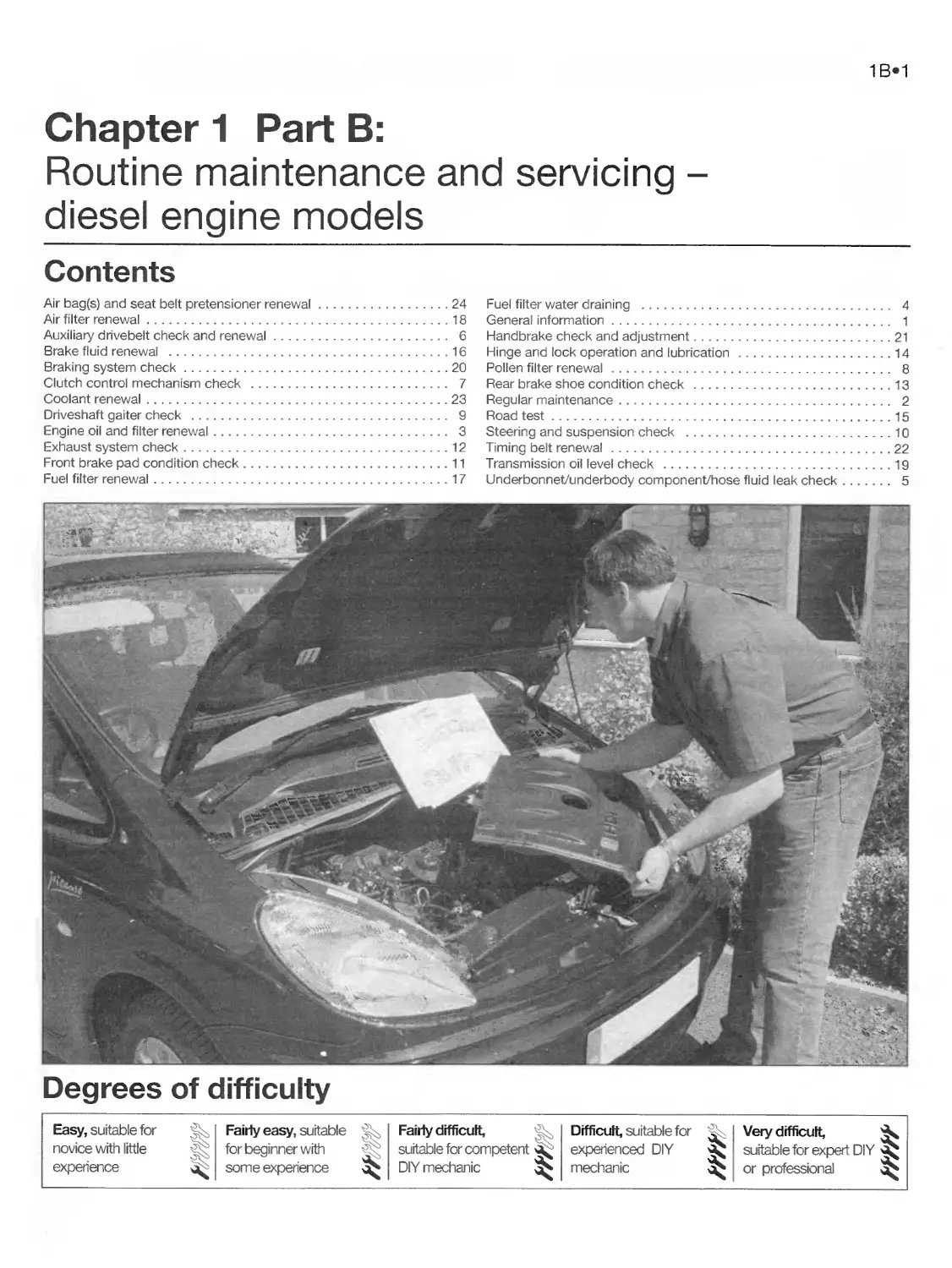
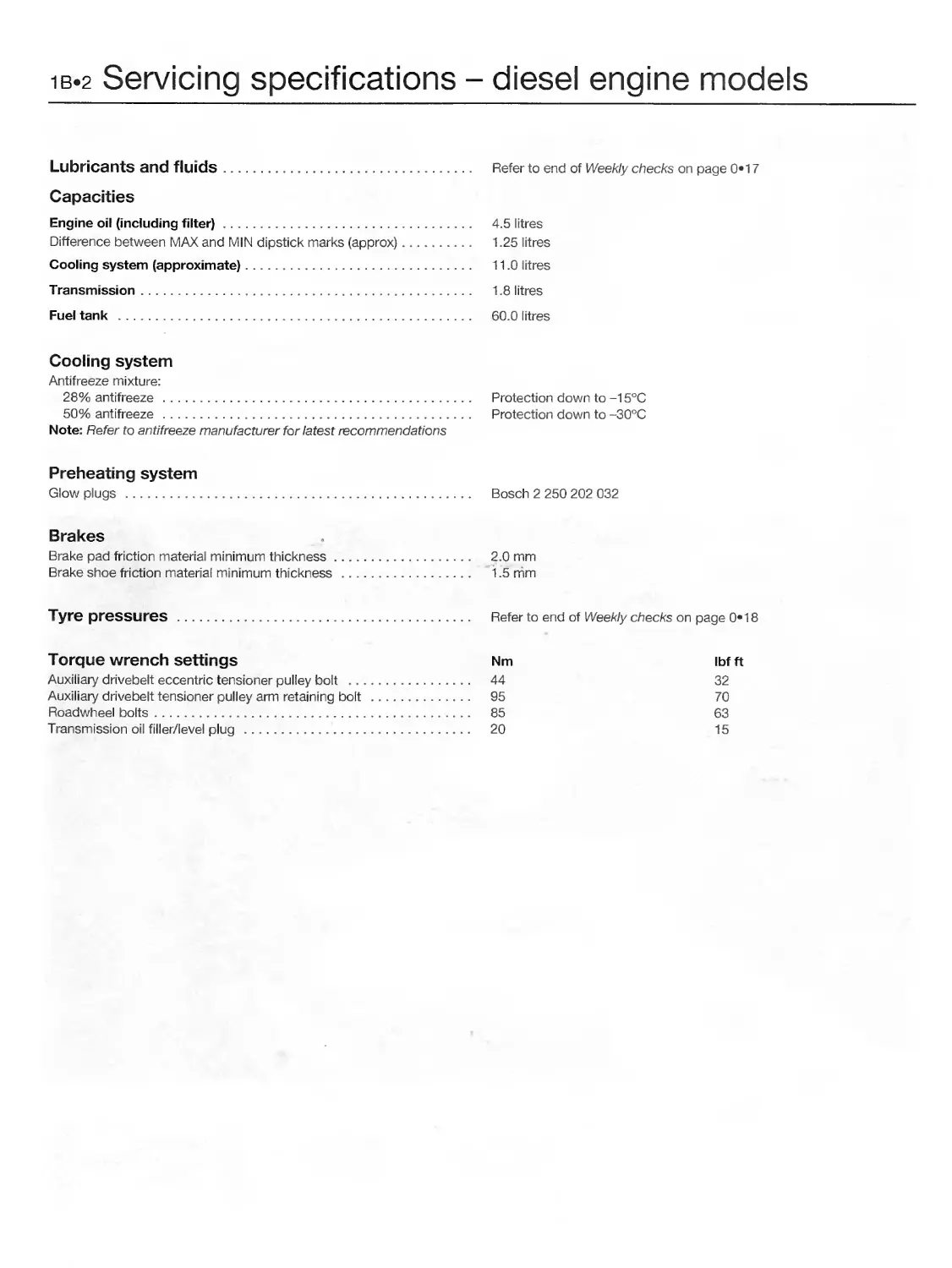
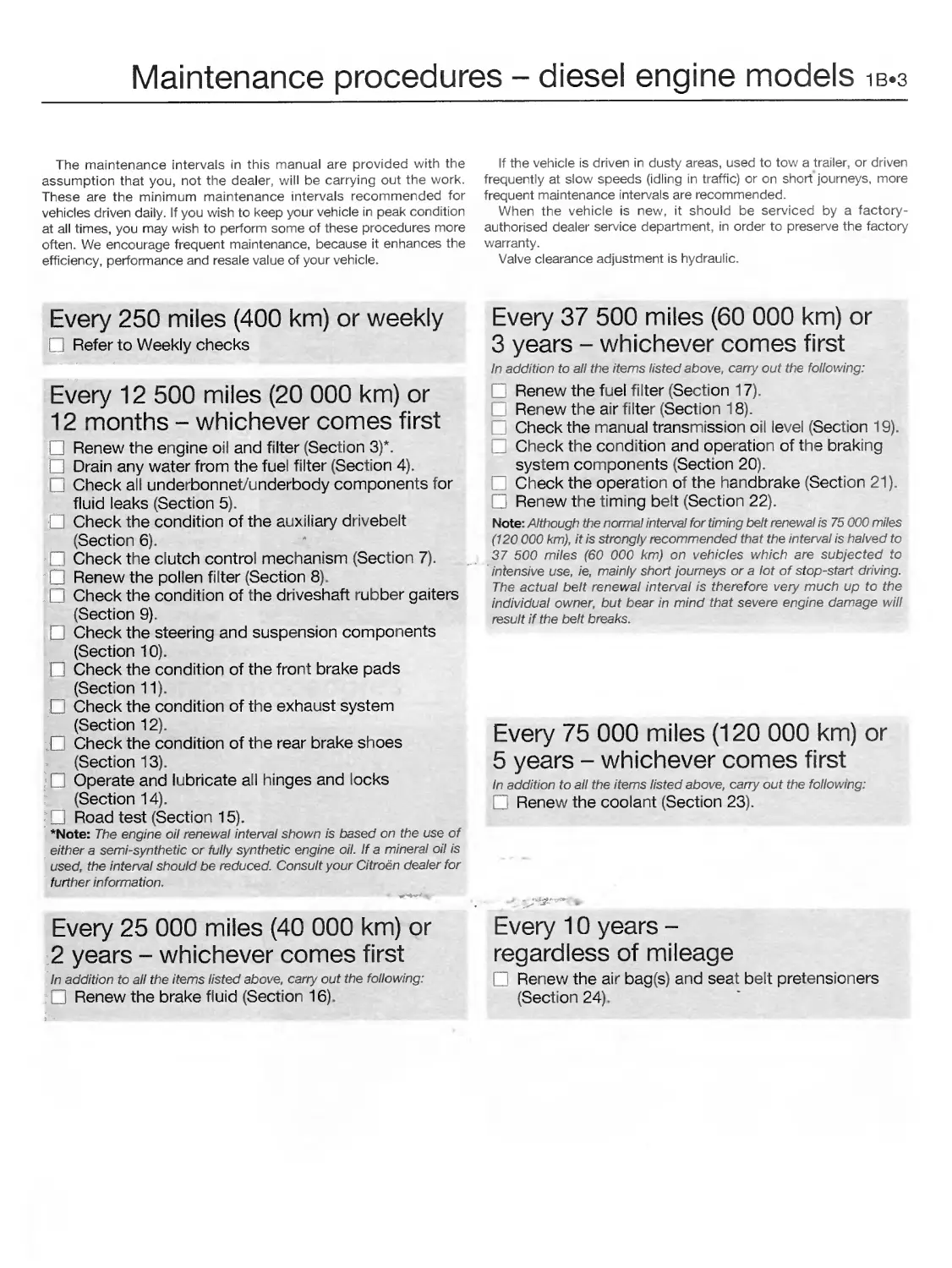
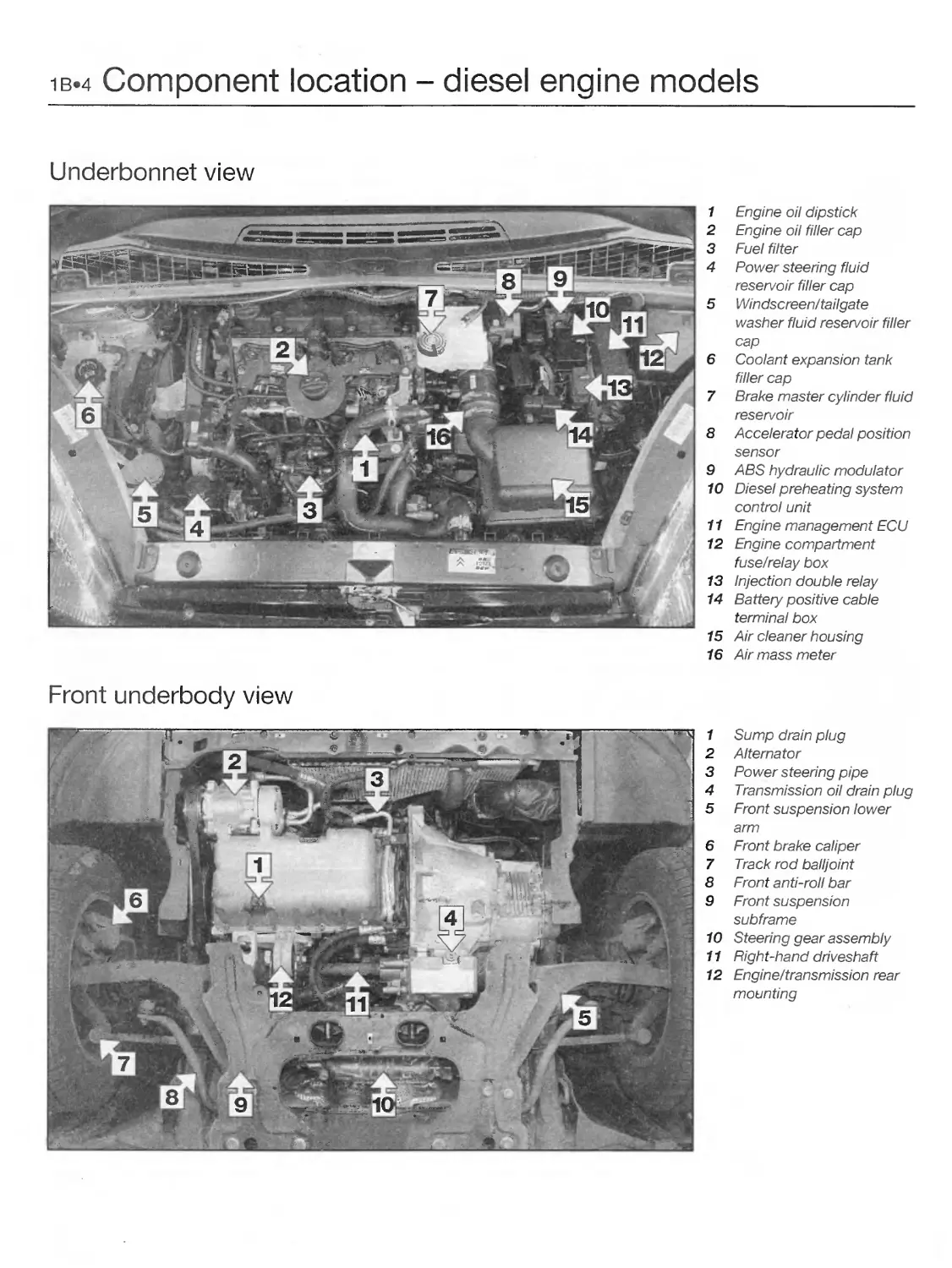











Автор: Mead J.S.
Теги: study guide cars car engines haynes publishing automobile citroen machine arrangement
Год: 2005




Текст
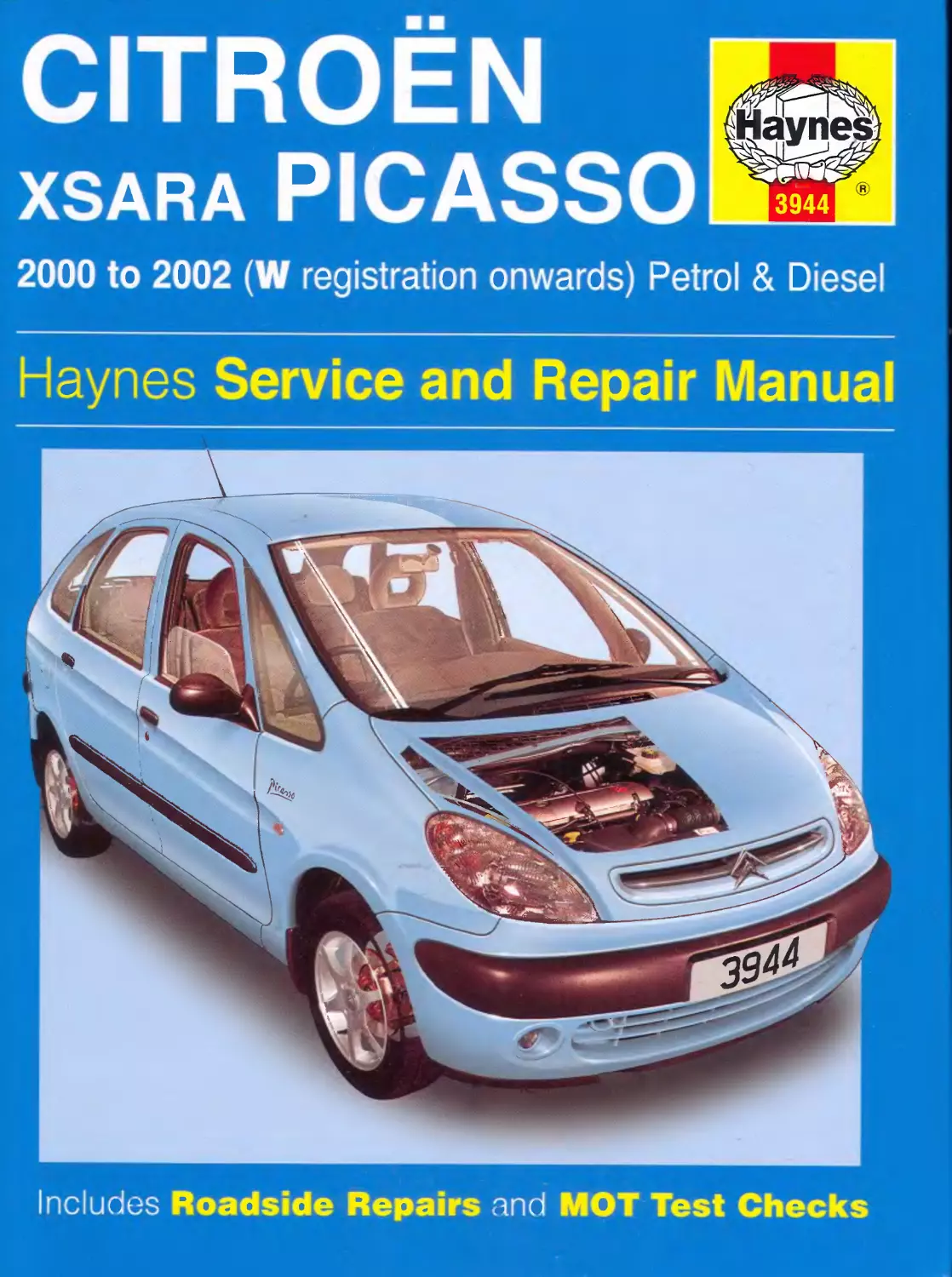
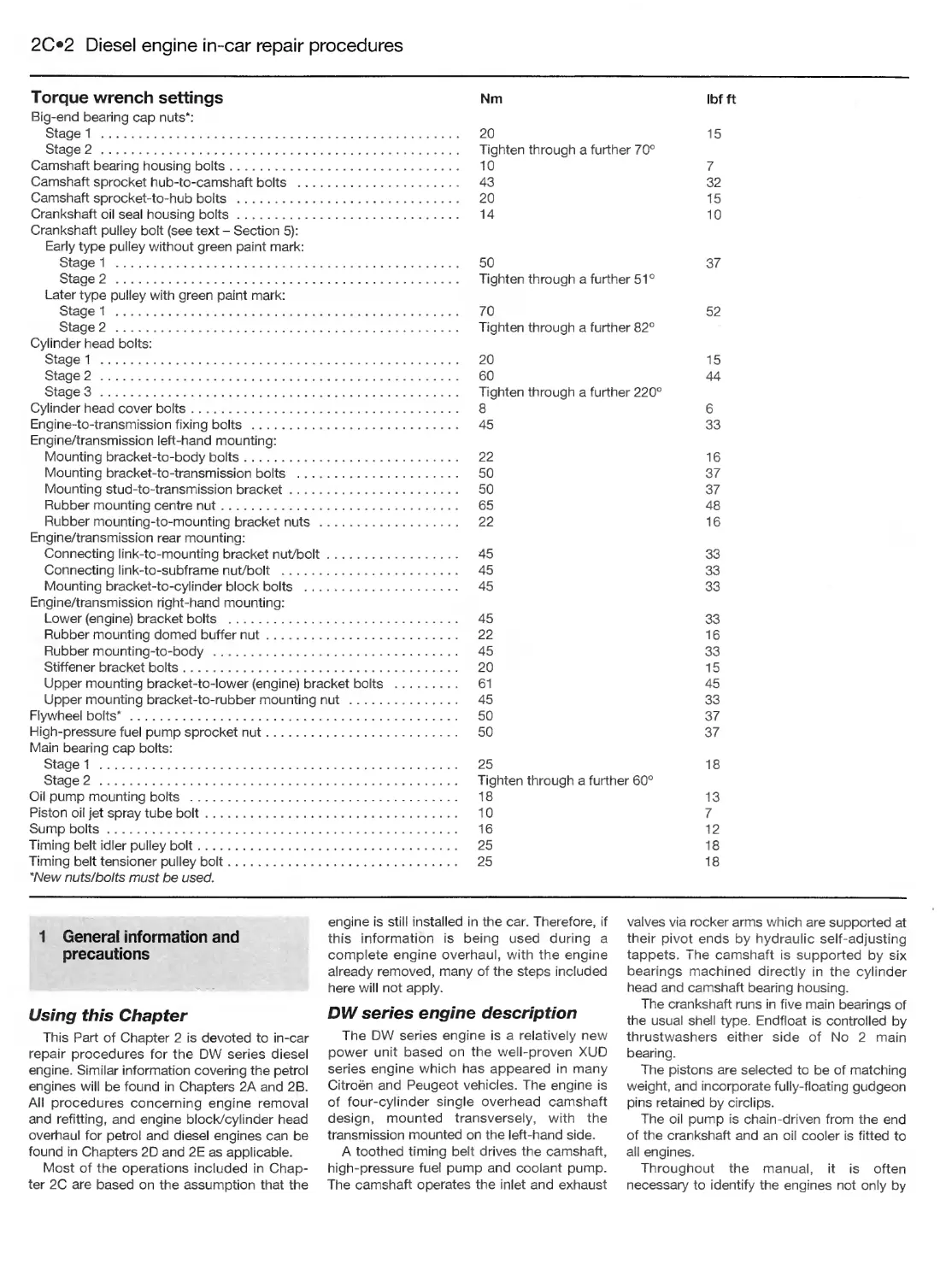
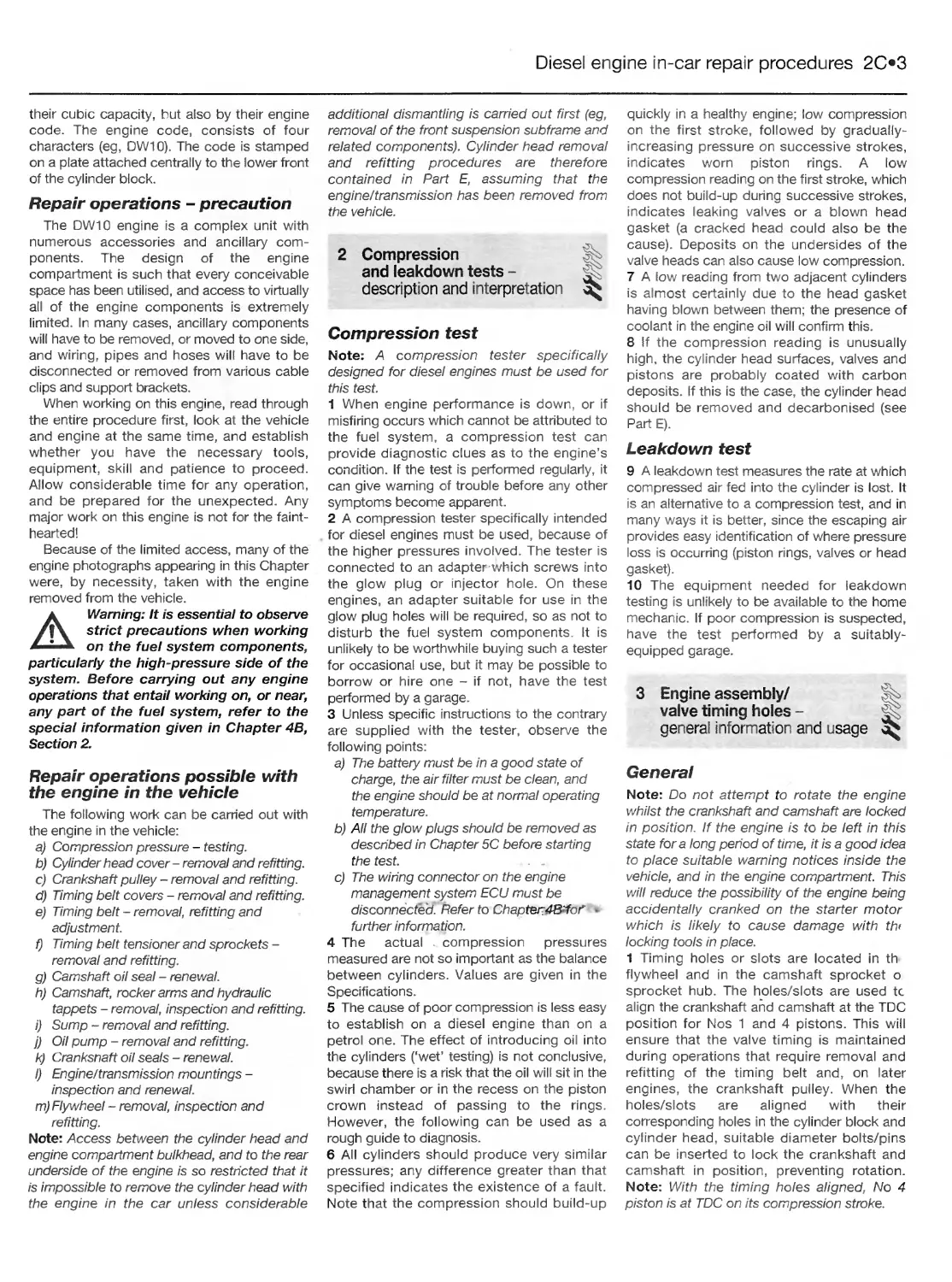
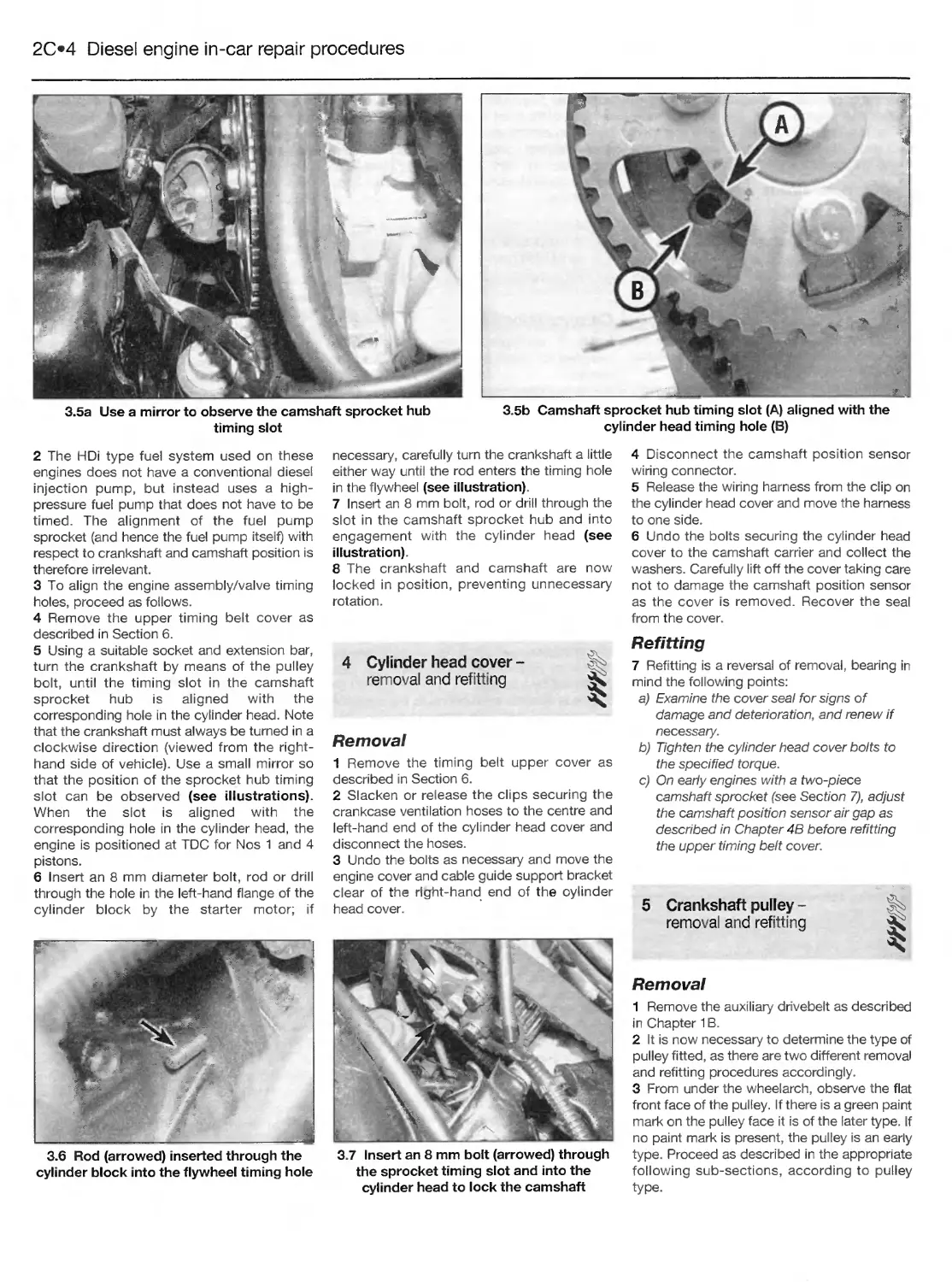
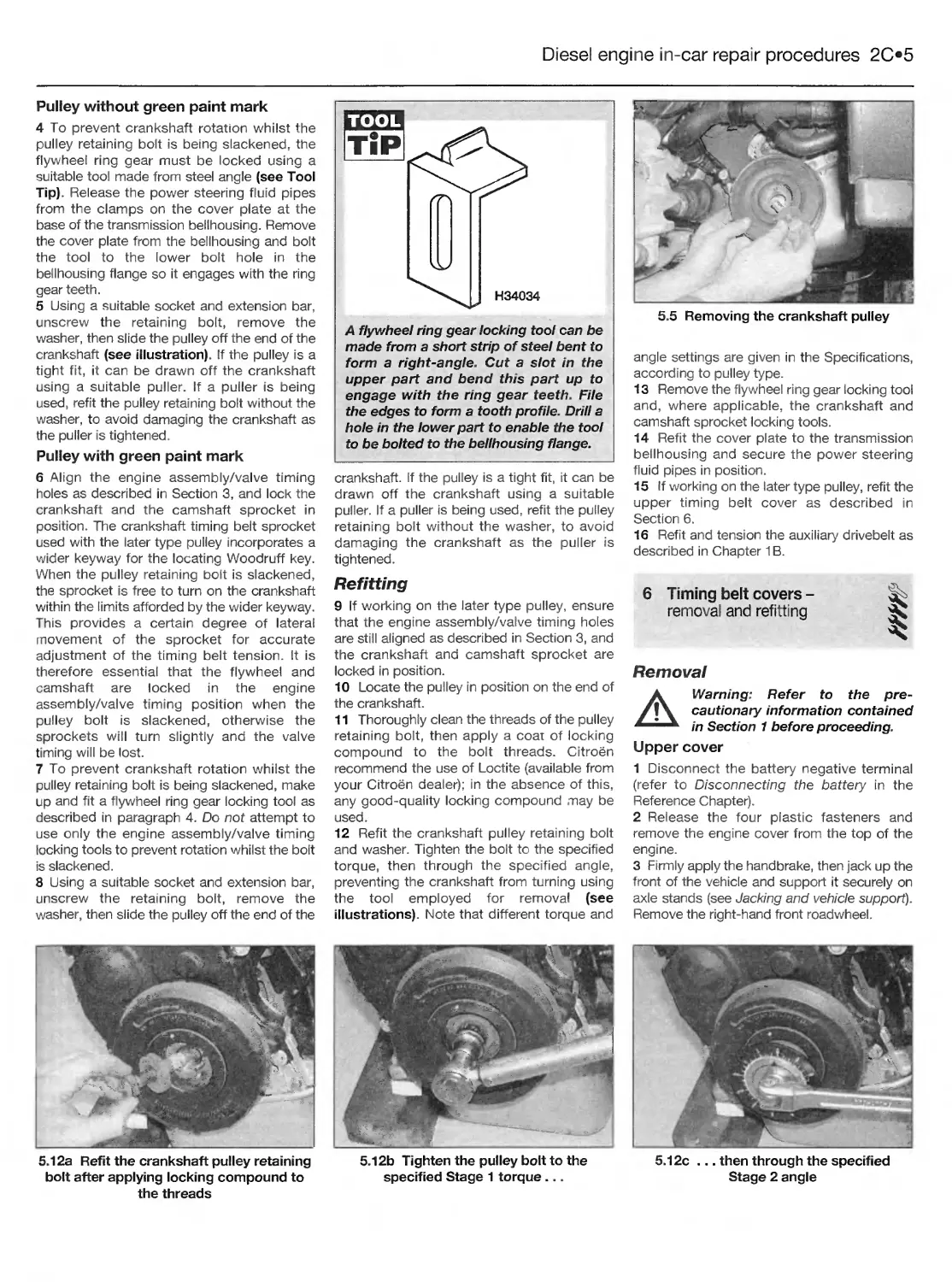
                    CITROEN
XSARA PICASSO
2000 to 2002 (W registration onwards) Petrol & Diesel
Haynes Service and Repair Manual
Includes Roadside Repairs and MOT Test Checks
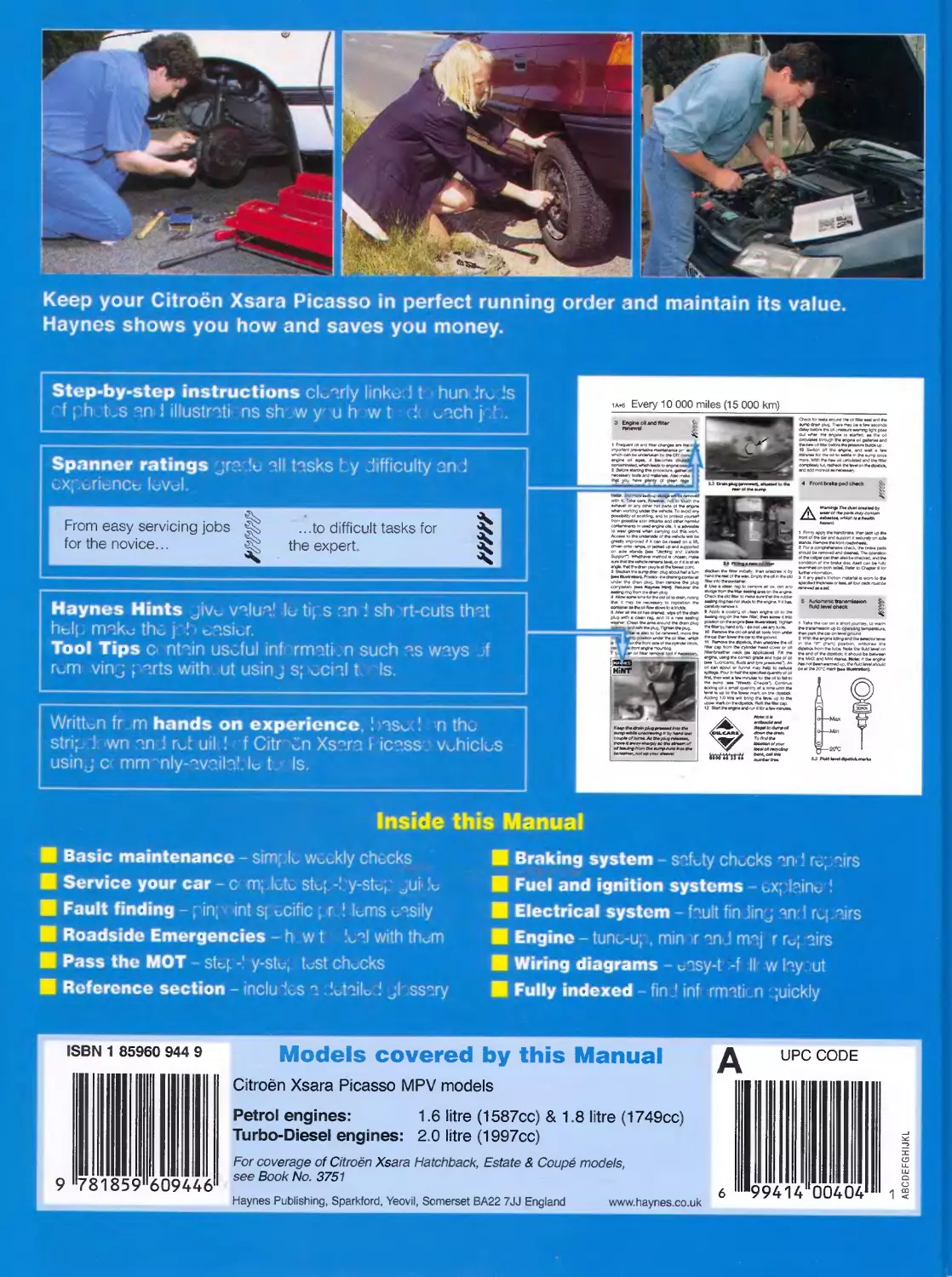
Keep your Citroen Xsara Picasso in perfect running order and maintain its value.
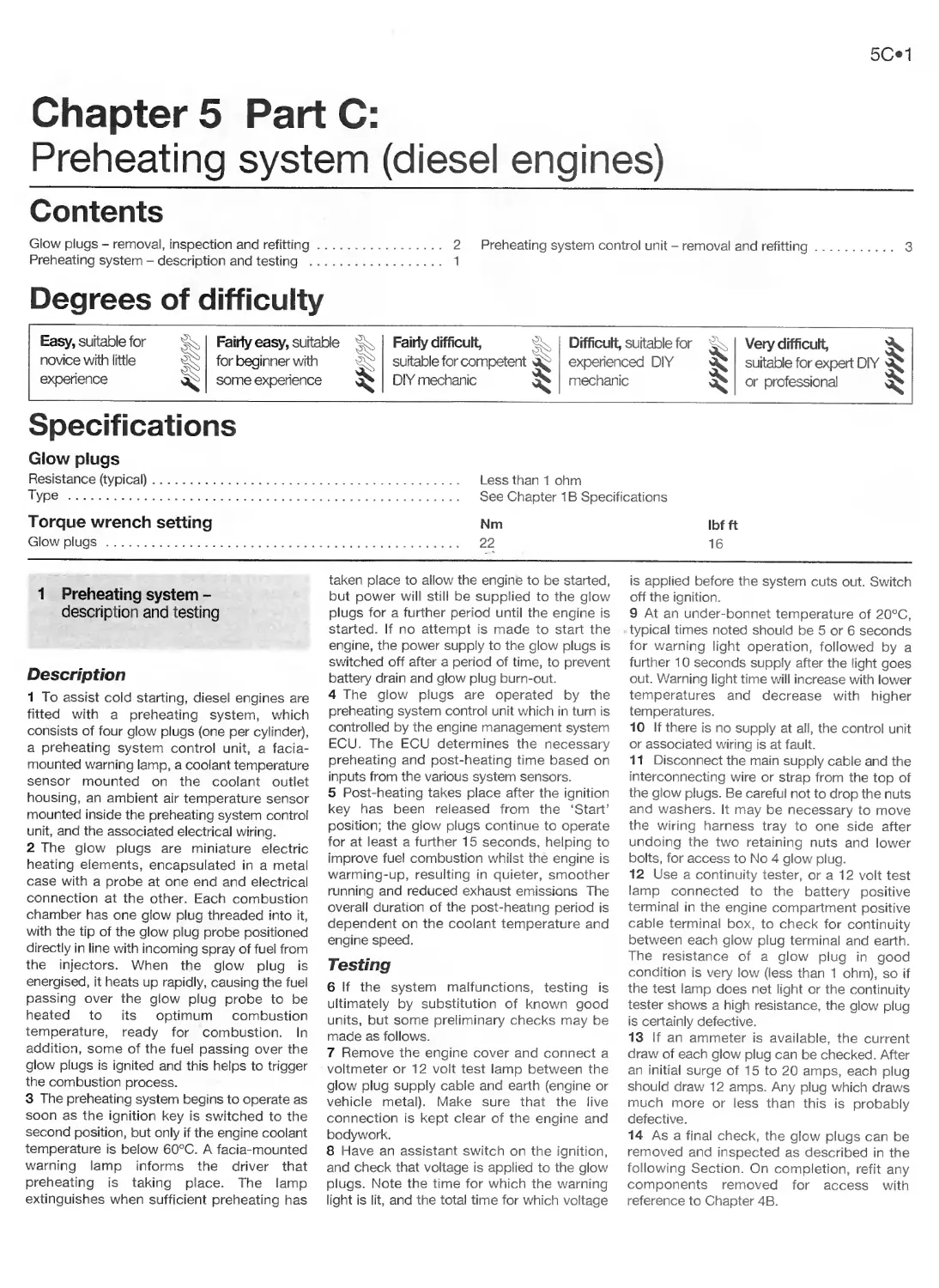
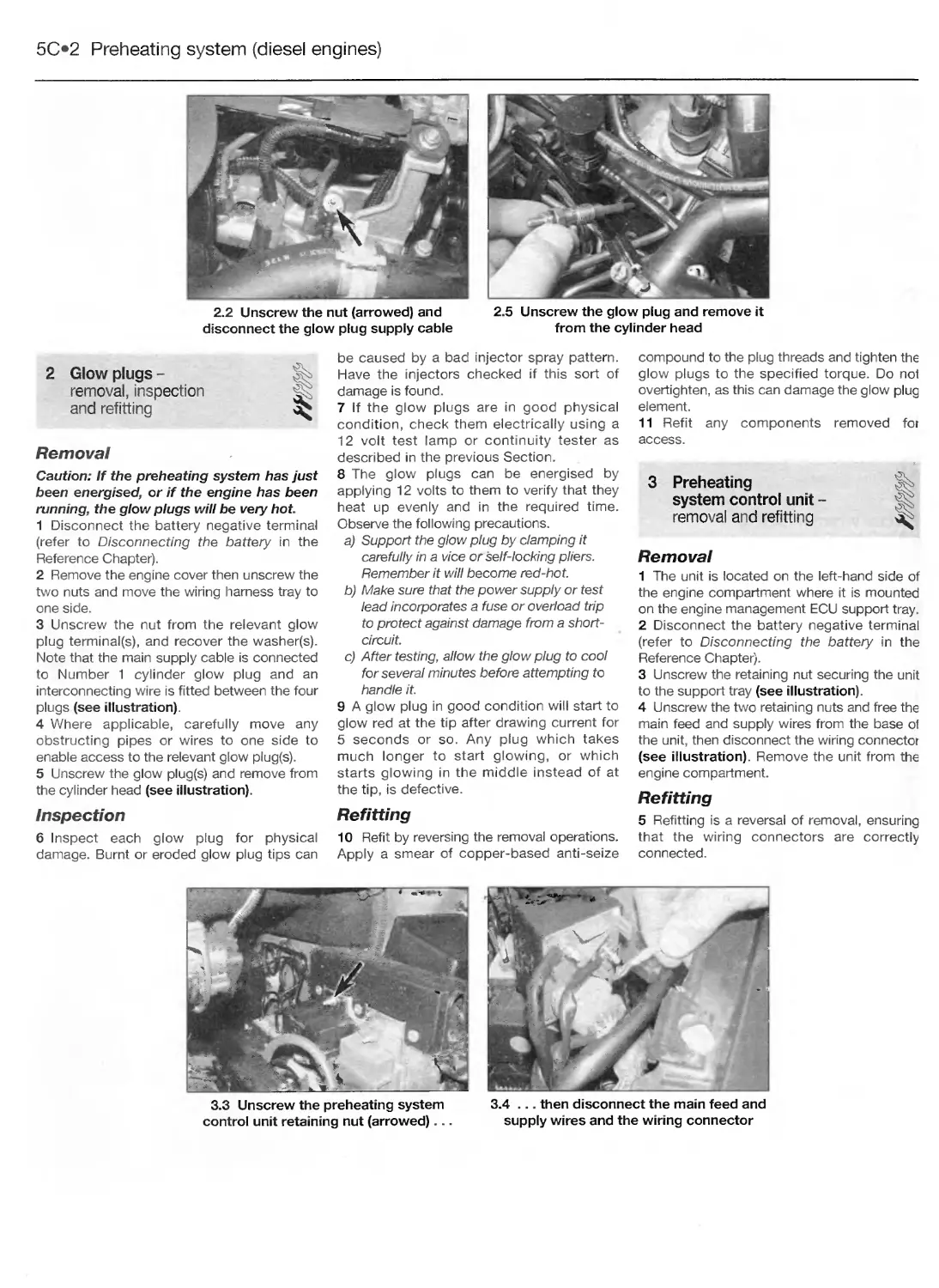
Haynes shows you how and saves you money.
Inside this Manual
	Basic maintenance - sim; L Wuukly chucks		Braking system - Safety checks	' re; !UT8
	Service your car c m; Ltu stu[ -I y-stur ^ui 'u	 Fuel and ignition systems ьх; l?.inu !
	Faultfinding ; in; int specific t r I Lms u-asily  Electrical system - hult fin Jin j an :l м airs
	Roadside Emergencies - h w t fesl with them	 Engine - tunc-u; , min r an 1 maj r	r<4 airs
	Pass the MOT - sk4 -! y-stu, fest chucks		Wiring diagrams - unsy-t -f II w	lay ut
	Reference section - inclu fes ° fetaiL J jl ssary  Fully indexed - fin .* inf rmati n juickly
ISBN 1 85960 944 9
9
781859
609446
Models covered by this Manual
Citroen Xsara Picasso MPV models
Petrol engines:	1.6 litre (1587cc) & 1.8 litre (1749cc)
Turbo-Diesel engines: 2.0 litre (1997cc)
For coverage of Citroen Xsara Hatchback, Estate & Coupe models,
see Book No. 3751
Haynes Publishing, Sparkford, Yeovil, Somerset BA22 7JJ England www.haynes.co.uk
Citroen Xsara Picasso
Service and Repair Manual
John S. Mead MISTC
Models covered
(3944 - 336 - 2AJ1)
All Citroen Xsara Picasso MPV models with petrol and diesel engines
1.6 litre (1587cc) and 1.8 litre (1749cc) petrol engines
2.0 litre (1997cc) turbo-diesel engines
© Haynes Publishing 2005
ABODE
FGHIJ
KL
A book in the Haynes Service and Repair Manual Series
All rights reserved. No part of this book may be reproduced or transmitted
in any form or by any means, electronic or mechanical, including
photocopying, recording or by any information storage or retrieval system,
without permission in writing from the copyright holder.
ISBN 1 85960 944 9
Printed in the USA
Haynes Publishing
Sparkford, Yeovil, Somerset BA22 7JJ, England
Haynes North America, Inc
861 Lawrence Drive, Newbury Park, California 91320, USA
Editions Haynes
4, Rue de Г Abreuvoir
92415 COURBEVOIE CEDEX, France
British Library Cataloguing in Publication Data
A catalogue record for this book is available from the British Library.
Haynes Publishing Nordiska AB
Box 1504, 751 45 UPPSALA, Sverige
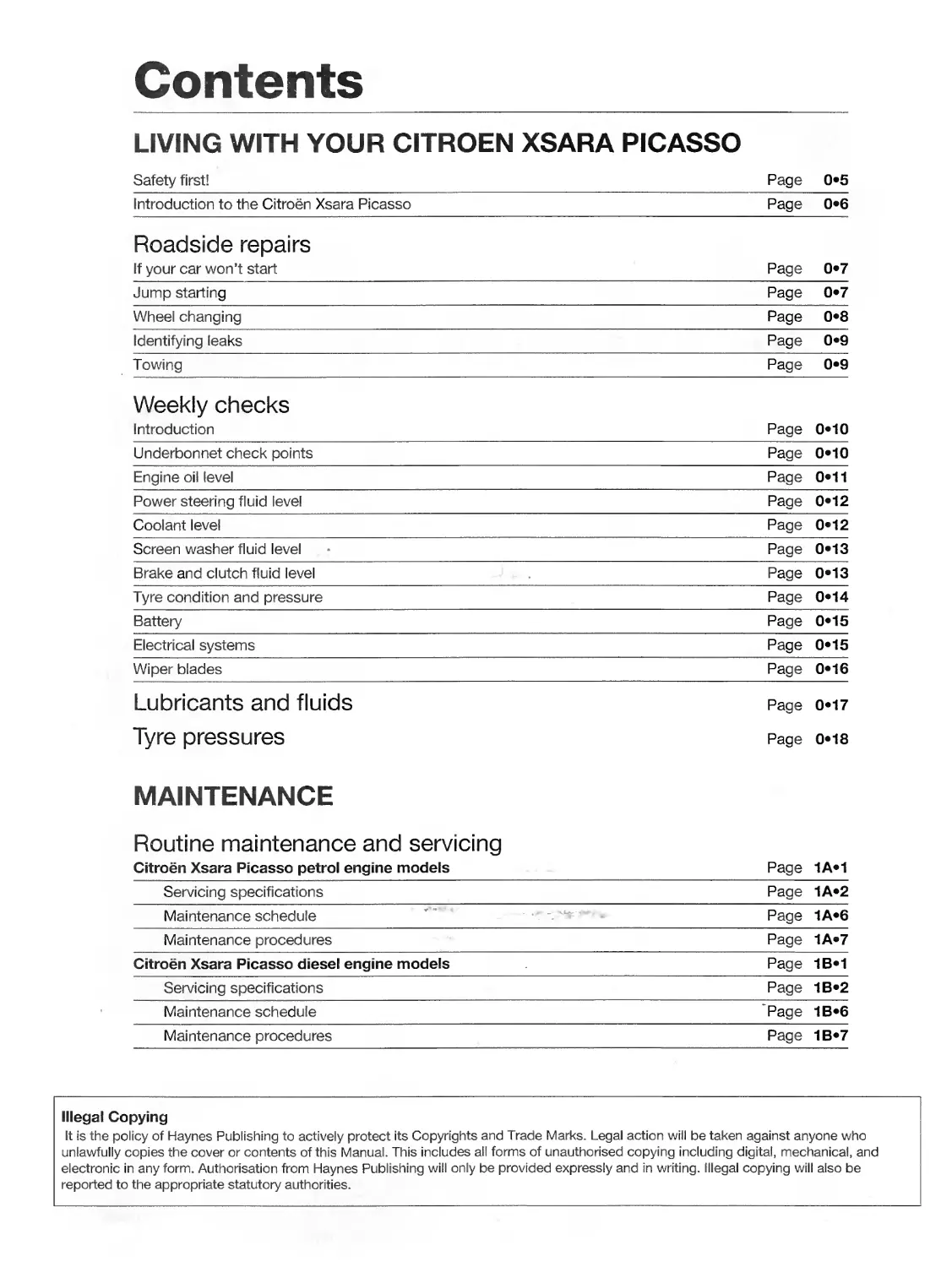
Contents
LIVING WITH YOUR CITROEN XSARA PICASSO
Safety first!	Page 05
Introduction to the СИгоёп Xsara Picasso	Page	0*6
Roadside repairs If your car won’t start	Page	0*7
Jump starting	Page	0*7
Wheel changing	Page	0*8
Identifying leaks	Page	0*9
Towing	Page	0*9
Weekly checks
Introduction	Page	0*10
Underbonnet check points	Page	0*10
Engine oil level	Page	0-11
Power steering fluid level	Page	0*12
Coolant level	Page	0*12
Screen washer fluid level	Page	0»13
Brake and clutch fluid level	Page	0*13
Tyre condition and pressure	Page	0*14
Battery	Page	0*15
Electrical systems	Page	0*15
Wiper blades	Page	0*16
Lubricants and fluids	page 017
Tyre pressures	Page 018
MAINTENANCE
Routine maintenance and servicing
Citroen Xsara Picasso petrol engine models	Page	1A*1
Servicing specifications	Page	1A*2
Maintenance schedule	Page	1A*6
Maintenance procedures	Page	1A*7
Citroen Xsara Picasso diesel engine models	Page	1B*1
Servicing specifications	Page	1B*2
Maintenance schedule	Page	1B-6
Maintenance procedures	Page	1B*7
Illegal Copying
It is the policy of Haynes Publishing to actively protect its Copyrights and Trade Marks. Legal action will be taken against anyone who
unlawfully copies the cover or contents of this Manual. This includes all forms of unauthorised copying including digital, mechanical, and
electronic in any form. Authorisation from Haynes Publishing will only be provided expressly and in writing. Illegal copying will also be
reported to the appropriate statutory authorities.
Contents
REPAIRS AND OVERHAUL Engine and associated systems TU series petrol engine in-car repair procedures	Page	2A*1
EW series petrol engine in-car repair procedures	Page	2B*1
Diesel engine in-car repair procedures	Page	2C*1
Petrol engine removal and overhaul procedures	Page	2D*1
Diesel engine removal and overhaul procedures	Page	2E*1
Cooling, heating and ar conditioning systems	Page	3*1
Fuel/exhaust systems - petrol engines	Page	4A*1
Fuel/exhaust systems - diesel engines	Page	4B*1
Emission control systems	Page	4C*1
Starting and charging systems	Page	5A*1
Ignition system (petrol engines)	Page	5B*1
Preheating system (diesel engines)	Page	5C*1
Transmission Clutch	Page	6*1
Manual transmission	Page	7*1
Driveshafts	Page	8*1
Brakes, suspension and steering Braking system	Page	9*1
Suspension and steering	Page	10*1
Body equipment Bodywork and fittings	Page	11*1
Body electrical systems	Page	12*1
Page 12*15
Wiring diagrams
REFERENCE
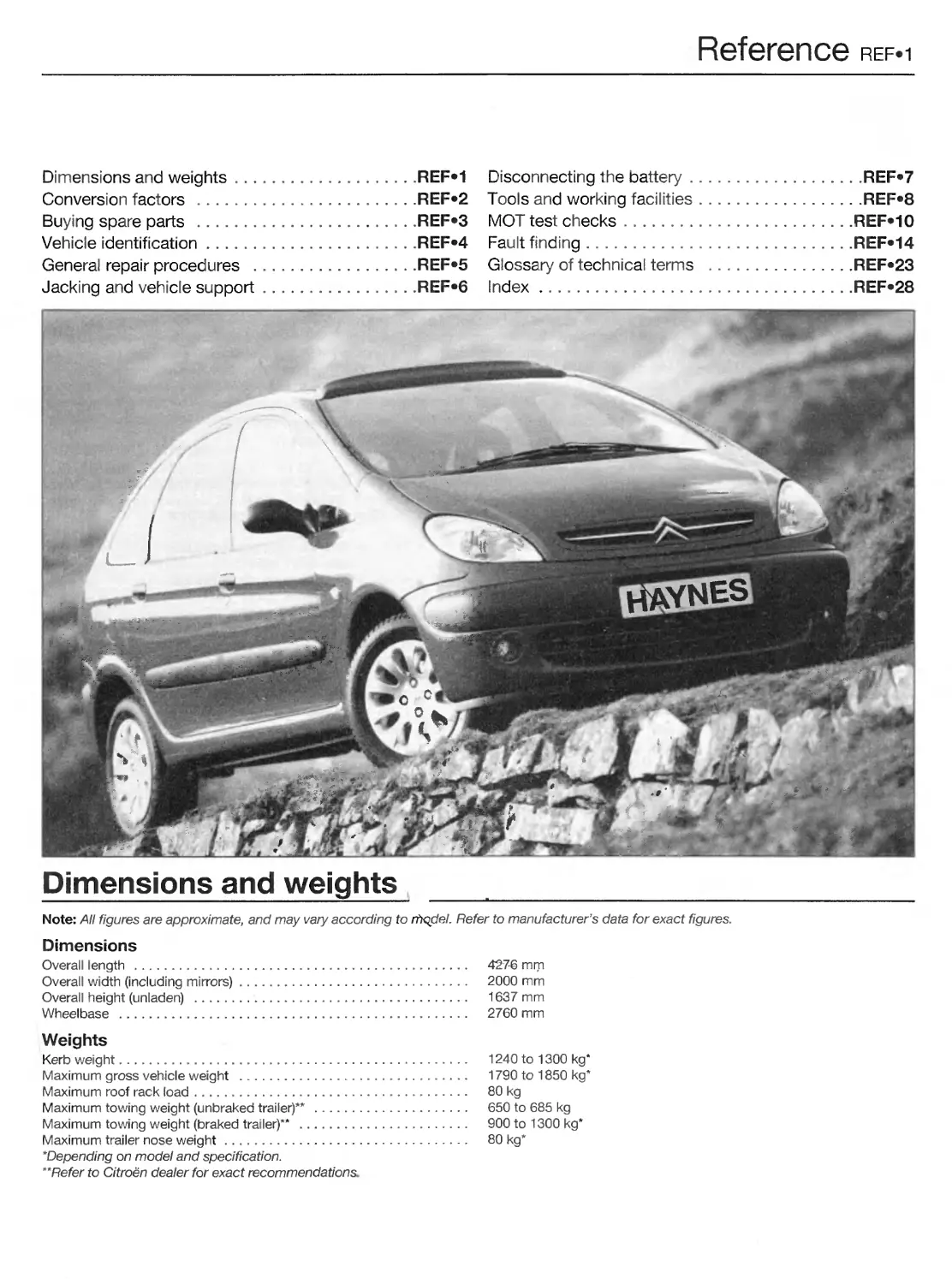
Dimensions and weights	Page	REF*1
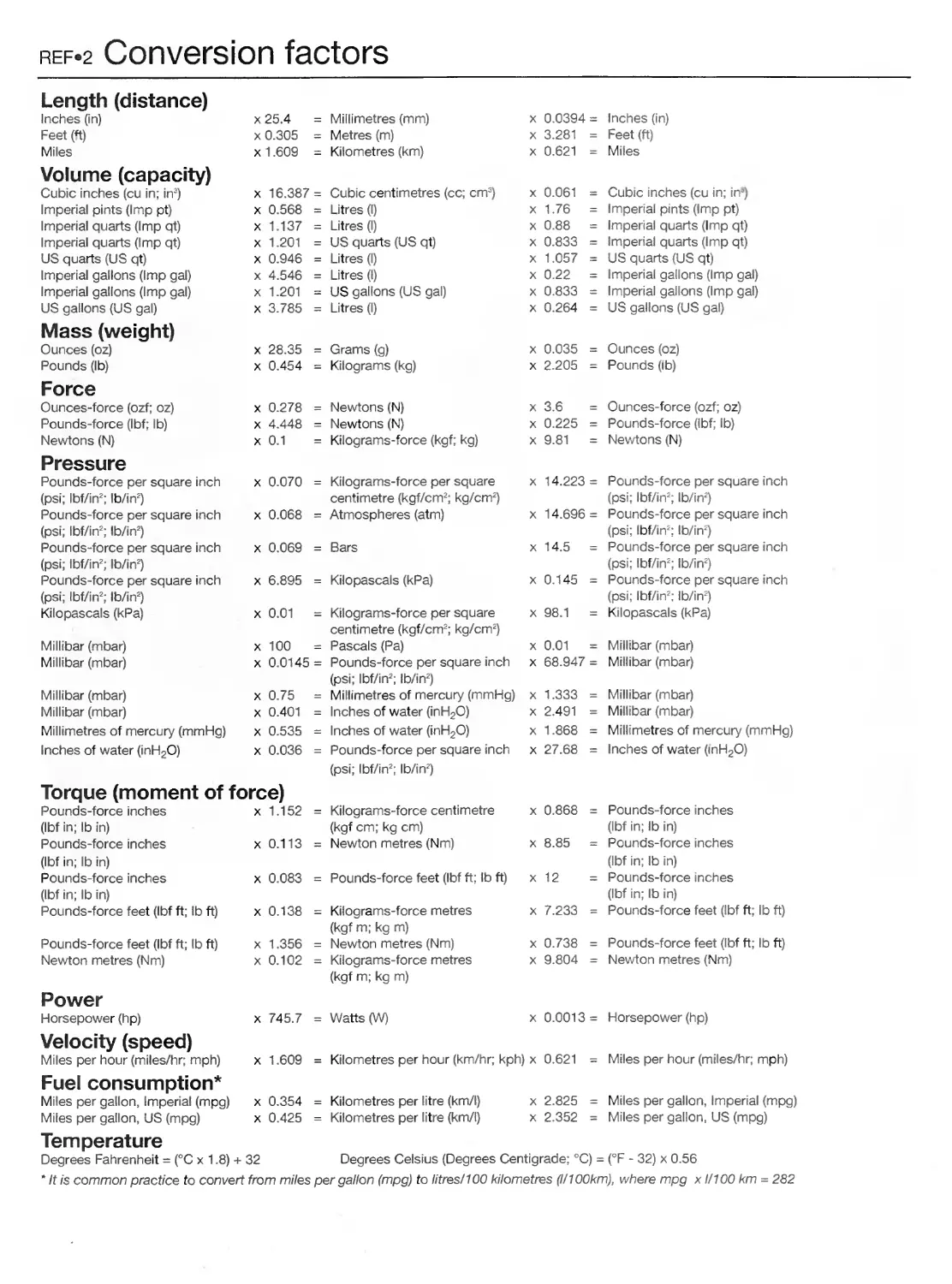
Conversion factors	Page	REF*2
Buying spare parts	Page	REF*3
Vehicle identification	Page	REF*4
General repair procedures	'Page	REF*5
Jacking and vehicle support	Page	REF*6
Disconnecting the battery	Page	REF*7
Tools and working facilities	Page	REF*8
MOT test checks	Page REF* 10
Fault finding	Page REF* 14
Glossary of technical terms	Page REF*23
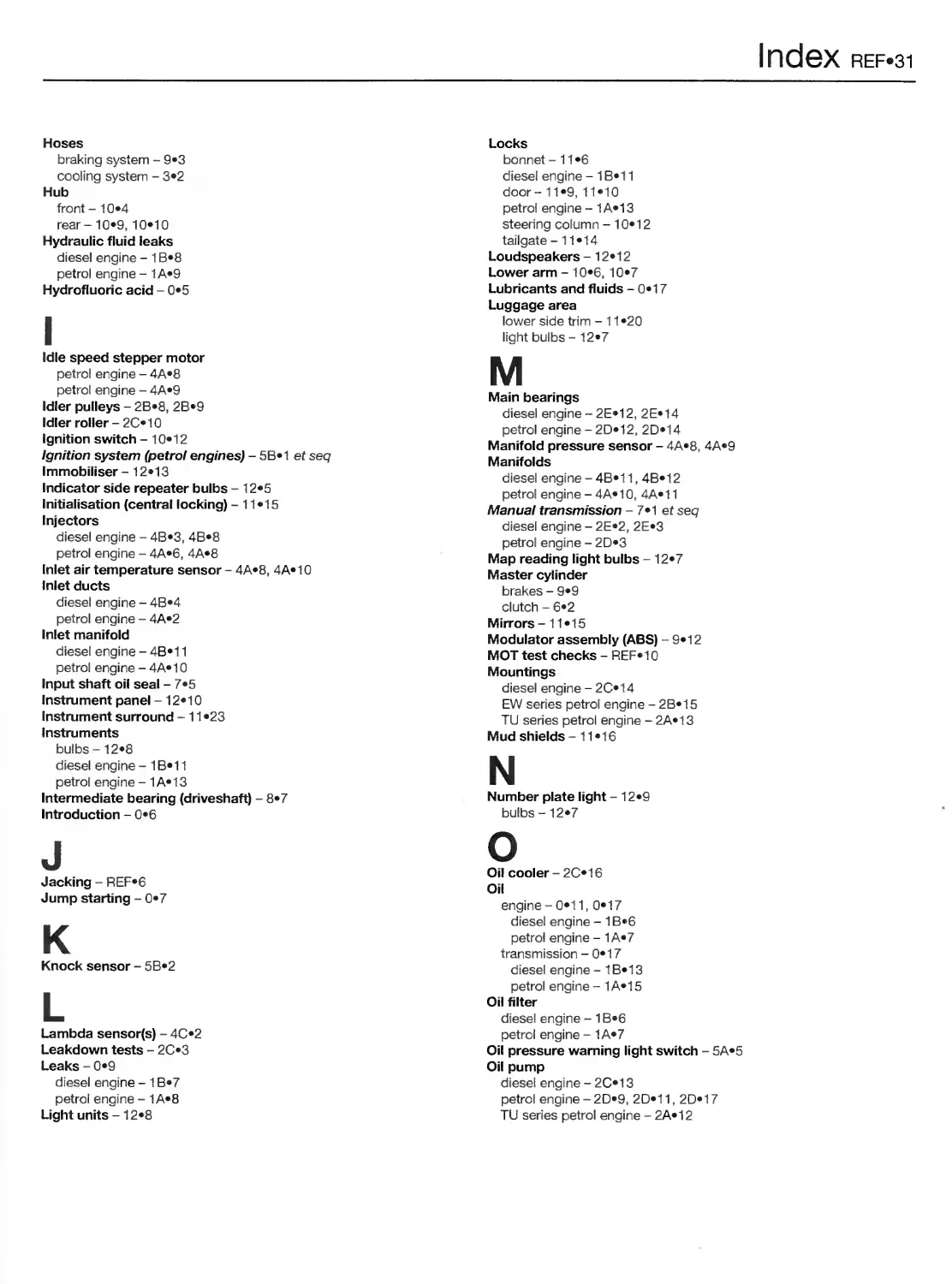
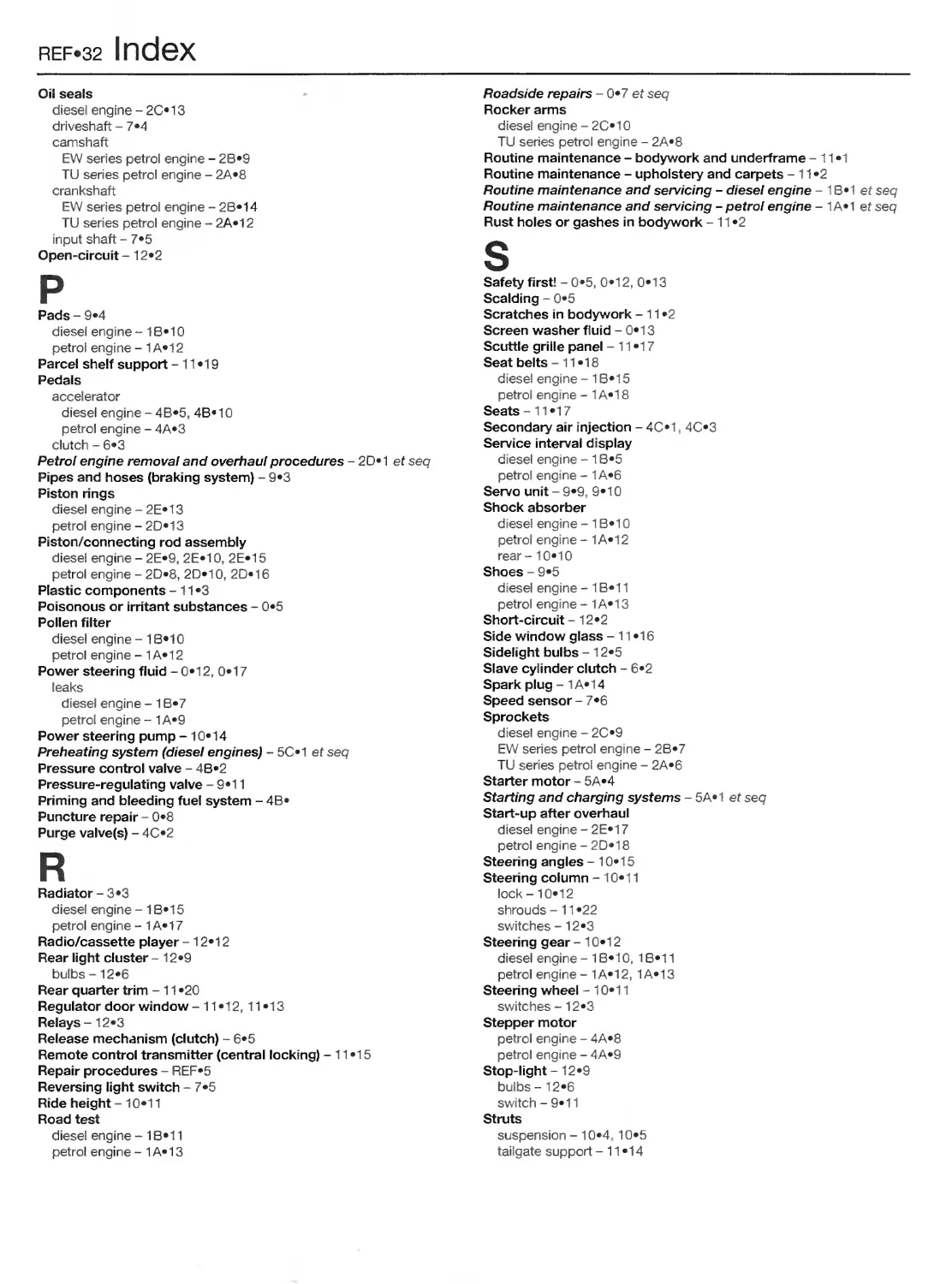
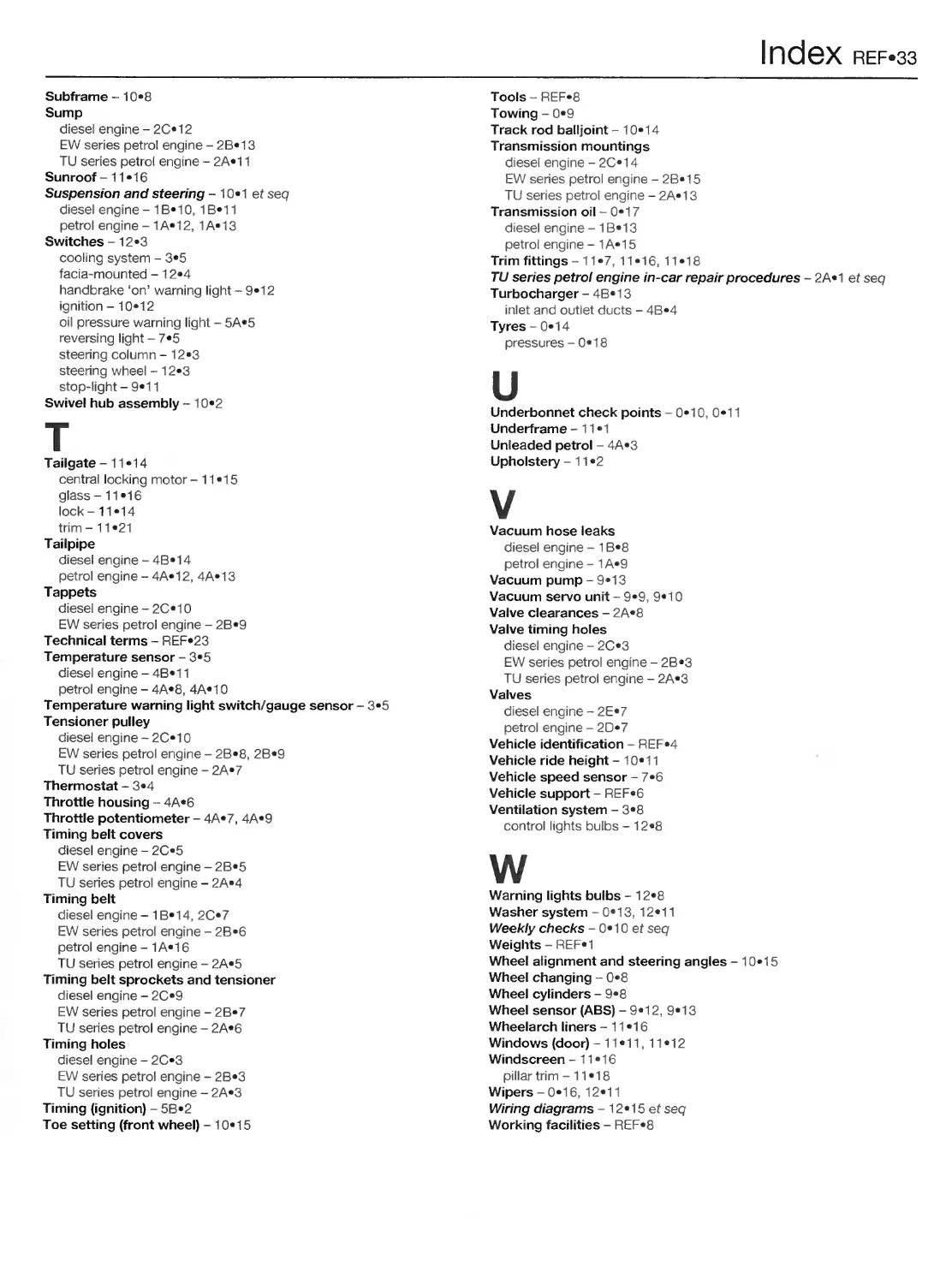
Index	Page REF*28
о.4 Introduction
Advanced driving
Many people see the words ‘advanced
driving’ and believe that it won’t interest them
or that it is a style of driving beyond their own
abilities. Nothing could be further from the
truth. Advanced driving is straightforward
safe, sensible driving - the sort of driving we
should all do every time we get behind the
wheel.
An average of 10 people are killed every day
on UK roads and 870 more are injured, some
seriously. Lives are ruined daily, usually
because somebody did something stupid.
Something like 95% of all accidents are due
to human error, mostly driver failure.
Sometimes we make genuine mistakes -
everyone does. Sometimes we have lapses of
concentration. Sometimes we deliberately
take risks.
For many people, the process of ‘learning to
drive’ doesn’t go much further than learning
how to pass the driving test because of a
common belief that good drivers are made by
‘experience*.
Learning to drive by ‘experience’ teaches
three driving skills:
□	Quick reactions. (Whoops, that was
close!)
□	Good handling skills. (Horn, swerve,
brake, horn).
□	Reliance on vehicle technology. (Great
stuff this ABS, stop in no distance even in
the wet...)
Drivers whose skills are ‘experience based’
generally have a lot of near misses and the
odd accident. The results can be seen every
day in our courts and our hospital casualty
departments.
Advanced drivers have learnt to control the
risks by controlling the position and speed of
their vehicle. They avoid accidents and near
misses, even if the drivers around them make
mistakes.
The key skills of advanced driving are
concentration, effective all-round
observation, anticipation and planning.
When good vehicle handling is added to
these skills, all driving situations can be
approached and negotiated in a safe,
methodical way, leaving nothing to chance.
Concentration means applying your mind to
safe driving, completely excluding anything
that’s not relevant. Driving is usually the most
dangerous activity that most of us undertake
in our daily routines. It deserves our full
attention.
Observation means not just looking, but
seeing and seeking out the information found
in the driving environment.
Anticipation means asking yourself what is
happening, what you can reasonably expect
to happen and what could happen
unexpectedly. (One of the commonest words
used in compiling accident reports is
‘suddenly’.)
Planning is the link between seeing
something and taking the appropriate
action. For many drivers, planning is the
missing link.
If you want to become a safer and more skilful
driver and you want to enjoy your driving more,
contact the Institute of Advanced Motorists at
www.iam.org.uk, phone 0208 996 9600, or
write to IAM House, 510 Chiswick High Road,
London W4 5RG for an information pack.
Safety first! 0.5
Working on your car can be dangerous.
This page shows just some of the potential
risks and hazards, with the aim of creating a
safety-conscious attitude.
General hazards
Scalding
•	Don’t remove the radiator or expansion
tank cap while the engine is hot.
•	Engine oil, automatic transmission fluid or
power steering fluid may also be dangerously
hot if the engine has recently been running.
Burning
•	Beware of burns from the exhaust system
and from any part of the engine. Brake discs
and drums can also be extremely hot
immediately after use.
Crushing
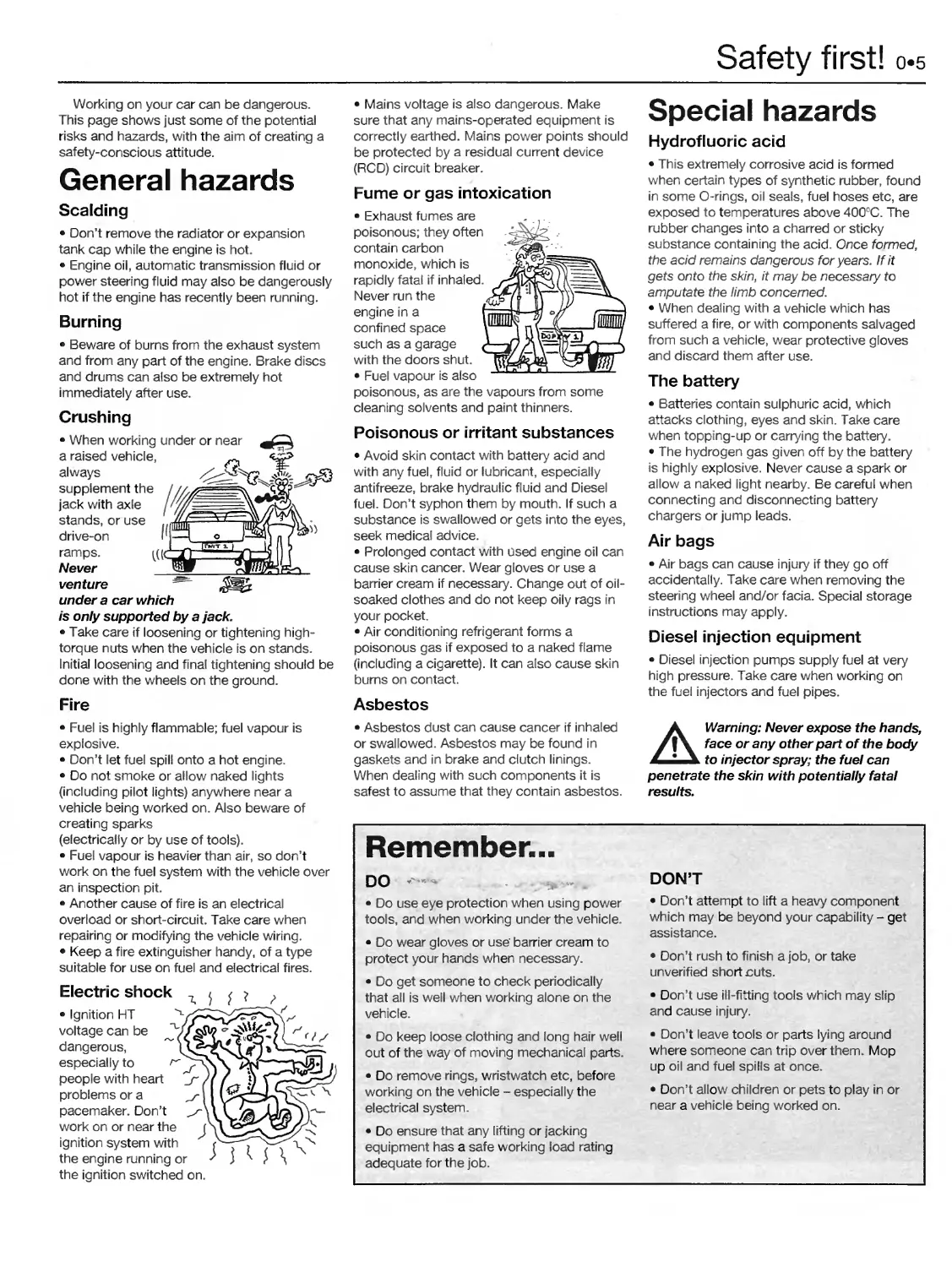
•	When working under or near
a raised vehicle
always
supplement the
jack with axle
stands, or use
drive-on
ramps.
Never
venture
under a car which
is only supported by a jack.
•	Take care if loosening or tightening high-
torque nuts when the vehicle is on stands.
Initial loosening and final tightening should be
done with the wheels on the ground.
Fire
•	Fuel is highly flammable; fuel vapour is
explosive.
•	Don’t let fuel spill onto a hot engine.
•	Do not smoke or allow naked lights
(including pilot lights) anywhere near a
vehicle being worked on. Also beware of
creating sparks
(electrically or by use of tools).
•	Fuel vapour is heavier than air, so don’t
work on the fuel system with the vehicle over
an inspection pit.
•	Another cause of fire is an electrical
overload or short-circuit. Take care when
repairing or modifying the vehicle wiring.
•	Keep a fire extinguisher handy, of a type
suitable for use on fuel and electrical fires.
Electric shock
•	Ignition HT
voltage can be
dangerous,
especially to
people with heart
problems or a
pacemaker. Don’t
work on or near the f
ignition system with
the engine running or
the ignition switched on.
•	Mains voltage is also dangerous. Make
sure that any mains-operated equipment is
correctly earthed. Mains power points should
be protected by a residual current device
(RCD) circuit breaker.
Fume or gas intoxication
•	Exhaust fumes are
poisonous; they often
contain carbon
monoxide, which is
rapidly fatal if inhaled.
Never run the
engine in a
confined space
such as a garage
with the doors shut.
•	Fuel vapour is also
poisonous, as are the vapours from some
cleaning solvents and paint thinners.
Poisonous or irritant substances
•	Avoid skin contact with battery acid and
with any fuel, fluid or lubricant, especially
antifreeze, brake hydraulic fluid and Diesel
fuel. Don’t syphon them by mouth. If such a
substance is swallowed or gets into the eyes,
seek medical advice.
•	Prolonged contact with Used engine oil can
cause skin cancer. Wear gloves or use a
barrier cream if necessary. Change out of oil-
soaked clothes and do not keep oily rags in
your pocket.
•	Air conditioning refrigerant forms a
poisonous gas if exposed to a naked flame
(including a cigarette). It can also cause skin
burns on contact.
Asbestos
•	Asbestos dust can cause cancer if inhaled
or swallowed. Asbestos may be found in
gaskets and in brake and clutch linings.
When dealing with such components it is
safest to assume that they contain asbestos.
Remember...
•	Do use eye protection when using power
tools, and when working under the vehicle.
•	Do wear gloves or use’ barrier cream to
protect your hands when necessary.
•	Do get someone to check periodically
that all is well when working alone on the
vehicle.
•	Do keep loose clothing and long hair well
out of the way of moving mechanical parts.
•	Do remove rings, wristwatch etc, before
working on the vehicle - especially the
electrical system.
•	Do ensure that any lifting or jacking
equipment has a safe working load rating
adequate for the job.
Special hazards
Hydrofluoric acid
•	This extremely corrosive acid is formed
when certain types of synthetic rubber, found
in some О-rings, oil seals, fuel hoses etc, are
exposed to temperatures above 400°C. The
rubber changes into a charred or sticky
substance containing the acid. Once formed,
the acid remains dangerous for years. If it
gets onto the skin, it may be necessary to
amputate the limb concerned.
•	When dealing with a vehicle which has
suffered a fire, or with components salvaged
from such a vehicle, wear protective gloves
and discard them after use.
The battery
•	Batteries contain sulphuric acid, which
attacks clothing, eyes and skin. Take care
when topping-up or carrying the battery.
•	The hydrogen gas given off by the battery
is highly explosive. Never cause a spark or
allow a naked light nearby. Be careful when
connecting and disconnecting battery
chargers or jump leads.
Air bags
•	Air bags can cause injury if they go off
accidentally. Take care when removing the
steering wheel and/or facia. Special storage
instructions may apply.
Diesel injection equipment
•	Diesel injection pumps supply fuel at very
high pressure. Take care when working on
the fuel injectors and fuel pipes.
A Warning: Never expose the hands,
face or any other part of the body
l to injector spray; the fuel can
penetrate the skin with potentially fatal
results.
DON’T
•	Don’t attempt to lift a heavy component
which may be beyond your capability - get
assistance.
•	Don’t rush to finish a job, or take
unverified short cuts.
•	Don’t use ill-fitting tools which may slip
and cause injury.
•	Don’t leave tools or parts lying around
where someone can trip over them. Mop
up oil and fuel spills at once.
•	Don’t allow children or pets to play in or
near a vehicle being worked on.
о.б Introduction
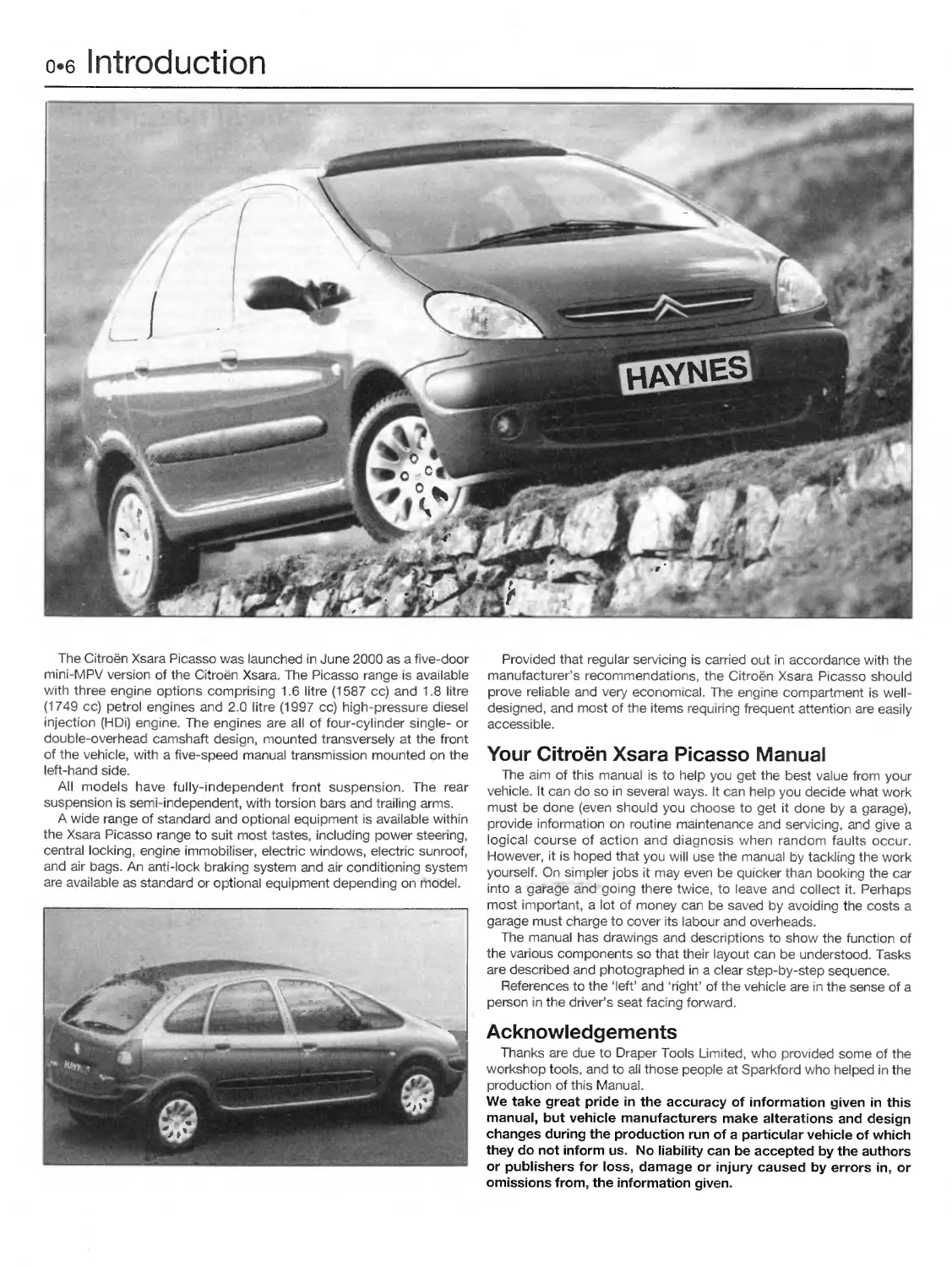
The Citroen Xsara Picasso was launched in June 2000 as a five-door
mini-MPV version of the Citroen Xsara. The Picasso range is available
with three engine options comprising 1.6 litre (1587 cc) and 1.8 litre
(1749 cc) petrol engines and 2.0 litre (1997 cc) high-pressure diesel
injection (HDi) engine. The engines are all of four-cylinder single- or
double-overhead camshaft design, mounted transversely at the front
of the vehicle, with a five-speed manual transmission mounted on the
left-hand side.
All models have fully-independent front suspension. The rear
suspension is semi-independent, with torsion bars and trailing arms.
A wide range of standard and optional equipment is available within
the Xsara Picasso range to suit most tastes, including power steering,
central locking, engine immobiliser, electric windows, electric sunroof,
and air bags. An anti-lock braking system and air conditioning system
are available as standard or optional equipment depending on model.
Provided that regular servicing is carried out in accordance with the
manufacturer’s recommendations, the Citroen Xsara Picasso should
prove reliable and very economical. The engine compartment is well-
designed, and most of the items requiring frequent attention are easily
accessible.
Your Citroen Xsara Picasso Manual
The aim of this manual is to help you get the best value from your
vehicle. It can do so in several ways. It can help you decide what work
must be done (even should you choose to get it done by a garage),
provide information on routine maintenance and servicing, and give a
logical course of action and diagnosis when random faults occur.
However, it is hoped that you will use the manual by tackling the work
yourself. On simpler jobs it may even be quicker than booking the car
into a garage and going there twice, to leave and collect it. Perhaps
most important, a lot of money can be saved by avoiding the costs a
garage must charge to cover its labour and overheads.
The manual has drawings and descriptions to show the function of
the various components so that their layout can be understood. Tasks
are described and photographed in a clear step-by-step sequence.
References to the ‘left’ and ‘right’ of the vehicle are in the sense of a
person in the driver’s seat facing forward.
Acknowledgements
Thanks are due to Draper Tools Limited, who provided some of the
workshop tools, and to all those people at Sparkford who helped in the
production of this Manual.
We take great pride in the accuracy of information given in this
manual, but vehicle manufacturers make alterations and design
changes during the production run of a particular vehicle of which
they do not inform us. No liability can be accepted by the authors
or publishers for loss, damage or injury caused by errors in, or
omissions from, the information given.
Roadside repairs 0.7
The following pages are intended to help in dealing with common roadside emergencies and breakdowns. You will find more detailed fault
finding information at the back of the manual, and repair information in the main chapters.
Car won’t start
Starter motor doesn’t turn
Starter motor turns as normal
□ Lift the front passenger’s seat, take off the battery cover and make
sure that the battery terminals are clean and tight.
□ Switch on the headlights and try to start the engine. If the headlights
go very dim when you’re trying to start, the battery is probably flat.
Get out of trouble by jump starting (see below) using a friend’s car.
□ Is there fuel in the tank?
□ Remove the engine cover (where fitted) and spray all visible
electrical connectors with a water-dispersant spray like WD40 if
you suspect a problem due to damp. •
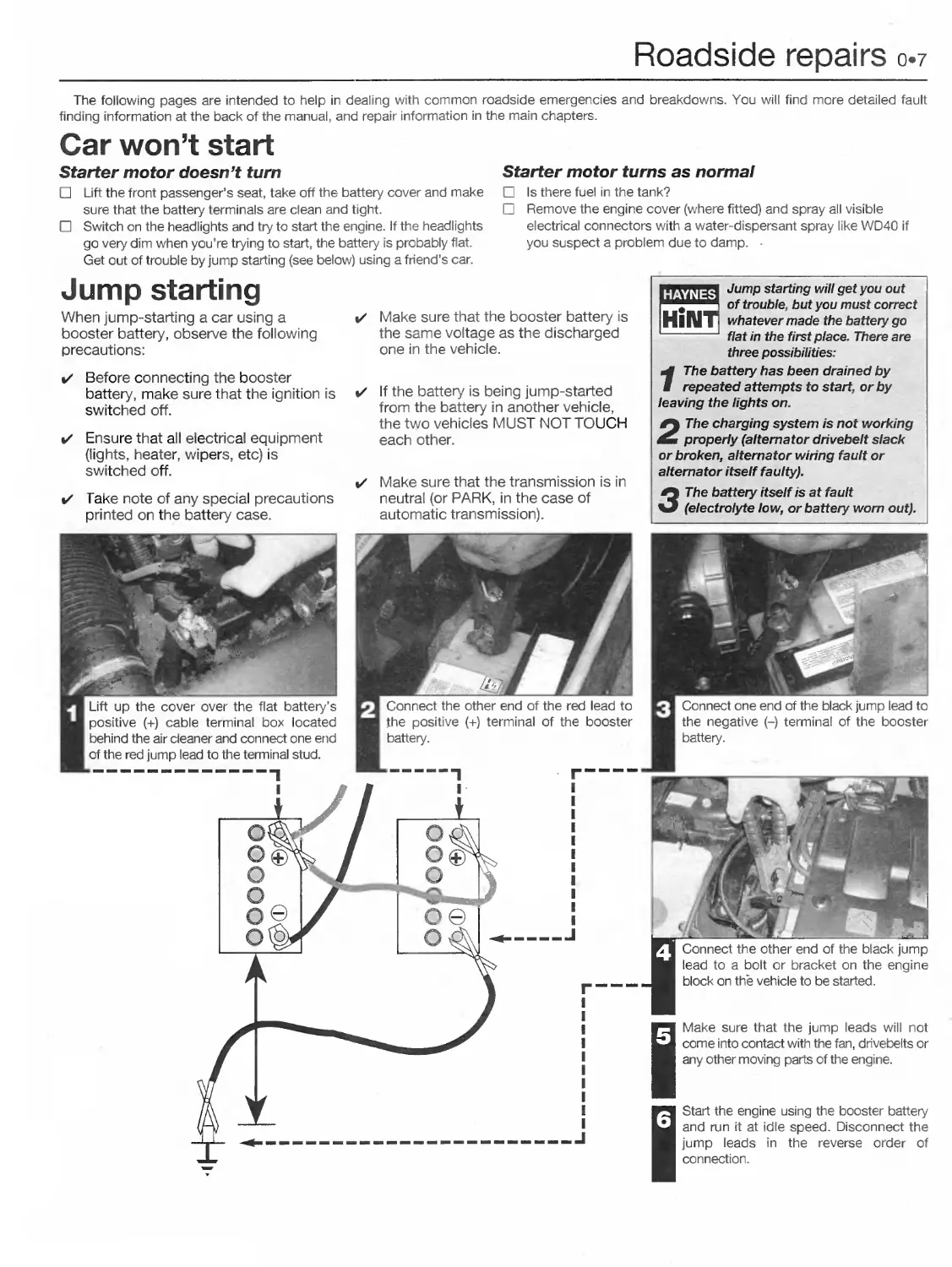
Jump starting
When jump-starting a car using a
booster battery, observe the following
precautions:
✓ Before connecting the booster
battery, make sure that the ignition is
switched off.
✓ Ensure that all electrical equipment
(lights, heater, wipers, etc) is
switched off.
✓ Take note of any special precautions
printed on the battery case.
✓ Make sure that the booster battery is
the same voltage as the discharged
one in the vehicle.
✓ If the battery is being jump-started
from the battery in another vehicle,
the two vehicles MUST NOT TOUCH
each other.
✓ Make sure that the transmission is in
neutral (or PARK, in the case of
automatic transmission).
HAYNES
Jump starting will get you out
ф 1 of trouble, but you must correct
hint whatever made the battery go
flat in the first place. There are
three possibilities:
вЛ The battery has been drained by
 repeated attempts to start, or by
leaving the lights on.
2 The charging system is not working
properly (alternator drivebelt slack
or broken, alternator wiring fault or
alternator itself faulty).
3The battery itself is at fault
(electrolyte low, or battery worn out).
Connect the other end of the red lead to
the positive (+) terminal of the booster
battery.
Connect one end of the black jump lead to
the negative (-) terminal of the booster
battery.
3
6
Connect the other end of the black jump
lead to a bolt or bracket on the engine
block on the vehicle to be started.
Make sure that the jump leads will not
come into contact with the fan, drivebelts or
any other moving parts of the engine.
Start the engine using the booster battery
and run it at idle speed. Disconnect the
jump leads in the reverse order of
connection.
Lift up the cover over the flat battery’s
positive (+) cable terminal box located
behind the air cleaner and connect one end
of the red jump lead to the terminal stud.

o.8 Roadside repairs
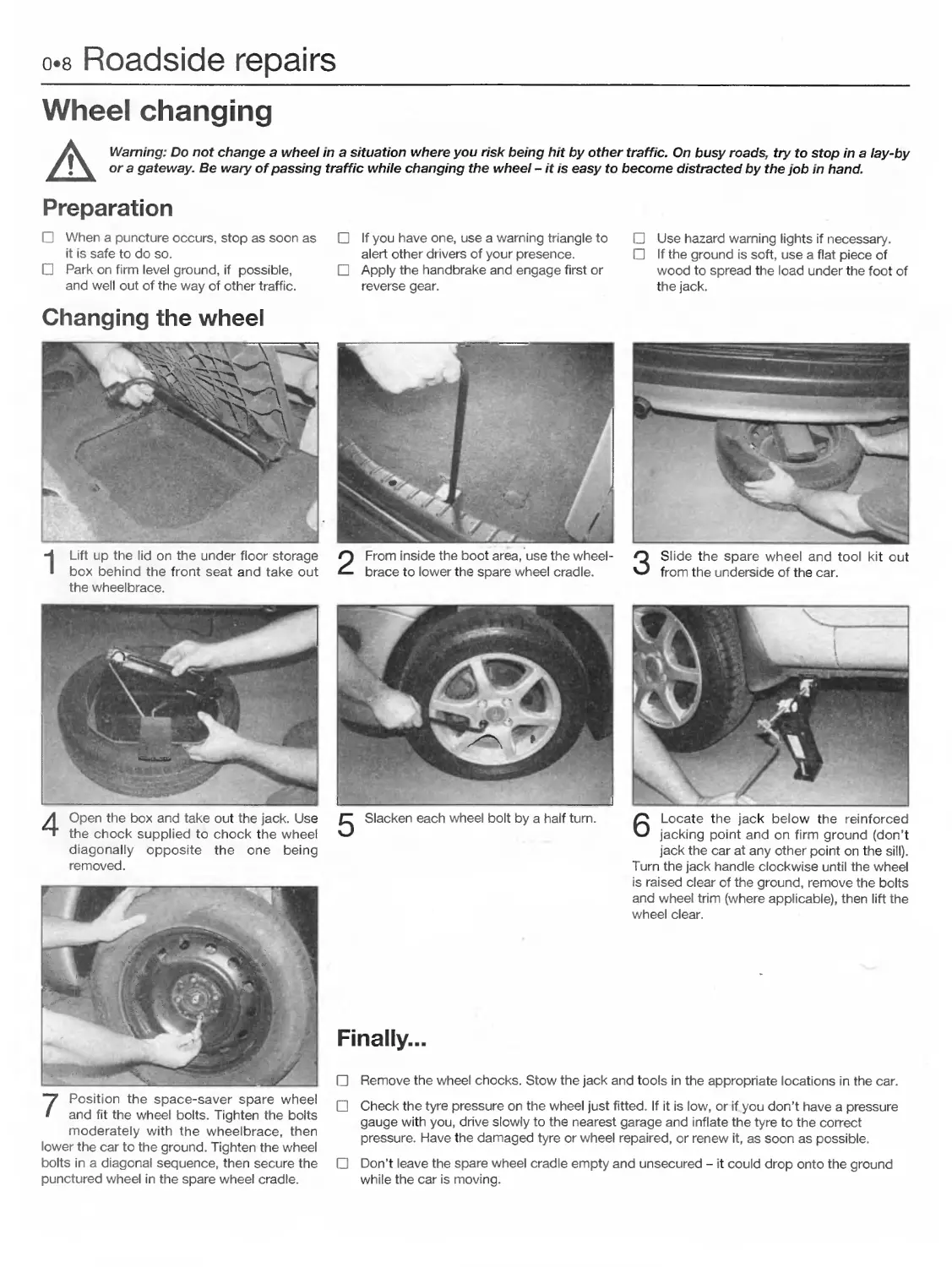
Wheel changing
Warning: Do not change a wheel in a situation where you risk being hit by other traffic. On busy roads, try to stop in a lay-by
ora gateway. Be wary of passing traffic while changing the wheel - it is easy to become distracted by the job in hand.
Preparation
□ When a puncture occurs, stop as soon as
it is safe to do so.
□ Park on firm level ground, if possible,
and well out of the way of other traffic.
□ If you have one, use a warning triangle to
alert other drivers of your presence.
□ Apply the handbrake and engage first or
reverse gear.
□ Use hazard warning lights if necessary.
□ If the ground is soft, use a flat piece of
wood to spread the load under the foot of
the jack.
Changing the wheel
Lift up the lid on the under floor storage
box behind the front seat and take out
the wheelbrace.
From inside the boot area, use the wheel-
brace to lower the spare wheel cradle.
3 Slide the spare wheel and tool kit out
from the underside of the car.
£7 Slacken each wheel bolt by a half turn.
4 Open the box and take out the jack. Use
the chock supplied to chock the wheel
diagonally opposite the one being
removed.
6 Locate the jack below the reinforced
jacking point and on firm ground (don’t
jack the car at any other point on the sill).
Turn the jack handle clockwise until the wheel
is raised clear of the ground, remove the bolts
and wheel trim (where applicable), then lift the
wheel clear.
Finally...
□ Remove the wheel chocks. Stow the jack and tools in the appropriate locations in the car.
7 Position the space-saver spare wheel
and fit the wheel bolts. Tighten the bolts
moderately with the wheelbrace, then
lower the car to the ground. Tighten the wheel
bolts in a diagonal sequence, then secure the
punctured wheel in the spare wheel cradle.
□ Check the tyre pressure on the wheel just fitted. If it is low, or if you don’t have a pressure
gauge with you, drive slowly to the nearest garage and inflate the tyre to the correct
pressure. Have the damaged tyre or wheel repaired, or renew it, as soon as possible.
C Don’t leave the spare wheel cradle empty and unsecured - it could drop onto the ground
while the car is moving.
Roadside repairs 0.9
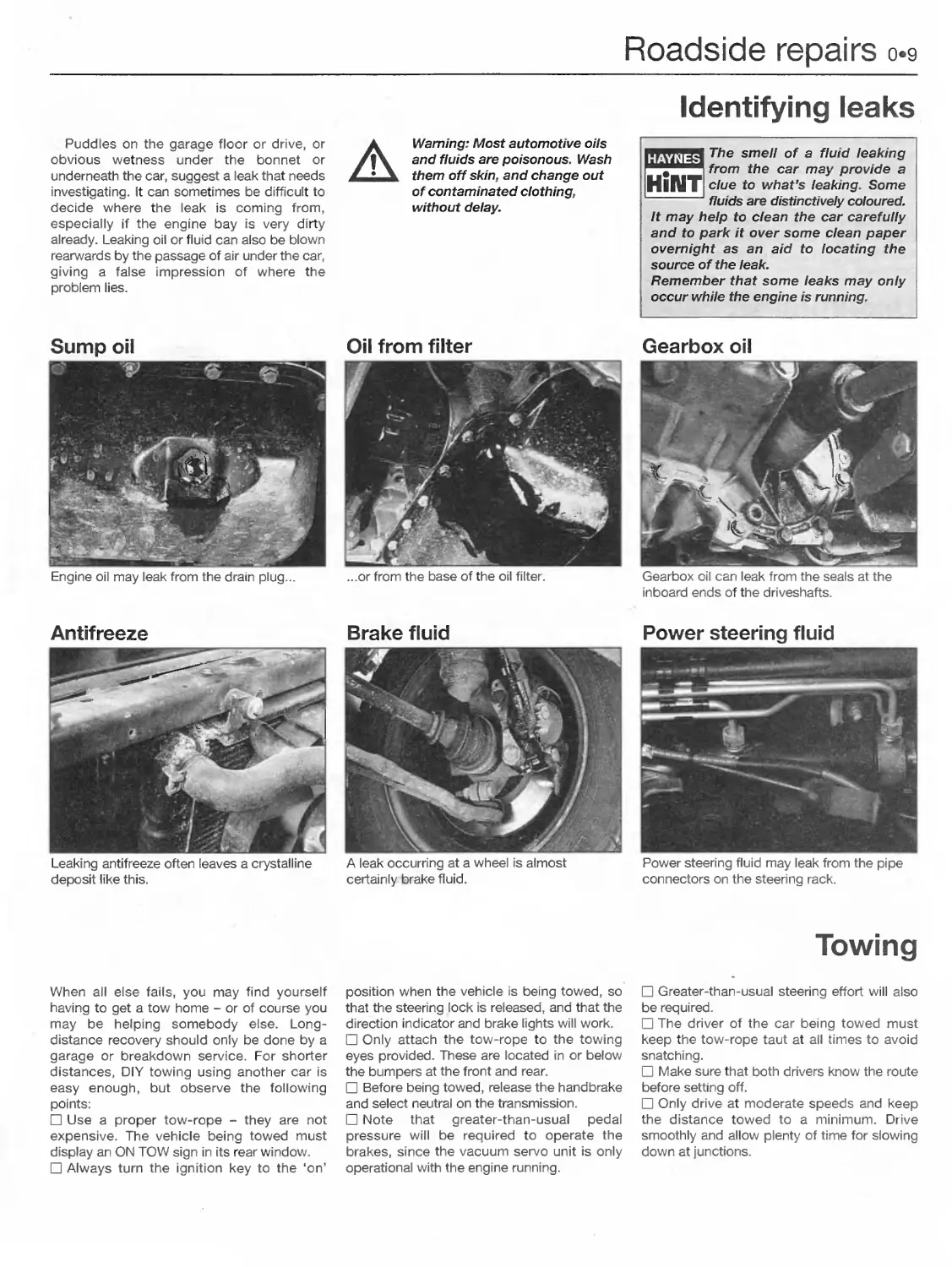
Identifying leaks
Puddles on the garage floor or drive, or
obvious wetness under the bonnet or
underneath the car, suggest a leak that needs
investigating. It can sometimes be difficult to
decide where the leak is coming from,
especially if the engine bay is very dirty
already. Leaking oil or fluid can also be blown
rearwards by the passage of air under the car,
giving a false impression of where the
problem lies.
Warning: Most automotive oils
and fluids are poisonous. Wash
them off skin, and change out
of contaminated clothing,
without delay.
HAYNES
HilMT
The smell of a fluid leaking
from the car may provide a
clue to what’s leaking. Some
fluids are distinctively coloured.
It may help to clean the car carefully
and to park it over some clean paper
overnight as an aid to locating the
source of the leak.
Remember that some leaks may only
occur while the engine is running.
Sump oil
Oil from filter
Gearbox oil
Engine oil may leak from the drain plug...
...or from the base of the oil filter.
Gearbox oil can leak from the seals at the
inboard ends of the driveshafts.
Antifreeze
Brake fluid
Power steering fluid
Leaking antifreeze often leaves a crystalline
deposit like this.
A leak occurring at a wheel is almost
certainly brake fluid.
Power steering fluid may leak from the pipe
connectors on the steering rack.
Towing
When all else fails, you may find yourself
having to get a tow home - or of course you
may be helping somebody else. Long-
distance recovery should only be done by a
garage or breakdown service. For shorter
distances, DIY towing using another car is
easy enough, but observe the following
points:
□	Use a proper tow-rope - they are not
expensive. The vehicle being towed must
display an ON TOW sign in its rear window.
□	Always turn the ignition key to the ‘on’
position when the vehicle is being towed, so
that the steering lock is released, and that the
direction indicator and brake lights will work.
□ Only attach the tow-rope to the towing
eyes provided. These are located in or below
the bumpers at the front and rear.
□	Before being towed, release the handbrake
and select neutral on the transmission.
□	Note that greater-than-usual pedal
pressure will be required to operate the
brakes, since the vacuum servo unit is only
operational with the engine running.
□	Greater-than-usual steering effort will also
be required.
□	The driver of the car being towed must
keep the tow-rope taut at all times to avoid
snatching.
□	Make sure that both drivers know the route
before setting off.
□	Only drive at moderate speeds and keep
the distance towed to a minimum. Drive
smoothly and allow plenty of time for slowing
down at junctions.
о.ю Weekly checks
Introduction
There are some very simple checks which
need only take a few minutes to carry out, but
which could save you a lot of inconvenience
and expense.
These ‘Weekly checks’ require no great skill
or special tools, and the small amount of time
they take to perform could prove to be very
well spent, for example;
□	Keeping an eye on tyre condition and
pressures, will not only help to stop them
wearing out prematurely, but could also save
your life.
□	Many breakdowns are caused by electrical
problems. Battery-related faults are particularly
common, and a quick check on a regular basis
will often prevent the majority of these.
C If your car develops a brake fluid leak, the
first time you might know about it is when
your brakes don't work properly. Checking
the level regularly will give advance warning of
this kind of problem.
C If the oil or coolant levels run low, the cost
of repairing any engine damage will be far
greater than fixing the leak, for example.
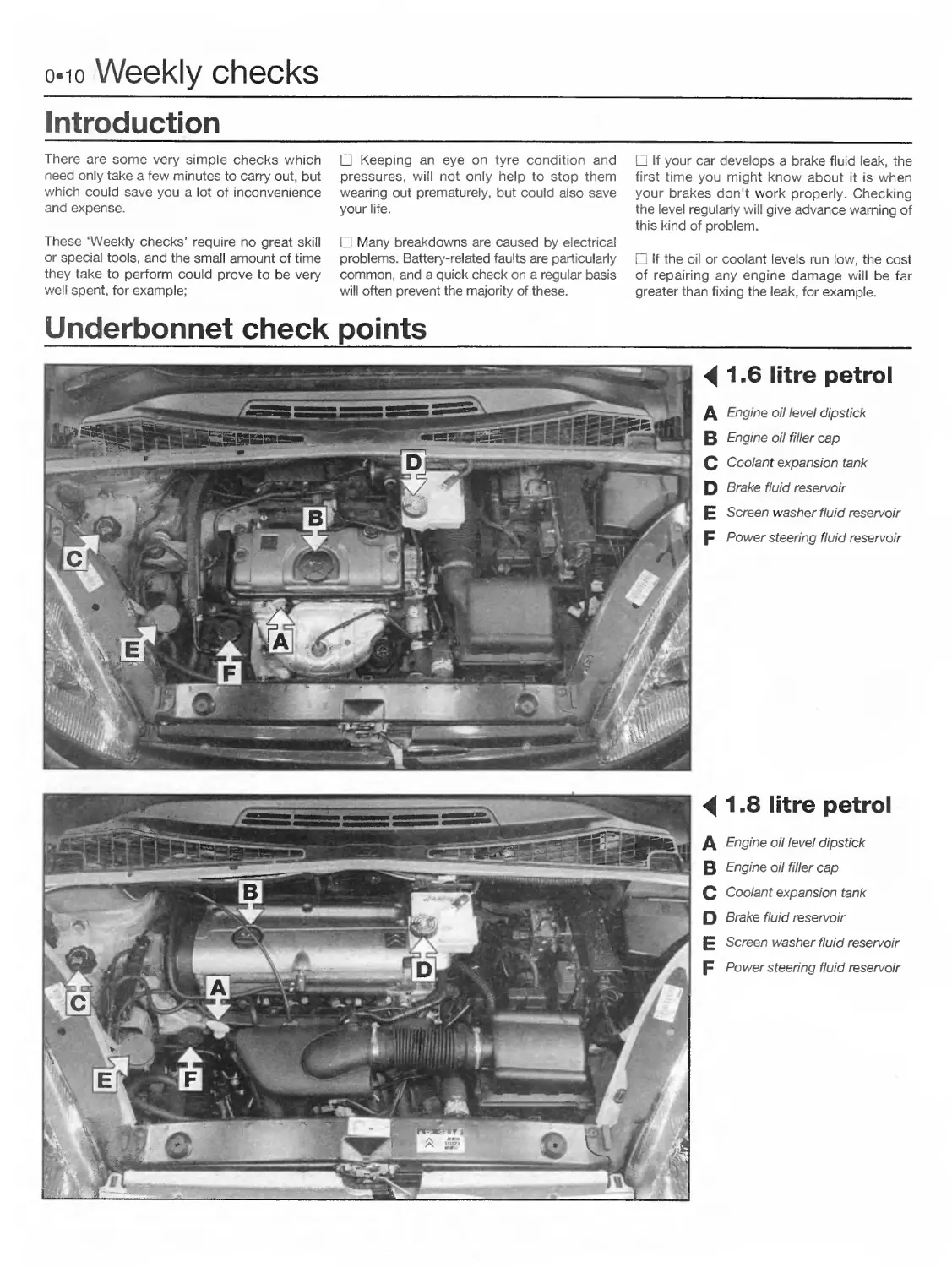
Underbonnet check points
<4 1 -6 litre petrol
Д Engine oil level dipstick
В Engine oil filler cap
Q Coolant expansion tank
D Brake fluid reservoir
E Screen washer fluid reservoir
F Power steering fluid reservoir
4 1 -8 litre petrol
Д Engine oil level dipstick
В Engine oil filler cap
Q Coolant expansion tank
D Brake fluid reservoir
E Screen washer fluid reservoir
F Power steering fluid reservoir
Weekly checks o«n
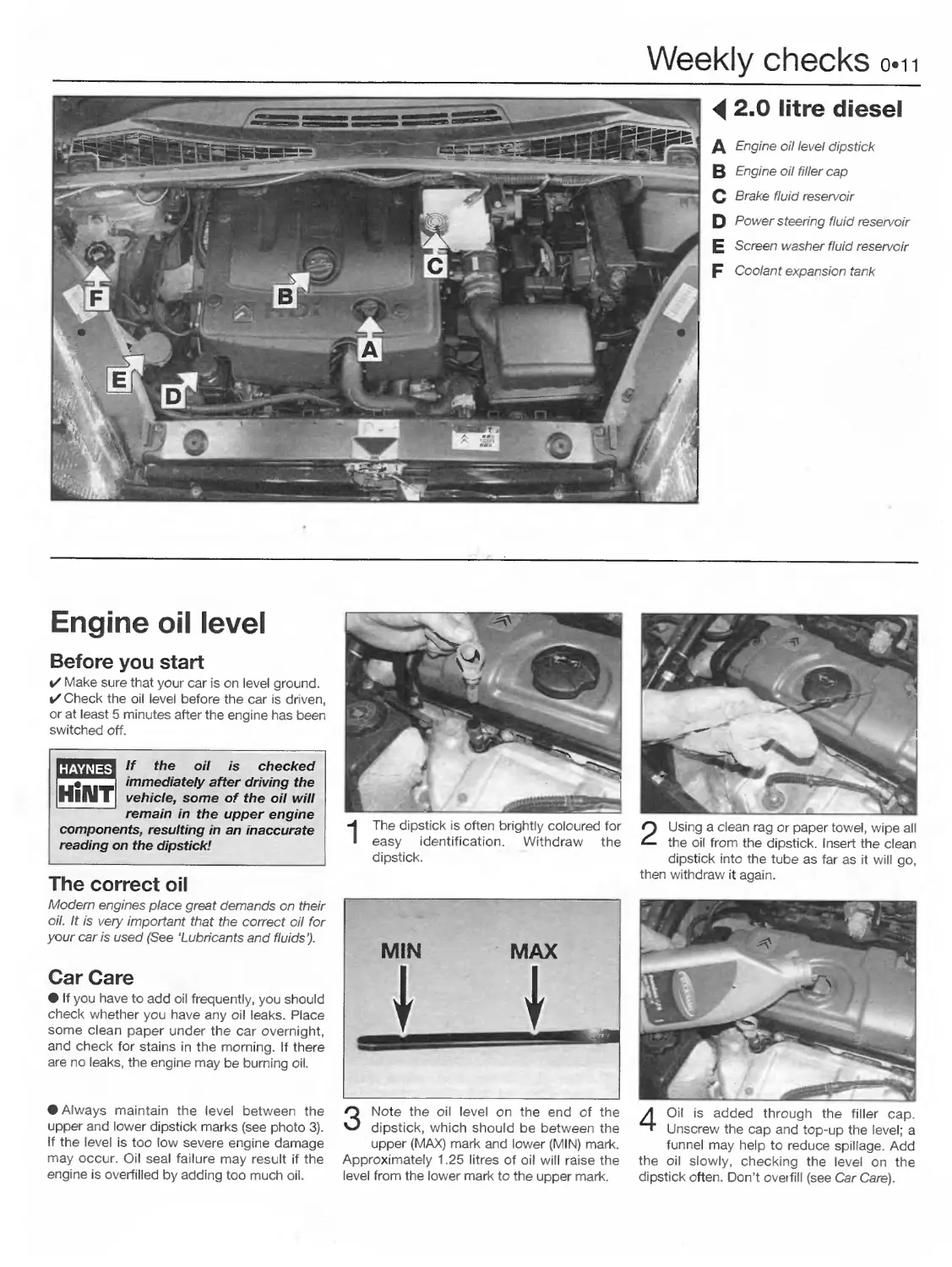
2.0 litre diesel
Д Engine oil level dipstick
В Engine oil filler cap
Q Brake fluid reservoir
D Power steering fluid reservoir
E Screen washer fluid reservoir
F Coolant expansion tank
Engine oil level
HAYNES
hint
The correct oil
Modern engines place great demands on their
oil. It is very important that the correct oil for
your car is used (See ‘Lubricants and fluids').
Car Care
• If you have to add oil frequently, you should
check whether you have any oil leaks. Place
some clean paper under the car overnight,
and check for stains in the morning. If there
are no leaks, the engine may be burning oil.
Before you start
✓ Make sure that your car is on level ground.
✓ Check the oil level before the car is driven,
or at least 5 minutes after the engine has been
switched off.
If the oil is checked
immediately after driving the
vehicle, some of the oil will
remain in the upper engine
components, resulting in an inaccurate
reading on the dipstick!
The dipstick is often brightly coloured for
easy identification. Withdraw the
dipstick.
2 Using a clean rag or paper towel, wipe all
the oil from the dipstick. Insert the clean
dipstick into the tube as far as it will go,
then withdraw it again.
MIN MAX
• Always maintain the level between the
upper and lower dipstick marks (see photo 3).
If the level is too low severe engine damage
may occur. Oil seal failure may result if the
engine is overfilled by adding too much oil.
3Note the oil level on the end of the
dipstick, which should be between the
upper (MAX) mark and lower (MIN) mark.
Approximately 1.25 litres of oil will raise the
level from the lower mark to the upper mark.
4 Oil is added through the filler cap.
Unscrew the cap and top-up the level; a
funnel may help to reduce spillage. Add
the oil slowly, checking the level on the
dipstick often. Don’t overfill (see Car Care).
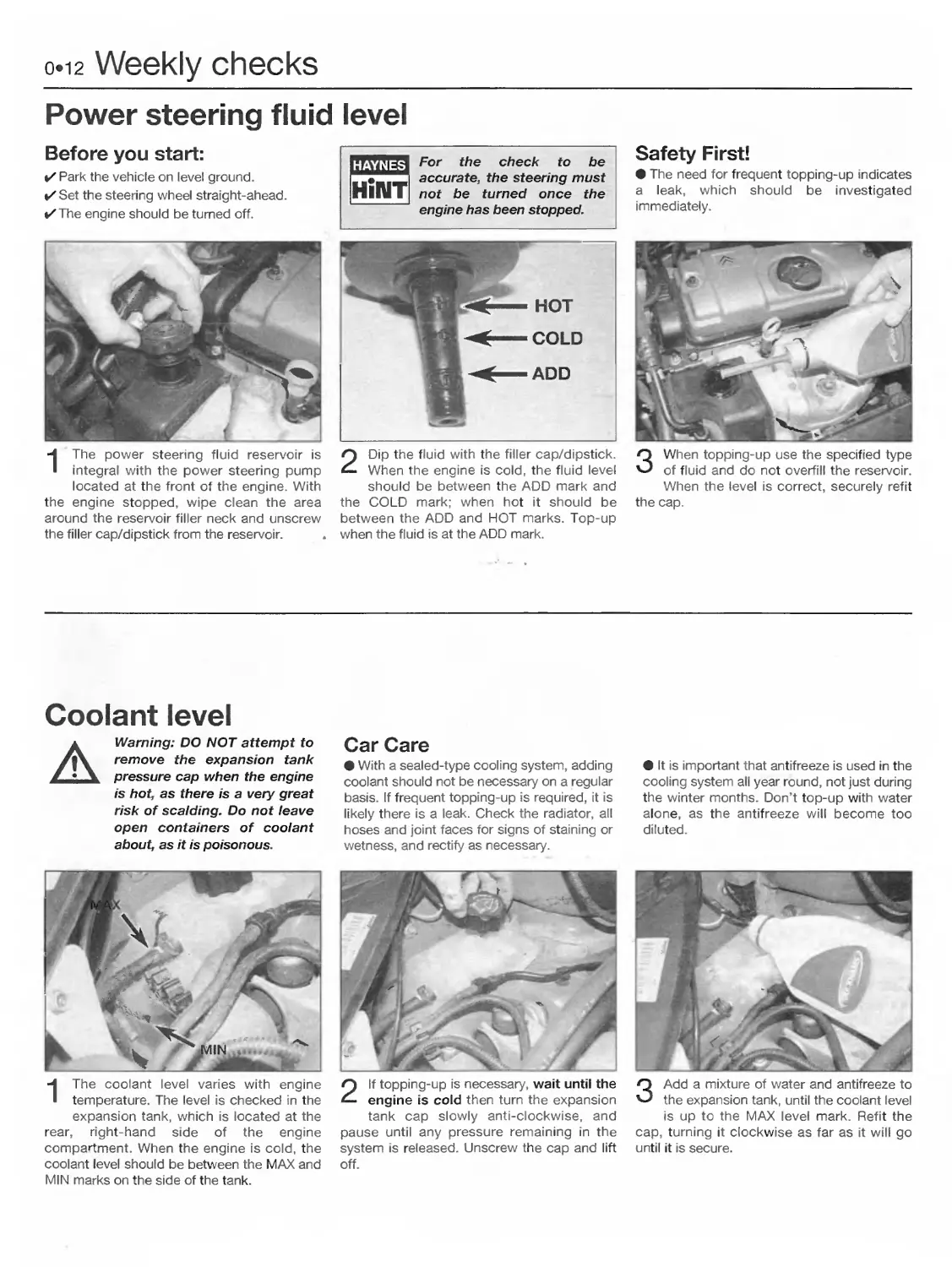
o.i2 Weekly checks
Power steering fluid level
Before you start:
✓ Park the vehicle on level ground.
✓ Set the steering wheel straight-ahead.
✓ The engine should be turned off.
HAYNES
HilUT
For the check to be
accurate, the steering must
not be turned once the
engine has been stopped.
Safety First!
• The need for frequent topping-up indicates
a leak, which should be investigated
immediately.
*
HOT
COLD
ADD
IThe power steering fluid reservoir is
integral with the power steering pump
located at the front of the engine. With
the engine stopped, wipe clean the area
around the reservoir filler neck and unscrew
the filler cap/dipstick from the reservoir.
2 Dip the fluid with the filler cap/dipstick.
When the engine is cold, the fluid level
should be between the ADD mark and
the COLD mark; when hot it should be
between the ADD and HOT marks. Top-up
when the fluid is at the ADD mark.
3When topping-up use the specified type
of fluid and do not overfill the reservoir.
When the level is correct, securely refit
the cap.
Coolant level
Warning: DO NOT attempt to
remove the expansion tank
pressure cap when the engine
is hot, as there is a very great
risk of scalding. Do not leave
open containers of coolant
about, as it is poisonous.
Car Care
• With a sealed-type cooling system, adding
coolant should not be necessary on a regular
basis. If frequent topping-up is required, it is
likely there is a leak. Check the radiator, all
hoses and joint faces for signs of staining or
wetness, and rectify as necessary.
• It is important that antifreeze is used in the
cooling system all year round, not just during
the winter months. Don’t top-up with water
alone, as the antifreeze will become too
diluted.
IThe coolant level varies with engine
temperature. The level is checked in the
expansion tank, which is located at the
rear, right-hand side of the engine
compartment. When the engine is cold, the
coolant level should be between the MAX and
MIN marks on the side of the tank.
2 If topping-up is necessary, wait until the
engine is cold then turn the expansion
tank cap slowly anti-clockwise, and
pause until any pressure remaining in the
system is released. Unscrew the cap and lift
off.
3Add a mixture of water and antifreeze to
the expansion tank, until the coolant level
is up to the MAX level mark. Refit the
cap, turning it clockwise as far as it will go
until it is secure.
Weekly checks мз
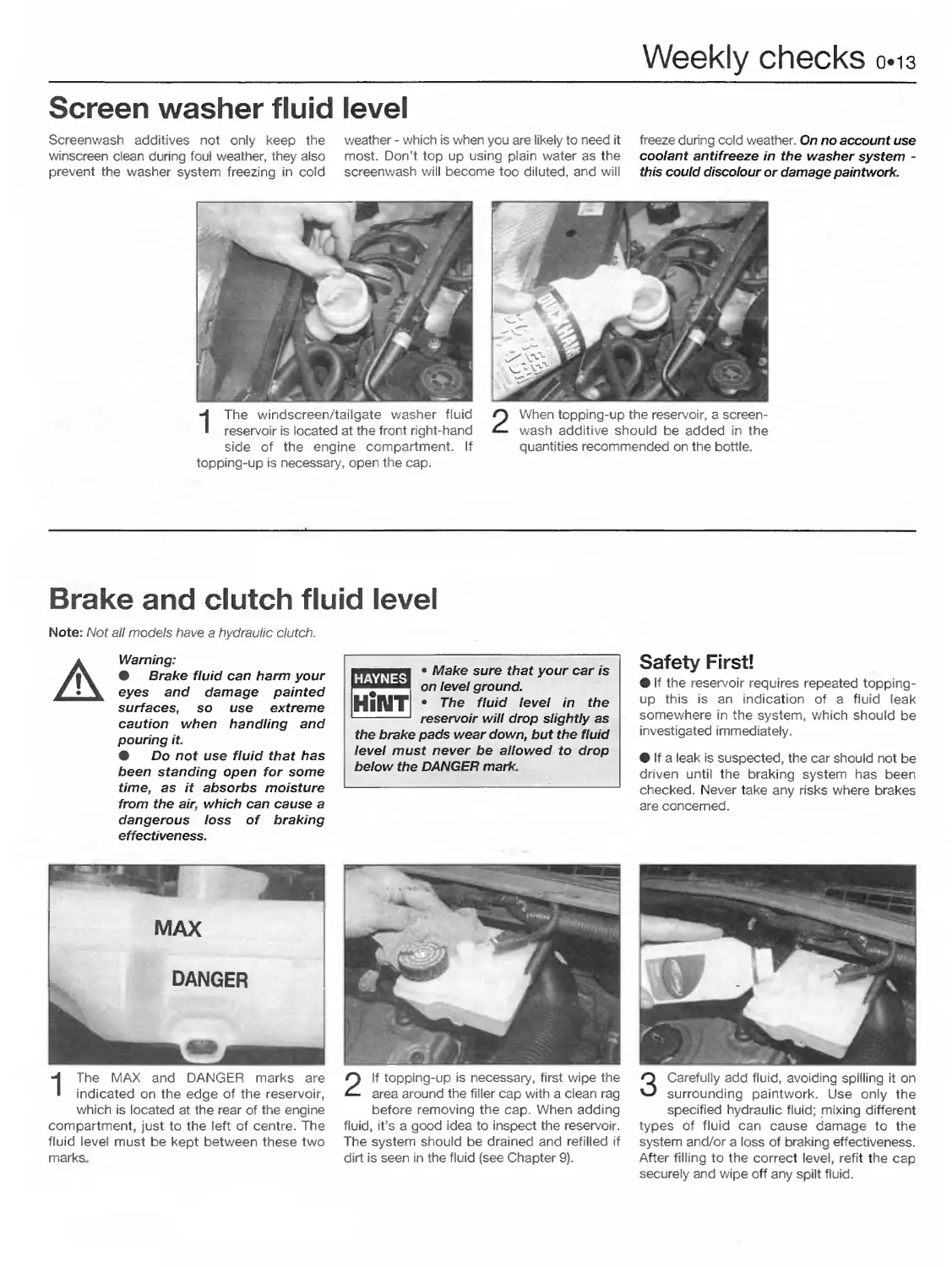
Screen washer fluid level
Screenwash additives not only keep the
winscreen clean during foul weather, they also
prevent the washer system freezing in cold
weather - which is when you are likely to need it
most. Don’t top up using plain water as the
screenwash will become too diluted, and will
freeze during cold weather. On no account use
coolant antifreeze in the washer system -
this could discolour or damage paintwork.
IThe windscreen/tailgate washer fluid
reservoir is located at the front right-hand
side of the engine compartment. If
topping-up is necessary, open the cap.
2 When topping-up the reservoir, a screen-
wash additive should be added in the
quantities recommended on the bottle.
Brake and clutch fluid level
Note: Not all models have a hydraulic clutch.
Warning:
• Brake fluid can harm your
eyes and damage painted
surfaces, so use extreme
caution when handling and
pouring it.
• Do not use fluid that has
been standing open for some
time, as it absorbs moisture
from the air, which can cause a
dangerous loss of braking
effectiveness.
HAYNES
hint
•	Make sure that your car is
on level ground.
•	The fluid level in the
reservoir will drop slightly as
the brake pads wear down, but the fluid
level must never be allowed to drop
below the DANGER mark.
Safety First!
• If the reservoir requires repeated topping-
up this is an indication of a fluid leak
somewhere in the system, which should be
investigated immediately.
• If a leak is suspected, the car should not be
driven until the braking system has been
checked. Never take any risks where brakes
are concerned.
IThe MAX and DANGER marks are
indicated on the edge of the reservoir,
which is located at the rear of the engine
compartment, just to the left of centre. The
fluid level must be kept between these two
marks.
2 If topping-up is necessary, first wipe the
area around the filler cap with a clean rag
before removing the cap. When adding
fluid, it’s a good idea to inspect the reservoir.
The system should be drained and refilled if
dirt is seen in the fluid (see Chapter 9).
3 Carefully add fluid, avoiding spilling it on
surrounding paintwork. Use only the
specified hydraulic fluid; mixing different
types of fluid can cause damage to the
system and/or a loss of braking effectiveness.
After filling to the correct level, refit the cap
securely and wipe off any spilt fluid.
o.i4 Weekly checks
Tyre condition and pressure
It is very important that tyres are in good
condition, and at the correct pressure - having
a tyre failure at any speed is highly dangerous.
Tyre wear is influenced by driving style - harsh
braking and acceleration, or fast cornering,
will all produce more rapid tyre wear. As a
general rule, the front tyres wear out faster
than the rears. Interchanging the tyres from
front to rear ("rotating" the tyres) may result in
more even wear. However, if this is
completely effective, you may have the
expense of replacing all four tyres at once!
Remove any nails or stones embedded in the
tread before they penetrate the tyre to cause
deflation. If removal of a nail does reveal that
the tyre has been punctured, refit the nail so
that its point of penetration is marked. Then
immediately change the wheel, and have the
tyre repaired by a tyre dealer.
Regularly check the tyres for damage in the
form of cuts or bulges, especially in the
sidewalls. Periodically remove the wheels,
and clean any dirt or mud from the inside and
outside surfaces. Examine the wheel rims for
signs of rusting, corrosion or other damage.
Light alloy wheels are easily damaged by
"kerbing" whilst parking; steel wheels may
also become dented or buckled. A new wheel
is very often the only way to overcome severe
damage.
New tyres should be balanced when they are
fitted, but it may become necessary to re-
balance them as they wear, or if the balance
weights fitted to the wheel rim should fall off.
Unbalanced tyres will wear more quickly, as
will the steering and suspension components.
Wheel imbalance is normally signified by
vibration, particularly at a certain speed
(typically around 50 mph). If this vibration is
felt only through the steering, then it is likely
that just the front wheels need balancing. If,
however, the vibration is feit through the
whole car, the rear wheels could be out of
balance. Wheel balancing should be carried
out by a tyre dealer or garage.
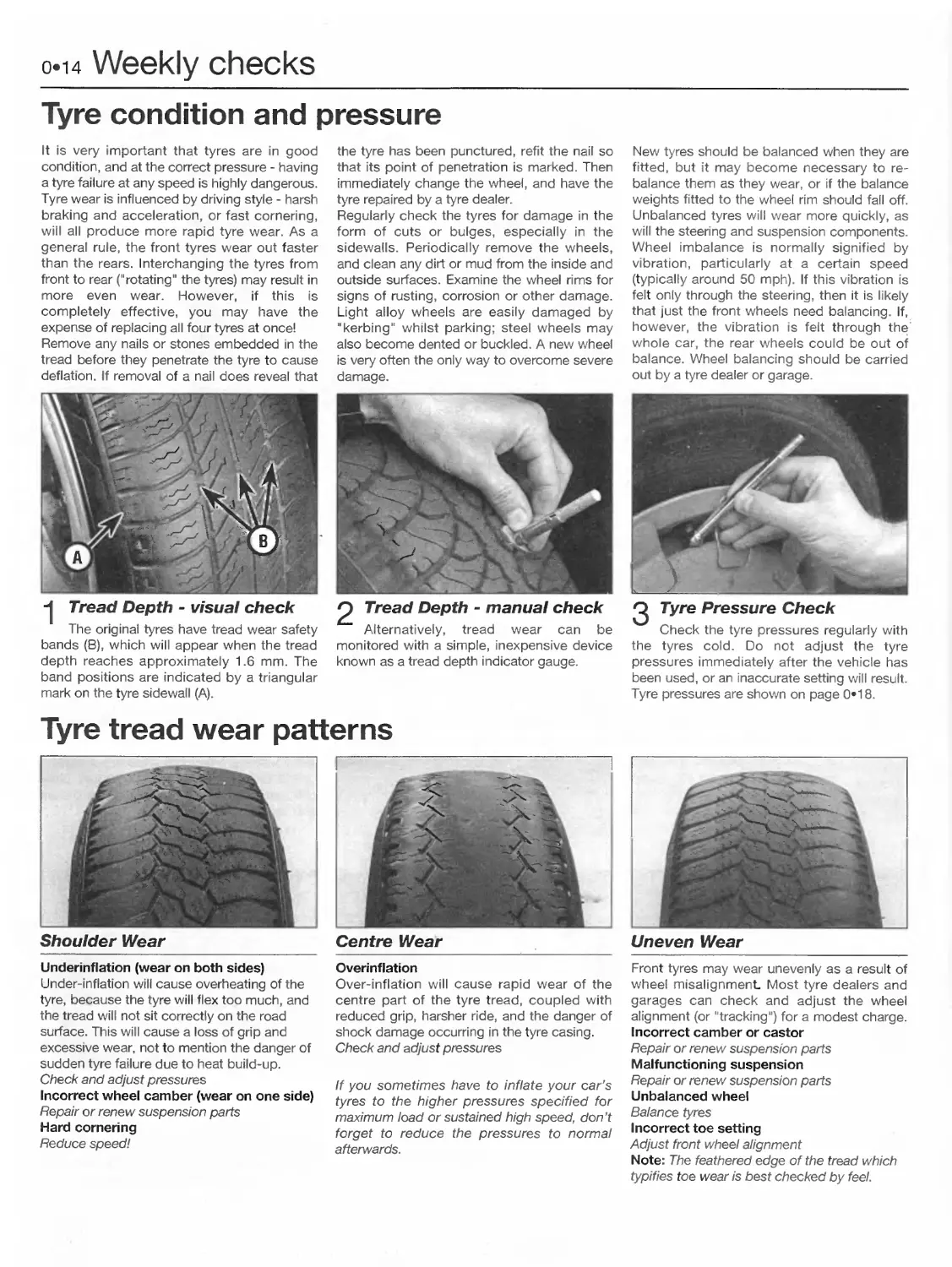
4 Tread Depth - visual check
The original tyres have tread wear safety
bands (B), which will appear when the tread
depth reaches approximately 1.6 mm. The
band positions are indicated by a triangular
mark on the tyre sidewall (A).
О Tread Depth - manual check
Alternatively, tread wear can be
monitored with a simple, inexpensive device
known as a tread depth indicator gauge.
Q Tyre Pressure Check
Check the tyre pressures regularly with
the tyres cold. Do not adjust the tyre
pressures immediately after the vehicle has
been used, or an inaccurate setting will result.
Tyre pressures are shown on page 0*18.
Tyre tread wear patterns
Shoulder Wear
Centre Wear
Uneven Wear
Underinflation (wear on both sides)
Under-inflation will cause overheating of the
tyre, because the tyre will flex too much, and
the tread will not sit correctly on the road
surface. This will cause a loss of grip and
excessive wear, not to mention the danger of
sudden tyre failure due to heat build-up.
Check and adjust pressures
Incorrect wheel camber (wear on one side)
Repair or renew suspension parts
Hard cornering
Reduce speed!
Overinflation
Over-inflation will cause rapid wear of the
centre part of the tyre tread, coupled with
reduced grip, harsher ride, and the danger of
shock damage occurring in the tyre casing.
Check and adjust pressures
If you sometimes have to inflate your car's
tyres to the higher pressures specified for
maximum load or sustained high speed, don’t
forget to reduce the pressures to normal
afterwards.
Front tyres may wear unevenly as a result of
wheel misalignment Most tyre dealers and
garages can check and adjust the wheel
alignment (or “tracking") for a modest charge.
Incorrect camber or castor
Repair or renew suspension parts
Malfunctioning suspension
Repair or renew suspension parts
Unbalanced wheel
Balance tyres
Incorrect toe setting
Adjust front wheel alignment
Note: The feathered edge of the tread which
typifies toe wear is best checked by feel.
Weekly checks 0.15
Battery
Caution: Before carrying out any work on the
vehicle battery, read the precautions given in
‘Safety first’ at the start of this manual.
Make sure that the battery tray is in good
condition, and that the clamp is tight.
Corrosion on the tray, retaining clamp and the
battery itself can be removed with a solution
of water and baking soda, after removing the
affected components from the car (see
Chapter 5A). Thoroughly rinse all cleaned
areas with water. Any metal parts damaged
by corrosion should be covered with a zinc-
based primer, then painted.
✓ Periodically (approximately every three
months), check the charge condition of the
battery as described in Chapter 5A.
✓ If the battery is flat, and you need to jump
start your vehicle, see Roadside Repairs.
Battery corrosion can be kept to a
minimum by applying a layer of
petroleum jelly to the clamps and
terminals after they are reconnected.
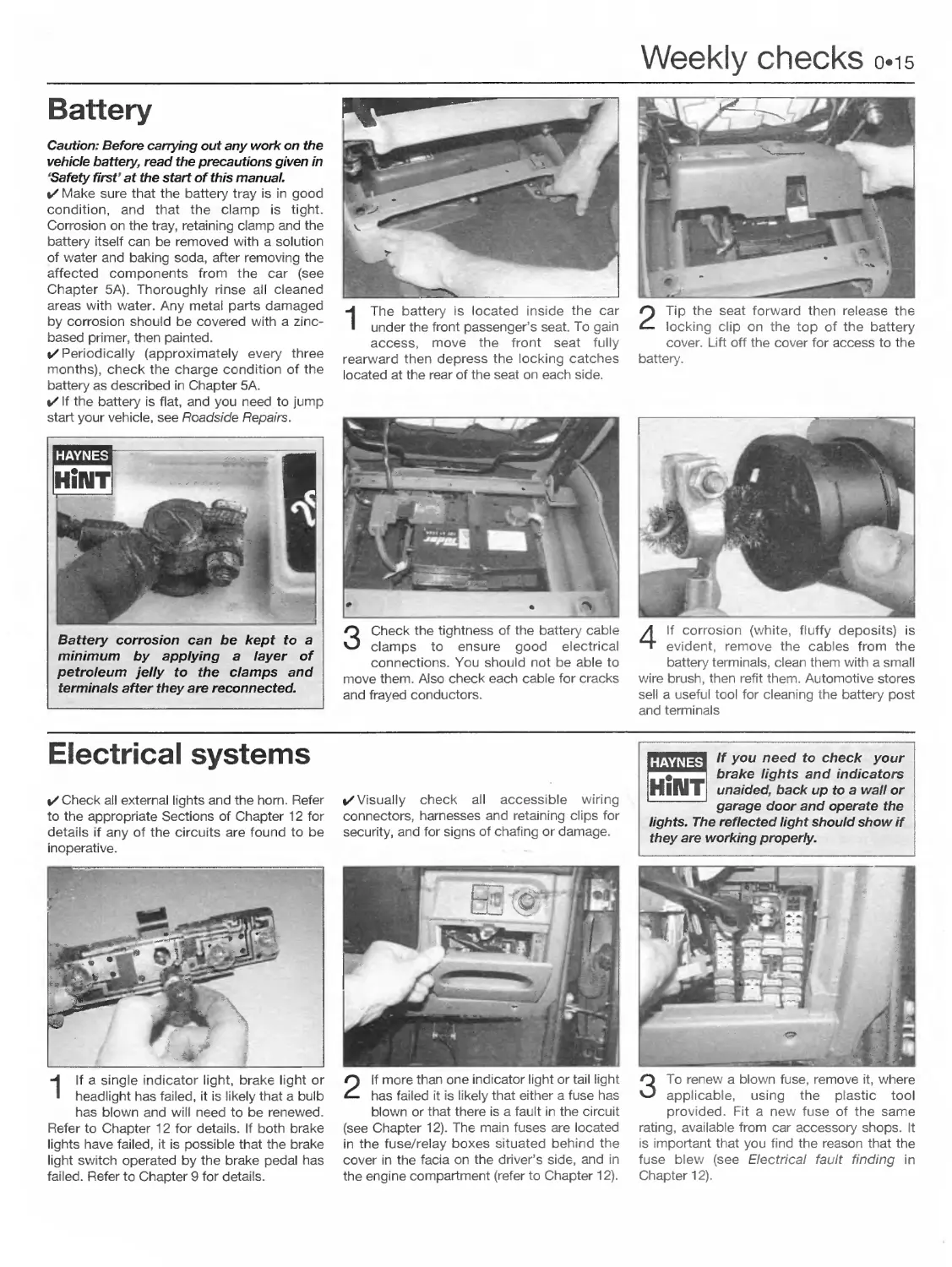
IThe battery is located inside the car
under the front passenger’s seat. To gain
access, move the front seat fully
rearward then depress the locking catches
located at the rear of the seat on each side.
3 Check the tightness of the battery cable
clamps to ensure good electrical
connections. You should not be able to
move them. Also check each cable for cracks
and frayed conductors.
2 Tip the seat forward then release the
locking clip on the top of the battery
cover. Lift off the cover for access to the
battery.
4 If corrosion (white, fluffy deposits) is
evident, remove the cables from the
battery terminals, clean them with a small
wire brush, then refit them. Automotive stores
sell a useful tool for cleaning the battery post
and terminals
Electrical systems
✓ Check all external lights and the horn. Refer
to the appropriate Sections of Chapter 12 for
details if any of the circuits are found to be
inoperative.
✓ Visually check all accessible wiring
connectors, harnesses and retaining clips for
security, and for signs of chafing or damage.
HAYNES
hint
If you need to check your
brake lights and indicators
unaided, back up to a wall or
garage door and operate the
lights. The reflected light should show if
they are working properly.
Ilf a single indicator light, brake light or
headlight has failed, it is likely that a bulb
has blown and will need to be renewed.
Refer to Chapter 12 for details. If both brake
lights have failed, it is possible that the brake
light switch operated by the brake pedal has
failed. Refer to Chapter 9 for details.
2 If more than one indicator light or tail light
has failed it is likely that either a fuse has
blown or that there is a fault in the circuit
(see Chapter 12). The main fuses are located
in the fuse/relay boxes situated behind the
cover in the facia on the driver’s side, and in
the engine compartment (refer to Chapter 12).
3T0 renew a blown fuse, remove it, where
applicable, using the plastic tool
provided. Fit a new fuse of the same
rating, available from car accessory shops. It
is important that you find the reason that the
fuse blew (see Electrical fault finding in
Chapter 12).
о.1б Weekly checks
Wiper blades
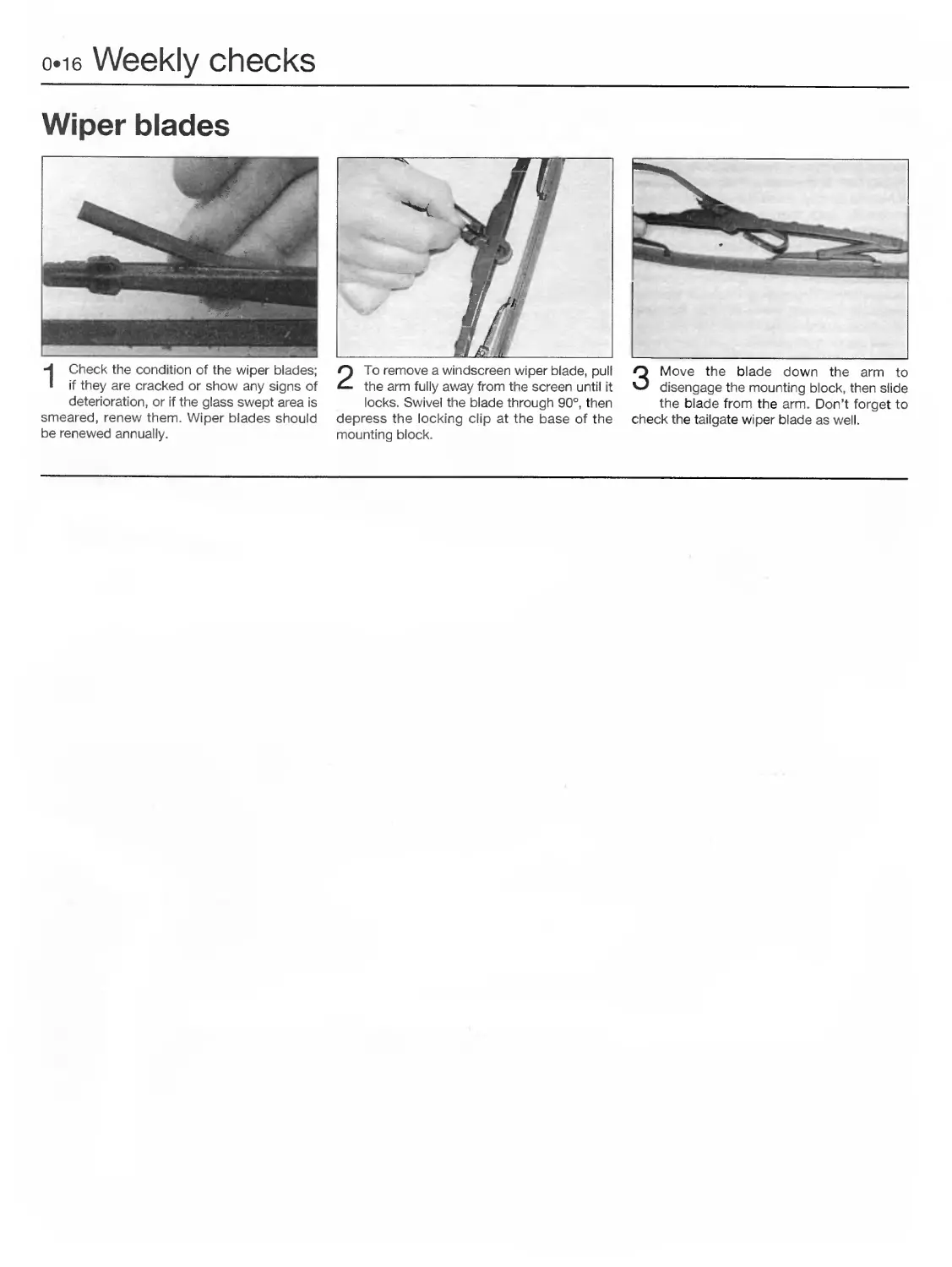
1	Check the condition of the wiper blades;
if they are cracked or show any signs of
deterioration, or if the glass swept area is
smeared, renew them. Wiper blades should
be renewed annually.
2	To remove a windscreen wiper blade, pull
the arm fully away from the screen until it
locks. Swivel the blade through 90°, then
depress the locking clip at the base of the
mounting block.
3Move the blade down the arm to
disengage the mounting block, then slide
the blade from the arm. Don’t forget to
check the tailgate wiper blade as well.
Lubricants and fluids 0.17
Lubricants and fluids
Engine:
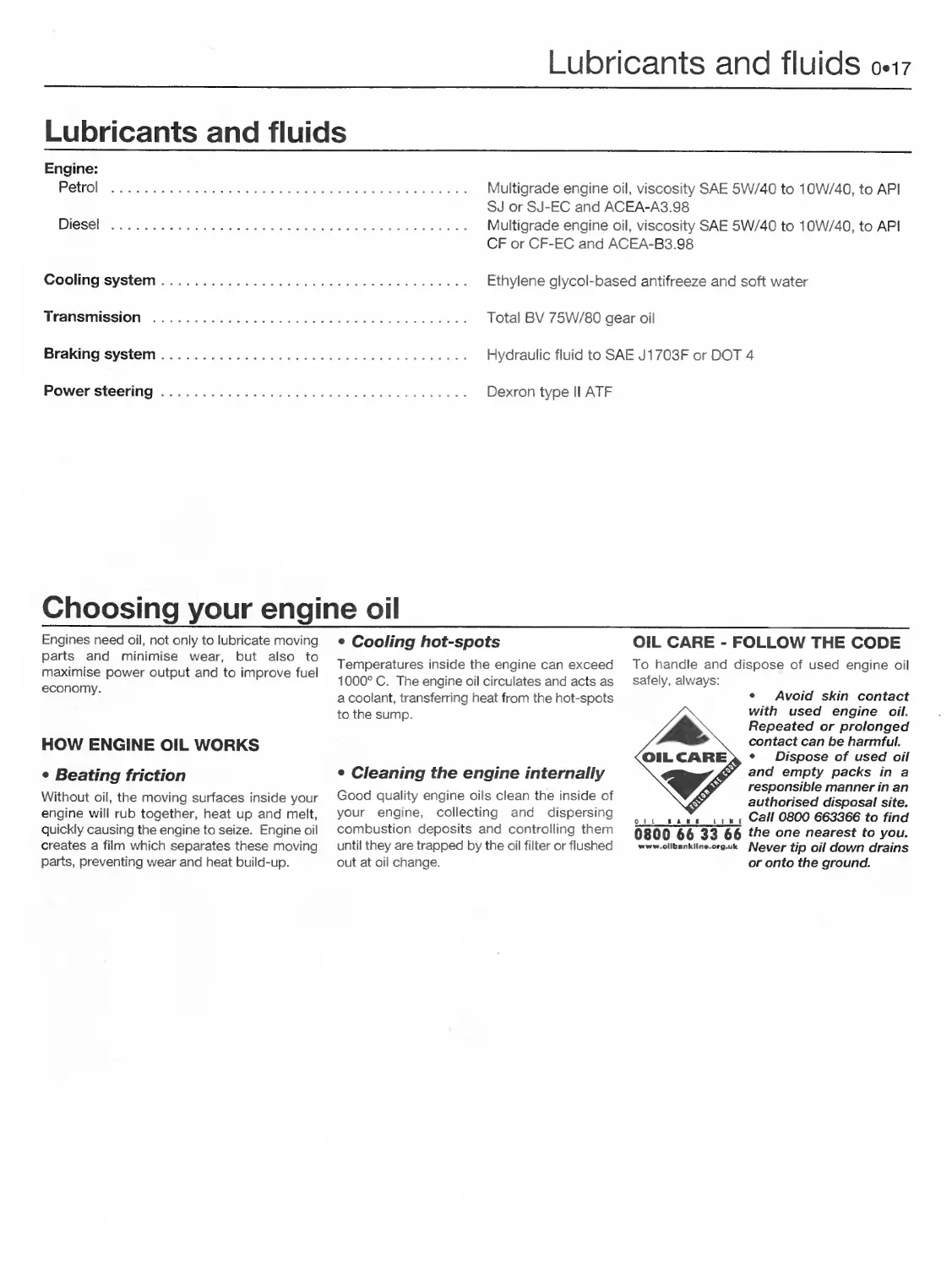
Petrol ................................................ Multigrade engine oil, viscosity SAE 5W/40 to 10W/40, to API
SJ or SJ-EC and ACEA-A3.98
Diesel .............................................. Multigrade engine oil, viscosity SAE 5W/40 to 10W/40, to API
CF or CF-EC and ACEA-B3.98
Cooling system......................................... Ethylene glycol-based antifreeze and soft water
Transmission .......................................... Total BV 75W/80 gear oil
Braking system......................................... Hydraulic fluid to SAE J1703F or DOT 4
Power steering......................................... Dexron type II ATF
Choosing your engine oil
Engines need oil, not only to lubricate moving
parts and minimise wear, but also to
maximise power output and to improve fuel
economy.
HOW ENGINE OIL WORKS
•	Beating friction
Without oil, the moving surfaces inside your
engine will rub together, heat up and melt,
quickly causing the engine to seize. Engine oil
creates a film which separates these moving
parts, preventing wear and heat build-up.
•	Cooling hot-spots
Temperatures inside the engine can exceed
1000° C. The engine oil circulates and acts as
a coolant, transferring heat from the hot-spots
to the sump.
•	Cleaning the engine internally
Good quality engine oils clean the inside of
your engine, collecting and dispersing
combustion deposits and controlling them
until they are trapped by the oil filter or flushed
out at oil change.
OIL CARE - FOLLOW THE CODE
To handle and dispose of used engine oil
safely, always:
OIL t А И I L I M t
0800 66 33 66
www.ollbankllna.org.uk
•	Avoid skin contact
with used engine oil.
Repeated or prolonged
contact can be harmful.
•	Dispose of used oil
and empty packs in a
responsible manner in an
authorised disposal site.
Call 0800 663366 to find
the one nearest to you.
Never tip oil down drains
or onto the ground.
о«18 Tyre pressures
Tyre pressures (cold)
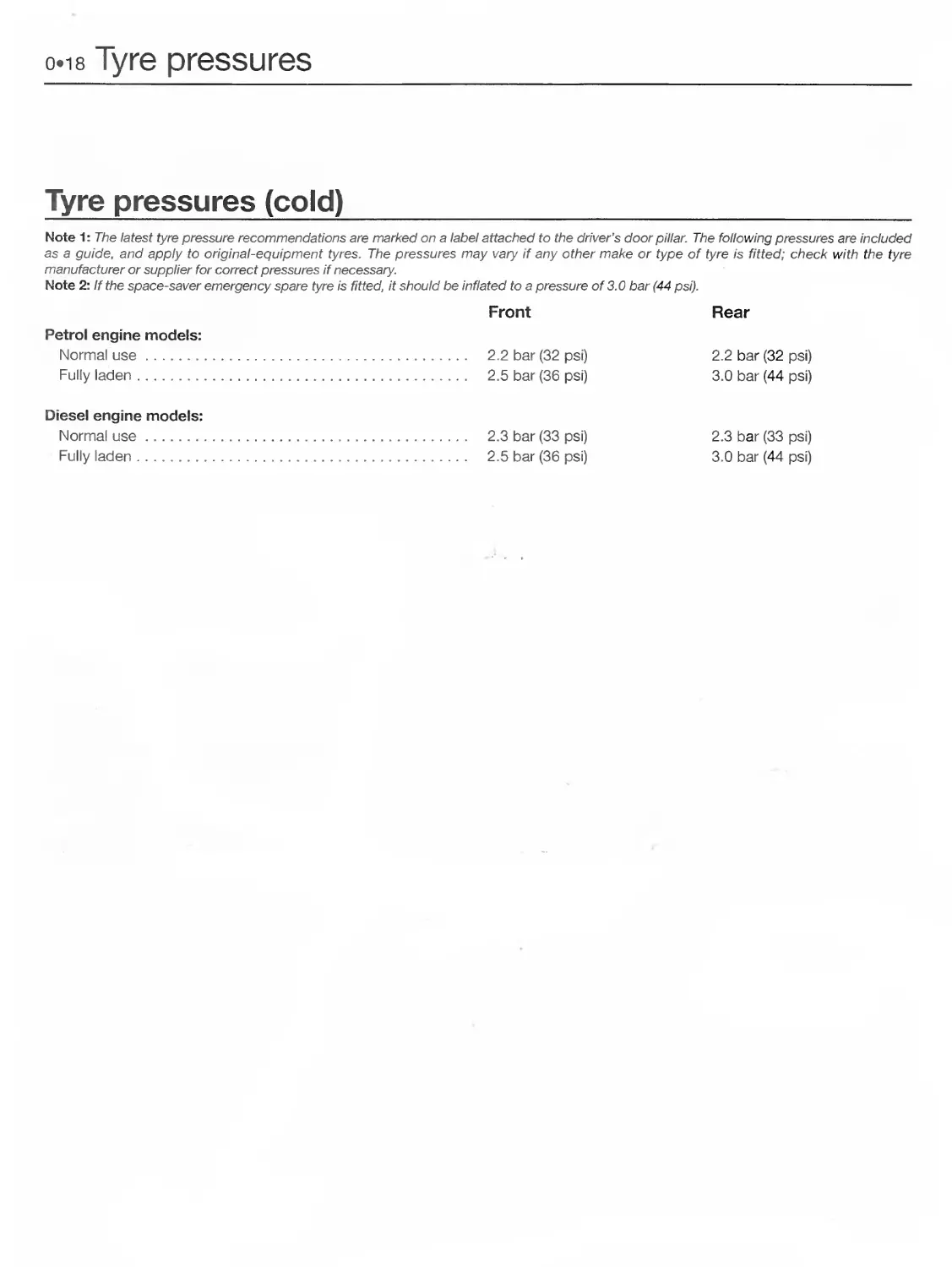
Note 1: The latest tyre pressure recommendations are marked on a label attached to the driver's door pillar. The following pressures are included
as a guide, and apply to original-equipment tyres. The pressures may vary if any other make or type of tyre is fitted; check with the tyre
manufacturer or supplier for co, red pressures if necessary.
Note 2: If the space-saver emergency spare tyre is fitted, it should be inflated to a pressure of 3.0 bar (44 psi).
Front	Rear
Petrol engine models:
Normal use................................................ 2.2	bar (32	psi)	2.2	bar	(32	psi)
Fully laden............................................... 2.5	bar (36	psi)	3.0	bar	(44	psi)
Diesel engine models:
Normal use................................................ 2.3	bar (33	psi)	2.3	bar	(33	psi)
Fully laden............................................... 2.5	bar (36	psi)	3.0	bar	(44	psi)
2А*1
Chapter 2 Part А:
TU series petrol engine in-car repair procedures
Contents
Camshaft and rocker arms - removal, inspection and refitting.....10
Camshaft oil seal - renewal...................................... 8
Compression test - description and interpretation................ 2
Crankshaft oil seals - renewal...................................14
Cylinder head - removal and refitting ..............................11
Cylinder head cover - removal and refitting ........................ 4
Engine assembly/valve timing holes - general information and
usage.............................................................. 3
Engine oil and filter renewal ..........................See	Chapter 1A
Engine oil level check ..............................See	Weekly checks
Engine/transmission mountings - inspection and renewal..............16
Flywheel - removal, inspection and refitting........................15
General information................................................. 1
Oil pump - removal, inspection and refitting........................13
Sump - removal and refitting........................................12
Timing belt - general information, removal and refitting............ 6
Timing belt covers - removal and refitting.......................... 5
Timing belt tensioner and sprockets - removal, inspection and
refitting.......................................................... 7
Valve clearances - checking and adjustment.......................... 9
Degrees of difficulty
Easy, suitable for
novice with little
experience
Fairly easy, suitable
for beginner with
some experience
Fairly difficult,
suitable for competent
DIY mechanic
Difficult, suitable for
experienced DIY
mechanic
Very difficult, ^4,
suitable for expert DIY 3^
or professional
Specifications
Engine (general)
Designation...................................................... TU5
Capacity......................................................... 1587 cc (1.6 litre)
Engine codes*:
Up to 2001 model year.......................................... NFZ (TU5JP+/L3)
2001 model year onward ........................................ NFV (TU5JP/L4)
Bore ............................................................ 78.50 mm
Stroke........................................................... 82.00 mm
Direction of crankshaft rotation ...............................
No 1 cylinder location..........................................
Compression ratio (typical):
NFZ (TU5JP+/L3) ..............................................
NFV (TU5JP/L4) ...............................................
Clockwise (viewed from right-hand side of vehicle)
At transmission end of block
9.6:1
10.5: 1
"The engine code is situated on front left-hand end of the engine, stamped directly on the cylinder block
Timing belt
Tension setting (see text - Section 6):
Initial setting .................................................
Final setting....................................................
44 SEEM units
29 to 33 SEEM units
Camshaft
Drive
Toothed belt
Number of bearings ...........................................
Camshaft bearing journal diameter (outside diameter):
No 1 .......................................................
No 2 .......................................................
No 3 .......................................................
No 4 .......................................................
No 5 .......................................................
5
36.950 to 36.925 mm
40.650 to 40.625 mm
41.250 to 41.225 mm
41.850 to 41.825 mm
42.450 to 42.425 mm
Cylinder head bearing journal diameter (inside diameter):
No 1 ......................................................... 37.000	to	37.039	mm
No 2 ......................................................... 40.700	to	47.739	mm
No 3 ....................................................... 41.300 to 41.339 mm
No 4 ......................................................... 41.900	to	41.939	mm
No 5 ......................................................... 42.500	to	42.539	mm
2 A* 2 TU series petrol engine in-car repair procedures
Valve clearances (engine cold)
Inlet....................................................... 0.20	mm
Exhaust..................................................... 0.40	mm
Lubrication system
Oil pump type..............................................
Minimum oil pressure at 90°C ..............................
Oil pressure warning switch operating pressure ............
Gear-type, chain-driven off the crankshaft
4 bars at 4000 rpm
0.8 bars
Torque wrench settings
Big-end bearing cap nuts...........................................
Camshaft sprocket retaining bolt...................................
Camshaft thrust fork retaining bolt................................
Crankshaft pulley retaining bolts .................................
Crankshaft sprocket retaining bolt.................................
Cylinder head bolts:
Stage 1 .........................................................
Stage 2 .........................................................
Stage 3 .........................................................
Cylinder head cover nuts ..........................................
Engine-to-transmission fixing bolts ...............................
Engine/transmission left-hand mounting:
Mounting bracket-to-body bolts...................................
Mounting bracket-to-transmission bolts ..........................
Rubber mounting centre nut.......................................
Rubber mounting-to-bracket nuts .................................
Engine/transmission rear mounting:
Connecting link-to-mounting bracket bolt.........................
Connecting link-to-subframe bolt.................................
Mounting bracket-to-cylinder block bolts ........................
Engine/transmission right-hand mounting:
Lower support brace-to-engine ...................................
Upper mounting bracket-to-engine bolts...........................
Upper mounting bracket-to-mounting rubber nut ...................
Upper support brace-to-engine....................................
Upper support brace-to-upper mounting bracket....................
Flywheel retaining bolts ..........................................
Main bearing cap bolts:
Stage 1 .........................................................
Stage 2..........................................................
Oil pump retaining bolts...........................................
Piston oil jet spray tube bolts....................................
Sump drain plug....................................................
Sump retaining nuts and bolts......................................
Timing belt cover bolts............................................
Timing belt tensioner pulley nut...................................
Nm
38
80
16
8
110
Ibf ft
28
59
12
6
81
20	15
Angle-tighten a further 120°
Angle-tighten a further 120°
16	12
50	37
25	18
65	48
65	48
22	16
55	41
55	41
40	30
26
45
32
26
45
65
19
33
24
19
33
48
20	15
Angle-tighten a further 50°
8	6
10	7
30	22
8	6
8	6
23	17
1 General information
Using this Chapter
This Part of Chapter 2 is devoted to in-
vehicle repair procedures for the TU series
petrol engines. Similar information covering
the EW series petrol engines, and the diesel
engine will be found in Chapters 2B and 2C.
All procedures concerning engine removal
and refitting, and engine block/cylinder head
overhaul for petrol and diesel engines can be
found in Chapters 2D and 2E as applicable.
Most of the operations included in Chapter 2A
are based on the assumption that the engine is
still installed in the vehicle. Therefore, if this
information is being used during a complete
engine overhaul, with the engine already
removed, many of the steps included here will
not apply.
TU series engine description
The TU series engine is a well-proven unit
which has been fitted to many previous
СИгоёп and Peugeot vehicles. The engine is
of the in-line four-cylinder, single overhead
camshaft (SOHC) type, mounted transversely
at the front of the vehicle, with the
transmission attached to its left-hand end.
The crankshaft runs in five main bearings.
Thrustwashers are fitted to No 2 main bearing
(upper half) to control crankshaft endfloat.
The connecting rods rotate on horizontally-
split bearing shells at their big-ends. The
pistons are attached to the connecting rods
by gudgeon pins, which are an interference fit
in the connecting rod small-end eyes. The
aluminium-alloy pistons are fitted with three
piston rings - two compression rings and an
oil control ring.
The inlet and exhaust valves are each
closed by coil springs, and operate in guides
pressed into the cylinder head; the valve seat
inserts are also pressed into the cylinder
head, and can be renewed separately if worn.
TU series petrol engine in-car repair procedures 2A*3
The camshaft rotates directly in the cylinder
head, is driven by a toothed timing belt, and
operates the eight valves via rocker arms.
Valve clearances are adjusted by a screw-
and-locknut arrangement. The timing belt also
drives the coolant pump.
Lubrication is by means of an oil pump,
which is driven (via a chain and sprocket) off
the right-hand end of the crankshaft. It draws
oil through a strainer located in the sump, and
then forces it through an externally-mounted
filter into galleries in the cylinder block/
crankcase. From there, the oil is distributed to
the crankshaft (main bearings) and camshaft.
The big-end bearings are supplied with oil via
internal drillings in the crankshaft, while the
camshaft bearings also receive a pressurised
supply. The camshaft lobes and valves are
lubricated by splash, as are all other engine
components.
Throughout this manual, it is often
necessary to identify the engines not only by
their capacity, but also by their engine code
which is incorporated in the engine number.
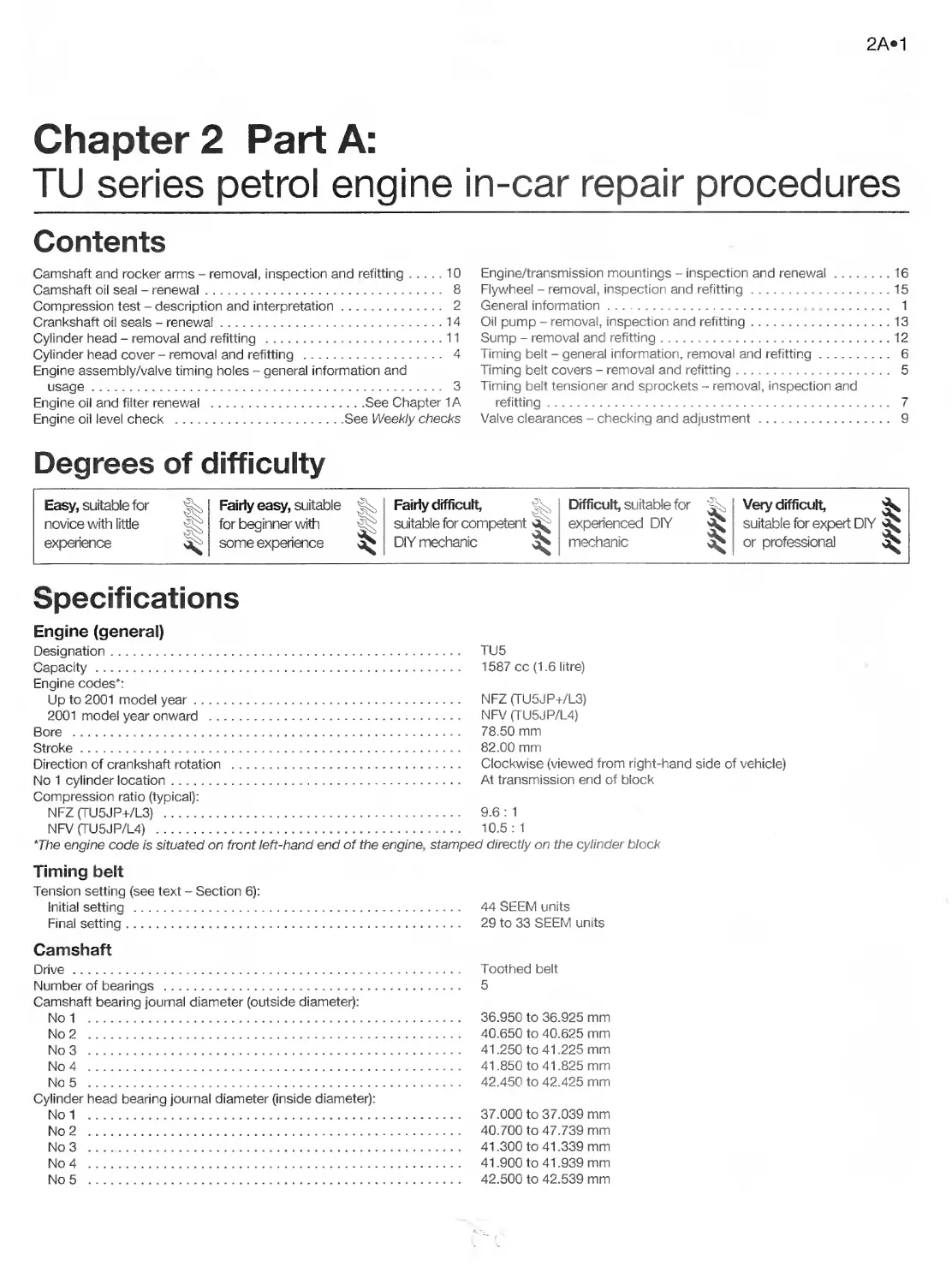
This can be found stamped on a machined
surface on the front face of the cylinder block
at the flywheel end. The first part of the engine
number gives the engine code - eg, NFZ (see
illustration).
Repair operations possible with
the engine in the vehicle
The following work can be carried out with
the engine in the vehicle:
a)	Compression pressure - testing.
b)	Cylinder head cover - removal and
refitting.
c)	Timing belt covers - removal and refitting.
d)	Timing belt - removal, refitting and
adjustment.
e)	Timing belt tensioner and sprockets -
removal and refitting.
f)	Camshaft oil seal(s) - renewal.
g)	Camshaft and rocker arms - removal,
inspection and refitting. *
h)	Cylinder head - removal and refitting.
i)	Cylinder head and pistons -
decarbonising.
j)	Sump - removal and refitting.
k)	Oil pump - removal, overhaul and
refitting.
I)	Crankshaft oil seals - renewal.
m)	Engine/transmission mountings -
inspection and renewal.
n) Flywheel - removal, inspection and
refitting.
*The cylinder head must be removed for the
successful completion of this work. Refer to
Section 10 for details.
2
Compression test -
description and interpretation
1	When engine performance is down, or if
misfiring occurs which cannot be attributed to
the ignition or fuel systems, a compression
1.9 Engine code is stamped on a plate
(arrowed) attached to the front of the
cylinder block - viewed from above
test can provide diagnostic clues as to the
engine’s condition. If the test is performed
regularly, it can give warning of trouble before
any other symptoms become apparent.
2	The engine must be fully warmed-up to
normal operating temperature, the battery
must be fully charged, and all the spark plugs
must be removed (see Chapter 1 A). The aid of
an assistant will also be required.
3	Referring to Chapter 12, disable and
depressurise the fuel system by identifying
and removing the fuel pump fuse from the
engine compartment fusebox. Start the
engine, and run it until it cuts out.
4	Disable the ignition system by
disconnecting the LT wiring connector from
the ignition coil module, referring to Chapter
5B for further information.
5	Fit a compression tester to the No 1
cylinder spark plug hole - the type of tester
which screws into the plug thread is to be
preferred.
6	Have the assistant hold the throttle wide
open, and crank the engine on the starter
motor; after one or two revolutions, the
compression pressure should build up to a
maximum figure, and then stabilise. Record
the highest reading obtained.
7	Repeat the test on the remaining cylinders,
recording the pressure in each.
8	All cylinders should produce very similar
pressures; a difference of more than 2 bars
between any two cylinders indicates a fault.
Note that the compression should build-up
quickly in a healthy engine; low compression
on the first stroke, followed by gradually-
increasing pressure on successive strokes,
indicates worn piston rings. A low
compression reading on the first stroke, which
does not build-up during successive strokes,
indicates leaking valves or a blown head
gasket (a cracked head could also be the
cause). Deposits on the undersides of the
valve heads can also cause low compression.
9	Although Citroen do not specify exact
compression pressures, as a guide, any
cylinder pressure of below 10 bars can be
considered as less than healthy. Refer to a
Citroen dealer or other specialist if in doubt as
to whether a particular pressure reading is
acceptable.
10	If the pressure in any cylinder is low, carry
out the following test to isolate the cause.
Introduce a teaspoonful of clean oil into that
cylinder through its spark plug hole, and
repeat the test.
11	If the addition of oil temporarily improves
the compression pressure, this indicates that
bore or piston wear is responsible for the
pressure loss. No improvement suggests that
leaking or burnt valves, or a blown head
gasket, may be to blame.
12	A low reading from two adjacent cylinders
is almost certainly due to the head gasket
having blown between them; the presence of
coolant in the engine oil will confirm this.
13	If the compression reading is unusually
high, the combustion chambers are probably
coated with carbon deposits. If this is the
case, the cylinder head should be removed
and decarbonised.
14	On completion of the test, refit the spark
plugs and fuel pump fuse, and reconnect the
ignition coil module wiring connector.
3 Engine assembly/
valve timing holes -
general information and usage qS
Note: Do not attempt to rotate the engine
whilst the crankshaft/camshaft are locked in
position. If the engine is to be left in this state
for a long period of time, it is a good idea to
place warning notices inside the vehicle, and
in the engine compartment. This will reduce
the possibility of the engine being accidentally
cranked on the starter motor, which is likely to
cause damage with the locking pins in place.
1	On all engines, timing holes are drilled in
the camshaft sprocket and in the flywheel.
The holes are used to ensure that the
crankshaft and camshaft are correctly
positioned when assembling the engine (to
prevent the possibility of the valves contacting
the pistons when refitting the cylinder head),
or refitting the timing belt. When the timing
holes are aligned with access holes in the
cylinder head and the cylinder block, suitable
diameter pins or bolts can be inserted to lock
both the camshaft and crankshaft in position,
preventing them from rotating. Proceed as
follows.
2	Remove the timing belt upper cover as
described in Section 5.
3	The crankshaft must now be turned until
the timing hole in'the camshaft sprocket is
aligned with the corresponding hole in the
cylinder head. The holes are aligned when the
camshaft sprocket hole is in the 2 o’clock
position, when viewed from the right-hand
end of the engine. The crankshaft can be
turned by using a spanner on the crankshaft
sprocket bolt, noting that it should always be
rotated in a clockwise direction (viewed from
the right-hand end of the engine).
4	With the camshaft sprocket hole correctly
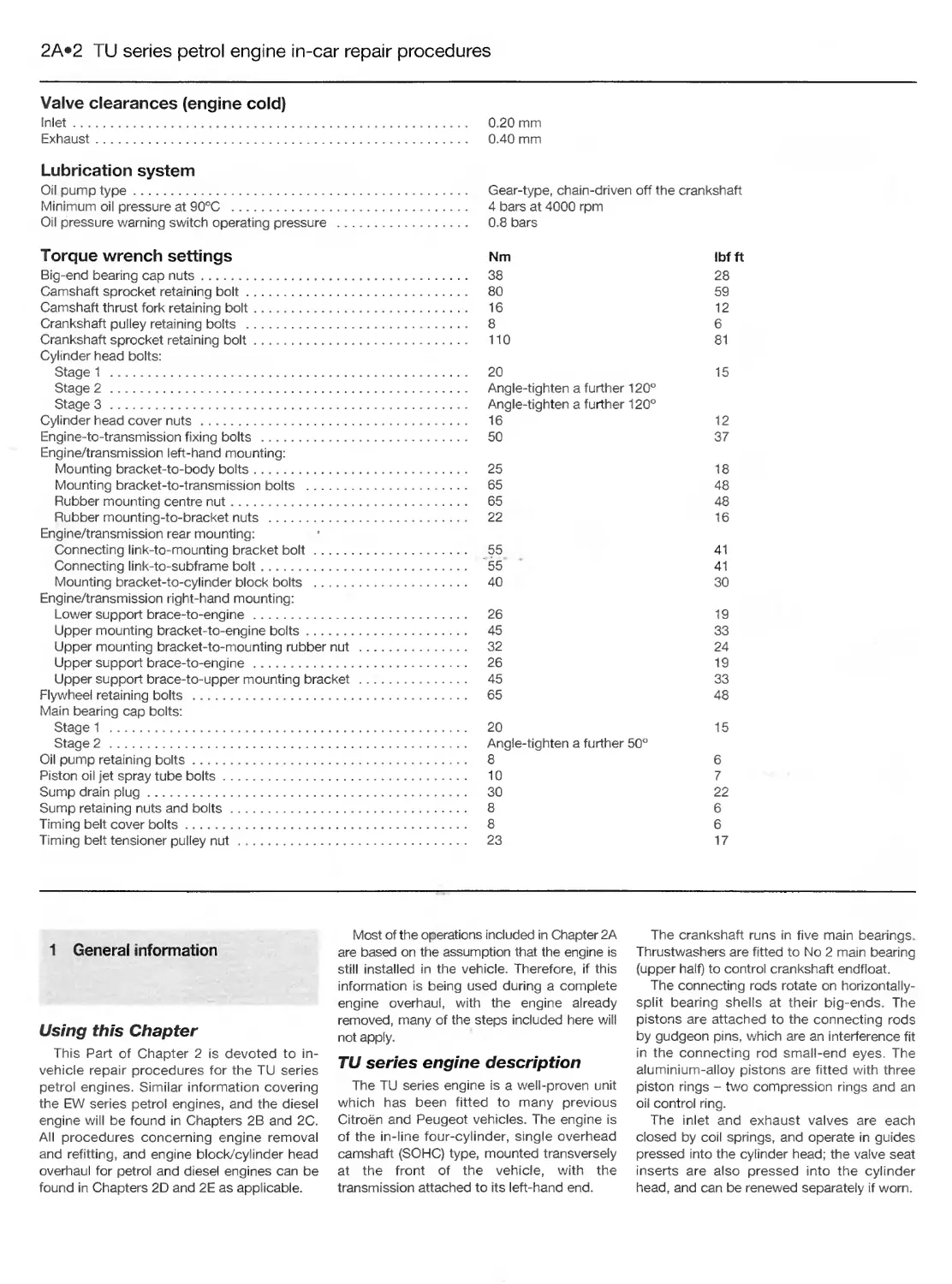
positioned, insert a 6 mm diameter bolt or drill
bit through the hole in the front, left-hand
2A*4 TU series petrol engine in-car repair procedures
3.4 Insert a 6 mm bolt (arrowed) through the hole in cylinder
block flange and into the timing hole in the flywheel...
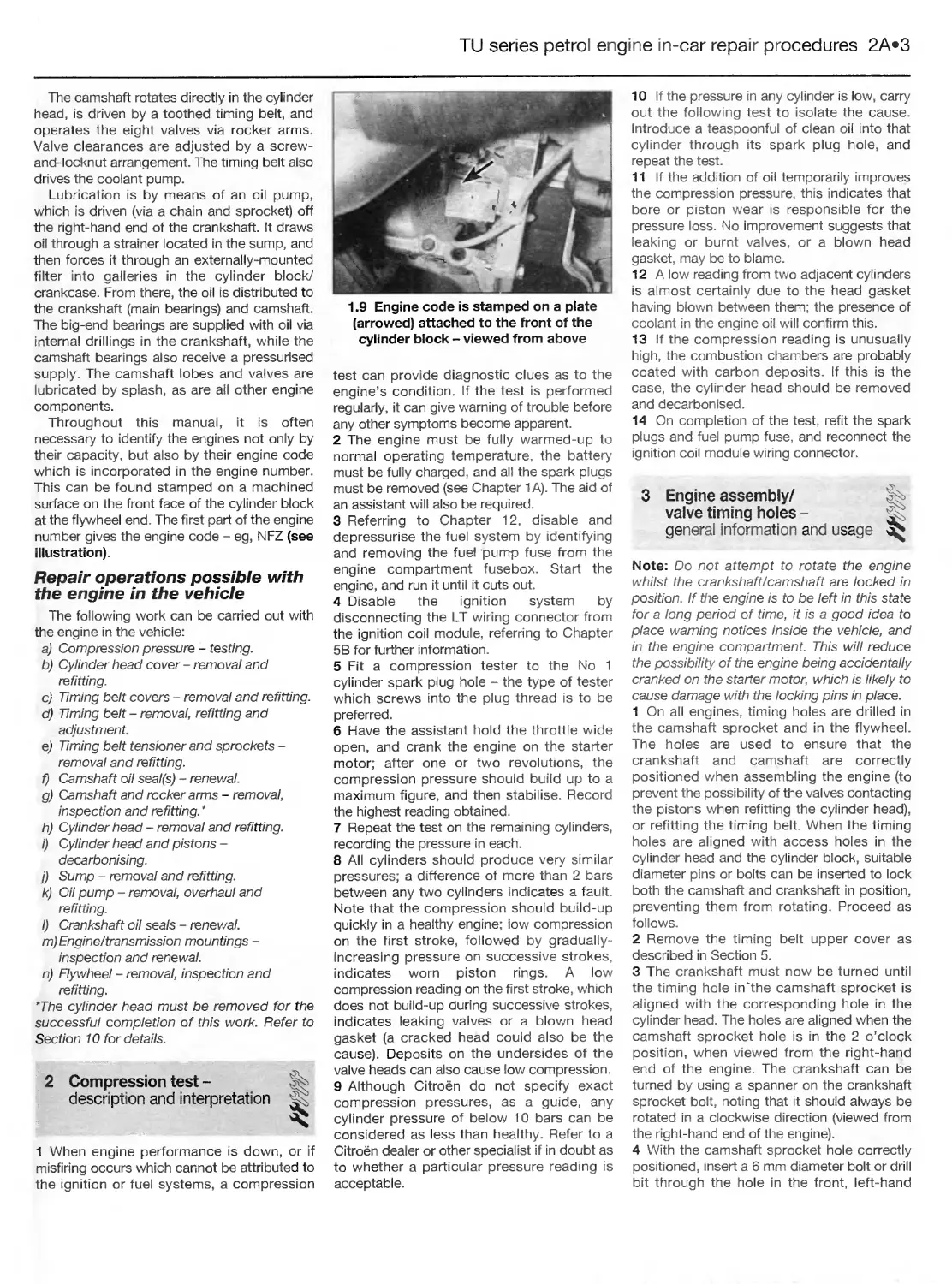
3.5 ... then insert a 10 mm bolt through the camshaft sprocket
timing hole, and locate it in the cylinder head
flange of the cylinder block, and locate it in
the timing hole in the flywheel (see
illustration). Note that it may be necessary to
rotate the crankshaft slightly, to get the holes
to align.
5	With the flywheel correctly positioned,
insert a 10 mm diameter bolt or drill bit
through the timing hole in the camshaft
sprocket, and locate it in the hole in the
cylinder head (see illustration).
6	The crankshaft and camshaft are now
locked in position, preventing unnecessary
rotation.
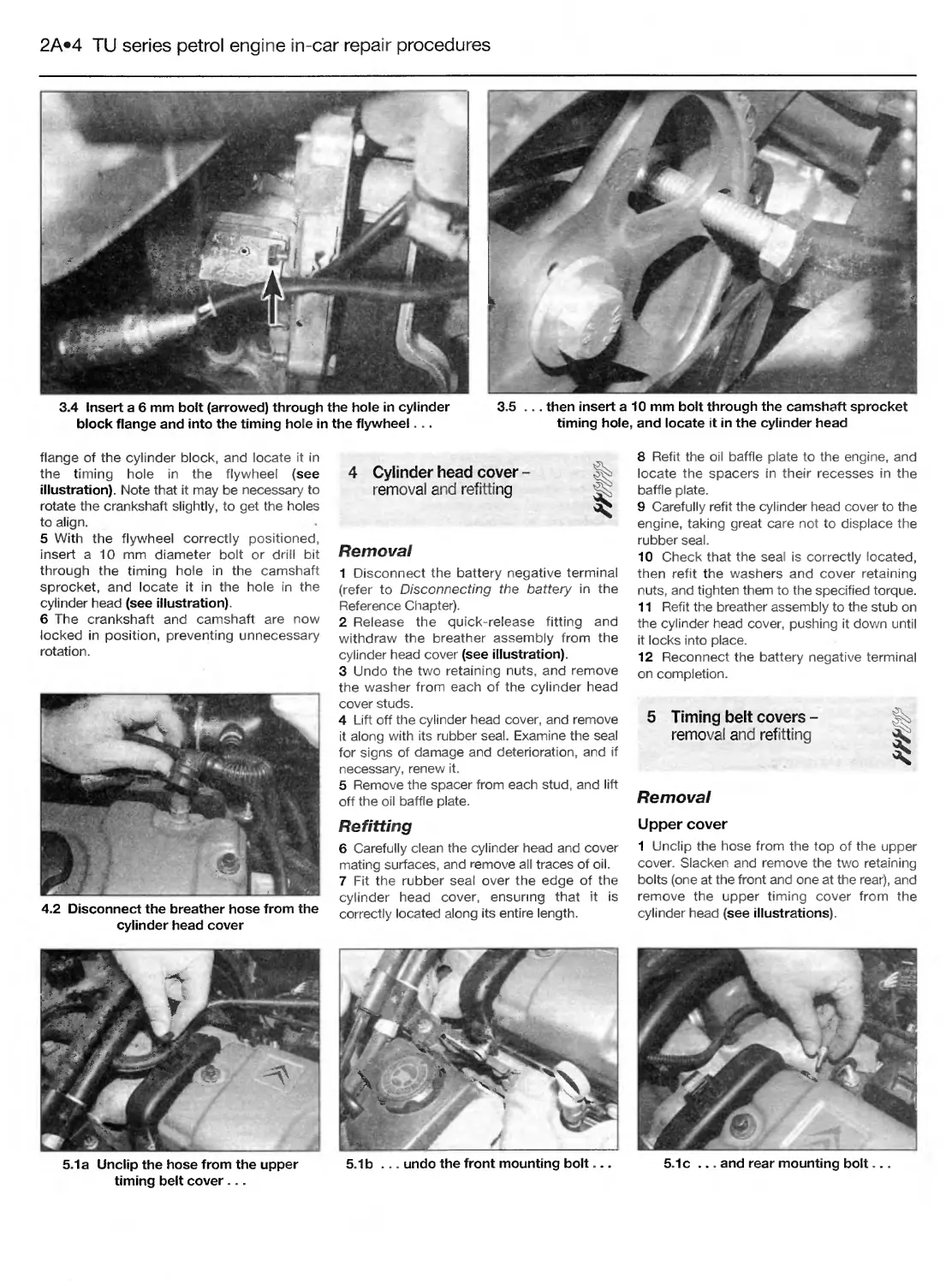
4.2 Disconnect the breather hose from the
cylinder head cover
4 Cylinder head cover -
removal and refitting
Removal
1	Disconnect the battery negative terminal
(refer to Disconnecting the battery in the
Reference Chapter).
2	Release the quick-release fitting and
withdraw the breather assembly from the
cylinder head cover (see illustration).
3	Undo the two retaining nuts, and remove
the washer from each of the cylinder head
cover studs.
4	Lift off the cylinder head cover, and remove
it along with its rubber seal. Examine the seal
for signs of damage and deterioration, and if
necessary, renew it.
5	Remove the spacer from each stud, and lift
off the oil baffle plate.
Refitting
6	Carefully clean the cylinder head and cover
mating surfaces, and remove all traces of oil.
7	Fit the rubber seal over the edge of the
cylinder head cover, ensuring that it is
correctly located along its entire length.
8	Refit the oil baffle plate to the engine, and
locate the spacers in their recesses in the
baffle plate.
9	Carefully refit the cylinder head cover to the
engine, taking great care not to displace the
rubber seal.
10	Check that the seal is correctly located,
then refit the washers and cover retaining
nuts, and tighten them to the specified torque.
11	Refit the breather assembly to the stub on
the cylinder head cover, pushing it down until
it locks into place.
12	Reconnect the battery negative terminal
on completion.
5 Timing belt covers -
removal and refitting
Removal
Upper cover
1 Unclip the hose from the top of the upper
cover. Slacken and remove the two retaining
bolts (one at the front and one at the rear), and
remove the upper timing cover from the
cylinder head (see illustrations).
5.1a Unclip the hose from the upper
timing belt cover...
5.1b ... undo the front mounting bolt_
5.1c ... and rear mounting bolt...
TU series petrol engine in-car repair procedures 2A*5
5.1d ... then lift off the upper cover
Lower cover
2	Remove the auxiliary drivebelt as described
in Chapter 1A.
3	Remove the upper cover as described
previously.
4	Slacken and remove the three retaining
bolts (one at the rear of the cover, beneath the
engine mounting plate, and two directly above
the crankshaft pulley).
5	Undo the three crankshaft pulley retaining
bolts and remove the pulley, noting which way
round it is fitted.
6	Slacken and remove the remaining retaining
bolt(s), and slide the lower cover off the end of
the crankshaft.
Refitting
Upper cover
7	Refit the cover, ensuring it is correctly
located with the lower cover, and tighten its
retaining bolts. Locate the hose in its retaining
clip on the cover.
Lower cover
8	Locate the lower cover over the timing belt
sprocket, and tighten its retaining bolt(s).
9	Fit the pulley to the end of the crankshaft,
ensuring it is fitted the correct way round, and
tighten its bolts to the specified torque.
10	Refit the upper cover as described above,
then refit and tension the auxiliary drivebelt as
described in Chapter 1A.
6 Timing belt -
general information,
removal and refitting
Note: Citroen specify the use of an electronic
belt tension checking tool (SEEM 4122-T), and
valve rocker contact plate (4533-T.Z.) to
correctly set the timing belt tension. The
following procedure assumes that this
equipment (or suitable alternatives) is
available. Accurate tensioning of the timing
belt is essential, and if access to this
equipment cannot be obtained, it is
recommended that the work is entrusted to a
Citroen dealer or suitably-equipped garage.
General information
1	The timing belt drives the camshaft and
coolant pump from a toothed sprocket on the
right-hand end of the crankshaft. If the belt
breaks or slips in service, the pistons are likely
to hit the valve heads, resulting in extensive
(and expensive) damage.
2	The timing belt should be renewed at the
specified intervals (see Chapter 1A), or earlier
if it is contaminated with oil or if it is at all
noisy in operation (a ‘scraping’ noise due to
uneven wear).
3	If the timing belt is being removed, it is a
wise precaution to check the condition of the
coolant pump at the same time (check for
signs of coolant leakage). This may avoid the
need to remove the timing belt again at a later
stage, should the coolant pump fail.
Removal
4	Disconnect the battery negative terminal
(refer to Disconnecting the battery in the
Reference Section of this manual).
5	Align the engine assembly/valve timing
holes as described in Section 3, and lock both
the camshaft sprocket and the flywheel in
position. Do not attempt to rotate the engine
whilst the locking tools are in position.
6	Remove the timing belt upper and lower
covers as described in Section 5.
7	Loosen the timing belt tensioner pulley
retaining nut. Allow the pulley to pivot in a
clockwise direction, to relieve the tension
from the timing belt. Retighten the tensioner
pulley retaining nut to secure it in the
slackened position.
8	If the timing belt is to be re-used, use white
paint or similar to mark the direction of
rotation on the belt (if markings do not already
exist) (see illustration). Slip the belt off the
sprockets.
9	Check the timing belt carefully for any signs
of uneven wear, splitting, or oil contamination.
Pay particular attention to the roots of the
teeth. Renew the belt if there is the slightest
doubt about its condition. If the engine is
undergoing an overhaul, renew the belt as a
matter of course, regardless of its apparent
condition. The cost of a new belt is nothing
when compared to the cost of repairs, should
the belt break in service. If signs of oil
contamination are found; trace the source of
the oil leak, and rectify it. Wash down the
engine timing belt area and all related
components, to remove all traces of oil.
Refitting
10	Prior to refitting, thoroughly clean the
timing belt sprockets. Check that the
tensioner pulley rotates freely, without any
sign of roughness. If necessary, renew the
tensioner pulley as described in Section 7.
Make sure that the locking tools are still in
place, as described in Section 3.
11	Manoeuvre the timing belt into position,
ensuring that the arrows on the belt are
pointing in the direction of rotation (clockwise,
when viewed from the right-hand end of the
engine).
12	Do not twist the timing belt sharply while
6.8 Mark the direction of rotation on the
belt, if it is to be re-used
refitting it. Fit the belt over the crankshaft and
camshaft sprockets. Make sure that the ‘front
run’ of the belt is taut - ie, ensure that any
slack is on the tensioner pulley side of the
belt. Fit the belt over the coolant pump
sprocket and tensioner pulley. Ensure that the
belt teeth are seated centrally in the
sprockets.
13	Slacken the tensioner pulley retaining nut
and insert a short length of 8.0 mm square bar
into the square hole on the front face of the
tensioner pulley (see Tool Tip 1). Using the
square bar and a spanner, pivot the pulley
anti-clockwise to remove all free play from the
timing belt, then retighten the nut.
14	The timing belt must now be accurately
tensioned using electronic belt tension
measuring equipment as follows.
Tensioning
15	Fit the sensor head of the belt tensioning
measuring equipment to the ‘front run’ of the
timing belt, approximately midway between
the camshaft and crankshaft sprockets.
16	Slacken the tensioner pulley retaining nut,
then using the square bar and spanner, pivot
the tensioner pulley anti-clockwise until an
initial setting of 44 SEEM units is displayed on
Tool Tip 1: A square section tool to fit
the timing belt tensioner pulley can be
made from a length of standard 8 mm
doorhandle rod (A), obtained from a DIY
shop, and then cut to size. Once the rod
has been fitted to the tensioner, the
timing belt can be tensioned by turning
the rod with an 8 mm spanner (B).
2A*6 TU series petrol engine in-car repair procedures
6.16 Slacken the tensioner centre nut, then
pivot the tensioner pulley anti-clockwise
using the 8 mm bar and a spanner
A Tensioner centre nut
В 8 mm bar
the tensioning measuring equipment (see
illustration). Hold the tensioner pulley in that
position and retighten the retaining nut.
17	Remove the locking tools from the
camshaft sprocket and flywheel, and remove
the tension measuring equipment from the
belt.
18	Using a suitable socket and extension bar
on the crankshaft sprocket bolt, rotate the
crankshaft through four complete rotations in
a clockwise direction (viewed from the right-
hand end of the engine). Do not at any time
rotate the crankshaft anti-clockwise. Refit the
locking tool to the flywheel and check that the
camshaft sprocket timing hole is aligned.
19	To enable an accurate belt tension final
setting to be achieved, all the load exerted on
the camshaft lobes through the action of the
valve springs and rocker arms must be
removed. To do this, Citroen mechanics use
a valve rocker contact plate (special tool
4533-T.Z.) which is simply a steel plate fitted
over the rocker arms in place of the cylinder
head cover, and secured using the cylinder
head cover retaining nuts. Eight studs and
suitable locknuts are fitted to the plate, with
each stud located directly over the valve
stem end of each rocker arm. The studs are
then screwed down until they just lift the
rocker arms away from the camshaft lobes
Tool Tip 2: A valve rocker contact plate
can be made from steel sheet with
eight studs and locknuts to contact the
rocker arms.
and are then secured in that position with the
locknuts. This has the effect of removing all
the load from the camshaft, allowing it to
move very slightly as the belt tension is
adjusted. If this is not done, the tension
reading shown on the belt tension measuring
equipment will be inaccurate. If the special
tool cannot be obtained, a suitable alternative
can be fabricated (see Tool Tip 2).
20	Remove the cylinder head cover (see
Section 4). Slacken the eight rocker arm
contact bolts in the valve rocker contact plate
and fit the contact plate to the cylinder head,
observing the correct fitted direction. Tighten
each rocker arm contact bolt until the rockers
are just free of the camshaft lobes. Do not
over-tighten the contact bolts otherwise the
valves will contact the pistons.
21	Ensure that the flywheel locking tool is in
place, but the camshaft sprocket locking tool
is removed.
22	Refit the tension measuring equipment to
the belt, slacken the tensioner pulley retaining
nut, and turn the tensioner pulley until a setting
of between 29 and 33 SEEM units is indicated
on the measuring equipment. Hold the
tensioner pulley in this position and tighten the
retaining nut to the specified torque.
23	Remove the measuring equipment from
the belt, the valve rocker contact plate from
the cylinder head, and the locking tool from
the flywheel. Rotate the crankshaft through
another two complete rotations in a clockwise
direction and check that both the camshaft
sprocket and flywheel timing holes are
realigned, and that the locking tools can be
inserted. Do not at any time rotate the
crankshaft anti-clockwise. If the locking tools
cannot be inserted, repeat the refitting and
tensioning procedure. If all is satisfactory,
remove the locking tools.
24	With the belt tension correctly set, refit the
cylinder head cover and timing belt covers,
and reconnect the battery negative terminal.
7 Timing belt tensioner -
and sprockets - removal, S
inspection and refitting
Note 1: This Section describes the removal
and refitting of the components concerned as
individual operations. If more than one of them
is to be removed at the same time, start by
removing the timing belt as described in
Section 6; remove the component as
described below, ignoring the preliminary
dismantling steps.
Note 2: The following operations entail the
slackening and then retensioning of the timing
belt. Refer to Section 6 and ensure that the
necessaiy equipment to accurately tension
the timing belt is available, before proceeding.
Removal
1	Disconnect the battery negative terminal
(refer to Disconnecting the battery in the
Reference Chapter).
2	Position the engine assembly/valve timing
holes as described in Section 3, and lock both
the camshaft sprocket and flywheel in
position. Do not attempt to rotate the engine
whilst the locking tools are in position.
Camshaft sprocket
3	Remove the timing belt upper and lower
covers as described in Section 5.
4	Loosen the timing belt tensioner pulley
retaining nut. Rotate the pulley in a clockwise
direction, using a suitable square-section bar
fitted to the hole in the pulley hub (see Tool
Tip 1 in Section 6). Retighten the retaining nut
to hold the pulley in the slackened position.
5	Disengage the timing belt from the
sprocket, and move the belt clear, taking care
not to bend or twist it sharply. Remove the
locking tool from the camshaft sprocket.
6	Slacken the camshaft sprocket retaining
bolt and remove it, along with its washer. To
prevent the camshaft rotating as the bolt is
slackened, a sprocket-holding tool will be
required. In the absence of the special Citroen
tool, an acceptable substitute can be easily
fabricated (see Tool Tip). Do not attempt to
use the locking tool inserted into the engine
assembly/valve timing hole to prevent the
sprocket from rotating whilst the bolt is
slackened.
7	With the retaining bolt removed, slide the
sprocket off the end of the camshaft. If the
locating peg is a loose fit in the rear of the
sprocket, remove it for safe-keeping. Examine
the camshaft oil seal for signs of oil leakage
and, if necessary, renew it as described in
Section 8.
To make a camshaft sprocket holding
tool, obtain two lengths of steel strip
about 6 mm thick by 30 mm wide or
similar, one 600 mm long, the other
200 mm long (all dimensions approx-
imate). Bolt the two strips together to
form a forked end, leaving the bolt
slack so that the shorter strip can
pivot freely. At the end of each ‘prong’
of the fork, secure a bolt with a nut
and a locknut, to act as the fulcrums;
these will engage with the cut-outs in
the sprocket, and should protrude by
about 30 mm.
TU series petrol engine in-car repair procedures 2 A* 7
7.11 a Remove the crankshaft sprocket
bolt...
7.11b ... then slide off the sprocket
7.10 Lock the flywheel ring gear to prevent
the crankshaft rotating
Crankshaft sprocket
8	Remove the upper and lower timing belt
covers as described in Section 5.
9	Loosen the timing belt tensioner pulley
retaining nut. Rotate the pulley in a clockwise
direction, using a suitable square-section bar
fitted to the hole in the pulley hub (see Tool
Tip 1 in Section 6). Retighten the retaining nut
to hold the pulley in the slackened position.
10	To prevent crankshaft rotation whilst the
sprocket retaining bolt is slackened, select
top gear and have an assistant apply the
brakes firmly. Alternatively, the flywheel ring
gear can be locked using a suitable tool made
from steel angle; remove the cover plate from
the base of the transmission bellhousing and
bolt the tool to the bellhousing flange so it
engages with the ring gear teeth. If the engine
has been removed from the vehicle, lock the
flywheel ring gear, using an arrangement
similar to that shown (see illustration). Do not
be tempted to use the flywheel locking tool
described in Section 3 to prevent the
crankshaft from rotating; temporarily remove
the locking tool from the flywheel prior to
slackening the pulley bolt, then refit it once
the bolt has been slackened.
11	Unscrew the retaining bolt and washer,
then slide the sprocket off the end of the
crankshaft (see illustrations). Refit the
locking tool to the flywheel.
12	If the Woodruff key is a loose fit in the
crankshaft, remove it and store it with the
sprocket for safe-keeping. If necessary, also
slide the flanged spacer off the end of the
crankshaft (see illustration). Examine the
crankshaft oil seal for signs oil leakage and, if
necessary, renew as described in Section 14.
Tensioner pulley
13	Remove the timing belt upper and lower
covers as described in Section 5.
14	Slacken and remove the timing belt
tensioner pulley retaining nut, and slide the
pulley off its mounting stud. Examine the
mounting stud for signs of damage and, if
necessary, renew it.
Inspection
15	Clean the sprockets thoroughly, and
renew any that show signs of wear, damage
or cracks. If any of the sprockets are to be
renewed, the timing belt should also be
renewed as a matter of course.
16	Clean the tensioner assembly, but do not
use any strong solvent which may enter the
pulley bearing. Check that the pulley rotates
freely about its hub, with no sign of stiffness
or of free play. Renew the tensioner pulley if
there is any doubt about its condition, or if
there are any obvious signs of wear or
damage.
Refitting
Camshaft sprocket
17	Refit the locating peg (where removed) to
the rear of the sprocket, then locate the
sprocket on the end of the camshaft. Ensure
that the locating peg is correctly engaged with
the cut-out in the camshaft end.
18	Refit the sprocket retaining bolt and
washer. Tighten the bolt to the specified
torque, whilst retaining the sprocket with the
holding tool.
19	Realign the timing hole in the camshaft
sprocket (see Section 3) with the
corresponding hole in the cylinder head, and
refit the locking tool.
20	Refit the timing belt to the camshaft
sprocket. Ensure that the ‘front run' of the belt
is taut - ie, ensure that any slack is on the
tensioner pulley side of the belt. Do not twist
the belt sharply while refitting it, and ensure
that the belt teeth are seated centrally in the
sprockets. >-»,.v	_
21	Loosen the tensioner pulley retaining nut.
Using the square-section bar and a spanner,
rotate the pulley anti-clockwise to remove all
7.12 Remove the flanged spacer if
necessary
free play from the timing belt, then retighten
the nut.
22	Tension the timing belt as described in
Section 6.
23	Refit the timing belt covers as described
in Section 5.
Crankshaft sprocket
24	Where removed, locate the Woodruff key
in the crankshaft end, then slide on the
flanged spacer, aligning its slot with the
Woodruff key.
25	Align the crankshaft sprocket slot with the
Woodruff key, and slide it onto the end of the
crankshaft.
26	Temporarily remove the locking tool from
the flywheel, then refit the crankshaft sprocket
retaining bolt and washer. Tighten the bolt to
the specified torque, whilst preventing
crankshaft rotation using the method
employed on removal. Refit the locking tool to
the flywheel.
27	Relocate the timing belt on the crankshaft
sprocket. Ensure that the ‘front run’ of the belt
is taut - ie, ensure that any slack is on the
tensioner pulley side of the belt. Do not twist
the belt sharply while refitting it, and ensure
that the belt teeth are seated centrally in the
sprockets.
28	Loosen the tensioner pulley retaining nut.
Using the square-section bar and a spanner,
rotate the pulley anti-clockwise to remove all
free play from the timing belt, then retighten
the nut.
29	Tension the timing belt as described in
Section 6.
30	Refit the timing belt covers as described
in Section 5.
Tensioner pulley
31	Refit the tensioner pulley to its mounting
stud, and fit the retaining nut.
32	Ensure that the ‘front run’ of the belt is
taut - ie, ensure that any slack is on the pulley
side of the belt. Check that the belt is centrally
located on all its sprockets. Rotate the pulley
anti-clockwise to remove all free play from the
timing belt, then tighten the pulley retaining
nut securely.
33	Tension the belt as described in Section 6.
34 Refit the timing belt covers as described
in Section 5.
2A*8 TU series petrol engine in-car repair procedures
8.2 Carefully prise the camshaft oil seal
from its housing with a flat-bladed
screwdriver
8 Camshaft oil seal -
renewal
Note: If the camshaft oil seal is to be renewed
with the timing belt still in place, check first
that the belt is free from oil contamination.
(Renew the belt as a matter of course if signs
of oil contamination are found; see Section 6.)
Cover the belt to protect it from oil
contamination while work is in progress.
Ensure that all traces of oil are removed from
the area before the belt is refitted.
1	Remove the camshaft sprocket as
described in Section 7.
2	Punch or drill two small holes opposite
each other in the oil seal. Screw a self-tapping
screw into each, and pull on the screws with
pliers to extract the seal. Alternatively,
carefully prise the seal from its housing with a
flat-bladed screwdriver (see illustration).
Take great care to avoid scoring the cylinder
head and camshaft sealing surfaces.
3	Clean the seal housing, and polish off any
burrs or raised edges, which may have
caused the seal to fail in the first place.
4	Lubricate the lips of the new seal with clean
engine oil, and drive it into position until it
seats on its locating shoulder. Use a suitable
tubular drift, such as a socket, which bears
only on the hard outer edge of the seal. Take
care not to damage the seal lips during fitting.
Note that the seal lips should face inwards.
5	Refit the camshaft sprocket as described in
Section 7.
10.4 Remove the circlip, and slide the
components off the end of the rocker arm
9 Valve clearances -
checking and adjustment
Note: The valve clearances must be checked
and adjusted only when the engine is cold.
1 The importance of having the valve
clearances correctly adjusted cannot be
overstressed, as they vitally affect the
performance of the engine. If the clearances
are too big, the engine will be noisy
(characteristic rattling or tapping noises) and
engine efficiency will be reduced, as the
valves open too late and close too early. A
more serious problem arises if the clearances
are too small, however. If this is the case, the
valves may not close fully when the engine is
hot, resulting in serious damage to the engine
(eg, burnt valve seats and/or cylinder head
warping/cracking). The clearances are
checked and adjusted as follows.
2	Remove the cylinder head cover as
described in Section 4.
3	The engine can now be turned using a
suitable socket and extension bar fitted to the
crankshaft sprocket/pulley bolt.
HAYNES
hint
Turning the engine will be
easier if the spark plugs are
removed first - see Chap-
ter 1A.
4	It is important that the clearance of each
valve is checked and adjusted only when the
valve is fully closed, with the rocker arm
resting on the heel of the cam (directly
opposite the peak). This can be ensured by
carrying out the adjustments in the following
sequence, noting that No 1 cylinder is at the
transmission end of the engine. The correct
valve clearances are given in the
Specifications at the start of this Chapter. The
valve locations can be determined from the
position of the manifolds.
Valve fully open Adjust valves
No 1 exhaust	No	3 in. and No 4	ex.
No 3 exhaust t	No	4 in. and No 2	ex.
No 4 exhaust	No	2 in. ahcf Nrf1	ex*
No 2 exhaust.	No	1 in. and No 3	ex.
5	Start by turning the crankshaft in the normal
direction of rotation until the exhaust valve for
No 1 cylinder is fully open. The clearances for
No 3 cylinder inlet valve and No 4 cylinder
exhaust valve can now be checked. The
clearances are checked by inserting a feeler
blade of the correct thickness between the
valve stem and the rocker arm adjusting
screw. The feeler blade should be a light,
sliding fit, similar to a knife through butter. If
adjustment is necessary, slacken the
adjusting screw locknut, and turn the screw
as necessary. Once the correct clearance is
obtained, hold the adjusting screw and
securely tighten the locknut. Recheck the
valve clearance, and adjust again if
necessary.
6	Rotate the crankshaft until the next valve in
the sequence is fully open, and check the
clearances of the next two specified valves.
7	Repeat the procedure until all eight valve
clearances have been checked (and if
necessary, adjusted), then refit the cylinder
head cover as described in Section 4.
10 Camshaft and rocker arms -
removal, inspection
and refitting
General information
1 The rocker arm assembly is secured to the
top of the cylinder head by the cylinder head
bolts. Although in theory it is possible to undo
the head bolts and remove the rocker arm
assembly without removing the head, in
practice, this is not recommended. Once the
bolts have been removed, the head gasket will
be disturbed, and the gasket will almost
certainly leak or blow after refitting. For this
reason, removal of the rocker arm assembly
cannot be done without removing the cylinder
head and renewing the head gasket.
2	The camshaft is slid out of the right-hand
end of the cylinder head, and it therefore
cannot be removed without first removing the
cylinder head, due to a lack of clearance.
Removal
Rocker arm assembly
3	Remove the cylinder head as described in
Section 11.
4	To dismantle the rocker arm assembly,
carefully prise off the circlip from the right-
hand end of the rocker shaft; retain the rocker
pedestal, to prevent it being sprung off the
end of the shaft. Slide the various
components off the end of the shaft, keeping
ail components in their correct fitted order
(see illustration). Make a note of each
component’s correct fitted position and
orientation as it is removed, to ensure it is
fitted correctly on reassembly.
5	To separate the left-hand pedestal and
shaft, first unscrew the cylinder head cover
retaining stud from the top of the pedestal;
this can be achieved using a stud extractor, or
two nuts locked together. With the stud
removed, unscrew the grub screw from the
top of the pedestal, and withdraw the rocker
shaft (see illustrations).
Camshaft
6	Remove the cylinder head as described in
Section 11.
7	With the head on a bench, remove the
sprocket locking tool, then remove the
camshaft sprocket as described in Section 7.
8	Unbolt the coolant housing from the left-
hand end of the cylinder head. Undo the
retaining bolt, and remove the camshaft thrust
fork from the cylinder head (see illustration).
9	Using a large flat-bladed screwdriver,
carefully prise the oil seal out of the right-hand
TU series petrol engine in-car repair procedures 2A*9
10.5a To remove the left-hand pedestal,
lock two nuts together and unscrew the
stud...
10.5b ... then remove the grub screw
10.8 Undo the retaining bolt, and remove
the camshaft thrust fork (arrowed)...
end of the cylinder head, then slide out the
camshaft (see illustrations). Discard the seal
- a new one must be used on refitting.
Inspection
Rocker arm assembly
10	Roller rocker arms are used incorporating
a roller bearing at the camshaft lobe contact
point. Check for any sign of excess play of the
roller bearing or any roughness as it is rotated.
Renew worn components as necessary. If a
rocker arm roller bearing contact surface is
badly scored, also examine the corresponding
lobe on the camshaft for wear, as both will
likely be worn.
11	Inspect the ends of the (valve clearance)
adjusting screws for signs of wear or damage,
and renew as required.
12	If the rocker arm assembly has been
dismantled, examine the rocker arm and shaft
bearing surfaces for wear ridges and scoring.
If there are obvious signs of wear, the relevant
rocker arm(s) and/or the shaft must be
renewed.
Camshaft
13	Examine the camshaft bearing surfaces
and cam lobes for signs of wear ridges and
scoring. Renew the camshaft if any of these
conditions are apparent. Examine the
condition of the bearing surfaces, both on the
camshaft journals and in the cylinder head. If
the head bearing surfaces are worn
excessively, the cylinder head will need to be
renewed. If the necessary measuring
equipment is available, camshaft bearing
journal wear can be checked by direct
measurement, noting that No 1 journal is at
the transmission end of the head.
14	Examine the thrust fork for signs of wear
or scoring, and renew as necessary.
Refitting
Rocker arm assembly
15	If the rocker arm assembly was
dismantled, refit the rocker shaft to the left-
hand pedestal, aligning its locating hole with
the pedestal threaded hole. Refit the grub
screw, and tighten it securely. With the grub
screw in position, refit the cylinder head cover
mounting stud to the pedestal, and tighten it
securely. Apply a smear of clean engine oil to
the shaft, then slide on all removed
components, ensuring each is correctly fitted
in its original position. Once all components
are in position on the shaft, compress the
right-hand pedestal and refit the circlip.
Ensure that the circlip is correctly located in
its groove on the shaft.
16	Refit the cylinder head and rocker arm
assembly as described in Section 11.
Camshaft
17	Ensure that the cylinder head and
camshaft bearing surfaces are clean, then
liberally oil the camshaft bearings and lobes.
Slide the camshaft back into position in the
cylinder head.
18	Locate the thrust fork with the left-hand
end of the camshaft. Refit the fork retaining
bolt, tightening it to the specified torque
setting.
19	Ensure that the coolant housing and
cylinder head mating surfaces are clean and
dry, with all traces of old sealant removed.
Using RTV sealant, refit the coolant housing to
the left-hand end of the cylinder head. Tighten
the retaining bolts securely in a progressive
sequence.
20	Lubricate the lips of the new seal with
clean engine oil, then drive it into position until
it seats on its locating shoulder. Use a
suitable tubular drift, such as a socket, which
bears only on the hard outer edge of the seal.
Take care not to damage the seal lips during
fitting. Note that the seal lips, should face
inwards.
21	Refit the camshaft sprocket as described
in Section 7.
10.9a ... prise out the oil seal...
22	Refit the cylinder head as described in
Section 11.
11 Cylinder head-
removal and refitting
Note: The following operations entail the
slackening and then retensioning of the timing
belt. Refer to Section 6 and ensure that the
necessary equipment to accurately tension
the timing belt is available, before proceeding.
Removal
1	Disconnect the battery negative terminal
(refer to Disconnecting the battery in the
Reference Chapter).
2	Drain the cooling system as described in
Chapter 1A.
3	Remove the cylinder head cover as
described in Section 4.
4	Align the engine assembly/valve timing
holes as described in Section 3, and lock both
the camshaft sprocket and flywheel in
position. Do not attempt to rotate the engine
whilst the locking tools are in position.
5	Note that the following text assumes that
the cylinder head will be removed with both
inlet and exhaust manifolds attached; this is
easier, but makes it a bulky and heavy
assembly to handle. If it is wished to remove
the manifolds first, proceed as described in
Chapter 4A.
6	Working as described in Chapter 4A,
disconnect the exhaust system front pipe
from the manifold. Disconnect or release the
10.9b ... and slide out the camshaft
2A*10 TU series petrol engine in-car repair procedures
lambda sensor wiring, so that it is not strained
by the weight of the exhaust.
7	Remove the air cleaner housing and inlet
duct assembly as described in Chapter 4A.
8	Carry out the following operations as
described in Chapter 4A:
a)	Depressurise the fuel system, and
disconnect the fuel feed hose from the
fuel rail (plug all openings, to prevent loss
of fuel and entry of dirt into the fuel
system).
b)	Disconnect the accelerator cable.
c)	Disconnect the relevant electrical
connectors from the throttle housing, fuel
injectors and the idle speed stepper
motor.
d)	Disconnect the vacuum servo unit hose,
coolant hose(s) and all the other
relevant/breather hoses from the
manifold.
9	Remove the lower timing belt cover as
described in Section 5.
10	Loosen the timing belt tensioner pulley
retaining nut. Pivot the pulley in a clockwise
direction, using an 8.0 mm square-section
bar fitted to the hole in the pulley hub (see
Section 6), then retighten the retaining nut. •
11 Disengage the timing belt from the
camshaft sprocket, and position the belt clear
of the sprocket. Ensure that the belt is not
bent or twisted sharply.
12	Slacken the retaining clips, and
disconnect the coolant hoses from the
thermostat housing (on the left-hand end of
the cylinder head).
13	Depress the retaining clip(s), and
disconnect the wiring connector(s) from the
electrical switch and/or sensor(s) which are
screwed into the thermostat housing/cylinder
head (as appropriate).
14	Disconnect the wiring connector from
the ignition coil module. If the cylinder head
is to be dismantled for overhaul, remove the
ignition coil module as described in Chap-
ter 5B.
15	Slacken and remove the bolt securing the
engine oil dipstick tube to the cylinder head.
16	Working in the reverse of the sequence
shown in illustration 11.33, progressively
slacken the ten cylinder head bolts by half a
turn at a time, until all bolts can be unscrewed
by hand.
11.28a Position a new gasket on the
cylinder block surface ...
17	With all the cylinder head bolts removed,
lift the rocker arm assembly off the cylinder
head. Note the locating pins which are fitted
to the base of each rocker arm pedestal. If
any pin is a loose fit in the head or pedestal,
remove it for safe-keeping.
18	Carefully lift the cylinder head off the
engine. Seek assistance if possible, as it is a
heavy assembly, especially if it is being
removed complete with the manifolds.
19	Remove the gasket from the top of the
block, noting the two locating dowels. If the
locating dowels are a loose fit, remove them
and store them with the head for safe-
keeping.
20	If the cylinder head is to be dismantled for
overhaul, remove the camshaft as described
in Section 10, then refer to Part D of this
Chapter.
Preparation for refitting
21	The mating faces of the cylinder head and
cylinder block/crankcase must be perfectly
clean before refitting the head. Citroen
recommend the use of a scouring agent for
this purpose, but acceptable results can be
achieved by using a hard plastic or wood
scraper to remove all traces of gasket and
carbon. The same method can also be used
to clean the piston crowns. Take particular
care to avoid scoring or gouging the cylinder
head/cylinder block mating surfaces during
the cleaning operations, as aluminium alloy is
easily damaged. Also, make sure that the
carbon debris is not allowed to enter the oil
and water passages - this is particularly
important for the lubrication system, as
carbon could block the oil supply to the
engine’s components. Using adhesive tape
and paper, seal the water, oil and bolt holes in
the cylinder block/crankcase.
HAYNES
hint
To prevent carbon debris
entering the gap between
the pistons and bores, smear
a little grease in the gap.
After cleaning each piston, use a small
brush to remove all traces of grease
and carbon from the gap, then wipe
away the remainder with a'clean rag.
11.28b_____ensuring that the
manufacturers identification markings
(HAUT - TOP) face upwards
22	Check the mating surfaces of the cylinder
block and the cylinder head for nicks, deep
scratches and other damage. If slight, they
may be removed carefully with a file, but if
excessive, machining may be the only
alternative to renewal.
23	Thoroughly clean the threads of the
cylinder head bolt holes in the cylinder block.
Ensure that the bolts run freely in their
threads, and that all traces of oil and water are
removed from each bolt hole.
24	If warpage of the cylinder head gasket
surface is suspected, use a straight-edge to
check it for distortion. Refer to Part D of this
Chapter if necessary.
25	When purchasing a new cylinder head
gasket, it is essential that a gasket of the
correct thickness is obtained. At the time of
writing, only one thickness of gasket was
available, but confirm that this is still the case
with your dealer or parts supplier. If you have
any doubts, take the old gasket along to your
dealer or parts supplier, and have him confirm
the type of replacement gasket required.
26	Check the condition of the cylinder head
bolts, and particularly their threads, whenever
they are removed. Wash the bolts in a
suitable solvent, and wipe them dry. Check
each bolt for any sign of visible wear or
damage, renewing them if necessary.
Measure the length of each bolt from the
underside of its head to the end of the bolt.
The bolts may be re-used if their length does
not exceed 175.5 mm. If any one bolt is
longer than the specified length, all of the
bolts should be renewed as a complete set.
Considering the stress which the cylinder
head bolts are under, it is highly
recommended that they are renewed,
regardless of their apparent condition.
Refitting
27	Wipe clean the mating surfaces of the
cylinder head and cylinder block/crankcase.
Check that the two locating dowels are in
position at each end of the cylinder
block/crankcase surface.
28	Position a new gasket on the cylinder
block surface, ensuring that the
manufacturer’s identification markings face
upwards (see illustrations).
29	Check that the flywheel and camshaft
sprocket are still correctly locked in position
with their respective locking tools then, with
the aid of an assistant, carefully refit the
cylinder head assembly to the block, aligning
it with the locating dowels.
30	Ensure that the locating pins are in
position in the base of each rocker pedestal,
then refit the rocker arm assembly to the
cylinder head (see illustration).
31	Apply a smear of grease to the threads,
and to the underside of the heads, of the
cylinder head bolts (see illustration). Citroen
specify Molykote G Rapid Plus grease
(available from your Citroen dealer - a sachet
may supplied with the top-end gasket set).
32	Carefully enter each bolt into its relevant
TU series petrol engine in-car repair procedures 2A*11
hole (do not drop them in) and screw in, by
hand only, until finger-tight.
33	Working progressively and in the
sequence shown, tighten the cylinder head
bolts to their Stage 1 torque setting, using a
torque wrench and suitable socket (see
illustration).
34	Once all the bolts have been tightened to
their Stage 1 setting, working again in the
given sequence, angle-tighten the bolts
through the specified Stage 2 angle, then the
Stage 3 angle, using a socket and extension
bar. It is recommended that an angle-
measuring gauge is used during this stage of
the tightening, to ensure accuracy.
35	With the cylinder head bolts correctly
tightened, refit the dipstick tube retaining bolt
and tighten it securely.
36	Refit the timing belt to the camshaft
sprocket. Ensure that the ‘front run’ of the belt
is taut - ie, ensure that any slack is on the
tensioner pulley side of the belt. Do not twist
the belt sharply while refitting it, and ensure
that the belt teeth are seated centrally in the
sprockets.
37	Loosen the tensioner pulley retaining nut.
Pivot the pulley anti-clockwise to remove all
free play from the timing belt, then retighten
the nut.
38	Tension the belt as described in Section
6, then refit the timing belt covers as
described in Section 5.
39	If removed, refit the ignition coil module,
as described in Chapter 5B, or alternatively
reconnect the wiring connector.
40	Reconnect the wiring connectors) to the
coolant switch/sensor(s) on the left-hand end
of the head.
41	Reconnect the coolant hoses to the
thermostat housing, securely tightening their
retaining clips.
42	Working as described in Chapter 4A, carry
out the following tasks:
a)	Refit all disturbed wiring, hoses and
control cable(s) to the inlet manifold and
fuel system components.
b)	Reconnect and adjust the accelerator
cable.
c)	Reconnect the exhaust system front pipe
to the manifold. If applicable, reconnect
the lambda sensor wiring connector.
11.30 Refit the rocker arm assembly to the
cylinder head
d)	Refit the air cleaner housing and inlet
duct.
43 Check and, if necessary, adjust the valve
clearances as described in Section 9.
44 On completion, reconnect the battery,
and refill the cooling system as described in
Chapter 1A.
12 Sump-
removal and refitting
Removal
1 Disconnect the battery negative terminal
(refer to Disconnecting the battery in the
Reference Chapter). Chock the rear wheels
then jack up the front of the vehicle and
support it on axle stands (see Jacking and
vehicle support).
2 Drain the engine oil, then clean and refit the
engine oil drain plug, tightening it to the
specified torque. If the engine is nearing its
service interval when the oil and filter are due
for renewal, it is recommended that the filter is
also removed, and a new one fitted. After
reassembly, the engine can then be refilled
with fresh oil. Refer to Chapter 1A for further
information.
3	Remove the exhaust system front pipe as
described in Chapter 4A.
4	Progressively slacken and remove all the
sump nuts and bolts. It may be necessary to
unbolt the flywheel cover plate from the
11.31 Apply a smear of the grease supplied
with the gasket set to the threads, and to
the underside of the heads, of the cylinder
head bolts
transmission to gain access to the left-hand
sump fasteners.
5	Try to break the joint by striking the sump
with the palm of your hand, then lower and
withdraw the sump from under the vehicle
(see illustration). If the sump is stuck (which
is quite likely) use a putty knife or similar,
carefully inserted between the sump and
block. Ease the knife along the joint until the
sump is released.
6	While the sump is removed, take the
opportunity to check the oil pump pick-
up/strainer for signs of clogging or splitting. If
necessary, remove the pump as described in
Section 13, and clean or renew the strainer.
Refitting
7	Clean all traces of sealant from the mating
surfaces of the cylinder block and sump, then
use a clean rag to wipe out the sump and the
engine’s interior.
8	Ensure that the sump and cylinder block
mating surfaces are clean and dry, then apply
a coating of suitable sealant to the sump
mating surface.
9	Offer up the sump, locating it on its
retaining studs, and refit its retaining nuts and
bolts. Tighten the nuts and bolts evenly and
progressively to the specified torque.
10	Refit the exhaust front pipe as described
in Chapter 4A.
11	Replenish the engine oil as described in
Chapter 1A.
11.33 Cylinder head bolt tightening sequence
12.5 Slacken and remove the sump nuts
and bolts, then remove the sump from the
engine
2A*12 TU series petrol engine in-car repair procedures
13.2 Oil pump is retained by three bolts
13 Oil pump -
removal, inspection
and refitting
Removal
1 Remove the sump as described in Section 12.
2 Slacken and remove the three bolts
securing the oil pump in position (see
illustration). Disengage the pump sprocket
from the chain, and remove the oil pump. If
the pump locating dowel is a loose fit, remove
and store it with the bolts for safe-keeping.
Inspection
3 Examine the oil pump sprocket for signs of
damage and wear, such as chipped or
missing teeth. If the sprocket is worn, the
pump assembly must be renewed, as the
sprocket is not available separately. It is also
recommended that the chain and drive
sprocket, fitted to the crankshaft, are renewed
at the same time. The drive sprocket and
chain can be removed with the engine in situ,
once the crankshaft sprocket has been
removed and the crankshaft oil seal housing
has been unbolted.
4	Slacken and remove the bolts securing the
strainer cover to the pump body, then lift off
the strainer cover. Remove the relief valve
piston, spring and guide pin, noting which
way round they are fitted.
5	Examine the pump rotors and body for
signs of wear ridges and scoring. If worn, the
complete pump assembly must be renewed.
6	Examine the relief valve piston for signs of
14.2 Using a screwdriver to lever out the
crankshaft right-hand oil seal
wear or damage, and renew if necessary. The
condition of the relief valve spring can only be
measured by comparing it with a new one; if
there is any doubt about its condition, it
should also be renewed. Both the piston an'd
spring are available individually.
7	Thoroughly clean the oil pump strainer with
a suitable solvent, and check it for signs of
clogging or splitting. If the strainer is
damaged, the strainer and cover assembly
must be renewed.
8	Locate the relief valve spring, piston and
guide pin in the strainer cover, then refit the
cover to the pump body. Align the relief valve
piston with its bore in the pump. Refit the
cover retaining bolts, tightening them securely.
Refitting
9	Ensure that the locating dowel is in
position, then engage the pump sprocket with
its drive chain. Locate the pump on its dowel,
and refit the pump retaining bolts, tightening
them to the specified torque setting.
10	Refit the sump as described in Section 12.
14 Crankshaft oil seals -
renewal
Right-hand oil seal
1 Remove the crankshaft sprocket and
flanged spacer as described in Section 7.
Secure the timing belt clear of the working
area, so that it cannot be contaminated with
oil. Make a note of the correct fitted depth of
the seal in its housing.
2 Punch or drill two small holes opposite
each other in the seal. Screw a self-tapping
screw into each, and pull on the screws with
pliers to extract the seal. Alternatively, the seal
can be levered out of position using a suitable
flat-bladed screwdriver, taking great care not
to damage the crankshaft shoulder or seal
housing (see illustration).
3	Clean the seal housing, and polish off any
burrs or raised edges, which may have
caused the seal to fail in the first place.
4	Lubricate the lips of the new seal with clean
engine oil, and carefully locate the seal on the
end of crankshaft. Note that its sealing lip
must face inwards. Take care not to damage
the seal lips during fitting.
5	Using a suitable tubular drift (such as a
socket) which bears only on the hard outer
edge of the seal, tap the seal into position, to
the same depth in the housing as the original
was prior to removal. The inner face of the
seal must be flush with the inner wall of the
crankcase.
6	Wash off any traces of oil, then refit the
crankshaft sprocket as described in Section 7.
Left-hand oil seal
7	Remove the flywheel as described in
Section 15.
8	Make a note of the correct fitted depth of
the seal in its housing. Punch or drill two small
holes opposite each other in the seal. Screw a
self-tapping screw into each, and pull on the
screws with pliers to extract the seal.
9	Clean the seal housing, and polish off any
burrs or raised edges, which may have
caused the seal to fail in the first place.
10	Lubricate the lips of the new seal with
clean engine oil, and carefully locate the seal
on the end of the crankshaft.
11	Using a suitable tubular drift, which bears
only on the hard outer edge of the seal, drive
the seal into position, to the same depth in the
housing as the original was prior to removal.
12	Wash off any traces of oil, then refit the
flywheel as described in Section 15.
15 Flywheel-
removal, inspection
and refitting
Removal
1 Remove the transmission as described in
Chapter 7, then remove the clutch assembly
as described in Chapter 6.
2 Prevent the flywheel from turning by locking
the ring gear teeth with a similar arrangement
to that shown in illustration 7.10. Alternatively,
bolt a strap between the flywheel and the
cylinder block. Do not attempt to lock the
flywheel in position using the locking tool
described in Section 3.
3 Slacken and remove the flywheel retaining
bolts, and remove the flywheel from the end
of the crankshaft. Be careful not to drop it; it is
heavy. If the flywheel locating dowel is a loose
fit in the crankshaft end, remove it and store it
with the flywheel for safe-keeping. Discard the
flywheel bolts; new ones must be used on
refitting.
Inspection
4 Examine the flywheel for scoring of the
clutch face, and for wear or chipping of the
ring gear teeth. If the clutch face is scored, the
flywheel may be surface-ground, but renewal
is preferable. Seek the advice of a Citroen
dealer or engine reconditioning specialist to
see if machining is possible. If the ring gear is
worn or damaged, the flywheel must be
renewed, as it is not possible to renew the
ring gear separately.
Refitting
5	Clean the mating surfaces of the flywheel
and crankshaft. Remove any remaining
locking compound from the threads of the
crankshaft holes, using the correct size of tap,
if available.
HAYNES
hint
If a suitable tap is not
available, cut two slots along
the threads of one of the old
flywheel bolts, and use the
bolt to remove the locking compound
from the threads.
TU series petrol engine in-car repair procedures 2A*13
6	If the new flywheel retaining bolts are not
supplied with their threads already pre-
coated, apply a suitable thread-locking
compound to the threads of each bolt.
7	Ensure that the locating dowel is in
position. Offer up the flywheel, locating it on
the dowel, and fit the new retaining bolts.
8	Lock the flywheel using the method
employed on dismantling, and tighten the
retaining bolts to the specified torque.
9	Refit the clutch as described in Chapter 6.
Remove the flywheel locking tool, and refit the
transmission as described in Chapter 7.
16 Engine/transmission
mountings -
inspection and renewal
Inspection
1	If improved access is required, firmly apply
the handbrake, then jack up the front of the
vehicle and support it securely on axle stands
(see Jacking and vehicle support).
2	Check the mounting rubber to see if it is
cracked, hardened or separated from the
metal at any point; renew the mounting if any
such damage or deterioration is evident.
3	Check that all the mountings’ fasteners are
securely tightened; use a torque wrench to
check if possible (see illustration).
4	Using a large screwdriver or a crowbar,
check for wear in the mounting by carefully
levering against it to check for free play. Where
this is not possible, enlist the aid of an
assistant to move the engine/transmission
back-and-forth, or from side-to-side, while you
watch the mounting. While some free play is to
be expected even from new components,
16.3 Engine/transmission mounting components and attachment details
1	Upper mounting bracket-to-engine	bolts	4
2	Rear mounting connecting link-to-	5
subframe bracket bolt	6
3	Rear mounting connecting link-to-cylinder	7
block bracket bolt
Right-hand rubber mounting centre nut
Left-hand rubber mounting centre nut
Left-hand rubber mounting-to-bracket nuts
Left-hand mounting bracket-to-
transmission bolts
8	Right-hand mounting support brace-to
engine bolts/nuts
9	Right-hand rubber mounting
10	Right-hand mounting support brace-to
upper mounting bracket bolt
2A«14 TU series petrol engine in-car repair procedures
excessive wear should be obvious. If
excessive free play is found, check first that
the fasteners are secure, then renew any worn
components as described below.
Renewal
Right-hand mounting
5	Disconnect the battery negative terminal
(refer to Disconnecting the battery in the
Reference Chapter).
6	Place a jack beneath the engine, with a
block of wood on the jack head. Raise the
jack until it is supporting the weight of the
engine.
7	Slacken and remove the three nuts
securing the right-hand engine mounting
upper bracket to the bracket on the cylinder
block. Unscrew the single nut securing the
bracket to the rubber mounting, and lift off the
bracket.
8	Unscrew the rubber mounting from the
body. A strap wrench or similar may be used
to unscrew the mounting, or alternatively
fabricate a tool from suitable metal tube with
projections to engage in the cut-outs in the
mounting.
9	Check for signs of wear or damage on all
components, and renew as necessary.
10	On reassembly, securely tighten the
rubber mounting in the body, then install the
mounting bracket.
11	Tighten the mounting bracket retaining
nuts to the specified torque wrench setting.
12	Remove the jack from under the engine,
and reconnect the battery negative terminal.
Left-hand mounting
13	Disconnect the battery negative terminal
(refer to Disconnecting the battery in the
Reference Chapter).
14	Remove the air cleaner assembly and
intake ducting as described in Chapter 4A.
15	Lift up the covers on the battery positive
cable terminal box and unscrew the nuts
securing the battery cables to the terminal
studs. Lift the cables off the studs and
suitably label them for correct refitting.
16	Withdraw the engine management ECU
from its location on the support tray and move
it to one side.
17	Release the wiring harness from the
retaining clips on the ECU support tray, then
undo the retaining bolts and lift out the
support tray.
18	Place a jack beneath the transmission,
with a block of wood on the jack head. Raise
the jack until it is supporting the weight of the
transmission.
19	Slacken and remove the centre nut and
washer from the left-hand mounting, then
undo the nuts securing the mounting to the
mounting bracket. Lift off the mounting and
remove it from the engine compartment.
20	If necessary, slide the spacer (where
fitted) off the mounting stud, then unscrew the
stud from the top of the transmission housing,
and remove it along with its washer. If the
mounting stud is tight, a universal stud
extractor can be used to unscrew it.
21	Check all components carefully for signs
of wear or damage, and renew as necessary.
22	Clean the threads of the mounting stud,
and apply a coat of thread-locking compound
to its threads. Refit the stud and washer to the
top of the transmission, and tighten it to the
specified torque setting.
23	Slide the spacer (where fitted) onto the
mounting stud, then refit the rubber mounting.
Tighten both the mounting-to-bracket nuts
and the mounting centre nut to their specified
torque settings, and remove the jack from
underneath the transmission.
24	Refit the ECU support tray, and clip the
wiring harness back into position.
25	Refit the ECU to the support tray and
reconnect the battery positive cables to their
respective terminal studs.
26	Refit the air cleaner assembly and intake
ducting as described in Chapter 4A, then
reconnect the battery negative terminal.
Rear mounting
27	If not already done, firmly apply the
handbrake, then jack up the front of the
vehicle and support it securely on axle stands
(see Jacking and vehicle support).
28	Unscrew and remove the bolt securing
the rear mounting connecting link to the
mounting on the rear of the cylinder block.
29	Remove the bolt securing the connecting
link to the bracket on the subframe. Withdraw
the link.
30	To remove the mounting assembly it will
first be necessary to remove the right-hand
driveshaft as described in Chapter 8.
31	With the driveshaft removed, undo the
retaining bolts and remove the mounting from
the rear of the cylinder block.
32	Check carefully for signs of wear or
damage on all components, and renew them
where necessary.
33	On reassembly, fit the rear mounting
assembly to the rear of the cylinder block, and
tighten its retaining bolts to the specified
torque. Refit the driveshaft as described in
Chapter 8.
34	Refit the rear mounting connecting link,
and tighten both its bolts to their specified
torque settings.
35	Lower the vehicle to the ground.
2В*1
Chapter 2 Part В:
EW series petrol engine in-car repair procedures
Contents
Camshaft oil seal(s) - renewal..................................... 9
Camshafts and tappets - removal, inspection and refitting .........10
Compression test - description and interpretation.................. 2
Crankshaft oil seals - renewal.....................................13
Crankshaft pulley - removal and refitting ......................... 5
Cylinder head - removal and refitting .............................11
Cylinder head covers - removal and refitting ...................... 4
Engine assembly/valve timing holes - general information and
usage............................................................ 3
Engine oil and filter renewal .........................See	Chapter 1A
Engine oil level check ........................See	Weekly checks
Engine/transmission mountings - inspection and renewal...............15
Flywheel - removal, inspection and refitting.........................14
General information.................................................. 1
Sump - removal and refitting.........................................12
Timing belt - general information, removal and refitting............. 7
Timing belt covers - removal and refitting........................... 6
Timing belt tensioner and sprockets - removal, inspection and
refitting........................................................... 8
Degrees of difficulty
Easy, suitable for novice with little experience	Fairly easy, suitable for beginner with some experience	Fairly difficult, suitable for competent DIY mechanic	Difficult, suitable for experienced DIY mechanic	Very difficult, suitable for expert DIY or professional
Specifications
Engine (general)
Designation.....................................................
Capacity.........................................................
Engine code*....................................................
Bore ...........................................................
EW7
1749 cc (1.8 litre)
6FZ (EW7J4)
82.7 mm
Stroke
81.4 mm
Direction of crankshaft rotation ................................
No 1 cylinder location...........................................
Compression ratio ...............................................
Clockwise (viewed from the right-hand side of vehicle)
At the transmission end of block
10.8 : 1
*The engine code is stamped onto the right-hand front face of the cylinder block, adjacent to the engine mounting bracket
Camshafts
Drive
Toothed belt
No of bearings ..................................................
Camshaft bearing journal diameter (nominal):
No 1 (transmission end) .......................................
No 2 ..........................................................
No 3 ..........................................................
No 4 ..........................................................
No 5 ..........................................................
Cylinder head bearing journal diameter (nominal):
No 1 (transmission end) .......................................
No 2 ..........................................................
No 3 ..........................................................
No 4 ..........................................................
No 5 ..........................................................
5
28.0 - 0.020; - 0.041 mm
28.5 - 0.020; - 0.041 mm
29.0 - 0.020; - 0.041 mm
29.5 - 0.020; - 0.041 mm
30.0 - 0.020; - 0.041 mm
28.0 - 0; + 0.033 mm
28.5 - 0; + 0.033 mm
29.0 - 0; + 0.033 mm
29.5 - 0; + 0.033 mm
30.0 - 0; + 0.033 mm
Lubrication system
Oil pump type..............
Minimum oil pressure at 90°C ...
Rotor-type, driven directly off the crankshaft
6.3 bars at 4000 rpm
2B*2 EW series petrol engine in-car repair procedures
Torque wrench settings	Nm
Ancillary components mounting bracket .......................... 19
Auxiliary drivebelt tensioner pulley bolt ...................... 20
Auxiliary drivebelt idler pulley................................ 37
Big-end bearing cap bolts*:
Stage 1 ........................................................ 10
Stage 2....................................................... Slacken	by 180°
Stage 3....................................................... 23
Stage 4 ...................................................... Angle-tighten a further 46°
Camshaft bearing cap housing bolts:
Stage 1 ........................................................ 5
Stage 2 ...................................................... 10
Camshaft sprocket retaining bolt:
Stage 1 ........................................................ 30
Stage 2 ...................................................... 75
Crankshaft bearing cap housing:
Stage 1:
Ibfft
14
15
27
7
17
4
7
22
55
M11 bolts ...................................................... 10
M6 bolts ...................................................... 2
Stage 2:
M11 bolts ......................................................... Fully	slacken
Stage 3:
M11 bolts ....................................................... 20
Stage 4:
M11 bolts .......................................................... Angle-tighten	a further 70°
Stage 5:
M6 bolts ........................................................ 10
7
1
15
Crankshaft pulley-to-sprocket retaining bolts:
Stage 1 ........................................................
Stage 2.........................................................
Crankshaft sprocket centre bolt:
Stage 1 ........................................................
Stage 2 ........................................................
Cylinder head bolts:
Stage 1 ........................................................
Stage 2 ........................................................
Stage 3.........................................................
Stage 4.........................................................
Stage 5 ........................................................
Cylinder head cover bolts:
Stage 1 ........................................................
Stage 2 ........................................................
Engine-to-transmission fixing bolts ..............................
Engine/transmission left-hand mounting:
Mounting bracket-to-body bolts..................................
Mounting bracket-to-transmission bolts .........................
Rubber mounting centre nut......................................
Rubber mounting-to-bracket nuts ................................
Engine/transmission rear mounting:
Connecting link-to-mounting bracket bolt........................
Connecting link-to-subframe bolt................................
Mounting bracket-to-cylinder block bolts .......................
Engine/transmission right-hand mounting:
Rubber mounting centre nut......................................
Rubber mounting-to-body ........................................
Upper mounting bracket-to-lower (engine) bracket nuts...........
Flywheel retaining bolts*:
Stage 1 ........................................................
Stage 2.........................................................
Stage3..........................................................
Stage 4.........................................................
Stage 5.........................................................
Oil pump retaining bolts..........................................
Sump retaining bolts..............................................
Timing belt idler pulley bolt.....................................
Timing belt tensioner pulley bolt.................................
*New nuts/bolts must be used.
15
20
40
Angle-tighten a further 53°
15
50
Slacken by 360° then tighten to:
20
Angle-tighten a further 285°
5
11
50
22
60
65
22
55
55
45
45
22
61
25
Fully slacken then tighten to:
8
20
Angle-tighten a further 21°
8
8
37
20
7
11
15
30
11
37
15
4
8
37
16
44
48
16
41
41
33
33
16
45
18
6
15
6
6
27
15
EW series petrol engine in-car repair procedures 2B*3
1 General information
Using this Chapter
This Part of Chapter 2 is devoted to in-car
repair procedures for the EW series petrol
engine. Similar information covering the TU
series petrol engine, and the diesel engine will
be found in Chapters 2A and 2C. All
procedures concerning engine removal and
refitting, and engine block/cylinder head
overhaul for petrol and diesel engines can be
found in Chapters 2D and 2E as applicable.
Most of the operations included in Chapter 2B
are based on the assumption that the engine is
still installed in the car. Therefore, if this
information is being used during a complete
engine overhaul, with the engine already
removed, many of the steps included here will
not apply.
EW series engine description
The EW series engine is of the DOHC 16-
valve, in-line four-cylinder type, mounted
transversely at the front of the car with the
clutch and transmission attached to its left-
hand end.
The aluminium alloy cylinder block/crank-
case is of modular construction consisting of
three sections - the cylinder block itself, the
crankshaft bearing cap housing and the
sump. The cylinder block incorporates four
cast iron dry cylinder liners which are cast into
the block and cannot be renewed.
The crankshaft is supported in five shell-
type main bearings with thrustwashers fitted
to No 2 main bearing, to control crankshaft
endfloat.
The connecting rods are attached to the
crankshaft by horizontally-split shell-type big-
end bearings, and to the pistons by gudgeon
pins which are an interference fit in the
connecting rod small-end eyes. The
aluminium alloy pistons are of the slipper type,
and are fitted with three piston rings - two
compression rings and a scraper-type oil
control ring.
The cylinder head is of the crossflow type,
the inlet ports being at the front of the engine
and the exhaust ports at the rear. The
camshafts run in plain bearings integral with
the cylinder head and with the two camshaft
bearing cap housings. The inlet and exhaust
valves are each closed by single coil springs,
and operate in guides pressed into the
cylinder head. Valve actuation is by self-
adjusting hydraulic tappets acted upon
directly by the camshaft lobes.
Drive to the camshafts is by a toothed
timing belt and sprockets and incorporating
an automatic tensioning mechanism. The
timing belt also drives the coolant pump. All
accessories are driven from the crankshaft
pulley by a- single multi-ribbed auxiliary
drivebelt.
The lubrication system is of the full-flow,
pressure-feed type. Oil is drawn from the
sump by a rotor type pump, driven directly
from the front of the crankshaft. The pump
draws oil through a strainer located in the
sump and then forces it through an externally-
mounted filter into galleries in the cylinder
block. From there, the oil is distributed to the
crankshaft (main bearings) and camshafts.
The big-end bearings are supplied with oil via
internal drillings in the crankshaft; the
camshaft bearings also receive a pressurised
supply. The camshaft lobes and valves are
lubricated by splash, as are all other engine
components.
Throughout this manual, it is often
necessary to identify the engines not only by
their capacity, but also by their engine code
which is incorporated in the engine number.
This can be found stamped onto the right-
hand front face of the cylinder block, adjacent
to the engine mounting bracket. The first part
of the engine number gives the engine code -
eg, 6FZ.
Repair operations possible with
the engine in the vehicle
The following work can be carried out with
the engine in the vehicle:
a)	Compression pressure - testing.
b)	Cylinder head covers - removal and
refitting.
c)	Crankshaft pulley - removal and refitting,
d) Timing belt covers - removal and refitting,
e) Timing belt - removal, refitting and
adjustment.
f)	Timing belt tensioner and sprockets -
removal and refitting.
g)	Camshaft oil seals - renewal.
h)	Camshafts and tappets - removal,
inspection and refitting.
i)	Cylinder head - removal and refitting.
j)	Cylinder head and pistons -
decarbonising.
k)	Sump - removal and refitting.
I)	Crankshaft oil seals - renewal.
m)	Engine/transmission mountings -
inspection and renewal.
n) Flywheel - removal, inspection and
refitting.
2 Compression test -
description and interpretation
Refer to Chapter 2A, Section 2.
3 Engine assembly/
valve timing holes -
general information and usage
Note 1: The following procedure entails the
use of Citroen special tool (-).0189.B
(camshaft setting rods). If the Citroen tool is
not available, details for fabricating suitable
alternatives are given in the text.
Note 2: Do not attempt to rotate the engine
whilst the crankshaft/camshafts are locked in
position. If the engine is to be left in this state
for a long period of time, it is a good idea to
place suitable warning notices inside the
vehicle, and in the engine compartment. This
will reduce the possibility of the engine being
accidentally cranked on the starter motor,
which is likely to cause damage with the
locking pins in place.
1	Timing holes are drilled in the crankshaft
sprocket end plate and in the two camshaft
sprockets. The holes are used to ensure that
the crankshaft and camshafts are correctly
positioned when assembling the engine (to
prevent the possibility of the valves contacting
the pistons when refitting the cylinder head),
or refitting the timing belt. When the timing
holes are aligned with corresponding holes in
the cylinder head and oil pump housing,
suitable diameter pins or bolts can be inserted
to lock both the camshafts and crankshaft in
position, preventing them from rotating. To
set the engine in the timing position, proceed
as follows.
2	Remove the crankshaft pulley as described
in Section 5.
3	Remove the timing belt upper (outer) and
lower covers as described in Section 6.
4	Using a socket and extension bar fitted to
the crankshaft sprocket centre bolt, turn the
crankshaft in the normal direction of rotation
until the timing holes in both camshaft
sprockets are aligned with their
corresponding holes in the cylinder head. The
holes are aligned when the inlet camshaft
sprocket hole is in approximately the 5
o’clock position and the exhaust camshaft
sprocket hole is in approximately the 7
o’clock position, when viewed from the right-
hand end of the engine. Use a small mirror to
accurately observe the position of the holes.
5	With the camshaft sprocket holes correctly
positioned, insert an 8.0 mm diameter drill bit
or bolt through the timing hole in the
crankshaft sprocket end plate, and locate it in
the corresponding hole in the oil pump
housing (see illustration).
6	The camshaft sprockets can now be locked
3.5 8.0 mm diameter drill bit inserted
through the crankshaft sprocket end plate
timing hole, and engaged in the
corresponding hole in the oil pump
housing
2B*4 EW series petrol engine in-car repair procedures
40.0 mm
<--------------►
26.0 mm
<———►
H34028
10.0 mm
diameter
\ 6.0 mm
diameter
Camshaft sprocket locking tools can be
made from 10.0 mm diameter steel bar,
fabricated to the dimensions shown.
in position using the Citroen camshaft setting
rods, or suitable home-made alternatives (see
Tool Tip). With the crankshaft locked in
position, insert the СКгоёп special tools, or
alternatives, through the timing hole in each'
camshaft sprocket and locate it in the
corresponding hole in the cylinder head (see
illustration).
7	The crankshaft and camshafts are now
locked in position, preventing rotation. In this
position the crankshaft is at 90° BTDC and all
the pistons are positioned half way down their
cylinder bores.
3.6 Camshaft sprocket locking tools
inserted through the timing hole in each
sprocket
4 Cylinder head covers -
removal and refitting
Removal
1	Disconnect the battery negative terminal
(refer to Disconnecting the battery in the
Reference Chapter).
2	Undo the six screws and lift off the engine
cover.	....
3	Disconnect the crankcase breather hose at
the quick-fit connector on the rear cylinder
head cover (see illustration).
4	Disconnect the wiring connector at the
camshaft position sensor, then undo the bolt
and remove the sensor from the rear cylinder
head cover (see illustrations).
5	Working in the reverse sequence to that
shown in illustration 4.10, progressively
slacken, then remove the eleven retaining
bolts from each cylinder head cover.
6	Lift off each cover in turn and remove it
(see illustrations). The cover seal should
remain attached as the cover is removed - do
not try to remove it, unless it is obviously
damaged.
Refitting
7	Clean the cylinder head and cylinder head
cover mating surfaces, and remove all traces
of oil.
8	Check the condition of the rubber seal
attached to each cover. The seal is designed
to be re-usable, and so should not
automatically be renewed unless its condition
is suspect. If renewal is necessary, locate the
seal in the cover groove, ensuring that it is
fully seated along its entire length (see
illustration).
9	Carefully refit the cylinder head cover(s) to
the engine.
10	Refit the cover retaining bolts and,
working in the sequence shown, tighten them
to the specified torque in the two Stages
given in the Specifications (see illustration).
11	Check the condition of the О-ring seal on
the camshaft position sensor and renew the
seal if it is in any way suspect.
12	Refit the camshaft position sensor and
secure with the retaining bolt. Reconnect the
sensor wiring connector.
4.3 Disconnect the crankcase breather
hose from the rear cylinder head cover
4.4a Disconnect the camshaft position
sensor wiring connector...
4.4b ... then undo the bolt and remove the
sensor from the rear cylinder head cover
4.6a Undo the retaining bolts and lift off
the front...
4.6b ... and rear cylinder head covers
4.8 Locate the cylinder head cover seal in
the groove, ensuring that it is fully seated
along its entire length
EW series petrol engine in-car repair procedures 2B*5
4.10 Cylinder head cover bolt tightening
sequence (rear cover shown)
5.2a Undo the four crankshaft pulley
retaining bolts ...
5.2b ... and remove the pulley from the
crankshaft sprocket end plate
13	Reconnect the breather hoses to the rear
cover.
14	Refit the engine cover then reconnect the
battery negative terminal.
5 Crankshaft pulley -
removal and refitting
Removal
1	Remove the auxiliary drivebelt as described
in Chapter 1A.
2	Undo the four crankshaft pulley retaining
6.2a Undo the upper timing belt cover
retaining bolts (A)____________
Removal
Upper (outer) cover
1 Release the retaining clip, and free the fuel
inlet hose from the rear of the upper (outer)
cover.
6.2b ... and withdraw the cover from the
cylinder head
6.5 Undo the lower timing belt cover
retaining bolts (B)...
bolts and remove the pulley from the crank-
shaft sprocket end plate (see illustrations).
Refitting
3 Locate the pulley on the crankshaft
sprocket end plate, refit the four retaining
bolts and tighten them to the specified torque.
4 Refit and tension the auxiliary drivebelt as
described in Chapter 1 A.
6 Timing belt covers -
removal and refitting
6.6___and manipulate the cover up and
out from between the engine and bulkhead
6.9 Upper (inner) timing belt cover
retaining bolts (C)
2	Using a suitable Allen key, undo the five
retaining bolts and withdraw the cover from
the cylinder head (see illustrations).
Lower cover
3	Remove the upper (outer) cover as
described previously.
4	Remove the crankshaft pulley as described
in Section 5.
5	Undo the five cover retaining bolts and
release the cover from the locating dowels
(see illustration).
6	Manipulate the cover clear of the crankshaft
sprocket then twist it round so that it can be
withdrawn upwards from between the engine
and bulkhead (see illustration). Clearance is
extremely limited and considerable patience
will be needed.
Upper (inner) cover
7	Remove the timing belt as described in
Section 7.
8	Remove both camshaft sprockets as
described in Section 8.
9	Undo the five bolts securing the cover to
the cylinder head and remove the cover from
the engine (see illustration).
Refitting
10	Refitting is a reversal of the relevant
removal procedure, ensuring that each cover
section is correctly located, and that the cover
retaining bolts are securely tightened. When
refitting the upper (inner) cover, apply thread
locking compound to the retaining bolts.
2B*6 EW series petrol engine in-car repair procedures
7.8 Using an Allen key in the hole
(arrowed) on the tensioner pulley, rotate
the pulley clockwise to relieve the tension
from the timing belt
7.9 With the tensioner released, slip the
timing belt off the sprockets and pulleys
7.13 Locate the timing belt on the
crankshaft sprocket, with the arrows on
the belt pointing in the direction of rotation
11	Refit the camshaft sprockets and timing
belt as described in Sections 8 and 7 after
refitting the upper (inner) cover.
12	Refit the crankshaft pulley as described in
Section 5 after refitting the lower cover.
7 Timing belt -
general information,
removal and refitting
Note: The following procedure entails the use
of СИгоёп special tool 6310-T to prevent the
crankshaft rotating when the sprocket retaining
bolt is slackened and tightened. If the Citroen
tool is not available, details for fabricating a
suitable alternative are given in the text.
General information
1	The timing belt drives the camshafts and
coolant pump from a toothed sprocket on the
right-hand end of the crankshaft. If the belt
breaks or slips in service, the pistons are likely
to hit the valve heads, resulting in extensive
(and expensive) damage.
2	The timing belt should be renewed at the
specified intervals (see Chapter 1A), or earlier
if it is contaminated with oil or if it is at all
noisy in operation (a ‘scraping’ noise due to
uneven wear).
3	If the timing belt is being removed, it is a
wise precaution to check the condition of the
coolant pump at the same time (check for
signs of coolant leakage). This may avoid the
need to remove the timing belt again at a later
stage, should the coolant pump fail.
4	The crankshaft sprocket is a two-piece
assembly consisting of the toothed sprocket
itself and an outer end plate. The end plate is
locked to the crankshaft by means of a
conventional Woodruff key. When the
sprocket retaining bolt is slackened, the
sprocket is free to turn on the crankshaft
within the limits afforded by an additional
keyway within the end plate. When the
sprocket retaining bolt is tightened the
complete assembly is locked to the
crankshaft. This arrangement allows accurate
tensioning of the timing belt when refitting,
provided that the procedures contained in this
Section are strictly adhered to.
Removal
5	Disconnect the battery negative terminal
(refer to Disconnecting the battery in the
Reference Chapter).
6	Remove the upper (outer) and lower timing
belt covers as described in Section 6.
7	Align the engine assembly/valve timing
holes as described in Section 3, and lock the
crankshaft sprocket and camshaft sprockets
in position. Do not attempt to rotate the
engine whilst the locking tools are in position.
8	Loosen the timing belt tensioner pulley
retaining bolt. Using an Allen key in the hole
provided on the front of the pulley, rotate the
pulley in a clockwise direction, to relieve the
tension from the timing belt (see illustration).
Retighten the tensioner pulley retaining bolt to
secure it in the slackened position.
9	If the timing belt is to be re-used use white
paint or chalk to mark the direction of rotation
on the belt (if markings do not already exist),
then slip the belt off the sprockets and pulleys
(see illustration). Note that the crankshaft
must not be rotated whilst the belt is removed.
10 Check the timing belt carefully for any
signs of uneven wear, splitting, or oil
contamination. Pay particular attention to the
roots of the teeth. Renew it if there is the
slightest doubt about its condition. If the
engine is undergoing an overhaul, it is
advisable to renew the belt as a matter of
course, regardless of its apparent condition.
The cost of a new belt is nothing compared
with the cost of repairs, should the belt break
in service. If signs of oil contamination are
found, trace the source of the oil leak and
rectify it. Wash down the engine timing belt
area and all related components, to remove all
traces of oil.
Refitting
11	Before refitting, thoroughly clean the
timing belt sprockets. Check that the
tensioner and idler pulleys rotate freely,
without any sign of roughness. If necessary,
renew the relevant pulley as described in
Section 8.
12	Ensure that the crankshaft and camshaft
sprocket locking tools are still in position.
13	Locate the timing belt on the crankshaft
sprocket, ensuring that any arrows on the belt
are pointing in the direction of rotation
(clockwise when viewed from the right-hand
end of the engine) (see illustration).
14	Retain the timing belt on the crankshaft
sprocket then, keeping it taut, feed the belt
over the remaining sprockets and pulleys in
the following order (see illustrations):
a)	Idler pulley.
7.14a Retain the belt on the crankshaft
sprocket and feed it over the idler pulley...
7.14b ... inlet camshaft sprocket_
7.14c exhaust camshaft sprocket...
EW series petrol engine in-car repair procedures 2B*7
7.14d ... coolant pump and tensioner
pulley
7.16a Using an Allen key, turn the
tensioner pulley anti-clockwise ...
b)	Inlet camshaft.
c)	Exhaust camshaft.
d)	Coolant pump.
e)	Tensioner pulley.
15	Remove the locking tool from the exhaust
camshaft sprocket.
16	Slacken the tensioner pulley retaining bolt
and turn the tensioner pulley anti-clockwise,
by means of the Allen key, so that the upper
edge of the index pointer is positioned
approximately 10° past the slot in the backing
plate (see illustrations). Note that if the index
pointer will not attain a position of at least 10°
past the backing plate slot, then the tensioner
pulley, or both the tensioner pulley and the
timing belt must be renewed.
17	Now rotate the tensioner pulley clockwise
until the index pointer is exactly aligned with
the slot in the backing plate (see illustration).
Hold the pulley in this position and tighten the
retaining bolt to the specified torque. With the
timing belt tensioned and the tensioner pulley
retaining bolt tightened, the Allen key slot in
the pulley should be below the cylinder head
gasket level. If this is not the case, then the
tensioner pulley, or both the tensioner pulley
and the timing belt must be renewed.
18	Remove the remaining camshaft and
crankshaft locking tools and rotate the
crankshaft through ten complete rotations in a
clockwise direction (viewed from the right-
hand end of the engine). Realign the engine
assembly/valve timing holes and refit the inlet
camshaft sprocket locking tool.
19	Check that the tensioner pulley index
pointer is still aligned with the slot in the
backing plate. If not repeat the tensioning
operation from paragraph 16 onward.
20	With the inlet camshaft sprocket locking
tool in place, it should now also be possible to
fit the crankshaft sprocket locking tool. If so,
continue with the refitting procedure from
paragraph 24 onward. If the crankshaft
sprocket locking tool will not engage, then the
crankshaft sprocket end plate must be
repositioned as follows.
21	Slacken the crankshaft sprocket retaining
bolt while holding the sprocket end plate
stationary using Citrodn special tool 6310-T or
a suitable home-made alternative (see Tool
Tip in Section 8). Do not attempt to use only
the sprocket locking tools inserted in the
engine assembly/valve timing holes to prevent
rotation whilst the bolt is slackened.
22	With the sprocket retaining bolt
slackened, turn the end plate until the
sprocket locking tool can be fully inserted
through the end plate and into the hole in the
oil pump housing.
23	Hold the end plate with the holding tool
and tighten the sprocket retaining bolt to the
specified torque, then through the specified
angle (see illustrations).
24	Remove the camshaft and crankshaft
locking tools and refit the lower and upper
(outer) timing belt covers as described in
Section 6.
25	Refit the crankshaft pulley as described in
Section 5.
7.	16b__until the upper edge of the index
pointer (A) is positioned approximately 10°
past the slot (B) in the backing plate
8 Timing belt tensioner
and sprockets - removal,
inspection and refitting
Removal
Note: The following procedures entail the use
of certain Citroen special tools. If the СИгоёп
tools are not available, details for fabricating
suitable alternative are given in the text.
Camshaft sprockets
1	Remove the timing belt as described in
Section 7.
2	The camshafts must now be prevented
from rotating to allow the sprocket retaining
bolts to be slackened. If working on the
exhaust camshaft sprocket, it will be
necessary to remove the rear cylinder head
cover (see Section 4) to allow a spanner to be
engaged with a square section of the
camshaft, provided for this purpose. This is
because the sprocket contains a rubber
vibration damper incorporated into the
sprocket hub. If the sprocket itself is held as
the bolt is slackened, the rubber hub will be
damaged. The inlet camshaft sprocket is
conventional and can be held using Citroen
tool 6016-T, or an acceptable substitute can
be fabricated at home (see Tool Tip).
7.17 Now rotate the pulley clockwise until
the index pointer is exactly aligned with
the slot in the backing plate
7.23a Hold the crankshaft sprocket end
plate with the holding tool and tighten the
retaining bolt to the specified torque ...
7.23b ... then through the specified angle
2B*8 EW series petrol engine in-car repair procedures
HAYNES
To make a sprocket holding tool, obtain
two lengths of steel strip about 6 mm
thick by about 30 mm wide or similar,
one 600 mm long, the other 200 mm
long (all dimensions approximate). Bolt
the two strips together to form a forked
end, leaving the bolt slack so that the
shorter strip can pivot freely. At the
other end of each ‘prong’ of the fork,
drill a suitable hole and fit a nut and
bolt to engage with the spokes or holes
in the sprocket. The same tool can be
used to hold both the camshaft
sprocket and crankshaft sprocket.
Alternatively, remove the front cylinder head
cover and hold the camshaft with a spanner
as described for the exhaust camshaft. Do not
attempt to use the engine assembly/valve
timing hole locking tools to prevent the
sprockets from rotating whilst the bolts are
slackened.
8.7a Withdraw the crankshaft sprocket
end plate ...
8.7c ... and the Woodruff key from the
end of the crankshaft
8.3 The camshafts can be held with a
spanner engaged with the square section
adjacent to No 8 cam lobe
8.4b ... and withdraw the relevant
sprocket from the end of the camshaft
3	Remove the engine assembly/valve timing
hole locking tool from the relevant sprocket,
then slacken the centre retaining bolt. If a
spanner is being used to prevent camshaft
rotation, the spanner should be engaged with
8.7b ... the sprocket itself...
8.10a Removing the timing belt tensioner
pulley...
8.4a Remove the previously slackened
sprocket retaining bolt and washer ...
8.6 Hold the crankshaft sprocket end plate
with the home-made tool while the
retaining bolt is slackened
the square section of the camshaft adjacent
to No 8 cam lobe (see illustration).
4	Remove the previously slackened sprocket
retaining bolt and washer, and withdraw the
relevant sprocket from the end of the
camshaft (see illustrations).
Crankshaft sprocket
5	Remove the timing belt as described in
Section 7.
6	Remove the crankshaft sprocket locking tool
and slacken the crankshaft sprocket retaining
bolt. Prevent the crankshaft from turning while
the bolt is slackened using Citroen special tool
6310-T or a suitable home-made alternative,
such as that described in the previous sub-
Section, bolted to the sprocket end plate (see
illustration). Do not attempt to use only the
sprocket locking tools inserted in the engine
assembly/valve timing holes to prevent rotation
whilst the bolt is slackened.
7	Unscrew the retaining bolt and slide the
sprocket end plate and the sprocket itself off
the end of the crankshaft. If loose, remove the
Woodruff key from the crankshaft, and store it
with the sprocket components for safe-
keeping (see illustrations).
8	Examine the crankshaft oil seal for signs of
oil leakage and, if necessary, renew it as
described in Section 13.
Tensioner and idler pulleys
9	Remove the timing belt as described in
Section 7.
10	Undo the tensioner and idler pulley
retaining bolts and remove the relevant pulley
from the engine (see illustrations).
EW series petrol engine in-car repair procedures 2B*9
8.10b ... and idler pulley
Inspection
11	Clean the camshaft/crankshaft sprockets
thoroughly, and renew any that show signs of
wear, damage or cracks. Check the condition
of the rubber vibration damper in the exhaust
camshaft sprocket and renew the sprocket if
there is any sign of deterioration of the rubber.
12 Clean the tensioner/idler pulleys, but do
not use any strong solvent which may enter
the pulley bearings. Check that the pulleys
rotate freely, with no sign of stiffness or free
play. Renew them if there is any doubt about
their condition, or if there are any obvious
signs of wear or damage.
Refitting
Camshaft sprockets
13	Locate the relevant sprocket on the end of
the camshaft, engaging the lug in the sprocket
hub with the slot in the end of the camshaft.
14	Refit the sprocket retaining bolt and
washer, and tighten it to the specified torque.
Prevent the sprocket from turning as the bolt
is tightened using the method employed for
removal.
15	Realign the hole in the camshaft sprocket
with the corresponding hole in the cylinder
head, and refit the locking tool. Check that the
crankshaft pulley locking tool is still in
position.
16	Where removed, refit the cylinder head
cover(s) as described in Section 4.
17	Refit and tension the timing belt as
described in Section 7.
Crankshaft sprocket
18	Refit the Woodruff key (if removed) to its
slot in the crankshaft end.
19	Slide on the crankshaft sprocket followed
by the sprocket end plate, then refit the
retaining bolt.
20	Hold the end plate with the holding tool
and tighten the sprocket retaining bolt to the
specified torque, then through the specified
angle.
21	Realign the hole in the sprocket end plate
with the corresponding hole in the oil pump
housing, and refit the locking tool. Check that
the camshaft sprocket locking tools are still in
position.
22	Refit and tension the timing belt as
described in Section 7.
Tensioner and idler pulleys
23	Refit the tensioner and idler pulleys,
ensuring that the slot on the tensioner pulley
body correctly engages with the projecting
web on the cylinder block (see illustration).
24	Secure the pulleys with the retaining bolts
tightened to the specified torque.
25	Refit and tension the timing belt as
described in Section 7.
9 Camshaft oil seal(s) -
renewal
1	Remove the timing belt as described in
Section 7.
2	Remove the camshaft sprocket(s) as
described in Section 8.
3	Punch or drill a small hole in the face of the
oil seal. Screw a self-tapping screw into the
hole, and pull on the screw with pliers to
extract the seal (see illustration).
4	Clean the seal housing, and polish off any
burrs or raised edges, which may have
caused the seal to fail in the first place.
5	Lubricate the lips of the new seal with clean
engine oil, and locate it in position with the
seal lips facing inwards (see illustration).
6	Using a block of wood, tap the seal into
place initially, then finish using a suitable drift
until the seal is fully seated (see illustrations).
Take care not to damage the seal lips during
fitting.
7	Refit the camshaft sprocket(s) as described
in Section 8.
9.3 Using pliers and a self-tapping screw
to extract the inlet camshaft oil seal
9.6a Using a block of wood, tap the new
seal into place initially...
8.23 Ensure that the slot (arrowed) on the
tensioner pulley body engages with the
web on the cylinder block when refitting
8	Refit and tension the timing belt as
described in Section 7.
10 Camshafts and tappets -
removal, inspection
and refitting
Removal
1	Disconnect the battery negative terminal
(refer to Disconnecting the battery in the
Reference Chapter).
2	Remove both cylinder head covers as
described in Section 4.
3	Refer to Section 8 and remove both
camshaft sprockets.
4	Remove the timing belt upper (inner) cover
as described in Section 6.
5	Progressively slacken, by a few turns at a
9.5 Locate the new seal in position with
the seal lips facing inwards
9.6b ... then finish using a suitable drift
until the seal is fully seated
2B*10 EW series petrol engine in-car repair procedures
10.5 Progressively slacken and remove
the retaining bolts, then lift off camshaft
bearing cap housing(s)
10.7 Carefully lift the camshaft(s) up and
out of their locations
10.8 Use a rubber sucker to withdraw the
hydraulic tappets
time, the twelve bolts securing each camshaft
bearing cap housing to the cylinder head.
Release the bearing cap housings from their
dowels and cylinder head locations. When
each housing is free, remove the bolts
completely, and lift off the housings (see
illustration).
6	As both camshafts are visually identical,
suitably mark them inlet and exhaust, or front
and rear before removal.
7	Tilt the camshafts by pressing them down
at their transmission end to release the
centralising bearing at the timing belt end.
Carefully lift the camshafts up and out of their
locations and slide the oil seal off each
camshaft end (see illustration).
8	Obtain sixteen small, clean plastic
containers, and number them inlet 1 to 8 and
exhaust 1 to 8; alternatively, divide a larger
container into sixteen compartments and
number each compartment accordingly.
Using a rubber sucker, withdraw each
hydraulic tappet in turn, and place it in its
respective container (see illustration). Do not
interchange the tappets, or the rate of wear
will be much increased.
Inspection
9	Thoroughly clean the sealant from the
mating surfaces of the cylinder head and
bearing cap housings. Use a suitable liquid
gasket dissolving agent (available from
Citroen dealers) together with a soft putty
knife; do not use a metal scraper or the faces
will be damaged. As there is no conventional
gasket used, the cleanliness of the mating
faces is of the utmost importance.
10	Examine the camshaft bearing surfaces
and cam lobes for signs of wear ridges and
scoring. Renew the camshaft if any of these
conditions are apparent. Examine the
condition of the bearing surfaces, both on the
camshaft journals and in the cylinder
head/bearing cap housings. If the head
bearing surfaces are worn excessively, the
cylinder head will need to be renewed. If
suitable measuring equipment is available,
camshaft bearing journal wear can be
checked by direct measurement, noting that
No 1 journal is at the transmission end of the
head.
11	Examine the hydraulic tappet bearing
surfaces which contact the camshaft lobes for
wear ridges and scoring. Renew any tappet
on which these conditions are apparent. If a
tappet bearing surface is badly scored, also
examine the corresponding lobe on the
camshaft for wear, as it is likely that both will
be worn. Renew worn components as
necessary.
10.13a Lubricate the hydraulic tappet
bores and the tappets...
10.13b ... then refit the tappets ensuring
that each is refitted to its original bore
10.15 Apply a bead of anaerobic jointing
compound around the perimeter of the
cylinder head mating faces
10.16 Liberally oil the camshaft bearings
and lobes, then lay the camshafts in the
cylinder head
Refitting
12 Prior to refitting, remove all traces of oil
from the bearing cap housing retaining bolt
holes in the cylinder head, using a clean rag.
Also ensure that both the cylinder head and
bearing cap housing mating faces are clean
and free from oil.
13 Liberally oil the cylinder head hydraulic
tappet bores and the tappets. Carefully refit the
tappets to the cylinder head, ensuring that each
tappet is refitted to its original bore (see
illustrations). Some care will be required to
enter the tappets squarely into their bores.
Check that each tappet rotates freely in its bore.
14 Ensure that the four locating dowels are in
position, one at each corner of the cylinder
head.
15	Apply a bead - of anaerobic jointing
compound around the perimeter of the
cylinder head mating faces (see illustration).
16	Liberally oil the camshaft bearings in the
cylinder head and the camshaft lobes, then
lay the camshafts in the cylinder head,
ensuring that they are in their correct
locations (see illustration). Turn the
camshafts so that the cam lobes are in the
best position to facilitate the seating of the
bearing cap housings.
17	Liberally oil the camshaft bearings and
carefully locate the bearing cap housings over
EW series petrol engine in-car repair procedures 2B*11
10.17 Carefully locate the bearing cap
housings over the camshafts
the camshafts (see illustration). Refit the
retaining bolts and progressively tighten them
finger tight only at this stage.
18	Working in the order shown, progressively
tighten the bearing cap housing retaining
bolts to the Stage 1 torque setting then to the
Stage 2 setting (see illustration).
19	Refit the timing belt upper (inner) cover as
described in Section 6.
20	Fit a new oil seal to each camshaft, using
the information given in Section 9, then refit
the camshaft sprockets as described in
Section 8.
21	Refit the cylinder head covers as
described in Section 4.
11 Cylinder head -
removal and refitting
10.18 Camshaft bearing cap housing retaining bolt tightening sequence
disconnect the catalytic converter from the
exhaust manifold. Where necessary,
disconnect or release the lambda sensor
wiring, so that it is not strained by the weight
of the exhaust.
8	Disconnect the radiator hoses from the
coolant outlet housing and thermostat cover.
9	Disconnect the air inlet hose from the
secondary air injection valve at the left-hand
end of the cylinder head (see illustration).
10	Disconnect the wiring connector from the
left-hand end of the ignition coil unit (see
illustration).
11	Disconnect the wiring connectors from
the EGR valve and coolant temperature
sensor (see illustrations).
12	Undo the nuts securing the wiring harness
support bracket to the studs on the coolant
outlet housing. Release any additional cable
ties and clips then move the support bracket,
wiring harness and hoses clear of the cylinder
head (see illustration).
Removal
1	Disconnect the battery negative terminal
(refer to Disconnecting the battery in the
Reference Chapter).
2	Drain the cooling system as described in
Chapter 1A.
3	Remove the timing belt as described in
Section 7.
4	Remove the cylinder head covers as
described in Section 4.
5	Remove the air cleaner assembly and
intake ducting as described in Chapter 4A.
6	Remove the inlet manifold as described in
Chapter 4A.
7	Working as described in Chapter 4A,
11.9 Disconnect the air inlet hose from the
secondary air injection valve
11.10 Disconnect the wiring connector
from the ignition coil unit
11.11a Disconnect the wiring connectors
from the EGR valve...
11.11b ... and coolant temperature
sensor
11.12 Undo the wiring harness support
bracket nuts, release the cable ties and
clips then move the bracket, wiring harness
and hoses clear of the cylinder head
2B*12 EW series petrol engine in-car repair procedures
11.13 Disconnect the two heater hose
from the heater matrix pipes
13	Disconnect the two heater hose from the
heater matrix pipes (see illustration).
14	Undo the bolt and remove the horseshoe-
shaped clamp plate securing the coolant pipe
to the rear of the coolant outlet housing (see
illustration). Withdraw the coolant pipe from
the housing and recover the sealing O-ring.
15	Undo the bolt securing the lower (engine)
mounting bracket to the cylinder head (see
illustration). Ensure that the bolt is fully
unscrewed but note that there is insufficient
clearance to completely remove the bolt from
its location.
16	Undo the nuts securing the brake master
cylinder reservoir support bracket to the body
panel and move the reservoir and bracket to
one side.
17	Check that all vacuum/breather hoses,
pipes, and electrical connectors likely to
impede removal have been disconnected
from the cylinder head.
18	Working in the reverse of the sequence
shown in illustration 11.37, progressively
slacken the ten cylinder head bolts by half a
turn at a time, until all bolts can be unscrewed
by hand. Remove the bolts along with their
washers.
19	Connect an engine hoist or suitable lifting
gear to the two lifting brackets on the cylinder
head.
20	Release the joint between the cylinder
head and gasket using two L-shaped metal
bars which fit into the cylinder head bolt
holes. Using the bars, gently ‘rock’ the
cylinder head free towards the front of the
vehicle. Do not try to swivel the head on the
11.15 Undo the bolt securing the lower
(engine) mounting bracket to the cylinder
head
11.14 Remove the bolt and horseshoe-
shaped clamp plate securing the coolant
pipe to the coolant outlet housing
cylinder block as it is located by dowels.
21	When the joint is broken, obtain the help
of an assistant and slowly raise the hoist to lift
the cylinder head off the block (see
illustration). At the same time, support the
head at the rear as it will tend to tip
backwards due to the offset position of the
lifting brackets. Take care as the head is lifted
as it is very easy to break the lower rear
projecting corner of the upper (inner) timing
belt cover. Try to keep the head as level as
possible until it is raised sufficiently to clear
the cylinder block.
22	During removal, check that the camshaft
oil supply non-return valve (located in the
underside of the cylinder head at the timing
belt end) does not drop out; it is easily lost if it
does.
23	When sufficient clearance exists, move
the hoist forward, raise it further and lift the
cylinder head out of the engine compartment.
24	Remove the gasket from the top of the
block, noting the two locating dowels. If the
locating dowels are a loose fit, remove them
and store them with the head for safe-
keeping. Do not discard the gasket; it may be
needed for identification purposes.
25	If the cylinder head is to be dismantled for
overhaul, refer to Part D of this Chapter.
Preparation for refitting
26	The mating faces of the cylinder head and
cylinder block must be perfectly clean before
refitting the head. Citroen recommend the use
of a scouring agent for this purpose, but
acceptable results can be achieved by using a
11.21 Removing the cylinder head from
the block
hard plastic or wood scraper to remove all
traces of gasket and carbon. The same
method can also be used to clean the piston
crowns. Take particular care to avoid scoring
or gouging the cylinder head/cylinder block
mating surfaces during the cleaning
operations, as aluminium alloy is easily
damaged. Make sure that the carbon is not
allowed to enter the oil and water passages -
this is particularly important for the lubrication
system, as carbon could block the oil supply
to the engine’s components. Using adhesive
tape and paper, seal the water, oil and bolt
holes in the cylinder block. To prevent carbon
entering the gap between the pistons and
bores, smear a little grease in the gap. After
cleaning each piston, use a small brush to
remove all traces of grease and carbon from
the gap, then wipe away the remainder with a
clean rag.
27	Check the mating surfaces of the cylinder
block and the cylinder head for nicks, deep
scratches and other damage. If slight, they
may be removed carefully with a file, but if
excessive, machining may be the only
alternative to renewal. If warpage of the
cylinder head gasket surface is suspected,
use a straight-edge to check it for distortion.
Refer to Part D of this Chapter if necessary.
28	Thoroughly clean the threads of the
cylinder head bolt holes in the cylinder block.
Ensure that the bolts run freely in their
threads, and that all traces of oil and water are
removed from each bolt hole.
29	When purchasing a new cylinder head
gasket, it is essential that a gasket of the
correct thickness is obtained. At the time of
writing, there are two different thicknesses
available - the standard gasket which is fitted
at the factory, and a slightly thicker ‘repair’
gasket (+ 0.3 mm), for use once the head
gasket face has been machined. If the
cylinder head has been machined, it should
be marked ‘-0.3’ on the upper corner, on the
inlet manifold side, at the timing belt end.
Note that modifications to the cylinder head
gasket material, type, and manufacturer are
constantly taking place; seek the advice of a
Citroen dealer as to the latest
recommendations.
30	Check the condition of the cylinder head
bolts, and particularly their threads, whenever
they are removed. Wash the bolts in a suitable
solvent, and wipe them dry. Check each bolt
for any sign of visible wear or damage,
renewing them if necessary. Measure the
length of each bolt from the underside of its
head to the end of the bolt (see illustration).
Two different lengths of cylinder head bolts
may be encountered according to the date of
manufacture of the engine. Early engines were
fitted with bolts 127.5 mm in length, whereas
on later engines the length was increased to
144.5 mm. The bolts may be re-used if their
length does not exceed the following
dimensions.
Early engines	129.0 mm
Later engines	147.0 mm
EW series petrol engine in-car repair procedures 2B*13
11.30 Measure the length of the cylinder
head bolts from the underside of the head
to the end of the bolt
11.32a Check that the cylinder head
locating dowels (arrowed) are in position in
the block__________________
11.32b ... and that the camshaft oil
supply non-return valve (arrowed) is in
place in the cylinder head
31	If any one bolt is longer than the specified
length, all of the bolts should be renewed as a
complete set. Considering the stress which
the cylinder head bolts are under, it is highly
recommended that they are renewed,
regardless of their apparent condition.
Refitting
32	Wipe clean the mating surfaces of the
cylinder head and cylinder block and check
that the two locating dowels are in position at
each diagonally opposite end of the block.
Check also that the camshaft oil supply non-
return valve is in place in the oil feed bore at
the timing belt end of the cylinder head (see
illustrations).
33	Position a new gasket on the cylinder
block surface, with the word TOP uppermost
and toward the oil filter side of the block (see
illustration).
34	Check that the crankshaft pulley and
camshaft sprockets are still locked in position
with their respective locking tools. With the
aid of an assistant, carefully refit the cylinder
head assembly to the block, aligning it with
the locating dowels.
35	Apply a smear of grease to the threads,
and to the underside of the heads, of the
cylinder head bolts. Citroen recommend the
use of Molykote G Rapid Plus for this purpose.
36	Carefully enter each bolt and washer into
its relevant hole (do not drop it in) and screw it
in finger-tight.
37	Working in the sequence shown, tighten
all the cylinder head bolts first to their Stage 1
11.33 Position the cylinder head gasket
with the word TOP uppermost and toward
the oil filter side of the block
torque setting, then to their Stage 2 torque
setting using a torque wrench and a suitable
socket (see illustration).
38	Once all the bolts have been tightened to
their Stage 2 torque setting, slacken all the
head bolts by one complete turn, working in
the reverse of the tightening sequence. Once
the bolts are loose, and again working in the
sequence shown, tighten all the bolts to the
Stage 4 torque setting.
39	When all the bolts have been tightened to
the Stage 4 torque setting, tighten each bolt in
the sequence shown through the specified
Stage 5 angle, using a socket and extension
bar. It is recommended that an angle-
measuring gauge is used during this stage of
tightening, to ensure accuracy.
40	The remainder of the refitting procedure is
a reversal of removal, noting the following
points:
a)	Fit new О-ring seals to all applicable
components.
b)	Ensure that all wiring is correctly routed,
and that all connectors are securely
reconnected to the correct components.
c)	Ensure that all coolant, vacuum and
breather hoses are correctly reconnected,
and that their retaining clips are securely
tightened, where applicable.
d)	Refit and tension the timing belt as
descn'bed in Section 7.
ej Refit the cylinder head covers as
described in Section 4.
f)	Reconnect the catalytic converter to the
exhaust manifold, refit the inlet manifold,
11.37 Cylinder head bolt tightening
sequence
air cleaner assembly and intake ducting
as described in Chapter 4A.
g)	On completion, refill the cooling system
as described in Chapter 1A, and
reconnect the battery.
12 Sump-
removal and refitting
Removal
1	Disconnect the battery negative terminal
(refer to Disconnecting the battery in the
Reference Chapter).
2	Chock the rear wheels then jack up the
front of the vehicle and support it on axle
stands (see Jacking and vehicle support).
Remove the engine undertray.
3	Drain the engine oil, then clean and refit the
engine oil drain plug, tightening it securely. If
the engine is nearing its service interval when
the oil and filter are due for renewal, it is
recommended that the filter is also removed,
and a new one fitted. After reassembly, the
engine can then be refilled with fresh oil. Refer
to Chapter 1A for further information.
4	Withdraw the engine oil dipstick from the
guide tube.
5	Undo the bolt securing the upper end of the
dipstick guide tube to the ancillary
components mounting bracket. Undo the bolt
securing the base of the guide tube to the
sump and remove the guide tube (see
illustration). Collect the two О-rings from the
12.5 Undo the upper and lower retaining
bolts and remove the dipstick guide tube
2B*14 EW series petrol engine in-car repair procedures
12.11a Oil pump pick-up tube retaining
nuts and retaining bolt locations (arrowed)
base of the guide tube, noting that new O-
rings will be required for refitting.
6	Release the retaining clamps securing the
power steering fluid pipes to the sump. Move
the pipes as far as possible towards the
transmission and suitably retain them in this
position.
7	Where fitted, disconnect the wiring
connector from the oil temperature sender
unit, which is screwed into the rear of the
sump.
8	Undo the lower centre bolt securing the
sump to the transmission bellhousing.
9	Progressively slacken and remove all the
sump retaining bolts noting that there are
nineteen short bolts and seven long bolts.
10	Carefully insert a putty knife or similar
between the sump and cylinder block. Ease
the knife along the joint to break the seal,
carefully levering down at the same time.
When the sump is released, lower it straight
12.15 Apply a thin bead of RTV sealant to
the sump mating surface
12.16b ... and three are fitted at the
timing belt end on the oil filter side
12.11b Crankcase splash plate retaining
bolt locations (arrowed)
down from its location and remove it from
under the vehicle.
11	If access to the crankshaft components is
required, undo the bolt and two nuts and
remove the oil pump pick-up tube and gasket.
Similarly, undo the four bolts and remove the
crankcase splash plate (see illustrations).
Refitting
12	Thoroughly clean all the removed
components ensuring that all traces of sealant
and gasket are removed from the mating
surfaces of the sump, cylinder block, oil pump
and oil pump pick-up tube, as applicable. Use
a suitable liquid gasket dissolving agent
(available from Citroen dealers) together with
a soft putty knife; do not use a metal scraper
or the faces will be damaged. As there is no
conventional gasket used between the sump
and cylinder block, the cleanliness of the
mating faces is of the utmost importance.
12.16a Four of the long sump retaining
bolts are fitted at the transmission end...
12.18 Use a straight-edge to ensure that
the rear faces of the cylinder block and
sump are flush
13	If removed, locate the splash plate in
position and secure with the four bolts
securely tightened.
14	If the oil pump pick-up tube was removed,
locate a new gasket over the oil pump studs
then place the tube in position. Fit the
retaining nuts and bolt and tighten them
securely.
15	Ensure that the sump and cylinder block
mating faces are clean and dry, then apply a
thin bead of RTV sealant to the sump mating
surface (see illustration). Citroen recommend
the use of Loctite Autojoint Noir for this
purpose.
16	Check that the centring dowel is in place
in the cylinder block then locate the sump in
position. Refit the retaining bolts noting that
four of the long bolts are fitted at the
transmission end, and three at the timing belt
end on the oil filter side of the engine (see
illustrations). Tighten the bolts finger tight
only at this stage.
17	If the engine is in the vehicle with the
transmission attached, refit the lower centre
bolt securing the sump to the transmission
bellhousing and tighten it sufficiently to hold
the sump in contact with the bellhousing face.
Tighten the sump to cylinder block retaining
bolts evenly and progressively to the specified
torque setting. When the sump retaining bolts
have been tightened, tighten the sump to
bellhousing bolt to the specified torque.
18	If the engine is out of the vehicle or the
transmission has been removed, use a
straight-edge to ensure that the rear faces of
the cylinder block and sump are flush (see
illustration). Hold the sump in this position
and tighten the retaining bolts evenly and
progressively to the specified torque setting.
19	Lubricate the two new О-rings and locate
them on the end of the dipstick guide tube.
Engage the guide tube with the sump and fit
the upper and lower retaining bolts. Tighten
the bolts securely, then refit the dipstick.
20	Move the power steering fluid pipes back
into position under the sump and secure with
the retaining clamps.
21	Where fitted, reconnect the wiring
connector to the oil temperature sender unit
at the rear of the sump.
22	Refit the engine undertray, lower the
vehicle to the ground, then refill the engine
with oil as described in Chapter 1A.
13 Crankshaft oil seals -
renewal
Right-hand oil seal
1	Remove the crankshaft sprocket as
described in Section 8.
2	Make a note of the correct fitted depth of
the seal in the oil pump housing, then punch
or drill a small hole in the face of the seal.
Screw a self-tapping screw into the hole and
pull on the screw with pliers to extract the
EW series petrol engine in-car repair procedures 2B*15
seal. Alternatively, the seal can be levered out
of position. Use a flat-bladed screwdriver, and
take great care not to damage the oil pump
drive flange or seal housing.
3	Clean the seal housing, and polish off any
burrs or raised edges on the pump drive
flange, which may have caused the seal to fail
in the first place.
4	Lubricate the lips of the new seal with clean
engine oil, and carefully locate the seal over
the oil pump drive flange. Note that its sealing
lip must be facing inwards. Take care not to
damage the seal lips during fitting.
5	Tap the seal into position, using a suitable
drift, to the same depth in the housing as the
original was prior to removal (see
illustration).
6	Wash off any traces of oil, then refit the
crankshaft sprocket as described in Section 8.
Left-hand oil seal
7	Remove the flywheel as described in
Section 14. Make a note of the correct fitted
depth of the seal in its location.
8	Punch or drill two small holes opposite
each other in the seal. Screw a self-tapping
screw into each, and pull on the screws with
pliers to extract the seal.
9	Clean the seal housing, and polish off any
burrs or raised edges on the crankshaft,
which may have caused the seal to fail in the
first place.
10	The new seal will normally be supplied
with a plastic fitting sleeve to protect the seal
lips as the seal is fitted. If so, lubricate the
fitting sleeve and locate it over the end of the
crankshaft (see illustration).
11	Lubricate the lips of the new seal with
clean engine oil, and carefully locate the seal
over the fitting sleeve and onto the end of the
crankshaft (see illustration).
12	Drive the seal into position, using a
suitable tubular drift, to the same depth in the
housing as the original was prior to removal.
13	Remove the fitting sleeve, wash off any
traces of oil, then refit the flywheel as
described in Section 14.
14	Flywheel -
removal, inspection
and refitting
6 If the new flywheel retaining bolts are not
supplied with their threads already pre-
Removal
1	Remove the transmission as described in
Chapter 7, then remove the clutch assembly
as described in Chapter 6.
2	Prevent the flywheel from turning using a
sturdy screwdriver inserted between the ring
gear teeth and the cylinder block.
Alternatively, bolt a strap between one of the
clutch pressure plate mounting bolt holes and
an adjacent hole on the cylinder block end
face. Do not attempt to lock the flywheel in
position using the crankshaft pulley locking
tool described in Section 3.
3	Slacken and remove the flywheel retaining
13.5 Tap the crankshaft right-hand oil seal
into position using a suitable drift
bolts, and remove the flywheel from the end
of the crankshaft. Be careful not to drop it; it is
heavy. If the flywheel locating dowel is a loose
fit in the crankshaft end, remove it and store it
with the flywheel for safe-keeping. Discard the
flywheel bolts; new ones must be used on
refitting.
Inspection
4	Examine the flywheel for scoring of the
clutch face, and for wear or chipping of the
ring gear teeth. If the clutch face is scored, the
flywheel may be surface-ground, but renewal
is preferable. Seek the advice of а СНгоёп
dealer or engine reconditioning specialist to
see if machining is possible. If the ring gear is
worn or damaged, the flywheel must be
renewed, as it is not possible to renew the
ring gear separately.
Refitting
5	Clean the mating surfaces of the flywheel
and crankshaft. Remove any remaining
locking compound from the threads of the
crankshaft holes, using the correct size of tap,
if available.
HAYNES
hint
If a suitable tap is not
available, cut two slots along
the threads of one of the old
flywheel bolts, and use the
bolt to remove the locking compound
from the threads.
13.10 Lubricate the crankshaft left-hand
oil seal fitting sleeve and locate it over the
end of the crankshaft
13.11 Locate the oil seal over the fitting
sleeve and onto the end of the crankshaft
coated, apply a suitable thread-locking
compound to the threads of each bolt prior to
fitting.
7	Ensure that the locating dowel is in
position. Offer up the flywheel, locating it on
the dowel, and fit the new retaining bolts.
8	Lock the flywheel using the method
employed on removal, and tighten the
retaining bolts to the specified torque and
through the specified angle, in the stages
given in the Specifications.
9	Refit the clutch as described in Chapter 6.
Remove the flywheel locking tool, and refit the
transmission as described in Chapter 7.
15 Engine/transmission
mountings -
inspection and renewal
Inspection
1	If improved access is required, firmly apply
the handbrake, then jack up the front of the
vehicle and support it securely on axle stands
(see Jacking and vehicle support). Remove
the engine undertray.
2	Check the mounting rubbers to see if they
are cracked, hardened or separated from the
metal at any point; renew the mounting if any
such damage or deterioration is evident.
3	Check that all the mountings’ fasteners are
securely tightened; use a torque wrench to
check if possible (see illustration overleaf).
4	Using a large screwdriver or a crowbar,
check for wear in each mounting by carefully
levering against it to check for free play.
Where this is not possible, enlist the aid of an
assistant to move the engine/transmission
back-and-forth, or from side-to-side, while
you watch the mounting. While some free play
is to be expected even from new
components, excessive wear should be
obvious. If excessive free play is found, check
first that the fasteners are correctly secured,
then renew any worn components as
described below.
Renewal
Right-hand mounting
5	Disconnect the battery negative terminal
2B*16 EW series petrol engine in-car repair procedures
(refer to Disconnecting the battery in the
Reference Chapter). Release all the relevant
hoses and wiring from their retaining clips,
and position them clear of the mounting so
that they do not hinder the removal
procedure.
6	Undo the two bolts and remove the stiffener
bracket located over the top of the mounting.
7	Place a jack beneath the engine, with a
block of wood on the jack head. Raise the
jack until it is supporting the weight of the
engine.
8	Slacken and remove the three bolts,
securing the upper mounting bracket to the
lower (engine) bracket. Remove the single nut
securing the upper bracket to the rubber
mounting, and lift off the bracket.
9	Lift the rubber buffer plate off the rubber
mounting stud, then remove the washer,
unscrew the rubber mounting from the body,
and remove it from the vehicle. A strap
wrench or similar may be used to unscrew the
mounting, or alternatively fabricate a tool from
suitable metal tube with projections to engage
in the cut-outs in the mounting.
10	Check ail components carefully for signs
of wear or damage, and renew them where
necessary.
11	On reassembly, screw the mounting into
the vehicle body, and tighten it securely.
12	Refit the rubber buffer plate to the rubber
mounting stud, and install the upper mounting
bracket. Tighten the retaining nuts/bolts to the
specified torque setting.
13	Refit the stiffener bracket then secure all
disturbed hoses and wiring in their relevant
retaining clips.
14	Remove the jack from underneath the
engine, and reconnect the battery negative
terminal.
Left-hand mounting
15	Disconnect the battery negative terminal
(refer to Disconnecting the battery in the
Reference Chapter).
16	Remove the air cleaner assembly and
intake ducting as described in Chapter 4A.
17	Lift up the covers on the battery positive
cable terminal box and unscrew the nuts
securing the battery cables to the terminal
studs. Lift the cables off the studs and
suitably label them for correct refitting.
EW series petrol engine in-car repair procedures 2B*17
18	Withdraw the engine management ECU
from its location on the support tray and move
it to one side.
19	Release the wiring harness from the
retaining clips on the ECU support tray, then
undo the retaining bolts and lift out the
support tray.
20	Place a jack beneath the transmission,
with a block of wood on the jack head. Raise
the jack until it is supporting the weight of the
transmission.
21	Slacken and remove the centre nut and
washer from the left-hand mounting, then
undo the nuts securing the mounting to the
mounting bracket. Lift off the mounting and
remove it from the engine compartment.
22	If necessary, slide the spacer (where
fitted) off the mounting stud, then unscrew the
stud from the top of the transmission housing,
and remove it along with its washer. If the
mounting stud is tight, a universal stud
extractor can be used to unscrew it.
23	Check all components carefully for signs
of wear or damage, and renew as necessary.
24	Clean the threads of the mounting stud,
and apply a coat of thread-locking compound
to its threads. Refit the stud and washer to the
top of the transmission, and tighten it to the
specified torque setting.
25	Slide the spacer (where fitted) onto the
mounting stud, then refit the rubber mounting.
Tighten both the mounting-to-bracket nuts
and the mounting centre nut to their specified
torque settings, and remove the jack from
underneath the transmission.
26	Refit the ECU support tray, and clip the
wiring harness back into position.
27	Refit the ECU to the support tray and
reconnect the battery positive cables to their
respective terminal studs.
28	Refit the air cleaner assembly and intake
ducting as described in Chapter 4A, then
reconnect the battery negative terminal.
Rear mounting
29	If not already done, firmly apply the
handbrake, then jack up the front of the
vehicle and support it securely on axle stands
(see Jacking and vehicle support). Remove
the engine undertray.
30	Unscrew and remove the bolt securing
the rear mounting connecting link to the
mounting bracket on the rear of the cylinder
block.
31	Remove the bolt securing the connecting
link to the bracket on the subframe and
withdraw the link.
32	To remove the mounting assembly it will
first be necessary to remove the right-hand
driveshaft as described in Chapter 8.
33	With the driveshaft removed, undo the
retaining bolts and remove the mounting from
the rear of the cylinder block.
34	Check carefully for signs of wear or
damage on all components, and renew them
where necessary.
35	On reassembly, fit the rear mounting
assembly to the rear of the cylinder block, and
tighten its retaining bolts to the specified
torque. Refit the driveshaft as described in
Chapter 8.
36	Refit the rear mounting connecting link,
and tighten both its bolts to their specified
torque settings.
37	Lower the vehicle to the ground
2В«18
Notes
201
Chapter 2 Part C:
Diesel engine in-car repair procedures
Contents
Camshaft, tappets and rocker arms - removal, inspection and
refitting......................................................... 9
Compression and leakdown tests - description and interpretation . 2
Crankshaft pulley - removal and refitting .......................... 5
Cylinder head cover - removal and refitting ........................ 4
Engine assembly/valve timing holes - general information and
usage............................................................. 3
Engine oil and filter renewal ..........................See	Chapter 1В
Engine oil cooler - removal and refitting...........................15
Engine oil level check ..............................See	Weekly checks
Engine/transmission mountings - inspection and renewal..............14
Flywheel - removal, inspection and refitting........................13
General information and precautions ................................ 1
Oil pump and drive chain - removal, inspection and refitting........11
Oil seals - renewal.................................................12
Sump - removal and refitting........................................10
Timing belt - general information, removal and refitting............ 7
Timing belt covers - removal and refitting.......................... 6
Timing belt sprockets and tensioner - removal and refitting......... 8
Degrees of difficulty
Easy, suitable for
novice with little
experience
Fairly easy, suitable
for beginner with
some experience
Fairly difficult,
suitable for competent
DIY mechanic
Difficult, suitable for
experienced DIY
mechanic
Very difficult,	*4,
suitable for expert DIY
or professional
Specifications
Engine (general)
Designation................
Capacity...................
Engine code*...............
Bore ......................
Stroke.....................
Direction of crankshaft rotation ..
No 1 cylinder location.....
Compression ratio .........
“The engine code is stamped on a plate attached centrally to the lower front of the cylinder block
DW10
1997 cc (2.0 litre)
RHY (DW1OTD)
85.00 mm
88.00 mm
Clockwise (viewed from the right-hand side of vehicle)
At the transmission end of block
Compression pressures (engine hot, at cranking speed)
Normal ................................................
Maximum difference between any two cylinders...........
25 to 35 bars (363 to 508 psi)
5 bars (73 psi)
Timing belt
Tension setting (see text - Section 7):
Initial setting .................................................
Final setting.....................................................
98 ± 2 SEEM units
54 ± 3 SEEM units
Camshaft
Drive.....................................................
No of bearings ...........................................
Lubrication system
Oil pump type.............................................
Minimum oil pressure at 90°C .............................
Oil pressure warning switch operating pressure ...........
Toothed belt
6
Gear-type, chain-driven off the crankshaft right-hand end
4.0 bars at 4000 rpm
0.8 bars
202 Diesel engine in-car repair procedures
Torque wrench settings
Big-end bearing cap nuts*:
Stage 1 ........................................................
Stage 2 ........................................................
Camshaft bearing housing bolts....................................
Camshaft sprocket hub-to-camshaft bolts ..........................
Camshaft sprocket-to-hub bolts ...................................
Crankshaft oil seal housing bolts.................................
Crankshaft pulley bolt (see text - Section 5):
Early type pulley without green paint mark:
Stage 1 .....................................................
Stage 2 .....................................................
Later type pulley with green paint mark:
Stage 1 .....................................................
Stage 2 .....................................................
Cylinder head bolts:
Stage 1 ........................................................
Stage 2 ........................................................
Stage 3.........................................................
Cylinder head cover bolts.........................................
Engine-to-transmission fixing bolts ..............................
Engine/transmission left-hand mounting:
Mounting bracket-to-body bolts.................................
Mounting bracket-to-transmission bolts ........................
Mounting stud-to-transmission bracket..........................
Rubber mounting centre nut.....................................
Rubber mounting-to-mounting bracket nuts ......................
Engine/transmission rear mounting:
Connecting link-to-mounting bracket nut/bolt......................
Connecting link-to-subframe nut/bolt ...........................
Mounting bracket-to-cylinder block bolts .......................
Engine/transmission right-hand mounting:
Lower (engine) bracket bolts ...................................
Rubber mounting domed buffer nut................................
Rubber mounting-to-body ........................................
Stiffener bracket bolts.........................................
Upper mounting bracket-to-lower (engine) bracket bolts .........
Upper mounting bracket-to-rubber mounting nut ..................
Flywheel bolts*..................................................
High-pressure fuel pump sprocket nut.............................
Main bearing cap bolts:
Stage 1 ........................................................
Stage 2 ........................................................
Oil pump mounting bolts ..........................................
Piston oil jet spray tube bolt...................................
Sump bolts........................................................
Timing belt idler pulley bolt.....................................
Timing belt tensioner pulley bolt.................................
*New nuts/bolts must be used.
Nm	Ibf ft
20
Tighten through a further 70°
10
43
20
14
15
7
32
15
10
50	37
Tighten through a further 51°
70	52
Tighten through a further 82°
20	15
60	44
Tighten through a further 220°
8	6
45	33
22	16
50	37
50	37
65	48
22	16
45	33
45	33
45	33
45	33
22	16
45	33
20	15
61	45
45	33
50	37
50	37
25	18
Tighten through a further 60°
18	13
10	7
16	12
25	18
25	18
1 General information and
precautions
Using this Chapter
This Part of Chapter 2 is devoted to in-car
repair procedures for the DW series diesel
engine. Similar information covering the petrol
engines will be found in Chapters 2A and 2B.
All procedures concerning engine removal
and refitting, and engine block/cylinder head
overhaul for petrol and diesel engines can be
found in Chapters 2D and 2E as applicable.
Most of the operations included in Chap-
ter 2C are based on the assumption that the
engine is still installed in the car. Therefore, if
this information is being used during a
complete engine overhaul, with the engine
already removed, many of the steps included
here will not apply.
DW series engine description
The DW series engine is a relatively new
power unit based on the well-proven XUD
series engine which has appeared in many
Citroen and Peugeot vehicles. The engine is
of four-cylinder single overhead camshaft
design, mounted transversely, with the
transmission mounted on the left-hand side.
A toothed timing belt drives the camshaft,
high-pressure fuel pump and coolant pump.
The camshaft operates the inlet and exhaust
valves via rocker arms which are supported at
their pivot ends by hydraulic self-adjusting
tappets. The camshaft is supported by six
bearings machined directly in the cylinder
head and camshaft bearing housing.
The crankshaft runs in five main bearings of
the usual shell type. Endfloat is controlled by
thrustwashers either side of No 2 main
bearing.
The pistons are selected to be of matching
weight, and incorporate fully-floating gudgeon
pins retained by circlips.
The oil pump is chain-driven from the end
of the crankshaft and an oil cooler is fitted to
all engines.
Throughout the manual, it is often
necessary to identify the engines not only by
Diesel engine in-car repair procedures 203
their cubic capacity, but also by their engine
code. The engine code, consists of four
characters (eg, DW10). The code is stamped
on a plate attached centrally to the lower front
of the cylinder block.
Repair operations - precaution
The DW10 engine is a complex unit with
numerous accessories and ancillary com-
ponents. The design of the engine
compartment is such that every conceivable
space has been utilised, and access to virtually
all of the engine components is extremely
limited. In many cases, ancillary components
will have to be removed, or moved to one side,
and wiring, pipes and hoses will have to be
disconnected or removed from various cable
clips and support brackets.
When working on this engine, read through
the entire procedure first, look at the vehicle
and engine at the same time, and establish
whether you have the necessary tools,
equipment, skill and patience to proceed.
Allow considerable time for any operation,
and be prepared for the unexpected. Any
major work on this engine is not for the faint-
hearted!
Because of the limited access, many of the
engine photographs appearing in this Chapter
were, by necessity, taken with the engine
removed from the vehicle.
A Warning: It is essential to observe
strict precautions when working
on the fuel system components,
particularly the high-pressure side of the
system. Before carrying out any engine
operations that entail working on, or near,
any part of the fuel system, refer to the
special information given in Chapter 4B,
Section 2.
Repair operations possible with
the engine in the vehicle
The following work can be carried out with
the engine in the vehicle:
a)	Compression pressure - testing.
b)	Cylinder head cover - removal and refitting,
c) Crankshaft pulley - removal and refitting.
d)	Timing belt covers - removal and refitting.
e)	Timing belt - removal, refitting and
adjustment.
f)	Timing belt tensioner and sprockets -
removal and refitting.
g)	Camshaft oil seal - renewal.
h)	Camshaft, rocker arms and hydraulic
tappets - removal, inspection and refitting.
i)	Sump - removal and refitting.
j)	Oil pump - removal and refitting.
k)	Cranksnaft oil seals - renewal.
I)	Engine/transmission mountings -
inspection and renewal.
m)	Flywheel - removal, inspection and
refitting.
Note: Access between the cylinder head and
engine compartment bulkhead, and to the rear
underside of the engine is so restricted that it
is impossible to remove the cylinder head with
the engine in the car unless considerable
additional dismantling is carried out first (eg,
removal of the front suspension subframe and
related components). Cylinder head removal
and refitting procedures are therefore
contained in Part E, assuming that the
engine/transmission has been removed from
the vehicle.
2 Compression
and leakdown tests -
description and interpretation
Compression test
Note: A compression tester specifically
designed for diesel engines must be used for
this test.
1 When engine performance is down, or if
misfiring occurs which cannot be attributed to
the fuel system, a compression test can
provide diagnostic clues as to the engine’s
condition. If the test is performed regularly, it
can give warning of trouble before any other
symptoms become apparent.
2 A compression tester specifically intended
for diesel engines must be used, because of
the higher pressures involved. The tester is
connected to an adapter which screws into
the glow plug or injector hole. On these
engines, an adapter suitable for use in the
glow plug holes will be required, so as not to
disturb the fuel system components. It is
unlikely to be worthwhile buying such a tester
for occasional use, but it may be possible to
borrow or hire one - if not, have the test
performed by a garage.
3 Unless specific instructions to the contrary
are supplied with the tester, observe the
following points:
a)	The battery must be in a good state of
charge, the air filter must be clean, and
the engine should be at normal operating
temperature.
b)	All the glow plugs should be removed as
described in Chapter 5C before starting
the test.	. .
c)	The wiring connector on the engine
management system ECU must be
disconnected. Refer to Chapterr4&foT •
further information.
4	The actual . compression pressures
measured are not so important as the balance
between cylinders. Values are given in the
Specifications.
5	The cause of poor compression is less easy
to establish on a diesel engine than on a
petrol one. The effect of introducing oil into
the cylinders (‘wet’ testing) is not conclusive,
because there is a risk that the oil will sit in the
swirl chamber or in the recess on the piston
crown instead of passing to the rings.
However, the following can be used as a
rough guide to diagnosis.
6	All cylinders should produce very similar
pressures; any difference greater than that
specified indicates the existence of a fault.
Note that the compression should build-up
quickly in a healthy engine; low compression
on the first stroke, followed by gradually-
increasing pressure on successive strokes,
indicates worn piston rings. A low
compression reading on the first stroke, which
does not build-up during successive strokes,
indicates leaking valves or a blown head
gasket (a cracked head could also be the
cause). Deposits on the undersides of the
valve heads can also cause low compression.
7 A low reading from two adjacent cylinders
is almost certainly due to the head gasket
having blown between them; the presence of
coolant in the engine oil will confirm this.
8	If the compression reading is unusually
high, the cylinder head surfaces, valves and
pistons are probably coated with carbon
deposits. If this is the case, the cylinder head
should be removed and decarbonised (see
Part E).
Leakdown test
9	A leakdown test measures the rate at which
compressed air fed into the cylinder is lost. It
is an alternative to a compression test, and in
many ways it is better, since the escaping air
provides easy identification of where pressure
loss is occurring (piston rings, valves or head
gasket).
10	The equipment needed for leakdown
testing is unlikely to be available to the home
mechanic. If poor compression is suspected,
have the test performed by a suitably-
equipped garage.
3 Engine assembly/
valve timing holes -
general information and usage
General
Note: Do not attempt to rotate the engine
whilst the crankshaft and camshaft are locked
in position. If the engine is to be left in this
state fora long period of time, it is a good idea
to place suitable warning notices inside the
vehicle, and in the engine compartment. This
will reduce the possibility of the engine being
accidentally cranked on the starter motor
which is likely to cause damage with th<
locking tools in place.
1 Timing holes or slots are located in th
flywheel and in the camshaft sprocket о
sprocket hub. The holes/slots are used tc
align the crankshaft and camshaft at the TDC
position for Nos 1 and 4 pistons. This will
ensure that the valve timing is maintained
during operations that require removal and
refitting of the timing belt and, on later
engines, the crankshaft pulley. When the
holes/slots are aligned with their
corresponding holes in the cylinder block and
cylinder head, suitable diameter bolts/pins
can be inserted to lock the crankshaft and
camshaft in position, preventing rotation.
Note: With the timing holes aligned, No 4
piston is at TDC on its compression stroke.
204 Diesel engine in-car repair procedures
3.5a Use a mirror to observe the camshaft sprocket hub
timing slot
3.5b Camshaft sprocket hub timing slot (A) aligned with the
cylinder head timing hole (B)
2	The HDi type fuel system used on these
engines does not have a conventional diesel
injection pump, but instead uses a high-
pressure fuel pump that does not have to be
timed. The alignment of the fuel pump
sprocket (and hence the fuel pump itself) with
respect to crankshaft and camshaft position is
therefore irrelevant.
3	To align the engine assembly/valve timing
holes, proceed as follows.
4	Remove the upper timing belt cover as
described in Section 6.
5	Using a suitable socket and extension bar,
turn the crankshaft by means of the pulley
bolt, until the timing slot in the camshaft
sprocket hub is aligned with the
corresponding hole in the cylinder head. Note
that the crankshaft must always be turned in a
clockwise direction (viewed from the right-
hand side of vehicle). Use a small mirror so
that the position of the sprocket hub timing
slot can be observed (see illustrations).
When the slot is aligned with the
corresponding hole in the cylinder head, the
engine is positioned at TDC for Nos 1 and 4
pistons.
6	Insert an 8 mm diameter bolt, rod or drill
through the hole in the left-hand flange of the
cylinder block by the starter motor; if
3.6 Rod (arrowed) inserted through the
cylinder block into the flywheel timing hole
3.7 Insert an 8 mm bolt (arrowed) through
the sprocket timing slot and into the
cylinder head to lock the camshaft
necessary, carefully turn the crankshaft a little
either way until the rod enters the timing hole
in the flywheel (see illustration).
7	Insert an 8 mm bolt, rod or drill through the
slot in the camshaft sprocket hub and into
engagement with the cylinder head (see
illustration).
8	The crankshaft and camshaft are now
locked in position, preventing unnecessary
rotation.
4 Cylinder head cover -
removal and refitting
Removal
1	Remove the timing belt upper cover as
described in Section 6.
2	Slacken or release the clips securing the
crankcase ventilation hoses to the centre and
left-hand end of the cylinder head cover and
disconnect the hoses.
3	Undo the bolts as necessary and move the
engine cover and cable guide support bracket
clear of the right-hand end of the cylinder
head cover.
4	Disconnect the camshaft position sensor
wiring connector.
5	Release the wiring harness from the clip on
the cylinder head cover and move the harness
to one side.
6	Undo the bolts securing the cylinder head
cover to the camshaft carrier and collect the
washers. Carefully lift off the cover taking care
not to damage the camshaft position sensor
as the cover is removed. Recover the seal
from the cover.
Refitting
7	Refitting is a reversal of removal, bearing in
mind the following points:
a)	Examine the cover seal for signs of
damage and deterioration, and renew if
necessary.
b)	Tighten the cylinder head cover bolts to
the specified torque.
c)	On early engines with a two-piece
camshaft sprocket (see Section 7), adjust
the camshaft position sensor air gap as
described in Chapter 4B before refitting
the upper timing belt cover.
5 Crankshaft pulley -
removal and refitting
Removal
1	Remove the auxiliary drivebelt as described
in Chapter 1B.
2	It is now necessary to determine the type of
pulley fitted, as there are two different removal
and refitting procedures accordingly.
3	From under the wheelarch, observe the flat
front face of the pulley. If there is a green paint
mark on the pulley face it is of the later type. If
no paint mark is present, the pulley is an early
type. Proceed as described in the appropriate
following sub-sections, according to pulley
type.
Diesel engine in-car repair procedures 205
Pulley without green paint mark
4 To prevent crankshaft rotation whilst 1 he
pulley retaining bolt is being slackened, the
flywheel ring gear must be locked using a
suitable tool made from steel angle (see Tool
Tip). Release the power steering fluid pipes
from the clamps on the cover plate at the
base of the transmission bellhousing. Remove
the cover plate from the bellhousing and bolt
the tool to the lower bolt hole in the
bellhousing flange so it engages with the ring
gear teeth.
5 Using a suitable socket and extension bar,
unscrew the retaining bolt, remove the
washer, then slide the pulley off the end of the
crankshaft (see illustration). If the pulley is a
tight fit, it can be drawn off the crankshaft
using a suitable puller. If a puller is being
used, refit the pulley retaining bolt without the
washer, to avoid damaging the crankshaft as
the puller is tightened.
Pulley with green paint mark
6 Align the engine assembly/valve timing
holes as described in Section 3, and lock the
crankshaft and the camshaft sprocket in
position. The crankshaft timing belt sprocket
used with the later type pulley incorporates a
wider keyway for the locating Woodruff key.
When the pulley retaining bolt is slackened,
the sprocket is free to turn on the crankshaft
within the limits afforded by the wider keyway.
This provides a certain degree of lateral
movement of the sprocket for accurate
adjustment of the timing belt tension. It is
therefore essential that the flywheel and
camshaft are locked in the engine
assembly/valve timing position when the
pulley bolt is slackened, otherwise the
sprockets will turn slightly and the valve
timing will be lost.
7 To prevent crankshaft rotation whilst the
pulley retaining bolt is being slackened, make
up and fit a flywheel ring gear locking tool as
described in paragraph 4. Do not attempt to
use only the engine assembly/valve timing
locking tools to prevent rotation whilst the bolt
is slackened.
8	Using a suitable socket and extension bar,
unscrew the retaining bolt, remove the
washer, then slide the pulley off the end of the
A flywheel ring gear locking tool can be
made from a short strip of steel bent to
form a right-angle. Cut a slot in the
upper part and bend this part up to
engage with the nng gear teeth. File
the edges to form a tooth profile. Drill a
hole in the lower part to enable the tool
to be bolted to the bellhousing flange.
crankshaft. If the pulley is a tight fit, it can be
drawn off the crankshaft using a suitable
puller. If a puller is being used, refit the pulley
retaining bolt without the washer, to avoid
damaging the crankshaft as the puller is
tightened.
Refitting
9	If working on the later type pulley, ensure
that the engine assembly/valve timing holes
are still aligned as described in Section 3, and
the crankshaft and camshaft sprocket are
locked in position.
10	Locate the pulley in position on the end of
the crankshaft.
11	Thoroughly clean the threads of the pulley
retaining bolt, then apply а соат of locking
compound to the bolt threads. Citroen
recommend the use of Loctite (available from
your Citroen dealer); in the absence of this,
any good-quality locking compound may be
used.
12	Refit the crankshaft pulley retaining bolt
and washer. Tighten the bolt to the specified
torque, then through the specified angle,
preventing the crankshaft from turning using
the tool employed for removal (see
illustrations). Note that different torque and
5.5 Removing the crankshaft pulley
angle settings are given in the Specifications,
according to pulley type.
13	Remove the flywheel ring gear locking tool
and, where applicable, the crankshaft and
camshaft sprocket locking tools.
14	Refit the cover plate to the transmission
bellhousing and secure the power steering
fluid pipes in position.
15	If working on the later type pulley, refit the
upper timing belt cover as described in
Section 6.
16	Refit and tension the auxiliary drivebelt as
described in Chapter 1B.
6 Timing belt covers -
removal and refitting
Removal
A Warning: Refer to the pre-
cautionary information contained
in Section 1 before proceeding.
Upper cover
1	Disconnect the battery negative terminal
(refer to Disconnecting the battery in the
Reference Chapter).
2	Release the four plastic fasteners and
remove the engine cover from the top of the
engine.
3	Firmly apply the handbrake, then jack up the
front of the vehicle and support it securely on
axle stands (see Jacking and vehicle support).
Remove the right-hand front roadwheel.
5.12a Refit the crankshaft pulley retaining
bolt after applying locking compound to
the threads
5.12b Tighten the pulley bolt to the
specified Stage 1 torque ...
5.12c ... then through the specified
Stage 2 angle
206 Diesel engine in-car repair procedures
6.5 Disconnect the fuel supply and return
hose quick-release fittings
6.6 Release the two fuel hoses from the
retaining clips on the timing belt upper
cover
4	Using a forked type removal tool, release
the stud fasteners securing the centre section
of the right-hand wheelarch liner. Withdraw
the liner from under the front wing for access
to the right-hand side of the engine. Unclip
the coolant hoses from under the wing to
improve access further.
5	At the connections above the fuel pump,
disconnect the fuel supply and return hose
quick-release fittings using a small
screwdriver to release the locking clip (see
illustration). Cover the open unions to
prevent dirt entry, using small plastic bags, or
fingers cut from clean rubber gloves.
6	Release the two hoses from the retaining
clips on the upper timing belt cover and move
them to one side (see illustration).
6.8 Timing belt cover retaining bolt locations (arrowed)
1 Upper cover	2 Intermediate cover	3 Lower cover
7	Release the EGR solenoid valve vacuum
hose from the clip on the upper cover. If
necessary for improved access, undo the
EGR solenoid valve mounting bracket nuts
and move the valve to one side.
8	Undo the bolt securing the upper cover to
the cylinder head cover (see illustration).
9	Undo the upper bolt on the edge of the
cover nearest to the engine compartment
bulkhead.
10	Undo the lower bolt on the bulkhead side
of the cover, at the join between the upper
and lower covers. Note that this bolt also
retains the coolant pump. To avoid coolant
leakage, after the upper cover is removed,
refit the bolt fitted with a 17.0 mm spacer, and
tighten it securely.
11	Undo the remaining bolt in the centre of
the cover, just above the engine mounting
bracket.
12	Disengage the upper cover from the
intermediate cover and manipulate the upper
cover from its location.
Intermediate cover
13	Remove the upper cover as described
previously.
14	Connect an engine hoist or suitable lifting
gear to the two lifting brackets on the cylinder
head. Raise the hoist to just take the weight of
the engine.
15	For additional stability, place a jack
beneath the right-hand side of the engine,
with a block of wood on the jack head. Raise
the jack until it is just contacting the sump.
16	Slacken and remove the three bolts
securing the right-hand engine/transmission
mounting upper bracket to the lower (engine)
bracket.
17	Undo the two bolts securing the right-
hand mounting stiffener bracket to the body
and lift off the bracket. Unscrew the domed
buffer nut, then unscrew the single nut
securing the upper bracket to the rubber
mounting. Remove the upper bracket from the
rubber mounting and lower (engine) bracket.
18	Undo the two nuts and remove the
through bolts securing the rear engine/
transmission mounting connecting link to the
mounting bracket on the subframe and on the
rear of the cylinder block. Release and
remove the connecting link from the mounting
brackets.
19	With the two engine mountings removed,
alternatively raise and lower the lifting gear
and the jack under the engine, as necessary,
for access to the timing belt cover retaining
bolts.
20	Undo the upper bolt on the top edge of
the intermediate cover.
21	Undo the two remaining bolts at the join
between the intermediate cover and lower
cover, then manipulate the intermediate cover
from its location.
Lower cover
22	Remove the crankshaft pulley as
described in Section 5.
23	Remove the upper and intermediate
covers as described previously.
24	Undo the two remaining bolts on the edge
of the cover, one on either side of the
crankshaft pulley location.
25	Lift the cover off the front of the engine
and manipulate it from its location.
Refitting
26	Refitting of all the covers is a reversal of
the relevant removal procedure, ensuring that
each cover section is correctly located, and
that the cover retaining bolts are securely
tightened. Ensure that all disturbed hoses are
reconnected and retained by their relevant
clips, and that all nuts/bolts are tightened to
their specified torque wrench settings (where
given).
Diesel engine in-car repair procedures 207
7 Timing belt -
general information,	S
removal and refitting
Note: Citroen specify the use of an electronic
belt tension checking tool (SEEM 4122-T) to
correctly set the timing belt tension. The
following procedure assumes that this
equipment (or suitable alternative equipment
calibrated to display belt tension in SEEM
units) is available. Accurate tensioning of the
timing belt is essential, and if the electronic
equipment is not available, it is recommended
that the work is entrusted to a Citroen dealer
or suitably-equipped garage.
General information
1	The timing belt drives the camshaft, high-
pressure fuel pump, and coolant pump from a
toothed sprocket on the end of the
crankshaft. The belt also drives the brake
servo vacuum pump indirectly via the flywheel
end of the camshaft. If the belt breaks or slips
in service, the pistons are likely to hit the valve
heads, resulting in expensive damage.
2	The timing belt should be renewed at the •
specified intervals, or earlier if it is contaminated
with oil, or at all noisy in operation (a ‘scraping’
noise due to uneven wear).
3	If the timing belt is being removed, it is a
wise precaution to check the condition of the
coolant pump at the same time (check for
signs of coolant leakage). This may avoid the
need to remove the timing belt again at a later
stage, should the coolant pump fail.
4	Two types of timing belt sprocket
arrangements may be encountered. On early
engines, the camshaft sprocket is of the
‘floating’ type, secured to the sprocket hub
with three bolts. The bolt holes are elongated
and allow for a certain degree of lateral
movement of the sprocket for accurate
tensioning of the timing belt when refitting. On
later engines, the camshaft sprocket is fixed,
but the crankshaft sprocket becomes the
‘floating’ component. Lateral movement of the
crankshaft sprocket is achieved by using a
wider keyway for the locating Woodruff key.
Timing belt removal procedures are the same
for both types, but different procedures must
be used when refitting.
Removal
5	Remove the crankshaft pulley as described
in Section 5. Refit and tighten the pulley
retaining bolt to allow the engine to be turned
in subsequent operations.
6	Remove the upper, intermediate and lower
timing belt covers as described in Section 6.
7	It is now necessary to identify the type of
timing belt sprocket arrangement fitted by
observing the design of the camshaft
sprocket. On early engines the sprocket and
hub is a two-piece assembly. The sprocket is
secured to the sprocket hub by three retaining
bolts, with the hub being secured to the
camshaft by a single centre bolt. On later
7.9 Slacken the three camshaft sprocket-
to-sprocket hub retaining bolts
engines the sprocket and hub are a single
fixed assembly secured to the camshaft by a
centre retaining bolt only. When refitting,
proceed as described in the appropriate sub-
Sections according to sprocket type.
8	If not already done, align the engine
assembly/valve timing holes as described in
Section 3, and lock the crankshaft and the
camshaft sprocket in position. Do not attempt
to rotate the engine whilst the locking pins are
in position.
9	On early engines, slacken the three bolts
securing the camshaft, sprocket to the
sprocket hub (see illustration).
10	Slacken the timing belt tensioner pulley
retaining bolt and insert a short length of 8.0
mm square bar into the square hole on the
front face of the tensioner pulley (see Tool
Tip). Alternatively, although clearance is
restricted, the square end of a 1/4 inch drive
socket bar can also be used. Using the bar
and a spanner, turn the pulley in a clockwise
direction, to relieve the tension from the
timing belt. Retighten the tensioner pulley
retaining bolt to secure it in the slackened
position.
11	If the timing belt is to be re-used, use
white paint or chalk to mark the direction of
rotation on the belt (if markings do not already
exist), then slip the belt off the sprockets (see
illustration). Note that the crankshaft must
not be rotated whilst the belt is removed.
12	Check the timing belt carefully for any
signs of uneven wear splits or oil
contamination. Pay particular attention to the
roots of the teeth. Renew it if there is the
slightest doubt about its condition. If the
7.11 Removing the timing belt
A square section tool to fit the timing
belt tensioner pulley can be made from
a length of standard 8 mm door handle
rod (A), obtained from a DIY shop, and
then cut to size. Once the rod has been
fitted to the tensioner, the timing belt
can be tensioned by turning the rod
with an 8 mm spanner (B).
engine is undergoing an overhaul, renew the
belt as a matter of course, regardless of its
apparent condition. The cost of a new belt is
nothing compared with the cost of repairs,
should the belt break in service. If signs of oil
contamination are found, trace the source of
the oil leak and rectify it. Wash down the
engine timing belt area and all related
components, to remove all traces of oil.
Check that the tensioner pulley and idler roller
rotate freely, without any sign of roughness. If
necessary, renew them as described in
Section 8.
Refitting
Two-piece camshaft sprocket
13	Commence refitting by ensuring that the
engine assembly/valve timing holes are still
aligned as described in Section 3, and the
crankshaft, and camshaft sprocket hub are
locked in position.
14	Tighten the camshaft sprocket retaining
bolts lightly so that the sprocket can still move
within the elongated slots. Turn the sprocket
fully clockwise to the ends of the slots.
15	Locate the timing belt on the crankshaft
sprocket making sure that the direction of
rotation arrow is facing the correct way.
16	Hold the belt on the crankshaft sprocket
and, while keeping the ‘lower run’ of the belt
taut (between the crankshaft and idler roller),
feed the belt over the remaining sprockets
and pulleys in the following order (see
illustrations):
a)	Idler roller.
b)	High-pressure fuel pump.
c)	Camshaft.
e) Coolant pump.
d)	Tensioner pulley.
17	Fit the sensor head of the electronic belt
tension measuring equipment to the ‘top run’
of the timing belt, approximately midway
between the camshaft and fuel pump
sprockets.
208 Diesel engine in-car repair procedures
7.16a On engines with a two-piece camshaft sprocket, retain the
timing belt on the crankshaft sprocket and feed it around the idler
roller...
7.16b ... high-pressure fuel pump sprocket...
18	Slacken the tensioner pulley retaining bolt
and, using the square bar and spanner, pivot
the tensioner pulley anti-clockwise until an
initial setting of 98 ± 2 SEEM units is displayed
on the tension measuring equipment (see
illustrations). Hold the tensioner pulley in that
position and retighten the retaining bolt.
19	Check that the camshaft sprocket
retaining bolts are not at the ends of their slots
(if necessary, remove one of the sprocket
bolts to check this). If they are, repeat the
refitting operation. If all is satisfactory, refit the
removed bolt and tighten all three sprocket
retaining bolts to the specified torque.
7.16c ... camshaft sprocket...
7.18a Pivot the tensioner pulley anti-
clockwise, then tighten the retaining bolt...
20	Remove the belt tension measuring
equipment and the crankshaft, and camshaft
sprocket hub locking tools.
21	Rotate the crankshaft through eight
complete rotations in a clockwise direction
(viewed from the right-hand end of the engine).
Realign the engine assembly/valve timing
holes and refit the crankshaft locking tool only.
22 Slacken the camshaft sprocket retaining
bolts and refit the camshaft sprocket hub
locking tool.
23	Slacken the tensioner pulley retaining bolt
once more.
24	Refit the belt tension measuring equipment
7.16d ... coolant pump and tensioner
pulley
7.18b ... when the specified tension value
is shown on the tensioning measuring
equipment
to the top run of the belt, and turn the tensioner
pulley to give a final setting of 54 ± 2 SEEM
units on the tensioning gauge. Hold the
tensioner pulley in this position and tighten the
retaining bolt to the specified torque.
25	Retighten the camshaft sprocket retaining
bolts to the specified torque.
26	Release the sensor head of the belt
tension measuring equipment, then refit it
again and check that a reading of 54 ± 3 SEEM
units is indicated. Remove the tension
measuring equipment.
27	Remove the locking tools, then rotate the
crankshaft once again through two complete
rotations in a clockwise direction. Realign the
engine assembly/valve timing holes and refit
the crankshaft locking tool.
28	Check that it is possible to insert the
camshaft sprocket hub locking tool. If the tool
cannot be inserted, check that the offset
between the timing slot in the sprocket hub
and the corresponding hole in the cylinder
head is not greater than 1.0 mm. If it is, repeat
the complete timing belt refitting and
tensioning procedure.
29	Refit the lower, intermediate and upper
timing belt covers as described in Section 6.
Refit the crankshaft pulley as described in
Section 5 after refitting the lower cover.
Fixed camshaft sprocket
30	Ensure that the engine assembly/valve
timing holes are still aligned as described in
Section 3, and the crankshaft and camshaft
sprocket are locked in position.
31	Turn the crankshaft sprocket anti-
clockwise to the limit of the movement
afforded by the keyway. Lock the sprocket in
this position by inserting a small screwdriver
or similar implement down the left-hand side
of the Woodruff key.
32	Locate the timing belt on the camshaft
sprocket, making sure that the direction of
rotation arrow is facing the correct way.
33	Retain the timing belt on the camshaft
Diesel engine in-car repair procedures 209
sprocket using a cable tie to ensure that it
does not jump a tooth. Keeping the ‘top run’
of the belt taut (between the camshaft and
fuel pump sprockets), feed the belt over the
remaining sprockets and pulleys in the
following order:
a)	High-pressure fuel pump.
b)	Idler roller.
c)	Crankshaft.
d)	Coolant pump.
e)	Tensioner pulley.
34	Cut off the cable tie securing the timing
belt to the camshaft sprocket and remove the
screwdriver from the crankshaft sprocket
keyway.
35	Fit the sensor head of the electronic belt
tension measuring equipment to the ‘top run’
of the timing belt, approximately midway
between the camshaft and fuel pump
sprockets.
36	Slacken the tensioner pulley retaining bolt
and, using the square bar and spanner, pivot
the tensioner pulley anti-clockwise until an
initial setting of 98 ± 2 SEEM units is
displayed on the tension measuring
equipment. Hold the tensioner pulley in that
position and retighten the retaining bolt.
37	If not already in place, refit the crankshaft
pulley retaining bolt and washer and tighten
the bolt to 70 Nm (52 Ibf ft). Prevent the
crankshaft from turning using the flywheel ring
gear locking tool described for pulley removal
in Section 5. Do not attempt to use only the
engine assembly/valve timing locking tools to
prevent rotation whilst the bolt is tightened.
38	Remove the belt tension measuring
equipment, the flywheel ring gear locking tool
and the engine assembly/valve timing locking
tools.
39	Rotate the crankshaft through eight
complete rotations in a clockwise direction
(viewed from the right-hand end of the
engine). Realign the engine assembly/valve
timing holes and refit the crankshaft and
camshaft sprocket locking tools.
40	Refit the flywheel ring gear locking tool
and slacken the crankshaft pulley retaining
bolt.
41	Slacken the tensioner pulley retaining bolt
once more. Refit the belt tension measuring
equipment to the top run of the belt, and turn
the tensioner pulley to give a final setting of
54 ± 2 SEEM units on the tensioning gauge.
Hold the tensioner pulley in this position and
tighten the retaining bolt to the specified
torque.
42	Release the sensor head of the belt
tension measuring equipment, then refit it
again and check that a reading of 54 ± 3 SEEM
units is indicated. If not, repeat the complete
tensioning procedure. If the reading is correct,
remove the tension measuring equipment.
43	Remove all the locking tools, then rotate
the crankshaft once again through two
complete rotations in a clockwise direction.
Realign the engine assembly/valve timing
holes and refit the crankshaft and camshaft
sprocket locking tools. If it is not possible to fit
both locking tools, repeat the complete
tensioning procedure.
44	If all is satisfactory, locate the lower timing
belt cover in position, refit the retaining bolts
and tighten them securely.
45	With the engine assembly/valve timing
holes aligned and the crankshaft and
camshaft sprocket locking tools in place, refit
the flywheel ring gear locking tool and
unscrew the crankshaft pulley retaining bolt.
46	Locate the crankshaft pulley in position on
the end of the crankshaft.
47	Thoroughly clean the threads of the pulley
retaining bolt, then apply a coat of locking
compound to the bolt threads. Citrodn
recommend the use of Loctite (available from
your СКгоёп dealer); in the absence of this,
any good-quality locking compound may be
used.
48	Refit the crankshaft pulley retaining bolt
and washer. Tighten the bolt to the specified
torque, then through the specified angle.
49	Remove the flywheel ring gear locking tool
and the crankshaft and camshaft sprocket
locking tools.
50	Refit the intermediate and upper timing
belt covers as described in Section 6, then
refit and tension the auxiliary drivebelt as
described in Chapter 1B.
8 Timing belt sprockets
and tensioner -
removal and refitting
Two-piece camshaft sprocket
Removal
1	Remove the timing belt as described in
Section 7.
2	Remove the locking tool from the camshaft
sprocket hub. Slacken the sprocket hub
retaining bolt, and the three sprocket-to-hub
retaining bolts. To prevent the camshaft
rotating as the bolts are slackened, a sprocket
holding tool will be required. In the absence of
the special СИгоёп tool, an acceptable
substitute can be fabricated at home (see
Tool Tip 1). Do not attempt to use the engine
assembly/valve timing locking tool to prevent
the sprocket from rotating whilst the bolt is
slackened.
3	Remove the sprocket hub retaining bolt and
washer, and slide the sprocket and hub off the
end of the camshaft. Examine the camshaft oil
seal for signs of oil leakage and, if necessary,
renew it as described in Section 12.
4	If necessary, the sprocket can be separated
from the hub after removing the three
retaining bolts.
5	Clean the camshaft sprocket thoroughly,
and renew it if there are any signs of wear,
damage or cracks.
Refitting
6	If removed, refit the sprocket to the hub and
secure with the three retaining bolts,
moderately tightened only at this stage.
7	Refit the sprocket and hub to the camshaft,
then refit the hub retaining bolt and washer.
Tighten the bolt to the specified torque,
preventing the camshaft from turning as
during removal.
8	Align the engine assembly/valve timing slot
in the camshaft sprocket hub with the hole in
the cylinder head and refit the locking tool.
9	The air gap between the tip of the camshaft
position sensor and the target plate at the rear
of the camshaft sprocket hub must now be
adjusted.
10	Slacken the camshaft position sensor
retaining bolt and move the sensor away from
the sprocket hub to the limit of its elongated
retaining bolt slot.
11	Undo the three camshaft sprocket
retaining bolts and remove the sprocket from
the hub.
12	Select feeler blades to the value of 1.2 mm
total thickness and insert them between the tip
of the camshaft position sensor and the target
plate inner face.
13	Move the sensor toward the sprocket until
it just contacts the feeler blades. Hold the
sensor in this position and tighten the
retaining bolt.
14	With the gap correctly adjusted, refit the
camshaft sprocket to the sprocket hub and
secure with the three retaining bolts tightened
finger tight only at this stage.
15	Refit the timing belt as described in
Section 7.
Fixed camshaft sprocket
Removal
16	Remove the timing belt as described in
Section 7.
17	Remove the locking tool from the
camshaft sprocket. Slacken the sprocket
retaining bolt while preventing the camshaft
from rotating using the tool described in
paragraph 2. Do not attempt to use the engine
assembly/valve timing locking tool to prevent
the sprocket from rotating whilst the bolt is
slackened.
Tool Tip 1: A sprocket holding tool can
be made from two lengths of steel strip
bolted together to form a forked end.
Bend the ends of the strip through 90°
to form the fork ‘prongs*.
2010 Diesel engine in-car repair procedures
8.24a Slide the crankshaft sprocket off the
end of the crankshaft...
8.24b ... and collect the Woodruff key
18	Remove the sprocket retaining bolt and
washer, and slide the sprocket off the end of
the camshaft. Examine the camshaft oil seal
for signs of oil leakage and, if necessary,
renew it as described in Section 12.
19	Clean the camshaft sprocket thoroughly,
and renew it if there are any signs of wear,
damage or cracks.
Refitting
20	Refit the sprocket to the camshaft, then
refit the retaining bolt and washer. Tighten the
bolt to the specified torque, preventing the
camshaft from turning as during removal.
21	Align the engine assembly/valve timing
hole in the camshaft sprocket with the hole in
the cylinder head and refit the locking tool.
22	Refit the timing belt as described in
Section 7.
Crankshaft sprocket
Removal
23	Remove the timing belt as described in
Section 7.
24	Slide the sprocket off the end of the
crankshaft and collect the Woodruff key (see
illustrations).
25	Examine the crankshaft oil seal for signs
of oil leakage and, if necessary, renew it as
described in Section 12.
26	Clean the crankshaft sprocket thoroughly,
and renew it if there are any signs of wear,
damage or cracks.
TOOL
Tool Tip 2: Make a sprocket releasing
tool from a short strip of steel. Drill two
holes in the strip to correspond with the
two holes in the sprocket. Drill a third
hole just large enough to accept the
flats of the sprocket retaining nut.
Refitting
27	Refit the Woodruff key to the end of the
crankshaft, then refit the crankshaft sprocket
(with the flange nearest the cylinder block).
28	Refit the timing belt as described in
Section 7.
Fuel pump sprocket
Removal
29 Remove the timing belt as described in
Section 7.
30 Using a suitable socket, undo the pump
sprocket retaining nut. The sprocket can be
held stationary as the nut is slackened using a
suitable forked tool engaged with the holes in
the sprocket (see Tool Tip 1).
31 The pump sprocket is a taper fit on the
pump shaft and it will be necessary to make
up another tool to release it from the taper
(see Tool Tip 2).
32 Partially unscrew the sprocket retaining
nut, fit the home-made tool, and secure it to
the sprocket with two suitable bolts. Prevent
the sprocket from rotating as before, and
unscrew the sprocket retaining nut (see
illustration). The nut will bear against the tool
as it is undone, forcing the sprocket off the
shaft taper. Once the taper is released,
remove the tool, unscrew the nut fully, and
remove the sprocket from the pump shaft.
33 Clean the sprocket thoroughly, and renew it
if there are any signs of wear, damage or cracks.
Refitting
34 Refit the pump sprocket and retaining nut,
and tighten the nut to the specified torque.
8.32 Using the home-made tools to
remove the fuel pump sprocket
Prevent the sprocket rotating as the nut is
tightened using the sprocket holding tool.
35 Refit the timing belt as described in
Section 7.
Coolant pump sprocket
36 The coolant pump sprocket is integral
with the pump, and cannot be removed.
Tensioner pulley
Removal
37 Remove the timing belt as described in
Section 7.
38 Remove the tensioner pulley retaining
bolt, and slide the pulley off its mounting stud.
39 Clean the tensioner pulley, but do not use
any strong solvent which may enter the pulley
bearings. Check that the pulley rotates freely,
with no sign of stiffness or free play. Renew
the pulley if there is any doubt about its
condition, or if there are any obvious signs of
wear or damage.
40 Examine the pulley mounting stud for
signs of damage and if necessary, renew it.
Refitting
41 Refit the tensioner pulley to its mounting
stud, and fit the retaining bolt.
42 Refit the timing belt as described in
Section 7.
Idler roller
Removal
43 Remove the timing belt as described in
Section 7.
44 Undo the retaining bolt and withdraw the
idler roller from the engine.
45 Clean the idler roller, but do not use any
strong solvent which may enter the bearings.
Check that the roller rotates freely, with no sign
of stiffness or free play. Renew the idler roller if
there is any doubt about its condition, or if
there are any obvious signs of wear or damage.
Refitting
46 Locate the idler roller on the engine, and
fit the retaining bolt. Tighten the bolt to the
specified torque.
47 Refit the timing belt as described in
Section 7.
9 Camshaft, tappets and
rocker arms - removal,
inspection and refitting
Removal
1	Remove the cylinder head cover as
described in Section 4.
2	Remove the camshaft sprocket as
described in Section 8.
3	Remove the braking system vacuum pump
as described in Chapter 9.
4	Progressively slacken the camshaft bearing
housing retaining bolts, working in a spiral
pattern in the reverse order to that shown in
illustration 9.25. When all the bolts have been
Diesel engine in-car repair procedures 2011
slackened, unscrew and remove them from
their locations.
5	Carefully release the camshaft bearing
housing from the cylinder head. The housing
is likely to be initially tight to release as it is
located by two dowels on the forward facing
side of the cylinder head. If necessary, very
carefully prise up the housing using a
screwdriver inserted in the slotted lug
adjacent to each dowel location.
6	Once the bearing housing is free, lift it
squarely from the cylinder head (see
illustration). The camshaft will rise up slightly
under the pressure of the valve springs - be
careful it doesn’t tilt and jam in the cylinder
head or bearing housing section.
7	Lift the camshaft from the cylinder head
and remove the oil seal (see illustration).
Discard the seal, a new one should be used
on refitting.
8	Have ready a suitable box divided into eight
segments, or some containers or other means
of storing and identifying the rocker arms and
hydraulic tappets after removal. The box or
containers for the hydraulic tappets must be
oil tight and deep enough to allow the tappets
to be almost totally submerged in oil. Mark the
segments in the ooxes or the containers with
the number for each rocker arm and tappet
(ie, 1 to 8).
9	Lift out each rocker arm and release it from
the spring clip on the tappet. Place the rocker
arms in their respective positions in the box or
containers (see illustration).
10	Similarly lift out the tappets and place
them in their respective positions in the box or
containers (see illustrations). Once all the
tappets have been removed, add clean engine
oil to the box or container so that the tappet is
submerged.
Inspection
11	Inspect the cam lobes and the camshaft
bearing journals for scoring or other visible
evidence of wear. Once the surface hardening
of the cam lobes has been eroded, wear will
occur at an accelerated rate. Note: If these
symptoms are visible on the tips of the
camshaft lobes, check the corresponding
rocker arm, as it will probably be worn as well.
12	Examine the condition of the bearing
surfaces in the cylinder head and camshaft
bearing housing. If wear is evident, the cylinder
head and bearing housing will both have to be
renewed, as they are a matched assembly.
13	Inspect the rocker arms and tappets for
scuffing, cracking or other damage and renew
any components as necessary. Also check the
condition of the tappet bores in the cylinder
head. As with the camshafts, any wear in this
area will necessitate cylinder head renewal.
Refitting
14	Thoroughly clean the sealant from the
mating surfaces of the cylinder head and
camshaft bearing housing. Use a suitable
liquid gasket dissolving agent (available from
Citroen dealers) together with a soft putty
9.6 Remove the camshaft bearing housing
from the cylinder head_______
9.9 Lift out the rocker arms ...
knife; do not use a metal scraper or the faces
will be damaged. As there is no conventional
gasket used, the cleanliness of the mating
faces is of the utmost importance.
15	Clean off any oil, dirt or grease from both
components and dry with a clean lint free
cloth. Ensure that all the oilways are
completely clean.
16	To prevent any possibility of the valves
contacting the pistons as the camshaft is
refitted, remove the crankshaft locking tool
and turn the crankshaft a quarter turn in the
opposite direction to normal rotation, to
position all the pistons at mid-stroke.
17	Liberally lubricate the tappet bores in the
cylinder head with clean engine oil.
18	Insert the tappets into their original bores
in the cylinder head unless they have been
renewed.
19	Lubricate the rocker arms and place them
over their respective tappets and valve stems.


' 2 <
/saan
9.	10b ... and place all the components in
their respective positions in a segmented
box
9.7 ... then lift out the camshaft
9.10a ... followed by the hydraulic
tappets________________
Ensure that the ends of the rocker arms
engage with the spring clips on the tappets.
20	Lubricate the camshaft bearing journals in
the cylinder head sparingly with oil, taking
care not to allow the oil to spill over onto the
camshaft bearing housing contact areas.
21	Lay the camshaft in the cylinder head and
temporarily locate the camshaft sprocket in
position. Turn the camshaft so that the engine
assembly/valve timing slot in the sprocket or
sprocket hub is approximately aligned with
the timing hole in the cylinder head. Remove
the sprocket.
22	Ensure that the mating faces of the
cylinder head and camshaft bearing housing
are clean and free of any oil or grease.
23	Sparingly apply a bead of RTV sealant to
the mating face of the camshaft bearing
housing, taking care not to allow the product
to contaminate the camshaft bearing journal
areas (see illustration).
9.23 Apply a bead of RTV sealant to the
mating face of the camshaft bearing
housing
2012 Diesel engine in-car repair procedures
9.25 Camshaft bearing housing retaining bolt tightening
sequence
9.26a Locate a new oil seal over the camshaft, with its sealing lip
facing inwards...
24	Locate the bearing housing over the
camshaft and into position on the cylinder
head.
25	Insert all the bearing housing retaining
bolts and progressively tighten them to the
specified torque, in the sequence shown (see
illustration).
26	Smear the lips of the new oil seal with
clean engine oil and fit it over the camshaft,
making sure its sealing lip is facing inwards.
Press the seal into position until it is flush with
the end face of the cylinder head. Use a
suitable bolt (screwed into the end of the
camshaft), washers and a tube or socket to
press the seal into position (see illustrations).
27 Refit the braking system vacuum pump as
described in Chapter 9.
28	Again, temporarily locate the sprocket on
the end of the camshaft, and make sure that
the sprocket timing slot is aligned with the
corresponding cut-out in the cylinder head.
29	Turn the crankshaft a quarter turn in the
normal direction of rotation so that pistons 1
and 4 are again at TDC. Realign the engine
assembly/valve timing hole and refit the
crankshaft locking tool.
30	Refit the camshaft sprocket as described
in Section 8.
31	Refit the cylinder head cover as described
in Section 4.
9.26b ... then use a bolt and socket or
similar arrangement to press the seal into
place
10 Sump-
removal and refitting
Removal
1	Disconnect the battery negative terminal
(refer to Disconnecting the battery in the
Reference Chapter).
2	Drain the engine oil, then clean and refit the
engine oil drain plug, tightening it securely. If
the engine is nearing its service interval when
the oil and filter are due for renewal, it is
recommended that the filter is also removed,
and a new one fitted. After reassembly, the
engine can then be refilled with fresh oil. Refer
to Chapter 1В for further information.
3	Chock the rear wheels then jack up the
front of the vehicle and support it on axle
stands (see Jacking and vehicle support).
4	On models with air conditioning, where the
compressor is mounted onto the side of the
sump, remove the auxiliary drivebelt as
described in Chapter 1B. Unbolt the com-
pressor, and position it clear of the sump.
Support the weight of the compressor by
tying it to the vehicle, to prevent any excess
strain being placed on the comptessor lines.
Do not disconnect the refrigerant lines from
the compressor (refer to the warnings given in
Chapter 3).
5	Where necessary, disconnect the wiring
connector from the oil temperature sender
unit, which is screwed into the sump.
6	Release the power steering fluid pipes from
the clamps on the cover plate at the base of
the transmission bellhousing. Remove the
cover plate from the bellhousing for access to
the sump rear retaining bolts.
7	Progressively slacken and remove all the
sump retaining bolts. Since the sump bolts
vary in length, remove each bolt in turn, and
store it in its correct fitted order by pushing it
through a clearly-marked cardboard template.
This will avoid the possibility of installing the
bolts in the wrong locations on refitting.
8	Try to break the joint by striking the sump
with the palm of your hand, then lower and
withdraw the sump from under the car. If the
sump is stuck (which is quite likely) use a
putty knife or similar, carefully inserted
between the sump and block. Ease the knife
along the joint until the sump is released.
Remove the gasket (where fitted), and discard
it; a new one must be used on refitting. While
the sump is removed, take the opportunity to
check the oil pump pick-up/strainer for signs
of clogging or splitting. If necessary, remove
the pump as described in Section 11, and
clean or renew the strainer.
9	On some engines, a large spacer plate is
fitted between the sump and the base of the
cylinder block/crankcase. If this plate is fitted,
undo the two retaining screws from
diagonally-opposite corners of the plate.
Remove the plate from the base of the engine,
noting which way round it is fitted.
Refitting
10	Clean all traces of sealant/gasket from the
mating surfaces of the cylinder block and
sump, then use a clean rag to wipe out the
sump and the engine’s interior.
11	Where a spacer plate is fitted, remove all
traces of sealant/gasket from the spacer
plate, then apply a thin coating of suitable
sealant to the plate upper mating surface.
Offer up the plate to the base of the cylinder
block/crankcase, and securely tighten its
retaining screws (see illustrations).
12	On engines where the sump was fitted
without a gasket, ensure that the sump mating
surfaces are clean and dry, then apply a thin
coating of RTV sealant to the sump mating
surface.
13	On engines where the sump was fitted
with a gasket, ensure that all traces of the old
gasket have been removed, and that the
sump mating surfaces are clean and dry.
Position the new gasket on the top of the
sump, using a dab of grease to hold it in
position.
Diesel engine in-car repair procedures 2013
14	Offer up tne sump to the cylinder block.
Refit its retaining bolts, ensuring that each is
screwed into its original location. Tighten the
bolts evenly and progressively to the specified
torque setting.
15	Reconnect the wiring connector to the oil
temperature sensor (where fitted).
16	Refit the cover plate to the transmission
bellhousing and secure the power steering
fluid pipes in position.
17	Where necessary, align the air
conditioning compressor with its mountings
on the sump, and insert the retaining bolts.
Securely tighten the compressor retaining
bolts, then refit the auxiliary drivebelt as
described in Chapter 1B.
18	Lower the vehicle to the ground, then refill
the engine with oil as described in Chapter 1B.
11 Oil pump and drive chain -	a
removal, inspection	S
and refitting
Removal
1	Remove the sump as described in Sec-
tion 10.
2	Where necessary, undo the two retaining
screws, and slide the sprocket cover off the
front of the oil pump.
3	Slacken and remove the three bolts securing
the oil pump to the base of the cylinder block.
Disengage the pump sprocket from the chain,
and remove the oil pump (see illustration).
Where necessary, also remove the spacer plate
which is fitted behind the oil pump.
Inspection
4	Examine the oil pump sprocket for signs of
damage and wear, such as chipped or missing
teeth. If the sprocket is worn, the pump
assembly must be renewed, since the
sprocket is not available separately. It is also
recommended that the chain and drive
sprocket, fitted to the crankshaft, be renewed
at the same time. To renew the chain and drive
sprocket, first remove the crankshaft timing
belt sprocket as described in Section 8. Unbolt
the oil seal carrier from the cylinder block. The
sprocket, spacer (where fitted) and chain can
then be slid off the end of the crankshaft.
5	Slacken and remove the bolts (along with
the baffle plate, where fitted) securing the
strainer cover to the pump body. Lift off the
strainer cover, and take off the relief valve
piston and spring, noting which way round
they are fitted (see illustrations).
6	Examine the pump rotors and body for
signs of wear ridges or scoring. If worn, the
complete pump assembly must be renewed.
7	Examine the relief valve piston for signs of
wear or damage, and renew if necessary. The
condition of the relief valve spring can only be
measured by comparing it with a new one; if
there is any doubt about its condition, it
should also be renewed. Both the piston and
spring are available individually.
10.11a Where a sump spacer plate is
fitted, apply sealant to the plate upper
surface...
8	Thoroughly clean the oil pump strainer with
a suitable solvent, and check it for signs of
clogging or splitting. If the strainer is
damaged, the strainer and cover assembly
must be renewed.
9	Locate the relief valve spring and piston in
the strainer cover. Refit the cover to the pump
body, aligning the relief valve piston with its
bore in the pump. Refit the baffle plate (where
fitted) and the cover retaining bolts, and
tighten them securely.
10	Prime the pump by filling it with clean
engine oil before refitting.
Refitting
11	If removed, refit the drive sprocket, spacer
(where fitted) and chain to the crankshaft,
then refit the oil seal carrier using a new
gasket. Refit the crankshaft timing belt
sprocket as described in Section 8.
12	Offer up the spacer plate (where fitted),
11.3 Removing the oil pump
11.5b ... then lift off the cover and
remove the spring ...
10.11b ... then refit the plate to the base
of the cylinder block
then engage the pump sprocket with its drive
chain. Seat the pump on the base of the
cylinder block. Refit the pump retaining bolts,
and tighten them to the specified torque
setting.
13	Where necessary, slide the sprocket
cover into position on the pump. Refit its
retaining bolts, tightening them securely.
14	Refit the sump as described in Section 10.
12 Oil seals -
renewal
Crankshaft
Right-hand oil seal
1 Remove the crankshaft sprocket as
described in Section 8.
11.5a Remove the oil pump cover
retaining bolts ...
11.5c ... and relief valve piston, noting
which way round it is fitted
2014 Diesel engine in-car repair procedures
12.3 Self-tapping screw and pliers used to
remove the crankshaft right-hand oil seal
12.12 Using a hooked tool to remove the
camshaft oil seal
2	Note the fitted depth of the oil seal.
3	Pull the oil seal from the housing using a
hooked instrument. Alternatively, drill a small
hole in the oil seal, and use a self-tapping
screw and a pair of pliers to remove it (see
illustration).
4	Clean the oil seal housing and the
crankshaft sealing surface.
5	Dip the new oil seal in clean engine oil, and
press it into the housing (open end first) to the
previously-noted depth, using a suitable tube
or socket. A piece of thin plastic or tape
wound around the front of the crankshaft is
useful to prevent damage to the oil seal as it is
fitted.
6	Where applicable, remove the plastic or
tape from the end of the crankshaft.
7	Refit the crankshaft sprocket as described
in Section 8.
Left-hand oil seal
8	Remove the flywheel as described in Sec-
tion 13.
9	Proceed as described in paragraphs 2 to 6,
noting that when fitted, the outer lip of the oil
seal must point outwards; if it is pointing
inwards, use a piece of bent wire to pull it out.
Take care not to damage the oil seal.
10	Refit the flywheel as described in Sec-
tion 13.
Camshaft
Right-hand oil seal
11	Remove the camshaft sprocket as
described in Section 8.
12	Pull the oil seal from the housing using a
hooked tool (see illustration). Alternatively,
drill a small hole in the oil seal and use a self-
tapping screw and a pair of pliers to remove it.
13 Clear the oil seal housing and the
camshaft sealing surface.
14	Smear the lips of the new oil seal with
clean engine oil, then fit it over the end of the
camshaft, open end first. A piece of thin
plastic or tape wound round the front of the
camshaft should prevent damage to the oil
seal as it is fitted.
15	Press the seal into the housing until it is
flush with the end face of the cylinder head.
Use a suitable bolt (screwed into the end of
the camshaft), washers and a tube or socket
to press the seal into position.
16	Refit the camshaft sprocket as described
in Section 8.
Left-hand oil seal
17	No oil seal is fitted to the left-hand end of
the camshaft. The sealing is provided by an O-
ring fitted to the braking system vacuum pump
flange. The 0-rmg can be renewed after
unbolting the pump from the cylinder head (see
Chapter 9). Note the smaller О-ring which seals
the oil feed gallery to the pump - this may also
cause leakage from the pump/cylinder head
mating faces if it deteriorates or fails.
13 Flywheel -
removal, inspection
and refitting
Removal
1 Remove the transmission as described in
Chapter 7, then remove the clutch assembly
as described in Chapter 6.
2 Prevent the flywheel from turning using a
sturdy screwdriver inserted between the ring
gear teeth and the cylinder block.
Alternatively, bolt a strap between one of the
clutch pressure plate mounting bolt holes and
an adjacent hole on the cylinder block end
face. Do not attempt to lock the flywheel in
position using the engine assembly/valve
timing locking tools described in Section 3.
3 Slacken and remove the flywheel retaining
bolts, and remove the flywheel from the end
of the crankshaft. Be careful not to drop it; it is
heavy. If the flywheel locating dowel is a loose
fit in the crankshaft end, remove it and store it
with the flywheel for safe-keeping. Discard the
flywheel bolts; new ones must be used on
refitting.
Inspection
4 Examine the flywheel for scoring of the
clutch face, and for wear or chipping of the
ring gear teeth. If the clutch face is scored, the
flywheel may be surface-ground, but renewal
is preferable. Seek the advice of a Citroen
dealer or engine reconditioning specialist to
see if machining is possible. If the ring gear is
worn or damaged, the flywheel must be
renewed, as it is not possible to renew the
ring gear separately.
Refitting
5	Clean the mating surfaces of the flywheel
and crankshaft. Remove any remaining
locking compound from the threads of the
crankshaft holes, using the correct size of tap,
if available.
HAYNES
hint
If a suitable tap is not
available, cut two slots along
the threads of one of the old
flywheel bolts, and use the
bolt to remove the locking compound
from the threads.
6	If the new flywheel retaining bolts are not
supplied with their threads already pre-
coated, apply a suitable thread-locking
compound to the threads of each bolt prior to
fitting.
7	Ensure that the locating dowel is in
position. Offer up the flywheel, locating it on
the dowel, and fit the new retaining bolts.
8	Lock the flywheel using the method
employed on removal, and tighten the
retaining bolts to the specified torque.
9	Refit the clutch as described in Chapter 6.
Remove the flywheel locking tool, and refit the
transmission as described in Chapter 7.
14 Engine/transmission
mountings -
inspection and renewal
Inspection
1	If improved access is required, firmly apply
the handbrake, then jack up the front of the
vehicle and support it securely on axle stands
(see Jacking and vehicle support).
2	Check the mounting rubbers to see if they
are cracked, hardened or separated from the
metal at any point; renew the mounting if any
such damage or deterioration is evident.
3	Check that all the mounting’s fasteners are
securely tightened; use a torque wrench to
check if possible (see illustration).
4	Using a large screwdriver or a crowbar,
check for wear in each mounting by carefully
levering against it to check for free play. Where
this is not possible, enlist the aid of an assistant
to move the engine/transmission back-and-
forth, or from side-to-side, while you watch the
mounting. While some free play is to be
expected even from new components,
excessive wear should be obvious. If excessive
free play is found, check first that the fasteners
are correctly secured, then renew any worn
components as described below.
Renewal
Right-hand mounting
5	Disconnect the battery negative terminal
(refer to Disconnecting the battery in the
Reference Chapter).
6	Release the four plastic fasteners and remove
the engine cover from the top of the engine.
Diesel engine in-car repair procedures 2015
7	Release all the relevant hoses and wiring
from their retaining clips. Place the
hoses/wiring clear of the mounting so that the
removal procedure is not hindered.
8	Place a jack beneath the engine, with a
block of wood on the jack head. Raise the
jack until it is supporting the weight of the
engine.
9	Slacken and remove the three bolts
securing the upper mounting bracket to the
lower (engine) bracket.
10	Undo the two bolts securing the stiffener
14.3 Engine/transmission mounting components and attachment details
1 Rear mounting bracket-to-cylinder block
bolts
2 Rear mounting connecting link-to-cylinder
block bracket nut
3 Rear mounting connecting link-to-
subframe bracket nut
4 Left-hand mounting bracket-to-body bolts
5 Left-hand rubber mounting centre nut
6 Left-hand rubber mounting-to-bracket nuts
7 Left-hand mounting bracket-to-
transmission bolts
8 Right-hand rubber mounting
9 Right-hand upper mounting bracket-to-
rubber mounting nut
10 Right-hand upper mounting bracket-to-
lower (engine) bracket bolts
11 Right-hand mounting stiffener bracket bolts
12 Right-hand rubber mounting domed buffer
nut
13 Right-hand mounting lower (engine)
bracket bolts
2016 Diesel engine in-car repair procedures
15.5 Oil cooler/oil filter mounting bolt (A)
and locating notch (3)
bracket to the body and lift off the bracket.
Unscrew the domed buffer nut, then unscrew
the single nut securing the upoer bracket to
the rubber mounting.
11	Lift the upper bracket and the rubber
buffer plate off the rubber mounting stud, then
remove the washer, unscrew the rubber
mounting from the body, and remove it from
the vehicle. A strap wrench or similar may be
used to unscrew the mounting, or alternatively
fabricate a tool from suitable metal tube with
projections to engage in the cut-outs in the
mounting.
12	If required, the lower (engine) bracket can
be unbolted and removed from the engine,
but it will first be necessary to remove the
upper and intermediate timing belt covers as
describeo in Section 6.
13	Check all components carefully for signs
of wear or damage, and renew them where
necessary.
14	If removed, refit the lower (engine)
bracket, apply a drop of locking compound to
the retaining bolts and tighten them to the
specifieo torque. Refit the intermediate and
upper timing belt covers as described in
Section 6.
15	Screw the rubber mounting into the
vehicle body, and tighten it securely.
16	Refit the rubber buffer plate to the rubber
mounting stud, and install the upper mounting
bracket.
17	Tighten the upper mounting bracket
retaining nuts/bolts to the specified torque
setting.
18	Refit the domed buffer nut and stiffener
bracket, then remove the jack from
underneath the engine.
19	Refit all disturbed hoses and wiring, refit
the engine cover and reconnect the battery.
Left-hand mounting
20	Disconnect the battery negative terminal
(refer to Disconnecting the battery in the
Reference Chapter).
21	Remove the air cleaner assembly and
intake ducting as described in Chapter 4B.
22	Lift up the covers on the battery positive
cable terminal box and unscrew the nuts
securing the battery cables to the terminal
studs. Lift the cables off the studs and
suitably label them for correct refitting.
23	Withdraw the engine management ECU
from its location on the support tray and move
it to one side.
24	Release the wiring harness connectors
and retaining clips on the ECU support tray,
then undo the retaining bolts and lift out the
support tray.
25	Place a jack beneath the transmission,
with a block of wood on the jack head. Raise
the jack until it is supporting the weight of the
transmission.
26	Slacken and remove the centre nut and
washer from the left-hand mounting, then
undo the nuts securing the mounting to the
mounting bracket. Lift off the mounting and
remove it from the engine compartment.
27	If necessary, slide the spacer (where
fitted) off the mounting stud, then unscrew the
stud from the transmission bracket, and
remove it along with its washer. If the
mounting stud is tight, a universal stud
extractor can be used to unscrew it.
28	Check all components carefully for signs
of wear or damage, and renew as necessary
29	Clean the threads of the mounting stud,
and apply a coat of thread-locking compound
to its threads. Refit the stud and washer to the
transmission bracket, and tighten it to the
specified torque setting.
30	Slide the spacer (where fitted) onto the
mounting stud, then refit the rubber mounting.
Tighten both the mounting-to-bracket nuts
and the mounting centre nut to their specified
torque settings, and remove the jack from
underneath the transmission.
31	Refit the ECU support tray, reconnect and
clip the wiring harness back into position.
32	Refit the ECU to the support tray and
reconnect the battery positive cables to their
respective terminal studs.
33	Refit the air cleaner assembly and intake
ducting as described in Chapter 4B, then
reconnect the battery negative terminal.
Rear mounting
34	If not already done, firmly apply the
handbrake, then jack up the front of the
vehicle and support it securely on axle stands
(see Jacking and vehicle support). Remove
the engine undertray.
35	Unscrew and remove the nut and
through-bolt securing the rear mounting
connecting link to the mounting on the rear of
the cylinder block.
36	Unscrew and remove the nut and
through-bolt securing the rear mounting
connecting link to the bracket on the
subframe. Withdraw the link.
37	To remove the mounting assembly it will
first be necessary to remove the right-hand
driveshaft as described in Chapter 8.
38	With the driveshaft removed, undo the
retaining bolts and remove the mounting from
the rear of the cylinder block.
39	Check carefully for signs of wear or
damage on all components, and renew them
where necessary.
40	On reassembly, fit the rear mounting
assembly to the rear of the cylinder block, and
tighten its retaining bolts to the specified
torque. Refit the driveshaft as described in
Chapter 8.
41	Refit the connecting link, and tighten both
its nuts to their soecified torque settings.
42	Refit the engine undertray and lower the
vehicle to the ground.
15 Engine oil cooler-
removal and refitting	'K
Removal
1	Firmly apply the handbrake, then jack up
the front of the vehicle and support it securely
on axle stands (see Jacking and vehicle
support).
2	Drain the cooling system as described in
Chapter 1B. Alternatively, clamp the oil cooler
coolant hoses directly above the cooler, ano
be prepared for some coolant loss as the
hoses are disconnected.
3	Position a suitable container beneath the oil
filter. Unscrew the filter using an oil filter
removal tool if necessary, and drain the oil
into the container. If the oil filter is damaged or
distorted during removal, it must be renewed.
Given the low cost of a new oil filter relative to
the cost of repairing the damage which could
result if a re-used filter springs a leak, it is
probably a good idea to renew the filter in any
case.
4	Release the hose clips, and disconnect the
coolant hoses from the oil cooler.
5	Unscrew the oil cooler/oil filter mounting
bolt from the cylinder block, and withdraw the
cooler. Note the locating notch in the cooler
flange, which fits over the lug on the cylinder
block (see illustration) Discard the oil cooler
sealing ring; a new one must be used on
refitting.
Refitting
6	Fit a new sealing ring to the recess in the
rear of the cooler, then offer the cooler to the
cylinder block.
7	Ensure that the locating notch in the cooler
flange is correctly engaged with the lug on the
cylinder block, then refit the mounting bolt
and tighten it securely.
8	Fit the oil filter, then lower the vehicle to the
ground. Top-up the engine oil level as
described in Weekly checks.
9	Refill or top-up the cooling system as
described in Chapter 1В or Weekly checks.
Start the engine, and check the oil cooler for
signs of leakage.
2D«1
Chapter 2 Part D:
Petrol engine removal and overhaul procedures
Contents
Crankshaft - inspection.........................................15
Crankshaft - refitting and main bearing running clearance check .. 19
Crankshaft - removal............................................11
Cylinder block/crankcase - cleaning and inspection .............12
Cylinder head - dismantling .................................... 6
Cylinder head - reassembly ..................................... 8
Cylinder head and valves - cleaning and inspection.............. 7
Engine - initial start-up after overhaul........................22
Engine and transmission - removal, separation, reconnection and
refitting..................................................... 4
Engine overhaul - dismantling sequence ......................... 5
Engine overhaul - general information .......................... 2
Engine overhaul - reassembly sequence ...........................17
Engine/transmission removal - methods and precautions.............. 3
General information................................................ 1
Main and big-end bearings - inspection.............................16
Oil pump (1.6 litre engines)..........................See Chapter 2A
Oil pump (1.8 litre	engines)	- inspection..........................14
Oil pump (1.8 litre	engines)	- refitting ..........................21
Oil pump (1.8 litre	engines)	- removal.............................10
Piston/connecting	rod assembly - inspection.......................13
Piston/connecting rod assembly - refitting and big-end bearing
running clearance check .........................................20
Piston/connecting rod assembly - removal .......................... 9
Piston rings - refitting ..........................................18
Degrees of difficulty
Easy, suitable for novice with little experience	Fairly easy, suitable for beginner with some experience	Fairly difficult, suitable for competent DIY mechanic	Difficult, suitable for experienced DIY mechanic	Very difficult, suitable for expert DIY or professional
Specifications
Note: At the time of writing, certain specifications were not available. Where the relevant specifications are not given here, refer to your Citroen
dealer for further information
Cylinder head
Maximum gasket face distortion
Cylinder block
Cylinder bore diameter:
1.6 litre engine:
Standard size ..............................................
Repair size...............................................
1.8 litre engine:
Standard size ..............................................
Repair size...............................................
0.05 mm
78.00 mm
Not available
82.70 mm
83.30 mm
Valves
Valve head diameter:
Inlet:
1.6 litre engine...............................................
1.8 litre engine...............................................
Exhaust:
1.6 litre engine...............................................
1.8 litre engine...............................................
Valve stem diameter:
Inlet:
1.6 litre engine...............................................
1.8 litre engine...............................................
Exhaust:
1.6 litre engine...............................................
1.8 litre engine...............................................
Overall length:
Inlet:
1.6 litre engine...............................................
1.8 litre engine...............................................
Exhaust:
1.6 litre engine...............................................
1.8 litre engine...............................................
39.5 mm
29.8 mm
31.4 mm
27.2 mm
Not available
5.98 mm
Not available
5.97 mm
Not available
104.17 mm
Not available
104.10 mm
2D*2 Petrol engine removal and overhaul procedures
Valve springs
Free length:
1.6 litre engines.............................................. Not available
1.8 litre engines............................................ 48.0 mm
Pistons
Piston diameter:
1.6 litre engine ............................................ Not available
1.8 litre engine:
Standard size ............................................... 82.657 mm
Repair size................................................ 83.257 mm
Piston rings
End gaps:
Top compression ring......................................... 0.20 to 0.45 mm
Second compression ring...................................... 0.20 to 0.40 mm
Crankshaft
Endfloat:
1.6 litre engine ............................................ 0.07 to 0.32 mm
1.8 litre engine ............................................ 0.06 to 0.15 mm
Main bearing journal diameter:
1.6 litre engine:
Standard..................................................... 49.965 to 49.981 mm
Repair size................................................ 49.665 to 49.681 mm
1.8 litre engine:
Standard..................................................... 59.975 to 60.000 mm
Repair size................................................ 59.675 to 59.700 mm
Big-end bearing journal diameter:
1.6 litre engine:
Standard..................................................... 44.992 to 45.008 mm
Repair size................................................ 44.692 to 44.708 mm
1.8 litre engine:
Standard..................................................... 44.975 to 45.000 mm
Repair size................................................ 44.675 to 44.700 mm
Maximum bearing journal out-of-round (all engines)............. 0.007 mm
Main bearing running clearance:
1.6 litre engine ............................................ 0.023 to 0.048 mm
1.8 litre engine ............................................ 0.019 to 0.049 mm
Big-end bearing running clearance (all engines) ............... 0.030 to 0.054 mm
Torque wrench settings
1.6 litre (TU series) engines
Refer to Chapter 2A Specifications.
1.8 litre (EW series) engines
Refer to Chapter 2B Specifications.
1 General information
Included in this Part of Chapter 2 are details
of removing the engine/transmission from the
car and general overhaul procedures for the
cylinder head, cylinder block and all other
engine internal components.
The information given ranges from advice
concerning preparation for an overhaul and
the purchase of replacement parts, to detailed
step-by-step procedures covering removal,
inspection, renovation and refitting of engine
internal components.
After Section 5, all instructions are based
on the assumption that the engine has been
removed from the vehicle. For information
concerning in-car engine repair, as well as the
removal and refitting of those external
components necessary for full overhaul, refer
to Part A or В of this Chapter (as applicable)
and to Section 5. Ignore any preliminary
dismantling operations described in Part A or
В that are no longer relevant once the engine
has been removed.
Apart from torque wrench settings, which
are given at the beginning of Part A or В (as
applicable), all available specifications relating
to engine overhaul are at the beginning of this
Part of Chapter 2.
2 Engine overhaul -
general information
It is not always easy to determine when, or
if, an engine should be completely overhauled,
as a number of factors must be considered.
High mileage is not necessarily an indication
that an overhaul is needed, while low mileage
does not preclude the need for an overhaul.
Frequency of servicing is probably the most
important consideration. An engine which has
had regular and frequent oil and filter changes,
as well as other required maintenance, should
give many thousands of miles of reliable
service. Conversely, a neglected engine may
require an overhaul very early in its life.
Excessive oil consumption is an indication
that piston rings, valve seals and/or valve
guides are in need of attention. Make sure that
oil leaks are not responsible before deciding
that the rings and/or guides are worn. Perform
a compression test, as described in Part A of
this Chapter, to determine the likely cause of
the problem.
Petrol engine removal and overhaul procedures 2D*3
Check the oil pressure with a gauge fitted in
place of the oil pressure switch, and compare
it with that specified in Part A or В of this
Chapter. If it is extremely low, the main and
big-end bearings, and/or the oil pump, are
probably worn out.
Loss of power, rough running, knocking or
metallic engine noises, excessive valve gear
noise, and high fuel consumption may also
point to the need for an overhaul, especially if
they are all present at the same time. If a
complete service does not remedy the situation,
major mechanical work is the only solution.
An engine overhaul involves restoring all
internal parts to the specification of a new
engine. During an overhaul, the cylinder bores
are rebored (where necessary), and the
pistons and piston rings are renewed. New
main and big-end bearings are generally
fitted; if necessary, the crankshaft may be
reground, to restore the journals. The valves
are also serviced as well, since they are
usually in less-than-perfect condition at this
point. The end result should be an as-new
engine that will give many trouble-free miles.
Note: Critical cooling system components
such as the hoses, thermostat and coolant
pump should be renewed when an engine is
overhauled. The radiator should be checked
carefully, to ensure that it is not clogged or
leaking. Also, it is a good idea to renew the oil
pump whenever the engine is overhauled.
Before beginning the engine overhaul, read
through the entire procedure, to familiarise
yourself with the scope and requirements of
the job. Overhauling an engine is not difficult if
you follow carefully all of the instructions,
have the necessary tools and equipment, and
pay close attention to all specifications. It can,
however, be time-consuming. Plan on the car
being off the road for a minimum of two
weeks, especially if parts must be taken to an
engineering works for repair or reconditioning.
Check on the availability of parts and make
sure that any necessary special tools and
equipment are obtained in advance. Most
work can be done with typical hand tools,
although a number of precision measuring
tools are required for inspecting parts to
determine if they must be renewed. Often the
engineering works will handle the inspection
of parts and offer advice concerning
reconditioning and renewal.
Always wait until the engine has been
completely dismantled, and until all
components (especially the cylinder block and
the crankshaft) have been inspected, before
deciding what service and repair operations
must be performed by an engineering works.
The condition of these components will be the
major factor to consider when determining
whether to overhaul the original engine, or to
buy a reconditioned unit. Do not, therefore,
purchase parts or have overhaul work done
on other components until they have been
thoroughly inspected. As a general rule, time
is the primary cost of an overhaul, so it does
not pay to fit worn or sub-standard parts.
As a final note, to ensure maximum life and
minimum trouble from a reconditioned engine,
everything must be assembled with care, in a
spotlessly-clean environment.
3 Engine/transmission
removal -
methods and precautions
If you have decided that the engine must be
removed for overhaul or major repair work,
several preliminary steps should be taken.
Locating a suitable place to work is
extremely important. Adequate work space,
along with storage space for the vehicle, will
be needed. If a workshop or garage is not
available, at the very least, a flat, level, clean
work surface is required.
Cleaning the engine compartment and
engine/transmission before beginning the
removal procedure will help keep tools clean
and organised.
An engine hoist will also be necessary.
Make sure the equipment is rated in excess of
the combined weight of the engine and trans-
mission. Safety is of primary importance,
considering the potential hazards involved in
removing the engine/transmission from the
vehicle.
If this is the first time you have removed an
engine, an assistant should ideally be
available. Advice and aid from someone more
experienced would also be helpful. There are
many instances when one person cannot
simultaneously perform all of the operations
required during engine/transmission removal.
Plan the operation ahead of time. Before
starting work, arrange for the hire of or obtain
all of the tools and equipment you will need.
Some of the equipment necessary to perform
engine/transmission removal and installation
safely (in addition to an engine hoist) is as
follows: a heavy duty trolley jack, complete
sets of spanners and sockets as described at
the rear of this manual, wooden blocks, and
plenty of rags and cleaning solvent for
mopping-up spilled oil, coolant and fuel. If the
hoist must be hired, make sure that you
arrange for it in advance, and perform all of
the operations possible without it beforehand.
This will save you money and time.
Plan for the vehicle to be out of use for
quite a while. An engineering works will be
required to perform some of the work which
the do-it-yourselfer cannot accomplish
without special equipment. These places
often have a busy schedule, so it would be a
good idea to consult them before removing
the engine, in order to accurately estimate the
amount of time required to rebuild or repair
components that may need work.
During the engine/transmission removal
procedure, it is advisable to make notes of the
locations of all brackets, cable ties, earthing
points, etc, as well as how the wiring
harnesses, hoses and electrical connections
are attached and routed around the engine
and engine compartment. An effective way of
doing this is to take a series of photographs of
the various components before they are
disconnected or removed. A simple
inexpensive disposable camera is ideal for
this and the resulting photographs will prove
invaluable when the engine is refitted.
Always be extremely careful when removing
and refitting the engine/transmission. Serious
injury can result from careless actions. Plan
ahead and take your time, and a job of this
nature, although major, can be accomplished
successfully.
The engine and transmission assembly is
removed downwards from the engine compart-
ment on all models described in this manual.
4 Engine and transmission -
removal, separation,
reconnection and refitting
Removal
Note: The engine is removed downwards from
the engine compartment as a complete unit
with the transmission; the two are then
separated for overhaul.
1	Disconnect the battery negative terminal
(refer to Disconnecting the battery in the
Reference Section of this manual).
2	Open and support the bonnet in its
maximum height position.
3	Carry out the following operations, using
the information given in Chapter 4A:
a)	Remove the air cleaner assembly and air
inlet ducts.
b)	Depressurise the fuel system, and
disconnect the fuel feed hose at the fuel
rail.
c)	Disconnect the accelerator cable.
4	On 1.8 litre engines, disconnect the air inlet
hose from the secondary air injection valve,
then disconnect the vacuum hoses and wiring
connector at the EGR solenoid valve.
5	Disconnect the purge valve and/or braking
system servo vacuum hoses from the inlet
manifold (as applicable).
6	Lift off the engine compartment fuse/relay
box cover and unscrew the nuts securing the
two supply cables to the terminal studs (see
illustration). Lift the cables off the studs,
4.6 Unscrew the nuts (arrowed) securing
the two supply cables to the fuse/relay box
terminal studs
2D*4 Petrol engine removal and overhaul procedures
4.7 Disconnect the battery positive cables
from the terminal box studs
release them from the fuse/relay box and
suitably label them.
7	Similarly, lift up the covers on the battery
positive cable terminal box and unscrew the
nuts securing the battery cables to the
terminal studs. Lift the cables off the studs
and suitably label them for correct refitting
(see illustration).
8	Remove the engine management ECU as
described in Chapter 4A, Section 13.
9	Release the wiring harness from the
retaining clips and cable ties on the ECU
support tray, then undo the retaining bolts
and lift out the support tray (see illustration).
10	Disconnect the main engine wiring
harness at the connectors in front of the ECU
support tray location.
11	Working as described in Chapter 6, on
models with a cable-operated clutch,
disconnect the clutch cable from the
transmission, and position it clear of the
working area. On models with a hydraulically-
operated clutch, unbolt the slave cylinder
from the front of the transmission. Release the
hydraulic fluid supply pipe from the support
brackets and move the pipe and cylinder
assembly clear of the engine/transmission.
12	Working as described in Chapter 7,
disconnect the gearchange selector cable end
fittings from the transmission levers then
release the cables from the support bracket.
13	Undo the bolt and release the
transmission earth cable from body side-
member.
14	Firmly apply the handbrake, then jack up
the front of the vehicle and support it securely
on axle stands (see Jacking and vehicle
support). Note that the vehicle must be raised
sufficiently high (approximately 500 mm) to
enable the engine/transmission assembly to
be withdrawn from under the front of the
vehicle. Remove the front roadwheels.
15	Remove the auxiliary drivebelt as
described in Chapter 1A.
16	If the engine is to be dismantled, drain the
engine oil referring to Chapter 1A if necessary.
Clean and refit the drain plug, tightening it
securely.
17	Drain the cooling system as described in
Chapter 1A.
18	Drain the transmission oil as described in
Chapter 7. Refit the drain and filler plugs, and
tighten them to their specified torque settings.
4.9 Undo the retaining bolts (arrowed) and
lift out the ECU support tray
19	Remove the exhaust system front pipe as
described in Chapter 4A.
20	Disconnect the radiator top and bottom
hoses from the coolant outlet housing or
coolant pipe, and thermostat cover.
21	Release the retaining clips and disconnect
the heater matrix hoses from their connection
on the engine compartment bulkhead.
22	Disconnect the wiring connector from the
power steering pressure switch.
1.6 litre engines
23	Remove the heat shield from the rear of
the power steering pump:
24	Position a suitable container beneath the
power steering gear pump. Release the
retaining clip and disconnect the power
steering fluid return hose from the pump.
Allow the power steering fluid to drain into the
container. When the fluid has finished
draining, suitably cover the hose end and the
outlet on the pump.
25	Unscrew the union nut and disconnect the
fluid supply pipe from the pump. Release the
supply pipe and return hose from the retaining
clamps and move the pipe and hose clear of
the engine. Suitably cover the pipe end and
pump orifice.
1.8 litre engines
26	Release the power steering fluid pipes
from the clamps on each side of the
transmission bellhousing.
27	Position a suitable container beneath the
power steering gear assembly. Undo the bolt
securing the fluid pipe flange plate to the rack
housing and ease the flange plate from the
4.38 Lowering the engine/transmission
from the engine compartment
rack. Allow the power steering fluid to drain
into the container. When the fluid has finished
draining, suitably cover the pipe ends and the
orifices in the rack to prevent dirt ingress.
28	Slacken the retaining clip and disconnect
the fluid return hose from the pipe connection
below the radiator. Unscrew the union nut and
disconnect the fluid supply hose from the
pump. Release the pipe and hose assembly
from the support bracket clamps and remove
the pipes from under the vehicle. Suitably
cover the pipe and hose ends and the orifices
in the pump to prevent dirt ingress.
All engines
29	On models with air conditioning,
disconnect the compressor wiring connector,
then unbolt the compressor and position it
clear of the engine. Support the weight of the
compressor by tying it to the vehicle body, to
prevent any excess strain being placed on the
compressor lines whilst the engine is
removed. Do not disconnect the refrigerant
lines from the compressor (refer to the
warnings given in Chapter 3).
30	Disconnect the wiring connector from the
vehicle speed sensor.
31	Remove both driveshafts as described in
Chapter 8.
32	Remove the front suspension subframe as
described in Chapter 10.
33	Check that all the relevant wiring
connectors have been disconnected, and that
the harness is released from all the clips or
ties, so that it is free to be removed with the
engine/transmission.
34	Manoeuvre an engine hoist into position,
and attach it to the engine lifting brackets.
Raise the hoist until it is just supporting the
weight of the engine.
35	Slacken and remove the centre nut and
washer from the engine/transmission left-
hand mounting. Undo the two nuts and
washers securing the mounting to its bracket,
remove the mounting from the engine com-
partment and recover the washer and spacer.
36	Working on the right-hand engine/
transmission mounting, on 1.8 litre engines,
undo the two bolts securing the stiffener
bracket to the body and lift off the bracket.
Unscrew the nut securing the upper mounting
bracket to the rubber mounting. Unscrew the
three bolts securing the upper mounting
bracket to the lower (engine bracket) and, on
1.6 litre engines, the additional bolt at the front
securing the support brace to the upper
mounting bracket. Remove the upper mounting
bracket from the lower (engine) bracket.
37	Make a final check that any components
which would prevent the removal of the
engine/transmission from the vehicle have
been removed or disconnected.
38	Carefully lower the engine/transmission
assembly from the engine compartment,
ensuring that nothing is trapped or damaged
(see illustration). Enlist the help of an
assistant during this procedure, as it will be
necessary to tilt and twist the assembly
Petrol engine removal and overhaul procedures 2D*5
slightly to clear the body panels and adjacent
components.
39	Ensure that the assembly is adequately
supported using jacks or a suitable trolley,
then disconnect the engine hoist and
withdraw the engine/transmission out from
under the front of the vehicle.
Separation
40	With the engine/transmission assembly
removed, support the unit on suitable blocks
of wood on a workbench (or failing that, on a
clean area of the workshop floor).
41	Disconnect all the individual wiring
connectors from the various components on
the engine and transmission to enable the
main engine wiring harness to be removed.
Make notes or attach labels to each
connectoi to aid reconnection.
42	With all wiring disconnected, detach the
wiring harness support brackets and plastic
ducting mountings, release the relevant cable
ties and remove the complete harness
assembly from the engine/transmission.
43	Where fitted, undo the retaining bolts, and
remove the cover plate from the transmission
bellhousing.
44	Slacken and remove the retaining bolts,
and remove the starter motor from the
transmission.
45	Ensure that both engine and transmission
are adequately supported, then slacken and
remove the remaining bolts securing the
transmission housing to the engine. Note the
correct fitted positions of each bolt (and the
relevant brackets) as they are removed, to use
as a reference on refitting.
46	Carefully withdraw the transmission from
the engine, ensuring that the weight of the
transmission is not allowed to hang on the
input shaft while it is engaged with the clutch
friction disc.
47	If they are loose, remove the locating
dowels from the engine or transmission, and
keep them in a safe place.
Reconnection
48	Apply a smear of high-melting-point
grease (Citroen recommend the use of
Molykote BR2 plus - available from your
Citroen dealer) to the splines of the
transmission input shaft. Do not apply too
much, otherwise there is a possibility of the
grease contaminating the clutch friction disc.
49	Ensure that the locating dowels are
correctly positioned in the engine or
transmission.
50	Carefully offer the transmission to the
engine, until the locating dowels are engaged.
Ensure that the weight of the transmission is
not allowed to hang on the input shaft as it is
engaged with the clutch friction disc.
51	Refit the transmission housing-to-engine
bolts, ensuring that all the necessary brackets
are correctly positioned, and tighten them
securely.
52	Refit the starter motor, and securely
tighten its retaining bolts.
53	Locate the main engine wiring harness on
the engine and transmission and reconnect the
relevant wiring connectors.
54	Where applicable, refit the cover plate to
the transmission bellhousing, and securely
tighten its retaining bolts.
Refitting
55	Manoeuvre the engine/transmission into
position beneath the engine compartment and
reconnect the hoist and lifting tackle to the
engine lifting brackets. With the aid of an
assistant, slowly lift the assembly into the
engine compartment.
56	Manoeuvre the unit as necessary to clear
the surrounding components, until it is possible
to attach the engine mountings. Locate the
right-hand mounting upper bracket onto the
lower (engine) bracket and over the rubber
mounting stud. Secure the bracket to the lower
(engine) bracket with the bolts tightened to the
specified torque. Refit the retaining nut to the
stud on the rubber mounting and tighten it by
hand only at this stage.
57	Working on the left-hand mounting, refit
the rubber mounting, the mounting retaining
nuts and washers, and the centre nut and
washer, tightening them lightly only.
58	Rock the engine to settle it on its
mountings, then go around and tighten all the
mounting nuts and bolts to their specified
torque settings. On 1.8 litre engines, refit the
stiffener bracket to the right-hand mounting,
tightening the retaining bolts securely.
59	It is advisable at this stage to refit the front
suspension subframe as described in Chap-
ter 10. The rear engine/transmission mounting
connecting link can then be refitted, thus
stabilising the power unit on its mountings.
The hoist can then be detached from the
engine and removed.
60	The remainder of the refitting procedure is
a direct reversal of the removal sequence,
noting the following points:
a)	Ensure that the wiring loom is correctly
routed and retained by all the relevant
retaining clips; all connectors should be
correctly and securely reconnected.
b)	Use new О-ring seals when refitting the
power steering fluid pipes.
c)	Prior to refitting the driveshafts to the
transmission, renew the driveshaft oil
seals as described in Chapter 7.
d)	Ensure that all coolant hoses are correctly
reconnected, and securely retained by
their retaining clips.
e)	Adjust the gearchange selector cables as
described in Chapter 7 after
reconnection.
f)	Adjust the accelerator cable as described
in Chapter 4A.
g)	Refill the engine and transmission with the
correct quantity and type of lubricant, as
described in Chapters 1A and 7.
h)	Refill the cooling system as described in
Chapter 1A.
i)	Bleed the power steering system as
described in Chapter 10.
j)	Bleed the hydraulic clutch system as
described in Chapter 10.
5 Engine overhaul -
dismantling sequence
1	It is much easier to dismantle and work on
the engine if it is mounted on a portable
engine stand. These stands can often be hired
from a tool hire shop. Before the engine is
mounted on a stand, the flywheel should be
removed, so that the stand bolts can be
tightened into the end of the cylinder block.
2	If a stand is not available, it is possible to
dismantle the engine with it blocked up on a
sturdy workbench, or on the floor. Be extra
careful not to tip or drop the engine when
working without a stand.
3	If you are going to obtain a reconditioned
engine, all the external components must be
removed first, to be transferred to the
replacement engine (just as they will if you are
doing a complete engine overhaul yourself).
These components include the following:
a)	Alternator (Chapter 5A).
b)	Power steering pump (Chapter 10).
c)	Power steering pump and air conditioning
compressor brackets), as applicable.
d)	Engine mounting brackets.
e)	Coolant pump, thermostat and housing,
and coolant outlet housing (Chapters).
f)	Dipstick tube.
g)	Fuel system components (Chapter 4A).
h)	All electrical switches and sensors.
i)	Inlet and exhaust manifolds (Chapter 4A).
j)	Oil filter (Chapter 1A).
k)	Flywheel (Chapter 2A or 2B).
Note: When removing the external
components from the engine, pay close
attention to details that may be helpful or
important during refitting. Note the fitted
position of gaskets, seals, spacers, pins,
washers, bolts, and other small items.
4 If you are obtaining a ‘short’ engine
(cylinder block, crankshaft, pistons and
connecting rods all assembled), then the
cylinder head, sump, oil pump, and timing belt
will have to be removed also.
5 If you are planning a complete overhaul, the
engine can be dismantled, and the internal
components removed, in the order given
below, referring to Part A or В of this Chapter
unless otherwise stated.
a)	Inlet and exhaust manifolds (Chapter 4A).
b)	Timing belt, sprockets, tensioner and
idler(s).
c)	Coolant pump (Chapter 3).
d)	Cylinder head.
e)	Flywheel.
f)	Sump.
g)	Oil pump (Chapter 2A or Section 10 of
this Chapter - as applicable).
h)	Pistonsfconnecting rods (Section 9 of this
Chapter).
i)	Crankshaft (Section 11 of this Chapter).
j)	All external brackets and housings.
2D*6 Petrol engine removal and overhaul procedures
6.9a Compress the valve spring with a
spring compressor...
6.9b ... remove the two split collets ...
6.9c ... release the compressor and lift
off the spring retainer ...
6.9d ... and the valve spring
6 Before beginning the dismantling and
overhaul procedures, make sure that you have
all of the tools necessary. Refer to Tools and
working facilities for further information.
6 Cylinder head -
dismantling
6.12a Secure a self-locking nut of suitable
diameter to a long bolt...
Note: New and reconditioned cylinder heads
are available from the manufacturer, and from
engine overhaul specialists. Some specialist
tools are required for dismantling and
inspection, and new components may not be
readily available. It may therefore be more
practical and economical for the home
mechanic to purchase a reconditioned head,
rather than dismantle, inspect and recondition
the original head.
1.6 litre engines
1	Remove the cylinder head as described in
Part A of this Chapter.
2	If not already done, remove the inlet and
exhaust manifolds with reference to Chapter 4A.
6.12b ... then use this tool to remove the
valve stem oil seal - 1.8 litre engines
6.13 Place each valve and its associated
components in a labelled polythene bag
3	Remove the camshaft and rocker arms as
described in Part A of this Chapter.
4	Using a valve spring compressor, compress
each valve spring in turn until the split collets
can be removed. Release the compressor,
and lift off the spring retainer, spring and
spring seat. Using a pair of pliers, carefully
extract the valve stem oil seal from the top of
the guide.
5	If, when the valve spring compressor is
screwed down, the spring retainer refuses to
free and expose the split collets, gently tap
the top of the tool, directly over the retainer,
with a light hammer. This will free the retainer.
6 Withdraw the valve through the combustion
chamber.
1.8 litre engines
7 Remove the cylinder head as described in
Part В of this Chapter.
8 Remove the following components from the
cylinder head as described in the Chapters
indicated:
a)	Camshafts and tappets (Part В of this
Chapter).
b)	Ignition coil module (Chapter 5B).
c)	Exhaust manifold (Chapter 4B).
d)	Coolant outlet housing (Chapter 3).
9 Using a valve spring compressor, compress
each valve spring in turn until the split collets
can be removed. Release the compressor,
and lift off the spring retainer and spring (see
illustrations).
10 If, when the valve spring compressor is
screwed down, the spring retainer refuses to
free and expose the split collets, gently tap
the top of the tool, directly over the retainer,
with a light hammer. This will free the retainer.
11 Withdraw the valve through the
combustion chamber.
12 The valve stem oil seal also forms the
spring seat and is deeply recessed in the
cylinder head. It is also a tight fit on the valve
guide making it difficult to remove with pliers
or a conventional valve stem oil seal removal
tool. It can be easily removed, however, using
a self-locking nut of suitable diameter screwed
onto the end of a bolt and locked with a
second nut. Push the nut down onto the top of
the seal; the locking portion of the nut will grip
the seal allowing it to be withdrawn from the
top of the valve guide (see illustrations).
All engines
13 It is essential that each valve is stored
together with its collets, retainer, spring, and
spring seat. The valves should also be kept in
their correct sequence, unless they are so
badly worn that they are to be renewed. If
they are going to be kept and used again,
place each valve assembly in a labelled
polythene bag or similar small container (see
illustration). Number the bags or containers 1
to 8, or 1 to 8 inlet, and 1 to 8 exhaust, as
applicable. Note that No 1 valve is nearest to
the transmission (flywheel) end of the engine.
14 Remove all the remaining valves in the
same way.
Petrol engine removal and overhaul procedures 2D*7
7.6 Checking the cylinder head gasket
surface for distortion
7.11a Apply compressed air to the oil feed
bore of the inlet camshaft and seal the
bore in the exhaust camshaft with a rag ...
7.11b ... the camshaft oil supply non-
return valve will be ejected from the
underside of the head
7 Cylinder head and valves -
cleaning and inspection
1 Thorough cleaning of the cylinder head and
valve components, followed by a detailed
inspection, will enable you to decide how
much valve service work must be carried out
during the engine overhaul. Note: If the
engine has been severely overheated, it is best
to assume that the cylinder head is warped -
check carefully for signs of this.
Cleaning
2 Remove all traces of old gasket material
from the cylinder head. Citroen recommend
the use of a scouring agent for this purpose,
but acceptable results can be achieved by
using a hard plastic or wood scraper to
remove all traces of gasket and carbon.
3	Similarly, remove the carbon from the
combustion chambers and ports, then wash
the cylinder head thoroughly with paraffin or a
suitable solvent.
4	Scrape off any heavy carbon deposits that
may have formed on the valves, then use a
power-operated wire brush to remove
deposits from the valve heads and stems.
Inspection
Note: Be sure to perform all the following
inspection procedures before concluding that
the services of a machine shop or engine
overhaul specialist are required. Make a list of
all items that require attention.
Cylinder head
5	Inspect the head very carefully for cracks,
evidence of coolant leakage, and other
damage. If cracks are found, a new cylinder
head should be obtained.
6	Use a straight-edge and feeler blade to
check that the cylinder head gasket surface is
not distorted (see illustration). If it is, it may
be possible to have it machined, provided that
the cylinder head height is not significantly
reduced.
7	Examine the valve seats in each of the
combustion chambers. If they are severely
pitted, cracked, or burned, they will need to
be renewed or recut by an engine overhaul
specialist. If they are only slightly pitted, this
can be removed by grinding-in the valve
heads and seats with fine valve-grinding
compound, as described below.
8	Check the valve guides for wear by
inserting the relevant valve, and checking for
side-to-side motion of the valve. A very small
amount of movement is acceptable. If the
movement seems excessive, remove the
valve. Measure the valve stem diameter (see
below), and renew the valve if it is worn. If the
valve stem is not worn, the wear must be in
the valve guide, and the guide must be
renewed. The renewal of valve guides is best
carried out by an engine overhaul specialist,
who will have the necessary tools available.
Where no valve stem diameter is specified,
seek the advice of the specialist carrying out
the work, or a Citroen dealer on the best
course of action.
9	If renewing the valve guides, the valve seats
should be recut or reground only after the
guides have been fitted.
10	On 1.8 litre engines, examine the
camshaft oil supply non-return valve in the oil
feed bore at the timing belt end of the cylinder
head. Check that the valve is not loose in the
cylinder head and that the ball is free to move
within the valve body. If the valve is a loose fit
in its bore, or if there is any doubt about its
condition, it should be renewed.
11	The non-return valve can be removed
(assuming it is not loose), using compressed
air, such as that generated by a tyre foot
7.14 Measuring a valve stem diameter
pump. Place the pump nozzle over the oil feed
bore of the inlet camshaft No 4 bearing journal
and seal the corresponding oil feed bore in
the exhaust camshaft with a rag. Apply the
compressed air and the valve will be forced
out of its location in the underside of the
cylinder head (see illustrations).
12	Fit the new non-return valve to its bore on
the underside of the head ensuring it is fitted
the correct way. Oil should be able to pass
upwards through the valve to the camshafts,
but the ball in the valve should prevent the oil
from returning back to the cylinder block. Use
a thin socket or similar to push the valve fully
into position.
Valves
13	Examine the head of each valve for
pitting, burning, cracks, and general wear.
Check the valve stem for scoring and wear
ridges. Rotate the valve, and check for any
obvious indication that it is bent. Look for pits
or excessive wear on the tip of each valve
stem. Renew any valve that shows any such
signs of wear or damage.
14	If the valve appears satisfactory at this
stage, measure the valve stem diameter at
several points using a micrometer (see
illustration). Any significant difference in the
readings obtained indicates wear of the valve
stem. Should any of these conditions be
apparent, the valve(s) must be renewed.
15	If the valves are in satisfactory condition,
they should be ground (lapped) into their
respective seats, to ensure a smooth, gas-
tight seal. If the seat is only lightly pitted, or if
it has been recut, fine grinding compound
only should be used to produce the required
finish. Coarse valve-grinding compound
should not be used, unless a seat is badly
burned or deeply pitted. If this is the case, the
cylinder head and valves should be inspected
by an expert, to decide whether seat
recutting, or even the renewal of the valve or
seat insert (where possible) is required.
16	Valve grinding is carried out as follows.
Place the head upside-down on blocks, on a
bench.
17	Smear a trace of (the appropriate grade
of) valve-grinding compound on the seat face,
and press a suction grinding tool onto the
2D*8 Petrol engine removal and overhaul procedures
7.17 Grinding-in a valve
7.20 Measuring valve spring free length
valve head (see illustration). With a semi-
rotary action, grind the valve head to its seat,
lifting the valve occasionally to redistribute the
grinding compound. A light spring placed
under the valve head will greatly ease this
operation.
18	If coarse grinding compound is being
used, work only until a dull, matt even surface
is produced on both the valve seat and the
valve, then wipe off the used compound, and
repeat the process with fine compound. When
a smooth unbroken ring of light grey matt
finish is produced on both the valve and seat,
the grinding operation is complete. Do not
grind-in the valves any further than absolutely
necessary, or the seat will be prematurely
sunk into the cylinder head.
19	When all the valves have been ground-in,
carefully wash off all traces of grinding
compound using paraffin or a suitable solvent,
before reassembling the cylinder head.
Valve components
20	Examine the valve springs for signs of
damage and discoloration. Stand each spring
on a flat surface, and check it for squareness
noting that on 1.8 litre engines, the springs are
tapered at the top. Measure the free length of
the spring and compare it with the dimension
given in the Specifications (see illustration).
On 1.6 litre engines, no minimum free length is
specified by Citroen, so the only way of
judging valve spring wear is by comparison
with a new component
21	If any of the springs are damaged,
distorted or have lost their tension, obtain a
complete new set of springs. It is normal to fit
8.9a Place the valve stem oil seal over the
valve guide ...
new springs as a matter of course if a major
overhaul is being carried out.
22	Renew the valve stem oil seals regardless
of their apparent condition.
8 Cylinder head -
reassembly
1.6 litre engines
1	Lubricate the stems of the valves, and
insert the valves into their original locations. If
new valves are being fitted, insert them into
the locations to which they have been ground.
2	Refit the spring seat then, working on the
first valve, dip the new valve stem oil seal in
fresh engine oil. Carefully locate it over the
valve and onto the guide. Take care not to
damage the seal as it is passed over the valve
stem. Use a suitable socket or tube to press
the seal firmly onto the guide.
3	Locate the valve spring on top of its seat,
then refit the spring retainer.
4	Compress the valve spring, and locate the
split collets in the recess in the valve stem.
Release the compressor, then repeat the
procedure on the remaining valves.
HAYNES
HiNT
Use a little dab of grease to
hold the collets in position on
the valve stem while the
spring compressor is released.
5	With all the valves installed, place the
cylinder head on blocks on the bench and,
8.9b ... and use a suitable socket or tube
to press the seal onto the guide
using a hammer and interposed block of
wood, tap the end of each valve stem to settle
the components.
6	Refit the camshaft and rocker arms as
described in Part A of this Chapter.
7	Refit the inlet and exhaust manifolds with
reference to Chapter 4A.
8	The cylinder head can then be refitted as
described in Part A of this Chapter.
1	.8 litre engines
9	Dip the new valve stem oil seal in fresh
engine oil and place it in position over the
valve guide. Use a suitable socket or tube to
press the seal firmly onto the guide (see
illustrations).
10	Lubricate the stem of the valve, and insert
the valve into the guide. Be sure to insert the
valves into their original locations or, if new
valves are being fitted, into the locations to
which they have been ground.
11	Locate the valve spring on top of the oil
seal/spring seat with its larger diameter
towards the cylinder head.
12	Refit the spring retainer, compress the
valve spring, and locate the split collets in the
recess in the valve stem. Release the
compressor, then repeat the procedure on the
remaining valves.
13	With all the valves installed, place the
cylinder head on blocks on the bench and,
using a hammer and interposed block of
wood, tap the end of each valve stem to settle
the components.
14	Refit the following components to the
cylinder head as described in the Chapters
indicated:
a)	Camshafts and tappets (Part В of this
Chapter).
b)	Ignition coil module (Chapter 5B).
c)	Exhaust manifold (Chapter 4B).
d)	Coolant outlet housing (Chapter 3).
15 The cylinder head can then be refitted as
described in Part В of this Chapter.
9 Piston/connecting rod
assembly -
removal
1	On 1.6 litre engines, remove the cylinder
head, sump and oil pump as described in Part
A of this Chapter. On 1.8 litre engines, remove
the cylinder head and sump as described in
Part В of this Chapter.
2	If there is a pronounced wear ridge at the
top of any bore, it may be necessary to
remove it with a scraper or ridge reamer, to
avoid piston damage during removal. Such a
ridge indicates excess bore wear.
3	Using quick-drying paint or similar, mark
each connecting rod and big-end bearing cap
with its respective cylinder number on the flat
machined surface provided; if the engine has
been dismantled before, note carefully any
identifying marks made previously (see
illustration). Note that No 1 cylinder is at the
transmission (flywheel) end of the engine.
Petrol engine removal and overhaul procedures 2D*9
9.3 Connecting rod and big-end bearing
cap identification marks (No 3 shown)
9.5 Removing a big-end bearing cap and
shell
4	Turn the crankshaft to bring pistons 1 and 4
to BDC (bottom dead centre).
5	Unscrew the nuts or bolts, as applicable
from No 1 piston big-end bearing cap. Take
off the cap, and recover the bottom half
bearing shell (see illustration). If the bearing
shells are to be re-used, tape the cap and the
shell together.
6	On 1.6 litre engines, to prevent the
possibility of damage to the crankshaft
bearing journals, tape over the connecting rod
stud threads.
7	Using a hammer handle, push the piston up
through the bore, and remove it from the top
of the cylinder block. Recover the bearing
shell, and tape it to the connecting rod for
safe-keeping.
8	Loosely refit the big-end cap to the
connecting rod, and secure with the
nuts/bolts - this will help to keep the
components in their correct order.
9	Remove No 4 assembly in the same way.
10	Turn the crankshaft through 180° to bring
pistons 2 and 3 to BDC (bottom dead centre),
and remove them in the same way.
10 Oil pump
(1.8 litre engines) -
removal
1	Remove the crankshaft sprocket and the
sump as described in Part В of this Chapter.
2	Undo the nine bolts and carefully ease the
oil pump housing off the cylinder block and
the locating dowels (see illustration). Use a
screwdriver if necessary inserted in the recess
at the rear of the housing to break the seal.
With the pump housing removed, collect the
О-ring seal from the outlet stub on the rear of
the pump.
3	Slide the oil pump drive collar off the end of
the crankshaft and collect the О-ring located
behind the collar (see illustrations).
11 Crankshaft-
removal
1 On 1.6 litre engines, remove the crankshaft
sprocket and the oil pump as described in
Part A of this Chapter. On 1.8 litre engines,
remove the oil pump as described in Sec-
tion 10 of this Part.
2 Remove the pistons and connecting rods,
as described in Section 9. If no work is to be
done on the pistons and connecting rods,
there is no need to remove the cylinder head,
or to push the pistons out of the cylinder
bores. The pistons should just be pushed far
enough up the bores so that they are
positioned clear of the crankshaft journals.
3 Check the crankshaft endfloat as described
in Section 15, then proceed as follows.
1.6 litre engines
4	Unbolt and remove the crankshaft left- and
right-hand oil seal housings from each end of
the cylinder block, noting the correct fitted
locations of the locating dowels. If the
locating dowels are a loose fit, remove them
and store them with the housings for safe-
keeping.
5	Remove the oil pump drive chain, and slide
the drive sprocket off the end of the
crankshaft. Remove the Woodruff key, and
store it with the sprocket for safe-keeping.
6	The main bearing caps should be
numbered 1 to 5 from the transmission
(flywheel) end of the engine. If not, mark them
accordingly using quick-drying paint.
7	Unscrew and remove the main bearing cap
retaining bolts, and withdraw the caps.
Recover the lower main bearing shells, and
tape them to their respective caps for safe-
keeping.
8	Carefully lift out the crankshaft, taking care
not to displace the upper main bearing shell.
9	Recover the upper bearing shells from the
cylinder block, and tape them to their
respective caps for safe-keeping. Remove the
thrustwasher halves from the side of No 2
main bearing, and store them with the bearing
cap.
1.8 litre engines
10 Working around the inner periphery of the
crankcase, unscrew the 16 small (M6) bolts
securing the crankshaft bearing cap housing
to the base of the cylinder block. Note the
correct fitted depth of the left-hand crankshaft
oil seal in the cylinder block/bearing cap
housing.
11 Working in the reverse of the sequence
shown in illustration 19.48, evenly and
progressively slacken the ten large (M11)
bearing cap housing retaining bolts by a turn
at a time. Once all the bolts are loose, remove
them from the housing.
12 With all the retaining bolts removed, tap
around the outer periphery of the bearing cap
housing using a soft-faced mallet to break the
seal between the housing and cylinder block.
Once the seal is released and the housing is
clear of the locating dowels, lift it up and off
the crankshaft and cylinder block (see
illustration). Recover the lower main bearing
shells, and tape them to their respective
locations in the housing. If the two locating
dowels are a loose fit, remove them and store
them with the housing for safe-keeping.
10.2 Oil pump housing retaining bolt
locations (arrowed) - 1.8 litre engines
10.3a Slide the oil pump drive collar off the
crankshaft...
10.3b ... and collect the О-ring located
behind the collar -1.8 litre engines
2D*10 Petrol engine removal and overhaul procedures
11.12 Removing the crankshaft bearing
cap housing - 1.8 litre engines
13 Lift out the crankshaft, and collect the left-
hand oil seal.
14 Recover the upper main bearing shells,
and store them along with the relevant lower
bearing shell. Also recover the two
thrustwashers (one fitted either side of No 2
main bearing) from the cylinder block.
12 Cylinder block/crankcase -
cleaning and inspection
Cleaning
1	Remove all external components and
electrical switches/sensors from the block.
2	Remove all traces of gasket/sealant from the
cylinder block, and from the crankshaft bearing
cap housing (1.8 litre engines), taking care not
to damage the gasket/sealing surfaces.
3	If any of the castings are extremely dirty, all
should be steam-cleaned.
4	After the castings are returned, clean all oil
holes and oil galleries one more time. Flush all
internal passages with warm water until the
water runs clear. Dry thoroughly, and apply a
light film of oil to the cylinder bores to prevent
rusting. If you have access to compressed air,
use it to speed up the drying process, and to
blow out all the oil holes and galleries.
A Warning: Wear eye protection
when using compressed air.
5	If the castings are not very dirty, you can do
an adequate cleaning job with very hot, soapy
water and a stiff brush. Take plenty of time,
and do a thorough job. Regardless of the
cleaning method used, be sure to clean all oil
holes and galleries very thoroughly, and to dry
all components well. Protect the cylinder
bores as described above, to prevent rusting.
6	All threaded holes must be clean, to ensure
accurate torque readings during reassembly.
To clean the threads, run the correct-size tap
into each of the holes to remove rust,
corrosion, thread sealant or sludge, and to
restore damaged threads (see illustration). If
possible, use compressed air to clear the
holes of debris produced by this operation.
A Warning: Wear eye protection
when using compressed air.
12.6 Cleaning a cylinder block threaded
hole using a suitable tap
7	If the engine is not going to be reassembled
right away, cover it with a large plastic bag to
keep it clean; protect all mating surfaces and
the cylinder bores as described above, to
prevent rusting.
Inspection
8	Visually check the castings for cracks and
corrosion. Look for stripped threads in the
threaded holes. If there has been any history
of internal water leakage, it may be worthwhile
having an engine overhaul specialist check
the cylinder block with special equipment. If
defects are found, have them repaired if
possible, or renew the assembly.
9	Check each cylinder bore for scuffing and
scoring. Check for signs of a wear ridge at the
top of the cylinder, indicating that the bore is
excessively worn.
10	If the necessary measuring equipment is
available, measure the bore diameter of each
cylinder at the top (just under the wear ridge),
centre, and bottom of the cylinder bore,
parallel to the crankshaft axis.
11	Next, measure the bore diameter at the
same three locations, at right-angles to the
crankshaft axis. Compare the results with the
figures given in the Specifications. Where no
figures are stated by СИгоёп, if there is any
doubt about the condition of the cylinder
bores, seek the advice of an engine
reconditioning specialist or Citroen dealer.
12	At the time of writing, it was not clear
whether oversize pistons were available for all
engines. Consult your Citroen dealer for the
latest information on piston availability. If
oversize pistons are available, then it may be
13.2 Removing a piston ring with the aid of
a feeler blade
possible to have the cylinder bores rebored
and fit the oversize pistons. If oversize pistons
are not available, and the bores are worn,
renewal of the block seems to be the only
option.
13	Piston/connecting rod
assembly -
inspection
1 Before the inspection process can begin,
the piston/connecting rod assemblies must
be cleaned, and the original piston rings
removed from the pistons.
2 Carefully expand the old rings over the top
of the pistons. The use of two or three old
feeler blades will be helpful in preventing the
rings dropping into empty grooves (see
illustration). Be careful not to scratch the
piston with the ends of the ring. The rings are
brittle, and will snap if they are spread too far.
They are also very sharp - protect your hands
and fingers. Note that the third ring
incorporates an expander. Always remove the
rings from the top of the piston. Keep each set
of rings with its piston if the old rings are to be
re-used.
3 Scrape away all traces of carbon from the
top of the piston. A hand-held wire brush (or a
piece of fine emery cloth) can be used, once
the majority of the deposits have been
scraped away.
4 Remove the carbon from the ring grooves
in the piston, using an old ring. Break the ring
in half to do this (be careful not to cut your
fingers - piston rings are sharp). Be careful to
remove only the carbon deposits - do not
remove any metal, and do not nick or scratch
the sides of the ring grooves.
5 Once the deposits have been removed,
clean the piston/connecting rod assembly
with paraffin or a suitable solvent, and dry
thoroughly. Make sure that the oil return holes
in the ring grooves are clear.
6 If the pistons and cylinder bores are not
damaged or worn excessively, and if the
cylinder block does not need to be rebored,
the original pistons can be refitted. Normal
piston wear shows up as even vertical wear
on the piston thrust surfaces, and slight
looseness of the top ring in its groove. New
piston rings should always be used when the
engine is reassembled.
7 Carefully inspect each piston for cracks
around the skirt, around the gudgeon pin
holes, and at the piston ring ‘lands’ (between
the ring grooves).
8 Look for scoring and scuffing on the piston
skirt, holes in the piston crown, and burned
areas at the edge of the crown. If the skirt is
scored or scuffed, the engine may have been
suffering from overheating, and/or abnormal
combustion which caused excessively high
operating temperatures. The cooling and
lubrication systems should be checked
thoroughly. Scorch marks on the sides of the
pistons show that blow-by has occurred. A
Petrol engine removal and overhaul procedures 2D*11
14.1 Undo the five screws and lift off the
oil pump rear cover -1.8 litre engines
14.2a Remove the inner rotor_
14.2b ... and outer rotor from the pump
housing -1.8 litre engines
hole in the piston crown, or burned areas at
the edge of the piston crown, indicates that
abnormal combustion (pre-ignition, knocking,
or detonation) has been occurring. If any of
the above problems exist, the causes must be
investigated and corrected, or the damage will
occur again.
9 Corrosion of the piston, in the form of
pitting, indicates that coolant has been
leaking into the combustion chamber and/or
the crankcase. Again, the cause must be
corrected, or the problem may persist in the
rebuilt engine.
10 Examine each connecting rod carefully for
signs of damage, such as cracks around the
big-end and small-end bearings. Check that
the rod is not bent or distorted. Damage is
highly unlikely, unless the engine has been
seized or badly overheated. Detailed checking
of the connecting rod assembly can only be
carried out by an engine specialist or Citroen
dealer with the necessary equipment.
11 On all engines, the gudgeon pins are an
interference fit in the connecting rod small-
end bearing. Therefore, piston and/or
connecting rod renewal should be entrusted
to an engine repair specialist who will have the
necessary tooling to remove and install the
gudgeon pins.
14	Oil pump
(1.8 litre engines) -
inspection
1	Undo the five screws and lift off the pump
rear cover plate (see illustration).
2	Lift out the inner and outer rotor, checking
carefully for any identification markings
indicating their fitted direction (see
illustrations).
3	Note the fitted depth of the crankshaft
right-hand oil seal, then support the pump
housing on blocks and tap out the seal using
a suitable drift.
4	Thoroughly clean all the components, then
inspect the rotors, pump housing and rear
cover plate for any sign of wear or scoring. Oil
pump clearances are not quoted by Citroen
but if there is any doubt whatsoever as to the
condition of the pump, the complete
assembly should be renewed. Apart from the
oil seals, individual oil pump components are
not available separately.
5	Prior to reassembly, obtain new O-rings
and a new crankshaft right-hand oil seal.
6	Refit the inner and outer rotors to the pump
body, respecting any identification markings
noted during removal.
7	Liberally lubricate the rotors with clean
engine oil then refit the rear cover plate. Refit
the cover plate retaining screws and tighten
them securely.
15 Crankshaft-
inspection
Checking endfloat
1 If the crankshaft endfloat is to be checked,
this must be done when the crankshaft is still
installed in the cylinder block, but is free to
move.
2 Check the endfloat using a dial gauge in
contact with the end of the crankshaft. On
1.8 litre engines it may be necessary to bolt a
suitable steel bracket to the rear of the
cylinder block if the dial gauge incorporates
a magnetic base. Push the crankshaft fully
one way, and then zero the gauge. Push the
crankshaft fully the other way, and check the
endfloat. The result can be compared with
the specified amount, and will give an
indication as to whether new thrustwashers
are required (see illustration).
3 If a dial gauge is not available, feeler blades
15.2 Checking crankshaft endfloat using a
dial gauge
can be used. First push the crankshaft fully
towards the flywheel end of the engine, then
use feeler blades to measure the gap between
the web of No 2 crankpin and the
thrustwasher.
Inspection
4 Clean the crankshaft using paraffin or a
suitable solvent, and dry it, preferably with
compressed air if available. Be sure to clean
the oil holes with a pipe cleaner or similar
probe, to ensure that they are not obstructed.
A Warning: Wear eye protection
when using compressed air.
5 Check the main and big-end bearing
journals for uneven wear, scoring, pitting and
cracking.
6 Big-end bearing wear is accompanied by
distinct metallic knocking when the engine is
running (particularly noticeable when the
engine is pulling from low speed) and some
loss of oil pressure.
7 Main bearing wear is accompanied by
severe engine vibration and rumble - getting
progressively worse as engine speed
increases - and again by loss of oil pressure.
8 Check the bearing journal for roughness by
running a finger lightly over the bearing
surface. Any roughness (which will be
accompanied by obvious bearing wear)
indicates that the crankshaft requires
regrinding (where possible) or renewal.
9 If the crankshaft has been reground, check
for burrs around the crankshaft oil holes (the
holes are usually chamfered, so burrs should
not be a problem unless regrinding has been
carried out carelessly). Remove any burrs with
a fine file or scraper, and thoroughly clean the
oil holes as described previously.
10 Using a micrometer, measure the
diameter of the main and big-end bearing
journals, and compare the results with the
Specifications (see illustration). By
measuring the diameter at a number of points
around each journal’s circumference, you will
be able to determine whether or not the
journal is out-of-round. Take the
measurement at each end of the journal, near
the webs, to determine if the journal is
tapered. Compare the results obtained with
those given in the Specifications.
2D*12 Petrol engine removal and overhaul procedures
15.10 Measuring a crankshaft main
bearing journal diameter
11 Check the oil seal contact surfaces on the
crankshaft for wear and damage. If the seal
has worn a deep groove in the surface of the
crankshaft, consult an engine overhaul
specialist; repair may be possible, but
otherwise a new crankshaft will be required.
12 Citroen produce a set of oversize bearing
shells for both the main and big-end bearings.
Where oversize bearing shells are available,
and if the crankshaft journals have not already
been reground, it may be possible to have the
crankshaft reconditioned, and to fit oversize-
shells. If the crankshaft has worn beyond the
specified limits, it will have to be renewed.
Consult your СИгоёп dealer or engine
specialist for further information on parts
availability.
16 Main and big-end bearings -
inspection
1	Even though the main and big-end bearings
should be renewed during the engine
overhaul, the old bearings should be retained
FATIGUE FAILURE
CRATERS OR POCKETS
IMPROPER SEATING
(POLISHED) SECTIONS
SCRATCHED BY DIRT LACK OF OIL
DIRT EMBEDDED INTO OVERLAY WIPED OUT
BEARING MATERIAL
EXCESSIVE WEAR
OVERLAY WIPED OUT
TAPERED JOURNAL
RADIUS RIDE
H 28325
16.2 Typical bearing failures
for close examination, as they may reveal
valuable information about the condition of
the engine. The bearing shells are graded by
thickness, the grade of each shell being
indicated by the colour code, or size
identification, marked on it.
2	Bearing failure can occur due to lack of
lubrication, the presence of dirt or other
foreign particles, overloading the engine, or
corrosion (see illustration). Regardless of the
cause of bearing failure, the cause must be
corrected (where applicable) before the
engine is reassembled, to prevent it from
happening again.
3	When examining the bearing shells, remove
them from the cylinder block, the main
bearing caps or cap housing (as appropriate),
the connecting rods and the connecting rod
big-end bearing caps. Lay them out on a
clean surface in the same general position as
their location in the engine. This will enable
you to match any bearing problems with the
corresponding crankshaft journal. Do not
touch any shell’s bearing surface with your
fingers while checking it, or the delicate
surface may be scratched.
4	Dirt and other foreign matter gets into the
engine in a variety of ways. It may be left in
the engine during assembly,-or it may pass
through filters or the crankcase ventilation
system. It may get into the oil, and from there
into the bearings. Metal chips from machining
operations and normal engine wear are often
present. Abrasives are sometimes left in
engine components after reconditioning,
especially when parts are not thoroughly
cleaned using the proper cleaning methods.
Whatever the source, these foreign objects
often end up embedded in the soft bearing
material, and are easily recognised. Large
particles will not embed in the bearing, and
will score or gouge the bearing and journal.
The best prevention for this cause of bearing
failure is to clean all parts thoroughly, and
keep everything spotlessly-clean during
engine assembly. Frequent and regular engine
oil and filter changes are also recommended.
5	Lack of lubrication (or lubrication breakdown)
has a number of interrelated causes. Excessive
heat (which thins the oil) overloading (which
squeezes the oil from the bearing face) and oil
leakage (from excessive bearing clearances,
worn oil pump or high engine speeds) all
contribute to lubrication breakdown. Blocked oil
passages, which usually are the result of
misaligned oil holes in a bearing shell, will also
oil-starve a bearing, and destroy it. When lack
of lubrication is the cause of bearing failure, the
bearing material is wiped or extruded from the
steel backing of the bearing. Temperatures may
increase to the point where the steel backing
turns blue from overheating.
6	Driving habits can have a definite effect on
bearing life. Full-throttle, low-speed operation
(labouring the engine) puts very high loads on
bearings, tending to squeeze out the oil film.
These loads cause the bearings to flex, which
produces fine cracks in the bearing face
(fatigue failure). Eventually, the bearing
material will loosen in pieces, and tear away
from the steel backing.
7	Short-distance driving leads to corrosion of
bearings, because insufficient engine heat is
produced to drive off the condensed water
and corrosive gases. These products collect in
the engine oil, forming acid and sludge. As the
oil is carried to the engine bearings, the acid
attacks and comodes the bearing material.
8	Incorrect bearing installation during engine
assembly will lead to bearing failure as well.
Tight-fitting bearings leave insufficient bearing
running clearance, and will result in oil
starvation. Dirt or foreign particles trapped
behind a bearing shell result in high spots on
the bearing, which lead to failure.
9	Do not touch any shell’s bearing surface
with your fingers during reassembly; there is a
risk of scratching the delicate surface, or of
depositing particles of dirt on it.
10	As mentioned at the beginning of this
Section, the bearing shells should be renewed
as a matter of course during engine overhaul;
to do otherwise is false economy. Refer to
Sections 19 and 20 for details of bearing shell
selection.
17 Engine overhaul -
reassembly sequence
1 Before reassembly begins, ensure that all
new parts have been obtained, and that all
necessary tools are available. Read through
the entire procedure to familiarise yourself
with the work involved, and to ensure that all
items necessary for reassembly of the engine
are at hand. In addition to all normal tools and
materials, thread-locking compound will be
needed. A suitable tube of liquid sealant will
also be required for the joint faces that are
fitted without gaskets. It is recommended that
Citroen’s own products are used, which are
specially formulated for this purpose; the
relevant product names are quoted in the text
of each Section where they are required.
2	In order to save time and avoid problems,
engine reassembly can be carried out in the
following order:
a)	Crankshaft (See Section 19).
b)	Piston/connecting rod assemblies (See
Section 20).
c)	Oil pump (See Part A or Section 21 of this
Part - as applicable).
d)	Sump (See Part A or В-as applicable).
e)	Flywheel (See Part A or В -as applicable).
f)	Cylinder head (See Part A or В -as
applicable).
g)	Timing belt tensioner and sprockets, and
timing belt (See Part A or В-as applicable).
h)	Engine external components.
3	At this stage, all engine components should
be absolutely clean and dry, with all faults
repaired. The components should be laid out
(or in individual containers) on a completely
clean work surface.
Petrol engine removal and overhaul procedures 2D*13
18 Piston rings -
refitting
1	Before fitting new piston rings, the ring end
gaps must he checked as follows.
2	Lay out the piston/connecting rod
assemblies and the new piston ring sets, so
that the ring sets will be matched with the
same piston and cylinder during the end gap
measurement and subsequent engine
reassembly.
3	Insert the top ring into the first cylinder, and
push it down the bore using the top of the
piston. This will ensure that the ring remains
square with the cylinder walls. Position the
ring near the bottom of the cylinder bore, at
the lower limit of ring travel. Note that the top
and second compression rings are different.
The second ring is easily identified by the step
on its lower surface, and by the fact that its
outer face is tapered.
4	Measure the end gap using feeler blades.
5	Repeat the procedure with the ring at the
top of the cylinder bore, at the upper limit of
its travel and compare the measurements with-
the figures given in the Specifications (see
illustration).
6	If the gap is too small (unlikely if genuine
Citroen parts are used), it must be enlarged,
or the ring ends may contact each other
during engine operation, causing serious
damage. Ideally, new piston rings providing
the correct end gap should be fitted. As a last
resort, the end gap can be increased by filing
the ring ends very carefully with a fine file.
Mount the file in a vice equipped with soft
jaws, slip the ring over the file with the ends
contacting the file face, and slowly move the
ring to remove material from the ends. Take
care, as piston rings are sharp, and are easily
broken.
7	With new piston rings, it is unlikely that the
end gap will be too large. It the gaps are too
large, check that you have the correct rings
for your engine and for the cylinder bore size.
8	Repeat the checking procedure for each
ring in the first cylinder, and then for the rings
in the remaining cylinders. Remember to keep
rings, pistons and cylinders matched up.
9	Once the ring end gaps have been checked
and if necessary corrected, the rings can be
fitted to the pistons.
10	Fit the piston rings using the same
technique as for removal. Fit the bottom (oil
control) ring first, and work up. When fitting
the oil control ring on 1.6 litre engines, first
insert the expander (where fitted), then fit the
ring with its gap positioned 180° from the
expander gap. The oil control ring used on
1.8 litre engines is a one-piece type and does
not have a gap.
11	Ensure that the second compression ring
is fitted the correct way up, with its
identification mark (either a dot of paint or the
word TOP stamped on the ring surface) at the
top, and the stepped surface at the bottom
18.5 Measuring a piston ring end gap
(see illustration). On 1.6 litre engines,
arrange the gaps of the top and second
compression rings 120° either side of the oil
control ring gap. On 1.8 litre engines, position
the rings so that the gaps are 180° apart and
offset by 90° from the gudgeon pin centreline.
Note: Always follow any instructions supplied
with the new piston ring sets - different
manufacturers may specify different
procedures. Do not mix up the top and
second compression rings, as they have
different cross-sections.
19 Crankshaft-
refitting and main bearing
running clearance check
Selection of bearing shells
1 There are two different sizes of main
bearing shell available; the standard size shell
for use with an original crankshaft and an
oversize shell for use once the crankshaft has
been reground. Within these two size classes
there are additional thickness sizes (grades)
for both the upper and lower shells, to allow
the main bearing running clearance to be
accurately set. The grades are indicated by a
colour-coding marked on the edge of each
19.4 Cylinder block and crankshaft main bearing reference markings -
1.6 litre engines
18.11 Piston ring fitting diagram (typical)
1	Oil control ring
2	Second compression ring
3	Top compression ring
shell, which denotes the shell’s thickness.
2 The relevant set of bearing shells required
can be obtained by measuring the diameter of
the crankshaft main bearing journals (see
Section 15). This will show if the crankshaft is
original or whether its journals have been
reground, identifying if either standard or
oversize bearing shells are required.
3 The grade of the new bearing shells
required (either standard size or oversize) is
selected using the reference marks on the
cylinder block and on the crankshaft. The
cylinder block marks identify the diameter of
the bearing bores in the block, and the
crankshaft marks identify the diameter of the
crankshaft journals.
4 On 1.6 litre engines, the cylinder block
reference marks are on the right-hand (timing
belt) end of the block, whereas on 1.8 litre
engines they are on the front facing (oil filter)
side adjacent to No 2 cylinder (see
illustration). On all engines, the crankshaft
reference marks are on the right-hand (timing
belt) end of the crankshaft, on the right-hand
web of No 4 crankpin. These marks can be
used for selection of bearing shells of the
required thickness grade.
2D* 14 Petrol engine removal and overhaul procedures
19.13 Plastigauge in place on a crankshaft
main bearing journal
5 Numerous grades of standard and oversize
bearing shells are available, depending on the
engine type, year of manufacture, and country
of export. Using the cylinder block and
crankshaft reference marks together with the
crankshaft journal diameter, a Citroen dealer
or engine overhaul specialist will be able to-
supply the correct bearing shells to give the
required bearing running clearance for each
journal.
6 Whether the original shells or new shells are
being fitted, it is recommended that the
running clearance is checked as follows prior
to crankshaft installation.
Main bearing clearance check
1.6 litre engines
7	The running clearance check can be carried
out using the original bearing shells. However,
it is preferable to use a new set, since the
results obtained will be more conclusive.
8	Clean the backs of the bearing shells, and
the bearing locations in both the cylinder
block and the main bearing caps.
9	Press the bearing shells into their locations,
ensuring that the tab on each shell engages in
the notch in the cylinder block or bearing cap.
Take care not to touch any shell’s bearing
surface with your fingers. Note that the
grooved bearing shells, both upper and lower,
are fitted to Nos 2 and 4 main bearings. If the
original bearing shells are being used for the
check, ensure that they are refitted in their
original locations. The clearance can be
checked in either of two ways.
10	One method (which will be difficult to
achieve without a range of internal
micrometers or internal/external expanding
calipers) is to refit the main bearing caps to
the cylinder block, with bearing shells in
place. With the cap retaining bolts tightened
to the specified torque and through the
specified angle, measure the internal diameter
of each assembled pair of bearing shells. If
the diameter of each corresponding
crankshaft journal is measured and then
subtracted from the bearing internal diameter,
the result will be the main bearing running
clearance.
11	The second (and more accurate) method
is to use an American product known as
Plastigauge. This consists of a fine thread of
19.16 Measure the width of the deformed
Plastigauge using the scale on the card
perfectly-round plastic, which is compressed
between the bearing shell and the journal.
When the shell is removed, the plastic is
deformed, and can be measured with a
special card gauge supplied with the kit The
running clearance is determined from this
gauge. Plastigauge should be available from
your Citroen dealer; otherwise, enquiries at
one of the larger specialist motor factors
should produce the name of a stockist in your
area. The procedure for using Plastigauge is
as follows.
12	With the main bearing upper shells in
place, carefully lay the crankshaft in position.
Do not use any lubricant; the crankshaft
journals and bearing shells must be perfectly
clean and dry.
13	Cut several lengths of the appropriate-
size Plastigauge (they should be slightly
shorter than the width of the main bearings),
and place one length on each crankshaft
journal axis (see illustration).
14	With the main bearing lower shells in
position, refit the main bearing caps,
tightening their retaining bolts to the specified
torque and through the specified angle. Take
care not to disturb the Plastigauge, and do
not rotate the crankshaft at any time during
this operation.
15	Remove the main bearing caps, again
taking great care not to disturb the
Plastigauge or rotate the crankshaft.
16	Compare the width of the crushed
Plastigauge on each journal to the scale
printed on the Plastigauge envelope, to obtain
the main bearing running clearance (see
illustration). Compare the clearance
19.25 Fitting a thrustwasher to No 2 main
bearing upper location -1.6 litre engines
measured with that in the Specifications at the
start of this Chapter.
17	If the clearance is significantly different
from that expected, the bearing shells may be
the wrong size (or excessively worn, if the
original shells are being re-used). Before
deciding that different-size shells are required,
make sure that no dirt or oil was trapped
between the bearing shells and the caps or
block when the clearance was measured. If
the Plastigauge was wider at one end than at
the other, the crankshaft journal may be
tapered.
18	Where necessary, obtain the required
grades of bearing shell, and repeat the
running clearance checking process
described above.
19	On completion, carefully scrape away all
traces of the Plastigauge material from the
crankshaft and bearing shells. Use your
fingernail, or a wooden or plastic scraper
which is unlikely to score the bearing
surfaces.
1.8 litre engines
20 The running clearance check can be
carried out using the original bearing shells.
However, it is preferable to use a new set,
since the results obtained will be more
conclusive.
21 Clean the backs of the bearing shells, and
the bearing locations in both the cylinder
block and in the crankshaft main bearing cap
housing.
22 Press the bearing shells into their
locations, ensuring that the tab on each shell
engages in the notch in the cylinder block or
crankshaft bearing cap housing location. Take
care not to touch any shell's bearing surface
with your fingers. Note that the grooved
bearing shells are fitted to the cylinder block
and the plain bearing shells are fitted to the
bearing cap housing. If the original bearing
shells are being used for the check, ensure
that they are refitted in their original locations.
23 The clearance can now be checked
using the procedures described in para-
graphs 10 to 19, noting that the crankshaft
bearing cap housing is removed as an
assembly rather than the removal of each
individual main bearing cap. When fitting the
bearing cap housing for the running
clearance check, tighten the retaining bolts
to the specified torque settings, following the
procedure and tightening sequence
contained in paragraphs 47 to 51.
Final crankshaft refitting
1.6 litre engines
24 Carefully lift the crankshaft out of the
cylinder block once more.
25 Using a little grease, stick the upper
thrustwashers to each side of the No 2 main
bearing upper location. Ensure that the oilway
grooves on each thrustwasher face outwards
(away from the cylinder block) (see
illustration).
Petrol engine removal and overhaul procedures 2D«15
19.26 Ensure that the tab (arrowed) is
correctly located in the cap when fitting
the bearing shells -1.6 litre engines
19.43 Lubricate the bearing shells and
lower the crankshaft into the cylinder
block -1.8 litre engines
19.44 Insert the thrustwashers to either
side of No 2 main bearing upper location -
1.8 litre engines
26 Place the bearing shells in their locations
as described earlier (see illustration). If new
shells are being fitted, ensure that all traces of
protective grease are cleaned off using
paraffin. Wipe dry the shells and connecting
rods with a lint-free cloth. Liberally lubricate
each bearing shell in the cylinder block and
cap with clean engine oil.
27	Lower the crankshaft into position so that
Nos 2 and 3 cylinder crankpins are at TDC;
Nos 1 and 4 cylinder crankpins will be at BDC;
ready for fitting No 1 piston.
28	Lubricate the lower bearing shells in the
main bearing caps with clean engine oil. Make
sure that the locating lugs on the shells
engage with the corresponding recesses in
the caps.
29	Fit the main bearing caps to their correct
locations, ensuring that they are fitted the
correct way round (the bearing shell lug
recesses in the block and caps must be on
the same side). Insert the bolts loosely.
30	Tighten the main bearing cap bolts to the
specified Stage 1 torque wrench setting.
Once all the bolts have been tightened to the
Stage 1 setting, angle-tighten the bolts
through the specified Stage 2 angle, using a
socket and extension bar. It is recommended
that an angle-measuring gauge is used during
this stage of the tightening, to ensure
accuracy.
31	Check that the crankshaft rotates freely.
32	Refit the piston/connecting rod
assemblies to the crankshaft as described in
Section 20.
33	Refit the Woodruff key to the crankshaft
groove, and slide on the oil pump drive
sprocket. Locate the drive chain on the
sprocket.
34	Ensure that the mating surfaces of the
right-hand oil seal housing and cylinder block
are clean and dry. Note the correct fitted
depth of the oil seal then, using a large flat-
bladed screwdriver, lever the seal out of the
housing.
35	Apply a smear of RTV sealant to the oil
seal housing mating surface (Citroen
recommend the use of Loctite Autojoint Noir),
and make sure that the locating dowels are in
position. Slide the housing over the end of the
crankshaft, and into position on the cylinder
block. Tighten the housing retaining bolts
securely.
36	Repeat the operations in paragraphs 34
and 35, and fit the left-hand oil seal housing.
37	Fit a new right-hand and left-hand
crankshaft oil seal as described in Part A of
this Chapter.
38	Ensuring that the chain is correctly
located on the drive sprocket, refit the oil
pump and sump as described in Part A of this
Chapter.
39	Refit the flywheel as described in Part A of
this Chapter.	•
40	Refit the cylinder head and install the
crankshaft sprocket and timing belt as
described in Part A of this Chapter.
1.8 litre engines
41 Carefully lift the crankshaft out of the
cylinder block once more.
42 Place the bearing shells in their locations
as described earlier. If new shells are being
fitted, ensure that all traces of protective
grease are cleaned off using paraffin. Wipe
dry the shells with a lint-free cloth.
43 Liberally lubricate each bearing shell in
the cylinder block with clean engine oil then
lower the crankshaft into position (see
illustration).
44 Insert the thrustwashers to either side of
No 2 main bearing upper location and push
them around the bearing journal until their
edges are horizontal (see illustration). Ensure
that the oilway grooves on each thrustwasher
face outwards (away from the bearing journal).
19.45 Apply a thin bead of RTV sealant to
the bearing cap housing mating surface -
1.8 litre engines
45 Thoroughly degrease the mating surfaces
of the cylinder block and the crankshaft
bearing cap housing. Apply a thin bead of
RTV sealant to the bearing cap housing
mating surface (see illustration). СНгоёп
recommend the use of Loctite Autojoint Noir
for this purpose.
46 Lubricate the lower bearing shells with
clean engine oil, then refit the bearing cap
housing, ensuring that the shells are not
displaced, and that the locating dowels
engage correctly.
47 Install the ten M11, and sixteen M6
crankshaft bearing cap housing retaining
bolts, and screw them in until they are just
making contact with the housing.
48 Working in the sequence shown, tighten
all the M11 bolts to the Stage 1 torque setting
given in the Specifications (see illustration).
Now tighten all the M6 bolts to the Stage 1
torque setting (finger tight).
49 Fully slacken all the M11 bolts (Stage 2),
then tighten them to the Stage 3 setting,
working in the correct sequence.
50 Finally tighten all the M11 bolts, in the
correct sequence, through the specified
Stage 4 angle, using an angle tightening
gauge.
51	The M6 bolts can now be tightened to the
Stage 5 torque setting.
52	With the bearing cap housing in place,
check that the crankshaft rotates freely.
53	Refit the piston/connecting rod
assemblies to the crankshaft as described in
Section 20.
19.48 Crankshaft bearing cap housing
retaining bolt tightening sequence -
1.8 litre engines
2D*16 Petrol engine removal and overhaul procedures
20.7 Ensure the bearing shell tab
(arrowed) engages with the recess in the
connecting rod
54	Refit the oil pump as described in Sec-
tion 21 of this Part and the sump as described
in Part В of this Chapter.
55	Fit a new crankshaft left-hand oil seal,
then refit the flywheel as described in Part B.
56	Refit the cylinder head, crankshaft sprocket
and timing belt also as described in Part B.
20 Piston/connecting rod
assembly - refitting and big-end
bearing running clearance check qS
Selection of bearing shells
1 There are two different sizes of big-end
bearing shell available; the standard size shell
for use with an original crankshaft and an
oversize shell for use once the crankshaft has
been reground. Within these two size classes
there are additional thickness sizes (grades)
for the lower bearing shells, to allow the big-
end bearing running clearance to be
accurately set. The grades are indicated by a
colour-coding marked on the edge of each
shell, which denotes the shell’s thickness.
2	The relevant set of bearing shells required
can be obtained by measuring the diameter of
the crankshaft big-end bearing journals (see
Section 15). This will show if the crankshaft is
original or whether its journals have been
reground, identifying if either standard or
oversize bearing shells are required.
3	The grade of the new bearing shells
required (either standard size or oversize) is
selected using the reference marks on the
20.19 Tap the piston into the bore using a
hammer handle -1.6 litre engines
crankshaft. The reference marks are on the
left-hand (flywheel) end of the crankshaft, on
the left-hand web of No 1 crankpin. These
marks can be used for selection of bearing
shells of the required thickness grade.
4	Numerous grades of standard and oversize
bearing shells are available, depending on the
engine type, year of manufacture, and country
of export. Using the crankshaft reference
marks together with the crankshaft big-end
bearing journal diameter, а СИгоёп dealer or
engine overhaul specialist will be able to
supply the correct bearing shells to give the
required bearing running clearance for each
journal.
5	Whether the original shells or new shells are
being fitted, it is recommended that the
running clearance is checked as follows.
Big-end bearing clearance check
6	Clean the backs of the bearing shells, and
the bearing locations in both the connecting
rod and bearing cap.
7	Press the bearing shells into their locations,
ensuring that the tab on each shell engages in
the notch in the connecting rod and cap. Take
care not to touch any shell’s bearing surface
with your fingers (see illustration). If the
original bearing shells are being used for the
check, ensure that they are refitted in their
original locations. The clearance can be
checked in either of two ways.
8	One method is to refit the big-end bearing
cap to the connecting rod, ensuring that they
are fitted the correct way around (see
paragraph 20), with the bearing shells in
place. With the cap retaining nuts/bolts
correctly tightened, use an internal
micrometer or vernier caliper to measure the
internal diameter of each assembled pair of
bearing shells. If the diameter of each
corresponding crankshaft journal is measured
and then subtracted from the bearing internal
diameter, the result will be the big-end
bearing running clearance.
9	The second, and more accurate method is
to use Plastigauge (see Section 19).
10	Ensure that the bearing shells are
correctly fitted. Place a strand of Plastigauge
on each (cleaned) crankpin journal.
11	Refit the (clean) piston/connecting rod
assemblies to the crankshaft, and refit the
big-end bearing caps, using the marks made
or noted on removal to ensure that they are
fitted the correct way around.
12	Tighten the bearing cap nuts/bolts as
described below in paragraph 21 or 29 (as
applicable). Take care not to disturb the
Plastigauge, nor rotate the connecting rod
during the tightening sequence.
13	Dismantle the assemblies without rotating
the connecting rods. Use the scale printed on
the Plastigauge envelope to obtain the big-
end bearing running clearance.
14	If the clearance is significantly different
from that expected, the bearing shells may be
the wrong size (or excessively worn, if the
original shells are being re-used). Make sure
that no dirt or oil was trapped between the
bearing shells and the caps or block when the
clearance was measured. If the Plastigauge
was wider at one end than at the other, the
crankshaft journal may be tapered.
15	On completion, carefully scrape away all
traces of the Plastigauge material from the
crankshaft and bearing shells. Use your
fingernail, or some other object which is
unlikely to score the bearing surfaces.
Piston/connecting rod refitting
1	.6 litre engines
16	Ensure that the bearing shells are
correctly fitted as described earlier. If new
shells are being fitted, ensure that all traces of
the protective grease are cleaned off using
paraffin. Wipe dry the shells and connecting
rods with a lint-free cloth.
17	Lubricate the cylinder bores, the pistons,
and piston rings, then lay out each
piston/connecting rod assembly in its
respective position.
18	Start with assembly No 1. Make sure that
the piston rings are still spaced as described
in Section 18, then clamp them in position
with a piston ring compressor.
19	Insert the piston/connecting rod assembly
into the top of cylinder No 1, ensuring that the
arrow on the piston crown is pointing towards
the timing belt end of the engine. Using a block
of wood or hammer handle against the piston
crown, tap the assembly into the cylinder bore
until the piston crown is flush with the top of
the cylinder block (see illustration).
20	Ensure that the bearing shell is still
correctly installed. Liberally lubricate the
crankpin and both bearing shells. Taking care
not to mark the cylinder bores, pull the
piston/connecting rod assembly down the
bore and onto the crankpin. Refit the big-end
bearing cap, tightening the nuts finger-tight at
first. Note that the faces with the identification
marks must match (which means that the
bearing shell locating tabs abut each other).
21	Tighten the bearing cap retaining nuts
evenly and progressively to the specified
torque setting.
1.8 litre engines
22	Ensure that the bearing shells are
correctly fitted as described earlier. If new
shells are being fitted, ensure that all traces of
the protective grease are cleaned off using
paraffin. Wipe dry the shells and connecting
rods with a lint-free-cloth.
23	Lubricate the cylinder bores, the pistons,
and piston rings, then lay out each piston/
connecting rod assembly in its respective
position.
24	Due to the construction and small size of
the oil control piston ring on these engines, it
is very easy to damage the ring when fitting
the piston/connecting rod assembly if a
conventional piston ring compressor is used.
The lower part of the ring slips out of the ring
compressor just before it enters the cylinder
bore and can easily be bent or distorted if the
Petrol engine removal and overhaul procedures 2D*17
To make a piston ring compressing tool
for 1.8 litre engines, cut a strip of thin
steel packing so that when it is
wrapped tightly around the piston, the
ends of the strip abut each other. Wrap
the strip around the piston and secure
with two large worm-drive hose clips to
compress the rings.
fitting process continues. Citroen specify the
use of a tapered cone type piston ring
compressor tool, but a suitable alternative can
easily be fabricated (see Tool Tip).
25	Start with assembly No 1. Check that the
piston rings are still spaced as described in
Section 18, then liberally lubricate the piston
and rings. Locate the Citroen ring compressor
tool over the piston, or clamp the rings with the
home-made alternative. If the home-made tool
is being used, ensure that the oil control ring is
fully compressed into its groove by the tool.
26	Insert the piston/connecting rod assembly
into the top of cylinder No 1, ensuring that the
arrow on the piston crown is pointing towards
the timing belt end of the engine.
27	Hold the ring compressor tool hard against
the top of the cylinder block (there must be no
gap whatsoever between the bottom edge of
the tool and the block face) then tap the
assembly into the cylinder bore using a
hammer handle against the piston crown.
Continue until all the piston rings have entered
the cylinder bore and the piston crown is flush
with the top of the cylinder block.
28	Ensure that the upper bearing shell is still
correctly installed. Liberally lubricate the
crankpin and both bearing shells. Taking care
not to mark the cylinder bores, pull the
piston/connecting rod assembly down the
bore and onto the crankpin. Refit the big-end
21.2 Locate a new О-ring over the oil
pump outlet stub - 1.8 litre engines
bearing cap and insert the new retaining bolts
tightened finger tight. Note that the faces with
the identification marks must match (which
means that the bearing shell locating tabs
abut each other).
29	Tighten the bearing cap retaining bolts
evenly and progressively to the specified
torque setting, then through the specified
angle using an angle tightening gauge.
All engines
30	Once the bearing cap retaining nuts/bolts
have been correctly tightened, rotate the
crankshaft. Check that if turns freely; some
stiffness is to be expected if new components
have been fitted, but there should be no signs
of binding or tight spots.
31	Refit the other three piston/connecting
rod assemblies in the same way.
32	Refit the cylinder head, oil pump and
sump as described in Part A, Part В or
Section 21 of this Chapter (as applicable).
21 Oil pump
(1.8 litre engines) -
refitting
1	Ensure that the mating surfaces of the oil
pump housing and cylinder block are clean
and free of oil.
2	Check that the locating dowels are in
position on the pump flange then locate a new
О-ring over the oil oump outlet stub (see
illustration).
3	Apply a thin bead of RTV sealant to the oil
pump mating surface. Скгоёп recommend the
21.3 Apply a thin bead of RTV sealant to the
oil pump mating surface - 1.8 litre engines
21.6 Position a new oil pump drive collar
О-ring on the end of the crankshaft -
1.8 litre engines
use of Loctite Autojoint Noir for this purpose
(see illustration).
4	Prime the oil pump by injecting clean
engine oil into the outlet stub, then place the
pump in position on the cylinder block,
engaging the locating dowels.
5	Apply thread locking compound to the
threads of the nine oil pump retaining bolts,
then refit the bolts and tighten them to the
specified torque.
6	Position a new oil pump drive collar O-ring
on the end of the crankshaft (see illustration).
7	Lubricate the sealing lips of the new
crankshaft right-hand oil seal and carefully fit
the seal over the oil pump drive collar (see
illustrations). Note that the open part of the
seal must be towards the shoulder of the drive
collar.
8	Slide the drive collar over the end of the
crankshaft and engage it with the oil pump
inner rotor (see illustration). As the collar
21.7b ... and carefully fit the seal over the
oil pump drive collar -1.8 litre engines
21.8 Slide the drive collar onto the
crankshaft and engage it with the oil pump
inner rotor - 1.8 litre engines
21.7a Lubricate the sealing lips of the new
crankshaft right-hand oil seal...
2D*18 Petrol engine removal and overhaul procedures
engages with the pump inner rotor, push the
oil seal initially into place in the oil pump
housing. Tap the seal fully into position using
a suitable drift.
9	Refit the sump and crankshaft sprocket as
described in Part В of this Chapter.
22 Engine-
initial start-up after overhaul
1 With the engine refitted in the vehicle,
double-check the engine oil and coolant
levels. Make a final check that everything has
been reconnected, and that there are no tools
or rags left in the engine compartment.
2	Start the engine, noting that this may take a
little longer than usual, due to the fuel system
components having been disturbed. Make
sure that the oil pressure warning light goes
out then allow the engine to idle.
3	While the engine is idling, check for fuel,
water and oil leaks. Don’t be alarmed if there
are some odd smells and smoke from parts
getting hot and burning off oil deposits.
4	Assuming all is well, keep the engine idling
until hot water is felt circulating through the
top hose, then switch off the engine.
5	After a few minutes, recheck the oil and
coolant levels as described in Weekly checks,
and top-up as necessary.
6	Note that there is no need to retighten the
cylinder head bolts once the engine has first
run after reassembly.
7	If new pistons, rings or crankshaft bearings
have been fitted, the engine must be treated as
new, and run-in for the first 500 miles (800 km).
Do not operate the engine at full-throttle, or
allow it to labour at low engine speeds in any
gear. It is recommended that the oil and filter
be changed at the end of this period.
2Е*1
Chapter 2 Part E:
Diesel engine removal and overhaul procedures
Contents
Crankshaft - inspection.........................................14
Crankshaft - refitting and main bearing running clearance check .. 18
Crankshaft - removal............................................11
Cylinder block/crankcase - cleaning and inspection .............12
Cylinder head - dismantling .................................... 7
Cylinder head - reassembly ..................................... 9
Cylinder head - removal and refitting .......................... 5
Cylinder head and valves - cleaning and inspection.............. 8
Engine - initial start-up after overhaul.........................20
Engine and transmission - removal, separation, reconnection and
refitting...................................................... 4
Engine overhaul - dismantling sequence .......................... 6
Engine overhaul - general information ........................... 2
Engine overhaul - reassembly sequence ...........................16
Engine/transmission removal - methods and precautions............ 3
General information.............................................. 1
Main and big-end bearings - inspection...........................15
Piston/connecting rod assembly - inspection......................13
Piston/connecting rod assembly - refitting and big-end bearing
running clearance check........................................19
Piston/connecting rod assembly - removal ........................10
Piston rings - refitting ........................................17
Degrees of difficulty
Easy, suitable for
novice with little
experience
Fairly easy, suitable
for beginner with
some experience
Fairly difficult,
suitable for competent
DIY mechanic
Difficult, suitable for
experienced DIY
mechanic
Very difficult,
or professional
Specifications
Note: At the time of writing, certain specifications were not available. Where the relevant specifications are not given here, refer to your СНгоёп
dealer for further information
Cylinder head
Maximum gasket face distortion ................................ 0.03 mm
Cylinder head height........................................... 133.0 mm
Swirl chamber protrusion....................................... 0 to 0.03 mm
Cylinder block
Cylinder bore diameter:
Standard....................................................... 85.000 to 85.018 mm
Pistons
Piston diameter:
Standard....................................................... 84.210 to 84.228 mm
Maximum weight difference between any two pistons ............. 4.0 g
Piston rings
End gaps:
Top compression ring......................................... 0.20 to 0.35 mm
2nd compression ring....................................... 0.40 to 0.60 mm
Oil control ring ............................................ 0.25 to 0.50 mm
Crankshaft
Endfloat....................................................... 0.07 to 0.32 mm
Main bearing journal diameter:
Standard....................................................... 59.977 to 60.000 mm
Repair size ................................................. 59.677 to 59.700 mm
Big-end bearing journal diameter:
Standard....................................................... 49.980 to 50.000 mm
Maximum bearing journal out-of-round .......................... 0.007 mm
Main bearing running clearance* ............................... 0.025 to 0.050 mm
Big-end bearing running clearance*............................. 0.025 to 0.050 mm
These are suggested figures, typical for these types of engine - no exact values are stated by СНгоёп
Torque wrench settings
Refer to Chapter 2C Specifications.
2E*2 Diesel engine removal and overhaul procedures
1	General information
Included in this Part of Chapter 2 are details
of removing the engine/transmission from the
vehicle and general overhaul procedures for
the cylinder head, cylinder block and all other
engine internal components.
The information given ranges from advice
concerning preparation for an overhaul and
the purchase of replacement parts, to detailed
step-by-step procedures covering removal,
inspection, renovation and refitting of engine
internal components.
After Section 4, all instructions are based
on the assumption that the engine has been
removed from the car. For information
concerning in-car engine repair, as well as the
removal and refitting of those external
components necessary for full overhaul, refer
to Part C of this Chapter and to Section 6.
Ignore any preliminary dismantling operations
described in Part C that are no longer relevant
once the engine has been removed.
Apart from torque wrench settings, which are
given at the beginning of Part C, all available
specifications relating to engine overhaul are at
the beginning of this Part of Chapter 2.
2	Engine overhaul -
general information
It is not always easy to determine when, or
if, an engine should be completely overhauled,
as a number of factors must be considered.
High mileage is not necessarily an indication
that an overhaul is needed, while low mileage
does not preclude the need for an overhaul.
Frequency of servicing is probably the most
important consideration. An engine which has
had regular and frequent oil and filter changes,
as well as other required maintenance, should
give many thousands of miles of reliable
service. Conversely, a neglected engine may
require an overhaul very early in its life.
Excessive oil consumption is an indication
that piston rings, valve seals and/or valve
guides are in need of attention. Make sure
that oil leaks are not responsible before
deciding that the rings and/or guides are
worn. Perform a compression or leakdown
test, as described in Part C of this Chapter, to
determine the likely cause of the problem.
Check the oil pressure with a gauge fitted in
place of the oil pressure switch, and compare
it with that specified. If it is extremely low, the
main and big-end bearings, and/or the oil
pump, are probably worn out.
Loss of power, rough running, knocking or
metallic engine noises, excessive valve gear
noise, and high fuel consumption may also
point to the need for an overhaul, especially if
they are all present at the same time. If a
complete service does not remedy the situation,
major mechanical work is the only solution.
An engine overhaul involves restoring all
internal parts to the specification of a new
engine. During an overhaul, the cylinder bores
are rebored (where necessary), and the
pistons and the piston rings are renewed.
New main and big-end bearings are generally
fitted; if necessary, the crankshaft may be
reground, to restore the journals. The valves
are also serviced as well, since they are
usually in less-than-perfect condition at this
point. The end result should be an as-new
engine that will give many trouble-free miles.
Note: Critical cooling system components
such as the hoses, thermostat and coolant
pump should be renewed when an engine is
overhauled. The radiator should be checked
carefully, to ensure that it is not clogged or
leaking. Also, it is a good idea to renew the oil
pump whenever the engine is overhauled.
Before beginning the engine overhaul, read
through the entire procedure, to familiarise
yourself with the scope and requirements of the
job. Overhauling an engine is not difficult if you
follow carefully all of the instructions, have the
necessary tools and equipment, and pay close
attention to all specifications. It can, however,
be time-consuming. Plan on the vehicle being
off the road for a minimum of two weeks,
especially if parts must be taken to an
engineering works for repair or reconditioning.
Check on the availability of parts and make sure
that any necessary special tools and equipment
are obtained in advance. Most work can be
done with typical hand tools, although a
number of precision measuring tools are
required for inspecting parts to determine if they
must be renewed. Often the engineering works
will handle the inspection of parts and offer
advice concerning reconditioning and renewal.
Always wait until the engine has been
completely dismantled, and until all
components (especially the cylinder block and
the crankshaft) have been inspected, before
deciding what service and repair operations
must be performed by an engineering works.
The condition of these components will be the
major factor to consider when determining
whether to overhaul the original engine, or to
buy a reconditioned unit. Do not, therefore,
purchase parts or have overhaul work done
on other components until they have been
thoroughly inspected. As a general rule, time
is the primary cost of an overhaul, so it does
not pay to fit worn or sub-standard parts.
As a final note, to ensure maximum life and
minimum trouble from a reconditioned engine,
everything must be assembled with care, in a
spotlessly-clean environment.
3	Engine/transmission
removal -
methods and precautions
If you have decided that the engine must be
removed for overhaul or major repair work,
several preliminary steps should be taken.
Locating a suitable place to work is
extremely important. Adequate work space,
along with storage space for the vehicle, will
be needed. If a workshop or garage is not
available, at the very least, a flat, level, clean
work surface is required.
Cleaning the engine compartment and
engine/transmission before beginning the
removal procedure will help keep tools clean
and organised.
An engine hoist will also be necessary.
Make sure the equipment is rated in excess of
the combined weight of the engine and trans-
mission. Safety is of primary importance,
considering the potential hazards involved in
removing the engine/transmission from the
vehicle.
If this is the first time you have removed an
engine, an assistant should ideally be
available. Advice and aid from someone more
experienced would also be helpful. There are
many instances when one person cannot
simultaneously perform all of the operations
required during engine/transmission removal.
Plan the operation ahead of time. Before
starting work, arrange for the hire of or obtain
all of the tools and equipment you will need.
Some of the equipment necessary to perform
engine/transmission removal and installation
safely (in addition to an engine hoist) is as
follows: a heavy duty trolley jack, complete
sets of spanners and sockets as described at
the rear of this manual, wooden blocks, and
plenty of rags and cleaning solvent for
mopping-up spilled oil, coolant and fuel. If the
hoist must be hired, make sure that you
arrange for it in advance, and perform all of
the operations possible without it beforehand.
This will save you money and time.
Plan for the vehicle to be out of use for
quite a while. An engineering works will be
required to perform some of the work which
the do-it-yourselfer cannot accomplish
without special equipment. These places
often have a busy schedule, so it would be a
good idea to consult them before removing
the engine, in order to accurately estimate the
amount of time required to rebuild or repair
components that may need work.
During the engine/transmission removal
procedure, it is advisable to make notes of the
locations of all brackets, cable ties, earthing
points, etc, as well as how the wiring
harnesses, hoses and electrical connections
are attached and routed around the engine
and engine compartment. An effective way of
doing this is to take a series of photographs of
the various components before they are
disconnected or removed. A simple
inexpensive disposable camera is ideal for
this and the resulting photographs will prove
invaluable when the engine is refitted.
Always be extremely careful when removing
and refitting the engine/transmission. Serious
injury can result from careless actions. Plan
ahead and take your time, and a job of this
nature, although major, can be accomplished
successfully.
Diesel engine removal and overhaul procedures 2E*3
4 Engine and transmission -
removal, separation,
reconnection and refitting
A Warning: It is essential to observe
strict precautions when working
on the fuel system components.
Before carrying out any of the following
operations, refer to the special information
given in Chapter 4B, Section 2.
Removal
Note: The engine is removed downwards from
the engine compartment as a complete unit
with the transmission; the two are then
separated for overhaul.
1	Disconnect the battery negative terminal
(refer to Disconnecting the battery in the
Reference Section of this manual).
2	Open and support the bonnet in its
maximum height position.
3	Remove the air cleaner assembly and air
inlet ducts as described in Chapter 4B.
4	Unbolt and remove the air cleaner support
bracket.
5	Disconnect the vacuum hose from the
braking system vacuum pump (see
illustration).
6	Disconnect the vacuum hoses and wiring
connector at the EGR solenoid valve (see
illustration).
7	Referring to Chapter 4B, disconnect the
fuel supply and return hose quick-release
fittings at the connections above the fuel
pump. Suitably plug or cover the open unions
to prevent dirt entry. Release the fuel hoses
from their retaining clips and move them clear
of the engine.
8	Lift up the covers on the battery positive
cable terminal box and unscrew the nuts
securing the battery cables to the terminal
studs. Lift the cables off the studs and
suitably label them for correct refitting.
9	Similarly, lift off the fuse/relay box cover
and unscrew the nuts securing the battery
positive cables to the terminal studs. Lift the
cables off the studs, release them from the
fuse/relay box and suitably label them.
10	Disconnect the wiring connector from the
accelerator pedal position sensor.
11	Remove the engine management ECU as
described in Chapter 4B, Section 13.
12	Release the wiring harness from the
retaining clips and cable ties on the ECU
support tray, then undo the retaining bolts
and lift out the support tray.
13	Disconnect the main engine wiring
harness at the connectors in front of the
fuse/relay box
14	Working as described in Chapter 6, on
models with a cable-operated clutch,
disconnect the clutch cable from the
The engine and transmission assembly is
removed downwards from the engine
compartment on all models described in this
manual.
4.5 Disconnect the vacuum hose from the
braking system vacuum pump
transmission, and position it clear of the
working area. On models with a hydraulically-
operated clutch, unbolt the slave cylinder
from the front of the transmission. Release the
hydraulic fluid supply pipe from the support
brackets and move the pipe and cylinder
assembly clear of the engine/transmission.
15	Working as described in Chapter 7,
disconnect the gearchange selector cable end
fittings from the transmission levers then
release the cables from the support bracket.
16	Undo the bolt and release the
transmission earth cable from body side-
member.
17	Firmly apply the handbrake, then jack up
the front of the vehicle and support it securely
on axle stands (see Jacking and vehicle
support). Note that the vehicle must be raised
sufficiently high (approximately 500 mm) to
enable the engine/transmission assembly to
be withdrawn from under the front of the
vehicle. Remove the front roadwheels.
18	Remove the auxiliary drivebelt as
described in Chapter 1B.
19	If the engine is to be dismantled, drain the
engine oil referring to Chapter 1В if necessary.
Clean and refit the drain plug, tightening it
securely.
20	Drain the cooling system as described in
Chapter 1B.
21	Drain the transmission oil as described in
Chapter 7. Refit the drain and filler plugs, and
tighten them to their specified torque settings.
22 Disconnect the radiator top and bottom
hoses from the coolant outlet housing and
thermostat cover.
23 Disconnect the expansion tank hose from
4.25a Release the power steering fluid
pipes from the clamps (arrowed) on the
front...
4.6 Disconnect the EGR solenoid valve
vacuum hoses and wiring connector
the coolant outlet housing.
24 Release the retaining clip and disconnect
the heater matrix hoses from their connection
on the engine compartment bulkhead.
25 Release the power steering fluid pipes
from the clamps on the cover plate at the
base of the transmission bellhousing (see
illustrations).
26 Position a suitable container beneath the
power steering gear assembly. Undo the bolt
securing the fluid pipe flange plate to the rack
housing and ease the flange plate from the
rack. Allow the power steering fluid to drain
into the container. When the fluid has finished
draining, suitably cover the pipe ends and the
orifices in the rack to prevent dirt ingress.
27 Slacken the retaining clip and disconnect
the fluid return hose from the pipe connection
below the radiator. Unscrew the union nut and
disconnect the fluid supply hose from the
pump. Release the pipe and hose assembly
from the support bracket clamps and remove
the pipes from under the vehicle. Suitably
cover the pipe and hose ends and the orifices
in the pump to prevent dirt ingress.
28 On models with air conditioning,
disconnect the compressor wiring connector,
then unbolt the compressor and position it
clear of the engine. Support the weight of the
compressor by tying it to the vehicle body, to
prevent any excess strain being placed on the
compressor lines whilst the engine is
removed. Do not disconnect the refrigerant
lines from the compressor (refer to the
warnings given in Chapter 3).
29	Disconnect the exhaust system front pipe
from the turbocharger.
4.25b ... and rear of the transmission
bellhousing cover plate
2E*4 Diesel engine removal and overhaul procedures
4.35 Remove the engine/transmission left-
hand mounting
30	Disconnect the wiring connector from the
vehicle speed sensor.
31	Remove both driveshafts as described in
Chapter 8.
32	Remove the front suspension subframe as
described in Chapter 10.
33	Check that all the relevant wiring
connecters have been disconnected, and that
the harness is released from all the clips or
ties, so that it is free to be removed with the
engine/transmission.
34	Manoeuvre an engine hoist into position,
and attach it to the engine lifting brackets.
Raise the hoist until it is just supporting the
weight of the engine.
35	Slacken and remove the centre nut and
washer from the engine/transmission left-hand
mounting. Undo the two nuts and washers
securing the mounting to its bracket, remove
the mounting from the engine compartment
and recover the washer and spacer (see
illustration).
36	Working on the right-hand engine/
transmission mounting, undo the two bolts
securing the stiffener bracket to the body and
lift off the bracket. Unscrew the domed buffer
nut, then unscrew the single nut securing the
upper bracket to the rubber mounting (see
illustrations). Unscrew the three bolts and
remove the upper bracket from the lower
(engine) bracket.
37	Make a final check that any components
which would prevent the removal of the
engine/transmission from the vehicle have
been removed or disconnected.
38	Carefully lower the engine/transmission
assembly from the engine compartment,
4.36a Remove the right-hand engine
mounting stiffener bracket...
ensuring that nothing is trapped or damaged.
Enlist the help of an assistant during this
procedure, as it will be necessary to tilt and
twist the assembly slightly to clear the body
panels and adjacent components.
39	Ensure that the assembly is adequately
supported using jacks or a suitable trolley,
then disconnect the engine hoist and
withdraw the engine/transmission out from
under the front of the vehicle.
Separation
40	With the engine/transmission assembly
removed, support the unit on suitable blocks
of wood on a workbench (or failing that, on a
clean area of the workshop floor).
41	Disconnect all the individual wiring
connectors from the various components on
the engine and transmission to enable the
main engine wiring harness to be removed.
Make notes or attach labels to each
connector to aid reconnection.
42	With all wiring disconnected, detach the
wiring harness support brackets and plastic
ducting mountings, release the relevant cable
ties and remove the complete harness
assembly from the engine/transmission.
43	Undo the retaining bolts, and remove the
cover plate from the transmission bellhousing.
44	Slacken and remove the retaining bolts,
and remove the starter motor from the
transmission.
45	Undo the bolts and release the coolant
heating housing from the transmission, noting
the location of the earth leads and cable clips
also secured by the housing retaining bolts.
46	Ensure that both engine and transmission
are adequately supported, then slacken and
remove the remaining bolts securing the
transmission housing to the engine. Note the
correct fitted positions of each bolt (and the
relevant brackets) as they are removed, to use
as a reference on refitting.
47	Carefully withdraw the transmission from
the engine, ensuring that the weight of the
transmission is not allowed to hang on the
input shaft while it is engaged with the clutch
friction disc.
48	If they are loose, remove the locating
dowels from the engine or transmission, and
keep them in a safe place.
Reconnection
49	Apply a smear of high-melting-point
grease (Citroen recommend the use of
Molykote BR2 plus - available from your
СНгоёп dealer) to the splines of the
transmission input shaft. Do not apply too
much, otherwise there is a possibility of the
grease contaminating the clutch friction disc.
50	Ensure that the locating dowels are
correctly positioned in the engine or
transmission.
51	Carefully offer the transmission to the
engine, until the locating dowels are engaged.
Ensure that the weight of the transmission is
not allowed to hang on the input shaft as it is
engaged with the clutch friction disc.
52	Refit the transmission housing-to-engine
bolts, ensuring that all the necessary brackets
are correctly positioned, and tighten them
securely.
53	Locate the main engine wiring harness on
the engine and transmission and reconnect
the relevant wiring connectors.
54	Refit the coolant heating housing to the
transmission, ensuring that the earth leads
and cable clips are correctly attached.
55	Refit the starter motor, and securely
tighten its retaining bolts.
56	Refit the cover plate to the transmission
bellhousing, and securely tighten its retaining
bolts.
Refitting
57	Manoeuvre the engine/transmission into
position beneath the engine compartment and
reconnect the hoist and lifting tackle to the
engine lifting brackets. With the aid of an
assistant, slowly lift the assembly into the
engine compartment.
58	Manoeuvre the unit as necessary to clear
the surrounding components, until it is possible
to attach the engine mountings. Locate the
right-hand mounting upper bracket onto the
lower (engine) bracket and over the rubber
mounting stud. Secure the bracket to the lower
(engine) bracket with the three bolts tightened
to the specified torque. Refit the retaining nut
to the stud on the rubber mounting and tighten
it by hand only at this stage.
59	Working on the left-hand mounting, refit
the rubber mounting, the mounting retaining
nuts and washers, and the centre nut and
washer, tightening them lightly only.
60	Rock the engine to settle it on its
mountings, then go around and tighten ali the
mounting nuts and bolts to their specified
torque settings. Once the right-hand
mounting bracket nut has been tightened, refit
the domed buffer nut and stiffener bracket,
tightening the retaining bolts to the specified
torque.
61	It is advisable at this stage to refit the front
suspension subframe as described in Chap-
ter 10. The rear engine/transmission mounting
connecting link can then be refitted, thus
stabilising the power unit on its mountings.
The hoist can then be detached from the
engine and removed.
4.36b ... then undo the domed buffer nut,
and the upper bracket retaining nut
Diesel engine removal and overhaul procedures 2E*5
62	The remainder of the refitting procedure is
a direct reversal of the removal sequence,
noting the following points:
a)	Ensure that the wiring loom is correctly
routed and retained by all the relevant
retaining clips; all connectors should be
correctly and securely reconnected.
b)	Use new О-ring seals when refitting the
power steering fluid pipes.
c)	Prior to refitting the driveshafts to the
transmission, renew the driveshaft oil
seals as described in Chapter 7.
d)	Ensure that all coolant hoses are correctly
reconnected, and securely retained by
their retaining clips.
e)	Adjust the gearchange selector cables as
described in Chapter 7 after reconnection.
f)	Refill the engine and transmission with the
correct quantity and type of lubricant, as
described in Chapters 1В and 7.
g)	Refill the cooling system as described in
Chapter 1B.
h)	Bleed the power steering system as
described in Chapter 10.
i)	Bleed the hydraulic clutch system as
described in Chapter 6.
5 Cylinder head -
removal and refitting
Note: Due to the limited access at the rear of
the engine, it is impossible to remove the
cylinder head with the engine in the car unless
considerable additional dismantling is carried
out first (eg, removal of the front suspension
subframe and related components). The
following information describes the cylinder
head removal and refitting procedure with the
engine/transmission removed from the car.
Removal
1	Remove the engine/transmission assembly
as described in Section 4.
2	Remove the timing belt as described in
Chapter 2C.
3	Carry out the following operations as
described in Chapter 4B:
a)	Remove the exhaust manifold and
turbocharger.
b)	Remove the inlet manifold.
c)	Remove the fuel system accumulator rail.
4	Undo the bolts securing the right-hand
engine mounting lower (engine) bracket to the
cylinder head and block and remove the
bracket.
5	Remove the braking system vacuum pump
as described in Chapter 9.
6	Disconnect the wiring connectors and
coolant hoses at the coolant outlet housing on
the left-hand end of the cylinder head.
7	Undo the bolts and release the wiring
harness guide from the coolant outlet
housing.
8	Undo the retaining nuts and bolts and
remove the fuel injector wiring harness guide
left-hand support bracket.
9	Undo the mounting bolt and release the
dipstick tube from the cylinder head.
10	Move all the adjacent components clear,
then undo the three bolts and two nuts
securing the coolant outlet housing to the
cylinder head. Lift off the hose and cable
support bracket, then withdraw the housing.
Recover the housing gasket.
11	Remove the cylinder head cover as
described in Chapter 2C.
12	Progressively slacken the cylinder head
bolts, in the reverse order to that shown in
illustration 5.29.
13	When all the bolts are loose, unscrew
them fully and remove them from the cylinder
head.
14	Release the cylinder head from the
cylinder block and location dowels by rocking
it. The Citroen tool for doing this consists
simply of two metal rods with 90-degree
angled ends (see illustration). Do not prise
between the mating faces of the cylinder head
and block, as this may damage the gasket
faces.
15	Lift the cylinder head from the block, and
recover the gasket.
Preparation for refitting
16	The mating faces of the cylinder head and
cylinder block must be perfectly clean before
refitting the head. Citroen recommend the use
of a scouring agent for this purpose, but
acceptable results can be achieved by using a
hard plastic or wood scraper to remove all
traces of gasket and carbon. The same
method can be used to clean the piston
crowns. Take particular care to avoid scoring
or gouging the cylinder head/cylinder block
mating surfaces during the cleaning
operations, as aluminium alloy is easily
damaged. Make sure that the carbon is not
allowed to enter the oil and water passages -
this is particularly important for the lubrication
system, as carbon could block the oil supply
to the engine’s components. Using adhesive
tape and paper, seal the water, oil and bolt
holes in the cylinder block. To prevent carbon
entering the gap between the pistons and
bores, smear a little grease in the gap. After
cleaning each piston, use a small brush to
remove all traces of grease and carbon from
the gap, then wipe away the remainder with a
clean rag.
17	Check the mating surfaces of the cylinder
block and the cylinder head for nicks, deep
scratches and other damage. If slight, they
may be removed carefully with a file, but if
excessive, machining may be the only
alternative to renewal. If warpage of the
cylinder head gasket surface is suspected,
use a straight-edge to check it for distortion.
Refer to Section 8 if necessary.
18	Thoroughly clean the threads of the
cylinder head bolt holes in the cylinder block.
Ensure that the bolts run freely in their
threads, and that all traces of oil and water are
removed from each bolt hole.
5.14 Freeing the cylinder head using
angled rods
Gasket selection
19	Turn the crankshaft until pistons 1 and 4
are at TDC. Position a dial test indicator (dial
gauge) on the cylinder block, and zero it on
the block face. Transfer the probe to the edge
of No 1 piston, then slowly turn the crankshaft
back and forth past TDC, noting the highest
reading on the indicator. Record this reading.
20	Repeat this measurement procedure on
No 4 piston, then turn the crankshaft half a
turn (180°) and repeat the procedure on Nos 2
and 3 pistons (see illustration).
21	If a dial test indicator is not available,
piston protrusion may be measured using a
straight-edge and feeler blades or vernier
calipers. However, this is much less accurate,
and cannot therefore be recommended.
22	Note down the greatest piston protrusion
measurement, and use this to determine the
correct cylinder head gasket from the
following table. The series of up to five
notches on the side of the gasket are used for
thickness identification (see illustration).
Piston protrusion
0.470 to 0.605 mm
0.605 to 0.655 mm
0.655 to 0.705 mm
0.705 to 0.755 mm
0.755 to 0.830 mm
Gasket identification
1	notch
2	notches
3	notches
4	notches
5	notches
5.20 Measuring piston protrusion
2E*6 Diesel engine removal and overhaul procedures
5.22 Cylinder head gasket thickness
identification notches (arrowed)
Head bolt examination
23 Carefully examine the cylinder head bolts
for signs of damage to the threads or head,
and for any sign of corrosion. If the bolts are in
a satisfactory condition, measure the length of
each bolt from the underside of the head, to
the end of the shank. The bolts may be re-
used providing that the measured length does
not exceed 133.3 mm. Note: Considering the
stress to which the cylinder head bolts are
subjected, it is highly recommended that they
are all renewed, regardless of their apparent
condition.
Refitting
24 Turn the crankshaft clockwise (viewed
from the timing belt end) until Nos 1 and 4
pistons pass bottom dead centre (BDC) and
begin to rise, then position them halfway up
their bores. Nos 2 and 3 pistons will also be at
their mid-way positions, but descending their
bores.
25	Make sure that the locating dowels are in
place, then fit the correct gasket the right way
round on the cylinder block, with the
identification notches toward the fuel pump
side of the engine.
26	Lower the cylinder head onto the block.
27	Apply a smear of grease to the threads,
and to the underside of the heads, of the
cylinder head bolts. Citroen recommend the
use of Molykote G Rapid Plus (available from
your СИгоёп dealer).
28	Carefully enter each bolt into its relevant
hole (do not drop it in) and screw it in finger-
tight.
5.29 Cylinder head bolt tightening
sequence
29	Working progressively and in the sequence
shown, tighten the cylinder head bolts to their
Stage 1 torque setting, using a torque wrench
and suitable socket (see illustration).
30	Once all the bolts have been tightened to
their Stage 1 torque setting, working again in
the specified sequence, tighten each bolt to
the specified Stage 2 setting. Finally, angle-
tighten the bolts through the specified Stage 3
angle. It is recommended that an angle-
measuring gauge is used during this stage of
tightening, to ensure accuracy.
31	Refit the cylinder head cover as described
in Chapter 2C.
32	Ensure that the mating face of the cylinder
head and coolant outlet housing are clean
then refit the housing using a new gasket.
Refit the hose and cable support bracket and
the housing retaining nuts and bolts. Tighten
the nuts and bolts securely.
33	Refit and tighten the dipstick tube
retaining bolt.
34	Refit the wiring harness guide support
brackets.
35	Reconnect the coolant hoses to the
thermostat housing.
36	Refit the timing belt as described in
Chapter 2C.
37	Refit the accumulator rail, inlet manifold,
and the exhaust manifold and turbocharger, in
strict accordance with the procedures
described in Chapter 4B.
38	Refit the braking system vacuum pump as
described in Chapter 9.
39	Refit the right-hand engine mounting
bracket with reference to Chapter 2C.
40	Refit the engine/transmission assembly as
described in Section 4.
6 Engine overhaul -
dismantling sequence
1	It is much easier to dismantle and work on
the engine if it is mounted on a portable
engine stand. These stands can often be hired
from a tool hire shop. Before the engine is
mounted on a stand, the flywheel should be
removed, so that the stand bolts can be
tightened into the end of the cylinder block.
2	If a stand is not available, it is possible to
dismantle the engine with it blocked up on a
sturdy workbench, or on the floor. Be extra-
careful not to tip or drop the engine when
working without a stand.
3	If you are going to obtain a reconditioned
engine, all the external components must be
removed first, to be transferred to the
replacement engine (just as they will if you are
doing a complete engine overhaul yourself).
These components include the following:
a)	Engine wiring harness and support
brackets.
b)	Alternator, power steering pump and air
conditioning compressor mounting
bracket.
c)	Engine mounting brackets.
d)	Coolant outlet housing.
e)	Fuel filter housing.
f)	Dipstick tube.
g)	Fuel system components.
h)	All electrical switches and sensors.
i)	Inlet and exhaust manifolds and
turbocharger.
j)	Oil filter and oil cooler.
k)	Flywheel.
Note: When removing the external
components from the engine, pay close
attention to details that may be helpful or
important during refitting. Note the fitted
position of gaskets, seals, spacers, pins,
washers, bolts, and other small items.
4 If you are obtaining a ‘short’ engine
(cylinder block, crankshaft, pistons and
connecting rods all assembled), then the
cylinder head, sump, oil pump, and timing belt
will have to be removed also.
5 If you are planning a complete overhaul, the
engine can be dismantled, and the internal
components removed, in the order given
below, referring to Part C of this Chapter
unless otherwise stated.
a) Inlet and exhaust manifolds (Chapter 4B).
b) Timing belt, sprockets and tensioner.
c)	Cylinder head (Section 5).
d)	Flywheel.
e)	Sump.
f)	Oil pump.
g)	Pistons/connecting rods (Section 10).
h)	Crankshaft (Section 11).
6 Before beginning the dismantling and
overhaul procedures, make sure that you have
all of the tools necessary. Refer to Tools and
working facilities for further information.
7 Cylinder head -
dismantling
Note: New and reconditioned cylinder heads
are available from the manufacturer, and from
engine overhaul specialists. Some specialist
tools are required for dismantling and
inspection, and new components may not be
readily available. It may therefore be more
practical and economical for the home
mechanic to purchase a reconditioned head,
rather than dismantle, inspect and recondition
the original head.
1	Remove the cylinder head as described in
Section 5.
2	If not already done, remove the inlet and
exhaust manifolds with reference to Chapter 4B.
3 Remove the camshaft, rocker arms and
hydraulic tappets as described in Part C of
this Chapter.
4 Remove the glow plugs as described in
Chapter 5C and the injectors as described in
Chapter 4B.
5 Using a valve spring compressor, compress
each valve spring in turn until the split collets
can be removed. Release the compressor,
and lift off the spring retainer, and spring (see
illustrations).
Diesel engine removal and overhaul procedures 2E*7
7.5a Compress the valve spring with a
spring compressor and extract the split
collets
7.5b Remove the spring retainer...
7.5c ... followed by the valve spring
7.7a Withdraw the valve through the
combustion chamber...
7.7b ... remove the valve stem oil seal...
7.7c ... then lift out the spring seat
6 If, when the valve spring compressor is
screwed down, the spring retainer refuses to
free and expose the split collets, gently tap
the top of the tool, directly over the retainer,
with a light hammer. This will free the retainer.
7 Withdraw the valve through the combustion
chamber, remove the valve stem oil seal from
the top of the guide, then lift out the spring
seat (see illustrations).
8 It is essential that each valve is stored
together with its collets, retainer, spring, and
spring seat. The valves should also be kept in
their correct sequence, unless they are so
badly worn that they are to be renewed. If
they are going to be kept and used again,
place each valve assembly in a labelled
polythene bag or similar small container (see
illustration). Note that No 1 valve is nearest to
the transmission (flywheel) end of the engine.
8 Cylinder head and valves -
cleaning and inspection
1 Thorough cleaning of the cylinder head and
valve components, followed by a detailed
inspection, will enable you to decide how
much valve service work must be carried out
during the engine overhaul. Note: If the
engine has been severely overheated, it is best
to assume that the cylinder head is warped -
check carefully for signs of this.
Cleaning
2	Remove all traces of old gasket material
from the cylinder head. СНгоёп recommend
the use of a scouring agent for this purpose,
but acceptable results can be achieved by
using a hard plastic or wood scraper to
remove all traces of gasket and carbon.
3	Similarly, remove the carbon from the
combustion chambers and ports, then wash
the cylinder head thoroughly with paraffin or a
suitable solvent.
4	Scrape off any heavy carbon deposits that
may have formed on the valves, then use a
power-operated wire brush to remove
deposits from the valve heads and stems.
Inspection
Note: Be sure to perform all the following
inspection procedures before concluding that
the services of a machine shop or engine
overhaul specialist are required. Make a list of
all items that require attention.
Cylinder head
5	Inspect the head very carefully for cracks,
evidence of coolant leakage, and other
damage. If cracks are found, a new cylinder
head should be obtained.
6	Use a straight-edge and feeler blade to
check that the cylinder head gasket surface is
not distorted (see illustration). If it is, it may
be possible to have it machined, provided that
the cylinder head height is not significantly
reduced.
7	Examine the valve seats in each of the
combustion chambers. If they are severely
pitted, cracked, or burned, they will need to
be renewed or recut by an engine overhaul
specialist. If they are only slightly pitted, this
7.8 Place each valve and its associated
components in a labelled polythene bag
can be removed by grinding-in the valve
heads and seats with fine valve-grinding
compound, as described below.
8	Check the valve guides for wear by
inserting the relevant valve, and checking for
8.6 Checking the cylinder head gasket
surface for distortion
2E*8 Diesel engine removal and overhaul procedures
8.11 Measuring a valve stem diameter
8.14 Grinding-in a valve
side-to-side motion of the valve. A very small
amount of movement is acceptable. If the
movement seems excessive, remove the
valve. Measure the valve stem diameter (see
below), and renew the valve if it is worn. If the
valve stem is not worn, the wear must be in
the valve guide, and the guide must be
renewed. The renewal of valve guides is best
carried out by an engine overhaul specialist,
who will have the necessary tools available.
9	If renewing the valve guides, the valve seats
should be recut or reground only after the
guides have been fitted.
Valves
10	Examine the head of each valve for
pitting, burning, cracks, and general wear.
Check the valve stem for scoring and wear
ridges. Rotate the valve, and check for any
obvious indication that it is bent. Look for pits
or excessive wear on the tip of each valve
stem. Renew any valve that shows any such
signs of wear or damage.
11	If the valve appears satisfactory at this
stage, measure the valve stem diameter at
several points using a micrometer (see
illustration). Any significant difference in the
readings obtained indicates wear of the valve
stem. Should any of these conditions be
apparent, the valve(s) must be renewed.
12	If the valves are in satisfactory condition,
they should be ground (lapped) into their
respective seats, to ensure a smooth, gas-
tight seal. If the seat is only lightly pitted, or if
it has been recut, fine grinding compound
only should be used to produce the required
finish. Coarse valve-grinding compound
should not be used, unless a seat is badly
burned or deeply pitted. If this is the case, the
cylinder head and valves should be inspected
by an expert, to decide whether seat
recutting, or even the renewal of the valve or
seat insert (where possible) is required.
13	Valve grinding is carried out as follows.
Place the head upside-down on blocks, on a
bench.
14	Smear a trace of (the appropriate grade of)
valve-grinding compound on the seat face, and
press a suction grinding tool onto the valve
head (see illustration). With a semi-rotary
action, grind the valve head to its seat, lifting the
valve occasionally to redistribute the grinding
compound. A light spring placed under the
valve head will greatly ease this operation.
15	If coarse grinding compound is being
used, work only until a dull, matt even surface
is produced on both the valve seat and the
valve, then wipe off the used compound, and
repeat the process with fine compound. When
a smooth unbroken ring of light grey matt
finish is produced on both the valve and seat,
the grinding operation is complete. Do not
grind-in the valves any further than absolutely
necessary, or the seat will be prematurely
sunk into the cylinder head.
16	When all the valves have been ground-in,
carefully wash off all traces of grinding
compound using paraffin or a suitable solvent,
before reassembling the cylinder head.
Valve components
17	Examine the valve springs for signs of
damage and discoloration. No minimum free
length is specified by Citroen, so the only way
of judging valve spring wear is by comparison
with a new component.
18	Stand each spring on a flat surface, and
check it for squareness. If any of the springs
are damaged, distorted or have lost their
tension, obtain a complete new set of springs.
It is normal to fit new springs as a matter of
course if a major overhaul is being carried out.
19 Renew the valve stem oil seals regardless
of their apparent condition.
9 Cylinder head -
reassembly
1	Working on the first valve assembly, refit
the spring seat then dip the new valve stem oi
seal in fresh engine oil. Locate the seal on the
valve guide and press the seal firmly onto the
guide using a suitable socket (see
illustrations).
2	Lubricate the stem of the first valve, and
insert it in the guide (see illustration).
3	Locate the valve spring on top of its seat,
then refit the spring retainer.
4	Compress the valve spring, and locate the
split collets in the recess in the valve stem.
Release the compressor, then repeat the
procedure on the remaining valves. Ensure
that each valve is inserted into its original
location. If new valves are being fitted, insert
them into the locations to which they have
been ground.
Use a little dab of grease to
hold die collets in position on
the valve stem while the
spring compressor is released.
HAYNES
hint
5	With all the valves installed, place the
cylinder head on blocks on the bench and,
using a hammer and interposed block of
wood, tap the end of each valve stem to settle
the components.
6	Refit the camshaft, hydraulic tappets and
rocker arms as described in Part C of this
Chapter.
7	Refit the glow plugs as described in
Chapter 5C.
8	Refit the inlet and exhaust manifolds and
fuel injectors with reference to Chapter 4B.
9	The cylinder head can then be refitted as
described in Section 5.
9.1b ... and press the seal firmly onto the
guide using a suitable socket
9.2 Lubricate the stem of the valve and
insert it in the guide
9.1a Locate the valve stem oil seal on the
valve guide ...
Diesel engine removal and overhaul procedures 2E»9
10 Piston/connecting
rod assembly -
removal
1	Remove the cylinder head, sump and oil
pump as described in this Part, or in Part C of
this Chapter (as applicable).
2	If there is a pronounced wear ridge at the
top of any bore, it may be necessary to
remove it with a scraper or ridge reamer, to
avoid piston damage during removal. Such a
ridge indicates excess bore wear.
3	Using quick-drying paint, mark each
connecting rod and big-end bearing cap with
its respective cylinder number on the flat
machined surface provided; if the engine has
been dismantled before, note carefully any
identifying marks made previously (see
illustration). Note that No 1 cylinder is at the
transmission (flywheel) end of the engine.
4	Turn the crankshaft to bring pistons 1 and 4
to BDC (bottom dead centre).
5	Unscrew the nuts from No 1 piston big-end
bearing cap. Take off the cap, and recover the
bottom half bearing shell (see illustration). If
the bearing shells are to be re-used, tape the
cap and the shell together.
6	To prevent the possibility of damage to the
crankshaft bearing journals, tape over the
connecting rod stud threads.
7	Using a hammer handle, push the piston up
through the bore, and remove it from the top
of the cylinder block. Recover the bearing
shell, and tape it to the connecting rod for
safe-keeping.
11.4 Removing the oil seal carrier from the
right-hand end of the block
10.3 Connecting rod and big-end bearing
cap identification marks (No 3 shown)
10.5 Removing a big-end bearing cap and
shell
8	Loosely refit the big-end cap to the
connecting rod, and secure with the nuts -
this will help to keep the components in their
correct order.
9	Remove No 4 assembly in the same way.
10	Turn the crankshaft through 180° to bring
pistons 2 and 3 to BDC (bottom dead centre),
and remove them in the same way.
11	Crankshaft-
removal
1	Remove the crankshaft sprocket and the oil
pump as described in Part C of this Chapter.
2	Remove the pistons and connecting rods,
as described in Section 10. If no work is to be
done on the pistons and connecting rods,
11.5a Remove the oil pump drive chain ...
there is no need to remove the cylinder head,
or to push the pistons out of the cylinder
bores. The pistons should just be pushed far
enough up the bores so that they are
positioned clear of the crankshaft journals.
3	Check the crankshaft endfloat as described
in Section 14, then proceed as follows.
4	Slacken and remove the retaining bolts,
and remove the oil seal carrier from the right-
hand end of the cylinder block, along with its
gasket (where fitted) (see illustration).
5	Remove the oil pump drive chain, and slide
the drive sprocket and spacer (where fitted)
off the end of the crankshaft. Remove the
Woodruff key, and store it with the sprocket
for safe-keeping (see illustrations).
6	The main bearing caps should be
numbered 1 to 5, starting from the
transmission (flywheel) end of the engine (see
illustration). If not, mark them accordingly
using quick-drying paint. Also note the correct
fitted depth of the left-hand crankshaft oil seal
in the bearing cap.
7	Slacken and remove the main bearing cap
retaining bolts, and lift off each bearing cap.
Recover the lower bearing shells, and tape
them to their respective caps for safe-
keeping. Also recover the lower thrustwasher
halves from the side of No 2 main bearing cap
(see illustration). Remove the sealing strips
from the sides of No 1 main bearing cap, and
discard them.
8	Lift out the crankshaft (see illustration),
and discard the left-hand oil seal.
9	Recover the upper bearing shells from the
11.5b ... then slide off the drive
sprocket...
11.5c ... and remove the Woodruff key
from the crankshaft
11.6 Main bearing cap identification
markings (arrowed)
2E*10 Diesel engine removal and overhaul procedures
11.7 Removing No 2 main bearing cap.
Note the thrustwasher (arrowed)
cylinder block (see illustration), and tape
them to their respective caps for safe-
keeping. Remove the upper thrustwasher
halves from the side of No 2 main bearing,
and store them with the lower halves.
12 Cylinder block/crankcase -
cleaning and inspection
Cleaning
1	Remove all external components and
electrical switches/sensors from the block.
For complete cleaning, the core plugs should
ideally be removed (see illustration). Drill a
small hole in the plugs, then insert a self-
tapping screw into the hole. Pull out the plugs
by pulling on the screw with a pair of grips, or
by using a slide hammer.
2	Undo the retaining bolt and remove the
piston oil jet spray tube from inside the
cylinder block.
3	Scrape all traces of gasket from the cylinder
block, taking care not to damage the
gasket/sealing surfaces.
4	Remove all oil gallery plugs (where fitted).
The plugs are usually very tight - they may
have to be drilled out, and the holes retapped.
Use new plugs when the engine is
reassembled.
5	If the cylinder block is extremely dirty, it
should be steam-cleaned.
6	After steam-cleaning, clean all oil holes and
oil galleries one more time. Flush all internal
passages with warm water until the water runs
11.8 Lifting out the crankshaft
clear. Dry thoroughly, and apply a light film of
oil to the cylinder bores and all mating
surfaces, to prevent rusting. If you have
access to compressed air, use it to speed up
the drying process, and to blow out all the oil
holes and galleries.
A Warning: Wear eye protection
when using compressed air.
7	If the cylinder block is not very dirty, you
can do an adequate cleaning job with very
hot, soapy water and a stiff brush. Take plenty
of time, and do a thorough job. Regardless of
the cleaning method used, be sure to clean all
oil holes and galleries very thoroughly, and to
dry all components well. Protect the cylinder
bores as described above, to prevent rusting.
8	All threaded holes must be clean, to ensure
accurate torque readings during reassembly.
To clean the threads, run the correct-size tap
into each of the holes to remove rust,
corrosion, thread sealant or sludge, and to
restore damaged threads (see illustration). If
possible, use compressed air to clear the
holes of debris produced by this operation.
A Warning: Wear eye protection
when using compressed air.
9	Apply suitable sealant to the new oil gallery
plugs, and insert them into the holes in the
block. Tighten them securely.
10	Apply suitable sealant to the new core
plugs, and insert them into the holes in the
block. Tap them into place with a socket
which just fits into the plugs.
11	On engines with a piston oil jet spray tube,
clean the threads of the oil jet retaining bolt,
11.9 Remove the upper main bearing
shells from the cylinder block, and store
them with their lower shells
and apply a drop of thread-locking compound
to the bolt threads. Refit the piston oil jet spray
tube to the cylinder block, and tighten its
retaining bolt to the specified torque setting.
12	If the engine is not going to be
reassembled right away, cover it with a large
plastic bag to keep it clean; protect all mating
surfaces and the cylinder bores as described
above, to prevent rusting.
Inspection
13	Visually check the block for cracks and
corrosion. Look for stripped threads in the
threaded holes. If there has been any history
of internal water leakage, it may be worthwhile
having an engine overhaul specialist check
the cylinder block with special equipment. If
defects are found, have them repaired if
possible, or renew the assembly.
14	Check each cylinder bore for scuffing and
scoring. Check for signs of a wear ridge at the
top of the cylinder, indicating that the bore is
excessively worn.
15	If the necessary measuring equipment is
available, measure the bore diameter of each
cylinder at the top (just under the wear ridge),
centre, and bottom of the cylinder bore,
parallel to the crankshaft axis.
16	Next, measure the bore diameter at the
same three locations, at right-angles to the
crankshaft axis. Compare the results with the
figures given in the Specifications. If there is
any doubt about the condition of the cylinder
bores, seek the advice of an engine
reconditioning specialist or Citroen dealer.
12.1 Cylinder block core plugs (arrowed)
12.8 Cleaning a cylinder block threaded
hole using a suitable tap
13 Piston/connecting
rod assembly -
inspection .
1	Before the inspection process can begin,
the piston/connecting rod assemblies must
be cleaned, and the original piston rings
removed from the pistons.
2	Carefully expand the old rings over the top
of the pistons. The use of two or three old
feeler blades will be helpful in preventing the
rings dropping into empty grooves (see
illustration). Be careful not to scratch the
piston with the ends of the ring. The rings are
brittle, and will snap if they are spread too far.
Diesel engine removal and overhaul procedures 2E*11
13.2 Removing a piston ring with the aid of
a feeler blade
13.14a Prise out the circlip ...
13.14b ... and withdraw the gudgeon pin
They are also very sharp - protect your hands
and fingers. Note that the third ring
incorporates an expander. Always remove the
rings from the top of the piston. Keep each set
of rings with its piston if the old rings are to be
re-used.
3	Scrape away all traces of carbon from the
top of the piston. A hand-held wire brush (or a
piece of fine emery cloth) can be used, once
the majority of the deposits have been
scraped away.
4	Remove the carbon from the ring grooves
in the piston, using an old ring. Break the ring
in half to do this (be careful not to cut your
fingers - piston rings are sharp). Be careful to
remove only the carbon deposits - do not
remove any metal, and do not nick or scratch
the sides of the ring grooves.
5	Once the deposits have been removed,
clean the piston/connecting rod assembly
with paraffin or a suitable solvent, and dry
thoroughly. Make sure that the oil return holes
in the ring grooves are clear.
6	If the pistons and cylinder bores are not
damaged or worn excessively, the original
pistons can be refitted. Normal piston wear
shows up as even vertical wear on the piston
thrust surfaces, and slight looseness of the
top ring in its groove. New piston rings should
always be used when the engine is
reassembled.
7	Carefully inspect each piston for cracks
around the skirt, around the gudgeon pin
holes, and at the piston ring ‘lands’ (between
the ring grooves).
8	Look for scoring and scuffing on the piston
skirt, holes in the piston crown, and burned
areas at the edge of the crown. If the skirt is
scored or scuffed, the engine may have been
suffering from overheating, and/or abnormal
combustion which caused excessively high
operating temperatures. The cooling and
lubrication systems should be checked
thoroughly. Scorch marks on the sides of the
pistons show that blow-by has occurred. A
hole in the piston crown, or burned areas at
the edge of the piston crown, indicates that
abnormal combustion has been occurring. If
any of the above problems exist, the causes
must be investigated and corrected, or the
damage will occur again.
9	Corrosion of the piston, in the form of
pitting, indicates that coolant has been
leaking into the combustion chamber and/or
the crankcase. Again, the cause must be
corrected, or the problem may persist in the
rebuilt engine.
10	Examine each connecting rod carefully for
signs of damage, such as cracks around the
big-end and small-end bearings. Check that
the rod is not bent or distorted. Damage is
highly unlikely, unless the engine has been
seized or badly overheated. Detailed checking
of the connecting rod assembly can only be
carried out by an engine specialist with the
necessary equipment.
11	Note that the big-end cap nuts and bolts
must be renewed as a complete set prior to
refitting. This should be done after the big-end
bearing running clearance check has been
carried out (see Section 19). The bolts can be
simply tapped out of the connecting rods and
new bolts fitted in the same way.
12	The gudgeon pins are of the floating type,
secured in position by two circlips in each
piston. The pistons and connecting rods can
be separated as follows.
13	Before separating the piston and
connecting rod, check the position of the
valve recesses on the piston crown in relation
to the connecting rod big-end bearing shell
cut-outs and make a note of the orientation.
On the new engine dismantled in the Haynes
workshop during the preparation of this
manual, the piston-to-connecting rod
orientation did not agree with the
manufacturer’s technical documentation.
14	Using a small flat-bladed screwdriver,
prise out the circlips, and push out the
gudgeon pin (see illustrations). Hand
pressure should be sufficient to remove the
pin. Identify the piston and rod to ensure
correct reassembly. Discard the circlips - new
ones must be used on refitting.
15	Examine the gudgeon pin and connecting
rod small-end bearing for signs of wear or
damage. Wear can be cured by renewing both
the pin and bush. Bush renewal, however, is a
specialist job - press facilities are required,
and the new bush must be reamed accurately.
16	The connecting rods themselves should
not be in need of renewal, unless seizure or
some other major mechanical failure has
occurred. Check the alignment of the
connecting rods visually, and if the rods are
not straight, take them to an engine overhaul
specialist for a more detailed check.
17	Examine all components, and obtain any
new parts from your СИгоёп dealer. If new
pistons are purchased, they will be supplied
complete with gudgeon pins and circlips.
Circlips can also be purchased individually.
18	Position the piston in relation to the
connecting rod as noted during separation.
19	Apply a smear of clean engine oil to the
gudgeon pin and slide it into the piston and
through the connecting rod small-end. Check
that the piston pivots freely on the rod, then
secure the gudgeon pin in position with two
new circlips. Ensure that each circlip is
correctly located in its groove in the piston.
14 Crankshaft -
inspection
Checking endfloat
1	If the crankshaft endfloat is to be checked,
this must be done when the crankshaft is still
installed in the cylinder block, but is free to
move.
2	Check the endfloat using a dial gauge in
contact with the end of the crankshaft. Push
the crankshaft fully one way, and then zero
the gauge. Push the crankshaft fully the other
way, and check the endfloat. The result can
be compared with the specified amount, and
will give an indication as to whether new
thrustwashers are required (see illustration).
14.2 Checking crankshaft endfloat using a
dial gauge
2E«12 Diesel engine removal and overhaul procedures
14.3 Checking crankshaft endfloat using
feeler blades
14.10 Measuring a crankshaft big-end
journal diameter
3	If a dial gauge is not available, feeler blades
can be used. First push the crankshaft fully
towards the flywheel end of the engine, then
use feeler blades to measure the gap between
the web of No 2 crankpin and the
thrustwasher (see illustration).
Inspection
4	Clean the crankshaft using paraffin or a
suitable solvent, and dry it, preferably with
compressed air if available. Be sure to clean
the oil holes with a pipe cleaner or similar
probe, to ensure that they are not obstructed.
A Warning: Wear eye protection
when using compressed air.
5	Check the main and big-end bearing
journals for uneven wear, scoring, pitting and
cracking.
6	Big-end bearing wear is accompanied by
distinct metallic knocking when the engine is
running (particularly noticeable when the
engine is pulling from low speed) and some
loss of oil pressure.
7	Main bearing wear is accompanied by
severe engine vibration and rumble - getting
progressively worse as engine speed
increases - and again by loss of oil
pressure.
8	Check the bearing journal for roughness by
running a finger lightly over the bearing
surface. Any roughness (which will be
accompanied by obvious bearing wear)
indicates that the crankshaft requires
regrinding (where possible) or renewal.
9	If the crankshaft has been reground, check
for burrs around the crankshaft oil holes (the
holes are usually chamfered, so burrs should
not be a problem unless regrinding has been
carried out carelessly). Remove any burrs with
a fine file or scraper, and thoroughly clean the
oil holes as described previously.
10	Using a micrometer, measure the
diameter of the main and big-end bearing
journals, and compare the results with the
Specifications (see illustration). By
measuring the diameter at a number of points
around each journal’s circumference, you will
be able to determine whether or not the
journal is out-of-round. Take the
measurement at each end of the journal, near
the webs, to determine if the journal is
tapered. Compare the results obtained with
those given in the Specifications.
11	Check the oil seal contact surfaces at
each end of the crankshaft for wear and
damage. If the seal has worn a deep groove in
the surface of the crankshaft, consult an
engine overhaul specialist; repair may be
possible, but otherwise a new crankshaft ill
be required.
12	Citroen supply oversize bearing shells for
the main bearings but not for the big-end
bearings. It may, however, be possible to
obtain oversize big-end bearing shells from an
alternative source. Where oversize bearing
shells are available, if the crankshaft journals
have not already been reground, it may be
possible to have the crankshaft reconditioned,
and to fit the oversize shells. Where oversize
shells are not available, or if the crankshaft
has already been reconditioned, it will have to
be renewed if worn beyond the specified
limits. Consult your Citroen dealer or engine
specialist for further information on parts
availability.
FATIGUE FAILURE
CRATERS OR POCKETS
SCRATCHED BY DIRT
DIRT EMBEDDED INTO
BEARING MATERIAL
IMPROPER SEATING
BRIGHT
(POLISHED) SECTIONS
EXCESSIVE WEAR
OVERLAY WIPED OUT
TAPERED JOURNAL
15.2 Typical bearing failures
15 Main and big-end bearings -
inspection
1 Even though the main and big-end bearings
should be renewed during the engine
overhaul, the old bearings should be retained
for close examination, as they may reveal
valuable information about the condition of
the engine. The bearing shells are graded by
thickness, the grade of each shell being
indicated by the colour code, or size
identification, marked on it.
2 Bearing failure can occur due to lack of
lubrication, the presence of dirt or other
foreign particles, overloading the engine, or
corrosion (see illustration). Regardless of the
cause of bearing failure, the cause must be
corrected (where applicable) before the
engine is reassembled, to prevent it from
happening again.
3 When examining the bearing shells, remove
them from the cylinder block, the main
bearing caps, the connecting rods and the
connecting rod big-end bearing caps. Lay
them out on a clean surface in the same
general position as their location in the
engine. This will enable you to match any
bearing problems with the corresponding
cranksha^ journal. Do not touch any shell’s
bearing surface with your fingers while
checking it, or the delicate surface may be
scratched.
4 Dirt and other foreign matter gets into the
engine in a variety of ways. It may be left in
the engine during assembly, or it may pass
through filters or the crankcase ventilation
system. It may get into the oil, and from there
into the bearings. Metal chips from machining
operations and normal engine wear are often
present. Abrasives are sometimes left in
engine components after reconditioning,
especially when parts are not thoroughly
cleaned using the proper cleaning methods.
Whatever the source, these foreign objects
often end up embedded in the soft bearing
material, and are easily recognised. Large
particles will not embed in the bearing, and
will score or gouge the bearing and journal.
The best prevention for this cause of bearing
failure is to clean all parts thoroughly, and
keep everything spotlessly-clean during
engine assembly. Frequent and regular engine
oil and filter changes are also recommended.
5 Lack of lubrication (or lubrication
breakdown) has a number of interrelated
causes. Excessive heat (which thins the oil),
overloading (which squeezes the oil from the
bearing face) and oil leakage (from excessive
bearing clearances, worn oil pump or high
engine speeds) all contribute to lubrication
breakdown. Blocked oil passages, which
usually are the result of misaligned oil holes in
a bearing shell, will also oil-starve a bearing,
and destroy it. When lack of lubrication is the
cause of bearing failure, the bearing material
is wiped or extruded from the steel backing of
Diesel engine removal and overhaul procedures 2E*13
the bearing. Temperatures may increase to
the point where the steel backing turns blue
from overheating.
6 Driving habits can have a definite effect on
bearing life. Full-throttle, low-speed operation
(labouring the engine) puts very high loads on
bearings, tending to squeeze out the oil film.
These loads cause the bearings to flex, which
produces fine cracks in the bearing face
(fatigue failure). Eventually, the bearing
material will loosen in pieces, and tear away
from the steel backing.
7 Short-distance driving leads to corrosion of
bearings, because insufficient engine heat is
produced to drive off the condensed water
and corrosive gases. These products collect
in the engine oil, forming acid and sludge. As
the oil is carried to the engine bearings, the
acid attacks and corrodes the bearing
material.
8 Incorrect bearing installation during engine
assembly will lead to bearing failure as well.
Tight-fitting bearings leave insufficient bearing
running clearance, and will result in oil
starvation. Dirt or foreign particles trapped
behind a bearing shell result in high spots on
the bearing, which lead to failure.
9 Do not touch any shell’s bearing surface
with your fingers during reassembly; there is a
risk of scratching the delicate surface, or of
depositing particles of dirt on it.
10 As mentioned at the beginning of this
Section, the bearing shells should be renewed
as a matter of course during engine overhaul;
to do otherwise is false economy.
16 Engine overhaul -
reassembly sequence
1 Before reassembly begins, ensure that all
new parts have been obtained, and that all
necessary tools are available. Read through
the entire procedure to familiarise yourself
with the work involved, and to ensure that all
items necessary for reassembly of the engine
are at hand. In addition to all normal tools and
materials, thread-locking compound will be
needed. A suitable tube of liquid sealant will
also be required for the joint faces that are
fitted without gaskets. It is recommended that
Citroen’s own products are used, which are
specially formulated for this purpose; the
relevant product names are quoted in the text
of each Section where they are required.
2 In order to save time and avoid problems,
engine reassembly can be carried out in the
following order:
a)	Crankshaft (See Section 18).
b)	Piston/connecting rod assemblies (See
Section 19).
c)	Oil pump (See Part C).
d)	Sump (See Part C)
e)	Flywheel (See Part C).
f)	Cylinder head (See Section 5).
g)	Timing belt tensioner and sprockets, and
timing belt (See Part C).
17.5 Measuring a piston ring end gap
h)	Engine external components.
3 At this stage, all engine components should
be absolutely clean and dry, with all faults
repaired. The components should be laid out
(or in individual containers) on a completely
clean work surface.
17 Piston rings -
refitting
1	Before fitting new piston rings, the ring end
gaps must be checked as follows.
2	Lay out the piston/connecting rod
assemblies and the new piston ring sets, so
that the ring sets will be matched with the
same piston and cylinder during the end gap
measurement and subsequent engine
reassembly.
3	Insert the top ring into the first cylinder, and
push it down the bore using the top of the
piston. This will ensure that the ring remains
square with the cylinder walls. Position the
ring near the bottom of the cylinder bore, at
the lower limit of ring travel. Note that the top
and second compression rings are different.
The second ring is easily identified by the fact
that its outer face is tapered.
4	Measure the end gap using feeler blades.
5	Repeat the procedure with the ring at the
top of the cylinder bore, at the upper limit of
1	7.10 Piston ring fitting diagram (typical)
1	Oil control ring
2	Second compression ring
3	Top compression ring
its travel, and compare the measurements
with the figures given in the Specifications
(see illustration).
6 If the gap is too small (unlikely if genuine
Citroen parts are used), it must be enlarged, or
the ring ends may contact each other during
engine operation, causing serious damage.
Ideally, new piston rings providing the correct
end gap should be fitted. As a last resort, the
end gap can be increased by filing the ring
ends very carefully with a fine file. Mount the
file in a vice equipped with soft jaws, slip the
ring over the file with the ends contacting the
file face, and slowly move the ring to remove
material from the ends. Take care, as piston
rings are sharp, and are easily broken.
7	With new piston rings, it is unlikely that the
end gap will be too large. If the gaps are too
large, check that you have the correct rings
for your engine and for the cylinder bore size.
8	Repeat the checking procedure for each
ring in the first cylinder, and then for the rings
in the remaining cylinders. Remember to keep
rings, pistons and cylinders matched up.
9	Once the ring end gaps have been checked
and if necessary corrected, the rings can be
fitted to the pistons.
10	Fit the piston rings using the same
technique as for removal. Fit the bottom (oil
control) ring first, and work up. When fitting
the oil control ring, first insert the expander
(where fitted), then fit the ring with its gap
positioned 180° from the expander gap.
Ensure that the second compression ring is
fitted the correct way up, with its identification
mark (either a dot of paint or the word TOP
stamped on the ring surface) at the top, and
the stepped surface, or the larger diameter of
the taper at the bottom (see illustration).
Arrange the gaps of the top and second
compression rings 120° either side of the oil
control ring gap. Note: Always follow any
instructions supplied with the new piston ring
sets - different manufacturers may specify
different procedures. Do not mix up the top
and second compression rings, as they have
different cross-sections.
18 Crankshaft-	л
refitting and main bearing
running clearance check
Note: It is recommended that new main
bearing shells are fitted regardless of the
condition of the original ones.
Selection of bearing shells
1	There are two different sizes of main
bearing shell available; the standard size shell
for use with an original crankshaft and an
oversize shell for use once the crankshaft has
been reground.
2	The relevant set of bearing shells required
can be obtained by measuring the diameter of
the crankshaft main bearing journals (see
Section 14). This will show if the crankshaft is
original or whether its journals have been
2E*14 Diesel engine removal and overhaul procedures
18.7a Fit the bearing shells, ensuring that
the tab engages in the notch in the
cylinder block ...
18.7b ... and in the bearing cap
18.12 Plastigauge in place on a crankshaft
main bearing journal
reground, identifying if either standard or
oversize bearing shells are required.
3	If the access to the necessary measuring
equipment cannot be gained, the size of the
bearing shells can be identified by the
markings stamped on the rear of each shell.
Details of these markings should be supplied
to your Citroen dealer who will then be able to
identify the size of shell fitted.
4	Whether the original shells or new shells are
being fitted, it is recommended that the
running clearance is checked as follows prior
to installation.
Main bearing clearance check
5	The running clearance check can be carried
out using the original bearing shells. However,
it is preferable to use a new set, since the
results obtained will be more conclusive.
6	Clean the backs of the bearing shells, and
the bearing locations in both the cylinder
block and the main bearing caps.
7	Press the bearing shells into their locations,
ensuring that the tab on each shell engages in
the notch in the cylinder block or bearing cap
(see illustrations). Take care not to touch any
shell’s bearing surface with your fingers. Note
that the upper bearing shells all have a grooved
bearing surface, whereas the lower shells have
a plain bearing surface. If the original bearing
shells are being used for the check, ensure that
they are refitted in their original locations.
8	The clearance can be checked in either of
two ways.
9	One method (which will be difficult to
achieve without a range of internal micrometers
or internal/external expanding calipers) is to
18.15 Measure the width of the deformed
Plastigauge using the scale on the card
refit the main bearing caps to the cylinder
block, with bearing shells in place. With the cap
retaining bolts tightened to the specified
torque, measure the internal diameter of each
assembled pair of bearing shells. If the
diameter of each corresponding crankshaft
journal is measured and then subtracted from
the bearing internal diameter, the result will be
the main bearing running clearance.
10	The second (and more accurate) method
is to use an American product known as
Plastigauge. This consists of a fine thread of
perfectly-round plastic,, which is compressed
between the bearing shell and the journal.
When the shell is removed, the plastic is
deformed, and can be measured with a
special card gauge supplied with the kit. The
running clearance is determined from this
gauge. Plastigauge should be available from
your Citroen dealer; otherwise, enquiries at
one of the larger specialist motor factors
should produce the name of a stockist in your
area. The procedure for using Plastigauge is
as follows.
11	With the main bearing upper shells in
place, carefully lay the crankshaft in position.
Do not use any lubricant; the crankshaft
journals and bearing shells must be perfectly
clean and dry.
12	Cut several lengths of the appropriate-
size Plastigauge (they should be slightly
shorter than the width of the main bearings),
and place one length on each crankshaft
journal axis (see illustration)
13	With the main bearing lower shells in
position, refit the main bearing caps,
tightening their retaining bolts to the specified
18.21 Fit the upper thrustwashers to No 2
main bearing location with the oilway
grooves facing outwards
torque. Take care not to disturb the
Plastigauge, and do not rotate the crankshaft
at any time during this operation.
14	Remove the main bearing caps, again
taking great care not to disturb the
Plastigauge or rotate the crankshaft.
15	Compare the width of the crushed
Plastigauge on each journal to the scale
printed on the Plastigauge envelope, to obtain
the main bearing running clearance (see
illustration). Compare the clearance
measured with that in the Specifications at the
start of this Chapter.
16	If the clearance is significantly different
from that expected, the bearing shells may be
the wrong size (or excessively worn, if the
original shells are being re-used). Before
deciding that different-size shells are required,
make sure that no dirt or oil was trapped
between the bearing shells and the caps or
block when the clearance was measured. If the
Plastigauge was wider at one end than at the
other, the crankshaft journal may be tapered.
17	Note that Citroen do not specify a running
clearance for these engines. The figure given
in the Specifications is a guide figure which is
typical for this type of engine. Before
condemning the components concerned,
seek the advice of your Citroen dealer or
suitable engine repair specialist. They will also
be able to inform as to the best course of
action and whether it is possible to have the
crankshaft journals reground (where possible)
or whether renewal will be necessary.
18	Where necessary, obtain the correct size
of bearing shell and repeat the running
clearance checking procedure as described
above.
19	On completion, carefully scrape away all
traces of the Plastigauge material from the
crankshaft and bearing shells using a
fingernail or other object which is unlikely to
score the bearing surfaces.
Final crankshaft refitting
20	Carefully lift the crankshaft out of the
cylinder block once more.
21	Using a little grease, stick the upper thrust-
washers to each side of the No 2 main bearing
upper location. Ensure that the oilway grooves
on each thrustwasher face outwards (away
from the cylinder block) (see illustration).
Diesel engine removal and overhaul procedures 2E*15
18.23 Lower the crankshaft into position in
the cylinder block
22	Place the bearing shells in their locations
as described earlier. If new shells are being
fitted, ensure that all traces of protective
grease are cleaned off using paraffin. Wipe
dry the shells with a lint-free cloth. Liberally
lubricate each bearing shell in the cylinder
block and cap with clean engine oil.
23	Lower the crankshaft into position so that
Nos 2 and 3 cylinder crankpins are at TDC;
Nos 1 and 4 cylinder crankpins will be at BDC,
ready for fitting No 1 piston (see illustration).
Check the crankshaft endfloat as described in
Section 14.
24	Lubricate the lower bearing shells in the
main bearing caps with clean engine oil. Make
sure that the locating lugs on the shells
engage with the corresponding recesses in
the caps.
25	Fit main bearing caps Nos 2 to 5 to their
correct locations, ensuring that they are fitted
the correct way round (the bearing shell tab
recesses in the block and caps must be on
the same side). Insert the bolts, tightening
them only loosely at this stage.
26	Apply a small amount of sealant to the No 1
main bearing cap mating face on the cylinder
block, around the sealing strip holes and in the
corners (see illustration).
27	Locate the tab of each sealing strip over
the pins on the base of No 1 bearing cap, and
press the strips into the bearing cap grooves
(see illustration). It is now necessary to
obtain two thin metal strips, of 0.25 mm
thickness or less, in order to prevent the strips
moving when the cap is being fitted. Metal
strips, such as old feeler blades, can be used,
provided all burrs which may damage the
sealing strips are first removed.
28	Oil both sides of the metal strips, and hold
them on the sealing strips. Fit the No 1 main
bearing cap, insert the bolts loosely, then
carefully pull out the metal strips in a horizontal
direction, using a pair of pliers (see illustration).
29	Tighten all the main bearing cap bolts
evenly to the specified torque and through the
specified angle. Using a sharp knife, trim off
the ends of the No 1 bearing cap sealing
strips, so that they protrude above the
cylinder block mating surface by
approximately 1 mm (see illustrations).
30	Fit a new crankshaft left-hand oil seal as
described in Part C of this Chapter.
18.26 Apply sealant to the No 1 main
bearing cap mating face on the cylinder
block, around the sealing strip holes and in
the corners
31	Refit the piston/connecting rod
assemblies to the crankshaft as described in
Section 19.
32	Refit the Woodruff key, then slide on the
oil pump drive sprocket and spacer (where
fitted), and locate the drive chain on the
sprocket.
33	Ensure that the mating surfaces of the
right-hand oil seal carrier and cylinder block
are clean and dry. Note the correct fitted
depth of the oil seal then, using a large flat-
bladed screwdriver, lever the old seal out of
the housing.
34	Apply a smear of suitable sealant to the oil
seal carrier mating surface. Ensure that the
locating dowels are in position, then slide the
carrier over the end of the crankshaft and into
position on the cylinder block. Tighten the
carrier retaining bolts securely.
18.28 Use two metal strips (arrowed) to
hold the sealing strips in place as the
bearing cap is fitted
18.29b ... and through the specified angle
18.27 Fit the sealing strips to No 1 main
bearing cap
35	Fit a new crankshaft right-hand oil seal as
described in Part C of this Chapter.
36	Ensuring that the drive chain is correctly
located on the sprocket, refit the oil pump and
sump as described in Part C of this Chapter.
37	Where removed, refit the cylinder head as
described in Section 5.
19 Piston/connecting rod
assembly - refitting and big-end
bearing running clearance check
Selection of bearing shells
1	Citroen supply only one size of big-end
bearing shell for use with a standard size
crankshaft, however it may be possible to
obtain oversize big-end bearing shells from an
alternative source.
18.29a Tighten all the main bearing cap
bolts to the specified torque______
18.29c Trim off the ends of No 1 bearing
cap sealing strips, so that they protrude by
approximately 1 mm
2E*16 Diesel engine removal and overhaul procedures
19.5a Fit the big-end bearing shells
ensuring that the tab engages in the notch
in the connecting rod_________
2	Consult your Citroen dealer or engine
specialist for further information on parts
availability. Always quote the diameter of the
crankshaft big-end crankpins when ordering
bearing shells.
3	Before refitting the piston/connecting rod
assemblies, we recommend that the big-end
bearing running clearance is checked as
follows.
Big-end bearing clearance
check
4	Clean the backs of the bearing shells, and
the bearing locations in both the connecting
rod and bearing cap.
5	Press the bearing shells into their locations,
ensuring that the tab on each shell engages in
the notch in the connecting rod and cap (see
illustrations). Take care not to touch any
shell’s bearing surface with your fingers. If the
original bearing shells are being used for the
check, ensure that they are refitted in their
original locations. The clearance can be
checked in either of two ways.
6	One method is to refit the big-end bearing
cap to the connecting rod, ensuring that they
are fitted the correct way around (see
paragraph 20), with the bearing shells in
place. With the cap retaining nuts correctly
tightened, use an internal micrometer or
vernier caliper to measure the internal
diameter of each assembled pair of bearing
shells. If the diameter of each corresponding
crankshaft journal is measured and then
subtracted from the bearing internal diameter,
19.5b ... and in the connecting rod cap
the result will be the big-end bearing running
clearance.
7	The second, and more accurate method is
to use Plastigauge (see Section 18).
8	Ensure that the bearing shells are correctly
fitted. Place a strand of Plastigauge on each
(cleaned) crankpin journal.
9	Refit the (clean) piston/connecting rod
assemblies to the crankshaft, and refit the
big-end bearing caps, using the marks made
or noted on removal to ensure that they are
fitted the correct way around.,
10	Tighten the bearing cap nuts to the
specified torque, then through the specified
angle. Take care not to disturb the
Plastigauge, nor rotate the connecting rod
during the tightening sequence.
11	Dismantle the assemblies without rotating
the connecting rods. Use the scale printed on
the Plastigauge envelope to obtain the big-
end bearing running clearance.
12	If the clearance is significantly different
from that expected, the bearing shells may be
the wrong size (or excessively worn, if the
original shells are being re-used). Make sure
that no dirt or oil was trapped between the
bearing shells and the caps or block when the
clearance was measured. If the Plastigauge
was wider at one end than at the other, the
crankshaft journal may be tapered.
13	Note that Citroen do not specify a
recommended big-end bearing running
clearance. The figure giyen in the
Specifications is a guide figure, which is
typical for this type of engine. Before
condemning the components concerned,
refer to your СНгоёп dealer or engine
reconditioning specialist for further
information on the specified running
clearance. Their advice on the best course of
action to be taken can then also be obtained.
14	On completion, carefully scrape away all
traces of the Plastigauge material from the
crankshaft and bearing shells. Use your
fingernail, or some other object which is
unlikely to score the bearing surfaces.
15	Fit the new bearing cap retaining bolts to
the connecting rods as described in Sec-
tion 13.
Piston/connecting rod refitting
16	Ensure that the bearing shells are
correctly fitted as described earlier. If new
shells are being fitted, ensure that all traces of
the protective grease are cleaned off using
paraffin. Wipe dry the shells and connecting
rods with a lint-free cloth.
17	Lubricate the cylinder bores, the pistons,
and piston rings, then lay out each
piston/connecting rod assembly in its
respective position.
18	Make sure that the piston rings are still
spaced as described in Section 17, then
clamp them in position with a piston ring
compressor.
19	Insert the first piston/connecting rod
assembly into the top of its corresponding
cylinder. Ensure that the arrow on the piston
crown is pointing towards the timing belt end
of the engine. Using a block of wood or
hammer handle against the piston crown, tap
the assembly into the cylinder until the piston
crown is flush with the top of the block (see
illustrations).
20	Ensure that the bearing shell is still
correctly installed. Liberally lubricate the
crankpin and both bearing shells. Taking care
not to mark the cylinder bores, pull the
piston/connecting rod assembly down the
bore and onto the crankpin. Refit the big-end
bearing cap, tightening the nuts finger-tight
at first. Note that the faces with the
identification marks must match (which
means that the bearing shell locating tabs
abut each other).
21	Tighten the bearing cap retaining nuts
19.19a Insert the piston/connecting rod
assembly into the top of the relevant
cylinder
19.19b The arrow on the piston crown
must point towards the timing belt end of
the engine
19.19c Tap the assembly into the cylinder
bore until the piston crown is flush with
the top of the block
Diesel engine removal and overhaul procedures 2E*17
evenly and progressively to the Stage 1
torque setting (see illustration).
22	Once both nuts have been tightened to
the Stage 1 setting, angle-tighten them
through the specified Stage 2 angle, using a
socket and extension bar. It is recommended
that an angle-measuring gauge is used during
this stage of the tightening, to ensure
accuracy (see illustration).
23	Once the bearing cap retaining nuts have
been correctly tightened, rotate the
crankshaft. Check that it turns freely; some
stiffness is to be expected if new components
have been fitted, but there should be no signs
of binding or tight spots.
24	Refit the other three piston/connecting
rod assemblies in the same way.
25	Refit the cylinder head and oil pump as
described in Section 5 and in Part C of this
Chapter.
20 Engine -
initial start-up after overhaul
1	With the engine refitted in the vehicle,
double-check the engine oil and coolant
levels. Make a final check that everything has
been reconnected, and that there are no tools
or rags left in the engine compartment.
19.21 Tighten the bearing cap retaining
nuts evenly and progressively to the
Stage 1 torque setting ...
2	Turn the ignition key to position M, and wait
for the preheating warning light to go out.
3	Start the engine, noting that this may take a
little longer than usual, due to the fuel system
components having been disturbed. Make
sure that the oil pressure warning light goes
out then allow the engine to idle.
4	While the engine is idling, check for fuel,
water and oil leaks. Don’t be alarmed if there
are some odd smells and smoke from parts
getting hot and burning off oil deposits.
5	Assuming all is well, keep the engine idling
until hot water is felt circulating through the
top hose, then switch off the engine.
19.22 ... then angle-tighten them through
the specified Stage 2 angle
6	After a few minutes, recheck the oil and
coolant levels as described in Weekly checks,
and top-up as necessary.
7	Note that there is no need to retighten the
cylinder head bolts once the engine has first
run after reassembly.
8	If new pistons, rings or crankshaft bearings
have been fitted, the engine must be treated
as new, and run-in for the first 500 miles
(800 km). Do not operate the engine at full-
throttle, or allow it to labour at low engine
speeds in any gear. It is recommended that
the oil and filter be changed at the end of
this period.
2Е«18
Notes
1 А«1
Chapter 1 Part A:
Routine maintenance and servicing -
petrol engine models
Contents
Air bag(s) and seat belt pretensioner renewal...........24
Air filter renewal......................................17
Auxiliary drivebelt check and renewal................... 5
Brake fluid renewal ....................................15
Braking system check....................................19
Clutch control mechanism check ......................... 6
Coolant renewal.........................................23
Driveshaft gaiter check ................................ 8
Engine oil and filter renewal........................... 3
Exhaust system check....................................11
Front brake pad condition check.........................10
Fuel filter renewal.....................................21
General information.......................................... 1
Handbrake check and adjustment...............................20
Hinge and lock operation and lubrication.....................13
Pollen filter renewal........................................ 7
Rear brake shoe condition check .............................12
Regular maintenance.......................................... 2
Road test....................................................14
Spark plug renewal ..........................................16
Steering and suspension check ............................... 9
Timing belt renewal..........................................22
Transmission oil level check ................................18
Underbonnet/underbody component/hose fluid leak check......... 4
Degrees of difficulty
Easy, suitable for
novice with little
experience
Fairly easy, suitable
for beginner with
some experience
Fairly difficult,
suitable for competent
DIY mechanic
Difficult, suitable for
experienced DIY
mechanic
Very difficult,	,
suitable for expert DIY
or professional
1А.2 Servicing specifications - petrol engine models
Lubricants and fluids.............................. Refer	to end of Weekly checks on page 0*17
Capacities
Engine oil (including filter)
1.6 litre engines ............................................... 3.50 litres
1.8 litre engines ............................................... 4.25 litres
Difference between MAX and MIN dipstick marks (approx)........... 1.25 litres
Cooling system (approximate)
1.6 litre engines ............................................... 5.8 litres
1.8 litre engines ............................................... 6.5 litres
Transmission...................................................... 1.8 litres
Fuel tank ....................................................... 55.0 litres
Engine
Auxiliary drivebelt tension (for use with electronic tension checking tool - see text):
1.6 litre engines:
With air conditioning ..
Without air conditioning
1.8 litre engines........
Controlled by automatic tensioner
120 SEEM units
Controlled by automatic tensioner
Cooling system
Antifreeze mixture:
28% antifreeze ...............................................
50% antifreeze ...............................................
Note: Refer to antifreeze manufacturer for latest recommendations
Protection down to -15°C
Protection down to -30°C
Ignition system
Spark plugs:
1.6 litre engines.............................................
1.8 litre engines.............................................
Spark plug electrode gap:
1.6 litre engines.............................................
1.8 litre engines.............................................
Bosch FR7KDC
Bosch FR8ME
0.9 mm
1.0 mm
Brakes
Brake pad friction material minimum thickness........................ 2.0	mm
Brake shoe friction material minimum thickness..................... 1.5 mm
Tyre pressures ........................................
Refer to end of Weekly checks on page 0*18
Torque wrench settings	Nm
Oil filter cover (later 1.6 litre engines)................... 25
Roadwheel bolts.............................................. 85
Spark plugs.................................................. 25
Transmission oil filler/level plug .......................... 20
Ibfft
18
63
18
15
Maintenance schedule - petrol engine models 1A.3
The maintenance intervals in this manual are provided with the
assumption that you, not the dealer, will be carrying out the work.
These are the minimum maintenance intervals recommended for
vehicles driven daily. If you wish to keep your vehicle in peak condition
at all times, you may wish to perform some of these procedures more
often. We encourage frequent maintenance, because it enhances the
efficiency, performance and resale value of your vehicle.
If the vehicle is driven in dusty areas, used to tow a trailer, or driven
frequently at slow speeds (idling in traffic) or on short journeys, more
frequent maintenance intervals are recommended.
When the vehicle is new, it should be serviced by a factory-
authorised dealer service department, in order to preserve the factory
warranty.
Valve clearance adjustment is hydraulic on 1.8 litre models, and on
1.6 litre model checking is no longer specified as part of the routine
maintenance schedule. Check the valve clearances if there is any
tapping or rattling from the top of the engine, or in the event of an
unexplained lack of performance. The prudent owner may wish to
check the clearances more often, perhaps at 25 000 mile (40 000 km)
or two-yearly intervals.
Every 250 miles (400 km) or weekly
Refer to Weekly checks
Every 12 500 miles (20 000 km) or
12 months - whichever comes first
Renew the engine oil and filter (Section 3)*.
Check all underbonnet/underbody components for
fluid leaks (Section 4).
Check the condition of the auxiliary drivebelt
(Section 5).
j Check the clutch control mechanism (Section 6).
□	Renew the pollen filter (Section 7).
Check the condition of the driveshaft rubber gaiters
(Section 8).
Check the steering and suspension components
(Section 9).
Check the condition of the front brake pads
(Section 10).
□	Check the condition of the exhaust system
(Section 11).
Check the condition of the rear brake shoes
(Section 12).
Operate and lubricate all hinges and locks
(Section 13).
Road test (Section 14).
*Note: The engine oil renewal interval shown is based on the use of
either a semi-synthetic or fully synthetic engine oil. If a mineral oil is
used, the interval should be reduced. Consult your Citroen dealer for
further information.
Every 37 500 miles (60 000 km) or
3 years - whichever comes first
In addition to all the items listed above, carry out the following:
Renew the spark plugs [Section 16).
Renew the air filter (Section 17).
Check the manual transmission oil level (Section 18).
Check the condition and operation of the braking
system components (Section 19).
Check the operation of the handbrake (Section 20).
Renew the fuel filter (Section 21).
Renew the timing belt (Section 22).
Note: Although the norma! interval for timing belt renewal is 75 000 miles
(120 000 km), it is strongly recommended that the interval is halved to
37 500 miles (60 000 km) on vehicles which are subjected to
intensive use, ie, mainly short journeys or a lot of stop-start driving.
The actual belt renewal interval is therefore very much up to the
individual owner, but bear in mind that severe engine damage will
result if the belt breaks.
Every 75 000 miles (120 000 km) or
5 years - whichever comes first
n addition to all the items listed above, carry out the following:
Renew the coolant (Section 23).
Every 25 000 miles (40 000 km) or
2 years - whichever comes first
In addition to all the items listed above, carry out the following:
Renew the brake fluid (Section 15)*.
*Note: Also renew the fluid on models with a hydraulic clutch.
Every 10 years -
regardless of mileage
Renew the air bag(s) and seat belt pretensioners
(Section 24).
мм Component location - petrol engine models
Underbonnet view of a 1.6 litre engine (later model)
1	Engine oil filler cap
2	Engine oil dipstick
3	Power steering fluid
reservoir filler cap
4	Windscreen/tailgate
washer fluid reservoir filler
cap
5	Coolant expansion tank
filler cap
6	Brake master cylinder fluid
reservoir
7	ABS hydraulic modulator
8	Engine management ECU
9	Engine compartment
fuse/relay box
10	Injection double relay
11	Battery positive cable
terminal box
12	Air cleaner housing
13	Oil filter housing
14	Lambda sensor
Underbonnet view of a 1.8 litre engine
1	Engine oil filler cap
2	Engine oil dipstick
3	Power steering fluid
reservoir filler cap
4	Windscreen/tailgate
washer fluid reservoir filler
cap
5	Coolant expansion tank
filler cap
6	Brake master cylinder fluid
reservoir
7	ABS hydraulic modulator
8	Engine management ECU
9	Engine compartment
fuse/relay box
10	Injection double relay
11	Battery positive cable
terminal box
12	Air cleaner housing
13	Air inlet duct
Component location - petrol engine models ia.s
Front underbody view (1.6 litre model)
1
2
3
4
5
6
7
8
9
10
11
12
13
14
15
1
2
3
4
5
6
7
8
9
10
11
12
13
14
15
Alternator
Exhaust front pipe
(catalytic converter)
Clutch slave cylinder
Radiator bottom hose
Air cleaner air inlet duct
Transmission oil drain plug
Driveshaft
Sump drain plug
Engine/transmission rear
mounting
Rack and pinion steering
gear
Front suspension subframe
Front anti-roll bar
Track rod balljoint
Front suspension lower
arm
Front brake caliper
Front underbody view (1.8 litre model)
Air conditioning
compressor
Engine oil filter
Power steering fluid hoses
Radiator bottom hose
Air cleaner air inlet duct
Transmission oil drain plug
Sump drain plug
Driveshaft
Engine/transmission rear
mounting
Rack and pinion steering
gear
Front suspension subframe
Front anti-roll bar
Track rod balljoint
Front suspension lower
arm
Front brake caliper
we Component location - petrol engine models
Rear underbody view (1.6 litre model -1.8 similar)
Rear silencer
Spare wheel
Rear shock absorber
Rear suspension trailing
arm
Rear suspension tubular
crossmember
Rear suspension torsion
bar
Handbrake cable
Fuel tank
Maintenance procedures
1 General information
This Chapter is designed to help the home
mechanic maintain his/her vehicle for safety,
economy, long life and peak performance.
The Chapter contains a master
maintenance schedule, followed by Sections
dealing specifically with each task in the
schedule. Visual checks, adjustments,
component renewal and other helpful items
are included. Refer to the accompanying
illustrations of the engine compartment and
the underside of the vehicle for the locations
of the various components.
Servicing your vehicle in accordance with
the mileage/time maintenance schedule and
the following Sections will provide a planned
maintenance programme, which should result
in a long and reliable service life. This is a
comprehensive plan, so maintaining some
items but not others at the specified service
intervals will not produce the same results.
As you service your vehicle, you will
discover that many of the procedures can -
and should - be grouped together, because of
the particular procedure being performed, or
because of the proximity of two otherwise-
unrelated components to one another. For
example, if the vehicle is raised for any
reason, the exhaust can be inspected at the
same time as the suspension and steering
components.
The first step in this maintenance
programme is to prepare yourself before the
actual work begins. Read through all the
Sections relevant to the work to be carried
out, then make a list and gather all the parts
and tools required. If a problem is
encountered, seek advice from a parts
specialist, or a dealer service department.
Service interval display
Certain models are equipped with a service
interval display indicator in the instrument
panel. When the ignition is initially switched
on, a spanner appears in the display window
and the total number of miles remaining until
the next service is due is also shown.
The display should not necessarily be used
as a definitive guide to the servicing needs of
your Xsara, but it is useful as a reminder, to
ensure that servicing is not accidentally
overlooked. Owners of older cars, or those
covering a small annual mileage, may feel
inclined to service their car more often, in
which case the service interval display is
perhaps less relevant.
The display should be reset whenever a
service is carried out, and this is achieved
using the trip meter reset button on the
instrument panel as follows.
With the ignition switched off, press and
hold down the trip meter reset button. Switch
the ignition on and the mileage remaining until
the next service will flash. Continue to hold
the button down for a further ten seconds.
The spanner symbol will disappear and the
mileage will return to zero.
2 Regular maintenance
1 If, from the time the vehicle is new, the
routine maintenance schedule is followed
closely, and frequent checks are made of fluid
levels and high-wear items, as suggested
throughout this manual, the engine will be
kept in relatively good running condition, and
the need for additional work will be minimised.
2 It is possible that there will be times when
the engine is running poorly due to the lack of
regular maintenance. This is even more likely
if a used vehicle, which has not received
regular and frequent maintenance checks, is
purchased. In such cases, additional work
Maintenance procedures - petrol engine models 1A.7
may need to be carried out, outside of the
regular maintenance intervals.
3 If engine wear is suspected, a compression
test (refer to relevant Part of Chapter 2) will
provide valuable information regarding the
overall performance of the main internal
components. Such a test can be used as a
basis to decide on the extent of the work to
be carried out. If, for example, a compression
test indicates serious internal engine wear,
conventional maintenance as described in this
Chapter will not greatly improve the
performance of the engine, and may prove a
waste of time and money, unless extensive
overhaul work is carried out first.
4 The following series of operations are those
most often required to improve the
performance of a generally poor-running
engine:
Primary operations
a)	Clean, inspect and test the battery (See
‘Weekly checks’).
b)	Check all the engine-related fluids (See
'Weekly checks’).
c)	Check the condition of all hoses, and
check for fluid leaks (Section 4).
d)	Check the condition and tension of the
auxiliary drivebelt (Section 5).
e)	Renew the spark plugs (Section 16).
f)	Check the condition of the air filter, and
renew if necessary (Section 17).
g)	Renew the fuel filter (Section 21).
5	If the above operations do not prove fully
effective, carry out the following secondary
operations:
Secondary operations
All items listed under Primary operations, plus
the following:
a)	Check the valve clearances -1.6 litre
engines (Chapter 2A)
b)	Check the charging system (Chapter 5A).
c)	Check the ignition system (Chapter 5B).
d)	Check the fuel system (Chapter 4A).
Every 12 500 miles (20 000 km) or 12 months
3 Engine oil and filter renewal
Note: A suitable square-section wrench will
be required to undo the sump drain plug.
These wrenches can be obtained from most
motor factors.
1	Frequent oil and filter changes are the most
important preventative maintenance
procedures which can be undertaken by the
DIY owner. As engine oil ages, it becomes
3.3a Sump drain plug location (arrowed) -
1.6 litre engines
3.3b Sump drain plug location (arrowed) -
1.8 litre engines
diluted and contaminated, which leads to
premature engine wear.
2	Before starting this procedure, gather
together all the necessary tools and materials.
Also make sure that you have plenty of clean
rags and newspapers handy, to mop up any
spills. Ideally, the engine oil should be warm,
as it will drain better, and any impurities
suspended in the oil will be removed with it.
Take care, however, not to touch the exhaust
or any other hot pads of the engine when
working under the vehicle. To avoid any
possibility of scalding, and to protect yourself
from possible skin irritants and other harmful
contaminants in used engine oils, it is
advisable to wear rubber gloves when
carrying out this work. Access to the
underside of the vehicle will be greatly
improved if it can be raised on a lift, driven
onto ramps, or jacked up and supported on
axle stands (see Jacking and vehicle support).
3	Remove the engine undertray, then slacken
the sump drain plug about half a turn (see
illustrations). Position the draining container
As the drain plug releases from the
threads, move it away sharply so the
stream of oil issuing from the sump
runs into the container, not up your
sleeve.
under the drain plug, then remove the plug
completely. If possible, try to keep the plug
pressed into the sump while unscrewing it by
hand the last couple of turns (see Haynes
Hint). Recover the sealing ring from the drain
plug.
4	Allow some time for the old oil to drain,
noting that it may be necessary to reposition
the container as the oil flow slows to a trickle.
5	After all the oil has drained, wipe off the
drain plug with a clean rag, and fit a new
sealing washer. Clean the area around the
drain plug opening, and refit the plug. Tighten
the plug securely.
6 Move the container into position under the
oil filter, which is located on the front facing
side of the cylinder block.
7 On early 1.6 litre engines, and all 1.8 litre
engines, the oil filter is of the disposable metal
canister type screwed into the front of the
cylinder block or into the oil filter housing on
the front of the cylinder block. On later 1.6 litre
engines, the oil filter consists of a separate
disposable paper element contained in a
plastic housing. The housing is located on the
front of the cylinder block adjacent to the
radiator hoses (see illustration). Proceed as
follows according to filter type.
3.7 Cartridge type oil filter housing
location (arrowed) - later 1.6 litre engines
we Every 12 500 miles - petrol engine models
3.8 Using an oil filter removal tool to
slacken the canister type oil filter
3.11 Cartridge type oil filter housing components - later 1.6 litre engines
1 Oil filter cover
2 Oil filter cartridge 3 Plunger tube
4 Plunger tube O-ring
Metal canister type filter
8 Using an oil filter removal tool if necessary,
slacken the filter initially, then unscrew it by
hand the rest of the way (see illustration).
Empty the oil in the old filter into the
container. To ensure that the old filter is
completely empty before disposal, puncture
the filter dome in at least two places and allow
any remaining oil to drain through the
punctures and into the container.
9 Use a clean rag to remove all oil and dirt
from the filter sealing area on the engine.
Check the old filter to make sure that the
rubber sealing ring hasn’t stuck to the engine.
If it has, carefully remove it.
10 Apply a light coating of clean engine oil to
the sealing ring on the new filter, then screw it
into position on the engine. Tighten the filter
firmly by hand only - do not use any tools.
Paper element type filter
11 Using a 27 mm socket or spanner,
slacken the oil filter cover initially, then
unscrew it by hand the rest of the way. As the
cover is unscrewed, the plunger tube located
internally in the housing will be lifted off its
seat allowing the oil remaining in the housing
to drain back into the sump (see illustration).
12 Lift the filter cover off the housing and
remove the paper element. Withdraw the
plunger tube from the oil filter cover. Note that
a new plunger tube should always be fitted
when renewing the oil filter. The tube should
be supplied together with the new oil filter, but
if this is not the case, obtain a new plunger
tube from your Citroen dealer.
13	Use a clean rag to remove all oil and dirt
from the oil filter housing and clean the filter
cover inside and out using a suitable solvent.
14	Place the new oil filter on the filter housing
then insert the new plunger tube into its
location in the cover. Lightly lubricate the seal
in the filter cover and the О-ring on the end of
the plunger tube with clean engine oil.
15	Screw the filter cover onto the housing
and tighten it to the specified torque.
All engines
16 Refit the engine undertray then remove
the old oil and all tools from under the car.
Lower the car to the ground (if applicable).
17 Remove the dipstick, then unscrew the oil
filler cap from the cylinder head cover. Fill the
engine, using the correct grade and type of oil
(see Weekly checks). An oil can spout or
funnel may help to reduce spillage. Pour in
half the specified quantity of oil first, then wait
a few minutes for the oil to fall to the sump.
Continue adding oil a small quantity at a time
until the level is up to the lower mark on the
dipstick. Adding approximately 1.25 litres will
bring the level up to the upper mark on the
dipstick. Refit the filler cap.
18 Start the engine and run it for a few
minutes; check for leaks around the oil filter
seal and the sump drain plug. Note that there
may be a delay of a few seconds before the oil
pressure warning light goes out when the
engine is first started, as the oil circulates
through the engine oil galleries and the new oil
filter before the pressure builds-up.
19 Switch off the engine, and wait a few
minutes for the oil to settle in the sump once
more. With the new oil circulated and the filter
completely full, recheck the level on the
dipstick, and add more oil as necessary.
20 Dispose of the used engine oil and filter
safely, with reference to General repair
procedures at the rear of this manual. Do not
discard the old filter with domestic household
waste. The facility for waste oil disposal
provided by many local council refuse tips
generally has a filter receptacle alongside.
A leak in the cooling system will usually
show up as white- or rust-coloured
deposits on the area adjoining the leak.
4 Underbonnet/
underbody component/
hose fluid leak check
A Warning: Refer to the safety
information given in ‘Safety First!’
t and Chapter 3 before disturbing
any of the cooling system components.
1 Carefully check the radiator and heater
coolant hoses along their entire length. Renew
any hose which is cracked, swollen or which
shows signs of deterioration. Cracks will show
up better if the hose is squeezed. Pay close
attention to the clips that secure the hoses to
the cooling system components. Hose clips
that have been over-tightened can pinch and
puncture hoses, resulting in cooling system
leaks.
2 Inspect all the cooling system components
(hoses, joint faces, etc) for leaks. Where any
problems of this nature are found on system
components, renew the component or gasket
with reference to Chapter 3 (see Haynes
Hint).
Fuel
A Warning: Refer to the safety
information given in ‘Safety First!’
and Part A of Chapter 4 before
disturbing any of the fuel system
components.
3 Petrol leaks are difficult to pinpoint, unless
the leakage is significant and hence easily
visible. Fuel tends to evaporate quickly once it
comes into contact with air, especially in a hot
engine bay. Small drips can disappear before
you get a chance to identify the point of
leakage. If you suspect that there is a fuel leak
from the area of the engine bay, leave the
vehicle overnight then start the engine from
cold, with the bonnet open. Metal
components tend to shrink when they are
cold, and rubber seals and hoses tend to
harden, so any leaks will be more apparent
whilst the engine is warming-up from a cold
start.
4 Check all fuel lines at their connections to
the fuel rail, fuel pressure regulator and fuel
filter. Examine each rubber fuel hose along its
length for splits or cracks. Check for leakage
Every 12 500 miles - petrol engine models 1A.9
from the crimped joints between rubber and
metal fuel lines. Examine the unions on the
metal fuel lines and check the area around the
fuel injectors for signs of О-ring leakage.
5 To identify fuel leaks between the fuel tank
and the engine bay, the vehicle should be
raised and securely supported on axle stands
(see Jacking and vehicle support). Inspect the
petrol tank and filler neck for punctures,
cracks and other damage. The connection
between the filler neck and tank is especially
critical. Sometimes a rubber filler neck or
connecting hose will leak due to loose
retaining clamps or deteriorated rubber.
6 Carefully check all rubber hoses and metal
fuel lines leading away from the petrol tank.
Check for loose connections, deteriorated
hoses, kinked lines, and other damage. Pay
particular attention to the vent pipes and
hoses, which often loop up around the filler
neck and can become blocked or kinked,
making tank filling difficult. Follow the fuel
supply and return lines to the filter, then to the
front of the vehicle, carefully inspecting them
all the way for signs of damage or corrosion.
Renew damaged sections as necessary.
Engine oil
7 Inspect the area around the cylinder head
cover, cylinder head, oil filter and sump joint
faces. Bear in mind that, over a period of time,
some very slight seepage from these areas is
to be expected - what you are really looking
for is any indication of a serious leak caused
by gasket failure. Engine oil seeping from the
base of the timing belt cover or the
transmission bellhousing may be an indication
of crankshaft or transmission input shaft oil
seal failure. Should a leak be found, renew the
failed gasket or oil seal by referring to the
appropriate Chapter in this manual.
Power steering fluid
8	Examine the power steering fluid feed and
return hoses and pipes running between the
power steering pump and the steering rack.
To identify any problems where the pipes run
under the engine, the vehicle should be raised
and securely supported on axle stands (see
Jacking and vehicle support).
9	Check the condition of each pipe and hose
carefully. Look for deterioration caused by
corrosion and damage from grounding, or
debris thrown up from the road surface.
10	Pay particular attention to crimped
unions, and the area surrounding the hoses
that are secured with adjustable worm drive
clips. Power steering fluid is a thin oil, and is
usually red in colour.
Air conditioning refrigerant
A Warning: Refer to the safety
information given in ‘Safety First!’
‘ and Chapter 3, regarding the
dangers of disturbing any of the air
conditioning system components.
11	The air conditioning system is filled with a
liquid refrigerant, which is retained under high
pressure. If the air conditioning system is
opened and depressurised without the aid of
specialised equipment, the refrigerant will
immediately turn into gas and escape into the
atmosphere. If the liquid comes into contact
with your skin, it can cause severe frostbite. In
addition, the refrigerant contains substances
which are environmentally damaging; for this
reason, it should never be allowed to escape
into the atmosphere.
12	Any suspected air conditioning system
leaks should be immediately referred to a
Citroen dealer or air conditioning specialist.
Leakage will be shown up as a steady drop in
the level of refrigerant in the system.
13	Note that water may drip from the
condenser drain pipe, underneath the car,
immediately after the air conditioning system
has been in use. This is normal, and should
not be cause for concern.
Hydraulic fluid
A Warning: Refer to the safety
information given in ‘Safety First!’
' and Chapter 9, regarding the
dangers of handling brake fluid.
14	With reference to Chapter 9, examine the
area surrounding the brake pipe unions at the
master cylinder for signs of leakage. Check
the area around the base of fluid reservoir, for
signs of leakage caused by seal failure. Also
examine the brake pipe unions at the ABS
hydraulic unit.
15	If fluid loss is evident, but the leak cannot
be pinpointed in the engine bay, the brake
calipers/wheel cylinders and underbody brake
lines should be carefully checked with the
vehicle raised and supported on axle stands
(see Jacking and vehicle support). Leakage of
fluid from the braking system is a serious fault
that must be rectified immediately.
16	Hydraulic fluid is a toxic substance with a
watery consistency. New fluid is almost
colourless, but it becomes darker with age
and use.
17 On models with a hydraulically-operated
clutch, the hydraulic system is supplied with
fluid from the brake master cylinder reservoir.
Inspect all the clutch hydraulic pipes and
connections at the master and slave cylinders
in the same way as for the brake fluid checks,
referring to Chapter 6 for additional
information.
Unidentified fluid leaks
18 If there are signs that a fluid of some
description is leaking from the vehicle, but
you cannot identify the type of fluid or its
exact origin, park the vehicle overnight and
slide a large piece of card underneath it.
Providing that the card is positioned in
roughly the right location, even the smallest
leak will show up on the card. Not only will
this help you to pinpoint the exact location of
the leak, it should be easier to identify the fluid
from its colour. Bear in mind, though, that the
leak may only be occurring when the engine is
running.
Vacuum hoses
19 Although the braking system is
hydraulically-operated, the brake servo unit
amplifies the effort applied at the brake pedal,
by making use of the vacuum in the inlet
manifold, generated by the engine. Vacuum is
ported to the servo by means of a medium-
bore plastic hose. Any leaks that develop in
this hose will reduce the effectiveness of the
braking system, and may affect the running of
the engine.
20 In addition, a number of the underbonnet
components, particularly the emission control
components, are driven by vacuum supplied
from the inlet manifold via narrow-bore rubber
hoses. A leak in a vacuum hose means that air
is being drawn into the hose (rather than
escaping from it) and this makes leakage very
difficult to detect. One method is to use an old
length of vacuum hose as a kind of
stethoscope - hold one end close to (but not
in) your ear and use the other end to probe the
area around the suspected leak. When the
end of the hose is directly over a vacuum leak,
a hissing sound will be heard clearly through
the hose. Care must be taken to avoid
contacting hot or moving components, as the
engine must be running when testing in this
manner. Renew any vacuum hoses that are
found to be defective.
5 Auxiliary drivebelt
check and renewal	3г
Note: Citroen specify the use of an electronic
tension checking tool (SEEM 4122-T) to
accurately check the auxiliary drivebelt tension
on 1.6 litre engines not equipped with air
conditioning. If access to this equipment (or
suitable alternative equipment calibrated to
display belt tension in SEEM units) cannot be
obtained, an approximate setting can be
achieved as described below. If an
approximate setting method is used, the
tension must be checked using the electronic
tool at the earliest possible opportunity.
1 A single, multi-ribbed auxiliary drivebelt is
used on all models. The belt drives the
alternator, power steering pump and air
conditioning compressor according to
equipment fitted. On 1.6 litre engines without
air conditioning, the belt is adjusted manually,
whereas on all other engines, adjustment is by
means of an automatic spring-loaded
tensioning mechanism.
Checking the drivebelt condition
2	Chock the rear wheels then jack up the
front of the vehicle and support it on axle
stands (see Jacking and vehicle support).
Remove the right-hand front roadwheel.
3	To gain access to the right-hand end of the
engine, the centre section of the wheelarch
plastic liner must be removed. The liner is
secured by stud-type plastic clips along its
1А.Ю Every 12 500 miles - petrol engine models
5.3a Using a forked type tool, extract the
wheelarch liner upper...
5.3b ... and lower retaining clips ...
5.3c___then remove the liner centre
section from under the front wing
upper and front edges. These clips can be
removed using a forked type tool, or
alternatively, with a large screwdriver (although
there is a risk of breakage if the screwdriver
method is used). Extract all the clips, then
remove the liner centre section from under the
front wing (see illustrations). It will be
necessary to ease back the front liner section
slightly to allow the front edge of the centre
section to be released. Note how the two
sections overlap as you do this to aid refitting.
4	Using a suitable socket and extension bar
fitted to the crankshaft pulley bolt, rotate the
crankshaft so that the entire length of the
drivebelt can be examined. Examine the drive-
belt for cracks, splitting, fraying or damage.
Check also for signs of glazing (shiny patches)
and for separation of the belt plies. Renew the
belt if worn or damaged.
5.8 Auxiliary drivebelt configuration -
1.6 litre engines without air conditioning
A Crankshaft pulley	C Manual tensioner pulley
В Power steering pump pulley	D Alternator pulley
5	If the condition of the belt is satisfactory, on
engines where the belt is adjusted manually,
check the drivebelt tension as described
below, bearing in mind the Note at the start of
this Section. On engines with an automatic
spring-loaded tensioner, there is no need to
check the drivebelt tension.
Drivebelt with manual adjuster
6	If not already done, proceed as described
in paragraphs 2 and 3.
7	Slacken the tensioner pulley retaining nut
then rotate the pulley using a suitable Torx
spanner until there is sufficient slack for the
drivebelt to be removed from the pulleys.
8	If the belt is being renewed, ensure that the
correct type is used. Fit the belt around the
pulleys, ensuring that the ribs on the belt are
correctly engaged with the grooves in the
pulleys, and that the drivebelt is correctly
routed (see illustration). Tension the belt as
follows.
9	If not already done, proceed as described
in paragraphs 2 and 3.
10	If the electronic tool is not being used, the
belt should be tensioned so that, under firm
thumb pressure, there is about 5.0 mm of free
movement at the mid-point between the
pulleys on the longest belt run. If the
electronic tool is being used, the tool sensor
should be positioned on the belt midway
between the crankshaft pulley and power
steering pump pulley
11	To adjust the tension, with the tensioner
pulley retaining nut slackened, rotate the
pulley until the correct hand tension is
achieved, or the specified number of SEEM
units are displayed on the electronic tool.
Refer to the Specifications for the SEEM unit
tension settings. Hold the pulley in this
position and tighten the retaining nut.
12	Remove the tool (if used), and rotate the
crankshaft through four complete revolutions
in the normal direction of rotation.
13	Recheck the belt tension using firm thumb
pressure or the electronic tool and, if
necessary, readjust.
14	Clip the coolant hoses into position
(where necessary), then refit the wheelarch
liner. Refit the roadwheel, and lower the
vehicle to the ground.
Drivebelt with automatic adjuster
1.6 litre engines
15	If not already done, proceed as described
in paragraphs 2 and 3.
16	Move the tensioner pulley away from the
drivebelt, using a ratchet handle or extension
bar with 3/8 inch square-section end engaged
in the square hole in the automatic tensioner
arm. Once the tensioner is released, retain it in
the released position by inserting a 6.0 mm
Allen key or similar in the hole provided.
17	Disengage the drivebelt from all the
pulleys and remove the belt from the engine.
18	If the belt is being renewed, ensure that
the correct type is used. Fit the belt around
the pulleys, ensuring that the ribs on the belt
are correctly engaged with the grooves in the
pulleys, and that the drivebelt is correctly
routed (see illustration).
Every 12 500 miles - petrol engine models ia.h
5.18 Auxiliary drivebelt configuration -
1.6 litre engines with air conditioning
A Crankshaft pulley
В Automatic tensioner pulley
C Power steering pump pulley
19	Take the load off the tensioner arm and
remove the Allen key or similar retaining tool.
Release the tensioner arm and allow the
D Alternator pulley
E Idler pulley
F Air conditioning compressor pulley
assembly to automatically tension the belt.
20 Clip the coolant hoses into position
(where necessary), then refit the wheelarch
5.22 Rotate the tensioner pulley anti-
clockwise using a spanner, and slip the
belt off the pulleys - 1.8 litre engines
liner. Refit the roadwheel, and lower the
vehicle to the ground.
1.8 litre engines
21 If not already done, proceed as described
in paragraphs 2 and 3.
22 From under the wheelarch, rotate the
tensioner pulley anti-clockwise, against spring
tension, using a spanner on the tensioner
pulley retaining bolt. Hold the tensioner pulley
in this position and slip the belt off the pulleys
(see illustration). Release the tensioner
pulley and remove the belt from the engine. .
23 If the belt is being renewed, ensure that the
correct type is used. Fit the belt around all the
pulleys, except the tensioner pulley, ensuring
that the ribs on the belt are correctly engaged
with the pulley grooves, and that the drivebelt
is correctly routed (see illustrations).
5.23a Auxiliary drivebelt configuration -
1.8 litre engines without air conditioning
A Crankshaft pulley	D Alternator pulley
В Automatic tensioner pulley	E Idler pulley
C Power steering pump pulley
5.23b Auxiliary drivebelt configuration -
1.8 litre engines with air conditioning
A Crankshaft pulley	D Idler pulley
В Automatic tensioner pulley	E Alternator pulley
C Power steering pump	F Air conditioning compressor
pulley	pulley
1А.12 Every 12 500 miles - petrol engine models
8.1 Check the condition of the driveshaft
gaiters (arrowed)
24 Rotate the tensioner pulley anti-clock-
wise, hold it in this position and slide the belt
around it. Release the tensioner and allow the
assembly to automatically tension the belt.
25 Clip the coolant hoses into position
(where necessary), then refit the wheelarch
liner. Refit the roadwheel, and lower the
vehicle to the ground.
6 Clutch control mechanism
check
1 Check that the clutch pedal moves
smoothly and easily through its full travel, and
that the clutch itself functions correctly, with
no trace of slip or drag.
2 On models with a cable-operated clutch, if
excessive effort is required to operate the
clutch, check first that the cable is correctly
routed and undamaged, then remove the
pedal and check that its pivot is properly
greased. See Chapter 6 for more information.
7 Pollen filter renewal
1 Working in the engine compartment, undo
the plastic nuts securing the filter access
cover to the centre of the engine compart-
ment bulkhead.
2 Remove the cover and withdraw the filter
from its location. Clean the filter housing and
the access cover, then fit the new filter using a
reversal of the removal procedure.
9.4 Check for wear in the hub bearings by
grasping the wheel and trying to rock it
8 Driveshaft gaiter check
1 With the vehicle raised and securely
supported on axle stands (see Jacking and
vehicle support), and the undertray removed,
turn the steering onto full lock, then slowly
rotate the roadwheel. Inspect the condition of
the outer constant velocity (CV) joint rubber
gaiters, squeezing the gaiters to open out the
folds (see illustration). Check for signs of
cracking, splits or deterioration of the rubber,
which may allow the grease to escape, and
lead to water and grit entry into the joint. Also
check the security and condition of the
retaining clips. Repeat these checks on the
inner CV joints. If any damage or deterioration
is found, the gaiters should be renewed (see
Chapter 8).
2 At the same time, check the general
condition of the CV joints themselves by first
holding the driveshaft and attempting to
rotate the wheel. Repeat this check by holding
the inner joint and attempting to rotate the
driveshaft. Any appreciable movement
indicates wear in the joints, wear in the
driveshaft splines, or a loose driveshaft
retaining nut.
9 Steering and
suspension check
Front suspension and steering
1 Firmly apply the handbrake, then jack up
the front of the car and support it securely on
axle stands (see Jacking and vehicle support).
Remove the engine undertray, then refit it
again after completing all the checks at the
front of the vehicle.
2 Visually inspect the balljoint dust covers
and the steering rack-and-pinion gaiters for
splits, chafing or deterioration. Any wear of
these components will cause loss of lubricant,
together with dirt and water entry, resulting in
rapid deterioration of the bailjoints or steering
gear.
3 Check the power steering fluid hoses for
chafing or deterioration, and the pipe and
hose unions for fluid leaks. Also check for
signs of fluid leakage under pressure from the
steering gear rubber gaiters, which would
indicate failed fluid seals within the steering
gear.
4 Grasp the roadwheel at the 12 o’clock
and 6 o’clock positions, and try to rock it
(see illustration). Very slight free play may
be felt, but if the movement is appreciable,
further investigation is necessary to
determine the source. Continue rocking the
wheel while an assistant depresses the
footbrake. If the movement is now
eliminated or significantly reduced, it is likely
that the hub bearings are at fault. If the free
play is still evident with the footbrake
depressed, then there is wear in the
suspension joints or mountings.
5 Now grasp the wheel at the 9 o’clock and
3 o’clock positions, and try to rock it as
before. Any movement felt now may again be
caused by wear in the hub bearings or the
steering track rod balljoints. If the inner or
outer balljoint is worn, the visual movement
will be obvious.
6 Using a large screwdriver or flat bar, check
for wear in the suspension mounting bushes
by levering between the relevant suspension
component and its attachment point. Some
movement is to be expected as the mountings
are made of rubber, but excessive wear
should be obvious. Also check the condition
of any visible rubber bushes, looking for splits,
cracks or contamination of the rubber.
7 With the vehicle standing on its wheels,
have an assistant turn the steering wheel
back-and-forth about an eighth of a turn each
way. There should be very little, if any, lost
movement between the steering wheel and
roadwheels. If this is not the case, closely
observe the joints and mountings previously
described, but in addition, check the steering
column universal joints for wear, and the rack-
and-pinion steering gear itself.
Suspension strut and
shock absorber
8 Check for any signs of fluid leakage around
the suspension strut/shock absorber body, or
from the rubber gaiter around the piston rod.
Should any fluid be noticed, the suspension
strut/shock absorber is defective internally,
and should be renewed. Note: Suspension
struts/shock absorbers should always be
renewed in pairs on the same axle.
9 The efficiency of the suspension
strut/shock absorber may be checked by
bouncing the vehicle at each corner.
Generally speaking, the body will return to its
normal position and stop after being
depressed. If it rises and returns on a
rebound, the suspension strut/shock
absorber is probably suspect. Examine also
the suspension strut/shock absorber upper
and lower mountings for any signs of wear.
10 Front brake pad
condition check
1 Firmly apply the handbrake, then jack up
the front of the vehicle and support it securely
on axle stands (see Jacking and vehicle
support). Remove the front roadwheels.
2 It is now possible to check the thickness of
the pad friction material (see Haynes Hint). If
any pad’s friction material is worn to the
specified thickness or less, all four pads must
be renewed as a set. Note: If any pad is
approaching the minimum thickness, consider
renewal as a precautionary measure in case
the pads wear out before the next service.
Every 12 500 miles - petrol engine models 1A.13
For a quick check, the thickness of
friction material on each brake pad can
be measured through the aperture in
the caliper body.
3 For a comprehensive check, the brake pads
should be removed and cleaned. The
operation of the caliper can then be checked,
and the brake disc itself can be fully examined
on both sides. Refer to Chapter 9 for details.
11 Exhaust system check
1 With the engine cold (at least an hour after
the vehicle has been driven), check the
complete exhaust system from the engine to
the end of the tailpipe. The exhaust system is
most easily checked with the vehicle raised on
a hoist, or suitably supported on axle stands,
so that the exhaust components are readily
visible and accessible (see Jacking and
vehicle support).
2 Check the exhaust pipes and connections
for evidence of leaks, severe corrosion and
damage. Make sure that all brackets and
mountings are in good condition, and that all
relevant nuts and bolts are tight. Leakage at
any of the joints or in other parts of the system
will usually show up as a black sooty stain in
the vicinity of the leak.
3 Rattles and other noises can often be
traced to the exhaust system, especially the
brackets and mountings. Try to move the
pipes and silencers. If the components are
able to come into contact with the body or
suspension parts, secure the system with new
mountings. Otherwise separate the joints (if
possible) and twist the pipes as necessary to
provide additional clearance.
12 Rear brake shoe
condition check
1 Chock the front wheels then jack up the
rear of the vehicle and support it on axle
stands (see Jacking and vehicle support).
2 For a quick check, the thickness of friction
material remaining on one of the brake shoes
can be measured through the slot in the brake
backplate that is exposed by prising out its
sealing grommet (see illustrations). If a rod of
the same diameter as the specified minimum
thickness is placed agSinst’the shoe friction
material, the amount of wear can quickly be
assessed - a small mirror may help
observation. If any shoe’s friction material is
worn to the specified thickness or less, all four
shoes must be renewed as a set. Note: If any
shoe is approaching the minimum thickness,
consider renewal as a precautionary measure
in case the shoes wear out before the next
service.
3 For a comprehensive check, the brake
drums should be removed and cleaned. This
will permit the wheel cylinders to be checked
and the condition of the brake drum itself to
be fully examined. Refer to Chapter 9 for
further information.
13 Hinge and lock
operation and lubrication
1	Work around the vehicle, and lubricate the
hinges of the bonnet, doors and tailgate with a
small amount of general-purpose oil.
2	Lightly lubricate the bonnet release
mechanism and exposed section of inner
cable with a smear of grease.
3	Check carefully the security and operation
of all hinges, latches and locks, adjusting
them where required. Check the operation of
the central locking system.
4	Check the condition and operation of the
tailgate struts, renewing them if they are
leaking or no longer able to support the
tailgate securely when raised.
14 Road test
Instruments/
electrical equipment
1 Check the operation of all instruments and
electrical equipment.
2 Make sure that all instruments read
correctly, and switch on all electrical
equipment in turn to check it functions
properly.
Steering and suspension
3 Check for any abnormalities in the steering,
suspension, handling or road ‘feel’.
4 Drive the vehicle, and check that there are
no unusual vibrations or noises.
5 Check that the steering feels positive, with
no excessive ‘sloppiness’, or roughness, and
check for any suspension noises when
cornering, or when driving over bumps.
12.2a Prise the grommet (arrowed) from the rear drum brake
backplate
12.2b Viewing the thickness of the brake shoe lining using a
small mirror
1А.14 Every 12 500 miles - petrol engine models
Drivetrain
6 Check the performance of the engine,
clutch, transmission and driveshafts.
7 Listen for any unusual noises from the
engine, clutch and transmission.
8 Make sure that the engine runs smoothly
when idling, and that there is no hesitation
when accelerating.
9 Check that the clutch action is smooth and
progressive, that the drive is taken up
smoothly, and that the pedal travel is not
excessive. Also listen for any noises when the
clutch pedal is depressed.
10 Check that all gears can be engaged
smoothly without noise, and that the gear
lever action is smooth and not abnormally
vague or ‘notchy’.
11 Listen for a metallic clicking sound from
the front of the vehicle, as the vehicle is driven
slowly in a circle with the steering on full lock.
Carry out this check in both directions. If a
clicking noise is heard, this indicates lack of
lubrication or wear in a driveshaft constant
velocity joint (see Chapter 8).
Braking system
12 Make sure that the vehicle does not pull to
one side when braking, and that the wheels
do not lock prematurely when braking hard
(models without ABS).
13 Check that there is no vibration through
the steering when braking.
14 Check that the handbrake operates
correctly, without excessive movement of
the lever, and that it holds the vehicle on a
slope.
15 Test the operation of the brake servo unit
as follows. With the engine off, depress the
footbrake four or five times to exhaust the
vacuum. Start the engine, holding the brake
pedal depressed. As the engine starts, there
should be a noticeable ‘give’ in the brake
pedal as vacuum builds-up. Allow the engine
to run for at least two minutes, and then
switch it off. If the brake pedal is depressed
now, it should be possible to detect a hiss
from the servo as the pedal is depressed.
After about four or five applications, no further
hissing should be heard, and the pedal should
feel considerably firmer.
Every 25 000 miles (40 000 km) or 2 years
15 Brake fluid renewal
Warning: Brake hydraulic fluid
can harm your eyes and damage
painted surfaces, so use extreme
caution when handling and pouring it. Do
not use fluid that has been standing open
for some time, as it absorbs moisture from
the air. Excess moisture can cause a
dangerous loss of braking effectiveness.
Note: Also renew the fluid on models fitted
with a hydraulic clutch, with reference to
Chapter 6.
1	The procedure is similar to that for the
bleeding of the hydraulic system as described
in Chapter 9, except that the brake fluid
reservoir should be emptied by syphoning,
using a clean poultry baster or similar before
starting, and allowance should be made for
the old fluid to be expelled when bleeding a
section of the circuit.
2	Alternatively, to empty the reservoir,
working as described in Chapter 9, open the
first bleed screw in the sequence, and pump
the brake pedal gently until nearly all the old
fluid has been emptied from the master
cylinder reservoir.
Old hydraulic fluid is in-
variably much darker in
colour than the new, making
it easy to distinguish the
two.
HAYNES
hint
3	Top-up to the MAX level with new fluid, and
continue pumping until only the new fluid
remains in the reservoir, and new fluid can be
seen emerging from the bleed screw. Tighten
the screw, and top the reservoir level up to the
MAX level line.
4	Work through all the remaining bleed
screws in the sequence until new fluid can be
seen at all of them. Be careful to keep the
master cylinder reservoir topped-up to above
the DANGER level at all times, or air may enter
the system and increase the length of the task.
5	When the operation is complete, check that
all bleed screws are securely tightened, and
that their dust caps are refitted. Wash off all
traces of spilt fluid, and recheck the master
cylinder reservoir fluid level.
6	Check the operation of the brakes before
taking the car on the road.
Every 37 500 miles (60 000 km) or 3 years
16 Spark plug renewal
1	The correct functioning of the spark plugs is
vital for the correct running and efficiency of
the engine. It is essential that the plugs fitted
16.4 Unscrew the spark plugs using a
spark plug spanner or a deep socket and
extension bar
are appropriate for the engine (a suitable type
is specified at the start of this Chapter). If this
type is used and the engine is in good
condition, the spark plugs should not need
attention between scheduled replacement
intervals. Spark plug cleaning- is rarely
necessary, and should not be attempted
unless specialised equipment is available, as
damage can easily be caused to the firing
ends.
2	Remove the ignition coil module/unit as
described in Chapter 5B.
3	It is advisable to remove the dirt from the
spark plug recesses using a clean brush,
vacuum cleaner or compressed air before
removing the plugs, to prevent dirt dropping
into the cylinders.
4	Unscrew the plugs using a spark plug
spanner, suitable box spanner or a deep
socket and extension bar (see illustration).
Keep the socket aligned with the spark plug -
if it is forcibly moved to one side, the ceramic
insulator may be broken off. As each plug is
removed, examine it as follows.
5	Examination of the spark plugs will give a
good indication of the condition of the engine.
If the insulator nose of the spark plug is clean
and white, with no deposits, this is indicative
of a weak mixture or too hot a plug (a hot plug
transfers heat away from the electrode slowly,
a cold plug transfers heat away quickly).
6	If the tip and insulator nose are covered
with hard black-looking deposits, then this is
indicative that the mixture is too rich. Should
the plug be black and oily, then it is likely that
the engine is fairly worn, as well as the mixture
being too rich.
7	If the insulator nose is covered with light tan
to greyish-brown deposits, then the mixture is
correct and it is likely that the engine is in
good condition.
8	The spark plug electrode gap is of
considerable importance as, if it is too large or
too small, the size of the spark and its
efficiency will be seriously impaired.
9	Measure the gap with a feeler blade, and
then bend open, or closed, the outer plug
electrode(s) until the correct gap is achieved
Every 37 500 miles - petrol engine models ia-is
(see illustration). The centre electrode should
never be bent, as this may crack the insulator
and cause plug failure, if nothing worse. If
using feeler blades, the gap is correct when
the appropriate-size blade is a firm sliding fit.
10	Special spark plug electrode gap adjusting
tools are available from most motor accessory
shops, or from spark plug manufacturers.
11	Check that the threaded connector
sleeves are tight, and that the plug exterior
and threads are clean, then insert the spark
plugs into their locations (see Haynes Hint).
12	Remove the rubber hose (if used), and
tighten the plug to the specified torque using
the spark plug socket and a torque wrench.
Refit the remaining spark plugs in the same
manner.
13	Refit the ignition coil module/unit as
described in Chapter 5B.
17 Air filter renewal
1	Undo the screws securing the lid to the air
filter housing. Lift the lid up and take out the
air filter element (see illustrations).
2	Wipe clean the inside of the filter housing
and fit the new element.
3	Locate the air filter lid in position and
secure with the retaining screws.
18 Transmission oil level check
16.9 Measuring the spark plug gap with a
feeler blade
of the car and support it securely on axle
stands (see Jacking and vehicle support).
Note that the car must be level, to ensure
accuracy, when checking the oil level.
4	For improved access to the filler/level plug,
the centre section of the left-hand wheelarch
plastic liner can be removed after removing
the roadwheel. The liner is secured by stud-
type plastic clips along it upper and front
edges which can be removed using a forked
type tool. Extract all the clips, and remove the
liner centre section from under the front wing
(see illustration). It will be necessary to ease
back the front section slightly to allow the
front edge of the centre section to be
released. Note how the two sections overlap,
as you do this, to aid refitting.
5	Wipe clean the area around the filler/level
plug, which is on the left-hand end of the
transmission. Unscrew the plug and clean it;
discard the sealing washer.
It is very often difficult to insert spark
plugs into their holes without cross-
threading them. To avoid this
possibility, fit a short length of 5/16 inch
internal diameter rubber hose over the
end of the spark plug. The flexible hose
acts as a universal joint to help align
the plug with the plug hole. Should the
plug begin to cross-thread, the hose
will slip on the spark plug, preventing
thread damage to the cylinder head.
6	The oil level should reach the lower edge of
the filler/level hole. A certain amount of oil will
have gathered behind the filler/level plug, and
will trickle out when it is removed; this does
not necessarily indicate that the level is
correct. To ensure that a true level is
established, wait until the initial trickle has
stopped, then add oil as necessary until a
trickle of new oil can be seen emerging (see
illustration). The level will be correct when
Note: A suitable square-section wrench will
be required to undo the transmission
filler/level plug. These wrenches can be
obtained from most motor factors or your
Citroen dealer. A new sealing washer will also
be required when refitting the transmission
filler/level plug.
HAYNES
hint
It may be possible to use the
square end fitting on a
ratchet handle (as found in a
typical socket set) to undo
the plug.
17.1 a Undo the air filter housing lid
retaining screws ...
17.1b ... lift the lid up and take out the air
filter element
1 The manual transmission oil does not need
to be renewed as part of the regular
maintenance schedule, but the oil level must
be checked and if necessary topped-up at the
interval specified here. To drain the
transmission as part of a repair procedure,
refer to the information given in Chapter 7.
2 The oil level must be checked before the
car is driven, or at least 5 minutes after the
engine has been switched off. If the oil is
checked immediately after driving the car,
some of the oil will remain distributed around
the transmission components, resulting in an
inaccurate level reading.
3 With the car on level ground, firmly apply
the handbrake, then jack up the front and rear
18.4 Extract the clips and remove the
wheelarch liner centre section for access
to the transmission filler/level plug
18.6 Top-up the transmission until a
trickle of new oil can be seen emerging
from the filler/level plug
1А-16 Every 37 500 miles - petrol engine models
the flow ceases; use only good-quality oil of
the specified type (refer to Lubricants and
fluids).
7	If the transmission has been overfilled so
that oil flows out as soon as the filler/level
plug is removed, check that the car is
completely level (front-to-rear and side-to-
side), and allow the surplus to drain off into a
container.
8	When the level is correct, fit a new sealing
washer to the filler/level plug, refit the plug
and tighten it to the specified torque.
9	Refit the wheelarch liner and roadwheel,
then lower the car to the ground. Tighten the
roadwheel bolts to the specified torque.
19 Braking system check
Front brakes
1	Firmly apply the handbrake, then jack up
the front of the car and support it securely on
axle stands (see Jacking and vehicle support).
2	Inspect the area around both brake calipers
for signs of brake fluid leakage, either from the
piston seals, the brake pipe union or the bleed
screw.
3	Examine the brake hoses leading to each
caliper and check for signs of cracking,
chafing or damage. Renew a hose which
shows signs of deterioration without delay.
4	Ensure that the transmission is in neutral,
then grasp each front wheel hub and turn it by
hand. Slight resistance is normal, but if the
hub is difficult to turn smoothly, this indicates
that the brake pads are binding, possibly due
to a seized or partially-seized brake caliper
piston; refer to Chapter 9 for details of caliper
removal and overhaul.
5	Remove the front brake pads as described
in Chapter 9. Examine the brake pads and
measure the depth of the remaining friction
material. Renew all four pads, if any are worn
below their minimum limit.
6	Using proprietary brake cleaning fluid and a
stiff brush, wash all traces of dirt and brake
dust from the brake calipers - take care to
avoid inhaling any of the airborne brake dust.
Examine the piston dust seal for signs of
damage or deterioration and check that it is
securely seated in its retaining groove.
7	Check the condition of the brake disc with
reference to the information given in Chap-
ter 9.
8	Refit the front brake pads as described in
Chapter 9, then refit the roadwheels and lower
the front of the car to the ground. Tighten the
roadwheel bolts to the specified torque.
Rear brakes
9 Chock the front wheels then jack up the
rear of the car and support it on axle stands
(see Jacking and vehicle support).
10 Ensure that the handbrake is released,
then grasp each rear roadwheel and turn it by
hand. Slight resistance is normal, but if the
wheel is difficult to turn smoothly, this could
be due to a seized or partially-seized wheel
cylinder, or incorrect handbrake adjustment;
refer to Chapter 9 for further details.
11 Remove the rear roadwheels, then with
reference to Chapter 9, remove the rear brake
shoes. Examine the brake shoes and measure
the depth of the remaining friction material.
Renew all four brake shoes, if any are worn
below their minimum limit.
12 Check the brake drums for wear and
damage and check the area around the wheel
cylinder piston seals for signs of fluid leakage.
Check at the rear of the brake backplate for
evidence of fluid leakage from the brake pipe
union or bleed screw. Renew the wheel
cylinder without delay if it shows signs of
leakage; see Chapter 9 for details.
13 Using proprietary brake cleaning fluid and
a stiff brush, wash all traces of dirt and brake
dust from the wheel cylinders and backplates
- take care to avoid inhaling any of the
airborne brake dust.
14 On completion, refit the brake shoes,
brake drums and roadwheels, then lower the
car to the ground. Tighten the roadwheel bolts
to the specified torque.
20 Handbrake check
and adjustment
Refer to Chapter 9.
21 Fuel filter renewal
A Warning: Before carrying out the
following operation, refer to the
< precautions given in ‘Sa fety first!’
at the beginning of this manual, and follow
them implicitly. Petrol is a highly-
dangerous and volatile liquid, and the
precautions necessary when handling it
cannot be overstressed.
1 The fuel filter is situated underneath the rear
of the vehicle, on the side of the fuel tank. To
gain access to the filter, chock the front
wheels then jack up the rear of the car and
support it on axle stands (see Jacking and
vehicle support).
21.3 Unclip the retaining strap (arrowed)
to release the fuel filter from the fuel tank
2 Seal off the fuel hoses leading to and from
the filter, using proprietary hose clamps, with
rounded jaws - do not use G-clamps, self-
locking grips, or similar with flat or square
jaws as these could damage the hose
internally, causing leakage later.
3	Unclip the filter retaining strap from the fuel
tank (see illustration).
4	Noting the direction of the arrow marked on
the filter body, release the quick-release
fittings and disconnect the fuel hoses from the
filter.
5	Remove the filter from the car. Dispose of
the old filter safely; it will be highly flammable,
and may explode if thrown on a fire.
6	Slide the new filter into position and clip the
filter strap back onto the fuel tank. Ensure that
the arrow on the filter body is pointing in the
direction of the fuel flow, as noted when
removing the old filter. The flow direction can
otherwise be determined by tracing the fuel
hoses back along their length.
7	Connect the fuel hoses to the filter by
pressing each hose onto its respective filter
port until it ‘snaps’ into position. Remove the
hose clamps.
8	Start the engine, check the filter hose
connections for leaks, then lower the vehicle
to the ground.
22 Timing belt renewal
Refer to Chapter 2A or 2B as applicable.
Note: Although the normal interval for timing
belt renewal is 75 000 miles (120 000 km), it is
strongly recommended that the interval is
halved to 37 500 miles (60 000 km) on vehicles
which are subjected to intensive use, ie,
mainly short journeys or a lot of stop-start
driving. The actual belt renewal interval is
therefore very much up to the individual
owner, but bear in mind that severe engine
damage will result if the belt breaks.
Maintenance procedures - petrol engine models 1A.17
23.4a Cooling system bleed screws are located in the heater
matrix outlet hose (arrowed)...
23.4b ... and in the coolant outlet housing (arrowed) -
1.6 litre engine
Every 75 000 miles (120 000 km) or 5 years
23 Coolant renewal
A Warning: Wait until the engine is
cold before starting this
' procedure. Do not allow
antifreeze to come in contact with your
skin, or with the painted surfaces of the
vehicle. Rinse off spills immediately with
plenty of water. Never leave antifreeze
lying around in an open container, or in a
puddle in the driveway or on the garage
floor. Children and pets are attracted by its
sweet smell, but antifreeze can be fatal if
ingested.
Cooling system draining
Note: Later models are filled with a 'long-life'
coolant during vehicle assembly which is
claimed to be suitable for ten years use before
renewal is required. If you are sure that the
vehicle is filled with this type of coolant, then
renewal may not be necessary at this service
interval. Consult your Citroen dealer for details
of coolant specification and renewal
recommendations.
1	With the engine completely cold, remove
the expansion tank filler cap. Turn the cap
slowly anti-clockwise, wait until any pressure
remaining in the system is released, then fully
unscrew the cap.
2	Firmly apply the handbrake, then jack up
the front of the vehicle and support it securely
on axle stands (see Jacking and vehicle
support). Remove the engine undertray.
3	Position a suitable container beneath the
bottom hose connection on the radiator
Release the retaining clip, then disconnect the
hose and allow the coolant to drain into the
container.
4	To assist draining, open the cooling system
bleed screws which are located in the heater
matrix outlet hose union on the engine
compartment bulkhead, and on the coolant
outlet housing on the left-hand end of the
cylinder head (see illustrations).
5	The manufacturers do not specify a
requirement to drain the cylinder block at the
time of routine coolant renewal. If, however,
the coolant is being drained as part of an
engine repair procedure (such as cylinder
head gasket renewal), then it is advisable to
drain the cylinder block also. Note that the
cylinder block drain plugs are virtually
inaccessible and it may be necessary to move
certain cables, brackets or hoses to one side
for access.
6	To drain the cylinder block, reposition the
container below the drain plug located at the
front left-hand side of the cylinder block on
1.6 litre engines, and at the rear left-hand side
of the cylinder block on 1.8 litre engines.
Remove the drain plug, and allow the coolant
to drain into the container.
7	On completion of draining, refit the radiator
bottom hose and cylinder block-drain plugs
(where applicable). Refit any components
disturbed for access, then refit the engine
undertray and lower the vehicle to the ground.
Cooling system flushing
8	If coolant renewal has been neglected, or if
the antifreeze mixture has become diluted,
then in time, the cooling system may gradually
lose efficiency, as the coolant passages
become restricted due to rust, scale deposits,
and other sediment. The cooling system
efficiency can be restored by flushing the
system clean.
9	The radiator should be flushed separately
from the engine, to avoid excess
contamination.
Radiator flushing
10	To flush the radiator, disconnect the top
and bottom hoses and any other relevant
hoses from the radiator, with reference to
Chapter 3.
11	Insert a garden hose into the radiator top
inlet. Direct a flow of clean water through the
radiator, and continue flushing until clean
water emerges from the radiator bottom
outlet.
12	If after a reasonable period, the water still
does not run clear, the radiator can be flushed
with a suitable proprietary cleaning agent,
suitable for radiators of plastic/aluminium
construction. It is important that the
instructions provided with the product are
followed carefully. If the contamination is
particularly bad, insert the hose in the radiator
bottom outlet, and reverse-flush the radiator.
Engine flushing
13	To flush the engine, tighten the cooling
system bleed screws, then remove the
thermostat (see Chapter 3). Temporarily refit
the thermostat cover, without the thermostat.
14	With the top and bottom hoses
disconnected from the radiator, insert a
garden hose into the radiator top hose. Direct
a clean flow of water through the engine, and
continue flushing until clean water emerges
from the radiator bottom hose.
15	When flushing is complete, refit the
thermostat and reconnect the hoses with
reference to Chapter 3.
Cooling system filling
16	Before attempting to fill the cooling
system, make sure that all hoses and clips are
in good condition, and that the clips are tight.
Note that an antifreeze mixture must be used
all year round, to prevent corrosion of the
engine components (see the following sub-
Section).
17	If not already done, remove the expansion
tank filler cap and open all the cooling system
bleed screws (see paragraph 4).
1А.18 Every 75 000 miles - petrol engine models
18	To provide the required ‘head’ of coolant
necessary to force all trapped air from the
system, a ‘header tank’ must be used when
refilling. Although Citroen dealers use a
special header tank, the same effect can be
achieved by using a suitable bottle, with a
seal between the bottle and the expansion
tank (see Haynes Hint).
19	Fit the ‘header tank’ to the expansion tank
and slowly fill the system. Coolant will emerge
from each of the bleed screws in turn, starting
with the lowest screw. As soon as coolant free
from air bubbles emerges from the lowest
screw, tighten that screw, and watch the next
bleed screw in the system. Repeat the
procedure until the coolant is emerging from
the highest bleed screw in the cooling system
and all bleed screws are securely tightened.
20	Ensure that the ‘header tank’ is full (at
least 0.5 litres of coolant). Start the engine,
and run it at a fast idle speed (do not exceed
2000 rpm) until the cooling fan cuts in, and
then cuts out three times. Stop the engine.
Note: Take great care not to scald yourself.
21	Allow the engine to cool, then remove the
‘header tank’.
22	When the engine has cooled, check the
Cut the bottom off an old antifreeze
container to make a ‘header tank’ for
use when refilling the cooling system.
The seal at the point arrowed must be
as airtight as possible.
coolant level with reference to Weekly checks.
Top-up the level if necessary, and refit the
expansion tank cap.
Antifreeze mixture
23	The antifreeze should always be renewed
at the specified intervals (see the note at the
beginning of this Section). This is necessary
not only to maintain the antifreeze properties,
but also to prevent corrosion which would
otherwise occur as the corrosion inhibitors
become progressively less effective.
24	Always use an ethylene-glycol based
antifreeze which is suitable for use in mixed-
metal cooling systems. A general guide to the
quantity of antifreeze and levels of protection
is given in the Specifications, but follow the
instructions provided by the antifreeze
manufacturer for exact requirements.
25	Before adding antifreeze, the cooling
system should be completely drained,
preferably flushed, and all hoses checked for
condition and security.
26	After filling with antifreeze, a label should
be attached to the expansion tank, stating the
type and concentration of antifreeze used,
and the date installed. Any subsequent
topping-up should be made with the same
type and concentration of antifreeze.
27	Do not use engine antifreeze in the
windscreen/tailgate washer system, as it will
damage the vehicle paintwork. A screenwash
additive should be added to the washer
system in the quantities stated on the bottle.
Every 10 years - regardless of mileage
24 Air bag(s) and
seat belt pretensioner
renewal
Due to the safety critical nature of the air
bag and seat belt pretensioner components,
these operations must be carried out by a
Citroen dealer.
Chapter 1 Part В:
Routine maintenance and servicing -
diesel engine models
Contents
Air bag(s) and seat belt pretensioner renewal..................24
Air filter renewal.............................................18
Auxiliary drivebelt check and renewal.......................... 6
Brake fluid renewal ...........................................16
Braking system check...........................................20
Clutch control mechanism check ................................ 7
Coolant renewal................................................23
Driveshaft gaiter check ....................................... 9
Engine oil and filter renewal.................................. 3
Exhaust system check...........................................12
Front brake pad condition check................................11
Fuel filter renewal............................................17
Fuel filter water draining ................................... 4
General information........................................... 1
Handbrake check and adjustment................................21
Hinge and lock operation and lubrication .....................14
Pollen filter renewal......................................... 8
Rear brake shoe condition check ..............................13
Regular maintenance........................................... 2
Road test.....................................................15
Steering and suspension check ................................10
Timing belt renewal ..........................................22
Transmission oil level check .................................19
Underbonnet/underbody component/hose fluid leak check......... 5
Degrees of difficulty
Easy, suitable for
novice with little
experience
Fairly easy, suitable
for beginner with
some experience
Fairly difficult,
suitable for competent
DIY mechanic
Difficult, suitable for
experienced DIY
mechanic
Very difficult,
or professional
1В.2 Servicing specifications - diesel engine models
Lubricants and fluids........................................ Refer to end of Weekly checks on page 0*17
Capacities
Engine oil (including filter)................................ 4.5 litres
Difference between MAX and MIN dipstick marks (approx)....... 1.25 litres
Cooling system (approximate)................................. 11.0 litres
Transmission................................................. 1.8 litres
Fuel tank ................................................... 60.0 litres
Cooling system
Antifreeze mixture:
28% antifreeze ........................................................... Protection	down to -15°C
50% antifreeze ........................................................... Protection	down to -30°C
Note: Refer to antifreeze manufacturer for latest recommendations
Preheating system
Glow plugs ................................................ Bosch	2 250 202 032
Brakes
Brake pad friction material minimum thickness.............. 2.0	mm
Brake shoe friction material minimum thickness............. 1.5	mm
Tyre pressures ................................. Refer	to end of Weekly checks on page 0*18
Torque wrench settings	Nm
Auxiliary drivebelt eccentric tensioner pulley bolt .............. 44
Auxiliary drivebelt tensioner pulley arm retaining bolt .......... 95
Roadwheel bolts................................................... 85
Transmission oil filler/level plug ............................... 20
Ibf ft
32
70
63
15
Maintenance procedures - diesel engine models w.3
The maintenance intervals in this manual are provided with the
assumption that you, not the dealer, will be carrying out the work.
These are the minimum maintenance intervals recommended for
vehicles driven daily. If you wish to keep your vehicle in peak condition
at all times, you may wish to perform some of these procedures more
often. We encourage frequent maintenance, because it enhances the
efficiency, performance and resale value of your vehicle.
If the vehicle is driven in dusty areas, used to tow a trailer, or driven
frequently at slow speeds (idling in traffic) or on short journeys, more
frequent maintenance intervals are recommended.
When the vehicle is new, it should be serviced by a factory-
authorised dealer service department, in order to preserve the factory
warranty.
Valve clearance adjustment is hydraulic.
Every 250 miles (400 km) or weekly
' j Refer to Weekly checks
Every 12 500 miles (20 000 km) or
12 months - whichever comes first
□ Renew the engine oil and filter (Section 3)*.
Drain any water from the fuel filter (Section 4).
Check all underbonnet/underbody components for
fluid leaks (Section 5).
Check the condition of the auxiliary drivebelt
(Section 6).
*□ Check the clutch control mechanism (Section 7).
z О Renew the pollen filter (Section 8).
. Check the condition of the driveshaft rubber gaiters
(Section 9).
Check the steering and suspension components
(Section 10).
' ] Check the condition of the front brake pads
(Section 11).
□ Check the condition of the exhaust system
(Section 12).
Z Check the condition of the rear brake shoes
(Section 13).
J □ Operate and lubricate all hinges and locks
: (Section 14).
j □ Road test (Section 15).
‘Note: The engine oil renewal interval shown is based on the use of
either a semi-synthetic or fully synthetic engine oil. If a mineral oil is
used, the interval should be reduced. Consult your Citroen dealer for
further information.
Every 37 500 miles (60 000 km) or
3 years - whichever comes first
In addition to all the items listed above, carry out the following:
Renew the fuel filter (Section 17).
Renew the air filter (Section 18).
Check the manual transmission oil level (Section 19).
Check the condition and operation of the braking
system components (Section 20).
Check the operation of the handbrake (Section 21).
Renew the timing belt (Section 22).
Note: Although the normal interval for timing belt renewal is 75 000 miles
(120 000 km), it is strongly recommended that the interval is halved to
37 500 miles (60 000 km) on vehicles which are subjected to
intensive use, ie, mainly short journeys or a lot of stop-start driving.
The actual belt renewal interval is therefore very much up to the
individual owner, but bear in mind that severe engine damage will
result if the belt breaks.
Every 75 000 miles (120 000 km) or
5 years - whichever comes first
In addition to all the items listed above, carry out the following:
\ Renew the coolant (Section 23).
Every 25 000 miles (40 000 km) or
2 years - whichever comes first
In addition to all the items listed above, carry out the following:
;□ Renew the brake fluid (Section 16).
Every 10 years -
regardless of mileage
Renew the air bag(s) and seat belt pretensioners
(Section 24).
1В.4 Component location - diesel engine models
Underbonnet view
15
16
Engine oil dipstick
Engine oil filler cap
Fuel filter
Power steering fluid
reservoir filler cap
Windscreen/tailgate
washer fluid reservoir filler
cap
Coolant expansion tank
filler cap
Brake master cylinder fluid
reservoir
Accelerator pedal position
sensor
ABS hydraulic modulator
Diesel preheating system
control unit
Engine management ECU
Engine compartment
fuse/relay box
Injection double relay
Battery positive cable
terminal box
Air cleaner housing
Air mass meter
Front underbody view
Sump drain plug
Alternator
Power steering pipe
Transmission oil drain plug
Front suspension lower
arm
Front brake caliper
Track rod balljoint
Front anti-roll bar
Front suspension
subframe
Steering gear assembly
Bight-hand driveshaft
Engine/transmission rear
mounting
Component location - diesel engine models 1B.5
Rear underbody view
1	Spare wheel
2	Rear silencer
3	Fuel tank
4	Handbrake cable
5	Rear suspension torsion
bar
6	Rear suspension tubular
crossmember
7	Rear shock absorber
8	Rear suspension trailing
arm
Maintenance procedures
1 General information
This Chapter is designed to help the home
mechanic maintain his/her vehicle for safety,
economy, long life and peak performance.
The Chapter contains a master
maintenance schedule, followed by Sections
dealing specifically with each task in the
schedule. Visual checks, adjustments,
component renewal and other helpful items
are included. Refer to the accompanying
illustrations of the engine compartment and
the underside of the vehicle for the locations
of the various components.
Servicing your vehicle in accordance with
the mileage/time maintenance schedule and
the following Sections will provide a planned
maintenance programme, which should result
in a long and reliable service life. This is a
comprehensive plan, so maintaining some
items but not others at the specified service
intervals will not produce the same results.
As you service your vehicle, you will
discover that many of the procedures can -
and should - be grouped together, because of
the particular procedure being performed, or
because of the proximity of two otherwise-
unrelated components to one another. For
example, if the vehicle is raised for any
reason, the exhaust can be inspected at the
same time as the suspension and steering
components.
The first step in this maintenance
programme is to prepare yourself before the
actual work begins. Read through all the
Sections relevant to the work to be carried
out, then make a list and gather all the parts
and tools required. If a problem is
encountered, seek advice from ,a parts
specialist, or a dealer service department.
Service interval display
Certain models are equipped with a service
interval display indicator in the instrument
panel. When the ignition is initially switched
on, a spanner appears in the display window
and the total number of miles remaining until
the next service is due is also shown.
The display should not necessarily be used
as a definitive guide to the servicing needs of
your Xsara, but it is useful as a reminder, to
ensure that servicing is not accidentally
overlooked. Owners of older cars, or those
covering a small annual mileage, may feel
inclined to service their car more often, in
which case the service interval display is
perhaps less relevant.
The display should be reset whenever a
service is carried out, and this is achieved
using the trip meter reset button on the
instrument panel as follows.
With the ignition switched off, press and
hold down the trip meter reset button. Switch
the ignition on and the mileage remaining until
the next service will flash. Continue to hold
the button down for a further ten seconds.
The spanner symbol will disappear and the
mileage will return to zero.
2 Regular maintenance
1 If, from the time the vehicle is new, the
routine maintenance schedule is followed
closely, and frequent checks are made of fluid
levels and high-wear items, as suggested
throughout this manual, the engine will be
kept in relatively good running condition, and
the need for additional work will be minimised.
2 It is possible that there will be times when
the engine is running poorly due to the lack of
regular maintenance. This is even more likely
if a used vehicle, which has not received
regular and frequent maintenance checks, is
purchased. In such cases, additional work
1В.6 Maintenance procedures - diesel engine models
may need to be carried out, outside of the
regular maintenance intervals.
3 If engine wear is suspected, a compression
test or leakdown test (refer to Chapter 2C) will
provide valuable information regarding the
overall performance of the main internal
components. Such a test can be used as a
basis to decide on the extent of the work to
be carried out. If, for example, a compression
or leakdown test indicates serious internal
engine wear, conventional maintenance as
described in this Chapter will not greatly
improve the performance of the engine, and
may prove a waste of time and money, unless
extensive overhaul work is carried out first.
4 The following series of operations are those
most often required to improve the
performance of a generally poor-running
engine:
Primary operations
a)	Clean, inspect and test the battery (See
'Weekly checks’).
b)	Check all the engine-related fluids (see
‘Weekly checks’).
c)	Check the fuel filter (Sections 4 and 17).
d)	Check the condition of all hoses, and
check for fluid leaks (Section 5).
e)	Check the condition of the auxiliary
drivebelt (Section 6).
f)	Check the condition of the air filter, and
renew if necessary (Section 18).
5 If the above operations do not prove fully
effective, carry out the following secondary
operations:
Secondary operations
All items listed under Primary operations, plus
the following:
a)	Check the charging system (Chapter 5A).
b)	Check the preheating system (Chapter 5C).
c)	Check the fuel system (Chapter 4B).
Every 12 500 miles (20 000 km) or 12 months
3 Engine oil and filter renewal
1	Frequent oil and filter changes are the most
important preventative maintenance
procedures which can be undertaken by the
DIY owner. As engine oil ages, it becomes
diluted and contaminated, which leads to
premature engine wear.
2	Before starting this procedure, gather
together all the necessary tools and materials.
Also make sure that you have plenty of clean
3.3 Engine oil sump drain plug location
(arrowed)
As the drain plug releases from the
threads, move it away sharply so the
stream of oil issuing from the sump
runs into the container, not up your
sleeve.
rags and newspapers handy, to mop up any
spills. Ideally, the engine oil should be warm,
as it will drain better, and any impurities
suspended in the oil will be removed with it.
Take care, however, not to touch the exhaust
or any other hot parts of the engine when
working under the vehicle. To avoid any
possibility of scalding, and to protect yourself
from possible skin irritants and other harmful
contaminants in used engine oils, it is
advisable to wear rubber gloves when
carrying out this work. Access to the
underside of the vehicle will be greatly
improved if it can be raised on a lift, driven
onto ramps, or jacked up and supported on
axle stands (see Jacking and vehicle support).
Whichever method is chosen, make sure that
the vehicle remains level, or if it is at an angle,
that the drain plug is at the lowest point.
3.6a Release the four plastic fasteners ...
3.6b ... and lift off the engine cover
3 Remove the engine undertray, then slacken
the sump drain plug about half a turn (see
illustration). Position the draining container
under the drain plug, then remove the plug
completely. If possible, try to keep the plug
pressed into the sump while unscrewing it by
hand the last couple of turns (see Haynes
Hint). Recover the sealing ring from the drain
plug.
4	Allow some time for the old oil to drain,
noting that it may be necessary to reposition
the container as the oil flow slows to a trickle.
5	After all the oil has drained, wipe off the
drain plug with a clean rag, and fit a new
sealing washer. Clean the area around the
drain plug opening, and refit the plug. Tighten
the plug securely.
6	Release the four plastic fasteners and lift off
the engine cover (see illustrations).
7	Move the container into position under the
oil filter, which is located on the front facing
side of the cylinder block (see illustration).
8	Using an oil filter removal tool if necessary,
slacken the filter initially, then unscrew it by
hand the rest of the way. Empty the oil in the
old filter into the container. To ensure that the
old filter is completely empty before disposal,
puncture the filter dome in at least two places
and allow any remaining oil to drain through
the punctures and into the container.
9	Use a clean rag to remove all oil and dirt
from the filter sealing area on the engine.
Check the old filter to make sure that the
rubber sealing ring hasn’t stuck to the engine.
If it has, carefully remove it.
3.7 Engine oil filter location (arrowed)
Every 12 500 miles - diesel engine models w?
10	Apply a light coating of clean engine oil to
the sealing ring on the new filter, then screw it
into position on the engine. Tighten the filter
firmly by hand only - do not use any tools.
11	Refit the engine undertray then remove
the old oil and all tools from under the vehicle.
Lower the vehicle to the ground (if applicable).
12 Remove the dipstick, then unscrew the oil
filler cap from the oil filler/breather neck. Fill
the engine, using the correct grade and type
of oil (see Lubricants and fluids). An oil can
spout or funnel may help to reduce spillage.
Pour in half the specified quantity of oil first,
then wait a few minutes for the oil to fall to the
sump. Continue adding oil a small quantity at
a time until the level is up to the lower mark on
the dipstick. Adding approximately 1.25 litres
will bring the level up to the upper mark on the
dipstick. Refit the filler cap.
13	Start the engine and run it for a few
minutes; check for leaks around the oil filter
seal and the sump drain plug. Note that there
may be a delay of a few seconds before the oil
pressure warning light goes out when the
engine is first started, as the oil circulates
through the engine oil galleries and the new oil
filter before the pressure builds-up.
14	Switch off the engine, and wait a few
minutes for the oil to settle in the sump once
more. With the new oil circulated and the filter
completely full, recheck the level on the
dipstick, and add more oil as necessary.
15	Refit the engine cover and secure with the
four fasteners.
16	Dispose of the used engine oil and filter
safely, with reference to General repair
procedures at the rear of this manual. Do not
discard the old filter with domestic household
waste. The facility for waste oil disposal
provided by many local council refuse tips
generally has a filter receptacle alongside.
4 Fuel filter water draining
1	Release the four plastic fasteners and
remove the engine cover from the top of the
engine.
2	Firmly apply the handbrake, then jack up
the front of the vehicle and support it securely
on axle stands (see Jacking and vehicle
support). Remove the engine undertray.
3	Place a container beneath the fuel filter
housing on the front of the engine. Note that
there is a drain tube extending down to the
underside of the engine, below the filter
housing
4	Open the drain tap, located at the base of
the filter, by turning it anti-clockwise (see
illustration).
5	Allow fuel and water to drain until fuel, free
from water, emerges from the drain tube.
Close the drain tap, and tighten it securely.
6	Dispose of the drained fuel safely.
7	Refit the engine undertray and lower the
vehicle to the ground.
8	Refit the engine cover and start the engine.
Priming is not required as the fuel system is
self-bleeding.
5 Underbonnet/underbody
component/hose
fluid leak check
A Warning: Refer to the safety
information given in ‘Safety First!’
1 and Chapter 3 before disturbing
any of the cooling system components.
1 Release the four plastic fasteners and remove
the engine cover from the top of the engine.
2 Carefully check the radiator and heater
coolant hoses along their entire length. Renew
any hose which is cracked, swollen or which
shows signs of deterioration. Cracks will show
up better if the hose is squeezed. Pay close
attention to the clips that secure the hoses to
the cooling system components. Hose clips
that have been over-tightened can pinch and
puncture hoses, resulting in cooling system
leaks.
3 Inspect all the cooling system components
(hoses, joint faces, etc) for leaks. Where any
problems of this nature are found on system
components, renew the component or gasket
with reference to Chapter 3 (see Haynes
Hint).
Fuel
A Warning: Refer to the safety
information given in ‘Safety First!’
1 and Chapter 4B before disturbing
any of the fuel system components.
4 Unlike petrol leaks, diesel leaks are fairly
easy to pinpoint; diesel fuel tends to settle on
the surface around the point of leakage
collecting dirt, rather than evaporate. If you
suspect that there is a fuel leak from the area
of the engine bay, leave the vehicle overnight
then start the engine from cold, and allow it to
idle with the bonnet open. Metal components
tend to shrink when they are cold, and rubber
seals and hoses tend to harden, so any leaks
may be more apparent whilst the engine is
warming-up from a cold start.
5 Check all'fuel lines at their connections to
the high pressure fuel pump, and fuel filter.
Examine each rubber fuel hose along its
length for splits or cracks. Check for leakage
from the crimped joints between rubber and
metal fuel lines. Examine the unions between
the metal fuel lines and the fuel filter housing.
Also check the area around the fuel injectors
for signs of leakage,
6 To identify fuel leaks between the fuel tank
and the engine bay, the vehicle should be
raised and securely supported on axle stands
(see Jacking and vehicle support). Inspect the
fuel tank and filler neck for punctures, cracks
and other damage. The connection between
the filler neck and tank is especially critical.
Sometimes a rubber filler neck or connecting
hose will leak due to loose retaining clamps or
deteriorated rubber.
4.4 Fuel filter water drain tap location
(arrowed)
7 Carefully check all rubber hoses and metal
fuel lines leading away from the fuel tank.
Check for loose connections, deteriorated
hoses, kinked lines, and other damage. Pay
particular attention to the vent pipes and
hoses, which often loop up around the filler
neck and can become blocked or kinked,
making tank filling difficult. Follow the fuel
supply and return lines to the front of the
vehicle, carefully inspecting them all the way
for signs of damage or corrosion. Renew
damaged sections as necessary.
Engine oil
8 Inspect the area around the cylinder head
cover, cylinder head, oil filter and sump joint
faces. Bear in mind that, over a period of time,
some very slight seepage from these areas is
to be expected - what you are really looking
for is any indication of a serious leak caused
by gasket failure. Engine oil seeping from the
base of the timing belt cover or the
transmission bellhousing may be an indication
of crankshaft or transmission input shaft oil
seal failure. Should a leak be found, renew the
failed gasket or oil seal by referring to the
appropriate Chapter in this manual.
Power steering fluid
9	Examine the power steering fluid feed and
return hoses and pipes running between the
power steering pump and the steering rack.
To identify any problems where the pipes run
under the engine, the vehicle should be raised
A leak in the cooling system will usually
show up as white- or rust-coloured
deposits on the area adjoining the leak.
we Every 12 500 miles - diesel engine models
and securely supported on axle stands (see
Jacking and vehicle support). The engine
undertray should also be removed.
10	Check the condition of each hose
carefully. Look for deterioration caused by
corrosion and damage from grounding, or
debris thrown up from the road surface.
11	Pay particular attention to crimped
unions, and the area surrounding the hoses
that are secured with adjustable worm drive
clips. Power steering fluid is a thin oil, and is
usually red in colour.
Air conditioning refrigerant
A Warning: Refer to the safety
information given in ‘Safety First!’
and Chapter 3, regarding the
dangers of disturbing any of the air
conditioning system components.
12	The air conditioning system is filled with a
liquid refrigerant, which is retained under high
pressure. If the air conditioning system is
opened and depressurised without the aid of
specialised equipment, the refrigerant will
immediately turn into gas and escape into the
atmosphere. If the liquid comes into contact
with your skin, it can cause severe frostbite. In
addition, the refrigerant contains substances •
which are environmentally damaging; for this
reason, it should not be allowed to escape
into the atmosphere.
13	Any suspected air conditioning system
leaks should be immediately referred to a
Citroen dealer or air conditioning specialist.
Leakage will be shown up as a steady drop in
the level of refrigerant in the system.
14	Note that water may drip from the
condenser drain pipe, underneath the vehicle,
immediately after the air conditioning system
has been in use. This is normal, and should
not be cause for concern.
Hydraulic fluid
A Warning: Refer to the safety
information given in ‘Safety First!’
and Chapter 9, regarding the
dangers of handling brake fluid.
15	With reference to Chapter 9, examine the
area surrounding the brake pipe unions at the
master cylinder for signs of leakage. Check
the area around the base of fluid reservoir, for
signs of leakage caused by seal failure. Also
6.3a Using a forked type tool, extract the
wheelarch liner retaining studs ...
examine the brake pipe unions at the ABS
hydraulic unit.
16	If fluid loss is evident, but the leak cannot
be pinpointed in the engine bay, the brake
calipers/wheel cylinders and underbody brake
lines should be carefully checked with the
vehicle raised and supported on axle stands
(see Jacking and vehicle support). Leakage of
fluid from the braking system is a serious fault
that must be rectified immediately.
17	Hydraulic fluid is a toxic substance with a
watery consistency. New fluid is almost
colourless, but it becomes darker with age
and use.
18	On models with a hydraulically-operated
clutch, the hydraulic system is supplied with
fluid from the brake master cylinder reservoir.
Inspect all the clutch hydraulic pipes and
connections at the master and slave cylinders
in the same way as for the brake fluid checks,
referring to Chapter 6 for additional
information.
Unidentified fluid leaks
19	If there are signs that a fluid of some
description is leaking from the vehicle, but
you cannot identify the type of fluid or its
exact origin, park the vehicle overnight and
slide a large piece of card underneath it.
Providing that the card is positioned in
roughly the right location, even the smallest
leak will show up on the card. Not only will
this help you to pinpoint the exact location of
the leak, it should be easier to identify the fluid
from its colour. Bear in mind, though, that the
leak may only be occurring when the engine is
running.
Vacuum hoses
20	Although the braking system is
hydraulically-operated, the brake servo unit
amplifies the effort applied at the brake pedal,
by making use of the vacuum generated by
the engine-driven vacuum pump. Vacuum is
ported to the servo by means of a medium-
bore hose. Any leaks that develop in this hose
will seriously reduce the effectiveness of the
braking system.
21	In addition, a number of the underbonnet
components, particularly the emission control
components, are driven by vacuum supplied
from the vacuum pump via narrow-bore
6.3b ... then remove the liner centre
section from under the front wing
hoses. A leak in a vacuum hose means that air
is being drawn into the hose (rather than
escaping from it) and this makes leakage very
difficult to detect. One method is to use an old
length of vacuum hose as a kind of
stethoscope - hold one end close to (but not
in) your ear and use the other end to probe the
area around the suspected leak. When the
end of the hose is directly over a vacuum leak,
a hissing sound will be heard clearly through
the hose. Care must be taken to avoid
contacting hot or moving components, as the
engine must be running, when testing in this
manner. Renew any vacuum hoses that are
found to be defective.
6 Auxiliary drivebelt
check and renewal
1 A single, multi-ribbed auxiliary drivebelt is
fitted. The belt drives the alternator, power
steering pump and air conditioning
compressor according to equipment fitted,
and is adjusted by means of an automatic
spring-loaded tensioning mechanism.
Checking the drivebelt condition
2 Chock the rear wheels then jack up the
front of the vehicle and support it on axle
stands (see Jacking and vehicle support).
Remove the right-hand front roadwheel.
3 To gain access to the right-hand end of the
engine, the centre section of the wheelarch
plastic liner must be removed. The liner is
secured by stud-type plastic clips along its
upper and front edges. These clips can be
removed using a forked type tool, or
alternatively, with a large screwdriver
(although there is a risk of breakage if the
screwdriver method is used). Extract all the
clips, then remove the liner centre section
from under the front wing (see illustrations).
It will be necessary to ease back the front liner
section slightly to allow the front edge of the
centre section to be released. Note how the
two sections overlap as you do this to aid
refitting. Unclip the coolant hoses from under
the wing to improve access further.
4 Using a suitable socket and extension bar
fitted to the crankshaft pulley bolt, rotate the
crankshaft so that the entire length of the
drivebelt can be examined. Examine the
drivebelt for cracks, splitting, fraying or
damage. Check also for signs of glazing (shiny
patches) and for separation of the belt plies.
Renew the belt if worn or damaged.
Removal
Note: The following procedure is applicable to
engines with and without air conditioning.
5	If not already done, proceed as described
in paragraphs 2 and 3.
6	Using a suitable spanner engaged with the
hexagonal stud in the centre of the automatic
tensioner pulley, move the pulley toward the
rear of the vehicle to release the tension on
Every 12 500 miles - diesel engine models 1B.9
the drivebelt, then slip the belt off the pulleys
(see illustration). Note that considerable
effort will be needed to move the pulley
against spring tension and it may be
necessary to use some form of extension
piece on the spanner to exert sufficient
leverage.
Refitting and tensioning
7	Using the spanner on the hexagonal stud of
the automatic tensioner pulley, move the
pulley toward the rear of the vehicle until the
hole in the pulley arm is aligned with the hole
in the mounting bracket behind. When the
holes are aligned, slide a suitable locking tool
(a bolt or cranked length of bar of
approximately 4.0 mm diameter) through the
hole in the arm and into the mounting bracket
(see illustrations). It is useful to have a small
mirror available to enable the alignment of the
locking holes to be more easily seen in the
limited space available.
8	Working under the wheelarch, slacken the
retaining bolt located in the centre of the
eccentric tensioner pulley (see illustration).
9	If the belt is being renewed, ensure that the
correct type is used. Fit the belt around the
pulleys, ensuring that the ribs on the belt are
correctly engaged with the grooves in the
pulleys, and that the drivebelt is correctly
routed (see illustrations).
10	Turn the eccentric tensioner pulley to
apply tension to the drivebelt, until the load is
released from the locking tool in the automatic
tensioner. Without altering the position of the
eccentric tensioner pulley, tighten its retaining
bolt to the specified torque.
11	Remove the locking tool from the
automatic tensioner, then rotate the crank-
6.6 Using a spanner, move the automatic
tensioner pulley rearwards, then slip the
drivebelt off the pulleys
6.7b ... then insert a 4.0 mm locking tool
through the hole and into the mounting
bracket
shaft through four complete revolutions in the
normal direction of rotation.
12	Check that the holes in the automatic
adjuster and the mounting bracket are still
aligned, and that it is now possible to insert a
setting tool of 2.0 mm diameter through both
holes. If the setting tool will not slide in easily,
6.7a Turn the tensioner pulley until the
hole in the pulley arm (arrowed) is aligned
with the hole in the mounting bracket...
6.8 Slacken the retaining bolt (arrowed)
located in the centre of the eccentric
tensioner pulley
slacken the eccentric tensioner pulley
retaining bolt and repeat the entire tensioning
procedure.
13	On completion, clip the coolant hoses into
position (where necessary), then refit the
wheelarch liner. Refit the roadwheel and lower
the vehicle to the ground.
6.9a Auxiliary drivebelt configuration -
engines without air conditioning
6.9b Auxiliary drivebelt configuration -
engines with air conditioning
A Crankshaft pulley
В Automatic tensioner pulley
C Power steering pump pulley
D Eccentric tensioner pulley
E Alternator pulley
F Idler pulley
A Crankshaft pulley
В Automatic tensioner pulley
C Power steering pump
pulley
D Eccentric tensioner pulley
E Alternator pulley
F Air conditioning compressor
pulley
1В.Ю Every 12 500 miles - diesel engine models
9.1 Check the condition of the driveshaft
gaiters (arrowed)
7 Clutch control mechanism
check
1 Check that the clutch pedal moves
smoothly and easily through its full travel, and
that the clutch itself functions correctly, with
no trace of slip or drag.
2 On models with a cable-operated clutch, if
excessive effort is required to operate the
clutch, check first that the cable is correctly •
routed and undamaged, then remove the
pedal and check that its pivot is properly
greased. See Chapter 6 for more information.
8 Pollen filter renewal
1 Working in the engine compartment, undo
the plastic nuts securing the filter access
cover to the centre of the engine
compartment bulkhead.
2 Remove the cover and withdraw the filter
from its location. Clean the filter housing and
the access cover, then fit the new filter using a
reversal of the removal procedure.
9 Driveshaft gaiter check
1 With the vehicle raised and securely
supported on stands (see Jacking and vehicle
10.4 Check for wear in the hub bearings
by grasping the wheel and trying to rock it
support), and the undertray removed, turn the
steering onto full lock, then slowly rotate the
roadwheel. Inspect the condition of the outer
constant velocity (CV) joint rubber gaiters,
squeezing the gaiters to open out the folds
(see illustration). Check for signs of cracking,
splits or deterioration of the rubber, which may
allow the grease to escape, and lead to water
and grit entry into the joint. Also check the
security and condition of the retaining clips.
Repeat these checks on the inner CV joints. If
any damage or deterioration is found, the
gaiters should be renewed (see Chapter 8).
2 At the same time, check the general
condition of the CV joints themselves by first
holding the driveshaft and attempting to rotate
the wheel. Repeat this check by holding the
inner joint and attempting to rotate the drive-
shaft. Any appreciable movement indicates
wear in the joints, wear in the driveshaft
splines, or a loose driveshaft retaining nut.
10 Steering and
suspension check
Front suspension and steering
1 Firmly apply the handbrake, then jack up
the front of the vehicle and support it securely
on axle stands (see Jacking and vehicle
support). Remove the engine undertray, then
refit it again after completing all the checks at
the front of the vehicle.
2 Visually inspect the balljoint dust covers
and the steering rack-and-pinion gaiters for
splits, chafing or deterioration. Any wear of
these components will cause loss of lubricant,
together with dirt and water entry, resulting in
rapid deterioration of the balljoints or steering
gear.
3 Check the power steering fluid hoses for
chafing or deterioration, and the pipe and
hose unions for fluid leaks. Also check for
signs of fluid leakage under pressure from the
steering gear rubber gaiters, which would
indicate failed fluid seals within the steering
gear.
4 Grasp the roadwheel at the 12 o’.clpck and
6 o’clock positions, and try to rdcl< it (see
illustration). Very slight free play may be felt,
but if the movement is appreciable, further
investigation is necessary to determine the
source. Continue rocking the wheel while an
assistant depresses the footbrake. If the
movement is now eliminated or significantly
reduced, it is likely that the hub bearings are
at fault. If the free play is still evident with the
footbrake depressed, then there is wear in the
suspension joints or mountings.
5 Now grasp the wheel at the 9 o’clock and 3
o’clock positions, and try to rock it as before.
Any movement felt now may again be caused
by wear in the hub bearings or the steering
track rod balljoints. If the inner or outer
balljoint is worn, the visual movement will be
obvious.
6 Using a large screwdriver or flat bar, check
for wear in the suspension mounting bushes
by levering between the relevant suspension
component and its attachment point. Some
movement is to be expected as the mountings
are made of rubber, but excessive wear
should be obvious. Also check the condition
of any visible rubber bushes, looking for splits,
cracks or contamination of the rubber.
7 With the vehicle standing on its wheels,
have an assistant turn the steering wheel
back-and-forth about an eighth of a turn each
way. There should be very little, if any, lost
movement between the steering wheel and
roadwheels. If this is not the case, closely
observe the joints and mountings previously
described, but in addition, check the steering
column universal joints for wear, and the rack-
and-pinion steering gear itself.
Suspension strut/shock absorber
8 Check for any signs of fluid leakage around
the suspension strut/shock absorber body, or
from the rubber gaiter around the piston rod.
Should any fluid be noticed, the suspension
strut/shock absorber is defective internally,
and should be renewed. Note: Suspension
struts/shock absorbers should always be
renewed in pairs on the same axle.
9 The efficiency of the suspension
strut/shock absorber may be checked by
bouncing the vehicle at each corner.
Generally speaking, the body will return to its
normal position and stop after being
depressed. If it rises and returns on a
rebound, the suspension strut/shock
absorber is probably suspect. Examine also
the suspension strut/shock absorber upper
and lower mountings for any signs of wear.
11 Front brake pad
condition check
1 Firmly apply the handbrake, then jack up
the front of the vehicle and support it securely
on axle stands (see Jacking and vehicle
support). Remove the front roadwheels.
HAYNES
hint
For a quick check, the thickness of
friction material remaining on each
brake pad can be measured through
the aperture in the caliper body.
Every 12 500 miles - diesel engine models ib-h
2 It is now possible to check the thickness of
the pad friction material (see Haynes Hint). If
any pad’s friction material is worn to the
specified thickness or less, all four pads must
be renewed as a set. Note: If any pad is
approaching the minimum thickness, consider
renewal as a precautionary measure in case
the pads wear out before the next service.
3 For a comprehensive check, the brake pads
should be removed and cleaned. The
operation of the caliper can then be checked,
and the brake disc itself can be fully examined
on both sides. Refer to Chapter 9 for details.
12 Exhaust system check
1 With the engine cold (at least an hour after
the vehicle has been driven), check the
complete exhaust system from the engine to
the end of the tailpipe. The exhaust system is
most easily checked with the vehicle raised on
a hoist, or suitably supported on axle stands,
so that the exhaust components are readily
visible and accessible (see Jacking and
vehicle support).
2 Check the exhaust pipes and connections
for evidence of leaks, severe corrosion and
damage. Make sure that all brackets and
mountings are in good condition, and that all
relevant nuts and bolts are tight. Leakage at
any of the joints or in other parts of the system
will usually show up as a black sooty stain in
the vicinity of the leak.
3 Rattles and other noises can often be
traced to the exhaust system, especially the
brackets and mountings. Try to move the
pipes and silencers. If the components are
able to come into contact with the body or
suspension parts, secure the system with new
mountings. Otherwise separate the joints (if
possible) and twist the pipes as necessary to
provide additional clearance.
13 Rear brake shoe
condition check
1 Chock the front wheels then jack up the
rear of the vehicle and support it on axle
stands (see Jacking and vehicle support).
2 For a quick check, the thickness of friction
material remaining on one of the brake shoes
can be measured through the slot in the brake
backplate that is exposed by prising out its
sealing grommet (see illustrations). If a rod of
the same diameter as the specified minimum
thickness is placed against the shoe friction
material, the amount of wear can quickly be
assessed - a small mirror may help
observation. If any shoe’s friction material is
worn to the specified thickness or less, all four
shoes must be renewed as a set. Note: If any
shoe is approaching the minimum thickness,
consider renewal as a precautionary measure
13.2a Prise the grommet (arrowed) from
the rear drum brake backplate
13.2b Viewing the thickness of the brake
shoe lining using a small mirror
in case the shoes wear out before the next
service.
3 For a comprehensive check, the brake
drums should be removed and cleaned. This
will permit the wheel cylinders to be checked
and the condition of the brake drum itself to
be fully examined. Refer to Chapter 9 for
further information.
14 Hinge and lock
operation and lubrication
1	Work around the vehicle, and lubricate the
hinges of the bonnet, doors and tailgate with a
small amount of general-purpose oil.
2	Lightly lubricate the bonnet release
mechanism and exposed section of inner
cable with a smear of grease.
3	Check carefully the security and operation
of all hinges, latches and locks, adjusting
them where required. Check the operation of
the central locking system.
4	Check the condition and operation of the
tailgate struts, renewing them if they are
leaking or no longer abie to support the
tailgate securely when raised.
15 Road test
Instruments/
electrical equipment
1	Check the operation of all instruments and
electrical equipment.
2	Make sure that all instruments read
correctly, and switch on all electrical
equipment in turn to check that it works
properly.
Steering and suspension
3	Check for any abnormalities in the steering,
suspension, handling or road ‘feel’.
4	Drive the vehicle, and check that there are
no unusual vibrations or noises.
5	Check that the steering feels positive, with
no excessive ‘sloppiness’, or roughness, and
check for any suspension noises when
cornering, or when driving over bumps.
Drivetrain
6	Check the performance of the engine,
clutch, transmission and driveshafts.
7	Listen for any unusual noises from the
engine, clutch and transmission.
8	Make sure that the engine runs smoothly
when idling, and that there is no hesitation
when accelerating.
9	Check that the clutch action is smooth and
progressive, that the drive is taken up
smoothly, and that the pedal travel is not
excessive. Also listen for any noises when the
clutch pedal is depressed.
10	Check that all gears can be engaged
smoothly, without noise, and that the gear
lever action is smooth and not abnormally
vague or ‘notchy’.
11	Listen for a metallic clicking sound from
the front of the vehicle, as the vehicle is driven
slowly in a circle with the steering on full lock.
Carry out this check in both directions. If a
clicking noise is heard, this indicates lack of
lubrication or wear in a driveshaft constant
velocity joint (see Chapter 8).
Braking system
12	Make sure that the vehicle does not pull to
one side when braking, and that the wheels
do not lock prematurely when braking hard
(models without ABS).
13 Check that there is no vibration through
the steering when braking.
14 Check that the handbrake operates
correctly, without excessive movement of the
lever, and that it holds the vehicle stationary
on a slope.
15 Test the operation of the brake servo
unit as follows. With the engine off, depress
the footbrake four or five times to exhaust
the vacuum. Start the engine, holding the
brake pedal depressed. As the engine starts,
there should be a noticeable ‘give’ in the
brake pedal as vacuum builds-up. Allow the
engine to run for at least two minutes, and
then switch it off. If the brake pedal is
depressed now, it should be possible to
detect a hiss from the servo as the pedal is
depressed. After about four or five
applications, no further hissing should be
heard, and the pedal should feel
considerably firmer.
IB-12 Maintenance procedures - diesel engine models
Every 25 000 miles (40 000 km) or 2 years
16 Brake fluid renewal
A Warning: Brake hydraulic fluid
can harm your eyes and damage
< painted surfaces, so use extreme
caution when handling and pouring it. Do
not use fluid that has been standing open
for some time, as it absorbs moisture from
the air. Excess moisture can cause a
dangerous loss of braking effectiveness.
Note: Also renew the fluid on models fitted
with a hydraulic clutch, with reference to
Chapter 6.
1 The procedure is similar to that for the
bleeding of the hydraulic system as described
in Chapter 9, except that the brake fluid
reservoir should be emptied by syphoning,
using a clean poultry baster or similar before
starting, and allowance should be made for
the old fluid to be expelled when bleeding a
section of the circuit.
2 Alternatively, to empty the reservoir,
working as described in Chapter 9, open the
first bleed screw in the sequence, and pump
the brake pedal gently until nearly all the old
fluid has been emptied from the master
cylinder reservoir.
HAYNES
hint
Old hydraulic fluid is
invariably much darker in
colour than the new, making
it easy to distinguish the two.
3 Top-up to the MAX level with new fluid, and
continue pumping until only the new fluid
remains in the reservoir, and new fluid can be
seen emerging from the bleed screw. Tighten
the screw, and top the reservoir level up to the
MAX level line.
4 Work through al! the remaining bleed
screws in the sequence until new fluid can be
seen at all of them. Be careful to keep the
master cylinder reservoir topped-up to above
the DANGER level at all times, or air may enter
the system and increase the length of the task.
5 When the operation is complete, check that
all bleed screws are securely tightened, and
that their dust caps are refitted. Wash off all
traces of spilt fluid, and recheck the master
cylinder reservoir fluid level.
6 Check the operation of the brakes before
taking the vehicle on the road.
Every 37 500 miles (60 000 km) or 3 years
17 Fuel filter renewal
A Warning: Refer to the safety
information given in ‘Safety First!’
' and Chapter 4B before disturbing
any of the fuel system components.
Early type filter assembly
Note: The early type filter assembly can be
17.7 Disconnect the fuel supply and return
hose quick-release fittings ...
recognised by the absence of an electrical
connector on the filter housing cover.
1 Firmly apply the handbrake, then jack up
the front of the vehicle and support it securely
on axle stands (see Jacking and vehicle
support). Remove the engine undertray.
2 Release the four plastic fasteners and
remove the engine cover from the top of the
engine.
3 The fuel filter is located in a plastic housing
at the front of the engine.
4 Cover the area below the filter housing with
17.8 ... then turn the filter housing cover
anti-clockwise to release the locking lugs
- early type filter assembly
rags or a piece of plastic sheeting, to protect
against fuel spillage.
5 Thoroughly clean the exterior of filter
housing, paying particular attention to the fuel
hose unions and the area around the cover-
to-housing joint.
6 Position a suitable container under the fuel
filter drain outlet. Open the drain screw on the
base of the filter housing, and allow the fuel to
drain completely. Securely tighten the drain
screw when the fuel has completely drained.
7 At the connections on the filter housing
cover, disconnect the fuel supply and return
hose quick-release fittings using a small
screwdriver to release the locking clip (see
illustration). Suitably plug or cover the open
hose unions to prevent dirt entry.
8 Using a suitable socket engaged with the
hexagonal moulding on the filter housing
cover, turn the cover approximately a quarter
turn anti-clockwise to release the locking lugs
(see illustration).
9 Lift off the housing cover, and collect the
metal sealing ring and the О-ring seal, then lift
out the filter element (see illustrations).
10 Remove all traces of dirt or debris from
inside the filter housing then fit the new fuel
filter element.
17.9a Lift off the filter housing cover...
17.9b ... remove the metal sealing
ring ...
17.9c ... and the sealing O-ring ...
Every 37 500 miles - diesel engine models 1B.13
17.9d ... then lift out the filter element -
early type filter assembly
11 Locate the О-ring seal in position,
followed by the metal sealing ring.
12 Refit the housing cover and turn it clock-
wise until the arrow on the housing cover is in
line with the filter drain outlet (see illustration).
13 Reconnect the fuel supply and return
hoses, then start the engine and check for fuel
leaks.
14	On completion, refit the engine cover and
engine undertray and lower the vehicle to the
ground.
Later type filter assembly
Note: The later type filter assembly
incorporates a fuel heating element and can
be recognised by the presence of an electrical
connector on the filter housing cover.
15	Carry out the operations described
previously in paragraphs 1 to 5.
16	At the connections on the filter housing
cover, disconnect the fuel hose quick-release
fittings using a small screwdriver to release
the locking clip (see illustration). Suitably
plug or cover the open hose unions to prevent
dirt entry.
17	Disconnect the wiring connector from the
fuel heating element.
18	Unscrew the locking ring securing the
filter housing cover to the filter housing.
19	Lift off the housing cover, collect the seals
and lift out the filter element.
20	Remove all traces of dirt or debris from
inside the filter housing then fit the new fuel
filter element.
21	Locate the new seals in position and
place the housing cover on the filter housing.
22	Screw the locking ring onto the housing
and tighten it securely.
23	Reconnect the fuel hoses, then start the
engine and check for fuel leaks.
24	On completion, refit the engine cover and
engine undertray and lower the vehicle to the
ground.
18 Air filter renewal
1	Disconnect the wiring connector from the
underside of the air mass meter (see
illustration).
17.12 Refit the filter housing cover and
turn it clockwise until the arrow is in line
with the drain outlet - early type assembly
17.16 Fuel hose quick-release fittings (A)
and wiring connector (B) - later type filter
assembly
2	Slacken the hose clip securing the air mass
meter inlet duct to the filter housing lid.
3	Undo the screws securing the lid to the air
filter housing.
4	Lift up the lid and detach the air mass meter
inlet duct, then withdraw the filter element
from the housing.
5	Wipe clean the inside of the filter housing,
then fit the new filter element.
6	Refit the lid to the inlet duct and filter
housing. Tighten the hose clip and secure the
lid with the retaining screws.
7	Reconnect the air -mass meter wiring
connector.
19 Transmission oil level check
Note: A suitable square-section wrench may
be required to undo the transmission
filler/level plug. These wrenches can be
obtained from most motor factors or your
Citroen dealer. A new sealing washer will also
be required when refitting the transmission
filler/level plug.
HAYNES
hint
It may be possible to use the
square end fitting on a
ratchet handle (as found in a
typical socket set) to undo
the plug.
18.1 Disconnect the air mass meter wiring
connector (A), then slacken the inlet duct
retaining clip (B)
1 The manual transmission oil does not need
to be renewed as part of the regular
maintenance schedule, but the oil level must
be checked and if necessary topped-up at the
interval specified here. To drain the
transmission as part of a repair procedure,
refer to the information given in Chapter 7.
2 The oil level must be checked before the
vehicle is driven, or at least 5 minutes after the
engine has been switched off. If the oil is
checked immediately after driving the vehicle,
some of the oil will remain distributed around
the transmission components, resulting in an
inaccurate level reading.
3 With the vehicle on level ground, firmly
apply the handbrake, then jack up the front
and rear of the vehicle and support it securely
on axle stands (see Jacking and vehicle
support). Note that the vehicle must be level,
to ensure accuracy, when checking the oil
level.
4 For improved access to the filler/level plug,
the centre section of the left-hand wheelarch
plastic liner can be removed after removing
the roadwheel. The liner is secured by stud-
type plastic clips along it upper and front
edges which can be removed using a forked
type tool. Extract all the clips, and remove the
liner centre section from under the front wing
(see illustration). It will be necessary to ease
back the front section slightly to allow the
front edge of the centre section to be
released. Note how the two sections overlap,
as you do this, to aid refitting.
5 Wipe clean the area around the filler/level
19.4 Extract the clips and remove the
wheelarch liner centre section for access
to the transmission filler/level plug
1В.14 Every 37 500 miles - diesel engine models
plug, which is on the left-hand end of the
transmission. Unscrew the plug and clean it;
discard the sealing washer.
6 The oil level should reach the lower edge of
the filler/level hole. A certain amount of oil will
have gathered behind the filler/level plug, and
will trickle out when it is removed; this does
not necessarily indicate that the level is
correct. To ensure that a true level is
established, wait until the initial trickle has
stopped, then add oil as necessary until a
trickle of new oil can be seen emerging (see
illustration). The level will be correct when
the flow ceases; use only good-quality oil of
the specified type (refer to Lubricants and
fluids).
7 If the transmission has been overfilled so
that oil flows out as soon as the filler/level
Plug is removed, check that the vehicle is
completely level (front-to-rear and side-to-
side), and allow the surplus to drain off into a
container.
8 When the level is correct, fit a new sealing
washer to the filler/level plug, refit the plug
and tighten it to the specified torque.
9 Refit the wheelarch liner and roadwheel,
then lower the vehicle to the ground. Tighten
the roadwheel bolts to the specified torque.
20 Braking system check
Front brakes
1	Firmly apply the handbrake, then jack up
the front of the vehicle and support it securely
on axle stands (see Jacking and vehicle
support).
2	Inspect the area around both brake calipers
for signs of brake fluid leakage, either from the
piston seals, the brake pipe union or the bleed
screw.
3	Examine the brake hoses leading to each
caliper and check for signs of cracking,
chafing or damage. Renew a hose which
shows signs of deterioration without delay.
4	Ensure that the transmission is in neutral,
then grasp each front wheel hub and turn it by
19.6 Top-up the transmission until a
trickle of new oil can be seen emerging
from the filler/level plug
hand. Slight resistance is normal, but if the
hub is difficult to turn smoothly, this indicates
that the brake pads are binding, possibly due
to a seized or partially-seized brake caliper
piston; refer to Chapter 9 for details of caliper
removal and overhaul.
5	Remove the front brake pads as described
in Chapter 9. Examine the brake pads and
measure the depth of the remaining friction
material. Renew all four pads, if any are worn
below their minimum limit.
6	Using proprietary brake cleaning fluid and a
stiff brush, wash all traces of dirt and brake
dust from the brake calipers - take care to
avoid inhaling any of the airborne brake dust.
Examine the piston dust seal for signs of
damage or deterioration and check that it is
securely seated in its retaining groove.
7	Check the condition of the brake disc with
reference to the information given in Chapter
9.
8	Refit the front brake pads as described in
Chapter 9, then refit the roadwheels and lower
the front of the vehicle to the ground. Tighten
the roadwheel bolts to the specified torque.
Rear brakes
9	Chock the front wheels then jack up the
rear of the vehicle and support it on axle
stands (see Jacking and vehicle support).
10	Ensure that the handbrake is released,
then grasp each rear roadwheel and turn it by
hand. Slight resistance is normal, but if the
wheel is difficult to turn smoothly, t4?<s could
be due to a seized or partially-seized wheel
cylinder, or incorrect handbrake adjustment;
refer to Chapter 9 for further details.
11	Remove the rear roadwheels, then with
reference to Chapter 9, remove the rear brake
shoes. Examine the brake shoes and measure
the depth of the remaining friction material.
Renew all four brake shoes, if any are worn
below their minimum limit.
12	Check the brake drums for wear and
damage and check the area around the wheel
cylinder piston seals for signs of fluid leakage.
Check at the rear of the brake backplate for
evidence of fluid leakage from the brake pipe
union or bleed screw. Renew the wheel
cylinder without delay if it shows signs of
leakage; see Chapter 9 for details.
13	Using proprietary brake cleaning fluid and
a stiff brush, wash all traces of dirt and brake
dust from the wheel cylinders and backplates
- take care to avoid inhaling any of the
airborne brake dust.
14	On completion, refit the brake shoes,
brake drums and roadwheels, then lower the
vehicle to the ground. Tighten the roadwheel
bolts to the specified torque.
21 Handbrake check
and adjustment
Refer to Chapter 9.
22 l iming belt renewal
Refer to Chapter 2C.
Note: Although the normal interval for timing
belt renewal is 75 000 miles (120 000 km), it is
strongly recommended that the interval is
halved to 37 500 miles (60 000 km) on vehicles
which are subjected to intensive use, ie,
mainly short journeys or a lot of stop-start
driving. The actual belt renewal interval is
therefore very much up to the individual
owner, but bear in mind that severe engine
damage will result if the belt breaks.
Every 75 000 miles (120 000 km) or 5 years
23 Coolant renewal
Cooling system draining
A Warning: Wait until the engine is
cold before starting this
1 procedure. Do not allow anti-
freeze to come in contact with your skin, or
with the painted surfaces of the vehicle.
Rinse off spills immediately with plenty of
water. Never leave antifreeze lying around
in an open container, or in a puddle in the
driveway or on the garage floor. Children
and pets are attracted by its sweet smell,
but antifreeze can be fatal if ingested.
Note: Later models are filled with a 'long-life'
coolant during vehicle assembly which is
claimed to be suitable for ten years use before
renewal is required. If you are sure that the
vehicle is filled with this type of coolant, then
renewal may not be necessary at this service
interval. Consult your Citroen dealer for details
of coolant specification and renewal
recommendations.
1 With the engine completely cold, remove
the expansion tank filler cap. Turn the cap
slowly anti-clockwise, wait until any pressure
remaining in the system is released, then fully
unscrew the cap. Release the four plastic
fasteners and lift off the engine cover
2 Firmly apply the handbrake, then jack up
the front of the vehicle and support it securely
on axle stands (see Jacking and vehicle
support). Remove the engine undertray.
3 Position a suitable container beneath the
bottom hose connection on the radiator.
Release the retaining clip, then disconnect the
hose and allow the coolant to drain into the
container.
Every 75 000 miles - diesel engine models ib«i5
4 To assist draining, open the cooling system
bleed screws which are located in the heater
matrix outlet hose union on the engine
compartment bulkhead, and on the
thermostat cover.
5 The manufacturers do not specify a
requirement to drain the cylinder block at the
time of routine coolant renewal. If, however,
the coolant is being drained as part of an
engine repair procedure (such as cylinder
head gasket renewal), then it is advisable to
drain the cylinder block also. Note that the
cylinder block drain plug is virtually
inaccessible and it may be necessary to move
certain cables, brackets or hoses to one side
for access.
6 To drain the cylinder block, reposition the
container below the drain plug located at the
rear left-hand side of the cylinder block.
Remove the drain plug, and allow the coolant
to drain into the container.
7 On completion of draining, refit the radiator
bottom hose and cylinder block drain plug
(where applicable). Refit any components
disturbed for access then, unless the system
is to be flushed, refit the engine undertray and
lower the vehicle to the ground.
A
Cooling system flushing
8 If coolant renewal has been neglected, or if
the antifreeze mixture has become diluted,
then in time, the cooling system may gradually
lose efficiency, as the coolant passages
become restricted due to rust, scale deposits,
and other sediment. The cooling system
efficiency can be restored by flushing the
system clean.
9	The radiator should be flushed separately
from the engine, to avoid excess
contamination.
Radiator flushing
10	To flush the radiator, disconnect the top
and bottom hoses and any other relevant
hoses from the radiator, with reference to
Chapter 3.
11	Insert a garden hose into the radiator top
inlet. Direct a flow of clean water through the
radiator, and continue flushing until clean
water emerges from the radiator bottom outlet.
12	If after a reasonable period, the water still
does not run clear, the radiator can be flushed
with a suitable proprietary cleaning agent,
suitable for radiators of plastic/aluminium
construction. It is important that the
instructions provided with the product are
followed carefully. If the contamination is
particularly bad, insert the hose in the radiator
bottom outlet, and reverse-flush the radiator.
Engine flushing
13	To flush the engine, tighten the cooling
system bleed screws, then remove the
thermostat (see Chapter 3). Temporarily refit
the thermostat cover, without the thermostat.
14	With the top and bottom hoses
disconnected from the radiator, insert a
garden hose into the radiator top hose. Direct
a clean flow of water through the engine, and
continue flushing until clean water emerges
from the radiator bottom hose.
15	When flushing is complete, refit the
thermostat and reconnect the hoses with
reference to Chapter 3.
Cooling system filling
16	Before attempting to fill the cooling
system, make sure that all hoses and clips are
in good condition, and that the clips are tight.
Note that an antifreeze mixture must be used
all year round, to prevent corrosion of the
engine components (see the following sub-
Section).
17	If not already done, remove the expansion
tank filler cap and open all the cooling system
bleed screws (see paragraph 4).
18	To provide the required ‘head’ of coolant
necessary to force all trapped air from the
system, a ‘header tank’ must be used when
refilling. Although Citroen dealers use a
special header tank, the same effect can be
achieved by using a suitable bottle, with a
seal between the bottle and the expansion
tank (see Haynes Hint).
19	Fit the ‘header tank’ to the expansion tank
and slowly fill the system. Coolant will emerge
from each of the bleed screws in turn, starting
with the lowest screw. As soon as coolant free
from air bubbles emerges from the lowest
screw, tighten that screw, and watch the next
bleed screw in the system. Repeat the
procedure until the coolant is emerging from
the highest bleed screw in the cooling system
and all bleed screws are securely tightened.
20	Ensure that the ‘header tank’ is full (at
least 0.5 litres of coolant). Start the engine,
and run it af a fast idle speed (do not exeeed
2000 rpm) until the cooling fan cuts in, and
then cuts out three times. Stop the engine.
Note: Take great care not to scald yourself.
21	Allow the engine to cool, then remove the
‘header tank’.
Cut the bottom off an old antifreeze
container to make a ‘header tank’ for
use when refilling the cooling system.
The seal at the point arrowed must be
as airtight as possible.
22	When the engine has cooled, check the
coolant level with reference to Weekly checks.
Top-up the level if necessary, and refit the
expansion tank cap and engine cover.
Antifreeze mixture
23	The antifreeze should always be renewed
at the specified intervals (see the note at the
beginning of this Section). This is necessary
not only to maintain the antifreeze properties,
but also to prevent corrosion which would
otherwise occur as the corrosion inhibitors
become progressively less effective.
24	Always use an ethylene-glycol based
antifreeze which is suitable for use in mixed-
metal cooling systems. A general guide to the
quantity of antifreeze and levels of protection
is given in the Specifications, but follow the
instructions provided by the antifreeze
manufacturer for exact requirements.
25	Before adding antifreeze, the cooling
system should be completely drained,
preferably flushed, and all hoses checked for
condition and security.
26	After filling with antifreeze, a label should
be attached to the expansion tank, stating the
type and concentration of antifreeze used,
and the date installed. Any subsequent
topping-up should be made with the same
type and concentration of antifreeze.
27	Do not use engine antifreeze in the
windscreen/tailgate washer system, as it will
damage the vehicle paintwork. A screenwash
additive should be added to the washer
system in the quantities stated on the bottle.
Every 10 years - regardless ofmileage
24 Air bag(s) and seat belt
pretensioner renewal
Due to the safety critical nature of the air
bag and seat belt pretensioner components,
these operations must be carried out by a
СИгоёп dealer.
1В*16
Notes
3«1
Chapter 3
Cooling, heating and air conditioning systems
Contents
Air conditioning system - general information and precautions .... 11
Air conditioning system components - removal and refitting.........12
Antifreeze mixture..................................See	Chapter 1A or 1В
Coolant level check....................................See	Weekly checks
Coolant outlet housing - removal and refitting ......................... 8
Coolant pump - removal and refitting.................................... 7
Cooling system - draining.............................See Chapter	1A or 1В
Cooling system - filling..............................See Chapter	1A or 1В
Cooling system - flushing.............................See Chapter	1A or 1В
Cooling system electrical switches and sensors - removal and
refitting......................................................... 6
Cooling system hoses - disconnection and renewal ................... 2
Electric cooling fan - removal and refitting........................ 5
General information and precautions ..............................   1
Heater/ventilation components - removal and refitting...............10
Heating and ventilation system - general information................ 9
Pollen filter renewal.............................See	Chapter 1A or 1В
Radiator - removal, inspection and refitting ....................... 3
Thermostat - removal, testing and refitting......................... 4
Degrees of difficulty
Easy, suitable for novice with little experience	Fairly easy, suitable for beginner with some experience	Fairly difficult, suitable for competent DIY mechanic	Difficult, suitable for experienced DIY mechanic	Very difficult, suitable for expert DIY or professional
Specifications
General
Maximum system pressure ............................................ 1.4	bars
Thermostat
Opening temperature:
Petrol engine models ......................................... 89°C
Diesel engine models......................................... 83°C
Torque wrench settings	Nm
Coolant pump retaining bolts/nuts:
1.6 litre petrol engines .................................... 15
1.8 litre petrol engines:
Stage 1 .................................................... 3
Stage 2 .................................................. 8
Stage 3 .................................................. 14
Diesel engines.............................................. 15
Coolant temperature sensors................................... 18
Ibfft
11
2
6
10
11
13
3*2 Cooling, heating and air conditioning systems
1 General information
and precautions
General information
The cooling system is of pressurised type,
comprising a coolant pump driven by the
timing belt, an aluminium crossflow radiator,
expansion tank, electric cooling fan, a
thermostat, heater matrix, and all associated
hoses and switches.
The system functions as follows. Cold
coolant in the bottom of the radiator passes
through the bottom hose, through additional
coolant pipes or housings (according to
engine) to the coolant pump, where it is
pumped around the cylinder block and head
passages, and through the oil cooler (diesel
engines). After cooling the cylinder bores,
combustion surfaces and valve seats, the
coolant reaches the underside of the
thermostat, which is initially closed. The
coolant passes through the heater, and is
returned to the coolant pump.
When the engine is cold, the coolant
circulates only through the cylinder block,
cylinder head, and heater. When the coolant
reaches a predetermined temperature, the
thermostat opens, and the coolant passes
through the top hose to the radiator. As the
coolant circulates through the radiator, it is
cooled by the in-rush of air when the car is in
forward motion. The airflow is supplemented
by the action of the electric cooling fan when
necessary. Upon reaching the bottom of the
radiator, the coolant has now cooled, and the
cycle is repeated.
When the engine is at normal operating
temperature, the coolant expands, and some
of it is displaced into the expansion tank.
Coolant collects in the tank, and is returned to
the radiator when the system cools.
The electric cooling fan is mounted in a
plastic housing located in front of the radiator.
On early 1.6 litre petrol engine models, the fan
is controlled by a thermostatic switch. On
later 1.6 litre petrol engine models, and all
other models, the fan is controlled by the
engine management ECU. At a predetermined
coolant temperature, the switch or the ECU
actuates the fan.
Precautions
A Warning: Do not attempt to
remove the expansion tank filler
cap, or to disturb any part of the
cooling system, while the engine is hot, as
there is a high risk of scalding. If the
expansion tank filler cap must be removed
before the engine and radiator have fully
cooled (even though this is not
recommended), the pressure in the cooling
system must first be relieved. Cover the
cap with a thick layer of cloth to avoid
scalding, and slowly unscrew the filler cap
until a hissing sound is heard. When the
2.3 Releasing a radiator top hose spring
clip
hissing has stopped, indicating that the
pressure has reduced, slowly unscrew the
filler cap until it can be removed; if more
hissing sounds are heard, wait until they
have stopped before unscrewing the cap.
At all times, keep well away from the filler
cap opening, and protect your hands.
Warning: Do not allow antifreeze
to come into contact with your
skin, or with the painted surfaces
of the vehicle. Rinse off spills immediately,
with plenty of water. Never leave antifreeze
lying around in an open container, or in a
puddle in the driveway or on the garage
floor. Children and pets are attracted by its
sweet smell, but antifreeze can be fatal if
ingested.
Warning: If the engine is hot, the
electric cooling fan may start
rotating even if the engine is not
running. Be careful to keep your hands,
hair, and any loose clothing well clear
when working in the engine compartment.
Warning: Refer to Section 11 for
precautions to be observed when
working on models equipped with
air conditioning.
2 Cooling system hoses -
disconnection and renewal
Note: Refer to the warnings given in Section 1
of this Chapter before proceeding. Hoses
should only be disconnected once the engine
has cooled sufficiently to avoid scalding.
2.11 Using angled circlip pliers to spread
the retaining clip and remove the heater
hose - petrol engine models
General instructions
1	The number, routing and pattern of hoses
will vary according to model, but the same
basic procedure applies. Before commencing
work, make sure that the new hoses are to
hand, along with new hose clips if needed. It
is good practice to renew the hose clips at the
same time as the hoses.
2	Drain the cooling system, as described in
Chapter 1A or 1В (as applicable), saving the
coolant if it is fit for re-use. Squirt a little
penetrating oil onto the hose clips if they are
corroded.
3	Release the hose clips from the hose
concerned. Two types of clip are used; worm
drive and spring. The worm drive clip is
released by turning its screw anti-clockwise.
The spring clip is released by squeezing its
tags together with pliers, at the same time
working the clip away from the hose stub (see
illustration).
4	Unclip any wires, cables or other hoses
which may be attached to the hose being
removed. Make notes for reference when
refitting if necessary.
5	Release the hose from its stubs, using a
gentle twisting motion. Be careful not to
damage the stubs on delicate components
such as the radiator. If the hose is stuck fast,
try carefully prising the end of the hose with a
screwdriver or similar, taking care not to use
excessive force. The best course is often to
cut off a stubborn hose using a sharp knife,
but again be careful not to damage the stubs.
6	Before fitting the new hose, smear the
stubs with washing-up liquid or a suitable
rubber lubricant to aid fitting. Do not use oil or
grease, which may attack the rubber.
7	Fit the hose clips over the ends of the hose,
then fit the hose over its stubs. Work the hose
into position. When satisfied, locate and
tighten the hose clips.
8	Refill the cooling system as described in
Chapter 1A or 1B. Run the engine, and check
that there are no leaks.
9	Recheck the tightness of the hose clips on
any new hoses after a few hundred miles.
10	Top-up the coolant level if necessary.
Heater matrix connections
Note: New О-rings should be used when
reconnecting the hoses on diesel engine
models.
Removal - petrol models
11	Using angled circlip pliers engaged with
the ends of the retaining spring clip, spread
the clip and withdraw the relevant hose from
the matrix pipe stub (see illustration).
Removal - diesel models
12	The two hoses are connected to the
matrix by means of a single connector.
13	Prise the metal retaining clip from the top
of the connector (see illustration).
14	Release the plastic retaining clip by
pushing it towards the left-hand hose
connection (see illustration).
Cooling, heating and air conditioning systems 3«3
2.13 Remove the metal clip from the top of
the heater matrix connector...
2.14 ... then release the plastic retaining
clip...
2.15 ... and pull the connector off the
pipes. Recover the О-rings (arrowed) -
diesel engine models
15	Pull the connector assembly from the
heater matrix. Recover the О-ring seals from
the connector, and discard them; new ones
should be used on refitting (see illustration).
Refitting - all models
16	Refitting is a reversal of the removal
procedure, using new O-rings on diesel
engine models.
17	Refill the cooling system as described in
Chapter 1A or 1B. Run the engine, and check
that there are no leaks.
3 Radiator -
removal, inspection
and refitting
Inspection
9	If the radiator has been removed due to
suspected blockage, reverse flush it as
described in Chapter 1A or 1B.
10	Clean dirt and debris from the radiator
fins, using an air line (in which case, wear eye
protection) or a soft brush. Be careful, as the
fins are sharp, and easily damaged.
11	If necessary, a radiator specialist can
perform a ‘flow test’ on the radiator, to
establish whether an internal blockage exists.
12	A leaking radiator must be referred to a
specialist for permanent repair. Do not
attempt to weld or solder a leaking radiator,
as damage to the plastic components may
result.
13	Inspect the condition of the radiator
mounting rubbers, and renew them if
necessary.
Refitting
14	Refitting is a reversal of removal, bearing
in mind the following points:
a)	Ensure that the lower lugs on the radiator
are correctly engaged with the mounting
rubbers in the body panel.
b)	Reconnect the coolant hoses with
reference to Section 2.
c)	Refit the air cleaner assembly and air inlet
ducting as described in Chapter 4A or 4B.
d)	On completion, refill the cooling system
as described in Chapter 1A or 1B.
Note: If leakage is the reason for removing the
radiator, bear in mind that minor leaks can
often be cured using a radiator sealant with
the radiator in situ.
Removal
1	Disconnect the battery negative terminal
(refer to Disconnecting the battery in the
Reference Chapter).
2	Drain the cooling system as described in
Chapter 1A or 1В as applicable.
3	Remove the air cleaner assembly and air
inlet ducting as described in Chapter 4A or 4B
as applicable.
4	Disconnect all the coolant hoses from the
radiator with reference to Section 2.
5	Undo the nut and remove the washer
securing the upper left-hand and right-hand
corners of the cooling fan shroud to the front
body panel (see illustration).
6	Carefully ease the top of the radiator and
fan shroud toward the engine.
7	Undo the screw and remove the washer
securing each radiator upper mounting
bracket to the fan shroud. Lift the brackets off
the radiator mounting studs (see
illustrations).
8	Lift the radiator upward to disengage the
lower locating lugs and remove the radiator
from the engine compartment (see
illustration). Take care not to damage the
radiator fins on surrounding components as it
is lifted out.
3.5 Remove the nut and wapher.sequring
the upper corners of the cooling fan
shroud to the front body panel
3.7a Remove the screw and washer
(arrowed) securing the radiator upper
mounting brackets to the fan shroud ..
3.7b ... then lift the brackets off the
radiator mounting studs
3.8 Lift the radiator to disengage the lower
lugs and remove it from the engine
compartment
3*4 Cooling, heating and air conditioning systems
4.6a Lift off the thermostat cover and
withdraw the thermostat...
4.6b ... then remove the thermostat
sealing ring
4 Thermostat -
removal, testing and refitting
Removal
1	On all engines, the thermostat is located in
the coolant outlet housing at the left-hand end
of the cylinder head.
2	Disconnect the battery negative terminal
(refer to Disconnecting the battery in the
Reference Chapter).
3	Drain the cooling system as described in
Chapter 1A or 1B.
4	On 1.8 litre petrol engine models, remove
the air cleaner assembly and air inlet ducting
as described in Chapter 4A. On all models,
where necessary, release any relevant wiring
and hoses from their retaining clips, and
5.6 Undo the retaining screw and
withdraw the fan from the fan motor
spindle
position them clear of the coolant outlet
housing to improve access.
5	Release the clip and disconnect the coolant
hose from the thermostat cover.
6	Unscrew the retaining bolts, and carefully
withdraw the thermostat cover to expose the
thermostat. Lift the thermostat from the
housing, noting which way round the
thermostat is fitted, and recover the sealing
ring (see illustrations).
Testing
7	A rough test of the thermostat may be
made by suspending it with a piece of string in
a container full of water. Heat the water to
bring it to the boil - the thermostat must open
by the time the water boils. If not, renew it.
8	If a thermometer is available, the precise
opening temperature of the thermostat may
be determined; compare with the figures
5.7 Undo-the-three screws and. withdraw
the fan motor from the shroud
given in the Specifications. The opening
temperature is also marked on the thermostat.
9 A thermostat which fails to close as the
water cools must also be renewed.
Refitting
10 Refitting is a reversal of removal, bearing
in mind the following points:
a)	Examine the sealing ring for damage or
deterioration, and if necessary, renew.
b)	Ensure that the thermostat is fitted the
correct way round as noted during removal.
c)	On 1.8 litre petrol engine models, refit the
air cleaner assembly and air inlet ducting
as described in Chapter 4A.
d)	On completion, refill the cooling system
as described in Chapter 1A or 1B.
5 Electric cooling fan -
removal and refitting
General information
1 On all models a single electric cooling fan is
fitted, mounted in a shroud located between
the front bumper and the radiator, or between
the bumper and air conditioning condenser as
applicable.
2 On vehicles without air conditioning, the fan
is a single-speed unit on petrol engine models,
and a two-speed unit on diesel engine models.
On vehicles with air conditioning, initially a
two-speed fan was used for petrol engine
models, with a three-speed fan being fitted to
diesels. From the 2001 model year, all models
equipped with air conditioning were fitted with
a three-speed fan.
3 On all except early 1.6 litre petrol engine
models, the operation of the cooling fan is
controlled by the engine management ECU
(and air conditioning system control unit,
where applicable) using coolant temperature
information supplied by a coolant temperature
sensor mounted in the coolant outlet housing.
On early 1.6 litre petrol engine models, a
separate thermal switch, mounted in the
cylinder head was used to control the fan.
From the 2001 model year, this arrangement
was replaced by engine management ECU
control, in line with all other models.
5.8a Disconnect the speed control resistor
wiring plug ...
5.8b ... undo the retaining screw...
Removal
4	Disconnect the battery negative terminal
(refer to Disconnecting the battery in the
Reference Chapter).
5	Remove the front bumper assembly as
described in Chapter 11.
6	Undo the retaining screw and withdraw the
fan from the fan motor spindle (see
illustration). Note that the fan retaining screw
has a left-hand thread and is unscrewed by
turning it clockwise.
7	Undo the three screws and withdraw the
fan motor from the shroud (see illustration).
8	To remove the speed control resistor,
disconnect the wiring plug, then undo the
Cooling, heating and air conditioning systems 3*5
retaining screw. Lift the retaining screw end of
the resistor from the fan shroud, then
disengage the locating lugs at the other end
(see illustrations).
Refitting
9 Refitting is a reversal of removal, bearing in
mind the following points:
a)	Ensure that the fan motor wiring plug fully
engages with the wiring socket on the
shroud as the motor is refitted.
b)	Refit the front bumper as described in
Chapter 11.
6 Cooling system electrical
switches and sensors -
removal and refitting
1.6 litre petrol models pre-2001
Cooling fan thermal switch
1 On models without air conditioning, the
cooling fan thermal switch has a blue wiring
connector and is located in the left-hand side
of the cylinder head, below the coolant outlet
housing.
2 On models with air conditioning, the cooling
fans are controlled by the air conditioning
system control unit in conjunction with a
temperature sensor located in the left-hand
side of the cylinder head, below the coolant
outlet housing. The sensor can be identified
by its blue or brown wiring connector.
Temperature warning light
switch/gauge sensor
3 The coolant temperature warning light
switch/temperature gauge sensor has a blue
wiring connector and is located in the top of
the coolant outlet housing at the left-hand end
of the cylinder head (see illustration).
Engine ECU temperature sensor
4 The engine management system coolant
temperature sensor has a green wiring
connector and is located above the
thermostat in the coolant outlet housing at the
left-hand end of the cylinder head.
1	.6 litre petrol models from 2001
Engine ECU temperature sensor
5 On later engines, the coolant temperature
sensor has a blue or green wiring connector
and is located above the thermostat in the
coolant outlet housing at the left-hand end of
the cylinder head. The temperature signal
from this sensor is used by the engine
management ECU for fuel injection/ignition
regulation and to control the operation of the
cooling fan, air conditioning system and
temperature warning light/gauge.
1	.8 litre petrol models
Engine ECU temperature sensor
6	On 1.8 litre petrol engines the coolant
temperature sensor has a green wiring
5.8c___and withdraw the resistor from
the fan shroud
connector and is located in the coolant outlet
housing at the left-hand end of the cylinder
head (see illustration). The temperature
signal from this sensor is used by the engine
management ECU for fuel injection/ignition
regulation, and to control the operation of the
exhaust gas recirculation, secondary air
injection, cooling fan, air conditioning system
and temperature warning light/gauge.
Diesel models
Engine ECU temperature sensor
7	On diesel engines the coolant temperature
sensor has a green wiring connector and is
mounted in the coolant outlet housing at the
left-hand end of the cylinder head (see
illustration). The temperature signal from this
sensor is used by the engine management
ECU for diesel injection regulation and to
control the operation of the exhaust gas
recirculation, cooling fans, pre/post-heating
control unit, air conditioning system and
temperature warning light/gauge.
Removal
Warning: The engine should be
cold before removing a cooling
system switch or sensor.
8	Disconnect the battery negative terminal
(refer to Disconnecting the battery in the
Reference Chapter).
9	Partially drain the cooling system to just
below the level of the switch/sensor (as
described In Chapter 1A.or 1B). ^Kematiyely,
have ready a suitable bung to plug the switch
aperture in the housing when the switch is
6.6 Engine management coolant
temperature sensor (arrowed) -
1.8 litre petrol engine models
6.3 Coolant temperature warning light
switch/temperature gauge sensor (A) and
engine management coolant temperature
sensor (B) - early 1.6 litre petrol engine
models
removed. If this method is used, take care not
to use anything which will allow foreign matter
to enter the cooling system.
10	Where necessary, refer to Chapter 4A or 4B
and remove the air cleaner and air inlet ducts for
access to the switches/sensors located in the
coolant outlet housing or cylinder head.
11	Unplug the wiring connector from the
relevant switch/sensor.
12	Carefully unscrew the switch/sensor from
its mounting and recover the sealing ring
(where applicable). If the system has not been
drained, plug the switch/sensor aperture to
prevent further coolant loss.
Refitting
13	If the switch/sensor was originally fitted
using sealing compound, clean the
switch/sensor threads thoroughly, and coat
them with fresh sealing compound. If the
switch was originally fitted using a sealing
ring, use a new sealing ring on refitting.
14	Fit the switch/sensor to its location, tighten
it securely and reconnect the wiring connector.
15	Refill and bleed the cooling system as
described in Chapter 1A or 1B. Follow the
bleeding instructions carefully, to ensure that
all air is expelled from the cooling system.
16	On completion, refit any components
removed for access, then start the engine and
run it until it reaches normal operating
temperature. Continue to run the engine, and
check that the component(s) controlled by the
switch/sensor operate correctly.
6.7 Engine management coolant
temperature sensor (arrowed) -
diesel engine models
3*6 Cooling, heating and air conditioning systems
7.14 Coolant pump retaining nut (A) and retaining bolts (B) -
1.8 litre petrol engine models
7.16a Recover the rubber seal from the pump outlet aperture ...
7 Coolant pump -
removal and refitting
1.6 litre petrol models
Removal
Note: A new pump assembly O-ring will be
required on refitting.
1	The coolant pump is driven by the timing
belt and is located in the cylinder block at the
timing belt end of the engine.
2	Drain the cooling system as described in
Chapter 1A.
3	Remove the timing belt as described in the
relevant Chapter 2A.
4	Remove the securing bolts, and withdraw
the pump assembly from the cylinder block
(access is most easily obtained from under
the wheelarch). Recover the O-ring.
Refitting
5	Ensure that all mating faces are clean.
6	Refit the pump assembly to the cylinder
block, using a new O-ring.
7	Refit the timing belt as described in Chap-
ter 2A.
8	Refill the cooling system as described in
Chapter 1A.
7.16b ... and the O-ring from the end of
the coolant pipe -
1.8 litre petrol engine models
1	.8 litre petrol models
General information
9	The coolant pump is driven by the timing
belt and is bolted to the rear of the cylinder
block at the timing belt end of the engine.
10	Although it is theoretically possible to
remove and refit the coolant pump with the
engine installed in the vehicle, access to the
rear and left-hand side of the engine is
virtually non-existent. Bearing in mind the
tools, equipment and working facilities
available to even the most competent of do-it-
yourself mechanic, this operation will prove to
be extremely difficult. For this reason, it has to
be recommended that the engine/trans-
mission be removed from the vehicle for
removal and refitting of the coolant pump.
11	Read through the procedure first, then
look at the engine compartment and coolant
pump location. Establish whether you have
the necessary tools, equipment, skill and
patience to proceed with the engine installed.
If not, either remove the engine/transmission
assembly as described in Chapter 2D, or
entrust the work to a Citroen dealer or
suitably-equipped garage.
Removal.	.
*lrS/**^	9
Note: A new coolant pipe O-ring and pump
outlet rubber seal will be required on refitting.
12	If the engine/transmission have not been
removed, drain the cooling system as
described in Chapter 1A.
13	Remove the timing belt as described in
Chapter 2B.
14	Undo the upper nut and the three lower
bolts securing the coolant pump to the rear of
the cylinder block (see illustration).
15	Unscrew the pump upper retaining stud,
ease the pump off the locating dowels, then
disengage the rear of the pump from the
coolant pipe. Withdraw the pump assembly
from the cylinder block.
16	Recover the rubber seal from the pump
outlet aperture, and the O-ring from the end of
the coolant pipe (see illustrations). A new
seal and O-ring must be obtained for refitting.
17 Note that only a complete pump assembly
is available from Citroen parts stockists.
Although the front and rear sections of the
pump can be separated, they are not
individually available.
Refitting
18	Ensure that the mating faces of the pump
and cylinder block are clean.
19	Fit a new O-ring to the end of the coolant
pipe and position a new rubber seal on the
pump outlet. Check that the two locating
dowels are in position in the cylinder block or
in the pump.
20	Engage the pump with the coolant pipe
then locate it on the cylinder block.
21	Refit the three retaining bolts tightening
them finger tight only at this stage.
22	Screw the pump upper retaining stud into
the cylinder block and tighten it securely. Fit the
nut to the stud and tighten it finger tight only.
23	Starting with the lower retaining bolt and
working in an anti-clockwise spiral pattern,
tighten the retaining bolts and upper nut to
the specified torque in the three stages given
in the Specifications.
24	Refit the timing belt as described in
Chapter 2B.
25	On completion of all other operations
(depending on the pump removal/refitting
method chosen), refill the cooling system as
described in Chapter 1A.
Diesel models -
26	The coolant pump removal and refitting
procedures are the same as those given for
1.6 litre petrol engine models in paragraphs 1
to 8, substituting Chapter 1B and 2C for all
references to Chapter 1A and 2A. Note,
however, that working clearances in the
engine compartment are extremely limited
and the information contained in paragraphs
10 and 11 is equally applicable to diesel
engine models. If the engine/transmission are
to be removed, refer to the procedures
contained in Chapter 2E.
Cooling, heating and air conditioning systems 3*7
8 Coolant outlet housing -
removal and refitting
1.6 litre petrol models
Removal
1	Disconnect the battery negative terminal
(refer to Disconnecting the battery in the
Reference Chapter).
2	Drain the cooling system as described in
Chapter 1A.
3	Remove the air cleaner assembly and air
inlet ducts as described in Chapter 4A.
4	Disconnect and release the wiring
connectors at the coolant outlet housing
sensors, with reference to Section 6.
5	Disconnect the coolant hoses from the front
and rear of the housing.
6	Undo the housing retaining bolts and move
the wiring harness bracket or coolant pipe to
one side.
7	Remove the housing from the side of the
cylinder head and collect the gasket (where
fitted). Obtain a new gasket, or a tube of RTV
sealant (as applicable) for refitting.
Refitting
8	Clean all traces of old gasket/sealant from
the mating faces of the coolant outlet housing
and cylinder head mating faces.
9	Locate a new gasket in position on the
housing, or apply a bead of RTV sealant to the
housing mating face, as applicable.
10	Refit the housing to the cylinder head,
locate the wiring harness bracket or coolant
pipe in position and refit the retaining bolts,
tightened securely.
11	Reconnect the coolant hoses to the
housing.
12	Refit the air cleaner assembly and air inlet
ducts as described in Chapter 4A.
13	Refill the cooling system as described in
Chapter 1A then reconnect the battery
negative terminal.
1.8 litre petrol models
Removal
14	Disconnect the battery negative terminal
(refer to Disconnecting the battery in the
Reference Chapter).
15	Drain the cooling system as described in
Chapter 1A.
16	Remove the air cleaner assembly and air
inlet ducts as described in Chapter 4A.
17	Disconnect the radiator hoses from the
coolant outlet housing and thermostat cover.
Disconnect the heater hose from the rear of
the coolant outlet housing.
18	Disconnect the air inlet hose from the
secondary air injection valve at the left-hand
end of the cylinder head. Undo the two bolts
and remove the air injection valve.
19	Disconnect the wiring connectors from
the EGR valve and coolant temperature
sensor.
20	Undo the nuts/bolts securing the wiring
harness support bracket to the coolant outlet
housing. Release any additional cable ties and
clips then move the support bracket, wiring
harness and hoses clear of the cylinder head.
21	Undo the bolt and remove the horseshoe-
shaped clamp plate securing the coolant pipe
to the rear of the coolant outlet housing.
Withdraw the coolant pipe from the housing
and recover the sealing O-ring.
22	Undo the remaining coolant outlet
housing retaining bolts and the two stud nuts
(see illustration). Unscrew the two studs,
then remove the coolant outlet housing from
the cylinder head. Recover the housing
gasket.
23	If required, the EGR valve can be removed
from the housing after undoing the two
retaining bolts.
24	Obtain new gaskets and О-rings for all
disturbed components prior to refitting.
Refitting
25	Thoroughly clean the coolant outlet
housing and cylinder head mating faces
ensuring that all traces of old gasket are
removed.
26	Where applicable, place a new EGR valve
gasket on the housing, ensuring that the
gasket is positioned with the word TOP
uppermost. Refit the EGR valve and secure
with the two bolts, tightened securely.
27	Using a new gasket, locate the coolant
outlet housing on the cylinder head and refit
the retaining bolts finger tight only at this
stage.
28	Refit and tighten the two housing studs.
Refit the nuts to the studs then progressively
tighten all the retaining bolts/nuts securely.
29	Fit a new О-ring to the coolant pipe, then
engage the pipe with the coolant outlet
housing. Refit the horseshoe-shaped clamp
plate and secure with the retaining bolt.
30	Position the wiring harness support
bracket on the coolant outlet housing and
secure with the retaining nuts/bolts. Ensure
that the cable harness is secured with the
retaining clips and new cable ties as
necessary.
31	Reconnect the wiring connectors to the
EGR valve and coolant temper^twe'serisor.
8.22 Coolant outlet housing retaining bolt
and nut locations (arrowed) -
1.8 litre petrol engine models
32	Refit the secondary air injection valve to
the cylinder head and secure with the two
bolts. Refit the air inlet hose to the valve.
33	Reconnect the radiator hoses and heater
hose.
34	Refit the air cleaner assembly and air inlet
ducts as described in Chapter 4A.
35	Refill the cooling system as described in
Chapter 1A then reconnect the battery
negative terminal.
Diesel models
Removal
36	Disconnect the battery negative terminal
(refer to Disconnecting the battery in the
Reference Chapter).
37	Drain the cooling system as described in
Chapter 1B.
38	Remove the air cleaner assembly and air
inlet ducts as described in Chapter 4B.
39	Disconnect the radiator hoses, expansion
tank hoses and oil cooler hoses from the
coolant outlet housing and thermostat cover.
Disconnect the heater hose from the rear of
the coolant outlet housing.
40	Disconnect the wiring connector from the
coolant temperature sensor.
41	Undo the nuts and bolts securing the
wiring harness support bracket to the coolant
outlet housing. Release any additional cable
ties and clips then move the support bracket
and wiring harness clear of the cylinder head.
42	Undo the remaining coolant outlet
housing retaining bolts and the two stud nuts.
Unscrew the two studs, then remove the
coolant outlet housing from the cylinder head.
Recover the housing gasket.
43	Obtain new gaskets for all disturbed
components prior to refitting.
Refitting
44	Thoroughly clean the coolant outlet
housing and cylinder head mating faces
ensuring that all traces of old gasket are
removed.
45	Using a new gasket, locate the coolant
outlet housing on the cylinder head and refit
the retaining bolts finger tight only at this
stage.
46	Refit and tighten the two housing studs.
Refit the nuts to the studs then progressively
tighten all the retaining bolts/nuts securely.
47	Position the wiring harness support
bracket on the coolant outlet housing and
secure with the retaining nuts/bolts. Ensure
that the cable harness is secured with the
retaining clips and new cable ties as
necessary.
48	Reconnect the wiring connectors to the
coolant temperature sensor.
49	Reconnect the radiator, expansion tank
and oil cooler hoses
50	Refit the air cleaner assembly and air inlet
ducts as described in Chapter 4B.
51	Refill the cooling system as described in
Chapter 1B then reconnect the battery
negative terminal.
3*8 Cooling, heating and air conditioning systems
10.3 Undo the four screws (arrowed)
securing the heater/ventifation control unit
to the facia
10.4a Lift the control unit up to disengage
the two lower lugs, then turn it over...
10.4b ... for access to the control cables
and wiring
9 Heating and
ventilation system -
general information
The heating/ventilation system consists of a
four-speed blower motor (housed behind the
facia), face level vents in the centre and at
each end of the facia, and air ducts to the
front and rear footwells.
The control unit is located in the facia, and
the controls operate flap valves to deflect and
mix the air flowing through the various parts of
the heating/ventilation system. The flap valves
are contained in the air distribution housing,
which acts as a central distribution unit,
passing air to the various ducts and vents.
Cold air enters the system through the grille
at the rear of the engine compartment. If
required, the airflow is boosted by the blower,
and then flows through the various ducts,
according to the settings of the controls. Stale
air is expelled through ducts at the rear of the
vehicle. If warm air is required, the cold air is
passed over the heater matrix, which is
heated by the engine coolant.
A recirculation switch enables the outside
air supply to be closed off, while the air inside
the vehicle is recirculated. This can be useful
to prevent unpleasant odours entering from
outside the vehicle, but should only be used
briefly, as the recirculated air inside the
vehicle will soon become stale.
10.14 Lift off the heater matrix pipe cover
plate, and remove the rubber bulkhead
seal
10 Heater/ventilation
components -
removal and refitting
Heater/ventilation control unit
Removal
1	Disconnect the battery negative terminal
(refer to Disconnecting the battery in the
Reference Chapter).
2	Remove the facia upper centre panel as
described in Chapter 11.
3	Undo the four screws securing the
heater/ventilation control unit to the facia (see
illustration).
4	Lift the unit up to disengage the two lower
locating lugs, feed it back into the aperture,
then turn it over for access to the rear (see
illustrations).
5	Disconnect the wiring plug, then note the
locations and correct fitted positions of the
three control cables. Using a small
screwdriver, release the outer cables from the
support brackets, then disengage the inner
cables from the operating levers.
6	Withdraw the control unit through the facia
aperture and remove it from the car.
Refitting
7	Refitting is a reversal of removal, but ensure
that the control cables are securely
reconnected to their original locations
10.16 Release the wiring harness
connector (arrowed) located above the
facia front strengthening brace
Heater/ventilation control cables
Removal
8	Disconnect the cables from the
heater/ventilation control unit, as described
previously in this Section during the control
unit removal procedure.
9	Working through the facia aperture or under
the facia (it will be necessary to remove certain
facia panels for access - see Chapter 11-
depending on which cable is to be removed),
release the clips and disconnect the relevant
cable from the air distribution housing. Note
the routing of the cable to ensure correct
refitting.
Refitting
10	Refitting is a reversal of removal, ensuring
that the cables are correctly routed, and
securely reconnected.
Heater matrix
Note: New heater matrix connecting pipe O-
rings must be used on refitting.
Removal
11	Disconnect the battery negative terminal
(refer to Disconnecting the battery in the
Reference Chapter).
12	Drain the cooling system as described in
Chapter 1A or 1B.
13	Working in the engine compartment,
disconnect the heater hoses from the matrix
pipes with reference to Section 2.
14	Undo the screw securing the cover plate
over the matrix pipes bulkhead seal. Lift off
the cover plate, and remove the rubber
bulkhead seal (see illustration).
15	Remove the facia lower centre panel as
described in Chapter'll.
16	Working under the facia on the left-hand
side, where applicable, release the wiring
harness connector from its location above the
front strengthening brace (see illustration).
Once the harness is released, disconnect the
connector.
17	Undo the bolts securing the front and rear
strengthening braces at the left-hand side of
the air distribution housing (see illustrations).
18	Undo the three screws and remove the air
duct from the left-hand side of the air
distribution housing (see illustration).
Cooling, heating and air conditioning systems 3*9
10.17a Undo the bolts (arrowed) securing
the front strengthening brace...
10.17b ... and rear strengthening brace at
the left-hand side of the air distribution
housing
10.18 Undo the three screws and remove
the air duct
19	Place suitable protective sheets on the
carpet below the heater matrix and be
prepared for coolant spillage.
20	Undo the retaining screw in the centre of the
connecting pipe assembly (see illustration).
10.20 Undo the connecting pipe assembly
centre retaining screw
21	Undo the remaining screw securing the
flange of the connecting pipe assembly to the
heater matrix. Collect the retaining nut from
the rear of the connecting pipe flange (see
illustrations).
10.21a Undo the screw securing the
connecting pipe flange to the heater
matrix...
22	Unclip the matrix from the air distribution
housing, then carefully withdraw the matrix
until it can be released from the connecting
pipe flange (see illustrations).
23	Withdraw the matrix, then remove the
connecting pipe assembly (see illustrations).
24	Remove the O-ring seals from the
connecting pipe assembly and obtain new
seals for refitting (see illustration).
Refitting
25	Refitting is a reversal of removal bearing
in mind the following points.
a)	Fit new O-ring seals to the matrix
connecting pipe assembly.
b)	Reconnect the heater hoses to the matrix
pipes with reference to Section 2.
c)	Refit the facia lower centre panel as
described in Chapter 11.
d)	Refill the cooling system as described in
Chapter 1Aor 1B on completion.
10.21b ... and collect the retaining nut
from the rear of the flange
10.22a Unclip the matrix from tne air
distribution housing ...
10.22b ... then release it from the
connecting pipe flange
10.23a Withdraw the matrix ...
10.23b ... then remove the connecting
pipe assembly
10.24 Recover the O-ring seals from the
connecting pipe assembly
3*10 Cooling, heating and air conditioning systems
10.29 Disconnect the wiring connector
from the front of the blower motor
Heater blower motor
Removal - right-hand drive models
26	Disconnect the battery negative terminal
(refer to Disconnecting the battery in the
Reference Chapter).
27	Remove the facia lower centre panel as
described in Chapter 11.
28	Working under the facia on the left-hand
side, release the wiring harness connector
from its location above the front strengthening
brace. Once the harness is released,-
disconnect the connector.
29	Disconnect the wiring connector from the
front of the blower motor (see illustration).
30	Rotate the motor assembly clockwise to
release it from the retaining lugs, then
withdraw the unit from the air distribution
housing (see illustration).
Refitting - right-hand drive models
31	Refitting the heater blower motor is a
reversal of removal. Refer to Chapter 11 when
refitting the facia lower centre panel.
Removal - left-hand drive models
32	Disconnect the battery negative terminal
(refer to Disconnecting the battery in the
Reference Chapter).
33	Remove the facia lower centre panel, and
the lower side panel beneath the steering
column as described in Chapter 11.
34	Set the roadwheels in the straight-ahead
position and remove the ignition key to
engage the steering lock.
35	Make alignment marks on the steering
column upper universal joint and the
intermediate shaft, then unscrew the universal
joint pinch-bolt.
36	Separate the intermediate shaft from the
universal joint and move the shaft away from
the air distribution housing. Make sure that
the steering lock remains engaged while the
shaft is disconnected in order to maintain the
position of the rotary connector.
37	Proceed as described for right-hand drive
models in paragraphs 28 to 30.
Refitting - left-hand drive models
38	Refitting is a reversal of removal bearing
10.30 Rotate the motor clockwise and
withdraw the unit from the air distribution
housing
in mind the following points.
a)	Ensure that the marks made on removal
are aligned when reconnecting the
intermediate shaft to the steering column
universal joint.
b)	Tighten the universal joint pinch-bolt to the
specified torque as given in Chapter 10.
c)	Refit the facia panels as described in
Chapter 11.
11 Air conditioning system -
general information
and precautions
General information
An air conditioning system is available as
standard or optional equipment on all models.
It enables the temperature of incoming air to
be lowered, and also dehumidifies the air,
which makes for rapid demisting and
increased comfort. On high specification
models, a fully electronic version of the
system is available, whereby the temperature
and airflow through the vehicle are
automatically regulated according to the
temperature selected.
The cooling side of the system works in the
same way as a domestic refrigerator.
Refrigerant gas is drawn into a belt-driven
compressor, and passes into a condenser
mounted on the front of the radiator, where it
loses heat and becomes liquid. The liquid
passes through an expansion valve to an
evaporator, where it changes from liquid
under high pressure to gas under low
pressure. This change is accompanied by a
drop in temperature, which cools the
evaporator. The refrigerant returns to the
compressor, and the cycle begins again.
Air blown through the evaporator passes to
the air distribution unit, where it is mixed with
hot air blown through the heater matrix to
achieve the desired temperature in the
passenger compartment.
The heating side of the system works in the
same way as on models without air
conditioning (see Section 9).
The operation of the system is controlled by
an electronic control unit, which controls the
electric cooling fan, the compressor and the
facia-mounted warning light. Any problems
with the system should be referred to a
СНгоёп dealer.
Precautions
When an air conditioning system is fitted, it
is necessary to observe special precautions
whenever dealing with any part of the system,
or its associated components. If for any
reason the system must be disconnected,
entrust this task to your СНгоёп dealer or a
refrigeration engineer.
A Warning: The air conditioning
system contains a liquid
refrigerant, and it is therefore
dangerous to disconnect any part of the
system without specialised knowledge and
equipment.
The refrigerant is potentially dangerous,
and should only be handled by qualified
persons. If it is splashed onto the skin, it can
cause frostbite. It is not itself poisonous, but
in the presence of a naked flame (including a
cigarette) it forms a poisonous gas.
Uncontrolled discharging of the refrigerant is
dangerous, and potentially damaging to the
environment.
12 Air conditioning
system components -
removal and refitting
Note: Do not operate the air conditioning
system if it is known to be short of refrigerant,
as this may damage the compressor.
1 As the heating side of the system works in
the same way as on models without air
conditioning, the heater/ventilation control
unit, control cables, heater matrix and heater
blower motor removal and refitting
procedures described in Section 10, are also
applicable to models equipped with air
conditioning. Note, however, that when
working on the fully electronic version of the
air conditioning system, there are no control
cables to disconnect at the heater/ventilation
control unit.
2 The only other operation which can be
carried out without discharging the refrigerant
is the renewal of the auxiliary (compressor)
drivebelt. This is described in the relevant Part
of Chapter 1. All other operations must be
referred to а СНгоёп dealer or an air
conditioning specialist.
3 If necessary, the compressor can be
unbolted and moved aside, without
disconnecting its flexible hoses, after
removing the drivebelt.
A Warning: Do not attempt to open
the refrigerant circuit. Refer to the
precautions given in Section 11.
4А*1
Chapter 4 Part А:
Fuel/exhaust systems - petrol engines
Contents
Accelerator cable - removal, refitting and adjustment ................ 3
Accelerator pedal - removal and refitting............................. 4
Air cleaner assembly and air inlet ducts - removal and refitting .... 2
Air cleaner filter element renewal ......................See	Chapter 1A
Exhaust manifold - removal and refitting .............................15
Exhaust system - general information, removal and refitting ..........16
Fuel filter - renewal....................................See	Chapter 1A
Fuel gauge sender unit - removal and refitting........................ 9
Fuel injection system - depressurisation.............................. 7
Fuel injection system - testing and adjustment .......................11
Fuel injection system components - removal and refitting.............13
Fuel injection systems - general information.......................... 6
Fuel pump - removal and refitting..................................... 8
Fuel tank - removal and refitting.....................................10
General information and precautions .................................. 1
Inlet manifold - removal and refitting ...............................14
Throttle housing - removal and refitting .............................12
Unleaded petrol - general information and usage....................... 5
Degrees of difficulty
Easy, suitable for
novice with little
experience
Fairly easy, suitable
for beginner with
some experience
Fairly difficult,
DIY mechanic
Difficult, suitable for
experienced DIY
mechanic
Very difficult,
or professional
Specifications
System type
1.6 litre engines:
Pre-2001 models (engine code NFZ) .....................
2001 models onward (engine code NFV) ................
1.8 litre engines .....................................
Fuel system data
Fuel pump type.........................................
Idle speed*:
1.6 litre engines:
Without air conditioning ............................
With air conditioning..............................
1.8 litre engines....................................
Idle mixture CO content* ..............................
*Not adjustable - controlled by ECU
Recommended fuel
Minimum octane rating..................................
Torque wrench settings
Exhaust manifold nuts:
1.6 litre engines....................................
1.8 litre engines....................................
Inlet manifold nuts/bolts..............................
Bosch Motronic MP7.2
Bosch Motronic ME7.4.4
Sagem S2000
Electric, immersed in tank
850 ± 50 rpm
900 ± 50 rpm
700 ± 50 rpm
Less than 0.5%
95 RON unleaded
Nm
Ibfft
16
35
20
12
26
15
4A*2 Fuel/exhaust systems - petrol engines
2.1 Slacken the clip and disconnect the air
inlet duct from the air cleaner lid -
2.2 Lift the air cleaner assembly upward
off the support bracket and remove it from
the engine compartment -1.6 litre engines
2.3 Release the quick-release fitting and
withdraw the breather hose from the air
inlet duct -1.6 litre engines
1.6 litre engines
1 General information
and precautions
The fuel supply system consists of a fuel
tank (which is mounted under the centre of
the vehicle, with an electric fuel pump
immersed in it), a fuel filter and fuel feed lines.
The fuel pump supplies fuel to the fuel rail,
which acts as a reservoir for the four fuel
injectors which inject fuel into the inlet tracts.
The fuel filter incorporated in the feed line
from the pump to the fuel rail ensures that the
fuel supplied to the injectors is clean.
A Warning: Many of the procedures
in this Chapter require the
removal of fuel lines and
connections, which may result in some fuel
spillage. Before carrying out any operation
on the fuel system, refer to the precautions
given in ‘Safety first!’ at the beginning of
this manual, and follow them implicitly.
Petrol is a highly dangerous and volatile
liquid, and the precautions necessary
when handling it cannot be overstressed.
Refer to Section 6 for further information on
the operation of each fuel injection system,
and to Section 16 for information on the
exhaust system.
Note: Residual pressure will remain in the
fuel lines long after the vehicle was last used.
When disconnecting any fuel line, first
depressurise the fuel system as described in
Section 7.
2.4 Slacken the clip and detach the duct
from the throttle housing -1.6 litre engines
2.6 Slacken the clip and disconnect the air
inlet flexible duct from the throttle housing
fixed duct -1.8 litre engines
2 Air cleaner assembly
and air inlet ducts -
removal and refitting
Removal
1.6 litre engines
1	Slacken the retaining clip securing the air
inlet duct to the air cleaner lid and disconnect
the duct (see illustration).
2	Lift the air cleaner assembly upward to
release it from the support bracket and
remove it from the engine compartment (see
illustration).
3	To remove the air inlet duct, release the
quick-release fitting and withdraw the
breather hose from the duct (see illustration).
4	Slacken the retaining clip and detach the
duct from the throttle housing (see illustration).
5	If the air cleaner assembly is still in position
slacken the clip securing the inlet duct to the
front of the air cleaner lid and remove the duct
assembly from the engine compartment.
1.8 litre engines
6	Slacken the retaining clip securing the air
inlet flexible duct to the air cleaner lid or the
fixed duct on the throttle housing (see
illustration).
7	Disconnect the flexible duct and lift the air
cleaner assembly upward to release it from
the support bracket, then remove it from the
engine compartment (see illustration).
8	To remove the fixed duct on the throttle
housing, release the quick-release fitting and
withdraw the breather hose from the duct
(see illustration).
9	Insert a screwdriver through the aperture in
the side of the duct and slacken the retaining
clip (see illustration).
2.7 Lift the air cleaner assembly upward
off the support bracket and remove it from
the engine compartment - 1.8 litre engines
2.8 Release the quick-release fitting and
withdraw the breather hose from the throttle
housing fixed duct -1.8 litre engines
2.9 Insert a screwdriver through the
aperture and slacken the retaining clip -
1.8 litre engines
Fuel/exhaust systems - petrol engines 4A*3
2.10 Lift the fixed duct off the throttle
housing -1.8 litre engines
3.2 Free the accelerator inner cable from
the throttle cam, and pull the outer cable
from its mounting bracket grommet
3.5 Accelerator cable end fitting (A) and
outer cable plastic retainer (B)
10	Lift the fixed duct off the throttle housing
(see illustration).
Refitting
11	Refitting is a reversal of the removal
procedure, ensuring that all air ducts are
correctly seated and securely held by their
retaining clips.
3 Accelerator cable -
removal, refitting
and adjustment
Removal
1	On 1.8 litre engines, remove the throttle
housing fixed air inlet duct as described in
Section 2.
2	Free the accelerator inner cable from the
throttle housing cam, then pull the outer cable
out from its mounting bracket rubber
grommet. Remove the spring clip from its
groove in the outer cable (see illustration).
3	Working back along the length of the cable,
free it from any retaining clips or ties, noting
its correct routing.
4	Extract the stud-type plastic clips, using a
forked type tool, and remove the facia lower
trim panel above the pedals on the driver’s
side.
5	Reach up under the facia, depress the ends
of the cable end fitting, and detach the inner
cable from the top of the accelerator pedal
(see illustration).
6	Slide out the plastic retainer securing the
outer cable to the bulkhead grommet.
7	Return to the engine compartment, pull the
outer cable from the bulkhead grommet and
withdraw the cable.
Refitting
8	Feed the accelerator cable through the
bulkhead grommet, then return to the car and
secure the outer cable with the plastic
retainer. Locate the inner cable end fitting in
the pedal and push it home until it locks in
place.
9	From within the engine compartment, work
along the cable, securing it in position with the
retaining clips and ties, and ensuring that the
cable is correctly routed.
10	Pass the outer cable through its throttle
housing mounting bracket grommet, and
reconnect the inner cable to the throttle cam.
Adjust the cable as described below.
Adjustment
11	Ensuring that the throttle cam is fully
against its stop, gently pull the cable out of its
grommet until all free play is removed from
the inner cable.
12	With the cable held in this position, refit
the spring clip to the last exposed outer cable
groove in front of the rubber grommet. When
the clip is refitted and the outer cable is
released, there should be only a small amount
of free play in the inner cable.
13	Have an assistant depress the accelerator
pedal, and check that the throttle cam opens
fully and returns smoothly to its stop.
14	Refit the facia lower trim panel and, on
1.8 litre engines, refit the throttle housing
fixed duct as described in Section 2.
4 Accelerator pedal -
removal and refitting
Removal
1	Extract the stud-type plastic clips, using a
forked type tool, and remove the facia lower
trim panel above the pedals on the driver’s
side.
2	Reach up under the facia, depress the ends
of the accelerator cable end fitting, and
detach the inner cable from the top of the
accelerator pedal.
4.3 Accelerator pedal pivot retaining clips
(arrowed)
3	Extract the pedal pivot retaining clips, slide
the pedal out of the pivot bushes and
manipulate it out of the pedal bracket (see
illustration).
4	Examine the pivot bushes for signs of wear
and, if necessary, renew the bushes.
Refitting
5	Refitting is a reversal of the removal
procedure, applying a little multi-purpose
grease to the pedal pivot. On completion,
adjust the accelerator cable as described in
Section 3.
5 Unleaded petrol -
general information and usage
Note: The information given in this Chapter is
correct at the time of writing. If updated
information is thought to be required, check
with а СНгоёп dealer. If travelling abroad,
consult one of the motoring organisations (or a
similar authority) for advice on the fuel available.
1 All Citroen Xsara Picasso petrol engines are
designed to run on unleaded fuel with a
minimum octane rating of 95 (RON). All
engines have a catalytic converter, and so
must be run on unleaded fuel only. Under no
circumstances should leaded fuel, or lead
replacement petrol (LRP) be used, as this will
damage the catalytic converter.
2 The manufacturer’s do state, however, that
for improved vehicle performance (and
possibly increased fuel economy), 98 (RON)
unleaded petrol may be used, where this is
available.
6 Fuel injection systems -
general information
Note: The fuel injection ECU is of the ‘self-
learning' type, meaning that as it operates, it
also monitors and stores the settings which
give optimum engine performance under all
operating conditions. When the battery is
disconnected, these settings are lost and the
ECU reverts to the base settings programmed
into its memory at the factory. On restarting,
4A*4 Fuel/exhaust systems - petrol engines
this may lead to the engine running/idling
roughly for a short while, until the ECU has
relearned the optimum settings. This process
is best accomplished by taking the vehicle on
a road test (for approximately 15 minutes),
covering all engine speeds and loads,
concentrating mainly in the 2500 to 3500 rpm
region.
On all engines, the fuel injection and ignition
functions are combined into a single engine
management system. The systems fitted are
manufactured by Bosch and Sagem, and are
very similar to each other in most respects, the
only significant differences being in the
software contained in the system ECU, and
specific component location according to
engine type. Each system incorporates a
closed-loop catalytic converter and an
evaporative emission control system, and
complies with the latest emission control
standards. Refer to Chapter 5B for information
on the ignition side of each system; the fuel
side of the system operates as follows.
The fuel pump supplies fuel from the tank to
the fuel rail, via a replaceable cartridge filter
mounted on the side of the fuel tank. The
pump itself is mounted inside the tank, with
the pump motor permanently immersed in
fuel, to keep it cool. The fuel rail is mounted
directly above the fuel injectors and acts as a
fuel reservoir.
Fuel rail supply pressure is controlled by the
pressure regulator, also located in the fuel
tank. The regulator contains a spring-loaded
valve, which lifts to allow excess fuel to
recirculate within the tank when the optimum
operating pressure of the fuel system is
exceeded (eg, during low speed, light load
cruising).
The fuel injectors are electromagnetic pintle
valves, which spray atomised fuel into the
combustion chambers under the control of
the engine management system ECU. There
are four injectors, one per cylinder, mounted
in the inlet manifold close to the cylinder
head. Each injector is mounted at an angle
that allows it to spray fuel directly onto the
back of the inlet valve(s). The ECU controls
the volume of fuel injected by varying the
length of time for which each injector is held
open. The fuel injection systems are typically
of the sequential type, whereby each injector
operates individually in cylinder sequence.
The electrical control system consists of the
ECU, along with the following sensors:
a)	Throttle potentiometer - informs the ECU
of the throttle valve position, and the rate
of throttle opening/closing.
b)	Coolant temperature sensor - informs the
ECU of engine temperature.
c)	Inlet air temperature sensor - informs the
ECU of the temperature of the air passing
through the throttle housing.
d)	Lambda sensors - inform the ECU of the
oxygen content of the exhaust gases
(explained in greater detail in Part C of
this Chapter).
e)	Manifold pressure sensor - informs the
ECU of the load on the engine (expressed
in terms of inlet manifold vacuum).
f)	Crankshaft sensor - informs the ECU of
engine speed and crankshaft angular
position.
g)	Vehicle speed sensor - informs the ECU
of the vehicle speed.
h)	Knock sensor - informs the ECU of pre-
ignition (detonation) within the cylinders.
i)	Camshaft sensor - informs the ECU of
which cylinder is on the firing stroke on
systems with sequential injection.
Signals from each of the sensors are
compared by the ECU and, based on this
information, the ECU selects the response
appropriate to those values, and controls the
fuel injectors (varying the pulse width - the
length of time the injectors are held open - to
provide a richer or weaker air/fuel mixture, as
appropriate). The air/fuel mixture is constantly
varied by the ECU, to provide the best
settings for cranking, starting (with either a hot
or cold engine) and engine warm-up, idle,
cruising and acceleration.
The ECU also has full control over the engine
idle speed, via a stepper motor fitted to the
throttle housing. The stepper motor controls
the amount of air passing through a bypass
drilling at the side of the throttle. When the
throttle valve is closed (accelerator pedal
released), the ECU uses the motor to open or
close an air passage, controlling the amount of
air bypassing the throttle valve and so
controlling the idle speed. The ECU also carries
out ‘fine tuning’ of the idle speed by varying the
ignition timing to increase or reduce the torque
of the engine as it is idling. This helps to
stabilise the idle speed when electrical or
mechanical loads (such as headlights, air
conditioning, etc) are switched on and off.
The throttle housing is also fitted with an
electric heating element. The heater is
supplied with current by the ECU, warming
the throttle housing on cold starts to help
prevent icing of the throttle valve.
The exhaust and evaporative loss emission
control systems are described in more detail
in Chapter 4C.
If there is any abnormality in any of the
readings obtained from the coolant
temperature sensor, the inlet air temperature
sensor or the lambda sensor, the ECU enters
its ‘back-up’ mode. If this happens, the
erroneous sensor signal is overridden, and the
ECU assumes a pre-programmed ‘back-up’
value, which will allow the engine to continue
running, albeit at reduced efficiency. If the
ECU enters this mode, the warning lamp on
the instrument panel will be illuminated, and
the relevant fault code will be stored in the
ECU memory.
If the warning light illuminates, the vehicle
should be taken to a Citroen dealer at the
earliest opportunity. Once there, a complete
test of the engine management system can be
carried out, using a special electronic
diagnostic test unit, which is plugged into the
system’s diagnostic connector.
7 Fuel injection system -
depressurisation
Note: Refer to the warning note in Section 1
before proceeding.
A Warning: The following procedure
will merely relieve the pressure in
the fuel system - remember that
fuel will still be present in the system
components and take precautions
accordingly before disconnecting any of
them.
1	The fuel system referred to in this Section is
defined as the tank-mounted fuel pump, the
fuel filter, the fuel injectors, the fuel rail and
the metal pipes and flexible hoses of the fuel
lines between these components. All these
contain fuel which will be under pressure
while the engine is running, and/or while the
ignition is switched on. The pressure will
remain for some time after the ignition has
been switched off, and must be relieved in a
controlled fashion when any of these
components are disturbed for servicing work.
2	Disconnect the battery negative terminal
(refer to Disconnecting the battery in the
Reference Chapter).
3	On 1.8 litre engines, remove the engine
cover.
4	Place a container beneath the connection/
union to be disconnected, and have a large
rag ready to soak up any escaping fuel not
being caught by the container.
5	Slowly loosen the connection or union nut
to avoid a sudden release of pressure, and
position the rag around the connection to
catch any fuel spray which may be expelled.
Once the pressure is released, disconnect the
fuel line. Plug the pipe ends, to minimise fuel
loss and prevent the entry of dirt into the fuel
system.
6	On 1.8 litre engines a Schrader valve is
fitted to the centre of the fuel rail and can, if
desired, be used for depressurisation. The
Schrader valve operates like a tyre valve,
whereby on depressing the central plunger,
the system pressure will be released. Ensure
that the valve is protected with rags to soak
up escaping fuel as this is done.
8 Fuel pump -
removal and refitting
Note: Refer to the warning note in Section 1
before proceeding.
Removal
1	Remove the fuel tank as described in
Section 10.
2	Wipe clean the area around the fuel pump
external components located on the top of the
fuel tank.
3	Disconnect the wiring connector from the
centre of the fuel pump.
Fuel/exhaust systems - petrol engines 4 A* 5
10.7 Fuel pump wiring harness connector
(arrowed)
10.9 Release the retaining clip (arrowed)
and disconnect the main filler neck hose
from the fuel tank
10.11 Fuel tank support rod rear retaining
bolt (arrowed)
4	Mark the hoses for identification purposes,
then disconnect the quick-release fittings
using a small screwdriver to release the
locking clip. Disconnect both hoses from the
top of the pump, and plug the hose ends.
5	Noting the alignment marks on the pump
cover and the locking ring, unscrew the ring
and remove it from the tank. This is best
accomplished by making up a simple tool
from two strips of metal, suitably drilled and
joined together with two lengths of threaded
bar and locknuts. Engage the tool with the
raised ribs of the locking ring, and turn the
ring anti-clockwise until it can be unscrewed
by hand.
6	Lift the fuel pump and sender unit assembly
out of the fuel tank, taking great care not to
damage the float arm. Recover the sealing O-
ring and discard it - a new one must be used
on refitting.
7	Note that the fuel pump and sender unit is
only available as a complete assembly - no
components are available separately.
Refitting
8	Ensure the fuel pump pick-up filter is clean
and free of debris, then locate the new sealing
О-ring on the top of the fuel tank.
9	Carefully manoeuvre the pump and sender
unit assembly into the fuel tank, aligning the
notch on the pump body with the cut-out in
the tank. Take care not to displace the O-ring
as the pump is fitted.
10	Refit the locking ring and securely tighten
it until the small raised arrow on the ring is
aligned with the arrow on the top of the pump.
11	Reconnect the feed and return hoses to
the top of the fuel pump, using the marks
made on removal to ensure that they are
correctly reconnected.
12	Reconnect the pump wiring connector.
13	Refit the fuel tank as described in Sec-
tion 10.
9 Fuel gauge sender unit -
removal and refitting
The fuel gauge sender unit is integral with
the fuel pump. Refer to the procedures
contained in Section 8.
10 Fuel tank-
removal and refitting
Note: Refer to the warning note in Section 1
before proceeding.
Removal
1 Before removing the fuel tank, all fuel must
be drained from the tank. Since a fuel tank
drain plug is not provided, it is therefore
preferable to carry out the removal operation
when the tank is nearly empty. Before
proceeding, disconnect the battery negative
terminal (refer to Disconnecting the battery in
the Reference Chapter) and syphon or hand-
pump the remaining fuel from the tank.
2	Chock the front wheels then jack up the
rear of the vehicle and support it securely on
axle stands (see Jacking and vehicle support).
Remove the right-hand rear roadwheel.
3	For access to the filler neck and breather
hose connections, remove the right-hand rear
wheel arch liner. The liner is secured by a
combination of screws and push-fit clips.
Removal is self-evident and the clips can be
released using a forked-shaped tool.
4	Disconnect the fuel tank breather hoses
now accessible at their upper and lower
quick-release connectors.
5	Remove the exhaust system and the heat
shield below the fuel tank as described in
Section 16.
6	Release the two handbrake cables from the
plastic clips on the fuel tank, and from the
wire retaining hooks on the underbody. Move
10.12a Undo and remove the fuel tank left-
hand mounting bolt (arrowed)________
the cables away from the tank as far as
possible.
7	Disconnect the wiring harness connector
located in front of the tank on the right-hand
side (see illustration).
8	Disconnect the fuel filter outlet hose at the
quick-release connector on the filter.
Similarly, disconnect the fuel return hose
(where fitted) at the quick-release connector
just in front of the fuel filter.
9	Release the retaining clip and disconnect
the main filler neck hose from the fuel tank
(see illustration). Suitably cover the end of
the disconnected hose and the tank outlet.
10	Place a trolley jack with an interposed
block of wood beneath the tank, then raise the
jack until it is supporting the weight of the tank.
11	Undo and remove the two retaining bolts,
then remove the support rod from the
underside of the tank (see illustration).
12	Undo and remove the fuel tank mounting
bolt on each side of the tank (see
illustrations). Collect the large flat washers
from each bolt.
13	Slowly lower the fuel tank out of position,
and remove the tank from underneath the
vehicle.
14	If the tank is contaminated with sediment
or water, remove the fuel pump as described
in Section 8, and swill the tank out with clean
fuel. The tank is injection-moulded from a
synthetic material - if seriously damaged, it
should be renewed. However, in certain
cases, it may be possible to have small leaks
or minor damage repaired. Seek the advice of
a specialist before attempting to repair the
fuel tank.
10.12b ... and right-hand mounting bolt
(arrowed)
4 A* 6 Fuel/exhaust systems - petrol engines
12.4 Throttle potentiometer (A) and
stepper motor (B) wiring connectors -
later 1.6 litre engines
Refitting
15 Refitting is the reverse of the removal
procedure, noting the following points:
a)	When lifting the tank back into position,
take care to ensure that none of the hoses
become trapped between the tank and
vehicle body.
b)	Ensure all pipes and hoses are correctly
routed, and securely held in position with
their retaining clips.
c)	On completion, refill the tank with a small
amount of fuel, and check for signs of
leakage prior to taking the vehicle out on
the road.
the problem, the vehicle should be taken to a
Citroen dealer or suitably-equipped garage for
testing. A diagnostic socket is located
adjacent to the passenger compartment
fusebox in which a fault code reader or other
suitable test equipment can be connected. By
using the code reader or test equipment, the
engine management ECU (and the various
other vehicle system ECUs) can be
interrogated, and any stored fault codes can
be retrieved. This will allow the fault to be
quickly and simply traced, alleviating the need
to test all the system components individually,
which is a time-consuming operation that
carries a risk of damaging the ECU.
Adjustment
3 Experienced home mechanics with a
considerable amount of skill and equipment
(including a tachometer and an accurately
calibrated exhaust gas analyser) may be able
to check the exhaust CO level and the idle
speed. However, if these are found to be
outside the specified tolerance, the car must
be taken to a suitably-equipped garage for
further testing. Neither the mixture adjustment
(exhaust gas CO level) nor the idle speed are
adjustable, and should either be incorrect, a
fault may be present in the engine
management system.
potentiometer, the electric heating element,
the inlet air temperature sensor and idle
speed stepper motor.
9	Disconnect the two breather hoses at the
quick-release connectors behind the throttle
housing.
10	Slacken and remove the retaining bolts,
and remove the throttle housing from the inlet
manifold. Remove the O-ring from the
manifold, and discard it - a new one must be
used on refitting.
Refitting
11	Refitting is a reversal of the removal
procedure, noting the following points:
a)	Fit a new O-ring to the manifold, then refit
the throttle housing and securely tighten its
retaining screws or bolts (as applicable).
b)	Ensure all hoses are correctly reconnected
and, where necessary, are securely held in
position by the retaining clips.
c)	Ensure all wiring is correctly routed, and
that the connectors are securely
reconnected.
d)	Adjust the accelerator cable as described
in Section 3.
e)	Refit the air cleaner and air inlet
components as described in Section 2.
11 Fuel injection system -
testing and adjustment
12 Throttle housing -
removal and refitting
13 Fuel injection system
components -
removal and refitting
Testing
1 If a fault appears in the fuel injection/engine
management system, first ensure that all the
system wiring connectors are securely
connected and free of corrosion. Ensure that
the fault is not due to poor maintenance; ie,
check that the air cleaner filter element is
clean, the spark plugs are in good condition
and correctly gapped, the cylinder
compression pressures are correct, and that
the engine breather hoses are clear and
undamaged, referring to the relevant Parts of
Chapters 1, 2 and 5 for further information.
2 If these checks fail to reveal the cause of
13.4 Accelerator cable mounting bracket
retaining bolts (arrowed) -
later 1.6 litre engines
Removal
1 Disconnect the battery negative terminal
(refer to Disconnecting the battery in the
Reference Chapter).
1.6 litre engines
2	Remove the air cleaner assembly and air
inlet ducts as described in Section 2.
3	Disconnect the accelerator inner cable from
the throttle cam, then withdraw the outer
cable from the mounting bracket, along with
its spring clip.
4	Disconnect the wiring connectors from the
throttle potentiometer, stepper motor and,
where applicable, from the inlet air tempera-
ture sensor and electric heating element on
the throttle housing (see illustration).
5	Slacken and remove the retaining screws,
and remove the throttle housing from the inlet
manifold. Recover the O-ring from manifold
(where fitted) and discard it; a new one must
be used when refitting.
1.8 litre engines
6	Remove the air inlet fixed duct from the
throttle housing as described in Section 2.
7	Disconnect the accelerator inner cable from
the throttle cam, then withdraw the outer
cable from the mounting bracket along with
its spring clip.
8	Depress the retaining clips, and disconnect
the wiring connectors from the throttle
1.6 litre engines
Fuel rail and injectors
Note: Refer to the warning note in Section 1
before proceeding. If a faulty injector is
suspected, before condemning the injector, it
is worth trying the effect of one of the
proprietary injector-cleaning treatments which
are available from car accessory shops.
1	Disconnect the battery negative terminal
(refer to Disconnecting the battery in the
Reference Chapter).
2	Remove the ignition coil unit as described
in Chapter 5B.
3	Disconnect the accelerator inner cable from
the throttle cam, then withdraw the outer
cable from the mounting bracket along with
its spring clip.
4	Undo the retaining bolts and remove the
accelerator cable mounting bracket (see
illustration).
5	Bearing in mind the information given in
Section 7, depress the catch on the fuel feed
hose quick-release fitting, and disconnect the
hose from the fuel rail (see illustration).
Suitably seal or plug the hose and the fuel rail
union after disconnection.
6	Depress the retaining tangs and disconnect
the wiring connectors from the four injectors.
7	Unclip the brake servo vacuum hose from
the clips on the fuel rail (where applicable).
8	Slacken and remove the three fuel rail
retaining bolts, then carefully ease the fuel rail
Fuel/exhaust systems - petrol engines 4A*7
and injector assembly out from the inlet
manifold and remove it from the engine.
Remove the О-rings from the end of each
injector and discard them; they must be
renewed whenever they are disturbed.
9 Slide out the retaining clip(s) and remove
the relevant injector(s) from the fuel rail.
Remove the upper О-ring from each disturbed
injector and discard; all disturbed O-rings
must be renewed.
10 Refitting is a reversal of the removal
procedure, noting the following points.
a)	Fit new О-rings to all disturbed injector
unions.
b)	Apply a smear bf engine oil to the O-rings
to aid installation, then ease the injectors
and fuel rail into position ensuring that
none of the O-rings are displaced.
c)	Refit the ignition coil unit as described in
Chapter 5B.
d)	Adjust the accelerator cable as described
in Section 3.
e)	On completion, start the engine and
check for fuel leaks.
Throttle potentiometer
11	Disconnect the battery negative terminal
(refer to Disconnecting the battery in the
Reference Chapter).
12	Depress the retaining clip and disconnect
the wiring connector from the throttle
potentiometer (see illustration).
13	Slacken and remove the two retaining
screws, then disengage the potentiometer
from the throttle valve spindle and remove it
from the engine.
14	Refit in the reverse order of removal.
Ensure that the potentiometer is correctly
engaged with the throttle valve spindle.
Electronic control unit (ECU)
Note: If a new ECU is to be fitted, this work
must be entrusted to a Citroen dealer. It is
necessary to initialise the new ECU after
installation which requires the use of
dedicated Citroen diagnostic equipment.
15	The ECU is located on the right-hand side
of the engine compartment adjacent to the
fuse/relay box. The ECU can be withdrawn
from its location and moved to one side,
without disconnecting its wiring connectors, if
this is required for access to other
components. To remove the ECU completely,
13.5 Fuel feed hose quick-release fitting
(arrowed) at the fuel rail -
later 1.6 litre engines
13.20a Drill out the pop rivets securing the
metal cover over the ECU wiring
connectors...
it will be necessary to drill out the pop rivets
securing the metal tamperproof cover over
the top of the wiring connectors. These rivets
are larger than the standard type and it will be
necessary to obtain new rivets and a suitable
rivet gun for refitting.
16	Disconnect the battery negative terminal
(refer to Disconnecting the battery in the
Reference Chapter).
17	If necessary for improved access, remove
the air cleaner assembly as described in
Section 2.
18	Disconnect the wiring connector from the
fuel injection double relay on the side of the
ECU case.
19	Release the ECU wiring harness from the
retaining clip at the base of the ECU support
tray.
20	Lift the ECU up and out of the support
tray, then drill out the pop rivets securing the
13.12 Disconnect the throttle
potentiometer wiring connector -
early 1.6 litre engines
13.20b ... then lift the metal cover off the
ECU - 1.6 litre engines
metal cover over the wiring connectors. Lift
off the metal cover and release the protective
boot over the connectors (see illustrations).
21	Release the retaining clips on the connector
locking catches using a small screwdriver.
Rotate the locking catches and disconnect the
three wiring connectors from the ECU.
22	If necessary the ECU can be unbolted and
removed from its case.
23	To refit the ECU, first attach it to the case (if
removed) and secure with the retaining bolts.
24	Locate the ECU in position in its engine
compartment support tray.
25	Reconnect the three wiring connectors
and lock them in place by rotating the
retaining catches (see illustration).
26	Refit the protective boot over the wiring
connectors, then locate the metal cover in
position. Secure the cover in position using
new pop rivets (see illustrations).
13.25 Reconnect the three ECU wiring
connectors and lock them by rotating the
retaining catches -1.6 litre engines
13.26a Refit the protective boot over the
ECU wiring connectors ...
13.26b ... locate the metal cover in
position...
4A*8 Fuel/exhaust systems - petrol engines
13.26c ... and secure the cover using new
pop rivets -1.6 litre engines
13.32 Idle speed stepper motor securing
screw (arrowed) - early 1.6 litre engines
13.36 Manifold pressure sensor securing
screw (arrowed) - early 1.6 litre engines
27	Reconnect the injection double relay
wiring connector and clip the ECU wiring
harness to the support tray.
28	Refit the air cleaner assembly (if removed)
and reconnect the battery.
Idle speed stepper motor
29	The idle speed stepper motor is located
on the right-hand end of the inlet manifold on
early engines, and on the side of the throttle
housing assembly on later engines.
30	Disconnect the battery negative terminal
(refer to Disconnecting the battery in the
Reference Chapter).
31	Release the retaining clip and disconnect
the wiring connector from the motor. On early
engines, release the retaining clip and
disconnect the air hose.
32	Slacken and remove the two retaining
screws, and withdraw the motor from the
manifold or throttle housing (see illustration).
33	Refitting is a reversal of the removal
procedure.
Manifold pressure sensor
34	The manifold pressure sensor is located
on the front face of the inlet manifold.
35	Disconnect the battery negative terminal
(refer to Disconnecting the battery in the
Reference Chapter).
36	On early engines, remove the securing
screw and withdraw the sensor from the
manifold (see illustration). Disconnect the
wiring connector, and remove the sensor from
the engine.
37	On later engines, disconnect the breather
hose quick-release connector and move the
hose to one side for improved access to the
pressure sensor.
38	Disconnect the wiring connector, then
undo the retaining bolt and withdraw the
sensor from the manifold (see illustrations).
39	Refitting is the reverse of the removal
procedure but fit a new sealing О-ring to the
sensor body.
Coolant temperature sensor
40	Refer to Chapter 3, Section 6.
Inlet air temperature sensor
41	On early engines, the inlet air temperature
sensor is located on the underside of the
throttle housing. On later engines the sensor
is integral with the manifold pressure sensor.
42	Disconnect the battery negative terminal
(refer to Disconnecting the battery in the
Reference Chapter).
43	Disconnect the wiring connector, then
unscrew the sensor and remove it from the
manifold.
44	Refitting is the reverse of removal.
Crankshaft sensor
45	The crankshaft sensor is situated on the
upper face of the transmission bellhousing
and is virtually inaccessible.
46	Disconnect the battery negative terminal
(refer to Disconnecting the battery in the
Reference Chapter).
47	Releasj₽„th.e cable clips, cable ties and
coolant hose support clips for%c6ess fo the
sensor as necessary.
48	Disconnect the sensor to the wiring
connector.
49	Slacken the sensor retaining bolt (there is
no need to remove it completely) and rotate
the sensor body to disengage it from the
retaining bolt (see illustration). Withdraw the
sensor upward and out of its location.
50	Refitting is reverse of the removal
procedure, ensuring that all wiring and hoses
are correctly clipped back into place.
Knock sensor
51	Refer to Chapter 5B.
Vehicle speed sensor
52	The vehicle speed sensor is an integral
part of the speedometer drive housing. Refer
to Chapter 7 for removal and refitting details.
1.8 litre engines
Fuel rail and injectors
Note: Refer to the warning note in Section 1
before proceeding. If a faulty injector is
suspected, before condemning the injector, it
is worth trying the effect of one of the
proprietary injector-cleaning treatments which
are available from car accessory shops.
53 Disconnect the battery negative terminal
(refer to Disconnecting the battery in the
Reference Chapter).
54 Bearing in mind the information given in
Section 7, depress the catch on the fuel feed
hose quick-release fitting, and disconnect the
hose from the fuel rail (see illustration).
Suitably seal or plug the hose and the fuel rail
union after disconnection.
13.38a Disconnect the manifold pressure
wiring connector...
13.38b ... then undo the bolt and
withdraw the sensor from the manifold -
later 1.6 litre engines
13.49 Rotate the crankshaft sensor body
to disengage it from the retaining bolt -
1.6 litre engines
Fuel/exhaust systems - petrol engines 4A*9
13.54 Depress the catch on the fuel feed
hose quick-release fitting, and disconnect
the hose from the fuel rail - 1.8 litre engines
13.55 Disconnect the wiring connectors
from the four fuel injectors -
1.8 litre engines
13.56a Undo the two fuel rail retaining
bolts (arrowed)...
13.56b ... then ease the fuel rail and
injector assembly out from the inlet
manifold -1.8 litre engines
55 Using a small screwdriver, release the
locking clip and disconnect the wiring
connectors from the four fuel injectors (see
illustration).
56	Undo the two fuel rail retaining bolts, then
carefully ease the fuel rail and injector
assembly out from the inlet manifold and
remove it from the engine (see illustrations).
Remove the О-rings from the end of each
injector and discard them; they must be
renewed whenever they are disturbed.
57	Slide out the retaining clip(s) and remove
the relevant injector(s) from the fuel rail (see
illustrations). Remove the upper O-ring from
each disturbed injector and discard; all
disturbed О-rings must be renewed.
58	Refitting is a reversal of the removal
procedure, noting the following points.
a)	Fit new О-rings to all disturbed injector
unions.
b)	Apply a smear of engine oil to the O~rings
to aid installation, then ease the injectors
and fuel rail into position ensuring that
none of the О-rings are displaced.
c)	On completion, start the engine and
check for fuel leaks.
Throttle potentiometer
59	Disconnect the battery negative terminal
(refer to Disconnecting the battery in the
Reference Chapter).
60	Remove the air inlet fixed duct from the
throttle housing as described in Section 2.
61	Depress the retaining clip and disconnect
the wiring connector from the throttle
13.57a Slide out the retaining clip(s)...
potentiometer, located on the side of the
throttle housing (see illustration).
62	Slacken and remove the two retaining
screws, then disengage the potentiometer
from the throttle valve spindle and remove it
from the engine.
63	Refit in the reverse order of removal.
Ensure that the potentiometer is correctly
engaged with the throttle valve spindle.
Electronic control unit (ECU)
64	Refer to paragraphs 15 to 28.
Idle speed stepper motor
65	The idle speed stepper motor is located
on the side of the throttle housing.
66	Disconnect the battery negative terminal
(refer to Disconnecting the battery in the
Reference Chapter).
67	Remove the air inlet fixed duct from the
throttle housing as described in Section 2.
13.61 Throttle potentiometer wiring
connector (arrowed) - 1.8 litre engines
13.57b ... and remove the relevant
injector(s) from the fuel rail -
1.8 litre engines
68	Release the retaining clip and disconnect
the wiring connector from the motor (see
illustration).
69	Slacken and remove the two retaining
screws, and withdraw the motor from the
throttle housing.
70	Refitting is a reversal of the removal
procedure.
Manifold pressure sensor
71	The manifold pressure sensor is located
on the front face of the inlet manifold, just
below the throttle housing.
72	Disconnect the battery negative terminal
(refer to Disconnecting the battery in the
Reference Chapter).
73	Remove the air inlet fixed duct from the
throttle housing as described in Section 2.
74	Disconnect the wiring connector, then
undo the retaining bolt and withdraw the
13.68 Idle speed stepper motor wiring
connector (arrowed) - 1.8 litre engines
4A*10 Fuel/exhaust systems - petrol engines
13.74 Disconnect the manifold pressure
sensor wiring connector -1.8 litre engines
13.86a Disconnect the camshaft position
sensor wiring connector...
sensor from the manifold (see illustration).
75	Refitting is the reverse of the removal
procedure but fit a new sealing О-ring to the
sensor body.
Coolant temperature sensor
76	Refer to Chapter 3, Section 6.
Inlet air temperature sensor
77	The inlet air temperature sensor is located
on the front face of the throttle housing (see
illustration).
78	Disconnect the battery negative terminal
(refer to Disconnecting the battery in the
Reference Chapter).
79	Remove the air inlet fixed duct from the
throttle housing as described in Section 2.
80	Disconnect the wiring connector, then
withdraw the sensor from the manifold.
81	Refitting is the reverse of removal.
Camshaft position sensor
82 The camshaft position sensor is located at
14.16a Disconnect the left-hand breather
hose...
13.77 Inlet air temperature sensor location
(arrowed) - 1.8 litre engines
13.86b ... then undo-the bolt and remove
the sensor from the rear cylinder head
cover -1.8 litre engines
the left-hand end of the exhaust camshaft
cylinder head cover.
83	Disconnect the battery negative terminal
(refer to Disconnecting the battery in the
Reference Chapter).
84	Undo the six screws and lift off the engine
cover.
85	Disconnect the crankcase breather hose
at the quick-fit connector on the rear cylinder
head cover.
86	Disconnect the wiring connector at the
camshaft position sensor, then undo the bolt
and remove the sensor from the rear cylinder
head cover (see illustrations).
87	Refitting is the reverse of removal but fit a
new sealing О-ring to the sensor body.
Crankshaft sensor
88 Refer’to paragraphs.45 toSQ/^”*- <
Knock sensor
89 Refer to Chapter 5B.
14.16b ... and right-hand breather hose
from their connections at the rear of the
throttle housing -1.8 litre engines
Vehicle speed sensor
90 The vehicle speed sensor is an integral
part of the speedometer drive housing. Refer
to Chapter 7 for removal and refitting details.
14 Inlet manifold-
removal and refitting
Removal
Note: Refer to the warning note in Section 1
before proceeding.
1 Disconnect the battery negative terminal
(refer to Disconnecting the battery in the
Reference Chapter) then proceed as
described under the relevant sub-heading.
1.6 litre engines
2	Remove the air cleaner assembly air inlet
ducts as described in Section 2.
3	Remove the ignition coil unit as described
in Chapter 5B.
4	Disconnect the accelerator inner cable from
the throttle cam, then withdraw the outer
cable from the mounting bracket, along with
its spring clip.
5	Undo the retaining bolts and remove the
accelerator cable mounting bracket.
6	Disconnect the wiring connectors from the
throttle potentiometer, stepper motor, inlet air
temperature sensor and electric heating
element on the throttle housing.
7	Release the retaining clips (where fitted)
and disconnect all the relevant vacuum and
breather hoses from the manifold. Make
identification marks on the hoses to ensure
they are connected correctly on refitting.
8	Bearing in mind the information given in
Section 7, depress the catch on the fuel feed
hose quick-release fitting, and disconnect the
hose from the fuel rail. Suitably seal or plug the
hose and the fuel rail union after disconnection.
9	Depress the retaining tangs and disconnect
the wiring connectors from the four injectors.
Free the wiring from any relevant retaining
clips and position it clear of the manifold.
10	Unclip the brake servo vacuum hose from
the clips on the fuel rail (where applicable).
11	Undo the manifold retaining nuts and
withdraw the manifold from the cylinder head.
Recover the four manifold seals and discard
them; new ones must be used on refitting.
1	.8 litre engines'
12	Remove the air inlet fixed duct from the
throttle housing as described in Section 2.
13	Depress the retaining tangs and
disconnect the wiring connectors from the
four injectors.
14	Disconnect the accelerator inner cable
from the throttle cam, then withdraw the outer
cable from the mounting bracket along with
its spring clip.
15	Depress the retaining clips, and dis-
connect the wiring connectors from the
throttle potentiometer, the inlet air temperature
Fuel/exhaust systems - petrol engines 4A*11
14.17 Disconnect the brake servo vacuum
hose from below the throttle housing -
1.8 litre engines
14.18 Undo the two screws and release
the wiring harness plastic duct from the
inlet manifold -1.8 litre engines
14.19 Release the locking clip and
disconnect the EGR pipe from the cylinder
head - 1.8 litre engines
14.20 Disconnect the fuel feed hose from
the fuel rail -1.8 litre engines
14.21 Undo the retaining bolts and the two
nuts and withdraw the manifold from the
cylinder head -1.8 litre engines
14.22 Remove the manifold seals and use
new ones when refitting - 1.8 litre engines
sensor the manifold pressure sensor and the
idle speed stepper motor.
16	Depress the catches on the quick-release
connectors and disconnect the two breather
hoses at the rear of the throttle housing (see
illustrations). Disconnect the wiring
connector located between the two breather
hose connections.
17	Depress the catch on the quick-release
connector and disconnect the brake servo
vacuum hose from below the throttle housing
(see illustration).
18	Undo the two screws and release the
wiring harness plastic duct from the inlet
manifold. Move the duct and wiring harness to
one side (see illustration).
19	Using a small screwdriver, release the
locking clip and disconnect the EGR pipe
from the connection on the cylinder head (see
illustration).
20	Bearing in mind the information given in
Section 7, depress the catch on the fuel feed
hose quick-release fitting, and disconnect the
hose from the fuel rail (see illustration).
Suitably seal or plug the hose and the fuel rail
union after disconnection.
21	Undo the retaining bolts and the two nuts
securing the manifold to the cylinder head.
Withdraw the manifold from its location and
remove it from the engine compartment (see
illustration).
22	Remove the four manifold seals and
discard them; new ones must be used on
refitting (see illustration).
Refitting
23	Refitting is a reverse of the relevant
removal procedure, noting the following
points:
a)	Ensure that the manifold and cylinder
head mating surfaces are clean and dry,
then locate the new seals in their recesses
in the manifold. Refit the manifold and
tighten its retaining nuts and bolts to the
specified torque.
b)	Ensure that all relevant hoses are
reconnected to their original positions and
are securely held (where necessary) by
the retaining clips.
c)	Refit and reconnect all removed
components as described in the Sections
indicated in the removal procedure.
d)	On completion, adjust the accelerator
cable as described in Section 3.
15 Exhaust manifold -
removal and refitting
15.2 Disconnect the lambda sensor wiring
connector at the side of the coolant outlet
housing -1.6 litre engines
15.3a Release the lambda sensor wiring
from the clip on the engine lifting
bracket...
Removal
1.6 litre engines
1	Disconnect the battery negative terminal
(refer to Disconnecting the battery in the
Reference Chapter).
2	Release the retaining catch and disconnect
the lambda sensor wiring connector located
on the side of the coolant outlet housing (see
illustration). Release the wiring from the clip
and free it from the coolant outlet housing.
3	Release the lambda sensor wiring from the
clip on the left-hand engine lifting bracket,
then undo the retaining bolt and remove the
lifting bracket (see illustrations).
4A*12 Fuel/exhaust systems - petrol engines
15.3b ... then undo the bolt and remove
the lifting bracket - 1.6 litre engines
15.4 Undo the two bolts and lift the heat
shield off the manifold -1.6 litre engines
16.8 Remove the fasteners securing the
exhaust front pipe to the catalytic
converter - 1.6 litre engines
4	Undo the two bolts and lift the heat shield
off the manifold, feeding the lambda sensor
wiring through the hole in the centre of the
shield as it is removed (see illustration).
5	Firmly apply the handbrake, then jack up
the front of the car and support it securely on
axle stands (see Jacking and vehicle support).
6	Undo the nuts/bolts securing the exhaust
front pipe to the manifold, then remove the
bolt securing the front pipe to its mounting
bracket. Disconnect the front pipe from the
manifold, and recover the gasket. Support the
front pipe on a block of wood.
7	Undo the eight retaining nuts securing the
manifold to the cylinder head. Manoeuvre the
manifold out of the engine compartment, and
discard the manifold gaskets.
1.8 litre engines
8	Disconnect the battery negative terminal
(refer to Disconnecting the battery in the
Reference Chapter).
9	Remove the cylinder head cover over the
exhaust camshaft as described in Chapter 2B.
10	Firmly apply the handbrake, then jack up
the front of the vehicle and support it securely
on axle stands (see Jacking and vehicle
support).
11	Undo the nut and remove the through
bolt, then spread the clamping ring securing
the exhaust front pipe to the manifold.
Withdraw the front pipe from the clamp.
12	Undo the ten nuts securing the exhaust
manifold to the cylinder head. Withdraw the
manifold from the cylinder head studs and
manoeuvre it out from the rear of the engine
with the gasket face uppermost.
13	Collect the gasket from the manifold
studs.
Refitting
14	Refitting is the reverse of the removal
procedure, noting the following points:
a)	Examine all the exhaust manifold studs for
signs of damage and corrosion; remove
all traces of corrosion, and repair or
renew any damaged studs.
b)	Ensure that the manifold and cylinder
head sealing faces are clean and flat, and
fit the new manifold gasketfs). Tighten the
manifold retaining nuts to the specified
torque.
c)	Reconnect the front pipe to the manifold,
using the information given in Section 16.
d)	On 1.8 litre engines, refit the cylinder
head cover as described in Chapter 2B.
16 Exhaust system -
general information,
removal and refitting
General information
1	The exhaust system consists of three or
four sections according to engine type, ie, the
front pipe, the catalytic converter, the
intermediate pipe and centre silencer, and the
tailpipe and main silencer. All exhaust
sections are secured by clamping rings, with a
flexible section incorporated in the front pipe
to cater for engine movement.
2	The system is suspended throughout its
entire length by rubber mountings.
Removal - 1.6 litre engines
3	Each exhaust section can be removed
individually, or alternatively, the complete
system can be removed as a unit. Even if only
one part of the system needs attention, it is
often easier to remove the whole system and
separate the sections on the bench.
4	To remove the system or part of the
system, first jack up the front or rear of the car
and support it on axle stands (see Jacking and
vehicle support). Alternatively, position the car
over an inspection pit or on car ramps.
5	On early engines, the catalytic converter is
incorporated into the intermediate section,
whereas on later engines the converter is part
of the front pipe.
Front pipe/catalytic converter
6	On later engines, trace the wiring back from
the downstream lambda sensor to the wiring
connector and disconnect the connector.
7	Undo the nuts securing the front pipe
flange joint to the manifold, and the single bolt
securing the front pipe to its transmission
mounting bracket. Separate the flange joint
and collect the gasket.
8	According to the arrangement fitted, undo
the nuts securing the front pipe flange joint to
the intermediate pipe flange joint and recover
the spring cups and springs (see illustration).
Alternatively, undo the nut and remove the
through-bolt, then spread the clamping ring
securing the front pipe flange joint to the
intermediate pipe. Withdraw the front pipe from
underneath the vehicle, and recover the gasket.
Intermediate pipe/catalytic converter
9	Slacken the clamping ring bolts or undo the
flange joint nuts, as applicable and disengage
the clamp(s) from the front and rear flange
joints.
10	Unhook the intermediate pipe from its
mounting rubber and remove it from
underneath the vehicle.
Tailpipe
11	Slacken the tailpipe clamping ring nut and
bolt and disengage the clamp from the flange
joint.
12	Unhook the tailpipe from its mounting
rubbers and remove it from the vehicle.
Complete system
13	Disconnect the lambda sensor wiring
connectors from the main wiring harness.
14	Undo the nuts securing the front pipe
flange joint to the manifold, and the single bolt
securing the front pipe to its transmission
mounting bracket. Separate the flange joint
and collect the gasket. Free the system from
all its mounting rubbers and lower it from
under the vehicle.
Heat shield(s)
15	The heat shields are secured to the
underside of the body by various nuts and
bolts. Each shield can be removed once the
relevant exhaust section has been removed. If
a shield is being removed to gain access to a
component located behind it, it may prove
sufficient in some cases to remove the
retaining nuts and/or bolts, and simply lower
the shield, without disturbing the exhaust
system.
Removal - 1.8 litre engines
16	Each exhaust section can be removed
individually, or alternatively, the complete
system can be removed as a unit. Even if only
one part of the system needs attention, it is
often easier to remove the whole system and
separate the sections on the bench.
Fuel/exhaust systems - petrol engines 4A*13
17	To remove the system or part of the
system, first jack up the front or rear of the car
and support it on axle stands (see Jacking and
vehicle support). Alternatively, position the car
over an inspection pit or on car ramps.
Front pipe/catalytic converter
18	Trace the wiring back from the lambda
sensor to its wiring connector and disconnect
the wiring from the main harness.
19	Undo the nut and remove the through-
bolt, then spread the clamping ring securing
the front pipe flange joint to the exhaust
manifold.
20	Similarly, release the clamping ring
securing the front pipe to the intermediate
pipe. Separate the joints and remove the front
pipe from underneath the vehicle.
Intermediate pipe
21	Undo the nuts and remove the through-
bolts, then spread the clamping rings to
disengage the front and rear flange joints.
22	Unhook the intermediate pipe from its
mounting rubber and remove it from
underneath the vehicle.
Tailpipe
23	Undo the nut and remove the through-
bolt, then spread the clamping ring securing
the intermediate section to the tailpipe.
24	Disengage the clamp from the flange joint,
unhook the tailpipe from its mounting rubbers,
and remove it from the vehicle.
Complete system
25	Disconnect the lambda sensor wiring
connectors from the main wiring harness.
26	Undo the nut and remove the through-
bolt, then spread the clamping ring securing
the front pipe flange joint to the exhaust
manifold.
27	Free the system from all its mounting
rubbers and lower it from under the vehicle.
Heat shield(s)
28	Refer to paragraph 15.
Refitting - all engines
29	Each section is refitted by reversing the
removal sequence, noting the following
points:
a)	Ensure that all traces of corrosion have
been removed from the flanges and
renew all necessary gaskets.
b)	Inspect the rubber mountings for signs of
damage or deterioration, and renew as
necessary.
c)	Where joints are secured together by a
clamping ring, apply a smear of exhaust
system jointing paste to the flange joint,
to ensure a gas-tight seal.
d)	Prior to tightening the exhaust system
fasteners, ensure that all rubber
mountings are correctly located, and that
there is adequate clearance between the
exhaust system and vehicle underbody.
e)	Ensure that the lambda sensor wiring is
reconnected correctly and secured to the
underbody by the relevant retaining clips.
4А«14
Notes
4В*1
Chapter 4 Part В:
Fuel/exhaust systems - diesel engines
Contents
Accelerator cable - removal, refitting and adjustment ............. 5
Accelerator pedal - removal and refitting ......................... 6
Accumulator rail - removal and refitting ..........................11
Air cleaner assembly and air inlet ducts - removal and refitting .... 4
Air cleaner filter element renewal ....................See	Chapter 1В
Electronic control system components - testing, removal and
refitting.........................................................13
Exhaust manifold - removal and refitting ..........................15
Exhaust system - general information and component renewal.... 18
Fuel filter renewal ...................................See	Chapter 1В
Fuel filter water draining ............................See	Chapter 1В
Fuel gauge sender unit - removal and refitting...................... 8
Fuel injectors - removal and refitting..............................12
Fuel lift pump - removal and refitting ............................. 7
Fuel system - priming and bleeding ................................. 3
Fuel tank - removal and refitting................................... 9
General information and system operation............................ 1
High-pressure diesel injection system - special information ........ 2
High-pressure fuel pump - removal and refitting ....................10
Inlet manifold - removal and refitting ...........................  14
Turbocharger - description and precautions .........................16
Turbocharger - removal, inspection and refitting....................17
Degrees of difficulty
Easy, suitable for
novice with little
experience
Fairly easy, suitable
for beginner with
some experience
Fairly difficult,
suitable for competent
DIY mechanic
Difficult, suitable for
experienced DIY
mechanic
Very difficult, SK
suitable for expert DIY
or professional
Specifications
General
System type .......................................................
Designation........................................................
Firing order.......................................................
Fuel system operating pressure.....................................
HDi (High-pressure Diesel injection) with full electronic control, direct
injection and turbocharger
Bosch EDC 15
1 -3-4-2 (No 1 at flywheel end)
1350 bars
High-pressure fuel pump
Type ...................................................
Direction of rotation ..................................
Bosch CP 1
Clockwise, viewed from sprocket end
Injectors
Type ...................................................
Electromagnetic
Turbocharger
Type ...................................................
Boost pressure (approximate) ...........................
Garrett GT15 or KKK K03
1 bar at 3000 rpm
Torque wrench settings	Nm
Accumulator rail mounting bolts................................. 23
Exhaust manifold nuts .......................................... 20
Exhaust system fasteners:
Front pipe-to-manifold nuts ................................... 10
Clamping ring nuts............................................ 20
Fuel injector clamp nuts........................................ 30
Fuel pressure sensor to accumulator rail........................ 45
High-pressure fuel pipe union nuts*:
Accumulator rail-to-fuel injector fuel pipe unions............. 25
Fuel pump-to-accumulator rail fuel pipe unions................. 20
High-pressure fuel pump front mounting bolts and nut............. 20
High-pressure fuel pump rear mounting bolt and nut .............. 22
High-pressure fuel pump sprocket nut............................. 50
Ibfft
17
15
7
15
22
33
18
15
15
16
37
* These torque settings are base on the use of СНгоёп crow-foot adaptors - see Section 2
4B*2 Fuel/exhaust systems - diesel engines
1 General information
and system operation
General information
The fuel system consists of a centrally-
mounted fuel tank and fuel lift pump, a fuel
cooler mounted under the car, a fuel filter with
integral water separator, and a turbocharged,
electronically-controlled High-pressure Diesel
injection (HDi) system.
The exhaust system is conventional, but to
meet the latest emission levels an unregulated
catalytic converter and an exhaust gas
recirculation system are fitted to all models.
The HDi system (generally known as a
‘common rail’ system) derives its name from
the fact that a common rail (also referred to as
an accumulator rail) or fuel reservoir, is used to
supply fuel to all the fuel injectors. Instead of an
in-line or distributor type injection pump, which
distributes the fuel directly to each injector, a
high-pressure pump is used, which generates
a very high fuel pressure (approximately 1350
bars) in the accumulator rail. The accumulator
rail stores fuel, and maintains a constant fuel
pressure, with the aid of a pressure control
valve. Each injector is supplied with high-
pressure fuel from the accumulator rail, and the
injectors are individually controlled via signals
from the system electronic control unit (ECU).
The injectors are electromagnetically-operated.
In addition to the various sensors used on
models with a conventional fuel injection
pump, common rail systems also have a fuel
pressure sensor. The fuel pressure sensor
allows the ECU to maintain the required fuel
pressure, via the pressure control valve.
System operation
For the purposes of describing the
operation of a common rail injection system,
the components can be divided into three
sub-systems; the low-pressure fuel system,
the high-pressure fuel system and the
electronic control system.
Low-pressure fuel system
The low-pressure fuel system consists of
the following components:
a)	Fuel tank.
b)	Fuel lift pump.
c)	Fuel cooler.
d)	Fuel filter/water trap.
e)	Low-pressure fuel lines.
The low-pressure system (fuel supply
system) is responsible for supplying clean fuel
to the high-pressure fuel system.
High-pressure fuel system
The high-pressure fuel system consists of
the following components:
a)	High-pressure fuel pump with pressure
control valve.
b)	High-pressure accumulator rail.
c)	Fuel injectors.
d)	High-pressure fuel lines.
After passing through the fuel filter, the fuel
reaches the high-pressure pump, which
forces it into the accumulator rail, generating
a pressure of 1350 bars. As diesel fuel has a
certain elasticity, the pressure in the
accumulator rail remains constant, even
though fuel leaves the rail each time one of
the injectors operates. Additionally, a
pressure control valve mounted on the high-
pressure pump ensures that the fuel pressure
is maintained within pre-set limits.
The pressure control valve is operated by
the ECU. When the valve is opened, fuel is
returned from the high-pressure pump to the
tank, via the fuel return lines, and the pressure
in the accumulator rail falls. To enable the
ECU to trigger the pressure control valve
correctly, the pressure in the accumulator rail
is measured by a fuel pressure sensor.
The electromagnetically-controlled fuel
injectors are operated individually, via signals
from the ECU, and each injector injects fuel
directly into the relevant combustion
chamber. The fact that high fuel pressure is
always available allows very precise and
highly flexible injection in comparison to a
conventional injection pump: for example
combustion during the main injection process
can be improved considerably by the pre-
injection of a very small quantity of fuel.
Electronic control system
The electronic control system consists of
the following components:
a)	Electronic control unit (ECU).
b)	Crankshaft speed/position sensor.
c)	Camshaft position sensor.
d)	Accelerator pedal position sensor.
e)	Coolant temperature sensor.
f)	Fuel temperature sensor.
g)	Air mass meter.
h)	Fuel pressure sensor.
i)	Fuel injectors.
j)	Fuel pressure control valve.
k)	Preheating control unit.
I)	EGR solenoid valve.
The information from the various sensors is
passed to the ECU, which evaluates the
signals. The ECU contains electronic ‘maps’
which enable it to calculate the optimum
quantity of fuel to inject, the appropriate start
of injection, and even pre- and post-injection
fuel quantities, for each individual engine
cylinder under any given condition of engine
operation.
Additionally, the ECU carries out monitoring
and self-diagnostic functions. Any faults in the
system are stored in the ECU memory, which
enables quick and accurate fault diagnosis
using appropriate diagnostic equipment (such
as a suitable fault code reader).
System Components
Fuel lift pump
The fuel lift pump and integral fuel gauge
sender unit is electrically-operated, and is
mounted in the fuel tank.
High-pressure pump
The high-pressure pump is mounted on the
engine in the position normally occupied by
the conventional distributor fuel injection
pump. The pump is driven at half engine
speed by the timing belt, and is lubricated by
the fuel which it pumps.
The fuel lift pump forces the fuel into the
high-pressure pump chamber, via a safety
valve.
The high-pressure pump consists of three
radially-mounted pistons and cylinders. The
pistons are operated by an eccentric cam
mounted on the pump drive spindle. As a
piston moves down, fuel enters the cylinder
through an inlet valve. When the piston
reaches bottom dead centre (BDC), the inlet
valve closes, and as the piston moves back
up the cylinder, the fuel is compressed. When
the pressure in the cylinder reaches the
pressure in the accumulator rail, an outlet
valve opens, and fuel is forced into the
accumulator rail. When the piston reaches top
dead centre (TDC), the outlet valve closes,
due to the pressure drop, and the pumping
cycle is repeated. The use of multiple
cylinders provides a steady flow of fuel,
minimising pulses and pressure fluctuations.
As the pump needs to be able to supply
sufficient fuel under full-load conditions, it will
supply excess fuel during idle and part-load
conditions. This excess fuel is returned from
the high-pressure circuit to the low-pressure
circuit (to the tank) via the pressure control
valve.
The pump incorporates a facility to
effectively switch off one of the cylinders to
improve efficiency and reduce fuel
consumption when maximum pumping
capacity is not required. When this facility is
operated, a solenoid-operated needle holds
the inlet valve in the relevant cylinder open
during the delivery stroke, preventing the fuel
from being compressed.
Accumulator rail
As its name suggests, the accumulator rail
acts as an accumulator, storing fuel and
preventing pressure fluctuations. Fuel enters
the rail from the high-pressure pump, and
each injector has its own connection to the
rail. The fuel pressure sensor is mounted in
the rail, and the rail also has a connection to
the fuel pressure control valve on the pump.
Pressure control valve
The pressure control valve is operated by
the ECU, and controls the system pressure.
The valve is integral with the high-pressure
pump and cannot be separated.
If the fuel pressure is excessive, the valve
opens, and fuel flows back to the tank. If the
pressure is too low, the valve closes, enabling
the high-pressure pump to increase the
pressure.
The valve is an electromagnetically-
operated ball valve. The ball is forced against
its seat, against the fuel pressure, by a
Fuel/exhaust systems - diesel engines 4B*3
powerful spring, and also by the force
provided by the electromagnet. The force
generated by the electromagnet is directly
proportional to the current applied to it by the
ECU. The desired pressure can therefore be
set by varying the current applied to the
electromagnet. Any pressure fluctuations are
damped by the spring.
Fuel pressure sensor
The fuel pressure sensor is mounted in the
accumulator rail, and provides very precise
information on the fuel pressure to the ECU.
Fuel injector
The injectors are mounted on the engine in
a similar manner to conventional diesel fuel
injectors. The injectors are electro-
magnetically-operated via signals from the
ECU, and fuel is injected at the pressure
existing in the accumulator rail. The injectors
are high-precision instruments and are
manufactured to very high tolerances.
Fuel flows into the injector from the
accumulator rail, via an inlet valve and an inlet
throttle, and an electromagnet causes the
injector nozzle to lift from its seat, allowing
injection. Excess fuel is returned from the
injectors to the tank via a return line. The
injector operates on a hydraulic servo
principle: the forces resulting inside the
injector due to the fuel pressure effectively
amplify the effects of the electromagnet,
which does not provide sufficient force to
open the injector nozzle directly. The injector
functions as follows.
Five separate forces are essential to the
operation of the injector.
a)	A nozzle spring forces the nozzle needle
against the nozzle seat at the bottom of
the injector, preventing fuel from entering
the combustion chamber.
b)	In the valve at the top of the injector, the
valve spring forces the valve ball against
the opening to the valve control chamber.
The fuel in the chamber is unable to
escape through the fuel return.
c)	When triggered, the electromagnet exerts
a force which overcomes the valve spring
force, and moves the valve ball away from
its seat. This is the triggering force for the
start of injection. When the valve ball
moves off its seat, fuel enters the valve
control chamber.
d)	The pressure of the fuel in the valve
control chamber exerts a force on the
valve control plunger, which is added to
the nozzle spring force.
e)	A slight chamfer towards the lower end of
the nozzle needle causes the fuel in the
control chamber to exert a force on the
nozzle needle.
When these forces are in equilibrium, the
injector is in its rest (idle) state, but when a
voltage is applied to the electromagnet, the
forces work to lift the nozzle needle, injecting
fuel into the combustion chamber. There are
four phases of injector operation as follows:
a)	Rest (idle) state - all forces are in
equilibrium. The nozzle needle closes off
the nozzle opening, and the valve spring
forces the valve ball against its seat.
b)	Opening - the electromagnet is triggered
which opens the nozzle and triggers the
injection process. The force from the
electromagnet allows the valve ball to
leave its seat. The fuel from the valve
control chamber flows back to the tank
via the fuel return line. When the valve
opens, the pressure in the valve control
chamber drops, and the force on the
valve plunger is reduced. However, due to
the effect of the input throttle, the
pressure on the nozzle needle remains
unchanged. The resulting force in the
valve control chamber is sufficient to lift
the nozzle from its seat, and the injection
process begins.
c)	Injection - within a few milliseconds, the
triggering current in the electromagnet is
reduced to a lower holding current. The
nozzle is now fully open, and fuel is
injected into the combustion chamber at
the pressure present in the accumulator
rail.
d) Closing - the electromagnet is switched
off, at which point the valve spring forces
the valve ball firmly against its seat, and in
the valve control chamber, the pressure is
the same as that at the nozzle needle. The
force at the valve plunger increases, and
the nozzle needle closes the nozzle
opening. The forces are now in
equilibrium once more, and the injector is
once more in the idle state, awaiting the
next injection sequence.
ECU and sensors
The ECU and sensors are described earlier
in this Section - see Electronic control
system.
2 High-pressure diesel
injection system -
special information
Warnings and precautions
1 It is essential to observe strict precautions
when working on the fuel system
components, particularly the high-pressure
side of the system. Before carrying out any
operations on the fuel system, refer to the
precautions given in Safety first! at the
beginning of this manual, and to the following
additional information.
A Warning: Do not carry out any
repair work on the high-pressure
>• fuel system unless you are
competent to do so, have all the necessary
tools and equipment required, and are
aware of the safety implications involved.
Before starting any repair work on the
fuel system, wait at least 30 seconds after
switching off the engine to allow the fuel
circuit to return to atmospheric pressure.
Never work on the high-pressure fuel
system with the engine running.
Keep well clear of any possible source of
fuel leakage, particularly when starting the
engine after carrying out repair work. A
leak in the system could cause an
extremely high-pressure jet of fuel to
escape, which could result in severe
personal injury.
Never place your hands or any part of
your body near to a leak in the high-
pressure fuel system.
Do not use steam cleaning equipment or
compressed air to clean the engine or any
of the fuel system components.
Repair procedures and general
information
2	Strict cleanliness must be observed at all
times when working on any part of the fuel
system. This applies to the working area in
general, the person doing the work, and the
components being worked on.
3	Before working on the fuel system
components, they must be thoroughly
cleaned with a suitable degreasing fluid.
Citroen recommend the use of a specific
product (SODIMAC degreasing fluid -
available from Citroen dealers). Alternatively, a
suitable brake cleaning fluid may be used.
Cleanliness is particularly important when
working on the fuel system connections at the
following components:
a)	Fuel filter.
b)	High-pressure fuel pump.
c)	Accumulator rail.
d)	Fuel injectors.
e)	High-pressure fuel pipes.
4 After disconnecting any fuel pipes or
components, the open union or orifice must
be immediately sealed to prevent the entry of
dirt or foreign material. Plastic plugs and caps
in various sizes are available in packs from
motor factors and accessory outlets, and are
particularly suitable for this application (see
illustration). Fingers cut from disposable
rubber gloves should be used to protect
components such as fuel pipes, fuel injectors
and wiring connectors, and can be secured in
place using elastic bands. Suitable gloves of
this type are available at no cost from most
petrol station forecourts.
2.4 Typical plastic plug and cap set for
sealing disconnected fuel pipes and
components
4B*4 Fuel/exhaust systems - diesel engines
2.7 Two crow-foot adaptors will be
necessary for tightening the fuel pipe
unions
5 Whenever any of the high-pressure fuel
pipes are disconnected or removed, a new
pipes must be obtained for refitting.
6 On the completion of any repair on the
high-pressure fuel system, Citroen
recommend the use of ARDROX 9D1 BRENT
leak-detecting compound. This is a powder
which is applied to the fuel pipe unions and
connections and turns white when dry. Any
leak in the system will cause the product to
darken indicating the source of the leak.
7 The torque wrench settings given in the
Specifications must be strictly observed when
tightening component mountings and
connections. This is particularly important
when tightening the high-pressure fuel pipe
unions. To enable a torque wrench to be used
on the fuel pipe unions, two crow-foot adaptors
are required (Citroen special tools -4220-T.D.
and -4220-T.C.). Suitable alternatives are
available from motor factors and accessory
outlets (see illustration).
3 Fuel system -
priming and bleeding
1	The fuel system is entirely self-bleeding
because the fuel lift pump supplies fuel to the
high-pressure pump whenever the ignition is
switched on.
2	In the case of running out of fuel, or after
disconnecting any part of the fuel supply
system, ensure that there is fuel in the tank,
then start the engine in the normal way.
4 Air cleaner assembly
and air inlets ducts -
removal and refitting
Removal
Air cleaner and front air inlet ducts
1	Disconnect the battery negative terminal
(refer to Disconnecting the battery in the
Reference Chapter).
2	Undo the four plastic nuts and lift off the
engine cover (see illustration).
3	Disconnect the wiring connector from the
underside of the air mass meter (see
illustration).
4	Slacken the hose clip securing the air mass
meter inlet duct to the cleaner assembly lid.
5 Lift the air cleaner assembly upward to
release it from the support bracket then
detach the air mass meter inlet duct. Remove
the air cleaner assembly from the engine
compartment.
6 To remove the air mass meter inlet duct,
slacken the remaining clips (where
applicable), and disconnect the duct from the
turbocharger rigid inlet duct. Remove the inlet
duct complete with air mass meter from the
engine compartment. Suitably plug or cover
the turbocharger rigid inlet duct, using clean
rag to prevent any dirt or foreign material from
entering.
Turbocharger inlet and outlet ducts
7 The rigid ducts at the rear of the engine,
connecting the turbocharger to the flexible air
inlet duct and to the inlet manifold are
inaccessible with the engine in the car. To
gain access it will be necessary to either
remove the engine/transmission unit as
described in Chapter 2E, or remove the front
suspension subframe as described in Chap-
ter 10.
8	Once access has been gained, begin
removal of the turbocharger rigid inlet duct by
disconnecting the crankcase ventilation hose
at the top of the duct (see illustration).
9	Undo the bolt securing the duct to the inlet
manifold elbow (see illustration).
10	At the lower end, undo the bolt securing
the duct to the turbocharger (see
illustration). Lift off the duct and recover the
seal from the lower end.
11	To remove the turbocharger-to-inlet
manifold rigid plastic duct, slacken the
retaining clip and release the connecting hose
from the inlet manifold elbow (see
illustration).
4.2 Undo the four plastic nuts and lift off
the engine cover
4.3 Air mass meter wiring connector (A)
and inlet duct retaining clip (B)
4.8 Disconnect the crankcase ventilation
hose at the top of the turbocharger rigid
inlet duct
4.9 Undo the bolt (arrowed) securing the
rigid inlet duct to the inlet manifold elbow
4.10 Undo the bolt securing the rigid inlet
duct to the turbocharger and remove the
duct
4.11 Slacken the clip and release the
plastic duct connecting hose from the inlet
manifold elbow
Fuel/exhaust systems - diesel engines 4B*5
12	Slacken the clip securing the connecting
hose at the lower end of the duct to the
turbocharger. Release the attachment strap
from the lug on the turbocharger and
withdraw the duct from the engine (see
illustration).
Refitting
13	Refitting is a reverse of the removal
procedure. Examine the condition of the seals
and retaining clips and renew if necessary.
14	Where applicable, refit the engine/
transmission as described in Chapter 2E, or
the front suspension subframe as described in
Chapter 10.
15	Reconnect and adjust the accelerator
cable as described in Section 5.
5 Accelerator cable -
removal, refitting
and adjustment
Removal
1	Undo the four plastic nuts and lift off the
engine cover.
2	Undo the two bolts and lift the accelerator
pedal position sensor off the master cylinder
reservoir mounting bracket (see illustration).
3	Rotate the pedal position sensor quadrant,
and release the inner cable from the quadrant
(see illustration).
4	Withdraw the outer cable from the grommet
in the pedal position sensor body, and remove
the spring clip.
5	Release the cable from the remaining clips
and brackets in the engine compartment,
noting its routing.
6	Extract the stud-type plastic clips, using a
forked type tool, and remove the facia lower
trim panel above the pedals on the driver’s
side.
7	Reach up under the facia, depress the ends
of the cable end fitting, and detach the inner
cable from the top of the accelerator pedal
(see illustration).
8	Slide out the plastic retainer securing the
outer cable to the bulkhead grommet.
9	Return to the engine compartment, pull the
outer cable from the bulkhead grommet and
withdraw the cable.
4.12 Slacken the connecting hose clip,
release the attachment strap and withdraw
the plastic duct from the engine
Refitting
10	Refitting is a reversal of removal, but
ensure that the cable is routed as noted
before removal and, on completion, adjust the
cable as follows.
Adjustment
11	Remove the spring clip from the
accelerator outer cable. Ensuring that the
pedal position sensor quadrant is against its
stop, gently pull the cable out of its grommet
until all free play is removed from the inner
cable.
12	With the cable held in this position, refit
the spring clip to the last exposed outer cable
groove in front of the rubber grommet. When
the clip is refitted and the outer cable is
released, there should be only a small amount
of free play in the inner cable.
13	Have an assistant depress the accelerator
pedal, and check that the pedal position
sensor quadrant opens fully and returns
smoothly to its stop.
14	Refit the engine cover and facia lower trim
panel on completion.
6 Accelerator pedal -
removal and refitting
Refer to Chapter 4A, Section 4, but adjust
the accelerator cable as described above.
7 Fuel lift pump -
removal and refitting
The diesel fuel lift pump is located in the
same position as the conventional fuel pump
on petrol models, and the removal and
refitting procedures are virtually identical.
Refer to Chapter 4A, Section 8.
8 Fuel gauge sender unit -
removal and refitting
The fuel gauge sender unit is integral with
the fuel lift pump. Refer to Chapter 4A,
Section 8.
9 Fuel tank -
removal and refitting
Refer to Chapter 4A, Section 10.
10 High-pressure fuel pump -
removal and refitting
Removal
A Warning: Refer to the information
contained in Section 2 before
proceeding.
Note: A new fuel pump-to-accumulator rail
high-pressure fuel pipe will be required for
refitting.
1	Remove the timing belt as described in
Chapter 2C. After removal of the timing belt,
temporarily refit the right-hand engine
mounting.
2	At the connections above the fuel pump,
disconnect the fuel supply and return hose
quick-release fittings using a small
screwdriver to release the locking clip (see
illustration). Suitably plug or cover the open
unions to prevent dirt entry.
3	Similarly disconnect the supply and return
5.2 Undo the two bolts (arrowed) securing
the pedal position sensor to the reservoir
mounting bracket
5.3 Release the accelerator inner cable
from the sensor quadrant
5.7 Accelerator cable end fitting (A) and
outer cable plastic retainer (B)
4B*6 Fuel/exhaust systems - diesel engines
10.2 Disconnect the fuel supply and return
hose quick-release fittings at the
connections above the fuel pump
10.8 Unscrew the unions and remove the
high pressure fuel pipe
hose quick-release fittings at the fuel filter and
plug or cover the open unions. Release the
fuel hoses from the relevant retaining clips.
4	On early engines, lift the fuel filter out of its
mounting bracket and move it slightly to one
side, away from the pump. Undo the bolts and
remove the filter mounting bracket from the
engine.
5	On later engines, undo the two bolts and
move fuel filter assembly slightly to one side,
away from the pump
6	Undo the bolts securing the plastic wiring
harness guide to the front of the engine (see
illustration). It will be necessary to lift up the
Tool Tip 1: A sprocket holding tool can
be made from two lengths of steel strip
bolted together to form a forked end.
Bend the ends of the strip through 90°
to form the fork ‘prongs’.
10.6 Undo the bolt (arrowed) to release
the plastic wiring harness guide
10.9 Undo the nut and bolt (arrowed)
securing the fuel pump rear mounting to
the mounting bracket
wiring harness as far as possible for access to
the rear of the fuel pump. If necessary,
disconnect the relevant wiring connectors to
enable the harness and guide assembly to be
moved further for additional access.
7	Disconnect the wiring connector at the
pressure control valve on the rear of the fuel
pump, and at the piston de-activator switch
on the top of the pump.
8	Thoroughly clean the high-pressure fuel
pipe unions on the fuel pump and
accumulator rail. Using an open-ended
spanner, unscrew the union nuts securing the
high-pressure fuel pipe to the fuel pump and
Tool Tip 2: Make a sprocket releasing
tool from a short strip of steel. Drill two
holes in the strip to correspond with the
two holes in the sprocket. Drill a third
hole just large enough to accept the
flats of the sprocket retaining nut.
accumulator rail. Counterhold the unions on
the pump and accumulator rail with a second
spanner, while unscrewing the union nuts.
Withdraw the high-pressure fuel pipe and plug
or cover the open unions to prevent dirt entry
(see illustration). Note that a new high-
pressure fuel pipe will be required for refitting.
9 Undo the nut and bolt securing the fuel
pump rear mounting to the mounting bracket
(see illustration).
10	Using a suitable socket, undo the fuel
pump sprocket retaining nut. The sprocket
can be held stationary as the nut is slackened
using a suitable forked tool engaged with the
holes in the sprocket (see Tool Tip 1).
11	The fuel pump sprocket is a taper fit on
the pump shaft and it will be necessary to
make up another tool to release it from the
taper (see Tool Tip 2).
12	Partially unscrew the sprocket retaining
nut, fit the home-made tool, and secure it to
the sprocket with two suitable bolts. Prevent
the sprocket from rotating as before, and
unscrew the sprocket retaining nut (see
illustration). The nut will bear against the tool
as it is undone, forcing the sprocket off the
shaft taper. Once the taper is released,
remove the tool, unscrew the nut fully, and
remove the sprocket from the pump shaft.
13	Undo the nut and two bolts securing tne
front of the fuel pump to the mounting bracket
(see illustrations). Withdraw the pump,
complete with fuel supply and return hoses,
rearwards, and lift it off the engine.
Caution: The high-pressure fuel pump is
manufactured to extremely close
10.12 Using the home-made tools to
remove the fuel pump sprocket
10.13a Fuel pump front mounting bolts
(arrowed)...
Fuel/exhaust systems - diesel engines 4B*7
tolerances and must not be dismantled in
any way. Do not unscrew the fuel pipe
male union on the rear of the pump, or
attempt to remove the pressure control
valve, piston de-activator switch, or the
seal on the pump shaft. No parts for the
pump are available separately and if the
unit is in any way suspect, it must be
renewed.
Refitting
14	Locate the pump on the mounting
bracket, and refit the front retaining nut and
the two bolts. Refit the nut and bolt securing
the fuel pump rear mounting to the mounting
bracket, then tighten all the mountings to the
specified torque.
15	Refit the pump sprocket and retaining nut
and tighten the nut to the specified torque.
Prevent the sprocket rotating as the nut is
tightened using the sprocket holding tool.
16	Remove the blanking plugs from the fuel
pipe unions on the pump and accumulator
rail. Locate a new high-pressure fuel pipe over
the unions and screw on the union nuts finger
tight at this stage.
17	Using a torque wrench and crow-foot
adaptor, tighten the fuel pipe union nuts to the
specified torque. Counterhold the unions on
the pump and accumulator rail with an open-
ended spanner, while tightening the union
nuts (see illustration).
18	Reconnect the wiring connector at the
pressure control valve on the rear of the fuel
pump.
19	Reposition and secure the plastic wiring
harness guide to the front of the engine, and
reconnect any additional wiring disconnected
for access.
20	Refit the filter mounting bracket or the
filter assembly as applicable, to the engine
and securely tighten the retaining bolts.
Where applicable, locate the fuel filter back in
position in the mounting bracket.
21	Remove the blanking plugs and reconnect
the supply and return hose quick-release
fittings at the fuel filter, and at the connections
above the fuel pump. Secure the hoses with
their respective retaining clips.
22	Refit the timing belt as described in
Chapter 2C.
23	With everything reassembled and
10.13b ... and mounting nut (arrowed)
10.17 Tighten the fuel pipe union nuts
using a torque wrench and crow-foot
adaptor
reconnected, and observing the precautions
listed in Section 2, start the engine and allow
it to idle. Check for leaks at the high-pressure
fuel pipe unions with the engine idling. If
satisfactory, increase the engine speed to
4000 rpm and check again for leaks. Take the
car for a short road test and check for leaks
once again on return. If any leaks are
detected, obtain and fit another new high-
pressure fuel pipe. Do not attempt to cure
even the slightest leak by further tightening of
the pipe unions.
24	Refit the engine cover on completion.
11 Accumulator rail-
removal and refitting
Removal
A Warning: Refer to the information
contained in Section 2 before
k proceeding.
Note: A complete new set of high-pressure
fuel pipes will be required for refitting.
1	Disconnect the battery negative terminal
(refer to Disconnecting the battery in the
Reference Chapter).
2	Undo the four plastic nuts and lift off the
engine cover.
3	Disconnect the wiring connectors at the
fuel injectors and at the piston de-activator
switch on the top of the fuel pump (see
illustrations).
4	Undo the two nuts securing the plastic
wiring harness guide to the cylinder head. Lift
the guide off the two mounting studs and
move it clear of the accumulator rail (see
illustration). Disconnect any additional wiring
connectors as necessary to enable the
harness and guide assembly to be moved
further for increased access.
5	Release the retaining clip and disconnect
the crankcase ventilation hose from the
cylinder head cover.
6	At the connections above the fuel pump,
disconnect the fuel supply and return hose
quick-release fittings using a small
screwdriver to release the locking clip.
Suitably plug or cover the open unions to
prevent dirt entry.
7	Similarly disconnect the supply and return
hose quick-release fittings at the fuel filter and
plug or cover the open unions. Release the
fuel hoses from the relevant retaining clips.
8	Thoroughly clean all the high-pressure fuel
pipe unions on the accumulator rail, fuel pump
and injectors. Using an open-ended spanner,
unscrew the union nuts securing the high-
pressure fuel pipe to the fuel pump and
accumulator rail. Counterhold the unions on
the pump and accumulator rail with a second
spanner, while unscrewing the union nuts.
Withdraw the high-pressure fuel pipe and plug
or cover the open unions to prevent dirt entry.
9	Again using two spanners, hold the unions
and unscrew the union nuts securing the high-
pressure fuel pipes to the fuel injectors and
accumulator rail (see illustrations). Withdraw
the high-pressure fuel pipes and plug or cover
the open unions to prevent dirt entry.
11.3a Disconnect the wiring connectors at
the fuel injectors__________
11.3b ... and at the piston de-activator
switch on top of the fuel pump
11.4 Undo the two nuts and lift off the
plastic wiring harness guide
4B*8 Fuel/exhaust systems - diesel engines
11.9a Using two spanners, unscrew the
fuel pipe unions at the accumulator rail...
11.9b ... and at each injector
10	Disconnect the wiring connectors at the
fuel temperature sensor and fuel pressure
sensor on the accumulator rail (see
illustration).
11	Undo the three bolts securing the
accumulator rail to the cylinder head and
withdraw the rail from its location (see
illustrations).
Caution: Do not attempt to remove the four
high-pressure fuel pipe male unions from
the accumulator rail. These parts are not
available separately and if disturbed are
likely to result in fuel leakage on
reassembly.
12	Obtain a complete new set of high-
pressure fuel pipes for refitting.
Refitting
13	Locate the accumulator rail in position,
refit the three securing bolts and tighten to the
specified torque.
11.10 Disconnect the wiring connector at
the fuel temperature sensor
11.11a Undo the three accumulator rail
retaining bolts (arrowed)...
11.11b___and withdraw the accumulator
rail from the engine
14	Working on one fuel injector at a time,
remove the blanking plugs from the fuel pipe
unions on the accumulator rail and the
relevant injector. Locate a new high-pressure
fuel pipe over the unions and screw on the
union nuts finger tight at this stage.
15	When all four fuel pipes are in place, hold
the unions with a spanner and tighten the
union nuts to the specified torque using a
torque wrench and crow-foot adaptor (see
illustration).
16	Similarly, fit a new high-pressure fuel pipe
to the fuel pump and accumulator rail, and
tighten the union nuts to the specified torque.
17	Reconnect the fuel temperature sensor
and fuel pressure sensor wiring connectors.
18	Remove the blanking plugs and reconnect
the supply and return hose quick-release
fittings at the fuel filter, and at the connections
above the fuel pump. Secure the hoses with
their respective retaining clips.
11.15 Using a torque wrench and crow-
foot adaptor, tighten the fuel pipe union
nuts
19	Reconnect the crankcase ventilation hose
to the cylinder head cover.
20	Reposition the plastic wiring harness
guide over the two mounting studs and
secure with the retaining nuts.
21	Reconnect the fuel injector and pump
piston de-activator switch wiring connectors,
and reconnect any additional wiring
disconnected for access.
22	Check that everything has been
reconnected and secured with the relevant
retaining clips then reconnect the battery
negative terminal.
23	Observing the precautions listed in
Section 2, start the engine and allow it to idle.
Check for leaks at the high-pressure fuel pipe
unions with the engine idling. If satisfactory,
increase the engine speed to 4000 rpm and
check again for leaks. Take the car for a short
road test and check for leaks once again on
return. If any leaks are detected, obtain and fit
additional new high-pressure fuel pipes as
required. Do not attempt to cure even the
slightest leak by further tightening of the pipe
unions.
24	Refit the engine cover on completion.
12 Fuel injectors-
removal and refitting
Note: The following procedure describes the
removal and refitting of the injectors as a
complete set, however each injector may be
removed individually if required. New copper
washers, upper seals, injector clamp retaining
nuts and a high-pressure fuel pipe will be
required for each disturbed injector when
refitting.
Removal
A Warning: Refer to the information
contained in Section 2 before
proceeding.
1	Carry out the operations described in
Section 11, paragraphs 1 to 4.
2	At the connections above the fuel pump,
disconnect the fuel supply and return hose
quick-release fittings using a small
screwdriver to release the locking clip.
Suitably plug or cover the open unions to
prevent dirt entry, then release the fuel hoses
from the relevant retaining clips.
3	Thoroughly clean all the high-pressure fuel
pipe unions on the fuel injectors and
accumulator rail. Using two open-ended
spanners, unscrew the union nuts securing
the high-pressure fuel pipes to the fuel
injectors and accumulator rail. Withdraw the
high-pressure fuel pipes and plug or cover the
open unions on the injectors and accumulator
rail to prevent dirt entry. Note that a new high-
pressure fuel pipe will be required for each
removed injector when refitting.
4	Extract the retaining circlip and disconnect
the leak-off pipe from each fuel injector (see
illustration).
Fuel/exhaust systems - diesel engines 4B*9
12.4 Extract the circlip and disconnect the
injector ieak-off pipes
12.5a Unscrew the injector clamp	12.5b ... and remove the washer
retaining nut...
5	Unscrew the nut and remove the washer
securing each injector clamp to its cylinder
head stud (see illustrations). Note that new
clamp nuts will be required for refitting.
6	Withdraw the injectors, together with their
clamps, from the cylinder head (see
illustration). Slide the clamp off the injector
once it is clear of the mounting stud. If the
injectors are a tight fit in the cylinder head and
cannot be released, unscrew the mounting
stud using a stud extractor and slide off the
injector clamp. Using an open-ended spanner
engaged with the clamp locating slot on the
injector body, free the injector by twisting it
and at the same time lifting it upwards.
7	Recover the injector clamp locating dowel
from the cylinder head (see illustration).
8	Remove the copper washer and the upper
seal from each injector, or from the cylinder
head if they remained in place during injector
removal. New copper washers and upper
seals will be required for refitting.
9	Examine each injector visually for any signs
of obvious damage or deterioration. If any
defects are apparent, renew the injector(s).
Caution: The injectors are manufactured to
extremely close tolerances and must not
be dismantled in any way. Do not unscrew
the fuel pipe union on the side of the
injector, or separate any parts of the
injector body. Do not attempt to clean
carbon deposits from the injector nozzle or
carry out any form of ultra-sonic or
pressure testing.
IO If the injectors are in a satisfactory
condition, plug the fuel pipe union (if not
already done) and suitably cover the electrical
element and the injector nozzle.
11	Prior to refitting, obtain new copper
washers, upper seals, injector clamp retaining
nuts and high-pressure fuel pipes for each
removed injector.
Refitting
12	Locate a new upper seal on the body of
each injector, and place a new copper washer
on the injector nozzle (see illustrations).
13	Refit the injector clamp locating dowels to
the cylinder head.
14	Place the injector clamp in the slot on
each injector body and refit the injectors to
the cylinder head. Guide the clamp over the
mounting stud and onto the locating dowel as
each injector is inserted.
15	Fit the washer and a new injector clamp
retaining nut to each mounting stud. Tighten
the nuts finger tight only at this stage.
16	Working on one fuel injector at a time,
remove the blanking plugs from the fuel pipe
unions on the accumulator rail and the relevant
injector. Locate a new high-pressure fuel pipe
over the unions and screw on the union nuts.
Take care not to cross-thread the nuts or
strain the fuel pipes as they are fitted. Once
the union nut threads have started, tighten the
nuts moderately tight only at this stage.
17	When all the fuel pipes are in place,
tighten the injector clamp retaining nuts to the
specified torque.
18	Using an open-ended spanner, hold each
fuel pipe union in turn and tighten the union
nut to the specified torque using a torque
12.6 Withdraw the injectors, together with
their clamps, from the cylinder head
12.12a Locate a new upper seal on the
body of each injector_____________
wrench and crow-foot adaptor. Tighten all the
disturbed union nuts in the same way.
19	Connect the leak-off pipes to each fuel
injector and secure with the retaining circlips.
20	Remove the blanking plugs and reconnect
the supply and return hose quick-release
fittings at the connections above the fuel
pump. Secure the hoses with their respective
retaining clips.
21	Reposition the plastic wiring harness
guide over the two mounting studs and
secure with the retaining nuts.
22	Reconnect the fuel injector and pump
piston de-activator switch wiring connectors,
and reconnect any additional wiring
disconnected for access.
23	Check that everything has been
reconnected and secured with the relevant
retaining clips then reconnect the battery
negative terminal.
12.7 Recover the injector clamp locating
dowel from the cylinder head
12.12b ... and place a new copper washer
on the injector nozzle
4В*10 Fuel/exhaust systems - diesel engines
13.6 Release the plastic wiring harness
guide for access to the crankshaft
speed/position sensor
13.9 Turn the sensor body to clear the bolt
and withdraw it from the bellhousing
13.8 Slacken the bolt securing the sensor
to the bellhousing
24	Observing the precautions listed in
Section 2, start the engine and allow it to idle.
Check for leaks at the high-pressure fuel pipe
unions with the engine idling. If satisfactory,
increase the engine speed to 4000 rpm and
check again for leaks. Take the car for a short
road test and check for leaks once again on
return. If any leaks are detected, obtain and fit
additional new high-pressure fuel pipes as
required. Do not attempt to cure even the
slightest leak by further tightening of the pipe
unions.
25	Refit the engine cover on completion.
13 Electronic control
system components -
testing, removal and refitting
Testing
1 If a fault is suspected in the electronic
control side of the system, first ensure that all
the wiring connectors are securely connected
and free of corrosion. Ensure that the
suspected problem is not of a mechanical
nature, or due to poor maintenance; ie, check
that the air cleaner filter element is clean, the
engine breather hoses are clear and
undamaged, and that the cylinder
compression pressures are correct, referring
to Chapters 1В and 2C for further information.
2 If these checks fail to reveal the cause of
the problem, the vehicle should be taken to a
Citroen dealer or suitably-equipped garage for
testing. A diagnostic socket is located
adjacent to the passenger compartment
13.13 Disconnect the camshaft position
sensor wiring connector
fusebox in which a fault code reader or other
suitable test equipment can be connected. By
using the code reader or test equipment, the
engine management ECU (and the various
other vehicle system ECUs) can be
interrogated, and any stored fault codes can
be retrieved. This will allow the fault to be
quickly and simply traced, alleviating the need
to test all the system components individually,
which is a time-consuming operation that
carries a risk of damaging the ECU.
Removal and refitting
3	Before carrying out any of the following
procedures, disconnect the battery negative
terminal (refer to Disconnecting the battery in
the Reference Chapter). Reconnect the
battery on completion of refitting.
Electronic control unit (ECU)
Note: If a new ECU is to be fitted, this work
must be entrusted to а СНгоёп dealer. It is
necessary to initialise the new ECU after
installation, which requires the use of
dedicated Citroen diagnostic equipment.
4	Refer to the procedures contained in
Chapter 4A, Section 13.
Crankshaft speed/position sensor
5	The crankshaft speed/position sensor is
located at the top of the transmission
bellhousing, directly above the engine
flywheel. To gain access, remove the air
cleaner assembly and air inlet ducts as
described in Section 4.
6	Undo the retaining nuts and bolts and
release the plastic wiring harness guide from
its mountings (see illustration).
13.17 Insert feeler blades bent through 90°
through the sprocket to measure the
camshaft position sensor air gap
7	Working below the coolant outlet housing,
disconnect the wiring connector from the
crankshaft speed/position sensor.
8	Slacken the bolt securing the sensor to the
bellhousing (see illustration). It is not
necessary to remove the bolt completely as
the sensor mounting flange is slotted.
9	Turn the sensor body to clear the mounting
bolt, then withdraw the sensor from the
bellhousing (see illustration).
10	Refitting is reverse of the removal
procedure ensuring the sensor retaining bolt
is securely tightened.
Camshaft position sensor
11	The camshaft position sensor is mounted
on the right-hand end of the cylinder head
cover, directly behind the camshaft sprocket.
12	Remove the timing belt upper and inter-
mediate covers as described in Chapter 2C.
13	Disconnect the sensor wiring connector
(see illustration).
14	Undo the retaining bolt and lift the sensor
off the cylinder head cover.
15	To refit and adjust the sensor position,
locate the sensor on the cylinder head cover
and loosely refit the retaining bolt.
16	The air gap between the tip of the sensor
and the target plate at the rear of the camshaft
sprocket hub must be set to 1.2 mm, using
feeler blades. Clearance for the feeler blades is
limited with the timing belt and camshaft
sprocket in place, but it is just possible if the
feeler blades are bent through 90° so they can
be inserted through the holes in the sprocket,
to rest against the inner face of the target
plate.
17	With the feeler blades placed against the
target plate, move the sensor toward the
sprocket until it just contacts the feeler
blades. Hold the sensor in this position and
tighten the retaining bolt (see illustration).
18	With the gap correctly adjusted,
reconnect the sensor wiring connector, then
refit the timing belt upper and intermediate
covers as described in Chapter 2C.
Accelerator pedal position sensor
19	The accelerator pedal position sensor is
located on the side of the master cylinder
reservoir mounting bracket.
20	Undo the two bolts and remove the
sensor assembly from the mounting bracket.
Fuel/exhaust systems - diesel engines 4B«11
21	Rotate the pedal position sensor
quadrant, and release the accelerator inner
cable from the quadrant (see illustration).
Withdraw the outer cable from the grommet in
the pedal position sensor body.
22	Refitting is reverse of the removal
procedure, but adjust the accelerator cable as
described in Section 5 on completion.
Coolant temperature sensor
23	Refer to Chapter 3, Section 6.
Fuel temperature sensor
A Warning: Refer to the information
contained in Section 2 before
proceeding.
Note: Do not remove the sensor from the
accumulator rail unless there is a valid reason
to do so. At the time of writing there was no
information as to the availability of the sensor
seal as a separate item. Consult a Citroen
parts stockist for the latest information before
proceeding.
24	The fuel temperature sensor is located
towards the right-hand end of the
accumulator rail (see illustration).
25	Undo the four plastic nuts and lift off the
engine cover.
26	Disconnect the fuel temperature sensor
wiring connector.
27	Thoroughly clean the area around the
sensor and its location on the accumulator
rail.
28	Suitably protect the components below
the sensor and have plenty of clean rags
handy. Be prepared for considerable fuel
spillage.
29	Undo the retaining bolt and withdraw the
sensor from the accumulator rail. Plug the
opening in the accumulator rail as soon as the
sensor is withdrawn.
30	Prior to refitting, if the original sensor is to
be refitted, renew the sensor seal, where
applicable (see the note at the start of this
sub-Section).
31	Locate the sensor in the accumulator rail
and refit the retaining bolt, tightened securely.
32 Refit the sensor wiring connector.
33	Observing the precautions listed in
Section 2, start the engine and allow it to idle.
Check for leaks at the fuel temperature sensor
with the engine idling. If satisfactory, increase
the engine speed to 4000 rpm and check
again for leaks. Take the car for a short road
test and check for leaks once again on return.
If any leaks are detected, obtain and fit a new
sensor.
34	Refit the engine cover on completion.
Air mass meter
35	The air mass meter is located in the
flexible air inlet duct just behind the air cleaner
lid.
36	Undo the four plastic nuts and lift off the
engine cover.
37	Disconnect the wiring connector from the
underside of the air mass meter.
38	Slacken the hose clips on each side of the
air mass meter body.
13	.21 Release the accelerator inner cable
from the accelerator pedal position sensor
quadrant
39	Lift the air cleaner assembly upward to
release it from the support bracket then
detach the air mass meter from the front inlet
duct.
40	Withdraw the air mass meter from the rear
inlet duct and remove it from the engine
compartment. Suitably plug or cover the rear
inlet duct using clean rag to prevent any dirt
or foreign material from entering the
turbocharger.
41	Refitting is reverse of the removal
procedure.
Fuel pressure sensor
A Warning: Refer to the information
contained in Section 2 before
proceeding.
Note: Citroen special tool (-).422O TH (27 mm
forked adaptor) or suitable equivalent will be
required for this operation.
42	The fuel pressure sensor is located
centrally on the underside of the accumulator
rail (see illustration 13.24).
43	Undo the four plastic nuts and lift off the
engine cover.
44	Release the retaining clip and disconnect
the crankcase ventilation hose from the
cylinder head cover.
45	Disconnect the fuel supply and return
hose quick-release fittings at the fuel filter,
using a small screwdriver to release the
locking clip. Suitably plug or cover the open
unions to prevent dirt entry. Release the fuel
hoses from the relevant retaining clips
46	Disconnect the fuel pressure sensor
wiring connector.
47	Thoroughly clean the area around the
sensor and its location on the accumulator
rail.
48	Suitably protect the components below the
sensor and have plenty of clean rags handy. Be
prepared for considerable fuel spillage.
49	Using the Citroen special tool (or suitable
alternative 27 mm forked adaptor) and a
socket bar, unscrew the fuel pressure sensor
from the base of the accumulator rail.
50	Obtain and fit a new sealing ring to the
sensor prior to refitting.
51	Locate the sensor in the accumulator rail
and tighten it to the specified torque using the
special tool (or alternative) and a torque
wrench.
13.24 Fuel temperature sensor (A) and fuel
pressure sensor (B) locations on the
accumulator rail (shown removed for clarity)
52	Refit the sensor wiring connector.
53	Observing the precautions listed in
Section 2, start the engine and allow it to idle.
Check for leaks at the fuel pressure sensor
with the engine idling. If satisfactory, increase
the engine speed to 4000 rpm and check
again for leaks. Take the car for a short road
test and check for leaks once again on return.
If any leaks are detected, obtain and fit
another new sensor sealing ring.
54	Refit the engine cover on completion.
Fuel pressure control valve
55	The fuel pressure control valve is integral
with the high-pressure fuel pump and cannot
be separated.
Preheating system control unit
56	Refer to Chapter 5C.
EGR solenoid valve
57	Refer to Chapter 4C.
14 Inlet manifold -
removal and refitting
Removal
Note: Renew the manifold gasket when
refitting.
1	Remove the exhaust manifold as described
in Section 15.
2	Undo the four bolts and four nuts securing
the inlet manifolds flanges to the cylinder
head (see illustration). Recover the washers.
14.2 Inlet manifold retaining nuts (A) and
bolts (B)
4B*12 Fuel/exhaust systems - diesel engines
3	Lift the manifold off the cylinder head studs
and recover the gasket (see illustrations).
Refitting
4	Refitting is reverse of the removal pro-
cedure, bearing in mind the following points.
a)	Ensure that the manifold and cylinder
head mating faces are clean, with all
traces of old gasket removed.
b)	Use a new gasket when refitting the
manifold.
c)	Ensure that all fixings and attachments
are securely tightened.
d)	Refit the exhaust manifold as described in
Section 15.
14.3a Lift the manifold off the cylinder
head studs ...
14.3b ... and recover the gasket
15 Exhaust manifold -
removal and refitting
Removal
Note: The exhaust manifold is removed
complete with the turbocharger and there is
insufficient clearance to gain access to all the
relevant attachments from either above or
below with the engine in the car. Two
alternatives are possible; either remove the
complete engine/transmission unit from the
car as described in Chapter 2E, or remove the
front suspension subframe as described in
Chapter 10. Both are involved operations and
the course of action taken is largely
dependent on the tools, equipment, skill and
patience available.
1 The following procedure is based on the
assumption that the engine/transmission unit
has been removed from the car. If the front
suspension subframe has been removed
instead, the operations are basically the
same, but it may be necessary to disconnect
and move aside certain additional items, and
to be prepared for considerable manipulation
to withdraw the components from the engine
compartment.
2	If not already done, disconnect the battery
negative terminal (refer to Disconnecting the
battery in the Reference Chapter).
3	If the engine is in the car, remove the
catalytic converter as described in Section 18.
4 Remove the turbocharger rear inlet and
outlet ducts as described in Section 4.
5	Unscrew the union nut securing the
turbocharger oil feed pipe to the cylinder
block, then withdraw the pipe from its location
(see illustration).
6	Remove the filter from the end of the oil
feed pipe, and examine it for contamination
(see illustration). Clean or renew if
necessary.
7	Undo the two bolts securing the oil return
pipe flange to the turbocharger. Separate the
flange and recover the gasket (see
illustrations).
8	Remove the exhaust gas recirculation
(EGR) valve and connecting pipe from the
exhaust manifold as described in Chapter 4C.
9	Undo the eight exhaust manifold retaining
nuts and recover the spacers from the studs
(see illustrations).
10	Undo the nut and bolt securing the base
of the turbocharger to the support bracket on
the cylinder block.
11	Withdraw the turbocharger and exhaust
manifold off the mounting studs and remove
the assembly from the engine. Recover the
manifold gasket (see illustrations).
15.5 Unscrew the turbocharger oil feed
pipe union nut
15.6 Withdraw the oil feed pipe and
remove the filter
15.7a Undo the oil return pipe flange
securing bolts (arrowed)...
15.7b ... separate the flange and recover
the gasket
15.9a Undo the exhaust manifold retaining
nuts (arrowed)
15.9b ... and recover the spacers from
the studs
Fuel/exhaust systems - diesel engines 4B*13
Refitting
12	Refitting is a reverse of the removal
procedure, bearing in mind the following
points:
a)	Ensure that the manifold and cylinder
head mating faces are clean, with all
traces of old gasket removed.
b)	Use new gaskets when refitting the
manifold to the cylinder head and the oil
return pipe flange to the turbocharger.
c)	Tighten the exhaust manifold retaining
nuts to the specified torque.
d)	Refit the EGR valve and connecting pipe
as described in Chapter 4C.
e)	Refit the turbocharger rear inlet and outlet
ducts as described in Section 4.
f)	If the engine is in the car, refit the catalytic
converter as described in Section 18.
g)	Refit the engine/transmission unit or the
front suspension subframe with reference
to Chapter 2E or 10 as applicable.
, 16 Turbocharger -
description and precautions
Description
1 The turbocharger increases engine
efficiency by raising the pressure in the inlet
manifold above atmospheric pressure.
Instead of the air simply being sucked into the
cylinders, it is forced in.
2 Energy for the operation of the
turbocharger comes from the exhaust gas.
The gas flows through a specially-shaped
housing (the turbine housing) and, in so doing,
spins the turbine wheel. The turbine wheel is
attached to a shaft, at the end of which is
another vaned wheel known as the
compressor wheel. The compressor wheel
spins in its own housing, and compresses the
inlet air on the way to the inlet manifold.
3	Boost pressure (the pressure in the inlet
manifold) is limited by a wastegate, which
diverts the exhaust gas away from the turbine
wheel in response to a pressure-sensitive
actuator.
4	The turbo shaft is pressure-lubricated by an
oil feed pipe from the main oil gallery. The
shaft ‘floats’ on a cushion of oil. A drain pipe
returns the oil to the sump.
Precautions
5	The turbocharger operates at extremely
high speeds and temperatures. Certain
precautions must be observed, to avoid
premature failure of the turbo, or injury to the
operator.
6	Do not operate the turbo with any of its
parts exposed, or with any of its hoses
removed. Foreign objects falling onto the
rotating vanes could cause excessive
damage, and (if ejected) personal injury.
7	Do not race the engine immediately after
start-up, especially if it is cold. Give the oil a
few seconds to circulate.
15.11a Withdraw the turbocharger and
exhaust manifold off the mounting studs...
15.11b ... and recover the gasket
8	Always allow the engine to return to idle
speed before switching it off - do not blip the
throttle and switch off, as this will leave the
turbo spinning without lubrication.
9	Allow the engine to idle for several minutes
before switching off after a high-speed run.
10	Observe the recommended intervals for
oil and filter changing, and use a reputable oil
of the specified quality. Neglect of oil
changing, or use of inferior oil, can cause
carbon formation on the turbo shaft, leading
to subsequent failure.
17 Turbocharger -
removal, inspection
and refitting
Removal
1 Remove the exhaust manifold as described
in Section 15. The turbocharger and exhaust
manifold are removed from the engine as a
complete assembly. The turbocharger can
then be separated from the manifold on the
bench as follows.
2	Undo the four bolts securing the exhaust
outlet elbow to the turbocharger body and
separate the elbow from the turbocharger
(see illustration).
3	Undo the three retaining nuts and lift the
turbocharger off the manifold studs (see
illustration).
Inspection
4	With the turbocharger removed, inspect the
housing for cracks or other visible damage.
17.2 Exhaust outlet elbow-to-turbocharger
retaining bolts (arrowed)
5	Spin the turbine or the compressor wheel,
to verify that the shaft is intact and to feel for
excessive shake or roughness. Some play is
normal, since in use, the shaft is ‘floating’ on a
film of oil. Check that the wheel vanes are
undamaged.
6	If oil contamination of the exhaust or
induction passages is apparent, it is likely that
turbo shaft oil seals have failed.
7	No DIY repair of the turbo is possible and
none of the internal or external parts are
available separately. If the turbocharger is
suspect in any way a complete new unit must
be obtained.
Refitting
8	Refitting is a reverse of the removal
procedure, bearing in mind the following
points:
a)	If a new turbocharger is being fitted,
change the engine oil and filter. Also
renew the filter in the oil feed pipe.
b)	Prime the turbocharger by injecting clean
engine oil through the oil feed pipe union
before reconnecting the union.
18 Exhaust system -
general information
and component renewal
General information
1 The exhaust system consists of three
sections comprising a front pipe with catalytic
converter, an intermediate pipe, and a
tailpipe.
17.3 Turbocharger-to-exhaust manifold
retaining nuts (arrowed)
4B*14 Fuel/exhaust systems - diesel engines
18.7 Exhaust front pipe-to-turbocharger
securing nut (1), spring seat (2) and
spring (3)
2	The front pipe-to-manifold joint is of the
spring-loaded ball type, to allow for
movement in the exhaust system, and the
other joints are secured by clamping rings.
3	The system is suspended throughout its
entire length by rubber mountings.
Removal
4	Each exhaust section can be removed
individually, or alternatively, the complete
system can be removed as a unit. Even if only
one part of the system needs attention, it is
often easier to remove the whole system and
separate the sections on the bench.
5	To remove the system or part of the
system, first jack up the front or rear of the
car, and support it on axle stands (see
Jacking and vehicle support). Alternatively,
position the car over an inspection pit, or on
car ramps.
Front pipe/catalytic converter
6	Slacken the clamping ring nut and bolt, and
disengage the clamp from the intermediate
pipe flange joint.
7	Slacken and remove the two nuts securing
the front pipe to the turbocharger, and
recover the spring cups and springs (see
illustration). Withdraw the bolts and remove
the front pipe and catalytic converter from
underneath the vehicle. Recover the wire-
mesh gasket from the manifold joint.
Intermediate pipe
8	Slacken the clamping ring nuts and bolts,
and disengage both clamps from the flange
joints.
9	Release the pipe from its mounting rubber
and remove it from underneath the vehicle.
Tailpipe
10	Slacken the tailpipe clamping ring nut and
bolt, and disengage the clamp from the flange
joint.
11	Unhook the tailpipe from its mounting
rubbers, and remove it from the vehicle.
Complete system
12	Slacken and remove the two nuts
securing the front pipe flange joint to the
manifold, and recover the spring cups and
springs. Remove the bolts, then free the
system from its mounting rubbers and remove
it from underneath the vehicle. Recover the
wire-mesh gasket from the manifold joint.
Heat shield(s)
13	The heat shields are secured to the
underside of the body by various nuts and
bolts. Each shield can be removed once the
relevant exhaust section has been removed. If
a shield is being removed to gain access to a
component located behind it, it may prove
sufficient in some cases to remove the
retaining nuts and/or bolts, and simply lower
the shield, without disturbing the exhaust
system.
Refitting
14	Each section is refitted by reversing the
removal sequence, noting the following
points:
a)	Ensure that all traces of corrosion have
been removed from the flanges, and
renew all necessary gaskets.
b)	Inspect the rubber mountings for signs of
damage or deterioration, and renew as
necessary.
c)	Prior to assembling the spring-loaded
joint, a smear of high-temperature grease
should be applied to the joint mating
surfaces.
d)	On joints secured together by a clamping
ring, apply a smear of exhaust system
jointing paste to the flange joint, to ensure
a gas-tight seal.
e)	Prior to tightening the exhaust system
fasteners, ensure that all rubber
mountings are correctly located, and that
there is adequate clearance between the
exhaust system and vehicle underbody.
401
Chapter 4 Part C:
Emission control systems
Contents
Catalytic converter - general information and precautions... 4
Emission control systems (diesel engines) - testing and component
renewal................................................... 3
Emission control systems (petrol engines) - testing and component
renewal........................................................ 2
General information.............................................. 1
Degrees of difficulty
Easy, suitable for novice with little experience	Fairly easy, suitable for beginner with some experience	Fairly difficult, suitable for competent DIY mechanic	Difficult, suitable for ЧХ experienced DIY mechanic	Very difficult, suitable for expert DIY or professional
1 General information
All petrol engines use unleaded petrol and
have various other features built into the fuel
system to help minimise harmful emissions. In
addition, all engines are equipped with the
crankcase emission control system described
below, and are also equipped with a catalytic
converter and an evaporative emission control
system. 1.8 litre petrol engines also utilise a
secondary air injection system to quickly bring
the catalytic converter up to normal working
temperature and are equipped with an
exhaust gas recirculation (EGR) system.
The diesel engines are also designed to
meet the strict emission requirements and are
equipped with a crankcase emission control
system and a catalytic converter. To further
reduce exhaust emissions, diesel engines are
also fitted with an exhaust gas recirculation
(EGR) system.
The emission control systems function as
follows.
Petrol engines
Crankcase emission control
To reduce the emission of unburned
hydrocarbons from the crankcase into the
atmosphere, the engine is sealed and the
blow-by gases and oil vapour are drawn from
inside the crankcase, through an oil separator,
into the inlet tract to be burned by the engine
during normal combustion.
Under all conditions the gases are forced
out o# the crankcase by the (relatively) higher
crankcase pressure; if the engine is worn, the
raised crankcase pressure (due to increased
blow-by) will cause more of the flow to return
under all manifold conditions.
Exhaust emission control
To minimise the amount of pollutants which
escape into the atmosphere, all models are
fitted with a catalytic converter in the exhaust
system. The system is of the closed-loop
type, in which one or two lambda sensors in
the exhaust system provide the engine
management ECU with constant feedback,
enabling the ECU to adjust the air/fuel mixture
ratio to provide the best possible conditions
for the converter to operate.
The lambda sensor has a heating element
built-in that is controlled by the ECU to quickly
bring the sensor’s tip to an efficient operating
temperature. The sensor’s tip is sensitive to
oxygen and sends the ECU a varying voltage
depending on the amount of oxygen in the
exhaust gases; if the intake air/fuel mixture is
too rich, the exhaust gases are low in oxygen so
the sensor sends a low-voltage signal, the
voltage rising as the mixture weakens and the
amount of oxygen rises in the exhaust gases.
Peak conversion efficiency of all major
pollutants occurs if the intake air/fuel mixture is
maintained at the chemically-correct ratio for
the complete combustion of petrol of 14.7 parts
(by weight) of air to 1 part of fuel (the
‘stoichiometric’ ratio). The sensor output
voltage alters in a large step at this point, the
ECU using the signal change as a reference
point and correcting the intake air/fuel mixture
accordingly by altering the fuel injector pulse
width.
On early 1.6 litre engines, a single lambda
sensor is used, located upstream of the
catalytic converter. On later 1.6 litre engines,
and all 1.8 litre engines, two lambda sensors
are used, one upstream, and one downstream
of the catalytic converter.
Evaporative emission control
To minimise the escape into the
atmosphere of unburned hydrocarbons, an
evaporative emission control system is fitted
to all models. The fuel tank filler cap is sealed
and a charcoal canister is mounted
underneath the right-hand front wing to
collect the petrol vapours generated in the
tank when the car is parked. It stores them
until they can be cleared from the canister
(under the control of the engine management
ECU) via the purge valve into the inlet tract to
be burned by the engine during normal
combustion.
To ensure that the engine runs correctly
when it is cold and/or idling and to protect the
catalytic converter from the effects of an over-
rich mixture, the purge control valve(s) is/are
not opened by the ECU until the engine has
warmed-up, and the engine is under load; the
valve solenoid is then modulated on and off to
allow the stored vapour to pass into the inlet
tract.
Secondary air injection
Note: The secondary air injection system
described below is also fitted to certain later
1.6 litre engines, however, no information on
the system layout was available at the time of
writing.
1.8 litre engines are also equipped with a
secondary air injection system. This system is
designed to reduce exhaust emissions in the
period between first starting the engine, and
until the catalytic converter reaches operating
(functioning) temperature. Introduction of air
into the exhaust system during the initial start-
up period, creates an ‘afterburner’ effect
which quickly increases the temperature in
the exhaust system front pipe, thus bringing
the catalytic converter up to normal operating
temperatures very quickly.
The system consists of an air pump,
mounted under the front left-hand wheelarch,
an air injection valve, mounted on the left-
hand end of the cylinder head, and an
interconnecting air hose.
The system operates for between 10 and
80 seconds after engine start-up, dependant
on coolant temperature.
Exhaust gas recirculation system
An exhaust gas recirculation system is
fitted to 1.8 litre engines. The system is
designed to recirculate small quantities of
exhaust gas into the inlet tract, and therefore
into the combustion process. This process
reduces the level of oxides of nitrogen present
in the final exhaust gas which is released into
the atmosphere.
402 Emission control systems
2.14a On all 1.6 litre petrol engines the
lambda sensor wiring connectors are
clipped onto the front of the transmission...
The volume of exhaust gas recirculated is
controlled by vacuum supplied from the brake
servo unit, via a solenoid valve.
A vacuum-operated valve located on the
cylinder head is used to regulate the quantity
of exhaust gas recirculated. The valve is
operated by the vacuum supplied via the
solenoid valve.
The system is controlled by the engine
management ECU, which receives information
on coolant temperature, engine load, and-
engine speed, via the coolant temperature
sensor, throttle position sensor and crankshaft
speed/position sensor respectively.
Diesel engines
Crankcase emission control
To reduce the emission of unburned
hydrocarbons from the crankcase into the
atmosphere, the engine is sealed and the
blow-by gases and oil vapour are drawn from
inside the crankcase, through a wire mesh oil
separator, into the inlet tract to be burned by
the engine during normal combustion.
Under all conditions the gases are forced
out of the crankcase by the (relatively) higher
crankcase pressure; if the engine is worn, the
raised crankcase pressure (due to increased
blow-by) will cause more of the flow to return
under all manifold conditions.
Exhaust emission control
To minimise the level of exhaust pollutants
released into the atmosphere, a catalytic
converter is fitted in the exhaust system.
2.14b ... and on later engines, also
clipped to the side of the coolant outlet
housing
The catalytic converter consists of a canister
containing a fine mesh impregnated with a
catalyst material, over which the hot exhaust
gases pass. The catalyst speeds up the
oxidation of harmful carbon monoxide, unbumt
hydrocarbons and soot, effectively reducing
the quantity of harmful products released into
the atmosphere via the exhaust gases.
Exhaust gas recirculation system
This system is designed to recirculate small
quantities of exhaust gas into the inlet tract,
and therefore into the combustion process.
This process reduces the level of oxides of
nitrogen present in the final exhaust gas
which is released into the atmosphere.
The volume of exhaust gas recirculated is
controlled by vacuum supplied from the brake
servo vacuum pump, via a solenoid valve
controlled by the preheating system, in con-
junction with the engine management ECU.
A vacuum-operated valve is fitted to the
exhaust manifold, to regulate the quantity of
exhaust gas recirculated. The valve is
operated by the vacuum supplied via the
solenoid valve.
2 Emission control systems
(petrol engines) - testing
and component renewal
Crankcase emission control
1	The components of this system require no
attention other than to check that the hose(s)
are clear and undamaged at regular intervals.
Evaporative emission control
Testing
2	If the system is thought to be faulty,
disconnect the hoses from the charcoal
canister and purge control valve and check
that they are clear by blowing through them. If
the purge control valve(s) or charcoal canister
are thought to be faulty, they must be renewed.
Charcoal canister renewal
3	The charcoal canister is located behind the
right-hand front wing. To gain access to the
canister, firmly apply the handbrake, then jack
up the front of the car and support it securely
on axle stands (see Jacking and vehicle
support). The wheelarch plastic liner must now
be removed. The liner is secured by screws
and stud-type plastic clips along its upper and
front edges. The clips can be removed using a
forked type tool, or alternatively, with a large
screwdriver (although there is a risk of
breakage if the screwdriver method is used).
Extract all the clips, then remove the liner
centre section and front section from under
the front wing. Note how the two sections
overlap as you do this to aid refitting.
4	Slacken and remove the retaining bolt then
free the canister from its mounting clamp and
lower it out from underneath the wing. Mark
the hoses for identification purposes.
5	Slacken the retaining clips then disconnect
both hoses and remove the canister from the
vehicle. Where the crimped-type hose clips
are fitted, cut the clips and discard them,
replace them with standard worm-drive hose
clips on refitting. Where the hoses are
equipped with quick-release fittings depress
the centre collar of the fitting with a small flat-
bladed screwdriver then detach the hose from
the canister.
6	Refitting is a reverse of the removal
procedure ensuring the hoses are correctly
reconnected.
Purge valve(s) renewal
7	The purge valve is located on the right-
hand side of the engine compartment below
the washer reservoir filler neck.
8	Disconnect the battery negative terminal
(refer to Disconnecting the battery in the
Reference Chapter).
9	Depress the retaining clip and disconnect the
wiring connector from the valve. Disconnect the
hoses from either end of the valve then release
the valve from its retaining clip or strap and
remove it from the engine compartment, noting
which way around it is fitted.
10	Refitting is a reversal of the removal
procedure, ensuring the valve is fitted the
correct way around and the hoses are
securely connected.
Exhaust emission control
Testing
11	The performance of the catalytic
converter can only be checked by measuring
the exhaust gases using a good-quality,
carefully-calibrated exhaust gas analyser. If
access to such equipment can be gained, it
should be connected and used according
with the maker's instructions.
12	If the CO level at the tailpipe is too high,
the vehicle should be taken to a Citroen dealer
so that the complete engine management
system can be thoroughly checked using the
special diagnostic equipment. Once these
have been checked and are known to be free
from faults, the fault must be in the catalytic
converter, which must be renewed.
Catalytic converter renewal
13	Refer to Chapter 4A, Section 16.
Lambda sensor(s) renewal
Note 1: The lambda sensor is delicate and will
not work if it is dropped or knocked, if its
power supply is disrupted, or if any cleaning
materials are used on it.
Note 2: Later 1.6 litre engines and all 1.8 litre
engines are fitted with a ‘downstream’ lambda
sensor located after the catalytic converter.
Removal and refitting procedures are the
same for both sensors.
14	Trace the wiring back from the relevant
lambda sensor, located in the exhaust manifold,
or exhaust front pipe. Disconnect the wiring
connectors and free the wiring from any relevant
retaining clips or ties (see illustrations).
Emission control systems 403
15	Unscrew the sensor from its location and
remove it, along with its sealing washer (see
illustrations).
16	Refitting is a reverse of the removal
procedure, using a new sealing washer. Prior
to installing the sensor apply a smear of high
temperature grease to the sensor threads.
Ensure the sensor is securely tightened and
that the wiring is correctly routed and in no
danger of contacting either the exhaust
system or engine.
Secondary air injection
Testing
17	The components of this system require no
attention other than to check that the hose(s)
and air pump air intake filter are clear and
undamaged at periodic intervals.
18	Accurate testing of the system operation
entails the use of diagnostic test equipment
and should be entrusted to а СИгоёп dealer.
Air pump air intake filter cleaning
19	The air intake filter is contained in the air
pump housing which is located under the left-
hand side wheelarch.
20	Disconnect the battery negative terminal
(refer to Disconnecting the battery in the
Reference Chapter).
21	Remove the front bumper as described in
Chapter 11. Remove the air cleaner assembly
as described in Chapter 4A.
22	Disconnect the pump motor wiring
connector then detach the air hose from the
base of the pump (see illustrations).
23	Undo the nut securing the pump lower
support bracket to the body (see illustration).
24	From within the engine compartment,
slacken the two upper mounting nuts located
on the body panel beneath the air cleaner
location (see illustration).
25	From under the wheelarch, slide the unit
rearwards to disengage the mounting nuts
from their elongated slots, then remove the
pump assembly from under the wing (see
illustration).
26	Undo the central retaining bolt and lift off
the pump housing cover (see illustration).
27	The air filter can now be withdrawn from
the cover (see illustration). Wash the filter
thoroughly and allow it to dry completely.
2.15a On early 1.6 litre engines the sensor
is screwed into the top of the exhaust front
pipe
2.15c ... and the downstream sensor is
screwed into the exhaust front pipe
28 Refit the filter and pump housing cover,
then refit the air pump assembly using a
reverse of the removal procedure.
2.22a Disconnect the air pump motor
wiring connector...
2.15b On later 1.6 litre engines the
upstream sensor is screwed into the
exhaust manifold (shown with heat shield
removed)...
2.15d On 1.8 litre engines, the sensors are
located either side of the catalytic
converter (downstream sensor shown)
29 Refit the front bumper as described in
Chapter 11, and the air cleaner as described
in Chapter 4A.
2.22b ... then detach the air hose from
the base of the pump
2.23 Undo the nut securing the pump
lower support bracket to the body
2.24 Slacken the two upper mounting nuts
(arrowed)...
2.25 ... then slide the unit rearwards to
disengage the mounting nuts
404 Emission control systems
2.26 Undo the retaining bolt and lift off the
pump housing cover
2.27 The air filter can now be withdrawn
from the cover
Air pump renewal
30	Proceed as described in paragraphs 20 to 25.
31	With the pump assembly removed, undo
the three retaining nuts and remove the air
pump from the mounting bracket.
32	Refitting is the reverse of the removal
procedure.
33	With the pump assembly installed, refit the
front bumper as described in Chapter 11, and
the air cleaner as described in Chapter 4A.
Air injection valve renewal
34	Disconnect the battery negative terminal
(refer to Disconnecting the battery in the
Reference Section of this manual).
35	Undo the six screws and lift off the engine
cover.
36	Disconnect the air inlet hose quick-
release connector from the air injection valve
at the left-hand end of the cylinder head (see
illustration).
2.36 Disconnect the air inlet hose from the
secondary air injection valve
2.43 Undo the two bolts and withdraw the
EGR valve from the coolant outlet housing
37	Undo the two retaining bolts and carefully
withdraw the valve from the cylinder head
(see illustration). Try not to damage the
gasket as the valve is removed, otherwise it
will be necessary to remove the coolant outlet
housing to renew the gasket (see Chapter 3).
38	Refitting is the reverse of the removal
procedure.
Exhaust gas recirculation
Testing
39	Testing of the system should be entrusted
to a Citroen dealer.
EGR valve renewal
40	Disconnect the battery negative terminal
(refer to Disconnecting the battery in the
Reference Section of this manual).
41	Undo the six screws and lift off the engine
cover.
42	Disconnect the wiring connector from the
2.37 Undo the two bolts and carefully
withdraw the air injection valve from the
cylinder head
2.45 Locate a new EGR valve gasket in
position with the word TOP uppermost
EGR valve located on the coolant outlet
housing at the left-hand end of the cylinder
head.
43	Undo the two bolts and withdraw the
valve from the housing (see illustration).
Remove the gasket and obtain a new gasket
for refitting.
44	Clean all traces of old gasket from the
mating faces of the EGR valve and coolant
outlet housing.
45	Locate a new gasket in position with the
word TOP uppermost (see illustration).
46	Fit the valve and the retaining bolts and
tighten the bolts securely.
47	Reconnect the wiring connector, refit the
engine cover and reconnect the battery.
3 Emission control systems
(diesel engines) - testing
and component renewal ~
Crankcase emission control
1	The components of this system require no
attention other than to check that the hose(s)
are clear and undamaged at regular intervals.
Exhaust emission control
Testing
2	The performance of the catalytic converter
can only be checked by measuring the
exhaust gases using a good-quality, carefully-
calibrated exhaust gas analyser. If access to
such equipment can be gained, it should be
connected and used according with the
maker’s instructions.
3	If the exhaust emissions are excessive,
before assuming the catalytic converter is
faulty, it is worth checking the problem is not
due to a faulty injector(s), or other diesel fuel
system fault. Refer to your Citroen dealer for
further information.
Catalytic converter renewal
4	Refer to Chapter 4B, Section 18.
Exhaust gas recirculation
Testing
5	Testing of the system should be entrusted
to a Citroen dealer.
EGR valve renewal
Note 1: There is insufficient clearance to gain
access to all the relevant EGR valve
attachments from either above or below with
the engine in the car. Two alternatives are
possible; either remove the complete
engine/transmission unit from the car as
described in Chapter 2E, or remove the front
suspension subframe as described in Chap-
ter 10. Both are involved operations and the
course of action taken is largely dependent on
the tools, equipment, skill and patience
available.
Note 2: On certain early engines the EGR pipe
incorporated a heat exchanger. If this
arrangement is encountered, the procedures
Emission control systems 405
3.6 On diesel engines, undo the bolts
securing the EGR pipe support clips to the
inlet manifold ...
3.7 ... and the two nuts securing the EGR
valve to the exhaust manifold
3.8a Undo the two bolts (arrowed)
securing the EGR pipe to the inlet manifold
elbow...
are the same as described below, but it will be
necessary to drain the cooling system as
described in Chapter 1В if the engine is in the
car. Disconnect the coolant hoses at the heat
exchanger after draining.
6	Undo the bolts securing the EGR pipe
support clips to the inlet manifold (see
illustration).
7	Disconnect the vacuum hose, then undo
the two nuts securing the EGR valve to the
exhaust manifold (see illustration).
8	Undo the two bolts securing the EGR pipe
to the inlet manifold elbow. Withdraw the EGR
valve and pipe assembly from the manifold
and recover the gasket at the EGR pipe-to-
inlet manifold flange (see illustrations).
9	To separate the EGR pipe from the valve,
remove the clip securing the upper flexible
portion of the pipe to the valve. If the original
crimped clip is still in place, cut it off; new
clips are supplied by Citroen parts stockists
with a screw clamp fixing. If a screw clamp
type clip is fitted, undo the screw and
manipulate the clip off the pipe.
10	Refitting is a reverse of the removal
procedure, bearing in mind the following
points:
a)	Ensure that the EGR valve and exhaust
manifold mating faces are clean.
b)	Secure the EGR pipe with new screw
clamp type clips, if crimped type clips
were initially fitted.
c)	Refit the engine/transmission unit or the
front suspension subframe as described
in Chapter 2E or 10, as applicable.
EGR solenoid valve renewal
11	The EGR solenoid valve is located in the
right-hand rear corner of the engine
compartment (see illustration).
12	To remove the EGR solenoid valve,
disconnect the two vacuum hoses and the
wiring connector. Undo the mounting bracket
nuts and remove the valve from the engine
compartment.
13	Refitting is a reverse of the removal
procedure.
3.8b ... then withdraw the valve and pipe
assembly and recover the gasket at the
EGR pipe flange
4 Catalytic converter -
general information
and precautions
1 The catalytic converter is a reliable and
simple device which needs no maintenance in
itself, but there are some facts of which an
owner should be aware if the converter is to
function properly for its full service life.
Petrol engines
a)	DO NOT use leaded or lead replacement
petrol (LRP) in a car equipped with a
catalytic converter - the lead will coat the
precious metals, reducing their converting
efficiency and'will eventually „destroytbe
converter.
b)	Always keep the ignition and fuel systems
well-maintained in accordance with the
manufacturer's schedule.
c)	If the engine develops a misfire, do not
drive the car at all (or at least as little as
possible) until the fault is cured.
d)	DO NOT push- or tow-start the car - this
will soak the catalytic converter in
unburned fuel, causing it to overheat
when the engine does start.
e)	DO NOT switch off the ignition at high
engine speeds.
3.11 EGR solenoid valve location
(arrowed)
f)	DO NOT use fuel or engine oil additives -
these may contain substances harmful to
the catalytic converter.
g)	DO NOT continue to use the car if the
engine burns oil to the extent of leaving a
visible trail of blue smoke.
h)	Remember that the catalytic converter
operates at very high temperatures. DO
NOT, therefore, park the car in dry
undergrowth, overlong grass or piles of
dead leaves after a long run.
i)	Remember that the catalytic converter is
FRAGILE - do not strike it with tools
during servicing work.
j)	In some cases a sulphurous smell (like
that of rotten eggs) may be noticed from
the exhaust. This is common to many
catalytic converter-equipped cars and
once the car has covered a few thousand
miles the problem should disappear.
k)	The catalytic converter, used on a well-
maintained and well-driven car, should last
for between 50 000 and 100 000 miles - if
the converter is no longer effective it must
be renewed.
Diesel engines
2 Refer to parts f. g, h and i of the petrol
engine information given above.
406
Notes
5А*1
Chapters Part А:
Starting and charging systems
Contents
Alternator - removal and refitting ................................. 7
Alternator - testing and overhaul................................... 8
Alternator drivebelt - removal, refitting and tensioning............ 6
Battery - removal and refitting..................................... 4
Battery - testing and charging...................................... 3
Battery check.......................................See	Weekly checks
Charging system - testing........................................... 5
Electrical fault finding - general information...................... 2
Electrical system check................................See	Weekly checks
General information and precautions ................................... 1
Ignition switch - removal and refitting.....................................12
Oil pressure warning light switch - removal and refitting ..................13
Starter motor - removal and refitting.......................................10
Starter motor - testing and overhaul........................................11
Starting system - testing................................................... 9
Degrees of difficulty
Easy, suitable for novice with little experience	Fairly easy, suitable for beginner with some experience	Fairly difficult, suitable for competent DIY mechanic	Difficult, suitable for experienced DIY mechanic	Very difficult, suitable for expert DIY or professional
Specifications
System type.......................................... 12 volt, negative earth
Battery
Charge condition:
Poor .............................................. 12.5 volts
Normal ............................................ 12.6 volts
Good............................................... 12.7 volts
Alternator
Type ................................................ Valeo or Bosch (depending on model)
Starter motor
Type ................................................ Valeo or Bosch (depending on model)
1 General information
and precautions
General information
The engine electrical system consists
mainly of the charging and starting systems.
Because of their engine-related functions,
these components are covered separately
from the body electrical devices such as the
lights, instruments, etc (which are covered in
Chapter 12). On petrol models refer to Part В
for information on the ignition system, and on
diesel models refer to Part C for information
on the preheating system.
The electrical system is of the 12 volt
negative earth type.
The battery is of the ‘maintenance-free’
(sealed for life) type and is charged by the
alternator, which is belt-driven from the
crankshaft pulley.
The starter motor is of the pre-engaged
type incorporating an integral solenoid. On
starting, the solenoid moves the drive pinion
into engagement with the flywheel ring gear
before the starter motor is energised. Once
the engine has started, a one-way clutch
prevents the motor armature being driven by
the engine until the pinion disengages from
the flywheel.
Precautions
Further details of the various systems are
given in the-relevant Sections of„this.£hapter.
While some repair procedures are^igiven, the
usual course of action is to renew the
component concerned. The owner whose
interest extends beyond mere component
renewal should obtain a copy of the
Automobile Electrical & Electronic Systems
Manual, available from the publishers of this
manual.
It is necessary to take extra care when
working on the electrical system to avoid
damage to the various system electronic
control units, and to avoid the risk of personal
injury. In addition to the precautions given in
Safety first! at the beginning of this manual,
observe the following when working on the
system:
Always remove rings, watches, etc,
before working on the electrical system.
Even with the battery disconnected,
capacitive discharge could occur if a
component’s live terminal is earthed
through a metal object. This could cause a
shock or nasty burn.
Do not reverse the battery connections.
Components such as the alternator,
electronic control units, or any other
components having semi-conductor
circuitry could be irreparably damaged.
If the engine is being started using jump
leads and a slave battery, connect the
batteries positive-to-positive and negative-
to-negative (see ‘Jump starting’). This also
applies when connecting a battery charger.
Never disconnect the battery terminals,
the alternator, any electrical wiring or any
test instruments when the engine is
running.
Do not allow the engine to turn the
alternator when the alternator is not
connected.
Never ‘test’ for alternator output by
‘flashing’ the output lead to earth.
Never use an ohmmeter of the type
incorporating a hand-cranked generator
for circuit or continuity testing.
5 A* 2 Starting and charging systems
4.1 Move the front seat fully rearward then
depress the locking catches located at the
rear of the seat on each side
4.2 Tip the seat forward, release the
locking clip on the top of the battery cover
and lift off the cover
Always ensure that the battery negative
terminal is disconnected when working on
the electrical system.
Before using electric-arc welding
equipment on the car, disconnect the
battery, alternator and components such
as the engine management and the ABS
electronic control units to protect them
from the risk of damage.
Several systems fitted to the vehicle
require battery power to be available at all
times, either to ensure their continued
operation (such as the clock) or to maintain
control unit memories or security codes
which would be wiped if the battery were
to be disconnected. To ensure that there
are no unforeseen consequences of this
action, Refer to ‘Disconnecting the battery’
in the Reference Chapter of this manual for
further information.
2 Electrical fault finding -
general information
Refer to Chapter 12.
3 Battery -
testing and charging
Testing
1 With the ‘sealed for life’ maintenance-free
battery fitted as original equipment, topping-
4.3 Battery quick-release positive terminal
(left) and capped-nut type negative
terminal (right)
up and testing of the electrolyte in each cell is
not possible. The condition of the battery can
therefore only be tested using a battery
condition indicator or a voltmeter.
2 Certain models may be fitted with a ‘Delco’
type maintenance-free battery, with a built-in
charge condition indicator. The indicator is
located in the top of the battery casing, and
indicates the condition of the battery from its
colour. If the indicator shows green, then the
battery is in a good state of charge. If the
indicator turns darker, eventually to black,
then the battery requires charging, as
described later in this Section. If the indicator
shows clear/yellow, then the electrolyte level
in the battery is too low to allow further use,
and the battery should be renewed.
Caution: Do not attempt to charge, load or
jump start a battery when the indicator
shows clear/yellow.
3 If testing the battery using a voltmeter,
connect the voltmeter across the battery and
compare the result with those given in the
Specifications under ‘charge condition’. The
test is only accurate if the battery has not
been subjected to any kind of charge for the
previous six hours. If this is not the case,
switch on the headlights for 30 seconds, then
wait four to five minutes before testing the
battery after switching off the headlights. All
other electrical circuits must be switched off,
so check that the doors and tailgate are fully
shut when making the test.
4	If the voltage reading is less than 12.2 volts,
then the battery is discharged, whilst a
reading of 12 2 to 12.4 volts indicates a
partially-discharged condition.
4.5 Battery clamp retaining stud and nut
(arrowed)
5	If the battery is to be charged, remove it
from the vehicle (see Section 4) and charge it
as follows.
Charging
Note: The following is intended as a guide
only. Always refer to the manufacturer’s
recommendations (often printed on a label
attached to the battery) before charging a
battery.
6	The time taken to charge a battery of this
type is dependent on the extent of discharge,
but it can take anything up to three days.
7	A constant voltage type charger is required,
to be set, when connected, to 13.9 to 14.9 volts
with a charger current below 25 amps. Using
this method, the battery should be usable
within three hours, giving a voltage reading of
12.5 volts, but this is for a partially discharged
battery and, as mentioned, full charging can
take considerably longer.
8	If the battery is to be charged from a fully
discharged state (condition reading less than
12.2 volts), have it recharged by your Citroen
dealer or local automotive electrician, as the
charge rate is higher and constant supervision
during charging is necessary.
4 Battery -
removal and refitting
Note: Refer to ‘Disconnecting the battery’ in
the Reference Chapter of this manual before
proceeding.
Removal
1	The battery is located inside the car under
the left-hand front seat. To gain access, move
the front seat fully rearward then depress the
locking catches located at the rear of the seat
on each side (see illustration).
2	Tip the seat forward then release the
locking clip on the top of the battery cover.
Lift off the cover for access to the battery (see
illustration).
3	Disconnect the lead at the battery negative
(earth) terminal. Two possible types of battery
negative terminal fixings may be encountered.
With the first type, the lead is secured to a
stud on the top of the terminal by means of a
green coloured plastic-capped nut (see
illustration). On the second type a
conventional fitting is used, secured in
position by a clamp' bolt and nut.
4	Remove the insulation cover (where fitted)
and disconnect the positive terminal leads.
The positive terminal fixings will either be one
of the types described in paragraph 2 (except
the plastic-capped nut will be coloured red),
or of the quick-release type, whereby lifting
the plastic insulation cover automatically
releases the terminal clamp.
5	Unscrew the battery clamp rear retaining
bolt, located under the seat base. Unscrew the
nut on the retaining stud located in front of the
battery and lift out the clamp (see illustration).
Starting and charging systems 5A*3
6	Disconnect the vent hose on the side of the
battery and lift the battery out of the engine
compartment.
Refitting
7	Refitting is a reversal of removal, but smear
petroleum jelly on the terminals when
reconnecting the leads, and always reconnect
the positive lead first, and the negative lead
last. Ensure that the vent hose is reconnected
to the battery.
5 Charging system -
testing
7.4a Lift off the rubber covers ...
7.4b ... then undo the nuts (arrowed) and
disconnect the wiring from the alternator
Note: Refer to the warnings given in ‘Safety
first!’ and in Section 1 of this Chapter before
starting work.
1 If the ignition warning light fails to illuminate
when the ignition is switched on, first check
the alternator wiring connections for security.
If satisfactory, check that the warning light
bulb has not blown, and that the bulbholder is
secure in its location in the instrument panel
(see Chapter 12). If the light still fails to
illuminate, check the continuity of the warning
light feed wire from the alternator to the
bulbholder. If all is satisfactory, the alternator
is at fault and should be renewed or taken to
an auto-electrician for testing and repair.
2 If the ignition warning light illuminates when
the engine is running, stop the engine and
check that the auxiliary drivebelt has not
broken (see Chapter 1A or 1B) and that the
alternator connections are secure. If all is so
far satisfactory, have the alternator checked
by an auto-electrician for testing and repair.
3	If the alternator output is suspect even
though the warning light works correctly, the
regulated voltage may be checked as follows.
4	Connect a voltmeter across the battery
terminals and start the engine.
5	Increase the engine speed until the
voltmeter reading remains steady; the reading
should be approximately 12 to 13 volts, and
no more than 14 volts.
6	Switch on as many electrical accessories
(eg, the headlights, heated rear window and
heater blower) as possible, and check that the
alternator maintains the regulated voltage at
around 13 to 14 volts.
7	If the regulated voltage is not as stated, the
fault may be due to worn brushes, weak brush
springs, a faulty voltage regulator, a faulty
diode, a severed phase winding or worn or
damaged slip rings. The alternator should be
renewed or taken to an auto-electrician for
testing and repair.
6 Alternator drivebelt -
removal, refitting
and tensioning
Refer to the procedure given for the
auxiliary drivebelt in Chapter 1A or 1B.
7 Alternator -
removal and refitting
Removal
1	Disconnect the battery negative terminal
(refer to Disconnecting the battery in the
Reference Chapter).
2	Remove the auxiliary drivebelt as described
in Chapter 1A or 1B.
3	On 1.6 litre engine models, undo the
retaining bolts and remove the heat shield at
the rear of the alternator.
4	Remove the rubber covers from the
alternator terminals, then unscrew the
retaining nuts and disconnect the wiring from
the rear of the alternator (see illustrations).
5	Unscrew the bolts securing the alternator to
the upper mounting bracket (see illustration).
Note the location of any spacers and washers
which may be fitted between the alternator
and the mounting bracket.
6	Unscrew the alternator lower mounting
bolts. Note that, where a long through-bolt is
used to secure the alternator in position, the
bolt does not need to be fully removed; the
alternator can be disengaged from the bolt
once it has been slackened sufficiently. On
some models, it may be necessary to remove
the drivebelt idler pulley to gain access to the
alternator mounting bolts (depending on
specification). On diesel engine models, the
lower front mounting bolt also carries the
auxiliary drivebelt idler pulley which can be left
in position on the bolt as it is removed (see
illustrations).
7	Manoeuvre the alternator away from its
mounting brackets and out of the engine bay.
Refitting
8	Refitting is a reversal of removal, tensioning
the auxiliary drivebelt with reference to
Chapter 1A or 1B, and ensuring that the
alternator mountings are securely tightened.
8 Alternator -
testing and overhaul
If the alternator is thought to be suspect, it
should be removed from the vehicle and taken
to an auto-electrician for testing. Most auto-
7.5 Unscrew the bolts securing the
alternator to the upper mounting bracket
7.6a Unscrew the alternator lower
mounting bolts
7.6b On diesel engine models, the lower
front mounting bolt also carries the
auxiliary drivebelt idler pulley
5A*4 Starting and charging systems
10.5 Unscrew the two nuts (arrowed) and
disconnect the wiring from the rear of the
starter motor
electricians will be able to supply and fit
brushes at a reasonable cost. However, check
on the cost of repairs before proceeding as it
may prove more economical to obtain a new
or exchange alternator.
9	Starting system -
testing
Note: Refer to the precautions given in ‘Safety
first!’ and in Section 1 of this Chapter before
starting work.
1 If the starter motor fails to operate when the
ignition key is turned to the appropriate
position, the following possible causes may
be to blame.
a)	The battery is faulty.
b)	The electrical connections between the
switch, solenoid, battery and starter
motor are somewhere failing to pass the
necessary current from the battery
through the starter to earth.
c)	The solenoid is faulty.
d)	The starter motor is mechanically or
electrically defective.
2 To check the battery, switch on the
headlights. If they dim after a few seconds,
this indicates that the battery is discharged -
recharge (see Section 3) or renew the battery.
If the headlights glow brightly, operate the
ignition switch and observe the lights. If they
dim, then this indicates that current is
10.7 Removing the starter motor from
over the top of the transmission -
1.8 litre petrol engine models
reaching the starter motor, therefore the fault
must lie in the starter motor. If the lights
continue to glow brightly (and no clicking
sound can be heard from the starter motor
solenoid), this indicates that there is a fault in
the circuit or solenoid - see following
paragraphs. If the starter motor turns slowly
when operated, but the battery is in good
condition, then this shows that either the
starter motor is faulty, or there is considerable
resistance in the circuit.
3 If a fault in the circuit is suspected,
disconnect the battery leads (including the
earth connection to the body), the starter/
solenoid wiring and the engine/transmission
earth strap. Thoroughly clean the
connections, and reconnect the leads and
wiring, then use a voltmeter or test lamp to
check that full battery voltage is available at
the battery positive lead connection to the
solenoid, and that the earth is sound. Smear
petroleum jelly around the battery terminals to
prevent corrosion - corroded connections are
amongst the most frequent causes of
electrical system faults.
4 If the battery and all connections are in
good condition, check the circuit by
disconnecting the ignition switch feed wire
from the solenoid terminal. Connect a
voltmeter or test lamp between the wire end
and a good earth (such as the battery
negative terminal), and check that the wire is
live when the ignition switch is turned to the
‘start’ position. If it is, then the circuit is sound
- if not the circuit wiring can be checked as
described in Chapter 12.
5 The solenoid contacts can be checked by
connecting a voltmeter or test lamp between
the battery positive feed connection on the
starter side of the solenoid, and earth. When
the ignition switch is turned to the ‘start’
position, there should be a reading or lighted
bulb, as applicable. If there is no reading or
lighted bulb, the solenoid is faulty and should
be renewed.
6 If the circuit and solenoid are proved
sound, the fault must lie in the starter motor.
In this event, it may be possible to have the
starter motor overhauled by a specialist, but
check on the cost of spares before
proceeding, as it may prove more economical
to obtain a new or exchange motor.
10 Starter motor -
removal and refitting
Removal
1 Disconnect the battery negative terminal
(refer to Disconnecting the battery in the
Reference Section of this manual).
2 So that access to the motor can be gained
both from above and below, firmly apply the
handbrake then jack up the front of the
vehicle and support it on axle stands (see
Jacking and vehicle support). Remove the
engine undertray.
3 Remove the air cleaner and air inlet ducts
as described in Chapter 4A or 4B as
necessary for access to the starter motor
retaining bolts. It will also be necessary to
release and move aside various cables and/or
support brackets to provide sufficient
clearance for removal.
4 On 1.8 litre petrol engine models, the starter
motor is removed through the small gap
between the underside of the inlet manifold
and the upper edge of the transmission
bellhousing. To do this it will be necessary to
drain the cooling system as described in
Chapter 1A and disconnect the two radiator
hoses at the coolant outlet housing and
thermostat cover.
5 Slacken and remove the two retaining nuts
and disconnect the wiring from the starter
motor solenoid. Recover the washers under
the nuts (see illustration).
6 Undo the three mounting bolts securing the
starter motor to the transmission bellhousing,
supporting the motor as the bolts are
withdrawn. Recover the washers from under
the bolt heads and note the locations of any
wiring or hose brackets secured by the bolts.
7 Manoeuvre the starter motor out from
underneath the engine, or from over the upper
edge of the transmission, as applicable (see
illustration). Recover the locating dowel(s)
from the starter motor/transmission (as
applicable).
Refitting
8 Refitting is a reversal of removal, ensuring
that the locating dowel(s) are correctly
positioned. Also make sure that any wiring or
hose brackets are in place under the bolt
heads as noted prior to removal.
9 On 1.8 litre petrol engine models, refill the
cooling system as described in Chapter 1A.
11 Starter motor -
testing and overhaul
If the starter motor is thought to be suspect,
it should be removed from the vehicle and
taken to an auto-electrician for testing. Most
auto-electricians will be able to supply and fit
brushes at a reasonable cost. However, check
on the cost of repairs before proceeding as it
may prove more economical to obtain a new
or exchange motor.
12 Ignition switch -
removal and refitting
The ignition switch is integral with the
steering column lock, and can be removed as
described in Chapter 10.
Starting and charging systems 5A*5
13 Oil pressure
warning light switch -
removal and refitting
Removal
1	The switch is located at the front of the
cylinder block, above the oil filter mounting, or
in the oil filter housing. Note that on some
models access to the switch may be
improved if the vehicle is jacked up and
supported on axle stands so that the switch
can be reached from underneath (see Jacking
and vehicle support). Remove the engine
undertray after the vehicle is raised and
supported.
2	Disconnect the battery negative terminal
(refer to Disconnecting the battery in the
Reference Chapter).
3	Remove the protective sleeve from the
wiring plug (where applicable), then
disconnect the wiring from the switch.
4	Unscrew the switch from the cylinder block,
and recover the sealing washer. Be prepared
for oil spillage, and if the switch is to be left
removed from the engine for any length of
time, plug the hole in the cylinder block.
Refitting
5	Examine the sealing washer for signs of
damage or deterioration and if necessary
renew.
6	Refit the switch, complete with washer, and
tighten it securely. Reconnect the wiring
connector.
7	Refit the engine undertray, lower the vehicle
to the ground then check and, if necessary,
top-up the engine oil as described in Weekly
checks.
5 A* 6
notes
5В-1
Chapter 5 Part В:
Ignition system (petrol engines)
Contents
Ignition coil unit - removal, testing and refitting ....................... 3
Ignition system - general information ..................................... 1
Ignition system - testing ................................................. 2
Ignition system check.........................................See	Chapter 1A
Ignition timing - checking and adjustment ...................... 4
Knock sensor - removal and refitting ........................... 5
Sparkplugs...........................................See	Chapter 1A
Degrees of difficulty
Easy, suitable for
novice with little
experience
Fairly easy, suitable
for beginner with
some experience
Fairly difficult,
suitable for competent
DIY mechanic
Difficult, suitable for
experienced DIY
mechanic
Very difficult,	Як
suitable for expert DIY
or professional	qS
Specifications
General
System type ...................................
Firing order...................................
Spark plugs....................................
Ignition timing................................
Static (distributorless) ignition system controlled by engine
management ECU
1 -3-4-2 (No 1 cylinder at transmission end)
See Chapter 1A Specifications
Controlled by engine management ECU
Torque wrench setting	Nm
Knock sensor securing bolt .................................. 20
Ibf ft
15
1 Ignition system -
general information
The ignition system is integrated with the
fuel injection system to form a combined
engine management system under the control
of one ECU (see Chapter 4A for further
information). The ignition side of the system is
of the static (distributorless) type, consisting
of the ignition coils and spark plugs. The
ignition coils are housed in a single unit
mounted directly above the spark plugs. The
coils are integral with the spark plug caps and
are pushed directly onto the spark plugs, one
for each plug. This removes the need for any
HT leads connecting the coils to the plugs.
Under the control of the ECU, the ignition
coils operate on the ‘wasted spark’ principle,
ie, each spark plug sparks twice for every
cycle of the engine, once during the
compression stroke and once during the
exhaust stroke. The spark voltage is greatest
in the cylinder which is under compression; in
the cylinder on its exhaust stroke, the
compression is low and this produces a very
weak spark which has no effect on the
exhaust gases.
The ECU uses its inputs from the various
sensors to calculate the required ignition
advance setting and coil charging time,
depending on engine temperature, load and
speed. At idle speeds, the ECU varies the
ignition timing to alter the torque
characteristic of the engine, enabling the idle
speed to be controlled. This system operates
in conjunction with the idle speed stepper
motor - see Chapter 4A for additional details.
A knock sensor is also incorporated into the
ignition system. Mounted onto the cylinder
block, the sensor detects the high-frequency
vibrations caused when the engine starts to
pre-ignite, or ‘pink . Under these conditions,
the knock sensor sends an electrical signal to
the ECU which in turn retards the ignition
advance setting in small steps until the
‘pinking’ ceases.
2 Ignition system -
testing
A Warning: Voltages produced by
an electronic ignition system are
- considerably higher than those
produced by conventional ignition
systems. Extreme care must be taken
when working on the system with the
ignition switched on. Persons with
surgically-implanted cardiac pacemaker
devices should keep well clear of the
ignition circuits, components and test
equipment.
If a fault appears in the engine management
(fuel injection/ignition) system, first ensure that
the fault is not due to a poor electrical
connection or poor maintenance; ie, check that
the air cleaner filter element is clean, the spark
plugs are in good condition and correctly
gapped, that the engine breather hoses are
clear and undamaged, referring to Chapter 1A
for further information. Also check that the
accelerator cable is correctly adjusted as
described in Chapter 4A. If the engine is running
very roughly, check the compression pressures
and the valve clearances as described in
Chapter 2A or 2B, where applicable.
If these checks fail to reveal the cause of
the problem the vehicle should be taken to a
suitably-equipped Citroen dealer for testing. A
wiring block diagnostic connector is
incorporated in the engine management
circuit into which a special electronic
diagnostic tester can be plugged. The tester
will locate the fault quickly and simply
alleviating the need to test all the system
components individually which is a time-
consuming operation that carries a high risk of
damaging the ECU.
The only ignition system checks which can
be carried out by the home mechanic are
those described in Chapter 1A relating to the
spark plugs.
5B*2 Ignition system (petrol engines)
3.2a Disconnect the engine breather hose
at the quick-release connections on the air
cleaner air inlet duct...
3.2c ... and inlet manifold
3 Ignition coil unit -
removal, testing and refitting
Removal
1.6 litre engines
1	Disconnect the battery negative terminal
(refer to Disconnecting the battery in the
Reference Chapter).
2	Disconnect the engine breather hose at the
quick-release connections on the air cleaner
air inlet duct, cylinder head cover and inlet
manifold (see illustrations). Move the hose to
one side.
3	Unplug the wiring connector from the top of
the ignition coil unit (see illustration).
4	Where applicable, unscrew the securing nut
and remove radio suppresser from the right-
3.5 Remove the securing nuts and studs
at each end of the ignition coil unit
3.2b ... cylinder head cover...
3.3 Unplug the wiring connector from the
top of the ignition coil unit
hand end of the coil unit, together with its
mounting bracket.
5	Undo the nut securing each end of the
ignition coil unit to the mounting studs (see
illustration). Note that it is quite likely that the
stud will be released with the nut.
6	Lift the ignition coil unit upwards off the
mounting studs and at the same time carefully
ease the HT extension pillars away from the
tops of the spark plugs. Lift the unit off the
plugs and withdraw it from the engine (see
illustration).
1.8 litre engines
7	Disconnect the battery negative terminal
(refer to Disconnecting the battery in the
Reference Chapter).
8	Undo the six screws and lift off the engine
cover.
9	Disconnect the wiring connector at the left-
hand end of the ignition coil unit. Undo the
3.6 Lift the ignition coil unit off the spark
plugs
three retaining bolts and lift the coil unit
upwards, off the spark plugs and from its
location between the cylinder head covers.
Testing
10	The circuitry arrangement of the ignition
coil unit on these engines is such that testing
of an individual coil in isolation from the
remainder of the engine management system
is unlikely to prove effective in diagnosing a
particular fault. Should there be any reason to
suspect a faulty individual coil, the engine
management system should be tested by a
СНгоёп dealer using diagnostic test
equipment (see Section 2).
Refitting
11	Refitting is a reversal of the relevant
removal procedure ensuring the wiring
connectors are securely reconnected.
4 Ignition timing -
checking and adjustment
1	There are no timing marks on the flywheel
or crankshaft pulley. The timing is constantly
being monitored and adjusted by the engine
management ECU, and nominal values
cannot be given. Therefore, it is not possible
for the home mechanic to check the ignition
timing.
2	The only way in which the ignition timing
can be checked is using special electronic
test equipment, connected to the engine
management system diagnostic connector
(refer to Chapter 4A for further information).
5 Knock sensor -
removal and refitting
Removal
1 On 1.6 litre engines, the knock sensor is
screwed into the rear face of the cylinder
block, and on 1.8 litre engines, into the front
face.
2	Disconnect the battery negative terminal
(refer to Disconnecting the battery in the
Reference Section of this manual).
3	Firmly apply the. handbrake, then jack up
the front of the vehicle and support it securely
on axle stands (see Jacking and vehicle
support). Remove the engine undertray.
4	Trace the wiring back from the sensor to its
wiring connector, and disconnect it from the
main loom.
5	Undo the sensor securing bolt and remove
the sensor from the cylinder block.
Refitting
6	Refitting is a reversal of the removal
procedure, ensuring that the sensor securing
bolt is tightened to the specified torque.
Chapter 5 Part C:
Preheating system (diesel engines)
Contents
Glow plugs - removal, inspection and refitting..................... 2
Preheating system - description and testing ....................... 1
Preheating system control unit - removal and refitting......... 3
Degrees of difficulty
Easy, suitable for
novice with little
experience
Fairly easy, suitable
for beginner with
some experience
Fairly difficult,
suitable for competent
DIY mechanic
Difficult, suitable for
experienced DIY
mechanic
Very difficult,
suitable for expert DIY
or professional
Specifications
Glow plugs
Resistance (typical).............................................. Less	than 1 ohm
Type .............................................................. See	Chapter 1В Specifications
Torque wrench setting	Nm
Glow plugs ................................................ 22
Ibf ft
16
1 Preheating system -
description and testing
Description
1	To assist cold starting, diesel engines are
fitted with a preheating system, which
consists of four glow plugs (one per cylinder),
a preheating system control unit, a facia-
mounted warning lamp, a coolant temperature
sensor mounted on the coolant outlet
housing, an ambient air temperature sensor
mounted inside the preheating system control
unit, and the associated electrical wiring.
2	The glow plugs are miniature electric
heating elements, encapsulated in a metal
case with a probe at one end and electrical
connection at the other. Each combustion
chamber has one glow plug threaded into it,
with the tip of the glow plug probe positioned
directly in line with incoming spray of fuel from
the injectors. When the glow plug is
energised, it heats up rapidly, causing the fuel
passing over the glow plug probe to be
heated to its optimum combustion
temperature, ready for combustion. In
addition, some of the fuel passing over the
glow plugs is ignited and this helps to trigger
the combustion process.
3	The preheating system begins to operate as
soon as the ignition key is switched to the
second position, but only if the engine coolant
temperature is below 60°C. A facia-mounted
warning lamp informs the driver that
preheating is taking place. The lamp
extinguishes when sufficient preheating has
taken place to allow the engine to be started,
but power will still be supplied to the glow
plugs for a further period until the engine is
started. If no attempt is made to start the
engine, the power supply to the glow plugs is
switched off after a period of time, to prevent
battery drain and glow plug burn-out.
4	The glow plugs are operated by the
preheating system control unit which in turn is
controlled by the engine management system
ECU. The ECU determines the necessary
preheating and post-heating time based on
inputs from the various system sensors.
5	Post-heating takes place after the ignition
key has been released from the ‘Start’
position; the glow plugs continue to operate
for at least a further 15 seconds, helping to
improve fuel combustion whilst the engine is
warming-up, resulting in quieter, smoother
running and reduced exhaust emissions The
overall duration of the post-heating period is
dependent on the coolant temperature and
engine speed.
Testing
6	If the system malfunctions, testing is
ultimately by substitution of known good
units, but some preliminary checks may be
made as follows.
7	Remove the engine cover and connect a
voltmeter or 12 volt test lamp between the
glow plug supply cable and earth (engine or
vehicle metal). Make sure that the live
connection is kept clear of the engine and
bodywork.
8	Have an assistant switch on the ignition,
and check that voltage is applied to the glow
plugs. Note the time for which the warning
light is lit, and the total time for which voltage
is applied before the system cuts out. Switch
off the ignition.
9	At an under-bonnet temperature of 20°C,
typical times noted should be 5 or 6 seconds
for warning light operation, followed by a
further 10 seconds supply after the light goes
out. Warning light time will increase with lower
temperatures and decrease with higher
temperatures.
10	If there is no supply at all, the control unit
or associated wiring is at fault.
11	Disconnect the main supply cable and the
interconnecting wire or strap from the top of
the glow plugs. Be careful not to drop the nuts
and washers. It may be necessary to move
the wiring harness tray to one side after
undoing the two retaining nuts and lower
bolts, for access to No 4 glow plug.
12	Use a continuity tester, or a 12 volt test
lamp connected to the battery positive
terminal in the engine compartment positive
cable terminal box, to check for continuity
between each glow plug terminal and earth.
The resistance of a glow plug in good
condition is very low (less than 1 ohm), so if
the test lamp does net light or the continuity
tester shows a high resistance, the glow plug
is certainly defective.
13	If an ammeter is available, the current
draw of each glow plug can be checked. After
an initial surge of 15 to 20 amps, each plug
should draw 12 amps. Any plug which draws
much more or less than this is probably
defective.
14	As a final check, the glow plugs can be
removed and inspected as described in the
following Section. On completion, refit any
components removed for access with
reference to Chapter 4B.
502 Preheating system (diesel engines)
2.2 Unscrew the nut (arrowed) and
disconnect the glow plug supply cable
2.5 Unscrew the glow plug and remove it
from the cylinder head
2 Glow plugs -
removal, inspection
and refitting
Removal
Caution: If the preheating system has just
been energised, or if the engine has been
running, the glow plugs will be very hot.
1	Disconnect the battery negative terminal
(refer to Disconnecting the battery in the
Reference Chapter).
2	Remove the engine cover then unscrew the
two nuts and move the wiring harness tray to
one side.
3	Unscrew the nut from the relevant glow
plug terminal(s), and recover the washer(s).
Note that the main supply cable is connected
to Number 1 cylinder glow plug and an
interconnecting wire is fitted between the four
plugs (see illustration).
4	Where applicable, carefully move any
obstructing pipes or wires to one side to
enable access to the relevant glow plug(s).
5	Unscrew the glow plug(s) and remove from
the cylinder head (see illustration).
Inspection
6	Inspect each glow plug for physical
damage. Burnt or eroded glow plug tips can
be caused by a bad injector spray pattern.
Have the injectors checked if this sort of
damage is found.
7	If the glow plugs are in good physical
condition, check them electrically using a
12 volt test lamp or continuity tester as
described in the previous Section.
8	The glow plugs can be energised by
applying 12 volts to them to verify that they
heat up evenly and in the required time.
Observe the following precautions.
a)	Support the glow plug by clamping it
carefully in a vice or self-locking pliers.
Remember it will become red-hot.
b)	Make sure that the power supply or test
lead incorporates a fuse or overload trip
to protect against damage from a short-
circuit.
c)	After testing, allow the glow plug to cool
for several minutes before attempting to
handle it.
9	A glow plug in good condition will start to
glow red at the tip after drawing current for
5 seconds or so. Any plug which takes
much longer to start glowing, or which
starts glowing in the middle instead of at
the tip, is defective.
Refitting
10	Refit by reversing the removal operations.
Apply a smear of copper-based anti-seize
compound to the plug threads and tighten the
glow plugs to the specified torque. Do not
overtighten, as this can damage the glow plug
element.
11	Refit any components removed for
access.
3 Preheating
system control unit -
removal and refitting
Removal
1	The unit is located on the left-hand side of
the engine compartment where it is mounted
on the engine management ECU support tray.
2	Disconnect the battery negative terminal
(refer to Disconnecting the battery in the
Reference Chapter).
3	Unscrew the retaining nut securing the unit
to the support tray (see illustration).
4	Unscrew the two retaining nuts and free the
main feed and supply wires from the base of
the unit, then disconnect the wiring connector
(see illustration). Remove the unit from the
engine compartment.
Refitting
5	Refitting is a reversal of removal, ensuring
that the wiring connectors are correctly
connected.
3.3 Unscrew the preheating system
control unit retaining nut (arrowed)...
3.4 ... then disconnect the main feed and
supply wires and the wiring connector
6*1
Chapter 6
Clutch
Contents
Clutch assembly - removal, inspection and refitting......................... 7
Clutch cable - removal and refitting ....................................... 5
Clutch hydraulic system - bleeding.......................................... 2
Clutch master cylinder - removal and refitting ............................. 3
Clutch pedal - removal and refitting ....................................... 6
Clutch release mechanism - removal, inspection and refitting....... 8
Clutch slave cylinder - removal and refitting......................... 4
General checks ....................................See	Chapter 1A or 1В
General information................................................... 1
Degrees of difficulty
Easy, suitable for novice with little experience	Fairly easy, suitable for beginner with some experience	Fairly difficult, suitable for competent 3^ DIY mechanic	cS	Difficult, suitable for experienced DIY mechanic	cS	Very difficult,	SK suitable for expert DIY or professional
Specifications
Type................................................
Clutch operation
Right-hand drive models ............................
Left-hand drive models..............................
Friction disc diameter
Petrol engine models ...............................
Diesel engine models................................
Torque wrench setting
Pressure plate retaining bolts......................
Single dry disc with diaphragm spring, hydraulic or cable operation
Hydraulic
Cable
200 mm
228 mm
Nm	Ibf ft
20	15
1 General information
The clutch consists of a friction disc, a
pressure plate assembly, a release bearing
and release fork; all of these components are
contained in the large cast-aluminium alloy
bellhousing, sandwiched between the engine
and the transmission. The release mechanism
is hydraulic on right-hand drive models
utilising a master and slave cylinder, and
mechanical on left-hand drive models, by
means of a self-adjusting cable.
The friction disc is fitted between the
engine flywheel and the clutch pressure plate,
and is allowed to slide on the transmission
input shaft splines.
The pressure plate assembly is bolted to
the engine flywheel. When the engine is
running, drive is transmitted from the
crankshaft, via the flywheel, to the friction disc
(these components being clamped securely
together by the pressure plate assembly) and
from the friction disc to the transmission input
shaft.
To interrupt the drive, the spring pressure
must be relaxed. This is done by means of the
clutch release bearing, fitted concentrically
around the transmission input shaft. The
bearing is pushed onto the pressure plate
assembly by means of the release fork
actuated by the cable or clutch slave cylinder
pushrod.
On models with a hydraulic clutch, the
clutch pedal is connected to the clutch master
cylinder by a short pushrod. The master
cylinder is mounted on the engine side of the
bulkhead in front Of the driver and r-eeewes its
hydraulic fluid supply from the'brake master
cylinder reservoir Depressing the clutch
pedal moves the piston in the master cylinder
forwards, so forcing hydraulic fluid through
the clutch hydraulic pipe to the slave cylinder.
The piston in the slave cylinder moves forward
on the entry of the fluid and actuates the
clutch release fork by means of a short
pushrod. The release fork pivots on its
mounting stud, and the other end of the fork
then presses the release bearing against the
pressure plate spring fingers. This causes the
springs to deform and releases the clamping
force on the pressure plate.
Where a cable-operated clutch is fitted, at
the transmission end the outer cable is
retained by a fixed mounting bracket, and the
inner cable is attached to the release fork.
Depressing the clutch pedal pulls the inner
cable, allowing the release fork to pivot on its
mounting stud and operate the release
bearing in the same way as described for the
hydraulic version.
On all models the clutch operating
mechanism is self-adjusting, and no manual
adjustment is required.
2 Clutch hydraulic system -
bleeding
A Warning: Hydraulic fluid is
poisonous; wash off immediately
> and thoroughly in the case of skin
contact, and seek immediate medical
advice if any fluid is swallowed or gets into
the eyes. Certain types of hydraulic fluid
are inflammable, and may ignite when
allowed into contact with hot components;
when servicing any hydraulic system, it is
safest to assume that the fluid IS
inflammable, and to take precautions
against the risk of fire as though it is petrol
that is being handled. Hydraulic fluid is
also an effective paint stripper, and will
attack plastics; if any is spilt, it should be
6*2 Clutch
2.4 Clutch slave cylinder and bleed screw
location (arrowed)
washed off immediately, using copious
quantities of clean water. When topping-
up or renewing the fluid, always use the
recommended type, and ensure that it
comes from a freshly-opened sealed
container.
1 Obtain a clean jar, a suitable length of
rubber or clear plastic tubing, which is a tight
fit over the bleed screw on the clutch slave
cylinder, and a tin of the specified hydraulic
fluid. The help of an assistant will also be
required. (If a one-man do-it-yourself bleeding
kit for bleeding the brake hydraulic system is
available, this can be used quite satisfactorily
for the clutch also. Full information on the use
of these kits may be found in Chapter 9.)
2	On diesel engine models, release the four
plastic fasteners and lift off the engine cover.
3	Remove the filler cap from the brake master
cylinder reservoir, and if necessary top-up the
fluid. Keep the reservoir topped-up during
subsequent operations.
4	Remove the dust cap from the slave
cylinder bleed screw, located on the lower
front facing side of the transmission (see
illustration).
5	Connect one end of the bleed tube to the
bleed screw, and insert the other end of the
tube in the jar containing sufficient clean
hydraulic fluid to keep the end of the tube
submerged.
6	Open the bleed screw half a turn and have
your assistant depress the clutch pedal and
then slowly release it. Continue this procedure
until clean hydraulic fluid, free from air
bubbles, emerges from the tube. Now tighten
3.4 Using a small screwdriver, release the
slave cylinder pushrod end fitting from the
clutch pedal
the bleed screw at the end of a downstroke.
Make sure that the brake master cylinder
reservoir is checked frequently to ensure that
the level does not drop too far. allowing air
into the system.
7	Check the operation of the clutch pedal.
After a few strokes it should feel normal. Any
sponginess would indicate air still present in
the system.
8	On completion remove the bleed tube and
refit the dust cover. Top-up the master
cylinder reservoir if necessary and refit the
cap. Fluid expelled from the hydraulic system
should now be discarded as it will be
contaminated with moisture, air and dirt,
making it unsuitable for further use.
3 Clutch master cylinder -
removal and refitting
Note: Before starting work, refer to the note at
the beginning of Section 2 concerning the
dangers of hydraulic fluid.
Removal
1 Disconnect the battery negative terminal
(refer to Disconnecting the battery in the
Reference Chapter).
2 On 1.8 litre petrol engine models, and
diesel engine models, firmly apply the
handbrake, then jack up the front of the
vehicle and support it securely on axle stands
(see Jacking and vehicle support). Remove
the engine undertray. The clutch master
cylinder is located at the lower right-hand
corner of the engine compartment bulkhead.
Access is extremely limited from above, and
only slightly better from below.
3	Using a forked type removal tool, release
the stud-type plastic clips and remove the
facia lower trim panel over the pedals on the
driver’s side.
4	Using a small screwdriver, release the slave
cylinder pushrod end fitting from the clutch
pedal (see illustration).
5	To minimise hydraulic fluid loss, remove the
brake mqstgj^ylinder reservoir filler cap then
tighten it down onto a pfece^oPpdfythetie to
obtain an airtight seal.
3.7 Clutch master cylinder hydraulic pipe
union nut (A) and cylinder retaining nuts (B)
6	Place absorbent rags under the clutch
master cylinder and be prepared for hydraulic
fluid loss.
7	Unscrew the union nut and disconnect the
hydraulic pipe from the side of the master
cylinder (see illustration). Suitably plug or
cap the pipe end to prevent further fluid loss
and dirt entry.
8	Disconnect the hydraulic fluid supply hose
and suitably plug or cap the hose end.
9	Undo the two retaining nuts, withdraw the
master cylinder from the bulkhead and
remove it from the engine compartment.
Refitting
10	Refitting the master cylinder is the reverse
sequence to removal, bearing in mind the
following points.
a)	Tighten all nuts and pipe unions securely.
b)	Bleed the clutch hydraulic system as
described in Section 2 on completion.
4 Clutch slave cylinder -
removal and refitting
Note: Before starting work, refer to the note at
the beginning of Section 2 concerning the
dangers of hydraulic fluid.
Removal
1	Disconnect the battery negative terminal
(refer to Disconnecting the battery in the
Reference Chapter).
2	To minimise hydraulic fluid loss, remove the
brake master cylinder reservoir filler cap then
tighten it down onto a piece of polythene to
obtain an airtight seal.
3	Place absorbent rags under the clutch slave
cylinder located on the lower front facing side
of the transmission. Be prepared for hydraulic
fluid loss.
4	Where necessary for access, release the
wiring harness from the retaining clips and
move the harness clear of the slave
cylinder.
5	Unscrew the union nut and disconnect the
hydraulic pipe from the side of the slave
cylinder. Suitably plug or cap the pipe end to
prevent further fluid loss and dirt entry.
6	Undo the two bolts securing the slave
cylinder to the transmission, noting the
correct fitted position of the cable and hose
support bracket (where applicable). Withdraw
the slave cylinder from the transmission and
remove it from the engine compartment.
Refitting
7	Refitting the slave cylinder is the reverse
sequence to removal, bearing in mind the
following points.
a)	Tighten the mounting bolts and pipe
union securely.
b)	Bleed the clutch hydraulic system as
described in Section 2 on completion.
Clutch 6*3
5.3 Disconnect the battery positive cables
from the terminal box studs
5.5 Undo the retaining bolts (arrowed) and
lift out the ECU support tray
5.8 Remove the facia lower trim panel
above the pedals on the driver’s side
5 Clutch cable -
removal and refitting
Removal
1	Disconnect the battery negative terminal
(refer to Disconnecting the battery in the
Reference Chapter).
2	Remove the air cleaner and air inlet ducts
as described in Chapter 4A or 4B as
applicable.
3	Working in the engine compartment, lift up
the covers on the battery positive cable
terminal box and unscrew the nuts securing
the battery cables to the terminal studs (see
illustration). Lift the cables off the studs and
suitably label them for correct refitting.
4	Withdraw the engine management ECU
from its location on the support tray and move
it to one side.
5	Release the wiring harness from the
retaining clips on the ECU support tray, then
undo the retaining bolts and lift out the
support tray (see illustration).
6	Detach the clutch inner cable end fitting
from the release fork on the transmission,
then withdraw the outer cable end from the
support bracket.
7	Release the outer cable from the cable
guide bracket on the end of the transmission
and withdraw the outer cable end fitting from
the engine compartment bulkhead. Release
the outer cable from any additional retaining
clips in the engine compartment.
8	Working inside the car, extract the stud-
type plastic clips using a forked type tool and
remove the facia lower trim panel above the
pedals on the driver’s side (see illustration).
9	Reach up and pull the end of the inner
cable toward the pedal slightly, then slip the
cable end out of the yoke on the pedal.
10	Return to the engine compartment, pull
the cable through the bulkhead and remove it
from the engine compartment.
11	Examine the cable, looking for worn end
fittings or a damaged outer casing, and for
signs of fraying of the inner cable. Check the
cable’s operation; the inner cable should
move smoothly and easily through the outer
casing. Remember that a cable that appears
serviceable when tested off the car may well
be much heavier in operation when in its
working position. Renew the cable if it shows
signs of excessive wear or any damage.
Refitting
12	Apply a thin smear of multi-purpose
grease to the cable end fitting, then pass the
cable through the engine compartment
bulkhead. Push the end fitting fully into
position in the bulkhead aperture.
13	Hold the clutch pedal in its raised position
and hook the inner cable end back into the
pedal yoke.
14	Ensuring that the cable is correctly routed,
position it in the guide bracket on the
transmission and secure the cable with any
additional retaining clips.
15	Locate the outer cable end in the
transmission support bracket and connect the
inner cable to the clutch release fork.
16	Depress the clutch pedal two or three
times to settle the cable and operate the
automatic adjuster.
17	Refit the facia lower trim panel and secure
with the plastic clips.
18	Refit the engine management ECU
support tray and secure with the retaining
bolts. Attach the wiring harness to the
retaining clips on the support tray.
19	Refit the ECU to the support tray then
reconnect the battery cables to the terminal
studs in the battery positive cable terminal
box. Secure tljQ&ables with the retain» ngjiuts
securely tightened, then 'closertfre terminal
box covers.
20	Refit the air cleaner and air inlet ducts as
6.7 Undo the nut from the clutch pedal
pivot bolt (arrowed)
described in Chapter 4A or 4B as applicable,
then reconnect the battery negative terminal.
6 Clutch pedal -
removal and refitting
Removal
1	Disconnect the battery negative terminal
(refer to Disconnecting the battery in the
Reference Chapter).
2	Working inside the car, extract the stud-
type plastic clips using a forked type tool and
remove the facia lower trim panel above the
pedals on the driver’s side.
Right-hand drive models
3	Using a small screwdriver, release the slave
cylinder pushrod end fitting from the clutch
pedal (see illustration 3.4).
Left-hand drive models
4	Detach the clutch inner cable end fitting
from the release lever on the transmission.
5	Reach up and pull the end of the clutch
inner cable toward the pedal slightly, then slip
the cable end out of the yoke on the pedal.
All models
6	Detach the pedal helper spring end pieces
and remove the helper spring from the pedal
and pedal bracket.
7	Undo the nut from the clutch pedal pivot
bolt and withdraw the bolt (see illustration).
8	Remove the clutch pedal from the pedal
bracket and recover the bush from the pedal
pivot.
9	Check the condition of the pedal, pivot
bush and helper spring assembly and renew
any components as necessary.
Refitting
10	Lubricate the pedal pivot bolt with multi-
purpose grease, then locate the pedal in the
bracket and insert the pivot bolt. Refit the
pivot bolt nut and tighten it securely.
11	Reconnect the helper spring to the pedal
and pedal bracket.
Right-hand drive models
12	Refit the slave cylinder pushrod end fitting
to the clutch pedal.
6*4 Clutch
7.13 Fit the friction disc so that its spring
hub assembly faces away from the
flywheel
Left-hand drive models
13	Hold the clutch pedal in its raised position
and hook the inner cable end back into the
pedal yoke.
14	Reconnect the clutch inner cable end
fitting to the transmission release fork.
All models
15	Depress the pedal two or three times and
check the operation of the cable and clutch
release mechanism.
16	Refit the facia lower trim panel and secure
with the plastic clips.
17	Reconnect the battery negative terminal.
7 Clutch assembly -
removal, inspection
and refitting
A Warning: Dust created by clutch
wear and deposited on the clutch
components may contain asbestos,
which is a health hazard. DON’T blow it out
with compressed air, nor inhale any of it. DO
NOT use petrol or petroleum-based solvents
to clean off the dust. Brake system cleaner or
methylated spirit should be used to flush the
dust into a suitable receptacle. After the
clutch components are wiped clean with
rags, dispose of the contaminated rags and
cleaner in a sealed, marked container.
Note: Although most friction materials no
longer contain asbestos, it is safest to assume
that some still do, and to take precautions
accordingly.
7.16 Using a clutch-aligning tool to
centralise the friction disc
Removal
1	Unless the complete engine/transmission
unit is to be removed from the car and
separated for major overhaul (see Chapter 2D
or 2E), the clutch can be reached by removing
the transmission as described in Chapter 7.
2	Before disturbing the clutch, use chalk or a
marker pen to mark the relationship of the
pressure plate assembly to the flywheel.
3	Working in a diagonal sequence, slacken
the pressure plate bolts by half a turn at a
time, until spring pressure is released and the
bolts can be unscrewed by hand.
4	Prise the pressure plate assembly off its
locating dowels, and collect the friction disc,
noting which way round the disc is fitted.
Inspection
Note: Due to the amount of work necessary to
remove and refit clutch components, it is
considered good practice to renew the clutch
friction disc, pressure plate assembly and
release bearing as a matched set, even if only
one of these is worn enough to require
renewal. It is worth considering the renewal of
the clutch components on a preventative
basis if the engine and/or transmission have
been removed for some other reason.
5	When cleaning clutch components, read
first the warning at the beginning of this
Section; remove dust using a clean, dry cloth,
and working in a well-ventilated atmosphere.
6	Check the friction disc facings for signs of
wear, damage or oil contamination. If the
friction material is cracked, burnt, scored or
damaged, or if it is contaminated with oil or
grease (shown by shiny black patches), the
friction disc must be renewed.
7	If the friction material is still serviceable,
check that the centre boss splines are
unworn, that the torsion springs are in good
condition and securely fastened, and that all
the rivets are tight. If any wear or damage is
found, the friction disc must be renewed.
8	If the friction material is fouled with oil, this
must be due to an oil leak from the crankshaft
left-hand oil seal, from the sump-to-cylinder
block joirit,"br from the .transjgjssion (pput
shaft. Renew the seal or repair the joint, as
appropriate, as described in the relevant Part
of Chapter 2 or 7, before installing the new
friction disc.
9	Check the pressure plate assembly for
obvious signs of wear or damage; shake it to
check for loose rivets or worn or damaged
fulcrum rings, and check that the drive straps
securing the pressure plate to the cover do
not show signs (such as a deep yellow or blue
discoloration) of overheating. If the diaphragm
spring is worn or damaged, or if its pressure is
in any way suspect, the pressure plate
assembly should be renewed.
10	Examine the machined bearing surfaces
of the pressure plate and of the flywheel; they
should be clean, completely flat, and free from
scratches or scoring. If either is discoloured
from excessive heat, or shows signs of
cracks, it should be renewed - although minor
damage of this nature can sometimes be
polished away using emery paper.
11	Check that the release bearing contact
surface rotates smoothly and easily, with no
sign of noise or roughness. Also check that
the surface itself is smooth and unworn, with
no signs of cracks, pitting or scoring. If there
is any doubt about its condition, the bearing
must be renewed.
Refitting
12	On reassembly, ensure that the bearing
surfaces of the flywheel and pressure plate
are completely clean, smooth, and free
from oil or grease. Use solvent to remove
any protective grease from new com-
ponents.
13	Fit the friction disc so that its spring hub
assembly faces away from the flywheel; there
may be a marking showing which way round
the disc is to be refitted (see illustration).
14	Refit the pressure plate assembly,
aligning the marks made on dismantling (if the
original pressure plate is re-used), and
locating the pressure plate on its three
locating dowels. Fit the pressure plate bolts,
but tighten them only finger-tight, so that the
friction disc can still be moved.
15	The friction disc must now be centralised,
so that when the transmission is refitted, its
input shaft will pass through the splines at the
centre of the friction disc.
16	Centralisation can be achieved by passing
a screwdriver or other long bar through the
friction disc and into the hole in the
crankshaft; the friction disc can then be
moved around until it is centred on the
crankshaft hole. Alternatively, a clutch-
aligning tool can be used to eliminate the
guesswork; these can be obtained from most
accessory shops (see illustration).
HAYNES
hint
A home-made aligning tool
can be fabricated from a
length of metal rod or
wooden dowel which fits
closely inside the crankshaft hole, and
has insulating tape wound around it to
match the diameter of the friction disc
splined hole.
17	When the friction disc is centralised,
tighten the pressure plate bolts evenly and in
a diagonal sequence to the specified torque
setting.
18	Apply a thin smear of molybdenum
disulphide grease (Citroen recommend the
use of Molykote BR2 Plus - available from
your СИгоёп dealer) to the splines of the
friction disc and the transmission input shaft,
and also to the release bearing bore and
release fork shaft.
19	Refit the transmission as described in
Chapter 7.
Clutch 6*5
8.2 Pull the release fork off the pivot ball
stud using hand pressure from behind the
fork
8.3 Slide the release bearing off the guide
tube and disengage the arms of the
release fork
8.6 Apply a smear of molybdenum
disulphide grease to the pivot ball stud
8 Clutch release mechanism -
removal, inspection	S
and refitting
Note: Refer to the warning concerning the
dangers of asbestos dust at the beginning of
Section 7.
Removal
1 Unless the complete engine/transmission
unit is to be removed from the car and
separated for major overhaul (see Chapter 2D
or 2E), the clutch release mechanism can be
reached by removing the transmission only,
as described in Chapter 7.
2	With the transmission removed, pull the
release fork off the pivot ball stud using hand
pressure from behind the fork (see
illustration).
3	Slide the release bearing off the guide tube
and disengage the arms of the release fork
(see illustration).
Inspection
4	Check that the release bearing contact
surface rotates smoothly and easily, with no
sign of noise or roughness, and that the
surface itself is smooth and unworn, with no
signs of cracks, pitting or scoring. If there is
any doubt about its condition, the bearing
must be renewed.
5	Check the bearing surfaces and points of
•contact on the release fork and pivot ball stud,
renewing any component which is worn or
damaged.
Refitting
6	Apply a smear of molybdenum disulphide
grease to the pivot ball stud (see illustration).
7	Insert the outer end of the release fork
through the rubber boot in the side of the
transmission bellhousing.
8	Engage the arms of the release fork with the
release bearing collar, then slide the release
bearing onto the guide tube.
8.9 Position the release fork over the ball
pivot stud and push it firmly until it locks
into place
9	Position the release fork over the ball pivot
stud and push it firmly until it locks into place
(see illustration).
10	Refit the transmission as described in
Chapter 7.
6*6
Notes
7*1
Chapter 7
Manual transmission
Contents
Gearchange cables - adjustment ............................. 3
Gearchange cables - removal and refitting................... 4
Gearchange lever assembly - removal and refitting........... 5
General information......................................... 1
Manual transmission - draining and refilling................ 2
Manual transmission - removal and refitting................. 9
Manual transmission oil level check............See	Chapter 1A or 1В
Manual transmission overhaul - general information ................10
Oil seals - renewal................................................ 6
Reversing light switch - testing, removal and refitting ........... 7
Vehicle speed sensor - removal and refitting ...................... 8
Degrees of difficulty
Easy, suitable for
novice with little
experience
Fairly easy, suitable
for beginner with
some experience
Fairly difficult,
suitable for competent
DIY mechanic
Difficult, suitable for
experienced DIY
mechanic
Very difficult,
suitable for expert DIY
or professional
Specifications
General
Type ....................................................
Designation..............................................
Lubrication
Recommended oil type.....................................
Capacity.................................................
Manual, five forward speeds and reverse. Synchromesh on all speeds
BE4/5
Refer to Lubricants and fluids
1.8 litres
Torque wrench settings
Clutch cable bracket retaining bolts...............................
Clutch release bearing guide sleeve bolts .........................
Engine-to-transmission fixing bolts ...............................
Engine/transmission left-hand mounting components..................
Lower suspension arm balljoint clamp bolt nut*.....................
Oil drain plug ....................................................
Oil filler/level plug..............................................
Reversing light switch.............................................
Right-hand driveshaft intermediate bearing retaining bolt nuts.....
Roadwheel bolts....................................................
*New nuts must be used.
Nm	Ibf ft
18	13
12	9
50	37
Refer to Chapter 2A, 2B or 2C as applicable
40	30
35	26
20	15
25	18
13
63
85
1 General information
The transmission is contained in a cast-
aluminium alloy casing bolted to the engine’s
left-hand end, and consists of the gearbox
and final drive differential - often called a
transaxle.
Drive is transmitted from the crankshaft via
the clutch to the input shaft, which has a
splined extension to accept the clutch friction
disc, and rotates in sealed ball-bearings.
From the input shaft, drive is transmitted to
the output shaft, which rotates in a roller
bearing at its right-hand end, and a sealed
ball-bearing at its left-hand end. From the
output shaft, the drive is transmitted to the
differential crownwheel, which rotates with
the differential case and planetary gears, thus
driving the sun gears and driveshafts. The
rotation of the planetary gears on their shaft
allows the inner roadwheel to rotate at a
slower speed than the outer roadwheel w hen
the car is cornering.
The input and output shafts are arranged
side-by-side, parallel to the crankshaft and
driveshafts, so that their gear pinion teeth are in
constant mesh. In the neutral position, the
output shaft gear pinions rotate freely, so that
drive cannot be transmitted to the crownwheel.
Gear selection is via a centrally-mounted
lever and cable-actuated selector mechanism.
The transmission selector shaft causes the
appropriate selector fork to move its
respective synchro-sleeve along the shaft, to
lock the gear pinion to the synchro-hub. Since
the synchro-hubs are splined to the output
shaft, this locks the pinion to the shaft, so that
drive can be transmitted. To ensure that
gearchanging can be made quickly and
quietly, a synchromesh system is fitted to all
forward gears, consisting of baulk rings and
spring-loaded fingers, as well as the gear
pinions and synchro-hubs. The synchromesh
cones are formed on the mating faces of the
baulk rings and gear pinions.
7 •2 Manual transmission
2.5a Undo the transmission drain plug
using a square-section wrench ...
2.5b ... then remove the drain plug and
collect the sealing washer
2.8 Refill the transmission slowly until the
oil begins to trickle out of the orifice
2 Manual transmission -
draining and refilling
Note: Л suitable square section wrench may
be required to undo the transmission
filler/level and drain plugs. These wrenches
can be obtained from most motor factors or
your Citroen dealer.
HAYNES
hint
It may be possible to use the
square end fitting on a
ratchet handle (as found in a
typical socket set) to undo
the plug.
1 This operation is much quicker and more
efficient if the car is first taken on a journey of
sufficient length to warm the engine/
transmission up to normal operating
temperature.
2 Park the car on level ground, switch off the
ignition and apply the handbrake firmly. To
gain access to the filler/level plug, jack up the
front and rear of the car and support it
securely on axle stands (see Jacking and
vehicle support). Note that the car must be
level, to ensure accuracy when refilling and
checking the oil level.
3 Remove the engine undertray, the left-hand
front wheel, and the plastic wheelarch liner.
The liner is secured by stud-type plastic clips
along its upper and front edges which can be
removed using a forked type tool. Extract all
the clips, and remove the liner centre section
3.6 Press the centre of the cable balljoint
end fitting with your thumb and lift the
fitting off the selector lever ball stud
from under the front wing. It will be necessary
to ease back the front section slightly to allow
the front edge of the centre section to be
released. Note how the two sections overlap,
as you do this, to aid refitting.
4 Wipe clean the area around the filler/level
plug, which is situated on the left-hand end of
the transmission, next to the end cover.
Unscrew the filler/level plug from the
transmission and recover the sealing washer.
5 Position a suitable container under the
drain plug (situated at the rear of the
transmission) and unscrew the plug. Allow the
oil to drain completely into the container (see
illustrations). If the oil is hot, take precautions
against scalding.
6 Clean both the filler/level and the drain
plugs, being especially careful to wipe any
metallic particles off the magnetic inserts.
Discard the original sealing washers; they
should be renewed whenever they are
disturbed.
7 When the oil has finished draining, clean
the drain plug threads and those of the
transmission casing, fit a new sealing washer
and refit the drain plug, tightening it to the
specified torque.
8 Refill the transmission slowly, through the
filler/level plug orifice, until the oil begins to
trickle out of the orifice (see illustration). Use
only good-quality oil of the specified type
(refer to Lubricants and fluids). To ensure that
a correct level is established, wait until the
initial trickle has stopped and allow the oil to
settle within the transmission. Add a little
more oil until a new trickle emerges; the level
will be correct when the new flow ceases.
3.7 Release the end fitting locking key
using two thin screwdrivers (arrowed)
9 When the level is correct, fit a new sealing
washer to the filler/level plug, refit the plug
and tighten it to the specified torque.
10 Refit the wheelarch liner, engine undertray
and roadwheel, then lower the car to the
ground. Tighten the roadwheel bolts to the
specified torque.
3 Gearchange cables -
adjustment
Note: The gearchange cables should be
adjusted after any operation which entails
disconnection of the cables at either the
transmission end or the gear lever end.
Adjustment is earned out by repositioning the
balljoint end fittings at the transmission end of
the cables.
1 Citroen recommend the use of a gear lever
positioning tool (special tool 9607-T) to lock
the gear lever in the neutral position during
the adjustment procedure. In practice, it was
found that satisfactory adjustment could be
carried out without the special tool, by
aligning the gear lever mechanism visually
and engaging the help of an assistant to hold
the lever stationary in the aligned position.
2	Disconnect the battery negative terminal
(refer to Disconnecting the battery in the
Reference Chapter).
3	Remove the air cleaner assembly and air
inlet ducts as described in Chapter 4A or 4B
as applicable.
4	Remove the facia lower centre panel as
described in Chapter 11.
5	Place the gear lever in the neutral position
and ensure that the transmission is in neutral
(if the cables have been disconnected from a
previous operation).
6	Disconnect the two gearchange cable
balljoint end fittings from the transmission
selector levers. To do this, press the centre of
the balljoint with your thumb and lift the fitting
off the selector lever ball stud (see
illustration). Do not use any tools to prise the
end fittings free.
7	Turn the end fitting over and release the
locking key securing the end fitting to the
cable, using two thin screwdrivers (see
illustration).
Manual transmission 7*3
8	With the locking key removed from each
balljoint, refit the balljoints to the transmission
selector levers.
9	From inside the car, observe the position of
the horizontal selector shaft on the left-hand
side of the gear lever base. The shaft must be
parallel with the horizontal rib on the casting
directly below the gear lever (see illustration).
The Citroen special tool engages with the rib
and the selector shaft and holds the shaft in the
correct position. In practice it was found that
the gear lever automatically adopts this
alignment with the cable locking keys released,
due to the action of the detent springs.
10	With an assistant holding the gear lever in
the correct position, refit the locking keys to
the cable balljoint end fittings. The cable
lengths should now be correct.
11	Check that it is possible to shift through
all gears without encountering any tight spots.
Check also that the travel of the gear lever is
equal in each direction, ie, forward and
backward, and left and right. If this is not the
case, repeat the adjustment procedure.
12	When the adjustment is correct, refit the
facia lower centre panel as described in
Chapter 11.
13	Refit the air cleaner assembly and air inlet
ducts as described in Chapter 4A or 4B, then
reconnect the battery negative terminal.
4 Gearchange cables -
removal and refitting
Removal
Note: The two cables are removed as an
assembly and cannot be individually
separated.
1	Disconnect the battery negative terminal
(refer to Disconnecting the battery in the
Reference Chapter).
2	Remove the facia lower centre panel as
described in Chapter 11.
3	Using a screwdriver, release the wire
locking clips, and disconnect the two
gearchange inner cable end fittings from the
linkage at the base of the gearchange lever
(see illustrations).
3.9 Position the selector shaft (A) parallel
with the casting web (B)
4	Remove the heater air duct then disconnect
both outer cables from their attachments on
the gearchange mechanism base using a
screwdriver to release the retaining clips (see
illustration).
5	Firmly apply the handbrake, then jack up
the front of the vehicle and support it on axle
stands (see Jacking and vehicle support).
6	Remove the engine undertray, then
disconnect the engine/transmission rear
mounting connecting link as described in the
relevant Part of Chapter 2.
7	Remove the exhaust system front pipe and
heat shield as described in Chapter 4A or 4B
as applicable.
8	Undo the two nuts securing the gearchange
cable closure plate to the bulkhead aperture.
9	Remove the air cleaner assembly and air
inlet ducts as described in Chapter 4A or 4B.
10	Disconnect the two gearchange cable
balljoint end fittings from the transmission
selector levers. To do this, press the centre of
the balljoint with your thumb and lift the fitting
off the selector lever ball stud (see
illustration 3.6). Do not use any tools to prise
the end fittings free.
11	Using circlip pliers, release the retaining
clips and disconnect the two gearchange
outer cables from the transmission mounting
bracket.
12	Withdraw the cables through the
bulkhead into the engine compartment and
remove the assembly from the vehicle.
13	Inspect the cable assembly for signs of
wear or damage, and for free movement of
the inner cables in the outer sleeves. The
balljoint end fittings at the transmission end
can be individually renewed, if necessary, but
if any other wear or damage is noted, a
complete cable assembly will have to be
obtained.
Refitting
14	Refitting is a reversal of the removal
procedure, noting the following points:
a)	Prior to refitting the cables, check that the
transmission selector levers are still in the
neutral position.
b)	Tie the two cables together to make it
easier to pass them through the bulkhead
and into their correct locations.
c)	Apply a soapy water solution to the
bulkhead aperture to assist entry of the
cables at that point.
d)	With the cables connected at the gear
lever end and at the transmission
mounting bracket, carry out the
adjustment procedure described in
Section 3.
e)	With the cables correctly adjusted, refit
the remainder of the removed
components with reference to the
Chapters indicated in the removal
procedure.
5 Gearchange lever assembly
- removal and refitting
Removal
1	Carry out the operations described in
Section 4, paragraphs 1 to 4.
2	Unclip the gearchange lever gaiter from the
facia upper centre panel and feed the gaiter
down the lever through the aperture.
3	Working up under the front of the
gearchange lever assembly, undo the four
bolts securing the mechanism base to the
facia brackets.
4	Remove the assembly down and out from
under the front of the facia (see illustration).
5	Check the condition and operation of the
linkage levers, end fittings, detent springs and
pivot bushes. Renew any worn components
as necessary.
4.3a Release the wire locking clips using a
screwdriver...
4.3b ... and disconnect the two
gearchange inner cable end fittings from
the linkage
4.4 Disconnect the outer cables from their
attachments on the gearchange
mechanism base
7*4 Manual transmission
5.4 Remove the gearchange lever assembly
down and out from under the facia
Refitting
6	Refit the assembly to the facia and secure
with the four boits securely tightened.
Relocate the gearchange lever gaiter into the
facia upper centre panel.
6.2 Unbolt the flexible brake hose support
bracket from the top of the swivel hub
7	Reconnect the gearchange cables to the
mechanism base and gearchange linkage,
then refit the heater air duct.
8	Adjust the cables as described in Section 3.
9	Refit the facia lower centre panel as
described in Chapter 11, then reconnect the
battery negative terminal.
6 Oil seals -
renewal
Driveshaft oil seals
1	Drain the transmission oil as described in
Section 2.
2	Unbolt the flexible brake hose support
bracket from the top of the swivel hub, so as
not to strain the brake hose during
subsequent operations (see illustration).
Similarly, on models equipped with ABS,
release the wheel sensor wiring harness from
the bracket and from the support clip under
the wheelarch.
3	Slacken and remove the nut, then withdraw
the lower suspension arm balljoint clamp bolt
from the swivel hub (see illustration). Discard
the nut - a new one must be used on refitting.
4	Tap a small chisel into the split on the
swivel hub, to spread the hub slightly and
allow the balljoint shank to be withdrawn. Pull
the lower suspension arm downwards to
release the balljoint shank from the swivel
hub. To do this it will be necessary to use a
long bar and block of wood which will engage
under the front subframe. Attach the bar to
the suspension arm, preferably with a chain,
or alternatively with a stout strap or rope (see
illustrations). Lever down on the bar to
release the balljoint from the swivel hub.
5	Once the balljoint is free, remove the
protector plate which is fitted to the balljoint
shank, then proceed as described under the
relevant sub-heading (see illustration).
Right-hand seal
6	Loosen the two intermediate bearing
retaining bolt nuts, then rotate the bolts
through 90° so that their offset heads are clear
of the bearing outer race (see illustrations).
7	Carefully pull the swivel hub assembly
outwards, and pull on the inner end of the
driveshaft to free the intermediate bearing
from its mounting bracket.
8	Once the driveshaft end is free from the
transmission, support the inner end of the
driveshaft to avoid damaging the constant
velocity joints or gaiters.
9	Carefully prise the oil seal out of the
transmission, using a large flat-bladed
screwdriver (see illustration).
10	Remove all traces of dirt from the area
around the oil seal aperture, then apply a
smear of grease to the outer lip of the new oil
seal. Fit the new seal into its aperture, and
drive it squarely into position using a small
block of wood or suitable tubular drift (such as
a socket), until it abuts its locating shoulder
(see illustrations).
11	Thoroughly clean the driveshaft splines,
then apply a thin film of grease to the oil seal
lips and to the driveshaft inner end splines.
6.3 Undo the nut and withdraw the lower
suspension arm balljoint clamp bolt from
the swivel hub
6.4a Spread the swivel hub by tapping a
small chisel (arrowed) into the split...
6.4b ... then pull the lower suspension arm
downwards using a bar and chain or similar
arrangement, pivoting on the subframe
6.5 When the balljoint is released, remove
the protector plate from the balljoint shank
6.6a On the right-hand driveshaft, slacken
the intermediate bearing retaining bolt
nuts (arrowed)...
6.6b ... then turn the bolts through 90° to
disengage their offset heads (arrowed) from
the bearing (driveshaft removed for clarity)
Manual transmission 7*5
6.9 Use a large flat-bladed screwdriver to
prise the driveshaft oil seal out of position
6.10a Fit the new right-hand oil seal to the
transmission...
6.10b ... and tap it into position using a
small block of wood
12	Carefully locate the inner driveshaft
splines with those of the differential sun gear,
taking care not to damage the oil seal. Align
the intermediate bearing with its mounting
bracket, and push the driveshaft fully into
position. If necessary, use a soft-faced mallet
to tap the outer race of the bearing into
position in the mounting bracket.
13	Ensure that the intermediate bearing is
correctly seated, then rotate its retaining bolts
back through 90° so that their offset heads are
resting against the bearing outer race, and
tighten the retaining nuts to the specified
torque.
14	Engage the balljoint shank with the lower
suspension arm, making sure the balljoint
protector is correctly seated in the hub. Refit
the clamp bolt and a new nut and tighten the
nut to the specified torque.
15	Refit the flexible brake hose support
bracket to the swivel hub and, where
applicable, secure the ABS wheel sensor
wiring to the bracket and clip.
16	Refill the transmission with the specified
type and quantity of oil as described in
Section 2.
Left-hand seal
17	Pull the swivel hub assembly outwards
and withdraw the driveshaft inner constant
velocity joint from the transmission. Support
the driveshaft, to avoid damaging the
constant velocity joints or gaiters.
18	Renew the oil seal as described above in
paragraphs 9 to 11.
19	Carefully locate the inner constant
velocity joint splines with those of the
differential sun gear, taking care not to
damage the oil seal, and push the driveshaft
fully into position.
20	Carry out the operations described above
in paragraphs 14 to 16.
Input shaft oil seal
21	Remove the transmission as described in
Section 9, then remove the clutch release
bearing as described in Chapter 6.
22	Undo the three bolts securing the clutch
release bearing guide sleeve in position, and
slide the guide sleeve off the input shaft,
along with its О-ring or gasket, as applicable
(see illustrations). Recover any shims or
thrustwashers which have stuck to the rear of
the guide sleeve, and refit them to the input
shaft.
23	Carefully lever the oil seal out of the guide
sleeve using a suitable flat-bladed screwdriver
(see illustration).
24	Before fitting a new seal, check the input
shaft’s seal rubbing surface for signs of burrs,
scratches or other damage, which may have
caused the seal to fail in the first place. It may
be possible to polish away minor faults of this
sort using fine abrasive paper; however, more
serious defects will require the renewal of the
input shaft. Ensure that the input shaft is clean
and greased, to protect the seal lips on
refitting.
25	Dip the new seal in clean oil, and fit it to
the guide sleeve.
26	Fit a new О-ring or gasket (as applicable)
to the rear of the guide sleeve, then carefully
slide the sleeve into position over the input
shaft (see illustration). Refit the retaining
6.22a Undo the three release bearing
guide sleeve retaining bolts ...
6.23 Removing the input shaft seal from
the guide sleeve
bolts and tighten them to the specified torque
setting.
27	Take the opportunity to inspect the clutch
components, if not already done, then refit the
release bearing (see Chapter 6). Finally, refit
the transmission as described in Section 9.
7 Reversing light switch -
testing, removal and refitting
Testing
1	The reversing light circuit is controlled by a
plunger-type switch screwed into a recess in
the upper front facing side of the transmission
casing. If a fault develops, first ensure that the
circuit fuse has not blown.
2	To test the switch, disconnect the wiring
connector, and use a multimeter (set to the
6.22b ... and withdraw the guide sleeve
from the input shaft
6.26 Fit a new O-ring/gasket (as
applicable) to the rear of the guide sleeve
7*6 Manual transmission
resistance function) or a battery-and-bulb test
circuit to check that there is continuity
between the switch terminals only when
reverse gear is selected. If this is not the case,
and there are no obvious breaks or other
damage to the wires, the switch is faulty, and
must be renewed.
Removal
3	To improve access to the switch, remove
the air cleaner assembly and air inlet ducts as
described in the relevant Part of Chapter 4.
4	Disconnect the wiring connector, then
unscrew the switch from the transmission
casing along with its sealing washer.
Refitting
5	Fit a new sealing washer to the switch, then
screw it back into position in the top of the
transmission housing and tighten it to the
specified torque. Refit the wiring plug, and
test the operation of the circuit. Refit any
components removed for access.
8 Vehicle speed sensor -
removal and refitting
Removal
1	Firmly apply the handbrake, then jack up
the front of the car and support it on axle
stands (see Jacking and vehicle support). The
vehicle speed sensor is on the rear of the
transmission housing, next to the inner end of
the right-hand driveshaft.
2	Remove the engine undertray, then
disconnect the wiring connector from the
speed sensor.
3	Slacken and remove the retaining bolt,
along with the heat shield (where fitted), and
withdraw the speed sensor and driven pinion
assembly from the transmission housing,
along with its O-ring.
4	Examine the driven pinion for signs of
damage, and if evident, renew the speed
sensor assembly. Renew the sealing О-ring as
a matter of course.
5	If the driven pinion is worn or damaged,
also examine the drive pinion in the
transmission housing for similar signs.
6	To renew the drive pinion, first disengage
the right-hand driveshaft from the trans-
mission, as described in paragraphs 1 to 8 of
Section 6. Undo the three retaining bolts, and
remove the speed sensor extension housing
from the transmission, along with its O-ring.
Remove the drive pinion from the differential
gear, and recover any adjustment shims from
the gear (see illustration).
Refitting
7	Where the drive pinion has been removed,
refit the adjustment shims to the differential
gear, then locate the drive pinion on the gear,
ensuring it is correctly engaged in the gear
slots (see illustration). Fit a new O-ring to the
rear of the extension housing, then refit the
housing to the transmission and securely
tighten its retaining bolts. Inspect the
driveshaft oil seal for signs of wear, and renew
if necessary. Refit the driveshaft to the
transmission, with reference to Section 6.
8	Fit a new O-ring to the speed sensor
assembly and refit it to the transmission,
ensuring that the drive and driven pinions are
correctly engaged.
9	Refit the retaining bolt and the heat shield
(where fitted), and tighten the bolt. Reconnect
the wiring connector to the speed sensor.
10	Refit the engine undertray and lower the
vehicle to the ground.
9 Manual transmission -
removal and refitting
Removal
1	Disconnect the battery negative terminal
(refer to Disconnecting the battery in the
Reference Chapter).
2	Drain the transmission oil as described in
Section 2, then refit the drain and filler plugs,
tightening them to the specified torque.
3	Remove both driveshafts as described in
Chapter 8.
4	Remove the air cleaner assembly and air
inlet ducts as described in the relevant Part of
Chapter 4.
5	Lift up the covers on the battery positive
cable terminal box and unscrew the nuts
securing the battery cables to the terminal
studs. Lift the cables off the studs and
suitably label them for correct refitting.
6	Withdraw the engine management ECU
from its location on the support tray and move
it to one side.
7	Release the wiring harness from the
retaining clips on the ECU support tray, then
undo the retaining bolts and lift out the
support tray.
8	On models with a hydraulic clutch, where
necessary for access, release the wiring
harness from the retaining clips and move the
harness clear of the clutch slave cylinder.
9	Release the hydraulic hose from its support
bracket, then undo the two bolts securing the
slave cylinder to the transmission. Note the
correct fitted position of the cable and hose
support bracket (where applicable). Withdraw
the slave cylinder from the transmission and
move it to one side of the engine compartment.
10 On models with a cable-operated clutch,
detach the inner cable end fitting from the
release fork on the transmission, then
withdraw the outer cable end from the
support bracket. Release the outer cable from
the cable guide bracket on the end of the
transmission.
11 Release the wiring harness, cables and
hoses from the wiring harness support
bracket on the coolant outlet housing. Undo
the nuts and bolts securing the support
bracket to the coolant outlet housino and
remove the bracket.
8.6 Remove the speed sensor extension housing, O-ring and drive
pinion from the transmission (transmission removed for clarity)
8.7 On refitting, ensure the drive pinion dogs are correctly
engaged with the gear slots (arrowed)
Manual transmission 7*7
12	Disconnect the wiring connectors at the
following components/attachments:
a)	Coolant temperature sensor.
b)	Reversing light switch.
c)	Vehicle speed sensor.
d)	Crankshaft sensor.
e)	Transmission earth strap.
13	Disconnect the wiring from any additional
switches/sensors as necessary, free the
wiring loom from the retaining clips, and
position it clear of the transmission.
14	Disconnect the two gearchange cable
balljoint end fittings from the transmission
selector levers. To do this, press the centre of
the balljoint with your thumb and lift the fitting
off the selector lever ball stud. Do not use any
tools to prise the end fittings free.
15	Using circlip pliers, release the retaining
clips and disconnect the two gearchange
outer cables from their transmission mounting
bracket.
16	Undo the three bolts securing the starter
motor to the transmission. It is not necessary
to remove the starter motor as long as it is
released from the locating dowel(s).
17	Undo the retaining nuts and release the
retaining clips securing the power steering
pipes to the underside of the transmission
(where applicable). Position the pipes clear of
the transmission as far as possible.
18	Undo the retaining bolt(s), and remove the
flywheel lower cover plate (where fitted) from
the transmission.
19	Remove the vehicle speed sensor drive
gear extension housing from the transmission
as described in Section 8.
20	On 1.6 litre engine models, undo the bolt
securing the exhaust front pipe to its
transmission mounting bracket
21	Undo the bolt securing the engine/
transmission rear mounting connecting link to
the bracket on the subframe.
22	Undo the bolts and remove the impact
absorber from the rear of the differential
housing.
23	Place a jack with a block of wood beneath
the engine, to take the weight of the engine.
Alternatively, attach a hoist or support bar to
the engine lifting brackets, and just take the
weight of the engine.
24	Place a jack and block of wood beneath
the transmission, and raise the jack to take
the weight of the transmission.
25	Slacken and remove the centre nut and
washer from the left-hand engine/
transmission mounting. Undo the two nuts
securing the mounting to the support bracket,
and remove the rubber mounting.
26	Remove the washer and spacer from the
mounting stud, then unscrew the stud from
the top of the transmission housing. Collect
the large spacer plate from the mounting stud.
27	With the jack positioned beneath the
transmission taking the weight, slacken and
remove the remaining bolts securing the
transmission housing to the engine. Note the
correct fitted positions of each bolt, and the
necessary brackets, as they are removed, to
use as a reference on refitting. Make a final
check that all components have been
disconnected, and are positioned clear of the
transmission so that they will not hinder the
removal procedure.
28	With the bolts removed, move the trolley
jack and transmission to the left, to free it from
its locating dowels then pivot the differential
end of the transmission upwards (to
disengage it from the subframe).
29	Once the transmission is free, lower the
jack and manoeuvre the unit out from under
the car. Remove the locating dowels from the
transmission or engine if they are loose, and
keep them in a safe place.
Refitting
30	The transmission is refitted by a reversal
of the removal procedure, bearing in mind the
following points:
a)	Apply a little high-melting-point grease
(Citroen recommend the use of Molykote
BR2 plus - available from your Citroen
dealer) to the splines of the transmission
input shaft. Do not apply too much,
otherwise there is a possibility of the
grease contaminating the clutch friction
disc.
b)	Ensure that the locating dowels are
correctly positioned prior to installation.
c)	Apply thread-locking fluid to the left-hand
engine/transmission mounting stud
threads, prior to refitting it to the
transmission. Tighten the stud to the
specified torque.
d)	Tighten all nuts and bolts to the specified
torque (where given).
e)	Renew the driveshaft oil seals (Section 6),
then refit the driveshafts (see Chapter 8).
f)	Adjust the gearchange cables as
described in Section 3.
g)	On completion, refill the transmission with
the specified type and quantity of
lubricant, as described in Section 2.
10 Manual transmission
overhaul -
general information
Overhauling a manual transmission is a
difficult and involved job for the DIY home
mechanic. In addition to dismantling and
reassembling many small parts, clearances
must be precisely measured and, if
necessary, changed by selecting shims and
spacers. Internal transmission components
are also often difficult to obtain, and in many
instances, extremely expensive. Because of
this, if the transmission develops a fault or
becomes noisy, the best course of action is to
have the unit overhauled by a specialist
repairer, or to obtain an exchange
reconditioned unit.
Nevertheless, it is not impossible for the
more experienced mechanic to overhaul the
transmission, provided the special tools are
available, and the job is done in a deliberate
step-by-step manner, so that nothing is
overlooked.
The tools necessary for an overhaul include
internal and external circlip pliers, bearing
pullers, a slide hammer, a set of pin punches,
a dial test indicator, and possibly a hydraulic
press. In addition, a large, sturdy workbench
and a vice will be required.
During dismantling of the transmission,
make careful notes of how each component is
fitted, to make reassembly easier and more
accurate.
Before dismantling the transmission, it will
help if you have some idea what area is
malfunctioning. Certain problems can be
closely related to specific areas in the
transmission, which can make component
examination and replacement easier. Refer to
the Fault finding Section in the Reference
Section for more information.
7»8
Notes
8*1
Chapter 8
Driveshafts
Contents
Driveshaft overhaul - general information........................... 4
Driveshaft rubber gaiter and constant velocity (CV) joint
check.............................................See	Chapter 1A or 1В
Driveshaft rubber gaiters - renewal................................. 3
Driveshafts - removal and refitting ............................... 2
General information................................................ 1
Right-hand driveshaft intermediate bearing - renewal .............. 5
Degrees of difficulty
Easy, suitable for
novice with little
experience
Fairly easy, suitable
for beginner with
some experience
Jx Fairly difficult,
suitable for competent
DIY mechanic
Difficult, suitable for
experienced DIY
mechanic
Very difficult,
suitable for expert DIY
or professional
Specifications
Lubrication (overhaul only - see text)
Lubricant type/specification....................................
Lubricant quantity:
Outer CV joint................................................
Inner CV joint ...............................................
Use only special grease supplied in sachets with gaiter kits - joints are
otherwise pre-packed with grease and sealed
160 g
130 g
Torque wrench settings	Nm
Anti-roll bar connecting link retaining nut*.................... 40
Driveshaft retaining nut....................................... 320
Lower suspension arm balljoint retaining nuts................... 40
Right-hand driveshaft intermediate bearing retaining bolt nuts*.	17
Roadwheel bolts................................................. 85
*New nuts must be used
Ibfft
30
236
30
13
63
1 General information
Drive is transmitted from the differential to
the front wheels by means of two unequal-
length driveshafts.
Both driveshafts are splined at their outer
ends, to accept the wheel hubs, and are
threaded so that each hub can be fastened by
a large nut. The inner end of each driveshaft is
splined, to accept the differential sun gear.
Constant velocity (CV) joints are fitted to
each end of the driveshafts, to ensure the
smooth and efficient transmission of power at
all suspension and steering angles. The outer
constant velocity joints are of the ball-and-
cage type, with the inner constant velocity
joints being of the tripod type.
On the right-hand side, due to the length of
the driveshaft, the inner constant velocity joint
is situated approximately halfway along the
shaft’s length, and an intermediate support
bearing is mounted in the engine/transmission
rear mounting bracket. The inner end of the
driveshaft passes through the bearing (which
prevents any lateral movement of the
driveshaft inner end) and the inner constant
velocity joint outer member.
2 Driveshafts -
removal and refitting
Removal
Note: Do not allow the vehicle to rest on its
wheels with one or both driveshafts removed,
as damage to the wheel bearing(s) may result.
If moving the vehicle is unavoidable,
temporarily insert the outer end of the
driveshaft(s) in the hub(s) and tighten the hub
nut(s): in this case, the inner end(s) of the
driveshaft(s) must be supported, for example
8*2 Driveshafts
2.4a Withdraw the R-clip ...
by suspending with string from the vehicle
underbody. Do not allow the driveshaft to
hang down under its own weight. New lower
arm balljoint clamp bolt nuts and anti-roll bar
connecting link nuts must be used on refitting.
1	Firmly apply the handbrake, then jack up
the front of the car and support it securely on
axle stands (see Jacking and vehicle support).
Remove the appropriate front roadwheel.
2	Drain the transmission oil as described in
Chapter 7.
3	On models equipped with ABS, trace the
wiring connector back from the wheel sensor,
freeing it from its retaining clips, and
disconnect it at its wiring connector.
4	Withdraw the R-clip and remove the locking
cap from the driveshaft retaining nut (see
illustrations).
5	To prevent rotation of the wheel hub as the
2.6 With the holding tool in place, slacken
and remove the driveshaft retaining nut
using a socket and long bar
2.4b ... and remove the locking cap from
the driveshaft retaining nut
driveshaft retaining nut is slackened, make up
a holding tool and bolt the tool to the wheel
hub using two wheel bolts (see Tool Tip).
6	With the holding tool in place, slacken and
remove the driveshaft retaining nut using a
socket and long bar (see illustration). Where
necessary, support the socket on an axle
stand to prevent it slipping off the nut. This
nut is very tight; make sure that there is no
risk of pulling the car off the axle stands as the
nut is slackened.
7	Undo the nut and remove the washer
securing the connecting link to the anti-roll
bar. Swivel the connecting link to one side.
8	Slacken and remove the nut, then withdraw
the lower suspension arm balljoint clamp bolt
from the swivel hub. Discard the nut - a new
one must be used on refitting (see
illustration).
2.8 Undo the nut and withdraw the lower
suspension arm balljoint clamp bolt from
the swivel hub
A tool to hold the front hub stationary
whilst the driveshaft retaining nut is
slackened can be fabricated from two
lengths of steel strip (one long, one
short) and a nut and bolt; the nut and
bolt forming the pivot of a forked tool.
9	Tap a small chisel into the split on the
swivel hub, to spread the hub slightly and
allow the balljoint shank to be withdrawn (see
illustration). Pull the lower suspension arm
downwards to release the balljoint shank from
the swivel hub. To do this it will be necessary
to use a long bar and block of wood which will
engage under the front subframe. Attach the
bar to the suspension arm, preferably with a
chain, or alternatively with a stout strap or
rope. Lever down on the bar to release the
balljoint from the swivel hub (see illustration).
10 Once the balljoint is free, remove the
protector plate which is fitted to the balljoint
shank (see illustration).
Left-hand driveshaft
11	Carefully pull the swivel hub assembly
outwards, and withdraw the driveshaft outer
constant velocity joint from the hub assembly
(see illustration). If necessary, the shaft can
be tapped out of the hub using a soft-faced
mallet.
12	Support the driveshaft, then withdraw the
inner constant velocity joint from the
transmission, taking care not to damage the
driveshaft oil seal (see illustration). Remove
the driveshaft from the vehicle.
2.9a Spread the swivel hub by tapping a
small chisel (arrowed) into the split...
2.9b ... then pull the lower suspension arm
downwards using a bar and chain or similar
arrangement, pivoting on the subframe
2.10 When the balljoint is released,
remove the protector plate from the
balljoint shank
Driveshafts 8*3
Right-hand driveshaft
13	Loosen the two intermediate bearing
retaining bolt nuts, then rotate the bolts
through 90°, so that their offset heads are
clear of the bearing outer race (see
illustration).
14	Carefully pull the swivel hub assembly
outwards, and withdraw the driveshaft outer
constant velocity joint from the hub assembly.
If necessary, the shaft can be tapped out of
the hub using a soft-faced mallet.
15	Support the outer end of the driveshaft,
then pull on the inner end of the shaft to free
the shaft from the transmission, and the
intermediate bearing from its mounting
bracket (see illustration). Remove the
driveshaft from the vehicle.
Refitting
16	Before installing the driveshaft, examine
the driveshaft oil seal in the transmission for
signs of damage or deterioration and, if
necessary, renew it as described in Chapter 7.
(Having got this far it is worth renewing the
seal as a matter of course.)
17	Thoroughly clean the driveshaft splines,
and the apertures in the transmission and hub
assembly. Apply a thin film of grease to the oil
seal lips, and to the driveshaft splines and
shoulders. Check that all gaiter clips are
securely fastened.
Left-hand driveshaft
18	Offer up the driveshaft, and locate the
joint splines with those of the differential sun
gear, taking great care not to damage the oil
seal. Push the joint fully into position.
19	Locate the outer constant velocity joint
splines with those of the swivel hub, and slide
the joint back into position in the hub.
20	Refit the protector plate to the lower arm
balljoint then, using the method employed on
removal, locate the balljoint shank in the
swivel hub, ensuring that the lug on the
protector plate is correctly located in the
clamp split. Insert the balljoint clamp bolt
(from the rear of the swivel hub), then fit the
new retaining nut and tighten it to the
specified torque.
21	Lubricate the inner face and threads of
the driveshaft retaining nut with clean engine
oil, and refit it to the end of the driveshaft. Use
the method employed on removal to prevent
the hub from rotating, and tighten the
driveshaft retaining nut to the specified
torque. Check that the hub rotates freely.
22	Engage the locking cap with the
driveshaft nut so that one of its cut-outs is
aligned with the driveshaft hole. Secure the
cap in position with the R-clip.
23	Locate the connecting link on the anti-roll
bar and refit the washer and a new retaining
nut. Tighten the nut to the specified torque.
24	Where necessary, reconnect the ABS
wheel sensor wiring connector, ensuring that
the wiring is correctly routed and retained by
all the necessary clips and ties.
25	Refill the transmission with the specified
2.11 Pull the swivel hub outwards, and
withdraw the driveshaft outer constant
velocity joint from the hub
2.	13 On the right-hand driveshaft, slacken
the intermediate bearing retaining bolt nuts
(arrowed), then turn the bolts through 90°
type and quantity of oil as described in
Chapter 7.
26	On completion, refit the roadwheel, then
lower the vehicle to the ground and tighten
the roadwheel bolts to the specified torque.
Right-hand driveshaft
27	Check that the intermediate bearing
rotates smoothly, without any sign of
roughness or undue free play between its
inner and outer races. If necessary, renew the
bearing as described in Section 5.
28	Apply a smear of grease to the outer race
of the intermediate bearing, then pass the
inner end of the driveshaft through the bearing
mounting bracket.
29	Carefully locate the inner driveshaft
splines with those of the differential sun gear,
taking care not to damage the oil seal. Align
the intermediate bearing with its mounting
bracket, and push the driveshaft fully into
position. If necessary, use a soft-faced mallet
to tap the outer race of the bearing into
position in the mounting bracket.
30	Locate the outer constant velocity joint
splines with those of the swivel hub, and slide
the joint back into position in the hub.
31	Ensure that the intermediate bearing is
correctly seated, then rotate its retaining bolts
back through 90°, so that their offset heads
are resting against the bearing outer race.
Tighten the retaining nuts to the specified
torque.
32	Carry out the operations described above
in paragraphs 20 to 26.
2.12 Support the driveshaft, then withdraw
the inner constant velocity joint from the
transmission
2.15 Free the shaft inner end from the
transmission, and the intermediate bearing
from its mounting bracket
3 Driveshaft rubber gaiters -
renewal
Outer joint
1	Remove the driveshaft from the car as
described in Section 2.
2	Release the rubber gaiter outer retaining
clip by cutting through it using a junior
hacksaw (see illustration). Spread the clip
and remove it from the gaiter.
3	Release the rubber gaiter inner retaining
clip using a screwdriver, then mark the
position of the end of the gaiter on the
driveshaft, using quick-drying paint (see
illustrations).
3.2 Release the rubber gaiter outer
retaining clip by cutting through it with a
hacksaw
8*4 Driveshafts
3.3a Release the inner retaining clip using
a screwdriver...
3.3b ... then mark the position of the end
of the gaiter on the driveshaft
3.4 Slide the gaiter down the shaft, then
scoop out the excess grease
4	Slide the rubber gaiter down the shaft, to
expose the outer constant velocity joint then
scoop out the excess grease (see
illustration). It is advisable to wear
disposable rubber gloves during this
operation.
5	Hold the driveshaft and, using a mallet,
sharply strike the edge of the outer joint to
drive it off the end of the shaft (see
illustration). The joint is retained on the
driveshaft by a circlip, and striking the joint in
this manner forces the circlip into its groove,
so allowing the joint to slide off.
6	Once the joint assembly has been removed,
remove the circlip from the groove in the
driveshaft splines, and discard it (see
illustration). A new circlip must be fitted on
reassembly.
7	Withdraw the rubber gaiter from the
driveshaft, and slide off the inner retaining
clip.
8	With the constant velocity joint removed
from the driveshaft, thoroughly clean the joint
using paraffin, or a suitable solvent, and dry it
thoroughly. Carry out a visual inspection of
the joint.
9	Move the inner splined driving member
from side-to-side, to expose each ball in turn
at the top of its track. Examine the balls for
cracks, flat spots, or signs of surface pitting.
10	Inspect the ball tracks on the inner and
outer members. If the tracks have widened,
the balls will no longer be a tight fit. At the
same time, check the ball cage windows for
wear or cracking between the windows.
11	If any of the constant velocity joint
components are found to be worn or
damaged, it will be necessary to renew the
complete joint assembly (where available), or
even the complete driveshaft (where no joint
components are available separately). Refer
to your Citroen dealer for further information
on parts availability. If the joint is in
satisfactory condition, obtain a repair kit
consisting of a new gaiter, circlip, retaining
clips, and the correct type and quantity of
grease.
12	To install the new gaiter, perform the
operations shown (see illustrations). Be sure
to stay in order, and follow the captions
carefully. Note that different types of gaiter
retaining clips may be encountered, but the
fitting procedures will be similar to those
shown.
13	Check that the constant velocity joint
moves freely in all directions, then refit the
driveshaft to the car as described in Section 2.
Inner joint
14	Remove the driveshaft from the vehicle as
described in Section 2.
15	Measure the distance between the inner
edges of the driveshaft inner and outer rubber
3.6 Remove the circlip from the groove in
the driveshaft splines
3.12a Slide the new gaiter inner retaining
clip on the driveshaft...
3.5 Sharply strike the edge of the outer
joint to drive it off the end of the shaft
3.12b ... followed by the new gaiter with
the outer retaining clip in place
3.12c Locate a new circlip in the
driveshaft groove ...
3.12d ... then compress the circlip using
a cable tie
Driveshafts 8*5
3.12e Use side-cutters to pull the cable tie
as tight as possible, then cut off the end
3.12f Slide the CV joint onto the splines,
and position the inner member up against
the cable tie
3.12g Strike the end of the joint sharply to
displace the cable tie and force the inner
member over the circlip
3.12h With the joint in place, cut off the
cable tie
3.12i Pack the joint with half the
recommended quantity of grease ...
3.12j ... working it well into the ball tracks
while twisting the joint
3.12k Fill the gaiter with the remaining
grease...
gaiters and record this dimension for use
when refitting (see illustration).
16	Release the rubber gaiter inner and outer
retaining clips by cutting through them using a
3.	121 ... then slide the gaiter over the joint
outer member, engaging it with the
locating groove
junior hacksaw (see illustration). Spread the
clips and remove them from the gaiter.
17	Withdraw the joint outer member from the
tripod, and recover the spring and thrust cap
3.12m Locate the gaiter inner end in the
shaft groove or against the mark made on
removal, slide the clip in place and
compress the raised portion using pincers
or side-cutters
from inside the outer member (see
illustrations). As the outer member is
3.12n Secure the gaiter outer retaining clip
in the same way
3.15 Measure and record the distance
between the inner edges of the driveshaft
inner and outer gaiters
3.16 Release the gaiter retaining clips by
cutting through them with a hacksaw
8*6 Driveshafts
3.17a Withdraw the joint outer member
from the tripod ...
3.17b ... and recover the spring and
thrust cap from inside the outer member
3.18 Wipe away as much grease as
possible from the tripod and bearing rollers
3.19 Remove the tripod using a two- or
three-legged hydraulic bearing puller or a
press
3.22a Slide the new inner retaining clip
and the gaiter onto the driveshaft
3.22b Mount the driveshaft in a vice,
engage the tripod over the splines and tap
it fully into position
withdrawn, check whether the tripod bearing
rollers are staked to the tripod, or secured by
circlips. If the rollers are not secured to the
tripod, wrap adhesive tape around the rollers
to hold them in position.
3.22c Using a small punch, stake the
tripod to the driveshaft in three places
3.22e ... working it well into the bearing
rollers
18	Wipe away as much of the excess grease
as possible from the tripod and bearing rollers
(see illustration). It is advisable to wear
disposable rubber gloves during this
operation.
3.22d Pack the tripod and the gaiter with
half the recommended quantity of the
grease...
3.22f Refit the spring and thrust cap to the
outer member...
19	The tripod joint can now be removed
using a two- or three-legged hydraulic bearing
puller or a press. If a puller is being used,
ensure that the legs of the puller are located
behind the tripod, and not in contact with the
joint rollers. If a press is being used, support
the underside of the tripod, and press the
driveshaft out of the joint (see illustration).
20	With the tripod removed, slide the gaiter
off the end of the driveshaft.
21	Thoroughly clean all the constant velocity
joint components using paraffin, or a suitable
solvent, and dry them thoroughly. Examine the
tripod, bearing rollers and outer member for any
signs of scoring or wear, and for smoothness of
movement of the rollers on the tripod stems. If
any of the components are found to be worn or
damaged, it will be necessary to renew the
complete joint assembly (where available), or
even the complete driveshaft (where no joint
components are available separately). Refer to
your Citroen dealer for further information on
parts availability. If the joint is in satisfactory
condition, obtain a repair kit consisting of a new
gaiter, retaining clips, and the correct type and
quantity of grease.
22	To install the new gaiter, perform the
operations shown (see illustrations). Be sure
to stay in order, and follow the captions
carefully. Note that different types of gaiter
retaining clips may be encountered, but the
fitting procedures will be similar to those
shown.
23	Check that the constant velocity joint
moves freely in all directions, then refit the
driveshaft to the car as described in Section 2.
Driveshafts 8*7
3.22g ... then pack the outer member
with the remaining grease
3.22h Locate the outer member over the
tripod and engage the gaiter with the outer
member groove
3.22i Push the outer member fully into
position over the tripod, while lifting the
gaiter inner end to expel trapped air
3.22j Position the outer retaining clip over
the gaiter and compress the raised portion
using pincers or side-cutters
3.22k Position the gaiter inner end at the
dimension recorded during removal, slip on
the clip and compress the raised portion
5.3 Using a long-reach bearing puller to
remove the intermediate bearing from the
right-hand driveshaft
4 Driveshaft overhaul -
general information
1	If any of the checks described in Road test
in Chapter 1A or 1B reveal possible wear in
any driveshaft joint, carry out the following
procedures to identify the source of the
problem.
2	Firmly apply the handbrake, then jack up
the front of the vehicle and support it securely
on axle stands (see Jacking and vehicle
support).
3	Referring to the information contained in
Section 2, make up a tool to hold the wheel
hub, and bolt the tool to the hub. Remove the
R-clip and locking cap from the driveshaft
retaining nut and use a torque wrench to
check that the nut is securely fastened. Once
tightened, refit the locking cap and R-clip.
Repeat this check on the remaining driveshaft
nut.
4	Road test the vehicle, and listen for a
metallic clicking from the front as the vehicle
is driven slowly in a circle on full-lock. If a
clicking noise is heard, this indicates wear in
the outer constant velocity joint. This means
that the joint must be renewed; reconditioning
is not possible.
5	If vibration, consistent with road speed, is
felt through the car when accelerating, there is
a possibility of wear in the inner constant
velocity joints.
6	To check the joints for wear, remove the
driveshafts, then dismantle them as described
in Section 3; if any wear or free play is found,
the affected joint must be renewed. In some
cases this may mean that the complete
driveshaft assembly must be renewed, if the
joints are not available separately. Refer to
your Citroen dealer for information on the
availability of driveshaft components.
5 Right-hand driveshaft
intermediate bearing -
renewal
Note: A suitable bearing puller will be
required, to draw the bearing and collar off the
driveshaft end.
1	Remove the right-hand driveshaft as
described in Section 2 of this Chapter.
2	Check that the bearing outer race rotates
smoothly and easily, without any signs of
roughness or undue free play between the
inner and outer races. If necessary, renew the
bearing as follows.
3	Using a long-reach universal bearing puller,
carefully draw the collar and intermediate
bearing off the driveshaft inner end (see
illustration). Apply a smear of grease to the
inner race of the new bearing, then fit the
bearing over the end of the driveshaft. Using a
hammer and suitable piece of tubing which
bears only on the bearing inner race, tap the
new bearing into position on the driveshaft,
until it abuts the constant velocity joint outer
member. Once the bearing is correctly
positioned, tap the bearing collar onto the
shaft until it contacts the bearing inner race.
4	Check that the bearing rotates freely, then
refit the driveshaft as described in Section 2.
8*8
Notes
9*1
Chapter 9
Braking system
Contents
Anti-lock braking system (ABS) - general information .......20
Anti-lock braking system (ABS) components - removal and
refitting.................................................21
Brake fluid level check.......................See	Weekly checks
Brake fluid renewal ........................See	Chapter 1A or 1В
Front brake caliper - removal, overhaul and refitting ......... 8
Front brake disc - inspection, removal and refitting........... 6
Front brake pad wear check...................See Chapter 1A or 1В
Front brake pads - renewal..................................... 4
General information............................................ 1
Handbrake - adjustment.........................................14
Handbrake ‘on’ warning light switch - removal and refitting ...19
Handbrake cables - removal and refitting.......................16
Handbrake lever - removal and refitting........................15
Hydraulic pipes and hoses - renewal ........................... 3
Hydraulic system - bleeding........................................... 2
Master cylinder - removal and refitting...............................10
Rear brake drum - removal, inspection and refitting................... 7
Rear brake pressure-regulating valve - removal and refitting..........17
Rear brake shoe wear check..........................See	Chapter 1A or 1В
Rear brake shoes - renewal ........................................... 5
Rear wheel cylinder - removal and refitting........................... 9
Stop-light switch - removal, refitting and adjustment.................18
Vacuum pump (diesel engine models) - removal and refitting ...........22
Vacuum pump (diesel engine models) - testing and overhaul ............23
Vacuum servo unit (left-hand drive models) - testing, removal and
refitting............................................................11
Vacuum servo unit (right-hand drive models) - testing, removal and
refitting............................................................12
Vacuum servo unit check valve - removal, testing and refitting .... 13
Degrees of difficulty
Easy, suitable for
novice with little
experience
Fairly easy, suitable
for beginner with
some experience
Fairly difficult,
suitable for competent 3^
DIY mechanic
Difficult, suitable for
experienced DIY
mechanic
Very difficult,	*4»
suitable for expert DIY
or professional
Specifications
Front disc brakes
Caliper type .................................................... Lucas C54
Disc diameter.................................................... 266.0 mm
Disc thickness:
New ........................................................... 20.4 mm
Minimum thickness.............................................. 18.4 mm
Maximum disc run-out............................................. 0.1 mm
Brake pad minimum thickness...................................... 2.0 mm
Rear drum brakes
Drum internal diameter:
New............................................................. 228.6	mm
Maximum after machining ........................................ 230.6	mm
Brake shoe minimum thickness...................................... 1.5 mm
Torque wrench settings	Nm
ABS hydraulic modulator retaining nuts............................ 12
ABS wheel sensor retaining bolts*................................. 8
Front brake caliper guide pin bolts*.............................. 27
Front brake caliper mounting bracket-to-swivel hub bolts*......... 105
Master cylinder-to-servo unit nuts................................ 20
Rear brake pressure-regulating valve mounting bolt................ 27
Roadwheel bolts................................................... 85
Vacuum pump retaining nuts/bolts (diesel engine models)........... 25
Vacuum servo unit mounting nuts .................................. 23
*Use thread-locking compound
Ibfft
9
6
20
77
15
20
63
18
17
9*2 Braking system
1 General information
The braking system is of the servo-
assisted, dual-circuit hydraulic type. The
arrangement of the hydraulic system is such
that each circuit operates one front and one
rear brake from a tandem master cylinder.
Under normal circumstances, both circuits
operate in unison. However, in the event of
hydraulic failure in one circuit, full braking
force will still be available at two wheels.
All models are fitted with ventilated front
disc brakes and self-adjusting rear drum
brakes. An Anti-lock Braking System (ABS) is
fitted as standard to certain models, and is
offered as an option on all other models (refer
to Section 20 for further information on ABS
operation).
The front disc brakes are actuated by
single-piston sliding type calipers, which
ensure that equal pressure is applied to each
disc pad.
The rear drum brakes incorporate leading
and trailing shoes, which are actuated by
twin-piston wheel cylinders. A self-adjusting
mechanism is incorporated, to automatically
compensate for brake shoe wear. As the
brake shoe linings wear, the footbrake
operation automatically operates the adjuster
mechanism, which effectively lengthens the
shoe strut and repositions the brake shoes, to
reduce the lining-to-drum clearance.
To prevent rear wheel lock-up during
emergency braking, a load-sensitive pressure-
regulating valve assembly is fitted into the
hydraulic circuit to each rear brake. The valve is
mounted on the underside of the vehicle at the
rear and is attached to the rear suspension by
means of an operating rod and spring. The
valve measures the load on the rear of the
vehicle via the movement of the rear
suspension and regulates the hydraulic
pressure applied to the rear brakes accordingly.
On models equipped with ABS, the hydraulic
pressure applied to the rear brakes is regulated
by the ABS hydraulic modulator under all
braking conditions. On these models, the
separate mechanical pressure-regulating valve
assembly is not used.
On all models, the handbrake provides an
independent mechanical means of rear brake
application.
On diesel engine models, there is
insufficient vacuum in the inlet manifold to
operate the braking system servo effectively
at all times. To overcome this problem, a
vacuum pump is fitted to the engine, to
provide sufficient vacuum to operate the
servo unit. The vacuum pump is mounted on
the left-hand end of the cylinder head, and
driven directly off the end of the camshaft.
Note: When servicing any part of the system,
work carefully and methodically; also observe
scrupulous cleanliness when overhauling any
part of the hydraulic system. Always renew
components (in axle sets, where applicable) if
in doubt about their condition, and use only
genuine Citroen replacement parts, or at least
those of known good quality. Note the
warnings given in ‘Safety first!’ and at relevant
points in this Chapter concerning the dangers
of asbestos dust and brake hydraulic fluid.
2 Hydraulic system -
bleeding
A Warning: Brake hydraulic fluid is
poisonous; wash off immediately
 and thoroughly in the case of skin
contact, and seek immediate medical
advice if any fluid is swallowed or gets into
the eyes. Certain types of hydraulic fluid
are inflammable, and may ignite when
allowed into contact with hot components;
when servicing any hydraulic system, it is
safest to assume that the fluid is
inflammable, and to take precautions
against the risk of fire as though it is petrol
that is being handled. Hydraulic fluid is also
an effective paint stripper, and will attack
plastics; if any is spilt, it should be washed
off immediately, using copious quantities of
fresh water. Finally, it is hygroscopic (it
absorbs moisture from the air) - old fluid
may be contaminated and unfit for further
use. When topping-up or renewing the
fluid, always use the recommended type,
and ensure that it comes from a freshly-
opened sealed container.
Note: On models with a hydraulic clutch, it
may be necessary to bleed that system; see
Chapter 6.
Models without ABS
General
1	The correct operation of any hydraulic
system is only possible after removing all air
from the components and circuit; this is
achieved by bleeding the system.
2	During the bleeding procedure, add only
clean, unused hydraulic fluid of the
recommended type (see Lubricants and fluids);
never re-use fluid that has already been bled
from the system. Ensure that sufficient fluid is
available before starting work.
2.14 Rear brake wheel cylinder dust cap
(arrowed)
3	If there is any possibility of incorrect fluid
being already in the system, the brake
components and circuit must be flushed
completely with uncontaminated, correct
fluid, and new seals should be fitted to the
various components.
4	If hydraulic fluid has been lost from the
system, or air has entered because of a leak,
ensure that the fault is cured before
proceeding further.
5	Park the vehicle on level ground, switch off
the engine and select first or reverse gear,
then chock the wheels and release the
handbrake.
6	Check that all pipes and hoses are secure,
unions tight and bleed screws closed. Clean
any dirt from around the bleed screws.
7	Unscrew the master cylinder reservoir cap,
and top the master cylinder reservoir up to the
MAX level line; refit the cap loosely, and
remember to maintain the fluid level above the
DANGER level line throughout the procedure, or
there is a risk of further air entering the system.
8	There is a number of one-man, do-it-
yourself brake bleeding kits currently available
from motor accessory shops. It is
recommended that one of these kits is used
whenever possible, as they greatly simplify
the bleeding operation, and also reduce the
risk of expelled air and fluid being drawn back
into the system. If such a kit is not available,
the basic (two-man) method must be used,
which is described in detail below.
9	If a kit is to be used, prepare the vehicle as
described previously, and follow the kit
manufacturer’s instructions, as the procedure
may vary slightly according to the type being
used; generally, they are as outlined below in
the relevant sub-section.
10	Whichever method is used, the same
sequence must be followed (paragraphs 11
and 12) to ensure the removal of all air from
the system.
Bleeding sequence
11	If the system has been only partially
disconnected, and suitable precautions were
taken to minimise fluid loss, it should be
necessary only to bleed that part of the
system (ie, the primary or secondary circuit).
12	If the complete system is to be bled, then
it should be done working in the following
sequence:
a)	Flight-hand rear brake.
b)	Left-hand front brake.
c)	Left-hand rear drake.
d)	Right-hand front brake.
Basic (two-man) method
13	Collect a clean glass jar, a suitable length
of plastic or rubber tubing which is a tight fit
over the bleed screw, and a ring spanner to fit
the screw. The help of an assistant will also be
required.
14	Remove the dust cap from the first screw
in the sequence (see illustration). Fit the
spanner and tube to the screw, place the
other end of the tube in the jar, and pour in
sufficient fluid to cover the end of the tube.
Braking system 9*3
15	Ensure that the master cylinder reservoir
fluid level is maintained above the DANGER
level line throughout the procedure.
16	Have the assistant fully depress the brake
pedal several times to build-up pressure, then
maintain it on the final downstroke.
17	While pedal pressure is maintained,
unscrew the bleed screw (approximately one
turn) and allow the compressed fluid and air to
flow into the jar. The assistant should maintain
pedal pressure, following it down to the floor if
necessary, and should not release it until
instructed to do so. When the flow stops,
tighten the bleed screw again, have the
assistant release the pedal slowly, and
recheck the reservoir fluid level.
18	Repeat the steps given in paragraphs 16
and 17 until the fluid emerging from the bleed
screw is free from air bubbles. If the master
cylinder has been drained and refilled, and air
is being bled from the first screw in the
sequence, allow approximately five seconds
between cycles for the master cylinder
passages to refill.
19	When no more air bubbles appear, tighten
the bleed screw securely, remove the tube
and spanner, and refit the dust cap. Do not
overtighten the bleed screw.
20	Repeat the procedure on the remaining
screws in the sequence, until all air is
removed from the system and the brake pedal
feels firm again.
Using a one-way valve kit
21	As their name implies, these kits consist
of a length of tubing with a one-way valve
fitted, to prevent expelled air and fluid being
drawn back into the system; some kits include
a translucent container, which can be
positioned so that the air bubbles can be
more easily seen flowing from the end of the
tube.
22	The kit is connected to the bleed screw,
which is then opened. The user returns to the
driver’s seat, depresses the brake pedal with
a smooth, steady stroke, and slowly releases
it; this is repeated until the expelled fluid is
clear of air bubbles.
23	Note that these kits simplify work so
much that it is easy to forget the master
cylinder reservoir fluid level; ensure that this is
maintained above the DANGER level line at all
times.
Using a pressure-bleeding kit
24	These kits are usually operated by the
reservoir of pressurised air contained in the
spare tyre. However, note that it will probably
be necessary to reduce the pressure to a
lower level than normal; refer to the
instructions supplied with the kit.
25	By connecting a pressurised, fluid-filled
container to the master cylinder reservoir,
bleeding can be carried out simply by opening
each screw in turn (in the specified sequence),
and allowing the fluid to flow out until no more
air bubbles can be seen in the expelled fluid.
26	This method has the advantage that the
large reservoir of fluid provides an additional
safeguard against air being drawn into the
system during bleeding.
27	Pressure-bleeding is particularly effective
when bleeding ‘difficult’ systems, or when
bleeding the complete system at the time of
routine fluid renewal.
All methods
28	When bleeding is complete, and firm
pedal feel is restored, wash off any spilt fluid,
tighten the bleed screws, and refit their dust
caps.
29	Check the hydraulic fluid level in the
master cylinder reservoir, and top-up if
necessary.
30	Discard any fluid that has been bled from
the system; it will not be fit for re-use.
31	Check the feel of the brake pedal. If it
feels at all spongy, air must still be present in
the system, and further bleeding is required.
Failure to bleed properly after a reasonable
repetition of the bleeding procedure may be
due to worn master cylinder seals.
Models with ABS
A Warning: On models equipped
with ABS, ensure that the ignition
is switched off before starting the
bleeding procedure, to avoid any possibility
of voltage being applied to the hydraulic
modulator before the bleeding procedure
is completed. Ideally, the battery should be
disconnected. If voltage is applied to the
modulator before the bleeding procedure
is complete, this will effectively drain the
hydraulic fluid in the modulator, rendering
the unit unserviceable. Do not, therefore,
attempt to ‘run’ the modulator in order to
bleed the brakes.
32	A pressure-bleeding kit must be used for
bleeding the hydraulic system on ABS models
- see paragraphs 24 to 27.
33	Following the sequence given in
paragraph 12, bleed each brake in turn until
clean fluid, free of air bubbles, is seen to
emerge. Pause between bleeding each brake
to ensure that the fluid level in the reservoir is
above the DANGER level.
34	When bleeding is complete, and firm
pedal feel is restored, wash off any spilt fluid,
tighten the bleed screws, and refit their dust
caps.
3.2 Hydraulic pipe-to-flexible hose connection
1 Union nut	3 Spring clip support	5 Mounting bracket
2 Flexible hose	4 Splined end fitting
35	Check the hydraulic fluid level in the
master cylinder reservoir, and top-up if
necessary.
36	Discard any fluid that has been bled from
the system; it will not be fit for re-use.
37	Check the feel of the brake pedal. If it
feels at all spongy, air must still be present in
the system, and further bleeding is required.
A Warning: Do not operate the
vehicle if you are in doubt about
the effectiveness of the braking
system. If considerable air was present in
the system prior to bleeding, it is possible
for some of this air to remain trapped in the
hydraulic modulator assembly. If the pedal
continues to feel spongy after repeated
bleedings, or if any of the brake system
warning lights remain on, have the vehicle
towed to а СИгоёп dealer to be bled with
the use of Citroen diagnostic equipment.
3 Hydraulic pipes and hoses -
renewal	'K
Note: Before starting work, refer to the note at
the beginning of Section 2 concerning the
dangers of hydraulic fluid.
1 If any pipe or hose is to be renewed,
minimise fluid loss by first removing the
master cylinder reservoir cap, then tightening
it down onto a piece of polythene to obtain an
airtight seal. Alternatively, flexible hoses can
be sealed, if required, using a proprietary
brake hose clamp; metal brake pipe unions
can be plugged (if care is taken not to allow
dirt into the system) or capped immediately
they are disconnected. Place a wad of rag
under any union that is to be disconnected, to
catch any spilt fluid.
2	If a flexible hose is to be disconnected,
unscrew the brake pipe union nut before
removing the spring clip which secures the
hose to its mounting bracket (see
illustration).
3	To unscrew the union nuts, it is preferable
to obtain a brake pipe spanner of the correct
size; these are available from most large
motor accessory shops. Failing this, a close-
fitting open-ended spanner will be required,
9*4 Braking system
though if the nuts are tight or corroded, their
flats may be rounded-off if the spanner slips.
In such a case, a self-locking wrench is often
the only way to unscrew a stubborn union, but
it follows that the pipe and the damaged nuts
must be renewed on reassembly. Always
clean a union and surrounding area before
disconnecting it. If disconnecting a
component with more than one union, make a
careful note of the connections before
disturbing any of them.
4	If a brake pipe is to be renewed, it can be
obtained, cut to length and with the union
nuts and end flares in place, from СКгоёп
dealers. All that is then necessary is to bend it
to shape, following the line of the original,
before fitting it to the car. Alternatively, most
motor accessory shops can make up brake
pipes from kits, but this requires very careful
measurement of the original, to ensure that
the replacement is of the correct length. The
safest answer is usually to take the original to
the shop as a pattern.
5	On refitting, do not overtighten the union
nuts. It is not necessary to exercise brute
force to obtain a sound joint.
6	Ensure that the pipes and hoses are
correctly routed, with no kinks, and that they
are secured in the clips or brackets provided.
After fitting, remove the polythene from the
reservoir, and bleed the hydraulic system as
described in Section 2. Wash off any spilt
fluid, and check carefully for fluid leaks.
4 Front brake pads -
renewal
A Warning: Renew BOTH sets of
front brake pads at the same time
- NEVER renew the pads on only
one wheel, as uneven braking may result.
Note that the dust created by wear of the
pads may contain asbestos, which is a
health hazard. Never blow it out with
compressed air, and don’t inhale any of it.
An approved filtering mask should be worn
when working on the brakes. DO NOT use
petrol or petroleum-based solvents to
clean brake parts; use brake cleaner or
methylated spirit only.
4.3 Retain the guide pin with a spanner
while undoing the lower guide pin bolt
Note: New guide pin bolts must be used on
refitting.
1 Apply the handbrake, then jack up the front
of the vehicle and support it on axle stands
(see Jacking and vehicle support). Remove
the front roadwheels.
2 Push the piston into its bore by pulling the
caliper outwards.
3 Where applicable, prise off the dust covers,
then undo and remove the lower caliper guide
pin bolt, using a slim open-ended spanner to
prevent the guide pin itself from rotating (see
illustration). Discard the guide pin bolt - new
bolts must be used on refitting.
4 Slacken the upper guide pin bolt, while
holding the guide pin with the open-ended
spanner as before. Pivot the caliper upwards
off the brake pads, and tie the caliper to the
suspension strut to hold it in this position (see
illustration).
5 Withdraw the two brake pads from the
caliper mounting bracket noting their fitted
positions if they are to be re-used (ie, inner
and outer). Where fitted, recover the shim
from the caliper piston, noting its correct fitted
position (see illustrations).
6 First measure the thickness of each brake
pad’s friction material. If either pad is worn at
any point to the specified minimum thickness
or less, all four pads must be renewed (see
illustration). Also, the pads should be
renewed if any are fouled with oil or grease;
there is no satisfactory way of degreasing
friction material, once contaminated. If any of
the brake pads are worn unevenly, or are
fouled with oil or grease, trace and rectify the
cause before reassembly. New brake pads
4.4 Slacken the upper guide pin bolt, and
pivot the caliper upwards off the brake pads
and repair kits are available from Citroen
dealers.
7 If the brake pads are still serviceable,
carefully clean them using a clean, fine wire
brush or similar, paying particular attention to
the sides and back of the metal backing.
Clean out the grooves in the friction material,
and pick out any large embedded particles of
dirt or debris. Carefully clean the pad
locations in the caliper mounting bracket.
8 Prior to fitting the pads, check that the
guide pins are free to slide easily in the caliper
body/mounting bracket, and check that the
rubber guide pin gaiters' are undamaged.
Brush the dust and dirt from the caliper and
piston, but do not inhale it, as it is injurious to
health. Inspect the dust seal around the piston
for damage, and the piston for evidence of
fluid leaks, corrosion or damage. If attention
to any of these components is necessary,
refer to Section 8.
9 If new brake pads are to be fitted, the
caliper piston must be pushed back into the
cylinder to make room for them; either use a
G-clamp or similar tool, or use suitable pieces
of wood as levers. Provided that the master
cylinder reservoir has not been overfilled with
hydraulic fluid, there should be no spillage,
but keep a careful watch on the fluid level
while retracting the piston. If the fluid level
rises above the MAX level line at any time, the
surplus should be syphoned off or ejected via
a plastic tube connected to the bleed screw
(see Section 2).
10	Install the pads in the caliper mounting
bracket, ensuring that the friction material of
each pad is against the brake disc, and that
4.5a Withdraw the two brake pads from
the caliper mounting bracket...
4.5b ... and, where fitted, recover the
shim from the caliper piston
4.6 Measuring brake pad friction material
thickness
Braking system 9*5
the pads are in their correct locations if the
original pads are being re-used. Where fitted,
locate the shim in place on the caliper piston.
11	Untie the caliper piston and carefully pivot
it back down over the pads.
12	If not precoated, apply suitable thread
locking compound to the threads of the two
new guide pin bolts. Insert the lower bolt and
tighten it to the specified torque. Hold the
guide pin with the open-ended spanner as the
guide pin bolt is tightened.
13	Remove the original upper guide pin bolt
and fit the new bolt, tightening it to the
specified torque. Where applicable, refit the
dust covers to the guide pins.
14	Depress the brake pedal repeatedly, until
the pads are pressed into firm contact with
the brake disc, and normal (non-assisted)
pedal pressure is restored.
15	Repeat the above procedure on the
remaining front brake caliper.
16	Refit the roadwheels, then lower the
vehicle to the ground and tighten the
roadwheel bolts to the specified torque.
17	Finally, check the hydraulic fluid level in
the master cylinder reservoir as described in
Weekly checks.
18	Note that new pads will not give full
braking efficiency until they have bedded-in.
Be prepared for this, and avoid hard braking
as far as possible for the first hundred miles or
so after pad renewal.
5 Rear brake shoes -	j
renewal	'K
5	.6 Disengage the lower return spring
from the trailing shoe, unhook it from the
leading shoe and lift out the spring
oil or grease; there is no satisfactory way of
degreasing friction material, once
contaminated.
4	If any of the brake shoes are worn unevenly,
or fouled with oil or grease, trace and rectify
the cause before reassembly.
5	Make a note of the correct fitted positions
of the springs and adjuster strut, to use as a
guide on reassembly.
6	Disengage the end of the lower return
spring from the trailing shoe, unhook it from
the leading shoe and lift out the spring (see
illustration).
7	Using pliers, depress the leading shoe
retainer spring cup and turn it through 90°,
while holding the retainer pin with your finger
from the rear of the backplate. With the cup
removed, lift off the spring, then withdraw the
retainer pin (see illustrations). Repeat this
procedure for the retainer on the trailing shoe.
5.7a Depress the retainer spring cup and
turn it through 90°, while holding the
retainer pin from the rear of the backplate
8	Detach the handbrake cable end from the
lever on the trailing shoe (see illustration).
9	Disconnect the adjuster lever spring from
the leading shoe and adjuster lever, then with-
draw the adjuster lever (see illustrations).
10	Lift the brake shoes off the lower pivot
post and off the wheel cylinder pistons.
Spread the shoes apart at the bottom and
remove the adjuster strut, upper return spring
and then the two brake shoes.
11	With the brake shoes removed, retain the
wheel cylinder pistons in the wheel cylinder
using a cable tie or a strong elastic band. Do
not depress the brake pedal until the brakes
are reassembled.
12	Withdraw the forked end from the adjuster
strut, and carefully examine the assembly for
signs of wear or damage. Pay particular
attention to the threads and the knurled
adjuster wheel, and renew if necessary.
A Warning: Brake shoes must be
renewed on BOTH rear wheels at
the same time - NEVER renew the
shoes on only one wheel, as uneven
braking may result. Also, the dust created
by wear of the shoes may contain
asbestos, which is a health hazard. Never
blow it out with compressed air, and don’t
inhale any of it. An approved filtering mask
should be worn when working on the
brakes. DO NOT use petrol or petroleum-
based solvents to clean brake parts; use
brake cleaner or methylated spirit only.
Note: The components encountered may vary
in detail, but the principles described in the
following paragraphs are equally applicable to
all models. Make a careful note of the fitted
positions of all components before
dismantling.
1	Remove the brake drum as described in
Section 7.
2	Working carefully, and taking the necessary
precautions, remove all traces of brake dust
from the brake drum, backplate and shoes.
3	Measure the thickness of the friction
material of each brake shoe at several points;
if either shoe is worn at any point to the
specified minimum thickness or less, all four
shoes must be renewed as a set. The shoes
should also be renewed if any are fouled with
5.7b With the cup removed, lift off the
spring, then withdraw the retainer pin
5.9a Disconnect the adjuster lever spring
(arrowed)...
5.8 Detach the handbrake cable end from
the lever on the trailing shoe
5.9b ... then withdraw the adjuster lever
9*6 Braking system
5.17 Fit the upper return spring to the
leading and trailing brake shoes
5.18 Engage the adjuster strut with the
leading shoe and handbrake lever
5.20 Manoeuvre the partially assembled
brake shoe assembly into position on the
backplate
13	Check the condition of all return springs
and renew any that show signs of distortion or
other damage.
14	Peel back the rubber protective caps, and
check the wheel cylinder for fluid leaks or
other damage; check that both cylinder
pistons are free to move easily. Refer to
Section 9, if necessary, for information on
wheel cylinder renewal.
15	Prior to installation, clean the backplate,
and apply a thin smear of high-temperature
brake grease or anti-seize compound to all
those surfaces of the backplate which bear on
the shoes, particularly the wheel cylinder
pistons and lower pivot point. Do not allow
the lubricant to foul the friction material.
16	Ensure that the handbrake lever stop-peg is
correctly located against the edge of the trailing
shoe, and that the return spring is in position.
5.21 Feed the lower return spring behind
the pivot post and connect one end to the
leading shoe
17	Fit the upper return spring to its location in
the leading and trailing brake shoes (see
illustration).
18	Screw in the adjuster wheel until the
minimum strut length is obtained, then
engage the strut with the leading shoe and
handbrake lever (see illustration).
19	Undo the two bolts securing the wheel
cylinder to the brake backplate. Carefully ease
the cylinder from its location until the bleed
screw is clear of the backplate. Move the
cylinder upwards as far as the hydraulic pipe
will allow, to provide as much clearance
between the cylinder and wheel hub as
possible.
20	Manoeuvre the partially assembled brake
shoe assembly into position on the backplate,
and engage the brake shoes with the wheel
cylinder pistons (see illustration).
5.22 Hold the spring on the leading shoe
and engage a screwdriver with the other
end of the spring
21	Feed the lower return spring behind the
lower pivot post and connect one end to the
leading brake shoe (see illustration).
22 Hold the spring in place on the leading
shoe and engage a screwdriver with the other
end of the spring (see illustration).
23 Pull the spring by means of the
screwdriver until it just catches on the edge of
its locating hole in the trailing shoe. Now
engage the tip of the screwdriver with the end
of the spring and pull it fully into place (see
illustration). Be prepared to have several
attempts at this as there is very little working
clearance behind the trailing shoe. Extreme
patience is necessary!
24 Once the lower spring is connected,
locate the brake shoes on the lower pivot post
and at the same time ease the wheel cylinder
back into its location. Refit the wheel cylinder
retaining bolts and tighten them securely (see
illustration).
25 Position the adjuster lever on the leading
shoe, ensuring that it locates behind the
forked end of the adjuster strut. Reconnect
the adjuster lever spring to the lever and
leading shoe (see illustration).
26 Reconnect the handbrake cable end to
the handbrake lever on the trailing shoe.
27 Insert the leading brake shoe retainer pin
through the backplate and place the spring on
the pin. Hold the pin from behind, refit the cup
and turn it through 90°. Repeat this procedure
for the retainer on the trailing shoe, then tap
the shoes to centralise them with the
backplate.
5.23 Pull the spring until it catches on its
locating hole, then pull it fully into place
with the tip of a screwdriver
5.24 Locate the brake shoes on the lower
pivot post and ease the wheel cylinder
back into its location
5.25 Position the adjuster lever on the
leading shoe and reconnect the spring
Braking system 9*7
28 Using a screwdriver, turn the strut
adjuster wheel to expand the shoes until the
brake drum just slides over the shoes.
29	Refit the brake drum as described in
Section 7.
30	Repeat the above procedure on the
remaining rear brake.
31	Once both sets of rear shoes have been
renewed, adjust the lining-to-drum clearance
by repeatedly depressing the brake pedal.
Whilst depressing the pedal, have an
assistant listen to the rear drums, to check
that the adjuster strut is functioning correctly;
if so, a clicking sound will be emitted by the
strut as the pedal is depressed.
32	Check and, if necessary, adjust the
handbrake as described in Section 14.
33	On completion, check the hydraulic fluid
level in the master cylinder as described in
Weekly checks.
34	Note that new shoes will not give full
braking efficiency until they have bedded-in.
Be prepared for this, and avoid hard braking
as far as possible for the first hundred miles or
so after shoe renewal.
6 Front brake disc -
inspection, removal
and refitting
Note: Before starting work, refer to the note at
the beginning of Section 4 concerning the
dangers of asbestos dust
Inspection
Note: If either disc requires renewal, BOTH
should be renewed at the same time, to
ensure even and consistent braking. New
brake pads should also be fitted.
1 Apply the handbrake, then jack up the front
of the car and support it on axle stands (see
Jacking and vehicle support). Remove the
appropriate front roadwheel.
2 Slowly rotate the brake disc so that the full
area of both sides can be checked; remove
the brake pads if better access is required to
the inboard surface. Light scoring is normal in
the area swept by the brake pads, but if heavy
scoring or cracks are found, the disc must be
renewed.
6.3 Using a micrometer to measure disc
thickness
6.4 Checking disc run-out using a dial
gauge
3 It is normal to find a lip of rust and brake
dust around the disc's perimeter; this can be
scraped off if required. If, however, a lip has
formed due to excessive wear of the brake
pad swept area, then the disc’s thickness
must be measured using a micrometer (see
illustration). Take measurements at several
places around the disc, at the inside and
outside of the pad swept area; if the disc has
worn at any point to the specified minimum
thickness or less, the disc must be renewed.
4 If the disc is thought to be warped, it can be
checked for run-out. Either use a dial gauge
mounted on any convenient fixed point while
the disc is slowly rotated, or use feeler blades to
measure (at several points all around the disc)
the clearance between the disc and a fixed
point, such as the caliper mounting bracket
(see illustration). If the measurements
obtained are at the specified maximum or
beyond, the disc is excessively warped, and
must be renewed; however, it is worth checking
first that the hub bearing is in good condition
(Chapter 1A or 1В and/or 10). Also try the effect
of removing the disc and turning it through 180°
to reposition it on the hub; if the run-out is still
excessive, the disc must be renewed.
5	Check the disc for cracks, especially
around the wheel bolt holes, and any other
wear or damage, and renew if necessary.
Removal
6	Remove the brake pads as described in
Section 4.
7	Undo the two bolts securing the caliper
mounting bracket to the swivel hub (see
illustration). Withdraw the mounting bracket,
complete with caliper from the disc and swivel
hub, and tie it to the front suspension coil
spring, to avoid placing any strain on the fluid
hose.
8	Use chalk or paint to mark the relationship
of the disc to the hub, then remove the screws
securing the brake disc to the hub, and
remove the disc (see illustrations). If it is
tight, lightly tap its rear face with a hide or
plastic mallet.
Refitting
9	Refitting is the reverse of the removal
procedure, noting the following points:
a)	Ensure that the mating surfaces of the
disc and hub are clean and flat.
b)	Align (if applicable) the marks made on
removal, and securely tighten the disc
retaining screws.
c)	If a new disc has been fitted, use a
suitable solvent to wipe any preservative
coating from the disc before refitting the
caliper.
d)	Apply suitable thread locking compound
to the threads of the caliper mounting
bracket retaining bolts and tighten the
bolts to the specified torque.
e)	Befit the brake pads as described in
Section 4.
9 Refit the roadwheel, then lower the
vehicle to the ground and tighten the
roadwheel bolts to the specified torque.
On completion, repeatedly depress the
brake pedal until normal (non-assisted)
pedal pressure returns.
6.7 Front caliper mounting bracket
retaining bolts (arrowed)
6.8a Undo the two retaining screws ...
6.8b ... and remove the front brake disc
9*8 Braking system
7 Rear brake drum -
removal, inspection	S4
and refitting
Note: Before starting work, refer to the note at
the beginning of Section 5 concerning the
dangers of asbestos dust.
Removal
1	Chock the front wheels, then jack up the
rear of the vehicle and support it on axle
stands (see Jacking and vehicle support).
Remove the appropriate rear roadwheel and
release the handbrake,
2	Remove the drum retaining screw(s).
3	It should now be possible to withdraw the
brake drum by hand. It may be difficult to
remove the drum due to the brake shoes
binding on the inner circumference of the
drum. If the brake shoes are binding, first
check that the handbrake is fully released,
then proceed as follows.
4	Turn the drum until one of the wheel bolt
holes is positioned over the handbrake
operating lever on the trailing shoe. This will
be at approximately the 5 o’clock position on
the left-hand rear brake, and the 7 o’clock
position on the right-hand rear brake. Insert a
screwdriver through the wheel bolt hole and
move the handbrake operating lever towards
the rear of the vehicle allowing the brake
shoes to retract fully. It will be necessary to lift
the lever slightly with the screwdriver so that
the lever stop-peg can pass over the brake
shoe web. The brake drum can now be
withdrawn.
Inspection
Note: If either drum requires renewal, BOTH
should be renewed at the same time, to
ensure even and consistent braking. New
brake shoes should also be fitted.
5	Working carefully, remove all traces of
brake dust from the drum, but avoid inhaling
the dust, as it is injurious to health.
6	Clean the outside of the drum, and check it
for obvious signs of wear or damage, such as
cracks around the roadwheel bolt holes;
renew the drum if necessary.
7	Examine carefully the inside of the drum.
Light scoring of the friction surface is
normal, but if heavy scoring is found, the
drum must be renewed. It is usual to find a
lip on the drum’s inboard edge which
consists of a mixture of rust and brake dust;
this should be scraped away, to leave a
smooth surface which can be polished with
fine (120- to 150-grade) emery paper. If,
however, the lip is due to the friction surface
being recessed by excessive wear, then the
drum must be renewed.
8	If the drum is thought to be excessively
worn, or oval, its internal diameter must be
measured at several points using an internal
micrometer. Take measurements in pairs, the
second at right-angles to the first, and
compare the two, to check for signs of ovality.
Provided that it does not enlarge the drum to
beyond the specified maximum diameter, it
may be possible to have the drum refinished
by skimming or grinding; if this is not possible,
the drums on both sides must be renewed.
Note that if the drum is to be skimmed, BOTH
drums must be refinished, to maintain a
consistent internal diameter on both sides.
Refitting
9	If a new brake drum is to be installed, use a
suitable solvent to remove any preservative
coating that may have been applied to its
interior. Note that it may also be necessary to
shorten the adjuster strut length, by rotating
the strut wheel, to allow the drum to pass over
the brake shoes.
10	Ensure that the handbrake lever stop-peg
is correctly repositioned against the edge of
the brake shoe web, then locate the brake
drum on the stub axle.
11	Refit and tighten the drum retaining
screw(s).
12	Depress the footbrake several times to
operate the self-adjusting mechanism.
13	Repeat the above procedure on the
remaining rear brake assembly (where
necessary), then check and, if necessary,
adjust the handbrake cable as described in
Section 14.
14	On completion, refit the roadwheel(s),
then lower the vehicle to the ground and
tighten the wheel bolts to the specified
torque.
8 Front brake caliper -
removal, overhaul and refitting
Note: Before starting work, refer to the note at
the beginning of Section 2 concerning the
dangers of hydraulic fluid, and to the warning
at the beginning of Section 4 concerning the
dangers of asbestos dust.
Note: New guide pin bolts must be used on
refitting.
Removal
1	Apply the handbrake, then jack up the front
of the vehicle and support it on axle stands
(see Jacking and vehicle support). Remove
the appropriate road wheel.
2	Minimise fluid loss by first removing the
master cylinder reservoir filler cap, and then
tightening it down onto a piece of polythene,
to obtain an airtight seal. Alternatively, use a
brake hose clamp, a G-clamp or a similar tool
to clamp the flexible hose.
3	Clean the area around the hydraulic fluid
hose union on the caliper, then loosen the
fluid hose union nut by half a turn.
4	Slacken and remove the upper and lower
caliper guide pin bolts, using a slim open-
ended spanner to prevent the guide pin itself
from rotating. Discard the guide pin bolts -
new bolts must be used on refitting. With the
guide pin bolts removed, lift the caliper away
from the brake disc, then unscrew the caliper
from the end of the brake hose. Note that the
brake pads need not be disturbed, and can be
left in position in the caliper mounting bracket.
Overhaul
5	The caliper can be overhauled after
obtaining the relevant repair kit from a Citroen
dealer. Ensure that the correct repair kit is
obtained for the caliper being worked on.
Note the locations of all components to
ensure correct refitting, and lubricate the new
seals using clean brake fluid. Follow the
assembly instructions supplied with the repair
kit.
Refitting
6	Screw the caliper body fully onto the
flexible hydraulic fluid hose union, then check
that the brake pads are still correctly fitted in
the caliper mounting bracket.
7	Position the caliper over the brake pads. If
the threads of the new guide pin bolts are not
precoated with locking compound, apply a
suitable locking compound to them. Fit the
new lower guide pin bolt, then press the
caliper into position and fit the new upper
guide pin bolt. Tighten both the guide pin
bolts to the specified torque, while retaining
the guide pin with an open-ended spanner.
8	Tighten the hydraulic fluid hose union
securely, then remove the brake hose clamp
or polythene, where fitted, and bleed the
hydraulic system as described in Section 2.
Providing the precautions described were
taken to minimise brake fluid loss, it should
only be necessary to bleed the relevant front
brake.
9	Depress the brake pedal repeatedly, until
the pads are pressed into firm contact with
the brake disc, and normal (non-assisted)
pedal pressure is restored.
10	Refit the roadwheel, then lower the
vehicle to the ground and tighten the
roadwheel bolts to the specified torque.
9 Rear wheel cylinder -
removal and refitting
Note: Before starting work, refer to the note at
the beginning of Section 2 concerning the
dangers of hydraulic fluid, and to the warning
at the beginning of.Section 5 concerning the
dangers of asbestos dust.
Removal
1	Remove the rear brake shoes as described
in Section 5.
2	Minimise fluid loss by first removing the
master cylinder reservoir filler cap, and then
tightening it down onto a piece of polythene,
to obtain an airtight seal. Alternatively, use a
brake hose clamp, a G-clamp or a similar tool
to clamp the flexible hose at the nearest
convenient point to the wheel cylinder (see
illustration).
Braking system 9*9
3	Wipe away all traces of dirt around the
brake pipe union at the rear of the wheel
cylinder, and unscrew the union nut (see
illustration). Carefully ease the pipe out of the
wheel cylinder, and plug or tape over its end
to prevent dirt entry. Wipe off any spilt fluid
immediately.
4	Unscrew the two wheel cylinder retaining
bolts from the rear of the backplate, and
remove the cylinder, taking great care not to
allow surplus hydraulic fluid to contaminate
the brake shoe linings.
5	Note that it is not possible to overhaul the
cylinder, since no components are available
separately. If faulty, the complete wheel
cylinder assembly must be renewed.
Refitting
6	The arrangement of the brake shoe
components is such that the wheel cylinder
must be released from the backplate to allow
the shoes to be refitted. Follow the brake shoe
refitting procedures contained in Section 5
then, with the wheel cylinder in position,
proceed as follows.
7	Engage the brake pipe, and screw in the
union nut two or three turns to ensure that the
thread has started.
8	Insert the two wheel cylinder retaining
bolts, and tighten them securely. Now fully
tighten the brake pipe union nut.
9	Remove the clamp from the flexible brake
hose, or the polythene from the master
cylinder reservoir (as applicable).
10	Bleed the brake hydraulic system as
described in Section 2. Providing suitable
precautions were taken to minimise loss of
fluid, it should only be necessary to bleed the
relevant rear brake.
10 Master cylinder-
removal and refitting
Note: Before starting, refer to the warning in
Section 2 on the dangers of hydraulic fluid.
Removal
1	Minimise fluid loss by first removing the
master cylinder reservoir filler cap, and then
tightening it down onto a piece of polythene,
to obtain an airtight seal.
2	Suitably cover the area below the master
cylinder with absorbent rags and be prepared
for escaping hydraulic fluid.
3	Wipe clean the area around the brake
hydraulic pipe unions on the side of the
master cylinder (see illustration). Make a
note of the correct fitted positions of the
unions, then unscrew the union nuts and
carefully withdraw the pipes. Plug or tape over
the pipe ends and master cylinder orifices, to
minimise fluid loss, and to prevent the entry of
dirt into the system.
4	Disconnect the hydraulic fluid supply hose
and suitably plug or cap the hose end.
5	Slacken and remove the two nuts securing
9.2 To minimise fluid loss, fit a brake hose
clamp to the flexible hose
9.3 Using a brake pipe spanner to
unscrew the wheel cylinder union nut
the master cylinder to the vacuum servo unit,
then withdraw the unit from the servo.
6	Note that it is not possible to overhaul the
master cylinder itself, since no internal
components are available separately. If faulty,
the complete cylinder assembly must be
renewed.
Refitting
7	Fit the master cylinder to the servo unit,
ensuring that the servo unit pushrod enters
the master cylinder bore centrally. Refit the
master cylinder mounting nuts, and tighten
them to the specified torque.
8	Wipe clean the brake pipe unions, refit
them to the master cylinder ports and tighten
them securely.
9	Reconnect the hydraulic fluid supply hose.
10	Refill the master cylinder reservoir with
new fluid, and bleed the complete hydraulic
system as described in Section 2.
11	Vacuum servo unit
(left-hand drive models) -
testing, removal and refitting
Testing
1	To test the operation of the servo unit,
depress the footbrake several times to
exhaust the vacuum, then start the engine
whilst keeping the pedal firmly depressed. As
the engine starts, there should be a noticeable
‘give’ in the brake pedal as the vacuum
builds-up. Allow the engine to run for at least
two minutes, then switch it off. If the brake
10.3 Master cylinder location on the front
of the vacuum servo unit
pedal is now depressed it should feel normal,
but further applications should result in the
pedal feeling firmer, with the pedal stroke
decreasing with each application.
2	If the servo does not operate as described,
first inspect the servo unit check valve as
described in Section 13. On diesel engine
models, also check the operation of the
vacuum pump as described in Section 23.
3	If the servo unit still fails to operate
satisfactorily, the fault lies within the unit itself.
Repairs to the unit are not possible - if faulty,
the servo unit must be renewed.
Removal
4	Disconnect the battery negative terminal
(refer to Disconnecting the battery in the
Reference Chapter).
5	Remove the air cleaner assembly and air
inlet ducts as described in the relevant Part of
Chapter 4.
6	Remove the brake master cylinder reservoir
filler cap, and tighten it down onto a piece of
polythene, to obtain an airtight seal.
7	Suitably cover the area below the master
cylinder with absorbent rags and be prepared
for escaping hydraulic fluid.
8	Wipe clean the area around the brake
hydraulic pipe unions on the side of the
master cylinder. Make a note of the correct
fitted positions of the unions, then unscrew
the union nuts and carefully withdraw the
pipes. Plug or tape over the pipe ends and
master cylinder orifices, to minimise fluid loss,
and to prevent the entry of dirt into the
system.
9	Slacken and remove the two nuts securing
the master cylinder to the vacuum servo unit,
then withdraw the unit from the servo.
10	Withdraw the check valve from its rubber
sealing grommet on the front face of the servo
unit, using a pulling and twisting motion.
11	Working inside the car, extract the stud-
type plastic clips, using a forked type tool,
and remove the facia lower trim panel above
the pedals on the driver’s side.
12	Prise off the spring clip, then withdraw the
clevis pin securing the servo unit pushrod to
the brake pedal.
13	Disconnect the wiring connector from the
stop-light switch above the brake pedal.
14	Undo the five nuts securing the pedal
9*10 Braking system
14.2a Spread apart the handbrake lever
plastic trim ...
bracket assembly to the bulkhead. Release the
two lugs on the servo retaining plate located
on either side of the pushrod rubber boot, then
remove the pedal bracket assembly.
15	Spread open the servo retaining plate lugs
located over the two diametrically opposite
servo retaining studs. Return to the engine
compartment and manoeuvre the servo unit
from its location.
Refitting
16	Check the servo unit check valve sealing
grommet for signs of damage or deterioration,
and renew if necessary.
17	Locate the servo unit in position from
within the engine compartment.
18	From inside the car, refit the pedal bracket
assembly then secure the bracket and servo
with the five retaining nuts tightened to the
specified torque.
19	Reconnect the wiring connector to the
stop-light switch.
20	Refit the servo unit pushrod-to-brake
pedal clevis pin, and secure it in position with
the spring clip.
21	Refit the facia lower trim panel and secure
with the retaining clips.
22	Refit the servo unit check valve to its
grommet in the servo.
23	Fit the master cylinder to the servo unit,
ensuring that the servo unit pushrod enters
the master cylinder bore centrally. Refit the
master cylinder mounting nuts, and tighten
them to the specified torque.
24	Wipe clean the brake pipe unions, refit
them to the master cylinder ports and tighten
them securely.
14.3 Unclip the carpet panel and lift the
panel up and off the handbrake lever
14.2b ... and remove the two sections of
trim from the handbrake lever
25	Refit the air cleaner assembly and air inlet
ducts as described in the relevant Part of
Chapter 4.
26	On completion, reconnect the battery,
start the engine, and check for air leaks at the
check valve.
12 Vacuum servo unit
(right-hand drive models) -
testing, removal and refitting
Testing
1 The procedures for testing the unit are as
described for left-hand drive models in
paragraphs 1 to 3 of Section 11.
Removal and refitting
2 On right-hand drive models, the servo unit
is connected to the brake pedal by a cross-
shaft assembly located behind the facia. To
remove and refit the servo unit, the cross-
shaft assembly must be removed, which
entails the removal of the complete facia
assembly and the heater/air conditioning air
distribution unit. On models with air
conditioning this also entails draining and
refilling of the air conditioning refrigerant.
These are extremely complex operations and
are considered, in total, to be beyond the
scope of this manual. For this reason, it is
recommended that removal and refitting of
the servo unit be entrusted to a Citroen dealer
or suitably-equipped garage.
13 Vacuum servo
unit check valve -
removal, testing and refitting
Removal
1	Disconnect the battery negative terminal
(refer to Disconnecting the battery in the
Reference Chapter).
2	Remove the air cleaner assembly and air
inlet ducts as described in the relevant Part of
Chapter 4.
3	Withdraw the valve from its rubber sealing
grommet in the servo unit, using a pulling and
twisting motion. Remove the grommet from
the servo.
4	Disconnect the vacuum pipe at the quick-
release fitting on the inlet manifold or vacuum
pump (as applicable), and remove the check
valve and hose from the engine compartment.
Testing
5	Examine the check valve for signs of
damage, and renew if necessary. The valve
may be tested by blowing through it in both
directions. Air should flow through the valve in
one direction only - when blown through from
the servo unit end of the valve. Renew the
valve if this is not the case.
6	Examine the rubber sealing grommet and
flexible vacuum hose for signs of damage or
deterioration, and renew as necessary.
Refitting
7	Fit the sealing grommet into the servo unit.
8	Ease the check valve into position, taking
care not to displace or damage the grommet.
9	Reconnect the vacuum pipe to the inlet
manifold or vacuum pump (as applicable).
10	Refit the air cleaner assembly and air inlet
ducts as described in the relevant Part of
Chapter 4.
11	On completion, reconnect the battery,
start the engine and check for air leaks at the
check valve.
14 Handbrake-
adjustment
1 To check the handbrake adjustment, first
apply the footbrake firmly several times to
establish correct shoe-to-drum clearance, then
apply and release the handbrake several times
to ensure that the self-adjust mechanism is
fully adjusted. Applying normal moderate
pressure, pull the handbrake lever to the fully-
applied position, counting the number of clicks
emitted from the handbrake ratchet
mechanism. If adjustment is correct, there
should be 5 clicks before the handbrake is fully
applied. If this is not the case, adjust as follows.
2 Using a small screwdriver, carefully spread
apart and remove the two sections of plastic
trim at the base of the handbrake lever (see
illustrations).
3	Unclip the carpet panel surrounding the
handbrake lever and lift the panel up and off
the lever for access to the adjuster nut (see
illustration).
4	Chock the front wheels then jack up the
rear of the vehicle and support it securely on
axle stands (see Jacking and vehicle support).
5	Apply and release the handbrake four
times.
6	With the handbrake set on the fifth notch of
the ratchet mechanism, check that both rear
wheels are locked. If not, tighten the
handbrake adjusting nut until both rear wheels
are locked (see illustration). Once this is so,
fully release the handbrake lever, and check
that the rear wheels rotate freely. Check the
adjustment by applying the handbrake fully,
Braking system 9*11
15 Handbrake lever -
removal and refitting
Removal
1	Carry out the operations described in
paragraphs 2 and 3 of Section 14.
2	Ensure that the handbrake is released, then
slacken the handbrake lever adjusting nut to
obtain maximum free play in the cables.
Disengage the inner cables from the
handbrake lever equaliser plate.
3	Lift up the flaps of the carpet and undo the
two handbrake lever retaining nuts each side
(see illustration). Remove the lever assembly
from the vehicle.
Refitting
4	Refitting is a reversal of removal. Prior to
refitting the carpet and handbrake lever trim
panels, adjust the handbrake as described in
Section 14.
16 Handbrake cables -
removal and refitting
Removal
1	The handbrake cable consists of two
sections, a right- and a left-hand section, which
are linked to the lever by an equaliser plate.
Each section can be removed individually.
2	Carry out the operations described in
paragraphs 2 and 3 of Section 14.
3	Ensure that the handbrake is released, then
slacken the handbrake lever adjusting nut to
obtain maximum free play in the cables.
Disengage relevant the inner cable from the
handbrake lever equaliser plate.
4	Firmly chock the front wheels, then jack up
the rear of the vehicle and support it on axle
stands (see Jacking and vehicle support).
5	Where necessary, slacken and remove the
retaining nuts, then release the exhaust
system heat shield(s) from the vehicle
underbody, to gain access to the front of the
relevant handbrake cable. Free the front end
of the outer cable from the body, and
withdraw the cable from its support guide.
6	Working back along the length of the cable,
free it from the fuel tank plastic clip and the
wire support hooks on the underbody and
trailing arm (see illustration).
7	Remove the rear brake shoes from the
relevant side as described in Section 5. Using
pliers, carefully release the outer cable from
the brake backplate, and remove it from
underneath the vehicle (see illustration).
counting the clicks from the handbrake
ratchet and, if necessary, re-adjust.
7 When the adjustment is correct, refit the
carpet and handbrake lever trim panels, then
lower the vehicle to the ground.
14.6 Handbrake adjusting nut location
(arrowed)
Refitting
8	Refitting is a reversal of the removal
procedure, adjusting the handbrake as
described in Section 14.
17 Rear brake pressure-
regulating valve -
removal and refitting
Removal
Note 1: Before starting work, refer to the
warning at the beginning of Section 2
concerning the dangers of hydraulic fluid.
Note 2: The rear brake pressure-regulating
valve is only fitted to models without ABS.
1	Firmly chock the front wheels, then jack up
the rear of the vehicle and support it on axle
stands (see Jacking and vehicle support).
Remove the right-hand rear roadwheel.
2	Minimise fluid loss by first removing the
master cylinder reservoir filler cap, and
tightening it down onto a piece of polythene,
to obtain an airtight seal.
3	Disconnect the lower end of the regulating
valve operating rod from the bracket on the
rear suspension.
4	Wipe clean the area around the brake pipe
unions on the valve, and place absorbent rags
beneath the pipe unions to catch any surplus
fluid.
5	Unscrew the union nuts and carefully
withdraw the brake pipes from the pressure-
regulating valve. Plug or tape over the pipe
ends and valve orifices, to minimise the loss
16.6 Free the handbrake cable from the
wire support hooks (arrowed) on the
underbody
15.3 Lift up the carpet flaps and undo the
handbrake lever retaining nuts
of brake fluid, and to prevent the entry of dirt
into the system.
6	Undo the bolt securing the valve to the
mounting bracket and remove the assembly
from under the car.
Refitting
7	Refitting is a reverse of the removal
procedure, ensuring that the brake pipe union
nuts are securely tightened. On completion,
bleed the complete braking system as
described in Section 2. If a new valve has
been fitted, or if the adjusting nuts on the
operating rod have been disturbed, the
vehicle should be taken to a Citroen dealer for
adjustment of the valve pressure settings.
18 Stop-light switch -
removal, refitting
and adjustment
Removal
1	The stop-light switch is located on the
brake pedal bracket under the facia.
2	Extract the stud-type plastic clips, using a
forked type tool, and remove the facia lower
trim panel above the pedals on the driver’s
side.
3	Disconnect the wiring connector, then
loosen the locking ring and unscrew the
switch from the pedal bracket.
Refitting and adjustment
4	Screw the switch back into position in the
mounting bracket, until the gap between the
16.7 Release the handbrake outer cable
from the brake backplate
9*12 Braking system
21.18 Unscrew the nut and lift off the
wheel sensor protective cover
end of the main body of the switch and the lug
on the brake pedal is 2.0 to 3.0 mm.
5	Once the stop-light switch is correctly
positioned, reconnect the wiring connector,
and check the operation of the stop-lights.
The stop-lights should illuminate after the
brake pedal has travelled approximately 5.0
mm.
6	When the adjustment is correct, secure the
switch with the locking ring and refit the facia
lower trim panel
19 Handbrake ‘on’ warning
light switch -
removal and refitting
Removal
1	Carry out the operations described in
paragraphs 2 and 3 of Section 14.
2	Disconnect the wiring connector and
remove the switch from the frame of the
handbrake lever assembly.
Refitting
3	Refitting is a reverse of the removal
procedure.
20 Anti-lock braking system
(ABS) -
general information
ABS is available as an option on certain
models covered by this manual, and is fitted
as standard equipment on others. The
21.19a Unscrew the securing stud ...
purpose of the system is to prevent the wheels
locking during heavy braking. This is achieved
by automatic release of the brake on the
relevant wheel, followed by re-application of
the brake. The system comprises an electronic
control unit, a hydraulic modulator block,
hydraulic solenoid valves (located in the
modulator block), an electrically-driven fluid
return pump, and four roadwheel sensors.
The solenoids (which control the fluid
pressure to the calipers/wheel cylinders) are
controlled by the electronic control unit, which
itself receives signals from the wheel sensors.
The wheel sensors monitor the speed of
rotation of each wheel. By comparing these
speed signals from the four wheels, the
control unit can determine when a wheel is
decelerating at an abnormal rate, compared
to the speed of the vehicle. Using this
information, the control unit can predict when
a wheel is about to lock, and is able to reduce
the fluid pressure to the brake on the relevant
wheel to prevent it locking.
During normal operation, the system
functions in the same way as a conventional
non-ABS braking system.
21 Anti-lock braking system
(ABS) components - Jk
removal and refitting
Modulator assembly
Note: Before starting, refer to the note in
Section 2 on the dangers of hydraulic fluid.
Removal
1	Disconnect the battery negative terminal
(refer to Disconnecting the battery in the
Reference Chapter).
2	Remove the air cleaner and air inlet ducts
as described in the relevant Part of Chapter 4.
3 Release the locking clip and disconnect the
ECU wiring harness connector.
4	Minimise hydraulic fluid loss by first
removing the master cylinder reservoir filler
cap, then tightening it down onto a piece of
polythene, to obtain an airtight seal.
5	Wipe clean the area around the brake pipe
unions on the side of the modulator, and
place absorbent rags beneath the pipe unions
to catch any surplus fluid. Make a note of the
21.19b ... and withdraw the front wheel
sensor from the swivel hub
correct fitted positions of the unions, then
unscrew the union nuts and carefully
withdraw the pipes. Plug or tape over the pipe
ends and modulator orifices to minimise the
loss of fluid, and to prevent the entry of dirt
into the system.
6	Undo the two retaining nuts, one on each
side of the modulator, and remove the unit
from the engine compartment.
Refitting
7	If a new modulator assembly is being fitted,
it will be supplied prefilled with hydraulic fluid,
and sealed with blanking plugs. Leave the
plugs in position until just before connecting
the brake pipes.
8	Locate the modulator in position and refit
the two retaining nuts. Tighten the nuts to the
specified torque.
9	Reconnect the brake pipes to their correct
locations as noted during removal and tighten
the union nuts securely.
10	Reconnect the ECU wiring connector.
11	Refit the air cleaner and air inlet ducts as
described in the relevant Part of Chapter 4,
then reconnect the battery.
12	Remove the polythene from the master
cylinder reservoir and bleed the complete
hydraulic system as described in Section 2.
Electronic control unit
13	The electronic control unit is removed
with the modulator assembly as described
previously. The ECU is an integral part of the
modulator and the two components cannot
be separated.
Front wheel sensor
Note: Thread locking compound must be
applied to the sensor securing stud on
refitting.
Removal
14	Disconnect the battery negative terminal
(refer to Disconnecting the battery in the
Reference Chapter).
15	Firmly apply the handbrake, then jack up
the front of the car and support it securely on
axle stands (see Jacking and vehicle support).
Remove the relevant front roadwheel.
16	Unclip the wheel sensor wiring from the
brackets on the suspension strut and inner
wheelarch.
17	Trace the wiring back from the sensor,
and separate the two halves of the wiring
connector. Note the routing of the wiring to
aid correct refitting.
18	Unscrew the retaining nut and lift off the
wheel sensor protective cover (see
illustration).
19	Unscrew the securing stud, and withdraw
the sensor from the swivel hub (see
illustrations).
Refitting
20	Refitting is a reversal of removal, noting
the following points:
a)	Ensure that the mating faces of the sensor
and the swivel hub are clean, and apply a
Braking system 9*13
smear of high melting point brake grease
to the sensor location in the swivel hub
before refitting.
b)	Ensure that the end face of the sensor is
clean.
c)	Coat the threads of the sensor securing
stud with thread-locking compound and
tighten the stud to the specified torque.
d)	Route the wiring as noted before removal.
Rear wheel sensor
Note: Thread-locking compound must be
applied to the sensor securing stud on
refitting.
Removal
21	Chock the front wheels, then jack up the
rear of the vehicle and support it on axle
stands (see Jacking and vehicle support).
Remove the appropriate roadwheel.
22	Trace the wiring back from the sensor to
its wiring connector, then free the connector
from its retaining clip, and disconnect the
wiring from the main wiring loom.
23	Work back along the sensor wiring, and
free it from the retaining clips. Note the
routing of the wiring to aid correct refitting.
24	Slacken and remove the bolt securing the
sensor unit to the trailing arm, and remove the
sensor and lead assembly.
Refitting
25	Refitting is a reversal of removal, bearing
in mind the following points:
a)	Ensure that the mating faces of the sensor
and the trailing arm are clean, and apply a
smear of high melting point brake grease
to the sensor location in the trailing arm
before refitting.
b)	Ensure that the end face of the sensor is
clean.
c)	Coat the threads of the sensor securing
22.5 Vacuum pump О-ring locations (A)
and gauze filter (B)
bolt with thread-locking compound and
tighten the stud to the specified torque,
d) Route the wiring as noted before removal.
22 Vacuum pump
(diesel engine models) -
removal and refitting
Note: New O-rings must be used on refitting.
Removal
1	Disconnect the battery negative terminal
(refer to Disconnecting the battery in the
Reference Chapter).
2	Remove the air cleaner assembly and air
inlet ducts as described in Chapter 4B.
3	Release the retaining clip and disconnect
the vacuum hose from the pump.
4	Slacken and remove the three bolts/nuts
and washers securing the pump to the left-
hand end of the cylinder head, then remove
the pump, along with its two O-rings. Discard
the O-rings - new ones must be used on
refitting. Check the condition of the gauze
filter at the rear of the pump and renew if
necessary.
Refitting
5	Fit new O-rings to the pump recesses, then
align the drive dog with the slot in the end of
the camshaft, and refit the pump to the
cylinder head, ensuring that the O-rings
remain correctly seated (see illustration).
6	Refit the pump mounting bolts/nuts and
washers, and tighten them to the specified
torque.
7	Reconnect the vacuum hose to the pump,
and tighten its securing clip.
8	Refit the air cleaner assembly and air inlet
ducts as described in Chapter 4B, then
reconnect the battery
23 Vacuum pump
(diesel engine models) -
testing and overhaul
Testing
1	The operation of the braking system
vacuum pump can be checked using a
vacuum gauge.
2	Disconnect the vacuum pipe from the
pump, and connect the gauge to the pump
union using a suitable length of hose.
3	Start the engine and allow it to idle, then
measure the vacuum created by the pump. As
a guide, after one minute, a minimum of
approximately 500 mm Hg should be
recorded. If the vacuum registered is
significantly less than this, it is likely that the
pump is faulty. However, seek the advice of a
СИгоёп dealer before condemning the pump.
Overhaul
4	Overhaul of the vacuum pump is not
possible, since no components are available
separately for it. If faulty, the complete pump
assembly must be renewed.
9*14
Notes
10*1
Chapter 10
Suspension and steering
Contents
Front hub bearings - renewal ................................... 3
Front suspension and steering check...........See Chapter 1A or 1B
Front suspension anti-roll bar - removal and refitting.......... 8
Front suspension anti-roll bar connecting link - removal and
refitting..................................................... 9
Front suspension lower arm - removal, overhaul and refitting ... 6
Front suspension lower arm balljoint - removal and	refitting ... 7
Front suspension strut - overhaul............................... 5
Front suspension strut - removal and refitting ................. 4
Front suspension subframe - removal and refitting	........10
Front swivel hub assembly - removal and refitting............... 2
General information............................................. 1
Ignition switch/steering column lock - removal and refitting ...19
Power steering fluid level check ................See	Weekly checks
Power steering pump - removal and refitting.....................22
Power steering system - bleeding.......................................21
Rear axle assembly - removal and refitting............................15
Rear hub assembly - removal and refitting.............................11
Rear hub bearings - renewal............................................12
Rear shock absorber - removal, testing and refitting...................14
Rear suspension components - general...................................13
Steering column - removal, inspection and refitting....................18
Steering gear assembly - removal, overhaul and refitting...............20
Steering wheel - removal and refitting ................................17
Track rod balljoint - removal and refitting............................23
Vehicle ride height - checking.........................................16
Wheel alignment and steering angles - general information.............24
Wheel and tyre maintenance and tyre pressure
checks................................................See Weekly checks
Degrees of difficulty
Easy, suitable for
novice with little
experience
Fairly easy, suitable
for beginner with
some experience
Fairly difficult,
suitable for competent
DIY mechanic
Difficult, suitable for
experienced DIY
mechanic
Very difficult,
suitable for expert DIY
or professional
Specifications
Steering
Power steering fluid type .................................
Front wheel alignment
Front wheel toe setting:
Petrol engine models ....................................
Diesel engine models.....................................
Roadwheels
Type ......................................................
Size.......................................................
Maximum run-out at rim.....................................
Maximum eccentricity on tyre bead locating surface.........
Tyre pressures ............................................
Torque wrench settings
Front suspension
Anti-roll bar:
Mounting clamp bolts.....................................
Connecting link securing nuts ...........................
Lower arm balljoint clamp bolt nut.........................
Lower arm balljoint retaining nuts ........................
Lower arm front pivot bolt ................................
Lower arm rear pivot bush mounting bolts:
8 mm bolt ...............................................
10 mm bolt ..............................................
Strut upper mounting bolts.................................
Strut piston rod retaining nut ............................
Strut-to-swivel hub bolt ..................................
Subframe mounting bolts....................................
See Lubricants and fluids
2.0 ± 1.0 mm (0°18’ ± 0.09’) toe-in
1.7 ± 1.0 mm (0°15’ ± 0.09’) toe-in
Pressed-steel or aluminium alloy (depending on model)
6J x 15
1.2 mm
0.8 mm
See end of Weekly checks
Nm
65
40
40
50
80
35
65
25
45
45
85
Ibfft
48
30
30
37
59
26
48
18
33
33
63
10*2 Suspension and steering
Torque wrench settings (continued)
Nm
Ibf ft
Rear suspension
Rear axle mountings:
Front mounting-to-body bolts ..................................... 40
Rear mounting nuts ............................................. 55
Rear hub nut:
Nut with separate thrustwasher.................................... 275
Nut with integral thrustwasher ................................... 250
Shock absorber mounting nuts ..................................... 110
Steering
Power steering pump mounting bolts ................................. 22
Steering column mounting nuts/bolts ................................ 40
Steering column shaft-to-intermediate shaft universal joint
pinch-bolt........................................................ 23
Steering gear mounting bolts........................................ 80
Steering intermediate shaft-to-steering gear pinion universal joint
pinch-bolt nut.................................................... 23
Steering wheel nut ................................................. 33
Track rod balljoint-to-swivel hub nut .............................. 40
Roadwheels
Wheel bolts......................................................... 85
30
41
203
185
81
16
30
17
59
17
24
30
63
1 General information
The independent front suspension is of the
MacPherson strut type, incorporating coil
springs and integral telescopic shock
absorbers. The MacPherson struts are
located by transverse lower suspension arms,
which utilise rubber inner mounting bushes,
and incorporate a balljoint at the outer ends.
The front swivel hubs, which carry the wheel
bearings, brake calipers and the hub/disc
assemblies, are clamped to the MacPherson
struts, and connected to the lower arms via
the balljoints. A front anti-roll bar is fitted to all
models. The anti-roll bar is rubber-mounted
onto the subframe, and is attached to the
front suspension struts by a connecting link
on each side.
The rear suspension is of the independent
trailing arm type, which consists of two trailing
arms, linked by a tubular crossmember. Torsion
bars linking the trailing arms are situated in front
of and behind the crossmember, and a
stabilizer bar linking the arms passes through
the centre of the crossmember.
2.2a Withdraw the R-clip ...
The complete rear axle assembly is
mounted onto the vehicle underbody by four
‘self-steering’ rubber mountings. These
mountings are designed to move slightly
under extreme cornering forces. This
movement of the rear axle assembly has the
effect of actually turning the rear wheels
slightly, to help steer the vehicle in the
required direction. This improves the handling
of the vehicle when cornering at high speeds.
The steering column has a universal joint
fitted in the centre of its length, which is
connected to an intermediate shaft having a
second universal joint at its lower end. The
lower universal joint is clamped to the steering
gear pinion by means of a pinch-bolt.
The steering gear is mounted onto the
front subframe, and is connected by two
track rods, with balljoints at their outer ends,
to the steering arms projecting rearwards
from the swivel hubs. The track rods and
balljoints are threaded, to facilitate toe
setting adjustment.
Power-assisted steering is fitted as
standard on all models. Hydraulic power for
the steering system is provided by a pump,
which is driven off the crankshaft pulley by the
auxiliary drivebelt.
2.2b ... and remove the locking cap from
the driveshaft retaining nut
2 Front swivel hub assembly -
removal and refitting	Sk
Note: All Nyloc nuts disturbed on removal
must be renewed as a matter of course. These
nuts have threads which are precoated with
locking compound (this is only effective once),
and include the track rod balljoint nut, lower
suspension arm balljoint clamp bolt nut, and
the swivel hub clamp bolt nut. Suitable thread-
locking compound will also be required for the
brake caliper mounting bracket bolts.
Removal
Caution: Do not allow the vehicle to rest on
its wheels with one or both driveshafts
disconnected from the swivel hubs, as
damage to the wheel bearing(s) may result.
If moving the vehicle is unavoidable,
temporarily insert the outer end of the
driveshaft(s) in the hub(s) and tighten the
hub nut(s).
1	Chock the rear wheels, then firmly apply the
handbrake. Jack up the front of the vehicle,
and support it on axle stands (see Jacking and
vehicle support). Remove the appropriate
front road wheel.
2	Withdraw the R-clip, and remove the
locking cap from the driveshaft retaining nut
(see illustrations).
3	To prevent rotation of the wheel hub as the
driveshaft retaining nut is slackened, make up
a holding tool and bolt the tool to the wheel
hub using two wheel bolts as described in
Chapter 8, Section 2.
4	With the holding tool in place, slacken and
remove the driveshaft retaining nut using a
socket and long bar. Where necessary,
support the socket on an axle stand to
prevent it slipping off the nut. This nut is very
tight; make sure that there is no risk of pulling
Suspension and steering 10*3
the car off the axle stands as the nut is
slackened.
5	Slacken and remove the bolt securing the
wiring retaining bracket to the top of the
swivel hub (see illustration).
6	On models with ABS, remove the wheel
sensor from the swivel hub as described in
Chapter 9.
7	If the hub bearings are to be disturbed,
remove the brake disc as described in
Chapter 9. If not, unscrew the two bolts
securing the brake caliper mounting bracket
assembly to the swivel hub, and slide the
caliper assembly off the disc. Using a piece of
wire or string, tie the caliper to the front
suspension coil spring, to avoid placing any
strain on the hydraulic brake hose.
8	On all models, slacken and remove the nut
securing the steering gear track rod balljoint
to the swivel hub, and release the balljoint
tapered shank using a balljoint separator.
9	Slacken and remove the nut, then withdraw
the lower suspension arm balljoint clamp bolt
from the swivel hub (see illustration). Discard
the nut - a new one must be used on refitting.
10	Tap a small chisel into the split on the
swivel hub to spread the hub slightly, and
allow the balljoint shank to be withdrawn (see
illustration). Pull the lower suspension arm
downwards to release the balljoint shank from
the swivel hub. To do this it will be necessary
to use a long bar and block of wood which will
engage under the front subframe. Attach the
bar to the suspension arm, preferably with a
chain, or alternatively with a stout strap or
rope. Lever down on the bar to release the
balljoint from the swivel hub (see illustration).
11 Once the balljoint is free, remove the
protector plate which is fitted to the balljoint
shank (see illustration).
12	Undo the nut and withdraw the swivel
hub-to-suspension strut clamp bolt, noting
that the bolt fits from the rear of the vehicle.
13	Tap a small chisel into the split on the
swivel hub to spread the hub slightly. Free the
swivel hub assembly from the end of the strut,
then release it from the outer constant velocity
joint splines, and remove it from the vehicle.
Refitting
14	Note that all Nyloc nuts disturbed on
removal must be renewed as a matter of
course. These nuts have threads which are
precoated with locking compound (this is only
effective once), and include the track rod
balljoint nut, lower suspension arm balljoint
clamp bolt nut, and the swivel hub clamp bolt
nut.
15	Ensure that the driveshaft outer constant
velocity joint and hub splines are clean, then
slide the hub fully onto the driveshaft splines.
16	Slide the hub assembly fully onto the
suspension strut, aligning the split in the hub
clamp with the lug on the base of the strut.
Also ensure that the stop bosses on the strut
are in contact with the top surface of the
swivel hub. Insert the swivel hub-to-
suspension strut ciamp bolt from the rear side
2.5 Remove the bolt securing the wiring
retaining bracket to the swivel hub
2.10a Spread the swivel hub by tapping a
small chisel (arrowed) into the split...
of the strut, then fit a new nut to the clamp
bolt, and tighten it to the specified torque (see
illustration).
17	Refit the protector plate to the lower arm
balljoint then, using the method employed on
removal, locate the balljoint shank in the
swivel hub, ensuring that the lug on the
protector plate is correctly located in the
clamp split. Insert the balljoint clamp bolt
(from the rear of the swivel hub), then fit the
new retaining nut and tighten it to the
specified torque.
18	Engage the track rod balljoint in the swivel
hub, then fit a new retaining nut and tighten it
to the specified torque.
19	Where necessary, refit the brake disc to
the hub, referring to Chapter 9 for further
information. Apply a suitable locking
compound to the threads of the caliper
mounting bracket bolts. Slide the caliper
assembly into position over the disc, then fit
2.11 When the balljoint is released,
remove the protector plate from the
balljoint shank
2.9 Undo the nut and withdraw the lower
suspension arm balljoint clamp bolt from
the swivel hub
2.10b ... then pull the lower suspension arm
downwards using a bar and chain or similar
arrangement, pivoting on the subframe
the mounting bolts and tighten them to the
specified torque (see Chapter 9).
20	Where applicable, refit the ABS wheel
sensor as described in Chapter 9.
21	Refit the wiring retaining bracket to the
top of the swivel hub, and tighten its retaining
bolt securely.
22	Lubricate the inner face and threads of
the driveshaft retaining nut with clean engine
oil, and refit it to the end of the driveshaft. Use
the method employed on removal to prevent
the hub from rotating, and tighten the drive-
shaft retaining nut to the specified torque (see
Chapter 8). Check that the hub rotates freely.
23	Engage the locking cap with the
driveshaft nut so that one of its cut-outs is
aligned with the driveshaft hole. Secure the
cap with the R-clip.
24	Refit the roadwheel, then lower the
vehicle to the ground and tighten the
roadwheel bolts to the specified torque.
2.16 Ensure the swivel hub clamp is
aligned with the lug (arrowed) on the strut
prior to inserting the clamp bolt
10*4 Suspension and steering
3.3 Front hub bearing retaining circlip
(arrowed)
3 Front hub bearings -
renewal
Note 1: The bearing is a sealed, pre-adjusted
and prelubricated, double-row roller type, and
is intended to last the car’s entire service life
without maintenance or attention. Never
overtighten the driveshaft nut beyond the
specified torque wrench setting in an attempt
to ‘adjust’ the bearing.
Note 2: A press will be required to dismantle
and rebuild the assembly; if such a tool is not
available, a large bench vice and spacers
(such as large sockets) will serve as an
adequate substitute. The bearing’s inner races
are an interference fit on the hub; if the inner
race remains on the hub when it is pressed
out of the hub carrier, a knife-edged bearing
puller will be required to remove it. A new
4.5 Unscrew the nut securing the anti-roll
bar connecting link to the strut
4.7 Coil spring compressors fitted to strut
spring
bearing retaining circlip must be used on
refitting.
1	Remove the swivel hub assembly as
described in Section 2.
2	Support the swivel hub securely on blocks
or in a vice. Using a tubular spacer which
bears only on the inner end of the hub flange,
press the hub flange out of the bearing. If the
bearing's outboard inner race remains on the
hub, remove it using a bearing puller (see note
above).
3	Extract the bearing retaining circlip from the
inner end of the swivel hub assembly (see
illustration).
4	Where necessary, refit the inner race back
in position over the ball cage, and securely
support the inner face of the swivel hub.
Using a tubular spacer which bears only on
the inner race, press the complete bearing
assembly out of the swivel hub.
5	Thoroughly clean the hub and swivel hub,
removing all traces of dirt and grease, and
polish away any burrs or raised edges which
might hinder reassembly. Check both for
cracks or any other signs of wear or damage,
and renew them if necessary. Renew the
circlip, regardless of its apparent condition.
6	On reassembly, apply a light film of oil to
the bearing outer race and hub flange shaft, to
aid installation of the bearing.
7	Securely support the swivel hub, and locate
the bearing in the hub. Press the bearing fully
into position, ensuring that it enters the hub
squarely, using a tubular spacer which bears
only on the bearing outer race.
8	Once the bearing is correctly seated,
secure the bearing in position with the new
4.6 Unscrew the nut and remove the
swivel hub-to-suspension strut clamp bolt
4.8 Tap a small chisel (arrowed) into the
split in the swivel hub to spread the hub
circlip, ensuring that it is correctly located in
the groove in the swivel hub.
9	Securely support the outer face of the hub
flange, and locate the swivel hub bearing inner
race over the end of the hub flange. Press the
bearing onto the hub, using a tubular spacer
which bears only on the inner race of the hub
bearing, until it seats against the hub shoulder.
Check that the hub flange rotates freely, and
wipe off any excess oil or grease.
10	Refit the swivel hub assembly as
described in Section 2.
4 Front suspension strut -
removal and refitting
Note: All Nyloc nuts disturbed on removal
must be renewed as a matter of course. These
nuts have threads which are precoated with
locking compound (this is only effective once),
and include the swivel hub clamp bolt nut, and
the anti-roll bar connecting link nut. Suitable
spring compressor tools will be required for
this operation.
Removal
1	Chock the rear wheels, apply the handbrake,
then jack up the front of the vehicle and support
it on axle stands (see Jacking and vehicle
support). Remove the appropriate roadwheel.
2	Remove the scuttle grille panel as
described in Chapter 11, for access to the
strut upper mounting bolts.
3	Slacken and remove the bolt securing the
wiring retaining bracket to the top of the
swivel hub.
4	Unclip the brake flexible hydraulic hose and
any wiring from the strut.
5	Unscrew the nut (and recover the washer)
securing the anti-roll bar connecting link to
the strut, and position the link clear of the
strut. Counterhold the link with an Allen key to
prevent rotation as the nut is undone (see
illustration). Discard the nut - a new one
must be used on refitting.
6	Undo the nut and withdraw the swivel hub-
to-suspension strut clamp bolt, noting that the
bolt fits from the rear of the strut. Discard the
nut - a new one must be used on refitting (see
illustration).
7	The coil spring must now be compressed tc
enable the strut to be removed. Working
under the wheelarch, fit suitable spring
compressors to the spring and compress the
spring sufficiently to enable the lower end of
the strut to be disconnected from the swivel
hub (see illustration). Ensure that the
compressors used are of a type that
incorporate a method for positively locking
them to the spring (usually by a small clamp
bolt). Any other type may slip off or slide
round the spring as they are tightened.
8	Tap a small chisel into the split on the
swivel hub to spread the hub slightly, and
allow the end of the strut to be withdrawn
(see illustration).
Suspension and steering 10*5
5.3 Unscrew the strut piston rod nut while
counterholding the piston rod with a
suitable Allen key
9	Slacken and remove the three suspension
strut upper mounting bolts, then withdraw the
strut from under the wheelarch.
Refitting
10	With the coil spring compressors in place,
as during removal, manoeuvre the strut
assembly into position, ensuring that the top
mounting plate locating pin is correctly
located in the corresponding hole in the body.
Engage the lower end of the strut with the
swivel hub, aligning the split in the hub with
the lug on the base of the strut. Also ensure
that the stop bosses on the strut are in
contact with the top surface of the swivel hub.
11 Insert the strut upper mounting bolts, and
tighten them to the specified torque.
12	Insert the swivel hub-to-suspension strut
clamp bolt from the rear side of the strut. Fit a
new nut to the clamp bolt, and tighten it to the
specified torque.
13	Carefully slacken and then remove the
spring compressors.
14	Refit the scuttle grille panel, referring to
Chapter 11 if necessary.
15	Reconnect the anti-roll bar connecting
link to the strut. Fit a new nut to the
connecting link, and tighten it to the specified
torque.
16	Refit the wiring retaining bracket to the
top of the swivel hub, and clip the flexible
hose and wiring to their locations on the strut.
17	Refit the roadwheel, then lower the
vehicle to the ground and tighten the
roadwheel bolts to the specified torque.
5.4 Front suspension
strut components
1	Protective cap
2	Piston rod nut
3	Washer
4	Collar
5	Mounting plate
6	Bearing
7	Upper spring seat
8	Coil spring
9	Piston dust cover
10	Flat washer
11	Damper stop
12	Strut body
5 Front suspension strut -
overhaul
A Warning: Before attempting to
dismantle the suspension strut, a
1 suitable tool to hold the coil
spring in compression must be obtained.
Adjustable coil spring compressors which
can be positively secured to the spring
coils are readily available, and are
recommended for this operation. Any
attempt to dismantle the strut without
such a tool is likely to result in damage or
personal injury.
1	With the strut removed from the car as
described in Section 4, clean away all external
dirt then mount the unit upright in a vice.
2	If not already in place, fit the spring
compressors to the coils of the spring. Ensure
that the compressors used are of a type that
incorporate a method for positively locking
them to the spring (usually by a small clamp
bolt). Any other type may slip off or slide
round the spring as they are tightened.
Tighten the compressors until the load is
taken off the spring seats.
3	Remove the protective cap then unscrew
the piston rod nut, counterholding the piston
rod with a suitable Allen key (see illustration).
Note that a new nut will be required for
reassembly.
4	Remove the nut and washer, then lift off the
collar, mounting plate, bearing, upper spring
seat and flat washer. Remove the coil spring,
then slide off the piston dust cover and rubber
damper stop (see illustration). The spring
may remain in the compressed state ready for
refitting to the strut. If the spring is to be
renewed, release the compressors very gently
and evenly until they can be removed and
fitted to the new spring.
5	With the strut assembly now completely
dismantled, examine all the components for
wear, damage or deformation, and check the
bearing for smoothness of operation. Renew
any components as necessary.
6	Examine the strut body for signs of fluid
leakage or damage, and the piston for signs
of pitting or scoring. Test the operation of the
strut, while holding it in an upright position, by
moving the piston through a full stroke and
then through short strokes of 50 to 100 mm.
In both cases, the resistance felt should be
smooth and continuous. If the resistance is
jerky, or uneven, or if there is any visible sign
of wear or damage, renewal is necessary.
7	If any doubt exists about the condition of
the coil spring, carefully remove the spring
compressors, and check the spring for
distortion and signs of cracking. Renew the
spring if it is damaged or distorted.
8	To reassemble the strut, follow the accom-
panying photos. Be sure to stay in order, and
carefully read the captions (see illustrations).
5.8a Pull the piston rod out as far as it will
go and fit the damper stop
5.8b Fit the piston dust cover ...
5.8c ... followed by the compressed
spring ...
10*6 Suspension and steering
5.8d ... ensuring that the end of the lower
coil is located correctly in the lower seat
5.8e Place the flat washer in position ...
5.8f ... followed by the upper spring
seat...
5.8g ... bearing ...
5.8h ... and mounting plate
5.8i Locate the collar over the mounting
plate...
5.8j ... fit the upper washer...
9	Refit the strut to the car as described in
Section 4 on completion of reassembly.
6 Front suspension lower arm
- removal, overhaul
and refitting
Note 1: All Nyloc nuts disturbed on removal
must be renewed as a matter of course. These
nuts have threads which are precoated with
locking compound (this is only effective once),
and include the lower arm balljoint clamp bolt
nut.
Note 2: Two different types of lower
suspension arm may be encountered; type 1
being a steel pressing with a removable lower
arm balljoint, and type 2 being a steel forging
with fixed lower arm balljoint. The photos in
this Section depict the type 1 suspension
arm.
5.8k ... then fit and tighten the piston rod
nut
Removal
1	Chock the rear wheels then jack up the
front of the vehicle and support it on axle
stands (see Jacking and vehicle support).
Remove the appropriate front roadwheel.
6.3 Remove the lower arm front pivot
bolt...
2	Slacken and remove the nut, then withdraw
the lower arm balljoint clamp bolt from the
swivel hub. Discard the nut - a new one must
be used on refitting.
3	Slacken and remove the lower arm front
pivot bolt and nut. Recover the nut from its
housing if it is loose (see illustration).
4	Unscrew the two bolts securing the lower
arm rear mounting bush to the subframe,
noting that the larger bolt also secures the
anti-roll bar mounting clamp (counterhold the
nut if necessary) (see illustration). Recover
the nut from the top of the anti-roll bar
mounting clamp.
5	Tap a small chisel into the split on the
swivel hub to spread the hub slightly, and
allow the balljoint shank to be withdrawn.
Withdraw the inner end of the arm from the
subframe and release the balljoint from the
swivel hub. Remove the protector plate which
is fitted to the balljoint shank.
6.4 ... and the two rear mounting bush
bolts (second bolt arrowed)...
Suspension and steering 10*7
6	Manoeuvre the lower arm assembly out
from underneath the vehicle (see illustration).
Overhaul
Note: If the lower arm balljoint on the type 1
suspension arm is to be renewed, new
retaining nuts must be used on refitting.
7	Thoroughly clean the lower arm and the
area around the arm mountings, removing all
traces of dirt and underseal if necessary, then
check carefully for cracks, distortion or any
other signs of wear or damage, paying
particular attention to the pivot bushes, and
renew components as necessary. Due to the
number of special tools required (including a
press), pivot bush renewal should be
entrusted to a dealer or suitably-equipped
garage.
8	Check that the lower arm balljoint moves
freely, without any sign of roughness; check
also that the balljoint dust cover shows no
sign of deterioration, and is free from cracks
and splits. If renewal is necessary (which is
only possible on the type 1 suspension arm),
slacken and remove its retaining bolts, and
remove the balljoint from the arm. Fit the new
balljoint, and insert its retaining bolts. Fit new
nuts to the bolts, and tighten them to the
specified torque.
9	Examine the shank of the lower arm pivot
bolt for signs of wear or scoring, and renew if
necessary.
Refitting
10	Manoeuvre the lower arm assembly into
position, refit the protector plate to the lower
arm balljoint, then locate the balljoint shank in
the swivel hub. Ensure that the lug on the
protector plate is correctly located in the
clamp split.
11	Insert the balljoint clamp bolt (from the
rear of the swivel hub), then fit the new
retaining nut and tighten it to the specified
torque.
12	Refit the front pivot bolt, tightening it
finger-tight only. Ensure that the nut is located
in its housing.
13	Refit the rear pivot bush retaining bolts
and nut, ensuring that the bush bracket is
located between the subframe and the anti-
roll bar clamp. Tighten the fixings to the
specified torque.
14	Refit the roadwheel, then lower the
vehicle and tighten the roadwheel bolts to the
specified torque. Rock the vehicle to settle the
disturbed components, then tighten the lower
arm front pivot bolt to the specified torque.
7 Front suspension
lower arm balljoint -
removal and refitting
Note 1: Two different types of lower
suspension arm may be encountered; type 1
being a steel pressing with a removable lower
arm balljoint, and type 2 being a steel forging
with fixed lower arm balljoint. The following
6.6 ... then remove the lower arm from
the vehicle
procedures are applicable only to the type 1
lower suspension arm.
Note 2: A new balljoint clamp bolt nut, and
new balljoint securing nuts must be used on
refitting.
Removal
1	Chock the rear wheels then jack up the
front of the vehicle and support it on axle
stands (see Jacking and vehicle support).
Remove the appropriate front road wheel.
2	Slacken and remove the nut, then withdraw
the lower suspension arm balljoint clamp bolt
from the swivel hub. Discard the nut - a new
one must be used on refitting.
3	Tap a small chisel into the split on the
swivel hub to spread the hub slightly, and
allow the balljoint shank to be withdrawn. Pull
the lower suspension arm downwards to
release the balljoint shank from the swivel
hub. To do this it will be necessary to use a
long bar and block of wood which will engage
under the front subframe. Attach the bar to
the suspension arm, preferably with a chain,
or alternatively with a stout strap or rope.
Lever down on the bar to release the balljoint
from the swivel hub (see illustration 2.10b).
4	Once the balljoint is free, remove the
protector plate which is fitted to the balljoint
shank.
5	Slacken and remove the three nuts, then
withdraw the balljoint retaining bolts and
remove the balljoint from the lower arm (see
illustrations). Discard the nuts - new ones
must be used on refitting.
6	Check that the lower arm balljoint moves
7.5a Remove the three retaining bolts ...
7.5b ... and remove the lower arm
balijoint
freely, without any sign of roughness. Check
also that the balljoint dust cover shows no
sign of deterioration, and is free from cracks
and splits. Renew worn or damaged
components as necessary.
Refitting
7	Locate the balljoint in the end of the
suspension arm, and insert the three retaining
bolts. Fit new nuts to the bolts, and tighten
them to the specified torque.
8	Refit the protector plate to the lower arm
balljoint then, using the method employed on
removal, locate the balljoint shank in the
swivel hub, ensuring that the lug on the
protector plate is correctly located in the
clamp split. Insert the balljoint clamp bolt
(from the rear of the swivel hub), then fit the
new retaining nut and tighten it to the
specified torque.
9	Refit the roadwheel, then lower the vehicle
and tighten the roadwheel bolts to the
specified torque.
8 Front suspension
anti-roli bar -
removal and refitting
Note: All Nyloc nuts disturbed on removal
must be renewed as a matter of course. These
nuts have threads which are precoated with
locking compound (this is only effective once),
and include the anti-roll bar connecting link
nuts, engine/transmission rear mounting bolt
nut, and the intermediate shaft pinch-bolt nut
(and pinch-bolt).
Removal
1	Firmly apply the handbrake, then jack up
the front of the car and support it securely on
axle stands (see Jacking and vehicle support).
Position the roadwheels in the straight-ahead
position, then remove both front roadwheels.
2	Undo the nut and washer securing the left-
hand connecting link to the anti-roll bar, and
position the link clear of the bar (see
illustration). Repeat the procedure on the
right-hand side.
3	Where applicable, unclip the clutch cable
from the brackets on the subframe.
10*8 Suspension and steering
8	.2 Undo the nut and washer (arrowed)
securing the left-hand connecting link to
the anti-roll bar
4	Release the power steering fluid pipe support
clips from the engine and transmission.
5	Working in the engine compartment,
unscrew the securing nut from the
intermediate shaft-to-steering gear pinion
pinch-bolt, then carefully tap the pinch-bolt
from the universal joint - discard the pinch-
bolt and nut, new ones must be used on
refitting. Pull off the metal clip securing the
intermediate shaft to the pinion.
6	Make alignment marks on the universal joint
and the steering gear pinion, then push the
universal joint upwards to separate it from the
pinion. Engage the steering lock to prevent
the steering wheel from turning while the shaft
is disconnected.
7	Unscrew the nut and remove the bolt
securing the engine/transmission rear
mounting connecting link to the mounting on
the rear of the cylinder block.
8	Make a final check to ensure that all
relevant pipes, hoses and wiring harnesses
have been released and moved clear of the
subframe to allow the rear of the subframe to
be lowered.
9	Accurately measure and record the position
of the subframe, both laterally and horizontally
with respect to the chassis members and
underbody. In practice, there will be marks
made on the subframe by the retaining bolts
and these can be used as a very accurate
guide to correct location when refitting.
10	Slacken and remove the four subframe
rear mounting bolts. Loosen the two subframe
front mounting bolts by a few turns, until it is
possible to lower the rear edge of the
subframe approximately 65.0 mm. Wedge a
block of wood between the rear of the
subframe and the vehicle underbody to hold
the subframe in this position.
11	Slacken the two anti-roll bar mounting
clamp retaining bolts, and recover the nuts
from the top of the clamps. Remove both
clamps from the subframe.
12	Manoeuvre the anti-roll bar out from
underneath the vehicle, and remove the
mounting bushes from the bar.
13	Carefully examine the anti-roll bar
components for signs of wear, damage or
deterioration, paying particular attention to
the mounting bushes. Renew worn
components as necessary.
Refitting
14	Fit the rubber mounting bushes to the
anti-roll bar, ensuring that the lugs on the
inside of each bush engage with the
corresponding cut-outs in the anti-roll bar.
The bushes are correctly positioned when the
alignment marks on the edges of the bushes
are aligned with the paint marks on the anti-
roll bar.
15	Offer up the anti-roll bar, and manoeuvre
it into position on the subframe. Refit the
mounting clamps, ensuring that their ends are
correctly located in the hooks on the
subframe, and refit the retaining bolts and
nuts. Ensure that the bush markings are still
aligned with the paint marks on the bar. then
tighten the mounting clamp retaining bolts to
the specified torque.
16	The remainder of the refitting is a reversal
of the removal procedure, noting the following
points:
a)	All Nyloc nuts disturbed on removal must
be renewed as a matter of course. These
nuts have threads which are precoated
with locking compound (this is only
effective once), and include the anti-roll
bar connecting link nuts, and the
engine/transmission rear mounting bolt
nut, and the intermediate shaft pinch-bolt
nut (and pinch-bolt).
b)	Ensure that the subframe is correctly
positioned by using the measurements
made during removal, or with reference to
the marks made by the retaining bolts.
c)	Tighten all nuts and bolts to the specified
torque settings (where given).
d)	Ensure that the metal clip is correctly
refitted to the steering intermediate shaft
universal joint and that the marks made
on removal are aligned.
e)	Fit a new intermediate shaft pinch-bolt
and nut, ensuring that the lugs on the bolt
engage with the cut-outs in the universal
joint.
f)	On completion have the front wheel
alignment checked and where necessary
adjusted (see Section 24).
9 Front suspension
anti-roll bar connecting link
- removal and refitting
Note: New connecting link securing nuts must
be used on refitting.
Removal
1	Firmly apply the handbrake, then jack up
the front of the car and support it securely on
axle stands (see Jacking and vehicle support).
Remove the appropriate front roadwheel.
2	Slacken and remove the upper and lower
connecting link retaining nuts and washers,
and remove the link from the vehicle.
3	Examine the connecting link for signs of
damage, paying particular attention to the
mounting bushes or balljoints (as applicable),
and renew the link if necessary. It is not
possible to renew the bushes or balljoints
separately. Note that the connecting link
retaining nuts must be renewed as a matter of
course.
Refitting
4	Refitting is a reversal of the removal
procedure, using new retaining nuts and
tightening them to the specified torque.
10 Front suspension subframe-
removal and refitting
Note: All Nyloc nuts disturbed on removal
must be renewed as a matter of course. These
nuts have threads which are precoated with
locking compound (this is only effective once),
and include the rear engine/transmission
mounting bolt nuts and steering gear bolt nuts.
Removal
1	Firmly apply the handbrake, then jack up
the front of the car and support it securely on
axle stands (see Jacking and vehicle support).
Remove both front roadwheels.
2	Unscrew and remove the bolt securing the
engine/transmission rear mounting
connecting link to the mounting on the rear of
the cylinder block. Remove the bolt securing
the rear mounting link to the bracket on the
subframe and withdraw the link (see
illustration).
3	Undo the bolt(s) securing the power
steering fluid pipe(s) to the mounting
bracket(s) on the subframe, and free the
pipe(s) from any subframe retaining clips.
4	Slacken and remove the steering gear
mounting bolts, and recover the nuts.
Withdraw the mounting bolts, and recover the
spacers from the subframe apertures. Secure
the steering gear to the exhaust front pipe
using a large cable tie or similar.
5	Slacken and remove the suspension lower
arm front pivot bolt and nut on both sides.
Recover the nut from its housing if it is loose.
6	Unscrew the two bolts securing the
suspension lower arm rear mounting bush tc
the subframe on each side, noting that the
larger bolt also secures the anti-roll bar
mounting clamp (counterhold the nut if
10.2 Rear engine/transmission mounting
connecting link attachments (arrowed)
Suspension and steering 10*9
necessary). Recover the nut from the top of
each anti-roll bar mounting clamp.
7	Release the inner ends of both suspension
lower arms from their locations in the subframe.
8	Place a jack and a suitable block of wood
under the subframe to support the subframe
as it is lowered.
9	Accurately measure and record the position
of the subframe, both laterally and horizontally
with respect to the chassis members and
underbody. In practice, there will be marks
made on the subframe by the retaining bolts
and these can be used as a very accurate
guide to correct location when refitting.
10	Slacken and remove the four rear
subframe mounting bolts, and the two front
bolts, then carefully lower the subframe
assembly out of position and remove it from
underneath the vehicle (see illustrations).
Ensure that the subframe assembly does not
catch the power steering pipes as it is lowered
out of position.
Refitting
11	Refitting is a reversal of the removal
procedure, noting the following points:
a)	Ensure that the subframe is correctly
positioned by using the measurements
made during removal, or with reference to
the marks made by the retaining bolts.
b)	All Nyloc nuts disturbed on removal must
be renewed as a matter of course. These
nuts have threads which are precoated
with locking compound (this is only
effective once) and include the rear
engine/transmission mounting bolt nuts
and steering gear mounting bolt nuts.
c)	Tighten all nuts and bolts to the specified
torque settings (where given).
d)	On completion have the front wheel
alignment checked and where necessary
adjusted (see Section 24).
11 Rear hub assembly-
removal and refitting
Note: Do not remove the hub assembly unless
it is absolutely necessary. A puller will be
required to draw the hub assembly off the
stub axle, and the hub bearing will be
damaged by the removal procedure. A
complete new hub assembly, hub nut, and a
new hub cap must be used on refitting.
Removal
1	Remove the relevant rear brake drum and,
on models with ABS, the rear wheel sensor as
described in Chapter 9.
2	Using a hammer and a large flat-bladed
screwdriver, carefully tap and prise the cap
out of the centre of the hub. Discard the cap -
a new one must be used on refitting. Using a
hammer and a chisel-nosed tool, tap up the
staking securing the hub retaining nut to the
groove in the stub axle.
3	Using a socket and long bar, slacken and
10.10a Front subframe left-hand rear
mounting bolts (arrowed)...
remove the rear hub nut, and withdraw the
thrustwasher (where fitted). Discard the hub
nut - a new nut must used on refitting.
4	Using a puller, draw the hub assembly off
the stub axle, along with the outer bearing.
With the hub removed, use a bearing puller to
draw the inner bearing inner race off the stub
axle, then remove the flanged hub spacer,
noting which way around it is fitted. On later
models a plain spacer is used which can be
fitted either way round.
5	With the hub removed, examine the stub
axle shaft for signs of wear or damage. If stub
axle shaft is worn, it will be necessary to renew
the complete trailing arm, as the shaft is not
available separately. Trailing arm renewal
entails the use of numerous special tools and
must be entrusted to a Citroen dealer.
6	Obtain a new hub assembly, hub nut and hub
cap for refitting. Note that there are two different
types of hub nut, one with a separate
11,9a Fit the thrustwasher (where
applicable) and new hub nut, and tighten
to the specified torque
11.9b Using a hammer and suitable
punch ...
11.9c ... stake the hub nut firmly into the
stub axle groove ...
10.10b____and front mounting bolt
(arrowed)
thrustwasher, and one with an integral thrust-
washer. The two types are interchangeable, but
there is a different torque setting for each type.
Refitting
7	Lubricate the stub axle shaft with clean
engine oil, then slide on the spacer, ensuring it
is fitted the correct way round on early
versions.
8	Slide the hub assembly onto the stub axle
and tap it into position using a tubular drift.
9	Fit the thrustwasher (where applicable) then
screw on the new nub nut. Do not use the
separate thrustwasher if the new nut is of the
type with an integral thrustwasher. Lubricate
the threads and contact faces of the hub nut
and tighten the nut to the specified torque
according to type. Stake the nut firmly into the
groove on the stub axle to secure it in
position, then tap the new hub cap into place
in the centre of the hub (see illustrations).
11.9d ... then fit the new hub cap
10*10 Suspension and steering
14.4a Slacken and remove the shock
absorber upper mounting nut (arrowed)...
14.4b ... and lower mounting nut and bolt
(arrowed)
10	On completion, refit the brake drum and
ABS wheel sensor (where applicable) as
described in Chapter 9.
12 Rear hub bearings -
renewal
Note: The bearing is intended to last the car’s
entire service life without maintenance or
attention. Never overtighten the hub nut
beyond the specified torque setting in an
attempt to 'adjust’ the bearings.
1 The rear hub bearing is integral with the rear
hub, and it is not possible to renew the hub
bearing separately. If the bearing is worn, the
complete rear hub assembly must be
renewed. See Section 11 for hub removal and
refitting procedures.
13 Rear suspension
components -
general
Although it is possible to remove the rear
suspension torsion bars, trailing arms and
stabilizer bar independently of the complete
rear axle assembly, it is essential to have
certain special tools available to complete the
work successfully.
Due to the complexity of the tasks, and the
requirement for special tools to accurately set
the suspension geometry on refitting, the
removal and refitting of individual rear
suspension components is considered to be
15.8 Unscrew the two brake inlet pipe union
nuts at the brake pipe connecting block
beyond the scope of DIY work, and should be
entrusted to a Citroen dealer.
Procedures for removal and refitting of the
rear shock absorbers, and the complete rear
suspension assembly are given in Sections 14
and 15 respectively.
14 Rear shock absorber-
removal, testing and refitting >
Note: New shock absorber mounting nuts
must be used on refitting.
Removal
1	Chock the front wheels, then jack up the
rear of the vehicle and support it on axle
stands (see Jacking and vehicle support).
Remove the relevant rear roadwheel.
2	Using a trolley jack, raise the trailing arm until
the shock absorber is slightly compressed.
3	Unscrew the securing bolt, and detach the
handbrake cable bracket from the trailing arm.
4 Slacken and remove the nuts and washers
from both the upper and lower shock
absorber mounting bolts (see illustrations).
Counterhold the bolts.
5	Withdraw the lower mounting bolt, noting
which way round it is fitted, and manoeuvre the
shock absorber out from underneath the vehicle.
Testing
6	Examine the shock absorber for signs of
fluid leakage or damage. Test the operation of
the shock absorber, while holding it in an
upright position, by moving the piston through
a full stroke and then through short strokes of
50 to 100 mm. In both cases, the resistance
felt should be smooth and continuous. If the
resistance is jerky, or uneven, or if there is any
visible sign of wear or damage, renewal is
necessary. Also check the rubber mounting
bushes for damage and deterioration. Renew
the complete unit if any damage or excessive
wear is evident; the mounting bushes are t
available separately. Inspect the shanks of tne
mounting bolts for signs of wear or damage,
and renew as necessary.
Refitting
7	Prior to refitting the shock absorber, mount
it upright in the vice, and operate it fully
through several strokes in order to prime it.
Apply a smear of multi-purpose grease to
both the shock absorber mounting bolts.
8	Manoeuvre the shock absorber into
position, and insert the lower mounting bolt.
9	Place the washers in position then screw
the new nuts onto the mounting bolts, but do
not tighten the nuts at this stage.
10	Measure the distance between the shock
absorber bolt head centres, and adjust the
position of the jack under the trailing arm until
a distance of 315.0 mm is obtained between
the bolt centres. Tighten the shock absorber
mounting nuts to the specified torque then
remove the jack from under the trailing arm.
11	Refit the roadwheel, then lower the car to
the ground and tighten the roadwheel bolts to
the specified torque.
15 Rear axle assembly-	a
removal and refitting	S
Removal
1	Disconnect the battery negative terminal
(refer to Disconnecting the battery in the
Reference Section of this manual).
2	Firmly chock the front wheels, then jack up
the rear of the vehicle and support it on axle
stands (see Jacking and vehicle support).
Remove both rear roadwheels, then lower the
spare wheel out from underneath the rear of
the vehicle, and unhook the wheel carrier.
3	Remove the relevant exhaust system
components and heat shield(s) as described
in the relevant Part of Chapter 4.
4	Referring to Chapter 9, slacken the
handbrake lever adjusting nut to obtain
maximum free play in the handbrake cables,
and disengage the inner cables from the
handbrake lever equaliser plate.
5	From underneath the vehicle, work along
the length of each handbrake cable, and free
them from the retaining clips which secure
them to the vehicle underbody. Note the
routing of the cables to ensure correct refitting.
6	Where necessary, disconnect the ABS
wheel sensors at the wiring connectors, and
free them from any retaining clips.
7	To minimise brake hydraulic fluid loss,
remove the master cylinder reservoir filler cap,
and then tighten it down onto a piece of
polythene, to obtain an airtight seal.
8	Wipe clean the area around the brake pipe
connecting block and unscrew the union nuts
of the two brake inlet pipes (see illustration).
Carefully withdraw the brake pipes from the
connecting block and plug or cap the pipe
ends and the connecting block orifices.
Release the brake pipe leading from the
connecting block to the left-hand rear brake
from its clips on the underbody.
9	Make a final check that all necessary
components have been disconnected and
positioned so that they will not hinder the
removal procedure, then position a trolley jack
beneath the centre of the rear axle assembly.
Suspension and steering 10*11
17.4 Disconnect the wiring connector
from the radio/cassette player remote
control circuit board
17.6 Remove the steering wheel retaining
bolt and washer ...
17.7 ... and feed the wiring harness
through the wheel as it is withdrawn
Raise the jack until it is supporting the weight
of the axle.
10	Using a long-reach Torx bit, slacken and
remove the rear axle rear mounting bolt on
each side, accessible through the hole in the
axle side-member just in front of the shock
absorber upper mounting.
11	Slacken and remove the two retaining
bolts securing each front mounting assembly
to the underbody.
12	Lower the jack and axle assembly out of
position, and remove it from underneath the
car.
13	Examine the rear axle mountings for signs
of damage or deterioration of the mounting
rubber, and renew if necessary. Note that all
four mountings should be renewed as a set;
do not renew the mountings individually.
Refitting
14	Refitting is a reversal of the removal
procedure, bearing in mind the following
points:
a)	Take care not to crush the brake pipes
when positioning the axle assembly under
the body.
b)	Raise the rear axle assembly into position,
and tighten the mounting retaining bolts
to their specified torque settings.
c)	Ensure that the brake pipes, handbrake
cables and wiring (as applicable) are
correctly routed, and retained by all the
necessary retaining clips.
d)	Tighten the brake pipe union nuts.
e)	Reconnect and adjust the handbrake
cables as described in Chapter 9.
f)	Bleed the braking system hydraulic circuit
as described in Chapter 9.
16 Vehicle ride height -
checking
Checking of the vehicle ride height requires
the use of Citroen special tools to accurately
compress the suspension in a suspension
checking bay.
The operation should be entrusted to a
Citroen dealer, as it not possible to carry out
checking accurately without the use of the
appropriate tools.
17 Steering wheel -
removal and refitting
Removal
1	Remove the air bag unit as described in
Chapter 12.
2	Set the front wheels in the straight-ahead
position, and release the steering lock by
inserting the ignition key.
3	Slacken the steering wheel retaining bolt.
Do not fully remove the bolt at this stage.
4	Where applicable, disconnect the wiring
connector from the radio/cassette player
remote control circuit board located in the slot
at the top of the steering wheel (see
illustration).
5	Tap the wheel upwards near the centre,
using the palm of your hand, or twist it from
side-to-side, whilst pulling to release it from
the shaft splines.
6	Once the wheel is released, remove the bolt
then mark the steering wheel and steering
column shaft in relation to each other (see
illustration).
7	Carefully withdraw the steering wheel,
feeding the wiring harness for the air bag
rotary connector and, where fitted, the
radio/cassette player controls through the
wheel as it is withdrawn (see illustration).
Refitting
8	Refitting is a reversal of removal, noting the
following points:
a)	Ensure that the roadwheels are in the
18.4 Disconnect the wiring connectors
(arrowed) for the steering column controls
and switches
18.5 Unlock the catch and disconnect the
wiring connector adjacent to the fuse/relay
box
straight-ahead position then align the two
arrows on the face of the steering column
rotary connector before fitting the
steering wheel.
b)	Make sure that the wiring is correctly
routed through the wheel.
c)	Align the marks made on removal, and
tighten the retaining bolt to the specified
torque.
d)	Refit the air bag unit as described in
Chapter 12.
18 Steering column -
removal, inspection
and refitting
Note: Where applicable, a new intermediate
shaft-to-steering gear pinion nut and bolt
must be used on refitting.
Removal
1	Disconnect the battery negative terminal
(refer to Disconnecting the battery in the
Reference Chapter).
2	Remove the steering wheel as described in
Section 17.
3	Remove the facia lower side panel on the
driver’s side as described in Chapter 11.
4	Disconnect the wiring for the steering column
controls and switches at the connectors under
the centre of the column (see illustration).
5	Unlock the catch and disconnect the wiring
connector adjacent to the fuse/relay box (see
illustration). Check that any additional wiring
connectors leading to the steering wheel
components have been disconnected.
10*12 Suspension and steering
18.6 Remove the protective cover over the
steering column universal joint
18.8 Unscrew the two lower steering
column securing bolts (arrowed)...
18.9 ... and the two upper steering
column securing nuts (arrowed)
6	Release the retaining clips and remove the
protective cover over the steering column
universal joint (see illustration).
7	Make alignment marks on the universal joint
and the intermediate shaft, then unscrew the
column-to-intermediate shaft pinch-bolt.
8	Unscrew the two lower steering column
securing bolts (see illustration).
9	Unscrew the two upper steering column
securing nuts, and carefully withdraw the
column from the vehicle (see illustration).
10	To remove the intermediate shaft,
proceed as follows. Note that on certain
models, it will be necessary to jack up the
front of the vehicle and support on axle
stands (see Jacking and vehicle support) for
access to the intermediate shaft-to-steering
gear joint. On some models, the joint can be
reached through the engine compartment.
a)	Unscrew the securing nut from the
intermediate shaft-to-steering gear pinion
pinch-bolt, then carefully tap the pinch-
bolt from the universal joint - discard the
pinch-bolt and nut, new ones must be
used on refitting.
b)	Pull off the metal clip securing the
intermediate shaft to the pinion.
c)	Make alignment marks on the universal
joint and the steering gear pinion, then
push the universal joint upwards to
separate it from the pinion.
d)	Release the shaft from the pinion splines,
and remove it from the vehicle.
Inspection
11	The steering column incorporates a
telescopic safety feature. In the event of a
front-end crash, the shaft collapses and
prevents the steering wheel injuring the driver.
Before refitting the steering column, examine
the column and mountings for signs of damage
and deformation, and renew as necessary.
12	Check the steering shaft for signs of free
play in the column bushes, and check the
universal joints for signs of damage or
roughness in the joint bearings. If any damage
or wear is found on the steering column
universal joints or shaft bushes, the column
must be renewed as an assembly.
13	Where disturbed, the intermediate shaft-
to-steering gear pinch-bolt and nut must be
renewed as a matter of course.
Refitting
14	Where removed, refit the intermediate
shaft, engaging the universal joint with the
steering gear drive pinion splines (align the
marks made on removal). Ensure that the
metal clip is correctly refitted to the
intermediate shaft-to-steering gear universal
joint, then fit a new pinch-bolt and nut,
ensuring that the lugs on the bolt engage with
the cut-outs in the universal joint. Tighten the
nut to the specified torque.
15	Manoeuvre the steering column assembly
into position then, aligning the marks made
prior to removal, engage the universal joint
with the intermediate shaft splines.
16	Fit the column over its mounting studs,
and refit the steering column upper mounting
nuts. Fit the lower mounting bolts and tighten
the bolts and the nuts to the specified torque.
17	Refit the universal joint pinch-bolt and
tighten the bolt to the specified torque. Refit
the protective cover over the universal joint.
18	Reconnect the wiring connectors under
the facia and secure them in position with the
relevant clips.
19	Refit the facia lower side panel as
described in Chapter 11.
20	Refit the steering wheel as described in
Section 17.
19 Ignition switch/
steering column lock -
removal and refitting
Removal
1	Disconnect the battery negative terminal
(refer to Disconnecting the battery in the
Reference Chapter).
2	Remove the facia lower side panel on the
driver’s side as described in Chapter 11.
3	Trace the wiring back from the ignition
switch, and disconnect its wiring connectors
under the facia.
4	Disconnect the wiring at the electronic
immobiliser receiver on the ignition switch,
then unclip and remove the receiver cover
(see illustration).
5	Slacken and remove the lock retaining
screw and washer from the side of the lock.
6	With the ignition key inserted, turn the key
so that is aligned with the mark positioned
between the A and M marks on the barrel.
7	Using a small flat-bladed screwdriver,
depress the retaining lug on the side of the
lock.
8	Withdraw the lock assembly from the
steering column, and feed the wiring harness
through the column tube.
Refitting
9	Feed the wiring harness through the
column tube and locate the lock assembly in
position. Check that the ignition key is still
aligned with the mark positioned between the
A and M marks, then push the lock firmly into
place until the retaining lug engages.
10	Secure the lock with the retaining screw
and washer, then refit the electronic
immobiliser receiver. Reconnect the wiring
connector to the immobiliser receiver.
11	Remove the ignition key and check that
the steering lock functions correctly.
12	Reconnect the wiring connectors under
the facia and secure them in position with the
relevant clips.
13	Refit the facia lower side panel as
described in Chapter 11.
20 Steering gear assembly -
removal, overhaul and refitting
Note: All Nyloc nuts disturbed on removal
must be renewed as a matter of course. These
nuts have threads which are precoated with
locking compound (this is only effective once),
19.4 Disconnect the wiring at the
electronic immobiliser receiver on the
ignition switch
Suspension and steering 10*13
and include the track rod balljoint nuts,
steering gear mounting bolt nuts, and the
intermediate shaft pinch-bolt nut.
Removal
1	Firmly apply the handbrake, then jack up
the front of the vehicle and support on axle
stands (see Jacking and vehicle support).
Remove both front roadwheels.
2	Slacken and remove the nuts securing the
steering gear track rod balljoints to the swivel
hubs, and release the balljoint tapered shanks
using a universal balljoint separator (see
illustration).
3	Unscrew the nut from the intermediate
shaft-to-steering gear pinion pinch-bolt, then
carefully tap the pinch-bolt from the universal
joint - discard the pinch-bolt and nut, new
ones must be used on refitting. Pull off the
metal clip securing the intermediate shaft to
the pinion.
4	Make alignment marks on the universal joint
and the steering gear pinion, then push the
universal joint upwards to separate it from the
pinion.
5	Unscrew and remove the bolt securing the
engine/transmission rear mounting connec-
ting link to the mounting on the rear of the
cylinder block.
6	Where applicable, unclip the clutch cable
from the brackets on the subframe.
7	Undo the bolt(s) securing the power
steering fluid pipe(s) to the mounting
bracket(s) on the engine/transmission and
subframe.
8	Accurately measure and record the position
of the subframe, both laterally and horizontally
with respect to the chassis members and
underbody. In practice, there will be marks
made on the subframe by the retaining bolts
and these can be used as a very accurate
guide to correct location when refitting.
9	Place a jack and a suitable block of wood
under the front subframe to support the
subframe as it is lowered.
10	Slacken and remove the four rear
subframe mounting bolts, and the two front
bolts, then carefully lower the subframe
slightly.
11	Position a suitable container beneath the
power steering gear assembly. Undo the bolt
securing the fluid pipe flange plate to the rack
housing and ease the flange plate from the
rack. Allow the power steering fluid to drain
into the container. When the fluid has finished
draining, suitably cover the pipe ends and the
orifices in the rack to prevent dirt ingress.
Note that new О-rings will be required for the
pipe ends for refitting.
12	Undo the two retaining screws (where
fitted), then unclip the heat shield and remove
it from the top of the steering gear assembly.
13	Undo the steering gear mounting bolts,
and recover the nuts (see illustration).
Withdraw the mounting bolts, and recover the
spacers from the subframe apertures.
14	Manoeuvre the steering gear out from
under the right-hand wheelarch (right-hand
drive models) or left-hand wheelarch (left-
hand drive models).
Overhaul
15	Examine the steering gear assembly for
signs of wear or damage, and check that the
rack moves freely throughout the full length of
its travel, with no signs of roughness or
excessive free play between the steering gear
pinion and rack. It is possible to overhaul the
steering gear assembly housing components,
but this task should be entrusted to a Citroen
dealer. The only components which can be
renewed easily by the home mechanic are the
track rod balljoints (see Section 23).
16	Inspect al! the steering gear fluid unions
for signs of leakage, and check that all union
nuts are securely tightened. Also examine the
steering gear hydraulic ram for signs of fluid
leakage or damage, and if necessary renew it.
Refitting
17	Note that all Nyloc nuts disturbed on
removal must be renewed as a matter of
course. These nuts have threads which are
precoated with locking compound (this is only
effective once), and include the track rod
balljoint nuts, and the steering gear mounting
bolt nuts.
18	Manoeuvre the steering gear assembly
into position from the right-hand or left-hand
side of the vehicle, as applicable.
19	Position the spacers in the subframe
apertures, then insert the mounting bolts. Fit the
new nuts onto the steering gear, then tighten
the mounting bolts to the specified torque.
20	Clip the heat shield onto the top of the
steering gear, and securely tighten its two
retaining screws (where fitted).
21	Wipe clean the power steering pipes and
locate new О-rings on the pipe ends. Locate
the fluid pipe flange plate on the rack housing
and secure with the retaining bolt.
22	Raise the jack and locate the subframe in
position. Ensure that the subframe is correctly
positioned by using the measurements made
during removal, or with reference to the marks
made by the retaining bolts. Fit the front and
rear subframe retaining bolts and tighten to
the specified torque.
23	Refit the power steering fluid pipe(s) to the
mounting bracket(s) on the engine/trans-
mission and subframe.
24	Where applicable, secure the clutch cable
to the brackets on the subframe.
25	Refit the bolt securing the
engine/transmission rear mounting link to the
cylinder block and tighten to the specified
torque (refer to the relevant Part of Chapter 2).
26 Engage the intermediate shaft universal
joint with the steering gear pinion splines
(align the marks made before removal).
Ensure that the metal clip is correctly refitted
to the intermediate shaft-to-steering gear
universal joint, then fit a new pinch-bolt and
nut, ensuring that the lugs on the bolt engage
with the cut-outs in the universal joint. Tighten
the nut to the specified torque.
20.2 Releasing a track rod balljoint using a
balljoint separator
27	Engage the track rod balljoints in the
swivel hubs, then fit a new retaining nut to
each one. Tighten the nuts to the specified
torque.
28	Make a final check that all cables, pipes
and hoses are correctly routed, and are
securely held by all the necessary retaining
clips.
29	Refit the roadwheels, then lower the
vehicle to the ground and tighten the
roadwheel bolts to the specified torque.
30	Refill the fluid reservoir and bleed the
hydraulic system as described in Section 21.
31	On completion have the front wheel
alignment checked and, if necessary,
adjusted (see Section 24).
21 Power steering system -
bleeding
1	This procedure will only be necessary when
any part of the hydraulic system has been
disconnected.
2	Referring to Weekly checks, remove the
fluid reservoir filler cap, and top-up with the
specified fluid until the level is up to the Cold
mark on the filler cap dipstick.
3	With the engine stopped, slowly move the
steering from lock-to-lock approximately ten
times to purge out the trapped air, then top-
up the fluid until the level is again up to the
Cold mark on the filler cap dipstick. Repeat
this procedure until the fluid level in the
reservoir does not drop any further.
20.13 Undo the steering gear mounting
bolts, and recover the nuts (A) and
spacers (3) from the subframe apertures
10*14 Suspension and steering
22.7a Power steering fluid supply pipe
support bracket attachment (arrowed) on
1.6 litre petrol engines ...
22.10a Power steering pump rear
mounting bolt (arrowed) ...
4	Start the engine, and allow it to idle for two
or three minutes without moving the steering
wheel. Switch the engine off and. if necessary,
top-up the fluid again, to the Cold mark on the
dipstick.
5	Start the engine and slowly move the
steering from lock-to-lock several times to
purge out any remaining air in the system.
Repeat this procedure until bubbles cease to
appear in the fluid reservoir.
6	Once all traces of air have been removed
from the power steering hydraulic system,
turn the engine off and allow the system to
cool. Once cool, check that the fluid level is
up to the Cold mark on the dipstick, topping-
up if necessary.
22 Power steering pump -
removal and refitting
Removal
1	The power steering pump is mounted
directly above the alternator at the front of the
engine.
2	Remove the auxiliary drivebelt as described
in the relevant Fart of Chapter 1.
3	On diesel engine models, release the four
plastic fasteners and remove the engine cover
from the top of the engine.
4	On later 1.6 litre petrol engine models,
unbolt and remove the heat shield at the rear
of the power steering pump.
5	Using brake hose clamps, clamp both the
supply and return hoses near the power
22.7b ... and on 1.8 litre petrol engines
and diesel engines (arrowed)
22.10b ... and front mounting bolts
(arrowed)
steering fluid reservoir. This will minimise fluid
loss during subsequent operations.
6	Place absorbent rags beneath the fluid
supply and return pipe and hose connections
on the pump.
7	Undo the nut and bolt securing the fluid
supply pipe to the support bracket located
either at the rear of the pump, or adjacent to
the cylinder head cover (see illustrations).
8	Undo the union nut and disconnect the fluid
supply pipe from the top of the pump. Move
the pipe to one side and suitably cover the
pipe end and the orifice in the pump to
prevent dirt ingress.
9	Slacken the retaining clip, and disconnect
the fluid return hose from the pump. If the
original Citroen clip is still fitted, cut the clip
and discard it; replace it with a standard
worm-drive hose clip on refitting. Suitably
cover the hose end and the orifice in the
pump to prevent dirt ingress.
23.3 Track rod balljoint locknut (A) and
balljoint-to-swivel hub retaining nut (B)
10	Undo the rear mounting bolt and the two
front mounting bolts and withdraw the pump
from the mounting bracket (see illustrations).
Access to the front mounting bolts can be
gained through the holes in the pump pulley. If
necessary move aside the washer bottle filler
neck for increased clearance.
Refitting
11	Manoeuvre the pump into position, refit
the pump mounting bolts and tighten them to
the specified torque.
12	Reconnect the fluid supply pipe to the
pump and securely tighten the union nut.
Secure the pipe to the support bracket.
13	Refit the return hose to the pump, and
securely tighten its retaining clip.
14	On diesel engine models, refit the engine
cover. On later 1.6 litre petrol engine models,
refit the heat shield to the rear of the pump.
15	Refit and tension the auxiliary drivebelt as
described in Chapter 1A or 1В as applicable.
16	On completion, bleed the hydraulic
system as described in Section 21.
23 Track rod balljoint -
removal and refitting
Note: A new track rod end-to-swivel hub nut
must be used on refitting.
Removal
1	Apply the handbrake, then jack up the front
of the vehicle and support it on axle stands
(see Jacking and vehicle support). Remove
the appropriate front roadwheel.
2	If the balljoint is to be re-used, use a
straight-edge and a scriber, or similar, to mark
its relationship to the track rod.
3	Hold the track rod, and unscrew the
balljoint locknut by a quarter of a turn (see
illustration). Do not move the locknut from
this position, as it will serve as a handy
reference mark on refitting.
4	Slacken and remove the nut securing the
track rod balljoint to the swivel hub, and
release the balljoint tapered shank using a
universal balljoint separator. Discard the nut -
a new one must be used when refitting.
5	Counting the exact number of turns
necessary to do so, unscrew the balljoint from
the track rod.
6	Count the number of exposed threads
between the end of the balljoint and the
locknut, and record this figure. If a new
balljoint is to be fitted, unscrew the locknut
from the old balljoint.
7	Carefully clean the balljoint and the threads.
Renew the balljoint if its movement is sloppy
or too stiff, if excessively worn, or if damaged
in any way; carefully check the stud taper and
threads. If the balljoint dust cover is damaged,
the complete balljoint assembly must be
renewed; it is not possible to obtain the dust
cover separately.
Suspension and steering 10*15
Refitting
8	If a new balljoint is to be fitted, screw the
locknut onto its threads, and position it so
that the same number of exposed threads are
visible, as was noted prior to removal.
9	Screw the balljoint into the track rod by the
number of turns noted on removal. This
should bring the balljoint locknut to within a
quarter of a turn from the end face of the track
rod, with the alignment marks that were made
on removal (if applicable) lined up. Hold the
track rod and securely tighten the locknut.
10	Refit the balljoint shank to the swivel hub,
then fit a new retaining nut and tighten it to
the specified torque.
11	Refit the roadwheel, then lower the
vehicle to the ground and tighten the
roadwheel bolts to the specified torque.
12	On completion have the front wheel
alignment checked, and if necessary,
adjusted (see Section 24).
24 Wheel alignment
and steering angles -
general information
General
1 A car’s steering and suspension geometry
is defined in four basic settings - all angles
are expressed in degrees (toe settings are
also expressed as a measurement); the
relevant settings are camber, castor, steering
axis inclination, and toe-setting. With the
exception of front wheel toe setting, none of
these settings are adjustable, and in all cases,
special equipment is necessary to check
them. Note that the front wheel toe setting is
often referred to as ‘tracking’ or ‘front wheel
alignment’.
Front wheel toe setting
2 Due to the special measuring equipment
necessary to accurately check the front wheel
toe setting, and the skill required to use it
properly, checking and adjustment is best left
to а Citrobn dealer or suitably-equipped
garage. Note that most tyre-fitting centres
now possess sophisticated alignment
equipment and will carry out the check and
adjustment at minimal cost. The following is
therefore provided as a guide to the
procedure involved.
3	The front wheel toe setting is checked by
measuring the distance between the front and
rear inside edges of the roadwheel rims.
Proprietary toe measurement gauges are
available from larger motor accessory shops,
although considering the infrequent use such
equipment is likely to have, purchase may not
prove cost effective. The toe setting
adjustment is made by screwing the balljoints
in or out of their track rods, to alter the
effective length of the track rod assemblies.
4	For accurate checking, the vehicle must
be at the kerb weight, ie, unladen and with a
full tank of fuel.
5	Before starting work, check first that the
tyre sizes and types are as specified, then
check the tyre pressures and tread wear, the
roadwheel run-out, the condition of the hub
bearings, the steering wheel free play, and the
condition of the front suspension components
(Chapters 1A, 1B or 10). Correct any faults
found.
6	Park the vehicle on level ground, check that
the front roadwheels are in the straight-ahead
position, then rock the rear and front ends to
settle the suspension. Release the handbrake,
and roll the vehicle backwards 1 metre, then
forwards again, to relieve any stresses in the
steering and suspension components.
7	Measure the distance between the front
edges of the wheel rims and the rear edges of
the rims. Subtract the front measurement
from the rear measurement, and check that
the result is within the specified range.
8	If adjustment is necessary, apply the
handbrake, then jack up the front of the
vehicle and support it securely on axle
stands (see Jacking and vehicle support).
Turn the steering wheel onto full-left lock,
and record the number of exposed threads
on the right-hand track rod balljoint. Now
turn the steering onto full-right lock, and
record the number of threads on the left-
hand side. If there are the same number of
threads visible on both sides, then
subsequent adjustment should be made
equally on both sides. If there are more
threads visible on one side than the other, it
will be necessary to compensate for this
during adjustment. Note: It is most important
that after adjustment, the same number of
threads are visible on each track rod balljoint.
9	First clean the track rod balljoint threads; if
they are corroded, apply penetrating fluid
24.11 Adjusting the front wheel toe setting
before starting adjustment. Release the
rubber gaiter outboard clips (where
necessary), and peel back the gaiters; apply a
smear of grease to the inside of the gaiters, so
that both are free, and will not be twisted or
strained as their respective track rods are
rotated.
10	Use a straight-edge and a scriber or
similar to mark the relationship of each track
rod to its balljoint then, holding each track rod
in turn, unscrew its locknut slightly.
11	Alter the length of the track rods, bearing
in mind the note made in paragraph 8. Screw
them into or out of the balljoints, rotating the
track rod using an open-ended spanner fitted
to the flats provided. Shortening the track
rods (screwing them into their balljoints) will
reduce toe-in/increase toe-out (see
illustration).
12	When the setting is correct, hold the track
rods and securely tighten the balljoint
locknuts. Check that the balljoints are seated
correctly, and count the exposed threads to
check the length of both track rods. If they are
not the same, then the adjustment has not
been made equally, and problems will be
encountered with tyre scrubbing in turns;
also, the steering wheel spokes will no longer
be horizontal when the wheels are in the
straight-ahead position.
13	If the track rod lengths are the same,
lower the vehicle to the ground and recheck
the toe setting; re-adjust if necessary. When
the setting is correct, securely tighten the
track rod balljoint locknuts. Ensure that the
rubber gaiters are seated correctly, and are
not twisted or strained, and secure them in
position with new retaining clips (where
necessary).
10-16
Notes
11*1
Chapter 11
Bodywork and fittings
Contents
Body exterior fittings - removal and refitting.......................21
Bonnet - removal, refitting and adjustment........................... 8
Bonnet lock - removal and refitting..................................10
Bonnet release cable - removal and refitting ........................ 9
Central locking components - removal and refitting...................17
Door - removal, refitting and adjustment ............................11
Door handle and lock components - removal and refitting..............13
Door inner trim panel - removal and refitting .......................12
Door window glass and regulator - removal and refitting..............14
Exterior mirrors and mirror glass - removal and refitting ...........18
Facia panel components - removal and refitting................... ...	26
Front bumper - removal and refitting ................................ 6
General information.................................................. 1
Interior trim - removal and refitting................................25
Maintenance - bodywork and underframe ......................... 2
Maintenance - upholstery and carpets........................... 3
Major body damage - repair..................................... 5
Minor body damage - repair..................................... 4
Rear bumper - removal and refitting............................ 7
Scuttle grille panel - removal and refitting ..................22
Seat belt components - removal and refitting...................24
Seats - removal and refitting..................................23
Sunroof - general information..................................20
Tailgate and support struts - removal and refitting............15
Tailgate lock components - removal and refitting...............16
Windscreen, tailgate and fixed side window glass - general
information...................................................19
Degrees of difficulty
Easy, suitable for novice with little experience	Fairly easy, suitable for beginner with some experience	Fairly difficult, suitable for competent DIY mechanic	Difficult, suitable for experienced DIY mechanic	Very difficult,	SK suitable for expert DIY or professional
1 General information
The bodyshell is made of pressed-steel
sections, and is available in a five-door
Hatchback version. Most components are
welded together, but some use is made of
structural adhesives. The front wings are
bolted on.
The bonnet, doors and some other
vulnerable panels are made of zinc-coated
metal, and are further protected by being
coated with an anti-chip primer prior to being
sprayed.
Extensive use is made of plastic materials,
mainly in the interior, but also in exterior
components. The front and rear bumpers and
the front grille are injection-moulded from a
synthetic material which is very strong, yet
light. Plastic components such as wheelarch
liners are fitted to the underside of the vehicle,
to improve the body’s resistance to corrosion.
2 Maintenance -
bodywork and underframe
The general condition of a vehicle’s
bodywork is the one thing that significantly
affects its value. Maintenance is easy, but
needs to be regular. Neglect, particularly after
minor damage, can lead quickly to further
deterioration and costly repair bills. It is
important also to keep watch on those parts
of the vehicle not immediately visible, for
instance the underside, inside all the
wheelarches, and the lower part of the engine
compartment.
The basic maintenance routine for the
bodywork is washing - preferably with a lot of
water, from a hose. This will remove all the
loose solids which may have stuck to the
vehicle. It is important to flush these off in
such a way as to prevent grit from scratching
the finish. The wheelarches and underframe
need washing in the same way, to remove any
accumulated mud which will retain moisture
and tend to encourage rust. Paradoxically
enough, the best time to clean the underframe
and wheelarches is in wet weather, when the
mud is thoroughly wet and soft. In very wet
weather, the underframe is usually cleaned of
large accumulations automatically, and this is
a good time for inspection.
Periodically, except on vehicles with a wax-
based underbody protective coating, it is a
good idea to have the whole of the underframe
of the vehicle steam-cleaned, engine
compartment included, so that a thorough
inspection can be carried out to see what
minor repairs and renovations are necessary.
Steam-cleaning is available at many garages,
and is necessary for the removal of the
accumulation of oily grime, which sometimes
is allowed to become thick in certain areas. If
steam-cleaning facilities are not available,
there are one or two excellent grease solvents
available, which can be brush-applied; the dirt
can then be simply hosed off. Note that these
methods should not be used on vehicles with
wax-based underbody protective coating, or
the coating will be removed. Such vehicles
should be inspected annually, preferably just
prior to winter, when the underbody should be
washed down, and any damage to the wax
coating repaired using underseal. Ideally, a
completely fresh coat should be applied. It
would also be worth considering the use of
wax-based protection for injection into door
panels, sills, box sections, etc, as an additional
safeguard against rust damage, where such
protection is not provided by the vehicle
manufacturer.
After washing paintwork, wipe off with a
chamois leather to give an unspotted clear
finish. A coat of clear protective wax polish
will give added protection against chemical
pollutants in the air. If the paintwork sheen
has dulled or oxidised, use a cleaner/polisher
combination to restore the brilliance of the
shine. This requires a little effort, but such
dulling is usually caused because regular
washing has been neglected. Care needs to
be taken with metallic paintwork, as a special
non-abrasive cleaner/polisher is required to
avoid damage to the finish. Always check that
the door and ventilator opening drain holes
and pipes are completely clear, so that water
can be drained out. Brightwork should be
treated in the same way as paintwork.
Windscreens and windows can be kept clear
of the smeary film which often appears, by the
use of proprietary glass cleaner. Never use
any form of wax or other body or chromium
polish on glass.
11*2 Bodywork and fittings
3	Maintenance -
upholstery and carpets
Mats and carpets should be brushed or
vacuum-cleaned regularly, to keep them free
of grit. If they are badly stained, remove them
from the vehicle for scrubbing or sponging,
and make quite sure they are dry before
refitting. Seats and interior trim panels can be
kept clean by wiping with a damp cloth and a
proprietary upholstery cleaner. If they do
become stained (which can be more apparent
on light-coloured upholstery), use a little liquid
detergent and a soft nail brush to scour the
grime out of the grain of the material. Do not
forget to keep the headlining clean in the
same way as the upholstery. When using
liquid cleaners inside the vehicle, do not over-
wet the surfaces being cleaned. Excessive
damp could get into the seams and padded
interior, causing stains, offensive odours or
even rot. If the inside of the vehicle gets wet
accidentally, it is worthwhile taking some
trouble to dry it out properly, particularly
where carpets are involved.
Caution: Do not leave oil or electric heaters
inside the vehicle for this purpose.
4	Minor body damage -
repair
Repairs of minor scratches in
bodywork
If the scratch is very superficial, and does
not penetrate to the metal of the bodywork,
repair is very simple. Lightly rub the area of
the scratch with a paintwork renovator, or a
very fine cutting paste, to remove loose paint
from the scratch, and to clear the surrounding
bodywork of wax polish. Rinse the area with
clean water.
Apply touch-up paint to the scratch using a
fine paint brush; continue to apply fine layers
of paint until the surface of the paint in the
scratch is level with the surrounding
paintwork. Allow the new paint at least two
weeks to harden, then blend it into the
surrounding paintwork by rubbing the scratch
area with a paintwork renovator or a very fine
cutting paste. Finally apply wax polish.
Where the scratch has penetrated right
through to the metal of the bodywork, causing
the metal to rust, a different repair technique
is required. Remove any loose rust from the
bottom of the scratch with a penknife, then
apply rust-inhibiting paint, to prevent the
formation of rust in the future. Using a rubber
or nylon applicator, fill the scratch with
bodystopper paste. If required, this paste can
be mixed with cellulose thinners, to provide a
very thin paste which is ideal for filling narrow
scratches. Before the stopper-paste in the
scratch hardens, wrap a piece of smooth
cotton rag around the top of a finger. Dip the
finger in cellulose thinners, and quickly sweep
it across the surface of the stopper-paste in
the scratch; this will ensure that the surface of
the stopper-paste is slightly hollowed. The
scratch can now be painted over as described
earlier in this Section.
Repairs of dents in bodywork
When deep denting of the vehicle’s
bodywork has taken place, the first task is to
pull the dent out, until the affected bodywork
almost attains its original shape. There is little
point in trying to restore the original shape
completely, as the metal in the damaged area
will have stretched on impact, and cannot be
reshaped fully to its original contour. It is
better to bring the level of the dent up to a
point which is about 3 mm below the level of
the surrounding bodywork. In cases where the
dent is very shallow anyway, it is not worth
trying to pull it out at all. If the underside of the
dent is accessible, it can be hammered out
gently from behind, using a mallet with a
wooden or plastic head. Whilst doing this,
hold a suitable block of wood firmly against
the outside of the panel, to absorb the impact
from the hammer blows and thus prevent a
large area of the bodywork from being ‘belled-
out’.
Should the dent be in a section of the
bodywork which has a double skin, or some
other factor making it inaccessible from
behind, a different technique is called for. Drill
several small holes through the metal inside
the area - particularly in the deeper section.
Then screw long self-tapping screws into the
holes, just sufficiently for them to gain a good
purchase in the metal. Now the dent can be
pulled out by pulling on the protruding heads
of the screws with a pair of pliers.
The next stage of the repair is the removal
of the paint from the damaged area, and from
an inch or so of the surrounding ‘sound’
bodywork. This is accomplished most easily
by using a wire brush or abrasive pad on a
power drill, although it can be done just as
effectively by hand, using sheets of abrasive
paper. To complete the preparation for filling,
score the surface of the bare metal with a
screwdriver or the tang of a file, or
alternatively, drill small holes in the affected
area. This will provide a really good ‘key’ for
the filler paste.
To complete the repair, see the Section on
filling and respraying.
Repairs of rust holes or
gashes in bodywork
Remove all paint from the affected area,
and from an inch or so of the surrounding
‘sound’ bodywork, using an abrasive pad or a
wire brush on a power drill. If these are not
available, a few sheets of abrasive paper will
do the job most effectively. With the paint
removed, you will be able to judge the severity
of the corrosion, and therefore decide
whether to renew the whole panel (if this is
possible) or to repair the affected area. New
body panels are not as expensive as most
people think, and it is often quicker and more
satisfactory to fit a new panel than to attempt
to repair large areas of corrosion.
Remove all fittings from the affected area,
except those which will act as a guide to the
original shape of the damaged bodywork (eg
headlight shells etc). Then, using tin snips or a
hacksaw blade, remove all loose metal and
any other metal badly affected by corrosion.
Hammer the edges of the hole inwards, in
order to create a slight depression for the filler
paste.
Wire-brush the affected area to remove the
powdery rust from the surface of the
remaining metal. Paint the affected area with
rust-inhibiting paint; if the back of the rusted
area is accessible, treat this also.
Before filling can take place, it will be
necessary to block the hole in some way. This
can be achieved by the use of aluminium or
plastic mesh, or aluminium tape.
Aluminium or plastic mesh, or glass-fibre
matting, is probably the best material to use
for a large hole. Cut a piece to the
approximate size and shape of the hole to be
filled, then position it in the hole so that its
edges are below the level of the surrounding
bodywork. It can be retained in position by
several blobs of filler paste around its
periphery.
Aluminium tape should be used for small or
very narrow holes. Pull a piece off the roll, trim
it to the approximate size and shape required,
then pull off the backing paper (if used) and
stick the tape over the hole; it can be
overlapped if the thickness of one piece is
insufficient. Burnish down the edges of the
tape with the handle of a screwdriver or
similar, to ensure that the tape is securely
attached to the metal underneath.
Bodywork repairs -
filling and respraying
Before using this Section, see the Sections
on dent, minor scratch, rust holes and gash
repairs.
Many types of bodyfiller are available, but
generally speaking, those proprietary kits
which contain a tin of filler paste and a tube of
resin hardener are best for this type of repair;
some can be used directly from the tube. A
wide, flexible plastic or nylon applicator will be
found invaluable for imparting a smooth and
well-contoured finish to the surface of the
filler.
Mix up a little filler on a clean piece of card
or board - measure the hardener carefully
(follow the maker's instructions on the pack),
otherwise the filler will set too rapidly or too
slowly. Using the applicator, apply the filler
paste to the prepared area; draw the
applicator across the surface of the filler to
achieve the correct contour and to level the
surface. As soon as a contour that
approximates to the correct one is achieved,
stop working the paste - if you carry on too
Bodywork and fittings 11*3
long, the paste will become sticky and begin
to ‘pick-up’ on the applicator. Continue to add
thin layers of filler paste at 20-minute
intervals, until the level of the filler is just
proud of the surrounding bodywork.
Once the filler has hardened, the excess
can be removed using a metal plane or file.
From then on, progressively-finer grades of
abrasive paper should be used, starting with a
40-grade production paper, and finishing with
a 400-grade wet-and-dry paper. Always wrap
the abrasive paper around a flat rubber, cork,
or wooden block - otherwise the surface of
the filler will not be completely flat. During the
smoothing of the filler surface, the wet-and-
dry paper should be periodically rinsed in
water. This will ensure that a very smooth
finish is imparted to the filler at the final stage.
At this stage, the ‘dent’ should be
surrounded by a ring of bare metal, which in
turn should be encircled by the finely
‘feathered’ edge of the good paintwork. Rinse
the repair area with clean water, until all of the
dust produced by the rubbing-down
operation has gone.
Spray the whole area with a light coat of
primer - this will show up any imperfections in
the surface of the filler. Repair these
imperfections with fresh filler paste or
bodystopper, and once more smooth the
surface with abrasive paper. If bodystopper is
used, it can be mixed with cellulose thinners,
to form a really thin paste which is ideal for
filling small holes. Repeat this spray-and-
repair procedure until you are satisfied that
the surface of the filler, and the feathered
edge of the paintwork, are perfect. Clean the
repair area with clean water, and allow to dry
fully.
The repair area is now ready for final
spraying. Paint spraying must be carried out
in a warm, dry, windless and dust-free
atmosphere. This condition can be created
artificially if you have access to a large indoor
working area, but if you are forced to work in
the open, you will have to pick your day very
carefully. If you are working indoors, dousing
the floor in the work area with water will help
to settle the dust which would otherwise be in
the atmosphere. If the repair area is confined
to one body panel, mask off the surrounding
panels; this will help to minimise the effects of
a slight mismatch in paint colours. Bodywork
fittings (eg chrome strips, door handles etc)
will also need to be masked off. Use genuine
masking tape, and several thicknesses of
newspaper, for the masking operations.
Before commencing to spray, agitate the
aerosol can thoroughly, then spray a test area
(an old tin, or similar) until the technique is
mastered. Cover the repair area with a thick
coat of primer; the thickness should be built
up using several thin layers of paint, rather
than one thick one. Using 400 grade wet-and-
dry paper, rub down the surface of the primer
until it is really smooth. While doing this, the
work area should be thoroughly doused with
water, and the wet-and-dry paper periodically
rinsed in water. Allow to dry before spraying
on more paint.
Spray on the top coat, again building up the
thickness by using several thin layers of paint.
Start spraying at the top of the repair area,
and then, using a side-to-side motion, work
downwards until the whole repair area and
about 2 inches of the surrounding original
paintwork is covered. Remove all masking
material 10 to 15 minutes after spraying on
the final coat of paint.
Allow the new paint at least two weeks to
harden, then, using a paintwork renovator or a
very fine cutting paste, blend the edges of the
paint into the existing paintwork. Finally, apply
wax polish.
Plastic components
With the use of more and more plastic body
components by the vehicle manufacturers (eg
bumpers, spoilers, and in some cases major
body panels), rectification of more serious
damage to such items has become a matter
of either entrusting repair work to a specialist
in this field, or renewing complete
components. Repair of such damage by the
DIY owner is not really feasible, owing to the
cost of the equipment and materials required
for effecting such repairs. The basic technique
involves making a groove along the line of the
crack in the plastic, using a rotary burr in a
power drill. The damaged part is then welded
back together, using a hot air gun to heat up
and fuse a plastic filler rod into the groove.
Any excess plastic is then removed, and the
area rubbed down to a smooth finish. It is
important that a filler rod of the correct plastic
is used, as body components can be made of
a variety of different types (eg polycarbonate,
ABS, polypropylene).
Damage of a less serious nature (abrasions,
minor cracks etc) can be repaired by the DIY
owner using a two-part epoxy filler repair
material. Once mixed in equal proportions,
this is used in similar fashion to the bodywork
filler used on metal panels. The filler is usually
cured in twenty to thirty minutes, ready for
sanding and painting.
If the owner is renewing a complete
component himself, or if he has repaired it
with epoxy filler, he will be left with the
problem of finding a suitable paint for finishing
which is compatible with the type of plastic
used. At one time, the use of a universal paint
was not possible, owing to the complex range
of plastics encountered in body component
applications. Standard paints, generally
speaking, will not bond to plastic or rubber
satisfactorily. However, it is now possible to
obtain a plastic body parts finishing kit which
consists of a pre-primer treatment, a primer
and coloured top coat. Full instructions are
normally supplied with a kit, but basically, the
method of use is to first apply the pre-primer
to the component concerned, and allow it to
dry for up to 30 minutes. Then the primer is
applied, and left to dry for about an hour
before finally applying the special-coloured
top coat. The result is a correctly-coloured
component, where the paint will flex with the
plastic or rubber, a property that standard
paint does not normally posses.
5	Major body damage -
repair
Where serious damage has occurred, or
large areas need renewal due to neglect, it
means that complete new panels will need
welding-in, and this is best left to
professionals. If the damage is due to impact,
it will also be necessary to check completely
the alignment of the bodyshell, and this can
only be carried out accurately by a Citroen
dealer, or accident repair specialist, using
special jigs. If the body is left misaligned, it is
primarily dangerous, as the car will not handle
properly, and secondly, uneven stresses will
be imposed on the steering, suspension and
possibly transmission, causing abnormal
wear, or complete failure, particularly to such
items as the tyres.
6	Front bumper -
removal and refitting
Note: The help of an assistant is useful to
support the bumper during the removal and
refitting procedure.
Removal
1	Firmly apply the handbrake, then jack up
the front of the vehicle and support it securely
on axle stands (see Jacking and vehicle
support). Remove both front roadwheels.
2	Undo the screws securing the wheelarch
liner to the underside of the bumper lower
apron on each side. Release the stud-type
retaining clips securing the wheelarch liner
sections under the wheelarch and move the
liner away from the bumper (see
illustrations). The stud-type clips can be
removed using a forked type tool, or
alternatively, with a large screwdriver
(although there is a risk of breakage if the
screwdriver method is used).
6.2a Undo the screws securing the
wheelarch liner to the underside of the
front bumper...
11 *4 Bodywork and fittings
6.2b ... release the stud-type retaining
clips...
6.2c ... and move the wheelarch liner
away from the bumper
6.4 Undo the bolts (arrowed) securing the
bumper lower apron to the body front
crossmember
6.5 Undo the two bolts each side securing
the upper edge of the bumper to the front
wing
3	On models with front foglights, reach up
under the bumper and disconnect the wiring
connectors at the rear of the bulbholder on
each side.
6.7 Lift the bumper off the pegs (arrowed)
at each top corner
6.9a Undo the two nuts each side
(arrowed)...
6.6 Undo the three bolts securing the
upper edge of the bumper to the
crossmember
4	Undo the three bolts securing the bumper
lower apron to the body front crossmember
(see illustration).
5	From under the wheelarch, undo the two
6.8 Pull the bumper forward and carefully
remove it
6.9b ... and remove the impact absorber
bolts each side securing the upper edge of
the bumper to the front wing (see
illustration).
6	At the front, undo the three bolts securing
the upper edge of the bumper to the body
upper crossmember (see illustration).
7	Lift the bumper off the pegs at each top
corner adjacent to the headlights (see
illustration).
8	Disengage the locating pegs along the top
edge of the bumper on each side, then pull
the bumper forward and carefully withdraw it
from the front of the vehicle (see illustration).
9	To remove the impact absorber, undo the
two nuts each side, and withdraw the impact
absorber off the studs on the chassis side
rails (see illustrations).
Refitting
10	Refitting is a reversal of removal, ensuring
that the bumper correctly engages with the
locating pegs each side as it is located in
position.
7 Rear bumper -
removal and refitting
Note: The help of an assistant is useful to
support the bumper during the removal and
refitting procedure.
Removal
1	Chock the front wheels, then jack up the
rear of the vehicle and support securely on
axle stands (see Jacking and vehicle support).
2	Remove the rear light cluster on both sides
as described in Chapter 12.
3	Remove the mud flap on each side by
unscrewing the lower inner retaining screw,
and the two screws on the rear edge of the
wheelarch (see illustrations).
4	Undo the screw at the lower rear comer of
the bumper on each side (see illustration).
5	From under the wheelarch, undo the bolt
each side securing the front upper corner of
the bumper to the rear wing (see illustration).
6	At the base of the rear light cluster aperture
on each side, undo the nut securing the
bumper to the rear wing (see illustration).
Bodywork and fittings 11*5
7.3a Remove the rear mud flap by
unscrewing the lower inner retaining
screw (arrowed)
7.3b ... and the two screws (arrowed) on
the rear edge of the wheelarch
7.4 Undo the screw at the lower rear
corner on each side
7.5 Undo the bolt each side securing the
bumper front upper corner to the rear wing
7.6 Undo the nut (arrowed) each side at
the base of the rear light cluster aperture
7.7a Disengage the lug (arrowed) at the
base of each light cluster ...
7	Pull the bumper rearward and disengage
the lug at the base of the rear light cluster,
and the two plastic catches on each side (see
illustrations).
8	Using a small screwdriver, release the
retaining catch each side, securing the upper
edge of the bumper to the impact absorber
(see illustration).
9	Release the lug each side securing the
lower edge of the bumper to the impact
absorber, and carefully withdraw the bumper
rearwards from its location (see illustration).
10	To remove the impact absorber, undo the
three bolts, one each side, and one in the
centre, and withdraw the impact absorber
from the vehicle (see illustration).
Refitting
11	Refitting is a reversal of removal, ensuring
that the bumper correctly engages with the
lower lugs and side retaining catches as it is
located in position.
8 Bonnet -
removal, refitting
and adjustment
Removal
1	Open the bonnet and have an assistant
support it, then, using a pencil or felt tip pen,
mark the outline of each bonnet hinge relative
to the bonnet, to use as a guide on refitting.
2	Slacken the upper, and unscrew the lower
bonnet-to-hinge retaining bolts each side (see
illustration). With the help of the assistant,
carefully lift the bonnet from the vehicle. Store
the bonnet out of the way in a safe place.
3	Inspect the bonnet hinges for signs of wear
7.7b ... and the two plastic catches
(arrowed) on each side
7.9 Release the lug (arrowed) each side
securing the lower edge of the bumper to
the impact absorber
7.10 Undo the three bolts and withdraw
the impact absorber
and free play at the pivots, and if necessary
renew. Each hinge is secured to the body by
two bolts, accessible after removing the
scuttle grille panel as described in Section 22.
7.8 Release the retaining catch each side,
securing the bumper to the impact
absorber
11*6 Bodywork and fittings
8.2 Slacken the upper (A), and unscrew
the lower (B) bonnet-to-hinge retaining
bolts
9.3 Bonnet release lever retaining bolt
(arrowed)
9.5 Remove the cover over the bonnet
release cable entry point on the bulkhead
10.1 Bonnet lock assembly retaining nuts
(arrowed)
On refitting, apply a smear of multi-purpose
grease to the hinges.
Refitting and adjustment
4	With the aid of an assistant, offer up the
bonnet, engage the upper retaining bolts and
loosely fit the lower bolts. Align the hinges
with the marks made on removal, then tighten
the retaining bolts securely.
5	Close the bonnet, and check for alignment
with the adjacent panels. If necessary,
slacken the hinge bolts and re-align the
bonnet to suit. When correctly aligned, tighten
the hinge bolts securely.
6	Once the bonnet is correctly aligned, check
that the bonnet fastens and releases in a
satisfactory manner. If adjustment is
necessary, slacken the bonnet lock retaining
bolts, and adjust the position of the lock to
suit. Once the lock is operating correctly,
securely tighten its retaining bolts.
11.2 Unscrew the locking ring and
disconnect the door wiring connector
11.3 Unscrew the two bolts (arrowed) and
disconnect the door check strap
9 Bonnet release cable -
removal and refitting
Removal
1	Remove the front bumper as described in
Section 6.
2	Remove the scuttle grille panel as
described in Section 22.
3	Working under the facia on the left-hand
side, unscrew the release lever bolt, and with-
draw the lever assembly from its location (see
illustration). Release the cable from the lever.
4	Working in the engine compartment,
disconnect the end of the cable from the lock
lever, then unclip the outer cable from the
bracket on the lock body and from the clips
on the radiator fan shroud and inner wing
panel.
5	Unclip and remove the plastic cover over
the cable entry point on the bulkhead (see
illustration).
6	Tie a length of string to the end of the cable
in the passenger compartment, then carefully
pull the cable through into the engine
compartment. Untie the string from the end of
the cable, and leave it in position to aid
refitting.
7	Pull the cable out from under the headlight
unit, noting its routing then remove the cable
from the car.
Refitting
8	Locate the cable in position in the engine
compartment, connecting it to the lock
assembly and the relevant retaining clips.
9	Tie the end of the cable to the string, and
pull it through into the vehicle interior.
10	Check that the bulkhead grommet is
securely seated, then remove the string and
connect the cable to the release lever. Refit
the lever and secure with the retaining bolt.
11	Refit the plastic cover over the cable entry
point on the bulkhead.
12	Refit the scuttle grille panel as described
in Section 22, and the front bumper as
described in Section 6.
10 Bonnet lock-
removal and refitting
Removal
1	Unscrew the two nuts securing the lock
assembly to the body upper crossmember
(see illustration).
2	Withdraw the lock from the studs and
disconnect the bonnet release cable from the
lock lever.
Refitting
3	Refitting is a reversal of removal. On
completion, check the operation of the lock
and, if necessary, adjust the position of the
lock within the elongated bolt holes to achieve
satisfactory operation.
11 Door-
removal, refitting
and adjustment
Front door
Removal
1	Disconnect the battery negative terminal
(refer to Disconnecting the battery in the
Reference Chapter).
2	Open the door, then unscrew the locking
ring and disconnect the door wiring connector
from the socket in the front edge of the door
or on the door pillar (see illustration).
3	Unscrew the two securing bolts, and
disconnect the door check strap from the
door pillar (see illustration).
Bodywork and fittings 11*7
11.4 Front door lower hinge pin
(arrowed)
4	Ensure that the door is adequately
supported, then unscrew the upper and lower
hinge pins (see illustration). Carefully lift the
door from the vehicle.
12.1 Release the edge of the door mirror
trim panel, disengage the clips and
withdraw the panel
Refitting
5	Refitting is a reversal of removal, but on
completion, check the fit of the door in
relation to the surrounding body panels, and if
necessary adjust as follows:
a)	Jack up the front of the vehicle, and
support securely on axle stands (see
‘Jacking and vehicle support’).
b)	Remove the roadwheel and wheelarch
liner.
c)	Close the door.
d)	Using a suitable spanner through the
wheelarch, loosen the bolts securing the
door hinges to the body, and adjust the
position of the door to provide a
satisfactory fit. Tighten the bolts on
completion.
Rear door
6 The procedure is as described for the front
12.2 Carefully prise off the loudspeaker
grille
doors, but the hinge-to-body bolts are
accessed for adjustment with the front door
open.
12 Door inner trim panel -
removal and refitting
Front door
Removal
1	Release the edge of the door mirror interior
trim panel, disengage the retaining clips and
withdraw the panel (see illustration).
2	Carefully prise off the loudspeaker grille
from the trim panel (see illustration).
3	Undo the four loudspeaker retaining
screws, withdraw the speaker and disconnect
the wiring (see illustrations).
4	Insert a small screwdriver into the hole on
the front of the door pull handle. Release the
retaining clip and withdraw the handle trim
(see illustrations).
5	Undo the two screws located in the door
pull handle (see illustration).
6	Undo the two screws located in the speaker
aperture (see illustration).
7	Using a suitable forked tool, work around
the edge of the trim panel, and release the
securing clips (see illustration).
8	Pull the panel outwards, lift it up and
remove it from the door (see illustrations).
12.3a Undo the loudspeaker retaining
screws (arrowed)...
12.3b ... withdraw the speaker and
disconnect the wiring
12.4a Release the door pull handle trim
retaining clip ...
12.4b ... and withdraw the trim
12.5 Undo the two screws located in the
door pull handle
12.6 Undo the two screws located in the
speaker aperture
11*8 Bodywork and fittings
12.7 Release the panel securing clips
using a forked tool
12.8 Pull the panel outwards, lift it up and
remove it from the door
12.10 Prise out the rear door upper
interior finisher panel
12.11 Prise off the rear speaker grille
12.12a Undo the speaker retaining
screws...
12.12b___withdraw the speaker and
disconnect the wiring
Refitting
9	Before refitting, check whether any of the trim
panel retaining studs were broken on removal.
Renew the panel retaining studs as necessary,
then refit the panel using a reversal of removal.
12.13 Undo the two screws located in the
speaker aperture
Rear door
Removal
10	Prise out the upper interior finisher panel at
the rear of the door window (see illustration).
12.14 Pull the window winder handle off
the spindle, and remove the spindle trim
plate
11	Carefully prise off the speaker grille from
the trim panel (see illustration).
12	Undo the speaker retaining screws,
withdraw the speaker and disconnect the
wiring (see illustrations).
13	Undo the two screws located in the
speaker aperture (see illustration).
14	On models with manual windows, pull the
winder handle off the spindle, and then
remove the spindle trim plate (see
illustration).
15	Insert a small screwdriver into the hole on
the front of the door pull handle. Release the
retaining clip and withdraw the handle trim
(see illustration).
16	Undo the two screws located in the door
pull handle (see illustration).
17	Using a suitable forked tool, work around
the lower and side edges of the trim panel,
and release the securing clips (see
illustration).
12.15 Release the retaining clip and
withdraw the door pull handle trim
12.16 Undo the two screws located in the
door pull handle
12.17 Release the panel lower and side
securing clips using a forked tool
Bodywork and fittings 11*9
18 Pull the panel outwards, disengage the two
lugs above the interior door handle and remove
the panel from the door (see illustrations).
Refitting
19 Refitting is a reversal of removal, after first
renewing any broken panel retaining studs as
necessary.
13 Doorhandle
and lock components -
removal and refitting
12.18b ... and remove the trim panel from
the door
Interior door handle
12.18a Disengage the two lugs above the
interior door handle ...
Removal
1	Remove the door inner trim panel, as
described in Section 12.
2	Release the front edge of the handle from
its location.
13.3 Disengage the interior handle
locating lugs, rotate it through 90° and
disconnect the link rod
3	Slide the handle assembly towards the front
of the door to disengage the rear locating
lugs, rotate it through 90° and disconnect the
link rod (see illustration).
Refitting
4	Refitting is a reversal of removal, but ensure
that the link rod is correctly reconnected, and
refit the inner trim panel (see Section 12).
Front door lock cylinder
Note: A new door sealing sheet may be
required on refitting.
Removal
5	Remove the interior door handle as
described previously.
6	Using a sharp knife, carefully release the
plastic sealing sheet from the adhesive bead
and remove the sheet from the door (see
illustration). If care is taken, it may just be
possible to remove the sheet in one piece and
re-use it when refitting.
7	Undo the retaining screw and remove the
foam panel from the door (see illustrations).
8	Release the wiring harness clip from the
lower plastic protection shield, then unclip
and remove the shieid (see illustration).
9	Depress the retaining plate at the base of
the upper plastic protection shield and
disengage the shield lower lug (see
illustration).
10	Lower the shield to disengage its upper
locating peg and remove the shield from the
door (see illustration).
11	Extract the large retaining clip from the
rear of the lock cylinder, then remove the lock
cylinder from the outside of the door (see
illustrations).
Refitting
12	Refitting is a reversal of removal, but
13.6 Carefully release the sealing sheet
from the adhesive bead using a sharp knife
13.7a Undo the retaining screw______
13.7b ... and remove the foam panel from
the door
13.8 Release the wiring harness, then
unclip and remove the lower protection
shield
13.9 Depress the retaining plate and
disengage the upper protection shield
lower lug
13.10 Disengage the upper locating peg
and remove the shield from the door
11*10 Bodywork and fittings
13.11 a Extract the lock cylinder retaining
clip ...
13.11b ... then remove the lock cylinder
from the door
13.13 Withdraw the window guide channel
for access to the door lock
ensure that the lock cylinder retaining clip is
securely refitted. Fit a new sealing sheet to the
door if the original was damaged in any way
during removal. On completion, refit the door
inner trim panel as described in Section 12.
Front door lock
Note: A new door sealing sheet may be
required on refitting.
Removal
13	Remove the front door window glass as
described in Section 14. With the glass
removed, withdraw the rear part of the window
guide channel from its location to gain access
to the door lock (see illustration).
14	Remove the door lock cylinder, as
described previously in this Section.
15	Release the door lock link rod from the
lever on the exterior handle (see illustration)
16 Undo the three screws securing the lock
13.15 Release the door lock link rod from
the exterior handle lever
assembly to the edge of the door (see
illustration).
17	Release the interior handle link rod from
the guide clips on the door, then lower the
lock assembly and manipulate it out through
the door aperture (see illustration).
18	Disconnect the central locking motor
wiring plug and remove the lock assembly
(see illustration).
Refitting
19	Refitting is a reversal of removal. Fit a new
sealing sheet to the door if the original was
damaged in any way during removal. On
completion, refit the door inner trim panel as
described in Section 12.
Front door exterior handle
Note 1: A new door sealing sheet may be
required for refitting.
Note 2: The exterior handle is riveted to the
13.16 Undo the three screws securing the
lock assembly to the edge of the door
door. Ensure that new rivets of the correct size
are available for refitting.
Removal
20	Carry out the operations described in
paragraphs 6 to 10.
21	Remove the interior door handle as
described previously.
22	Remove the front door window glass as
described in Section 14. With the glass
removed, withdraw the rear part of the
window guide channel from its location to
gain access to the handle.
23	Release the door lock link rod from the
lever on the exterior handle.
24	Using a 6.0 mm diameter drill bit, drill off
the rivet heads from the outside, and remove
the handle from the door.
Refitting
25	Refitting is a reversal of removal, using
new pop rivets to secure the handle. Fit a new
sealing sheet to the door if the original was
damaged in any way during removal. On
completion, refit the inner trim panel as
described in Section 12.
Rear door lock
Note: A new door sealing sheet may be
required on refitting.
Removal
26	Remove the interior door handle as
described previously.
27	Using a sharp knife, carefully release the
plastic sealing sheet from the adhesive bead
and remove the sheet from the door (see
illustration). If care is taken, it may just be
13.17 Manipulate the lock assembly out
through the door aperture ...
13.18 ... and disconnect the wiring
connector
13.27 Using a sharp knife, carefully
release the rear door plastic sealing sheet
Bodywork and fittings 11 «11
13.29 Unclip and remove the plastic
protection shield
13.30 Disengage the exterior handle link
rod from the lever on the door lock
13.31 Disconnect the central locking
motor wiring plug
13.32 Disengage the interior handle link
rod from the door lock lever
13.33a Undo the three securing screws ...
13.33b ... then manipulate the lock
assembly out through the door aperture
possible to remove the sheet in one piece and
re-use it when refitting.
28	Free the interior handle link rod from the
guide clips on the door.
29	Release the wiring harness clip from the
plastic protection shield, then unclip and
remove the shield (see illustration).
30	Disengage the exterior handle link rod
from the lever on the door lock (see
illustration).
31	Disconnect the central locking motor
wiring plug (see illustration).
32	Disengage the interior handle link rod
from the door lock lever (see illustration).
33	Undo the three screws securing the lock
assembly to the edge of the door, then
manipulate the unit out through the door
aperture (see illustrations).
Refitting
34	Refitting is a reversal of removal. Fit a new
14.3 Remove the window glass waist seals
from the door window aperture
sealing sheet to the door if the original was
damaged in any way during removal. On
completion, refit the door inner trim panel as
described in Section 12.
Rear door exterior door handle
Note 1: Д new door sealing sheet may be
required for refitting.
Note 2: The exterior handle is riveted to the
door. Ensure that new rivets of the correct size
are available for refitting.
Removal
35	Release the door lock link rod from the
lever on the exterior handle.
36	Using a 6.0 mm diameter drill bit, drill off
the rivet heads from the outside, and remove
the handle from the door.
Refitting
37	Refitting is a reversal of removal, using
new pop rivets to secure the handle. Fit a new
14.4 Release the lug on the front lifting
channel from the hole in the window glass
sealing sheet to the door if the original was
damaged in any way during removal. On
completion, refit the inner trim panel as
described in Section 12.
14 Door window glass
and regulator -
removal and refitting
Front door window glass
Note: A new door sealing sheet may be
required on refitting.
Removal
1	Remove the door inner trim panel as
described in Section 12.
2	Using a sharp knife, carefully release the
plastic sealing sheet from the adhesive bead
and remove the sheet from the door. If care is
taken, it may just be possible to remove the
sheet in one piece and re-use it when refitting.
3	Remove the window glass interior and
exterior waist seal from the door window
aperture (see illustration).
4	Position the window so the front
attachment to the lifting channel is accessible
through the loudspeaker aperture. Release
the attachment lug on the lifting channel
bracket from the locating hole in the window
glass (see illustration).
5	Reposition the window so that the rear
attachment to the lifting channel is accessible
through the main door aperture. Release the
rear lifting channel attachment lug from the
glass (see illustration).
11*12 Bodywork and fittings
14.5 Reposition the window and release
the lug on the rear lifting channel from the
window glass
14.6 Lift the window glass upwards at the
rear and remove it from the outside of the
14.13 Release the three clips securing the
regulator cable assembly to the door panel
door
6	Lift the window glass upwards at the rear
and remove it from the outside of the door
(see illustration).
Refitting
7	Refitting is a reversal of removal, but fit a
new sealing sheet to the door if the original
was damaged in any way during removal. On
completion, refit the inner trim panel as
described in Section 12.
Front door window regulator
Removal
8	Remove the door inner trim panel as
described in Section 12.
9	Using a sharp knife, carefully release the
plastic sealing sheet from the adhesive bead
and remove the sheet from the door. If care is
taken, it may just be possible to remove the
sheet in one piece and re-use it when refitting.
14.14 Unscrew the regulator assembly
front securing nuts (arrowed)
10	Position the window so the front
attachment to the lifting channel is accessible
through the loudspeaker aperture. Release
the attachment lug on the lifting channel
bracket from the locating hole in the window
glass (see illustration 14.4).
11	Reposition the window so that the rear
attachment to the lifting channel is accessible
through the main door aperture. Release the
rear lifting channel attachment lug from the
glass (see illustration 14.5).
12	Slide the window up to the fully closed
position and secure it in this position with
masking tape over the top of the door frame.
13	Release the three clips securing the
regulator cable assembly to the door panel
(see illustration).
14	Unscrew the two nuts securing the front
of the regulator assembly to the door panel
(see illustration).
14.15 Unscrew the nuts (arrowed)
securing the lower ends of the lifting
channels to the door
15	Unscrew the nuts securing the lower ends
of the front and rear lifting channels to the
door panel (see illustration).
16	Slacken the bolts securing the upper ends
of the front and rear lifting channels to the
door panel (see illustration).
17	Disconnect the window lift motor wiring
plug, and manipulate the regulator assembly
out through the door aperture (see
illustrations).
Refitting
18	Refitting is a reversal of removal.
Rear door window glass
Note: A new door sealing sheet may be
required on refitting.
Removal
19	Remove the door inner trim panel as
described in Section 12.
20	Using a sharp knife, carefully release the
plastic sealing sheet from the adhesive bead
and remove the sheet from the door. If care is
taken, it may just be possible to remove the
sheet in one piece and re-use it when refitting.
21 Undo the bolt securing the rear outer trim
panel to the door. Using a forked tool, release
the retaining clips and remove the panel from
the door (see illustrations).
22	Remove the window glass interior and
exterior waist seal from the door window
aperture (see illustration).
23	Position the window so the attachment to
the lifting channel is accessible through the
door aperture. Release the attachment lug on
the lifting channel bracket from the locating
14.16 Slacken the lifting channel upper
securing bolts (rear bolt arrowed)
14.17a Disconnect the window lift motor
wiring plug ...
14.17b ... and manipulate the regulator
assembly out through the door aperture
Bodywork and fittings 11*13
14.21a Undo the bolt securing the rear
outer trim panel to the door...
14.21b ... release the retaining clips using
a forked tool...
14.21c ... and remove the trim panel from
the door
14.22 Remove the window glass waist
seals from the door window aperture
14.23 Release the attachment lug on the
lifting channel from the hole in the window
glass
14.24 Withdraw the window glass guide
channel from the door frame
hole in the window glass (see illustration).
24 Release the window glass guide channel
from the door frame and withdraw the guide
channel from the door (see illustration).
25 Lift the window glass upwards and
remove it from the outside of the door (see
illustration).
Refitting
26 Refitting is a reversal of removal, but fit a
new sealing sheet to the door if the original
was damaged in any way during removal. On
completion, refit the inner trim panel as
described in Section 12.
Rear door window regulator
Note: A new door sealing sheet may be
required on refitting.
Removal
27 Remove the door inner trim panel as
described in Section 12.
28 Using a sharp knife, carefully release the
plastic sealing sheet from the adhesive bead
and remove the sheet from the door. If care is
taken, it may just be possible to remove the
sheet in one piece and re-use it when refitting.
29 Position the window so the attachment to
the lifting channel is accessible through the
door aperture. Release the attachment lug on
the lifting channel bracket from the locating hole
in the window glass (see illustration 14.23).
30 Slide the window glass upwards by hand,
and tape it to the top of the door frame to
secure it in the raised position.
31 Slacken the upper nut, and undo the
lower nut securing the lifting channel to the
door (see illustration).
32 Undo the three regulator securing nuts,
14.25 Lift the window glass upwards and
remove it from the outside of the door
14.32a Undo the three regulator securing
nuts (arrowed)...
release the two locating lugs and withdraw
the regulator assembly out through the door
aperture (see illustrations).
14.31 Slacken the lifting channel upper
nut (A) and undo the lower nut (B)
14.32b ... release the two locating
lugs...
11*14 Bodywork and fittings
14.32c ... and withdraw the regulator
assembly out through the door aperture
15.10a Using a small screwdriver, release
the support strut spring clip ...
Refitting
33 Refitting is a reversal of removal, but fit a
new sealing sheet to the door if the original
was damaged in any way during removal. On
completion, refit the inner trim panel as
described in Section 12.
15 Tailgate and support struts -
removal and refitting
Tailgate
Removal
1	Disconnect the battery negative terminal
(refer to Disconnecting the battery in the
Reference Chapter).
2	Remove the tailgate trim panel as
described in Section 25.
16.2a Undo the two tailgate lock retaining
screws...
15.4 Disconnect the tailgate washer hose
at the connection on the embellisher
15.10b ... and pull the support strut from
its balljoint
3	Disconnect the wiring harness connectors
at the tailgate internal components, referring
to the relevant procedures contained in
Chapter 12. Release the grommet from the
tailgate and withdraw the wiring harness.
4	Disconnect the tailgate washer hose at the
connection on the embellisher (see illustration).
5	With the aid of an assistant, suitably
support the tailgate, then prise out the
support strut spring clips, and pull the struts
from the balljoints on the tailgate.
6	Unscrew the two bolts each side securing
the hinges to the tailgate, and carefully lift the
tailgate from the vehicle (see illustration).
Refitting
7	If a new tailgate is to be fitted, transfer all
serviceable components (lock mechanism,
wiper motor, etc) to it, with reference to the
relevant procedures in this Chapter, and in
Chapter 12.
16.2b ... and the screw on the side of the
lock assembly
15.6 Unscrew the two bolts (arrowed)
each side securing the hinges to the
tailgate
8	Refitting is a reversal of removal, bearing in
mind the following points:
a)	If necessary, adjust the rubber buffers to
obtain a good fit when the tailgate is shut.
b)	If necessary, adjust the position of the
tailgate lock and/or hinge bolts within
their elongated holes to achieve
satisfactory lock operation.
Support struts
Removal
9	Support the tailgate in the open position,
with the help of an assistant, or using a stout
piece of wood.
10	Using a small screwdriver, release the
spring clip, and pull the support strut from its
balljoint on the body (see illustrations).
11	Similarly, release the strut from the
balljoint on the tailgate, and withdraw the strut
from the vehicle.
Refitting
12	Refitting is a reversal of removal, but
ensure the spring clips are correctly engaged.
16 Tailgate lock components -
removal and refitting
Tailgate lock
Removal
1	Remove the tailgate trim panel as
described in Section 25.
2	Undo the two lock retaining screws, and the
screw on the side of the lock assembly (see
illustrations).
3	Withdraw the lock assembly through the
tailgate aperture, disconnect the wiring
connector and remove the lock (see
illustration).
Refitting
4	Refitting is a reversal of removal, but adjust
the tailgate lock striker as necessary to obtain
satisfactory closure.
Tailgate lock striker
Removal
5	Undo the screws and remove the tailgate
Bodywork and fittings 11*15
aperture lower panel (see Section 25) for
access to the striker plate retaining bolts.
6	Mark the position of the striker on the body,
for use when refitting. Unscrew the two
securing bolts, and remove the striker from
the body (see illustration).
Refitting
7	Refitting is a reversal of removal. Before
tightening the securing bolts, the position of
the striker should be altered (the securing bolt
holes are elongated) until satisfactory lock
operation is obtained. Use the marks made
prior to removal, if appropriate.
16.3 Withdraw the lock through the
tailgate aperture and disconnect the wiring
connector
16.6 Unscrew the two securing bolts
(arrowed) and remove the tailgate striker
from the body
17 Central locking components
- removal and refitting
Control unit
1	The central locking system is controlled by
the Built-in Systems Interface (BSI) which is
the vehicle central computer controlling the
main body electrical system functions. The
unit is located under the facia adjacent to the
steering column. Refer to Chapter 12 for
further information.
2	Should any problems be experienced with
the operation of the central locking system or
any of the other functions controlled by the
BSI, the vehicle should be taken to a Citroen
dealer for diagnostic investigation.
18 Exterior mirrors
and mirror glass -
removal and refitting
Mirror assembly
Removal
1	Disconnect the battery negative terminal
(refer to Disconnecting the battery in the
Reference Chapter).
2	Release the edge of the door mirror interior
trim panel, disengage the retaining clips and
remove the panel (see illustration).
3	Place a cloth over the upper edge of the
door inner trim panel, to prevent the mirror
securing screws falling inside the panel if you
drop them. Remove the three mirror securing
screws, then withdraw the mirror from the
door (see illustration).
4	Separate the two halves of the wiring
connector then, using a small screwdriver,
release the retaining catch and release the
wiring connector from the mirror frame (see
illustrations). Remove the mirror assembly
from the vehicle.
Refitting
5	Refitting is a reversal of removal.
Mirror glass
Removal
6	Working through the gap at the outer edge
of the mirror glass, using a screwdriver,
Door lock motor
3	The motor is integral with the door lock
assembly. Removal and refitting of the lock
assembly is described in Section 13.
Tailgate lock motor
4	Removal of the tailgate lock motor is
described as part of the tailgate lock removal
and refitting procedure described in Sec-
tion 16.
Remote control transmitter
Battery renewal
5	When the remote control transmitter battery
is nearing the end of its usable life, an audible
signal will be emitted from within the vehicle,
accompanied by a message on the instrument
panel multifunction screen. The battery should
then be renewed with a type CR 1620 (3 volt)
battery as follows.
6	Using a small screwdriver, carefully prise
the two halves of the transmitter apart, and
remove the battery.
7	Fit the new battery and clip the transmitter
back tooether.
Initialisation
8	To initialise the unit after renewing the
battery, switch on the ignition and depress
one of the buttons on the remote control
transmitter.
18.2 Release the door mirror trim panel,
disengage the clips and remove the panel
18.3 Undo the mirror securing screws
(arrowed) then withdraw the mirror from
the door
18.4a Separate the two halves of the
wiring connector...
18.4b ... then release the retaining catch
and remove the wiring connector from the
mirror frame
11*16 Bodywork and fittings
18.6a To remove the mirror glass, spread
the legs of the internal spring clip apart to
release the glass ...
18.6b ... as shown here with the glass
removed
18.8 Refit the spring clip to the mirror
glass, ensuring the clip is correctly located
in the slots
release the ends of the spring clip which
secures the glass to the mirror body (see
illustrations).
7	Withdraw the glass, and disconnect the
wiring connector.
Refitting
8	Refit the ends of the spring clip to the rear
of the mirror glass, ensuring the clip is
correctly located in the slots in the rear of the
mirror glass (see illustration).
9	Push the mirror glass into the mirror until
the spring clip locks into position in the mirror
adjuster groove.
19 Windscreen, tailgate and
fixed side window glass -
general information
These areas of glass are secured by the
tight fit of the weatherstrip in the body
aperture, and are bonded in position with a
special adhesive. Renewal of such fixed glass
is a difficult, messy and time-consuming task,
which is considered beyond the scope of the
home mechanic. It is difficult, unless one has
plenty of practice, to obtain a secure,
waterproof fit. Furthermore, the task carries a
high risk of breakage; this applies especially
to the laminated glass windscreen. In view of
this, owners are strongly advised to have this
sort of work carried out by one of the many
specialist windscreen fitters.
For those possessing the necessary skills
and equipment to carry out this task, some
preliminary removal of the vehicle interior trim
and associated components is necessary, as
follows, referring to the procedures contained
in the Sections and Chapters indicated.
Windscreen
1	Remove both wiper arms (Chapter 12).
2	Remove the scuttle grille panel (Section 22
of this Chapter).
3	Remove the windscreen pillar trim on both
sides (Section 25 of this Chapter).
4	Remove the sun visors.
Front fixed side window
5	Remove the windscreen pillar trim on the
side concerned (Section 25 of this Chapter).
Rear fixed side window
6	Remove the rear quarter trim panel (Sec-
tion 25 of this Chapter).
Tailgate window
7	Remove the tailgate trim panel as
described in Section 25 of this Chapter.
20 Sunroof -
general information
The factory-fitted sunroof is of the electric
tilt/slide type.
Due to the complexity of the sunroof
mechanism, considerable expertise is
required to repair, renew or adjust the sunroof
components successfully. Removal of the roof
first requires the headlining to be removed,
which is a tedious operation, and not a task to
be undertaken lightly. Any problems with the
sunroof should be referred to а СИгоёп dealer.
21 Body exterior fittings -
removal and refitting
Bonnet grille panel
Removal
1	Open the bonnet and undo the four grille
panel retaining screws (see illustration).
2	Release the two retaining catches each
side and withdraw the grille panel from the
bonnet (see illustrations).
Refitting
3	Refitting is a reversal of removal.
Wheelarch liners/mud shields
4	The wheelarch liners and mud shields are
secured by a combination of self-tapping
screws, and stud-type clips. Removal is self-
evident, and the clips can be released using a
forked-shaped tool. The specific removal
procedure is normally included in the relevant
removal procedure for the components
concerned.
Body trim strips & badges
5	The various body trim strips and badges
are held in position with a special adhesive
21.1 Undo the grille panel retaining screws
(arrowed)
21.2a Release the two retaining catches
each side...
21.2b ... and withdraw the grille panel
from the bonnet
Bodywork and fittings 11*17
22.4a Pull the scuttle panel downwards to
release the upper retaining clips ...
22.4b ... then disconnect the windscreen
washer hose
22.3 Release the scuttle grille panel
fasteners by turning them through 90°
membrane. Removal requires the trim/badge
to be heated, to soften the adhesive, and then
cut away from the surface. Due to the high
risk of damage to the vehicle paintwork during
this operation, it is recommended that this
task should be entrusted to a Citroen dealer.
22 Scuttle grille panel -
removal and refitting
Removal
1	Open the bonnet and support it in the
highest position.
2	Remove the windscreen wiper arms as
described in Chapter 12.
3	Release the two outer, and the single centre
retaining fasteners by turning them through
90° (see illustration).
23.3a Unclip and remove the front seat
rear trim panel...
4	Pull the scuttle panel downwards to release
the upper retaining clips, then disconnect the
windscreen washer hose and remove the
panel (see illustrations).
Refitting
5	Refitting is a reversal of removal.
23 Seats -
removal and refitting
Front seats
Warning: The front seats are
equipped with side air bags built
into the outer sides of the seats.
Refer to Chapter 12 for the precautions
which should be observed when dealing
with an air bag system. Do not tamper with
23.3b ... and take out the storage tray
from under the seat
the air bag unit in any way, and do not
attempt to test any air bag system
components. Note that the air bag is
triggered if the mechanism is supplied with
an electrical current (including via an
ohmmeter), or if the assembly is subjected
to a temperature of greater than 100°C.
Removal
1	De-activate the air bag system as
described in Chapter 12 before attempting to
remove the seat.
2	Move the seat fully rearwards.
3	Unclip and remove the seat rear trim panel
and take out the storage tray from under the
seat (see illustrations).
4	Disconnect the wiring connector located at
the centre of the front seat rail (see illustration).
5 Remove the bolts (one bolt on each side)
securing the front of the seat frame to the
floor (see illustration).
6	Move the seat fully forwards.
7	Remove the bolts (one bolt on the outer
frame, and two on the inner frame) securing
the rear of the seat frame to the floor (see
illustration).
8	Lift the seat and frame assembly from the
vehicle and, where applicable, recover any
washers and spacer plates from the floor.
Refitting
9	Refitting is a reversal of removal, but
observe the following precautions before
reconnecting the battery.
a)	Ensure that there are no occupants in the
vehicle, and that there are no loose
objects around the vicinity of the seats.
23.4 Disconnect the wiring connector at
the centre of the front seat rail
23.5 Seat frame front mounting bolt
(arrowed)
23.7 Seat frame inner rear securing bolts
(arrowed)
11*18 Bodywork and fittings
24.5 Undo the seat belt lower anchor bolt
and the inertia reel anchor bolt (arrowed)
24.6 Slip the seat belt out of its upper
guide and withdraw the inertia reel from
the door pillar
24.9 Undo the rear seat belt inertia reel
retaining bolt (arrowed)
b)	Ensure that the ignition is switched off
then reconnect the battery negative
terminal.
c)	Open the driver’s doorand switch on the
ignition. Check that the air bag warning
light illuminates briefly then extinguishes.
d)	Switch off the ignition.
e)	If the air bag warning light does not
operate as described in paragraph c),
consult a Citroen dealer before driving the
vehicle.
Rear seats
Removal
10	Remove the headrest then lift the lever at
the side of the seat and fold the seat back
onto the seat cushion. Push the seat back
fully down to lock it in this position.
11	Lift the bar at the rear of the seat to
release the rear securing points and tilt the
seat assembly forward at an angle of 45°. Lift
the seat up to disengage the front anchorages
and remove the seat from the vehicle.
Refitting
12	Refitting is a reversal of removal.
24 Seat belt components -
removal and refitting
Note: Record the positions of the washers
and spacers on the seat belt anchors, and
ensure they are refitted in their original
positions.
25.2 Prise the weatherstrip from the door
aperture in the vicinity of the windscreen
pillar trim
25.3 Prise the trim away from the pillar at
the sides and top
Front seat belt
A Warning: The front seat belt
inertia reels are equipped with a
1 pyrotechnic pretensioner mech-
anism. Refer to the air bag system
precautions contained in Chapter 12 which
apply equally to the seat belt
pretensioners. Do not tamper with the
inertia reel pretensioner unit in any way,
and do not attempt to test the unit. Note
that the unit is triggered if the mechanism
is supplied with an electrical current
(including via an ohmmeter), or if the
assembly is subjected to a temperature of
greater than 100°C.
Removal
1	De-activate the air bag system (which will
also de-activate the pyrotechnic pretensioner
mechanism) as described in Chapter 12
before attempting to remove the seatbelt.
2	If desired, to improve access, remove the
relevant front seat as described in Section 23.
3 Remove the centre pillar trim panels as
described in Section 25.
4	Disconnect the wiring connector from the
inertia reel pretensioner unit.
5	Undo the seat belt lower anchor bolt and
the inertia reel anchor bolt, and recover the
washers (see illustration).
6	Slip the seat belt out of its upper guide and
withdraw the inertia reel from the door pillar
(see illustration). Remove the seat belt
assembly from the vehicle.
Refitting
7	Refitting is a reversal of removal, but
observe the following precautions before
reconnecting the battery.
a)	Ensure that there are no occupants in the
vehicle, and that there are no loose
objects around the vicinity of the seats.
b)	Ensure that the ignition is switched off
then reconnect the battery negative
terminal.
c)	Open the driver’s door and switch on the
ignition. Check that the air bag warning
light illuminates briefly then extinguishes.
d)	Switch off the ignition.
e)	If the air bag warning light does not
operate as described in paragraph c),
consult a Citroen dealer before driving the
vehicle.
Rear seat belts
Removal
8	Remove the parcel shelf support, rear
quarter trim panel and luggage compartment
lower side panel, on the relevant side, as
described in Section 25.
9	From the underside of the body side
member, undo the inertia reel retaining bolt
(see illustration). Note the locations of any
washers and spacers on the bolt, then remove
the inertia reel.
Refitting
10	Refitting is a reversal of removal, but
ensure that any washers and spacers are
positioned as noted before removal, and
tighten the mounting bolts securely.
25 Interior trim-
removal and refitting
Door inner trim
1	Refer to Section 12.
Windscreen pillar trim
Removal
2	Prise the weatherstrip from the front door
aperture in the vicinity of the pillar trim (see
illustration).
3	Carefully prise the trim away from the pillar
at the sides and top to release the retaining
clips (see illustration).
Bodywork and fittings 11*19
25.4 Lift the trim up to disengage the	25.6a Unclip the trim plate ...
lower lugs and remove it from the vehicle
25.6b ... then undo the front seat belt
upper anchor bolt
25.7a Pull the top and sides of the centre
pillar upper panel from the pillar to release
the clips ...
25.7b ... then lift it up to disengage it
from the lower panel
25.8 Depress the retaining tags and pull
the lower panel from the pillar at the top
4	Lift the trim up to disengage the lower
locating lugs and remove it from the vehicle
(see illustration).
Refitting
5	Refitting is a reversal of removal, but ensure
that all retaining clips are fully engaged and
that the weatherstrip is fully seated.
Centre pillar trim
Removal
6	Unclip the trim plate, then undo the seat
belt upper anchor bolt (see illustrations).
7	Pull the top and sides of the upper panel
from the pillar to release the securing clips, lift
it up to disengage it from the lower panel and
remove it from the vehicle (see illustrations).
8	Depress the upper retaining tags and pull
the lower panel from the pillar at the top (see
illustration).
9	Lift the panel upwards to disengage the two
lower locating lugs and remove the panel from
the vehicle (see illustration).
Refitting
10	Refitting is a reversal of removal, but
ensure that all retaining clips are fully
engaged.
Parcel shelf support
Removal
11	If working on the right-hand side, release
the holding strap and remove the shopping
trolley.
12	Remove the trim cap then undo the rear
seat belt lower anchor bolt (see illustration).
13	Undo the three screws (left-hand side) or
four screws (right-hand side) securing the
centre of the parcel shelf support to the body
side-member (see illustration).
25.9 Lift the panel up to disengage the two
lower locating lugs (arrowed)
25.13 Undo the parcel shelf support
centre retaining screws
14	Disengage the parcel shelf clips from the
rear quarter trim panel and withdraw the shelf
from its location (see illustration).
15	Disconnect the wiring connectors from
25.12 Remove the trim cap and undo the
rear seat belt lower anchor bolt
25.14 Disengage the parcel shelf support
clips from the rear quarter trim panel
11 *20 Bodywork and fittings
25.15a Where applicable, disconnect the
wiring connectors from the accessories
socket...
25.15b ... and interior light...	25.15c ... then feed the seat belt through
the parcel shelf support aperture
25.18 Pull the top and sides of the rear
quarter trim panel from the body to release
the securing clips
25.21 Undo the screws and remove the
luggage compartment scuff plate
25.23a Remove the plastic screw from the
front of the luggage compartment lower
side panel...
the accessories socket and interior light (as
applicable). Feed the seat belt through the
aperture and remove the parcel shelf support
from the vehicle (see illustrations).
Refitting
16	Refitting is a reversal of removal, but
ensure that all retaining clips are fully engaged
and that the seat belt lower anchor bolt is
securely tightened.
Rear quarter trim
Removal
17	Remove the parcel shelf support as
described previously.
18	Pull the top and sides of the panel from
the body to release the securing clips and
remove it from the vehicle (see illustration).
Refitting
19	Refitting is a reversal of removal, but
ensure that all retaining clips are fully
engaged. With the panel in place, refit the
parcel shelf support as described previously.
Luggage area lower side trim
Removal
20	Remove the rear quarter trim panel as
described previously.
21	Prise the weatherstrip from the bottom of
the tailgate aperture, then undo the screws
and remove the luggage compartment scuff
plate (see illustration).
22	If working on the left-hand side, on
vehicles with a satellite navigation system,
remove the storage bin cover. Undo the three
bolts securing the navigation unit to the body
side-member. Withdraw the unit and
disconnect the wiring connectors.
23	Remove the plastic screw located at the
front of the panel, then extract the two stud-
type clips at the top. and the clip at the rear,
using a forked type tool (see illustrations).
24	Withdraw the panel at the top, lift it up to
release the base and remove the panel from
the vehicle (see illustration).
Refitting
25	Refitting is a reversal of removal, but
ensure that all retaining clips are fully
engaged. With the side panel in place, refit the
rear quarter trim panel as described
previously.
25.23b ... then extract the stud-type clips
at the top ...
25.23c ... and at the rear (arrowed) using 25.24 Withdraw the panel at the top then
a forked type tool	lift it up to release the base
Bodywork and fittings 11 *21
25.27 Remove the ventilation grille from
the tailgate trim panel
25.28 Extract the stud-type clips from the
periphery of the tailgate trim panel
25.29 Pull the panel away at the top
corners to release the clips, then remove
the panel
Tailgate trim
Removal
26	Open the tailgate and remove the parcel
shelf.
27	Remove the ventilation grille from the centre
of the tailgate trim panel (see illustration).
28	Using a forked type tool, extract the stud-
type clips from the periphery of the tailgate
(see illustration).
29	Pull the panel away from the tailgate at
the top corners to release the retaining clips,
then remove the panel from the tailgate (see
illustration).
Refitting
30	Refitting is a reversal of removal, but
ensure that all retaining clips are fully
engaged.
Carpets
General
31	The carpets consist of three sections - a
front and rear passenger compartment
section which is actually a two-piece false
floor panel with the carpet bonded to it, and a
luggage compartment section which is a
conventional carpet.
False floor rear section removal
32	Remove the battery as described in
Chapter 5A.
33	Remove the front seats as described in
Section 23.
34	Remove the facia lower centre panel as
described in Section 26.
35	Remove the centre pillar trim panels as
described previously in this Section.
36	Prise the weatherstrip from the bottom of
the front and rear door apertures.
37	Using a small screwdriver, carefully
spread apart and remove the two sections of
plastic trim at the base of the handbrake lever.
38	Unclip the carpet panel surrounding the
handbrake lever and lift the panel up and off
the lever.
39	Undo the screw at tne front of the left-
hand and right-hand rear passenger air vents
and remove both air vents.
40	Undo the screws at the rear edge of the
false floor and the screw adjacent to the right-
hand air vent location.
41	Lift the floor up and remove it from the
vehicle.
False floor front section removal
42	Remove the false floor rear section as
described previously.
43	Working under the facia, undo the
retaining bolt and release the bonnet release
lever from its location.
44	Undo the two screws on the driver’s side,
located on each side of the rubber foot
protection mat. Undo the two screws on the
passenger’s side in the same location.
45	On the passenger’s side release the
retaining clip located at the upper outer edge
of the floor. On the driver’s side, release the
retaining lug located adjacent to the heater/air
conditioning unit below the pedals.
46	Lift the floor up and remove it from the
vehicle.
False floor refitting
47	Refitting is a reversal of removal, referring
to the relevant Sections and Chapters of this
manual as indicated during removal.
Luggage area carpet removal
48	Remove the rear seats as described in
Section 23.
49	Prise the weatherstrip from the bottom of
the tailgate aperture, then undo the screws
and remove the luggage compartment scuff
plate.
50	Prise the weatherstrip from the bottom of
the door apertures.
51	Undo the screws at the rear edge of the
false floor rear section, release the carpet, and
remove it from the vehicle.
Luggage area carpet refitting
52	Refitting is a reversal of removal.
Headlining
Note: Headlining removal requires
considerable skill and experience if it is to be
carried out without damage, and is therefore
best entrusted to а СИгоёп dealer or
bodywork specialist. A general overview of the
procedure is given below for those with the
expertise to attempt the operation on a DIY
basis.
53	The headlining is clipped and glued to the
roof, and can be withdrawn only once all
fittings such as the grab handles, courtesy
lights, sun visors, sunroof (if fitted), pillar trim
panels, and associated additional panels have
been removed. The door, tailgate and sunroof
aperture weatherstrips will also have to be
prised clear and any additional screws and
clips removed. Once the headlining
attachments are released, the adhesive
bonding in the centre panels must be broken
using a hot air gun and spatula, starting at the
front and working rearwards.
54	When refitting, a coat of neoprene
adhesive (available from Citroen dealers) must
be applied to the centre panels in the
locations noted during removal. Position the
headlining carefully and refit all components
disturbed during removal. Clean the
headlining with soap and water or white spirit
on completion.
26 Facia panel components -
removal and refitting
Upper centre panel
Removal
1	Remove the radio/cassette player as
described in Chapter 12.
2	Unclip the gearchange lever gaiter from its
location in the centre panel (see illustration).
3	Undo the two panel securing screws
located on either side of the gearchange lever.
26.2 Unclip the gearchange lever gaiter
from the facia upper centre panel
11 *22 Bodywork and fittings
26.4a Withdraw the lower edge and the
sides of the upper centre panel from the
facia_______________
26.8 Undo the facia lower centre panel
retaining screw at the top of the cigarette
lighter aperture
26.4b ... then disengage the upper centre
locating tag (arrowed)
26.9 Withdraw the trim blank and remove
the similar screw on the other side
26.10 Undo the upper and lower screws
from both sides of the panel
26.11 Using a forked type tool, extract the
stud-type clip from the rear of the panel on
both sides
4	Withdraw the lower edge and the sides of the
centre panel from the facia, then disengage the
upper centre locating tag (see illustrations).
Remove the centre panel from the vehicle.
26.12a Withdraw the panel from its
location ...
Refitting
5	Refitting is a reversal of removal.
Lower centre panel
6	Disconnect the battery negative terminal
(refer to Disconnecting the battery in the
Reference Chapter).
7	On right-hand drive models, undo the two
screws and remove the driver’s footrest from
the base of the lower centre panel.
8	Remove the cigarette lighter element and
undo the screw at the top of the cigarette
lighter aperture (see illustration).
9	Withdraw the trim blank and remove the
similar screw on the other side (see
illustration).
10	Undo the upper and lower screws from
both sides of the pane, (see illustration).
11	Using a forked type removal tool, extract
the stud-type clip from the rear of the panel
on both sides (see illustration).
12	Withdraw the panel from its location and
disconnect the wiring connectors from the
ashtray illumination bulbholder and from the
cigarette lighter (see illustrations). Remove
the facia lower centre panel from the vehicle.
Refitting
13	Refitting is a reversal of removal.
Steering column shrouds
Removal
14	Unscrew the two lower steering column
shroud securing screws. Unclip and lift off the
upper shroud, then remove the lower shroud
(see illustrations).
26.12b ... and disconnect the wiring
connectors from the ashtray illumination
bulbholder...
26.12c ... and from the cigarette lighter
26.14a Unscrew the two lower steering
column shroud securing screws
(arrowed)...
Bodywork and fittings 11 *23
26.14b ... unclip and lift off the upper
shroud, then remove the lower shroud
26.18a Extract the stud-type plastic clips
using a forked type tool...
26.18b ... and remove the lower trim
panel above the pedals on the driver’s side
26.19 Undo the three screws securing the
lower edge of the facia lower side panel
26.21a Withdraw the lower part of the
panel from the facia ...
26.21b ... and disengage the two upper
locating lugs
Refitting
15	Refitting is a reversal of removal.
Lower side panel
Removal
16	Remove the steering column shrouds as
described previously in this Section.
17	Remove the fuse/relay box cover.
18	Extract the stud-type plastic clips, using a
forked type tool, and remove the lower trim
panel above the pedals on the driver’s side
(see illustrations).
19	Undo the three screws securing the lower
edge of the panel to the facia (see
illustration).
20	Undo the screw in the fuse/relay box
cover aperture, and the screw below the
steering column height adjuster lever.
21	Withdraw the lower part of the panel from
the facia, and disengage the two upper
locating lugs (see illustrations).
22	Disconnect the wiring connectors from
the panel switches, noting their locations for
refitting (see illustration).
Refitting
23	Refitting is a reversal of removal.
Instrument surround
Removal
24	Using a small screwdriver, carefully
release the surround from the retaining clips
on each side, then remove the surround from
the instrument panel (see illustrations).
Refitting
25	Refitting is a reversal of removal.
Glovebox
Removal
26	Disconnect the battery negative terminal
(refer to Disconnecting the battery in the
Reference Chapter).
27	Undo the three screws at the base of the
glovebox lid, and remove the lid from the
glovebox (see illustrations).
28	Undo the nut and remove the washer from
the facia lower mounting bracket below the
glovebox (see illustration).
29	Undo the eight screws securing the glove-
box to the facia and withdraw the glovebox
from its location (see illustration).
30	Disconnect the wiring connector from the
glovebox light and remove the glovebox from
the facia (see illustration).
26.22 Disconnect the wiring connectors
from the panel switches, noting their
locations for refitting
26.24a Using a small screwdriver, release
the instrument panel surround from the
retaining clips each side ...
26.24b ... then remove the surround from
the instrument panel
11 *24 Bodywork and fittings
26.27a Undo the three screws (arrowed) at
the base of the glovebox lid ...
26.27b____and remove the lid from the
facia
26.28 Undo the nut and remove the
washer from the facia lower mounting
bracket
26.29 Undo the screws securing the
glovebox to the facia and withdraw the
glovebox
26.30 Disconnect the wiring connector
from the glovebox light and remove the
glovebox
26.38 Carefully prise off the side covers at
each end of the facia
Refitting
31	Refitting is a reversal of removal.
Complete facia assembly
Note: This is an involved operation entailing
the removal of numerous components and
assemblies, and the disconnection of a
multitude of wiring connectors. Make notes on
the location of all disconnected wiring, or
attach labels to the connectors, to avoid
confusion when refitting.
Removal
32	Disconnect the battery negative terminal
(refer to Disconnecting the battery in the
Reference Chapter).
33	Remove the windscreen pillar trim on both
sides as described in Section 25.
34	Extract the stud-type plastic clips, using a
forked type tool, and remove the lower trim
panel from the footwell on both sides.
35	Remove the following facia panels as
described previously in this Section:
a)	Facia upper centre panel.
b)	Facia lower centre panel.
c)	Facia lower side panel.
d)	Instrument panel surround.
36	Remove the steering wheel as described
in Chapter 10.
37	Remove the instrument panel, steering
column combination switches and the radio/
cassette player as described in Chapter 12.
38	Using a small screwdriver, carefully prise
off the side covers at each end of the facia.
Disconnect the air bag disable switch wiring
connector from the side cover on the
passenger’s side (see illustration).
39	Undo the two facia side retaining bolts
each side accessible through the side cover
apertures (see illustration).
40	Undo the nut and remove the washer from
the facia lower mounting bracket below the
glovebox (see illustration).
41	Undo the two screws located at the base
of the radio/cassette player aperture (see
illustration).
42	Undo the bolts securing the front and rear
strengthening braces at the left-hand side of
the heater air distribution housing (see
illustrations). Remove the two braces.
43	Undo the lower bolt securing the right-
hand strengthening brace to the floor bracket
(see illustration).
26.39 Undo the two facia side retaining
bolts (arrowed) on each side
26.40 Undo the nut and remove the
washer from the facia lower mounting
bracket
26.41 Undo the two screws located at the
base of the radio/cassette player aperture
Bodywork and fittings 11 *25
26.42a Undo the bolts and remove the
front (arrowed)...
26.42b ... and rear (arrowed)
strengthening braces on the left-hand side
26.43 Undo the lower bolt (arrowed)
securing the right-hand strengthening
brace to the floor bracket
44	In the lower centre of the facia, undo the
screw securing the facia bracket to the heater
air distribution housing (see illustration).
45	Working as described in Chapter 10,
Section 18, undo the steering column upper
mounting nuts and lower mounting bolts and
lower the column from its location. Note that it
is not necessary to disconnect the steering
column universal joint.
46	Undo the two bolts from the underside of
the steering column mounting bracket (see
illustration).
47	Undo the four screws securing the
heater/ventilation control unit to the facia Lift
the unit up to disengage the two lower
locating lugs, then feed it back into the
aperture.
48	Insert a long screwdriver through the facia
side cover apertures and lift the ends of the
locating brackets off the mounting lugs (see
illustration). Carefully ease the facia from the
bulkhead, and disconnect the remaining
wiring connectors. Withdraw the facia fully
from its location and remove it from the
vehicle (see illustration).
Refitting
49	Refitting is a reversal of removal ensuring
that all wiring is correctly reconnected and all
mountings securely tightened.
26.44 Undo the screw (arrowed) securing
the facia bracket to the heater air
distribution housing
26.46 Undo the two bolts (arrowed) from
the underside of the steering column
mounting bracket
26.48a Lift the ends of the facia side
locating brackets (arrowed) off the
mounting lugs ...
26.48b ... then ease the facia from the
bulkhead, and disconnect the remaining
wiring connectors
11*26
Notes
12*1
Chapter 12
Body electrical systems
Contents
Air bag system - general information, precautions and system de-
activation ........................................................19
Air bag system components - removal and refitting...................20
Anti-theft system and engine immobiliser - general information ... 18
Bulbs (exterior lights) - renewal................................... 5
Bulbs (interior lights) - renewal .................................. 6
Cigarette lighter - removal and refitting ..........................10
Electrical fault finding - general information...................... 2
Exterior light units - removal and refitting........................ 7
Fuses and relays - general information.............................. 3
General information and precautions ................................ 1
Headlight beam alignment - general information ..................... 8
Horn - removal and refitting .......................................11
Instrument panel - removal and refitting............................ 9
Loudspeakers - removal and refitting................................17
Radio/cassette player - removal and refitting.......................16
Rear window wiper motor - removal and refitting.....................14
Switches - removal and refitting.................................... 4
Windscreen/rear window washer system components - removal and
refitting.........................................................15
Windscreen wiper components - removal and refitting ................13
Wiper arm - removal and refitting...................................12
Degrees of difficulty
Easy, suitable for
novice with little
experience
Fairly easy, suitable
for beginner with
some experience
Fairly difficult,
suitable for competent
DIY mechanic
Difficult, suitable for
experienced DIY
mechanic
Very difficult,
suitable for expert DIY
or professional
Specifications
General
System type................................................
Bulbs
Headlights (dip/main beam) ................................
Front foglight ............................................
Front sidelights...........................................
Direction indicator light..................................
Direction indicator side repeater .........................
Stop/tail light............................................
Rear foglight..............................................
Reversing light ...........................................
Number plate light ........................................
High-level stop-light......................................
Interior lights............................................
Luggage compartment light..................................
Glovebox light.............................................
12 volt negative earth
Type	Wattage
H4 (anti UV type)	60/55
H1	55
Push-fit	5
Bayonet	21
Push-fit	5
Bayonet	21/5
Bayonet	21
Bayonet	21
Push-fit	5
Push-fit	5
Push fit	6
Push fit	5
Push fit	5
1 General information
and precautions
A Warning: Before carrying out any
work on the electrical system,
< read through the precautions
given in ‘Safety first!’ at the beginning of
this manual, and in Chapter 5A.
The electrical system is of 12 volt negative
earth type. Power for the lights and all
electrical accessories is supplied by a lead-
acid type battery, which is charged by the
alternator.
Many of the body electrical systems are
controlled by individual electronic control
units (ECUs) and these are in turn controlled
by a main ECU known as a Built-in Systems
Interface (BSI). The various ECUs and the BSI
exchange data with each other via a multiplex
network. The multiplex network is a two-wire
system linking the BSI with the system ECUs
and is termed by Citroen as a ‘Comfort Van’
network. Essentially this means that the BSI
and the ECUs controlling the ‘comfort’
systems in the vehicle, ie, the air conditioning
system, the electronic instrument panel, the
satellite navigation system (where fitted), and
radio/cassette/CD player, are all inter-
connected via a Vehicle Area Network (VAN).
An ECU connected to the multiplex network
only directly receives some of the data
needed for it to operate, with the remaining
data being supplied by the other ECUs on the
network. Because the ECUs share information
via the network, several ECUs can control the
operation of the same system. Also, one ECU
can control several systems in an
autonomous manner. The BSI is the manager
of this information interchange as well as also
being responsible for the control of certain
vehicle systems itself. The BSI has a full
diagnostic capability whereby any fault in any
of the ECUs on the multiplex network can be
traced using diagnostic equipment connected
to the vehicle diagnostic connector.
This Chapter covers repair and service
procedures for the various electrical
components not associated with the engine.
Information on the battery, alternator and
starter motor can be found in Chapter 5A.
It should be noted that, prior to working on
any component in the electrical system, the
battery negative terminal should first be
disconnected, to prevent the possibility of
electrical short-circuits.
Caution: Before proceeding, refer to
‘Disconnecting the battery’ in the
Reference Chapter for further information.
12*2 Body electrical systems
2 Electrical fault finding -
general information
Note: Refer to the precautions given in ‘Safety
first!’ and in Section 1 of this Chapter before
starting work. The following tests relate to
testing of the main electrical circuits, and
should not be used to test delicate electronic
circuits (such as engine management systems
or anti-lock braking systems), particularly
where an electronic control unit is used.
General
1 A typical electrical circuit consists of an
electrical component, any switches, relays,
motors, fuses, fusible links or circuit breakers
related to that component, and the wiring and
connectors which link the component to both
the battery and the chassis. To help to
pinpoint a problem in an electrical circuit,
wiring diagrams are included at the end of this
Chapter.
2 Before attempting to diagnose an electrical
fault, first study the appropriate wiring diagram,
to obtain a more complete understanding of
the components included in the particular
circuit concerned. The possible sources of a
fault can be narrowed down by noting whether
other components related to the circuit are
operating properly. If several components or
circuits fail at one time, the problem is likely to
be related to a shared fuse or earth connection.
3 Electrical problems usually stem from
simple causes, such as loose or corroded
connections, a faulty earth connection, a
blown fuse, a melted fusible link, or a faulty
relay. Visually inspect the condition of all
fuses, wires and connections in a problem
circuit before testing the components. Use
the wiring diagrams to determine which
terminal connections will need to be checked,
in order to pinpoint the trouble-spot.
4 The basic tools required for electrical fault
finding include a circuit tester or voltmeter (a
12 volt bulb with a set of test leads can also
be used for certain tests); a self-powered test
light (sometimes known as a continuity tester);
an ohmmeter (to measure resistance); a
battery and set of test leads; and a jumper
wire, preferably with a circuit breaker or fuse
incorporated, which can be used to bypass
suspect wires or electrical components.
Before attempting to locate a problem with
test instruments, use the wiring diagram to
determine where to make the connections.
5 To find the source of an intermittent wiring
fault (usually due to a poor or dirty
connection, or damaged wiring insulation), a
‘wiggle’ test can be performed on the wiring.
This involves wiggling the wiring by hand, to
see if the fault occurs as the wiring is moved.
It should be possible to narrow down the
source of the fault to a particular section of
wiring. This method of testing can be used in
conjunction with any of the tests described in
the following sub-Sections.
6	Apart from problems due to poor
connections, two basic types of fault can
occur in an electrical circuit - open-circuit, or
short-circuit.
7	Open-circuit faults are caused by a break
somewhere in the circuit, which prevents
current from flowing. An open-circuit fault will
prevent a component from working, but will
not cause the relevant circuit fuse to blow.
8	Short-circuit faults are normally caused by
a breakdown in wiring insulation, which allows
a feed wire to touch either another wire, or an
earthed component such as the bodyshell.
This allows the current flowing in the circuit to
‘escape’ along an alternative route, usually to
earth. As the circuit does not now follow its
original complete path, it is known as a ‘short’
circuit. A short-circuit fault will normally cause
the relevant circuit fuse to blow.
Finding an open-circuit
9	To check for an open-circuit, connect one
lead of a circuit tester or voltmeter to either
the negative battery terminal or a known good
earth.
10	Connect the other lead to a connector in
the circuit being tested, preferably nearest to
the battery or fuse.
11	Switch on the circuit, bearing in mind that
some circuits are live only when the ignition
switch is moved to a particular position.
12	If voltage is present (indicated either by
the tester bulb lighting or a voltmeter reading,
as applicable), this means that the section of
the circuit between the relevant connector
and the battery is problem-free.
13	Continue to check the remainder of the
circuit in the same fashion.
14	When a point is reached at which no
voltage is present, the problem must lie
between that point and the previous test point
with voltage. Most problems can be traced to
a broken, corroded or loose connection.
Finding a short-circuit
15	To check for a short-circuit, first disconnect
the load(s) from the circuit (loads are the
components which draw current from a circuit,
such as bulbs, motors, heating elements, etc).
16	Remove the relevant fuse from the circuit,
and connect a circuit tester or voltmeter to the
fuse connections.
17	Switch on the circuit, bearing in mind that
some circuits are live only when the ignition
switch is moved to a particular position.
18	If voltage is present (indicated either by
the tester bulb lighting or a voltmeter reading,
as applicable), this means that there is a
short-circuit.
19	If no voltage is present, but the fuse still
blows with the load(s) connected, this
indicates an internal fault in the load(s).
Finding an earth fault
20	The battery negative terminal is
connected to ‘earth’ - the metal of the
engine/transmission and the car body - and
most systems are wired so that they only
receive a positive feed, the current returning
via the metal of the car body. This means that
the component mounting and the body form
part of that circuit. Loose or corroded
mountings can therefore cause a range of
electrical faults, ranging from total failure of a
circuit, to a puzzling partial fault. In particular,
lights may shine dimly (especially when
another circuit sharing the same earth point is
in operation), motors (eg, wiper motors or the
radiator cooling fan motor) may run slowly,
and the operation of one circuit may have an
apparently-unrelated effect on another. Note
that earth straps are used between certain
components, such as the engine/transmission
and the body, usually where there is no metal-
to-metal contact between components, due
to flexible rubber mountings, etc.
21	To check whether a component is
properly earthed, disconnect the battery, and
connect one lead of an ohmmeter to a known
good earth point. Connect the other lead to
the wire or earth connection being tested. The
resistance reading should be zero; if not,
check the connection as follows.
22	If an earth connection is thought to be
faulty, dismantle the connection, and clean
back to bare metal both the bodyshell and the
wire terminal or the component earth
connection mating surface. Be careful to
remove all traces of dirt and corrosion, then
use a knife to trim away any paint, so that a
clean metal-to-metal joint is made. On
reassembly, tighten the joint fasteners
securely; if a wire terminal is being refitted,
use serrated washers between the terminal
and the bodyshell, to ensure a clean and
secure connection. When the connection is
remade, prevent the onset of corrosion in the
future by applying a coat of petroleum jelly or
silicone-based grease, or by spraying on (at
regular intervals) a proprietary ignition sealer
or water-dispersant lubricant.
3 Fuses and relays -
general information
Fuses
1	Fuses are designed to break a circuit when
a predetermined current is reached, in order
to protect the components and wiring which
could be damaged by excessive current flow.
Any excessive current flow will be due to a
fault in the circuit, usually a short-circuit (see
Section 2).
2	The main fuses are located in the interior
fuse/relay box located in the facia on the
driver’s side, and in the engine compartment
fuse/relay box on the left-hand side of the
engine compartment.
3	For access to the interior fuses, pull the
fuse/relay box cover from the facia. For
access to the engine compartment fuses, lift
off the cover over the fuse/relay box (see
illustrations).
Body electrical systems 12*3
3.3a For access to the fuses, remove the
cover from the interior fuse/relay box ...
3.3b ... and engine compartment
fuse/relay box
3.6 Using the plastic tool provided in the
fuse/relay box to pull a fuse from its
location
4	A blown fuse can be recognised from its
melted or broken wire.
5	To remove a fuse, first ensure that the
relevant circuit is switched off.
6	Using the plastic tool provided in the
fuse/relay box, pull the fuse from its location
(see illustration).
7	Spare fuses are provided in the blank
terminal positions in the fuse/relay box.
8	Before renewing a blown fuse, trace and
rectify the cause, and always use a fuse of the
correct rating. Never substitute a fuse of a
higher rating, or make temporary repairs using
wire or metal foil; more serious damage, or
even fire, could result.
9	Note that the fuses are colour-coded as
follows. Refer to the wiring diagrams for
details of the fuse ratings and the circuits
protected:
Colour	Rating
Orange	5A
Red	10A
Blue	15A
Yellow	20A
Clear or white	25A
Green	30A
10	Additional ‘maxi-fuses’ are located in the
engine compartment fuse/relay box. These
are generally known as ‘fusible links’ and
carry a heavy current for the major vehicle
circuits. Fusible links do not normally blow,
but if they do, this indicates a major circuit
failure or short-circuit.
Relays
11	A relay is an electrically-operated switch,
which is used for the following reasons:
a)	A relay can switch a heavy current
remotely from the circuit in which the
current is flowing, allowing the use of
lighter-gauge wiring and switch contacts.
b)	A relay can receive more than one control
input, unlike a mechanical switch.
c)	A relay can have a timer function - for
example, the intermittent wiper relay.
12	Most of the relays are located in the
interior fuse/relay box, or in the engine
compartment fuse/relay box. Depending on
model and equipment fitted, further relays
may be located on, or adjacent to, the
components they control.
13	If a circuit or system controlled by a relay
develops a fault, and the relay is suspect,
operate the system. If the relay is functioning,
it should be possible to hear it ‘click’ as it is
energised. If this is the case, the fault lies with
the components or wiring of the system. If the
relay is not being energised, then either the
relay is not receiving a main supply or a
switching voltage, or the relay itself is faulty.
Testing is by the substitution of a known good
unit, but be careful - while some relays are
identical in appearance and in operation,
others look similar but perform different
functions.
14	To remove a relay, first ensure that the
relevant circuit is switched off. In most cases,
the relay can then simply be pulled out from
the socket, and pushed back into position.
Note, however, that with the ever increasing
standardisation of vehicle wiring and
electrical system components, many relays
are now ‘welded’ in position in their relevant
circuit boards for ease of manufacture. This
means that the relays are soldered in place
and cannot be individually removed. If faulty,
the complete circuit board or relay housing
must be renewed as an assembly. Changes
of this nature occur regularly during the
course of vehicle production and are not
normally documented by the vehicle
manufacturer. Therefore, if a relay appears
reluctant to come free from its location,
consider that it may be of the welded type
and consult a Citroen dealer for the latest
information.
4.4a Withdraw the circuit board and
switches from their locations in the
steering wheel...
4 Switches -
removal and refitting
Note: Disconnect the battery negative
terminal before removing any switch, and
reconnect the terminal after refitting the
switch. Refer to ‘Disconnecting the battery' in
the Reference Chapter.
Ignition switch
1	Refer to Chapter 10.
Steering wheel switches
2	Remove the driver’s air bag unit as
described in Section 20.
3	Disconnect the wiring connector from the
steering wheel switches circuit board located
in the slot at the top of the steering wheel.
4	Withdraw the circuit board and switches
from their locations in the steering wheel, and
remove them together from the wheel (see
illustrations)
5	Refit the switch assembly using a reversal
of removal, then refit the air bag unit as
described in Section 20.
Steering column switches
6	Remove the steering wheel as described in
Chapter 10.
7	Remove the steering column shrouds as
described in Chapter 11, Section 26.
8	Remove the air bag rotary connector as
described in Section 20.
4.4b ... and remove them from the wheel
12*4 Body electrical systems
4.9 Disconnect the wiring connectors at
the rear of the steering column switches
4.10 Undo the three screws (arrowed) and
remove the switch housing from the column
4.14a Remove the centre facia mounted
switches from the upper sides ...
4.14b ... top ...
4.14c ... and lower sides of the facia
9	Disconnect the wiring connectors at the
rear of the steering column switches (see
illustration).
10	Undo the three screws securing the
switch housing to the steering column and
remove the housing from the column (see
illustration).
11	The relevant switch can now be removed
from the housing after unscrewing the two
retaining screws.
12	Refitting is a reversal of removal.
Facia-mounted switches
Centre switches
13	Remove the facia upper centre panel as
described in Chapter 11.
14	Using a small screwdriver, carefully prise
up the relevant switch to release the retaining
clips, or alternatively push the switch out from
behind (see illustrations).
15	Disconnect the wiring plug and remove
the switch from the facia.
16	Refitting is a reversal of removal.
Driver’s side switches
17	Remove the facia lower side panel as
described in Chapter 11.
18	Depress the retaining catches at the rear
of the switch(es) and remove the switch(es)
from the panel (see illustrations).
19	Refitting is a reversal of removal.
5 Bulbs
(exterior lights) -
renewal
General
1 Whenever a bulb is renewed, note the
following points:
a)	Disconnect the battery negative terminal
before starting work. Refer to
‘Disconnecting the battery’ in the
Reference Chapter.
b)	Remember that, if the light has just been
in use, the bulb may be extremely hot.
c)	Always check the bulb contacts and
holder, ensuring that there is clean metal-
to-metal contact between the bulb and its
live(s) and earth. Clean off any corrosion
or dirt before fitting a new bulb.
d)	Wherever bayonet-type bulbs are fitted
(see Specifications), ensure that the live
contact(s) bear firmly against the bulb
contact.
e)	Always ensure that the new bulb is of the
correct rating, and that it is completely clean
before fitting it; this applies particularly to
headlight/foglight bulbs (see below).
Headlight
2	Working in the engine compartment,
disconnect the wiring plug from the rear of the
headlight bulb (see illustration).
3	Remove the protective rubber cover from the
rear of the headlight bulb (see illustration).
4	Release the spring clip ends and withdraw
the bulb (see illustrations).
5	When handling the new bulb, use a tissue
or clean cloth to avoid touching the glass with
the fingers; moisture and grease from the skin
can cause blackening and rapid failure of this
type of bulb. If the glass is accidentally
touched, wipe it clean using methylated spirit.
6	Install the new bulb, ensuring that its
locating tabs are correctly seated in the light
4.18a Depress the retaining catches at the
rear of the facia lower side panel
switch(es)...
4.18b ... and remove the switch(es) from
the panel
5.2 Disconnect the wiring plug from the
rear of the headlight bulb
Body electrical systems 12*5
5.3 Remove the protective rubber cover
from the rear of the bulb
5.4a Release the spring clip ends ...
5.4b ... and withdraw the headlight bulb
5.8 Twist the sidelight bulbholder anti-
clockwise and withdraw it from the
headlight unit
5.12 Remove the bayonet fit direction
indicator bulb from the bulbholder
cut-outs. Secure the bulb in position with the
spring clip.
7	Refit the rubber cover, and reconnect the
wiring plug.
Front sidelight
8	Twist the sidelight bulbholder anti-clock-
wise, then withdraw it from the side of the
headlight unit (see illustration)
9	The bulb is a push-fit in the bulbholder (see
illustration).
10	Refitting is the reverse of the removal
procedure, ensuring that the bulbholder seal
is in good condition.
Front direction indicator
11	Twist the bulbholder anti-clockwise to
release it from the upper rear of the headlight
unit.
12	The bulb is a bayonet fit in the bulbholder
(see illustration).
13	Refitting is a reversal of the removal
procedure.
Front indicator side repeater
14	Push the light unit towards the front of the
car, release the rear of the unit from the front
wing, and withdraw the light unit (see
illustration).
15	Withdraw the bulbholder from the light
unit and remove the bulb from the bulbholder
(see illustrations).
16	Refitting is a reversal of the removal
procedure.
Front foglight
17	Firmly apply the handbrake, then jack up
5.9 The sidelight bulb is a push-fit in the
bulbholder
the front of the vehicle and support it securely
on axle stands (see Jacking and vehicle
support). Remove the relevant front
road wheel.
18	Undo the screws securing the wheelarch
5.14 Push the side repeater light unit
towards the front of the car and disengage
it at the rear
5.15b___and remove the bulb from the
bulbholder
liner to the underside of the bumper lower
apron. Release the stud-type retaining clips
securing the wheelarch liner sections under
the wheelarch and move the liner away from
the bumper (see illustration). The stud-type
5.15a Withdraw the bulbholder from the
light unit...
5.18 Release the wheelarch liner for
access to the front foglight
12*6 Body electrical systems
5.19 Turn the bulbholder a quarter turn to
release it from the light unit
5.20 Remove the foglight bulb from the
bulbholder
5.24 Lift up the carpet flap for access to
the rear light cluster
5.25 Withdraw the foam insulation pad
from the access aperture
5.26 Using a screwdriver, depress the light
unit lower retaining spring clip
5.27 Withdraw the unit at the bottom and
release the upper retaining spring clip
clips can be removed using a forked type tool,
or alternatively, with a large screwdriver
(although there is a risk of breakage if the
screwdriver method is used).
19	Reach up under the bumper and turn the
bulbholder a quarter turn to release it from the
light unit (see illustration).
20	Remove the bulb from the bulbholder (see
illustration).
21	When handling the new bulb, use a tissue
or clean cloth to avoid touching the glass with
the fingers; moisture and grease from the skin
can cause blackening and rapid failure of this
type of bulb. If the glass is accidentally
touched, wipe it clean using methylated spirit.
22	Install the new bulb, and refit the
bulbholder.
23	Secure the wheelarch liner back in
position, refit the roadwheel and lower the
vehicle to the ground. Tighten the wheel bolts
to the specified torque (see Chapter 10
Specifications).
Rear light cluster
24	Working in the luggage compartment,
remove the storage bin cover, then lift up the
carpet flap for access to the rear of the light
unit (see illustration).
25	Withdraw the foam insulation pad from
the access aperture (see illustration)
26	Insert a screwdriver through the access
aperture and depress the light unit lower
retaining spring clip (see illustration).
27	Withdraw the light unit at the bottom and
pull the unit downwards to release the upper
retaining spring clip (see illustration).
28	Disconnect the wiring connector and
remove the light unit (see illustrations).
29	Squeeze the plastic retaining tags
together and remove the bulbholder from the
light unit (see illustration).
30	Turn the relevant bayonet fit bulb a
quarter turn and remove it from the bulbholder
(see illustration).
31	Fit the new bulb then refit the bulbholder
to the light unit. Reconnect the wiring
connector.
32	Engage the light unit upper spring clip
with the body, then push the bottom of the
light unit into position until the lower spring
clip locks into place.
33	Refit the foam pad and carpet flap, then
refit the storage bin cover.
High-level stop-light
34	Open the tailgate and press on the sides
of the stop-light cover to release the cover
(see illustration).
35	Press the tabs of the bulbholder retaining
5.28 Disconnect the wiring connector and
remove the light unit
5.29 Squeeze the plastic retaining tags
together and remove the bulbholder
5.30 Turn the relevant bayonet fit bulb a
quarter turn and remove it from the
bulbholder
Body electrical systems 12*7
5.34 Press on the sides of the high-level
stop-light cover to release the cover
5.35 Press the tabs of the bulbholder
retaining clips and withdraw the bulbholder
5.36 Disconnect the wiring connector and
remove the bulbholder
clips and withdraw the bulbholder from the
light unit (see illustration).
36	Disconnect the wiring connector and
remove the bulbholder (see illustration).
37	The bulbs are a push-fit in the bulbholder
(see illustration).
38	Refitting is a reversal of the removal
procedure.
Number plate light
39	Using a suitable screwdriver, release the
tag on the side of the lens and lift the lens off
the light unit (see illustrations).
40	Withdraw the push-fit bulb from the light
unit (see illustration).
41	Refitting is a reversal of removal.
6 Bulbs
(interior lights) -
renewal
General
1	Refer to Section 5, paragraph 1.
Courtesy/тар reading light
2	Using a small screwdriver, carefully prise
the courtesy light lens from the light unit (see
illustration).
3	Withdraw the push-fit bulb from the light
unit (see illustration).
4	Refitting is a reversal of removal.
Luggage compartment light
5	Using a small screwdriver, carefully prise
5.37 The bulbs are a push-fit in the
bulbholder
5.39b ... and lift the lens off the light unit
the luggage compartment light unit from the
trim panel (see illustration).
6	Withdraw the bulbholder from the light unit,
then withdraw the push-fit bulb from the
bulbholder (see illustrations).
5.39a Release the tag on the side of the
number plate lens ...
5.40 Withdraw the push-fit bulb from the
light unit
7	Refitting is a reversal of removal.
Glovebox light
8	Open the glovebox, then carefully prise out
the light unit.
6.2 Carefully prise the courtesy light lens
from the light unit
6.3 Withdraw the push-fit bulb from the
light unit
6.5 Carefully prise the luggage
compartment light unit from the trim panel
12*8 Body electrical systems
6.6a Withdraw the bulbholder from the
light unit______________
6.6b ... then withdraw the push-fit bulb
from the bulbholder
6.9 Withdraw the push-fit glovebox light
bulb from the light unit
6.12 Pull off the knob from the air
recirculation control lever
6.13a Carefully prise the control knobs off
their spindles ...
6.13b ... and recover the small spring and
detent plunger from the rear of the knob
9	Withdraw the push-fit bulb from the light
unit (see illustration).
10	Refitting is a reversal of removal.
6.14 Release the catches and separate the
two halves of the control unit
6.18 Twist the relevant bulbholder anti-
clockwise to remove it from the rear of the
instrument panel
6.19 Remove the push-fit bulb from the
bulbholder
Heater/ventilation control lights
11	Remove the heater ventilation control unit
as described in Chapter 3.
6.15 Remove the relevant push-fit bulb
from the printed circuit board
12	Pull off the knob from the air recirculation
control lever (see illustration).
13	Using a small screwdriver, carefully prise
the control knobs off their spindles. As the
knobs are released, recover the small spring
and detent plunger from the rear of the knob
(see illustrations).
14	Release the plastic catches and separate
the two halves of the control unit (see
illustration).
15	Remove the relevant push-fit bulb from
the printed circuit board (see illustration).
16	Refitting is a reversal of removal.
Instruments/warning lights
17	Remove the instrument panel as
described in Section 9.
18	Using pointed-nose pliers, twist the
relevant bulbholder anti-clockwise to remove
it from the rear of the panel (see illustration).
19	Remove the push-fit bulb from the
bulbholder (see illustration).
20	On completion, refit the instrument panel
with reference to Section 9.
7 Exterior light units -
removal and refitting
Note: Disconnect the battery negative
terminal before removing any light unit, and
reconnect the terminal after refitting the unit.
Refer to ‘Disconnecting the battery' in the
Reference Chapter.
Body electrical systems 12*9
7.2 Undo the retaining screw at the base
of the headlight unit
7.3 Undo the upper and lower retaining
screws (arrowed) on the side of the
headlight unit
7.4 Release the upper plastic locating tag
and withdraw the headlight from its
location
7.9 Undo the bolts securing the foglight
support frame to the foglight and bumper
7.10a Lift off the support frame ...
7.10b ... then remove the foglight from
the bumper
Headlight
Removal
1	Remove the front bumper as described in
Chapter 11.
2	Undo the retaining screw at the base of the
headlight unit, below the edge of the front
wing (see illustration).
3	Undo the upper and lower retaining screws
on the side of the headlight unit in the bonnet
closure channel (see illustration).
4	Release the upper plastic locating tag and
withdraw the headlight from its location (see
illustration).
5	Disconnect the wiring connectors and
remove the headlight unit.
Refitting
6	Refitting is a reversal of removal, but on
completion have the headlight beam
alignment checked at the earliest opportunity.
Front indicator side repeater
7	The procedure is described as part of the
bulb renewal procedure in Section 5.
Front foglight
Removal
8	Remove the front bumper as described in
Chapter 11.
9	From the rear of the bumper, undo the bolts
securing the foglight support frame to the
foglight and bumper (see illustration).
10	Lift off the support frame, then remove the
foglight from the bumper (see illustrations).
Refitting
11	Refitting is a reversal of removal.
Rear light cluster
12	The procedure is described as part of the
bulb renewal procedure in Section 5.
High-level stop-light
Removal
13	Remove the stop-light bulbholder as
described in Section 5.
14	Undo the two screws and remove the light
unit from the tailgate (see illustration).
Refitting
15	Refitting is a reversal of removal.
Number plate light
Removal
16	Using a suitable screwdriver, release the
tag on the side of the number plate light lens
and lift the lens off the light unit.
17	Open the tailgate and remove the ventilation
grille from the centre of the tailgate trim panel.
18	Working through the ventilation grille
aperture, push the relevant number plate light
unit out from its location (see illustrations).
7.14 Undo the two screws (arrowed) and
remove the high-level stop-light unit from
the tailgate
7.18a Working through the ventilation
grille aperture...
7.18b ... push the relevant number plate
light unit out from its location
12*10 Body electrical systems
9.2a Carefully release the instrument
panel surround from the retaining clips on
each side_________________
9.3b ... and withdraw the panel from the
facia
19	Disconnect the wiring connector and
remove the light unit.
Refitting
20	Refitting is a reversal of removal.
8 Headlight beam alignment -
general information
1	Accurate adjustment of the headlight beam
is only possible using optical beam-setting
equipment, and this work should therefore be
carried out by a Citroen dealer or suitably-
equipped workshop.
2	Each headlight unit is equipped with a five-
position vertical beam adjuster unit - this can
be used to adjust the headlight beam to
compensate for the relevant load which the
vehicle is carrying. The adjuster units are
operated by a switch on the facia side panel.
The adjusters should be positioned as follows
according to the load being carried in the
vehicle:
Position 0 Front seats occupied
(1 or 2 people)
Position - Front or rear seats occupied
(3 people)
Position 1 Front and rear seats occupied
(5 people)
Position 2 Front and rear seats occupied
and luggage compartment fully-
loaded
Position 3 Driver’s seat occupied and
luggage compartment fully-
loaded
9.2b ... then remove the surround from
the instrument panel
9.4 Disconnect the wiring connectors and
remove the instrument panel
3	Be sure to reset the adjustment if the
vehicle load is altered.
9 Instrument panel -
removal and refitting
Note: If a new instrument panel is to be fitted,
this work must be entrusted to a Citroen
dealer. It is necessary to initialise the new
instrument panel after installation which
requires the use of dedicated Citroen
diagnostic equipment.
Removal
1	Disconnect the battery negative terminal
(refer to Disconnecting the battery in the
Reference Chapter).
2	Using a small screwdriver, carefully release
the instrument panel surround from the
retaining clips on each side, then remove the
surround from the instrument panel (see
illustrations).
3	Undo the screw located at each end of the
panel and withdraw the panel from the facia
(see illustrations).
4	Disconnect the wiring connectors and
remove the instrument panel from the facia
(see illustration).
5	Renewal of the illumination and warning
light bulbs is described in Section 6. The
remainder of the instrument panel is a sealed
assembly and cannot be dismantled.
Refitting
6	Refitting is a reversal of removal.
9.3a Undo the screw (arrowed) located at
each end of the instrument panel...
10 Cigarette lighter-
removal and refitting
Removal
1	Disconnect the battery negative terminal
(refer to Disconnecting the battery in the
Reference Chapter).
2	Remove the facia lower centre panel as
described in Chapter 11.
3	Pull out the lighter element, release the
internal tangs and push out the metal insert.
Refitting
4	Refitting is a reversal of removal.
11 Horn-
removal and refitting
Removal
1	Disconnect the battery negative terminal
(refer to Disconnecting the battery in the
Reference Chapter).
2	Remove the front bumper as described in
Chapter 11.
3	Disconnect the wiring plug from the horn,
then unscrew the securing nut, and withdraw
the horn from its bracket (see illustration).
Refitting
4	Refitting is a reversal of removal.
11.3 Horn wiring connector (A) and
retaining nut (B)
Body electrical systems 12*11
12.3 Lift up the wiper arm spindle nut
cover, then slacken and remove the
spindle nut
12.4 Release the wiper arm from the
spindle using a small puller
4	Disconnect the wiring connector from the
wiper motor.
5	Drill out the rivets securing the motor
mounting bracket to the tailgate (see
illustration).
6	Withdraw the motor assembly from the
tailgate.
Refitting
7	Refitting is a reversal of removal, using new
rivets to secure the motor in position.
15 Windscreen/rear window
washer system components
- removal and refitting
12 Wiper arm -
removal and refitting
Removal
1	Operate the wiper motor, then switch it off
so that the wiper arm(s) return to the at-rest
position.
2	Stick a piece of masking tape to the
window, along the edge of the wiper blade, to
use as an alignment aid on refitting.
3	Lift up the wiper arm spindle nut cover, then
slacken and remove the spindle nut (see
illustration).
4	Using a small puller, release the wiper arm
from the spindle and remove the arm (see
illustration).
Refitting
5	Ensure that the wiper arm and spindle
splines are clean and dry, then refit the arm to
the spindle, aligning the wiper blade with the
tape fitted on removal.
6	Refit the spindle nut, tightening it securely,
and clip the nut cover back into position.
13 Windscreen wiper
components -
removal and refitting
Removal
1	Disconnect the battery negative terminal
(refer to Disconnecting the battery in the
Reference Chapter).
2	Remove the wiper arms as described in
Section 12.
3	Remove the scuttle grille panel as
described in Chapter 11.
4	Undo the two bolts securing the motor
mounting plate to the centre of the scuttle
(see illustration).
5	Undo the bolt at each end securing the
linkage to the scuttle mounting brackets (see
illustration).
6	Disconnect the motor wiring connector,
and manipulate the motor/linkage assembly
from the scuttle (see illustration).
Refitting
7	Refitting is a reversal of removal.
14 Rear window wiper motor -
removal and refitting
Note: New wiper motor securing rivets will be
required for refitting.
Removal
1	Disconnect the battery negative terminal
(refer to Disconnecting the battery in the
Reference Chapter).
2	Remove the wiper arm as described in
Section 12.
3	Remove the tailgate trim panel as
described in Chapter 11, Section 25.
13.4 Undo the two bolts (arrowed)
securing the windscreen wiper motor
mounting plate to the centre of the scuttle
13.5 Undo the bolt (arrowed) at each end
securing the linkage to the scuttle
mounting brackets
13.6 Disconnect the wiring connector, and
manipulate the motor/linkage assembly
from the scuttle
Washer fluid reservoir
Removal
1	Disconnect the battery negative terminal
(refer to Disconnecting the battery in the
Reference Chapter).
2	Working in the engine compartment,
unscrew the filler neck from the reservoir.
3	Firmly apply the handbrake, then jack up
the front of the vehicle and support it securely
on axle stands (see Jacking and vehicle
support). Remove the right-hand roadwheel.
4	Undo the screws securing the right-hand
wheelarch liner to the underside of the
bumper lower apron. Release the stud-type
retaining clips securing the wheelarch liner
sections under the wheelarch and move the
liner away from the bumper. The stud-type
14.5 Tailgate wiper motor bracket
securing rivets (arrowed)
12*12 Body electrical systems
15.5 Washer pump wiring connector (A)
and fluid supply pipes (B)
clips can be removed using a forked type tool,
or alternatively, with a large screwdriver
(although there is a risk of breakage if the
screwdriver method is used).
5	Disconnect the wiring plug from the washer
pump located in the reservoir (see
illustration).
6	Disconnect the supply pipe(s) from the
washer pump. Be prepared for fluid spillage if
there is still fluid in the reservoir.
7	Slacken and remove the reservoir retaining
nuts, then lower the reservoir out from
underneath the wheelarch.
Refitting
8	Refitting is a reversal of removal.
Washer pump
Note: Prior to removing the pump, empty the
contents of the reservoir, or be prepared for
fluid spillage.
Removal
9	Carry out the operations described
previously in paragraphs 1 to 6, with the
exception of paragraph 2.
10	Carefully ease the pump out of its sealing
grommet.
Refitting
11	Refitting is a reversal of removal.
16 Radio/cassette player -
removal and refitting
Note: Once the battery has been
disconnected, the radio/cassette unit cannot
be re-activated until the appropriate security
code has been entered.
Removal
1	Disconnect the battery negative terminal
(refer to Disconnecting the battery in the
Reference Chapter).
2	Using a small screwdriver, lift up the screw
covers located at each side of the
radio/cassette player (see illustration).
3	Undo the two screws now exposed,
securing the radio/cassette player to the facia
(see illustration).
4	Withdraw the unit from its location and
disconnect the aerial lead and the wiring
connectors at the rear (see illustrations).
Refitting
5	Reconnect the wiring connectors and the
aerial lead to the rear of the unit, then locate
the unit in the facia.
6	Refit the two retaining screws and close the
screw covers.
7	Reconnect the battery negative terminal,
then enter the appropriate code to activate
the unit.
17 Loudspeakers -
removal and refitting
Door mounted speakers
Removal
1	Disconnect the battery negative terminal
(refer to Disconnecting the battery in the
Reference Chapter).
2	Prise the loudspeaker grille from the door
trim panel (see illustration).
3	Undo the screws, then withdraw the
loudspeaker and disconnect the wiring plug
(see illustrations).
Refitting
4	Refitting is a reversal of removal.
Facia-mounted speakers
Removal
5	Disconnect the battery negative terminal
(refer to Disconnecting the battery in the
Reference Chapter).
6	Prise the speaker gril e from its location on
the top of the facia.
16.2 Lift up the screw covers located at
each side of the radio/cassette player
16.3 Undo the screws now exposed,
securing the radio/cassette player to the
facia
16.4a Withdraw the unit and disconnect
the aerial lead ...
16.4b ... and the wiring connectors at the
rear
17.2 Prise the loudspeaker grille from the
door trim panel
17.3a Undo the speaker retaining
screws ...
Body electrical systems 12*13
7	Turn the speaker a quarter turn and lift it
from the facia. Disconnect the wiring
connector and remove the speaker.
Refitting
8	Refitting is a reversal of removal.
18 Anti-theft system
and engine immobiliser -
general information
All models in the range are equipped as
standard with a transponder-operated remote
control central locking system incorporating
an electronic engine immobiliser function. An
anti-theft alarm system is only available as an
aftermarket accessory.
The electronic engine immobiliser is
operated by the transponder fitted to the
ignition key, in conjunction with an analogue
module fitted around the ignition switch. The
system is controlled by the Built-in Systems
Interface unit (see Section 1).
When the ignition key is inserted in the
switch and turned to the ignition ‘on’ position,
the control module sends a preprogrammed
recognition code signal to the analogue
module on the ignition switch. If the
recognition code signal matches that of the
transponder on the ignition key, an unlocking
request signal is sent to the engine
management ECU allowing the engine to be
started. If the ignition key signal is not
recognised, the engine management system
remains immobilised.
When the ignition is switched off, a locking
signal is sent to the ECU and the engine is
immobilised until the unlocking request signal
is again received.
The recognition code is programmed into
the system during manufacture and is
contained on a confidential card supplied with
the vehicle. The card should be kept in a safe
place - never in the vehicle. The confidential
card will be required if any work is to be
carried out on the system by a Citroen dealer,
or if new keys are required.
19 Air bag system -
general information, precautions
and system de-activation
General information
A driver’s and passenger’s air bag are fitted
as standard equipment on all models. The
driver’s air bag is located in the steering wheel
centre pad and the passenger’s air bag is
located above the glovebox in the facia. Side
air bags are also standard equipment and are
located in the front seats.
The system is armed only when the ignition
is switched on, however, a reserve power
source maintains a power supply to the
system in the event of a break in the main
electrical supply. The steering wheel and facia
17.3b ... then withdraw the speaker and
disconnect the wiring plug
air bags are activated by a ‘g’ sensor
(deceleration sensor), and controlled by an
electronic control unit located under the
centre of the facia. The side air bags are
activated by severe side impact and operate
independently of the main system and of each
other. A separate electrical supply and
control unit is provided for each side air bag.
The air bags are inflated by a gas generator,
which forces the bag out from its location in
the steering wheel, facia or seat back frame.
Precautions
A Warning:	The following
precautions must be observed
• when working on vehicles
equipped with an air bag system, to
prevent the possibility of personal injury.
General precautions
The following precautions must be
observed when carrying out work on a vehicle
equipped with an air bag:
a)	Do not disconnect the battery with the
engine running.
b)	Before carrying out any work in the
vicinity of the air bag, removal of any of
the air bag components, or any welding
work on the vehicle, de-activate the
system as described in the following sub-
Section.
c)	Do not attempt to test any of the air bag
system circuits using test meters or any
other test equipment.
d)	If the air bag warning light comes on, or
any fault in the system is suspected,
consult a Citroen dealer without delay. Do
not attempt to carry out fault diagnosis,
or any dismantling of the components.
When handling an air bag
a)	Transport the air bag by itself, bag
upward.
b)	Do not put your arms around the air bag.
c)	Carry the air bag close to the body, bag
outward.
d)	Do not drop the air bag or expose it to
impacts.
e)	Do not attempt to dismantle the air bag
unit.
f)	Do not connect any form of electrical
equipment to any part of the air bag
circuit.
When storing an air bag unit
a)	Store the unit in a cupboard with the air
bag upward.
b)	Do not expose the air bag to
temperatures above 80°C.
c)	Do not expose the air bag to flames.
d)	Do not attempt to dispose of the air bag -
consult a Citroen dealer.
e)	Never refit an air bag which is known to
be faulty or damaged.
De-activation of air bag
The system must be de-activated before
carrying out any work on the air bag
components or surrounding area:
a)	Switch on the ignition and check the
operation of the air bag warning light on
the instrument panel. The light should
illuminate when the ignition is switched
on, then extinguish.
b)	Switch off the ignition.
c)	Remove the ignition key.
d)	Switch off all electrical equipment.
e)	Disconnect the battery negative terminal
(refer to ‘Disconnecting the battery’ in the
Reference Chapter).
f)	Insulate the battery negative terminal and
the end of the battery negative lead to
prevent any possibility of contact.
g)	Wait for at least two minutes before
carrying out any further work. Wait at least
ten minutes if the air bag warning light did
not operate correctly.
Activation of air bag
To activate the system on completion of
any work, proceed as follows:
a)	Ensure that there are no occupants in the
vehicle, and that there are no loose
objects around the vicinity of the seats.
b)	Ensure that the ignition is switched off
then reconnect the battery negative
terminal.
c)	Open the driver’s door and switch on the
ignition. Check that the airbag warning
light illuminates briefly then extinguishes.
d)	Switch off the ignition.
e)	If the air bag warning light does not
operate as described in paragraph c),
consult a Citroen dealer before driving the
vehicle.
20 Air bag system components
- removal and refitting
A Warning: Refer to the precautions
given in Section 19 before
u attempting to carry out work on
any of the air bag components.
General
1	The air bag sensors are integral with the
electronic control unit.
2	Any suspected faults with the air bag
system should be referred to a Citroen dealer
- under no circumstances attempt to carry out
12*14 Body electrical systems
20.8 Gently pull the driver’s air bag unit
from the centre of the steering wheel
20.16a Withdraw the rotary connector
from the steering column ...
any work other than removal and refitting of
the front air bag unit(s) and/or the rotary
connector, as described in the following
paragraphs.
Electronic control units
3	The main ECU is located under the lower
front section of the facia and is accessible
after removal of the facia lower centre panel
as described in Chapter 11. Each of the side
air bags has its own control unit, fitted under
the false floor, adjacent to the centre door
pillar (Chapter 11, Section 25).
Driver’s air bag unit
Removal
4	The air bag unit is an integral part of the
steering wheel centre boss.
5	De-activate the air bag system as
described in Section 19.
6	Move the steering wheel as necessary for
access to the two air bag unit securing
screws. The screws are located at the rear of
the steering wheel boss.
7	Remove the two air bag unit securing
screws.
8	Gently pull the air bag unit from the centre
of the steering wheel (see illustration).
20.9 Carefully unclip the wiring connector
from the air bag unit and disconnect the
earth lead (where fitted)
20.16b____feeding the wiring harness
through the stalk switch bracket
9	Carefully unclip the wiring connector from
the air bag unit (use the fingers only, and pull
the connector upward from the air bag unit)
(see illustration). Where fitted, disconnect
the additional earth lead from the air bag unit.
10	If the air bag unit is to be stored for any
length of time, refer to the storage precautions
given in Section 19.
Refitting
11	Refitting is a reversal of removal, bearing
in mind the following points:
a)	Do not strike the air bag unit, or expose it
to impacts during refitting.
b)	On completion of refitting, activate the air
bag system as described in Section 19.
Air bag rotary connector
Removal
12	Remove the air bag unit, as described
previously in this Section.
13	Remove the steering wheel as described
in Chapter 10.
14	Remove the steering column shrouds as
described in Chapter 11, Section 26.
15	Trace the rotary connector wiring back to
the connectors below the steering column
and disconnect the wiring.
16	Unscrew the three securing screws, and
withdraw the rotary connector from the
steering column, feeding the wiring harness
through the stalk switch bracket (see
illustrations). Note the routing of the wiring
harness.
Refitting
17	Refitting is a reversal of removal, bearing
in mind the following points:
a)	Ensure that the rotary connector is
centralised by aligning the marks on the
rotary connector body and the rotating
centre part prior to refitting. Instructions
for centralising the unit are also provided
on a label on the face of the unit.
b)	Ensure that the roadwheels are in the
straight-ahead position before refitting the
rotary connectorand steering wheel.
c)	Before refitting the steering column
shrouds, ensure that the rotary connector
wiring harness is correctly routed as
noted before removal.
d)	Refit the steering wheel as described in
Chapter 10, and refit the air bag unit as
described previously in this Section.
Passenger’s air bag unit
Removal
18	The passenger’s air bag is fitted to the
upper part of the facia, above the glovebox.
19	De-activate the air bag system as
described in Section 19.
20	Remove the glovebox as described in
Chapter 11, Section 26.
21	Undo the two bolts each side securing the
air bag mounting bracket to the facia.
22	Disconnect the wiring connector and
remove the air bag and mounting bracket
from the facia.
23	Undo the four nuts and separate the air
bag from the mounting bracket.
24	If the air bag unit is to be stored for any
length of time, refer to the storage precautions
given in Section 19.
Refitting
25	Refitting is a reversal of removal, bearing
in mind the following points:
a)	Do not strike the air bag unit, or expose it
to impacts during refitting.
b)	On completion of refitting, activate the air
bag system as described in Section 19.
Side air bag units
26 The side air bags are located internally
within the front seat back and no attempt
should be made to remove them. Any
suspected problems with the side air bag
system should be referred to a Citroen dealer.
Body electrical systems 12*15
CITROEN XSARA PICASSO 2000 to 2002 wiring diagrams
Diagram 1
Key to symbols
Bulb
Switch
Earth points
Multiple contact
switch (ganged)
Fuse/fusible
link and current
rating
Resistor
Variable
resistor
Connecting
wires
Plug and
socket contact
Item no.
Pump/motor
E1	Earthing strap, battery to body	E9	RH dashboard
E2	Engine LH side	ЕЮ	LH seat crossmember
E3	LH wing	E11	RH seat crossmember
E4	LH dashboard	E12	RH rear corner
E5	LH wing front	ЕЮ	RH wing front
E6	Dashboard middle	E14	Near engine fusebox
E7	RH rear	E15	Engine LH side
E8	LH rear	E16	LH wing
Key to circuits
Earth point
and location
Gauge/meter
Diode
Wire splice
or soldered
joint
Solenoid
actuator
Light emitting
diode (LED) '
Wire colour
(brown with black tracer)
— Br/Sw
Screened cable
Dashed outline denotes part of a
larger item, containing in this case
an electronic or solid state device.
2	- unspecified connector
pin 2.
2Br 1 - Connector Brown 2, pin 1.
Diagram 1
Diagram 2
Diagram 3
Diagram 4
Diagram 5
Diagram 6
Diagram 7
Diagram 8
Diagram 9
Diagram 10
Diagram 11
Diagram 12
Diagram 13
Diagram 14
Information for wiring diagrams
Front and rear wash/wipe, BSI, cigarette lighter and horn
Central locking, airbag and heated rear window
Interior lights, headlights,sidelights, licence plate light and tail lights
Headlight levelling, brake light, powered mirrors and reverse lights
Direction indicator lights, hazard warning, foglights, sunroof and ABS
Electric windows and radio
Air conditioning, heater and engine cooling (NFV, 6FZ engine only)
Engine cooling (RHY engine), coolant heater (RHY engine) and fuel burning
coolant heater (RHY engine)
Starting and charging, diesel pre-heating and
engine cooling with A/C (NFV, 6FZ engines)
Engine management system (NFV engine)
Engine management system (6FZ engine)
Engine management system (RHY engine)
Instrument module
Fuse table
Engine fuse box	Passenger fuse box
Fuses	Rating	Circuit protected	Fuses	Rating	Circuit protected
MF1	70A	BSI supply, windscreen wiper, heated rear screen, central locking	F1 F3	Shunt 5A	Airbag control module Clutch switch
MF2	70A	Fan	F4	5A	BSI supply
MF3 MF4	60A 60A	Fan (RHY w/out A/C) ABS	F5	10A	Brake light switch, instrument module
F5	20A	Horn	F6	5A	Hazard warning light switch
F6	30A	Dipped beam relay	F7	5A	BSI supply
MF8	30A 70A	Cooling fan Passenger fuse box	F8	10A	Coolant temp unit, interior lights, instrument module
MF9	50A	BSI supply, direction indicators, electric windows, sun roof, VAN+, rear wiper, A/C	F9 F10 F13	5A 5A 20A	Boot light Navigation system Heated seats
MF10	40A	Lighting control	F14	15A	Accessory socket
MF12	70A	Ignition switch		30A	Caravan socket
MF13	40A	Diagnostic socket	F15	20A	Rear electric windows
F14	20A	Heated seats	F16	40A	Electric window
MF15	20A	BSI supply, windscreen wiper, heated rear screen, central locking	F17 F19	15A 5A	Radio Rear fog lights
MF16 MF17	40A 30A	Passenger fuse box Additional heater burner	F22	10A	Glove box light, interior lights, vanity mirror light
F20	10A	Cooling fan relay	F23	20A	Cigarette lighter
F22	25A	Direction indicators	F24	15A	Radio
F23	15A	ABS	F26	5A	Electric mirrors
F24	5A	Engine management, heater unit, relay 3	F27 F29	10A 10A	BSI supply LH main beam
F25	15A	Fuel pump	F30	10A	RH main beam
F26	40A	Double relay	F31	10 A	LH dipped beam
F27	30A	Double relay	F32	10A	RH dipped beam
F28	10A	Carburettor/throttle housing heater	F33	10A	Headlight levelling motor
F29 F30 F31	30A-5A 10A 10A	Air pump, Additional heater burner RH front fog light LH front fog light	F34	10A	LH sidelights, licence plate lights, W interface, rotary connector
F32	10A	Speed sensor, reverse light, relay 3	F35	10A	RH sidelights
F33	15A	Coolant temp unit, diagnostic socket, engine coolant level switch	F36 F37	15A 5A	Additional heating Daytime running lights
F34	5A	Oxygen sensor, EGR valve, canister purge solenoid valve	F38 F40	5A 40A	Pressostat A/C blOWer	H32549
12*16 Body electrical systems
Wire colours
Key to items
Diagram 2
Br	Brown	Gr	Gray	1	Battery	7	Windscreen wiper motor	13	Horn switch
Bg	Beige	Or	Orange	2	Engine fuse box	8	Washer pump	14	Horn
Bl	Blue	Pk	Pink	3	Interior fuse box	9	Wash/wipe switches
Ro	Red	Pu	Purple	4	Ignition switch	10	Rear wiper motor
Ge	Yellow	Sw	Black	5	Built-in System Interface 11		Accessory socket
Gn	Green	Ws	White	6	Vehicle speed sensor	12	Cigarette lighter
Mrs
H32550
Built-in system interface power r_____________________.
Horn
Wash/wipe
I
I
’26BI
16Gn
26Ge
0
10
m
GJ
0
CD
11Gr
508 (Pu)
-Г312ГП-
1
CD
no
_к
CD
0
507 (Br) -*5B
6BHQ
517(Br)-U2A
CD
2Sw
4BI
516(Or)-2B
CD
hj
DO
У? CD CD CD CD CD CD

0
4BI
0 0
CD CD
re
Ф
Cigarette lighter and accessory socket
A27A (Gr) »
 526 (Bl) —
M7205 (Gn/G(
3B
1A
5A
Body electrical systems 12*17
Wire colours				Key to items		Diagram 3
Br	Brown	Gr	Gray	1	Battery	17	Inertia switch	24	RH side airbag	31	Passenger pretensionner
Bg	Beige	Or	Orange	2	Engine fuse box	18	LH rear door lock motor	25	LH side airbag	32	Passenger airbag override
Bl	Blue	Pk	Pink	3	Interior fuse box	19	LH front door lock motor	26	Drivers airbag		switch
Ro	Red	Pu	Purple	4	Ignition switch	20	RH front door lock motor	27	Clock spring	33	Airbag sensor
Ge	Yellow	Sw	Black	5	Built-in System Interface	21	RH rear door lock motor	28	Passenger airbag	34	Diagnostic socket
Gn	Green	Ws	White	15	Tailgate motor	22	Door lock switch	29	Airbag sensor	35	Heated rear screen
				16	Tailgate lock switch	23	Airbag control module	30	Drivers pretensionner	36	Heater controls	H32551
Heated rear window
12*18 Body electrical systems
Wire colours				Key to items
Br	Brown	Gr	Gray	1	Battery	38	Passenger mirror light
Bg	Beige	Or	Orange	2	Engine fuse box	39	Drivers mirror light
Bl	Blue	Pk	Pink	3	Interior fuse box	40	Glovebox light switch
Ro	Red	Pu	Purple	4	Ignition switch	41	Glovebox light
Ge	Yellow	Sw	Black	5	Built-in System Interface	42	Ashtray light
Gn	Green	Ws	White	15	Tailgate motor	43	Lighting rheostat
				37	Boot light	44	Front courtesy light
45 Rear courtesy light
46 Lighting control switches
47 RH headlight
a)	main beam
b)	dipped beam
c)	side light
48 LH headlight (as 47)
Diagram 4
49 LH tail light
a) tail light
50 RH tail light
51 Licence plate light
Headlights, side lights, taillights
Body electrical systems 12*19
Wire colours	Key to items
Diagram 5
Br	Brown	Gr	Gray	1	Battery	49	LH tail light	53	LH headlight motor 59
Bg	Beige	Or	Orange	2	Engine fuse box		b) brake light	54	RH headlight motor 60
Bl	Blue	Pk	Pink	3	Interior fuse box		c) reverse light	55	Mirror control unit
Ro	Red	Pu	Purple	4	Ignition switch	50	RH tail light	56	LH power mirror
Ge	Yellow	Sw	Black	5	Built-in System Interface	51	Licence plate light	57	RH power mirror
Gn	Green	Ws	White	46	Lighting control switches	52	Headlight height control 58		Brake light switch
Hi level brake light
Reverse light switch
Powered mirrors
3
3Sw
Ю
CD
CD
F27
10A
О
Q
CD
00
ГО
oo
CO
46Sw
Ю5|---
a J
QQ
-[□26“ „
7T34Sw
: YMF12:
‘ A 70 A ’
4 J 1
t 4	1
w- - - -
I 2
16Gn>
9Ws
55
Q
6404 (Pk) 7
6403 (Ge) d 6
6405 (Ro)  5
9Ws
6417 (Pk) <7
6416 (Ge) 4 6
6418 (Ro) «Т
>
I
ГС
CD
□ OJOai
C7
® I
св о

О X О CD
m
w
co
>
G)
Q
<t
'ШТЗГ4191 | ; [6niTi2 8~k
56
12*20 Body electrical systems
Wire colours
Br	Brown	Gr	Gray
Bg	Beige	Or	Orange
Bl	Blue	Pk	Pink
Ro	Red	Pu	Purple
Ge	Yellow	Sw	Black
Gn	Green	Ws	White
Key to items
1	Battery
2	Engine fuse box
3	Interior fuse box
4	Ignition switch
5	Built-in System Interface
34 Diagnostic socket
46 Lighting control switches
47	RH headlight	61
d) direction indicator	62
48	LH headlight (as 47)
49	LH tail light	63
d) direction indicator
e) fog light	64
50	RH tail light (as 49)	65
66
Hazard warning switch 67
LH side direction	68
indicator	69
RH side direction	70
indicator	71
LH front fog light	72
RH front fog light	73
Sun roof motor	74
Diagram 6
Sun roof switch
End of travel switch
Sun roof motor
ABS module
LH front brake sensor
RH front brake sensor
LH rear brake sensor uys
RH rear brake sensor 44
ABS
See diagram 14
Instrument
module
3
70
3Sw
co
11
151
46Sw
2Br
71
6!
2Gr
72
2
701
F23
15A *
ro
3
j2Gr
31 Sw
3
___16Sw
704 (Ws) =
F12
70A
co
03
ГО
СЭ
oo
$
03
□3
ro
CO
00
$


See diagram 5 r
Brake lights j
- CC1 (Ge) -
LM04A (Bg)
MF4
60A
73
2Gr
74
1H—
E14
LM04A(Bg) ilZl
LM04B (Gr) <181
CM23 (Pu)«
7021
Г 702
9
8
7031 —i 2
«703 — 1
7046 (Ge) -И4
=» M702A (Gn/Ge) ° 19
M702B (Gn/Ge) »4l6
Glass sunroof
Body electrical systems 12*21
Wire colours
Br	Brown	Gr	Gray
Bg	Beige	Or	Orange
Bl	Blue	Pk	Pink
Ro	Red	Pu	Purple
Ge	Yellow	Sw	Black
Gn	Green	Ws	White
2
Key to items
Battery
Engine fuse box
Interior fuse box
Ignition switch
Built-in System Interface
Vehicle speed sensor
Clock spring
Rear switch locking relay
4
5
6
27
75
76
77
78
79
80
81
82
83
Rear window inhibitor
Drivers one touch motor
LH front window switch
LH front window motor
RH front window switch
LH front, rear window switch
LH rear window switch
LH rear window motor
84
85
86
87
88
89
90
91
RH front, rear window switch
RH rear window switch
RH rear window motor
Radio
Navigation control module
CD player
Radio transformer
Radio antenna
Diagram 7
92	LH tweeter
93	LH front door speaker
94	LH rear speaker
95	RH tweeter
96	RH front door speaker
97	RH rear speaker
98	Remote radio control
Electric windows
! 5
!l6Sw 16Gn;
3
co
CD
03
i
$
<<
1
-Я
MF8 ;
70A
co
03
hJ
co
30
CD
(Q
Fie;
40 A«
146Sw
i ll T>r^-
й/S
--154SI ICia--’
34Sw
5
H 1
00
?
E3
м о
CD CD
0
CD
CD
0
W </)
I 5Rof-i т j. . Л, . IL 11,
|	(12111 I3| |5T4>
5R°jf|l| |3| Г5Г4к
2Gr
112
M
85
83
82
86
79
0
rn
co
GO
0
5
0
X
О
2
5 -ЖЬ-гЛЕ _	4f!> ’'-S
2GrJlJ

CD CD

5RoJ J
(Л (Л
Radio, CD player and navigation
----m lATfr;;*
3	" 34Sw
V34C (Gn)
600B (Or)
*«BH15(Gr)

№

BH15 (Gr) —
6117 (Pk) =
M6121 (Gn/Ge)
^CD CD
5Sw
° rn
5. ®
о
90r 2
TIT
$0
0
0
ф
30 CD 0
76
9Ro
2Gr,U ,ij
89
03
46Sw
CO ОЭ
CD CD
0
CD
ОЭ ОЭ
CD CD
hJ -l
CD CD
0 0
5.5.
0 0
fio;
5A .
03
DO
CD
CD
hJ
03
CO
o5
CD
  CD ОЭ -S-
оз a> о Я Й i 0:1 03
CTiCDhj(^cr)z-^CDCD
: © 5:
h6Gn 26Ge 16Sw 26BI I
E8
0
5Sw
See diagram 14
Instrument module
Уз"|1|"ё|ай
oGe
8505B
8504B
>
0
CD
CD
<л
тПпТТП
12BI
91
f
Fw:
40A">

О
о
о
0
ф
20
27
6
03 CO 03 03 § £§ x £ E E
CD CD CD CD
ООО О	S
.u h gi сл ^^^cDrn
> CD > CD CD CD S CD CD CD
3Sw
92
8441 (Gr) r- . 2
№
8510
8520
—Г
2Sw
2Sw
2Sw
845 (Gn)
8440 (Bg) [2
8430 (Ws) =Q
846 (Ge) =f2Tr
845 (Gn) « 1 -
BH17(Pk) =
M8410 (Gn/Ge)
3Sw
2]™ 8421 (Br)
НТ-ПП 8420 (Bg)
4jJ=8410(Ws) =
2Sw
95
96
97
12*22 Body electrical systems
Wire colours
Key to items
Diagram 8
Br	Brown	Gr	Gray
Bg	Beige	Or	Orange
Bl	Blue	Pk	Pink
Ro	Red	Pu	Purple
Ge	Yellow	Sw	Black
Gn	Green	Ws	White
1	Battery	99	Pressostat	107	Fan
2	Engine fuse box	100	Heater panel	108	Engine management control module
3	Interior fuse box	101	Resistor pack	109	Engine coolant temperature sensor
4	Ignition switch	102	Heater blower motor	110	Engine temperature sensor
5	Built-in System Interface	103	A/C compressor	111	Engine coolant thermal switch
17	Inertia switch	104	Evaporator thermistor		temperature sensor	* 6FZ only
34	Diagnostic socket	105	Fan relay		** NFV only .	A Ji 1 к
46	Lighting control switches	106	Engine management double relay	*	оп,у нз255б
26Ge 26BI
Air conditioning
2Sw
О co
; i6Gn
: 3
F34
10A
3Sw
CT
5Ws
2
46
co
co > co
E12
E1
102
103
HF10«
40A :
MF13
<40A
CD
CD
rc
46Sw
QQ
-- 48Sw
108

О
Q
2Ws
ro co
о__k
p
l1
0
Q
2Sw
Cp X
101
12Br
CO 02
CC О CC
сл
16Sw __
KH38 (Bg)
Trip computer
See diagram 9
Engine cooling
co
о
СП
u
co
о
co
8063 (Gn) «ч
4Gr r
Q
Г.10В1
100
Q
CD
3.1 (Br)
2.1 (Ws)
-1.1 (Bl)
О
a
И
2Sw
13.1 (Pu) j
14.1 (Br)-
99

m Q
/04
Engine cooling (NFV, 6FZ engines)
...............=
cc
cc
ro
0
106
cc
ro
U
M1510(Gn/Ge)
MF2
70A
F27
30A ,
О
CD
105 5Sw
LM02 (Ge) 3
1513 (Pk)
1540(Gn)**‘2
1524 (Ro)-r5
ro
CC
О
o,
lu-ll 15Вг
107
2Sw :
1512A(Ge)4T
ro
0
Ф.
Jp1jGe 41_46Sw
109
2Gn
СП СЛ
2BI
CD
ДД-48ВГ
CC
CC
x
о
CC
м
co
cc
$
CT)
$
32Sw^—JJJ- 32Gr
II I li
ГО го СЛ
ТГ
Г0
о
№
3Sw
1202 (Pk)
bj cn
1235 (Bg)
M1220 (Gn/Ge)
™ 405 (Gn)
г о
СЛ
co
CFi 03
> e?
110

Body electrical systems 12*23
Wire colours	Key to items
Diagram 9
Br	Brown	Gr	Gray	1	Battery	106	Engine management double relay	115	Water circuit heater
Bg	Beige	Or	Orange	2	Engine fuse box	107	Fan	116	Coolant heater
Bl	Blue	Pk	Pink	3	Interior fuse box	108	Engine management control module	117	Fuel pump
Ro	Red	Pu	Purple	4	Ignition switch	109	Engine coolant temp, sensor	118	Fuel burning heater
Ge	Yellow	Sw	Black	5	Built-in System Interface	112	Two speed cooling fan resistor	119	A/C fan resistor
Gn	Green	Ws	White	17	Inertia switch	113	High speed fan relay	120	A/C fan relay
				34	Diagnostic socket	114	Low speed fan relay
* A/C only
Engine cooling (RHY engine) 3
, IL. II. 11
113 5Sw
cn
—-
ho
>
112
16Sw
107
О M1510 (Gn/Ge)
34
СЛ
cn —
-Ь СЛ
<? C
XJLlt9
И о
u.i.
cn
co
ro
О
5Sw Ф
' 14 5Sw ।
1513(Pk)=|
1533 (Ro)
СП СЛ
3BI
2Sw Г
1512A(WS)<1
СП СП СП
о
120
See diagram 8
A/C pressostat

Fuel burning coolant heater (RHY engine)
12*24 Body electrical systems
Wire colours
Br	Brown	Gr	Gray
Bg	Beige	Or	Orange
Bl	Blue	Pk	Pink
Ro	Red	Pu	Purple
Ge	Yellow	Sw	Black
Gn	Green	Ws	White
Key to items					Diagram 10
1	Battery	108	Engine management control module	122	Alternator
2	Engine fuse box	109	Engine coolant temp, sensor	123	Pre-heat control unit
3	Interior fuse box	112	Two speed cooling fan resistor	124	Glow plugs
4	Ignition switch	113	High speed fan relay	125	Engine temperature	* Petrol only
5 17	Built-in System Interface Inertia switch	114 119	Low speed fan relay A/C fan resistor	126	sensor Engine coolant thermal	★* Diesel only *** 6FZonly
106	Engine management double relay	120	A/C fan relay		switch	MTS H32558
107	Fan	121	Starter motor
Body electrical systems 12*25
Wire colours				Ke	/ to items	Diagram 11
Br	Brown	Gr	Gray	1	Battery	108	Engine management	131	Injector cylinder 2	138	Idle speed stepper motor
Bg	Beige	Or	Orange	2	Engine fuse box		control module	132	Injector cylinder 3	139	Puls air pump
Bl	Blue	Pk	Pink	3	Interior fuse box	125	Engine temperature sensor	133	Injector cylinder 4	140	Knock sensor
Ro	Red	Pu	Purple	4	Ignition switch	126	Engine coolant thermal switch	134	Altitude sensor	141	Ignition coil
Ge	Yellow	Sw	Black	5	Built-in System Interface	127	Vehicle speed sensor	135	Purge canister solenoid	142	Throttle position sensor
Gn	Green	Ws	White	17 34 106	Inertia switch Diagnostic socket Engine management double relay	128 129 130	Power steeringfluid pressure switch Fuel pump Injector cylinder 1	136 137	valve Front oxygensensor Rear oxygen sensor	143	Air pressure sensor MIS H32559
Engine control module (NFV engine)
84
3Sw
850 (Ws) =| 16
820A (Bg)
F3
F4
16Sw
9Я.
1368 (Pk) =
8043 (Ge) -
8044 (Ro)
26BI
8518^
8528—J
CM24(Gn)»i
«1343 (Or) * i
C2
D3
C3
L4
M4
3
16
2Sw
**1211 (Bg) П
 1324 (Br) —— 1324 (Br) £
9
7_
15
22- 6296 (Ge) =Jb
= 162 (Ge)
C4
G2
J2
46Sw
134
82
133
ro ro
2Sw
126
122 (Ws)-
E2
130
1303 —
137
H2
м
Й
H4
F2
G3
A4
32Gr
83
03
3Sw
H3
M1320
H1
V ff ffl
1208 (Pk) =
1207 (Ro)-
131 —
130 —
134(Gn)«
113 (Gr)"
«114 (Or) >
1140(Gn)
4Gn
131
130
123A (Gn)
2b 122 (Ws):
-v 2Sw
2 — 135
1—134
5	2c
(>1210 (Bg)
! 1322 (Pu) »1322 (Pu)
B3
A3
G3
H3
E3
D2
D3
01
0
£ I
2SwrV5
J— no —*
D3
E3
D2
1232 (Pk) = F2
2BI
See diagram 14
Instrument module

юз
 I
1
1
I
I
I
I
О
34
О
О
О
CD
0
G)
2BrU
no
О
no
О
ГО
0
CD
S
no
CD
0
CD
м
о
CD
 a
F25J
l5Aj
'i
t
n
108
J2
tn
no
0
$
*27
129
2Ws
no
ГО
3Ws

3Ws
ho -x
129
El

*1321 (Or) O- 1321 (Br)-
I
1 2 1

no
2BI
125
2BI
* м
131
1 2 1	l-^d

cn
0
CD
, no
го w
СП
CO m
СЛ ra
0 5.
Q
CD
CD CD CD CD
2222
no no no no
N N СП CD
> CD > CD
CD ф О О
15Br


’ 12Br
1368 (Pk) =
8043 (Ge) =
8044 (Ro) -
‘ 26Ge
820 (Bg) ।
: 821 (Bg)
= 822 (Ws) -
24" 480 (Ro) -
2  162A (Gn)«
-----822 (Ws) =
— 480 (Ro) -
•^-7- 6739 (Ge) -
-----1330 (Ws) =
3 M320A (Gn/Ge)
M320B (Gn/Ge)
488r!


140(Gn)
141 (Ws)
138
3Sw
2Sw
133
= 1244 (Pk)
B-1245(Gn)
C- 1246 (Ro)
D
133
141 (Ws)=4
718 (Ws) 4
H2
B3
E3
1203 (Ro)«
F3
।
।
i
i
।

।
।
i
।
।
।
।
i
<
।
i
i
i
i
i
i
i
।
i
i
t
t
i
।
-1244 (Pk) =
»1245(Gn)"
•1246 (Ro)-
1247 (Bg)r..- 1247(Bg) >'
4Sw
<
<
<
32Gr;
135	|ЙЙ-	fi
		в
136


4Gn
H}123B(G
И—1303
pj— 1302-------- । Qu*! —
(2} 1304 (Gn) — 1304 (Gn) '
 	M132D —i’
G2
142
141
1352 (Gn)
M1316 (Gn/Ge)
1314 (Gn)
4Gr
Щ" 1264 (Bl)
J_w113(Gr)
2  114 (Or) *
[5)1140 (Gn)
140
I
I
I
i
I
I
I
i
t
I
I
I
I
I
I
<
1
i
I
t
I
32sw;
I
I
1
F3
1235B (Gn/Ge) — 1235C(Gn) —	D4 E4 Q 4
	d4
— 1341 (Pk) — M1316 (Gn/Ge) ।	A2 L_Г"1 ^2
1*31 A	El

1393 (Ws) —	CT
	o'o
looi (bg) — 1364 (Ro) —
32Gr«
12*26 Body electrical systems
Wire colours			Ke;		у to items
Br	Brown	Gr	Gray	1	Battery	108	Engine management
Bg	Beige	Or	Orange	2	Engine fuse box		control module
Bl	Blue	Pk	Pink	3	Interior fuse box	109	Engine coolant temp, sensor
Ro	Red	Pu	Purple	4	Ignition switch	127	Vehicle speed sensor
Ge	Yellow	Sw	Black	5	Built-in System Interface	128	Power steering fluid
Gn MTS H32560	Green	Ws	White	17 34 106	Inertia switch Diagnostic socket Engine management double relay	129 130 131	pressure switch Fuel pump Injector cylinder 1 Injector cylinder 2
132
133
134
135
136
137
138
139
140
141
142
143
Injector cylinder 3
Injector cylinder 4
Engine speed sensor
Purge canister solenoid valve 144
Front oxygen sensor
Rear oxygen sensor
Idle speed stepper motor
Pulse air pump
Knock sensor
145
146
161
Diagram 12
Ignition coil
Throttle position sensor
Air pressure sensor
Throttle body heater
EGR valve
Cylinder reference sensor
Induction air temperature
sensor
Engine control module (6FZ engine)
3
1343(Or)gM2
820A (Bg)
F3
3Sw
F4
CD
О
143
131
3Gr
132
i= 1323 (Gr) «
CD
See diagram 14
Instrument module
1213 (Gn)-2
1323 (Gr) Ц
O2BI
О
о
CD
hi
О
P 140(Gn)-|H2
-1---141 (Ws)=B3
26BI r
851В
852B
4 2
2Sw
C-1212(Gn)-2
* 1322 (Pu) I- 1322 (Pu) К
j_12Br
9J= 1368 (Pk)
_L26Ge
3I 820 (Bg)
16' 821 (Bg)f
133
2Sw| П<|
1368(Рк)яС2
48Br
16Sw ।
106
F29
re f\> го м
32Gr
3Ws
D1
E12
M132C —
E1
122(Ws) = E2
2
137
108
2BI
H4
G3
32Gr
G2
146
1373 (Gr)
1346 (Ro)
4Gn
— 131
M132F (Gn/Ge) эА2
= 1314 (Ge) =£еТ
= 1356 (Ws)
—— 1355(Ge)=|C2;
G4
F4
1232 (Pk) 1232 (Pk) =
1244 (Pk) = E3
1245 (Gn) 4d2
1246 (Ro) -03
1247 (Bg)
1203 (Ro)-iF3
2Sw
132
133
132 —B1
133—B2
H3> 1324 (Br) 1324 (Br) Ц7
2L.1131 (Gn)
131 —B3
О
о
24— 480 (Ro) —
_2к 162A (Gn)<>
4_h- 426 (Bl) —'
22b 6296 (Ge) =
________ 822 (Ws) =
— । । 480 (Ro) —C4
------- 6739 (Ge) 3G2
1330 (Ws) =fj2
X* M320A (Gn/Ge) -[L4
M320B (Gn/Ge) ЧМ4
О
C
<0
2Bh7-
dbflar
hi
co
idsi
CD
s
hi
о
0
00
hj
46Sw
Си co го
CO CO CD CO
£ 2 S S
hi hi ho hi
N S О) O
> co > co
0 С X Л
CD CD О О
34
15Br
16Sw
j 7h— 140 (Gn) 	~ —
J 5= 141 (Ws)----------—
3Sw
2k 6296 (Ge)
1b1203(Ws)
F25
15A
co
ro
hD
co
1 3Ws
127
12S
2Sw
161
ГС ГО

2Ge-r
144
^1227(Ws)
109
139
7313 (Or)
f 2SwJ~
П-1211 (Gn) J2
130
2Sw
H2k 1321 (Or) * м 1321 (Or) «Ц
2BI
5Sw

cn rc о
СП CD
142
3Sw
l{co
wo g
hi го
co £
СП л
"m 0
0
1264 (Bl)
1-113(Ws)
Al 1373 (Gr)
745 g.1346(Ro)^—
ph299(Ws) =
В- M1253 (Gn/Ge)
2Sw
й1244(Рк)_
1245 (Gn)-
738 [Ci-1246(Ro)»
S 1247(Bg)
^4Sw
2Br735
136
V 123A(Gr) >
|2tl22(Ws) =
4Gn
tp23B(Gr)-
3> 1303 (??) — 1303 —‘03
4> 1302 (??)	1302 —E3
2.1304 (Ge) = 1304 (Ge) =Ю2
 		M132D —
1113(Gn)4F3
1208(Pk)=F2
1207 (Ro)«A4 32Sw
 135 —B3
 134—iC3
113 (Ws) =1^3
ПТ
□в- M1220 (Gn/Ge) -D4
1235(Bg) 1E4
1352 (Gn) ИВ4
--------1341 (Gn) Ja2
* M132E (Gn/Ge) йДЗ
32Gn
Body electrical systems 12*27
Wire colours				Key to items					Diagram 13
Br	Brown	Gr	Gray	1	Battery	106	Engine management	130 Injector cylinder 1	148	Clutch pedal switch
Bg	Beige	Or	Orange	2	Engine fuse box		double relay	131 Injector cylinder 2	149	Throttle position sensor
Bl	Blue	Pk	Pink	3	Interior fuse box	108	Engine management	132 Injector cylinder 3	150	High pressure regulator
Ro	Red	Pu	Purple	4	Ignition switch		control module	133 Injector cylinder 4	151	EGR with butterfly valve
Ge	Yellow	Sw	Black	5	Built-in System Interface	109	Engine coolant temp, sensor	134 Altitude sensor	152	Diesel injection pump
Gn	Green	Ws	White	17	Inertia switch	127	Vehicle speed sensor	145 EGR valve	153	Diesel thermistor
i^Ifi				34	Diagnostic socket	129	Fuel pump	146 Cylinder reference sensor	154	High pressure sensor
								147 Immobiliser switch	155	Airflow sensor
Engine control module (RHY engine)
3
26B
See diagram 14
Instrument module
-- 1ORr
^9>1368 (Pk)
' 26Ge
3| 820 (Bg)
1 б| 821 (Bg)
822 (Ws)
480 (Ro)
162A (Gn)
426 (Bl)
1368 (Pk) =|C2
850 (Ws) =[16
34Sw
1360 (Ws) z
3Sw
F3
5A
132
133
2Sw^
+
О
о
1208 (Bl) -Ml
O2BI
О
—к
о
о
2BX^_
no
О
15Br
•I
G2
16Sw
L4
D1
B3
G4
C2
A2
130
108
H2i—1321
J3
G1
Ut
145
C3’
32Sw
।
132
G2
133
H2j
A4|=1256B (Ws)
^—1323
— 1213
 1324
; — 1214
1235 (Ws) =
1336 (Bg)
— 1322
— 1212
2Gn
- 1235(Ws)
162В (Gn)
34
2Br
1288(Gn)i
1288A (Bg)
2Sw
1324
1214
2SwT
1321 —|2
1211 m|1
1288A(Bg)
1256A(Gn)^A3
1207(Ws) = L1
1233 (Ws) =
1418 (Pk)~
140(Bg) Cl
141 (Pk)
M132C —
M132D—M4
G3
G4
H3
H4
J1
K1
E3
C3
G2
H3
D1
E1
2SwT
1322—42.
1426 (Gn)  ................ 1426	(Gn) - CO
1313 (Gn/Ge)	1313 (Gn/Ge) 1 F2l
1312 (Ge)......	......1312 (Ge)
l}- M1321 (Gn/Ge) —о—« M1321 (Gn/Ge) »F1
2 » 1416 (Gn)....	1416 (Gn) -G1
3j= 1417 (Ws) .	------1417 (Ws) ! H1
^822(Ws)
•480 (Ro)HFI
820A (Bg)
4260 (Gn)
1393(Pk)={G3
1427 (Bg)	1427 (Bg)
 1391 (Gn) .  1391	(Gn) -jG2
4)» 1392 (Gn/Ge) —-w 1392 (Gn/Ge)  H3
6
24
4
-2 146
2 1384(Bg)
y>CH03(Gn)
2Br


О
О
о
ro
—L
no
cd
О
no
CD
ГО
0
!G5
CD
no
0
<D
46Sw
106
F32
WA
F12
70A
F25
15A

CD
Ш
no
co
co
3Ws

147
4hj|4 3Ws
2 CD
CO no b-
no
no -*
го о
6Sw
_*. —*
ПО-=ь
-I CD
CD
CD

1323
1213
Ш
151
152
г 1
00 CD CD CD
no no no no
N N О) O)
> CD > 03
X 0 0 X
О Ф CD О
3Sw
2t 6296 (Ge)
юз:
I
I
I
1
I
i
<
i
t
1
«
t
I
i
48 Br:
I
I
I
I
I
I
i
I
I
I
I
I
I
I
I
I
I
I
I
I
i
I
I
I
I
I
2Br
 1287A(Gn)
2|= 1256B (Ws)=|bx
2Br
1287 (Bg)
2}» 1256A(Gn)«
153
4Sw
149 I

134
2Sw
— 132
— 133
j2Ws
2>1419(Gn)
1384 (Bg)
= CM24B (Ge)
М132A (Gn/Ge) 4G1
32Gr[
1
1


1


1

1
1
1
1
1
1
1
1
1
j
1
6Gr
2f* CM24C (Gn)
Г 1355 (Gn/Ge)*
1408(Bg)	1408A(Bg)
5}- 1448 (Ro) ———	 1448 (Ro) HH3i
6 * 1335A (Gn/Ge) «***=» 1335A (Gn/Ge) ^G3
1
1

1
1
1
1
48Br;
f1


П 2Ro
J-H3 1423 (Ge) .............. 1423	(Ge) = E2
1> 1422 (Gn/Ge) «—a— 1422 (Gn/Ge) r 02
146		8
12*28 Body electrical systems
Wire colours	Key to items
Diagram 14
Br	Brown	Gr	Gray	1	Battery	156	Instrument module
Bg	Beige	Or	Orange	2	Engine fuse box	157	Engine coolant level switch
Bl	Blue	Pk	Pink	3	Interior fuse box	158	Oil pressure switch
Ro	Red	Pu	Purple	4	Ignition switch	159	Brake fluid level switch
Ge	Yellow	Sw	Black	5	Built-in System Interface	160	Handbrake switch
Gn	Green	Ws	White	129	Fuel pump
Ж
Reference ref.i
Dimensions and weights.........................REF*1
Conversion factors ............................REF*2
Buying spare parts ............................REF*3
Vehicle identification.........................REF«4
General repair procedures .....................REF*5
Jacking and vehicle support....................REF*6
Disconnecting the battery.......................REF*7
Tools and working facilities....................REF*8
MOT test checks................................REF*10
Faultfinding...................................REF*14
Glossary of technical terms ...................REF*23
Index..........................................REF-28
Dimensions and weights ____________________________
Note: All figures are approximate, and may vary according to rhqdel. Refer to manufacturer’s data for exact figures.
Dimensions
Overall length ....................................................... 427-6	mm
Overall width (including mirrors)...................................... 2000	mm
Overall height (unladen) ........................................... 1637 mm
Wheelbase ............................................................. 2760	mm
Weights
Kerb weight..................................................... 1240 to 1300 kg*
Maximum gross vehicle weight ..................................... 1790	to 1850 kg*
Maximum roof rack load............................................ 80	kg
Maximum towing weight (unbraked trailer)** ........................ 650	to 685 kg
Maximum towing weight (braked trailer)** .......................... 900	to 1300 kg*
Maximum trailer nose weight....................................... 80	kg*
★Depending on model and specification.
**Refer to Citroen dealer for exact recommendations.
ref.2 Conversion factors
Length (distance)
Inches (in) Feet (ft) Miles	x 25.4 x 0.305 x 1.609	_L.	Millimetres (mm) Metres (m) Kilometres (km)	X X X	0.0394 3.281 0.621	=	Inches (in) Feet (ft) Miles
Volume (capacity) Cubic inches (cu in; in3)	x 16.387		Cubic centimetres (cc; cm3)	X	0.061	—	Cubic inches (cu in; in4)
Imperial pints (Imp pt)	x 0.568	—	Litres (I)	X	1.76	—	Imperial pints (Imp pt)
Imperial quarts (Imp qt)	x 1.137	—	Litres (I)	X	0.88	—	Imperial quarts (Imp qt)
Imperial quarts (Imp qt)	x 1.201	=	US quarts (US qt)	X	0.833	—	Imperial quarts (Imp qt)
US quarts (US qt)	x 0.946	=	Litres (I)	X	1.057		US quarts (US qt)
Imperial gallons (Imp gal)	x 4.546	=	Litres (I)	X	0.22		Imperial gallons (Imp gal)
Imperial gallons (Imp gal)	x 1.201		US gallons (US gal)	X	0.833	=	Imperial gallons (Imp gal)
US gallons (US gal)	x 3.785	—	Litres (I)	X	0.264	—	US gallons (US gal)
Mass (weight) Ounces (oz)	x 28.35	—	Grams (g)	X	0.035	—	Ounces (oz)
Pounds (lb)	x 0.454	—	Kilograms (kg)	X	2.205	—	Pounds (lb)
Force Ounces-force (ozf; oz)	x 0.278	—	Newtons (N)	X	3.6	-	Ounces-force (ozf; oz)
Pounds-force (Ibf; lb)	x 4.448		Newtons (N)	X	0.225	=	Pounds-force (Ibf; lb)
Newtons (N)	x 0.1	=	Kilograms-force (kgf; kg)	X	9.81	=	Newtons (N)
Pressure Pounds-force per square inch	x 0.070	—	Kilograms-force per square	X	14.223	—	Pounds-force per square inch
(psi; lbf/in2; lb/in2) Pounds-force per square inch	x 0.068		centimetre (kgf/cm2; kg/cm2) Atmospheres (atm)	X	14.696		(psi; lbf/in2; lb/in2) Pounds-force per square inch
(psi; lbf/in2; lb/in2) Pounds-force per square inch	x 0.069	—	Bars	X	14.5		(psi; lbf/in2; lb/in2) Pounds-force per square inch
(psi; lbf/in2; lb/in2) Pounds-force per square inch	x 6.895		Kilopascals (kPa)	X	0.145	—	(psi; lbf/in2; lb/in2) Pounds-force per square inch
(psi; lbf/in2; lb/in2) Kilopascals (kPa)	x 0.01	ZZ	Kilograms-force per square	X	98.1		(psi; lbf/in2; lb/in2) Kilopascals (kPa)
Millibar (mbar)	x 100	zz	centimetre (kgf/cm2; kg/cm2) Pascals (Pa)	X	0.01		Millibar (mbar)
Millibar (mbar)	x 0.0145	—	Pounds-force per square inch	X	68.947	—	Millibar (mbar)
Millibar (mbar)	x 0.75	—	(psi; lbf/in2; lb/in2) Millimetres of mercury (mmHg)	X	1.333		Millibar (mbar)
Millibar (mbar)	x 0.401	—	Inches of water (inH2O)	X	2.491		Millibar (mbar)
Millimetres of mercury (mmHg)	x 0.535	—	Inches of water (inH2O)	X	1.868	=	Millimetres of mercury (mmHg)
Inches of water (inH2O)	x 0.036	—	Pounds-force per square inch	X	27.68		Inches of water (inH2O)
Torque (moment of force) Pounds-force inches	x 1.152			(psi; lbf/in2; lb/in2) Kilograms-force centimetre	X	0.868			Pounds-force inches
(Ibf in; lb in) Pounds-force inches	x 0.113	——	(kgf cm; kg cm) Newton metres (Nm)	X	8.85		(Ibf in; lb in) Pounds-force inches
(Ibf in; lb in) Pounds-force inches	x 0.083		Pounds-force feet (Ibf ft; lb ft)	X	12		(Ibf in; lb in) Pounds-force inches
(Ibf in; lb in) Pounds-force feet (Ibf ft; lb ft)	x 0.138	zz	Kilograms-force metres	X	7.233		(Ibf in; lb in) Pounds-force feet (Ibf ft; lb ft)
Pounds-force feet (Ibf ft; lb ft)	x 1.356	—	(kgf m; kg m) Newton metres (Nm)	X	0.738	—	Pounds-force feet (Ibf ft; lb ft)
Newton metres (Nm)	x 0.102	—	Kilograms-force metres	X	9.804	=	Newton metres (Nm)
Power Horsepower (hp)	x 745.7		(kgf m; kg m) Watts (W)	X	0.0013	—	Horsepower (hp)
Velocity (speed) Miles per hour (miles/hr; mph)	x 1.609	=	Kilometres per hour (km/hr; kph)	X	0.621	—	Miles per hour (miles/hr; mph)
Fuel consumption* Miles per gallon, Imperial (mpg)	x 0.354	—	Kilometres per litre (km/l)	X	2.825		Miles per gallon, Imperial (mpg)
Miles per gallon, US (mpg)	x 0.425	—	Kilometres per litre (km/l)	X	2.352		Miles per gallon, US (mpg)
Temperature Degrees Fahrenheit = (°C x 1.8) + 32	Degrees Celsius (Degrees Centigrade; °C) = (°F - 32) x 0.56 * It is common practice to convert from miles per gallon (mpg) to litres/100 kilometres (1/100km), where mpg x 1/100 km = 282
Buying spare parts ref-з
Spare parts are available from many
sources, including maker’s appointed
garages, accessory shops, and motor factors.
To be sure of obtaining the correct parts, it
will sometimes be necessary to quote the
vehicle identification number. If possible, it
can also be useful to take the old parts along
for positive identification. Items such as
starter motors and alternators may be
available under a service exchange scheme -
any parts returned should be clean.
Our advice regarding spare parts is as
follows.
Officially-appointed garages
This is the best source of parts which are
peculiar to your car, and which are not
otherwise generally available (eg, badges,
interior trim, certain body panels, etc). It is
also the only place at which you should buy
parts if the vehicle is still under warranty.
Accessory shops
These are very good places to buy
materials and components needed for the
maintenance of your car (oil, air and fuel
filters, light bulbs, drivebelts, greases, brake
pads, tough-up paint, etc). Components of
this nature sold by a reputable shop are of the
same standard as those used by the car
manufacturer.
Besides components, these shops also sell
tools and general accessories, usually have
convenient opening hours, charge lower
prices, and can often be found close to home.
Some accessory shops have parts counters
where components needed for almost any
repair job can be purchased or ordered.
Motor factors
Good factors will stock all the more
important components which wear out
comparatively quickly, and can sometimes
supply individual components needed for the
overhaul of a larger assembly (eg, brake seals
and hydraulic parts, bearing shells, pistons,
valves). They may also handle work such as
cylinder block reboring, crankshaft regrinding,
etc.
Tyre and exhaust specialists
These outlets may be independent, or
members of a local or national chain. They
frequently offer competitive prices when
compared with a main dealer or local garage,
but it will pay to obtain several quotes before
making a decision. When researching prices,
also ask what ‘extras’ may be added - for
instance fitting a new valve and balancing the
wheel are both commonly charged on top of
the price of a new tyre.
Other sources
Beware of parts or materials obtained from
market stalls, car boot sales or similar outlets.
Such items are not invariably sub-standard,
but there is little chance of compensation if
they do prove unsatisfactory. In the case of
safety-critical components such as brake
pads, there is the risk not only of financial
loss, but also of an accident causing injury or
death.
Second-hand components or assemblies
obtained from a car breaker can be a good
buy in some circumstances, but his sort of
purchase is best made by the experienced
DIY mechanic.
ref.4 Vehicle identification
Modifications are a continuing and
unpublicised process in vehicle manufacture,
quite apart from major model changes. Spare
parts manuals and lists are compiled upon a
numerical basis, the individual vehicle
identification numbers being essential for
correct identification of the part concerned.
When ordering spare parts, always give as
much information as possible. Quote the car
model, year of manufacture, VIN and engine
numbers as appropriate.
The Vehicle Identification Number (VIN)
plate is located at the base of the central door
pillar on the right-hand side (see illustration).
Additional identification numbers for weight
information, paint codes, chassis numbers,
and details of the vehicle which are required
by law for export to certain countries are also
provided, and their locations are shown in the
illustration.
The vehicle identification (chassis) number
is stamped into the body, along the top edge
of the scuttle panel on the right-hand side,
and can be viewed with the bonnet open. On
some models, the chassis number may also
be etched into the windscreen and window
glass.
The engine identification numbers are
situated on the front face of the cylinder
block, either on a plate, or stamped directly to
the centre, or side, of the block face. The
engine code is located on the first line of the
engine number sequence - eg, 6FZ.
Vehicle identification details
A Chassis number
В VIN plate
C Manufacturer’s modification
reference number
D Body paint colour code
E Transmission number
F Engine number
General repair procedures REF*5
Whenever servicing, repair or overhaul work
is carried out on the car or its components,
observe the following procedures and
instructions. This will assist in carrying out the
operation efficiently and to a professional
standard of workmanship.
Joint mating faces and gaskets
When separating components at their
mating faces, never insert screwdrivers or
similar implements into the joint between the
faces in order to prise them apart. This can
cause severe damage which results in oil
leaks, coolant leaks, etc upon reassembly.
Separation is usually achieved by tapping
along the joint with a soft-faced hammer in
order to break the seal. However, note that
this method may not be suitable where
dowels are used for component location.
Where a gasket is used between the mating
faces of two components, a new one must be
fitted on reassembly; fit it dry unless otherwise
stated in the repair procedure. Make sure that
the mating faces are clean and dry, with all
traces of old gasket removed. When cleaning a
joint face, use a tool which is unlikely to score
or damage the face, and remove any burrs or
nicks with an oilstone or fine file.
Make sure that tapped holes are cleaned
with a pipe cleaner, and keep them free of
jointing compound, if this is being used,
unless specifically instructed otherwise.
Ensure that all orifices, channels or pipes
are clear, and blow through them, preferably
using compressed air.
Oil seals
Oil seals can be removed by levering them
out with a wide flat-bladed screwdriver or similar
implement. Alternatively, a number of self-
tapping screws may be screwed into the seal,
and these used as a purchase for pliers or some
similar device in order to pull the seal free.
Whenever an oil seal is removed from its
working location, either individually or as part
of an assembly, it should be renewed.
The very fine sealing lip of the seal is easily
damaged, and will not seal if the surface it
contacts is not completely clean and free from
scratches, nicks or grooves. If the original
sealing surface of the component cannot be
restored, and the manufacturer has not made
provision for slight relocation of the seal
relative to the sealing surface, the component
should be renewed.
Protect the lips of the seal from any surface
which may damage them in the course of
fitting. Use tape or a conical sleeve where
possible. Lubricate the seal lips with oil before
fitting and, on dual-lipped seals, fill the space
between the lips with grease.
Unless otherwise stated, oil seals must be
fitted with their sealing lips toward the
lubricant to be sealed.
Use a tubular drift or block of wood of the
appropriate size to install the seal and, if the
seal housing is shouldered, drive the seal
down to the shoulder. If the seal housing is
unshouldered, the seal should be fitted with
its face flush with the housing top face (unless
otherwise instructed).
Screw threads and fastenings
Seized nuts, bolts and screws are quite a
common occurrence where corrosion has set
in, and the use of penetrating oil or releasing
fluid will often overcome this problem if the
offending item is soaked for a while before
attempting to release it. The use of an impact
driver may also provide a means of releasing
such stubborn fastening devices, when used
in conjunction with the appropriate
screwdriver bit or socket. If none of these
methods works, it may be necessary to resort
to the careful application of heat, or the use of
a hacksaw or nut splitter device.
Studs are usually removed by locking two
nuts together on the threaded part, and then
using a spanner on the lower nut to unscrew
the stud. Studs or bolts which have broken off
below the surface of the component in which
they are mounted can sometimes be removed
using a stud extractor. Always ensure that a
blind tapped hole is completely free from oil,
grease, water or other fluid before installing
the bolt or stud. Failure to do this could cause
the housing to crack due to the hydraulic
action of the bolt or stud as it is screwed in.
When tightening a castellated nut to accept
a split pin, tighten the nut to the specified
torque, where applicable, and then tighten
further to the next split pin hole. Never slacken
the nut to align the split pin hole, unless stated
in the repair procedure.
When checking or retightening a nut or bolt
to a specified torque setting, slacken the nut
or bolt by a quarter of a turn, and then
retighten to the specified setting. However,
this should not be attempted where angular
tightening has been used.
For some screw fastenings, notably
cylinder head bolts or nuts, torque wrench
settings are no longer specified for the latter
stages of tightening, “angle-tightening” being
called up instead. Typically, a fairly low torque
wrench setting will be applied to the
bolts/nuts in the correct sequence, followed
by one or more stages of tightening through
specified angles.
Locknuts, locktabs and washers
Any fastening which will rotate against a
component or housing during tightening
should always have a washer between it and
the relevant component or housing.
Spring or split washers should always be
renewed when they are used to lock a critical
component such as a big-end bearing
retaining bolt or nut. Locktabs which are
folded over to retain a nut or bolt should
always be renewed.
Self-locking nuts can be re-used in non-
critical areas, providing resistance can be felt
when the locking portion passes over the bolt
or stud thread. However, it should be noted
that self-locking stiffnuts tend to lose their
effectiveness after long periods of use, and
should then be renewed as a matter of course.
Split pins must always be replaced with
new ones of the correct size for the hole.
When thread-locking compound is found
on the threads of a fastener which is to be re-
used, it should be cleaned off with a wire
brush and solvent, and fresh compound
applied on reassembly.
Special tools
Some repair procedures in this manual
entail the use of special tools such as a press,
two or three-legged pullers, spring com-
pressors, etc. Wherever possible, suitable
readily-available alternatives to the manu-
facturer’s special tools are described, and are
shown in use. In some instances, where no
alternative is possible, it has been necessary
to resort to the use of a manufacturer’s tool,
and this has been done for reasons of safety
as well as the efficient completion of the repair
operation. Unless you are highly-skilled and
have a thorough understanding of the
procedures described, never attempt to
bypass the use of any special tool when the
procedure described specifies its use. Not
only is there a very great risk of personal
injury, but expensive damage could be
caused to the components involved.
Environmental considerations
When disposing of used engine oil, brake
fluid, antifreeze, etc, give due consideration to
any detrimental environmental effects. Do not,
for instance, pour any of the above liquids
down drains into the general sewage system,
or onto the ground to soak away. Many local
council refuse tips provide a facility for waste
oil disposal, as do some garages. If none of
these facilities are available, consult your local
Environmental Health Department, or the
National Rivers Authority, for further advice.
With the universal tightening-up of legis-
lation regarding the emission of environmen-
tally-harmful substances from motor vehicles,
most vehicles have tamperproof devices fitted
to the main adjustment points of the fuel
system. These devices are primarily designed
to prevent unqualified persons from adjusting
the fuel/air mixture, with the chance of a
consequent increase in toxic emissions. If
such devices are found during servicing or
overhaul, they should, wherever possible, be
renewed or refitted in accordance with the
manufacturer’s requirements or current
legislation.
Oil	tint
0800 66 33 66
www.ollbankllne.org.uk
Note: It is
antisocial and
illegal to dump
oil down the
drain. To find
the location of
your local oil
recycling bank,
call this
number free.
ref.6 Jacking and vehicle support
FRONT
REAR
Location points for axle stands -
front
Location points for axle stands -
rear
The jack supplied with the vehicle should
only be used for changing the roadwheels -
see Wheel changing at the front of this
manual. When carrying out any other kind of
work, raise the vehicle using a hydraulic (or
‘trolley’) jack, and always supplement the jack
with axle stands at the vehicle jacking points.
When using a hydraulic jack or axle stands,
always position the jack head or axle stand
head under one of the relevant jacking points
in the ridge on the underside of the sill (see
illustrations).
To raise the front of the vehicle, position the
jack with an interposed block of wood
underneath the centre of the front subframe
(see illustration). Do not jack the vehicle
under the sump, or any of the steering or
suspension components.
To raise the rear of the vehicle, position the
jack head underneath the centre of the rear axle
tubular crossmember (see illustration). Do not
attempt to raise the vehicle with the jack
positioned underneath the spare wheel, as the
vehicle floor will almost certainly be damaged.
Never work under, around, or near a raised
vehicle, unless it is adequately supported in at
least two places.
When raising the front of the vehicle, locate the jack under the
centre of the front subframe
When raising the rear of the vehicle, position the jack head
underneath the rear axle tubular crossmember
Note the use of the block of wood placed on the jack head
Disconnecting the battery ref-?
Numerous systems fitted to the vehicle
require battery power to be available at all
times, either to ensure their continued
operation (such as the clock) or to maintain
control unit memories which would be erased
if the battery were to be disconnected.
Whenever the battery is to be disconnected
therefore, first note the following, to ensure
that there are no unforeseen consequences of
this action:
a)	First, on any vehicle with central locking, it
is a wise precaution to remove the key
from the ignition, and to keep it with you,
so that it does not get locked in if the
central locking should engage
accidentally when the battery is
reconnected.
b)	The majority of models covered in this
manual are equipped with а СНгоёп anti-
theft alarm system. When reconnecting
the battery after disconnection, the alarm
maybe automatically activated. If so, use
the remote transmitter to turn off the
alarm, or turn off the alarm manually by
switching on the ignition. To fully
reactivate the system once the battery is
reconnected, lock then unlock the vehicle
using the remote transmitter; the alarm
will be functional again the next time the
vehicle is locked with the remote
transmitter.
c)	If a security-coded audio unit is fitted, and
the unit and/or the battery is
disconnected, the unit will not function
again on reconnection until the correct
security code is entered. Details of this
procedure, which varies according to the
unit fitted, are given in the vehicle owner’s
handbook. Ensure you have the correct
code before you disconnect the battery. If
you do not have the code or details of the
correct procedure, but can supply proof
of ownership and a legitimate reason for
wanting this information, а СНгоёп dealer
may be able to help.
d)	On all engines, the engine management
electronic control unit is of the 'self-
learning' type, meaning that as it
operates, it also monitors and stores the
settings which give optimum engine
performance under all operating
conditions. When the battery is
disconnected, these settings are lost and
the ECU reverts to the base settings
programmed into its memory at the
factory. On restarting, this may lead to the
engine running/idling roughly fora short
while, until the ECU has relearned the
optimum settings. This process is best
accomplished by taking the vehicle on a
road test (for approximately 15 minutes),
covehng all engine speeds and loads,
concentrating mainly in the 2500 to 3500
rpm region.
e)	On all models, when reconnecting the
battery after disconnection, switch on the
ignition and wait 10 seconds to allow the
electronic vehicle systems to stabilise and
re-initialise.
Devices known as ‘memory-savers’ (or
‘code-savers’) can be used to avoid some of
the above problems. Precise details vary
according to the device used. Typically, it is
plugged into the cigarette lighter, and is
connected by its own wires to a spare battery;
the vehicle’s own battery is then
disconnected from the electrical system,
leaving the ‘memory-saver’ to pass sufficient
current to maintain audio unit security codes
and any other memory values, and also to run
permanently-live circuits such as the clock.
A Warning: Some of these devices
allow a considerable amount of
current to pass, which can mean
that many of the vehicle’s systems are still
operational when the main battery is
disconnected. If a ‘memory saver’ is used,
ensure that the circuit concerned is
actually ‘dead’ before carrying out any
work on it.
Disconnecting the negative
(earth) lead
1	The battery is located inside the car under
the left-hand front seat. To gain access, move
the front seat fully rearward then depress the
locking catches located at the rear of the seat
on each side (see illustration).
2	Tip the seat forward then release the
locking clip on the top of the battery cover.
Lift off the cover for access to the battery (see
illustration).
3	Disconnect the lead at the battery negative
(earth) terminal. Two possible types of battery
negative terminal fixings may be encountered.
With the first type, the lead is secured to a
stud on the top of the terminal by means of a
green coloured plastic-capped nut (see
illustration). On the second type a
conventional fitting is used, secured in
position by a clamp bolt and nut.
Move the front seat fully rearward then
depress the locking catches located at the
rear of the seat on each side
Tip the seat forward, release the locking
clip on the top of the battery cover and lift
off the cover
Battery quick-release positive terminal
(left) and capped-nut type negative
terminal (right)
ref.8 Tools and working facilities
Introduction
A selection of good tools is a fundamental
requirement for anyone contemplating the
maintenance and repair of a motor vehicle.
For the owner who does not possess any,
their purchase will prove a considerable
expense, offsetting some of the savings made
by doing-it-yourself. However, provided that
the tools purchased meet the relevant national
safety standards and are of good quality, they
will last for many years and prove an
extremely worthwhile investment.
To help the average owner to decide which
tools are needed to carry out the various tasks
detailed in this manual, we have compiled
three lists of tools under the following
headings: Maintenance and minor repair,
Repair and overhaul, and Special. Newcomers
to practical mechanics should start off with
the Maintenance and minor repair tool kit, and
confine themselves to the simpler jobs around
the vehicle. Then, as confidence and
experience grow, more difficult tasks can be
undertaken, with extra tools being purchased
as, and when, they are needed. In this way, a
Maintenance and minor repair tool kit can be
built up into a Repair and overhaul tool kit over
a considerable period of time, without any
major cash outlays. The experienced do-it-
yourselfer will have a tool kit good enough for
most repair and overhaul procedures, and will
add tools from the Special category when it is
felt that the expense is justified by the amount
of use to which these tools will be put.
Sockets and reversible ratchet drive
Maintenance and
minor repair tool kit
The tools given in this list should be
considered as a minimum requirement if
routine maintenance, servicing and minor
repair operations are to be undertaken. We
recommend the purchase of combination
spanners (ring one end, open-ended the
other); although more expensive than open-
ended ones, they do give the advantages of
both types of spanner.
□	Combination spanners:
Metric - 8 to 19 mm inclusive
□	Adjustable spanner - 35 mm jaw (approx.)
□ Spark plug spanner (with rubber insert) -
petrol models
□	Spark plug gap adjustment tool -
petrol models
□	Set of feeler gauges
□	Brake bleed nipple spanner
□	Screwdrivers:
Flat blade -100 mm long x 6 mm dia
Cross blade -100 mm long x 6 mm dia
Torx - various sizes (not all vehicles)
□ Combination pliers
□ Hacksaw (junior)
□ Tyre pump
□ Tyre pressure gauge
□ Oil can
□ Oil filter removal tool
□ Fine emery cloth
□ Wire brush (small)
□ Funnel (medium size)
□	Sump drain plug key (not all vehicles)
Brake bleeding kit
Repair and overhaul tool kit
These tools are virtually essential for
anyone undertaking any major repairs to a
motor vehicle, and are additional to those
given in the Maintenance and minor repair list.
Included in this list is a comprehensive set of
sockets. Although these are expensive, they
will be found invaluable as they are so
versatile - particularly if various drives are
included in the set. We recommend the half-
inch square-drive type, as this can be used
with most proprietary torque wrenches.
The tools in this list will sometimes need to
be supplemented by tools from the Special list:
□ Sockets (or box spanners) to cover range
in previous list (including Torx sockets)
□ Reversible ratchet drive (for use with
sockets)
□	Extension piece, 250 mm (for use with
sockets)
□	Universal joint (for use with sockets)
□	Flexible handle or sliding T “breaker bar"
(for use with sockets)
□	Torque wrench (for use with sockets)
□ Self-locking grips
□ Ball pein hammer
□ Soft-faced mallet (plastic or rubber)
□ Screwdrivers:
Flat blade - long & sturdy, short (chubby),
and narrow (electrician’s) types
Cross blade - long & sturdy, and short
(chubby) types
□	Pliers:
Long-nosed
Side cutters (electrician’s)
Circlip (internal and external)
□	Cold chisel - 25 mm
□	Scriber
□	Scraper
□	Centre-punch
□	Pin punch
□	Hacksaw
□	Brake hose clamp
□	Brake/clutch bleeding kit
□	Selection of twist drills
□	Steel rule/straight-edge
□	Allen keys (me. splined/Torx type)
□	Selection of files
□	Wire brush
□	Axle stands
□	Jack (strong trolley or hydraulic type)
□ Light with extension lead
□	; Universal electrical multi-meter
Torx key, socket and bit
Hose clamp
Angular-tightening gauge
Tools and working facilities ref.9
Special tools
The tools in this list are those which are not
used regularly, are expensive to buy, or which
need to be used in accordance with their
manufacturers’ instructions. Unless relatively
difficult mechanical jobs are undertaken
frequently, it will not be economic to buy
many of these tools. Where this is the case,
you could consider clubbing together with
friends (or joining a motorists’ club) to make a
joint purchase, or borrowing the tools against
a deposit from a local garage or tool hire
specialist. It is worth noting that many of the
larger DIY superstores now carry a large
range of special tools for hire at modest
rates.
The following list contains only those tools
and instruments freely available to the public,
and not those special tools produced by the
vehicle manufacturer specifically for its dealer
network. You will find occasional references
to these manufacturers’ special tools in the
text of this manual. Generally, an alternative
method of doing the job without the vehicle
manufacturers’ special tool is given. However,
sometimes there is no alternative to using
them. Where this is the case and the relevant
tool cannot be bought or borrowed, you will
have to entrust the work to a dealer.
□	Angular-tightening gauge
□ Valve spring compressor
□	Valve grinding tool
□ Piston ring compressor
□ Piston ring removal/installation tool
□ Cylinder bore hone
□	Balljoint separator
□ Coil spring compressors (where applicable)
□ Two/three-legged hub and bearing puller
□ Impact screwdriver
□	Micrometer and/or vernier calipers
□	Dial gauge
□	Stroboscopic timing light
□	Dwell angle meter/tachometer
□	Fault code reader
□	Cylinder compression gauge
□ Hand-operated vacuum pump and gauge
□ Clutch plate alignment set
□ Brake shoe steady spring cup removal tool
□ Bush and bearing removal/installation set
□ Stud extractors
□	Tap and die set
□	Lifting tackle
□	Trolley jack
Buying tools
Reputable motor accessory shops and
superstores often offer excellent quality tools
at discount prices, so it pays to shop around.
Remember, you don’t have to buy the most
expensive items on the shelf, but it is always
advisable to steer clear of the very cheap
tools. Beware of ‘bargains’ offered on market
stalls or at car boot sales. There are plenty of
good tools around at reasonable prices, but
always aim to purchase items which meet the
relevant national safety standards. If in doubt,
ask the proprietor or manager of the shop for
advice before making a purchase.
Care and maintenance of tools
Having purchased a reasonable tool kit, it is
necessary to keep the tools in a clean and
serviceable condition. After use, always wipe
off any dirt, grease and metal particles using a
clean, dry cloth, before putting the tools away.
Never leave them lying around after they have
been used. A simple tool rack on the garage
or workshop wall for items such as
screwdrivers and pliers is a good idea. Store
all normal spanners and sockets in a metal
box. Any measuring instruments, gauges,
meters, etc, must be carefully stored where
they cannot be damaged or become rusty.
Take a little care when tools are used.
Hammer heads inevitably become marked,
and screwdrivers lose the keen edge on their
blades from time to time. A little timely
attention with emery cloth or a file will soon
restore items like this to a good finish.
Micrometers
Working facilities
Not to be forgotten when discussing tools
is the workshop itself. If anything more than
routine maintenance is to be carried out, a
suitable working area becomes essential.
It is appreciated that many an owner-
mechanic is forced by circumstances to
remove an engine or similar item without the
benefit of a garage or workshop. Having done
this, any repairs should always be done under
the cover of a roof.
Wherever possible, any dismantling should
be done on a clean, flat workbench or table at
a suitable working height.
Any workbench needs a vice; one with a
jaw opening of 100 mm is suitable for most
jobs. As mentioned previously, some clean
dry storage space is also required for tools, as
well as for any lubricants, cleaning fluids,
touch-up paints etc, which become
necessary.
Another item which may be required, and
which has a much more general usage, is an
electric drill with a chuck capacity of at least
8 mm. This, together with a good range of
twist drills, is virtually essential for fitting
accessories.
Last, but not least, always keep a supply of
old newspapers and clean, lint-free rags
available, and try to keep any working area as
clean as possible.
Dial test indicator (“dial gauge”)
Strap wrench
Compression tester
Fault code reader
ref.10 MOT test checks
This is a guide to getting your vehicle through the MOT test.
Obviously it will not be possible to examine the vehicle to the same
standard as the professional MOT tester. However, working through
the following checks will enable you to identify any problem areas
before submitting the vehicle for the test.
Where a testable component is in borderline condition, the tester
has discretion in deciding whether to pass or fail it. The basis of such
discretion is whether the tester would be happy for a close relative or
friend to use the vehicle with the component in that condition. If the
vehicle presented is clean and evidently well cared for, the tester may
be more inclined to pass a borderline component than if the vehicle is
scruffy and apparently neglected.
It has only been possible to summarise the test requirements here,
based on the regulations in force at the time of printing. Test standards
are becoming increasingly stringent, although there are some exemptions
for older vehicles.
An assistant will be needed to help carry out some of these checks.
The checks have been sub-divided into four categories, as follows:
1 Checks carried out
FROM THE DRIVER’S
SEAT
Checks carried out
WITH THE VEHICLE
ON THE GROUND
vi1 Checks carried out
WITH THE VEHICLE
RAISED AND THE
WHEELS FREE TO
TURN
4 Checks carried out on
YOUR VEHICLE’S
EXHAUST EMISSION
SYSTEM
1 Checks carried out
FROM THE DRIVER’S SEAT
Handbrake
□ Test the operation of the handbrake.
Excessive travel (too many clicks) indicates
incorrect brake or cable adjustment.
□ Check that the handbrake cannot be
released by tapping the lever sideways. Check
the security of the lever mountings.
Footbrake
□ Depress the brake pedal and check that it
does not creep down to the floor, indicating a
master cylinder fault. Release the pedal, wait
a few seconds, then depress it again. If the
pedal travels nearly to the floor before firm
resistance is felt, brake adjustment or repair is
necessary. If the pedal feels spongy, there is
air in the hydraulic system which must be
removed by bleeding.
□ Check that the brake pedal is secure and in
good condition. Check also for signs of fluid
leaks on the pedal, floor or carpets, which
would indicate failed seals in the brake master
cylinder.
□ Check the servo unit (when applicable) by
operating the brake pedal several times, then
keeping the pedal depressed and starting the
engine. As the engine starts, the pedal will
move down slightly. If not, the vacuum hose
or the servo itself may be faulty.
Steering wheel and column
□ Examine the steering wheel for fractures or
looseness of the hub, spokes or rim.
□ Move the steering wheel from side to side
and then up and down. Check that the
steering wheel is not loose on the column,
indicating wear or a loose retaining nut.
Continue moving the steering wheel as before,
but also turn it slightly from left to right.
□ Check that the steering wheel is not loose
on the column, and that there is no abnormal
movement of the steering wheel, indicating
wear in the column support bearings or
couplings.
Windscreen, mirrors and sunvisor
~ The windscreen must be free of cracks or
other significant damage within the driver’s
field of view. (Small stone chips are accept-
able.) Rear view mirrors must be secure,
intact, and capable of being adjusted.
□ The driver’s sunvisor must be capable of
being stored in the “up” position.
MOT test checks ref.h
□ Examine the webbing of all the belts
(including rear belts if fitted) for cuts, serious
fraying or deterioration. Fasten and unfasten
each belt to check the buckles. If applicable,
check the retracting mechanism. Check the
security of all seat belt mountings accessible
from inside the vehicle.
□ Seat belts with pre-tensioners, once
activated, have a “flag” or similar showing on
the seat belt stalk. This, in itself, is not a
reason for test failure.
□ The front seats themselves must be
securely attached and the backrests must
lock in the upright position.
Doors
П Both front doors must be able to be opened
and closed from outside and inside, and must
latch securely when closed.
2 Checks carried out
WITH THE VEHICLE ON THE
GROUND
Vehicle identification
□ Number plates must be in good condition,
secure and legible, with letters and numbers
correctly spaced - spacing at (A) should be at
least twice that at (B).
□ The VIN plate and/or homologation plate
must be legible.
Electrical equipment
□	Switch on the ignition and check the
operation of the horn.
C Check the windscreen washers and wipers,
examining the wiper blades; renew damaged
or perished blades. Also check the operation
of the stop-lights.
Seat belts and seats
Note: The following checks are applicable to
all seat belts, front and rear.
□	Check the operation of the sidelights and
number plate lights. The lenses and reflectors
must be secure, clean and undamaged.
□	Check the operation and alignment of the
headlights. The headlight reflectors must not
be tarnished and the lenses must be
undamaged.
□	Switch on the ignition and check the
operation of the direction indicators (including
the instrument panel tell-tale) and the hazard
warning lights. Operation of the sidelights and
stop-lights must not affect the indicators - if it
does, the cause is usually a bad earth at the
rear light cluster.
□	Check the operation of the rear foglight(s),
including the warning light on the instrument
panel or in the switch.
□	The ABS warning light must illuminate in
accordance with the manufacturers’ design.
For most vehicles, the ABS warning light
should illuminate when the ignition is switched
on, and (if the system is operating properly)
extinguish after a few seconds. Refer to the
owner’s handbook.
Footbrake
□ Examine the master cylinder, brake pipes
and servo unit for leaks, loose mountings,
corrosion or other damage.
□ The fluid reservoir must be secure and the
fluid level must be between the upper (A) and
lower (B) markings.
□	Inspect both front brake flexible hoses for
cracks or deterioration of the rubber. Turn the
steering from lock to lock, and ensure that the
hoses do not contact the wheel, tyre, or any
part of the steering or suspension mechanism.
With the brake pedal firmly depressed, check
the hoses for bulges or leaks under pressure.
Steering and suspension
П Have your assistant turn the steering wheel
from side to side slightly, up to the point
where the steering gear just begins to transmit
this movement to the roadwheels. Check for
excessive free play between the steering
wheel and the steering gear, indicating wear
or insecurity of the steering column joints, the
column-to-steering gear coupling, or the
steering gear itself.
□ Have your assistant turn the steering wheel
more vigorously in each direction, so that the
roadwheels just begin to turn. As this is done,
examine all the steering joints, linkages,
fittings and attachments. Renew any
component that shows signs of wear or
damage. On vehicles with power steering,
check the security and condition of the
steering pump, drivebelt and hoses.
□	Check that the vehicle is standing level,
and at approximately the correct ride height.
Shock absorbers
□	Depress each corner of the vehicle in turn,
then release it. The vehicle should rise and
then settle in its normal position. If the vehicle
continues to rise and fall, the shock absorber
is defective. A shock absorber which has
seized will also cause the vehicle to fail.
ref.12 MOT test checks
Exhaust system
□ Start the engine. With your assistant
holding a rag over the tailpipe, check the
entire system for leaks. Repair or renew
leaking sections.
Checks carried out
WITH THE VEHICLE RAISED
AND THE WHEELS FREE TO
TURN
Jack up the front and rear of the vehicle,
and securely support it on axle stands.
Position the stands clear of the suspension
assemblies. Ensure that the wheels are
clear of the ground and that the steering
can be turned from lock to lock.
Steering mechanism
□ Have your assistant turn the steering from
lock to lock. Check that the steering turns
smoothly, and that no part of the steering
mechanism, including a wheel or tyre, fouls
any brake hose or pipe or any part of the body
structure.
□ Examine the steering rack rubber gaiters
for damage or insecurity of the retaining clips.
If power steering is fitted, check for signs of
damage or leakage of the fluid hoses, pipes or
connections. Also check for excessive
stiffness or binding of the steering, a missing
split pin or locking device, or severe corrosion
of the body structure within 30 cm of any
steering component attachment point.
Front and rear suspension and
wheel bearings
~ Starting at the front right-hand side, grasp
the roadwheel at the 3 o’clock and 9 o’clock
positions and rock gently but firmly. Check for
free play or insecurity at the wheel bearings,
suspension balljoints, or suspension mount-
ings, pivots and attachments.
□ Now grasp the wheel at the 12 o’clock and
6 o’clock positions and repeat the previous
inspection. Spin the wheel, and check for
roughness or tightness of the front wheel
bearing.
□ If excess free play is suspected at a
component pivot point, this can be confirmed
by using a large screwdriver or similar tool
and levering between the mounting and the
component attachment. This will confirm
whether the wear is in the pivot bush, its
retaining bolt, or in the mounting itself (the
bolt holes can often become elongated).
Springs and shock absorbers
□ Examine the suspension struts (when
applicable) for serious fluid leakage, corrosion,
or damage to the casing. Also check the
security of the mounting points.
□ If coil springs are fitted, check that the
spring ends locate in their seats, and that the
spring is not corroded, cracked or broken.
□ If leaf springs are fitted, check that all
leaves are intact, that the axle is securely
attached to each spring, and that there is no
deterioration of the spring eye mountings,
bushes, and shackles.
□ The same general checks apply to vehicles
fitted with other suspension types, such as
torsion bars, hydraulic displacer units, etc.
Ensure that all mountings and attachments are
secure, that there are no signs of excessive
wear, corrosion or damage, and (on hydraulic
types) that there are no fluid leaks or damaged
pipes.
~ Inspect the shock absorbers for signs of
serious fluid leakage. Check for wear of the
mounting bushes or attachments, or damage
to the body of the unit.
Driveshafts
(fwd vehicles only)
□ Rotate each front wheel in turn and inspect
the constant velocity joint gaiters for splits or
damage. Also check that each driveshaft is
straight and undamaged.
Braking system
Z If possible without dismantling, check
brake pad wear and disc condition. Ensure
that the friction lining material has not worn
excessively, (A) and that the discs are not
fractured, pitted, scored or badly worn (B).
□ Carry out all the above checks at the other
front wheel, and then at both rear wheels.
□ Examine all the rigid brake pipes
underneath the vehicle, and the flexible
hose(s) at the rear. Look for corrosion, chafing
or insecurity of the pipes, and for signs of
bulging under pressure, chafing, splits or
deterioration of the flexible hoses.
□ Look for signs of fluid leaks at the brake
calipers or on the brake backplates. Repair or
renew leaking components.
□ Slowly spin each wheel, while your
assistant depresses and releases the
footbrake. Ensure that each brake is operating
and does not bind when the pedal is released.
MOT test checks REF* 13
□ Examine the handbrake mechanism,
checking for frayed or broken cables,
excessive corrosion, or wear or insecurity of
the linkage. Check that the mechanism works
on each relevant wheel, and releases fully,
without binding.
□ It is not possible to test brake efficiency
without special equipment, but a road test can
be carried out later to check that the vehicle
pulls up in a straight line.
Fuel and exhaust systems
□ Inspect the fuel tank (including the filler
cap), fuel pipes, hoses and unions. All
components must be secure and free from
leaks.
□ Examine the exhaust system over its entire
length, checking for any damaged, broken or
missing mountings, security of the retaining
clamps and rust or corrosion.
Wheels and tyres
□ Examine the sidewalls and tread area of
each tyre in turn. Check for cuts, tears, lumps,
bulges, separation of the tread, and exposure
of the ply or cord due to wear or damage.
Check that the tyre bead is correctly seated
on the wheel rim, that the valve is sound and
properly seated, and that the wheel is not
distorted or damaged.
□ Check that the tyres are of the correct size
for the vehicle, that they are of the same size
and type on each axle, and that the pressures
are correct.
□ Check the tyre tread depth. The legal
minimum at the time of writing is 1.6 mm over
at least three-quarters of the tread width.
Abnormal tread wear may indicate incorrect
front wheel alignment.
Body corrosion
□ Check the condition of the entire vehicle
structure for signs of corrosion in load-bearing
areas. (These include chassis box sections,
side sills, cross-members, pillars, and all
suspension, steering, braking system and
seat belt mountings and anchorages.) Any
corrosion which has seriously reduced the
thickness of a load-bearing area is likely to
cause the vehicle to fail. In this case
professional repairs are likely to be needed.
□ Damage or corrosion which causes sharp
or otherwise dangerous edges to be exposed
will also cause the vehicle to fail.
4 Checks carried out on
YOUR VEHICLE’S EXHAUST
EMISSION SYSTEM
Petrol models
□ Have the engine at normal operating
temperature, and make sure that it is in good
tune (ignition system in good order, air filter
element clean, etc).
□ Before any measurements are carried out,
raise the engine speed to around 2500 rpm,
and hold it at this speed for 20 seconds.
Allow the engine speed to return to idle, and
watch for smoke emissions from the exhaust
tailpipe. If the idle speed is obviously much
too high, or if dense blue or clearly-visible
black smoke comes from the tailpipe for more
than 5 seconds, the vehicle will fail. As a rule
of thumb, blue smoke signifies oil being burnt
(engine wear) while black smoke signifies
unburnt fuel (dirty air cleaner element, or
other carburettor or fuel system fault).
□ An exhaust gas analyser capable of
measuring carbon monoxide (CO) and
hydrocarbons (HC) is now needed. If such an
instrument cannot be hired or borrowed, a
local garage may agree to perform the check
for a small fee.
CO emissions (mixture)
□ At the time of writing, for vehicles first used
between 1st August 1975 and 31st July 1986 (P
to C registration), the CO level must not
exceed 4.5% by volume. For vehicles first
used between 1st August 1986 and 31st July
1992 (D to J registration), the CO level must
not exceed 3.5% by volume. Vehicles first
used after 1st August 1992 (K registration) must
conform to the manufacturer’s specification.
The MOT tester has access to a DOT database
or emissions handbook, which lists the CO and
HC limits for each make and model of vehicle.
The CO level is measured with the engine at
idle speed, and at “fast idle”. The following
limits are given as a general guide:
At idle speed -
CO level no more than 0.5%
At “fast idle” (2500 to 3000 rpm) -
CO level no more than 0.3%
(Minimum oil temperature 60°C)
□ If the CO level cannot be reduced far
enough to pass the test (and the fuel and
ignition systems are otherwise in good
condition) then the carburettor is badly worn,
or there is some problem in the fuel injection
system or catalytic converter (as applicable).
HC emissions
□ With the CO within limits, HC emissions for
vehicles first used between 1st August 1975
and 31st July 1992 (P to J registration) must
not exceed 1200 ppm. Vehicles first used
after 1st August 1992 (K registration) must
conform to the manufacturer’s specification.
The MOT tester has access to a DOT
database or emissions handbook, which lists
the CO and HC limits for each make and
model of vehicle. The HC level is measured
with the engine at “fast idle”. The following is
given as a general guide:
At “fast idle" (2500 to 3000 rpm) -
HC level no more than 200 ppm
(Minimum oil temperature 60°C)
□ Excessive HC emissions are caused by
incomplete combustion, the causes of which
can include oil being burnt, mechanical wear
and ignition/fuel system malfunction.
Diesel models
I I The only emission test applicable to Diesel
engines is the measuring of exhaust smoke
density. The test involves accelerating the
engine several times to its maximum
unloaded speed.
Note: It is of the utmost importance that the
engine timing belt is in good condition before
the test is carried out.
□ The limits for Diesel engine exhaust
smoke, introduced in September 1995 are:
Vehicles first used before 1st August 1979:
Exempt from metered smoke testing, but
must not emit “dense blue or clearly
visible black smoke for a period of more
than 5 seconds at idle” or “dense blue or
clearly visible black smoke during accel-
eration which would obscure the view of
other road users”.
Non-turbocharged vehicles first used after
1st August 1979: 2.5m-’
Turbocharged vehicles first used after
1st August 1979: 3.0m-’
C Excessive smoke can be caused by a dirty
air cleaner element. Otherwise, professional
advice may be needed to find the cause.
REF-14 Fault finding
Engine
□	Engine fails to rotate when attempting to start
□	Engine rotates, but will not start
i~~I Engine difficult to start when cold
□	Engine difficult to start when hot
Starter motor noisy or excessively-rough in engagement
□	Engine starts, but stops immediately
□	Engine idles erratically
□	Engine misfires at idle speed
□	Engine misfires throughout the driving speed range
□	Engine hesitates on acceleration
□	Engine stalls
□	Engine lacks power
□	Engine backfires
Oil pressure warning light on with engine running
Engine runs-on after switching off
Engine noises
Cooling system
i Overheating
Overcooling
□	External coolant leakage
□	Internal coolant leakage
□ Corrosion
Fuel and exhaust systems
Excessive fuel consumption
1	Fuel leakage and/or fuel odour
_ Excessive noise or fumes from exhaust system
Driveshafts
□ Clicking or knocking noise on turns (at slow speed on full-lock)
□ Vibration when accelerating or decelerating
Braking system
2	Vehicle pulls to one side under braking
, Noise (grinding or high-pitched squeal) when brakes applied
□	Excessive brake pedal travel
□	Brake pedal feels spongy when depressed
! Excessive brake pedal effort required to stop vehicle
□	Judder felt through brake pedal or steering wheel when braking
□	Brakes binding
□	Rear wheels locking under normal braking
Suspension and steering systems
_ Vehicle pulls to one side
□	Wheel wobble and vibration
□ Excessive pitching and/or rolling around comers, or during
braking
□	Wandering or general instability
□	Excessively-stiff steering
□	Excessive play in steering
~ Lack of power assistance
□	Tyre wear excessive
Clutch
Pedal travels to floor - no pressure or very little resistance
□ Clutch fails to disengage (unable to select gears)
□ Clutch slips (engine speed rises, with no increase in vehicle
speed)
□	Judder as clutch is engaged
Noise when depressing or releasing clutch pedal
Transmission
Noisy in neutral with engine running
I Noisy in one particular gear
□	Difficulty engaging gears
□	Jumps out of gear
□	Vibration
□	Lubricant leaks
Electrical system
~~ Battery will not hold a charge for more than a few days
□ Ignition/no-charge warning light stays on with engine running
□	Ignition/no-charge warning light fails to come on
□	Lights inoperative
□	Instrument readings inaccurate or erratic
□	Horn inoperative, or unsatisfactory in operation
□ Winascreen/tailgate wipers failed, or unsatisfactory in
operation
~1 Windscreen/tailgate washers failed, or unsatisfactory in
operation
□ Electric windows inoperative, or unsatisfactory in operation
□ Central locking system inoperative, or unsatisfactory in
operation
Introduction
The vehicle owner who does his or her own
maintenance according to the recommended
service schedules should not have to use this
section of the manual very often. Modern
component reliability is such that, provided
those items subject to wear or deterioration
are inspected or renewed at the specified
intervals, sudden failure is comparatively rare.
Faults do not usually just happen as a result of
sudden failure, but develop over a period of
time. Major mechanical failures in particular
are usually preceded by characteristic
symptoms over hundreds or even thousands
of miles. Those components which do
occasionally fail without warning are often
small and easily carried in the vehicle.
With any fault-finding, the first step is to
decide where to begin investigations. This may
be obvious, but some detective work may be
necessary. The owner who makes half a dozen
haphazard adjustments or replacements may
be successful in curing a fault (or its
symptoms), but will be none the wiser if the
fault recurs, and ultimately may have spent
more time and money than was necessary. A
calm and logical approach will be found to be
more satisfactory in the long run. Always take
into account any warning signs that may have
been noticed in the period preceding the fault
- power loss, high or low gauge readings,
unusual smells, etc - and remember - failure
of components such as fuses or spark plugs
may only be pointers to some underlying fault.
The pages which follow provide an easy-
reference guide to the more common
problems which may occur during the
operation of the vehicle. These problems and
their possible causes are grouped under
headings denoting various components or
systems, such as Engine, Cooling system, etc.
The Chapter which deals with the problem is
shown in brackets, but in some instances it will
be necessary to refer to the specific Chapter
Part, depending on model or system, as
applicable. Some problems may be more
obvious, such as loose or disconnected wiring,
and in these instances a Chapter reference
may not be given as the problem can be
simply overcome by dealing with the fault as it
stands. Whatever the problem, certain basic
principles apply. These are as follows:
Verify the fault. This is simply a matter of
being sure that you know what the symptoms
are before starting work. This is particularly
Fault finding ref.is
important if you are investigating a fault for
someone else, who may not have described it
very accurately.
Don’t overlook the obvious. For example,
if the vehicle won’t start, is there fuel in the
tank? (Don’t take anyone else’s word on this
particular point, and don’t trust the fuel gauge
either!) If an electrical fault is indicated, look
for loose or broken wires before digging out
the test gear.
Cure the disease, not the symptom.
Substituting a flat battery with a fully-charged
one will get you off the hard shoulder, but if
the underlying cause is not attended to, the
new battery will go the same way. Similarly,
changing oil-fouled spark plugs for a new set
will get you moving again, but remember that
the reason for the fouling (if it wasn’t simply an
incorrect grade of plug) will have to be
established and corrected.
Don’t take anything for granted.
Particularly, don’t forget that a ‘new’
component may itself be defective (especially
if it’s been rattling around in the boot for
months), and don’t leave components out of a
fault diagnosis sequence just because they are
new or recently-fitted. When you do finally
diagnose a difficult fault, you’ll probably realise
that all the evidence was there from the start.
Engine_________________________________________________
Engine fails to rotate when attempting to start
□ Battery terminal connections loose or corroded (Weekly checks).
L Battery discharged or faulty (Chapter 5).
□ Broken, loose or disconnected wiring in the starting circuit
(Chapter 5).
] Defective starter solenoid (Chapter 5).
J Defective starter motor (Chapter 5).
~ Starter pinion or flywheel ring gear teeth loose or broken
(Chapters 2 and 5).
□ Engine earth strap broken or disconnected.
Engine rotates, but will not start
i I Fuel tank empty.
□ Battery discharged (engine rotates slowly) (Chapter 5).
_ Battery terminal connections loose or corroded (Weekly checks).
□ Broken, loose or disconnected wiring in the ignition circuit - petrol
engine models (Chapters 1 and 5).
□ Worn, faulty or incorrectly-gapped spark plugs - petrol engine
models (Chapter 1).
□ Preheating system faulty - diesel engine models (Chapter 5).
□ Fuel injection or engine management system fault (Chapter 4).
□ Ignition key not recognised by anti-theft system (Chapter 12)
□ Major mechanical failure (eg camshaft drive) (Chapter 2).
Engine difficult to start when cold
□ Battery discharged (Chapter 5).
□ Battery terminal connections loose or corroded (Weekly checks).
□ Worn, faulty or incorrectly-gapped spark plugs - petrol engine
models (Chapter 1).
П Preheating system faulty - diesel models (Chapter 5).
□ Fuel injection or engine management system fault (Chapter 4).
□ Other ignition system fault - petrol engine models (Chapters 1
and 5).
□ Low cylinder compressions (Chapter 2).
Engine difficult to start when hot
□ Air filter element dirty or clogged (Chapter 1).
□ Fuel injection or engine management system fault (Chapter 4).
! Low cylinder compressions (Chapter 2).
Starter motor noisy or excessively-rough in
engagement
П Starter pinion or flywheel ring gear teeth loose or broken
(Chapters 2 and 5).
□ Starter motor mounting bolts loose or missing (Chapter 5).
! Starter motor internal components worn or damaged (Chapter 5).
Engine starts, but stops immediately
□ Loose or faulty electrical connections in the ignition circuit - petrol
engine models (Chapters 1 and 5).
Г~ Vacuum leak at the throttle housing or inlet manifold - petrol
engine models (Chapter 4).
. , Blocked injector/fuel injection system fault - petrol engine models
(Chapter 4).
Engine idles erratically
□ Air filter element clogged (Chapter 1).
□ Vacuum leak at the throttle housing, inlet manifold or associated
hoses - petrol engine models (Chapter 4).
□ Worn, faulty or incorrectly-gapped spark plugs - petrol engine
models (Chapter 1).
□ Uneven or low cylinder compressions (Chapter 2).
I ] Camshaft lobes worn (Chapter 2).
□ Timing belt incorrectly fitted (Chapter 2).
□ Blocked injector/fuel injection system fault (Chapter 4).
Engine misfires at idle speed
□ Worn, faulty or incorrectly-gapped spark plugs - petrol engine
models (Chapter 1).
□ Vacuum leak at the throttle housing, inlet manifold or associated
hoses - petrol engine models (Chapter 4).
I ] Blocked injector/fuel injection system fault (Chapter 4).
□ Uneven or low cylinder compressions (Chapter 2).
□ Disconnected, leaking, or perished crankcase ventilation hoses
(Chapter 4).
Engine misfires throughout the driving speed
range
□ Fuel filter choked (Chapter 1).
□ Fuel pump faulty, or delivery pressure low (Chapter 4).
□ Fuel tank vent blocked, or fuel pipes restricted (Chapter 4).
□ Vacuum leak at the throttle housing, inlet manifold or associated
hoses - petrol engine models (Chapter 4).
□ Worn, faulty or incorrectly-gapped spark plugs - petrol engine
models (Chapter 1).
□ Faulty ignition coil unit - petrol engine models (Chapter 5).
□ Uneven or low cylinder compressions (Chapter 2).
□ Blocked injector/fuel injection system fault (Chapter 4).
ref.16 Fault finding
Engine (continued)____________________________________________
Engine hesitates on acceleration
□ Worn, faulty or incorrectly-gapped spark plugs - petrol engine
models (Chapter 1).
□ Vacuum leak at the throttle housing, inlet manifold or associated
hoses (Chapter 4).
Blocked injector/fuel injection system fault (Chapter 4).
Engine stalls
□	Vacuum leak at the throttle housing, inlet manifold or associated
hoses - petrol engine models (Chapter 4).
□	Fuel filter choked (Chapter 1).
□	Fuel pump faulty, or delivery pressure low - petrol engine models
(Chapter 4).
1 Fuel tank vent blocked, or fuel pipes restricted (Chapter 4).
□	Blocked injector/fuel injection system fault (Chapter 4).
Engine lacks power
□	Timing belt incorrectly fitted or adjusted (Chapter 2).
□	Fuel filter choked (Chapter 1).
□	Fuel pump faulty, or delivery pressure low (Chapter 4).
□	Uneven or low cylinder compressions (Chapter 2).
□	Worn, faulty or incorrectly-gapped spark plugs - petrol engine
models (Chapter 1).
□	Vacuum leak at the throttle housing, inlet manifold or associated
hoses - petrol engine models (Chapter 4).
Г Blocked injector/fuel injection system fault (Chapter 4).
□	Brakes binding (Chapters 1 and 9).
□	Clutch slipping (Chapter 6).
Engine backfires
П Timing belt incorrectly fitted or adjusted (Chapter 2).
□	Vacuum leak at the throttle housing, inlet manifold or associated
hoses - petrol engine models (Chapter 4).
□	Blocked injector/fuel injection system fault (Chapter 4).
Oil pressure warning light on with engine running
□	Low oil level, or incorrect oil grade (Weekly checks).
□	Faulty oil pressure warning light switch (Chapter 5).
□	Worn engine bearings and/or oil pump (Chapter 2).
□	High engine operating temperature (Chapter 3).
□	Oil pressure relief valve defective (Chapter 2).
□	Oil pick-up strainer clogged (Chapter 2).
Engine runs-on after switching off
Excessive carbon build-up in engine (Chapter 2).
□ High engine operating temperature (Chapter 3).
□ Fuel injection or engine management system fault
(Chapter 4).
Engine noises
Pre-ignition (pinking) or knocking during acceleration or
under load
Z Ignition or engine management system fault (Chapters 1 and 5).
□ Incorrect grade of spark plug - petrol engine models (Chapter 1).
□ Incorrect grade of fuel (Chapter 1).
Vacuum leak at the throttle housing, inlet manifold or associated
hoses - petrol engine models (Chapter 4).
□	Excessive carbon build-up in engine (Chapter 2).
□	Blocked injector/fuel injection system fault (Chapter 4).
Whistling or wheezing noises
—	Leaking inlet manifold or throttle housing gasket - petrol engine
models (Chapter 4).
□	Leaking exhaust manifold gasket or pipe-to-manifold joint
(Chapter 4).
□	Leaking vacuum hose (Chapters 4, 5 and 9).
□	Blowing cylinder head gasket (Chapter 2).
Tapping or rattling noises
□	Worn valve gear or camshaft (Chapter 2).
□	Ancillary component fault (coolant pump, alternator, etc)
(Chapters 3, 5, etc).
Knocking or thumping noises
Z Worn big-end bearings (regular heavy knocking, perhaps less
under load) (Chapter 2).
□	Worn main bearings (rumbling and knocking, perhaps worsening
under load) (Chapter 2).
ZZ Piston slap (most noticeable when cold) (Chapter 2).
□	Ancillary component fault (coolant pump, alternator, etc)
(Chapters 3, 5, etc).
Cooling system
Overheating
□	Insufficient coolant in system (Weekly checks).
□	Thermostat faulty (Chapter 3).
[ ’ Radiator core blocked, or grille restricted (Chapter 3).
О Electric cooling fan or thermoswitch faulty (Chapter 3).
I i Pressure cap faulty (Chapter 3).
□	Engine management system fault (Chapters 1 and 5).
□	Inaccurate coolant temperature sensor (Chapter 3).
Airlock in cooling system (Chapter 1).
External coolant leakage
~ Deteriorated or damaged hoses or hose clips (Chapter 1).
□	Radiator core or heater matrix leaking (Chapter 3)
. I Pressure cap faulty (Chapter 3).
□	Coolant pump seal leaking (Chapter 3).
□	Boiling due to overheating (Chapter 3).
□	Core plug leaking (Chapter 2).
Internal coolant leakage
~ Leaking cylinder head gasket (Chapter 2).
Cracked cylinder head or cylinder bore (Chapter 2).
Overcooling
□	Thermostat faulty (Chapter 3).
□	Inaccurate coolant temperature sensor (Chapter 3).
Corrosion
□	Infrequent draining and flushing (Chapter 1).
□	Incorrect coolant mixture or inappropriate coolant type (Chapter 1).
Fault finding REF«17
Fuel and exhaust systems
Excessive fuel consumption
□	Air filter element dirty or clogged (Chapter 1).
Fuel injection or engine management system fault (Chapter 4).
_ ] Ignition system fault - petrol engine models (Chapters 1
and 5).
□	Tyres under-inflated (Weekly checks).
□	Brakes binding (Chapters 1 and 9).
Fuel leakage and/or fuel odour
Damaged or corroded fuel tank, pipes or connections (Chapter 4).
Excessive noise or fumes from exhaust system
~ Leaking exhaust system or manifold joints (Chapters 1 and 4).
□ Leaking, corroded or damaged silencers or pipe (Chapters 1
and 4).
□	Broken mountings causing body or suspension contact (Chapter 1).
Clutch
Pedal travels to floor - no pressure or very little
resistance
□	Broken clutch cable - where applicable (Chapter 6).
□	Air in clutch hydraulic system - where applicable (Chapter 6).
□	Faulty clutch master or slave cylinder - where applicable
(Chapter 6).
□	Broken clutch release bearing or fork (Chapter 6).
Broken diaphragm spring in clutch pressure plate (Chapter 6).
Clutch fails to disengage (unable to select gears)
□	Clutch friction plate on transmission input shaft splines
(Chapter 6).
~ Clutch friction plate sticking to flywheel or pressure plate
(Chapter 6).
□	Faulty pressure plate assembly (Chapter 6).
’ ] Clutch release mechanism worn or incorrectly assembled
(Chapter 6).
Clutch slips (engine speed rises, with no increase
in vehicle speed)
□	Clutch friction plate linings excessively worn (Chapter 6).
□	Clutch friction plate linings contaminated with oil or grease
(Chapter 6).
□	Faulty pressure plate or weak diaphragm spring (Chapter 6).
Judder as clutch is engaged
Clutch friction plate linings contaminated with oil or grease
(Chapter 6).
Clutch friction plate linings excessively worn (Chapter 6)
Clutch cable sticking or frayed - where applicable
(Chapter 6).
Faulty or distorted pressure plate or diaphragm spring
(Chapter 6).
Worn or loose engine/transmission mountings (Chapter 2).
Clutch friction plate hub or transmission input shaft splines worn
(Chapter 6).
Noise when depressing or releasing clutch pedal
□	Worn clutch release bearing (Chapter 6).
□	Worn or dry clutch pedal bushes (Chap-ter 6).
□	Faulty pressure plate assembly (Chapter 6).
□	Pressure plate diaphragm spring broken (Chapter 6).
] Broken clutch friction plate cushioning springs (Chapter 6).
ref.18 Fault finding
Transmission
Noisy in neutral with engine running
□	Input shaft bearings worn (noise apparent with clutch pedal
released, but not when depressed) (Chapter 7).*
□	Clutch release bearing worn (noise apparent with clutch pedal
depressed, possibly less when released) (Chapter 6).
Noisy in one particular gear
□	Worn, damaged or chipped gear teeth (Chapter 7).*
Difficulty engaging gears
□	Clutch fault (Chapter 6).
□	Worn or damaged gear linkage (Chapter 7).
□	Incorrectly-adjusted gear linkage (Chap-ter 7).
L Worn synchroniser units (Chapter 7).*
Jumps out of gear
~ Worn or damaged gear linkage (Chapter 7).
□	Worn synchroniser units (Chapter 7).*
□	Worn selector forks (Chapter 7).*
Vibration
□	Lack of oil (Chapter 1).
~ Worn bearings (Chapter 7).*
Lubricant leaks
i Leaking driveshaft oil seal (Chapter 7).
□ Leaking housing joint (Chapter 7).*
□ Leaking input shaft oil seal (Chapter 7).
'Although the corrective action necessary to remedy the symptoms
described is beyond the scope of the home mechanic, the above
information should be helpful in isolating the cause of the condition, so
that the owner can communicate clearly with a professional mechanic.
Driveshafts
Clicking or knocking noise on turns (at slow speed
on full-lock)
□	Lack of constant velocity joint lubricant, possibly due to damaged
gaiter (Chapter 8).
□	Worn outer constant velocity joint (Chapter 8).
Vibration when accelerating or decelerating
□	Worn inner constant velocity joint (Chapter 8).
□	Bent or distorted driveshaft (Chapter 8).
□	Worn driveshaft intermediate bearing (Chapter 8).
Fault finding REF«19
Braking system
Note: Before assuming that a brake problem exists, make sure that the
tyres are in good condition and correctly inflated, that the front wheel
alignment is correct, and that the vehicle is not loaded with weight in an
unequal manner. Apart from checking the condition of all pipe and
hose connections, any faults occurring on the anti-lock braking system
should be referred to a Citrodn dealer for diagnosis.
Vehicle pulls to one side under braking
□ Worn, defective, damaged or contaminated brake pads/shoes on
one side (Chapters 1 and 9).
□ Seized or partially-seized front brake caliper/wheel cylinder piston
(Chapters 1 and 9).
□	A mixture of brake pad/shoe lining materials fitted between sides
(Chapters 1 and 9).
i ] Brake caliper or backplate mounting bolts loose (Chapter 9).
□	Worn or damaged steering or suspension components
(Chapters 1 and 10).
Noise (grinding or high-pitched squeal) when
brakes applied
□	Brake pad or shoe friction lining material worn down to metal
backing (Chapters 1 and 9).
] Excessive corrosion of brake disc or drum. May be apparent after
the vehicle has been standing for some time (Chapters 1 and 9).
□	Foreign object (stone chipping, etc) trapped between brake disc
and caliper (Chapters 1 and 9).
Excessive brake pedal travel
□	Inoperative rear brake self-adjust mechanism (Chapters 1 and 9).
□	Faulty master cylinder (Chapter 9).
□	Air in hydraulic system (Chapters 1 and 9).
□	Faulty vacuum servo unit (Chapter 9).
Brake pedal feels spongy when depressed
□	Air in hydraulic system (Chapters 1 and 9).
□	Deteriorated flexible rubber brake hoses (Chapters 1 and 9).
□	Master cylinder mounting nuts loose (Chapter 9).
□	Faulty master cylinder (Chapter 9).
Excessive brake pedal effort required to stop
vehicle
□	Faulty vacuum servo unit (Chapter 9).
□	Disconnected, damaged or insecure brake servo vacuum hose
(Chapter 9).
_	Primary or secondary hydraulic circuit failure (Chapter 9).
□	Seized brake caliper or wheel cylinder piston(s) (Chapter 9).
□	Brake pads or brake shoes incorrectly fitted (Chapters 1 and 9).
□	Incorrect grade of brake pads or brake shoes fitted (Chapters 1
and 9).
□	Brake pads or brake shoe linings contaminated (Chapters 1
and 9).
Judder felt through brake pedal or steering wheel
when braking
□	Excessive run-out or distortion of discs/drums (Chapters 1
and 9).
□	Brake pad or brake shoe linings worn (Chapters 1 and 9).
□	Brake caliper or brake backplate mounting bolts loose
(Chapter 9).
□	Wear in suspension or steering components or mountings
(Chapters 1 and 10).
Brakes binding
□	Seized brake caliper or wheel cylinder piston(s) (Chapter 9).
Incorrectly-adjusted handbrake mechanism (Chapter 9).
i Faulty master cylinder (Chapter 9).
Rear wheels locking under normal braking
□	Rear brake shoe linings contaminated (Chapters 1 and 9).
□	Faulty brake pressure regulator (Chapter 9).
REF*20 Fault finding
Suspension and steering
Note: Before diagnosing suspension or steering faults, be sure that the
trouble is not due to incorrect tyre pressures, mixtures of tyre types, or
binding brakes.
Vehicle pulls to one side
□	Defective tyre (Weekly checks).
I Excessive wear in suspension or steering components
(Chapters 1 and 10).
□	Incorrect front wheel alignment (Chapter 10).
Z Damage to steering or suspension components (Chapter 1).
Wheel wobble and vibration
□	Front roadwheels out of balance (vibration felt mainly through the
steering wheel) (Chapters 1 and 10).
Rear roadwheels out of balance (vibration felt throughout the
vehicle) (Chapters 1 and 10).
□	Roadwheels damaged or distorted (Chapters 1 and 10).
□	Faulty or damaged tyre (Weekly checks).
I ] Worn steering or suspension joints, bushes or components
(Chapters 1 and 10).
. . Wheel bolts loose (Chapters 1 and 10).
Excessive play in steering
□ Worn steering column intermediate shaft universal joint
(Chapter 10).
□ Worn steering track rod balljoints (Chapters 1 and 10).
□ Worn rack-and-pinion steering gear (Chapter 10).
□ Worn steering or suspension joints, bushes or components
(Chapters 1 and 10).
Lack of power assistance
□ Broken or incorrectly-adjusted auxiliary drivebelt (Chapter 1).
Z Incorrect power steering fluid level (Weekly checks).
~ Restriction in power steering fluid hoses (Chapter 1).
Faulty power steering pump (Chapter 10).
Z Faulty rack-and-pinion steering gear (Chapter 10).
Tyre wear excessive
Tyre treads exhibit feathered edges
Z Incorrect toe setting (Chapter 10).
Excessive pitching and/or rolling around corners,
or during braking
~ Defective shock absorbers (Chapters 1 and 10).
. Broken or weak spring and/or suspension part (Chapters 1
and 10).
□	Worn or damaged anti-roll bar or mountings (Chapter 10).
Wandering or general instability
□	Incorrect front wheel alignment (Chapter 10).
□	Worn steering or suspension joints, bushes or components
(Chapters 1 and 10).
i ] Roadwheels out of balance (Chapters 1 and 10).
□	Faulty or damaged tyre (Weekly checks).
L Wheel bolts loose (Chapters 1 and 10).
□	Defective shock absorbers (Chapters 1 and 10).
Excessively-stiff steering
□	Broken or incorrectly-adjusted auxiliary drivebelt (Chapter 1).
□	Faulty power steering pump (Chapter 10).
Z Lack of steering gear lubricant (Chapter 10).
Seized track rod end balljoint or suspension balljoint (Chapters 1
and 10).
□	Incorrect front wheel alignment (Chap-ter 10).
□	Steering rack or column bent or damaged (Chapter 10).
Tyres worn in centre of tread
C Tyres over-inflated (Weekly checks).
Tyres worn on inside and outside edges
□ Tyres under-inflated (Weekly checks).
Tyres worn on inside or outside edges
Z. Incorrect camber/castor angles (wear on one edge only)
(Chapter 10).
Z Worn steering or suspension joints, bushes or components
(Chapters 1 and 10).
П Excessively-hard cornering.
□	Accid ent d amag e.
Tyres worn unevenly
П Tyres/wheels out of balance (Weekly checks)
[ Excessive wheel or tyre run-out (Chapter 1).
□ Worn shock absorbers (Chapters 1 and 10).
Z Faulty tyre (Weekly checks).
Fault finding ref.21
Electrical system
Note: For problems associated with the starting system, refer to the
faults listed under ‘Engine’ earlier in this Section.
Battery won’t hold a charge for more than a few
days
Battery defective internally (Chapter 5).
Battery terminal connections loose or corroded (Weekly checks).
~ Auxiliary drivebelt worn or incorrectly adjusted (Chapter 1).
ZJ Alternator not charging at correct output (Chapter 5).
□	Alternator or voltage regulator faulty (Chapter 5).
□	Short-circuit causing continual battery drain (Chapters 5 and 12).
Ignition/no-charge warning light stays on with
engine running
Auxiliary drivebelt broken, worn, or incorrectly adjusted
(Chapter 1).
□	Alternator brushes worn, sticking, or dirty (Chapter 5).
Z Alternator brush springs weak or broken (Chapter 5).
Internal fault in alternator or voltage regulator (Chapter 5).
Broken, disconnected, or loose wiring in charging circuit
(Chapter 5).
Ignition/no-charge warning light fails to come on
□	Warning light bulb blown (Chapter 12).
□	Broken, disconnected, or loose wiring in warning light circuit
(Chapter 12).
Alternator faulty (Chapter 5).
Lights inoperative
□	Bulb blown (Chapter 12).
□	Corrosion of bulb or bulbholder contacts (Chapter 12).
ZZ. Blown fuse (Chapter 12).
□	Faulty relay (Chapter 12).
1 Broken, loose, or disconnected wiring (Chapter 12).
□	Faulty switch (Chapter 12).
Instrument readings inaccurate or erratic
□	Faulty instrument panel/multifunction screen (Chapter 12).
Fuel or temperature gauges give no reading
□	Faulty gauge sender unit (Chapters 3
and 4).
[ 1 Wiring open-circuit (Chapter 12).
L Faulty instrument panel/multifunction screen (Chapter 12).
Fuel or temperature gauges give continuous maximum
reading
ZJ Faulty gauge sender unit (Chapters 3 and 4).
□	Wiring short-circuit (Chapter 12).
Г ’ Faulty instrument panel/multifunction screen (Chapter 12).
Horn inoperative, or unsatisfactory in operation
Horn operates all the time
□	Horn push either earthed or stuck down (Chapter 12).
□	Horn cable-to-horn push earthed (Chapter 12).
Horn fails to operate
□	Blown fuse (Chapter 12).
j Cable or cable connections loose, broken or disconnected
(Chapter 12).
□	Faulty horn (Chapter 12).
Horn emits intermittent or unsatisfactory sound
EZ Cable connections loose (Chapter 12).
” Horn mountings loose (Chapter 12).
□	Faulty horn (Chapter 12).
Windscreen/tailgate wipers failed, or
unsatisfactory in operation
Wipers fail to operate, or operate very slowly
□	Wiper blades stuck to screen, or linkage seized or binding
(Chapters 1 and 12).
Blown fuse (Chapter 12).
□	Cable or cable connections loose, broken or disconnected
(Chapter 12).
Faulty relay (Chapter 12).
C Faulty wiper motor (Chapter 12).
Wiper blades sweep over too large or too small an area of
the glass
□	Wiper arms incorrectly positioned on spindles (Chapter 1).
ZZ Excessive wear of wiper linkage (Chapter 12).
□	Wiper motor or linkage mountings loose or insecure (Chapter 12).
Wiper blades fail to clean the glass effectively
ZZ Wiper blade rubbers worn or perished (Weekly checks).
Wiper arm tension springs broken, or arm pivots seized
(Chapter 12).
Insufficient windscreen washer additive to adequately remove
road film (Weekly checks).
Windscreen/tailgate washers failed, or
unsatisfactory in operation
One or more washer jets inoperative
□	Blocked washer jet.
□	Disconnected, kinked or restricted fluid hose (Chapter 12).
□	Insufficient fluid in washer reservoir (Weekly checks).
Washer pump fails to operate
' Broken or disconnected wiring or connections (Chapter 12).
□	Blown fuse (Chapter 12).
□	Faulty washer switch (Chapter 12).
□	Faulty washer pump (Chapter 12).
Washer pump runs for some time before fluid is emitted
from jets
□	Faulty one-way valve in fluid supply hose.
Electric windows inoperative, or unsatisfactory in
operation
Window glass will only move in one direction
□	Faulty switch (Chapter 12).
Window glass slow to move
□	Regulator seized or damaged, or in need of lubricant (Chapter 11).
□	Door internal components or trim fouling regulator (Chapter 11).
□	Faulty motor (Chapter 11).
Window glass fails to move
Z Blown fuse (Chapter 12).
□	Faulty relay (Chapter 12).
Zj Broken or disconnected wiring or connections (Chapter 12).
□	Faulty motor (Chapter 11).
REF*22 Fault finding
Electrical system (continued)
Central locking system inoperative, or
unsatisfactory in operation
Complete system failure
□	Blown fuse (Chapter 12).
□	Faulty relay (Chapter 12).
□	Broken or disconnected wiring or connections (Chapter 12).
□	Faulty control unit (Chapter 11).
Latch locks but will not unlock, or unlocks but will not lock
□	Faulty master switch (Chapter 12).
Г i Broken or disconnected latch operating rods or levers
One solenoid/motor fails to operate
□	Broken or disconnected wiring or connections (Chapter 12).
□	Faulty solenoid/motor (Chapter 11).
□	Broken, binding or disconnected latch operating rods or levers
(Chapter 11).
□	Fault in door latch (Chapter 11).
(Chapter 11).
□	Faulty relay (Chapter 12).
□	Faulty control unit (Chapter 11).
Glossary of technical terms REF«23
A
ABS (Anti-lock brake system) A system,
usually electronically controlled, that senses
incipient wheel lockup during braking and
relieves hydraulic pressure at wheels that are
about to skid.
Air bag An inflatable bag hidden in the
steering wheel (driver’s side) or the dash or
glovebox (passenger side). In a head-on
collision, the bags inflate, preventing the driver
and front passenger from being thrown
forward into the steering wheel or windscreen.
Air cleaner A metal or plastic housing,
containing a filter element, which removes
dust and dirt from the air being drawn into the
engine.
Air filter element The actual filter in an air
cleaner system, usually manufactured from
pleated paper and requiring renewal at regular
intervals.
Air filter
Allen key A hexagonal wrench which fits into
a recessed hexagonal hole.
Alligator clip A long-nosed spring-loaded
metal clip with meshing teeth. Used to make
temporary electrical connections.
Alternator A component in the electrical
system which converts mechanical energy
from a drivebelt into electrical energy to
charge the battery and to operate the starting
system, ignition system and electrical
accessories.
Alternator (exploded view)
Ampere (amp) A unit of measurement for the
flow of electric current. One amp is the
amount of current produced by one volt
acting through a resistance of one ohm.
Anaerobic sealer A substance used to
prevent bolts and screws from loosening.
Anaerobic means that it does not require
oxygen for activation. The Loctite brand is
widely used.
Antifreeze A substance (usually ethylene
glycol) mixed with water, and added to a
vehicle’s cooling system, to prevent freezing
of the coolant in winter. Antifreeze also
contains chemicals to inhibit corrosion and
the formation of rust and other deposits that
would tend to clog the radiator and coolant
passages and reduce cooling efficiency.
Anti-seize compound A coating that
reduces the risk of seizing on fasteners that
are subjected to high temperatures, such as
exhaust manifold bolts and nuts.
Anti-seize compound
Asbestos A natural fibrous mineral with great
heat resistance, commonly used in the
composition of brake friction materials.
Asbestos is a health hazard and the dust
created by brake systems should never be
inhaled or ingested.
Axle A shaft on which a wheel revolves, or
which revolves with a wheel. Also, a solid
beam that connects the two wheels at one
end of the vehicle. An axle which also
transmits power to the wheels is known as a
live axle.
Axle assembly
Axleshaft A single rotating shaft, on either
side of the differential, which delivers power
from the final drive assembly to the drive
wheels. Also called a driveshaft or a halfshaft.
Ball bearing An anti-friction bearing
consisting of a hardened inner and outer race
with hardened steel balls between two races.
Bearing
Bearing The curved surface on a shaft or in a
bore, or the part assembled into either, that
permits relative motion between them with
minimum wear and friction.
Big-end bearing The bearing in the end of
the connecting rod that’s attached to the
crankshaft.
Bleed nipple A valve on a brake wheel
cylinder, caliper or other hydraulic component
that is opened to purge the hydraulic system
of air. Also called a bleed screw.
Brake bleeding
Brake bleeding Procedure for removing air
from lines of a hydraulic brake system.
Brake disc The component of a disc brake
that rotates with the wheels.
Brake drum The component of a drum brake
that rotates with the wheels.
Brake linings The friction material which
contacts the brake disc or drum to retard the
vehicle’s speed. The linings are bonded or
riveted to the brake pads or shoes.
Brake pads The replaceable friction pads
that pinch the brake disc when the brakes are
applied. Brake pads consist of a friction
material bonded or riveted to a rigid backing
plate.
Brake shoe The crescent-shaped carrier to
which the brake linings are mounted and
which forces the lining against the rotating
drum during braking.
Braking systems For more information on
braking systems, consult the Haynes
Automotive Brake Manual.
Breaker bar A long socket wrench handle
providing greater leverage.
Bulkhead The insulated partition between
the engine and the passenger compartment.
c
Caliper The non-rotating part of a disc-brake
assembly that straddles the disc and carries
the brake pads. The caliper also contains the
hydraulic components that cause the pads to
pinch the disc when the brakes are applied. A
caliper is also a measuring tool that can be
set to measure inside or outside dimensions
of an object.
ref-24 Glossary of technical terms
Camshaft A rotating shaft on which a series
of cam lobes operate the valve mechanisms.
The camshaft may be driven by gears, by
sprockets and chain or by sprockets and a
belt.
Canister A container in an evaporative
emission control system; contains activated
charcoal granules to trap vapours from the
fuel system.
Canister
Carburettor A device which mixes fuel with
air in the proper proportions to provide a
desired power output from a spark ignition
internal combustion engine.
Carburettor
Castellated Resembling the parapets along
the top of a castle wall. For example, a
castellated balljoint stud nut.
Castellated nut
Castor In wheel alignment, the backward or
forward tilt of the steering axis. Castor is
positive when the steering axis is inclined
rearward at the top.
Catalytic converter A silencer-like device in
the exhaust system which converts certain
pollutants in the exhaust gases into less
harmful substances.
Catalytic converter
Circlip A ring-shaped clip used to prevent
endwise movement of cylindrical parts and
shafts. An internal circlip is installed in a
groove in a housing; an external circlip fits
into a groove on the outside of a cylindrical
piece such as a shaft.
Clearance The amount of space between
two parts. For example, between a piston and
a cylinder, between a bearing and a journal,
etc.
Coil spring A spiral of elastic steel found in
various sizes throughout a vehicle, for
example as a springing medium in the
suspension and in the valve train.
Compression Reduction in volume, and
increase in pressure and temperature, of a
gas, caused by squeezing it into a smaller
space.
Compression ratio The relationship between
cylinder volume when the piston is at top
dead centre and cylinder volume when the
piston is at bottom dead centre.
Constant velocity (CV) joint A type of
universal joint that cancels out vibrations
caused by driving power being transmitted
through an angle.
Core plug A disc or cup-shaped metal
device inserted in a hole in a casting through
which core was removed when the casting
was formed. Also known as a freeze plug or
expansion plug.
Crankcase The lower part of the engine
block in which the crankshaft rotates.
Crankshaft The main rotating member, or
shaft, running the length of the crankcase,
with offset “throws” to which the connecting
rods are attached.
Crankshaft assembly
Crocodile clip See Alligator clip
D
Diagnostic code Code numbers obtained by
accessing the diagnostic mode of an engine
management computer. This code can be
used to determine the area in the system
where a malfunction may be located.
Disc brake A brake design incorporating a
rotating disc onto which brake pads are
squeezed. The resulting friction converts the
energy of a moving vehicle into heat.
Double-overhead cam (DOHC) An engine
that uses two overhead camshafts, usually
one for the intake valves and one for the
exhaust valves.
Drivebelt(s) The belt(s) used to drive
accessories such as the alternator, water
pump, power steering pump, air conditioning
compressor, etc. off the crankshaft pulley.
Accessory drivebelts
Driveshaft Any shaft used to transmit
motion. Commonly used when referring to the
axleshafts on a front wheel drive vehicle.
Driveshaft
Drum brake A type of brake using a drum-
shaped metal cylinder attached to the inner
surface of the wheel. When the brake pedal is
pressed, curved brake shoes with friction
linings press against the inside of the drum to
slow or stop the vehicle.
Drum brake assembly
Glossary of technical terms ref.25
EGR valve A valve used to introduce exhaust
gases into the intake air stream.
EGR valve
Electronic control unit (ECU) A computer
which controls (for instance) ignition and fuel
injection systems, or an anti-lock braking
system. For more information refer to the
Haynes Automotive Electrical and Electronic
Systems Manual.
Electronic Fuel Injection (EFI) A computer
controlled fuel system that distributes fuel
through an injector located in each intake port
of the engine.
Emergency brake A braking -system,
independent of the main hydraulic system,
that can be used to slow or stop the vehicle if
the primary brakes fail, or to hold the vehicle
stationary even though the brake pedal isn’t
depressed. It usually consists of a hand lever
that actuates either front or rear brakes
mechanically through a series of cables and
linkages. Also known as a handbrake or
parking brake.
Endfloat The amount of lengthwise
movement between two parts. As applied to a
crankshaft, the distance that the crankshaft
can move forward and back in the cylinder
block.
Engine management system (EMS) A
computer controlled system which manages
the fuel injection and the ignition systems in
an integrated fashion.
Exhaust manifold A part with several
passages through which exhaust gases leave
the engine combustion chambers and enter
the exhaust pipe.
Exhaust manifold
F
Fan clutch A viscous (fluid) drive coupling
device which permits variable engine fan
speeds in relation to engine speeds.
Feeler blade A thin strip or blade of hardened
steel, ground to an exact thickness, used to
check or measure clearances between parts.
Feeler blade
Firing order The order in which the engine
cylinders fire, or deliver their power strokes,
beginning with the number one cylinder.
Flywheel A heavy spinning wheel in which
energy is absorbed and stored by means of
momentum. On cars, the flywheel is attached
to the crankshaft to smooth out firing
impulses.
Free play The amount of travel before any
action takes place. The “looseness” in a
linkage, or an assembly of parts, between the
initial application of force and actual
movement. For example, the distance the
brake pedal moves before the pistons in the
master cylinder are actuated.
Fuse An electrical device which protects a
circuit against accidental overload. The
typical fuse contains a soft piece of metal
which is calibrated to melt at a predetermined
current flow (expressed as amps) and break
the circuit.
Fusible link A circuit protection device
consisting of a conductor surrounded by
heat-resistant insulation. The conductor is
smaller than the wire it protects, so it acts as
the weakest link in the circuit. Unlike a blown
fuse, a failed fusible link must frequently be
cut from the wire for replacement.
G
Gap The distance the spark must travel in
jumping from the centre electrode to the side
Adjusting spark plug gap
electrode in a spark plug. Also refers to the
spacing between the points in a contact
breaker assembly in a conventional points-
type ignition, or to the distance between the
reluctor or rotor and the pickup coil in an
electronic ignition.
Gasket Any thin, soft material - usually cork,
cardboard, asbestos or soft metal - installed
between two metal surfaces to ensure a good
seal. For instance, the cylinder head gasket
seals the joint between the block and the
cylinder head.
Gasket
Gauge An instrument panel display used to
monitor engine conditions. A gauge with a
movable pointer on a dial or a fixed scale is an
analogue gauge. A gauge with a numerical
readout is called a digital gauge.
H
Halfshaft A rotating shaft that transmits
power from the final drive unit to a drive
wheel, usually when referring to a live rear
axle.
Harmonic balancer A device designed to
reduce torsion or twisting vibration in the
crankshaft. May be incorporated in the
crankshaft pulley. Also known as a vibration
damper.
Hone An abrasive tool for correcting small
irregularities or differences in diameter in an
engine cylinder, brake cylinder, etc.
Hydraulic tappet A tappet that utilises
hydraulic pressure from the engine’s
lubrication system to maintain zero clearance
(constant contact with both camshaft and
valve stem). Automatically adjusts to variation
in valve stem length. Hydraulic tappets also
reduce valve noise.
Ignition timing The moment at which the
spark plug fires, usually expressed in the
number of crankshaft degrees before the
piston reaches the top of its stroke.
Inlet manifold A tube or housing with
passages through which flows the air-fuel
mixture (carburettor vehicles and vehicles
with throttle body injection) or air only (port
fuel-injected vehicles) to the port openings in
the cylinder head.
REF-26 Glossary of technical terms
J
Jump start Starting the engine of a vehicle
with a discharged or weak battery by
attaching jump leads from the weak battery to
a charged or helper battery.
Load Sensing Proportioning Valve (LSPV)
A brake hydraulic system control valve that
works like a proportioning valve, but also
takes into consideration the amount of weight
carried by the rear axle.
Locknut A nut used to lock an adjustment
nut, or other threaded component, in place.
For example, a locknut is employed to keep
the adjusting nut on the rocker arm in
position.
Lockwasher A form of washer designed to
prevent an attaching nut from working loose.
M
MacPherson strut A type of front
suspension system devised by Earle
MacPherson at Ford of England. In its original
form, a simple lateral link with the anti-roll bar
creates the lower control arm. A long strut -
an integral coil spring and shock absorber - is
mounted between the body and the steering
knuckle. Many modern so-called MacPherson
strut systems use a conventional lower A-arm
and don’t rely on the anti-roll bar for location.
Multimeter An electrical test instrument with
the capability to measure voltage, current and
resistance.
N
NOx Oxides of Nitrogen. A common toxic
pollutant emitted by petrol and diesel engines
at higher temperatures.
Ohm The unit of electrical resistance. One
volt applied to a resistance of one ohm will
produce a current of one amp.
Ohmmeter An instrument for measuring
electrical resistance.
О-ring A type of sealing ring made of a
special rubber-like material; in use, the O-ring
is compressed into a groove to provide the
sealing action.
O-ring
Overhead cam (ohc) engine An engine with
the camshaft(s) located on top of the cylinder
head(s).
Overhead valve (ohv) engine An engine with
the valves located in the cylinder head, but
with the camshaft located in the engine block.
Oxygen sensor A device installed in the
engine exhaust manifold, which senses the
oxygen content in the exhaust and converts
this information into an electric current. Also
called a Lambda sensor.
p
Phillips screw A type of screw head having a
cross instead of a slot for a corresponding
type of screwdriver.
Plastigage A thin strip of plastic thread,
available in different sizes, used for measuring
clearances. For example, a strip of Plastigage
is laid across a bearing journal. The parts are
assembled and dismantled; the width of the
crushed strip indicates the clearance between
journal and bearing.
Plastigage
Propeller shaft The long hollow tube with
universal joints at both ends that carries
power from the transmission to the differential
on front-engined rear wheel drive vehicles.
Proportioning valve A hydraulic control
valve which limits the amount of pressure to
the rear brakes during panic stops to prevent
wheel lock-up.
R
Rack-and-pinion steering A steering
system with a pinion gear on the end of the
steering shaft that mates with a rack (think of
a geared wheel opened up and laid flat).
When the steering wheel is turned, the pinion
turns, moving the rack to the left or right. This
movement is transmitted through the track
rods to the steering arms at the wheels.
Radiator A liquid-to-air heat transfer device
designed to reduce the temperature of the
coolant in an internal combustion engine
cooling system.
Refrigerant Any substance used as a heat
transfer agent in an air-conditioning system.
R-12 has been the principle refrigerant for
many years; recently, however, manufacturers
have begun using R-134a, a non-CFC
substance that is considered less harmful to
the ozone in the upper atmosphere.
Rocker arm A lever arm that rocks on a shaft
or pivots on a stud. In an overhead valve
engine, the rocker arm converts the upward
movement of the pushrod into a downward
movement to open a valve.
Rotor In a distributor, the rotating device
inside the cap that connects the centre
electrode and the outer terminals as it turns,
distributing the high voltage from the coil
secondary winding to the proper spark plug.
Also, that part of an alternator which rotates
inside the stator. Also, the rotating assembly
of a turbocharger, including the compressor
wheel, shaft and turbine wheel.
Runout The amount of wobble (in-and-out
movement) of a gear or wheel as it’s rotated.
The amount a shaft rotates “out-of-true.” The
out-of-round condition of a rotating part.
s
Sealant A liquid or paste used to prevent
leakage at a joint. Sometimes used in
conjunction with a gasket.
Sealed beam lamp An older headlight
design which integrates the reflector, lens and
filaments into a hermetically-sealed one-piece
unit. When a filament burns out or the lens
cracks, the entire unit is simply replaced.
Serpentine drivebelt A single, long, wide
accessory drivebelt that’s used on some
newer vehicles to drive all the accessories,
instead of a series of smaller, shorter belts.
Serpentine drivebelts are usually tensioned by
an automatic tensioner.
Serpentine drivebelt
Shim Thin spacer, commonly used to adjust
the clearance or relative positions between
two parts. For example, shims inserted into or
under bucket tappets control valve
clearances. Clearance is adjusted by
changing the thickness of the shim.
Slide hammer A special puller that screws
into or hooks onto a component such as a
shaft or bearing; a heavy sliding handle on the
shaft bottoms against the end of the shaft to
knock the component free.
Sprocket A tooth or projection on the
periphery of a wheel, shaped to engage with a
chain or drivebelt. Commonly used to refer to
the sprocket wheel itself.
Glossary of technical terms ref.27
Starter inhibitor switch On vehicles with an
automatic transmission, a switch that
prevents starting if the vehicle is not in Neutral
or Park.
Strut See MacPherson strut.
T
Tappet A cylindrical component which
transmits motion from the cam to the valve
stem, either directly or via a pushrod and
rocker arm. Also called a cam follower.
Thermostat A heat-controlled valve that
regulates the flow of coolant between the
cylinder block and the radiator, so maintaining
optimum engine operating temperature. A
thermostat is also used in some air cleaners in
which the temperature is regulated.
Thrust bearing The bearing in the clutch
assembly that is moved in to the release
levers by clutch pedal action to disengage the
clutch. Also referred to as a release bearing.
Timing belt A toothed belt which drives the
camshaft. Serious engine damage may result
if it breaks in service.
Timing chain A chain which drives the
camshaft.
Toe-in The amount the front wheels are
closer together at the front than at the rear.
On rear wheel drive vehicles, a slight amount
of toe-in is usually specified to keep the front
wheels running parallel on the road by
offsetting other forces that tend to spread the
wheels apart.
Toe-out The amount the front wheels are
closer together at the rear than at the front.
On front wheel drive vehicles, a slight amount
of toe-out is usually specified.
Tools For full information on choosing and
using tools, refer to the Haynes Automotive
Tools Manual.
Tracer A stripe of a second colour applied to
a wire insulator to distinguish that wire from
another one with the same colour insulator.
Tune-up A process of accurate and careful
adjustments and parts replacement to obtain
the best possible engine performance.
Turbocharger A centrifugal device, driven by
exhaust gases, that pressurises the intake air.
Normally used to increase the power output
from a given engine displacement, but can
also be used primarily to reduce exhaust
emissions (as on VW’s “Umwelt” Diesel
engine).
u
Universal joint or U-joint A double-pivoted
connection for transmitting power from a
driving to a driven shaft through an angle. A
U-joint consists of two Y-shaped yokes and a
cross-shaped member called the spider.
V
Valve A device through which the flow of
liquid, gas, vacuum, or loose material in bulk
may be started, stopped, or regulated by a
movable part that opens, shuts, or partially
obstructs one or more ports or passageways.
A valve is also the movable part of such a
device.
Valve clearance The clearance between the
valve tip (the end of the valve stem) and the
rocker arm or tappet. The valve clearance is
measured when the valve is closed.
Vernier caliper A precision measuring
instrument that measures inside and outside
dimensions. Not quite as accurate as a
micrometer, but more convenient.
Viscosity The thickness of a liquid or its
resistance to flow.
Volt A unit for expressing electrical
“pressure” in a circuit. One volt that will
produce a current of one ampere through a
resistance of one ohm.
w
Welding Various processes used to join
metal items by heating the areas to be joined
to a molten state and fusing them together.
For more information refer to the Haynes
Automotive Welding Manual.
Wiring diagram A drawing portraying the
components and wires in a vehicle’s electrical
system, using standardised symbols. For
more information refer to the Haynes
Automotive Electrical and Electronic Systems
Manual.
REF*28 Index
Note: References throughout this index are in the form "Chapter number" • "Page number"
A
Accelerator cable
diesel engine - 4B*5
petrol engine - 4A*3
Accelerator pedal
diesel engine - 4B*5
petrol engine - 4A*3
Accelerator pedal position sensor - 4B*10
Accumulator rail - 4B*2, 4B*7
Acknowledgements - 0*6
Air bag system - 05,12*13
diesel engine -1 B*15
petrol engine - 1A*18
Air cleaner assembly and air inlet ducts
diesel engine - 4B*4
petrol engine - 4A*2
Air conditioning refrigerant leaks
diesel engine - 1B*8
petrol engine - 1A*9
Air conditioning system -3*10
Air filter
diesel engine - 1 B*13
petrol engine - 1A*15
Air mass meter - 4B*11
Air temperature sensor - 4A»8, 4A*10
Alternator - 5A*3
Antifreeze -012,017
diesel engine -1B*15
petrol engine -1 A* 18
Anti-lock braking system (ABS) - 9» 12
Anti-roll bar - 10*7,108
Anti-theft system and engine immobiliser - 12*13
Asbestos - 0*5
Auxiliary drivebelt
diesel engine -1 B*8
petrol engine - 1A*9
Axle assembly rear - 10*10
В
Badges -11*16
Battery-0*5, 0*15, 5A*2, REF-7
central locking -11 *15
Big-end bearings
diesel engine-2E*12, 2E*16
petrol engine - 2D*12, 2D*16
Bleeding
brakes - 9*2
clutch hydraulic system - 6*1
fuel system
diesel engine - 4B*
power steering system - 10*13
Blower motor -3*10
Body electrical systems - 12*1 et seq
Bodywork and fittings -11*1 et seq
Bonnet -11*5
grille panel -11*16
lock -11*6
release cable -11*6
Brake fluid -0*13, 0*17
diesel engine - 1B*12
petrol engine - 1A*14
Brake pads
diesel engine - 1B*10
petrol engine - 1A*12
Brake shoes
diesel engine - 1B*11
petrol engine - 1A*13
Braking system - 9*1 et seq
diesel engine - 1B*11,1B*14
petrol engine - 1A*14, 1A*16
Bulbs - 12*4, 12*7
courtesy/map reading light -12*7
direction indicator - 12*5
foglight -12*5
glovebox light - 12*8
headlight -12*4
heater/ventilation control lights -12*8
high-level stop-light -12*6
indicator side repeater - 12*5
instruments/warning lights - 12*8
luggage compartment light - 12*7
number plate light -12*7
rear light cluster -12*6
sidelight -12*5
Bumper
front -11*3
rear -11*4
Burning - 0*5
Buying spare parts - REF*3
c
Cables
accelerator
diesel engine - 4B*5
petrol engine - 4A*3
bonnet release -11*6
clutch - 6*3
gearchange - 7*2, 7*3
handbrake-9*11
heater/ventilation control - 3*8
Calipers - 9*8
Camshaft oil seal
diesel engine - 2C*14
EW series petrol engine - 2B*9
TU series petrol engine - 2A*8
Camshaft position sensor
diesel engine - 4B*10
petrol engine - 4A*10
Camshaft sprocket
diesel engine - 2C*9
EW series petrol engine - 2B*7, 2B*9
TU series petrol engine - 2A*6, 2A*7
Camshaft
diesel engine - 2C*10
EW series petrol engine - 2B*9
TU series petrol engine - 2A*8
Carpets -11 *2,11 *21
Index REF.29
Cassette player -12*12
Catalytic converter - 4C*5
diesel engine - 4B*14
petrol engine - 4A*12, 4A*13
Central locking -11*15
Centre pillar trim -11*19
Charcoal canister - 4C*2
Charging - 5A*2, 5A*3
Cigarette lighter -12*10
Clutch - 6*1 et seq
control mechanism
diesel engine - 1 B*10
petrol engine - 1A*12
fluid-0*13, 0*17
Coil (ignition) - 5B*2
Compression test
diesel engine - 2C*3
EW series petrol engine - 2B*3
TU series petrol engine - 2A*3
Connecting rod assembly
diesel engine -2E*9, 2E*10, 2E*15
petrol engine - 2D*8, 20*10, 2D*16
Control unit (central locking) - 11*15
Conversion factors - REF*2
Coolant-0*12, 0*17
diesel engine - 1B*14
petrol engine - 1A*17
Coolant outlet housing - 3*7
Coolant pump - 3*6
sprocket-2C*10
Cooling, heating and air conditioning systems - 3*1 et seq
Courtesy/map reading light bulbs - 12*7
Crankcase
diesel engine - 2E*10
petrol engine - 2D*10
Crankcase emission control
diesel engine - 4C*2, 4C*4
petrol engine - 4C*1, 4C*2
Crankshaft
diesel engine - 2E*9, 2E*11,2E*13
petrol engine - 2D*9, 2D*11, 2D*13
Crankshaft oil seals
diesel engine - 2C*13
EW series petrol engine - 2B*14
TU series petrol engine - 2A*12
Crankshaft pulley
diesel engine - 2C*4
EW series petrol engine - 2B*5
Crankshaft sensor
diesel engine - 4B*10
petrol engine - 4A*8
Crankshaft sprocket
diesel engine - 2C*10
EW series petrol engine - 2B*8, 2B*9
TU series petrol engine - 2A*7
Crushing - 0*5
Cylinder block - 2D*10, 2E*10
Cylinder head cover
diesel engine - 2C*4
EW series petrol engine - 2B*4
TU series petrol engine - 2A*4
Cylinder head
diesel engine - 2E*5, 2E*6, 2E*7, 2E*8
EW series petrol engine - 2B*11
petrol engine - 2D*6, 2D*7, 2D*8
TU series petrol engine - 2A*9
D
Dents in bodywork -11*2
Depressurisation (fuel injection system) - 4A*4
Diesel engine in-car repair procedures - 2C* 1 et seq
Diesel engine removal and overhaul procedures - 2E*1 et seq
Diesel injection equipment - 0*5
Dimensions - REF*1
Direction indicator bulbs - 12*5
Disconnecting the battery - REF*7
Discs - 9*7
Doors -11*6
central locking motor -11*15
handle- 11*9,11*10, 11*11
inner trim panel -11*7
lock-11*9, 11*10
window glass - 11*11, 11*12
window regulator -11*12,11*13
Drivebelt
diesel engine - 1 B*8
petrol engine - 1A*9
Driveshafts - 8*1 etseq
gaiter
diesel engine - 1 B*10
petrol engine - 1A*12
oil seals - 7*4
Drivetrain
diesel engine - 1B*11
petrol engine - 1A*14
Drums - 9*8
E
Earth fault - 12*2
Electric cooling fan - 3*4, 3*5
Electric shock - 0*5
Electrical equipment
diesel engine - 1B* 11
petrol engine - 1 A* 13
Electrical systems - 0*15
fault finding -12*2
Electronic control unit
ABS-9*12
air bag -12*14
coolant temperature sensor - 3*5
diesel engine - 4B*3, 4B*10
petrol engine - 4A*7
Emission control systems - 4C*1 et seq
Engine immobiliser - 12*13
Engine oil - 0*11, 0*17
diesel engine - 1 B*6
petrol engine - 1A*7
Engine oil leaks
diesel engine - 1 B*7
petrol engine - 1A*9
REF*30 Index
Evaporative emission control
petrol engine - 401
petrol engine - 402
EW series petrol engine in-car repair procedures - 2B*1 et seq
Exhaust emission control
diesel engine - 402, 404
petrol engine - 401,402
Exhaust gas recirculation
diesel engine - 402, 404
petrol engine - 401,404
Exhaust manifold
diesel engine - 4B*12
petrol engine - 4A*11
Exhaust system
diesel engine- 1B*11, 4B*13
petrol engine - 1 A* 13, 4A*12
Exterior light units - 12*8
F
Facia panel - 11 «21
switches -12*4
Fan
heater-3*10
radiator - 3*4, 3*5
Fault finding - REF* 14
electrical system -12*2
Filling and respraying -11*2
Filter
air
diesel engine - 1B*13, 4B*4
petrol engine - 1 A*15, 4A*2
fuel
diesel engine - 1 B*7,1 B*12
petrol engine - 1A*16
oil
diesel engine -1 B*6
petrol engine - 1A*7
pollen
diesel engine -1 B*10
petrol engine - 1A*12
Fire - 0*5
Fixed side window glass -11*16
Fluids-0*17
Flywheel
diesel engine - 2014
EW series petrol engine - 2B*15
TU series petrol engine - 2A*12
Foglight - 12*9
bulbs - 12*5
Fuel filter
diesel engine - 1 B*7,1 B*12
petrol engine - 1A*16
Fuel gauge sender unit
diesel engine - 4B*5
petrol engine - 4A*5
Fuel injection system - 4A*3, 4A*6
Fuel injectors
diesel engine - 4B*3, 4B*8
petrol engine - 4A*6, 4A*8
Fuel leaks
diesel engine - 1 B*7
petrol engine - 1 A*8
Fuel lift pump - 4B*2, 4B*5
Fuel pressure control valve - 4B*11
Fuel pressure sensor - 4B*3, 4B*11
Fuel pump
diesel engine - 4B*2, 4B*5
petrol engine - 4A*4
Fuel pump sprocket - 2010
Fuel rail - 4A*6, 4A*8
Fuel tank
diesel engine - 4B*5
petrol engine - 4A*5
Fuel temperature sensor - 4B*11
Fuel/exhaust systems - diesel engines - 4B*1 et seq
Fuel/exhaust systems - petrol engines - 4A*1 et seq
Fume or gas intoxication - 0*5
Fuses -12*2
G
Gaiters driveshaft - 8*3
diesel engine - 1B*10
petrol engine - 1A*12
Gashes in bodywork -11*2
Gearchange
cables - 7*2, 7*3
lever - 7*3
General repair procedures - REF*5
Glossary of technical terms - REF*23
Glovebox - 11 *23
light bulbs -12*8
Glow plugs - 502
Grille panel-11*16, 11*17
H
Handbrake-9*10, 9*11
warning light switch - 9*12
Handles - 11*9,11*10,11*11
Headlight - 12*9
beam alignment -12*10
bulbs - 12*4
Headlining -11*21
Heat shields
diesel engine-4B* 14
petrol engine - 4A*12
Heating and ventilation system - 3*8
blower motor - 3*10
matrix - 3*2, 3*8
control lights bulbs - 12*8
High-level stop-light - 12*9
bulbs -12*6
High-pressure diesel injection system - 4B*3
High-pressure fuel pump - 4B*2, 4B*5
Hinges
diesel engine - 1 B*11
petrol engine - 1A*13
Hom-12*10
Index ref.31
Hoses
braking system - 9*3
cooling system - 3*2
Hub
front -10*4
rear - 10*9,10*10
Hydraulic fluid leaks
diesel engine - 1 B*8
petrol engine - 1A*9
Hydrofluoric acid - 0*5
Idle speed stepper motor
petrol engine - 4A*8
petrol engine - 4A*9
Idler pulleys - 2B*8, 2B*9
Idler roller - 2010
Ignition switch -10*12
Ignition system (petrol engines) - 5B*1 et seq
Immobiliser - 12*13
Indicator side repeater bulbs - 12*5
Initialisation (central locking) -11*15
Injectors
diesel engine - 4B*3, 4B*8
petrol engine - 4A*6, 4A*8
Inlet air temperature sensor - 4A*8, 4A*10
Inlet ducts
diesel engine - 4B*4
petrol engine - 4A*2
Inlet manifold
diesel engine - 4B*11
petrol engine - 4A*10
Input shaft oil seal -7*5
Instrument panel -12*10
Instrument surround -11 *23
Instruments
bulbs -12*8
diesel engine - 1 B*11
petrol engine - 1 A*13
Intermediate bearing (driveshaft) - 8*7
Introduction - 0*6
J
Jacking - REF*6
Jump starting - 0*7
К
Knock sensor - 5B*2
Lambda sensor(s) - 402
Leakdown tests - 203
Leaks - 0*9
diesel engine - 1 B*7
petrol engine -1 A*8
Light units - 12*8
Locks
bonnet -11*6
diesel engine - 1 B*11
door- 11*9,11*10
petrol engine - 1A*13
steering column -10*12
tailgate - 11*14
Loudspeakers - 12*12
Lower arm - 10*6,10*7
Lubricants and fluids - 0*17
Luggage area
lower side trim - 11 *20
light bulbs - 12*7
M
Main bearings
diesel engine - 2E*12, 2E*14
petrol engine - 2D*12, 20*14
Manifold pressure sensor - 4A*8, 4A*9
Manifolds
diesel engine - 4B*11,4B*12
petrol engine - 4A*10, 4A*11
Manual transmission - 7*1 et seq
diesel engine - 2E*2, 2E*3
petrol engine - 2D*3
Map reading light bulbs -12*7
Master cylinder
brakes - 9*9
clutch - 6*2
Mirrors - 11*15
Modulator assembly (ABS) - 9*12
MOT test checks - REF* 10
Mountings
diesel engine - 2014
EW series petrol engine - 2B*15
TU series petrol engine - 2A*13
Mud shields - 11*16
N
Number plate light -12*9
bulbs -12*7
О
Oil cooler -2016
Oil
engine - 0*11, 0*17
diesel engine - 1 B*6
petrol engine - 1A*7
transmission - 0*17
diesel engine - 1 B*13
petrol engine - 1A*15
Oil filter
diesel engine - 1 B*6
petrol engine - 1A*7
Oil pressure warning light switch - 5A*5
Oil pump
diesel engine - 2013
petrol engine - 20*9, 20*11,2D*17
TU series petrol engine - 2A*12
REF.32 Index
Oil seals
diesel engine - 2013
driveshaft -7*4
camshaft
EW series petrol engine - 28*9
TU series petrol engine - 2A*8
crankshaft
EW series petrol engine - 28*14
TU series petrol engine - 2A*12
input shaft - 7*5
Open-circuit - 12*2
p
Pads - 9*4
diesel engine - 18*10
petrol engine - 1 A* 12
Parcel shelf support -11*19
Pedals
accelerator
diesel engine - 48*5, 4B* 10
petrol engine - 4A*3
clutch - 6*3
Petrol engine removal and overhaul procedures - 2D*1 et seq
Pipes and hoses (braking system) - 9*3
Piston rings
diesel engine - 2E*13
petrol engine - 2D*13
Piston/connecting rod assembly
diesel engine - 2E*9,2E*10, 2E*15
petrol engine - 2D*8, 20*10, 2D* 16
Plastic components -11*3
Poisonous or irritant substances - 0*5
Pollen filter
diesel engine -18*10
petrol engine - 1A*12
Power steering fluid - 0*12, 0*17
leaks
diesel engine -18*7
petrol engine - 1A*9
Power steering pump - 10*14
Preheating system (diesel engines) - 5C*1 et seq
Pressure control valve - 48*2
Pressure-regulating valve - 9*11
Priming and bleeding fuel system - 48*
Puncture repair - 0*8
Purge valve(s) - 4C*2
R
Radiator-3*3
diesel engine -18*15
petrol engine - 1A*17
Radio/cassette player -12*12
Rear light cluster - 12*9
bulbs -12*6
Rear quarter trim - 11 *20
Regulator door window - 11*12,11*13
Relays -12*3
Release mechanism (clutch) - 6*5
Remote control transmitter (central locking) -11*15
Repair procedures - REF*5
Reversing light switch - 7*5
Ride height - 10*11
Road test
diesel engine - 18*11
petrol engine - 1A*13
Roadside repairs - 0*7 et seq
Rocker arms
diesel engine - 2C*10
TU series petrol engine - 2A*8
Routine maintenance - bodywork and underframe -11*1
Routine maintenance - upholstery and carpets -11*2
Routine maintenance and servicing - diesel engine - 18*1 et seq
Routine maintenance and servicing - petrol engine - 1A*1 et seq
Rust holes or gashes in bodywork -11*2
s
Safety first! - 0*5, 0*12, 0*13
Scalding - 0*5
Scratches in bodywork -11*2
Screen washer fluid - 0*13
Scuttle grille panel - 11 *17
Seat belts-11*18
diesel engine - 18*15
petrol engine - 1A*18
Seats-11 *17
Secondary air injection - 4C*1,4C*3
Service interval display
diesel engine - 18*5
petrol engine - 1 A*6
Servo unit - 9*9, 9*10
Shock absorber
diesel engine -18*10
petrol engine - 1A*12
rear - 10*10
Shoes - 9*5
diesel engine - 18*11
petrol engine - 1A*13
Short-circuit - 12*2
Side window glass -11*16
Sidelight bulbs -12*5
Slave cylinder clutch - 6*2
Spark plug - 1A*14
Speed sensor - 7*6
Sprockets
diesel engine - 2C*9
EW series petrol engine - 28*7
TU series petrol engine - 2A*6
Starter motor - 5A*4
Starting and charging systems - 5A*1 et seq
Start-up after overhaul
diesel engine-2E*17
petrol engine - 2D*18
Steering angles -10*15
Steering column -10*11
lock-10*12
shrouds - 11 *22
switches -12*3
Steering gear - 10*12
diesel engine-18*10, 18*11
petrol engine - 1 A* 12,1 A* 13
Steering wheel - 10*11
switches -12*3
Stepper motor
petrol engine - 4A*8
petrol engine - 4A*9
Stop-light - 12*9
bulbs - 12*6
switch -9*11
Struts
suspension -10*4,10*5
tailgate support -11*14
Index ref.33
Subframe -10*8
Sump
diesel engine - 2012
EW series petrol engine - 2B*13
TU series petrol engine - 2A*11
Sunroof - 11 «16
Suspension and steering - 10*1 et seq
diesel engine - 1B*10,1B*11
petrol engine - 1A*12,1A*13
Switches -12*3
cooling system - 3*5
facia-mounted -12*4
handbrake ‘on’ warning light - 9*12
ignition -1012
oil pressure warning light - 5A*5
reversing light - 7*5
steering column - 12*3
steering wheel -12*3
stop-light-9*11
Swivel hub assembly -10*2
Tailgate - 11*14
central locking motor -11*15
glass -11 *16
lock-11*14
trim -11*21
Tailpipe
diesel engine - 4B*14
petrol engine - 4A*12, 4A*13
Tappets
diesel engine - 2010
EW series petrol engine - 2B*9
Technical terms - REF*23
Temperature sensor - 3*5
diesel engine - 4B*11
petrol engine - 4A*8, 4A*10
Temperature warning light switch/gauge sensor - 3*5
Tensioner pulley
diesel engine - 2010
EW series petrol engine - 2B*8, 2B*9
TU series petrol engine - 2A*7
Thermostat - 3*4
Throttle housing - 4A*6
Throttle potentiometer - 4A*7, 4A*9
Timing belt covers
diesel engine - 205
EW series petrol engine - 2B*5
TU series petrol engine - 2A*4
Timing belt
diesel engine -1 B*14, 207
EW series petrol engine - 2B*6
petrol engine - 1A*16
TU series petrol engine - 2A*5
Timing belt sprockets and tensioner
diesel engine - 209
EW series petrol engine - 2B*7
TU series petrol engine - 2A*6
Timing holes
diesel engine - 203
EW series petrol engine - 2B*3
TU series petrol engine - 2A*3
Timing (ignition) - 5B*2
Toe setting (front wheel) - 10*15
Tools - REF-8
Towing - 0*9
Track rod balljoint - 10*14
Transmission mountings
diesel engine - 2014
EW series petrol engine - 2B*15
TU series petrol engine - 2A*13
Transmission oil - 0*17
diesel engine - 1B*13
petrol engine - 1A*15
Trim fittings-11*7, 11*16, 11*18
TU series petrol engine in-car repair procedures - 2A*1 et seq
Turbocharger - 4B* 13
inlet and outlet ducts - 4B*4
Tyres - 0*14
pressures - 0*18
u
Underbonnet check points - 0*10, 0*11
Underframe -11*1
Unleaded petrol - 4A*3
Upholstery -11*2
V
Vacuum hose leaks
diesel engine - 1 B*8
petrol engine - 1A*9
Vacuum pump - 9*13
Vacuum servo unit-9*9, 9*10
Valve clearances - 2A*8
Valve timing holes
diesel engine - 203
EW series petrol engine - 2B*3
TU series petrol engine - 2A*3
Valves
diesel engine - 2E*7
petrol engine - 20*7
Vehicle identification - REF*4
Vehicle ride height - 10*11
Vehicle speed sensor - 7*6
Vehicle support - REF*6
Ventilation system - 3*8
control lights bulbs - 12*8
w
Warning lights bulbs - 12*8
Washer system - 0*13,12*11
Weekly checks - 0*10 et seq
Weights - REF*1
Wheel alignment and steering angles -10*15
Wheel changing - 0*8
Wheel cylinders - 9*8
Wheel sensor (ABS) - 9*12, 9*13
Wheelarch liners -11*16
Windows (door) -11*11, 11*12
Windscreen -11*16
pillar trim - 11*18
Wipers-0*16, 12*11
Wiring diagrams - 12*15 et seq
Working facilities - REF*8
REF*34
Notes
Haynes Manuals - The Complete UK Car List
Title
Book No.
ALFA ROMEO Alfasud/Sprint (74 - 88) up to F *	0292
Alfa Romeo Alfetta (73 - 87) up to E *	0531
AUDI 80,90 & Coupe Petrol (79 - Nov 88) up to F	0605
Audi 80,90 & Coupe Petrol (Oct 86 - 90) D to H	1491
Audi 100 & 200 Petrol (Oct 82 - 90) up to H	0907
Audi 100 & A6 Petrol & Diesel (May 91 - May 97) H to P 3504
Audi A3 Petrol & Diesel (96 - May 03) P to 03	4253
Audi A4 Petrol & Diesel (95 - 00) M to X	3575
Audi A4 Petrol & Diesel (01 - 04) X to 54	4609
AUSTIN A35 & A40 (56 - 67) up to F *	0118
Austin/MG/Rover Maestro 1.3 & 1.6 Petrol
(83 - 95) up to M	0922
Austin/MG Metro (80 - May 90) up to G	0718
Austin/Rover Montego 1.3 & 1.6 Petrol (84 - 94) A to L1066
Austin/MG/Rover Montego 2.0 Petrol (84 - 95) A to M1067
Mini (59 - 69) up to H *	0527
Mini (69-01) uptoX	0646
Austin/Rover 2.0 litre Diesel Engine (86 - 93) C to L1857
Austin Healey 100/6 & 3000 (56 - 68) up to G *	0049
BEDFORD CF Petrol (69 - 87) up to E	0163
Bedford/Vauxhall Rascal & Suzuki Supercarry
(86 - Oct 94) C to M	3015
BMW 316,320 & 320i (4-cyl) (75 - Feb 83) up to Y *	0276
BMW 320,320i, 323i & 325i (6-cyl)
(Oct 77 - Sept 87) up to E	0815
BMW 3- & 5-Series Petrol (81 - 91) up to J	1948
BMW 3-Series Petrol (Apr 91 - 99) H to V	3210
BMW 3-Series Petrol (Sept 98 - 03) S to 53	4067
BMW 520i & 525e (Oct 81 - June 88) up to E	1560
BMW 525, 528 & 528i (73 - Sept 81) up to X *	0632
BMW 5-Series 6-cyl Petrol (April 96 - Aug 03) N to 03 4151
BMW 1500,1502,1600,1602, 2000 & 2002
(59 - 77) up to S *	0240
CHRYSLER PT Cruiser Petrol (00 - 03) W to 53	4058
CITROEN 2CV, Ami & Dyane (67 - 90) up to H	0196
Citroen AX Petrol & Diesel (87 - 97) D to P	3014
Citroen Beriingo & Peugeot Partner Petrol & Diesel
(96 - 05) P to 55	4281
Citroen BX Petrol (83 - 94) A to L	0908
Citroen C15 Van Petrol & Diesel (89 - Oct 98) F to S 3509
Citroen C3 Petrol & Diesel (02 - 05) 51 to 05	4197
Citroen C5 Petrol & Diesel (01-08) Y to 08	4745
Citroen CX Petrol (75 - 88) up to F	0528
Citroen Saxo Petrol & Diesel (96 - 04) N to 54	3506
Citroen Visa Petrol (79 - 88) up to F	0620
Citroen Xantia Petrol & Diesel (93 - 01) К to Y	3082
Citroen XM Petrol & Diesel (89 - 00) G to X	3451
Citroen Xsara Petrol & Diesel (97 - Sept 00) R to W 3751
Citroen Xsara Picasso Petrol & Diesel (00 - 02) W to 52 3944
Citroen Xsara Picasso (03-08)	4784
Citroen ZX Diesel (91 - 98) J to S	1922
Citroen ZX Petrol (91 - 98) H to S	1881
Citroen 1.7 & 1.9 litre Diesel Engine (84 - 96) A to N1379
FIAT 126 (73 - 87) up to E *	0305
Fiat 500 (57 - 73) up to M *	0090
Fiat Bravo & Brava Petrol (95 - 00) N to W	3572
Fiat Cinquecento (93 - 98) К to R	3501
Fiat Panda (81 - 95) up to M	0793
Fiat Punto Petrol & Diesel (94 - Oct 99) L to V	3251
Fiat Punto Petrol (Oct 99 - July 03) V to 03	4066
Fiat Punto Petrol (03-07) 03 to 07	4746
Fiat Regata Petrol (84 - 88) A to F	1167
Fiat Tipo Petrol (88 - 91) E to J	1625
Fiat Uno Petrol (83 - 95) up to M	0923
Fiat X1/9 (74 - 89) up to G *	0273
FORD Anglia (59 - 68) up to G *	0001
Title Book No.
Ford Capri II (& III) 1.6 & 2.0 (74 • 87) up to E *	0283
Ford Capri II (& III) 2.8 & 3.0 V6 (74	• 87) up to E	1309
Ford Cortina Mk I & Corsair 1500 (‘62	- ‘66) up to	D*	0214
Ford Cortina Mk III 1300 & 1600 (70	- 76) up to	P	*0070
Ford Escort Mk 11100 & 1300 (68 - 74) up to N * 0171
Ford Escort Mk I Mexico, RS 1600 & RS 2000
(70 - 74) up to N *_________________________________0139
Ford Escort Mk II Mexico, RS 1800 & RS 2000
(75 - 80) up to W *_________________________________0735
Ford Escort (75 - Aug 80) up to V *0280
Ford Escort Petrol (Sept 80 - Sept 90) up to H 0686
Ford Escort & Orion Petrol (Sept 90 - 00) H	to X	1737
Ford Escort & Orion Diesel (Sept 90 - 00) H	to X	4081
Ford Fiesta (76 - Aug 83) up to Y______________________0334
Ford Fiesta Petrol (Aug 83 - Feb 89) A to F_____________1030
Ford Fiesta Petrol (Feb 89 - Oct 95) F to N 1595
Ford Fiesta Petrol & Diesel (Oct 95 - Mar 02) N to 02	3397
Ford Fiesta Petrol & Diesel (Apr 02 -	07) 02 to 57	4170
Ford Focus Petrol & Diesel (98 - 01)	S to Y 3759
Ford Focus Petrol & Diesel (Oct 01 -	05) 51 to 05	4167
Ford Galaxy Petrol & Diesel (95 • Aug 00) M to W 3984
Ford Granada Petrol (Sept 77 - Feb 85) up to В * 0481
Ford Granada & Scorpio Petrol (Mar 85 - 94) В to M 1245
Ford Ka (96 - 02) P to 52______________________________3570
Ford Mondeo Petrol (93 - Sept 00) К to X 1923
Ford Mondeo Petrol & Diesel (Oct 00 - Jul 03) X to 03 3990
Ford Mondeo Petrol & Diesel (July 03 - 07) 03 to 56 4619
Ford Mondeo Diesel (93 - 96) L to N_____________________3465
Ford Orion Petrol (83 - Sept 90) up to H_______________1009
Ford Sierra 4-cyl Petrol (82 - 93) up to К______________0903
Ford Sierra V6 Petrol (82 - 91) up to J 0904
Ford Transit Petrol (Mk 2) (78 - Jan 86) up to	C	0719
Ford Transit Petrol (Mk 3) (Feb 86 - 89) C to G	1468
Ford Transit Diesel (Feb 86 - 99) C to T_______________3019
Ford Transit Diesel (00-06)4775
Ford 1.6 & 1.8 litre Diesel Engine (84 • 96) A to N 1172
Ford 2.1,2.3 & 2.5 litre Diesel Engine (77 - 90) up to H 1606
FREIGHT ROVER Sherpa Petrol (74 - 87) up to E 0463
HILLMAN Avenger (70 - 82) up to Y______________________0037
Hillman Imp (63 - 76) up to R *________________________0022
HONDA Civic (Feb 84 • Oct 87) A to E_____	1226
Honda Civic (Nov 91 - 96) J to N________________________3199
Honda Civic Petrol (Mar 95 - 00) M to X 4050
Honda Civic Petrol & Diesel (01 • 05)	X to 55	4611
Honda CR-V Petrol & Diesel (01-06)______________________4747
Honda Jazz (01 - Feb 08) 51 - 57_______________________4735
HYUNDAI Pony (85 - 94) C to M__________________________3398
JAGUAR E Type (61 - 72) up to L *0140
Jaguar Mkl & II, 240 & 340 (55 - 69) up to H *	0098
Jaguar XJ6, XJ & Sovereign; Daimler Sovereign
(68 - Oct 86) up to D_______________________________0242
Jaguar XJ6 & Sovereign (Oct 86 - Sept 94) D to M 3261
Jaguar XJ12, XJS & Sovereign; Daimler Double Six
(72 - 88) up to F___________________________________0478
JEEP Cherokee Petrol (93 - 96) К to N 1943
LADA 1200,1300,1500 & 1600 (74 - 91) up to J 0413
Lada Samara (87 - 91) D to J 1610
LAND ROVER 90,110 & Defender Diesel
(83 - 07) up to 56__________________________________3017
Land Rover Discovery Petrol & Diesel
(89 - 98) G to S____________________________________3016
Land Rover Discovery Diesel
(Nov 98 - Jul 04) S to 04___________________________4606
Land Rover Freelander Petrol & Diesel
(97 - Sept 03) R to 53______________________________3929
Land Rover Freelander Petrol & Diesel
(Oct 03 - Oct 06) 53 to 56 4623
Title
Book No.
Land Rover Series IIA & III Diesel (58 - 85) up to C 0529
Land Rover Series II. IIA & III 4-cyl Petrol (58 - 85) up to C	0314
MAZDA 323 (Mar 81 - Oct 89) up to G	1608
Mazda 323 (Oct 89 - 98) G to R	3455
Mazda 626 (May 83 - Sept 87) up to E	0929
Mazda B1600, B1800 & B2000 Pick-up Petrol (72 - 88) up to F	0267
Mazda RX-7 (79 - 85) up to C *	0460
MERCEDES-BENZ 190,190E & 190D Petrol & Diesel (83 - 93) A to L	3450
Mercedes-Benz 200D, 240D, 240TD, 300D & 300TD 123 Series Diesel (Oct 76 - 85)	1114
Mercedes-Benz 250 & 280 (68 - 72) up to L *	0346
Mercedes-Benz 250 & 280123 Series Petrol (Oct 76 - 84) up to В *	0677
Mercedes-Benz 124 Series Petrol & Diesel (85 - Aug 93) C to К	3253
Mercedes-Benz А-Class Petrol & Diesel (98-04) S to 54) 4748
Mercedes-Benz C-Class Petrol & Diesel (93 - Aug 00) L to W	3511
Mercedes-Benz C-Class (00-06)	4780
MGA (55 - 62) *	0475
MGB (62 - 80) up to W	0111
MG Midget & Austin-Healey Sprite (58 - 80) up to W ‘	0265
MINI Petrol (July 01 - 05) Y to 05	4273
MITSUBISHI Shogun & L200 Pick-Ups Petrol (83 - 94) up to M	1944
MORRIS Ital 1.3 (80 - 84) up to В	0705
Morris Minor 1000 (56 - 71) up to К	0024
NISSAN Almera Petrol (95 - Feb 00) N to V	4053
Nissan Almera & Tino Petrol (Feb 00 - 07) V to 56	4612
Nissan Bluebird (May 84 - Mar 86) A to C	1223
Nissan Bluebird Petrol (Mar 86 - 90) C to H	1473
Nissan Cherry (Sept 82 - 86) up to D	1031
Nissan Micra (83 - Jan 93) up to К	0931
Nissan Micra (93 - 02) К to 52	3254
Nissan Micra Petrol (03-07) 52 to 57	4734
Nissan Primera Petrol (90 - Aug 99) H to T	1851
Nissan Stanza (82 - 86) up to D	0824
Nissan Sunny Petrol (May 82 - Oct 86) up to D	0895
Nissan Sunny Petrol (Oct 86 - Mar 91) D to H	1378
Nissan Sunny Petrol (Apr 91 - 95) H to N	3219
OPEL Ascona & Manta (B Series) (Sept 75 - 88) up to F ’	0316
Opel Ascona Petrol (81 - 88)	3215
Opel Astra Petrol (Oct 91 - Feb 98)	3156
Opel Corsa Petrol (83 - Mar 93)	3160
Opel Corsa Petrol (Mar 93 - 97)	3159
Opel Kadett Petrol (Nov 79 - Oct 84) up to В	0634
Opel Kadett Petrol (Oct 84 - Oct 91)	3196
Opel Omega & Senator Petrol (Nov 86 - 94)	3157
Opel Rekord Petrol (Feb 78 - Oct 86) up to D	0543
Opel Vectra Petrol (Oct 88 - Oct 95)	3158
PEUGEOT 106 Petrol & Diesel (91 - 04) J to 53	1882
Peugeot 205 Petrol (83 - 97) A to P	0932
Peugeot 206 Petrol & Diesel (98 - 01) S to X	3757
Peugeot 206 Petrol & Diesel (02 - 06) 51 to 06	4613_
Peugeot 306 Petrol & Diesel (93 - 02) К to 02	3073
Peugeot 307 Petrol & Diesel (01 - 04) Y to 54	4147
Peugeot 309 Petrol (86 - 93) C to К	1266
Peugeot 405 Petrol (88 - 97) E to P	J559
Peugeot 405 Diesel (88 - 97) E to P	3198
Peugeot 406 Petrol & Diesel (96 - Mar 99) N to T	3394
Peugeot 406 Petrol & Diesel (Mar 99 - 02) T to 52	3982
* Classic reprint
Title	Book No.		Title	Book No.		Title	Book No.
Peugeot 505 Petrol (79 - 89) up to G	0762	SUNBEAM Alpine, Rapier & H120 (67 - 74) up to N *	0051	VW 1302 & 1302S (70-72) uptoL*	0110
Peugeot 1.7/1.8 & 1.9 litre Diesel Engine		SUZUKI SJ Series, Samurai & Vitara (4-cyl) Petrol		VW Beetle 1303,1303S & GT (72 - 75) up to P	0159
(82 - 96) up to N	0950	(82 - 97) up to P	1942	VW Beetle Petrol & Diesel (Apr 99 - 07) T to 57	3798
Peugeot 2.0,2.1,2.3 & 2.5 litre Diesel Engines (74 - 90) up to H	1607	Suzuki Supercarry & Bedford/Vauxhall Rascal (86 - Oct 94) C to M	3015	VW Golf & Jetta Mk 1 Petrol 1.1 &1.3 (74 - 84) up to A	0716
PORSCHE 911 (65-85) uptoC Porsche 924 & 924 Turbo (76 - 85) up to C	0264 0397	TALBOT Alpine, Solara, Minx & Rapier (75 - 86) up to D	0337	VW Golf, Jetta & Scirocco Mk 1 Petrol 1.5, 1.6 & 1.8 (74-84) up to A	0726
PROTON (89 - 97) F to P	3255	Talbot Horizon Petrol (78 - 86) up to D	0473	VW Golf & Jetta Mk 1 Diesel (78 - 84) up to A	0451
RANGE ROVER V8 Petrol (70 - Oct 92) up to К	0606	Talbot Samba (82 - 86) up to D	0823	VW Golf & Jetta Mk 2 Petrol
RELIANT Robin & Kitten (73 - 83) up to A *	0436	TOYOTA Avensis Petrol (98 - Jan 03) R to 52	4264	(Mar 84 - Feb 92) A to J	1081
RENAULT 4 (61 - 86) up to D *	0072	Toyota Carina E Petrol (May 92 - 97) J to P	3256	VW Golf & Vento Petrol & Diesel
Renault 5 Petrol (Feb 85 - 96) В to N	1219	Toyota Corolla (80 - 85) up to C	0683	(Feb 92 - Mar 98) J to R		3097
Renault 9 & 11 Petrol (82 - 89) up to F	0822	Toyota Corolla (Sept 83 - Sept 87) A to E	1024	VW Golf & Bora Petrol & Diesel (April 98 - 00) R to X 3727
Renault 18 Petrol (79 - 86) up to D	0598	Toyota Corolla (Sept 87 - Aug 92) E to К	1683	VW Golf & Bora 4-cyl Petrol & Diesel (01 - 03) X to 53 4169
Renault 19 Petrol (89 - 96) F to N	1646	Toyota Corolla Petrol (Aug 92 - 97) К to P	3259	VW Golf & Jetta Petrol & Diesel (04 - 07) 53 to 07	4610
Renault 19 Diesel (89 - 96) F to N	1946	Toyota Corolla Petrol (July 97 - Feb 02) P to 51	4286	VW LT Petrol Vans & Light Trucks (76 - 87) up to E	0637
Renault 21 Petrol (86 - 94) C to M	1397	Toyota Hi-Ace & Hi-Lux Petrol (69 - Oct 83) up to A	0304	VW Passat & Santana Petrol
Renault 25 Petrol & Diesel (84 - 92) В to К Renault Clio Petrol (91 - May 98) H to R	1228	Toyota RAV4 Petrol & Diesel (94-06) L to 55 Toyota Yaris Petrol (99 - 05) T to 05	4750	(Sept 81 - May 88) up to E	0814
	_1853		4265	VW Passat 4-cyl Petrol & Diesel (May 88 - 96) E to P
Renault Clio Diesel (91 - June 96) H to N	ЗП31	TRIUMPH GT6 & Vitesse (62 - 74) up to N *	0112		3498
	uUu 1			VW Passat 4-cyl Petrol & Diesel (Dec 96 - Nov 00) P to X
Renault Clio Petrol & Diesel		Triumph Herald (59 - 71) up to К *	0010		3917
(May 98 - May 01) R to Y	3906	Triumph Spitfire (62 - 81) up to X	0113
				VW Passat Petrol & Diesel (Dec 00 - May 05) X to 05 4279
Renault Clio Petrol & Diesel (June ‘01 - '05) Y to 55 4168 Renault pQnare Petrnl £ Riesel /SR -	C. tn M	5107		Triumph Stag (70 - 78) up to T * Triumph TR2, TR3, TR3A, TR4 & TR4A (52 - 67) up to F *	0441
				VW Polo & Derby (76 - Jan 82) up to X	0335
Renault Laguna Petrol & Diesel (94 - 00) L to W	3252		0028	VW Polo (82 - Oct 90) up to H	0813
			uucu	VW Polo Petrol (Nov 90 - Aug 94) H to L	3245
Renault Laguna Petrol & Diesel		Triumph TR5 & 6 (67 - 75) up to P *	0031
			UUu 1	t Л A /	1	lift ll	r	.	 л	л	a • .	л
(Feb 01 - Feb 05) X to 54	4283	Triumph TR7 (75 - 82) up to Y *	0322	vvv ruiu ndiuiudCK rcuui g uiebei ^yq - yyj ivi iu о oauu
				VW Polo Hatchback Petrol (00 - Jan 02) V to 51	_4150
Renault Мёдапе & Sc6nic Petrol & Diesel		VAUXHALL Astra Petrol (80 - Oct 84) up to В	0635
				VW Polo Petrol & Diesel (02 - May 05) 51 to 05	4608
(96 - 99) N to T	3395	Vauxhall Astra & Belmont Petrol
Renault Megane & Scenic Petrol & Diesel		(Oct 84-Oct 91) В to J	1136	VW Scirocco (82 - 90) up to H *	J224
(Apr 99 - 02) T to 52	3916	Vauxhall Astra Petrol (Oct 91 - Feb 98) J to R	1832	VW Transporter 1600 (68 - 79) up to V	0082
Renault Megane Petrol & Diesel		Vauxhall/Opel Astra & Zafira Petrol (Feb 98 - Apr 04) R to 04		VW Transporter 1700,1800 & 2000 (72 - 79) up to V *	0226
(Oct 02 - 05) 52 to 55	4284		3758	VW Transporter (air-cooled) Petrol (79 - 82) up to Y ’	'0638
Renault Scenic Petrol & Diesel (Sept 03 - 06) 53 to 06	4297	Vauxhall/Opel Astra & Zafira Diesel (Feb 98 - Apr 04) R to 04	3797	VW Transporter (water-cooled) Petrol (82 - 90) up to H	3452
ROVER 213 & 216 (84-89) A to G	1116	Vauxhall/Opel Astra Petrol (04 - 08)	4732	VW Type 3 (63 - 73) up to M *	0084
Rover 214 & 414 Petrol (89 - 96) G to N	1689	Vauxhall/Opel Astra Diesel (04 - 08)	4733	VOLV0120 & 130 Series (& P1800) (61 - 73) up to M	*0203
Rover 216 & 416 Petrol (89 - 96) G to N	1830	Vauxhall/Opel Calibra (90 - 98) G to S	3502	Volvo 142,144 & 145 (66 - 74) up to N *	0129
Rover 211,214, 216,218 & 220 Petrol & Diesel		Vauxhall Carlton Petrol (Oct 78 - Oct 86) up to D	0480	Volvo 240 Series Petrol (74 - 93) up to К	0270
(Dec 95 - 99) N to V	3399	Vauxhall Carlton & Senator Petrol		Volvo 262, 264 & 260/265 (75 - 85) up to C *	0400
Rover 25 & MG ZR Petrol & Diesel (Oct 99 - 04) V to 54 Rover 414,416 & 420 Petrol & Diesel (May 95 - 98) M to R		(Nov 86 - 94) D to L	1469	Volvo 340,343, 345 & 360 (76 - 91) up to J	0715
	4145	Vauxhall Cavalier Petrol (81 - Oct 88) up to F	0812	Volvo 440,460 & 480 Petrol (87 - 97) D to P	1691
	3453	Vauxhall Cavalier Petrol (Oct 88 - 95) F to N	1570	Volvo 740 & 760 Petrol (82 - 91) up to J	1258
		Vauxhall Chevette (75 - 84) up to В	0285	Volvo 850 Petrol (92 - 96) J to P	3260
Rover 45 / MG ZS Petrol & Diesel (99 - 05) V to 55 4384
		Vauxhall/Opel Corsa Diesel (Mar 93 - Oct 00) К to X	4087	Volvo 940 petrol (90 - 98) H to R	3249
Rover 618, 620 & 623 Petrol (93 - 97) К to P	3257
		Vauxhall Corsa Petrol (Mar 93 - 97) К to R	1985	Volvo S40 & V40 Petrol (96 - Mar 04) N to 04	3569
Rover 75 / MG ZT Petrol & Diesel (99 - 06) S to 06 4292
		Vauxhall/Opel Corsa Petrol (Apr 97 - Oct 00) P to X	3921	Volvo S40 & V50 Petrol & Diesel
Rover 820, 825 & 827 Petrol (86 - 95) D to N	1380
		Vauxhall/Opel Corsa Petrol & Diesel (Oct 00 - Sept 03) X to 53		(Mar 04 - Jun 07) 04 to 07	4731
Rover 3500 (76 - 87) up to E *	0365		4079	Volvo S60 Petrol & Diesel (01-08)	4793
Rover Metro, 111 & 114 Petrol (May 90 - 98) G to S	1711	Vauxhall/Opel Corsa Petrol & Diesel (Oct 03 - Aug 06) 53 to 06		Volvo S70, V70 & C70 Petrol (96 - 99) P to V	3573
SAAB 95 & 96 (66 - 76) up to R *	0198		4617	Volvo V70 / S80 Petrol & Diesel (98 - 05) S to 55	4263
Saab 90, 99 & 900 (79 - Oct 93) up to L Saab 900 (Oct 93 - 98) L to R	0765 3512	Vauxhall/Opel Frontera Petrol & Diesel (91 - Sept 98) J to S	3454	DIY MANUAL SERIES
Saab 9000 (4-cyl) (85 - 98) C to S	1686	Vauxhall Nova Petrol (83 - 93) up to К	0909	The Haynes Air Conditioning Manual	4192
Saab 9-3 Petrol & Diesel (98 - Aug 02) R to 02	4614	Vauxhall/Opel Omega Petrol (94 - 99) L to T	3510	The Haynes Car Electrical Systems Manual	4251
Saab 9-3 Petrol & Diesel (02-07) 52 to 57	4749	Vauxhall/Opel Vectra Petrol & Diesel		The Haynes Manual on Bodywork	4198
Saab 9-5 4-cyl Petrol (97 - 04) R to 54	4156	(95 - Feb 99) N to S	3396	The Haynes Manual on Brakes	4178
SEAT Ibiza & Cordoba Petrol & Diesel		Vauxhall/Opel Vectra Petrol & Diesel		The Haynes Manual on Carburettors	4177
(Oct 93 - Oct 99) L to V	3571	(Mar 99 - May 02) T to 02	3930	The Haynes Manual on Diesel Engines	4174
Seat Ibiza & Malaga Petrol (85 - 92) В to К SKODA Estelle (77 - 89) up to G	1609 0604	Vauxhall/Opel Vectra Petrol & Diesel (June 02 - Sept 05) 02 to 55	4618	The Haynes Manual on Engine Management The Haynes Manual on Fault Codes	4199 4175
Skoda Fabia Petrol & Diesel (00 - 06) W to 06 Skoda Favorit (89 - 96) F to N	4376 1801	Vauxhall/Opel 1.5,1.6 & 1.7 litre Diesel Engine (82 - 96) up to N	1222	The Haynes Manual on Practical Electrical Systems The Haynes Manual on Small Engines	4267 4250
Skoda Felicia Petrol & Diesel (95 - 01) M to X	3505	VW 411 & 412 (68-75) uptoP*	0091	The Haynes Manual on Welding	4176
Skoda Octavia Petrol & Diesel (98 - Apr 04) R to 04	4285	VW Beetle 1200 (54 - 77) up to S	0036
SUBARU 1600 & 1800 (Nov 79 - 90) up to H *	0995	VW Beetle 1300 & 1500 (65 - 75) up to P	0039	* Л1	i
				wassiu reprint
All the products featured on this page are available through most motor accessory shops, cycle shops and book stores. Our policy of continuous .'
updating, and development means that titles are being constantly added to the range. For up-to-date information on our complete list of titles,
please telephone: (UK) +44 1963 442030 • (USA) +1 805 498 6703 • (Sweden) +46 18 124016 • (Australia) +61 3 9763 8100 .
CL24.0H/03
Preserving Our Motoring Heritage
<
Die Model J Duesenberg
Derham Tourster.
Only eight of these
magnificent cars were
ever built - this is the
only example to be found
outside the United States
of America
Almost every car you’ve ever loved, loathed or desired is gathered under one roof at the Haynes Motor
Museum. Over 300 immaculately presented cars and motorbikes represent every aspect of our motoring
heritage, from elegant reminders of bygone days, such as the superb Model] Duesenberg to curiosities like the
bug-eyed BMW Isetta. There are also many old friends and flames. Perhaps you remember the 1959 Ford
Popular that you did your courting in? The magnificent ‘Red Collection’ is a spectacle of classic sports cars
including AC, Alfa Romeo, Austin Healey. Ferrari. Lamborghini, Maserati, MG, Riley. Porsche and Triumph.
A Perfect Day Out
Each and ever}' vehicle at the Haynes Motor Museum has played its part in the history and culture of
Motoring. Today, they make a wonderful spectacle and a great day out for all the family. Bring the kids, bring
Mum and Dad, but above all bring your camera to capture those golden memories for ever. You will also find
an impressive arras of motoring memorabilia, a comfortable 70 seat video cinema and one of the most
extensive transport book shops in Britain. The Pit Stop Cafe serves everything from a cup of tea to
wholesome, home-made meals or, if you prefer, you can enjoy the large picnic area nestled in the beautiful
rural surroundings of Somerset.
>
John Haynes O.B.E.,
Founder and
Chairman of the
museum at the wheel
of a Haynes Light 12.
<
Graham Hill’s Lola
Cosworth Formula 1
car next to a 1934
Riley Sports.
The Museum is situated on the A359 Yeovil to Fromc road at Sparkford, just off the A303 in Somerset. It is about 40 miles south of Bristol and
25 minutes drive from the M5 intersection at Taunton.
Open 9.30am - 5.30pm (10.00am - 4.00pm Winter) 7 days a week, except Christmas Day, Boxing Day and New Years Day
Special rates available for schools, coach parties and outings Charitable Trust No 292048