/



























































































































Похожие


Текст
                    TCP/IP Illustrated
Volume 3
1 for Transactions, HTTP, NNTP,
; UNIX* Domain Protocols

ACRONYMS
ACK
ANSI
API
ARP
ARPANET
ASCH
BPF
BSD
CC
CERT
CR
DF
DNS
EOL
FAQ
FIN
FTP
GIF
HTML
HTTP
ICMP
IEEE
INN
INND
IP
IPC
IRTP
ISN
ISO
ISS
LAN
LF
MIME
MSL
MSS
MTU
acknowledgment flag; TCP header
American National Standards Institute
application program interface
Address Resolution Protocol
Advanced Research Projects Agency network
American Standard Code for Information Interchange
BSD Packet Filter
Berkeley Software Distribution
connection count; T/TCP
Computer Emergency Response Team
carriage return
don't fragment flag; IP header
Domain Name System
end of option list
frequently asked question
finish flag; TCP header
File Transfer Protocol
graphics interchange format
Hypertext Markup Language
Hypertext Transfer Protocol
Internet Control Message Protocol
Institute of Electrical and Electronics Engineers
InterNet News
InterNet News Daemon
Internet Protocol
interprocess communication
Internet Reliable Transaction Protocol
initial sequence number
International Organization for Standardization
initial send sequence number
local area network
linefeed
multipurpose Internet mail extensions
maximum segment lifetime
maximum segment size
maximum transmission unit

ACRONYMS
NCSA
NFS
NNRP
NNTP
NOAO
NOP
OSF
OSI
PAWS
PCB
POSIX
PPP
PSH
RDP
RFC
RPC
RST
RTO
RTT
SUP
SMTP
SPT
SVR4
SYN
TAO
TCP
TTL
Telnet
UDP
URG
UR1
URL
URN
VMTP
WAN
WWW
National Center for Supercomputing Applications
Network File System
Network News Reading Protocol
Network News Transfer Protocol
National Optical Astronomy Observatories
no operation
Open Software Foundation
open systems interconnection
protection against wrapped sequence numbers
protocol control block
Portable Operating System Interface
Point-to-Point Protocol
push flag; TCP header
Reliable Datagram Protocol
Request for Comment
remote procedure call
reset flag; TCP header
retransmission time out
round-trip time
Serial Line Internet Protocol
Simple Mail Transfer Protocol
server processing time
System V Release 4
synchronize sequence numbers flag; TCP header
TCP accelerated open
Transmission Control Protocol
time-to-live
remote terminal protocol
User Datagram Protocol
urgent pointer flag; TCP header
uniform resource identifier
uniform resource locator
uniform resource name
Versatile Message Transaction Protocol
wide area network
World Wide Web

Praise for TCP/IP Illustrated, Volume 3:
TCP for Transactions, HTTP, NNTP, and
the UNIX® Domain Protocols
"An absolutely wonderful example of how to apply scientific thinking and
analysis to a technological problem..At is the highest caliber of technical
writing and thinking."
— Marcus J. Ranum, Firewall Architect
"A worthy successor that continues the series' standards of excellence
for both clarity and accuracy. The coverage ofT/TCP and HTTP is
particularly timely, given the explosion of the World Wide Web."
— Vern Paxson, Network Research Group,
Lawrence Berkeley National Laboratory
"The coverage of the HTTP protocol will be invaluable to anyone who
needs to understand the detailed behavior of web servers."
— Jeffrey Mogul, Digital Equipment Corporation
"Volume 3 is a natural addition to the series. It covers the network aspects
of Web services and transaction TCP in depth."
— Pete Haverlock, Program Manager, IBM
"In this latest volume of TCP/IP Illustrated, Rich Stevens maintains the high
standards he set up in the previous volumes: clear presentation and
technical accuracy to the finest detail."
— Andras Olah, University of Twente
"This volume maintains the superb quality of the earlier ones in the
series, extending the in-depth examination of networking implementation
in new directions. The entire series is a must for anybody who is seriously
interested in how the Internet works today."
— Ian Lance Taylor, Author of GNU/Taylor UUCP

Addison-Wesley Professional Computing Series
Brian W. Kernighan, Consulting Editor
Matthew H. Austern, Generic Programming and the STL: Using and Extending the C++ Standard Template Library
David R. Butenhof, Programming with POSLX* Threads
Brent Callaghan, NFS Illustrated
Tom Cargill, C++ Programming Style
William R. Cheswick/Steven M. Bellovin/Aviel D. Rubin, Firewalls and Internet Security, Second Edition: Repelling
the Wily Hacker
David A. Curry, UNIX* System Security: A Guide for Users and System Administrators
Stephen C. Dewhurst, C++ Gotchas: Avoiding Common Problems in Coding and Design
Erich Gamma/Richard Helm/Ralph Johnson/John Vlissides, Design Patterns: Elements of
Reusable Object-Oriented Software
Erich Gamma/Richard Helm/Ralph Johnson/John Vlissides, Design Patterns CD: Elements of
Reusable Object-Oriented Software
Peter Haggar, Practical Java" Programming Language Guide
David R. Hanson, C Interfaces and Implementations: Techniques for Creating Reusable Software
Mark Harrison /Michael McLennan, Effective Tcl/Tk Programming: Writing Better Programs with Tel and Tk
Michi Henning/Steve Vinoski, Advanced CORBA* Programming with C++
Brian W. Kemighan/Rob Pike, The Practice of Programming
S. Keshav, An Engineering Approach to Computer Networking: ATM Networks, the Internet, and the Telephone Network
John Lakos, Large-Scale C++ Software Design
Scott Meyers, Effective C++ CD: 85 Specific Ways to Improve Your Programs and Designs
Scott Meyers, Effective C++, Second Edition: 50 Specific Ways to Improve Your Programs and Designs
Scott Meyers, More Effective C++: 35 New Ways to Improve Your Programs and Designs
Scott Meyers, Effective STL: 50 Specific Ways to Improve Your Use of the Standard Template Library
Robert B. Murray, C++ Strategies and Tactics
David R. Musser/Gillmer J. Derge/Atul Saini, STL Tutorial and Reference Guide, Second Edition:
C++ Programming with the Standard Template Library
John K. Ousterhout, Tel and the Tk Toolkit
Craig Partridge, Gigabit Networking
Radia Perlman, Interconnections, Second Edition: Bridges, Routers, Switches, and Internetworking Protocols
Stephen A. Rago, UNIX? System V Network Programming
Curt Schimmel, UNIX* Systems for Modern Architectures: Symmetric Multiprocessing and Caching for Kernel Programmers
W. Richard Stevens, Advanced Programming in the UNIX* Environment
W Richard Stevens, TCP/IP Illustrated, Volume 1: The Protocols
W Richard Stevens, TCP/IP Illustrated, Volume 3: TCP for Transactions, HTTP, NNTP, and the UNIX*
Domain Protocols
W. Richard Stevens/Gary R. Wright, TCP/IP Illustrated Volumes 1-3 Boxed Set
John Viega/Gary McGraw, Building Secure Software: How to Avoid Security Problems the Right Way
Gary R. Wright/W. Richard Stevens, TCP/IP Illustrated, Volume 2: The Implementation
Ruixi Yuan/ W. Timothy Strayer, Virtual Private Networks: Technologies and Solutions
Please see our web site (http://www.awprofessional.com/series/professionalcomputing) for more information about these titles.

TCP/IP Illustrated, Volume 3

TCP/IP Illustrated, Volume 3
TCP for Transactions, HTTP, NNTP, and the UNIX® Domain Protocols
W. Richard Stevens
ADDISON-WESLEY
Boston • San Francisco • New York • Toronto • Montreal
London • Munich • Paris • Madrid
Capetown • Sydney • Tokyo • Singapore • Mexico City

Many of the designations used by manufacturers and sellers to distinguish their products are claimed
as trademarks. Where those designations appear in this book, and Addison-Wesley was aware of a
trademark claim, the designations have been printed with initial capital letters or in all capitals.
The author and publisher have taken care in the preparation of this book, but make no expressed or
implied warranty of any kind and assume no responsibility for errors or omissions. No liability is
assumed for incidental or consequential damages in connection with or arising out of the use of the
information or programs contained herein.
The publisher offers discounts on this book when ordered in quantity for bulk purchases and
special sales. For more information, please contact:
U.S. Corporate and Government Sales
(800) 382-3419
corpsales@pearsontechgroup.com
Visit Addison-Wesley on the Web: www.awprofessional.com
Library of Congress Cataloging-in-Publication Data
Stevens, W Richard
TCP/IP Illustrated: the protocols / W Richard Stevens
p. cm.—(Addison-Wesley professional computing series)
Includes bibliographical references and index.
ISBN 0-201-63495-3 (alk. paper)
1. TCP/IP(Computer network protocol) I. Title. II. Series.
TK5105.55S74 1994
004.6'2—dc20
Volume 1: The Protocols 0-201 -63346-9
Volume 2: The Implementation 0-201 -63354-X
Volume 3: TCP for Transactions, HTTP, NNTP, and the UNIX Domain Protocols 0-201 -63495-3
The BSD Daemon used on the cover of this book is reproduced with the permission of Marshall
Kirk McKusick.
Copyright © 1996 by Addison-Wesley
All rights reserved. No part of this publication may be reproduced, stored in a retrieval system, or
transmitted, in any form, or by any means, electronic, mechanical, photocopying, recording, or
otherwise, without the prior consent of the publisher. Printed in the United States of America.
Published simultaneously in Canada.
ISBN 0-321-63495-3
Text printed on recycled paper
13 14 15 16 17 18—MA—0706050403
Thirteenth printing, March 2003

To my many mentors over the past years, from whom I have learned so much,
especially Jim Brault, Dave Hanson, Bob Hunt, and Brian Kemighan.

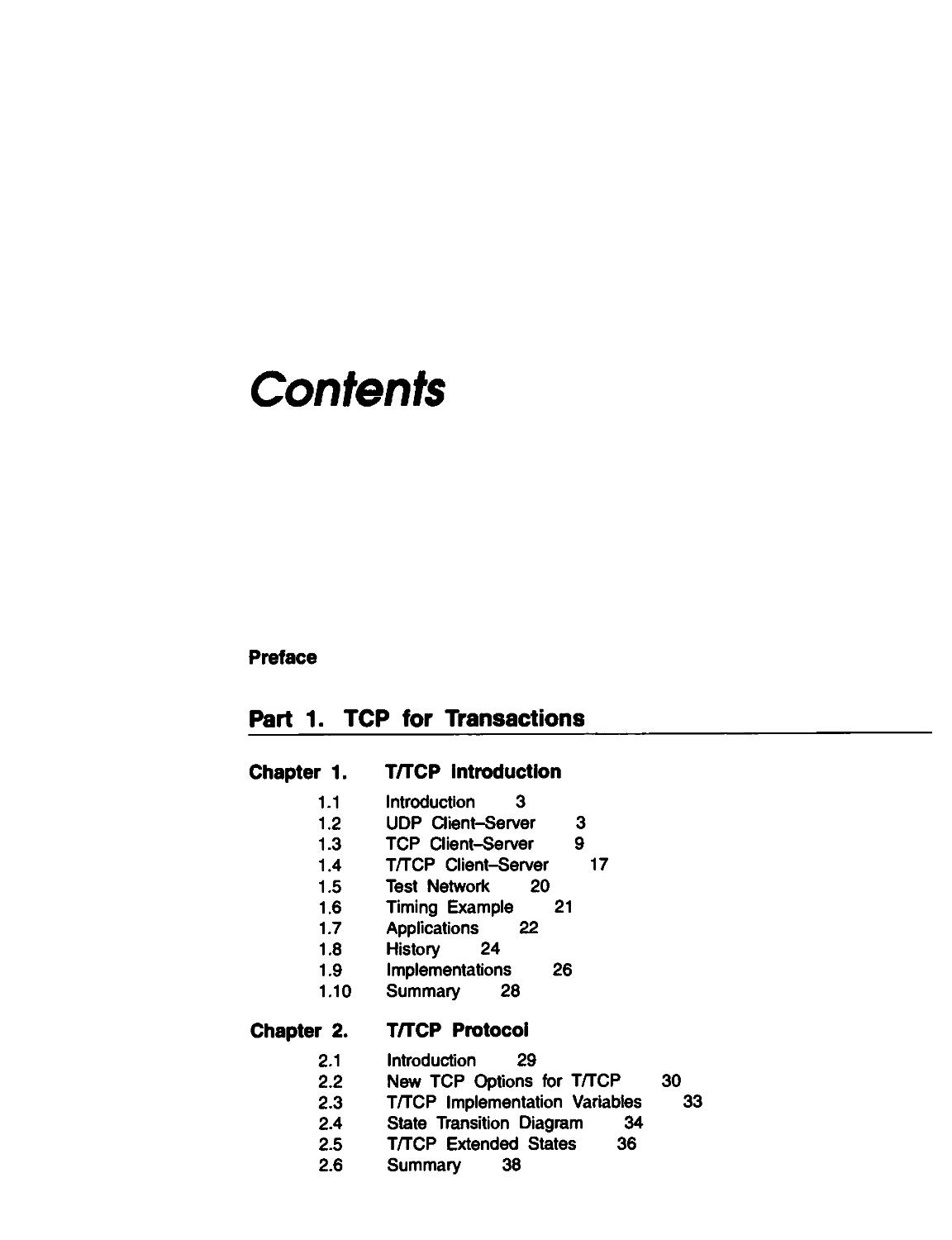
Contents
Preface
Part 1. TCP for Transactions
Chapter 1. T7TCP introduction
1.1 Introduction 3
1.2 UDP Client-Server 3
1.3 TCP Client-Server 9
1.4 T7TCP Client-Server 17
1.5 Test Network 20
1.6 Timing Example 21
1.7 Applications 22
1.8 History 24
1.9 Implementations 26
1.10 Summary 28
Chapter 2. T/TCP Protocol
2.1 Introduction 29
2.2 New TCP Options for T/TCP 30
2.3 T/TCP Implementation Variables 33
2.4 State Transition Diagram 34
2.5 T/TCP Extended States 36
2.6 Summary 38

x TCP/IP Illustrated Contents
Chapter 3. T/TCP Examples 39
3.1 Introduction 39
3.2 Client Reboot 40
3.3 Normal T/TCP Transaction 42
3.4 Server Receives Old Duplicate SYN 43
3.5 Server Reboot 44
3.6 Request or Reply Exceeds MSS 45
3.7 Backward Compatibility 49
3.8 Summary 51
Chapter 4. T/TCP Protocol (Continued) 53
4.1 Introduction 53
4.2 Client Port Numbers and TIME_WAIT State 53
4.3 Purpose of the T1ME_WAIT State 56
4.4 TIME_WAIT State Truncation 59
4.5 Avoiding the Three-Way Handshake with TAO 62
4.6 Summary 68
Chapter 5. T/TCP implementation: Socket Layer 69
5.1 Introduction 69
5.2 Constants 70
5.3 sosend Function 70
5.4 Summary 72
Chapter 6. T/TCP implementation: Routing Table 73
6.1 Introduction 73
6.2 Code Introduction 74
6.3 radix_node_head Structure 75
6.4 rtentry Structure 75
6.5 rt_metrics Structure 76
6.6 in_inithead Function 76
6.7 in_addroute Function 77
6.8 in_matroute Function 78
6.9 in_clsroute Function 78
6.10 in_rtqtimo Function 79
6.11 in_rtqkill Function 82
6.12 Summary 85
Chapter 7. T/TCP implementation: Protocol Control Blocks 87
7.1 Introduction 87
7.2 in_pcbladdr Function 88
7.3 in_pcbconnect Function 89
7.4 Summary 90
Chapter 8. T/TCP implementation: TCP Overview 91
8.1 Introduction 91
8.2 Code Introduction 91

TCP, IP Illustrated Contents
8.3 TCP protosw Structure 92
8.4 TCP Control Block 93
8.5 tcp_init Function 94
8.6 tcp_slowtimo Function 94
8.7 Summary 95
Chapter 9. T/TCP implementation: TCP Output
9.1 Introduction 97
9.2 tcp_output Function 97
9.3 Summary 104
Chapter 10. T/TCP implementation: TCP Functions
10.1 Introduction 105
10.2 tcp_newtcpcb Function 105
10.3 tcp_rtlookup Function 106
10.4 tcp_gettaocache Function 108
10.5 Retransmission Timeout Calculations 108
10.6 tcp_close Function 112
10.7 tcp_msssend Function 113
10.8 tcp_mssrcvd Function 114
10.9 tcp_dooptions Function 121
10.10 tcp_reass Function 122
10.11 Summary 124
Chapter 11. T/TCP implementation: TCP input
11.1 Introduction 125
11.2 Preliminary Processing 125
11.3 Header Prediction 129
11.4 Initiation of Passive Open 130
11.5 Initiation of Active Open 134
11.6 PAWS: Protection Against Wrapped Sequence Numbers 141
11.7 ACK Processing 142
11.8 Completion of Passive Opens and Simultaneous Opens 142
11.9 ACK Processing (Continued) 143
11.10 FIN Processing 145
11.11 Summary 147
Chapter 12. T/TCP Implementation: TCP User Requests
12.1 Introduction 149
12.2 pru_connect Request 149
12.3 tcp_connect Function 150
12.4 pru_send and pru_send_eof Requests 154
12.5 tcp_usrclosed Function 155
12.6 tcp_sysctl Function 155
12.7 T/TCP Futures 156
12.8 Summary 158

xii TCP/IP Illustrated Contents
Part 2. Additional TCP Applications 159
Chapter 13. HTTP: Hypertext Transfer Protocol 161
13.1 Introduction 161
13.2 Introduction to HTTP and HTML 162
13.3 HTTP Protocol 165
13.4 An Example 170
13.5 HTTP Statistics 172
13.6 Performance Problems 173
13.7 Summary 175
Chapter 14. Packets Found on an HTTP Server 177
14.1 Introduction 177
14.2 Multiple HTTP Servers 180
14.3 Client SYN Interarrival Time 181
14.4 RTT Measurements 185
14.5 listen Backlog Queue 187
14.6 Client SYN Options 192
14.7 Client SYN Retransmissions 195
14.8 Domain Names 196
14.9 Timing Out Persist Probes 196
14.10 Simulation of T/TCP Routing Table Size 200
14.11 Mbuf Interaction 202
14.12 TCP PCB Cache and Header Prediction 203
14.13 Summary 205
Chapter 15. NNTP: Network News Transfer Protocol 207
15.1 Introduction 207
15.2 NNTP Protocol 209
15.3 A Simple News Client 212
15.4 A More Sophisticated News Client 214
15.5 NNTP Statistics 215
15.6 Summary 216
Part 3. The Unix Domain Protocols 219
Chapter 16. Unix Domain Protocols: introduction 221
16.1 Introduction 221
16.2 Usage 222
16.3 Performance 223
16.4 Coding Examples 224
16.5 Summary 225

TCP IP Illustrated Contents
Chapter 17. Unix Domain Protocols: implementation
17.1 Introduction 227
17.2 Code Introduction 227
17.3 Unix domain and protosw Structures 228
17.4 Unix Domain Socket Address Structures 230
17.5 Unix Domain Protocol Control Blocks 231
17.6 uipc_usrreq Function 233
17.7 pru_attach Request and unp_attach Function 233
17.8 pru_detach Request and unp_detach Function 236
17.9 pru_bind Request and unp_bind Function 237
17.10 PRU_CONNECT Request and unp_connect Function 240
17.11 pru_CONNECT2 Request and unp_connect2 Function 245
17.12 socketpair System Call 249
17.13 pipe System Call 253
17.14 pru^accept Request 253
17.15 pru_disconnect Request and unp_disconnect Function 255
17.16 pru_shutdown Request and unp_shutdovm Function 257
17.17 pru_abort Request and unp_drop Function 258
17.18 Miscellaneous Requests 259
17.19 Summary 261
Chapter 18. Unix Domain Protocols: I/O and Descriptor Passing
18.1 Introduction 263
18.2 pru_send and pru_rcvd Requests 263
18.3 Descriptor Passing 269
18.4 unp_internalize Function 274
18.5 unp_externalize Function 276
18.6 unp_discard Function 277
18.7 unp_dispose Function 278
18.8 unp_scan Function 278
18.9 unp_gc Function 280
18.10 unp_mark Function 288
18.11 Performance (Revisited) 288
18.12 Summary 289
Appendix A. Measuring Network Times
A.1 RTT Measurements Using Ping 292
A.2 Protocol Stack Measurements 294
A.3 Latency and Bandwidth 300
Appendix B. Coding Applications for T7TCP
Bibliography
index

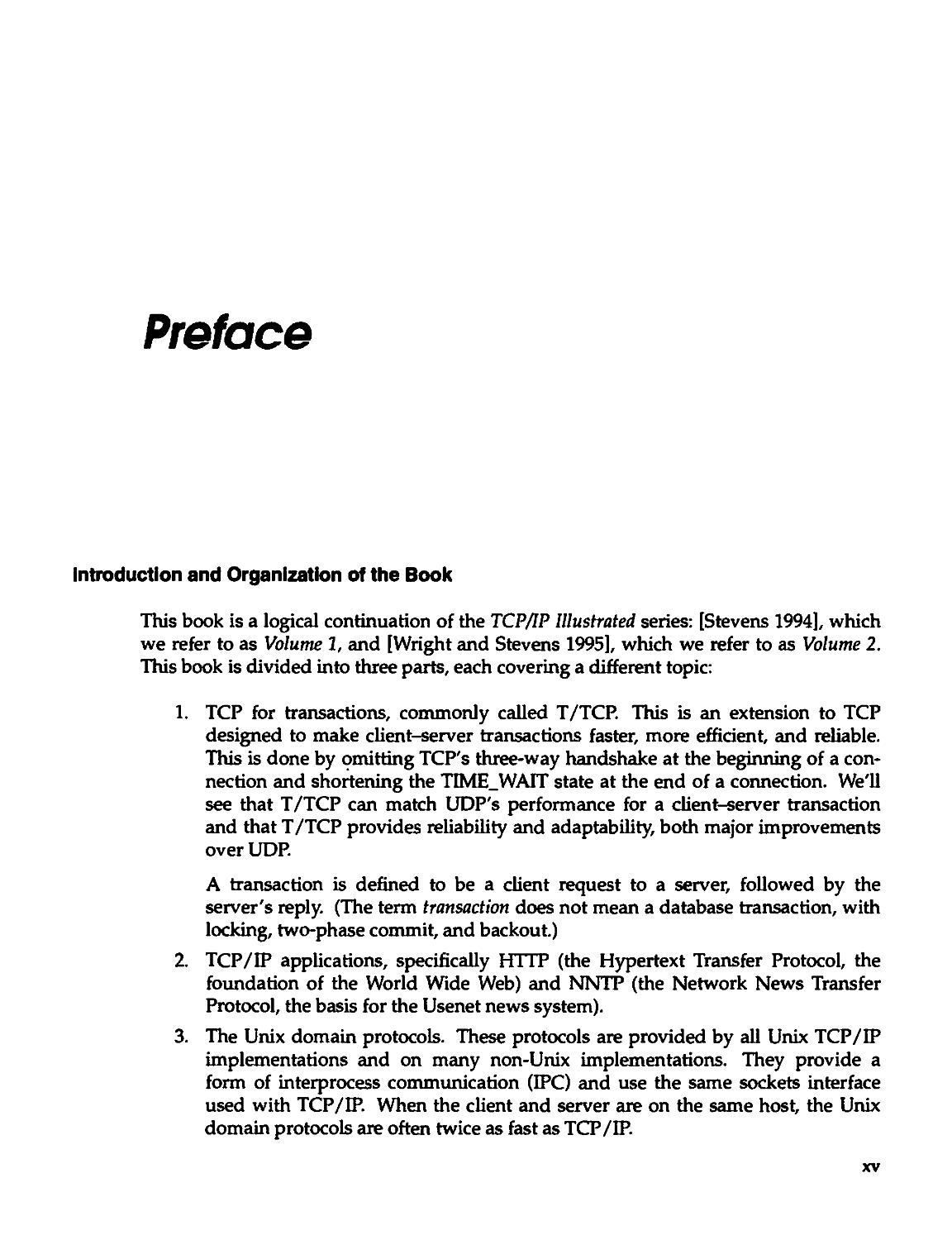
Preface
introduction and Organization of the Book
This book is a logical continuation of the TCP/IP Illustrated series: [Stevens 1994], which
we refer to as Volume 1, and [Wright and Stevens 1995], which we refer to as Volume 2.
This book is divided into three parts, each covering a different topic:
1. TCP for transactions, commonly called T/TCP. This is an extension to TCP
designed to make client-server transactions faster, more efficient, and reliable.
This is done by omitting TCP's three-way handshake at the beginning of a
connection and shortening the TIME_WArr state at the end of a connection. We'll
see that T/TCP can match UDP's performance for a client-server transaction
and that T/TCP provides reliability and adaptability, both major improvements
over UDP
A transaction is defined to be a client request to a server, followed by the
server's reply. (The term transaction does not mean a database transaction, with
locking, two-phase commit, and backout.)
2. TCP/IP applications, specifically HTTP (the Hypertext Transfer Protocol, the
foundation of the World Wide Web) and NNTP (the Network News Transfer
Protocol, the basis for the Usenet news system).
3. The Unix domain protocols. These protocols are provided by all Unix TCP/IP
implementations and on many non-Unix implementations. They provide a
form of interprocess communication (IPC) and use the same sockets interface
used with TCP/IP. When the client and server are on the same host, the Unix
domain protocols are often twice as fast as TCP/IP.
xv

xvi TCP/IP Illustrated
rrcidce
Part 1, the presentation of T/TCP, is in two pieces. Chapters 1-4 describe the
protocol and provide numerous examples of how it works. This material is a major
expansion of the brief presentation of T/TCP in Section 24.7 of Volume 1. The second piece,
Chapters 5-12, describes the actual implementation of T/TCP within the 4.4BSD-Lite
networking code (i.e., the code presented in Volume 2). Since the first T/TCP
implementation was not released until September 1994, about one year after Volume 1 was
published and right as Volume 2 was being completed, the detailed presentation of
T/TCP, with examples and all the implementation details, had to wait for another
volume in the series.
Part 2, the HTTP and NNTP applications, are a continuation of the TCP/IP
applications presented in Chapters 25-30 of Volume 1. In the two years since Volume 1 was
published, the popularity of HTTP has grown enormously, as the Internet has exploded,
and the use of NNTP has been growing about 75% per year for more than 10 years.
HTTP is also a wonderful candidate for T/TCP, given its typical use of TCP: short
connections with small amounts of data transferred, where the total time is often
dominated by the connection setup and teardown. The heavy use of HTTP (and therefore
TCP) on a busy Web server by thousands of different and varied clients also provides a
unique opportunity to examine the actual packets at the server (Chapter 14) and look at
many features of TCP/IP that were presented in Volumes 1 and 2.
The Unix domain protocols in Part 3 were originally considered for Volume 2 but
omitted when its size reached 1200 pages. While it may seem odd to cover protocols
other than TCP/IP in a series titled TCP/IP Illustrated, the Unix domain protocols were
implemented almost 15 years ago in 4.2BSD alongside the first implementation of BSD
TCP/IP. They are used heavily today in any Berkeley-derived kernel, but their use is
typically "under the covers," and most users are unaware of their presence. Besides
being the foundation for Unix pipes on a Berkeley-derived kernel, another heavy user is
the X Window System, when the client and server are on the same host (i.e., on typical
workstations). Unix domain sockets are also used to pass descriptors between
processes, a powerful technique for interprocess communication. Since the sockets API
(application program interface) used with the Unix domain protocols is nearly identical
to the sockets API used with TCP/IP, the Unix domain protocols provide an easy way
to enhance the performance of local applications with minimal code changes.
Each of the three parts can be read by itself.
Readers
As with the previous two volumes in the series, this volume is intended for anyone
wishing to understand how the TCP/IP protocols operate: programmers writing
network applications, system administrators responsible for maintaining computer
systems and networks utilizing TCP/IP, and users who deal with TCP/IP applications on a
daily basis.
Parts 1 and 2 assume a basic understanding of how the TCP/IP protocols work.
Readers unfamiliar with TCP/IP should consult the first volume in this series, [Stevens
1994], for a thorough description of the TCP/IP protocol suite. The first half of Part 1

TCP/IP Illustrated
Preface xvii
(Chapters 1-4, the concepts behind T/TCP along with examples) can be read
independent of Volume 2, but the remainder of Part 1 (Chapters 5-12, the implementation of
T/TCP) assumes familiarity with the 4.4BSD-Lite networking code, as provided with
Volume 2.
Many forward and backward references are provided throughout the text, to both
topics within this text, and to relevant sections of Volumes 1 and 2 for readers interested
in more details. A thorough index is provided, and a list of all the acronyms used
throughout the text, along with the compound term for the acronym, appears on the
inside front covers. The inside back covers contain an alphabetical cross-reference of all
the structures, functions, and macros described in the book and the starting page
number of the description. This cross-reference also refers to definitions in Volume 2, when
that object is referenced from the code in this volume.
Source Code Copyright
All the source code in this book that is taken from the 4.4BSD-Lite release contains the
following copyright notice:
/*
* Copyright (c) 1982, 1986, 1988, 1990, 1993, 1994
* The Regents of the University of California. All rights reserved.
*
* Redistribution and use in source and binary forms, with or without
* modification, are permitted provided that the following conditions
* are met:
* 1. Redistributions of source code must retain the above copyright
* notice, this list of conditions and the following disclaimer.
* 2. Redistributions in binary form must reproduce the above copyright
* notice, this list of conditions and the following disclaimer in the
* documentation and/or other materials provided with the distribution.
* 3. All advertising materials mentioning features or use of this software
* must display the following acknowledgement:
* This product includes software developed by the University of
* California, Berkeley and its contributors.
* 4. Neither the name of the University nor the names of its contributors
* may be used to endorse or promote products derived from this software
* without specific prior written permission.
*
* THIS SOFTWARE IS PROVIDED BY THE REGENTS AND CONTRIBUTORS "AS IS'' AND
* ANY EXPRESS OR IMPLIED WARRANTIES, INCLUDING, BUT NOT LIMITED TO, THE
* IMPLIED WARRANTIES OF MERCHANTABILITY AND FITNESS FOR A PARTICULAR PURPOSE
* ARE DISCLAIMED. IN NO EVENT SHALL THE REGENTS OR CONTRIBUTORS BE LIABLE
* FOR ANY DIRECT, INDIRECT, INCIDENTAL, SPECIAL, EXEMPLARY, OR CONSEQUENTIAL
* DAMAGES (INCLUDING, BUT NOT LIMITED TO, PROCUREMENT OF SUBSTITUTE GOODS
* OR SERVICES; LOSS OF USE, DATA, OR PROFITS; OR BUSINESS INTERRUPTION)
* HOWEVER CAUSED AND ON ANY THEORY OF LIABILITY, WHETHER IN CONTRACT, STRICT
* LIABILITY, OR TORT (INCLUDING NEGLIGENCE OR OTHERWISE) ARISING IN ANY WAY
* OUT OF THE USE OF THIS SOFTWARE, EVEN IF ADVISED OF THE POSSIBILITY OF
* SUCH DAMAGE.
*/

xviii TCP/IP Illustrated
Preface
The routing table code in Chapter 6 contains the following copyright notice:
/*
* Copyright 1994, 1995 Massachusetts Institute of Technology
*
* Permission to use, copy, modify, and distribute this software and
* its documentation for any purpose and without fee is hereby
* granted, provided that both the above copyright notice and this
* permission notice appear in all copies, that both the above
* copyright notice and this permission notice appear in all
* supporting documentation, and that the name of M.I.T. not be used
* in advertising or publicity pertaining to distribution of the
* software without specific, written prior permission. M.I.T. makes
* no representations about the suitability of this software for any
* purpose. It is provided "as is" without express or implied
* warranty.
*
* THIS SOFTWARE IS PROVIDED BY M.I.T. "AS IS". M.I.T. DISCLAIMS
* ALL EXPRESS OR IMPLIED WARRANTIES WITH REGARD TO THIS SOFTWARE,
* INCLUDING, BUT NOT LIMITED TO, THE IMPLIED WARRANTIES OF
* MERCHANTABILITY AND FITNESS FOR A PARTICULAR PURPOSE. IN NO EVENT
* SHALL M.I.T. BE LIABLE FOR ANY DIRECT, INDIRECT, INCIDENTAL,
* SPECIAL, EXEMPLARY, OR CONSEQUENTIAL DAMAGES (INCLUDING, BUT NOT
* LIMITED TO, PROCUREMENT OF SUBSTITUTE GOODS OR SERVICES; LOSS OF
* USE, DATA, OR PROFITS; OR BUSINESS INTERRUPTION) HOWEVER CAUSED AND
* ON ANY THEORY OF LIABILITY, WHETHER IN CONTRACT, STRICT LIABILITY,
* OR TORT (INCLUDING NEGLIGENCE OR OTHERWISE) ARISING IN ANY WAY OUT
* OF THE USE OF THIS SOFTWARE, EVEN IF ADVISED OF THE POSSIBILITY OF
* SUCH DAMAGE.
*/
Typographical Conventions
When we display interactive input and output we'll show our typed input in a bold
font, and the computer output like this. Comments are added in italics.
sun % t«ln«t www.aw.con 80 connect to the HTTP server
Trying 192 .207.117.2. . . this line and next output by Telnet client
Connected to aw.com.
We always include the name of the system as part of the shell prompt (sun in this
example) to show on which host the command was run. The names of programs referred to
in the text are normally capitalized (e.g., Telnet and Tcpdump) to avoid excessive font
changes.
Throughout the text we'll use indented, parenthetical notes such as this to describe historical
points or implementation details.

TCP/IP Illustrated
Preface xix
Acknowledgments
First and foremost I thank my family, Sally, Bill, Ellen, and David, who have endured
cinother book along with all my traveling during the past year. This time, however, it
really is a "small" book.
I thank the technical reviewers who read the manuscript and provided important
feedback on a tight timetable: Sami Boulos, Alan Cox, Tony DeSimone, Pete Haverlock,
Chris Heigham, Mukesh Kacker, Brian Kemighan, Art Mellor, Jeff Mogul, Marianne
Mueller, Andras Olah, Craig Partridge, Vern Paxson, Keith Sklower, Ian Lance Taylor,
and Gary Wright. A special thanks to the consulting editor, Brian Kemighan, for his
rapid, thorough, and helpful reviews throughout the course of the book, and for his
continued encouragement and support.
Special thanks are also due Vent Paxson and Andras Olah for their incredibly
detailed reviews of the entire manuscript, finding many errors and providing valuable
technical suggestions. My thanks also to Vern Paxson for making available his software
for analyzing Tcpdump traces, and to Andras Olah for his help with T/TCP over the
past year. My thanks also to Bob Braden, the designer of T/TCP, who provided the
reference source code implementation on which Part 1 of this book is based.
Others helped in significant ways. Gary Wright and Jim Hogue provided the
system on which the data for Chapter 14 was collected. Doug Schmidt provided a copy of
the public domain TTCP program that uses Unix domain sockets, for the timing
measurements in Chapter 16. Craig Partridge provided a copy of the RDP source code to
examine. Mike Karels answered lots of questions.
My thanks once again to the National Optical Astronomy Observatories (NOAO),
Sidney Wolff, Richard Wolff, and Steve Grandi, for providing access to their networks
and hosts.
Finally, my thanks to all the staff at Addison-Wesley, who have helped over the past
years, especially my editor John Wait.
As usual, camera-ready copy of the book was produced by the author, a Troff
diehard, using the Groff package written by James Clark. I welcome electronic mail from
any readers with comments, suggestions, or bug fixes.
Tucson, Arizona W. Richard Stevens
November 1995 rstevens@noao. edu
http://www.noao.edu/-rstevens

Part 1
TCP for Transactions

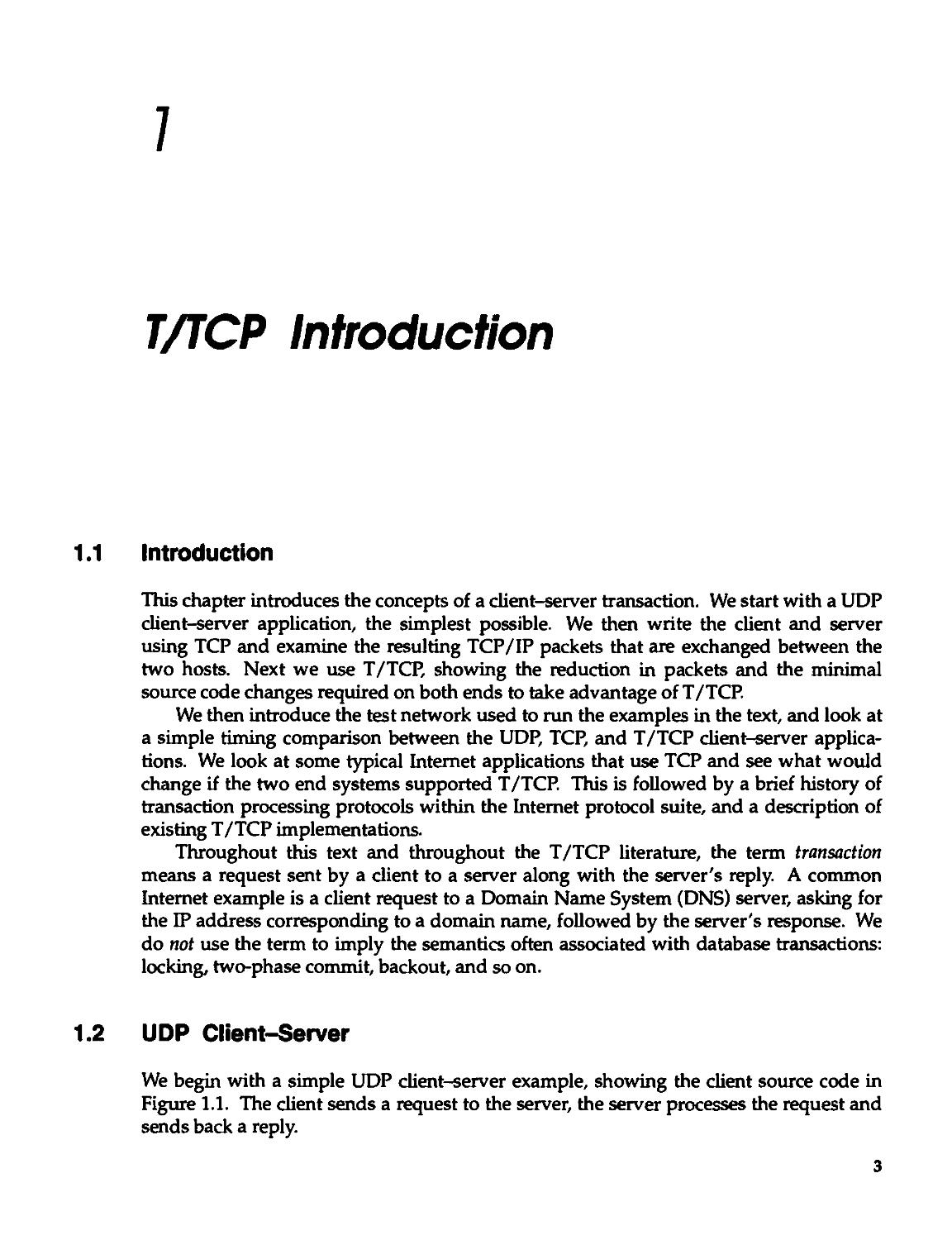
1
T/TCP Introduction
Introduction
This chapter introduces the concepts of a client-server transaction. We start with a UDP
client-server application, the simplest possible. We then write the client and server
using TCP and examine the resulting TCP/IP packets that are exchanged between the
two hosts. Next we use T/TCP, showing the reduction in packets and the minimal
source code changes required on both ends to take advantage of T/TCP.
We then introduce the test network used to run the examples in the text, and look at
a simple timing comparison between the UDP, TCP, and T/TCP client-server
applications. We look at some typical Internet applications that use TCP and see what would
change if the two end systems supported T/TCP This is followed by a brief history of
transaction processing protocols within the Internet protocol suite, and a description of
existing T/TCP implementations.
Throughout this text and throughout the T/TCP literature, the term transaction
means a request sent by a client to a server along with the server's reply. A common
Internet example is a client request to a Domain Name System (DNS) server, asking for
the IP address corresponding to a domain name, followed by the server's response. We
do not use the term to imply the semantics often associated with database transactions:
locking, two-phase commit, backout, and so on.
UDP Client-Server
We begin with a simple UDP client-server example, showing the client source code in
Figure 1.1. The client sends a request to the server, the server processes the request and
sends back a reply.
3

4 1/ICP Introduction
Chapter 1
udpcli.c
1 Sinclude "cliserv.h"
2 int
3 main(int argc, char *argv[])
4 { /* simple UDP client */
5 struct sockaddr_in serv;
6 char requesttREQUEST], reply[REPLY];
7 int sockfd, n;
8 if (argc != 2)
9 err_quit("usage: udpcli <IP address of server>");
10 if ((sockfd = socket(PF_INET, SOCK_DGRAM, 0)) < 0)
11 err_sys("socket error");
12 memset(&serv, 0, sizeof(serv));
13 serv.sin_family = AF_INET;
14 serv.sin_addr.s_addr = inet_addr(argv[l]);
15 serv.sin_port = htons(UDP_SERV_PORT);
16 /* form request!] ... */
17 if (sendtolsockfd, request, REQUEST, o,
18 (SA) &serv, sizeof(serv)) != REQUEST)
19 err_sys("sendto error");
20 if ((n = recvfrom(sockfd, reply, REPLY, 0,
21 (SA) NULL, (int ♦) NULL)) < 0)
22 err_sys("recvfrom error");
23 /* process "n" bytes of replyt] ... */
24 exit(0);
25 )
• udpcli.c
Figure 1.1 Simple UDP client
This is the format used for all the source code in the text. Each nonblank line is numbered.
The text describing portions of the code begins with the starring and ending line numbers in
the left margin, as shown below. Sometimes the paragraph is preceded by a short descriptive
heading, providing a summary statement of the code being described. The horizontal rules at
the beginning and end of the code fragment specify the source code filename. Often these
source filenames refer to files in the 4.4BSD-Lite distribution, which we describe in Section 1.9.
We discuss the relevant features of this program but do not describe the socket
functions in great detail, assuming the reader has a basic understanding of these
functions. Additional details on these functions can be found in Oiapter 6 of [Stevens 1990].
We show the cliserv. h header in Figure 1.2.
Create a UDP socket
lo-n The socket function creates a UDP socket, returning a nonnegative descriptor to
the process. The error-handling function err_sys is shown in Appendix B.2 of
[Stevens 1992]. It accepts any number of arguments, formats them using vsprintf,
prints the Unix error message corresponding to the errno value from the system call,
and then terminates the process.

Section 1.2
UDP Client-Server 5
RI1 in server's address
12-15 An Internet socket address structure is first zeroed out using memset and then
filled with the IP address and port number of the server. For simplicity we require the
user to enter the IP address as a dotted-decimal number on the command line when the
program is run (argvfl]). We #def ine the server's port number (UDP_SERV_PORT)
in the cliserv. h header, which is included at the beginning of all the programs in this
chapter. This is done for simplicity and to avoid complicating the code with calls to
gethostbyname and getservbyname.
Form request and send it to server
ie-io The client forms a request (which we show only as a comment) and sends it to the
server using sendto. This causes a single UDP datagram to be sent to the server. Once
again, for simplicity, we assume a fixed-sized request (REQUEST) and a fixed-sized reply
(REPLY). A real application would allocate room for its maximum-sized request and
reply, but the actual request and reply would vary and would normally be smaller.
Read and process reply from server
20-23 The call to recvf rom blocks the process (i.e., puts it to sleep) until a datagram
arrives for the client. The client then processes the reply (which we show as a comment)
and terminates.
This program will hang forever if either the request or reply is lost, since there is no timeout on
the recvf rom. Indeed, this lack of robustness from real-world errors of this type is one of the
fundamental problems with UDP client-servers. We discuss this in more detail at the end of
this section.
In the cliserv.h header we #define SA to be struct sockaddr *, that is, a pointer to a
generic socket address structure. Every time one of the socket functions requires a pointer to a
socket address structure, that pointer must be cast to a pointer to a generic socket address
structure. This is because the socket functions predate the ANSI C standard, so the void *
pointer type was not available in the early 1980s when these functions were developed. The
problem is that "struct sockaddr *" is 17 characters and often causes the source code line
to extend past the right edge of the screen (or page in the case of a book), so we shorten it to
SA. This abbreviation is borrowed from the BSD kernel sources.
Figure 1.2 shows the cliserv. h header that is included in all the programs in this
chapter.
—-—■ ;—-— — — cliservJi
1 /* Common includes and defines for UDP, TCP, and T/TCP
2 * clients and servers */
3
4
5
6
7
e
9
10
#include
#include
#include
•include
#include
♦include
•include
•include
<sys/types.h>
<sys/socket.h>
<netinet/in.h>
<arpa/inet.h>
<stdio.h>
<stdlib.h>
<string.h>
<unistd.h>

6 T/TCP Introduction
Chapter 1
11 #define REQUEST 400 /* max size of request, in bytes */
12 #define REPLY 400 /* max size of reply, in bytes */
13 Sdefine UDP_SERV_PORT 7777 /♦ UDP server's well-known port */
14 #define TCP_SERV_PORT 8888 /* TCP server's well-known port ♦/
15 Sdefine TTCP_SERV_PORT 9999 /♦ T/TCP server's well-known port ♦/
16 /* Following shortens all the type casts of pointer arguments */
17 Sdefine SA struct sockaddr *
18 void err_quit(const char *,...);
19 void err_sys(const char *,...);
20 int read_stream(int, char *, int);
Figure 1.2 cliserv. h header that is included by the programs in this chapter.
Figure 1.3 shows the corresponding UDP server.
~cliserv.h
1 #include "cliserv.h"
2 int
3 main!)
4 { /* simple UDP server */
5 struct sockaddr_in serv, cli;
6 char request[REQUEST], reply[REPLY];
7 int sockfd, n, clilen;
8 if ((sockfd = socket (PF_INET, SOCKJJGRAM, 0)) < 0)
9 err_sys("socket error-);
10 memset(&serv, 0, sizeof (serv)),-
11 serv.sin_family = AF_INET;
12 serv.sin_addr.s_addr = htonl(INADDR_ANY);
13 serv.sin_port = htons(UDP_SERV_PORT);
14 if (bind(sockfd, (SA) &serv, sizeof(serv)) < 0)
15 err_sys("bind error");
16 for (;;) {
17 clilen = sizeof(cli);
18 if ((n = recvfrom(sockfd, request, REQUEST, 0,
19 (SA) &cli, &clilen)) < 0)
20 err_sys("recvfrom error-);
21 /* process "n- bytes of requestj] and create replyt]
22 if (sendtolsockfd, reply, REPLY, 0,
23 (SA) &cli, sizeof(cli)) != REPLY)
24 err_sys('sendto error*);
25 )
26 )
Figure lJ UDP server corresponding to UDP client in Figure 1.1.
■ udpserv.c
■udpserv.c

-rcscnl.2
UDP Client-Server 7
Create UDP socket and bind local address
The call to socket creates a UDP socket, and an Internet socket address structure is
rilled in with the server's local address. The local IP address is set to the wildcard
(INADDR_ANY), which means the server will accept a datagram arriving on any local
interface (in case the server's host is multihomed, that is, has more than one network
interface). The port number is set to the server's well-known port (UDP_SERV_PORT)
which we said earlier is defined in the cliserv.h header. This local IP address and
well-known port are bound to the socket by bind.
Process client requests
The server then enters an infinite loop, waiting for a client request to arrive
(recvf rom), processing that request (which we show only as a comment), and sending
back a reply (sendto).
This is the simplest form of UDP client-server application. A common real-world
example is the Domain Name System (DNS). A DNS client (called a resolver) is
normally part of a client application (say, a Telnet client, an FTP client, or a WWW
browser). The resolver sends a single UDP datagram to a DNS server requesting the IP
address associated with a domain name. The reply is normally a single UDP datagram
from the server.
If we watch the packets that are exchanged when our client sends the server a
request, we have the time line shown in Figure 1.4. Time increases down the page. The
server is started first, shown on the right side of the diagram, and the client is started
sometime later.
We distinguish between the function call performed by the client and server, and
the action performed by the corresponding kernel. We use two closely spaced arrows,
as in the two calls to socket, to show that the kernel performs the requested action and
returns immediately. In the call to sendto, although the kernel returns immediately to
the calling process, a UDP datagram is sent. For simplicity we assume that the sizes of
the resulting IP datagrams generated by the client's request and the server's reply are
both less than the network's MTU (maximum transmission unit), avoiding
fragmentation of the IP datagram.
In this figure we also show that the two calls to recvf rom put the process to sleep
until a datagram arrives. We denote the kernel routines as sleep and wakeup.
Finally, we show the times associated with the transaction. On the left side of
Figure 1.4 we show the transaction time as measured by the client: the time to send a
request to the server and receive a reply. The values that comprise this transaction time
are shown on the right side of the figure: RTT + SPT, where RTT is the network round-
trip time, and SPT is the server processing time for the request. The transaction time for
the UDP client-server, RTT + SPT, is the minimum possible.
We implicitly assume that the path from the client to the server accounts for VS RTT and the
return path accounts for the other 'A RTT. This is not always the case. In a study of about 600
Internet paths, [Paxson 1995b] found that 30% exhibited a major asymmetry, meaning that the
routes in the two directions visited different cities.

8 T/TCP Introduction
Chapter 1
!
■■=£
r
V.
client
function
socket ~
sendto ~
recvfrom -
return ■•
kemeJ
•• sleep
- wakeup
network
«<$>^
\<&%^
jf^
server
kernel
sleep ■•
wakeup -
function
~ socket
~ bind
- recvfrom
»■ return
process
request
~ sendto
^ViRTT
^ SPT
Writ
Figure 1.4 Time line of UDP client-server transaction.
Although our UDP client-server looks simple (each program contains only about 30
lines of networking code), the programs are not robust enough for real-world
applications. Since UDP is an unreliable protocol, datagrams can be lost, reordered, or
duplicated, and a real application needs to handle these problems. This normally involves
placing a timeout on the client's call to recvfrom, to detect lost datagrams, and
retransmitting the request. If a timeout is going to be used, the client must measure the RTT
and update it dynamically, since RTTs on an internet can vary widely and change
dramatically over time. But if the reply was lost, instead of the request, the server will
process the same request a second time, which can lead to problems for some types of
services. One way to handle this is for the server to save the reply for each client's latest
request, and retransmit that reply instead of processing the request another time.
Finally, the client typically sends an identifier with each request, and the server echoes
this identifier, allowing the client to match responses with requests. Section 8.4 of
[Stevens 1990] details the source code required to handle some of these problems with a
UDP client-server, but this adds about 500 lines of code to each program.
While many UDP applications add reliability by performing all of these additional
steps (timeouts, RTT measurements, request identifiers, etc.), these steps are continually
being reinvented as new UDP applications are developed. [Partridge 1990b] notes that

Section 1.3
TCP Client-Server 9
'To develop a 'reliable UDP' you'll need state information (sequence number,
retransmission counts, round-trip time estimator), in principle you'll need just about all the
information currently in the TCP connection block. So building a 'reliable UDP' is
essentially as difficult as doing a TCP."
Some applications don't implement all of the required steps: for example, they place
a timeout on the receive, but do not measure and update the RTT dynamically, which
can lead to problems when the application moves from one environment (a LAN) to
another (a WAN). A better solution is to use TCP instead of UDP, taking advantage of
all the reliability provided by TCP. But this solution increases the client's measured
transaction time from RTT + SPT to 2xRTT + SPT, as shown in the next section, and
greatly increases the number of network packets exchanged between the two systems.
There is a solution to these new problems, using T/TCP instead of TCP, and we
examine it in Section 1.4.
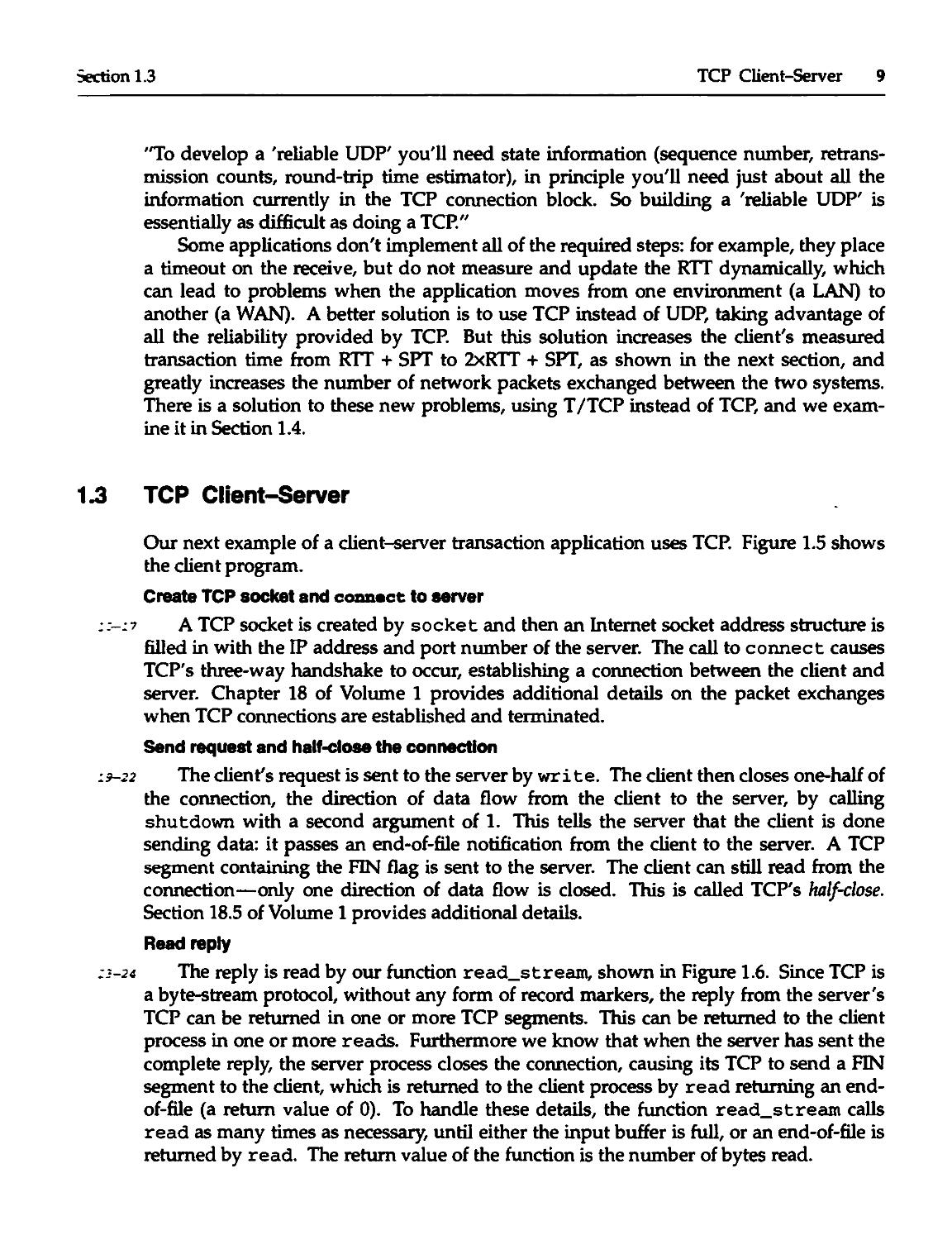
1.3 TCP Client-Server
Our next example of a client-server transaction application uses TCP. Figure 1.5 shows
the client program.
Create TCP socket and connect to server
::-n A TCP socket is created by socket and then an Internet socket address structure is
filled in with the IP address and port number of the server. The call to connect causes
TCP's three-way handshake to occur, establishing a connection between the client and
server. Chapter 18 of Volume 1 provides additional details on the packet exchanges
when TCP connections are established and terminated.
Send request and half-close the connection
:9-22 The clienf s request is sent to the server by write. The client then closes one-half of
the connection, the direction of data flow from the client to the server, by calling
shutdown with a second argument of 1. This tells the server that the client is done
sending data: it passes an end-of-file notification from the client to the server. A TCP
segment containing the FIN flag is sent to the server. The client can still read from the
connection—only one direction of data flow is closed. This is called TCP's half-close.
Section 18.5 of Volume 1 provides additional details.
Read reply
:--2t The reply is read by our function read_stream, shown in Figure 1.6. Since TCP is
a byte-stream protocol, without any form of record markers, the reply from the server's
TCP can be returned in one or more TCP segments. This can be returned to the client
process in one or more reads. Furthermore we know that when the server has sent the
complete reply, the server process closes the connection, causing its TCP to send a FIN
segment to the client, which is returned to the client process by read returning an end-
of-file (a return value of 0). To handle these details, the function read_stream calls
read as many times as necessary, until either the input buffer is full, or an end-of-file is
returned by read. The return value of the function is the number of bytes read.

10 T/TCP Introduction
Chapter 1
1 Sinclude "cliserv.h"
2 int
3 main(int argc, char *argv[])
4 { /* simple TCP client */
5 struct sockaddr_in serv;
6 char request[REQUEST], reply[REPLY];
7 int sockfd, n;
8 if (argc != 2)
9 err_quit ("usage: tcpcli <IP address of servers-");
10 if ((sockfd = socket(PF_INET, SOCK_STREAM, 0)) < 0)
11 err_sys("socket error");
12 memset(&serv, 0, sizeof (serv)),-
13 serv.sin_family = AF_INET;
14 serv.sin_addr.s_addr = inet_addr(argv[l]);
15 serv.sin_port = htons(TCP_SERV_PORT);
16 if (connect(sockfd, (SA) &serv, sizeof(serv)) < 0)
17 err_sys("connect error");
18 /* form request[] ... */
19 if (write(sockfd, request, REQUEST) != REQUEST)
20 err_sys("write error");
21 if (shutdown(sockfd, 1) < 0)
22 err_sys("shutdown error");
23 if ((n = read_stream(sockfd. reply, REPLY)) < 0)
24 err_sys("read error");
25 /* process "n" bytes of reply[] ... */
26 exit(0);
27 )
Figure 1.5 TCP transaction client.
• tqicli.c
1 Sinclude "cliserv.h"
2 int
3 read_stream(int fd, char *ptr, int maxbytes)
4 {
5 int nleft, nread;
6 nleft = maxbytes;
7 while (nleft > 0) {
8 if ((nread = readlfd, ptr, nleft)) < 0)
9 return (nread); /* error, return < 0 */
10 else if (nread == 0)
11 break; /* EOF, return #bytes read */
12 nleft -= nread;
13 ptr += nread;
14 )
15 return (maxbytes - nleft); /* return >= 0 */
16 )
tcpcli.c
■ readstream.c
■ readstream.c
Figure 1.6 read_stream function.

section 1.3
TCP Client-Server 11
There are other ways to delineate records when a stream protocol such as TCP is used. Many
Internet applications (FTP, SMTP, HTTP, NNTP) terminate each record with a carriage return
and linefeed. Others (DNS, RPC) precede each record with a fixed-size record length. In our
example we use TCP's end-of-file flag (the FIN) since we send only one request from the client
to the server, and one reply back. FTP also uses this technique with its data connection, to tell
the other end when the end-of-file is encountered.
Figure 1.7 shows the TCP server.
tcpserv.c
1 #include "cliserv.h"
2 int
3 main()
4 { /* simple TCP server */
5 struct sockaddr_in serv, cli;
6 char request[REQUEST], reply[REPLY];
7 int listenfd, sockfd, n, clilen;
8 if ((listenfd = socket (PF_DJET, SOCK_STREAM, 0)) < 0)
9 err_sys("socket error");
10 memset(fcserv, 0, sizeof(serv));
11 serv.sin_family = AF_INET;
12 serv.sin_addr.s_addr = htonl(INADDR_ANY);
13 serv.sin_port = htons(TCP_SERV_PORT);
14 if (bind(listenfd, (SA) fcserv, sizeof(serv)) < 0)
15 err_sys("bind error");
16 if (listen(listenfd, SOMAXCONN) < 0)
17 err_sys("listen error");
18 for (;;) {
19 clilen = sizeof(cli);
20 if ( (sockfd = accept(listenfd, (SA) &cli, iclilen)) < 0)
21 err_sys("accept error");
22 if ((n = read_stream(sockfd, request, REQUEST)) < 0)
23 err_sys("read error");
24 /* process "n" bytes of request!] and create reply[] ... */
25 if (write(sockfd, reply, REPLY) != REPLY)
26 err_sys("write error");
27 close (sockfd) ;
28 )
29 )
■tcpservx
Figure 1.7 TCP transaction server.
Create listening TCP socket
s-17 A TCP socket is created and the server's well-known port is bound to the socket.
As with the UDP server, the TCP server binds the wildcard as its local IP address. The
call to listen makes the socket a listening socket on which incoming connections will

12 T/TCP Introduction
Chapter 1
be accepted, and the second argument of SOMAXCONN specifies the maximum number of
pending connections the kernel will queue for the socket.
SOMAXCONN is defined in the <sys/socket.h> header. Historically its value has been 5.
although some newer systems define it to be 10. But busy servers (e.g., systems providing a
World Wide Web server) have found a need for even higher values, say 256 or 1024. We talk
about this more in Section 14.5.
accept a connection and process request
is-28 The server blocks in the call to accept until a connection is established by the
client's connect. The new socket descriptor returned by accept, sockfd, refers to
the connection to the client. The client's request is read by read_stream (Figure 1.6)
and the reply is returned by wri te.
This server is an iterative server: it processes each client's request completely before looping
around to accept the next client connection. A concurrent server is one that handles multiple
clients concurrently (i.e., at the same time). A common technique for implementing concurrent
servers on Unix hosts is for the server to fork a child process after accept returns, letting the
child handle the client's request, allowing the parent to accept another client connection
immediately. Another technique is for the server to create a thread (called a lightweight
process) to handle each request. We show the iterative server to avoid complicating the example
with process control functions that don't affect the networking aspects of the example.
(Chapter 8 of [Stevens 1992] discusses the fork function. Chapter 4 of [Stevens 1990] discusses
iterative versus concurrent servers.)
A third option is a pre-fbrked server. Here the server calls fork a fixed number of times when it
starts and each child calls accept on the same listening descriptor. This approach saves a call
to fork for each client request, which can be a big savings on a busy server. Some HTTP
servers use this technique.
Figure 1.8 shows the time line for the TCP client-server transaction. The first thing
we notice, compared to the UDP time line in Figure 1.4, is the increased number of
network packets: nine for the TCP transaction, compared to two for the UDP transaction.
With TCP the client's measured transaction time is at least 2xRTT + SPT. Normally the
middle three segments from the client to the server—the ACK of the server's SYN, the
request, and the client's FIN—are spaced closely together, as are the later two segments
from the server to the client—the reply and the server's FIN. This makes the
transaction time closer to 2xRTT + SPT than it might appear from Figure 1.8.
The additional RTT in this example is from the establishment of the TCP
connection: the first two segments that we show in Figure 1.8. If TCP could combine the
establishment of the connection with the client's data and the client's FIN (the first four
segments from the client in the figure), and then combine the server's reply with the
server's FIN, we would be back to a transaction time of RTT + SPT, the same as we had
with UDP. Indeed, this is basically the technique used by T/TCP.

Section 13
TCP Client-Server
1
= u
return
read (data)
read (EOF)
process
request
write
close
return (data)
read (EOF) ^£
^ RTT
^RTT
> SPT
► ViRTl
Figure 1.8 Tune line of TCP client-server transaction.

14 T/TCP Introduction
Chapter 1
TCP's TIME_WAIT State
TCP requires that the endpoint that sends the first FIN, which in our example is the
client, must remain in the TIME_WArr state for twice the maximum segment lifetime
(MSL) once the connection is completely closed by both ends. The recommended value
for the MSL is 120 seconds, implying a TME_WAIT delay of 4 minutes. While the
connection is in the TME_WAIT state, that same connection (i.e., the same four values for
the client IP address, client port, server IP address, and server port) cannot be opened
again. (We have more to say about the TME_WAIT state in Chapter 4.)
Many implementations based on the Berkeley code remain in the TIME_WArr state for only 60
seconds, rather than the 240-second value specified in RFC 1122 [Braden 1989]. We assume the
correct waiting period of 240 seconds in the calculations made throughout this text.
In our example the client sends the first FIN, termed the active close, so the
TIME_WArr delay occurs on the client host. During this delay certain state information
is maintained by TCP for this connection to handle segments correctly that may have
been delayed in the network and arrive after the connection is closed. Also, if the final
ACK is lost the server will retransmit its FIN, causing the client to retransmit the final
ACK.
Other applications, notably HTTP, which is used with the World Wide Web, have
the client send a special command indicating it is done sending its request (instead of
ha/f-c/osing the connection as we do in our client), and then the server sends its reply,
followed by the server's FIN. The client then sends its FIN. The difference here is that
the TIME_WArr delay now occurs on the server host instead of the client host. On a
busy server that is contacted by many clients, the required state information can
account for lots of memory tied up on the server. Therefore, which end of the
connection ends up in the TIME_WArr state needs to be considered when designing a
transactional client-server. We'll also see that T/TCP shortens the TIME.WAiT state from 240
seconds to around 12 seconds.
Reducing the Number of Segments with TCP
TCP can reduce the number of segments in the transaction shown in Figure 1.8 by
combining data with the control segments, as we show in Figure 1.9. Notice that the first
segment now contains the SYN, data, and FIN, not just the SYN as we saw in Figure 1.8.
Similarly the server's reply is combined with the server's FIN. Although this sequence
of packets is legal under the rules of TCP, the author is not aware of a method for an
application to cause TCP to generate this sequence of segments using the sockets API
(hence the question mark that generates the first segment from the client, and the
question mark that generates the final segment from the server) and knows of no
implementations that actually generate this sequence of segments.

fei=onl3
TCP Client-Server 15
II
client
function
socket ~
? ~
read -
return (data)-*
read (EOF) ~
kernel
•• sleep
- wakeup
network
server
kernel
sleep ••
queue data
wakeup -
function
~ socket
~ bind
~ listen
- accept
•• return
~ read (data)
~ read (EOF)
process
request
- 7
Figure 1.9 Time line of minimal TCP transaction.

16 T/TCP Introduction
Chapter 1
What is interesting to note is that even though we have reduced the number of
segments from nine to five, the client's observed transaction time is still 2xRTT + SPT
because the rules of TCP forbid the server's TCP from delivering the data to the server
process until the three-way handshake is complete. (Section 27.9 of Volume 2 shows
how TCP queues this data for the process until the connection is established.) The
reason for this restriction is that the server must be certain that the client's SYN is "new,"
that is, not an old SYN from a previous connection that got delayed in the network.
This is accomplished as follows: the server ACKs the client's SYN, sends its own SYN,
and then waits for the client to ACK the server's SYN. When the three-way handshake
is complete, each end knows that the other's SYN is new. Because the server is unable
to start processing the client's request until the three-way handshake is complete, the
reduction in packets does not decrease the client's measured transaction time.
The following is from the Appendix of RFC 1185 [Jacobson, Braden, and Zhang 1990]: "Note:
allowing rapid reuse of connections was believed to be an important goal during the early TCP
development This requirement was driven by the hope that TCP would serve as a basis for
user-level transaction protocols as well as connection-oriented protocols. The paradigm
discussed was the 'Christmas Tree' or 'Kamikaze' segment that contained SYN and FIN bits as
well as data. Enthusiasm for this was somewhat dampened when it was observed that the
3-way SYN handshake and the FIN handshake mean that 5 packets are required for a
minimum exchange Furthermore, the TIME-WAIT state delay implies that the same connection
really cannot be reopened immediately. No further work has been done in this area, although
existing applications (especially SMTP) often generate very short TCP sessions. The reuse
problem is generally avoided by using a different port pair for each connection."
RFC 1379 [Braden 1992b] notes that "These 'Kamikaze' segments were not supported as a
service; they were used mainly to crash other experimental TCPs!"
As an experiment, the author wrote a test program that sent a SYN with data and a
FIN, the first segment in Figure 1.9. This was sent to the standard echo server
(Section 1.12 of Volume 1) of eight different flavors of Unix and the resulting exchange
watched with Tcpdump. Seven of the eight handled the segment correctly (4.4BSD, ADC
3.2.2, BSD/OS 2.0, HP-UX 9.01, IRIX System V3, SunOS 4.1.3, and System V Release 4.0)
with the eighth one (Solaris 2.4) discarding the data that accompanied the SYN, forcing
the client to retransmit the data.
The actual sequence of segments with the other seven systems was different from
the scenario shown in Figure 1.9. When the three-way handshake completed, the server
immediately ACKed the data and the FIN. Also, since the echo server had no way to
cause its reply and FIN to be sent together (the fourth segment in Figure 1.9), two
segments were sent from the server instead: the reply, immediately followed by the FIN.
Therefore the total number of segments was seven, not the five shown in Figure 1.9. We
talk more about compatibility with non-T/TCP implementations in Section 3.7 and
show some Tcpdump output.
Many Berkeley-derived systems cannot handle a received segment for a server that contains a
SYN, a FIN, no data, and no ACK. The bug results in the newly created socket remaining in
the CLOSE_WAIT state until the host is rebooted. This is a valid T/TCP segment: the client is
establishing the connection, sending 0 bytes of data, and closing the connection.

reckon 1.4
T/TCP Client-Server 15
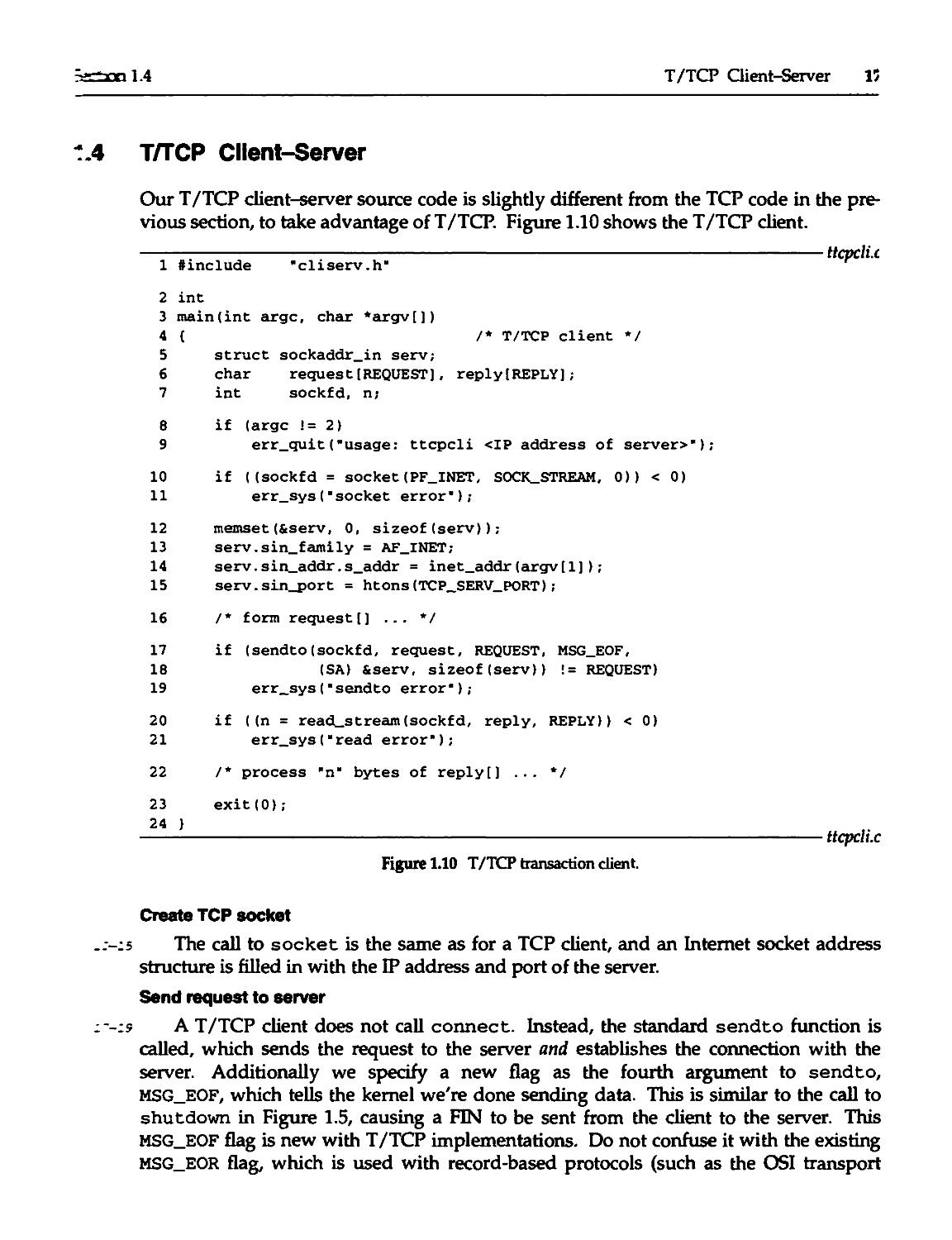
'.A T/TCP Client-Server
Our T/TCP client-server source code is slightly different from the TCP code in the
previous section, to take advantage of T/TCP. Figure 1.10 shows the T/TCP client.
ttqxli.t
1 Sinclude "cliserv.h"
2 int
3 main(int argc, char *argv[])
4 { /* T/TCP client */
5 struct sockaddr_in serv;
6 char request[REQUEST], reply[REPLY];
7 int sockfd, n;
8 if (argc != 2)
9 err_quit("usage: ttcpcli <IP address of server>");
10 if ((sockfd = socket (PF_INET, SOCICSTREAM, 0)) < 0)
11 err_sys("socket error");
12 memset(&serv, 0, sizeof (serv) ),-
13 serv.sin_family = AF_INET;
14 serv.sin_addr.s_addr = inet_addr(argv[l]);
15 serv.sin_port = htons(TCP_SERV_PORT);
16 /* form request!] ... */
17 if (sendto(sockfd, request, REQUEST, MSG_EOF,
18 (SA) &serv, sizeof(serv)) != REQUEST)
19 err_sys("sendto error");
20 if ((n = reacLstream (sockfd, reply, REPLY)) < 0)
21 err_sys("read error");
22 /* process "n" bytes of replyM ... */
23 exit(0);
24 )
ttcpcluc
Figure 1.10 T/TCP transaction client.
Create TCP socket
_:-:5 The call to socket is the same as for a TCP client, and an Internet socket address
structure is filled in with the IP address and port of the server.
Send request to server
z--i9 A T/TCP client does not call connect. Instead, the standard sendto function is
called, which sends the request to the server and establishes the connection with the
server. Additionally we specify a new flag as the fourth argument to sendto,
MSG_EOF, which tells the kernel we're done sending data. This is similar to the call to
shutdown in Figure 1.5, causing a FIN to be sent from the client to the server. This
MSG_EOF flag is new with T/TCP implementations. Do not confuse it with the existing
MSG_EOR flag, which is used with record-based protocols (such as the OSI transport

18 T/TCP Introduction
Chapter 1
layer) to specify end-of-record. The result of this call, as we'll see in Figure 1.12, is a
single segment containing the client's SYN flag, the client's request, and the client's FIN
flag. This single call to sendto combines the functionality of connect, write, and
shutdown.
Read server's reply
20-21 The server's reply is read with the same call to read_stream as we discussed with
the TCP client.
Figure 1.11 shows the T/TCP server.
ttqxerv.c
1 #include "cliserv.h"
2 int
3 main!)
4 { /* T/TCP server */
5 struct sockaddr_in serv, cli;
6 char request[REQUEST], reply[REPLY];
7 int listenfd, sockfd, n, clilen;
8 if ((listenfd = socket(PF_INET, SOCK_STREAM, 0)) < 0)
9 err_sys("socket error");
10 memset(&serv, 0, sizeof(serv));
11 serv.sin_family = AF_INET;
12 serv.sin_addr.s_addr = htonl(INADDR_ANY);
13 serv.sin_port = htons(TCP_SERV_PORT);
14 if (binddistenfd, (SA) &serv, sizeof (serv) ) < 0)
15 err_sys("bind error");
16 if (listen(listenfd. SOMAXCONN) < 0)
17 err_sys("listen error");
18 for (;;) {
19 clilen = sizeof(cli);
20 if ((sockfd = accept(listenfd, (SA) &cli, &clilen)) < 0)
21 err_sys("accept error");
22 if ((n = read_stream(sockfd, request, REQUEST)) < 0)
23 err_sys("read error");
24 /* process "n" bytes of request!] and create replyt] ... */
25 if (sendlsockfd, reply, REPLY, MSG_EOF) != REPLY)
26 err_sys("send error");
27 close(sockfd);
28 )
29 )
- ttqtserv.c
Figure UU T/TCP transaction server.
This program is nearly the same as the TCP server in Figure 1.7: the calls to socket,
bind, listen, accept, and read_stream are identical. The only change is that the

Section 1.4
T/TCP Client-Server 19
T/TCP server sends its reply with send instead of write. This allows the MSG_EOF
flag to be specified, which combines the server's reply with the server's FIN.
Figure 1.12 shows the time line of the T/TCP client-server transaction.
ss
e"l 1
I
client
function
socket ~
sendto ^
read ->
return (data)-*
read (EOF) ;
kernel
•■ sleep
- wakeup
network
server
kernel
sleep ■*
wakeup —
function
~ socket
~ bind
~ listen
- accept
»• return
~ read (data)
~ read (EOF)
process
request
~ sendto
~ close
>WRTT
^ SPT
^RTT
Figure 1.12 Tune line of T/TCP client-server transaction.
The T/TCP client observes almost the same transaction time as the UDP client
(Figure 1.4): RTT + SPT. We might expect the T/TCP time to be slightly greater than the
UDP time, because more is being done by the TCP protocol than the UDP protocol, and
because two reads are required on both ends to read the data and the end-of-file
(compared to a single recvf rom by both ends in the UDP case). But this additional
processing time on both hosts should be much less than a single network RTT. (We provide

20 T/TCP Introduction
Chapter 1
some measurements that compare our UDP, TCP, and T/TCP client-servers in
Section 1.6.) We therefore conclude that the T/TCP transaction is less than the TCP
transaction by about one network RTT. The savings of one RTT achieved by T/TCP is from
TAO, TCP accelerated open, which bypasses the three-way handshake. In the next two
chapters we describe how this is done and in Section 4.5 we describe why this is OK.
The UDP transaction requires two network packets, the T/TCP transaction requires
three packets, and the TCP transaction requires nine packets. (These counts all assume
no packet loss.) Therefore T/TCP not only reduces the client's transaction time, but also
reduces the number of network packets. Reducing the number of network packets is
desirable because routers are often limited by the number of packets they can route,
regardless of the size of each packet.
In summary, at the expense of one additional packet and negligible latency, T/TCP
provides both reliability and adaptability, both critical features for network applications.
1.5 Test Network
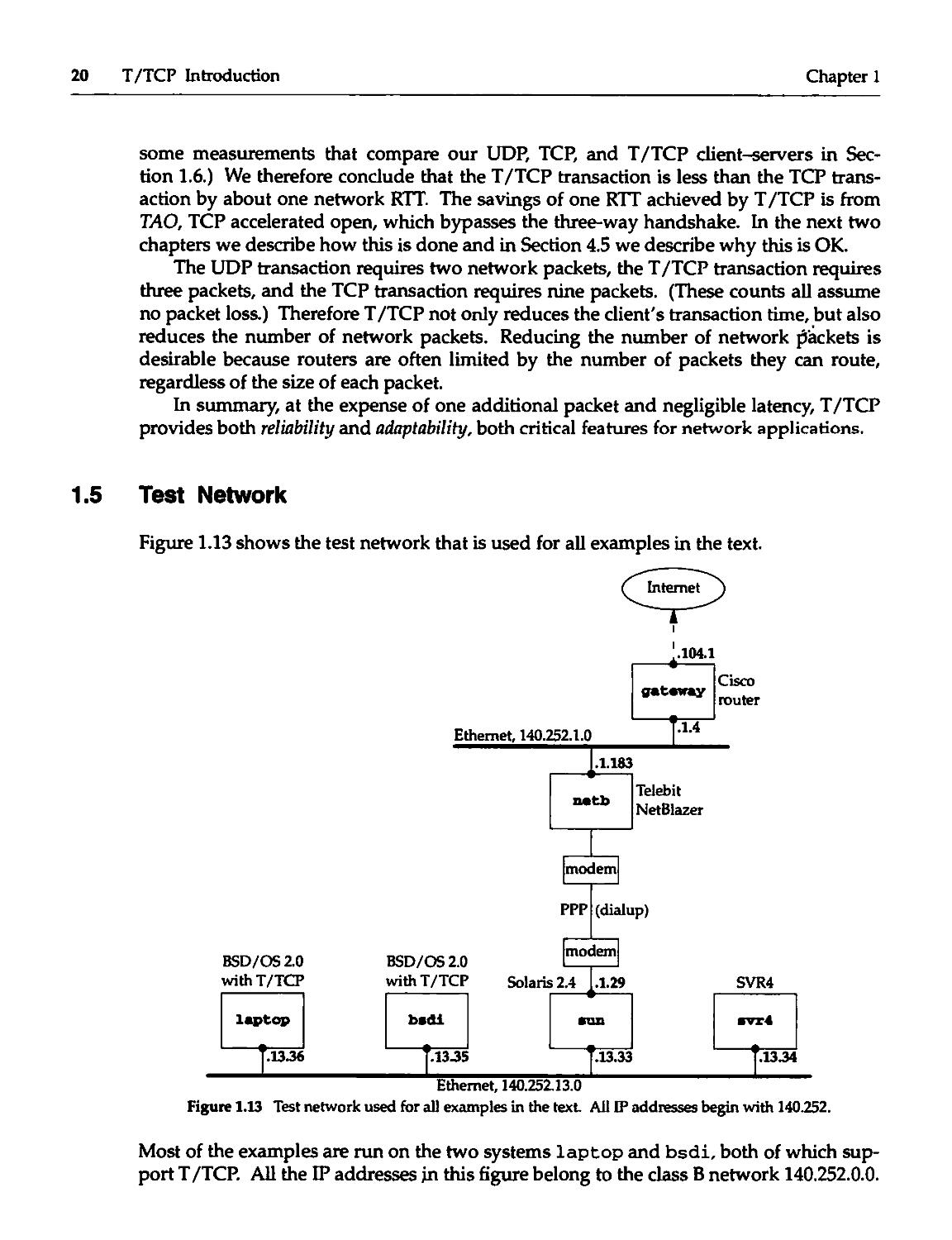
Figure 1.13 shows the test network that is used for all examples in the text.
( Internet )
'■104.1
Ethernet, 140.252.1.0
BSD/OS 2.0 BSD/OS 2 0
with T/TCP
laptop
.1336
with T/TCP
bsdl
".13 JS
.1.183
natb
1
Solaris
>2
modem
PPP
(di«
modem
.4
.1.2
gateway
.,4
Telebit
NetBlazer
dup)
9
•us
.13.33
Cisco
router
SVR4
avx4
".13 M
Ethernet, 140.252.13.0
Figure 1.13 Test network used for all examples in the text Ail IP addresses begin with 140.252.
Most of the examples are run on the two systems laptop and bsdi, both of which
support T/TCP. All the IP addresses in this figure belong to the class B network 140.252.0.0.

Section 1.6
Timing Example 21
All the hostnames belong to the tuc. noao. edu domain, noao stands for "National
Optical Astronomy Observatories" and tuc stands for Tucson. The notation at the top
of each box is the operating system running on that system.
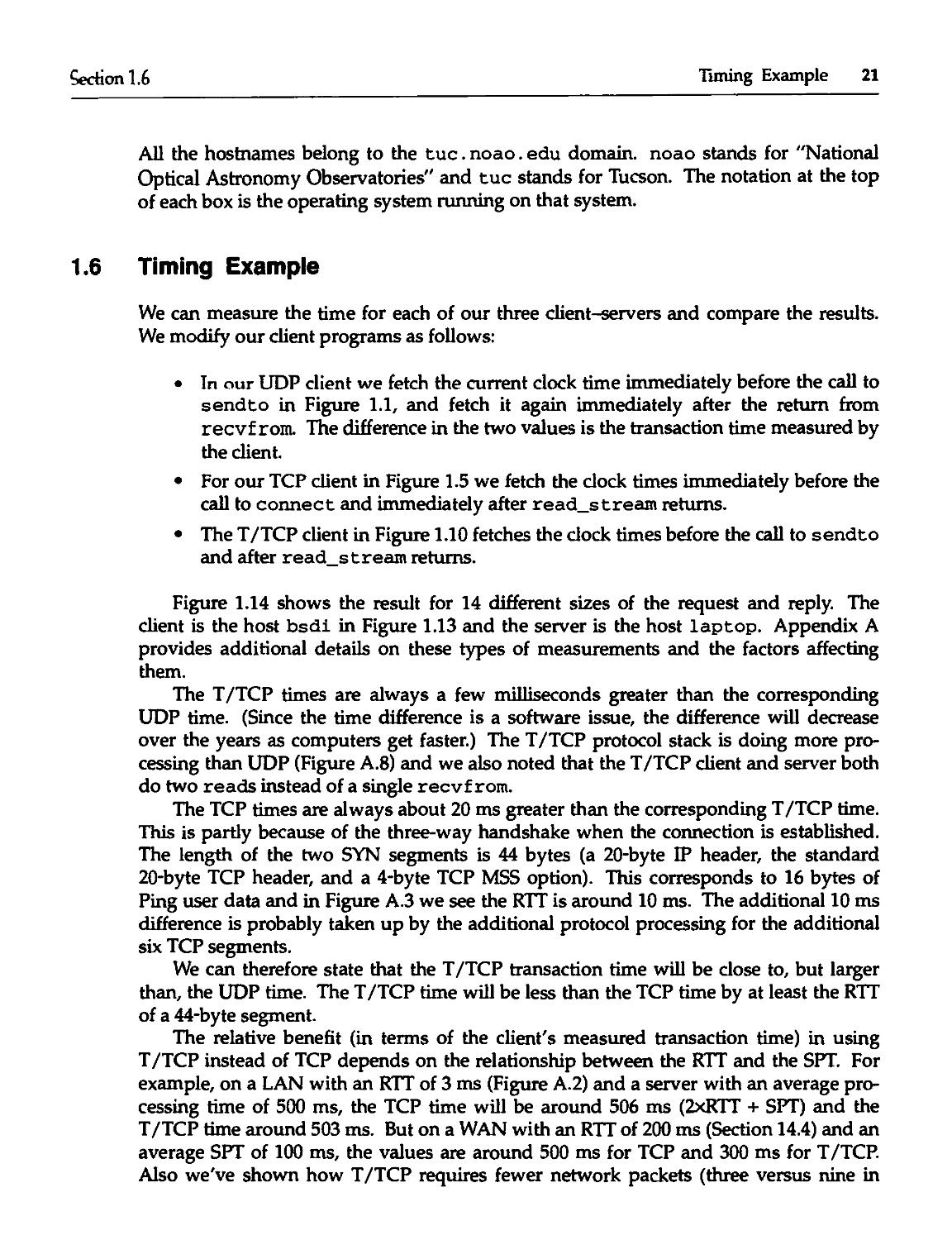
1.6 Timing Example
We can measure the time for each of our three client-servers and compare the results.
We modify our client programs as follows:
• In our UDP client we fetch the current clock time immediately before the call to
sendto in Figure 1.1, and fetch it again immediately after the return from
recvf rom. The difference in the two values is the transaction time measured by
the client.
• For our TCP client in Figure 1.5 we fetch the clock times immediately before the
call to connect and immediately after read_stream returns.
• The T/TCP client in Figure 1.10 fetches the clock times before the call to sendto
and after read_stream returns.
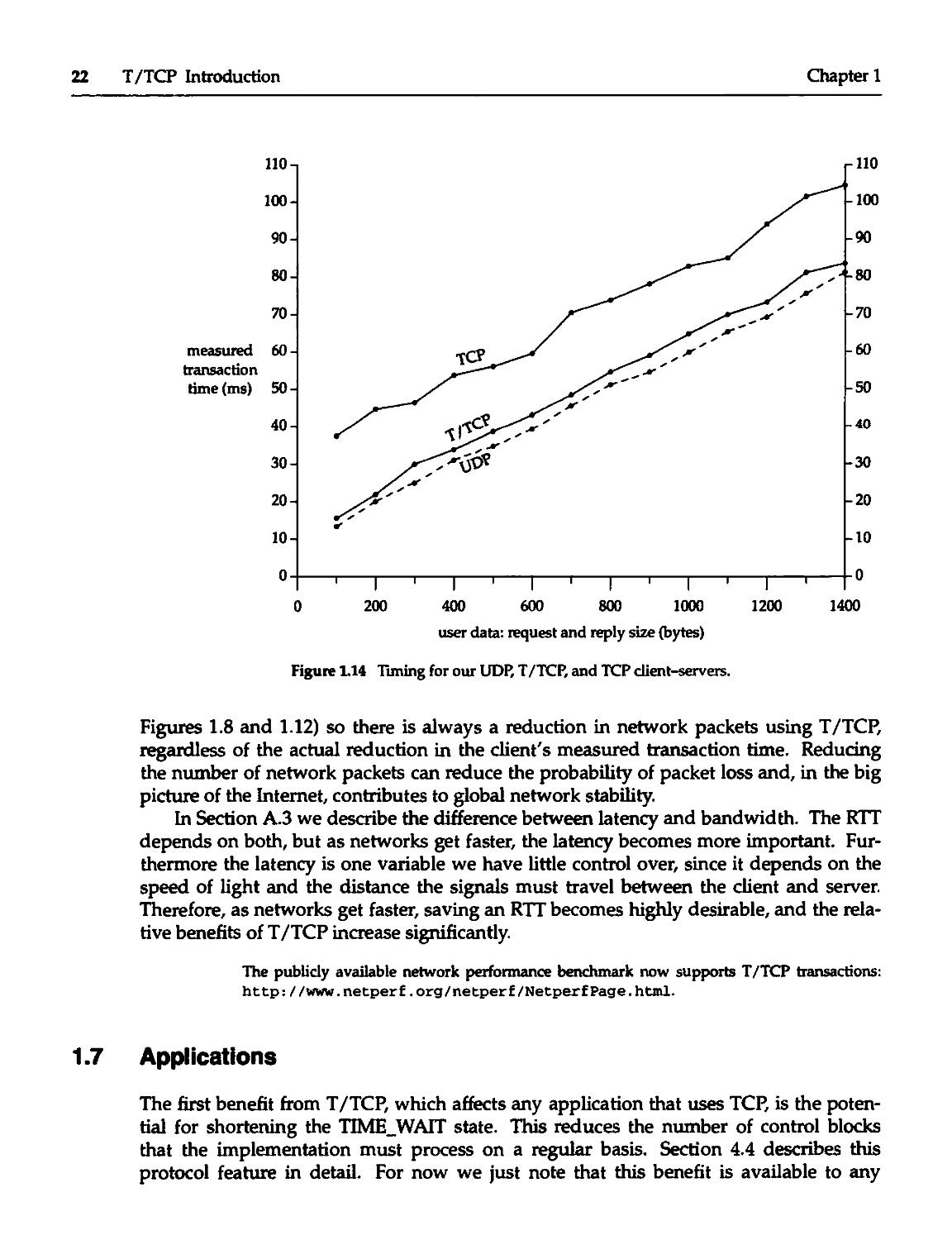
Figure 1.14 shows the result for 14 different sizes of the request and reply. The
client is the host bsdi in Figure 1.13 and the server is the host laptop. Appendix A
provides additional details on these types of measurements and the factors affecting
them.
The T/TCP times are always a few milliseconds greater than the corresponding
UDP time. (Since the time difference is a software issue, the difference will decrease
over the years as computers get faster.) The T/TCP protocol stack is doing more
processing than UDP (Figure A.8) and we also noted that the T/TCP client and server both
do two reads instead of a single recvf rom.
The TCP times are always about 20 ms greater than the corresponding T/TCP time.
This is partly because of the three-way handshake when the connection is established.
The length of the two SYN segments is 44 bytes (a 20-byte IP header, the standard
20-byte TCP header, and a 4-byte TCP MSS option). This corresponds to 16 bytes of
Ping user data and in Figure A.3 we see the RTT is around 10 ms. The additional 10 ms
difference is probably taken up by the additional protocol processing for the additional
six TCP segments.
We can therefore state that the T/TCP transaction time will be close to, but larger
than, the UDP time. The T/TCP time will be less than the TCP time by at least the RTT
of a 44-byte segment.
The relative benefit (in terms of the client's measured transaction time) in using
T/TCP instead of TCP depends on the relationship between the RTT and the SPT. For
example, on a LAN with an RTT of 3 ms (Figure A.2) and a server with an average
processing time of 500 ms, the TCP time will be around 506 ms (2xRTT + SPT) and the
T/TCP time around 503 ms. But on a WAN with an RTT of 200 ms (Section 14.4) and an
average SPT of 100 ms, the values are around 500 ms for TCP and 300 ms for T/TCP
Also we've shown how T/TCP requires fewer network packets (three versus nine in

22 T/TCP Introduction
Chapter 1
measured
transaction
time (ms)
no-.
100-
90-
80-
70-
60-
50-
40-
30-
20-
10-
0-
u ' 1 ' 1 ' 1 ' 1 ' 1 ' 1
0 200 400 600 800 1000 1200
user data: request and reply size (bytes)
rllO
-100
-90
/•"T^"80
jr'
-70
-60
-50
-40
-30
-20
-10
n
1 v
1400
Figure 1.14 Timing for our UDP, T/TCP, and TCP client-servers.
Figures 1.8 and 1.12) so there is always a reduction in network packets using T/TCP,
regardless of the actual reduction in the client's measured transaction time. Reducing
the number of network packets can reduce the probability of packet loss and, in the big
picture of the Internet, contributes to global network stability.
In Section A.3 we describe the difference between latency and bandwidth. The RTT
depends on both, but as networks get faster, the latency becomes more important.
Furthermore the latency is one variable we have little control over, since it depends on the
speed of light and the distance the signals must travel between the client and server.
Therefore, as networks get faster, saving an RTT becomes highly desirable, and the
relative benefits of T/TCP increase significantly.
The publicly available network performance benchmark now supports T/TCP transactions:
http://www.netper£.org/netper£/NetperfPage.html.
1.7 Applications
The first benefit from T/TCP, which affects any application that uses TCP, is the
potential for shortening the TTME_WArT state. This reduces the number of control blocks
that the implementation must process on a regular basis. Section 4.4 describes this
protocol feature in detail. For now we just note that this benefit is available to any

Section 1.7
Applications 23
application that deals with short (typically less than 2-minute) TCP connections if both
hosts support T/TCP.
Perhaps the greatest benefit of T/TCP is avoiding the three-way handshake, and
any applications that exchange small amounts of data will benefit from the reduced
latency provided by T/TCP. We'll give a few examples. (Appendix B talks about the
coding changes required to avoid the three-way handshake with T/TCP.)
World Wide Web: Hypertext Transfer Protocol
The WWW and its underlying HTTP protocol (which we describe in Chapter 13)
would benefit greatly from T/TCP. [Mogul 1995b] notes that: "The main contributor to
Web latency, however, is network communication. ... If we cannot increase the speed
of light, we should at least minimize the number of round trips required for an
interaction. The Hypertext Transfer Protocol (HTTP), as it is currently used in the Web, incurs
many more round trips than necessary."
For example, in a random sample of 200,000 HTTP retrievals, [Mogul 1995b] found
that the median length of the reply was 1770 bytes. (The median is often used, instead
of the mean, since a few large files can skew the mean.) Mogul cites another sample of
almost 1.5 million retrievals in which the median reply was 958 bytes. The client
request is often smaller: between 100 and 300 bytes.
The typical HTTP client-server transaction looks similar to Figure 1.8. The client
does the active open, sends a small request to the server, the server sends back a reply,
and the server closes the connection. This is a perfect candidate for T/TCP, which
would save the round trip of the three-way handshake by combining the client's SYN
with the client's request. This also saves network packets, which now that Web traffic
volume is so huge, could be significant.
FTP Data Connection
Another candidate is the FTP data connection. In one analysis of Internet traffic,
[Paxson 1994b] found that the average FTP data connection transferred around 3000
bytes. Page 429 of Volume 1 shows an example FTP data connection, and it is similar to
Figure 1.12 although the data flow is unidirectional. The eight segments in this figure
would be reduced to three with T/TCP.
Domain Name System (DNS)
DNS client queries are sent to a DNS server using UDP. The server responds using UDP
but if the reply exceeds 512 bytes, only the first 512 bytes are returned along with a
"truncated" flag indicating that more information is available. The client then resends
the query using TCP and the server returns the entire reply using TCP.
This technique is used because there is no guarantee that a given host can
reassemble an IP datagram exceeding 576 bytes. (Indeed, many UDP applications limit
themselves to 512 bytes of user data to stay below this 576-byte limit.) Since TCP is a byte-
stream protocol, the size of the reply is not a problem. The sending TCP divides the

24 T/TCP Introduction
Chapter 1
application's reply into whatever size pieces are appropriate, up to the maximum
segment size (MSS) announced by the peer when the connection was established. The
receiving TCP takes these segments and passes the data to the receiving application in
whatever size reads the application issues.
A DNS client and server could use T/TCP, obtaining the speed of a UDP
request-reply with all the added benefits of TCP.
Remote Procedure Calls (RPC)
Any paper describing a transport protocol intended for transactions always mentions
RPC as a candidate for the protocol. RPC involves the client sending a request to the
server consisting of the procedure to execute on the server along with the arguments
from the client. The server's reply contains the return values from the procedure.
Section 29.2 of [Stevens 1994] discusses Sun RPC.
RPC packages normally go to great lengths to add reliability to the RPC protocol so
it can run over an unreliable protocol such as UDP, to avoid the three-way handshake of
TCP. RPC would benefit from T/TCP, giving it the reliability of TCP without the cost of
the three-way handshake.
Other candidates for T/TCP are all the applications that are built on RPC, such as
the Network File System (NFS).
1.8 History
One of the early RFCs dealing with transaction processing is RFC 938 [Miller 1985]. It
specifies IRTP, the Internet Reliable Transaction Protocol, which provides reliable,
sequenced delivery of packets of data. The RFC defines a transaction as a small, self-
contained message. IRTP defines a sustained underlying connection between any two
hosts (i.e., IP addresses) that is resynchronized when either of the two hosts reboots.
IRTP sits on top of IP and defines its own 8-byte protocol header.
RFC 955 [Braden 1985] does not specify a protocol per se, but rather provides some
design criteria for a transaction protocol. It notes that the two predominant transport
protocols, UDP and TCP, are far apart with regard to the services they provide, and that
a transaction protocol falls into the gap between UDP and TCP. The RFC defines a
transaction as a simple exchange of messages: a request to the server followed by a
reply to the client. It notes that transactions share the following characteristics:
asymmetrical model (one end is the client, the other is the server), simplex data transfer (data
is never sent in both directions at the same time), short duration (perhaps tens of
seconds, but never hours), low delay, few data packets, and message orientation (not a byte
stream).
An example examined by the RFC is the DNS. It notes that the TCP/UDP choice
for a name server presents an ugly dilemma. The solution should provide reliable
delivery of data, no explicit connection setup or teardown, fragmentation and
reassembly of messages (so that the application doesn't have to know about magic numbers like

Section 1.8
History 25
576), and minimal idle state on both ends. TCP provides all these features, except TCP
requires the connection setup and teardown.
Another related protocol is RDP, the Reliable Data Protocol, defined in RFC 908
[Velten, Hinden, and Sax 1984] with an update in RFC 1151 [Partridge and Hinden
1990]. Implementation experience is found in [Partridge 1987]. [Partridge 1990a] makes
the following comments on RDP: "When people ask for a reliable datagram protocol
(and before Jon Postel jumps on me, yes Jon, I know it is an oxymoron) what they
typically mean is a transaction protocol—a protocol that allows them to exchange data units
reliably with multiple remote systems. A sort of reliable version of UDR RDP should
be viewed as a record-oriented TCP. RDP uses connections and transmits a reliable
Stream of delineated data. It is not a transaction protocol." (RDP is not a transaction
protocol because it uses a three-way handshake just like TCP.)
RDP uses the normal sockets API, and provides a stream socket interface
(SOCK_STREAM) similar to TCP. Additionally, RDP provides the SOCK_RDM socket type
(reliably delivered message) and the SOCK_SEQPACKET socket type (sequenced packet).
VMTP, the Versatile Message Transaction Protocol, is specified in RFC 1045 [Cheri-
ton 1988]. It was explicitly designed to support transactions, as exemplified by remote
procedure calls. Like IRTP and RDP, VMTP is a transport layer that sits on top of IP.
VMTP, however, explicitly supports multicast communication, something not provided
by T/TCP or the other protocols we've mentioned in this section. ([Floyd et al. 1995]
make the argument that provision for reliable multicast communications belongs in the
application layer, not the transport layer.)
VMTP provides a different API to the application, which is described in RFC 1045.
The socket type is SOCK_TRANSACT.
Although many of the ideas in T/TCP appeared in RFC 955, the first specification
did not appear until RFC 1379 [Braden 1992b]. This RFC defined the concepts of T/TCP
and was followed by RFC 1644 [Braden 1994], which provides additional details and
discusses some implementation issues.
It is interesting to compare the number of lines of C code required to implement the
various transport layers, shown in Figure 1.15.
Protocol
UDP (Volume 2)
RDP
TCP (Volume 2)
TCP with T/TCP mods
VMTP
#linesofcode
800
2,700
4,500
5,700
21,000
Figure 1.15 Number of lines of code required to implement various transport layers.
The additional code required to support T/TCP (about 1200 lines) is one and a half
times the size of UDP. The multicast support added to 4.4BSD required about 2000 lines
of code (ignoring the device driver changes and support for multicast routing).
VMTP is available from ftp://gregorio.stanford.edu/vmtp-ip. RDP is not generally
available.

26 T/TCP Introduction
Chapter 1
1.9 Implementations
The first implementation of T/TCP was done by Bob Braden and Liming Wei at the
University of Southern California Information Sciences Institute. This work was
supported in part by the National Science Foundation under Grant Number NCR-8922231.
This implementation was done for SunOS 4.1.3 (a Berkeley-derived kernel) and was
made available via anonymous FTP in September 1994. The source code patches for
SunOS 4.1.3 can be obtained from ftp: / /f tp. isi . edu /pub/ braden /TTCP. tar. Z,
but you need the source code for the SunOS kernel to apply these patches.
The USC ISI implementation was modified by Andras Olah at the University of
Twente (Netherlands) and put into the FreeBSD 2.0 release in March 1995. The
networking code in FreeBSD 2.0 is based on the 4.4BSD-Lite release (which is described in
Volume 2). We show the chronology of the various BSD releases in Figure 1.16. All of
the work related to the routing table (which we discuss in Chapter 6) was done by
Garrett Wollman of the Massachusetts Institute of Technology. Information on obtaining
the FreeBSD implementation is available from http: / /www. f reebsd. org.
The author ported the FreeBSD implementation into the BSD/OS 2.0 kernel (which
is also based on the 4.4BSD-Lite networking code). This is the code running in the hosts
bsdi and laptop (Figure 1.13), which are used throughout the text. These
modifications to BSD/OS to support T/TCP are available through the author's home page:
http://www.noao.edu/-rstevens.
Figure 1.16 shows a chronology of the various BSD releases, indicating the
important TCP/IP features. The releases shown on the left side are publicly available source
code releases containing all of the networking code: the protocols themselves, the kernel
routines for the networking interface, and many of the applications and utilities (such as
Telnet and FTP).
The official name of the software used as the foundation for the T/TCP
implementation described in this text is 4.4BSD-Lite, but well refer to it simply as Net/3. Also
realize that the publicly available Net/3 release does not include the T/TCP
modifications covered in this text. When we use the term Net/3 we refer to the publicly
available release that does not include T/TCP.
4.4BSD-Lite2 is the 1995 update to 4.4BSD-Lite. From a networking perspective the
changes from Lite to Lite2 are bug fixes and minor enhancements (such as the timing
out of persist probes, which we discuss in Section 14.9). We show three systems that are
based on the Lite code: BSD/OS, FreeBSD, and NetBSD. As of this writing all are based
on the Lite code, but all three should move to the Lite2 code base with the next major
release. A CD-ROM containing the Lite2 release is available from Walnut Creek
CDROM, http: / /www. cdrom. com.
Throughout the text we'll use the term Berkeley-derived implementation to refer to
vendor implementations such as SunOS, SVR4 (System V Release 4), and ATX, whose
TCP/IP code was originally developed from the Berkeley sources. These
implementations have much in common, often including the same bugs!

Implementations 2'
BSD Networking Software
Release 1.0 (1989): Net/1
BSD Networking Software
Release 2.0 (1991): Net/2
4.2BSD(1983)
first widely available
release of TCP/IP
43BSDU986)
TCP performance improvements
4.3BSD Tahoe (1988)
slow start,
congestion avoidance,
fast retransmit
4.3BSD Reno (1990)
fast recovery,
TCP header prediction,
SUP header compression,
routing table changes
4.4BSD (1993)
multicasting,
long fat pipe modifications
4.4BSD-Lite (1994)
referred to in text as Net/3
4.4BSD-Lite2 (1995)
BSD/OS
!>FreeBSD
Net BSD
Figure 1.16 Various BSD releases with important TCP/IP features.

28 T/TCP Introduction
Chapter 1
1.10 Summary
The purpose of this chapter has been to convince the reader that T/TCP provides a
solution to several real-world network application problems. We started by comparing
a simple client-server, which we wrote using UDP, TCP, and T/TCP. Two packets were
exchanged using UDP, nine with TCP, and three with T/TCP. Furthermore, we showed
that the client's measured transaction time is almost the same with T/TCP as with UDP.
The timing measurements in Figure 1.14 confirmed our claims. In addition to matching
UDP's performance, T/TCP also provides reliability and adaptability, both ''major
improvements over UDP.
T/TCP obtains these results by avoiding the normal TCP three-way handshake. To
take advantage of this savings, small coding changes are required in the T/TCP client
and server, basically calling sendto instead of connect, write, and shutdown on the
client side.
We'll examine more T/TCP examples in the following three chapters, as we explore
how the protocol operates.

2
T/TCP Protocol
2.1 Introduction
We divide our discussion of the T/TCP protocol into two chapters (Chapters 2 and 4) so
we can look at some T/TCP examples (Chapter 3) before delving into the protocol. This
chapter is an introduction to the protocol techniques and the required implementation
variables. The next chapter looks at some T/TCP examples, and Chapter 4 completes
our look at the T/TCP protocol.
When TCP is used for client-server transactions as shown in Chapter 1, two
problems arise:
1. The three-way handshake adds an extra RTT to the client's measured
transaction time. We saw this in Figure 1.8.
2. Since the client does the active close (that is, the client sends the first FIN), the
client's end of the connection remains in the TIME_WArr state for 240 seconds
after the client receives the server's FIN.
The combination of the TME_WATT state and the 16-bit TCP port numbers
limits the maximum transaction rate between any two hosts. For example, if the
same client host continually performs transactions with the same server host, it
must either wait 240 seconds between each transaction or it must use a different
port for each successive transaction. But only 64,512 ports (65535 minus the
1023 well-known ports) are available every 240 seconds, limiting the rate to 268
transactions per second. On a LAN with an RTT around 1-3 ms, it is possible to
exceed this rate.
Also, even if the application stays below this rate, say, 50,000 transactions every
240 seconds, while the connection is in the TIME_WArr state on the client, a
29

30 T/TCP Protocol
Chapter 2
control block is required to maintain the state of the connection. In the BSD
implementation presented in Volume 2, an Internet protocol control block
(requiring 84 bytes), a TCP control block (140 bytes), and an IP/TCP header
template (40 bytes) are required. This requires 13,200,000 bytes of kernel
memory, which is a lot, even as computer memory sizes increase.
T/TCP solves these two problems by bypassing the three-way handshake and
shortening the TIME_WAIT state from 240 seconds to approximately 12 seconds. Well examine
both of these features in detail in Chapter 4.
The essence of T/TCP is called TAO, TCP accelerated open, which bypasses the
three-way handshake. T/TCP assigns a unique identifier, called a connection count (CC),
to each connection that a host establishes. Each T/TCP host remembers the most recent
connection count used with each peer for some period of time When a server receives a
SYN from a T/TCP client and the SYN contains a connection count that is greater than
the most recent connection count received from this peer, this guarantees that the SYN
is new and allows the receiving TCP to accept the SYN without the three-way
handshake. This is called the TAO test, and when this test fails, TCP reverts back to the three-
way handshake to verify that the received SYN is new.
2.2 New TCP Options for T/TCP
Three new TCP options are used with T/TCP. Figure 2.1 shows all currently used TCP
options. The first three are from the original TCP specification, RFC 793 [Postel 1981b].
The window scale and timestamp are defined in RFC 1323 Qacobson, Braden, and Bor-
man 1992]. The last three—CC, CCnew, and CCecho—are new with T/TCP and are
defined in RFC 1644 [Braden 1994]. The rules for these last three options are as follows:
1. The CC option can be sent in an initial SYN segment: the active open performed
by the client. It can also be sent in other segments but only if the other end sent
a CC or a CCnew option with its SYN.
2. The CCnew option can only appear in an initial SYN segment. A client TCP
sends this option instead of a CC option when the client needs to perform the
normal three-way handshake.
3. The CCecho option can only appear in the second segment of a three-way
handshake: the segment containing a SYN and an ACK (normally sent by the server).
It echoes the client's CC or CCnew value and informs the client that the server
understands T/TCP.
We'll say more about these options in this and following chapters as we look at T/TCP
examples.
Notice that the three new options for T/TCP all occupy 6 bytes. To keep the options
on a 4-byte boundary, which can help performance on some architectures, these three
options are normally preceded by two 1-byte no-operations (NOPs).

^cnffliI2
New TCP Options for T/TCP 31
3*'
r
End-of-option list (EOL):
No-operahon (NOP):
Maximum segment size'
en
FC 132
K
Window scale factor:
Times tamp:
RFC 1644
CC:
CCnew:
CCecho:
kind=0
lbyte
kind=l
lbyte
kind=2
lbyte
kind =3
lbyte
kind=8
lbyte
kind=ll
lbyte
kind=12
lbyte
kind=13
lbyte
Ien=4
lbyte
len=3
lbyte
len=10
lbyte
len=6
lbyte
len=6
lbyte
len=6
lbyte
Figur
maximum
segment
size(MSS)
2 bytes
shift
count
lbyte
timestamp value
4 bytes
connection count
4 bytes
new connection count
4 bytes
connection count echo
e2.1 TCP
4 bytes
options.
timestamp echo reply
4 bytes
Figure 2.2 shows the TCP options in an initial SYN segment from a client to a server,
when the client supports both RFC 1323 and T/TCP. We explicitly show the kind and
len for each option, and show the NOPs as shaded boxes with a kind of 1. The second
option is designated as "WS" for the window scale option. The numbers at the top are
the byte offsets from the start of the options. This example requires 28 bytes of TCP
options, which have a maximum size of 40 bytes. Notice that the padding with NOPs
places all four of the 4-byte values on a 4-byte boundary.

32 T/TCP Protocol
Chapter 2
12
16
20
24
28
Mssji
si*
'IK
AtfLLi
10
timestamp
■ ' * f -■• *' J
cc
-i—i—i-
Figure Z2 TCP options in initial SYN from a client supporting both RFC 1323 and T/TCP.
If the server does not support either RFC 1323 or T/TCP, the reply with the SYN
and ACK will contain only the MSS option. But if the server supports both RFC 1323
and T/TCP, the reply will contain the options shown in Figure 2.3. This reply contains
36 bytes of TCP options.
12
16
20
24
28
32
36
■tin
MSS
10
timestamp
timestamp
echo
CC
VI
13
CCecho
Figure 23 TCP options in server's reply to Figure 2.2.
Since a CCecho option is always sent with a CC option, the design of T/TCP could have
combined these two options into one, saving 4 bytes of scarce TCP option space. Alternately, since
this worst case option scenario occurs only with the server's SYN/ACK, which necessitates the
slow path through TCP input anyway, 7 bytes can be saved by omitting the NOP bytes.
Since the MSS and window scale options only appear on SYN segments, and the
CCecho option only appears on a SYN/ACK segment, all future segments on this
connection, assuming both ends support RFC 1323 and T/TCP, contain only the timestamp
and CC options. We show this in Figure 2.4.
12
16
20
—,
A'
8
10
timestamp
timestamp
echo
*
11
6
1" 1 ' "1
CC
Figure 2.4 TCP options on all non-SYN segments when both ends support RFC 1323 and T/TCP.
We see that the timestamp and CC options add 20 bytes of TCP options to all TCP
segments, once the connection is established.
When talking about T/TCP we often use the general term CC options to refer to all
three options described in this section.
What is the overhead added when using the timestamp and CC options? Assuming the
typical 512-byte MSS between hosts on different networks, to transfer a one-million-byte file takes
1954 segments with no options and 2033 segments if both the timestamp and CC options are
used, for an increase of about 4%. For hosts using an MSS of 1460 the increase in the number
of segments is only 15%.

i^3>13
T/TCP Implementation Variables 33
2.3 T/TCP Implementation Variables
T/TCP requires some new information to be maintained by the kernel. This section
describes the information and later sections show how it is used.
1. tcp_ccgen. This is a 32-bit global integer variable containing the next CC
value to use. This variable is incremented by 1 for every TCP connection
established by the host, actively or passively, regardless of whether the connection
uses T/TCP or not. This variable never assumes the value of 0. If, when
incremented, its value becomes 0, the value is set to 1.
2. A per-host cache containing three new variables: tao_cc, tao_ccsent, and
tao_mssopt. This cache is also called the TAO cache. We'll see that our T/TCP
implementation creates a routing table entry for each host with which it
communicates and stores this information in the routing table entry. (The routing
table is just a convenient location for this per-host cache. A totally separate
table could also be used for the per-host cache. T/TCP does not require any
changes to the IP routing function.) When a new entry is created in the per-host
cache, tao_cc and tao_ccsent must be initialized to 0, which means
undefined.
tao_cc is the last CC received from this host in a valid SYN segment without
an ACK (an active open). When a T/TCP host receives a SYN with a CC option,
if the option value is greater than tao_cc, the host knows that this is a new
SYN, not an old duplicate, allowing the three-way handshake to be bypassed
(the TAO test).
tao_ccsent is the last CC sent to this host in a SYN without an ACK (an active
open). When this value is undefined (0), it is set nonzero only when the peer
demonstrates the ability to use T/TCP by sending a CCecho option.
tao_mssopt is the last MSS received from this host.
3. Three new variables are added to the existing TCP control block: cc_send,
cc_recv, and t_duration. The first is the CC value to send with every
segment on this connection, the next is the CC value that we expect to receive from
the other end in every segment, and t_duration is how long the connection is
established (measured in clock ticks). When the connection is actively closed, if
this tick counter indicates the connection duration was less than the MSL, the
"nME^WAIT state will be truncated. We discuss this in more detail in
Section 4.4.

34 T/TCP Protocol
Chapter 2
We can represent these variables as shown in Figure 2.5. This figure assumes the
implementation that we describe in later chapters.
[
tcp_ccgen:
J
per-kemel
route{}
taocc
taoccsent
taojnssopt
route{}
taocc
taoccsent
tao_mssopt
> per-host
tepebf)
cc_send
cc recv
t_duration
tepebf)
ccsend
tcpcb{)
cc_recv
tduration
cc_send
cc_recv
t_duration
> per-connection
Figure 2.5 Implementation variables for T/TCP.
In this figure we use {} to denote a structure. We show the TCP control block as a
tepeb structure. Every TCP implementation must maintain a control block of some
form containing all the variables for a given connection.
2.4 State Transition Diagram
The operation of TCP can be described with a state transition diagram, as shown in
Figure 2.6. Most TCP state transition diagrams (such as the ones in Volumes 1 and 2) show
the segment that is sent as part of each transition line. For example, the transition from
CLOSED to SYN_SENT would indicate that a SYN is sent. We omit this notation from
Figure 2.6, instead noting in each box the type of segment sent when in that state. For
example, in the SYN_RCVD state a SYN is sent along with an acknowledgment of the
received SYN. In the CLOSE_WAIT state an acknowledgment of the received FIN is
sent.

Section 2.4
State Transition Diagram 35
starting point
active dose
m normal transitions for client
———♦■ normal transitions for server
appl: state transitions taken when application issues operation
recv: state transitions taken when segment received
Figure 2.6 TCP state transition diagram.

36 T/TCP Protocol
Chapter 2
We've modified the diagram in this way because with T/TCP we'll often process a
segment that causes multiple state transitions. Therefore what is important is the final
state of a connection when processing a given segment, because that determines what is
sent in reply. Without T/TCP, each received segment normally causes at most one
transition, with the exception of a received FIN/ACK, which we describe shortly.
There are some other differences between Figure 2.6 and the TCP state diagrams
shown in RFC 793 [Postel 1981b].
• RFC 793 shows a transition from LISTEN to SYN_SENT when the application
sends data. This facility is rarely provided by typical APIs.
• RFC 1122 [Braden 1989] describes a transition directly from FIN_WAIT_1 to
TEME.WAIT, upon the receipt of a FIN and an acknowledgment of the sender's
FIN. But if such a segment is received (which is typical) the ACK is processed
first, moving to the FIN_WAIT_2 state, and then the FIN is processed, moving to
the TTME.WArr state. Therefore such a segment is handled correctly by
Figure 2.6. This is an example of a single received segment causing two state
transitions.
• All states other than SYN_SENT send an ACK. (Nothing at all is sent for an
endpoint in the LISTEN state.) This is because an ACK is free: room is always
provided in the standard TCP header for the acknowledgment field. Therefore
TCP always acknowledges the highest sequence number received (plus one)
except on the SYN corresponding to an active open (SYN_SENT) and for some
RST segments.
sequence of TCP input Processing
The sequence in which TCP must process the various pieces of information in a received
segment (SYN, FIN, ACK, URG, and RST flags, possible data, and possible options) is
not random and is not up to the implementation. The ordering is spelled out explicitly
in RFC 793. A summary of these steps is shown in Figure 11.1, which also highlights the
changes made with T/TCP.
For example, when a T/TCP client receives a segment with SYN, data, FIN, and an
ACK, the SYN is processed first (since the socket is in the SYN_SENT state), then the
ACK flag, then the data, and then the FIN. Each of the three flags can cause a change in
the socket's connection state.
2.5 T/TCP Extended States
T/TCP defines seven extended states, called the starred states: SYN_SENT»,
SYN.RCVD*, ESTABLISHED*, CLOSE.WATT*, LAST.ACK*, FIN_WAIT_1*, and
CLOSING*. For example, in Figure 1.12 the client sends an initial segment containing a
SYN, data, and a FIN. Sending this segment as part of an active open puts the client in

section 2.5
T/TCP Extended States 37
the SYN_SENT* state, not the normal SYNJSENT state, since a FIN must be sent. When
the server's reply is received, containing the server's SYN, data, and FIN, along with an
ACK that acknowledges the client's SYN, data, and FIN, numerous state transitions take
place.
• The ACK of the client's SYN moves the connection to the FIN_WAIT_1 state.
The ESTABLISHED state is completely bypassed since the client has already sent
its FIN.
• The ACK of the client's FIN moves the connection to the FIN_WAIT_2 state.
• The receipt of the server's FIN moves the connection to the TIME_WAn' state.
RFC 1379 details the development of a state transition diagram that includes all
these starred states, but the result is much more complicated than Figure 2.6, with many
overlapping lines. Fortunately there are simple relationships between the unstarred
states and the corresponding starred states.
• The two states SYN_SENT* and SYN_RCVT> are identical to the corresponding
unstarred states except that a FIN must be sent. That is, these two states are
entered when an active endpoint is created and the application specifies
MSG_EOF (send a FIN) before the connection is established. The normal state for
the client in this scenario is SYN_SENT*. The SYN_RCVD* state is the rare
occurrence of a simultaneous open, which is described in detail in Section 18.8 of
Volume 1.
• The five states ESTABLISHED*, CLOSEJVATT*, LAST.ACK*, rTN_WAIT_l*,
and CLOSING* are identical to the corresponding unstarred states except that a
SYN must be sent. When the connection is in one of these five states it is called
half-synchronized. These states are entered when the endpoint is passive and
receives a SYN that passes the TAO test, along with optional data and an
optional FIN. (Section 4.5 describes the TAO test in detail.) The term
half-synchronized is used because the receiver of the SYN considers the
connection established (since it passes the TAO test) even though only half of the
normal three-way handshake is complete.
Figure 2.7 shows these starred states, along with all the normal states. For each possible
state, this table shows what type of segment is sent.
We'll see that from an implementation perspective the starred states are simple to
handle. In addition to maintaining the current unstarred state, two additional flags are
maintained in the per-connection TCP control block:
• TF_SENDFIN specifies that a FIN needs to be sent (corresponding to
SYN.SENT* and SYN.RCVD*), and
• TF_SENDSYN specifies that a SYN needs to be sent (corresponding to the five
half-synchronized starred states in Figure 2.7).

38 T/TCP Protocol
Chapter 2
We identify the SYN and FIN flags that are turned on in the starred states by these two
new flags with a bold font in Figure 2.7.
Normal state
CLOSED
LISTEN
SYN.SENT
SYN.RCVD
ESTABLISHED
CLOSE.WAIT
FIN_WAIT_1
CLOSING
LAST.ACK
nN_WAIT_2
time.wait
Description
closed
listening for connection (passive open)
have sent SYN (active open)
have sent and received SYN; awaiting ACK
established (data transfer)
received FIN, waiting for application close
have closed, sent FIN; awaiting ACK and FIN
simultaneous close; awaiting ACK
received FIN have closed; awaiting ACK
have closed; awaiting FIN
2MSL wait state after active close
Send
RST,ACK
SYN
SYN, ACK
ACK
ACK
FIN, ACK
FIN, ACK
FIN, ACK
ACK
ACK
Starred state
SYN_SENT»
SYN_RCVD»
ESTABLISHED*
CLOSE_WATT»
FIN_WAIT_1»
CLOSING*
LAST.ACK*
Send
SYN, FIN
SYN, FIN, ACK
SYN, ACK v-
SYN, ACK
SYN, FIN, ACK
SYN, FIN, ACK
SYN, FIN, ACK
Figure 2.7 What TCP sends based on current state (normal and starred).
2.6 Summary
The essence of T/TCP is TAO, TCP accelerated open. This allows a T/TCP server to
receive a SYN from a T/TCP client and know that the SYN is new, avoiding the three-
way handshake. The technique used to ensure that a received SYN is new (the TAO
test) is to assign a unique identifier, the connection count, to each connection that a host
establishes. Each T/TCP host remembers the most recent connection count used with
each peer for some period of time, and the TAO test succeeds if a received SYN has a
connection count that is greater than the most recent connection count received from
this peer.
Three new options are defined by T/TCP: the CC, CCnew, and CCecho options. All
contain a length field (as do the other new options defined by RFC 1323), allowing
implementations that do not understand the options to skip over them. If T/TCP is
used for a given connection, the CC option will appear on every segment (but
sometimes the CCnew option is used instead on the client SYN).
One global kernel variable is added with T/TCP, along with three variables in a per-
host cache, and three variables in the existing per-connection control block. The T/TCP
implementation that we describe in this text uses the existing routing table as the per-
host cache.
T/TCP adds 7 additional states to the existing 10 states in the TCP state transition
diagram. But the actual implementation turns out to be simple: two new per-
connection flags that indicate whether a SYN needs to be sent and whether a FIN needs
to be sent are all that is needed to define the 7 new states, since the new states are
extensions to existing states.

3
T/TCP Examples
Introduction
We'll now go through some T/TCP examples to see exactly how the three new TCF
options are used. These examples show how T/TCP handles the following conditions:
• client reboot,
• normal T/TCP transactions,
• server receipt of an old duplicate SYN,
• server reboot,
• handling of a request or reply that exceeds the MSS, and
• backward compatibility with hosts that do not support T/TCP.
In the next chapter we consider two additional examples: SYNs that are not old
duplicates but arrive out of order at the server, and client handling of duplicate SYN/ACK
responses from the server.
In these examples the T/TCP client is the host bsdi (Figure 1.13) and the server is
the host laptop. The programs being run are the T/TCP client from Figure 1.10 and
the T/TCP server from Figure 1.11. The client sends a 300-byte request and the server
responds with a 400-byte reply.
In these examples support for RFC 1323 has been turned off in the client. This
prevents the client from sending window scale and timestamp options with its initial SYN.
(Since the client doesn't send either option, the server won't respond with either one, so
it doesn't matter whether or not RFC 1323 support is enabled on the server.) We do this
to avoid complicating the examples with other factors that don't affect our discussion of
T/TCP. Normally we would want to use RFC 1323 with T/TCP since the timestamp
option provides additional protection against old duplicate segments being
misinterpreted as part of an existing connection. That is, even with T/TCP, PAWS (protection
39

40 T/TCP Examples
Chapter 3
against wrapped sequence numbers, Section 24.6 of Volume 1) is still needed on high-
bandwidth connections that transfer lots of data.
3.2 Client Reboot
We start our sequence of client-server transactions immediately after the client reboots.
When the client application calls sendto, a routing table entry is created for the server
with the tao_ccsent value initialized to 0 (undefined). TCP therefore sends a CCnew
option instead of a CC option. The receipt of the CCnew option causes the server TCP
to perform the normal three-way handshake, as shown by the Tcpdump output in
Figure 3.1. (Readers unfamiliar with the operation of Tcpdump and the output that it
generates should refer to Appendix A of Volume 1. Also, when looking at these packet
traces, don't forget that a SYN and a FIN each consumes a byte in the sequence number
space.)
3 o.o
bsdi.1024 > laptop.8888:
2 0.020542 (0.0205) laptop.8888 > bsdi.1024:
3 0.021479 (0.0009) bsdi.1024 > laptop.8888:
4 0.029471 (0.0080) laptop.8888 > bsdi.1024:
5 0.042086 (0.0126) laptop.8888 > bsdi.1024:
6 0.042969 (0.0009) bsdi.1024 > laptop.8888:
SFP 36858825:36859125(300)
win 8568 <mss 1460,nop,nop,ccnew 1>
S 76355292:76355292(0)
ack 36858826 win 8712
<mss 1460,nop,nop,cc 18,
nop,nop,ccecho 1>
F 301:301(0)
ack 1 win 8712 <nop,nop,cc 1>
ack 302 win 8412 <nop,nop,cc 18>
FP 1:401(400)
ack 302 win 8712 <nop,nop,cc 18>
ack 402 win 8312 <nop,nop,cc 1>
Figure 3.1 T/TCP client reboots and sends a transaction to server.
In line 1 we see from the CCnew option that the client's tcp_ccgen is 1. In line 2
the server echoes the client's CCnew value, and the server's tcp_ccgen is 18. The
server ACKs the client's SYN but not the client's data. Since the server receives a
CCnew option from the client, the server must complete a normal three-way
handshake, even if it has an entry in its per-host cache for the client. The server TCP cannot
pass the 300 bytes of data to the server process until the three-way handshake is
complete.
Line 3 is the final segment of the three-way handshake: an acknowledgment of the
server's SYN. The client resends the FIN but not the 300 bytes of data. When the server
receives this segment it immediately acknowledges the data and the FIN with line 4.
The ACK is sent immediately, instead of being delayed, so as to prevent the client from
timing out from the data that was sent on line 1.
Line 5 is the server's reply along with the server's FIN, and both are acknowledged
by the client in line 6. Notice that lines 3, 4,5, and 6 contain a CC option. The CCnew
and CCecho only appear in the first and second segments, respectively.

•~?5an32
Client Reboot 41
From this point on we will no longer show the explicit NOPs in the T/TCP segments since
they are not required and they complicate our presentation. They are inserted for increased
performance by forcing the 4-byte value in the option to a 4-byte boundary.
Astute readers may note that the initial sequence number (ISN) used by the client TCP, soon
after the client has rebooted, does not follow the normal partem discussed in Exercise 18.1 of
Volume 1. Also, the server's initial sequence number is an even number, which normally
never occurs with Berkeley-derived implementations. What's happening here is that the initial
sequence number for a connection is being randomized. The increment that is added to the
kernel's ISN every 500 ms is also randomized. This helps prevent sequence number attacks, as
described in [Bellovin 1989]. This change was put into BSD/OS 2.0 and then 4.4B5D-Lite2
after the well-publicized Internet break-in during December 1994 [Shimomura 1995].
Time Line Diagrams
Figure 3.2 shows a time line diagram of the exchange in Figure 3.1.
bsdi.1024 laptop.8888
SYN_SENT» 1
FIN WAIT 1
FIN WAIT 2
TIME WAIT
*«*/, ccnew 1> ■
SYN 763552927^292^0)^
S^SssT4607ccT8^icho7^
SYN.RCVD
ESTABLISHED,
. CLOSE.WAIT
5LASTACK
CLOSED
Figure 3.2 Time line of segment exchange in Figure 3.1.
We show the two segments containing data as thicker lines (segments 1 and 5). We also
show the state transitions that take place with each received segment. The client starts
in the SYN_SENT* state, since the client calls sendto specifying the MSG_EOF flag.
Two transitions take place when segment 3 is processed by the server. First the ACK of
the server's SYN moves the connection to the ESTABLISHED state, followed by the FIN
moving the connection to the CLOSE_WATT state. When the server sends its reply,
specifying the MSG_EOF flag, the server's end moves to the LAST_ACK state. Also
notice that the client resends the FIN flag with segment 3 (recall Figure 2.7).

42 T/TCP Examples
Chapter 3
3.3 Normal T/TCP Transaction
Next we initiate another transaction between the same client and server. This time the
client finds a nonzero tao_ccsent value in its per-host cache for the server, so it sends
a CC option with the next tcp_ccgen value of 2. (This is the second TCP connection
established by the client since reboot.) The exchange is shown in Figure 3.3.
1 0.0 bsdi.1025 > laptop.8888: SFP 40203490:40203790(300)
win 8712 <mss 1460,cc 2> v-
2 0.026469 (0.0265) laptop.8888 > bsdi.1025: SFP 79578838:79579238(400)
ack 40203792 win 8712
<mss 1460,cc 19,ccecho 2>
3 0.027573 (0.0011) bsdi.1025 > laptop.8888: .
ack 402 win 8312 <cc 2>
Figure 33 Normal T/TCP client-server transaction.
This is the normal, minimal T/TCP exchange consisting of three segments. Figure 3.4
shows the time line for this exchange, with the state transitions.
bsdi.1025 laptop.8888
Figure 3.4 Time line of segment exchange in Figure 3.3.
The client enters the SYNJSENT* state when it sends its SYN, data, and FIN. When
the server receives this segment and the TAO test succeeds, the server enters the half-
synchronized ESTABLISHED* state. The data is processed and passed to the server
process. Later in the processing of this segment the FIN is encountered, moving the
connection to the CLOSE_WAIT* state. The server's state is still a starred state, since a SYN
must still be sent. When the server sends its reply, and the process specifies the
MSG_EOF flag, the server's end moves to the LAST_ACK* state. As indicated in
Figure 2.7, the segment sent for this state contains the SYN, FIN, and ACK flags.
When the client receives segment 2, the ACK of its SYN moves the connection to the
FJN_WArr_l state. Later in the processing of this segment the ACK of the client's FIN

-je3.4
Server Receives Old Duplicate SYN 43
is processed, moving to the FIN_WAIT_2 state. The server's reply is passed to the client
process. Still later in the processing of this segment the server's FIN is processed,
moving to the TIME_WAIT state. The client responds with an ACK in this final state.
When the server receives segment 3, the ACK of the server's SYN moves the
connection to the LAST_ACK state and the ACK of the server's FIN moves the connection
to the CLOSED state.
This example clearly shows how multiple state transitions can occur in the T/TCP
processing of a single received segment. It also shows how a process can receive data in
a state other than the ESTABLISHED state, which occurs when the client half-closes the
connection (segment 1) but then receives data while in the FIN_WArr_l state
(segment 2).
Server Receives Old Duplicate SYN
What happens when the server receives what appears to be an old CC value from the
client? We cause the client to send a SYN segment with a CC of 1, which is less than the
most recent CC value that the server has received from this client (2, in Figure 3.3). This
could happen, for example, if the segment with the CC of 1 were a segment from an
earlier incarnation of this connection that got delayed in the network and appeared
sometime later, but within MSL seconds of when it was sent.
A connection is defined by a socket pair, that is, a 4-tuple consisting of an IP address
and port number on the client and an IP address and port number on the server. New
instances of a connection are called incarnations of that connection.
We see in Figure 3.5 that when the server receives the SYN with a CC of 1 it forces a
three-way handshake to occur, since it doesn't know whether this is an old duplicate oi
not.
1 0.0 bsdi.1027 > laptop.8888: SFP 80000000:80000300(300)
win 4096 <mss 1460,cc 1>
2 0.018391 (0.0184) laptop.8888 > bsdi.1027: S 132492350:132492350(0)
ack 80000001 win 8712
<mss 1460,cc 21,ccecho 1>
3 0.019266 (0.0009) bsdi.1027 > laptop.8888: R 80000001:80000001(0) win 0
Figure 3.5 T/TCP server receives old duplicate of client SYN.
Since the three-way handshake is taking place (which we can tell because only the SYN
is ACKed, not the data), the server TCP cannot pass the 300 bytes of data to the servei
process until the handshake is complete.
In this example segment 1 is an old duplicate (the client TCP is not currently
awaiting a response to this SYN), so when the server's SYN/ACK in segment 2 arrives, the
client TCP responds with an RST (segment 3). This is what should happen. The servei
TCP discards the 300 bytes of data when it receives the RST, and does not return frorr
the pending accept that the server process is waiting for.

44 T/TCP Examples
Chapter .-
Segment 1 was generated by a special test program. We are not able to have the client T/TCT
generate this segment—instead we want it to appear as an old duplicate. The author triec
patching the kernel's tcp_ccgen variable to 1, but as we'll see in Figure 12.3. when the
kernel's tcp_ccgen is less than the last CC sent to this peer, TCP automatically sends a CCnev.
option, instead of a CC option.
Figure 3.6 shows the next, normal, T/TCP transaction between this client and
server. It is the expected three-segment exchange.
1 0.0 bsdi.1026 > laptop.8888: SFP 101619844:101620144(300)
win 8712 <mss 1460,cc 3>
2 0.028214 (0.0282) laptop.8888 > bsdi.1026: SFP 140211128:140211528(400)
ack 101620146 win 8712
<mss 1460,cc 22,ccecho 3>
3 0.029330 (0.0011) bsdi.1026 > laptop.8888: .
ack 402 win 8312 <cc 3>
Figure 3.6 Normal T/TCP client-server transaction.
The server is expecting a CC value greater than 2 from this client, so the received SYN
with a CC of 3 passes the TAO test.
3.5 Server Reboot
We now reboot the server and then send a transaction from the client once the server
has rebooted, and once the listening server process has been restarted. Figure 3.7 shows
the exchange.
1 0.0 bsdi.1027 > laptop.8888: SFP 146513089:146513389(300)
win 8712 <mss 1460,cc 4>
2 0.025420 (0.0254) axp who-has bsdi tell laptop
3 0.025872 (0.0005) arp reply bsdi is-at 0:20:af:9c:ee:95
4 0.033731 (0.0079) laptop.8888 > bsdi.1027: S 27338882:27338882(0)
ack 146513090 win 8712
<mss 1460,cc l.ccecho 4>
5 0.034697 (0.0010) bsdi.1027 > laptop.8888: F 301:301(0)
ack 1 win 8712 <cc 4>
6 0.044284 (0.0096) laptop.8888 > bsdi.1027: .
ack 302 win 8412 <cc 1>
7 0.066749 (0.0225) laptop.8888 > bsdi.1027: FP 1:401(400)
ack 302 win 8712 <cc 1>
8 0.067613 (0.0009) bsdi.1027 > laptop.8888: .
ack 402 win 8312 <cc 4>
Figure 3.7 T/TCP packet exchange after server reboots.
Since the client does not know that the server has rebooted, it sends a normal
T/TCP request with its CC of 4 (line 1). The server sends an ARP request and the client
responds with an ARP reply since the client's hardware address on the server was lost

5ecion3.6
Request or Reply Exceeds MSS 45
when the server rebooted. The server forces a normal three-way handshake to occur
(line 4), because it doesn't know the value of the last CC received from this client.
Similar to what we saw in Figure 3.1, the client completes the three-way handshake
with an ACK that also contains its FIN—the 300 bytes of data are not resent. The
client's data is retransmitted only when the client's retransmission timer expires, which
we'll see occur in Figure 3.11. Upon receiving this third segment, the server
immediately ACKs the data and the FIN. The server sends its reply (line 7), which the client
acknowledges in line 8.
After the exchange in Figure 3.7 we expect to see another minimal T/TCP
transaction between this client and server the next time they communicate, which is what we
show in Figure 3.8.
1 0.0 bsdi.1028 > laptop.8888: SFP 152213061:152213361(300)
win 8712 <mss 1460,cc 5>
2 0.034851 (0.0349) laptop.8888 > bsdi.1028: SFP 32869470:32869870(400)
ack 152213363 win 8712
<mss 1460,cc 2,ccecho 5>
3 0.035955 (0.0011) bsdi.1028 > laptop.8888: .
ack 402 win 8312 <cc 5>
Figure 3.8 Normal T/TCP client-server transaction.
as Request or Reply Exceeds MSS
In all our examples so far, the client sends less than one MSS of data, and the server
replies with less than one MSS of data. If the client application sends more than one
MSS of data, and the client TCP knows that the peer understands T/TCP, multiple
segments are sent. Since the peer's MSS is saved in the TAO cache (tao_mssopt in
Figure 2.5) the client TCP knows the MSS of the server host but the client TCP does not
know the receive window of the peer process. (Sections 18.4 and 20.4 of Volume 1 talk
about the MSS and window size, respectively.) Unlike the MSS, which is normally
constant for a given peer host, the window can be changed by the application if it changes
the size of its socket receive buffer. Furthermore, even if the peer advertises a large
window (say, 32768), if the MSS is 512, there may well be intermediate routers that cannot
handle an initial burst of 64 segments from the client to the server (i.e., slow start should
not be skipped). T/TCP handles these problems with the following two restrictions:
1. T/TCP assumes an initial send window of 4096 bytes. In Net/3 this is the
snd_wnd variable, which controls how much data TCP output can send. The
initial value of 4096 will be changed when the first segment is received from the
peer with a window advertisement.
2. T/TCP starts a connection using slow start only if the peer is nonlocal. Slow
start is when TCP sets the variable snd_cwnd to one segment. This
local/nonlocal test is given in Figure 10.14 and is based on the kernel's

46 T/TCP Examples
Chapter 3
in_localaddr function. A peer is considered local if (a) it shares the same
network and subnet as the local host, or (b) it shares the same network but a
different subnet, but the kernel's subnetsarelocal variable is nonzero.
Net/3 starts every connection using slow start (p. 902 of Volume 2) but this prevents a
transaction client from sending multiple segments to start a transaction. The
compromise is to allow multiple segments, for a total of up to 4096 bytes, but only for a local
peer.
Whenever TCP output is called, it sends up to the minimum of snd_wn9 and
snd_cwnd bytes of data. The former starts at the maximum value of a TCP window
advertisement, which we assume to be 65535. (It is actually 65535 x214, or almost 1
gigabyte, when the window scale option is being used.) For a local peer snd_wnd starts
at 4096 and snd_cwnd starts at 65535. TCP output will initially send up to 4096 bytes
until a window advertisement is received. If the peer's window advertisement is 32768,
then TCP can continue sending until the peer's window is filled (since the minimum of
32768 and 65535 is 32768). Slow start is avoided and the amount of data sent is limited
by the advertised window.
But if the peer is nonlocal, snd_wnd still starts at 40% but now snd_cwnd starts at
one segment (assume the saved MSS for this peer is 512). TCP will initially send just
one segment, and when the peer's window advertisement is received, snd_cwnd will
increase by one segment for each ACK. Slow start is now in control and the amount of
data sent is limited by the congestion window, until the congestion window exceeds the
peer's advertised window.
As an example we modified our T/TCP client and server from Chapter 1 to send a
request of 3300 bytes and a reply of 3400 bytes. Figure 3.9 shows the packet exchange.
This example shows a bug in Tcpdump's printing of relative sequence numbers for multiseg-
ment T/TCP exchanges. The acknowledgment number printed for segments 6, 8, and 10
should be 3302, not 1.
1 0.0 bsdi.1057 > laptop.8888: S 3846892142:3846893590(1448)
win 8712 <mss 1460,cc 7>
2 0.001556 (0.0016) bsdi.1057 > laptop.8888: . 3846893591:3846895043(1452)
win 8712 <cc 7>
3 0.002672 (0.0011) bsdi.1057 > laptop.8888: FP 3846895043:3846895443(400)
win 8712 <cc 7>
4 0.138283 (0.1356) laptop.8888 > bsdi.1057: S 3786170031:3786170031(0)
ack 3846895444 win 8712
<mss 1460,cc 6,ccecho 7>
5 0.139273 (0.0010) bsdi.1057 > laptop.8888: .
ack 1 win 8712 <cc 7>
6 0.179615 (0.0403) laptop.8888 > bsdi.1057: . 1:1453(1452)
ack 1 win 8712 <cc 6>
7 0.180558 (0.0009) bsdi.1057 > laptop.8888: .
ack 1453 win 7260 <cc 7>
8 0.209621 (0.0291) laptop.8888 > bsdi.1057: . 1453:2905(1452)
ack 1 win 8712 <cc 6>

_-r?-6
Request or Reply Exceeds MSS 47
9 0.210565 (0.0009) bsdi.1057 > laptop.8888: .
ack 2905 win 7260 <cc 7>
ID 0.223822 (0.0133) laptop.8888 > bsdi.1057: FP 2905:3401(496)
ack 1 win 8712 <cc 6>
11 0.224719 (0.0009) bsdi.1057 > laptop.8888: .
ack 3402 win 8216 <cc 7>
Figure 3.9 Client request of 3300 bytes and server reply of 3400 bytes.
Since the client knows that the server supports T/TCP it can send up to 4096 bytes
immediately. Segments 1, 2, and 3 are sent in the first 2.6 ms. The first segment carries
the SYN flag, 1448 bytes of data, and 12 bytes of TCP options (MSS and CC). The
second segment has no flags, 1452 bytes of data, and 8 bytes of TCP options. The third
segment carries the FIN and PSH flags, the remaining 400 bytes of data, and 8 bytes of TCP
options. Segment 2 is unique in that none of the six TCP flags is set, not even the ACK
flag. Normally the ACK flag is always on, except for a client's active open, which
carries the SYN flag. (A client can never send an ACK until it receives a segment from the
server.)
Segment 4 is the server's SYN and it also acknowledges everything the client sent:
SYN, data, and FIN. The client immediately ACKs the server's SYN with segment 5.
Segment 6 arrives 40 ms later carrying the first segment of the server's reply. It is
immediately ACKed by the client. This scenario continues with segment 8-11. The
final segment from the server (10) carries the server's FIN, and the final ACK from the
client acknowledges the final segment of data and the FIN.
One question is why does the client immediately ACK the first two of the three
server replies, since they arrive in a short amount of time (44 ms)? The answer is in the
TCP_REASS macro (p. 908 of Volume 2), which is invoked for each segment of data
received by the client. Since the client's end of the connection enters the FIN_WAIT_2
state when segment 4 is processed, the test in TCP_REASS for whether the state is
ESTABLISHED fails, causing an immediate ACK instead of a delayed ACK. This
"feature" is not unique to T/TCP but can be seen with the Net/3 code whenever one end
half-closes a TCP connection and enters the FIN_WAIT_1 or FIN_WAIT_2 state. From
that point on, every segment of data from the peer is immediately ACKed. The test for
the ESTABLISHED state in the TCP_REASS macro prevents data from being passed to
the application before the three-way handshake completes. There is no need to
immediately ACK in-sequence data when the connection state is greater than ESTABLISHED
(i.e., this test should be changed).
rs_BOFUSH Socket Option
When running this example another change was required to the client source code. The
TCP_NOPUSH socket option (a new option with T/TCP) was turned on by
int n;
n = 1;
if (setsockopt(sockfd, lPPROTO_TCP, TCP_NOPUSH, (char ♦) &n, sizeof(n)) < 0)
err_sys("TCP_NOPUSH error");

48 T/TCP Examples
Chapter 3
This was done after the call to socket in Figure 1.10. The purpose of this option is to
tell TCP not to send a segment for the sole reason that doing so would empty the send
buffer.
To see the reason for this socket option we need to follow through the steps
performed by the kernel when the process calls sendto to send a 3300-byte request, also
specifying the MSG_EOF flag.
1. The kernel's sosend function (Section 16.7 of Volume 2) is eventually called to
handle the output request. It puts the first 2048 bytes into an mbuf cluster and
issues a PRU_SEND request to the protocol (TCP).
2. tcp_output is called (Figure 12.4) and since a full-sized segment can be sent,
the first 1448 bytes in the cluster are sent with the SYN flag set. (There are 12
bytes of TCP options in this segment.)
3. Since 600 bytes still remain in this mbuf cluster, another loop is made through
tcp_output. We might think that the Nagle algorithm would prevent another
segment from being sent, but notice on p. 853 of Volume 2 that the idle
variable was 1 the first time around tcp_output. It is not recalculated when the
branch to again is made after the 1448-byte segment is sent. Therefore the code
ends up in the fragment shown in Figure 9.3 ("sender silly window avoidance"),
idle is true and the amount of data to send would empty the socket's send
buffer, so what determines whether to send a segment or not is the current value
of the TF_NOPUSH flag.
Before this flag was introduced with T/TCP, this code would always send a less-
than-full segment if not prevented by the Nagle algorithm and if that segment
would empty the socket's send buffer. But if the application sets the
TF_NOPUSH flag (with the new TCP_NOPUSH socket option) then TCP won't
force out the data in the send buffer just to empty the buffer. TCP will allow the
existing data to be combined with data from later write operations, in the hope
of sending a larger segment.
4. If the TF_NOPUSH flag is set by the application, a segment is not sent,
tcp_output returns, and control returns to sosend.
If the TF_NOPUSH flag is not set by the application, a 600-byte segment is sent
and the PSH flag is set.
5. sosend puts the remaining 1252 bytes into an mbuf cluster and issues a
PRU_SEND_EOF request (Figure 5.2), which ends up calling tcp_output again.
Before this call, however, tcp_usrclosed is called (Figure 12.4), moving the
connection from the SYN_SENT state to the SYN_SENT* state (Figure 12.5).
With the TF_NOPUSH flag set, there are now 1852 bytes in the socket send buffer
and we see in Figure 3.9 that another full-sized segment is sent, containing 1452
bytes of data and 8 bytes of TCP options. This segment is sent because it is full
sized (i.e., the Nagle algorithm has no effect). Even though the flags for the
SYN_SENT* state include the FIN flag (Figure 2.7), the FIN flag is turned off
(p. 855 of Volume 2) because there is still additional data in the send buffer.

Backward Compatibility 49
6. Another loop is made through tcp_output for the remaining 400 bytes in the
send buffer. This time around, however, the FIN flag is left on since the send
buffer is being emptied. Even though the Nagle algorithm in Figure 9.3
prevents a segment from being sent, the 400-byte segment is sent because the FIN
flag is set (p. 861 of Volume 2).
In this example, a 3300-byte request on an Ethernet with an MSS of 1460, setting the
socket option results in three segments of sizes 1448,1452, and 400 bytes. If the option
is not set, three segments still result, of sizes 1448, 600, and 1252 bytes. But for a
3600-byte request, setting the socket option results in three segments (1448, 1452, and
700 bytes). Not setting the option, however, results in four segments (1448, 600, 1452,
and 100 bytes).
In summary, when the client is sending its request with a single sendto, it should
normally set the TCP_NOPUSH socket option, to cause full-sized segments to be sent if
the request exceeds the MSS. This can reduce the number of segments, depending on
the size of the write.
U Backward Compatibility
We also need to examine what happens when a T/TCP client sends data to a host that
does not support T/TCP.
Figure 3.10 shows the packet exchange when the T/TCP client on bsdi sends a
transaction to the TCP server on svr4 (a System V Release 4 host that does not support
T/TCP).
1 0.0 bsdi.1031 > svr4.8888: SFP 2672114321:2672114621(300)
win 8568 <mss 1460,ccnew 10>
2 0.006265 (0.0063) svr4.8888 > bsdi.1031: S 879930881:879930881(0)
ack 2672114322 win 4096 <mss 1024>
3 0.007108 (0.0008) bsdi.1031 > svr4.8888: F 301:301(0)
ack 1 win 9216
4 0.012279 (0.0052) svr4.8888 > bsdi.1031: .
ack 302 win 3796
5 0.071683 (0.0594) svr4.8888 > bsdi.1031: P 1:401(400)
ack 302 win 4096
6 0.072451 (0.0008) bsdi.1031 > svr4.8888: .
ack 401 win 8816
7 0.078373 (0.0059) svr4.8888 > bsdi.1031: F 401:401(0)
ack 302 win 4096
8 0.079642 (0.0013) bsdi.1031 > svr4.8888: .
ack 402 win 9216
Figure 3.10 T/TCP client sends transaction to TCP server.
The client TCP still sends a first segment containing the SYN, FIN, and PSH flags,
along with the 300 bytes of data. A CCnew option is sent since the client TCP does not

50 T/TCP Examples
Chapter 3
have a cached value for this server. The server responds with the normal second
segment of the three-way handshake (line 2), which the client ACKs in line 3. Notice that
the data is not retransmitted in line 3.
When the server receives the segment in line 3 it immediately ACKs the 300 bytes of
data and the FIN. (The ACK of a FIN is never delayed, as shown on p. 990 of
Volume 2.) The server TCP queued the data until the three-way handshake was
complete.
Line 5 is the server's response (400 bytes of data), which the client immediately
ACKs in line 6. Line 7 is the server's FIN, which is then immediately ACKed by-'the
client. Notice that the server process has no way of combining the data in line 5 with its
FIN in line 7.
If we initiate another transaction from the same client to the same server, the
sequence of segments is the same. The first segment from the client contains a CCnew
option with a value of 11, because the client cannot send a CC option to this host, since
the server did not send a CCecho option in Figure 3.10. The T/TCP client always sends
a CCnew option because the per-host cache entry for the non-T/TCP server is never
updated, hence tao_ccsent is always 0 (undefined).
The next example (Figure 3.11) is to a server host running Solaris 2.4, which
although based on SVR4 (as is the server in Figure 3.10), has a completely different
TCP/IP implementation.
1 0.0 bsdi.1033 > sun.8888: SFP 2693814107:2693814407(300)
win 8712 <mss 1460,ccnew 12>
2 0.002808 (0.0028) sun.8888 > bsdi.1033: S 3179040768:3179040768(0)
ack 2693814108 win 8760
<mss 1460> (DF)
3 0.003679 (0.0009) bsdi.1033 > sun.8888: F 301:301(0)
ack 1 win 8760
4 1.287379 (1.2837) bsdi.1033 > sun.8888: FP 1:301(300)
ack 1 win 8760
5 1.289048 (0.0017) sun.8888 > bsdi.1033: .
ack 302 win 8760 (DF)
6 1.291323 (0.0023) sun.8888 > bsdi.1033: P 1:401(400)
ack 302 win 8760 (DF)
7 1.292101 (0.0008) bsdi.1033 > sun.8888: .
ack 401 win 8360
8 1.292367 (0.0003) sun.8888 > bsdi.1033: F 401:401(0)
ack 302 win 8760 (DF)
9 1.293151 (0.0008) bsdi.1033 > sun.8888: .
ack 402 win 8360
Figure 3.11 T/TCP client sending transaction to TCP server on Solaris 2.4.
Lines 1, 2, and 3 are the same as in Figure 3.10: a SYN, FIN, PSH, and the client's
300-byte request, followed by the server's SYN/ACK, followed by the client's ACK.

-■▼ 3.8 Summary 51
This is the normal three-way handshake. Also, the client TCP sends a CCnew option,
since it doesn't have a cached value for this server.
The presence of the "don't fragment" flag (DF) on each segment from the Solaris host is path
MTU discovery (RFC 1191 [Mogul and Deering 1990}).
Unfortunately we now encounter a bug in the Solaris implementation. It appears
the server's TCP discards the data that was sent on line 1 (the data is not acknowledged
in segment 2), causing the client TCP to time out and retransmit the data on line 4. The
FIN is also retransmitted. The server then ACKs the data and the FIN (line 5), and the
server sends its reply on line 6. The client ACKs the reply (line 7), followed by the
server's FIN (line 8) and the final client ACK (line 9).
Page 30 of RFC 793 [Postel 1981b} states: "Although these examples do not show connection
synchronization using data-carrying segments, this is perfectly legitimate, so long as the
receiving TCP doesn't deliver the data to the user until it is clear the data is valid (i.e., the data
must be buffered at the receiver until the connection reaches the ESTABLISHED state)." Page
66 of this RFC says that when processing a received SYN in the LISTEN state "any other
control or text should be queued for processing later."
One reviewer claims that calling this a "bug" is wrong since the RFCs do not mandate servers
to accept data that accompanies a SYN. The claim is also made that the Solaris implementation
is OK because it has not yet advertised a window to the client, and the server may then choose
to discard the arriving data since it is outside the window. Regardless of how you choose to
characterize this feature (the author still calls it a bug and Sun has assigned Bug ID 1222490 to
the problem, so it should be fixed in a future release), handling scenarios such as this comes
under the Robustness Principle, first mentioned in RFC 791 [Postel 1981a]: "Be liberal in what
you accept, and conservative in what you send."
13 Summary
We can summarize the examples from this chapter with the following statements.
1. If the client loses state information about the server (e.g., the client reboots), the
client forces a three-way handshake by sending a CCnew option with its active
open.
2. When the server loses state information about the client, or if the server receives
a SYN with a CC value that is less than the expected value, the server forces a
three-way handshake by responding to the client's SYN with just a SYN/ACK.
In this case the server TCP must wait for the three-way handshake to complete
before passing any data that arrived with the client's SYN to the server process.
3. The server always echoes the client's CC or CCnew option with a CCecho
option if the server wants to use T/TCP on the connection.
4. If the client and server both have state information about each other, the
minimal T/TCP transaction of three segments occurs (assuming both the request and
response are less than or equal to the MSS). This is the minimum number of
packets and the minimum latency of RTT + SPT.

52 T/TCP Examples
Chapter 3
These examples also showed how multiple state transitions can occur with T/TCP, and
showed the use of the new extended (starred) states.
If the client sends a segment with a SYN, data, and a FIN to a host that does not
understand T/TCP, we saw that systems built from the Berkeley networking code
(which includes SVR4, but not Solaris) correctly queue the data until the three-way
handshake completes. It is possible, however, for other implementations to incorrectly
discard the data that arrives with the SYN, causing the client to time out and retransmit
the data.

4
T/TCP Protocol (Continued)
Introduction
This chapter continues our discussion of the T/TCP protocol. We start by describing
how T/TCP clients should allocate a port number to their endpoint, based on whether
the connection is expected to be shorter or longer than the MSL, and how this affects
TCP's TIME_WAIT state. We then examine why TCP defines a TTME_WAIT state,
because this is a poorly understood feature of the protocol. One of the advantages
provided by T/TCP is a truncation of the TTMF^WAIT state, from 240 seconds to around 12
seconds, when the connection duration is less than the MSL. We describe how this
happens and why it is OK.
We complete our discussion of the T/TCP protocol by describing TAO, TCP
accelerated open, which allows T/TCP client-servers to avoid the three-way handshake. This
saves one round-trip time and is the biggest benefit provided by T/TCP.
Client Port Numbers and TIME.WAIT State
When writing TCP clients there is normally no concern about the client port number.
Most TCP clients (Telnet, FTP, WWW, etc.) use an ephemeral port, letting the host's TCP
module choose an unused port. Berkeley-derived systems normally choose an
ephemeral port between 1024 and 5000 (see Figure 14.14), while Solaris chooses a port
between 32768 and 65535. T/TCP clients, however, have additional choices depending
on the transaction rate and duration.
53

54 T/TCP Protocol (Continued)
Chapter 4
Normal TCP Hosts, Normal TCP Client
Figure 4.1 depicts a TCP client (such as the one in Figure 1.5) performing three 1-second
transactions to the same server, 1 second apart. The three connections start at times 0,2,
and 4, and end at times 1,3, and 5, respectively. The x-axis shows time, in seconds, and
the three connections are shown with thicker lines.
-t\r-
241 242 243 244 245
-I 1 1 1 «r-
CB - CB
CB - CB
CB - CB
JIMEJVA1T
_ JME.WAIT
TIME WAIT
-I
Figure 4.1 TCP client, different local port per transaction.
A different TCP connection is used for each transaction. We assume that the client does
not explicitly bind a local port to the socket, instead letting its TCP module choose the
ephemeral port, and we assume that the client TCP's MSL is 120 seconds. The first
connection remains in the TnvfE_WAIT state until time 241, the second from time 3 to 243,
and the third from time 5 until 245.
We use the notation CB for "control block" to indicate the combination of control
blocks maintained by TCP while the connection is in use, and while it is in the
TIME_WArr state: an Internet PCB, a TCP control block, and a header template. We
indicated at the beginning of Chapter 2 that the total size of these three is 264 bytes in
the Net/3 implementation. In addition to the memory requirement, there is also a CPU
requirement for TCP to process all the control blocks periodically (e.g.. Sections 25.4
and 25.5 of Volume 2, which process all TCP control blocks every 200 and 500 ms).
Net/3 maintains a copy of the TCP and IP headers for each connection as a "header template"
(Section 26.8 of Volume 2). The template contains all the fields that do not change for a given
connection. This saves tune whenever a segment is sent, because the code just copies the
header template into the outgoing packet being formed, instead of rilling in the individual
fields.
There is no way around this TIME_WAIT state with normal TCP. The client cannot
use the same local port for all three connections, even with the SO_REUSEADDR socket
option. (Page 740 of Volume 2 shows an example of a client attempting to do this.)
T/TCP Hosts, Different Client Ports per Transaction
Figure 4.2 shows the same sequence of three transactions although this time we assume
that both hosts support T/TCP. We are using the same TCP client as in Figure 4.1. This
is an important distinction: that is, the client and server applications need not be T/TCP
aware, we only require that the client and server hosts support T/TCP (i.e., the CC
options).

Section 4.2
Client Port Numbers and HME_WAIT State 55
0 12 3 4 5
i 1 1 1 1 h
13 14 15 16 17
->Nr-
CB - CB
-I
CB - CB
_TIME_WAIT_
TTME.WAIT
TIME WAIT
CB - CB
Figure 4.2 TCP client when client and server hosts both support T/TCP.
What changes in Figure 4.2, from Figure 4.1, is that the TIME_WAn' state has been
truncated because both hosts support the CC options. We assume a retransmission timeout
of 1.5 seconds (typical for Net/3 on a LAN, as described in [Brakmo and Peterson
1994]), and a T/TCP TIME_WAIT multiplier of 8, which reduces the TIME_WATT state
from 240 seconds to 12 seconds.
T/TCP allows the TIME_WArT state to be truncated when both hosts support the
CC options and when the connection duration is less than the MSL (120 seconds)
because the CC option provides additional protection against old duplicate segments
being delivered to the wrong incarnation of a given connection, as we'll show in
Section 4.4.
T/TCP Hosts, Same Client Port for Each Transaction
Figure 4.3 shows the same sequence of three transactions as in Figure 4.2 but this time
we assume the client reuses the same port for each transaction. To accomplish this, the
client must set the SO_REUSEADDR socket option and then call bind to bind a specific
local port before calling connect (for a normal TCP client) or sendto (for a T/TCP
client). As in Figure 4.2, we assume both hosts support T/TCP.
0 12 3 4 5
17
-•Sr-
CB
CBHCB
TIME WAIT
CB —| CB W CB
n
TIME.WAIT
-I
TIME. WAIT
Figure 4.3 TCP client reuses same port; client and server hosts support T/TCP.
When the connection is created at times 2 and 4, TCP finds a control block with the
same socket pair in the TIME_WAIT state. But since the previous incarnation of the
connection used the CC options, and since the duration of that connection was less than
the MSL, the TTME_WAIT state is truncated, the control block for the existing
connection is deleted, and a control block is allocated for the new connection. (The new
control block allocated for the new connection might be the same one that was just deleted,
but that is an implementation detail. What is important is that the total number of

56 T/TCP Protocol (Continued)
Chapter 4
control blocks in existence is not increased.) Also when the third connection is closed at
time 5, the TIME_WArr. state will only be 12 seconds, as we described with Figure 4.2.
In summary, this section has shown that two forms of optimization are possible
with transactional clients:
1. With no source code changes whatsoever, just support on both the client and
server hosts for T/TCP, the TIME_WAIT state is truncated to eight timeg.the
retransmission timeout for the connection, instead of 240 seconds.
2. By changing only the client process to reuse the same port number, not only is
the TIME_WAn' state truncated to eight times the retransmission timeout as in
the previous item, but the TrME_WAIT state is terminated sooner if another
incarnation of the same connection is created.
4.3 Purpose of the TIME.WAIT State
TCP's TIME_WArr state is one of the most misunderstood features of the protocol. This
is probably because the original specification, RFC 793, gave only a terse explanation of
the feature, although later RFCs, such as RFC 1185, go into more detail. The
TIME_WArr. state exists for two reasons:
1. It implements the full-duplex closing of a connection.
2. It allows old duplicate segments to expire.
Let's look in more detail at each reason.
TCP Fuii-Dupiex Close
Figure 4.4 shows the normal exchange of segments when a connection is closed. We
also show the state transitions and the measured RTT at the server.
client server
(active close) FIN_WAIT_1
FIN_WAIT_2
TIME.WAIT
CLOSE_WAIT (passive close)
LAST.ACK -v
► RTT
CLOSED
Figure 4.4 Normal exchange of segments to dose a connection.

—~rc. 43
Purpose of the TIME_WAIT State 57
We show the left side as the client and the right side as the server, but realize that either
side can do the active close. Often, however, the client does the active close.
Consider what happens if the final segment is lost: the final ACK. We show this in
Figure 4.5.
client server
(active close) FIN_WAIT_1
FIN_WAIT_2
TIME WAIT
TIME.WAIT
(restarted)
J*ckN+i
CLOSE_WAIT (passive close)
LAST ACK
>RTO
CLOSED
Figure 4.5 TCP close when final segment is lost.
Since the ACK is never received, the server will time out and retransmit the final FIN.
We purposely show the server's RTO (the retransmission timeout) as larger than the
RTT from Figure 4.4, since the RTO is the estimated RTT plus a multiple of the RTT
variance. (Chapter 25 of Volume 2 provides details on the measurement of the RTT and the
calculation of the RTO.) The scenario is the same if the final FIN is lost: the server still
retransmits the final FIN after it times out.
This example shows why the TIME_WArr state occurs on the end that does the
active close: that end transmits the final ACK, and if that ACK is lost or if the final FIN
is lost, the other end times out and retransmits the final FIN. By maintaining the state
information about the connection on the end that does the active close, that end can
retransmit the final ACK. If TCP didn't maintain the state information for the
connection, it wouldn't be able to retransmit the final ACK, so it would have to send an RST
when it received the retransmitted FIN, resulting in spurious error messages.
We also note in Figure 4.5 that if a retransmission of the FIN arrives at the host in
the TIME_WAIT state, not only is the final ACK retransmitted, but the TIME_WAIT
state is restarted. That is, the TIME_WAIT timer is reset to 2MSL.
The question is this: how long should the end performing the active close remain in
the TIME_WArr state to handle the scenario shown in Figure 4.5? It depends on the
RTO used by the other end, which depends on the RTT for the connection. RFC 1185
notes that an RTT greater than 1 minute is highly unlikely. An RTO around 1 minute,
however, is possible. This can occur during periods of congestion on a WAN, leading to

58 T/TCP Protocol (Continued)
Chapter 4
multiple retransmission losses, causing TCP's exponential backoff to set the RTO to
higher and higher values.
Expiration of Old Duplicate Segments
The second reason for the TIME_WAIT state is to allow old duplicate segments to
expire. A basic assumption in the operation of TCP is that any IP datagram has a finite
lifetime in an internet. This limit is provided by the TTL (time-to-live) field in the IP
header. Any router that forwards an IP datagram must decrement the TTL field *by one
or by the number of seconds that the router holds onto the datagram, whichever is
greater. In practice, few routers hold onto a packet for more than 1 second, &o the TTL i&
normally just decremented by one by each router (Section 5.3.1 of RFC 1812 [Baker
1995]). Since the TTL is an 8-bit held, the maximum number of hops that a datagram
can traverse is 255.
RFC 793 defines this limit as the maximum segment lifetime (MSL) and defines it to be
2 minutes. The RFC also notes that this is an engineering choice, and the value may be
changed if dictated by experience. Finally, RFC 793 specifies that the amount of time
spent in the TIME_WArr state is twice the MSL.
Figure 4.6 shows a connection that is closed, remains in the TTME_WAIT state for
2MSL, and then a new incarnation of the connection is initiated.
client
server
TIME WAIT
2MSIJ
SVN
MSL; old duplicates
expire in here
Figure 4.6 A new incarnation of the connection is started 2MSL after previous incarnation.
Since a new incarnation of the connection cannot be initiated until 2MSL after the
previous one, and since any old duplicates from the first incarnation will have disappeared in

Action 4.4
7TME_WAIT State Truncation 59
the first MSL of the TIME_WAIT state, we are guaranteed that old duplicates from the
first connection will not appear and be misinterpreted as part of the second connection.
HME_WAIT Assassination
RFC 793 specifies that an RST received for a connection in the TIME_WArr state moves
the connection to the CLOSED state. This is called "assassination" of the TIME_WAIT
state. RFC 1337 [Braden 1992a] recommends not letting an RST prematurely terminate
the TIME_WArr state.
4.4 TIME_WAIT State Truncation
We saw in Figures 4.2 and 4.3 that T/TCP can truncate the TIME_WAIT state. With
T/TCP the timeout becomes eight times the RTO (retransmission timeout) instead of
twice the MSL. We also saw in Section 4.3 that there are two reasons for the
■nME_WAIT state. What are the effects of TIME_WAn' truncation on each reason?
TCP Fuii-Dupiex Close
The first reason for the TIME_WArr state is to maintain the state information required
to handle a retransmission of the final FIN. As shown in Figure 4.5, the time spent in
the TME_WAIT state really should depend on the RTO, and not on the MSL. The
multiplier of eight used by T/TCP is to allow enough time for the other end to time out and
retransmit the final segment. This generates the scenario shown in Figure 4.2, where
each endpoint waits for the truncated TIME_WAn' period (12 seconds in that figure).
But consider what happens in Figure 4.3, when the truncation occurs earlier than
eight times the RTO because a new client reuses the same socket pair. Figure 4.7 shows
an example.
The final ACK is lost, but the client initiates another incarnation of the same
connection before the retransmission of the server's final segment is received. When the server
receives the new SYN, since the TAO test succeeds (8 is greater than 6), this implicitly
acknowledges the server's outstanding segment (the second segment in the figure).
That connection is closed, and a new connection is started. Since the TAO test succeeds,
the data in the new SYN is passed to the server process.
It is interesting to note that since T/TCP defines the length of the TlME_WArT state as a
function of the RTO on the side performing the active close, there is an implicit assumption that the
RTO values on both ends of the connection are "similar" and within certain bounds [Olah
1995). If the side performing the active close truncates the TIME_WArT state before the other
end retransmits the final FIN, the response to the retransmitted FIN will be an RST, not the
expected retransmitted ACK.
This can happen if the RTT is small, the third segment (the ACK) of the minimal three-segment
T/TCP exchange is lost, and the client and server have different software clocks rates and
different RTO minimums. (Section 14.7 shows some of the bizarre RTO values used by some
clients.) The client can measure the small RTT while the server cannot measure an RTT at all

60 T/TCP Protocol (Continued)
Chapter -
data and EOF to client,
start TTMEJVAIT
new active open,
truncate TIME_WAIT ^.
(discard)
Figure 4.7 TIME.WAIT truncation when Hnal ACK is lost.
(since the third segment is iost). For example, assume the client measures an RTT of 10 ms ana
has a minimum RTO of 100 ms. The client will truncate the TIME_WAIT state 800 ms after
receiving the server's response. But if the server is a Berkeley-derived host, its default RTO
will be 6 seconds (as seen in Figure 14.13) When the server retransmits it>
SYN/ACK/data/FIN after about 6 seconds, the client will respond with an RST, potenhalh
causing a spurious error to the server application.
Expiration of Old Duplicate Segments
The TIME_WAIT state truncation is possible because the CC option provides protection
against old duplicates being delivered to the wrong incarnation of a given connection,
but only if the connection duration is less than the MSL. Consider Figure 4.8. We show
the CC generation (tcp_ccgen) incrementing at the fastest rate allowable: 232 -1
counts per 2MSL. This provides a maximum transaction rate of 4,294,967,295 divided
by 240, or almost 18 million transactions per second!
Assuming the tcp_ccgen value starts at 1 at time 0 and increments at this maximum rate, the
value will be 1 again at times 2MSL, 4MSL, and so on. Also, since the value of 0 is never used,
there are only 2n -1 values in 2MSL, not 2s2, therefore the value of 2,147,483,648 that we shov%
at time MSL really occurs very shortly before time MSL
We assume that a connection starts at time 0 using a CC of 1 and the connection
duration is 100 seconds. The TrME_WAIT state starts at time 100 and goes until either
time 112, or until another incarnation of the connection is initiated on the host,
whichever comes first. (This assumes an RTO of 1.5 seconds, giving a TTME_WAIT
duration of 12 seconds.) Since the.duration of the connection (100 seconds) is less than
ient
server
_ack(Fliv;
ro
implied ACK of previous
incarnation,
close old incarnation,
start new incarnation,
pass data to server proce—

-rr-rtan 4.4
HME_WAIT State Truncation 61
1 = tcp_ccgen time 0-r-
231 = 2,147,483,648 = tcp_ccgen (MSL) 120
100-f- <,
112
220-- J
231 -1 = 4,294,967,295 = tcp_ccgen
1 = tcp_ccgen (2MSL) 240
2 = tcp_ccgen
Figure 4.8 Connection with duration less than MSL: TIME.WATT truncation is OK.
> connection with CC=1
MSL: all old duplicates
> from CC=1 connection
expire in here
the MSL (120) we are guaranteed that any old duplicates from this connection will have
disappeared by time 220. We also assume that the tcp_ccgen counter is being
incremented at the fastest rate possible, that is, the host is establishing over 4 billion other
TCP connections between times 0 and 240.
So whenever the connection duration is less than the MSL, it is safe to truncate the
■nME_WAIT state because the CC values do not repeat until after any old duplicates
have expired.
To see why the truncation can be performed only when the duration is less than
MSL, consider Figure 4.9.
We assume again that the tcp_ccgen counter increments at the fastest rate
possible. A connection is started at time 0 with a CC of 2, and the duration is 140 seconds.
Since the duration is greater than the MSL, the 1TME_WArr state cannot be truncated,
so the socket pair cannot be reused until time 380. (Technically, since we show the value
of tcp_ccgen as 1 at time 0, the connection with a CC of 2 would occur very shortly
after time 0 and would terminate very shortly after time 140. This doesn't affect our
discussion.)
Between times 240 and 260 the CC value of 2 can be reused. If the TTMEJVAIT
state were truncated (say, somewhere between times 140 and 152), and if another
incarnation of the same connection were created between times 240 and 260 using a CC of 2,
since all the old duplicates may not disappear until time 260, it would be possible for
old duplicates from the first incarnation to be delivered (incorrectly) to the second
incarnation. It is not a problem for the CC of 2 to be reused for some other connection
between times 240 and 260 (that is, for another socket pair); it just cannot be reused for a
socket pair that may still have old duplicates wandering around the network.
From an application's perspective the TrME_WAIT truncation means a choice must
be made by the client whether to use the same local port for a series of transactions to

62 T/TCP Protocol (Continued)
Chapter 4
1 = tcp_ccgen
time
231 = 2,147/483,648 = tcp_ccgen (MSL) 120- -
140
■v „ 220 +
232 - 1 = 4,294,967,295 = tcp_ccgen
1 = tcp_ccgen (2MSL) 240
2 =ccp_ccgen
260
> connection with CC=2
MSL: all old duplicates
^ from CC=2 connection
expire in here
360
380
Figure 4.9 Connection with duration greater than MSL: TTME_WAJT state cannot be truncated.
the same server, or to use a different port for each transaction. If the connection
duration is less than the MSL (which is typical for what we call transactions), then reusing
the same local port saves TCP resources (i.e., the memory requirements of the control
blocks, as shown in Figures 4.2 and 4.3). But if the client tries to use the same local port
and the previous connection had a duration greater than the MSL, the error
EADDRINUSE is returned when the connection is attempted (Figure 12.2).
As shown in Figure 4.2, regardless of which port strategy the application chooses, if
both hosts support T/TCP and the connection duration is less than the MSL, the
TIME_WArr state is always truncated from 2MSL to 8RTO. This saves resources (i.e.,
memory and CPU time). This applies to any TCP connection less than MSL between
two T/TCP hosts: FTP, SMTP, HTTP, and the like.
4.5 Avoiding the Three-Way Handshake with TAO
The primary benefit of T/TCP is avoidance of the three-way handshake. To understand
why this is OK we need to understand the purpose of the three-way handshake.
RFC 793 succinctly states: "The principal reason for the three-way handshake is to
prevent old duplicate connection initiations from causing confusion. To deal with this, a
special control message, reset, has been devised."

Avoiding the Three-Way Handshake with TAO 63
With the three-way handshake each end sends a SYN with its starting sequence
number, and each end must acknowledge that SYN. This removes the potential for
confusion when an old duplicate SYN is received by either end. Furthermore, normal TCP
will not pass any data that arrives with a SYN to the user process until that end enters
the ESTABLISHED state.
What T/TCP must provide is a way for the receiver of a SYN to be guaranteed that
the SYN is not an old duplicate, without going through the three-way handshake,
allowing any data that accompanies the SYN to be passed immediately to the user
process. The protection against old duplicate SYNs is provided by the CC value that
accompanies the SYN from the client, and the server's cached value of the most recent
valid CC received from this client.
Consider the time line shown in Figure 4.10. As with Figure 4.8, we assume that the
tcp_ccgen counter is incrementing at the fastest possible rate: 232 - 1 counts per 2MSL.
1 = tcp_ccgen time 0 - -
100 = tcp_ccgen
231 = 2,147,483,648 = tcp_ccgen (MSL) 120 »• all SYNs with CC=1 expire by here
—m~ all SYNs with CC=100 expire by here
2s2 -1 = 4,294,967,295 = ccp_ccgen
1 = ccp_ccgen (2MSL) 240 - - -* ^- connection, CC=1, server caches CC=1
100 = ccp_ccgen -« ». connection, CC=100, server caches CC=100
Figure 4.10 Higher CC value on SYN guarantees that SYN is not an old duplicate.
At time 0, tcp_ccgen is 1, and a short time later its value is 100. But because of the
limited lifetime of any IP datagram, we are guaranteed that at time 120 (MSL seconds
later) all SYNs with a CC of 1 have expired, and a short time after this all SYNs with a
CC of 100 have expired.
A connection is then established at time 240 with a CC of 1. Assume the server's
TAO test on this segment passes, so the server caches this CC value for this client. A
short time after this, another connection is established to the same server host. Since the
CC with the SYN (100) is greater than the cached value for this client (1), and since
we're guaranteed that all SYNs with a CC of 100 expired at least MSL seconds in the
past, the server is guaranteed that this SYN is not an old duplicate.
Indeed, this is the TAO test from RFC 1644: "If an initial <SYN> segment (i.e., a
segment containing a SYN bit but no ACK bit) from a particular client host carries a CC
value larger than the corresponding cached value, the monotonic property of CC's

64 T/TCP Protocol (Continued)
Chapter -.
ensures that the <SYN> segment must be new and can therefore be accepted
immediately." It is the monotonic property of the CC values and the two assumptions that
1. all segments have a finite lifetime of MSL seconds, and
2. the tcp_ccgen values increment no faster than 232 -1 counts in 2MSL seconds
that guarantee the SYN is new, and allow T/TCP to avoid the three-way handshake.
Out-of-Order SYNs
Figure 4.11 shows two T/TCP hosts and a SYN that arrives out of order. The SYN is not
an old duplicate, it just arrives out of order at the server.
client server
LISTEN, port 12
client port 1600 1 (^—^ tao_cc [client] = 1
client port 1601
TAO OK, tao.cc [client]
3 pass data to process
5000,
TAO fails, queue data, 3WHS,
tao_cc [client] =5000
pass queued data to process
tao_cc [client] =5000
Figure 4.11 Two T/TCP hosts and a SYN that arrives out of order.
The server's cached CC for this client is 1. Segment 1 is sent from the client port 1600
with a CC of 15 but it is delayed in the network. Segment 2 is sent from the client port
1601 with a CC of 5000 and when it is received by the server the TAO test is OK (5000 is
greater than 1), so the cached value for this client is updated to 5000, and the data is
passed to the process. Segments 3 and 4 complete this transaction.

-j-i m 4-?
Avoiding the Three-Way Handshake with TAO 65
When segment 1 finally arrives at the server the TAO test fails (15 is less than 5000),
so the server responds with a SYN and an ACK of the client's SYN, forcing the three-
way handshake (3WHS) to complete before the data is passed to the server process.
Segment 6 completes the three-way handshake and the queued data is passed to the
process. (We don't show the remainder of this transaction.) But the server's cached CC
for this client is not updated, even though the three-way handshake completes
successfully, because the SYN with a CC of 15 is not an old duplicate (it was just received out of
coder). Updating the CC would move it backward from 5000 to 15, allowing the
possibility of the server incorrectly accepting an old duplicate SYN from this client with a CC
between 15 and 5000.
ZZ Watues That Wrap Their Sign Bit
Zn Figure 4.11 we saw that when the TAO test fails, the server forces a three-way
handshake, and even if this handshake completes successfully, the server's cached CC value
for this client is not updated. While this is the right thing to do from a protocol
perspective, it introduces an inefficiency.
It is possible for the TAO test to fail at the server because the CC values generated
by the client, which are global to all connections on the client, "wrap their sign bit" with
respect to this server. (CC values are unsigned 32-bit values, similar to TCP's sequence
numbers. All comparisons of CC values use modular arithmetic, as described on
pp. 810-812 of Volume 2. When we say the sign bit of the CC value a "wraps" with
respect to b, we mean that a increases in value so that it is no longer greater than b, but is
now less than b.) Consider Figure 4.12.
1 = tcp_ccgen
time 0
231 = 2,147,483,648 = tcp_ccgen (MSL) 120-
2*-
1 = 4,294,967,295 = tcp_ccgen
1 = tcp_ccgen
(2MSL) 240
»connection, CC=1, server caches CC=1
- connection, CC=2,147,483,648,
TAO test fails, server forces 3WHS
Figure 4.12 TAO test can fail because CC value wraps its sign bit.
The client establishes a connection with the server at time 0 with a CC of 1. The server's
TAO test succeeds, and the server caches this CC for this client. The client then

66 T/TCP Protocol (Continued)
Chapter 4
establishes 2,147,483,646 connections with other servers. At time 120 a connection i^
established with the same server as the connection at time 0, but now the CC value will
be 2,147,483,648. When the server receives the SYN, the TAO test fails (2,147,483,648 i>
less than 1 when using modular arithmetic, as shown in Figure 24.26, p. 812 oi
Volume 2) and the three-way handshake validates the SYN, but the server's cached CC
for this client remains at 1.
This means that any future SYN from this client to this server will force a three-wa\
handshake until time 240. This assumes the tcp_ccgen counter keeps incrementing at
its maximum possible rate. What is more likely is that this counter increments at a
much slower rate, meaning that the time between the counter going from 2,147,483,64b
and 4,294,967,295 will not be 120 seconds, but could be hours, or even days. But until
the sign bit of this counter wraps again, all T/TCP connections between this client and
server will require a three-way handshake.
The solution to this problem is twofold. First, not only does the server cache the
most recent valid CC received from each client, but the client caches the most recent CC
sent to each server. These two variables are shown as tao_cc and tao_ccsent in
Figure 2.5.
Second, when the client detects that the value of tcp_ccgen that it is about to use
is less than the most recent CC that it has sent to this server, the client sends the CCnew
option instead of the CC option. The CCnew option forces the two hosts to resynchro-
nize their cached CC values.
When the server receives a SYN with the CCnew option it marks the tao_cc for
this client as 0 (undefined). When the three-way handshake completes successfully, if
the cache entry for this client is undefined, it is updated with the received CC value.
The client sends the CCnew instead of the CC option in an initial SYN either when
the client doesn't have a cached CC for this server (such as after a reboot or after the
cache entry for the server has been flushed) or when the client detects that the CC value
for this server has wrapped.
Duplicate SYN/ACK Segments
Up to this point our discussion has concentrated on the server being certain that a
received SYN is a new SYN and not an old duplicate. This allows the server to avoid
the three-way handshake. But how can the client be certain that the server's response (a
SYN/ACK segment) is not an old duplicate?
With normal TCP the client sends no data with a SYN so the server's
acknowledgment must ACK exactly 1 byte: the SYN. Furthermore, Berkeley-derived
implementations increment the initial send sequence number (ISS) by 64,000 (TCP_ISSINCR
divided by 2) each time a new connection is attempted (p. 1011 of Volume 2), so each
successive client SYN has a higher sequence number than the previous connection. This
makes it unlikely that an old duplicate SYN/ACK would ever have an
acknowledgment field acceptable to the client.

Avoiding the Three-Way Handshake with TAO 67
With T/TCP, however, a SYN normally carries data, which increases the range of
acceptable ACKs that the client can receive from the server. Figure 7 of RFC 1379
[Braden 1992b] shows an example of an old duplicate SYN/ACK being incorrectly
accepted by the client. The problem with this example, however, is that the difference
in the initial send sequence number between the two consecutive connections is only
100, which is less than the amount of data sent with the first SYN (300 bytes). As we
mentioned, Berkeley-derived implementations increment the ISS by at least 64,000 for
each connection, and 64,000 is greater than the default send window used by T/TCP
(normally 4096). This makes it impossible for an old duplicate SYN/ACK to be
acceptable to the client.
4.4BSD-Lite2 randomizes the ISS as we discussed in Section 3.2. The actual increment is now
uniformly distributed between 31,232 and 96,767, with an average of 63,999. 31,232 is still
greater than the default send window, and the CCecho option we're about to discuss makes
this problem moot.
Nevertheless, T/TCP provides complete protection against old duplicate
SYN/ACK segments: the CCecho option. The client knows the CC value that is sent
with its SYN, and this value must be echoed by the server with the CCecho option. If
the server's response does not have the expected CCecho value, it is ignored by the
client (Figure 11.8). The monotonic increasing property of CC values, which cycle
around in at most 2MSL seconds, guarantees that an old duplicate SYN/ACK will not
be accepted by the client.
Notice that the client cannot perform a TAO test on the SYN/ACK from the server:
it is too late. The client's SYN has already been accepted by the server, the server
process has been passed the data, and the SYN/ACK received by the client contains the
server's response. It is too late for the client to force a three-way handshake.
Retransmitted SYN segments
RFC 1644 and our discussion in this section have ignored the possibility of either the
client SYN or the server's SYN being retransmitted. For example, in Figure 4.10 we
assume that tcp_ccgen is 1 at time 0 and then all SYNs with a CC of 1 expire by time
120 (MSL). What can really happen is that the SYN with a CC of 1 can be retransmitted
between time 0 and 75 so that all SYNs with a CC of 1 expire by time 195, not 120.
(Berkeley-derived implementations set an upper limit of 75 seconds on the
retransmission of either a client SYN or a server SYN, as discussed on p. 828 of Volume 2.)
This doesn't affect the correctness of the TAO test, but it does decrease the
maximum rate at which the tcp_ccgen counter can increment. Earlier we showed the
maximum rate of this variable as 232 -1 counts in 2MSL seconds, allowing a maximum
transaction rate of almost 18 million per second. When the SYN retransmissions are
considered the maximum rate becomes 232 -1 counts in 2MSL + 2MRX seconds, where
MRX is the time limit on the SYN retransmission (75 seconds for Net/3). This decreases
the transaction rate to about 11 million per second.

68 T/TCP Protocol (Continued)
Chapter 4
4.6 Summary
TCP's TIME_WAn' state performs two functions:
1. It implements the full-duplex closing of a connection.
2. It allows old duplicate segments to expire.
If the duration of a T/TCP connection is less than 120 seconds (1 MSL), the duration of
the TIME_WAn' state is eight times the retransmission timeout, instead of 240 seconds.
Also, the client can create a new incarnation of a connection that is in the TIME_WArT
state, further truncating the wait. We showed how this is OK, limited only by the
maximum transaction rate supported by T/TCP (almost 18 million transactions per second).
If a T/TCP client knows that it will perform lots of transactions with the same server, it
can use the same local port number each time, which reduces the number of control
blocks in the TTME_WAIT state.
TAO (TCP accelerated open) lets a T/TCP client-server avoid the three-way
handshake. It works when the server receives a CC value from the client that is "greater
than" the value cached by the server for this client. It is the monotonic property of the
CC values and the two assumptions that
1. all segments have a finite lifetime of MSL seconds, and
2. the tcp_ccgen values increment no faster than 2s2 -1 counts in 2MSL seconds
that guarantee the client's SYN is new, and allow T/TCP to avoid the three-way
handshake.

5
T/TCP Implementation:
Socket Layer
Introduction
This is the first of the chapters that describes the actual implementation of T/TCP
within the Net/3 release. We follow the same order and style of presentation as
Volume 2:
• Chapter 5: socket layer,
• Chapter 6: routing table,
• Chapter 7: protocol control blocks (PCBs),
• Chapter 8: TCP overview,
• Chapter 9: TCP output,
• Chapter 10: TCP functions,
• Chapter 11: TCP input, and
• Chapter 12: TCP user requests.
These chapters all assume the reader has a copy of Volume 2 or the source code
described therein. This allows us to describe only the 1200 lines of new code required to
implement T/TCP, instead of redescribing the 15,000 lines already presented in
Volume 2.
The socket layer changes required by T/TCP are minimal: the sosend function
needs to handle the MSG_EOF flag and allow a call to sendto or sendmsg for a protocol
that allows an implied open-close.
69

70 T/TCP Implementation: Socket Layer
Chapter r
5.2 Constants
Three new constants are required by T/TCP.
1. MSG_EOF is defined in <sys / socket. h>. If this flag is specified in a call to th-
send, sendto, or sendmsg functions, the sending of data on the connection l-
complete, combining the functionality of the write and shutdown function?
This flag should be added to Figure 16.12 (p. 482) of Volume 2.
2. A new protocol request, PRU_SEND_EOF, is defined in <sys/protosw.h>
This request should be added to Figure 15.17 (p. 450) of Volume 2. This reque*-
is issued by sosend, as we show later in Figure 5.2.
3. A new protocol flag, PR_IMPLOPCL (meaning "implied open-close")/ is alsc
defined in <sys/protosw.h>. This flag means two things: (a) the protoco
allows a sendto or sendmsg that specifies the peer address without a prior
connect (an implied open), and (b) the protocol understands the MSG_eof fla^
(an implied close). Notice that (a) is required only for a connection-orientec
protocol (such as TCP) since a connectionless protocol always allows a sendc:
or sendmsg without a connect. This flag should be added to Figure 7°
(p. 189) of Volume 2.
The protocol switch entry for TCP, inetsw[2] (lines 51-55 in Figure 7.1?
p. 192 of Volume 2) should have PR_IMPLOPCL included in its pr_flags
value.
5.3 sosend Function
Two changes are made to the sosend function. Figure 5.1 shows the replacement code
for lines 314-321 on p. 495 of Volume 2.
Notice that our replacement code starts at line 320, not 314. This is because other changes
unrelated to T/TCP, have been made earlier in this kernel file. Also, since we are replacing 6
lines from Volume 2 with 17 lines to support T/TCP, code fragments that we show later in thi*
file will also have different line numbers from the corresponding code in Volume 2. In general
when we refer to code fragments in Volume 2 we specify the exact line numbers in Volume 2
Since code has been added and deleted from Volume 2 to Volume 3, the line numbers for
similar code fragments will be close but not identical.
320-336 This code allows a sendto or sendmsg on a connection-oriented socket if the
protocol's PR_IMPLOPCL flag is set (as it is for TCP with the changes described in this
text) and if a destination address is supplied by the caller. If a destination address is not
supplied, ENOTCONN is returned for a TCP socket, and EDESTADDRREQ is returned for a
UDP socket.
330-331 This if allows a write consisting of control information and no data if the
connection is in the SS_ISCONFIRMING state. This is used with OSI TP4 protocol, not with
TCP/IP.

■vrtion 5.3
sosend Function 71
uipc_socket.c
320 if ((so->so_state & SS_ISCONNECTED> == 0) (
321 /*
322 * sendto and sendmsg are allowed on a connection-
szi ' based socket only if it supports implied connect
324 * (e.g., T/TCP).
325 * Return ENOTCONN if not connected and no address is
326 * supplied.
327 -I
328 if ((so->so_proto->pr_flags & PR_CONNREQUIRED) &&
329 (so->so_proto->pr_flags & PR_IMPLOPCL) == 0) {
330 if ((so->so_state & SS_ISCONFIRMING) == 0 &&
331 !(resid == 0 && clen != 0))
332 snderr (ENOTCONN) ,-
333 ) else if (addr == 0)
334 snderr(so->so_proto->pr_flags & PR_CONNREQUIRED ?
33 5 ENOTCONN : EDESTADDRREQ);
336 >
■ uipc_socket.c
Figure S.l sosend function: error checking.
The next change to sendto is shown in Figure 5.2 and replaces lines 399-403 on
p. 499 of Volume 2.
■ uipc socket.c
415 s = spinet(); /« XXX V r ~
416 /*
417 * If the user specifies MSG_EOF, and the protocol
418 * understands this flag (e.g., T/TCP), and there's
419 * nothing left to send, then PRU_SEND_EOF instead
420 * of PRU_SEND. MSG_OOB takes priority, however.
421 V
422 req = (flags & MSG_OOB) ? PRU_SENDOOB :
423 ((flags & MSG_EOF) &&
424 (so->so_proto->pr_flags & PR_IMPLOPCL) &&
425 (resid <= 0)) ? PRU_SEND_EOF : PRU_SEND;
426 error = (*so->so_proto->pr_usrreq) (so, req, top, addr, control);
427 splx(s);
■ uipc_socket.c
Figure S.2 sosend function: protocol dispatch.
This is our first encounter with the comment XXX. It is a warning to the reader that the code is
obscure, contains nonobvious side effects, or is a quick solution to a more difficult problem. In
this case, the processor priority is being raised by spinet to prevent the protocol processing
from executing. The processor priority is restored at the end of Figure 5.2 by splx.
Section 1.12 of Volume 2 describes the various Net/3 interrupt levels.
416-427 If the MSG_OOB flag is specified, the PRU_SENDOOB request is issued. Otherwise, if
the MSG_eof flag is specified, and the protocol supports the PR_IMPLOPCL flag, and
there is no more data to be sent to the protocol (resid is less than or equal to 0), then
the PRU_SEND_EOF request is issued instead of the normal PRU_SEND request.

72 T/TCP Implementation: Socket Layer
Chapter"
Recall our example in Section 3.6. The application calls sendto to write 3300 byte-
specifying the MSG_EOF flag. The first time around the loop in sosend the code in Fi£
ure 5.2 issues a PRU_SEND request for the first 2048 bytes of data (an mbuf cluster). Tr
second time around the loop in sosend a request of PRU_SEND_EOF is issued for tr-.
remaining 1252 bytes of data (in another mbuf cluster).
5.4 Summary
T/TCP adds an implied open-close capability to TCP. The implied open means ths-
instead of calling connect, an application can call sendto or sendmsg and specify th-
peer address. The implied close allows the application to specify the MSG_EOF flag in £
call to send, sendto, or sendmsg, combining the output with the close. Our call U
sendto in Figure 1.10 combines the open, write, and close in a single system call. The
changes that we showed in this chapter add the implied open-close capability to the
Net/3 socket layer.

6
T/TCP Implementation:
Routing Table
Introduction
T/TCP needs to create a per-host cache entry for each host with which it communicates.
The three variables, tao_cc, tao_ccsent, and tao_mssopt, shown in Figure 2.5 are
stored in the per-host cache entry. A convenient place to store the per-host cache is in
the existing IP routing table. With Net/3 it is easy to create a per-host routing table
entry for each host with the "cloning" flag that we described in Chapter 19 of Volume 2.
In Volume 2 we saw that the Internet protocols (without T/TCP) use the generic
routing table functions provided by Net/3. Figure 18.17 (p. 575) of Volume 2 shows that
routes are added by calling rn_addroute, deleted by rn_delete, searched for by
rn_match, and rn_walktree can walk through the entire tree. (Net/3 stores its
routing tables using a binary tree, called a radix tree.) Nothing other than these generic
functions are required by TCP/IP. With T/TCP, however, this changes.
Since a host can communicate with thousands of other hosts over a short period of
time (say a few hours, or perhaps less than an hour for a busy WWW server, as we
demonstrate in Section 14.10), some method is required to time out these per-host
routing table entries so they don't take excessive amounts of kernel memory. In this chapter
we examine the functions used with T/TCP to dynamically create and delete per-host
routing table entries from the IP routing table.
Exercise 192 of Volume 2 showed a trivial way to create a per-host routing table entry
automatically for every peer with which a host communicates. What we describe in this chapter is
similar in concept, but automatically done for most TCP/IP routes. The per-host entries
created with this exercise never time out; they exist until the host reboots, or until the routes are
manually deleted by the administrator. A better way is required to manage all the per-host
routes automatically.
73

74 T/TCP Implementation: Routing Table
Chapter c
Not everyone agrees with the assumption that the existing routing table is the right place ti
store the T/TCP per-host cache. An alternate approach would be to store the T/TCP per-hos:
cache as its own radix tree within the kernel This technique (a separate radix tree) is easy to
do, given the existing generic radix tree functions within the kernel, and is currently used with
NFS mounts in Net/3.
6.2 Code Introduction
One C file, netinet/in_rmx.c, defines the functions added by T/TCP for TCP/IP
routing. This file contains only the Internet-specific functions that we describe in this
chapter. We do not describe all the routing functions presented in Chapters 18,19, and
20 of Volume 2.
Figure 6.1 shows the relationship of the new Internet-specific routing functions (the
shaded ellipses that we describe in this chapter, whose names begin with in_) to the
generic routing functions (whose names usually begin with rn_ or rt).
every
10 minutes
RTM_ADD
<^rtallocl~^) <^rtfree
rt_refc-
<]Tn^_loith*^> (^in_rtqkill^) <^Tn_ad<Jroute^> <^i^jMitroote^> <^in_clsroute
+RTHJELETE
<^rn_initheaoT} (^rtrequestj) (^rn_addroute^> ^^rn_match
Figure 6.1 Relationship of Internet-specific routing functions.
Global Variables
The new Internet-specific global variables are shown in Figure 6.2.
The FreeBSD release allows the system administrator to modify the values of the last three
variables in Figure 6.2 using the sysctl program with a prefix of net. inet. ip. We don't
show the code to do this, because it is a trivial addition to the ip_sysctl function shown in
Figure 8.35, p. 244 of Volume.2.

--S-4
rtentry Structure 75
Variable
rtq_timeout
rtq_toomany
rtq_reallyold
rtq_minreallyold
Datatype
int
int
int
int
Description
how often in_rtqtixno runs (default = every 10 min)
how many routes before dynamic deletion is started
how long before route is considered really old
minimum value of rtq_reallyold
Figure 6.2 Internet-specific global routing variables.
i~ radix_node_head Structure
One new pointer is added to the radix_node_head structure (Figure 18.16, p. 574 of
Volume 2): rnh_close. Its value is always a null pointer except for the IP routing
table, when it points to in_clsroute, which we show later in Figure 6.7.
This function pointer is used from the rtfree function. The following line is
added between lines 108 and 109 in Figure 19.5, p. 605 of Volume 2, to declare and
initialize the automatic variable rnh:
struct radix_node_head *rnh = rt_tables[rt_key(rt)->sa_£amily];
The following three lines are added between lines 112 and 113:
if(rnh->rnh_close && rt->rt_refcnt == 0) {
rnh->rnh_close((struct radix_node *)rt, rnh);
)
If the function pointer is nonnull and the reference count reaches 0, the close function is
called.
: i rtentry Structure
Two additional routing flags are required by T/TCP in the rtentry structure (p. 579 of
Volume 2). But the existing rt_f lags member is a short integer and 15 of the 16 bits
are already used (p. 580 of Volume 2). A new flag member is therefore added to the
rtentry structure, rt_prf lags.
Another solution is to change rt_f lags from a short integer to a long integer, which may
occur in a future release.
Two of the flag bits in rt_pr flags are used with T/TCP.
• RTPRF_WASCLONED is set by rtrequest (between lines 335-336 on p. 609 of
Volume 2) when a new entry is created from an entry with the RTF_CLONING
flag set.
• RTPRF_OURS is set by in_clsroute (Figure 6.7) when the last reference to a
cloned IP route is closed. When this happens a timer is set that will cause the
route to be deleted at some time in the future.

76 T/TCP Implementation: Routing Table
Chapter 6
6.5 rt_metrics Structure
The purpose of all the changes to the routing table for T/TCP is to store additional per-
host information in each routing table entry, specifically the three variables tao_cc,
tao_ccsent, and tao_mssopt. To accommodate this additional information, the
rt_metrics structure (p. 580 of Volume 2) contains a new member:
u_long rmx_filler[4]; /* protocol family specific metrics */
This allows for 16 bytes of protocol-specific metrics, which are used by T/TCP, as
shown in Figure 6.3.
tcpjoar.h
153 struct rmxp_tao {
154 tcp_cc tao_cc; /• latest cc in valid syn from peer */
155 tcp_cc tao_ccsent; /* latest CC sent to peer */
156 u_short tao_mssopt; /* latest MSS received from peer */
157 );
158 #define rmx_taop(r) ((struct rmxp_tao *)(r).rmx_filler)
tcp_var.li
Figure 6.3 rmxp_tao structure used by T/TCP as TAO cache.
153-157 The data type tcp_cc is used for connection counts, and this data type is
typedef ed to be an unsigned long (similar to TCP's sequence numbers). A value of 0
for a tcp_cc variable means undefined.
158 Given a pointer to an rtentry structure, the macro rmx_taop returns a pointer to
the corresponding rmxp_tao structure.
6.6 in_inithead Function
Page 583 of Volume 2 details all the steps involved in the initialization of all the Net/3
routing tables. The first change made with T/TCP is to have the dom_rtattach
member of the inetdomain structure (lines 78-81 on p. 192 of Volume 2) point to
in_inithead instead of rn_inithead. We show the in_inithead function in
Figure 6.4.
Perform initialization of routing table
222-225 rn_inithead allocates and initializes one radix_node_head structure. This was
all that happened in Net/3. The remainder of the function is new with T/TCP and only
when the "real" routing table is initialized. This function is also called to initialize a
different routing table that is utilized with NFS mount points.
Change function pointers
226-229 Two of the function pointers in the radix_node_head structure are modified from
the defaults set by rn_inithead: rnh_addaddr and rnh_jnatchaddr. This changes
two of the four pointers in Figure 18.17, p. 575 of Volume 2. This allows the Internet-
specific actions to be performed before calling the generic radix node functions. The
rnh_close function pointer is new with T/TCP.

„~_t:6l7
in_addroute Function 77
in_rmx.c
218 int
219 in_inithead(void "head, int off)
220 (
221 struct radix_node_head *rnh;
222 if (!rn_inithead(head, off))
223 return (0);
124 if (head != (void ♦♦) &rt_tables[AF_INET])
225 return (1); /* only do this for the real routing table */
226 rnh = *head;
227 rnh->rnh_addaddr = in_addroute;
228 rnh->rnh_matchaddr = injnatroute;
229 rnh->rnh_close = in_clsroute;
230 in_rtqtimo(mh); /* kick off timeout first time */
231 return (1);
232 )
in_rmx.c
Figure 6.4 in_ini thead function.
Initialize timeout function
The timeout function, in_rtqtimo, is called for the first time. Each time the
function is called it arranges to be called again in the future.
12 in_addroute Function
When a new routing table entry is created by rtrequest, either as the result of an
rtm_add command or the result of an RTM_RESOLVE command that creates a new
entry from an existing entry with the cloning flag set (pp. 609-610 of Volume 2), the
mh_addaddr function is called, which we saw is in_addroute for the Internet
protocols. Figure 6.5 shows this new function.
injrmx.c
47 static struct radix_node *
48 in_addroute(void *v_arg, void *n_arg, struct radix_node_head *head,
49 struct radix_node *treenodes)
50 {
51 struct rtentry *rt = (struct rtentry *) treenodes;
52 /*
53 * For IP. all unicast non-host routes are automatically cloning.
54 */
55 if (!(rt->rt_flags & (RTF_HOST | RTF_CLONING))) {
56 struct sockaddr_in *sin » (struct sockaddr_in *) rt_key(rt);
57 if (!IN_MULTICAST(ntohl(sin->sin_addr.s_addr))) {
58 rt->rt_flags |= RTF_CLONING;
59 )
60 )
61 return (rn_addroute(v_arg, n_arg, head, treenodes));
62 )
in_rmx.c
Figure 6.5 in_addroute function.

78 T/TCP Implementation: Routing Table
Chapter <-
52-61 If the route being added is not a host route and does not have the cloning flag set
the routing table key (the IP address) is examined. If the IP address is not a multicast
address, the cloning flag is set for the new routing table entry being created
rn_addroute adds the entry to the routing table.
The effect of this function is to set the cloning flag for all nonmulticast network
routes, which includes the default route. The effect of the cloning flag is to create a neu
host route for any destination that is looked up in the routing table when that
destination matches either a nonmulticast network route or the default route. This new cloned
host route is created the first time it is looked up.
6.8 in_matroute Function
rtallocl (p. 603 of Volume 2) calls the function pointed to by the rnh_matchaddr
pointer (i.e., the function in_matroute shown in Figure 6.6) when looking up a route.
in_rmx.L
68 static struct radix_node *
69 in_matroute(void *v_arg, struct radix_node_head *head)
70 {
71 struct radix_node *rn = rn-match(v_arg, head);
72 struct rtentry *rt = (struct rtentry *) rn;
73 if (rt && rt->rt_re£cnt == 0) { /* this is first reference */
74 if (rt->rt_prflags & RTPRF_OURS) {
75 rt->rt_prflags &= ~RTPRF_OURS;
76 rt->rt_rmx.rmx_expire = 0;
77 )
78 )
79 return (rn);
80 )
injrmx c
Figure 6.6 in_matroute function.
Call rn.match to look up route
7i-78 rn_jnat.cn looks up the route in the routing table. If the route is found and the
reference count is 0, this is the first reference to the routing table entry. If the entry was
being timed out, that is, if the RTPRF_OURS flag is set, that flag is turned off and the
rmx_expire timer is set to 0. This occurs when a route is closed, but then reused
before the route is deleted.
6.9 in_clsroute Function
We mentioned earlier that a new function pointer, rnh_close, is added to the
radix_node_head structure with the T/TCP changes. This function is called by
rtf ree when the reference count reaches 0. This causes in_clsroute, shown in
Figure 6.7, to be called.

rectajn6.10
in_rtqtimo Function 79
in_rmx.c
89 static void
90 in_clsroute(struct radix_node *rn, struct radix_node_head *head)
91 {
92 struct rtentry *rt » (struct rtentry *) rn;
93 if (!(rt->rt_flags & RTF_UP))
94 return;
95 if ((rt->rt_flags & (RTF_LLINFO | RTF_HOST)) != RTF_HOST)
96 return;
97 if ((rt->rt_prflags & (RTPRF_WASCLONED | RTPRF_OURS))
98 != RTPRF_WASCLONED)
99 return;
100 /♦
101 * If rtq_reallyold is 0, just delete the route without
102 * waiting for a timeout cycle to kill it.
103 ♦/
104 if (rtq_reallyold != 0) {
105 rt->rt_prflags |= RTPRF_OURS;
106 rt->rt_rmx.rmx_expire = time.tv_sec + rtq_reallyold;
107 ) else {
108 rt reques t(RTM_DELETE,
109 (struct sockaddr *) rt_key(rt),
110 rt->rt_gateway, rt_mask(rt),
111 rt->rt_flags, 0);
112 )
113 )
tn_rmx.c
Figure 6.7 in_c lsroute function.
Check flags
-3-99 The following tests are made: the route must be up, the RTF_HOST flag must be on
(i.e., this is not a network route), the RTF_LLINFO flag must be off (this flag is turned on
for ARP entries), RTPRF_WASCLONED must be on (the entry was cloned), and
RTPRF_OURS must be off (we are not currently timing out this entry). If any of these
tests fail, the function returns.
Set expiration time for routing table entry
. :-ii2 In the common case, rtq_reallyold is nonzero, causing the RTPRF_OURS flag to
be turned on and the rmx_expire time to be set to the current time in seconds
(time. tv_sec) plus rtq_reallyold (normally 3600 seconds, or 1 hour). If the
administrator sets rtq_reallyold to 0 using the sysctl program, then the route is
immediately deleted by rtrequest.
6.10 in_rtqtimo Function
The in_rtqtimo function was called for the first time by in_inithead in Figure 6.4.
Each time in_rtqtimo is called, it schedules itself to be called again in rtq_timeout
seconds in the future (whose default is 600 seconds or 10 minutes).

80 T/TCP Implementation: Routing Table
Chapter 6
The purpose of in_rtqtimo is to walk the entire IP routing table (using the generic
rn_walktree function), calling in_rtqkill for every entry. in_rtqkill makes the
decision whether to delete the entry or not. Information needs to be passed from
in_rtqtimo to in_rtqkill (recall Figure 6.1), and vice versa, and this is done
through the third argument to rn_walktree. This argument is a pointer that is passed
by rn_walktree to in_rtqkill. Since the argument is a pointer, information can be
passed in either direction between in_rtqtimo and in_rtqkill.
The pointer passed by in_rtqtimo to rn_walktree is a pointer to an rtqk^arg
structure, shown in Figure 6.8.
114
115
116
117
118
119
120
121
struct rtqJ
struct
int
int
int
int
time_t
);
c_arg (
radix_node_head
found;
killed;
updating;
draining;
nextstop;
*mh;
/
/
1
1
1
■in rmx.c
I* head of routing table */
Sentries found that we're timing out
Sentries deleted by in_rtqkill */
set when deleting excess entries */
normally 0 */
time when to do it all again */
mjrmx.c
Figure 6.8 rtqk_arg structure: information from in_rtqtimo to in_rtqkill and vice versa.
We'll see how these members are used as we look at the in_rtqtimo function,
shown in Figure 6.9.
Set rtqk_arg structure and call rn_walktr««
i67-n2 The rtqk_arg structure is initialized by setting rnh to the head of the IP routing
table, the counters found and killed to 0, the draining and update flags to 0, and
nextstop to the current time (in seconds) plus rtq_timeout (600 seconds, or 10
minutes). rn_walktree walks the entire IP routing table, calling in_rtqkill
(Figure 6.11) for every entry.
Check for too many routing table entries
173-189 There are too many routing tables entries if the following three conditions are all
true:
1. The number of entries still in the routing table that we are timing out (found
minus killed) exceeds rtq_toomany (which defaults to 128).
2. The number of seconds since we last performed this adjustment exceeds
rtq_timeout (600 seconds, or 10 minutes).
3. rtq_reallyold exceeds rtqjninreallyold (which defaults to 10).
If these are all true, rtq_reallyold is set to two-thirds of its current value (using
integer division). Since its value starts at 3600 seconds (60 minutes), it takes on the values
3600, 2400, 1600, 1066, 710, and so on. But this value is never allowed to go below
rtq_minreallyold (which defaults to 10 seconds). The current time is saved in the
static variable last_adjusted_timeout and a debug message is sent to the syslogd
daemon. (Section 13.4.2 of [Stevens 1992] shows how the log function sends messages

32=3116.10
in_rtqtimo Function 81
159 static void
160 in_rtqtimo(void *rock)
161 {
162 struct radix_node_head *mh = rock;
163 struct rtqk_arg arg;
164 struct timeval atv;
165 static time_t last_adjusted_timeout = 0;
166 int s;
167 arg.rnh = rnh;
168 arg.found = arg.killed = arg.updating = arg.draining = 0;
169 arg.nextstop = time.tv_sec + rtq_timeout;
170 s = spinet();
171 rnh->rnh_walktree(rnh, in_rtqkill, &arg);
172 splx(s);
173 /♦
174 * Attempt to be somewhat dynamic about this:
175 * If there are "too many' routes sitting around taking up space,
176 * then crank down the timeout, and see if we can't make some more
177 * go away. However, we make sure that we will never adjust more
178 * than once in rtq_timeout seconds, to keep from cranking down too
179 ♦ hard.
180 ♦/
181 if ((arg.found - arg.killed > rtq_toomany) &&
182 (time.tv_sec - last_adjusted_timeout >= rtq_timeout) &&
183 rtq_reallyold > rtqjninreallyold) {
184 rtq_reallyold = 2 * rtq_reallyold / 3:
185 if (rtq_reallyold < rtq_minreallyold)
186 rtq_reallyold = rtq_minreallyold;
187 last_adjusted_timeout = time.tv_sec;
188 log(LOG_DEBUG, "in_rtqtimo: adjusted rtq_reallyold to %d\n",
189 rtq_reallyold);
190 arg.found = arg.killed = 0;
191 arg.updating = 1;
192 s = spinet();
193 rnh->rnh_walktree(rnh, in_rtqkill, &arg):
194 splx(s);
195 )
196 atv.tv_usec = 0;
197 atv.tv_sec = arg.nextstop;
198 timeout(in_rtgtimo, rock, hztol&atv));
199 }
■m rmx.c
■m rmx.c
Figure 6.9 in_rtqtimo function.
to the syslogd daemon.) The purpose of this code and the decreasing value of
rtq_reallyold is to process the routing table more frequently, timing out old routes,
as the routing table fills.
.95 The counters f ovmd and killed in the rtqk_arg structure are initialized to 0
again, the updating flag is set to 1 this time, and rn_walktree is called again.

82 T/TCP Implementation: Routing Table
Chapter 6
96-198 The in_rtqkill function sets the nextstop member of the rtqk_arg structure
to the next time at which in_rtqtimo should be called again. The kernel's timeout
function schedules this event in the future.
How much overhead is involved in walking through the entire routing table every 10 minutes7
Obviously this depends on the number of entries in the table In Section 14.10 we simulate the
size of the T/TCP routing table for a busy Web server and find that even though the server is
contacted by over 5000 different clients over a 24-hour period, with a 1-hour expiration time on
the host routes, the routing table never exceeds about 550 entries. Some backbone routers on
the Internet have tens of thousands of routing table entries today, but these are routers, not
hosts. We would not expect a backbone router to require T/TCP and then have to walk
through such a large routing table on a regular basis, purging old entries.
6.11 in_rtqkill Function
in_rtqkill is called by rn_walktree, which is called by in_rtqtimo. The
purpose of in_rtqkill, which we show in Figure 6.11, is to delete IP routing table entries
when necessary.
Only process entries that we are timing out
34-135 This function only processes entries with the RTPRF_OURS flag set, that is, entries
that have been closed by in_clsroute (i.e., their reference counts have reached 0), and
then only after a timeout period (normally 1 hour) has expired. This function does not
affect routes that are currently in use (since the route's RTPRF_OURS flag will not be
set).
36-H6 If either the draining flag is set (which it never is in the current implementation)
or the timeout has expired (the rmx_expire time is less than the current time), the
route is deleted by rtrequest. The found member of the rtqk_arg structure counts
the number of entries in the routing table with the RTPRF_OURS flag set, and the
killed member counts the number of these that are deleted.
47-isi This else clause is executed when the current entry has not timed out. If the
updating flag is set (which we saw in Figure 6.9 occurs when there are too many
routes being expired and the entire routing table is processed a second time), and if the
expiration time (which must be in the future for the subtraction to yield a positive
result) is too far in the future, the expiration time is reset to the current time plus
rtq_reallyold. To understand this, consider the example shown in Figure 6.10.
I expiration time initially set to 3600 seconds in future
difference = 3100
expiration time reset to 2400 seconds in future
100 600 3000 3700
in_clsroute in_rtqtimo
in_rtqkill
Figure 6.10 in_rtqki 11 resetting an expiration time in the future.

7tr-TPn6.il
in_rtqkill Function 83
mjrmx.c
127 static int
128 in_rtqkill(struct radix_node *rn, void *rock)
129 {
130 struct rtqk_arg *ap = rock;
131 struct radix_node_head *rnh = ap->rnh;
132 struct rtentry *rt = (struct rtentry *) rn;
133 int err;
134 if (rt->rt_prflags & RTPRF_OURS) (
135 ap->found++;
136 if (ap->draining || rt->rt_rmx.rmx_expire <= time.tv_sec) {
137 if (rt->rt_refcnt > 0)
138 panic("rtqki11 route really not free");
139 err = rtrequest(RTM_DELETE,
140 (struct sockaddr *) rt_key(rt),
141 rt->rt_gateway, rt_mask(rt),
142 rt->rt_flags, 0);
143 if (err)
144 log(LOG_WARNING, "in_rtqkill: error %d\n", err);
145 else
146 ap->killed++;
147 } else {
148 if (ap->updating &&
149 (rt->rt_rmx.rmx_expire - time.tv_sec > rtq_reallyold)) {
150 rt->rt_rmx.rmx_expire = time.tv_sec + rtq_reallyold;
151 }
152 ap->nextstop = lmin(ap->nextstop, rt->rt_rmx.rmx_expire);
153 }
154 )
155 return (0);
156 }
■in rmx.c
Figure 6.11 in_rtqki 11 function.
The x-axis is time in seconds. A route is closed by in_clsroute at time 100 (when its
reference count reaches 0) and rtq_reallyold has its initial value of 3600 (1 hour).
The expiration time for the route is then 3700. But at time 600, in_rtqtimo executes
and the route is not deleted (since its expiration time is 3100 seconds in the future), but
there are too many entries, causing in_rtqtimo to reset rtq_reallyold to 2400, set
updating to 1, and rn_walktree processes the entire IP routing table again. This
time in_rtqkill finds updating set to 1 and the route will expire in 3100 seconds.
Since 3100 is greater than 2400, the expiration time is reset to 2400 seconds in the future,
namely, time 3000. As the routing table grows, the expiration times get shorter.
Calculate next timaout time
.S2-153 This code is executed every time an entry is found that is being expired but whose
expiration time has not yet been reached, nextstop is set to the minimum of its
current value and the expiration time of this routing table entry. Recall that the initial

84 T/TCP Implementation: Routing Table
Chapter e
value of nextstop was set by in_rtqtimo to the current time plus rtq_timeou-
(i.e., 10 minutes in the future).
Consider the example shown in Figure 6.12. The x-axis is time in seconds and the
large dots at times 0,600, etc., are the times at which in_rtqtimo is called.
routes
in_clsroute expire
W II
100 300 3700 3900
H—I ♦ ♦ ♦ ♦ ♦ M—♦ *-•"
0 600 1200 1800 2400 3000 3600 4500
Figure 6.12 Execution of in_rtqtimo based on expiration of routes.
An IP route is created by in_addroute and then closed by in_clsroute at time 100.
Its expiration time is set to 3700 (1 hour in the future). A second route is created and
later closed at time 300, causing its expiration time to be set to 3900. in_rtqtimo
executes every 10 minutes, at times 0, 600, 1200, 1800, 2400, 3000, and 3600. At times 0
through 3000 nextstop is set to the current time plus 600 so when in_rtqkill is
called for each of the two routes at time 3000, nextstop is left at 3600 because 3600 is
less than 3700 and less than 3900. But when in_rtqki 11 is called for each of these two
routes at time 3600, nextstop becomes 3700 since 3700 is less than 3900 and less than
4200. This means in_rtqtimo will be called again at time 3700, instead of at time
4200. Furthermore, when in_rtqkill is called at time 3700, the other route that is due
to expire at time 3900 causes nextstop to be set to 3900. Assuming there are no other
IP routes expiring, after in_rtqtimo executes at time 3900, it will execute again at time
4500,5100, and so on.
Interactions with Expiration Time
There are a few subtle interactions involving the expiration time of routing table entries
and the rmx_expire member of the rt_metrics structure. First, this member is also
used by ARP to time out ARP entries (Chapter 21 of Volume 2). This means the routing
table entry for a host on the local subnet (along with its associated TAO information) is
deleted when the ARP entry for that host is deleted, normally every 20 minutes. This is
sooner than the default expiration time used by in_rtqkill (1 hour). Recall that
in_clsroute explicitly ignored these ARP entries (Figure 6.7), which have the
RTM_LLlNFO flag set, allowing ARP to time them out, instead of in_rtqkill.
Second, executing the route program to fetch and print the metrics and expiration
time for a cloned T/TCP routing table entry has the side effect of resetting the
expiration time. This happens as follows. Assume a route is in use and then closed (its
reference count becomes 0). When it is closed, its expiration time is set to 1 hour in the
future. But 59 minutes later, 1 minute before it would have expired, the route program
is used to print the metrics for the route. The following kernel functions execute as a
result of the route program: route_output calls rtallocl, which calls
in_matroute (the Internet-specific rnh_matchaddr function), which increments the
reference count, say, from 0 to 1. When this is complete, assuming the reference count

—m 6-12
Summary 85
goes from 1 to 0, rtfree calls in_clsroute, which resets the expiration time to 1
hour in the future.
.12 Summary
With T/TCP we add 16 bytes to the rt_metrics structure. Ten of these bytes are used
by T/TCP as the TAO cache:
• tao_cc, the latest CC received in a valid SYN from this peer,
• tao_ccsent, the latest CC sent to the peer, and
• tao_mssopt, the latest MSS received from the peer.
One new function pointer is added to the radix_node_head structure: the
rnh_close member, which (if defined) is called when the reference count for a route
reaches 0.
Four new functions are provided that are specific to the Internet protocols:
1. in_inithead initializes the Internet radix_node_head structure, setting the
four function pointers that we're currently describing.
2. in_addroute is called when a new route is added to the IP routing table. It
turns on the cloning flag for every IP route that is not a host route and is not a
route to a multicast address.
3. in_matroute is called each time an IP route is looked up. If the route was
currently being timed out by in_clsroute, its expiration time is reset to 0 since it
is being used again.
4. in_clsroute is called when the last reference to an IP route is closed. It sets
the expiration time for the route to be 1 hour in the future. We also saw that this
time can be decreased if the routing table gets too large.

7
T/TCP Implementation:
Protocol Control Blocks
7.1 Introduction
One small change is required to the PCB functions (Chapter 22 of Volume 2) for T/TCP.
The function in_pcbconnect (Section 22.8 of Volume 2) is now divided into two
pieces: an inner routine named in_pcbladdr, which assigns the local interface
address, and the function in_pcbconnect, which performs the same function as
before (and which calls in_pcbladdr).
We split the functionality because it is possible with T/TCP to issue a connect
when a previous incarnation of the same connection (i.e., the same socket pair) is still in
the TTME_WArT state. If the duration of the previous connection was less than the
MSL, and if both sides used the CC options, then the existing connection in the
TIME_WAIT state is closed, and the new connection is allowed to proceed. If we didn't
make this change, and T/TCP used the unmodified in_pcbconnect, the application
would receive an "address already in use" error when the existing PCB in the
TTME_WAIT state was encountered.
in_pcbconnect is called not only for a TCP connect, but also when a new TCP
connection request arrives, for a UDP connect, and for a UDP sendto. Figure 7.1
summarizes these Net/3 calls, before our modifications.
UDP TCP input
in_pcbconnect )^ „ „„„„—( tcp_usrreq )
^_~_ Z-^^ PRU_CONNECT V^^ J '
Figure 7.1 Summary of Net/3 calls to in_pcbconriect.
87

88 T/TCP Implementation: Protocol Control Blocks
Chapter 7
The calls by TCP input and UDP to in_pcbconnect remain the same, but the
processing of a TCP connect (the PRU_CONNECT request) now calls the new function
tcp_connect (Figures 12.2 and 12.3), which in turn calls the new function
in_pcbladdr. Additionally, when a T/TCP client implicitly opens a connection using
sendto or sendmsg, the resulting PRU_SEND or PRU_SEND_EOF request also calls
tcp_connect. We show this new arrangement in Figure 7.2.
UDP TCP input
in_pcbconnect^ Q ccp_usrreq ^)
(^ in_pcbladdr ^m Q tcp_<
PRU_CONNECT
PRU_SEND
,, PRU_SEND_EOF
.connect
Figure 7.2 New arrangement of in_pcbconnect and in_pcbladdr.
7.2 in_pcbladdr Function
The first part of in_pcbladdr is shown in Figure 7.3. This portion shows only the
arguments and the first two lines of code, which are identical to lines 138-139 on p. 736
of Volume 2.
■ in_pcb.c
136 int
137 in_pcbladdr(inp, nam, plocal_sin)
138 struct inpcb *inp;
139 struct mbuf *nam;
140 struct sockaddr_in **plocal_sin;
141 {
142 struct in_ifaddr *ia;
143 struct sockaddr_in *ifaddr;
144 struct sockaddr_in *sin = mtod(nam, struct sockaddr_in *);
145 if (nam->m_len != sizeof(*sin))
146 return (EINVAL);
in_pcb.c
Figure 7J in_pcbladdr function: first part.
136-140 The first two arguments are the same as those for in_pcbconnect and the third
argument is a pointer to a pointer through which the local address is returned.
The remainder of this function is identical to Figures 22.25, 22.26, and most of
Figure 22.27 of Volume 2. The final two lines in Figure 22.27, lines 225-226 on p. 739, are
replaced with the code shown in Figure 7.4.

-e-.-^on 7.3
in_pcbconnect Function 89
233 * Don't call in_pcblookup here; return interface in
234 * plocal_sin and exit to caller, who will do the lookup.
235 «/
236 *plocal_sin = &ia->ia_addr;
237 )
238 return (0);
239 )
in_pcb.c
Figure 7.4 in_pcbladdr function: final part.
.-.36 If the caller specifies a wildcard local address, a pointer to the sockaddr_in
structure is returned through the third argument.
Basically all that is done by in_pcbladdr is some error checking, special case
handling of a destination address of 0.0.0.0 or 255.255.255.255, followed by an assignment of
the local IP address (if the caller hasn't assigned one yet). The remainder of the
processing required by a connect is handled by in_pcbconnect.
7.3 in_pcbconnect Function
Figure 7.5 shows the in_pcbconnect function. This function performs a call to
in_pcbladdr, shown in the previous section, followed by the code from Figure 22.28,
p. 739 of Volume 2.
Assign local address
-t-:s9 The local IP address is calculated by in_pcbladdr, and returned through the
if addr pointer, if the caller hasn't bound one to the socket yet.
Verify socket pair Is unique
- --266 in_pcblookup verifies that the socket pair is unique. In the normal case of a TCP
client calling connect (when the client has not bound a local port or a local address to
the socket), the local port is 0, so in_pcblookup always returns 0, since a local port of
0 will not match any existing PCB.
Bind local address and local port, If not already bound
.---271 If a local address and a local port have not been bound to the socket, in_pcbbind
assigns both. If a local address has not been bound, but the local port is nonzero, the
local address returned by in_pcbladdr is stored in the PCB. It is not possible to bind
a local address but still have a local port of 0, since the call to in_pcbbind to bind the
local address also causes an ephemeral port to be assigned to the socket.
. -:-273 The foreign address and foreign port (arguments to in_pcbconnect) are stored in
the PCB.

90 T/TCP Implementation: Protocol Control Blocks
Chapter
invcb.
247 int
248 in_pcbconnect(inp, nam)
249 struct inpcb *inp;
250 struct mbuf *nam;
251 (
252 struct sockaddr_in *ifaddr;
253 struct sockaddr_in *sin = mtodlnam, struct sockaddr_in *);
254 int error;
255 /*
256 * Call inner function to assign local interface address.
257 */
258 if (error = in_pcbladdr(inp, nam, fcifaddr))
259 return (error);
260 if (in_pcblookup(inp->inp_head,
261 sin->sin_addr,
262 sin->sin_port,
263 inp->inp_laddr.s_addr ? inp->inp_laddr : ifaddr->sin_addr,
264 inp->inp_lport,
265 0))
266 return (EADDRINUSE);
267 if (inp->inp_laddr.s_addr « INADDR_ANY) {
268 if (inp->inp_lport == 0)
269 (void) in_pcbbind(inp, (struct mbuf *) 0):
270 inp->inp_laddr = ifaddr->sin_addr;
271 )
272 inp->inp_faddr = sin->sin_addr;
273 inp->inp_fport = sin->sin_port;
274 return (0);
275 )
n_pcb.i
Figure 7.5 in_pcbconnect function.
7.4 Summary
The T/TCP modifications remove all the code from the in_pcbconnect function that
calculates the local address and creates a new function named in_pcbladdr to
perform this task. in_pcbconnect calls this function, and then completes the normal
connection processing. This allows the processing of a T/TCP client connection request
(either explicit using connect or implicit using sendto) to call in_pcbladdr to
calculate the local address. The T/TCP client processing then duplicates the processing
steps shown in Figure 7.5, but T/TCP allows a connection request to proceed even if
there exists a previous incarnation of the same connection that is in the TIME_WArr
state. Normal TCP would not allow this to happen; instead in_pcbconnect would
return EADDRINUSE from Figure 7.5.

8
T/TCP Implementation:
TCP Overview
8.1 Introduction
This chapter covers the global changes that are made to the TCP data structures and
functions for T/TCP. Two global variables are added: tcp_ccgen, the global CC
counter, and tcp_do_rf cl644, a flag that specifies whether the CC options should be
used. The protocol switch entry for TCP is modified to allow an implied open-dose
and four new variables are added to the TCP control block.
A simple change is made to the tcp_slowtimo function that measures the
duration of every connection. Given the duration of a connection, T/TCP will truncate the
"nME_WAIT state if the duration is less than MSL, as we described in Section 4.4.
82 Code Introduction
There are no new source files added with T/TCP, but some new variables are required.
Global Variables
Figure 8.1 shows the new global variables that are added with T/TCP, which we
encounter throughout the TCP functions.
Variable
tcp_ccgen
tcp_do_rfcl644
Datatype
tcp_cc
int
Description
next CC value to send
if true (default), send CC or CCnew options
Figure 8.1 Global variables added with T/TCP.
91

92 T/TCP Implementation: TCP Overview
Chapter•»
We showed some examples of the tcp_ccgen variable in Qiapter 3. We
mentioned in Section 6.5 that the tcp_cc data type is typedefed to be an unsigned long
A value of 0 for a tcp_cc variable means undefined. The tcp_ccgen variable is
always accessed as
tp->cc_send = CC_INC(tcp_ccgen);
where cc_send is a new member of the TCP control block (shown later in Figure 8.3)
The macro CC_INC is defined in <netinet/tcp_seq.h> as
#define CC_INC(c) (++(c) == 0 ? ++(c) : (c))
Since the value is incremented before it is used, tcp_ccgen is initialized to 0 and its
first value is 1.
Four macros are defined to compare CC values using modular arithmetic: CC_LT,
CC_LEQ, CC_GT, and CC_GEQ. These four macros are identical to the four SEQ_ja
macros defined on p. 810 of Volume 2.
The variable tcp_do_rfcl644 is similar to the variable tcp_do_rfcl323
introduced in Volume 2. If tcp_do_rfcl644 is 0, TCP will not send a CC or a CCnew
option to the other end.
Statistics
Five new counters are added with T/TCP, which we show in Figure 8.2. These are
added to the tcpstat structure, which is shown on p. 798 of Volume 2.
tcpstat member
tcps_taook
tcps_taofail
tcpsjbadccecho
tcps_impliedack
tcps_ccdrop
Description
#received SYNs with TAO OK
#received SYNs with CC option but fail TAO test
#SYN/ACK segments with incorrect CCecho option
#new SYNs that imply ACK of previous incarnation
#segments dropped because of invalid CC option
Figure 8.2 Additional T/TCP statistics maintained in the tcpstat structure.
The netstat program must be modified to print the values of these new members.
8.3 TCP protosw Structure
We mentioned in Chapter 5 that the pr_f lags member of the TCP protosw entry,
inetsw[2] (p. 801 of Volume 2) changes with T/TCP. The new socket-layer flag
PR_IMPLOPCL must be included, along with the existing flags PR_CONNREQUIRED and
PR_WANTRCVD. In sosend, this new flag allows a sendto on an unconnected socket if
the caller specifies a destination address, and it causes the PRU_SEND_EOF request to be
issued instead of the PRU_SEND request when the MSG_EOF flag is specified.
A related change to the protosw entry, which is not required by T/TCP, is to define
the function named tcp_sysctl as the pr_sysctl member. This allows the system

^rron 8.4
TCP Control Block 93
administrator to modify the values of some of the variables that control the operation of
TCP by using the sysctl program with the prefix net. inet. tcp. (The Net/3 code in
Volume 2 only provided sysctl control over some IP, ICMP, and UDP variables,
through the functions ip_sysctl, icmp_sysctl, and udp_sysctl.) We show the
tcp_sysctl function in Figure 12.6.
3.4 TCP Control Block
Four new variables are added to the TCP control block, the tcpcb structure shown on
pp. 804-805 of Volume 2. Rather than showing the entire structure, we show only the
new members in Figure 8.3.
Variable
t_duration
t_maxopd
cc_send
cc_recv
Datatype
u_long
u_short
tcp_cc
tcp_cc
Description
connection duration in 500-ms ticks
MSS plus length of normal options
CC value to send to peer
CC value received from peer
Figure 8 J New members of tcpcb structure added with T/TCP.
t_duration is needed to determine if T/TCP can truncate the TTMEMVAIT state,
as we discussed in Section 4.4. Its value starts at 0 when a control block is created and is
then incremented every 500 ms by tcp_slowtimo (Section 8.6).
t_maxopd is maintained for convenience in the code. It is the value of the existing
t_maxseg member, plus the number of bytes normally occupied by TCP options.
t_maxseg is the number of bytes of data per segment. For example, on an Ethernet
with an MTU of 1500 bytes, if both timestamps and T/TCP are in use, t_maxopd will
be 1460 and t_maxseg will be 1440. The difference of 20 bytes accounts for 12 bytes for
the timestamp option plus 8 bytes for the CC option (Figure 2.4). t_maxopd and
t_maxseg are both calculated and stored in the tcp_mssrcvd function.
The last two variables are taken from RFC 1644 and examples were shown of these
three variables in Chapter 2. If the CC options were used by both hosts for a
connection, cc_recv will be nonzero.
Six new flags are defined for the t_f lags member of the TCP control block. These
are shown in Figure 8.4 and are in addition to the nine flags shown in Figure 24.14,
p. 805 of Volume 2.
t_flags
TF_SENDSYN
TF_SENDFIN
TF_SENDCCNEW
TF_NOPUSH
TF_RCVD_CC
TF_REQ_CC
Description
send SYN (hidden state flag for half-synchronized connection)
send FIN (hidden state flag)
send CCnew option instead of CC option for active open
do not send segment just to empty send buffer
set when other side sends CC option in SYN
have/will request CC option in SYN
Figure 8.4 New t_f lags values with T/TCP.

94 T/TCP Implementation: TCP Overview
Chapter
Don't confuse the T/TCP flag TF_SENDFIN, which means TCP needs to send a FIN
with the existing flag TF_SENTFIN, which means a FIN has been sent.
The names TF_SENDSYN and TF_SENDFIN are taken from Bob Braden's T/TCP
implementation. The FreeBSD implementation changed these two names to TF_NEEDSYN ar.:
TF_NEEDFIN. We chose the former names, since the new flags specify that the control Sac-
must be sent, whereas the latter have the incorrect implication of needing a SYN or a FIN to 'r>
received. Be careful, however, because with the chosen names there is only one character
deference between the T/TCP TF_SENDFIN flag and the existing TF_SENTFIN flag (which inn.
cates that TCP has already sent a FIN).
We describe the TF_NOPUSH and TF_SFJNDCCNEW flags in the next chapter, Figure?
9.3 and 9.7 respectively.
8.5 tcp_init Function
No explicit initialization is required of any T/TCP variables, and the tcp_init
function in Volume 2 is unchanged. The global tcp_ccgen is an uninitialized external that
defaults to 0 by the rules of C. This is OK because the CC_INC macro defined in
Section 8.2 increments the variable before using it, so the first value of tcp_ccgen after a
reboot will be 1.
T/TCP also requires that the TAO cache be cleared on a reboot, but that is handled
implicitly because the IP routing table is initialized on a reboot. Each time a new
rtentry structure is added to the routing table, rtrequest initializes the structure
to 0 (p. 610 of Volume 2). This means the three TAO variables in the rmxp_tao
structure (Figure 6.3) default to 0. An initial value of 0 for tao_cc is required by T/TCF
when a new TAO entry is created for a new host.
8.6 tcp_slowtimo Function
A one-line addition is made to one of the two TCP timing functions: for each TCP
control block the t_duration member is incremented each time the 500-ms timer is
processed, the tcp_slowtimo function shown on p. 823 of Volume 2. The following line
tp->t_duration++;
is added between lines 94 and 95 of this figure. The purpose of this variable is to
measure the length of each connection in 500-ms ticks. If the connection duration is less
than the MSL, the TTME^WAIT state can be truncated, as discussed in Section 4.4.
Related to this optimization is the addition of the following constant to the
<netinet/ timer .h> header:
•define TCPTV_TWrRDNC 8 /♦ RTO factor to truncate TIME_WAIT */
Well see in Figures 11.17 and 11.19 that when a T/TCP connection is actively closed,
and the value of t_duration is less than TCPTV_MSL (sixty 500-ms ticks, or 30
seconds), then the duration of the TIME_WArr state is the current retransmission timeout

r=rr. 3.7 Summary 95
(RTO) times TCPTV_TWTRUNC. On a LAN, where the RTO is normally 3 clock ticks or
15 seconds, this decreases the "nME.WAIT state to 12 seconds.
Summary
T/TCP adds two new global variables (tcp_ccgen and tcp_do_rf cl644), four new
members to the TCP control block, and five new counters to the TCP statistics structure.
The tcp_slowtimo function is also changed to count the duration of each TCP
connection in 500-ms clock ticks. This duration determines whether T/TCP can
truncate the TIME_WArr state if the connection is actively closed.

9
T/TCP Implementation:
TCP Output
L1 Introduction
This chapter describes the changes made to the tcp_output function to support
T/TCP This function is called from numerous places within TCP to determine if a
segment should be sent, and then to send one if necessary. The following changes are
made with T/TCP:
• The two hidden state flags can turn on the TH_SYN and TH_FIN flags.
• T/TCP allows multiple segments to be sent in the SYN_SENT state, but only if
we know that the peer understands T/TCP.
• Sender silly window avoidance must take into account the new TF_NOPUSH
flag, which we described in Section 3.6.
• The new T/TCP options (CC, CCnew, and CCecho) can be sent.
12 tcp_output Function
tern Automatic Variables
Two new automatic variables are declared within tcp_output:
struct rmxp_tao *taop;
struct rmxp_tao tao_noncached;
97

98 T/TCP Implementation: TCP Output
Chapter -
The first is a pointer to the TAO cache for the peer. If no TAO cache entry exists (whic-
shouldn't happen), taop points to tao_noncached and this latter structure is initia.
ized to 0 (therefore its tao_cc value is undefined).
Add Hidden State Flags
At the beginning of tcp_output the TCP flags corresponding to the current connecticr
state are fetched from the tcp_outf lags array. Figure 2.7 shows the flags for eacr
state. The code shown in Figure 9.1 logically ORs in the TH_FIN flag and the TH_SY:
flag, if the corresponding hidden state flag is on.
tq>_outpui
71 again:
72 sendalot = 0;
73 off = tp->snd_nxt - tp->snd_una;
74 win = min(tp->snd_wnd, tp->snd_cwnd);
75 flags = tcp_outflags[tp->t_statej;
76 /*
77 * Modify standard flags, adding SYN or FIN if requested by the
78 * hidden state flags.
79 */
80 if (tp->t_flags & TF_SENDFIN)
81 flags |= TH_FIN;
82 if (tp->t_flags & TF_SENDSYN)
83 flags |= TH_SYN;
tq>_output.
Figure 9.1 tcp_ou tpu t: add hidden state flags.
This code is located on pp. 853-854 of Volume 2.
Don't Resend SYN in SYN_SENT State
Figure 9.2 fetches the TAO cache for this peer and a check is made to determine whether
a SYN has already been sent. This code is located at the beginning of Figure 26.3, p. SS^
of Volume 2.
Fetch TAO cache entry
H7-H9 The TAO cache for the peer is fetched, and if one doesn't exist, the automatic van-
able tao_noncached is used, and is initialized to 0.
If this all-zero entry is used, it is never modified. Therefore the tao_noncached structure
could be statically allocated and initialized to 0, instead of being set to 0 by bzero.
Check if client request exceeds MSS
121-133 If the state indicates that a SYN is to be sent, and if a SYN has already been sent
then the TH_SYN flag is turned off. This can occur when the application sends more
than one MSS of data to a peer using T/TCP (Section 3.6). If the peer understand*
T/TCP, then multiple segments can be sent, but only the first one should have the SYN
flag set. If we don't know that the peer understands T/TCP (tao_ccsent is 0) then we
do not send multiple segments of data until the three-way handshake is complete.

tcp_output Function 99
116 len = min(so->so_snd.sb_cc, win) - off;
■ tq>_output.c
117 if ((taop = tcp_gettaocache(tp->t_inpcb)) == MULL) {
118 taop = &tao_noncached;
119 bzeroltaop, sizeof(*taop));
120 )
121 /*
122 * Turn off SYN bit if it has already been sent.
123 * Also, if the segment contains data, and if in the SYN-SENT state,
124 * and if we don't know that foreign host supports TAO, suppress
125 * sending segment.
126 */
127 if ((flags & TH_SYN) && SEQ_GT(tp->snd_nxt, tp->snd_una)) {
128 flags &= ~TH_SYN;
129 off—, len++;
130 if (len > 0 && tp->t_state == TCPS_SYN_SENT &&
131 taop->tao_ccsent == 0)
132 return (0);
133 )
134 if (len < 0) {
tq>_output.c
Figure 9.2 tcp_output: don't resend SYN in SYN.SENT state.
Silly Window Avoidance
Two changes are made to the sender silly window avoidance (p. 859 of Volume 2),
shown in Figure 9.3.
tcv output.c
168 if (len) { r_ r
169 if (len == tp->t_maxseg)
170 goto send;
171 if ((idle || tp->t_flags & TF_NODELAY) &&
172 (tp->t_flags & TFJJOPUSH) == 0 &&
173 len + off >= so->so_snd.sb_cc)
174 goto send;
175 if (tp->t_force)
176 goto send;
177 if (len >= tp->max_sndwnd / 2 && tp->max_sndwnd > 0)
178 goto send;
179 if (SEQ_LT(tp->snd_nxt, tp->snd_max))
180 goto send;
181 )
tq>_output.c
Figure 9.3 tcp_ou tpu t: determine whether to send segment, with silly window avoidance.
Send a full-sized segment
If a full-sized segment can be sent, it is sent.

100 T/TCP Implementation: TCP Output
Chapter -
Allow application to disable Implied push
171-174 BSD implementations have always sent a segment if an ACK is not current!-
expected from the peer (idle is true), or if the Nagle algorithm is disable
(TF_NODELAY is true) and TCP is emptying the send buffer. This is sometimes called ar
implied push because each application write causes a segment to be sent, unless
prevented by the Nagle algorithm. With T/TCP a new socket option is provided to disable
the BSD implied push: TCP_NOPUSH, which gets turned into the TF_N0PUSH flag. V\c
went through an example of this flag in Section 3.6. In this piece of code we see that a
segment is sent only if all three of the following are true:
1. an ACK is not expected (idle is true), or if the Nagle algorithm is disablec
(TF_NODELAY is true), and
2. the TCP_NOPUSH socket option is not enabled (the default), and
3. TCP is emptying the send buffer (i.e., all pending data can be sent in a single
segment).
Check If receiver's window at least half open
177-178 With normal TCP this entire section of code is not executed for an initial SYN
segment, since len would be 0. But with T/TCP it is possible to send data before receiving
a SYN from the other end. This means the check for whether the receiver's window u?
now half open needs to be conditioned on max_sndwnd being greater than 0. This van-
able is the maximum window size advertised by the peer, but it is 0 until a window
advertisement is received from the peer (i.e., until the peer's SYN is received).
Send If retransmission timer expires
i 79-ibo snd_nxt is less than snd_max after the retransmission timer expires.
Force Segment with RST or SYN Flag
Lines 179-180 on p. 861 of Volume 2 always send a segment if the SYN flag or RST flag
was set. These two lines are replaced with the code in Figure 9.4.
tcv output l
207 if ((flags & TH_RST) || r- r
208 ((flags & TH_SYN) && (tp->t_flags & TF_SENDSYN) == 0))
209 goto send;
tq>_putpulx
Figure 9.4 tcp_output: check RST and SYN flags to determine if a segment should be sent.
207-209 If the RST flag is set, a segment is always sent. But if the SYN flag is set, a segment
is sent only if the corresponding hidden state flag is off. The reason for this latter
restriction can be seen in Figure 2.7. The TF_SENDSYN flag is on for the last five of the
sever starred states (the half-synchronized states), causing the SYN flag to be turned on
in Figure 9.1. But the purpose of this test in tcp_output is to send a segment only in
the SYN_SENT, SYN_RCVD, SYN_SENT», or SYN_RCVD* states.

-.-f 3 7
tcp_output Function 101
jaacSng MSS Option
A minor change is made to this piece of code (p. 872 of Volume 2). The Net/3 function
tcp_mss (with two arguments) is changed to tcp_msssend (with just tp as an
argument). This is because we need to distinguish between calculating the MSS to send
versus processing a received MSS option. The Net/3 tcp_mss function did both; with
T/TCP we use two different functions, tcp_msssend and tcp_mssrcvd, both of
which we describe in the next chapter.
iaad a Timestamp Option?
On p. 873 of Volume 2, a timestamp option is sent if the following three conditions are
all true: (1) TCP is configured to request the timestamp option, (2) the segment being
formed does not contain the RST flag, and (3) either this is an active open or TCP has
received a timestamp from the other end (TF_RCVD_TSTMP). The test for an active
open is whether the SYN flag is on and the ACK flag is off. The T/TCP code for these
three tests is shown in Figure 9.5.
tcp output.c
283 /* r~ r
284 * Send a timestamp and echo-reply if this is a SYN and our side
285 * wants to use timestamps (TF_REQ_TSTMP is set) or both our side
286 * and our peer have sent timestamps in our SYN's.
287 ♦/
288 if ((tp->t_flags & (TF_REQ_TSTMP | TF_NOOPT)) == TF_REQ_TSTMP &&
289 (flags & TH_RST) == 0 &&
290 ((flags & TH_ACK) == 0 ||
291 (tp->t_flags & TF_RCVD_TSTMP))) {
tcp_output.c
Figure 9.5 tcp_output: send a timestamp option?
-:.'. With T/TCP the first half of the third test changes because we want to send the
timestamp option on all initial segments from the client to the server (in the case of a
multisegment request, as shown in Figure 3.9), not just the first segment that contains
the SYN. The new test for all these initial segments is the absence of the ACK flag.
Send T/TCP CC options
The first test for sending one of the three new CC options is that the TF_REQ_CC flag is
on (which is enabled by tcp_newtcpcb if the global tcp_do_rfcl644 is nonzero),
and the TF_N00PT flag is off, and the RST flag is not on. Which CC option to send
depends on the status of the SYN flag and the ACK flag in the outgoing segment. This
gives four potential combinations, the first two of which are shown in Figure 9.6. (This
code goes between lines 268-269 on p. 873 of Volume 2.)
The TF_NOOPT flag is controlled by the new TCP_NOOPT socket option. This socket option
appeared in Thomas Skibo's RFC 1323 code (Section 12.7). As noted in Volume 2, this flag (but
not the socket option) has been in the Berkeley code since 42BSD, but there has normally been

102 T/TCP Implementation: TCP Output
Chapter 9
no way to turn it on. If the option is set, TCP does not send any options with its SYN. The
option was added to cope with nonconforming TCP implementations that do not ignorv
unknown TCP options (since the RFC 1323 changes added two new TCP options).
The T/TCP changes do not change the code that determines whether the MSS option should
be sent (p. 872 of Volume 2). This code does not send an MSS option if the TF_NOOPT flag is
set. But Bob Braden notes in his RFC 1323 code that there is really no reason to suppress
sending an MSS option. The MSS option was part of the original RFC 793 specification.
tcp dUtput.c
299 /*
300 * Send CC-family options if our side wants to use them (TF_REQ_CC),
301 * options are allowed (!TF_NOOPT) and it's not a RST.
302 ♦/
303 if ((tp->t_flags & (TF_REQ_CC | TFJJOOPT) ) == TF_REQ_CC &&
304 (flags & TH_RST) == 0) {
305 switch (flags & (TH_SYN | TH_ACK)) {
306 /*
307 * This is a normal ACK (no SYN);
308 * send CC if we received CC from our peer.
309 ♦/
310 case TH_ACK:
311 if (!(tp->t_flags & TF_RCVD_CC))
312 break;
313 /* FALLTHROUGH ♦/
314 /*
315 * We can only get here in T/TCP's SYN_SENT* state, when
316 * we're sending a non-SYN segment without waiting for
317 * the ACK of our SYN. A check earlier in this function
318 * assures that we only do this if our peer understands T/TCP.
319 */
320 case 0:
321 opt[optlen++] = TCPOPT_NOP;
322 opt[optlen++] = TCPOPTJJOP;
32 3 opt[optlen++] = TCPOPT_CC;
324 opt[optlen++] = TCPOLEN_CC;
325 ♦(u_int32_t *) & opt[optlen] = htonl(tp->cc_send);
326 optlen += 4;
327 break;
tq>_output.c
Figure 9.6 tcp_output: send one of the CC options, first part.
SYN off, ACK on
310-313 If the SYN flag is off but the ACK flag is on, this is a normal ACK (i.e., the
connection is established). A CC option is sent only if we received one from our peer.
SYN off, ACK off
3H-320 The only way both flags can be off is in the SYN_SENT* state when we're sending a
non-SYN segment before the connection is established. That is, the client is sending
more than one MSS of data. The code in Figure 9.2 ensures that this occurs only if the
peer understands T/TCP. In this case a CC option is sent.

-v.-rhon 9.2
tcp_output Function 103
Build CC option
-327 The CC option is built, preceded by two NOPs. The value of cc_send for this
connection is sent as the CC option.
The remaining two cases for the SYN flag and the ACK flag are shown in Figure 9.7.
tcp output.c
328 /* r~ r
329 * This is our initial SYN (i.e., client active open).
330 * Check whether to send CC or CCnew.
331 */
332 case TH_SYN:
333 opt[optlen++] = TCPOPT_NOP;
334 opt[optlen++] = TCPOPT_NOP;
335 opt[optlen++] =
336 (tp->t_flags & TF_SENDCCNEW) ? TCPOPT_CCNEW : TCPOPT_CC;
337 opt[optlen++] = TCPOLEN_CC;
338 *(u_int32_t *) & opt[optlen] = htonl(tp->cc_send);
339 optlen += 4;
340 break;
341 /*
342 * This is a SYN, ACK (server response to client active open).
34 3 * Send CC and CCecho if we received CC or CCnew from peer.
344 */
345 case (TH_SYN | TH_ACK):
346 if (tp->t_flags & TF_RCVD_CC) {
347 opt[optlen++] = TCPOPT_NOP;
348 opt[optlen++] = TCPOPT_NOP;
349 opt[optlen++] = TCPOPT_CC;
350 opt[optlen++] = TCPOLEN_CC;
351 *(u_int32_t *) & opt[optlen] = htonl(tp->cc_send);
352 optlen += 4;
353 opt[optlen++] = TCPOPTJJOP;
354 opt[optlen++] = TCPOPT_NOP;
355 opt[optlen++] = TCPOPT_CCECHO;
356 opt[optlen++] = TCPOLEN_CC;
357 *(u_int32_t *) & opt[optlen] = htonl(tp->cc_recv);
358 optlen += 4;
359 )
360 break;
361 )
362 )
363 hdrlen += optlen;
tq>_output.c
Figure 9.7 tcp_output: send one of the CC options, second part.
SYN on, ACK off (client active open)
-340 The SYN flag is on and the ACK flag is off when the client performs an active open.
The code in Figure 12.3 sets the flag TF_SENDCCNEW if a CCnew option should be sent
instead of a CC option, and also sets the value of cc_send.

104 T/TCP Implementation: TCP Output
Chapter 9
SYN on, ACK on (server response to client SYN)
3a-360 If both the SYN flag and the ACK flag are on, this is a server's response to the peer's
active open. If the peer sent either a CC or a CCnew option (TF_RCVD_CC is set), then
we send both a CC option (cc_send) and a CCecho of the peer's CC value (cc_recv).
Adjust TCP header length for TCP options
363 The length of the TCP header is increased by all the TCP options (if any).
Adjust Data Length for TCP Options
t_maxopd is a new member of the tcpcb structure and is the maximum length of data
and options in a normal TCP segment. It is possible for the options in a SYN segment
(Figures 2.2 and 2.3) to require more room than the options in a non-SYN segment
(Figure 2.4), since both the window scale option and the CCecho option appear only in SYN
segments. The code in Figure 9.8 adjusts the amount of data to send, based on the size
of the TCP options. This code replaces lines 270-277 on p. 873 of Volume 2.
364 /* r~ r
365 * Adjust data length if insertion of options will
366 * bump the packet length beyond the t_maxopd length.
367 * Clear the FIN bit because we cut off the tail of
368 * the segment.
369 */
370 if (len + optlen > tp->t_maxopd) {
371 /*
372 * If there is still more to send, don't close the connection.
373 */
374 flags &= ~TH_FIN;
375 len = tp->t_maxopd - optlen;
376 sendalot = 1;
377 )
tq>_output.c
Figure 9£ tcp_output: adjust amount of data to send based on size of TCP options.
364-377 If the size of the data (len) plus the size of the options exceeds t_maxopd, the
amount of data to send is adjusted downward, the FIN flag is turned off (in case it is
on), and sendalot is turned on (which forces another loop through tcp_output after
the current segment is sent).
This code is not specific to T/TCP. It should be used with any TCP option that appears on a
segment carrying data (e.g., the RFC 1323 timestamp option).
9.3 Summary
T/TCP adds about 100 lines to the 500-line tcp_output function. Most of this code
involves sending the new T/TCP options, CC, CCnew, and CCecho.
Additionally, with T/TCP tcp_output allows multiple segments to be sent in the
SYN_SENT state, if the peer understands T/TCP.

10
T/TCP Implementation:
TCP Functions
10.1 Introduction
This chapter covers the miscellaneous TCP functions that change with T/TCP. That is,
all the functions other than tcp_output (previous chapter), tcp_input, and
tcp_usrreq (next two chapters). This chapter defines two new functions
tcp_rtlookup and tcp_gettaocache lookup entries in the TAO cache.
The tcp_close function is modified to save the round-trip time estimators
(smoothed estimators of the mean and mean deviation) in the routing table when a
connection is closed that used T/TCP. Normally these estimators are saved only if at least
16 full-sized segments were sent on the connection. T/TCP, however, normally sends
much less data, but these estimators should be maintained across different connections
to the same peer.
The handling of the MSS option also changes with T/TCP. Some of this change is to
clean up the overloaded tcp_mss function from Net/3, dividing it into one function
that calculates the MSS to send (tcp_msssend) and another function that processes a
received MSS option (tcp_mssrcvd). T/TCP also saves the last MSS value received
from that peer in the TAO cache. This initializes the sending MSS when T/TCP sends
data with a SYN, before receiving the server's SYN and MSS.
The tcp_dooptions function from Net/3 is changed to recognize the three new
T/TCP options: CC, CCnew, and CCecho.
10.2 tcp_newtcpcb Function
This function is called when a new socket is created by the PRU_ATTACH request. The
five lines of code in Figure 10.1 replace lines 177-178 on p. 833 of Volume 2.
105

106 T/TCP Implementation: TCP Functions
Chapter 10
tcp_subr.c
180 tp->t_maxseg = tp->t_maxopd = tcp_mssdfIt;
181 if (tcp_do_rfcl323)
182 tp->t_flags = (TF_REQ_SCALE | TF_REQ_TSTMP);
183 if (tcp_do_rfcl644)
184 tp->t_flags |= TF_REQ_CC;
tqjjsubr.c
Figure 10.1 tcp_newtcpcb function: T/TCP changes.
180 As mentioned with regard to Figure 8.3, t_maxopd is the maximum number of
bytes of data plus TCP options that are sent in each segment. It, along with t_maxseg,
both default to 512 (tcp_mssdflt). Since the two are equal, this assumes no TCP
options will be sent in each segment. In Figures 10.13 and 10.14, shown later,
t_maxseg is decreased if either the timestamp option or the CC option (or both) will be
sent in each segment.
183-184 If the global tcp_do_rfcl644 is nonzero (it defaults to 1), the TF_REQ_CC flag is
set, which causes tcp_output to send a CC or a CCnew option with a SYN
(Figure 9.6).
10.3 tcp_rtlookup Function
The first operation performed by tcp_mss (p. 898 of Volume 2) is to fetch the cached
route for this connection (which is stored in the inp_route member of the Internet
PCB), calling rtalloc to look up the route if one has not been cached yet for this
connection. This operation is now placed into a separate function, tcp_rtlookup, which
we show in Figure 10.3. This is done because the same operation is performed more
often by T/TCP since the routing table entry for the connection contains the TAO
information.
438-452 If a route is not yet cached for this connection, rtalloc calculates the route. But a
route can only be calculated if the foreign address in the PCB is nonzero. Before
rtalloc is called, the sockaddr_in structure within the route structure is filled in.
Figure 10.2 shows the route structure, one of which is contained within each
Internet PCB.
route.h
46 struct route {
47 struct rtentry *ro_rt; /* pointer to struct with information */
48 struct sockaddr ro_dst; /* destination of this route */
49 );
route.h
Figure 10.2 route structure.
Figure 10.4 summarizes these structures, assuming the foreign address is 128.32.33.5.

>?ction 10.3
tcp_rtlookup Function 107
432 struct rtentry *
433 tcp_rtlookup(inp)
434 struct inpcb *inp;
435 {
436 struct route *ro;
437 struct rtentry *rt;
- tqp_subr.c
438
439
440
441
442
443
444
445
446
447
448
449
450
451
452
ro = 6inp->inp_route;
rt = ro->ro_rt;
if (rt == NULL) {
/* No route yet, so try to acquire one */
if (inp->inp_faddr.s_addr != INADDR^ANY) {
ro->ro_dst.sa_family = AF_INET;
ro->ro_dst.sa_len = sizeof (ro->ro_dst) ,-
((struct sockaddr_in *) 6ro->ro_dst)->sin_addr
inp->inp_faddr;
rtalloc(ro);
rt = ro->ro_rt;
)
}
return (rt);
- tq>_subr.c
Figure 10.3 tcp_rtlookup function.
lnpcbO
inp_faddr
inp_£port
inp_laddr
inp_lport
socket
pair
xtantcyO
with rn_Jcey ■♦-
of!2832J3S
inp_ppcb
ro_rt
16
128 32
33 5
-*■ tcpcb{)
inp_route
routa{)
Figure 10.4 Summary of cached route within Internet PCB.

108 T/TCP Implementation: TCP Functions
Chapter 10
10.4 tcp_gettaocache Function
The TAO information for a given host is maintained in that host's routing table entry,
specifically in the rmx_filler field of the rt_metrics structure (Section 6.5). The
function tcp_gettaocache, shown in Figure 10.5, returns a pointer to the host's TAO
cache.
tq>_subr.c
458 struct rmxp_tao *
459 tcp_gettaocache(inp)
460 struct inpcb *inp;
461 {
462 struct rtentry *rt = tcp_rtlookup(inp);
463 /* Make sure this is a host route and is up. */
464 if (rt == NULL ||
465 (rt->rt_flags & (RTF_UP | RTF_HOST)) != (RTF_UP | RTF_HOST))
466 return (NULL);
467 return (rmx_taop(rt->rt_rmx));
468 )
tqjjsubr.c
Figure 10.5 tcp_gettaocache function.
460-468 tcp_rtlookup returns the pointer to the foreign host's rtentry structure. If that
succeeds and if both the RTF_UP and RTF_HOST flags are on, the rmx_taop macro
(Figure 6.3) returns a pointer to the rmxp_tao structure.
10.5 Retransmission Timeout Calculations
Net/3 TCP calculates the retransmission timeout (RTO) by measuring the round-trip
time of data segments and keeping track of a smoothed RTT estimator (srtt) and a
smoothed mean deviation estimator (rttvar). The mean deviation is a good
approximation of the standard deviation, but easier to compute since, unlike the standard
deviation, the mean deviation does not require square root calculations. Qacobson 1988]
provides additional details on these RTT measurements, which lead to the following
equations:
delta = data - srtt
srtt«- srtt + g x delta
rttvar «- rttvar + h( I delta I - rttvar)
RTO = srtt + 4x rttvar
where delta is the difference between the measured round-trip time just obtained (data)
and the current smoothed RTT estimator (srtt); g is the gain applied to the RTT
estimator and equals Vs; and h is the gain applied to the mean deviation estimator and equals
V*. The two gains and the multiplier 4 in the RTO calculation are purposely powers of 2,
so they can be calculated using shift operations instead of multiplying or dividing.

>ection 10.5
Retransmission Timeout Calculations 109
Chapter 25 of Volume 2 provides details on how these values are maintained using
fixed-point integers.
On a normal TCP connection there are usually multiple RTTs to sample when
calculating the two estimators srtt and rttvar, at least two samples given the minimal TCP
connection shown in Figure 1.9. Furthermore under certain conditions Net/3 will
maintain these two estimators over multiple connections between the same hosts. This
is done by the tcp_close function, when a connection is closed, if at least 16 RTT
samples were obtained and if the routing table entry for the peer is not the default route.
The values are stored in the rmx_rtt and rmx_rttvar members of the rt_metrics
structure in the routing table entry. The two estimators srtt and rttvar are initialized to
the values from the routing table entry by tcp_mssrcvd (Section 10.8) when a new
connection is initialized.
The problem that arises with T/TCP is that a minimal connection involves only one
RTT measurement, and since fewer than 16 samples is the norm, nothing is maintained
between successive T/TCP connections between the same peers. This means T/TCP
never has a good estimate of what the RTO should be when the first segment is sent.
Section 25.8 of Volume 2 discusses how the initialization done by tcp_newtcpcb
causes the first RTO to be 6 seconds.
While it is not hard to have tcp_close save the smoothed estimators for a T/TCP
connection even if fewer than 16 samples are collected (we'll see the changes in
Section 10.6), the question is this: how are the new estimators merged with the previous
estimators? Unfortunately, this is still a research problem [Paxson 1995a].
To understand the different possibilities, consider Figure 10.6. One hundred
400-byte UDP datagrams were sent from one of the author's hosts across the Internet
(on a weekday afternoon, normally the most congested time on the Internet) to the echo
server on another host. Ninety-three datagrams were returned (7 were lost somewhere
on the Internet) and we show the first 91 of these in Figure 10.6. The samples were
collected over a 30-minute period and the amount of time between each datagram was a
uniformly distributed random number between 0 and 30 seconds. The actual RTTs
were obtained by running Tcpdump on the client host. The bullets are the measured
RTTs. The other three solid lines (RTO, srtt, and rttvar, from top to bottom) are calcu-'
lated from the measured RTT using the formulas shown at the beginning in this section.
The calculations were done using floating-point arithmetic, not with the fixed-point
integers actually used in Net/3. The RTO that is shown is the value calculated using the
corresponding data point. That is, the RTO for the first data point (about 2200 ms) is
calculated using the first data point, and would be used as RTO for the next segment
that is sent.
Although the measured RTTs average just under 800 ms (the author's client system
is behind a dialup PPP link to the Internet and the server was across the country), the
26th sample has an RTT of almost 1400 ms and a few more after this point are around
1000 ms. As noted in Qacobson 1994], "whenever there are competing connections
sharing a path, transient RTT fluctuations of twice the minimum are completely normal
(they just represent other connections starring or restarting after a loss) so it is never
reasonable for RTO to be less than 2 x RTT."

110 T/TCP Implementation: TCP Functions
Chapter 10
time
(ms)
Figure 10.6 RTT measurements and corresponding KTO, srtt, and rttvar.
When new values of the estimators are stored in the routing table entry a decision
must be made about how much of the new information is stored, versus the past
history. That is, the formulas are
savesrtt = gx savesrtt + (1 - g) x srtt
saverttvar = gx saverttvar + (1 - g) x rttvar
This is a low-pass filter where g is a filter gain constant with a value between 0 and 1,
and savesrtt and saverttvar are the values stored in the routing table entry. When Net/3
updates the routing table values using these equations (when a connection is closed,
assuming 16 samples have been made), it uses a gain of 0.5: the new value stored in the
routing table is one-half of the old value in the routing table plus one-half of the current
estimator. Bob Braden's T/TCP code, however, uses a gain of 0.75.
Figure 10.7 provides a comparison of the normal TCP calculations from Figure 10.6
and the smoothing performed with a filter gain of 0.75. The three dotted lines are the
three variables from Figure 10.6 (RTO on top, then srtt in the middle, and rttvar on the
bottom). The three solid lines are the corresponding variables assuming that each data
point is a separate T/TCP connection (one RTT measurement per connection) and that
the value saved in the routing table between each connection uses a filter gain of 0.75.
Realize the difference: the dotted lines assume a single TCP connection with 91 RTT
samples over a 30-minute period, whereas the solid lines assume 91 separate T/TCP

chon 10.5
Retransmission Timeout Calculations 111
time
(ms)
Figure 10.7 Comparison of TCP smoothing versus T/TCP smoothing.
connections, each with a single RTT measurement, over the same 30-minute period.
The solid lines also assume that the two estimators are merged into the two routing
table metrics between each of the 91 connections.
The solid and dotted lines for srtt do not differ greatly, but there is a larger
difference between the solid and dotted lines for rttvar. The solid line for rttvar (the T/TCP
case) is normally larger than the dotted line (the single TCP connection), giving a higher
value for the T/TCP retransmission timeout.
Other factors affect the RTT measurements made by T/TCP. From the client's
perspective the measured RTT normally includes either the server processing time or the
server's delayed-ACK timer, since the server's reply is normally delayed until either of
these events occurs. In Net/3 the delayed-ACK timer expires every 200 ms and the RTT
measurements are in 500-ms clock ticks, so the delay of the reply shouldn't be a large
factor. Also the processing of T/TCP segments normally involves the slow path
through the TCP input processing (the segments are usually not candidates for header
prediction, for example), which can add to the measured RTT values. (The difference
between the slow path and the fast path, however, is probably negligible compared to
the 200-ms delayed-ACK timer.) Finally, if the values stored in the routing table are
"old" (say, they were last updated an hour ago), perhaps the current measurements
should just replace the values in the routing table when the current transaction is
complete, instead of merging in the new measurements with the existing values.
As noted in RFC 1644, more research is needed into the dynamics of TCP, and
especially T/TCP, RTT estimation.

112 T/TCP Implementation: TCP Functions
Chapter 10
10.6 tcp_close Function
The only change required to tcp_close is to save the RTT estimators for a T/TCP
transaction, even if 16 samples have not been obtained. We described the reasoning
behind this in the previous section. Figure 10.8 shows the code.
tq>_subr.c
252 if (SEQ_LT(tp->iss + so->so_snd.sb_hiwat * 16, tp->snd_max) &&
253 (rt = inp->inp_route.ro_rt) &&
254 ((struct sockaddr_in ♦) rt_key(rt))->sin_addr.s_addr != INADDR_ANY) {
/* pp. 895-896 of Volume 2 •/
304 ) else if (tp->cc_recv != 0 &&
305 (rt = inp->inp_route.ro_rt) &&
306 ((struct sockaddr_in *) rt_key(rt))->sin_addr.s_addr != INADDR_ANY) {
307 /*
308 * For transactions we need to keep track of srtt and rttvar
309 * even if we don't have 'enough' data for above.
310 */
311 u_long i;
312 if ((rt->rt_rmx.rmx_locks & RTV_RTT) == 0) {
313 i = tp->t_srtt *
314 (RTM_RTTUNIT / (PR_SLOWHZ * TCP_RTT_SCALE));
315 if (rt->rt_rmx.rmx_rtt && i)
316 /*
317 * Filter this update to 3/4 the old plus
318 * 1/4 the new values, converting scale.
319 */
320 rt->rt_rmx.rmx_rtt =
321 (3 * rt->rt_rmx.rmx_rtt + i) / 4;
322 else
323 rt->rt_rmx.rmx_rtt = i;
324 )
325 if ((rt->rt_rmx.rmx_locks & RTV_RTTVAR) == 0) {
326 i = tp->t_rttvar ♦
327 {RTM_RTTUNIT / {PR_SLOWHZ * TCP_RTTVAR_SCALE));
328 if (rt->rt_rmx.rmx_rttvar && i)
329 rt->rt_rmx.rmx_rttvar =
330 (3 * rt->rt_rmx.rmx_rttvar + i) / 4;
331 else
332 rt->rt_rmx.rmx_rttvar = i;
333 )
334 )
tqp_subr.c
Figure 10.8 tcp_close function: save RTT estimators for T/TCP transaction.
Update for T/TCP transactions only
304-3ii The metrics in the routing table entry are updated only if T/TCP was used on the
connection (cc_recv is nonzero), a routing table entry exists, and the route is not the

-vction 10.7
tcp_msssend Function 113
default. Also, the two RTT estimators are updated only if they are not locked (the
RTV_RTT and RTV_RTTVAR bits).
Update RTT
::-324 t_srtt is stored as 500-ms clock ticks x 8 and rmx_rtt is stored as microseconds.
Therefore t_srtt is multiplied by 1,000,000 (RTM_RTTUNIT) and divided by 2
(ticks/second) times 8. If a value for rmx_rtt already exists, the new value is three-
quarters the old value plus one-quarter of the new value. This is a filter gain of 0.75, as
discussed in the previous section. Otherwise the new value is stored in rmx_rtt.
Update mesn deviation
15-334 The same algorithm is applied to the mean deviation estimator. It too is stored as
microseconds, requiring a conversion from the t_rttvar units of ticks x 4.
10.7 tcp_msssend Function
In Net/3 there is a single function, tcp_mss (Section 27.5 of Volume 2), which is called
by tcp_input when an MSS option is processed, and by tcp_output when an MSS
option is about to be sent. With T/TCP this function is renamed tcp_mssrcvd and it is
called by tcp_input after a SYN is received (Figure 10.18, shown later, whether an
MSS option is contained in the SYN or not), and by the PRU_SEND and PRU_SEND_EOF
requests (Figure 12.4), when an implied connect is performed. A new function,
tcp_msssend, which we show in Figure 10.9, is called only by tcp_output when an
MSS option is sent.
lap input.c
1911 int
1912 tcp_msssend(tp)
1913 struct tcpcb *tp;
1914 {
1915 struct rtentry *rt;
1916 extern int tcp_jnssdf It;
1917 rt = tcp_rtlookup(tp->t_inpcb);
1918 if (rt == NULL)
1919 return (tcp_mssdfIt);
1920 /♦
1921 * If there's an mtu associated with the route, use it,
1922 * else use the outgoing interface mtu.
1923 */
1924 if (rt->rt_rmx.rmx_jntu)
1925 return (rt->rt_rmx.rmx_jntu - sizeof (struct tcpiphdr));
1926 return (rt->rt_ifp->ifjntu - sizeof(struct tcpiphdr));
1927 )
tqj_input.c
Figure 10.9 tcp_msssend function: return MSS value to send in MSS option.

114 T/TCP Implementation: TCP Functions
Chapter 10
Fetch routing table entry
i9n-i9i9 The routing table is searched for the peer host, and if an entry is not found, the
default of 512 (tcp_mssdf It) is returned. A routing table entry should always be
found, unless the peer is unreachable.
Return MSS
1920-1926 If the routing table has an associated MTU (the rmx_mtu member of the
rt_metrics structure, which can be stored by the system administrator using the
route program), that value is returned. Otherwise the value returned is the outgoing
interface MTU minus 40 (e.g., 1460 for an Ethernet). The outgoing interface is known,
since the route has been determined by tcp_rtlookup.
Another way for the MTU metric to be stored in the routing table entry is through path MTU
discovery (Section 24.2 of Volume 1), although Net/3 does not yet support this.
This function differs from the normal BSD behavior. The Net/3 code (p. 900 of
Volume 2) always announces an MSS of 512 (tcp_mssdf It) if the peer is nonlocal (as
determined by the in_localaddr function) and if the rmx_mtu metric is 0.
The intent of the MSS option is to tell the other end how large a segment the sender
of the option is prepared to receive. RFC 793 states that the MSS option "communicates
the maximum receive segment size at the TCP which sends this segment." On some
implementations this could be limited by the maximum size IP datagram that the host is
capable of reassembling. On most current systems, however, the reasonable limit is
based on the outgoing interface MTU, since TCP performance can degrade if
fragmentation occurs and fragments are lost.
The following comments are from Bob Braden's T/TCP source code changes:
"Using TCP options unfortunately requires considerable changes to BSD, because its
handling of MSS was incorrect. BSD always sent an MSS option, and for a nonlocal
network this option contained 536. This is a misunderstanding of the intent of the MSS
option, which is to tell the sender what the receiver is prepared to handle. The sending
host should then decide what MSS to use, considering both the MSS option it received
and the path. When we have MTU discovery, the path is likely to have an MTU larger
than 536; then the BSD usage will kill throughput. Hence, this routine only determines
what MSS option should be SENT: the local interface MTU minus 40." (The values 536
in these comments should be 512.)
We'll see in the next section (Figure 10.12) that the receiver of the MSS option is the
one that reduces the MSS to 512 if the peer is nonlocal.
10.8 tcp_mssrcvd Function
tcp_mssrcvd is called by tcp_input after a SYN is received, and by the PRU_SEND
and PRU_SEND_EOF requests, when an implied connect is performed. It is similar to
the tcp_mss function from Volume 2, but with enough differences that we need to
present the entire function. The main goal of this function is to set the two variables

Section 10.8
tcp_mssrcvd Function 115
t_maxseg (the maximum amount of data that we send per segment) and t_maxopd
(the maximum amount of data plus options that we send per segment). Figure 10.10
shows the first part.
tq>_input.c
1755
1756
1757
1758
1759
1760
1761
1762
1763
1764
1765
1766
1767
1768
1769
1770
1771
1772
1773
1774
1775
1776
1777
1778
1779
1780
1781
1782
1783
1784
1785
1786
1787
1788
1789
1790
1791
'1792
1793
1794
1795
1796
1797
1798
1799
void
tcp_mssrcvd(tp, offer)
struct tcpcb *tp;
int offer;
{
struct rtentry *rt;
struct ifnet *ifp;
int rtt, mss;
u_long bufsize;
struct inpcb *inp;
struct socket *so;
struct rmxp_tao *taop;
int origoffer = offer;
extern int tcp_mssdflt;
extern int tcp_do_rfC1323;
extern int tcp_do_rfC1644;
inp = tp->t_inpcb;
if ((rt = tcp_rtlookup(inp)) == NULL) {
tp->t_maxopd = tp->t_maxseg = tcp_mssdfIt;
)
ifp
so =
return;
= rt->rt_ifp;
inp->inp_socket;
taop = rmx_taop(rt->rt_rmx);
/*
* Offer == -1 means we haven't received a SYN yet;
* use cached value in that case.
*/
if (offer
offer
/*
* Offer « 0 means that there was no MSS on the SYN segment,
* or no value in the TAO Cache. We use tcp_mssdflt.
= -1)
taop->tao_mssopt;
*/
if (offer
offer
else
I*
= 0)
tcp_mssdfIt;
* Sanity check: make sure that maxopd will be large
* enough to allow some data on segments even if all
* the option space is used (40 bytes). otherwise
* funny things may happen in tcp_output.
*/
offer = maxloffer, 64);
taop->tao_mssopt = offer;
■ tq>_input.c
Figure 10.10 tcp_mssrcvd function: first part.

116 T/TCP Implementation: TCP Functions
Chapter 10
Get route to peer snd its TAO cache
mi-1777 tcp_rtlookup finds the route to the peer. If for some reason this fails, t_maxseg
and t_maxopd are both set to 512 (tcp_mssdf 11).
1778-1799 taop points to the TAO cache for this peer that is contained in the routing table
entry. If tcp_mssrcvd is called because the process has called sendto (an implied
connect, as part of the PRU_SEND and PRU_SEND_EOF requests), of f er is set to the
value stored in the TAO cache. If this TAO value is 0, of fer is set to 512. The value in
the TAO cache is updated.
The next part of the function, shown in Figure 10.11, is identical to p. 899 of
Volume 2.
■ tqjjnput.c
1800 /♦
1801 * While we're here, check if there's an initial rtt
1802 * or rttvar. Convert from the route-table units
1803 * to scaled multiples of the slow timeout timer.
1804 */
1805 if (tp->t_srtt == 0 && (rtt = rt->rt_rmx.rmx_rtt)) {
1806 /*
1807 ♦ XXX the lock bit for RTT indicates that the value
1808 * is also a minimum value; this is subject to time.
1809 ♦/
1810 if (rt->rt_rmx.rmx_locks & RTV_RTT)
1811 tp->t_rttmin = rtt / (RTM_RTTONIT / PR_SLOWHZ);
1812 tp->t_srtt = rtt / (RTM_RTTUNIT / (PR_SLOWHZ * TCP_RTT_SCALE));
1813 if (rt->rt_rmx.rmx_rttvar)
1814 tp->t_rttvar = rt->rt_rmx.rmx_rttvar /
1815 (RTM_RTTUNIT / (PR_SLOWHZ * TCP_RTTVAR_SCALE));
1816 else
1817 /* default variation is +- 1 rtt */
1818 tp->t_rttvar =
1819 tp->t_srtt * TCP_RTTVAR_SCALE / TCP_RTT_SCALE;
1820 TCPT_RANGESET(tp->t_rxtcur,
1821 ((tp->t_srtt » 2) + tp->t_rttvar) >> 1,
1822 tp->t_rttmin, TCPTV_REXMTMAX);
1823 )
tqjjnput.c
Figure 10.11 tcp_mssrcvd function: initialize RTT variables from routing table metrics.
iBoo-1823 If there are no RTT measurements yet for the connection (t_srtt is 0) and the
rmx_rtt metric is nonzero, then the variables t_srtt, t_rttvar, and t_rxtcur are
initialized from the metrics stored in the routing table entry.
18O6-1811 If the RTV_RTT bit in the routing metric lock flag is set, it indicates that rmx_rtt
should also be used to initialize the minimum RTT for this connection (t_rttmin). By
default t_rttmin is initialized to two ticks, so this provides a way for the system
administrator to override this default.
The next part of tcp_mssrcvd, shown in Figure 10.12, sets the value of the
automatic variable mss.

Section 10.8
tcpjnssrcvd Function 117
tcp input.c
1824 /♦ r~ r
1825 * If there's an mtu associated with the route, use it.
1826 ♦/
1827 if (rt->rt_rmx.rmx_mtu)
1828 mss = rt->rt_rmx.rmx_mtu - sizeof(struct tcpiphdr);
1829 else {
1830 mss = ifp->if_mtu - sizeof(struct tcpiphdr);
1831 if (!in_localaddr(inp->inp_faddr))
1832 mss = minlmss, tcp_mssdfIt);
1833 )
1834 mss = minlmss, offer);
1835 /*
1836 * t_maxopd contains the maximum length of data AND options
1837 * in a segment; t_maxseg is the amount of data in a normal
1838 * segment. We need to store this value (t_maxopd) apart
1839 * from t_maxseg, because now every segment can contain options
1840 * therefore we normally have somewhat less data in segments.
1841 ♦/
1842 tp->t_maxopd = mss;
tcpjnputx
Figure 10.12 tcp_mssr cvd function: calculate value of mss variable.
1824-1834 If there is an MTU associated with the route (the rmx_mtu metric) then that value is
used. Otherwise mss is calculated as the outgoing interface MTU minus 40.
Additionally, if the peer is on a different network or perhaps a different subnet (as determined by
the in_localaddr function), then the maximum value of mss is 512 (tcp_mssdf It).
When an MTU is stored in the routing table entry, the local-nonlocal test is not
performed.
Sett_maxopd
1835-1842 t_maxopd is set to mss, the maximum segment size, including data and options.
The next piece of code, shown in Figure 10.13, reduces mss by the size of the
options that will appear in every segment.
Decrease mmm If timestamp option to be used
1843-1856 mss is decreased by the size of the timestamp option (TCPOLEN_TSTAMP_APPA, or
12 bytes) if either of the following is true:
1. our end will request the timestamp option (TF_REQ_TSTAMP) and we have not
received an MSS option from the other end yet (origof f er equals -1), or
2. we have received a timestamp option from the other end.
As the comment in the code notes, since tcp_mssrcvd is called at the end of
tcp_dooptions (Figure 10.18), after all the options have been processed, the second
test is OK.

118 T/TCP Implementation: TCP Functions
Chapter 10
tcp input.c
1843 /* r~ r
1844 * Adjust mss to leave space for the usual options. We're
1845 * called from the end of tcp_dooptions so we can use the
1846 * REQ/RCVD flags to see if options will be used.
1847 */
1848 /*
1849 * In case of T/TCP, origoffer == -1 indicates that no segments
1850 * were received yet (i.e., client has called sendto). In this
1851 * case we just guess, otherwise we do the same as before T/TCP.
1852 */
1853 if ((tp->t_flags & (TF_REQ_TSTMP | TF_NOOPT)) == TF_REQ_TSTMP &&
1854 (origoffer == -1 ||
1855 (tp->t_flags & TF_RCVD_TSTMP) == TF_RCVD_TSTMP))
1856 mss -= TCPOLEN_TSTAMP_APPA;
1857 if ((tp->t_flags & (TF_REQ_CC | TF_NOOPT)) == TF_REQ_CC &&
1858 (origoffer == -1 ||
1859 (tp->t_flags & TF_RCVD_CC) == TF_RCVD_CC))
1860 mss -= TCPOLEN_CC_APPA;
1861 #if (MCLBYTES & (MCLBYTES - 1)) == 0
1862 if (mss > MCLBYTES)
1863 mss &= "(MCLBYTES - 1) ;
1864 #else
1865 if (mss > MCLBYTES)
1866 mss = mss / MCLBYTES * MCLBYTES;
1867 #endif
tq>_input.c
Figure 10.13 tcp_mssrcvd function: decrease mas based on options.
Decrease mas If CC option to be used
1857-1860 Similar logic can reduce the value of mss by 8 bytes (TCPOLEN_CC_APPA).
The term APPA in the names of the two lengths is because Appendix A of RFC 1323 contained
the suggestion that the timestamp option be preceded by two NOPs, to align the two 4-byte
timestamp values on 4-byte boundaries. While there is an Appendix A to RFC 1644, it says
nothing about alignment of the options. Nevertheless, it makes sense for the code to precede
each of the three CC options with two NOPs, as is done in Figure 9.6.
Round MSS down to multiple of kclbytbs
i86i-i867 mss is rounded down to a multiple of MCLBYTES, the size in bytes of an mbuf
cluster (often 1024 or 2048).
This code is an awful attempt to optimize by using logical operations, instead of a divide and
multiply, if MCLBYTES is a power of 2. It has been around since Net/1 and should be cleaned
up.
Figure 10.14 shows the final part of tcp_mssrcvd, which sets the send buffer size
and the receive buffer size.

Section 10.8
tcp_mssrcvd Function 119
1868
1869
1870
1871
1872
1873
1874
1875
1876
1877
1878
1879
1880
1881
1882
1883
1884
1885
1886
1887
1888
1889
1890
1891
1892
1893
1894
1895
1896
1897
1898
1899
1900
1901
1902
1903
1904
1905
1906
1907 )
/*
* If there's a pipesize, change the socket buffer
* to that size. Make the socket buffers an integral
* number of mss units; if the mss is larger than
* the socket buffer, decrease the mss.
*/
if ((bufsize = rt->rt_rmx.rmx_sendpipe) == 0)
bufsize = so->so_snd.sb_hiwat;
if (bufsize < mss)
mss = bufsize;
else {
bufsize = roundup(bufsize, mss);
if (bufsize > sb_max)
bufsize = sb_max;
(void) sbreserve(Stso->so_snd, bufsize);
)
tp->t_maxseg = mss;
if ((bufsize = rt->rt_rmx.rmx_recvpipe) == 0)
bufsize = so->so_rcv.sb_hiwat;
if (bufsize > mss) {
bufsize = roundup(bufsize, mss);
if (bufsize > sb_max)
bufsize = sb_max;
(void) sbreserve(&so->so_rcv, bufsize);
)
/*
* Don't force slow-start on local network.
*/
if (!in_localaddr(inp->inp_faddr))
tp->snd_cwnd = mss;
if (rt->rt_rmx.rmx_ssthresh) {
/*
* There's some sort of gateway or interface
* buffer limit on the path. Use this to set
* the slow start threshhold, but set the
* threshold to no less than 2*mss.
*/
tp->snd_ssthresh = max(2 * mss, rt->rt_rmx.rmx_ssthresh);
■ tqjjnput.c
■ tq>_input.c
Figure 10.14 tcp_mssrcvd function: set send and receive buffer sizes.
Modify socket send buffer size
1868-1883 The rmx_sendpipe and rmx_recvpipe metrics can be set by the system
administrator using the route program, bufsize is set to the value of the rmx_sendpipe
metric (if defined) or the current value of the socket send buffer's high-water mark. If
the value of bufsize is less than mss, then mss is reduced to the value of bufsize.

120 T/TCP Implementation: TCP Functions
Chapter 10
(This is a way to force a smaller MSS than the default for a given destination.)
Otherwise the value of buf size is rounded up to the next multiple of mss. (The socket
buffers should always be a multiple of the segment size.) The upper bound is sb_max,
which is 262,144 in Net/3. The socket buffer's high-water mark is set by sbreserve.
Sett_max*«g
1884 t_maxseg is set to the maximum amount of data (excluding normal options) that
TCP will send to the peer.
Modify socket receive buffer size
1885-1892 Similar logic is applied to the socket receive buffer high-water mark. For a local
connection on an Ethernet, for example, assuming both timestamps and the CC option
are in use, t_maxopd will be 1460 and t_maxseg will be 1440 (Figure 2.4). The socket's
send buffer size and receive buffer size will both be rounded up from their defaults of
8192 (Figure 16.4, p. 477 of Volume 2) to 8640 (1440 x 6).
Slow start for nonlocal peer only
1893-1897 If the peer is not on a local network (in_localaddr is false) slow start is initiated
by setting the congestion window (snd_cwnd) to one segment.
Forcing slow start only if the peer is nonlocal is a change with T/TCP. This allows a T/TCP
client or server to send multiple segments to a local peer, without incurring the additional RTT
latencies required by slow start (Section 3.6). In Net/3, slow start was always performed
(p. 902 of Volume 2).
Set slow start threshold
1898-1906 If the slow start threshold metric (rmx_ssthresh) is nonzero, snd_ssthresh is
set to that value.
We can see the interaction of the receive buffer size with the MSS and the TAO
cache in Figures 3.1 and 3.3. In the first figure the client performs an implied connect,
the PRU_SEND_EOF request calls tcp_mssrcvd with an offer of -1, and the function
finds a tao_mssopt of 0 for the server (since the client just rebooted). The default of
512 is used, and with only the CC option in use (we disabled timestamps for the
examples in Chapter 2) this value is decreased by 8 bytes (the options) to become 504. Note
that 8192 rounded up to a multiple of 504 becomes 8568, which is the window
advertised by the client's SYN. When the server calls tcp_mssrcvd, however, it has received
the client's SYN with an MSS of 1460. This value is decremented by 8 bytes (the
options) to 1452 and 8192 rounded up to a multiple of 1452 is 8712. This is the window
advertised in the server's SYN. When the server's SYN is processed by the client (the
third segment in the figure), tcp_mssrcvd is called again by the client, this time with
an offer of 1460. This increases the client's t_maxopd to 1460 and the client's
t_maxseg to 1452, and the client's receive buffer is rounded up to 8712. This is the
window advertised by the client in its ACK of the server's SYN.
In Figure 3.3, when the client performs the implied connect, the value of
tao_mssopt is now 1460—the last value received from this peer. The client advertises
a window of 8712, the multiple of 1452 greater than 8192.

Section 10.9
tcp_dooptions Function 121
10.9 tcp_dooptions Function
In the Net/1 and Net/2 releases, tcp_dooptions recognized only the NOP, EOL, and
MSS options, and the function had three arguments. When support was added for the
window scale and timestamp options in Net/3, the number of arguments increased to
seven (p. 933 of Volume 2), three of which are just for the timestamp option. With
support now required for the CC, CCnew, and CCecho options, instead of adding even
more arguments, the number of arguments was decreased to five, and a different
technique is used to return information about which options are present, and their
respective values.
Figure 10.15 shows the tcpopt structure. One of these structures is allocated in
tcp_input (the only function that calls tcp_dooptions) and a pointer to the
structure is passed to tcp_dooptions, which fills in the structure. tcp_input uses the
values stored in the structure as it is processing the received segment.
tqp_var.h
138 struct tcpopt {
139
140
141
142
143
144 );
u_long
u_long
u_long
tcp_cc
tcp_cc
to_£lag;
to_tsval;
to_tsecr;
to_cc;
to_ccecho;
/*
/*
/*
/*
/*
TOF_xxx flags */
timestamp value */
timestamp echo reply */
CC or CCnew value */
CCecho value */
Figure 10.15 tcpopt structure, which is rilled in by tcp_dooptions.
tq>_var.h
Figure 10.16 shows the four values that can be combined in the to_f lag member.
to_flag
TOF_CC
TOF_CCNBW
TOF_CCECHO
TOF_TS
Description
CC option present
CCnew option present
CCecho option present
timestamp option present
Figure 10.16 to_f lag values.
Figure 10.17 shows the declaration of the function with its arguments. The first four
arguments are the same as in Net/ 3, but the fifth argument replaces the final three
arguments from the Net/3 version.
1520 void
1521 tcp_dooptions(tp, cp,
1522 struct tcpcb *tp;
1523 u_char *cp;
1524 int cnt;
1525 struct tcpiphdr *ti;
1526 struct tcpopt *to;
1527 {
- tq>_input.c
cnt, ti, to)
• tqjjnput.c
Figure 10.17 tcp_dooptions function: arguments

122 T/TCP Implementation: TCP Functions
Chapter 10
We will not show the processing of the EOL, NOP, MSS, window scale, and time-
stamp options, because the code is nearly the same as that on pp. 933-935 of Volume 2.
(The differences deal with the new arguments that we just discussed.) Figure 10.18
shows the final part of the function, which processes the three new options with T/TCP.
Check length and whether to process option
1580-1584 The option length is verified (it must be 6 for all three of the CC options). To
process a received CC option, we must be sending the option (the TF REQ CC flag is set by
tcp_newtcpcb if the kernel's tcp_do_rf cl644 flag is set) and the TF_NOOPT--flag
must not be set. (This latter flag prevents TCP from sending any options with its SYN.)
Set corresponding flag and copy 4-byte value
1585-1588 The corresponding to_f lag value is set. The 4-byte value of the option is stored in
the to_cc member of the tcpopt structure and converted to host byte order.
1589-1595 If this is a SYN segment, the TF_RCVD_CC flag is set for the connection, since we
have received a CC option.
CCnew and CCecho options
1596-1623 The processing steps for the CCnew and CCecho options are similar to those for the
CC option. But an additional check is made that the received segment contains the SYN
flag, since the CCnew and CCecho options are valid only on SYN segments.
Although the TOF_CCNEW flag is correctly set, it is never examined. This is because in
Figure 11.6 the cached CC value is invalidated (i.e., set to 0) if a CC option is not present. If a
CCnew option is present, cc_recv is shll set correctly (notice that both the CC and CCnew
options in Figure 10.18 store the value in to_cc) and when the three-way handshake
completes (Figure 11.14), the cached value, tao_cc, is copied from cc_recv.
Process received MSS
1625-1626 The local variable mss is either the value of the MSS option (if present) or 0 if the
option was not present. In either case tcp_mssrcvd sets the variables t_maxseg and
t_maxopd. This function must be called at the end of tcp_dooptions, since
tcp_mssrcvd uses the TF_RCVD_TSTMP and TF_RCVD_CC flags, as noted in
Figure 10.13.
10.10 tcp_reass Function
When a server receives a SYN that contains data, assuming either the TAO test fails or
the segment doesn't contain a CC option, tcp_input queues the data, waiting for the
three-way handshake to complete. In Figure 11.6 the state is set to SYN_RCVD, a
branch is made to trimthenstep6, and at the label dodata (p. 988 of Volume 2), the
macro TCP_REASS finds that the state is not ESTABLISHED, calling tcp_reass to add
the segment to the out-of-order queue for the connection. (The data isn't really out of
order; it just arrived before the three-way handshake is complete. Nevertheless, the two
statistics counters tcps_rcvoopack and tcps_rcvoobyte at the bottom of
Figure 27.19, p. 912 of Volume 2, are incorrectly incremented.)

■:*crion 10.10
tcp_reass Function 123
tcp input.c
1580 case TCPOPT_CC:
1581 if (optlen != TCPOLEN_CC)
1582 continue;
1583 if ((tp->t_flags & (TF_REQ_CC | TF_NOOPT)) != TF_REQ_CC)
1584 continue; /* we're not sending CC opts */
1585 to->to_flag |= TOF_CC;
1586 bcopy((char *) cp + 2, (char *) &to->to_cc,
1587 sizeof(to->to_cc));
1588 NTOHL(tO->tO_CC);
1589 /♦
1590 * A CC or CCnew option received in a SYN makes
1591 * it OK to send CC in subsequent segments.
1592 */
1593 if (ti->ti_flags & TH_SYN)
1594 tp->t_flags |= TF_RCVD_CC;
1595 break;
1596 case TCPOPT_CCNEW:
1597 if (optlen != TCPOLEN_CC)
1598 continue;
1599 if ((tp->t_flags & (TF_REO_CC | TF_NOOPT)) != TF_REQ_CC)
1600 continue; /* we're not sending CC opts */
1601 if (!(ti->ti_flags & TH_SYN))
1602 continue;
1603 to->to_flag |= TOF_CCNEW;
1604 bcopy((char *) cp + 2, (char *) &to->to_cc,
1605 sizeof(to->to_cc));
1606 NTOHL(to->to_cc);
1607 /♦
1608 * A CC or CCnew option received in a SYN makes
1609 * it OK to send CC in subsequent segments.
1610 */
1611 tp->t_flags |= TF_RCVD_CC;
1612 break;
1613 case TCPOPT_CCECHO:
1614 if (optlen != TCPOLEN_CC)
1615 continue;
1616 if (!(ti->ti_flags & TH_SYN))
1617 continue;
1618 tO->tO_flag |= TOF_CCECHO;
1619 bcopy((char *) cp + 2, (char *) &to->to_ccecho,
1620 sizeof(to->to_ccecho));
1621 NTOHL(to->to_ccecho);
1622 break;
1623 }
1624 }
1625 if (ti->ti_flags & TH_SYN)
1626 tcp_mssrcvd(tp, mss); /* sets t_maxseg */
1627 }
• tqijnput.c
Figure 10.18 tcp_dooptions function: processing of new T/TCP options.

124 T/TCP Implementation: TCP Functions
Chapter 10
When the ACK of the server's SYN arrives later (normally the third segment of the
three-way handshake), the case TCPS_SYN_RECEIVED on p. 969 of Volume 2 is
executed, moving the connection to the ESTABLISHED state and calling tcp_reass with a
second argument of 0, to present the queued data to the process. But in Figure 11.14
we'll see that this call to tcp_reass is skipped if there is data in the new segment or if
the FIN flag is set, since either condition causes a call to TCP_REASS at the label
dodata. The problem is that this call to TCP_REASS won't force queued data to be
presented to the process if the new segment completely overlaps a previous segment .
The fix to tcp_reass is trivial: replace the return at line 106 on p. 912 of
Volume 2 with a branch to the label present.
10.11 Summary
The TAO information for a given host is maintained in the routing table entry. The
function tcp_gettaocache fetches the cache value for a host, and it calls
tcp_rtlookup to look up the host, if the route is not already in the PCB's route cache.
T/TCP modifies the tcp_close function to save the two estimators srtt and rttvar
in the routing table for T/TCP connections, even if fewer than 16 full-sized segments
were sent on the connection. This allows the next T/TCP connection to that host to start
with the values of these two estimators (assuming the routing table entry does not time
out before the next connection).
The Net/3 function tcp_mss is split into two functions with T/TCP:
tcp_mssrcvd and tcp_msssend. The former is called when an MSS option is
received, and the latter when an MSS option is sent. The latter differs from the normal
BSD behavior in that it normally announces an MSS equal to the outgoing interface
MTU minus the size of the TCP and IP headers. BSD systems would announce an MSS
of 512 for a nonlocal peer.
The Net/3 tcp_dooptions function changes with T/TCP. Numerous function
arguments are removed and placed in a structure instead. This allows the function to
process new options (such as the three new ones added with T/TCP) without adding
more function arguments.

77
T/TCP Implementation:
TCP Input
1 Introduction
Most of the changes required by T/TCP are in the tcp_input function. One change
that occurs throughout this function is the new arguments and return values for
tcp_dooptions (Section 10.9). We do not show every piece of code that is affected by
this change.
Figure 11.1 is a redo of Figure 28.1, pp. 924-925 of Volume 2, with the T/TCP
changes shown in a bolder font.
Our presentation of the changes to tcp_input follows the same order as the flow
through the function.
2 Preliminary Processing
% Three new automatic variables are defined, one of which is the tcpopt structure used
by tcp_dooptions. The following lines replace line 190 on p. 926 of Volume 2.
struct tcpopt to; /* options in this segment */
struct rmxp_tao *taop; /* pointer to our TAO cache entry '/
struct rmxp_tao tao_noncached; /* in case there's no cached entry */
bzero((char *)&to, sizeof(to));
tcps tat.tcps_rcvtotal++;
The initialization of the tcpopt structure to 0 is important: this sets the to_cc member
(the received CC value) to 0, which means it is undefined.
125

126 T/TCP Implementation: TCP Input
Chapter 11
void
tcp_input()
(
checksum TCP header and data;
skip over IP/TCP headers in mbuf/
findpcb:
locate PCB for segment;
if (not found)
goto dropwithreset;
reset idle time to 0 and keepalive timer to 2 hours;
process options if not LISTEN state;
if /packet matched by header prediction) {
completely process received segment;
return;
;
switch (tp->t_state) f
case TCPS_LXSTEN:
if SYN flag set, accept new connection reguest;
pmrfoxm TAO teat;
goto trimthenstepS;
case TCPS_SYN_SENT:
chock CCecho option/
if ACK of our SYN, connection completed;
trim fch ens tep6:
trim any data not within window;
if (ACK flag a»t)
goto processaek/
goto step6;
ease TCP8_LAST_ACK:
caae TCPS_CLOSWO:
case TCPS_Tim_tniT:
check for new SYN as implied ACK of previous Incarnation/
;
process RFC 1323 timestamp;
check CC option/
check if some data bytes are within the receive window;
trim data segment to fit within window;
if (RST flag set) (
process depending on state;
goto drop;
J

>?ction 11.2
Preliminary Processing 127
it (ACK flag off)
if (8YNJRCVD II halt-synchronized)
goto *tmo6i
else
goto drop/
if (ACK flag set) (
if <SYN_RCVD state)
passive open or simultaneous open complete;
if (duplicate ACK)
fast recovery algorithm;
procammack:
update RTT estimators if segment timed;
if (no data was ACKmd)
goto otep6;
open congestion window;
remove ACKed data from send buffer;
change state if in FINJHA1T_1, CLOSING, or LAST_ACK state;
)
stepS;
update window information;
process ORG flag;
dodata:
process data in segment, add to reassembly queue;
if (FIN flag is set)
process depending on state;
if ISO_DEBUG socket option)
tcp_ trace (TA_INPUT) ;
if (need output // ack now)
tcp_output ();
return;
dropafterack:
tcp_outputO to generate ACK;
return;
dropwi threset :
tcp_respond() to generate RST;
return-
drop:
if (SO_DEBUG socket option)
tcp_ trace (TA_DROP);
return;
)
Figure 11.1 Summary of TCP input processing steps: T/TCP changes are shown in a bold font.

128 T/TCP Implementation: TCP Input
Chapter 11
In Net/3 the only branch back to the label f indpcb is when a new SYN is
processed for a connection that is still in the TIME_WArr state (p. 958 of Volume 2). But
there's a bug because the two lines of code
m->m_data += sizeof(struct tcpiphdr) + off - sizeof(struct tcphdr);
m->m_len -= sizeof(struct tcpiphdr) + off - sizeof(struct tcphdr);
which occur twice after f indpcb, are executed a second time after the goto. (The two
lines of code appear once in p. 940 and again on p. 941 of Volume 2; only one of the two
instances is executed, depending on whether or not the segment is matched by header
prediction.) This has never been a problem prior to T/TCP, because SYNs rarely carried
data and the bug shows up only if a new SYN carrying data arrives for a connection
that is in the TIME_WA1T state. With T/TCP, however, there will be a second branch
back to f indpcb (Figure 11.11, shown later, which handles the implied ACK that we
showed in Figure 4.7) and the SYN being processed will probably carry data. Therefore
the two lines of code must be moved before f indpcb, as shown in Figure 11.2.
tea input.c
274 /*
275 * Skip over TCP, IP headers, and TCP options in mbuf.
276 * optp & ti still point into TCP header, but that's OK.
277 */
278 m->m_data += sizeof(struct tcpiphdr) + off - sizeof(struct tcphdr);
279 m->m_len -= sizeof(struct tcpiphdr) + off - sizeof(struct tcphdr);
280 /*
281 * Locate peb for segment.
282 */
283 findpcb:
tqjjnput.c
Figure 11.2 tcp_input: modify mbuf pointer and length before f indpcb.
These two lines are then removed from pp. 940 and 941 of Volume 2.
The next change occurs at line 327 on p. 931 of Volume 2, the creation of a new
socket when a segment arrives for a listening socket. After t_state is set to
TCPS_LISTEN, the two flags TF_NOPUSH and TF_NOOPT must be carried over from the
listening socket to the new socket:
tp->t_flags |= tpO->t_flags & (TF_N0PUSH|TF_N0OPT);
where tpO is an automatic variable that points to the tepeb for the listening socket.
The call to tcp_dooptions at lines 344-345 on p. 932 of Volume 2 is changed to
use the new calling sequence (Section 10.9):
if (optp && tp->t_state != TCPS_LISTEN)
tcp_dooptions(tp, optp, optlen, ti, &to);

Section 11.3
Header Prediction 129
11.3 Header Prediction
The initial test for whether header prediction can be applied (p. 936 of Volume 2) needs
to check that the hidden state flags are off. If either of these flags is on, they may need
to be turned off by the slow path processing in tcp_input. Figure 11.3 shows the new
test.
tcp input.c
398 if (tp->t_State == TCPS_ESTABLISHED &&
399 (tiflags & (TH_SYN | TH_FIN | TH_RST | TH_URG | TH_ACK)) == TH_ACK &&
400 ((tp->t_flags & (TF_SENDSYN | TF_SENDFIN)) == 0) &&
401 ((to.to_flag & TOF_TS) == 0 ||
402 TSTMP_GEQ(to.to_tsval. tp->ts_recent)) &&
403 /♦
404 * Using the CC option is compulsory if once started:
405 ' the segment is OK if no T/TCP was negotiated or
406 ' if the segment has a CC option equal to CCrecv
407 •/
408 ((tp->t_flags & (TF_REQ_CC | TF_RCVD_CC)) != (TF_REQ_CC | TF_RCVD_CC) ||
409 (to.to_flag & TOF_CC) != 0 && to.to_cc == tp->cc_recv) &&
410 ti->ti_seq == tp->rcv_nxt &&
411 tiwin && tiwin == tp->snd_wnd &&
412 tp->snd_nxt == tp->snd_max) (
413 /♦
414 * if last ACK falls within this segment's sequence numbers,
415 * record the timestamp.
416 ♦ NOTE that the test is modified according to the latest
417 * proposal of the tcplwecray.com list (Braden 1993/04/26).
418 ♦/
419 if ((to.to_flag & TOF_TS) != 0 &&
420 SEQ_LEQ(ti->ti_seq, tp->last_ack_sent)) {
421 tp->ts_recent_age = tcp_now;
422 tp->ts_recent = to.to_tsval;
423 }
tcpjnput.c
Figure 113 tcp_input: can header prediction be applied?
Verify hidden state flags are off
400 The first change here is to verify that the TF_SENDSYN and TF_SENDFIN flags are
both off.
Check timestamp option (if present)
401-402 The next change deals with the modified tcp_dooptions function: instead of
testing ts_present, the TOF_TS bit in to_f lag is tested, and if a timestamp is present,
its value is in to_tsval and not ts_val.
Verify CC if T/TCP is being used
403-409 Finally, if T/TCP was not negotiated (we requested the CC option but didn't receive
it from the other end, or we didn't even request it) the if tests continue. If T/TCP is
being used then the received segment must contain a CC option and the CC value must
equal cc_recv for the i f tests to continue.

130 T/TCP Implementation: TCP Input
Chapter 11
We expect header prediction to be used infrequently for short T/TCP transactions.
This is because in the minimal T/TCP exchange the first two segments have control
flags set (SYN and FIN) that fail the second test in Figure 11.3. These T/TCP segments
are processed by the slow path through tcp_input. But longer connections (e.g., bulk
data transfer) between two hosts that support T/TCP will use the CC option and can
benefit from header prediction.
Update t«_r«c«nt from received timestamp
413-423 The test for whether ts_recent should be updated differs from the one orr-Iines
371-372 on p. 936 of Volume 2. The reason for the newer test in Figure 11.3 is detailed
on pp. 868-870 of Volume 2.
11.4 Initiation of Passive Open
We now replace all the code on p. 945 of Volume 2: the final part of processing a
received SYN for a socket in the LISTEN state. This is the initiation of a passive open
when the server receives a SYN from a client. (We do not duplicate the code on
pp. 942-943 of Volume 2, which performs the initial processing in this state.)
Figure 11.4 shows the first part of this code.
Get TAO entry for client
551-554 tcp_gettaocache looks up the TAO entry for this client. If an entry is not found,
the automatic variable is used after being set to all zero.
Process options and initialize sequence numbers
555-564 tcp_dooptions processes any options (this function was not called earlier
because the connection is in the LISTEN state). The initial send sequence number (iss)
and the initial receive sequence number (irs) are initialized. All the sequence number
variables in the control block are initialized by tcp_sendseqinit and
tcp_rcvseqinit.
Update send window
565-570 tiwin is the window advertised by the client in the received SYN (p. 930 of
Volume 2). It is the initial send window for the new socket. Normally the send window
is not updated until a segment is received with an ACK (p. 982 of Volume 2). But
T/TCP needs to use the value in the received SYN, even though the segment does not
contain an ACK. This window affects how much data the server can immediately send
to the client in the reply (the second segment of the minimal three-segment T/TCP
exchange).
Set cc_*«nd and cc_r«cv
571-572 cc_send is set from tcp_ccgen and cc_recv is set to the CC value if a CC option
was present. If a CC option was not present, since to is initialized to 0 at the beginning
of this function, cc_recv will be 0 (undefined).

<*cHon 11.4
Initiation of Passive Open 131
■ ■ tqjjnput.c
tp->t_template = tcp_template(tp);
if (tp->t_template == 0) {
tp = tCp_drop(tp, ENOBUFS);
dropsocket =0; /* socket is already gone */
goto drop;
)
if ((taop = tcp_gettaocache(inp)) == NULL) {
taop = &tao_noncached;
bzeroltaop, sizeof(*taop));
)
if (optp)
tcp_dooptions(tp, optp, opt1en, ti, &to);
if (iss)
tp->iss = iss;
else
tp->iss = tcp_iss;
tcp_iss += TCP_ISSINCR / 4;
tp->irs = ti->ti_seq;
tcp_sendseqinit(tp);
tcp_rcvseqinit(tp);
/*
* Initialization of the tcpcb for transaction:
* set SND.WND = SEG.WND,
* initialize CCsend and CCrecv.
*/
tp->snd_wnd = tiwin; /♦ initial send-window ♦/
tp->cc_send = CC_INC(tcp_ccgen);
tp->cc_recv = to.to_cc;
tqjjnput.c
Figure 11.4 tcp_input: get TAO entry, initialize control block for transaction.
Figure 11.5 performs the TAO test on the received segment.
Perform TAO test
573-587 The TAO test is performed only if the segment contains a CC option. The TAO test
succeeds if the received CC value is nonzero and if it is greater than the cached value for
this client (tao_cc).
TAO test succeeded; update TAO cache for client
S88-S94 Tto cached value for this client is updated and the connection state is set to
ESTABLISHED*. (The hidden state variable is set a few lines later, which makes this the half-
synchronized starred state.)
Determine whether to delay ACK or not
595-6O6 If the segment contains a FIN or if the segment contains data, then the client
application must be coded to use T/TCP (i.e., it called sendto specifying MSG_EOF and
could not have called connect, write, and shutdown). In this case the ACK is
delayed, to try to let the server's response piggyback on the server's SYN/ACK.
545
546
547
548
549
550
551
552
553
554
555
556
557
558
559
560
561
562
563
564
565
566
567
568
569
570
571
572

132 T/TCP Implementation: TCP Input
Chapter 11
ten input.c
573 /* r~ r
574 * Perform TAO test on incoming CC (SEG.CC) option, if any.
575 * - compare SEG.CC against cached CC from the same host,
576 * if any.
577 * - if SEG.CC > cached value, SYN must be new and is accepted
578 * immediately: save new CC in the cache, mark the socket
579 * connected, enter ESTABLISHED state, turn on flag to
580 * send a SYN in the next segment.
581 * A virtual advertised window is set in rcv_adv to
582 * initialize SWS prevention. Then enter normal segment
583 * processing: drop SYN, process data and FIN.
584 * - otherwise do a normal 3-way handshake.
585 */
586 if ((to.to_flag & TOF_CC) != 0) {
587 if (taop->tao_cc != 0 && CC_GT(to.to_cc, taop->tao_cc)) {
588 /*
589 * There was a CC option on the received SYN
590 * and the TAO test succeeded.
591 */
592 tcpstat.tcps_taook++;
593 taop->tao_cc = to.to_cc;
594 tp->t_state = TCPS_ESTABLISHED;
595 /♦
596 * if there is a FIN, or if there is data and the
597 ♦ connection is local, then delay SYN,ACK(SYN) in
598 * the hope of piggybacking it on a response
599 * segment. Otherwise must send ACK now in case
600 * the other side is slow starting.
601 ♦/
602 if ((tiflags & TH_FIN) ||
603 (ti->ti_len != 0 && in_localaddr(inp->inp_faddr)))
604 tp->t_flags |= (TF_DELACK | TF_SENDSYN);
605 else
606 tp->t_flags |= (TF_ACKNOW I TF_SENDSYN);
607 tp->rcv_adv += tp->rcv_wnd;
608 tcpstat.tcps_connects++;
609 soisconnected(so);
610 tp->t_timer[TCPT_KEEP] = TCPTV_KEEP_INIT;
611 dropsocket =0; /* committed to socket */
612 tcpstat.tcps_accepts++;
613 goto trimthenstep6;
614 ) else if (taop->tao_cc != 0)
615 tcpstat.tcps_taofail++;
• tcpjnpui.c
Figure 11.5 tcp_input: perform TAO test on received segment.
If the FIN flag is not set, but the segment contains data, then since the segment also
contains the SYN flag, this is probably the first segment of multiple segments of data
from the client. In this case, if the client is not on a local subnet (in_localaddr
returns 0), then the acknowledgment is not delayed because the client is probably in
slow start.

section 11.4
Initiation of Passive Open 133
(07
Set rcv_adv
rcv_adv is defined as the highest advertised sequence number plus one
(Figure 24.18, p. 809 of Volume 2). But the tcp_rcvseqinit macro in Figure 11.4
initialized it to the received sequence number plus one. At this point in the processing,
rcv_wnd will be the size of the socket's receive buffer, from p. 941 of Volume 2.
Therefore, by adding rcv_wnd to rcv_adv, the latter points just beyond the current receive
window. rcv_adv must be initialized here because its value is used in the silly
window avoidance in tcp_output (p. 879 of Volume 2). rcv_adv is set at the end of
tcp_output, normally when the first segment is sent (which in this case would be the
server SYN/ACK in response to the client's SYN). But with T/TCP rcv_adv needs to
be set the first time through tcp_output, since we may be sending data with the first
segment that we send.
Complete connection
608-609 The incrementing of tcps_connects and calling of soisconnected are
normally done when the third segment of the three-way handshake is received (p. 969 of
Volume 2). Both are done now with T/TCP since the connection is complete.
610-613 The connection-establishment timer is set to 75 seconds, the dropsocket flag is set
to 0, and a branch is made to the label trimthenstep6.
Figure 11.6 shows the remainder of the processing for a SYN received for a socket in
the LISTEN state.
— :—: ; — tq>_input.c
616 ) else { r- r
617 /♦
618 * No CC option, but maybe CCnew:
619 * invalidate cached value.
620 ♦/
621 taop->tao_cc = 0;
622 )
623 /*
624 * TAO test failed or there was no CC option.
625 * do a standard 3-way handshake.
626 ♦/
627 tp->t_flags |= TF_ACKNOW;
628 tp->t_State = TCPS_SYN_RECEIVED;
629 tp->t_timer[TCPT_KEEP] = TCPTV_KEEP_INIT;
630 dropsocket =0; /* committed to socket */
631 tcpstat.tcps_accepts++;
632 goto trimthenstep6;
633
Figure 11.6 tcp_input: LISTEN processing: no CC option or TAO test failed.
■ tcp_input.C
No CC option; set cached CC to undefined
ei6-622 The else clause is when a CC option is not present (the first i f in Figure 11.5). The
cached CC value is set to 0 (undefined). If it turns out that the segment contains a

134 T/TCP Implementation: TCP Input
Chapter 11
CCnew option, the cached value is updated when the three-way handshake competes
(Figure 11.14).
Three-way handshake required
623-633 At this point either there was no CC option in the segment, or a CC option was
present but the TAO test failed. In either case, a three-way handshake is required. The
remaining lines are identical to the end of Figure 28.17, p. 945 of Volume 2: the
TF_ACKNOW flag is set and the state is set to SYN_RCVD, which will cause a SYN/ACK
to be sent immediately.
11.5 Initiation of Active Open
The next case is for the SYN_SENT state. TCP previously sent a SYN (an active open)
and is now processing the server's reply. Figure 11,7 shows the first portion of the
processing, The corresponding Net/3 code starts on p, 947 of Volume 2.
Get TAO cache entry
647-650 The TAO cache entry for the server is fetched. Since we recently sent the SYN, there
should be an entry,
Handle incorrect ACK
651-666 If the segment contains an ACK but the acknowledgment field is incorrect (see
Figure 28,19, p, 947 of Volume 2, for a description of the fields being compared), our reply
depends on whether we have a cached tao_ccsent for this host, If tao_ccsent is
nonzero, we just drop the segment, instead of sending an RST. This is the processing
step labeled "discard" in Figure 4.7. But if tao_ccsent is 0, we drop the segment and
send an RST, which is the normal TCP response to an incorrect ACK in this state.
Check for RST
667-671 If the RST flag is set in the received segment, it is dropped. Additionally, if the ACK
flag is set, the server TCP actively refused the connection and the error ECONNREFUSED
is returned to the calling process.
SYN must be set
672-673 If the SYN flag is not set, the segment is dropped.
674-677 The initial send window is set to the window advertised in the segment and
cc_recv is set to the received CC value (which is 0 if a CC option was not present).
irs is the initial receive sequence number and the tcp_rcvseqinit macro initializes
the receive variables in the control block.
The code now separates depending on whether the segment contains an ACK that
acknowledges our SYN (the normal case) or whether the ACK flag is not on (a
simultaneous open, the less frequent case). Figure 11.8 shows the normal case.

Section 11.5
Initiation of Active Open 135
■ tcp tnput.c
634 /*
635 * If the state is SYN_SENT:
636 * if seg contains an ACK, but not for our SYN, drop the input.
637 * if seg contains a RST, then drop the connection.
638 * if seg does not contain SYN, then drop it.
639 * Otherwise this is an acceptable SYN segment
640 * initialize tp->rcv_nxt and tp->irs
641 * if seg contains ack then advance tp->snd_una
642 ♦ if SYN has been acked change to ESTABLISHED else SYN_RCVD state
643 * arrange for segment to be acked (eventually)
644 * continue processing rest of data/controls, beginning with URG
645 */
646 case TCPS_SYN_SENT:
647 if ((taop = tcp_gettaocache(inp)) == NULL) {
648 taop = &tao_noncached;
649 bzero(taop, sizeof(*taop));
650 )
651 if ((tiflags & TH_ACK) &&
652 (SEQ_LEQ(ti->ti_ack, tp->iss) ||
653 SEO_GT(ti->ti_ack, tp->snd_max))) {
654 /♦
655 » if we have a cached CCsent for the remote host,
656 * hence we haven't just crashed and restarted,
657 * do not send a RST. This may be a retransmission
658 * from the other side after our earlier ACK was lost.
659 * Our new SYN, when it arrives, will serve as the
660 ♦ needed ACK.
661 */
662 if (taop->tao_ccsent != 0)
663 goto drop;
664 else
665 goto dropwithreset;
666 )
667 if (tiflags & TH_RST) {
668 if (tiflags & TH_ACK)
669 tp = tcp_drop(tp, ECONNREFUSED);
670 goto drop;
671 )
672 if ((tiflags & TH_SYN) == 0)
673 goto drop;
674 tp->snd_wnd = ti->ti_win; /* initial send window */
675 tp->cc_recv = to.to_cc; /* foreign CC */
676 tp->irs = ti->ti_seq;
677 tcp_rcvseqinit(tp);
Figure 11,7 tcp_input: initial processing of SYN.SENT state.
- tqjjnput.c

136 T/TCP Implementation: TCP Input
Chapter 11
— tcp input.c
678 if (tiflags & TH_ACK) {
679 /*
680 * Our SYN was acked. If segment contains CCecho
681 ' option, check it to make sure this segment really
682 * matches our SYN. If not, just drop it as old
683 * duplicate, but send an RST if we're still playing
684 ♦ by the old rules.
685 ♦/
686 if ((to.to_flag & TOF_CCECHO) &&
687 tp->cc_send != to.to_ccecho) {
688 if (taop->tao_ccsent != 0) {
689 tcpstat.tcps_badccecho++;
690 goto drop;
691 ) else
692 goto dropwithreset;
693 )
694 tcpstat.tcps_connects++;
695 soisconnected(so);
696 /' Do window scaling on this connection? */
697 if ((tp->t_flags & (TF_RCVD_SCALE | TF_REQ_SCALE)) ==
698 (TF_RCVD_SCALE | TF_REQ_SCALE)) {
699 tp->snd_scale = tp->requested_s_scale;
700 tp->rcv_scale = tp->request_r_scale;
701 )
702 /♦ Segment is acceptable, update cache if undefined. */
703 if (taop->tao_ccsent == 0)
704 taop->tao_ccsent = to.to_ccecho;
705 tp->rcv_adv += tp->rcv_wnd;
706 tp->snd_una++; /* SYN is acked */
707 /♦
708 ♦ if there's data, delay ACK; if there's also a FIN
709 ♦ ACKNOW will be turned on later.
710 »/
711 if (ti->ti_len != 0)
712 tp->t_flags |= TF_DELACK;
713 else
714 tp->t_flags |= TF_ACKNOW;
715 /*
716 * Received <SYN,ACK> in SYN_SENT[*] State.
717 » Transitions:
718 * SYN_SENT —> ESTABLISHED
719 ♦ SYN_SENT* —> FIN_WAIT_1
720 »/
721 if (tp->t_flags & TF_SENDFIN) {
722 tp->t_state = TCPS_FIN_WAIT_1;
723 tp->t_flags &= -TF_SENDFIN;
724 tiflags &= ~TH_SYN;
725 ) else
726 tp->t_state = TCPS_ESTABLISHED;
Figure 11.8 tcp_input: processing of SYN/ACK response in SYN.SENT state.
— tqjjnput.c

Section 11.5
Initiation of Active Open 137
ACK flag Is on
-.-a If the ACK flag is on, we know from the tests of ti_ack in Figure 11.7 that the ACK
acknowledges our SYN.
Check CCecho value, If present
679-693 If the segment contains a CCecho option but the CCecho value does not equal the
CC value that we sent, the segment is dropped. (This "should never happen" unless the
other end is broken, since the received ACK acknowledges our SYN.) If we didn't even
send a CC option (tao_ccsent is 0) then an RST is sent also.
Mark socket connected and process window scale option
694-701 The socket is marked as connected and the window scale option is processed (if
present).
Bob Braden's T/TCP implementation incorrectly had these two lines of code before the test of
the CCecho value.
Update TAO cache If undefined
702-704 The segment is acceptable, so if our TAO cache is undefined for this server (i.e.,
after the client host reboots and sends a CCnew option), we update it with the received
CCecho value (which is 0 if a CCecho option is not present).
Set rcv_adv
705-706 rcv_adv is updated, as described with Figure 11.4. snd_una (the oldest
unacknowledged sequence number) is incremented by one since our SYN was ACKed.
Determine whether to delay ACK or not
707-714 If the server sent data with its SYN, we delay our ACK; otherwise we send our ACK
immediately (since this is probably the second segment of the three-way handshake).
The ACK is delayed because if the server's SYN contains data, the server is probably
using T/TCP and there's no need to send an immediate ACK in case we receive
additional segments containing the rest of the reply. But if it turns out that this segment also
contains the server's FIN (the second segment of the minimal three-segment T/TCP
exchange), the code in Figure 11.18 will turn on the TF_ACKNOW flag, to send the ACK
immediately.
n5-726 We know t_state equals TCPS_SYN_SENT, but if the hidden state flag
TF_SENDFIN is also set, our state was really SYN_SENT*. In this case we transition to
the FIN_WArr_l state. (This is really a combination of two state transitions if you look
at the state transition diagram in RFC 1644. The receipt of the SYN in the SYN_SENT*
moves to the rTN_WAIT_l* state, and the ACK of our SYN then moves to the
FDsLWAITJ state.)
The else clause corresponding to the if at the beginning of Figure 11.8 is shown in
Figure 11.9. It corresponds to a simultaneous open: we sent a SYN and then received a
SYN without an ACK. This figure replaces lines 581-582 on p. 949 of Volume 2.

138 T/TCP Implementation: TCP Input
Chapter 11
727
728
729
730
731
732
733
734
735
736
737
738
739
740
741
742
743
744
745
746
747
748
749
750
751
752
753
754
755
756
757
758
759
760
761
762
763
764
765
766
) else
/*
*
*
*
*
*
*
*
*
*
*
tp
tp
if
) '
)
)
tqj_input.c
Simultaneous open.
Received initial SYN in SYN-SENT[*] state.
If segment contains CC option and there is a
cached CC, apply TAO test; if it succeeds,
connection is half-synchronized.
Otherwise, do 3-way handshake:
SYN-SENT -> SYN-RECEIVED
SYN-SENT* -> SYN-RECEIVED*
If there was no CC option, clear cached CC value.
/
tp->t_flags |= TF_ACKNOW;
tp->t_timer[TCPT_REXMT] = 0;
(to.to_flag & TOF_CC) {
if (taop->tao_cc != 0 && CC_GT(to.to_cc, taop->tao_cc)) {
/*
* update cache and make transition:
* SYN-SENT -> ESTABLISHED*
* SYN-SENT* -> FIN-WAIT-1*
*/
tcpstat.tcps_taook++;
taop->tao_cc = to.to_cc;
if (tp->t_flags & TF_SENDFIN) {
tp->t_State = TCPS_FIN_WAIT_1;
tp->t_flags &= "TF_SENDFIN;
) else
tp->t_state = TCPS_ESTABLISHED;
tp->t_flags |= TF_SENDSYN;
) else {
tp->t_state = TCPS_SYN_RECEIVED;
if (taop->tao_cc != 0)
tcpstat.tcps_taofail++;
)
else {
/* CCnew or no option => invalidate cache */
taop->tao_cc = 0;
tp->t_State ' TCPS_SYN_RECErVED;
■ tqjjnputx
Figure 11.9 tcp_input: simultaneous open.
Immediate ACK and turn off retransmission timer
739-740 An ACK is sent immediately and the retransmission timer is turned off. Even
though the timer is turned off, since the TF_ACKNOW flag is set, tcp_output is called at
the end of tcp_input. When the ACK is sent, the retransmission timer is restarted
since at least one data byte (the SYN) is outstanding.

Section 11.5
Initiation of Active Open 139
Perform TAO test
-41-755 If the segment contains a CC option then the TAO test is applied: the cached value
(tao_cc) must be nonzero and the received CC value must be greater than the cached
value. If the TAO test passes, the cached value is updated with the received CC value,
and a transition is made from either the SYN_SENT state to the ESTABLISHED* state,
or from the SYN_SENT* state to the FIN_WAIT_1* state.
Tao test fails or no CC option
756-765 If the TAO test fails, the new state is SYN_RCVD. If there was no CC option, the
TAO cache is set to 0 (undefined) and the new state is SYN_RCVD.
Figure 11.10 contains the label trimthenstep6, which was branched to at the end
of processing for the LISTEN state (Figure 11.5). Most of the code in this figure is copied
from p. 950 of Volume 2.
— ;— tcpjnputx
767 trimthenstep6: r
768 /*
769 * Advance ti->ti_seq to correspond to first data byte.
770 * If data, trim to stay within window,
771 * dropping FIN if necessary.
772 */
773 ti->ti_seq++;
774 if (ti->ti_len > tp->rcv_wnd) {
775 todrop = ti->ti_len - tp->rcv_wnd;
776 m_adj(m, -todrop);
777 ti->ti_len = tp->rcv_wnd;
778 tiflags &= ~TH_FIN;
779 tcpstat,tcps_rcvpackafterwin++;
780 tcpstat.tcps_rcvbyteafterwin += todrop;
781 )
782 tp->snd_wll = ti->ti_seq - 1;
783 tp->rcv_up = ti->ti_seq;
784 /♦
785 * Client side of transaction: already sent SYN and data.
786 * if the remote host used T/TCP to validate the SYN,
787 * our data will be ACK'd; if so, enter normal data segment
788 * processing in the middle of step 5, ack processing.
789 * Otherwise, goto step 6.
790 * I
791 if (tiflags & TH_ACK)
792 goto processack;
793 goto step6;
tqpjnput.c
Figure 11.10 tcp_input: trimthenstep6 processing after active or passive open processing.
Do not skip ACK processing If client
784-793 If the ACK flag is on, we are the client side of a transaction. That is, our SYN was
ACKed and we got here from the SYN_SENT state, not the LISTEN state. In this case

140 T/TCP Implementation: TCP Input
Chapter 11
we cannot branch to step6 because that would skip the ACK processing (see
Figure 11.1), and if we sent data with our SYN, we need to process the possible ACK of our
data. (Normal TCP can skip the ACK processing here, because it never sends data with
its SYN.)
The next step in processing is new with T/TCP. Normally the switch that begins
on p. 942 of Volume 2 only has cases for the LISTEN and SYN_SENT states (both of
which we've just described). T/TCP also adds cases for the LAST_ACK, CLOSING,
and TIME_WArr states, shown in Figure 11.11.
— tcpjnputx
795 * If the state is LAST_ACK or CLOSING or TIME_WAIT:
796 * if segment contains a SYN and CC [not CCnew] option
797 * and peer understands T/TCP (cc_recv != 0):
798 * if state == TIME_WAIT and connection duration > MSL,
799 * drop packet and send RST;
800 *
801 * if SEG.CC > CCrecv then is new SYN, and can implicitly
802 * ack the FIN (and data) in retransmission queue.
803 * Complete close and delete TCPCB. Then reprocess
804 * segment, hoping to find new TCPCB in LISTEN state
805 *
806 * else must be old SYN; drop it.
807 * else do normal processing.
808 */
809 case TCPS_LAST_ACK:
810 case TCPS_CLOSING:
811 case TCPS_TIME_WAIT:
812 if ((tiflags & TH_SYN) &&
813 (to.to_flag & TOF_CC) && tp->cc_recv !» 0) {
814 if (tp->t_state == TCPS_TIME_WAIT &&
815 tp->t_duration > TCPTV_MSL)
816 goto dropwithreset;
817 if (CC_GT(to.to_cc, tp->cc_recv)) {
818 tp = tcp_close(tp);
819 tcpstat.tcps_impliedack++;
820 goto findpcb;
821 ) else
822 goto drop;
823 )
824 break; /* continue normal processing */
825 ) .
tq)_mput.c
Figure 11.11 tcp_input: initial processing for LAST_ACK, CLOSING, and TIME_WAJT states.
812-813 The following special tests are performed only if the received segment contains a
SYN and a CC option and if we have a cached CC value for this host (cc_recv is
nonzero). Also realize that to be in any of these three states, TCP has sent a FIN and
received a FIN (Figure 2.6). In the LAST.ACK and CLOSING states, TCP is awaiting

section 11.6
PAWS: Protection Against Wrapped Sequence Numbers 141
the ACK of the FIN that it sent. So the tests being performed are whether a new SYN in
the TIME_WArr state can safely truncate the HME.WAIT state, or whether a new SYN
in the LAST.ACK or CLOSING states implicitly ACKs the FIN that we sent.
Do not allow truncation of TIME_WAIT state If duration > MSL
514-816 Normally the receipt of a new SYN for a connection that is in the TflVHLWAIT state
is allowed (p. 958 of Volume 2). This is an implicit truncation of the TflVHLWAIT state
that Berkeley-derived systems have allowed, at least since Net/1. (The solution to
Exercise 18.5 in Volume 1 talks about this feature.) But with T/TCP this is not allowed if the
duration of the connection that is in the TDVffi.WAIT state is greater than the MSL, in
which case an RST is sent. We talked about this limitation in Section 4.4.
New SYN Is an Implied ACK of existing connection
si 7-820 If the received CC value is greater than the cached CC value, the TAO test is OK
(i.e., this is a new SYN). The existing connection is closed and a branch is made back to
f indpcb, hopefully to find a socket in the LISTEN state to process the new SYN.
Figure 4.7 showed an example of a server socket that would be in the LAST_ACK state
when an implied ACK is processed.
11.6 PAWS: Protection Against Wrapped Sequence Numbers
The PAWS test from p. 952 of Volume 2 remains the same—the code dealing with the
timestamp option. The test shown in Figure 11.12 comes after these timestamp tests and
verifies the received CC.
—- tqjjnput.c
* t/tcp mechanism:
* If T/TCP was negotiated, and the segment doesn't have CC
* or if its CC is wrong, then drop the segment.
* RST segments do not have to comply with this.
*/
if ((tp->t_flags & (TF_REQ_CC | TF_RCVD_CC)) == (TF_REQ_CC | TF_RCVD_CC) &&
((to.to_flag & TOF_CC) === 0 | | tp->cc_recv != to.to_cc) &&
(tiflags & TH_RST) == 0) {
tcpstat.tcps_ccdrop++;
goto dropafterack;
)
■ tqjjnput.c
Figure 11.12 tcp_input: verification of received CC.
860-871 If T/TCP is being used (both of the flags TF_REQ_CC and TF_RCVD_CC are on) then
the received segment must contain a CC option and the CC value must equal the value
being used for this connection (cc_recv), or the segment is dropped as an old
duplicate (but acknowledged, since all duplicate segments are acknowledged). If the
segment contains an RST it is not dropped, allowing the RST processing later in the
function to handle the segment.
860
861
862
863
864
865
866
867
868
869
870
871

142 T/TCP Implementation: TCP Input
Chapter 11
11.7 ACK Processing
On p. 965 of Volume 2, after the RST processing, if the ACK flag is not on, the segment is
dropped. This is normal TCP processing. T/TCP changes this, as shown in
Figure 11.13.
tqjjnput.c
* If the ACK bit is off: if in SYN-RECEIVED state or SENDSYN
* flag is on (half-synchronized state), then queue data for
* later processing; else drop segment and return.
*/
if ((tiflags & TH_ACK) == 0) {
if (tp->t_state == TCPS_SYN_RECEIVED ||
(tp->t_flags & TF_SENDSYN))
goto step6;
else
goto drop;
tqjjnput.c
Figure 11.13 tcp_input: handle segments without ACK flag.
1024-1035 If the ACK flag is off and the state is SYN_RCVD or the TF_SENDSYN flag is on (i.e.,
half-synchronized), a branch is made to step 6, instead of dropping the segment. This
handles the case of a data segment arriving without an ACK before the connection is
established, but after the initial SYN (examples of which are segments 2 and 3 in
Figure 3.9).
11.8 Completion of Passive Opens and Simultaneous Opens
ACK processing continues as in Chapter 29 of Volume 2. Most of the code on p. 969
remains the same (line 806 is deleted), and the code in Figure 11.14 replaces lines
813-815. At this point we are in the SYN_RCVD state and processing the ACK that
completes the three-way handshake. This is the normal processing on the server end of
a connection.
Update cached CC value If undefined
i 057-106* The TAO entry for this peer is fetched and if the cached CC value is 0 (undefined), it
is updated from the received CC value. Notice that this happens only if the cached
value is undefined. Recall that Figure 11.6 explicitly set tao_cc to 0 if a CC option was
not present (so that this update would occur when the three-way handshake completed)
but it did not modify tao_cc if the TAO test failed. This latter action is so that an out-
of-order SYN does not cause the cached tao_cc to change, as we discussed with
Figure 4.11.
Transition to new state
ioss-io74 The SYN_RCVD state moves to the ESTABLISHED state, the normal TCP state
transition for a server completing the three-way handshake. The SYN_RCVD* state moves
1024
1025
1026
1027
1028
1029
1030
1031
1032
1033
1034
1035

Section 11.9
ACK Processing (Continued) 143
tea input.c
1057 /• r~
1058 * Upon successful completion of 3-way handshake,
1059 * update cache.CC if it was undefined, pass any queued
1060 * data to the user, and advance state appropriately.
1061 */
1062 if ((taop = tcp_gettaocache(inp)) != NULL &&
1063 taop->tao_cc == 0)
1064 taop->tao_cc = tp->cc_recv;
1065 /*
1066 * Make transitions:
1067 ♦ SYN-RECEIVED -> ESTABLISHED
1068 * SYN-RECEIVED* -> FIN-WAIT-1
1069 */
1070 if (tp->t_flags & TF_SENDFIN) {
1071 tp->t_state = TCPS_FIN_WAIT_1;
1072 tp->t_flags &= *TF_SENDFIN;
1073 ) else
1074 tp->t_state = TCPS_ESTABLISHED;
1075 /♦
1076 * if segment contains data or FIN, will call tcp_reass()
1077 * later; if not, do so now to pass queued data to user.
1078 ♦/
1079 if (ti->ti_len == 0 && (tiflags & TH_FIN) == 0)
1080 (void) tcp_reass(tp, (struct tcpiphdr *) 0,
1081 (struct mbuf *) 0);
1082 tp->snd_wll = ti->ti_seq - 1;
1083 /♦ fall into ... */
tqjjnput.c
Figure 11.14 tcp_input: completion of passive open or simultaneous open.
to the FnM_WArr_l state, since the process has closed the sending half of the connection
with the MSG_EOF flag.
Check for data or FIN
1075-iosi If the segment contains either data or the FIN flag then the macro TCP_REASS will
be called at the label dodata (recall Figure 11.1) to pass any data to the process. Page
988 of Volume 2 shows the call to this macro at the label dodata and that code does not
change with T/TCP. Otherwise tcp_reass is called here with a second argument of 0,
to pass any queued data to the process.
11.9 ACK Processing (Continued)
The fast retransmit and fast recovery algorithms (Section 29.4 of Volume 2) remain the
same. The code in Figure 11.15 goes between lines 899 and 900 on p. 974 of Volume 2.

144 T/TCP Implementation: TCP Input
Chapter 11
tcp inputx
1168 /♦ r r
1169 * If we reach this point, ACK is not a duplicate,
1170 * i.e., it ACKs something we sent.
1171 ♦/
1172 if (tp->t_flags & TF_SENDSYN) {
1173 /*
1174 * T/TCP: Connection was half-synchronized, and our
1175 * SYN has been ACK'd (so connection is now fully
1176 * synchronized). Go to non-starred state and
1177 * increment snd_una for ACK of SYN.
1178 */
1179 tp->t_flags &= ~TF_SENDSYN;
1180 tp->snd_una++;
1181 )
1182 processack:
■—■ tcpjnputx
Figure 11.15 tcp_input: turn off TF_SENDSYN if it is on.
Turn off tf_skndsyn hidden state flag
ii 68-n 8i The TF_SENDSYN hidden state flag is turned off if it is on. This is because the
received ACK acknowledges something we sent, so the connection is no longer half-
synchronized. snd_una is incremented since the SYN has been ACKed and since the
SYN occupies 1 byte of sequence number space.
Figure 11.16 goes between lines 926 and 927 on pp. 976-977 of Volume 2.
tcp inputx
1210 /* r~
1211 * If no data (only SYN) was ACK'd,
1212 * skip rest of ACK processing.
1213 */
1214 if lacked == 0)
1215 goto step6;
tcpjnputx
Figure 11.16 tcp_input: skip remainder of ACK processing if no data ACKed.
Skip remainder of ACK processing If no data ACKed
1210-1215 If no data was acknowledged (only our SYN was ACKed), the remainder of the
ACK processing is skipped. This skips over the code that opens the congestion window
and removes the ACKed data from the send buffer.
This test and branch is performed regardless of T/TCP. It corrects the bug discussed at the end
of Section 14.12, where the server side of the connection slow starts by sending two back-to-
back segments instead of one.
The next change is shown in Figure 11.17, which replaces Figure 29.12, p. 980 of
Volume 2. We are in the CLOSING state and processing the ACK that moves the
connection to the TTMEJVATr state. T/TCP might allow the TTMEJVATr state to be
truncated (Section 4.4).

Section 11.10
FIN Processing 145
tcp input.c
1266 /*
1267 * In CLOSING STATE in addition to the processing for
1268 * the ESTABLISHED state if the ACK acknowledges our FIN
1269 * then enter the TIME-WAIT state, otherwise ignore
1270 * the segment.
1271 ♦/
1272 case TCPS_CLOSlNG:
1273 if (ourfinisacked) {
1274 tp->t__state = TCPS_TIME_WAIT;
1275 tcp_canceltimers(tp);
1276 /* Shorten TIME_WAIT [RFC 1644, p.28] */
1277 if (tp->cc_recv != 0 && tp->t_duration < TCPTV_MSL)
1278 tp->t_timer[TCPT_2MSL] = tp->t_rxtcur ♦ TCPTV_TWTRUNC;
1279 else
1280 tp->t_timer[TCPT_2MSL] = 2 ♦ TCPTV_MSL;
1281 soisdisconnected(so);
1282 )
1283 break;
tq>Jnput.c
Figure 11.17 tcp_inpu t: receipt of ACK in CLOSING stale: set T1ME_WAU timer.
:276-i28o If we received a CC value from the peer and the duration of the connection was less
than MSL, the TtME.WAIT timer is set to TCPTV_TWTRUNC (8) times the current
retransmission timeout. Otherwise the HME.WAIT timer is set to the normal 2MSL.
11.10 FIN Processing
The next three sections of TCP input processing—updating the window information,
urgent mode processing, and the processing of received data—are all unchanged with
T/TCP (recall Figure 11.1). Also recall from Section 29.9 of Volume 2 that if the FIN flag
is set, but it cannot be acknowledged because of a hole in the sequence space, the code
in that section clears the FIN flag. Therefore at this point in the processing we know
that the FIN is to be acknowledged.
The next change occurs in FIN processing, which we show in Figure 11.18. The
changes replace line 1123 on p. 990 of Volume 2.
Determine whether to delay ACK or not
14H-1424 If the connection is half-synchronized (the TF_SENDSYN hidden state flag is on), the
ACK is delayed, to try to piggyback the ACK with data. This is typical for a T/TCP
server that receives a SYN in the LISTEN state, which causes the TF_SENDSYN flag to be
set in Figure 11.5. Notice that the delayed-ACK flag was already set in that figure, but
here TCP is deciding what to do based on the FIN flag that is also set. If the
TF_SENDSYN flag is not on, the ACK is not delayed.
The normal transition to the TIME_WAIT state is from the FIN_WAIT_2 state, and
this also needs to be modified for T/TCP to allow possible truncation of the
TTMEJVAIT state (Section 4.4). Figure 11.19 shows this, which replaces lines 1142-1152
on p. 991 of Volume 2.

146 T/TCP Implementation: TCP Input
Chapter 11
1407
1408
1409
1410
1411
1412
1413
1414
1415
1416
1417
1418
1419
1420
1421
1422
1423
1424
1425
1426
• tq>_ittput.c
1443
1444
1445
1446
1447
1448
1449
1450
1451
1452
1453
1454
1455
1456
1457
1458
1459
* If FIN is received ACK the FIN and let the user know
* that the connection is closing.
*/
if (tiflags & TH_FIN) {
if (TCPS_HAVERCVDFIN(tp->t_state) == 0) {
socantrcvmore(so);
/*
* If connection is half-synchronized
* (i.e.. TF_SENDSYN flag on) then delay the ACK
* so it may be piggybacked when SYN is sent.
* Else, since we received a FIN, no more
* input can be received, so we send the ACK now.
*/
if (tp->t_flags & TF_SENDSYN)
tp->t_flags |= TF_DELACK;
else
tp->t_flags |= TF_ACKNOW;
tp->rcv_nxt++;
Figure 11.18 tcp_input: decide whether to delay ACK of FIN.
- tqjjnpttt.c
■ tq>_input.c
* In FIN_WAIT_2 state enter the TIME_WAIT state,
* starting the time-wait timer, turning off the other
* standard timers.
*/
case TCPS_FIN_WAIT_2:
tp->t_state = TCPS_TIME_WAIT;
tcp_canceltimers(tp);
/* Shorten TIME_WAIT [RFC 1644, p.28] ♦/
if (tp->cc_recv != 0 && tp->t_duration < TCPTV_MSL) {
tp->t_timer[TCPT_2MSL] = tp->t_rxtcur * TCPTVJTWTRUNC;
/* For transaction client, force ACK now. */
tp->t_flags |= TF_ACKNOW;
) else
tp->t_timer[TCPT_2MSL] = 2 * TCPTV_MSL;
soisdisconnected(so);
break;
tqp_input.c
Figure 11.19 tcp_input: transition to TIME_WAITstate, possibly truncating the timeout.
Set TIME_WAIT timeout
hsi-hsj As in Figure 11.17, the TIME_WAIT state is truncated only if we received a CC
option from the peer and the connection duration is less than MSL.

Section 11.11
Summary 147
Force Immediate ACK of FIN
.,'54-i<iss This transition is normally made in the T/TCP client when the server's response is
received along with the server's SYN and FIN. The server's FIN should be ACKed
immediately because both ends have sent a FIN so there's no reason to delay the ACK.
There are two places where the TIME_WAn' timer is restarted: the receipt of an ACK in the
TIME_WAIT state and the receipt of a FIN in the TIME.WAIT state (pages 981 and 991 of
Volume 2). T/TCP does not change this code. This means that even if the TIME_WAIT state
was truncated, if a duplicate ACK or a FIN is received while in that state, the timer is restarted
at 2MSL, not at the truncated value. The information required to restart the timer at the
truncated value is still available (i.e., the control block), but since the peer had to retransmit, it is
more conservative to not truncate the TIME_WAn' state.
11.11 Summary
Most of the T/TCP changes occur in tcp_input and most of these changes deal with
the opening of new connections.
When a SYN is received in the LISTEN state the TAO test is performed. If the
segment passes this test, the segment is not an old duplicate and the three-way handshake
is not required. When a SYN is received in the SYN_SENT state, the CCecho option (if
present) verifies that the SYN is not an old duplicate. When a SYN is received in the
LAST_ACK, CLOSING, or TDVfJE_WAIT state, it is possible for the SYN to be an implicit
ACK that completes the closing of the existing incarnation of the connection.
When a connection is closed actively, the TTME_WAIT state is truncated if the
duration was less than the MSL.

12
T/TCP Implementation:
TCP User Requests
12.1 Introduction
The tcp_usrreq function handles all the PRU_xxx requests from the socket layer. In
this chapter we describe only the PRU_CONNECT, PRU_SEND, and PRU_SEND_EOF
requests, because they are the only ones that change with T/TCP. We also describe the
tcp_usrclosed function, which is called when the process is done sending data, and
the tcp_sysctl function, which handles the new TCP sysctl variables.
We do not describe the changes required to the tcp_ctloutput function
(Section 30.6 of Volume 2) to handle the setting and fetching of the two new socket options:
TCP_NOPUSH and TCP_NOOPT. The changes required are trivial and self-evident from
the source code.
12.2 pru_connect Request
In Net/3 the processing of the PRU_CONNECT request by tcp_usrreq required about
25 lines of code (p. 1011 of Volume 2). With T/TCP most of the code moves into the
tcp_connect function (which we show in the next section), leaving only the code
shown in Figure 12.1.
tea usrreq.c
137 case PRU_CONNECT;
138 if ((error = tcp_connect(tp, nam)) != 0)
139 break;
140 error = tcp_output(tp);
141 break;
tqjjusrreq.c
Figure 12.1 pru_CONNECT request.
149

150 T/TCP Implementation: TCP User Requests
Chapter 12
137-ui tcp_connect performs the steps required for the connection and tcp_output
sends the SYN segment (the active open).
When a process calls connect, even if the local host and the host being connected
both support T/TCP, the normal three-way handshake still takes place. This is because
it is not possible to pass data along with the connect function, causing tcp_output to
send only a SYN. To bypass the three-way handshake, the application must avoid
connect and use either sendto or sendmsg specifying both data and the peer address
of the server.
12.3 tcp_connect Function
The new function tcp_connect performs the processing steps required for an active
open. It is called when the process calls connect (the PRU_CONNECT request) or when
the process calls either sendto or sendmsg, specifying a peer address to connect to (the
PRU_SEND and PRU_SEND_EOF requests). The first part of tcp_connect is shown in
Figure 12.2.
Bind local port
308-312 nam points to an Internet socket address structure containing the IP address and
port number of the server to which to connect. If a local port has not yet been assigned
to the socket (the normal case), in_pcbbind assigns one (p. 732 of Volume 2).
Assign local address, check for uniqueness of socket pair
313-323 in_pcbladdr assigns the local IP address, if one has not yet been bound to the
socket (the normal case). in_pcblookup searches for a matching PCB, returning a
nonnull pointer if one is found. A match should be found only if the process bound a
specific local port, because if in_pcbbind chooses the local port, it chooses one that is
not currently in use. But with T/TCP it is more likely for a client to bind the same local
port for a set of transactions (Section 4.2).
Existing Incarnation exists; check if TIME.WAIT can be truncated
324-332 If a matching PCB was found, the following three tests are made:
1. if the PCB is in the TrME.WAIT state, and
2. if the duration of that connection was less than the MSL, and
3. if the connection used T/TCP (that is, if a CC option or a CCnew option was
received from the peer).
If all three are true, the existing PCB is closed by tcp_close. This is the truncation of
the TIME_WAIT state that we discuss in Section 4.4, when a new connection reuses the
same socket pair and performs an active open.
Complete socket pair In Internet PCB
333-336 If the local address is still the wildcard, the value calculated by in_pcbladdr is
saved in the PCB. The foreign address and foreign port are also saved in the PCB.

Section 12.3
tcp_connect Function 151
tq>_usrreq.c
295 int
296 tcp_connect(tp, nam)
297 struct tcpcb *tp;
298 struct mbuf *nam;
299 {
300 struct inpcb *inp = tp->t_inpcb, *oinp;
301 struct socket *so = inp->inp_socket:
302 struct tcpcb *otp;
303 struct sockaddr_in *sin = mtodlnam, struct sockaddr_in *);
304 struct sockaddr_in *ifaddr;
305 int error;
306 struct rmxp_tao *taop;
307 struct rmxp_tao tao_noncached;
308 if (inp->inp_lport ==0) {
309 error = in_pcbbind(inp, NULL);
310 if (error)
311 return (error);
312 )
313 /*
314 * Cannot simply call in_pcbconnect, because there might be an
315 ♦ earlier incarnation of this same connection still in
316 * TIME_WAIT state, creating an ADDRINUSE error.
317 */
318 error = in_pcbladdr(inp, nam, &ifaddr);
319 oinp = in_pcblookup(inp->inp_head,
320 sin->sin_addr, sin->sin_port,
321 inp->inp_laddr.s_addr != INADDR_ANY ?
322 inp->inp_laddr : ifaddr->sin_addr,
323 inp->inp_lport, 0);
324 if (oinp) {
325 if (oinp != inp && (otp = intotcpcb(oinp)) != NULL &&
326 otp->t_state == TCPS_TIME_WAIT &&
327 otp->t_duration < TCPTV_MSL &&
328 (otp->t_flags & TF_RCVD_CC))
329 otp = tcp_close(otp);
330 else
331 return (EADDRINUSE);
332 )
333 if (inp->inp_laddr.s_addr == INADDR_ANY)
334 inp->inp_laddr = ifaddr->sin_addr;
335 inp->inp_faddr = sin->sin_addr;
336 inp->inp_fport = sin->sin_port;
tqjjusrreqx
Figure 12.2 tcp_connect function: first part.
The steps in Figure 12.2 are similar to those in the final part of Figure 7.5. The final
part of tcp_connect is shown in Figure 12.3. This code is similar to the final part of
the PRU_CONNECT request on p. 1011 of Volume 2.

152 T/TCP Implementation: TCP User Requests
Chapter 12
tcpjusrreq.c
337 tp->t_template = tcp_template(tp);
338 if (tp->t_template == 0) {
339 in_pcbdisconnect(inp);
340 return (ENOBUFS);
341 )
342 /* Compute window scaling to request. */
343 while (tp->request_r_scale < TCP_MAX_WINSHIFT &&
344 (TCP_MAXWIN << tp->request_r_scale) < so->so_rcv.sb_hiwat)
345 tp->request_r_scale++;
346 soisconnecting(so);
347 tcpstat.tcps_connattempt++;
348 tp->t_State = TCPS_SYN_SENT;
349 tp->t_timer[TCPT_KEEP] = TCPTV_KEEP_INIT;
350 tp->iss = tcp_iss;
351 tcp_iss += TCP_ISSINCR / 4;
352 tcp_sendseqinit(tp);
353 /*
354 * Generate a CC value for this connection and
355 * check whether CC or CCnew should be used.
356 */
357 if ((taop = tcp_gettaocache(tp->t_inpcb)) == NULL) {
358 taop = &tao_noncached;
359 bzeroltaop, sizeof(*taop));
360 )
361 tp->cc_send = CC_lNC(tcp_ccgen);
362 if (taop->tao_ccsent != 0 &&
363 CC_GEQ(tp->cc_send, taop->tao_ccsent)) {
364 taop->tao_ccsent = tp->cc_send;
365 ) else {
366 taop->tao_ccsent = 0;
367 tp->t_flags |= TF_SENDCCNEW;
368 )
369 return (0);
370 )
tqjjusrreq.c
Figure 123 tcp_connect function.- second part.
Initialize IP and TCP headers
337-341 tcp_template allocates an mbuf for a copy of the IP and TCP headers, and
initializes both headers with as much information as possible.
Calculate window scale factor
342-345 The window scale value for the receive buffer is calculated.
Set socket and connection state
346-349 soisconnecting sets the appropriate bits in the socket's state variable, and the
state of the TCP connection is set to SYN_SENT. (If the process called sendto or

Section 12.3
tcp_connect Function 153
sendmsg with a flag of MSG_EOF, instead of connect, we'll see shortly that
tcp_usrclosed sets the TF_SENDSYN hidden state flag, moving the connection to the
SYN_SENT* state.) The connection-establishment timer is initialized to 75 seconds.
Initialize sequence numbers
iso-352 The initial send sequence number is copied from the global tcp_iss and the global
is then incremented by TCP_ISSINCR divided by 4. The send sequence numbers are
initialized by tcp_sendseqinit.
The randomization of the 1SS that we discussed in Section 32 occurs in the macro
TCP_ISSINCR
G«n«rat« CC valu*
jsj-361 The TAO cache entry for the peer is fetched. The value of the global tcp_ccgen is
incremented by CC_INC (Section 8.2) and stored in the T/TCP variable tcp_ccgen. As
we noted earlier, the value of tcp_ccgen is incremented for every connection made by
the host, regardless of whether the CC options are used or not.
Determine whether CC or CCnew option Is to be used
362-368 If the TAO cache for this host (tao_ccsent) is nonzero (this is not the first
connection to this host) and the value of cc_send is greater than or equal to tao_ccsent (the
CC value has not wrapped), then a CC option is sent and the TAO cache is updated
with the new CC value. Otherwise a CCnew option is sent and tao_ccsent is set to 0
(undefined).
Recall Figure 4.12 as an example of how the second part of the if statement can be
false: the last CC sent to this host is 1 (tao_ccsent), but the current value of
tcp_ccgen (which becomes cc_send for the connection) is 2,147,483,648. T/TCP
must send a CCnew option instead of a CC option, because if we sent a CC option with
a value of 2,147,483,648 and the other host still has our last CC value (1) in its cache, that
host will force a three-way handshake since the CC value has wrapped around. The
other host cannot tell whether the SYN with a CC of 2,147,483,648 is an old duplicate or
not. Also, if we send a CC option, even if the three-way handshake completes
successfully, the other end will not update its cache entry for us (recall Figure 4.12 again). By
sending the CCnew option, the client forces the three-way handshake, and causes the
server to update its cached value for us when the three-way handshake completes.
Bob Braden's T/TCP implementation performs the test of whether to send a CC option or a
CCnew option in tcp_output instead of here. That leads to a subtle bug that can be seen as
follows [Olah 1995]. Consider Figure 4.11 but assume that segment 1 is discarded by some
intermediate router Segments 2-4 are as shown, and that connection from the client port 1601
completes successfully. The next segment from the client is a retransmission of segment 1, but
contains a CCnew option with a value of 15. Assuming that segment is successfully received,
it forces a three-way handshake by the server and, when complete, the server updates its cache
for this client with a cached CC of 15. If the network then delivers an old duplicate of segment
2, with a CC of 5000, it will be accepted by the server. The solution is to make the
determination of whether to send a CC option or a CCnew option when the client performs the active
open, not when the segment is sent by tcp_output.

154 T/TCP Implementation: TCP User Requests
Chapter 12
12.4 pru_send and pru_send_eof Requests
On p. 1014 of Volume 2 the processing of the PRU_SEND request is just a call to
sbappend followed by a call to tcp_output. With T/TCP this request is handled
exactly the same, but the code is now intermixed with the new pru_SEND_EOF request,
which we show in Figure 12.4. We saw that the PRU_SEND_EOF request is generated
for TCP by sosend when the MSG_EOF flag is specified (Figure 5.2) and when the final
mbuf is sent to the protocol.
tea usrreq.c
189 case PRU_SEND_EOF:
190 case PRU_SEND:
191 sbappend(&so->so_snd, m);
192 if (nam && tp->t_state < TCPS_SYN_SENT) {
193 /*
194 * Do implied connect if not yet connected,
195 * initialize window to default value, and
196 * initialize maxseg/maxopd using peer's cached
197 * MSS.
198 ♦/
199 error = tcp_connect(tp, nam);
200 if (error)
201 break;
202 tp->snd_wnd = TTCP_CLIENT_SND_WND;
203 tcp_mssrcvd(tp, -1);
204 )
205 if (req == PRU_SEND_EOF) {
206 /♦
207 * Close the send side of the connection after
208 * the data is sent.
209 */
210 socantsendmore(so) ,-
211 tp = tcp_usrclosed(tp);
212 )
213 if (tp != NULL)
214 error = tcp_output(tp);
215 break;
tcp_tisrreq.c
Figure 12.4 PRU_SEND and PRU_SEND_EOF requests.
Implied connect
192-202 If the nam argument is nonnull, the process called sendto or sendmsg and
specified a peer address. If the connection state is either CLOSED or LISTEN, then
tcp_connect performs the implied connect. The initial send window is set to 4096
(TTCP_CLIENT_SND_WND) because with T/TCP the client can send data before
receiving a window advertisement from the server (Section 3.6).

Section 12.6
tcp_sysctl Function 155
Set initial MSS for connection
203-204 railing tcp_mssrcvd with a second argument of -1 means that we have not
received a SYN yet, so the cached value for this host (tao_mssopt) is used as the initial
MSS. When tcp_mssrcvd returns, the variables t_maxseg and t_maxopd are set,
based on the cached tao_mssopt value, or based on the value stored by the system
administrator in the routing table entry (the rmx_mtu member of the rt_metrics
structure). tcp_mssrcvd will be called again, by tcp_dooptions, if and when a SYN
is received from the server with an MSS option. But T/TCP needs to set the MSS
variables in the TCP control block now, before receiving a SYN, since data is being sent
before receiving an MSS option from the peer.
Process mso_bo» flag
205-212 if the MSG_EOF flag was specified by the process, socantsendmore sets the
socket's SS_CANTSENDMORE flag. tcp_usrclosed then moves the connection from
the SYN_SENT state (set by tcp_connect) to the SYN_SENT* state.
Send first segment
213-2U tcp_output checks if a segment should be sent. In the case of a T/TCP client that
just calls sendto with the MSG_EOF flag (Figure 1.10), this call sends the segment
containing the SYN, data, and FIN.
12.5 tcp_usrclosed Function
In Net/3 this function was called by tcp_disconnect and when the PRU_SHUTDOWN
request was processed. With T/TCP we saw in Figure 12.4 that this function is also
called by the PRU_SEND_EOF request. Figure 12.5 shows the function, which replaces
the code on p. 1021 of Volume 2.
543-546 With T/TCP a user-initiated close in the SYN_SENT or SYN_RCVD states moves to
the corresponding starred state, by setting the TF_SENDFIN state flag. The remaining
state transitions are unchanged by T/TCP.
12.6 tcp_sysctl Function
The ability to modify TCP variables using the sysctl program was also added when
the T/TCP changes were made. While not strictly required by T/TCP, this functionality
provides an easier way to modify the values of certain TCP variables, instead of
patching the kernel with a debugger. The TCP variables are accessed using the prefix
net. inet. tcp. A pointer to this function is stored in the pr_sysctl member of the
TCP protosw structure (p. 801 of Volume 2). Figure 12.6 shows the function.
570-572 Only three variables are currently supported, but more can easily be added.

156 T/TCP Implementation: TCP User Requests
Chapter 12
lev usrreq.c
533 struct tepeb *
534 tcp_usrclosed(tp)
535 struct tepeb *tp;
536 {
537 switch (tp->t_state) {
538 case TCPS_CLOSED:
539 case TCPS_LISTEN:
540 tp->t_state = TCPS_CLOSED;
541 tp = tcp_close(tp);
542 break;
543 case TCPS_SYN_SENT:
544 case TCPS_SYN_RECEIVED:
545 tp->t_flags |= TF_SENDFIN;
546 break;
547 case TCPS_ESTABLISHED:
548 tp->t_state = TCPS_FIN_WAIT_1;
549 break;
550 case TCPS_CLOSE_WAIT:
551 tp->t_state = TCPS_LAST_ACK;
552 break;
553 )
554 if (tp && tp->t_state >= TCPS_FIN_WAIT_2)
555 soisdisconnectedltp->t_inpcb->inp_socket);
556 return (tp);
557 )
■ tqp_usrreq.c
Figure 12.5 tcp_usrclosed function.
12.7 T/TCP Futures
It is interesting to look at the propagation of the TCP changes defined in RFC 1323, the
window scale and timestamp options. These changes were driven by the increasing
speed of networks (T3 phone lines and FDDI), and the potential for long-delay paths
(satellite links). One of the first implementations was done by Thomas Skibo for SGI
workstations. He then put these changes into the Berkeley Net/2 release and made the
changes publicly available in May 1992. (Figure 1.16 details the differences and time
frames of the various BSD releases.) About one year later (April 1993) Bob Braden and
Liming Wei made available similar RFC 1323 source code changes for SunOS 4.1.1.
Berkeley added Skibo's changes to the 4.4BSD release in August 1993 and this was
made publicly available with the 4.4BSD-Lite release in April 1994. As of 1995 some
vendors have added RFC 1323 support, and some have announced intentions to add the
support. But RFC 1323 is not universal, especially in PC implementations. (Indeed, in
Section 14.6 we see that less than 2% of the clients contacting a particular WWW server
sent the window scale or timestamp options.)

Section 12.7
T/TCP Futures 157
tap usrreq.c
561 int
562 tcp_sysctl(name, namelen, oldp, oldlenp, newp, newlen)
563 int *name;
564 u_int namelen;
565 void *oldp;
566 size_t *oldlenp;
567 void *newp;
568 size_t newlen;
569 {
570 extern int tcp_do_rfcl323;
571 extern inc Ccp_do_rfcl644;
572 extern int tcp_mssdfIt;
573 /♦ All sysctl names at this level are terminal. */
574 if (namelen != 1)
575 return (ENOTDIR);
576 switch (name[0]) {
577 case TCPCTL_DO_RFC1323:
578 return (sysctl_int(oldp, oldlenp, newp, newlen, &tcp_do_rfcl323));
579 case TCPCTL_DO_RFC1644:
580 return (sysctl_int(oldp, oldlenp, newp, newlen, &tcp_do_rfcl644));
581 case TCPCTL_MSSDFLT:
582 return (sysctl_int(oldp, oldlenp, newp, newlen, &tcp_mssdflt));
583 default:
584 return (ENOPROTOOPT);
585 )
586 /* NOTREACHED */
587 )
tq>_usrreq.c
Figure 12.6 tcp_sysctl function.
T/TCP will probably follow a similar path. The first implementation in September
1994 (Section 1.9) contained source code differences for SunOS 4.1.3, which was of little
interest to most users unless they had the SunOS source code. Nevertheless, this is the
reference implementation by the designer of T/TCP The FreeBSD implementation
(taken from the SunOS source code differences), which was made publicly available in
early 1995 on the ubiquitous 80x86 hardware platform, should spread T/TCP to many
users.
The goal of this part of the text has been to provide examples of T/TCP to show
why it is a worthwhile enhancement to TCP, and to document in detail and explain the
source code changes. Like the RFC 1323 changes, T/TCP implementations interoperate
with non-T/TCP implementations, and the CC options are used only if both ends
understand the options.

158 T/TCP Implementation: TCP User Requests
Chapter 12
12.8 Summary
The tcp_connect function is new with the T/TCP changes and is called for both an
explicit connect and for an implicit connect (a sendto or sendmsg that specifies a
destination address). It allows a new incarnation of a connection that is in the
TIME_WArr state if that connection used T/TCP and if its duration was less than the
MSL.
The PRU_SEND_EOF request is new and is generated by the socket layer when the
final call to the protocol output occurs and if the application specifies the MSG_EOF flag.
This request allows an implicit connect and also calls tcp_usrclosed if the MSG_EOF
flag is specified.
The only change to the tcp_usrclosed function is to allow a process to close a
connection that is still in either the SYN_SENT or the SYN_RCVD state. Doing this sets
the hidden TF_SENDFIN flag.

Part 2
Additional TCP
Applications

13
HTTP: Hypertext Transfer
Protocol
13.1 Introduction
HTTP, the Hypertext Transfer Protocol, is the basis for the World Wide Web (WWW),
which we simply refer to as the Web. In this chapter we examine this protocol and in
the next chapter we examine the operation of a real Web server, bringing together many
topics from Volumes 1 and 2 in the context of a real-world application. This chapter is
not an introduction to the Web or how to use a Web browser.
Statistics from the NSFnet backbone (Figure 13.1) show the incredible growth in
HTTP usage since January 1994.
Month
1994 Jan.
1994 Apr.
1994 Jul.
1994 Oct.
1995 Jan.
1995 Apr.
HTTP
1.5%
2.8
45
7.0
13.1
21.4
NNTP
8.8%
9.0
10.6
9.8
10.0
8.1
FTP (data)
21.4%
20.0
19.8
19.7
18.8
14.0
Telnet
15.4 %
13.2
13.9
12.6
10.4
7.5
SMTP
7.4%
8.4
7.5
8.1
7.4
6.4
DNS
5.8%
5.0
53
53
5.4
5.4
#Packets xlO9
55
71
74
100
87
59
Figure 13.1 Packet count percentages for various protocols on NSFnet backbone.
These percentages are based on packet counts, not byte counts. (All these statistics are
available from ftp://ftp.merit.edu/statistics.) As the HTTP percentage
increases, both FTP and Telnet percentages decrease. We also note that the total number
of packets increased through 1994, and then started to decrease in 1995. This is because
other backbone networks started replacing the NSFnet backbone in December 1994.
Nevertheless, the packet percentages are still valid, and show the growth in HTTP
traffic.
161

162 HTTP: Hypertext Transfer Protocol
Chapter 13
A simplified organization of the Web is shown in Figure 13.2.
TCP port 80
Web hypertext link
Web
server
] L TCP port 80
TCP
hypertext link Web
server
TCP port 80
connections
Web
client
(browser)
Figure 13 J Organization of a Web client-server.
The Web client (commonly called a browser) communicates with a Web server using one
or more TCP connections. The well-known port for the Web server is TCP port 80. The
protocol used by the client and server to communicate over the TCP connection is called
HTTP; the Hypertext Transfer Protocol, which we describe in this chapter. We also show
how a given Web server can "point to" other Web servers with hypertext links. These
links are not restricted to pointing only to other Web servers: a Web server can point to
an FTP server or a Telnet server, for example.
Although HTTP has been in use since 1990, the first available documentation
appeared in 1993 ([Berners-Lee 1993] approximately describes HTTP version 1.0), but
this Internet Draft expired long ago. As of this writing newer documentation is
available ([Berners-Lee, Fielding, and Nielsen 1995]), though still as an Internet Draft.
One type of document returned by a Web server to a client is called an HTML
document (hypertext markup language), described in [Berners-Lee and Connolly 1995]. Other
types of documents are also returned by the servers (images, PostScript files, plain text
files, etc.), and we'll see some examples later in the chapter.
The next section is a brief introduction to the HTTP protocol and HTML documents,
followed by a more detailed examination of the protocol. We then look at how a
popular browser (Netscape) uses the protocol, some statistics regarding HTTP's use of TCP,
and some of the performance problems with HTTP. [Stein 1995] discu&sea many of the
day-to-day details involved in running a Web site.
13.2 Introduction to HTTP and HTML
HTTP is a simple protocol. The client establishes a TCP connection to the server, issues
a request, and reads back the server's response. The server denotes the end of its
response by closing the connection. The file returned by the server normally contains
pointers (hypertext links) to other files that can reside on other servers. The simplicity
seen by the user is the apparent ease of following these links from server to server.

13.2
Introduction to HTTP and HTML 163
It is the client (the browser) that provides this simplicity to the user, along with a fancy
graphical interface. HTTP servers just return the documents requested by the clients. HTTP servers
are therefore simpler than HTTP clients. For example, the NCSA version 1.3 Unix server is
about 6500 lines of C code, while the Mosaic 2.5 Unix client that runs under the X Window
System is about 80,000 lines of C.
As with many of the Internet protocols, an easy way to see what's going on is to run
a Telnet client and communicate with the appropriate server. This is possible with
HTTP because the client sends lines containing ASCII commands to the server
(terminated with a carriage return followed by a linefeed, called CR/LF), and the server's
response begins with ASCII lines. HTTP uses the 8-bit ISO Latin 1 character set, which
is ASCII with extensions for Western European languages. (Information on various
character sets can be found at http: / /Unicode. org.)
In the following example we fetch the Addison-Wesley home page.
sun % taliMt www.nr.coB 80 connect to port 80 on server
Trying 192.207.117.2... output by Telnet client
Connected to aw.com. output by Telnet client
Escape character is '"]'. output by Telnet client
SET / xoe type only this line
<HTML> first line of output from Web server
<HEAD>
<TITLE>AW's HomePage</TITLE>
</HEAD>
<BODY>
<CENTERxIMG SRC = "awplogob.gif" ALT=" "><BRx/CENTER>
<P><CENTERxHl>Addison-Wesley Longman</Hlx/CENTER>
Welcome to our Web server.
... we omit 33 lines of output here
<DD><IMG ALIGN=bottOm SRC="ball_whi.gif" ALT=' ">
Information Resource
<A HREF = •http://www.ncsa.uiuc.edu/SDG/Software/Mosaic/Metalndex.html">
Meta-Index</A>
we omit 4 lines of output here
</BODY>
</HTML>
Connection closed by foreign host. output by Telnet client
All we type is the line GET / and the server returns 51 lines comprising 3611 bytes. This
fetches the server's home page from the root directory of the Web server. The final line of
output from the Telnet client indicates that the server closes the TCP connection after
writing the final line of output.
A complete HTML document begins with <HTML> and ends with </HTML>. Most
HTML commands are paired like this. The document then contains a head and a body,
the former bounded by <HEAD> and </HEAD>, and the latter bounded by <BODY> and
</BODY>. The title is normally displayed by the client at the top of the window.
[Raggett, Lam, and Alexander 1996] discuss HTML in more detail.
The next line specifies an image (in this case the corporate logo).
<CENTER><IMG SRC = "awplogob.gif" ALT=" "><BRx/CENTER>
The <CENTER> tag tells the client to center the image and the <IMG> tag contains
information about the image. SRC specifies the name that the client must use to fetch the

164 HTTP: Hypertext Transfer Protocol
Chapter 13
image and ALT gives a text string to display for a text-only client (in this case just a
blank). <BR> forces a line break. When the server returns this home page it does not
return this image file. It only returns the name of the file, and the client must open
another TCP connection to the server to fetch this file. (We'll see later in this chapter
that requiring separate connections for each referenced image increases the overhead of
the Web.)
The next line
<P><CENTERxHl>Addison-Wesley Longman</Hlx/CENTER>
starts a new paragraph (<P>), is centered in the window, and is a level 1 heading
(<H1>). The client chooses how to display a level 1 heading (versus the other headings,
levels 2 through 7), usually displaying it in a larger and bolder font than normal.
This shows one of the differences between a markup language such as HTML and a formatting
language such as Troff, TeX, or PostScript. HTML is derived from SGML, the Standard
Generalized Markup Language, (http://www.sgmlopen.org contains more information on
SGML.) HTML specifies the data and structure of the document (a level 1 heading in this
example) but does not specify how the browser should format the document.
We then omit much of the home page that follows the "Welcome" greeting, until we
encounter the lines
<DD><IMG ALIGN=bottom SRC="ball_whi.gif" ALT=" •>
Information Resource
<A HREF = "http://www.ncsa.uiuc.edu/SDG/Software/Mosaic/MetaIndex.html">
Meta-Index</A>
<DD> specifies an entry in a definition list. This entry begins with an image (a white
ball), followed by the text "Information Resource Meta-Index/' with the last word
specifying a hypertext link (the <A> tag) with a hypertext reference (the HREF attribute) that
begins with http: / /www. ncsa.uiuc. edu. Hypertext links such as this are normally
underlined by the client or displayed in a different color. As with the previous image
that we encountered (the corporate logo), the server does not return this image or the
HTML document referenced by the hypertext link. The client will normally fetch the
image immediately (to display on the home page) but does nothing with the hypertext
link until the user selects it (i.e., moves the cursor over the link and clicks a mouse
button). When selected by the user, the client will open an HTTP connection to the aite
www. ncsa .uiuc. edu and perform a GET of the specified document.
http://www.ncsa.uiuc.edu/SDG/Software/Mosaic/Metalndex.html is
called an URL: a Uniform Resource Locator. The specification and meaning of URLs is
given in RFC 1738 [Berners-Lee, Masinter, and McCahill 1994] and RFC 1808 [Fielding
1995]. URLs are part of a grander scheme called URIs (Uniform Resource Identifiers),
which also includes URNs (Universal Resource Names). URIs are described in RFC 1630
[Berners-Lee 1994]. URNs are intended to be more persistent than URLs but are not yet
defined.
Most browsers also provide the ability of viewing the HTML source for a Web page. For
example, both Netscape and Mosaic provide a "View Source" feature.

>rction 13.3
HTTP Protocol 165
13.3 HTTP Protocol
The example in the previous section, with the client issuing the command GET /, is an
HTTP version 0.9 command. Most servers support this version (for backward
compatibility) but the current version of HTTP is 1.0. The server can tell the difference because
starting with 1.0 the client specifies the version as part of the request line, for example
GET / HTTP/1.0
In this section we look at the HTTP/1.0 protocol in more detail.
Message Types: Requests and Responses
There are two HTTP/1.0 message types: requests and responses. The format of an
HTTP/1.0 request is
request-line
headers (0 or more)
<blank line>
body (only for a POST request)
The format of the request-line is
request request-URI HTTP-version
Three requests are supported.
1. The GET request, which returns whatever information is identified by the
request-URI.
2. The HEAD request is similar to the GET request, but only the server's header
information is returned, not the actual contents (the body) of the specified
document. This request is often used to test a hypertext link for validity, accessibility,
and recent modification.
3. The POST request is used for posting electronic mail, news, or sending forms
that can be filled in by an interactive user. This is the only request that sends a
body with the request. A valid Content-Length header field (described later)
is required to specify the length of the body.
In a sample of 500,000 client requests on a busy Web server, 99.68% were GET, 0.25%
were HEAD, and 0.07% were POST. On a server that accepted pizza orders, however, we
would expect a much higher percentage of POST requests.
The format of an HTTP/1.0 response is
status-line
headers (0 or more)
<blank line>
body

166 HTTP: Hypertext Transfer Protocol
Chapter 13
The format of the status-line is
HTTP-version response-code response-phrase
We'll discuss these fields shortly.
Header Fields
With HTTP/1.0 both the request and response can contain a variable number of hgader
fields. A blank line separates the header fields from the body. A header field consists of
a field name (Figure 13.3), followed by a colon, a single space, and the field value. Field
names are case insensitive.
Headers can be divided into three categories: those that apply to requests, those that
apply to responses, and those that describe the body. Some headers apply to both
requests and responses (e.g., Date). Those that describe the body can appear in a POST
request or any response. Figure 13.3 shows the 17 different headers that are described
in [Berners-Lee, Fielding, and Nielsen 1995]. Unknown header fields should be ignored
by a recipient. We'll look at some common header examples after discussing the
response codes.
Header name
Allow
Authorization
Content-Encoding
Content-Length
Content-Type
Date
Expires
From
If-Modified-Since
Last-Modified
Location
MIME-Version
Pragma
Referer
Server
User-Agent
WWW-Authenticate
Request?
•
•
•
•
•
•
•
•
Response?
•
•
•
•
•
•
Body?
•
•
•
•
•
•
Figure 13.3 HTTP header names.
Response Codes
The first line of the server's response is called the status line. It begins with the HTTP
version, followed by a 3-digit numeric response code, followed by a human-readable
response phrase. The meanings of the numeric 3-digit response codes are shown in
Figure 13.4. The first of the three digits divides the code into one of five general categories.

section 13.3
HTTP Protocol 167
Using a 3-digit response code of this type is not an arbitrary choice. Well see that NNTP also
uses these types of response codes (Figure 15.2), as do other Internet applications such as FTP
and SMTP.
Response
lyz
200
201
202
204
301
302
304
400
401
403
404
500
501
502
503
Description
Informational. Not currently used.
Success.
OK, request succeeded.
OK, new resource created (POST command).
Request accepted but processing not completed.
OK, but no content to return.
Redirection; further action need be taken by user agent.
Requested resource has been assigned a new permanent URL.
Requested resource resides temporarily under a different URL.
Document has not been modified (conditional GET).
Client error.
Bad request.
Unauthorized; request requires user authentication.
Forbidden for unspecified reason.
Not found.
Server error.
Internal server error.
Not implemented.
Bad gateway; invalid response response from gateway or upstream
Service temporarily unavailable.
server.
Figure 13.4 HTTP 3-digit response codes.
Example of Various Headers
If we retrieve the logo image referred to in the home page shown in the previous section
using HTTP version 1.0, we have the following exchange:
sun % talnet www.aw.coa 80
Trying 192.207.117.2...
Connected to aw.com.
Escape character is '*]'.
GET /awplogob.gif HTTP/1.0 ive type this line
Fran: rat«v«nawnoao.*du and this line
tiwn we type a blank line to terminate the request
HTTP/1.0 200 OK first line of server response
Date: Saturday, 19-Aug-95 20:23:52 GMT
Server: NCSA/1.3
MIME-vers ion: 1.0
Content-type: image/gif
Last-modified: Monday, 13-Mar-95 01:47:51 GMT
Content-length: 2859
blank line terminates the server's response headers
*- the 2859-byte binary GIF image is received Iwre
Connection closed by foreign host. output by Telnet client

168 HTTP: Hypertext Transfer Protocol
Chapter 13
• We specify version 1.0 with the GET request.
• We send a single header, From, which can be logged by the server.
• The server's status line indicates the version, a response code of 200, and a
response phrase of "OK."
• The Date header specifies the time and date on the server, always in Universal
Time. This server returns an obsolete date string. The recommended header is
Date: Sat, 19 Aug 1995 20:23:52 GMT
with an abbreviated day, no hyphens in the date, and a 4-digit year.
• The server program type and version is version 1.3 of the NCSA server.
• The MIME version is 1.0. Section 28.4 of Volume 1 and [Rose 1993] talk more
about MIME.
• The data type of the body is specified by the Content-Type and
Content-Encoding fields. The former is specified as a type, followed by a
slash, followed by a subtype. In this example the type is image and the subtype
is gif. HTTP uses the Internet media types, specified in the latest Assigned
Numbers RFC ([Reynolds and Postel 1994] is current as of this writing).
Other typical values are
Content-Type: text/html
Content-Type: text/plain
Content-Type: application/postscript
If the body is encoded, the Content-Encoding header also appears. For
example, the following two headers could appear with a PostScript file that has
been compressed with the Unix compress program (commonly stored in a file
with a . ps. Z suffix).
Content-Type: application/postscript
Content-Encoding: x-compress
• Last -Modi f ied specifies the time of last modification of the resource.
• The length of the image (2859 bytes) is given by the Content-Length header.
Following the final response header, the server sends a blank line (a CR/LF pair)
followed immediately by the image. The sending of binary data across the TCP
connection is OK since 8-bit bytes are exchanged with HTTP. This differs from some Internet
applications, notably SMTP (Chapter 28 of Volume 1), which transmits 7-bit ASCII
across the TCP connection, explicitly setting the high-order bit of each byte to 0,
preventing binary data from being exchanged.
A common client header is User-Agent to identify the type of client program.
Some common examples are
User-Agent: Mozilla/l.lN (Windows,- I; 16bit)
User-Agent: NCSA Mosaic/2.6bl (Xll;SunOS 5.4 sunta) libwww/2.12 modified

Section 13.3
HTTP Protocol 169
Example: Client Caching
Many clients cache HTTP documents on disk along with the time and date at which the
file was fetched. If the document being fetched is in the client's cache, the
If-Modif ied-Since header can be sent by the client to prevent the server from
sending another copy if the document has not changed. This is called a conditional GET
request.
sun % talnat «ww.aw.coa 80
Trying 192.207.117.2...
connected to aw.com.
Escape character is '"]'.
GET /awplogob.gif HTTP/1.0
If-Modifiad-Sinca: Saturday, 08-Aug-95 20:20:14 QMT
blank line terminates the client request
HTTP/1.0 304 Not modified
Date: Saturday, 19-Aug-95 20:25:26 GMT
Server: NCSA/1.3
MIME-version: 1.0
blank line terminates tlte server's response headers
Connection closed by foreign host.
This time the response code is 304, which indicates that the document has not changed.
From a TCP protocol perspective, this avoids transmitting the body from the server to
the client, 2859 bytes comprising a GIF image in this example. The remainder of the
TCP connection overhead—the three-way handshake and the four packets to terminate
the connection—is still required.
Example: Server Redirect
The following example shows a server redirect. We try to fetch the author's home page,
but purposely omit the ending slash (which is a required part of an URL specifying a
directory).
sun % talnat www.noao.adu 80
Trying 140.252.1.11...
Connected to gemini.tuc.noao.edu.
Escape character is '"]'.
OBT /-ratavana HTTP/1.0
blank line terminates the client request
HTTP/1.0 302 Found
Date: Wed, 18 Oct 1995 16:37:23 GMT
Server: NCSA/1.4
Location: http://www.noao.edu/-rstevens/
Content-type: text/html
blank line terminates the server's response headers
<HEAD><TITLE>Docuraent moved</TITLEx/HEAD>
<BODY><Hl>Docuraent moved</Hl>
This document has moved <A HREF="http://www.noao.edu/-rstevens/">here</A>.<P>
</BODY>
Connection closed by foreign host.

170 HTTP: Hypertext Transfer Protocol
Chapter V
The response-code is 302 indicating that the request-URI has moved. The Location
header specifies the new location, which contains the ending slash. Most browser?
automatically fetch this new URL. The server also returns an HTML file that the
browser can display if it does not want to automatically fetch the new URL.
13.4 An Example
We'll now go through a detailed example using a popular Web client (Netscape 1.1N)
and look specifically at its use of HTTP and TCP We'll start with the Addison-Wesley
home page (http://www.aw.com) and follow three links from there (all to
www. aw. com), ending up at the page containing the description for Volume 1.
Seventeen TCP connections are used and 3132 bytes are sent by the client host to the server,
with a total of 47,483 bytes returned by the server. Of the 17 connections, 4 are for
HTML documents (28,159 bytes) and 13 are for GIF images (19,324 bytes). Before
starting this session the cache used by the Netscape client was erased from disk, forcing the
client to go to the server for all the files. Tcpdump was run on the client host, to log all
the TCP segments sent or received by the client.
As we expect, the first TCP connection is for the home page (GET /) and this HTML
document refers to seven GIF images. As soon as this home page is received by the
client, four TCP connections are opened in parallel for the first four images. This is a
feature of the Netscape client to reduce the overall time. (Most Web clients are not this
aggressive and fetch one image at a time.) The number of simultaneous connections is
configurable by the user and defaults to four. As soon as one of these connections
terminates, another connection is immediately established to fetch the next image. This
continues until all seven images are fetched by the client. Figure 13.5 shows a time line
for these eight TCP connections. The y-axis is time in seconds.
The eight connections are all initiated by the client and use sequential port numbers
from 1114 through 1121. All eight connections are also closed by the server. We
consider a connection as starting when the client sends the initial SYN (the client connect)
and terminating when the client sends its FIN (the client close) after receiving the
server's FIN. A total time of about 12 seconds is required to fetch the home page and all
seven images referenced from that page.
In the next chapter, in Figure 14.22, we show the Tcpdump packet trace for the first
connection initiated by the client (port 1114).
Notice that the connections using ports 1115, 1116, and 1117 start before the first connection
(port 1114) terminates. This is because the Netscape client initiates these three nonblocking
connects after it reads the end-of-file on the first connection, but before it closes the first
connection. Indeed, in Figure 14.22 we notice a delay of just over one-half second between the
client receiving the FIN and the client sending its FIN.
Do multiple connections help the client, that is, does this technique reduce the
transaction time for the interactive user? To test this, the Netscape client was run from
the host sun (Figure 1.13), fetching the Addison-Wesley home page. This host is
connected to the Internet through a dialup modem at a speed of 28,800 bits/sec, which is
common for Web access these days. The number of connections for the client to use can

section 13.4
An Example 171
00-
01-
02-
03-
04-
05-
06 —
07-
08-
09-
10-
11-
12-
'
1
time
in sec
onds
port 1114
1118
1121
1115
1119
1116
1117
1120
Figure 13.5 Time line of eight TCP connections for a home page and seven GIF images.
be changed in the user's preference file, and the values 1 through 7 were tested. The
disk caching feature was disabled. The client was run three times for each value, and
the results averaged. Figure 13.6 shows the results.
^Simultaneous
connections
1
2
3
4
5
6
7
Total time
(seconds)
14.5
11.4
10.5
10.2
10.2
10.2
10.2
Figure 13.6 Total Web client time versus number of simultaneous connections.
Additional connections do decrease the total time, up to 4 connections. But when the
exchanges were watched using Tcpdump it was seen that even though the user can
specify more than 4 connections, the program's limit is 4. Regardless, given the
decreasing differences from 1 to 2, 2 to 3, and then 3 to 4, increasing the number of connections
beyond 4 would probably have little, if any, effect on the total time.

172 HTTP: Hypertext Transfer Protocol
Chapter 13
The reason for the additional 2 seconds in Figure 133, compared to the best value of 10.2 in
Figure 13.6, is the display hardware on the client. Figure 13.6 was run on a workstation while
Figure 13.5 was run on a slower PC with slower display hardware.
[Padmanabhan 1995] notes two problems with the multiple-connection approach.
First, it is unfair to other protocols, such as FTP, that use one connection at a time to
fetch multiple files (ignoring the control connection). Second, if one connection
encounters congestion and performs congestion avoidance (described in Section 21.6 of
Volume 1), the congestion avoidance information is not passed to the other connections.
In practice, however, multiple connections to the same host probably use the same path. If one
connection encounters congestion because a bottleneck router is discarding its packets, the
other connections through that router are likely to suffer packet drops also.
Another problem with the multiple-connection approach is that it has a higher
probability of overflowing the server's incomplete connection queue, which can lead to large
delays as the client host retransmits its SYNs. We talk about this queue in detail, with
regard to Web servers, in Section 14.5.
13.5 HTTP Statistics
In the next chapter we take a detailed look at some features of the TCP/IP protocol suite
and how they're used (and misused) on a busy HTTP server. Our interest in this section
is to examine what a typical HTTP connection looks like. We'll use the 24-hour Tcp-
dump data set described at the beginning of the next chapter.
Figure 13.7 shows the statistics for approximately 130,000 individual HTTP
connections. If the client terminated the connection abnormally, such as hanging up the phone
line, we may not be able to determine one or both of the byte counts from the Tcpdump
output. The mean of the connection duration can also be skewed toward a higher than
normal value by connections that are timed out by the server.
client bytes/connection
server bytes/connection
connection duration (sec)
Median
224
3,093
3.4
Mean
266
7,900
223
Figure 13.7 Statistics for individual HTTP connections.
Most references to the statistics of an HTTP connection specify the median and the
mean, since the median is often the better indicator of the "normal" connection. The
mean is often higher, caused by a few very long files. [Mogul 1995b] measured 200,000
HTTP connections and found that the amount of data returned by the server had a
median of 1770 bytes and a mean of 12,925 bytes. Another measurement in [Mogul
1995b] for almost 1.5 million retrievals from a different server found a median of 958
bytes and a mean of 2394 bytes. For the NCSA server, [Braun and Claffy 1994]
measured a median of about 3000 bytes and a mean of about 17,000 bytes. One obvious

Section 13.6
Performance Problems 173
point is that the size of the server's response depends on the files provided by the
server, and can vary greatly between different servers.
The numbers discussed so far in this section deal with a single HTTP connection
using TCP. Most users running a Web browser access multiple files from a given server
during what is called an HTTP session. Measuring the session characteristics is harder
because all that is available at the server is the client's IP address. Multiple users on the
same client host can access the same server at the same time. Furthermore, many
organizations funnel all HTTP client requests through a few servers (sometimes in
conjunction with firewall gateways) causing many users to appear from only a few client IP
addresses. (These servers are commonly called proxy servers and are discussed in
Chapter 4 of [Stein 1995].) Nevertheless, [Kwan, McGrath, and Reed 1995] attempt to
measure the session characteristics at the NCSA server, defining a session to be at most 30
minutes. During this 30-minute session each client performed an average of six HTTP
requests causing a total of 95,000 bytes to be returned by the server.
All of the statistics mentioned in this section were measured at the server. They are
all affected by the types of HTTP documents the server provides. The average number
of bytes transmitted by a server providing large weather maps, for example, will be
much higher than at a server providing mainly textual information. Better statistics on
the Web in general would be seen in tracing client requests from numerous clients to
numerous servers. [Cunha, Bestavros, and Crovella 1995] provide one set of
measurements. They measured HTTP sessions and collected 4700 sessions involving 591
different users for a total of 575,772 file accesses. They measured an average file size of 11,500
bytes, but also provide the averages for different document types (HTML, image,
sound, video, text, etc.). As with other measurements, they found the distribution of the
file size has a large tail, with numerous large files skewing the mean. They found a
strong preference for small files.
13.6 Performance Problems
Given the increasing usage of HTTP (Figure 13.1), its impact on the Internet is of wide
interest. General usage patterns at the NCSA server are given in [Kwan, McGrath, and
Reed 1995]. This is done by examining the server log files for different weeks across a
five-month period in 1994. For example, they note that 58% of the requests originate
from personal computers, and that the request rate is increasing between 11 and 14%
per month. They also provide statistics on the number of requests per day of the week,
average connection length, and so on. Another analysis of the NCSA server is provided
in [Braun and Claffy 1994]. This paper also describes the performance improvement
obtained when the HTTP server caches the most commonly referenced documents.
The biggest factor affecting the response time seen by the interactive user is the
usage of TCP connections by HTTP. As we've seen, one TCP connection is used for each
document. This is described in [Spero 1994a], which begins "HTTP/1.0 interacts badly
with TCP." Other factors are the RTT between the client and server, and the server load.
[Spero 1994a] also notes that each connection involves slow start (described in
Section 20.6 of Volume 1), adding to the delay. The effect of slow start depends on the size

174 HTTP: Hypertext Transfer Protocol
Chapter 1*
of the client request and the MSS announced by the server (typically 512 or 536 for client
connections arriving from across the Internet). Assuming an MSS of 512, if the client
request is less than or equal to 512 bytes, slow start will not be a factor. (But beware of a
common interaction with mbufs in many Berkeley-derived implementations, which we
describe in Section 14.11, which can invoke slow start.) Slow start adds additional RTTs
when the client request exceeds the server's MSS. The size of the client request depends
on the browser software. In [Spero 1994a] the Xmosaic client issued a 1130-byte request,
which required three TCP segments. (This request consisted of 42 lines, 41 of which
were Accept headers.) In the example from Section 13.4 the Netscape 1.1N client
issued 17 requests, ranging in size from 150 to 197 bytes, hence slow start was not an
issue. The median and mean client request sizes from Figure 13.7 show that most client
requests to that server do not invoke slow start, but most server replies will invoke slow
start.
We just mentioned that the Mosaic client sends many Accept headers, but this header is not
listed in Figure 13.3 (because it doesn't appear in [Bemers-Lee, Fielding, and Nielsen 1995])
The reason this header is omitted from this Internet Draft is because few servers do anything
with the header. The intent of the header is for the client to tell the server the data formats that
the client is willing to accept (GIF images, PostScript files, etc.). But few servers maintain
multiple copies of a given document in different formats, and currently there is no method for the
client and server to negotiate the document content.
Another significant item is that the connection is normally closed by the HTTP
server, causing the connection to go through the TIME_WArr delay on the server, which
can lead to many control blocks in this state on a busy server.
[Padmanabhan 1995] and [Mogul 1995b] propose having the client and server keep
a TCP connection open instead of the server closing the connection after sending the
response. This is done when the server knows the size of the response that it is
generating (recall the Content-Length header from our earlier example on p. 167 that
specified the size of the GIF image). Otherwise the server must close the connection to
denote the end of the response for the client. This protocol modification requires
changes in both the client and server. To provide backward compatibility, the client
specifies the Pragma: hold-connection header. A server that doesn't understand
this pragma ignores it and closes the connection after sending the document. This
pragma allows new clients communicating with new servers to keep the connection
open when possible, but allows interoperation with all existing clients and servers.
Persistent connections will probably be supported in the next release of the protocol.
HTTP/1.1, although the syntax of how to do this may change.
There are actually three currently defined ways for the server to terminate its response. The
first preference is with the Content-Length header. The next preference is for the server to
send a Content-Type header with a boundary= attribute. (An example of this attribute and
how it is used is given in Section 6.1.1 of [Rose 1993]. Not all clients support this feature.) The
lowest preference (but the most widely used) is for the server to close the connection.
Padmanabhan and Mogul also propose two new client requests to allow pipelining
of server responses: GETALL (causing the server to return an HTML document and all
of its inline images in a single response) and GETLIST (similar to a client issuing a

Section 13.7
Summary 175
series of GET requests). GETALL would be used when the client knows it doesn't have
any files from this server in its cache. The intent of the latter command is for the client
to issue a GET of an HTML file and then a GETLIST for all referenced files that are not
in the client's cache.
A fundamental problem with HTTP is a mismatch between the byte-oriented TCP
stream and the message-oriented HTTP service. An ideal solution is a session-layer
protocol on top of TCP that provides a message-oriented interface between an HTTP
client and server over a single TCP connection. [Spero 1994b] describes such an
approach. Called HTTP-NG, mis approach uses a single TCP connection with the
connection divided into multiple sessions. One session carries control information—client
requests and response codes from the server—and other sessions return requested files
from the server. The data exchanged across the TCP connection consists of an 8-byte
session header (containing some flag bits, a session ID, and the length of the data that
follows) followed by data for that session.
13.7 Summary
HTTP is a simple protocol. The client establishes a TCP connection to the server, issues
a request, and reads back the server's response. The server denotes the end of its
response by closing the connection. The file returned by the server normally contains
pointers (hypertext links) to other files that can reside on other servers. The simplicity
seen by the user is the apparent ease of following these links from server to server.
The client requests are simple ASCII lines and the server's response begins with
ASCII lines (headers) followed by the data (which can be ASCII or binary). It is the
client software (the browser) that parses the server's response, formatting the output
and highlighting links to other documents.
The amount of data transferred across an HTTP connection is small. The client
requests are a few hundred bytes and the server's response typically between a few
hundred to 10,000 bytes. Since a few large documents (i.e., images or big PostScript
files) can skew the mean, HTTP statistics normally report the median size of the server's
response. Numerous studies show a median of less than 3000 bytes for the server's
response.
The biggest performance problem associated with HTTP is its use of one TCP
connection per file. In the example we looked at in Section 13.4, one home page caused the
client to create eight TCP connections. When the size of the client request exceeds the
MSS announced by the server, slow start adds additional delays to each TCP
connection. Another problem is that the server normally closes the connection, causing the
TIME_WArr delay to take place on the server host, and a busy server can collect lots of
these terminating connections.
For historical comparisons, the Gopher protocol was developed around the same
time as HTTP. The Gopher protocol is documented in RFC 1436 [Anklesaria et al. 1993].
From a networking perspective HTTP and Gopher are similar. The client opens a TCP
connection to a server (port 70 is used by Gopher) and issues a request. The server
responds with a reply and closes the connection. The main difference is in the contents

176 HTTP: Hypertext Transfer Protocol
Chapter 13
of what the server sends back to the client. Although the Gopher protocol allows for
nontextual information such as GIF files returned by the server, most Gopher clients are
designed for ASCII terminals. Therefore most documents returned by a Gopher server
are ASCII text files. As of this writing many sites on the Internet are shutting down
their Gopher servers, since HTTP is clearly the winner. Many Web browsers
understand the Gopher protocol and communicate with these servers when the URL is of the
form gopher: / /hostname.
The next version of the HTTP protocol, HTTP/1.1, should be announced in
December 1995, and will appear first as an Internet Draft. Features that may be enhanced
include authentication (MD5 signatures), persistent TCP connections, and content
negotiation.

14
Packets Found on an
HTTP Server
14.1 Introduction
This chapter provides a different look at the HTTP protocol, and some features of the
Internet protocol suite in general, by analyzing the packets processed by a busy HTTP
server. This lets us tie together some real-world TCP/IP features from both Volumes 1
and 2. This chapter also shows how varied, and sometimes downright weird, TCP
behavior and implementations can be. There are numerous topics in this chapter and
we'll cover them in approximately the order of a TCP connection: establishment, data
transfer, and connection termination.
The system on which the data was collected is a commercial Internet service
provider. The system provides HTTP service for 22 organizations, running 22 copies of
the NCSA httpd server. (We talk more about running multiple servers in the next
section.) The CPU is an Intel Pentium processor running BSD/OS Vl.l.
Three collections of data were made.
1. Once an hour for 5 days the netstat program was run with the -s option to
collect all the counters maintained by the Internet protocols. These counters are
the ones shown in Volume 2, p. 208 (IP) and p. 799 (TCP), for example.
2. Tcpdump (Appendix A of Volume 1) was run for 24 hours during this 5-day
period, recording every TCP packet to or from port 80 that contained a SYN,
FIN, or RST flag. This lets us take a detailed look at the resulting HTTP
connection statistics. Tcpdump collected 686,755 packets during this period, which
reduced into 147,103 TCP connection attempts.
177

178 Packets Found on an HTTP Server
Chapter 14
3. For a 2.5-hour period following the 5-day measurement, every packet to or from
TCP port 80 was recorded. This lets us look at a few special cases in more detail,
for which we need to examine more segments than just those containing the
SYN, FIN, or RST flags. During this period 1,039,235 packets were recorded, for
an average of about 115 packets per second.
The Tcpdump command for the 24-hour SYN/FIN/RST collection was
$ tcpduap -p -w data.out 'tcp and port 80 and tcp[13:l] & 0x7 !■ 0'
The -p flag does not put the interface into promiscuous mode, so only packets received
or sent by the host on which Tcpdump is running are captured. This is what we want.
It also reduces the volume of data collected from the local network, and reduces the
chance of the program losing packets.
This flag does not guarantee nonpromiscuous mode. Someone else can put the interface into
promiscuous mode.
For various iong runs of Tcpdump on this host the reported packet ioss was between 1 packet
lost out of 16,000 to 1 packet lost out of 22,000.
The -w flag collects the output in a binary format in a file, instead of a textual
representation on the terminal. This file is later processed with the -r flag to convert the
binary data to the textual format we expect.
Only TCP packets to or from port 80 are collected. Furthermore the single byte at
offset 13 from the start of the TCP header logically ANDed with 7 must be nonzero.
This is the test for any of the SYN, FIN, or RST flags being on (p. 225 of Volume 1). By
collecting only these packets, and then examining the TCP sequence numbers on the
SYN and FIN, we can determine how many bytes were transferred in each direction of
the connection. Vern Paxson's tcpdump-reduce software was used for this reduction
(http://town.hall.org/Archives/pub/ITA/).
The first graph we show, Figure 14.1, is the total number of connection attempts,
both active and passive, during the 5-day period. These are the two TCP counters
tcps_connattempt and tcps_accepts, respectively, from p. 799 of Volume 2. The
first counter is incremented when a SYN is sent for an active open and the second is
incremented when a SYN is received for a listening socket. These counters are for all
TCP connections on the host, not just HTTP connections. We expect a system that is
primarily a Web server to receive many more connection requests than it initiates. (The
system is also used for other purposes, but most of its TCP/IP traffic is made up of
HTTP packets.)
The two dashed lines around Friday noon and Saturday noon delineate the 24-hour
period during which the SYN/FIN/RST trace was also collected. Looking at just the
number of passive connection attempts, we note that each day the slope is higher from
before noon until before midnight, as we expect. We can also see the slope decrease
from midnight Friday through the weekend. This daily periodicity is easier to see if we
plot the rate of the passive connection attempts, which we show in Figure 14.2.

Section 14.1
Introduction 179
Ti
no
700000-
600000
500000
*COnneCti0n 400000-
attempts
300000
200000-
100000-
0-
le
on
./
/,
Wed
noon
^
y
<y
1 'F
1
Thu
noon
i ■
jt
/
y
active
1 1 '
Fri
noon
y
^
—r^—r
Sat
noon
i
i
i
i
i
i
i
i
i
i
i
i
i
i
i
i
i
i
i
._.., >_!
Sun
noon
annnnn
1
•700000
-600000
-500000
-400000
-300000
200000
-100000
■
*-Q
0 1000 2000 3000 4000 5000 6000
#minutes system has been up
Figure 14.1 Cumulative number of connection attempts, active and passive.
7000
Tue
noon
14000-
12000
10000
8000
rate of
passive
connection
attempts gopn
(# per hour)
4000
2000
Wed
noon
i
Thu
noon
i
Fri
noon
i
Sat
noon
i
Sun
noon
-14000
-2000
"" 1 ' I ' 1 ' 1 ' 1 ' 1 ' ,
1000 2000 3000 4000 5000 6000 7000
#minutes system has been up
Figure 142 Rate of passive connection attempts.

180 Packets Found on an HTTP Server
Chapter 14
What is the definition of a "busy" server? The system being analyzed received just over
150,000 TCP connection requests per day. This is an average of 1.74 connection requests per
second. [Braun and Claffy 1994] provide details on the NCSA server, which averaged 360,000
client requests per day in September 1994 (and the load was doubling every 6-8 weeks)
[Mogul 1995b] analyzes two servers that he describes as "relatively busy," one that processed
1 million requests in one day and the other that averaged 40,000 per day over almost 3 months
The Wall Street journal of June 21,1995, lists 10 of the busiest Web servers, measured the week
of May 1-7,1995, ranging from a high of 4.3 million hits in a week (www. netscape. com), to a
low of 300,000 hits per day. Having said all this, we should add the warning to beware of any
claims about the performance of Web servers and their statistics. As we'll see in this chapter,
there can be big differences between hits per day, connections per day, clients per day, and
sessions per day. Another factor to consider is the number of hosts on which an organization's
Web server is running, which we talk more about in the next section.
14.2 Multiple HTTP Servers
The simplest HTTP server arrangement is a single host providing one copy of the HTTP
server. While many sites can operate this way, there are two common variants.
1. One host, multiple servers. This is the method used by the host on which the
data analyzed in this chapter was collected. The single host provides HTTP
service for multiple organizations. Each organization's WWW domain
(www. organization. com) maps to a different IP address (all on the same subnet),
and the single Ethernet interface is aliased to each of these different IP
addresses. (Section 6.6 of Volume 2 describes how Net/3 allows multiple IP
addresses for one interface. The IP addresses assigned to the interface after its
primary address are called aliases.) Each of the 22 instances of the httpd server
handles only one IP address. When each server starts, it binds one local IP
address to its listening TCP socket, so it only receives connections destined to
that IP address.
2. Multiple hosts each providing one copy of the server. This technique is used by
busy organizations to distribute the incoming load among multiple hosts (load
balancing). Multiple IP addresses are assigned to the organization's WWW
domain, www. organization. com, one IP address for each of its hosts that
provides an HTTP server (multiple A records in the DNS, Chapter 14 of Volume 1).
The organization's DNS server must then be capable of returning the multiple
IP addresses in a different order for each DNS client request. In the DNS this is
called round-robin and is supported by current versions of the common DNS
server (BIND), for example.
For example, NCSA provides nine HTTP servers. Our first query of their name
server returns the following:
$ boat -t a www.ncsa.uiuc.adu nawton.ncaa.uiuc.adu
Server: newcon.ncsa.uiuc.edu
Address: 141.142.6.6 141.142.2.2

Section 14.3
Client SYN Interarrival Tune 181
www.ncsa.uiuc.edu
www.ncsa.uiuc.edu
www.ncsa.uiuc.edu
www.ncsa.uiuc.edu
www.ncsa.uiuc.edu
www.ncsa.uiuc.edu
www.ncsa.uiuc.edu
www.ncsa.uiuc.edu
www.ncsa.uiuc.edu
A 14
A 14
A 14
A 14
A 14
A 14
A 14
A 14
A 14
1.142.3
1.142.3
1.142.3
1.142.3
1.142.3
1.142.3
1.142.3
1.142.3
1.142.3
.129
.131
.132
134
76
70
74
30
130
(The host program was described and used in Chapter 14 of Volume 1.) The
final argument is the name of the NCSA DNS server to query, because by
default the program will contact the local DNS server, which will probably have
the nine A records in its cache, and might return them in the same order each
time.
The next time we run the program we see that the ordering is different:
$ boat -t a www.ncaa.uiuc.adu nawton.ncaa.uiuc.adu
Server: newton.ncsa.uiuc.edu
Address: 141.142.6.6 141.142.2.2
www.ncsa.uiuc.edu
www.ncsa.uiuc.edu
www.ncsa.uiuc.edu
www.ncsa.uiuc.edu
www.ncsa.uiuc.edu
www.ncsa.uiuc.edu
www.ncsa.uiuc.edu
www.ncsa.uiuc.edu
www.ncsa.uiuc.edu
A 14
A 14
A 14
A 14
A 14
A 14
A 14
A 14
A 14
1.142
1.142
1.142
1.142
1.142
1.142
1.142
1.142
1.142
3
3
3
3
3
3
3
3
3
132
134
76
70
74
30
130
129
131
14.3 Client SYN Interarrival Time
It is interesting to look at the arrivals of the client SYNs to see what difference there is
between the average request rate and the maximum request rate. A server should be
capable of servicing the peak load, not the average load.
We can examine the interarrival time of the client SYNs from the 24-hour
SYN/FIN/RST trace. There are 160,948 arriving SYNs for the HTTP servers in the
24-hour trace period. (At the beginning of this chapter we noted that 147,103
connection attempts arrived in this period. The difference is caused by retransmitted SYNs.
Notice that almost 10% of the SYNs are retransmitted.) The minimum interarrival time
is 0.1 ms and the maximum is 44.5 seconds. The mean is 538 ms and the median is 222
ms. Of the interarrival times, 91% are less than 1.5 seconds and we show this histogram
in Figure 14.3.
While this graph is interesting, it doesn't provide the peak arrival rate. To
determine the peak rate we divide the 24-hour time period into 1-second intervals and
compute the number of arriving SYNs in each second. (The actual measurement period

182 Packets Found on an HTTP Server
Chapter 14
count
45000
40000 -f
35000
30000
25000
20000
15000
10000
5000
0
—i median
d
mean
45000
40000
•35000
-30000
25000.
1-20000
15000
10000
5000
I I I I I '
100 200 300400500600700800900 1000 1100 1200 1300 1400 1500
interarrival time (ms)
Figure 143 Distribution of interarrival times of client SYNs.
#SYNs arriving
in 1 second
0
1
2
3
4
5
6
7
8
9
10
11
12
13
14
15
16
17
18
19
20
Counter
for all SYNs
27,868
22,471
13,036
7,906
5,499
3,752
2,525
1,456
823
536
323
163
90
50
22
14
12
4
5
2
3
86,560
Counter
for new SYNs
30,565
22,695
12,374
7,316
5,125
3,441
2,197
1,240
693
437
266
130
66
32
18
10
9
3
2
1
0
86,620
Figure 14.4 Number of SYNs arriving in a given second.

Section 14.3
Client SYN Interarrival Time 183
consisted of 86,622 seconds, a few minutes longer than 24 hours.) Figure 14.4 shows the
first 20 counters. In this figure the second column shows the 20 counters when all
arriving SYNs are considered and the third column shows the counters when we ignore
retransmitted SYNs. We'll use the final column at the end of this section.
For example, considering all arriving SYNs, there were 27,868 seconds (32% of the
day) with no arriving SYNs, 22,471 seconds (26% of the day) with 1 arriving SYN, and
so on. The maximum number of SYNs arriving in any second was 73 and there were
two of these seconds during"the day. If we look at all the seconds with 50 or more
arriving SYNs we find that they are all within a 3-minute period. This is the peak that we are
looking for.
Figure 14.6 is a summary of the hour containing this peak. For this graph we
combine 30 of the 1-second counters, and scale the y-axis to be the count of arriving SYNs
per second. The average arrival rate is about 3.5 per second, so this entire hour is
already processing arriving SYNs at almost double the mean rate.
Figure 14.7 is a more detailed look at the 3 minutes containing the peak.
The variation during these 3 minutes appears counterintuitive and suggests
pathological behavior of some client. If we look at the Tcpdump output for these 3 minutes,
we can see that the problem is indeed one particular client. For the 30 seconds
containing the leftmost spike in Figure 14.7 this client sent 1024 SYNs from two different ports,
for an average of about 30 SYNs per second. A few seconds had peaks around 60-65,
which, when added to other clients, accounts for the spikes near 70 in the figure. The
middle spike in Figure 14.7 was also caused by this client.
Figure 14.5 shows a portion of the Tcpdump output related to this client.
2
2
3
4
5
6
7
8
9
10
n
0.
0,
0.
0.
0.
1.
1.
1.
2.
2.
2.
.0
.001650
.020060
.020332
.020702
.938627
.958848
.959802
.026194
.027382
.027998
(0
(0.
(0.
(0.
(1.
(0.
(0.
(0.
(0.
(0.
.0016)
.0184)
.0003)
.0004)
.9179)
.0202)
.0010)
.0664)
.0012)
.0006)
client.
server,
client.
server,
server.
client.
client.
server.
client.
server.
server.
.1537
.80 >
.1537
.80 >
,80 >
,1537
,1537
,80 >
,1537
,80 >
,80 >
> server.80:
client.1537:
> server.80:
client.1537:
client.1537:
> server.80:
> server.80:
client.1537:
> server.80:
client.1537:
client.1537:
S
S
S
R
R
R
S
S
S
R
R
1317079:1317079(0)
win 2048 <mss 1460>
2104019969:2104019969(0)
ack 1317080 win 4096 <mss 512>
1317092:1317092(0)
win 2048 <mss 1460>
2104019970:2104019970(0)
ack 1317080 win 4096
0:0(0)
ack 1317093 win 0
1317080:1317080(0) win 2048
1319042:1319042(0)
win 2048 <mss 1460>
2105107969:2105107969(0)
ack 1319043 win 4096 <mss 512>
1319083:1319083(0)
win 2048 <mss 1460>
2105107970:2105107970(0)
ack 1319043 win 4096
0:0(0)
ack 1319084 win 0
Figure 14.5 Broken client sending invalid SYNs at a high rate.

184 Packets Found on an HTTP Server
Chapter 14
count of
arriving
SYNs per
second
401
35 j
30 j
25
20 j
15 j
ioJ
10 20 30 40
time (minutes)
50
-40
-35
-30
-25.
-20
-15
HO
-5
-0
60
Figure 14.6 Graph of arriving SYNs per second over 60 minutes.
count of
arriving
SYNs per
second
60 80 100 120
time (seconds)
140 160 180
Figure 14.7 Count of arriving SYNs per second over a 3-minute peak.

Section 14.4
RTT Measurements 185
Line 1 is the client SYN and line 2 is the server's SYN/ACK. But line 3 is another
SYN from the same port on the same client but with a starting sequence number that is
13 higher than the sequence number on line 1. The server sends an RST in line 4 and
another RST in line 5, and the client sends an RST in line 6. The scenario starts over
again with line 7.
Why does the server send two RSTs in a row to the client (lines 4 and 5)? This is
probably caused by some data segments that are not shown, since unfortunately this
Tcpdump trace contains only the segments with the SYN, FIN, or RST flags set.
Nevertheless, this client is clearly broken, sending SYNs at such a high rate from the same
port with a small increment in the sequence number from one SYN to the next.
Recalculations ignoring Retransmitted SYNs
We need to reexamine the client SYN interarrival time, ignoring retransmitted SYNs,
since we just saw that one broken client can skew the peak noticeably. As we
mentioned at the beginning of this section, this removes about 10% of the SYNs. Also, by
looking at only the new SYNs we examine the arrival rate of new connections to the
server. While the arrival rate of all SYNs affects the TCP/IP protocol processing (since
each SYN is processed by the device driver, IP input, and then TCP input), the arrival
rate of connections affects the HTTP server (which handles a new client request for each
connection).
In Figure 14.3 the mean increases from 538 to 600 ms and the median increases from
222 to 251 ms. We already showed the distribution of the SYNs arriving per second in
Figure 14.4. The peaks such as the one discussed with Figure 14.6 are much smaller.
The 3 seconds during the day with the greatest number of arriving SYNs contain 19,21,
and 33 SYNs in each second. This gives us a range from 4 SYNs per second (using the
median interarrival time of 251 ms) to 33 SYNs per second, for a factor of about 8. This
means when designing a Web server we should accommodate peaks of this magnitude
above the average. We'll see the effect of these peak arrival rates on the queue of
incoming connection requests in Section 14.5.
14.4 RTT Measurements
The next item of interest is the round-trip time between the various clients and the
server. Unfortunately we are not able to measure this on the server from the
SYN/FIN/RST trace. Figure 14.8 shows the TCP three-way handshake and the four
segments that terminate a connection (with the first FIN from the server). The bolder
lines are the ones available in the SYN/FIN/RST trace.
The client can measure the RTT as the difference between sending its SYN and
receiving the server's SYN, but our measurements are on the server. We might consider
measuring the RTT at the server by measuring the time between sending the server's
FIN and receiving the client's FIN, but this measurement contains a variable delay at the
client end: the time between the client application receiving an end-of-file and closing
its end of the connection.

186 Packets Found on an HTTP Server
Chapter 14
client
RTT<
SHentSYhi
-CKo{£erversm
^RTT
delay
> RTT + delay
Figure 14.8 TCP three-way handshake and connection termination
We need a trace containing all the packets to measure the RTT on the server, so we'll
use the 2.5-hour trace and measure the difference between the server sending its
SYN/ACK and the server receiving the client's ACK. The client's ACK of the server's
SYN is normally not delayed (p. 949 of Volume 2) so this measurement should not
include a delayed ACK. The segment sizes are normally the smallest possible (44 bytes
for the server's SYN, which always includes an MSS option on the server being used,
and 40 bytes for the client's ACK) so they should not involve appreciable delays on
slow SLIP or PPP links.
During this 2.5-hour period 19,195 RTT measurements were made involving 810
unique client IP addresses. The minimum RTT was 0 (from a client on the same host),
the maximum was 12.3 seconds, the mean was 445 ms, and the median was 187 ms.
Figure 14.9 shows the distribution of the RTTs up to 3 seconds. This accounts for 98 5%
of the measurements. From these measurements we see that even with a best-case
coast-to-coast RTT around 60 ms, typical clients are at least three times this value.
Why is the median (178 ms) so much higher than the coast-to-coast RTT (60 ms)? One
possibility is that lots of clients are using dialup lines today, and even a fast modem (28,800 bps) adds
about 100-200 ms to any RTT. Another possibility is that some client implementations do
delay the third segment of the three-way handshake: the client's ACK of the server's SYN.

Section 14.5
listen Backlog Queue 187
•1000
0 200 400 600 800 1000 1200 1400 1600 1800 2000 2200 2400 2600 2800 3000
RTT(ms)
Figure 14.9 Distribution of round-trip times to clients.
14.5 listen Backlog Queue
To prepare a socket for receiving incoming connection requests, servers traditionally
perform the call
listen(sockfd, 5);
The second argument is called the backlog, and manuals call it the limit for the queue of
incoming connections. BSD kernels have historically enforced an upper value of 5 for
this limit, the SOMAXCONN constant in the <sys/socket .h> header. If the application
specifies a larger value, it is silently truncated to SOMAXCONN by the kernel. Newer
kernels have increased SOMAXCONN, say, to 10 or higher, for reasons that we are about to
show.
The backlog argument becomes the so_qlimit value for the socket (p. 456 of
Volume 2). When an incoming TCP connection request arrives (the client's SYN), TCP
calls sonewconn and the following test is applied (lines 130-131 on p. 462 of
Volume 2);

188 Packets Found on an HTTP Server
Chapter 14
if (head->so_qlen + head->so_q01en > 3 * head->so_qlimit / 2)
return ((struct socket *)0);
As described in Volume 2, the multiplication by 3/2 adds a fudge factor to the application's
specified backlog, which really allows up to eight pending connections when the backlog is
specified as five. This fudge factor is applied only by Berkeley-derived implementations
(pp. 257-258 of Volume 1).
The queue limit applies to the sum of
1. the number of entries on the incomplete connection queue (so_qOlen, those
connections for which a SYN has arrived but the three-way handshake has not
yet completed), and
2. the number of entries on the completed connection queue (so_qlen, the three-
way handshake is complete and the kernel is waiting for the process to call
accept).
Page 461 of Volume 2 details the processing steps involved when a TCP connection
request arrives.
The backlog can be reached if the completed connection queue fills (i.e., the server
process or the server host is so busy that the process cannot call accept fast enough to
take the completed entries off the queue) or if the incomplete connection queue fills.
The latter is the problem that HTTP servers face, when the round-trip time between the
client and server is long, compared to the arrival rate of new connection requests,
because a new SYN occupies an entry on this queue for one round-trip time.
Figure 14.10 shows this time on the incomplete connection queue.
client server
time new connection
remains on incomplete
connection queue
= RTT
Figure 14.10 Packets showing the time an entry exists on the incomplete connection queue.
To verify that the incomplete connection queue is filling, and not the completed
queue, a version of the netstat program was modified to print the two variables
so_q01en and so_qlen continually for the busiest of the listening HTTP servers. This
program was run for 2 hours, collecting 379,076 samples, or about one sample every 19
ms. Figure 14.11 shows the result.

Section 14.5
listen Backlog Queue 189
Queue
length
0
1
2
3
4
5
6
7
8
Count for
incomplete
connection
queue
167,123
116,175
42,185
18,842
12,871
14,581
6,346
708
245
379,076
Count for
complete
connection
queue
379,075
1
379,076
Figure 14.11 Distribution of connection queue lengths for busy HTTP server.
As we mentioned earlier, a backlog of five allows eight queued connections. The
completed connection queue is almost always empty because when an entry is placed on
this queue, the server's call to accept returns, and the server takes the completed
connection off the queue.
TCP ignores incoming connection requests when its queue fills (p. 931 of Volume 2),
on the assumption that the client will time out and retransmit its SYN, hopefully finding
room on the queue in a few seconds. But the Net/3 code doesn't count these missed
SYNs in its kernel statistics, so the system administrator has no way of finding out how
often this happens. We modified the code on the system to be the following:
if (so->so_options & SO_ACCEPTCONN) (
so = sonewconn(so, 0);
if (so == 0) (
tcpstat.tcps_listendrop++; /« new counter */
goto drop;
}
All that changes is the addition of the new counter.
Figure 14.12 shows the value of this counter, monitored once an hour over the 5-day
period. The counter applies to all servers on the host, but given that this host is mainly
a Web server, most of the overflows are sure to occur on the httpd listening sockets.
On the average this host is missing just over three incoming connections per minute
(22,918 overflows divided by 7139 minutes) but there are a few noticeable jumps where
the loss is greater. Around time 4500 (4:00 Friday afternoon) 1964 incoming SYNs are
discarded in 1 hour, for a rate of 32 discards per minute (one every 2 seconds). The
other two noticeable jumps occur early on Thursday afternoon.
On kernels that support busy servers, the maximum allowable value of the backlog
argument must be increased, and busy server applications (such as httpd) must be
modified to specify a larger backlog. For example, version 1.3 of httpd suffers from
this problem because it hard codes the backlog as
listen(sd, 5);

190 Packets Found on an HTTP Server
Chapter 14
listen
queue
overflows
Tue
noon
?d(YVIJ
22000-
20000-
18000
16000-
14000
12000
10000-
8000
6000-
4000-
2000-
0.
u
(
)
Wed
noon
i
1 '
1000
1
2000
Thu
noon
i
1 1 '
3000
#minutes system
Fri
noon
i
1
4000
has been
1
5000
up
Sat
noon
1 1
6000
Sun
noon
•22000
-20000
-18000
■16000
-14000
■12000
-10000
-8000
-6000
-4000
-2000
n
1 "
7000
Figure 14.12 Overflow of server's listen queue.
Version 1.4 increases the backlog to 35, but even this may be inadequate for busy
servers.
Different vendors have different methods of increasing the kernel's backlog limit.
With BSD/OS V2.0, for example, the kernel global somaxconn is initialized to 16 but
can be modified by the system administrator to a larger value. Solaris 2.4 allows the
system administrator to change the TCP parameter tcp_conn_req_max using the ndd
program. The default is 5 and the maximum the parameter can be set to is 32. Solaris
2.5 increases the default to 32 and the maximum to 1024. Unfortunately there is no easy
way for an application to determine the value of the kernel's current limit, to use in the
call to listen, so the best the application can do is code a large value (because a value
that is too large does not cause listen to return an error) or let the user specify the
limit as a command-line argument. One idea [Mogul 1995c] is that the backlog
argument to listen should be ignored and the kernel should just set it to the maximum
value.
Some applications intentionally specify a low backlog argument to limit the server's load, so
there would have to be a way to avoid increasing the value for some applications.

Section 14.5
listen Backlog Queue 191
SYN_RCVD Bug
When examining the nets tat output, it was noticed that one socket remained in the
SYN_RCVD state for many minutes. Net/3 limits this state to 75 seconds with its
connection-establishment timer (pp. 828 and 945 of Volume 2), so this was unexpected.
Figure 14.13 shows the Tcpdump output.
1 0.0 client.4821 > server.80: S 32320000:32320000(0)
win 61440 <mss 512>
2 0.001045 ( 0.0010) server.80 > client.4821: S 365777409:365777409(0)
ack 32320001 win 4096 <mss 512>
3 5.791575 ( 5.7905) server.80 > client.4821: S 365777409:365777409(0)
ack 32320001 win 4096 <mss 512>
4 5.827420 ( 0.0358) client.4821 > server.80: S 32320000:32320000(0)
win 61440 <mss 512>
5 5.827730 ( 0.0003) server.80 > client.4821: S 365777409:365777409(0)
ack 32320001 win 4096 <mss 512>
6 29.801493 (23.9738) server.80 > client.4821: S 365777409:365777409(0)
ack 32320001 win 4096 <mss 512>
7 29.828256 ( 0.0268) client.4821 > server.80: S 32320000:32320000(0)
win 61440 <mss 512>
8 29.828600 ( 0.0003) server.80 > client.4821: S 365777409:365777409(0)
ack 32320001 win 4096 <mss 512>
9 77.811791 (47.9832) server.80 > client.4821: S 365777409:365777409(0)
ack 32320001 win 4096 <mss 512>
20 141.821740 (64.0099) server.80 > client.4821: S 365777409:365777409(0)
ack 32320001 win 4096 <mss 512>
server retransmits its SYN/ACK every 64 seconds
18 654.197350 (64.1911) server.80 > client.4821: S 365777409:365777409(0)
ack 32320001 win 4096 <mss 512>
Figure 14.13 Server socket stuck in SYN_RCVD state for almost 11 minutes.
The client's SYN arrives in segment 1 and the server's SYN/ACK is sent in segment 2.
The server sets the connection-establishment timer to 75 seconds and the retransmission
timer to 6 seconds. The retransmission timer expires on line 3 and the server
retransmits its SYN/ACK. This is what we expect.
The client responds in line 4, but the response is a retransmission of its original SYN
from line 1, not the expected ACK of the server's SYN. The client appears to be broken.
The server responds with a retransmission of its SYN/ACK, which is correct. The
receipt of segment 4 causes TCP input to set the keepalive timer for this connection to 2
hours (p. 932 of Volume 2). But the keepalive timer and the connection-establishment
timer share the same counter in the connection control block (Figure 25.2, p. 819 of
Volume 2), so this wipes out the remaining 69 seconds in this counter, setting it to 2
hours instead. Normally the client completes the three-way handshake with an ACK of
the server's SYN. When this ACK is processed the keepalive timer is set to 2 hours and
the retransmission timer is turned off.

192 Packets Found on an HTTP Server
Chapter 14
Lines 6, 7, and 8 are similar. The server's retransmission timer expires after 24
seconds, it resends its SYN/ACK, but the client incorrectly responds with its original SYN
once again, so the server correctly resends its SYN/ACK. On line 9 the server's
retransmission timer expires again after 48 seconds, and the SYN/ACK is resent. The
retransmission timer then reaches its maximum value of 64 seconds and 12 retransmissions
occur (12 is the constant TCP_MAXRXTSHIFT on p. 842 of Volume 2) before the
connection is dropped.
The fix to this bug is not to reset the keepalive timer to 2 hours when the connection
is not established (p. 932 of Volume 2), since the TCPT_KEEP counter is shared between
the keepalive timer and the connection-establishment timer. But applying this fix then
requires that the keepalive timer be set to its initial value of 2 hours when the
connection moves to the established state.
14.6 Client SYN Options
Since we collect every SYN segment in the 24-hour trace, we can look at some of the
different values and options that can accompany a SYN.
Client Port Numbers
Berkeley-derived systems assign client ephemeral ports in the range of 1024 through
5000 (p. 732 of Volume 2). As we might expect, 93.5% of the more than 160,000 client
ports are in this range. Fourteen client requests arrived with a port number of less than
1024, normally considered reserved ports in Net/3, and the remaining 6.5% were
between 5001 and 65535. Some systems, notably Solaris 2.x, assign client ports starting
at 32768.
Figure 14.14 shows a plot of the client ports, collected into ranges of 1000. Notice
that the y-axis is logarithmic. Also notice that not only are most client ports in the range
of 1024-5000, but two-thirds of these are between 1024 and 2000.
Maximum Segment Size (MSS)
The advertised MSS can be based on the attached network's MTU (see our earlier
discussion for Figure 10.9) or certain fixed values can be used (512 or 536 for nonlocal
peers, 1024 for older BSD systems, etc.). RFC 1191 [Mogul and Deering 1990] lists 16
different MTUs that are typical. We therefore expected to find a dozen or more different
MSS values announced by the Web clients. Instead we found 117 different values,
ranging from 128 to 17,520.
Figure 14.15 shows the counts of the 13 most common MSS values announced by
the clients. These 5071 clients account for 94% of the 5386 different clients that
contacted the Web servers. The first entry labeled "none" means that client's SYN did not
announce an MSS.

Section 14.6
Client SYN Options 193
100000-,
50000-
20000 —
10000-
5000-
2000-
1000-
count 500~
(log scale) 20Q_
100-
50-
20-
10-
5-
2-
1-
p100000
-50000
-20000
-10000
-5000
-2000
-1000
-500
-200
-100
-50
-20
-10
-5
-2
-1
5000 10000 15000 20000 25000 30000 35000 40000 45000 50000 55000 60000 65000
client port number
Figure 14.14 Range of client port numbers.
MSS
none
212
216
256
408
472
512
536
966
1024
1396
1440
1460
Count
703
53
47
516
24
21
465
1097
123
31
117
248
1626
5071
Comment
RFC 1122 says 536 must be assumed when option not used
256-40
SUP or PPP link with MTU of 296
512-40
common default for nonlocal host
common default for nonlocal host
ARPANET MTU (1006) - 40
older BSD default for local host
Ethernet MTU (1500) - 40
Figure 14.15 Distribution of MSS values announced by clients.

194 Packets Found on an HTTP Server
Chapter 14
initial Window Advertisement
The client's SYN also contains the client's initial window advertisement. There were
117 different values, spanning the entire allowable range from 0 to 65535. Figure 14.16
shows the counts of the 14 most common values.
Window
0
512
848
1024
2048
2920
4096
8192
8760
16384
22099
22792
32768
61440
Count
317
94
66
67
254
296
2062
683
179
175
486
128
94
89
4,990
Comment
2x1460
common default receive buffer size
less common default
6 x 1460 (common for Ethernet)
7x7x11x41 ?
7x8x11x37?
60x1024
Figure 14.16 Distribution of initial window advertisements by clients.
These 4990 values account for 93% of the 5386 different clients. Some of the values
makes sense, while others such as 22099 are a puzzle.
Apparently there are some PC Web browsers that allow the user to specify values such as the
MSS and initial window advertisement. One reason for some of the bizarre values that we've
seen is that users might set these values without understanding what they affect.
Despite the fact that we found 117 different MSS values and 117 different initial windows,
examining the 267 different combinations of MSS and initial window did not show any
obvious correlation.
Window Scale and Timestamp Options
RFC 1323 specifies the window scale and timestamp options (Figure 2.1). Of the 5386
different clients, 78 sent only a window scale option, 23 sent both a window scale and a
timestamp option, and none sent only a timestamp option. Of all the window scale
options, all announced a shift factor of 0 (implying a scaling factor of 1 or just the
announced TCP window size).
Sending Data with a SYN
Five clients sent data with a SYN, but the SYNs did not contain any of the new T/TCP
options. Examination of the actual packets showed that each connection followed the
same pattern. The client sent a normal SYN without any data. The server responded

Section 14.7
Client SYN Retransmissions 195
with the second segment of the three-way handshake, but this appeared to be lost, so
the client retransmitted its SYN. But in each case when the client SYN was
retransmitted, it contained data (between 200 and 300 bytes, a normal HTTP client request).
Path MTU Discovery
Path MTU discovery is described in RFC 1191 [Mogul and Deering 1990] and in
Section 24.2 of Volume 1. We can see how many clients support this option by looking at
how many SYN segments are sent with the DF bit set (don't fragment). In our sample,
679 clients (12.6%) appear to support path MTU discovery.
Client Initial Sequence Number
An astounding number of clients (just over 10%) use an initial sequence number of 0, a
clear violation of the TCP specification. It appears these client TCP/IP implementations
use the value of 0 for all active connections, because the traces show multiple
connections from different ports from the same client within seconds of each other, each with a
starting sequence number of 0. Figure 14.19 (p. 199) shows one of these clients.
14.7 Client SYN Retransmissions
Berkeley-derived systems retransmit a SYN 6 seconds after the initial SYN, and then
again 24 seconds later if a response is still not received (p. 828 of Volume 2). Since we
have all SYN segments in the 24-hour trace (all those that were not dropped by the
network or by Tcpdump), we can see how often the client's retransmit their SYN and the
time between each retransmission.
During the 24-hour trace there were 160,948 arriving SYNs (Section 14.3) of which
17,680 (11%) were duplicates. (The count of true duplicates is smaller since some of the
time differences between the consecutive SYNs from a given IP address and port were
quite large, implying that the second SYN was not a duplicate but was to initiate
another incarnation of the connection at a later time. We didn't try to remove these
multiple incarnations because they were a small fraction of the 11%.)
For SYNs that were only retransmitted once (the most common case) the
retransmission times were typically 3, 4, or 5 seconds after the first SYN. When the SYN was
retransmitted multiple times, many of the client's used the BSD algorithm: the first
retransmission was after 6 seconds, followed by another 24 seconds later. We'll denote
this sequence as (6,24}. Other observed sequences were
• (3,6,12,24},
• {5,10,20,40,60,60},
• |4,4,4,4} (a violation of RFC 1122's requirement for an exponential backoff),
• {0.7, 1.3} (overly aggressive retransmission by a host that is actually 20 hops
away; indeed there were 20 connections from this host with a retransmitted SYN
and all showed a retransmission interval of less than 500 ms!),

196 Packets Found on an HTTP Server
Chapter 14
• (3, 6.5,13, 26, 3, 6.5,13, 26, 3, 6.5,13, 26} (this host resets its exponential backot:
after four retransmissions),
• (2.75,5.5,11,22,44},
• (21,17,106},
• (5,0.1,0.2,0.4,0.8,1.4,3.2,6.4} (far too aggressive after first timeout),
• (0.4,0.9,2,4} (another overly aggressive client that is 19 hops away),
• (3,18,168,120,120, 240}.
As we can see, some of these are bizarre. Some of these SYNs that were
retransmitted many times are probably from clients with routing problems: they can send to the
server but they never receive any of the server replies. Also, there is a possibility that
some of these are requests for a new incarnation of a previous connection (p. 958 of
Volume 2 describes how BSD servers will accept a new connection request for a
connection in the TTME_WAIT state if the new SYN has a sequence number that is greater than
the final sequence number of the connection in the TTME_WATT state) but the timing
(obvious multiples of 3 or 6 seconds, for example) make this unlikely.
14.8 Domain Names
During the 24-hour period, 5386 different IP addresses connected to the Web servers.
Since Tcpdump (with the -w flag) just records the packet header with the IP address, we
must look up the corresponding domain name later.
Our first attempt to map the IP addresses to their domain name using the DNS
found names for only 4052 (75%) of the IP addresses. We then ran the remaining 1334
IP addresses through the DNS a day later, finding another 62 names. This means that
23.6% of the clients do not have a correct inverse mapping from their IP address to their
name. (Section 14.5 of Volume 1 talks about these pointer queries.) While many of
these clients may be behind a dialup line that is down most of the time, they should still
have their name service provided by a name server and a secondary that are connected
to the Internet full time.
To see whether these clients without an address-to-name mapping were temporarily
unreachable, the Ping program was run to the remaining 1272 clients, immediately after
the DNS failed to find the name. Ping reached 520 of the hosts (41%).
Looking at the distribution of the top level domains for the IP addresses that did
map into a domain name, there were 57 different top level domains. Fifty of these were
the two-letter domains for countries other than the United States, which means the
adjective "world wide" is appropriate for the Web.
14.9 Timing Out Persist Probes
Net/3 never gives up sending persist probes. That is, when Net/3 receives a window
advertisement of 0 from its peer, it sends persist probes indefinitely, regardless of

Section 14.9
Tuning Out Persist Probes 197
whether it ever receives anything from the other end. This is a problem when the other
end disappears completely (i.e., hangs up the phone line on a SLIP or PPP connection).
Recall from p. 905 of Volume 2 that even if some intermediate router sends an ICMP
host unreacliable error when the client disappears, TCP ignores these errors once the
connection is established.
If these connections are not dropped, TCP will send a persist probe every 60
seconds to the host that has disappeared (wasting Internet resources), and each of these
connections also ties up memory on the host with its TCP and associated control blocks.
The code in Figure 14.17 appears in 4.4BSD-Lite2 to fix this problem, and replaces
the code on p. 827 of Volume 2.
tcp timer.c
case TCPT_PERSIST:
tcpstat.tcps_persisttimeo++;
/*
* Hack: if the peer is dead/unreachable, we do not
* time out if the window is closed. After a full
* backoff, drop the connection if the idle time
* (no responses to probes) reaches the maximum
* backoff that we would use if retransmitting.
♦/
if (tp->t_rxtshift == TCP_MAXRXTSHIFT &&
(tp->t_idle >= tcp_maxpersistidle ||
tp->t_idle >= TCP_REXMTVAL(tp) * tcp_totbackoff)) {
tcpstat.tcps_persistdrop++;
tp = tCp_drop(tp, ETIMEDOUT);
break;
}
tcp_setpersist(tp);
tp->t_force = 1;
(void) tcp_output(tp);
tp->t_force = 0;
break;
tcp_timer.c
Figure 14.17 Corrected code for handling persist timeout.
The if statement is the new code. The variable tcp_maxpersistidle is new and is
initialized to TCPTV_KEEP_IDLE (14,400 500-ms clock ticks, or 2 hours). The
tcp_totbackof f variable is also new and its value is 511, the sum of all the elements
in the tcp_backof f array (p. 836 of Volume 2). Finally, tcps_persistdrop is a new
counter in the tcpstat structure (p. 798 of Volume 2) that counts these dropped
connections.
TCP_MAXRXTSHIFT is 12 and specifies the maximum number of retransmissions
while TCP is waiting for an ACK. After 12 retransmissions the connection is dropped if
nothing has been received from the peer in either 2 hours, or 511 times the current RTO
for the peer, whichever is smaller. For example, if the RTO is 2.5 seconds (5 clock ticks, a
reasonable value), the second half of the OR test causes the connection to be dropped
after 22 minutes (2640 clock ticks), since 2640 is greater than 2555 (5 x 511).
The comment "Hack" in the code is not required. RFC 1122 states that TCP must keep a
connection open indefinitely even if the offered receive window is zero "as long as the receiving

198 Packets Found on an HTTP Server
Chapter 14
TCP continues to send acknowledgments in response to the probe segments." Dropping the
connection after a long duration of no response to the probes is fine.
This code was added to the system to see how frequently this scenario happened.
Figure 14.18 shows the value of the new counter over the 5-day period. This system
averaged 90 of these dropped connections per day, almost 4 per hour.
Tue
noon
#persist
timeouts
"■—r
1000 2000 3000 4000 5000
ftminutes system has been up
6000
7000
Figure 14.18 Number of connections dropped after time out of persist probes.
Let's look at one of these connections in detail. Figure 14.19 shows the detailed Tcp-
dump packet trace.
1 0.0 client.1464 > serv.80:
2 0.001212 (0.0012) serv.80 > client.1464:
3 0.364841 (0.3636) client.1464 > serv.80
4 0.481275 (0.1164) client.1464 > serv.80
5 0.546304 (0.0650) serv.80 > client.1464
6 0.546761 (0.0005) serv.80 > client.1464
7 1.393139 (0.8464) client.1464 > serv.80
8 1.394103 (0.0010) serv.80 > client.1464
9 1.394587 (0.0005) serv.80 > client.1464
10 1.582501 (0.1879) client.1464 > serv.80
11 1.583139 (0.0006) serv.80 > client.1464
12 1.583608 (0.0005) serv.80 >. client.1464
S 0:0(0) win 4096 <mss 1396>
S 323930113:323930113(0)
ack 1 win 4096 <mss 512>
P ack 1 win 4096
P 1:183(182) ack 1 win 4096
. 1:513(512) ack 183 win 4096
P 513:1025(512) ack 183 win 4096
FP 183:183(0) ack 513 win 3584
. 1025:1537(512) ack 184 win 4096
. 1537:2049(512) ack 184 win 4096
FP 183:183(0) ack 1025 win 3072
. 2049:2561(512) ack 184 win 4096
. 2561:3073(512) ack 184 win 4096

Section 14.9
Tuning Out Persist Probes 199
13
14
15
18
19
20
21
22
23
24
2.851548
2.852214
2.852672
16 3.812675
17 5.257997
(1.2679) client.1464 > serv.80
(0.0007) serv.80 > client.1464
(0.0005) serv.80 > client.1464
(0.9600) client.1464 > serv.80
(1.4453) client.1464 > serv.80
10.024936
16.035379
28.055130
52.086026
100.135380
160.195529
220.255059
(4.7669)
(6.0104)
(12.0198)
(24.0309)
(48.0494)
(60.0601)
(60.0595)
serv.80
serv.80
serv.80
serv.80
serv.80
serv.80
serv.80
client.1464
client.1464
client.1464
client.1464
client.1464
client.1464
client.1464
persist probes continue
P ack 2049 win 2048
. 3073:3585(512) ack 184 win 4096
. 3585:4097(512) ack 184 win 4096
P ack 3073 win 1024
P ack 4097 win 0
4097:4098(1)
4097:4098(1)
4097:4098(1)
4097:4098(1)
4097:4098(1)
4097:4098(1)
4097:4098(1)
ack 184
ack 184
ack 184
ack 184
ack 184
ack 184
ack 184
win 4096
win 4096
win 4096
win 4096
win 4096
win 4096
win 4096
140 7187.603975 (60.0501) serv.80 > client.1464: . 4097:4098(1) ack 184 win 4096
141 7247.643905 (60.0399) serv.80 > client.1464: R 4098:4098(0) ack 184 win 4096
Figure 14.19 Tcpdump trace of persist timeout.
Lines 1-3 are the normal TCP three-way handshake, except for the bad initial
sequence number (0) and the weird MSS. The client sends a 1824jyte request in line 4.
The server acknowledges the request in line 5 and this segment also contains the first
512 bytes of the reply. Line 6 contains the next 512 bytes of the reply.
The client sends a FIN in line 7 and the server ACKs the FIN and continues with the
next 1024 bytes of the reply in lines 8 and 9. The client acknowledges another 512 bytes
of the server's reply in line 10 and resends its FIN. Lines 11 and 12 contain the next
1024 bytes of the server's reply. This scenario continues in lines 13-15.
Notice that as the server sends data, the client's advertised window decreases in
lines 7,10,13, and 16, until the window is 0 in line 17. The client TCP has received the
server's 4096 bytes of reply in line 17, but the 4096-byte receive buffer is full, so the
client advertises a window of 0. The client application has not read any data from the
receive buffer.
Line 18 is the first persist probe from the server, sent about 5 seconds after the zero-
window advertisement. The timing of the persist probes then follows the typical
scenario shown in Figure 25.14, p. 827 of Volume 2. It appears that the client host left the
Internet between lines 17 and 18. A total of 124 persist probes are sent over a period of
just over 2 hours before the server gives up on line 141 and sends an RST. (The RST is
sent by tcp_drop, p. 893 of Volume 2.)
Why does this example continue sending persist probes for 2 hours, given our explanation of
the second half of the OR test in the 4.4BSD-Lite2 source code that we examined at the
beginning of this section? The BSD/OS V2.0 persist timeout code, which was used in the system
being monitored, only had the test for t_idle being greater than or equal to
tcp_maxpersistidle. The second half of the OR test is newer with 4.4BSD-Lite2. We can
see the reason for this part of the OR test in our example: there is no need to keep probing for 2
hours when it is obvious that the other end has disappeared.
We said that the system averaged 90 of these persist timeouts per day, which means
that if the kernel did not time these out, after 4 days we would have 360 of these "stuck"

200 Packets Found on an HTTP Server
Chapter 14
connections, causing about 6 wasted TCP segments to be sent every second.
Additionally, since the HTTP server is trying to send data to the client, there are mbufs on th*
connection's send queue waiting to be sent. [Mogul 1995a] notes "when clients abort
their TCP connections prematurely, this can trigger lurking server bugs that really hurt
performance."
In line 7 of Figure 14.19 the server receives a FIN from the client. This moves tht
server's endpoint to the CLOSE_WAIT state. We cannot tell from the Tcpdump output,
but the server called close at some time during the trace, moving to the LAST_ACK
state. Indeed, most of these connections that are stuck sending persist probes are in the
LAST.ACK state.
When this problem of sockets stuck in the LAST_ACK state was originally discussed on
Usenet in early 1995, one proposal was to set the SQ_KEEPALIVE socket option to detect when the
client disappears and terminate the connection. (Chapter 23 of Volume 1 discusses how this
socket option works and Section 25.6 of Volume 2 provides details on its implementation i
Unfortunately, this doesn't help. Notice on p. 829 of Volume 2 that the keepalive option does
not terminate a connection in the rTN_WAIT_l, rTN_WAIT_2, CLOSING, or LAST.ACK states
Some vendors have reportedly changed this.
14.10 Simulation of T/TCP Routing Table Size
A host that implements T/TCP maintains a routing table entry for every host with
which it communicates (Chapter 6). Since most hosts today maintain a routing table
with just a default route and perhaps a few other explicit routes, the T/TCP
implementation has the potential of creating a much larger than normal routing table. We'll use
the data from the HTTP server to simulate the T/TCP routing table, and see how its size
changes over time.
Our simulation is simple. We use the 24-hour packet trace to build a routing table
for every one of the 5386 different IP addresses that communicate with the Web servers
on this host. Each entry remains in the routing table for a specified expiration time after
it is last referenced. We'll run the simulation with expiration times of 30 minutes, 60
minutes, and 2 hours. Every 10 minutes the routing table is scanned and all routes
older than the expiration time are deleted (similar to what in_rtqtimo does in
Section 6.10), and a count is produced of the number of entries left in the table. These
counts are shown in Figure 14.20.
In Exercise 18.2 of Volume 2 we noted that each Net/3 routing table entry requires
152 bytes. With T/TCP this becomes 168 bytes, with 16 bytes added for the
rt_metrics structure (Section 6.5) used for the TAO cache, although 256 bytes are
actually allocated, given the BSD memory allocation policy. With the largest expiration
time of 2 hours the number of entries reaches almost 1000, which equals about 256,000
bytes. Halving the expiration time reduces the memory by about one-half.
With an expiration time of 30 minutes the maximum size of the routing table is
about 300 entries, out of the 5386 different IP addresses that contact this server. This is
not at all unreasonable for the size of a routing table.

Section 14.10
Simulation of T/TCP Routing Table Size 201
#routing
table
entries
"i—i—i i—i—i—i—i—i—i—i—i—i—i—i—i—i—i—i—i—i—i—r
noon 13 14 15 16 17 18 19 20 21 22 23 24 1 2 3 4 5 6 7 8 9 10 11 noon
hour of the day
Figure 14.20 Simulation of T/TCP routing table: number of entries over time.
700
#hosts
40 60 80
inactivity time (minutes)
100
120
Figure 14.21 Number of hosts that send a SYN after a period of inactivity.

202 Packets Found on an HTTP Server
Chapter i-
Routing Table Reuse
Figure 14.20 tells us how big the routing table becomes for various expiration times, but
what is also of interest is how much reuse we get from the entries that are kept in the
table. There is no point keeping entries that will rarely be used again.
To examine this, we look at the 686,755 packets in the 24-hour trace and look for
client SYNs that occur at least 10 minutes after the last packet from that client.
Figure 14.21 shows a plot of the number of hosts versus the inactivity time in minutes. For
example, 683 hosts (out of the 5386 different clients) send another SYN after an
inactivity time of 10 or more minutes. This decreases to 669 hosts after an inactivity time of 11
or more minutes, and 367 hosts after an inactivity time of 120 minutes or more.
If we look at the hostnames corresponding to the IP addresses that reappear after a
time of inactivity, many are of the form wwwproxyl, webgatel, proxy, gateway, and
the like, implying that many of these are proxy servers for their organizations.
14.11 Mbuf Interaction
An interesting observation was made while watching HTTP exchanges with Tcpdump.
When the application write is between 101 and 208 bytes, 4.4BSD splits the data into
two mbufs—one with the first 100 bytes, and another with the remaining 1-108
bytes—resulting in two TCP segments, even if the MSS is greater than 208 (which it
normally is). The reason for this anomaly is in the sosend function, pp. 497 and 499 of
Volume 2. Since TCP is not an atomic protocol, each time an mbuf is filled, the
protocol's output function is called.
To make matters worse, since the client's request is now comprised of multiple
segments, slow start is invoked. The client requires that the server acknowledge this first
segment before the second segment is sent, adding one RTT to the overall time.
Lots of HTTP requests are between 101 and 208 bytes. Indeed, in the 17 requests
sent in the example discussed in Section 13.4, all 17 were between 152 and 197 bytes.
This is because the client request is basically a fixed format with only the URL changing
from one request to the next.
The fix for this problem is simple (if you have the source code for the kernel). The
constant MINCLSIZE (p. 37 of Volume 2) should be changed from 208 to 101. This
forces a write of more than 100 bytes to be placed into one or more mbuf clusters,
instead of using two mbufs for writes between 101 and 208. Making this change also
gets rid of the spike seen at the 200-byte data point in Figures A.6 and A.7.
The client in the Tcpdump trace in Figure 14.22 (shown later) contains this fix.
Without this fix the client's first segment would contain 100 bytes of data, the client
would wait one RTT for an ACK of this segment (slow start), and then the client would
send the remaining 52 bytes of data. Only then would the server's first reply segment
be sent.
There are alternate fixes. First, the size of an mbuf could be increased from 128 to 256 bytes.
Some systems based on the Berkeley code have already done this (e.g., ADC). Second, changes
could be made to sosend to avoid calling TCP output muIHplp Hm« whim mhufs fas nppraoH
to mbuf clusters) are being used.

Section 1412
TCP PCB Cache and Header Prediction 203
14.12 TCP PCB Cache and Header Prediction
When Net/3 TCP receives a segment, it saves the pointer to the corresponding Internet
PCB (the tcp_last_inpcb pointer to the inpcb structure on p. 929 of Volume 2) in
the hope that the next time a segment is received, it might be for the same connection.
This saves the costly lookup through the TCP linked list of PCBs. Each time this cache
comparison fails, the counter tcps_pcbcachemiss is incremented. In the sample
statistics on p. 799 of Volume 2 the cache hit rate is almost 80%, but the system on which
those statistics were collected is a general time-sharing system, not an HTTP server.
TCP input also performs header prediction (Section 28.4 of Volume 2), when the
next received segment on a given connection is either the next expected ACK (the data
sending side) or the next expected data segment (the data receiving side).
On the HTTP server used in this chapter the following percentages were observed:
• 20% PCB cache hit rate (18-20%),
• 15% header prediction rate for next ACK (14-15%),
• 30% header prediction rate for next data segment (20-35%).
All three rates are low. The variations in these percentages were small when measured
every hour across two days: the number range in parentheses shows the low and high
values.
The PCB cache hit rate is low, but this is not surprising given the large number of
different clients using TCP at the same time on a busy HTTP server. This low rate is
consistent with the fact that HTTP is really a transaction protocol, and [McKenney and
Dove 1992] show that the Net/3 PCB cache performs poorly for a transaction protocol.
An HTTP server normally sends more data segments than it receives. Figure 14.22
is a time line of the first HTTP request from the client in Figure 13.5 (client port 1114).
The client request is sent in segment 4 and the server's reply in segments 5, 6, 8, 9,11,
13, and 14. There is only one potential next-data prediction for the server, segment 4.
The potential next-ACK predictions for the server are segments 7, 10, 12, 15, and 16.
(The connection is not established when segment 3 arrives, and the FIN in segment 17
disqualifies it from the header prediction code.) Whether any of these ACKs qualify for
header prediction depends on the advertised window, which depends on how the
HTTP client is reading the data returned by the server and when the client sends the
ACKs. In segment 7, for example, TCP acknowledges the 1024 bytes that have been
received, but the HTTP client application has read only 260 bytes from its socket buffer
(1024-8192 + 7428).
This ACK with the funny window advertisement is a delayed ACK sent when the TCP 200-ms
timer expires. The time difference between segments 7 and 12, both delayed ACKs, is 799 ms:
4 of TCP's 200-ms clock interrupts. This is the clue that both are delayed ACKs, sent because
of a clock interrupt and not because the process had performed another read from its socket
buffer. Segment 10 also appears to be a delayed ACK since the time between segments 7 and
10 is 603 ms.
The ACKs sent with the smaller advertised window defeat header prediction on the
other end, because header prediction is performed only when the advertised window
equals the current send window.

204 Packets Found on an HTTP Server
Chapter U
client.1114
server.80
0.0
0.441223 (0.4412)
0.442067(0.0008)
0.579457 (0.1374)
1.101392 (0.5219)
1.241115(0.1397)
1.249376 (0.0083)
1.681472(0.4321)
1.821249 (0.1398)
1.853057(0.0318)
1.960825 (0.1078)
2.048981 (0.0882)
2.251285 (0.2023)
2.362975 (0.1117)
2.369026 (0.0061)
2.693247 (0.3242)
2.957395 (0.2641)
3.220193 (0.2628)
7
10
12
15
16
17
Figure 14.22 HTTP client-server transaction.
In summary, we are not surprised at the low success rates for the header prediction
code on an HTTP server. Header prediction works best on TCP connections that
exchange lots of data. Since the kernel's header prediction statistics are counted across
all TCP connections, we can only guess that the higher percentage on this host for the
next-data prediction (compared to the next-ACK prediction) is from the very long
NNTP connections (Figure 15.3), which receive an average of 13 million bytes per TCP
connection.

Section 14.13
Summary 205
Slow Start Bug
Notice in Figure 14.22 that when the server sends its reply it does not slow start as
expected. We expect the server to send its first 512-byte segment, wait for the client's
ACK, and then send the next two 512-byte segments. Instead the server sends two
512-byte segments immediately (segments 5 and 6) without waiting for an ACK.
Indeed, this is an anomaly found in most Berkeley-derived systems that is rarely
noticed, since many applications have the client sending most data to the server. Even
with FTP, for example, when fetching a file from an FTP server, the FTP server opens the
data connection, effectively becoming the client for the data transfer. (Page 429 of
Volume 1 shows an example of this.)
The bug is in the tcp_input function. New connections start with a congestion
window of one segment. When the client's end of the connection establishment
completes (pp. 949-950 of Volume 2), the code branches to step6, which bypasses the ACK
processing. When the first data segment is sent by the client, its congestion window
will be one segment, which is correct. But when the server's end of the connection
establishment completes (p. 969 of Volume 2) control falls into the ACK processing code
and the congestion window increases by one segment for the received ACK (p. 977 of
Volume 2). This is why the server starts off sending two back-to-back segments. The
correction for this bug is to include the code in Figure 11.16, regardless of whether or
not the implementation supports T/TCP.
When the server receives the ACK in segment 7, its congestion window increases to
three segments, but the server appears to send only two segments (8 and 9). What we
cannot tell from Figure 14.22, since we only recorded the segments on one end of the
connection (running Tcpdump on the client), is that segments 10 and 11 probably
crossed somewhere in the network between the client and server. If this did indeed
happen, then the server did have a congestion window of three segments as we expect.
The clues that the segments crossed are the RTT values from the packet trace. The
RTT measured by the client between segments 1 and 2 is 441 ms, between segments 4
and 5 is 521 ms, and between segments 7 and 8 is 432 ms. These are reasonable and
using Ping on the client (specifying a packet size of 300 bytes) also shows an RTT of
about 461 ms to this server. But the RTT between segments 10 and 11 is 107 ms, which
is too small.
14.13 Summary
Running a busy Web server stresses a TCP/IP implementation. We've seen that some
bizarre packets can be received from the wide variety of clients existing on the Internet.
In this chapter we've examined packet traces from a busy Web server, looking at a
variety of implementation features. We found the following items:
• The peak arrival rate of client SYNs can exceed the mean rate by a factor of 8
(when we ignore pathological clients).

206 Packets Found on an HTTP Server
Chapter 14
• The RTT between the client and server had a mean of 445 ms and a median of
187 ms.
• The queue of incomplete connection requests can easily overflow with typical
backlog limits of 5 or 10. The problem is not that the server process is busy, but
that client SYNs sit on this queue for one RTT. Much larger limits for this queue
are required for busy Web servers. Kernels should also provide a counter for the
number of times this queue overflows to allow the system administrator to
determine how often this occurs.
• Systems must provide a way to time out connections that are stuck in the
LAST_ACK state sending persist probes, since this occurs regularly.
• Many Berkeley-derived systems have an mbuf feature that interacts poorly with
Web clients when requests are issued of size 101-208 bytes (common for many
clients).
• The TCP PCB cache found in many Berkeley-derived implementations and the
TCP header prediction found in most implementations provide little help for a
busy Web server.
A similar analysis of another busy Web server is provided in [Mogul 1995d].

75
NNTP: Network News
Transfer Protocol
15.1 Introduction
NNTP, the Network News Transfer Protocol, distributes news articles between
cooperating hosts. NNTP is an application protocol that uses TCP and it is described in
RFC 977 [Kantor and Lapsley 1986]. Commonly implemented extensions are
documented in [Barber 1995]. RFC 1036 [Horton and Adams 1987] documents the contents
of the various header fields in the news articles.
Network news started as mailing lists on the ARPANET and then grew into the
Usenet news system. Mailing lists are still popular today, but in terms of sheer volume,
network news has shown large growth over the past decade. Figure 13.1 shows that
NNTP accounts for as many packets as electronic mail. [Paxson 1994a] notes that since
1984 network news traffic has sustained a growth of about 75% per year.
Usenet is not a physical network, but a logical network that is implemented on top
of many different types of physical networks. Years ago the popular way to exchange
network news on Usenet was with dialup phone lines (normally after hours to save
money), while today the Internet is the basis for most news distribution. Chapter 15 of
[Salus 1995] details the history of Usenet.
Figure 15.1 is an overview of a typical news setup. One host is the organization's
news server and maintains all the news articles on disk. This news server
communicates with other news servers across the Internet, each feeding news to the other. NNTP
is used for communication between the news servers. There are a variety of different
implementations of news servers, with INN (InterNetNews) being the popular Unix
server.
207

208 NNTP: Network News Transfer Protocol
Chapter 15
host
(news server)
host
(news server)
Internet
host
host
. i
organizational network
Figure 15.1 Typical news setup.
Other hosts within the organization access the news server to read news articles and
post new articles to selected newsgroups. We label these client programs as "news
clients." These client programs communicate with the news server using NNTP.
Additionally, news clients on the same host as the news server normally use NNTP to read
and post articles also.
There are dozens of news readers (clients), depending on the client operating
system. The original Unix client was Readnews, followed by Rn and its many variations:
Rrn is the remote version, allowing the client and server to be on different hosts; Trn
stands for "threaded Rn" and it follows the various threads of discussion within a
newsgroup; Xrn is a version of Rn for the Xll window system. GNUS is a popular
news reader within the Emacs editor. It has also become common for Web browsers,
such as Netscape, to provide an interface to news within the browser, obviating the
need for a separate news client. Each news client presents a different user interface,
similar to the multitude of different user interfaces presented by various email client
programs.
Regardless of the client program, the common feature that binds the various clients
to the server is the NNTP protocol, which is what we describe in this chapter.

Section 15.2
NNTP Protocol 209
15.2 NNTP Protocol
NNTP uses TCP, and the well-known port for the NNTP server is 119. NNTP is similar
to other Internet applications (HTTP, FTP, SMTP, etc.) in that the client sends ASCII
commands to the server and the server responds with a numeric response code
followed by optional ASCII data (depending on the command). The command and
response lines are terminated with a carriage return followed by a linefeed.
The easiest way to examine the protocol is to use the Telnet client and connect to the
NNTP port on a host running an NNTP server. But normally we must connect from a
client host that is known to the server, typically one from the same organizational
network. For example, if we connect to a server from a host on another network across the
Internet, we receive the following error:
vangogh.cs.berkeley.edu % telnat noao.cdu nntp
Trying 140.252.1.54... output by Telnet client
Connected to noao. edu. output by Telnet client
Escape character is '"1'. output by Telnet client
502 You have no permission to talk. Goodbye.
Connection closed by foreign host. output by Telnet client
The fourth line of output, with the response code 502, is output by the NNTP server.
The NNTP server receives the client's IP address when the TCP connection is
established, and compares this address with its configured list of allowable client IP
addresses.
In the next example we connect from a "local" client.
sun.tuc.noao.edu % telnet noao.adu nntp
Trying 140.252 .1.54 .. .
Connected to noao.edu.
Escape character is '"]'.
200 noao InterNetNews NNRP server INN 1.4 22-Dec-93 ready (posting ok).
This time the response code from the server is 200 (command OK) and the remainder of
the line is information about the server. The end of the message contains either
"posting ok" or "no posting," depending on whether the client is allowed to post articles or
not. (This is controlled by the system administrator depending on the client's IP
address.)
One thing we notice in the server's response line is that the server is the NNRP
server (Network News Reading Protocol), not the INND server (InterNetNews
daemon). It turns out that the INND server accepts the client's connection request and then
looks at the client's IP address. If the client's IP address is OK but the client is not one
of the known news feeds, the NNRP server is invoked instead, assuming the client is
one that wants to read news, and not one that will feed news to the server. This allows
the implementation to separate the news feed server (about 10,000 lines of C code) from
the news reading server (about 5000 lines of C code).
The meanings of the first and second digits of the numeric reply codes are shown in
Figure 15.2. These are similar to the ones used by FTP (p. 424 of Volume 1).

210 NNTP: Network News Transfer Protocol
Chapter 15
Reply
lyz
2yz
3yz
4yz
5yz
xOz
xlz
x2z
x3z
x4z
x8z
x9z
Description
Informative message.
Command OK.
Command OK so far; send the rest of the command.
Command was correct but it could not be performed for some reason.
Command unimplemented, or incorrect, or a serious program error occurred.
Connection, setup, and miscellaneous messages.
Newsgroup selection.
Article selectioa
Distribution functions.
Posting
Nonstandard extensions.
Debugging output.
Figure 15.2 Meanings of first and second digits of 3-digit reply codes.
Our first command to the news server is help, which lists all the commands
supported by the server.
halp
100 Legal commands 100 is reply code
authinfo user Name|pass Password
article [MessageID|Number]
body [MessagelD|Number]
date
group newsgroup
head [MessagelD|Number]
help
ihave
last
list [active|newsgroups|distributions|schema]
listgroup newsgroup
mode reader
newgroups yymmdd hhmmss ["GMT"] [<distributions>]
newnews newsgroups yymmdd hhmmss ["GMT"] [<distributions>]
next
post
slave
stat [MessagelD|Number]
xgtitle [group_pattern]
xhdr header [range|MessagelD]
xover [range]
xpat header range|MessagelD pat [morepat...]
xpath MessagelD
Report problems to <usenet@noao.edu>
line with just a period terminates server reply
Since the client has no knowledge of how many lines of data will be returned by the
server, the protocol requires the server to terminate its response with a line consisting of
just a period. If any line actually begins with a period, the server prepends another
period to the line before it is sent, and the client removes the period after the line is
received.

Section 152
NNTP Protocol 211
Our next command is list, which when executed without any arguments lists
each newsgroup name followed by the number of the last article in the group, the
number of the first article in the group, and a "y" or "m" depending on whether posting to
this newsgroup is allowed or whether the group is moderated.
liat
215 Newsgroups in form "group high low flags". 215 is reply code
alt.activism 0000113976 13444 y
alt.aquaria 0000050114 44782 y
many more lines that are not shown
comp.protocols.tcp-ip 0000043831 41289 y
comp.security.announce 0000000141 00117 m
many more lines that are not slvnvn
rec.skiing.alpine 0000025451 03612 y
rec.skiing.nordic 0000007641 01507 y
line with jus t a period terminates server reply
Again, 215 is the reply code, not the number of newsgroups. This example returned
4238 newsgroups comprising 175,833 bytes of TCP data from the server to the client.
We have omitted all but 6 of the newsgroup lines. The returned listing of newsgroups is
not normally in alphabetical order.
Fetching this listing from the server across a slow dialup link can often slow down
the start-up of a news client. For example, assuming a data rate of 28,800 bits/sec this
takes about 1 minute. (The actual measured time using a modem of this speed, which
also compresses the data that is sent, was about 50 seconds.) On an Ethernet this takes
less than 1 second.
The group command specifies the newsgroup to become the "current" newsgroup
for this client. The following command selects comp. protocols. tcp-ip as the
current group.
group coiqp. protocol a. tcp-ip
211 181 41289 43831 comp.protocols.tcp-ip
The server responds with the code 211 (command OK) followed by an estimate of the
number of articles in the group (181), the first article number in the group (41289), the
last article number in the group (43831), and the name of the group. The difference
between the ending and starting article numbers (43831 - 41289 = 2542) is often greater
than the number of articles (181). One reason is that some articles, notably the FAQ for
the group (Frequently Asked Questions), have a longer expiration time (perhaps one
month) than most articles (often a few days, depending on the server's disk capacity).
Another reason is that articles can be explicitly deleted.
We now ask the server for only the header lines for one particular article (number
43814) using the head command.
haad 43814
221 43814 <3vtrjeSote@noao.edu> head
Path: noao!rstevens
From: rstevens@noao.edu (W. Richard Stevens)
Newsgroups: comp.protocols.tcp-ip

212 NNTP: Network News Transfer Protocol
Chapter 15
Subject: Re: IP Mapper: using RAW sockets?
Date: 4 Aug 1995 19:14:54 GMT
Organization: National Optical Astronomy Observatories, Tucson, AZ, USA
Lines: 29
Message-ID: <3vtrje$ote@noao.edu>
References: <3vtdhb$jn£@oclc.org>
NNTP-Posting-Host: gemini.tuc.noao.edu
The first line of the reply begins with the reply code 221 (command OK), followed by 10
lines of header, followed by the line consisting of just a period.
Most of the header fields are self-explanatory, but the message IDs look bizarre. INN attempts
to generate unique message IDs in the following format: the current time, a dollar sign, the
process ID, an at-sign, and the fully qualified domain name of the local host. The time and
process ID are numeric values that are printed as radix-32 strings: the numeric value is
converted into 5-bit rubbles and each nibble printed using the alphabet 0 . . 9a. .v.
We follow this with the body command for the same article number, which returns
the body of the article.
body 43814
222 43814 <3vtrjeSote@noao.edu> body
> My group is looking at implementing an IP address mapper on a UNIX
28 lines of the article not shown
Both the header lines and the body can be returned with a single command (article),
but most news clients fetch the headers first, allowing the user to select articles based on
the subject, and then fetch the body only for the articles chosen by the user.
We terminate the connection to the server with the qui t command.
quit
205
Connection closed by foreign host.
The server's response is the numeric reply of 205. Our Telnet client indicates that the
server closed the TCP connection.
This entire client-server exchange used a single TCP connection, which was
initiated by the client. But most data across the connection is from the server to the client.
The duration of the connection, and the amount of data exchanged, depends on how
long the user reads news.
15.3 A Simple News Client
We now watch the exchange of NNTP commands and replies during a brief news
session using a simple news client. We use the Rn client, one of the oldest news readers,
because it is simple and easy to watch, and because it provides a debug option (the
-D16 command-line option, assuming the client was compiled with the debug option
enabled). This lets us see the NNTP commands that are issued, along with the server's
responses. We show the client commands in a bolder font.

Section 15.3
A Simple News Client 213
1. The first command is list, which we saw in the previous section returned about
175,000 bytes from the server, one line per newsgroup.
Rn also saves in the file .newsre (in the user's home directory) a listing of the
newsgroups that the user wants to read, with a list of the article numbers that have
been read. For example, one line contains
comp.protocols.tcp-ip: 1-43814
By comparing the final article number for the newsgroup in the file with the final
article number returned by the list command for that group, the client knows
whether there are unread articles in the group.
2. The client then checks whether new newsgroups have been created.
NEMSROUPS 950803 192708 OMI
231 New newsgroups follow. 231 is reply code
Rn saves the time at which it was last notified of a new newsgroup in the file
.rnlast in the user's home directory. That time becomes the argument to the
newgroups command. (NNTP commands and command arguments are not case
sensitive.) In this example the date saved is August 3, 1995, 19:27:08 GMT. The
server's reply is empty (there are no lines between the line with the 231 reply code
and the line consisting of just a period), indicating no new newsgroups. If there
were new newsgroups, the client could ask the user whether to join the group or
not.
3. Rn then displays the number of unread articles in the first 5 newsgroups and asks if
we want to read the first newsgroup, comp.protocols.tcp-ip. We respond
with an equals sign, directing Rn to display a one-line summary of all the articles in
the group, so we can select which articles (if any) we want to read. (We can
configure Rn with our . rninit file to display any type of per-article summary that we
desire. The author displays the article number, subject, number of lines in the
article, and the article's author.) The group command is issued by Rn, making this the
current group.
GROUP coop.protocols.tcp-ip
211 182 41289 43832 comp.protocols.tcp-ip
The header and body of the first unread article of the group are fetched with
ARTICLE 43815
220 43815 <3vtq8oS5pl@newsflash.Concordia.ca> article
article not shown
A one-line summary of the first unread article is displayed on the terminal.
4. For each of the remaining 17 unread articles in this newsgroup an xhdr command,
followed by a head command, is issued. For example,

214 NNTP: Network News Transfer Protocol
Chapter 15
XBDR subjact 43816
221 subject fields follow
43816 Re: RIP-2 and messy sub-nets
HK&D 43816
221 43816 <3vtqe3$cgb@xap.xyplex.com> head
14 lines of headers that are not slwum
The xhdr command can accept a range of article numbers, not just a single number,
which is why the server's return is a variable number of lines terminated with a line
containing a period. A one-line summary of each article is displayed on the
terminal.
5. We type the space bar, selecting the first unread article, and a head command is
issued, followed by an article command. The article is displayed on the terminal.
These two commands continue as we go sequentially through the articles.
6. When we are done with this newsgroup and move on to the next, another group
command is sent by the client. We ask for a one-line summary of all the unread
articles, and the same sequence of commands that we just described occurs again for
the new group.
The first thing we notice is that the Rn client issues too many commands. For
example, to produce the one-line summary of all the unread articles it issues an xhdr
command to fetch the subject, followed by a head command, to fetch the entire header. The
first of these two could be omitted. One reason for these extraneous commands is that
the client was originally written to work on a host that is also the news server, without
using NNTP, so these extra commands were "faster," not requiring a network round
trip. The ability to access a remote server using NNTP was added later.
15.4 A More Sophisticated News Client
We now examine a more sophisticated news client, the Netscape version 1.1N Web
browser, which has a built-in news reader. This client does not have a debug option, so
we determined what it does by tracing the TCP packets that are exchanged between it
and the news server.
1. When we start the client and select its news reader feature, it reads our . newsrc file
and only asks the server about the newsgroups to which we subscribe. For each
subscribed newsgroup a group command is issued to determine the starting and
ending article numbers, which are compared to the last-read article number in our
. newsrc file. In this example the author only subscribes to 77 of the over 4000
newsgroups, so 77 group commands are issued to the server. This takes only 23
seconds on a dial up PPP link, compared to 50 seconds for the list command used
byRn.

Section 15.5 NNTP Statistics 215
Reducing the number of newsgroups from 4000 to 77 should take much less than 23 seconds.
Indeed, sending the same 77 group commands to the server using the sock (Appendix C of
Volume 1) requires about 3 seconds. It would appear that the browser is overlapping these 77
commands with other startup processing.
2. We select one newsgroup with unread articles, comp.protocols.tcp-ip, and
the following two commands are issued.
group coop.protocols.tcp-ip
211 181 41289 43831 comp.protocols.tcp-ip
xsnr 43815-43831
224 data follows
43815\tping works but netscape is £laky\troot@PROBLEM_WITH_INEWS
_DOMAIN_FILE (root)\t4 Aug 1995 18:52:08 GMT\t<3vtq8o$5pl@news£1
ash.concordia.ca>\t\tl202\tl3
43816\tRe: help me to select a terminal server\tgvcnet@hntp2.hin
et.net (gvcnet)\t5 Aug 1995 09:35:08 GMT\t<3we0c$gq5@serv.hinet
.net>\t<claude.807537607@bauvlll>\tl503\t23
one-line summary of remaining articles in range
The first command establishes the current newsgroup and the second asks the
server for an overview of the specified articles. Article 43815 is the first unread
article and 43831 is the last article number in the group. The one-line summary for each
article consists of the article number, subject, author, date and time, message ID,
message ID that the article references, number of bytes, and number of lines.
(Notice that each one-line summary is long, so we have wrapped each line. We have
also replaced the tab characters that separate the fields with \ t so they can be seen.)
The Netscape client organizes the returned overview by subject and displays a
listing of the unread subjects along with the article's author and the number of lines.
An article and its replies are grouped together, which is called threading, since the
threads of a discussion are grouped together.
3. For each article that we select to read, an article command is issued and the
article is displayed.
From this brief overview it appears that the Netscape news client uses two
optimizations to reduce the user's latency. First it only asks about newsgroups that the user
reads, instead of issuing the list command. Second, it provides the per-newsgroup
summary using the xover command, instead of issuing the head or xhdr commands
for each article in the group.
15.5 NNTP Statistics
To understand the typical NNTP usage, Tcpdump was run to collect all the SYN, FIN,
and RST segments used by NNTP on the same host used in Chapter 14. This host
obtains its news from one NNTP news feed (there are additional backup news feeds,
but all the segments observed were from a single feed) and in turn feeds 10 other sites.
Of these 10 sites, only two use NNTP and the other 8 use UUCP, so our Tcpdump trace

216 NNTP: Network News Transfer Protocol
Chapter 15
records only the two NNTP feeds. These two outgoing news feeds receive only a small
portion of the arriving news. Finally, since the host is an Internet service provider,
numerous clients read news using the host as an NNTP server. All the readers use
NNTP—both the news reading processes on the same host and news readers on other
hosts (typically connected using PPP or SLIP). Tcpdump was run continuously for 113
hours (4.7 days) and 1250 connections were collected. Figure 15.3 summarizes the
information.
# connections
total bytes incoming
total bytes outgoing
total duration (min)
bytes incoming per conn,
bytes outgoing per conn,
average conn, duration (min)
1 Incoming
news feed
67
875,345,619
4,071,785
6,686
13,064,860
60,773
100
2 Outgoing
news feeds
32
4,499
1,194,086
407
141
37315
13
News readers
1,151
593,731
56,488,715
21,758
516
49,078
19
Total
1,250
875,943,849
61,754,586
28351
Figure 153 NNTP statistics on a single host for 4 7 days.
We first notice from the incoming news feed that this host receives about 186
million bytes of news per day, or an average of almost 8 million bytes per hour. We also
notice that the NNTP connection to the primary news feed remains up for a long time:
100 minutes, exchanging 13 million bytes. After a period of inactivity across the TCP
connection between this host and its incoming news feed, the TCP connection is closed
by the news server. The connection is established again later, when needed.
The typical news reader uses the NNTP connection for about 19 minutes, reading
almost 50,000 bytes of news. Most NNTP traffic is unidirectional: from the primary
news feed to the server, and from the server to the news readers.
There is a huge site-to-site variation in the volume of NNTP traffic These statistics should be
viewed as one example—there is no typical value for these statistics.
15.6 Summary
NNTP is another simple protocol that uses TCP. The client issues ASCII commands
(servers support over 20 different commands) and the server responds with a numeric
response code, followed by one or more lines of reply, followed by a line consisting of
just a period (if the reply can be variable length). As with many Internet protocols, the
protocol itself has not changed for many years, but the interface presented by the client
to the interactive user has been changing rapidly.
Much of the difference between different news readers depends on how the
application uses the protocol. We saw differences between the Rn client and the Netscape
client, in how they determine which articles are unread and in how they fetch the
unread articles.

Section 15.6
Summary 217
NNTP uses a single TCP connection for the duration of a client-server exchange.
This differs from HTTP, which used one TCP connection for each file fetched from the
server. One reason for this difference is that an NNTP client communicates with just
one server, while an HTTP client can communicate with many different servers. We
also saw that most data flow across the TCP connection with NNTP is unidirectional.

Port 3
The Unix Domain
Protocols

16
Unix Domain Protocols:
Introduction
1 Introduction
The Unix domain protocols are a form of interprocess communication (IPC) that are
accessed using the same sockets API that is used for network communication. The left
half of Figure 16.1 shows a client and server written using sockets and communicating
on the same host using the Internet protocols. The right half shows a client and server
written using sockets with the Unix domain protocols.
1—
client
socket \
L.
\
server
/
TCP
1 t
IP
1 t
loopback
driver
0 socke
1
r
client
socket \
\
server
/
Unix domain
protocols
^f socke
_ _ J L. _ __
host host
Figure 16.1 Client and server using the Internet protocols or the Unix domain protocols.
221

222 Unix Domain Protocols: Introduction
Chapter 16
When the client sends data to the server using TCP, the data is processed by TCP
output, then by IP output, sent to the loopback driver (Section 5.4 of Volume 2) where it is
placed onto IP's input queue, then processed by IP input, then TCP input, and finally
passed to the server. This works fine and it is transparent to the client and server that
the peer is on the same host. Nevertheless, a fair amount of processing takes place in
the TCP/IP protocol stack, processing that is not required when the data never leaves
the host.
The Unix domain protocols provide less processing (i.e., they are faster) since they
know that the data never leaves the host. There is no checksum to calculate or verify,
there is no potential for data to arrive out of order, flow control is simplified because the
kernel can control the execution of both processes, and so on. While other forms of IPC
can also provide these same advantages (message queues, shared memory, named
pipes, etc.) the advantage of the Unix domain protocols is that they use the same,
identical sockets interface that networked applications use: clients call connect, servers calls
1 isten and accept, both use read and write, and so on. The other forms of IPC use
completely different APIs, some of which do not interact nicely with sockets and other
forms of I/O (e.g., we cannot use the select function with System V message queues).
Some TCP/IP implementations attempt to improve performance with optimizations, such as
omitting the TCP checksum calculation and verification, when the destination is the loopback
interface.
The Unix domain protocols provide both a stream socket (SOCK_STREAM, similar to
a TCP byte stream) and a datagram socket (SOCK_DGRAM, similar to UDP datagrams).
The address family for a Unix domain socket is AF_UNIX. The names used to identify
sockets in the Unix domain are pathnames in the filesystem. (The Internet protocols use
the combination of an IP address and a port number to identify TCP and UDP sockets.)
The IEEE POSDC 1003.1g standard that is being developed for the network programming APIs
includes support for the Unix domain protocols under the name "local IPC." The address
family is AF_LOCAL and the protocol family is PF_LOCAL. Use of the term "Unix" to describe
these protocols may become historical.
The Unix domain protocols can also provide capabilities that are not possible with
IPC between different machines. This is the case with descriptor passing, the ability to
pass a descriptor between unrelated processes across a Unix domain socket, which we
describe in Chapter 18.
16.2 Usage
Many applications use the Unix domain protocols:
1. Pipes. In a Berkeley-derived kernel, pipes are implemented using Unix domain
stream sockets. In Section 17.13 we examine the implementation of the pipe
system call.
2. The X Window System. The Xll client decides which protocol to use when
connecting with the Xll server, normally based on the value of the DISPLAY

Section 16.3
Performance 223
environment variable, or on the value of the -display command-line
argument. The value is of the form hostname-.display, screen. The hostname is
optional. Its default is the current host and the protocol used is the most
efficient form of communication, typically the Unix domain stream protocol. A
value of unix forces the Unix domain stream protocol. The name bound to the
Unix socket by the server is something like /tmp/ .Xll-unix/XO.
Since an X server normally handles clients on either the same host or across a
network, this implies that the server is waiting for a connection request to arrive
on either a TCP socket or on a Unix stream socket.
3. The BSD print spooler (the lpr client and the lpd server, described in detail in
Chapter 13 of [Stevens 1990]) communicates on the same host using a Unix
domain stream socket named /dev/lp. Like the X server, the lpd server
handles connections from clients on the same host using a Unix socket and
connections from clients on the network using a TCP socket.
4. The BSD system logger—the syslog library function that can be called by any
application and the syslogd server—communicate on the same host using a
Unix domain datagram socket named /dev/log. The client writes a message
to this socket, which the server reads and processes. The server also handles
messages from clients on other hosts using a UDP socket. More details on this
facility are in Section 13.4.2 of [Stevens 1992].
5. The InterNetNews daemon (innd) creates a Unix datagram socket on which it
reads control messages and a Unix stream socket on which it reads articles from
local news readers. The two sockets are named control and nntpin, and are
normally in the /var/news/run directory.
This list is not exhaustive: there are other applications that use Unix domain sockets.
16.3 Performance
It is interesting to compare the performance of Unix domain sockets versus TCP sockets.
A version of the public domain ttcp program was modified to use a Unix domain
stream socket, in addition to TCP and UDP sockets. We sent 16,777,216 bytes between
two copies of the program running on the same host and the results are summarized in
Figure 16.2.
Kernel
DEC OSF/1 V3.0
SunOS 4.1.3
BSD/OS VI .1
Solaris 2.4
ADC 3.2.2
Fastest TCP
(bytes/sec)
14,980,000
4,877,000
3,459,000
2,829,000
1,592,000
Unix domain
(bytes/sec)
32,109,000
11,570,000
7,626,000
3,570,000
3,948,000
% increase
TCP -»Unix
114 %
137
120
26
148
Figure 16.2 Comparison of Unix domain socket throughput versus TCP.

224 Unix Domain Protocols: Introduction
Chapter lc
What is interesting is the percent increase in speed from a TCP socket to a Unix
domain socket, not the absolute speeds. (These tests were run on five different systems
covering a wide range of processor speeds. Speed comparisons between the different
rows are meaningless.) All the kernels are Berkeley derived, other than Solaris 2.4. We
see that Unix domain sockets are more than twice as fast as a TCP socket on a Berkeley-
derived kernel. The percent increase is less under Solaris.
Solaris, and SVR4 from which it is derived, have a completely different implementation ot
Unix domain sockets. Section 7.5 of [Rago 1993] provides a overview of the streams-based
SVR4 implementation of Unix domain sockets.
In these tests the term "Fastest TCP" means the tests were run with the send buffer
and receive buffer set to 32768 (which is larger than the defaults on some systems), and
the loopback address was explicitly specified instead of the hosf s own IP address. On
earlier BSD implementations if the host's own IP address is specified, the packet is not
sent to the loopback interface until the ARP code is executed (p. 28 of Volume 1). This
degrades performance slightly (which is why the timing tests were run specifying the
loopback address). These hosts have a network entry for the local subnet whose
interface is the network's device driver. The entry for network 140.252.13.32 at the top of
p. 117 in Volume 1 is an example (SunOS 4.1.3). Newer BSD kernels have an explicit
route to the host's own IP address whose interface is the loopback driver. The entry for
140.252.13.35 in Figure 18.2, p. 560 of Volume 2, is an example (BSD/OS V2.0).
We return to the topic of performance in Section 18.11 after examining the
implementation of the Unix domain protocols.
16.4 Coding Examples
To show how minimal the differences are between a TCP client-server and a Unix
domain client-server, we have modified Figures 1.5 and 1.7 to work with the Unix
domain protocols. Figure 16.3 shows the Unix domain client. We show the differences
from Figure 1.5 in a bolder font.
2-6 We include the <sys /un. h> header, and the client and server socket address
structures are now of type sockaddr_un.
ii-i5 The protocol family for the call to socket is PF_UNIX. The socket address
structure is filled in with the pathname associated with the server (from the command-line
argument) using strncpy.
We'll see the reasons for these differences when we examine the implementation in
the next chapter.
Figure 16.4 (p. 226) shows the Unix domain server. We identify the differences from
Figure 1.7 with a bolder font.
2-7 We include the <sys/un.h> header and also #define the pathname associated
with this server. (Normally this pathname would be defined in a header that is
included by both the client and server; we define it here for simplicity.) The socket
address structures are now of type sockaddr_un.
13-u The server's socket address structure is filled in with the pathname using strncpy.

Section 16.5
Summary 225
unixcli.c
1 tinclude "cliserv.h"
2 fflnclud* <sya/un.h>
3 int
4 main(int argc, char *argv[])
5 { /* simple Unix dcnain client */
6 struct ■ockaddr_un serv;
7 char request[REQUEST], reply[REPLY];
8 int sockfd, n;
9 if (argc != 2)
10 err_quit('usage: unlxcli <pathnam of ■•rv«r>");
11 if ((sockfd = socket(PF_UHIX, SOCK_STREAM, 0)) < 0)
12 err_sys("socket error");
13 memset(&serv, 0, sizeof(serv));
14 ■•xv.aun_faBi.ly ■ AF_UNIXj
15 8trncpy(»arv.«un_path, aryv[l], aizeof(■•rv.aun_path))>
16 if (connect(sockfd, (SA) &serv, sizeof(serv)) < 0)
17 err_sys("connect error");
18 /* form request!] ... */
19 if (write(sockfd, request, REQUEST) != REQUEST)
20 err_sys("write error");
21 if (shutdown(sockfd, 1) < 0)
22 err_sys("shutdown error");
23 if ((n = read_stream(sockfd, reply, REPLY)) < 0)
24 err_sys("read error");
25 /* process "n" bytes of reply[] ... */
26 exit(0);
27 )
• unixcli.c
Figure 163 Unix domain transaction client.
16.5 Summary
The Unix domain protocols provide a form of interprocess communication using the
same programming interface (sockets) as used for networked communication. The
Unix domain protocols provide both a stream socket that is similar to TCP and a
datagram socket that is similar to UDP. The advantage gained with the Unix domain is
speed: on a Berkeley-derived kernel the Unix domain protocols are about twice as fast
as TCP/IP.
The biggest users of the Unix domain protocols are pipes and the X Window
System. If the X client finds that the X server is on the same host as the client, a Unix

226 Unix Domain Protocols: Introduction
Chapter 16
1 #include "cliserv.h"
2 tlnclud* <sya7un.h>
3 #d«fin« SBRV_PATH "/tnp/tcpipiv3.oarv"
4 int
5 main!)
6 { /* simple Unix domain server */
7 struct aockAddr_un serv, cli;
8 char request[REQUEST], reply[REPLY];
9 int listenfd, sockfd, n, clilen;
10 if ((listenfd = socket(PF_UHIX, SOCK_STREAM, 0)) < 0)
11 err_sys("socket error");
12 memset(&serv, 0, sizeof(serv));
13 ■•rv.»un_fa«lly ■ AF_0NIXj
14 ■trncpy(»«rv.»un_path, SBRV_PATH, aizaof(■•rv.aun_path))>
15 if (bind(listenfd, (SA) &serv, sizeof(serv)) < 0)
16 err_sys("bind error");
17 if (listendistenfd, SOMAXCONN) < 0)
18 err_sys("listen error");
19 for (;;) {
20 clilen = sizeof(cli);
21 if ((sockfd = accept(listenfd, (SA) &cli, &clilen)) < 0)
22 err_sys("accept error");
23 if ((n = read_stream(sockfd, request, REQUEST)) < 0)
24 err_sys("read error");
2 5 /* process "n" bytes of request[] and create reply[] ... */
26 if (write(sockfd, reply, REPLY) != REPLY)
27 err_sys("write error");
28 close(sockfd);
29 )
30 )
• untxserv.c
untxserv.c
Figure 16.4 Unix domain transaction server.
domain stream connection is used instead of a TCP connection. The coding changes are
minimal between a TCP client-server and a Unix domain client-server.
The following two chapters describe the implementation of Unix domain sockets in
the Net/3 kernel.

17
Unix Domain Protocols:
Implementation
17.1 Introduction
The source code to implement the Unix domain protocols consists of 16 functions in the
file uipc_usrreq. c. This totals about 1000 lines of C code, which is similar in size to
the 800 lines required to implement UDP in Volume 2, but far less than the 4500 lines
required to implement TCP.
We divide our presentation of the Unix domain protocol implementation into two
chapters. This chapter covers everything other than I/O and descriptor passing, both of
which we describe in the next chapter.
17.2 Code Introduction
There are 16 Unix domain functions in a single C file and various definitions in another
C file and two headers, as shown in Figure 17.1.
File
sys/un.h
sys/unpcb.h
kern/uipc_proto.c
kern/uipc_usrreq.c
kern/uipc_syscalls.c
Description
sockaddr_un structure definition
unpcb structure definition
Unix domain protosw (J and domain {) definitions
Unix domain functions
pipe and socketpair system calls
Figure 17.1 Files discussed in this chapter.
We also include in this chapter a presentation of the pipe and socketpair system
calls, both of which use the Unix domain functions described in this chapter.
227

228 Unix Domain Protocols: Implementation
Chapter 17
Global Variables
Figure 17.2 shows 11 global variables that are introduced in this chapter and the next.
Variable
unixdomain
unixsw
sun_noname
unp_de£er
unp_gcing
unp_ino
unp_rights
unpdg_recvspace
unpdg_sendspace
unps t_recvspace
unpst_sendspace
Datatype
struct domain
struct protosw
struct sockaddr
int
int
ino_t
int
u_long
u_long
u_long
u_long
Description
domain definitions (Figure 17.4)
protocol definitions (Figure 17.5)
socket address structure containing null pathname
garbage collection counter of deferred entries
set if currently performing garbage collection
value of next fake i-node number to assign
count of file descriptors currently in flight
default size of datagram socket receive buffer, 4096 bytes
default size of datagram socket send buffer, 2048 bytes
default size of stream socket receive buffer, 4096 bytes
default size of stream socket send buffer, 4096 bytes
Figure 17.2 Global variables introduced in this chapter.
17.3 Unix domain and protosw Structures
Figure 17.3 shows the three domain structures normally found in a Net/3 system, along
with their corresponding protosw arrays.
domains:
r±-
inetdomain:
routedomain:
unixdomain:
doaainO
doaainO
Ui
inetswM :
IP
UDP
TCP
IP (raw)
ICMP
IGMP
IP (raw)
doaainO
unixsw[]:
stream
datagram
Figure 17.3 The domain list and protosw arrays.
Volume 2 described the Internet and routing domains. Figure 17.4 shows the fields in
the domain structure (p. 187 of Volume 2) for the Unix domain protocols.
The historical reasons for two raw IP entries are described on p. 191 of Volume 2.

Section 17.3
Unix domain and protosw Structures 229
Member
dom_£amily
dom_name
donv_init
dom_externalize
dom_dispose
dom_protosw
dom_protoswNPROTOSW
dom_next
donurtattach
dom_rtoffset
dom_maxrtkey
Value
PF_UNIX
unix
0
unp_externalize
unp_dispose
umxsw
0
0
0
Description
protocol family for domain
name
not used in Unix domain
externalize access rights (Figure 18.12)
dispose of internalized rights (Figure 18.14)
array of protocol switch structures (Figure 175)
pointer past end of protocol switch structure
filled in by domaininit, p. 194 of Volume 2
not used in Unix domain
not used in Unix domain
not used in Unix domain
Figure 17.4 unixdomain structure.
The Unix domain is the only one that defines dom_externalize and
dom_dispose functions. We describe these in Chapter 18 when we discuss the passing
of descriptors. The final three members of the structure are not defined since the Unix
domain does not maintain a routing table.
Figure 17.5 shows the initialization of the unixsw structure. (Page 192 of Volume 2
shows the corresponding structure for the Internet protocols.)
uipc_proto.c
41 struct protosw unixsw[] =
42 {
{SCx:K_STREAM, Jiunixdomain, 0, PR_CONNREQUIRED | PR_WANTRCVD | PR_RIGHTS,
0, 0, 0, 0,
uipc_usrreq,
0, 0, 0, 0,
43
44
45
46
47
48
49
50
51
52
53
54
55
56
57
58 )
).
{SCXTICDGRAM, Jiunixdomain, 0, PR_ATOMIC | PR_ADDR | PR_RIGHTS,
0, 0, 0, 0,
uipc_usrreq,
0, 0, 0, 0,
),
{0, 0, 0, 0,
raw_input, 0, raw_ctlinput, 0,
raw_usrreq,
raw_init. 0, 0, 0,
),
■ uipc_protox
Figure 17.5 Initialization of unixsw array.
Three protocols are defined:
• a stream protocol similar to TCP,
• a datagram protocol similar to UDP, and
• a raw protocol similar to raw IP.
The Unix domain stream and datagram protocols both specify the PR_RIGHTS flag,
since the domain supports access rights (the passing of descriptors, which we describe

230 Unix Domain Protocols: Implementation
Chapter 1,
in the next chapter). The other two flags for the stream protocol, PR_CONNREQUIRED
and PR_WANTRCVD, are identical to the TCP flags, and the other two flags for the
datagram protocol, PR_ATOMIC and PR_ADDR, are identical to the UDP flags. Notice that
the only function pointer defined for the stream and datagram protocols is
uipc_usrreq, which handles all user requests.
The four function pointers in the raw protocol's protosw structure, all beginning
with raw_, are the same ones used with the PF_ROUTE domain, which is described in
Chapter 20 of Volume 2.
The author has never heard of an application that uses the raw Unix domain protocol.
17.4 Unix Domain Socket Address Structures
Figure 17.6 shows the definition of a Unix domain socket address structure, a
sockaddr_un structure occupying 106 bytes.
38 struct sockaddr_un {
39 u_char sun_len; /* sockaddr length including null */
40 u_char sun_family; /♦ AF_0NIX */
41 char sun_path[104]; /* path name (gag) */
42 );
- Wl.l
■ un.h
Figure 17.6 Unix domain socket address structure.
The first two fields are the same as all other socket address structures: a length byte
followed by the address family (AF_UNIX).
The comment "gag" has existed since 4.2BSD. Either the original author did not like using
pathnames to identify Unix domain sockets, or the comment is because there is not enough
room in the mbuf for a complete pathname (whose length can be up to 1024 bytes).
Well see that Unix domain sockets use pathnames in the filesystem to identify
sockets and the pathname is stored in the sun_path member. The size of this member is
104 to allow room for the socket address structure in a 128-byte mbuf, along with a
terminating null byte. We show this in Figure 17.7.
/-m_type (MT_SONAME)
/—sun
sun_len
sun_f amily (AF_0NIX)
mbuf
header
sun_path[104]
20 bytes 1
|_m_hdr{)_|_
1
sockaddr_un{)
mbu£{) (128 bytes)
1
J
"I
1
1
Figure 17.7 Unix domain socket address structure stored within an mbuf.

Section 17.5
Unix Domain Protocol Control Blocks 231
We show the m_type field of the mbuf set to MT_S0NAME, because that is the normal
value when the mbuf contains a socket address structure. Although it appears that the
final 2 bytes are unused, and that the maximum length pathname that can be associated
with these sockets is 104 bytes, we'll see that the unp_bind and unp_connect
functions allow a pathname up to 105 bytes, followed by a null byte.
Unix domain sockets need a name space somewhere, and pathnames were chosen since the file-
system name space already existed. As other examples, the Internet protocols use IP addresses
and port numbers for their name space, and System V IPC (Chapter 14 of [Stevens 1992)) uses
32-bit keys. Since pathnames are used by Unix domain clients to rendezvous with servers,
absolute pathnames are normally used (those that begin with /). If relative pathnames are
used, the client and server must be in the same directory or the server's bound pathname will
not be found by the client's connect or sendto.
17.5 Unix Domain Protocol Control Blocks
Sockets in the Unix domain have an associated protocol control block (PCB), a unpcb
structure. We show this 36-byte structure in Figure 17.8.
unpcb.h
60 struct unpcb {
61 struct socket *unp_socket; /* pointer back to socket structure */
62 struct vnode *unp_vnode; /* nonnull if associated with file */
63 ino_t unp_ino; /* fake inode number */
64 struct unpcb *unp_conn; /* control block of connected socket */
65 struct unpcb *unp_refs; /* referencing socket linked list */
66 struct unpcb *unp_nextref; /* link in unp_refs list */
67 struct mbuf *unp_addr; /* bound address of socket */
68 int unp_cc; /* copy of rcv.sb_cc */
69 int unp_mbcnt; /* copy of rcv.sb_mbcnt */
70 );
71 #define sotounpcb(so) ((struct unpcb *)((so)->so_pcb))
■ unpcb.h
Figure 17.8 Unix domain protocol control block.
Unlike Internet PCBs and the control blocks used in the route domain, both of
which are allocated by the kernel's MALLOC function (pp. 665 and 718 of Volume 2), the
unpcb structures are stored in mbufs. This is probably an historical artifact.
Another difference is that all control blocks other than the Unix domain control
blocks are maintained on a doubly linked circular list that can be searched when data
arrives that must be demultiplexed to the appropriate socket. There is no need for such
a list of all Unix domain control blocks because the equivalent operation, say, finding
the server's control block when the client calls connect, is performed by the existing
pathname lookup functions in the kernel. Once the server's unpcb is located, its
address is stored in the client's unpcb, since the client and server are on the same host
with Unix domain sockets.
Figure 17.9 shows the arrangement of the various data structures dealing with Unix
domain sockets. In this figure we show two Unix domain datagram sockets. We

232 Unix Domain Protocols: Implementation
Chapter 17
assume that the socket on the right (the server) has bound a pathname to its socket and
the socket on the left (the client) has connected to the server's pathname.
descriptor
I
filaO
descriptor
I
filaO
DTYPB_SOCKET
f_type
SOCK.DGRAM
&unixsw[ll
f_data
■ockatO
so_type
DTYPE_SOCKET
f_type
so_proto
so_pcb
unpcbO
SOCK_DGRAM
&unixsw[l]
■bufO
f_data
■ockatO
so_type
so_proto
so_pcb
nnpcb{)
^-»
r
unp_socket
unp_vnode
unp_ino
unp_conn
unp_nextre f
unp_cc
unp_mbcnt
vnodaO
v_socket
sockaddr_un{)
> containing pathname
bound to socket
Figure 17.9 TWo Unix domain datagram sockets connected to each other.
The unp_conn member of the client PCB points to the server's PCB. The server's
unp_ref s points to the first client that has connected to this PCB. (Unlike stream
sockets, multiple datagram clients can connect to a single server. We discuss the connection
of Unix domain datagram sockets in detail in Section 17.11.)

Section 17.7
PRU_ATTACH Request and unp_attach Function 233
The unp_vnode member of the server socket points to the vnode associated with
the pathname that the server socket was bound to and the v_socket member of the
vnode points to the server's socket. This is the link required to locate a unpcb that
has been bound to a pathname. For example, when the server binds a pathname to its
Unix domain socket, a vnode structure is created and the pointer to the unpcb is stored
in the v_socket member of the v-node. When the client connects to this server, the
pathname lookup code in the kernel locates the v-node and then obtains the pointer to
the server's unpcb from the v_socket pointer.
The name that was bound to the server's socket is contained in a sockaddr_un
structure, which is itself contained in an mbuf structure, pointed to by the unp_addr
member. Unix v-nodes never contain the pathname that led to the v-node, because in a
Unix filesystem a given file (i.e., v-node) can be pointed to by multiple names (i.e.,
directory entries).
Figure 17.9 shows two connected datagram sockets. We'll see in Figure 17.26 that
some things differ when we deal with stream sockets.
17.6 uipc_usrreq Function
We saw in Figure 17.5 that the only function referenced in the unixsw structure for the
stream and datagram protocols is uipc_usrreq. Figure 17.10 shows the outline of the
function.
pro_control requests Invalid
57-ss The PRU_CONTROL request is from the ioctl system call and is not supported in
the Unix domain.
Control Information supported only for pro_sknd
59-62 If control information was passed by the process (using the sendmsg system call)
the request must be PRU_SEND, or an error is returned. Descriptors are passed between
processes using control information with this request, as we describe in Chapter 18.
Socket must have a control block
63-66 If the socket structure doesn't point to a Unix domain control block, the request
must be PRU_ATTACH; otherwise an error is returned.
67-248 We discuss the individual case statements from this function in the following
sections, along with the various unp_xxx functions that are called.
249-255 Any control information and data mbufs are released and the function returns.
17.7 pru_attach Request and unp.attach Function
The PRU_ATTACH request, shown in Figure 17.11, is issued by the socket system call
and the sonewconn function (p. 462 of Volume 2) when a connection request arrives for
a listening stream socket.

234 Unix Domain Protocols: Implementation
Chapter 17
mpc usrreq.c
47 int r - i
48 uipc_usrreq(so, req, m, nam, control)
49 struct socket *so;
50 int req;
51 struct mbuf *m, *nam, 'control;
52 {
53 struct unpcb *unp = sotounpcb(so);
54 struct socket *so2;
55 int error = 0;
56 struct proc *p = curproc; /* XXX */
57 if (req == PRU_CONTROL)
58 return (EOPNOTSUPP);
59 if (req != PRU_SEND && control && control->m_len) {
60 error = EOPNOTSUPP;
61 goto release;
62 )
63 if (unp == 0 && req != PRU_ATTACH) {
64 error = EINVAL;
65 goto release,-
66 )
67 switch (req) {
,'* switch cases 'discussed in following sections) */
246
247
248
249
250
251
252
253
254
255 )
default:
panic("piusrreq");
)
release:
if (control)
m_freem(control);
if (m)
m_freem(m);
return (error);
68
69
70
71
72
73
74
case PRU_ATTACH:
if (unp) {
error = EISCONN;
break;
)
error = unp_attach(so);
break;
utpc_usrreq.c
Figure 17.10 Body of uipc_usrreq function.
uipcjusrreq.c
■ utpcjusrreq.c
Figure 17.11 PRU^ATTACH request.
58-74 The unp_attach function, shown in Figure 17.12, does all the work for this
request. The socket structure has already been allocated and initialized by the socket

Section 17.7
PRU_ATTACH Request and unp_attach Function 235
layer and it is now up to the protocol layer to allocate and initialize its own protocol
control block, a unpcb structure in this case.
270 int
271 unp_attach(so)
272 struct socket *so;
273 {
274 struct mbuf *m;
275 struct unpcb *unp;
276 int error;
277 if (so->so_snd.sb_hiwat == 0 || so->so_rcv.sb_hiwat == 0) {
278 switch (so->so_type) {
279 case SOCK_STREAM:
280 error = soreservelso, unpst_sendspace, unpst_recvspace);
281 break;
282 case SOCK_DGRAM:
283 error = soreservelso, unpdg_sendspace, unpdg_recvspace);
284 break;
285 default:
286 panic!"unp_attach");
287 )
288 if (error)
289 return (error);
290 )
291 m = nugetclr(M_DONTWAIT, MT_PCB);
292 if (m == NULL)
293 return (ENOBUFS);
294 unp = mtodim, struct unpcb *);
295 so->so_pcb = (caddr_t) unp;
296 unp->unp_socket = so;
297 return (0);
298 )
• utpc_usrreq.c
■ utpc_usrreq.c
Figure 17.12 unp_attach function.
Set socket high-water marks
If the socket's send high-water mark or receive high-water mark is 0, soreserve
sets the values to the defaults shown in Figure 17.2. The high-water marks limit the
amount of data that can be in a socket's send or receive buffer. These two high-water
marks are both 0 when unp_attach is called through the socket system call, but they
contain the values for the listening socket when called through sonewconn.
Allocate and Initialize PCB
291-296 m_getclr obtains an mbuf that is used for the unpcb structure, zeros out the
mbuf, and sets the type to MT_PCB. Notice that all the members of the PCB are
initialized to 0. The socket and unpcb structures are linked through the so_pcb and
unp_socket pointers.

236 Unix Domain Protocols: Implementation
Chapter 1"
17.8 pru_detacr Request and unp_detach Function
The PRU_DETACH request, shown in Figure 17.13, is issued when a socket is closed
(p. 472 of Volume 2), following the PRU_DISCONNECT request (which is issued for
connected sockets only).
uipc usrreq c
75 case PRU_DETACH:
7 6 unp_detach(unp);
77 break;
uipcjusrreq c
Figure 17.13 PRU_DETACH request.
75-77 The unp_detach function, shown in Figure 17.14, does all the work for the
PRU_DETACH request.
uipc usrreq.c
299 void r ~ n
300 unp_detach(unp)
301 struct unpcb *unp;
302 {
303 if (unp->unp_vnode) {
304 unp->unp_vnode->v_socket = 0;
305 vrele(unp->unp_vnode);
306 unp->unp_vnode = 0;
307 )
308 if (unp->unp_conn)
309 unp_disconnect(unp);
310 while (unp->unp_refs)
311 unp_drop(unp->unp_refs, ECONNRESET);
312 soisdisconnected(unp->unp_socket);
313 unp->unp_socket->so_pcb = 0;
314 m_freem(unp->unp_addr);
315 (void) m_free(dtom(unp));
316 if (unp_rights) {
317 /*
318 * Normally the receive buffer is flushed later,
319 * in sofree, but if our receive buffer holds references
320 * to descriptors that are now garbage, we will dispose
321 * of those descriptor references after the garbage collector
322 * gets them (resulting in a "panic: closef: count < 0").
323 */
324 sorflush(unp->unp_socket);
325 unp_gc();
326 )
327 )
Figure 17.14 unp_detach function.
- uipcjusrreq.c
Release v-node
303-307 If the socket is associated with a v-node, that structure's pointer to this PCB is set to
0 and vrele releases the v-node.

Section 17.9
PRU_BIND Request and unp_bind Function 237
Disconnect If closing socket Is connected
308-309 If the socket being closed is connected to another socket, unp_disconnect
disconnects the sockets. This can happen with both stream and datagram sockets.
Disconnect sockets connected to dosing socket
3io-3ii If other datagram sockets are connected to this socket, those connections are
dropped by unp_drop and those sockets receive the ECONNRESET error. This while
loop goes through the linked list of all unpcb structures connected to this unpcb. The
function unp_drop calls unp_disconnect, which changes this PCB's unp_refs
member to point to the next member of the list. When the entire list has been processed,
this PCB's unp_ref s pointer will be 0.
312-313 The socket being closed is disconnected by soisdisconnected and the pointer
from the socket structure to the PCB is set to 0.
Free address and PCB mbufs
3ii-3i5 If the socket has bound an address, the mbuf containing the address is released by
m_f reem. Notice that the code does not check whether the unp_addr pointer is non-
null, since that is checked by m_f reem. The unpcb structure is released by m_f ree.
This call to m_f ree should be moved to the end of the function, since the pointer unp may be
used in the next piece of code.
Check for descriptors being passed
316-326 If there are descriptors currently being passed by any process in the kernel,
unp_rights is nonzero, which causes sorf lush and unp_gc (the garbage collector)
to be called. We describe the passing of descriptors in Chapter 18.
17.9 pru_bind Request and unp_bind Function
Stream and datagram sockets in the Unix domain can be bound to pathnames in the
filesystem with bind. The bind system call issues the PRU_BIND request, which we
show in Figure 17.15.
uipc usrreq.c
78 case PRU_BIND:
79 error = unp_bind(unp, nam, p) ;
80 break;
uipc_usrreq.c
Figure 17.15 PRU_BIND request.
78-so All the work is done by the unp_bind function, shown in Figure 17.16.
Initialize namaidata structure
338-339 unp_bind allocates a nameidata structure, which encapsulates all the arguments
to the namei function, and initializes the structure using the NDINIT macro. The
CREATE argument specifies that the pathname will be created, FOLLOW allows symbolic
links to be followed, and LOCKPARENT specifies that the parent's v-node must be locked
on return (to prevent another process from modifying the v-node until we're done).

238 Unix Domain Protocols: Implementation
Chapter 17
utpc usrreq.c
328 int r - i
329 unp_bind(unp, nam, p)
330 struct unpcb *unp;
331 struct mbuf *nam;
332 struct proc *p;
333 {
334 struct sockaddr_un *soun = mtodlnam, struct sockaddr_un *);
335 struct vnode *vp;
336 struct vattr vattr;
337 int error;
338 struct nameidata nd;
339 NDINIT(&nd, CREATE, FOLLOW | LOCKPARENT, UIO_SYSSPACE, soun->sun_path, p
340 if (unp->unp_vnode != NULL)
341 return (EINVAL);
342 if (nam->m_len == MLEN) {
343 if (*(mtodlnam, caddr_t) + nam->m_len - 1) != 0)
344 return (EINVAL);
345 ) else
346 *(mtodlnam, caddr_t) + nam->m_len) = 0;
347 /♦ SHOULD BE ABLE TO ADOPT EXISTING AND wakeupO ALA FIFO's */
348 if (error = namei(&nd))
349 return (error);
350 vp = nd.ni_vp;
351 if (vp != NULL) {
352 VOP_ABORTOP(nd.ni_dvp, &nd.ni_cnd);
353 if (nd.ni_dvp == vp)
354 vrele(nd.ni_dvp);
355 else
356 vput(nd.ni_dvp);
357 vrele(vp);
358 return (EADDRINUSE);
359 )
360 VATTR_NULL(&vattr);
361 vattr.va_type = VSOCK;
362 vattr.va_mode = ACCESSPERMS;
363 if (error = VOP_CREATE(nd.ni_dvp, &nd.ni_vp, &nd.ni_cnd, &vattr))
364 return (error);
365 vp = nd.ni_vp;
366 vp->v_socket = unp->unp_socket;
367 unp->unp_vnode = vp;
368 unp->unp_addr = m_copy(nam, 0, (int) M_COPYALL);
369 VOP_UNLOCK(vp, 0, p);
370 return (0);
371 )
utpcjusrreq.c
Figure 17.16 unp_bind function.
UIO_SYSSPACE specifies that the pathname is in the kernel (since the bind system call
processing copies it from the user space into an mbuf). soun->sun_path is the
starting address of the pathname (which is passed to unp_bind as its nam argument).

Section 17.9
PRU_BIND Request and unp_bind Function 239
Finally, p is the pointer to the proc structure for the process that issued the bind
system call. This structure contains all the information about a process that the kernel
needs to keep in memory at all times. The NDINIT macro only initializes the structure;
the call to namei is later in this function.
Historically the name of the function that looks up pathnames in the filesystem has been
namei, which stands for "name-to-inode." This function would go through the filesystem
searching for the specified name and, if successful, initialize an inode structure in the kernel
that contained a copy of the file's i-node information from disk. Although i-nodes have been
superseded by v-nodes, the term namei remains.
This is our first major encounter with the filesystem code in the BSD kernel. The kernel
supports many different types of filesystems: the standard disk filesystem (sometimes called the
"fast file system"), network filesystems (NFS), CD-ROM filesystems, MS-DOS filesystems,
memory-based filesystems (for directories such as /tmp), and so on. [Kleiman 1986] describes
an early implementation of v-nodes. The functions with names beginning with VOP_ are
generic v-node operation functions. There are about 40 of these functions and when called,
each invokes a filesystem-defined function to perform that operation. The functions beginning
with a lowercase v are kernel functions that may call one or more of the VOP_ functions. For
example, vput calls VOP_UNL0CK and then calls vrele. The function vrele releases a
v-node: the v-node's reference count is decremented and if it reaches 0, VOP_iNACTlVE is
called.
Check If socket Is already bound
340-341 If the unp_vnode member of the socket's PCB is nonnull, the socket is already
bound, which is an error.
Null terminate pathname
342-346 If the length of the mbuf containing the sockaddr_un structure is 108 (MLEN),
which is copied from the third argument to the bind system call, then the final byte of
the mbuf must be a null byte. This ensures that the pathname is null terminated, which
is required when the pathname is looked up in the filesystem. (The sockargs function,
p. 452 of Volume 2, ensures that the length of the socket address structure passed by the
process is not greater than 108.) If the length of the mbuf is less than 108, a null byte is
stored at the end of the pathname, in case the process did not null-terminate the
pathname.
Lookup pathname In filesystem
347-349 namei looks up the pathname in the filesystem and tries to create an entry for the
specified filename in the appropriate directory. For example, if the pathname being
bound to the socket is /tmp/ .Xll-unix/XO, the filename X0 must be added to the
directory /tmp/ .Xll-unix. This directory containing the entry for X0 is called the
parent directory. If the directory /tmp/ .Xll-unix does not exist, or if the directory
exists but already contains a file named X0, an error is returned. Another possible error
is that the calling process does not have permission to create a new file in the parent
directory. The desired return from namei is a value of 0 from the function and
nd. ni_vp a null pointer (the file does not already exist). If both of these conditions are
true, then nd. ni_dvp contains the locked directory of the parent in which the new
filename will be created.

240 Unix Domain Protocols: Implementation
Chapter 17
The comment about adopting an existing pathname refers to bind returning an error if the
pathname already exists. Therefore most applications that bind a Unix domain socket
precede the bind with a call to unlink, to remove the pathname if it already exists.
Pathname already exists
350-359 If nd. ni_vp is nonnull, the pathname already exists. The v-node references are
released and EADDRINUSE is returned to the process.
Create v-node
360-365 A vattr structure is initialized by the VATTR_NULL macro. The type is set to
VSOCK (a socket) and the access mode is set to octal 777 (ACCESSPERMS). These nine
permission bits allow read, write, and execute for the owner, group, and other (i.e.,
everyone). The file is created in the specified directory by the filesystem's create
function, referenced indirectly through the V0P_CREATE function. The arguments to the
create function are nd.ni_dvp (the pointer to the parent directory v-node),
nd. ni_cnd (additional information from the namei function that needs to be passed to
the VOP function), and the vattr structure. The return information is pointed to by the
second argument, nd. ni_vp, which is set to point to the newly created v-node (if
successful).
Link structures
365-367 The vnode and socket are set to point to each other through the v_socket and
unp_vnode members.
Save pathname
368-371 A copy is made of the mbuf containing the pathname that was just bound to the
socket by m_copy and the unp_addr member of the PCB points to this new mbuf. The
v-node is unlocked.
17.10 pru_connect Request and unp_connect Function
Figure 17.17 shows the PRU_LISTEN and PRU_CONNECT requests.
81 case PRU_LISTEN:
82 if (unp->unp_vnode == 0)
83 error = EINVAL;
84 break;
85 case PRU_CONNECT:
86 error = unp_connect(so, nam, p);
87 break;
Figure 17.17 PRU_LISTEN and PRU_CONNECT requests
Verify listening socket Is already bound
8is4 The listen system call can only be issued on a socket that has been bound to a
pathname. TCP does not have this requirement, and on p. 1010 of Volume 2 we saw
that when listen is called for an unbound TCP socket, an ephemeral port is chosen by
TCP and assigned to the socket.
uipc_usrreq.c
uipc_usrreq.c

Section 17.10
PRU_CONNECT Request and unp_connect Function 241
85-87 All the work for the PRU_CONNECT request is performed by the unp_connect
function, the first part of which is shown in Figure 17.18. This function is called by the
PRU_CONNECT request, for both stream and datagram sockets, and by the PRU_SEND
request, when temporarily connecting an unconnected datagram socket.
uipc usrreq.c
372 int r - i
373 unp_connect(so, nam, p)
374 struct socket *so;
375 struct mbuf *nam;
376 struct proc *p;
377 {
378 struct sockaddr_un *soun = mtod(nam, struct sockaddr_un *);
379 struct vnode *vp;
380 struct socket *so2, *so3;
381 struct unpcb *unp2, *unp3;
382 int error;
383 struct nameidata nd;
384 NDINIT(&nd, LOOKUP, FOLLOW | LOCKLEAF, UIO_SYSSPACE, soun->sun_path, p);
385 if (nam->m_data + nam->m_len == &nam->m_dat[MLEN]) { /* XXX */
386 if (*(mtod(nam, caddr_t) + nam->m_len - 1) '= 0)
387 return (EMSGSIZE);
388 ) else
389 *(mtod(nam, caddr_t) + nam->m_len) = 0;
390 if (error = namei(&nd))
391 return (error);
392 vp = nd.ni_vp;
393 if (vp->v_type != VSOCK) {
394 error = ENOTSOCK;
395 goto bad;
396 )
397 if (error = VOP_ACCESS(vp, WRITE, p->p_ucred, p))
398 goto bad;
399 so2 = vp->v_socket;
400 if (so2 == 0) {
401 error = ECONNREFUSED;
402 goto bad;
403 )
404 if (so->so_type != so2->so_type) {
405 error = EPROTOTYPE;
406 goto bad;
407 )
uipcjusrreq.c
Figure 17.18 unp_connect function: first part.
Initialize nameidata structure for pathname lookup
383-384 The nameidata structure is initialized by the NDINIT macro. The LOOKUP
argument specifies that the pathname should be looked up, FOLLOW allows symbolic links to
be followed, and LOCKLEAF specifies that the v-node must be locked on return (to
prevent another process from modifying the v-node until we're done). UIO_SYSSPACE
specifies that the pathname is in the kernel, and soun->sun_path is the starting
address of the pathname (which is passed to unp_connect as its nam argument), p is

242 Unix Domain Protocols: Implementation
Chapter 17
the pointer to the proc structure for the process that issued the connect or sendto
system call.
Null terminate pathname
385-389 If the length of the socket address structure is 108 bytes, the final byte must be a
null. Otherwise a null is stored at the end of the pathname.
This section of code is similar to that in Figure 17.16, but different. Not only is the first if
coded differently, but the error returned if the final byte is nonnuU also differs: EMSGSIZE here
and EINVAL in Figure 17.16. Also, this test has the side effect of verifying that the data is not
contained in a cluster, although this is probably accidental since the function sockargs will
never place the socket address structure into a cluster.
Lookup pathname and verify
390-398 namei looks up the pathname in the filesystem. If the return is OK, the pointer to
the vnode structure is returned in nd. ni_vp. The v-node type must be VSOCK and the
current process must have write permission for the socket.
Verify socket is bound to pathname
399-403 A socket must currently be bound to the pathname, that is, the v_socket pointer
in the v-node must be nonnull. If not, the connection is refused. This can happen if the
server is not running but the pathname was left in the filesystem the last time the server
ran.
Verify socket type
toi-407 The type of the connecting client socket (so) must be the same as the type of the
server socket being connected to (so2). That is, a stream socket cannot connect to a
datagram socket or vice versa.
Figure 17.19 shows the remainder of the unp_connect, which first deals with
connecting stream sockets, and then calls unp_connect2 to link the two unpcb structures.
408 if (so->so_proto->pr_flags & PR_CONNREQUIRED) {
409 if ((so2->so_options & SO_ACCEPTCONN) == 0 ||
410 (so3 = sonewconn(so2, 0)) == 0) {
411 error = ECONNREFUSED;
412 goto bad;
413 )
414 unp2 = sotounpcb(so2);
415 unp3 = sotounpcb(so3);
416 if (unp2->unp_addr)
417 unp3->unp_addr =
418 m_copy(unp2->unp_addr, 0, (int) M_COPYALL);
419 so 2 = so3;
420 )
421 error = unp_connect2(so, so2);
422 bad:
423 vput(vp);
424 return (error);
425 )
Figure 17.19 unp^connect function: second part.
utpc_usrreq.c
uipcjusrreq.c

Section 17.10
PRU_CONNECT Request and unp_connect Function 243
Connect stream sockets
408-415 Stream sockets are handled specially because a new socket must be created from the
listening socket. First, the server socket must be a listening socket: the
SO_ACCEPTCONN flag must be set. (The solisten function does this on p. 456 of
Volume 2.) sonewconn is then called to create a new socket from the listening socket,
sonewconn also places this new socket on the listening socket's incomplete connection
queue (so_qO).
Make copy of name bound to listening socket
416-418 If the listening socket contains a pointer to an mbuf containing a sockaddr_un
with the name that was bound to the socket (which should always be true), a copy is
made of that mbuf by m_copy for the newly created socket.
Figure 17.20 shows the status of the various structures immediately before the
assignment so2 = so3. The following steps take place.
• The rightmost file, socket, and unpcb structures are created when the server
calls socket. The server then calls bind, which creates the reference to the
vnode and to the associated mbuf containing the pathname. The server then
calls listen, enabling client connections.
• The leftmost file, socket, and unpcb structures are created when the client
calls socket. The client then calls connect, which calls unp_connect.
• The middle socket structure, which we call the "connected server socket," is
created by sonewconn, which then issues the PRU_ATTACH request, creating the
corresponding unpcb structure.
• sonewconn also calls soqinsque to insert the newly created socket on the
incomplete connection queue for the listening socket (which we assume was
previously empty). We also show the completed connection queue for the
listening socket (so_q and so_qlen) as empty. The so_head member of the newly
created socket points back to the listening socket.
• unp_connect calls m_copy to create a copy of the mbuf containing the
pathname that was bound to the listening socket, which is pointed to by the middle
unpcb. We'll see that this copy is needed for the getpeername system call.
• Finally, notice that the newly created socket is not yet pointed to by a file
structure (and indeed, its SS_NOFDREF flag was set by sonewconn to indicate
this). The allocation of a file structure for this socket, along with a
corresponding file descriptor, will be done when the listening server process calls
accept.
The pointer to the vnode is not copied from the listening socket to the connected server
socket. The only purpose of this vnode structure is to allow clients calling connect to
locate the appropriate server socket structure, through the v_socket pointer.

244 Unix Domain Protocols: Implementation
Chapter 17
client
descriptor
listening
descriptor
«!•{>
f_type
f_data
^—m\ so_pcb
unpcbO
unp_socket
unp_vnode
unp_ino
unp_conn
unp_re£s
■octet {)
so_head
so_qO
so_q01en
so_q
so_qlen
NULL
NULL
0
NULL
0
unp_nextref
unp_addr
unp_cc
unpjnbcnt
■bufO
m«o
■octet O
--»| so_pcb
created by sonewconn
unpcbO
unp_socket
unp_vnode
unp_ino
unp_conn
unp_refs
unp_nextre£
unp_addr
unp_cc
unp_mbcnt
■bufO
unpcbO
unp_socket
unp_vnode
unp_ino
unp_conn
unp_re£s
unp_nextref
unp_addr
unp_cc
unp_mbcnt
vnodaO
so2
unp2
MT_SONAME
sockaddr_un{}
containing
pathname
bound to
listening
socket
MT_SONAME
sockaddr_un{}
containing
pathname
bound to
listening
socket
v_socket
Figure 17.20 Various structures during stream socket connec t.

Section 17.11
PRU_CONNECT2 Request and unp_connect2 Function 245
421
Connect the two stream or datagram sockets
The final step in unp_connect is to call unp_connect2 (shown in the next
section), which is done for both stream and datagram sockets. With regard to Figure 17.20,
this will link the unp_conn members of the leftmost two unpcb structures and move
the newly created socket from the incomplete connection queue to the completed
connection queue for the listening server's socket. We show the resulting data structures
in a later section (Figure 17.26).
17.11 pru_connect2 Request and unp_connect2 Function
The PRU_CONNECT2 request, shown in Figure 17.21, is issued only as a result of the
socketpair system call. This request is supported only in the Unix domain.
uipcjusrreq.c
88
89
90
case PRO_CONNECT2:
error = unp_connect2(so.
break;
(struct socket *)
nam) ;
uipcjusrreqx
Figure 17.21 PRO_CONNECT2 request.
88-90 All the work for this request is done by the unp_connect2 function. This function
is also called from two other places within the kernel, as we show in Figure 17.22.
i
(^soconnec t2j)
Figure 17.22 Callers of the unp_connect2 function.

246 Unix Domain Protocols: Implementation
Chapter 1"
We describe the socketpair system call and the soconnect2 function in
Section 17.12 and the pipe system call in Section 17.13. Figure 17.23 shows the
unp_connect2 function.
426
427
428
429
430
431
432
433
434
435
436
437
438
439
440
441
442
443
444
445
446
447
448
449
450
451
452
int
unp.
_connect2(so, so2)
struct socket *so;
struct socket *so2;
{
)
struct unpcb *unp = sotounpcb(so);
struct unpcb *unp2;
if (so2->so_type != so->so_type)
return (EPROTOTYPE) ;
unp2 = sotounpcb(so2);
unp->unp_conn = unp2;
switch (so->so_type) {
case SOCK_DGRAM:
unp->unp_nextref = unp2->unp_r
unp2->unp_refs = unp;
soisconnected(so);
break;
case SOCK_STREAM:
unp2->unp_conn = unp;
soisconnected(so);
soisconnected(so2);
break;
default:
panic("unp_connect2');
)
return (0);
Figure 17.23 unp_connect2 function.
Check socket types
426-434 The two arguments are pointers to socket structures: so is connecting to so2. The
first check is that both sockets are of the same type: either stream or datagram.
Connect first socket to second socket
435-436 The first unpcb is connected to the second through the unp_conn member. The
next steps, however, differ between datagram and stream sockets.
Connect datagram sockets
438-442 The unp_nextref and unp_ref s members of the PCB connect datagram sockets.
For example, consider a datagram server socket that binds the pathname / tmp/ f oo. A
datagram client then connects to this pathname. Figure 17.24 shows the resulting
unpcb structures, after unp_connect2 returns. (For simplicity, we do not show the
corresponding file or socket structures, or the vnode associated with the rightmost
socket.) We show the two pointers unp and unp2 that are used within unp_connect2.
utpcjusrreo :
uipcjusrreq.c

Section 17.11
PRU_CONNECT2 Request and unp_connect2 Function 247
unp
\ unpcbO
unp2
unp_conn
unp_refs
unp_nextref
unpcbO
unp_conn
unp_refs
unp_nextref
NULL
NULL
connect("/tmp/foo") bind(*/tmp/foo")
Figure 17.24 Connected datagram sockets.
For a datagram socket that has been connected to, the unp_ref s member points to
the first PCB on a linked list of all sockets that have connected to this socket. This
linked list is traversed by following the unp_nextref pointers.
Figure 17.25 shows the state of the three PCBs after a third datagram socket (the one
on the left) connects to the same server, / tmp / f oo.
unp
\ unpcbO
unp_conn
unp_refs
unp_nextref
NULL
unp2
unpcbO
unp_conn
connect!"/tmp/foo")
unp_refs
unp_nextref
connect!"/tmp/foo")
unpcbO
unp_conn
unp_refs
unp_nextref
NULL
NULL
bind{■/t
mn / fr\r\ " \
Figure 17.25 Another socket (on the left) connects to the socket on the right.
The two PCB fields unp_ref s and unp_nextref must be separate because the
socket on the right in Figure 17.25 can itself connect to some other datagram socket.
Connect stream sockets
443-447 The connection of a stream socket differs from the connection of a datagram socket
because a stream socket (a server) can be connected to by only a single client socket.
The unp_conn members of both PCBs point to the peer's PCB, as shown in
Figure 17.26. This figure is a continuation of Figure 17.20.
Another change in this figure is that the call to soisconnected with an argument
of so2 moves that socket from the incomplete connection queue of the listening socket
(so_q0 in Figure 17.20) to the completed connection queue (so_q). This is the queue
from which accept will take the newly created socket (p. 458 of Volume 2). Notice that
soisconnected (p. 464 of Volume 2) also sets the SS_ISCONNECTED flag in the

248 Unix Domain Protocols: Implementation
Chapter 17
c
^~*
r*
v-»
client
descriptor
\
fil«<>
f_type
f_data
socket{)
server
listening
descriptor
filaO
so so2
/ socket{} /
so_head
so_qO
so_q01en
so_q
so_qlen
so_pcb
uopcbO
unp_socket
unp_vnode
unp_ino
unp_conn
unp_refs
unp_nextref
unp_addr
unp_cc
unp_nibcnt
abi
NULL
NULL
0
NULL
0
unp
/
en
^y
r
»f<>
MT_SONAME
sockaddr_un{)
containing
pathname
bound to
listening
socket
■ -
so_qO
so_q01en
so_q
so_qlen
so_pcb
jated by sonewco
unpcbO
unp_socket
unp_vnode
unp_ino
- unp_conn
unp_refs
unp_nextref
- unp_addr
unp_cc
unp_mbcnt
•—J
abi
*• \
c
^-»
NULL \
0 \
NULL ^
0
nn
unp2
/
^-»
i»f<>
MT_SONAME
sockaddr_un{)
containing
pathname
bound to
listening
socket
f_type
f_data
socket{)
so_head
so_qO
so_q01en
- so_q
so_qlen
so_pcb
uopcbO
unp_socket
unp_vnode
unp_ino
unp_conn
unp_refs
unp_nextref
■ unp_addr
unp_cc
unp_mbcnt
vaodaO
v_socket
NULL
NULL
0
1
<*J
^
Figure 17.26 Connected stream sockets.

Section 17.12
socketpair System Call 249
so_state but moves the socket from the incomplete queue to the completed queue
only if the socket's so_head pointer is nonnull. (If the socket's so_head pointer is
null, it is not on either queue.) Therefore the first call to soisconnected in
Figure 17.23 with an argument of so changes only so_state.
17.12 socketpair System Call
The socketpair system call is supported only in the Unix domain. It creates two
sockets and connects them, returning two descriptors, each one connected to the other.
For example, a user process issues the call
int fd[2];
socketpair(PF_ONIX, SOOCSTREAM, 0, fd);
to create a pair of full-duplex Unix domain stream sockets that are connected to each
other. The first descriptor is returned in f d [ 0 ] and the second in f d [ 1 ]. If the second
argument is SOCK_DGRAM a pair of connected Unix domain datagram sockets are
created. The return value from socketpair is 0 on success, or -1 if an error occurs.
Figure 17.27 shows the implementation of the socketpair system call.
Arguments
229-239 The four integer arguments, domain through rsv, are the ones shown in the
example user call to socketpair at the beginning of this section. The three arguments
shown in the definition of the function socketpair (p, uap, and retval) are the
arguments passed to the system call within the kernel.
Create two sockets and two descriptors
244-261 socreate is called twice, creating the two sockets. The first of the two descriptors
is allocated by falloc. The descriptor value is returned in fd and the pointer to the
corresponding file structure is returned in f pi. The FREAD and FWRITE flags are set
(since the socket is full duplex), the file type is set to DTYPE_SOCKET, f _ops is set to
point to the array of five function pointers for sockets (Figure 15.13 on p. 446 of
Volume 2), and the f_data pointer is set to point to the socket structure. The second
descriptor is allocated by f alloc and the corresponding file structure is initialized.
Connect the two sockets
262-270 soconnect2 issues the PRU_CONNECT2 request, which is supported in the Unix
domain only. If the system call is creating stream sockets, on return from soconnect2
we have the arrangement of structures shown in Figure 17.28.
If two datagram sockets are created, it requires two calls to soconnect2, with each
call connecting in one direction. After the second call we have the arrangement shown
in Figure 17.29.

250 Unix Domain Protocols: Implementation
Chapter \,
uipc_syscallsx
229 struct socketpair_args {
230
231
232
233
234 );
int
int
int
int
domain;
type;
protocol;
*rsv;
235 socketpair(p, uap, retval)
236 struct proc *p;
237 struct socketpair_args *uap;
238 int retval[];
239 {
240 struct filedesc *fdp = p->p_fd;
241 struct file *fpl, *fp2;
242 struct socket *sol, *so2;
243 int fd, error, sv[2];
244 if (error = socreate(uap->domain, &sol, uap->type, uap->protocol))
245 return (error);
246 if (error = socreate(uap->domain, &so2, uap->type, uap->protocol))
247 goto freel;
248 if (error = falloclp, &fpl, &fd))
249 goto free2;
250 sv[0] = fd;
251 fpl->f_flag = FREAD | FWRITE;
252 fpl->f_type = DTYPE_SOCKET;
253 fpl->f_ops = &socketops;
254 fpl->f_data = (caddr_t) sol;
255 if (error = falloclp, &fp2, &fd))
256 goto free3;
257 fp2->f_flag = FREAD | FWRITE;
258 fp2->f_type = DTYPE.SOCKET,-
259 fp2->f_ops = &socketops;
260 fp2->f_data = (caddr_t) so2;
261 sv[l] = fd;
262 if (error = soconnect2(sol, so2))
263 goto free4;
264 if (uap->type == SOCK_DGRAM) {
265 /*
266 * Datagram socket connection is asymmetric.
267 */
268 if (error = soconnect2(so2, sol))
269 goto free4;
270 )
271 error = copyout((caddr_t) sv, (caddr_t) uap->rsv, 2 * sizeof(int)),
272 retval[0] = sv[0]; /♦ XXX ??? ♦/
273 retval[1] = sv[l]; /♦ XXX ??? ♦/
274 return (error);
275 free4:
276 ffreelfp2);
277 fdp->fd_ofiles[sv[l]] = 0;

Section 17.12
socketpair System Call 251
278
279
280
281
282
283
284
285
286 }
free3:
ffree(fpl);
fdp->fd_ofiles[sv[0]]
£ree2:
(void) soclose (so2),-
freel:
(void) soclose(sol);
return (error);
= 0;
Figure 17.27 socketpair system call.
• uipcjsyscalls.c
sv[0]
descriptor
fil«Q /
f_type
f_flag
f_data
so_type
so_pcb
fpl
DTYPE_SOCKET
FREADJFWRITE
^ockatO /
sol
SOCK_STREAM
uapcbO
unp_socket
unp_vnode
unp_ino
unp_conn
unp_refs
unp_nextref
unp_addr
unp_cc
unp_mbcnt
m .
sv[l]
descriptor
i
filaO
f_type
f_flag
f_data
y
fp2
DTYPE_SOCKET
FREADJFWRITE
■oclftO /
so2
SOCK_STREAM
Figure 17.28 TWo stream sockets created by socketpair.

252 Unix Domain Protocols: Implementation
Chapter 1/
sv[0]
descriptor
sv[l]
descriptor
DTYPE_SOCKET
FREADJFilRITE
SOCK_DGRAM
NULL
Figure 17.29 Two datagram sockets created by socketpair.
Copy two descriptors back to process
271-274 copyout copies the two descriptors back to the process.
The two statements with the comments XXX ??? first appeared in the 4.3BSD Reno release.
They are unnecessary because the two descriptors are returned to the process by copyout.
We'll see that the pipe system call returns two descriptors by setting retval[0] and
retval [ 1 ], where retval is the third argument to the system call. The assembler routine in
the kernel that handles system calls always returns the two integers retval [0] and
retval [ 1 ] in machine registers as part of the return from any system call. But the assembler
routine in the user process that invokes the system call must be coded to look at these registers
and return the values as expected by the process. The pipe function in the C library does
indeed do this, but the socketpair function does not.

Section 17.14
PRU_ACCEPT Request 253
soconnect2 Function
This function, shown in Figure 17.30, issues the PRU_CONNECT2 request. This function
is called only by the socketpair system call.
uipc_socket.c
225 soconnect2(sol, so2)
226 struct socket *sol;
227 struct socket *so2;
228 {
229 int s = spinet!);
230 int error;
231 error = (*sol->so_proto->pr_usrreq) (sol, PRU_CONNECT2,
232 (struct mbuf *) 0, (struct mbuf *) so2, (struct rabuf *) 0);
233 splx(s);
234 return (error);
235 )
uipc_socket.c
Figure 17.30 soconnect2 function.
17.13 pipe System Call
The pipe system call, shown in Figure 17.31, is nearly identical to the socketpair
system call.
654-686 The calls to socreate create two Unix domain stream sockets. The only
differences in this system call from the socketpair system call are that pipe sets the first of
the two descriptors to read-only and the second descriptor to write-only; the two
descriptors are returned through the retval argument, not by copyout; and pipe
calls unp_connect2 directly, instead of going through soconnect2.
Some versions of Unix, notably SVR4, create pipes with both ends read-write.
17.14 pru_accept Request
Most of the work required to accept a new connection for a stream socket is handled by
other kernel functions: sonewconn creates the new socket structure and issues the
PRU_ATTACH request, and the accept system call processing removes the socket from
the completed connection queue and calls soaccept. This function (p. 460 of
Volume 2) just issues the PRU_ACCEPT request, which we show in Figure 17.33 for the
Unix domain.
Return client's pathname
94-ios If the client called bind, and if the client is still connected, this request copies the
sockaddr_un containing the client's pathname into the mbuf pointed to by the nam
argument. Otherwise, the null pathname (sun_noname) is returned.

254 Unix Domain Protocols: Implementation
Chapter 17
uwc_syscalls.c
645 pipelp, uap, retval)
646 struct proc *p;
647 struct pipe_args *uap;
648 int retval[];
649 {
650 struct filedesc *fdp = p->p_fd;
651 struct file *rf, *wf;
652 struct socket *rso, *wso;
653 int fd, error;
654 if (error = socreate(AF_UNIX, &rso, SOCK_STREAM, 0))
655 return (error);
656 if (error = socreate(AF_UNIX, &wso, SOCK_STREAM, 0))
657 goto freel;
658 if (error = falloclp, &rf, &fd))
659 goto free2;
660 retval[0] = fd;
661 rf->f_flag = FREAD;
662 rf->f_type = DTYPE_SOCKET;
663 rf->f_ops = fcsocketops;
664 rf->f_data = (caddr_t) rso;
665 if (error = falloclp, &wf, &fd))
666 goto free3;
667 wf->f_flag = FWRITE;
668 wf->f_type = DTYPE_SOCKET;
669 wf->f_ops = &socketops;
670 wf->f_data = (caddr_t) wso;
671 retval[1] = fd;
672 if (error = unp_connect2(wso, rso))
673 goto free4;
674 return (0);
675 free4:
676 ffree(wf);
677 fdp->fd_ofiles[retval[l]] = 0;
678 free3:
679 ffree(rf);
680 fdp->fd_oflies[retval[0]] = 0;
681 free2:
682 (void) soclose(wso);
683 freel:
684 (void) soclose(rso);
68 5 return (error);
686 )
■ uipc_syscalls.c
Figure 17 Jl pipe system call.
tape usrreq.c
91 case PRU_DISCONNECT:
92 unp_disconnect(unp);
93 break;
uipc_usrreq.c
Figure 17.32 pRU_DISCONNECT request.

Section 17.15
PRU_DISCONNECT Request and unp_disconnect Function 255
u\pc usrreq.c
94 case PRU_ACCEPT:
95 /*
96 * Pass back name of connected socket,
97 * if it was bound and we are still connected
98 * (our peer may have closed already!).
99 */
100 if (unp->unp_conn && unp->unp_conn->unp_addr) {
101 nam->m_len = unp->unp_conn->unp_addr->m_len;
102 bcopy(mtod(unp->unp_conn->unp_addr, caddr_t),
103 mtodlnam, caddr_t), (unsigned) nam->m_len);
104 ) else {
105 nam->m_len = sizeof(sun_noname);
106 *(mtodlnam, struct sockaddr *)) = sun_noname;
107 )
108 break;
uipcjusrreq.c
Figure 17.33 PRU_ACCEPT request.
17.15 pru_disconnect Request and unp_disconnect Function
If a socket is connected, the close system call issues the PRU_DISCONNECT request,
which we show in Figure 17.32.
91-93 All the work is done by the unp_disconnect function, shown in Figure 17.34.
Check whether socket Is connected
458-460 If this socket is not connected to another socket, the function returns immediately.
Otherwise, the unp_conn member is set to 0, to indicate that this socket is not
connected to another.
Remove closing datagram PCB from linked list
462-478 This code removes the PCB corresponding to the closing socket from the linked list
of connected datagram PCBs. For example, if we start with Figure 17.25 and then close
the leftmost socket, we end up with the data structures shown in Figure 17.35. Since
unp2->unp_refs equals unp (the closing PCB is the head of the linked list), the
unp_nextref pointer of the closing PCB becomes the new head of the linked list.
If we start again with Figure 17.25 and close the middle socket, we end up with the
data structures shown in Figure 17.36. This time the PCB corresponding to the closing
socket is not the head of the linked list. unp2 starts at the head of the list looking for the
PCB that precedes the closing PCB. unp2 is left pointing to this PCB (the leftmost one
in Figure 17.36). The unp_nextref pointer of the closing PCB is then copied into the
unp_nextref field of the preceding PCB on the list (unp).
Complete disconnect of stream socket
479-483 Since a Unix domain stream socket can only be connected to by a single peer, the
disconnect is simpler since a linked list is not involved. The peer's unp_conn pointer is
set to 0 and soisdisconnected is called for both sockets.

256 Unix Domain Protocols: Implementation
Chapter 17
imp->unp_conn;
453 void
454 unp_disconnect(unp)
455 struct unpcb »unp;
456 {
457 struct unpcb *unp2
458 if (unp2 == 0)
459 return;
460 unp->unp_conn = 0;
461 switch (unp->unp_socket->so_type) {
462 case SOCK_DGRAM:
463 if (unp2->unp_refs == unp)
464 unp2->unp_refs = unp->unp_nextref;
465 else {
466 unp2 = unp2->unp_refs;
467 for (;;) {
468 if (unp2 == 0)
469 panic("unp_disconnect");
470 if (unp2->unp_nextref == unp)
471 break;
472 unp2 = unp2->unp_nextref;
473 )
474 unp2->unp_nextref = unp->unp_nextref;
475 )
476 unp->unp_nextref = 0;
477 unp->unp_socket->so_state &= ~SS_ISCONNECTED;
478 break;
479 case SOCICSTREAM:
480 soisdisconnected(unp->unp_socket);
481 unp2->unp_conn = 0;
482 soisdisconnected(unp2->unp_socket);
483 break;
484 )
485 )
• uipc_usrreq c
■ uipcjusrreq.c
Figure 1734 unp_disconnect function.
unp closing socket
unp_conn
unp_refs
unp_nextref
NOLL
NULL
NULL
connect("/tnp/foo")
unp2
unpcb{}
unp_conn
unp_refs
unp_nextref
connect("/tmp/foo")
unpcb{}
NULL
NULL
bind!"/tmp/foo")
Figure 17JS Transition from.Figure 17.25 after leftmost socket is closed.

Section 17.16
PRU_SHUTDOWN Request and unp_shutdown Function 257
unp2
\ uapcbO
unp closing socket
\ uapcbO
uapcbO
unp_refs
unp_nextref
NULL
NULL
connectC/tmp/foo')
NULL
NULL
connect('/tmp/foo")
bindlVtmp/foo")
Figure 1736 Transition from Figure 17.25 after middle socket is closed.
17.16 pru_shutdown Request and unp_shutdown Function
The PRU_SHUTDOWN request, shown in Figure 17.37, is issued when the process calls
shutdown to prevent any further output.
109 case PRU_SHUTDOWN:
110 socantsendmore(so),
111 unp_shutdown(unp);
112 break;
• utpcjusrreq.c
■ utpcjusrreq.c
Figure 17.37 PRU_SHUTDOWN request.
io9-ii2 socantsendmore sets the socket's flags to prevent any further output.
unp_shutdown, shown in Figure 17.38, is then called.
uipc usrreq.c
494 void r ~ n
495 unp_shutdown(unp)
496 struct unpcb *unp;
497 {
498 struct socket "so;
499 if (unp->unp_socket->so_type == SOCK_STREAM && unp->unp_conn &&
500 (so = unp->unp_conn->unp_socket))
501 socantrcvmore(so);
502 )
uipcjusrreq.c
Figure 17.38 unp_shutdown function.

258 Unix Domain Protocols: Implementation
Chapter 17
Notify connected peer If stream socket
499-502 Nothing is required for a datagram socket. But if the socket is a stream socket that
is still connected to a peer and the peer still has a socket structure, socantrcvmore is
called for the peer's socket.
17.17 pru_abort Request and unp_drop Function
Figure 17.39 shows the PRU_ABORT request, which is issued by soclose if the socket is
a listening socket and if pending connections are still queued, soclose issues this
request for each socket on the incomplete connection queue and for each socket on the
completed connection queue (p. 472 of Volume 2).
uipc usrreq.c
209 case PRU_ABORT: r ~
210 unp_drop(unp, ECONNABORTED);
211 break;
uipc_usrreq.c
Figure 17.39 PRU_ABORT request.
The unp_drop function (shown in Figure 17.40) generates an error of
ECONNABORTED. We saw in Figure 17.14 that unp_detach also calls unp_drop with
an argument of ECONNRESET.
uipc usrreq.c
503 void r ~ n
504 unp_drop(unp, errno)
505 struct unpcb *unp;
506 int errno;
507 {
508 struct socket *so = unp->unp_socket;
509 so->so_error = errno;
510 unp_disconnect(unp);
511 if (so->so_head) {
512 so->so_pcb = (caddr_t) 0;
513 m_freem(unp->unp_addr);
514 (void) m_free(dtom(unp));
515 sofree(so);
516 )
517 )
209-211
Figure 17.40 unp_drop function.
■ utpcjusrreq.c
Save error and disconnect socket
509-sio The socket's so_error value is set and if the socket is connected,
unp_disconnect is called.
Discard data structures if on listening server's queue
Susie If the socket's so_head pointer is nonnull, the socket is currently on either the
incomplete connection queue or the completed connection queue of a listening socket.

Section 17.18
Miscellaneous Requests 259
The pointer from the socket to the unpcb is set to 0. The call to m_f reem releases the
mbuf containing the name bound to the listening socket (recall Figure 17.20) and the
next call to m_f ree releases the unpcb structure, sof ree releases the socket
structure. While on either of the listening server's queues, the socket cannot have an
associated file structure, since that is allocated by accept when a socket is removed from
the completed connection queue.
17.18 Miscellaneous Requests
Figure 17.41 shows six of the remaining requests.
utpc usrreq.c
212 case PRU_SENSE:
213 ((struct stat ») m)->st_blksize = so->so_snd.sb_hiwat;
214 if (so->so_type == SOCK_STREAM && unp->unp_conn != 0) {
215 so2 = unp->unp_conn->unp_socket;
216 ((struct stat *) m)->st_blksize += so2->so_rcv.sb_cc;
217 )
218 ((struct stat ♦) m)->st_dev = NODEV;
219 if (unp->unp_ino == 0)
220 unp->unp_ino = unp_ino++;
221 ((struct stat *) m)->st_ino = unp->unp_ino;
222 return (0);
223 case PRU_RCVOOB:
224 return (EOPNOTSUPP);
225 case PRU_SENDOOB:
226 error = EOPNOTSUPP;
227 break;
228 case PRU_SOCKADDR:
229 if (unp->unp_addr) (
230 nam->m_len = unp->unp_addr->m_len;
231 bcopy(mtod(unp->unp_addr, caddr_t),
232 mtod(nam, caddr_t), (unsigned) nam->m_len);
233 ) else
234 nam->m_len = 0;
235 break;
236 case PRU_PEERADDR:
237 if (unp->unp_conn && unp->unp_conn->unp_addr) {
238 nam->m_len = unp->unp_conn->unp_addr->m_len;
239 bcopy(mtod(unp->unp_conn->unp_addr, caddr_t),
240 mtod(nam, caddr_t), (unsigned) nam->m_len);
241 ) else
242 nam->m_len = 0;
243 break;
244 case PRU_SLOWTIMO:
245 break;
uipcjusrreq.c
Figure 17.41 Miscellaneous vsu_xxx requests.

260 Unix Domain Protocols: Implementation
Chapter 1"
pro_sensb request
212-217 This request is issued by the f stat system call. The current value of the socket's
send buffer high-water mark is returned as the st_blksize member of the stat
structure. Additionally, if the socket is a connected stream socket, the number of bytes
currently in the peer's socket receive buffer is added to this value. When we examine the
PRU_SEND request in Section 18.2 we'll see that the sum of these two values is the true
capacity of the "pipe" between the two connected stream sockets.
218 The st_dev member is set to NODEV (a constant value of all one bits, representing a
nonexistent device).
219-221 I-node numbers identify files within a filesystem. The value returned as the i-node
number of a Unix domain socket (the st_ino member of the stat structure) is just a
unique value from the global unp_ino. If this unpcb has not yet been assigned one of
these fake i-node numbers, the value of the global unp_ino is assigned and then
incremented. These are called fake because they do not refer to actual files within the file-
system. They are just generated from a global counter when needed. If Unix domain
sockets were required to be bound to a pathname in the filesystem (which is not the
case), the PRU_SENSE request could use the st_dev and st_ino values corresponding
to a bound pathname.
The increment of the global unp_ino should be done before the assignment instead of after
The first time fstat is called for a Unix domain socket after the kernel reboots, the value
stored in the socket's unpcb will be 0. But if fstat is called again for the same socket, since
the saved value was 0, the current nonzero value of the global unp_ino is stored in the PCB.
pro_rcvoob and pro_sendoob requests
223-227 Out-of-band data is not supported in the Unix domain.
pro_socicaddr request
228-235 This request returns the protocol address (a pathname in the case of Unix domain
sockets) that was bound to the socket. If a pathname was bound to the socket,
unp_addr points to the mbuf containing the sockaddr_un with the name. The nam
argument to uipc_usrreq points to an mbuf allocated by the caller to receive the
result. m_copy makes a copy of the socket address structure. If a pathname was not
bound to the socket, the length field of the resulting mbuf is set to 0.
pro_peeraddrrequest
236-243 This request is handled similarly to the previous request, but the pathname desired
is the name bound to the socket that is connected to the calling socket. If the calling
socket is connected to a peer, unp_conn will be nonnull.
The handling by these two requests of a socket that has not bound a pathname differs from the
PRU_ACCEPT request (Figure 17.33). The getsockname and getpeername system calls
return a value of 0 through their third argument when no name exists. The accept function,
however, returns a value of 16 through its third argument, and the pathname contained in the
sockaddr_un returned through its second argument consists of a null byte. (sun_noname is
a generic sockaddr structure, and its size is 16 bytes.)

Section 17.19
Summary 261
pru_sXiOMTimo request
244-2<is This request should never be issued since the Unix domain protocols do not use any
timers.
17.19 Summary
The implementation of the Unix domain protocols that we've seen in this chapter is
simple and straightforward. Stream and datagram sockets are provided, with the stream
protocol looking like TCP and the datagram protocol looking like UDP.
Pathnames can be bound to Unix domain sockets. The server binds its well-known
pathname and the client connects to this pathname. Datagram sockets can also be
connected and, similar to UDP, multiple clients can connect to a single server.
Unnamed Unix domain sockets can also be created by the socketpair function. The
Unix pipe system call just creates two Unix domain stream sockets that are connected
to each other. Pipes on a Berkeley-derived system are really Unix domain stream
sockets.
The protocol control block used with Unix domain sockets is the unpcb structure.
Unlike other domains, however, these PCBs are not maintained in a linked list. Instead,
when a Unix domain socket needs to rendezvous with another Unix domain socket (for
a connect or sendto), the destination unpcb is located by the kernel's pathname
lookup function (namei), which leads to a vnode structure, which leads to the desired
unpcb.

18
Unix Domain Protocols:
I/O and Descriptor Passing
18.1 Introduction
This chapter continues the implementation of the Unix domain protocols from the
previous chapter. The first section of this chapter deals with I/O, the PRU_SEND and
PRU_RCVD requests, and the remaining sections deal with descriptor passing.
18.2 pru_send and pru_rcvd Requests
The PRU_SEND request is issued whenever a process writes data or control information
to a Unix domain socket. The first part of the request, which handles control
information and then datagram sockets, is shown in Figure 18.1.
Internalize any control Information
141-142 If the process passed control information using sendmsg, the function
unp_internalize converts the embedded descriptors into file pointers. We
describe this function in Section 18.4.
Temporarily connect an unconnected datagram socket
146-153 If the process passes a socket address structure with the destination address (that is,
the nam argument is nonnull), the socket must be unconnected or an error of EISCONN
is returned. The unconnected socket is connected by unp_connect. This temporary
connecting of an unconnected datagram socket is similar to the UDP code shown on
p. 762 of Volume 2.
154-159 If the process did not pass a destination address, an error of ENOTCONN is returned
for an unconnected socket.
263

264 Unix Domain Protocols: I/O and Descriptor Passing
Chapter 18
utpc usrreq.c
140 case PRU_SEND: r ~ n
141 if (control && (error = unp_internalize(control, p)))
142 break;
143 switch (so->so_type) {
144 case SOCK_DGRAM:{
145 struct sockaddr *from;
146 if (nam) {
147 if (unp->unp_conn) {
148 error = EISCONN;
149 break;
150 )
151 error = unp_connect(so, nam, p);
152 if (error)
153 break;
154 ) else {
155 if (unp->unp_conn ==0) {
156 error = ENOTCONN;
157 break;
158 )
159 )
160 so2 = unp->unp_conn->unp_socket;
161 if (unp->unp_addr)
162 from = mtod(unp->unp_addr, struct sockaddr *);
163 else
164 from = &sun_noname;
165 if (sbappendaddr(&so2->so_rcv, from, m, control)) {
166 sorwakeup(so2);
167 m = 0;
168 control = 0;
169 ) else
170 error = ENOBUFS;
171 if (nam)
172 unp_disconnect(unp);
173 break;
174 )
urpcjusrreq.c
Figure 18.1 PRU_SEND request for datagram sockets.
Pass sender's address
ieo-164 so2 points to the socket structure of the destination socket. If the sending socket
(unp) has bound a pathname, from points to the sockaddr_un structure containing
the pathname. Otherwise from points to sun_noname, which is a sockaddr_un
structure with a null byte as the first character of the pathname.
If the sender of a Unix domain datagram does not bind a pathname to its socket, the recipient
of the datagram cannot send a reply since it won't have a destination address (i.e., pathname)
for its sendto. This differs from UDP, which automatically assigns an ephemeral port to an
unbound datagram socket the first time a datagram is sent on the socket. One reason UDP can
automatically choose port numbers on behalf of applications is that these port numbers are

Section 18.2
PRU_SEND and PRU_RCVD Requests 265
used only by UDP. Pathnames in the filesystem, however, are not reserved to only Unix
domain sockets. Automatically choosing a pathname for an unbound Unix domain socket
could create a conflict at a later time.
Whether a reply is needed depends on the application. The syslog function, for example,
does not bind a pathname to its Unix domain datagram socket. It just sends a message to the
local syslogd daemon and does not expect a reply.
Append control, address, and data mbufs to socket receive queue
lea-no sbappendaddr appends the control information (if any), the sender's address, and
the data to the receiving socket's receive queue. If this function is successful,
sorwakeup wakes up any readers waiting for this data, and the mbuf pointers m and
control are set to 0 to prevent their release at the end of the function (Figure 17.10). If
an error occurs (probably because there is not enough room for the data, address, and
control information on the receive queue), ENOBUFS is returned.
The handling of this error differs from UDP. With a Unix domain datagram socket the sender
receives an error return from its output operation if there is not enough room on the receive
queue. With UDP, the sender's output operation is successful if there is room on the interface
output queue. If the receiving UDP finds no room on the receiving socket's receive queue it
normally sends an ICMP port unreachable error to the sender, but the sender will not receive
this error unless the sender has connected to the receiver (as described on pp. 748-749 of
Volume 2).
Why doesn't the Unix domain sender block when the receiver's buffer is full, instead of
receiving the ENOBUFS error? Datagram sockets are traditionally considered unreliable with no
guarantee of delivery. [Rago 19931 notes that under SVR4 it is a vendor's choice, when the
kernel is compiled, whether to provide flow control or not with a Unix domain datagram socket.
Disconnect temporarily connected socket
ni-i72 unp_disconnect disconnects the temporarily connected socket.
Figure 18.2 shows the processing of the PRU_SEND request for stream sockets.
Verify socket status
175-183 If the sending side of the socket has been closed, EPIPE is returned. The socket
must also be connected or the kernel panics, because sosend verifies that a socket that
requires a connection is connected (p. 495 of Volume 2).
The first test appears to be a leftover from an earlier release, sosend already makes this test
(p. 495 of Volume 2).
Append mbufs to receive buffer
184-194 so2 points to the socket structure for the receiving socket. If control information
was passed by the process using sendmsg, the control mbuf and any data mbufs are
appended to the receiving socket receive buffer by sbappendcontrol. Otherwise
sbappend appends the data mbufs to the receive buffer. If sbappendcontrol fails,
the control pointer is set to 0 to prevent the call to m_f reem at the end of the function
(Figure 17.10), since sbappendcontrol has already released the mbuf.

266 Unix Domain Protocols: I/O and Descriptor Passing
Chapter 18
uipc usrreqx
17 5 case SOCK_STREAM:
176 tdefine rev (&so2->so_rcv)
177 fdefine snd (&so->so_snd)
178 if (so->so_state & SS_CANTSENDMORE) {
179 error = EPIPE;
180 break;
181 )
182 if (unp->unp_conn == 0)
183 panic("uipc 3");
184 so2 = unp->unp_conn->unp_socket;
185 /•
186 * Send to paired receive port, and then reduce
187 • send buffer hiwater marks to maintain backpressure.
188 * Wake up readers.
189 */
190 if (control) {
191 if (sbappendcontrol(rev, m, control))
192 control = 0;
193 ) else
194 sbappendlrcv, m);
195 snd->sb_rabmax -=
196 rcv->sb_mbcnt - unp->unp_conn->unp_mbcnt;
197 unp->unp_conn->unp_mbcnt = rcv->sb_mbcnt;
198 snd->sb_hiwat -= rcv->sb_cc - unp->unp_conn->unp_cc;
199 unp->unp_conn->unp_cc = rcv->sb_cc;
200 sorwakeup(so2);
201 m = 0;
202 *undef snd
203 #undef rev
204 break;
205 default:
206 panic!'uipc 4");
207 )
208 break;
mpcjusrreq.c
Figure 18.2 PRU_SEND request for stream sockets.
Update sender and receiver counters (end-to-end flow control)
195-199 The two variables sb_mbmax (the maximum number of bytes allowed for all the
mbufs in the buffer) and sb_hiwat (the maximum number of bytes allowed for the
actual data in the buffer) are updated for the sender. In Volume 2 (p. 495) we noted that
the limit on the mbufs prevents lots of small messages from consuming too many
mbufs.
With Unix domain stream sockets these two limits refer to the sum of these two
counters in the receive buffer and in the send buffer. For example, the initial value of
sb_hiwat is 4096 for both the send buffer and the receive buffer of a Unix domain
stream socket (Figure 17.2). If the sender writes 1024 bytes to the socket, not only does
the receiver's sb_cc (the current count of bytes in the socket buffer) go from 0 to 1024

Section 18.2
PRU_SEND and PRU_RCVD Requests 267
(as we expect), but the sender's sb_hiwat goes from 4096 to 3072 (which we do not
expect). With other protocols such as TCP, the value of a buffer's sb_hiwat never
changes unless explicitly set with a socket option. The same thing happens with
sb_mbmax: as the receiver's sb_mbcnt value goes up, the sender's sb_mbmax goes
down.
This manipulation of the sender's limit and the receiver's current count is
performed because data sent on a Unix domain stream socket is never placed on the
sending socket's send buffer. The data is appended immediately onto the receiving socket's
receive buffer. There is no need to waste time placing the data onto the sending socket's
send queue, and then moving it onto the receive queue, either immediately or later. If
there is not room in the receive buffer for the data, the sender must be blocked. But for
sosend to block the sender, the amount of room in the send buffer must reflect the
amount of room in the corresponding receive buffer. Instead of modifying the send
buffer counts, when there is no data in the send buffer, it is easier to modify the send
buffer limits to reflect the amount of room in the corresponding receive buffer.
198-199 If we examine just the manipulation of the sender's sb_hiwat and the receiver's
unp_cc (the manipulation of sb_mbmax and unp_mbcnt is nearly identical), at this
point rcv->sb_cc contains the number of bytes in the receive buffer, since the data
was just appended to the receive buffer. unp->unp_conn->unp_cc is the previous
value of rcv->sb_cc, so their difference is the number of bytes just appended to the
receive buffer (i.e., the number of bytes written). snd->sb_hiwat is decremented by
this amount. The current number of bytes in the receive buffer is saved in
unp->unp_conn->unp_cc so the next time through this code, we can calculate how
much data was written.
For example, when the sockets are created, the sender's sb_hiwat is 4096 and the
receiver's sb_cc and unp_cc are both 0. If 1024 bytes are written, the sender's
sb_hiwat becomes 3072 and the receiver's sb_cc and unp_cc are both 1024. We'll
also see in Figure 18.3 that when the receiving process reads these 1024 bytes, the
sender's sb_hiwat is incremented to 4096 and the receiver's sb_cc and unp_cc are
both decremented to 0.
Wake up any processes waiting for the data
200-201 sorwakeup wakes up any processes waiting for the data, m is set to 0 to prevent
the call to m_f reem at the end of the function, since the mbuf is now on the receiver's
queue.
The final piece of the I/O code is the PRU_RCVD request, shown in Figure 18.3. This
request is issued by soreceive (p. 523 of Volume 2) when data is read from a socket
and the protocol has set the PR_WANTRCVD flag, which was set for the Unix domain
stream protocol in Figure 17.5. The purpose of this request is to let the protocol layer
get control when the socket layer removes data from a socket's receive buffer. TCP uses
this, for example, to check if a window advertisement should be sent to the peer, since
the socket receive buffer now has more free space. The Unix domain stream protocol
uses this to update the sender and receiver buffer counters.

268 Unix Domain Protocols: I/O and Descriptor Passing
Chapter IS
uipc usrretJ.
113 case PRU_RCVD:
114 switch (so->so_type) {
115 case SOCK_DGRAM:
116 panic ("uipc 1");
117 /* NOTREACHED */
118 case SOCK_STREAM:
119 #define rev (&so->so_rcv)
120 #define snd (&so2->so_snd)
121 if (unp->unp_conn == 0)
122 break;
123 so2 = unp->unp_conn->unp_socket;
124 /*
125 * Adjust backpressure on sender
126 * and wake up any waiting to write.
127 ♦/
128 snd->sb_mbmax += unp->unp_mbcnt - rcv->sb_mbcnt;
129 unp->unp_mbcnt = rcv->sb_mbcnt;
130 snd->sb_hiwat += unp->unp_cc - rcv->sb_cc;
131 unp->unp_cc = rcv->sb_cc;
132 sowwakeup(so2);
133 #unde£ snd
134 #undef rev
135 break;
136 default:
137 panic("uipc 2");
138 )
139 break;
uipc_usrreq.c
Figure 18.3 PRU_RCVD request.
Check If peer Is gone
121-122 If the peer that wrote the data has already terminated, there is nothing to do. Note
that the receiver's data is not discarded; the sender's buffer counters cannot be updated,
however, since the sending process has closed its socket. There is no need to update the
buffer counters, since the sender will not write any more data to the socket.
Update buffer counters
123-131 so2 points to the sender's socket structure. The sender's sb_mbmax and
sb_hiwat are updated by what was read. For example, unp->unp_cc minus
rcv->sb_cc is the number of bytes of data just read.
Wake up any writers
132 When the data is read from the receive queue, the sender's sb_hiwat is
incremented. Therefore any processes waiting to write data to the socket are awakened since
there might be room.

Section 18.3
Descriptor Passing 269
18.3 Descriptor Passing
Descriptor passing is a powerful technique for interprocess communication. Chapter 15
of [Stevens 1992] provides examples of this technique under both 4.4BSD and SVR4.
Although the system calls differ between the two implementations, those examples
provide library functions that can hide the implementation differences from the
application.
Historically the passing of descriptors has been called the passing of access rights.
One capability represented by a descriptor is the right to perform I/O on the underlying
object. (If we didn't have that right, the kernel would not have opened the descriptor
for us.) But this capability has meaning only in the context of the process in which the
descriptor is open. For example, just passing the descriptor number, say, 4, from one
process to another does not convey these rights because descriptor 4 may not be open in
the receiving process and, even if it is open, it probably refers to a different file from the
one in the sending process. A descriptor is simply an identifier that only has meaning
within a given process. The passing of a descriptor from one process to another, along
with the rights associated with that descriptor, requires additional support from the
kernel. The only type of access rights that can be passed from one process to another are
descriptors.
Figure 18.4 shows the data structures that are involved in passing a descriptor from
one process to another. The following steps take place.
1. We assume the top process is a server with a Unix domain stream socket on
which it accepts connections. The client is the bottom process and it creates a
Unix domain stream socket and connects it to the server's socket. The client
references its socket as fdm and the server references its socket asfdi. In this
example we use stream sockets, but we'll see that descriptor passing also works with
Unix domain datagram sockets. We also assume that fdi is the server's
connected socket, returned by accept as shown in Section 17.10. For simplicity we
do not show the structures for the server's listening socket.
2. The server opens some other file that it references asfdj. This can be any type of
file that is referenced through a descriptor: file, device, socket, and so on. We
show it as a file with a vnode. The file's reference count, the f _count member
of its file structure, is 1 when it is opened for the first time.
3. The server calls sendmsg on fdi with control information containing a type of
SCM_RIGHTS and a value oifdj. This "passes the descriptor" across the Unix
domain stream socket to the recipient, fdm in the client process. The reference
count in the file structure associated withfdj is incremented to 2.
4. The client calls recvmsg on fdm specifying a control buffer. The control
information that is returned has a type of SCM_RIGHTS and a value of fdn, the lowest
unused descriptor in the client.
5. After sendmsg returns in the server, the server typically closes the descriptor
that it just passed (fdj). This causes the reference count to be decremented to 1.

270 Unix Domain Protocols: I/O and Descriptor Passing
Chapter 18
procO
(server)
fil«{>
■oclftO
Unix
domain
stream
socket
fileO
vnodeO
any
type of
descriptor
procO
fil«{)
•ockatO
(client)
Unix
domain
stream
socket
uapcbO
uapcbO
Figure 18.4 Data structures involved in descriptor passing.
We say the descriptor is inflight between the sendmsg and the recvmsg.
Three counters are maintained by the kernel that we will encounter with descriptor
passing.
1. f_count is a member of the file structure and counts the number of current
references to this structure. When multiple descriptors share the same file
structure, this member counts the number of descriptors. For example, when a
process opens a file, the file's f_count is set to 1. If the process then calls fork,
the f_count member becomes 2 since the file structure is shared between the
parent and child, and each has a descriptor that points to the same file
structure. When a descriptor is closed the f_count value is decremented by one,
and if it becomes 0, the corresponding file or socket is closed and the file
structure can be reused.
2. f_msgcount is also a member of the file structure but is nonzero only while
the descriptor is being passed. When the descriptor is passed by sendmsg, the
f_msgcount member is incremented by one. When the descriptor is received
by recvmsg, the f_msgcoun.t value is decremented by one. The f_msgcount

Section 18.3
Descriptor Passing 271
value is a count of the references to this file structure held by descriptors in
socket receive queues (i.e., currently in flight).
3. unp_rights is a kernel global that counts the number of descriptors currently
being passed, that is, the total number of descriptors currently in socket receive
queues.
For an open descriptor that is not being passed, f_count is greater than 0 and
f _msgcount is 0. Figure 18.5 shows the values of the three variables when a descriptor
is passed. We assume that no other descriptors are currently being passed by the
kernel.
after open by sender
after sendmsg by sender
on receiver's queue
after recvmsg by receiver
after close by sender
f_count
1
2
2
2
1
f_msgcount
0
1
1
0
0
unp_rights
0
1
1
0
0
Figure 18.5 Values of kernel variables during descriptor passing.
We assume in this figure that the sender closes the descriptor after the receiver's
recvmsg returns. But the sender is allowed to close the descriptor while it is being
passed, before the receiver calls recvmsg. Figure 18.6 shows the values of the three
variables when this happens.
after open by sender
after sendmsg by sender
on receiver's queue
after close by sender
on receiver's queue
after recvmsg by receiver
f_count
1
2
2
1
1
1
f_msgcount
0
1
1
1
1
0
unp_rights
0
1
1
1
1
0
Figure 18.6 Values of kernel variables during descriptor passing.
The end result is the same regardless of whether the sender closes the descriptor before
or after the receiver calls recvmsg. We can also see from both figures that sendmsg
increments all three counters, while recvmsg decrements just the final two counters in
the table.
The kernel code for descriptor passing is conceptually simple. The descriptor being
passed is converted into its corresponding file pointer and passed to the other end of
the Unix domain socket. The receiver converts the file pointer into the lowest unused
descriptor in the receiving process. Problems arise, however, when handling possible
errors. For example, the receiving process can close its Unix domain socket while a
descriptor is on its receive queue.
The conversion of a descriptor into its corresponding file pointer by the sending
process is called internalizing and the subsequent conversion of this file pointer into

272 Unix Domain Protocols: I/O and Descriptor Passing
Chapter 15
the lowest unused descriptor in the receiving process is called externalizing. The
function unp_internalize was called by the PRU_SEND request in Figure 18.1 if control
information was passed by the process. The function unp_externalize is called by
soreceive if an mbuf of type MT_C0NTR0L is being read by the process (p. 518 of
Volume 2).
Figure 18.7 shows the definition of the control information passed by the process to
sendmsg to pass a descriptor. A structure of the same type is filled in by recvmsg
when a descriptor is received.
- socket It
251 struct ansghdr {
252
253
254
255
256
/*
);
u_int
int
int
followed
cmsg_len;
cmsg_level
cmsg_type,-
by u_char
/* data byte count, including hdr */
/* originating protocol */
/* protocol-specific type */
cmsg_data[]; */
- socket.h
Figure 18.7 cmsghdr structure.
For example, if the process is sending two descriptors, with values 3 and 7, Figure 18.8
shows the format of the control information. We also show the two fields in the msghdr
structure that describe the control information.
msghdr{)
msg_name
msg_namelen
msg_iov
msg_iovlen
msg_control
msg_con t ro11en
msg_flags
cmsghdr {)
cmsg_len
cmsg_level
cmsg_type
20
S0L_SOCKET
SCM_RIGHTS
3
7
Figure 18.8 Example of control information to pass two descriptors.
In general a process can send any number of descriptors using a single sendmsg, but
applications that pass descriptors typically pass just one descriptor. There is an inherent
limit that the total size of the control information must fit into a single mbuf (imposed
by the sockargs function, which is called by the sendit function, pp. 452 and 488,
respectively, of Volume 2), limiting any process to passing a maximum of 24 descriptors.
Prior to 4.3BSD Reno the msg_control and msg_controllen members of the msghdr
structure were named msg_accrights and msg_accrightslen.
The reason for the apparently redundant cmsg_len field, which always equals the
msg_controllen field, is to allow multiple control messages to appear in a single control
buffer. But we'll see that the code does not support this, requiring instead a single control
message per control buffer.
The only control information supported in the Internet domain is returning the destination IP
address for a UDP datagram (p. 775 of Volume 2). The OS) protocols support four different
types of control information for various OSI-specific purposes.

m 18.3
Descriptor Passing 273
Figure 18.9 summarizes the functions that are called to send and receive descriptors.
The shaded functions are covered in this text and the remaining functions are all
covered in Volume 2.
system call <j (^~~ sendmsg
copy control
information
into mbuf
cT^uipc-i
PRU_SEND
convert descriptors
into file pointers
sending process
receiving process
append data and
control mbufs to
receiving socket's
receive buffer
convert file
3jihp._externaliM£> pointers into
dom_externa1ize•
descriptors
soreceive
^>
copy control
recvit ^^information
from mbufs
system call
Figure 18.9 Functions involved in passing descriptors.

274 Unix Domain Protocols: I/O and Descriptor Passing
Chapter 18
Figure 18.10 summarizes the actions of unp_internalize and
unp_externalize, with regard to the descriptors and file pointers in the user's
control buffer and in the kernel's mbuf.
user cmsghdr {)
control
information
containing
descriptors
kernel mbuf {}
mbuf
header
(MTJCONTROL)
~s unp_internalizereplacesdescriptors
\ from sending process with corresponding
■) file pointers
sending process
receiving process
user cmsghdr {)
control
information
containing
descriptors
sbappendcontrol attaches
data and control mbufs to receiving
socket's receive buffer
kernel mbuf {)
mbuf
header
(MTJCONTROL)
-\ unp_externalize replaces file
> pointers with newly allocated descriptors
J in receiving process
Figure 18.10 Operations performed by unp_internal i ze and unp_external ize.
18.4 unp_internalize Function
Figure 18.11 shows the unp_internalize function. As we saw in Figure 18.1, this
function is called by uipc_usrreq when the PRU_SEND request is issued and the
process is passing descriptors.

Section 18.4
unp_internalize Function 275
utpc usrreq.c
553 int r - i
554 unp_internalize(control, p)
555 struct mbuf *control;
556 struct proc *p;
557 {
558 struct filedesc *fdp = p->p_fd;
559 struct cmsghdr *cm = mtod(control, struct crnsghdr *) ;
560 struct file **rp;
561 struct file *fp;
562 int i, fd;
563 int oldfds;
564 if (crn->ansg_type != SCM_RIGHTS | | crn->cmsg_level != SOL_SOCKET | |
565 crn->crnsg_len != control->m_len)
566 return (EINVAL);
567 oldfds = (cm->cmsg_len - sizeof(*cm)) / sizeof(int);
568 rp = (struct file **) (cm + 1);
569 for (i = 0; i < oldfds; i++) {
570 fd = Mint ♦) rp++;
571 if ((unsigned) fd >= fdp->fd_nfiles ||
572 fdp->fd_ofiles[fd] == NULL)
573 return (EBADF);
574 )
575 rp = (struct file **) (cm + 1);
576 for (i = 0; i < oldfds; i++) {
577 fp = fdp->fd_ofiles[Mint ♦) rp];
578 *rp++ = fp;
579 fp->f_count++;
580 fp->f jnsgcount++;
581 unp_rights++;
582 )
583 return (0);
584 )
■ utpcjusrreq.c
Fignrel8.il unp_internalize function.
Verify cmaghdr fields
set-see The user's cmsghdr structure must specify a type of SCM_RIGHTS, a level of
SOL_SOCKET, and its length field must equal the amount of data in the mbuf (which is
a copy of the msg_controllen member of the msghdr structure that was passed by
the process to sendmsg).
Verify validity of descriptors being passed
567-574 oldfds is set to the number of descriptors being passed and rp points to the first
descriptor. For each descriptor being passed, the for loop verifies that the descriptor is
not greater than the maximum descriptor currently used by the process and that the
pointer is nonnull (that is, the descriptor is open).
Replace descriptors with f 11* pointers
575-578 rp is reset to point to the first descriptor and this for loop replaces each descriptor
with the referenced file pointer, f p.

276 Unix Domain Protocols: I/O and Descriptor Passing
Chapter 18
Increment three counters
579-581 The f_count and f_msgcount members of the file structure are incremented.
The former is decremented each time the descriptor is closed, while the latter is
decremented by unp_externalize. Additionally, the global unp_rights is incremented
for each descriptor passed by unp_internal ize. We'll see that it is then decremented
for each descriptor received by unp_externalize. Its value at any time is the number
of descriptors currently in flight within the kernel. We saw in Figure 17.14 that when
any Unix domain socket is closed and this counter is nonzero, the garbage collection
function unp_gc is called, in case the socket being closed contains any descriptors in
flight on its receive queue.
18.5 unp_externalize Function
Figure 18.12 shows the unp_externalize function. It is called as the
dom_externalize function by soreceive (p. 518 of Volume 2) when an mbuf is
encountered on the socket's receive queue with a type of MT_CONTROL and if the
process is prepared to receive the control information.
Verify receiving process has enough available descriptors
532-541 newf ds is a count of the number of file pointers in the mbuf being externalized.
f da vail is a kernel function that checks whether the process has enough available
descriptors. If there are not enough descriptors, unp_discard (shown in the next
section) is called for each descriptor and EMSGSIZE is returned to the process.
Convert f 11* pointers to descriptors
542-546 For each file pointer being passed, the lowest unused descriptor for the process is
allocated by fdalloc. The second argument of 0 to fdalloc tells it not to allocate a
file structure, since all that is needed at this point is a descriptor. The descriptor is
returned by fdalloc in f. The descriptor in the process points to the file pointer.
Decrement two counters
547-548 The two counters f_msgcount and unp_rights are both decremented for each
descriptor passed.
Replace f il« pointer with descriptor
549 The newly allocated descriptor replaces the file pointer in the mbuf. This is the
value returned to the process as control information.
What if the control buffer passed by the process to recvmsg is not large enough to receive the
passed descriptors? unp_externalize still allocates the required number of descriptors in
the process, and the descriptors all point to the correct file structure. But recvit (p. 504 of
Volume 2) returns only the control information that fits into the buffer allocated by the process.
If this causes truncation of the control information, the MSG_CTRUNC flag in the msg_f lags
field is set, which the process can test on return from recvmsg.

Section 18.6
unp_discard Function 277
utpc usrreq.c
523 int r - -i
524 unp_externalize(rights)
525 struct mbuf *rights;
526 {
527 struct proc *p = curproc; /* XXX */
528 int i;
529 struct ansghdr *cm = mtod(rights, struct cmsghdr *);
530 struct file ♦♦rp = (struct file **) (cm + 1);
531 struct file *fp;
532 int newfds = (crn->cmsg_len - sizeof(*cm)) / sizeof(int);
533 int f;
534 if (!fdavail(p, newfds)) {
535 for (i = 0; i < newfds; i++) {
536 fp = *rp;
537 unp_discard(fp);
538 *rp++ = 0;
539 )
540 return (EMSGSIZE);
541 )
542 for (i = 0; i < newfds; i++) {
543 if (fdalloclp, 0, &f))
544 panic("unp_externalize");
545 fp = #rp;
546 p->p_fd->fd_ofiles[f] = fp;
547 fp->f_msgcount—;
548 unp_rights—;
549 Mint ♦) rp++ = f;
550 )
551 return (0);
552 )
■ utpc_usrreq.c
Figure 18.12 unp_externalize function.
18.6 unp_discard Function
unp_discard, shown in Figure 18.13, was called in Figure 18.12 for each descriptor
being passed when it was determined that the receiving process did not have enough
available descriptors.
726 void
727 unp_discard(fp)
728 struct file *fp;
729 {
730 fp->f_jnsgcount —;
731 unp_rights —;
732 (void) closeflfp, (struct proc *) NULL);
733 )
Figure 18.13 unp_discard function.
■ utpc_usrreq.c
mpcjusrreq.c

278 Unix Domain Protocols: I/O and Descriptor Passing
Chapter 18
Decrement two counters
730-731 The two counters f _msgcount and unp_rights are both decremented.
Call cloMfi
732 The file is closed by closef, which decrements f_count and calls the
descriptor's f o_close function (p. 471 of Volume 2) if f _count is now 0.
18.7 unp_dispose Function
Recall from Figure 17.14 that unp_detach calls sor flush when a Unix domain socket
is closed if the global unp_rights is nonzero (i.e., there are descriptors in flight). One
of the last actions performed by sorf lush (p. 470 of Volume 2) is to call the domain's
donudispose function, if defined and if the protocol has set the PR_RIGHTS flag
(Figure 17.5). This call is made because the mbufs that are about to be flushed (released)
might contain descriptors that are in flight. Since the two counters f_count and
f_msgcount in the file structure and the global unp_rights were incremented by
unp_internalize, these counters must all be adjusted for the descriptors that were
passed but never received.
The donudispose function for the Unix domain is unp_dispose (Figure 17.4),
which we show in Figure 18.14.
uipc usrreq.c
682 void r ~ ^
683 unp_dispose(m)
684 struct mbuf *m;
685 {
686 if (m)
687 unp_scan(m, unp_discard);
688 )
uipcjusrreq.c
Figure 18.14 unp_dispose function.
Call iaap_acan
686-687 All the work is done by unp_scan, which we show in the next section. The second
argument in the call is a pointer to the function unp_discard, which, as we saw in the
previous section, discards any descriptors that unp_scan finds in control buffers on the
socket receive queue.
18.8 unp_scan Function
unp_scan is called from unp_dispose, with a second argument of unp_discard,
and it is also called later from unp_gc, with a second argument of unp_mark. We
show unp_scan in Figure 18.15.

Section 18.8
unp_scan Function 279
utpc usrreq.c
689 void
690 unp_scan(mO, op)
691 struct mbuf *m0;
692 void (*op) (struct file *);
693 {
694 struct mbuf *m;
695 struct file **rp;
696 struct cmsghdr *cm;
697 int i;
698 int qfds;
699 while (mO) {
700 for (m = mO; m; in = m->m_next)
701 if (m->m_type == MT_CONTROL &&
702 m->m_len >= sizeof(*cm)) {
703 cm = mtodlm, struct cmsghdr *);
704 if (cm->cmsg_level != SOL_SOCKET ||
705 cm->cmsg_type != SCM_RIGHTS)
706 continue;
707 qfds = (cm->cmsg_len - sizeof *cm)
708 / sizeof(struct file *);
709 rp = (struct file **) (cm + 1);
710 for (i = 0; i < qfds; i++)
711 (*op) (♦rp++);
712 break; /♦ XXX, but saves time */
713 )
714 mO = m0->m_nextpkt;
715 )
716 )
• utpcjusrreq.c
Figure 18.15 unp_scan function.
Look for control mbufs
699-706 This function goes through all the packets on the socket receive queue (the mO
argument) and scans the mbuf chain of each packet, looking for an mbuf of type
MT_CONTROL. When a control message is found, if the level is SOL_SOCKET and the
type is SCM_RIGHTS, the mbuf contains descriptors in flight that were never received.
Release held f lie references
707-716 qfds is the number of file table pointers in the control message and the op
function (unp_discard or unp_mark) is called for each file pointer. The argument to the
op function is the file pointer contained in the control message. When this control
mbuf has been processed, the break moves to the next packet on the receive buffer.
The XXX comment is because the break assumes there is only one control mbuf per mbuf
chain, which is true.

280 Unix Domain Protocols: I/O and Descriptor Passing
Chapter 18
18.9 unp_gc Function
We have already seen one form of garbage collection for descriptors in flight: in
unp_detach, whenever a Unix domain socket is closed and descriptors are in flight,
sor flush releases any descriptors in flight contained on the receive queue of the
closing socket. Nevertheless, descriptors that are being passed across a Unix domain socket
can still be "lost." There are three ways this can happen.
1. When the descriptor is passed, an mbuf of type MT_CONTROL is placed on the
socket receive queue by sbappendcontrol (Figure 18.2). But if the receiving
process calls recvmsg without specifying that it wants to receive control
information, or calls one of the other input functions that cannot receive control
information, soreceive calls MFREE to remove the mbuf of type MT_CONTROL
from the socket receive buffer and release it (p. 518 of Volume 2). But when the
file structure that was referenced by this mbuf is closed by the sender, its
f_count and f_msgcount will both be 1 (recall Figure 18.6) and the global
unp_rights still indicates that this descriptor is in flight. This is a file
structure that is not referenced by any descriptor, will never be referenced by a
descriptor, but is on the kernel's linked list of active file structures.
Page 305 of [Leffler et al. 1989] notes that the problem is that the kernel does not permit a
protocol to access a message after the message has been passed to the socket layer for
delivery. They also comment that with hindsight this problem should have been handled
with a per-domain disposal function that is invoked when an mbuf of type MT_CONTROL
is released.
2. When a descriptor is passed but the receiving socket does not have room for the
message, the descriptor in flight is discarded without being accounted for. This
should never happen with a Unix domain stream socket, since we saw in
Section 18.2 that the sender's high-water mark reflects the amount of space in the
receiver's buffer, causing the sender to block until there is room in the receive
buffer. But with a Unix domain datagram socket, failure is possible. If the
receive buffer does not have enough room, sbappendaddr (called in
Figure 18.1) returns 0, error is set to ENOBUFS, and the code at the label release
(Figure 17.10) discards the mbuf containing the control information. This leads
to the same scenario as in the previous case: a file structure that is not
referenced by any descriptor and will never be referenced by a descriptor.
3. When a Unix domain socket fit is passed on another Unix domain socket fij,
and fij is also passed on fit. If both Unix domain sockets are then closed,
without receiving the descriptors that were passed, the descriptors can be lost. We'll
see that 4.4BSD explicitly handles this problem (Figure 18.18).
The key fact in the first two cases is that the "lost" file structure is one whose
f_count equals its f_msgcount (i.e., the only references to this descriptor are in
control messages) and the file structure is not currently referenced from any control
message found in the receive queues of all the Unix domain sockets in the kernel. If a file
structure's f_count exceeds its f_msgcount, then the difference is the number of

Section 18.9
unp_gc Function 281
descriptors in processes that reference the structure, so the structure is not lost. (A file's
f _count value must never be less than its f _msgcount value, or something is broken.)
If f_count equals f_msgcount but the file structure is referenced by a control
message on a Unix domain socket, it is OK since some process can still receive the
descriptor from that socket.
The garbage collection function unp_gc locates these lost file structures and
reclaims them. A file structure is reclaimed by calling closef, as is done in
Figure 18.13, since closef returns an unused file structure to the kernel's free pool.
Notice that this function is called only when there are descriptors in flight, that is, when
unp_rights is nonzero (Figure 17.14), and when some Unix domain socket is closed.
Therefore even though the function appears to involve much overhead, it should rarely
be called.
unp_gc uses a mark-and-sweep algorithm to perform its garbage collection. The
first half of the function, the mark phase, goes through every file structure in the
kernel and marks those that are in use: either the file structure is referenced by a
descriptor in a process or the file structure is referenced by a control message on a Unix
domain socket's receive queue (that is, the structure corresponds to a descriptor that is
currently in flight). The next half of the function, the sweep, reclaims all the unmarked
file structures, since they are not in use.
Figure 18.16 shows the first half of unp_gc.
Prevent function from being called recursively
594-596 The global unp_gcing prevents the function from being called recursively, since
unp_gc can call sorf lush, which calls unp_dispose, which calls unp_discard,
which calls closef, which can call unp_detach, which calls unp_gc again.
Clear fmjuuc and fdefer flags
598-599 This first loop goes through all the f i le structures in the kernel and clears both the
FMARK and FDEFER flags.
Loop until uap_defer equals 0
eoo-622 The do while loop is executed as long as the flag unp_def er is nonzero. We'll see
that this flag is set when we discover that a file structure that we previously
processed, which we thought was not in use, is actually in use. When this happens we may
need to go back through all the file structures again, because there is a chance that the
structure that we just marked as busy is itself a Unix domain socket containing file
references on its receive queue.
Loop through all file structures
601-603 This loop examines all file structures in the kernel. If the structure is not in use
(f _count is 0), we skip this entry.
Process deferred structures
604-606 If the FDEFER flag was set, the flag is turned off and the unp_def er counter is
decremented. When the FDEFER flag is set by unp_mark, the FMARK flag is also set, so
we know this entry is in use and will check if it is a Unix domain socket at the end of
the i f statement.

282 Unix Domain Protocols: I/O and Descriptor Passing
Chapter 18
mpc usrreq.c
587 void ~
588 unp_gc()
589 {
590 struct file *fp, *nextfp;
591 struct socket *so:
592 struct file **extra_ref. **fpp;
593 int nunref, i;
594 if (unp_gcing)
595 return;
596 unp_gcing = 1;
597 unp_defer = 0;
598 for (fp = filehead.lh_first; fp != 0: fp = fp->f_list.le_next)
599 fp->f_flag &= "(FMARK | FDEFER);
600 do {
601 for (fp = filehead.lh_first; fp != 0; fp = fp->f_list.le_next) {
602 if (fp->f_count == 0)
603 continue;
604 if (fp->f_flag & FDEFER) {
605 fp->f_flag &= "FDEFER;
606 unp_defer--;
607 ) else {
608 if (fp->f_flag & FMARK)
609 continue;
610 if (fp->f_count == fp->f_msgcount)
611 continue;
612 fp->f_flag |= FMARK;
613 )
614 if (fp->f_type != DTYPE_SOCKET ||
615 (so = (struct socket ♦) fp->f_data) == 0)
616 continue:
617 if (so->so_proto->pr_domain != fcunixdomain ||
618 (so->so_proto->pr_flags & PR_RIGHTS) == 0)
619 continue;
620 unp_scan(so->so_rcv.sb_mb, unp_mark);
621 )
622 ) while (unp_defer);
uipcjusrreq.c
Figure 18.16 unp_gc function: first part, the mark phase.
Skip over already-processed structures
607-609 If the FMARK flag is set, the entry is in use and has already been processed.
Do not mark lost structures
6io-6ii If f_count equals f_msgcount, this entry is potentially lost. It is not marked and
is skipped over. Since it does not appear to be in use, we cannot check if it is a Unix
domain socket with descriptors in flight on its receive queue.
Mark structures that are in use
612 At this point we know that the entry is in use so its FMARK flag is set.

Section 18.9
unp_gc Function 283
Check If structure Is associated with a Unix domain socket
6U-619 Since this entry is in use, we check to see if it is a socket that has a socket
structure. The next check determines whether the socket is a Unix domain socket with the
PR_RIGHTS flag set. This flag is set for the Unix domain stream and datagram
protocols. If any of these tests is false, the entry is skipped.
Scan Unix domain socket receive queue for descriptors In flight
620 At this point the file structure corresponds to a Unix domain socket. unp_scan
traverses the socket's receive queue, looking for an mbuf of type MT_CONTROL
containing descriptors in flight. If found, unp_mark is called.
At this point the code should also process the completed connection queue (so_q) for the Unix
domain socket [McKusick et al. 1996]. It is possible for a descriptor to be passed by a client to a
newly created server socket that is still waiting to be accepted.
Figure 18.17 shows an example of the mark phase and the potential need for
multiple passes through the list of file structures. This figure shows the state of the
structures at the end of the first pass of the mark phase, at which time unp_defer is 1,
necessitating another pass through all the file structures. The following processing
takes place as each of the four structures is processed, from left to right.
1. This file structure has two descriptors in processes that refer to it (f_count
equals 2) and no references from descriptors in flight (f _msgcount equals 0).
The code in Figure 18.16 turns on the FMARK bit in the f _f lag field. This
structure points to a vnode. (We omit the DTYPE_ prefix in the value shown for the
f _type field. Also, we show only the FMARK and FDEFER flags in the f_f lag
field; other flags may be turned on in this field.)
2. This structure appears unreferenced because f_count equals f_msgcount.
When processed by the mark phase, the f _f lag field is not changed.
3. The FMARK flag is set for this structure because it is referenced by one descriptor
in a process. Furthermore, since this structure corresponds to a Unix domain
socket, unp_scan processes any control messages on the socket receive queue.
The first descriptor in the control message points to the second file structure,
and since its FMARK flag was not set in step 2, unp_mark turns on both the
FMARK and FDEFER flags. unp_def er is also incremented to 1 since this
structure was already processed and found unreferenced.
The second descriptor in the control message points to the fourth file
structure and since its FMARK flag is not set (it hasn't even been processed yet), its
FMARK and FDEFER flags are set. unp_def er is incremented to 2.
4. This structure has its FDEFER flag set, so the code in Figure 18.16 turns off this
flag and decrements unp_def er to 1. Even though this structure is also
referenced by a descriptor in a process, its f _count and f _msgcount values are not
examined since it is already known that the structure is referenced by a
descriptor in flight.

284 Unix Domain Protocols: I/O and Descriptor Passing
Chapter 18
fil«{)
f -type
f_flag
f_count
fjnsgcount
f_data
VNODE
FMARK
2
0
vnodaO
fil«{)
f_cype
f_flag
f_count
f_msgcount
f_data
VNODE
FMARK
FDEFER
1
vnod*{)
fil«{)
f_type
f_flag
f_count
f_msgcount
f_data
SOCKET
FMARK
1
0
•octet{}
A
nbufO
MT_CONTROL
cmsg_len
cmsg_level
cmsg_type
abufO
MT_DATA
fil«{)
f_type
f_flag
f_count
f_msgcount
SOCKET
FMARK
2
1
f_data
•OClMtO
Figure 18.17 Data structures at end of first pass of mark phase.

Section 18.9
unp_gc Function 285
At this point, all four file structures have been processed but the value of unp_def er
is 1, so another loop is made through all the structures. This additional loop is made
because the second structure, believed to be unreferenced the first time around, might
be a Unix domain socket with a control message on its receive queue (which it is not in
our example). That structure needs to be processed again, and when it is, it might turn
on the FMARK and FDEFER flags in some other structure that was earlier in the list that
was believed to be unreferenced.
At the end of the mark phase, which may involve multiple passes through the
kernel's linked list of file structures, the unmarked structures are not in use. The second
phase, the sweep, is shown in Figure 18.18.
uipc_usrreq.c
623 /* r - i
624 * We grab an extra reference to each of the file table entries
625 * that are not otherwise accessible and then free the rights
626 * that are stored in messages on them.
627 ♦
628 * The bug in the orginal code is a little tricky, so I'll describe
629 * what's wrong with it here.
630 *
631 * It is incorrect to simply unp_discard each entry for f_msgcount
632 * times -- consider the case of sockets A and B that contain
633 * references to each other. On a last close of some other socket,
634 * we trigger a gc since the number of outstanding rights (unp_rights)
635 * is non-zero. If during the sweep phase the gc code unp_discards,
636 * we end up doing a (full) closef on the descriptor. A closef on A
637 * results in the following chain. Closef calls soo_close, which
638 * calls soclose. Soclose calls first (through the switch
639 * uipc_usrreq) unp_detach, which re-invokes unp_gc. Unp_gc simply
640 * returns because the previous instance had set unp_gcing, and
641 * we return all the way back to soclose, which marks the socket
642 * with SS_NOFDREF, and then calls sofree. Sofree calls sorflush
643 * to free up the rights that are queued in messages on the socket A,
644 * i.e., the reference on B. The sorflush calls via the dom_dispose
645 * switch unp_dispose, which unp_scans with unp_discard. This second
646 * instance of unp_discard just calls closef on B.
647
648 * Well, a similar chain occurs on B, resulting in a sorflush on B,
649 * which results in another closef on A. Unfortunately, A is already
650 * being closed, and the descriptor has already been marked with
651 * SS_NOFDREF, and soclose panics at this point.
652 *
653 * Here, we first take an extra reference to each inaccessible
654 * descriptor. Then, we call sorflush ourself, since we know
655 * it is a Unix domain socket anyhow. After we destroy all the
656 * rights carried in messages, we do a last closef to get rid
657 * of our extra reference. This is the last close, and the
658 * unp_detach etc will shut down the socket.
659 *
660 * 91/09/19, bsy@cs.cmu.edu
661 ♦/

286 Unix Domain Protocols: I/O and Descriptor Passing
Chapter 18
662 extra_ref = malloclnfiles * sizeof(struct file *), M_FILE, M_WAITOK);
663 for (nunref =0, fp = filehead.lh_first, fpp = extra_ref; fp != 0;
664 fp = nextfp) {
665 nextfp = fp->f_list.le_next;
666 if (fp->f_count == 0)
667 continue;
668 if (fp->f_count == fp->f_msgcount && !(fp->f_flag & FMARK)) {
669 *fpp++ = fp;
670 nunref++;
671 fp->f_count++;
672 )
673 )
674 for (i = nunref, fpp = extra_ref; —i >= 0; ++fpp)
675 if ((♦fpp)->f_type == DTYPE_SOCKET)
676 sorflushl(struct socket *) (♦fpp)->f_data);
677 for (i = nunref, fpp = extra_ref; —i >= 0; ++fpp)
678 closef(*fpp, (struct proc *) NULL);
679 free((caddr_t) extra_ref, M_FILE);
680 unp_gcing = 0;
681 )
Figure 18.18 unp_gc function: second part, the sweep phase.
■ uipcjusrreq.c
Bug fix comments
623-661 The comments refer to a bug that was in the 4.3BSD Reno and Net/2 releases. The
bug was fixed in 4.4BSD by Bennet S. Yee. We show the old code referred to by these
comments in Figure 18.19.
Allocate temporary region
662 malloc allocates room for an array of pointers to all of the kernel's file
structures, nf iles is the number of file structures currently in use. M_FILE identifies
what the memory is to be used for. (The vmstat -m command outputs information on
kernel memory usage.) M_WAITOK says it is OK to put the process to sleep if the
memory is not immediately available.
Loop through all f 11* structures
663-665 To find all the unreferenced (lost) structures, this loop examines all the file
structures in the kernel again.
Skip unused structures
666-667 If the structure's f _count is 0, the structure is skipped.
Check for unreferenced structure
668 The entry is unreferenced if f _count equals f _msgcount (the only references are
from descriptors in flight) and the FMARK flag was not set in the mark phase (the
descriptors in flight did not appear on any Unix domain socket receive queue).
Save pointer to unreferenced f il« structure
669-671 A copy of fp, the pointer to the file structure, is saved in the array that was
allocated, the counter nunref is incremented, and the structure's t_count is incremented.

Section 18.9
unp_gc Function 287
Call «orf luah for unreferenced sockets
674-676 For each unreferenced file that is a socket, sor flush is called. This function (p. 470
of Volume 2) calls the domain's dom_dispose function, unp_dispose, which calls
unp_scan to discard any descriptors in flight currently on the socket's receive queue.
It is unp_discard that decrements both f_msgcount and unp_rights and calls
closef for all the file structures found in control messages on the socket receive
queue. Since we have an extra reference to this file structure (the increment of
f _count done earlier) and since that loop ignored structures with an f _count of 0, we
are guaranteed that f_count is 2 or greater. Therefore the call to closef as a result of
the sorf lush will just decrement the structure's f_count to a nonzero value,
avoiding a complete close of the structure. This is why the extra reference to the structure
was taken earlier.
Perform last close
677-678 closef is called for all the unreferenced file structures. This is the last close, that
is, f _count should be decremented from 1 to 0, causing the socket to be shut down and
returning the file structure to the kernel's free pool.
Return temporary array
679-680 The array that was obtained earlier by malloc is returned and the flag unp_gcing
is cleared.
Figure 18.19 shows the sweep phase of unp_gc as it appeared in the Net/2 release.
This code was replaced by Figure 18.18.
for (fp = filehead; fp; fp = fp->f_filef) {
if (fp->f_count == 0)
continue;
if (fp->f_count == fp->f_jnsgcount && (fp->f_flag & FMARK) == 0)
while (fp->f_pisgcount)
unp_discard(fp);
)
unp_gcing = 0;
)
Figure 18.19 Incorrect code for sweep phase of unp_gc from Net/2.
This is the code referred to in the comments at the beginning of Figure 18.18.
Unfortunately, despite the improvements in the Net/3 code shown in this section over
Figure 18.19, and the correction of the bug described at the beginning of Figure 18.18, the code is
still not correct. It is still possible for file structures to become lost, with the first two
scenarios mentioned at the beginning of this section.

288 Unix Domain Protocols: I/O and Descriptor Passing
Chapter 18
18.10 unp_mark Function
This function is called by unp_scan, when called by unp_gc, to mark a file structure.
The marking is done when descriptors in flight are discovered on the socket's receive
queue. Figure 18.20 shows the function.
717 void
718 unp_mark(fp)
719 struct file *fp;
720 {
721 if (fp->f_flag & FMARK)
722 return;
723 unp_defer++;
724 fp->f_flag |= (FMARK | FDEFER);
725 )
- uipcjusrreq.c
■ uipcjusrreqx
Figure 18.20 unp_rnark function.
717-720 The argument fp is the pointer to the file structure that was found in the control
message on the Unix domain socket's receive queue.
Return If entry already marked
721-722 If the file structure has already been marked, there is nothing else to do. The
file structure is already known to be in use.
Set fmjuuc and fdefer flags
723-724 The unp_def er counter is incremented and both the FMARK and FDEFER flags are
set. If this file structure occurs earlier in the kernel's list than the Unix domain
socket's file structure (i.e., it was already processed by unp_gc and did not appear to
be in use so it was not marked), incrementing unp_defer will cause another loop
through all the file structures in the mark phase of unp_gc.
18.11 Performance (Revisited)
Having examined the implementation of the Unix domain protocols we now return to
their performance to see why they are twice as fast as TCP (Figure 16.2).
All socket I/O goes through sosend and soreceive, regardless of protocol. This
is both good and bad. Good because these two functions service the requirements of
many different protocols, from byte streams (TCP), to datagram protocols (UDP), to
record-based protocols (OSI TP4). But this is also bad because the generality hinders
performance and complicates the code. Optimized versions of these two functions for
the various forms of protocols would increase performance.
Comparing output performance, the path through sosend for TCP is nearly
identical to the path for the Unix domain stream protocol. Assuming large application writes
(Figure 16.2 used 32768-byte writes), sosend packages the user data into mbuf clusters
and passes each 2048-byte cluster .to the protocol using the PRU_SEND request.

Section 18.12
Summary 289
Therefore both TCP and the Unix domain will process the same number of PRU_SEND
requests. The difference in speed for output must be the simplicity of the Unix domain
PRU_SEND (Figure 18.2) compared to TCP output (which calls IP output to append each
segment to the loopback driver output queue).
On the receive side the only function involved with the Unix domain socket is
soreceive, since the PRU_SEND request placed the data onto the receiving socket's
receive buffer. With TCP, however, the loopback driver places each segment onto the IP
input queue, followed by IP processing, followed by TCP input demultiplexing the
segment to the correct socket and then placing the data onto the socket's receive buffer.
18.12 Summary
When data is written to a Unix domain socket, the data is appended immediately to the
receiving socket's receive buffer. There is no need to buffer the data on the sending
socket's send buffer. For this to work correctly for stream sockets, the PRU_SEND and
PRU_RCVD requests manipulate the send buffer high-water mark so that it always
reflects the amount of room in the peer's receive buffer.
Unix domain sockets provide the mechanism for passing descriptors from one
process to another. This is a powerful technique for interprocess communication. When a
descriptor is passed from one process to another, the descriptor is first
internalized—converted into its corresponding file pointer—and this pointer is
passed to the receiving socket. When the receiving process reads the control
information, the file pointer is externalized—converted into the lowest unnumbered
descriptor in the receiving process—and this descriptor is returned to the process.
One error condition that is easily handled is when a Unix domain socket is closed
while its receive buffer contains control messages with descriptors in flight.
Unfortunately two other error conditions can occur that are not as easily handled: when the
receiving process doesn't ask for the control information that is in its receive buffer, and
when the receive buffer does not have adequate room for the control buffer. In these
two conditions the file structures are lost; that is, they are not in the kernel's free pool
and are not in use. A garbage collection function is required to reclaim these lost
structures.
The garbage collection function performs a mark phase, in which all the kernel's
file structures are scanned and the ones in use are marked, followed by a sweep phase
in which all unmarked structures are reclaimed. Although this function is required, it is
rarely used.

Appendix A
Measuring Network Times
Throughout the text we measure the time required to exchange packets across a
network. This appendix provides some details and examples of the various times that we
can measure. We look at RTT measurements using the Ping program, measurements of
how much time is taken going up and down the protocol stack, and the difference
between latency and bandwidth.
A network programmer or system administrator normally has two ways to measure
the time required for an application transaction:
1. Use an application timer. For example, in the UDP client in Figure 1.1 we fetch
the system's clock time before the call to sendto and fetch the clock time again
after recvf rom returns. The difference is the time measured by the application
to send a request and receive a reply.
If the kernel provides a high-resolution clock (on the order of microsecond
resolution), the values that we measure (a few milliseconds or more) are fairly
accurate. Appendix A of Volume 1 provides additional details about these types of
measurements.
2. Use a software tool such as Tcpdump that taps into the data-link layer, watch for
the desired packets, and calculate the corresponding time difference.
Additional details on these tools are provided in Appendix A of Volume 1.
In this text we assume the data-link tap is provided by Tcpdump using the BSD
packet filter (BPF). Chapter 31 of Volume 2 provides additional details on the
implementation of BPF. Pages 103 and 113 of Volume 2 show where the calls to
BPF appear in a typical Ethernet driver, and p. 151 of Volume 2 shows the call to
BPF in the loopback driver.
291

292 Measuring Network Times
Appendix A
The most reliable method is to attach a network analyzer to the network cable, but this
option is usually not available.
We note that the systems used for the examples in this text (Figure 1.13), BSD/OS
2.0 on an 80386 and Solaris 2.4 on a Sparcstation ELC, both provide a high-resolution
timer for application timing and Tcpdump timestamps.
A.1 RTT Measurements Using Ping
The ubiquitous Ping program, described in detail in Chapter 7 of Volume 1, uses an
application timer to calculate the RTT for an ICMP packet. The program sends an ICMP
echo request packet to a server, which the server returns to the client as an ICMP echo
reply packet. The client stores the clock time at which the packet is sent as optional user
data in the echo request packet, and this data is returned by the server. When the echo
reply is received by the client, the current clock time is fetched and the RTT is calculated
and printed. Figure A.1 shows the format of a Ping packet.
IP header
ICMP
header
ping user data (optional)
20 bytes 8 bytes
Figure A.1 Ping packet: ICMP echo request or ICMP echo reply.
The Ping program lets us specify the amount of optional user data in the packet,
allowing us to measure the effect of the packet size on the RTT. The amount of optional
data must be at least 8 bytes, however, for Ping to measure the RTT (because the time-
stamp that is sent by the client and echoed by the server occupies 8 bytes). If we specify
less than 8 bytes as the amount of user data, Ping still works but it cannot calculate and
print the RTT.
Figure A.2 shows some typical Ping RTTs between hosts on three different Ethernet
LANs. The middle line in the figure is between the two hosts bsdi and sun in
Figure 1.13.
Fifteen different packet sizes were measured: 8 bytes of user data and from 100 to
1400 bytes of user data (in 100-byte increments). With a 20-byte IP header and an 8-byte
ICMP header, the IP datagrams ranged from 36 to 1428 bytes. Ten measurements were
made for each packet size, and the minimum of the 10 values was plotted. As we
expect, the RTT increases as the packet size increases. The differences between the three
lines are caused by differences in processor speeds, interface cards, and operating
systems.
Figure A.3 shows some typical Ping RTTs between various hosts across the Internet,
a WAN. Note the difference in the scale of the y-axis from Figure A.2.
The same types of measurements were made for the WAN as for the LAN: 10
measurements for each of 15 different packet sizes, with the rninimum of the 10 values
plotted for each size. We also note the number of hops between each pair of hosts in
parentheses.

Section A.l
RTT Measurements Using Ping 293
RTT
(tns)
"■—i—■—r
600 800
Ping: user data (bytes)
Figure A.2 Ping RTTs between hosts on three Ethernet LANs.
RTT
(tns)
600 800
Ping: user data (bytes)
Figure A3 Ping Kl Is between hosts across the Internet (a WAN).

294 Measuring Network Tunes
Appendix A
The top line in the figure (the longest RTT) required 25 hops across the Internet and
was between a pair of hosts in Arizona (noao.edu) and the Netherlands
(utwente. nl). The second line from the top also crosses the Atlantic Ocean, between
Connecticut (connix.com) and London (ucl.ac.uk). The next two lines span the
United States, Connecticut to Arizona (connix.com to noao.edu), and California to
Washington, D.C. (berkeley.edu to uu.net). The next line is between two
geographically close hosts (connix. com in Connecticut and aw. com in Boston), which are
far apart in terms of hops across the Internet (16).
The bottom two lines in the figure (the smallest RTTs) are between hosts on the
author's LAN (Figure 1.13). The bottom line is copied from Figure A.2 and is provided
for comparison of typical LAN RTTs versus typical WAN RTTs. In the second line from
the bottom, between bsdi and laptop, the latter has an Ethernet adapter that plugs
into the parallel port of the computer. Even though the system is attached to an
Ethernet, the slower transfer times of the parallel port make it look like it is connected to a
WAN.
A.2 Protocol Stack Measurements
We can also use Ping, along with Tcpdump, to measure the time spent in the protocol
stack. For example, Figure A.4 shows the steps involved when we run Ping and
Tcpdump on a single host, pinging the loopback address (normally 127.0.0.1).
k
application timer
H
Ping
process
-
A
ICMP
output
IP
output
\
\
user
kernel
ICMP
input
/
IP
input
/
loopback
driver
1
ICMP
output
IP
output
\
\
Ping
process
f
ICMP
input
/
IP
input
/
loopback
driver
1
K-
Tcpdump timer
•H
Figure A.4 Running Ping and Tcpdump on a single host.

A2
Protocol Stack Measurements 295
Assuming the application starts its timer when it is about to send the echo request
packet to the operating system, and stops the timer when the operating system returns
the echo reply, the difference between the application measurement and the Tcpdump
measurement is the amount of time required for ICMP output, IP output, IP input, and
ICMP input.
We can measure similar values for any client-server application. Figure A.5 shows
the processing steps for our UDP client-server from Section 1.2, when the client and
server are on the same host.
k
application timer
H
client
output
server
client
input
~~V kernel t~ "~\ j~
UDP
output
UDP
input
UDP
output
LJTTL 7
UDP
input
IP
output
V7
IP
input
IP
output
loopback
driver
V7
IP
input
loopback
driver
H-
Tcpdump timer
H
Figure A.5 Processing steps for UDP client-server transaction.
One difference between this UDP client-server and the Ping example from Figure
A.4 is that the UDP server is a user process, whereas the Ping server is part of the
kernel's ICMP implementation (p. 317 of Volume 2). Hence the UDP server requires two
more copies of the client data between the kernel and the user process: server input and
server output. Copying data between the kernel and a user process is normally an
expensive operation.
Figure A.6 shows the results of various measurements made on the host bsdi. We
compare the Ping client-server and the UDP client-server. We label the y-axis
"measured transaction time" because the term RTT normally refers to the network round-trip
time or to the time output by Ping (which we'll see in Figure A.8 is as close to the
network RTT as we can come). With our UDP, TCP, and T/TCP client-servers we are
measuring the application's transaction time. In the case of TCP and T/TCP, this can
involve multiple packets and multiple network RTTs.

296 Measuring Network Times
Appendix A
6n
measured
transaction 3
time (ms) If
UDP. appUcati^--
Ping:Tcpdump
4
,•3
■2
-i 1 1 1 r—| 1 1 1 1 1 1 1 1 1 1 1 1 r-
0 200 400 600 800 1000 1200 1400 1600 1800 2000
user data (bytes)
Figure A.6 Ping and Tcpdump measurements on a single host (loopback interface).
Twenty-three different packet sizes were measured using Ping for this figure: from
100 to 2000 bytes of user data (in increments of 100), along with three measurements for
8,1508, and 1509 bytes of user data. The 8-byte value is the smallest amount of user
data for which Ping can measure the RTT. The 1508-byte value is the largest value that
avoids fragmentation of the IP datagram, since BSD/OS uses an MTU of 1536 for the
loopback interface (1508 + 20 + 8). The 1509-byte value is the first one that causes
fragmentation.
Twenty-three similar packet sizes were measured for UDP: from 100 to 2000 bytes of
user data (in increments of 100), along with 0,1508, and 1509. A 0-byte UDP datagram
is allowable. Since the UDP header is the same size as the ICMP echo header (8 bytes),
1508 is again the largest value that avoids fragmentation on the loopback interface, and
1509 is the smallest value that causes fragmentation.
We first notice the jump in time at 1509 bytes of user data, when fragmentation
occurs. This is expected. When fragmentation occurs, the calls to IP output on the left
in Figures A.4 and A.5 result in two calls to the loopback driver, one per fragment.
Even though the amount of user data increases by only 1 byte, from 1508 to 1509, the
application sees approximately a 25% increase in the transaction time, because of the
additional per-packet processing.
The increase in all four lines at the 200-byte point is caused by an artifact of the BSD
mbuf implementation (Chapter 2 of Volume 2). For the smallest packets (0 bytes of user
data for the UDP client and 8 bytes of user data for the Ping client), the data and

Section A.2
Protocol Stack Measurements 297
protocol headers fit into a single mbuf. For the 100-byte point, a second mbuf is
required, and for the 200-byte point, a third mbuf is required. Finally at the 300-byte
point, the kernel chooses to use a 2048-byte mbuf cluster instead of the smaller mbufs.
It appears that an mbuf cluster should be used sooner (e.g., for the 100-byte point) to
reduce the processing time. This is an example of the classic time-versus-space
tradeoff. The decision to switch from smaller mbufs to the larger mbuf cluster only when the
amount of data exceeds 208 bytes was made many years ago when memory was a
scarce resource.
The timings in Figure 1.14 were done with a modified BSD/OS kernel in which the constant
MINCLSIZE (pp. 37 and 497 of Volume 2) was changed from 208 to 101. This causes an mbuf
cluster to be allocated as soon as the amount of user data exceeds 100 bytes. We note that the
spike at the 200-byte point is gone from Figure 1.14.
We also described this problem in Section 14.11, where we noted that many Web client requests
fall between 100 and 200 bytes.
The difference between the two UDP lines in Figure A.6 is between 1.5-2 ms until
fragmentation occurs. Since this difference accounts for UDP output, IP output, IP
input, and UDP input (Figure A.5), if we assume that the protocol output approximately
equals the protocol input, then it takes just under 1 ms to send a packet down the
protocol stack and just under 1 ms to receive a packet up the protocol stack. These times
include the expensive copies of data from the process to the kernel when the data is
sent, and from the kernel to the process when the data returns.
Since the same four steps are accounted for in the Tcpdump measurements in
Figure A.5 (IP input, UDP input, UDP output, and IP output), we expect the UDP
Tcpdump values to be between 1.5-2 ms also (considering only the values before
fragmentation occurs). Other than the first data point, the remaining data are between
1.5-2 ms in Figure A.6.
If we consider the values after fragmentation occurs, the difference between the two
UDP lines in Figure A.6 is between 2.5-3 ms. As expected, the UDP Tcpdump values
are also between 2.5-3 ms.
Finally notice in Figure A.6 that the Tcpdump line for Ping is nearly flat while the
application measurement for Ping has a definite positive slope. This is probably
because the application time measures two copies of the data between the user process
and the kernel, while none of these copies is measured by the Tcpdump line (since the
Ping server is part of the kernel's implementation of ICMP). Also, the very slight
positive slope of the Tcpdump line for Ping is probably caused by the two operations
performed by the Ping server in the kernel that are performed on every byte: verification of
the received ICMP checksum and calculation of the outgoing ICMP checksum.
We can also modify our TCP and T/TCP client-servers from Sections 1.3 and 1.4 to
measure the time for each transaction (as described in Section 1.6) and perform
measurements for different packet sizes. These are shown in Figure A.7. (In the remaining
transaction measurements in this appendix we stop at 1400 bytes of user data, since
TCP avoids fragmentation.)

298 Measuring Network Times
Appendix A
measured
transaction 7 -
time(ms)
-i 1 1 1 1 1 1 1 1 1 1 1 r
0 200 400 600 800 1000 1200 1400
user data (bytes)
Figure A.7 TCP and T/TCP client-server transaction times on a single host (loopback interface).
The Tcpdump lines were measured from the first segment sent by the client (a SYN
for the TCP client, and the combination of the SYN, data, and FIN for the T/TCP client)
through the final segment received from the server (a FIN for the TCP client, and the
combination of the data and a FIN for the T/TCP client). The difference between the
TCP application line and the TCP Tcpdump line is then the amount of time required by
the protocol stack to process the connect and the final FIN (Figure 1.8 shows the
packet exchange). The difference between the application line and the Tcpdump line for
the T/TCP client-server is the amount of time required by the protocol stack to process
the client's sendto, which includes the client data, and the final FIN (Figure 1.12 shows
the packet exchange). We notice that the difference between the two T/TCP lines (about
4 ms) is greater than the difference between the two TCP lines (about 2.5 ms), which
makes sense since the protocol stack is doing more for T/TCP (sending the SYN, data,
and FIN in the first segment), than for TCP (a stand-alone SYN as the first segment).
The increase in all four lines seen at the 200-byte point reiterates that the kernel
should be using an mbuf cluster sooner. Notice that the increase at the 200-byte point
for TCP and T/TCP is much larger than the increase we saw in Figure A.6 for Ping and
UDP. With the datagram protocols (ICMP and UDP), even though three mbufs are used
to hold the headers and user data, only one call is made by the socket layer in the kernel
to the protocol's output routine. (This is done by the sosend function, Section 16.7 of
Volume 2.) But for the stream protocol (TCP), two calls are made to the TCP output
routine: one for the first 100 bytes of user data, and another for the next 100 bytes of user

Section A.2
Protocol Stack Measurements 299
data. Indeed, Tcpdump verifiea that two 100-byte segments are transmitted for this
case. The additional call to the protocol's output routine is expensive.
The difference between the TCP and T/TCP application times, about 4 ms across all
packet sizes, results because fewer segments are processed by T/TCP. Figures 1.8
and 1.12 showed nine segments for TCP and three segments for T/TCP. Reducing the
number of segments obviously reduces the host processing on both ends.
Figure A.8 summarizes the application timing for the Ping, UDP, T/TCP, and TCP
client-servers from Figures A.6 and A.7. We omit the Tcpdump timing.
measured
transaction
time (ms)
14-
13-
12-
11-
10-
9-
8-
7-
6-
5-
4-
3-
2-
1-
0-
. ^apP^L^-
/ *
/ / \ t/TCPjaPP-^0-
•
•
f
i rnP. artrtlirarinn
- "" ~ ~"~ ~ "*" "pingfapptication
0 | , | ■ | , | , | ■ |
0 200 400 600 800 1000 1200
user data (bytes)
_. -
m „. -
rl4
■ 13
■12
• 11
■10
■9
•8
■7
■ 6
•5
.4
-3
■2
1
n
1 "
1400
Figure A.8 Ping, UDP, T/TCP, and TCP client-server transaction times on a single host (loopback interface).
The results are what we expect. The Ping times are the lowest, and we cannot go
faster than this, since the Ping server is within the kernel. The UDP transaction times
are slightly larger than the ones for Ping, since the data is copied two more times
between the kernel and the server, but not much larger, given the minimal amount of
processing done by UDP. The T/TCP transaction times are about double those for UDP,
which is caused by more protocol processing, even though the number of packets is the
same as for UDP (our application timer does not include the final ACK shown in
Figure 1.12). The transaction times for TCP are about 50% greater than the T/TCP values,
caused by the larger number of packets that are processed by the protocol. The relative
differences between the UDP, T/TCP, and TCP times in Figure A.8 are not the same as
in Figure 1.14 because the measurements in Chapter 1 were made on an actual network
while the measurements in this appendix were made using the loopback interface.

300 Measuring Network Tunes
Appendix A
A.3 Latency and Bandwidth
In network communications two factors determine the amount of time required to
exchange information: the latency and the bandwidth [Bellovin 1992]. This ignores the
server processing time and the network load, additional factors that obviously affect the
client's transaction time.
The latency (also called the propagation delay) is the fixed cost of moving one bit
from the client to the server and back. It is limited by the speed of light and therefore
depends on the distance that the electrical or optical signals travel between the two
hosts. On a coast-to-coast transaction across the United States, the RTT will never go
below about 60 ms, unless someone can increase the speed of light. The only controls
we have over the latency are to either move the client and server closer together, or
avoid high-latency paths (such as satellite hops).
Theoretically the time for light to travel across the United States should be around 16 ms, for a
minimum RTT of 32 ms. But 60 ms is the real-world RTT. As an experiment the author ran
Traceroute between hosts on each side of the United States and then looked at only the
minimum RTT between the two routers at each end of the link that crossed the United States. The
RTTs were 58 ms between California and Washington, D.C. and 80 ms between California and
Boston.
The bandwidth, on the other hand, measures the speed at which each bit can be put
into the network. The sender serializes the data onto the network at this speed.
Increasing the bandwidth is just a matter of buying a faster network. For example, if a Tl
phone line is not fast enough (about 1,544,000 bits/sec) you can lease a T3 phone line
instead (about 45,000,000 bits/sec).
A garden hose analogy is appropriate (thanks to Ian Lance Taylor): the latency is the amount of
time it takes the water to get from the faucet to the nozzle, and the bandwidth is the volume of
water that comes out of the nozzle each second.
One problem is that networks are getting faster over time (that is, the bandwidth is
increasing) but the latency remains constant. For example, to send 1 million bytes
across the United States (assume a 30-ms one-way latency) using a Tl phone line
requires 5.21 seconds: 5.18 because of the bandwidth and 0.03 because of the latency.
Here the bandwidth is the overriding factor. But with a T3 phone line the total time is
208 ms: 178 ms because of the bandwidth and 30 ms because of the latency. The latency
is now one-sixth the bandwidth. At 150,000,000 bits/sec the time is 82 ms: 52 because of
the bandwidth and 30 because of the latency. The latency is getting closer to the
bandwidth in this final example and with even faster networks the latency becomes the
dominant factor, not the bandwidth.
In Figure A.3 the round-trip latency is approximately the y-axis intercept of each
line. The top two lines (intercepting around 202 and 155 ms) are between the United
States and Europe. The next two (intercepting around 98 and 80 ms) both cross the
entire United States. The next one (intercepting around 30 ms) is between two hosts on
the East coast of the United States.
The fact that latency is becoming more important as bandwidth increases makes
T/TCP more desirable. T/TCP reduces the latency by at leaat one RTT.

Section A.3
Latency and Bandwidth 301
Serialization Delay and Routers
If we lease a Tl phone line to an Internet service provider and send data to another host
connected with a Tl phone line to the Internet, knowing that all intermediate links are
Tl or faster, we'll be surprised at the result.
For example, in Figure A.3 if we examine the line starring at 80 ms and ending
around 193 ms, which is between the hosts connix. com in Connecticut and noao. edu
in Arizona, the y-axis intercept around 80 ms is reasonable for a coast-to-coast RTT.
(Running the Traceroute program, described in detail in Chapter 8 of Volume 1, shows
that the packets actually go from Arizona, back to California, then to Texas, Washington,
DC, and then Connecticut.) But if we calculate the amount of time required to send
1400 bytes on a Tl phone line, it is about 7.5 ms, so we would estimate an RTT for a
1400-byte packet around 95 ms, which is way off from the measured value of 193 ms.
What's happening here is that the serialization delay is linear in the number of
intermediate routers, since each router must receive the entire datagram before forwarding it
to the outgoing interface. Consider the example in Figure A.9. We are sending a
1428-byte packet from the host on the left to the host on the right, through the router in
the middle. We assume both links are Tl phone lines, which take about 7.5 ms to send
1428 bytes. Time is shown going down the page.
The first arrow, from time 0 to 1, is the host processing of the outgoing datagram,
which we assume to be 1 ms from our earlier measurements in this appendix. The data
is then serialized onto the network, which takes 7.5 ms from the first bit to the last bit.
Additionally there is a 5-ms latency between the two ends of the line, so the first bit
appears at the router at time 6, and the last bit at time 13.5.
Only after the final bit has arrived at time 13.5 does the router forward the packet,
and we assume this forwarding takes another 1 ms. The first bit is then sent by the
router at time 14.5 and appears at the destination host 1 ms later (the latency of the
second link). The final bit arrives at the destination host at time 23. Finally, we assume the
host processing takes another 1 ms at the destination.
The actual data rate is 1428 bytes in 24 ms, or 476,000 bits/sec, less than one-third
the Tl rate. If we ignore the 3 ms needed by the hosts and router to process the packet,
the data rate is then 544,000 bits/sec.
As we said earlier, the serialization delay is linear in the number of routers that the
packet traverses. The effect of this delay depends on the line speed (bandwidth), the
size of each packet, and the number of intermediate hops (routers). For example, the
serialization delay for a 552-byte packet (a typical TCP segment containing 512 bytes of
data) is almost 80 ms at 56,000 bits/sec, 2.86 ms at Tl speed, and only 0.10 ms at T3
speed. Therefore 10 Tl hops add 28.6 ms to the total time (which is almost the same as
the one-way coast-to-coast latency), whereas 10 T3 hops add only 1 ms (which is
probably negligible compared to the latency).
Finally, the serialization delay is a latency effect, not a bandwidth effect. For
example, in Figure A.9 the sending host on the left can send the first bit of the next packet at
time 8.5; it does not wait until time 24 to send the next packet. If the host on the left
sends 10 back-to-back 1428-byte packets, assuming no dead time between packets, the
last bit of the final packet arrives at time 91.5 (24 + 9x7.5). This is a data rate of

302 Measuring Network Tunes
Appendix A
°1
1-
2-
3-
4-
5-
6-
7-
8-
9-
10-
11-
12
13-
14-
15-
16
17-
18-
19-
20-
21-
22-
23-
24-
host
'^??*|
' i
Tl
5-ms latency
'
Figure
router
:^?^
Tl
1-ms latency
'■ fastbit
host
r °
i
- 2
• 3
- 4
• 5
6
■ 7
8
9
10
11
-12
-13
14
•15
-16
-17
-18
•19
-20
-21
•■ ___Jas£b|f -22
—♦-e^--23
~-^24
" I If
A.9
Serialization of data.
1,248,525 bits/sec, which is much closer to the Tl rate. With regard to TCP, it just needs
a larger window to compensate for the serialization delay.
Returning to our example from connix.com to noao.edu, if we determine the
actual path using Traceroute, and know the speed of each link, we can take into account
the serialization delay at each of the 12 routers between the two hosts. Doing this, and
assuming an 80-ms latency, and assuming a 0.5-ms processing delay at each
intermediate hop, our estimate becomes 187 ms. This is much closer to the measured value of 193
ms than our earlier estimate of 95 ms.

Appendix B
Coding Applications for T/TCP
In Part 1 we described two benefits from T/TCP:
1. Avoidance of the TCP three-way handshake.
2. Reducing the amount of time in the TIME_WAn' state when the connection
duration is less than MSL.
If both hosts involved in a TCP connection support T/TCP, then the second benefit is
available to all TCP applications, with no source code changes whatsoever.
To avoid the three-way handshake, however, the application must be coded to call
sendto or sendmsg instead of calling connect and write. To combine the FIN flag
with data, the application must specify the MSG_EOF flag in the final call to send,
sendto, or sendmsg, instead of calling shutdown. Our TCP and T/TCP clients and
servers in Chapter 1 showed these differences.
For maximum portability we need to code applications to take advantage of T/TCP
if
1. the host on which the program is being compiled supports T/TCP, and
2. the application was compiled to support T/TCP.
With the second condition we also need to determine at run time if the host on which
the program is running supports T/TCP, because it is sometimes possible to compile a
program on one version of an operating system and run it on another version.
The host on which a program is being compiled supports T/TCP if the MSG_EOF
flag is defined in the <sys/socket. h> header. This can be used with the C
preprocessor iifdef statement.
303

304 Coding Applications for T/TCP
Appendix E
Sifdef MSG_EOF
/* host supports T/TCP */
#else
/* host does not support T/TCP */
fendif
The second condition requires that the application issue the implied open (sendtc
or sendmsg specifying a destination address, without calling connect) but handle its
failure if the host does not support T/TCP. All the output functions return ENOTCONN
when applied to a connection-oriented socket that is not connected on a host that does
not support T/TCP (p. 495 of Volume 2). This applies to both Berkeley-derived systems
and SVR4 socket libraries. If the application receives this error from a call to sendto,
for example, it must then call connect.
TCP or T/TCP Client and Server
We can implement these ideas in the following programs, which are simple
modifications of the T/TCP and TCP clients and servers from Chapter 1. As with the C
programs in Chapter 1, we don't explain these in detail, assuming some familiarity with the
sockets API. The first, shown in Figure B.l is the client main function.
8-13 An Internet socket address structure is filled in with the server's IP address and
port number. Both are taken from the command line.
15-17 The function send_request sends the request to the server. This function returns
either a socket descriptor if all is OK, or a negative value on an error. The third
argument (1) tells the function to send an end-of-file after sending the request.
18-i 9 The function read_s t ream is unchanged from Figure 1.6.
The function send_request is shown in Figure B.2.
Try T/TCP sendto
13-29 If the compiling host supports T/TCP, this code is executed. We discussed the
TCP_NOPUSH socket option in Section 3.6. If the run-time host doesn't understand
T/TCP, the call to setsockopt returns ENOPROTOOPT, and we branch ahead to issue
the normal TCP connect. We then call sendto, and if this fails with ENOTCONN, we
branch ahead to issue the normal TCP connect. An end-of-file is sent following the
request if the third argument to the function is nonzero.
Issue normal TCP calls
30-40 This is the normal TCP code: connect, write, and optionally shutdown.
The server main function, shown in Figure B.3, has minimal changes.
27-ji The only change is to always call send (in Figure 1.7 write was called) but with a
fourth argument of 0 if the host does not support T/TCP. Even if the compile-time host
supports T/TCP, but the run-time host does not (hence the compile-time value of
MSG_EOF will not be understood by the run-time kernel), the sosend function in
Berkeley-derived kernels does not complain about flags that it does not understand.

Coding Applications for T/TCP
Appendix B 305
client.c
1 #include "cliserv.h"
2 int
3 mainline argc, char *argv[])
4 { /* T/TCP or TCP client */
5 struct sockaddr_in serv;
6 char request[REQUEST], reply[REPLY];
7 int sockfd, n;
8 if (argc != 3)
9 err_quit("usage: client <IP address of server> <port#>");
10 memsett&serv, 0, sizeof(serv));
11 serv.sin_family = AF_INET;
12 serv.sin_addr.s_addr = inet_addr(argv[l]);
13 serv.sin_port = htons(atoi(argv[2]));
14 /* form request!] ... */
15 if ((sockfd = send_request(request, REQUEST, 1,
16 (SA) &serv, sizeof(serv))) < 0)
17 err_sys("send_request error %d", sockfd);
18 if ((n = read_stream(sockfd, reply, REPLY)) < 0)
19 err_sys("read error");
20 /* process "n" bytes of replyt] ... */
21 exit(0);
22 )
-client.c
Figure B.l Client main function for either T/TCP or TCP.

306 Coding Applications for T/TCP
Appendix B
sendrequesl.c
1 #include 'cliserv.h"
2 #include <errno.h>
3 #include <netinet/tcp.h>
4 /* Send a transaction request to a server, using T/TCP if possible,
5 * else TCP. Returns < 0 on error, else nonnegative socket descriptor. */
6 int
7 send_request(const void 'request, size_t nbytes, int sendeof,
8 const SA servptr, int servsize)
9 {
10 int sockfd, n;
11 if ((sockfd = socket(PF_INET, SOCK_STREAM, 0)) < 0)
12 return (-1);
13 #ifdef MSG_EOF /* T/TCP is supported on compiling host */
14 n = 1;
15 if (setsockopt(sockfd, IPPROTOJTCP, TCP_NOPUSH,
16 (char *) &n, sizeof(n)) < 0) (
17 if (errno == ENOPROTOOPT)
18 goto doconnect;
19 return (-2);
20 )
21 if (sendto(sockfd, request, nbytes, sendeof ? MSG_EOF : 0,
22 servptr, servsize) != nbytes) (
23 if (errno == ENOTCONN)
24 goto doconnect;
25 return (-3);
26 )
27 return (sockfd); /* success */
28 doconnect: /* run-time host does not support T/TCP */
29 #endif
30 /*
31 * Must include following code even if compiling host supports
32 * T/TCP, in case run-time host does not support T/TCP.
33 */
34 if (connect(sockfd, servptr, servsize) < 0)
35 return (-4);
36 if (write(sockfd, request, nbytes) != nbytes)
37 return (-5);
38 if (sendeof && shutdown(sockfd, 1) < 0)
39 return (-6);
40 return (sockfd); /* success */
41 )
sendrequest.c
Figure B.2 send_request function: send request using T/TCP or TCP.

Coding Applications for T/TCP
Appendix B 307
^^^_^^^^^^_^^_^^^^_ server c
1 #include "cliserv.h"
2 int
3 main(int argc, char *argv[])
4 { /♦ T/TCP or TCP server */
5 struct sockaddr_in serv, cli;
6 char request[REQUEST], reply[REPLY];
7 int listenfd, sockfd, n, clilen;
8 if (argc != 2)
9 err_quit('usage: server <port#>");
10 if ((listenfd = socket(PF_INET, SOCK_STREAM, 0)) < 0)
11 err_sys("socket error");
12 memset(&serv, 0, sizeof(serv));
13 serv.sin_family = AF_INET;
14 serv.sin_addr.s_addr = htonl(INADDR_ANY);
15 serv.sin_port = htons(atoi(argv[l]));
16 if (binddistenfd, (SA) &servf sizeof (serv) ) < 0)
17 err_sys("bind error");
18 if (listendistenfd, SOMAXCONN) < 0)
19 err_sys("listen error");
20 for (;;) {
21 clilen = sizeof(cli);
22 if ((sockfd = accept(listenfd, (SA) &cli, &clilen)) < 0)
23 err_sys("accept error");
24 if ((n = read_stream(sockfd, request, REQUEST)) < 0)
25 err_sys("read error");
26 /* process "n" bytes of request!] and create reply[] ... */
27 fifndef MSG_EOF
28 #define MSG_EOF 0 /* send!) with flags=0 identical to write!) '
29 #endif
30 if (sendlsockfd, reply, REPLY, MSG_EOF) L= REPLY)
31 err_sys("send error");
32 close(sockfd);
33 )
34 )
■server.c
Figure B J Server main function.

Bibliography
All RFCs are available at no charge through electronic mail, anonymous FTP, or the
World Wide Web. A starting point is http://www.internic.net. The directory
ftp: //ds . internic.net/rfc is one location for RFCs.
Items marked "Internet Draft" are works in progress of the Internet Engineering
Task Force (IETF). They are available at no charge across the Internet, similar to the
RFCs. These drafts expire 6 months after publication. The appropriate version of the
draft may change after this book is published, or the draft may be published as an RFC.
Whenever the author was able to locate an electronic copy of papers and reports
referenced in this bibliography, its URL (Uniform Resource Locator) is included. The
filename portion of the URL for each Internet Draft is also included, since the filename
contains the version number. A major repository for Internet Drafts is in the directory
ftp: //ds . internic. net/internet-drafts. URLs are not specified for the RFCs.
Anklesaria, F., McCahill, M., Lindner, P., Johnson, D., Torrey, D., and Alberti, B. 1993. "The
Internet Gopher Protocol/' RFC 1436,16 pages (Mar.).
Baker, F., ed. 1995. "Requirements for IP Version 4 Routers," RFC 1812,175 pages (June).
The router equivalent of RFC 1122 [Braden 1989]. This RFC makes RFC 1009 and RFC 1716
obsolete.
Barber, S. 1995. "Common NNTP Extensions," Internet Draft (June).
draft-barber-nntp-imp-01.txt
Beilovin, S. M. 1989. "Security Problems in the TCP/IP Protocol Suite," Computer Communication
Review, vol. 19, no. 2, pp. 32-48 (Apr.).
ftp://ftp.research.att.com/dist/internet_security/ipext.ps.Z
309

310 TCP/IP Illustrated
Bibliography
Bellovin, S. M. 1992. A Best-Case Network Performance Model. Private Communication.
Berners-Lee, T. 1993. "Hypertext Transfer Protocol," Internet Draft, 31 pages (Nov.).
This is an Internet Draft that has now expired. Nevertheless, it is the original protocol
specification for HTTP version 1.0.
draft-ietf-iiir-http-OO.txt
Bemers-Lee, T. 1994. "Universal Resource Identifiers in WWW: A Unifying Syntax for the
Expression of Names and Addresses of Objects on the Network as Used in the
World-Wide Web," RFC 1630,28 pages (June).
http://www.w3.org/hvpertext/WWW/Addressing/URL/URI_Overview.html
Bemers-Lee, T., and Connolly, D. 1995. "Hypertext Markup Language—2.0," Internet Draft
(Aug.).
draft-ietf-html-spec-05.txt
Bemers-Lee, T., Fielding, R. T., and Nielsen, H. F. 1995. "Hypertext Transfer
Protocol—HTTP/1.0," Internet Draft, 45 pages (Aug.).
draft-ietf-http-vl0-spec-02.ps
Bemers-Lee, T., Masinter, L., and McCahUl, M, eds. 1994. "Uniform Resource Locators (URL),"
RFC 1738,25 pages (Dec.).
Braden, R. T. 1985. 'Towards a Transport Service for Transaction Processing Applications/'
RFC 955,10 pages (Sept.).
Braden, R. T., ed. 1989. "Requirements for Internet Hosts—Communication Layers," RFC 1122,
116 pages (Oct.).
The Bret half of the Host Requirements RFC. This half covers the link layer, IP, TCP, and UDP.
Braden, R. T. 1992a. "TOME-WAIT Assassination Hazards in TCP," RFC 1337,11 pages (May).
Braden, R. T. 1992b. "Extending TCP for Transactions—Concepts," RFC 1379,38 pages (Nov.).
Braden, R. T. 1993. "TCP Extensions for High Performance: An Update," Internet Draft, 10 pages
(June).
This is an update to RFC 1323 [Jacobson, Braden, and Borman 1992].
http://www.noao.edu/-rstevens/tcplw-extensions.txt
Braden, R. T. 1994. "T/TCP—TCP Extensions for Transactions, Functional Specification,"
RFC 1644,38 pages (July).
Brakmo, L. S., and Peterson, L. L., 1994. Performance Problems in BSD4.4 TCP.
ftp://cs.arizona.edu/xkernel/Papers/tcp_problems.ps
Braun, H-W, and Claffy, K. C. 1994. "Web Traffic Characterization: An Assessment of the Impact
of Caching Documents from NCSA's Web Server," Proceedings of the Second World Wide Web
Conference '94: Mosaic and the Web. pp. 1007-1027 (Oct.), Chicago, 111.
http://www.ncsa.uiuc.edu/SDG/IT94/Proceedings/DDay/claffy/main.html
Cheriton, D. P. 1988. "VMTP: Versatile Message Transaction Protocol," RFC 1045, 123 pages
(Feb.).

TCP/IP Illustrated
Bibliography 311
Cunha, C. R., Bestavros, A., and Crovella, M. E. 1995. "Characteristics of WWW Client-based
Traces," BU-CS-95-010, Computer Science Department, Boston University (July).
ftp://cs-ftp.bu.edu/techreports/95-010-www-client-traces.ps.Z
Fielding, R. T. 1995. "Relative Uniform Resource Locators," RFC 1808,16 pages Qvne).
Floyd, S., Jacobson, V., McCanne, S., Liu, C.-G., and Zhang, L. 1995. "A Reliable Multicast
Framework for Lightweight Sessions and Application Level Framing," Computer Communication
Review, vol. 25, no. 4, pp. 342-356 (Oct.).
ftp://ftp.ee.lbl.gov/papers/srml.tech.ps.Z
Horton, M., and Adams, R. 1987. "Standard for Interchange of USENET Messages," RFC 1036,
19 pages (Dec.).
Jacobson, V. 1988. "Congestion Avoidance and Control," Computer Communication Review, vol. 18,
no. 4, pp. 314-329 (Aug.).
A classic paper describing the slow start and congestion avoidance algorithms for TCP.
ftp:III tp.ee.lbl.gov/papers/congavoid.ps.Z
Jacobson, V. 1994. "Problems with Arizona's Vegas," March 14, 1994, end2end-tf mailing list
(Mar.).
http://www.noao.edu/-rstevens/vanj.94marl4.txt
Jacobson, V, Braden, R. T, and Borman, D. A. 1992. "TCP Extensions for High Performance,"
RFC 1323,37 pages (May).
Describes the window scale option, the timestamp option, and the PAWS algorithm, along with
the reasons these modifications are needed. [Braden 1993] updates this RFC.
Jacobson, V, Braden, R. T, and Zhang, L. 1990. "TCP Extensions for High-Speed Paths,"
RFC 1185,21 pages (Oct.).
Despite this RFC being made obsolete by RFC 1323, the appendix on protection against old
duplicate segments in TCP is worth reading.
Kantor, B., and Lapsley, P. 1986. "Network News Transfer Protocol," RFC 977,27 pages (Feb.).
Kleiman, S. R. 1986. "Vnodes: An Architecture for Multiple File System Types in Sun UNIX,"
Proceedings of the 1986 Summer USENIX Conference, pp. 238-247, Atlanta, Ga.
Kwan, T. T., McGrath, R. E., and Reed, D. A., 1995. User Access Patterns to NCSA's World Wide Web
Server.
http://www-pablo.cs.uiuc.edu/Papers/WWW.ps.Z
Leffler, S. J., McKusick, M. K., Karels, M. J., and Quarterman, J. S. 1989. Tlte Design and
Implementation of the 4.3BSD UNIX Operating System. Addison-Wesley, Reading, Mass.
This book describes the 4.3BSD Tahoe release. It will be superseded in 1996 by [McKusick et
al. 1996].
McKenney, P. E., and Dove, K. F. 1992. "Efficient Demultiplexing of Incoming TCP Packets,"
Computer Communication Review, vol. 22, no. 4, pp. 269-279 (Oct.).
McKusick, M. K., Bostic, K., Karels, M. J., and Quarterman, J. S. 19%. The Design and
Implementation of the 4.4BSD Operating System. Addison-Wesley, Reading, Mass.

312 TCP/IP Illustrated
Bibliography
Miller, T. 1985. "Internet Reliable Transaction Protocol Functional and Interface Specification,"
RFC 938,16 pages (Feb.).
Mogul, J. C. 1995a. "Operating Systems Support for Busy Internet Servers," TN-49, Digital
Western Research Laboratory (May).
http://www.research.digital.com/wrl/techreports/abstracts/TN-49.html
Mogul, J. C. 1995b. "The Case for Persistent-Connection HTTP," Computer Communication Review,
vol. 25, no. 4, pp. 299-313 (Oct.).
http://www.research.digital.com/wrl/techreports/abstracts/95.4.html
Mogul, J. C. 1995c. Private Communication.
Mogul, J. C. 1995d. "Network Behavior of a Busy Web Server and its Clients," WRL Research
Report 95/5, Digital Western Research Laboratory (Oct.).
http://www.research.digital.com/wrl/techreports/abstracts/95.5.html
Mogul, J. C, and Deering, S. E. 1990. "Path MTU Discovery," RFC 1191,19 pages (Apr.).
Olah, A. 1995. Private Communication.
Padmanabhan, V. N. 1995. "Improving World Wide Web Latency," UCB/CSD-95-875, Computer
Science Division, University of California, Berkeley (May).
http://www.cs.berkeley.edu/-padmanab/papers/masters-tr.ps
Partridge, C. 1987. "Implementing the Reliable Data Protocol (RDP)," Proceedings of the 1987
Summer USEN1X Conference, pp. 367-379, Phoenix, Ariz.
Partridge, C. 1990a. "Re: Reliable Datagram Protocol," Message-ID <60240@bbn.BBN.COM>,
Usenet, comp.protocols.tcp-ip Newsgroup (Oct.).
Partridge, C. 1990b. "Re: Reliable Datagram ??? Protocols," Message-ID <60340
@bbn.BBN.COM>, Usenet, comp.protocols.tcp-ip Newsgroup (Oct.).
Partridge, C, and Hinden, R. 1990. "Version 2 of the Reliable Data Protocol (RDP)," RFC 1151,
4 pages (Apr.).
Paxson, V. 1994a. "Growth Trends in Wide-Area TCP Connections," IEEE Network, vol. 8, no. 4,
pp. 8-17 (July/Aug.).
ftp://ftp.ee.lbl.gov/papers/WAN-TCP-orowth-trends.ps.Z
Paxson, V. 1994b. "Empirically-Derived Analytic Models of Wide-Area TCP Connections,"
IEEE/ACM Transactions on Networking, vol. 2, no. 4, pp. 316-336 (Aug.).
ftp://ftp.ee.lbl.gov/papers/WAN-TCP-models.ps.Z
Paxson, V. 1995a. Private Communication.
Paxson, V. 1995b. "Re: Traceroute and TTL," Message-ID <48407@dog.ee.lbl.gov>, Usenet,
comp.protocols.tcp-ip Newsgroup (Sept.).
http://www.noao.edu/-rstevens/paxson.95sep29.txc
Postel, J. B., ed. 1981a. "Internet Protocol," RFC 791,45 pages (Sept.).

TCP/IP Illustrated
Bibliography 313
Postel, J. B., ed. 1981b. "Transmission Control Protocol," RFC 793,85 pages (Sept.).
Raggett, D., Lam, J., and Alexander, I. 1996. The Definitive Guide to HTML 3.0: Electronic Publishing
on the World Wide Web. Addison-Wesley, Reading, Mass.
Rago, S. A. 1993. UNIX System V Network Programming. Addison-Wesley, Reading, Mass.
Reynolds, J. K., and Postel, J. B. 1994. "Assigned Numbers," RFC 1700,230 pages (Oct.).
This RFC is updated regularly. Check the RFC index for the current number.
Rose, M. T. 1993. The Internet Message: Closing the Book with Electronic Mail. Prentice-Hall, Upper
Saddle River, N.J.
Salus, P. H. 1995. Casting the Net: From ARPANET to Internet and Beyond. Addison-Wesley,
Reading, Mass.
Shimomura, Tsutomu. 1995. 'Technical details of the attack described by Markoff in NYT,"
Message-ID <3g5gkl$5jl@ariel.sdsc.edu>, Usenet, comp.protocols.tcp-ip Newsgroup (Jan.).
A detailed technical analysis of the Internet break-in of December 1994, along with the
corresponding CERT advisory,
http://www.noao.edu/-rstevens/shimomura.95jan25.txt
Spero, S. E., 1994a. Analysis of HTTP Performance Problems.
http://sunsite.unc.edu/mdma-release/http-prob.html
Spero, S. E., 1994b. Progress on HTTP-NG.
http://www.w3.org/hypertext/WWW/Protocols/HTTP-NG/http-ng-status.html
Stein, L. D. 1995. How to Set Up and Maintain a World Wide Web Site: The Guide for Information
Providers. Addison-Wesley, Reading, Mass.
Stevens, WR. 1990. UNIX Network Programming. Prentice-Hall, Upper Saddle River, N.J.
Stevens, W. R. 1992. Advanced Programming in the UNIX Environment. Addison-Wesley, Reading,
Mass.
Stevens, W. R. 1994. TCP/IP Illustrated, Volume 1: The Protocols. Addison-Wesley, Reading, Mass.
The first volume in this series, which provides a complete introduction to the Internet protocols.
Velten, D., Hinden, R., and Sax, J. 1984. "Reliable Data Protocol," RFC 908,57 pages (July).
Wright, G. R., and Stevens, W R. 1995. TCP/IP Illustrated, Volume 2: The Implementation. Addison-
Wesley, Reading, Mass.
The second volume in this series, which examines the implementation of the Internet protocols
in the 4.4BSD-Lite operating system.

Index
Rather than provide a separate glossary (with most of the entries being acronyms), this
index also serves as a glossary for all the acronyms used in the book. The primary entry
for the acronym appears under the acronym name. For example, all references to the
Hypertext Transfer Protocol appear under HTTP. The entry under the compound term
"Hypertext Transfer Protocol" refers back to the main entry under HTTP. Additionally,
a list of all these acronyms with their compound terms is found on the inside front
cover.
The two end papers at the back of the book contain a list of all the structures,
functions, and macros presented or described in the text, along with the starting page
number of the source code. Those structures, functions, and macros from Volume 2 that are
referenced in this text also appear in these tables. These end papers should be the
starting point to locate the definition of a structure, function, or macro.
ACCESSPERMS constant, 240
active
close, 14
open, 134-141
Adams, R„ 207,311
adaptability, 20
Address Resolution Protocol, see ARP
Advanced Research Projects Agency network, see
ARPANET
AF_LOCAL constant, 222
AF_UNIX constant, 222,224,230
again label, 48
aggressive behavior, 170,195-196
AIX, 16,26,202,223
3WHS, 65
4.2BSD, xvi, 27,101,230
4JBSD, 27
Reno, 27,252,272,286
Tahoe, 27,311
4.4BSD, 16,27,156,269,280
4.4BSD-Lite, xvi-xvii, 26-27,156,313
4.4BSD-Lite2, 26-27,41,67,197,199
source code, 26
accept function, 12,18,43,188-189,222,243,
247,253,259-260,269,283
Accept header, HTTP, 174
access rights, 269
315

316 TCP/IP Illustrated
Index
Albert, B„ 175,309
Alexander, I., 163,313
alias, IP address, 180
Allow header,HTTP, 166
American National Standards Institute, see ANSI
American Standard Code for Information
Interchange, see ASCII
Anklesaria, F., 175,309
ANSI (American National Standards Institute), 5
API (application program interface), xvi, 25,36,
222,304
ARP (Address Resolution Protocol), 44,84
ARPANET (Advanced Research Projects Agency
network), 193
arrival times, SYN, 181-185
ASCII (American Standard Code for Information
Interchange), 163,209
assassination, TIME.WAIT, 59,310
Authorization header, HTTP, 166
backlog queue, listen function, 187-192
backward compatibility, T/TCP, 49-51
Baker, P., 58,309
bandwidth, 22,300-302
Barber, S., 207,309
Bellovin,S.M., 41,300,309-310
Berkeley Software Distribution, see BSD
Berkeley-derived implementation, 26
Bemers-Lee, T., 162,164,166,174,310
Bestavros, A., 173,311
bibliography, 309-313
bind function, 7,18,55,237-240,243,253,261
Borman, D. A., 30,310-311
Bostic, K., 283,311
Boulos, S. E., xix
BPF (BSD Packet Filter), 291
Braden, R. T., xix, 14,16,24-26,30,36, 59,67,94,
102,110,114,137,153,156,309-311
braindead client, 183
Brakmo, L S., 55,310
Brault,). W., vii
Braun, H-W., 172-173,180,310
browser, 162
BSD (Berkeley Software Distribution), 26
Packet Filter, see BPF
BSD/OS, 16,26,41,177,190,199,223-224,292,
296-297
T/TCP source code, 26
bug, 16,26,46, 51,128,144,153,286
slow start, 205
SYN_RCVD, 191-192
cache
per-host, 33
route, 106-107
TAO, 33,45,76,85,94,98,105,108,116,120,
125,131,134,137,139,153,200
TCPPCB, 203-205
carriage return, seeCR
CC (connection count, T/TCP), 30
option, 30-32,101-104
CC_GEQ macro, 92
CC_GT macro, 92
CC_INC macro, 92,94,153
CC_LEQ macro, 92
CC_LT macro, 92
cc_recv member, 33-34,93,104,112,122,
129-130,134,140-141
cc_send member, 33-34,92-93,103-104,130,
153
CCecho option, 30-32
CCnew option, 30-32
CERT (Computer Emergency Response Team), 313
checksum, 222,297
Cheriton, D. P., 25,310
Claffy,K.C, 172-173,180,310
Clark, J. J., xix
client
caching, HTTP, 169
port numbers, HTTP, 192
port numbers, T/TCP, 53-56
client-server
TCP, 9-16
timing, 21-22
T/TCP, 17-20
UDP, 3-9
cliserv.h header, 4-5,7
cloned route, 73
close, simultaneous, 38
close function, 200,255
CLOSE_WAIT state, 16,34-35,38,41,200
CLOSE_WAIT» state, 36-38,42
CLOSED state, 34-35,38,43,59,154
closef function, 278,281,287
CLOSING state, 35,38,127,140-141,144,147,200
CLOSING* state, 36-38
cluster, mbuf, 48, 72,118,202, 242,288,297-298
cmsg_data member, 272
cmsg_len member, 272,284
ansg_level member, 272,284
ansg_type member, 272,284
cmsghdr structure, 272,274-275

TCP/IP Illustrated
Index 317
coding examples
T/TCP, 303-307
Unix domain protocols, 224-225
completed connection queue, 187-192
Computer Emergency Response Team, see CERT
concurrent server, 12
congestion
avoidance, 172,311
window, 46,120,144,205
connect function, 9,12,17-18,21,28,55,70,72,
87-90,131,150,152,158,170,222,231,
242-243,245,261,298,303-304
connect, implied, 113-114,116,120,154
connection
count, T/TCP, see CC
duration, 33,55,60-62,93-94,146,172
incarnation, 43
connection-establishment timer, 133,153,191-192
Connolly, D., 162,310
Content-Encoding header, HTTP, 166,168
Content-Length header, HTTP, 165-166,168,
174
Content-Type header, HTTP, 166,168,174
control block, TCP, 93-94
conventions
source code, 4
typographical, xviii
copyout function, 252-253
copyright, source code, xvii-xviii
Cox, A., xix
CR (carriage return), 163,209
CREATE constant, 237
Crovella, M. E., 173, 311
Cunha, C. R., 173,311
Date header, HTTP, 166,168
Deering, S. E., 51,192,195, 312
delay, serialization, 301-302
delayed-ACK timer, HI
demultiplexing, 231,289,311
descriptor
externalizing, 272
in flight, 270
internalizing, 271
passing, 269-274
DeSimone, A., xix
/dev/log file, 223
/dev/lp file, 223
DF (don't fragment flag, IP header), 51,195
DISPLAY environment variable, 222
DNS (Domain Name System), 7,11, 23-24,161,
196
round-robin, 180
dodata label, 122,124,143
dom_dispose member, 229, 278,287
dom_externalize member, 229,273,276
dom_family member, 229
dom_init member, 229
dom_maxrtkey member, 229
dom_name member, 229
dom_next member, 229
dom_protosw member, 229
dom_protoswNPROTOSW member, 229
dom_rtattach member, 74,76,229
dom_rtoffset member, 229
Domain Name System, see DNS
domain structure, 228
domaininit function, 229
domains variable, 228
don't fragment flag, IP header, see DF
Dove, K. E, 203,311
DTYPE_SOCKET constant, 232,244,249,251-252,
284
DTYPE_VNODE constant, 284
duration, connection, 33,55, 60-62,93-94,146,
172
EADDRINUSE error, 62,90,240
ECONNABORTED error, 258
ECONNREFUSED error, 134
ECONNRESET error, 237,258
EDESTADDRREQ error, 70
EINVAL error, 242
EISCONN error, 263
EMSGSIZE error, 242,276
end of option list, see EOL
ENOBUFS error, 265,280
ENOPROTOOPT error, 304
ENOTCONN error, 70, 263, 304
environment, variable, DISPLAY, 222
EOL (end of option list), 31
EPIPE error, 265
err_sys function, 4
errno variable, 4
error
EADDRINUSE, 62,90,240
ECONNABORTED, 258
ECONNREFUSED, 134
ECONNRESET, 237,258
EDESTADDRREQ, 70
EINVAL, 242

318 TCP/IP Illustrated
Index
EISCONN, 263
EMSGSIZE, 242,276
ENOBUFS, 265,280
ENOPROTOOPT, 304
ENOTCONN, 70,263,304
EPIPE, 265
ESTABLISHED state, 35,37-38,41,43,47,51,63,
122,124,142
ESTABLISHED" state, 36-38,42,131,139
Expires header, HTTP, 166
extended states, T/TCP, 36-38
externalizing, descriptor, 272
f.count member, 269-271,276,278,280-284,
286-287
f_data member, 232,244,248-249,251-252,284
f_flag member, 251-252,283-284
f_msgcount member, 270-271,276,278,
280-284,286-287
f_ops member, 249
f_type member, 232,244,248,251-252,283-284
fakei-node, 260
falloc function, 249
FAQ (frequently asked question), 211
fast
recovery, 143
retransmit, 143
fdalloc function, 276
FDEFER constant, 281,283-285,288
Fielding, R. T., 162,164,166,174, 310-311
file structure, 232,243-244,246,248-249,
251-252,259,263,269-271,273-276,
278-281,283,285-289
file table reference count, 269
File Transfer Protocol, sec FTP
fUesystems, 239
F1N_WAIT_1 state, 35-38,42-43,47,127,137,143,
200
F1N_WAIT_1» state, 36-38,137,139
F1N_WAIT_2 state, 35-38,42,47,145,200
findpcb label, 128,141
firewall gateway, 173
Floyd, S., 25,311
FMARK constant, 281-286,288
fo_close member, 278
FOLLOW constant, 237,241
fork function, 12,270
formatting language, 164
FREAD constant, 249,251-252
FreeBSD, 26,74,94,157
T/TCP source code, 26
frequently asked question, see FAQ
From header, HTTP, 166,168
fstat function, 260
FTP (File Transfer Protocol), 7,11,53,161,209,309
data connection, 23
fudge factor, 188
full-duplex close, TCP, 56-60
futures, T/TCP, 156-157
FWRITE constant, 249,251-252
garbage collection, 280-287
garden hose, 300
gateway, firewall, 173
gethostbyname function, 5
getpeername function, 243,260
getservbyname function, 5
getsockname function, 260
GIF (graphics interchange format), 169-170
Gopher protocol, 175-176
Grandi, S., xix
graphics interchange format, see GIF
half-close, 9,43,47
half-synchronized, 37,42,93,100,131,142,
144-145
Hanson, D. R., vii
Haverlock, P. M., xix
header
fields, HTTP, 166-169
fields, NNTP, 207,211-214
prediction, 129-130,203-205
Heigham, C, xix
Hinden, R., 25,312-313
history of transaction protocols, 24-25
Hogue, J. E., xix
homepage, 163
Horton, M., 207,311
host program, 181
Host Requirements RFC, 310
HP-UX, 16
HTML (Hypertext Markup Language). 162-164
HTTP (Hypertext Transfer Protocol), 11,23,
161-176,209
Accept header, 174
Allow header, 166
Authorization header, 166
client caching, 169
client port numbers, 192
Content-Encoding header, 166,168
Content-Length header, 165-166,168,174
Content-Type header, 166,168,174
Date header, 166,168
example, 170-172

TCP/IP Illustrated
Index 319
Expires header, 166
From header, 166,166
header fields, 166-169
If-Modified-Since header, 166,169
Last-Modified header, 166,168
Location header, 166,170
MIME-Vers ion header, 166
multiple servers, 180-181
performance, 173-175
Pragma header, 166,174
protocol, 165-170
proxy server, 173,202
Ref erer header, 166
request, 165-166
response, 165-166
response codes, 166-167
Server header, 166
server redirect, 169-170
session, 173
statistics, 172-173
User-Agent header, 166,168
WWW-Authenticate header, 166
httpd program, 177,180,189
Hunt, B. R., vii
hypertext links, 162
Hypertext Markup Language, see HTML
Hypertext Transfer Protocol, see HTTP
1CMP (Internet Control Message Protocol)
echo reply, 292
echo request, 292
host unreachable, 197
port unreachable, 265
icmp_sysctl function, 93
idle variable, 48,100
IEEE (Institute of Electrical and Electronics
Engineers), 222
If-Modified-Since header,HTTP, 166,169
implementation
Berkeley-derived, 26
T/TCP, 26-27,69-158
Unix domain protocols, 227-289
variables, T/TCP, 33-34
implied
connect, 113-114,116,120,154
push, 100
in flight, descriptor, 270
in_addroute function, 74,77-78,84-85
in_clsroute function, 74-75,78-79,82-85
in_inithead function, 74,76-77,79,85
in_localaddr function, 46,114,117,120,132
in_jnatroute function, 74,78,84-85
in_pcbbind function, 89,150
in_pcbconnect function, 87-90
in_pcbladdr function, 87-90,150
in_pcblookup function, 89,150
in_rtqkill function, 74,80,82-85
in_rtqtimo function, 74,77,79-84,200
INADDR_ANY constant, 7
incarnation, connection, 43
incomplete connection queue, 187-192
inetdomain variable, 76,228
inetsw variable, 70,92,228
initial send sequence number, see 1SS
initial sequence number, see 1SN
INN (InterNet News), 207
INND (InterNet News Daemon), 209
innd program, 223
i-node, fake, 260
inode structure, 239
inp_faddr member, 107
inp_fport member, 107
inp_laddr member, 107
inp_lport member, 107
inp_ppcb member, 107
inp_route member, 106-107
inpcb structure, 107,203
Institute of Electrical and Electronics Engineers, see
IEEE
internalizing, descriptor, 271
International Organization for Standardization, see
ISO
InterNet News, see INN
InterNet News Daemon, see INND
Internet Draft, 309
Internet PCB, T/TCP, 87-90
Internet Reliable Transaction Protocol, see 1RTP
interprocess communication, see IPC
ioctl function, 233
ip_sysctl function, 74,93
IPC (interprocess communication), xv, 221,231
IRIX, 16
irs member, 130,134
IRTP (Internet Reliable Transaction Protocol), 24
1SN (initial sequence number), 41
ISO (International Organization for
Standardization), 163
1SS (initial send sequence number), 66,195
iss member, 130
iterative, server, 12
Jacobson, V., 16,25,30,108-109,310-311
Johnson, D., 175,309

320 TCP/IP Illustrated
Index
Kacker, M., xix
Kantor, B., 207,311
Karels, M. J., xix, 280,283,311
keepalive, timer, 191-192,200
Kemighan, B. W., vii, xix
Kleiman,S. R., 239,311
Kwan, T T., 173,311
Lam, J., 163,313
Lapsley, P., 207,311
LAST.ACK state, 35,38,41,43,127,140-141,147,
200,206
LAST_ACK» state, 36-38,42
last_adjusted_timeout variable, 80
Last-Modified header,HTTP, 166,168
latency, 20,22-23,51,215,300-302,312
Leffler,S.J., 280,311
LF (linefeed), 163,209
light, speed of, 23,300
Lindner, P., 175,309
linefeed, see LF
listen function, 11,18,190,222,240,243
backlog queue, 187-192
LISTEN state, 35-36,38, 51,126,130,133,139-141,
145,147,154
Liu, C.-G., 25,311
Location header, HTTP, 166,170
LOCKLEAF constant, 241
LOCKPARENT constant, 237
log function, 80
long fat pipe, 311
LOOKUP constant, 241
loopback
address, 224,294
driver, 221-222,224,289,291,296,298-299
lpd program, 223
lpr program, 223
M_FILE constant, 286
M_WAlTOK constant, 286
m_copy function, 240,243,260
m_free function, 237,259
m_freem function, 237,259,265,267
m_getclr function, 235
m_hdr structure, 230
m_type member, 230-231
ma Hoc function, 286-287
MALLOC macro, 231
markup language, 164
Masinter,L., 164,310
max_sndwnd member, 100
maximum segment lifetime, see MSL
maximum segment size, sec MSS
maximum transmission unit, see MTU
mbuf, 202
cluster, 48,72,118,202,242,288,297-298
mbuf structure, 230,232-233,243-244,248
McCahilLM., 164,175,309-310
McCanne,S., 25,311
McGrath, R. E., 173,311
McKenney, P. E., 203,311
McKusick, M. K., 280,283,311
MCLBYTES constant, 118
Mellor, A., xix
memset function, 5
MFREE constant, 280
Miller, T., 24,312
MIME (multipurpose Internet mail extensions),
166,168
MIME-Version header, HTTP, 166
MINCLSIZE constant, 202,297
MLEN constant, 239
Mogul, J. C, xix, 23,51,172,174,180,190,192,195,
200,206,312
Mozilla, 168
MSG_CTRUNC constant, 276
MSG_EOF constant, 17,19,37,41-42,48,69-72,92,
131,143,152,154-155,158,303-304
MSG_EOR constant, 17
MSG_OOB constant, 71
msg_accrights member, 272
msg_accrightslen member, 272
msg_control member, 272
msg_controllen member, 272,275
msg_flags member, 272,276
msg_iov member, 272
msg_iovlen member, 272
msg_name member, 272
msg_namelen member, 272
msghdr structure, 272,275
MSL (maximum segment lifetime), 14,58
MSS (maximum segment size), 24,192-193
option, 31,101,113-120
MT_CONTROL constant, 272,276,279-280,283-284
MT_DATA constant, 284
MT_PCB constant, 235
MT_SONAME constant, 230-232,244,248
MTU (maximum transmission unit), 7,93,114,117,
192-193,296
path, 51,114,195,312
Mueller, M., xix
multicast, 25,78,311
multipurpose Internet mail extensions, see MIME

TCP/IP Illustrated
Index 321
name space, Unix domain protocols, 231
namei function, 237,239-240,242,261
nameidata structure, 237,241
National Center for Supercomputing Applications,
see NCSA
National Optical Astronomy Observatories, see
NOAO
NCSA (National Center for Supercomputing
Applications), 163,172-173,180
ndd program, 190
NDINIT macro, 237,239,241
Net/1, 27,118,121,141
Net/2, 27,121,156,286-287
Net/3, 26-27,45-47,54-55,67,69,71,73-74,76,
87,93,101,105,108-111,113-114,120-121,
124,128,134,149,155,180,189,191-192,196,
200,203.228,287
NetBSD, 26
Netperf program, 22
netstat program, 92,177,188,191
Network File System, see NFS
Network News Reading Protocol, seeNNRP
Network News Transfer Protocol, see NNTP
news threading, 215
.newsrc file, 213-214
nf iles variable, 286
NFS (Network File System), 24,74,76,239
ni_cnd member, 240
ni_dvp member, 239-240
ni_vp member, 239-240,242
Nielsen, H. F, 162,166,174,310
NNRP (Network News Reading Protocol), 209
NNTP (Network News Transfer Protocol), 11,161,
207-217
client. 212-215
header fields, 207,211-214
protocol, 209-212
response codes, 210
statistics, 215-216
no operation, see NOP
NOAO (National Optical Astronomy
Observatories), xix, 21
noao.edu networks, 21
NODEV constant, 260
NOP (no operation), 31,41
Olah, A., xix, 26,59,153,312
old duplicates, expiration of, 58-62
open
active, 134-141
passive, 130-134,142-143
simultaneous, 37,137-138,142-143
Open Software Foundation, seeOSF
open systems interconnection, see OS1
options
CC, 30-32,101-104
CCecho, 30-32
CCnew, 30-32
MSS, 31,101,113-120
SYN, 192-195
timestamp, 31,101,194, 311
T/TCP, 30-32
window scale, 31,194, 311
OSF (Open Software Foundation), 223
OSI (open systems interconnection), 18,70,272,
288
oxymoron, 25
Padmanabhan, V. N., 172,174,312
panic function, 265
Partridge, C, xix, 8,25, 312
passing descriptor, 269-274
passive open, 130-134,142-143
path MTU, 51.114,195, 312
PAWS (protection against wrapped sequence
numbers), 40,141, 311
Paxson, V., xix. 7,23,109,178,207,312
PCB (protocol control block), 231
cache, TCP, 203-205
T/TCP, Internet. 87-90
Unix domain protocols, 231-233
performance
HTTP, 173-175
T/TCP, 21-22
Unix domain protocols, 223-224,288-289
per-host cache, 33
persist probes, timing out, 196-200
Peterson, L. L, 55,310
PF_LOCAL constant, 222
PF_ROUTE constant, 230
PF_0NIX constant, 225-226,229,249
pipe function, 222,227,245-246,252-253,261
Point-to-Point Protocol, see PPP
port numbers
HTTP client, 192
T/TCP client. 53-56
Portable Operating System Interface, see POSIX
POSIX (Portable Operating System Interface), 222
Postel, J. B., 25,30,36,51,168,312-313
PostScript, 164
PPP (Point-to-Point Protocol), 109,186,197,214,
216
PR_ADDR constant, 229-230
PR_ATOMIC constant, 229-230

322 TCP/IP Illustrated
Index
PR_CONNREQUIRED constant, 92,229-230
PR_lMPLOPCL constant, 70-71,92
PR_RIGHTS constant, 229,278,283
PR_WANTRCVD constant, 92,229-230,267
pr_f lags member, 70,92
pr_sysctl member, 92,155
Pragma header, HTTP, 166,174
pre-forked server, 12
present label, 124
principle, robustness, 51
proc structure, 239,242
protection against wrapped sequence numbers, see
PAWS
protocol
control block, see PCB
Gopher, 175-176
HTTP, 165-170
NNTP, 209-212
stack timing, 294-299
T/TCP, 29-38,53-68
protosw structure, 92,155,228,230
proxy server, HTTP, 173,202
PRU_ABORT constant, 258-259
PRU_ACCEPT constant, 253-255,260
PRU_ATTACH constant, 105,233-235,243,253
PRU_BIND constant, 237-240
PRU_CONNECT constant, 87-88,149-151,240-245
PRU_CONNECT2 constant, 245-249,253
PRU_CONTROL constant, 233
PRU_DETACH constant, 236-237
PRU_DISC0NNECT constant, 236,255-257
PRU_LISTEN constant, 240-245
PRU_PEERADDR constant, 260
PRU_RCVD constant, 263-268, 289
PRU_RCVOOB constant, 260
PRU_SEND constant, 48,71-72,88,92,113-114,
116,149-150,154-155,233,241,260,
263-268,272-274,288-289
PRU_SEND_EOF constant, 48,70-72,88,92,
113-114,116,120,149-150,154-155,158
PRU_SENDOOB constant, 71,260
PRU_SENSE constant, 260
PRU_SHUTDOWN constant, 155,257-258
PRU_SLOWTlMO constant, 260
PRU_sOCKADDR constant, 260
push, implied, 100
QuartermanJ.S., 280,283,311
queue
completed connection, 187-192
incomplete connection, 187-192
radix tree, 73
radix-32 strings, 212
radix_node structure, 75
radix_node_head structure, 75-76,78,85
Raggett, D., 163,313
Rago,S.A., 224,265,313
raw_ctlinput function, 229
raw_init function, 229
raw_input function, 229
raw_usrreq function, 229
rcv_adv member, 133,137
rcv_wnd member, 133
RDP (Reliable Datagram Protocol), 25
read function, 9,19,21,222
read_stream function, 9,12,18,21,304
recvf rom function, 5,7-8,19,21,291
recvit function, 273-274,276
recvmsg function, 269-273,276,280
Reed, D. A., 173,311
reference count
file table, 269
routing table, 75,78,82
v-node, 239
Ref erer header, HTTP, 166
release label, 280
reliability, 20
Reliable Datagram Protocol, see RDP
remote procedure call, s«RPC
remote terminal protocol, see Telnet
REPLY constant, 5
REQUEST constant, 5
Request for Comment, s«RFC
request, HTTP, 165-166
resolver, 7
response
codes, HTTP, 166-167
codes, NNTP, 210
HTTP, 165-166
retransmission
SYN, 195-196
tune out, seeRTO
timeout calculations, 108-111
timer, 45,100,138,191-192
Reynolds, J. K., 168,313
RFC (Request for Comment), 309
791, 51,312
793, 30,36,51,56,58-59,62,102,114,313
908, 25,313
938, 24,312
955, 24-25, 310
977, 207, 311
1036, 207,311

TCP/IP Illustrated
Index 323
1045, 25,310
1122, 14,36,193,195,197,310
1151, 25,312
1185, 16,56-57,311
1191, 51,192,195,312
1323, 30-32,38-39,101-102,104,118,156-157,
194,310-311
1337, 59, 310
1379, 16,25,37,67,310
1436, 175,309
1630, 164, 310
1644, 25,30,63,67,93, 111, 118,137,310
1700. 313
1738, 164, 310
1808, 164,311
1812, 58,309
Host Requirements, 310
Router Requirements, 309
rights, access, 269
rn«_expire member, 78-79,82,84
rmx_f iller member, 76,108
rmxjntu member, 114,117,155
rmx_recvpipe member, 119
rmx_rtt member, 109,113,116
rmx_rttvar member, 109
rmx_sendpipe member, 119
rmx_ss thresh member, 120
rmx_taop macro, 76,108
rmxp_tao structure, 76,94,98,108,125
rn_addroute function, 73-74,78
rn_delete function, 73
rn_inithead function, 74,76
rn_key member, 107
rn_match function, 73-74,78
rn_walktree function, 73-74,80-83
rnh_addaddr member, 76-77
rnh_close member, 75-76,78,85
rnh_matchaddr member, 76,78,84
.rninit file, 213
. rnlast file, 213
ro_dst member, 106
ro_rt member, 106-107
robustness principle, 51
Rose,M.T., 168,174,313
round-robin, DNS, 180
round-trip time, s«RTT
route
cache, 106-107
cloned, 73
route program, 84,114,119
route structure, 106-107
route_init function, 74
route_output function, 84
routedomain variable, 228
Router Requirements RFC, 309
routesw variable, 228
routing table
reference count, 75,78,82
simulation, T/TCP, 200-202
T/TCP, 73-85
RPC (remote procedure call), 11,24
rt_flags member, 75
rt_key member, 75
rtjnetrics structure, 76,84-85,108-109,114,
155,200
rt_prflags member, 75
rt_refcnt member, 74-75
rt_tables variable, 75
rtable_init function, 74
rtalloc function, 106
rtallocl function, 74,78,84
rtentry structure, 75-76,94,107-108
RTF_CL0NING constant, 75
RTF_HOST constant, 79,108
RTF_LLINF0 constant, 79
RTF_UP constant, 108
rtfree function, 74-75,78,85
RTM_ADD constant, 74, T7
RTM_DELETE constant, 74
RTM_LLINF0 constant, 84
RTM_RESOLVE constant, 77
RTM_RTTUNIT constant, 113
rtmetrics structure, 76
RTO (retransmission time out), 57,59-60,94-95,
108-111,197
RTPRF_OURS constant, 75,78-79,82
RTPRF_WASCLONED constant, 75,79
rtq_minreallyold variable, 75,80
rtq_reallyold variable, 75,79-83
rtq_timeout variable, 75,79-80,84
rtq_toomany variable, 75,80
rtqk_arg structure, 80-82
rtrequest function, 74-75,77,79,82,94
RTT (round-trip time), 7,108-111,113
timing, 185-187,292-294
RTV_RTT constant, 113,116
RTV_RTTVAR constant, 113
SA constant, 5
sa_family member, 75
Salus, P. H., 207, 313
Sax, J., 25,313
sb_cc member, 266-268
sb_hiwat member, 266-268

324 TCP/IP Illustrated
Index
sb_max variable, 120
sb_mbcnt member, 267
sb_mbmax member, 266-268
sbappend function, 154,265
sbappendaddr function, 265,280
sbappendcontrol function, 265,273-274,280
sbreserve function, 120
Schmidt, D. C, xix
SCM_RIGHTS constant, 269,272,275,279
select function, 222
send function, 19,70,72,303-304
send_request function, 304
sendalot variable, 104
sendit function, 272-273
sendmsg function, 69-70,72,88,150,152,154,
158,233,263,265,269-273,275,303-304
sendto function, 5,7,17-18,21,28,40-41,48-49,
55,69-72,87-88,90,92,116,131,150,152,
154-155,158,231,242,261,264,291,298,
303-304
Serial Line Internet Protocol, see SLIP
serialization delay, 301-302
server
concurrent, 12
HTTP proxy, 173,202
iterative, 12
pre-forked, 12
processing time, seeSFT
redirect, HTTP, 169-170
Server header, HTTP, 166
session, HTTP, 173
setsockopt function, 47,304
Shimomura,T., 41,313
shutdown function, 9,17-18,28,70,131,257,
303-304
silly window syndrome, 99-100
Simple Mail Transfer Protocol, see SMTP
simultaneous
close, 38
connections, 170-171
open, 37,137-138,142-143
Skibo, T, 101,156
Sklower, K., xix
sleep function, 7
SUP (Serial Line Internet Protocol), 186,193,197,
216
slow start, 45-46,120,132,144,173,175,202,311
bug, 205
SMTP (Simple Mail Transfer Protocol), 11,161,209
snake oil, 180
snd_cwnd member, 45-46,120
snd_max member, 100
snd_nxt member, 100
snd_ssthresh member, 120
snd_una member, 137,144
snd_wnd member, 45-46
so_ACCEPTCONN socket option, 243
S0_KEEPALIVE socket option, 200
so_REUSEADDR socket option, 54-55
so_error member, 258
so_head member, 243-244,248-249,258
so_pcb member, 231-232,235,244,248,251-252
so_proto member, 232,244,248
so_q member, 243-244,247-248,283
so_q0 member, 243-244,247-248
so_q01en member, 188,244,248
so_qlen member, 188,243-244,248
so_qlimit member, 187-188
so_rcv member, 284
so_state member, 249
so_type member, 232,244,248,251-252
soaccept function, 253
socantrcvmore function, 258
socantsendmore function, 155,257
sock program, 215
SOCK_DGRAM constant, 222,232,244,249,252
S0CK_RDM constant, 25
SOCK_SEQPACKET constant, 25
S0CK_STREAM constant, 25,222,251
SOCKJTRANSACT constant, 25
sockaddr structure, 5,228,260
sockaddr_in structure, 89,106-107
sockaddr_un structure, 224,230-231,233,239,
243,253,260,264
sockargs function, 239,242,272-274
socket pair, 43,55,59,61,87,89,150
socket function, 4,7,9,17-18,48,224,233,235,
243
socket option
SO_ACCEPTCONN, 243
SO_KEEPALIVE, 200
SO_REUSEADDR, 54~55
TCP_NOOPT, 101, 149
TCPJTOPUSH, 47-49,100,149,304
socket structure, 232-235,237,240,243-246,
248-249,251 -253,258-259,264-265,268,
270,283
socketpair function, 227,245-246,249-253,261
soclose function, 258
soconnect function, 245
soconnect2 function, 245-246,249,253
socreate function, 249,253
so free function, 259
soisconnected function, 133,247,249

TCP/IP Illustrated
Index 325
soisconnecting function, 152
soisdisconnected function, 237,255
SOL_SOCKET constant, 272, 275, 279
Solaris, 16,50-51,53,190,192,223-224,292
solisten function, 243
SOMAXCONN constant, 12,187
somaxconn variable, 190
sonewconn function, 187,189,233,235,243-244,
248,253
soqinsque function, 243
soreceive function, 267,272-273,276,280,
288-289
soreserve function, 235
sorflush function, 237,278,280-281,287
sorwakeup function, 265,267
sosend function, 48,69-72,92,154,202,265,267,
273,288,298,304
sotounpcb macro, 231
source code
4.4BSD-Lite2, 26
BSD/OS T/TCP, 26
conventions, 4
copyright, xvii-xviii
FreeBSD T/TCP, 26
SunOS T/TCP, 26
Spero,S. E., 173-175,313
spinet function, 71
splx function, 71
SPT (server processing time), 7
ss_CANTSENDMORE constant, 155
ss_isconfirming constant, 70
ss_isconnected constant, 247
ss_NOFDREF constant, 243
st_blksize member, 260
st_dev member, 260
st_i.no member, 260
starred states, 36-38,42,100,131,155
stat structure, 260
state transition diagram, T/TCP, 34-36
statistics
HTTP, 172-173
NNTP, 215-216
T/TCP, 92
Stein, L.D., 162,173,313
step6 label, 140,142, 205
Stevens, D. A., xix
Stevens, E. M, xix
Stevens, S. H., xix
Stevens, W. R., xix
Stevens, W. R., xv-xvi, 4,8,12,24,80,223,231,269,
313
strncpy function, 224-225
subnetsarelocal variable, 46
sun_family member, 230
sun_len member, 230
sun_noname variable, 228,253,260,264
sun_path member, 230,238,241
SunOS, 16,26,156-157,223-224
T/TCP source code, 26
SVR4 (System V Release 4), 16,26,49-50,224,253,
265,269, 304
SYN
arrival times, 181-185
options, 192-195
retransmission, 195-196
SYN_RCVD
bug, 191-192
state, 34-35,38,100,122,127,134,139,142,155,
158
SYN_RCVT> state, 36-38,100,143
SYN.SENT state, 34-38,48,97-98,100,104,126,
134,136,139-140,147,152,155,158
SYN_SENT» state, 36-38,41 -42,48,100,102,137,
139,153,155
sysctl program, 74,79,93,149,155
syslog function, 223,265
syslogd program, 80-81,223,265
System V Release 4, see SVR4
t_duration member, 33-34,93-94
t_flags member, 93,128
t_idle member, 199
t_maxopd member, 93,104,106,115-117,120,
122,155
t_maxseg member, 93,106,114,116,120,122,155
t_rttmin member, 116
t_rttvar member, 113,116
t_rxtcur member, 116
t_srtt member, 113,116
t_state member, 128,137
TAO (TCP accelerated open), 20,30,62-67
cache, 33,45,76,85,94,98,105,108,116,120,
125,131,134,137,139,153,200
test, 30,33,37,42,44,59,63-65,67,92,122,126,
131,134,139,141-142
tao_cc member, 33-34,66,73,76,85,94,98,122,
131,139,142
tao_ccsent member, 33-34,40,42,50,66,73,76,
85,98,134,137,153
tao_mssopt member, 33-34,45,73,76,85,120,
155
tao_noncached variable, 98
Taylor, I. L., xix, 300

326 TCP/IP Illustrated
Inde>
TCP (Transmission Control Protocol), 313
accelerated open, s«TAO
client-server, 9-16
control block, 93-94
full-duplex close, 56-60
PCB cache, 203-205
TCP_ISSINCR macro, 66,153
TCP_MAXRXTSHIFT constant, 192,197
TCP_NOOPT socket option, 101,149
TCP_NOPOSH socket option, 47-49,100,149,304
TCPJSEASS macro, 47,122,124,143
tcp_backoff variable, 197
tcp_cc data type, 76,92
tcp_ccgen variable, 33-34,40,42,44,60-61,
63-64,66-68,91-92,94-95,130,153
tcp_close function, 105,109,112-113,124,150
tcp_connect function, 88,149-155,158
tcp_conn_req_Biax variable, 190
tcp_ctloutput function, 149
tcp_disconnect function, 155
tcp_dooptions function, 105,117,121-122,
124-125,128-130,155
tcp_do_rfcl323 variable, 92
tcp_do_rfcl644 variable, 91-92,95,101,106,
122
tcp_drop function, 199
tcp_gettaocache function, 105,108,124,130
tcp_init function, 94
tcp_input function, 105,113-114,121-122,
125-147,205
sequence of processing, 36
tcp_iss variable, 153
tcp_last_inpcb variable, 203
tcp_maxpersistidle variable, 197,199
tcp_mss function, 101,105-106,113-114,124
tcp_mssdflt variable, 106,114,116-117
tcp_mssrcvd function, 93,101,105,109,
113-120,122,124,155
tcp_msssend function, 101,105,113-114,124
tcp_newtcpcb function, 101,105-106,109,122
tcp_outf lags variable, 98
tcp_output function, 48-49,97-106,113,133,
150,153-155
tcp_rcvseqinit macro, 130,133-134
tcp_reass function, 122-124,143
tcp_rtlookup function, 105-108,114,116,124
tcp_sendseqinit macro, 130,153
ccp_slowtixno function, 91,93-95
tcp_sysctl function, 92-93,149,155-156
tcp_template function, 152
tcp_totbackof f variable, 197
tcp_usrclosed function, 48,149,153,155,158
tcp_usrreq function, 87-88,105,149
tcpcb structure, 34,93,104,107,128
tcphdr structure, 128
tcpiphdr structure, 128
TCPOLEN_CC_JAPPA constant, 118
TCPOLEN_TSTAMP_APPA constant, 117
tcpopt structure, 121-122,125
TCPS_LISTEN constant, 128
TCPS_SYN_RECEIVED constant, 124
TCPS_SYN_SENT constant, 137
tcps_accepts member, 178
tcps_badccecho member, 92
tcps_ccdrop member, 92
tcps_connattempt member, 178
tcps_connects member, 133
tcps_impliedack member, 92
tcps_pcbcachemiss member, 203
tcps_persistdrop member, 197
tcps_rcvoobyte member, 122
tcps_rcvoopack member, 122
tcps_taofail member, 92
tcps_taook member, 92
tcpstat structure, 92,197
TCPT_KEEP constant, 192
TCPTV_KEEP_IDLE constant, 197
TCPTV_MSL constant, 94
TCPTV_TWTRUNC constant, 94,145
Telnet (remote terminal protocol), 7,53,161,163,
209
test network, 20-21
TeX, 164
TF_ACKNOW constant, 134,137-138
TF_NEEDFIN constant, 94
TF_NEEDSYN constant, 94
TF_UODELAY constant, 100
TF_NOOPT constant, 101-102,122,128
TF_UOPUSH constant, 48,93-94,97,100,128
TF_RCVD_CC constant, 93,104,122,141
TF_RCVD_TSTMP constant, 101,122
TF_REp_CC constant, 93,101, 106,122,141
TF_REQ_TSTAMP constant, 117
TF_SENDCCNEW constant, 93-94,103
TF_SENDFIN constant, 37,93-94,129,137,155,
158
TF_SEMDSYN constant, 37,93-94,100,129,142,
144-145,153
TF_SENTFIN constant, 94
TH_FIN constant, 97-98
TH_SYN constant, 97-98
threading, news, 215

TCP/IP Illustrated
Index 327
ti_ack member, 137
time line diagrams, 41
time variable, 79
TIME_WAIT
a ago agination, 59, 310
state, 14,22, 29-30,33,35-38,43,53-62,87,91,
93-94,128,140-141,144-147,150,158,
174-175,196,303
state, purpose of, 56-59
state, truncation of, 59-62
timer, 57,145,147
timer
connectjon-establishinent, 133,153,191-192
delayed-ACK, ill
keepalive, 191-192,200
retransmission, 45,95,100,138,191-192
TIME_WAIT, 57,145,147
timestamp option, 31,101,194, 311
time-to-live, s«TTL
timing
client-server, 21-22
protocol stack, 294-299
RTT, 185-187,292-294
/tmp/.Xll-unix/X0 file, 223,239
to_cc member, 121-122,125
to_ccecho member, 121
to_f lag member, 121,129
to_tsecr member, 121
to_tsval member, 121,129
TOF_CC constant, 121
tof_ccecho constant, 121
TOF_CCNEW constant, 121-122
TOF_TS constant, 121,129
Torrey, D, 175,309
TP4, 70,288
Traceroute program, 300-302,312
transaction, xv, 3
protocols, history of, 24-25
Transmission Control Protocol, see TCP
tree, radix, 73
trimthenstep6 label, 122,133,139
Troff, xix, 164
truncation of TIME_WAIT state, 59-62
ts_present variable, 129
ts_recent member, 130
ts_val member, 129
T/TCP
backward compatibility, 49-51
client port numbers, 53-56
client-server, 17-20
coding examples, 303-307
example, 39-52
extended states, 36-38
futures, 156-157
implementation, 26-27,69-158
implementation variables, 33-34
Internet PCB, 87-90
introduction, 3-28
options, 30-32
performance, 21-22
protocol, 29-38,53-68
routing table, 73-85
routing table, simulation, 200-202
state transition diagram, 34-36
statistics, 92
ttcp program, 223
TTCP_CLIENT_SND_WND constant, 154
TTL (time-to-live), 58
typographical conventions, xviii
UDP (User Datagram Protocol), 25
client-server, 3-9
UDP_SERV_PORT constant, 5,7
udp_sysctl function, 93
UIO_sysspace constant, 238,241
uipc_usrreq function, 229-230,233-234,245,
260,273-274
uniform resource identifier, see UR1
uniform resource locator, see URL
uniform resource name, see URN
Unix domain protocols, 221-289
coding examples, 224-225
implementation, 227-289
namespace, 231
PCB, 231-233
performance, 223-224,288-289
usage, 222-223
unixdomain variable, 228-229
unixsw variable, 228-229,233
unlink function, 240
unp_addr member, 231,233,237,240,260
unp_attach function, 233-235
unp_bind function, 231,237-240
unp_cc member, 231,267-268
unp_conn member, 231-232,245-247,255,260,
267
unp_connect function, 231,240-245,263
unp_connect2 function, 242,245-249,253
unp_defer variable, 228,281,283,285,288
unp_detach function, 236-237,258,278,280-281
unp_discard function, 276-279,281,287
unp_disconnect function, 237,255-258,265
unp_dispose function, 229,278,281,287

328 TCP/IP Illustrated
Index
unp_drop function, 237,258-259
unp_externalize function, 229,272-274,276
unp_gc function, 237,276,278,280-288
unp_gcing variable, 228,281,287
unp_i.no variable, 228,231,260
unp_internalize function, 263,272-276,278
unp_mark function, 278-279,281,283,288
unp_mbcnt member, 231,267
unp_nextref member, 231,246-247,255
unp_refs member, 231-232,237,246-247,255
unp_rights variable, 228,237,271,276,278,
280-281, 287
unp_scan function, 278-279,283,287-288
unp_shutdown function, 257-258
unp_socket member, 231,235
unp_vnode member, 231,233,239-240
unpcb structure, 231-233,235,237,242-246, 248,
251-252,259-261,270
unpdg_recvspace variable, 228
unpdg_sendspace variable, 228
unpst_recvspace vanable, 228
unpst_sendspace variable, 228
UR1 (uniform resource identifier), 164
URL (uniform resource locator), 164,309
URN (uniform resource name), 164
User Datagram Protocol, see UDP
User-Agent header, HTTP, 166,168
v_socket member, 233,240,242-244, 248
/var/news/run file, 223
vattr structure, 240
VATTR_NULL macro, 240
Velten, D., 25, 313
Versatile Message Transaction Protocol, see VMTP
vmstat program, 286
VMTP (Versatile Message Transaction Protocol),
25,310
v-node reference count, 239
vnode structure, 232-233,240,242-244,246,248,
261,269,283
void data type, 5
Volume 1, xv, 313
Volume 2, xv, 313
VOP_CREATE function, 240
VOP_INACTIVE function, 239
VOP_UNLOCK function, 239
vput function, 239
vrele function, 236,239
VSOCK constant, 240,242
vsprintf function, 4
Wait, J. W, xix
wakeup function, 7
Wei, L., 26,156
well-known
pathname, 261
port, 29,162,209
window
advertisement, 194
scale option, 31,194,311
Window System, X, 163,222
Wolff, R., xix
Wolff, S., xix
Wollman,G., 26
World Wide Web, see WWW
Wright, G. R., xv, xix, 313
write function, 9,12,18-19, 28,70,131,222,
303-304
WWW (World Wide Web), 7,23,53,73,161-206
www-Authenticate header, HTTP, 166
X Window System, 163,222
XXX comment, 71,252,279
Yee, B. S, 286
Zhang, L., 16,25,311

Structure
cmsghdr
ifnet
in_ifaddr
inpcb
mbu£
radix_node
radix_node_head
rmxp_tao
route
rtentry
rt_metrics
rtqk_arg
Vol.2
67
161
716
38
575
574
220
579
580
VoL 3
272
75
76
106
75
76
80
Structure
sockaddr
sockaddr_in
sockaddr_un
socket
tcpcb
tcphdr
tcpiphdr
tcpopt
timeval
unixdomain
unixsw
unpcb
Vol.2
75
160
438
804
801
803
106
Vol.3
230
93
121
229
229
231

Function/Macro
CC_INC
dtom
in_addroute
in_clsroute
in_inithead
in_localaddr
in_matroute
in_pcbbind
in_pcbconnect
in_pcbdi sconnec t
in_pcbladdr
in_pcblookup
in_rtqkill
in_rtqtimo
m_copy
m_free
m_freem
mtod
pipe
recvit
recvmsg
rmx_taop
rtalloc
rtallocl
rtrequest
sbappend
sbappendaddr
sbappendcontrol
sbreserve
sendit
sendmsg
SEQ_GEQ
SEQ_GT
SEQ_LEQ
SEQ_LT
socantrcvmore
socantsendmore
sockargs
socketpair
soclose
soconnect2
socreate
sofree
soisconnected
Vol.2
46
181
729
735
741
726
53
53
53
46
503
502
602
603
607
479
479
479
479
488
484
810
810
810
810
442
442
452
472
449
473
464
Vol.3
92
77
79
77
78
90
88
83
81
254
76
250
253
Function/Macro
soisconnecting
soisdisconnected
soreceive
soreserve
sorflush
sorwakeup
sosend
sowwakeup
spinet
splx
tcp_canceltimers
tcp_close
tcp_connect
tcp_dooptions
tcp_drop
tcp_gettaocache
tcp_init
tcp_input
tcp_mssrcvd
tcp_msssend
tcp_newtcpcb
tcp_output
tcp_rcvseqinit
tcp_reass
tcp_rtlookup
tcp_sendseqinit
tcp_slowtimo
tcp_sysctl
tcp_template
TCPT_RANGESET
tcp_usrclosed
tcp_usrreq
uipc_usrreq
unp_attach
unp_bind
unp_connect
unp_connect2
unp_detach
unp_discard
unp_disconnect
unp_dispose
unp_drop
unp_ex ternalize
unp_gc
unp_internalize
unp_mark
unp_scan
unp_shutdown
Vol.2
442
442
512
479
470
478
492
478
24
24
821
895
933
893
812
926
833
853
946
911
946
823
885
820
1021
1008
VolJ
71
112
151
121
108
94
128
115
113
106
98
122
107
94
157
156
149
234
235
238
241
246
236
277
256
278
258
277
282
275
288
279
257