/
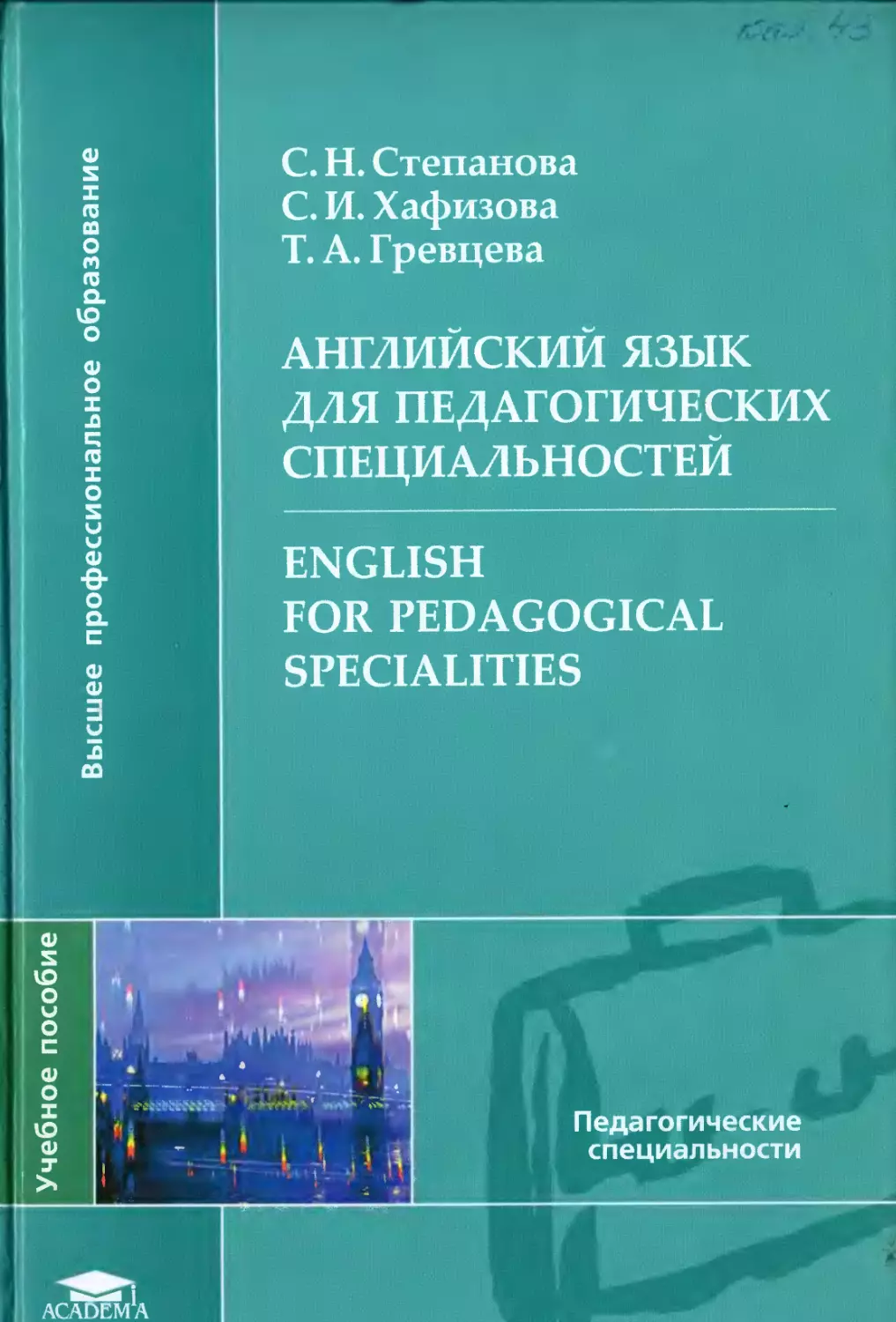


Автор: Степанова С.Н. Хафизова С.И. Гревцева Т.А.
Теги: черчение геометрическое и техническое рисование учебники и учебные пособия по чертежу педагогика английский язык
ISBN: 978-5-7695-4085-1


Текст
                    С. Н. Степанова
С. И. Хафизова
Т. А. Гревцева
АНГЛИЙСКИЙ ЯЗЫК
ДЛЯ ПЕДАГОГИЧЕСКИХ
СПЕЦИАЛЬНОСТЕЙ
ENGLISH
FOR PEDAGOGICAL
SPECIALITIES
ВЫСШЕЕ ПРОФЕССИОНАЛЬНОЕ ОБРАЗОВАНИЕ
С.Н.СТЕПАНОВА, С.И.ХАФИЗОВА, Т.А.ГРЕВЦЕВА
АНГЛИЙСКИЙ ЯЗЫК
ДЛЯ ПЕДАГОГИЧЕСКИХ
СПЕЦИАЛЬНОСТЕЙ
ENGLISH
FOR PEDAGOGICAL
SPECIALITIES
Под редакцией С. Н. Степановой
Учебное пособие
для студентов высших
педагогических учебных заведений
ACADEMA
Москва
Издательский центр «Академия»
2008
УДК744.4425(075.32)
ББК30.11я723
С794
Авторы:
С. Н. Степанова (предисловие, Lessons 3, 7, 8, 10, 14, 15),
С. И.Хафизова (Lessons 4 — 6, 16— 19),
Т.А. Гревцева (Lessons 1, 2, 9, 11 — 13)
Рецензенты:
доктор филологических наук, профессор кафедры лингводидактики
Московского государственного областного университета
А. П. Василевич-,
кандидат филологических наук, доцент кафедры английского языка
как второго иностранного переводческого факультета
Московского государственного лингвистического университета
О. М. Корниенко',
кандидат филологических наук, старший преподаватель кафедры
английского языка механико-математического факультета
Московского государственного университета им. М. В. Ломоносова
Е. А. Маренкова
Степанова С. Н.
С794 Английский язык для педагогических специальностей =
English for Pedagogical Specialities : учеб, пособие для студ.
высш. пед. учеб, заведений / С. Н. Степанова, С. И. Хафизо-
ва, Т.А.Гревцева ; под ред. С.Н.Степановой. — М. : Изда-
тельский центр «Академия», 2008. — 224 с.
ISBN 978-5-7695-4085-1
Пособие направлено на совершенствование навыков чтения и пере-
вода литературы по педагогическим специальностям на английском язы-
ке; развитие навыков аудирования, говорения и письма; овладение базо-
вой терминологией в сфере образования.
Для студентов педагогических вузов.
УДК 744.4425(075.32)
ББК30.11я723
Оригинал-макет данного издания является собственностью
Издательского центра «Академия», и его воспроизведение любым способом
без согласия правообладателя запрещается
© Степанова С. Н., Хафизова С. И., Гревцева Т. А., 2008
© Образовательно-издательский центр «Академия», 2008
ISBN 978-5-7695-4085-1 © Оформление. Издательский центр «Академия», 2008
ПРЕДИСЛОВИЕ
Пособие предназначено для студентов педагогических вузов,
обучающихся как гуманитарным, так и естественно-научным спе-
циальностям.
Его целями являются: совершенствование навыков чтения и
перевода литературы по педагогическим специальностям на анг-
лийском языке; развитие навыков аудирования, говорения и
письма; овладение базовой терминологией в сфере образования.
Задача пособия состоит в формировании языковой и комму-
никативной компетенции, необходимой для дальнейшей профес-
сиональной деятельности и осуществления деловых контактов.
Многолетний опыт работы авторов в педагогических вузах по-
казал: чтобы добиться поставленной цели, преподаватель должен
уделить особое внимание повторению и более углубленной про-
работке наиболее важных грамматических разделов, отбору опре-
деленного минимума лексических единиц общего и терминоло-
гического характера (с учетом словарного запаса, полученного в
школе), целенаправленному подбору текстов и тем уроков. При
подготовке пособия авторы старались максимально учесть эти
требования.
В пособии используются тексты культурно-страноведческой и
педагогической тематики (английский язык; школы, колледжи и
университеты Великобритании и США; обучение детей в Вели-
кобритании и России; образование в России; подготовка учите-
лей в Великобритании и США; учитель как личность; дети и ро-
дители; игры в жизни детей; праздники в Великобритании и
США; театр и кино в Великобритании и США; английская и аме-
риканская литература; достопримечательности Великобритании,
США и России). Большинство из них основано на оригинальных
английских и американских источниках. Они не только инфор-
мативны, но и направлены на преодоление разрыва между интел-
лектуальным развитием студентов и их языковой компетенцией,
имеют воспитательное значение, способствуют формированию
личности будущего учителя.
Текстовой материал в пределах урока организован по иерархи-
ческому принципу: 1) два основных текста описательного харак-
тера; 2) один диалогический текст; 3) дополнительные тексты
описательного характера, служащие для отработки языковых на-

выков и умений, завершения активизации языкового материала
и формирования речевых умений.
Пособие состоит из 19 уроков (Lessons). Весь материал рассчи-
тан на два семестра. Число часов, необходимых для изучения каж-
дого урока, определяется преподавателем в зависимости от интен-
сивности курса обучения. Учебным планом предусмотрено про-
ведение практических занятий, контрольных и самостоятельных
работ.
Работу над уроками рекомендуется строить следующим обра-
зом:
1)	речевая тренировка с помощью подстановочных граммати-
ческих таблиц и выполнение грамматических упражнений;
2)	чтение и перевод текстов по теме урока с разбором новых
грамматических и лексических явлений;
3)	выполнение упражнений, служащих для активизации фоне-
тического и лексического материала;
4)	выполнение упражнений, направленных на проверку пони-
мания прочитанных текстов;
5)	беседа по текстам;
6)	обсуждение темы урока;
7)	ролевая игра.
В начале каждого урока приводятся подстановочные грамма-
тические таблицы и предтекетовые грамматические упражнения
(Grammar Exercises), направленные на первичное закрепление
грамматических явлений, встречающихся в текстах данного уро-
ка, и обеспечивающие коммуникацию общего характера. Грамма-
тический материал пособия соответствует программе по практи-
ческой грамматике для студентов педагогических специальностей
и включает основные времена глагола в активном (действитель-
ном) и пассивном (страдательном) залоге, сведения об артикле,
существительном, прилагательном, предлоге и др. При объясне-
нии правил преподавателям рекомендуется также использовать
дополнительную литературу1.
После грамматических упражнений даны два основных текста,
в которых излагается тема урока. Затем вводятся новые слова и
словосочетания (Vocabulary Notes), которые закрепляются при
помощи специальных послетекстовых упражнений (Vocabulary
Exercises). Цель фонетических упражнений — научить студентов
правильно произносить новые слова и словосочетания. Лексиче-
ские упражнения (приведите русские/английские эквиваленты
данных слов и словосочетаний; переведите предложения на рус-
ский/английский язык, обращая внимание на данные слова, и др.)
способствуют закреплению новых лексических единиц и разви-
1 Например: Качалова К. Н., Израилевич Е. Е. Практическая грамматика ан-
глийского языка. — М.: Юнвес, 2006.
4
тию коммуникативной компетенции с использованием лексики
урока.
Далее предлагаются упражнения, направленные на развитие
умения понимать прочитанное и совершенствование навыков
перевода и письма (Comprehension Exercises) (ответьте на вопро-
сы, используя новые слова урока; найдите в тексте и переведите
абзацы, в которых говорится о...; найдите в каждом абзаце ключе-
вые слова; найдите информацию, свидетельствующую о..., и др.).
В начале заключительного раздела, посвященного беседе по
содержанию основных текстов и обсуждению темы урока (Con-
versation and Discussion), дан тематический список слов и слово-
сочетаний (Topical Vocabulary), знание которых позволит совер-
шенствовать навыки устной и письменной речи. Студенты выпол-
няют упражнения на связное изложение (перескажите содержа-
ние текста, следуя плану; составьте резюме одного из основных
текстов урока; воспроизведите данный диалог и составьте анало-
гичный, используя слова и словосочетания по теме урока, и др.),
после чего переходят к творческому использованию грамматичес-
кого и лексического материала данного и предыдущих уроков при
обсуждении культурно-страноведческих или педагогических тем
по специальности и в ролевых играх.
В пособии имеются и другие упражнения. Кроме того, из пе-
речисленных видов упражнений не все встречаются в каждом уро-
ке. Однако все они направлены на овладение навыками чтения и
перевода литературы по педагогической специальности; развитие
навыков аудирования, говорения и письма; совершенствование
коммуникативной компетенции студентов.
LESSON ONE
THE ENGLISH LANGUAGE
Table 1
The Construction THERE IS/ARE
	There	is	a book	on the table, on the desk, in the bag.
		are	books some books
	There	is no is not isn't	book a book	on the table, on the desk, in the bag.
		are no aren’t	books any books
Is	there		a book	on the table? on the desk? in the bag?	Yes, there is. No, there isn't.
Are			books any books		Yes, there are. No, there aren't.
GRAMMAR EXERCISES
1.	Using Table 1 make as many sentences as you can.
2.	Translate into Russian paying attention to the construction there
is/are.
1. There is a newspaper on the table. 2. What books are there on the
table? 3. There is a picture in my sister’s flat. 4. Are there any doctors
in the room? 5. There are some chairs in the hall. 6. Is there a cinema
round the corner? 7. There’s a new restaurant in King Street. 8. Is there
any university in that town? 9. There are many fine buildings in Moscow.
10. Is there a mistake in this sentence? — No, there isnt’t. 11. Is there
any time for reading? — Yes, there is.
3.	Make the sentences negative and interrogative according to the Model.
Model'. There is a blackboard in our classroom. — There is no blackboard
in our classroom. Is there a blackboard in your classroom?
1.	There are some English books on the table. 2. There are many
mistakes in your dictionary. 3. There’s a new grammar rule in Lesson
6
Seven. 4. There is a telegram on the table. 5. There is too little water in
the jug.
4.	Choose the correct form of the verb to be.
1.	There (is, are) a large TV in my room. 2. There (is, are) three
windows in my classroom. 3. There (is, are) a table and four chairs in
my sister’s room. 4. There (is, are) a school here. 5. There (is, are) very
many children in the park. 6. There (is, are) many people in the street.
7. There (is, are) a lot of snow outside the window. 8. There (isn’t,
aren’t) any copybooks on this table. 9. There (is, are) interesting films
on TV. 10. (Is, are) there any supermarkets in your town?
Table 2
The Present Simple Tense
		I We You They	read		news- papers books magazines	every day. in the morning. in the evening.
		He She (It)	reads
		1 We You They	do not don’t	read
		He She (It)	does not doesn’t
	Do	I we you they	read		news- papers books magazines	every day? in the morning? in the evening?	Yes, I do. No, I don't.
	Does	he she (it)					Yes, she does. No, she doesn't.
When	do	I we you they	read		news- papers? books? magazines?		I read them in the morning.
	does	he she (it)					She reads them in the evening.
What	is	there	on the table?	There is a book on the table.
	are			There are some books on the table.
7
5.	Put questions to the italicized words according to the Model.
Model: There is a nice sofa in your room. — What is there in your room?
1.	There is a nice garden before your house. 2. There are five chairs
in the room. 3. There are three mistakes in my dictation. 4. There is a
new cinema near my house. 5. There are many animals in the Zoo.
6. There are some Englishmen at the conference.
6.	Translate into English.
1.	В нашем городе много школ и несколько университетов.
2. В этом году в нашем классе двадцать учеников, а не пятнадцать.
3. На столе много журналов? — Нет, только, два. 4. На полке нет
никаких тетрадей. 5. В этом журнале много интересных статей.
6. В этом тексте много новых слов. 7. Недалеко от нашего дома
есть школа. 8. В театре много людей. 9. В этой контрольной ра-
боте есть несколько ошибок.
7.	Answer the questions.
1.	What is there on your table? 2. Is there a blackboard in the
classroom? 3. Are there many tables in your classroom? 4. What is there
in your classroom? 5. Are there many students at the lecture? 6. How
many schools are there in your town? 7. How many pages are there in
this book?
8.	Make sentences using the following word combinations according
to Table 2 and the Model.
Model', to speak English at the lesson — We always speak English at the
lesson.
to live in this street; to go to the office by bus; to study a foreign
language; to work hard at English; to read books in English; to get up
at 7 o’clock; to work at the plant
9.	Translate into Russian paying attention to the present simple tense.
1.	I work at the office. 2. We read, write and speak English during
our lesson. 3. Her sister lives in Moscow. 4. Does she sometimes meet
friends at the office? 5. Do you have lessons in the morning? 6. Where
does this teacher work? 7. He doesn’t speak English, he speaks French.
8. Does your sister often go to the theatre? 9. You always look very
happy. 10. He thinks he is right.
10.	Make the sentences negative.
1.	Tom plays football on Saturday. 2. They go for a walk in the
evenings. 3. He gets up early in the morning. 4. My cousin works in
hospital. 5. Your sister studies at college. 6.1 drink coffee in the evening.
7. The baby sleeps well at night. 8. He lives in England. 9. They do their
homework in the afternoon.
8
11.	Put questions to the italicized words.
1.	Mr Black usually walks his dog early in the morning. 2. My best
friend lives in Walton Street. 3.1 want a lot of good advice. 4. My friend
goes to school in the morning. 5. He helps his mother every day. 6. His
brother plays the piano very well. 7. It takes me an hour to translate
such a text. 8. They go to discos very often.
12.	Translate into English.
1.	Мой сын не живет в Москве. 2. Мой друг изучает два ино-
странных языка. 3. Майкл знает французский очень хорошо. 4. Ка-
кие книги ты читаешь? 5. Обычно мы гуляем по вечерам. 6. Где
работают твои родители? 7. Мне требуется несколько минут, что-
бы добраться до работы. 8. Вечером я обычно встречаю своих
друзей. 9. Кто живет в Англии? 10. Вы любите получать письма?
11. Как часто вы готовите уроки вместе? — Мы делаем это каж-
дый день.
13.	Learn the following English proverbs and sayings. Think of
situations where you could use them.
1. A good name is better than riches. (Добрая слава лучше богат-
ства.) 2. Handsome is as handsome does. (Красив тот, кто красиво
поступает.) 3. Politeness goes far, yet costs nothing. (Вежливость це-
нится дорого, но ничего не стоит.) 4. A friend in need is a friend
indeed. (Друзья познаются в беде.)
g, ,	Text 1	/,	,, ,
THE ENGLISH LANGUAGE
^4 Though there are almost three thousandla^uages in the world,
English is the most universal. It is the Smcialladguage in over forty
countries. We use English in international business, sc/^Ace and
medicine. About 400 million people speak English as a mother tongue
(700 million speak Chinese, 200 million speak Russian and 100 million
speak German).
Even in the countries where English is not the first language, a number
of English words are used. Words from no other language are
borrowed more often than from English. Hundreds of words borrowed
from English can be found in оэтГёг languages such aS soda, hotel, golf,
tennis, jeans, OK, baseball and others. Many words are used as they are.
Others are changed to make them more like native language, easier to
say and remember.	Щ'И'У
English is everywhere. It is on signs, clothing, soft drinks and other
goods around the world. In spite of their popularity, the English words
and phrases are not always welcome. Some people think that the use of
the English words is dangerous for the purity of their native language.
Bui it goes without saying that English is still an international language.
Some people believe that business would run more smoothly if everyone
spoke the same language.
Languages have changed and disappeared throughout the history.
This change is inevitable. But English words will continue to pop up
everywhere, whether some people like it or not. English nowadays is the
language of business, diplomacy and international relations. Most
educated people speak English fluently. In most schools children start
to learn English just from the first grade.
Join the people who want to speak English perfectly and you will gain
a great advantage over others.
Text 2
WELCOME TO ENGLISH COURSES IN LONDON
If you want to speak English fluently, you can join our courses called
“Anglo school”. Our main building is not far from the centre of London.
We have 20 years of experience in planning courses in English for
foreigners of some 60 nationalities.
At the teacher training college we have the most creative, talented
and highly qualified teachers. We have the latest teaching aids, such
as language laboratories and listening centres.
You’ll enjoy a lively, relaxed atmosphere, perfect for learning the
language. Don’t miss the chance! We offer:
•	General English for Adults
•	Bilingual Secretarial Courses for 3, 6, 9 months
•	Summer Holidays Courses for Adults
•	Funny English Courses for Children
•	Excursions, Visits, Sports, Social Activities
•	Accommodation in English Families, Hotels
If you want to visit us, telephone and arrange an appointment. We
will be delighted to welcome you to the school, show you the school’s
facilities and tell you about our teaching system.
VOCABULARY NOTES
official language n официальный язык, e.g. English is an official
language in many countries of the world.
be used использоваться, e.g. English is used almost everywhere.
be borrowed (from) заимствоваться (из), e.g. The words which
are borrowed from English can be used without changes.
popularity n популярность, e.g. In spite of their popularity, the
English words and phrases are not welcome.
10
be dangerous (for) быть опасным (для), e.g. Some people think
that English k-dangp.rous for the purity of their native language.
speak (spoke, spoken) v говорить; to speak English fluently
говорить на английском языке бегло/свободно владеть англий-
ским языком, e.g. If you want to speak English fluently, you must work
hard.
gain advantage добиться преимущества, e.g. You will gain a great
advantage over others if you can speak English fluently.
courses n pl курсы; language courses языковые курсы, e.g.
Language courses can be either for adults or for children.
teaching aids n pl средства обучения; language laboratories and
listening centres языковые лаборатории и лингафонные центры,
e.g. Our University has got all teaching aids for learning English —
language laboratories and listening centres.
VOCABULARY EXERCISES
14.	Pronounce correctly.
though, thousand, language, science, medicine, tongue, Chinese,
German, hotel, signs, clothing, popularity, dangerous, inevitable,
diplomacy, advantage, courses, foreigners, adults, excursions, facilities
15.	Read the words paying attention to the pronunciation of the letters
and combinations of the letters in bold type:
a)	speak, teach, read, mean, stream, weak, east, feast, deal,
appeal;
b)	tell, centre, attend, letter, spend, enter, get, set, fellow, credit.
16.	Translate into Russian paying attention to the new words.
1. A lot of English courses are glad to welcome you and give you good
knowledge of English. 2. Some people don’t want to lose the purity of
their native language. 3. It goes without saying that English is an official
language and it is used everywhere: in business, science, medicine. 4. There
are many words in Russian which are borrowed from the English
language. 5. Nowadays you can choose different language courses: they
can be either for adults or for children. 6. Linguistic schools have got
all teaching aids: good libraries, language laboratories and listening
centres. 7. You’ll gain a great advantage if you are good at English.
17.	Complete the sentences using the following words, word com-
binations and expressions: is used, in spite of, courses, a great advantage,
laboratories, fluently, teaching aids, popularity, are borrowed, listening,
popular.
1. A lot of new words ... from English. 2. If you can speak English
well, you gain ... over others. 3. Do you go to any English ... ? 4. The
11
English language is very .... 5. Our department of foreign languages has
various ... : language ... and ... centres. 6. English ... everywhere; its ...
is obvious (очевидный). 7. Can you speak English ... ? 8. ... many
textbooks in English, it is not easy to find a good one.
18.	Paraphrase using the Vocabulary Notes.
1.	My friend is in better situation: he can speak English well. 2. Many
medicine terms are taken from the English language. 3. Our language
centre uses various teaching facilities. 4. Some people are sure that
English is doing more harm than good to the Russian language. 5. These
English lessons are for adults.
19.	Translate into English.
1.	Английский — официальный язык во многих странах мира.
2. Английский язык используется везде: в бизнесе, науке, меди-
цине. 3. В русском языке много слов, которые были заимствова-
ны из английского языка, например: сода, теннис, аэропорт и
другие. 4. Некоторые люди думают, что использование англий-
ского языка является опасным для чистоты родного языка. 5. Если
вы пользуетесь лингафонным кабинетом и другими средствами
обучения, вы будете говорить по-английски бегло. 6. Несмотря на
мою занятость, я посещаю лингвистические курсы два раза в не-
делю.
COMPREHENSION EXERCISES
20.	Answer the questions using the Vocabulary Notes.
1.	How many languages are there in the world? 2. What words which
are borrowed from English can we find in Russian? 3. Do you agree with
the statement that English is everywhere: on signs, clothing, soft drinks
and other goods? 4. Why do some people think that English is dangerous
for their native language? 5. From what form do children start learning
English? 6. Where can you study English besides schools? 7. Why are
linguistic courses good for mastering fluent English?
21.	Read Text 1 and find the key sentences in each paragraph.
22.	Match the two parts of the sentences using Text 1.
1.	English is the official
2.	Words from no other
language
3.	Hundreds of words
borrowed from English
4.	Nowadays you can find
English
a. can be found in other languages,
b. everywhere: on signs, clothing,
soft drinks and other goods.
c. language in over forty countries.
d. are borrowed more often than
from English.
12
5.	In spite of the popularity
of the English words, they
6.	Some people believe that
a great number of borrowings
7.	But, no doubt, English
8.	It goes without saying that
business
9.	Today English is the
language of
10.	In most schools children
start
11.	Join the people who want
to learn English
12.	If you want to speak English
fluently, you can
e.	can be dangerous for the purity
of the native language.
f.	is still the international
language.
g.	are not always welcome.
h.	and you will gain a great
advantage over others.
i.	would run more smoothly if
everyone spoke the same language.
j.	join different English courses.
k.	to learn English from the first
grade.
1.	business, diplomacy and
international relations.
23.	Find and translate the passages dealing with:
a)	the latest teaching aids;
b)	a lively relaxed atmosphere;
c)	the courses called “Angloschool”.
24.	Read Text 2 and complete the sentences.
1.	The English courses have the most... , ... and highly ... teachers.
2.	The foreign language courses have got the latest.., such as language
... and ... centres. 3. You get a lively,... atmosphere for learning English.
4.	We offer: ... English for adults; ... secretarial courses; ... holidays
courses for adults; ... English courses for children. 5. You get the ... in
English families and hotels.
CONVERSATION AND DISCUSSION
Topical Vocabulary
an official language; the most used language; to speak English as
a mother tongue; to be borrowed; an international language; a language
expert; to speak English fluently and perfectly; a situational language;
aspects of English (grammar, lexicology, phonetics); to be good at
pronunciation; to get a good working knowledge of a language;
a language teacher; an accent; to make a mistake; to learn (learnt,
learnt) a language; a foreigner
25.	Retell Text 1 using the plan from Ex. 21.
26.	Retell Text 2. Give your own commentaries.
27.	Combine these two texts into one logically built-up topic.
13
28.	Speak out your own attitude to English using the Topical
Vocabulary.
•	Discuss the problem of English words borrowed into Russian. Is
it good or bad?
•	How are you going lo use English in your future work?
•	Discuss (he problem of teaching English at schools. What school
age is appropriate for starting English?
29.	Read and discuss the text.
WHAT A LANGUAGE!
This story is about three Frenchmen who lived for some time in
England. The first Frenchman once heard someone shout: “Look out!”
He was at a hotel when he heard these words. He put his head out of
the window and a bucketful of water fell on him.
The second Frenchman was once on a ship and heard the captain
shout: “All hands on deck!” He put his hands on the deck and someone
walked on them.
The third Frenchman wanted to visit a friend of his. When he came to
the door of the house, he knocked. A maid opened it. He said: “Is Mr
Brown in?” The maid answered: “He isn’t up yet. Come back in half an
hour.” When he came after half an hour, the maid said: “He’s not down
yet.” He said: “If he’s not up and he’s not down, where is he?” The maid
answered: “Oh, it’s simple. When I say he’s not up, I mean he has not got
up, and when I say he’s not down, 1 mean he has not come downstairs.”
30.	Answer the questions.
1.	Why is the text called “What a Language!”? 2. Explain each
misunderstanding between the Frenchmen and the Englishmen. 3. What
can you say about English on the whole?
31.	Retell the text.
32.	Discuss the questions.
1.	What is the most important thing to learn in English? 2. Can you
think of something in English that is not important to learn? 3. How
important is it to speak correctly? 4. What is the most difficult aspect
of English for you? Why do you think so? 5. What is the easiest aspect
of English for you? Why do you think so? 6. What is the most interesting
aspect of English for you? 7. What is the most boring aspect of English
for you? 8. Do you think that musical people are good at learning
pronunciation? 9. What is the best way to learn pronunciation (grammar,
vocabulary)? 10. How long does it take to get a good working knowledge
of a language? 11. Do you prefer British English, American English, or
another kind of English? Why? 12. Do you think it is possible to learn
a foreign language perfectly?
14
33.	Read the dialogue between the participants of the conference
“English Is Around Us” (Mr Black and Mrs Mock). Be ready to act
out the dialogue in class.
Mr Black'. You insist on the idea to use English everywhere if
possible: even to substitute some Russian words with English ones.
Mrs Mock'. Yes, you are right. English has become the most used
language in the world. I’d like to point out that nowadays every educated
person speaks English fluently. All respected companies employ people
only with English language knowledge.
Mr Black: We’ve got a bit of problem here, you see. English is not
our native language and we mustn’t drop down our own words. There
are a lot of labels, advertisements, announcements which are given to
us, the Russians, in English. What is the idea of it? I’m sorry to disagree
with you but it’s ridiculous.
Mrs Mock: Ridiculous? Not in the least. English is an international
language. It is soft and beautiful. Besides this language helps us to be in
the centre of the world’s activity ...
Mr Black: Look, I’m sorry to interrupt you, but English popularity
is dangerous for the purity of the Russian language. I’m sure we even
must eliminate English as the official language and save our native one.
Mrs Mock: I have to say it, but we look at this problem from different
points of view. We don’t share our thoughts on the question. That’s why
our further conversation is out of the sense, isn’t it?
Mr Black: Oh, all right. Let’s go to our colleagues and join them.
34.	Discuss the dialogue and speak out your thoughts about popularity
of the English language.
35.	Writing a letter.
Each student is to write an official letter to some language company
where he/she describes his/her experience in learning English; his/her
views on the role of English in the modern world. The students write
these letters and put them into the “postbox”. At the end of the game
the “representatives” (представители) from the company together with
the teacher analyse the letters and announce the winners.
36.	Role-playing.
Situation: Discussion of the problem “English at school: the process
of teaching English and the best age for starting it”.
Characters:
1.	Helen Sotnikova, aged 22, a language teacher, just graduated from
the University. Very energetic, full of modern approaches for teaching
English. She is sure that the best age for starting English is the age of
the kindergarten. Exaggerates the role of English in modern society.
2.	Anna Plavskaya, aged 49, teacher of English. Sticks to the idea that
the most important things in teaching English are reading and writing.
15
She doesn’t like the latest tendencies to teach English in primary school.
Anna is sure that not everybody has the ability to learn a foreign
language, that’s why she pays her attention mostly to the advanced
pupils.
3.	Oleg Zubin, aged 36, a director of the English club. Interested
more in money received from his students than in the quality of the
knowledge given by his club. He is sure that the effective way to learn
language is the accelerated courses (his programme is called “English
in Two Months”). Believes that English is worth paying money for.
4.	Andrey Izmailov, aged 40, teacher of English in the University.
Tried many methods in teaching English. Believes that speaking is the
main aspect of English; gives interesting lessons, full of discussions,
problematic questions. Uses a lot of video and audiomaterial at the
lesson, provokes students to speak and take part in different discussions.
He is against accelerated courses and shares the idea of gradual material
presenting. He thinks the best time for starting English in the form of
games and plays is primary school.
LESSON TWO
THE EDUCATIONAL SYSTEM
OF GREAT BRITAIN
Table I
Nouns in the Plural
a cat — cats a dog — dogs a car — cars a factory — factories	a box — boxes a dress — dresses a potato — potatoes a day — days
Remember! a shelf — shelves a wife — wives	a knife — knives a leaf — leaves a life — lives
Special Cases: a child — children a man — men a woman — women a foot — feet a tooth — teeth a goose — geese a mouse — mice	a sheep — sheep a deer — deer
this picture — these pictures that picture — those pictures	it is — they are
GRAMMAR EXERCISES
1.	Give the plural form of the following nouns:
a baby, a mouse, a star, a tooth, a deer, a cup, a wife, a stamp, a knife,
a match, a flag, a story, a shelf, an egg, a lemon, a man, a goose, a street,
a word, a woman, a mountain, a brush, a queen, a flower, a leaf, a foot,
a dress, a sister, a doctor, a child, a teacher
2.	Change the sentences according to the Model.
Model'. I often see a deer in our park. — I often see many deer in our park.
1. We usually meet this family in the cinema. 2. There is a plate of apples
on the table. 3. He reads a book in the evening. 4. There is a man round
the comer. 5. This is a lion. 6. It is a house. 7. She always cleans her
room. 8.1 meet a child on the way home. 9. Mr Black often eats a cake
17
for tea-time. 10. This device (устройство) catches a mouse. 11. It is
a goose.
3.	Give the plural form of the following word combinations:
(his magazine; that match; that window; this egg; that sandwich; this
knife; this stamp; this poster; that wall; that mountain; this lady; this
mouse; that deer; that child; this tooth; that dress; this banana; this doctor
4.	Change the sentences into plural.
1.	There is a dog in the garden. 2. Is there any plate on the table? 3. There
is a sheep in the garden. 4. There is a child in the room. 5. There is no
potato in the soup. 6. Is there a mouse in the house? 7. There is a goose
on the grass. 8. There is no match on TV today.
5.	Pair work.
Prepare cards with nouns in the singular. Put them in a box. Ask your
partner to choose any card and give the plural form of the word on the card.
Table 2
The Past Simple Tense
		I You He/She (It) We They		worked lived taught	in Moscow in London in the village	last month. last year, a year ago.
		I You He/She (It) We They	did not didn’t	work live teach
	Did	you he/she (it) we they		work live teach	in Moscow in London in the village	last month? last year? a year ago?
Where	did	you he/she (it) we they		work live teach		last month? last year? a year ago?
When	did	you he/she (it) we they		work live teach		in Moscow? in London? in the village?
18
keep, meet, finish, graduate, put, work, be, fall, begin, start, leave,
live, get, come, help, translate, run, read, write, build, do, ring, re-
member, sec, wash, know
7.	Write the text in the past simple tense.
On Monday we have six lessons. The first lesson is English. At this
lesson we write new words and do some speech exercises. Mike goes to
the blackboard. He speaks about his hobbies and interests. Mike gets
“five”. Nick does not get a “five” because he does not know the lesson.
After the second lesson I go to the canteen. I eat a sandwich with hot
tea. After school I don’t go home, I go to my friend and we watch TV
together. Then I leave my friend for home.
8.	Make negation according to the Model.
Model'. Boris woke up early yesterday. — No, you are wrong. Boris didn’t
wake up early yesterday.
1.	At the railway station he met his friends. 2. They walked very
quickly. 3. Last week she passed her exams. 4. A year ago we went to
London. 5. Yesterday my friend came home late. 6. She took a taxi
yesterday. 7. Mary liked to play chess. 8. Last week she wrote a funny
story about her pet. 9. We enjoyed the party yesterday. 10. The weather
was fine the day before yesterday.
9.	Put questions to the italicized words.
1.	My brother drank coffee five minutes ago. 2. He graduated from
the University three years ago. 3. Mike left his room an hour ago. 4. They
worked at home yesterday.
10.	Put the verbs in brackets either into the present simple or the past
simple tense.
1.	My brother (to wash) his face every morning. 2. Tom always (to eat)
breakfast. Yesterday he (not to eat) breakfast because he (to get) up late.
3. Queen Elizabeth II (to be bom) in 1926.4.1 (to go) to bed at ten o’clock
every day. 5. Yesterday he (not to go) to work. 6. Yesterday he (to walk)
to his office. 7. 1 (not to have) History lesson every day. 8. My mother
always (to take) a bus to get to work. 9. After dinner 1 (to be) very thirsty.
10. Who (to paint) the world-known picture “Mona Lisa”? 11. I (to be)
very busy last summer and (not to go) anywhere. 12. They (to enjoy) the
party yesterday? 13. What you (to buy) at the shop the day before
yesterday? 14. How often you (to go) to the dentist’s?
11.	Translate into English.
Моя подруга Аня пришла ко мне в субботу после работы. Мы
решили повторить правила перед диктантом. Я люблю заниматься
19
с Аней. Она много читает и хорошо знает английский язык. Мы
повторили слова и прочитали тексты. Мы закончили работать в
девять часов. «Я хочу пойти в кино и посмотреть новый фильм.
Хочешь пойти со мной?» — спросила Аня. «С удовольствием, —
ответила я. — Моя сестра смотрела его на прошлой неделе, и он
ей очень понравился». Мы пошли в кино в десять часов. Фильм
был очень интересный. Так как мы пришли домой поздно, Аня
осталась у нас. В воскресенье погода была хорошая и мы поехали
за город. После обеда мы вернулись домой. Наши друзья пригла-
сили нас в театр, и мы с удовольствием приняли их приглашение.
12.	Write short stories on the following topics using the past simple
tense:
1.	My last day off.
2.	Last English lesson.
3.	My last birthday party.
Text
THE EDUCATIONAL SYSTEM OF ENGLAND
The educational system and the types of schools vary from region
to region as each area or town has its own Local Education Authority.
The Local Education Authority is responsible for financing the schools
in its area. It employs teachers and other staff, provides and maintains
buildings, supplies equipment and material.
Although each school decides its own curriculum, they must include
certain compulsory subjects. These core subjects are Mathematics,
English, Physical Education and Social Education.
Schooling is compulsory for children from 5 to 16. Primary education
includes infant schools and junior schools. At five the child attends
infant school. At seven he moves to junior school. In primary schools
teachers encourage children to read, write and do basic mathematics.
At eleven the child attends secondary school. In secondary school
pupils are taught according to their academic abilities. The most able
will follow academic courses, while those of lesser abilities will follow
practical courses as well as the main subjects.
At the age of 16 pupils take school-leaving examinations in several
subjects. After these examinations the pupil can choose his way: to
continue his study or to leave the school for colleges of further education.
There are forty-seven universities in Britain and thirty polytechnics,
plus 350 colleges of higher education (some of them train teachers). At
the end of the study at higher education establishments the students
get the bachelor’s degree in Art or Science.
The most famous universities are Oxford and Cambridge. They are
famous for their academic excellence.
20
Dialogue
TALK ABOUT EDUCATION IN ENGLAND
— Good morning, ladies and gentlemen! My name is Mark Dawson.
I’m going to answer your questions.
— Good morning, Mark. Please, tell us about nurseries in England,
your country.
— There is no law which provides for education of the underfives.
About 47 per cent of three- and four-year-olds receive their education
in nursery schools or classes. In most of the cases parents or voluntary
bodies organize such groups.
— Thank you, Mr Dawson. And what can you say about primary
education?
— Well, primary education in my country consists of infant and
junior schools. The children do not have academic subjects, but they
are taught to read, write and do some simple mathematics.
— It is clear, thank you. Your system of secondary education has
changed a lot since 1970. Earlier the children took the eleven-plus
examinations after the primary school and those who did it well went
to grammar schools, the rest of the children went to some other types.
Now it is different. The children can choose any nearest school to study.
Do you like such a situation?
— Yes, of course. Our children are free now to choose any school
they want. Besides it is very important to send your child to the school
which is near your house. Parents don’t waste their time on a long way
to school as it used to be.
— We are thankful to you, Mr Dawson. It is always pleasure to
speak to a native-English speaker and get information out of the first
hands.
VOCABULARY NOTES
vary и менять(ся), варьировать(ся), e.g. Market prices often vary;
various adj различный, разный, e.g. I’ll give you various exercises
on this rule; variety n разнообразие, разновидность, e.g. You must
have more variety in your food.
Local Education Authority n местный орган образования, e.g.
Each area or town of England has its own Local Education Authority.
be responsible (for smth/smb) и быть ответственным (за что-л./
кого-л.), e.g. Parents are responsible for their children.
employ и нанимать на работу, e.g. They employ teachers and other
staff; Who employed him? He is not responsible for this job!
supply и снабжать, e.g. The Local Education Authority supplies
schools with equipment.
21
provide и снабжать, обеспечивать, e.g. His father provided him
with education.
curriculum n расписание, e.g. Free schools decide their own
curriculum.
subject n предмет; compulsory subject обязательный предмет,
e.g. All schools must include compulsory subjects.
infant school n дошкольное учреждение, детский сад, ясли, e.g.
English children go to infant schools when they are five.
junior school n младшие классы (средней школы), e.g. At the
age of seven children go to junior schools.
attend и посещать, присутствовать, e.g. All children over seven
attend school in our country.
primary school n начальная школа, e.g. In primary schools
children study English, Mathematics and other subjects.
take (took, taken) an examination (an exam) сдавать экзаме-
ны), e.g. Students take exams twice a year.
encourage и ободрять, поощрять, e.g. The teacher encourages the
child for good marks.
secondary school n средняя школа, e.g. Children go to secondary
schools at the age of eleven.
establishment n учреждение, заведение, e.g. What educational
establishments are there in your town?
VOCABULARY EXERCISES
13.	Pronounce correctly.
vary, authority, equipment, encourage, Mathematics, nurseries,
voluntary bodies, successfully, choose, staff, compulsory
14.	Read the words paying attention to the pronunciation of the letters
in bold type:
a)	finance, provide, primary, highest, design, symbolize, divide;
b)	curriculum, infant, junior, Britain, admission, addition, mint.
15.	Make sentences from the following words and translate them into
Russian:
1. Authority, necessary, schools, Local, provides, equipment,
Education, with. 2. Schools, children, from the age of 7 to 16, must,
attend. 3. Who, in, school, taught, your, English? 4. Teachers, primary
schools, to study, encourage, in, different, things, children. 5. Different,
after, pupils, secondary school, establishments, enter, higher. 6. What,
nursery play groups, finances, organization, these? 7. What, responsible,
you, for, are? 8. A, we, gave, lesson, good, him. 9. Teacher, a, good,
various, of, methods, teaching, uses, at, lesson, the. 10. Education,
employ, Local, teachers, Authorities, other, and, staff.
22
16.	Complete the sentences using the following words: attends vary.,
responsible, variety,finance, able, encouraged, establishments, provided,
taught.
1. Some voluntary bodies ... this boarding school (школа-пансион).
2. Schools are ... for the educational process. 3. Last year our teachers
visited London and saw many educational ... there.-4. ... of exercises
makes this textbook very interesting. 5. My parents ... me with good
education. I’m very thankful to them. 6. The most ... students get
scholarship (стипендия). 7. The Mr Brown’s lessons are very interesting
and we want to ... them. 8. His help ... me to finish this project. 9. After
the university I ... History at the college. 10. Nowadays school pro-
grammes ... very often.
17.	Translate into English using the Vocabulary Notes.
1.	Вчера я присутствовала на уроке физики (Physics lesson) и
видела много интересных опытов (experiments). 2. Майк — очень
ответственный человек. Ты можешь взять (нанять) его на работу.
3. Наше местное управление образования финансирует этот про-
ект. 4. Его звонок воодушевил меня. 5. В каком высшем учебном
заведении учится ваш сын? 6. Сама жизнь преподнесла им хоро-
ший урок. 7. Кто сможет перевести этот текст на английский язык?
8. Мы были ответственны за проведение праздника в начальной
школе. 9. Наш университет принимает студентов на разные фа-
культеты и отделения.
COMPREHENSION EXERCISES
18.	Read Text and break it up into several parts. Make up a plan
giving a title to each part of the text.
19.	Complete the sentences.
1.	Schooling is compulsory for children ... . 2. At five the child ... .
3. In primary school teachers ... . 4. In secondary school pupils ... .
5. The most able ....
20.	Answer the questions using the Vocabulary Notes.
1.	Do the educational system and types of schools vary from region
to region? 2. What is the Local Education Authority responsible for?
3. What are the core subjects at schools? 4. What age is compulsory for
schooling? 5. What types of schools does primary education consist of?
6. Do children go to secondary school at ten or eleven? 7. Who follows
academic courses? 8. What establishments of higher education are there
in England? 9. What degree do students get after graduating from the
university? 10. What are the most famous universities in Britain? What
are they famous for?
23
21.	Correct the statements if they are wrong.
1.	The educational system and types of schools vary from region
to region. 2. The Local Education Authority employs workers and
other staff, provides and maintains sports grounds, supplies food and
drinks. 3. The core subjects are Physical Training, Music and Art.
4. Schooling is compulsory for children from 7 to 16. 5. Primary
education includes infant and junior schools. 6. At 14 the child goes
to secondary school. 7. The most able children take more academic
courses while those of lesser abilities follow practical courses as well
as core subjects. 8. After final examinations at secondary schools pupils
can enter the Universities.
22.	Find the following words and word combinations in Text and
Dialogue:
высшее образование; степень бакалавра гуманитарных или ес-
тественных наук; детские сады; закон; дети, которым меньше пяти
лет; трех- и четырехлетки; начальное образование; среднее обра-
зование; выбирать; как это было раньше; мы очень благодарны;
всегда приятно; носитель английского языка
CONVERSATION AND DISCUSSION
Topical Vocabulary
Stages of Education', compulsory; preschool; primary; second-
ary; further; higher; a university; a college of education; a technical
college
Education Policy: administration; schooling; full-time education;
part-time education; a Local Education Authority; to be responsible
for national education policy; a National Curriculum
Management: a head teacher (master); a staff; to employ teachers;
to provide and maintain buildings; to provide grants; a governing
body
23.	Answer the questions using the Topical Vocabulary.
1.	What stages of education in Great Britain do you know? 2. Is
schooling compulsory in that country? 3. Can you name the types of
higher educational establishments in England? 4. How do they call head
teacher? 5. What body can employ teachers, provide and maintain
buildings, provide grants and approve curriculum?
24.	Retell Text using the plan from Ex. 18, the new words and
expressions of the lesson.
25.	Memorize Dialogue and act it out.
24
26.	Read the letter.
A LETTER TO ANN KUZNETSOVA
FROM HER ENGLISH PEN-FRIEND KATE HUDSON
Dear Ann,
Thank you for writing to me. In your last letter you asked to tell
something about English schools. Well, here it is.
In England there are schools run by the Government. These schools
are known as State schools and parents do not pay They are financed by
public funds. Ninety per cent of children in England attend a state school.
There are also private schools. Parents pay for their children. They
are known as Independent schools.
In my school the children wear a school uniform and carry their
homework and packed lunch in a school bag. School begins at 8:55 am.
The duty teacher blows a whistle and the children line up in their class
groups. They wait quietly for the teacher to send them to their class-
rooms. In the classroom the children empty their bags and put their
homework in the marking trays/boxes. Our classrooms are large and
every classroom has its own resource area: there is a CD-ROM com-
puter, overhead projector, white board and flip chart. Also we have a well
equipped music room where class and individual lessons are held.
We have an Opportunity centre for individual and small group work
with learning support assistances. Our pupils can take books from our
reference library.
Sometimes we organize different holidays and we have an amazing
school hall for them. Moreover we have own swimming pool and play-
ground.
Well, I believe you get a full picture of our schooling. Will you write
to me about yours?
See you, looking forward to your letter, Kate Hudson.
27.	Discuss this letter with your partners. What new information have
you learned about English schools?
28.	Writing a letter.
Kate Hudson is looking forward to Ann’s answer. Take the part of
Ann and write about our typical school. Use the Topical Vocabulary and
the words from the letter.
29.	Be ready to speak on the educational system in England. Draw
the scheme of the system to be more precise (точный).
30.	Role-playing.
Imagine that some of you are Englishmen who know very little about
schools in Russia. The others are teachers from Russia who are
25
interested in the system of education in Britain. They meet and compare
the two systems. Find their merits (преимущества) and disadvantages
(недостатки). Agree or disagree with your partner’s statements. Use the
Topical Vocabulary and the phrases below:
True ... but... .
I’ve got some reasons to disagree.
This is my way of looking at it.
On the one hand ... on the other hand ... .
Yes, I agree entirely here.
Not in the least!
That’s a good point.
Just the other way round!
That’s exactly what I think.
LESSON THREE
ENGLISH SCHOOLS
Table 1
The Future Simple Tense
	I We	will (not) won’t shall (not) shan’t	visit go	my friend to the museum	this evening. next Saturday.
	You He/She They My friends	will (not) won’t	read go translate see	this book to the concert the text the film	tomorrow, on Sunday, next week, next month.
Will Shall	I we		close phone	the window Carol	in ten minutes? on Friday?
Will	you he/she they		go meet talk	to England you about their walk	in half an hour? for your holiday? tomorrow evening?
GRAMMAR EXERCISES
1.	Using Table 1 make as many sentences as you can.
2.	Put questions to the missing parts of the sentences.
1. They will discuss ... . 2. Then she will ... . 3. ... friend will live in
the country. 4. Next week he will go to see ... . 5. You will give him this
letter.... 6. You will come back to Moscow to .... 7. He will stay there ....
8. It will take me ... to get there. 9. We will not come to school tomorrow
because ... . 10. You will not visit London ... .
3.	Make the sentences negative.
1. They will go to the theatre on Sunday. 2.1 will be there tomorrow.
3. He will come to see her next week. 4. We shall go to England next
summer. 5.1 will buy this book if I have enough money. 6. She will read
the letter in the evening. 7. They will be able to translate this article next
week if you help them. 8. You will see this play next month. 9. It will
take them a lot of time to do this work. 10. He will return home next
year. 11. We will see this film if we have free time.
27
Table 2
Adverbial Clauses of Time and Condition
	I We You He/She They	will (not) won’t shall (not) shan’t	go Play have	for a walk football lunch in the	if	the weather is fine. (?) my friend comes. (?)
Will Shall	I we		work	garden in the library	when	the sun is shining. (?)
Will	you he/she they		translate	the text		it doesn’t rain/ it rains. (?)
4. Make the sentences interrogative.
1. You will come to see me next Saturday. 2. He will go to school
tomorrow. 3. If you translate this text into English, he will use it. 4. They
will play tennis next summer. 5. If he is in London now, she will meet
him. 6. We will be there next week. 7. She will work in the library on
Tuesday. 8. I will leave for Italy next month. 9. It will take her an hour
to get to the theatre. 10. He will talk about it next Saturday. 11. When
my friends come to Moscow, we will see many places of interest. 12. You
will know your examination results soon.
5. Put the verbs in brackets into the correct form.
1. He (to visit) these places next summer. 2. We (to be) back in five
minutes. 3. I think they (to go) to France next year. 4. How she (to get)
there? 5. If nothing (to happen), I (to be back) on the 3rd of May. 6. They
say he (to spend) his holidays there. 7. If all (to go) well, she (to finish)
school in June. 8. How long you (to stay) there? 9. It (to take) her a long
time to visit him. 10. We (to wait) when you (to make up) your mind.
11. You (to see) them tomorrow. 12.1 not (to know) when John (to come)
to us. 13. We (to invite) lots of people to our family party.
6. Translate into English.
1. Они пойдут в кино в воскресенье. 2. Посмотрите этот фильм,
если у вас будет свободное время. 3. Позвони ему в 7 часов вече-
ра, пожалуйста. 4. На каком языке она будет говорить? 5. Я про-
читаю эту книгу на следующей неделе. 6. Мы встретимся с ним
завтра. 7. Куда вы поедете летом? 8. Я уверена, что вы все пойме-
те, если внимательно послушаете учителя. 9. Я не увижу ее, если
она вернется в июле. 10. Они будут здесь через час, если поезд не
опоздает. 11. Ей понравится наш подарок. 12. Моя подруга напи-
шет мне письмо, когда у нее будет свободное время. 13. Не бес-
покойся, все будет хорошо.
28
Table 3
Degrees of Comparison of Adjectives
The Positive Degree
This classroom	is	small, large, high.
The Comparative Degree
This classroom	is	smaller larger higher		than	the hall. the library. the laboratory.
My sister		more	beautiful intelligent talkative		his friend, my cousin, our aunt.
The Superlative Degree
This classroom	is	the	smallest largest highest	of all.
My sister		the most	beautiful intelligent talkative
good bad little much 1 many J	better worse less more	the best the worst the least the most
1.	This city is older than that one.
2.	This film is as interesting as that one.
3.	This river is not so/as wide as that one.
7.	Give the degrees of comparison of the following adjectives:
cold, hot, difficult, great, little, bad, heavy, short, large, wide,
beautiful, small, much, few, deep, tall, long, many, warm, wet, high,
good, interesting
8.	Complete the sentences.
1.	English is not so difficult as .... 2. This text is easier than .... 3. This
film is as interesting as ... . 4. His report is better than .... 5. This book
is as new as ... . 6. Autumn is not so cold as ... . 7. February is shorter
than ... .
29
9.	Read and translate the word combinations.
the best school; the worst student; the hottest place; the most difficult
test; the least piece; the deepest river; the most interesting results
10.	Read about the largest, the longest, the deepest, the highest things
in the world from the famous Guinness Book of World Records. Give the
superlative degree of the adjectives in brackets.
1.	The (long) sea voyage is one of 19,860 miles from a point 150 miles
from Karachi, Pakistan, to a point 200 miles north Kamchatka. 2. The
(large) of the world’s seas is the South China Sea with an area of 1,148,500
square miles. 3. The (high) waterfall (водопад) in the world is the Angel
Falls in Venezuela with a total drop of 3,212 feet. 4. The (cold) place on
Earth is the Pole of Cold, Antarctica. 5. The (hot) place is Dallol,
Ethiopia. 6. The world’s (wet) place is Kanai, Hawaii. 7. The (heavy) bell
in the world is the Tzar Kolokol, made in 1733 in Moscow. It weighs 216
tons, is over 19 feet high, and its (great) thickness is 24 inches.
11.	Read the text. Give the correct degree of comparison of the
adjectives and adverbs in brackets.
A HOLIDAY FOR MARTIN’S GRANDPARENTS
Julian and Martin were visiting Martin’s grandparents, and they were
not sure what to talk about.
“There has been (little) rain this week,” Martin said. His grandfather
came into the room and put a hand to his ear.
“What’s that you say?” he asked.
“We’ve had (few) rainy days and (much) sun,” Martin said loudly.
“Oh, yes,” the old man said. “It’s funny. Your grandmother and 1
want to spend our holidays at a place that has the (many) sunny days
and the (little) wind. At our age we have the (much) time and the (little)
money for the holidays. Perhaps we’ll go to Dover or Bournemouth or
Windermere.”
“Oh, that’s interesting,” Julian said. “You’ll get the (few) cold days at
Bournemouth, won’t you? I’m sure it has (little) wind than Dover and
most certainly Windermere has the (little) fine weather of those three.”
“What did she say?” asked Martin’s grandfather again.
“She says Bournemouth has (little) wind and Windermere has the
(much) bad weather,” his wife said.
“Hm,” said grandfather, “when we visited Bournemouth in mid-
sixties, it rained (much) heavily than usual and I saw (much) television
in one week than I’ve seen ever since.”
“Oh,” Martin thought, “and it takes (little) time and (little) money
to go to Dover.” And he began to think about taking them to Dover in
his car. They can travel (much) comfortably than in a train.
(From Success with English by G. Broughton)
30
12.	Translate into English.
1. Мария — моя лучшая подруга. 2. Какая река самая длинная?
3. В России погода не такая теплая, как в Англии. 4. Париж мень-
ше, чем Лондон? 5. Февраль — самый короткий месяц года. 6. Моя
сестра выше меня. 7. Английский язык труднее, чем немецкий?
8. Последний рассказ в этой книге не такой интересный, как пер-
вый. 9. Какие месяцы года самые холодные?
13.	Learn the following English proverbs and sayings. Think of
situations where you could use them.
1. Two heads are better than one. (Одна голова хорошо, а две луч-
ше.) 2. Better late than never. (Лучше поздно, чем никогда.) 3. Не
laughs best who laughs last. (Хорошо смеется тот, кто смеется по-
следним.) 4. Honesty is the best policy. (Нечестно живешь — себя
подведешь.)
Text 1
PRIMARY EDUCATION
English children must go to schools when they are five. First they
go to infant schools where they learn first steps in reading, writing and
using numbers. The curriculum for “strong” and “weak” groups is
different.
When children leave the infant school, at the age of seven, they go
to junior schools. Their school subjects are English, Mathematics,
History, Geography, Nature Study, Swimming, Music, Art, Religious
Instruction and Organized Games.
When children come to the junior school for the first time, they are
divided into three “streams” — A, В and C — on the basis of their
infant school marks or sometimes after a special test. The brightest
children go to the A stream and the least gifted to the C stream.
In primary schools pupils are mostly taught by a class teacher who
teaches all subjects. Methods of teaching vary, but there is a balance
between formal lessons with the teacher at the front of the classroom
and activities in which children work in small groups round a table with
a teacher supervising.
The junior classroom often looks like a workshop, especially when
the pupils are working in groups making models or doing other practical
work.
The School Year
Schools usually divide their year into three “terms”, starting at the
beginning of September.
31
Autumn Term	Christmas holiday (about 2 weeks)	Spring Term	Easter holiday (about 2 weeks)	Summer Term	Summer holidays (about 6 weeks)
In addition, all schools have a “half-term”(= half-term holiday),
lasting a few days or a week in the middle of each term.
Text 2
SECONDARY EDUCATION
Formerly, at the age of eleven children went to a grammar school
or secondary modern school. At present, the state school system has
changed at the secondary school level to provide, in place of grammar
and secondary modem schools, a single comprehensive school system,
where children, at every age, find their own level according to ability.
Formerly, children took an exam at the end of their primary education.
Then they continued their education at secondary modern or grammar
schools. At secondary moderns pupils received a more practical
education. At grammar schools the emphasis was academic.
Now about 90 % of all secondary schools are comprehensive. Pupils
go there automatically, regardless of intelligence. However, some
comprehensive schools do not have the full range of academic courses
for six-formers. Pupils can go either to a grammar school or to a six-
form college to get the courses they want.
Parallel to the state system, there is a private education system.
Private schools charge fees for education. Many private schools are
also boarding schools, at which pupils live during the term time.
Since 1988, most sixteen-year-olds have taken the General Certificate
of Secondary Education (GCSE) in five, ten or even fifteen subjects.
The exams are taken as individual subjects, so a pupil may take as
many subjects as ability and time permit, and success or failure in one
subject will not influence another.
Pupils going on to higher education or professional training usually
take A level examinations in two or three subjects. These require two more
years of study after GCSE, either in the sixth form of a secondary school
or in a separate sixth-form college. Other pupils may choose vocational
subjects such as tourism, secretarial and building skills. Subsidized
courses in these subjects are run at colleges of further education.
VOCABULARY NOTES
strong adj сильный, e.g. There are many subjects for strong pupils
in infant schools.
32
weak adj слабый, e.g. These weak pupils study less subjects,
stream n поток, e.g. In junior schools pupils are divided into streams,
bright adj умный, e.g. The bright children study in the A stream,
gifted adj способный, e.g. The least gifted pupils go to the C stream,
supervise и наблюдать, e.g. There are some activities in which
children work in small groups and a teacher supervises.
workshop n мастерская, e.g. In primary schools junior classrooms
often look like workshops.
term n семестр, e.g. Autumn term starts at the beginning of
September.
grammar school n грамматическая школа, e.g. Formerly, pupils
went to grammar school when they were eleven.
secondary modern school n средняя современная школа, e.g.
At present, there are few secondary modern schools in Great Britain.
comprehensive school n общеобразовательная школа, e.g.
Comprehensive schools combine all types of secondary education.
private school n частная школа, e.g. The state does not control
private schools.
fee n плата; charge a fee взимать плату, e.g. Private schools charge
a fee for education.
boarding school n школа-интернат, e.g. At boarding schools
pupils live during the term time.
certificate n свидетельство, e.g. Soon he will get a certificate.
General Certificate of Secondary Education (GCSE) n свиде-
тельство об общем среднем образовании, e.g. The General Certificate
of Secondary Education is a nationwide exam system.
A level (Advanced level) n повышенный уровень, e.g. A two-year
course leads to Advanced level in two or three subjects.
success n успех, e.g. Success in one subject does not influence another,
failure n неудача, e.g. His failure in English didn’t influence Maths,
vocational adj специальный, профессиональный, e.g. Some
pupils may choose vocational subjects such as tourism, secretarial and
building skills.
subsidized adj финансированный, субсидированный, e.g.
Colleges of further education have subsidized courses in vocational
subjects.
be run быть включенным, предусмотренным, e.g. Subsidized
courses in some vocational subjects are run at colleges of further
education.
VOCABULARY EXERCISES
14.	Pronounce correctly.
secondary, term, stream, level, general, advanced, strong, charge, fee,
comprehensive
33
15.	Read the words paying attention to the pronunciation of the letters
in bold type:
a) education, supervise, tutor, opportunity, unit, duty, use, popular;
b) success, study, subject, summary, adjustment, public, run, fun, lucky.
16.	Give the Russian equivalents of the following word combinations:
to send a child to school; nursery schools; to divide children into
groups according to their mental abilities; strong pupils; to look like a
workshop; the brightest children; the least gifted children; boarding
schools; a comprehensive school
17.	Give the English equivalents of the following word combinations:
младшие классы; слабый ученик; школьные предметы; учить-
ся в средней школе; учебные курсы; свидетельство об общем сред-
нем образовании; повышенный уровень
18.	Match the Russian words in the left column and their English
equivalents in the right column.
успех	failure
наблюдать	subsidize
свидетельство	success
финансировать	certificate
неудача	supervise
19.	Translate into Russian. Pay attention to the verb to fail and the
noun a failure.
1. She has failed in English this year. 2. Speak to her without a fail.
3. His memory fails him. 4. The book is a failure, isn’t it? 5. Have you
ever failed in an exam? 6. They will never fail. 7. Ring her up without a
fail. 8. He has saved the concert from being a failure. 9. Has she failed
to make friends with them?
20.	Translate into English using the verb to fail and the noun a failure.
1. Жаль, что он не сумел убедить их. 2. Учитель не ожидал прова-
лов на экзамене. 3. Обязательно позвони своим родителям. 4. По-
жалуйста, не подведите ее. 5. Я уверен, что у тебя не будет провала
на экзамене по математике. 6. Детям не удалось спеть эту песню на
концерте. 7. Вам удалось посмотреть этот интересный спектакль?
COMPREHENSION EXERCISES
21.	Answer the questions using the Vocabulary Notes.
1.	When do English children begin to go to primary school? 2. Why
are English children divided into groups? 3. Wbat subjects do pupils
learn in junior schools? 4. How many teachers are children taught by in
34
primary schools? 5. What types of secondary schools do you know? 6. Are
all schools free in England? 7. When do pupils take the General
Certificate of Secondary Education? 8. Do pupils going on to higher
education take А-level examinations in two, three or five subjects?
22.	Read Text 1. Find and translate the passages dealing with:
a)	infant schools;
b)	junior schools;
c)	primary school;
d)	the school year.
23.	Find the key words in each paragraph of Text 1.
24.	Read Text 2. Find information to prove that:
1.	At present, the state school system has changed. 2. Pupils go to
comprehensive schools automatically. 3. Formerly, children took an
exam at the end of their primary education. 4. Parallel to the state
system, there is a private education system. 5. At present, there are two
nationwide exam systems.
25.	Make up a plan of Text 2. Write out the key sentences for each
point of your plan.
CONVERSATION AND DISCUSSION
Topical Vocabulary
Types of Schools', state; private; independent; nursery; infant; junior;
secondary grammar; secondary modern; comprehensive; first;
middle; upper; mixed (co-educational)
Examinations'. General Certificate of Education; Certificate of
Secondary Education; Ordinary level; Advanced level; to take an
exam; to pass an exam
26.	Give the summary of Text 1 using the Topical Vocabulary.
27.	Discuss Text 2 using the plan from Ex. 25 and the new words and
expressions of the lesson.
28.	Read, translate and be ready to act out the following dialogue.
Pay special attention to the verb to fail.
Harry\ How was the examination, Dick?
Dick’. Not too bad. I think I passed in English and Mathematics. The
questions were very easy. How about you, Harry?
Harry'. The English and Maths papers weren’t easy for me. I hope
I haven’t failed.
Dick'. I think I failed the multiple-choice test. I could answer sixteen
of the questions. They were very easy. But I couldn’t answer the rest.
They were too difficult for me.
35
Harry: Tests are awful, aren’t they?
Dick: I hate them.
Harry: Oh, cheer up! Perhaps we didn’t do so badly. The fellow next
to me wrote his name at the top of the paper.
Dick: Yes?
Harry: Then he sat there and looked at it for three hours! He didn’t
write a word.
(By L. Alexander)
29.	Make up and act out a suitable dialogue using the new words and
expressions of the lesson.
30.	Read the text and discuss the advantages/disadvantages of a free
school.
FREE SCHOOL
You mustn’t smoke or wear make up. You must do your homework
on time. You mustn’t fight in the playground. Even if you like school,
it seems that someone is always telling you what to do.
This is why a lot of children don’t like school. And now a few teachers
believe this is why some kids don’t learn. People learn better and faster
when they have more choice in what they learn, and when and how they
learn it.
At free school, people believe that school should teach what the
children need and want to learn. School should help a child to think
for himself.
There is no punishment for missing school. But many kids spend
more time here than other children spend in ordinary schools. The kids
complain if holidays last longer than two weeks.
There are no compulsory lessons. Each child has one adult who
follows his progress through the school. Together they decide what he
needs to learn next, and the child does this in his own time.
A lot happens outside school. They visit local factories, markets,
shops, fire and police stations. They talk to people about their jobs, ask
strikers why they’re on strike (to be on strike — бастовать), ask their
neighbours what they want the local government to do for them. They
visit exhibitions, go roller-skating and horse-riding, make trips to the
country or the sea and go camping.
Special subjects like photography, metalwork, pottery (керамика) etc
are organized by working adults. Practical skills like painting and
repairing a house are all done as part of the maintenance of the school.
But there are very few free schools in England.
(Adapted from Club)
31.	Read the text and compare free and independent schools, their
advantages and disadvantages.
36
INDEPENDENT SCHOOL
An independent school receives no money from public funds and so
charges fees and may also have private endowments (пожертвования).
All independent schools must be registered by the Ministry of Education.
In addition schools may apply for inspection of Her Majesty’s inspectors
in order to be recognized as efficient.
The most notable independent schools are the so-called public
schools. A public school is often, although not necessarily a boarding
school. The usual age of entry to a public school for boys is 13 and the
leaving age — 18. There are some girls’ public schools such as Rodean
modelled to a certain extent on the public school for boys.
32.	Speak about the Russian system of education and the most
important changes it undergoes.
33.	Write a letter to the teacher you liked most of all. Use the vocabulary
of the lesson.
34.	Translate the sentences into Russian. Develop each statement into
a situation using the new words.
1.	Most young people have several choices open to them when they
leave school. One of them is to be a teacher.
2.	Children need as much help in their work as possible.
3.	Teachers should make lessons more interesting for pupils.
35.	Discuss the topics.
1.	Preschool education.
2.	English primary schools.
3.	Secondary education in England.
4.	An ideal pupil; an ideal school teacher.
5.	Most people have only one or two good teachers throughout their lives.
36.	Work in pairs or small groups. Talk about your school life using
the following examples:
... went to local secondary school.
... didn’t wear uniforms.
... wore jeans.
... did a lot of sports.
... had many clubs at school.
37.	A. Do you remember your first day at school? Describe your
feelings selecting adjectives from the following list:
happy, unhappy (about), exited (about), sorry (for), sad (about),
upset, frightened, proud (of), angry (about), worried, shy
B.	What did you particularly like about life at primary/junior school?
What did you dislike? Discuss your likes and dislikes. Talk about the
teachers, pupils, lessons, the school building, classrooms.
37
C.	Give a talk on the way children are admitted to school and go from
the primary to the secondary school in Russia.
38.	Role-playing.
Your English pen-friend invited you to visit London and come to the
school where he works. Now you are at school. Your friend, his
colleagues and you speak about English and Russian schools.
•	Ask your partners some questions to obtain information about
education in his/her country, e.g.:
Are schools free or fee-paying?
What are the stages and ages of pupils in the school system?
What qualifications can pupils get at school?
How do pupils get to the university?
•	Prepare a talk on the strengths and weaknesses of the education
system in Russia and England.
39.	Read and retell the joke.
NOTHING TO LEARN
Little Jack spent his first day at school and returned disappointed.
“What did you learn?” was his aunt’s question. “We didn’t learn
anything,” replied the boy. “Well, what did you do in that case?” “We
didn’t do anything. There was a woman who didn’t know how to spell
some very simple words and I told her how.”
LESSON FOUR
TEACHING YOUNG CHILDREN
Table 1
The Present Continuous Tense
	I	am (not)	speaking	English, reading	a book, writing	a letter, playing	the piano, going	to school, learning	a poem.
	He/She My brother His friend	is (not) isn’t
	We You Her sisters	are (not) aren’t
Is	her sister their teacher his friend		doing	exercises? walking	in the park? playing	football? having	a test? watching TV?
Are	the students the children
GRAMMAR EXERCISES
1.	Using Table 1 make as many sentences as you can.
2.	Write participle I of the following verbs and read them aloud:
add, get, study, go, live, look, stay, travel, give, talk, write, hurry,
offer, taste, buy, begin, have, dine, prefer, bring, work, pass, take, pay,
say, listen, come, forget
3.	Put the verbs in brackets into the present continuous tense.
1.	She (to play) the piano. 2. They (to go) home. 3. He (to work) in
the laboratory. 4. The children (to prepare) their homework. 5. We (to
learn) English. 6. I (to write) a letter to my parents. 7. Our teacher (to
give) the lesson. 8. I (to make) a report. 9. My father (to sit) and (to
read) a newspaper. 10. She (to dine).
4.	Make the sentences negative.
1.	They are going to the cinema on Sunday. 2. She is reading an
interesting book now. 3. He is playing tennis at this moment. 4. The
gardener is cutting down a tree. 5. The shopkeeper is selling modern
39
things. 6. My parents are returning home. 7. Her friends are talking
about their party. 8. The pupils are writing the test. 9. The child is crying.
5.	Make the sentences interrogative.
1. She is writing a letter in the study. 2. He is walking to school now.
3. We are travelling to London with friends. 4. They are working in the
garden at this moment. 5. John is coming home alone. 6. Our teacher
is telling us a new story. 7. Pupils are listening to their teacher. 8. I am
having breakfast now.
6. Put the verbs in brackets into the present simple or the present
continuous tense.
1. The sun (to set) late in summer. 2. Who (to make) that terrible noise?
3. How you (to feel)? 4. Where you (to go)? 5.1 (to hurry) to the university.
6. Switch on the light, it (to get) dark. 7.1 (not to know) what you (to want).
8. What you (to look for)? 9.1 often (to lose) my spectacles. 10. He always
(to buy) lottery tickets, but seldom (to win). 11. What time you usually
(to get up)? 12.... you still (to sleep)? 13. What the children (to do) now?
14. They (to watch) an interesting film on TV. 15. I (to like) it.
7. Translate into English using the present simple or the present
continuous tense.
1. Кого вы ждете? — Я жду свою подругу. 2. Завтра мы идем в
театр. 3. Маленькие дети едят 5—6 раз в день. 4. Что ты делаешь?
— Я делаю домашнее задание. 5. Не шумите. Студенты сдают эк-
замены. 6. Позвоните позже, она сейчас занимается. 7. Посмот-
ри, как ярко светит солнце. 8. Я не понимаю, вы говорите очень
тихо. 9. Вы слышите, кто-то плачет? 10. Я слушаю очень внима-
тельно, но ничего не слышу. 11. Мы изучаем английский язык в
университете. 12. Говорят, что они приезжают завтра. 13. Где вы
живете? 14. Осенью птицы улетают в теплые страны, а сейчас они
возвращаются обратно. 15. Студенты занимаются в лаборатории
три раза в неделю, а сегодня они слушают английские тексты.
8. Put questions to the missing parts of the sentences.
1. They are going to see ... . 2. ... brother is learning English now.
3. Pupils are discussing .... 4. She is coming back to London ... . 5. We
are waiting for them because .... 6. Children are going to .... 7. They are
sitting in .... 8.... is writing a letter now. 9. Pupils are having English ....
9. Read the text and put the verbs in brackets into the present simple
or the present continuous tense.
Today more and more high school graduates (to go) to college. Most
young people (to choose) their course of studies for themselves, rather
than (to have) their parents tell them what career to choose.
For example, Jack’s father (to practise) medicine. Even though he
(to want) his son also to become a doctor, he (not to insist) that Jack
40
study medicine when he (to leave) high school. He (to think) that Jack
must make his own mind about what he (to want) to be. His wife, on
the other hand, (to disagree) with him. She (to think) that Jack should
become a doctor so he can (to become) a partner with his father.
Jack isn’t sure that he (to want) to study in college. One day he (to
feel) that he’d like (to become) an engineer. However, the next day he
(to feel) that perhaps he should study business management. Right now
he (to study) chemistry, biology and physics, all of which will (to be
useful) if he (to decide) to study medicine in college. Jack (to need) these
courses so he (to work) hard every night. At the moment he (to tail) both
chemistry and biology, but unfortunately he (not to pass) physics.
Eventually, he (to hope) to pass the course, but he (to have) no chances.
He (to take) private lessons from a college friend. Jack (to like) his
father’s attitude, and he (to be grateful) that his father (not to force) him
to become a doctor too. I n some countries parents often (to decide) what
careers their children will follow — especially their sons.
Table 2
The Articles
a, an неопределенный артикль (относит к классу)	the определенный артикль (индивидуализирует)
1. Один, какой-то, любой: Неге is a book for you.	1. Этот, вот тот: That’s the book you like.
2. Впервые упомянутый: Suddenly I heard a loud cry.	2. Повторно упомянутый: ... The cry came from a dark yard.
3. Один из ряда однотипных: Pushkin is a great Russian poet.	3. Единственный в своем роде: Pushkin is the most famous poet in Russia.
4. Единичный представитель или экземпляр рода: Му brother planted an oak-tree.	4. Весь род в целом через название одного предмета: Му favourite tree is the oak.
	5. Человек или предмет, которому в данной фразе сопутствует лю- бое определение, выделяющее его из ряда однотипных: The girl in a green coat and a hat is my sister.
10. Insert the articles л, an, the where necessary.
1. I’d like to have ... coffee for breakfast. 2. Christie is ... well-known
English writer. 3. Can you play ... piano? 4. We often go to ... theatre
and to ... cinema. 5. What... pity they can’t come to see us. 6. Are you
going to ... country on ... Saturday? 7. ... earth goes round ... sun. 8. To
tell... truth, 1 didn’t expect to see you here.
41
i 1. insert the article the where necessary.
I. ... Thames flows through ... London. 2. ... United Kingdom
includes ... Great Britain and ... Northern Ireland. 3.... lake Baikal is the
deepest one in the world. 4. ... Urals are not very high. 5. Where is ...
John’s coat? 6. ... Pacific is the largest ocean on our planet. 7.... Everest
is the highest mountain in the world. 8. I went to ... France last year, but
I haven’t been to ... Netherlands yet.
12.	Read the text and use the proper articles.
Robert Robinson, my old acquaintance, worked at ... plant in
Detroit. There ... technical school was started for advertising reasons.
... newspapers stressed ... fact that ... school would be open to all ...
workers “regardless of colour”. Robinson’s life before he came to that
school had been full of... hardships.
His home was in one of... southern states where he had become ...
instrument-maker. ... unemployment caught up with him, and he went
to Detroit where ... newspapers promised ... employment. In Detroit...
new period in his life began:... endless search for... work. He managed
to enter... technical school. He was ... only coloured student there. ...
newspapers made ... most of it and even featured his photograph at ...
work. ... papers, however, did not mention ... fact that he was paid less
than ... white workers, and they kept quiet about... animosity (злоба)
that he was met with every morning.
13.	Read and memorize the poem.
POOR MOTHER
Your father is working
All day, without shirking,
To pay for the clothes that you wear;
Your mother is mending
All day, and attending
To you, with the kindness of care.
And so, while you are playing,
Think of your father, who’s paying,
And mother, who’s working so hard.
(By Gelett Burgess)
14.	Find in the poem the sentences in the present continuous tense.
Text 1
THE NATIONAL CURRICULUM
In 1988, for the first time in British history, a National Curriculum
was introduced. The National Curriculum tells pupils which subjects
42
they have to study, what they must learn and when they have to take
assessment tests.
Between the ages of 14 and 16, pupils study for their GCSE (General
Certificate of Secondary Education) exams. Pupils must take English
Language, Maths and Science for GCSE, as well as a half GCSE in a
foreign language and Technology. In addition, they must also be taught
Physical Education, Religious Education and Sex Education, although
they do not take exams in these subjects.
At the age of 16, pupils can leave school. If pupils stay on, they
usually take A (Advanced) levels, AS (Advanced Supplementary) levels
or GNVQs (Greater National Vocational Qualifications). It is quite
common to combine, for example, two A levels with one AS level, or
one A level with one GNVQ.
Pupils taking A levels study traditional subjects such as French,
Physics or History. To go to university, pupils usually need two or three
A levels.
AS levels are the same standard as A levels, but only half the content;
AS-level German pupils take the А-level German Language exam, but
do not take the А-level German Literature exam.
GNVQs are vocational qualifications. Pupils usually take one GNVQ
in subjects such as Business, Leisure and Tourism, Manufacturing, and
Art and Design. One GNVQ (an advanced level) is equal to two A levels.
The Time Table of the Fifth-form Pupils of St Mary’s
Comprehensive School
Time	Monday	Tuesday	Wednesday	Thursday	Friday
8.30-8.40	Registra- tion	Registra- tion	Registra- tion	Registra- tion	Registra- tion
8.40-9.00	Assembly	Assembly	Assembly	Assembly	Assembly
9.00-9.45	French	Technology	SE	Art	RE
9.45-10.30	French	Science	Maths	Art	IT
10.30-11.15	Science	Science	Maths	French	Science
11.15-11.30	Break	Break	Break	Break	Break
11.30- 12.15	Maths	History	English Literature	Science	Technology
12.15-1.00	Maths	History	English Literature	Science	Technology
1.00-2.00	Lunch	Lunch	Lunch	Lunch	Lunch
2.00-2.45	English	Art	PE	History	English
2.45-3.30	English	Art	PE	English	English
SE = Sex Education; RE = Religious Education; IT = Information
Technology; PE = Physical Education
43
Text 2
VICTORIA AT SCHOOL
Victoria goes to Carlton Hill Primary School. The school is about
ten or eleven years old. Altogether there are only about 100 children in
the whole school. There are four classes with about 25 children in each.
Vicky is in an introductory class, which means her class has some five-
year-olds. When Vicky reaches six, she will go into another class.
There are a lot of interesting things on the walls such as Alphabet
posters, shapes, numbers, picture cards with words to learn, posters of
animals, paintings done by the children.
There is a nature table with buds and flowers and a lot of books.
There is a lovely Wendy House, which takes up one corner of the
room. It is hand-made out of wood. You can fit about six or seven
children in without being cramped together. It is just like a miniature
ideal home. Near where all the books are, there is a big carpet with an
armchair where Vicky’s teacher sits when she reads to them, and when
they sing songs, all the children gather round her on the carpet.
VOCABULARY NOTES
National Curriculum n (национальная) программа, e.g. A National
Curriculum was introduced in Britain in 1988.
assessment adj оценочный, e.g. Students have to take assessment tests.
Physical Education и физкультура, физическое образование,
e.g. Pupils do not take exams in Physical Education.
leave (left, left) и оставлять, покидать, e.g. Pupils can leave school
at the age of 16.
stay on v оставаться, e.g. Many pupils don’t leave school, they stay
on to continue their study.
content n содержание, e.g. AS levels are the same standard as
A levels, but only half the content.
leisure и досуг, e.g. Leisure is very important in the life of pupils
during their study.
introductory class n подготовительный класс, e.g. There are
some five-year-olds in this introductory class.
reach и достигать, e.g. When she reaches six, she will leave an
introductory class.
painting n рисунок, e.g. There are a lot of paintings done by children.
nature table n гербарий, e.g. There are many nature tables in this
classroom.
hand-made adj ручной работы, e.g. This beautiful carpet is hand-
made.
cramp v стеснять, e.g. Children are not cramped in this small
wooden house.
44
VOCABULARY EXERCISES
15.	Pronounce correctly.
reach, introductory, leisure, assessment, nature, cramp, national,
curriculum, physical, education, paintings
16.	Read the words paying attention to the pronunciation of the letters
in bold type:
a)	nature, take, made, generation, vocational, state, range, take;
b)	cramp, hand, establishment, exams, expand, candidate, challenge.
17.	Pronounce correctly and give the Russian equivalents of the fol-
lowing word combinations and expressions:
a National Curriculum was introduced; to take assessment tests; must
be taught; to leave school; to take A levels; traditional subjects; half the
content; an introductory class
18.	Give the English equivalents of the following word combinations
and expressions:
в школе около 100 детей; четыре класса по 25 человек в каж-
дом; на стенах много интересных предметов; картинки, нарисо-
ванные детьми; игрушки ручной работы; дети собираются вокруг
учителя на ковре; гербарий с цветами
19.	Find pairs of synonyms in a and b:
a)	to leave, to unite, to start, to keep, to happen, to surprise, to love,
to get;
b)	to adore, to depart, to obtain, to join, to astonish, to occur, to initiate,
to preserve.
20.	Find pairs of antonyms in a and b:
a)	to remember, to lend, to send, to buy, to end, to ask, to build, to lose,
to fall, to give;
b)	to answer, to receive, to find, to take, to forget, to rise, to sell,
to borrow, to begin, to break.
COMPREHENSION EXERCISES
21.	Put the verbs in brackets into the correct form. Answer the
questions using the Vocabulary Notes.
1.	When a National Curriculum (to be introduced) for the first time?
2. What the National Curriculum (to tell) the pupils about? 3. In what
subjects pupils (to take/not to take) exams? 4. What subjects pupils must
(to be taught) without taking exams? 5. What (to mean) vocational
qualifications?
45
22.	Read Text 1. Find and translate the passages dealing with:
a)	GCSE;
b)	A levels;
c)	AS levels.
23.	Look at the time table from Text 1 and answer the questions.
1.	What time does school start and finish? 2. How many foreign
languages do pupils study? 3. How much time do they spend going in for
sport? 4. Can you compare this with the school time table in your country?
24.	Read Text 2 and find the key sentences in each paragraph.
25.	Give a title to the text.
1 am a teacher from Moscow. I teach in a large school. There are many
pupils in it.
It is a secondary school for the children from 11 to 17 years old. Our
school is in a new modern building. There is a large playground there. In
fine weather the children like to play outside during breaks. Very often
sports competitions take place there, either in the spring or in the summer.
The classrooms of our school are very light and comfortable. There
are classrooms for Mathematics, Physics, Literature, Chemistry, languages
with all the necessary equipment. I am a teacher of English and I am very
proud of the English Language classroom. There is a TV set, tape
recorders and a good collection of English books. We often watch TV
programmes in English or listen to the tapes. It helps us to master the
language. Many of my students are members of our English language club.
Besides our club there are the Young Mathematicians Society, Societies
of Lovers of History and Literature, several sports clubs. The children can
spend at school almost the whole day, staying after classes for their musical
lessons and optional classes in different subjects. There is a good canteen
and a reading room where students can prepare their homework. In
general, there are all the facilities for good studies and rest.
26.	Complete the sentences.
1.	The classrooms of our school.... 2. Our school is .... 3. Very often
sports competitions .... 4. We often watch .... 5. The children can spend
at school ... . 6. In general ....
CONVERSATION AND DISCUSSION
Topical Vocabulary
compulsory education; self-education; optional classes; a compe-
tition; equipment; a gym; a canteen; a cloak room; an assembly hall
to recite; to arrange/hold; to attend; to compete; to pass
a head teacher; a master; a monitor; a test; a term; a day book
46
27.	Give the summary of Text 1 using the new words and expressions
of the lesson.
28.	Compare in writing the time tables of the fifth-form pupils of St
Mary’s comprehensive and a Russian secondary school.
29.	Describe Vicky’s classroom.
30.	Retell Text 2 using the plan from Ex. 24 and the Topical
Vocabulary.
31.	Learn the dialogues. Make up similar dialogues of your own.
1.	Kate\ Hello, Helen!
Helen’. Hi, Kate! Where are you hurrying?
Kate’. To school. You know, we are meeting to go to the University
today.
Helen’. Why, what are you going to do there?
Kate’. You see, I am a member of our optional class in Biology.
Our professor wants to show us his lab.
Helen’. It’s very interesting, and what kind of work do you do
there?
Kate'. Generally, we take a deep study of certain topics and
problems we are interested in. Sometimes we carry out experiments.
Helen’. Oh, it’s a serious work, isn’t it? So, I see you have
definitely made up your mind to take up biology as a career, haven’t
you?
Kate’. 1 believe so. It really attracts me.
2.	Dan’. What form are you in now, Nelly?
Nelly. 1 am in the 11th form. This year I am leaving school. I am
going to enter the University.
Dan\ Then good luck to you. As for me, 1 am already a first-year
student of the Faculty of Foreign Languages of the Teacher Training
Institute.
Nelly. Glad for you. I wish you success in your studies.
32.	Tell your classmates about the school you have finished.
33.	Give your opinion of the poem Poor Mother and state its central idea.
34.	Answer the question What are you doing? Imagine that you are:
a)	at an English lesson;
b)	in the dining room;
c)	in the library.
35.	Look out of the window and say what is going on outside.
36.	Look around you. Notice as much as you can. Describe it.
37.	Game What Is He/She Doing?
A student carries out some actions in front of the class. The rest of
the students name these actions.
47
38.	React to the requests.
1.	Will you show me your work?
2.	Will you give me a piece of advice?
3.	Could you explain the rule?
4.	Give me the dictionary, please.
5.	Could I help you?
39. The passage below is a description of the beginning of a lesson.
What would you say as a teacher in every situation?
1.	It’s Monday morning. You come to the classroom and notice that
two boys are still outside in the corridor. ...
2.	They come in but leave the door open. ...
3.	At last everybody seems to be ready. You greet the pupils. ...
4.	You have to find out who is on duty. ...
5.	You ask who is missing. ...
6.	You notice that Lucy is away and wonder why. ...
7.	Somebody says that she has flu. ...
8.	At that very moment Julia comes in. It’s the second time she is
late this week, so you make clear that you are angry. ...
9.	At last you are ready to start the lesson. You want to start with
reading something to the children. ...
10.	You notice that Tim isn’t attentive. ...
11.	Then you continue the lesson. ...
Prompts: Open your books at page ... please. Who is on duty today? Stop
fidgeting, please. Will you please close the door. Hey, you two boys, hurry up.
Come in and sit down. Good morning, everybody. What’s the matter with
Lucy? Don’t let it happen again.
40.	Speak on the topics.
1.	Education in England and Russia.
2.	Optional classes.
3.	Out-of-class activities.
4.	Your/your friend’s favourite subjects.
41.	Role-playing.
You are a teacher at a primary school. A foreign teacher is visiting
your school. He/she is going to ask you some questions about the school.
Before talking, think about the following: number of children per class,
number of teachers, when school starts/finishes, age of children in the
class, what sort of pupils they are, how a school day is organized etc.
LESSON FIVE
ENGLISH UNIVERSITIES AND COLLEGES
Table 1
The Past Continuous Tense
	Our friend My cousin His sister	was (not) wasn't	reading a book listening to the radio having dinner playing chess	at that moment. when she rang me up. when he came.
	The boys	were (not) weren’t
Were	you they our friends		learning English playing the piano watching TV	when she returned? at that time? when he had supper?
Table 2
Prepositions of Time
at	five o’clock, half past two, night, noon, midnight, Christmas
on	Sunday, Monday, January the first, the ninth of May
in	May, June, July winter, spring, summer, autumn 1147, 1999, 2005 the morning, the evening, the afternoon, the North, the South
GRAMMAR EXERCISES
1.	Using Tables 1 and 2 make as many sentences as you can.
2.	Make the sentences negative.
1.	The student was dreaming when the teacher asked him to answer.
2. At six o’clock yesterday 1 was waiting for Jennie at the station. 3. Tom
was crossing the street when 1 saw him. 4. Mary was shivering with cold
waiting for a bus. 5. It was raining cats and dogs yesterday evening. 6. They
were playing chess during the break. 7. That day the sun was shining
brightly and the birds were singing merrily. 8. We were sitting and talking
about our children.
49
3.	Make the sentences interrogative.
1.	He was skating yesterday from five till nine o’clock. 2. She was
reading the whole evening yesterday. 3. He was writing the article all the
week. 4. We were working at this problem from two till three o’clock
yesterday. 5. At that moment they were playing chess in the room.
6. They were sitting in a cafe for a long time. 7. All the evening my
mother was watching TV. 8. While she was playing the piano, I was
writing a letter.
4.	Put the verbs in brackets into the past continuous tense.
1.	It (to rain) when John went out. 2. I (to play) the piano when Mary
came into the room. 3. Tom (to work) all day yesterday. 4. She (to write)
a letter at that moment. 5. They (to learn) English at 4 pm yesterday.
6. He (to walk) home when he met her. 7. The baby (to eat) its dinner
at that time. 8. They (to live) in England when the War began.
5.	Put the verbs in brackets into the correct past tense.
1. He (to write) a letter when I (to see) him. 2. Harry (to do) his work
while his brothers (to play) games. 3. We (to sing) a song when George
(to come) into the room. 4. While the teacher (to give) a lesson, a small
dog (to run) into the room. 5. My hat (to blow) off while I (to cross)
the bridge. 6. He (to lose) his pocket book while he (to see) the sights
of Rome. 7. When the phone (to ring), I (to work) in the garden.
8. Children (to listen) to the teacher when they (to hear) the noise in
the street.
6.	Translate into English.
1.	Когда я пришла, они обедали. 2. Когда мы катались на лы-
жах, начал идти снег. 3. Вчера я занималась английским языком
с семи до девяти часов вечера. 4. В полночь он все еще работал.
5. Она долго сидела в гостиной с письмом в руках. 6. Они ждали
нас около часа. 7. Когда часы пробили десять, они все еще спали.
8. Мы познакомились, когда сдавали экзамены. 9. Дети играли в
футбол, когда начался дождь. 10. Ученики готовились к конт-
рольной работе, когда учитель вошел в класс.
7.	Put questions to the italicized words.
1.	My friend was playing the piano. 2. We were listening to the music
during the break. 3. The farmer was working in the fields with his sons.
4. The small boy was ringing the bell. 5. The workman was painting the
house when it began raining. 6. The cat was sleeping when the kittens
wanted to play. 7. Some of them were looking at the pictures while the
others were listening to the news. 8. The teacher was explaining new rules.
8.	Insert prepositions where necessary.
1.	All the students of our group take part in the meeting ... the ninth
of May. 2. Children go to school... the morning and come back home ...
50
noon. 3. Our studies begin ... autumn. 4. My elder brother often comes ...
home late ... night. 5. We are going to have a party ... tonight. 6. We have
English lessons ... Mondays and Thursdays ... half past twelve. 7. My
little brother was born ... 2000. 8.... Christmas Englishmen have turkeys
or geese for dinner. 9. Usually ... my birthday many friends and relatives
come ... my house. 10.... April the first all the students of our university
celebrate Fool’s Day.
9.	Insert prepositions or adverbs where necessary.
1.	First-year students work hard to master ... the language. 2. What
mark did you get ... Literature ... entrance exams? 3. What mark have
you got ... your report? 4. When did you make a report ... this book?
5. This student is very good ... Maths. 6. We decided to join ... the
English club. 7. When the lecturer entered ... the room, the students kept
silent. 8. We haven’t seen you ... ages. 9. What kind of sports does he
go	? 10. The students are very proud ... their university.
10.	Translate into English paying attention to the prepositions.
1.	Моя сестра работает в начальной школе. 2. Он родился в
1970 году зимой. 3. Мы встретились 1 января в прошлом году. 4. Он
работает по вечерам и иногда приходит домой в полночь. 5. Они
встретились днем на улице около кинотеатра. 6. По воскресень-
ям мы ходим в театр. 7. Она играет на пианино дома. 8. Мои ро-
дители познакомились во время войны. 9. Я занимаюсь английс-
ким языком в школе дважды в неделю. 10. Мой брат собирается
поступать в университет через год.
11.	Read the text and insert prepositions where necessary.
CHOOSING MUSIC TO LISTEN TO
Provide plenty ... variety in your choice ... music ... your child to
listen ... and avoid trying to impose your own musical tastes. Children
have a very short attention span when just listening ... music so choose
short pieces.
Follow what you know children enjoy and watch ... signs that a piece
has caught... their attention.
Most children prefer music ... strong rhythms which suggest movement.
If there are words, they need to be very clear ... a child to understand.
12.	Insert prepositions where necessary.
Secretary. 2584253, Mr Brown’s office.
George Build'. Hello, can I speak ... David Brown?
Secretary'. I’ll see if he’s ... the office. Who’s calling?
George Build’. George Build ... Green and Co.
Secretary’. Hold ... please. Mr Brown is ... a meeting. Can I help you?
51
George Build'. Well, we were ... the Singapore fair together. I’m ...
London now. I’d like to see him.
Secretary'. I don’t think the meeting will go....a long time. Shall
I ask him to call you when he’s free?
George Buitd: That would be very good ... him.
Secretary-. Can I have your name again, please?
George Build'. Oh, yes, it’s George Build. B-u-i-l-d.
Secretary’. And your number?
George Build'. I’m staying ... the Lancaster Hotel, room 3451.
Secretary’. Thank you, Mr Build. I’ll pass your message ... Mr Brown.
George Build: Thank you very much ... your help. Bye-bye.
13.	Match the parts of the sentences paying attention to the
prepositions.
1.	I am not very good
2.	My sister is married
3.	He was sorry
4.	This country is famous
5.	She is responsible
6.	I’m very interested
7.	They were tired
8.	Your dress is similar
9.	Your answer was different
10.	The room was crowded
11.	I can’t pay. I’m short
a.	for his bad behaviour.
b.	of waiting.
c.	to mine.
d.	from mine.
e.	to an Australian.
f.	at Maths.
g.	with people.
h.	of money.
i.	in tennis.
j.	for its lakes.
k.	for the mess.
14.	Read the poem paying attention to the articles. Memorize it.
BIRDS
The peacock is silver,
The eagle is gold,
The wren is a stranger,
The robin is bold.
The dove is a neighbour,
The blue-tit a guest,
The swallow’s a traveller
And the owl a ghost.
The crow is black
For the great fields of snow,
And the swan is sailing
For the lakes of tomorrow
(By Elena Feam)
Text 1
UNIVERSITIES OF BRITAIN
Most big towns in Britain have both a university and a college of
higher education. There are 91 universities in Britain and 47 colleges of
higher education. Colleges of higher education offer both two-year
52
HND (Higher National Diploma) courses, as well as degree courses.
Colleges offer courses in teacher training, courses in technology and
some professions connected with medicine.
Universities are divided into three types: the old universities (Oxford,
Cambridge and Edinburgh Universities), the 19th century universities
such as London and Manchester Universities and the new universities.
Some years ago there were also polytechnics. After graduating from
a polytechnic a student got a degree, but it was not a university degree.
31 former polytechnics were given university status in 1992.
Full courses of study offer the degree of BA (Bachelor of Arts)
or BSc (Bachelor of Science). Most degree courses at universities
last 3 years, language courses last 4 years (including a year spent abroad).
Medicine and dentistry courses are longer (5-7 years).
Students may receive grants from their Local Education Authority
to pay for books, accommodation, transport and food. This grant
depends on the income of their parents. If students do not get a grant,
parents are expected to pay for their children.
Students don’t usually have a job during term time because the
lessons, called lectures, seminars, classes or tutorials (small groups),
are full time. However, many students now have to work in the evenings
or during the holidays to earn more money, but it is now difficult to find
such jobs. The result is that more students are dropping out, failing to
finish their courses.
Most students live away from their home town, in flats or halls of
residence, because the university is seen as a time to be independent,
to live away from home and develop new interests.
University life is considered “an experience”. The exams are compe-
titive but the social life and living away from home are also important.
The social life is excellent with a lot of clubs, parties, concerts, bars.
Text 2
OXBRIDGE
Oxford and Cambridge are the two oldest and most prestigious
universities in Britain. They are often called collectively. Oxbridge
denotes an elitarian education. Many Oxbridge students come from
public schools, and Oxbridge graduates go on to become influential and
powerful in British society.
The tutorial system is one of the ways in which Oxford and Cam-
bridge differ from all the other English universities. Every student has
a tutor and as soon as you come to Oxford, one of the first things you
do is to go and see your tutor. He, more or less, plans your work, suggests
the books you should read and sets work for you to do. Each week you
visit him, perhaps with two or three other students, and he discusses with
53
you the work that you have done, criticizes in detail your essay and sets
you the next work.
The universities have over a hundred societies and clubs: dramatic
societies, language clubs, philosophy societies, debating clubs, political
clubs — in fact, for almost every activity under the sun. Both universities
are independent.
Oxford and Cambridge universities consist of a number of colleges.
Each college has its own character and individuality. Most of the colleges
are built around courtyards, called quads, with lawns in the centre.
VOCABULARY NOTES
higher education n высшее образование, e.g. It is difficult for
young people from poor families to get higher education in the USA.
teacher training n подготовка учителей, e.g. Some colleges offer
courses in teacher training.
offer v предлагать, e.g. Universities usually offer a lot of courses.
polytechnic n политехнический институт, e.g. She studies at a
polytechnic.
graduate from v окончить (вуз), e.g. He graduated from a
polytechnic a few years ago.
get (got, got) a degree получить степень, e.g. After the University
students get a degree.
former adj бывший, e.g. Former pupils often come to school to see
their teachers.
be given university status получить университетский статус, e.g.
Some institutes are given university status nowadays.
course of study n курс обучения, e.g. Courses of study are
different in many universities.
Bachelor of Arts or Science n бакалавр гуманитарных или ес-
тественных наук, e.g. Full courses of study offer the degree of Bachelor
of Arts or Science.
degree course n курс, заканчивающийся присвоением степе-
ни, e.g. Degree courses last 3, 5 and even 7 years in different univer-
sities.
receive a grant получать стипендию, e.g. Not all the students may
receive grants.
pay for accommodation платить за жилье, e.g. If students live
away from home, they have to pay for accommodation.
depend on the income (of smb) зависеть от дохода (кого-либо),
e.g. Grants depend on students’ parents income.
tutorial n практическое занятие, e.g. There are small groups of
students at tutorials.
live away from v жить вдали от, e.g. Most students live away from
their parents.
54
hall of residence n общежитие, e.g. Many students live in flats or
halls of residence.
competitive adj конкурсный (об экзамене), e.g. The exams are
competitive.
graduate n выпускник, e.g. College graduates may enter the
university.
tutors преподаватель, наставник (в университетах Англии),
e.g. Tutors plan students’ work.
set (set, set) v ставить, формулировать, e.g. Each student should
set himself a task.
essay n очерк, сочинение, e.g. Teachers read and discuss students’
essays in detail.
society n общество, e.g. There are many different student societies
in each university in England.
independent adj независимый, e.g. Oxford and Cambridge are
independent universities.
VOCABULARY EXERCISES
15.	Pronounce correctly.
technology, century, university, graduate, status, medicine, dentistry,
tutorial, residence, essay, individuality, courtyards, lawns, centre, science
16.	Read the words paying attention to the pronunciation of the letters
in bold type:
a)	go, so, open, close, rose, home, note, associate, goal, dome;
b)	offer, accomodation, competitive, college, sophomore, sorority.
\ 17. Give the Russian equivalents of the following word combinations:
to graduate from the university; to get a degree; dentistry courses;
a hall of residence; to receive grants; to pay for accommodation; to depend
on one’s income; competitive exams; a course in teacher training
18.	Give the English equivalents of the following word combinations
and expressions:
выпускники Оксфорда и Кембриджа; у каждогегстудента есть
свой преподаватель; студентбГполучают задания раз в неделю;
университеты состоят изгнескольких колледжей; в каждом универ-
ситете имеются различные студенческие общества; Оксфорд и
Кембридж — независимые университеты
19.	Make sentences using the following word combinations:
to make progress; to be good at; to be lucky; to join smth; to get a mark
in (a subject); to make mistakes; to do homework; to go in for; to take
an exam; to master the language; tutorial; to live away from
55
20.	Translate into English using the Vocabulary Notes.
1. После окончания политехнического института или универ-
ситета студент получает степень бакалавра. 2. Степень бакалавра
в политехническом институте не соответствует университетской
степени. 3. Курс обучения в университете длится 4 года или боль-
ше. 4. Студенты получают стипендии для оплаты стоимости учеб-
ников, жилья и питания. 5. Поскольку занятия продолжаются це-
лый день, студенты работают по вечерам. 6. Колледжи предлага-
ют курсы подготовки учителей и технические курсы.
COMPREHENSION EXERCISES
V 21. Read Text 1 and answer the questions.
1. What are the three types of universities in Great Britain? 2. What
degrees do students get after finishing full courses of study? 3. What
grants do students receive? 4. Why don’t students have jobs during term
time? 5. Why is the university life considered “an experience”? 6. What
courses do colleges offer?
22.	Find in Text 1 and translate the passages dealing with:
a)	types of universities;
b)	colleges;
c)	students.
23.	Read Text 2 and find the key words in each paragraph.
24.	Look through Texts 1 and 2. Find and translate sentences with
the following word combinations:
Bachelor of Arts or Science; a Local Education Authority; to receive
a grant; to give university status; to depend on the income of smb;
teacher training; to pay for accommodation; degree course
CONVERSATION AND DISCUSSION
Topical Vocabulary
to enter the university; to graduate from the university; to study at...;
to get a degree; a grant; a Local Education Authority; to live away
from home; accommodation; teacher training; a graduate; a tutorial
system; to set the next work; a number of colleges; a society
25.	Discuss Text 1 using the new words and expressions of the lesson.
26.	Give the summary of Text 2 using the key words and the Topical
Vocabulary.
56
27.	A. Read the text.
TRAINING
Not all British students study full time at university or college. Many
people combine their studies with work. Some companies release their
staff for training one or two days a week or for two months a year. Large
companies often have their own in-house training schemes.
The British government is very enthusiastic about such training
schemes, in particular because so few people go to university. Only
25 per cent of the student population goes on to higher education.
If you are unemployed, there are two forms of training schemes:
employment training for people who have been out of work for a long time
and Youth Training Schemes for school-leavers who cannot find a job.
B. Find the main idea of the text.
C. Provide the details of the British training schemes.
28.	Make a poster advertising training schemes.
29.	Learn the dialogue. Make up your own dialogues using the
Vocabulary Notes.
Ann\ Kate?
Kate\ Speaking.
Ann’. This is Ann. Hello, my friend. I haven’t heard from you for ages.
How are you?
Kate’. Oh, hello, Ann. I’m fine, thanks.
Ann’. Wonderful. I hear you passed all your entrance exams with
excellent marks. So you are a student now, aren’t you?
Kate’. Well yes, and what about you?
Ann’. I wasn’t so lucky at the exams, in fact. I got good marks in the
main subjects: Physics and Maths.
Kate’. Is it difficult to study Mathematics?
Ann’. Rather. I spend a lot of time doing my home tasks. You’ve got
to work hard to make good progress.
Kate'. Do you have time to go in for sports?
Ann ’. Sure. I joined the university sports society, as I am fond of tennis.
Kate'. As for me, I am a member of our English speaking club. I’ve
joined our drama society. They say I’m rather good at acting.
Ann’. Isn’t it interesting? I should like to see you. Will you invite me
to your club?
Kate’. Certainly. See you soon.
Ann’. So long, then.
30.	Think of situations where you could use the following word
combinations:
a)	to take an exam, to enter the university, to get a mark, to be lucky;
b)	to be good at, to make a report on, they say... .
57
31.	Pair work. Think of stimulating phrases to which the following
sentences are the replies.
1.	You are lucky. 2. Certainly. 3. Sure. 4. Rather. 5. Pardon. 6. All right.
7. I should like to. 8. Sorry. 9. Just a moment. 10. How clever you are.
11. Not at all. 12. Willingly. 13. It’s high time to do it. 14. Here you are.
32.	Describe situations illustrating the following proverbs:
1.	It is never late to learn. 2. Out of sight out of mind. 3. Easy come,
easy go.
33.	Curiosity Quiz. Answer the questions.
1.	William Shakespeare, a famous English playwright, lived from
1564 until 1616. How many of his plays can you name?
2.	The Beatles were one of the most popular groups in the 1960s.
How many of the Beatles can you name?
3.	Can you think of the names of any British composers or song writers?
4.	What’s the name given to a type of play where most of the words
are sung?
5.	Who uses an easel (мольберт) and a palette?
34.	Speak on the topics.
1.	Universities and colleges of Great Britain.
2.	Oxbridge.
3.	Students’ life.
35.	Role-playing.
You ask your friends what marks they got at the entrance exams and
what subjects they study at the university. You wonder how often they
work in the laboratory and whether the work helps them to correct their
pronunciation. You’d also like to know if they take part in the work of
the English club and what kind of work they do there.
LESSON SIX
EDUCATION IN RUSSIA
Table 1
The Future Continuous Tense
	I We	will (not) won’t shall (not) shan’t		dancing learning watching	round the fir tree during the party English the whole day. TV at 7 o’clock in the evening.
	You He She They	will (not) won’t	be	reading playing	when parents come home, tennis tomorrow at 5 pm.
Will Shall	I we		be	dancing learning	round the fir tree during the party? English the whole day?
Will	you he she they			watching reading playing	TV at 7 o’clock in the evening? when parents come home? tennis tomorrow at 5 pm?
Table 2
Prepositions of Place
at	school, home, the lesson, the window, the cinema
by	the river, the door
in	the room, the corner, the yard, the tree, the street
on	the roof, the table, the ground, the corner
over	the sea, the country
through	the village, the forest, the park
along	the street, the road
GRAMMAR EXERCISES
1.	Using Tables 1 and 2 make as many sentences as you can.
2.	Make the sentences negative.
1.	This time tomorrow they will be sitting in the train on their way
to London. 2. They will be having English from 5 to 6. Don’t phone
59
them. 3. Don’t come at 7 pm. They will still be cooking at that time.
4. She will be having lunch with me at 2 o’clock on Sunday. 5. They
will be playing the piano at the concert tomorrow evening. 6. I shall be
having breakfast at 10 o’clock on Sunday morning. 7. My father will be
working in his Office at 6 o’clock tomorrow. 8. This time on Sunday our
friends will be arriving. 9. He’ll be watching the football at 8.30 this
evening.
3.	Make the sentences interrogative.
1.	He will be sleeping when you come back tonight. 2.1 shall be waiting
for you at 7 o’clock. 3. This time tomorrow they will be leaving Tula for
Moscow. 4. I shall be reading this book all day tomorrow. 5. The children
will be watching TV till their parents come back. 6. It will be raining all
day tomorrow. 7. At this time on Saturday my brothers will be playing foot-
ball at the stadium. 8. He will be using my bicycle this evening. 9. This
time next week I’ll be swimming in the sea. 10. You will be passing the
post office when you go to the shop.
4.	Rewrite the sentences in the future continuous tense making the
necessary changes.
1.	My friend was preparing for her English lesson when I came. 2. At
12 o’clock she was still writing a letter to her cousin. 3. Was he waiting
for you at the laboratory at 8 o’clock in the morning? 4. My sister was
knitting all the evening. 5. My father was listening to the latest news
when children began running in the room. 6. Were your friends playing
chess at 9 o’clock in the evening? 7. My brother was repairing his
computer when I called him. 8. It was snowing hard when I woke up
that morning.
5.	Put the verbs in brackets into the future continuous tense.
1. He (not to wait) for us at 6 o’clock tomorrow. 2. I (to translate)
this article when my mother comes. 3. The conference (to take place)
from 2 till 6 on Monday. 4. How long you (to stay) at your parents’?
5. At this time tomorrow I (to take) my examination. 6. I (not to work)
at the library from 3 till 4 o’clock tomorrow. 7. I am afraid it (to snow)
all day tomorrow. 8. Don’t phone me at night, I (to sleep). 9. This time
next week they (to go) to London. 10. On Sunday morning we (to watch)
the animals in the Zoo.
6. Put questions to the italicized words.
1. I shall be thinking about you after your leaving. 2. They will be
having dinner on the train while going to Paris. 3. He will be walking
to school at this time tomorrow. 4. She will be writing a letter all the
morning tomorrow. 5. We shall be learning grammar during the lesson.
6. I shall be translating the text when you come home. 7. Everybody
will be listening to the speaker very attentively during that meeting.
60
8. My children will be walking in the park from 2 o’clock until 4 o’clock
in the afternoon. 9. He will be leaving the house at 7.30 tomorrow
morning. 10. She will be writing a test this time on Monday.
7.	Put the verbs in brackets into the future continuous tense where
possible.
Note. The future continuous is often used to express an action which is
supposed or anticipated (to anticipate — предвидеть, предвкушать) in the
future.
1.	Will you have a cup of tea? — No, thank you. I (to have) lunch
soon. 2. I hope I (to sleep) peacefully tonight. 3. Will you, please, wait
a little? He (to come) home soon. 4.1 expect you (to cook) dinner while
I stay with your child. 5. I must go, mother (to wait) for me. 6. I can
realize when I come home, my father (to read) a newspaper and mother
(to cook) my favourite cake. 7. Don’t leave us, we (to have) supper soon.
8. Don’t worry, I (to wait) for you after lectures. 9. I suppose when my
friend comes to my place, he (to tell) us funny stories again. 10. The
teacher says that next time he (to explain) us everything about articles.
8.	Translate the sentences into Russian.
1.	Завтра я буду работать весь вечер. 2. Мы встретим их, когда
они пойдут в институт. 3. Завтра мы будем проводить опыты с 2
до 5 часов. 4. Когда мы приедем в лабораторию, они будут пока-
зывать cbojsj опыты. 5. Я буду гулять в парке с 7 до 8 часов. 6. Она
будет делать урдки в 6 часов. 7. Мы не будем играть в шахматы весь
вечер. 8. На следующей неделе в это время я буду купаться в море.
9. Завтра днем мы будем играть в теннис с 2 до 4 часов.
9.	Insert prepositions where necessary.
1.	The sky grew red ... the West. 2. I saw him ... the concert. 3. ...
the evening when the snow was falling and the door closed, the children
took seats ... the fire. 4. ... top of the mountain we saw a lot of snow.
5. Stars began to twinkle (мерцать) ... the dark sky. 6. It is pleasant to
go to the country ... a warm summer day. 7. Late ... the afternoon they
came to London. 8. It happened ... the very day of his arrival. 9. We
arrived there late ... night.
10.	Translate into English paying attention to the prepositions.
1.	Мы обедаем в 3 часа. 2. Он никогда не опаздывает к обеду.
3. По утрам до завтрака мы купаемся в бассейне. 4. Что у нас се-
годня на ужин? 5. Она отказалась от завтрака. 6. За обедом все
будут говорить о новом директоре. 7. В конце завтрака я обыч-
но пью кофе. 8. Садитесь к столу, ужин готов. 9. Очень полезно
прогуляться после ужина. 10. Когда я спустилась к чаю, в ком-
нате уже никого не было. 11. После обеда отдохни, а после ужи-
на погуляй.
61
Text 1
EDUCATION IN RUSSIA
Every citizen of our country has the right to education. This right
is guaranteed by the Constitution. It is not only a right but a duty too.
Every boy or girl must get secondary education. They go to school at
the age of six or seven and must stay there dntil they are 14— 17 years
old. At school pupils study academic subjects such as Russian,
Literature, Mathematics, History, Biology, a foreign language and
others.
After finishing 9 forms of a secondary school young people can
continue their education i^p the 10th and the 11th form. They can also
go to a vocational or technical school, where they study academic
subjects and receive a profession. A college gives general knowledge
in academic subjects and a profound knowledge in one or several
subjects.
After finishing a secondary, vocational, technical school or a college,
young people can start working or enter a university. Universities train
specialists in different fields. A course at a university usually takes
5 years. Many universities have evening and extramural departments.
They give their students an opportunity without leaving their jobs.
Universities usually have graduate courses which give candidate or
doctoral degrees.
Education in Russia is free at most schools. There are some private
primary and secondary schools where pupils have to pay for their studies.
Students of universities get scholarships. At many universities there are
also departments where students have to pay for their education.
Text 2
THE DAY OF KNOWLEDGE
In 1984 for the first time September^ was proclaimed ^National Day
of Knowledge.
This is because knowledge in Russia is very important for those who
learn and especially for those who teach.
All the people in Russia have the right to education. Our country
needsvqualified specialists, well-trained workers and, on the whole,
people of high intellectual potential. Certainly, school is responsible for
the level of education of the young generation. Nowadays some changes
have been introduced to school. It has become rqpre open and demo-
cratic. There are computers and other technical^gUifiment In many
Russian schools. All this helps raise the general level of education. The
greatest role in this process is played by the teacher who must get his
pupils interested in his subject and in getting knowledge in general.
62
A teacher must be competent, intelligent, kind and clever, he must love
and understand children.	V
On the Day of Knowledge pupils go on excursions to plants and
factories, to the universities, libraries and many other different places
to see practical use of knowledge in our country. They come to under-
stand the necessity to study well, to get practical experience of work
and to get deep knowledge in different fields of science.
Q.
VOCABULARY NOTES
citizen n гражданин, e.g. We are citizens of Russia.
right to education n право на образование, e.g. Citizens of our
country have the right to education.
duty и обязанность, e.g. Students have not only rights but duties
too.
get secondary education получить среднее образование, e.g.
Pupils of our country must get secondary education.
academic subject n общеобразовательный предмет, e.g. Litera-
ture, Mathematics, Russian and others are academic subjects.
finish ... forms окончить ... классов, e.g. I finished 10 forms a few
years ago.
continue one’s education продолжить образование, e.g. After
finishing a school pupils can continue their education where they dream.
vocational school n училище, ПТУ, e.g. At vocational schools
students study academic subjects.
technical school n техникум, e.g. At technical schools students
study not only academic but special subjects too.
receive a profession получить профессию, e.g. You can receive
a profession both at vocational and technical schools.
general knowledge общие знания, e.g. A college gives general
knowledge in academic subjects.
profound knowledge углубленные знания, e.g. At a technical
school you can get a profound knowledge in several subjects.
enter и поступать, e.g. She wants to enter the Pedagogical
University.
train a specialist (in smth) подготовить специалиста (в опре-
деленной области), e.g. Universities train specialists in different fields.
evening department n вечернее отделение, e.g. My brother
studies at an evening department.
extramural department n заочное отделение, e.g. It’s very
difficult to work and study at an extramural department at the same time.
opportunity n возможность, e.g. Each student has an opportunity
to study and work if he wants.
without leaving one’s job одновременно работая, e.g. Each
student has an opportunity to study without leaving his job.
63
graduate courses n аспирантура, e.g. After graduating from the
University you may study at graduate courses.
candidate or doctoral degree n степень кандидата или доктора наук,
e.g. Graduate courses can give you candidate and then doctoral degrees.
get a scholarship получать стипендию, e.g. Most students get
scholarships.
Day of Knowledge n День знаний, e.g. The Day of Knowledge is
celebrated on the 1 st of September.
proclaim и провозглашать, объявлять, e.g. The Day of Knowledge
was proclaimed in Russia in 1984.
well-trained adj хорошо обученный, e.g. Not all students become
well-trained teachers.
generation n поколение, e.g. Young generation is fond of com-
puters.
get knowledge получать знания, e.g. At school, children get
knowledge in many subjects.
go (went, gone) on excursions ходить на экскурсии, e.g. Children
often go on excursions to different interesting places.
necessity n необходимость, неизбежность, e.g. Pupils understand
the necessity to study well.
experience n опыт, e.g. It’s very important for each student to get
practical experience of work.
VOCABULARY EXERCISES
11.	Pronounce correctly.
receive, guaranteed, continue, general, knowledge, specialist, extra-
mural, opportunity, degree, primary, without, phrase, college, job
12.	Read the words paying attention to the pronunciation of the letters
and combinations of letters in bold type:
a)	secondary, academic, continue, vocational, technical, courses;
b)	school, scholar, scholarship, scholastic, scheme, schematic.
13.	Pronounce correctly and give the Russian equivalents of the
following word combinations and expressions:
the right is guaranteed by the Constitution; not only a right but a duty
too; pupils study academic subjects; to go to a vocational or technical
school; a college gives general knowledge; to train specialists in different
fields: education is free; students get scholarships
14.	Give the English equivalents of the following words and word
combinations:
право на образование; получить среднее образование; продол-
жить образование; подготовить специалиста; поступить в универ-
64
ситет; одновременно работая; аспирантура; присвоить степень
кандидата; частная школа; получать стипендию
15.	Make sentences using the following word combinations and ex-
pressions:
education is free; graduate courses; private schools; to enter the
university; to train specialists; without leaving a job; to get a scholarship;
an extramural department; secondary schools; a profound knowledge;
to receive a profession; academic subjects
16.	Translate into English using the Vocabulary Notes.
1. Право на образование в России гарантируется конституци-
ей. 2. В средней школе ученики изучают общеобразовательные
предметы. 3. После окончания 9 класса средней школы молодые
люди могут пойти в техникум или ПТУ. 4. Там они изучают обще-
образовательные предметы и получают специальное образование.
5. Молодые люди могут продолжить образование в 10 и 11 классе
или колледже и получить углубленные знания по одному или не-
скольким предметам. 6. Молодые люди, поступившие в универ-
ситет, учатся там 5 лет. 7. Студенты вечернего и заочного отделе-
ний могут получить образование, одновременно работая. 8. На-
чальное и среднее образование бесплатно в большинстве школ.
COMPREHENSION EXERCISES
17.	Read Text 1 and answer the questions using the Vocabulary Notes.
1.	What does the phrase “the right to education” mean? 2. Why is
education a duty too? 3. What subjects do pupils study at school? 4. What
can young people do after finishing the 9th form? 5. What subjects do
young people study at technical schools and at colleges? 6. What can
pupils do after finishing the 11th form? 7. What departments are there
at universities and colleges? 8. Do children and young people have to
pay for education in Russia?
18.	Complete the sentences.
1.	All people in Russia have .... 2. After finishing 9 forms of a secon-
dary school... . 3. Young people can start... . 4. Universities train ... .
5. Graduate courses give ....
19.	Look through Text 1 and break it up into several parts. Give a title
to each part of the text.
20.	Read Text 2 and ask your partner questions covering the content
of the text. Use the following phrases as starters:
Would you tell me ... ?
I hope you know ....
65
By the way, what/when ... ?
Why/where ... ?
How many ... ?
21.	Look through Texts 1 and 2. Find and translate the sentences with
the following word combinations:
to be guaranteed by the Constitution; secondary education; academic
subjects; a vocational school; to receive a profession; a profound
knowledge; extramural departments; graduate courses; to get schol-
arships; the right to education; the young generation; to get knowledge;
the necessity to study; different fields of science; to get practical experience;
to go on excursions; to train specialists in different fields
22.	A. Read and translate the text.
PRIVATE SCHOOLS IN RUSSIA
In the Soviet Union most schools were state schools. Only very few
children or the most talented ones could choose a school to go to. Most
children were schoolchildren of local schools.
Now in Russia most kids still go to their local schools. But at the
same time there is a choice of private schools and kindergartens.
According to officials, Moscow has nearly one half of the private schools
of the country.
According to the same officials, most of the private schools offer
more courses and activities than state schools. They include foreign
languages, training, horse riding and door-to-door transport. An impor-
tant thing is individual attention. Now all people, however, share this
opinion.
In 1996, there were 135,000 children to 6,800 teachers in the private
schools of Moscow. At the same time in the state sector the classes are
large and there is a shortage of teachers. But the tuition fees in private
schools are very high. As a result most of the expensive private schools
do not have enough pupils, and they cannot choose students on the basis
of their knowledge and abilities.
One of the most important problems for Russian private schools
is to find the right kind of teachers. Even the most qualified ones
have sometimes troubles with the new approach to teaching. Very
often a teacher must work with less than 10 pupils and must deal with
each of them personally. Sometimes even the most qualified teachers
cannot create the right relationship between a pupil, a parent and a
teacher — a relationship where understanding must replace the barked
command.
B. Find the main idea of the text.
C. Provide the details concerning Russian private schools.
66
CONVERSATION AND DISCUSSION
Topical Vocabulary
academic subjects; a scholarship; graduate courses; a candidate;
profound; a degree; extramural; a specialist; an opportunity; a profes-
sion; well-trained; young generation
to continue; to train; to receive
23.	Discuss Text 1 using your plan from Ex. 19 and the Topical
Vocabulary.
24.	Give the summary of Text 2 using the new words and expressions.
25.	Study the list of qualities a good primary school teacher should
possess. Read them in order of importance and discuss with other students.
A good primary school teacher
a.	has a lot of new ideas;
b.	encourages the children to learn happily;
c.	keeps in contact with parents of her or his pupils;
d.	works hard to be up-to-date in the subject;
e.	sets high standards;
f.	has a lot of patience and energy;
g.	is able to maintain discipline and order;
h.	is friendly and helpful to the colleagues;
i.	is kind;
j.	openly admits her or his mistakes;
, k. uses a lot of different materials, equipment and teaching methods
to make the lessons interesting.
26.	Read the text. Discuss the qualities pupils think necessary for the
teacher.
Here is a list of the qualities that children wish their teachers
to have.
Teachers should be understanding and patient; should listen to the
pupils and give the pupils a chance to speak; should share more activities
with children.
A teacher must establish links with parents, must be punctual for
lessons; must recognize how important it is for a child to take the
initiative in school work. And above all the teacher must be kind.
A teacher must praise pupils for good work because when a teacher
praises a pupil, the pupil wants to carry on with it and does it better.
A teacher must honestly know his work; his particular subject. A good
teacher studies constantly, perfects his knowledge. He should be deeply
interested in what he teaches. A teacher must love children and respect them.
For ideas', kind, strict, just, generous, sincere, frank, democratic, commu-
nicative, creative, imaginative, interested, indifferent, instructive, serious, patient.
67
27.	Read the text and write about the main character. Choose some
of the following words: clever, witty, silly, selfish, naughty, polite, wise.
WHAT THE BOY WANTED
Jonathan Swift who wrote Gulliver's Travels had a friend who often
sent him little presents. These presents were usually brought by the same
boy. This boy always wanted to get something from Swift for his work.
But Swift gave him nothing. One day the boy brought a new present to
Swift. When the boy was let into the house, he walked quickly to the door
of Swift’s room, opened it and said: “Here is a present for you.” Swift
said: “My boy, I’ll show you now what you must do and what you must
say. You sit down in my chair.” The boy sat down and Swift went out
of the room. Soon he knocked at the door. “Come in,” said the boy.
Swift came in and said: “Your friend sent you his greetings and this small
present. He asked you to take it.” “Did he?” asked the boy. “I thank
him very much. And here is some money for yourself.” Swift understood
what the boy wanted to say and began to laugh.
28.	A teacher is reading a fairy tale to the class. A pupil comes in.
He is late. Ask him some questions:
Why is he late? Is he all right? Is he ready for the lesson? Will he be
late next time? Does he want to listen to a fairy tale with other children?
29.	Learn the following English proverbs and sayings. Think of
situations where you could use them.
1.	Adversity is a great schoolmaster. (Несчастье — великий учи-
тель.) 2. A word spoken is past recalling. (Сказанного не воротишь.)
3. Actions speak louder than words. (О человеке судят по его делам.)
4. A soft answer turns away wrath. (Мягкий ответ охлаждает гнев.)
30.	Speak on the topics.
1.	The system of education in Russia.
2.	The Day of Knowledge in my school.
3.	Advanced teachers and their methods of work.
4.	Why I want to be a teacher.
31.	Role-playing.
Make up a conversation between people who are for state schools and
those who are against them. Use the following phrases:
I wonder what you can say about....
Гт afraid you are not quite right.
Гт afraid that’s wrong.
As far as I know ... .
According to ... .
Let me see ....
I heard that....
LESSON SEVEN
AMERICAN SCHOOLS
Table
The Present Perfect Tense
	I We You They Alan and Paul	have (not) haven’t	gone	to the university. to the shop. to the country. to the library. to school. to the park.
	He/She Alex Jane Mother	has (not) hasn’t
Have	I we you they Alan and Paul		gone	to the university? to the shop? to the country? to the library? to school? to the park?
Has	he/she Alex/Jane Mother
	I We You They Alan and Paul	have already ’ve already	had	coffee, tea. news, a walk, a holiday, a party.
	He/She Alex/Jane Mother	has already ’s already
	I We You They Alan and Paul	have not haven’t	had	coffee tea news a walk a holiday a party	yet. today.
	He/She Alex/Jane Mother	has not hasn’t
69
GRAMMAR EXERCISES
1.	Study Table and make as many sentences as you can.
2.	Make the sentences negative and 'interrogative.
1. Nick has already seen this film. 2. I have already been to America.
3. The children have already read this book. 4. She has already had
breakfast. 5. We have already been to this museum. 6. They have already
learnt this poem. 7. Rosy has already visited her friend. 8. The girls have
already done this work. 9. You have already prepared for your English
lesson. 10. Your friends have already arrived. 11. Our teacher has travelled
a lot. 12. I have already heard from Tom this month.
3.	Write questions using the following word combinations and be ready
to answer them:
Model: Have you ever been to New York?
to go on a tourist trip; to be in the mountains; to get lost in a strange
place; to meet a famous person; to write a letter to a newspaper; to give
an interview; to win something in lottery
4.	Put questions to the italicized words.
Model: What has he seen in America?
When I have travelled through America, I have often asked myself
what sort of men those were whom 1 saw in trains or in the hotel. 1
have often wondered what their Hues were, what they thought of and
how they looked upon life. Often I have tried to speak to them, but 1
have found no common (общий) language in which 1 could speak with
them. They filled me with shyness (робость). Now that I have read
''The Main Street” I feel that I am no longer unfamiliar with them. I
can give them names. I know how they behave (to behave — вести себя)
when they are at home and what they talk about. I have enriched (to
enrich — обогащать) my knowledge of human nature. But the author
of “The Main Street” has done something more than to describe the
life of the people of a small town in the Middle West. He has described
a very curious circumstance, the beginnings in America of the social
distinctions (различия).
(After S. Maugham)
5.	Answer the questions using the present perfect tense.
1. Have you ever been to St Petersburg? 2. Have you ever translated
anything from English into Russian? 3. Have you ever read anything by
Jack London? 4. Have you ever been to the Bolshoi Theatre? 5. Have
you ever seen any of Shaw’s plays? 6. Have you ever travelled by air? 7. Have
you ever received letters from foreign countries? 8. Has it already stopped
raining? 9. Has he ever driven a car?
70
6.	Read the text and find all the verbs in the present perfect tense.
THE ENGLISH CHANNEL
Frenchmen call it “La Manche” — the sleeve (рукав) — but to the
English the English Channel, is one of the world’s most extraordinary
pieces of water.
For centuries, the Channel has been Britain’s defence against
invaders (завоеватели). The sailors know it as perhaps the most
dangerous sea channel in Europe.
Several armies have crossed the channel, but none have crossed for
over nine centuries, although some have tried more recently.
Over the years, people have crossed it by balloon, canoe, parachute,
waterskis, and by swimming! The British seem to enjoy using the strange
methods of crossing the Channel, using everything from a car to a bed.
7.	Put the verbs in brackets into the present perfect tense.
I (to see) the seven wonders (чудеса) of the world, and if there is an
eighth, I (to see) it. I (walk) through public parks of every civilized and
uncivilized country in the world. I (to sleep) in the finest beds of the
finest hotels of the best cities of the best continents. I (to eat) the best
foods on earth, I (to spend) long afternoons in the gardens of the richest
people on earth, drinking green tea and reading novels. I (to play) poker
with the Prince of Wales and billiards with the Countess of Strasbourg.
Seven of the wonders I (to see) but the only place is Beatle Street.
(After W. Saroyan)
8.	Put the verbs in brackets into the present continuous, the present
perfect or the present simple tense.
1.	My friend (to learn) German and now she (to study) French. 2. He
(to lose) his key and (can) get into the flat. 3. They (not to look) at the
newspaper today so they (not to know) the news. 4. At last you (to
come). We (to be) here for an hour. 5. As far as I (to know), you (to
make) good progress in English. 6. He (to be) angry with them lately.
What (to happen) to him? 7. What you (to look for)? — I (to lose) my
glasses and want (to find) them before it (to get dark). 8. She (to travel)
a lot and (to see) many countries. She (to go) to Japan in a few days.
9.	Translate into English.
1.	Она уже сделала уроки. 2. Мы только что пообедали. 3. Дети
уже выучили эту песню? 4. Мы еще не видели этот фильм. 5. У них
сегодня было четыре урока. 6. Он еще не читал эту книгу. 7. Вы
уже слышали эту новость? 8. Я только что купила этот подарок для
моей подруги.
10.	Make up dialogues of your own offering and refusing some food
or drink according to the Model.
71
Model’.
— Have an apple.
— No, thank you, I’ve just had one.
— Have a cup of tea.
— No, thank you. I’ve already had one.
11.	Pair work. Do the questionnaire and check your real score.
WHAT ARE YOUR CHANCES THIS TERM?
1.	Have you attended lectures?
a.	all of them
b.	half of them
c.	none at all
2.	Have you read the books on your list?
a.	all the books
b.	half of the books
c.	just a few
3.	Have you read any additional (дополнительный) material?
a.	a lot
b.	only a little
c.	none
4.	Have you made any notes (заметки) at the lectures?
a.	very detailed notes
b.	just the main points
c.	none at all
5.	Have you made any reports at the seminars?
a.	at every seminar
b.	only a few
c.	none at all
6.	Have you been active during the discussions at your seminars?
a.	very active
b.	just listening
c.	sleeping through the discussions
7.	Have you made any cribs (шпаргалки)?
a.	a lot of them
b.	just a few
c.	none at all
8.	Have you missed (to miss — пропускать) any classes?
a.	a lot of them
b.	just a few
c.	none at all
9.	Have you studied late into the night?
a.	very often
b.	not very often
c.	never
72
10.	Have you had your meals (еда) regularly?
a.	always
b.	only at weekends
c.	hardly ever
11.	Have you kept fit (to keep fit — быть бодрым и здоровым) this
term?
a.	fairly fit
b.	not really
c.	not at all
What is your score?
1. a —	5	2. a —	5	3. a-	5	4. a	- 5	5. a—	5	6. a	- 5
b —	1	b —	2	b —	3	b	— 4	b —	3	b	— 2
c —	0	c —	0	c —	0	c	-0	c —	0	c	-0
7. a —	5	8. a —	0	9. a —	0	10. a	- 5	11. a -	5
b —	1	b —	3	b —	2	b	- 1	b —	3
c —	5	c —	5	c —	5	c	-0	c —	0
1.	From 55 to 40. Don’t worry. You are sure to pass.
2.	From 40 to 20. Take care. You’ 11 pass only if you are very lucky.
3.	From 20 to 0. No chance at all, you are sure to fail at the exam.
12.	Read the text and find all grammar mistakes.
A small schoolboy often wrote “I have went” instead of “I have
gone”.
At last his teacher said: “Stay after school this afternoon and write
‘I have gone’ a hundred times. Then you will remember it.”
When the teacher came back, he found a letter from the boy on his
desk. It said:
“Dear Sir,
I have wrote ‘I have gone’ a hundred times and now I have went.
Jim Stone.”
Text 1
AMERICAN SCHOOLS
The American system of education differs from the systems of other
countries. There are free, state-supported, public schools, which the
majority of American children attend.
There are also private elementary and secondary schools where a fee
is charged. Now public and private school distinctions are largely based
on religious influences.
Most public schools are co-educational, that is, boys and girls study
together, but a lot of the church-supported schools are for boys or girls
only.
73
Compulsory education in the USA varies, according to the state,
between 5 and 7 years of age, 6 being the most common; the age of exit
varies between 16 and 18 years of age, the most common being 16.
Secondary education in the USA is in grades 7— 12.
Elementary (primary) and secondary (high) schools are organized
on one of two bases: eight years of elementary school and four years of
secondary school, or six years of elementary, three years of junior high
school and three years of senior high school.
Elementary school children in the USA learn much the same subjects
as do children of the same age in other countries. The program of
studies includes English (reading, writing, spelling, grammar, compo-
sition), Arithmetic, Geography, History of the USA and elementary
Natural Science. Physical Training, Music and Drawing are also taught.
Some schools teach a modern language, such as French, Spanish or
German.
The junior high school is a sort of halfway between elementary and
secondary school. It continues some elementary school subjects, but it
also introduces courses in Mathematics and Science, and usually gives
students their first chance to study a foreign language. It usually comprises
grades seven, eight and nine.
The high school prepares young people either for work immediately
after graduation or for more advanced study in a college or university.
The subjects studied in elementary school are studied in greater detail
and in a more advanced form in high school. In addition a student can
specialize in Home Economics, Chemistry and Physics, Music, Huma-
nities etc.
All states and districts have set the secondary school graduation level
as the completion of the 12th grade, and the common name for the
secondary graduation qualification is the High School Diploma.
The USA have the shortest school year in the world, an average of
180 days.
Text 2
CHARTER SCHOOLS
Charter schools are public schools that are independent of any local
school district. National surveys of charter schools have found high
levels of satisfaction among parents, pupils and teachers associated with
them. Charter schools were especially well received by poor and
minority families.
Charter schools are a movement toward school reform that focuses
on improving education, pupil autonomy and choice.
A charter school may be a separate school with separate funding,
or it can be a school within a school. Typically, most new charter schools
around the country are small.
74
The quality is measured by test scores. If the quality is good, the schools
enjoy success. If it is not good, they’ll fail and lose their financing — this
is a powerful motive to offer a high-quality program. Charter schools are
usually formed by a group of teachers, parents, and/or community leaders
who want to make contributions to educational reform.
Anyone can write a charter, but they must have the signatures of
50 % of teachers at a school or a minimum of 10 % of the teachers in
the school district that will receive the charter submission. The timeline
for approval of a charter is from 30 to 60 days.
(From City Schools by D. Ravich, J. Viteritti)
VOCABULARY NOTES
state-supported adj финансируемый государством, e.g. The
majority of American children attend state-supported schools.
public school n (бесплатная) средняя школа в США, e.g. Many
American children study at public schools.
compulsory education adj обязательное образование, e.g.
Education is compulsory in the USA.
state n штат, e.g. According to the state children attend elementary
schools between 5 and 7 years of age.
grade n (амер.) класс, e.g. Secondary education in the USA begins
in grade 7.
elementary (primary) school n начальная школа, e.g. In many
states children begin to attend elementary schools at the age of 6.
secondary (high) school n средняя школа, e.g. American children
attend secondary schools when they are in grades 7— 12.
junior high school n (амер.) неполная средняя школа (7, 8,
9 классы), e.g. Children from poor families attend only junior high schools.
senior high school n (амер.) старшие классы средней школы
(10, 11, 12), e.g. The senior high school prepares young people for more
advanced study in a college or university.
graduation n окончание учебного заведения, e.g. Some young
people begin to work immediately after graduation.
High School Diploma n (амер.) диплом о получении среднего
образования, e.g. After the completion of the 12th grade, young people
receive the High School Diploma.
charter school n чартерная школа (школа, поддерживаемая
правительством и управляемая родителями, компаниями и
т.д., а не системой общеобразовательных школ), e.g. Charter
schools are independent of any local school district.
survey n обзор, e.g. There are many surveys of charter schools in
New York.
satisfaction n удовлетворение, e.g. Surveys of charter schools have
found high levels of satisfaction among parents, pupils and teachers.
75
receive v принимать, e.g. Many Americans received charter schools
well.
poor adj бедный, e.g. A lot of children from poor families go to
charter schools.
movement n движение, e.g. The charter schools are a movement
toward school reform.
improve и улучшать, e.g. Charter schools try to improve education.
choice n выбор, e.g. Pupils of charter schools have more oppor-
tunities for choice.
separate adj отдельный, e.g. This school is separate.
quality n качество, e.g. The quality of many charter schools is good.
measure и измерять; measure by scores измерять посредством
подсчета очков, e.g. The quality of charter schools is measured by test
scores.
lose (lost, lost) v терять, e.g. Schools may lose their financing.
contribution n вклад; make a contribution вносить вклад, e.g.
Charter schools make a contribution to educational reform.
charter n документ, разрешающий создание школы, e.g.
Anyone can write a charter, but they must have the signatures of 50 %
of teachers.
signature n подпись, e.g. They must have the signatures of 50 %
of teachers at a school.
submission n подача, e.g. The submission of this document is very
important.
timeline n график; срок, e.g. The timeline for approval of the
charter is short.
approval n одобрение, e.g. The approval of the charter is very
important for this school.
VOCABULARY EXERCISES
13.	Pronounce correctly.
elementary, approval, state, movement, separate, timeline, sub-
mission, grade, signature, quality, separate, improve, poor, receive
14.	Read the words paying attention to the pronunciation of the letters
and combinations of the letters in bold type:
a)	charter, choice, charity, charge, challenge, children, church, change;
b)	graduation, satisfaction, contribution, foundation, attraction,
collection.
15.	Give the Russian equivalents of the following words and word
combinations:
states; a grade; timeline; to improve the quality; the approval of the
charter; signature; submission; a charter school; graduation; to receive
76
financing; survey; different movements; to measure; a separate choice;
poor
16.	Give the English equivalents of the following word combinations:
обязательное образование; (бесплатная) средняя школа в
США; неполная средняя школа (7, 8, 9 классы); старшие классы
средней школы (10, 11, 12); диплом о получении среднего образо-
вания; вносить вклад
17.	Match the Russian words in the left column and their English
equivalents in the right column.
удовлетворение	attend
выбор	graduation
посещать	survey
окончание учебного заведения	choice
обзор	satisfaction
18.	Translate into Russian.	Pay attention to the adjectives private,
personal.
1.	She goes to private doctors. 2. Their children go to private schools.
3. This is her personal opinion. 4. Do they live in a private house? 5. He
likes to make personal contacts. 6. Is this property private? 7. These
private letters are addressed to her. 8. Carrie’s private life was a mystery.
9. Your private teacher is a good specialist.
19.	Translate into English using the adjectives private, personal.
1.	Только дети богатых людей учатся в частных школах. 2. Ка-
ково личное отношение их родителей к этому вопросу? 3. Не чи-
тайте его личные письма. 4. У них есть частный доктор? 5. Это ее
личное дело.
20.	Complete the text. Use the following words and word combinations:
high school diploma, education, public schools, levels, immigrants, pupils,
children.
SCHOOLS IN NEW YORK
Today New York City population includes more than 1.3 million
school-age ... . About 80 % of them attend the city’s 1,100 ... . In the
early part of the twentieth century the city schools helped prepare ...
children for American life, training most for jobs in commerce and
industry and a favored few for higher .... Today pupil expectations are
far higher and, indeed, the economy requires higher ... of education.
College has become a necessity for most..., not just for the talented elite.
A ... has become a minimum requirement for today’s youth.
(From City Schools by D. Ravich, J. Viteritti)
77
COMPREHENSION EXERCISES
21.	Answer the questions using the Vocabulary Notes.
1. What are public and private school distinctions? 2. Are private
schools popular now? 3. The conditions of teaching in private schools
are the same as in public schools, aren’t they? 4. What subjects does
the programme of studies for elementary school children in the USA
include? 5. How long is the school year in the USA? 6. Are charter
schools private or public? 7. Children from rich families go to charter
schools, don’t they? 8. How is the quality of charter schools measured?
9. Why are charter schools formed? 10. Who can write a charter?
22.	Circle Yes or No for the sentences based on Text 1. If the answer
is No, give the correct sentence.
1.	The American system of education differs from the systems of other
countries.
Yes No
2.	Now public and private school distinctions are largely based on
religious influences.
Yes No
3.	Compulsory education in the USA varies between 5 and 7 years
of age, 5 being the most common.
Yes	No
4.	Secondary education in the USA is in grades 7—11.
Yes	No
5.	All states and districts have set the secondary school graduation
level as the completion of the 10th grade.
Yes No
23.	Read Text 1 and write out the key sentences of each paragraph.
24.	Read Text 2 and ask your partners questions covering its content.
Use the key words and the following phrases as starters:
Would you tell me ... ?
I hope you know ....
1 think ... .
Why/where ... ?
How many/much ... ?
By the way, what/when ... ?
25.	Find and translate the passages dealing with:
a)	national surveys of charter schools;
b)	a movement toward school reform;
c)	the quality of education.
78
CONVERSATION AND DISCUSSION
Topical Vocabulary
Types of Schools', public; elementary (primary); secondary (high);
junior high; senior high; mixed (co-educational); state-supported;
private; graded; nongraded
Stages of Education*, compulsory; elementary (primary); secondary
(high)
26.	Use the Topical Vocabulary and the key sentences for the
discussion of Text 1.
27.	Give the summary of Text 2. Use the new words and expressions
of the lesson.
28.	Read, translate and be ready to act out the dialogue.
Students'. Would you tell us about American graded schools.
Teacher. The assigning of children to different levels is called graded
arrangement. The movement of pupils from grade to grade according
to age is called the vertical organizational plan.
Student A: Oh, that’s very interesting. And what is the difference
between the graded and nongraded school?
Teacher. The major aim of the nongraded organizational pattern is
continuous process. This system allows pupils to progress through the
curriculum at their own pace.
Student B: And what about grades?
Teacher. Forget about them. In the nongraded system progress is
reported in terms of tasks completed and the manner of learning not by
grades or rating systems. And the continuous progress is reflected in
pupils’ growth of knowledge.
Student A'. And I have heard about self-contained classrooms and
departmentalization. Is there any difference between them?
Teacher. Of course, there is. In the self-contained classroom pupils
spend the day primarily with one teacher learning English, Mathematics,
Social Studies and Science. In the school with departmentalization the
teacher is a specialist in one or two curriculum areas.
Students'. Thank you very much. You’ve been very helpful.
29.	Make up and act out a suitable dialogue using the Topical Vocabulary.
30.	Discuss the similarities and the differences between:
a)	public and charter schools;
b)	graded and nongraded schools;
c)	self-contained classrooms and departmentalization.
31.	Read an extract from an American textbook for schoolchildren
and answer the questions that follow.
79
Our school system has developed as it has because the American
people value (ценить) education highly. Some of the traditional values
which have developed over the years are:
1.	Public education should be free. There should be no hidden
charges to prevent any citizen from receiving a good education at public
expense (счет).
2.	Schooling should be equal (быть одинаковым) and open to all.
No one should be discriminated against because of race, religious or
financial status.
3.	The public schools should be free of any creed (убеждения) or
religion. The schools of the United States are open to all Americans
regardless of their religious beliefs. The Supreme Court has held that
no special prayer or Bible reading shall be required. However, religious
schools are permitted outside of the public school system.
4.	Public schools are controlled by the state and local governments
within which they are located. Local school boards run the public
schools under the laws passed by the state legislature. The State Board
of Education assists the local schools, but doesn’t give orders to the
district board. The United States Office of Education also assists with
advice and information, but the actual control is located in the local
school district, where the people know the local situation.
5.	Attendance (посещаемость) at school is compulsory. Parents
cannot decide to keep their children out of school. Each state compels
the attendance of young people, usually between the ages of 7 and 16.
6.	Schooling should be enriched and not just confined to the
fundamentals. Most Americans believe that schools should be places
where young people can grow (расти) in body, mind and spirit. Athletics,
clubs, social events and creative arts are part of each person’s education.
Schools should be lively places where individuals are encouraged (to
encourage — поощрять) to develop to their greatest potential.
(From American Civics)
1. What does equal schooling mean? 2. Are the public schools in the
USA free from religion? 3. Who controls the public schools? 4. What are
the duties of local school boards? 5. Does the State Board of Education
give orders to district boards? 6. In what way does the US Office of
Education assist the local schools and the district boards? 7. Attendance
at school is compulsory, isn’t it? 8. Can parents decide to keep their
children out of school? 9. What are the main functions of schooling?
32. Translate into Russian. Develop each statement into a situation.
1. Public education should be free. Any person should receive a good
education at public expense.
80
mmatea against Because от race, religious or financial status. '' -
3. Education is compulsory. Parents cannot decide to keep their
children out of school.
33.	Speak on the educational values in Russia using the six traditional
values of American education.
How does the education system work in our country?
Where do you find similarities?
What are the differences?
34.	A. Read the text and find its main idea.
YOURS ARE THE HANDS ...
Yours are the hands that clapped (to clap — хлопать) to get my
attention in first grade. You let me know there was work to be done as
well as time to play in this all day school. You taught me discipline still
allowing me to be creative and inventive (изобретательный).
Yours are the hands that introduced me to geography in third grade
by sharing your stories of travel and adventure (приключение). You
gave me the desire (желание) to learn more about other lands and their
people. You made my world bigger.
Yours are the hands that made the numbers come alive in fourth grade.
You shared your passion (страсть) for math and helped me see that math
is used in every single part of our lives. You made me think harder.
Yes, throughout my education, yours are the hands that held mine
in times of trouble (тревожные времена); that wiped the tears (to wipe
the tears — вытирать слезы) when 1 thought the world was against me;
that clapped as loud as my parents when 1 won the Good Citizen (хо-
роший человек) of the Month award (премия); that waved and
directed me in the music presentations of the school plays; that handed
me a “Happy Birthday” ribbon (лента) on my special day.
Yours are the hands that now shake mine (to shake hands — обме-
няться рукопожатием), wish me luck, and point me onward to the next
level of my education. Thank you. Thank you for helping model (со-
здавать) my future and caring (to care — заботиться) as you did all
these years, for yours are the hands that will touch (иметь отношение)
my life forever.
(From Chicken Soup for the Teacher's Soul by J. Canfield)
B.	Discuss the important details of the text.
C.	Speak as a character from the text in Ex. 34 to comment on the
text Yours Are the Hands.
35.	Speak on the topics.
1.	Public and private schools in the USA.
2.	American primary education.
81
3.	Secondary education in the USA.
4.	The differences between primary and secondary education in
America and Russia.
I
36.	Retell the jokes. Pay attention to the present perfect tense.
MELTED AWAY
A boy asks his mother to give him one more lump of sugar. But the
mother refuses, saying that she has given him five already. To that the
boy answers that it doesn’t count because the lumps have already melted
away.
A KITTEN
A nephew comes to visit his aunt and asks her about a kitten that he
saw in the house during his last visit. On hearing that he can’t see the
kitten he thinks that it has been given away. But his aunt denies it. Not
letting the lady finish the explanation the boy suggests that the kitten
must have been drowned or poisoned. The aunt gets angry and tells him
that the kitten has just grown into a cat.
LESSON EIGHT
AMERICAN COLLEGES AND UNIVERSITIES
Table
The Past Perfect Tense
By three o’clock	I we Rosy Alan the students	had	finished	the	letter, read	the	film, seen	the	work, written	the	book.
When they came to the university,	I we Rosy Alan	had	finished	the work, seen	the film, written	the test. had	the	lesson.
We Rosy Alan The students	said that	we Nick Helen they	had	read	the	letter, seen	the film, had	the party, learnt	the poem.
Alex Irene The Smiths	asked if	James Nora you	had	left	the town, gone	for a walk, lost	the book.
GRAMMAR EXERCISES
1.	Using Table make as many sentences as you can.
2.	Make the sentences negative.
1.	By one o’clock the students had translated the text. 2. When Ben
came to the theatre, the play had already begun. 3. Betty said that she
had seen the film. 4. Mike asked if they had packed their things. 5. By
two o’clock they had played tennis. 6. George said that he had seen a
lot of countries. 7. Emily asked if he had ever been invited to their party.
3.	Make the sentences interrogative.
1.	The teacher said that Molly had made good progress in English.
2. By one o’clock Nora and her friends had been in the country. 3. When
Helen came home, her sister had already left. 4. She said that she had
83
already attended the library. 5. When I saw her, she had already known
the news. 6. Mary said that she had worked at her grammar. 7. By eight
o’clock they had already had breakfast.
4.	Join the. following pairs of sentences to make one sentence in the
past perfect tense. Use any additional words you need.
Model'. Andrew came to school. The lesson began. — When Andrew came
to school, the lesson had already begun.
1.	Emmy got home. Her brothers prepared their homework. 2. Margaret
wrote a letter to her friend. She went to the post office. 3. He left home.
You arrived. 4. The noise stopped. Dick played the piano. 5. Lucy read
the telegram. She put it into her bag. 6. The students passed their
examinations. They went to the cinema.
5.	Add explanations using the past perfect tense.
Model'. The students were happy. — The students were happy because they
had passed their exams.
1. The classroom was decorated. 2. They called for the doctor. 3. The
teacher explained the new rule. 4. The school was empty. 5. We went to
the museum. 6. Sandra didn’t know Russian.
6.	Translate the sentences paying attention to the verb to have.
1.	Many foreign tourists have visited Moscow. 2. They had many
interesting lectures last year. 3. The students had had a lot of tests by the
end of December. 4. Has she passed her exams well? 5. The library of our
university has a lot of books. 6. Tom asked if Ada had invited many friends
to the party. 7. Have your pupils leamt many English poems?
7.	Translate the sentences paying attention to the use of the present
perfect and past perfect tenses.
1.	She has already been to New York. 2. Ben said he had been too
busy. 3. By two o’clock they had passed their examination in English.
4. Bill has visited many museums. 5. Kate asked if Roger had found
many interesting stories in the book. 6. Roger answered that he had
translated the text. 7. We have already heard this poem.
8.	Read the situations and write sentences using the words in brackets.
Model'. Lora went to the theatre last night. She was late, (the play/already/
begin) — The play had already begun.
1.	Dan invited Rachel to the party but she couldn’t come, (she/
arrange/to do some work)
2.	Jack offered Jenny to go to the cafe but she wasn’t hungry, (she/
just/have/lunch)
3.	We went to Simon’s house but he wasn’t there, (he/go/for a walk/
with his friends)
84
4.	I tried to call Mary but there was no answer, (she/leave/for the
university)
9.	Read the situations and write sentences ending with before. Use
the verbs in brackets.
Model: Last month he went to America. It was his first visit, (be) He ... —
He had never been there before.
1.	A woman sitting next to me in the bus was very nervous. It was
her first tour, (travel) She ...
2.	Sue played chess yesterday. She wasn’t good at it because it was
her first game, (play) She ...
3.	A boy came into the classroom. He was a stranger to me. (meet) 1 ...
4.	Judy was excited. It was her first exam, (take) She ...
10.	Read the text. Put the verbs in brackets into the past simple,
present perfect or past perfect tense.
That Saturday 1 (to write) down the name of each student on a separate
sheet of paper and (to list) what everyone else (to say) about that individual.
On Monday I (to give) each student his or her list. Before long the entire
class (to smile). “Really?” I (to hear). “1 never (to know) that (to mean)
anything to anyone!” “I (not to know) others (to like) me so much!”
No one ever (to say) about those papers in class again. I never (to
know) if they (to discuss) them after class but it (not to matter). The
students (to be) happy with themselves and one another.
(From Chicken Soup for the Teacher's Soul by J.Canfield)
11.	Translate into English using the past perfect tense.
1. Они уехали прежде, чем он вернулся из университета. 2. Ра-
бота не была выполнена к сентябрю. 3. Он сказал, что уже пере-
вел текст. 4. Студенты перестали разговаривать, когда преподава-
тель начал лекцию. 5. Подруга спросила, был ли урок интересным.
6. Ирина ответила, что ей урок понравился. 7. Мы прочли не-
сколько книг о Чайковском, прежде чем поехали в Клин. 8. Они
закончили работу к пяти часам? 9. Он сказал, что хорошо подгото-
вился к экзаменам. 10. Она вернула мне словарь, после того как
перевела текст. 11. Он научился говорить на французском языке
к концу года?
Text 1
AMERICAN COLLEGES AND UNIVERSITIES
Basically, American higher education developed its own pattern by
the adaptation of the university tradition of England and the university
tradition of the Continent.
85
The first universities were developed by private charitable organi-
zations, many of which were religious. The private universities are still
very important. Of the nation’s nearly 1,900 four-year institutions of
higher learning, 1,200 are privately controlled. All higher educational
establishments charge fees. It costs a lot of money to study there.
The system of higher education in the United States comprises three
categories of institutions: 1) the university, which may contain a) several
(four-year) colleges for undergraduate students seeking a bachelor’s
degree and b) one or more graduate schools for those continuing in
specialized studies beyond the bachelor’s degree to obtain a master’s
or a doctoral degree; 2) the technical training institutions at which high
school graduates may take courses ranging from six months to four years
in duration; 3) the two-year college, from which students may enter
many professions or may transfer to four-year colleges.
The American college is an institution which has no counterpart in
Europe. These are two-year colleges offering a range of technical
vocational and life adjustment courses. They do not award degrees
and are therefore well down the hierarchy of higher education insti-
tutions. Some degree of equality is to be maintained, however, as many
of them offer two-year courses, which lead to credits towards a four-
year bachelor’s degree after the transfer to a degree-awarding institution.
Bachelor’s degree courses are typically four-years long, with credits
given for courses successfully completed. Successful completion is
assessed on course work, prepared essays and possibly final exami-
nation. The credit system of assessment is general in the education
system.
The methods of instruction in the universities are lectures, discus-
sions and work in laboratories. The academic year is usually of nine
months duration, or two semesters of four and a half months each.
Students are classified as freshmen, sophomores, juniors and
seniors. A special feature of American college and university life is
numerous students’ unions, fraternities and sororities.
Text 2
HARVARD UNIVERSITY
It is the oldest institution of higher learning in the US and perhaps
the most prestigious. It was founded in 1636.
Harvard College was named for Puritan minister John Harvard
(1607 — 38), who left the school his books and half of the estate.
Harvard has educated six US presidents, professional leaders, and
dozens of major literary and intellectual figures. Its undergraduate
school, Harvard College, contains about one third of the total student
amount. Radcliffe College (1879) was a coordinate udergraduate
86
women’s college. From 1960 women graduated from both Harvard and
Radcliffe, and in 1999 Radcliffe was absorbed by Harvard. Harvard
University also has graduate and professional schools of medicine, law,
business, education, government, architecture and public health. Among
its affiliated research institutes are the Museum of Comparative
Zoology, the Museum of Archeology and Ethnology, and Art Museum.
Its library is one of the largest and most important libraries in the
world.
VOCABULARY NOTES
develop v создавать, e.g. The first universities were developed by
private organizations.
charitable adj благотворительный, e.g. Many universities were
developed by charitable organizations.
establishment n учреждение, e.g. Fees are charged in all higher
educational establishments.
master’s degree n степень магистра, e.g. In graduate schools for
those continuing in specialized studies students can obtain a master’s
degree.
doctoral degree n докторская степень, e.g. Those who get a
master’s degree can continue studies to obtain a doctoral degree.
counterpart n аналог, копия, e.g. The American college has no
counterpart in Europe.
range n ряд, e.g. American colleges offer a range of subjects.
adjustment n приспособление, e.g. Life adjustment courses are
offered in junior colleges.
award degree присуждать ученую степень, e.g. Two-year colleges
do not award degrees.
equality n равенство, e.g. There is some equality in many junior
colleges.
maintain v поддерживать, e.g. American colleges maintain some
degree of equality.
credit n условное очко, начисляемое за прослушивание како-
го-либо курса {за один курс может быть начислено несколько
очков), e.g. Credits are given for successfully completed courses.
assess и оценивать, e.g. In colleges students are assessed on course
works.
freshman n студент-первокурсник, e.g. Nick is a freshman.
sophomore n студент-второкурсник, e.g. These young people are
sophomores.
junior n студент предпоследнего курса, e.g. Mary’s friend is a junior.
senior n студент последнего курса, e.g. They know a lot because
they are seniors.
feature n черта, e.g. University life has specific features.
87
fraternity n студенческая организация, e.g. All American colleges
and universities have fraternities.
sorority n университетский женский клуб, e.g. Some American
colleges and universities have sororities.
found v основывать, e.g. Radcliffe College was founded in 1879.
ministers? священник, e.g. Puritan minister John Harvard left the
school his books.
estate n имение, e.g. George Washington had a rich estate, which
is a museum now.
undergraduate n студент, e.g. Yale University has a lot of under-
graduates.
absorb v поглощать, e.g. Some universities absorb smaller colleges.
law n правоведение, e.g. Many universities have professional
schools of law.
affiliated adj филиальный, e.g. There are many museums among
affiliated institutes of Harvard.
world n мир, e.g. The library of Harvard University is one of the
largest in the world.
VOCABULARY EXERCISES
12.	Pronounce correctly.
assess, freshman, junior, senior, minister, law, charitable, degree,
equality, affiliated, maintain, sorority, found, estate
13.	Read the words paying attention to the pronunciation of the letters
and combinations of the letters in bold type:
a)	counterpart, award, fraternity, undergraduate, absorb, world;
b)	sophomore, acquire, fire, care, parents, fear, interfere.
14.	Give the Russian equivalents of the following word combinations:
an affiliated school; to absorb smaller colleges; founded in 1636;
charitable organizations; to have no counterpart; a range of subjects
15.	Give the English equivalents of the following word combinations:
студент университета; студент первого курса; студент предпос-
леднего курса; студент последнего курса; степень магистра; при-
суждать ученую степень
16. Match the Russian words in the left column to their English
equivalents in the right column.
реферат	vocational
копия	assess
студе нт- второ курс ник	counterpart
профессиональный	sophomore
оценивать	essay
88
17.	Translate into Russian. Pay attention to the verbs to offer, to sug-
gest.
1.	American universities offer many courses. 2. The guests suggest
that Tom should play the piano. 3. The teacher offered the students to
write down some interesting facts. 4. My sister suggested that they should
do it. 5. Our friend offered to help us. 6. Didn’t her offer surprise you?
7. Polly suggested that they should have a picnic. 8. What did he offer?
9. The secretary offered John a cup of tea.
18.	Paraphrase using the verbs to offer, to suggest.
1.	She showed me a lot of pictures and said that I should take some
of them. 2. “Let us share the textbook,” Mike said. 3. The lecturer put
forward some information for consideration (рассмотрение). 4. This
is what we should like to submit for their consideration.
19.	Translate into English.
1.	Кто предложил вам отказаться от этой идеи? 2. Учитель пред-
ложил ученикам проверить работы. 3. Вы предлагаете мне посмот-
реть этот фильм? 4. Он предложил нам пойти на концерт. 5. До-
кладчик предложил студентам обменяться мнениями. 6. Не пред-
лагайте ей поговорить с этим человеком. 7. Я предлагаю им про-
консультироваться со специалистом.
20.	Complete the text using the following words and word combinations:
take notes, lecturer, audience, book, teach, students, question, lectures,
read, term.
Lectures start on the first Monday of... . Lecturers are sometimes
in fashion, ... as such are never in fashion.
Why ... when you could as well read it all in a book? The ... is
unanswerable. Not, of course, that there always is a .... Not that, if there
is, you always ... it.
Lecturers in general hate lectures as much as ... . That is why they
lecture so badly. Nobody has ever ... them how to lecture well.
On the first Monday the ... has his largest audience for the term. Where
there are a hundred young men and women today, there will, in eight-
week time, be no more than five or six, and then perhaps no ... at all.
(By D. Baisden)
COMPREHENSION EXERCISES
21.	Answer the questions using the Vocabulary Notes.
1.	How did American higher education develop its own pattern? 2. Do
all higher educational establishments charge fees? 3. What do you know
about the American college? 4. Who can get a four-year bachelor’s
degree? 5.What is the difference between American colleges and univer-
89
sities? 6. How are students classified in the US universities? 7. What is
the special feature of American college and university life?
22.	Read Text 1. Find information to prove the following:
1.	There is no national system of higher education in the United States.
2.	The American college has no counterpart in Europe.
3.	The credit system of assessment is general in the education system
of the USA.
4.	The first universities were developed by private organizations.
23.	Make up a plan of Text 1. Write out the key words for each point
of your plan.
24.	Read Text 2 and find the key sentences.
25.	Write all possible questions to Text 2 using the Vocabulary Notes.
26.	Are the following statements true or false?
1.	Harvard College was named for Puritan minister Tom Harvard.
2. It was founded in 1630. 3. Harvard has educated seven US presidents,
military leaders, and dozens of literary and intellectual figures. 4. Harvard
University is the oldest institution of higher learning in the USA. 5. From
1960 women graduated from both Harvard and Radcliffe, and in 1990
Harvard was absorbed by Radcliffe.
CONVERSATION AND DISCUSSION
Topical Vocabulary
Structure', a university; a college; a junior college; a college of Arts
and Sciences; a college of continuing education
Staff1, a teaching assistant; an assistant professor; a (full) professor;
a counsellor-dean; an assistant dean; a department chairman; Presi-
dent of the University; an academic vice-president
Students', a freshman; a sophomore; a junior; a senior; an under-
graduate student; a graduate student; a post-graduate student; a part-
time student; a full-time student
Assessment: course work; a prepared essay; a final examination
Students' Unions: a fraternity; a sorority
27.	Give the summary of Text 1 using your plan from Ex. 23 and the
Topical Vocabulary.
28.	Retell Text 2 as if you were a student of Harvard University. Use
the new words and expressions of the lesson.
29.	Read, translate and be ready to act out the dialogue.
Nelly. May I introduce myself? I am Nelly. What’s your name?
Helen'. My name is Helen. Are you a student?
90
Nelly\ Yes, I am. I am a sophomore. I study at California University.
Helen’. I am a third-year student of the Moscow City Pedagogical
University.
Nelly'. Did you enter the University straight from school?
Helen'. No, I didn’t. After finishing school I worked in the
kindergarten. Then I entered the evening department of our University.
Nelly’. I see. You studied your speciality at the University and
continued to work, didn’t you?
Helen’. Yes, I did. But now I am a full-time student.
Nelly. You shouldn’t work to make your living, should you?
Helen’. I don’t work now because I get a state scholarship. I think
you get a state grant too.
Nelly’. Yes, I do. But still I have to work after classes to pay for
studies.
Helen’. Do you have to pay much?
Nelly. Oh, yes! I have to pay for taking examinations, for attending
lectures, for borrowing books from the library.
Helen: Is it right that a student of the university is to pay much
money for studies?
Nelly: That’s right. I’m afraid I’ll have to give up my studies and look
for a job. You know we get state scholarships only for months of studies,
we don’t get any grants during vacations. My parents are farmers. They
can’t help me. What are your plans for the future?
Helen: I’m going to continue my studies at the University.
30.	Make up and act out a suitable dialogue using the new words and
expressions of the lesson.
31.	Read the text.
BOREDOM (СКУКА) BUTTON (КНОПКА)
In most schools and universities teachers give their students marks
for their work. All students hate a “D” and are happy if their teachers
give them an “A”. Now, at one of the American Universities the students
and the lecturers must work hard if they want good marks.
During classes the students give their lecturers marks. Each desk has
a “boredom button” on it. If a student thinks that the lecture is boring,
he can press the special button. When he does this, he switches on a
light at the back of a classroom. There is one light there for every student.
The lecturer can look at the lights and he can see if his students think
the class (зд. лекция) is interesting or boring. The lecturer cannot see
which students are pressing the buttons. So the students can be
completely “honest”.
If too many lights come at the back of his class, a lecturer knows that
he must do something quickly and make the class more interesting.
(From Modern English)
91
32.	Answer the questions.
1.	Do you think the lecturers like the “boredom button”?
Is it a good idea to have the “boredom button” at schools and univer-
sities?
2.	Some lecturers are more interesting than others. Does interest
depend mostly on the subject or on the personality of the lecturer?
Some people think that some subjects are less exciting than others
but still must be mastered. What’s your opinion?
3.	Is the student a passive recipient of knowledge at the lectures or
does he actively participate in the process of acquiring knowledge?
4.	Why are some lectures boring? Choose the most common reasons:
the subject is boring; the subject is of no importance to you; the subject
is too difficult for you to master; you missed some lectures; you find it
hard to concentrate; you get tired easily; the lecturer’s manner of speech
is monotonous; you are not interested in the subject; you can’t hear the
lecturer well; the lecturer speaks too fast for you to make notes; the
lecturer’s arguments are too complicated for you; the lecturer gives no
original information.
Can you think of any other reasons?
5.	What are the characteristics of an ideal/bad lecturer?
33.	Write your personal response on the text Boredom Button.
34.	Read and discuss the text.
A FUTUROLOGIST THINKS THAT...
... the entire antiquated structure of degrees, exams and credits will
be discarded (to discard — отбрасывать). No two students will be
taught in exactly the same way.
In the educational world of tomorrow the centralized work place will
also become less important. Just as economic mass production required
large numbers of workers to be assembled in factories, educational mass
production required large numbers of students to be assembled in
schools. This itself, with its demands for uniforms, discipline, regular
hours, attendance checks and the like, was a standardizing force.
Advanced technology will, in the future, make much of this unnecessary.
A good deal of education will be conducted in the student’s own room
at home or in a dorm (= hostel), at hours of his own choosing. Vast
libraries of data (= information) will be used by students through a
computerized information retrieval system (система получения ин-
формации через ЭВМ). With his own tapes and video units, his own
language laboratory and his own electronically equipped study room he
will be freed, for much of the time, from the unpleasantness of the
classroom.
(From Future Shock by A.Toffler)
92
35.	Discuss the topics.
1.	American colleges and universities.
2.	Harvard University.
3.	Problems of higher education in the United States and Russia.
4.	The role of universities in modern society.
5.	An ideal university student; an ideal university teacher.
36.	Role-playing.
The group of students is divided into two teams, each performing the
same role-play. Discuss advantages and disadvantages of formal and
informal styles of teaching. Expand on the ideas of your character. Agree
or disagree with some participants. Come to the conclusion about the
desirable style of teaching at the university.
Characters'.
1.	Mrs Jean Burley, aged 45, a representative of the Board of Education.
Has no definite view of her own. Students seem to have better academic
knowledge during formal lessons. Students taught informally have lower
academic progress, but they are more cooperative and independent.
2.	Mr Tony Baines, aged 51, professor of Physics in Columbia
University. Stands for firmness and authority. Organizes his lectures well.
Always shows his power. Likes making and keeping rules.
3.	Mr Brian Hess, aged 38, a Biology teacher of California University.
Believes that friendly relations with his students are important for
cooperation and progress, lets students express their own opinions.
4.	Mrs Rosy Favors, aged 48, a teacher of Mathematics in Chicago
University. Prefers authority and discipline. Is strict.
5.	Mr Tom Shepard, a 25 year-old young teacher of English in
Virginia University. Uses informal methods in his work. Often reduces
learning to entertainment. Believes that in formal classes students don’t
develop any ability to think and express their opinions.
6.	Mrs Helen Burley, aged 70, a pensioner, former Geography teacher
of Wisconsin University. Thinks that teachers should find their own way
of treating students. Believes that orderly (дисциплинированные)
students know exactly what is expected of them but may not develop
such personal qualities as independence and cooperation, is sure that
friendliness is required from every teacher.
37.	Read and retell the joke.
Professor Black was very absent-minded. Once he went to visit a friend.
After having dinner they talked and talked, for Black was a great talker.
Midnight came, then one o’clock, two o’clock and Black still kept on
talking. By this time his friend was feeling very tired and kept looking
at the clock. At last he said, “Black, my dear fellow, I hate stopping you
but I have a class at nine o’clock tomorrow, and I must go to bed.”
“Good Heavens!” said Black blushing (to blush — краснеть). “I thought
you were at my house!”
LESSON NINE
TEACHER TRAINING IN ENGLAND
Table
Sequence of Tenses
He knows that (Он знает, что She is happy that (Она счастлива, что We are sure that (Мы уверены, что They аге glad that (Они довольны, что	she is writing a book now. она пишет книгу сейчас.) she writes books. она пишет книги.) she has written a book, она написала книгу.) she will write a book, она напишет книгу.)
1 heard that (Я слышал, что Не knew that (Он знал, что She was happy that (Она была счастлива, что They were glad that (Они были довольны, что	she was writing a book then. она писала книгу в то время.) she wrote books. она писала книги.) she had written a book, она написала книгу.) she would write a book, она напишет книгу.)
GRAMMAR EXERCISES
1. Translate into Russian paying attention to the tenses in Russian
and in English.
1.	We did not know where our friends went every evening. 2. He
found that she left home at eight o’clock every morning. 3. He found
that she had left home. 4. 1 did not know that she worked at the
Hermitage. 5. We did not know where our friends had gone. 6. When
he learnt that his son had got an excellent mark at school, he was very
pleased. 7. Mike said he was sure Ann and Kate would be excellent
guides. 8. She said she had taken many pictures while travelling in the
Caucasus. 9. He said his wife and he spent every summer at the seaside.
2.	Rewrite the sentences in the past tense making the necessary changes.
1. He says it did him a lot of good. 2. She says he will come to see us
next Sunday. 3. He says he feels better now. 4. Ann says she has just met
94
Boris in the street. 5. Nick says he is going to the hotel to see his friends,
who have just arrived in St Petersburg. 6. They say they will write me a
letter when they return home. 7. He stops and listens: the clock is striking
five. 8. He cannot understand why people do not want to take water from
the well. 9. They say they were friends. 10. I suppose she will send the
telegram immediately.
3.	Put the verbs in brackets into the required tenses.
1. I did not know that you already (to wind) up the clock. 2. I knew
they (to wait) for me at the metro station and I decided to hurry. 3. He
says that he (to know) the story well. 4. He understood that the soldiers
(to arrest) him. 5. She says she already (to find) the book. 6. She said
she (can) not tell me the right time, her watch (to be) wrong. 7. They
realized they (to lose) their way in the dark. 8.1 hope he (to tell) the truth
to everybody. 9. He says he (to work) at school two years ago.
4.	Put the verbs in brackets into the present simple, past simple or past
perfect tense.
“Teachers and children, you all (to see) this girl? You see she (to be)
very young. It (to be) my duty (to tell) you that this girl (to be) a little
liar. You must (to avoid) her company, (not to play) games with her and
(to shut) her out from your conversation. Teachers, you must (to watch)
her; (to keep) your eyes on her movements, (to punish) her — this girl
(to be) a liar! This I (to learn) from her aunt in whose house the girl (to
live) as a daughter.”
The half-hour (to end), it (to be) five o’clock; school (to be) over
and everybody (to go) to tea. I (to leave) the stool, (to go) into a comer
and (to sit) down on the floor. It (to be) dark. Now I (to cry). I (to want)
to be so good, and (to do) so much at Lowood; (to make) so many
friends. Already I (to make) some progress — that very morning the
teacher (to tell) me that I (to be) among the best pupils of my class and
(to promise) to teach me drawing, and (to let) me (to learn) French if I
(to continue) to make progress two months later.
(From Jane Eyre by Ch. Bronte)
5.	Transform the following sentences into complex ones using the
sentences in brackets as principle clauses (главные предложения). Mind
the sequence of tenses.
Model'. You will fall and break your leg. (I was afraid) — I was afraid that
you would fall and break your leg.
1. My friend has never been to Washington. (I knew) 2. She never
drinks milk. (I heard) 3. He is a very talented singer. (We knew) 4. The
children are playing in the yard. (She thought) 5. She lives a happy life.
(We knew) 6. Father has repaired his bicycle. (He thought) 7. She knows
English very well. (I supposed) 8. He does not know German at all. (I found
out) 9. He is painting a new picture. (We heard) 10. His new picture
95
will be a masterpiece. (We were sure) 11. She dances better than anybody
else. (They said)
6. Open the brackets following the sequence of tenses.
Teachers and other members of the school administration gathered
to discuss Tom Potter’s behaviour.
Mary Claire, a teacher of English Literature, said that Tom (to be)
always a pain in the neck. He (to make) fun of everybody. Mary thought
it (to be) necessary to isolate Tom from the other pupils. She (to want)
to suspend Tom from school.
Elie Black, a teacher of History, said that she (to try) to analyse his
behaviour but she (to come) to the idea to suspend Tom.
Andrew Barlow, a teacher of Biology, (to like) the boy. He said that
Tom (to pass) through a difficult period of his life. Andrew (to notice)
that Tom (to behave) often strangely, but the teacher was sure that Tom
(to overcome) the difficulties and (to be) a good boy. Andrew Barlow
was sure that suspension from school (to be) out of the question.
7. Translate into English paying attention to the sequence of tenses.
1. Я боялся, что заблужусь в лесу. 2. Она знала, что мы никогда
не видели ее картины. 3. Я знал, что ты приехал в Санкт-Петер-
бург, и полагал, что ты навестишь меня. 4. Мы вчера узнали, что
она больна. 5. Я знал, что она изучает французский язык, и ду-
мал, что она поедет в Париж. 6. Мы увидели, что дети играют в
песке. 7. Учитель сказал, что наши друзья прислали письмо из
Лондона. 8. Она сказала, что не будет больше купаться, так как
вода холодная. 9. Он сказал, что, когда он вошел в комнату, его
друг сидел на диване и читал газету. 10. Я боялся, что вы не пос-
ледуете моему совету. 11. Я был уверен, что, если мы поспешим,
мы не опоздаем на поезд. 12. Все были уверены, что Борис хоро-
шо сдаст экзамены.
Text
TEACHING
Teaching is without doubt one of the most rewarding professions.
It offers constant intellectual challenge and stimulation.
The British Government pays great attention to the teachers and has
put them as a heart of the state prosperity. The country’s economic and
cultural future depends on high academic standards in the schools, and
teachers help this happen.
Almost all teachers in England and Wales complete an approved
course of initial teacher training. Initial teacher training courses (ITT)
are provided by universities and other higher education institutions. Such
training takes place almost entirely within schools. Local Education
96
Authorities and higher education institutions design the training
programme.
After completing ITT the students acquire Qualified Teacher Status
(QTS).
The programme usually consists of three core components: School-
based experience, Subject studies and Education studies.
Theory of Education is one of the main subjects. At the end of the
first or second year students must make their choice as to the age-range
of children they wish to teach.
Junior students go to schools for one day each week, watching
experienced teachers at work. They take part in the life of the school,
help with games, societies or play productions.
Senior students spend fifteen weeks on teaching practice. They learn the
use of different educational aids, audio-visual facilities, observe lessons and
take an active part in discussing them with a supervisor on school practice.
Examinations are held at the end of each term. Final examinations
(or finals) are taken at the end of the course.
Dialogue
BRITISH SYSTEM OF TEACHER TRAINING
— Hello, Martin. Have you got a minute?
— Sure, yes. What can I do for you?
— I’ve read a number of books about the British system of teacher
training education but I can’t make a head of it.
— Mm ... no wonder. What’s the problem?
— A lot of problems. Please, tell me about the difference between a
university and a college where the future teachers study.
— It’s like this ... The programme is different. At a university it is
much wider. Great attention is paid to scientific subjects.
— It sounds as though most people prefer a university.
— Well... It rather depends.
— Speaking about universities. I’m not quite clear about tutorials
there. What is a tutorial exactly?
— It is when students discuss topics with a tutor in very small groups —
usually there are not more than three or four students and sometimes
only one.
— I see. And coming back to colleges ... I’m not still sure what a
residential college is.
— It’s a college with a hall of residence on the same ground as the
principle building. In fact, all the students live in the hall.
— And did you study at university?
— Yes ...
— What was it like?
97
— Well, a big grey building surrounded by trees. There were lecture
halls, classrooms and a number of laboratories.
— Any facilities for sport?
— Yes. A gymnasium with changing rooms and showers, a tennis
court... What else ... A playing field for netball and football...
— I believe students spend a lot of time together, don’t they?
— Definitely. We had students’ societies and clubs. Usually at
universities there is a Students’ Council or Union.
— Well, Martin. Thank you very much. You’ve been most helpful.
VOCABULARY NOTES
reward v награждать, e.g. The teacher rewarded the pupils for
excellent results in study.
challenge n вызов, e.g. He gave us a challenge to start the work
immediately.
prosperity n процветание, e.g. The British Government has put
teachers as a heart of the state prosperity.
depend (on) и зависеть (от), e.g. The future of our country depends
on education.
complete и оканчивать, e.g. Have you completed this course?
design и 1. предназначать, e.g. This room is designed as a study;
2. составлять, проектировать, e.g. The teacher designed the programme
in English Literature.
acquire v приобретать, овладевать e.g. He acquired deep knowledge
in this subject.
consist (of) v состоять (из), e.g. Our faculty consists of three
departments.
scientific adj научный, e.g. Your work consists of many scientific
facts; science n наука, e.g. I like natural sciences.
prefer и предпочитать, e.g. I prefer feature literature to fantasy.
surround v окружать, e.g. Green plants surround our hotel.
facilities n оборудование, e.g. Our gymnasium has got many athletic
facilities.
VOCABULARY EXERCISES
8.	Pronounce correctly.
challenge, prosperity, entirely, status, scientific, tutorials, facilities,
surround, complete, gymnasium, council
9.	Read the verbs.
teach — taught — taught; learn — learnt — learnt; study — stidied —
studied; read — read — read; write — wrote — written; have — had —
98
had; go — went — gone; make — made — made; know — knew —
known; meet — met — met
10.	Give the Russian equivalents of the following words and word
combinations:
to acquire knowledge; scientific facts; complete courses; to consist
of; facilities; to surround; challenge; prosperity; design
11.	Give the English equivalents of the following words and word
combinations:
педагогическое образование; политехнический институт; кол-
ледж высшего образования; степень; выпускник; аспирант; бака-
лавр; дальнейшее обучение; исследовательская работа; магистр;
студент дневного отделения; лектор; практические занятия; буду-
щий учитель
12.	Insert the necessary words from the Vocabulary Notes.
1.	Nina ... classical music to popular one. 2. After finishing secondary
school children ... the Certificate of Secondary Education. 3. Who ...
the scheme of the building? 4. Our sportsmen were ... with medals for
taking the first places in the competitions. 5. This book is one of the
most ... works I have ever read. 6. What ... have you got for learning
foreign languages? 7. This year is important for me: I am defending (to
defend — защищать) my ... work on Mathematics. 8. My examination
results ... on my being hard-working. 9. Nice green trees ... our university
building. 10. I have ... computer courses and now I can work with any
computer programme. 11. My research work ... of theoretical part and
practical experience. 12. What is your ... : to enter the college or the
university? 13. He ... a lot of time on planning his first lesson.
13.	Insert prepositions where necessary.
1.	The house is surrounded... a lot of lakes. 2. We acquired ... necessary
skills and abilities while studying at our university department. 3. He
prefers Literature... Mathematics. 4. Our university has got many facilities
... writing a scientific work. 5. My parents challenged ... my truth. 6. The
children were rewarded ... many presents ... showing excellent results in
English. 7. My decision depends... your choice. 8. A new English Oxford
dictionary was presented to me ... reward ... getting an excellent mark at
the English conference. 9. School-based experience consists... two types:
active and passive. 10. How much time do you spend ... reading?
14.	Translate into English using the new words and expressions of the
lesson.
1.	Ваш научный подход в данной работе помог вам правильно
раскрыть тему. 2. В стенах нашего университета вы обретете глу-
бокие знания и умения в области педагогики. 3. Этот кабинет
предназначен для фонетических упражнений. 4. Вы уже окончи-
99
ли музыкальные курсы? 5. Мне подарили книгу по психологии в
награду за мое участие в психолого-педагогической конференции.
6. Я не сомневаюсь в твоих знаниях, но тебе необходимо пройти
тест. 7. Наша школа имеет все благоприятные условия для обуче-
ния и воспитания детей. 8. Он предпочитает семинары лекциям.
9. Наши маленькие ученики окружены заботой и вниманием.
10. Я потратила несколько дней на покупку необходимой литера-
туры. 11. Твой выбор удивил нас. 12. Эта дидактическая игра
(teaching game) состоит из двух заданий.
COMPREHENSION EXERCISES
15.	Answer the questions.
1.	Do you agree with the statement that teaching is a rewarding
profession? 2. What does teaching offer? 3. How does the British
Government encourage teachers? 4. What course do all the teachers in
England and Wales complete? 5. Who provides initial teacher training
courses? 6. What role do schools and Local Education Authorities play
in providing these courses? 7. What status do the students obtain after
completing ITT?
16.	Read Text and make up its plan. Write out the key sentences for
each point of your plan.
17.	Read Dialogue by parts and correct the following statements
where necessary.
1. There are no differences between a university and a college. Both
pay great attention to scientific subjects. 2. Tutorials are lessons where
the entire group discuss the actual problem of the subject. 3. In Britain
there are no residential colleges where students can live. 4. Every
respectful university has got all the facilities for study and rest: lecture
halls, classrooms, a number of laboratories, a gymnasium with open
playing fields, students’ clubs and societies.
CONVERSATION AND DISCISSION
Topical Vocabulary
Types of Educational Establishments', a university; a polytechnic;
a teacher training college
Types of Students', a junior student; a senior student; an under-
graduate; a graduate; a postgraduate; a full-time student; a part-time
student
Types of Lessons', a lecture; a practical class; a seminar; a tutorial;
a conference
100
Special Subjects*, education studies — theory of education;
psychology; school-based experience
Degrees'. Bachelor of Education; Master of Education; Doctor of
Philosophy
18.	Retell Text using your plan from Ex. 16 and the Topical Vocabulary.
19.	Read, translate and act out Dialogue.
20.	Read and discuss the text about teacher training in Great Britain.
Nowadays teacher training in Great Britain is realized at universities,
polytechnics and colleges of higher education. Students working for their
first degree at university are called undergraduates. When they take their
degree, we say that they graduate and then they are called graduates. If
they continue studying at university after they have graduated, they are
called postgraduates. In general, the first degree of Bachelor is given to
students who pass examinations at the end of three or four years of study.
Further study or research is required for the first postgraduate degree
of Master and then that of Doctor.
In Britain full-time students have three terms of about ten weeks in
each year.
University teaching combines lectures given by professors, readers or
lecturers, practical classes and small group teaching in seminars or
tutorials.
The course of study for intending teachers is based on compulsory
and optional subjects.
21.	Write 10 questions on this text using the new words and
expressions of the lesson. Ask your mate to answer them.
22.	Summarize what you have learned from the text about the British
system of teacher training.
23.	Make up dialogues using the Topical Vocabulary.
Suggested situations’.
1.	A Russian student and an English student are exchanging infor-
mation on systems of teacher training higher education in their
countries.
2.	Two students of teacher training universities are discussing their
university life. One of them is enthusiastic about everything, the other
is disappointed with every little thing.
3.	A student of the teacher training college is speaking with his friends
who are going to enter the same educational establishment about its
courses of study.
24.	Discuss the pros and cons of:
a)	the tutorial system;
b)	residential colleges.
101
ли музыкальные курсы? 5. Мне подарили книгу по психологии в
награду за мое участие в психолого-педагогической конференции.
6. Я не сомневаюсь в твоих знаниях, но тебе необходимо пройти
тест. 7. Наша школа имеет все благоприятные условия для обуче-
ния и воспитания детей. 8. Он предпочитает семинары лекциям.
9. Наши маленькие ученики окружены заботой и вниманием.
10. Я потратила несколько дней на покупку необходимой литера-
туры. 11. Твой выбор удивил нас. 12. Эта дидактическая игра
(teaching game) состоит из двух заданий.
COMPREHENSION EXERCISES
15.	Answer the questions.
1.	Do you agree with the statement that teaching is a rewarding
profession? 2. What does teaching offer? 3. How does the British
Government encourage teachers? 4. What course do all the teachers in
England and Wales complete? 5. Who provides initial teacher training
courses? 6. What role do schools and Local Education Authorities play
in providing these courses? 7. What status do the students obtain after
completing ITT?
16.	Read Text and make up its plan. Write out the key sentences for
each point of your plan.
17.	Read Dialogue by parts and correct the following statements
where necessary.
1. There are no differences between a university and a college. Both
pay great attention to scientific subjects. 2. Tutorials are lessons where
the entire group discuss the actual problem of the subject. 3. In Britain
there are no residential colleges where students can live. 4. Every
respectful university has got all the facilities for study and rest: lecture
halls, classrooms, a number of laboratories, a gymnasium with open
playing fields, students’ clubs and societies.
CONVERSATION AND DISCISSION
Topical Vocabulary
Types of Educational Establishments', a university; a polytechnic;
a teacher training college
Types of Students', a junior student; a senior student; an under-
graduate; a graduate; a postgraduate; a full-time student; a part-time
student
Types of Lessons', a lecture; a practical class; a seminar; a tutorial;
a conference
100
Special Subjects: education studies — theory of education;
psychology; school-based experience
Degrees: Bachelor of Education; Master of Education; Doctor of
Philosophy
18.	Retell Text using your plan from Ex. 16 and the Topical Vocabulary.
19.	Read, translate and act out Dialogue.
20.	Read and discuss the text about teacher training in Great Britain.
Nowadays teacher training in Great Britain is realized at universities,
polytechnics and colleges of higher education. Students working for their
first degree at university are called undergraduates. When they take their
degree, we say that they graduate and then they are called graduates. If
they continue studying at university after they have graduated, they are
called postgraduates. In general, the first degree of Bachelor is given to
students who pass examinations at the end of three or four years of study.
Further study or research is required for the first postgraduate degree
of Master and then that of Doctor.
In Britain full-time students have three terms of about ten weeks in
each year.
University teaching combines lectures given by professors, readers or
lecturers, practical classes and small group teaching in seminars or
tutorials.
The course of study for intending teachers is based on compulsory
and optional subjects.
21.	Write 10 questions on this text using the new words and
expressions of the lesson. Ask your mate to answer them.
22.	Summarize what you have learned from the text about the British
system of teacher training.
23.	Make up dialogues using the Topical Vocabulary.
Suggested situations'.
1.	A Russian student and an English student are exchanging infor-
mation on systems of teacher training higher education in their
countries.
2.	Two students of teacher training universities are discussing their
university life. One of them is enthusiastic about everything, the other
is disappointed with every little thing.
3.	A student of the teacher training college is speaking with his friends
who are going to enter the same educational establishment about its
courses of study.
24.	Discuss the pros and cons of:
a)	the tutorial system;
b)	residential colleges.
101
Prompts'. T think/suppose/gucss/belicve ... ; Well, my opinion is that ... ;
My view is that ... ; True, hut ... ; You may he right ... but al the same time ... ;
I wouldn’t say that ... ; But on the other hand ... .
25.	Get ready to speak on the topic “Teacher Training in England”
using all the material of the lesson.
26.	Talk about:
a)	your intentions during your study at the university;
b)	what you are going to do to become a highly-qualified specialist.
27.	Recall the following:
a)	how you entered the university;
b)	what exams you passed;
c)	what subjects you learnt and learn now;
d)	how the process of education is organized at the university;
e)	what you like and dislike as a student.
28.	Making a booklet My University.
The students write various articles, including the following points:
description of the building; inner structure of education; faculties,
departments; different educational facilities; organization of study
(subjects, types of the lessons); students’ clubs, societies.
You can supply the booklet with photos and pictures.
29.	Role-playing.
Your group discusses the results of the school practice. One of the
students is a supervisor on school practice. He/she listens to the
students’ opinions about the practice.
The following points can help you:
•	how long the practice lasted;
•	what kind of practice it was: active (the students gave lessons) or
passive (the students observed lessons and then analysed them);
•	how many lessons the students visited and discussed;
•	the ways the teacher planned the lessons, explained the material,
worked with audio-visual facilities, treated children;
•	what kinds of exercises the teacher used (oral, written, simple,
complicated, individual, common, tests, playing exercises);
•	how the teacher spoke, addressed the children; his/her appearance
and manner of behaviour;
•	what the students liked and what they disliked; what suggestions
and proposals they can offer;
•	how the extra-lesson time was organized in the class; what the
students did to arrange free time of the pupils.
Make this discussion in the form of a conference; use the vocabulary
of the lesson; express your ideas about the school practice on the whole.
LESSON TEN
TEACHER TRAINING IN THE USA
MODAL VERBS
Table I
Can
	I He/She We You They	can cannot can’t	speak	English. read	this text, go	to the cinema, help	them.
Can	I he/she we you they		speak	English? read	this text? go	to the cinema? help	them?
	I He/She We You They	could	go help read	to the cinema, them. this text.
		could have	spoken seen	English, the film
Could	I he/she we		go help speak	to the cinema? them? English?
Could have	you they		learnt seen	this poem? the film?
Table 2
May
	I He/She (It) We You They	may may not	go	home. take	this pen. read	the letter. listen	to this song.
May	I he/she we you they		go	home? take	this pen? read	the letter? listen	to this song?
103
I He/She (It)	might might not	help go	him. to the library.
We	might have	been	there.
You	might not have	read	this book.
They		seen	the play.
Table 3
Must
	I He/She (It) We You They	must must not	see	this teacher. listen	to his lecture.
		must have	learnt	the poem. repeated this rule.
Must	I he/she we you they		see	this teacher? listen	to his lecture? learn	the poem? repeat	this rule?
I He/She (It) We	had to	see listen learn	this teacher, to his lecture, the poem.
You They		repeat	this rule.
Table 4
Should
	I Nick Alice We You They	should	go	to the library, learn	the	poem, help	the	friend. pass	the	exam.
Should	I Nick Alice we you they		go	to the library? learn	the	poem? help	the	friend? take	the	exam?
1.	Using Tables 1 — 4 make as many sentences as you can.
2.	Make the sentences negative and interrogative.
1. You may go to the cinema today. 2. She can see her friend. 3. You
should attend lectures. 4. Mary must return the book to the library. 5. This
student may take my pen. 6. They must follow the rules. 7. The pupils
should know these poems. 8. There are some mistakes in her work. 9. He
may not get up early in the morning.
3.	Use the verb can or may in the correct form.
1. We ... solve these problems. 2. He ... send us a letter. 3. Do you
think you ... translate this text? 4. Who ... say this? 5. Somebody ...
give him her address. 6. They ... never know what... happen. 7. We ...
help her.
4.	Insert must or have to in the correct form. Give reasons for your
choice.
1. The teacher ... divide the pupils into two groups. 2. The American
children ... go to elementary school at the age of six. 3. You ... say
something to this gifted child. 4. The curriculum for strong and weak
children ... be different. 5. This bright girl... help her friends tomorrow.
6. The students knew that methods of teaching ... vary. 7. He ... answer
this question.
5.	Use the verb can, may, must or should + infinitive of the verb in
brackets in the appropriate form. Give reasons for your choice.
1. ... I (to help) you? 2. You ... (to study) English. 3. The pupil’s
activities at the lesson ... (to be directed) by the teacher. 4. I... (to do)
it without you. 5. Every teacher ... (to know) his pupils’ parents. 6. You ...
(not to forget) what I have told you. 7. ... they (to translate) this text
today? 8. Books from the library ... (to be kept) one week. 9. You ... (to
return) the books to the library in time. 10. The problem ... (to be solved)
in two ways. 11. We ... (to help) our friend, he was ill and missed many
lessons.
6.	Translate into English.
1.	Учитель должен готовиться к каждому уроку. 2. Вы должны
посещать семинары и лекции. 3. Можно задать вам вопрос? 4. Вам
следовало бы прийти вовремя. 5. Они могут взять эти книги в
библиотеке. 6. Мы должны пойти в библиотеку сегодня. 7. Он
может нам помочь? 8. Дети должны знать это правило. 9. Вы мо-
жете купить этот учебник для меня? 10. Им следует посмотреть
этот фильм. 11. Неужели она потеряла мою книгу? 12. Должно
быть, было очень поздно, когда я возвращался домой. 13. Вам не
следует говорить ей об этом. 14. Кто-то заходил к вам сегодня ве-
чером. — Это, вероятно, была моя подруга.	,
105
7.	A. Read and memorize the limerick (шуточное стихотворение).
There once was a girl who said:
“Why can’t I look in my ear with my eye?
If I give my mind to it
I’m sure I can do it
You never can tell till you try.”
B.	Name three unusual things which you can do/you can't do but
would like to do.
C.	Speak about yourself according to the Model.
Model-. Once I asked myself: “Why can’t I ... ?” and I ... .
8.	Speak about the unusual experience in your life. You can end with
the phrase: “You can never tell till you try.” Discuss and compare your
stories with your fellow students and decide which is the best one.
9.	Pair work.
Ask your friend what he/she could do before
a)	he/she was six;
b)	he/she was ten;
c)	he/she was fifteen.
What other things he/she couldn’t do that others could?
10.	Read and translate the text paying attention to the modal verbs.
One must keep fit to do well at the University. One has to get up early
to get to the University in time, one has to spend a lot of time indoors
attending lectures and seminars or reading in the library. One has to stay
up late getting ready for seminars, writing essays or doing exercises for
one’s English classes. So one needs to be strong and healthy. What are
the ways to keep fit?
First of all you must miss no chances of outdoor activities. Of course,
there is your physical training class but that’s not enough. Skating or skiing
in winter and swimming in summer must become part of your everyday life.
Second, exercise. You must exercise whenever you can — in the
morning, after your classes, in the evening. Jogging is popular and a lot
of people run before breakfast. Third, regular meals are a must if you
want to keep fit. Try to avoid going without any food for hours. Fourth,
and this is very important, smoking is something you must give up if
you want to keep fit.
11.	Answer the questions.
1. Why must you keep fit? 2. What four rules must you follow to keep
fit? 3. What outdoor activities must you practise in winter/summer?
4. When must you exercise? 5. Why must you give up smoking?
12.	Learn the following English proverbs and sayings. Think of
situations where you could use them.
106
1. What is done cannot be undone. (Что с возу упало, то пропа-
ло.) 2. You have made your bed, and you must lie on it. (Что посе-
ешь, то и пожнешь.) 3. One cannot put back the clock. (Прошлого
не воротишь.) 4. You can’t eat your cake and have it. (Один пирог
два раза не съешь.)
Text I
TEACHER TRAINING IN THE USA
Since 1900 there has been increasing acceptance by colleges and
universities of their responsibility for teacher education. Often this
began as a section of the department of philosophy or psychology, grew
into a separate department of education and by 1960s became a school
or college of education, which is an entity within the university. Some
institutions of higher learning offer only graduate work in education and
have no relevant undergraduate school, such as Harvard and the
University of Chicago. Master of Arts in teaching (MAT) programs are
expanding in scope and increasing in numbers as a fifth year of study
is recognized to be necessary for well-qualified teachers. Some fifth-year
programs are designed for persons holding non-education degrees and
combine classroom experience with paid teaching internships in the
public schools.
Text 2
TRAINING OF PRIMARY AND SECONDARY SCHOOL
TEACHERS IN THE USA
For decades, there have been two authorized routes in licenced
training of teachers in the United States. The main is a four-year
bachelor program embracing two years of general studies (the lower
division of the undergraduate college) and two years (the upper division)
of more specialized studies.
Requirements for education and certification of early childhood
(kindergarten) and elementary (primary) teachers are regulated by state
governments, which want multiple exams prior to entering teacher
education and again following completion of teacher education but prior
to certification.
The initial teaching qualification is the bachelor’s degree plus
certification. Most states offer higher levels of certification based on
experience and additional education, and many teachers at this level earn
the master’s degree. Secondary school teachers are certified as compe-
tent in one or more academic or vocational subjects and spend their
careers concentrating on these subjects, whereas elementary school
107
teachers — especially for the lower grades — may be certified to teach
the full primary course or may specialize, particularly if teaching in the
more differentiated upper elementary/middle school grades.
All states certify teachers according to subject specializations as well
as grade levels/ranges. Specialized non-instructional personnel must also
be certified in most states; these individuals include school administrators,
school counselors, school health personnel (psychologists, nurses),
school librarians and curriculum specialists.
VOCABULARY NOTES
increase и увеличиваться, e.g. The number of teachers in the USA
increases.
responsibility n ответственность, e.g. American colleges and
universities increase their responsibility for teacher education.
department n факультет, e.g. There are a lot of departments in
Columbia University.
grow (grew, grown) и расти, e.g. Often a department of philosophy
or psychology grew into a separate department of education.
entity n организация, e.g. A department of education is an entity
within the university.
expand и расширяться, e.g. Many university programmes are
expanding.
internship n интернатура, e.g. Programmes for teacher training
combine classroom experience with paid teaching internships.
embrace и включать, e.g. The main programme embraces two years
of general studies.
initial adj начальный, e.g. Some states do not require such initial
teaching qualification as the bachelor’s degree plus certification.
grade n (амер.) класс (в школе), e.g. Elementary school teachers —
especially for the lower grades — may be certified to teach the full primary
course or may specialize.
counselor (counsellor BrE) n консультант, e.g. There are a lot
of counsellors in American schools.
health n здоровье, e.g. Non-instructional personnel includes school
health personnel.
nurse n медицинская сестра, e.g. Nurses working at school should
love children.
VOCABULARY EXERCISES
13.	Pronounce correctly.
initial, health, internship, entity, increase, counsellor, grow, personnel,
decade, combine, qualification, certification
108
14.	Read the following words paying attention to the pronunciation
of the letters in bold type:
a)	responsibility, applied, public, praise, pupil, pay;
b)	embrace, librarian, bell, ambassador, borrow, begin.
15.	Give the Russian equivalents of the following word combinations:
to offer only graduate work; a school counsellor; initial teaching
qualification; to expand in scope; teaching internship; graduate work;
a school librarian; health personnel; teacher training
16.	Give the English equivalents of the following words:
ответственность; здоровье; медсестра; предлагать; увеличивать-
ся; факультет; расти; организация; включать
17. Match the Russian words in the left column and their English
equivalents in the right column.
консультант	responsibility
предлагать	grow
организация	department
включать	offer
факультет	entity
расширяться	embrace
ответственность	counsellor
расти	expand
18. Translate into Russian. Pay attention to the words responsibility
and responsible for.
1.	The teacher is responsible for his/her pupils’ progress. 2. They
should increase their responsibility for education. 3. She is responsible
for this work. 4. He took a decision on his own responsibility. 5. We
knew that Nick was responsible for the task.
19.	Translate into English.
1.	Кто из студентов отвечает за эту работу? 2. Родители долж-
ны отвечать за жизнь своих детей. 3. Кто отвечает за подготовку
учителей? 4. Почему они говорят, что никто не отвечает за эту
ошибку? 5. Преподаватель чувствовал себя ответственным за обу-
чение студентов.
20.	Complete the text. Use the following words: history, learn, groups,
contributions, unprepared, studying, prefer, teachers, education,
Americans, sources, diverse, minority, multicultural.
Multicultural education is the study of various cultural .... Some
educators view this “study” as having their students ... about the music,
dance and food of the various cultural groups. Others see multicultural
education as studying the ... of various culturally diverse groups. The
1091
more informed see multicultural education as studying the history of all
the countries of the world because all history is .... What multicultural
... must become is “total inclusion education”. Yet, we cannot look at
minority groups without ... the people whose actions influenced their
history. In addition, in order to be able to teach multicultural history,
most of the ... must be re-educated. That is difficult for ... because for
centuries their culture has supported this belief in order to justify their
cruel and inhumane treatment of non-European groups. Rather than
multicultural education, they ... culturocentric education, which involves
the history of all groups, whether negative or positive. It moves away
from just studying the ... of minority groups. Most American teachers
are totally ... in this area. ... groups are often studied about on one
special day, one week or one month. However, that is the direction to
go in the culturally ... society. In order to teach culturocentric history,
teachers need a variety of history books and the willingness to examine
original ... .
COMPREHENSION EXERCISES
21.	Read Text 1 and find the key words in each paragraph.
22.	Make up a plan of Text 1. Use the key words and the Vocabulary
Notes for each point of your plan.
23.	Read Text 2. Circle Yes or No for the sentences based on Text 2.
If the answer is No, give the correct sentence.
1. For decades, there have been three authorized routes in licensed
training of teachers in the United States.
Yes No
1. The main is a five-year programme embracing two years of general
studies (the lower division of the undergraduate college) and three years
(the upper division) of more specialized studies.
Yes No
3.	Requirements for education and certification of early childhood
(kindergarten) and elementary (primary) teachers are set by state
governments.
Yes No
4.	The initial teaching qualification is the bachelor’s degree plus
certification.
Yes No
5.	Most states offer higher levels of certification based on experience
and additional education and many teachers at this level earn the
doctoral degree.
Yes No
110
24.	Find information in Text 2 to prove the following:
a)	the main is a four-year programme;
b)	requirements for education and certification of early childhood
and elementary teachers are regulated by state governments;
c)	elementary school teachers may be certified to teach the full
primary course;
d)	secondary school teachers are certified as competent in one or
more academic subjects.
CONVERSATION AND DISCUSSION
Topical Vocabulary
Academic programmes', a course (a one/three credit course); to take
a course; to give a lecture; discussion session; a seminar; a student-
teacher
Grades', to get/eam a credit; to give a credit
Tests', to take/give an exam, to retake an exam; a pass-fail test;
a multiple-choice test; an essay test
Financing', full-time fees; part-time fees; grants; student-financial
aid; a scholarship; academic fees
25.	Retell Text 1 using the plan from Ex. 22 and the Topical Vocabulary.
26.	Compare and contrast training of elementary and secondary
school teachers in the USA. Use the new words and expressions of the
lesson.
27.	Read, translate and be ready to act out the dialogue.
Molly'. Yolanda, I have great news to tell you. I’ve made a very big
decision.
Yolanda'. Well, what is it?
Molly'. I’m going to apply to medical school.
Yolanda'. But 1 thought you wanted to teach.
Molly'. I’ve decided to give that up. Teaching jobs are being cut back
now at many universities.
Yolanda'. Yes, and I’ve read that a number of colleges have been
closed.
Molly'. I have a friend who finished his PhD (доктор философии)
in History last year. He has been looking for a teaching position for a year.
Yolanda’. I think a PhD in Humanities isn’t worth very much these days.
Molly'. No, it isn’t. And even if you find a teaching job, the salary
(зарплата) is very low.
Yolanda'. Yeah, college teachers should be paid more. But, Molly,
it’s very difficult to get into medical school today.
Molly'. Maybe you are right.
Ill
28.	Make up and act out a suitable dialogue using the Topical
Vocabulary.
29.	Make up short dialogues in which you express your agreement/
disagreement on the following points:
•	We need to value (ценить) our teachers more. There is something
to value in almost every teacher.
•	Schools often get the teachers they deserve. Teachers who are
devalued become bad teachers.
•	Teaching is difficult.
30.	A. Read the text.
WHAT HAPPENS
WHEN YOU NEGLECT LIBRARIES
Students of two teacher training colleges in Liverpool and Man-
chester were asked to answer a questionnaire containing 50 various
questions — on the course “History of Literature and Art”, which had
been given in their colleges. The answers they gave surprised even the
hardened (зд. привычные ко всему) specialists. Thus, the majority of
students believed that War and Peace had been written by Winston
Churchill, about 40 % didn’t know the author, and only one student gave
the correct answer. Rubens was another stumbling-block. Some students
thought that P. Rubens was the name of a large department store in
London, others supposed the great Flemish painter to be a private
detective from one of Sir Arthur Conan Doyle’s novels.
Commenting on the results of the test a prominent sociologist told
journalists that the majority of these students demonstrated good
imagination but didn’t qualify as future teachers or merely as educated
people.
(From The Soviet Trade)
B. Answer the questions.
1.	Why did students of two teacher training colleges give wrong answers?
2. Do you like to read historical novels and books on art? 3. Do you
often go to the library? 4. Can you work with reference books (спра-
вочники)?
C. Give different endings to this text and discuss them.
31.	Read and discuss.
There is still, I think, not enough recognition by teachers of the fact
that the desire to think — which is fundamentally a moral problem —
must be induced (зд. внедрять в сознание) before the power is
developed. Most people, whether men or women, wish above all else to
be comfortable, and thought is an uncomfortable process; it brings to
112
the individual far more suffering (страдание) than happiness in our
imperfect world.
(From The Testament of Youth by V. Brittain)
32.	Discuss with your partner the teacher that started to develop your
power to think.
33.	A. Read the text below about a primary school teacher and answer
the question: What was the secret of this teacher's magic!
Everything changed in the second year. There must have been just
as many children in the classroom, but somehow the room seemed
bigger than the one we had left. Perhaps it was because everything was
in its proper place. There were corners (уголки) for this and corners
for that, our desks had our names stuck on them, so we knew our place.
So did Miss Craddock. You could never go into that room when she
wasn’t there. In the mornings she looked just the same as we had left
her in the evenings. She was never absent or late for school. Sometimes
I wondered if she might have slept there.
Miss Craddock was very tall, one of the tallest women 1 have ever
seen. She wore flat shoes (туфли без каблуков); 1 don’t know what her
clothes looked like because I never saw her with any on. That is I never
saw her in a frock (платье) or a pullover and skirt (юбка). Two large
smocks (блузоны) covered her up, they buttoned down the front. One
of them was patterned with blue and white daisies (маргаритки), the
other one was a pink-and-white check (клетка). I liked the daisies one
best; I think she must have done too because she wore (to wear — но-
сить) it more than the pink-and-white one. She never buttoned them,
even the two buttons on the top, but she might have buttoned these up
had her neck (шея) been so long. She said herself that she looked like a
giraffe, yes she did, when she was showing us pictures of animals. Miss
Craddock didn’t mind us laughing when she told us this, she laughed
herself.
Giraffes are beautiful animals and that is why I fell in love with Miss
Craddock. I think that is why, although her eyes were big and blue, her
complexion fresh, she always smelled as though she had just got out of
the bath, she smelled of clean washing, no scent (духи) to her, just this
clean smell.
How would you know what a teacher smelled like? Well, at some time
during the day Miss Craddock would cuddle us. Hold us quite close to
her and say something very special. We all got the same treatment. As I
had never had it at home, I suppose I appreciated it more than some of
the others. The room was never noisy like the other one had been, this
was funny because I can’t even remember Miss Craddock shouting.
There were eight groups for reading lessons and she would float from
group to group. I can’t remember how she taught us to read, in fact I
can’t remember not being able to read. I had not been in her class long
before she extracted (to extract — извлекать) me from the groups
113
altogether; she would give me a book that she had brought from home
or borrowed (to borrow — взять на время) from her friend Miss Moore
and tell me to read it on my own (самостоятельно). Later she would
ask me what the book was about.
(From Mentors, Masters and Mrs. MacGregor)
B.	Think of a title for the text.
C.	Say what you like in this text.
D.	Make an analogy, comparing your personal experience to the one
obtained after reading the text of Ex. 33.
34.	A. Read the title of the text and pass around “rumours” (слухи)
about what might happen.
THE VIRTUE OF EXCELLENCE
(СИЛА ПРЕВОСХОДСТВА)
Maggie came to the city classroom in the middle of the year. All the
principal (директор) had told her was that the former (бывший) teacher
had left suddenly, and this was a class of “special” pupils. Next to each
name on the list were numbers from 140 to 160. Oh, she thought to
herself. No wonder they are so high-spirited (резвые). These children
haue exceptional IQs (IQ — коэффициент умственного развития).
At first the pupils failed to turn in work, and assignments handed in
were done badly. She spoke to them about their innate excellence (врож-
денное превосходство).
Things began to change. One day, the principal was walking by and
happened to look into the classroom. He saw pupils composing essays.
Later he called Maggie into his office. “What have you done to these
kids?” he asked. “Their work has surpassed (to surpass — превышать)
all the regular grades.”
“Well, what do you expect? They’re gifted (одаренные), aren’t they?”
“Gifted? They’re the special needs pupils — behaviorally disordered
and retarded (умственно отсталые)”.
“Then why are their IQs so high on the attendance sheet?”
“Those aren’t their IQs. Those are their locker (запирающийся
шкафчик) numbers!”
“Whatever,” said Maggie.
(From Chicken Soup for the Teacher's Soul by J. Canfield)
B.	Answer the questions.
1.	Was Maggie assigned to the classroom at the beginning or in the
middle of the year? 2. What did the principal tell her? 3. Why did Maggie
think that her students had exceptional IQs? 4. Why did the students’
work surpass all the regular grades?
C.	Give the summary of the text and tell the rest of the story.
114
D.	Conduct an interview in pairs.
One of you asks questions while the other pretends to be a character
from this story and answers the questions. The interviewer writes down
the answers. When you have finished the interview, whoever was the
interviewer pretends to be a character while the other asks questions.
35.	Put tag questions to the following statements and answer them.
Add a sentence or two to develop the situation.
1.	You must take into account the age characteristics of a child when
explaining something new to him.
2.	She is capable of involving all the pupils in the work of the class.
3.	The teacher should always build in the pupil confidence in himself/
herself.
4.	Working in small groups gives an opportunity for learners to
become more independent and to develop some useful skills.
5.	She recommends keeping all children at school till the age of 16.
6.	Extracurricular duties of the teacher take a lot of his/her time.
36.	A. Read and translate the text. Give it a title.
It is a fair assumption (предположение) that tomorrow’s teachers
will need most of the teaching skills we now expect. They will still
be concerned with classroom skills like presentation, questioning,
discussion, planning and organizing the work of children. They will
still need to know how children develop and learn and be concerned
to access each child’s needs in the light of his/her skills, knowledge,
interests and learning style. They will need a lot of knowledge as
teaching material.
All of these skills may be needed in the new contexts. We may have
new understanding of child development and learning and a changed
public view of childhood. We should have diagnostic tools and materials
to match individual needs. Teachers will need very good study skills.
Children too will need early teaching of the skills needed to use a lot of
information.
(From Chicken Soup for the Teacher's Soul by J. Canfield)
B. Write a poster advertising something in the story you read. Make
it bright and simple.
37.	A. Read and give a title to each part of the text.
I am a teacher. But there are days, like today, when I wonder why.
It’s been a tough (трудный) day. The results of an English quiz taken
by my fifth-graders were depressing. Despite my best efforts, the world
of pronouns remains a mystery (тайна) to them. How I wish there is a
way to make the study of language as exciting as a computer game, so
the glazed (тусклый) looks would not appear in their eyes at the
mention of the word “grammar”.
115
And then I remember. I remember why I’m still teaching. It’s the
children. They’re more important than a lifetime filled with quiet
evenings and more valuable (ценный) than a pocket filled with money.
The world of noise (шум), pronouns, recess (амер, перемена) and
homework is my world. My classroom, a child-filled world of discovery
(открытие), of kindness and of caring is the real world. And I am so
lucky to be in it.
(From Chicken Soup for the Teacher's Soul by J. Canfield)
B.	Describe the main character of the text.
C.	Draw conclusions.
D.	Write a story using the main idea of this text. You may change
the time, the character or anything else as long as the main idea is the
same.
38.	Give advice to a young teacher what he/she should/shouldn’t do
to be a success. Give reasons for your advice. Add your own points of
view.
a)	to develop the pupil’s initiative;
b)	to stimulate the pupil’s interest in a subject;
c)	to kill interest;
d)	to share (делить) interests with pupils;
e)	to suppress (подавлять) the pupil’s personality;
f)	to raise the standard of teaching;
g)	to be full of enthusiasm for his/her work;
h)	to possess pedagogical tact.
39.	Speak on the topics.
1.	Training of elementary school teachers in the United States.
2.	Training of secondary school teachers in the USA.
3.	Educational opportunities for school-leavers in America.
40.	Role-playing.
Suppose that you are members of an international conference
devoted to training of teachers in the USA and Russia. Discuss the
problems of teacher training in these countries.
41.	Read the joke and retell it in indirect speech.
The schoolmaster is standing with his back to the fireplace (камин)
on a winter morning and is giving advice to the pupils.
“Think before you speak. Count fifty before you say anything im-
portant and a hundred if it is very important.”
The lips of the pupils move quickly for some time, and then they all
shout together*
“Ninety-nine, one hundred! Your coat is on fire, sir.”
LESSON ELEVEN
TEACHER AS A PERSON
THE PASSIVE VOICE
Table 1
The Present Simple Tense
		I	am (not)	asked invited expected	at the station, to the party, at the lesson, in the country, at home. at school.
		We You They	are (not) aren’t
		He/She It	is (not) isn’t
	Am	I		asked invited expected	at the station? to the party? at the lesson? in the country? at home? at school?
	Are	we you they
	Is	he/she it
Where	am	I		asked? jnvited? /expected?
	are	we you they
	is	he/she it
Table 2
The Past Simple Tense
	I He/She (It)	was (not) wasn’t	asked met awarded invited seen	at the theatre, in the library, at the lesson, in the cinema, to the party.
	We You They	were (not) weren’t
Was	I he/she (it)		asked met awarded invited seen	at the theatre? in the library? at the lesson? in the cinema? to the party?
Were	we you they
117
Where	was	I he/she (it)		asked? met? awarded? invited? seen?
	were	we you they
Table 3
The Future Simple Tense
		I We	will be shall be	asked met awarded invited seen	to the party, at the lesson, to the theatre, at school, in the park.
		He/She It You They	will be
	Will Shall	I we	be	asked met awarded invited seen	to the party? at the lesson? to the theatre? at school? in the park?
	Will	he/she it you they
When Where	will shall	I we	be	asked? met? awarded? invited? seen?
	will	he/she it you they
GRAMMAR EXERCISES
1. Put questions to the italicized words.
1. She is often sent to the post office. 2. This book was asked for.
3. The bear was attacked by the bees when it tried to take their honey.
4. In summer the children are taken to the camp. 5. Moscow University
was founded by Lomonosov.
2. Translate the sentences into Russian paying attention to the passive
voice in the simple tenses.
1. You will be taught English by Mr Wilson. 2. Some beautiful shells
were brought from the South. 3. A book was given to Nick for his
birthday. 4. Interesting stories are told to us every evening. 5. A new book
118
of pictures will be shown to me. 6. A box of fruit was sent to the shop.
7. The boat was carried away with the waves. 8. The translation will be
done in the evening.
3.	Put the verbs in brackets into the correct voice (active or passive).
1.	Nobody (to see) him yesterday. 2. The telegram (to receive)
tomorrow. 3. Yuri Dolgorukiy (to found) Moscow in 1147. 4. Historical
monuments of the capital (to show) to the tourists. 5. The poem was so
beautiful th^t it (to learn) by everybody. 6. The newspaper (to publish)
this article tomorrow. 7. The question (to settle) as soon as they (to arrive).
4.	Write the sentences in the passive voice.
1.	The people looked at the little boy with interest. 2. The parents
take a great care of their children. 3. When did your brother translate
this article? 4. The teacher questions Tom very often. 5. His friend told
him everything. 6. Tomorrow I’ll invite Jane to the theatre. 7. He will
give my brother English lessons. 8. They asked for our address. 9. They
don’t listen to the boy. 10. The waitress brought in the coffee.
5.	Rewrite the sentences in the passive voice.
Model’. Somebody cleans the room every day. — The room is cleaned every
day.
1.	They cancelled all the flights because of the fog. 2. Somebody uses
this computer very often. 3. They don’t use this work. 4. Somebody will
read this book and discuss it. 5. They built a new road round the city.
6.	Change the sentences according to the Model.
Model’. They didn’t give me money. — I wasn’t given money.
1.	They asked me some difficult questions at the interview. 2. Janet’s
friends will give her a present for her birthday. 3. Nobody told me that
George was ill. 4. How much will they pay you? 5. Did anybody show
you what to do?
7.	Put the verbs in brackets into the passive voice. Retell the text.
MY SCHOOL TEACHER
Now I am 30. Many years have passed since I finished my school.
But, anyway, the school days (to recall) often by me. Again and again I
(to carry) away to this bright and untroubled life. The school years were
untroubled because we (to surround) with a lot of love, care and attention
from our teachers.
My favourite teacher at school was the English teacher. She was a
very pleasant woman who (to be deeply interested) in her subject. Many
amusing tasks and exercises (to give) to us during the lessons that’s why
119
English (to love) by everybody in our class. From time to time we (to
bring) to different English conferences where we tried to show our good
knowledge. Sometimes foreign guests, who (to invite) by the teacher,
came to us and we had an excellent opportunity to master our language.
The teacher often told us that soon English (to use) everywhere, in
each field of our life. And she was right. Now my work (to connect) with
English: I am an interpreter.
Since my school time many warm and thankful words (to address)
to my teacher of English.
8.	Answer the questions.
1.	Are all your lectures delivered in Russian? 2. Have you ever been
told how to organize your work? 3. Education is paid great attention to
in our country, isn’t it? 4. When was Moscow founded? 5. By whom
was it founded? 6. By whom was it discovered? 7. What holiday will be
celebrated soon? 8. Why will it be celebrated? 9. How will this day be
celebrated at your place?
9.	Translate the sentences into English paying attention to the passive
voice.
1. Комнату убирают каждый день. 2. Мне сказали, что он хо-
рошо говорит на английском языке. 3. Этот кинотеатр был по-
строен в 1965 году. 4. Этот рассказ обсудят завтра на уроке лите-
ратуры. 5. Нас провели в зал и предложили сесть в партере (in the
stalls). 6. За этим доктором часто посылают. 7. Нас встретят на
станции? 8. Письмо было написано вчера. 9. Ответ будет отправ-
лен через несколько дней. 10. Статья была переведена без оши-
бок. 11. Когда будет написана ваша книга? 12. Почему над ним
всегда смеются? 13. Меня пригласят на ваш вечер? 14. На наших
занятиях много внимания уделяется произношению. 15. Об этом
учителе много говорят в нашей школе.
Text 1
SOME TRAITS OF CHARACTER
WHICH A PERFECT TEACHER MUST OBTAIN
Being a teacher is a noble and complicated job that demands a lot
of inner and outer efforts from a person. It stands to reason that not
every man who wishes to be a teacher can become it. The point is a real
teacher must combine a great number of qualities. These qualities can
be divided into some groups: innate qualities, qualities of mind,
volitional powers and qualities related to other people.
Let’s start with innate qualities. A real teacher cannot be without
cheerful character because each lesson should be started with a teacher’s
120
smile. Teacher’s calm and neat appearance helps children tune up to
a working mood. If you are inert or a bore, there is no road for you to
the teacher profession. Moreover, a teacher must be self-denying and
self-critical.
It goes without saying that a good teacher cannot be without broad
mind. He must acquire bright and clever head; he must be well-read,
intelligent and deep in his subject. Students or pupils cannot accept
teachers who are ordinary or shallow.
Teacher’s job requires a lot of volitional powers. Children are not
creatures who are easy to get along with. Children are different with
various trends of character, facilities and abilities. That is why only firm
and strong-willed teachers can succeed in the relationship with pupils.
If yoi^ feel that y^u are unable to control your emotions or you are
hesitant and weak-willed, just drop the idea of being a teacher.
Together with all above-mentioned qualities a real teacher must
acquire communicable and amiable character. He should be considerate
and flexible. A teacher always comes across with so called “a pain in
the neck” students, with real troublemakers, whose language is awfuf,
who talk back, resent any advice, can tell lies and seem to have lost
interest in school. While working with such students a teacher must try
to analyse the feelings and to find an explanation for this behaviour. It
is difficult indeed: it requires a lot of power and tolerance.
We, future teachers, should remember that pupils need our presence
and love. One of the greatest people on the Earth said: A good teacher
can govern the state. So the point is being a perfect teacher equals to
being a real person.
Text 2
SOME ADVICE TO THE STUDENTS WHO HAVE
CHOSEN TEACHING AS THEIR FUTURE JOB
Many young people consider teaching as a career. It’s not surprising:
after your parents your teacher may be the most important person in
your life. Have you ever asked yourself why most teachers are so devoted
to their work? Maybe because they are doing the most vital job of all.
Teaching is not easy and demands a real challenge to your character,
abilities and talent, as teaching is a constant stream of decisions.
Children in your class aren’t just boys and girls. Every one is a unique
individual. If you like people, you will love teaching. Remember: an
ignorant teacher teaches ignorance, a fearful teacher teaches fear, and
a bored teacher teaches boredom. But a good teacher encourages in his
pupils the burning desire to know and love for the truth and beauty.
I would never stop teaching and I’m sure that you, having chosen it
for your future career, feel the same way. And if you are ready to accept
121
the responsibility of this wonderful and important work, I wish you all
luck in the world.
A Teacher
VOCABULARY NOTES
demand и требовать (of; from); нуждаться, e.g. This problem
demands attention. He demanded from me a total obedience.
mind n ум, e.g. Qualities of mind are important for all people.
volitional adj волевой, e.g. This teacher is a volitional person.
related adj относящийся, e.g. These are qualities related to every
teacher.
appearance n 1. появление, e.g. His appearance on the stage made
the audience smile; 2. внешний вид, e.g. Mary’s neat and pleasant
appearance attracts people’s attention; to all appearance(s) судя no
всему; по-видимому, e.g. To all appearance he feels bad today.
require v требовать, e.g. It requires careful consideration.
character n 1. характер, e.g. a man of character; 2. фигура, лич-
ность, e.g. a bad character; a public character; traits of character
черты характера, e.g. What traits of character do you appreciate in
people?
drop v бросать, e.g. She dropped the idea of being a doctor. Let’s
drop the subject. You need to drop smoking.
amiable adj дружелюбный, e.g. Every teacher should have amiable
character.
troublemaker n нарушитель порядка, e.g. I can’t do a thing with
him! He is a real troublemaker.
resent и отвергать, e.g. My children resent any advice.
behaviour n поведение, e.g. Your behaviour leaves much to be
better; to put smb on his good behaviour дать человеку возмож-
ность исправиться, e.g. The teacher put Tom on his good behaviour.
abilities n способности, e.g. Teaching demands abilities and talent.
decision n решение, e.g. We know that teaching is a constant
stream of decisions.
ignorant adj необразованный, e.g. Ignorant teachers shouldn’t
work at school.
fear n боязнь, e.g. Some teachers stimulate fear.
VOCABULARY EXERCISES
10.	Pronounce correctly.
noble, ability, efforts, qualities, amiable, appearance, require,
creatures, mind, unique, ignorance, fear, boredom
122
11.	Read the words paying attention to the pronunciation of the letters
in bold type:
a) troublemaker, resent, character, ignorant, stay, enter, represent;
b) demand, drop, mind, related, decision, dedicate, find, develop.
12.	Find the Russian equivalents of the following word combinations
and expressions:
to get through to them; I was not making the grade; don’t give it up;
the suggested methods; to meet my particular need; I took pains with ...;
I am at a loss; to be familiar with
13.	Give the English equivalents of the following adjectives and word
combinations:
благородный; дружелюбный; живой; инертный; жертвующий
собственными интересами; начитанный; знающий; слабоумный;
заурядный; пустой; самокритичный; твердый; настойчивый; во-
левой; решительный; неуверенный; слабовольный; вниматель-
ный; гибкий
14.	What would you say of a person:
a)	who always achieves his aim?
b)	who is easy to get along with?
c)	who makes friends easily?
d)	who is lazy all the time?
e)	who knows little and doesn’t like reading?
0 who is simple without a fire in the soul?
g)	who pays a lot of attention to others?
h)	who takes everything he wants?
i)	who finds the way out of various difficult problems?
15.	Complete the sentences using the following words and word
combinations: appearance, traits of character, behaviour, requires,
troublemaker, behaves, resents, dropped behind, drop in.
1.	This question ... our great attention. 2. Ann missed several lessons
that is why she...the group. 3. You need to consult the psychologist.
Your son’s ... troubles me a lot. 4. The director ... our requirements to
raise the salary. 5. I appreciate people who are sociable and kind-
hearted. These......are important for me. 6. My students are excellent
ones. But one of them is a real... . He always plays tricks on the others
and ... in a bad way. 7. Yesterday it was the day off and we decided to.
to our friends. 8. Where have you been? What is the matter with your... ?
Your face is all black and the clothes are dirty.
16.	Translate into English using the Vocabulary Notes.
1.	По-видимому, у него трудности с английским языком. 2. Меня
беспокоят его слова. 3. Из-за болезни Ник отстал от своих сверст-
123
ников и теперь прилагает большие усилия, чтобы наверстать упу-
щенное (to improve the gap). 4. Ее друзья дали ей возможность
исправиться. 5. Почему ты всегда отвергаешь мои предложения?
Мне кажется, что их стоит рассмотреть. 6. Не стесняйтесь. Захо-
дите. Мы как раз сели пить чай. 7. Его внешний вид удивил меня.
8. Профессия учителя требует много сил и терпения. 9. Какие
черты характера вам не нравятся? 10. Куда исчез ваш друг? Я не
видела его целую вечность.
COMPREHENSION EXERCISES
17.	Read Text 1 and answer the questions.
1.	They say that not every man can become teacher. Is that true?
2. What groups of qualities must a perfect teacher possess? 3. What
are the innate qualities of a teacher? 4. What can you say about the
qualities of teacher’s mind? 5. In what way do you understand the
statement: “Teacher’s job requires a lot of volitional qualities”? 6. Why
is it so important for the teacher to be sociable and communicable?
7. Do you agree with the idea: “A good teacher is able to govern the
state”?
18.	There are many antonyms expressing good and bad qualities of
the character in Text 1. Write them down in two columns.
19.	List all good and negative:
a)	innate qualities and sociable features of the teacher;
b)	qualities which characterize the volitional powers of the teacher;
c) his/her intellectual qualities.
20.	Are you going to follow the Teacher’s advice which is given to you
in Text 2?
21.	Using Texts 1 and 2 answer the question What makes a good
teacher?
CONVERSATION AND DISCUSSION
Topical Vocabulary
a career; a profession; a job; work; rewarding/stimulating work; an
occupation
to consider teaching as a career; to take up job; to go in for teaching;
to be devoted to smth/smb; to take/accept responsibility; to cope
with; to provide the children with the sort of intellectual challenge;
to take pains with the planning of the lessons; to create various
problems within the domestic framework; to encourage children’s
124
participation at the lesson; to possess personal and professional
qualities
22.	Retell Text 1 and add your own view on the problem. Use the
Topical Vocabulary.
23.	Retell Text 2 in the person of the Teacher.
^24) Read, translate and be ready to act out the dialogue.
(Two colleagues metat-fh<teaching conference. One of them is Mr
Reed, just a (beginner in teaching. He graduated from thezTeaehex
eUniversity“a year agoi The other is Mr Campbell,(a mature'
vith a great experience in the^ducatinefield.) ------------------
\eed’. fm glad to meet you, l^rCampbej). Haven’t seen you for
ages! How aifyQU getting on2—^	'
Nfr Campbell’. Oh.<good afternoon, Mr Reed.Qfs a greatpleasure
to see you too.	fin^TtTiahk you. And how are yoh?
Mr Reed’. (NQ.L^s‘gpqd as I wanted fo be? \
Mr Campbell’. WhaLis the jnattefM ' J __
Mr Reed’. Mv teaching activity^ Now I work at my Native town school.
J like my job3 but there_are-some problems withГ myla3a.T£seems they
ignore me, my lessons and request^. So, I decided to find the way to
get through to them. I tried to be a successful teacher with my class, but
soon I realized that 1 was not making the grade.
Mr Campbell’, ^ly dearjvlr Reed! Don’t give up! Teaching take^waysj
ajot of patience andefforts. In what way did you build up your lessons?
Mr	1 bought and read books on the psycholpgjyof
teaching, but the suggestedTnethocfs somehow did~ndf"meet my
particular need, and just didn’t work. L took great pains with the
planning of my lessons^ using illustrations from the familiar things of
their (WnTyackgronnd’. I created various problems within the domestic
framework, and tried to encouragelKeir participation. Вutfanyway, my
attempfsTell pitifully flat. I am at a loss now and don’t know what to do.
Mr Campbell:	speaking, I am familiar with this state of the
things. When I started my career, I came across different problems as
you did. Maybe the failure of your*aftempTsTies inside you? Look at
you rselCcritioally^esti mate your behaviour jn class, your manner of
speaking and dressing. Be bright an^agtive alfthe time. Burn the desire
toJistentcTyou, to follow youTAnd^he^Tyour pains and efforts will meet
your needs and expectations. GoodUckL
25. Comment on the problem raised in this dialogue. Suggest your
own ideas how to cope with this situation.
26. Translate the statements and make up short dialogues.
1.	Like teacher, like pupils.
2.	To be a good teacher you must be genuinely interested in what you
are doing.
(t25
3.	A professional teacher is one who learns all the time from life, from
colleagues, from children.
27.	Read, translate and discuss the fragments.
THE WORK IN THE CLASSROOM —
THE TIP OF THE ICEBERG
On the surface teaching may appear to be a relatively simple process —
the view that the teacher stands in front of the class and talks and the
pupils learn appears to be all prevalent. (Ask friends and family what
they think a teacher does!) The reality is somewhat different. Classroom
teaching is only the most visible part of the job of the teacher.
What do you think about the invisible foundation of the teacher’s work?
BENEFITS (ПРЕИМУЩЕСТВА) OF PLANNING
Proper lesson plans are very important. You will be more relaxed and
confident (уверенный) if you follow a clear plan. As you finish one
phase, a glance reminds you of the next. The plan will enable you to
improve your timing too. By comparing the estimated time with the
actual time taken for different types of activity, you soon learn to judge
lesson stages and phases with great accuracy (точность) — both in
planning the lesson and executing it.
In addition, the plans are an aid to continuing improvement. After
the lesson you can add an evaluation (оценка) to the plan, identifying
those parts which went well and those which were less successful. This
plan, with your comments and corrections, provides a useful, timesaving
reference when you next plan the same lesson.
28.	A. Read the text. Give it a title.
Before I started school, 1 was always inspired (to inspire — вдохнов-
лять) by my mom. I thought she was very pretty and I wanted to dress
the way she did. I wanted to be like her when I grow up.
After that I had a teacher in my English class that I used to emulate
(подражать). It wasn’t just her appearance, it was the total person. I
admired the way she dressed, the way she walked, her grammar and the
way she spoke. I thought she was very bright and very professional.
This teacher provided the total role model for me in the way she
behaved and the way she taught. She was the epitome of a lady (зд.
образ леди). I wanted to hear what she said because I respected (to
respect — уважать) her so much. This has had an effect on the way I
teach. Certainly a lot of what I do comes from my English teacher, who
taught me to love Shakespeare and taught me to love the great plays and
great literary works.
126
I suppose I am a “total person” individual. I look at my daughter,
who teaches with me, and I see how professionally she always dresses
and keeps her hair and how much the kids love her. When I taught in
the public school, the kids used to say, “Our teacher is so pretty. Our
teacher smells good. Our teacher looks good.” When they see you in that
light, they really fall in love with you and they want to please you.
All three of my children work with me. My daughter teaches with me,
my middle son runs (to run — руководить) the school and my youngest
child works with me. My three children are what I was, not what I said
to them.
(From Mentors, Masters and Mrs. MacGregor)
B. Give the summary of the text.
C. Draw conclusions.
29.	Read the text and get ready to discuss the skills of teaching and
the qualities of a successful teacher.
WHAT IS TEACHING?
A group of student teachers had just completed the last week of their
first term of a four-year programme and they were reviewing their
learning at that early stage. With the encouragement of their tutor and
class teacher mentor they began to discuss and to identify personal
strengths. They then moved on to think about “where they wanted to
be in four years’ time” and “how they would get there”, anticipating
their learning over the rest of the course. In other words they were
thinking about the question “What is teaching?” Below are some of their
comments to each other.
“I don’t know what it is thatyow do, Anna. It is quite magical. There
they were, all fidgeting (to fidget — перескакивать с места на место;
ерзать) and ready to be really naughty, and the next thing they were just
as good as anything, all ready to listen and looking at you quietly.”
“Yes, and Richard, my teaching partner in the classroom, he is so
really good at explaining things to the children, you could see that they
were following and understood.”
“But isn’t that because he listened to them properly in the first place?
You know when we listened to that tape (магнитофонная лента) of
him questioning the children about his sundial (солнечные часы)? We
said that he made the children feel valued.”
“Yes, but he’d planned it so carefully too, hadn’t he? But then he
nearly spoiled (to spoil — портить) it all with that dreadful (ужасный)
writing on the blackboard!!!”
As they talked, they collected together their ideas under two main
headings:
•	what you needed to learn to do
•	what you needed to learn to be
127
The lists that emerged (to emerge — появляться) show how these
student teachers saw the two faces of teaching, the deliberate (хорошо
обдуманный) and learned skills or more intuitive response (реакция)
to children and events. Here are some of the things which they listed
under the two headings.
The skills of teaching	The qualities of a teacher
Teaching You need to speak clearly and use your voice properly with expression. Questioning the children is more complicated than I’d thought — we need that skill. Part of the skill of questioning is listening carefully to the children and understanding them. My lettering is awful, I’ll have to learn the print properly. Managing You need to be able to organize groups. We’ll have to learn a lot more about discipline and how to deal with problems. Classroom control, that’s what I need to find out about. Understanding children I need to know more about children’s special needs. You need to recognize and teach the different abilities in the class. I’m going to find out about different faiths and cultures. Planning Teachers have to learn how to plan. They need to know about the National Curriculum.	It’s having a feel for the class, knowing how to get interest and involvement. It’s about being a good listener as well as telling them things. The children can tell if you care about what you are doing. Teachers have to be leaders. The children have to see them as leaders. So do other teachers often too. You need to give off a sense of assurance. It’s amazing what a difference it makes if you are able to speak with confidence, even if you don’t feel it. It’s all about getting the best out of children. The main thing is to make all the children feel valued. You need to listen with understanding to parents. I can see that I’ll have to be a lot better organized.
The group decided that above all teachers would have to enjoy their
work, care about children and their families and become really involved
in their work.
In their informal discussion, that group identified some important
characteristics of their chosen profession. Teaching involves:
128
•	the learning of new skills
•	the application of theoretical knowledge in a practical situation
•	the inquiring (to inquire — спрашивать) and reflective approach
to present practice and new situations
•	a professional commitment (приверженность) to children and
their parents as well as to teacher colleagues.
30.	Journal Response («Ответный журнал»).
All the students of the group will write down their thoughts on the
topic “An Ideal Teacher”. The notes will be gathered and edited by the
editor of the journal (the students choose him), and “published” in the
Journal Response.
31.	Analyse the articles in the Journal and speak out your final view
on the topic “Teacher as a Person”.
32.	Role-playing.
Act out the situations using the new words and expressions of the lesson.
1.. Grandmother, grandfather, mother, father and daughter have a
very serious talk about the girl’s decision to take up teaching as a career.
Her mother, though, is rather skeptical about her choice.
2. Imagine the talk between friends discussing different teachers from
their school.
3. Three mothers are anxious to take their seven-year-olds to the first
form. They visited several schools and got acquainted with different
primary teachers. Now they are estimating them.
33. Discuss the topics.
1.	Teaching as a professional activity requiring special training.
2.	An impact (влияние) of a teacher on people’s lives.
3.	Every person has the potential to be a teacher.
4.	It’s not an easy way to become a good teacher. What qualities make
a good teacher?
5.	The relations with the head and colleagues making teacher’s work
easier.
6.	The purpose of education is to prepare children for working life.
7.	Should there be different schools for bright children and less intel-
ligent ones?
8.	Should homework be compulsory?
9.	Should examinations be abolished (to abolish — отменять)?
10.	Educational opportunities for school-leavers in Russia.
11.	Teaching practice as one of the most valuable parts of the teacher’s
education.
12.	How are you going to widen your experience as a teacher?
LESSON TWELVE
CHILDREN AND PARENTS
THE PASSIVE VOICE
Table 1
The Present Continuous Tense
		I	am (not)	being	asked told invited	at a lecture. at the lesson, in the street, to the party, to the cinema, to the theatre.
		He/She (It)	is (not) isn’t
		You We They	are (not) aren’t
	Am	I		being	asked told invited	at a lecture? at the lesson? in the street? to the party? to the cinema? to the theatre?
	Is	he/she (it)
	Are	you we they
When Where	am	I		being	asked? told? invited?
	is	he/she (it)
	are	you we they
The Past Continuous Tense
Table 2
	I He/She (It)	was (not) wasn’t	being	asked told invited seen	at 5 o’clock yesterday.
	You We They	were (not) weren’t
Was	I he/she (Ю		being	asked told invited seen	at 5 o’clock yesterday?
Were	you we they
130
Why Where When	was	I he/she (it)		being	asked? told? invited? seen?
	were	you we they
GRAMMAR EXERCISES
1. Translate into Russian paying attention to the passive voice.
1.	The lorries were being loaded at 12 o’clock. 2. When we lived in
that street, a new concert hall was being built. 3. The clock was being
repaired when we came into the room. 4. The houses are being painted
now. 5. Look! A bridge is being built over the river. 6. When they were
walking in the park, delicious ice cream was being sold. 7. New
children’s books are being sold in that shop these days.
2.	Put questions to the italicized words.
1. Tennis was being played from four till five. 2. He was being
examined by the doctor when I came in. 3. The article is being
translated at this moment. 4. They are busy. They are being taught
drawing at the lesson. 5. Those letters were being looked through at
2 o’clock yesterday.
3.	Put the verbs in brackets into the correct voice (active or passive).
1. They (to translate) the article at 3 o’clock yesterday. 2. The room
(to clear) when they arrived. 3. The secretary (to type) the documents
now. 4. The hostess says that one more guest (to expect). 5. The
computer (to use) at this moment. 6. Mary (to cook) delicious dinner
the whole evening yesterday. 7. The door (to repair) while he (to read)
a book.
4.	Write the sentences into the passive voice. Before doing this task
revise all the forms of the simple and continuous tenses in the passive.
1. They looked for the girl everywhere. 2. She looks after the patients
well. 3. They are building a new cinema round the corner. 4. We were
looking at the man with great surprise. 5. At 10 o’clock the workers were
painting the walls. 6. We shall do the work in the evening. 7. He wrote
this book in the 19th century. 8. You will speak about the film at the
lesson. 9. They often speak about him. 10. They are selling tasty cakes
there now. Ц. Snow will cover the fields in winter. 12. Someone wants
you on the phone. 13. One of my friends took me to the cinema last
night. 14. A young teacher is explaining grammar rules now. 15. They
131
were translating that article from two till three yesterday. 16. The students
finished their translation in time. 17. He will give my brother English
lessons. 18. He gave the patient some good advice. 19. The people were
looking at the little boy with interest. 20. Helen is washing up. 21. Betty
often took her younger brother for a walk. 22. They didn’t invite her to
the party. 23. When I fell ill, my mother sent for the doctor. 24. Two
days ago at this time we were working over our report.
5.	Translate into English using the present continuous or past
continuous tense in the passive voice.
1. Этих студентов спрашивали, когда зазвенел звонок. 2. Тебя
ищут сейчас. 3. Над ним смеялись весь вечер. 4. Вас ждали с трех
до пяти. 5. Когда читали новый рассказ, кто-то постучал в дверь.
6. Когда мама пришла, обед готовили. 7. В нашем районе строят-
ся три новые школы. 8. Цветы поливали, когда поднялся сильный
ветер. 9. Дом ремонтировали, когда мы в него въехали. 10. Об этом
эпизоде много говорили, когда мы вернулись домой. 11. Когда я
начал им помогать, статью переводили. 12. Посмотри! Нашу шко-
лу красят. 13. Меня ждут? 14. Этот новый словарь продается сей-
час везде. 15. Где мой велосипед? — Его все еще ремонтируют.
16. Когда я вернулся домой, чемоданы упаковывали.
Text 1
THE WORST BIRTHDAY
At the age of one, Harry somehow survived a curse from the greatest
dark wizard of all time, Lord Voldemort, whose name most witches and
wizards still feared to speak. Harry’s parents had died in Voldemort’s
attack, but Harry had escaped with his lighting scar, and somehow
nobody understood why Voldemort’s power had vanished at the very
moment he tried to kill Harry.
So Harry had been brought up by his mother’s sister and her
husband. He had spent ten years with the Dursleys.
Now the Hogwarts school year was over, and Harry was back with
the Dursleys for the summer and was treated like a dog.
The Dursleys didn’t even remember that today was Harry’s twelfth
birthday. Of course, he didn’t hope to get something pleasant from them,
but they ignored his birthday completely.
At that moment, Uncle Vernon cleared his throat importantly and
said, “Now, as we know, today is a very important day.” Harry looked
at him. He didn’t believe his ears.
“It’s an important day because I’m going to make the biggest deal
of my life,” said Uncle Vernon.
Harry went back to his toast. Of course, he thought bitterly, Uncle
Vemon was talking about the stupid dinner party: some rich builder and
132
his wife were coming to dinner and Uncle Vernon was hoping to get the
contract with him.
“1 think we should think over how we must meet them,” said Uncle
Vernon. “Dudley, my son?”
“I’ll meet them at the hall and open the door, and ask — May I take
your coats, Mr and Mrs Mason?”
“They’ll love him!” cried Aunt Petunia.
“Excellent, Dudley,” said Uncle Vernon. Then he rounded on Harry.
“And youT'
“1’11 be in my room, pretending that I’m not there.”
“Exactly,” said Uncle Vernon nastily.
Harry left through the back door. It was a brilliant, sunny day. He
crossed the lawn, sat on the garden bench and sang under his nose,
“Happy birthday to me ... happy birthday to me ...”
No cards, no presents. He had never felt so lonely before. Harry
missed his best friends Ron Weasley and Hermione Granger, but most
of all he missed his parents.
(Adapted from Harry Potter and the Chamber of Secret by J. K. Rowling)
Text 2
PARENTS AND GROWN-UP CHILDREN
Mary’s parents are really wonderful. They never interfere in her
affairs and give their daughter an opportunity to make any choice by
herself. At the same time Mary always feels lack of the parents’ support
and their participation in her life.
Susan’s parents always tell her what she must or mustn’t do, though
she is rather a grown-up girl. She is completely under their influence.
Her mother is a very powerful woman and her father is always expecting
Susan to be an ideal girl.
How difficult to be good parents for your children! On the one hand
they should keep their eyes on the children; on the other hand they
shouldn’t interfere with the children’s independence.
The child’s happiness is all important; a child needs love and a lot
of it. But extra love is surely doing more harm than good. The
psychologists say that children who have had an extra love and care in
their childhood fail to make any success in life.
VOCABULARY NOTES
survive v пережить; вынести; выдержать, e.g. They survived that
fail in their business. The custom still survives. (Этот обычай все еще
существует.)
133
fear v бояться, страшиться, e.g. Не feared to give way to his feelings.
bring (brought) v доставлять, e.g. The postman brought us a
telegram. He brings his children to the kindergarten at 8 o’clock; bring
up воспитывать, e.g. He was brought up in love and respect.
treat v обращаться, относиться, e.g. He treated my words as a
joke; treatment n обращение, e.g. His treatment of me leaves much
to be desired.
ignore v игнорировать, e.g. Jack ignores any calls and messages;
ignorance n незнание; невежество
pretend v притворяться, e.g. He will pretend that he hasn’t heard
his words.
nastily adv противно, отвратительно, e.g. It will never do to treat
children nastily.
miss smb/smth v скучать по кому-л./чему-л., e.g. When I am
away from home, I miss my parents very much.
interfere in one’s affairs вмешиваться в чьи-л. дела; to interfere
with smb’s independence покушаться на чью-л. независимость
feel lack of smth v чувствовать отсутствие чего-л., e.g. 1 feel lack
of your love.
support n поддержка, e.g. He saw support in her eyes.
participation n участие, e.g. I feel your great participation in my life.
be completely under smb’s influence быть полностью под
чьим-л. влиянием, e.g. If you are completely under smb’s influence,
it means that you are a weak person.
keep an eye on smb/smth следить за кем-л./чем-л., e.g. I noticed
that he kept his eye on me.
do harm/good v приносить вред/пользу, e.g. A kind word can
do a lot of good as well as a nasty word can do a lot of harm.
VOCABULARY EXERCISES
6.	Pronounce correctly.
excellent, wonderful, interfere, affairs, opportunity, participation,
ideal, psychologists, completely, keep
7.	Read the words paying attention to the pronunciation of the letters
and combinations of the letters in bold type:
a)	survive, nastily, miss, see, support, stimulate, stay, sweets;
b)	birthday, birthplace, father, gather, think, path, sympathy.
8.	Paraphrase the italicized words using the words and word combina-
tions from the Vocabulary Notes.
1.	He was educated in love and respect. 2. This man never looks at
me, as if he doesn’t want to see me. 3. He showed his poor knowledge
in all the subjects. 4. He overlived his wife for many years. 5. Ann was
134
afraid of crying out. 6. Yesterday the weather was bad and there was
no chance to go for a walk. 7. Tom, will you go to the provision shop?
We have no vegetables at home. 8. They watched the stranger up to the
moment he disappeared. 9. You always help me. Thank you for your
presence in my life.
9.	Insert the necessary prepositions and adverbs.
1.	You always interfere ... my affairs. 2. His wife was a strong woman
with hard personality. Her husband was completely ... her influence.
3. Teenagers demand a lot of their parents’ attention. That’s why fathers
and mothers try always to keep their eyes ... the children. 4. My friend
was brought... in nasty atmosphere: his parents were always quarrelling
and arguing over trifles. 5. Jack treated me ... fried potato and mush-
rooms. 6. My little brother behaved in such a foolish way ... his
ignorance. 7. The pictures we had made during our travelling brought
my recollections ... . 8. My sister is fearful ... her future conversation
with her doctor. 9. I feel lack ... time. 10. My brother failed to make
success ... his report because he hadn’t spent much time ... it.
10.	Translate into English using the Vocabulary Notes.
1.	Он многое пережил в своей жизни: и голод, и войну, и ни-
щету (poverty). 2. Они вынесли все трудности и смогли найти свое
счастье. 3. Она отводит своего ребенка в детский сад в 8 часов
утра. 4. Мы внесли наши предложения, и их поддержали. 5. Том
показал свое невежество в этом вопросе. 6. Отношение этого учи-
теля к детям заслуживает уважения. 7. Осторожнее! Я чувствую,
что кто-то следит за нами. 8. Участие школы в жизни ребенка ог-
ромно. 9. Если детей все время критиковать, они не смогут до-
стигнуть успеха в жизни. 10. Очень жаль, что многие дети чувству-
ют отсутствие внимания и тепла со стороны родителей. 11. Его
взгляд был испуганным. Он боялся за свою безопасность. 12. Под-
ростки не любят, когда взрослые вмешиваются в их дела. 13. Майк
воспитывался бабушкой в доброте и ласке. 14. Не скучай, скоро
увидимся! 15. Как отвратительно он разговаривает с родителя-
ми! 16. Когда мама вошла в комнату, ребенок притворился спя-
щим.
COMPREHENSION EXERCISES
11.	Write ten questions to Text 1.
12.	Find the English equivalents of the following word combinations
and expressions from Text 1:
каким-то образом пережил проклятие самого злого мага; боя-
лись говорить вслух; сила Волан-де-Морта исчезла в тот момент,
135
когда он попытался убить Гарри; он воспитывался тетей и дядей;
с ним обращались как с собакой; двенадцатый день рождения
Гарри; они проигнорировали его день рождения; заключить са-
мую важную сделку; он думал с горечью; я буду в своей комнате,
притворяясь, что меня вообще здесь нет; был великолепный сол-
нечный день; он никогда не был таким одиноким раньше; боль-
ше всего он скучал по родителям
13.	Answer the questions.
1.	What did Harry survive at the age of one? 2. Did most witches
and wizards fear to speak about Voldemort? 3. When did Voldemort’s
power vanish? 4. Had Harry been brought up by his parents? 5. How
many years had Harry spent with the Dursleys? 6. How was Harry
treated at the Dursleys’ house? 7. What did the Dursleys ignore on that
sunny and brilliant day? 8. Why did Uncle Vernon call that day a very
important one? 9. How did the Dursleys decide to meet the important
guests? 10. Where did Harry go out through the back door? 11. Did
he miss his friends Ron Weasley and Hermione Granger? 12. Whom
did Harry miss most of all? 13. Imagine Harry’s parents are alive. What
kind of life would Harry lead then? 14. What role do parents play in
your life?
14.	Arrange the sentences in a logical order.
Now he was back with the Dursleys for summer and he was treated
like a dog.
Harry’s parents had died in Voldemort’s attack but Harry stayed alive.
Suddenly Uncle Vernon cleared his throat and said that it was a very
important day because he was going to make the biggest deal of his life.
When Harry was one, he survived a curse from the greatest dark
wizard Voldemort.
Uncle Vernon told Harry to be in his room and pretend that he wasn’t
al home when some rich builder and his wife came.
Some time later Harry went out to the lawn, sat on the garden bench.
The Dursleys didn’t even remember that today was Harry’s twelfth
birthday. They ignored his birthday completely.
So Harry had been brought up by his Uncle Vernon and his Aunt
Petunia.
It was a sunny and brilliant day but Harry was sad because he missed
his friends very much and most of all he missed his parents.
15.	Make up a plan of Text 2 and write out the key words for each
point of your plan.
16.	Translate the dialogue into English using the words from Text 2.
— Твои родители действительно очаровательны. Мне они
очень понравились.
136
— Да, я тоже их люблю. Они не вмешиваются в мои дела.
— Удивительно. Мои родители всегда говорят мне, что делать,
или приказывают чего-то не делать, хотя я уже достаточно взрос-
лый.
— Ты хочешь быть независимым?
— Нет, я их очень люблю. Может быть, в этом и причина.
Поскольку я очень люблю их, я полностью нахожусь под их влия-
нием.
— У меня много друзей, имеющих проблемы с родителями:
властная мама или отец, ожидающий совершенства от своей до-
чери.
— Да, нам не угодишь (we аге hard to please). С одной сторо-
ны, тяжело жить с властными родителями, а с другой — их чрез-
мерная любовь и забота тоже не приводит к хорошему (not to lead
to a good end).
CONVERSATION AND DISCUSSION
Topical Vocabulary
Basic principles', to bring up; to^vpicfpitfalls; grown-ups (grown-
up children); generation gap; youngsters; physical and mental
development; to encourage a child; to treat children like ..., excessive
love and care	.
Basic qualities', love, care, Affection, respect, happy home back-
ground,To show a lot of patience (plenty of love)
Handling children-, to have full faith in ... ; to keep anger under
control; to listen to a child with understanding and sympathy
Punishment-, to scream and yell at; not to hit children; spanking;
to criticize; not to speak with a child deliberately; to ignore a child
Praise-, to praise a child; to encourage a child; to mention always
the child’s success; a kind smile and soft pat on the shoulder
17.	Act out a dialogue “The Dursleys Are Going to Meet Some Rich
Builder and His Wife” using the Topical Vocabulary.
18.	Retell Text 2 using your plan, the new words and expressions of
the lesson. Add your own view on the problem.
19.	Answer the questions using the vocabulary of the lesson.
1.	Is it possible to avoid pitfalls in the process of upbringing? 2. What
relations between parents and children do you call good and perspective?
3. What role does home background play in the children’s physical and
mental development? 4. What are the main principles in handling
children? 5. What kind of punishment do you take as suitable for a child?
20.	Read, translate and act out the dialogue.
137
GENERATION GAP
— I’m sorry to have to say this, but our youngsters are lost today,
aren’t they?
— Why do you think so?
— Oh, just look at them! Look at the way they dress and their hair!
— It’s all right I suppose. What you are talking about is called
“generation gap”. But 1 think that generation gap is a myth. Teenagers
aren’t so different. They are quite traditional in their attitudes.
— I’m sorry to disagree with you, but when I was young, I’d never
dared to speak as our children do. Their language and all their habits
are unacceptable.
— You mean unacceptable for you. Every generation creates its own
special language just as it creates its own style of clothes and music.
— Anyway I can’t share your views. They say not without reason that
tastes and times differ.
21.	Answer the questions.
1.	What do you think of the problem of generation gap? 2. Which
opinion is closer to you? 3. With which statements do you disagree?
22.	Questionnaire “Are You a Suitable Person to Have Children?”
Answer the questions and check your score.
1.	You are very busy at the moment. Your child comes into your
room and starts telling you his wonderful story about a rabbit with pink
ears. What do you say?
a.	Lovely, dear. What’s the rabbit’s name?
b.	Super, darling. But could you wait until I’m free?
c.	If you and your stupid rabbit don’t get out of my room, I’ll give
you a good spanking!
2.	You ask your child about seventeen times to calm down and stop
jumping on the sofa. Your child climbs up the kitchen table and breaks
a cup. You:
a. take the child into his room and don’t allow him to go out.
- b. explain to him that he has behaved badly and disappointed you.
c. pay no attention to him.
3.	Your child is generally pretty well-behaved, but when his best
friend Pete comes to play, he turns into a wild beast. One day they take
some lipstick and draw pictures all over the kitchen walls. Do you:
a.	say that Pete can never come again?
b.	try to explain to both of them why this is a bad thing to do?
c.	make them clean off the lipstick as well as they can?
4.	What do you think about physical punishment?
a.	It’s all right to smack (шлепать) a child occasionally for something
very serious.
138
b.	Children need to be smacked when they’re naughty — it’s much
better than telling them off.
c.	It’s always wrong to smack a child.
5.	Your child refuses to eat anything except crisps and ice cream. Do you:
a.	let him live on crisps and ice cream?
b.	ask the child to eat up everything that is on his plate?
-i c. let the child have crisps and ice cream if he eats a certain amount
of other food?
6.	Your child is playing in the middle of the kitchen floor. When you
say that you need to clean the floor, the child kicks and screams and
refuses to move. Do you:
a. forcibly (силой) move the child and his toys?
- b. explain to the child why it is important that you clean the floor now?
c. put off cleaning the floor till later?
7.	At weekends your child watches TV a lot. He is developing square
eyes. Do you:
a.	explain to the child why he should watch less TV?
b.	allow your child to watch just three hours a day?
c.	let the child watch what he wants?
8.	Your child’s room looks like a rubbish damp (мусорная яма). Do you:
a. leave the child to tidy up the room when he wants it?
*H>. ask the child to tidy up the room?
c.	order the child to tidy up the room?
Now look at the score table:
1.	a-3b-2c-l	5.	a	— 3	b—1c — 2
2.	a-3	b —2	с—1	6.	a— 1	b-2c-3
3.	a— 1	b —	2	c —	3	7.	a	— 2	b—	1 c — 3
4.	a — 2	b—1	c —	3	8.	a	— 3	b —	2 с—1
TOTAL 8— 13: You are (or would be) a pretty strict-parent. Don’t forget
that children need patience, understanding and love as well as firmness.
TOTAL 14— 19: You try to be neither too strict nor too easy-going. You
know when you should be firm and when — soft with your child. Try to stick
to this position.
TOTAL 20 — 24: You are too soft-hearted. Be careful: children need some
limits. But it’s better to set these limits in a firm but loving way.
23. Analyse your result. Give a critical view on your part as a parent.
24. Translate the instructions for parents and comment upon them,
explain why they are important.
WAYS TO HELP CHILDREN
Here are some suggestions giving guidance to parents about the sort
of things they should do with and for their children as a preparation for
nursery school.
139
1.	Encourage them to do things for themselves — like dressing, going
to the toilet, washing and drying their hands.
2.	Help them to recognize colours and shapes that they see around
them. Count with them.
3.	Read to them as much as you can. Get them to talk about the story.
4.	Take them out as much as possible and talk about the things you
see, the colours, smells, shapes that are around.
5.	Talk to them and give them time to talk back to you. Use lots of
words to describe things.
6.	Listen to them and help them to say words and sentences properly.
7.	Let them help you at home and talk about what they are doing,
what is happening at the moment, what happened yesterday, what is
going to happen tomorrow.
25.	Publishing a journal.
The whole group is asked to “publish” the journal Children and
Parents. This journal must contain different articles on this important
problem. Each student is supposed to take an active part in writing,
drawing and illustrating this journal using the material of the whole lesson.
26.	Discuss the topics.
1.	The best way to make children good is to make them happy.
(O.Wilde)
2.	A child without parents is like a sunflower without sunlight.
3.	A happy family is an early paradise on the Earth. (G.Bowring)
27.	Role-playing.
1.	Characters', mother, father and their daughter Ann, aged 15.
Ann spends a lot of time with her friends, comes home late, tells back
and doesn’t pay much attention to her study. The result of it — bad
marks; unwillingness to go to school; rudeness (грубость) with her
parents. Ann’s father and mother ask their daughter for conversation.
Act this conversation out.
2.	Tom, a little child, aged 3, plays in the sand-rink with other
children. But when his friends take his toys, he begins to cry: “They’re
mine! Mine!” When mother tries to calm him down, he bursts out crying
and screaming. Act this scene out and show the mother’s reaction to
the child’s screaming.
3.	Mary, a girl of 19, dates a young man Michael. She invites her
boyfriend to introduce him to her parents. Act out this meeting. First,
they speak together at the dinner table, then father and Michael go to
the garden and continue their conversation; Mary and her mother stay
in the hall and share their opinions. Dramatize this suggested situation.
You can use the following word combinations:
It will never do to ... — Нельзя... (что-либо делать). It will never
do to hurt your friends.
140
You should ... — Тебе следует... You should spend more time on
your study.
You’d better ... — Тебе бы лучше... You’d better think over your
marriage one more time.
I’m anxious about you. — Я беспокоюсь о тебе.
to be lazy (sloppy) — быть ленивым (расхлябанным)
to be amiable and friendly — быть приветливым и дружелюбным
merits and faults — достоинства и недостатки
28.	Read the joke and retell it in indirect speech.
A NAUGHTY BOY
A little boy is standing at the door of a flat in a big house in High
Street. He wants to ring the bell, but it is too high up for him.
“What do you want?” asks a stout (полный) gentleman coming
downstairs.
“I want to ring the bell, but it is too high and I am not tall enough,”
answers the boy.
“All right,” says the man, and he rings the bell.
“Now run! Hurry up!” exclaims the boy and runs away.
LESSON THIRTEEN
GAMES IN CHILDREN’S LIFE
Table 1
The Present Perfect Tense
	We You They	have (not) haven’t	already	been	read seen shown	the story. in the garden, the film.
	He She It	has (not) hasn’t
Have	we you they			been	read seen shown	the story? in the garden? the film?
Has	he she it
Table 2
The Past Perfect Tense
	I You He She It We They	had (not) hadn’t	been	read seen shown	the story in the garden the film	by 2 o’clock yesterday. when mother came.
Had	I you he she it we they		been	read seen shown	the story in the garden the film	by 2 o’clock yesterday? when mother came?
142
Table 3
The Future Perfect Tense
	I Wc	will (not) won’t shall (not) shan’t	have	been	read shown	the story the book the film the play	by 5 o’clock tomorrow.
	You He She They	will (not) won’t
Will Shall	I we		have	been	read shown	the story the book the film the play	by 5 o’clock tomorrow?
Will	you he she they
GRAMMAR EXERCISES
1. Translate the sentences into Russian paying attention to the perfect
tenses in the passive voice.
1.	The magazine has just been brought to us. 2. The book had been
translated before the shops began to sell it. 3. The exercises have not
been done yet. 4. The doctor has already been sent for. 5. He has been
invited to the party. 6. The classroom will have been cleaned by 3 o’clock
tomorrow. 7. The letter had been sent before we arrived at the station.
8. Young trees will have been planted by the beginning of the year.
2.	Put questions to the italicized words.
1. The window has just been broken by the strong wind. 2. My
mother had been operated on before we knew about it. 3. His last book
will have been published by September next year. 4. The school has
already been built. 5. The work had been done by 7 o'clock.
3.	Put the verbs in brackets into the correct voice (active or passive).
1. The news (to tell) already to us. 2. When we (to arrive) at this town,
the plant (to build) already. 3. The documents (not to look through) yet.
4. He just (to translate) the novel. 5. We (to inform) about their arrival
with the telegram by the evening tomorrow. 6. You (to complete) the
plan yet? 7. The plan (to complete) yet?
4.	Write the sentences in the passive. Before doing this task revise
all the forms of the simple, continuous and perfect tenses in the passive.
143
1. Who wrote these letters? 2. The girl has put all the books into the
bookcase. 3. Snow will cover the fields. 4. They are asking him at the
moment. 5. They were translating the article when we came into the
library yesterday. 6. Betty often took her younger brother for a walk.
7. They have not told her the truth. 8. Mother has made some coffee.
9. Have you given the tests to the students? 10. The students have written
the paper without mistakes. 11. Kate is washing the dishes now.
12. Tomorrow by 3 o’clock I will have done all my homework. 13. She
showed me the way to the metro station. 14. She promised us an
interesting entertainment. 15. Somebody has opened the door.
5.	Translate into English using the perfect tenses in the passive voice.
1. Перевод только что закончили. Можете взглянуть на него.
2. В вашем районе уже построили школу? 3. Я знал, что их при-
гласили на вечер. 4. Завтра к этому времени детей привезут к нам.
5. Когда мы вошли в комнату, стол уже накрыли (to lay the table).
6. He переживайте, все будет улажено к 2 часам завтра (to settle
everything). 7. Эксперимент в лаборатории был закончен до того,
как люди собрались в зале. 8. Книгу уже прочитали и вернули в
библиотеку. 9. Газеты и журналы еще не принесли. 10. Тебя
пригласили на концерт? 11. Упражнения будут сделаны к вечеру.
12. Статью только что написали.
6.	Learn the following English proverbs and sayings. Think of the
situations where they can be used. Pay attention to the usage of the
passive voice.
1. The real character of a man is found out by his amusement.
(Reynolds) (Истинный характер человека можно определить по
тому, как он развлекается.) 2. What is bred in the bone will come out
in the flesh. (Волк каждый год линяет, да обычай не меняет.) 3. Don’t
cry before you are hurt. (He реви раньше смерти.) 4. All bread is not
baked in one oven. (Люди разные бывают.)
Text
ANNE MEETS HER CLASS
The children fixed their eyes upon Anne. Anne gazed back, feeling
helpless.
“Now, children,” began Miss Enderby firmly, “you are very lucky
this term to have Miss Lacey for your new teacher.”
Anne gave a watery smile. The children’s faces were unmoved.
“Miss Lacey,” repeated Miss Enderby with emphasis. “Can you say
that?”
“Miss Lacey,” chorused the class obediently.
144
“Perhaps you could say ‘Good morning’ to your new teacher?”
suggested Miss Enderby in an imperative tone.
“Good morning, Miss Lacey,” came the polite chorus.
“Good morning, children,” responded Anne in a shy voice.
Miss Enderby motioned to the children to take their seats. She gave
a swift look round the class. “I expect you to help Miss Lacey in every
way,” said the headmistress. “Do you hear me, Arnold?”
“Please, keep an eye on that boy,” murmured Miss Enderby. “Broken
home — brother in prison — and some dreadful habits!”
Anne looked with fresh interest at Arnold and thought he looked
quite different from what Miss Enderby said about him. He looked
innocent and apple-cheeked.
As soon as the headmistress left the classroom, the forty-six tongues
began to wag cheerfully. Anne watched this change with some dismay.
She remembered some advice which had been given to her at the college.
“Stand quite still, be calm, and gradually the children will become
conscious that you are waiting. Never, never attempt to shout them
down.”
So Anne stood her ground waiting for the chattering to stop. But
the noise grew in volume. One or two children ran across the room to
see their distant friends. Two little boys attacked each other. Her
presence, she noted, meant nothing at all to them.
A chair fell over, someone yelped with pain, there was a burst of
laughter, and Anne couldn’t wait anymore. “To your desks!” she roared.
“And quickly!”
With a pleasurable shock she saw that children obeyed her and turned
attentive eyes upon her.
(From Fresh from the Country by Miss Reed)
Dialogue
TEACHING IS AN AMUSING JOB!
Jack'. Hello, Barbara!
Barbara'. Hello, Jack.
Jack'. I know you’ve just graduated from the college, haven’t you?
Barbara'. Yes.
Jack'. What are you going to do?
Barbara'. I’m going to teach children.
Jack'. Oh, but don’t you think you will get bored with the same
routine year after year, teaching and teaching ...
Barbara'. Well, you are completely wrong. Teaching is terribly stimu-
lating. Children like to play, investigate the world. They are full of energy
and amusement. Try and find some other job in which you can play
and entertain yourself.
145
Jack’. Do you intend to play with them?
Barbara’. Just to the point. Each lesson can be a game in which
children are taught to discover something interesting and new for them.
They are playful by nature that is why I’ll be involved in play too. And
it’ll give me a real joy for all my working life.
Jack’. Well, it sounds nice. Good luck in your future career.
VOCABULARY NOTES
gaze и пристально смотреть на что-л./кого-л. (с интересом,
любовью, восхищением и т.д.), e.g. Не is very fond of this picture
and he can gaze at it for hours. They stood with their hands clasping
together, gazing into each other’s eyes.
move v двигать(ся); трогать, волновать, e.g. Don’t move it! It’s
very heavy. The film moved us to laughter; be moved быть тронутым,
взволнованным чем-л./кем-л., e.g. Mr Black was moved to fear with
that terrible view; ant. be unmoved быть неподвижным; оставаться
равнодушным, e.g. Не is very difficult to speak with. His look is always
unmoved and expresses nothing.
obediently adv послушно, e.g. They followed my advice obediently;
obey v слушаться, повиноваться, e.g. My little son doesn’t always
obey me; obedience n послушание, повиновение, e.g. A new teacher
demands a total obedience from her class.
different adj непохожий, e.g. The book is quite different from what
I thought to be. Our views on life are different; differ v различаться;
расходиться во взглядах, e.g. His dreams differ from all the others. I
differ from him in this matter; difference n различие, e.g. I don’t find
much difference in the styles of these writers.
innocent adj невинный, e.g. The boy’s face is too innocent;
innocence n невинность, наивность, e.g. She was too young and her
words and behaviour were full of innocence.
stand (stood, stood) v 1. стоять, e.g. He is too weak to stand;
2. оставаться в силе, e.g. Our plans still stand; 3. выносить, выдер-
живать испытание, e.g. How does he stand this pain?
stand one’s ground стоять на своем, e.g. She feels lack of will but
continues to stand her ground.
run (ran, run) v 1. бежать, бегать, e.g. I ran all my way not to be
late for the meeting; 2. течь, литься, e.g. If you have a bad cold, your
nose runs; 3. гласить, рассказывать, e.g. The story runs about a
wonderful love; run across smb/smth v случайно встретиться с кем-
л./чем-л., натолкнуться на кого-л./что-л., e.g. The other day I ran
across my first teacher; to run into smth и натолкнуться на что-л.,
столкнуться с кем-л., e.g. I ran into my friend on my way home.
stimulate и возбуждать, побуждать, e.g. His speech stimulated the
students to study hard.
146
amusement n развлечения, e.g. This park is full of amusement for
children.
intend и намереваться, e.g. She intends to become a teacher.
involve v впутывать, вовлекать, затрагивать, e.g. I was involved
into this affair.
VOCABULARY EXERCISES
7.	Pronounce correctly.
emphasis, chorus, headmistress, neighbours, obediently, tongues,
conscious, intend, yelp, laughter, pleasurable, routine, stimulating,
career
V
8.	Revise the following suffixes of the noun: -tion, -ment, -er, -or,
-able, -ence, -ance. Read and translate the nouns into Russian.
obedience, amusement, difference, innocence, education, establish-
ment, teacher, junior, charitable, adjustment, higher, conference,
counsellor, charter, movement, master, appearance, bachelor, partici-
pation, independence
9.	Paraphrase using the Vocabulary Notes.
1. She followed my advice without comments. 2. The tourists looked
at the picture with admiration for a long time. 3. I’m sorry, but I don’t
share your thoughts on this matter. 4. As the project was very interesting,
all the students took part in its creation (создание). 5. Mr Copperfield
was not guilty of this robbery. 6. Yesterday I met by chance my schoolmate
whom I hadn’t seen for ages. 7. The workers insisted on their rights. 8. It’s
better to express your feelings than to be indifferent. 9. The teacher’s kind
words encourage children to work more and better. 10. The performance
made us cry and laugh at the same time.
10.	Insert the necessary new words and expressions of the lesson.
1.	His active actions ... us to join you. 2. I didn’t want to meet Sue,
but yesterday I...her in the street. 3. We broke our relations because
our views on life were .... 4. He is very obstinate (упрямый). He always ...
his ... . 5. It is not polite to.the strangers for a long time. 6. My
parents demand a total... from me. 7. I wonder how he ... such a great
pain! 8. Her eyes were so ... that it was impossible not to trust her. 9. When
we watched the film, we were ... to heart. 10. Don’t... the children into
this hateful matter!
11.	Insert prepositions where necessary.
1.	My friend was involved ... this amusing performance. 2. The
Browns were said to be innocent... this crime. 3. His words moved us ...
anger. 4. Kate didn’t find a great difference ... those two papers. 5.1 think
147
I’ve already run ... this article in some newspaper. 6. After a long departure
they gazed ... the eyes of each other without saying a word. 7. The rivers
run ... the seas.
12.	Translate into English using the Vocabulary Notes.
1.	Греческий миф рассказывает, что Нарцисс (Narcissus) так
долго смотрел на свое отражение, что влюбился в него. 2. У меня
совсем другое мнение по этому вопросу. 3. Он случайно встретил
друга в Лондоне на прошлой неделе. 4. Мне кажется, я встречал
этот текст в нашем учебнике. 5. Наши планы остаются в силе.
6. Я не выношу, когда ты громко слушаешь музыку. 7. Когда мис-
сис Грейс увидела невинные глаза Бетси, ее сердце наполнилось
любовью к девочке. 8. Профессия учителя всегда стимулирует ин-
терес ко всему новому, вовлекает в мир познания. 9. Все моря впа-
дают в океаны. 10. Я простудился. У меня высокая температура и
насморк. 11. Туристы с восхищением разглядывали экспонаты
(exhibits) музея. 12. Любопытство вовлекло его в неприятную си-
туацию. 13. Он знал, что прав, и поэтому стоял на своем. 14. Уче-
ники послушались учителя и заняли свои места.
COMPREHENSION EXERCISES
13.	Answer the questions.
1.	How was Anne introduced to her class? 2. What did she feel at that
moment? 3. What kind of smile did Anne give the children? 4. Why did
Anne “look with fresh interest at Arnold”? 5. Find and read the episode
which describes the children’s behaviour when the headmistress left.
6. When Miss Enderby left the room, “the forty-six tongues” kept silent,
didn’t they? 7. What advice given her at college did Anne remember?
Did Anne follow the advice? What was the result? 8. How did Anne
restore (восстанавливать) the order? Do you think it was the only way
out? Suggest your way of keeping children’s interest towards you.
14.	Correct the statements where necessary.
1.	The children fixed their eyes upon Anne. Anne gazed back, feeling
self-confident. 2. Miss Enderby introduced Anne to the class as a new
teacher. 3. Miss Enderby asked the children to greet Miss Lacey by the
polite chorus. 4. Miss Enderby asked Anne to pay special attention to
Arnold whose habits and manners were dreadful. 5. Gazing at Arnold,
Anne thought that he was a real “pain in the neck”. 6. When Miss
Enderby left the room “the forty-six tongues began to wag cheerfully”.
7. Anne remembered the advice given her at her college and followed
it: she shouted and roared at the children. 8. With a pleasurable shock
she saw that the children obeyed.
148
CONVERSATION AND DISCUSSION
Topical Vocabulary
The types of the plays and games: play; a game; a puzzle;
a crossword; a quiz; creative activities; different kinds of competitions;
intellectual and scientific games; a project; a round table; a role-
Paying
to investigajgfne world*	dtfferent to
ature; tooeiree to^press one s poiiwoi view; toeducate
children; to stimulate children’s irqaginaiion
15.	Act out Text. Take tnepartsof Miss Enderby, Miss Lacey, Arnold
and the other children. Use the Topical Vocabulary.
16.	Retell Text as it would be told by:
a)	Miss Lacey;
b)	the children.
17.	Read Dialogue by parts and then report it using the new words
and expressions of the lesson. You can add something yours on the reason
why you have chosen the teacher’s career.
18.	Answer the questions. Use the vocabulary of the lesson in giving
your point of view.
1. Do you agree with the statement that the elements of the educating
play or game are very useful and carry a special motivation while
studying a new material? 2. Is there any difference between a simple free
play and educating one? If there is, point it out. 3. Recall Text 1 of this
lesson. Exercise 15 asks you to act out the whole story; to imitate and
express the actions of each character. Do you find the element of play
in this exercise? Does this play stimulate you to take part in the per-
formance? Is it easier to retell the whole text after such playing?
19.	Read the text as the material for the topic “Games in Children’s
Life”.
THE ROLE OF PLAY AT THE LESSON
Children grow, learn and even investigate the world through play.
Play is the basis for discovery, reasoning and thinking. When children
are given the freedom to experiment, to make mistakes and then to learn
from these mistakes, they are developing skills that will stay with them
for life.
Children do not differentiate between play, learning and work.
Children are playful by nature. They love to play because play is an
activity in which any child is open to express his points of view, ideas
and thoughts.
149
It is important to notice that games are necessary not just for junior
pupils; in senior forms the elements of the play must be included into
the educating process. So games vary accordingly to the age of children.
In primary school the lesson is a game itself. All the material is given
in the form of piay: different puzzles, crosswords, different competitions,
creative activities, which do not only stimulate children’s imagination,
but also develop skills such as hand-eye coordination.
In secondary and higher schools games become more intellectual and
scientific. They can be different projects on actual problems, role-
playing, round tables, intellectual quizzes, some creative activities and
team competitions.
In any case, we can’t teach and educate without plays.
20.	Put questions to the text and ask your partners to answer them.
21.	Retell the text.
22.	Discuss the statements.
1.	Children are always ready to learn, but they don’t like to be taught.
2.	One of the secrets of the experienced teacher is to keep children’s
intellectual curiosity through play.
3.	The best way to get along with children is to give them good cheer
and amusement.
23.	Define the main criteria for the educating game.
•	What is it?
•	How does it differ from the usual games or plays?
•	In what way should the educating game be realized?
•	Should the game possess any educational purpose?
•	How to arrange the end of the game?
•	What kinds of praise are used?
All the criteria are to be written into the “pedagogical textbook” and
the information, created by the students, must have a practical value.
24.	Role-playing.
1.	Anne Lacey didn’t manage to get interest from the children. They
just ignored her. Act out this scene in your own way. Include the
elements of play into Anne’s behaviour and see what will happen to the
pupils.
2.	All of you are taking part at the conference “Play Methods in
Teaching”. Determine these methods, analyse them and come to the
common conclusion. The Topical Vocabulary will help you.
LESSON FOURTEEN
HOLIDAYS, CUSTOMS AND TRADITIONS
IN THE UNITED KINGDOM
PARTICIPLES I AND II
Table I
(While) travelling about the country, Knowing English well,	I we	met many interesting people, read books in the original.
Not knowing the details, Having lost the dictionary, Having left school,	you he/she they my friends	couldn’t help me. didn’t translate the text, began to work at the factory.
Table 2
I Henry We Sandra You They	am pleased is impressed are excited was happy were satisfied were glad	with the work done at college. about the lecture heard at the university, with the new job offered by the friend. by the story read in this book.
GRAMMAR EXERCISES
1.	Using Tables 1 and 2 make as many sentences as you can.
2.	Form participle I active and passive from the following verbs
according to the Model:
Model’, to study — studying — being studied
to develop, to offer, to listen, to increase, to found, to maintain,
to divide, to expand, to change, to attend, to bring, to pay, to develop,
to improve
3.	Form participle II from the following verbs according to the Model:
Model’, to teach — taught
to translate, to read, to write, to make, to get, to send, to learn, to take,
to give, to pass, to fail, to hear, to complete, to encourage, to involve
151
4.	Write sentences using the participles formed in Ex. 2 and 3.
5.	Translate into Russian.
1. Which of the four girls sitting in the room is Emmy? 2. The text
translated by her is very interesting. 3. She smiled recalling the joke.
4. I hope you will write soon explaining your actions. 5. Taking a book,
he sits under the standard lamp (торшер) to read it. 6. You can take a
plane from New York reaching Moscow in about eight hours. 7. The
student translating the text knows English well.
6.	Find participles I and II in the following passage:
To this day, every holiday, 1 write my pupils letters telling them about
the gift they are to me and their classmates. It never fails that a few kids
cry, and most of them are amazed that someone cared enough to tell them
they are valuable people. The letters are tucked (to tuck — прятать)
quietly into notebooks and some even stapled into binders (переплеты),
lest the letter be lost and the reminder of their value be gone forever.
(From Chicken Soup for the Teacher’s Soul by J. Canfield)
7.	Join the two sentences according to the Model. Use the information
in the brackets.
Model'. My friend sent me a book. (The book contained all the information
which I needed.) — My friend sent me a book containing all the information
which I needed.
1.	The girl didn’t talk much to the boy. (The boy was sitting next to
her in the classroom.) 2. A new theatre has just opened in the town. (The
theatre contains 500 people.) 3. The bus broke down. (The bus was
taking the pupils to the museum.) 4. He was woken up by a bell. (The
bell was ringing.)
8.	Join the two sentences according to the Model.
Model'. A new lecturer was invited to our university. His lectures are
interesting. — Lectures of the new lecturer invited to our university are
interesting.
1.	A number of reports were made at the lesson. Most of them were
useful. Most of the reports ... 2. Some films were brought to their school.
The pupils haven’t seen them yet. The pupils ... 3. A door was broken
in the storm last night. It has now been repaired. The door ... 4. A new
book was written by this author. I have already read it. I ...
9.	Complete the sentences using one of the following verbs in the
correct form: offer, sit, translate, ask, live, study, invite.
1.	Nora has got a sister ... at college. 2. Many teachers ... to the
conference could not come. 3. There was nobody in the classroom except
for a boy ... by the window. 4. The question ... by this freshman was
unusual. 5. A few days after the lesson she got the letter ... a job. 6. Life
152
is unpleasant for people ... near railway stations. 7. Most ol ihr h’M»»
by the students were interesting.
10.	Make sentences with there is/are, participles I and II using the
words in brackets according to the Model.
Model'. The notebook is blank, (nothing/write/on it) — There is nothing
written in the notebook.
1.	The school is empty, (nobody/study/at it) 2. There are French
courses at the college, (a course/begin/in September) 3. We can hear
songs, (somebody/sing) 4. The rooms are full, (many young people/
take/exams) 5. There are many laboratories at our university, (a lot of
students/work there)
11.	Translate into Russian paying attention to the participles.
A man was standing on the platform of the station looking miserable
(несчастный). A friend saw him standing there, went up to him and
said, “Hello, Robinson, what’s the matter? You are looking very
miserable.” Robinson said: “I have to go to London and I have just
missed the last train by half-a-minute.” “Oh, is that all?” said the friend.
“From the look of you I thought you had missed it by half-an-hour.”
12.	Translate into English.
1. Учительница стояла, окруженная школьниками. 2. Взглянув в
окно, я увидела играющих детей. 3. Читая перевод, он заметил не-
сколько ошибок. 4. Выйдя из дома рано, мы решили пойти пешком.
5. Вот письмо, извещающее об их приезде. 6. Если вы хотите, чтобы
работа была выполнена хорошо, сделайте ее сами. 7. В нашей стра-
не издается много книг по разным предметам и на разных языках.
13.	Learn the following English proverbs and sayings. Think of
situations where you could use them.
I. Fear Greeks even when bringing gifts. (Дары от врагов опасны.)
2. Barking dogs seldom bite. (Лающие собаки редко кусают.) 3. А
watched pot never boils. (Котелок, за которым наблюдают, никак не
закипает.) 4. It’s never late to learn. (Век живи, век учись.)
Text 1
PUBLIC HOLIDAYS IN GREAT BRITAIN
There are fewer public holidays in Great Britain than in other
European countries. The British have eight public holidays (called “bank
holidays” — probably because banks as well as most shops and offices
are closed): New Year’s Day, Good Friday, Easter Monday, May Day
Bank Holiday, Spring Bank Holiday, August Bank Holiday, Christmas
Day and Boxing Day.
153
Christmas, December 25th:
It is the most popular holiday in Britain. Central streets are beautifully
decorated. Every year the people of Norway give the city of London a
present. It is a big Christmas tree and it stands in Trafalgar Square.
Before Christmas, groups of singers go from house to house. They
collect money for charity and sing carols, traditional Christmas songs.
The fun starts the night before, on the 24th of December. Traditionally
this is the day when people decorate their trees. Children hang
stockings on their beds for Santa Claus to put sweets and toys in them.
During the day the family meets for the traditional dinner (turkey and
special pudding).
Boxing Day, December 26th:
People usually gave “Christmas boxes”, or gifts of money, to servants
on this day. Today it is an extra holiday after Christmas. This is the time
to visit friends and relatives or perhaps sit at home and watch TV.
New Year’s Day, January 1st:
This holiday is less popular in Britain than Christmas. But in Scotland,
Hogmanay is the biggest festival of the year. On New Year’s Eve the Scotts
begin to enjoy themselves. All shops are closed on the New Year’s Day.
People invite their friends to their houses. They see the old year out and
the New Year in. Greetings and presents are offered.
Good Friday*.
It is the Friday before Easter when the church marks the death of
Christ. On this day people eat hot-cross buns marked on top with a cross.
Easter Monday*.
This holiday is the first Monday after Easter Day. Easter celebrates
Christ’s resurrection. People celebrate the idea of new birth by giving each
other chocolate eggs. The ancient custom of giving eggs is very popular.
Easter Monday is a traditional day for the start of the summer tourist season.
May Day Bank Holiday*.
It is the first Monday after the first of May (May Day). May Day,
which is not a bank holiday, is a celebration of the coming spring.
Spring Bank Holiday*.
It is on the last Monday in May.
August Bank Holiday*.
It is held on the last Monday in August.
Text 2
HOLIDAYS AND TRADITIONS
IN THE UNITED KINGDOM
Holidays are rich in old traditions and are different in Scotland,
Ireland, Wales and England. Some English traditions and customs are
famous all over the world. Tea and talking about the weather, for example.
154
Valentine’s Day, February 14th:
St Valentine is the saint of people in love. On this day people send
valentine cards and presents to their husbands, wives, boyfriends and
girlfriends. You can also send a card to a person you don’t know. But
traditionally you must never write your name on it.
FooPs Day, April 1st:
This is a very old tradition from the Middle Ages. At that time
servants were masters for one day. Now April Fool’s Day is different. It
is a day for jokes and tricks.
May Day, May 1st:
It was an important day in the Middle Ages. In the very early morning
young girls went to fields and washed their faces with dew. They believed
this made them very beautiful for a year after that. Also on May Day
young men of each village tried to win prizes with their bows and arrows,
and people danced round the Maypole. Now on May Day different
outdoor events take place. Usually May Queen, the most beautiful girl
of the celebration, is selected.
Guy Fawkes’s Day, November 5th:
On that day, in 1605, Guy Fawkes tried to blow up the Houses of
Parliament and kill King James I. He didn’t succeed. The King’s men
found the bomb, took Guy Fawkes to the Tower and cut off his head.
Since that day the British celebrate the 5th of November. They bum
a dummy, made of straw and old clothes, on a bonfire and let off
fireworks. This dummy is called a “guy” (like Guy Fawkes) and children
can often be seen in the streets before the 5th of November saying, “Penny
for the guy.” If they collect enough money, they can buy some fireworks.
VOCABULARY NOTES
holiday n праздник, e.g. Holidays are different in England, America
and Russia.
decorate и украшать, e.g. On Christmas streets are beautifully
decorated.
Christmas tree n рождественская/новогодняя елка, e.g. Every
year beautiful Christmas trees stand in many houses.
charity n благотворительность, e.g. Before Christmas some people
collect money for charity.
carol n кэрол (рождественская песня религиозного содержа-
ния, славящая рождение Христа), e.g. Before and on Christmas
many people in England sing carols.
hang (hung, hung) stockings развешивать чулки, e.g. Children
hang stockings on their beds for presents.
sweets n pl конфеты, e.g. All children like sweets.
toy n игрушка, e.g. Kids think that Santa Claus will put sweets and
toys in their stockings.
155
turkey n индейка, e.g. On Christmas all the family eat turkey.
Christmas pudding n рождественский пудинг (с изюмом, цу-
катами и пряностями), e.g. Turkey and Christmas pudding are very
popular in England.
gift n подарок; to give gifts дарить подарки, e.g. On holidays
people like to receive and give gifts.
see (saw, seen) и видеть; to see the old year out провожать ста-
рый год; to see the New Year in встречать Новый год, e.g. On the
New Year’s Day people see the old year out and the New Year in.
greeting n поздравление, e.g. Greetings are offered on the New
Year’s Day.
Easter n Пасха, e.g. Easter is a great holiday.
celebrate и праздновать, e.g. On Easter people celebrate the idea
of new birth.
custom n обычай, e.g. There are a lot of customs in every country.
famous adj известный, e.g. Sending valentine cards on February
14th is a famous custom.
joke n шутка, e.g. Fool’s Day is famous for its jokes.
face n лицо, e.g. On May Day girls washed their faces with dew.
win (won, won) и выигрывать, e.g. On May Day young men of
each village tried to win prizes.
dance v танцевать, e.g. People dance on holidays.
succeed v добиваться успеха, e.g. This young man didn’t succeed
in dancing.
find (found, found) v находить, e.g. The child found many presents
in his stocking.
burn (burnt, burnt) v сжигать, e.g. Since that day on the 5th of
November the British burn a dummy.
dummy n чучело, e.g. Children burn a dummy on Guy Fawkes’s
Day.
straw n солома, e.g. A dummy is made of straw.
bonfire n костер, e.g. English children burn a dummy on a bonfire.
let off fireworks устраивать фейерверк, e.g. On the 5th of
November the British let off fireworks.
VOCABULARY EXERCISES
14.	Pronounce correctly.
Christmas, Easter, decorate, pudding, carol, sweets, toy, celebrate,
see, win, dance, burn, bonfire, straw, succeed, fireworks, custom
15.	Read the following words paying attention to the pronunciation
of the letters and combinations of letters in bold type:
a)	holiday, hang, hall, head, hand, health, hold, human, honour;
b)	night, high, right, light, bright, tight, fight, might, flight.
156
16.	Give the Russian equivalents of the following word combinations:
Christmas tree; to see the old year out; to win a prize; to put sweets
and toys in stockings; greeting cards; to sing carols; a dummy made of
straw
17.	Give the English equivalents of the following words and word
combinations:
встречать Новый год; устроить фейерверк; достигнуть цели;
обычай; шутка; видеть; известный; получать подарки
18.	Match the Russian words in the left column and their English
equivalents in the right column.
поздравление	turkey
индейка	charity
танцевать	decorate
игрушка	bonfire
праздновать	win
украшать	dance
костер	toy
выиграть	celebrate
благотворительность	greeting
19.	Translate into Russian. Pay attention to the verb to succeed.
1.	I think she will succeed as a teacher. 2. The pupils succeed in
decorating their school. 3. Groups of singers succeeded in collecting
money for charity. 4. On May Day young men succeeded in winning
prizes. 5. Guy Fawkes didn’t succeed in blowing up the Houses of
Parliament. 6. Everyone wants to suceed in life.
20.	Translate into English using the verb to succeed.
1.	Я уверена, что он преуспевает как лектор. 2. Он добьется
успеха, если будет посещать все занятия. 3. Дети долго работали
над английским, прежде чем добились успеха. 4. Студенты пре-
успели в подготовке к празднику. 5. Эта танцовщица добьется ус-
пеха, если будет больше тренироваться. 6. Чтобы добиться успе-
ха, нужно много работать.
7
21.	Complete the text. Use the following words: parade, parks, costume,
holiday, famous, closed, sports grounds.
Several times a year according to an Act of Parliament of 1871 the
offices and banks of England are Д . On these days practically everyone
takes a ... and so every holiday place, all ... and ... are crowded. In
London there is a >1 fair (ярмарка) on Hampstead Heath (a large
natural park), where in August the Cockneys ... in suits covered with
pearl (жемчужный) buttons. The couple with the most beautiful .!. is
declared Pearly King and Queen for one year.
157
COMPREHENSION EXERCISES
22.	Answer the questions using the Vocabulary Notes.
1.	How many public holidays do the British have? 2. What holiday
is the most popular in Britain? 3. Is the New Year’s Day very popular
in Britain? 4. What do the British celebrate on Easter Monday? 5. Who
is St Valentine? 6. How do people celebrate the Valentine’s Day? 7. Why
do the British celebrate the 5th of November?
23.	Read Text 1 and make up its plan. Write out the key words for
each point of your plan.
24.	Read Text 2 and write all possible questions to it. Use the new
words and expressions of the lesson.
25.	Find the key sentences in Text 2.
26.	Find information in the text to prove the following:
1.	Some English customs and traditions are famous all over the world.
2.	The Valentine’s Day is the holiday of people in love.
3.	Fool’s Day is a very old tradition.
4.	May Day was an important day in the Middle Ages.
5.	The British celebrate the 5th of November.
CONVERSATION AND DISCUSSION
Topical Vocabulary
Symbolic calendar days of rest and celebrations', a holiday; a bank
holiday; a public holiday
Types of holidays', international, national, family, cultural
Activities in celebrating holidays', to celebrate; to keep a tradition;
to organize a parade; to give a party; to have family get together;
to give presents; to send greeting cards/valentine cards; to ask a penny
for the guy; to have bonfires
Gifts*, a toy; a box of sweets and biscuits; a chocolate (Easter) egg;
red roses (for Valentine’s Day)
Special celebration foods*, the Christmas turkey; the Christmas
pudding; the Christmas cake; Easter eggs
27.	Retell Text 1 using your plan and the Topical Vocabulary.
28.	Give the summary of Text 2 using the key sentences.
29.	Compare and contrast English and Russian holidays.
30.	Read, translate and be ready to act out the dialogue.
Tony\ A lot of people think that the English are cold and reserved
(сдержанные). Many foreigners say: “Oh, you English are unsociable!”
158
Natasha'. Yes, I’ve heard that said. But after meeting English people
1 understood that they could be as friendly as people anywhere else.
Tony. And what do you think of English cooking? I’m afraid it
doesn’t enjoy the best of reputations.
Natasha'. Why? It may be simple but it is healthy. What did strike
(удивлять) me is your love of tea. It seems to be your national drink.
Tony. Yes, we are great tea-drinkers. We even drink it while watching
television.
Natasha'. That’s right! The other day I saw an advertisement (рек-
лама) for tea which said: “Join the Tea-V set!”
31.	Make up and act out a suitable dialogue using the Topical Voca-
bulary.
32.	A. Read the text and insert articles where necessary.
In... England everything is the other way round. On ... Sundays on ...
Continent even ... poorest person puts on his best suit, tries to look
respectable, and at... same time ... life of... country becomes cheerful;
in ... England even ... richest peer or motor manufacturer dresses in ...
rags and does not shave. On ... Continent there is one topic which should
not be discussed — weather, in ... England, if you do not repeat... phrase
“Lovely day, isn’t it?” at least two hundred times ... day, you are
considered a bit dull.
On ... Continent... people have ... good food; in ... England people
have ... good table manners.
... people on ... Continent either tell you ... truth or lie; ... English
hardly ever lie, but they would not dream of telling you ... truth.
... continental people are easily hurt;... English take everything with
... sense of... humour — they are only hurt if you tell them that they
have no ... sense of... humour.
Many continentals think ... life is ... game;... English think ... cricket
is ... game.
(Adapted from How to Be an Alien by G. Mikes)
B. Answer the questions.
1.	Do you think the author is serious or he tries to make fun of the
English? Why? 2. In what way do the continentals differ from the
English? 3. What feature of the English character strikes foreigners most?
33.	A. Read the text and give it a title.
To think is no part of the English character. Instead of thoughts, the
English have traditions.
The tradition of “the Home” for instance.
Even the French have preferred not to translate this word, but to
recognize it as English in origin by referring to it as “le home”.
Yet how do the English treat (относиться) “le home” — which is
traditionally the backbone (основа) of their country? Their first care
159
is to remove their children from it by sending them to a boarding school
almost as soon as they can walk and keeping them there until they are
old enough to be sent still farther away.
Another tradition is the devotion (сильная привязанность) of the
English to animals. They will speak with love of their dogs and horses.
However, the fox, the deer, and many others would have but little to say
in praise of the animal-loving English if they were consulted.
(Adapted from On British Character by E. Delafield)
B. Write about events from the text in the left column and make
personal comments on them in the right one.
34.	Read the short passages and answer the questions that follow.
1. Some people find it difficult to tell the difference between a custom
and a habit. Customs are social and habits are personal. Smoking is a
bad habit and an expensive too. Customs are common to a large number
of people who belong to a society or a nation.
2. Tradition is a chain (цепочка) which links the present with the
past.
Can you describe any national customs giving your impressions of
them?
What do you think of the role the tradition plays in our life?
35.	Discuss the topics.
1.	Public holidays in Great Britain.
2.	Holidays and traditions in the United Kingdom.
3.	Holidays and traditions in Russia.
36.	Role-playing.
Choose two guides to conduct a tour of Moscow on Valentine’s Day.
The first guide is to work with a group of teenagers from England. The
second guide is to conduct a tour for school teachers from Scotland.
Divide the rest of the students into two teams: teenagers and school
teachers.
Members of each group should prepare stories on holidays, customs
and traditions in their countries.
LESSON FIFTEEN
AMERICAN HOLIDAYS
Table
Some Verbs and Word Combinations Followed by a Gerund
to begin to enjoy to finish to stop	teaching reading books seeing the play going to the cinema	to be fond of to be good at to be worth to go on	translating the text turning back studying English visiting friends
GRAMMAR EXERCISES
1.	Make up sentences using the verbs and word combinations from
the Table.
2.	Make up sentences using Models A and B.
Model A’. Would you mind my/his/her/etc opening the window?
Model В: I think of	working at school.
He knows of my/his/her/etc teaching English.
She hears of	going to the museum.
3.	Complete the sentences using gerunds.
1.	Is the film worth ... ? 2. She is busy .... 3. Did you enjoy ... ? 4. We
remember ... . 5. Begin ... . 6. Stop ... . 7. Go on ... . 8. Our teacher is
fond of.... 9. They go in for.... 10. Do you think of... ? 11. Excuse me
for ... . 12. He is good at... .
4.	Use the gerund of the verbs in brackets.
1.	The children are good at (to swim). 2. Go on (to read). 3. The
students are fond of (to listen) to his songs. 4. The play is worth (to see).
5. We enjoy (to skate). 6. He began (to play) the piano two years ago.
7. The pupils go in for (to sing).
5.	Answer the questions using gerunds.
1. What books do you consider worth reading? 2. What are you fond
of doing? 3. Do you enjoy travelling by air? 4. Which do you like better,
playing the piano or singing? 5. What is your mother busy doing now?
6. What are you looking forward to? 7. Do you feel like going to the
161
river when it is hot? 8. What do you do when you feel tired of doing
something? 9. What ways of learning grammar do you find most
effective?
6. Complete the sentences so that they mean the same as the first
sentence according to the Model. Use gerunds.
Model'. I can do what I want and you can’t stop me. You can’t stop me
from ... . — You can’t stop me doing what I want.
1.	It’s not a good idea to travel during the rush hour.
It’s better to avoid ....
2.	The driver of the car said it was true that he didn’t have a licence.
The driver of the car admitted ....
3.	Could you turn the radio down, please?
Would you mind ... ?
4.	Please, don’t interrupt me all the time.
Would you mind ... ?
7.	Complete the sentences according to the Model. Use gerunds.
Model". He is a very interesting person. 1 always enjoy .... — I always enjoy
talking to him.
1.	It was a lovely day, so we suggested .... 2. It was very funny. She
couldn’t stop .... 3. I’m afraid there aren’t any chairs. I hope you don’t
mind ... . 4. His car isn’t very reliable. It keeps ... .
8.	Translate into English using the Model.
Model'. Он не может/не мог не сказать об этом. — Не can’t (couldn’t)
help saying about it.
1.	Они не могли не смеяться, когда мы рассказывали им об
этом. 2. Она не могла не сделать этого. 3. Мы не можем забыть об
этом. 4. Ребенок не мог не пойти в школу. 5. Учитель не мог не
рассказать ученикам об этом. 6. Студенты не могли не думать об
экзаменах. 7. Вы не могли не говорить об этом.
9.	Find gerunds and translate the sentences into Russian.
1.	Helen stopped answering my letters. 2. They don’t have much
time for going to the cinema now. 3. His friends didn’t mind having
helped him. 4. We are fond of swimming. 5. What she loves best in
the world is reading. 6. She showed no sign of being impressed. 7. In
discussing the book they touched upon some very interesting problems.
8. Excuse me for having given you so much trouble. 9. She tried to avoid
seeing him. 10. The woman kept on looking at her watch. 11. Before
translating this text they will read it. 12. After school she began attend-
ing English courses. 13. I remember having shown this article to my
teacher. 14. The students will discuss the plan before beginning their
162
work. 15. The boy was blamed for not having helped his school friends.
16. The pupils will be able to write the test after repeating the words.
17. Everybody likes being listened to. 18. As they are very busy, they can’t
continue attending these lectures. 19. He succeeded in finding the book
he needed.
10.	Translate into Russian paying attention to the modal verbs and
the -ing forms.
An important skill for a teacher is classroom management. He must
be able to motivate the learner to achieve his potential and to fulfil (до-
стигать) his aims. He must exercise patience (терпение) and adopt a
positive attitude (отношение) towards his learners. This means
encouraging the slow learner when he has trouble grasping (to grasp —
понимать) certain points as well as providing interesting and motivating
activities for the fast learner. If the learner who is quick to absorb new
materials is not given challenging work, he will rapidly lose interest in
the whole process of learning and he will stop paying attention in class.
He may even drop out of the course altogether.
11.	Translate into English.
1. Ученик не мог не согласиться с учителем. 2. Продолжайте
изучать английский язык. 3. Ее дочери увлекаются пением. 4. Сто-
ит сделать это упражнение письменно. 5. Прекратите смеяться над
ним. 6. Они любят ходить в этот театр. 7. Вы не против того, что-
бы написать ей письмо? 8. Я не помню, что видел этого актера в
какой-то пьесе. 9. Странно, что ей не нравится говорить на эту
тему. 10. Она ушла к себе в комнату, попросив не беспокоить ее.
11. Нельзя ли попросить вас повторить то, что вы только что ска-
зали? 12. У него были трудности при получении визы. 13. Не сле-
дует тратить деньги на покупку вещей, которые ей не нужны.
12.	Insert articles where necessary.
1. Many people stay up past midnight to welcome in ... New Year’s
Eve. 2. There are parties on ... New Year’s Eve. 3. Let’s have ... party.
4. Merry Christmas and ... Happy New Year! 5. Are you planning
anything special for ... Valentine’s Day? 6. Independence Day is
celebrated with ... parades and fireworks. 7.... Thanksgiving Day comes
on ... fourth Thursday in November.
13.	Learn the following English proverbs and sayings. Think of
situations where you could use them.
1. Seeing is believing. (Лучше раз увидеть, чем сто раз услышать.)
2. Constant dropping wears away a stone. (Терпение и труд все пере-
трут.) 3. You can’t make an omelet without breaking eggs. (Снявши
голову, по волосам не плачут.) 4. The appetite comes with eating.
(Чем больше делаешь что-то, тем больше увлекаешься.)
163
Text 1
HOLIDAYS IN THE USA
American holidays are different in origin and show surprising
similarities in the manner of their celebration. No matter what the
holiday’s origin is, they all seem to be the same thing. A holiday has
simply become, for most Americans, a day off from work, though some
(for example, Thanksgiving and Christmas) have some individuality.
The main holidays in the USA are:
Christmas Day, December 25th:
It is usually a one-day official holiday, but it is preceded and followed
by festive parties, and characterized by special church services, gift-giving
and feasting.
Christmas is a family holiday. Schools and colleges close between
Christmas and New Year’s Day. People stay at home and spend the time
with their families. People send cards or Christmas greetings to family and
friends away from home. Every family tries to have a Christmas tree, which
is beautifully decorated. Santa Claus comes from the North Pole in his
sleigh, dressed in red cap and jacket, entering the house from chimney.
New Year's Day, January 1st:
People stay awake until after midnight on December 31st to “watch
the old year out and the New Year in”. Many parties are given on that
night. Theaters, restaurants and night clubs are crowded.
When midnight comes, they greet the New Year: people gather on
the streets of big cities, they ring bells, some shoot off fire crackers.
Valentine's Day, February 14th:
It is not a national holiday. Banks and offices do not close, but it is
a happy little festival in honor of St Valentine, patron of sweethearts.
It is widely celebrated among people of all ages by the exchange of
“valentines”. A “valentine” may mean a special greeting card or a little
present. The greeting cards are often colored red, with pictures of hearts.
Easter*.
Easter is in memory of the Resurrection Day of Jesus Christ. It falls
on the first Sunday after the first full moon between March, 22, and
April, 25. The 40 days before Easter are called Lent. Just before Easter,
schools and colleges usually close. The students have a week or ten days
of spring vacation.
Easter is a church holiday, and many churches have an outdoor
sunrise service.
People give each other presents of colored eggs, which are the
symbols of new life. There is a popular belief that wearing three new
things on Easter will bring good luck throughout the year.
Independence Day, July 4th:
At the end of the 18th century the American colonies won a victory
over the British Army in the War for Independence.
164
It was on July 4th, 1776, that the Declaration of Independence was
signed, proclaiming the independence from Great Britain of 13 British
colonies in America. These colonies became the first 13 states of the
United States of America and are represented on the American flag
with thirteen stripes of red and white. The number of stars (which was
originally 13) changed with the addition of new states.
The Fourth of July has been celebrated ever since as the most
important American holiday. It is the custom to celebrate the day with
big parades and fireworks.
Text 2
THANKSGIVING DAY
It was first celebrated in 1621 by English settlers. Their first winter
in America was very hard, over half of the settlers died. They had planted
corn, the Indians showed them how to plant maize and they got a rich
harvest. The colonists decided to make a holiday dinner, their leader
proclaimed “a day of Thanksgiving unto the Lord” for the rich harvest.
A national Thanksgiving came only after the foundation of the USA.
It is the fourth Thursday in November. Every year the president writes
a letter to the people. He writes that the fourth Thursday in November
will be a national holiday.
Thanksgiving is a family day, for it is customary for all members of
the family to gather at home of their parents. Ever since the Pilgrims
gave thanks for their survival in the new land in 1621, Americans have
flocked to their churches to add their own prayers for their country and
then go home for the traditional dinner. The main dish is turkey with
cranberry sauce and pumpkin pie.
VOCABULARY NOTES
similarity n сходство, e.g. American holidays have a lot of
similarities in the manner of their celebration.
day off n выходной, e.g. For Americans a holiday is simply a day
off.
feasting n праздник, e.g. Christmas is characterized by feasting.
stay at home оставаться дома, e.g. On New Year’s Day people stay
at home and spend the time with their families.
dress и одевать(ся), e.g. This girl is beautifully dressed.
enter v входить; enter from chimney входить через трубу, e.g.
Santa Claus enters the house from chimney.
wish v желать, e.g. On Christmas children wish to have many gifts.
party n званый вечер, вечеринка, e.g. Many parties are given on
holidays.
165
honor (honour BrE) n честь, e.g. Valentine’s Day is a happy little
festival in honour of St Valentine.
sweetheart и возлюбленный, e.g. February 14th is the holiday of
sweethearts.
church n церковь, e.g. On Easter a lot of people go to church.
independence n независимость, e.g. The Declaration of Inde-
pendence was signed on July 4th, 1776.
represent v представлять, e.g. The first 13 states of the United
States of America are represented on the American flag.
change и менять(ся), e.g. The number of stars on the American
flag changed with the addition of new states.
settler и поселенец, e.g. Thanksgiving was first celebrated in 1621
by English settlers.
harvest n урожай, e.g. The colonists got a rich harvest and decided
to make a holiday dinner.
foundation n основание, e.g. A national Thanksgiving was
celebrated only after the foundation of the USA.
gather и собираться, e.g. On Thanksgiving all members of the
family gather at home of their parents.
cranberry и клюква; cranberry sauce и клюквенный соус, e.g.
On Thanksgiving the family usually eats turkey with cranberry sauce.
pumpkin n тыква; pumpkin pie и тыквенный пирог, e.g. The
pumpkin pie is very popular in the USA.
VOCABULARY EXERCISES
14.	Pronounce correctly.
similarity, day off, enter, gather, gift, win, settler, harvest, independence,
pumpkin pie, cranberry sauce, sweetheart, church, feast, change,
honour
15.	Read the words paying attention to the pronunciation of the letters
and combinations of letters in bold type:
a) outstanding, greeting, sightseeing, boarding, training, painting;
b) Thanksgiving, think, link, drink, blank, bank, ankle, twinkle.
16.	Give the Russian equivalents of the following word combinations:
a day off; enter from chimney; to give gifts; the first settlers; to get a
harvest; in honour of; cranberry sauce; a pumpkin pie
17.	Give the English equivalents of the following words and word
combinations:
вечеринка; честь; входить; меняться; представлять; основание;
независимость; Рождество; Пасха; День благодарения; День свя-
того Валентина
166
18. Match the Russian words in the left column to their English
equivalents in the right column.
сходство	sweetheart
праздник	harvest
оставаться дома	gather
тыква	cranberry
урожай	feast
собираться	give gifts
возлюбленный	similarity
дарить подарки	stay at home
клюква	pumpkin
19. Translate into Russian	. Pay attention to the verbs to mark, to make
a mark.
1. Americans mark Independence Day by parades and fireworks. 2. He
is going to mark his birthday at the party today. 3. The teacher marks
their exercise books regularly. 4. Make marks and you’ll remember this
information better. 5. They mark words and sentences in their notebooks.
20.	Translate into English using the verbs to mark, to make a mark.
1.	Дай мне твой учебник, и я отмечу нужные упражнения. 2. Уче-
ники отметили все исторические места на карте. 3. У нее всегда
отличные оценки. 4. Не отмечайте такие простые слова. 5. Учи-
тель поставил ему хорошую оценку.
21.	Complete the text. Use the following words: honor, churches,
schools, states, songs, mark, holiday.
Memorial Day is a national..., Banks, offices and ... are closed. On
this day Americans ... the servicemen who gave their lives in past wars.
They hold memorial services in ..., halls and parks.
Memorial Day is often ... by more joyful ceremonies: parades and
sports competitions. If you listen to the radio or watch TV programs on
Memorial Day, you may hear many patriotic ... of the Civil War and
the famous speech by Abraham Lincoln. This day is observed in some
... on the last Monday in May.
COMPREHENSION EXERCISES
22.	Answer the questions using the Vocabulary Notes.
1.	Are American and British holidays similar? 2. What holidays are
the most popular in the USA? 3. What American holidays are not
celebrated in Britain? 4. How do Americans spend time on Christmas?
5. What belief is popular on Easter? 6. Why is Independence Day a
national public holiday? 7. Why is Thanksgiving a family day?
167
23.	Circle Yes or No in the sentences based on Text 1. If the answer
is №, give the correct sentence.
1.	American holidays show surprising difference in the manner of
their celebration.
Yes	No
2.	A holiday has simply become, for most Americans, a day off from work.
Yes	No
3.	Schools and colleges don’t close between Christmas and New
Year’s Day.
Yes	No
4.	Valentine’s Day, February 14th, is a national holiday.
Yes	No
5.	On Easter people give each other presents of coloured eggs, which
are the symbols of new life.
Yes No
24.	Read Text 1 and make up its plan. Write out the key words for
each point of your plan.
25.	Read Text 2 and write out the key sentences of each paragraph.
26.	Ask your partners questions covering the contents of Text 2. Use
the key sentences and the following phrases as starters:
Would you tell me ... ?
I hope you know ....
I think ... .
Why/where ... ?
How many/much... ?
By the way, what/when ... ?
CONVERSATION AND DISCUSSION
Topical Vocabulary
Types of holidays', official; local; family; religious; a day of fun
Constituent parts of national celebrations*. Christmas tree deco-
rations; garlands; festive parties; fireworks; Santa Claus; the flying
of flags; balloons; fire crackers; dressing up; ghosts; witches; vampires;
jack-o’-lanterns; “trick or treat”
Gifts'. Christmas greetings; candies; cookies; fruit
Special celebration foods', the Thanksgiving turkey, cranberry
sauce, a pumpkin pie
27.	Give the summary of Text 1 using your plan and the Topical
Vocabulary.
168
28.	Discuss Text 2 dividing it into several logical parts. Use the new
words and expressions of the lesson.
29.	Read, translate and be ready to act out the dialogue.
Chairperson’. Would you like to tell us about American holidays, may
be starting with Halloween, as it is October already.
Mr. Brown'. Originally, Halloween was a religious holiday. Hallowe’en
means holy (благочестивый) evening and takes place on the 31st of
October. It is connected with witches and ghosts. Today it is a day of
fun. Children make faces in pumpkins by cutting holes for the eyes, nose
and mouth. These pumpkins are called jack-o’-lanterns. A lighted
candle is put inside to shine (светить) through the holes. This custom
refers to a man named Jack who still wanders (to wander — бродить
по улицам) around the earth lighting his way with a pumpkin lantern.
Children dress up in costumes; as ghosts, witches, vampires. After dark
children walk around their neighborhood, knocking on their doors. They
say “trick or treat (угощение)”, and their neighbors give them fruit or
candy. Do you have any questions?
Student A: Why do they say “trick or treat”?
Mr. Brown’. The people in the houses must either give the children
a ‘treat’ (usually candies, cookies, or fruit) or the children will play a
trick on them — like throwing water on them.
Student B: That doesn’t sound like very much fun.
Mr. Brown'. They don’t usually do that.
Student A’. Why do trick-or-treaters dress up as goblins and witches?
Do they want to frighten people?
Mr. Brown’. I don’t think so. Remember, the trick-or-treaters are
only children. Their costumes are related to ancient (старинный)
traditions according to which ghosts and witches walked the streets on
the last day of October.
30.	Make up a dialogue using the following questions:
1.	What American customs seem strange to you? 2. What customs in
your country might seem unusual to visitors from the United States?
3. Do you agree with the English proverb about customs: “When in
Rome, do as Romans do”? 4. What holidays celebrated in the USA have
been brought over from Europe? 5. Which of the American holidays
originated in the USA? How are they celebrated? 6. What other
American holidays do you know? Which of them are American and
which of them are all-European? 7. What American holiday seems the
most spectacular to you? 8. Are there any holidays in Russia similar to
the American ones? Are they celebrated in the same way?
31.	Speak about any American holiday using the following questions:
1.	When is the holiday celebrated? 2. What do Americans celebrate
on this holiday? 3. When did it come into existence? 4. Is it an official
169
holiday? 5. Is it celebrated in all the states of the country? 6. How do
people celebrate it? 7. What traditions is it connected with?
32.	Discuss the topics.
1.	Holidays which are widely celebrated in the USA.
2.	The most widely celebrated American national holidays.
3.	The American flag.
33.	Compare holidays in the USA, Great Britain and Russia.
34.	Give your views.
1.	Holidays which are celebrated in different countries are basically
the same.
2.	Every country pays honour to the national victories and the people
who died for those victories.
3.	Many women do not like women’s holidays because they mean
more work for them.
35.	Role-playing.
Imagine that your friend invited you to visit New York on Christmas.
All the members of her family: grandmother, grandfather, mother,
father, sister and brother are sitting at the holiday table and speaking
about their favourite American holidays. Tell them about Russian
holidays, customs and traditions.
36.	Read the joke and retell it in indirect speech.
A schoolboy who has just passed his first examination in arithmetic
comes home for the holidays.
His mother has put two roast chickens on the table, and the boy, who
thinks himself very clever, says to his father: “1 can prove to you by
arithmetic that there are three chickens on the dish.”
“Oh!” says his father, “how can you do that?”
“Well, this is one, and that is two, and one and two make three.”
“How clever!” exclaimed the father. “Then let your mother take this
one, I am going to eat the second and you may have the third.”
LESSON SIXTEEN
CINEMA AND THEATRE
Table 1
The Infinitive
Tense	Active	Passive
Indefinite Continuous Perfect Perfect Continuous	to write to be writing to have written to have been writing	to be written to have been written
Table 2
Functions of the Infinitive
Subject	To speak foreign languages is very useful.
Predicate	Children’s duty is to study well.
Object	She helped me to translate this article.
Attribute	The tree to be planted in our garden will be very nice.
Adverbial modifier of purpose	We must learn English well to speak well.
GRAMMAR EXCERCISES
1. Using Tables 1 and 2 make as many sentences as you can.
2. Translate into Russian paying attention to the functions of the
infinitive.
1. Fruit is useful to eat. 2. Juice is nice to drink. 3. It’s nice to relax
after a hard day’s work. 4. To have found all and lose it is terrible. 5. His
only pleasure was to watch TV. 6. They want to go to the library
tomorrow. 7. The cake to be baked on the birthday will be delicious.
3.	Change the sentences using infinitives according to the Model.
Model'. He’s glad. He passed all exams. — He’s glad to have passed all his
exams.
1.	She’s late. She’s sorry. 2. He was excited. He found his money.
3. 1 have heard of Ann’s success. I am happy. 4. I met my friend. I am
171
delighted. 5. We didn’t invite them to the cinema. They’ll be unhappy.
6. Ann is a member of the English club. She is proud. 7. I hear Jane
singing. I am lucky. 8. He is angry. He missed his train.
4.	Use the necessary form of the infinitive.
1.	I’m happy (to hear) of Tom’s success. 2. I’m glad (to see) you
again. 3. I’ll be happy (to visit) you soon. 4. I’m delighted (to meet) you.
5. Bill will be happy (to find) his watch. 6. He is pleased (to be) in
London again. 7. Mary was happy (to see) them. 8. She was delighted
(to meet) Mr Brown. 9. I’ll be glad (to have) dinner with you.
5.	Change the sentences using the words in brackets according to the
Model.
Model'. I can’t read this book, (hard) — This book is hard to read.
1.1 can eat my breakfast, (ready) 2. We can’t understand the speaker,
(difficult) 3. You can wear these clothes for working in the garden, (fit)
4. You can’t eat this fish, (good) 5. I can’t drink this juice, (bad) 6. I can
translate this article, (easy) 7. You can’t wear these clothes in the
university, (unfit) 8. We can’t swim in the river, (cold) 9. They can’t
watch this film, (dull)
6.	Make up sentences using the following words and word combinations
according to the Model:
Model', arrange/meet/the following day — The two sides arranged to meet
for further talks the following day.
1. afford/waste/time; 2. appear/understand; 3. decide/work/in time;
4. fall/complete/on time; 5. has tea/apologize for; 6. manage/avoid/
accident; 7. offer/repair/damaged; 8. refuse/listen to; 9. proceed/make/
long speech about; 10. undertake/finish/within six months
7.	Change the sentences using “to + infinitive passive”.
1.	John is delighted because he was promoted at the office. 2. She’ll
be disappointed because she wasn’t introduced to the Dean. 3. Mary is
upset because she wasn’t included in the concert. 4. I’m glad because I
am invited to my friend’s place for the first time. 5. She will be happy
because she’ll be asked to play the guitar at the party. 6. We are ashamed
because we are late for the lecture. 7. He is disappointed because he
wasn’t taken in the sports club. 8. Jane will be excited because she’ll be
asked to sing at the concert. 9. She is ashamed because she is seen in
her old clothes. 10. He’s thrilled because he is invited to Jane’s party.
11. He’ll be disappointed because he wasn’t introduced to them.
8.	Read the sentences and find infinitives. Translate into Russian.
1.	To encourage (поддерживать) the pupils is your task. 2. It will
be difficult to succeed in English. 3. I have something to tell you about
this problem. 4. Now it’s your turn to show good knowledge of this
172
subject. 5. To read books is very useful. 6. The film to be seen is
interesting. 7. They wanted to help her but they had no time.
9.	Translate into Russian.
1.	I rang her up to learn the news. 2. To achieve these results we had
to work hard. 3. My friend entered an evening school to study English.
4. He had to work hard to earn the living. 5. The workers are rebuilding
plants to produce war and peacetime goods. 6. He was invited to the
Dean’s office to be asked a few questions about an accident in the group.
7. “I have not come six thousand miles to be made a fool of,” I answered.
8. To begin with, I’ll tell you about her first days at school. 9. But to
get on with the story, the weather was fine and there were no clouds in
the sky. 10. I happened to be there at that time.
10.	Translate into English using infinitives.
1.	Мы хотим, чтобы нас информировали. 2. Мы хотим инфор-
мировать вас. 3. Он не хочет видеть вас вместе. 4. Он не хочет,
чтобы его видели вместе с вами. 5. Я рада, что дала вам эту кни-
гу. 6. Я рада, что мне дали эту книгу. 7. Он не любит прерывать
кого-либо. 8. Он не любит, чтобы его прерывали. 9. Она рада, что
ее встретили на станции. 10. Она рада, что встретила его на стан-
ции. 11. Она хочет увидеть нас. 12. Она хочет, чтобы ее увидели.
13. Он не любит, чтобы о нем говорили. 14. Мне очень жаль, что
я вас сейчас беспокою. 15. Я сожалею, что побеспокоил вас.
11.	Read the poems paying attention to the infinitive. Memorize them.
ON POLITICS AND POETRY
I claim the human right to live.
I claim the human right to love.
I claim the human right to work.
I claim the right of every child to eat.
(Albert E. Kalin)
When hungry, it is good to eat;
When thirsty, sweet to drink;
When tired, to bathe the weary feet;
When solitary to think...
(Walter De La Mare)
Text 1
CINEMA IN BRITAIN
In England the cinema is usually called “the pictures”. The American
name “the movies” is sometimes used too. The first performance, or
173
“showing” as it is called, begins about two o’clock in the afternoon, and
the show goes on until half past ten.
You can go in at any time and leave at any time, you can stay in the
cinema as long as you like, after paying for your seat once.
There is usually one main film, and a shorter one, a news film, some
advertisements telling about the film for the next week.
Going to the cinema is very popular in Britain, especially with young
people. Since 1984, many multiplexes, cinema complexes with up to 14
screens showing a wide range of modern films, have been built. These
multiplexes have encouraged more people to go to the cinema.
Hollywood dominates the cinema in Britain. The British film
industry does exist, but is very small. In 1993, only 2.5 per cent of all
the money taken at cinema box offices was for British films.
British films do not have big budgets and cannot compete with
American films.
The few films that are made by British film companies usually receive
some money from American companies. This means fhat British films
often have to use American actors to appeal to the American cinema-
going audience.
British people who want to make films often go to America.
Hollywood is full of British actors, directors, writers, editors and
cinema people.
British men and women have different tastes in films. In a survey,
most men like action films which they watch on television or on video.
Women prefer films which deal with human relations between friends
or between men and women.
Text 2
THEATRE IN LONDON
Most British cities have a theatre, but London has the greatest
number. There are over 50 theatres in London’s West End, the area in
London with most theatres, and about 35 smaller fringe theatres.
Britain has a long tradition of drama. British theatre began in the
13th century, before the time of Shakespeare, with a series of short stories
from the Bible called the mystery plays. Even today every four years
in York and Chester, ordinary people still perform these plays.
Acting, both by amateurs and professionals, is still very much alive
in Britain. British professional actors are usually highly respected and
well-trained.
The most famous British theatres are the National Theatre and the
Barbican.
The Royal Shakespeare Company performs at the Barbican in
London and in Stratford-on-Avon, where Shakespeare was bom.
174
There are many smaller theatre groups in Britain. Some of them
receive money from the government to perform plays which are
contemporary and experimental.
In recent years, musicals have been very successful. About 5 million
people, many of them tourists, go to see musicals every year in London.
Going to the theatre in Britain is not only popular, but also expensive.
Not many young people can afford to go. It is possible to get cheaper
tickets by going to afternoon performances, called matindes, or by
buying stand-bys, half-price tickets, which are sold half an hour before
a performance starts.
VOCABULARY NOTES
advertisement n реклама, объявление, e.g. I like watching
advertisements to know what films will be on next week.
screen n экран, e.g. There are a lot of screens in modern cinemas,
where people can watch different films.
dominate v господствовать, преобладать, e.g. Now foreign films
don’t dominate in our country as it was a few years ago.
exist v существовать, e.g. This old film still exists.
compete и конкурировать, e.g. Nowadays Russian films can
compete with other foreign films.
appeal и привлекать, взывать, обращаться, e.g. То appeal to the
Russian audience film directors try to show interesting, up-to-date films.
audience n зрители, e.g. British films often use American actors
to appeal to the American audience.
editor n редактор, e.g. A lot of British actors and editors go to
America to work.
survey n обзор, e.g. In a survey most people prefer cinema.
action film n боевик, e.g. Boys prefer action films.
deal with v иметь дело c, e.g. Most boys like films which deal with
battles and fights.
fringe n окраина, e.g. British people attend theatres not only in the
centre of London, but they also go the fringe theatres.
mystery play n мистерия, e.g. Children are fond of mystery plays.
ordinary adj простой, e.g. Ordinary people in some British towns
like to go to the cinema.
amateur n любитель, e.g. Both amateurs and professionals like to
perform Shakespeare’s plays.
respect v уважать, e.g. Both actors and theatre-goers should respect
each other.
well-trained adj хорошо обученный, e.g. A good teacher must be
not only kind but also well-trained.
contemporary adj современный, e.g. Contemporary plays are very
popular in Great Britain.
175
matinde n дневной спектакль, e.g. Matinees are usually attended
by children and their parents.
VOCABULARY EXERCISES
12.	Pronounce correctly.
popular, cinema, figure, modern, different, tastes, action, watch,
between, box office, company, audience, similar, musical, expensive,
cheap, performance
13.	Read the words paying attention to the pronunciation of the letters
in bold type:
a)	review, respect, responsibility, receive, reach, relation, industry;
b)	western, thriller, horror, survey, contemporary, amateur,
ordinary.
14.	Give the Russian equivalents of the following word combinations
and expressions:
going to the cinema; popular with; a wide range of modern films;
cinema complexes; different tastes; in a survey; human relations; cinema
box offices; cinema-going audience; to make films; Hollywood is full
of British actors; camera people; film industry
15.	Give the English equivalents of the following word combinations
and expressions:
Голливуд господствует в британском кино; отношения между
друзьями; индустрия британского кино очень мала; британские
фильмы не могут соперничать с американскими; в Голливуде
очень много британских актеров; купить более дешевые билеты;
дневные спектакли; за час до начала спектакля
16.	Make up sentences using the following words and word combina-
tions:
in recent years; going to the cinema; in a survey; human relations;
action films; to afford to go; it is possible; afternoon performances; half-
price tickets; the mystery plays; professional actors; to survive
17.	Put questions to the italicized words.
Yesterday my friend and J went to the theatre. We got to the theatre
just before the curtain went up. Our seats were in the third row of stalls.
Soon after we took our seats the lights slowly went down and the play
began. The performance of the talented actress made a deep impres-
sion on everybody. The audience applauded her stormily after each
act. The rest of the cast was also wonderful. The best actors in the
company were playing that night.
176
18.	Translate into English.
1.	Мужчины любят фильмы о войне. 2. Женщины предпочи-
тают драму. 3. Посещение кино в Великобритании весьма попу-
лярно, особенно среди молодежи. 4. Часто в британских фильмах
принимают участие американские актеры. 5. Британский театр
начал свое существование еще в тринадцатом веке. 6. Игра акте-
ров, как профессионалов, так и любителей, очень популярна в
Британии. 7. Британцы очень любят мюзиклы. 8. Билеты в театр
очень дорогие. 9. Дневные спектакли дешевле. 10. Многие неболь-
шие театры получают деньги от правительства.
COMPREHENSION EXERCISES
19.	Read Text 1 and answer the questions using the Vocabulary Notes.
1.	Is going to the cinema in Britain popular with young people or
with the old ones? 2. What has encouraged more people to go to the
cinema? 3. Do British men and women have different tastes in films?
4. What-films do men prefer to watch? 5. What can you say about
women’s favourite films? 6. What dominates the cinema in Britain? 7.
Why is British film industry very small? 8. Can British films compete
with American films? Why? 9. Where do British people go if they want
to make films? 10. Why do British films often use American actors?
20.	Read Text 2. Find and translate the passages dealing with:
a)	a long tradition of drama;
b)	the most famous theatres;
c)	popularity of going to the theatre.
21.	Find the key words in each paragraph of Text 2.
22.	Pick out words and phrases from Text 1 and Text 2. Group them
under the following headings: a) Cinema, b) Theatre.
23.	Match the following words to their definitions: clap,, audience,
critics, stars, subtitles, director, reviews, cast, musical.
1.	A play or film in which part of the story is sung to music.
2.	The total number of actors in a play or film.
3.	The people who watch a play at the theatre.
4.	What people do with the hands at the end of a play.
5.	The person who makes a film.
6.	Journalists who write articles about films and plays.
7.	The name of the articles they write.
8.	The translation of the story of a film across the bottom of the
screen.
9.	The most important actors or actresses in a film.
177
24.	Read and translate the text paying attention to the words in bold type.
HOLLYWOOD
“Hollywood” is the name of a Los Angeles district, which appeared in
1910, and it also stands for American cinematography. It is part of American
entertainment industry aimed at amusing, educating and giving the
public what it wants. American cinema was bom in the East when “Patent
Cinema Company” was formed in 1908. It included 8 cinema-making
firms. Those who did not go into this company went to the West.
The production of films began in Hollywood in the late 1920s and
resulted in building huge sound stages many of which are used even now.
Hollywood helps to create the “American Dream” and to convince
people that the American way of life is the ideal one. At the beginning
movies were like a dream giving an escape from reality and showing that
longing for happiness and success could be fulfilled.
The star system is cultivated because it gives big profits. A star is a
kind of goods that can be bought and sold. Everything, including stars’
private lives, is used by managers to build up their public image. A star
must compete with other stars, a star must be always in a good form.
In 1913 some well-known American actors such as Charlie Chaplin,
Mary Pickford and others founded their own company “United Artists”
to become more independent.
One of the greatest events in Hollywood is the annual presentation
of Oscar, the legendary figurine which is the highest Award of the
American Cinema Academy. The organization was founded in 1927. Its
aim was to further the development of cinematography. Every year in
February the American press publishes the titles of films which have
been chosen for the competition. A few Russian films have been awarded
Oscars by the American Cinema Academy. Awards are given to the best
actor, to the best actress, for the best script, for music etc.
25.	Answer the questions.
1.	What is Hollywood? 2. What is the aim of Hollywood? 3. When
and where was American cinema born? 4. When did the production of
films begin in Hollywood? 5. What does the “American Dream” mean?
6. What were the first films? 7. Why is a star system cultivated? 8. What
is a star in Hollywood? 9. Why did some well-known actors found their
own company “United Artists”? 10. What is the greatest event in
Hollywood? 11. Do you know any Russian films which have been
awarded Oscars?
26.	Write your own sentences with the words in bold type.
27.	Complete the sentences and develop the ideas.
1.	In “Cherry Orchard” the scene is laid in ... .
2.	One cannot help admiring the scenery in “Swan Lake” ... .
178
3.	During the interval we ... .
4.	The house is always sold out. Tickets are ... .
5.	Theatre-goers take opera glasses with them so that....
6.	I’m not a theatre-goer because ....
7.	When the curtain fell and the lights went up ... .
CONVERSATION AND DISCUSSION
Topical Vocabulary
Types of films-, newsreel; documentary; educational film; adventure
film; musical; puppet film; children’s film; animated cartoon;
Western; war film; horror film; science fiction film; action film;
comedy; thriller; crime film
Theatre-, scene; stage; plays; performance; musicals; audience; to book
in advance; cast; screen; actors; actresses; dress circle; stalls; aisle
Describing plays and films-, moving; violent; powerful; gripping
(exciting and interesting); good fun (enjoyable); slow (boring)
28.	Say what you've learnt about the cinema in Great Britain. Use
the Topical Vocabulary.
29.	Give the summary of Text 2 using the key words, new words and
expressions of the lesson.
30.	Read the text about Hollywood and its history once again and be
ready to discuss the role of the star system in American cinematography.
31.	Read and retell the text about Walt Disney.
At first Walt Disney (1901 —1966) produced only cartoons. Then
came live-action feature movies and nature movies involving animals in
human-like dramas. There was plenty of excitement. Disney films were
made for family audiences, who knew that good would triumph in the
end.
Young Walt spent much of his boyhood on a farm in the Midwest.
Later, he took classes to learn to draw cartoons.
After World War I, he found work drawing figures for animated
advertising movies. Soon he set up his own movie company.
In 1928 came the first “Mickey Mouse” movie. It was the earliest
cartoon with sound, and Disney himself provided Mickey’s voice.
The first full-length animation was “Snow White and the Seven
Dwarfs”.
Disneyland, the huge amusement park Disney created in 1955 in
California, has been a major tourist attraction since it first opened.
32.	Ask your friend:
a)	if he/she is a theatre-goer;
b)	how often he/she goes to the theatre;
179
c)	what his/her favourite theatre is;
d)	when he/she was at the theatre last;
e)	if he/she enjoyed the performance;
f)	how he/she managed to book seats;
g)	if he/she remembers who has played the leading part;
h)	if he/she prefers musical comedy to drama;
i)	who his/her favourite actor/actress is.
33.	Compose a short story using the following words:
to be on; to manage; beforehand; a box office; in the stalls; never to
miss the opportunity of; a theatre-goer/fan; a poster; to play the part;
the leading part; the cast; to act; to enjoy; talented; the audience; to be
a success; to applaud; to make an impression on smb; to advise to see
34.	Give your opinion of the poem On Politics and Poetry and state
its central idea.
35.	Read, translate and be ready to act out the dialogues.
1.	Ann'. Did you enjoy the play, Kate?
Kate'. Yes, I enjoyed it very much. 1 adore musicals.
Ann'. So do 1. But I didn’t like the first act. The women danced
badly and the men who danced seemed nervous.
Kate'. Did they? Personally 1 enjoyed every minute of it.
2.	John'. Is the film worth seeing, Mary?
Mary'. Well, I expected far more from it. It was rather dull I think.
John: But it was produced in Hollywood and the cast is splendid.
Mary: So what of it? The script is bad and the film is dragged out.
3.	Nick: Hello, Helen! Have you any spare time tonight?
Helen: Certainly 1 have.
Nick: I’ve got two tickets for the new film.
Helen: What film is on today? “Taxi Blues”?
Nick: You are a bit behind, Helen. That was on two weeks ago.
It is “Gone with the Wind”.
Helen: Oh, I’m eager to see this film.
36.	Make up mini-dialogues using the following sentences:
1.	1 like drama and ballet, but 1 don’t like opera.
2.	I quite agree with you. The play was staged very well.
3.	I prefer seats in the stalls.
4.	The acting was very good.
5.	1 enjoy musical comedy. It’s so entertaining.
6.	It’s rather easy to get tickets to the theatre now.
7.	The play is worth seeing.
37.	Read the statements and agree or disagree with them.
1.	Violence should not be shown on the screen. 2. Literary works should
not be adapted for the screen. 3. Cinema is an art of illusion. 4. Cinema
180
can help a lot in the field of education. 5. In the 21st century people
are much more fascinated by theatre than by cinema. 6. The success of
a film mainly depends on the actors. 7. Cinema is not an earnest art. It
is just entertainment. 8. The audience influences the process of film-
making.
38.	Write a letter.
Write a letter to your friend and tell him/her about the film you have
seen. Tell your friend why you think he or she should or should not see
this film.
39.	Learn the following English proverbs and sayings. Pay attention
to the infinitive. Think of situations where you could use them.
1.	Better to do well than to say well. (Лучше хорошо поступить,
чем хорошо говорить.) 2. Better be born lucky than rich. (Лучше
родиться удачливым, чем богатым.) 3. All truths аге not to be told.
(He всякую правду следует произносить вслух.) 4. A hard nut to
crack. (Орешек не по зубам.)
40.	Speak on the topics.
1.	Cinema and theatre in Great Britain.
2.	Cinema in your life.
3.	Your last visit to the theatre.
4.	Your favourite actor/actress.
41.	Role-playing.
Pete and his friends from the university met at the theatre during an
interval. One of the girls was surprised to see Pete because she knew he
had never been a theatre-goer. Pete said he was attracted by the perform-
ance because it was a stage version of one of his favourite novels. His
friend Mike liked the performance and the cast very much. Pete agreed
that the actress who played the leading part was wonderful but in his
opinion the book is much more impressive than the play.
42.	Read the text and retell it in indirect speech.
A GOOD LESSON
Once a rich English woman called Mrs Johnson decided to have a
birthday party. She invited a lot of guests and a singer. The singer was
poor, but he had a very good voice.
The singer got to Mrs Johnson’s house at exactly six o’clock as he
had been asked to do, but when he went in, he saw through a door that
the dining room was already full of guests, who were sitting round a big
table in the middle of the room. The guests were eating joking, laughing
and talking loudly. Mrs Johnson came out to him, and he thought she
was going to ask him to join them, when she said, “We are glad, sir,
181
that you have come. You will be singing after dinner, I ’ll call you as soon
as we’re ready to listen to you. Now will you go into the kitchen and
have dinner too, please?”
The singer was very angry, but said nothing. At first he wanted to
leave Mrs Johnson’s house at once, but then he changed his mind and
decided to stay and teach her and her rich guests a good lesson. When
the singer went into the kitchen, the servants were having dinner too.
He joined them. After dinner, the singer thanked everybody and said,
“Well, now I’m going to sing to you, my good friends.” And he sang
them some beautiful songs.
Soon Mrs Johnson called the singer.
“Well, sir, we’re ready.”
“Ready?” asked the singer. “What are you ready for?”
“To listen to you,” said Mrs Johnson in an angry voice.
“Listen to me? But I have already sung, and I’m afraid I shan’t be
able to sing any more tonight.”
“Where did you sing?”
“In the kitchen. I always sing for those I have dinner with.”
LESSON SEVENTEEN
ENGLISH AND AMERICAN LITERATURE
Table 1
The Complex Object
I We You They	want wanted expect expected	Tony Nora me you him her them the pupils	to	enter go play sing	the university. to the cinema with us. the piano. a song.
He She (It) Alan Ann The teacher	sees saw hears heard			take read explain stand show study receive work Play speak	the bus. the book, the rule, near the theatre, our town. French. a letter from your friend, at English regularly, chess with him. English.
Table 2
The Complex Subject
I	am was	known said expected invited	to	study go be informed be met be seen go read see visit	German. to England. about it. in the library. to school. to the theatre. many books in English. the play. Moscow.
He/She (It) Polly Martin	is was
We You They The guests	are were
I We You They	seem seemed		to	know be leave go be invited to have seen	English, a student, on Saturday, to the theatre, to the party, the play.
He/She (It) Nick	seems seemed
183
GRAMMAR EXERCISES
1.	Using Tables 1 and 2 make as many sentences as you can.
2.	Point out the complex object and the verbs after which this const-
ruction is used.
1.	They saw him enter the room. 2. Mother made the child play near
the house. 3. You will hear her speak. 4. Nobody expected them to do it.
5. We watched the bus disappear. 6. We heard her play the piano. 7. The
teacher made the pupil repeat the rule.
3.	Complete the questions using the complex object.
1.	Do you expect... ? 2. Does she make ... ? 3. Has anybody heard ... ?
4. Do they often see ... ? 5. Who invited ... ? 6. Have you noticed ... ? 7. Do
your parents want... ? 8. Can they make ... ? 9. Have you expected ... ?
4.	Join the two sentences using the complex object.
1.	I saw her. She was dancing. 2. 1 noticed our teacher. She was
approaching the classroom. 3. Jimmy heard his friend. He was speaking
English. 4. We saw two girls. They were discussing something. 5. She
watched her children. They played in the garden. 6. We saw Robert. He
was crossing the street. 7. John saw his brother. He was playing tennis.
8. Ann watched her neighbour. He was opening the window. 9. The
teacher saw her pupils. They were standing near the museum.
5.	Put the particle to before the infinitive if necessary.
1. May 1 ... use your pen? 2. The teacher made me ... repeat the new
words several times. 3. They saw Nelly ... take the book from the desk.
4. Mother didn’t let her daughter ... go away. 5. You are ill. You had
better ... go home. 6. Can you ... come in time? 7. I would rather ... stay
at home in such nasty weather. 8. What makes him ... think he is right?
9. The pupils heard their friend ... make a report. 10. We have ... take
umbrellas because it’s rainy.
6.	Change the sentences using seem/seemed + the infinitive according
to the Model.
Model’. You are getting better. — You seem to be getting better.
1.	It’s snowing in the mountains. 2. It was snowing when I was out.
3. It’s been snowing heavily. 4. George has not come home. 5. By then,
all the work had been done. 6. She was feeling very ill. 7. He looked as
if he had been hit on the head. 8. It’s been raining. 9. The figures have
been changed.
7.	Change the sentences using the complex subject.
1.	The teacher offered the pupils to learn the poem by heart. 2. We
are supposed to compare these two texts. 3. It was known that he was a
good lecturer. 4. They often heard the girl play that waltz. 5. It was
184
expected that the conference would take place in April. 6. They expected
the children to return by five o’clock. 7. The play is thought to be
popular. 8. People saw him enter the house in the evening. 9. It is
understood that the commission will soon come to a decision. 10. It is
reported that the concert will take place on May 17th.
8.	Translate into Russian.
1.	We expect you to see this play with us. 2. We knew her to be a bright
student. 3. He is known to take very sudden decisions. 4. They heard the
door open and close softly. 5. The friends wished him to succeed.
6. Everybody is expected to be ready by seven. 7. He seems to be at the
university now. 8. They saw him cross the street looking to the left and to
the right. 9.1 don’t like you to repeat that nonsense. 10. I hate people to
speak so cynically. 11. She is supposed to be a good teacher. 12. The people
in the North do not see the sun come out for months.
9.	Translate into English.
1.	Они ожидали, что мы примем участие в обсуждении. 2. Я ви-
дела, как дети бежали к реке. 3. Предполагают, что конференция
будет в конце месяца. 4. Мы ждали, пока откроют дверь. 5. Учи-
тель хотел, чтобы мы перевели эту статью. 6. Ожидается, что они
скоро поедут в Англию. 7. Я хочу, чтобы вы были более вниматель-
ны. 8. Говорят, что она сделала очень хороший доклад на научной
конференции. 9. Заставь ее помочь вам. 10. Мы ожидали, что го-
сти приедут в конце недели. 11. Предполагается, что она будет
играть главную роль в этой пьесе. 12. Он слышал, как они зада-
вали эти вопросы. 13. Ожидают, что книга будет напечатана в этом
году. 14. Я знаю, что она написала очень хорошую статью в газе-
ту. 15. Я заставила его выучить это правило.
Text 1
WILLIAM SHAKESPEARE
William Shakespeare is the greatest of all playwrights and poets of
all times. He was born in 1564 in Stratford-on-Avon. He attended the
local grammar school and got a classical education. At the age of 18,
he married and had three children.
Little is known of his life before 1592, when he appeared as a
playwright in London. Soon he became an actor playing supporting roles
like the ghost in Hamlet. In 1599, Shakespeare became a part owner of
the Globe Theatre in London.
Shakespeare’s work as a playwright is subdivided into three periods.
Written in the first period, Shakespeare’s plays are mostly historical plays
like Henry VI and comedies with strong elements of farce {The
Comedy of Errors).
185
In the second period, Shakespeare wrote a number of comedies
where he moved away from farce towards romance (As You Like It).
In the third period, after 1600, appeared his major tragedies — Hamlet,
Othello. His masterpiece is Romeo and Juliet.
Shakespeare was a great poet and his major achievement as a poet
is his sonnets, first published in 1609. A sonnet is a poem consisting of
14 lines, with a moral at the end. The sonnets deal with the great themes
of love, friendship, death, change and immortality. Shakespeare looks
at his own poetry as a means of immortality. Shakespeare’s sonnets are
excellent. They are full of harmony and music; they praise love,
friendship and beauty, though there is no sentimentality in them.
Shakespeare’s poetry is at the summit of human achievement. Many
centuries have passed since his death in 1616, but Shakespeare is still
considered to be the greatest of all playwrights and poets.
Text 2
MARK TWAIN
Mark Twain was the pen name of Samuel Langhorne Clemens
(1835— 1910), the US most famous humorist and the author of popular
and outstanding autobiographical works, travel books and novels.
He was born on November 30, 1835, the fifth child in the family. His
birth place was Florida, Missoury.
Hannibal was the town of Sam Clemens’s boyhood destined to
figure importantly in several of his finest books. The Mississippi river,
an island nearby and the woods around the town were wonderful places
for boys to play. Some of his happiest and vivid memories were to be of
his play around Hannibal and of his visits to his uncle’s farm, near
Florida.
The Adventures of Tom Sawyer (1876) was one of Twain’s best
books, certainly his best for a juvenile audience. The characters were
the grown-ups and the children of the town in the 1830s. Twain once
characterized the book as “simply a hymn put into prose form to give
it a worldly air”. The happenings were shaped by American humor,
which for some time had been making fun of Sunday-school story —
its prematurely moral children who were rewarded and its prematurely
immoral children who came to grief. Tom, says the first chapter “was
not the Model Boy of the village. He knew the model boy very well
though — and hated him”. Tom was by contrast “the normal boy”,
the book implied, mischievous and irresponsible but goodhearted;
and the subplots in which he figured showed him again and again
winning triumphs. These happy endings endear the book to children;
the lifelike picture of a boy and his friends is enjoyed by both young
and old.
186
VOCABULARY NOTES
playwright n драматург, e.g. There are many playwrights in Russia
who write special plays for theatres.
farce n шутка, e.g. I prefer comedies and plays with farce.
move away v отодвигать, e.g. He moved away all his affairs to go
to the country and have a rest.
towards prep по направлению к, e.g. To reach the theatre you
should go towards the centre by bus.
romance n любовная история, роман (приключенческий), e.g.
As a rule men like fiction films and women prefer romance.
masterpiece n шедевр, e.g. In the Tretyakov Gallery you can see a
lot of masterpieces of art.
major adj более важный, e.g. He received major knowledge while
working as a teacher.
achievement n достижение, e.g. Pushkin’s achievement in writing
poems is great.
immortality n бессмертие, e.g. You can read a lot about immortality
in Shakespeare’s books.
be lull of v быть наполненным, e.g. Pushkin’s poems are full of love.
praise v хвалить, восхвалять, e.g. Pupils like when teachers praise
them.
summit n вершина (предел, верх), e.g. At the summit of the
debates they came to the agreement.
human adj человеческий, e.g. People should live worthy in the
human society.
pen name n псевдоним, e.g. A lot of famous writers have got pen
names.
outstanding adj выдающийся, e.g. Leo Tolstoi is an outstanding
writer of our country.
birthplace n место рождения, e.g. Shakespeare’s birthplace was
Stratford-on-Avon.
destine и предопределять, (пред)назначать, e.g. A boy’s poor
childhood destined his future.
vivid adj яркий, живой, e.g. Readers are fond of Mark Twain’s
vivid humour.
adventure n приключение, e.g. A lot of young people prefer
reading detectives and adventure stories.
juvenile adj юношеский, e.g. Juvenile audience is very strict in
choosing films for watching.
prematurely adu преждевременно, e.g. The girl was prematurely
afraid of her new teachers.
reward и награждать, e.g. The writer was rewarded for the books
devoted to the juvenile audience.
grief n горе, беда; e.g. Small children like to listen to stories where
there is no grief or horror; come to grief попадать в беду.
187
imply и подразумевать, e.g. They implied that everything was all
right.
mischievous adj озорной, e.g. He was very mischievous and
disobedient.
irresponsible adj безответственный, e.g. An irresponsible man is
a bad friend.
goodhearted adj добрый, e.g. Everybody likes goodhearted people,
but not all of them are the same.
subplot n сюжет, e.g. The subplot of the book was difficult to
understand.
endear и располагать к себе, e.g. Kindness and politeness endear
grown-ups to children.
VOCABULARY EXERCISES
10.	Pronounce correctly.
fantasy, author, success, character, humorous, kindness, mixture,
tragic, religious, hymns, prayers, experience, earn, poetry, calm, sympathy,
masterpiece, shocking, lyrical, emotional
11.	Read the following words paying attention to the pronunciation
of letters in bold type:
a)	move, achievement, vivid, adventure juvenile, mischievous;
b)	reward, playwright, wealthy, win, west, warm, wonder, worthy.
12.	Pronounce correctly and give the Russian equivalents of the
following word combinations and expressions:
of all times; classical education; little is known; supporting roles; a part
owner; strong elements of farce; moved away from farce; it deals with;
a means of immortality; they praise love; at the summit of human
achievements
13.	Give the English equivalents of the following word combinations
and expressions:
Марк Твен — не имя, а псевдоним; автобиографические про-
изведения; он был пятым ребенком в семье; родной город фигу-
рировал в некоторых его книгах; яркие воспоминания; молодеж-
ная аудитория; счастливый конец в книгах привлекает как моло-
дых, так и старых; жизненная картина
14.	Make sentences using the following word combinations and
expressions:
a pen name; a great humorist; autobiographical works; the most
successful writings; to be born; the most vivid memories; a juvenile
audience; the setting was; the life-like picture; winning triumphs
188
15.	Translate into English using the Vocabulary Notes.
1. Шекспир, величайший из драматургов и поэтов мира, полу-
чил классическое школьное образование. 2. Шекспир был акте-
ром и играл второстепенные роли. 3. В первый период своего
творчества (work) Шекспир писал исторические пьесы и комедии
с элементами фарса. 4. Главным достижением этого периода была
трагедия «Ромео и Джульетта». 5. Шедевром второго периода была
комедия «Как вам это понравится», в которой Шекспир отошел
от фарса в сторону романтики. 6. Главные трагедии третьего пе-
риода противопоставляют порядок хаосу, зло добру. 7. Шекспир
был бы знаменит даже в том случае, если бы был только поэтом.
8. В сонетах искусство рассматривается как средство достижения
бессмертия. 9. Его сонеты, полные музыки и гармонии, воспева-
ют любовь, дружбу, красоту. 10. Поэзия Шекспира — одно из ве-
личайших достижений человечества.
COMPREHENSION EXERCISES
16.	Read Text 1 and answer the questions using the vocabulary of the
lesson.
1. What is Shakespeare famous for? 2. What is known of Shakespeare’s
early years? 3. What kind of plays did he write during the first period of
his work? 4. What kind of comedies did he create in the second period?
5. What do Shakespeare’s masterpieces of the third period present?
6. What is Shakespeare’s major achievement as a poet? 7. How can you
define a sonnet? 8. What themes do Shakespeare’s sonnets deal with?
17.	Read Text 2 and choose the correct endings of the quiz sentences.
1.	The real name of Mark Twain was
a.	John Marshall.
b.	Sam Clemens.
c.	Tom Sawyer.
2.	His early life could be characterized as
a.	quiet and scholarly.
b.	active and adventurous.
c.	sad and difficult.
3.	Twain based most of his successful writings on
a.	pure fantasy.
b.	facts he learnt from school.
c.	true-life experience.
4.	An important element in this author’s childhood was
a.	the Mississippi river.
b.	The Boston Art Museum.
c.	the Pacific Ocean.
189
5.	As a child he had a great deal of contact with
a.	wealthy people.
b.	music.
c.	nature.
6.	His famous book The Aduentures of Tom Sawyer contains
a.	religious hymns and prayers.
b.	accounts of the Civil War.
c.	happenings from small-town life.
7.	The general tone of the book is
a.	humorous.
b.	tragic.
c.	critical.
8.	The book tells us the story of a boy who was a
a.	very spoilt child.
b.	model of kindness and virtue.
c.	normal mixture of good and bad.
18.	In Text 2 find and translate the passages dealing with:
a)	Samuel Clemens’s birth;
b)	his childhood;
c)	the adventures of Tom Sawyer;
d)	features of Tom’s character.
19.	Look through Texts 1 and 2. Find and translate the sentences with
the following word combinations:
the greatest of all playwrights; playing supporting roles; a part owner;
his sonnets; full of harmony and music; human achievement; the pen
name; Sam Clemens’s boyhood; vivid memories; juvenile audience;
moral children; immoral children; a normal boy; the Model Boy
CONVERSATION AND DISCUSSION
Topical Vocabulary
an encyclopedia; a well-read man; a novelist; an essay; a fairy tale;
a best-seller; a travel book; fiction; science fiction; a historical novel;
a mystery/horror novel; a thriller; a detective story; a humorous story;
an adventure story; in the original/in translation
20.	Complete the sentences using the following words: encyclopedia,
thriller, best-seller, humorous stories, in the original.
1. If you need some information, you can look it up in the ... . 2. The
latest book by this writer is considered to be .... 3.1 have read a fine ... this
month. 4. I’m not keen on reading fiction, but from time to time I read
some.... 5. When do you think you will be able to read English fiction ... ?
190
21.	Give the summary of Text 1 using the Topical Vocabulary.
22.	Retell Text 2. Use the sentences of the quiz as your plan.
23.	Answer the questions using the new words and expressions of the
lesson.
1. What books have you read lately? 2. What have you read this
month? 3. Have you read any English books this month? 4. Have you
read this English book in the original or in translation? 5. Have you read
any of the most famous English contemporary writers, playwrights, poets?
6. What are you reading now? 7. When did you begin reading this book?
8. Did you choose the book you are going to read next? 9. Can you borrow
it from the library or from your friend? 10. Are you fond of reading?
24. Say which author wrote which book.
W Shakespeare D. Defoe Ch. Dickens W Scott M. Twain Ch. Bronte J. London	Robinson Crusoe Othello The Adventures of Tom Sawyer Martin Eden Ivanhoe David Copperfield Jane Eyre
25. Read and retell the text.
LIBRARY
I am fond of reading. I like to read books of Russian and foreign
authors. I prefer fiction but also like thrillers, adventure stories, history
books. My favourite authors are L.Tolstoy, M. Lermontov, M.Twain,
A. Christie. I have got a good collection of books at home but, certainly,
you can’t get all the books at home. That’s why I often borrow books
from the library. There is a wide choice of books in it.
Libraries are aimed at collecting and keeping different publications,
they also carry out information and bibliographic work. Nowadays, the
work of libraries is directed to the growing spiritual demands of the
people. There are libraries not only in big cities and towns, but practically
in every small village.
When I have to write a report on a certain topic or prepare for a talk
on the topic, I go to the reference department and look up the necessary
information in the reference books or encyclopedia, or dictionaries. We
can also find some additional information about the writers, some
critical essays and articles there. I often go to the fiction department
because I prefer science fiction and detective stories too.
The Library is also a scientific institution. A great number of students
and pupils work there and researchers carry out scientific work. It’s also
a cultural centre, because different meetings with writers and poets,
actors and painters are held there.
191
26. Answer the questions to the text.
1. Are you fond of reading books? 2. Is there a library in your district?
3. What kind of books can you get at the library? 4. How often do you
go to the library to exchange books? 5. What kind of books do you like
to read most of all? 6. Which do you prefer: novels or plays? 7. Who helps
the readers to choose a book to their taste? 8. What magazines do you
read? 9. What newspapers are you a subscriber (подписчик) of? 10. How
long can you keep a book from the library?
27. Say why you like or dislike the book. Use the following expressions
as starters:
To my mind ... .	By the way ... ?
I’m sure ... .	Why/Where ... ?
I think ... .	How many ... ?
28. Read, translate and be ready to act out the dialogues.
1. Reader. Have you got any plays by modern English playwrights?
1 want something light and amusing.
Librarian’. Take Pygmalion by Bernard Shaw.
Reader. Is this play interesting?
Librarian’. Oh, I think so. It’s very popular among the readers.
Reader. May I take one more book?
Librarian’. Yes, surely. You can borrow two books. What else
would you like to take?
Reader You see, I’m fond of reading adventure and detective
stories and I want to read something of this kind.
Librarian’. Then take Agatha Christie’s stories. You are sure to
like them.
Reader. With pleasure. Thank you.
2. — What’s the title of the book you are reading?
— It’s The Moon and Sixpence.
— Who is the author?
— Don’t you know? William Somerset Maugham.
— What kind of writer is he?
— W. S. Maugham is a well-known novelist and playwright. He
wrote a great number of novels, plays and short stories. He had a
natural gift for telling very human stories which are all written in
a simple natural style. That made his works extremely popular.
— What’s his best book?
— I think it’s On Human Bondage. It’s an autobiographical
novel. The action takes place in England at the beginning of the
20th century. I advise you to read this book.
— Thank you. I’ll try and get it.
29.	Ask your friend to give you as much information as possible about:
a)	the books which he/she likes to read;
192
b)	his/her favourite writer;
c)	his/her first visit to the library.
30.	Speak on the topics.
1.	English and American literature.
2.	Literature in our life.
3.	Our university library.
4.	The importance of a good school library for the education of
pupils.
31.	Write a story using the main idea of the story or the book you read.
You may change the time, the characters or anything else as long as
the main idea is the same.
32.	Role-playing.
Pretend you are an interviewer. You’d like to ask some students sitting
in the reading room about their favourite writers and kinds of books they
are fond of. Perhaps they have got a good collection of books at home.
Ask the students about the authors of their books; how often they
go to the library and to the reading room and why they go there.
33.	Find the infinitives and infinitive constructions in the text and
retell it in indirect speech.
My beautiful watch kept perfect time. But one night I forgot to wind
it up (завести) and went to a watchmaker as I wanted my watch to be
set by the exact time. The watchmaker said, “It is four minutes slow —
the regulator should be pushed up (выдвигать).” I tried to stop him,
tried to make him understand that my watch kept perfect time, but he
would not listen to me and pushed the regulator. My watch began to gain
(спешить), it gained faster and faster day by day. At the end of two
months it had left all the clocks and watches of the town far behind.
I had to take it to another watchmaker to be regulated. I expected
him to regulate the watch immediately, but he asked me to come in a
week’s time.
After that my watch began to slow down (отставать) and I began to
be late for trains, for my business appointments (деловые свидания),
began to miss my dinners.
I went to a watchmaker again. While I waited for him to repair my watch,
he took the watch to pieces (части) and said he could finish repairing only
in three days. After that the watch went for half a day and then stopped.
I was taking this instrument from one watchmaker to another. And
as a result the cleverest man in the world could not tell the time by my
watch. The thing was getting serious. The watch had cost two hundred
dollars originally and I seemed to have paid out two thousand for repairs
(ремонт). I decided to finish repairing the watch and bought another one.
(From My Watch by M.Twain)
LESSON EIGHTEEN
PLACES OF INTEREST IN ENGLAND
AND AMERICA
Table
The Subjunctive Mood
1. После выражений типа: it is necessary it is desirable it is required it is essential it is probable it is possible и таких глаголов, как: demand, propose, order, suggest, require, insist, desire, wish	a)	should/would/could/might + инфини- тив без to: ... that you should write your report in time. ... чтобы ты написал доклад вовремя. b)	инфинитив без to: ... that the book be given back. ... чтобы книгу сдали. с)	формы прошедшего времени: ... that the plans were put into practice. ... чтобы планы были претворены в жизнь.
2. В условных предло- жениях	If they had money, they would help us. Если бы у них были деньги, они помогли бы нам. Were there no taxi, we should not catch the train. Если бы не было такси, мы бы не успели на поезд.
GRAMMAR EXERCISES
1.	Using Table make as many sentences as you can.
2.	Comment on the use of the subjunctive mood in the following
sentences and translate them into Russian:
1. It is necessary that we should be here. 2. It is possible that we
should both have gone the same way. 3.1 suggest that you should come
back with me. 4. It is desirable that he should explain it. 5. It is probable
that the work be done. 6. I demand that the essays be written in time.
7. She insists that they should help her friend.
3.	Translate the sentences into Russian.
194
I wish 1 knew my friend’s phone number. (= I don’t know it and I
regret this.) 2. Do you ever wish you could fly? (you can’t fly) 3. It rains
a lot here. I wish it didn't rain so often. 4. It’s very crowded here. I wish
there weren't so many people, (but there are a lot of people) 5. 1 wish
I didn't have to work, (but I have to work)
4.	Change the sentences using / wish according to the Model.
Model'. It’s a pity you are ill. — I wish you were not ill.
1. What a pity you don’t know enough physics. 2. Unfortunately they
won’t return before summer. 3. It’s a pity that you did not send for a
doctor last night. 4. My brother regrets not having passed the exams.
5. She was sorry not to have had enough time to cook dinner. 6. It's
a pity they won’t be able to come home in time. 7. I am sorry I made
you upset by telling you this news. 8. It’s a pity we are not with you these
days. 9. What a pity they are wrong. 10. 1 am not sure he is at home,
but I’d like to see him.
5.	Use the necessary form of the subjunctive mood after I wish.
1. I love sunny weather. I wish it (to be) warm and fine all the year
round. 2.1 wish I (not to lend) Nick my watch: he has broken it. 3.1 wish
you (to send) word as soon as you arrive. 4. I wish you (to go) skiing
with me yesterday: I had such a good time. 5. I wish I (to know)
German. 6. I wish him (to read) more in the future. 7. I wish I never
(to suggest) this idea. 8. I wish (to be) at yesterday’s party: it must have
been very merry. 9. Don’t you wish you (to see) that performance
before? 10. The unfortunate student wished he (not to forget) to learn
the rule.
6.	Make sentences beginning with I wish according to the Model.
Model'. I don’t have a lot of relatives (and I am lonely). — I wish I had
more relatives.
1.	I have to work tomorrow (but I like to stay in bed). 2. I live in a
big city (and I don’t like it). 3. I can’t go to the theatre (and I’d like to).
4.1 don’t know anything about cars (and my car has just broken down).
5.1 am not reading an interesting book (and that’s a pity). 6.1 don’t have
a key (and I need one). 7. It’s hot (and I hate hot weather). 8. My friend
isn’t here (and I need to meet him). 9. It’s raining (and I don’t like it).
7.	Write your own sentences beginning with / wish.
1.	(something you’d like to be — nice, rich, kind etc);
2.	(somewhere you’d like to be now — in London, at home, in bed etc);
3.	(something you’d like to have — a car, a job, lots of money etc);
4.	(something you’d like to be able to do — to dive, to fly, to sing etc);
5.	(somewhere you’d like to go — to Britain, to the theatre, for a walk
etc).
195
8.	Translate the sentences into English using I wish.
1.	а) К сожалению, они еще ничего не знают.
Ь) К сожалению, они уже знают об этом.
2.	а) Обидно, что мы ушли до начала концерта.
Ь) Обидно, что мы не дождались начала концерта.
3.	а) Я теперь жалею, что не послушала совета брата.
Ь) Я теперь жалею, что последовала его совету.
4.	а) Жаль, что она пришла так поздно.
Ь) Жаль, что она не пришла пораньше.
5.	а) Жаль, что он такой глупый.
Ь) Жаль, что он недостаточно умен.
9. Translate into English using I wish.
1. Ax, если бы ты сказала мне об этом вчера. 2. Жаль, что тебя
не интересует немецкий язык. 3. Хорошо бы сейчас было лето.
4. Если бы он пришел сегодня вечером! 5. Я пожалела, что не по-
просила совета мамы. 6. Жаль, что вы отказались принять учас-
тие в концерте. 7. Жаль, что вы опоздали на спектакль. 8. Я бы
хотела, чтобы вы упомянули их фамилии. 9. Он сожалел, что не
рассказал нам об этом раньше. 10. Хорошо бы вы написали ей об
этом сами. 11. Жаль, что он делает так много ошибок в англий-
ском языке. 12. Она пожалела, что бросила университет.
10. Join the two sentences to make a sentence of unreal condition
according to the Model.
Model'. 1 have time. 1 will do the work. — If 1 had time, 1 would do the work.
1.	He will answer your letter. He knows the address. 2. I write to
them. They will come. 3. They had done it. They were happy. 4. She
has the book. She will give it to you. 5. I will go. They invite me. 6. It
will rain in the evening. We will not go for a walk. 7. He has a dictionary.
He will translate the text.
11.	Put the verbs in brackets into the correct mood.
1. You (to speak) better if you (to be) more attentive. 2. If only he
(to be) here, he (can) tell you. 3. If our telephone not (to be) out of
order, I (to ring) you up this morning. 4. If they (to be) in your place,
they (to think) as you do. 5. She (not to do) it if you (not to help) her.
6. If he (to understand) the situation, he (to act) differently. 7. We (to
come) to see you if we (not to be tired). 8. If they (to be present), they
(may) be awarded. 9. If I (to know) you (to come), I (to stay) at home.
10. If she (to come) earlier, she (to have been able) to see him before he
went out. 11.1 (not to fall asleep) (заснуть) over the book if it (not to
be) so boring.
12.	Comment on the use of the subjunctive mood and translate the
sentences into Russian.
196
1. If you were Henry, what would you do? 2. If I were a bird, 1
wouldn’t sing in a cage. 3. If Jane were here, she would tell us the
answer. 4. If I were the King, I would make you my Queen. 5. “If you
were the only girl in the world and I were the only boy...”
13.	Translate into English paying attention to the subjunctive mood.
1. Если бы я знала немецкий, я бы уже давно написала ему
письмо. 2. Если бы я знал французский, я бы читал Бальзака в
оригинале. 3. Если бы он не был таким талантливым музыкантом,
у него не было бы сольных концертов. 4. Вы бы много знали, если
бы регулярно посещали занятия. 5. Если бы я жила близко, я бы
не опаздывала в университет. 6. Все были бы рады, если бы вечер
состоялся. 7. Если бы мои родители были богаты, они купили бы
большой дом. 8. Если бы вы пришли вчера раньше, мы бы закон-
чили работу в срок. 9. Если бы она следовала советам врача, она
бы быстро поправилась. 10. Если бы я узнала об этом раньше, то
не сидела бы сейчас дома.
Text 1
LONDON SIGHTS
London is the capital of Great Britain. It is one of the largest cities
of the world. London is situated on the river Thames and 14 bridges over
the river carry heavy traffic from one side to the other.
The saying When a man is tired of London, he is tired of life! {Dr
Johnson) is a cliche, but you can’t be bored in London. There are
hundreds of historic buildings, galleries and museums. There are parks
and street markets, over 80 theatres and even more cinemas.
There are a lot of places of interest in London which attract
thousands of tourists every year. They usually want to see Westminster
Abbey, the House of Parliament, Buckingham Palace, the Tower of
London, St Paul’s Cathedral.
Westminster is now the political centre of London. In the 11th
century, King Edward the Confessor decided to build a great abbey
church there. There are many royal tombs and memorials to famous
men and women in the Abbey. The most popular ones are those to
writers, poets and musicians in the Poet’s Comer. William the Conqueror
was crowned there, and since then all the coronations have taken place
in the Abbey.
The Palace of Westminster was built during the reign of Edward the
Confessor. It was the royal residence and also the country’s main court.
The Parliament met here since the 18th till the 19th century. The present
Houses of Parliament were built after the fire in the Palace of Westminster
in 1834. There are two houses in the Parliament: The House of Lords
and the House of Commons.
197
The Towers of the Houses of Parliament stand high above the city.
On the highest tower there is the largest clock in the country, which is
known to the whole world as Big Ben. One can hear Big Ben strike every
quarter of an hour. Buckingham Palace is the Queen’s official London
residence. Both Londoners and tourists usually watch the Changing of
the Guards in the forecourt of the palace. It lasts about 30 minutes.
The Tower of London is associated with many important events in
the British history. It has been a fortress, a prison, a palace, a mint.
The Tower of London is famous for its prisoners, like Sir Thomas More
and Guy Fawkes. The White Tower was built by William the Conqueror
to protect the city. The Tower is guarded by “Beefeaters”, the Yeomen
Guards.
St Paul’s Cathedral is Sir Christopher Wren’s masterpiece. It was built
since 1675 until 1709. It is crowned with a huge dome. Inside the dome
there is the famous Whispering Gallery. There are many memorials in
the Cathedral, including memorials to Wellington and Nelson.
London is noted for its museums and art galleries such as the National
Gallery, the National Portrait Gallery, the Tate, the Museum of London,
the Museum of Moving Image, Madame Tussaud’s Museum and many
others.
Text 2
VISIT TO WASHINGTON
Washington, being the nation’s capital, has a vast number of public
buildings, monuments and notable dwellings; seeing at least some of
them is the goal of most visitors.
It is a moot question in Washington whether the Capitol or the White
House holds first interest. As the residence of President, perhaps the
White House has the edge. Every President except Washington lived
there.
The home of the President of the United States gets its name from
its white walls. But the White House wasn’t always white, it’s original
color was gray. During the war of 1812 — 14 the British burned most of
the public buildings in Washington, including the President’s Palace.
Its walls were still standing, but the sandstone was so streaked with water
and smoke that it seemed best to paint it white. That done it began to
be called the “white house”.
The Capitol is the seat of the US Congress. Building of the Capitol
in Washington was begun in 1793. The Capitol Building dominates all
Washington. It stands on the crest of a hill rising above the Potomac
river. The Capitol consists of a central building crowned by a great dome
and connected at each end by galleries with a large wing. The north wing
contains the Senate Chamber, and the south wing — the House of
198
Representatives. Both chambers of the Congress are open to public, they
have visitors’ galleries, there is a special gallery for foreign diplomats.
Special places are set aside for press, radio and TV representatives.
Inaugurations of presidents and vice-presidents are held in front of
the Capitol.
The Lincoln Memorial was set high on an artificial plateau and
dedicated to Memorial Day, May 30, 1922, although the first organized
effort to erect a monument to Abraham Lincoln in Washington came
two years after his death, in 1867.
The memorial is of white marble. Its beauty and purity of design
equal the best of the ancient times. The 36 columns surrounding the
walls represent the 36 states in the Union at the time of Lincoln’s death.
The memorial chamber contains a colossal statue of Lincoln and
two huge inscribed stone tablets. But the dominant feature of the
memorial chamber is the magnificent, realistic figure of Lincoln
seated in the center of the open temple, facing the Capitol. The marble
statue, 19 feet tall, was designed and executed by sculptor Daniel
Chester French. It represents Lincoln as the War President. The statue
embodies the qualities that are forever associated with the great
man — compassion, warmth, strength of character and an ineffable
sadness.
VOCABULARY NOTES
attract и привлекать, e.g. A great number of beautiful cities in Great
Britain attract thousands of tourists.
abbey church n церковь аббатства, e.g. A great abbey church was
built in Westminster.
royal tomb n гробница короля, e.g. Tourists can see a lot of royal
tombs in the Abbey.
be crowned и короноваться, e.g. Almost all British Kings and
Queens were crowned in Westminster Abbey.
reign n правление, e.g. It was built in the reign of King Edward.
main court n верховный суд, e.g. The Palace of Westminster was
both the royal residence and the country’s main court.
tower n башня, e.g. The Towers of the Houses of Parliament are
very high.
Changing of the Guards in the forecourt of the palace смена
караула перед дворцом, e.g. The Changing of the Guards in the
forecourt of the palace is one of the main tourist attractions in London.
event n событие, e.g. A lot of sad events took place in the Tower of
London.
fortress n крепость, e.g. Prisoners were taken into the fortress.
mint n монетный двор, e.g. There is a mint of our country in St
Petersburg.
199
protect и защищать, e.g. In ancient times people built fortresses to
protect their cities.
Beefeater, Yeomen Guard n бифитер, стражник-йомен, e.g.
The Tower of London is guarded by “Beefeaters”, the Yeomen Guards.
masterpiece n шедевр, e.g. Pictures of the National Gallery are
masterpieces of art. If you go to London, you will see a lot of masterpieces
there.
be crowned with a huge dome быть увенчанным огромным
куполом, e.g. St Paul’s Cathedral is crowned with a huge dome inside
of which there is the famous Whispering Gallery.
be noted for smth и быть знаменитым чем-либо, e.g. Madame
Tussaud’s Museum is noted for a great number of figures of old and
modern famous people.
art gallery n художественная галерея, e.g. The Tate is a very
famous art gallery.
Museum of Moving Image n Музей кино, e.g. A lot of tourists
visit the Museum of Moving Image with great interest.
dwelling n дом, e.g. There are a lot of notable dwellings in New York
too.
goal n цель, e.g. The only goal of all tourists is to watch all interesting
places of the city.
moot adj спорный, e.g. It is a moot point for people what places
of interest in Moscow are the best.
have the edge (on smb) и иметь преимущество, e.g. The inhabitants
of Moscow have the edge on the people from other places in watching
the sights of their city.
dedicate (to) и посвящать, e.g. The Memorial was dedicated to
Victory Day.
erect и устанавливать, e.g. The monument is erected in the centre
of the city.
inscribe и надписывать, e.g. On the north and south walls of a huge
Lincoln’s statue is inscribed his speech.
tablet n дощечка (с надписью), e.g. One can see a lot of tablets
on the houses in Moscow where famous people lived.
magnificent adj великолепный, e.g. The memorial is made of
magnificent white marble.
temple n храм, e.g. There is a magnificent temple instead of the
pool in the centre of the city.
execute и исполнять, e.g. The bronze statue is executed by a
modern sculptor.
embody и воплощать, e.g. The picture embodies the qualities which
are associated with the woman and mother.
compassion n сострадание, e.g. In the portraits of the artist one
can see compassion.
ineffable adj невыразимый, e.g. A group of monuments embodies
an ineffable compassion.
200
VOCABULARY EXERCISES
14.	Pronounce correctly.
museum, attract, crown, memorials, reign, residence, court, official,
guards, forecourt, huge, dome, whisper, gallery, associate, event,
fortress, national, move, image, abbey, church, masterpiece, noted,
protect, chamber, fortunately, sightseers, column, perfect, collection,
acquaint, tomb
15.	Read the verbs.
give — gave — given; grow — grew — grown; choose — chose —
chosen; make — made — made; take — took — taken; leave — left —
left; get — got — got
16.	Pronounce correctly and give the Russian equivalents of the
following phrases and expressions:
the largest city of the United Kingdom; London is situated on the
river Thames; can be divided into several parts; a district of docks and
factories; well-to-do people; Westminster Palace is the seat of the British
Parliament; a building crowned by a big dome; chambers are open to
public; the first organized effort; the temple to the goddess Athens; the
dominant feature of the memorial chamber.
17.	Give the English equivalents of the following:
собор Святого Павла; объекты интереса туристов; аббатство;
гробница королей; коронация; правление; королевская резиден-
ция; Верховный суд; смена караула; для защиты Лондона; дворец;
тюрьма; монетный двор; Тауэр; стражники-йомены; обелиск вы-
сотой 55 футов; монумент Вашингтону; здание Капитолия возвы-
шается над Вашингтоном; обе палаты конгресса открыты для пуб-
лики.
18.	Make sentences using the following words and word combinations:
the Whispering Gallery; to be guarded by smb; to protect smth; an art
gallery; to be associated with smth; to be noted for smth; to contain smth;
to be crowned; during the reign of smb; the Poet’s Comer; a coronation;
Washington sights; the White House; 55-feet obelisk; thousands of
Americans flock; the memorial of white marble; two huge inscribed stone
tablets; realistic figure of Lincoln; the marble statue; 19 feet tall
COMPREHENSION EXERCISES
19.	Answer the questions using the Topical Vocabulary.
1.	What is London? 2. Do you know the main tourist attractions in
London? 3. How many bridges are there over the Thames? 4. What is
201
Westminster Abbey famous for? 5. What is Buckingham Palace? 6. Do
you know Sir Christopher Wren’s masterpiece? 7. What is the Tower of
London associated with? 8. What famous museums are there in London?
9. Do you know the history of the Houses of Parliament? 10. What is
the most ancient historic monument of London?
20.	Read Text 1 and find the key sentences in each paragraph.
21.	Put questions to the following sentences:
1.	Thousands of tourists come to London to see the places of interest.
(Who) 2. The city is the financial and business centre of the country.
(What) 3. In the West End one can find the best theatres and museums,
shops and galleries. (What, where) 4. Fourteen bridges over the river carry
heavy traffic from one side of the river to the other. (What, where, what
kind of) 5. London can be divided into several large parts. (How many)
22.	Give the opposites to the following:
1.	There is one bridge over the river Thames. 2. There are few
museums in London. 3. London is a small town. 4. There are only two
parks in London. 5. It’s not interesting to visit London. 6. There are
few tourists in London. 7. People live in the Houses of Parliament. 8. Big
Ben is a theatre. 9. Many famous people are buried in the Tower. 10. The
Tower is a clock.
23.	Translate into English.
1.	В Лондоне много достопримечательностей. 2. Объектами ин-
тереса туристов в Лондоне являются Вестминстерское аббатство,
Парламент, Букингемский дворец, собор Святого Павла. 3. В Ве-
стминстерском аббатстве, построенном Эдуардом Исповедником,
находятся гробницы королей и мемориалы известных людей.
4. Лондонский Тауэр, построенный для защиты Лондона, был
крепостью, дворцом, тюрьмой и монетным двором. 5. Тауэр из-
вестен также стражниками-йоменами, или бифитерами. 6. Собор
Святого Павла является шедевром сэра Кристофера Рена. 7. Со-
бор Святого Павла увенчан огромным куполом. 8. Многие выда-
ющиеся деятели, ученые и поэты жили в Лондоне. 9. Букингем-
ский дворец — официальная лондонская резиденция английской
королевы. 10. Все коронации проводятся в Вестминстерском аб-
батстве. 11. Во время правления Эдуарда Исповедника дворец был
королевской резиденцией; там также располагался Верховный суд.
24.	Read Text 2 and answer the questions.
1.	Where is the Capitol situated? 2. What can you say about the
Capitol building? 3. What was the original colour of the White House?
4. How long was the Lincoln Memorial being constructed and when was
it opened to the public? 5. The memorial chamber contains a colossal
statue of Lincoln and one huge inscribed stone tablet, doesn’t it?
202
25.	Fill in the blanks with prepositions. Mark the sentences giving
you new information about Great Britain.
1. Great Britain is a constitutional monarchy where the legislative
power belongs ... the Queen. But her powers are limited ... the
Parliament and Constitution. 2. The Houses ... Parliament consist ...
the House ... Commons and the House ... Lords. There are ... 630
members ... the English House ... Commons. The Prime Minister is
usually the leader ... the party that has a majority ... the House ...
Commons. 3. ... 46 million people live ... England, 3 million ... Wales,
5 million ... Scotland, 1.5 million ... Northern Ireland. Only ... 20 % ...
the population is rural. 4. Great Britain is separated ... the Continent...
the English Channel, the narrowest part... which is called the Strait...
Dover. 5. The Atlantic Ocean and the Irish Sea wash the country ... the
West and ... the East. 6. The highest mountains are situated ... Scotland.
7. The West... England is a very beautiful part... the country. It is called
Lake District. 8. ... the centre of England there is a district ... no grass
called the Black Country. This part is rich ... coal.
26.	Read and translate the text.
MUSEUMS OF LONDON
There are so many museums and galleries in London that even people
who have lived there for a long time don’t know them all. Some are
traditional museums, but many are now making exhibitions interactive, or
hands-on, to encourage people to touch and understand what is on display.
At the Science Museum visitors can carry out experiments. At the
Natural History Museum visitors can find out about dinosaurs and how
to look for fossils on the beach. At the National Gallery, the country’s
main art gallery, visitors can call up paintings on computer screens, find
out about them and then print out a plan with their location indicated.
At MOMI, the Museum of the Moving Image, almost all the things
on display move. You can find out about the history of the cinema and
TV. You can see how the first film was made, listen to the latest stereo
systems and watch the news from the 1960s. You can design your own
cartoons, be made up for a screen test, read the news on TV and fly like
Superman over London. The people who work in the museum are
actors: those in the 1950s section are in 1950s costume and can talk to
you about Marilyn Monroe, but if you mention a more modern actor,
they will ask, “Who is he?” or “Who is she?”
27.	Answer the questions.
1.	Which museum would you prefer to go and see? Why? 2. What can
you see in the Science Museum? 3. What can visitors find out in the
Natural History Museum? 4. What is the National Gallery famous for?
5. Why do people like MOMI?
203
CONVERSATION AND DISCUSSION
Topical Vocabulary
the Tower of London, Westminster Abbey, the Houses of Parliament,
Trafalgar Square, the Nelson’s Column, Kensington Gardens,
Piccadilly Circus, Queen’s residence, President’s Palace, architecture,
sights, the Capitol, Washington Monument, Lincoln Memorial,
the White House
28.	Retell Text 1 using its key sentences and the Topical Vocabulary.
29.	Give the summary of Text 2. Use the new words and expressions
of the lesson.
30.	Continue the description of London using the following words: to
be situated, 14 bridges over the Thames, offices, banks, supermarkets,
theatres, museums, galleries, 7parks, Hyde Park, Kensington Gardens,
Green Park, Westminster Abbey, the British Parliament, Queen's
residence, to go sightseeing about the city
London is the capital of Great Britain. Today it is one of the largest
cities in the world. Its population is more than 8 million. ...
31.	Read and translate the text. Comment upon it.
SUN WORSHIP AT STONEHENGE
People think that more than 3,500 years ago the huge stones of
Stonehenge were transported 200 miles from Wales and set up in a circle
on Salisbury Plain, a region southeast of Bristol.
Stonehenge is associated with sun worship at dawn in midsummer,
the sun rises exactly over a certain stone on the outside of the circle and
shines onto the altar in the centre.
Every year thousands of young people go to Stonehenge to take part
in the midsummer Druid festival, but only a small number of people are
allowed near the circle of stones. This has often led to violence with
police.
32.	Read the text and retell it.
A VISIT TO LONDON
If you could stay only a few days in London, you won’t have much
time for your sightseeing. If I were you, I should make up my mind
beforehand. It all depends on your tastes. You may, for instance, be
interested in shops, or art galleries, or museums. Or you might prefer
to start up with principal historic buildings and monuments. In that case
you might begin with the West End and see the Houses of Parliament,
Westminster Abbey and the Nelson’s Column. From there you could
204
go along the Mall to the Buckingham Palace and have a look at Queen
Victoria’s Memorial facing the Palace. Then stroll up Constitution Hill
to Hyde Park Corner and take a walk through the park and Kensington
Gardens to Albert Memorial, which faces Albert Hall.
That’s really more than enough for one day but still, if you want to
see more, you might get on top of a bus going towards the City. The
bus goes along Piccadilly Circus, Charing Cross, then along the Strand
and Fleet Street to Highgate Circus. There you might as well get off and
walk to St Paul’s Cathedral. After that you could go further east to the
House of the City and see the Bank, the Mansion House and Royal
Exchange. And then, if you have time and are not too tired, you could
go to the East End and see the Tower of London, Tower Bridge over
the Thames, the Mint and many other interesting places.
33.	Make up a dialogue using the information from the text.
34.	Read and learn the following dialogues. Make up similar dialogues
of your own.
1.	Ann\ Is it possible to see all the places of interest of London during
one or two days?
Brian’. Of course, not. London is one of the largest, oldest and
most interesting cities in the world.
Ann'. Can you tell me the most interesting places to visit?
Brian'. With great pleasure. If you are interested in the history,
you should go to the Tower of London, Poet’s Comer in Westminster
Abbey, Trafalgar Square...
Ann'. How can I get there?
Brian'. I advise you to join a group of tourists making a sightseeing
tour.
Ann’. It’s a good idea. Thank you.
2.	Ann'. What are the most famous picture galleries in London?
Brian'. Well, the National Gallery, of course, then the Tate
Gallery.
Ann’. Yes, but what about the British Museum?
Brian’. Oh, it’s one of the most notable museums in the world.
But it is a museum of history, archeology and ethnography; it’s
not a Fine Arts Museum. There’s also one of the largest libraries
in the world.
3.	Ann'. I wonder, what is Downing Street, 10, notable for?
Brian'. There the Prime Minister of Britain lives.
Ann’. And where’s the residence of the Queen?
Brian’. The London residence of the British kings is Buckingham
Palace.
35. Ask your partner to give you as much information as possible about:
his/her native town; places in Lodon he/she knows; his/her favourite
museum of London
205
36. Speak on the topics.
1.	Historic monuments of London.
2.	The Tower of London.
3.	Westminster.
4.	London’s museums.
5.	American sights.
37.	Pretend you are a news reporter. Write an article about the most
interesting places of London.
38.	Role-playing.
Your friends are going to visit London but they have little time for
it. They ask you a lot of questions about London’s sights. You try to tell
them about the most interesting places they should see at first.
39.	Read and memorize the poem.
ROADWAYS
One road leads to London,
One road runs to Wales,
My road leads me seawards
To the white dipping sails.
One road leads to the river
As it goes singing slow.
My road leads to shipping
Where the bronzed sailors go.
My road calls me, lures me
West, east, south and north,
Most roads lead men homewards,
My road leads me forth.
(By John Masefield)
40.	Read and retell the joke.
While in France, Mark Twain once travelled by train to the city of
Dijon. He was tired and wished to sleep. So he asked the conductor to
wake him up (разбудить) and put him off the train when they reached
Dijon.
“I shall probably protest,” he told the conductor, “but do not pay
attention to that. Put me off the train anyway.”
Mark Twain went to sleep. When he woke up, it was night and the
train was in Paris. He realized at once that the conductor had forgotten
to wake him up at Dijon. He got very angry.
“I have never been so angry in all my life,” Mark Twain told the
conductor.
The conductor replied, “But you are not half so angry as the
American whom I put off the train in Dijon.”
LESSON NINETEEN
MOSCOW PLACES OF INTEREST
REVISION GRAMMAR EXERCISES
1.	Insert articles if necessary.
A.	1. In ... big cities ... streets are broad and straight, there are ... lot
of squares and ... beautiful parks. 2. Let us walk to ... nearest stop and
take ... bus. 3. When ... traffic lights changed from yellow to green, we
crossed ... street and entered ... underground station, went down ...
escalator and got on ... train. 4. In a few stations we left ... metro and
went to ... University. 5. Walk ... short distance down ... street till you
come to ... multistorey house, then take ... first turning to ... right, walk
down ... block and you will see ... entrance. 6. We must get out here or
we shall miss ... stop. 7. We made ... tour of... new metro stations. 8.
Never step off... pavement into ... road without looking ... both ways to
see if anything is coming.
В.	1. ... Moscow is situated on ... Moscow River. ... Moscow is ...
river that moves very slowly. There is ... canal called ... Moscow-Volga
Canal, which joins ... Moscow to ... Volga.... Volga runs into ... Caspian
Sea. 2. Several rivers run into ... sea at... New York. ... most important
is ... Hudson River, which empties into ... Atlantic Ocean. Besides ...
Hudson there are ... two other rivers:... East River and ... Harlem River.
3. In ... Siberia there are many long rivers: ... Ob,... Irtysh, ... Yenissei,...
Lena, and ... Amur. 4. ... Altai Mountains are ... higher than ... Urals.
5. There is ... splendid view of... Lake Geneva from this hotel. 6. My
friends have travelled ... lot. This year they are going to fly to ... Canary
Islands. 7. Which river flows through ... London? ... Thames. 8. Of which
country is... Washington... capital?... United States. 9.... United Kingdom
consists of... Great Britain and ... Northern Ireland. 10. ... Chicago is
on ... Lake Michigan.
2.	Insert necessary prepositions.
A. 1. A lot ... tourists ... various countries arrive ... Russia. 2. The
children enjoy riding ... the metro and going ... escalators which lead ...
the platforms. 3. We were taken ... the town ... the guide. 4. My friend
was most interested ... the museums. 5.... Sunday we went... the Gorky
Park and walked ... the alleys. The leaves ... the trees were turning
207
red, brown and yellow. 6. We greatly enjoyed a ride ... the city ... a taxi.
7. The houses built... the suburbs are as modern and beautiful as those ...
the centre ... the city. 8. Most... places ... interest are as a rule situated ...
the centre ... the city. 9. ... all the theatres ... Moscow I prefer the
Bolshoi. It’s not far ... Red Square. 10. We went ... sightseeing tours
whenever we had time.
B. Savage lived ... London ... great poverty. He wrote the story ...
his life. He was short ... money and lived ... hand ... mouth. ... a time,
as a result ... his lack ... food, he became ill. He got better, thanks ...
the doctor who looked ... him. The doctor sent a bill ... Savage ... his
visits. He waited ... several weeks and then sent the bill... him again. ...
the end, he came ... the house and asked ... his money. “I expected
gratitude ... you, as you owe your life ... me.” “I am not ungrateful ...
you ... what you did, so I will give my life ... you.”
3.	Put the verbs in brackets into the present simple or the present
continuous tense.
1. Let’s go out. It (not to rain) now. 2. Mary is very good at languages.
She (to speak) four languages very well. 3. Hurry up! Everybody (to wait)
for you. 4. You (to listen) to the radio? — No, you can turn it off. 5. You
(to listen) to the radio every day? — No, just occasionally. 6. The River
Nile (to flow) into the Mediterranean. 7. Look at the river. It (to flow)
very fast today. 8. How is your English? — Not bad. It (to improve)
slowly. 9. The train is never late. It always (to leave) on time. 10. John
is very untidy. He always (to leave) his things all over the place.
4.	Put the verbs in brackets into the past simple or the past continuous
tense.
1. John (to wait) for me when I (to arrive). 2. We (to be) in a very
difficult position yesterday. We (not to know) what to do. 3. How fast
(you/to drive) when the accident (to happen)? 4. (you/to go) out last
night? — No. I (to be) too tired. 5. What (you/to do) this time yesterday? —
I was asleep. 6. Was Mary at the party? — Yes, she (to wear) a really
nice dress. 7. I haven’t seen Alan for ages. When I last (to see) him, he
(to try) to find a job in London. 8. When I was young, I (to want) to be
a doctor. 9. I (to look for) my pen when the teacher (to ask) me. 10. I
(to walk) along the street when suddenly I (to hear) footsteps behind
me. Somebody (to follow) me.
5.	Complete the sentences using the future simple tense. Insert will
CH) or won't.
1. Can you wait for me? I... be very long. 2. There’s no need to take
an umbrella with you. It... rain. 3. If you don’t eat anything now, you
... be hungry later. 4. I’m sorry about what happened yesterday. It ...
happen again. 5. I’ve got some incredible news! You ... never believe
what’s happened. 6. Don’t ask Fred for advice. He ... help you.
208
6.	Complete the sentences using today/this year/this term etc according
to the Model.
Model'. I saw Tom yesterday but .... — I saw Tom yesterday but I haven’t
seen him today.
1. 1 read a newspaper yesterday but ... . 2. Last year the company
made a profit but ... . 3. John worked hard at school last term but ... .
4. It rained a lot last autumn but ... . 5. We went to the cinema on
Sunday but....
7.	Make sentences using the present perfect or the past simple tense
according the Model.
Model', it/not/rain/this week. — It hasn’t rained this week.
1. the weather/be/cold/recently; 2. it/be/cold/last week; 3. I/not/
read/a newspaper/yesterday; 4. he/not/read/a newspaper/today;
5. Ann/earn/a lot of money/this year; 6. she/not/earn/so much/last
year; 7. you/have/a holiday/recently? 8. you/see/your friend/last night?
9. you/see/your grandparents/this month?
8.	Put the verbs in brackets into the present perfect or the present
perfect continuous tense according to the Model.
Model'. Where have you been? (you/to play) tennis? — Have you been
playing tennis?
1. You look tired, (you/to work) hard? 2. (you/ever/to work) in a
factory? — No, never. 3. Jane is away on holiday. — Oh, is she? Where
(she/to go)? 4. Is it still snowing? — No, it (to stop). 5. My sister is an
actress. She (to appear) in several films. 6. Sorry, I am late. — That’s
all right. 1 (not/to wait) long. 7. I (to lose) my address book, (you/to
see) it anywhere? 8. I (to read) the book you lent (to lend — одалжи-
вать) me but I (not/to finish) it yet.
9.	Make sentences from the words in brackets using the past perfect
tense.
1. I went to Jill’s house but she wasn’t there, (she/go/out) 2. You
came back to your native town after many years. It wasn’t the same as
before, (it/change/a lot) 3.1 offered Mary something to eat but she wasn’t
hungry, (she/just/have/breakfast) 4. 1 was very pleased to see my friend
again after such a long time. (I/not/see/him/for five years) 5. I invited
my cousin to the party but she couldn’t come, (she/arrange/to do smth
else) 6. We went to the cinema last night and arrived there very late, (the
film/already/begin)
10.	Put the verbs in brackets into the future continuous or the future
perfect tense.
1.	Don’t phone me between 6 and 7. We (to have) dinner then. 2. Phone
me after 7 o’clock. We (to finish) by that time. 3. Can we meet tomorrow
209
afternoon? — Not in the afternoon. I (to work). 4. If you need to contact
me, I (to stay) at the hotel till Monday. 5. Tomorrow morning we are
going to the Zoo. So at 10 am we (to go) there. 6. I get up at 7 o’clock.
At that time my father (to leave) the house. 7. Tom is on holiday and
he is spending his money very quickly. If he continues like this, he (to
spend) all his money before the end of his holiday. 8. Jane is from the
USA. Now she is travelling around Europe. By the end of the trip she
(to travel) more than 3,000 miles.
11.	Write the sentences in the indirect speech.
1. “Have you got a dictionary?” he asked me. 2. “I have decided to
go to Moscow with my friend,” my sister said to me. 3. “I am fond of
Dickens,” said Jack. “I have been reading The Old Curiosity Shop the
whole week.” 4. “I think my friend has finished reading Jane Eyre,”
said Nick. 5. I said to my friend: “Let’s meet at the Pushkin monument at
7 o’clock, if it is convenient for you.” 6. “All right,” she answered, “I will
be there.” 7. Mother said to me: “Try this dress on before buying it. May
be you won’t like it when you have put it on.” 8. She asked me, “Where
have you put my keys? I cannot find them.” 9. Paul said, “We shall have
to go to the library tomorrow.” 10. He asked me, “What has happened
to you? You look so pale.” 11. My friend asked me, “Have you ever been
to London?” 12. He said to his parents, “I will have come home by the
end of the film you are watching on TV.”
12.	Write the sentences in the direct speech.
1.1 told my brother that I was sorry he hadn’t kept his promise. 2. She
said that she had lived in Moscow for many years and knew the city very
well. 3. A man came up and asked me where he could leave his coat.
4. Jane told her friends that she had just come from Great Britain and
intended to stay in Moscow for about two weeks. 5. She said that she
was quite all right. The weather in London hadn’t done her any harm.
6. She asked me who had rung me late at night. 7. The teacher asked
her pupils to sit still. 8. She asked me not to call her in the evening as
she wouldn’t be at home.
13.	Read the dialogue and analyse the use of the modal verbs.
Tony. Well, 1 am afraid I must go now.
Susan’. Must you really? Can’t you stay a little longer?
Tony’. No, I really can’t. The last bus to Hammersmith leaves at
11:30. I mustn’t miss it.
Susan'. But you needn’t bother about the bus. Someone will give you
a lift. I’ll ask Robert.
Tony’. But I must get up early tomorrow and study.
Susan’. Tomorrow? Tomorrow’s Sunday. You needn’t get up till
midday — at the earliest.
Tony. Perhaps you needn’t, but I must. I’ve got exams in two weeks.
210
Susan’. Oh, well, if you must, you must. But plciisc, drop round imy
time you’re passing this way ... and good luck in the гчипн
Tony’. Thanks. He seeing you. Bvr
14.	Translate Into Englhh using modal win»,
1.	On должен ........ i.e»i /iomoII, ink kith oil 1»|ПЫЛ ЛНММ МИВН
тетради. 2. Вамслсдун nepciieciii ickci mu l.Mrilllii I llif df 1H^
Они, вероятно, еще в школе. 4. Ничему он 110 lipHIIHMI? О|||
может быть, нс получил нашею письма. Y Я иг м<НУ IhlHlII У Mi НН
тетрадь. — Может быть, вы ее ociaiiiuin лома. 6. Вы iuhiiMHM Wlf'
лать это сами. 7. Не может быть, чюбы он ска шл вам об ном. И. Ны(
может быть, найдете эту книгу в нашей библ ио гекс. 9. Они, керн
ятно, не заметила этой ошибки. 10. Не может бы и., чюбы он ш-
был закрыть окно перед уходом. 11. Почему она нс позвонила мне
вчера? — Она, может быть, потеряла номер вашего телефона.
15.	Write the sentences in the active voice. Don’t change the tense.
1.	The letters are delivered by the postman. 2. That is forgotten by
everybody. 3. That was forgotten by everybody. 4. The clouds are blown
away by the wind. 5. The city is being defended bravely by the soldiers.
6. Mr Brown is being sent abroad on business. 7. A battleship is being
sent to the war area. 8. Is the new student being examined now? 9. This
chair has been broken by someone. 10. Everything that was needed has
been done by Jack.
16.	Translate into English using the passive voice.
1.	Об этой книге много говорят. 2. В музее нам показали мно-
го интересных экспонатов. 3. Эти предметы изучаются на первом
курсе. 4. Об этой пьесе много писали в газетах. 5. Детей поведут в
театр в воскресенье. 6. Их встретят на станции. 7. Учитель про-
диктовал ученикам новое правило. 8. Какие вопросы вам задава-
ли? 9. За игрой следили с большим вниманием. 10. На последнем
уроке нам объяснили употребление пассивного залога.
17.	Paraphrase using participles and translate into Russian.
1.	He went over to the window and stood there listening to the voices
which were coming from the outside. 2. She saw many letters, which
had long been waiting for her. 3. The boy tried to put together the pieces
of a toy that had broken. 4. We were not happy. The thought worried
us. 5. “These are nice!” she exclaimed as she picked up the flowers.
6. The car drove closer to the ship which was being unloaded. 7. They
saw the light which was streaming from the open door.
18.	Complete the sentences using gerunds.
1.	When I heard the end of the story, I couldn’t help ... . 2. Do you
mind ... ? 3. You should prepare your lessons ... .4. I will ring you up ....
5. Take your umbrella, it looks .... 6. On that fine spring day the children
211
enjoyed ... . 7. You will improve your grammar .... 8 . Speak to me ... .
9. ... they began to laugh.
19.	Join the two sentences using the complex object according to the
Model.
Model'. I saw Ann every day. She often spoke with her friends. — I often
saw Ann speak with her friends.
1.	Mary heard her son. He was talking loudly. 2. 1 heard her. She was
singing a song. 3. We watched the sun. It was rising. 4. We noticed the man.
He was cleaning his shoes. 5. They heard their father. He played the guitar
every night. 6. We saw Roger. He was crossing the street. 7. He saw two
girls. They were dancing on the stage. 8. She watched the children. They
ran about and played in the garden. 9. Every evening we saw our neighbour.
He read a book. 10.1 saw her every morning. She arranged her hair carefully.
20.	Put the verbs in brackets into the right form and translate into Russian.
1.	If we (to go) to the forest, we (to gather) a lot of mushrooms. 2. If
1 (to buy) tickets, we (to go) to the Bolshoi Theatre. 3. If 1 (to live) in
Moscow, 1 (to go) to the theatres every month. 4. If you (not to work)
hard, you (to fail) the exam. 5. If we (to receive) an invitation from her,
we (to be) very glad. 6. If my parents (to come) home early, we (to go)
for a walk in the park. 7. If they (to show) a football match on TV, we
(to watch) it with all my friends. 8. If you (not to be) busy, we (to go) to
the concert. 9. If you (to be) busy, I not (to visit) you. 10. If my mother
(to buy) sweets, we (to have) a very nice party.
21.	Translate into English paying attention to the verb forms.
1.	Если погода будет теплая, мы поедем на море. 2. Если я куп-
лю билеты в театр, мы увидим новую пьесу известного писателя.
3. Если ты позвонишь мне заранее, я постараюсь не опоздать. 4. Если
бы погода была теплая (сегодня, завтра), мы бы поехали на море.
5. Если бы ты позвонила мне заранее, я бы не опоздала. 6. Если
бы я купила билеты в театр, мы бы увидели новую пьесу извест-
ного писателя. 7. Если бы я купила билеты в театр (вчера), мы бы
увидели новую пьесу известного писателя. 8. Если бы погода была
теплая (вчера), мы бы уехали на море. 9. Если бы ты позвонила
мне заранее (вчера), я бы не опоздала.
Text 1
MOSCOW SIGHTS
Moscow is the capital of the Russian Federation. It was founded in
1147 by Prince Yuri Dolgorukiy. Now Moscow has become the largest
political, economic, administrative and cultural centre. It attracts
tourists from all over the world.
212
Moscow is known for its beautiful old cathedrals, churches and
monasteries. Some of them date from the 15th to the 17th centuries.
Moscow is also famous all over the world for its museums and art
galleries. Among them the most well-known is the Pushkin Museum of
Fine Arts, which contains a vast collection of antiquities and a well-
known collection of modern foreign painters including impressionists
and the Tretyakov Picture Gallery with its masterpieces of Russian
pictorial art.
In Moscow there are a lot of exhibition halls, palaces of culture,
libraries and theatres. Among the world famous are the Bolshoi Theatre,
the Taganka Theatre and many others.
Many tourists enjoy the magnificent building of the University, which
is situated on the Vorobyovy Hills.
The Moscow Metro is not only a comfortable, rapid and economic
means of travelling but also one of the tourists’ attractions. It is rightly
considered to be the most beautiful in the world. The city also contains
the Russian State Library with one of the largest and richest archives in
the world.
Moscow is the seat of the Government of the Russian Federation.
The oldest part of Moscow is the Kremlin. It stands at the heart of
the city on the famous Red Square and attracts a lot of tourists who can
look at the magnificent St Basil’s Cathedral, the Lenin Mausoleum and
the monument to K. Minin and D. Pozharsky.
Text 2
THE KREMLIN
The Kremlin is the heart of Moscow. It is surrounded by a high
wall of 2.5 kilometres long. The twenty towers on the Kremlin wall were
built for decoration and have no military significance.
Among the ancient buildings in the Kremlin are the churches and a
tall bell tower built in 1600 and known as the Bell Tower of Ivan the
Great.
The largest cathedral, Uspenski (Assumption), was built in 1475 — 79
by Aristotle Fiorovante. The Archangel Cathedral was built in 1505 by
the Italian architect Aleviso Novy. There are tombs of the Moscow
princes and tsars here. The Blagoveshchensky (Annunciation) Cathedral
was built in 1484 by the architects from Pskov.
Facing the same square is a very beautiful building known as
Granovitaya Palata (Palace), which was built at the end of the 15th
century by Marco Ruffo and Pietro Solary. In this palace the Moscow
tsars held magnificent receptions in honour of foreign ambassadors.
Both the Tsar Cannon (16th century) and the Tsar Bell (18th century)
are historical monuments of enormous size made by Russian masters
in the Kremlin.
In a large wing of the Palace is the Armoury and a museum of
applied art where one can see imperial collection of utensils, furniture,
weapon and garments of eastern and western workmanship.
In the northeastern section of the Kremlin is a beautiful building of
classic design built by the most famous Russian architect of the 18th
century M. Kasakov. In the square opposite this building is the former
Arsenal, along the facade of which are numerous cannons captured by
the Russian Army from Napoleon in 1812-14.
VOCABULARY NOTES
date и относиться (к какому-л. времени), e.g. The foundation
of Moscow dates to the 12th century.
contain (smth) и содержать (что-л.), e.g. The State Library
contains a lot of books from all over the world.
vast collection (of smth) n большая коллекция (чего-л.), e.g. It’s
worth seeing a vast collection of pictures in the Pushkin Museum of Fine
Arts.
antiquity n древность, e.g. People visit museums to see antiquities
dating to the ancient centuries.
pictorial art n живопись, e.g. There is a lot of pictorial art in the
Pushkin Museum.
exhibition n выставка, e.g. Different exhibitions are always held
in the museums.
rapid adj быстрый, e.g. The Moscow Metro is a rapid and economic
means of travelling.
government n правительство, e.g. London is the seat of the
Government of England.
be surrounded (by smth) и быть окруженным (чем-л.), e.g. An
old park is surrounded by new high buildings.
military adj военный, e.g. Soldiers and officers are military men.
significance n значение, e.g. Tanks, as exhibits in the museums,
have not any military significance.
bell tower n колокольня, e.g. Not in all churches one can see a bell
tower.
tomb n гробница, e.g. In Westminster Abbey people can see tombs
of English kings and queens.
hold receptions in honour of smb проводить приемы в честь
кого-л., e.g. A magnificent reception was held in the Kremlin in honour
of the best Moscow teachers.
ambassador n дипломат, e.g. Foreign ambassadors from all over
the world live in Moscow.
enormous adj огромный, e.g. The Tsar Cannon is of enormous size.
the Armoury n Оружейная палата, e.g. All tourists who come to
the Kremlin prefer visiting the Armoury.
214
applied art n прикладное искусство, e.g. There are a lot of
museums of applied art in Russia.
utensil n предмет быта, e.g. Tourists can see utensils of ancient
people in the museums of applied art.
weapon и оружие, e.g. You can see collection of weapon in the
Armoury.
garment n предмет одежды, e.g. It’s rather interesting to watch
Russian tsars’ garments, utensils and other things.
be captured (by) и быть захваченным (кем-л.), e.g. Our country
was captured by Germany in 1941.
VOCABULARY EXERCISES
22.	Pronounce correctly.
unique, impress, admire, ancient, collection, sights, majestic, archi-
tecture, government, depository, manuscripts, monasteries, cathedral,
traffic, pictorial, outstanding, foundation, exhibits, utensils, garments,
weapon, tsars, queen, princess, harmony, worldwide, pride, contemporary
23.	Read the words paying attention to the pronunciation of the letters
and combinations of letters in bold type.
surround, supervise, decoration, construct, restore, tomb, design,
cannon, northern, southern, honour, invasion, impressionist, crowd,
wall, wooden, emperor, progressive, half, examples, colouring,
fascinating, suburb, favourable, sufficient, puppet, research
24.	Give the Russian equivalents of the following word combinations:
to be situated on both sides; the highest towers; to be crowned with
ruby stars; the main and tallest of the Kremlin towers; people all over
the country; to listen to the Kremlin Chimes; the Bell Tower of Ivan
the Great; to be built in the 15th century; thousands of tourists; to
admire the majestic beauty; the red-brick walls; to be a matter of great
pride and love; to appear as a trade centre; to develop rapidly; due to
favourable geographical position.
25.	Make sentences using the following word combinations and words:
a cultural centre; the majestic beauty of the city; to impress/
impression; a tower; the ancient cathedral; a masterpiece; architecture;
the government; to be famous for; to be popular with; to be founded;
the heart of Moscow; the history of Moscow; places of interest; art
exhibitions; favourite places; to be rightly considered
26.	Insert articles where necessary.
... outstanding relic of... Russian culture — ... 200 ton Tsar Bell —
stands in ... Moscow Kremlin. ... bell was made in 1735 by Russian
215
craftsman Ivan Motorin and his son Mikhail. ... bell is 6 m and 14 cm
high and its diameter is 6 m and 60 cm. To perform ... work ... huge
hole was dug in ... Kremlin grounds and ... bell was kept in it for nearly
18 months to cool.
... large fire'flared up late in May 1737. All... the wooden structures
surrounding ... hole caught fire and collapsed cooling of... bronze bell
by ... water that was used to put out... fire resulted in grave damage —
cracks appeared and ... big piece broke away.
After that... bell lay forgotten in ... hole for more than 100 years. In
1836 it was taken out of... ground and installed on ... special pedestal
near ... foundation of the Belfry of Ivan the Great and Bell Tower.
In our time ... restoration work was carried out by skilled workers
and ... bell is now one of... greatest tourists’ attractions.
COMPREHENSION EXERCISES
27.	Read Text 1 and answer the questions using the Vocabulary Notes.
1.	What is Moscow famous for? 2. Do you know any places of interest
in Moscow? 3. Is Red Square the heart of the city? 4. What monuments
of Moscow attract the attention of tourists? 5. Can you name any
Moscow theatres? 6. What are Moscow’s most famous museums? 7. Where
is Moscow University situated? 8. What is your favourite place in
Moscow?
28.	Put questions to the following sentences:
1.	Moscow is the capital of our country. (What) 2. My friend knows
Moscow very well. (Who) 3. I like going to the Tretyakov Gallery.
(Where) 4. Once a month they go to the theatres. (How often) 5. There
are a lot of theatres in Moscow. (How many) 6.1 like big crowded cities.
(Why) 7. Moscow was founded in 1147. (When) 8. He prefers pictures
by Russian artists. (What kind of) 9. Moscow is famous all over the
world. (I wonder...) 10. They visit a lot of places of interest in Moscow.
(Who, what, where)
29.	Translate into English.
1.	Москва — политический, административный и культурный
центр России. 2. Москва известна во всем мире своими красивы-
ми соборами, монастырями, церквями. 3. История Москвы нача-
лась с 1147 года. 4. Юрий Долгорукий считается основателем го-
рода. 5. Кремль и Красная площадь являются центром Москвы.
6. Московский государственный университет расположен на Во-
робьевых горах. 7. Москва — место российского правительства.
8. Многие туристы считают московское метро самым красивым
в мире. 9. Собор Василия Блаженного находится на Красной пло-
щади. 10. В городе огромное количество театров и музеев.
216
30.	Read Text 2 and break it up into several parts. Give a title to each
part of the text.
31.	Look through Texts 1 and 2. Find and translate the sentences with
the following words and word combinations:
all over the world; art museums; unique collection; the main tourist
attraction; military significance; the Bell Tower; magnificent receptions;
the heart of Moscow; a museum of applied art; facing the square;
Granovitaya Palata; the Armoury; enormous size
32.	Read and translate the text.
THE TRETYAKOV GALLERY
The State Tretyakov Gallery is an art museum of worldwide importance.
It houses the greatest collection of Russian painters and is well-known
both in our country and abroad.
The Gallery was founded by Pavel Tretyakov, who began to collect
paintings in the fifties of the 19th century. Tretyakov devoted all his life
to the Gallery. He gave priority to paintings of contemporary artists,
whose work had a social significance, thus promoting the development
of progressive democratic trends in art.
A number of portraits of outstanding Russian writers, artists,
composers and scientists were painted for the gallery on Tretyakov’s
special orders or on his initiative.
Tretyakov also collected works of ancient art, pictures of Russian
artists of the 18th and the first half of the 19th century.
In 1892 Tretyakov put into life his long-cherished plan, he presented
the Gallery to the city of Moscow.
Masterpieces of Russian and Soviet painting collected in the Gallery
give the possibility to trace the development of Russian art from ancient
times to nowadays.
Among the examples of Russian ancient painting are such works of old
Russian masters as A. Rublyov, Theophanes the Greek and others. They
are notable for their beautiful harmony, soft colouring and perfection of line.
Portrait painting was considered to be the most prominent genre in
the 18th century. Famous portraitists of those times disclosed (раскры-
вать) the richness of the inner world and social significance of the best
representatives of their time.
Masters of Russian landscape glorified the modest charm of Russian
nature, its fascinating beauty (A.Savrasov, V. Polenov, I. Levitan,
I. Shishkin, A. Kuindji, V. Vasnetsov).
33.	Find and translate the passages dealing with:
a)	the history of the foundation of the Tretyakov Gallery;
b)	the Russian pictorial art of the 19th century;
c)	Russian traditions of portrait painting.
217
34.	Find equivalents of the following words and word combinations
in the text:
музей мирового значения; искусство; современные художни-
ки; посвятить жизнь чему-либо; способствовать развитию; ше-
девр; портрет; художник-портретист; пейзаж; жанр; древнее ис-
кусство; создавать; творить; образ; в расцвете; раскрыть богатство
внутреннего мира; чарующая красота природы
35.	Read the following sentences, mark which of them contain some
new information to you:
1. Ivan the Great Bell Tower (81 metres high) was the tallest building
in Moscow for a long time. Today TV tower in Ostankino (536 metres
high) is the tallest one. 2. Moscow’s first skyscraper was the 240-rnetre
Moscow University built in 1953. 3. The capital’s 4,000 public libraries
contain a total of 223 million books. 4. Moscow’s first public library
appeared in the 1720s. 5. Since the middle of the 19th century, Moscow’s
biggest public library has been the Rumyantsev Library. 6. The State
Library’s main depository houses 30 million books, magazines,
newspapers, maps and manuscripts in 247 languages. 7. In and around
Moscow there are 100 museums. The Kremlin is Moscow’s oldest
museum complex with monuments dating back to the 14th— 19th
centuries. 8. Moscow’s first public gallery was opened in 1809. 9. The
State Tretyakov Gallery is one of the city’s best known museums. It is
assumed to be founded in 1858. It was the year when P. Tretyakov started
his collection of paintings by Russian artists. In 1892 the Gallery was
presented to the city with 3,500 exhibits. Today it houses 55,000 works
of art. 10. The first line of the Moscow Metro was built in 1935. Now
the Moscow Metro is famous for its beautiful underground halls. It
carries more than 2 million passengers every day.
CONVERSATION AND DISCUSSION
Topical Vocabulary
Red Square, the Kremlin, the State Tretyakov Gallery, the State
Library, the Bell Tower, the Kremlin Chimes, the Spasskaya Tower,
Granovitaya Palata, the Tsar Cannon, the Tsar Bell, a unique
collection, antiquity, crowds of tourists, a church, a monastery.
36.	Give the summary of Text 1. Use the Topical Vocabulary.
37.	Make up a dialogue on Text 2 using the new words and expressions
of the lesson.
38.	Make up a short story about your visit to Moscow. Use the words
given below.
Moscow is the capital of our state. Every day thousands of tourists
and guests come to Moscow...
218
to go sightseeing/to see the sights of the city; to change greatly; busy
streets; multistorey buildings; places of interest; to be connected with
the past/with the Russian history/with the Great Patriotic War; historical
monuments; St Basil’s Cathedral; Red Square; the heart of Moscow;
to be founded by; Prince Yuri Dolgorukiy; the centre of political and
cultural life; to be famous for; museums; theatres; concert halls; sports
centres; stadiums; the Moscow Metro.
39.	Ask the guide about the sights of Moscow using the words from
the right and left columns:
what	the Kremlin was built
where	the Kremlin is famous for
when the Spasskaya Tower is famous for
how (many) museums there are in Moscow
how (old) Red Square is full of people
why stations of the Moscow Metro
if/whether the building of the Moscow State University is situated
40.	Ask about Moscow your friend who:
a)	has just returned from Moscow;
b)	is writing a report about the museums of Moscow;
c)	has never been to Moscow;
d)	considers St Basil’s Cathedral a masterpiece of Russian archi-
tecture;
e)	was lucky to visit some Moscow theatres.
41.	Read the dialogue. Say which places of Moscow Ivanov advises
to see. Give your own recommendations.
Mr Вгоилт. Well, the business part of my visit is over — and I have a
whole day before I leave for London. Do you think 1 could see any places
of interest in Moscow?
Ivanov: Of course, but not very much. One day for sightseeing in
Moscow is not enough.
Mr Brown: What do you think 1 ought to see?
Ivanov: It depends on you. If you are interested in the history of the
city, you should begin sightseeing from Red Square, which is the heart
of Moscow. It is the oldest and the most beautiful square of Moscow.
Mr Brown: Sure, it is really very impressive. And what is that
cathedral close to the Kremlin in Red Square?
Ivanov: Oh, that’s St Basil’s Cathedral, a unique monument of old
Russian architecture.
Mr Brown: I should see the Kremlin I think.
Ivanov: Certainly. Within the walls of the Kremlin you can see
wonderful monuments of Russian architecture: Uspensky Cathedral,
Blagoveshchensky Cathedral, which was decorated by Andrey Rublyov
and his followers...
219
Mr Brown’. Well, thank you for your interesting information. That’s
exactly what I wanted to know. I’ll try to visit the Kremlin.
42.	Make up your own dialogues using the vocabulary of the lesson.
43.	Ask your partner to give you as much information as possible
about his/her favourite place in Moscow.
44.	Speak on the topics.
1.	The history of Moscow.
2.	Moscow places of interest.
3.	Moscow theatres.
4.	Moscow museums.
45.	Pretend you are an English news writer. Write an article about
the most interesting or beautiful place you have visited in Moscow.
46.	Role-playing.
You are friends planning a trip to Moscow. There are a lot of cathedrals,
museums, theatres and other interesting places in Moscow that need to
be seen. Each of you is full of imaginative ideas.
47.	Learn the following English proverbs and sayings. Think of
situations where you could use them.
1. East or West, home is best. (В гостях хорошо, а дома лучше.)
2. There is no place like home. (Нет места лучше, чем свой собствен-
ный дом.) 3. Every dog is a lion at home. (Дома и стены помогают.)
4. Dry bread at home is better than roast meat abroad. (На чужой сто-
ронушке рад своей воронушке.)
список
ИСПОЛЬЗОВАННОЙ ЛИТЕРАТУРЫ
Allington R., Cunningham Р Schools That Work. — Boston: Allyn and
Bacon, 2002.
Brandsford J., Brown A., Cocking R. How People Learn: Brain, Mind,
Experience, and School. — Washington, D.C.: National Academies Press,
2000.
Calkins L. The Art of Teaching Reading. — N.Y.: Longman, 2001.
Canfield J., Hansen M. Chicken Soup for the Teacher’s Soul. — Derfield
Beach: Health Communications Inc., 2002.
First-Class Teacher: Success Strategies for New Teacher. — Santa Monica:
Canter & Associates, Inc., 2000.
Fountas /., Pinnel G. Guiding Readers and Writers. — Portsmouth:
Heinemann, 2001.
Heilman A., Blair T, Rupley W. Principles and Practices of Teaching
Reading. — Boston: Viacom Company, 1998.
Ravitch D., Viteritti J. City Schools. — Baltimore: The John Hopkins
University Press, 2001.
Fountas I., Pinnel G. Guiding Readers and Writers. — Portsmouth:
Heinemann, 2001.
Reinharts J., Beach D. Teaching and Learning in the Elementary School.
Focus on Curriculum. — New Jersey: Prentice-Hall, Inc., 2000.
Ruddell R. Teaching Students to Read and Write. — Boston: Allyn and
Bason, 1999.
Schenbech R., et. al. Reading for Understanding. — San Francisco: Jossey-
Bass Publishers, 2000.
Wilhelm J.D. Action Strategies for Deepening Comprehension. — N.Y.:
Scholastic Professional Books, 2002.
Степанова С. H. Обучение эффективному чтению текстов на анг-
лийском языке. — М.: МГПУ, 2005.
Степанова С. Н. Виды активности при обучении письму на англий-
ском языке (на материале американской методической литературы). —
М.: МГПУ, 2006.
Степанова С. Н., Зайцева Л. П. Школьное образование в Англии и
России на рубеже XXI столетия. — М.: МГПУ, 2000.
СОДЕРЖАНИЕ
Предисловие...................................*.....................3
Lesson One. The English Language....................................6
Grammar. The Construction “there is/there are”. The Present Simple Tense
Text 7: The English Language. Text 2: Welcome to English Courses
in London
Lesson Two. The Educational System of Great Britain................17
Grammar Nouns in the Plural. The Past Simple Tense
Text. The Educational System of England. Dialogue'. Talk About
Education in England
Lesson Three. English Schools......................................27
Grammar. The Future Simple Tense. Adverbial Clauses of Time
and Condition. Degrees of Comparison of Adjectives
Text 7: Primary Education. Text 2: Secondary Education
Lesson Four. Teaching Young Children...............................39
Grammar. The Present Continuous Tense. The Articles
Text /: The National Curriculum. Text 2: Victoria at School
Lesson Five. English Universities and Colleges.....................49
Grammar. The Past Continuous Tense. Prepositions of Time
Text 7: Universities of Britain. Text 2: Oxbridge
Lesson Six. Education in Russia....................................59
Grammar. The Future Continuous Tense. Prepositions of Place
Text 7: Education in Russia. Text 2: The Day of Knowledge
Lesson Seven. American Schools.....................................69
Grammar'. The Present Perfect Tense
Text 7: American Schools. Text 2: Charter Schools
Lesson Eight. American Colleges and Universities...................83
Grammar. The Past Perfect Tense
Text 7: American Colleges and Universities. Text 2: Harvard University
Lesson Nine. Teacher Training in England...........................94
Grammar: Sequence of Tenses
Text: Teaching. Dialogue: British System of Teacher Training
Lesson Ten. Teacher Training in the USA...........................103
Grammar: Modal Verbs
Text 7: Teacher Training in the USA. Text 2: Training of Primary
and Secondary School Teachers in the USA
222
Lesson Eleven. Teacher as a Person................................ 117
Grammar. The Passive Voice ( I lie Picsrnl Simple lense, The Past
Simple lense. The I iilmc Simple lense)
Text Г. Some Trails of Chaiudci Winch a Pci led lencher Must Obtain.
Text 2. Some Advice to the Students Who Have ( hoscn leaching
as Their Future Job
Lesson Twelve. Children and Parents	..............130
Grammar. The Passive Voice ( Ihc Picsent ( ontlmious lense.
The Past Continuous lense)
Text I: The Worst Birthday. Te\t 2 Parents and (iiown tip ( hildicn
Lesson Thirteen. Games in Children’s Life.......	......142
Grammar The Passive Voice (The Present Pci led lense, Ihc Past
Perfect Tense, The Future Perfect lense)
Text. Anne Meets Her Class. Dialogue'. Teaching Is an Amusing lob!
Lesson Fourteen. Holidays, Customs and Traditions
in the United Kingdom...........................................   151
Grammar. Participles I and II
Text /: Public Holidays in Great Britain. Ttocl Holidays
and Traditions in the United Kingdom
Lesson Fifteen. American Holidays............................... ...	161
Grammar. The Gerund
Text 1: Holidays in the USA. Text 2. Thanksgiving Day
Lesson Sixteen. Cinema and Theatre............................... .171
Grammar. The Infinitive and Its Functions
Text Г. Cinema in Britain. Text 2 Theatre in London
Lesson Seventeen. English and American Literature..........	IK3
Grammar. The Complex Object. The Complex Subject
Text Г. William Shakespeare. Text 2. Mark Twain
Lesson Eighteen. Places of Interest in England and America.. l‘M
Grammar. The Subjunctive Mood
Text 1: London Sights. Text 2: Visit to Washington
Lesson Nineteen. Moscow Places of Interest....................... JI)/
Revision Grammar Exercises.
Text 1: Moscow Sights. Text 2: The Kremlin
Список использованной литературы.................................. J	JI
Учебное издание
Степанова Светлана Николаевна,
Хафизова Светлана Ивановна,
Гревцева Татьяна Александровна
Английский язык для педагогических специальностей
English for Pedagogical Specialities
Учебное пособие
Под редакцией С. Н. Степановой
Редактор Г. В. Лаврик
Технический редактор Н. И. Горбачева
Компьютерная верстка: А. В. Бобылева
Корректоры В. П. Белоножко, Т. С. Воронцова
Изд. № 101112798 . Подписано в печать 28.03.2008. Формат 60x90/16.
Гарнитура «Таймс». Печать офсетная. Бумага офсетная № 1. Усл. печ. л. 14,0.
Тираж 3000 экз. Заказ № 1586
Издательский центр «Академия», www.academia-moscow.ru
Санитарно-эпидемиологическое заключение № 77.99.02.953.Д.004796.07.04
от 20.07.2004.
117342, Москва, ул. Бутлерова, 17-Б, к. 360. Тел./факс: (495)330-1092, 334-8337.
Отпечатано с электронных носителей издательства.
ОАО "Тверской полиграфический комбинат". 170024, г. Тверь, пр-т Ленина, 5.
Телефон: (4822) 44-52-03. 44-50-34. Телсфон/факс: (4822)44-42-15	_
Home page - www.tverpk.ru Электронная почта (E-mail) - sales@tverpk.ru *