/



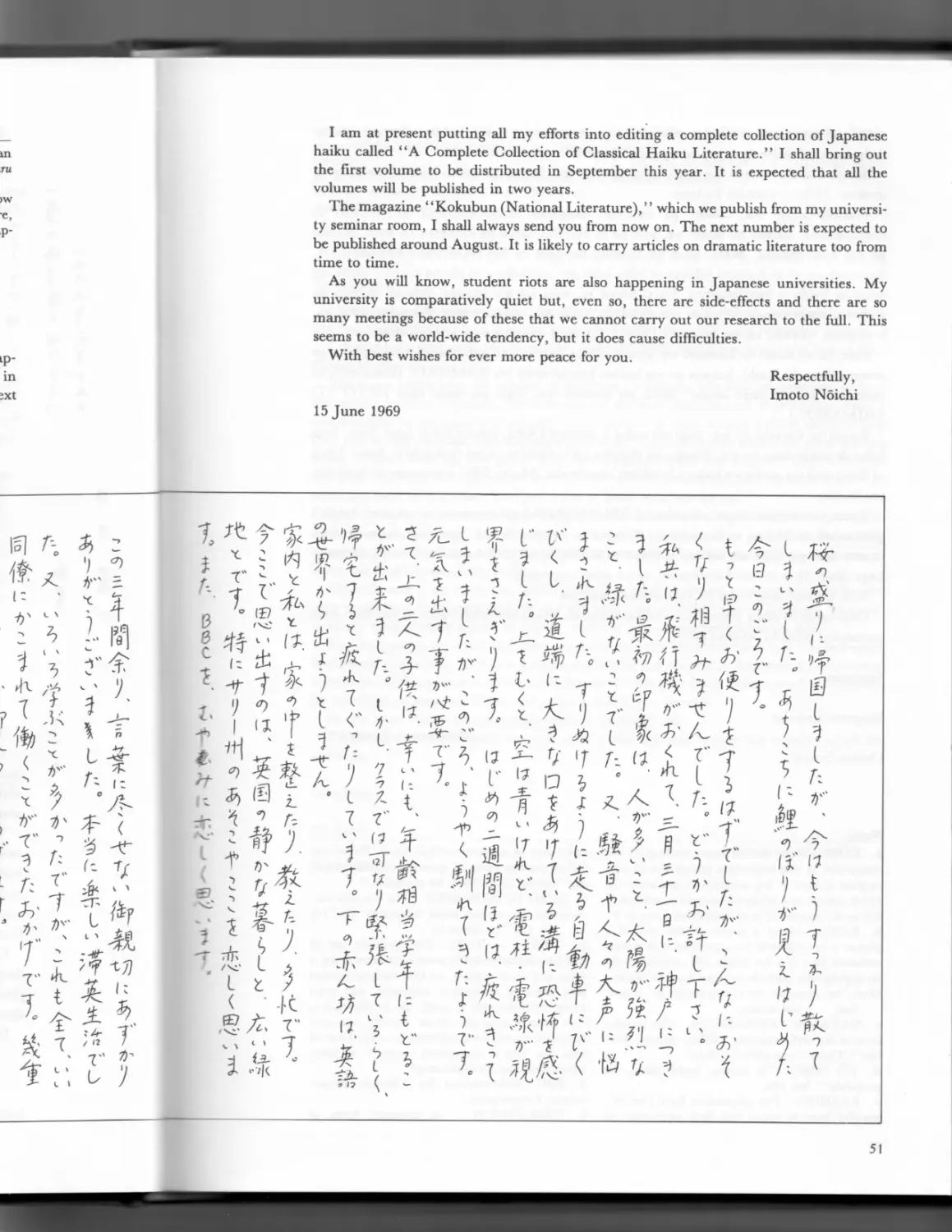
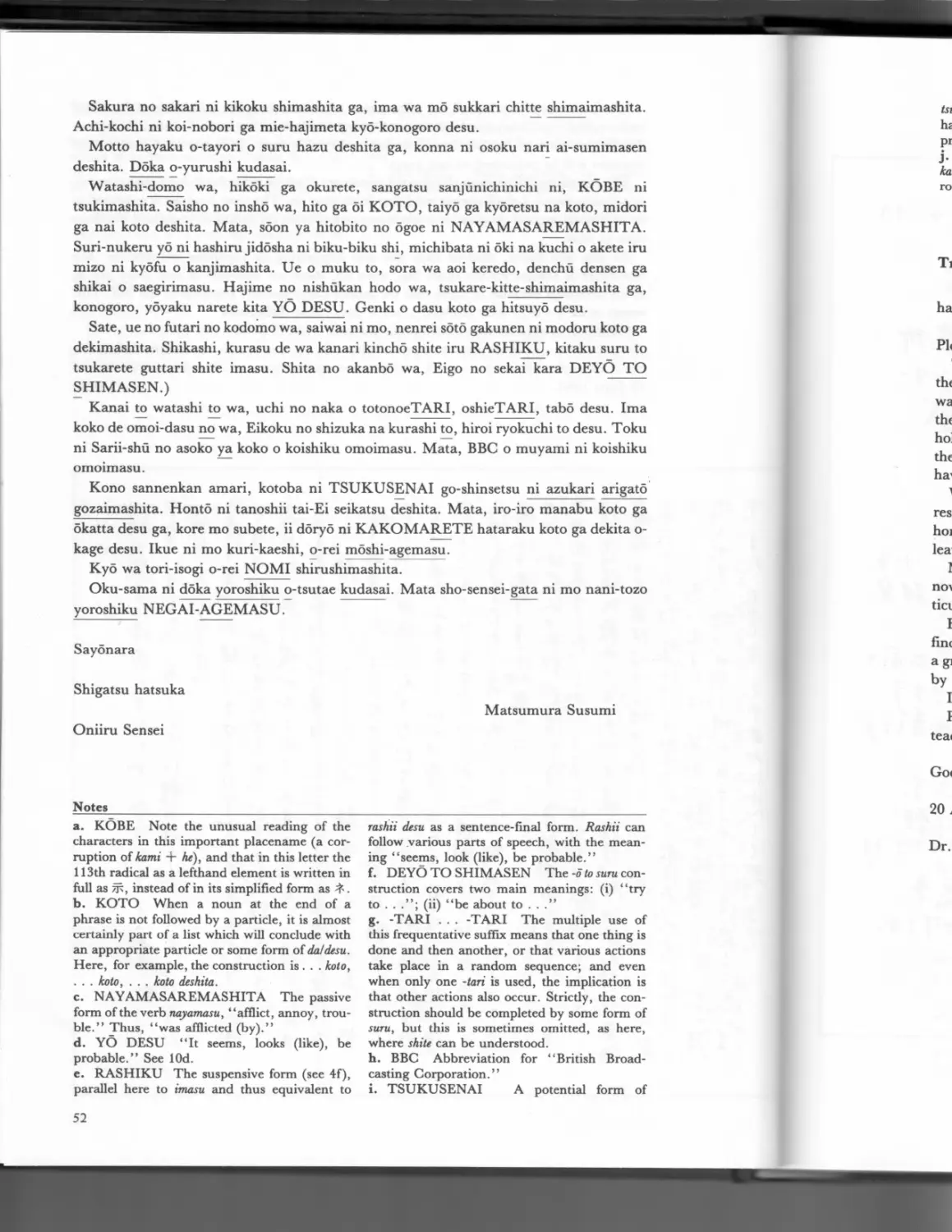
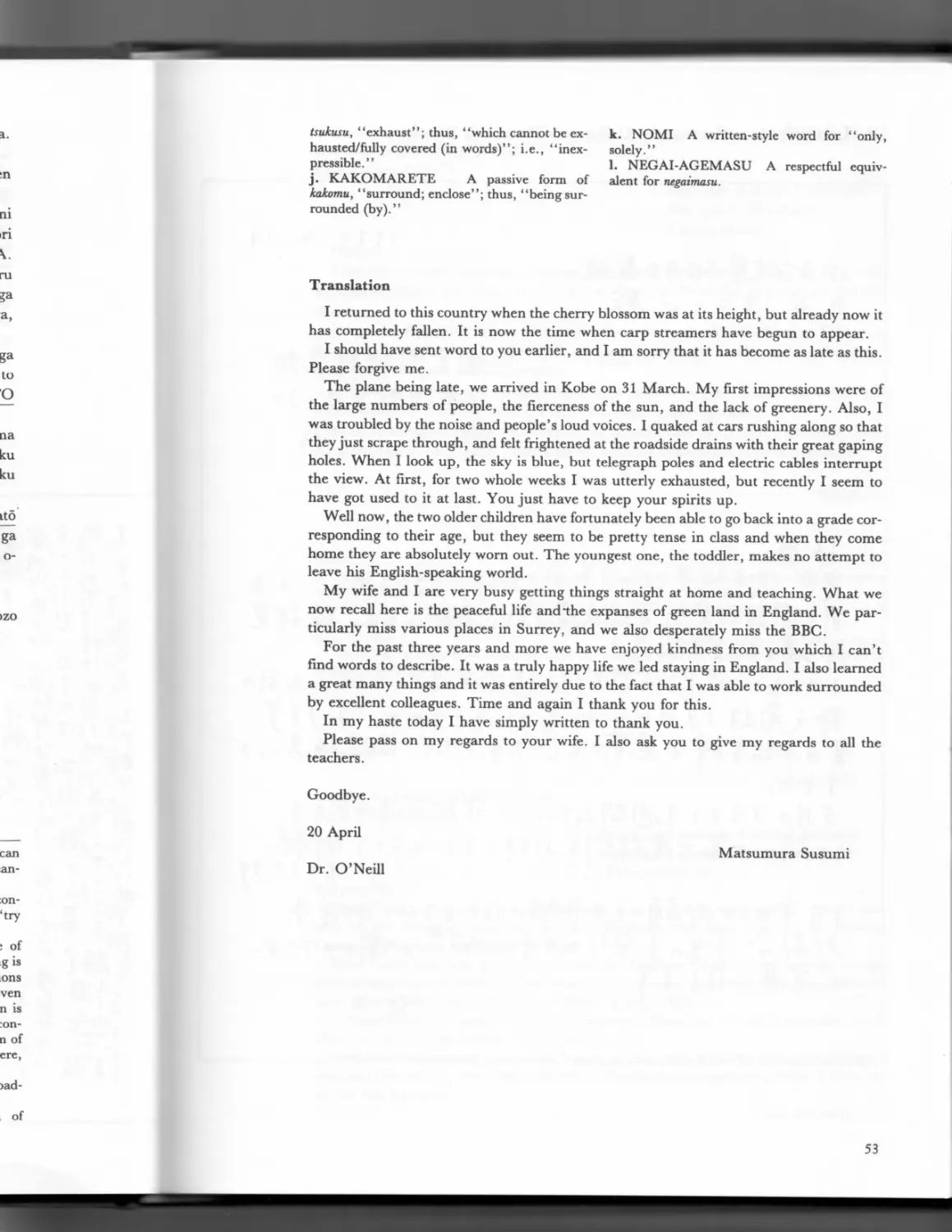
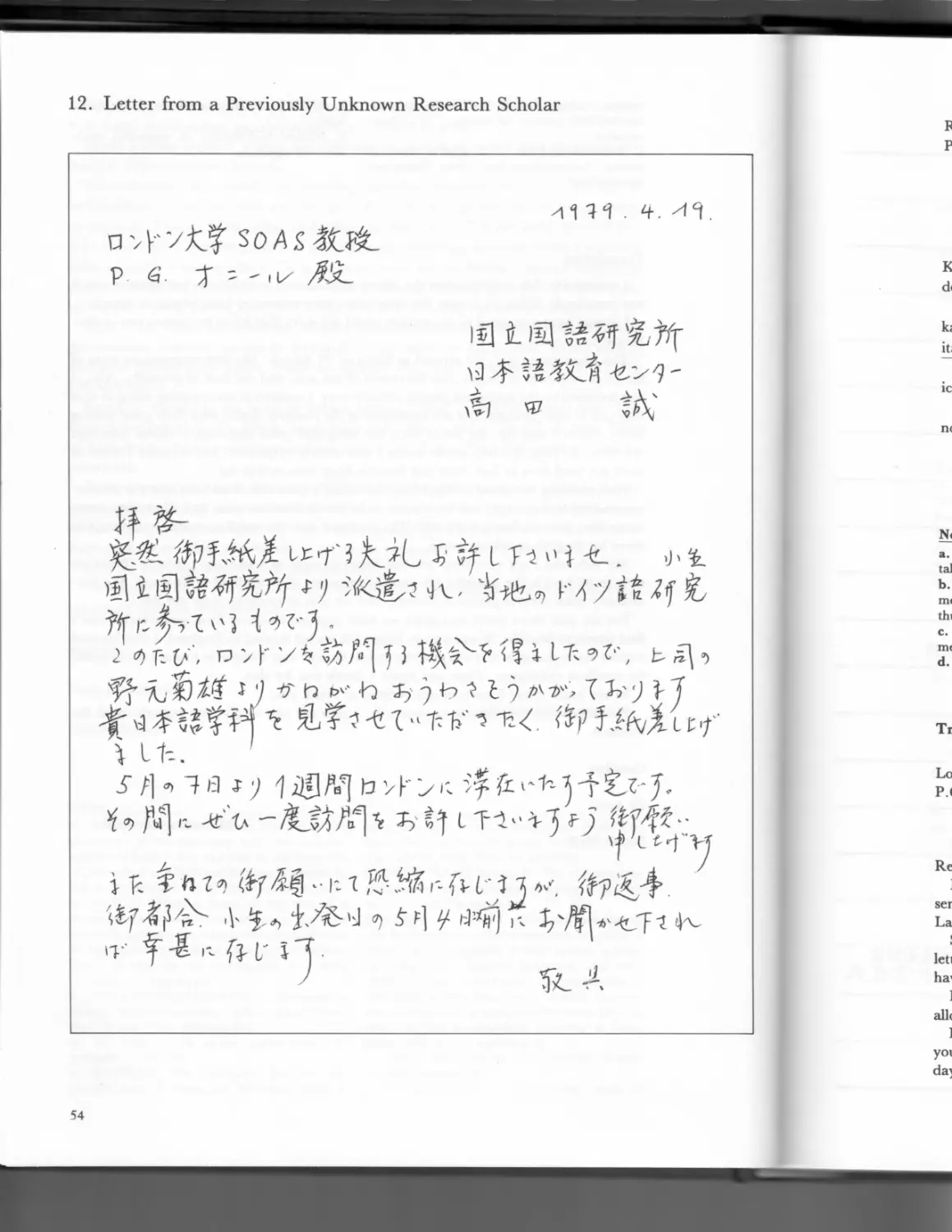
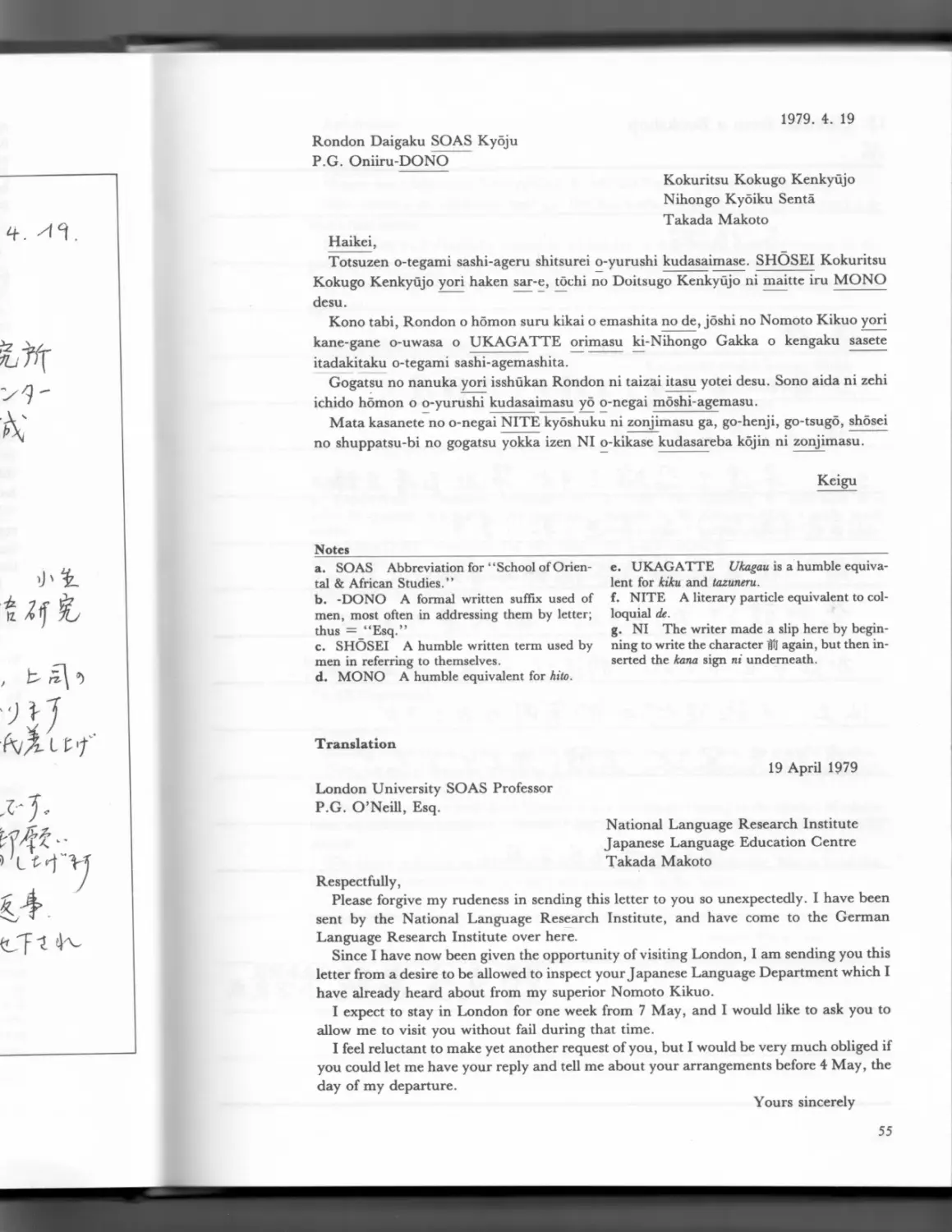


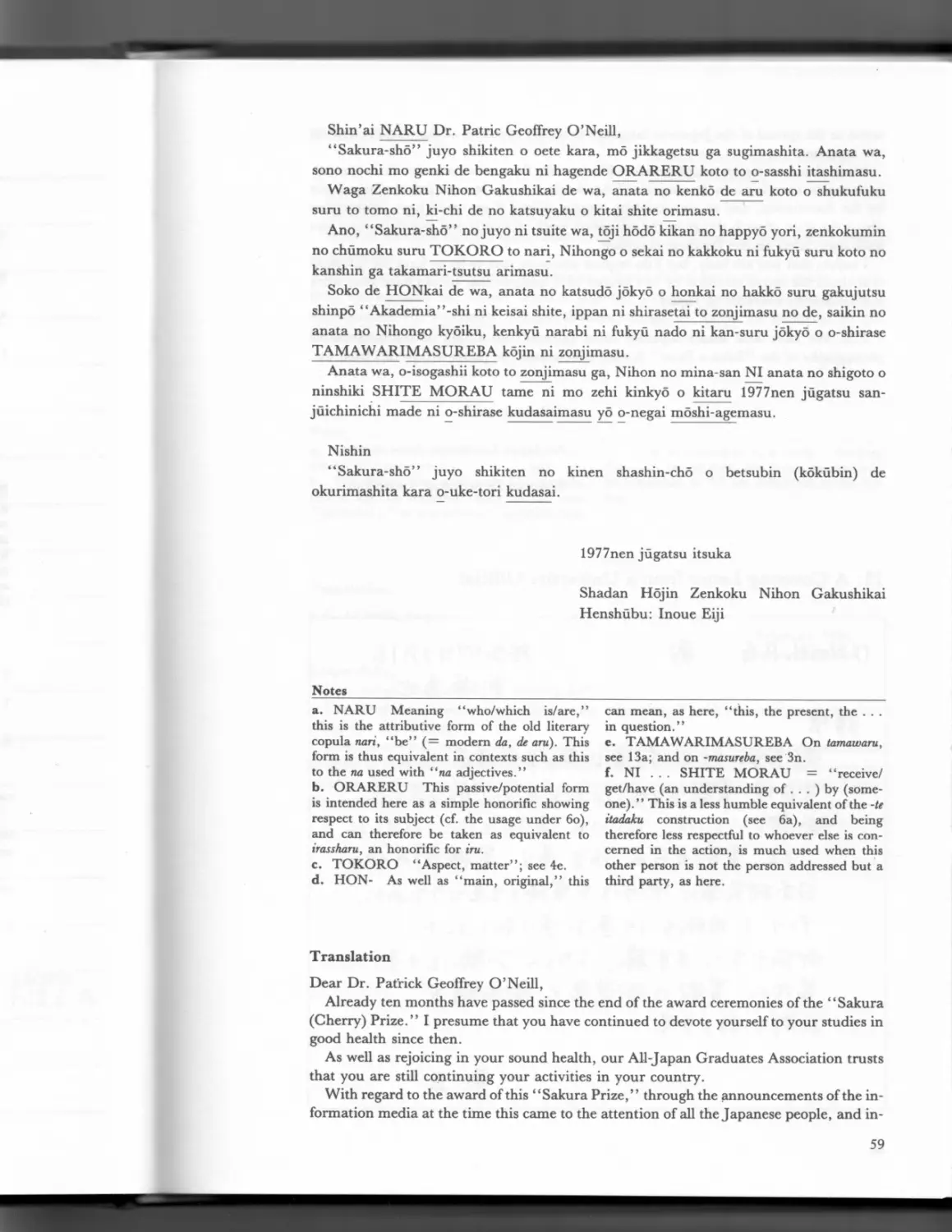
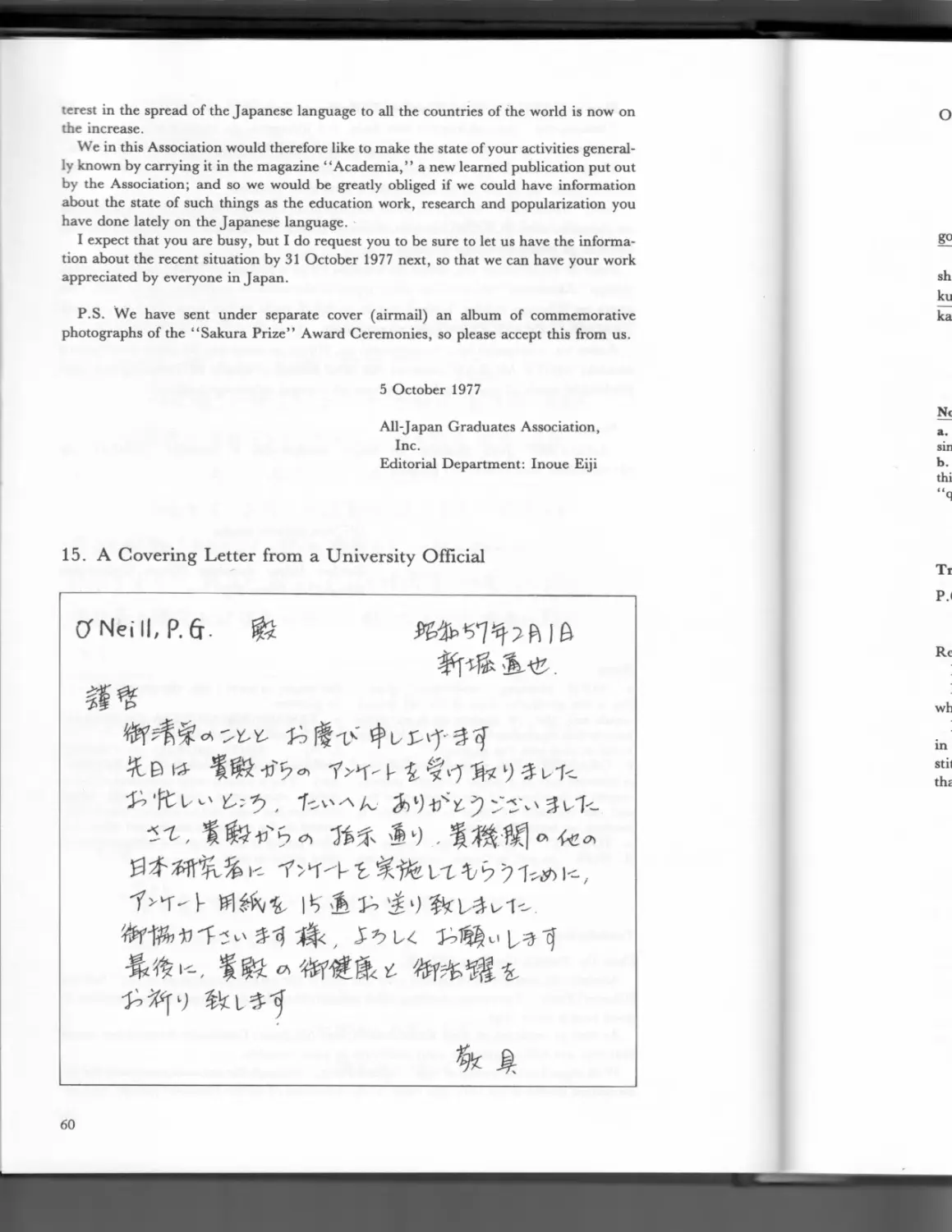

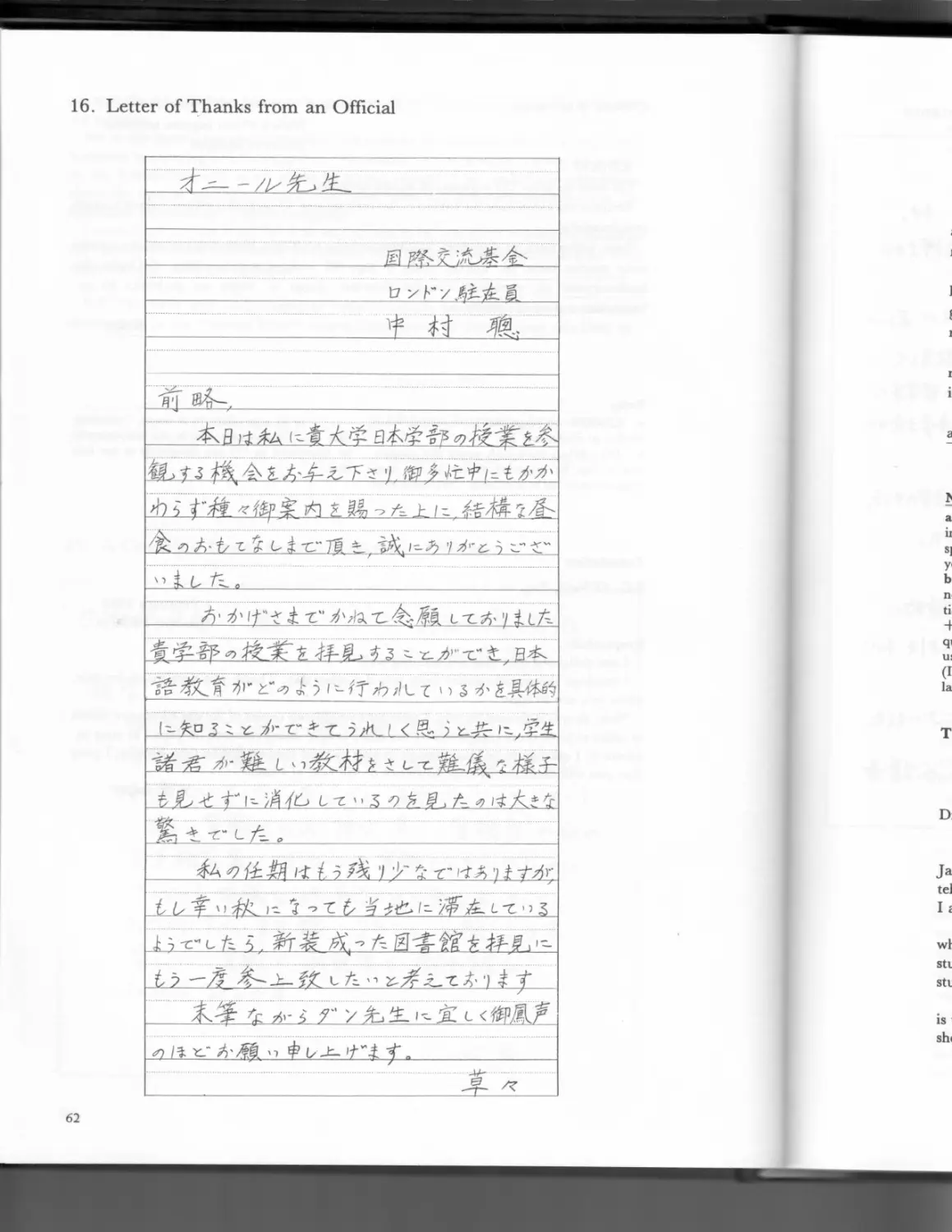
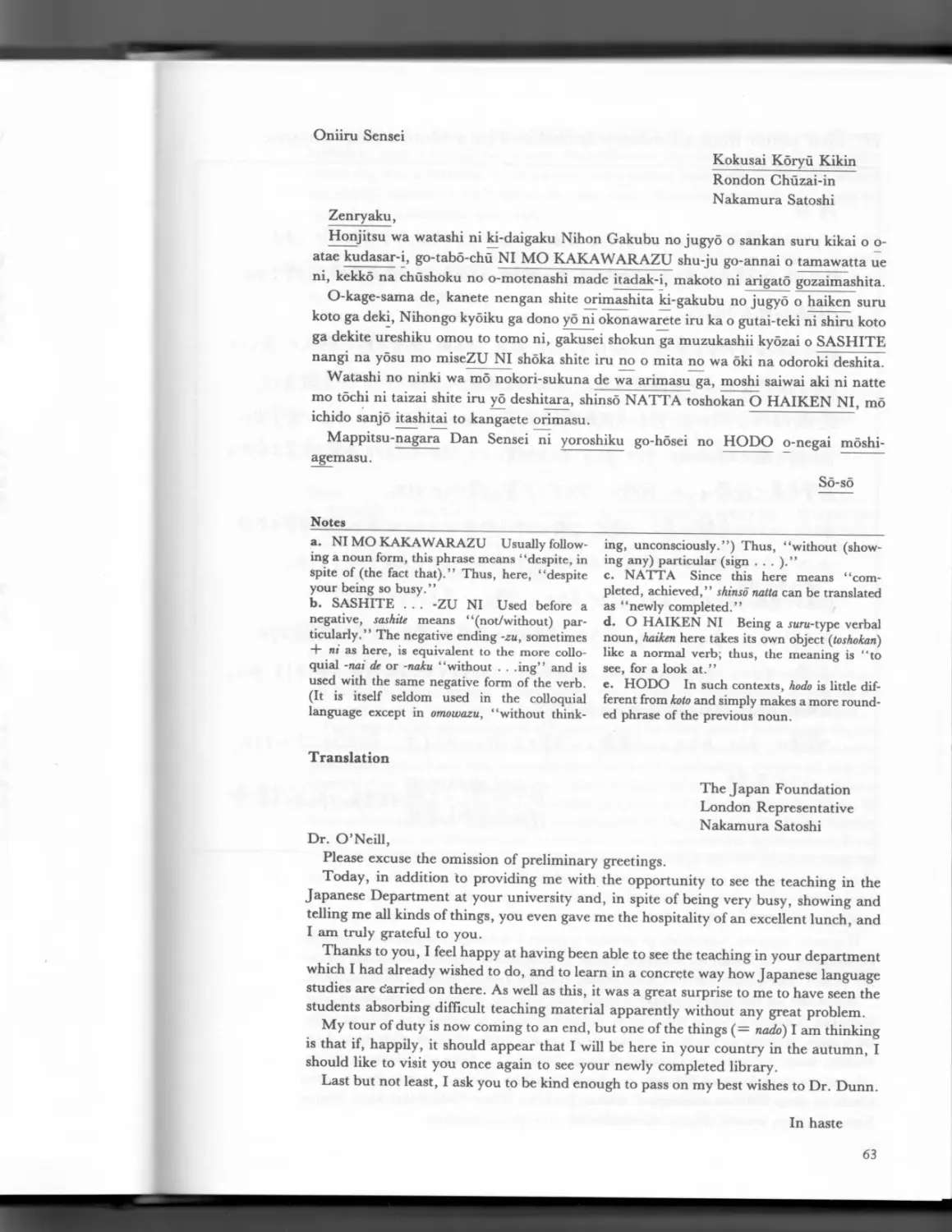
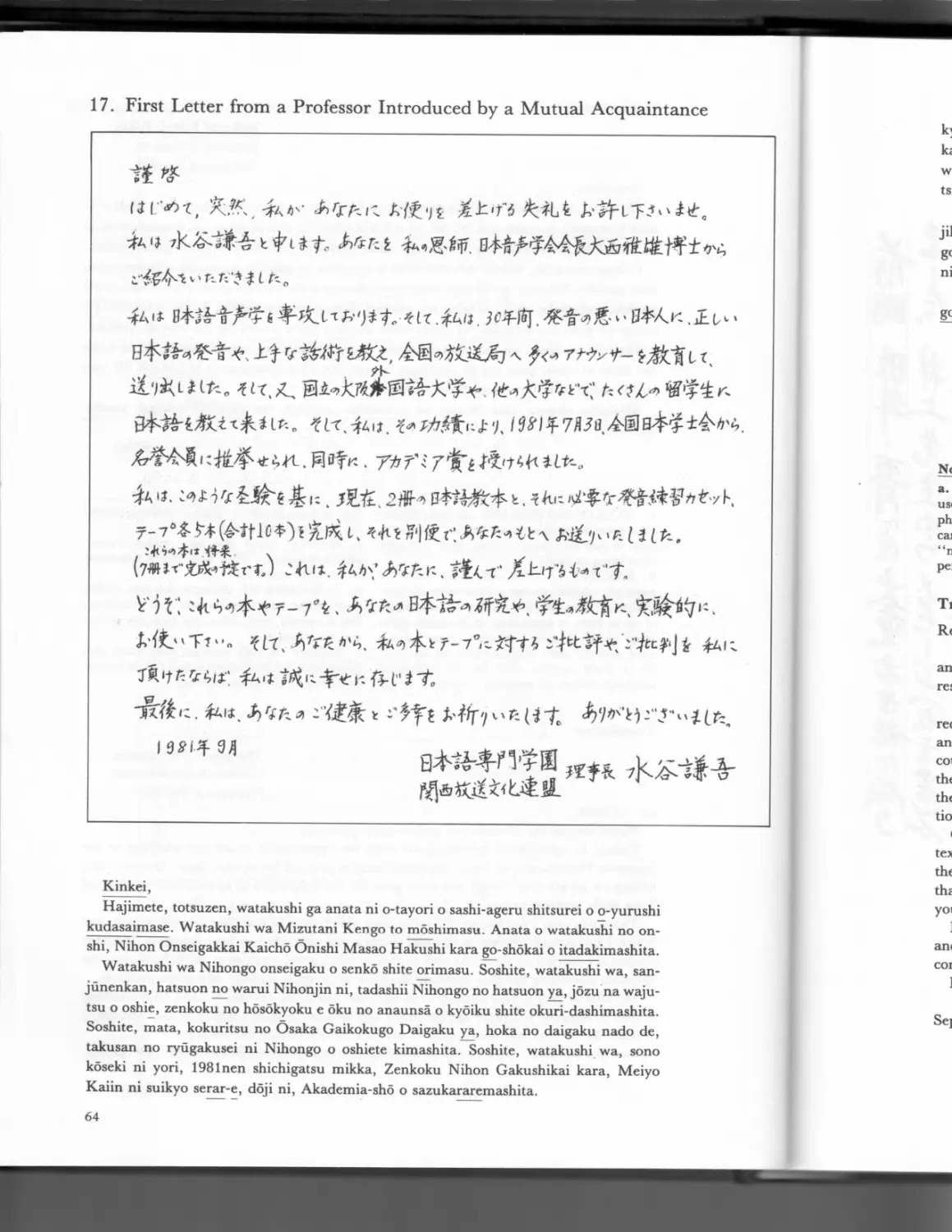
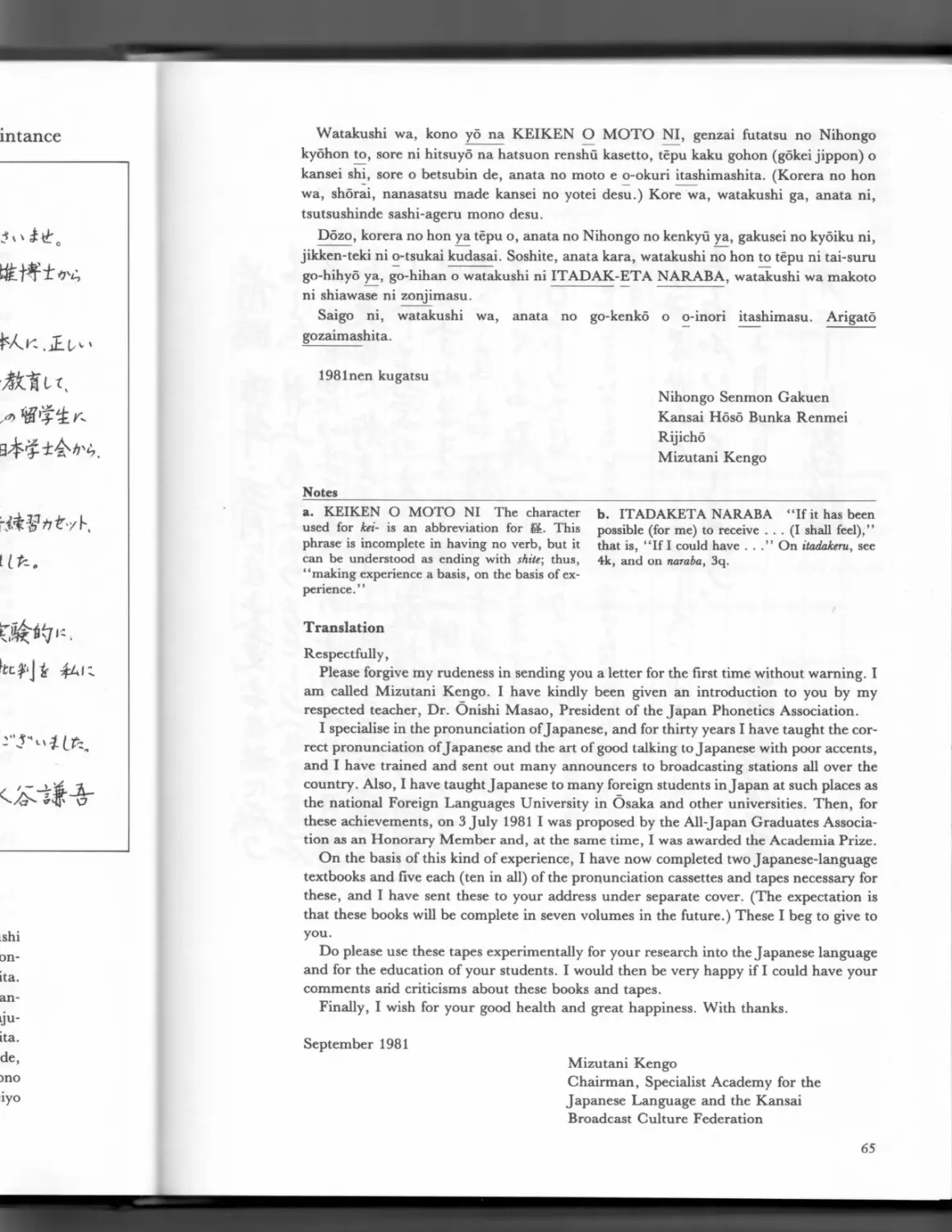
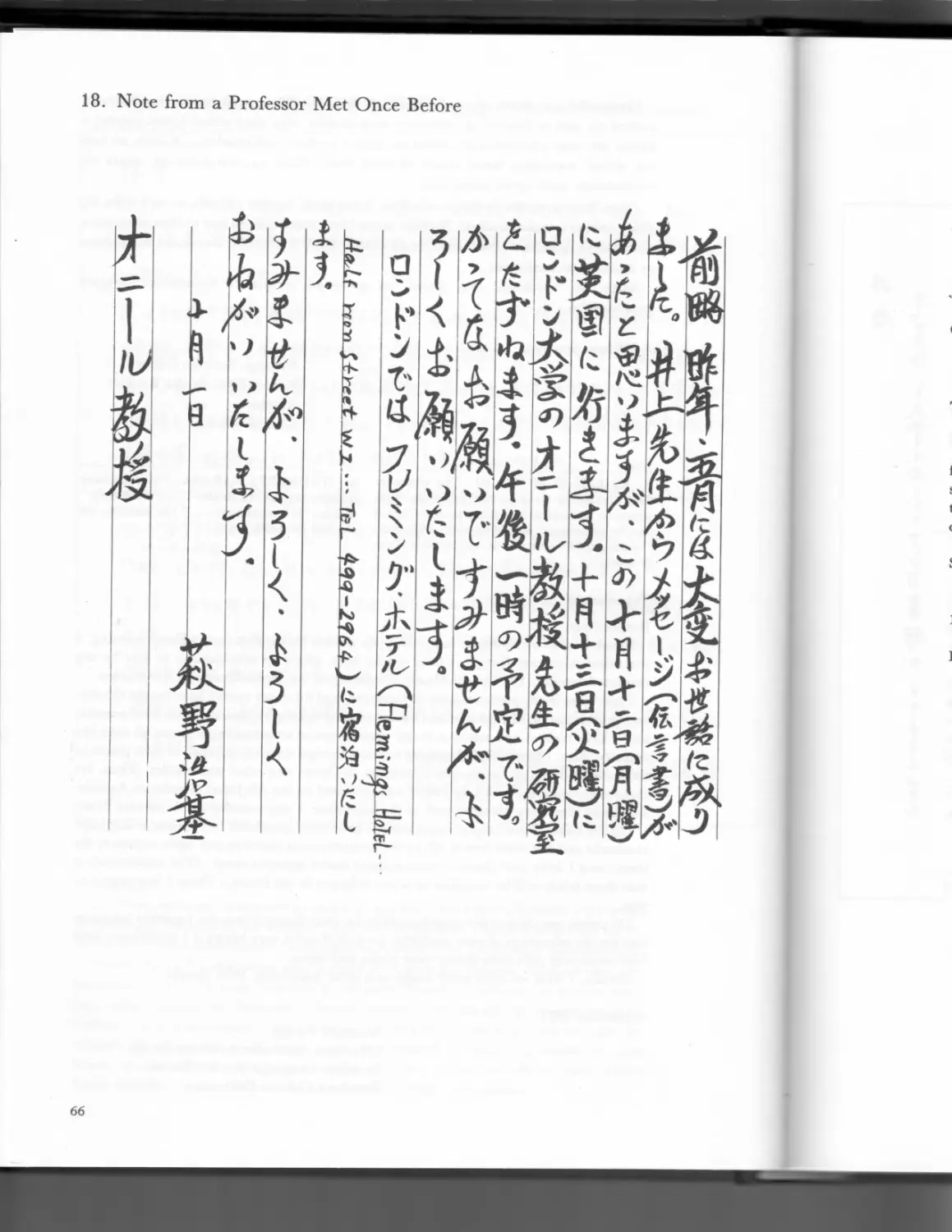


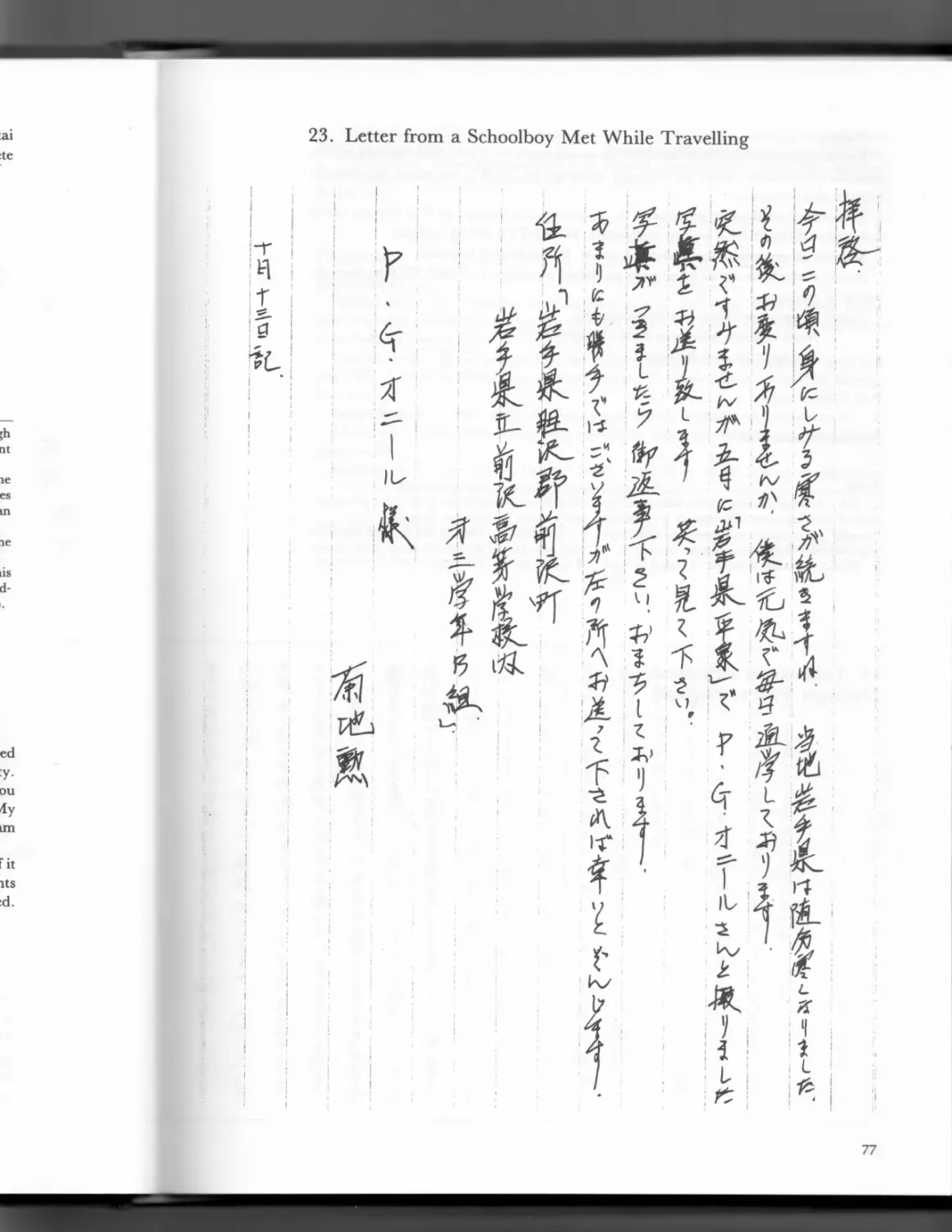

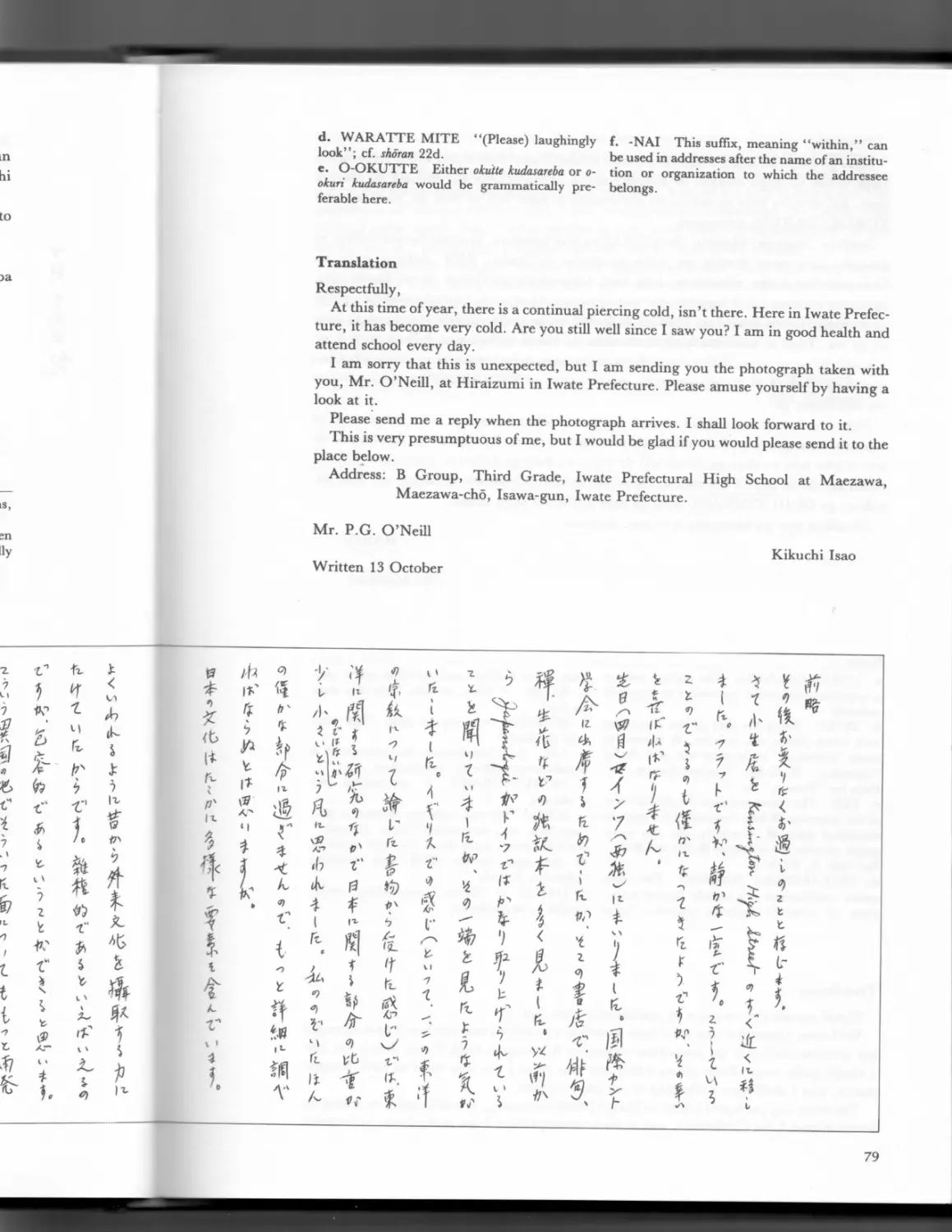
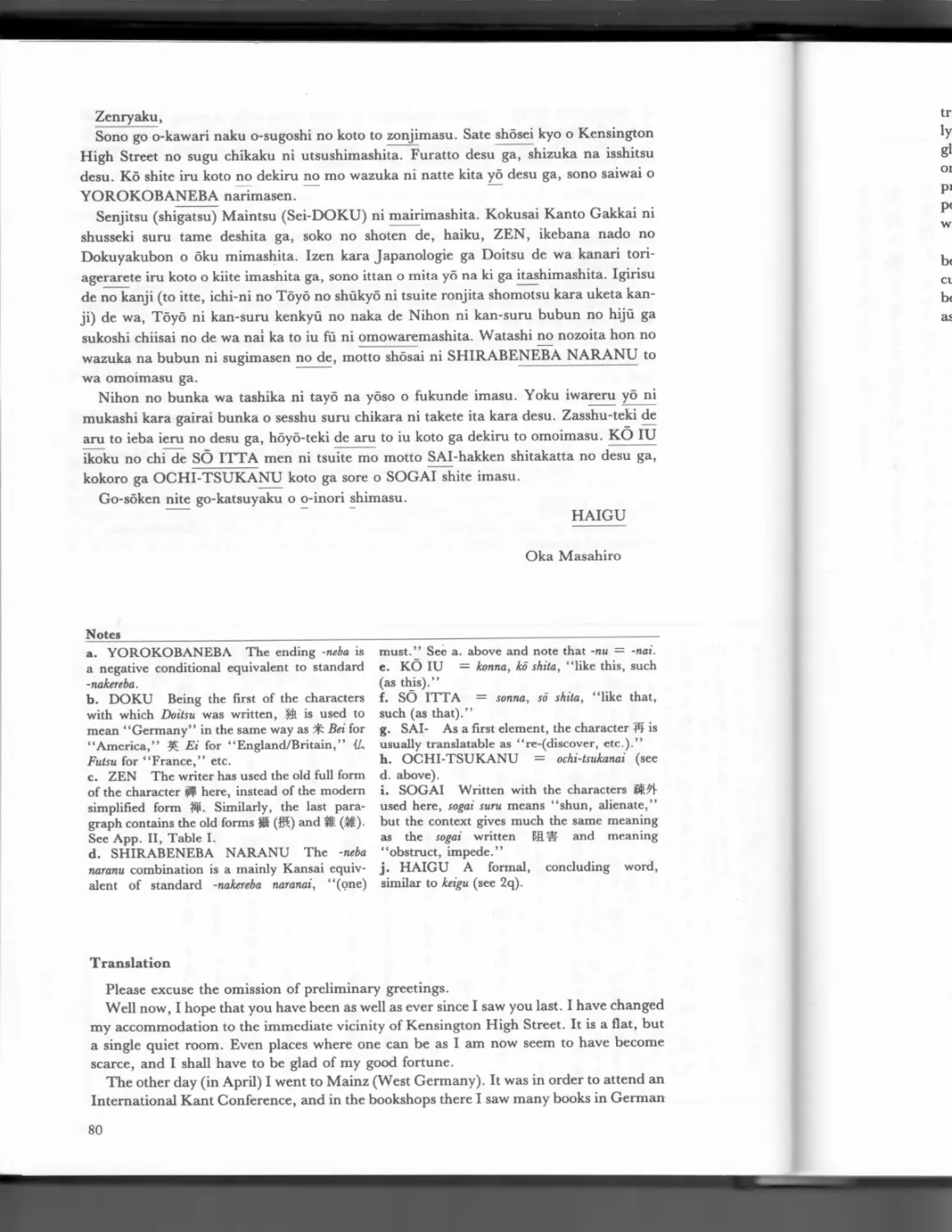
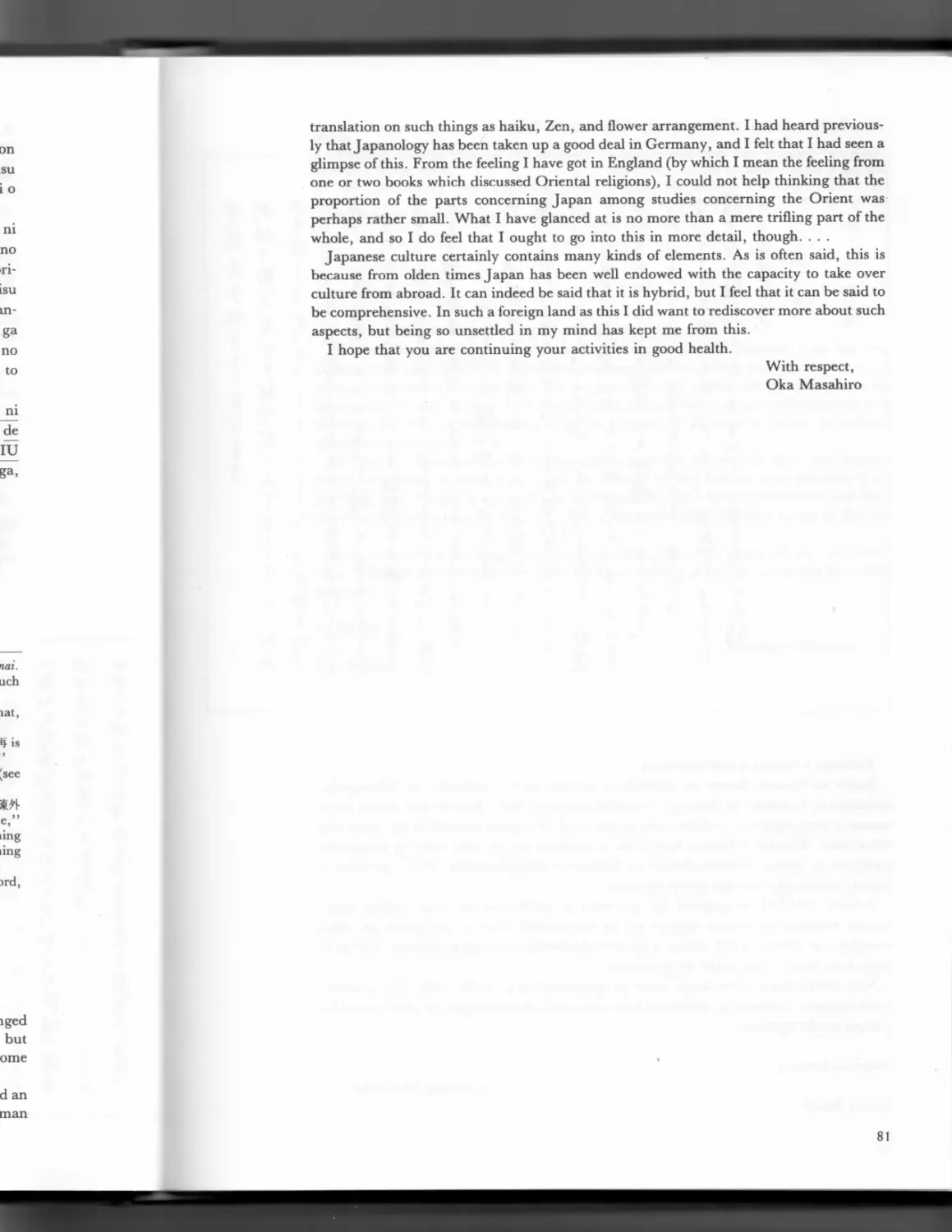
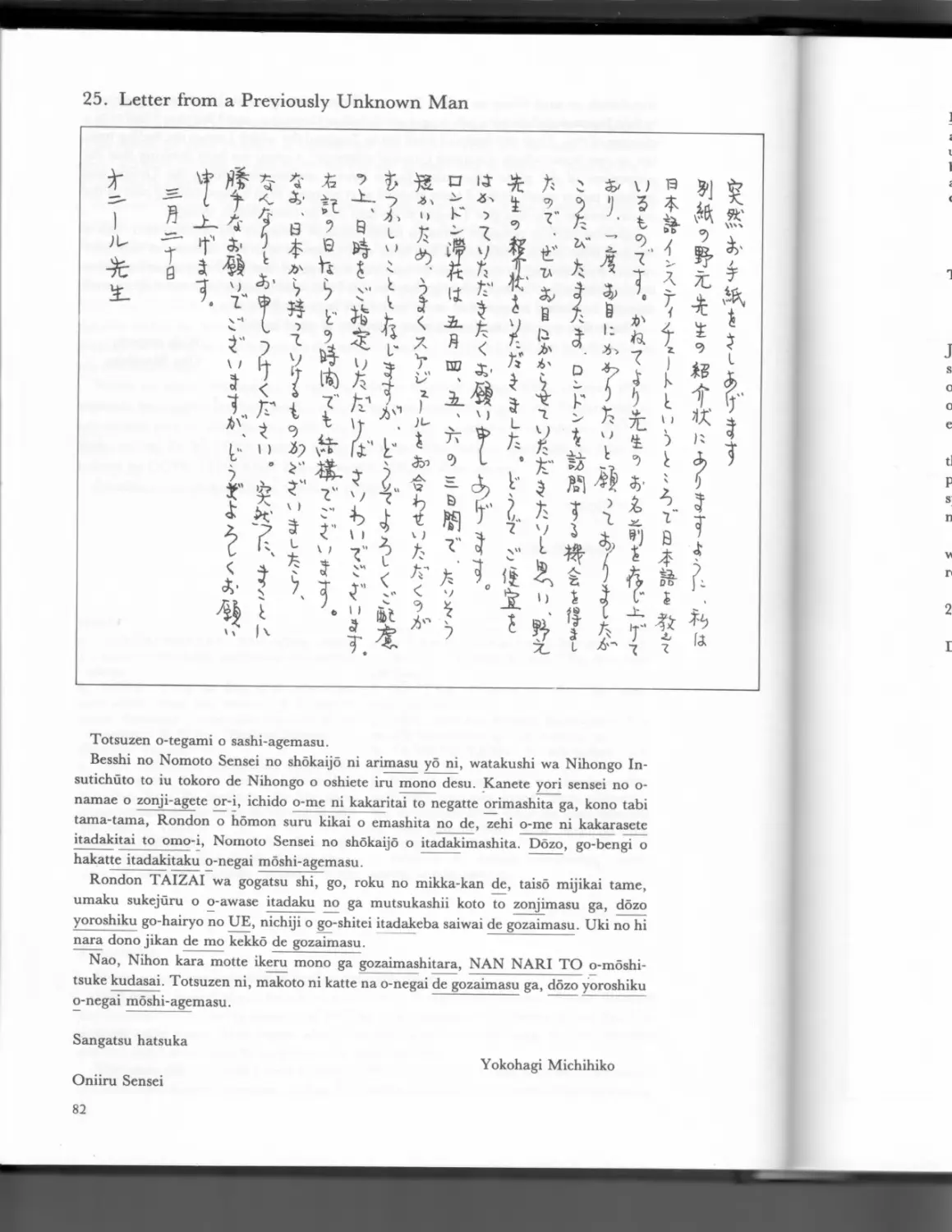
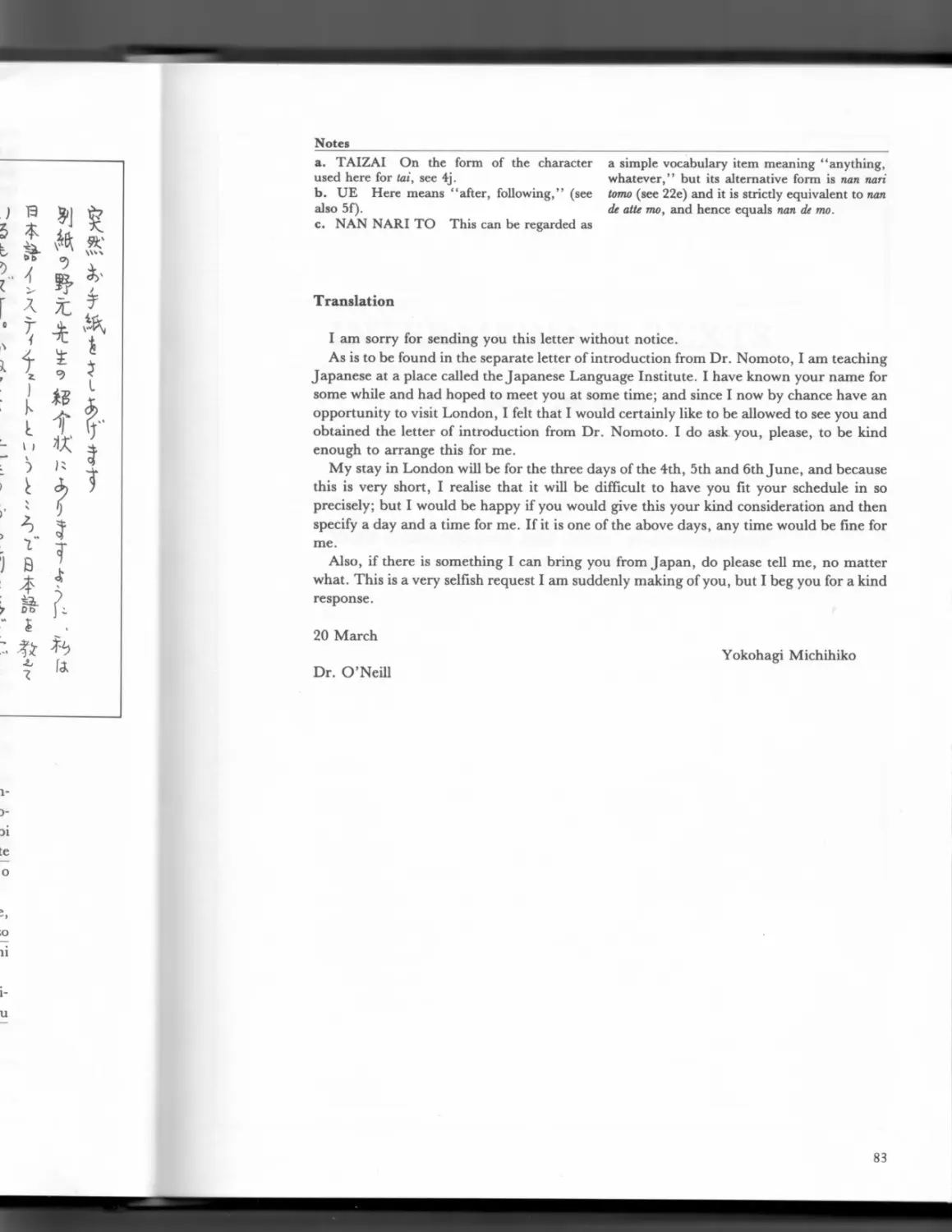
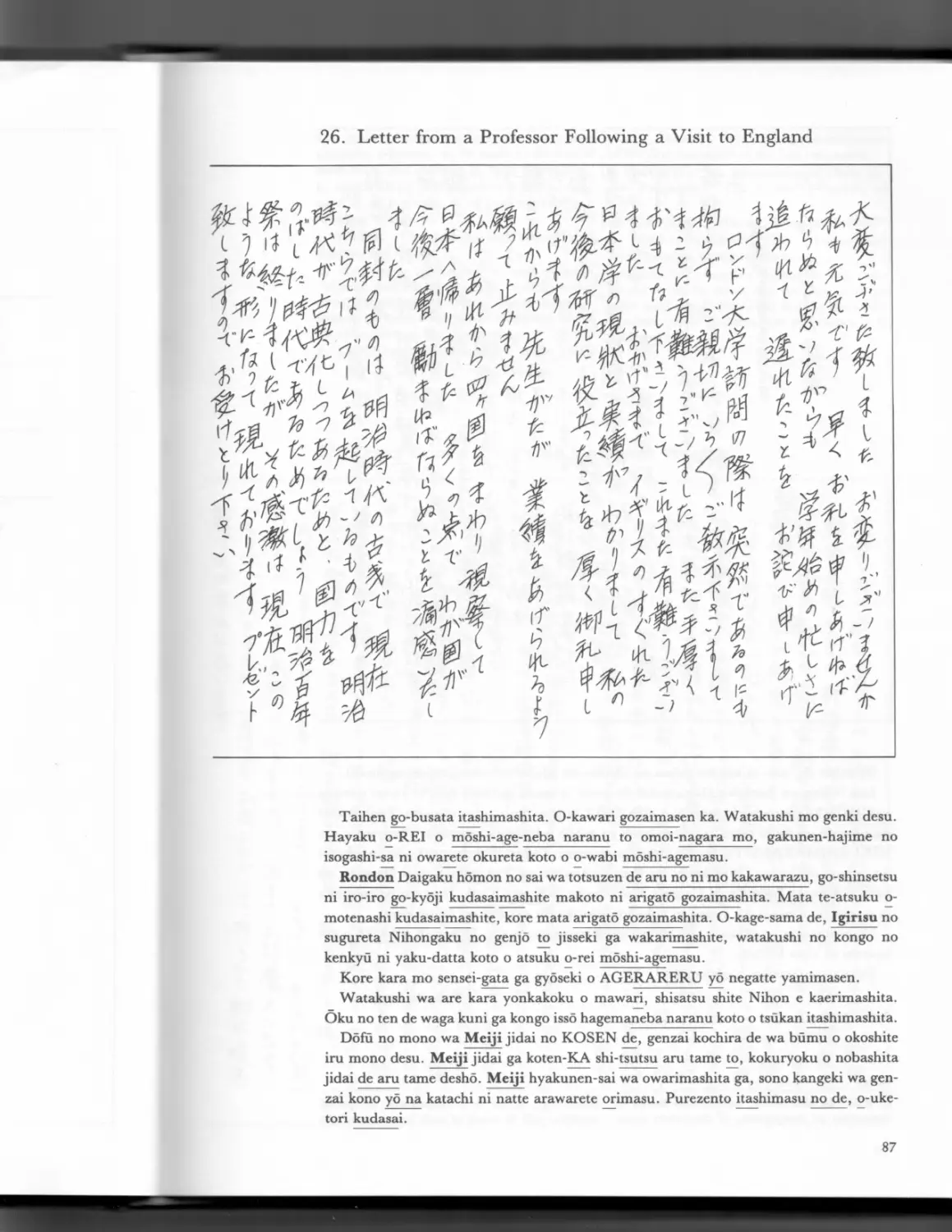
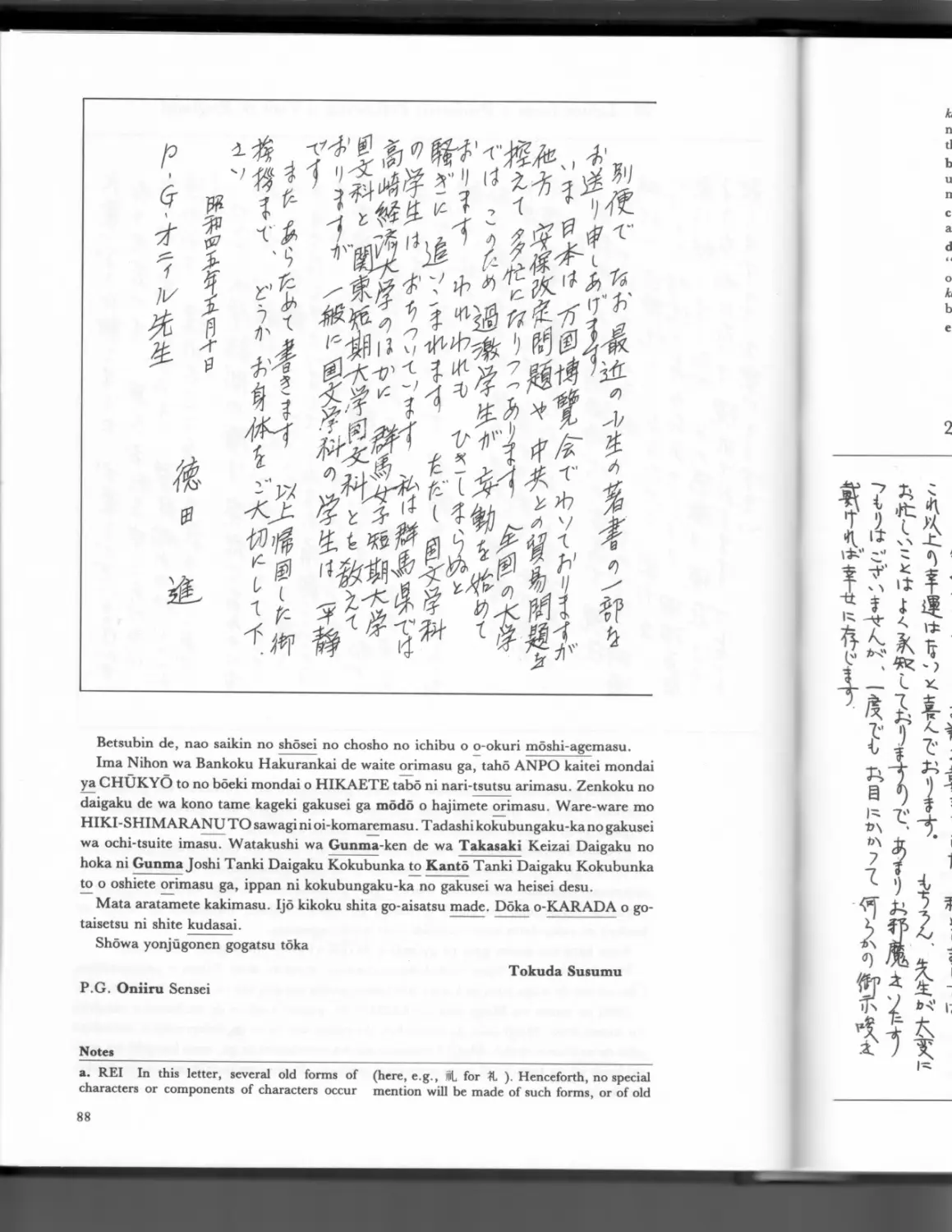
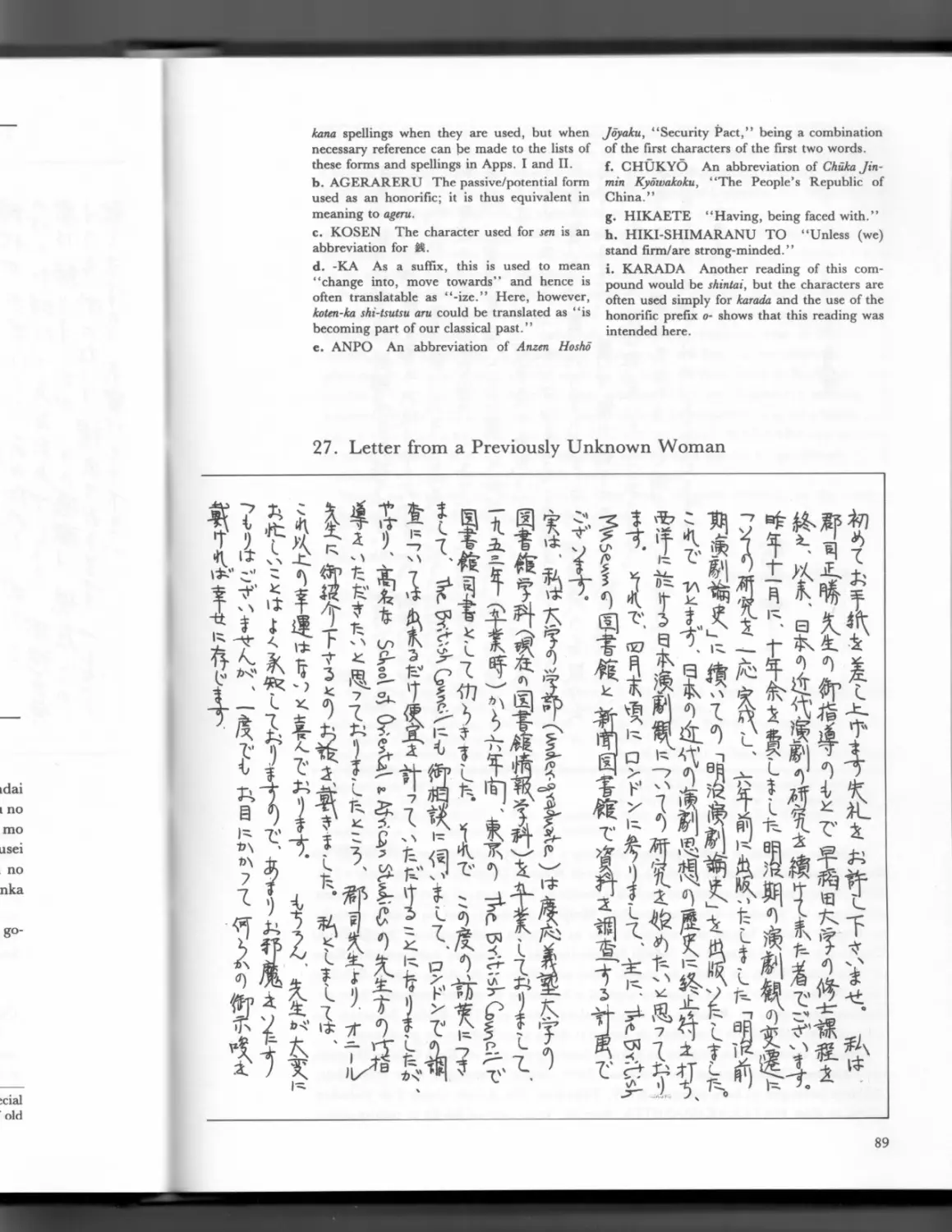
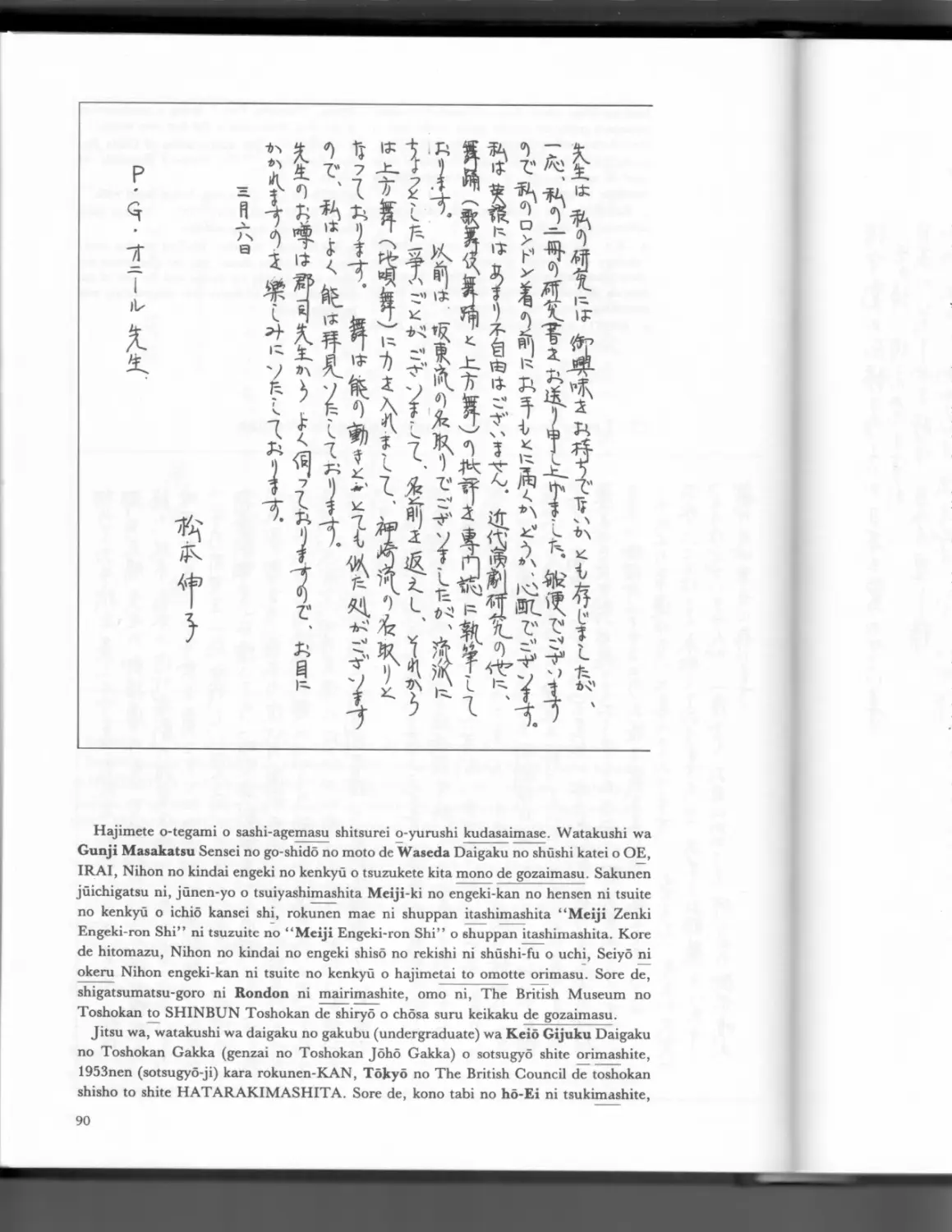
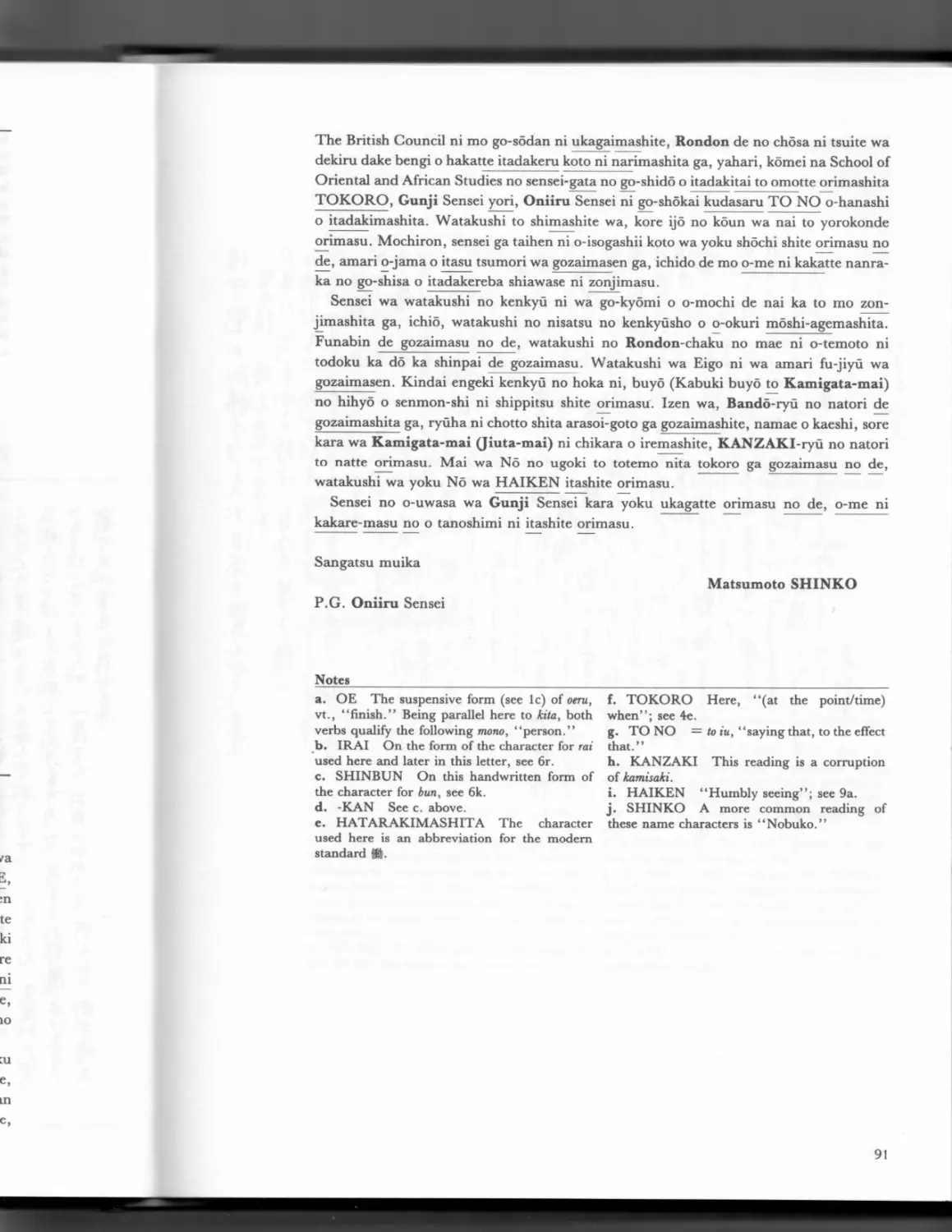
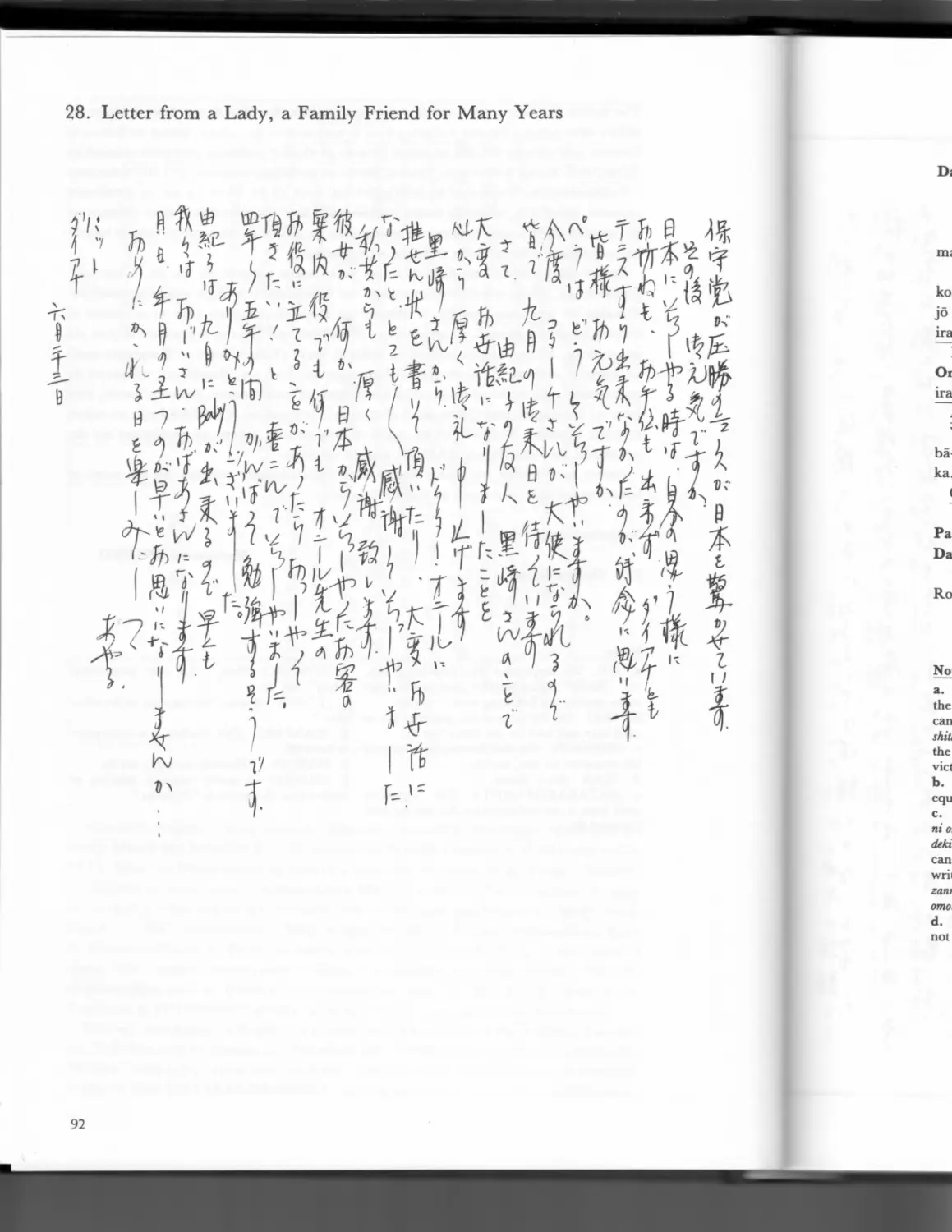
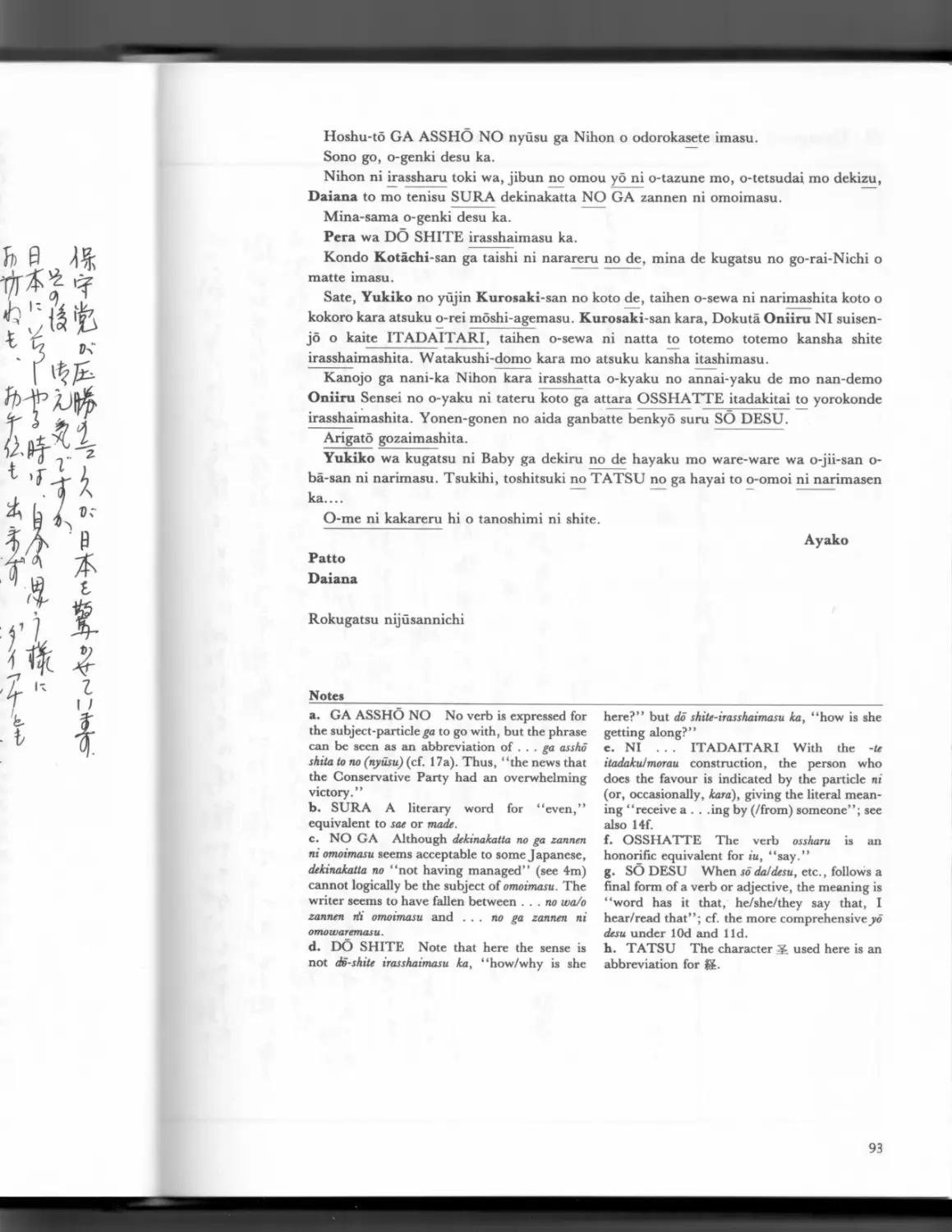
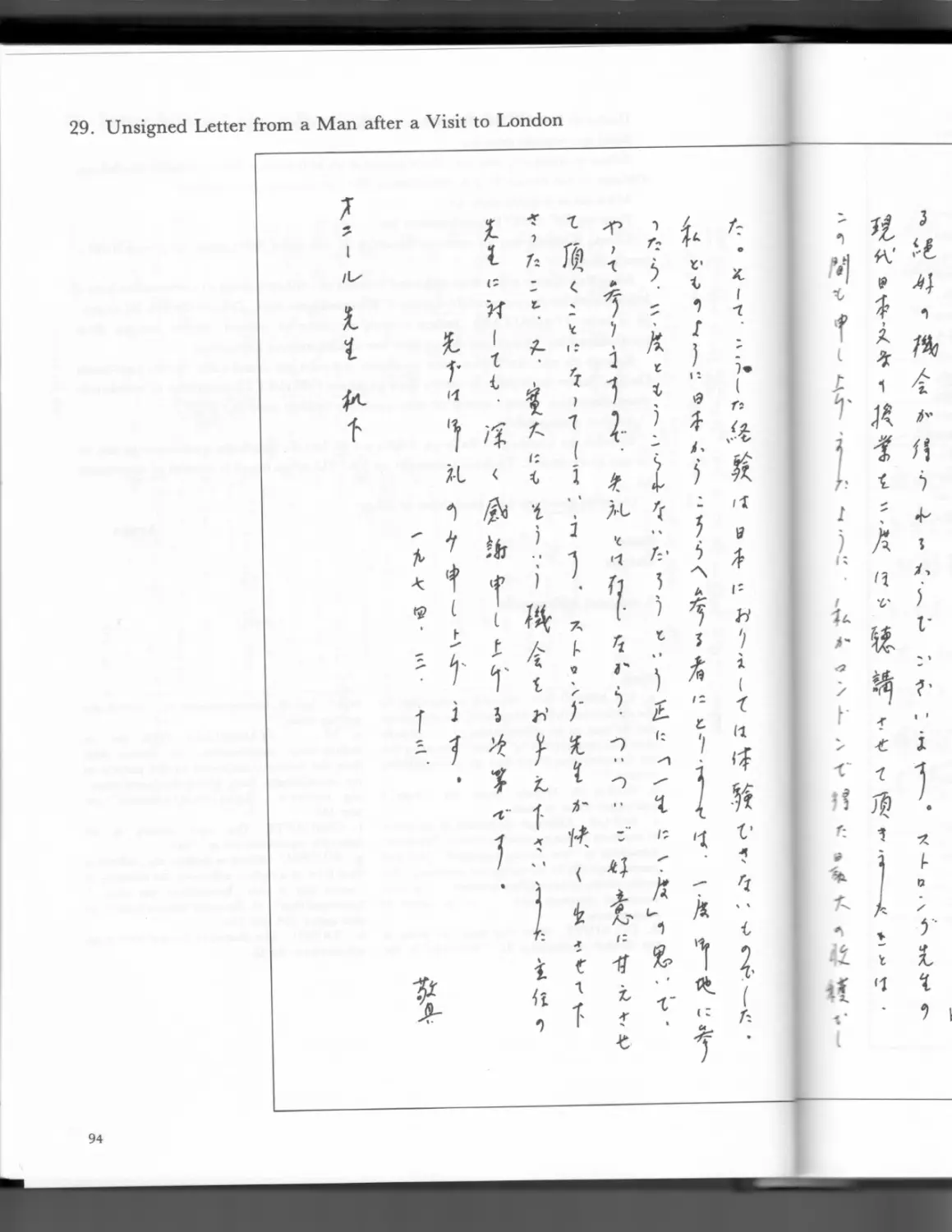
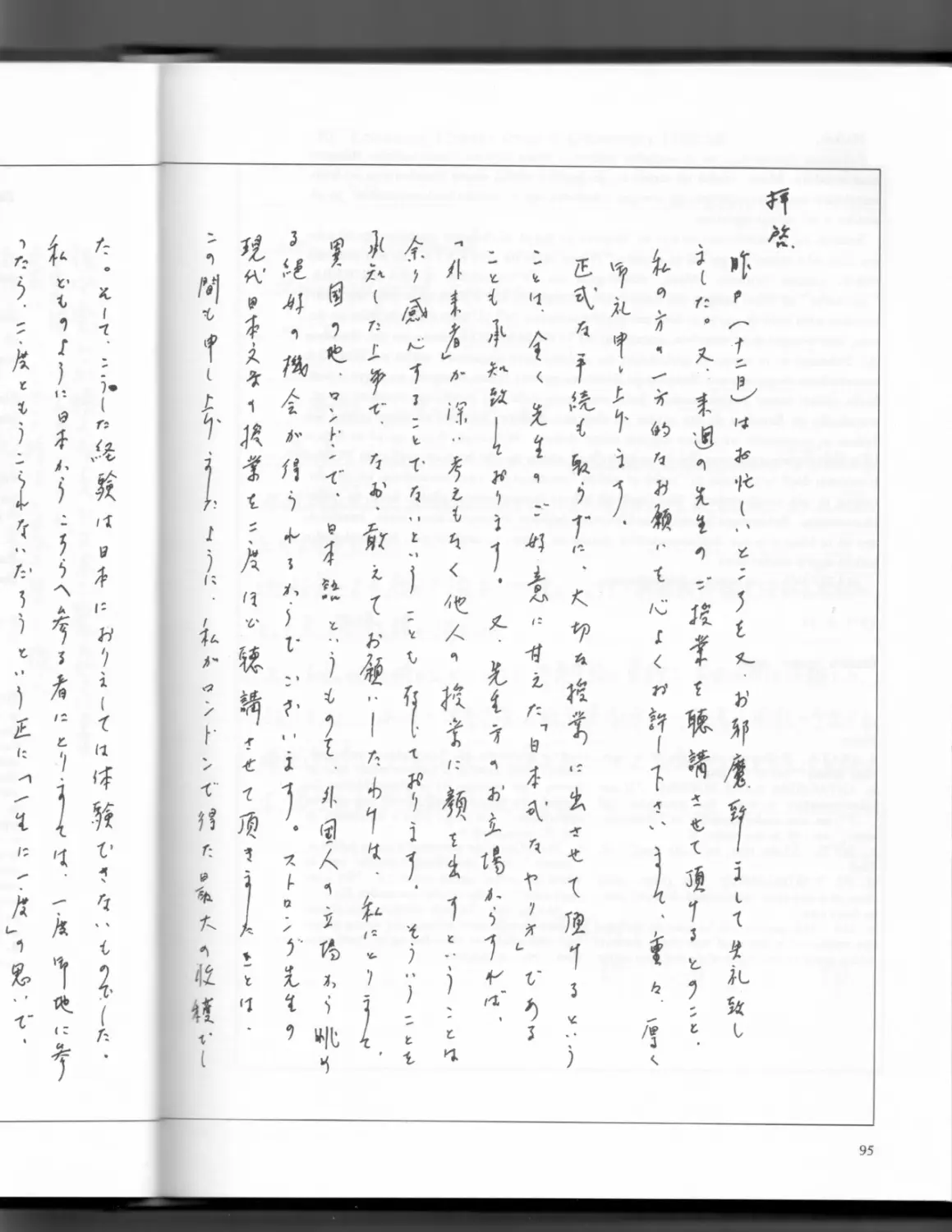
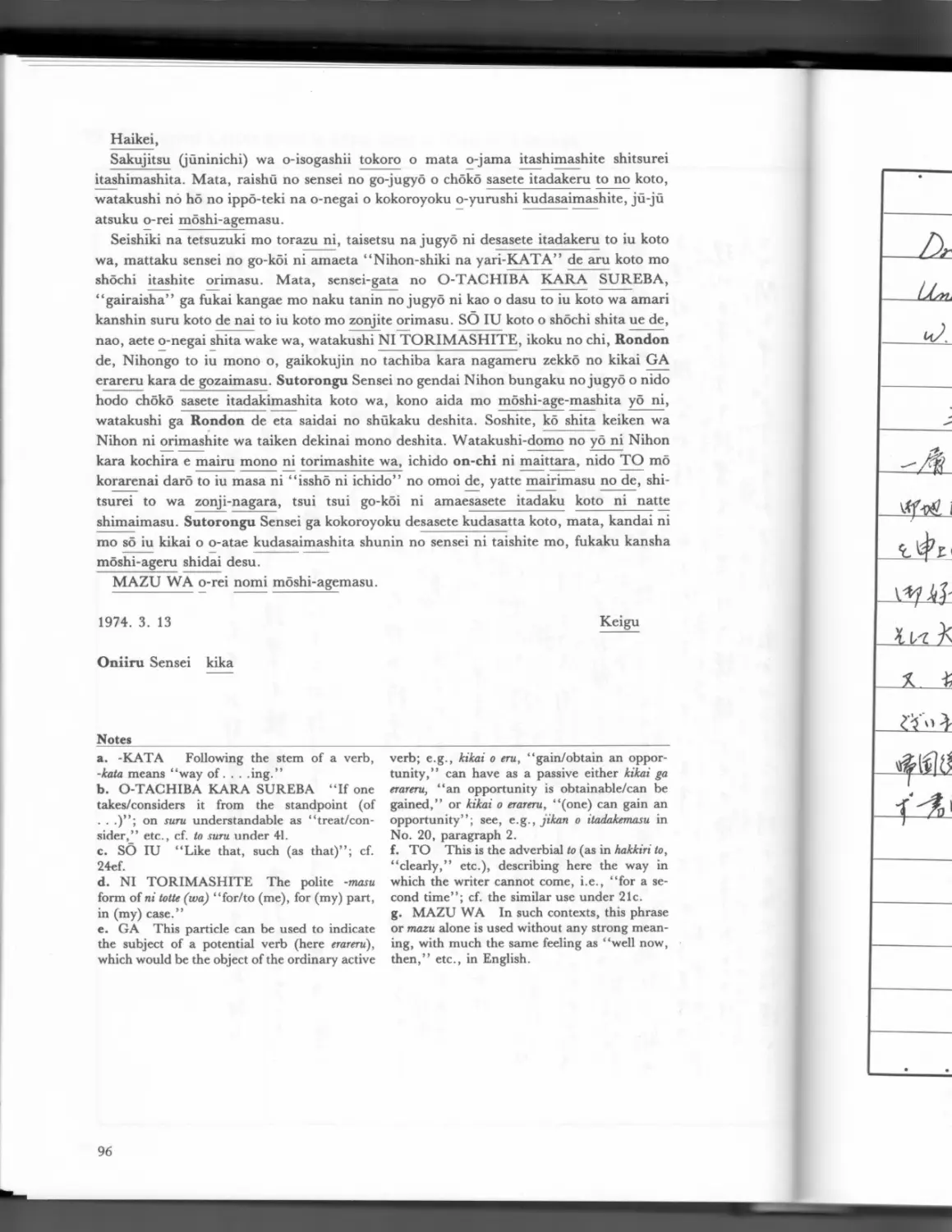
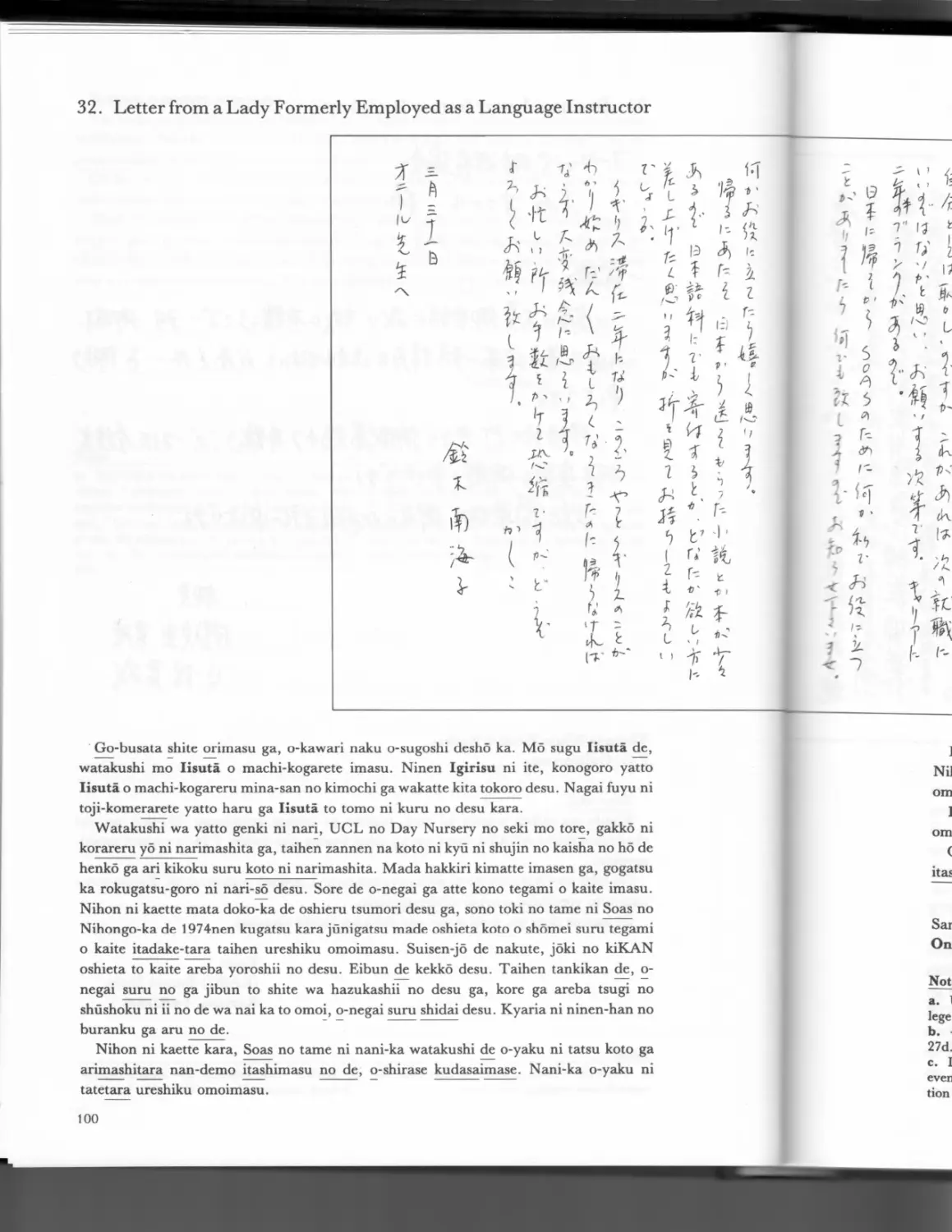
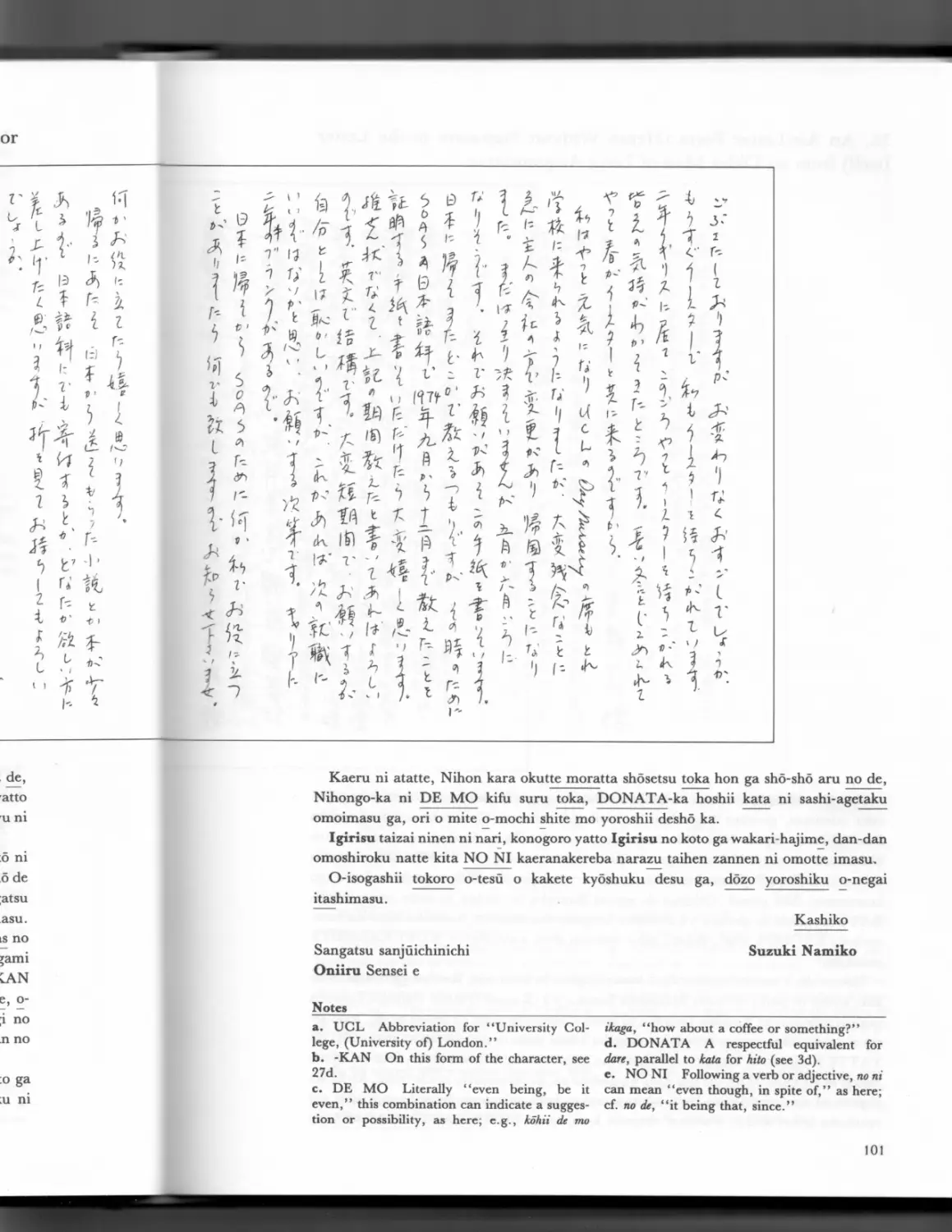
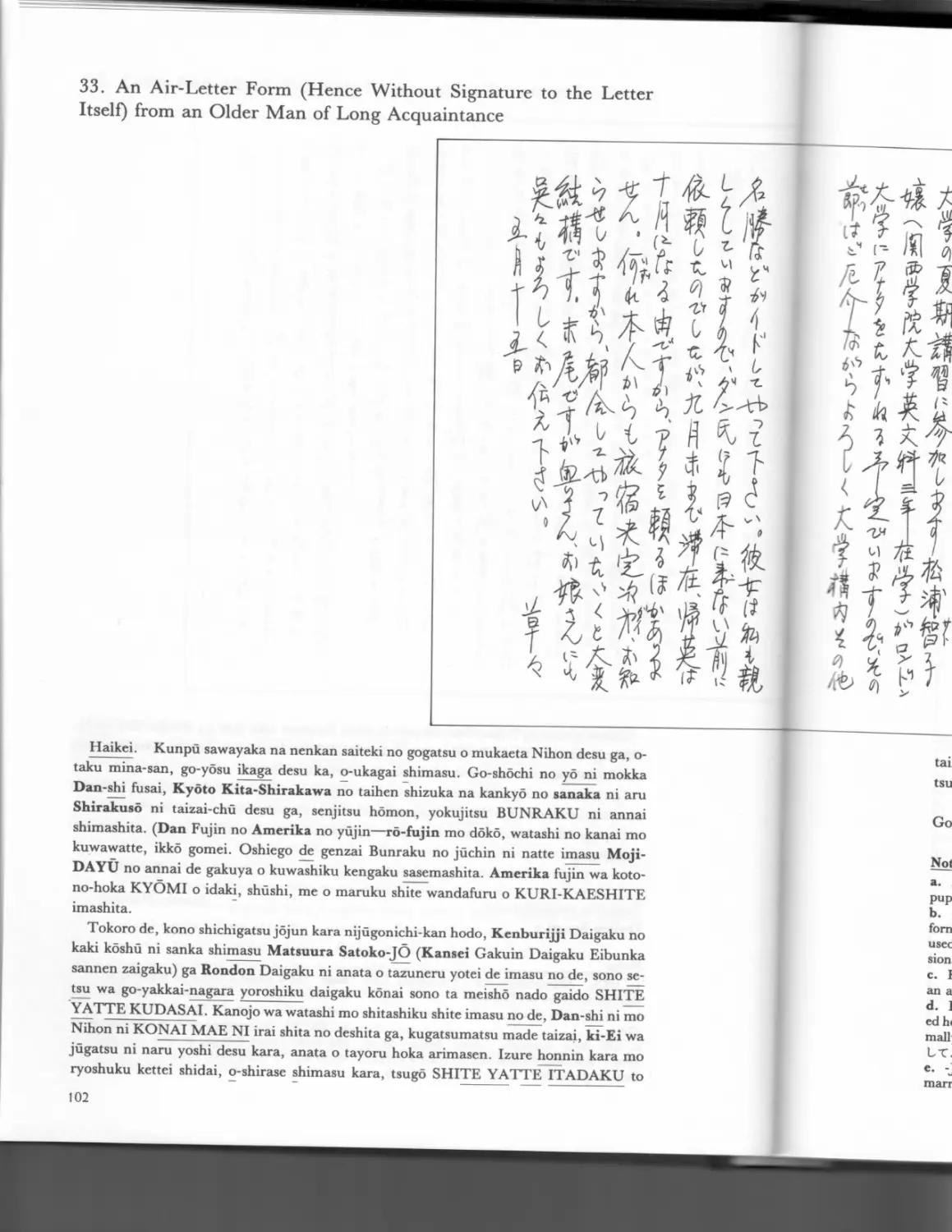
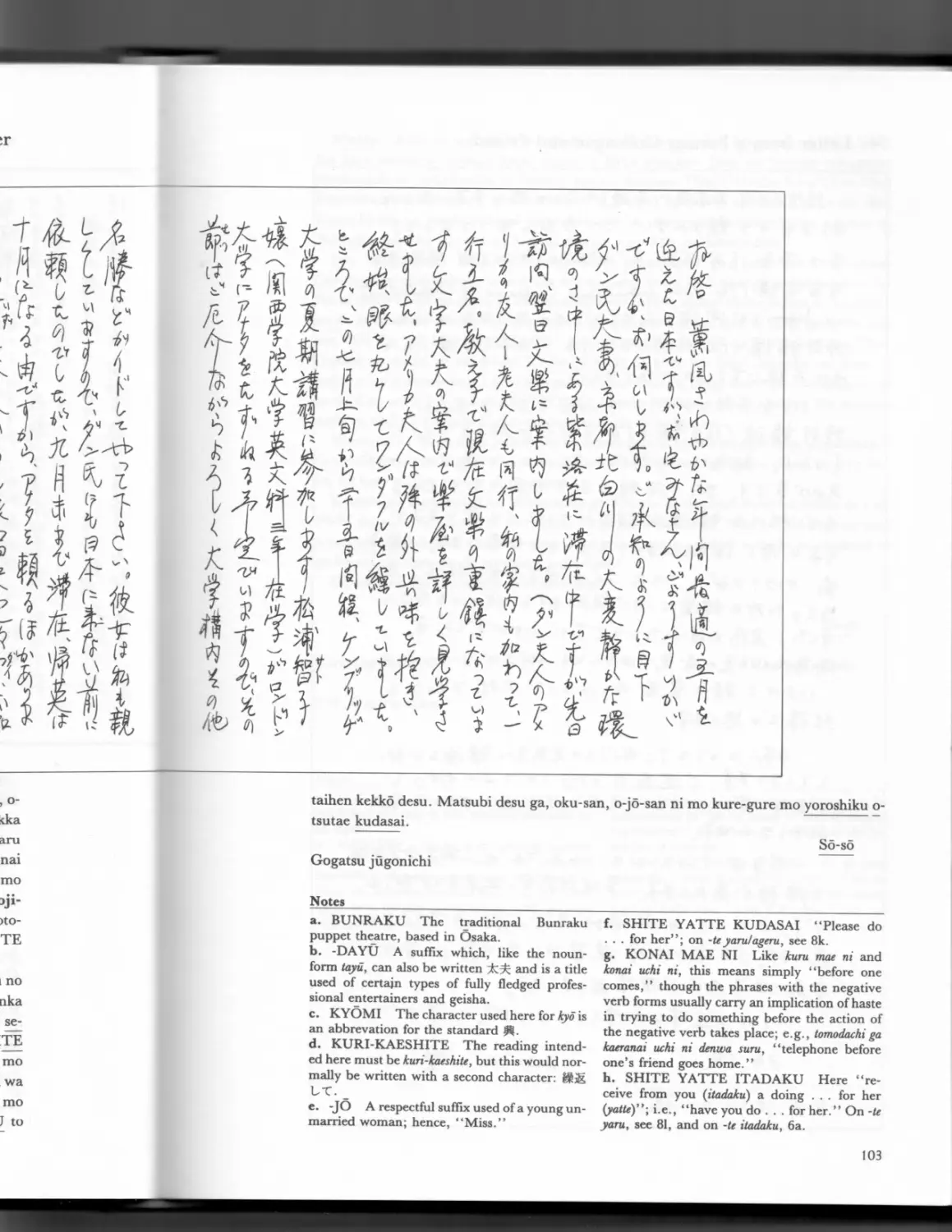
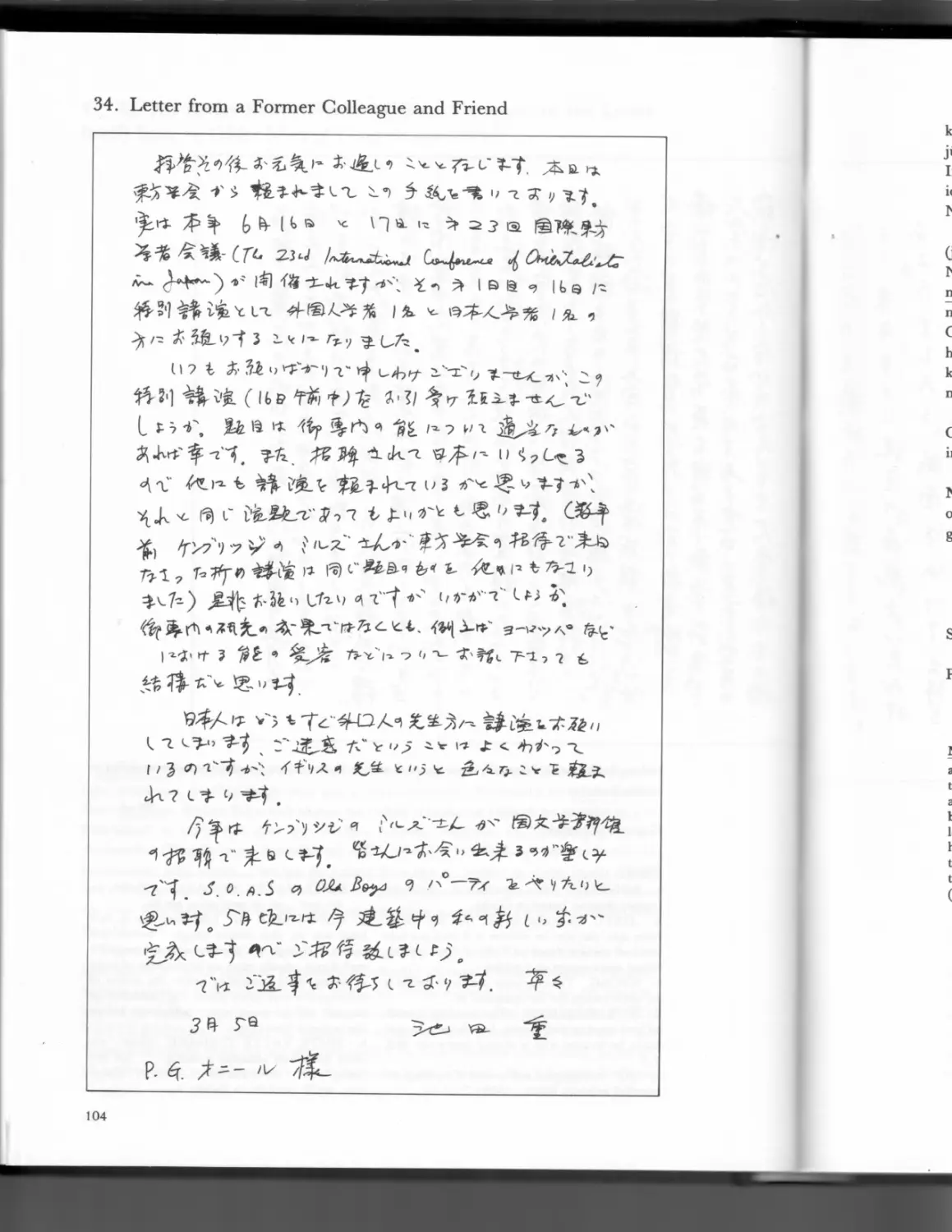
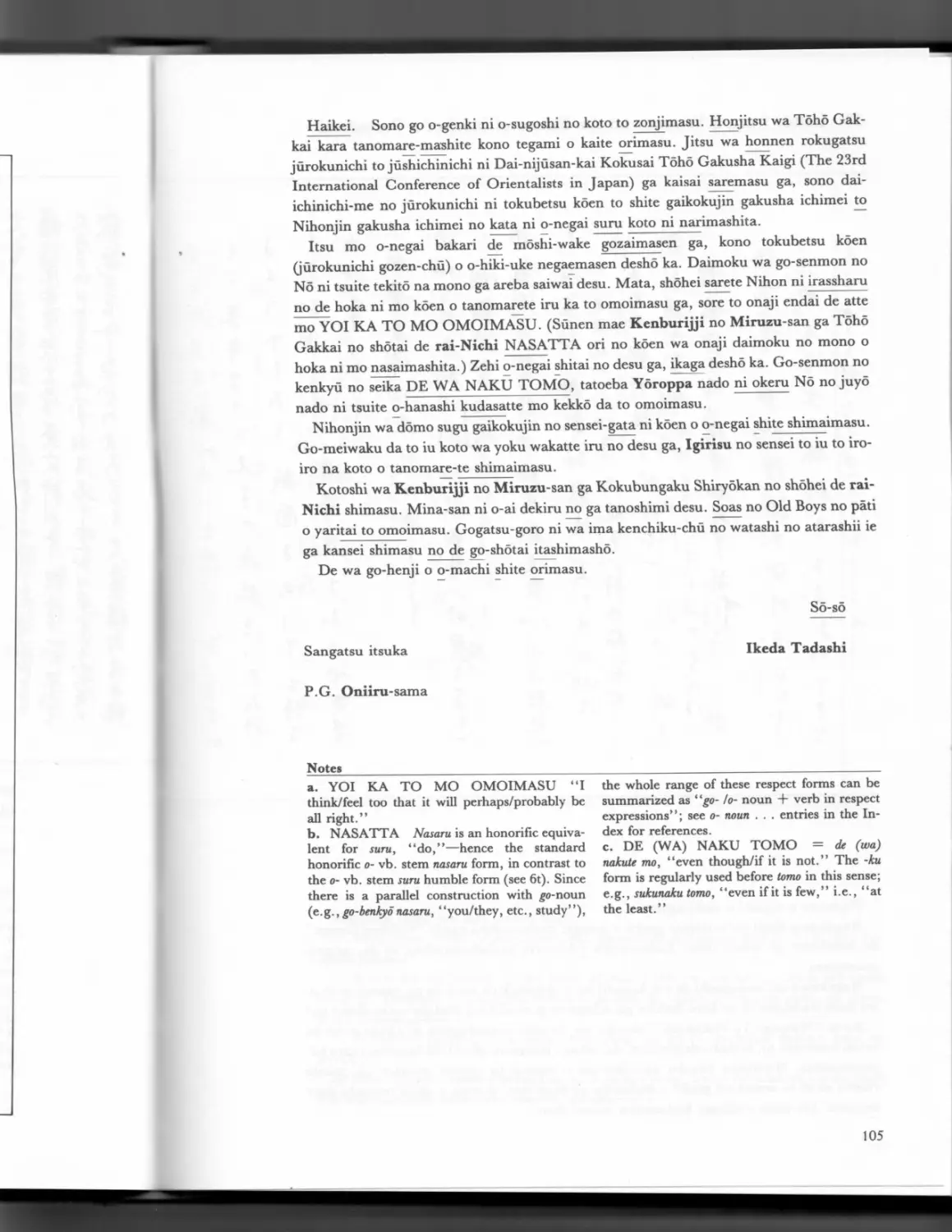
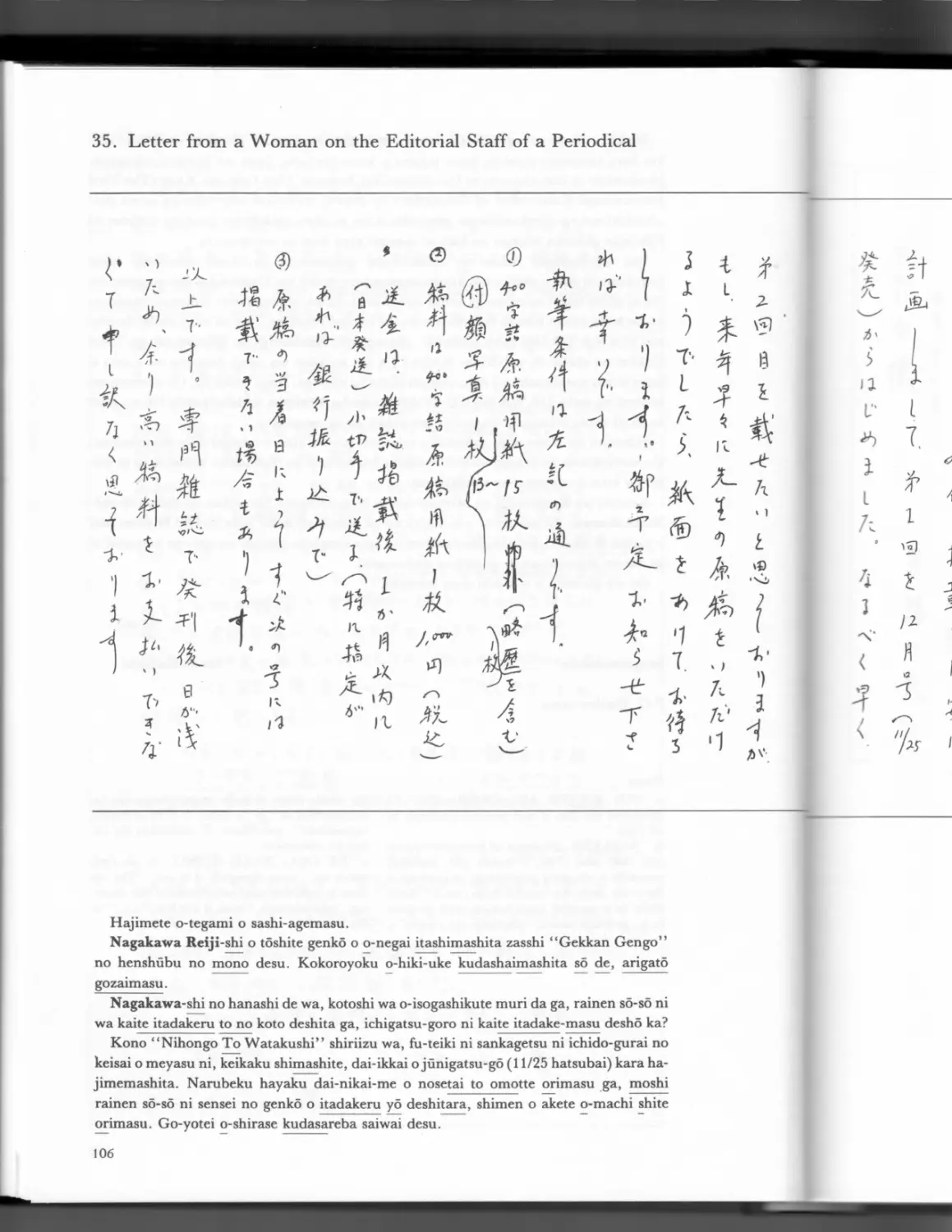

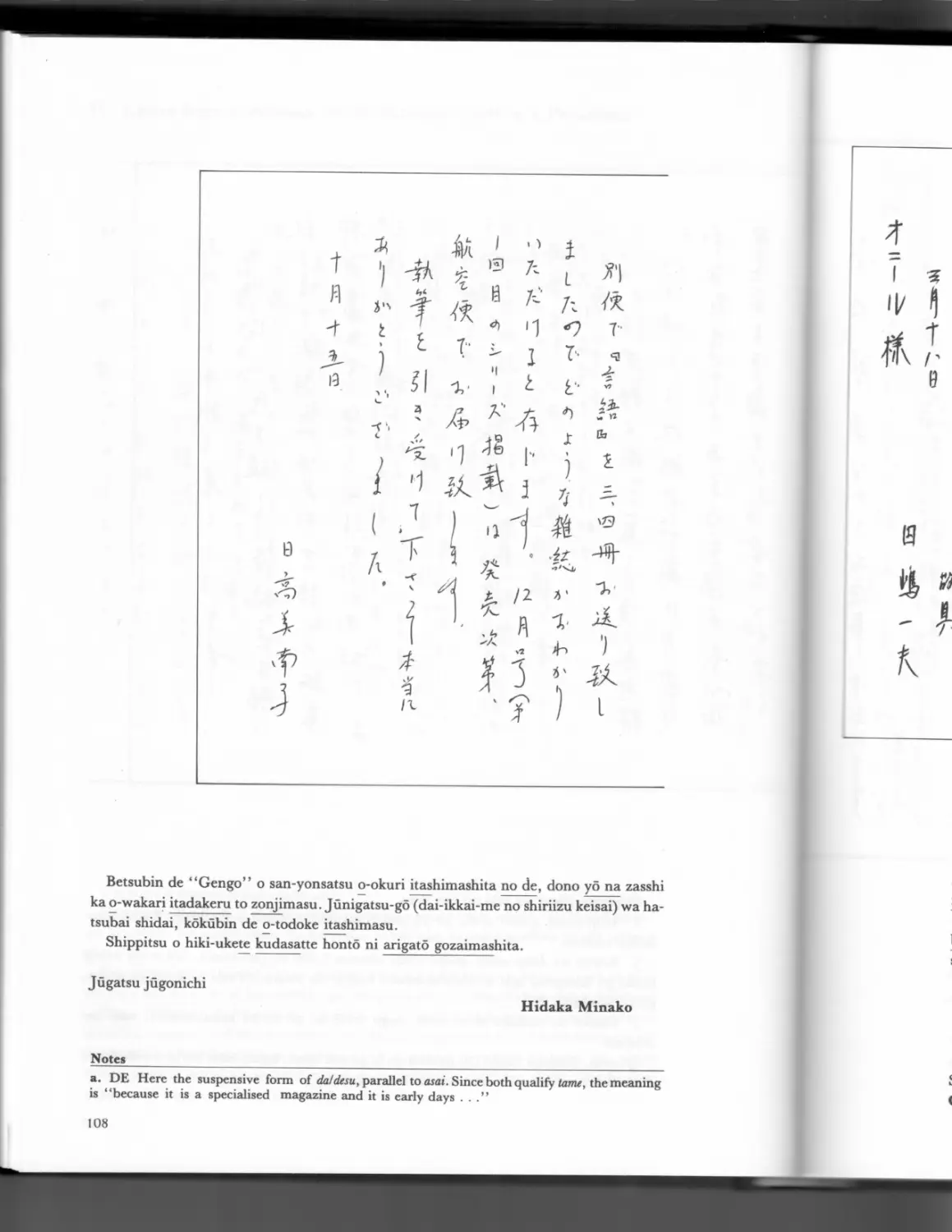



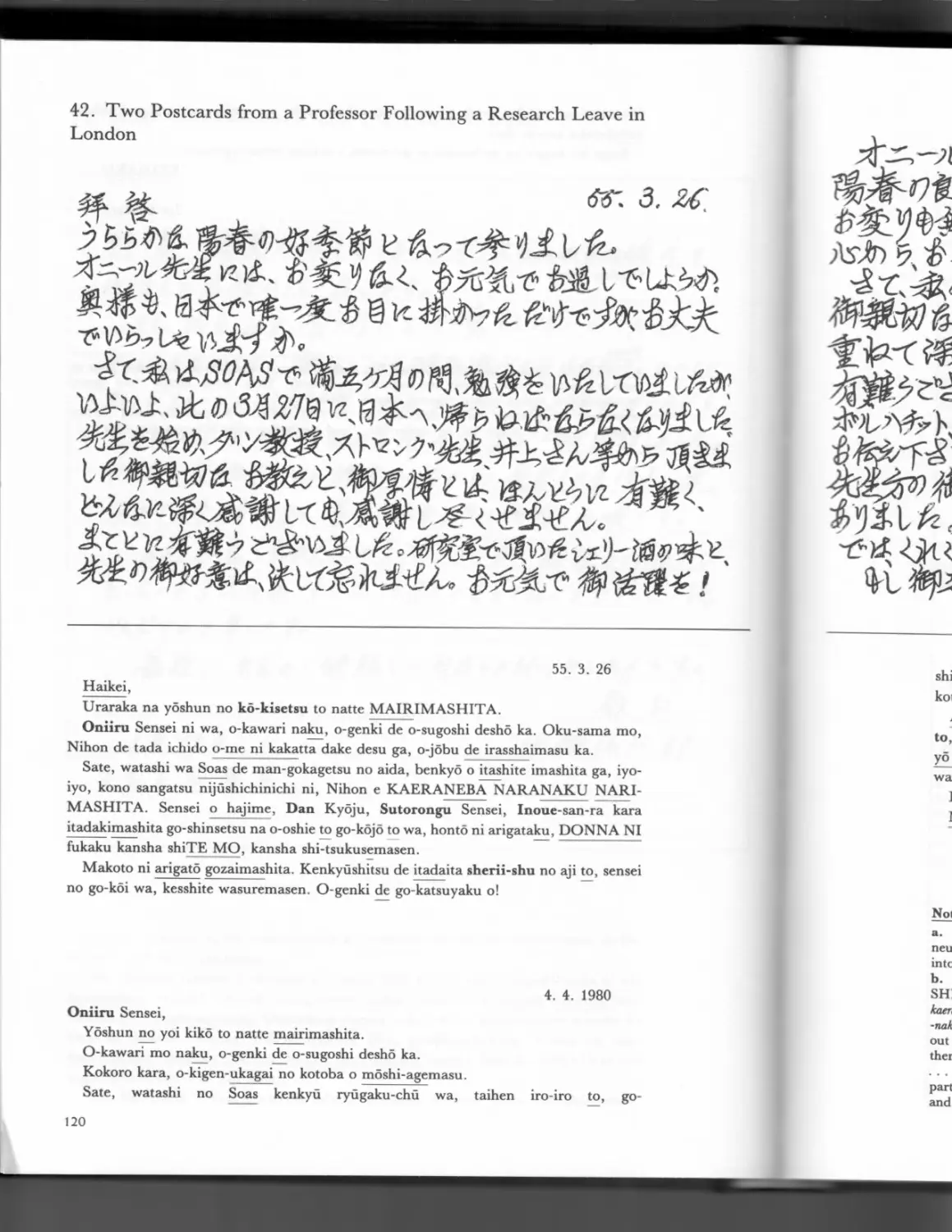
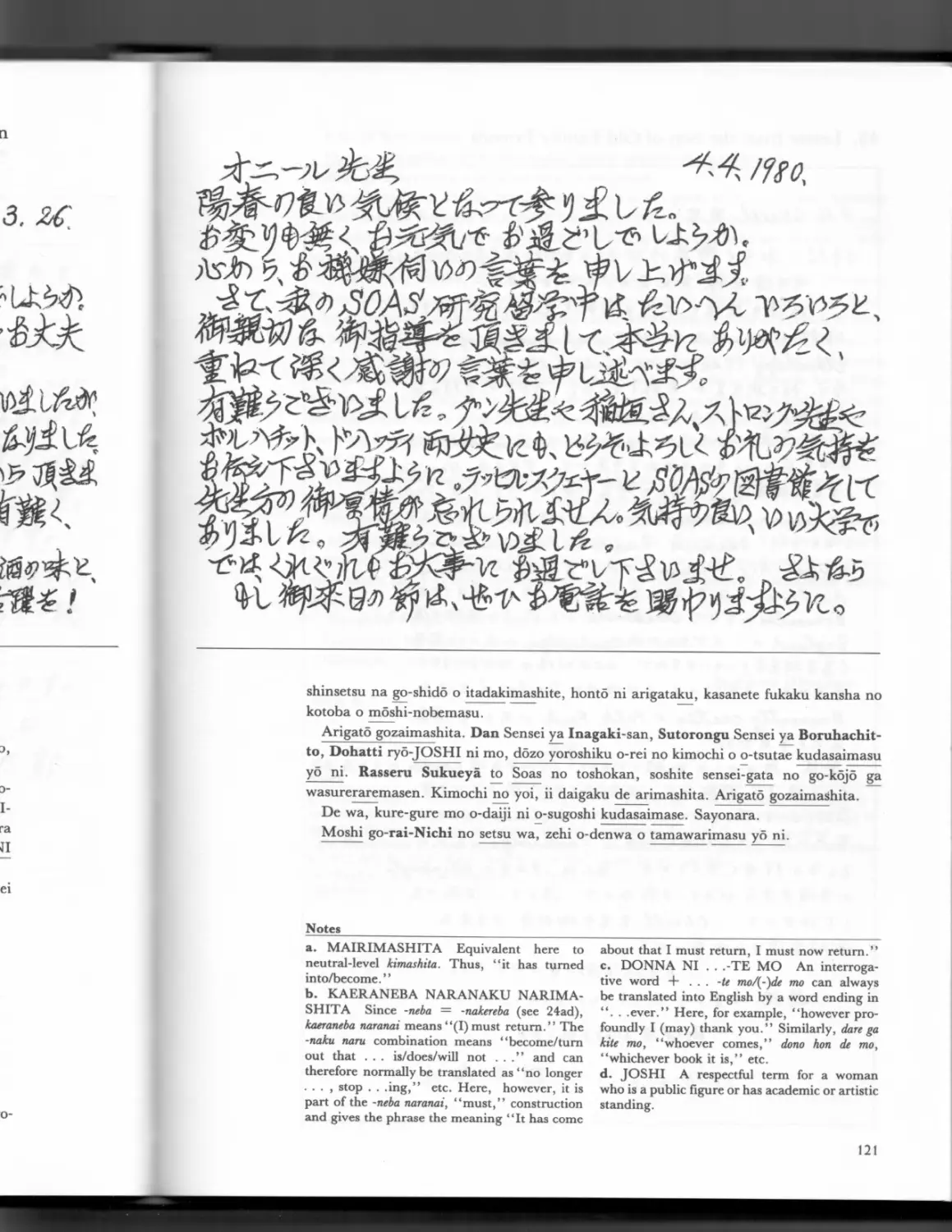
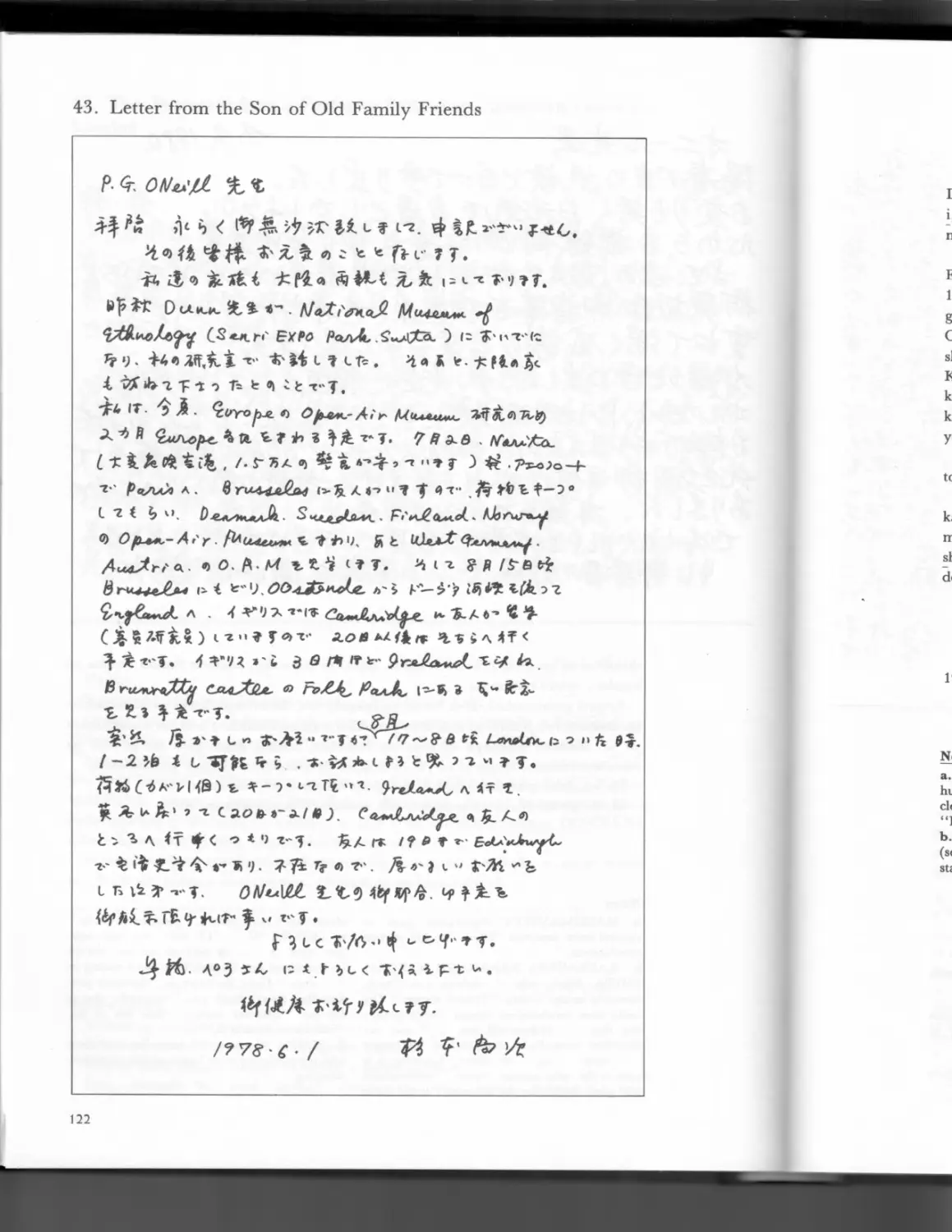
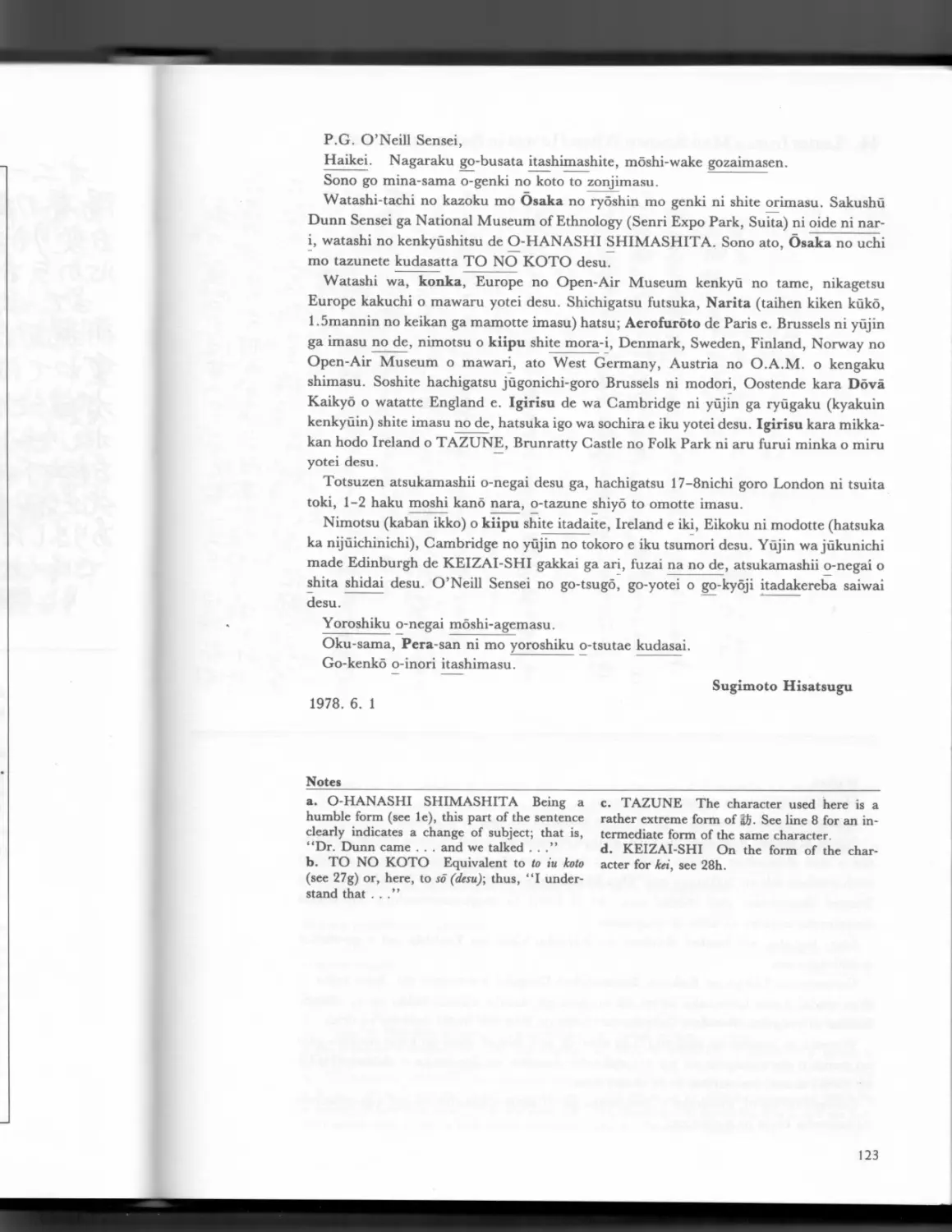
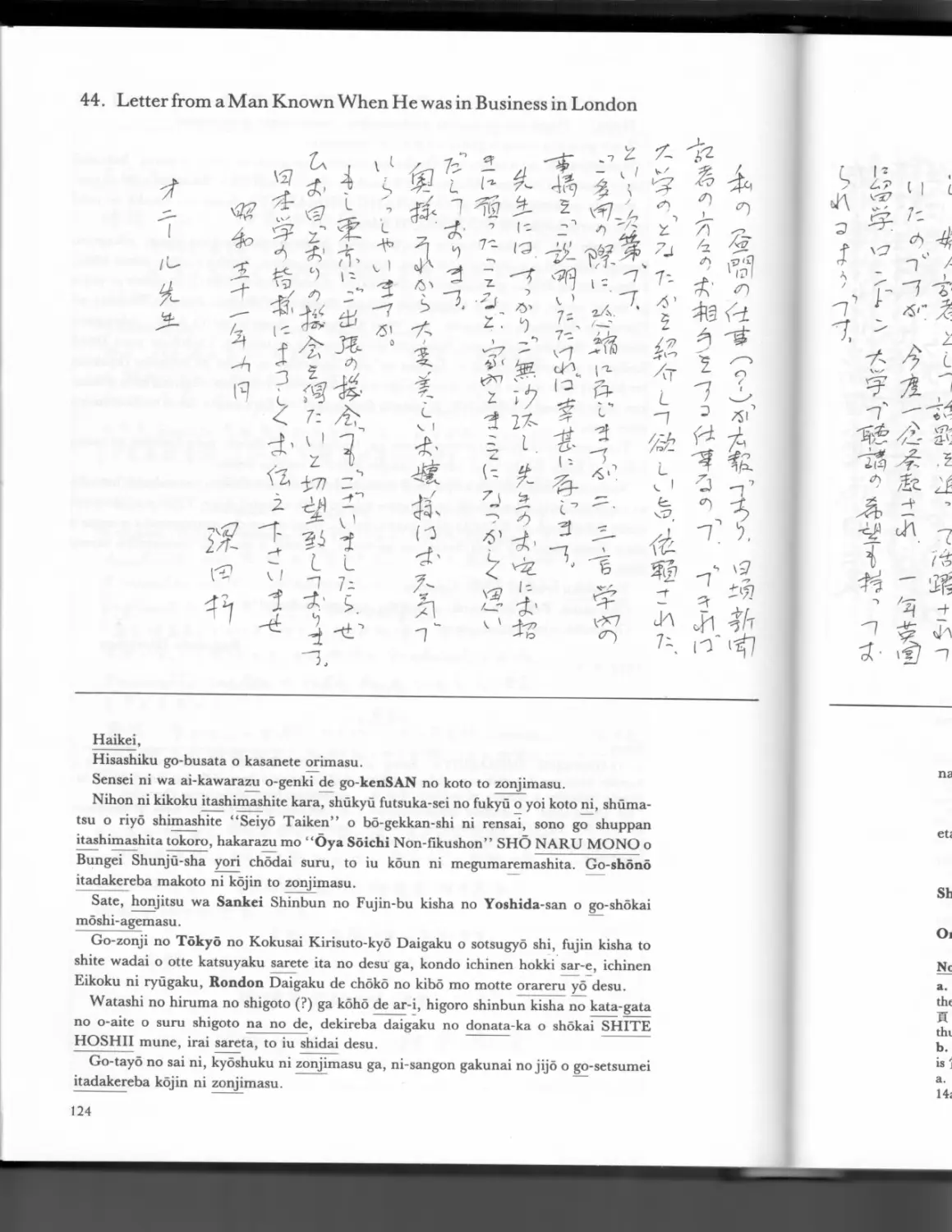
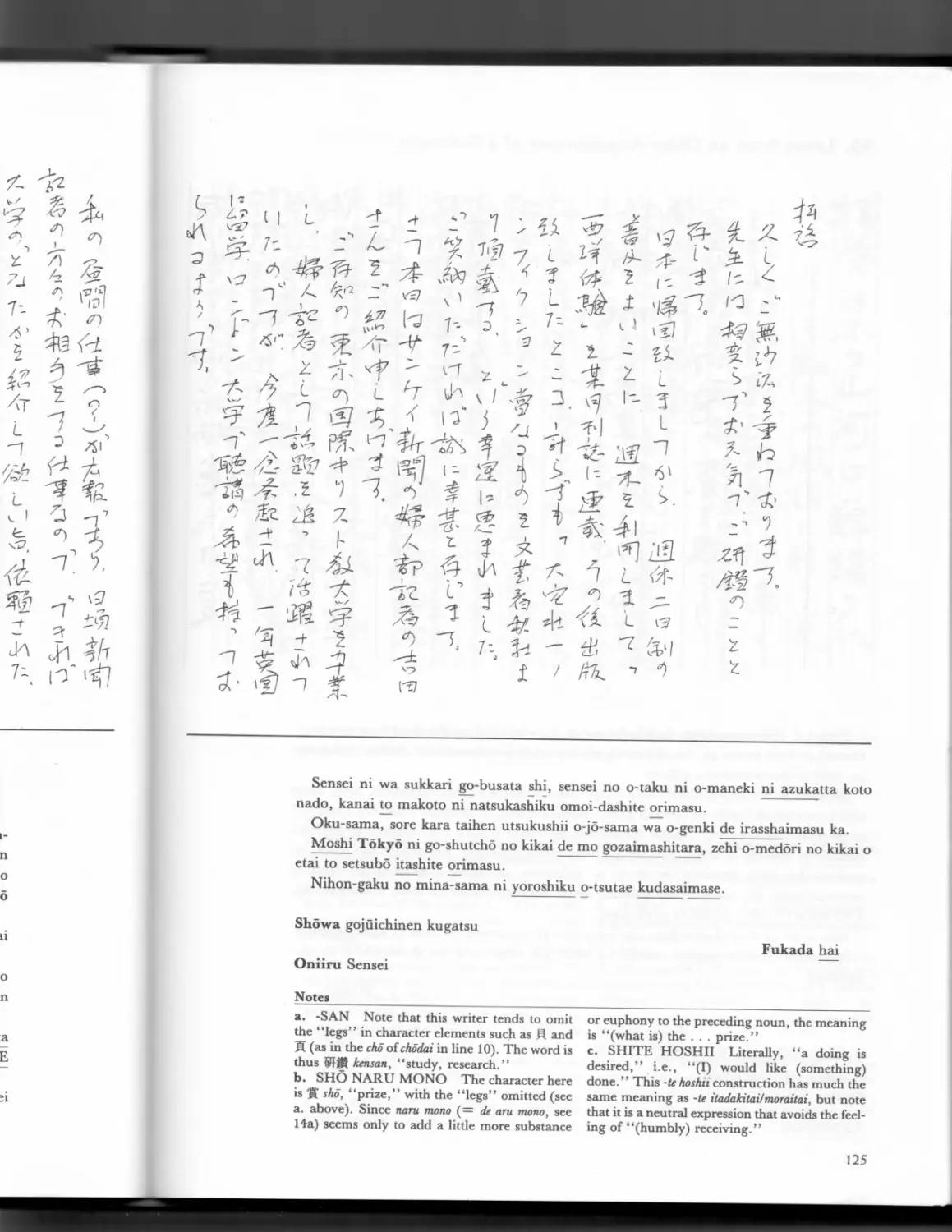

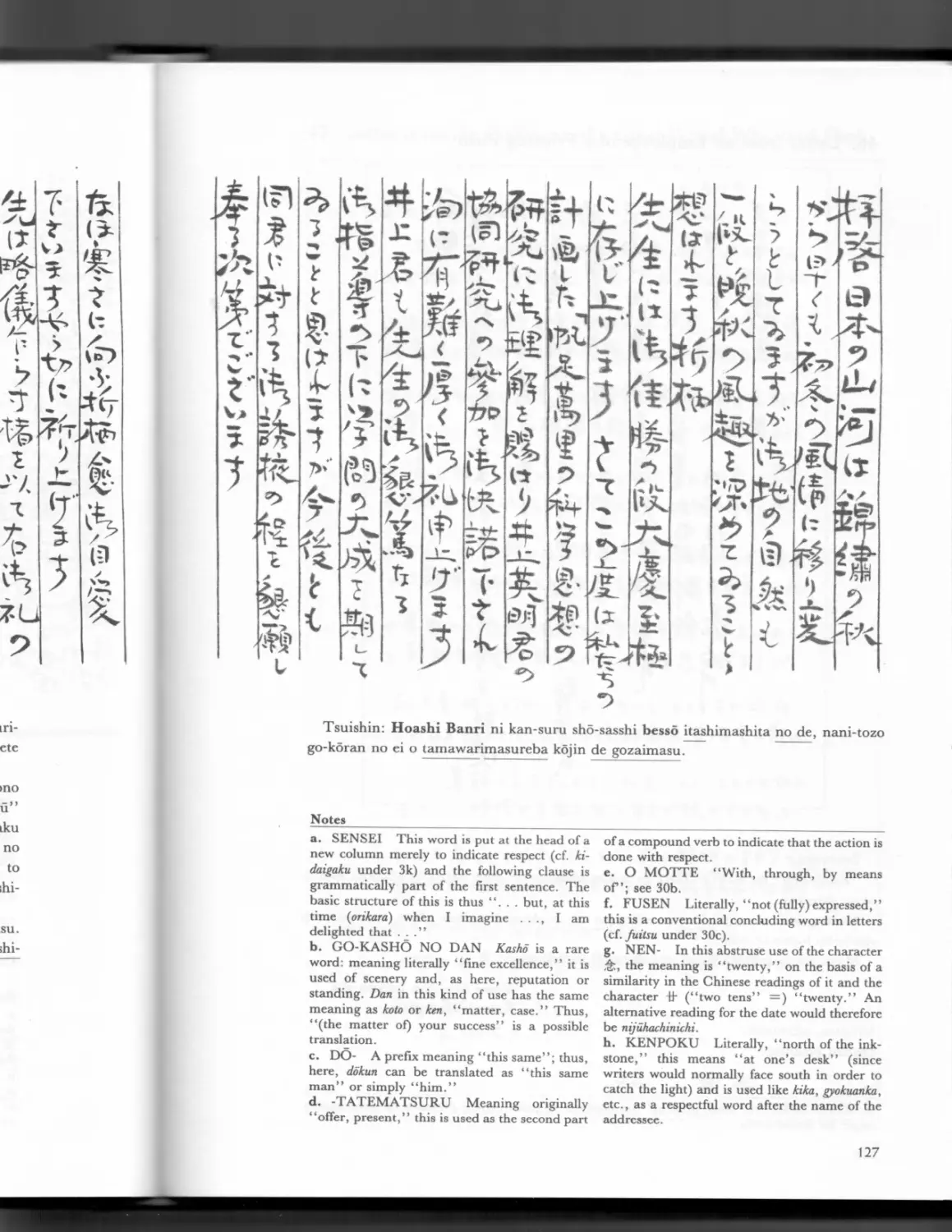
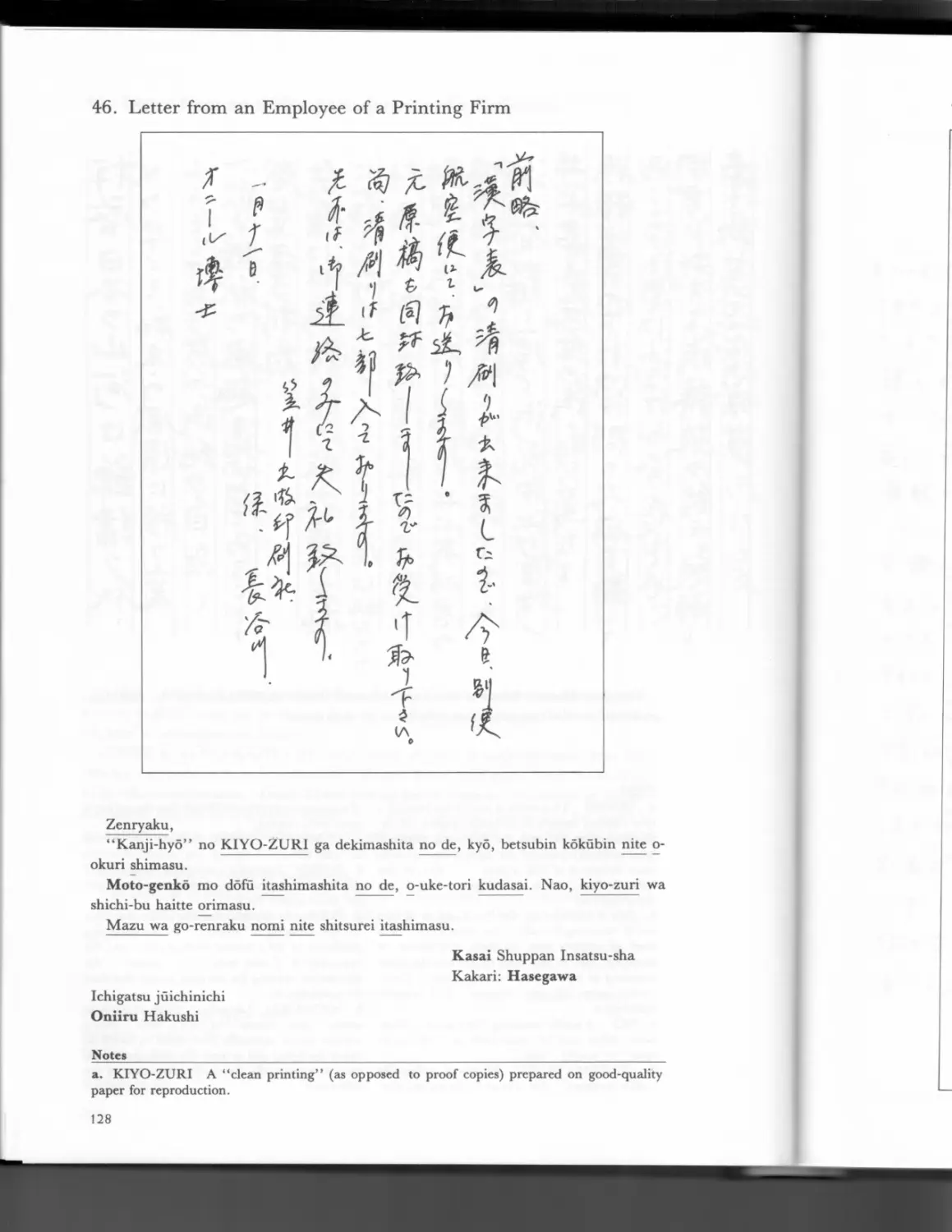
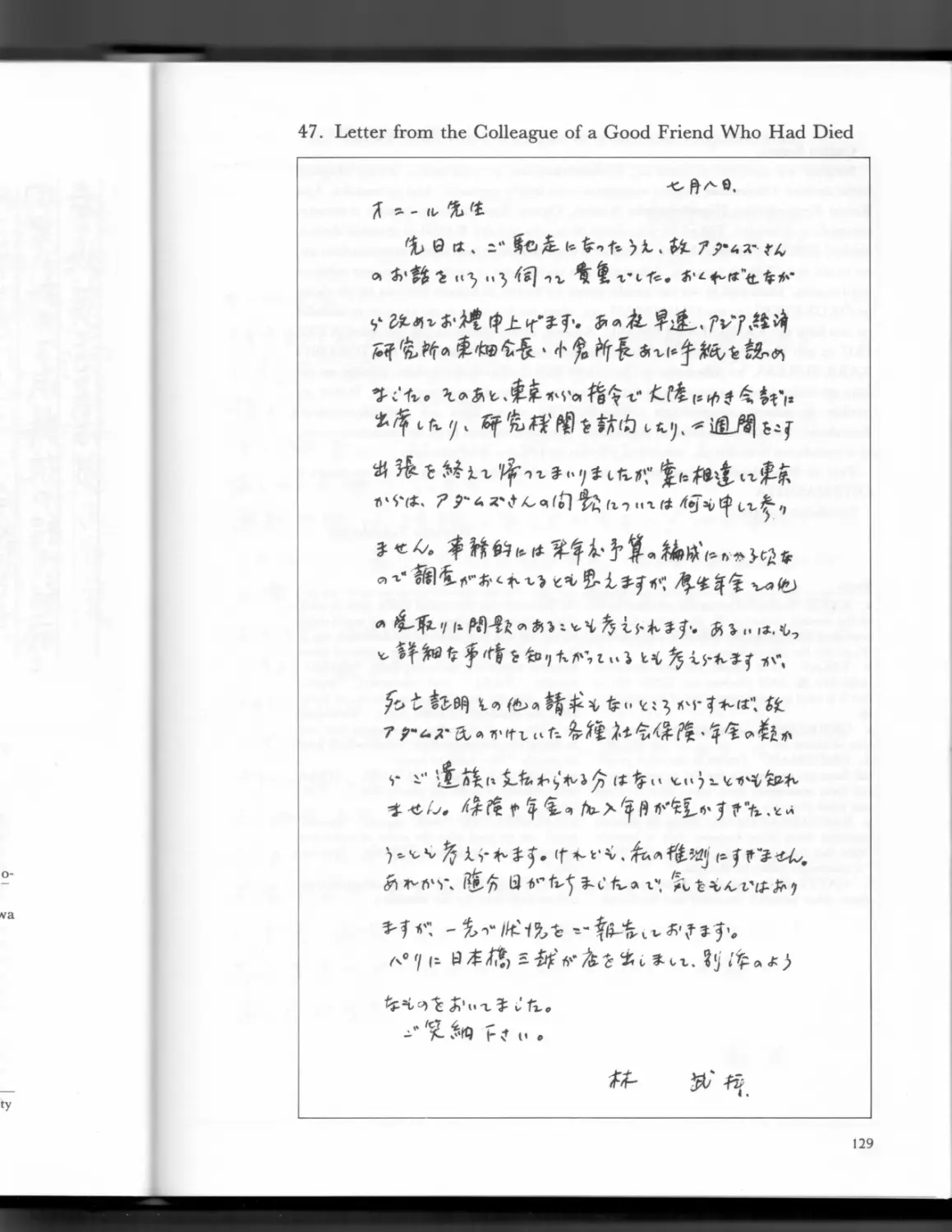
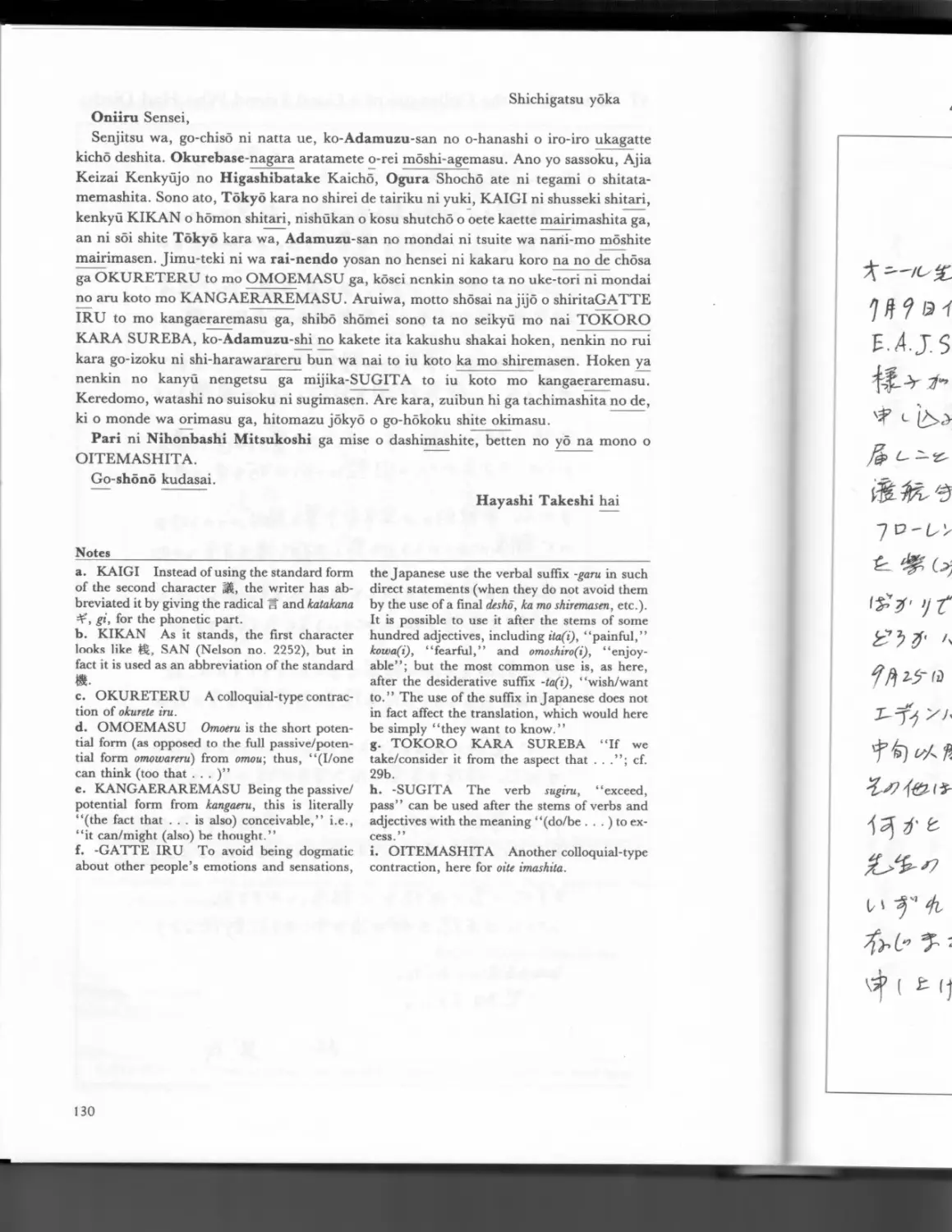
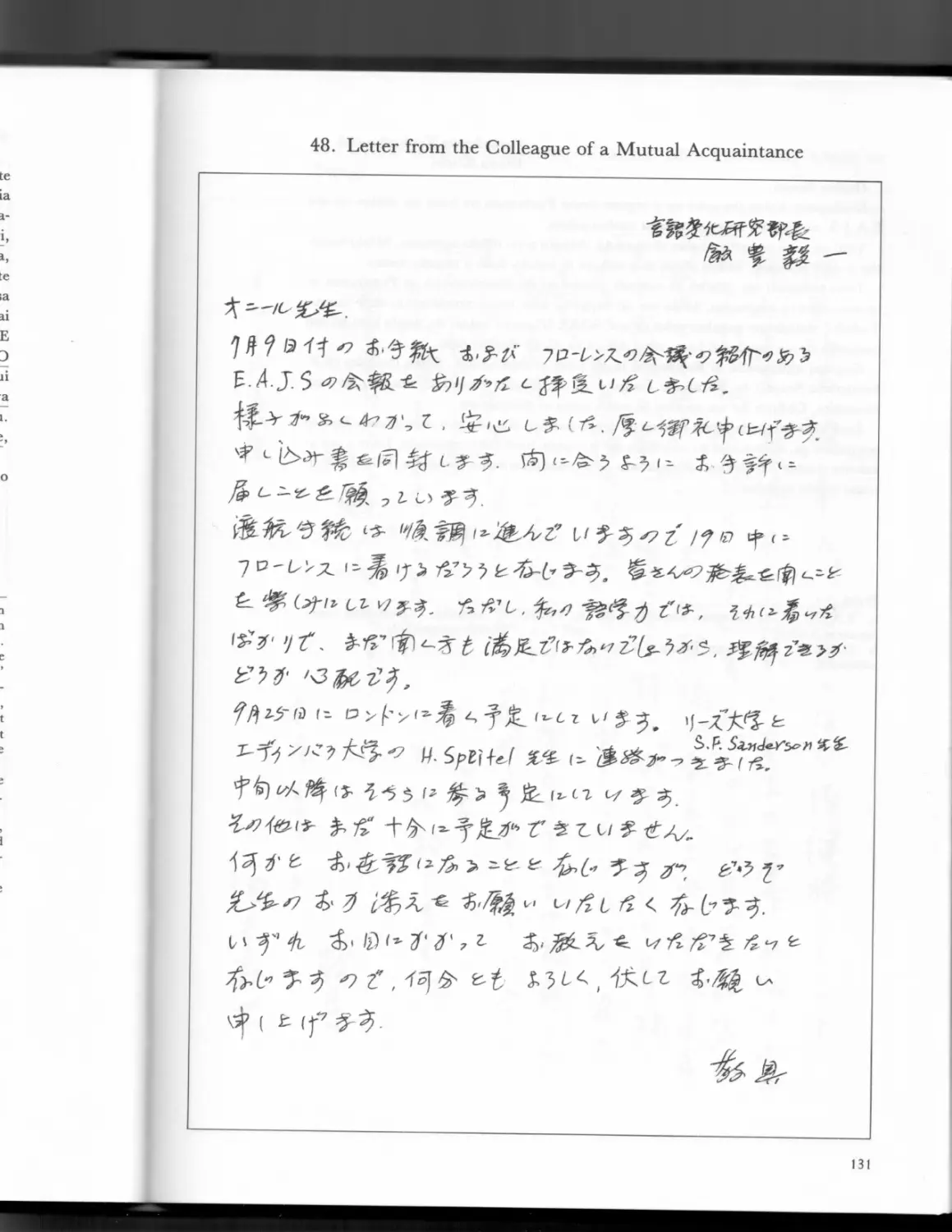
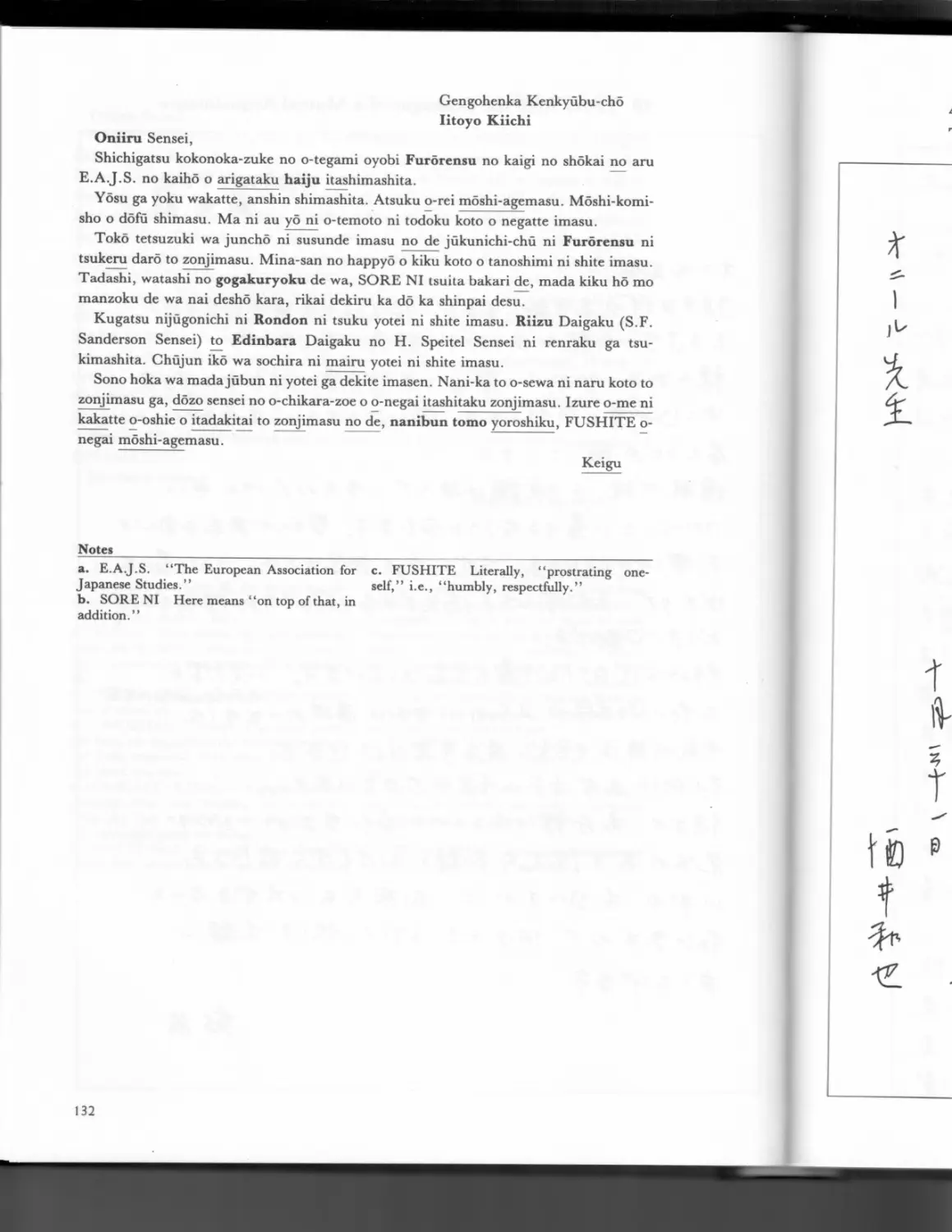
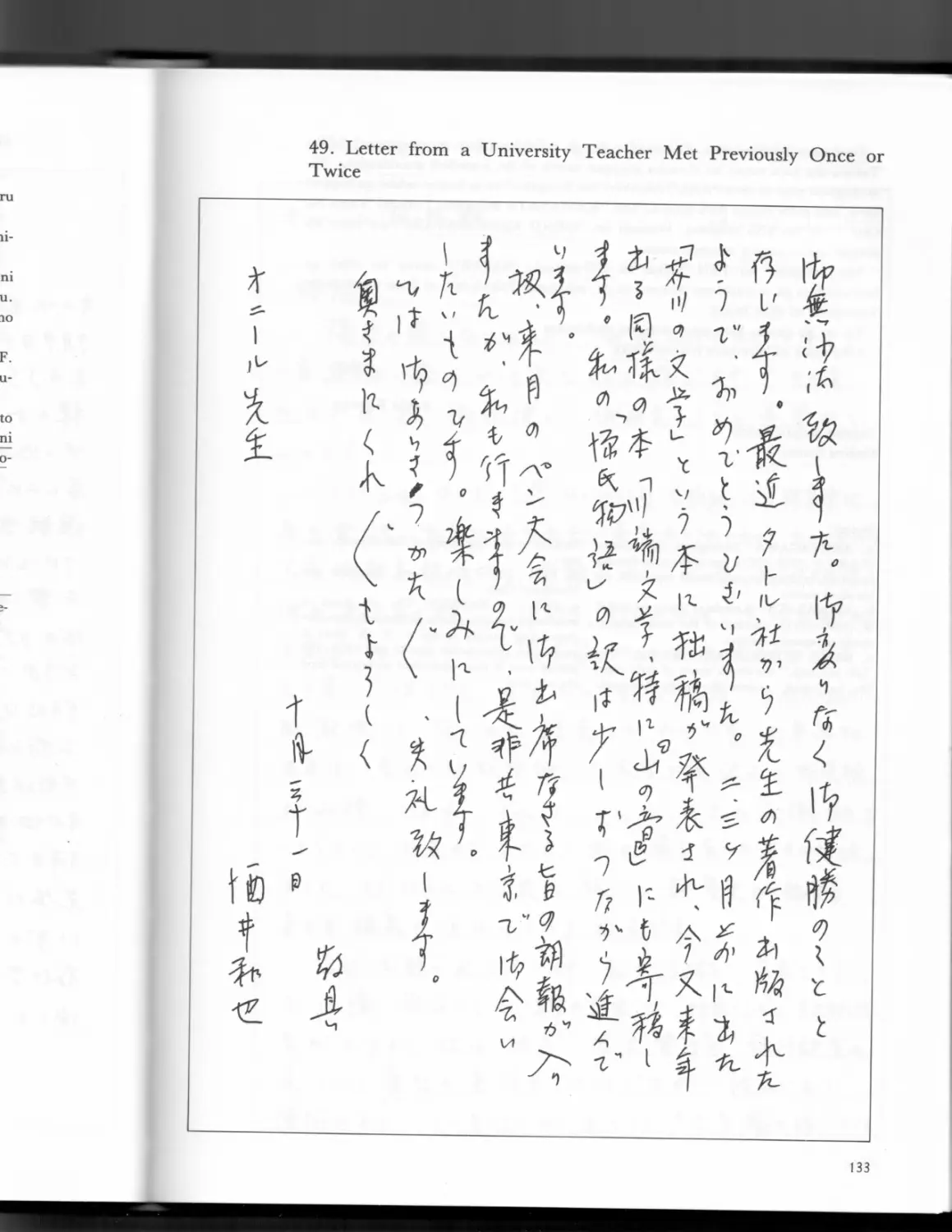
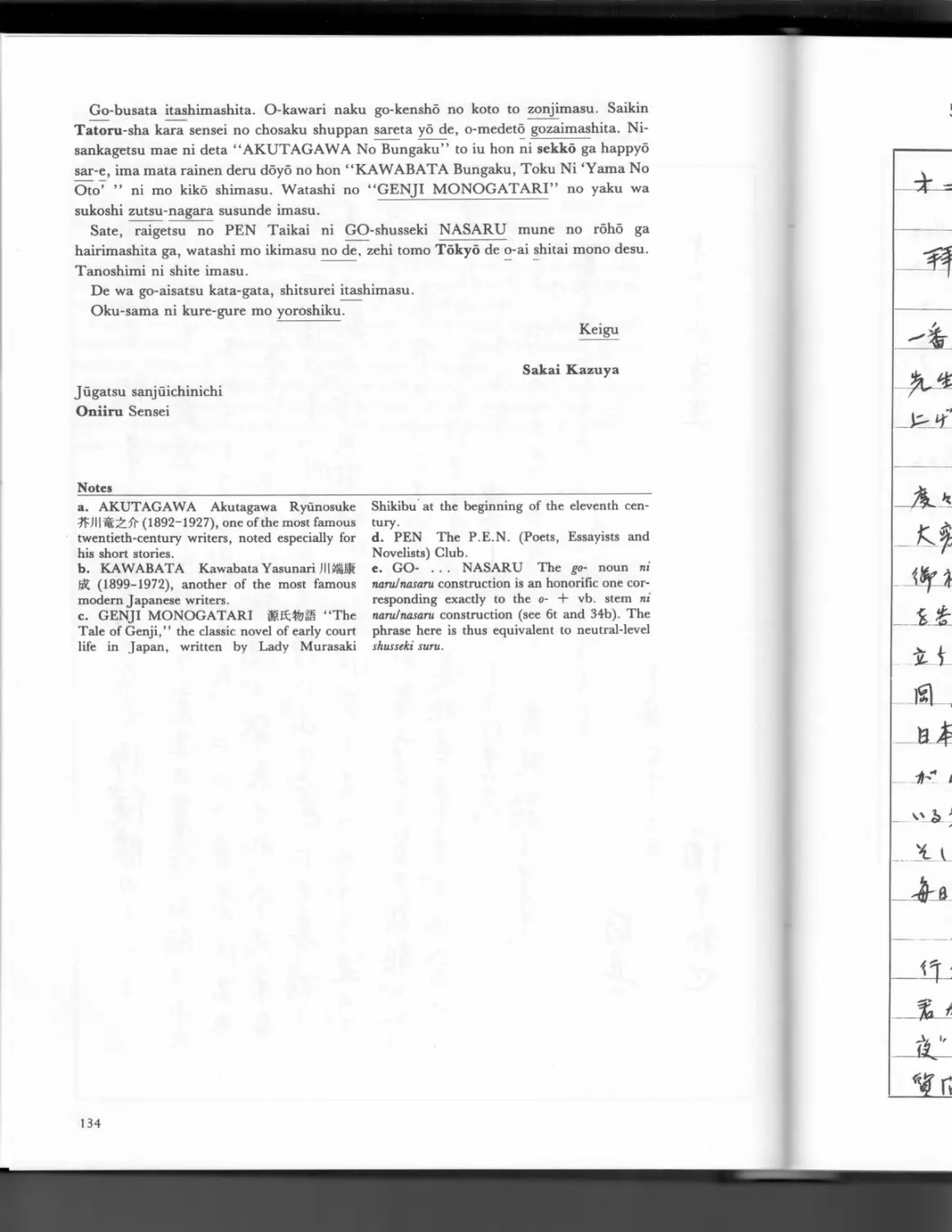
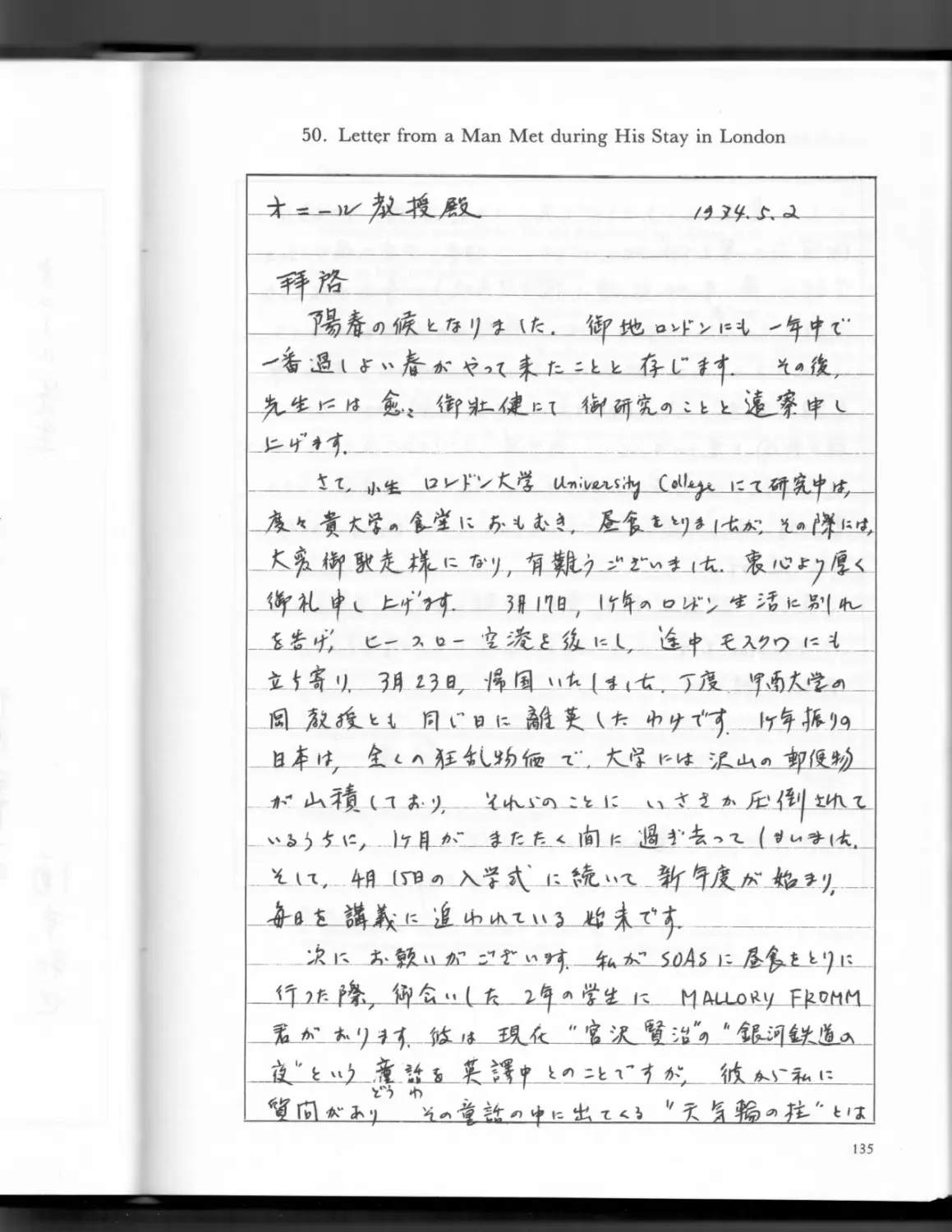
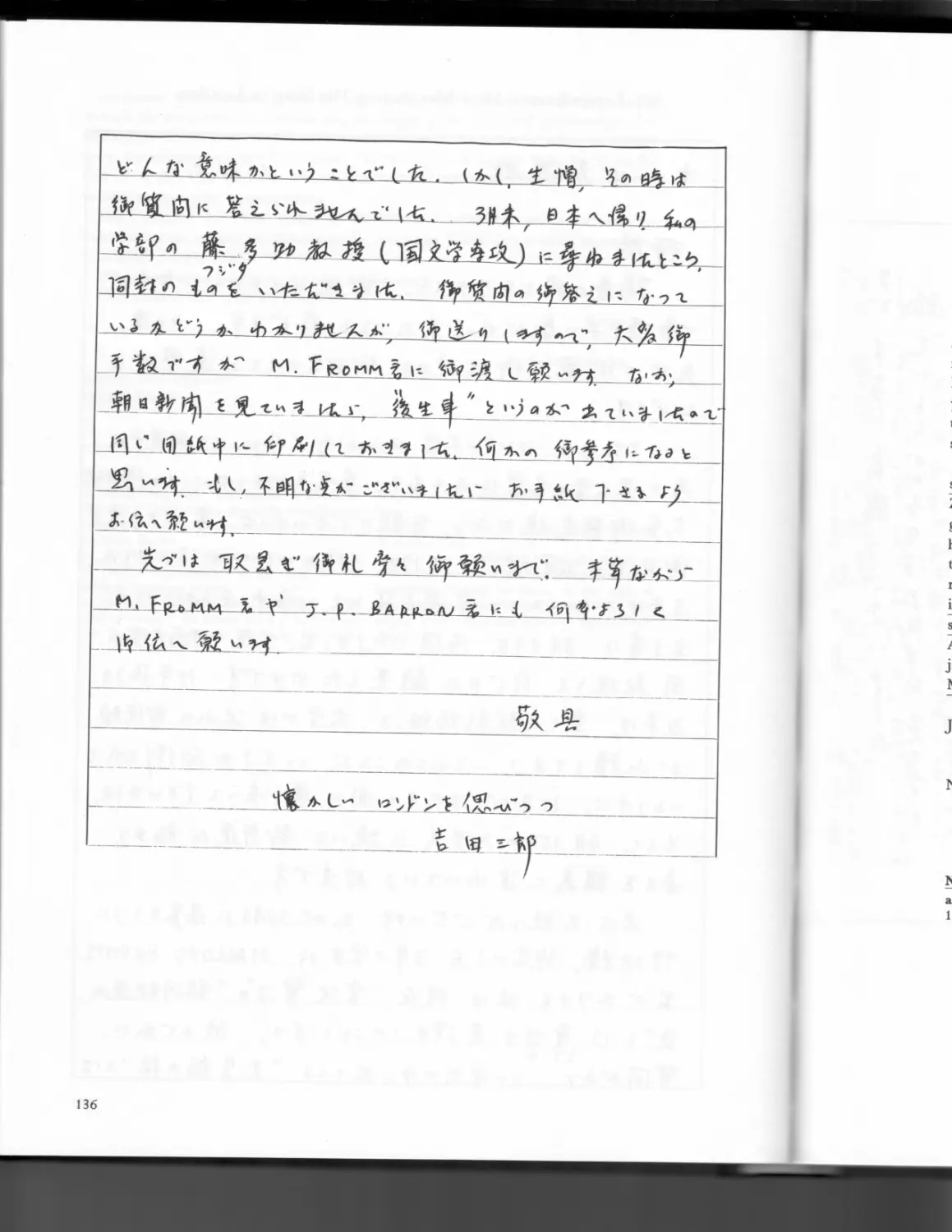
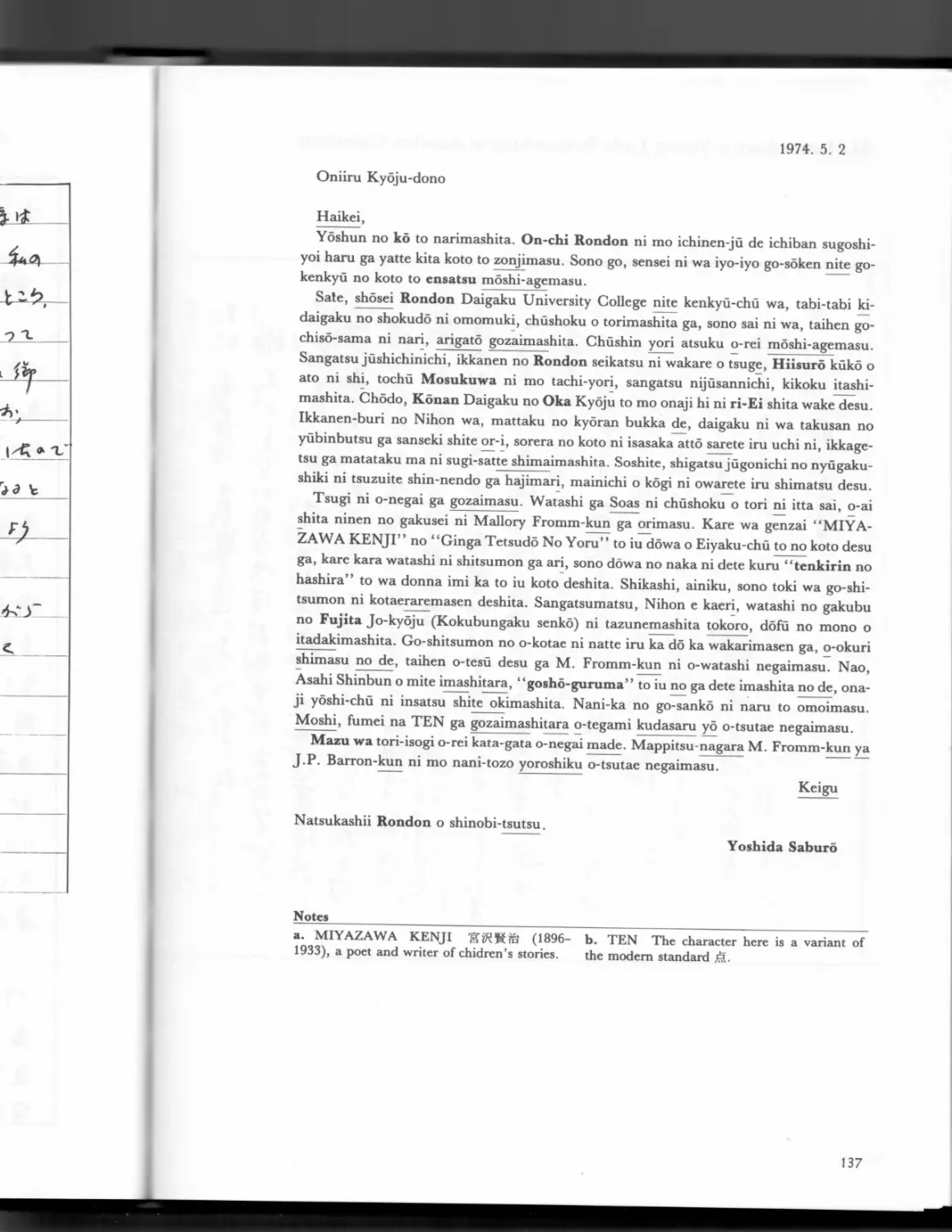
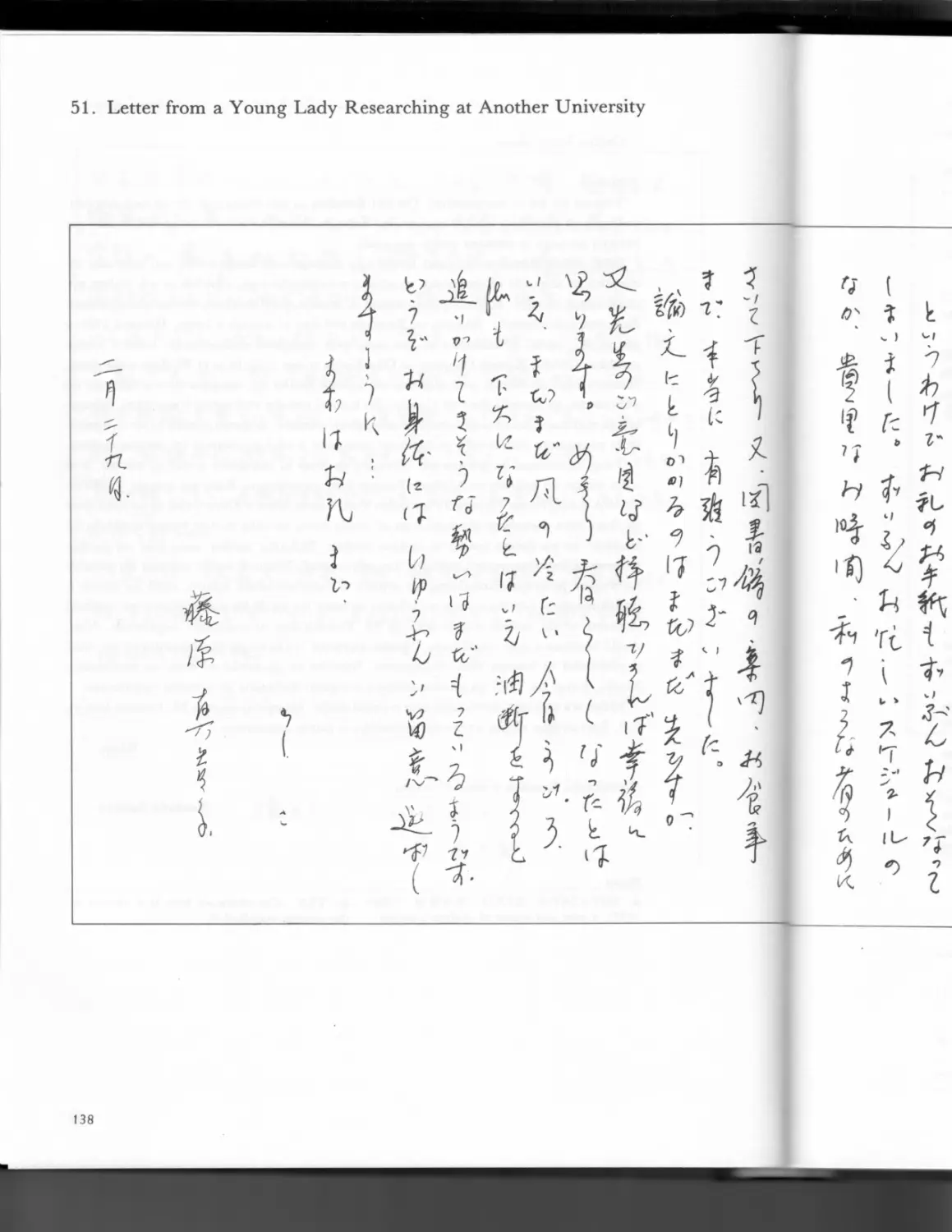
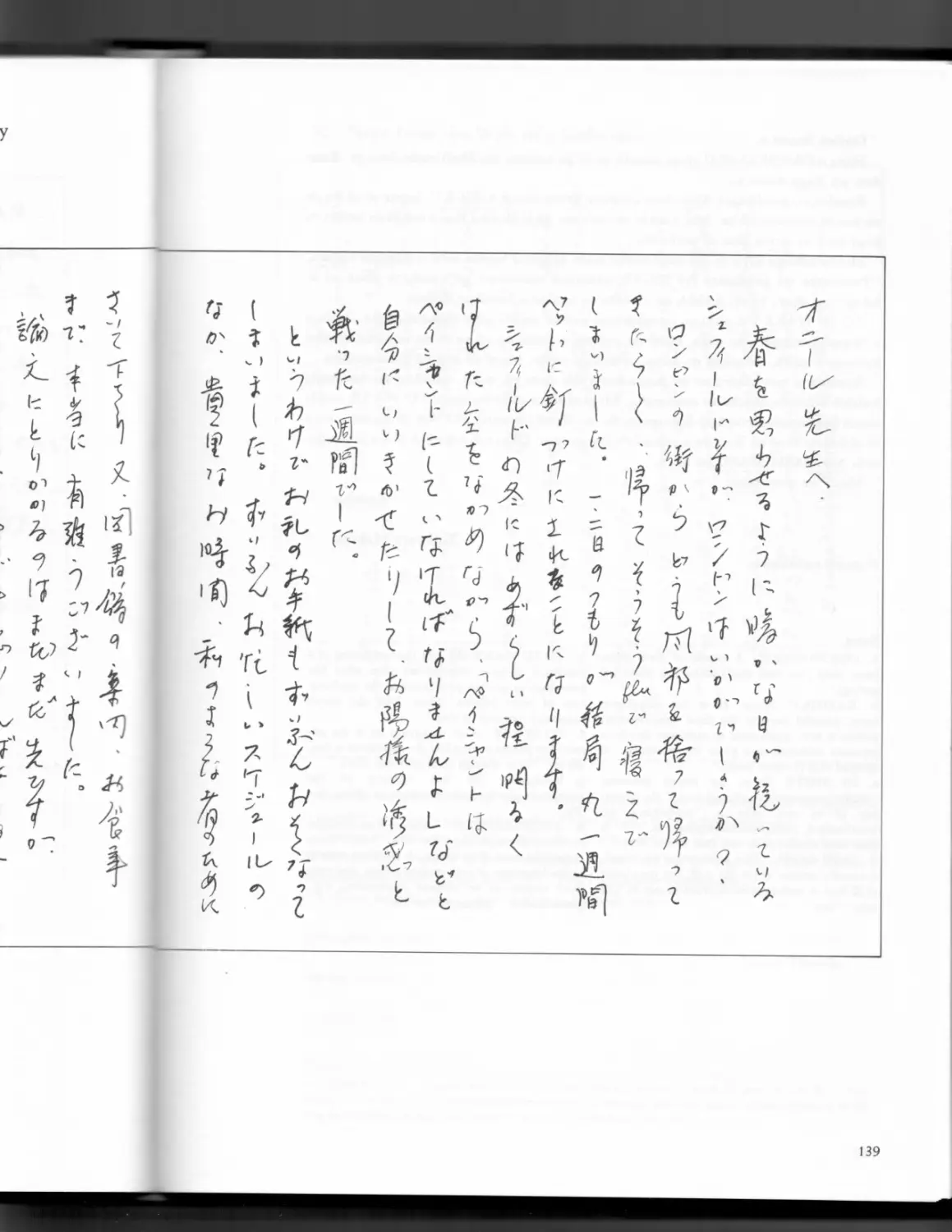
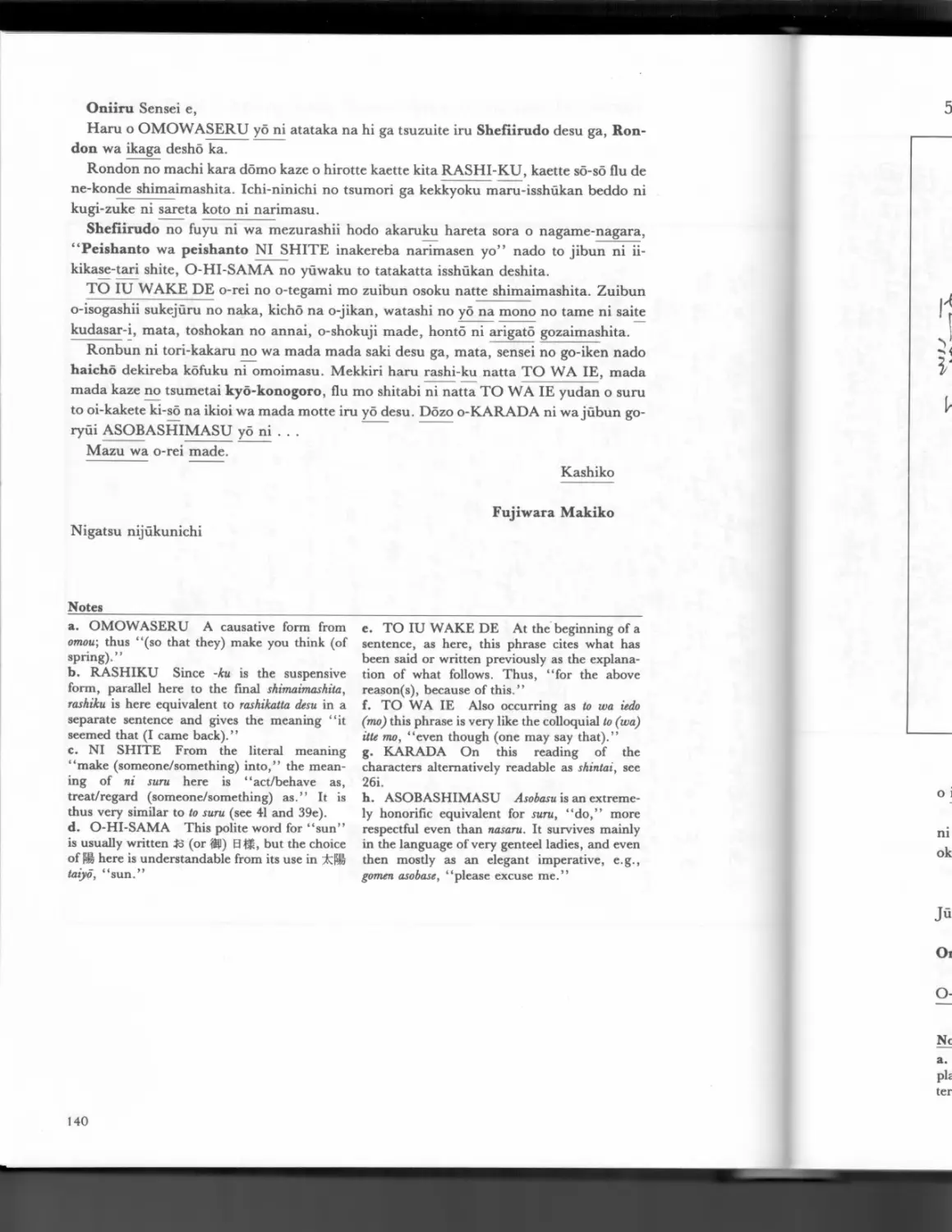
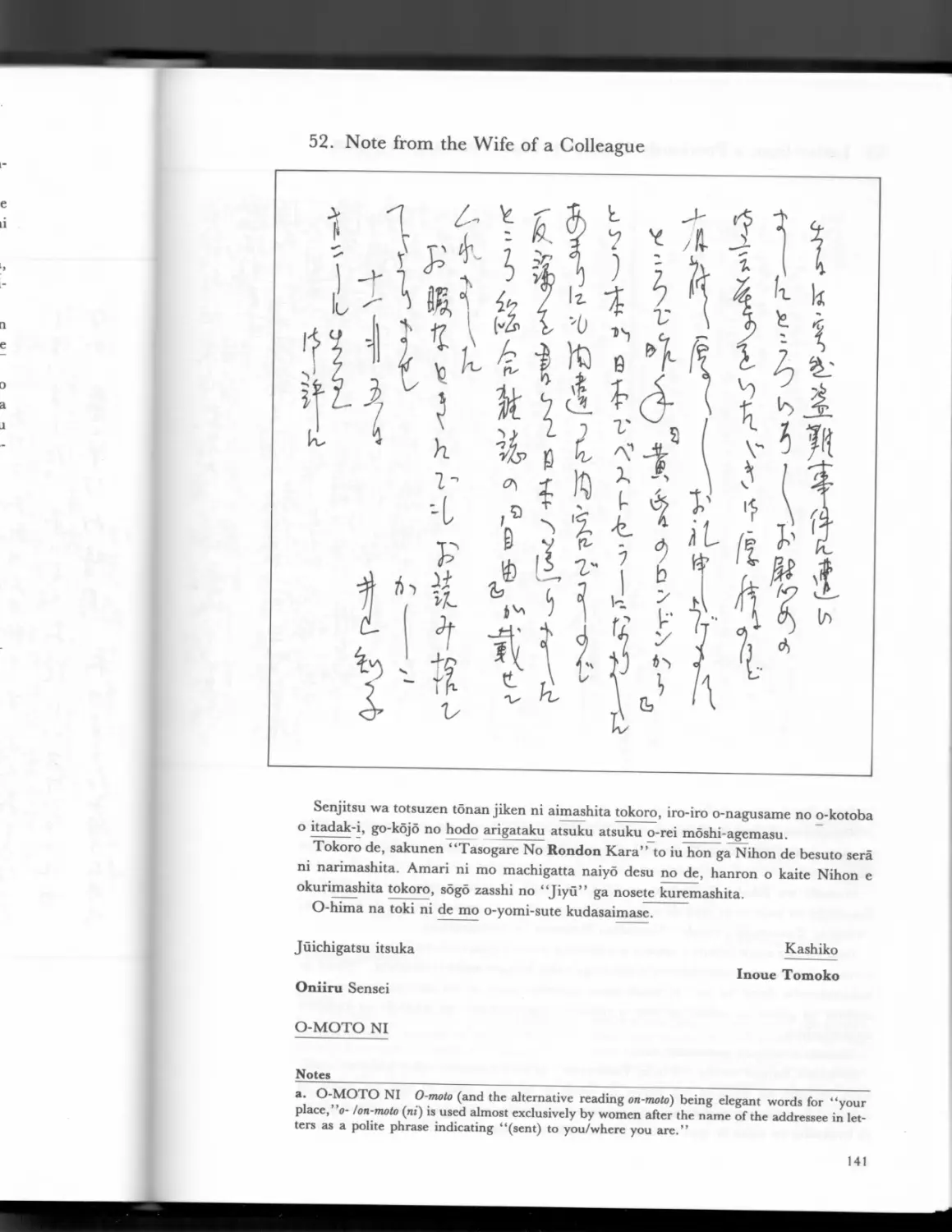
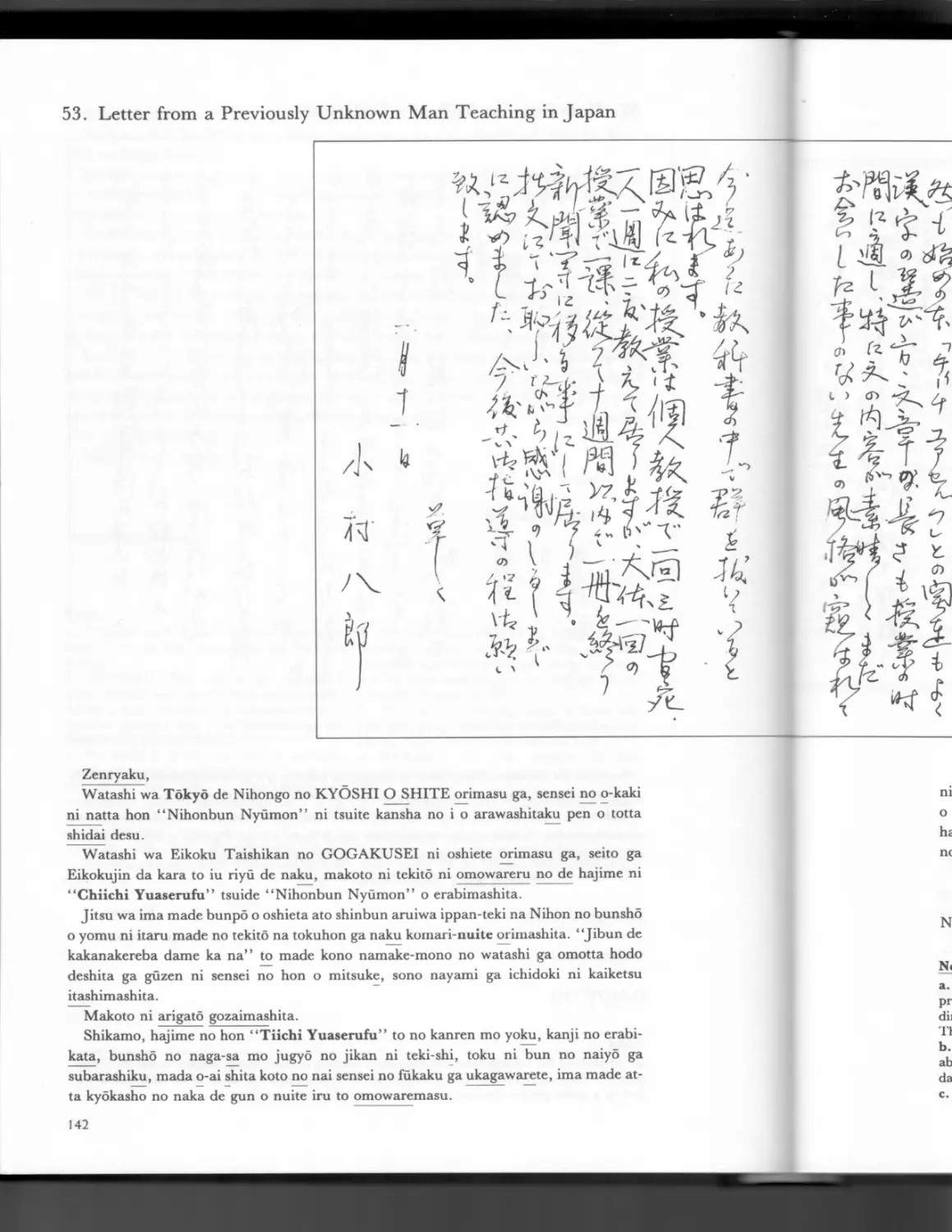
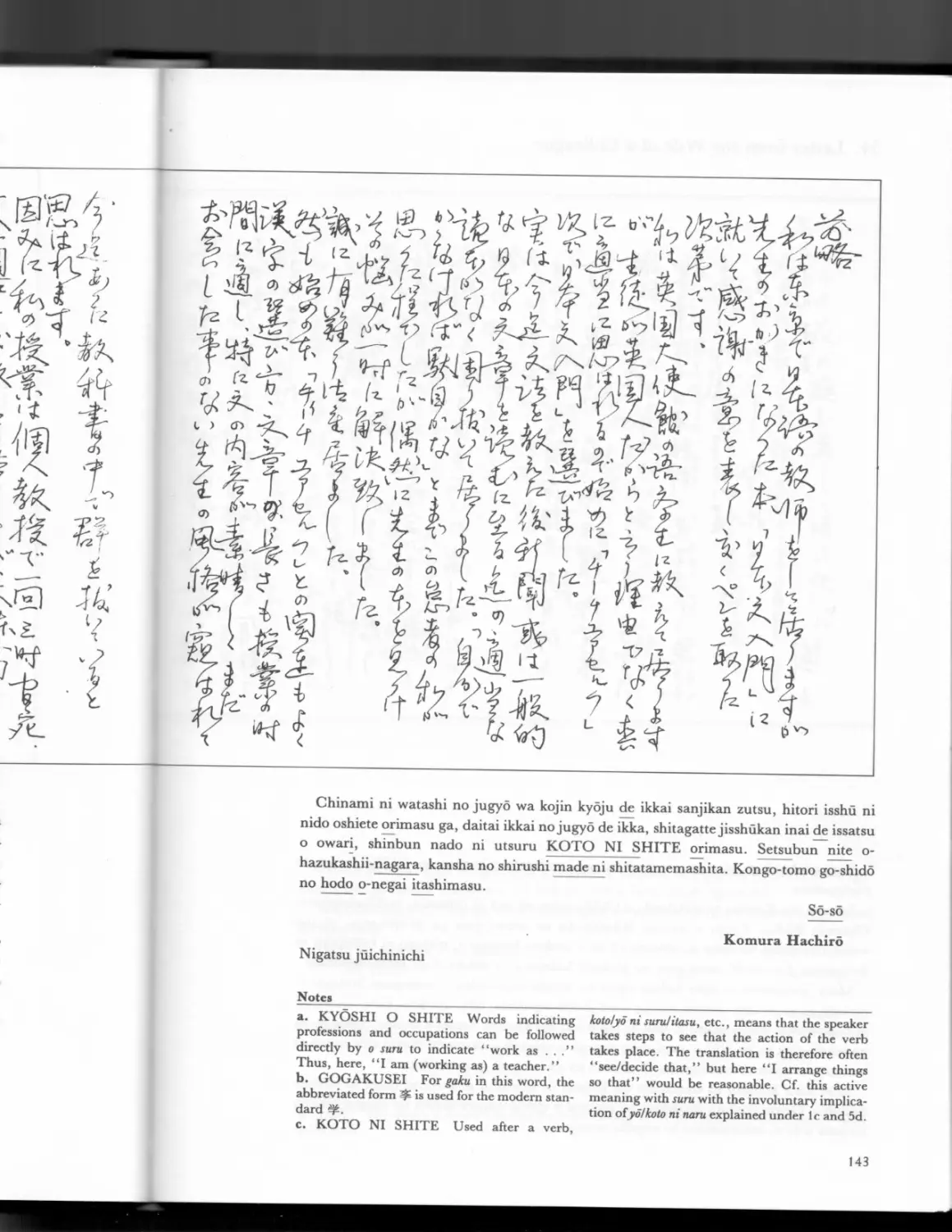

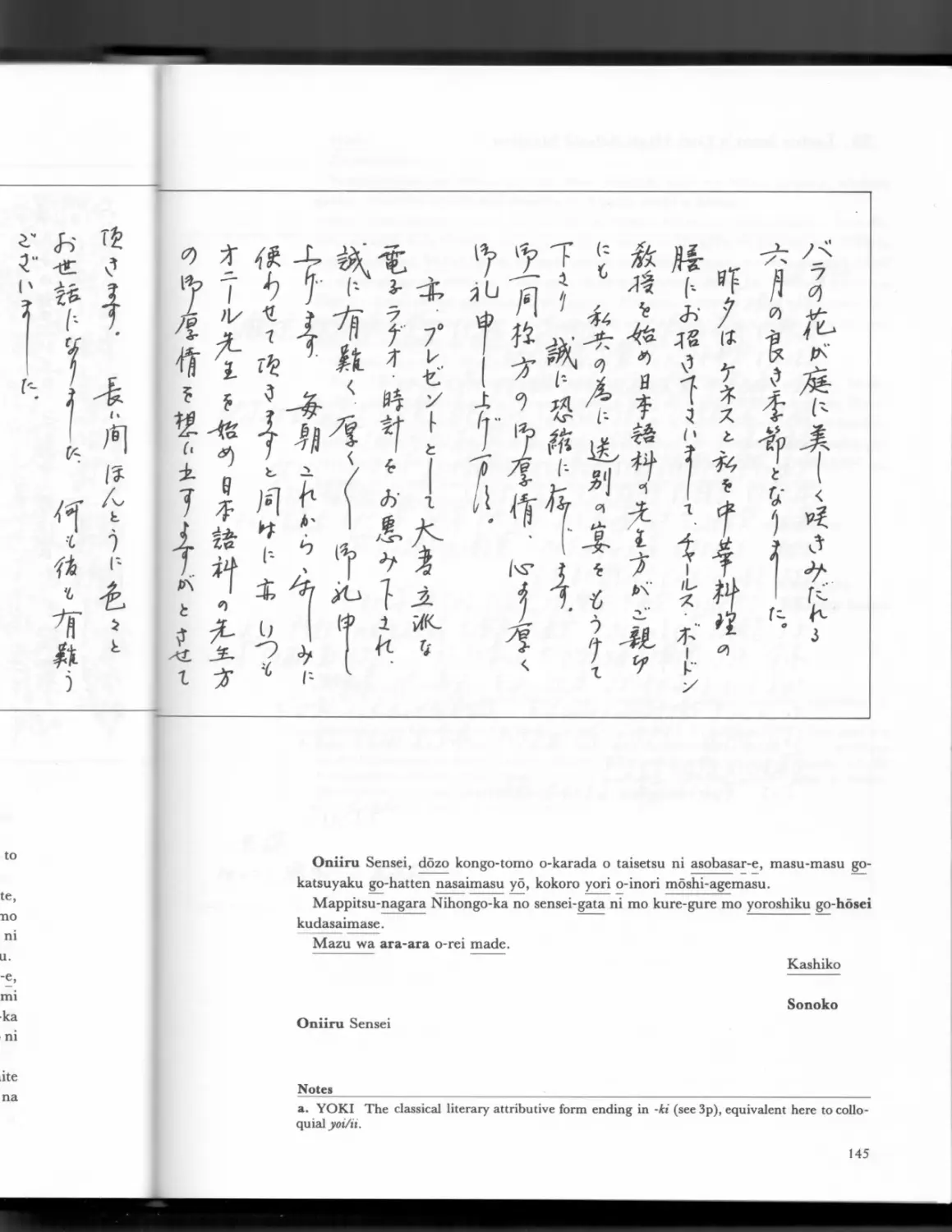
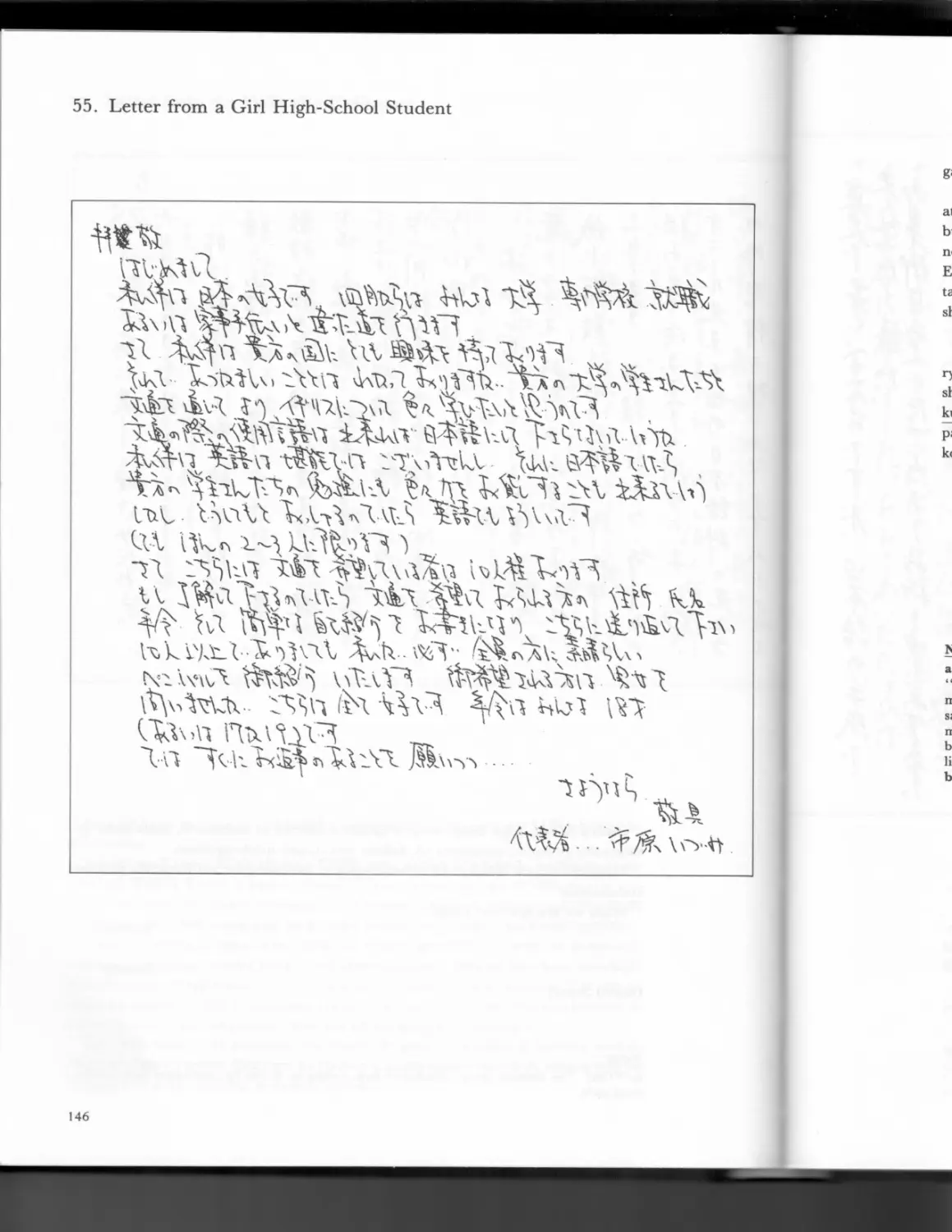
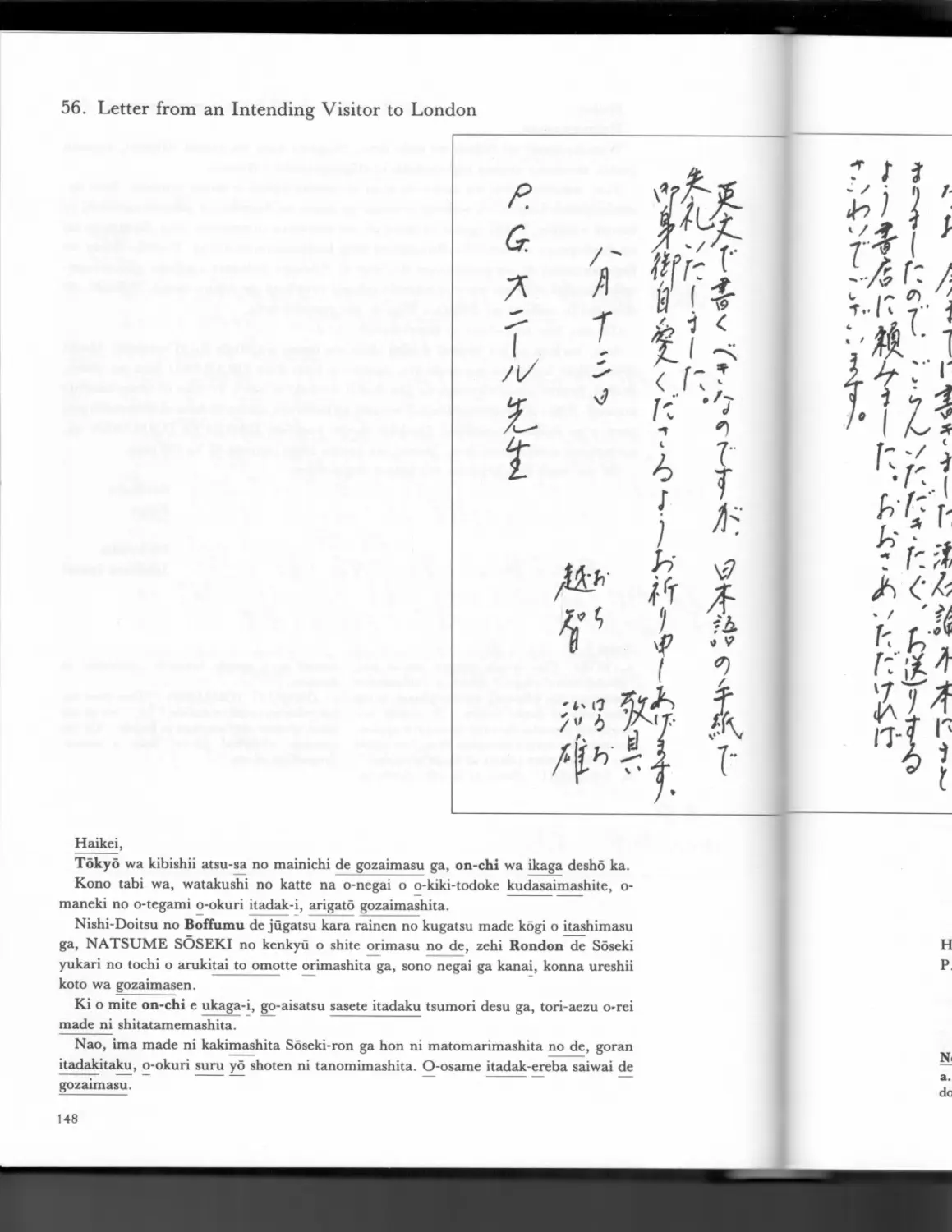

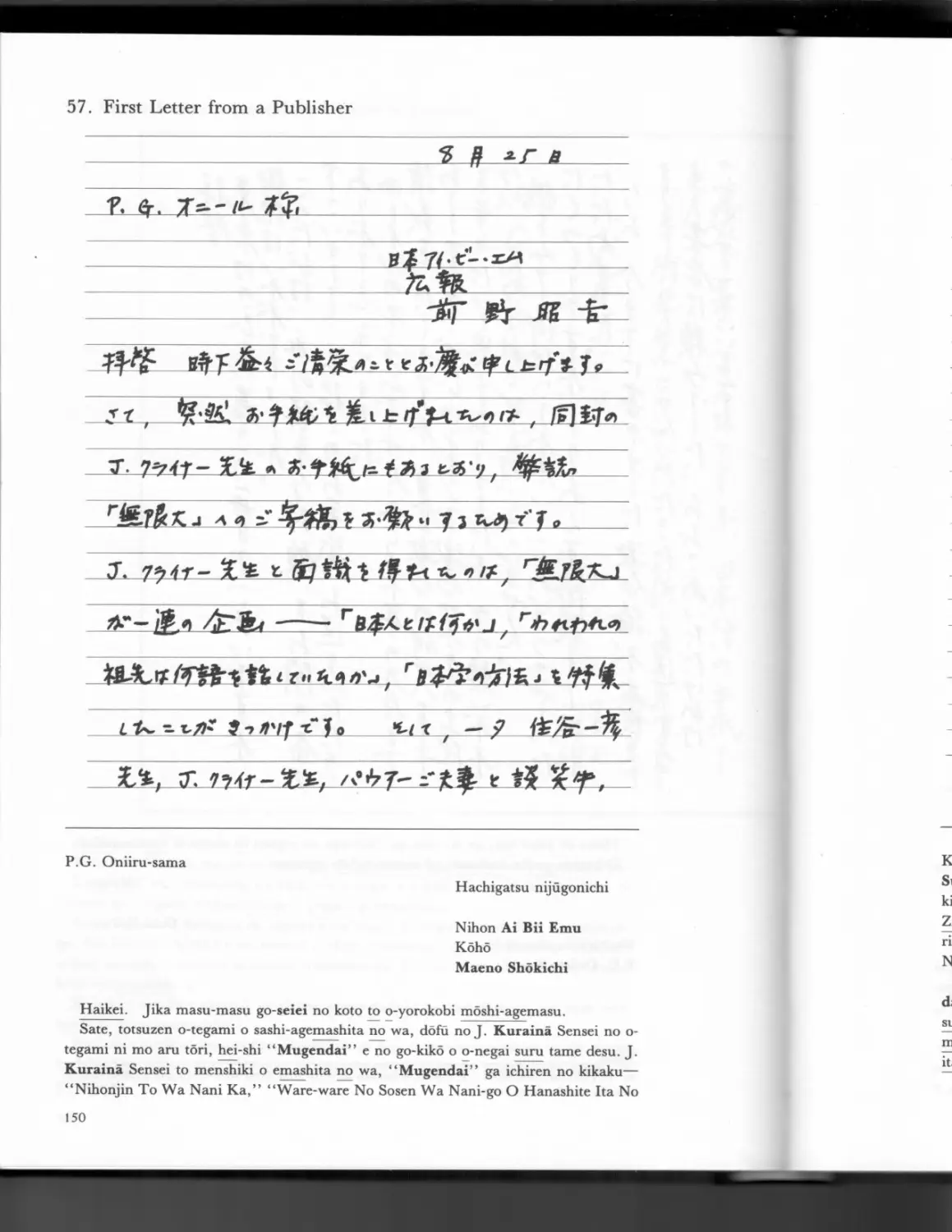
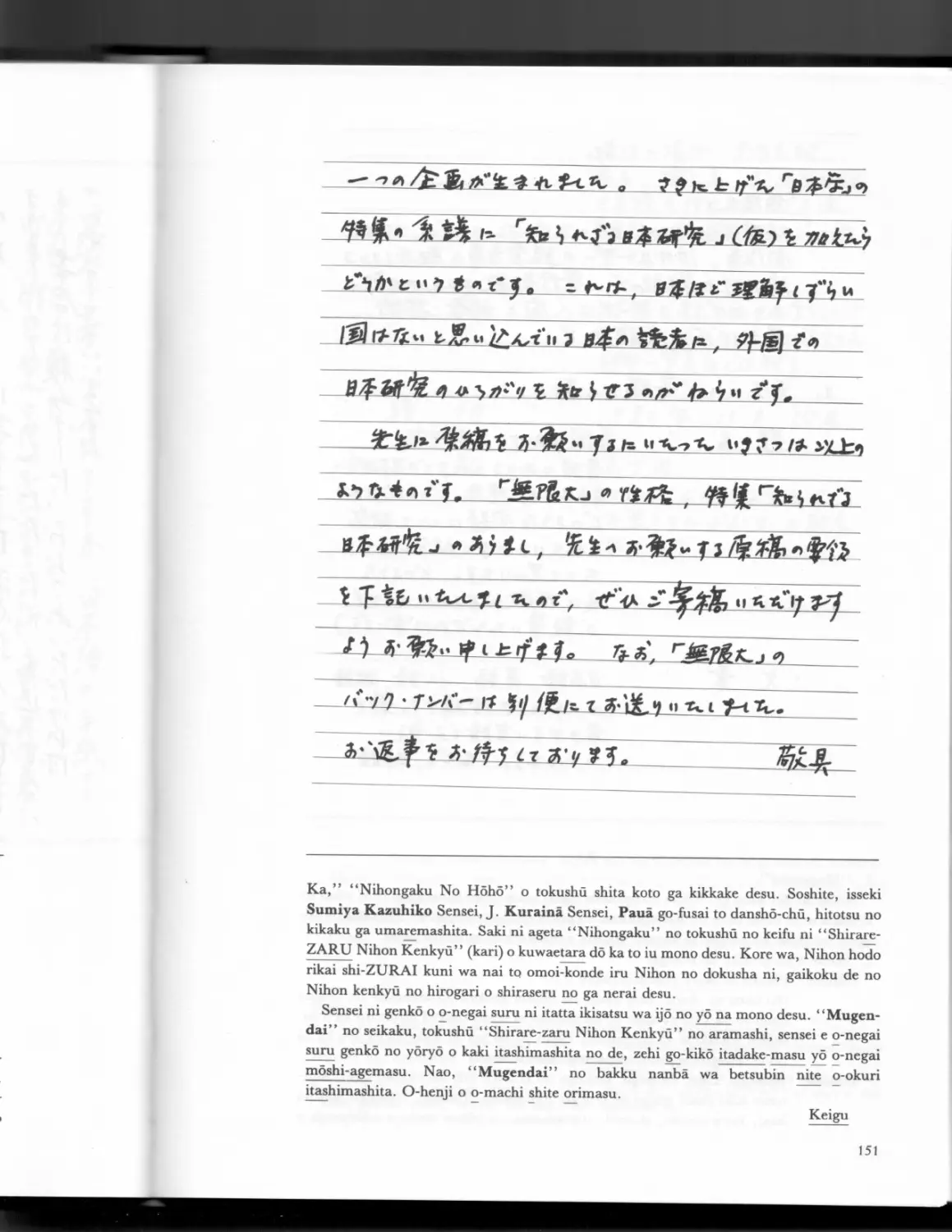
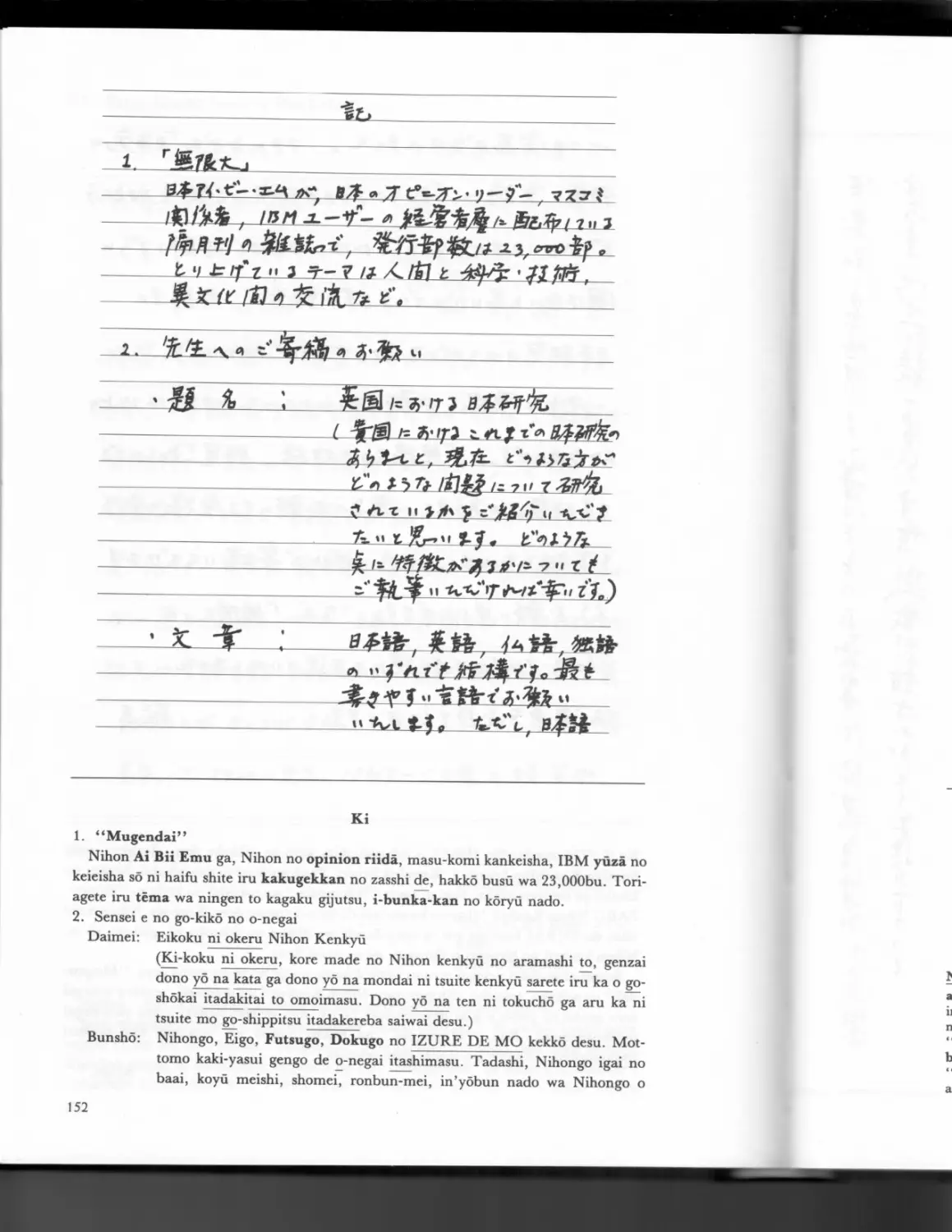
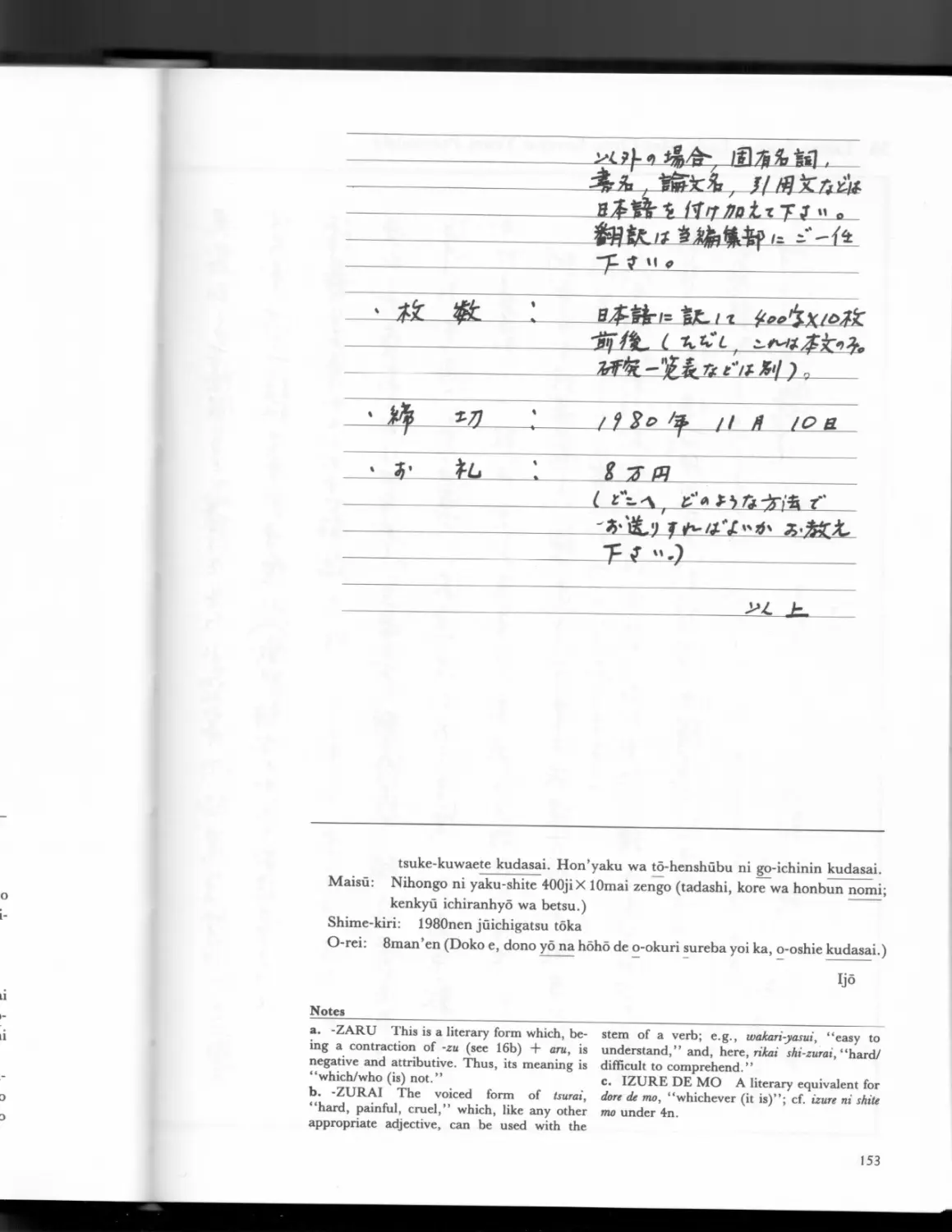
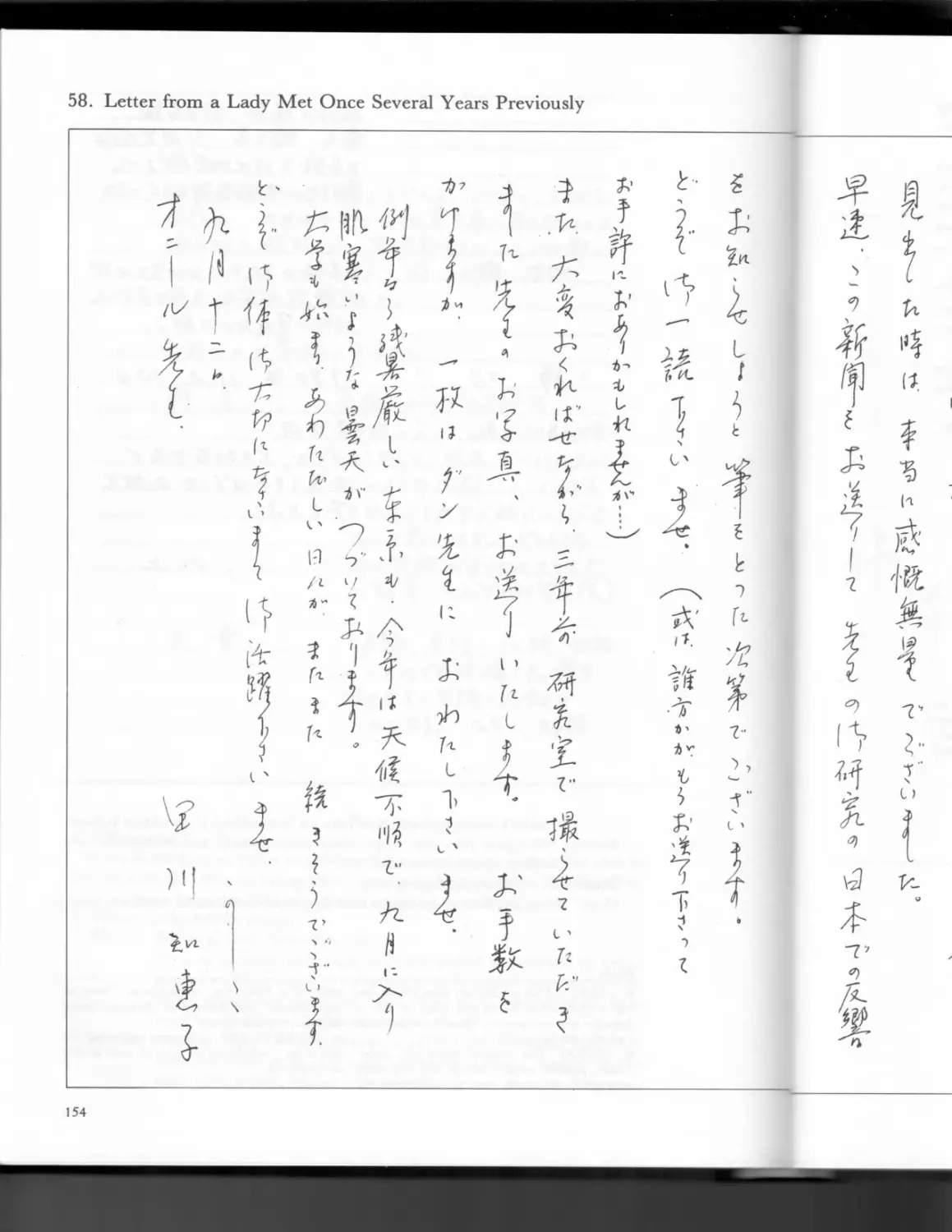
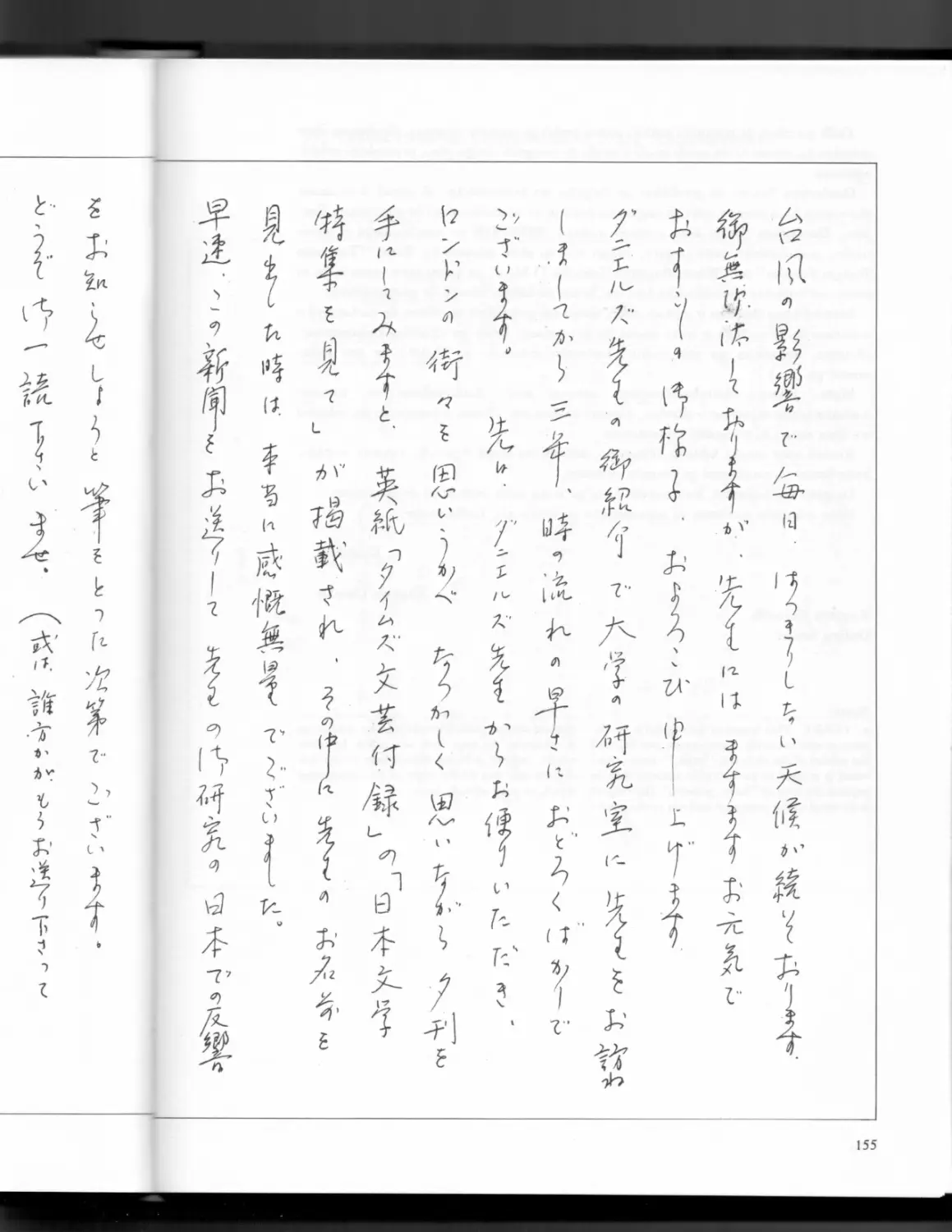
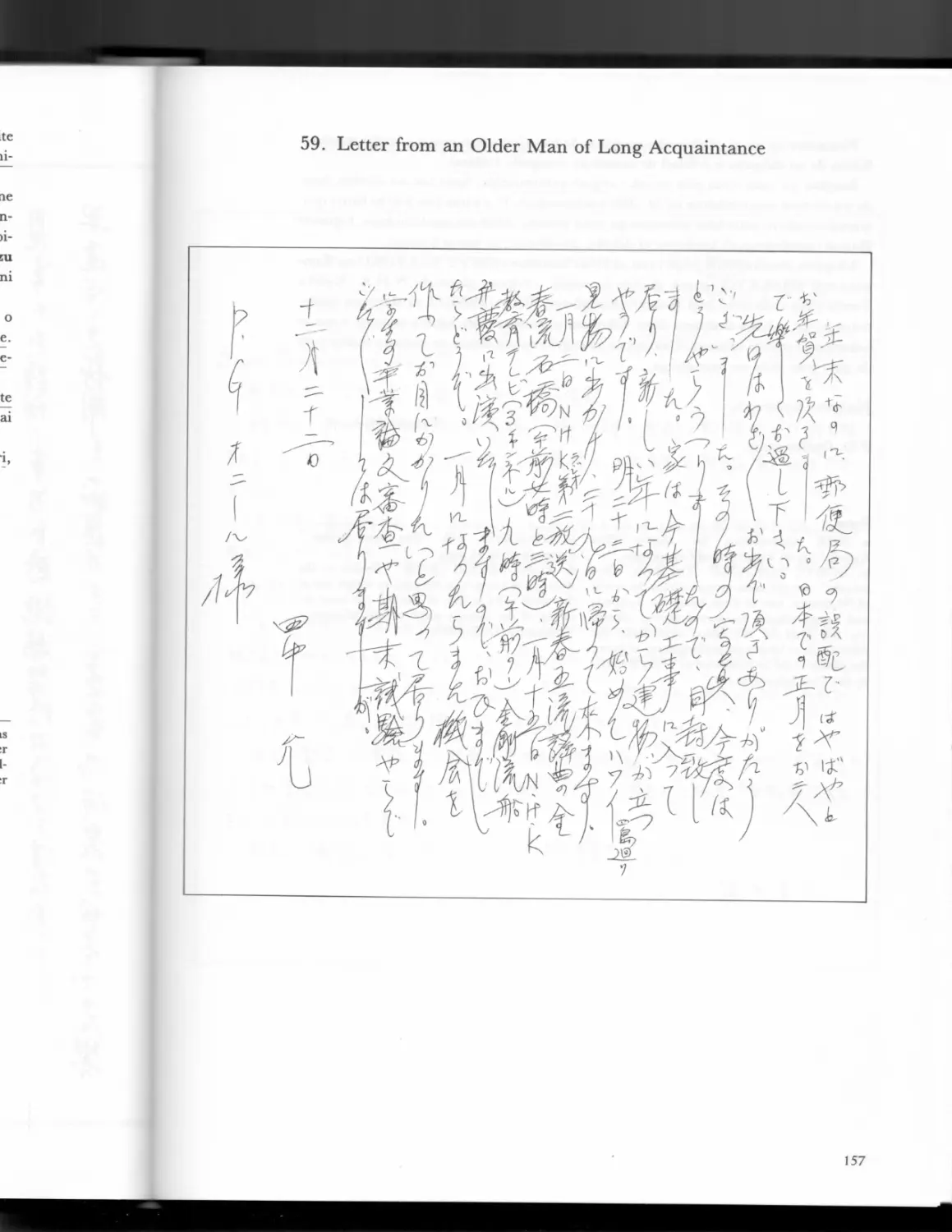
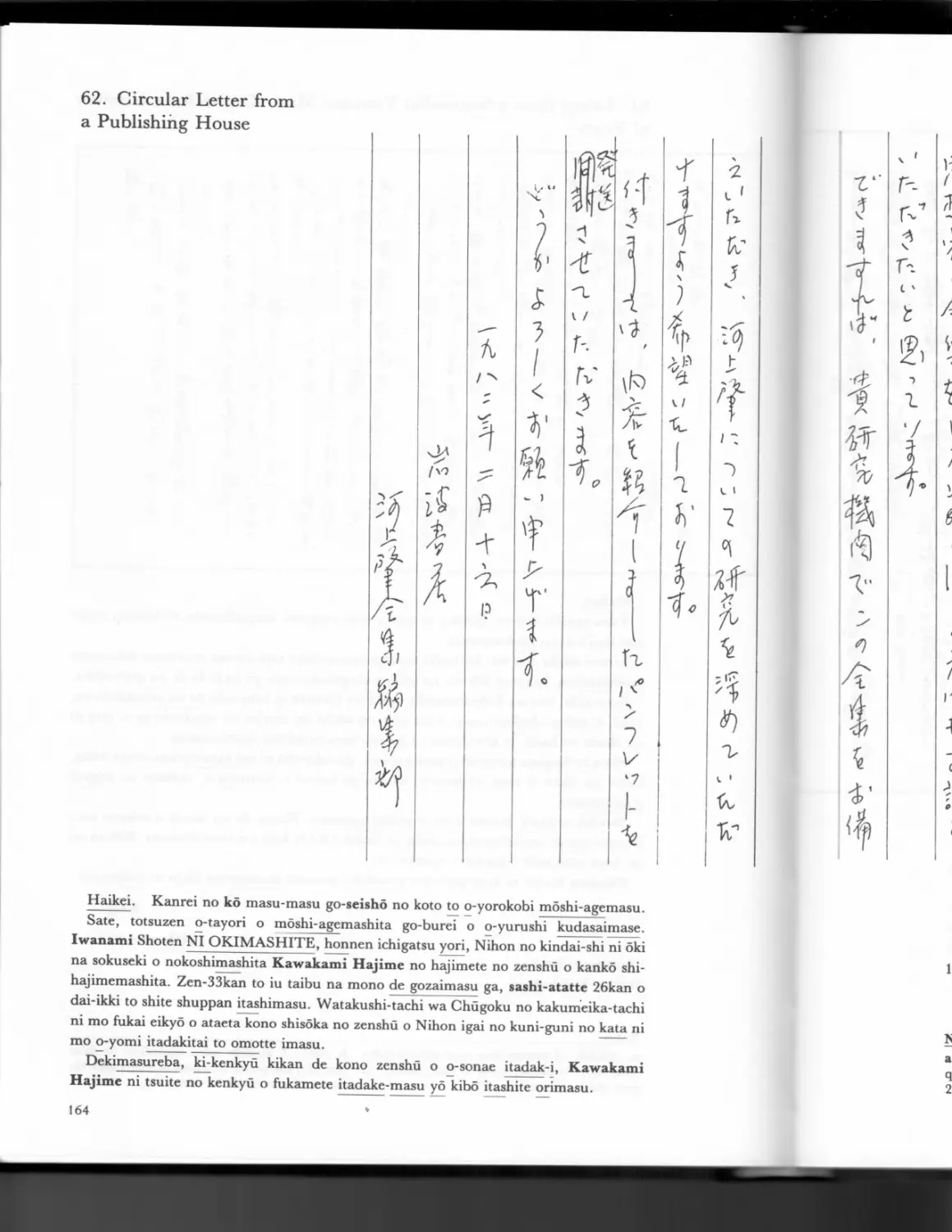
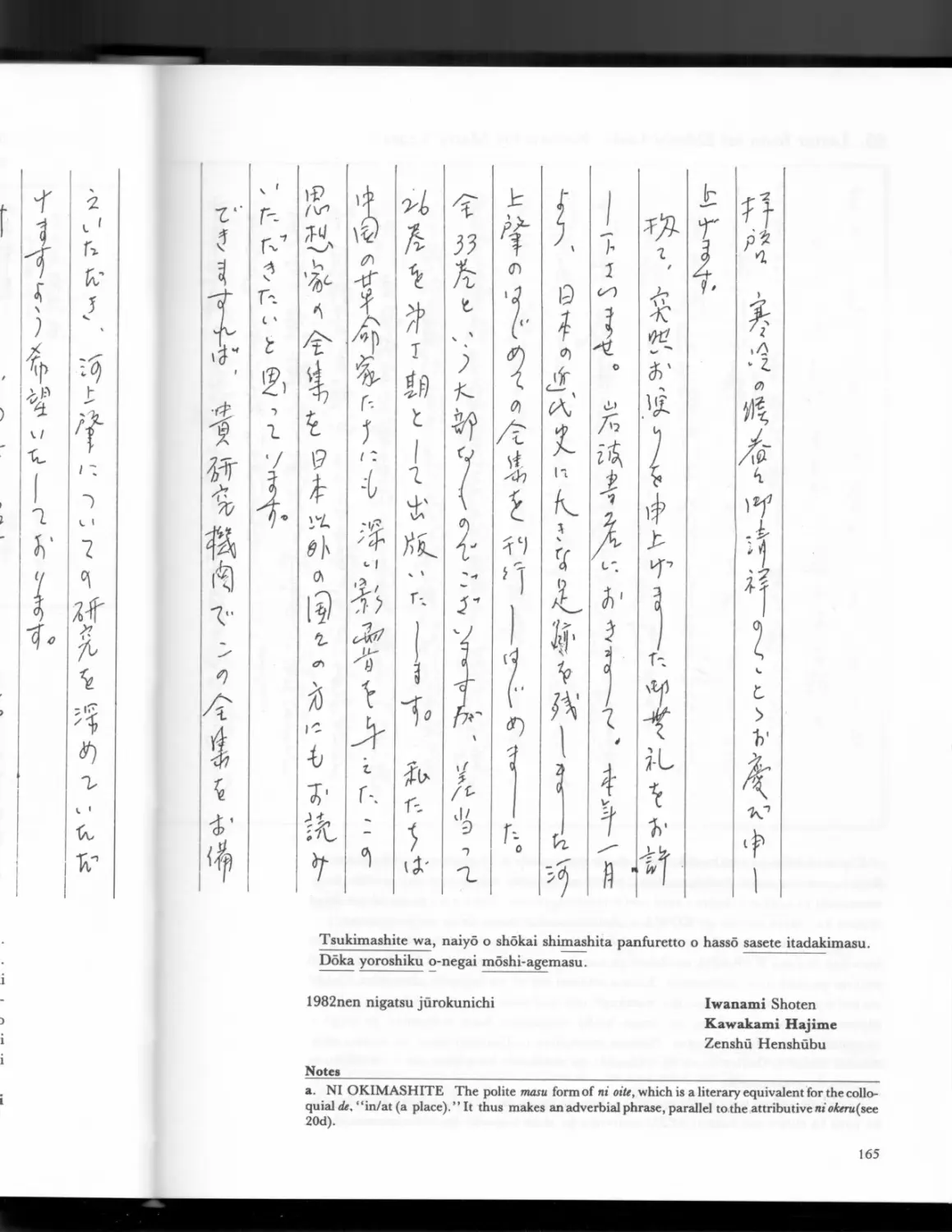
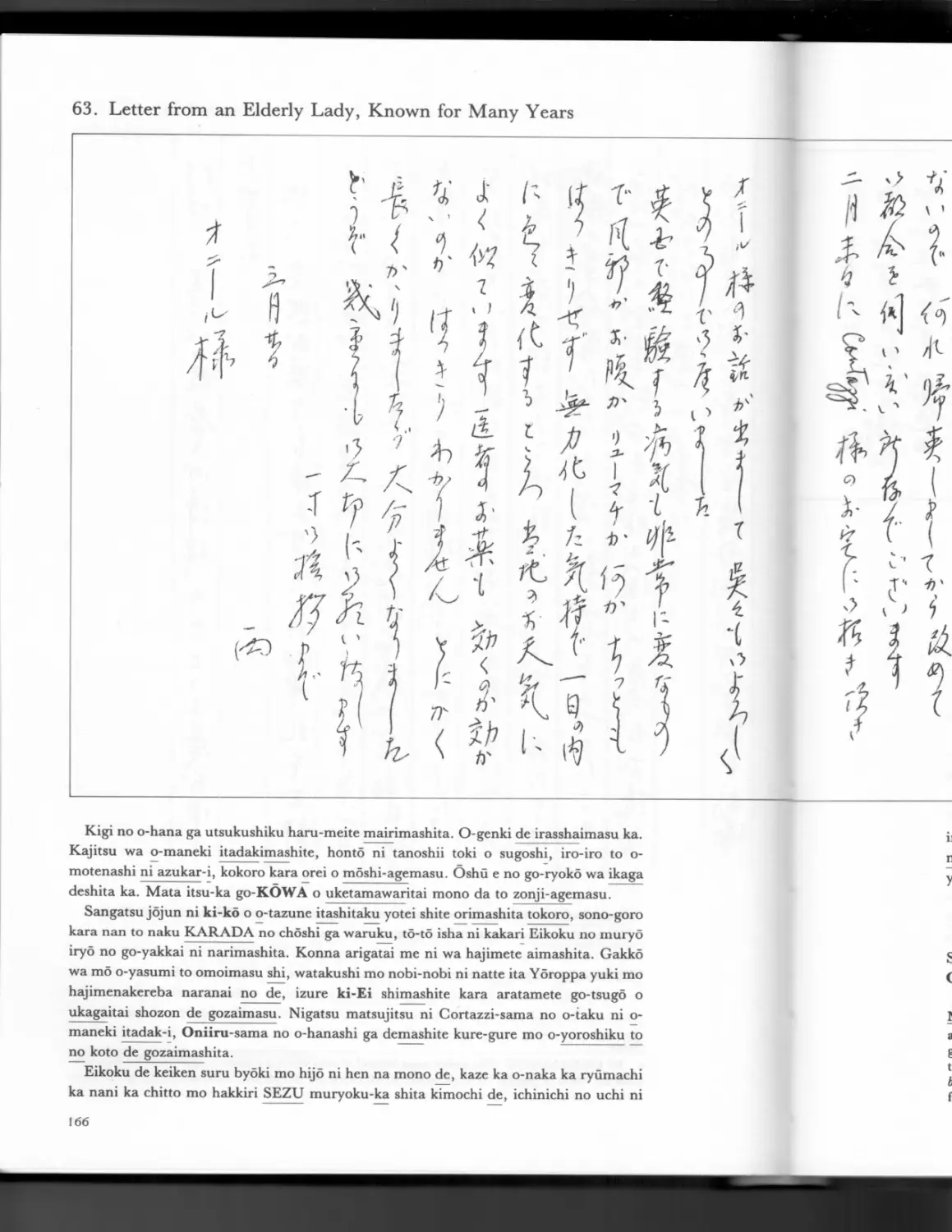
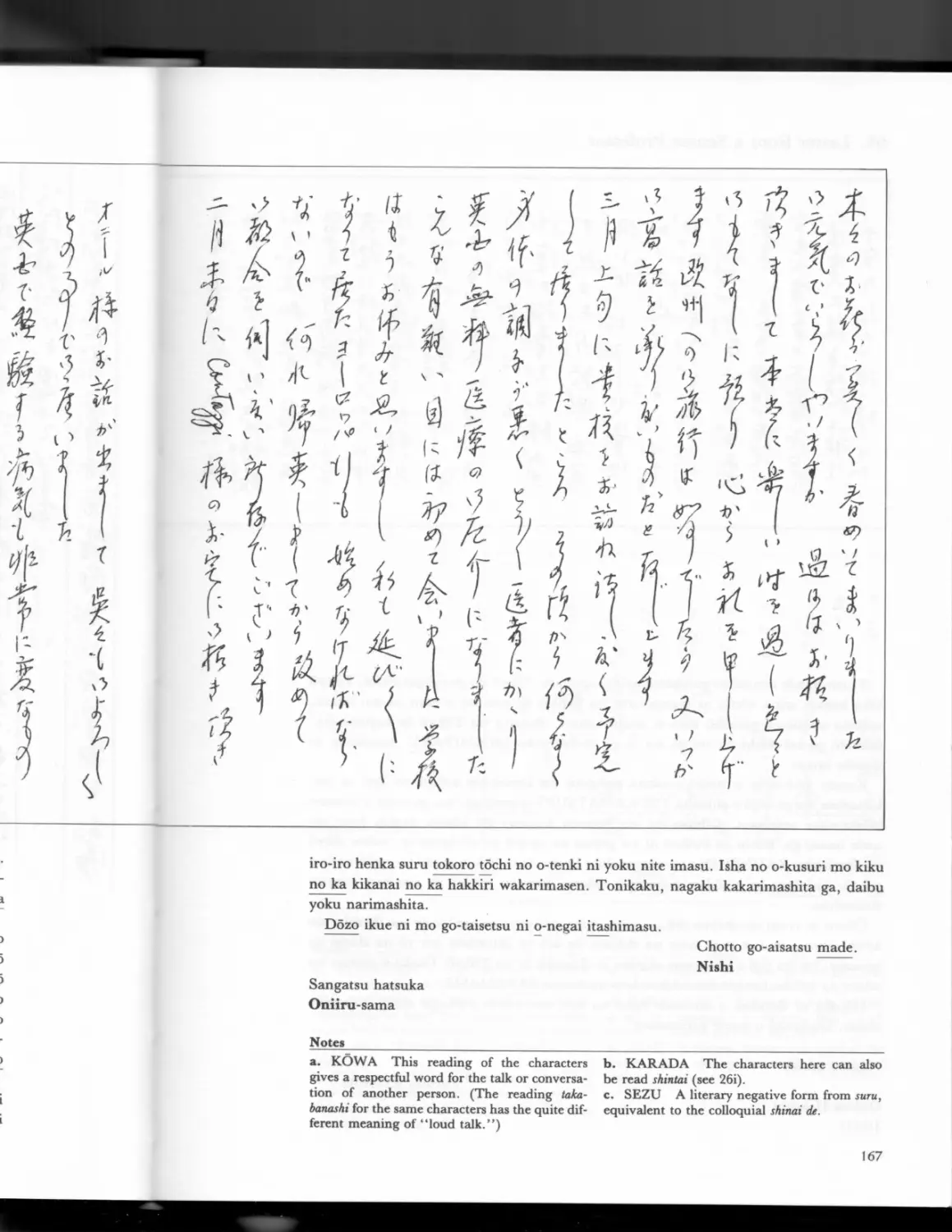
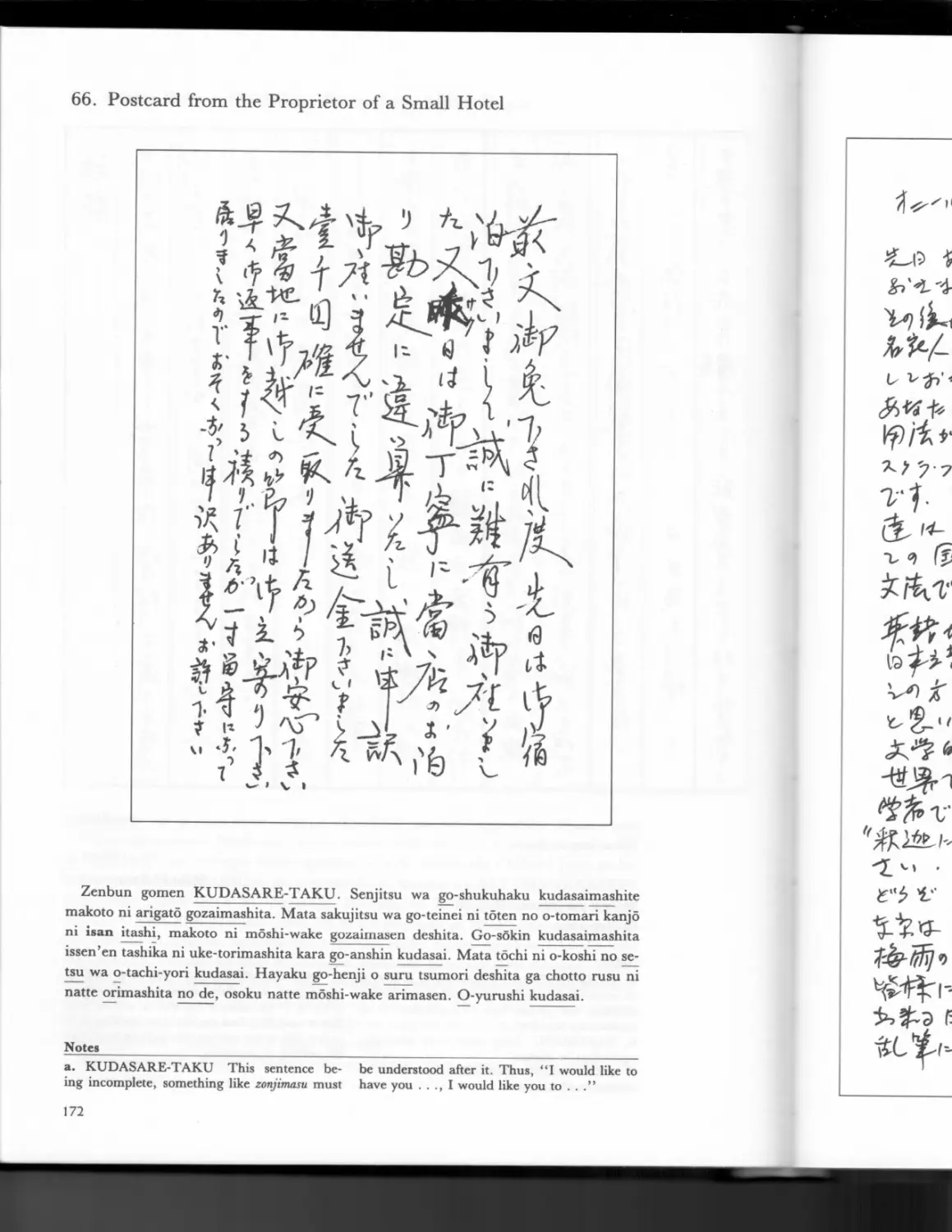
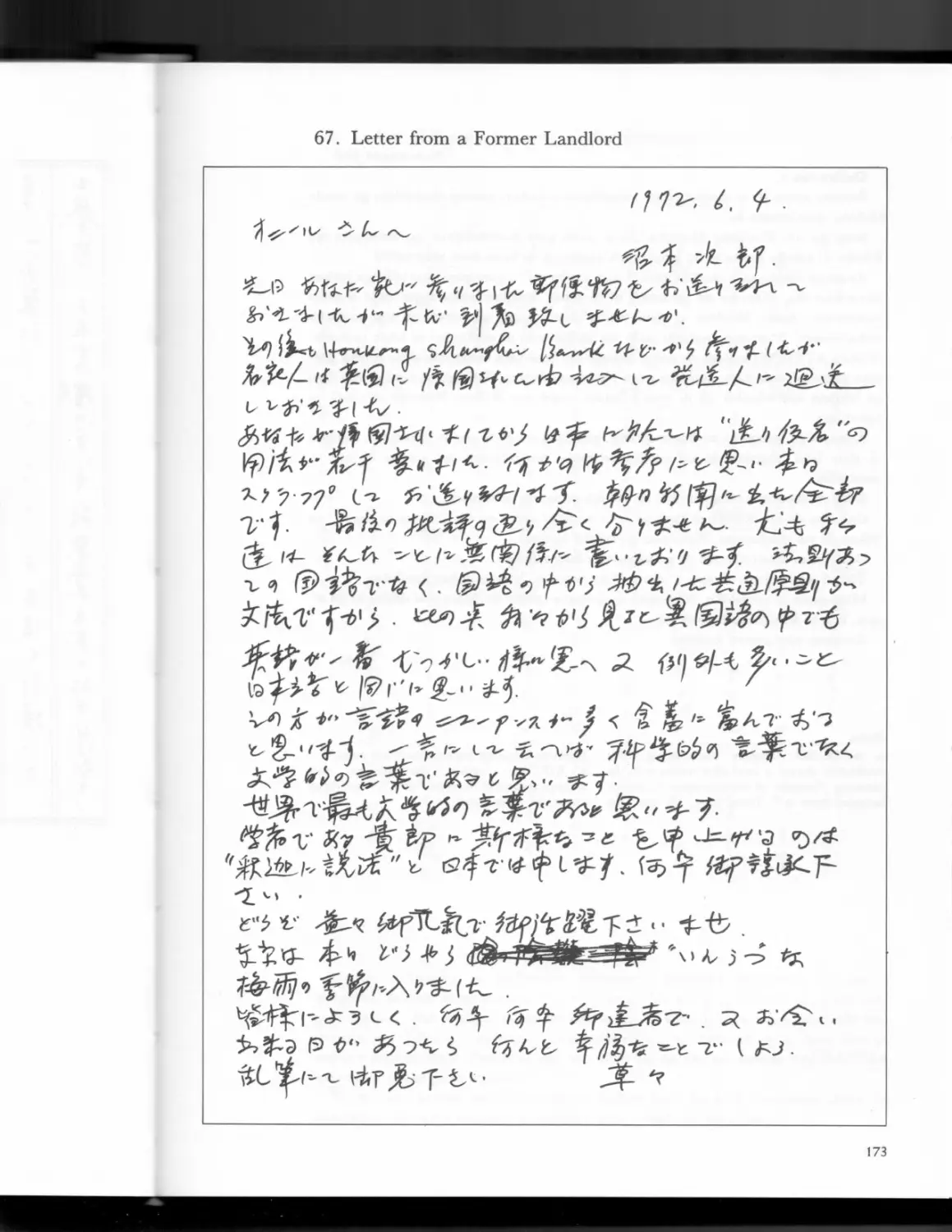
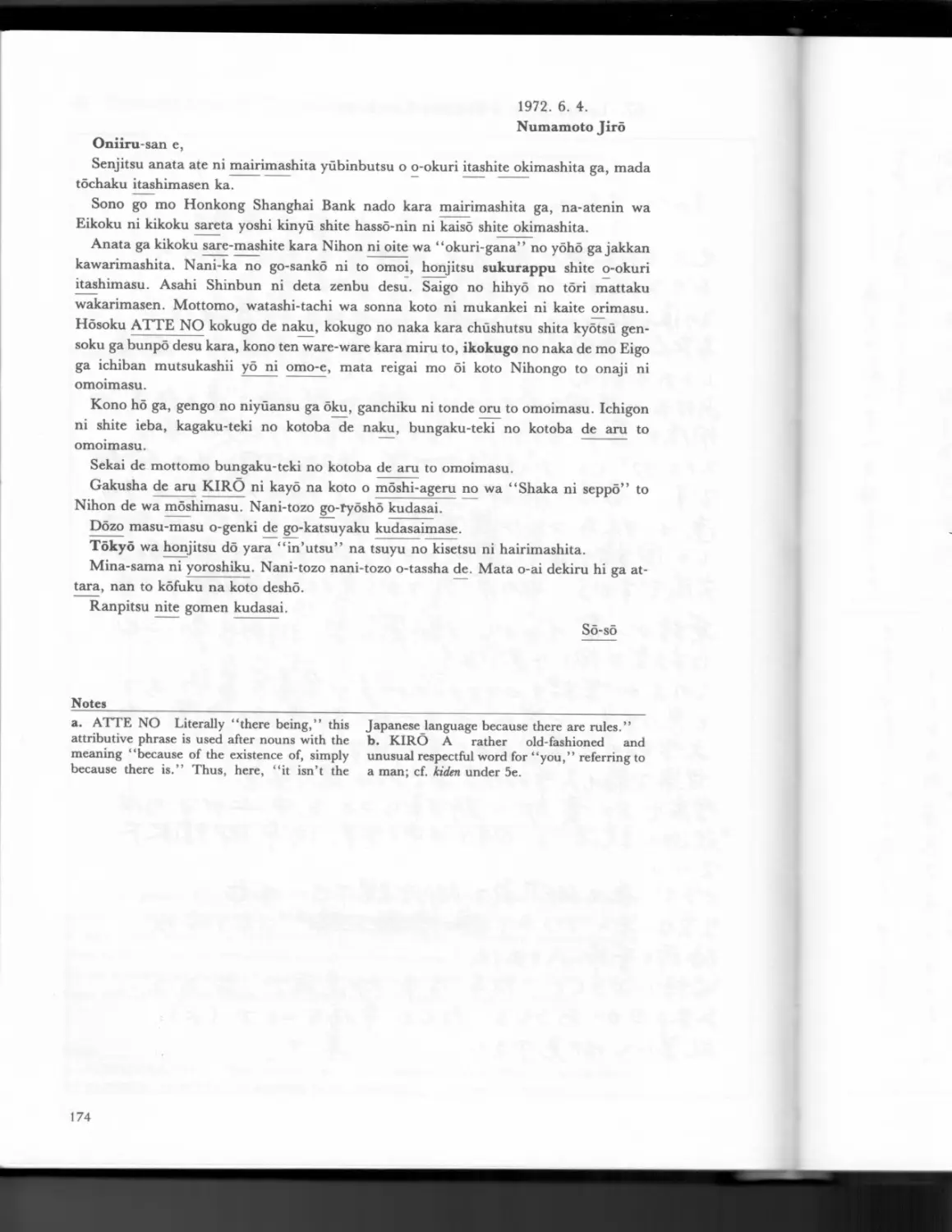
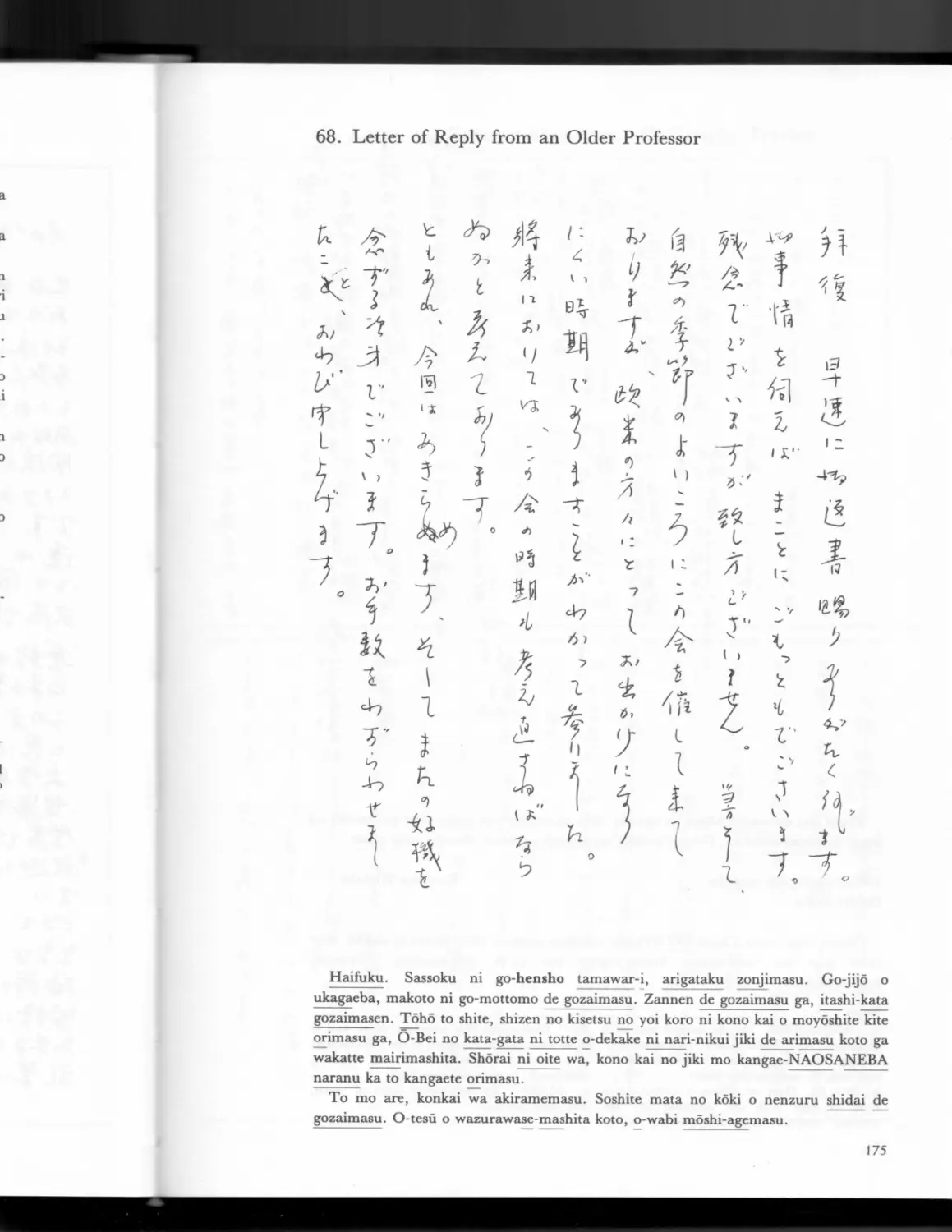
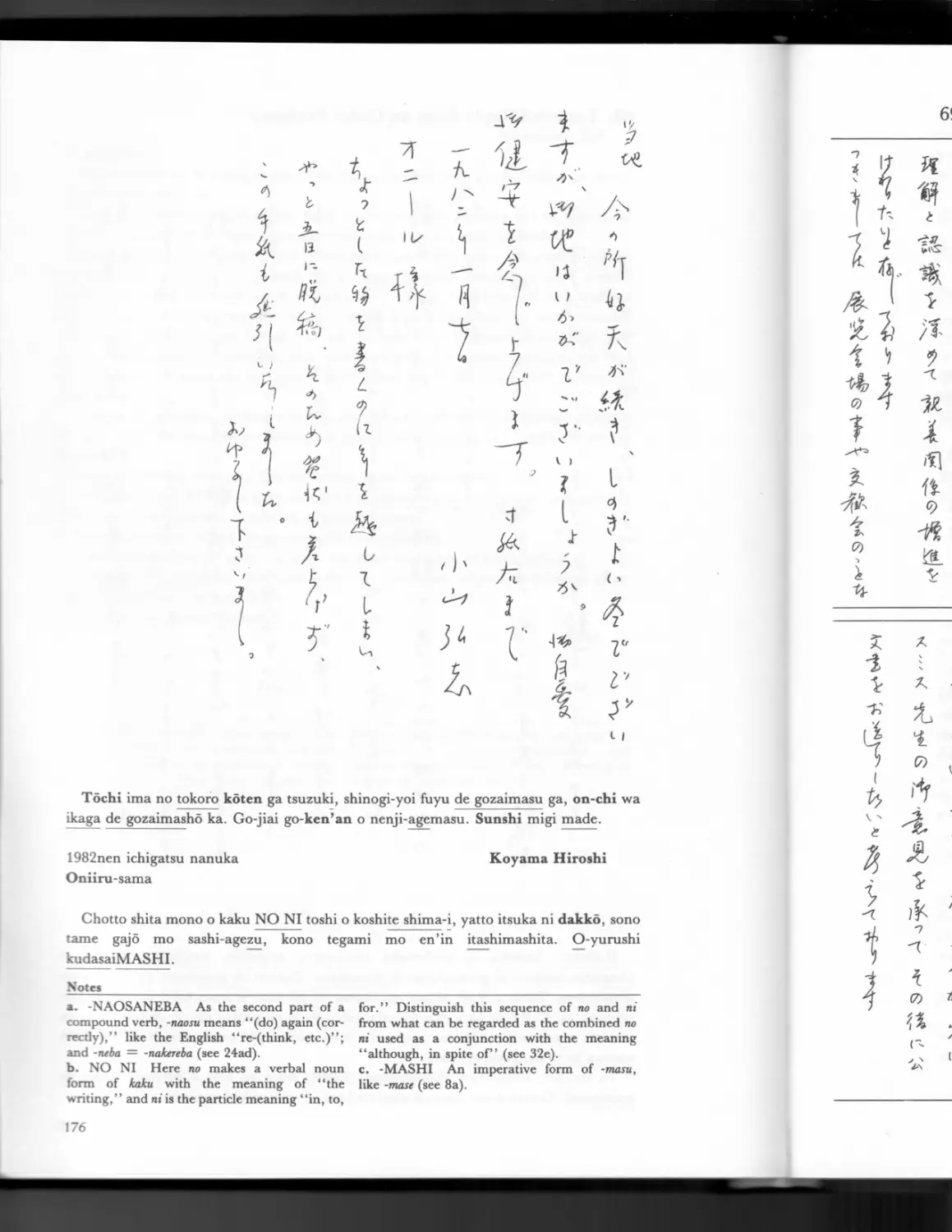
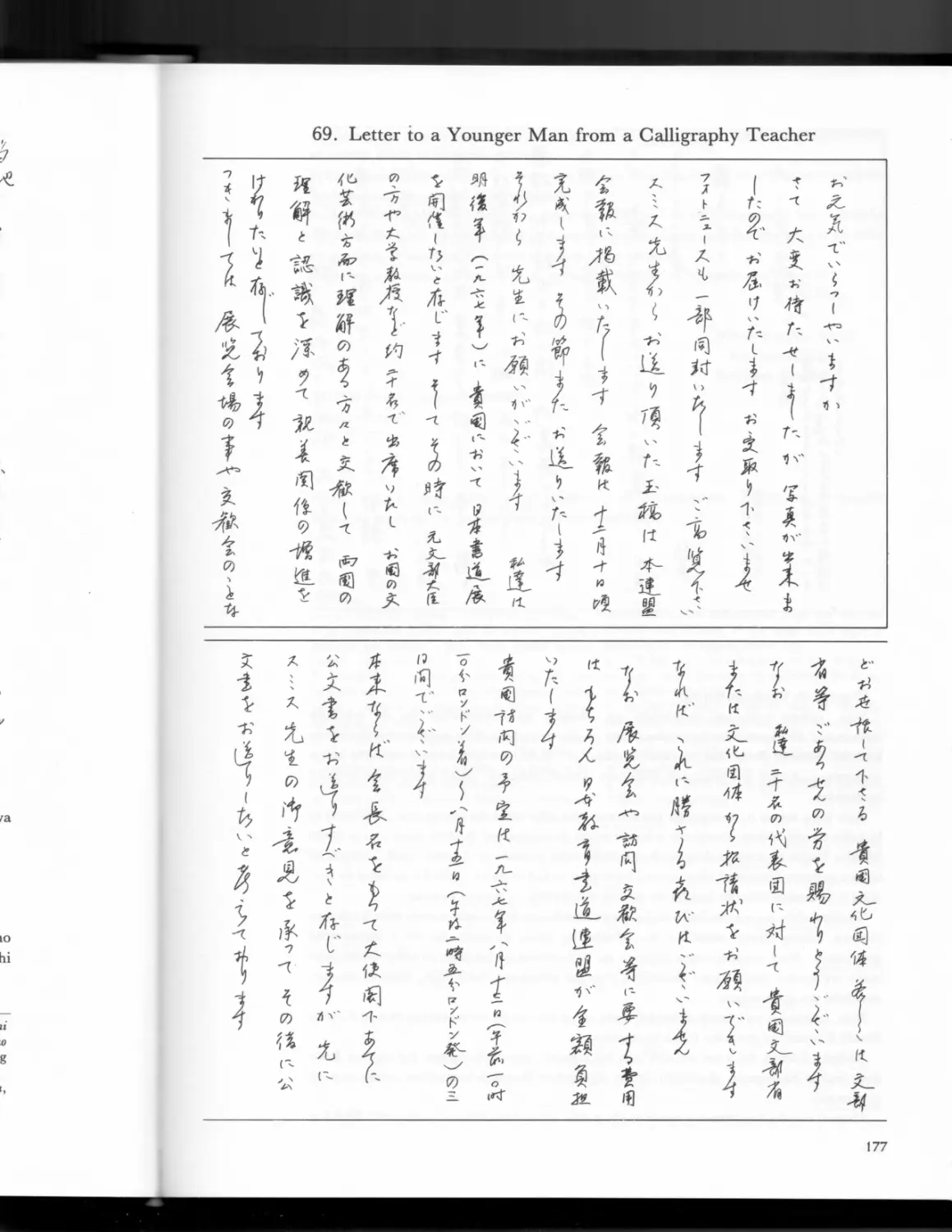
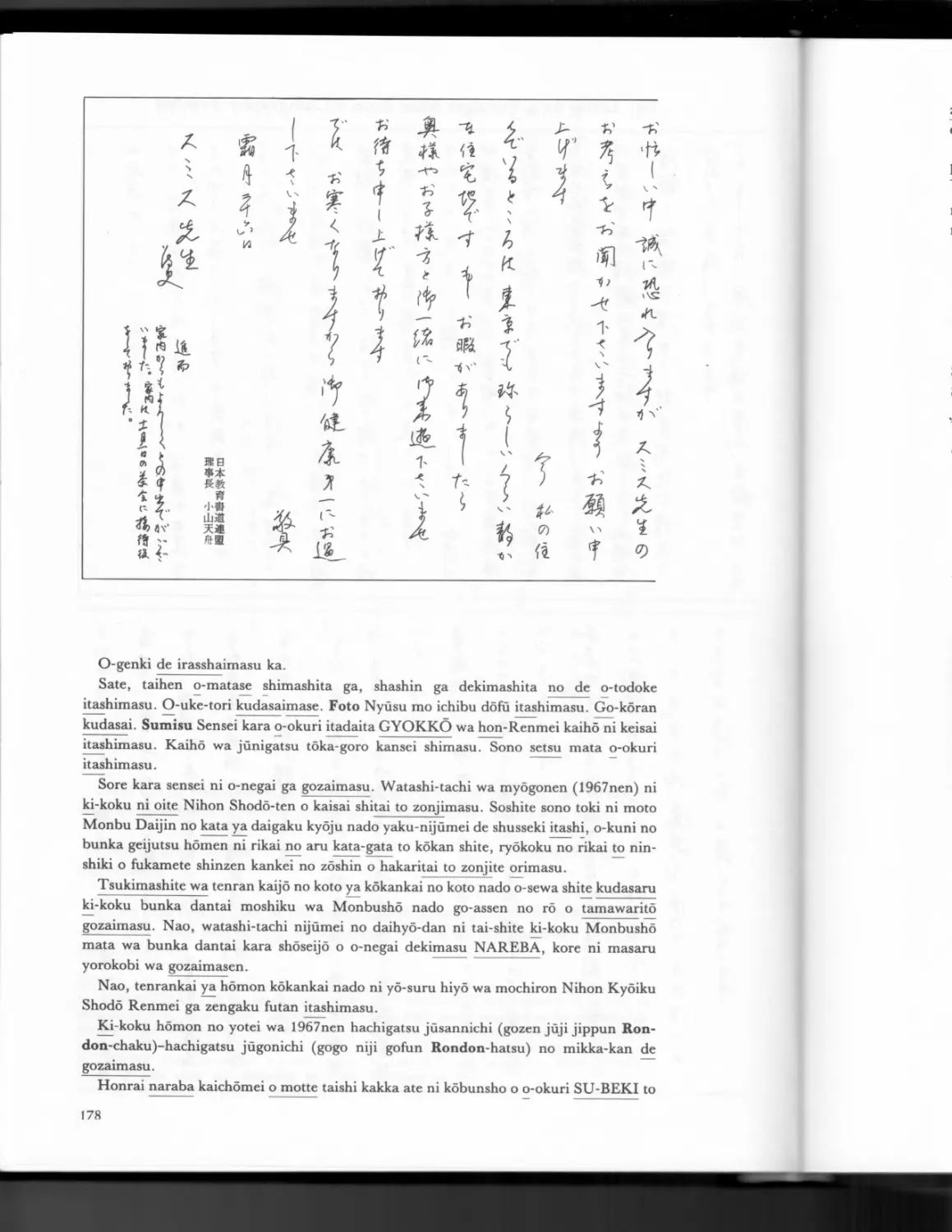


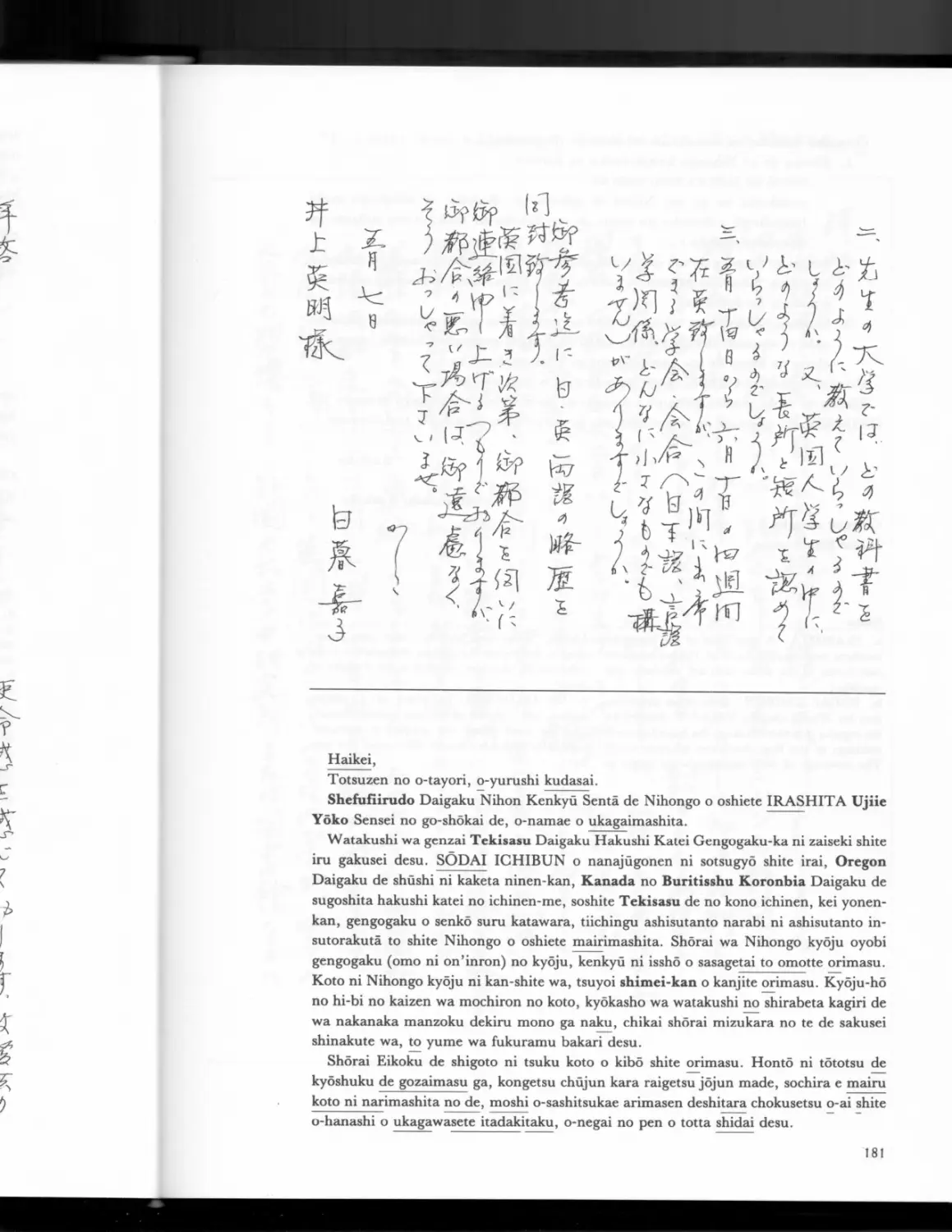
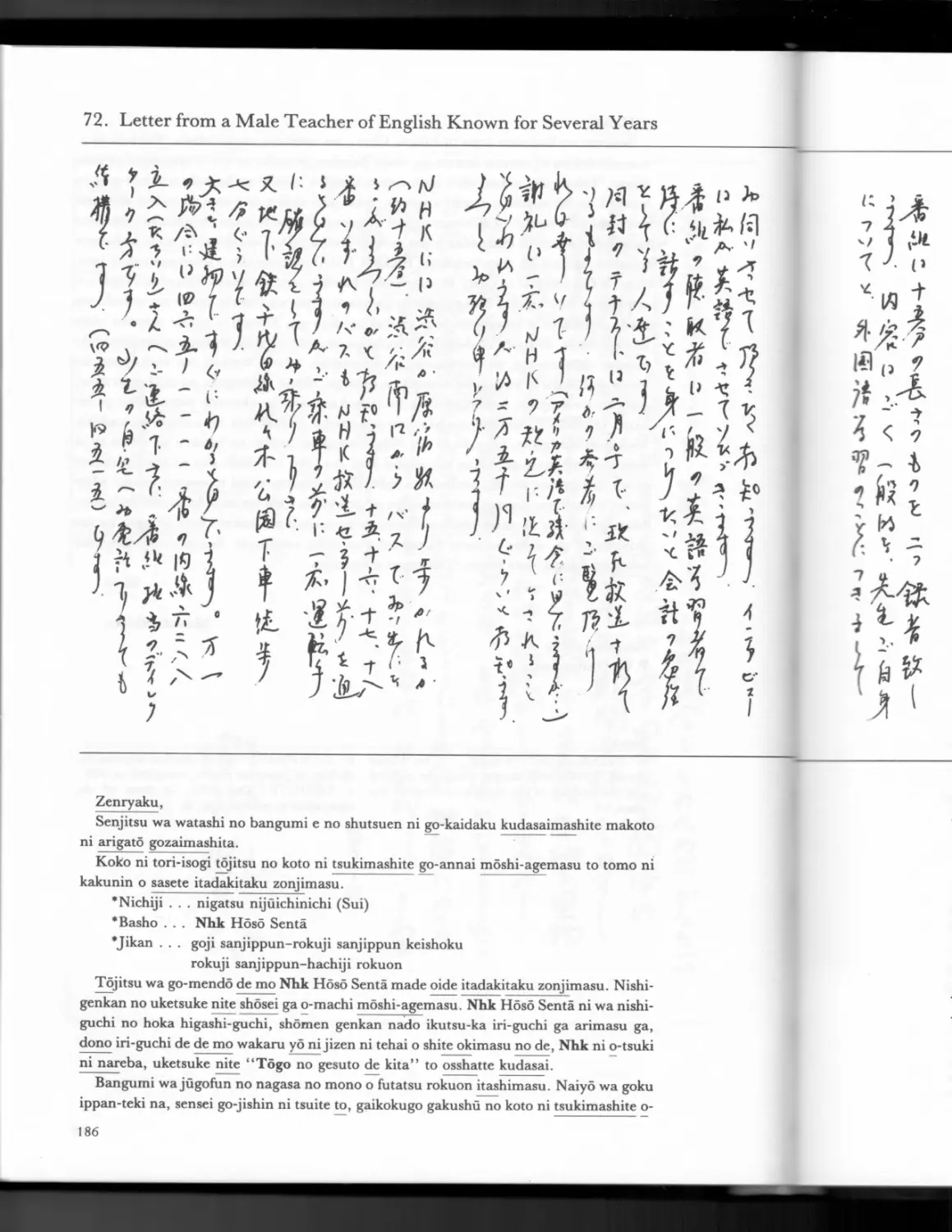
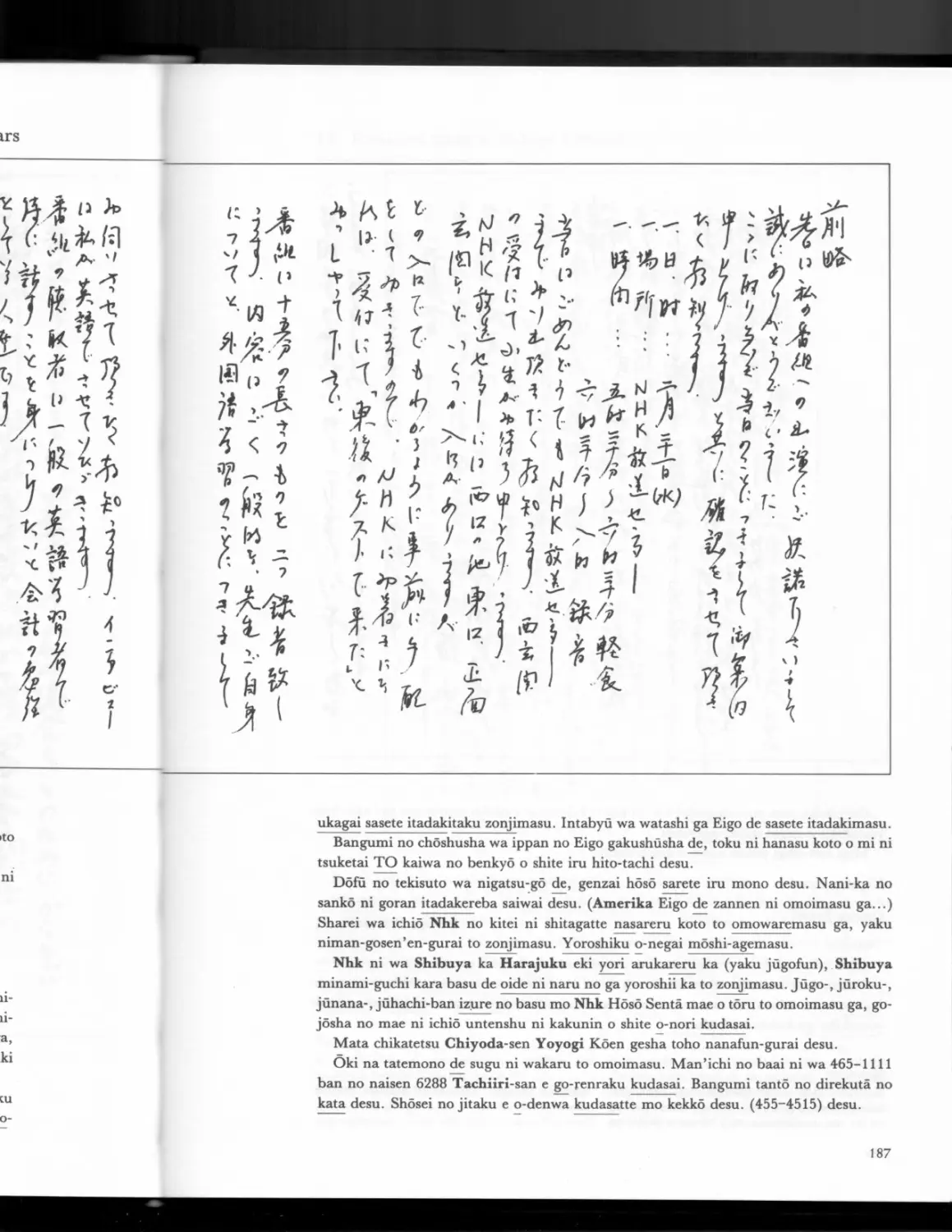
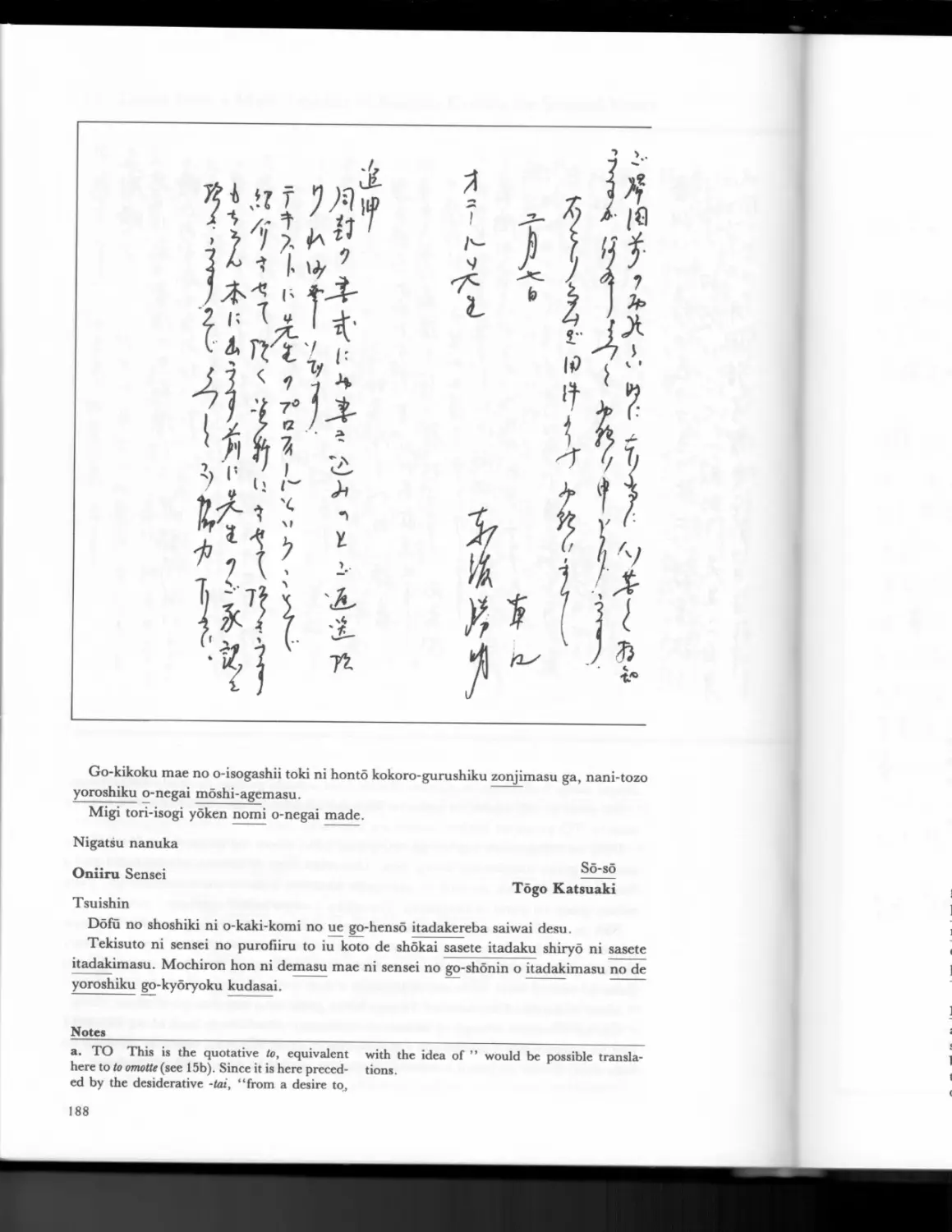
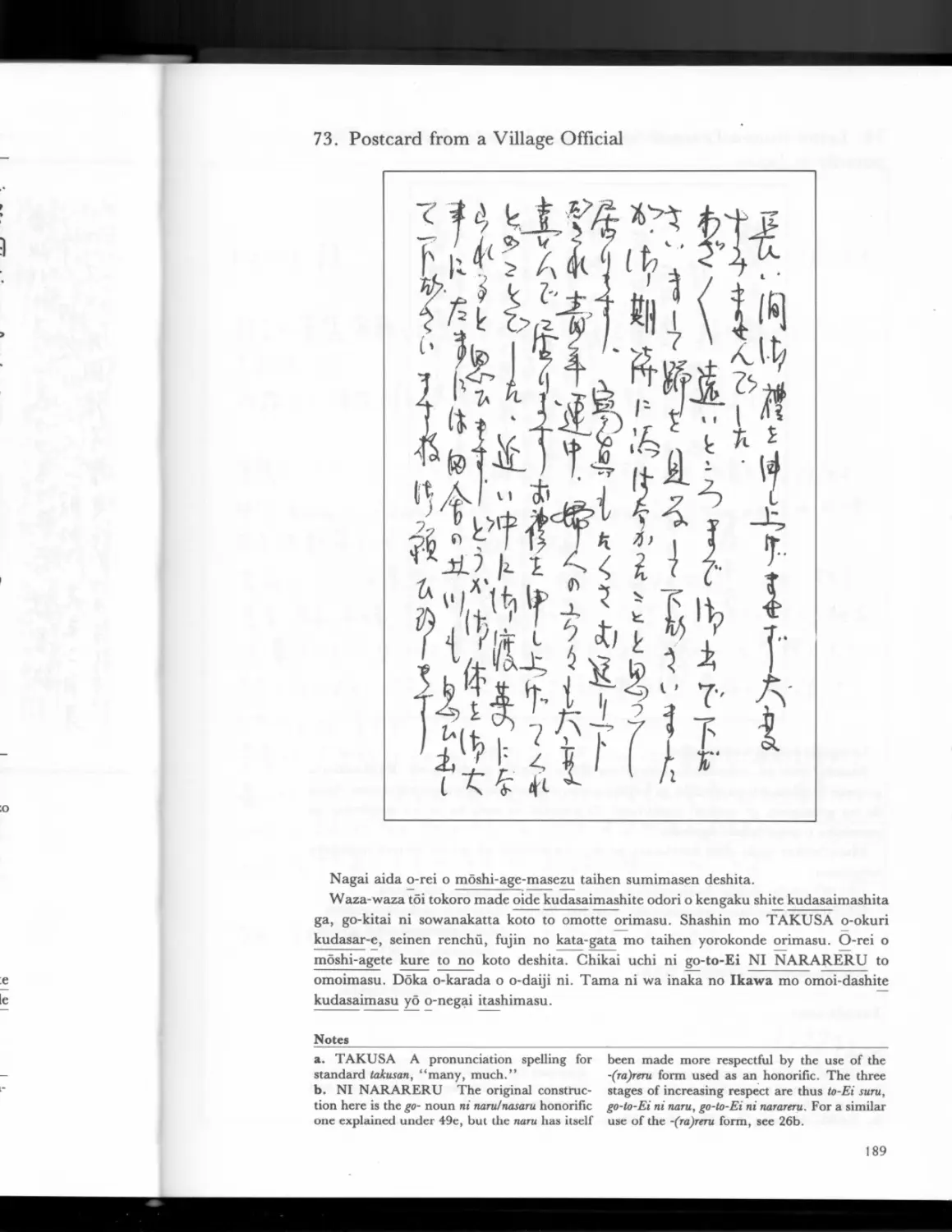
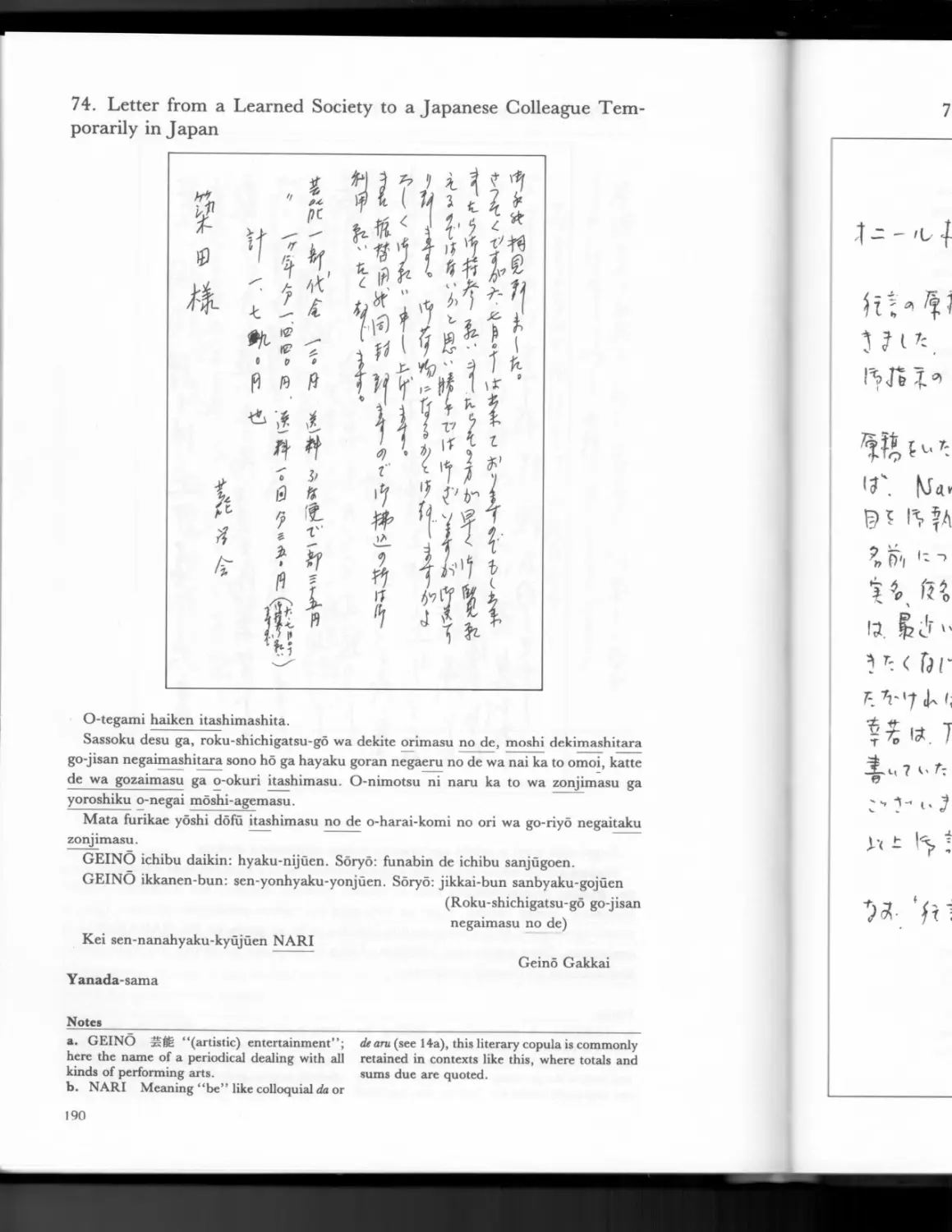
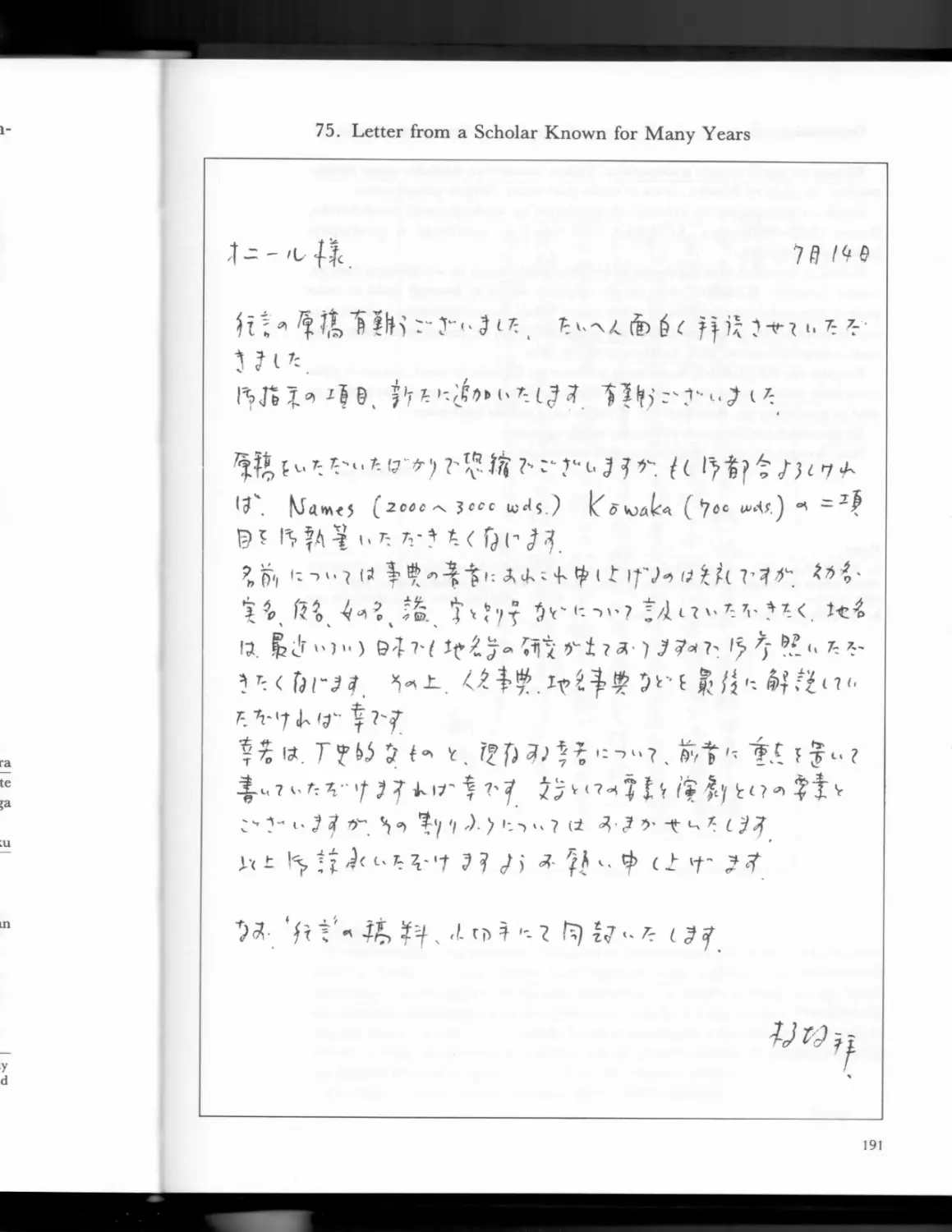
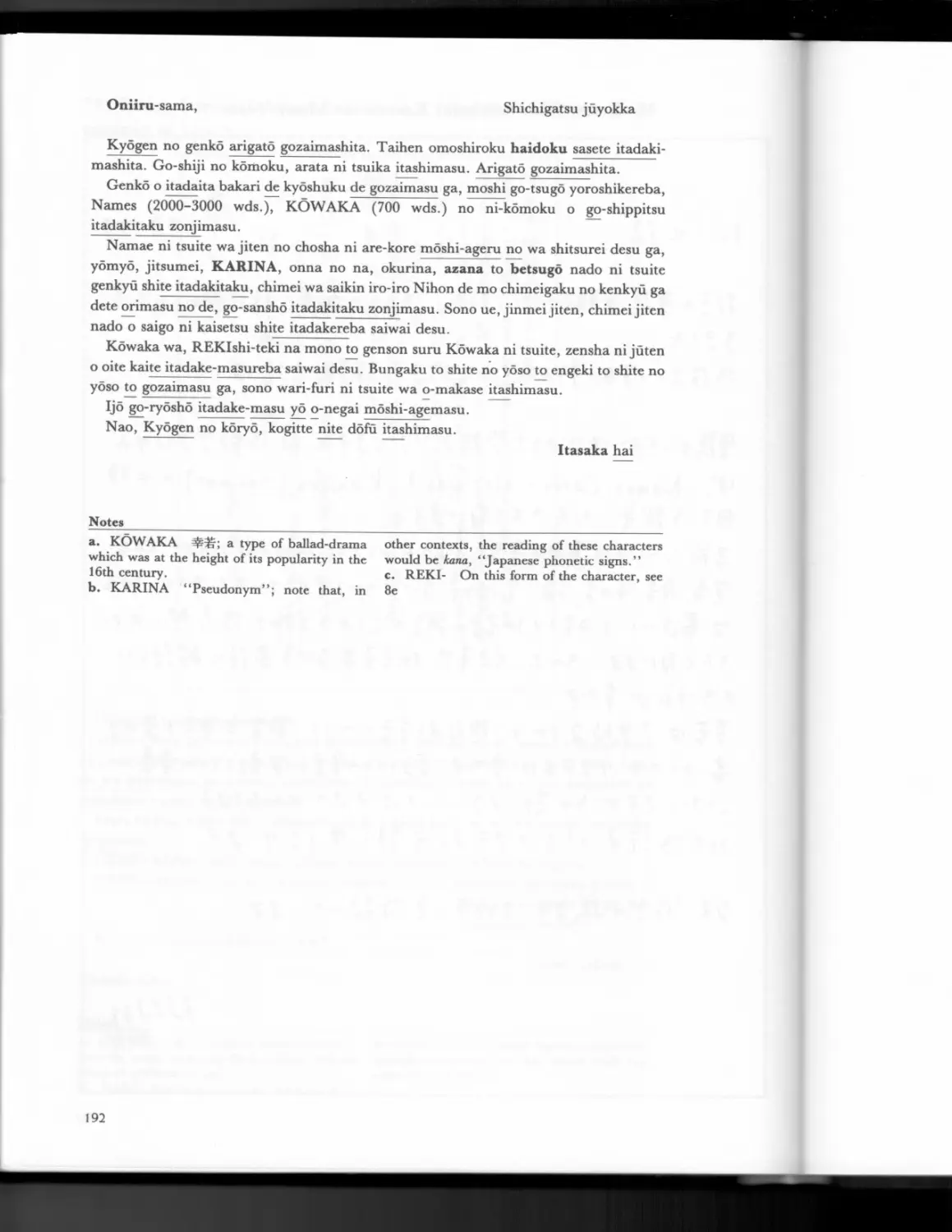
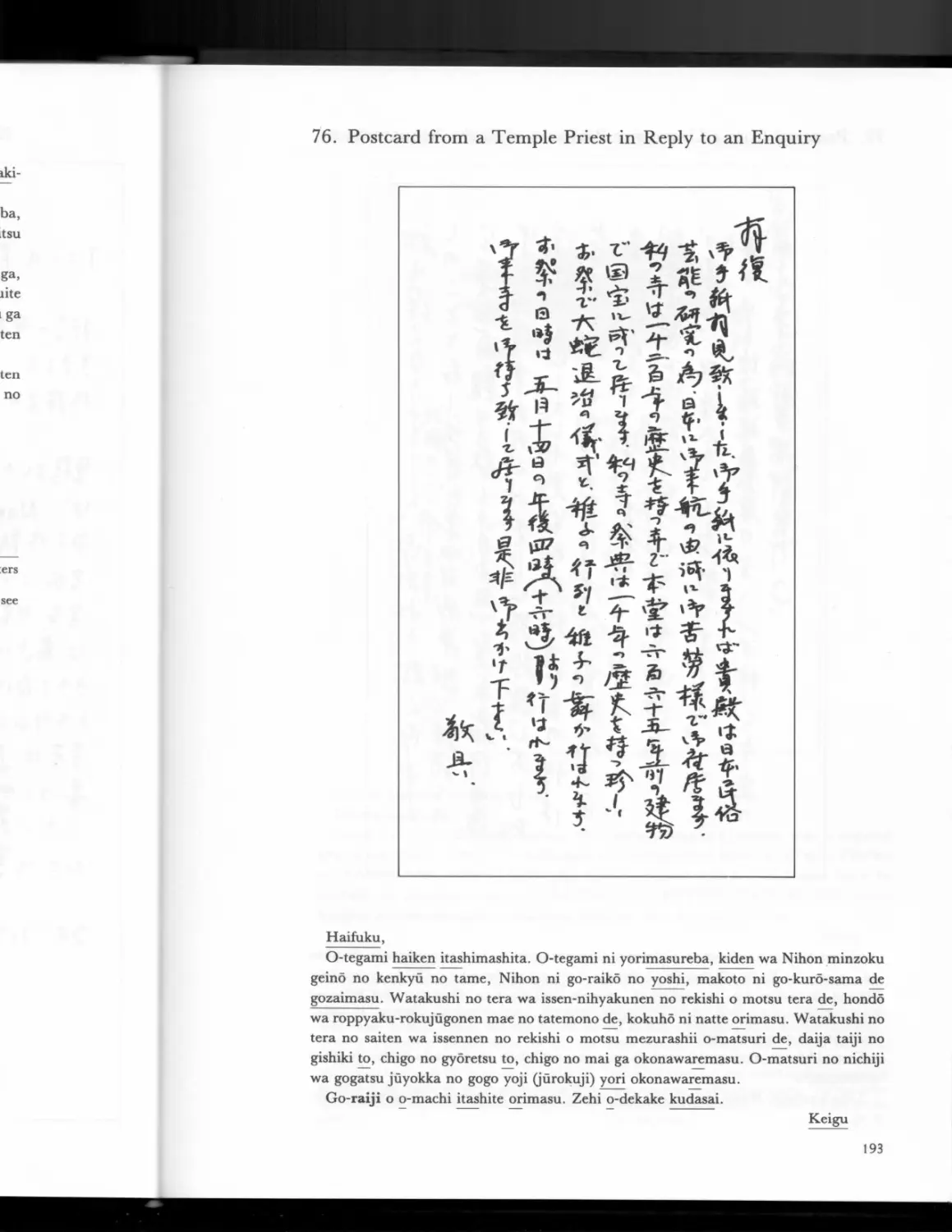
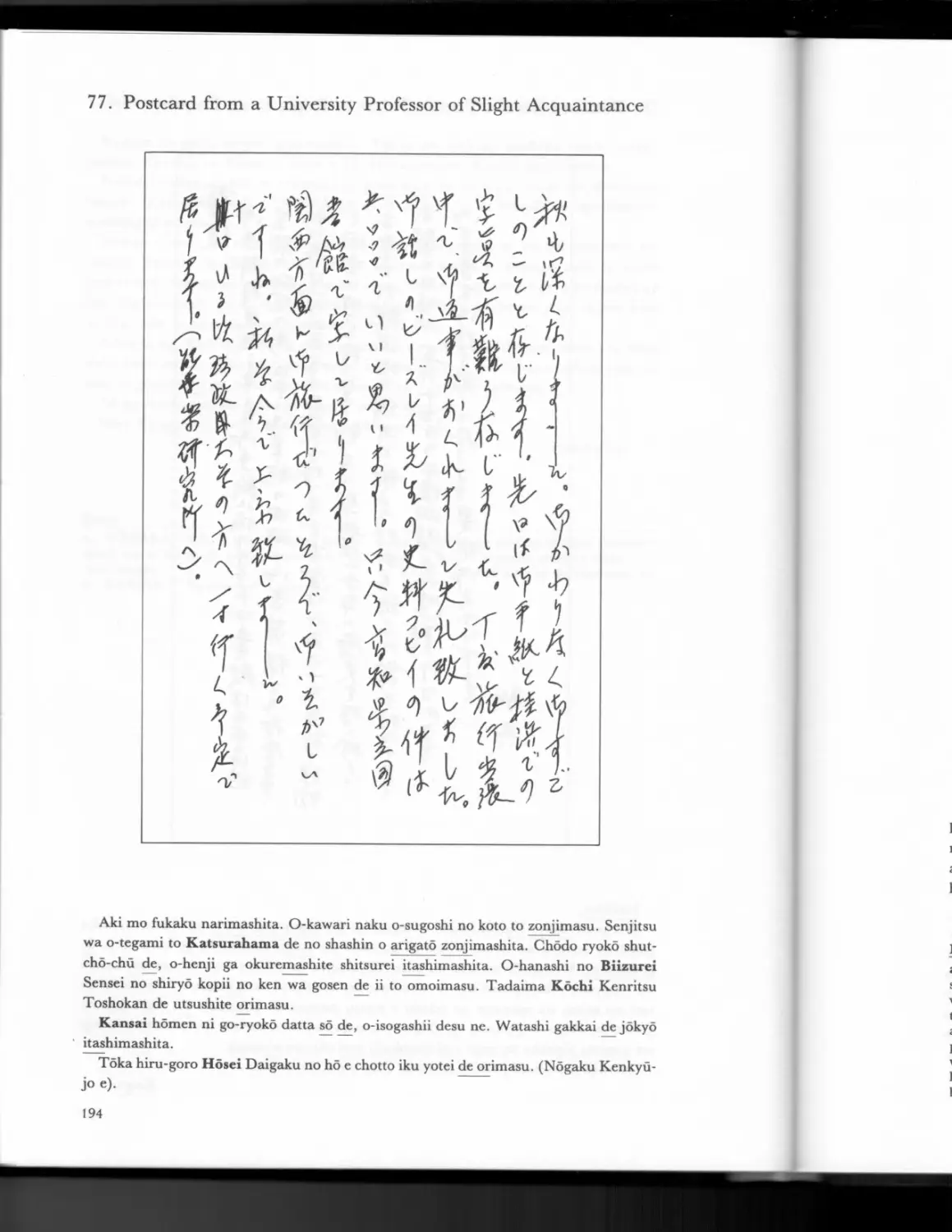

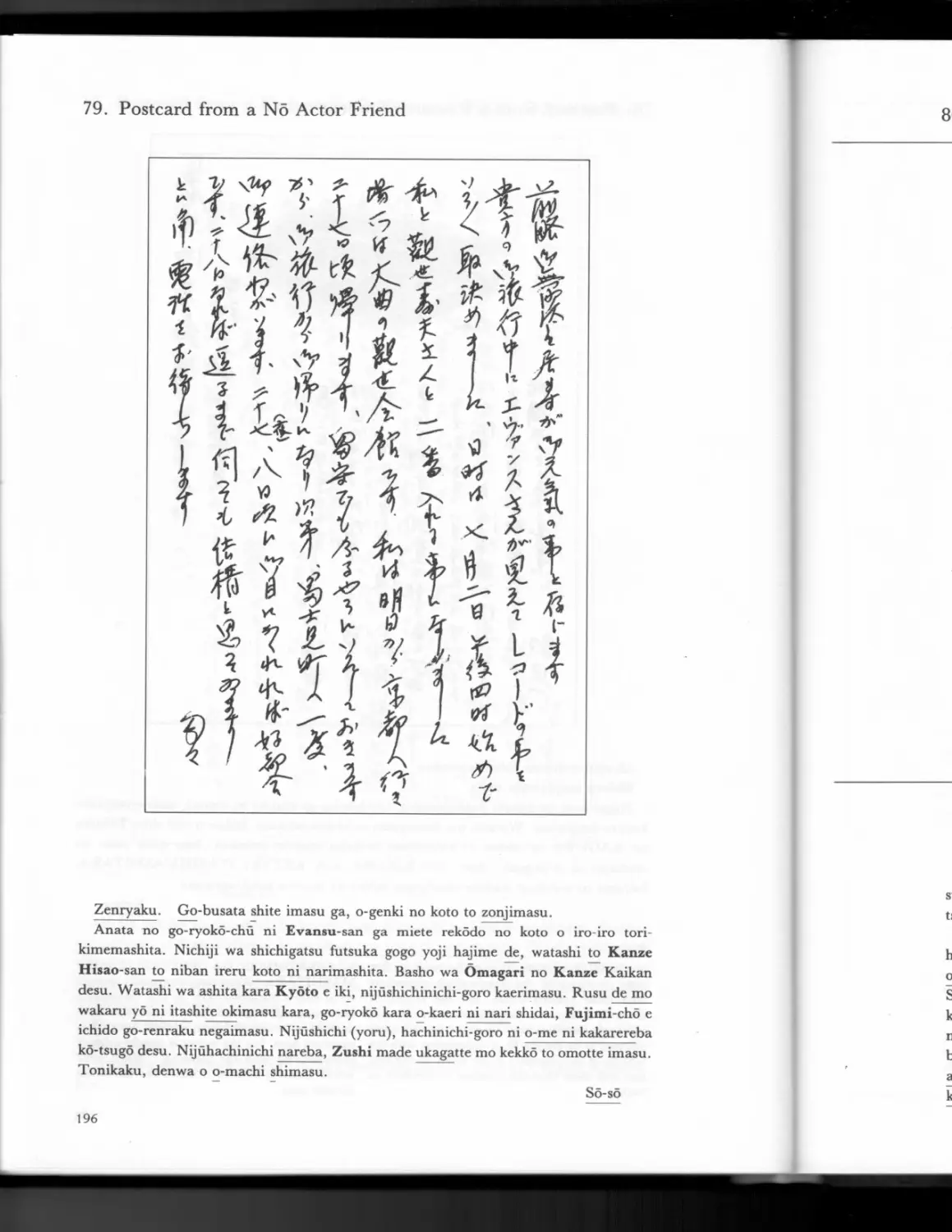
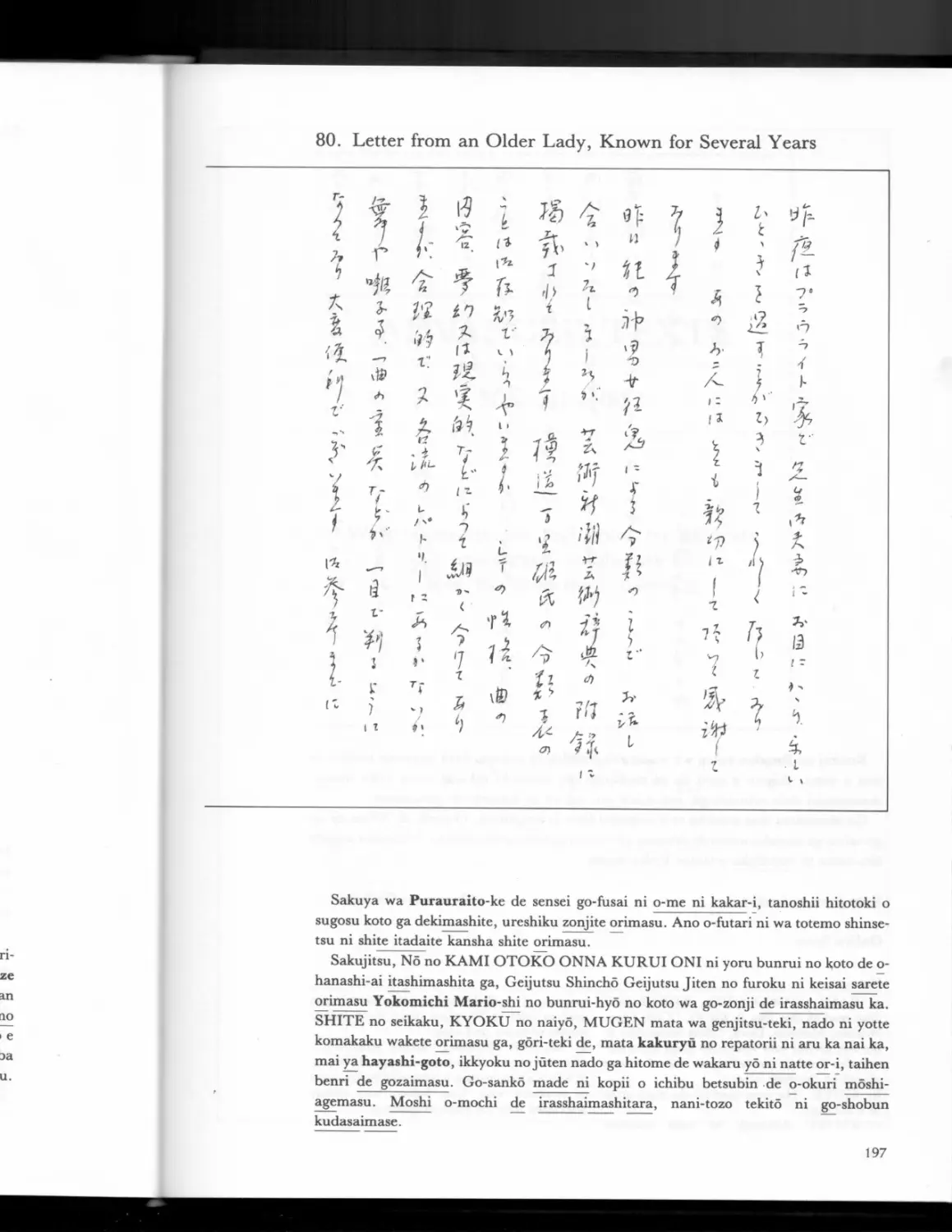
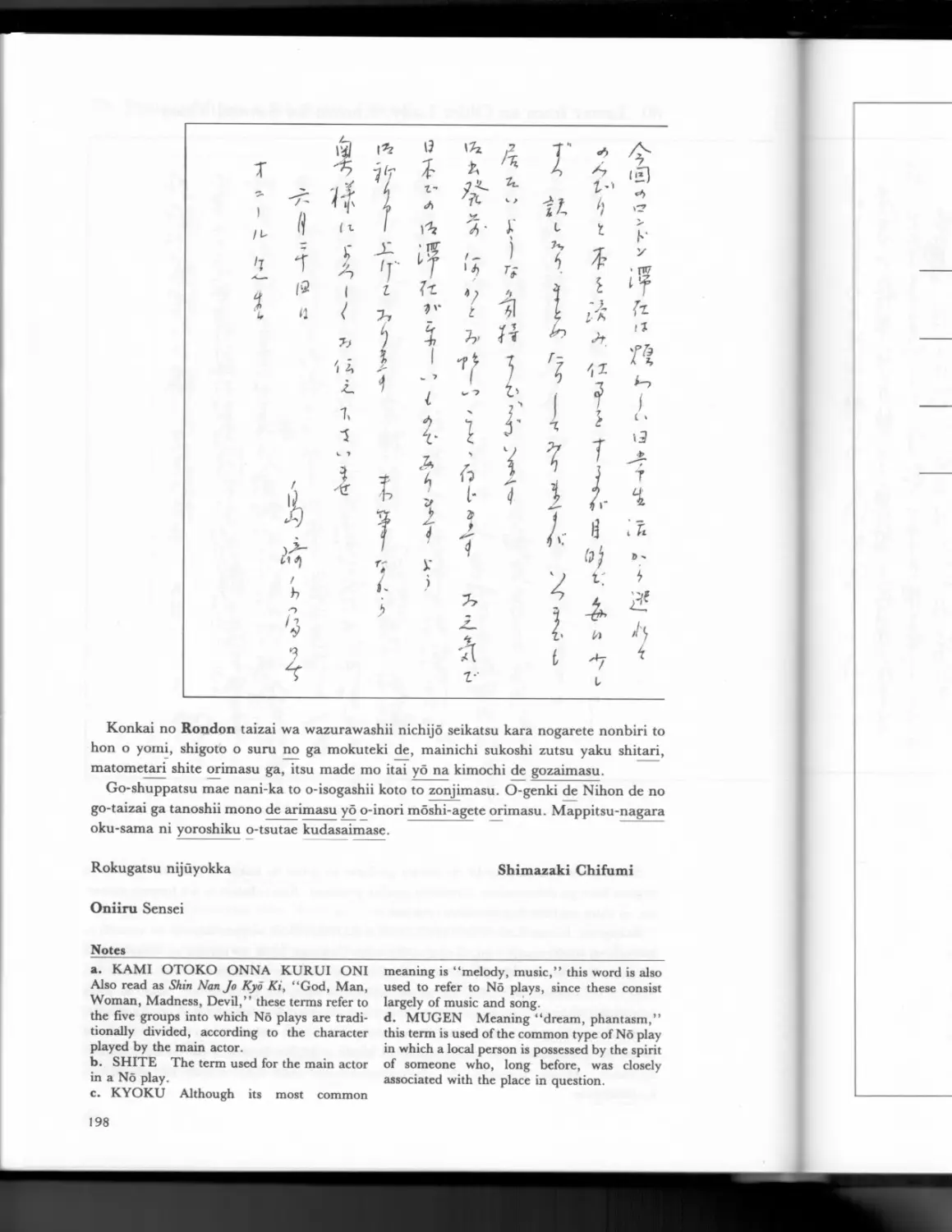

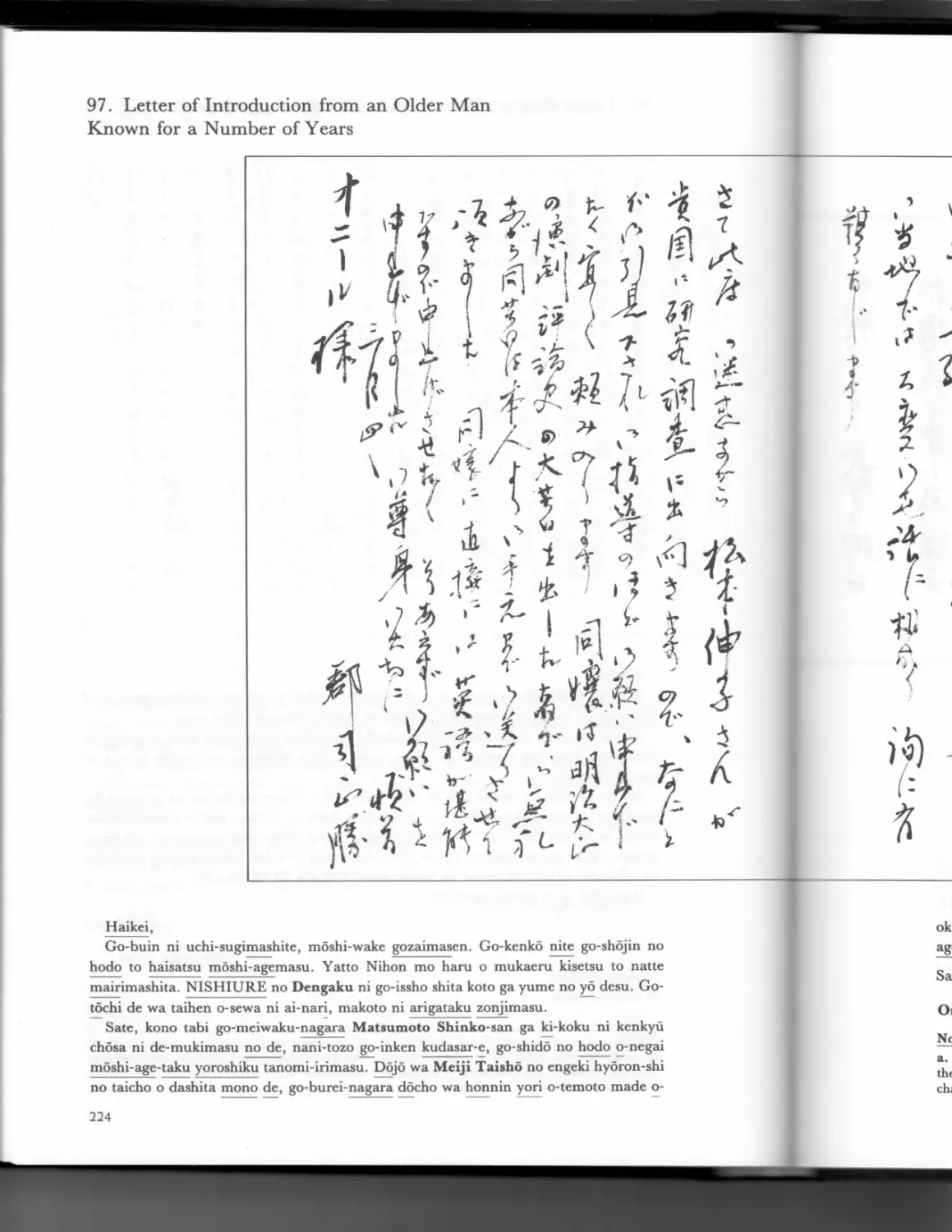
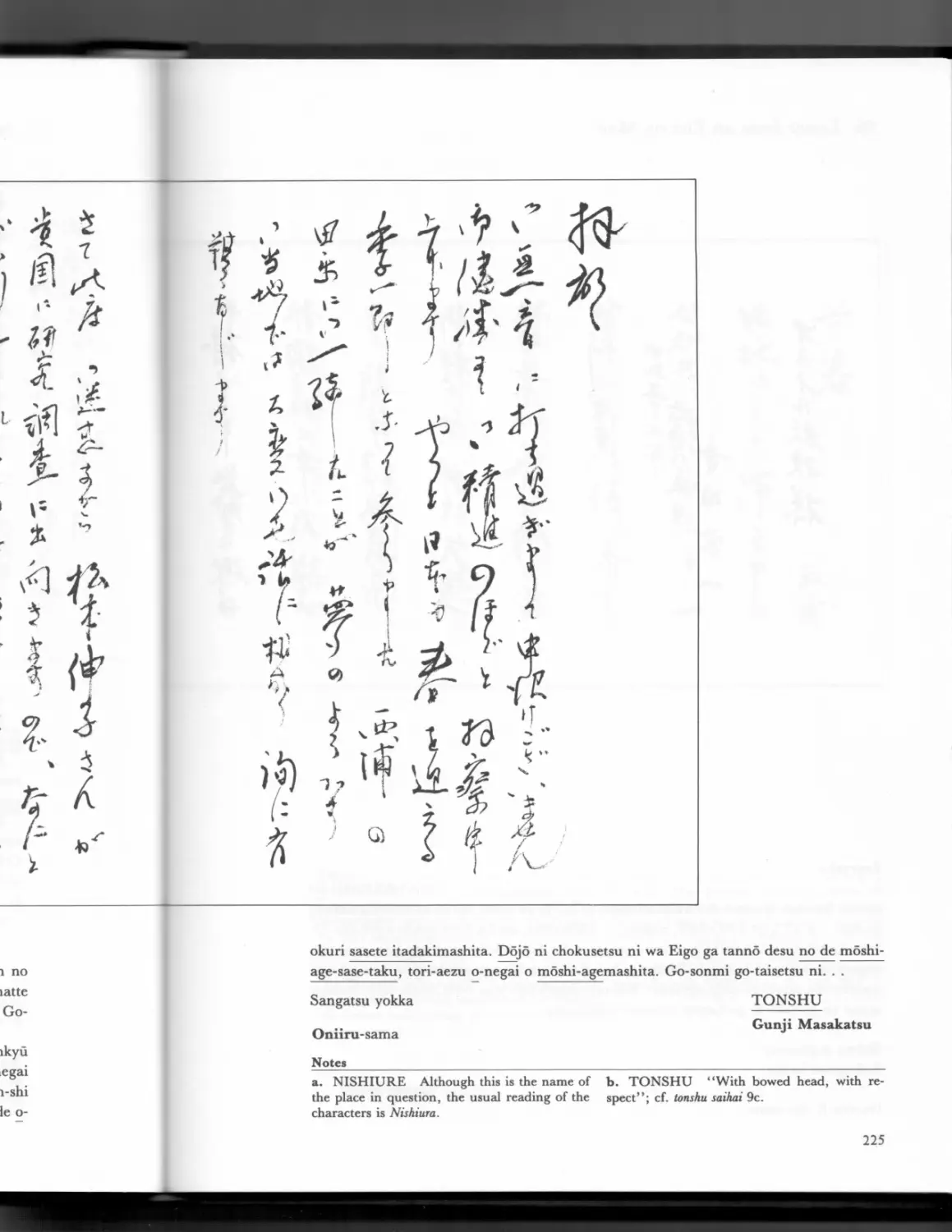

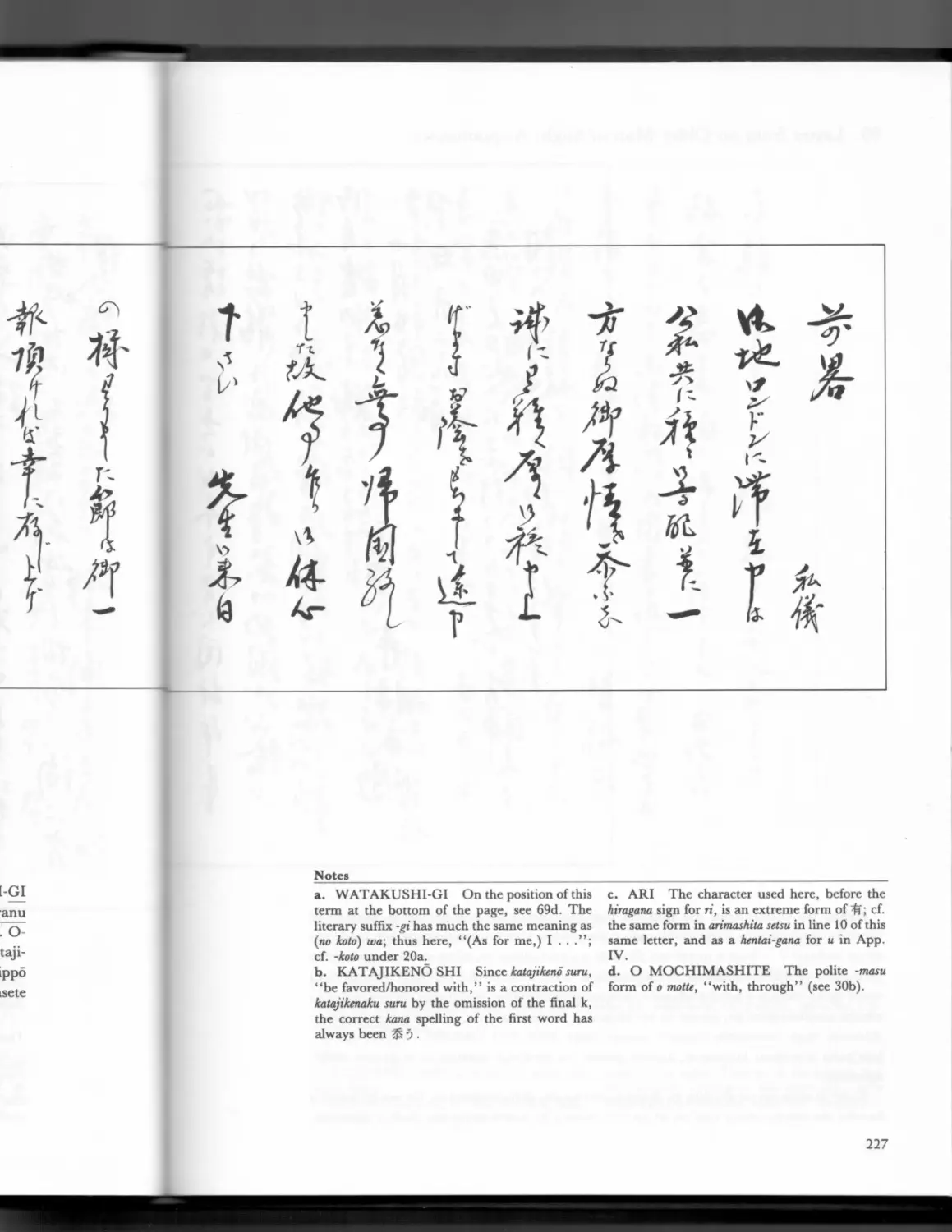
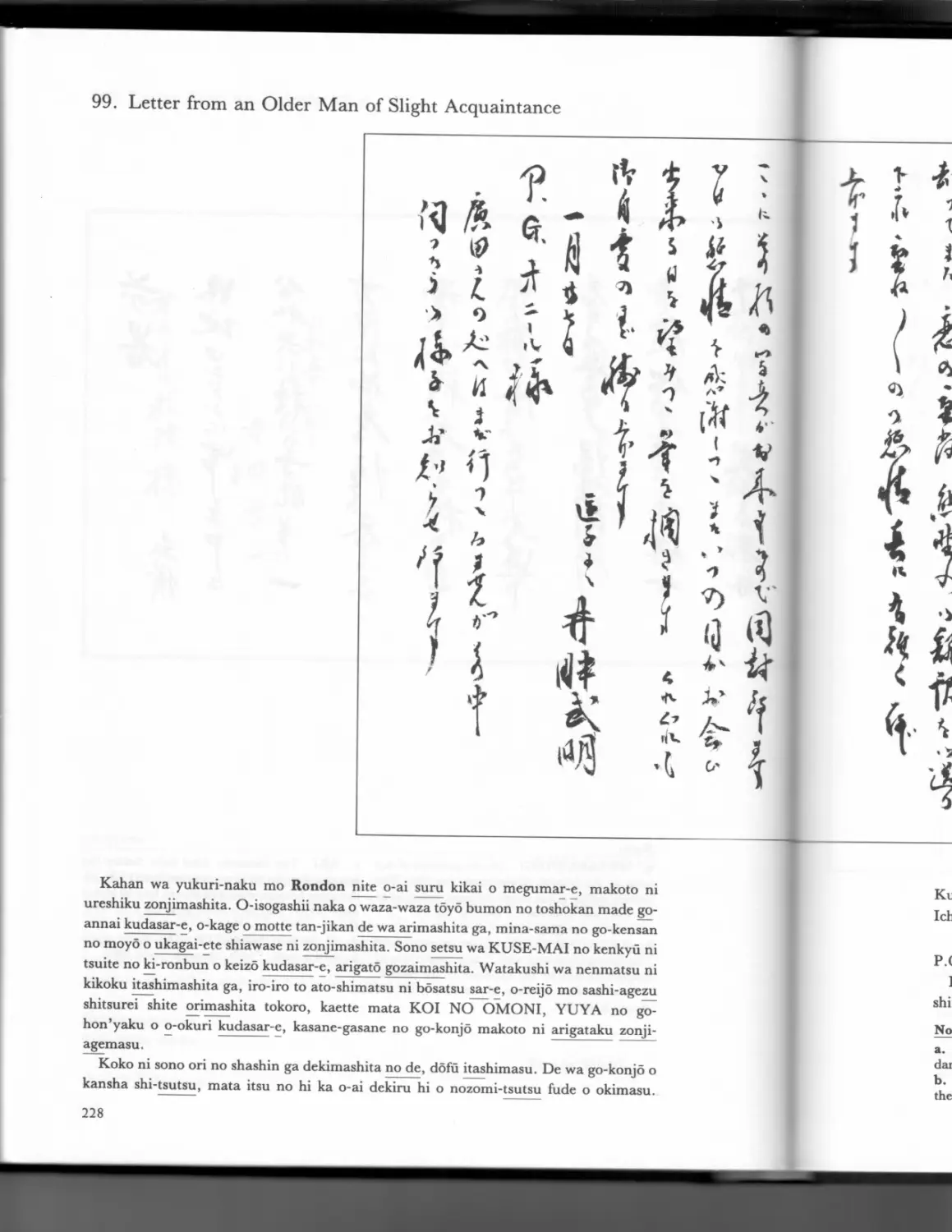






Текст
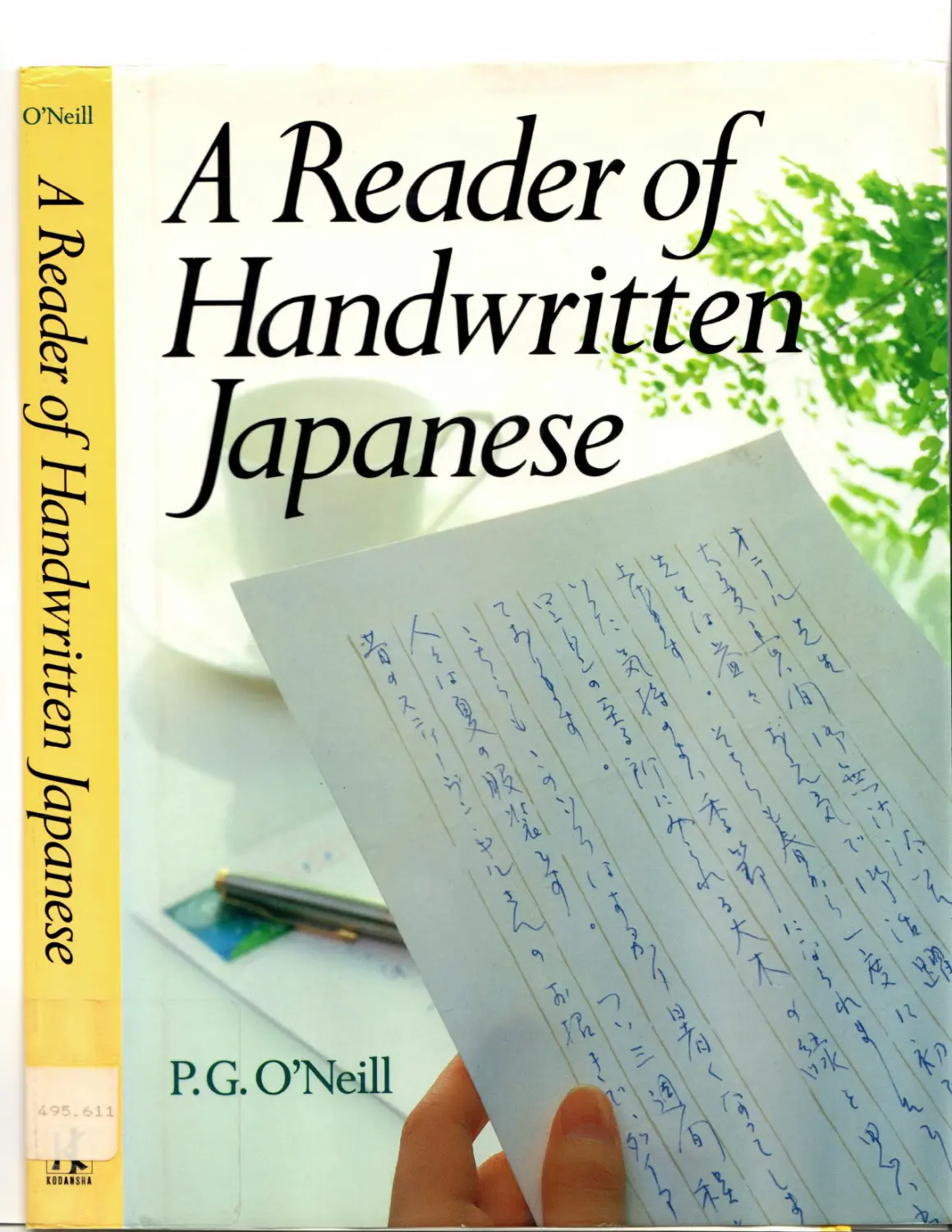
A Reader of
Handwritten Japanese
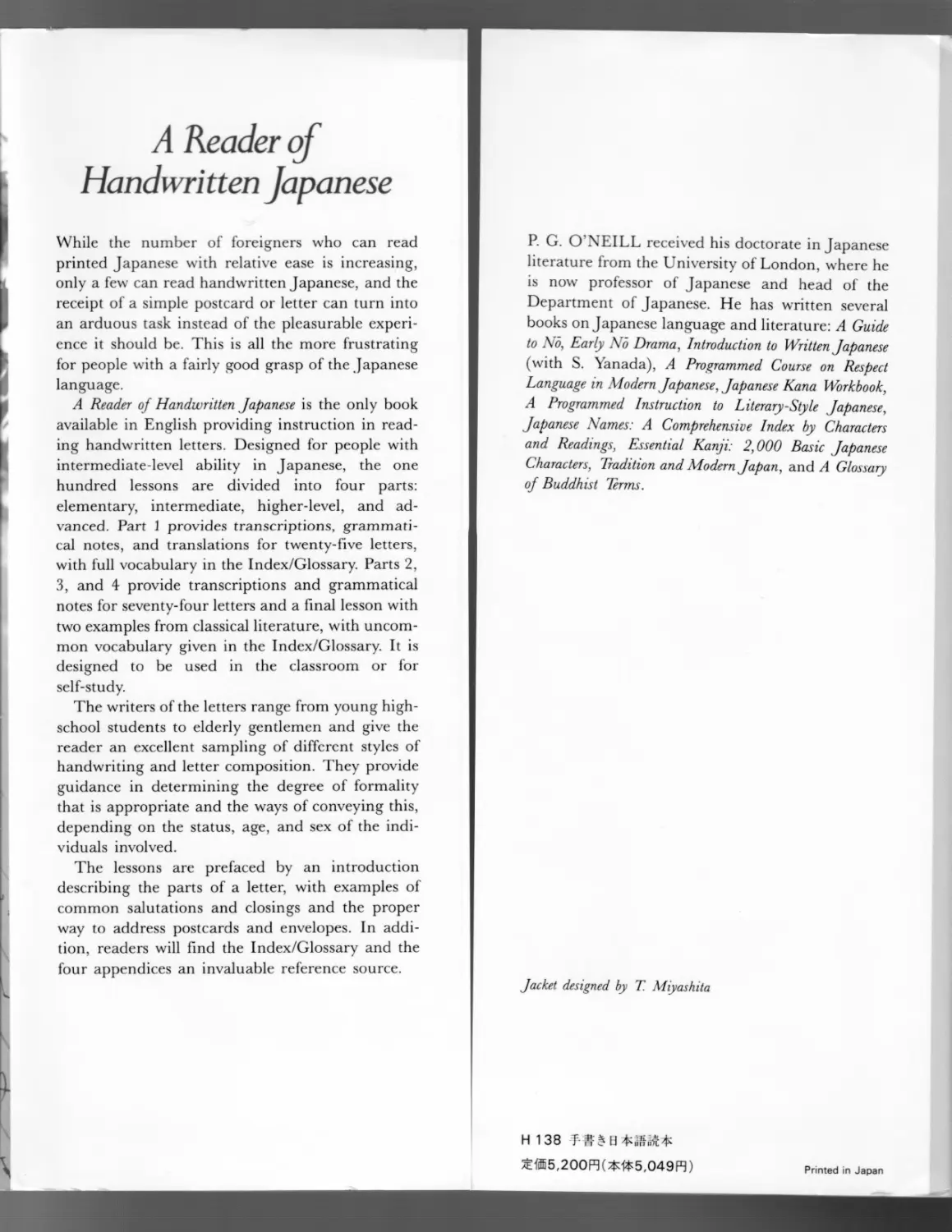
While the number of foreigners who can read
printed Japanese with relative ease is increasing,
only a few can read handwritten Japanese, and the
receipt of a simple postcard or letter can turn into
an arduous task instead of the pleasurable experi-
ence it should be. This is all the more frustrating
for people with a fairly good grasp of the Japanese
language.
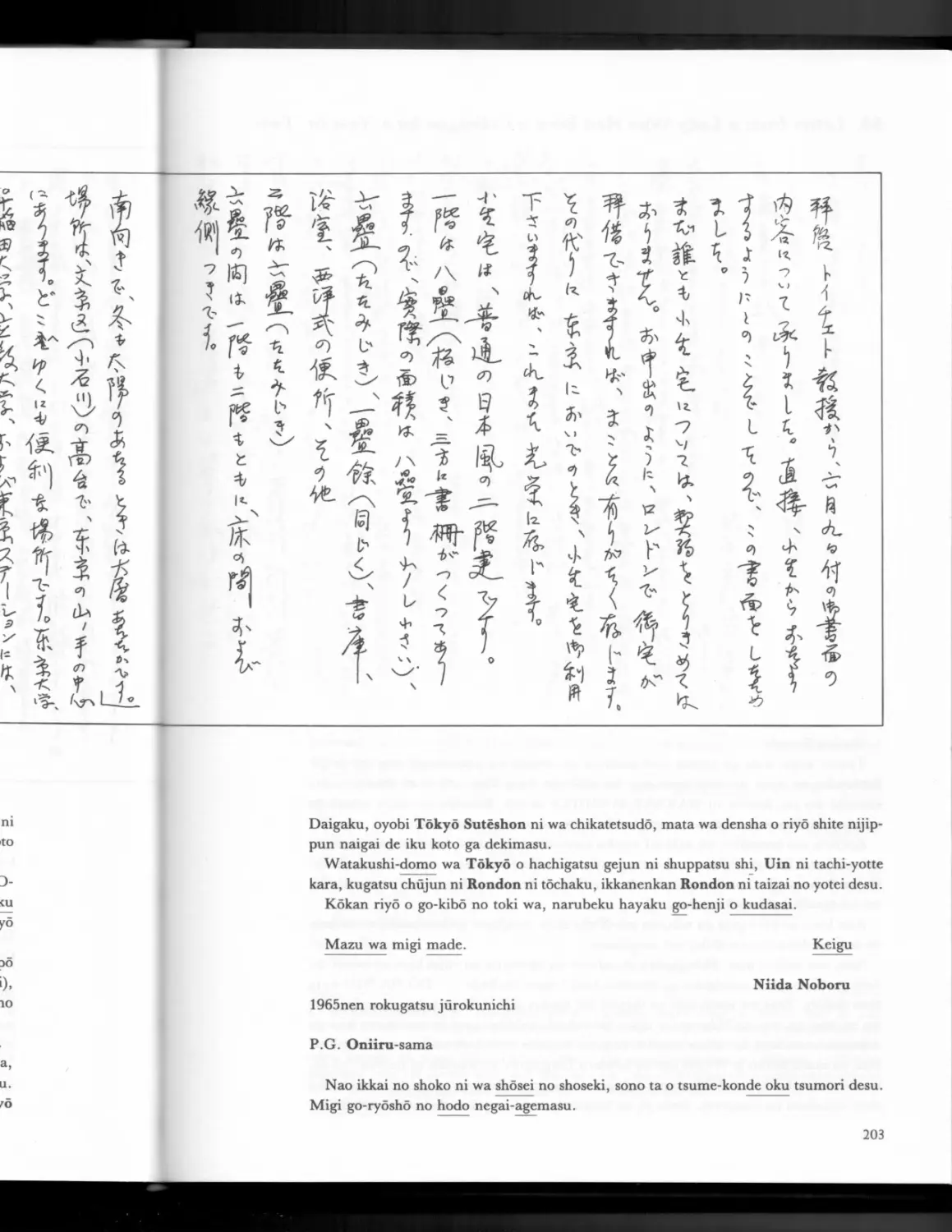
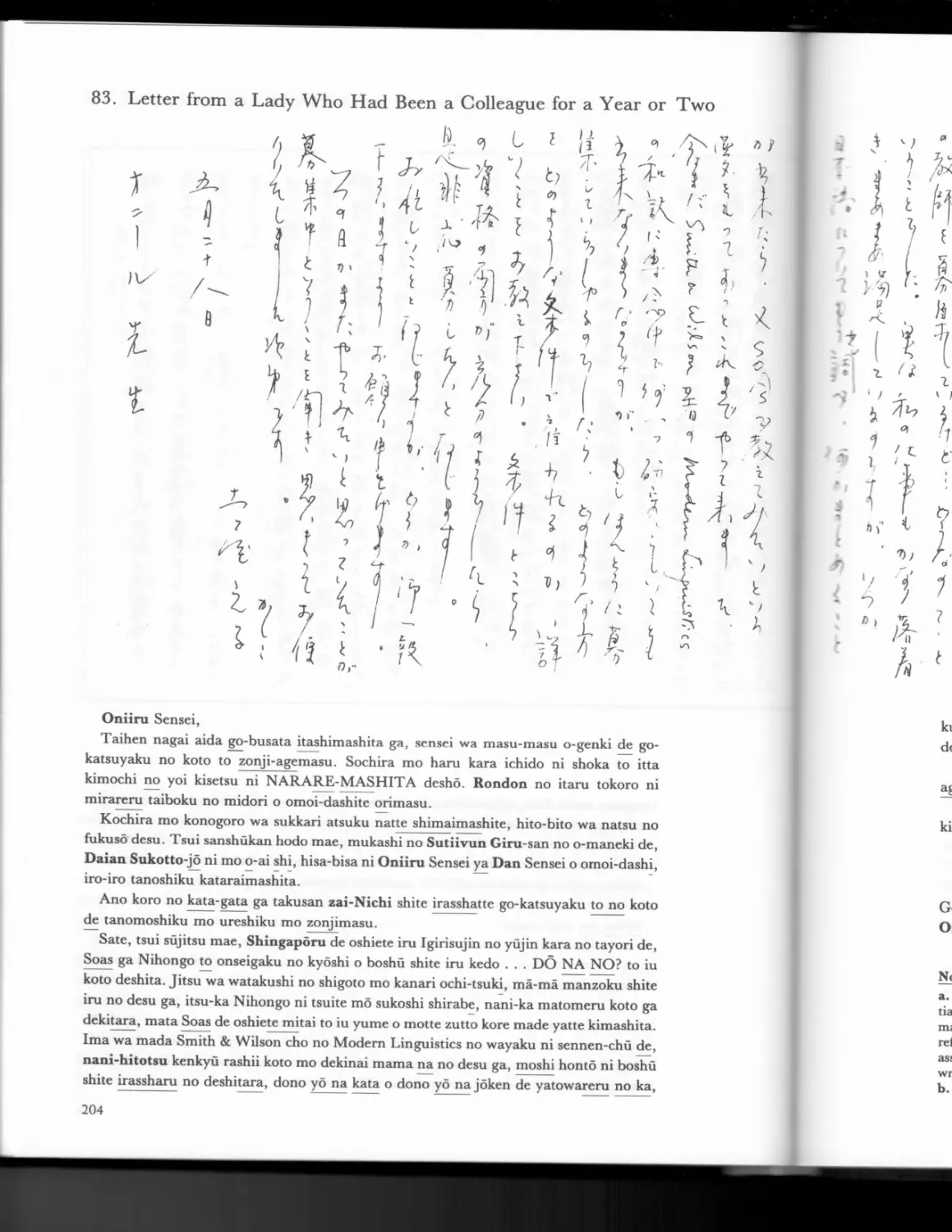
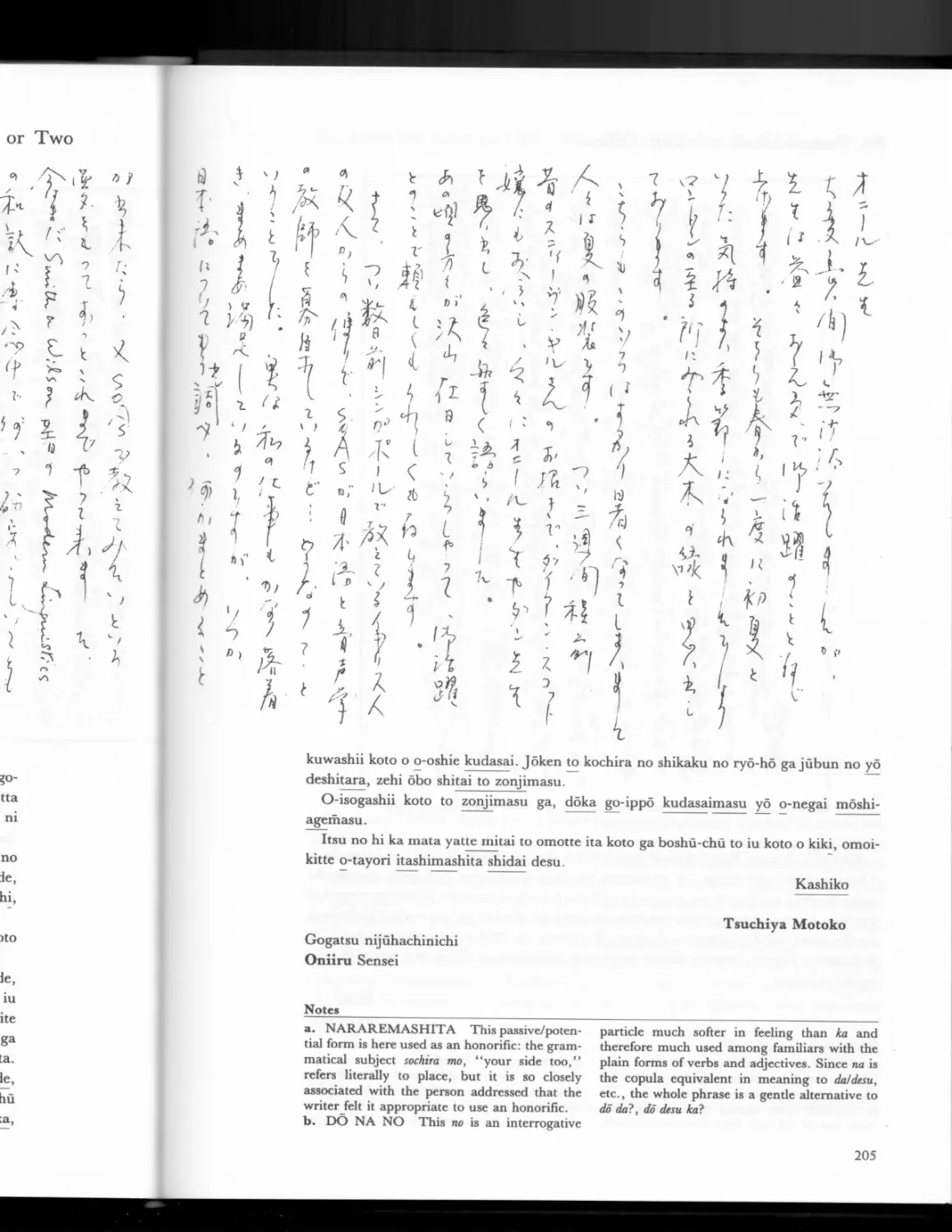
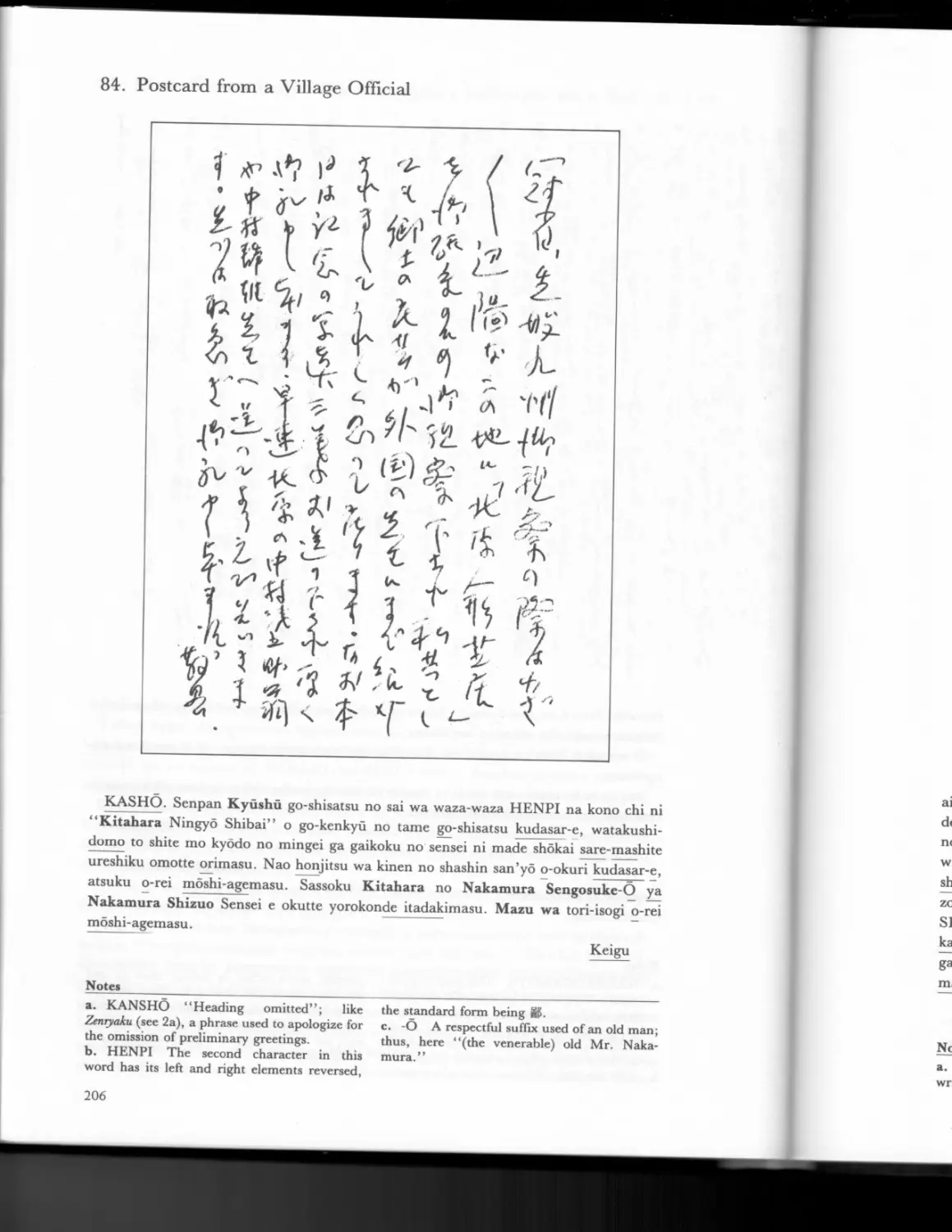
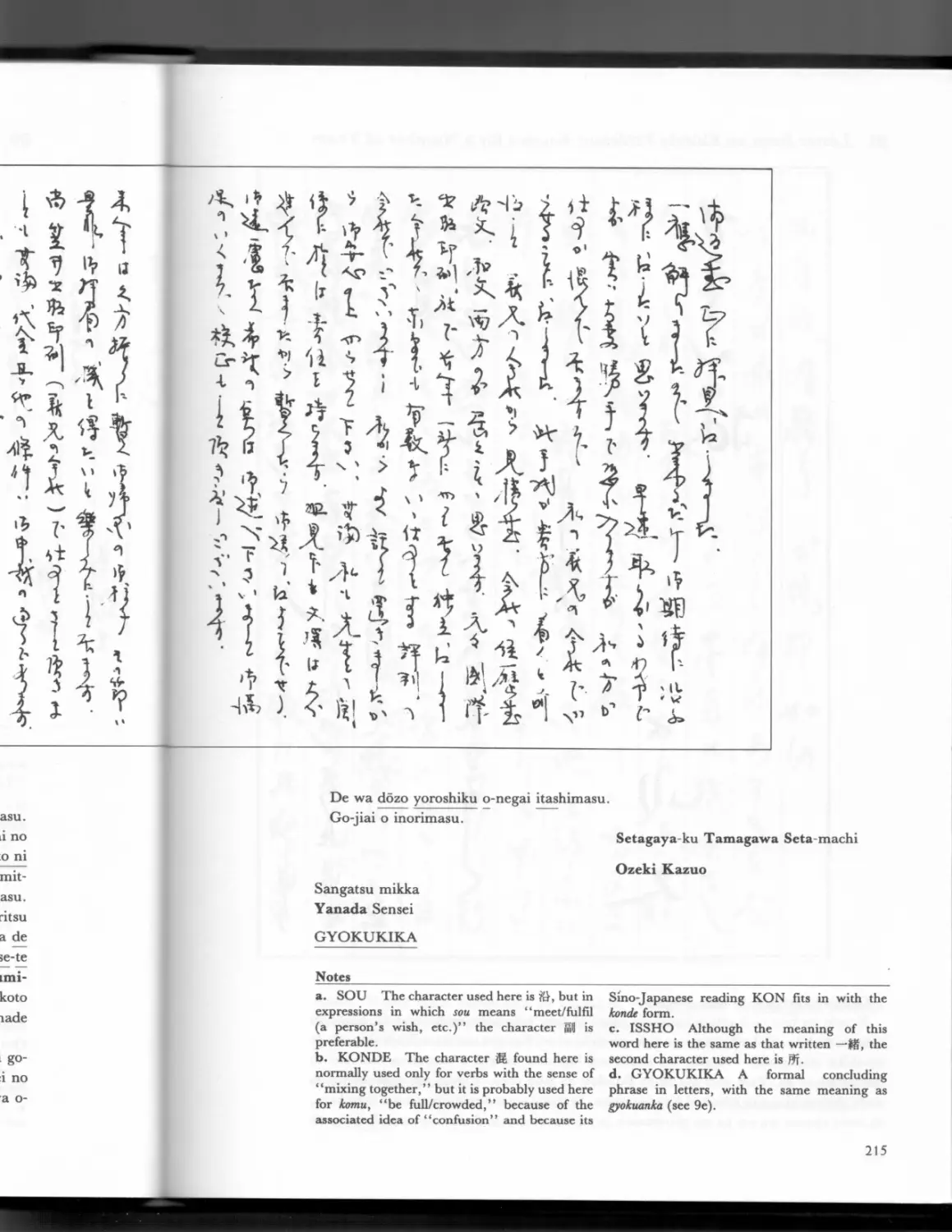
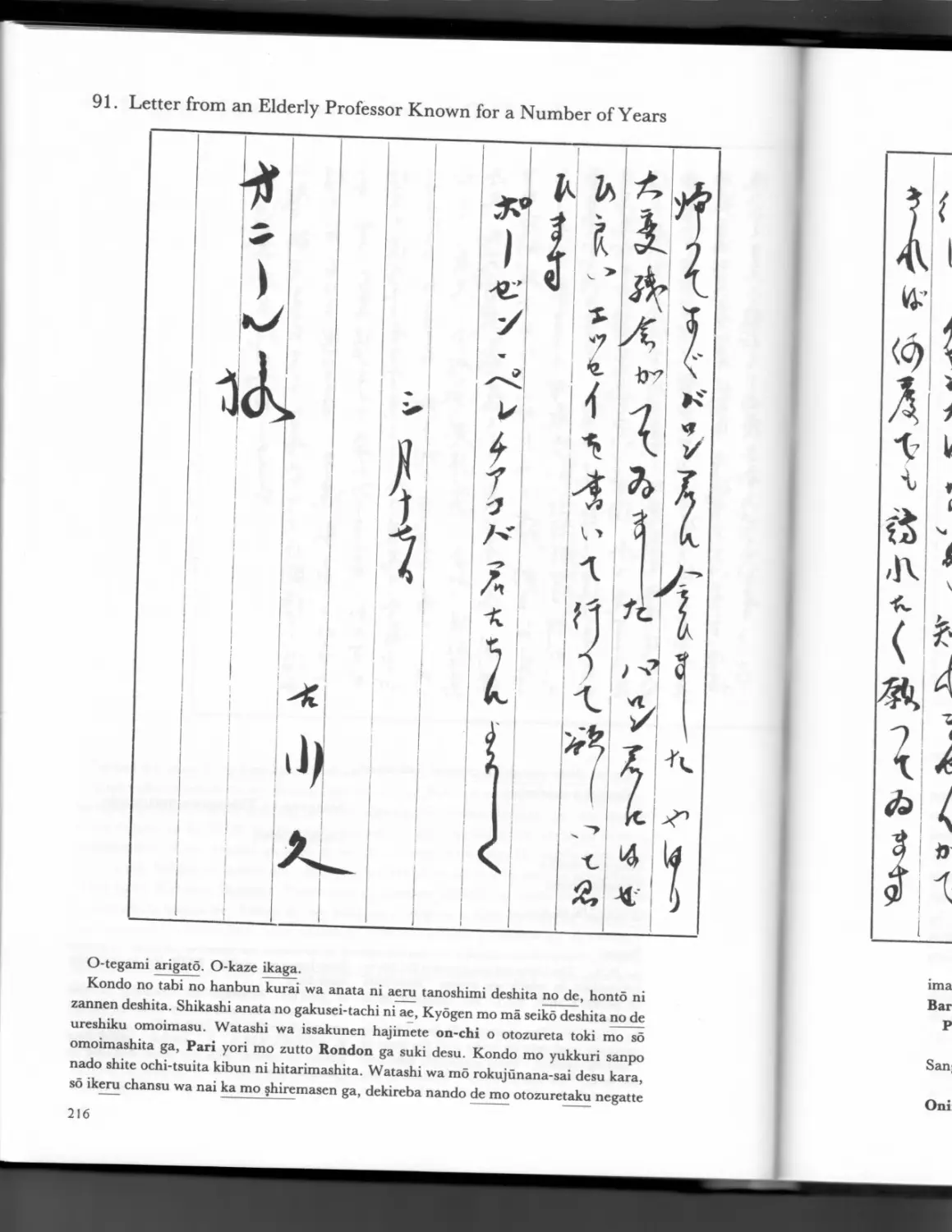
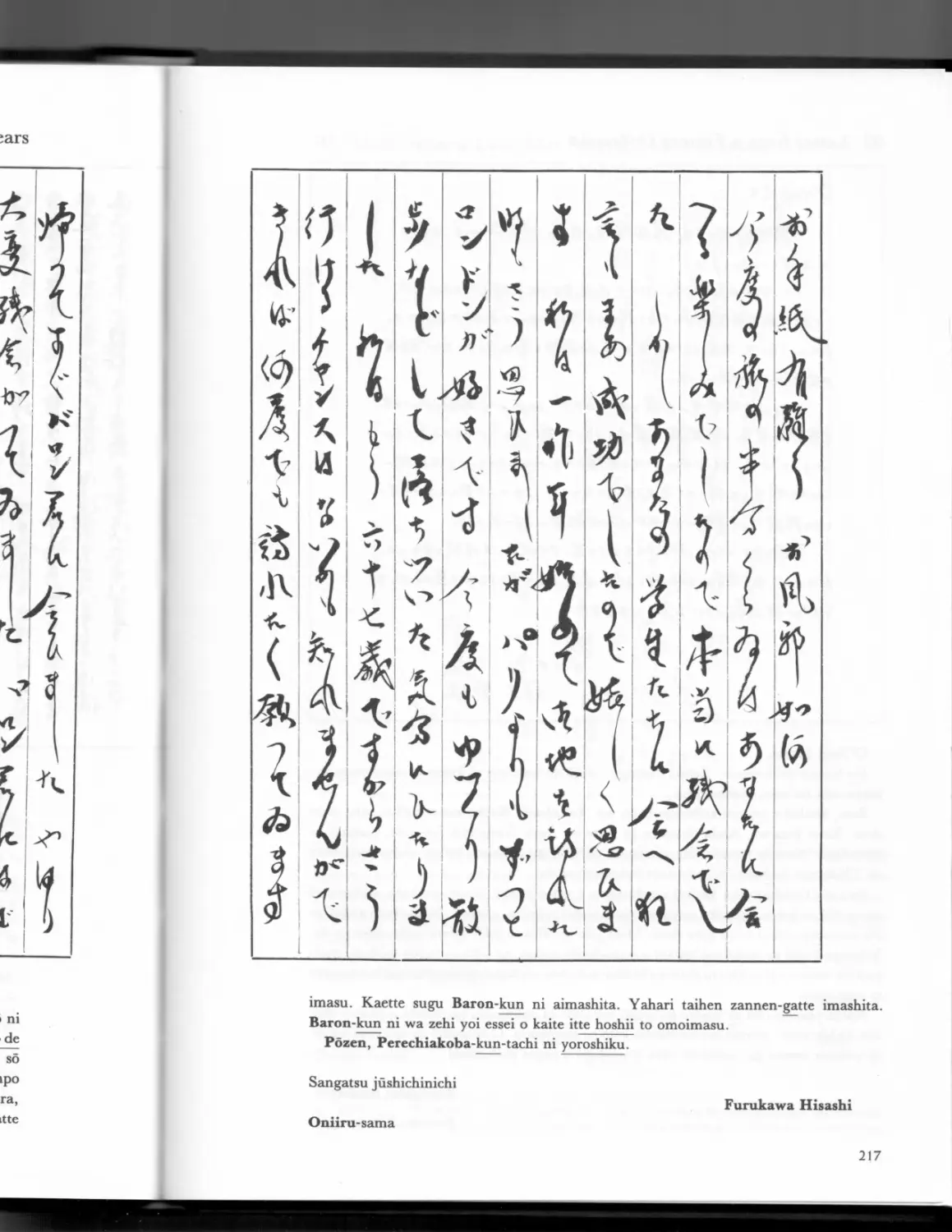
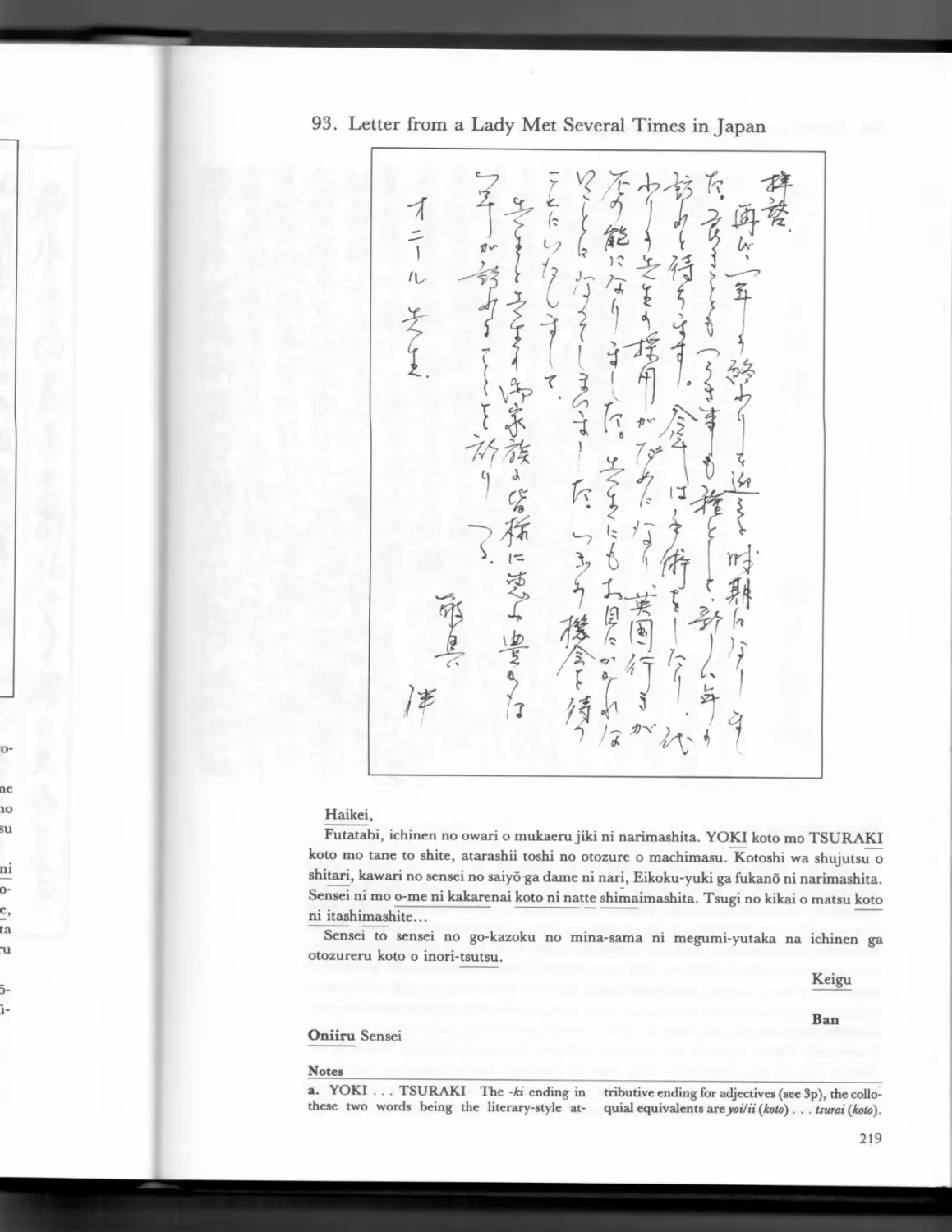
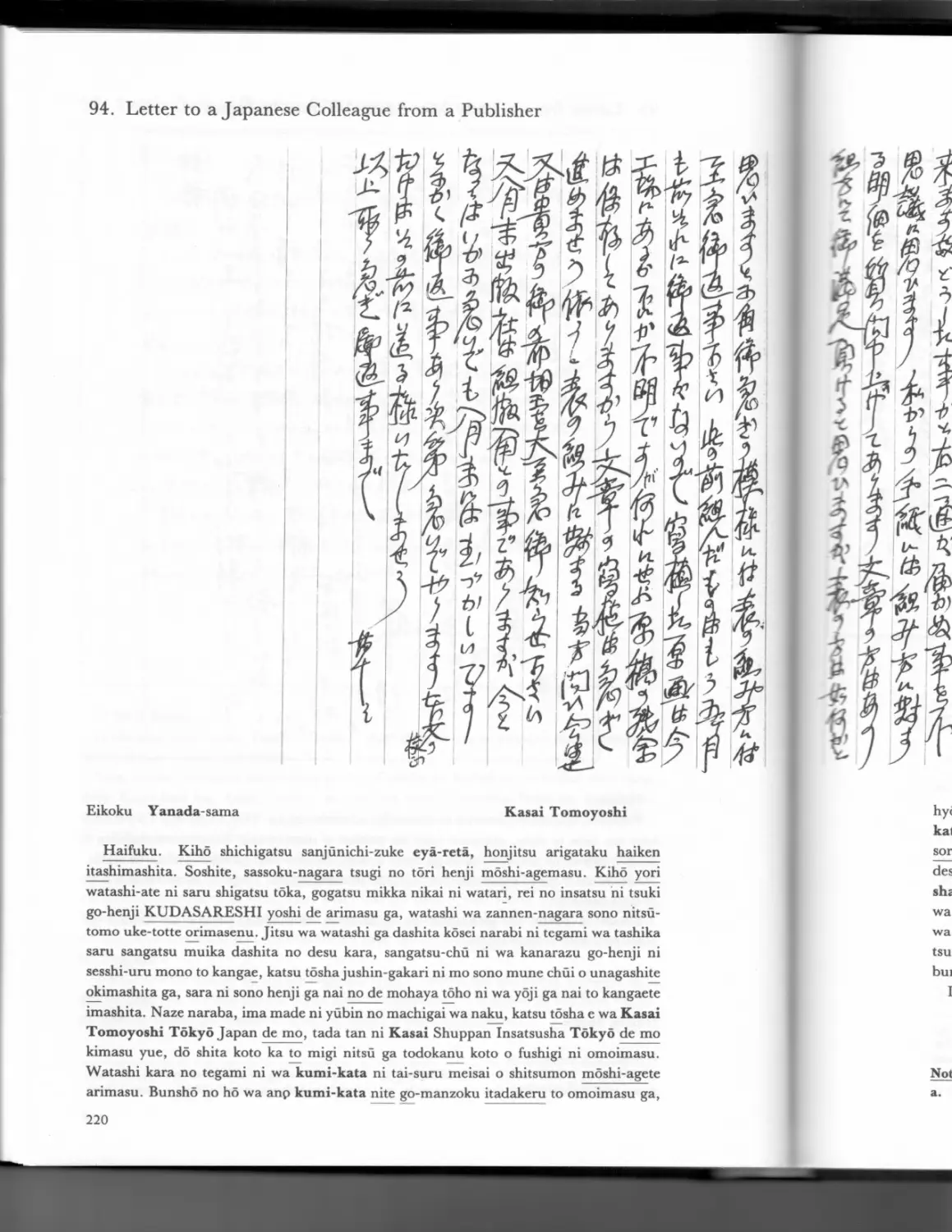
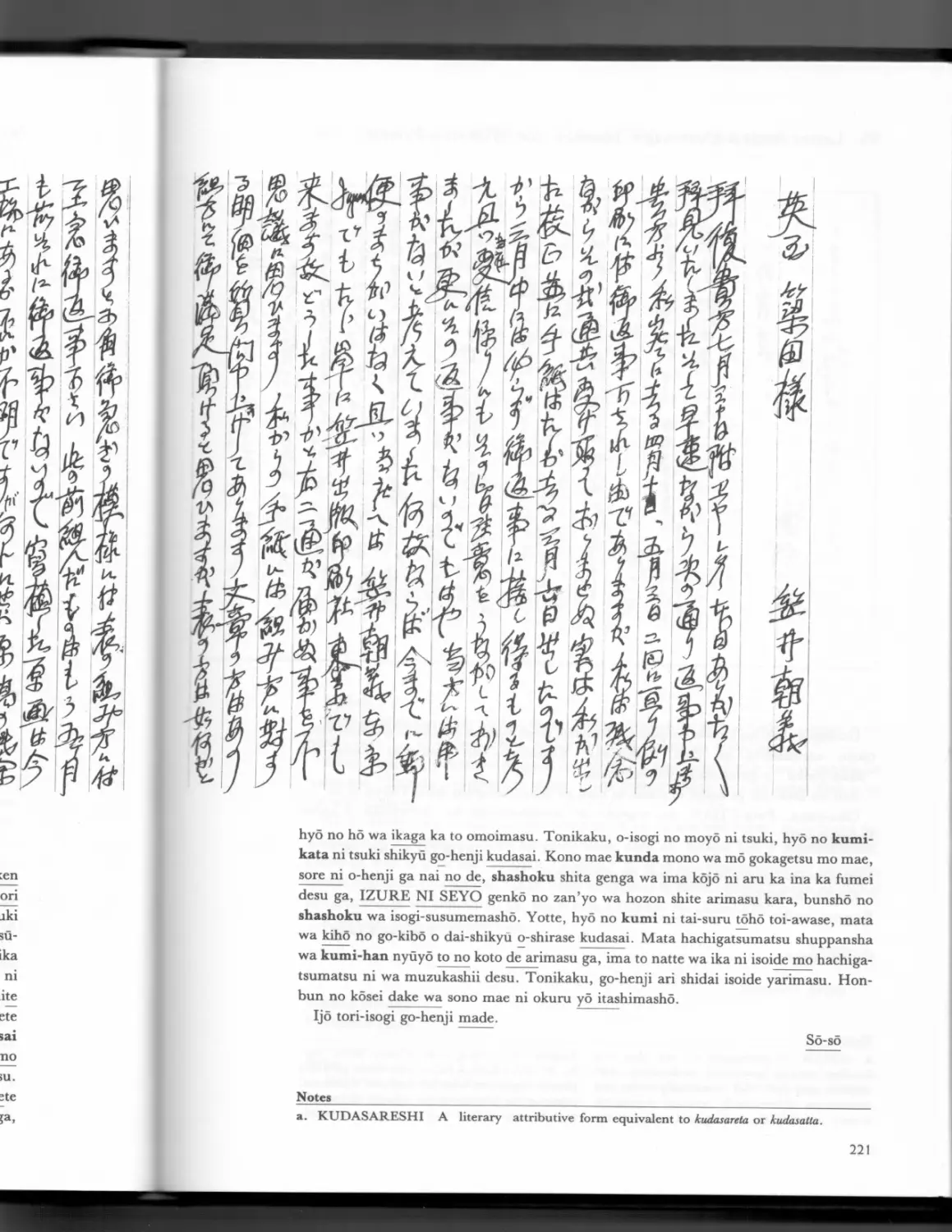
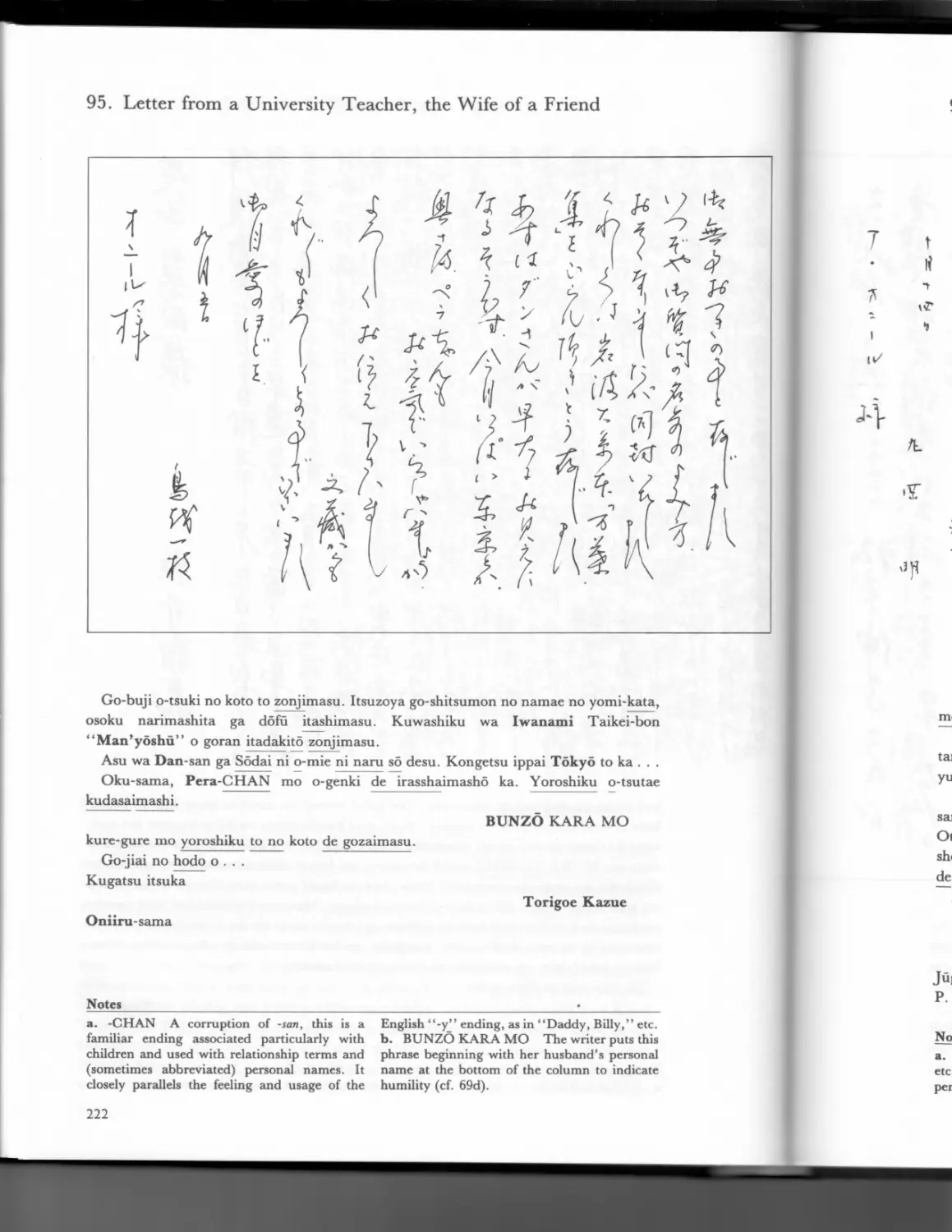
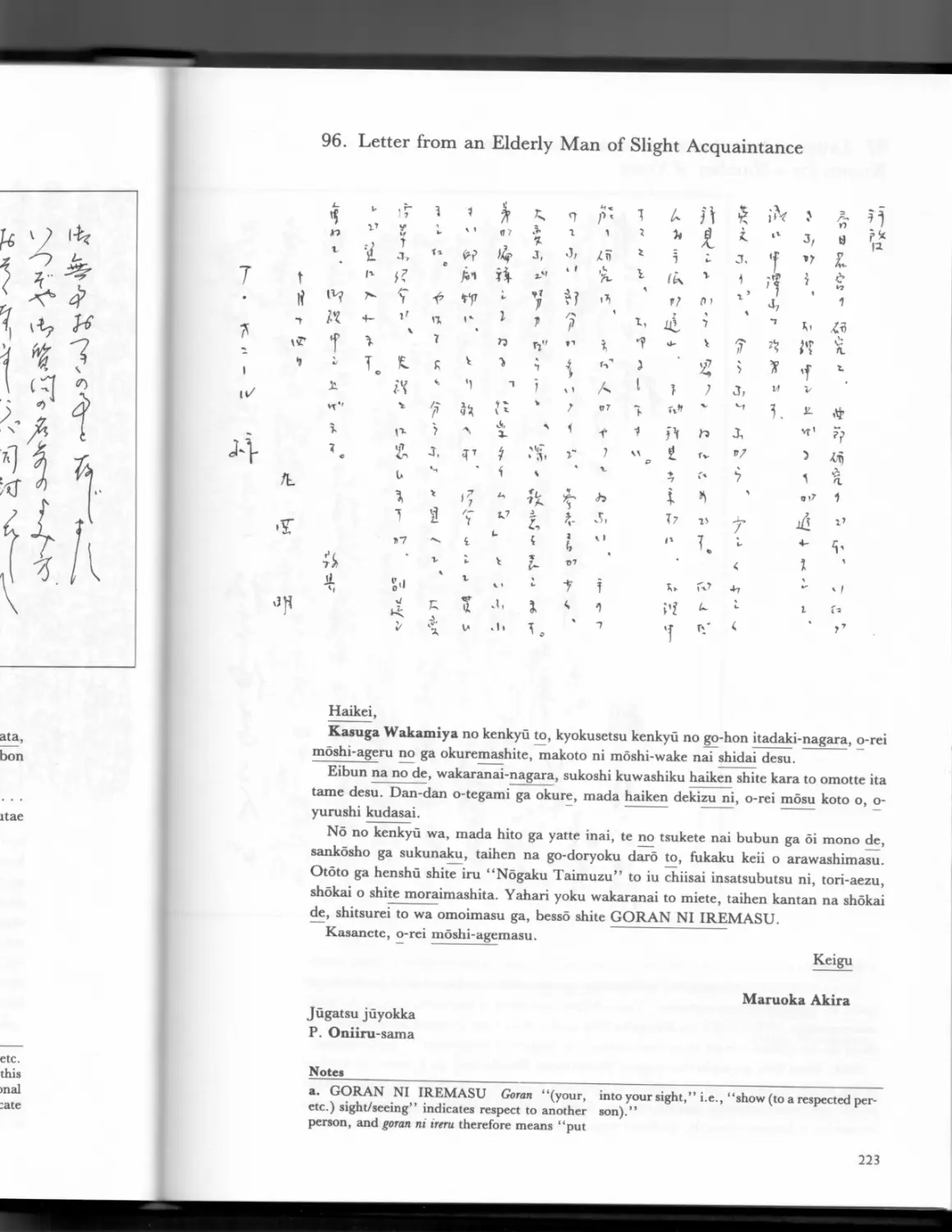
A Reader of Handwritten Japanese is the only book
available in English providing instruction in read-
ing handwritten letters. Designed for people with
intermediate-level ability in Japanese, the one
hundred lessons are divided into four parts:
elementary, intermediate, higher-level, and ad-
vanced. Part 1 provides transcriptions, grammati-
cal notes, and translations for twenty-five letters,
with full vocabulary in the Index/Glossary. Parts 2,
3, and 4 provide transcriptions and grammatical
notes for seventy-four letters and a final lesson with
two examples from classical literature, with uncom-
mon vocabulary given in the Index/Glossary. It is
designed to be used in the classroom or for
self-study.
The writers of the letters range from young high-
school students to elderly gentlemen and give the
reader an excellent sampling of different styles of
handwriting and letter composition. They provide
guidance in determining the degree of formality
that is appropriate and the ways of conveying this,
depending on the status, age, and sex of the indi-
viduals involved.
The lessons are prefaced by an introduction
describing the parts of a letter, with examples of
common salutations and closings and the proper
way to address postcards and envelopes. In addi-
tion, readers will find the Index/Glossary and the
four appendices an invaluable reference source.
P. G. O’NEILL received his doctorate in Japanese
literature from the University of London, where he
is now professor of Japanese and head of the
Department of Japanese. He has written several
books on Japanese language and literature: A Guide
to Nd, Early Nd Drama, Introduction to Written Japanese
(with S. Yanada), A Programmed Course on Respect
Language in Modern Japanese, Japanese Капа Workbook,
A Programmed Instruction to Literary-Style Japanese,
Japanese Names: A Comprehensive Index by Characters
and Readings, Essential Kanji: 2,000 Basic Japanese
Characters, Tradition and Modern Japan, and A Glossary
of Buddhist Terms.
Jacket designed by T Miyashita
H 138
£fffi5,200R(/M*5,049H)
Printed in Japan
To
Amy
Publication of this book was assisted by a grant from
The Japan Foundation.
Distributed in the United States by Kodansha International/USA
Ltd., through Farrar, Straus and Giroux, Inc., 19 Union Square
West, New York, NY 10003.
Published by Kodansha International Ltd., 17-14, Otowa 1-chome,
Bunkyo-ku, Tokyo 112 and Kodansha International/USA Ltd., 114
Fifth Avenue, New York, NY 10011. Copyright in Japan 1984 by
Kodansha International Ltd. All rights reserved. Printed in Japan.
First edition, 1984
Fourth printing, 1989
Library of Congress Cataloging in Publication Data
O’Neill, P. G. (Patrick Geoffrey), 1924-
A reader of handwritten Japanese.
Includes index.
1. Japanese language—Text-books for foreign speakers
—English. 2. Japanese language—Readers. 3. Japanese
language—Writing.	I. Title.
PL539.3.O55 1984	495.6’11	84-81170
ISBN 0-87011-698-3 (U.S.)
ISBN 4-7700-1198-9 (in Japan)
CONTENTS
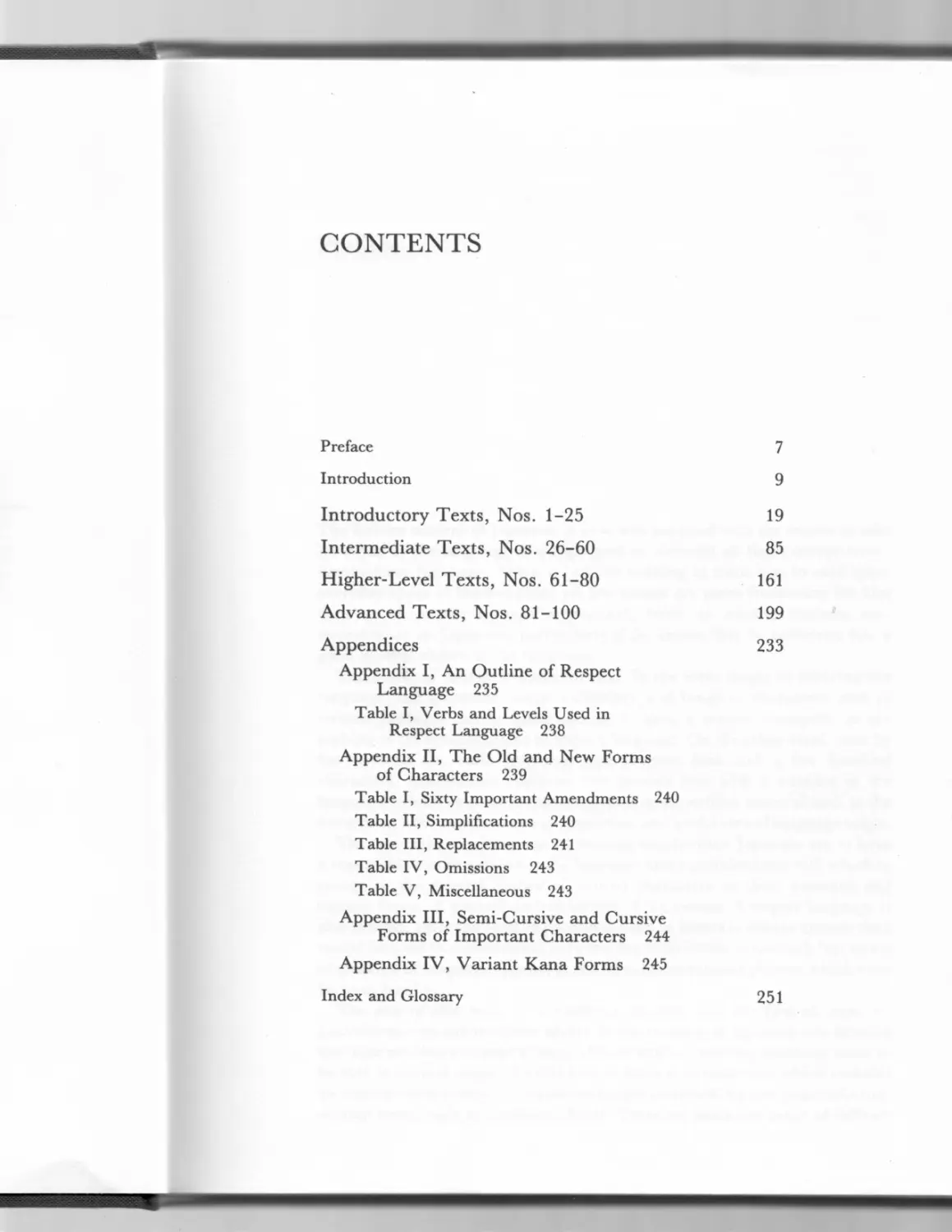
Preface	7
Introduction	9
Introductory Texts, Nos. 1-25	19
Intermediate Texts, Nos. 26-60	85
Higher-Level Texts, Nos. 61-80	161
Advanced Texts, Nos. 81-100	199
Appendices	233
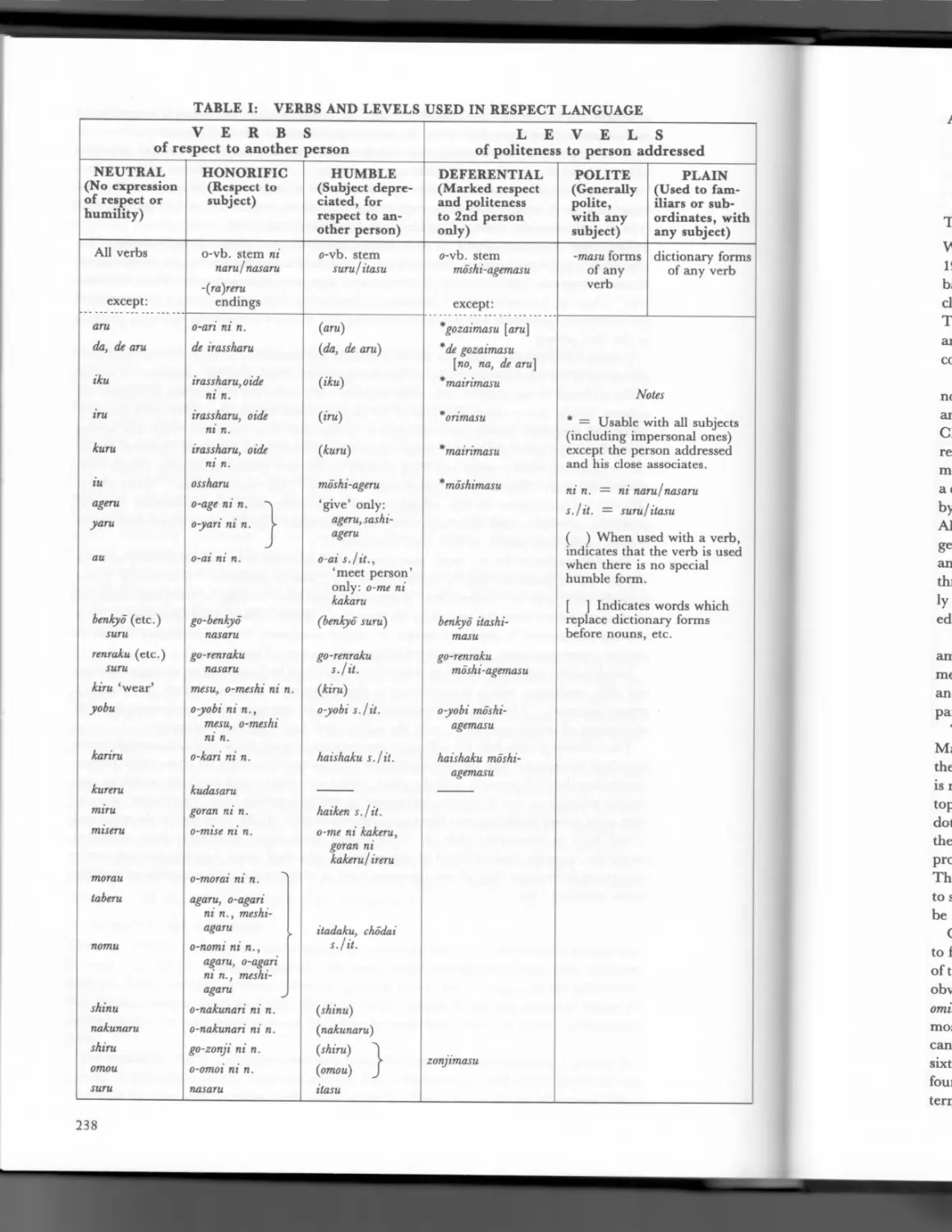
Appendix I, An Outline of Respect
Language 235
Table I, Verbs and Levels Used in
Respect Language 238
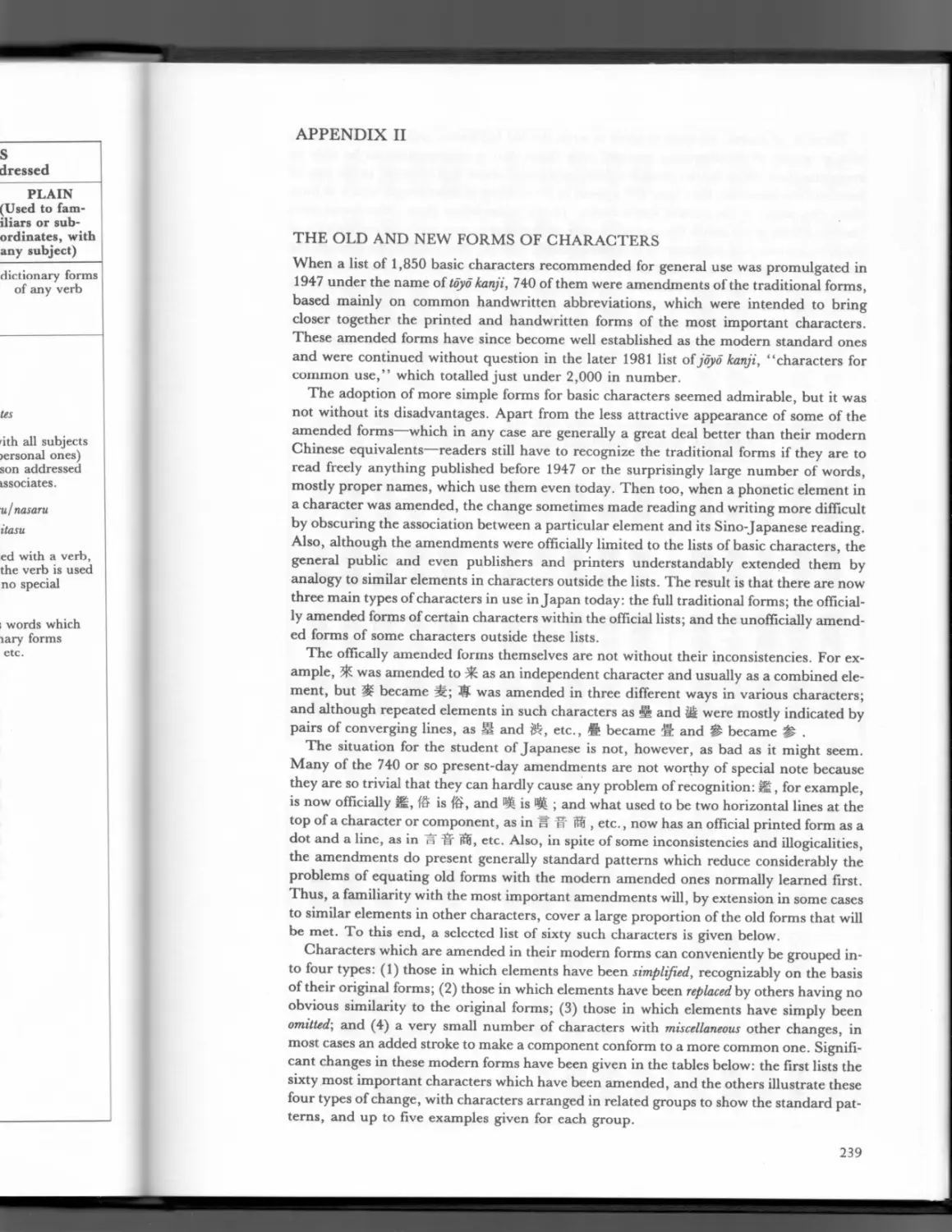
Appendix II, The Old and New Forms
of Characters 239
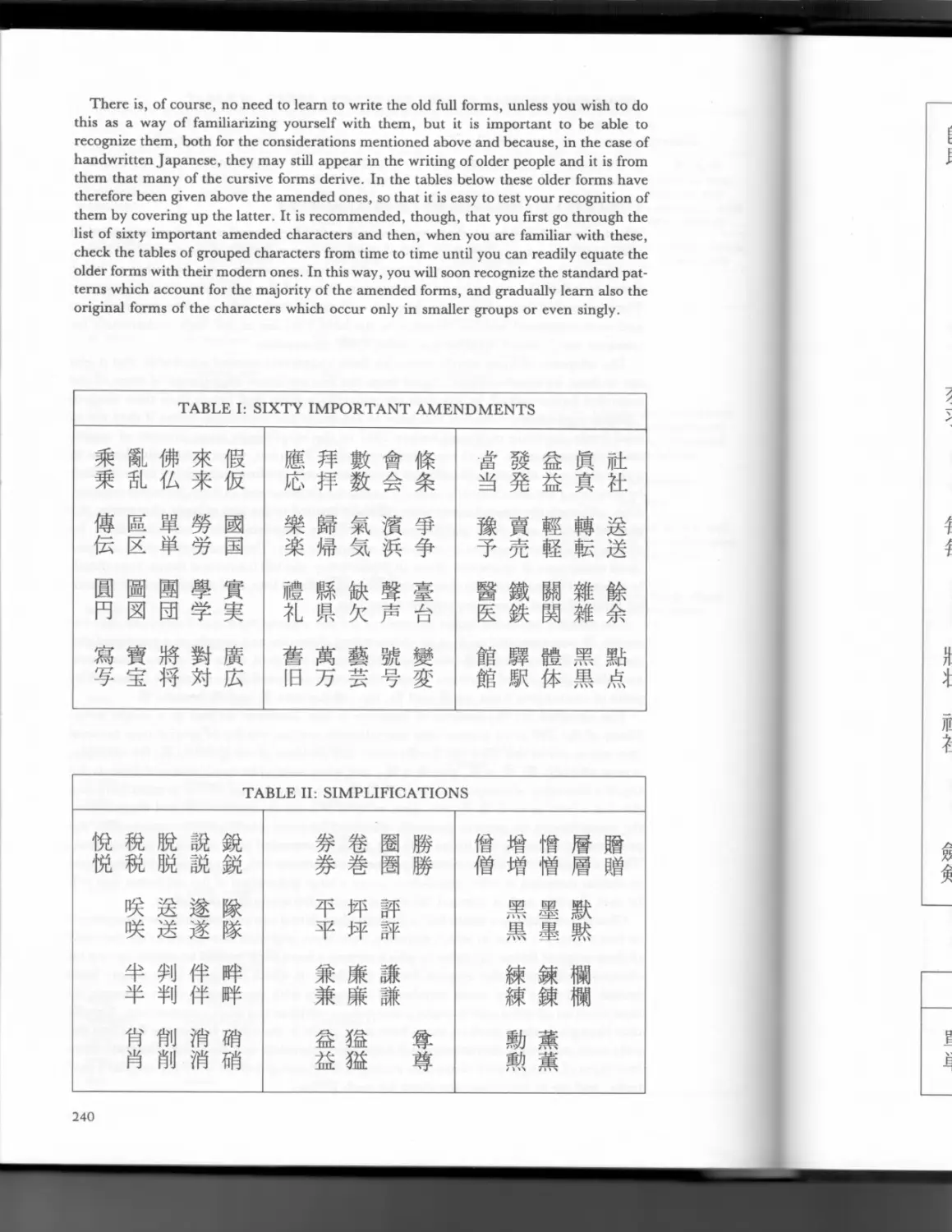
Table I,	Sixty Important Amendments 240
Table II,	Simplifications 240
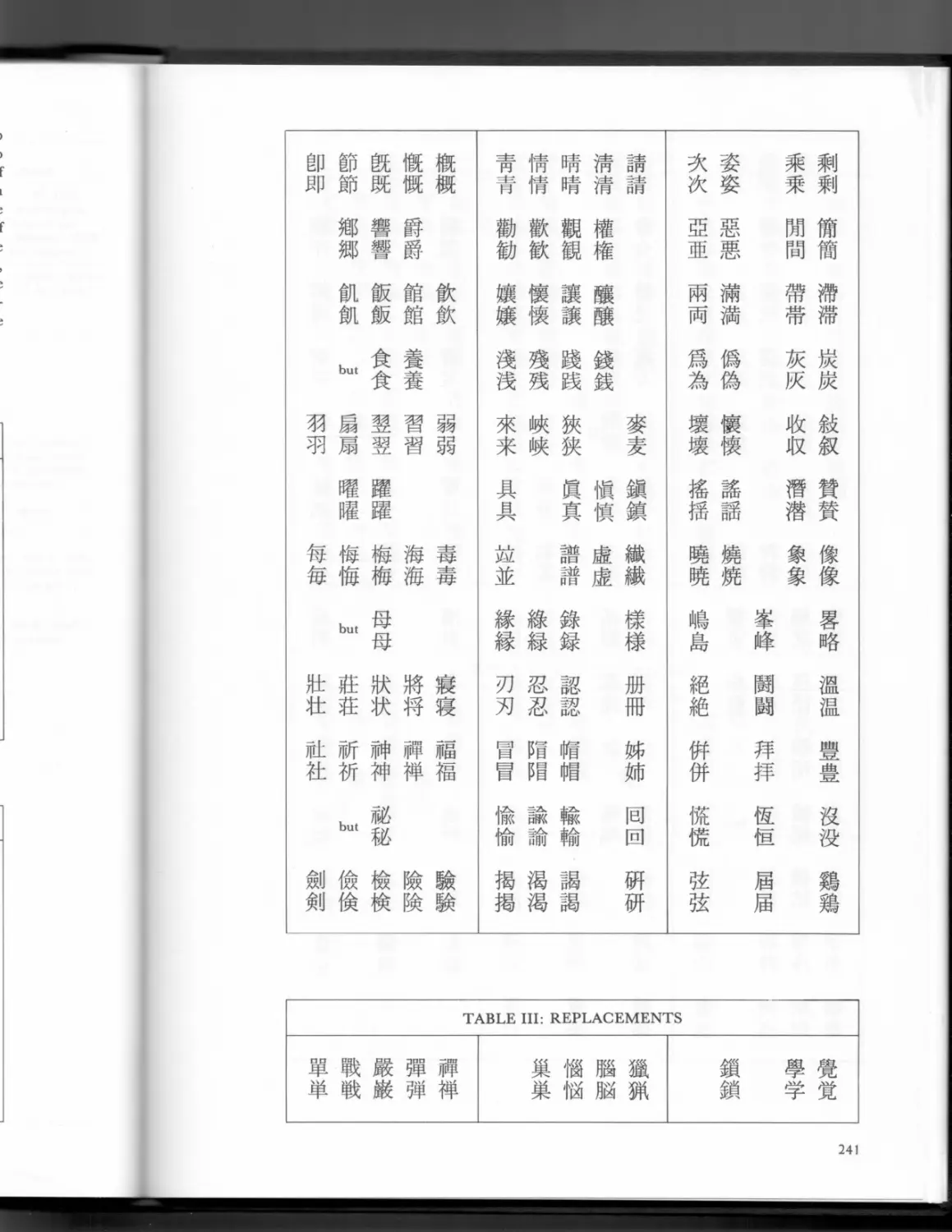
Table III,	Replacements 241
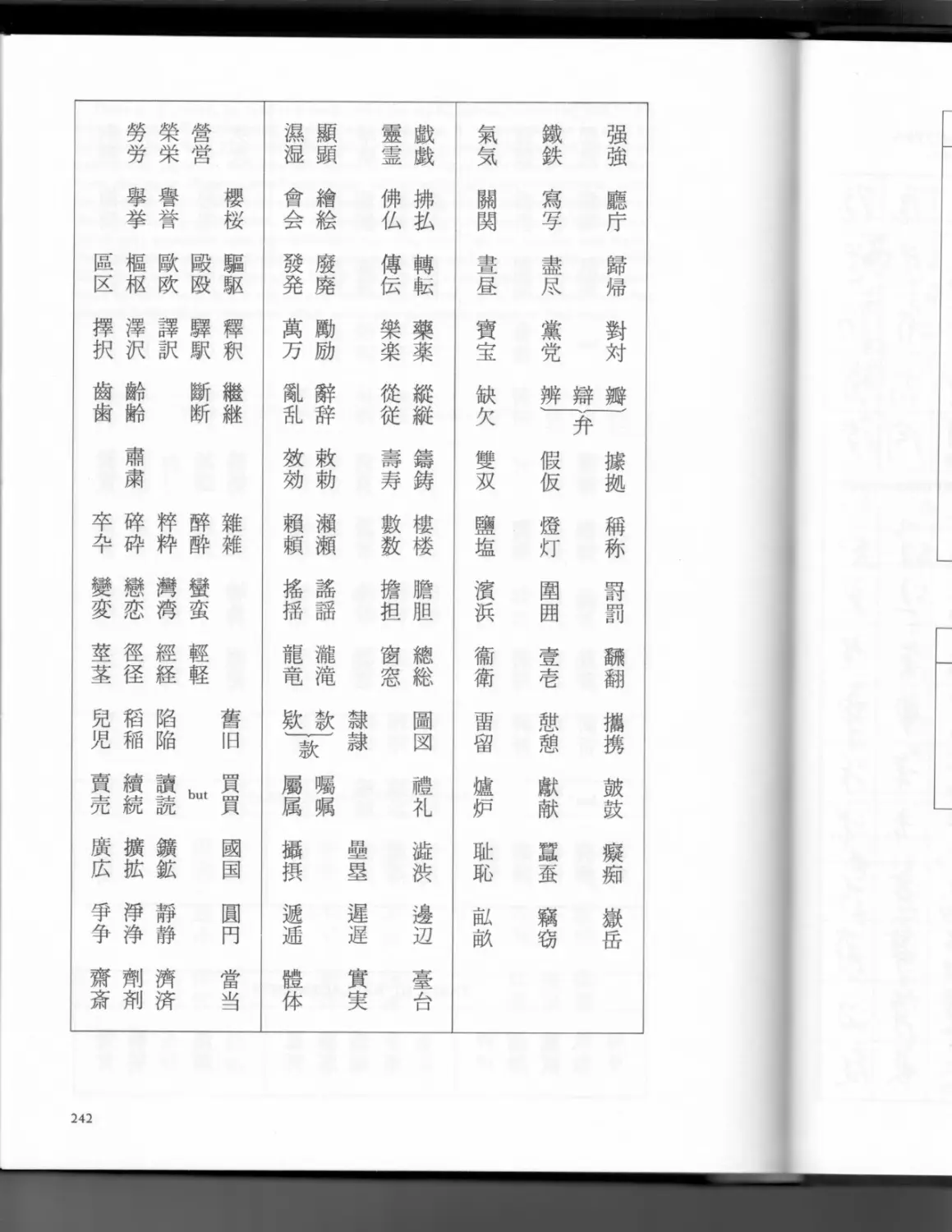
Table IV,	Omissions 243
Table V,	Miscellaneous 243
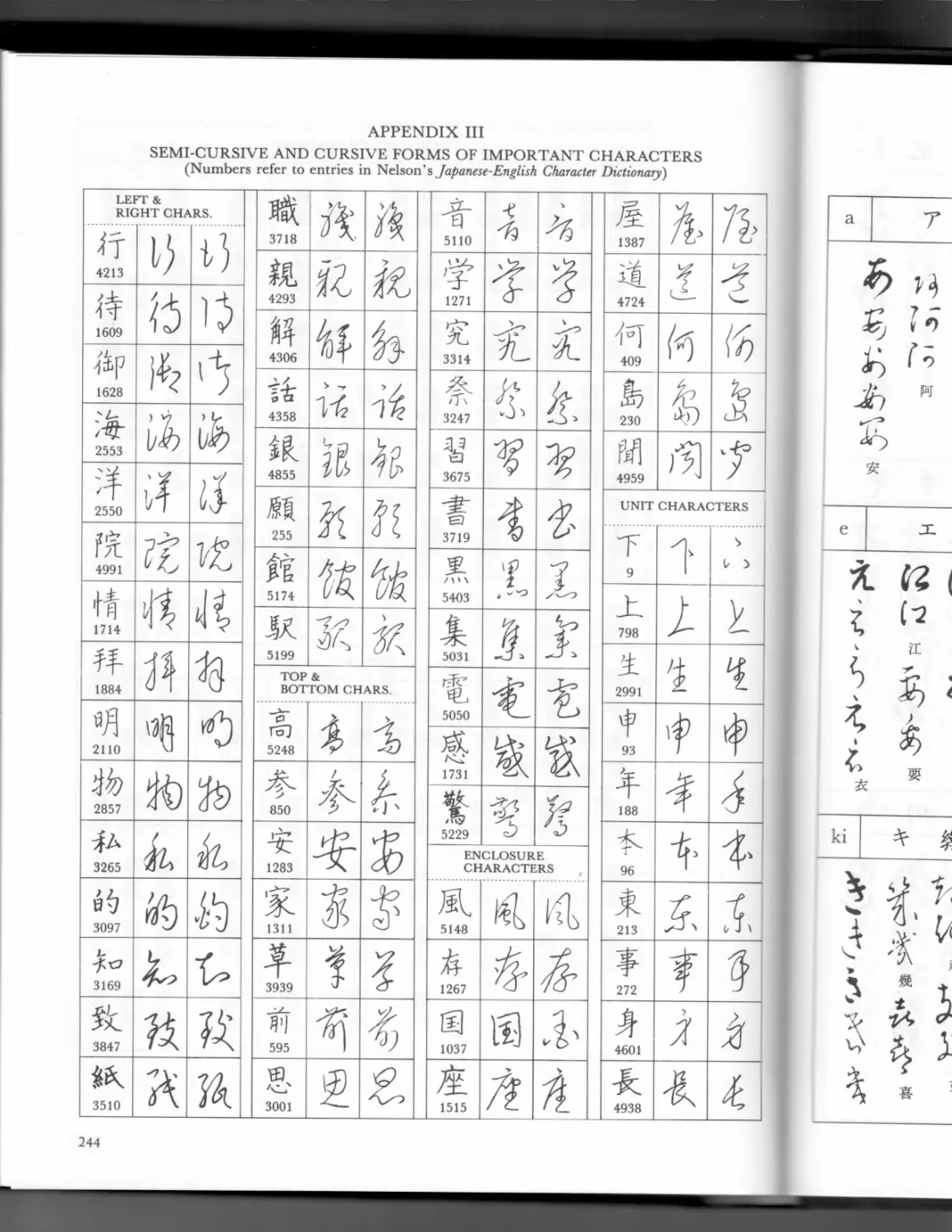
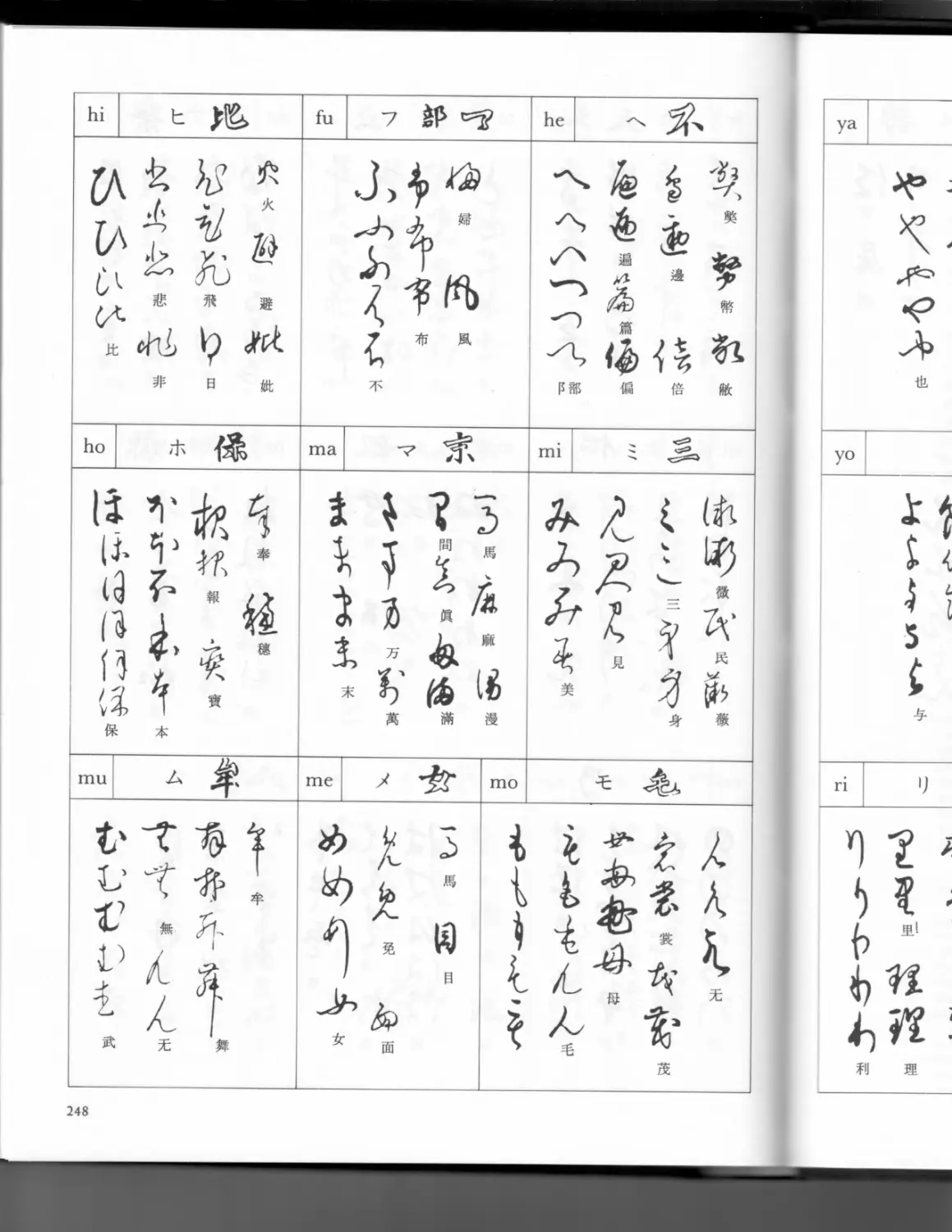
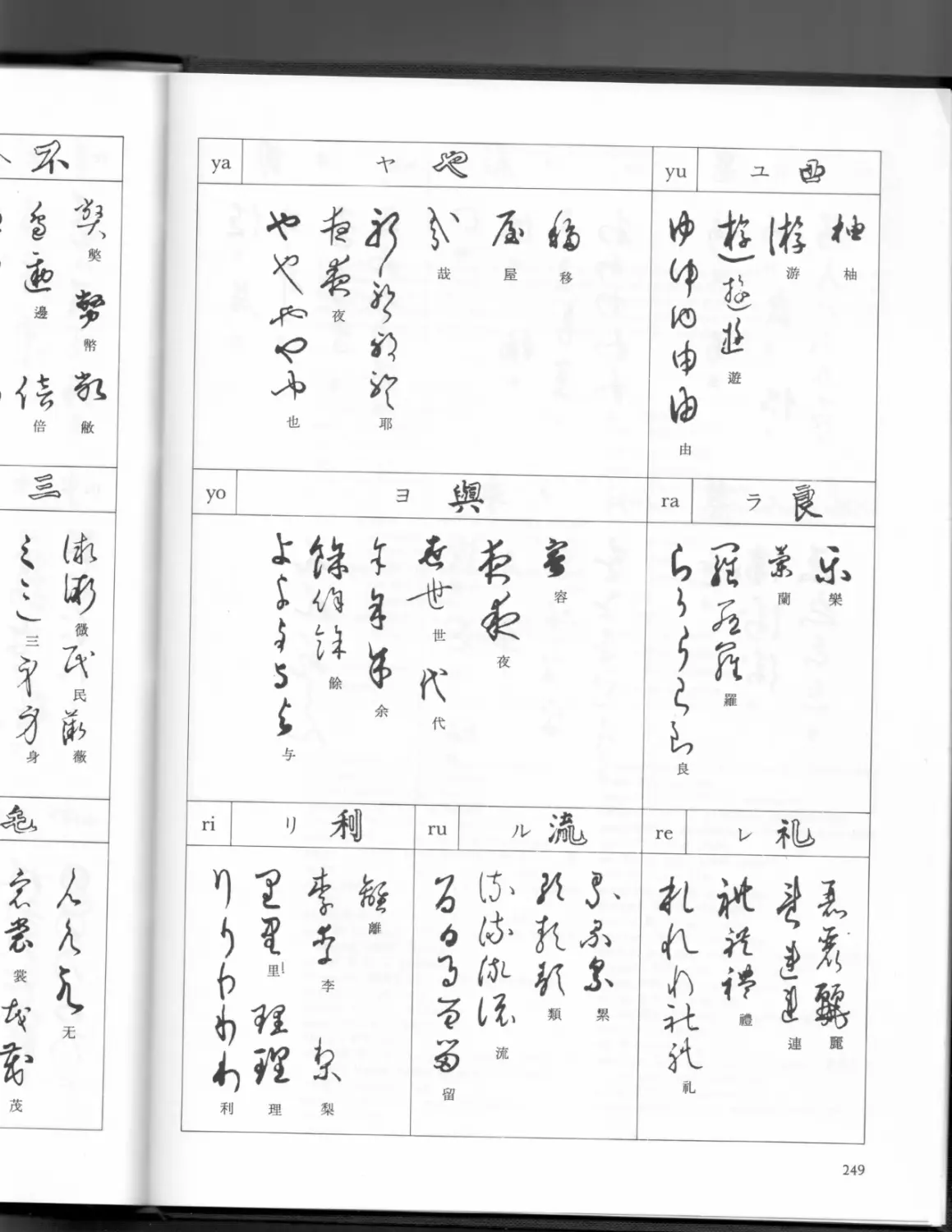
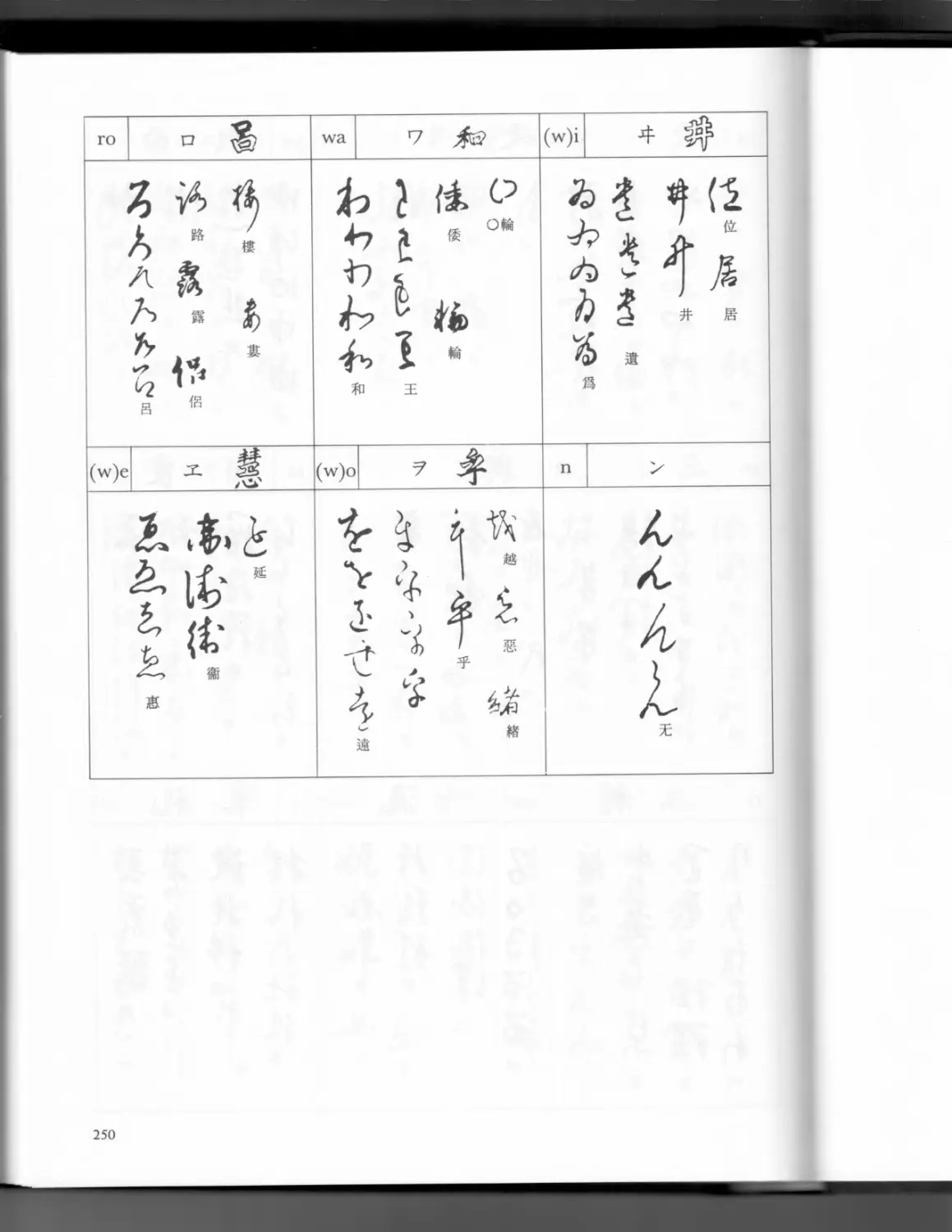
Appendix III, Semi-Cursive and Cursive
Forms of Important Characters 244
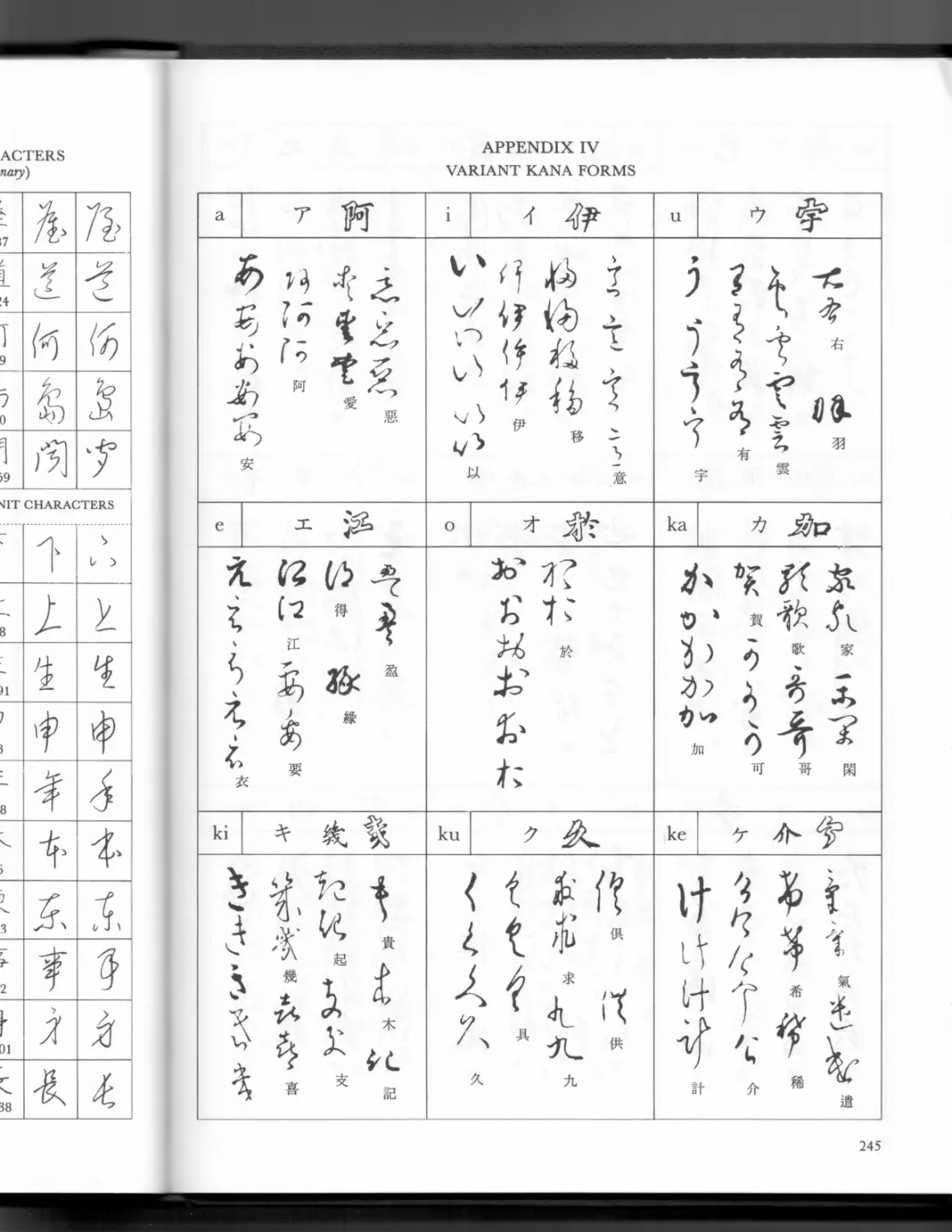
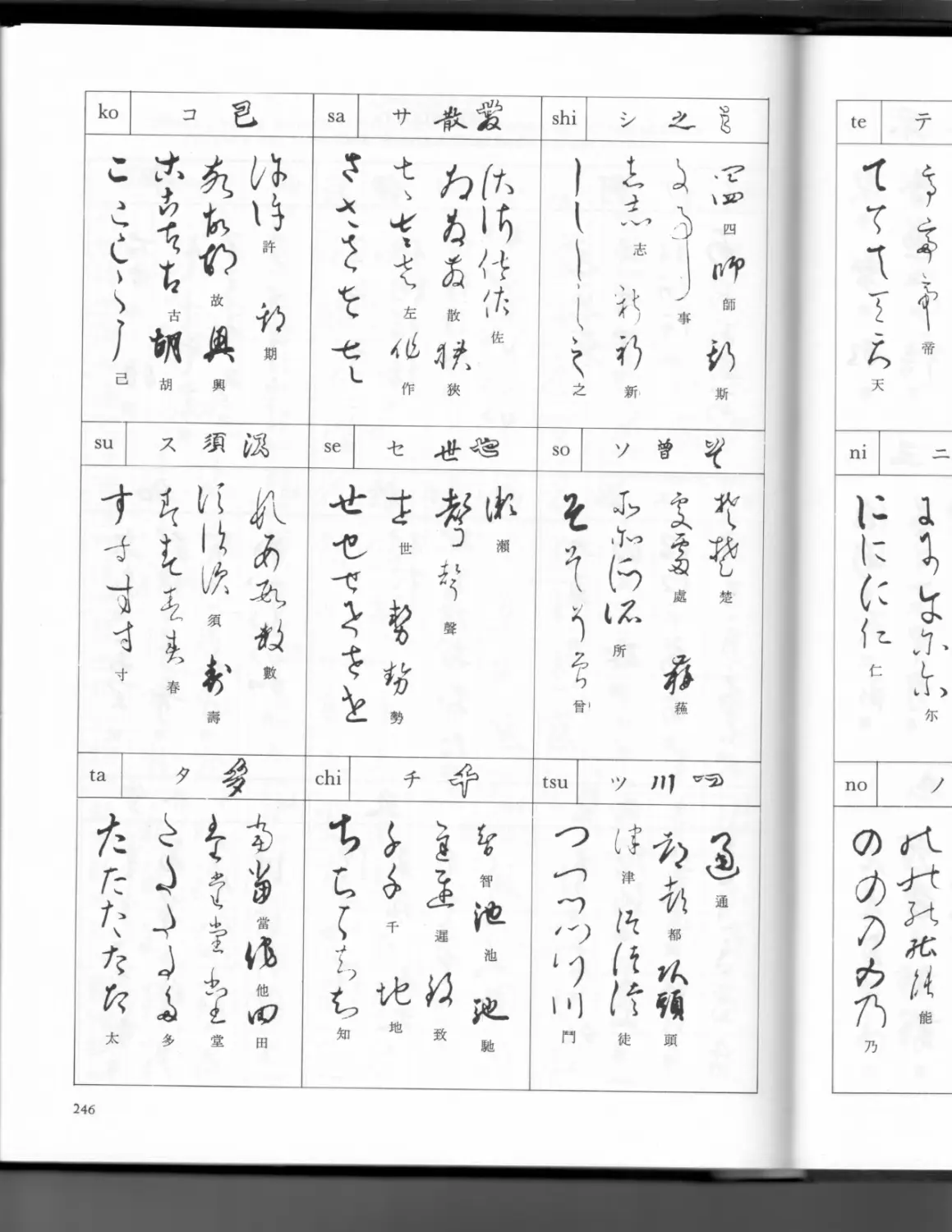
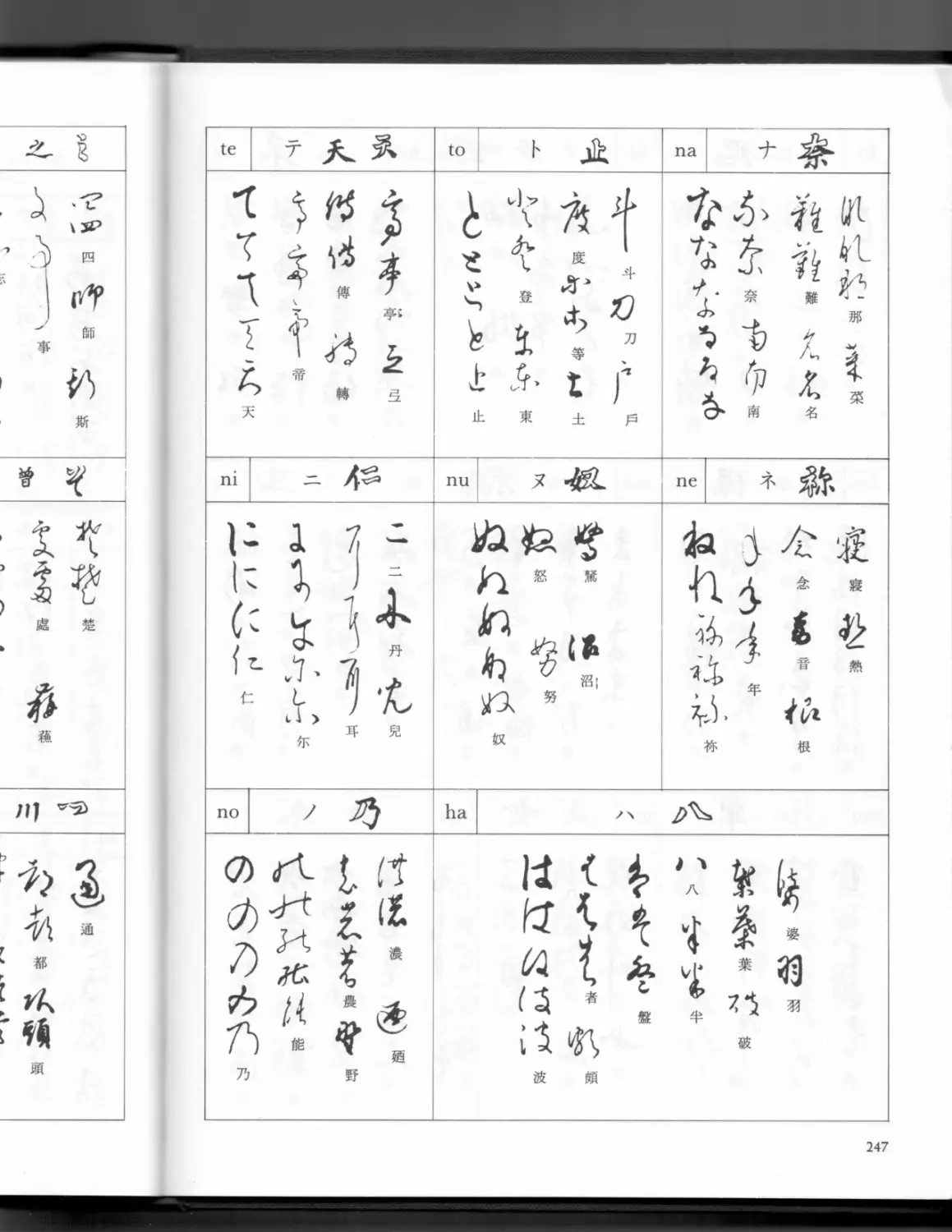
Appendix IV, Variant Капа Forms 245
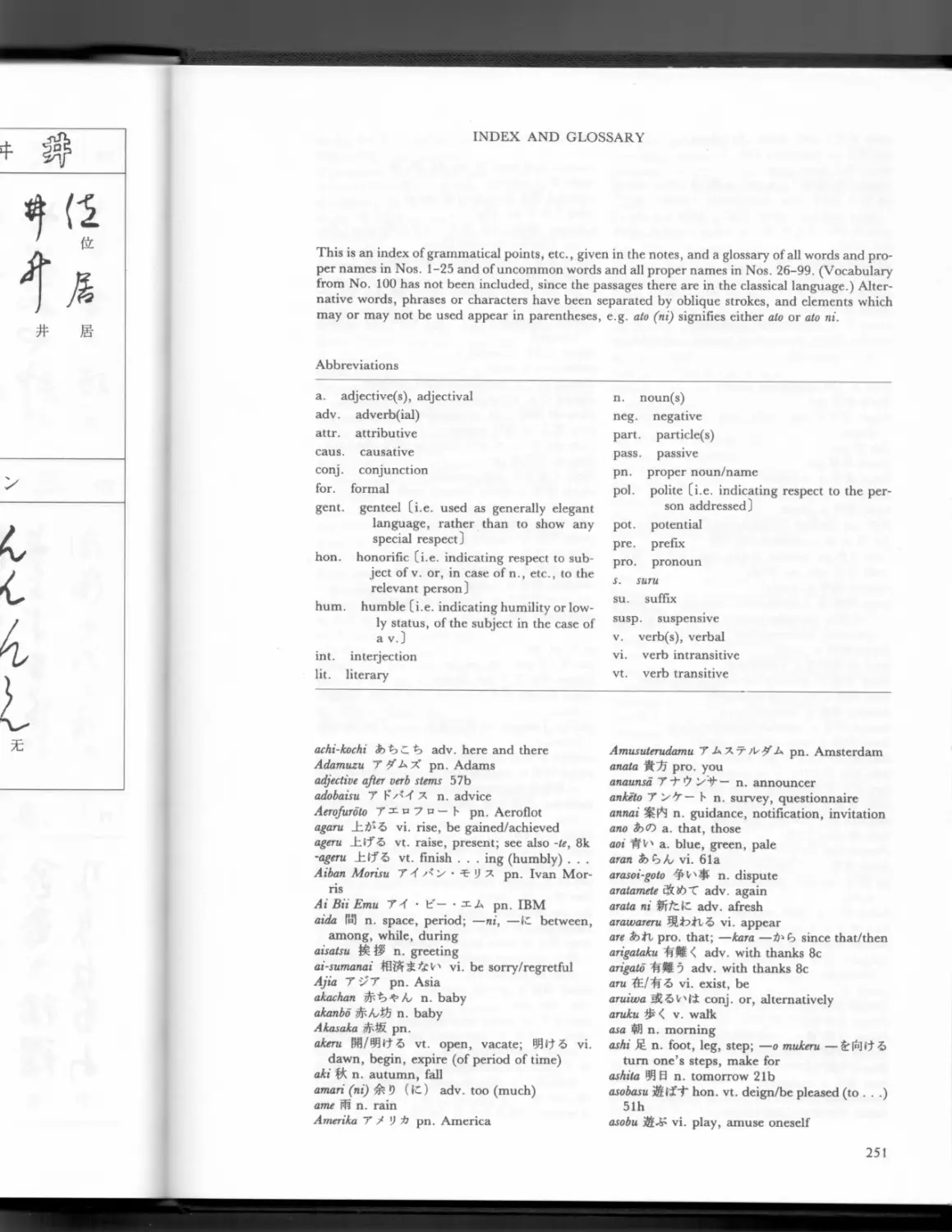
Index and Glossary
251
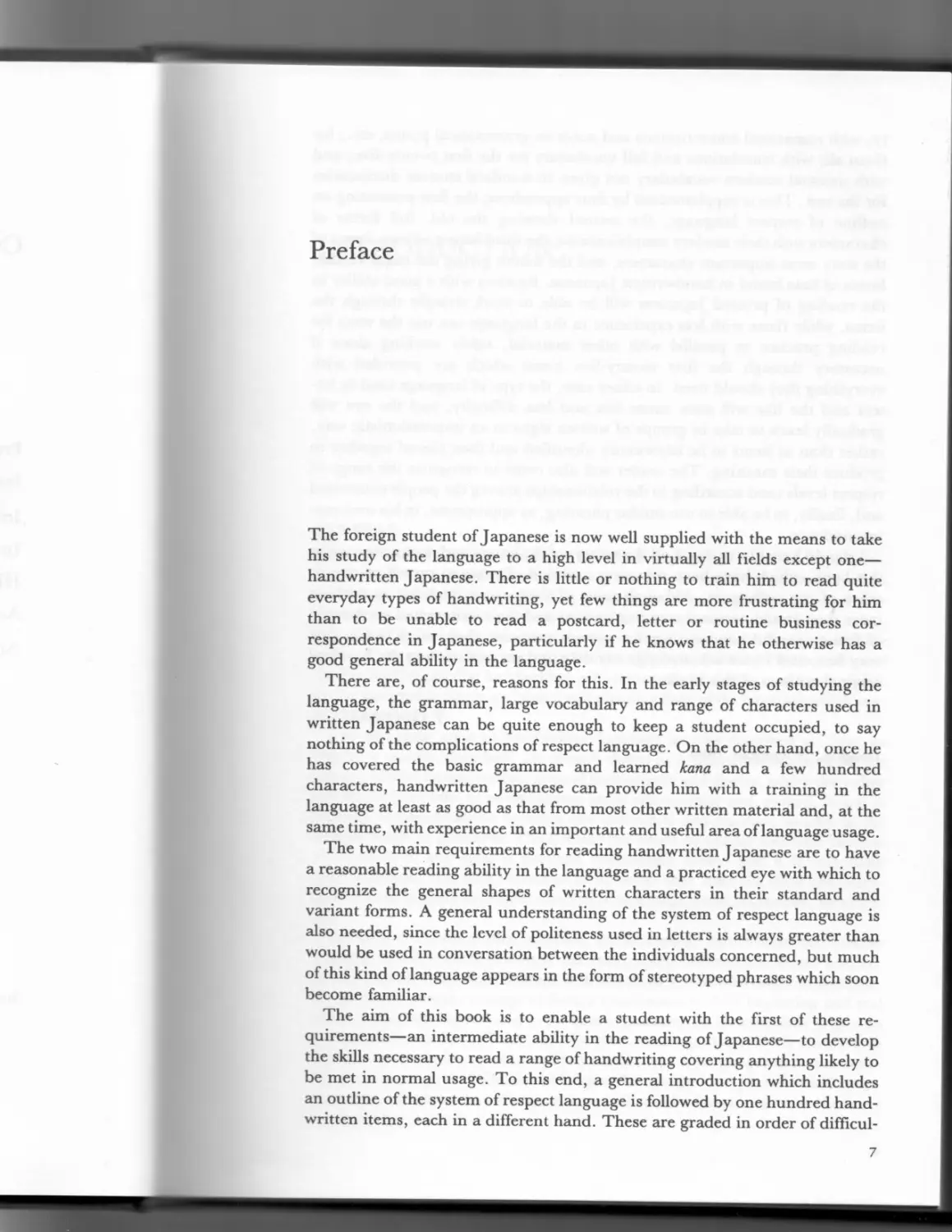
Preface
The foreign student of Japanese is now well supplied with the means to take
his study of the language to a high level in virtually all fields except one—
handwritten Japanese. There is little or nothing to train him to read quite
everyday types of handwriting, yet few things are more frustrating for him
than to be unable to read a postcard, letter or routine business cor-
respondence in Japanese, particularly if he knows that he otherwise has a
good general ability in the language.
There are, of course, reasons for this. In the early stages of studying the
language, the grammar, large vocabulary and range of characters used in
written Japanese can be quite enough to keep a student occupied, to say
nothing of the complications of respect language. On the other hand, once he
has covered the basic grammar and learned капа and a few hundred
characters, handwritten Japanese can provide him with a training in the
language at least as good as that from most other written material and, at the
same time, with experience in an important and useful area of language usage.
The two main requirements for reading handwritten Japanese are to have
a reasonable reading ability in the language and a practiced eye with which to
recognize the general shapes of written characters in their standard and
variant forms. A general understanding of the system of respect language is
also needed, since the level of politeness used in letters is always greater than
would be used in conversation between the individuals concerned, but much
of this kind of language appears in the form of stereotyped phrases which soon
become familiar.
The aim of this book is to enable a student with the first of these re-
quirements—an intermediate ability in the reading of Japanese—to develop
the skills necessary to read a range of handwriting covering anything likely to
be met in normal usage. To this end, a general introduction which includes
an outline of the system of respect language is followed by one hundred hand-
written items, each in a different hand. These are graded in order of difficul-
7
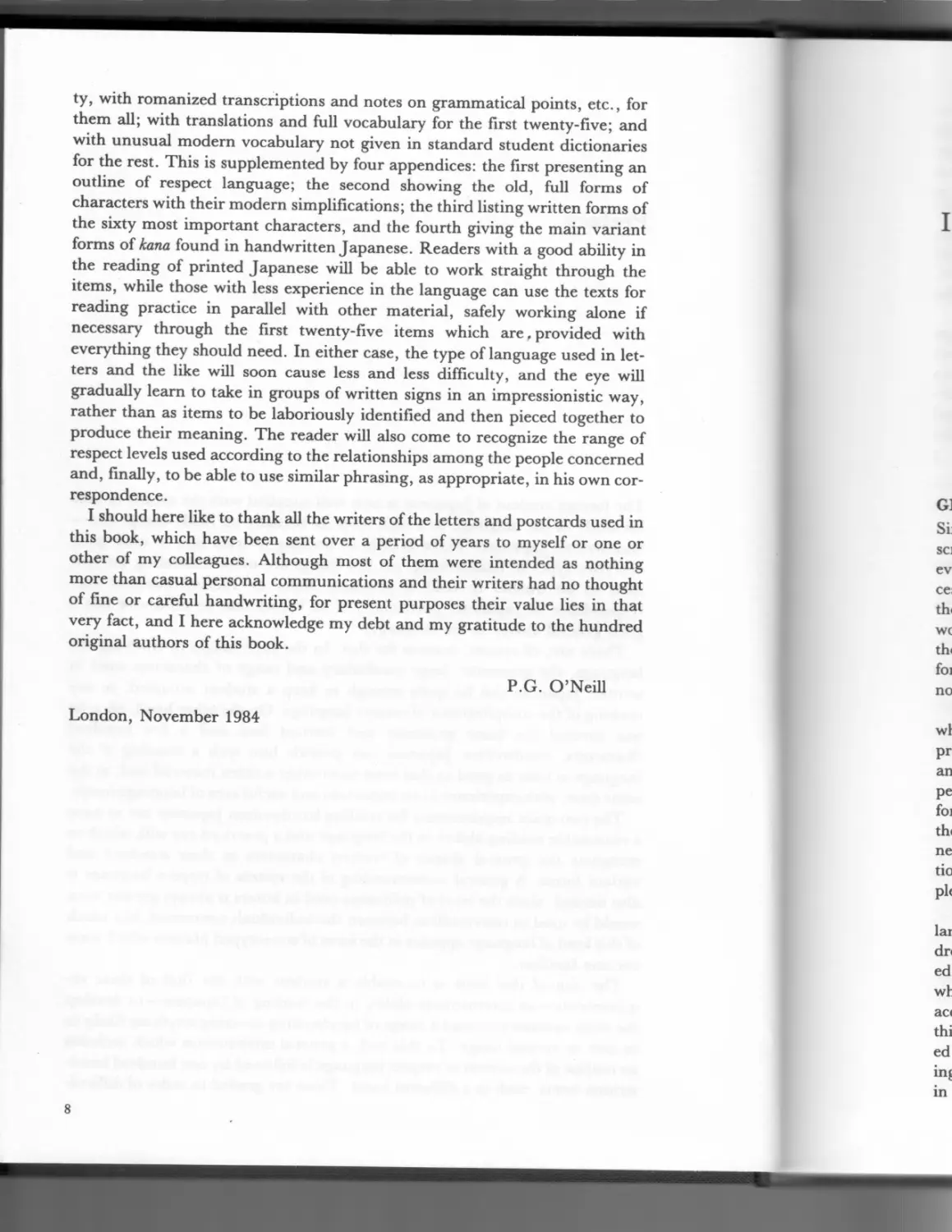
ty, with romanized transcriptions and notes on grammatical points, etc., for
them all; with translations and full vocabulary for the first twenty-five; and
with unusual modern vocabulary not given in standard student dictionaries
for the rest. This is supplemented by four appendices: the first presenting an
outline of respect language; the second showing the old, full forms of
characters with their modern simplifications; the third listing written forms of
the sixty most important characters, and the fourth giving the main variant
forms of капа found in handwritten Japanese. Readers with a good ability in
the reading of printed Japanese will be able to work straight through the
items, while those with less experience in the language can use the texts for
reading practice in parallel with other material, safely working alone if
necessary through the first twenty-five items which are, provided with
everything they should need. In either case, the type of language used in let-
ters and the like will soon cause less and less difficulty, and the eye will
gradually learn to take in groups of written signs in an impressionistic way,
rather than as items to be laboriously identified and then pieced together to
produce their meaning. The reader will also come to recognize the range of
respect levels used according to the relationships among the people concerned
and, finally, to be able to use similar phrasing, as appropriate, in his own cor-
respondence.
I should here like to thank all the writers of the letters and postcards used in
this book, which have been sent over a period of years to myself or one or
other of my colleagues. Although most of them were intended as nothing
more than casual personal communications and their writers had no thought
of fine or careful handwriting, for present purposes their value lies in that
very fact, and I here acknowledge my debt and my gratitude to the hundred
original authors of this book.
P.G. O’Neill
London, November 1984
8
INTRODUCTION
GENERAL
Since the use of Chinese characters has given Japanese a largely non-phonetic
script which has not easily lent itself to a printed form, handwriting has played an
even larger part in Japanese life than it has in the West; and although word-pro-
cessors are clearly making great headway in the business world in Japan today,
they will be for her little more than the typewriter has long been for the rest of the
world. This, and the high regard in which calligraphy is held in the countries of
the Far East, mean that handwriting will continue to be a feature of Japanese life
for the foreseeable future and that it will remain a form of the language which can-
not be ignored.
The two main areas of handwritten Japanese may be described as, first, its
wholly or mainly ‘detached’ use in such things as manuscripts intended for the
printer, official forms, notices, general memoranda and diaries, where the writer
and reader have little or no recognized social relationship; and, second, its use in
personal communications between one individual and another, usually in the
form of letters or postcards. The former type needs no special note here because
the absence of any specific personal relationship means that it is essentially
neutral in tone, and such variations as do occur arise from the same considera-
tions of style as apply to printed material in newspapers and magazines, for exam-
ple.
Personal communications, however, are necessarily handwritten and involve
language which reflects primarily the relationship between the writer and ad-
dressee, but also their relationships with any third person who might be mention-
ed. As letters contain a range of formal expressions at their beginning and end
which is considerably reduced in the case of postcards, it is convenient to give an
account of letters first. (Some use of respect language is inevitably involved in
this, and readers who are not familiar with this type of language are recommend-
ed to read through the “Outline of Respect Language” in Appendix I before go-
ing further. Explanations of respect forms will also be found in notes to the items
in which they occur.)
9
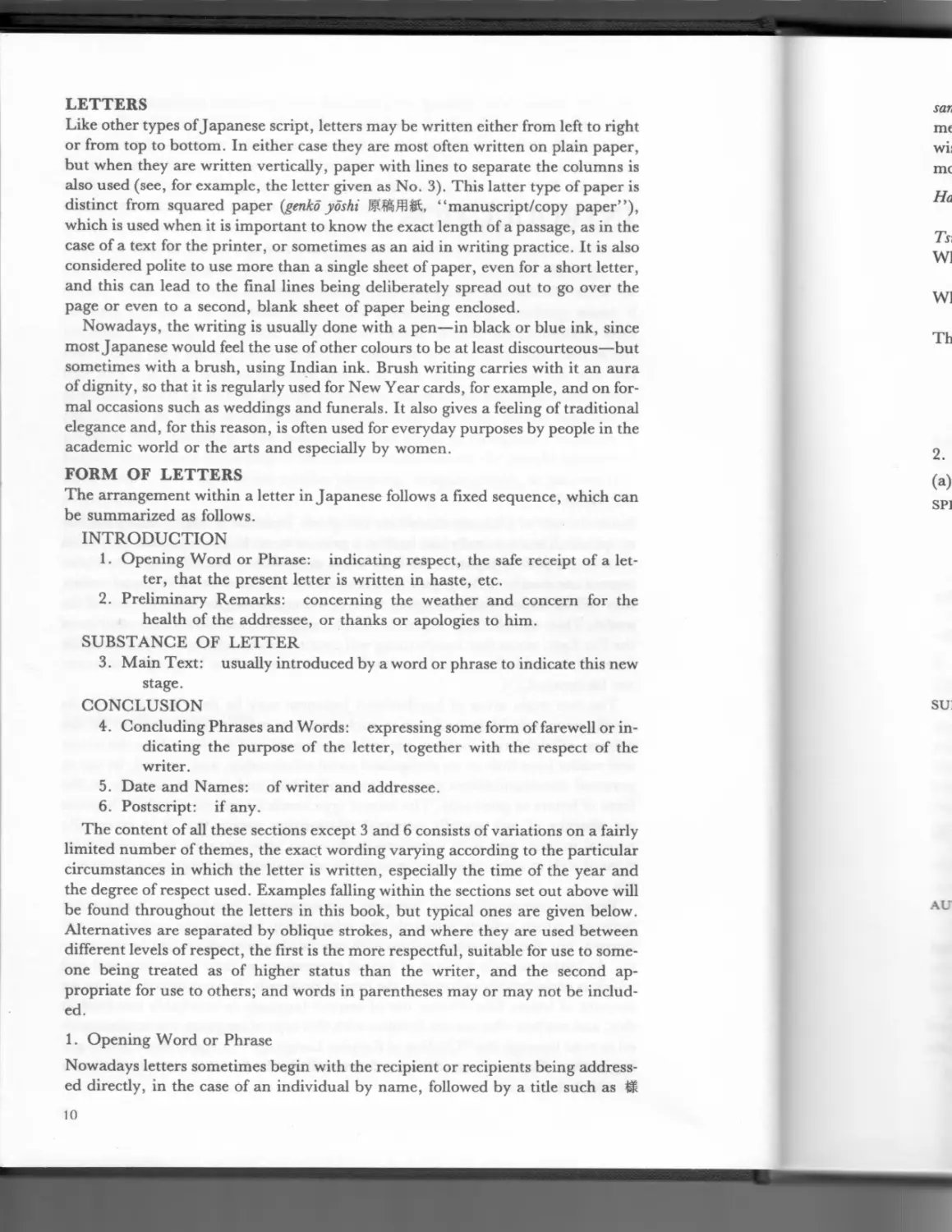
LETTERS
Like other types of Japanese script, letters may be written either from left to right
or from top to bottom. In either case they are most often written on plain paper,
but when they are written vertically, paper with lines to separate the columns is
also used (see, for example, the letter given as No. 3). This latter type of paper is
distinct from squared paper (genko yoshi	“manuscript/copy paper”),
which is used when it is important to know the exact length of a passage, as in the
case of a text for the printer, or sometimes as an aid in writing practice. It is also
considered polite to use more than a single sheet of paper, even for a short letter,
and this can lead to the final lines being deliberately spread out to go over the
page or even to a second, blank sheet of paper being enclosed.
Nowadays, the writing is usually done with a pen—in black or blue ink, since
most Japanese would feel the use of other colours to be at least discourteous—but
sometimes with a brush, using Indian ink. Brush writing carries with it an aura
of dignity, so that it is regularly used for New Year cards, for example, and on for-
mal occasions such as weddings and funerals. It also gives a feeling of traditional
elegance and, for this reason, is often used for everyday purposes by people in the
academic world or the arts and especially by women.
FORM OF LETTERS
The arrangement within a letter in Japanese follows a fixed sequence, which can
be summarized as follows.
INTRODUCTION
1.	Opening Word or Phrase: indicating respect, the safe receipt of a let-
ter, that the present letter is written in haste, etc.
2.	Preliminary Remarks: concerning the weather and concern for the
health of the addressee, or thanks or apologies to him.
SUBSTANCE OF LETTER
3.	Main Text: usually introduced by a word or phrase to indicate this new
stage.
CONCLUSION
4.	Concluding Phrases and Words: expressing some form of farewell or in-
dicating the purpose of the letter, together with the respect of the
writer.
5.	Date and Names: of writer and addressee.
6.	Postscript: if any.
The content of all these sections except 3 and 6 consists of variations on a fairly
limited number of themes, the exact wording varying according to the particular
circumstances in which the letter is written, especially the time of the year and
the degree of respect used. Examples falling within the sections set out above will
be found throughout the letters in this book, but typical ones are given below.
Alternatives are separated by oblique strokes, and where they are used between
different levels of respect, the first is the more respectful, suitable for use to some-
one being treated as of higher status than the writer, and the second ap-
propriate for use to others; and words in parentheses may or may not be includ-
ed.
1.	Opening Word or Phrase
Nowadays letters sometimes begin with the recipient or recipients being address-
ed directly, in the case of an individual by name, followed by a title such as Ш
10
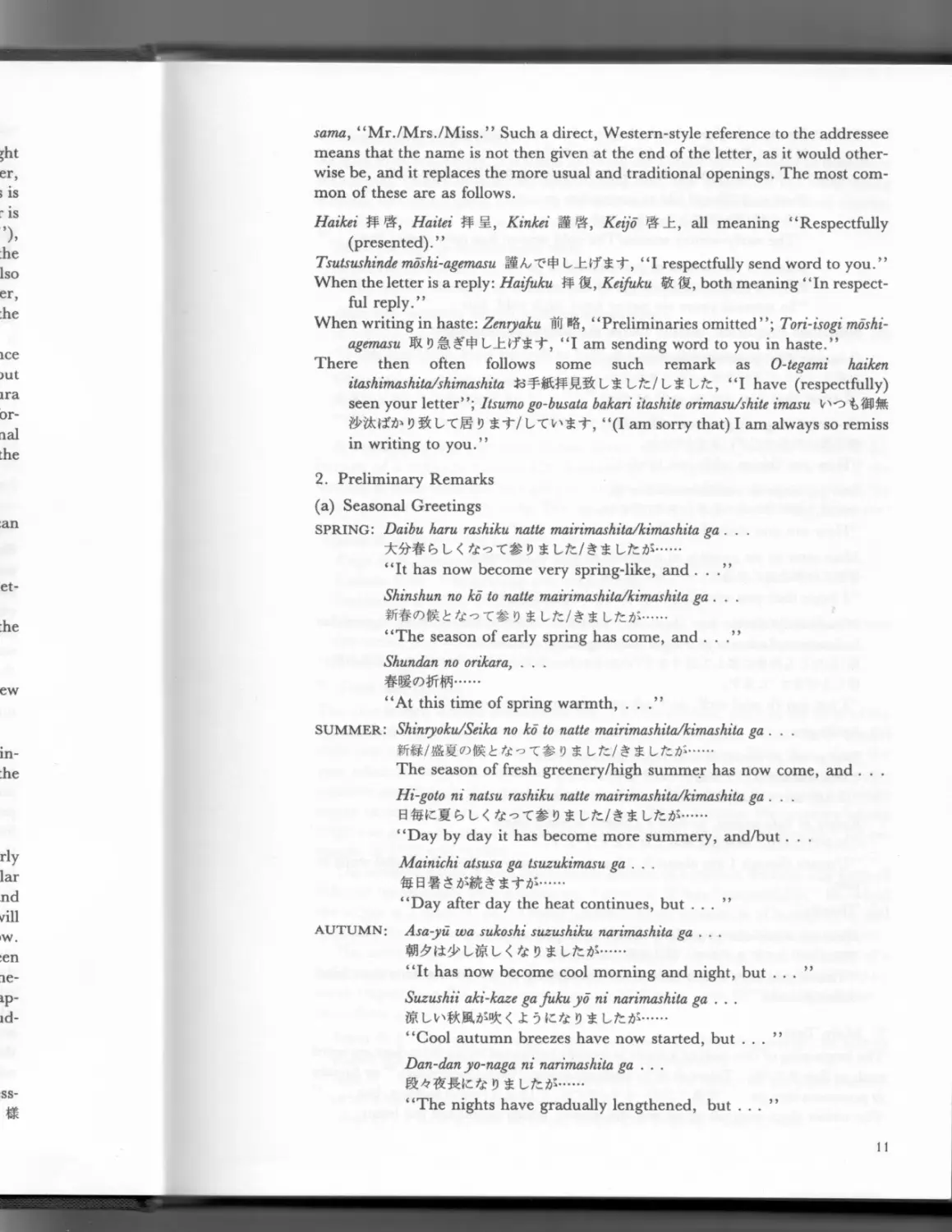
sama, “Mr./Mrs./Miss.” Such a direct, Western-style reference to the addressee
means that the name is not then given at the end of the letter, as it would other-
wise be, and it replaces the more usual and traditional openings. The most com-
mon of these are as follows.
Haikei Й Haitei JI M, Kinkei S Or, Keijo ®F_b, all meaning “Respectfully
(presented).”
Tsutsushinde moshi-agemasu	“I respectfully send word to you.”
When the letter is a reply: Haifuku fft, Keifuku % ffi, both meaning “In respect-
ful reply.”
When writing in haste: Zenryaku flu “Preliminaries omitted”; Tori-isogi moshi-
agemasu Ж 9	Si", “I am sending word to you in haste.”
There then often follows some such remark as O-tegami haiken
itashimashita/shimashita	LS Lfc/LS Lfc, “I have (respectfully)
seen your letter”; Itsumo go-busata bakari itashite orimasu/shite imasu
/ФйШТр О Й LTJBj D ST/IzTV'St, “(I am sorry that) I am always so remiss
in writing to you.”
2.	Preliminary Remarks
(a)	Seasonal Greetings
SPRING: Daibu haru rashiku natte mairimashita/kimashita ga . . .
Ш Ш	...
“It has now become very spring-like, and ...”
Shinshun no kd to natte mairimashita/kimashita ga . . .
S Lfc/£S ..........
“The season of early spring has come, and ...”
Shundan no orikara, . . .
WoJrffi......
“At this time of spring warmth, ...”
SUMMER: Shinryoku/Seika no ко to natte mairimashita/kimashita ga . . .
Lfc/£S ..........
The season of fresh greenery/high summer has now come, and . . .
Hi-goto ni natsu rashiku natte mairimashita/kimashita ga . . .
HSlcI?)L< 4oTt5Slt/^SL^....................
“Day by day it has become more summery, and/but . . .
Mainichi atsusa ga tsuzukimasu ga . . .
...
“Day after day the heat continues, but ...”
AUTUMN: Asa-уй wa sukoshi suzushiku narimashita ga . . .
К 9 t .........
“It has now become cool morning and night, but ...”
Suzushii aki-kaze ga fuku yd ni narimashita ga . . .
..
“Cool autumn breezes have now started, but ...”
Dan-dan yo-naga ni narimashita ga . . .
....
“The nights have gradually lengthened, but ...”
11
WINTER: Nan to naku fuyu chikaku kanjiru у о ni narimashita ga . . .
К<	< &t* X0№5 £Lfc^...........
“One somehow feels now that winter is not far away, but ...”
Shoto no кд/Samui jiko to narimashita ga . . .
!) t ..............................
“The early-winter season/The cold season has now come, but . . .”
Reinen ni nai samusa de gozaimasu/desu ga . . .
£ X£* ^£+/Х~Г^........
“In normal years we never have such cold, but ...”
(b)	Solicitous Enquiries: usually follow the above; for example:
O-kawari (mo) gozaimasen/arimasen ka.
“I trust that you are as well as ever.”
Go-kinkyd ikaga de gozaimasu/desu ka.
® fiiR. v	x c* v	-t I xT^ о
“How are things with you lately?”
Sono go, ikaga de irasshaimasu/desu ka.
“How are you since I saw/heard from you last?”
Mina-sama ni wa go-soken ni o-sugoshi no koto to zonjimasu.
t1 # Wo
“I hope that you are all going along in good health.”
Watakushi/Watashi mo buji ni kurashite orimasu/imasu kara, go-anshin
kudasaimasu/kudasaru yd o-negai moshi-agemasu/shimasu.
“I too am fit and well, so I ask you please not to worry.”
(c)	Apologies
Sono go wa go-busata ni uchi-sugite orimasu/imasu.
“(I am sorry that) I have not written since then/for so long.”
Kokoro ni kake-nagara, go-buin о kasanete orimasu/imasu.
“Uneasy though I am about it, I have continually neglected to send word to
you.”
(d)	Thanks
Heiso wa o-hiki-tate ni azukari, makoto ni arigato zonjimasu.
“Thank you very much indeed for continuing to favour me with your kind
consideration.”
3.	Main Text
The beginning of this part of a letter is usually indicated by an introductory word
such as Sate $ X/Й, Tokoro de MX, both meaning “Well (then/now),” or Sassoku
degozaimasu/desuga . . . XC*“This is (very) sudden, but . . . ”
The writer then goes on to set out the matter which prompted the letter.
12
4.	Concluding Expressions
As with Western letters, it is usual to round off a letter with phrases or sentences
which may simply indicate its approaching end, the reason for the letter being
written, or express good wishes to the addressee and/or his family. Such expres-
sions can therefore vary a great deal, but typical ones are:
Mazu iva migi go-tsuchi/o-negai made.
^11£ШЙ*П/4бЕЙН £ To
“The above, then, is to inform you/is my request to you.”
Dozo migi yoroshiku o-negai moshi-agemasu/shimasu.
if 5 •?£ <t 6 L < & ЕЙ v 'Ф	t Т/ L t T о
“I ask you to be kind enough to help me with the above matter.”
Oku-sama ni yoroshiku (o-tsutae kudasai).
(46fexT$V')o
“(Please pass on) my best wishes to your wife.”
A concluding word or short phrase then usually follows, written either at the
bottom of a separate column (or of course at the righthand side of a line if the
writing is done from left to right), or at the bottom of the column in which the
above phrase or sentence ends. The most common of these concluding items are:
So-so $	“In haste”
Keigu & Д, Haigu Д both meaning “Respectfully”
Keihaku Й Й “Informing you respectfully”
Saydnara J	“Goodbye”
(Sore) de wa mata ( + Jb)	“Well, then, (I will write) again” or, when
the writer is a woman,
Kashiko	“With reverence/respect.”
5.	Date and Names
The date is then written towards the top of a new column, often in the form of the
month and day alone but sometimes proceded by the year, either the Western-
style one or the year according to the Japanese era name. Note that, since the
year when an emperor comes to the throne is the first one of his reign, the year-
number specified in this type of date must be added to the year before his reign
began in order to arrive at the Western year. Thus, because the emperor whose
reign was given the name Showa came to the throne in 1926, “Showa 59,” for ex-
ample, is 1925 + 59=1984.
The writer’s name is then given at the bottom of a column without any form of
title but occasionally with a following character, Я hai, “respectfully,” or, when
the writer is a man, + sei, “(your) junior,” as an indication of humility. A seal
may also be used here, when the letter is a formal one or from an institution.
The name of the addressee, on the other hand, is always written at the top of a
column (or, of course, on the extreme left in horizontal writing) and followed by
some respectful suffix. The most common of these is -sama Ж “Mr./Mrs./Miss,”
but others are:
Sensei 9c 4 literally “teacher,” for a person in the teaching world, the arts or
public life, to whom the term is felt to be appropriate;
-kun S in this situation, used exclusively between men who are close friends,
or to a subordinate, close relation, etc.;
-dono Jg a formal, official term, much like English “Esq.”; and
13
Kakui # fe when referring to a group or corporate body, much like
“Messrs.”
Finally, after the addressee’s name and title there may be, written just to the
side (or below in horizontal writing), a further respectful word or short phrase,
such as:
Jishi Ф. literally “(to your) secretary”;
Gyokuanka	“below your revered desk”; or
On-moto e	(alternatively, O-moto e &Й7Т^) literally “to your
residence,” when the writer is, almost without exception, a woman.
6.	Postscript
A postscript will normally be introduced by a word describing it as such, most
commonly Tsuishin дй Ж Nishin Ж , or Tsuikei дй ^F.
ENVELOPES
Virtually all the letters given in this book follow the sequence outlined above,
and there will be no difficulty in identifying the various sections, but there are
conventions about the use of envelopes which are worth special notice.
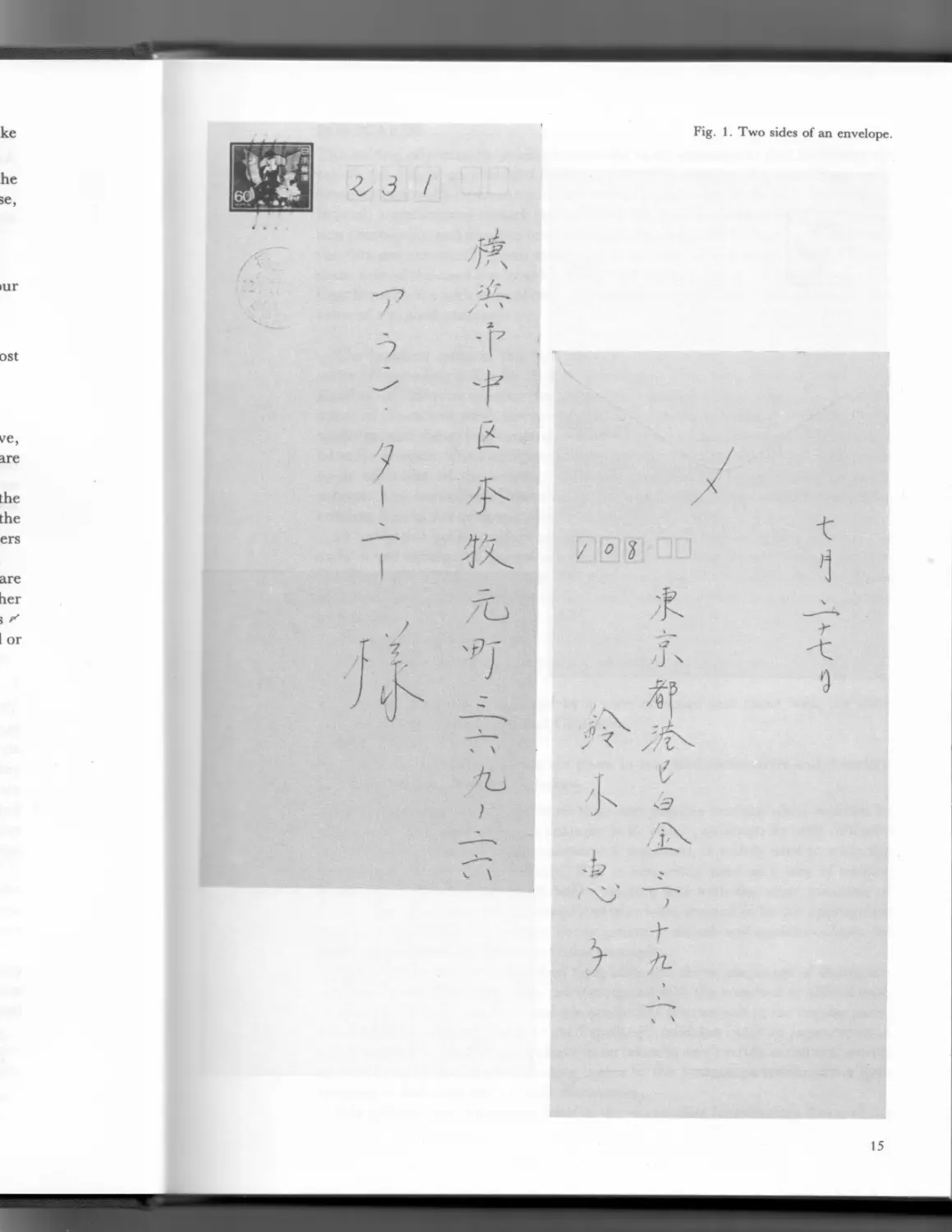
Briefly, the most important thing is that, in the address on the envelope, the
name and title of the addressee should be put in a separate column down the
center. They are also often set higher and written in slightly larger characters
than the address to the right.
On the reverse side of the envelope, the name and address of the sender are
written in smallish characters towards the bottom, with the date rather higher
up, and the flap is sometimes “secured” by writing over it a character such as r
shime or ЙJu, both meaning “sealed,” or more formally by affixing a personal or
official seal. See Figure 1 for the two sides of a typical envelope.
14
ке
he
je,
Fig. 1. Two sides of an envelope.
ur
DSt
ye,
ire
the
the
ers
are
aer
I or
15
16
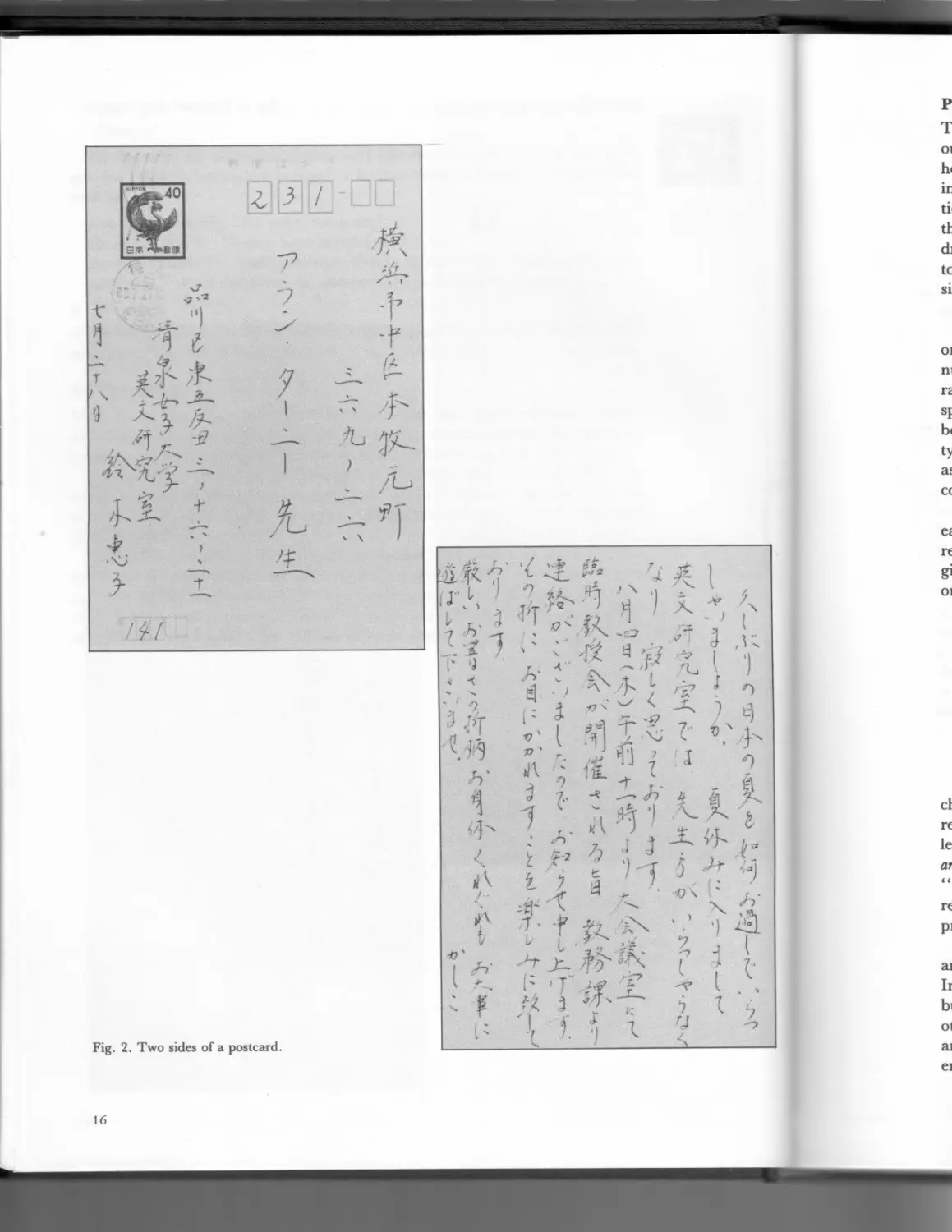
POSTCARDS
The writing of postcards usually follows the same sequence as that for letters set
out above, but in an abridged form because of limitations of space. There will,
however, normally be an introductory word or phrase (as in Section 1 above) or,
instead, a preliminary remark (as in Section 2); the substance of the communica-
tion (Section 3); and finally a concluding expression (as in Section 4). Names and
the date are not usually given at the end of the text, as in a letter, but on the ad-
dress side of the card (or in the address half in the case of a picture postcard),
together with the addresses of both sender and recipient. See Figure 2 for the two
sides of a typical postcard.
The hundred items in this book have been arranged as far as possible in an
order of increasing difficulty. Handwritten material in Japanese has, however, a
number of different aspects—legibility, of course, but also such things as the
range of characters used, the occurrence of old forms of characters and old капа
spellings, and the style of language—and what is difficult for one person may not
be so for another. The arrangement was therefore based primarily on the legibili-
ty or otherwise of the writing, and then modified by consideration of other
aspects. Any unevenness there may be for a particular reader should in any case
confirm him in his progress when an ‘easy’ item is met.
In using this book, readers are recommended to begin by going through the
early items taking full advantage of the transcriptions to confirm or provide
readings, and of the notes for guidance on the grammar, etc. The transcriptions
give three indications of where to find information on the relevant word, phrase
or syllable:
UPPER CASE LETTERS
indicate an item explained in a note to that particular text.
Underlining
indicates an item explained in a note or notes and listed with the note
references in the Index and Glossary.
Bold Type
indicates words and names not given in standard dictionaries and therefore
listed in the Index and Glossary.
Some Japanese words have more than one possible reading when writtten in
characters. The most common example is ft which, although its only officially
recognized reading as a single character is watakushi, is widely used to write the
less formal watashi also. Similarly, Я is frequently used as a way of writing
anata, but it also has the much stiffer reading kiho with the same meaning of
“you.” In such cases, the transcriptions give what seemed to be the appropriate
reading in the particular context, but in general watakushi and anata have been the
preferred readings for those particular examples.
The careful reader will also find that, here and there, the usage of characters
and капа in a written piece may not correspond with the standard or official one.
In some cases the characters used are acceptable alternatives to the regular ones,
but it must be realised that outright “spelling” mistakes occur in Japanese as in
other languages. Such mistakes have to be taken in one’s stride in the real world,
and it is hoped that readers finding lapses in the present material will be both
enouraged and consoled by their discoveries.
It is unlikely that the writing itself in the twenty-five Introductory Texts of the
first section will cause any difficulty, but if necessary the printed form of any par-
ticular character can be seen under the relevant word in the Index and Glossary.
The printed forms of characters in later items can be found in any standard
Japanese-English dictionary (including the “Index by Readings” in Nelson’s
Japanese-English Character Dictionary) or, when they occur in unusual words, again
by referring to the Index and Glossary. The translations were intended to be
helpful rather than elegant; that is to say, their main purpose was to aid an
understanding of the Japanese and, where there was a choice, they were
therefore made literal rather than literary. Similarly, the punctuation in the
romanized transcriptions does not rigorously follow the sometimes wayward
usage of the originals, but is given to clarify as far as possible the structure of the
Japanese.
By the time the Introductory Texts have been read, many of the stock expres-
sions used in letters and the like will have been met, and it will often be possible
to decide from the context as much as from the writing itself what a particular
word, phrase or clause must be. In reading handwritten Japanese it is in any case
important to get into the habit of looking ahead in order to see a related sequence
as a whole, so that the various elements in it can combine to suggest the reading,
and not to try to decipher isolated elements if this can possibly be avoided. As in-
creasingly cursive forms of characters come to be met, it will be useful to look
through the written forms of common characters given in Appendix III. These
will show that there are standard cursive forms for various elements, most of
which occur repeatedly in different characters, and a familiarity with them will
go a long way towards training the eye to recognize these other characters when
they are met. This, with the help of the context, should eventually extract the
reading and meaning even from writing which at first glance looks quite
undecipherable. As with most other aspects of language learning, progress in the
reading of handwritten Japanese may sometimes seem slow and uncertain, but it
must be remembered that the items are intended to be progressively more ad-
vanced. This means that, while none may seem easy on a first reading, reassur-
ance can be found by looking back over earlier items which may themselves have
seemed difficult at the time.
18
INTRODUCTORY TEXTS
Nos. 1-25
With transcriptions, notes and translations,
and a full vocabulary in the Glossary.
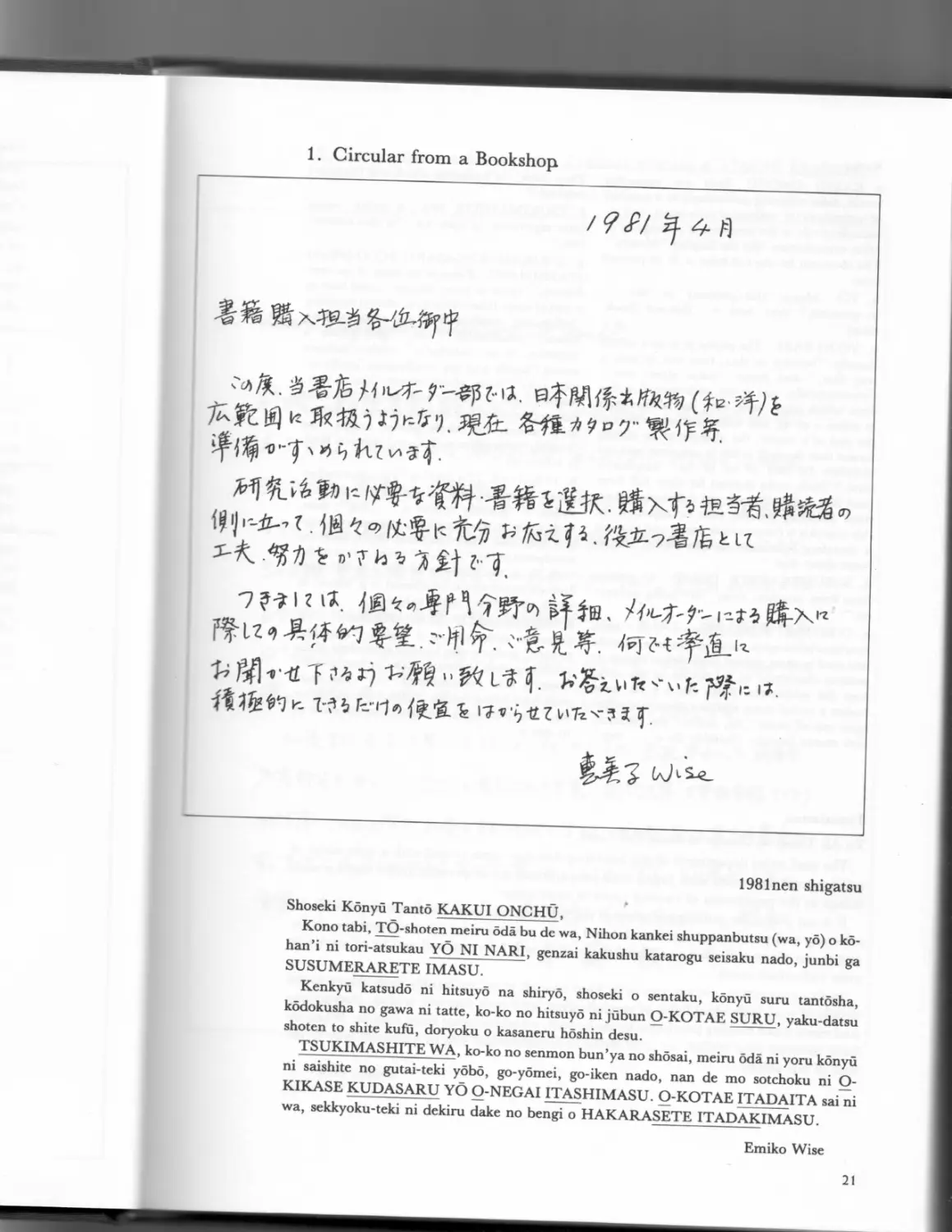
1. Circular from a Bookshop
Txffc Й) к ijr-ii'). Jftfc
0"'^' *5 h A? v-"j|
W frit, >я Г-	Ж. ttxf» fett. <»
i0'1•--*-’ V (В ч °> №^.к l/д » Jit14. f'iii-yiЙ t it
Ъ .'?M Hi] Z'f
f?'lZ‘5^«<n^-t..:-)fl^. C-%.^.^. М?<^Х1г
f Г)	4“v fc pZ^-ц 17.
flli'fc’jK. t-?i r.-ilK^'g.i i7»'^'ttZi>1i''_3iy.
it?
1981nen shigatsu
Shoseki Konyu Tanto KAKUI ONCHU,
Kono tabi, TQ-shoten meiru oda bu de wa, Nihon kankei shuppanbutsu (wa, уб) о ko-
han’i ni tori-atsukau YO NI NARI, genzai kakushu katarogu seisaku nado, junbi ga
SUSUMERARETE IMASU.
Kenkyu katsudo ni hitsuyo na shiryo, shoseki о sentaku, konyu suru tantosha,
kodokusha no gawa ni tatte, ko-ko no hitsuyo ni jubun О-КОТАЕ SURU, yaku-datsu
shoten to shite kufu, doryoku о kasaneru hoshin desu.
TSUKIMASHITE WA, ko-ko no senmon bun’ya no shosai, meiru oda ni yoru konyu
ni saishite no gutai-teki yobo, go-yomei, go-iken nado, nan de mo sotchoku ni O-
KIKASE KUDASARU YO O-NEGAIITASHIMASU. O-KOTAE ITADAITA sai ni
wa, sekkyoku-teki ni dekiru dake no bengi о HAKARASETE ITADAKIMASU.
Emiko Wise
21
Notes_____________________________________
a.	KAKUI ONCHU Both are respectful
words, kakui referring particularly to a number
of individuals (cf. colloquial mina-sama), and оп-
еки collectively to the members of a company or
other organization, like the English “Messrs.”
The character for the i of kakui is in printed
form.
b.	TO- Means “this (present)” or “the . . .
in question,” thus, here = “this/our (book-
shop).”
c.	YO NI NARI The phrase yd ni пати means
literally “become so that, turn out in such a
way that,” and hence “come about that.”
Grammatically, nari is the verb-stem (i.e. the
form which takes -masu, etc., and always ends
in either -i or -e), and when this form occurs at
the end of a clause, the absence of an ending
means that the verb is left in suspense and can
therefore be said to be in the “suspensive
form.” Such verbs depend for their full form
(and thus for their tense and full meaning) on
some following parallel verb or adjective. In
this case this is (susumerare)te imasu, and this nari
is therefore equivalent to natte imasu, “it has
come about that.”
d.	SUSUMERARETE IMASU A passive
form from susumenr, thus, “are being advanc-
ed.”
e.	O-KOTAE SURU The о + vb. stem
suru/itasu/moshi-ageru construction is a humble
one used to show respect to the other person or
persons concerned in the action of the verb,
here the addressees. Since the о + vb. stem
makes a verbal noun and suru, itasu and moshi-
ageru can all mean “do, make,” the construc-
tion means literally “humbly do a . . . ing.”
Thus, here, “a bookshop which will (humbly)
respond.”
f.	TSUKIMASHITE WA A polite, -masu
form equivalent of tsuite wa, “in this connec-
tion.”
g.	O-KIKASE KUDASARU YO O-NEGAI
ITASHIMASU Kikase is the stem of the verb
kikaseru, “cause to hear, inform,” used here as
a verbal noun (like o-kotae in e. above) meaning
“informing, notification”; and since kudasaru
means “condescend,” i.e., “give (from a
‘superior’ to an ‘inferior’),” o-kikase kudasaru
means “kindly give (us) notification, kindly in-
form (us).” Sincere (ni) means “(in a) way,
manner” (cf. c. above) and 'the о + vb. stem
itasu construction is a humble one, as explained
in e. above, the whole phrase means “we
(humbly) request (in such a way) that you kind-
ly inform us.”
h.	O-KOTAE ITADAITA The same verbal-
noun form as in e. and g. above +
itadaku — “humbly receive a . . . ing”; thus,
in this case, “(when) we have received your rep-
ly.” Note that, since this construction takes the
standpoint of the “receiver” of the action of the
verb, it is the opposite of the о + vb. stem
kudasaru construction mentioned in g. above, in
which the “giver” is the subject.
i.	HAKARASETE ITADAKIMASU A
causative form (sa)sete + itadaku “(humbly)
receive” makes a very humble equivalent of the
preceding verb, meaning more or less literally
“receive your permission to ... ” The basic
verb here being hakaru, “plan, aim at, strive
for,” the meaning is “we trust you will allow us
to aim at ... ”
Translation
To All Those in Charge of Book Purchases,
The mail order department of this bookshop has now come to deal with a wide range of
publications concerned with Japan, and preparations are at present under way for such
things as the production of various types of catalogues.
It is our policy, by putting ourselves at the side of subscribers and those responsible for
selecting and purchasing the material and books necessary for research activity, to in-
crease our plans and efforts as a bookshop which will fully respond and be of service to
your individual needs.
In this connection, we ask you to be kind enough to tell us frankly such things as the
details of your individual fields of specialization, and your concrete wishes, instructions
and views when making purchases by mail order, no matter what these may be. When we
have received your replies, we shall strive to accommodate you in a positive way to the
best of our ability.
Emiko Wise
22
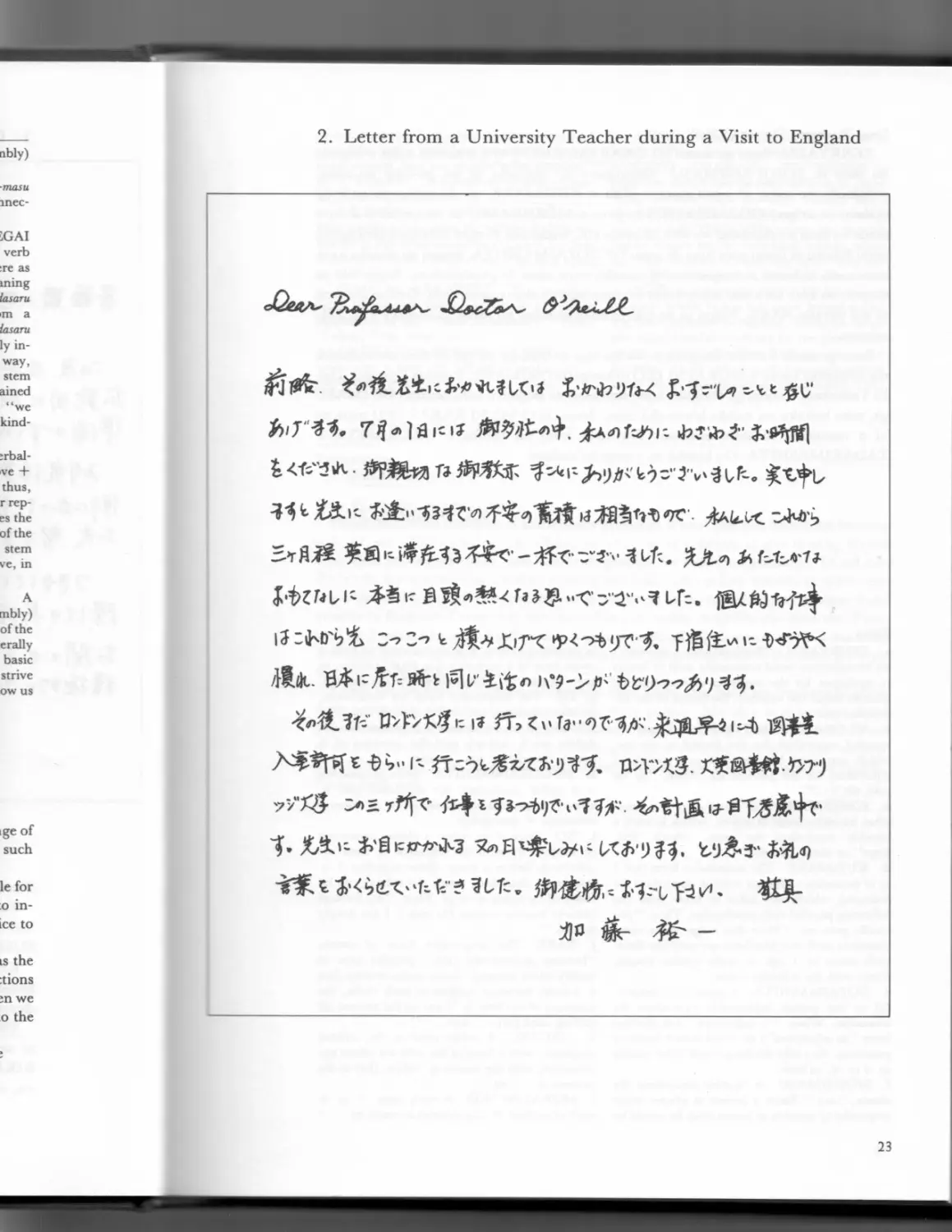
2.	Letter from a University Teacher during a Visit to England

^AU.<ohA'i>
5* flit «•- i#3 Я&." - #<•’	3 ufc.	Ь ЛЛЛ'-и
Игьи- вй^хти^м-сг^лЫс.
I? 3-? 2^ t M-VX»r<	‘- D<W<
Л<к. В^гЛт=Й-к Pll/£itn )\’9->/J'
n><vU-*)W'	WH-
П>ГХЗ. Xf®W
1. X/1»-	Ялй^и/»- t‘j^r M<o
^tl><bex-f^"?iLTc, ^^,= ХфгТ^и.
Лп	-
23
Dear Professor Doctor O’Neill,
ZENRYAKU. Sono go sensei NI OKAREMASHITE WA o-kawari naku o-sugoshi
no koto to ZONJI-AGEMASU. Shichigatsu no tsuitachi ni wa go-tabo no naka,
watakushi no tame ni waza-waza o-jikan о KU DAS ARE, go-shinsetsu na go-kyoji
makoto ni arigato GOZAIMASHITA. Jitsu о MOSHIMASU to, sensei ni o-ai suru
made no fuan no chikuseki wa soto na mono DE, watakushi to shite kore kara sankagetsu
hodo Eikoku ni taizai suru fuan de ippai DE GOZAIMASHITA. Sensei no atataka na o-
motenashi ni honto ni megashira NO atsuku naru omoi de gozaimashita. Kojin-teki na
shigoto wa kore kara saki kotsu-kotsu to tsumi-agete yuku tsumori desu. Geshuku-zumai
ni mo yoyaku NARE, Nihon ni ita toki to onaji seikatsu no patan ga modori-TSUTSU
arimasu.
Sono go mada Rondon Daigaku ni wa itte inai no desu ga, raishu so-so ni mo toshoshi-
tsu nyushitsu kyoka о MORAI NI IKO to kangaete ORIMASU. Rondon Daigaku, Dai-
Ei Toshokan, Kenburijji Daigaku kono sankasho de shigoto о suru tsumori DE IMASU
ga, sono keikaku wa mokka koryo-chu desu. Sensei ni O-ME NI KAKARERU mata no
hi о tanoshimi ni shite orimasu. Tori-isogi o-rei no kotoba о OKURASETE I-
TADAKIMASHITA. Go-kensho ni o-sugoshi kudasai.
KEIGU
KATO HIROKAZU
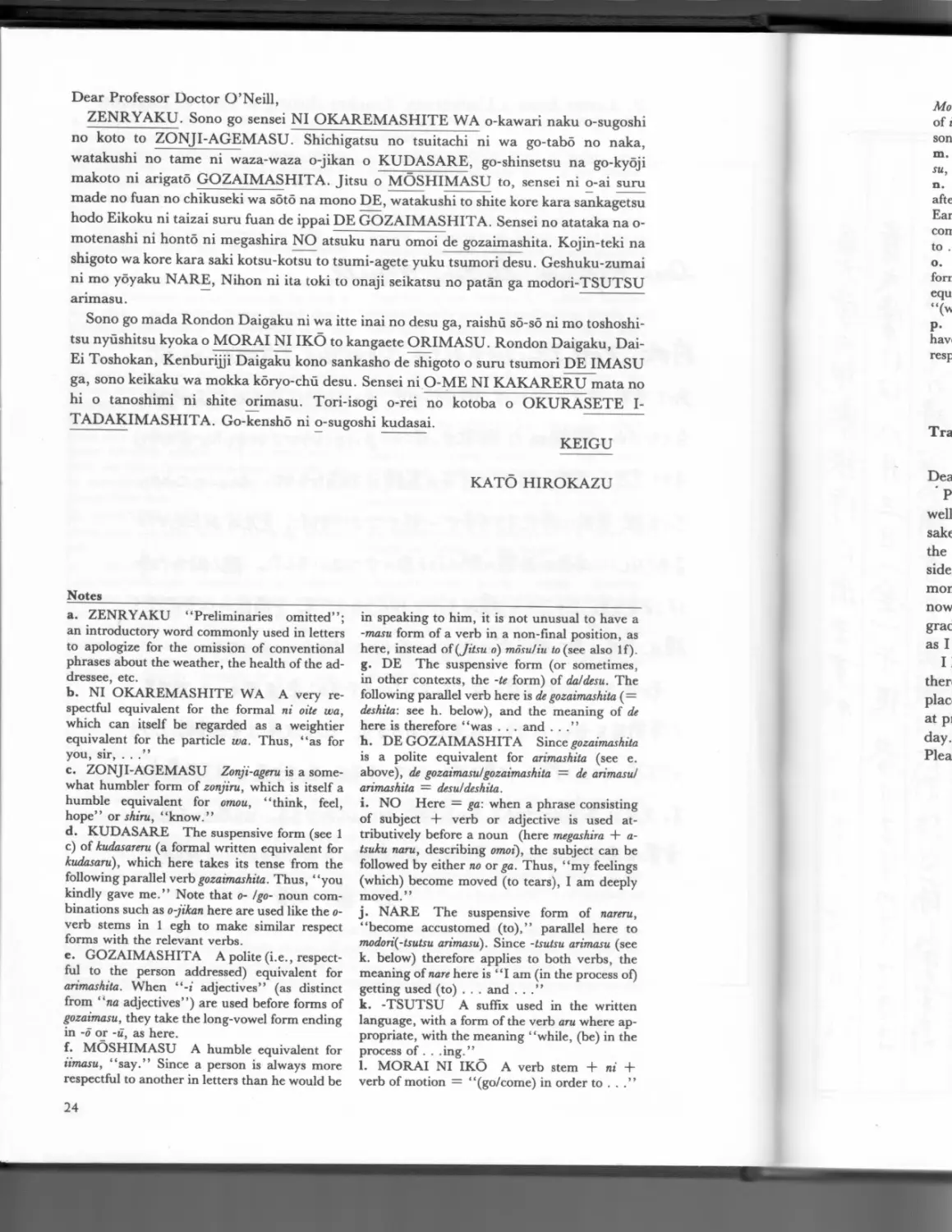
Notes________________________________
a.	ZENRYAKU “Preliminaries omitted”;
an introductory word commonly used in letters
to apologize for the omission of conventional
phrases about the weather, the health of the ad-
dressee, etc.
b.	NI OKAREMASHITE WA A very re-
spectful equivalent for the formal ni oite wa,
which can itself be regarded as a weightier
equivalent for the particle wa. Thus, “as for
you, sir, ...”
c.	ZONJI-AGEMASU Zonji-ageru is a some-
what humbler form of zonjiru, which is itself a
humble equivalent for omou, “think, feel,
hope” or shim, “know.”
d.	KUDASARE The suspensive form (see 1
c) of kudasareru (a formal written equivalent for
kudasaru), which here takes its tense from the
following parallel verb gozaimashita. Thus, “you
kindly gave me.” Note that o- /go- noun com-
binations such as o-jikan here are used like the o-
verb stems in 1 egh to make similar respect
forms with the relevant verbs.
e.	GOZAIMASHITA A polite (i.e., respect-
ful to the person addressed) equivalent for
arimashita. When “-i adjectives” (as distinct
from “na adjectives”) are used before forms of
gozaimasu, they take the long-vowel form ending
in -o or -й, as here.
f.	MOSHIMASU A humble equivalent for
iimasu, “say.” Since a person is always more
respectful to another in letters than he would be
in speaking to him, it is not unusual to have a
-masu form of a verb in a non-final position, as
here, instead of (Jitsu o) mosu/iu to (see also If),
g. DE The suspensive form (or sometimes,
in other contexts, the -te form) of da/desu. The
following parallel verb here is de gozaimashita (=
deshita: see h. below), and the meaning of de
here is therefore “was . . . and ...”
h.	DE GOZAIMASHITA Since gozaimashita
is a polite equivalent for arimashita (see e.
above), de gozaimasu/gozaimashita = de arimasu/
arimashita = desu/deshita.
i.	NO Here = ga: when a phrase consisting
of subject + verb or adjective is used at-
tributively before a noun (here megashira + a-
tsuku naru, describing omoi), the subject can be
followed by either no or ga. Thus, “my feelings
(which) become moved (to tears), I am deeply
moved.”
j.	NARE The suspensive form of nareru,
“become accustomed (to),” parallel here to
modori(-tsutsu arimasu). Since -tsutsu arimasu (see
k. below) therefore applies to both verbs, the
meaning of nare here is “I am (in the process of)
getting used (to) . . . and ...”
k.	-TSUTSU A suffix used in the written
language, with a form of the verb aru where ap-
propriate, with the meaning “while, (be) in the
process of . . ing.” _
1.	MORAI NI IKO A verb stem + ni +
verb of motion = “(go/come) in order to . . .”
24
Мотай, “receive,” is a less humble equivalent
of itadaku, and is used here because the imper-
sonal context does not require great humility,
m. ORIMASU A humble equivalent for ima-
su, “be, be present.”
n. DE IMASU An equivalent for desu, used
after certain nouns when the subject is animate.
Earlier in this letter tsumori desu is used, but it is
common to meet tsumori de iru, “be in a mind
to . .
о.	O-ME NI KAKARERU The potential
form of о-me ni какати, which is a humble
equivalent of au, “meet (a person).” Thus,
“(when) I can meet you.”
p.	OKURASETEITADAKIMASHITA “I
have taken it that you will allow me to send, I
respectfully send you”; cf. li.
q.	KEIGU A respectful concluding word in
letters: “Yours truly/respectfully.”
r.	KATO HIROKAZU The readings of
Japanese names can be very difficult to deter-
mine, because each character usually has a
number of possible readings and the one used in
any particular case is often uncertain, depend-
ing as it does on the individual person, place,
etc. The problem is especially acute with per-
sonal, given names, since someone whose name
is officially and normally read in the kun may on
occasion prefer to use the more formal-sound-
ing Sino-Japanese on reading. Here, for exam-
ple, other possible readings for the given name
would include Michihito, Sukekazu or, more
formally, Yuichi. For a guide to name readings,
see O’Neill: Japanese Names, Weatherhill, 1972.
Translation
Dear Professor Doctor O’Neill,
Please excuse the omission of preliminary greetings. I trust that you have been keeping
well, sir, since I saw you last. On 1 July, you went out of your way to give time up for my
sake when you were so busy, and I am truly grateful for your kind guidance. To tell you
the truth, my apprehension before meeting you had built up into something quite con-
siderable, and I was full of apprehension at what was to be, for me, a stay of some three
months in England. I was truly very moved at the cordial reception you gave me. From
now on I intend to work hard to do more and more of my personal work. I am even
gradually becoming used to living in lodgings, and am getting back to the same life-style
as I had when I was in Japan.
I have not yet been to London University since I saw you, but I am thinking of going
there early next week to obtain my library entry permit. My idea is to work at three
places—London University, the British Library, and Cambridge University—and I am
at present considering my plans. I am looking forward to being able to see you another
day. Meanwhile, I am taking this early opportunity to send you these words of thanks.
Please keep well.
Yours respectfully,
Kato Hirokazu
25
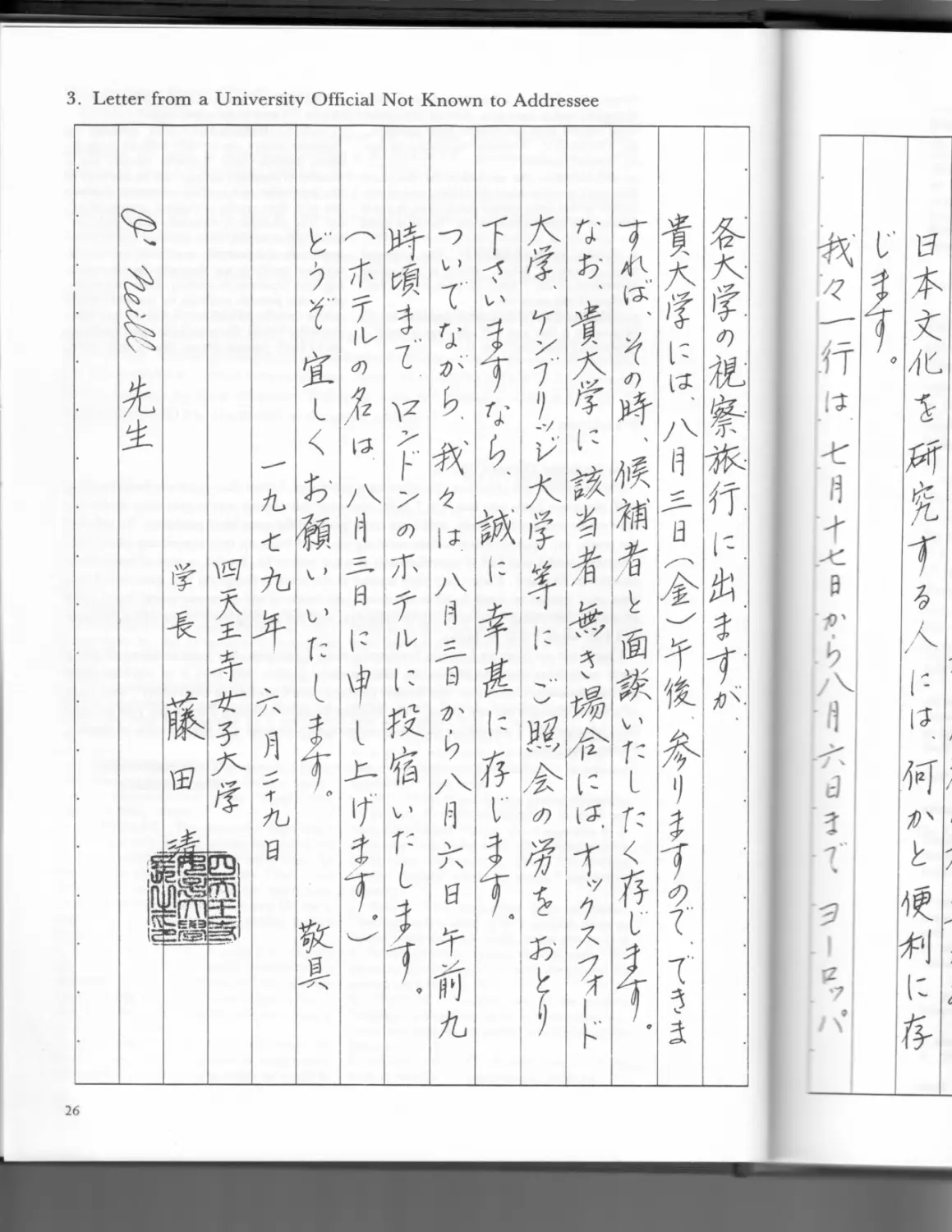
3. Letter from a University Official Not Known to Addressee
26
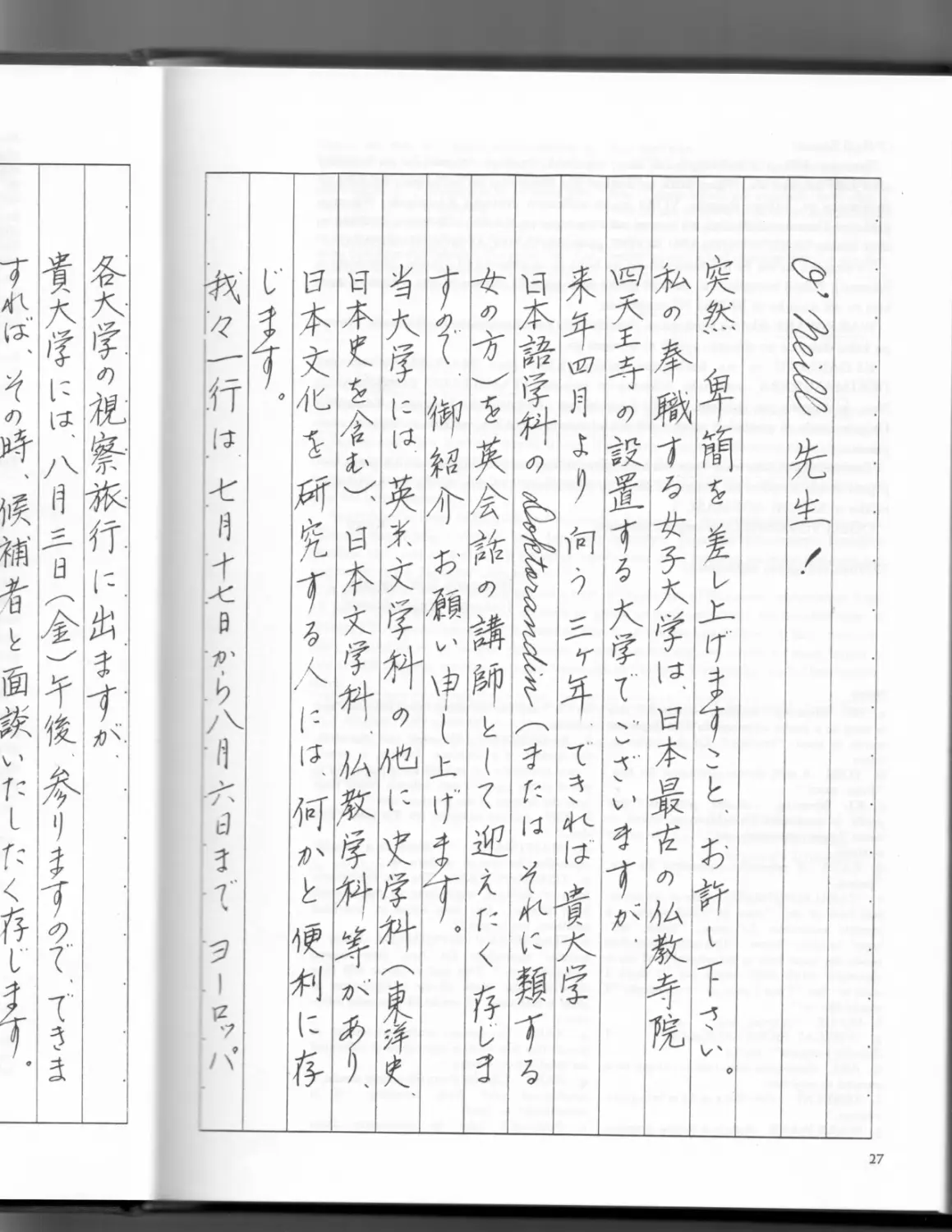
27
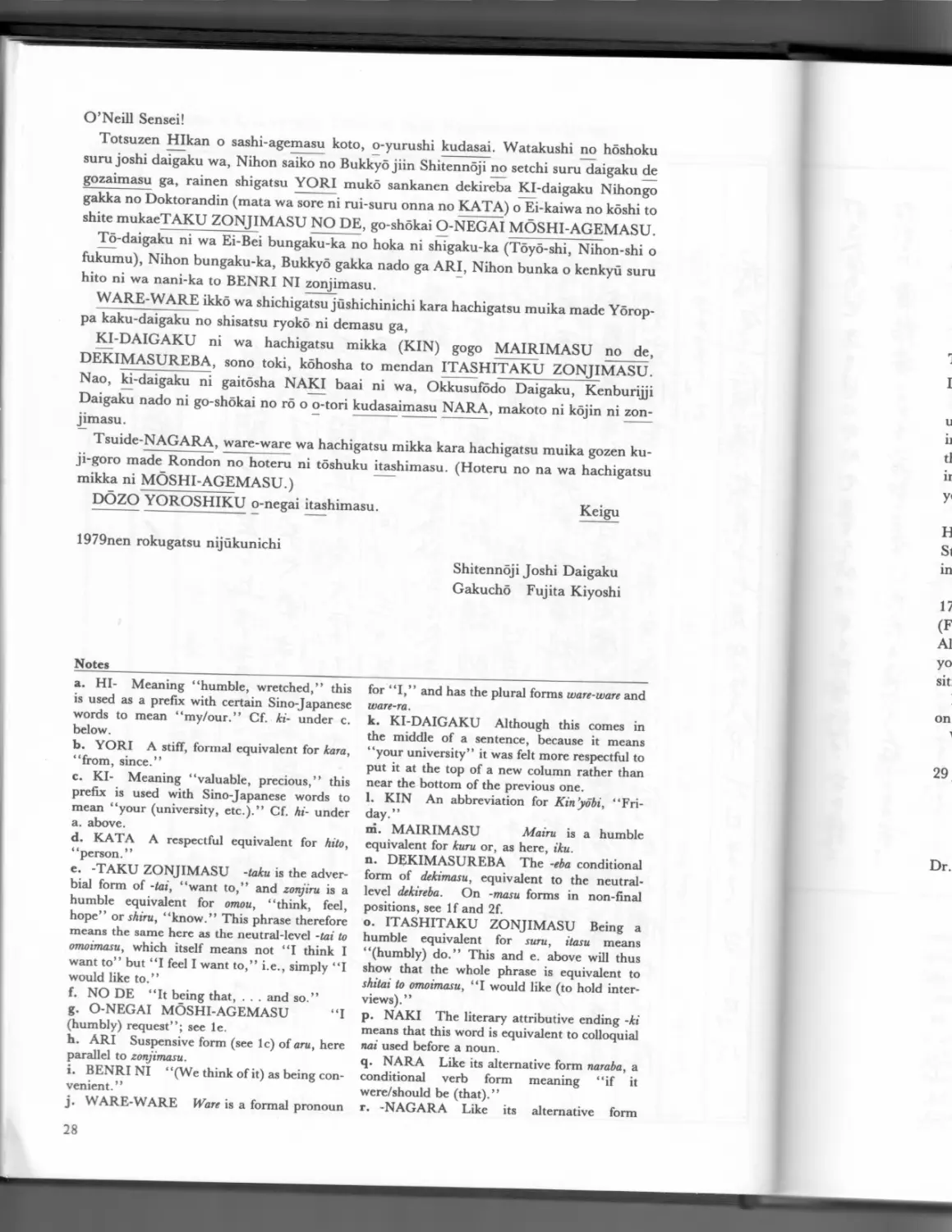
O’Neill Sensei!
Totsuzen HIkan о sashi-agemasu koto, o-yurushi kudasai. Watakushi no hoshoku
suru joshi daigaku wa, Nihon saiko no Bukkyo jiin Shitennoji no setchi suru daigaku de
gozaimasu ga, rainen shigatsu YORI muko sankanen dekireba Kl-daigaku Nihongo
gakka no Doktorandin (mata wa sore ni rui-suru onna no KATA) о Ei-kaiwa no koshi to
shite mukaeTAKU ZONJIMASU NO DE, go-shokai O-NEGAI MOSHI-AGEMASU.
Тб-daigaku ni wa Ei-Bei bungaku-ka no hoka ni shigaku-ka (Тбуб-shi, Nihon-shi о
fukumu), Nihon bungaku-ka, Bukkyo gakka nado ga ARI, Nihon bunka о kenkyu suru
hito ni wa nani-ka to BENRI NI zonjimasu.
WARE-WARE ikko wa shichigatsu jushichinichi kara hachigatsu muika made Yorop-
pa kaku-daigaku no shisatsu ryoko ni demasu ga,
KI-DAIGAKU ni wa hachigatsu mikka (KIN) gogo MAIRIMASU no de,
DEKIMASUREBA, sono toki, kohosha to mendan ITASHITAKU ZONJIMASU.
Nao, ki-daigaku ni gaitosha NAKI baai ni wa, Okkusufodo Daigaku, Kenburijji
Daigaku nado ni go-shokai no го о o-tori kudasaimasu NARA, makoto ni kojin ni zon-
jimasu.
Tsuide-NAGARA, ware-ware wa hachigatsu mikka kara hachigatsu muika gozen ku-
ji-goro made Rondon no hoteru ni toshuku itashimasu. (Hoteru no na wa hachigatsu
mikka ni MOSHI-AGEMASU.)
DOZO YOROSHIKU o-negai itashimasu.	Keigu
1979nen rokugatsu nijukunichi
Shitennoji Joshi Daigaku
Gakucho Fujita Kiyoshi
Note»____________________________________
a.	HI- Meaning “humble, wretched,” this
is used as a prefix with certain Sino-Japanese
words to mean “my/our.” Cf. ki- under c.
below.
b.	YORI A stiff, formal equivalent for kara,
“from, since.”
c.	KI- Meaning “valuable, precious,” this
prefix is used with Sino-Japanese words to
mean “your (university, etc.).” Cf. hi- under
a. above.
d.	KATA A respectful equivalent for hito,
“person.”
e.	-TAKU ZONJIMASU -taku is the adver-
bial form of -tai, “want to,” and zonjiru is a
humble equivalent for omou, “think, feel,
hope” or shiru, “know.” This phrase therefore
means the same here as the neutral-level -tai to
omoimasu, which itself means not “I think I
want to” but “I feel I want to,” i.e., simply “I
would like to.”
f.	NO DE “It being that, . . . and so.”
g.	O-NEGAI MOSHI-AGEMASU “I
(humbly) request”; see le.
h.	ARI Suspensive form (see 1c) of aru, here
parallel to zonjimasu.
i.	BENRI NI “(We think of it) as being con-
venient.”
j.	WARE-WARE Ware is a formal pronoun
for “I,” and has the plural forms ware-ware and
ware-ra.
k.	KI-DAIGAKU Although this comes in
the middle of a sentence, because it means
“your university” it was felt more respectful to
put it at the top of a new column rather than
near the bottom of the previous one.
1.	KIN An abbreviation for Kin’yobi, “Fri-
day.”
m.	MAIRIMASU	Mairu is a humble
equivalent for kuru or, as here, iku.
n. DEKIMASUREBA The -eba conditional
form of dekimasu, equivalent to the neutral-
level dekireba. On -masu forms in non-final
positions, see If and 2f.
o.	ITASHITAKU ZONJIMASU Being a
humble equivalent for suru, itasu means
“(humbly) do.” This and e. above will thus
show that the whole phrase is equivalent to
shitai to omoimasu, “I would like (to hold inter-
views).”
p.	NAKI The literary attributive ending -ki
means that this word is equivalent to colloquial
nai used before a noun.
q.	NARA Like its alternative form naraba, a
conditional verb form meaning “if it
were/should be (that).”
r.	-NAGARA Like its alternative form
28
-nagara mo, this is a suffix corresponding to
English “while,” both in the sense of “during
the time that” and, as here, “although”; i.e.,
tsuide-nagara = “although it is in passing/in-
cidental,” i.e., “incidentally.”
s. MOSHI-AGEMASU Although moshi-age-
ru is a humble equivalent for suru in some struc-
tures (see le and g. above), like mosu itself it is
basically a humble equivalent for the neutral-
level iu, “say,” and it is in this meaning that
it is used here.
t. DOZO YOROSHIKU Meaning respec-
tively, “please,” and “well, in a good/kindly
way,” these words are regularly used with a
verb, to ask someone to do or say something on
the speaker’s behalf. (They are also used, nor-
mally on their own, to commend oneself to a
senior person when meeting him for the first
time.)
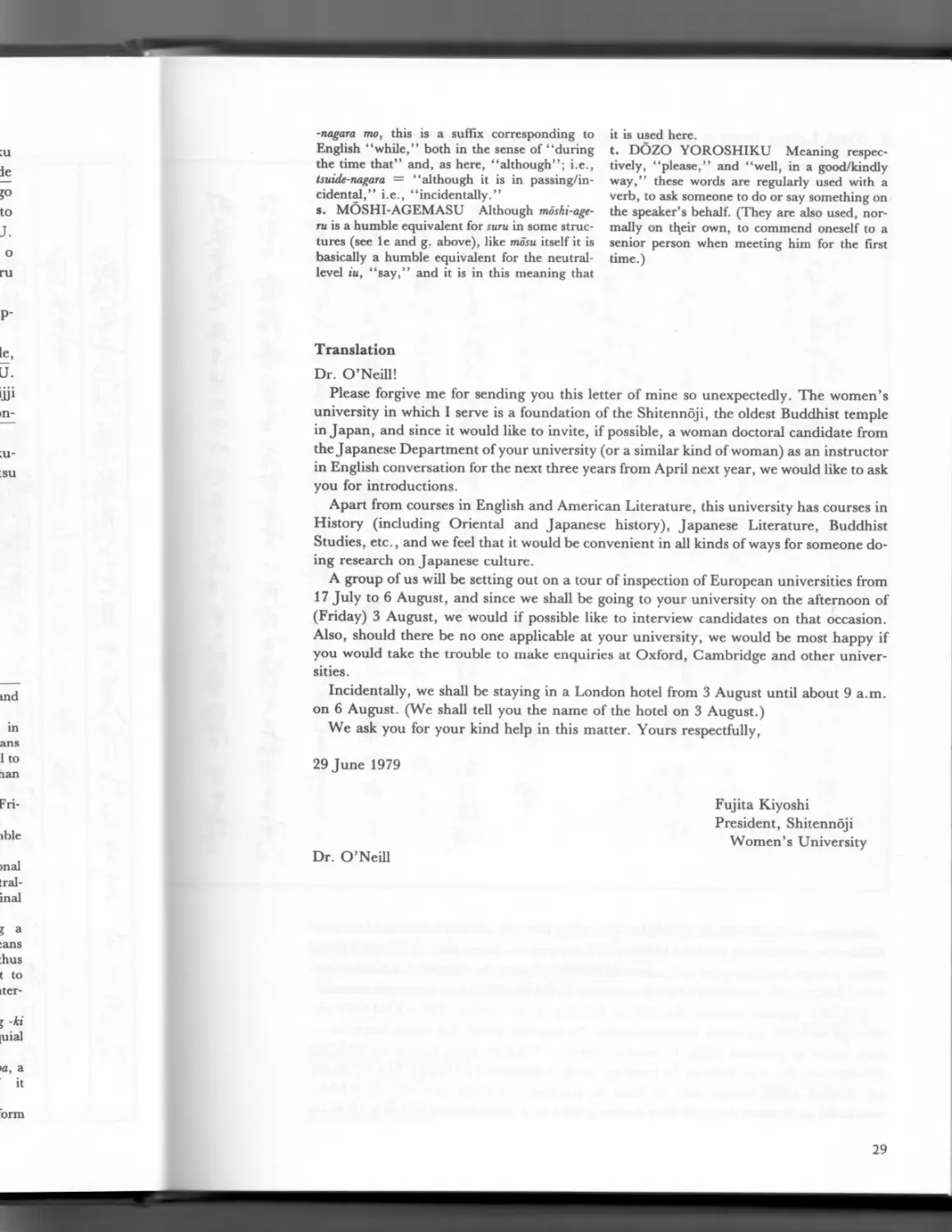
Translation
Dr. O’Neill!
Please forgive me for sending you this letter of mine so unexpectedly. The women’s
university in which I serve is a foundation of the Shitennoji, the oldest Buddhist temple
in Japan, and since it would like to invite, if possible, a woman doctoral candidate from
the Japanese Department of your university (or a similar kind of woman) as an instructor
in English conversation for the next three years from April next year, we would like to ask
you for introductions.
Apart from courses in English and American Literature, this university has courses in
History (including Oriental and Japanese history), Japanese Literature, Buddhist
Studies, etc., and we feel that it would be convenient in all kinds of ways for someone do-
ing research on Japanese culture.
A group of us will be setting out on a tour of inspection of European universities from
17 July to 6 August, and since we shall be going to your university on the afternoon of
(Friday) 3 August, we would if possible like to interview candidates on that occasion.
Also, should there be no one applicable at your university, we would be most happy if
you would take the trouble to make enquiries at Oxford, Cambridge and other univer-
sities.
Incidentally, we shall be staying in a London hotel from 3 August until about 9 a.m.
on 6 August. (We shall tell you the name of the hotel on 3 August.)
We ask you for your kind help in this matter. Yours respectfully,
29 June 1979
Fujita Kiyoshi
President, Shitennoji
Women’s University
Dr. O’Neill
29
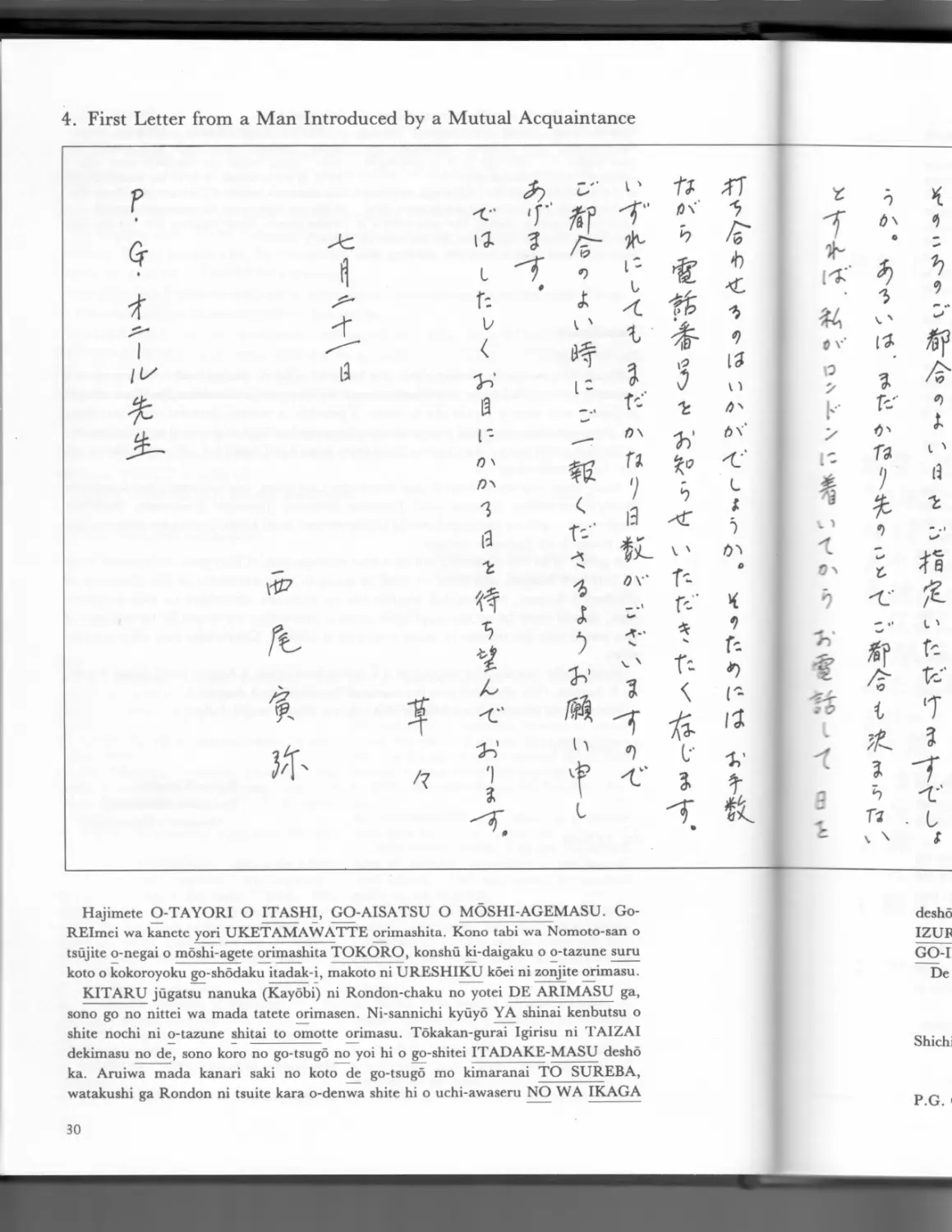
4. First Letter from a Man Introduced by a Mutual Acquaintance
Hajimete O-TAYORI О ITASHI, GO-AISATSU О MOSHI-AGEMASU. Go-
REImei wa kanctc yori UKETAMAWATTE orimashita. Kono tabi wa Nomoto-san о
tsujite o-negai о moshi-agete orimashita TOKORO, konshu ki-daigaku о o-tazune suru
koto о kokoroyoku go-shodaku itadak-i, makoto ni URESHIKU koei ni zonjite orimasu.
KITARU jugatsu nanuka (Kayobi) ni Rondon-chaku no yotei DE ARIMASU ga,
sono go no nittei wa mada tatete orimasen. Ni-sannichi kyuyd YA shinai kenbutsu о
shite nochi ni o-tazune shitai to omotte orimasu. Tokakan-gurai Igirisu ni TA1ZAI
dekimasu no de, sono кого no go-tsugo no yoi hi о go-shitei ITADAKE-MASU desho
ka. Aruiwa mada kanari saki no koto de go-tsugo mo kimaranai TO SUREBA,
watakushi ga Rondon ni tsuite kara o-denwa shite hi о uchi-awaseru NO WA IKAGA
desho
IZUP
GO-I
De
Shichi
P.G.
30
се
Go-
an о
suru
asu.
ga,
su о
ZAI
esho
lBA,
О
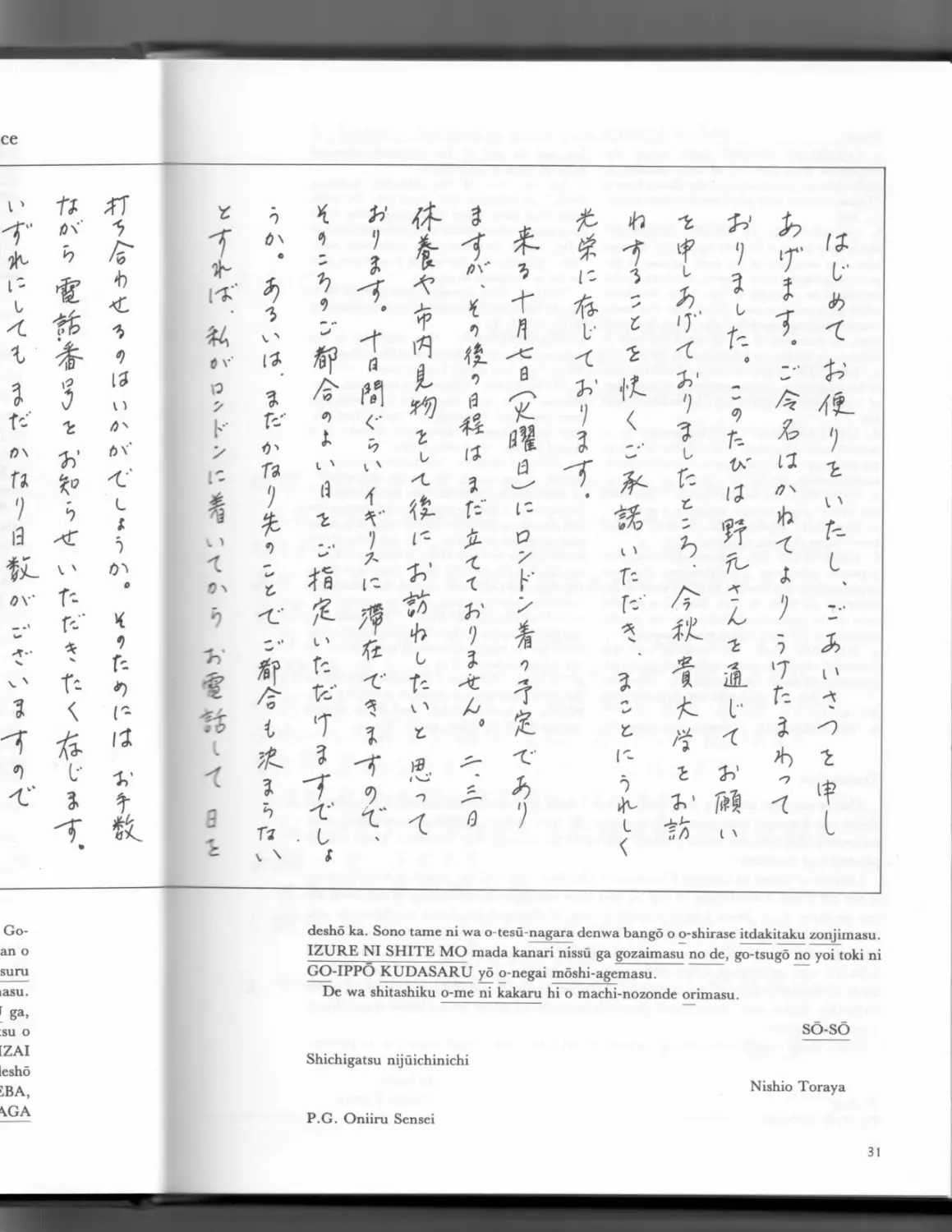
desho ка. Sono tame ni wa o-tesu-nagara denwa bango о o-shirase itdakitaku zonjimasu.
IZURE NI SHITE MO mada kanari nissu ga gozaimasu no de, go-tsugo no yoi toki ni
GO-IPPO KUDASARU yo o-negai moshi-agemasu.
De wa shitashiku о-me ni kakaru hi о machi-nozonde orimasu.
SO-SO
Shichigatsu nijuichinichi
Nishio Toraya
P.G. Oniiru Sensei
31
Notes______________________________________
a. O-TAYORI ITASHI Itashi being the
suspensive form (see 1c) of itasu, parallel to
moshi-agemasu, the meaning of the phrase here is
“I make contact with you/I write a letter to you
. . . and ...”
b. GO-AISATSU О MOSHI-AGEMASU
Mbshi-ageru being a humble equivalent for suru
here, this structure is the same as that in the
preceding clause (see a. above), and both can be
expressed as a single o- Igo- noun surulitasul
mbshi-ageru construction. (Note that this same
construction applies when the noun is a verb
stem, as described in le, or when the verb is
kudasaru or itadaku, as mentioned in 2d.)
c.	REI- This is to be found used in a number
of Sino-Japanese compound words in the sense
of “your (esteemed)”; e.g., go-reisokuy “your
son.”
d.	UKETAMAWATTE Uketamawaru is a
humble verb equivalent to neutral-level kiku in
the meaning “hear” as here, or “receive (infor-
mation/orders, etc.).”
e.	TOKORO As well as “place,” this word
can mean “point of time, stage (in a process)”
as here, and “aspect, point, matter.” Thus,
here “when (I made a request).”
f. URESHIKU The suspensive form of true-
Japanese adjectives (i.e., those of Japanese
origin ending in a vowel +1) is the same as the
adverbial -ku form, as here. Since it is parallel
here to the immediately following kbei ni, the
meaning is “(I feel) happy (and honoured).”
g. KITARU Note the reading of this
character when it is used attributively (i.e., ad-
jectivally) to mean “this coming . . . ,the next
...” In this use it should strictly be written
h.	DE ARIMASU A formal equivalent for
desw, see 2h and cf. the standard colloquial
negative form de wa arimasen.
i.	YA As one of the particles meaning
“and,” ya suggests that there may be items
other than those listed. (This suggestion is all
the stronger when toka is used between items in
a list, which therefore often ends with nado,
“etc.” Conversely, the use of to indicates that
the list is complete as given.)
j.	TAIZAI The character used here for tai is
the old full form instead of modem standard
k.	ITADAKEMASU Note that this is not
itadakimasu, but from the potential form itadakeru.
Thus, “(do you think) I could have. . . ?”
1.	TO SUREBA Following a statement, con-
ditional forms of to suru make it hypothetical
from the basic meaning of “make/treat/con-
sider as.” Thus, to sureba here means “if it
should be that, if we take it that.”
m. NO WA IKAGA Used after a verb or ad-
jective, no can mean “the one(s) who/which”;
or alternatively, as here, “the fact/matter of.”
In this case, it simply makes a noun form: “(as
for) arranging (a day).” Since ikaga is a polite
equivalent for do, “how,” the meaning of the
whole phrase is “how about arranging a day.”
n. IZURE NI SHITE MO Izure here being
the equivalent of dochira or dore, the meaning is
“whichever way we take it, in any event.”
o. GO-IPPO KUDASARU ‘‘To kindly send
word/write to me.” Note that this is part of the
same go- Io- noun (o) kudasaru construction as
the o-kikase kudasaru of 1g.
p. SO-SO “In haste.” The character here is
the most common one used to write this con-
cluding phrase in letters, and is an elegant
variant for SO “fast, quick.”
Translation
This is my first letter to you, and with it I send you my compliments. I have heard
about you for some time past, and now that you have readily agreed to my visiting your
university this autumn when I asked you to do so through Mr. Nomoto, I am indeed
pleased and honoured.
I expect to arrive in London (Tuesday) 7 October next, but my schedule from then on
is not yet fixed. I would like to call on you after resting and sightseeing in the town for
two or three days. Since I shall be able to stay in England for about ten days, do you
think you could specify for me the day that would suit you best during that time? Alter-
natively, if it should still be too far ahead for your arrangements to be made, how would
it be if I were to arrange a day with you by telephoning after I arrive in London? I am
sorry to trouble you, but I would like you to let me know your telephone number in order
to do this. Either way, there is still plenty of time left, so please let me know about this at
your convenience.
I am, then, very much looking forward to the day when I shall meet you in person.
In haste,
21 July	Nishio Toraya
Dr. P.G. O’Neill
32
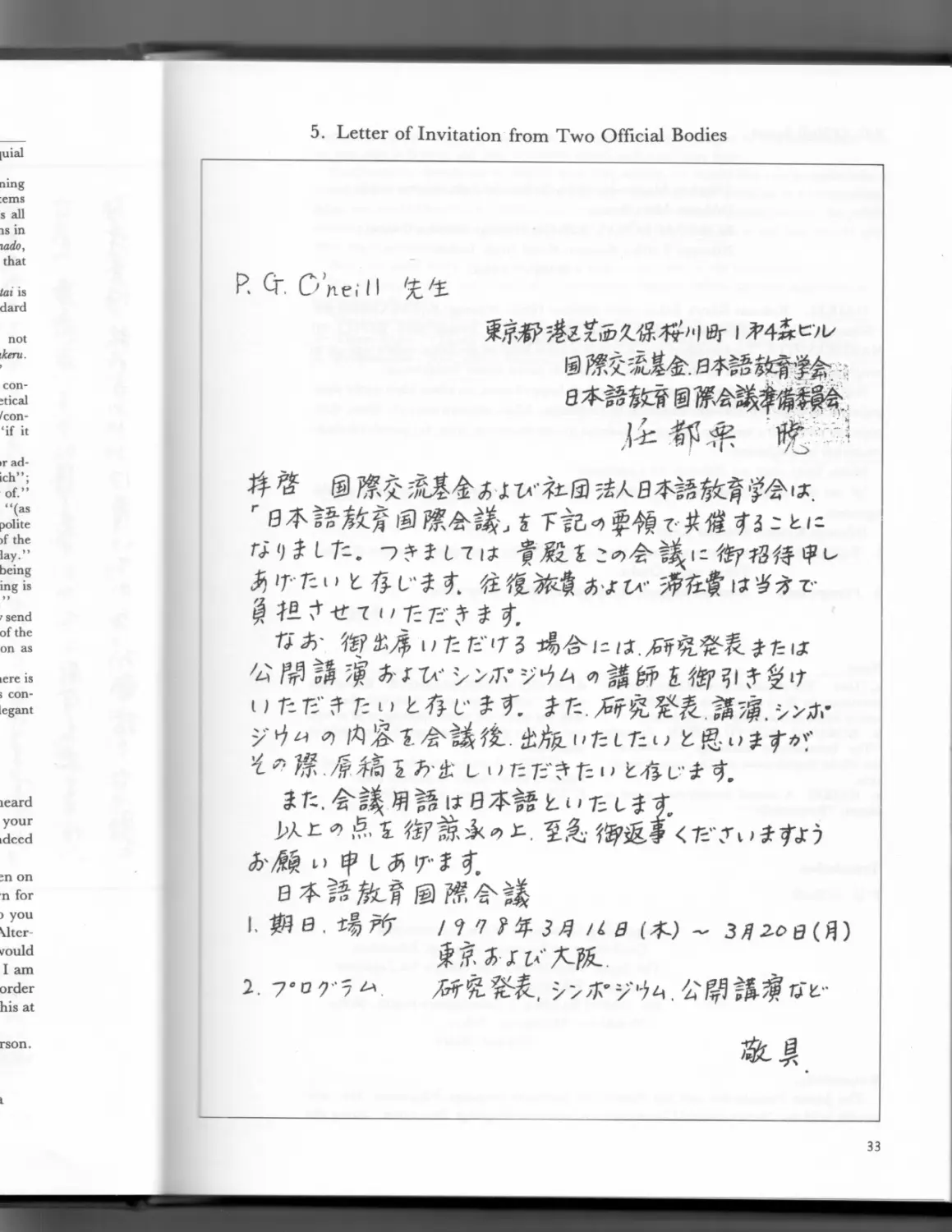
5. Letter of Invitation from Two Official Bodies
P. <T. O’neill '£z£
0Г I ЛЧ&ел/
J i If	C
W ® j J: U Ifcffl ?£А0*1Ш|
r 0 *IHfcf ® t Tid*> f № X#. & Г i = t I-
r/'iflT-.	f	фи
fl Ч-Т-" t t.	7/U
g 14 7 -tf 1 11 Tz Tz 5 t t.
«Л- иГг/Ь"'ТЗ
z4 i-1 Тл- > >/TZ У‘Ь А я ер J ?1 ?• $ 17
I) Г- П" if Г: 1> гГП"?^.
i^l'rzLTzi) t*’'
£ ~'	. //F	1 h it L i / К 7i"? fi i» t-fj L" i
а Г-. 'g'tl Я Й 17 0^ t < >7= L< f.
kJ.t л 5. j	(H'Jutffj
Sr/^t и ф L <f) 7- i
i	.J40.t|r^r	/ зя ц в (^.) ~ з^зоа(Я)
Ал«'Л?А.
2	. 7’07'7^	МЙ-^-Д, >>7'7'>i,,
33
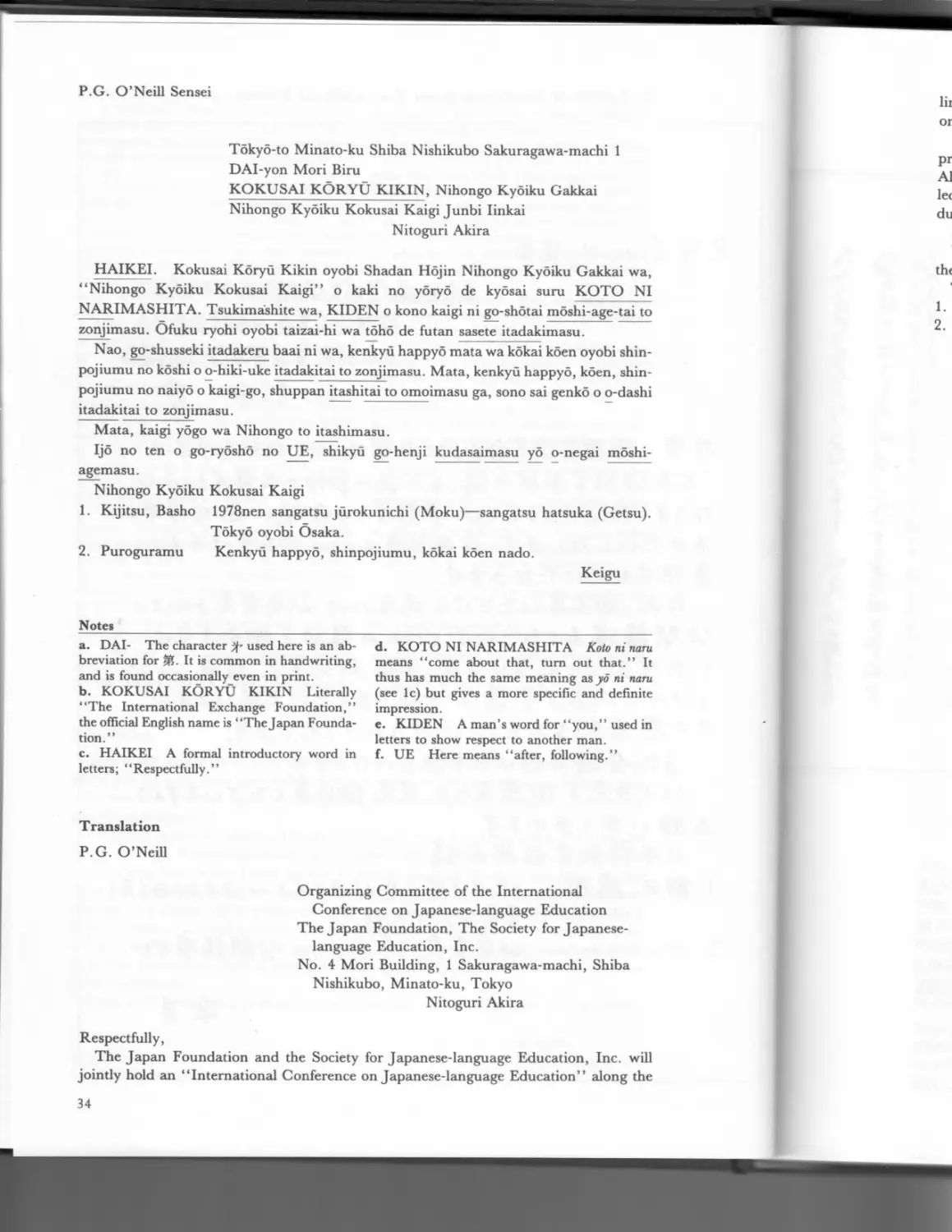
P.G. O’Neill Sensei
Tokyo-to Minato-ku Shiba Nishikubo Sakuragawa-machi 1
DAI-yon Mori Biru
KOKUSAI KORYU KIKIN, Nihongo Kydiku Gakkai
Nihongo Kydiku Kokusai Kaigi Junbi linkai
Nitoguri Akira
HAIKEI. Kokusai Koryu Kikin oyobi Shadan Hojin Nihongo Kydiku Gakkai wa,
“Nihongo Kydiku Kokusai Kaigi” о kaki no yoryo de kyosai suru KOTO NI
NARIMASHITA. Tsukimashite wa, KIDEN о kono kaigi ni go-shotai moshi-age-tai to
zonjimasu. Ofuku ryohi oyobi taizai-hi wa toho de futan sasete itadakimasu.
Nao, go-shusseki itadakeru baai ni wa, kenkyu happyo mata wa kokai koen oyobi shin-
pojiumu no koshi о o-hiki-uke itadakitai to zonjimasu. Mata, kenkyu happyo, koen, shin-
pojiumu no naiyo о kaigi-go, shuppan itashitai to omoimasu ga, sono sai genko о o-dashi
itadakitai to zonjimasu.
Mata, kaigi yogo wa Nihongo to itashimasu.
Ijo no ten о go-ryosho no UE, shikyu go-henji kudasaimasu yd o-negai moshi-
agemasu.
Nihongo Kydiku Kokusai Kaigi
1. Kijitsu, Basho 1978nen sangatsu jurokunichi (Moku)—sangatsu hatsuka (Getsu).
Tokyo oyobi Osaka.
2. Puroguramu Kenkyu happyo, shinpojiumu, kokai koen nado.
Keigu
Notes
a.	DAI- The character used here is an ab-
breviation for It is common in handwriting,
and is found occasionally even in print.
b.	KOKUSAI KORYU KIKIN Literally
“The International Exchange Foundation,”
the official English name is “The Japan Founda-
tion.”
c.	HAIKEI A formal introductory word in
letters; “Respectfully.”
d.	KOTO NI NARIMASHITA Koto ni naru
means “come about that, turn out that.” It
thus has much the same meaning as ni naru
(see 1c) but gives a more specific and definite
impression.
e.	KIDEN A man ’ s word for ‘ ‘ you, ’ ’ used in
letters to show respect to another man.
f.	UE Here means “after, following.”
Translation
P.G. O’Neill
Organizing Committee of the International
Conference on Japanese-language Education
The Japan Foundation, The Society for Japanese-
language Education, Inc.
No. 4 Mori Building, 1 Sakuragawa-machi, Shiba
Nishikubo, Minato-ku, Tokyo
Nitoguri Akira
Respectfully,
The Japan Foundation and the Society for Japanese-language Education, Inc. will
jointly hold an “International Conference on Japanese-language Education” along the
34
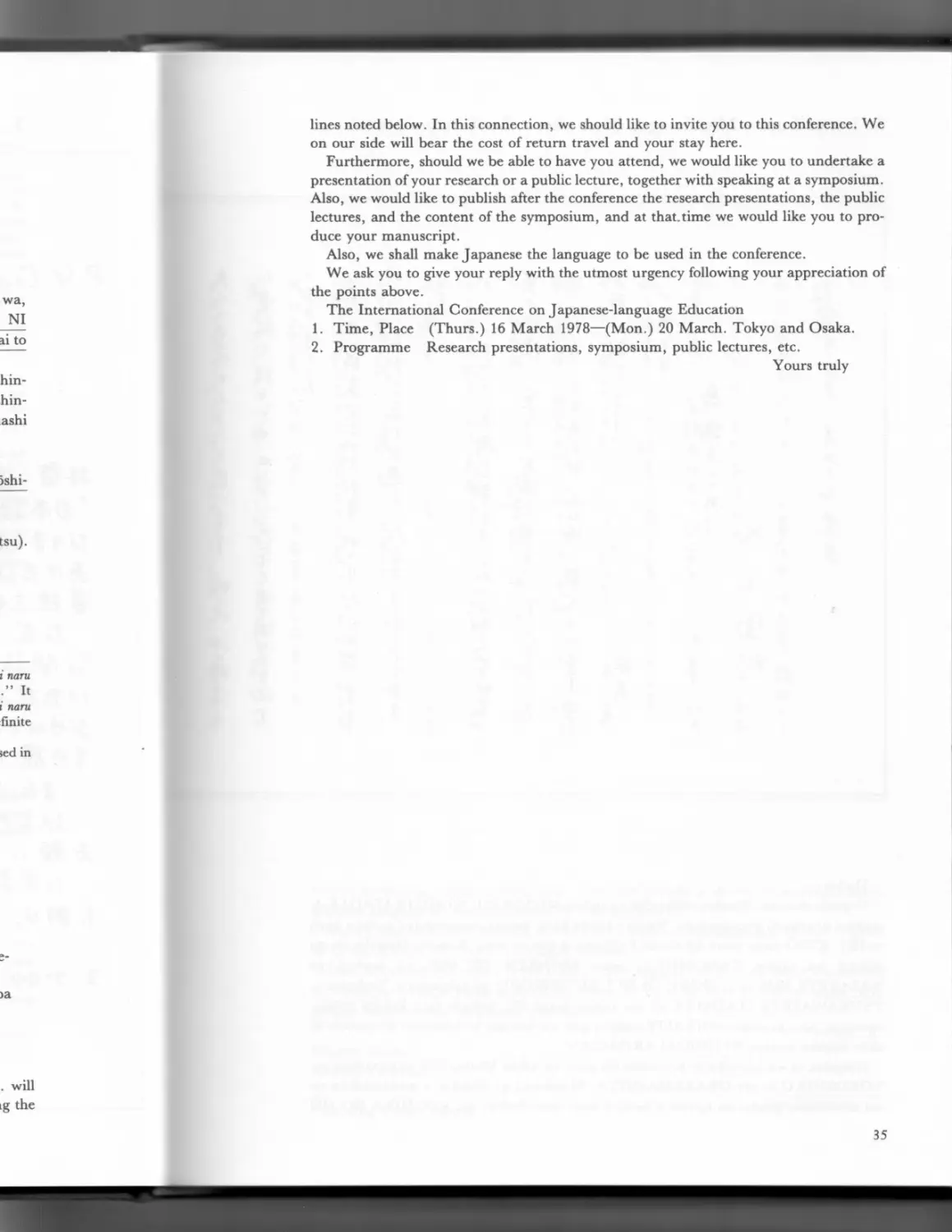
lines noted below. In this connection, we should like to invite you to this conference. We
on our side will bear the cost of return travel and your stay here.
Furthermore, should we be able to have you attend, we would like you to undertake a
presentation of your research or a public lecture, together with speaking at a symposium.
Also, we would like to publish after the conference the research presentations, the public
lectures, and the content of the symposium, and at that.time we would like you to pro-
duce your manuscript.
Also, we shall make Japanese the language to be used in the conference.
We ask you to give your reply with the utmost urgency following your appreciation of
the points above.
The International Conference on Japanese-Ianguage Education
1. Time, Place (Thurs.) 16 March 1978—(Mon.) 20 March. Tokyo and Osaka.
2. Programme Research presentations, symposium, public lectures, etc.
Yours truly
35
6. Letter from a Middle-aged Man after a Brief Acquaintance
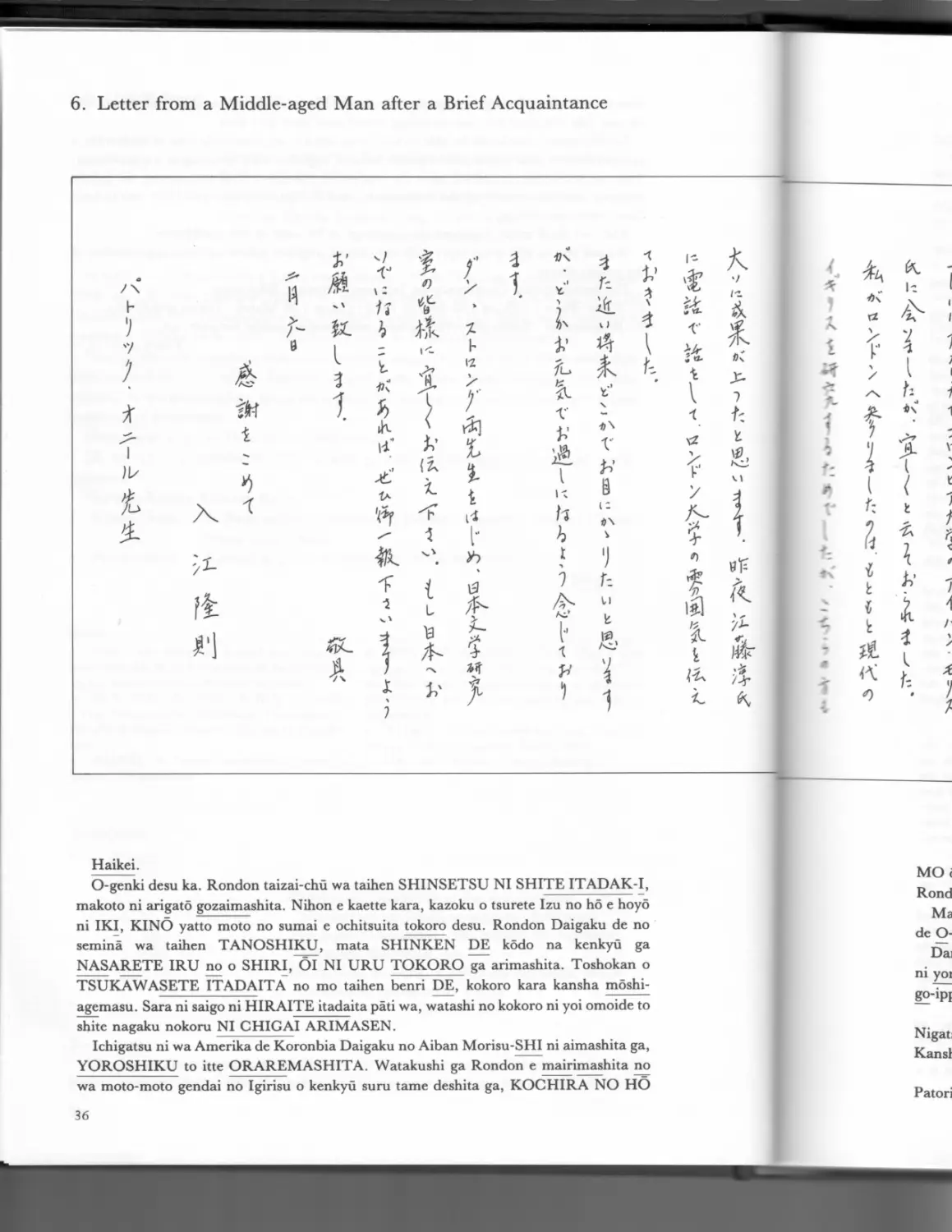
Haikei.
O-genki desu ka. Rondon taizai-chu wa taihen SHINSETSU NI SHITE ITADAK-I,
makoto ni arigato gozaimashita. Nihon e kaette kara, kazoku о tsurete Izu no ho e hoyo
ni IKI, KINO yatto moto no sumai e ochitsuita tokoro desu. Rondon Daigaku de no
semina wa taihen TANOSHIKU, mata SHINKEN DE kodo na kenkyu ga
NASARETE IRU no о SHIRI,~OI NI URU TOKORO gTarimashita. Toshokan о
TSUKAWASETE ITADAITA no mo taihen benri DE, kokoro kara kansha moshi-
agemasu. Sara ni saigo ni HIRAITE itadaita pati wa, watashi no kokoro ni yoi omoide to
Site nagaku nokoru NI CHIGAI ARIMASEN.
Ichigatsu ni wa Amerika de Koronbia Daigaku no Aiban Morisu-SHI ni aimashita ga,
YOROSHIKU to itte ORAREMASHITA. Watakushi ga Rondon e mairimashita no
wa moto-moto gendai no Igirisu о kenkyu suru tame deshita ga, KOCHIRA NO HO
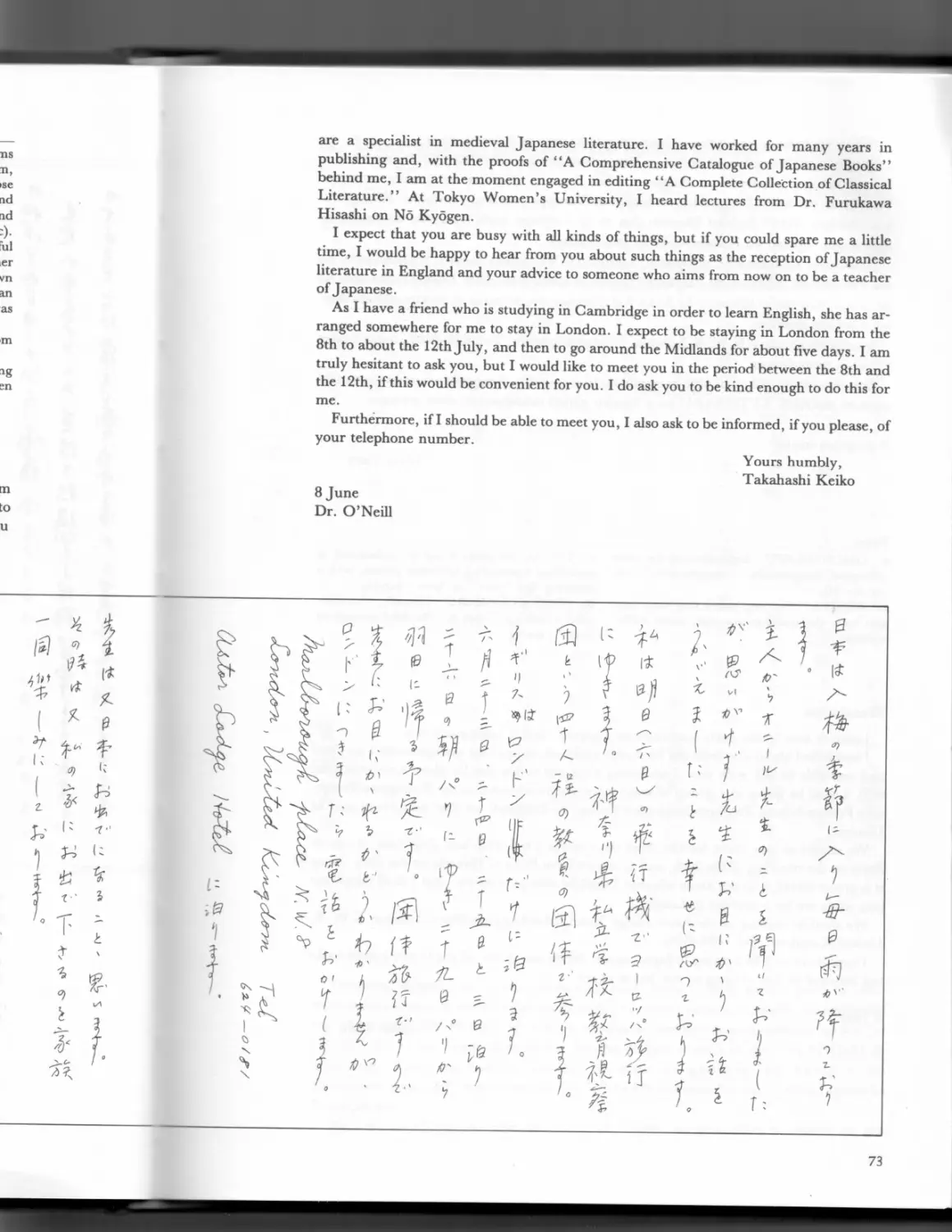
36
JGI,
hoyo
le no
ga
i о
to
la ga,
ta no
) HO
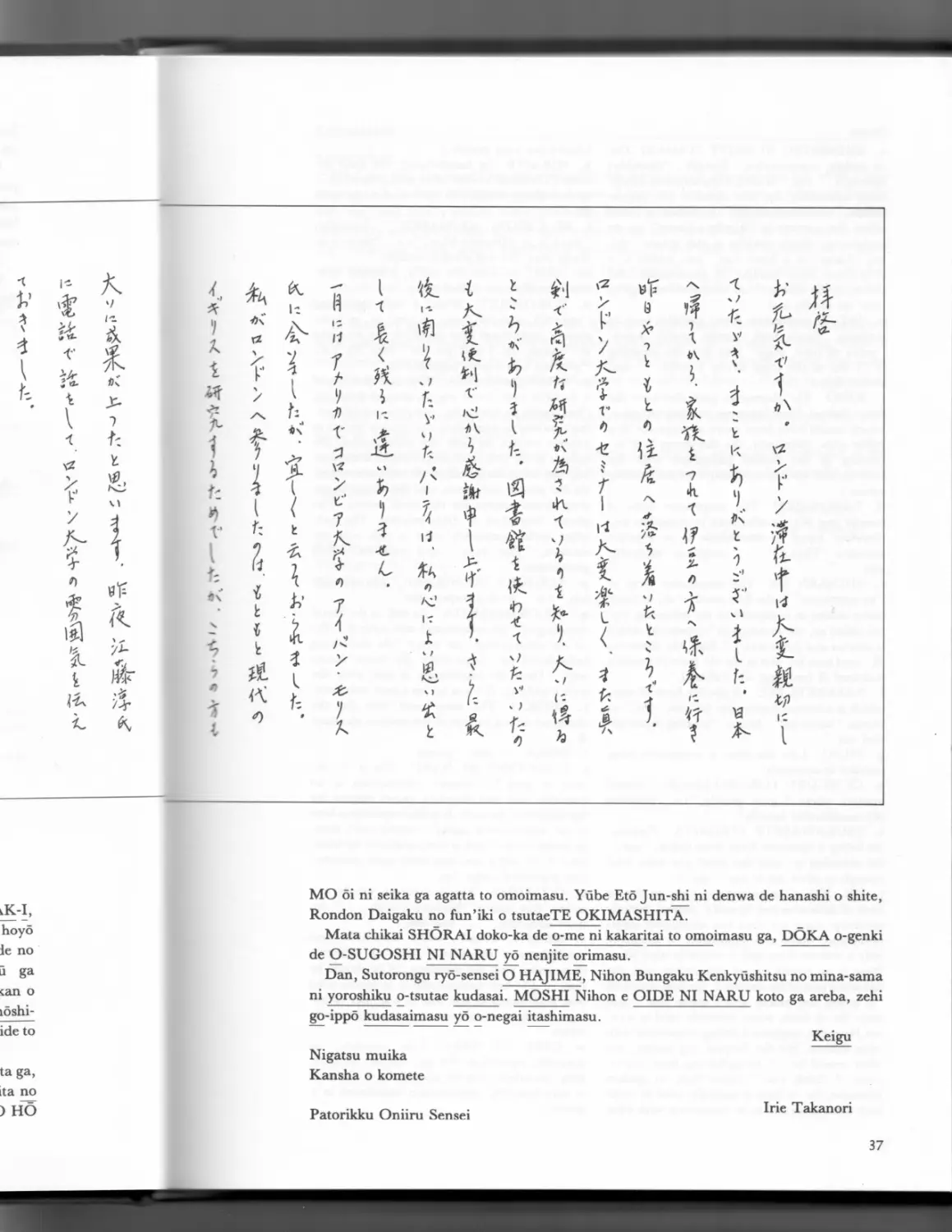
MO di ni seika ga agatta to omoimasu. Yube Eto Jun-shi ni denwa de hanashi о shite,
Rondon Daigaku no fun’iki о tsutaeTE OKIMASHITA.
Mata chikai SHORAI doko-ka de о-me ni kakaritai to omoimasu ga, DOKA o-genki
de O-SUGOSHI NI NARU yd nenjite orimasu.
Dan, Sutorongu ryd-sensei О HAJIME, Nihon Bungaku Kenkyushitsu no mina-sama
ni yoroshiku o-tsutae kudasai. MOSHI Nihon e OIDE NI NARU koto ga areba, zehi
go-ippo kudasaimasu yd o-negai itashimasu.
Keigu
Nigatsu muika
Kansha о komete
Patorikku Oniiru Sensei
Irie Takanori
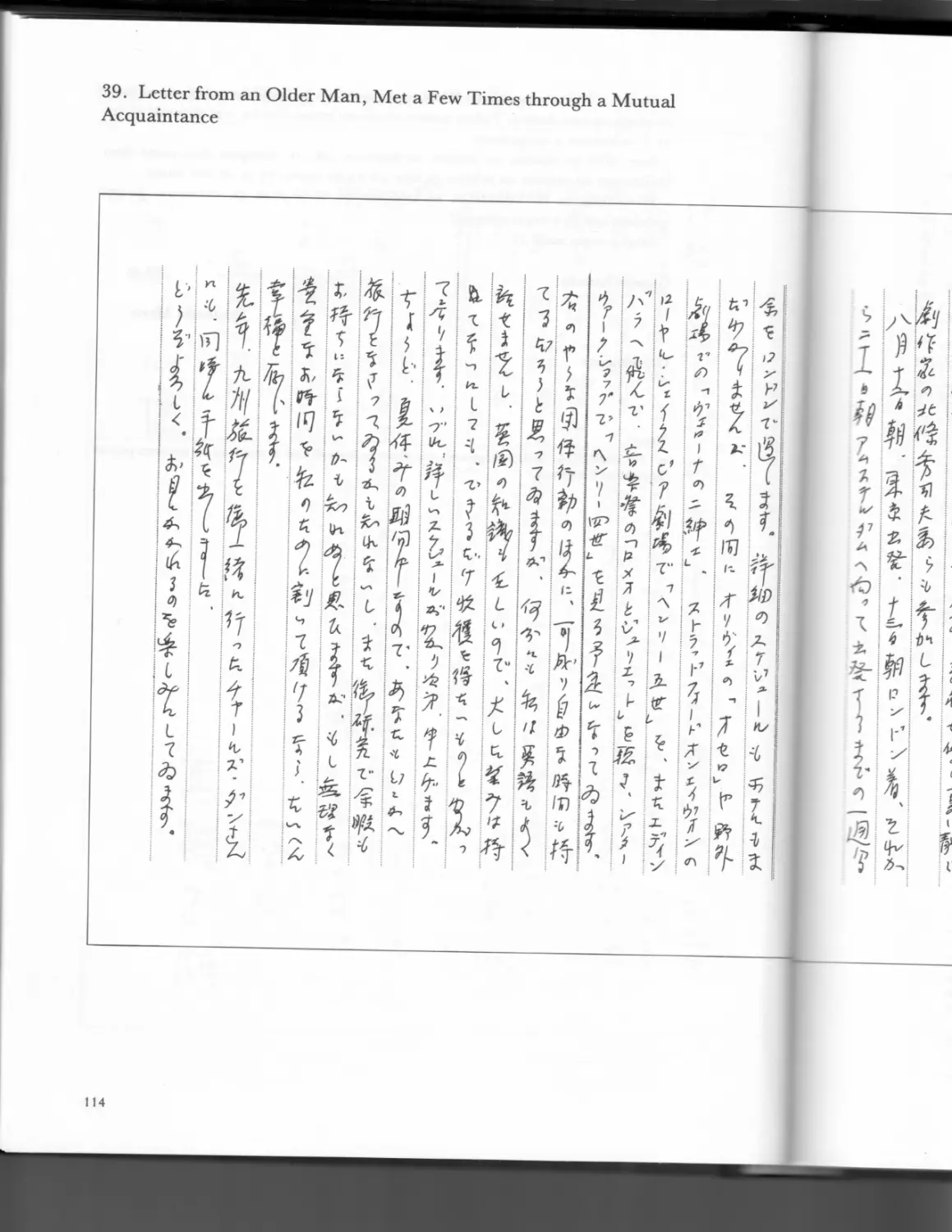
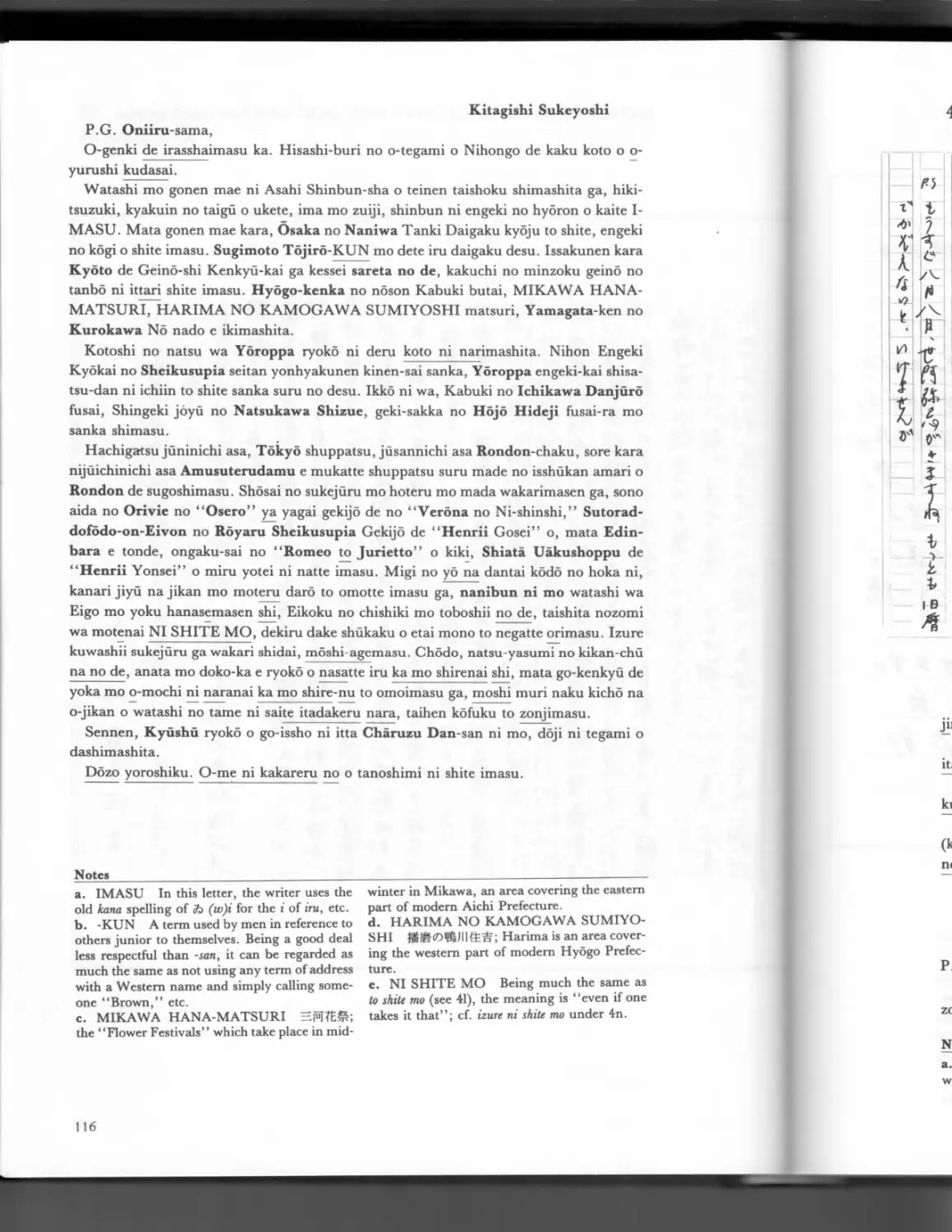
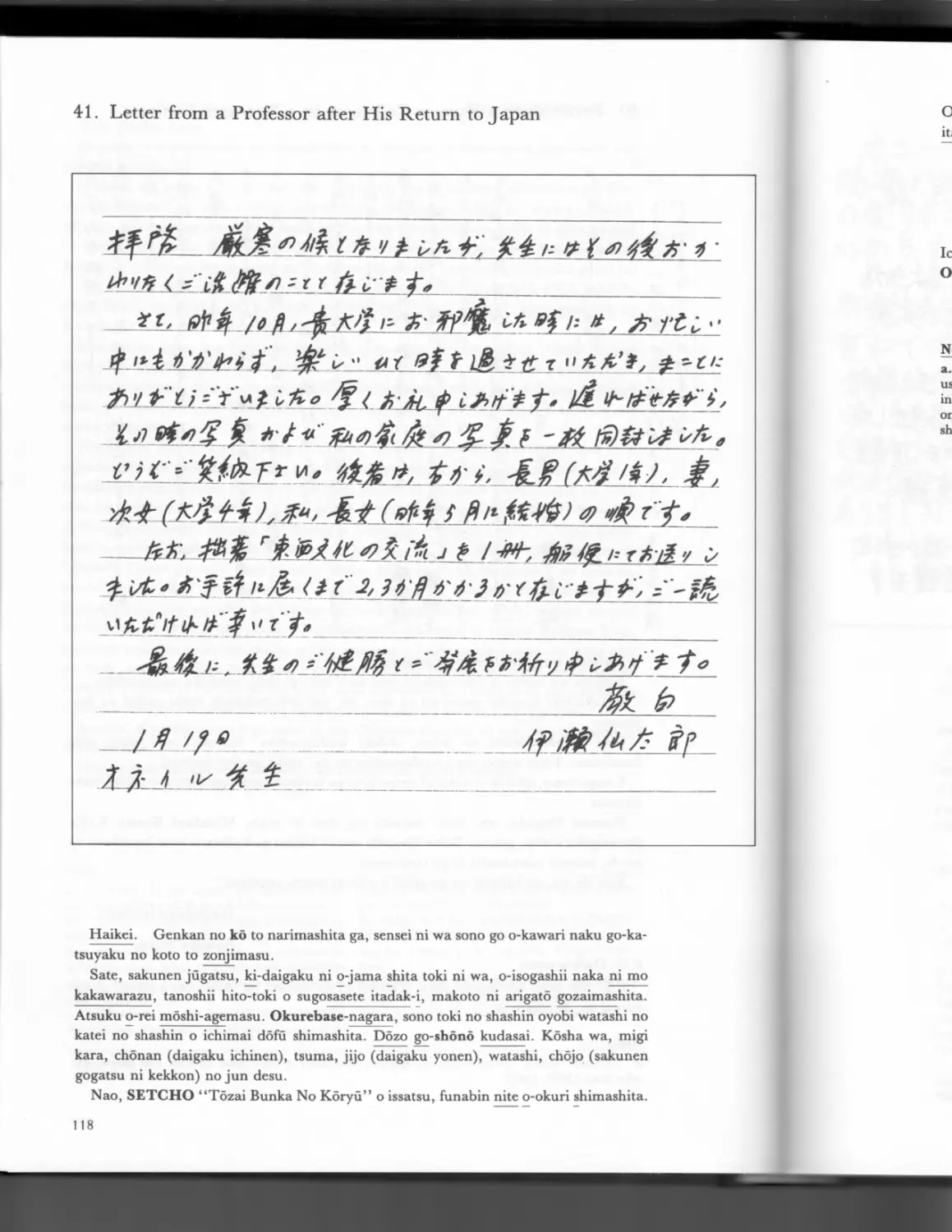
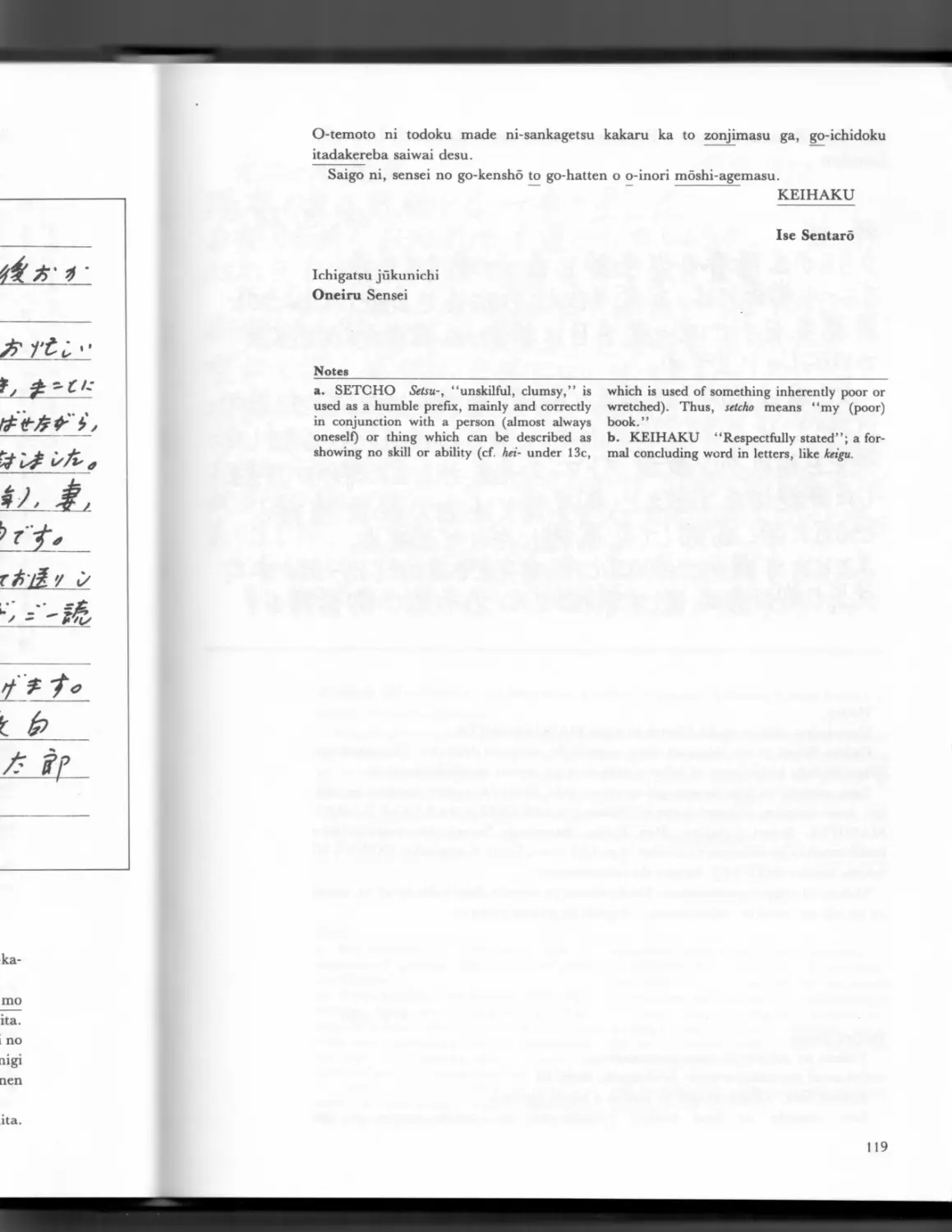
37
Notes________________________________________
a.	SHINSETSU NI SHITE ITADAKI The
-te itadaku construction, literally “(humbly)
receive a . . . ing, ’ ’ is used when someone kindly
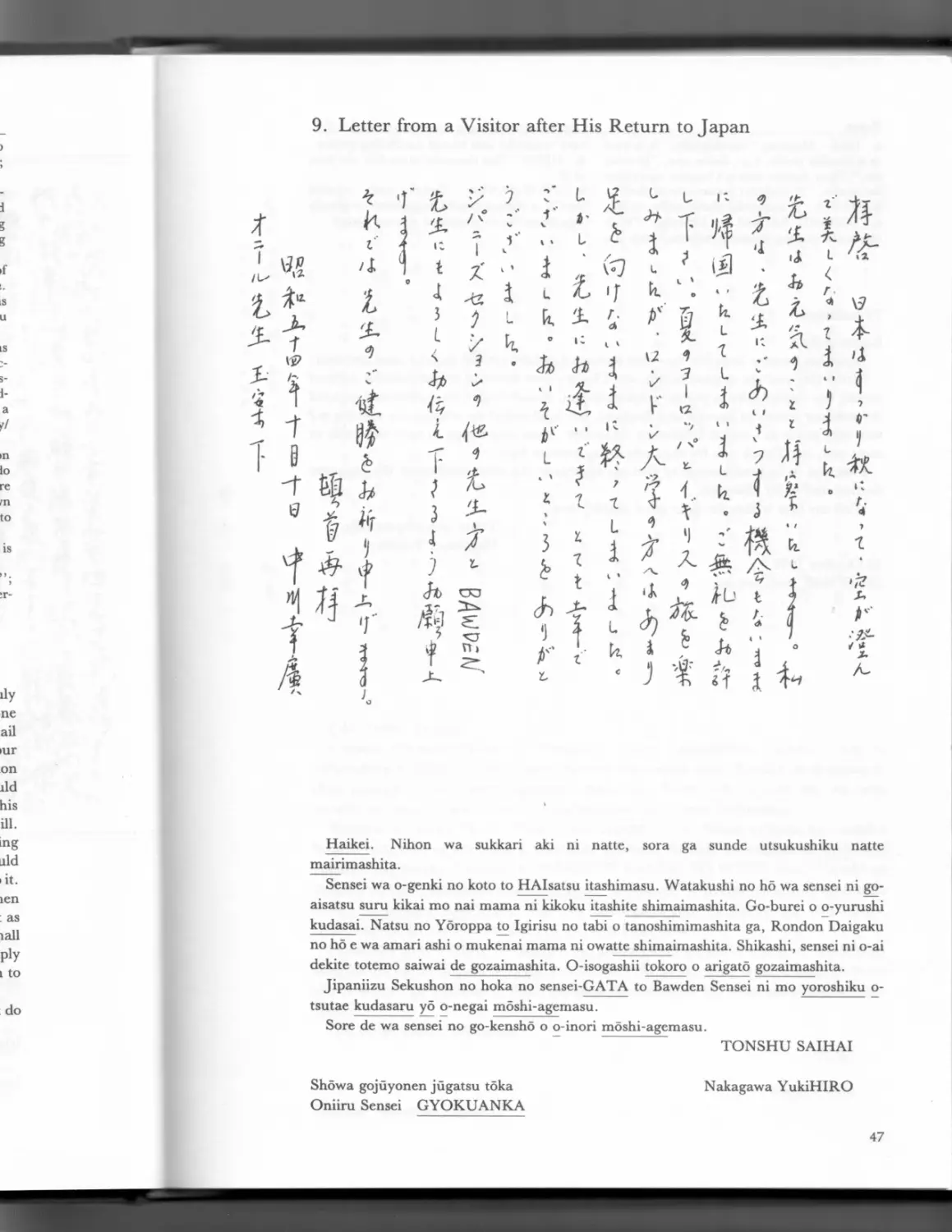
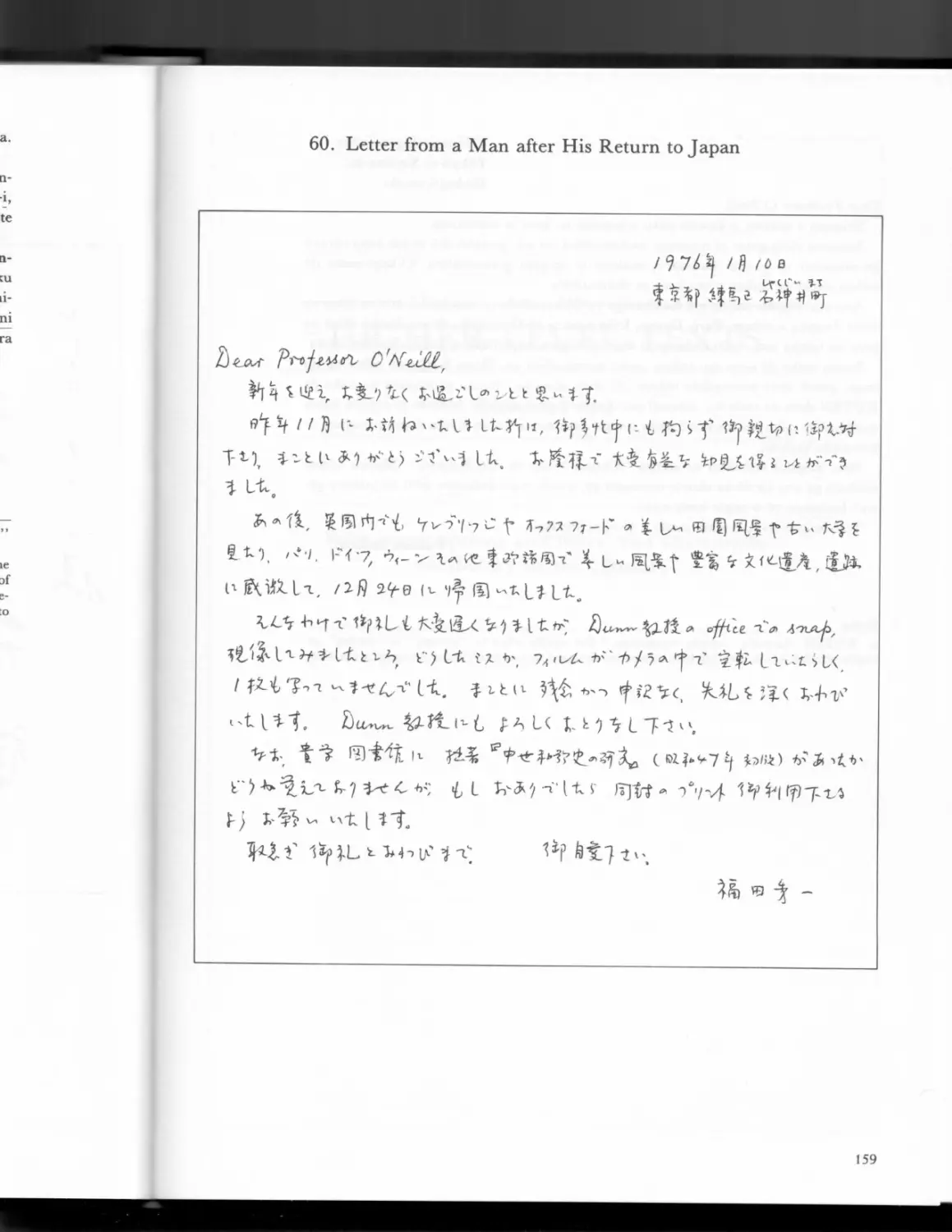
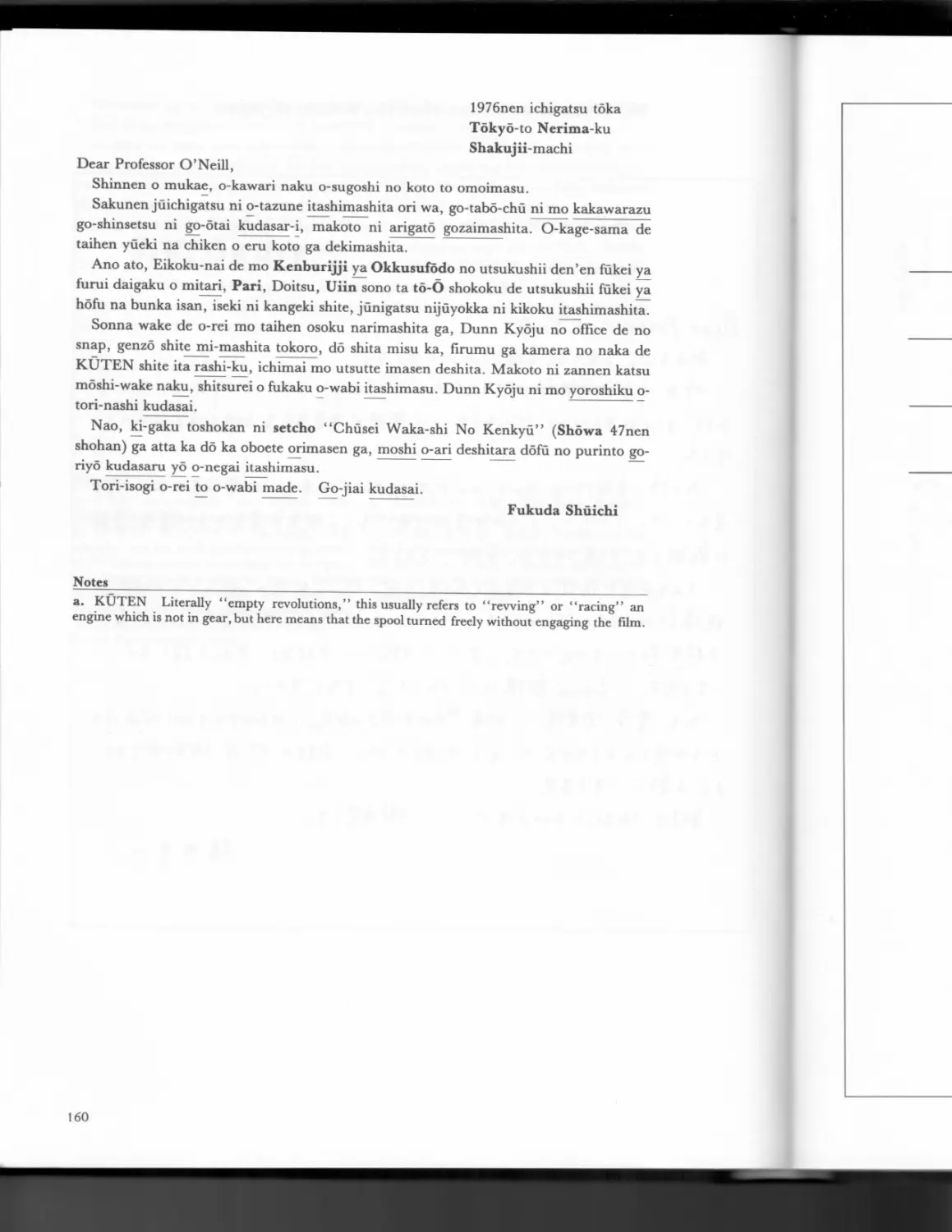
does something for the speaker (cf. (sa)sete
itadaku, explained under li, which is used
when the speaker is “kindly allowed” to do
something). Since shinsetsu ni shite means “do-
ing (things) in a kind way” and itadaki is a
suspensive form parallel to gozaimashita, the
whole phrase means “you were good enough to
treat me kindly and ...”
b.	IKI A suspensive form, parallel here to
ochitsuita. Since both words qualify tokoro,
“point of time, stage” (see 4e), the meaning
is “I am at the stage where I went . . . and
settled down ...”
c.	KINO The characters used also have the
more formal Sino-Japanese reading sakujitsu,
which would have been more appropriate in a
stiffer style. (Similarly, the characters ft® oc-
curring in the second paragraph with the
reading yube also have the more formal reading
sakuya.)
d.	TANOSHIKU The suspensive form of
tanoshii (see 4f), parallel here to arimashita and
therefore equal to tanoshikatta in a separate
sentence. Thus, “ ... was/were enjoyable
and . . .”
e.	SHINKEN DE The suspensive form of
“na adjectives” is the first word + de, as here.
Since shinken de is parallel to the following ver-
bal (kodd) na, the meaning is “(research) which
is serious and (high-level).” Also, the character
И used here for shin is the old form of modern
standard Д (see Арр. II, Table I).
f.	NASARETE IRU A passive form of nasu,
which is a literary equivalent for suru, “do,” or
окопай, “carryout”; hence, “is being done/car-
ried out.”
g.	SHIRI Like tanoshiku, a suspensive form
parallel to arimashita.
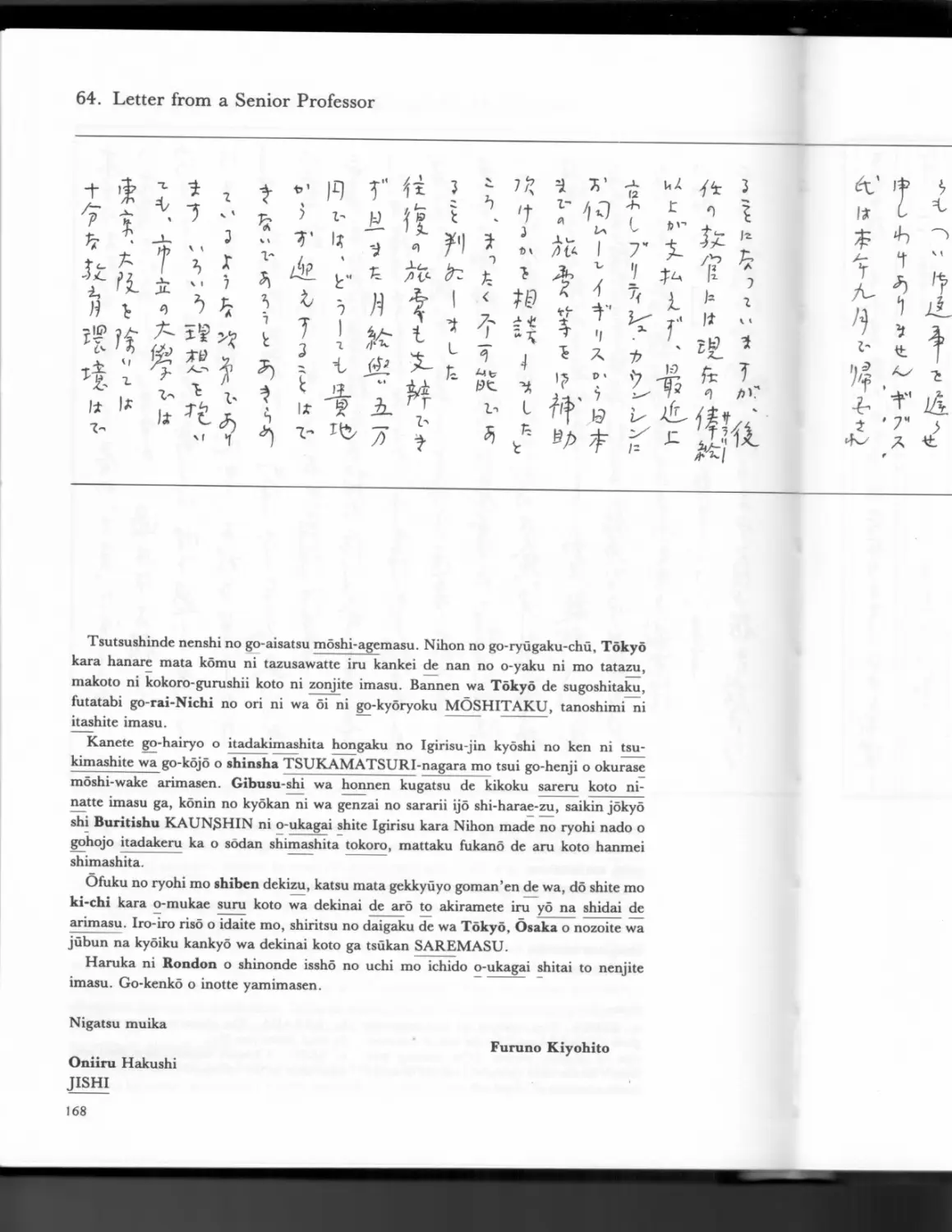
h.	OI NI URU TOKORO Literally,“points/
matters where I gain greatly,” i.e.,“(matters
of) considerable benefit.”
i.	TSUKAWASETE ITADAITA Tsukawa-
sete being a causative form from tsukau, “use,”
the meaning is “(the fact that) you were kind
enough to allow me to use”; see li.
j.	DE Either the suspensive form or the -te
form of daldesu/na (see 2g and e. above). Strictly
speaking, there are thus two alternative inter-
pretations: since the suspensive is normally
only a written form and is correctly used when
there is no strong causal connection with the
following part of the sentence, the first would be
“it is/was convenient and I thank you”; and
since the -te form, when correctly used in writ-
ten Japanese, suggests a strong connection with
what follows, like the English -ing ending, the
other would be “it being/having been conve-
nient, I thank you.” (Note that, in spoken
Japanese, the -te form is normally used to cover
both these cases and so its connection with what
follows can vary greatly.)
k.	HIRAITE In handwriting, the gate ele-
ment H (radical 169) is often abbreviated top]
or something similar, as here in the character
1.	NI CHIGAI ARIMASEN Literally,
“there is no difference from,” i.e., “there is no
doubt that, (it) will surely/certainly.”
m.	-SHI An honorific suffix, a formal writ-
ten equivalent for -sama/-san.
n. YOROSHIKU When a verb signifying
“say, tell, pass on,” etc., is used or, as here,
merely understood afteryoroshiku, the meaning
is “(speak, etc.) well for me” (see 3t); i.e.,
“give my best wishes/regards (to) ...”
o.	ORAREMASHITA The combination of
a humble verb (here oru = neutral-level iru,
“be”) with an honorific passive/potential end-
ing (-(ra)reru) is used when the speaker wishes to
express respect for both the third person, the
subject of the verb, and the person he is address-
ing: the use of the humble verb indicates respect
for the person addressed, and the honorific en-
ding shows respect for the third person. The
phrase here thus = (itte) imashita. The only
other verbs commonly used in this way are
mosareru, “(he) says,” and mairareru, “(he)
goes/comes.”
p.	KOCHIRA NO HO MO “On this side
too,” i.e., “in this respect also.”
q.	-TE OKIMASHITA As well as the literal
meaning of “(do something) and leave it,” the
-te oku construction can mean “do something
beforehand (in preparation for some future
use).” Here the implication is that what the
writer told Mr. Eto was for his future reference.
r.	SHORAI The form used here for the
character rai is a variant of the modem standard
Ж-
s.	DOKA = dbzo, “please.”
t.	O-SUGOSHI NI NARU The о 4- vb.
stem ni naru (or nasaru) construction is an
honorific one and therefore shows respect for
the subject of the verb. It is thus equivalent here
to the neutral-level sugosu, “spend one’s time,
go along in life,” and is comparable to the hum-
ble о + vb. stem suru/itasu/moshi-ageru construc-
tion explained under leg.
u.	О HAJIME Also sometimes simply . . .
hajime, this means “beginning with ...” or,
more naturally, “. . . and also ...”
v.	MOSHI Usually, moshi introduces and
strengthens a conditional verb or adjective
(here areba) with the meaning “if (it should be
that . . .)”; but occasionally it is found used
with such words as toki, baai in a similar mean-
ing: “if there should be a time when/case in
which ...”
w.	OIDE NI NARU Like irassharu, an
honorific equivalent for iru, iku or, as here,
kuru. (In origin, it is the standard о 4- vb. stem
ni naru honorific construction mentioned in t.
above.)
38
Translation
Respectfully,
How are you keeping? I am truly grateful for the kindness you showed me while I was
staying in London. After returning to Japan, I went to Izu for a rest, taking my family
with me, and finally settled down yesterday in my own home. The seminars at London
University were very enjoyable. I also learned that seridus and high-level research is be-
ing carried on there, and I benefited a great deal. It was also very convenient to have
been allowed to use the library, and I thank you sincerely for this. Furthermore, the par-
ty which you gave at the end will certainly remain with me for a long time as a happy
memory.
In January in America I met Mr. Ivan Morris of Columbia University, and he asked
to be remembered to you. My visit to London was basically for the sake of doing research
into present-day England, and I feel that in this direction too I achieved a great deal. Last
night I spoke to Mr. Eto Jun on the telephone and advised him of things in general at
London University.
I hope to meet you again somewhere in the near future, and trust that you will con-
tinue to go along in good health.
Please pass on my good wishes to Drs. Dunn and Strong, and also to everyone in the
Japanese Literature Research Section. If you should come to Japan, do please be sure to
send me word.
Yours truly,
Irie Takanori
6 February
With grateful thanks
Dr. Patrick O’Neill
39
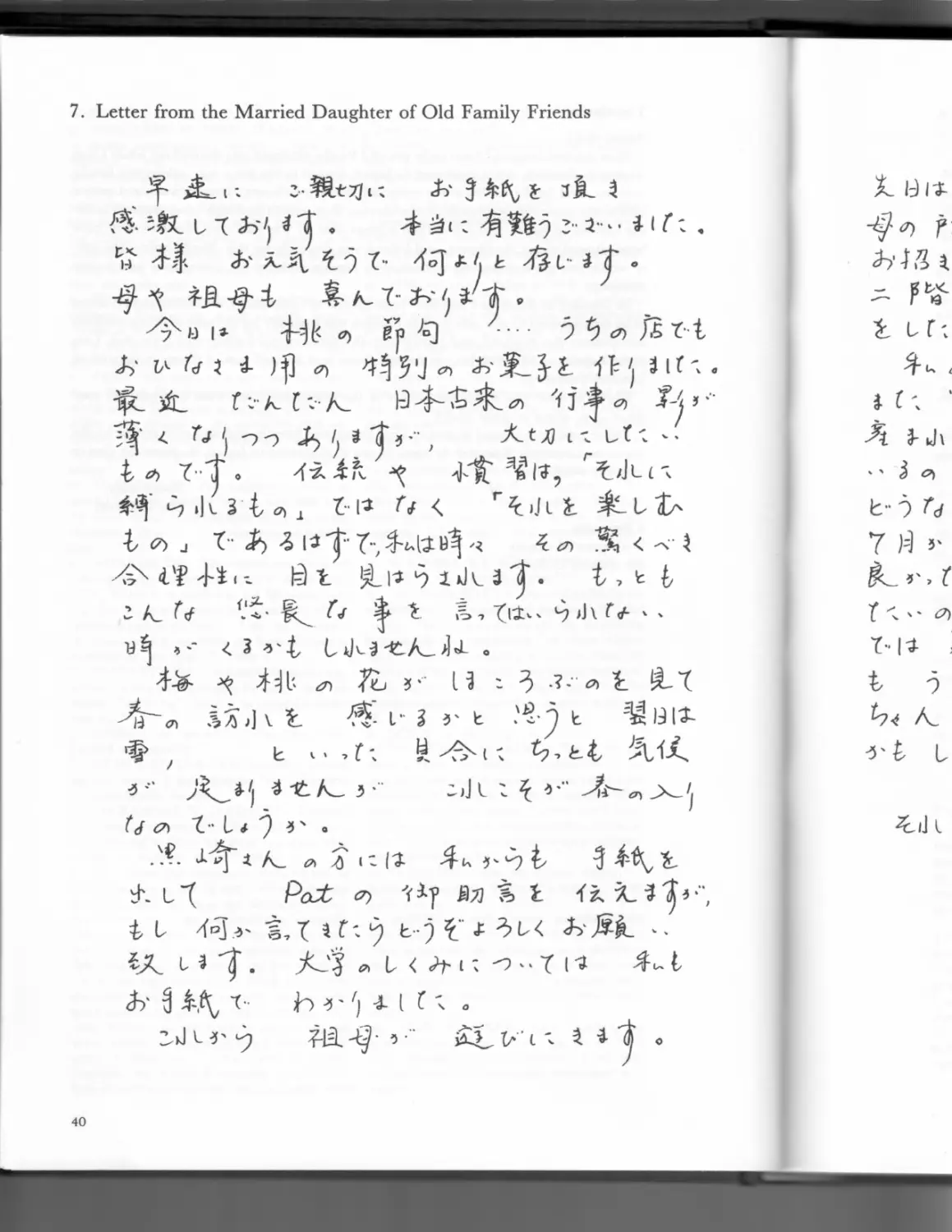
7.	Letter from the Married Daughter of Old Family Friends
dLtt yfttx/iz	liL 3
LU-j <1 ♦	4£<:
*h“	^>'Л-Д, ^QZ” 'foj <A 4 к 4^-L " d °
-^т4 а I*	<*)	•• • 9 ^7 <?) /«5 Z-t,
Л IA i ± )fl 4^5’J	£‘1^1 rtpit;.
t^L j&_ t :• А- Г ;•• Л_ Й Pp ”£> Ht. <я Xj	<?) 'S-l 9'"
j о 9 <£> z; * *t * ' \ A t x) i - u t < "
b Z-t. 4**k й< a£hr, 4jLt\
Zl* Г/ < r2cijifc.
Z- £)
/^4.Т-Н<г Й1 g_|i 9 IjJv 3 'I. t, t t
з	K.	f &. <11- 9 )h t+
<b't	о
4-^	4^1'^ ?ь ? *‘ 11 : 3 Ь Й- T
^ •'	3*	jjl -S'" -Й^гт>_Х_^
tj ch Z-- L rf 7 *' °
?Л. i /<_	(c {-J.	4-<л
Ы -|.
& 3 >Лч "
1J L
Pat СГ) Ifiy йт) 1
t,T I Г: *9 bj Г x 3L< 'Як
L < ?t I; О - Z 1	t
b ' zj 4-1 Г г
о
о-
1
0Д^. 1г" t ч
о
40
?f]X- ,	77	l^b"^
^>‘4o з. uf £Xl * । f; • Jjy , J- < YV is <T)
f^X"	fa i i s-KX"
t LH * t ЛЧх. r> L 4 J .
^u^Jii t, д' 4лЖ<^ z>"|	4^*7
if; ‘?41_ *•" № к fd-/j ii . ф^ч/vv"
ZiHiU '?4A_i*	t ,^Д
" 3 t- i •* ?	"1 «I l
b?fa ^3' Mj t "9 i o т ;X_
7 Й у Ь Я I T- 1^Л Xj x •	^‘••
^r,r. h	if. r/f^ u lX j&£i7
t X- f у' • * • «	~X^~' 54	J-) 13 t? < /\_ j
Т-|3 Я^ЛлГ;-, X-t? t&<cczv^ t Pc\t
t 9 3' ? 3' L 7 V» 3 9 ^L-4	rb (-i jt)
X?-t	r Jtt L” * • f? -i A_ u i - f / > / LI 7
d4 L Jv I -^/СсД «
i bCl И ; .
(so^\ з я з a
it) kt. J-
41
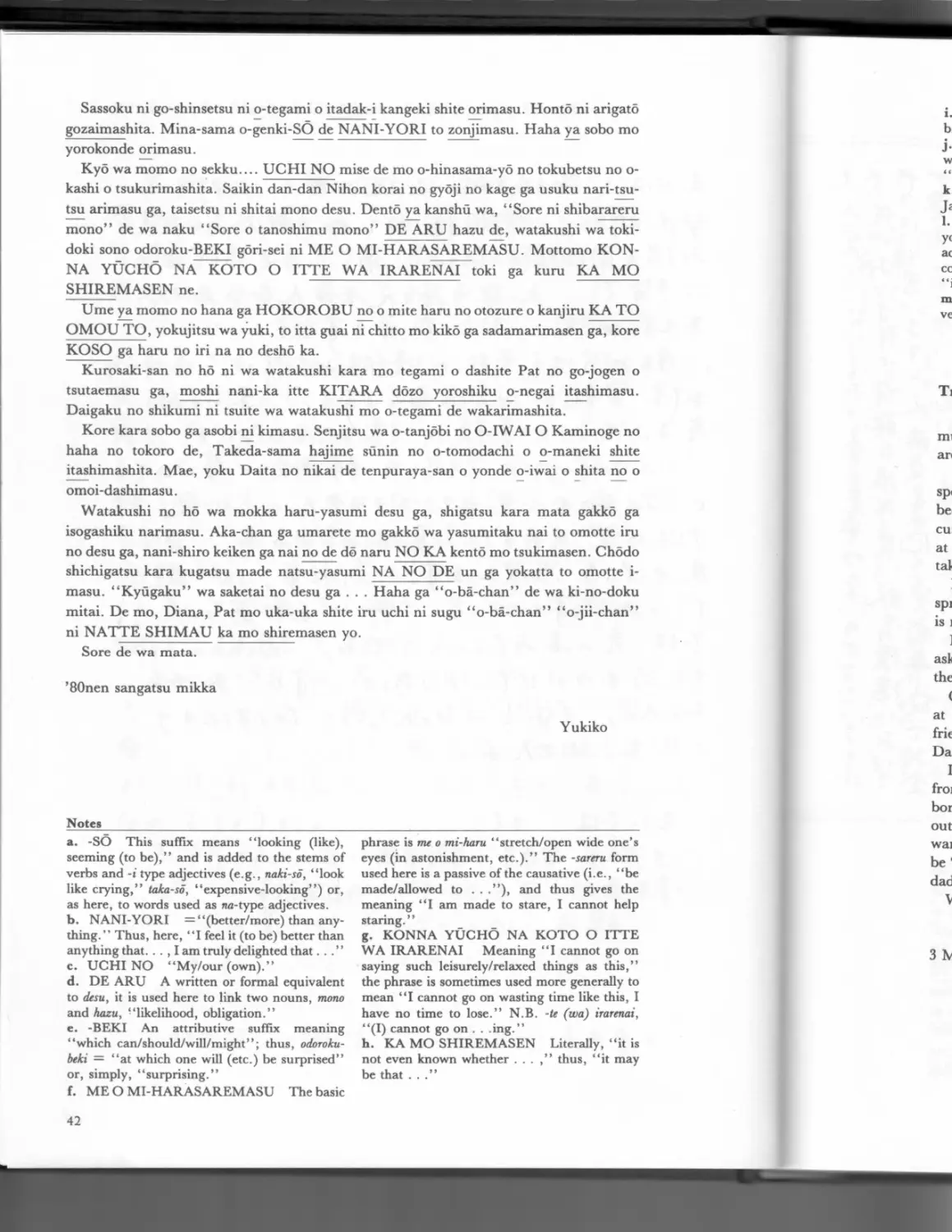
Sassoku ni go-shinsetsu ni o-tegami о itadak-i kangeki shite orimasu. Honto ni arigato
gozaimashita. Mina-sama o-genki-SO de NANI-YORI to zonjimasu. Haha ya sobo mo
yorokonde orimasu.
Куб wa momo no sekku.... UCHI NO mise de mo o-hinasama-уб no tokubetsu no o-
kashi о tsukurimashita. Saikin dan-dan Nihon korai no gyoji no kage ga usuku nari-tsu-
tsu arimasu ga, taisetsu ni shitai mono desu. Dento ya kanshu wa, “Sore ni shibarareru
mono” de wa naku “Sore о tanoshimu mono” DE ARU hazu de, watakushi wa toki-
doki sono odoroku-BEKI gori-sei ni ME О MI-HARASAREMASU. Mottomo KON-
NA YUCHO NA KOTO О ITTE WA IRARENAI toki ga kuru KA MO
SHIREMASEN ne.
Ume ya momo no hana ga HOKOROBU no о mite haru no otozure о kanjiru KA TO
OMOU TO, yokujitsu wa yuki, to itta guai ni chitto mo kiko ga sadamarimasen ga, kore
KOSO ga haru no iri na no desho ka.
Kurosaki-san no ho ni wa watakushi kara mo tegami о dashite Pat no go-jogen о
tsutaemasu ga, moshi nani-ka itte KITARA dozo yoroshiku o-negai itashimasu.
Daigaku no shikumi ni tsuite wa watakushi mo o-tegami de wakarimashita.
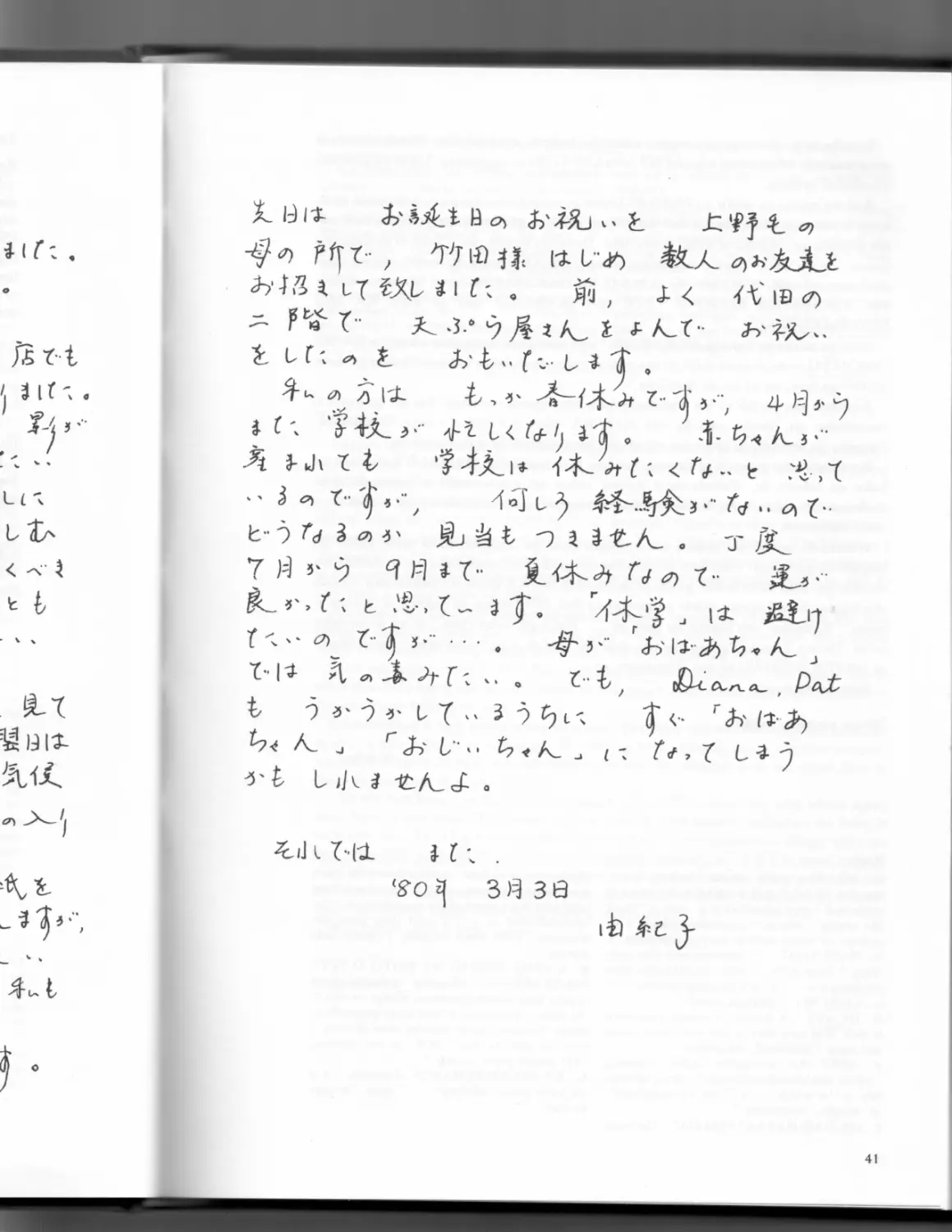
Kore kara sobo ga asobi ni kimasu. Senjitsu wa o-tanjobi no O-IWAI О Kaminoge no
haha no tokoro de, Takeda-sama hajime sunin no o-tomodachi о o-maneki shite
itashimashita. Mae, yoku Daita no nikai de tenpuraya-san о yonde o-iwai о shita no о
omoi-dashimasu.
Watakushi no ho wa mokka haru-yasumi desu ga, shigatsu kara mata gakko ga
isogashiku narimasu. Aka-chan ga umarete mo gakko wa yasumitaku nai to omotte iru
no desu ga, nani-shiro keiken ga nai no de do naru NO KA kento mo tsukimasen. Chodo
shichigatsu kara kugatsu made natsu-yasumi NA NO DE un ga yokatta to omotte i-
masu. “Kyugaku” wa saketai no desu ga . . . Haha ga “o-ba-chan” de wa ki-no-doku
mitai. De mo, Diana, Pat mo uka-uka shite iru uchi ni sugu “o-ba-chan” “o-jii-chan”
ni NATTE SHIM AU ka mo shiremasen yo.
Sore de wa mata.
’80nen sangatsu mikka
Yukiko
Notes___________________________________
a.	-SO This suffix means “looking (like),
seeming (to be),” and is added to the stems of
verbs and -i type adjectives (e.g., naki-so, “look
like crying,” taka-sd, “expensive-looking”) or,
as here, to words used as na-type adjectives.
b.	NANI-YORI =“(better/more) than any-
thing.” Thus, here, “I feel it (to be) better than
anything that. . . , I am truly delighted that...”
c. UCHI NO “Му/our (own).”
d.	DE ARU A written or formal equivalent
to desu, it is used here to link two nouns, mono
and hazu, “likelihood, obligation.”
e.	-BEKI An attributive suffix meaning
“which can/should/will/might”; thus, odoroku-
beki — “at which one will (etc.) be surprised”
or, simply, “surprising.”
f.	ME О MI-HARASAREMASU The basic
phrase is me о mi-haru “stretch/open wide one’s
eyes (in astonishment, etc.).” The -sareru form
used here is a passive of the causative (i.e., “be
made/allowed to ...”), and thus gives the
meaning “I am made to stare, I cannot help
staring.”
g.	KONNA YUCHO NA KOTO О ITTE
WA IRARENAI Meaning “I cannot go on
saying such leisurely/relaxed things as this,”
the phrase is sometimes used more generally to
mean “I cannot go on wasting time like this, I
have no time to lose.” N.B. -te (wa) irarenai,
“(I) cannot go on . . .ing.”
h.	KA MO SHIREMASEN Literally, “it is
not even known whether . . . ,” thus, “it may
be that ...”
42
i. HOKOROBU = hokorobiru, “(flowers)
break into bloom.”
j. KA TO OMOU TO “When one wonders
whether . . . ,” usually, as here, in the sense of
“No sooner does one think . . . (than . . . ).”
k. KOSO The most emphatic particle in
Japanese, with the force of “It is this that ...”
1. KITARA Literally, “if she should come to
you (saying ...).” The -tara form of verbs and
adjectives is either more hypothetical than other
conditionals, as here, or is used in a past sense:
“if one had (come, etc.).”
m. O-IWAI О This is the object of the final
verb of the sentence itashimashita\ hence, “we
held a celebration (at . . . by inviting . . . ).”
n. NO KA An interrogative often used at the
end of a subordinate clause, as here, for
euphony.
o. NA NO DE The na is verbal, meaning
“who/which is” as in the na-type adjectives and
is in some respects comparable to da/desu/de aru\
and no de — “it being that, and so.” Thus,
“since it is.”
p. NATTE SHTMAU The use of shimau
after a -te form gives a feeling of finality to the
preceding verb and can sometimes be trans-
lated, if at all, by “utterly, completely, . . . and
that was the end of it,” etc.
Translation
I appreciate very deeply having received your kind letter so promptly. Thank you very
much indeed. I am delighted that you all seem to be well. My mother and grandmother
are also pleased at this.
Today is the Peach Festival.... In our shop, as elsewhere (= de mo), we have made
special cakes for use in this Dolls’ Festival. Recently Japan’s ancient ceremonies have
been gradually fading away, but they are things I would like to cherish. Traditions and
customs should be things to enjoy and not to be bound by, and I am sometimes amazed
at the surprising logic in them. Of course, the time may come when I shan’t be able to
take such a relaxed view of things.
No sooner do I see the plum and peach blossoms beginning to break and feel that
spring is coming than the next day brings snow—with things being like that, the weather
is not at all settled, but perhaps that is just how the beginning of spring is.
I too will send a letter to Miss Kurosaki and pass on your advice, but I would like to
ask you to help her if she should contact you. I myself understood about the structure of
the university from your letter.
Grandmother is now going to pay us a visit. The other day we celebrated her birthday
at my mother’s place at Kaminoge by inviting Mrs. Takeda and a number of other
friends. I often recall how, in earlier times, we used to celebrate it on the upper floor at
Daita by bringing in a tenpura man.
I for my part have a spring holiday at present, but will become busy with school again
from April. I feel that I don’t want to take time off from school even when the baby is
born but, after all, I have no experience and so I can’t even guess how things will turn
out. From July to September is exactly the summer holiday, so I feel I’ve been lucky. I
want to avoid taking 3 4‘university leave” but. ... It seems a shame that my mother will
be “Granny.” Still, you and Diana too may suddenly end up as “Granny” and “Gran-
dad” before you realise what is happening, you know.
Well, then, until I write again.
3 March 1980
Yukiko
43
8.	Letter from the Wife of a New Teacher Coming from Japan
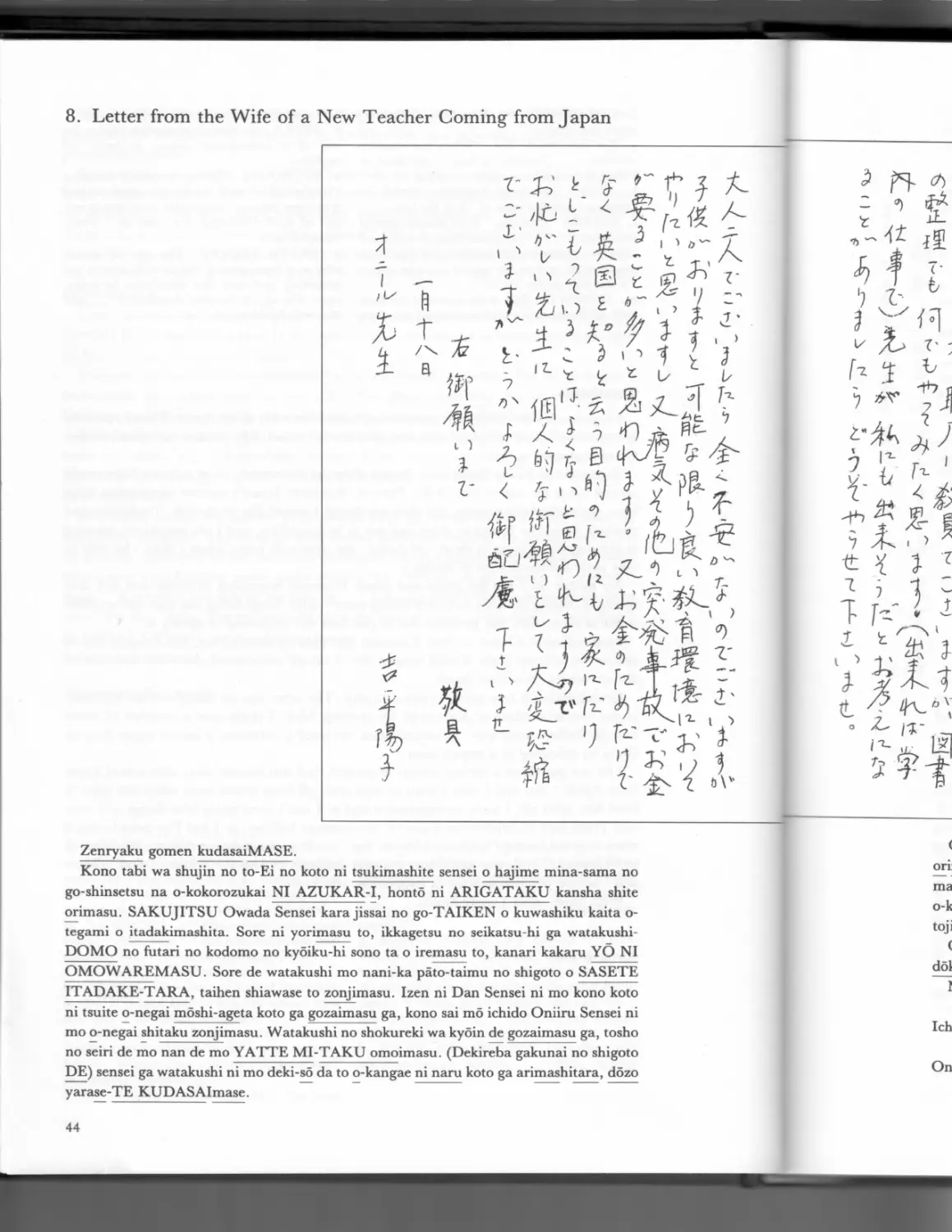
Zenryaku gomen kudasaiMASE.
Kono tabi wa shujin no to-Ei no koto ni tsukimashite sensei о hajime mina-sama no
go-shinsetsu na o-kokorozukai NI AZUKAR-I, honto ni ARIGATAKU kansha shite
orimasu. SAKUJITSU Owada Sensei kara jissai no go-TAIKEN о kuwashiku kaita o-
tegami о itadakimashita. Sore ni yorimasu to, ikkagetsu no seikatsu-hi ga watakushi-
DOMO no futari no kodomo no kyoiku-hi sono ta о iremasu to, kanari kakaru YO NI
OMOWAREMASU. Sore de watakushi mo nani-ka pato-taimu no shigoto о SASETE
ITADAKE-TARA, taihen shiawase to zonjimasu. Izen ni Dan Sensei ni mo kono koto
ni tsuite o-negai mdshi-ageta koto ga gozaimasu ga, kono sai mo ichido Oniiru Sensei ni
mo o-negai shitaku zonjimasu. Watakushi no shokureki wa kyoin de gozaimasu ga, tosho
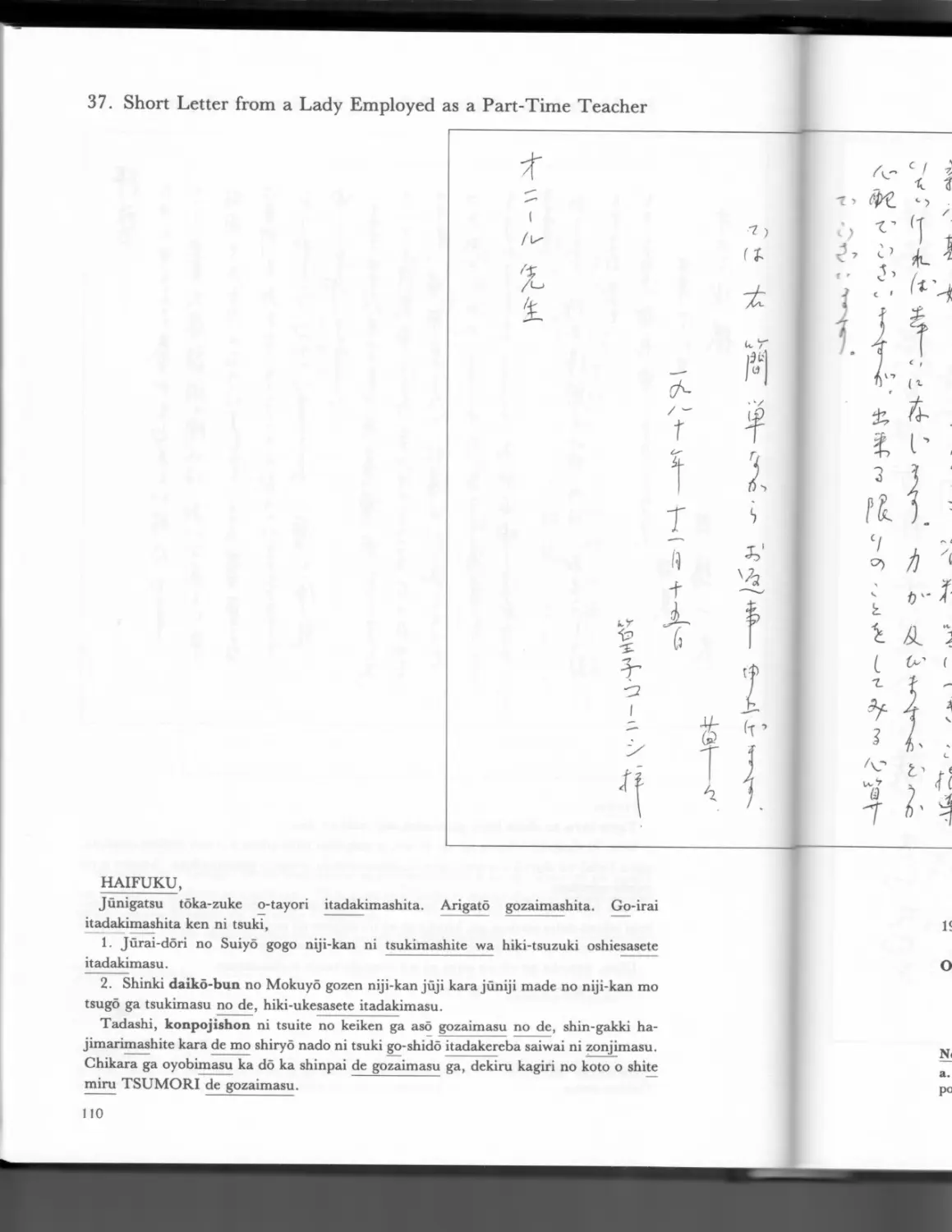
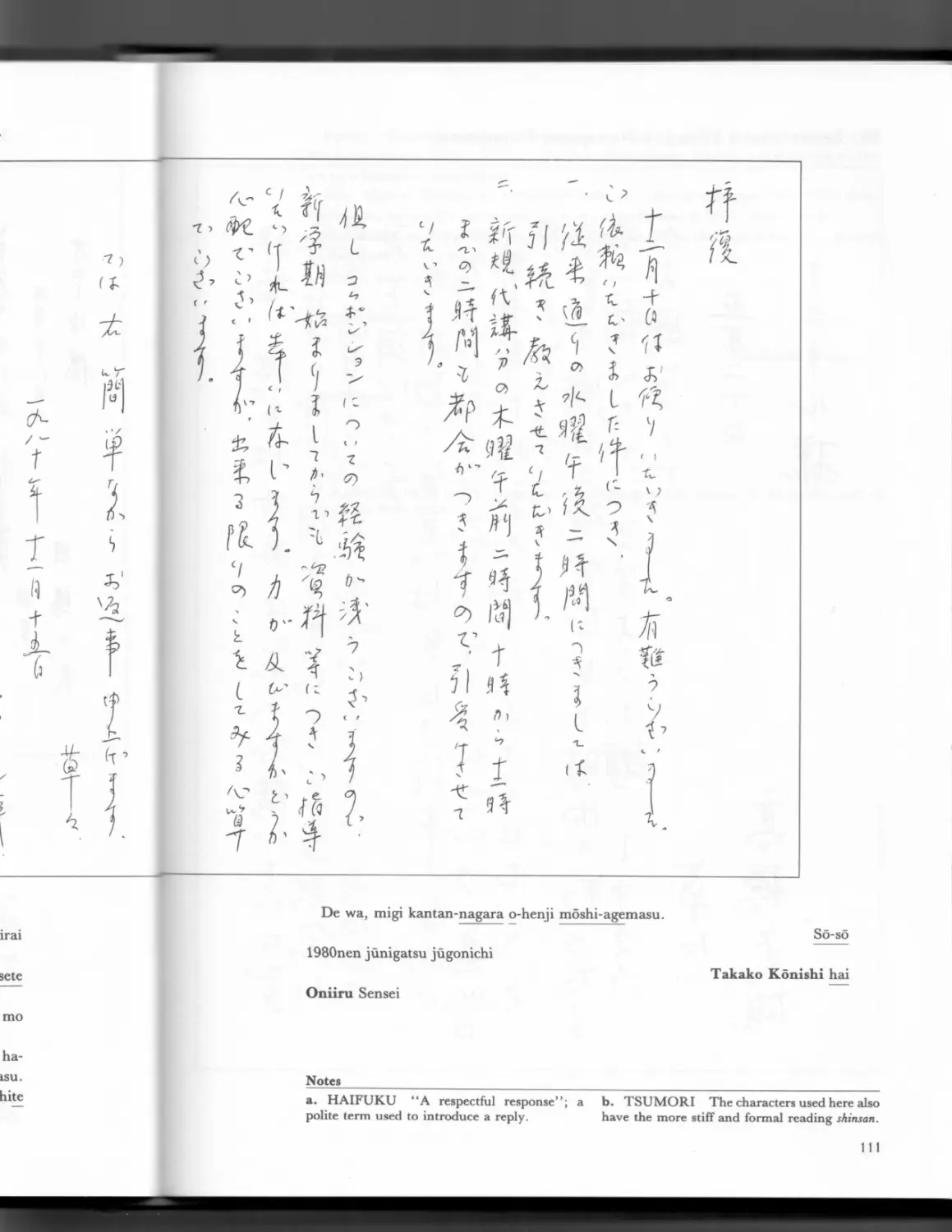
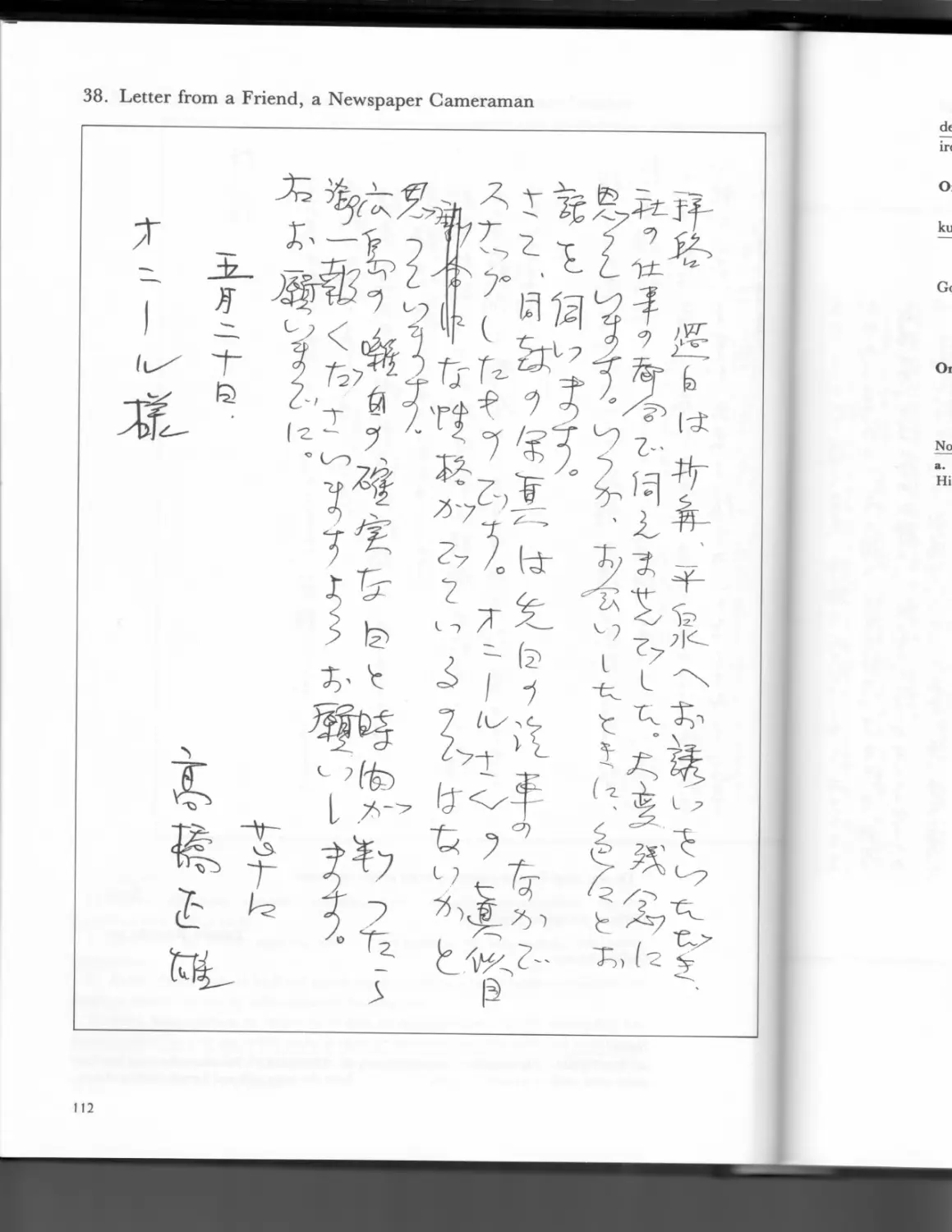
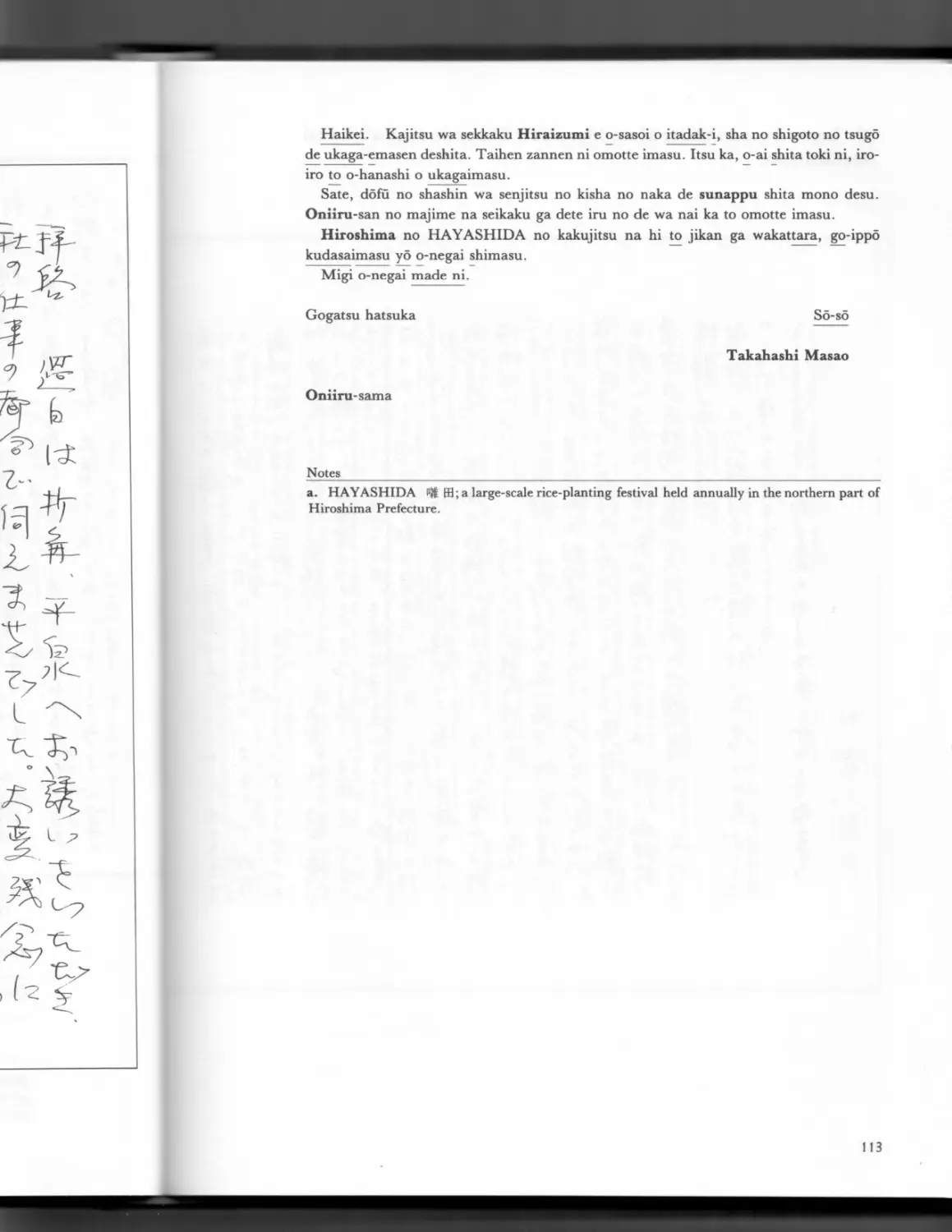
no seiri de mo nan de mo YATTE MI-TAKU omoimasu. (Dekireba gakunai no shigoto
DE) sensei ga watakushi ni mo deki-so da to o-kangae ni naru koto ga arimashitara, dozo
yarase-TE KUDASAImase.
(
ori
ma
o-k
toji
(
dol
1
Ich
On
44
Otona futari de gozaimashitara, mattaku fuan ga nai no de gozaimasu ga, kodomo ga
no
ite
o-
hi-
NI
ГЕ
)to
ni
ho
orimasu to kano na kagiri yoi kydiku kankyo ni OITE YARITAI to omoimasu SHI,
mata byoki sono ta no toppatsu jiko de o-kane ga iru koto ga di to omowaremasu. Mata
o-kane no tame dake de naku, Eikoku о shiru to iu mokuteki no tame ni mo uchi ni dake
toji-komotte iru koto wa yoku nai to omowaremasu no de.
O-isogashii sensei ni kojin-teki na o-negai о shite taihen kyoshuku de gozaimasu ga,
doka yoroshiku go-hairyo kudasaimase.
Migi o-negai MADE
Keigu
Ichigatsu juhachinichi
Yoshihira Yoko
Oniiru Sensei
)ZO
45
Notes____________________________________
a.	-MASE An imperative form of the polite
ending -masu.
b.	NI AZUKARI In expressions referring to
another’s kindness, etc., niazukaru means “par-
take in,’’ i.e., “be given, receive, enjoy.’’ Note
that, in the капа spelling, the writer uses the
traditionally correct <5 for zu, instead of the
modern standard .
c.	ARIGATAKU The adverbial form of
arigatai, meaning “thankfully, with gratitude.”
(Incidentally, arigato, “thank you,” is a contrac-
tion of this form.)
d.	SAKUJITSU The more formal, on read-
ing of the characters, which also have the more
colloquial reading kino-, cf. 6c.
e.	TAIKEN The character used here for -ken
is the old full form for modern standard Ift.
(Conversely, the form Г used in 1.12 for the reki
of shokureki, “professional career” is an ab-
breviation for ffiL)
f.	-DOMO Usually, as here, a humble
plural suffix, it is occasionally used to mean
rather “(I) and the likes of (me), people such as
(I).”
g.	YO NI OMOWAREMASU The passive/
potential form omowareru means “get the feel-
ing, cannot help feeling” and, with yd ni, “in
(such) a way,” gives the meaning “(I) cannot
help feeling that.”
h.	SASETE ITADAKETARA “If I could
receive your allowing me to do,” i.e., “If I
could be allowed to do, if you could allow me to
do.” On sasete itadaku, see li; on itadakeru, 4k;
and on -tore, 71.
i.	YATTE MITAKU The -te miru construc-
tion means either literally “do something and
see/look” or, more commonly, “do something
and see what happens,” i.e., “try doing
something.”
j.	DE Here the suspensive form (see 1c) of
da/desu (see 2g), parallel to (o-kangae ni) naru.
Since both verbs qualify koto, the meaning is
“things which are work . . . and which you
think . . .”
к. -TE KUDASAI Since kudasaru means
“condescend” (see 1g), the -te kudasaru construc-
tion can be understood as meaning “condes-
cend by . . .ing,” i.e., “be kind enough to/kind-
ly . . . ” Thus, since it is here used with a
causative, yarasete kudasaimase means “kindly/
please allow me to do it.”
1. OITE YARITAI The -teyaru construction
is a less respectful equivalent to -te ageru, “do
something for someone else,” and is used here
because the writer is talking about her own
children to an outsider. Thus, “I would like to
put them...”
m. SHI A conjunction meaning “and (what is
more).”
n. MADE Equivalent here to to shite, “as”;
thus, “(I send this) as a request.” The alter-
native form made ni is also found sometimes.
Translation
Please excuse the omission of preliminary greetings.
Now that my husband is to go to England, in this connection I express here my truly
grateful appreciation of the kind consideration we have enjoyed from you and everyone
concerned. Yesterday we received from Dr. Owada a letter in which he wrote in detail
about his own practical experience. According to this, I cannot help feeling that our
monthly living expenses will come to a considerable amount, if we include the education
and other expenses for our two children. I would therefore feel very happy if I too could
be allowed to do some part-time work. I have previously also asked Dr. Dunn about this
matter, but I should like on this occasion to make another request to you, Dr. O’Neill.
My professional career is as a teacher, but I would be willing to try my hand at sorting
books or anything else. If there should be something which you think looks as if it could
be done by me (and which, if possible, is within the university), do please allow me to do it.
If we were just two adults, there would be absolutely no concern on our part, but when
there are children one would like to put them in as good an educational environment as
possible, and one cannot help feeling also that there will be many cases when we shall
need money because of illness or other unforeseen circumstances. Also, it is not simply
because of the money, but because I cannot help feeling that, for the sake of my aim to
learn about England too, it would not be good just to shut myself up at home.
I am very reluctant to make this personal request of you when you are so busy, but do
please give it your kind consideration.
I send you this request,
Respectfully,
18 January	__ ....
J 7	Yoshihira Yoko
Dr. O’Neill
46
9. Letter from a Visitor after His Return to Japan
i
s
LI
I"
I-
a
Q
lo
re
m
to
is
ir-
lly
ne
ail
ur
on
ild
his
ill.
ng
ild
it.
ten
as
lall
ply
L tO
do
Haikei. Nihon wa sukkari aki ni natte, sora ga sunde utsukushiku natte
mairimashita.
Sensei wa o-genki no koto to HAIsatsu itashimasu. Watakushi no ho wa sensei ni go-
aisatsu sum kikai mo nai mama ni kikoku itashite shimaimashita. Go-burei о o-yurushi
kudasai. Natsu no Yoroppa to Igirisu no tabi о tanoshimimashita ga, Rondon Daigaku
no ho e wa amari ashi о mukenai mama ni owatte shimaimashita. Shikashi, sensei ni o-ai
dekite totemo saiwai de gozaimashita. O-isogashii tokoro о arigato gozaimashita.
Jipaniizu Sekushon no hoka no sensei-GATA to Bawden Sensei ni mo yoroshiku o-
tsutae kudasaru yo o-negai moshi-agemasu.
Sore de wa sensei no go-kensho о o-inori moshi-agemasu.
TONSHU SAIHAI
Showa gojuyonen jugatsu toka	Nakagawa YukiHIRO
Oniiru Sensei GYOKUANKA
47
Notes
a. HAI- Meaning “worshipfully,” it is used
as a humble prefix; e.g., haiken suru, ‘‘humbly
see.” Thus, haisatsu itasu is a humble equivalent
for sassuru, “(I humbly) presume/trust that.”
b. -GATA A respectful plural suffix; cf. 8f.
c.	TONSHU SAIHAI Literally, ‘‘With
obeisance and my repeated respects,” this is a
very respectful and formal concluding phrase.
d.	HIRO This character is the full, old form
of It.
e.	GYOKUANKA ‘‘Below your revered
desk”; a formal concluding phrase originally
signifying ‘‘to be presented at your desk.”
Translation
Respectfully,
Japan has become beautiful now that autumn has fully arrived and the skies are clear.
I trust that you are in good health, sir. I for my part returned to this country without
having any opportunity to pay my respects to you. Please forgive my rudeness. I enjoyed
my summer travels in Europe and England, but it all ended up without my making my
way very much to London University. However, I was very happy to have been able to
meet you, sir. Thank you for this, when you were so busy.
I ask you to be kind enough to give my regards to the other teachers in the Japanese
Section and to Dr. Bawden.
With my best wishes for your good health, then.
Yours very respectfully,
Nagakawa Yukihiro
10 October 1979
Dr. O’Neill, with respect
10. Letter from an Older Man
е.
m
ed
ily
&
19
|й
<r
ГА
»/
ъ>
>
Ч”
fa
4
6s
’1
t
Ml
VE>
Й.
V
7’
'£
ar.
)Ut
ed
ny
to
ese
♦1
Ч>
Хи?
л
1
Т"
|^г
i
4м
i
1)
г
А«
'I
x«P
%.
1
*
I
z
I
t
/I
? 1	г-	•b j^z	t A i	A L i 5	iii >1	г n	ft 4 } •
•K If	4s* л	г	17		X	)
ft	9	/К		17 /V	?	~IM	К
%	*	м	1	Й		5	N
4)	A	5	17 Я-		1k>
		1'	7	< z			16
t
л
i
П»
A*»
(.
T
4
j»
J
»»$
4
ill:
h
Sh
*?
Am
h
^р
Л
I
If.,
h
А'
fz.
	i
	Й
г-		?
rx	t	а
		•
9	a	/Г
		1
t	<л	/и
<$)		1
	Ф

a	г
, r	H
1>>	Г
	* *
T-	12
4	l
6'	i
9	L
л	f:
	о
	Q
Л'
	'Х


у
<
X
t
T
9
I
1
t

0
14»
5
3


%
a
т
p
i
1
к

?
£
1
X
)
к
№


P.G. Oniiru Sensei,
Gogatsu nijuninichi-zuke no o-tegami о haiken itashimashita. Nihon e oide ni
narimashita YOSHI о-me ni kakarenakatta no wa zannen desu. Rondon de shinsetsu ni
shite kudasatta o-rei о moshi-agetakatta koto desu. Kondo oide ni naru toki wa, zehi
watashi no tame ni jikan о tsukutte kudasaimasu у6 o-negai itashimasu.
Watashi wa mokka “Koten Haibungaku Zenshu” to iu, Nihon no haiku no zenshu о
henshu suru koto ni zenryoku о tsukushite orimasu. Kotoshi no kugatsu ni DAI-ikkai
haihon о dashimasu. Nikanen de ZENKAN О KANKO NO YOTEI desu. Watashi no
daigaku no kenkyushitsu de dashite orimasu “Kokubun” to iu zasshi wa, kore kara zutto
sensei ni o-okuri itashimasu. Jigo wa hachigatsu-goro ni kanko no yotei desu.
Gekibungaku no ronbun mo tama ni wa noru hazu desu.
Go-shochi no tori Nihon no daigaku mo gakusei sodd ga okotte orimasu. Watashi no
daigaku wa wariai shizuka desu ga, sore de mo yoha ga ari, sono tame ni kaigi ga okute
jubun kenkyu ga dekimasen. Kore wa sekai-teki keiko no YO desu ga, komatta mono
desu.
Isso no go-seian о inorimasu.
Keigu
Imoto Noichi
1969nen rokugatsu jugonichi
49
Notes
a.	YOSHI Here means “hearing/having
heard that, it being said that,” as an extension
of one of its basic meanings “news, fact, mat-
ter.”
b.	DAI- On this form of the character, see
5a.
c.	ZENKAN О KANKO NO YOTEI Gram-
matically there is no verb expressed for the ac-
cusative particle о to go with, but the phrase cam
be regarded as a variant for zenkan о капкд suru
yotei.
d.	YO DESU When yd daldesu, etc., follow
the final form of a verb or adjective or, as here,
a noun + no, the meaning is “general ap-
pearances are that . . . , it seems that ...”
Translation
Dr. P.G. O’Neill,
I have seen your letter dated 22 May. Hearing that you have been to Japan, I am disap-
pointed that I was not able to see you. I wanted to repay the kindness you showed me in
London. I do ask you to be good enough to make time for me without fail when you next
come here.
I am at present putting all my efforts into editing a complete collection of Japanese
haiku called “A Complete Collection of Classical Haiku Literature.” I shall bring out
the first volume to be distributed in September this year. It is expected that all the
volumes will be published in two years.
The magazine “Kokubun (National Literature),” which we publish from my universi-
ty seminar room, I shall always send you from now on. The next number is expected to
be published around August. It is likely to carry articles on dramatic literature too from
time to time.
As you will know, student riots are also happening in Japanese universities. My
university is comparatively quiet but, even so, there are side-effects and there are so
many meetings because of these that we cannot carry out our research to the full. This
seems to be a world-wide tendency, but it does cause difficulties.
With best wishes for ever more peace for you.
Respectfully,
Imoto Noichi
15 June 1969
51
Sakura no sakari ni kikoku shimashita ga, ima wa mo sukkari chitte shimaimashita.
Achi-kochi ni koi-nobori ga mie-hajimeta kyo-konogoro desu.
Motto hayaku o-tayori о suru hazu deshita ga, konna ni osoku nari ai-sumimasen
deshita. Doka o-yurushi kudasai.
Watashi-domo wa, hikoki ga okurete, sangatsu sanjunichinichi ni, KOBE ni
tsukimashita. Saisho no insho wa, hito ga di KOTO, taiyo ga kydretsu na koto, midori
ga nai koto deshita. Mata, soon ya hitobito no ogoe ni NAYAMASAREMASHITA.
Suri-nukeru yd ni hashiru jidosha ni biku-biku shi, michibata ni oki na kuchi о akete iru
mizo ni kyofu о kanjimashita. Ue о muku to, sora wa aoi keredo, denchu densen ga
shikai о saegirimasu. Hajime no nishfikan hodo wa, tsukare-kitte-shimaimashita ga,
konogoro, yoyaku narete kita YO DESU. Genki о dasu koto ga hitsuyo desu.
Sate, ue no futari no kodomo wa, saiwai ni mo, nenrei soto gakunen ni modoru koto ga
dekimashita. Shikashi, kurasu de wa kanari kincho shite iru RASHIKU, kitaku suru to
tsukarete guttari shite imasu. Shita no akanbo wa, Eigo no sekai kara DEYO TO
SHIMASEN.)
Kanai to watashi to wa, uchi no пака о totonoeTARI, oshieTARI, tabo desu. Ima
koko de omoi-dasu no wa, Eikoku no shizuka na kurashi to, hiroi ryokuchi to desu. Toku
ni Sarii-shu no asoko ya koko о koishiku omoimasu. Mata, ВВС о muyami ni koishiku
omoimasu.
Kono sannenkan amari, kotoba ni TSUKUSENAI go-shinsetsu ni azukari arigato
gozaimashita. Honto ni tanoshii tai-Ei seikatsu deshita. Mata, iro-iro manabu koto ga
okatta desu ga, kore mo subete, ii dory 6 ni КАКОМ ARETE hataraku koto ga dekita o-
kage desu. Ikue ni mo kuri-kaeshi, o-rei moshi-agemasu.
Kyo wa tori-isogi o-rei NOMI shirushimashita.
Oku-sama ni doka yoroshiku o-tsutae kudasai. Mata sho-sensei-gata ni mo nani-tozo
yoroshiku NEG ALAGEM ASU.
Sayonara
Shigatsu hatsuka
Matsumura Susumi
Oniiru Sensei
Notes_________________________________
a. KOBE Note the unusual reading of the
characters in this important placename (a cor-
ruption of kami -j- Az), and that in this letter the
113th radical as a lefthand element is written in
full as 7K, instead of in its simplified form as .
b. KOTO When a noun at the end of a
phrase is not followed by a particle, it is almost
certainly part of a list which will conclude with
an appropriate particle or some form of daldesu.
Here, for example, the construction is . . . koto,
. . . koto, . . . koto deshita.
c.	NAYAMASAREMASHITA The passive
form of the verb nayamasu, “afflict, annoy, trou-
ble.’’ Thus, “was afflicted (by).’’
d.	YO DESU “It seems, looks (like), be
probable.” See lOd.
e.	RASHIKU The suspensive form (see 4f),
parallel here to imasu and thus equivalent to
rashii desu as a sentence-final form. Rashii can
follow various parts of speech, with the mean-
ing “seems, look (like), be probable.”
f.	DEYO TO SHIMASEN The -o to suru con-
struction covers two main meanings: (i) “try
to . . (ii) “be about to . . .”
g.	-TARI . . . -TARI The multiple use of
this frequentative suffix means that one thing is
done and then another, or that various actions
take place in a random sequence; and even
when only one -tari is used, the implication is
that other actions also occur. Strictly, the con-
struction should be completed by some form of
suru, but this is sometimes omitted, as here,
where shite can be understood.
h.	BBC Abbreviation for “British Broad-
casting Corporation.”
i.	TSUKUSENAI A potential form of
52
tsukusu, “exhaust”; thus, “which cannot be ex-
hausted/ fully covered (in words)”; i.e., “inex-
pressible.”
j.	КАКОМ ARETE	A passive form of
kakomu, “surround; enclose”; thus, “being sur-
rounded (by).”
k.	NOMI A written-style word for “only,
solely.”
1.	NEGAI-AGEMASU A respectful equiv-
alent for negaimasu.
Translation
I returned to this country when the cherry blossom was at its height, but already now it
has completely fallen. It is now the time when carp streamers have begun to appear.
I should have sent word to you earlier, and I am sorry that it has become as late as this.
Please forgive me.
The plane being late, we arrived in Kobe on 31 March. My first impressions were of
the large numbers of people, the fierceness of the sun, and the lack of greenery. Also, I
was troubled by the noise and people’s loud voices. I quaked at cars rushing along so that
they just scrape through, and felt frightened at the roadside drains with their great gaping
holes. When I look up, the sky is blue, but telegraph poles and electric cables interrupt
the view. At first, for two whole weeks I was utterly exhausted, but recently I seem to
have got used to it at last. You just have to keep your spirits up.
Well now, the two older children have fortunately been able to go back into a grade cor-
responding to their age, but they seem to be pretty tense in class and when they come
home they are absolutely worn out. The youngest one, the toddler, makes no attempt to
leave his English-speaking world.
My wife and I are very busy getting things straight at home and teaching. What we
now recall here is the peaceful life and'the expanses of green land in England. We par-
ticularly miss various places in Surrey, and we also desperately miss the BBC.
For the past three years and more we have enjoyed kindness from you which I can’t
find words to describe. It was a truly happy life we led staying in England. I also learned
a great many things and it was entirely due to the fact that I was able to work surrounded
by excellent colleagues. Time and again I thank you for this.
In my haste today I have simply written to thank you.
Please pass on my regards to your wife. I also ask you to give my regards to all the
teachers.
Goodbye.
20 April
Matsumura Susumi
Dr. O’Neill
53
12. Letter from a Previously Unknown Research Scholar
4111. <М1.
p <s t - - Дй-
if] L is] ЙЯ '^T
4l Ф tA,'
5 rf L Tt N <. J't
i 7 n tx', n >]- у k to Л5] j 5 P44z Я i IT. ^", ts|,
'Zf" Л;®М ') -T П («’ Ъ 7 Ь ? t ? 7>''Z'"» T £>’9 IJ
< Vj % 5* f Й \ Й. X > W5 H	L 17"
i it-..
з-;]^й f; li®?.5] й’/Гх
Via -О/ф ’’ ИLti-^3fj ^Ж-:
\y) C
i R $ n г »>	• r-1 pj	г- ft t-i j	^/>^,4
<V	9 £ f] У iv Pf'/tf4'^-'T 7-
И- 4 § ’• h L' i 4
'	f< A
54
1979. 4. 19
Rondon Daigaku SOAS Kyoju
P.G. Oniiru-DONO
Kokuritsu Kokugo Kenkyujo
Nihongo Kydiku Senta
Takada Makoto
Haikei,
Totsuzen o-tegami sashi-ageru shitsurei o-yurushi kudasaimase. SHOSEI Kokuritsu
Kokugo Kenkyujo yori haken sar-e, tochi no Doitsugo Kenkyujo ni maitte iru MONO
desu.
Kono tabi, Rondon о homon suru kikai о emashita no de, joshi no Nomoto Kikuo yori
kane-gane o-uwasa о UKAGATTE orimasu ki-Nihongo Gakka о kengaku sasete
itadakitaku o-tegami sashi-agemashita.
Gogatsu no nanuka yori isshukan Rondon ni taizai itasu yotei desu. Sono aida ni zehi
ichido homon о o-yurushi kudasaimasu yo o-negai moshi-agemasu.
Mata kasanete no o-negai NITE kyoshuku ni zonjimasu ga, go-henji, go-tsugo, shosei
no shuppatsu-bi no gogatsu yokka izen NI o-kikase kudasareba kojin ni zonjimasu.
Keigu
Notes________________________________________
a.	SOAS Abbreviation for “School of Orien-
tal & African Studies.”
b.	-DONO A formal written suffix used of
men, most often in addressing them by letter;
thus = “Esq.”
c.	SHOSEI A humble written term used by
men in referring to themselves.
d.	MONO A humble equivalent for hito.
e.	UKAGATTE Ukagau is a humble equiva-
lent for kiku and tazuneru.
f.	NITE A literary particle equivalent to col-
loquial de.
g.	NI The writer made a slip here by begin-
ning to write the character |ij again, but then in-
serted the капа sign ni underneath.
Translation
19 April 1979
London University SOAS Professor
P.G. O’Neill, Esq.
National Language Research Institute
Japanese Language Education Centre
Takada Makoto
Respectfully,
Please forgive my rudeness in sending this letter to you so unexpectedly. I have been
sent by the National Language Research Institute, and have come to the German
Language Research Institute over here.
Since I have now been given the opportunity of visiting London, I am sending you this
letter from a desire to be allowed to inspect your Japanese Language Department which I
have already heard about from my superior Nomoto Kikuo.
I expect to stay in London for one week from 7 May, and I would like to ask you to
allow me to visit you without fail during that time.
I feel reluctant to make yet another request of you, but I would be very much obliged if
you could let me have your reply and tell me about your arrangements before 4 May, the
day of my departure.
Yours sincerely
55
13.	Circular from a Bookshop
№.

E 7 У ft /I <
№ JLj tp £. 7" 3	,
% A. 1- ?S M ?“
113 Ут Л?т ) 1 g У D 1
УЯ У| т И 8 'i& T !- I
l? ф-у g a	X gp
^>X XD $ v 5 -2 УЧ U 9	1 T :
IA . /3 ЛГ о zffp т/ zy 5 -jr
%.	$ X ± Jb_____
4 Z? д я
s л ± »’«*«
56
Kakui-dono
Haikei,
Higoro wa o-hikitate о TAMAWAR-I, ARIGATAKU o-rei moshi-agemasu.
Sate, sassoku de kydshuku desu ga, HEIsha kosho mokuroku 113-go (zenpen) о o-
okuri itashimasu.
Nao kohen wa kyoikugaku kankei no mokuroku to shite hakko itashite orimasu no de,
go-пуйуб no SETSU wa o-shirase kudasai. Ori-kaeshi o-okuri moshi-agemasu.
Ijo, mokuroku sofu no go-annai nomi desu ga, kongo-tomo yoroshiku o-negai moshi-
agemasu.
1982nen shigatsu futsuka
Kabushiki-gaisha Bunsei Shoin
Daihyo Torishimari-yaku
Konuma Yoshinari
Notes____________________________________________
a.	TAMAWARI Tamauuaru, “(humbly) re-
ceive, be granted’’ is a humble verb much like
itadaku.
b.	ARIGATAKU Since the first two char-
acters of this word themselves give the reading
arigata(i/ku), the third character g. (= ta
(i/ku), “want to”) is superfluous.
c.	HEI The character $£ used here is a
mistake for also read HEI, a prefix much
used to mean “my/our (humble)”; cf. hi- under
3a, and ki- under 3c.
d.	SETSU “time, occasion” or, as here,
rather “in the case of.”
Translation
To All Concerned
Respectfully,
Having enjoyed your patronage for so long, we express to you our grateful thanks.
Now, we regret that this is without prior notice, but we are sending you our company’s
catalogue of old books No. 113 (vol. 1).
Also, since we have published Volume 2 as a catalogue relating to the science of educa-
tion, we ask you to kindly let us know if you require this. We shall then send it to you by
return.
The above is simply an information note to accompany the catalogue, but we trust that
you will continue to favour us with your patronage in the future.
2 April 1982
Bunsei Shoin, Inc.
Representative Director:
Konuma Yoshinari
14.	Letter from an Official of an Academic Society
ZZ^ZZZ. wr. Patrie weoffrey. и.'. Neill.......... .....
Z^
^ZZZJ3qZ:zZZZZZZZZ........zzzzzzz..
.... bZ./^	ZZ ^^ZZZ.z L&£i&
---.......... -. ............................ .................... .J...-.-..——........	...............     ...Jt.      —
7 i.x.	t. J№. i .1 a 'j 7 j,............................
...i
I •) ЯЕШ £ t Z ъ i и г e) Zfe i ZZZZ№
A 1 > - t СЖзЙ £Eife 13 .2 2 & >) j f.
...	mzl t	ши
W W ZZ y z 7 _. Z к	'' i
ВШ-М). Ht 7
Z iz T 4< Z7 ^7 G -C 1 1VF" к/} I-
Z(t- ?< 7. lEJti и z t ^-c ?7 лл SS к
< ^?Дг.<Д0 1£Д i
ZZZZZ/^^ Zt q U_i< t ЖЕЕ 7ij jlj H-^fe v
^IX'T" 7 7.
::=гййкя1и^жжа» s a	m
J^aZZZZ.ZZZ^MiZZZZZZZZZ'..
..............................х/77.^<ЛЛ .:С.ё .
............................. _._.
. z:zzzzz:=^
58
Shin’ai NARU Dr. Patrie Geoffrey O’Neill,
“Sakura-sho” juyo shikiten о oete kara, mo jikkagetsu ga sugimashita. Anata wa,
sono nochi mo genki de bengaku ni hagende ORARERU koto to o-sasshi itashimasu.
Waga Zenkoku Nihon Gakushikai de wa, anata no kenko de aru koto о shukufuku
suru to tomo ni, ki-chi de no katsuyaku о kitai shite orimasu.
Ano, “Sakura-sho” no juyo ni tsuite wa, toji hodo kikan no happyo yori, zenkokumin
no chumoku suru TOKORO to nari, Nihongo о sekai no kakkoku ni fukyu suru koto no
kanshin ga takamari-tsutsu arimasu.
Soko de HONkai de wa, anata no katsudd jokyo о honkai no hakko suru gakujutsu
shinpo “Akademia”-shi ni keisai shite, ippan ni shirasetai to zonjimasu no de, saikin no
anata no Nihongo kyoiku, kenkyu narabi ni fukyu nado ni kan-suru jokyo о o-shirase
TAMAWARIMASUREBA kojin ni zonjimasu.
Anata wa, o-isogashii koto to zonjimasu ga, Nihon no mina-san NI anata no shigoto о
ninshiki SHITE MORAU tame ni mo zehi kinkyd о kitaru 1977nen jugatsu san-
jtiichinichi made ni o-shirase kudasaimasu yd o-negai moshi-agemasu.
Nishin
“Sakura-sho” juyo shikiten no kinen shashin-cho о betsubin (kokubin) de
okurimashita kara o-uke-tori kudasai.
1977nen jugatsu itsuka
Shadan Hojin Zenkoku Nihon Gakushikai
Henshubu: Inoue Eiji
Notes__________________________________________
a.	NARU Meaning “who/which is/are,”
this is the attributive form of the old literary
copula nari, “be” (= modem da, de aru). This
form is thus equivalent in contexts such as this
to the na used with “na adjectives.”
b.	ORARERU This passive/potential form
is intended here as a simple honorific showing
respect to its subject (cf. the usage under 60),
and can therefore be taken as equivalent to
irassharu, an honorific for iru.
c.	TOKORO “Aspect, matter”; see 4e.
d.	HON- As well as “main, original,” this
can mean, as here, “this, the present, the . . .
in question.”
e.	TAMAWARIMASUREBA On tamawaru,
see 13a; and on -masureba, see 3n.
f.	NI ... SHITE MORAU = “receive/
get/have (an understanding of . . . ) by (some-
one). ” This is a less humble equivalent of the -te
itadaku construction (see 6a), and being
therefore less respectful to whoever else is con-
cerned in the action, is much used when this
other person is not the person addressed but a
third party, as here.
Translation
Dear Dr. Patrick Geoffrey O’Neill,
Already ten months have passed since the end of the award ceremonies of the “Sakura
(Cherry) Prize.” I presume that you have continued to devote yourself to your studies in
good health since then.
As well as rejoicing in your sound health, our All-Japan Graduates Association trusts
that you are still continuing your activities in your country.
With regard to the award of this “Sakura Prize,” through the announcements of the in-
formation media at the time this came to the attention of all the Japanese people, and in-
59
terest in the spread of the Japanese language to all the countries of the world is now on
the increase.
We in this Association would therefore like to make the state of your activities general-
ly known by carrying it in the magazine “Academia,” a new learned publication put out
by the Association; and so we would be greatly obliged if we could have information
about the state of such things as the education work, research and popularization you
have done lately on the Japanese language.
I expect that you are busy, but I do request you to be sure to let us have the informa-
tion about the recent situation by 31 October 1977 next, so that we can have your work
appreciated by everyone in Japan.
P.S. We have sent under separate cover (airmail) an album of commemorative
photographs of the “Sakura Prize” Award Ceremonies, so please accept this from us.
5 October 1977
All-Japan Graduates Association,
Inc.
Editorial Department: Inoue Eiji
15.	A Covering Letter from a University Official
O'Neill, P. ft.
60
O’Neill, P.G. -dono
Showa 57nen nigatsu tsuitachi
Shinbori Michiya
KINKEI,
Go-seiei no koto TO o-yorokobi moshi-agemasu.
Senjitsu wa kiden kara no ankdto о uke-torimashita. O-isogashii tokoro, taihen arigato
gozaimashita.
Sate, kiden kara no shiji-ddri, ki-kikan no hoka no Nihon kenkyusha ni anketo о jisshi
shite morau tame ni, anketo yoshi о jugo-tsu o-okuri itashimashita. Go-kydryoku
kudasaimasu yd, yoroshiku o-negai shimasu. Saigo ni, kiden no go-kenko to go-
katsuyaku о o-inori itashimasu.
Keigu
Notes_______________________________________
a.	KINKEI A respectful introductory word,
similar to Haikei (see 5c).
b.	TO When used with verbs like yorokobu,
this to can be regarded either as the same
“quotative to” as in to iu/omou, “say/think thus:
. . . ,” or as equivalent to to omotte, “thinking
that . . .” In any case, koto to can conveniently
be translated as “(I am delighted) at the fact
that.”
Translation
P.G. O’Neill, Esq.
1 February 1982
Shinbori Michiya
Respectfully,
I am delighted that you are keeping well.
I received the questionnaire from you the other day. Thank you very much for this,
when you are so busy.
Now, as was indicated by you, I have sent you fifteen copies of the questionnaire sheets
in order to have these completed by the other people doing research on Japan at your in-
stitution. I ask you to be kind enough to give us your cooperation in this. Finally, I pray
that you will continue in your activities in the best of health.
With respect
61
16. Letter of Thanks from an Official

_	0 м SE2 a
'/ -F > t лМ*
0? > }''#L	L -> A _L / --,. 2jh
г Ut r ?g ?-.	'I 7^ 5 c-
_
____Л	c-tfcjM
JJL> M.~C t #Ь ? з	-v t, .a,^_
/Т ,b Яс z ч з &-1ЙЙ5
l-£o5 :	-c ?/LI < §c i
B l ^^ЖД.г-<-Ь
lx ^3
X- L /1 o
4a <0^ £fj L 2 & '/ >~ X" )<л у 1
) - 0 " z	L X 3
I 7 Г'Лх 0„
12 rz2x_ ^--^ fC с /ь ^^Л-хХ-') 4 V
i /'- 5 Г 7 С<^>ЯХ
^7 ХЛ1 Ф L <rt < n_____________
ж
62
Oniiru Sensei
Kokusai Koryu Kikin
Rondon Chuzai-in
Nakamura Satoshi
Zenryaku,
Honjitsu wa watashi ni ki-daigaku Nihon Gakubu no jugyo о sankan suru kikai о o-
atae kudasar-i, go-tabo-chu NI MO KAKAWARAZU shu-ju go-annai о tamawatta ue
ni, kekko na chiishoku no o-motenashi made itadak-i, makoto ni arigato gozaimashita.
O-kage-sama de, kanete nengan shite orimashita ki-gakubu no jugyo о haiken suru
koto ga deki, Nihongo kydiku ga dono yo ni okonawarete iru ka о gutai-teki ni shiru koto
ga dekite ureshiku omou to tomo ni, gakusei shokun ga muzukashii kyozai о SASHITE
nangi na yosu mo miseZU NI shoka shite iru no о mita no wa oki na odoroki deshita.
Watashi no ninki wa mo nokori-sukuna de wa arimasu ga, moshi saiwai aki ni natte
mo tochi ni taizai shite iru yo deshitara, shinso NATTA toshokan О HAIKEN NI, mo
ichido sanjo itashitai to kangaete orimasu.
Mappitsu-nagara Dan Sensei ni yoroshiku go-hosei no HODO o-negai moshi-
agemasu.
So-so
Notes______________________________
a.	NI MO KAKAWARAZU Usually follow-
ing a noun form, this phrase means “despite, in
spite of (the fact that).” Thus, here, “despite
your being so busy.”
b.	SASHITE ... -ZU NI Used before a
negative, sashite means “(not/without) par-
ticularly.” The negative ending -zu, sometimes
ni as here, is equivalent to the more collo-
quial -nai de or -naku “without . . .ing” and is
used with the same negative form of the verb.
(It is itself seldom used in the colloquial
language except in omowazu, “without think-
ing, unconsciously.”) Thus, “without (show-
ing any) particular (sign . . . ).”
c.	NATTA Since this here means “com-
pleted, achieved,” shinso natta can be translated
as “newly completed.”
d.	О HAIKEN NI Being a juru-type verbal
noun, haiken here takes its own object (toshokan)
like a normal verb; thus, the meaning is “to
see, for a look at.”
e.	HODO In such contexts, hodo is little dif-
ferent from koto and simply makes a more round-
ed phrase of the previous noun.
Translation
The Japan Foundation
London Representative
Nakamura Satoshi
Dr. O’Neill,
Please excuse the omission of preliminary greetings.
Today, in addition to providing me with the opportunity to see the teaching in the
Japanese Department at your university and, in spite of being very busy, showing and
telling me all kinds of things, you even gave me the hospitality of an excellent lunch, and
I am truly grateful to you.
Thanks to you, I feel happy at having been able to see the teaching in your department
which I had already wished to do, and to learn in a concrete way how Japanese language
studies are carried on there. As well as this, it was a great surprise to me to have seen the
students absorbing difficult teaching material apparently without any great problem.
My tour of duty is now coming to an end, but one of the things (= nado) I am thinking
is that if, happily, it should appear that I will be here in your country in the autumn, I
should like to visit you once again to see your newly completed library.
Last but not least, I ask you to be kind enough to pass on my best wishes to Dr. Dunn.
In haste
63
17. First Letter from a Professor Introduced by a Mutual Acquaintance
fit»!, '%?£,	A/tn
A. ГМу}- J'M'ttL
i tr<n t U. <	A<?Z^> Г.
<'1тЛ4и.
^au.	. 1£^12<^Й1ШФ‘ЬЛАг^’'г^<Ф^^/Н
7-7^4(мнс*)1'£fv. w	u t a.
x	и. у
(7Ш<£ЙМ$гГ,) :4til. ^Ад\’МАк. AM“Hm ft,
НГ ^b«*)#tr-74.	£$£ixp>.
HL'Tt'%	^^^-7°,z^ti	friz
^uftr.
^k>z.	zt^i: »=
,3^я* 0+WWffl,m^^
Kinkei,
Hajimete, totsuzen, watakushi ga anata ni o-tayori о sashi-ageru shitsurei о o-yurushi
kudasaimase. Watakushi wa Mizutani Kengo to moshimasu. Anata о watakushi no on-
shi, Nihon Onseigakkai Kaicho Onishi Masao Hakushi kara go-shokai о itadakimashita.
Watakushi wa Nihongo onseigaku о senko shite orimasu. Soshite, watakushi wa, san-
junenkan, hatsuon no warui Nihonjin ni, tadashii Nihongo no hatsuon ya, jozu na waju-
tsu о oshie, zenkoku no hosokyoku e oku no anaunsa о kyoiku shite okuri-dashimashita.
Soshite, mata, kokuritsu no Osaka Gaikokugo Daigaku ya, hoka no daigaku nado de,
takusan no ryugakusei ni Nihongo о oshiete kimashita. Soshite, watakushi wa, sono
koseki ni yori, 1981nen shichigatsu mikka, Zenkoku Nihon Gakushikai kara, Meiyo
Kaiin ni suikyo serar-e, doji ni, Akademia-sho о sazukararemashita.
64
Watakushi wa, kono yd na KEIKEN О MOTO NI, genzai futatsu no Nihongo
kyohon to, sore ni hitsuyo na hatsuon renshu kasetto, tepu kaku gohon (gokei jippon) о
kansei shi, sore о betsubin de, anata no moto e o-okuri itashimashita. (Korera no hon
wa, shorai, nanasatsu made kansei no yotei desu.) Kore wa, watakushi ga, anata ni,
tsutsushinde sashi-ageru mono desu.
Dozo, korera no hon ya tepu o, anata no Nihongo no kenkyu ya, gakusei no kyoiku ni,
jikken-teki ni o-tsukai kudasai. Soshite, anata kara, watakushi no hon to tepu ni tai-suru
go-hihyo ya, go-hihan о watakushi ni ITADAK-ETA N ARAB A, watakushi wa makoto
ni shiawase ni zonjimasu.
Saigo ni, watakushi wa, anata no
gozaimashita.
1981nen kugatsu
go-kenko о o-inori itashimasu. Arigato
Nihongo Senmon Gakuen
Kansai Hoso Bunka Renmei
Rijicho
Mizutani Kengo
Notes
a.	KEIKEN О MOTO NI The character
used for kei- is an abbreviation for This
phrase is incomplete in having no verb, but it
can be understood as ending with shite; thus,
“making experience a basis, on the basis of ex-
perience.”
b.	ITADAKETA NARABA “If it has been
possible (for me) to receive ... (I shall feel),”
that is, “If I could have ...” On itadakeru, see
4k, and on naraba, 3q.
Translation
Respectfully,
Please forgive my rudeness in sending you a letter for the first time without warning. I
am called Mizutani Kengo. I have kindly been given an introduction to you by my
respected teacher, Dr. Onishi Masao, President of the Japan Phonetics Association.
I specialise in the pronunciation of Japanese, and for thirty years I have taught the cor-
rect pronunciation of Japanese and the art of good talking to Japanese with poor accents,
and I have trained and sent out many announcers to broadcasting stations all over the
country. Also, I have taught Japanese to many foreign students in Japan at such places as
the national Foreign Languages University in Osaka and other universities. Then, for
these achievements, on 3 July 1981 I was proposed by the All-Japan Graduates Associa-
tion as an Honorary Member and, at the same time, I was awarded the Academia Prize.
On the basis of this kind of experience, I have now completed two Japanese-Ianguage
textbooks and five each (ten in all) of the pronunciation cassettes and tapes necessary for
these, and I have sent these to your address under separate cover. (The expectation is
that these books will be complete in seven volumes in the future.) These I beg to give to
you.
Do please use these tapes experimentally for your research into the Japanese language
and for the education of your students. I would then be very happy if I could have your
comments arid criticisms about these books and tapes.
Finally, I wish for your good health and great happiness. With thanks.
September 1981
Mizutani Kengo
Chairman, Specialist Academy for the
Japanese Language and the Kansai
Broadcast Culture Federation
65
18. Note from a Professor Met Once Before
I
66
Zenryaku. Sakunen no gogatsu ni wa taihen o-sewa ni narimashita. Inoue Sensei
kara messeji (dengonsho) ga atta to omoimasu ga, kono jugatsu juninichi (Getsuyo) ni
Eikoku ni ikimasu. Jugatsu jusannichi (Kayo) ni Rondon Daigaku no Oniiru Kyoju
Sensei no kenkyushitsu о tazunemasu. Gogo ichiji no yotei desu. Katte na o-negai de
sumimasen ga, yoroshiku o-negai itashimasu.
Rondon de wa Furemingu Hoteru (Flemings Hotel . . . Half roon Street W1 . . . Tel
499-2964) ni shukuhaku itashimasu.
Suminasen ga, yoroshiku, yoroshiku o-negai itashimasu.
Jugatsu tsuitachi
Oniiru Kyoju
Hagino Koki
Translation
Please excuse the omission of preliminary greetings.
Thank you for all your help in May last year. I think that you will have had a message
from Dr. Inoue, but I shall be coming to England on the 12th of this month (Monday). I
shall call in at your research centre at London University, Professor O’Neill, on 13th Oc-
tober (Tuesday). I expect it to be at 1 p.m. I am sorry to make such an arbitrary request
of you, but I do hope that you will kindly agree to this.
In London I shall be residing at Flemings Hotel (Flemings Hotel . . . Half roon (sic)
Street Wl.... Tel 499-2964).
I am sorry to ask this of you, but I hope and hope that you will kindly agree.
1 October
Professor O’Neill
Hagino Koki
67
19. Letter of Request from a Lady to a Professor under Whom She
Had Worked
1
(
a
I
a
f
к
I
r
2
F
68
Haikei,
Okkusufodo Daigaku no Bodorian Toshokan ga sono Orientaru Bukku-bu no shisho
joshu о boshu shite iru koto о Taimuzu Haia Ejukeishon Sapurumento ni yori shiri,
sassoku rirekisho о teishutsu shi, obo itashimashita. Rirekisho ni, shokaisha no hitori to
shite ki-kyoju no o-namae о agemashita. Jigo shodaku de wa gozaimasu ga, moshi
toshokan yori toi-awase ga areba, go-sobd-chu makoto ni osore-irimasu ga o-tegami о
kaite kudasaimase. Tsutsushinde o-negai moshi-agemasu.
Nao, Toronto no Yoku Daigaku no Junia Japan Supesharisuto e no shushoku shigan-
sho wa ONAJIKU ki-kyoju no o-namae о shokaisha no hitori to shite agemashita
rirekisho о soete ichigatsu juyokka ni tokan itashimashita.
Keigu
Sutoraudo-Dorinkuuota Masumi
Showa gojuninen ichigatsu nijuichinichi
Dan Kyoju
Notes__________________________________________________________________________________________
a. ONAJIKU A literary adverbial form from onaji, equivalent to the colloquial onaji yd ni,
* ‘similarly.”
Translation
Respectfully,
I learned from the Times Higher Educational Supplement that the Bodleian Library of
Oxford University is recruiting a library assistant for its Oriental Books Department,
and I immediately sent my curriculum vitae and applied for this. In the curriculum vitae
I gave your name, Professor, as one of the referees. This is indeed asking for agreement
after the event, but if there should be an enquiry from the Library, do please write a letter
for me, even though I am truly reluctant to ask you to do this when you are so busy. I do
humbly beg you to do this for me.
Also, on 14 January, I posted off my application as a Junior Japan Specialist at York
University in Toronto, together with a curriculum vitae in which I likewise gave your
name as one of the referees.
Yours respectfully,
Masumi Stroud-Drinkwater
21 January 1977
Professor Dunn
69
20. Letter from a Previously Unknown Woman
Haikei. Totsuzen o-tegami shitsurei itashimasu. Watakushi-КОТО Nihongo kyoshi
no shikaku о totta bakari no mono de gozaimasu ga, shichigatsu ni Eikoku e ryoko suru
yotei de gozaimasu. Nomoto Sensei ni o-hanashi shimashita tokoro, Oniiru Sensei ga
Nihon no chusei bungaku go-senmon DE IRASSHAIMASU koto о oshiete
kudasaimashita. Watakushi wa naga-nen shuppansha ni tsutome, “Kokusho So-
mokuroku” no kosei о hete, tadaima “Koten Bungaku Zenshu” no henshu ni juji shite
orimasu. Tokyo Joshi Daigaku de wa NO-KYOGEN no Furukawa Hisashi Sensei no
kogi о kikimashita.
Iro-iro go-tayo no koto to wa zonjimasu ga, sukoshi no jikan о itadake-masu naraba,
Eikoku NI OKERU Nihon bungaku no JUYO, mata, kore kara Nihongo kyoshi о
kokorozasu mono e no adobaisu nado, o-kikase itadakereba URESHU gozaimasu.
Yujin ga Kenburijji ni, Eigo о benkyo suru tame, ryugaku shite imasu no de, Rondon
ni yado о totte KUREMASHITA. Shichigatsu yoka kara shichigatsu juninichi-goro
made, Rondon ni taizai shi, ato, itsuka hodo, chubu Ingurando о aruku yotei de
gozaimasu. Makoto ni kyoshuku de gozaimasu ga, yoka kara juninichi made no aida ni,
go-tsugo yoroshikereba, о-me ni KAKARITO gozaimasu. Dozo yoroshiku o-negai
moshi-agemasu.
Nao, о-me ni kakaremasu baai wa, o-denwa ban go о oshiete itadakitaku, kasanete o-
negai moshi-agemasu.
KASHIKO
Takahashi Keiko
n
Rokugatsu yoka
Oniiru Sensei
71
Notes
г
a.	-KOTO In this use as a suffix, -koto means
“in speaking of as far as ... is con-
cerned.”
b.	DE IRASSHAIMASU An honorific
equivalent for desu, used when the subject is a
person and respect is to be shown to him. Since
irassharu is an honorific for iru (see 6w), this is
directly equivalent to de imasu.
c.	NO-KYOGEN The Kydgen comic plays
long associated with No drama and performed
traditionally between No plays.
d.	NI OKERU A literary phrase equivalent
to colloquial ni aru or de no, “(which is/are) in.”
e. JUYO See lib; in this case the particle
which governs juyd and its following parallel
noun is nadoL
f, URESHU Japanese -i adjectives arc used
in their “long-vowel” form before gozaimasu
and related forms. Since the long-vowel forms
are a contraction of the -ku adverbial form,
resulting from the disappearance of the k, those
ending in -ii went via -i(k)u to -й, as here; and
those ending in -oi and -ai went via -o(k)u and
-a(k)u to -0, as in o-hayd gozaimasu (see also 8c).
g. KUREMASHITA This less respectful
word for “condescend” is used here, rather
than kudasaimashita, because the writer’s own
friend is being referred to when addressing an
outsider, and the greater level of respect was
therefore felt to be inappropriate.
h. KAKARITO On this -to ending, from
-tai, “wish to,” via -taku, see f. above.
i. KASHIKO The stem of a word meaning
“revered, awe-inspiring,” it is used by women
as a formal conclusion to letters.
I
h
I
I
t
li
c
r
8
ti
tl
n
У
Translation
Respectfully. It is rude of me to write to you like this without warning, but I am
someone who has just obtained qualifications as a teacher of Japanese and expects to
travel to England in July. When I talked to Dr. Nomoto, he kindly told me that you
8
Г
21. Letter from the Wife of an Acquaintance in Japan

72
ns
п>
se
м 1

3 гп
и
:о
are a specialist in medieval Japanese literature. I have worked for many years in
publishing and, with the proofs of “A Comprehensive Catalogue of Japanese Books”
behind me, I am at the moment engaged in editing “ A Complete Collection of Classical
Literature.” At Tokyo Women’s University, I heard lectures from Dr. Furukawa
Hisashi on No Kyogen.
I expect that you are busy with all kinds of things, but if you could spare me a little
time, I would be happy to hear from you about such things as the reception of Japanese
literature in England and your advice to someone who aims from now on to be a teacher
of Japanese.
As I have a friend who is studying in Cambridge in order to learn English, she has ar-
ranged somewhere for me to stay in London. I expect to be staying in London from the
8th to about the 12th July, and then to go around the Midlands for about five days. I am
truly hesitant to ask you, but I would like to meet you in the period between the 8th and
the 12th, if this would be convenient for you. I do ask you to be kind enough to do this for
me.
Furthermore, iff should be able to meet you, I also ask to be informed, if you please, of
your telephone number.
Yours humbly,
Takahashi Keiko
8 June
Dr. O’Neill
73
Nihon wa nyubai no kisetsu ni hairi, mainichi ame ga futte orimasu.
Shujin kara Oniiru Sensei no koto о kiite orimashita ga, OMOIGAKEZU sensei ni o-
me ni kakar-i o-hanashi о ukaga-e-mashita koto о shiawase ni omotte orimasu.
Watakushi wa ASHITA (muika) no hikoki de Yoroppa ryoko ni yukimasu. Kanagawa-
kcn Shiritsu Gakko Kydiku Shisatsu-dan to iu yonjunin hodo no kyoin no dantai de
mairimasu. Igirisu wa Rondon dake ni tomarimasu.
Rokugatsu nijusannichi, nijuyokka, nijugonichi TO mikka tomari, nijurokunichi no
asa Pari ni yuki, nijukunichi Pari kara Haneda ni kaeru yotei desu. Dantai ryoko desu no
de, sensei ni о-me ni kakareru ka do ka wakarimasen ga, Rondon ni tsukimashitara den-
wa о o-kake shimasu.
Marlborough place N.W. 8, London, United Kingdom, Tel. 624-0181, Astor Lodge
Hotel ni tomarimasu.
Sensei wa mata Nihon ni oide ni naru koto to omoimasu. Sono toki wa mata watakushi
no uchi ni OIDE KUDASARU no о kazoku ichido tanoshimi ni shite orimasu.
Rokugatsu itsuka
Isono Taka
Note»_______________________________________
a.	OMOIGAKEZU Equivalent to the more
colloquial omoigakenaku, “unexpectedly”; on
-zu, see 16b.
b.	ASHITA The two characters used here
also have the readings asu and, more stiffly,
mydnichi.
c.	TO In this usage to can be understood as
signifying a preceding adverbial phrase, with a
meaning like “thus” or, here “namely.”
d.	OIDE KUDASARU Literally, “condes-
cend a coming,” that is, “be kind enough to
come”; see 1g.
Translation
Japan is now in the early-summer rainy season, and it rains every day.
I had heard about you from my husband, and I am happy that unexpectedly I met you
and was able to talk with you. I am going on a trip to Europe by plane tomorrow (the
6th). I shall be going in a group of some forty teachers known as the Kanagawa Prefec-
ture Private-School Teachers Inspection Group. In England, we shall be staying only in
London.
We expect to stay there for the three days of the 23rd, 24th and 25th June, to go to
Paris on the morning of the 26th, and to return from Paris to Haneda on the 29th. Since
it is group travel, I do not know whether I shall be able to meet you, but I shall telephone
you when we have arrived in London.
We shall be staying in the Astor Lodge Hotel, Marlborough Place, London N.W. 8,
United Kingdom, Tel.: 624-0181.
I expect you will be coming to Japan again. When you do so, all the family will be look-
ing forward to you coming to our house again.
5 June
Isono Taka
74
22. Letter from a Visitor after His Return to Japan

Totsuzen, daigaku ni o-jama shimashite kara, haya ichinen amari, buin ni uchi-
sugimashita koto o, makoto ni kokoro-gurushiku omotte orimasu. Shikashi, menshiki mo
nai WATAKUSHI-DQMO o, kokoro-atatakaku mukaete itadakimashita go-koi no
HODO, ori ni fure omoi-okoshite wa, kansha no nen о arata ni shitelru SHIDAI de
gozaimasu. Gaiyu no hokoku, somatsu na mono de gozaimasu ga, katsuji ni ftr
shimashita no de, dofu itashimashita. Go-SHORAN itadakereba, nani-yori no saiwai ka
to zonjimasu.
Nao, Kyoto ni oide no setsu wa motoyori, higoro no go-kenkyu no shiryo no ken
75
NARI TOMO, go-ippo itadake-masu naraba, deki-URU kagiri no go-bengi о hakaritai
to kangaete orimasu. Go-enryo naku go-yomei kudasaru yo, o-machi ’ moshi-agete
orimasu.
Shigatsu nijuichinichi
Takatsu Yoshihiko
HAI
Oniiru Kyoju
KIKA
Notes__________________________________
a.	WATAKUSHI-DOMO Here -domo means
“someone like (myself)’’ rather than being a
simple plural suffix; see 8f.
b.	HODO Here, “the fact/matter (of your
kindness)’’; see 16e.
c.	SHIDAI Meaning basically “sequence,
reason, circumstances,” this word is often used
before desu, etc., at the end of a sentence
without any strong meaning, serving merely to
round off the sentence; but it sometimes has a
more positive meaning of “the situation is that,
what happened was that,” depending on the
context.
d.	SHORAN “Laughingly see”; i.e., “look
at (my poor effort).”
e.	NARI TOMO Meaning “even if/though
it is,” this is a rather formal phrase equivalent
to the more colloquial de atte mo.
f.	-URU This verbal suffix, a variant of the
verb eru, “gain, obtain, be able to,” indicates
capability; thus, here, “(to the extent) I can
manage.”
g.	HAI A word usable after the name of the
writer to mean “with reverence/humility.”
h.	KIKA Literally “below your desk,” this
is a formal phrase used after the name of the ad-
dressee and very similar to gyokuanka (see 9e).
Translation
I feel very badly indeed about the fact that already more than a year has passed
without a word from me, since I unexpectedly imposed on your time at the university.
However, I have felt renewed gratitude on remembering from time to time how kind you
were to receive with such cordiality someone like myself who was a stranger to you. My
report of my travels abroad is nothing very much, but since I have put it into print, I am
enclosing it for you. I would be very happy if you would kindly look at it.
Also, if I could have word from you should you come to Kyoto, of course, or even if it
is a matter of material for your regular research, I would like to meet your requirements
to the limit of my ability. I look forward to having you ask me freely for what you need.
21 April
Professor O’Neill
Takatsu Yoshihiko
With respect
76
23. Letter from a Schoolboy Met While Travelling
Haikei,
Kyd-konogoro mi ni shimiru samu-SA ga tsuzukimasu ne. Tochi Iwate-ken wa zuibun
samuku narimashita. Sono go o-kawari arimasen ka. BOKU wa genki de mainichi
tsugaku shite orimasu.
Totsuzen de sumimasen ga, gogatsu ni “Iwate-ken Hiraizumi” de P.G. Oniiru-san to
torimashita SHASHIN о o-okuri itashimasu. WARATTE MITE kudasai.
Shashin ga tsukimashitara go-henji kudasai. O-machi shite orimasu.
Amari ni mo katte de wa gozaimasu ga, hidari no tokoro e Q-QKUTTE kudasareba
saiwai to zonjimasu.
Jusho: “Iwate-ken Isawa-gun Maezawa-cho
Iwate-kenritsu Maezawa Koto Gakko-NAI
Dai-san Gakunen В Gumi”
P.G. Oniiru-sama
Jugatsu jusannichi ki
Kikuchi Isao
Notes________________________________
a.	-SA A noun-forming suffix added to the
stem of true Japanese adjectives (e.g., naga-sa,
“length”) or to most words used as na adjectives
(e.g., tabb-sa, “business, pressure of work”).
b.	BOKU A male word for “I” used by boys
virtually to the exclusion of all other pronouns,
and by men in informal situations.
c.	SHASHIN The old full form M has been
used here for the second character, now usually
Ж (see Арр. II, Table I).
24. Letter from a Professor
During a Visit to England
				2. 7
		fl'
			k	7
	К г	I	p'	*
	*i>	i	A.	J)
	<6	I	0 Z*
			f К	'i 7
	f>'
	4 )			ti
			£
	I		5	IL
	4			S) * /
&			b'	t
s			h	t
I			z t	t
/			рг	X.
			lK	1

78
d.	WARATTE MITE “(Please) laughingly
look”; cf. shoran 22d.
e.	O-OKUTTE Either okutte kudasareba or o-
okurt kudasareba would be grammatically pre-
ferable here.
f.	-NAI This suffix, meaning “within,” can
be used in addresses after the name of an institu-
tion or organization to which the addressee
belongs.
Translation
Respectfully,
At this time of year, there is a continual piercing cold, isn’t there. Here in Iwate Prefec-
ture, it has become very cold. Are you still well since I saw you? I am in good health and
attend school every day.
I am sorry that this is unexpected, but I am sending you the photograph taken with
you, Mr. O’Neill, at Hiraizumi in Iwate Prefecture. Please amuse yourself by having a
look at it.
Please send me a reply when the photograph arrives. I shall look forward to it.
This is very presumptuous of me, but I would be glad if you would please send it to the
place below.
Address: В Group, Third Grade, Iwate Prefectural High School at Maezawa,
Maezawa-cho, Isawa-gun, Iwate Prefecture.
Mr. P.G. O’Neill
Written 13 October
Kikuchi Isao
Zenryaku,
Sono go o-kawari naku o-sugoshi no koto to zonjimasu. Sate shosei kyo о Kensington
High Street no sugu chikaku ni utsushimashita. Furatto desu ga, shizuka na isshitsu
desu. Ko shite iru koto no dekiru no mo wazuka ni natte kita yd desu ga, sono saiwai о
YOROKOBANEBA narimasen.
Senjitsu (shigatsu) Maintsu (Sei-DOKU) ni mairimashita. Kokusai Kanto Gakkai ni
shusseki suru tame deshita ga, soko no shoten de, haiku, ZEN, ikebana nado no
Dokuyakubon о oku mimashita. Izen kara Japanologie ga Doitsu de wa kanari tori-
agerarete iru koto о kiite imashita ga, sono ittan о mita yo na ki ga itashimashita. Igirisu
de no kanji (to itte, ichi-ni no Toyd no shukyo ni tsuite ronjita shomotsu kara uketa kan-
ji) de wa, Toyo ni kan-suru kenkyu no naka de Nihon ni kan-suru bubun no hiju ga
sukoshi chiisai no de wa nai ka to iu fu ni omowaremashita. Watashi no nozoita hon no
wazuka na bubun ni sugimasen no de, motto shosai ni SHIRABENEBA NARANU to
wa omoimasu ga.
Nihon no bunka wa tashika ni tayo na yoso о fukunde imasu. Yoku iwareru yd ni
mukashi kara gairai bunka о sesshu suru chikara ni takete ita kara desu. Zasshu-teki de
aru to ieba ieru no desu ga, hoyo-teki de aru to iu koto ga dekiru to omoimasu. KO IU
ikoku no chi de SO ITT A men ni tsuite mo motto SAI-hakken shitakatta no desu ga,
kokoro ga OCHI-TSUKANU koto ga sore о SOGAI shite imasu.
Go-soken nite go-katsuyaku о o-inori shimasu.
HAIGU
Oka Masahiro
Note»_______________________________
a.	YOROKOBANEBA The ending -neba is
a negative conditional equivalent to standard
-nakereba.
b.	DOKU Being the first of the characters
with which Doitsu was written, is used to
mean “Germany” in the same way as * Bet for
“America,” M Ei for “England/Britain,”
Futsu for “France,” etc.
c.	ZEN The writer has used the old full form
of the character here, instead of the modern
simplified form Similarly, the last para-
graph contains the old forms Ш (£^) and $£($£).
See Арр. II, Table I.
d.	SHIRABENEBA NARANU The -neba
naranu combination is a mainly Kansai equiv-
alent of standard -nakereba naranai, “(one)
must.” See a. above and note that -nu = -nai.
e. KO IU = konna, кд shita, “like this, such
(as this).”
f.	SO ITTA = sonna, so shita, “like that,
such (as that).”
g.	SAI- As a first element, the character M is
usually translatable as “re-(discover, etc.).”
h.	OCHI-TSUKANU = ochi-tsukanai (see
d. above).
i.	SOGAI Written with the characters ДН
used here, sogai suru means “shun, alienate,”
but the context gives much the same meaning
as the sogai written	and meaning
“obstruct, impede.”
j.	HAIGU A formal, concluding word,
similar to keigu (see 2q).
Translation
Please excuse the omission of preliminary greetings.
Well now, I hope that you have been as well as ever since I saw you last. I have changed
my accommodation to the immediate vicinity of Kensington High Street. It is a flat, but
a single quiet room. Even places where one can be as I am now seem to have become
scarce, and I shall have to be glad of my good fortune.
The other day (in April) I went to Mainz (West Germany). It was in order to attend an
International Kant Conference, and in the bookshops there I saw many books in German
80
translation on such things as haiku, Zen, and flower arrangement. I had heard previous-
ly that Japanology has been taken up a good deal in Germany, and I felt that I had seen a
glimpse of this. From the feeling I have got in England (by which I mean the feeling from
one or two books which discussed Oriental religions), I could not help thinking that the
proportion of the parts concerning Japan among studies concerning the Orient was
perhaps rather small. What I have glanced at is no more than a mere trifling part of the
whole, and so I do feel that I ought to go into this in more detail, though. . . .
Japanese culture certainly contains many kinds of elements. As is often said, this is
because from olden times Japan has been well endowed with the capacity to take over
culture from abroad. It can indeed be said that it is hybrid, but I feel that it can be said to
be comprehensive. In such a foreign land as this I did want to rediscover more about such
aspects, but being so unsettled in my mind has kept me from this.
I hope that you are continuing your activities in good health.
With respect,
Oka Masahiro
81
25. Letter from a Previously Unknown Man
]
J
I
1
J
s
c
c
e
tl
P
s
n
V
г
2
I
1
Totsuzen o-tegami о sashi-agemasu.
Besshi no Nomoto Sensei no shokaijo ni arimasu yo ni, watakushi wa Nihongo In-
sutichuto to iu tokoro de Nihongo о oshiete iru mono desu. Kanete yori sensei no o-
namae о zonji-agete or-i, ichido о-me ni kakaritai to negatte orimashita ga, kono tabi
tama-tama, Rondon о homon suru kikai о emashita no de, zehi о-me ni kakarasete
itadakitai to omo-i, Nomoto Sensei no shokaijo о itadakimashita. Dozo, go-bengi о
hakatte itadakitaku o-negai moshi-agemasu.
Rondon TAIZAI wa gogatsu shi, go, roku no mikka-kan de, taiso mijikai tame,
umaku sukejuru о o-awase itadaku no ga mutsukashii koto to zonjimasu ga, dozo
yoroshiku go-hairyo no UE, nichiji о go-shitei itadakeba saiwai de gozaimasu. Uki no hi
nara dono jikan de mo kekko de gozaimasu.
Nao, Nihon kara motte ikeru mono ga gozaimashitara, NAN NARI TO o-moshi-
tsuke kudasai. Totsuzen ni, makoto ni katte na o-negai de gozaimasu ga, dozo yoroshiku
o-negai moshi-agemasu.
Sangatsu hatsuka
Yokohagi Michihiko
Oniiru Sensei
82
Notes________________________________________________________________________________________
a.	TAIZAI On the form of the character a simple vocabulary item meaning "‘anything,
used here for tai, see 4j.	whatever,” but its alternative form is nan nari
b.	UE Here means “after, following,” (see tomo (see 22e) and it is strictly equivalent to nan
also 5f).	de atte mo, and hence equals nan de mo.
c.	NAN NARI TO This can be regarded as
Translation
I am sorry for sending you this letter without notice.
As is to be found in the separate letter of introduction from Dr. Nomoto, I am teaching
Japanese at a place called the Japanese Language Institute. I have known your name for
some while and had hoped to meet you at some time; and since I now by chance have an
opportunity to visit London, I felt that I would certainly like to be allowed to see you and
obtained the letter of introduction from Dr. Nomoto. I do ask you, please, to be kind
enough to arrange this for me.
My stay in London will be for the three days of the 4th, 5th and 6th June, and because
this is very short, I realise that it will be difficult to have you fit your schedule in so
precisely; but I would be happy if you would give this your kind consideration and then
specify a day and a time for me. If it is one of the above days, any time would be fine for
me.
Also, if there is something I can bring you from Japan, do please tell me, no matter
what. This is a very selfish request I am suddenly making of you, but I beg you for a kind
response.
20 March
Yokohagi Michihiko
Dr. O’Neill
83
INTERMEDIATE TEXTS
Nos. 26-60
With transcriptions and notes, and uncommon
vocabulary in the Glossary.
26. Letter from a Professor Following a Visit to England
Taihen go-busata itashimashita. O-kawari gozaimasen ka. Watakushi mo genki desu.
Hayaku o-REI о moshi-age-neba naranu to omoi-nagara mo, gakunen-hajime no
isogashi-sa ni owarete okureta koto о o-wabi moshi-agemasu.
Rondon Daigaku homon no sai wa totsuzen de aru no ni mo kakawarazu, go-shinsetsu
ni iro-iro go-kyoji kudasaimashite makoto ni arigato gozaimashita. Mata te-atsuku o-
motenashi kudasaimashite, kore mata arigato gozaimashita. O-kage-sama de, Igirisu no
sugureta Nihongaku no genjo to jisseki ga wakarimashite, watakushi no kongo no
kenkyu ni yaku-datta koto о atsuku o-rei moshi-agemasu.
Kore kara mo sensei-gata ga gyoseki о AGERARERU yd negatte yamimasen.
Watakushi wa are kara yonkakoku о mawari, shisatsu shite Nihon e kaerimashita.
Oku no ten de waga kuni ga kongo isso hagemaneba naranu koto о tsukan itashimashita.
Dofu no mono wa Meiji jidai no KOSEN de, genzai kochira de wa bumu о okoshite
iru mono desu. Meiji jidai ga koten-KA shi-tsutsu aru tame to, kokuryoku о nobashita
jidai de aru tame desho. Meiji hyakunen-sai wa owarimashita ga, sono kangeki wa gen-
zai kono yo na katachi ni natte arawarete orimasu. Purezento itashimasu no de, o-uke-
tori kudasai.
87
Betsubin de, nao saikin no shosei no chosho no ichibu о o-okuri moshi-agemasu.
Ima Nihon wa Bankoku Hakurankai de waite orimasu ga, taho ANPO kaitei mondai
ya CHUKYO to no bdeki mondai о HIKAETE tabo ni nari-tsutsu arimasu. Zenkoku no
daigaku de wa kono tame kageki gakusei ga modd о hajimete orimasu. Ware-ware mo
HIKI-SHIM ARANU TO sawagi ni oi-komaremasu. T adashi kokubungaku-ka no gakusei
wa ochi-tsuite imasu. Watakushi wa Gunma-ken de wa Takasaki Keizai Daigaku no
hoka ni Gunma Joshi Tanki Daigaku Kokubunka to Kanto Tanki Daigaku Kokubunka
to о oshiete orimasu ga, ippan ni kokubungaku-ka no gakusei wa heisei desu.
Mata aratamete kakimasu. Ijo kikoku shita go-aisatsu made. Doka o-KARADA о go-
taisetsu ni shite kudasai.
Showa yonjugonen gogatsu toka
Tokuda Susumu
P.G. Oniiru Sensei
Notes
a. REI In this letter, several old forms of (here, e.g., fliL for JL ). Henceforth, no special
characters or components of characters occur mention will be made of such forms, or of old
88
капа spellings when they are used, but when
necessary reference can be made to the lists of
these forms and spellings in Apps. I and II.
b.	AGERARERU The passive/potential form
used as an honorific; it is thus equivalent in
meaning to ageru.
c.	KOSEN The character used for sen is an
abbreviation for
d.	-KA As a suffix, this is used to mean
“change into, move towards’’ and hence is
often translatable as “-ize.” Here, however,
koten-ka shi-tsutsu aru could be translated as “is
becoming part of our classical past.”
e.	ANPO An abbreviation of Anzen Hosho
Joyaku, “Security Pact,” being a combination
of the first characters of the first two words.
f.	CHUKYO An abbreviation of Chuka Jin-
min Kyowakoku, “The People’s Republic of
China.”
g.	HIKAETE “Having, being faced with.”
h. HIKI-SHIMARANU TO “Unless (we)
stand firm/are strong-minded.”
i. KARADA Another reading of this com-
pound would be shintai, but the characters are
often used simply for karada and the use of the
honorific prefix o- shows that this reading was
intended here.
27. Letter from a Previously Unknown Woman
89
Hajimete o-tegami о sashi-agemasu shitsurei o-yurushi kudasaimase. Watakushi wa
Gunji Masakatsu Sensei no go-shido no moto de Waseda Daigaku no shushi katei о OE,
IRAI, Nihon no kindai engeki no kenkyu о tsuzukete kita mono de gozaimasu. Sakunen
juichigatsu ni, junen-yo о tsuiyashimashita Meiji-ki no engeki-kan no hensen ni tsuite
no kenkyu о ichio kansei shi, rokunen mae ni shuppan itashimashita “Meiji Zenki
Engeki-ron Shi” ni tsuzuite no “Meiji Engeki-ron Shi” о shuppan itashimashita. Kore
de hitomazu, Nihon no kindai no engeki shiso no rekishi ni shushi-fu о uchi, Seiyo ni
okeru Nihon engeki-kan ni tsuite no kenkyu о hajimetai to omotte orimasu. Sore de,
shigatsumatsu-goro ni Rondon ni mairimashite, omo ni, The British Museum no
Toshokan to SHINBUN Toshokan de shiryo о chosa suru keikaku de gozaimasu.
Jitsu wa, watakushi wa daigaku no gakubu (undergraduate) wa Keid Gijuku Daigaku
no Toshokan Gakka (genzai no Toshokan Joho Gakka) о sotsugyo shite orimashite,
1953nen (sotsugyo-ji) kara rokunen-KAN, Tokyo no The British Council de toshokan
shisho to shite HATARAKIMASHITA. Sore de, kono tabi no hd-Ei ni tsukimashite,
90
The British Council ni mo go-sodan ni ukagaimashite, Rondon de no chosa ni tsuite wa
dekiru dake bengi о hakatte itadakeru koto ni narimashita ga, yahari, komei na School of
Oriental and African Studies no sensei-gata no go-shido о itadakitai to omotte orimashita
TOKORO, Gunji Sensei yori, Oniiru Sensei ni go-shokai kudasaru TO NO o-hanashi
о itadakimashita. Watakushi to shimashite wa, kore ijo no koun wa nai to yorokonde
orimasu. Mochiron, sensei ga taihen ni o-isogashii koto wa yoku shochi shite orimasu no
de, amari o-jama о itasu tsumori wa gozaimasen ga, ichido de mo о-me ni kakatte nanra-
ka no go-shisa о itadakereba shiawase ni zonjimasu.
Sensei wa watakushi no kenkyu ni wa go-kyomi о o-mochi de nai ka to mo zon-
jimashita ga, ichid, watakushi no nisatsu no kenkyusho о o-okuri mdshi-agemashita.
Funabin de gozaimasu no de, watakushi no Rondon-chaku no mae ni o-temoto ni
todoku ka do ka shinpai de gozaimasu. Watakushi wa Eigo ni wa amari fu-jiyu wa
gozaimasen. Kindai engeki kenkyu no hoka ni, buyo (Kabuki buyo to Kamigata-mai)
no hihyo о senmon-shi ni shippitsu shite orimasu. Izen wa, Bandd-гуй no natori de
gozaimashita ga, ryuha ni chotto shita arasoi-goto ga gozaimashite, namae о kaeshi, sore
kara wa Kamigata-mai (Jiuta-mai) ni chikara о iremashite, KANZAKI-ryu no natori
to natte orimasu. Mai wa No no ugoki to totemo nita tokoro ga gozaimasu no de,
watakushi wa yoku No wa HAIKEN itashite orimasu.
Sensei no o-uwasa wa Gunji Sensei kara yoku ukagatte orimasu no de, о-me ni
kakare-masu no о tanoshimi ni itashite orimasu.
Sangatsu muika
Matsumoto SHINKO
P.G. Oniiru Sensei
Notes
a. OE The suspensive form (see 1c) of oeru,
vt., “finish.” Being parallel here to kita, both
verbs qualify the following mono, “person.”
b. IRAI On the form of the character for rai
used here and later in this letter, see 6r.
c.	SHINBUN On this handwritten form of
the character for bun, see 6k.
d.	-KAN See c. above.
e.	HATARAKIMASHITA The character
used here is an abbreviation for the modem
standard Ш.
f.	TOKORO Here, “(at the point/time)
when”; see 4-e.
g.	TO NO = to iu, “saying that, to the effect
that.”
h.	KANZAKI This reading is a corruption
of kamisaki.
i.	HAIKEN “Humbly seeing”; see 9a.
j.	SHINKO A more common reading of
these name characters is “Nobuko.”
91
28. Letter from a Lady, a Family Friend for Many Years

92
Hoshu-td GA ASSHO NO nyusu ga Nihon о odorokasete imasu.
Sono go, o-genki desu ka.
Nihon ni irassharu toki wa, jibun no omou yd ni o-tazune mo, o-tetsudai mo dekizu,
Daiana to mo tenisu SURA dekinakatta NO GA zannen ni omoimasu.
Mina-sama o-genki desu ka.
Pera wa DO SHITE irasshaimasu ka.
Kondo Kotachi-san ga taishi ni narareru no de, mina de kugatsu no go-rai-Nichi о
matte imasu.
Sate, Yukiko no yujin Kurosaki-san no koto de, taihen o-sewa ni narimashita koto о
kokoro kara atsuku o-rei moshi-agemasu. Kurosaki-san kara, Dokuta Oniiru NI suisen-
jo о kaite ITADAITARI, taihen o-sewa ni natta to totemo totemo kansha shite
irasshaimashita. Watakushi-domo kara mo atsuku kansha itashimasu.
Kanojo ga nani-ka Nihon kara irasshatta o-kyaku no annai-yaku de mo nan-demo
Oniiru Sensei no o-yaku ni tateru koto ga attara OSSHATTE itadakitai to yorokonde
irasshaimashita. Yonen-gonen no aida ganbatte benkyo suru SO DESU.
Arigato gozaimashita.
Yukiko wa kugatsu ni Baby ga dekiru no de hayaku mo ware-ware wa o-jii-san o-
ba-san ni narimasu. Tsukihi, toshitsuki no TATSU no ga hayai to o-omoi ni narimasen
ka....
О-me ni kakareru hi о tanoshimi ni shite.
Ayako
Patto
Daiana
Rokugatsu nijusannichi
Notes___________________________________________
a.	GA ASSHO NO No verb is expressed for
the subject-particle ga to go with, but the phrase
can be seen as an abbreviation of ... ga assho
shita to no (nyusu) (cf. 17a). Thus, “the news that
the Conservative Party had an overwhelming
victory.”
b.	SURA A literary word for “even,”
equivalent to sae or made.
c.	NO GA Although dekinakatta no ga zannen
ni omoimasu seems acceptable to some Japanese,
dekinakatta no “not having managed” (see 4m)
cannot logically be the subject of omoimasu. The
writer seems to have fallen between . . . no wa/o
zannen rii omoimasu and ... no ga zannen ni
omowaremasu.
d.	DO SHITE Note that here the sense is
not do-shite irasshaimasu ka, “how/why is she
here?” but do shite-irasshaimasu ka, “how is she
getting along?”
e.	NI ... ITADAITARI With the -te
itadakulmorau construction, the person who
does the favour is indicated by the particle ni
(or, occasionally, kara), giving the literal mean-
ing “receive a . . .ing by (/from) someone”; see
also 14f.
f.	OSSHATTE The verb ossharu is an
honorific equivalent for iu, “say.”
g.	SO DESU When so daldesu, etc., follows a
final form of a verb or adjective, the meaning is
“word has it that, he/she/they say that, I
hear/read that”; cf. the more comprehensiveyo
desu under lOd and lid.
h.	TATSU The character used here is an
abbreviation for
93
29. Unsigned Letter from a Man after a Visit to London
95
Haikei,
Sakujitsu (juninichi) wa o-isogashii tokoro о mata o-jama itashimashite shitsurei
itashimashita. Mata, raishu no sensei no go-jugyo о choko sasete itadakeru to no koto,
watakushi nd ho no ippo-teki na o-negai о kokoroyoku o-yurushi kudasaimashite, ju-ju
atsuku o-rei moshi-agemasu.
Seishiki na tetsuzuki mo torazu ni, taisetsu na jugyo ni desasete itadakeru to iu koto
wa, mattaku sensei no go-koi ni amaeta “ Nihon-shiki na yari-KATA” de aru koto mo
shochi itashite orimasu. Mata, sensei-gata no O-TACHIBA KARA SUREBA,
“gairaisha” ga fukai kangae mo naku tanin no jugyo ni kao о dasu to iu koto wa amari
kanshin suru koto de nai to iu koto mo zonjite orimasu. SO IU koto о shochi shita ue de,
nao, aete o-negai shita wake wa, watakushi NI TORIMASHITE, ikoku no chi, Rondon
de, Nihongo to iu mono o, gaikokujin no tachiba kara nagameru zekko no kikai GA
erareru kara de gozaimasu. Sutorongu Sensei no gendai Nihon bungaku no jugyo о nido
hodo choko sasete itadakimashita koto wa, kono aida mo moshi-age-mashita у6 ni,
watakushi ga Rondon de eta saidai no shukaku deshita. Soshite, ko shita keiken wa
Nihon ni orimashite wa taiken dekinai mono deshita. Watakushi-domo no yo ni Nihon
kara kochira e mairu mono ni torimashite wa, ichido on-chi ni maittara, nido TO mo
korarenai daro to iu masa ni “issho ni ichido” no omoi de, yatte mairimasu no de, shi-
tsurei to wa zonji-nagara, tsui tsui go-koi ni amaesasete itadaku koto ni natte
shimaimasu. Sutorongu Sensei ga kokoroyoku desasete kudasatta koto, mata, kandai ni
mo so iu kikai о o-atae kudasaimashita shunin no sensei ni taishite mo, fukaku kansha
moshi-ageru shidai desu.
MAZU WA o-rei nomi moshi-agemasu.
1974. 3. 13	Keigu
Oniiru Sensei kika
Notes_____________________________________
a.	-KATA Following the stem of a verb,
-kata means “way of. . . .ing.”
b.	O-TACHIBA KARA SUREBA “If one
takes/considers it from the standpoint (of
...)”; on suru understandable as “treat/con-
sider,” etc., cf. to suru under 41.
c.	SO IU “Like that, such (as that)”; cf.
24ef.
d.	NI TORIMASHITE The polite -masu
form of ni totte (wa) “for/to (me), for (my) part,
in (my) case.”
e.	GA This particle can be used to indicate
the subject of a potential verb (here erareru),
which would be the object of the ordinary active
verb; e.g., kikai о eru, “gain/obtain an oppor-
tunity,” can have as a passive either kikai ga
erareru, “an opportunity is obtainable/can be
gained,” or kikai о erareru, “(one) can gain an
opportunity”; see, e.g., jikan о itadakemasu in
No. 20, paragraph 2.
f.	TO This is the adverbial to (as in hakkiri to,
“clearly,” etc.), describing here the way in
which the writer cannot come, i.e., “for a se-
cond time”; cf. the similar use under 21c.
g.	MAZU WA In such contexts, this phrase
or mazu alone is used without any strong mean-
ing, with much the same feeling as “well now,
then,” etc., in English.
96
30. Letter of Thanks from a University Official
///J
_____________________
-7$ 41 *< к u щ h-e <,< M1	г tv
jr^j^L	MV4 felL
___________________________________
41 #ZL»Z	г^Ч^ли*-
Hl K^Ai	_____________________^_^_
_2i±lHL_
ц^й&* j X j	ьй I I к h;hi
\^АлА-1	____________________
97
Shinnen o-medetd gozaimasu.
Isso samu-sa ga kibishiku narimashita ga, o-kawari naku o-sugoshi no koto to haisatsu
itashimasu. On-chi taizai-chu wa HITOKATA-NARANU o-sewa ni nari, arigato
gozaimashita. Kokoro kara o-rei о moshi-agemasu.
Go-koi ni yori, hajimete sessuru on-chi de kokoro-zuyoku yuigi ni sugosu koto ga
dekimashita. Soshite oki na shukaku о emashita.
Mata, o-isogashii toki ni mo kakawarazu taiiku gakko no shiryo о o-okuri itadak-i,
arigato gozaimashita. Watakushi-domo no taiiku gakko wa setsuritsu junbi-chu de,
ichinen-go ni kaiko no yotei desu. Kikoku-go no tabo-sa kara o-reijo no okuremashita
koto о o-wabi suru to tomo ni, tori-aezu shochu О МОТТЕ o-rei moshi-agemasu.
FUITSU
Namisho Gakuen Rijicho
Noda Saburd
Notes_________________________________________
a.	HITOKATA-NARANU Since hitokata
means “ordinary, usual,” and naranu, the
negative attributive form of the literary copula
nari, “be” (see 14a), is equivalent to colloquial
de nai, the meaning of the phrase is “(which is )
out of the ordinary/extraordinary/consider-
able.”
b.	О МОТТЕ A literary phrase equivalent
to colloquial de, “with, by means of.”
c.	FUITSU Literally “incomplete,” this
word is used at the end of a letter to indicate
that it is only an inadequate expression of the
writer’s true feelings.
98
31. Business Letter from a Bookshop
a-v?/ £	_______________
____P.$ ±= -11' .. $_______
________________
ДЙ Kiгг'-'
«ullMlzf 'i* 4$*
___________________
ffyfrM	ю^-i jtft- ф 1£tЪ.
dtol M-

Yoroppa Nihon Kenkyu Kyokai
P.G. Oniiru-sama
Zenryaku,
Kondo wa taihen o-sewa ni nari, makoto ni arigato gozaimasu. Go-shiji no tori
chakuhon shidai AN AT A-sama ate no sokin kogitte nite daikin £ 14- о o-okuri moshi-
agemasu.
Go-tabo no tokoro iro-iro to go-hairyo tamawar-i, arigato gozaimashita. Kongo-tomo
nani-tozo yoroshiku o-negai moshi-agemasu.
Ijo kantan desu ga, o-rei nomi nite shitsurei moshi-agemasu.
Keigu
(KABU) Bunsei Shoin
Konuma Yoshinari
Notes______________________________________________________________________________________________
a. ANATA These characters also have the b. KABU Abbreviation for kabushiki-gaisha
more formal reading kihoy “you.”	“a stock company,” i.e., “Co. Ltd., Inc.”
99
32. Letter from a Lady Formerly Employed as a Language Instructor
Go-busata shite orimasu ga, o-kawari naku o-sugoshi desho ka. Mo sugu lisuta de,
watakushi mo lisuta о machi-kogarete imasu. Ninen Igirisu ni ite, konogoro yatto
lisuta о machi-kogareru mina-san no kimochi ga wakatte kita tokoro desu. Nagai fuyu ni
toji-komerarete yatto haru ga lisuta to tomo ni kuru no desu kara.
Watakushi wa yatto genki ni nari, UCL no Day Nursery no seki mo tore, gakko ni
korareru yd ni narimashita ga, taihen zannen na koto ni куй ni shujin no kaisha no ho de
henko ga ari kikoku suru koto ni narimashita. Mada hakkiri kimatte imasen ga, gogatsu
ka rokugatsu-goro ni nari-so desu. Sore de o-negai ga atte kono tegami о kaite imasu.
Nihon ni kaette mata doko-ka de oshieru tsumori desu ga, sono toki no tame ni Soas no
Nihongo-ka de 1974nen kugatsu kara junigatsu made nshieta koto о shomei suru tegami
о kaite itadake-tara taihen ureshiku omoimasu. Suisen-jo de nakute, joki no kiKAN
oshieta to kaite areba yoroshii no desu. Eibun de kekko desu. Taihen tankikan de, o-
negai suru no ga jibun to shite wa hazukashii no desu ga, kore ga areba tsugi no
shushoku ni ii no de wa nai ka to omoi, o-negai suru shidai desu. Kyaria ni ninen-han no
buranku ga aru no de.
Nihon ni kaette kara, Soas no tame ni nani-ka watakushi de o-yaku ni tatsu koto ga
arimashitara nan-demo itashimasu no de, o-shirase kudasaimase. Nani-ka o-yaku ni
tatetara ureshiku omoimasu.
100
Kaeru ni atatte, Nihon kara okutte moratta shosetsu toka hon ga sho-sho aru no de,
Nihongo-ka ni DE MO kifu suru toka, DONATA-ka hoshii kata ni sashi-agetaku
omoimasu ga, ori о mite o-mochi shite mo yoroshii desho ka.
Igirisu taizai ninen ni nari, konogoro yatto Igirisu no koto ga wakari-hajime, dan-dan
omoshiroku natte kita NO NI kaeranakereba narazu taihen zannen ni omotte imasu,
O-isogashii tokoro o-tesu о kakete kydshuku desu ga, dozo yoroshiku o-negai
itashimasu.
Kashiko
Sangatsu sanjuichinichi	Suzuki Namiko
Oniiru Sensei e
Notes__________________________________________
a.	UCL Abbreviation for “University Col-
lege, (University of) London.”
b.	-KAN On this form of the character, see
27d.
c.	DE MO Literally “even being, be it
even,” this combination can indicate a sugges-
tion or possibility, as here; e.g., kohii de mo
ikaga, “how about a coffee or something?”
d. DONATA A respectful equivalent for
dare, parallel to kata for hito (see 3d).
e. NO NI Following a verb or adjective, no ni
can mean “even though, in spite of,” as here;
cf. no de, “it being that, since.”
101
33. An Air-Letter Form (Hence Without Signature to the Letter
Itself) from an Older Man of Long Acquaintance
—
Haikei. Kunpu sawayaka na nenkan saiteki no gogatsu о mukaeta Nihon desu ga, o-	tai
taku mina-san, go-yosu ikaga desu ka, o-ukagai shimasu. Go-shochi no yo ni mokka	tsu
Dan-shi fusai, Kyoto Kita-Shirakawa no taihen shizuka na kankyo no sanaka ni aru
Shirakuso ni taizai-chu desu ga, senjitsu homon, yokujitsu BUNRAKU ni annai	Qo
shimashita. (Dan Fujin no Amerika no yujin—го-fujin mo doko, watashi no kanai mo
kuwawatte, ikko gomei. Oshiego de genzai Bunraku no juchin ni natte imasu Moji-	1	j^o1
DAYU no annai de gakuya о kuwashiku kengaku sasemashita. Amerika fujin wa koto-	a.
no-hoka KYOMI о idaki, shushi, me о maruku shite wandafuru о KURI-KAESHITE	PUP
imashita.	I
	fom
Tokoro de, kono shichigatsu jojun kara nijugonichi-kan hodo, Kenburijji Daigaku no	usec
kaki koshu ni sanka shimasu Matsuura Satoko-JO (Kansei Gakuin Daigaku Eibunka	sion
sannen zaigaku) ga Rondon Daigaku ni anata о tazuneru yotei de imasu no de, sono se-	I	c* 1
------------------------------------------------------------	---;—	—	*	an a
tsu wa go-yakkai-nagara yoroshiku daigaku konai sono ta meisho nado gaido SHITE	j
YATTE KUDASAI. Kanojo wa watashi mo shitashiku shite imasu no de, Dan-shi ni mo	ed h<
Nihon ni KONAI MAE NI irai shita no deshita ga, kugatsumatsu made taizai, ki-Ei wa	ma^
jugatsu ni naru yoshi desu kara, anata о tayoru hoka arimasen. Izure honnin kara mo	I	J
ryoshuku kettei shidai, o-shirase shimasu kara, tsugo SHITE YATTE ITADAKU to	marr
102
taihen kekko desu. Matsubi desu ga, oku-san, o-jo-san ni mo kure-gure mo yoroshiku o-
tsutae kudasai.
Gogatsu jugonichi
So-so
Notes____________________________________________
a.	BUNRAKU The traditional Bunraku
puppet theatre, based in Osaka.
b.	-DAYU A suffix which, like the noun-
form tayu, can also be written and is a title
used of certain types of fully fledged profes-
sional entertainers and geisha.
c.	KYOMI The character used here for kyd is
an abbrevation for the standard Ц.
d.	KURI-KAESHITE The reading intend-
ed here must be kuri-kaeshite, but this would nor-
mally be written with a second character:
LX. _
e.	-JO A respectful suffix used of a young un-
married woman; hence, “Miss.”
f.	SHITE YATTE KUDASAI “Please do
. . . for her”; on -teyaru/ageru, see 8k.
g.	KONAI MAE NI Like kuru mae ni and
konai uchi ni, this means simply “before one
comes,” though the phrases with the negative
verb forms usually carry an implication of haste
in trying to do something before the action of
the negative verb takes place; e.g., tomodachi ga
kaeranai uchi ni denwa suru, “telephone before
one’s friend goes home.”
h.	SHITE YATTE ITADAKU Here “re-
ceive from you (itadaku) a doing ... for her
(yatte)”; i.e., “have you do . . . for her.” On -te
yaru, see 81, and on -te itadaku, 6a.
103
34. Letter from a Former Colleague and Friend
4'$	t. *L L. °)	7 7? i) "jl
'^rt-	(> h- | t » 'C	1г > 23 a
2.3Lj /^i^t^ji
1^)	't-к-	-*Л £ -> I В g , 11 9 l~
4®<^	*-	/*. *
^/stf'flLlftJ 2-4 I’- r>? ^.C,^.,
1) ? I % fa» ^") -I*-	X'-T"9 T--^^'; > ?
H?‘1	( Ibp t)1c *'?/	1S^3--*kJ-v"
Lt? < &IW	V*r'
T-A.	-lek 7 # >£-/-- I) <>?L^ 3
<A %" /’Ln- € ?jLV ^Ll‘h-7 u 3	7'1
< (^ Г t'^J^L-t" ^ ? 7 t f- и e & °	C%$-^
^f>7"')'7^	? n-^-	^з^*! -Н^2"ЛЛ>
7>1 7 ‘hitj’V	•’ Ъ ')
^л-7-) ЖЬ	1	,/’>'*'"7 lA3
<ЯХ< 3—v?'y/\e
ft 3 ^£ ”	T5-x‘ i-» -7 0 •>- -X'^u TU? 7 t
^ul4
V4A»t v3
к 7. <>•’	К у *•*!-» X < “L
I > 3	4'-\ <t'4A 1	& 1 * Ъ
<К ? <- >	.
rf. j->7')'yV °i {'<'~X ~^/~
-?"? S.o A.S 0	°>	^-^’V/xOlc-
\^uo eitn-K	i<>t'^"
LS--} 0П.* з?^ 1? ^Lt?i f;,
7"i< 3 vS 4	i	*
3^ TQ	>c^ vsl
P. 6(.	--	~$*
104
Haikei. Sono go o-genki ni o-sugoshi no koto to zonjimasu. Honjitsu wa Toho Gak-
kai kara tanomare-mashite kono tegami о kaite orimasu. Jitsu wa honnen rokugatsu
jurokunichi to jushichinichi ni Dai-nijusan-kai Kokusai Toho Gakusha Kaigi (The 23rd
International Conference of Orientalists in Japan) ga kaisai saremasu ga, sono dai-
ichinichi-me no jurokunichi ni tokubetsu koen to shite gaikokujin gakusha ichimei to
Nihonjin gakusha ichimei no kata ni o-negai suru koto ni narimashita.
Itsu mo o-negai bakari de moshi-wake gozaimasen ga, kono tokubetsu koen
(jurokunichi gozen-chu) о o-hiki-uke negaemasen desho ka. Daimoku wa go-senmon no
No ni tsuite tekito na mono ga areba saiwai desu. Mata, shohei sarete Nihon ni irassharu
no de hoka ni mo koen о tanomarete iru ka to omoimasu ga, sore to onaji endai de atte
mo YOI KA TO MO OMOIMASU. (Sunen mae Kenburijji no Miruzu-san ga Toho
Gakkai no shotai de rai-Nichi NAS ATTA ori no koen wa onaji daimoku no mono о
hoka ni mo nasaimashita.) Zehi o-negai shitai no desu ga, ikaga desho ka. Go-senmon no
kenkyu no seika DE WA NAKU TOMO, tatoeba Yoroppa nado ni okeru Nd no juyo
nado ni tsuite o-hanashi kudasatte mo kekko da to omoimasu.
Nihonjin wa domo sugu gaikokujin no sensei-gata ni koen о o-negai shite shimaimasu.
Go-meiwaku da to iu koto wa yoku wakatte iru no desu ga, Igirisu no sensei to iu to iro-
iro na koto о tanomare-te shimaimasu.
Kotoshi wa Kenburijji no Miruzu-san ga Kokubungaku Shirydkan no shohei de rai-
Nichi shimasu. Mina-san ni o-ai dekiru no ga tanoshimi desu. Soas no Old Boys no pati
о yaritai to omoimasu. Gogatsu-goro ni wa ima kenchiku-chu no watashi no atarashii ie
ga kansei shimasu no de go-shotai itashimasho.
De wa go-henji о o-machi shite orimasu.
So-so
Sangatsu itsuka	Ikeda Tadashi
P.G. Oniiru-sama
Note»
a.	YOI KA TO MO OMOIMASU “I
think/feel too that it will perhaps/probably be
all right.”
b.	NAS ATT A Nasaru is an honorific equiva-
lent for suru, “do,”—hence the standard
honorific o- vb. stem nasaru form, in contrast to
the o- vb. stem suru humble form (see 6t). Since
there is a parallel construction with £o-noun
(e.g., go-benkyo nasaru, “you/they, etc., study”),
the whole range of these respect forms can be
summarized as ‘ *go- Io- noun 4- verb in respect
expressions”; see o- noun . . . entries in the In-
dex for references.
c.	DE (WA) NAKU TOMO = de (wa)
nakute mo, “even though/if it is not.” The -ku
form is regularly used before tomo in this sense;
e.g., sukunaku tomo, “even if it is few,” i.e., “at
the least.”
105
35.	Letter from a Woman on the Editorial Staff of a Periodical
Hajimete o-tegami о sashi-agemasu.
Nagakawa Reiji-shi о toshite genko о o-negai itashimashita zasshi “Gekkan Gengo”
no henshGbu no mono desu. Kokoroyoku o-hiki-uke kudashaimashita so de, arigato
gozaimasu.
Nagakawa-shi no hanashi de wa, kotoshi wa o-isogashikute muri da ga, rainen so-so ni
wa kaite itadakeru to no koto deshita ga, ichigatsu-goro ni kaite itadake-masu desho ka?
Kono “Nihongo To Watakushi” shiriizu wa, fu-teiki ni sankagetsu ni ichido-gurai no
keisai о meyasu ni, keikaku shimashite, dai-ikkai о junigatsu-gd (11/25 hatsubai) kara ha-
jimemashita. Narubeku hayaku dai-nikai-me о nosetai to omotte orimasu ga, moshi
rainen so-so ni sensei no genko о itadakeru yd deshitara, shimen о akete o-machi shite
orimasu. Go-yotei o-shirase kudasareba saiwai desu.
106
Shippitsu joken wa saki no tori desu.
1.	400ji-zume genko yoshi 13-15 mai (ryakureki ichimai о fukumu). Tsuki: kao-
jashin ichimai.
2.	Koryo wa 400ji-zume genko yoshi ichimai 1,000 en (zei-komi). Sokin wa zasshi
keisai-go ikkagetsu inai ni (Nihon hasso) kogitte de okuru. (Toku ni shitei ga areba,
ginko furi-komi de.)
3.	Genko no tochaku-bi ni yotte, sugu tsugi no go ni wa keisai dekinai baai mo
arimasu.
Ijo desu. Senmon zasshi DE hakkan-go hi ga asai tame, amari takai koryo о o-shi-harai
dekinakute moshi-wake naku omotte orimasu.
107
Betsubin de “Gengo” о san-yonsatsu o-okuri itashimashita no de, dono yo na zasshi
ka o-wakari itadakeru to zonjimasu. Junigatsu-go (dai-ikkai-me no shiriizu keisai) wa ha-
tsubai shidai, kokubin de o-todoke itashimasu.
Shippitsu о hiki-ukete kudasatte honto ni arigato gozaimashita.
Jugatsu jugonichi
Hidaka Minako
Notes_____________________________________________________________
a.	DE Here the suspensive form of da/desu, parallel to asai. Since both qualify tame, the meaning
is “because it is a specialised magazine and it is early days . . .**
108
36.	Letter from a Visitor Following His Return to Japan
Haikei,
Tayu-tayu to shita haru ga modokashii sakkon desu.
Sate, ki-daigaku homon no sai ni wa, o-isogashii naka jikan о o-tori kudasaimashite,
mata kicho na shiryo о o-tori-soroe kudasaimashite, arigato gozaimashita. Atsuku o-rei
moshi-agemasu.
Sara nijuhachinichi (nigatsu) buji kikoku itashimashita. Sassoku o-rei mdshi-agera-
beki tokoro datta no desu ga, kikoku so-so no shigoto no isogashi-sa to tsukare no tame ni
sukkari osoku natte shimaimashita koto о o-wabi moshi-agemasu.
Dozo, nani-ka go-уб no setsu ni wa o-moshi-tsuke kudasaimase.
Tori-isogi o-rei moshi-agemasu.
Keigu
Tajima Kazuo
Sangatsu juhachinichi
Oniiru-sama
109
37.	Short Letter from a Lady Employed as a Part-Time Teacher
HAIFUKU,
Junigatsu toka-zuke o-tayori itadakimashita. Arigato gozaimashita. Go-irai
itadakimashita ken ni tsuki,
1. jGrai-dori no Suiyo gogo niji-kan ni tsukimashite wa hiki-tsuzuki oshiesasete
itadakimasu.
2. Shinki daiko-bun no Mokuyo gozen niji-kan jGji kara jGniji made no niji-kan mo
tsugo ga tsukimasu no de, hiki-ukesasete itadakimasu.
Tadashi, konpojishon ni tsuite no keiken ga asd gozaimasu no de, shin-gakki ha-
jimarimashite kara de mo shiryo nado ni tsuki go-shidd itadakereba saiwai ni zonjimasu.
Chikara ga oyobimasu ka do ka shinpai de gozaimasu ga, dekiru kagiri no koto о shite
mini TSUMORI de gozaimasu.
110
De wa, migi kantan-nagara o-henji moshi-agemasu.
So-so
1980nen junigatsu jugonichi
Takako Konishi hai
Oniiru Sensei
Notes______________________________________
a. HAIFUKU “A respectful response”; a b. TSUMORI The characters used here also
polite term used to introduce a reply.	have the more stiff and formal reading shinsan.
Ill
38. Letter from a Friend, a Newspaper Cameraman
df
in
О
kt
G<
Oi
No
a.
Hi
112
Haikei. Kajitsu wa sekkaku Hiraizumi e o-sasoi о itadak-i, sha no shigoto no tsugo
de ukaga-emasen deshita. Taihen zannen ni omotte imasu. Itsu ka, o-ai shita toki ni, iro-
iro to o-hanashi о ukagaimasu.
Sate, dofu no shashin wa senjitsu no kisha no naka de sunappu shita mono desu.
Oniiru-san no majime na seikaku ga dete iru no de wa nai ka to omotte imasu.
Hiroshima no HAYASHIDA no kakujitsu na hi to jikan ga wakattara, go-ippo
kudasaimasu yo o-negai shimasu.
Migi o-negai made ni.
Gogatsu hatsuka
So-so
Takahashi Masao
Oniiru-sama
Notes
a. HAYASHIDA < ffl; a large-scale rice-planting festival held annually in the northern part of
Hiroshima Prefecture.
113
39. Letter from an Older Man, Met a Few Times through a Mutual
Acquaintance
114
115
Kitagishi Sukeyoshi
P.G. Oniiru-sama,
O-genki de irasshaimasu ka. Hisashi-buri no o-tegami о Nihongo de kaku koto о o-
yurushi kudasai.
Watashi mo gonen mae ni Asahi Shinbun-sha о teinen taishoku shimashita ga, hiki-
tsuzuki, kyakuin no taigu о ukete, ima mo zuiji, shinbun ni engeki no hyoron о kaite I-
MASU. Mata gonen mae kara, Osaka no Naniwa Tanki Daigaku kyoju to shite, engeki
no kogi о shite imasu. Sugimoto Tdjird-KUN mo dete iru daigaku desu. Issakunen kara
Kyoto de Geind-shi Kenkyu-kai ga kessei sareta no de, kakuchi no minzoku geind no
tanbo ni ittari shite imasu. Hydgo-kenka no noson Kabuki butai, MIKAWA HANA-
MATSURThARIMA NO KAMOGAWA SUMIYOSHI matsuri, Yamagata-ken no
Kurokawa Nd nado e ikimashita.
Kotoshi no natsu wa Yoroppa ryoko ni deru koto ni narimashita. Nihon Engeki
Kyokai no Sheikusupia seitan yonhyakunen kinen-sai sanka, Yoroppa engeki-kai shisa-
tsu-dan ni ichiin to shite sanka suru no desu. Ikko ni wa, Kabuki no Ichikawa Danjdro
fusai, Shingeki joyu no Natsukawa Shizue, geki-sakka no Hojo Hideji fusai-ra mo
sanka shimasu.
Hachigatsu juninichi asa, Tokyo shuppatsu, jusannichi asa Rondon-chaku, sore kara
nijuichinichi asa Amusuterudamu e mukatte shuppatsu suru made no isshukan amari о
Rondon de sugoshimasu. Shosai no sukejuru mo hoteru mo mada wakarimasen ga, sono
aida no Orivie no “Osero” ya yagai gekijo de no “Verona no Ni-shinshi,” Sutorad-
dofodo-on-Eivon no Royaru Sheikusupia Gekijo de “Henrii Gosei” o, mata Edin-
bara e tonde, ongaku-sai no “Romeo to Jurietto” о kiki, Shiata Uakushoppu de
“Henrii Yonsei” о mini yotei ni natte imasu. Migi no yd na dantai kodd no hoka ni,
kanari jiyu na jikan mo moteru daro to omotte imasu ga, nanibun ni mo watashi wa
Eigo mo yoku hanasemasen shi, Eikoku no chishiki mo toboshii no de, taishita nozomi
wa motenai NI SHITE MO, dekiru dake shdkaku о etai mono to negatte orimasu. Izure
kuwashii sukejuru ga wakari shidai, moshi-agemasu. Chodo, natsu-yasumi no kikan-chu
na no de, anata mo doko-ka e ryoko о nasatte iru ka mo shirenai shi, mata go-kenkyu de
yoka mo o-mochi ni naranai ka mo shire-nu to omoimasu ga, moshi muri naku kicho na
o-jikan о watashi no tame ni saite itadakeru nara, taihen kofuku to zonjimasu.
Sennen, Kyushu ryoko о go-issho ni itta Charuzu Dan-san ni mo, doji ni tegami о
dashimashita.
Dozo yoroshiku. О-me ni kakareru no о tanoshimi ni shite imasu.
Notes__________________________________
a.	IMASU In this letter, the writer uses the
old капа spelling of (w)i for the i of iru, etc.
b.	-KUN A term used by men in reference to
others junior to themselves. Being a good deal
less respectful than -san, it can be regarded as
much the same as not using any term of address
with a Western name and simply calling some-
one “Brown/’ etc.
c.	MIKAWA HANA-MATSURI аМТШ;
the “Flower Festivals” which take place in mid-
winter in Mikawa, an area covering the eastern
part of modern Aichi Prefecture.
d.	HARIMA NO KAMOGAWA SUMIYO-
SHI	JI|££; Harima is an area cover-
ing the western part of modem Hyogo Prefec-
ture.
e.	NI SHITE MO Being much the same as
to shite mo (see 41), the meaning is “even if one
takes it that”; cf. izure ni shite mo under 4n.
116
40.	Letter from a Former Colleague in a Research Institute
Tadaima o-tegami haiken shimashita.
Senjitsu wa honto ni omoi-gakezu o-ai suru koto ga deki, ureshiku omoimashita.
Hikaku-teki suzushii natsu no yo desu ga, mo ochi-tsukareta yoshi taikei ni zon-
jimasu.
Sate, o-moshi-koshi no ikken, shochi itashimashita. Sassoku copii shite dofu
itashimasu. Ichid zenbu copii itashimashita no de, tekigi go-riyo kudasai.
Kongo-tomo, toho de o-yaku ni tateru koto ga arimashitara, nan nari to o-moshi-tsuke
kudasai.
Nanzan Daigaku wa, izen, watashi no toen ni ataru Mizutani Kazuo Kyoju
(keizaigaku senko, genzai, Kobe Daigaku meiyo kyoju) ga kydben о totte ita tokoro na
no de, totemo natsukashii ki ga itashimasu.
Sore de wa, go-happyo no go-seiko о o-inori moshi-agemasu.
Hachigatsu tsuitachi
Nishino Haruo
P.G. Oniiru-sama
P.S. Mo sugu hachigatsu yoka, ZEAMI-ki ga kimasu ne. Mottomo kyureki de ka-
zoenai to, ikemasen ga.
Notes
a. ZEAMI	the most famous figure in the history of No drama, an actor and playwright
who lived 1363?-1443?
117
41.	Letter from a Professor after His Return to Japan
^4 ft c	zJAJk iLt ______________________
*	с /?1»4 14 fi - -fa '- &.	t rt;"
ififi iHlititi,2LJLt 9$tJ&AH T "AX-X
*	• Z«' лй4>#4£ f.t '-
t’jо'Л^Т-ти• '&%>*,
-trf (e^dt ‘L^i'i'-
-j&Wi	1*9-, toOLurtiZ'/ c
£&_<>(i	z>-Ий (.-^ /-?>'; -' -M
y\fi.t."ltlhH-^'t"f,
_	4 /-• .
____________________________________
/9/^о	 Jf jf^ fa#
l^A t________________________________________
Haikei. Genkan no kd to narimashita ga, sensei ni wa sono go o-kawari naku go-ka-
tsuyaku no koto to zonjimasu.
Sate, sakunen jugatsu, ki-daigaku ni o-jama shita toki ni wa, o-isogashii naka ni mo
kakawarazu, tanoshii hito-toki о sugosasete itadak-i, makoto ni arigato gozaimashita.
Atsuku o-rei moshi-agemasu. Okurebase-nagara, sono toki no shashin oyobi watashi no
katei no shashin о ichimai dofu shimashita. Dozo go-shono kudasai. Kosha wa, migi
kara, chonan (daigaku ichinen), tsuma, jijo (daigaku yonen), watashi, chojo (sakunen
gogatsu ni kekkon) no jun desu.
Nao, SETCHO “Tozai Bunka No Когуй” о issatsu, funabin nite o-okuri shimashita.
118
O-temoto ni todoku made ni-sankagetsu kakaru ka to zonjimasu ga, go-ichidoku
itadakereba saiwai desu.
Saigo ni, sensei no go-kensho to go-hatten о o-inori moshi-agemasu.
KEIHAKU
Ise Sentaro
Ichigatsu jukunichi
Oneiru Sensei
Notes___________________________________
a.	SETCHO Setsu-, “unskilful, clumsy,” is
used as a humble prefix, mainly and correctly
in conjunction with a person (almost always
oneself) or thing which can be described as
showing no skill or ability (cf. hei- under 13c,
which is used of something inherently poor or
wretched). Thus, setcho means “my (poor)
book.”
b.	KEIHAKU “Respectfully stated”; a for-
mal concluding word in letters, like keigu.
119
42. Two Postcards from a Professor Following a Research Leave in
London
3. w.
& й-£тмяН<$ @ к <>?й. й-Ч-гг^сДк.^
"fr- & 0№	$ £ M LtV>l
ЛйЙК"ЖЙ л£*> WWW
и Ди < йй '
/z Е te <$Н
55. 3. 26
Haikei,
Uraraka na yoshun no ko-kisetsu to natte MAIRIMASHITA.
Oniiru Sensei ni wa, o-kawari naku, o-genki de o-sugoshi desho ka. Oku-sama mo,
Nihon de tada ichido о-me ni kakatta dake desu ga, o-jobu de irasshaimasu ka.
Sate, watashi wa Soas de man-gokagetsu no aida, benkyd о itashite imashita ga, iyo-
iyo, kono sangatsu nijushichinichi ni, Nihon e KAERANEBA NARANAKU NARI-
MASHITA. Sensei о hajime, Dan Kyoju, Sutorongu Sensei, Inoue-san-ra kara
itadakimashita go-shinsetsu na o-oshie to go-kojo to wa, honto ni arigataku, DONNA NI
fukaku kansha shiTE MO, kansha shi-tsukusemasen.
Makoto ni arigato gozaimashita. Kenkyushitsu de itadaita sherii-shu no aji to, sensei
no go-koi wa, kesshite wasuremasen. O-genki de go-katsuyaku o!
4. 4. 1980
Oniiru Sensei,
Yoshun no yoi kiko to natte mairimashita.
O-kawari mo naku, o-genki de o-sugoshi desho ka.
Kokoro kara, o-kigen-ukagai no kotoba о moshi-agemasu.
Sate, watashi no Soas kenkyu ryugaku-chu wa, taihen iro-iro to, go-
120
t-кМ».
j\sir> £ч $#ЙМ^1 vw ф<£ i^V_k,>fЖ£
^->1 ТФ^Е,
Шх К^-^г i <,
w еш t
«Ж ЖЖГ ” 'v
<”>£<И<’/М Ж-^-'и &S,rv-fc5!iojH£<.
Н 0Л ^-^#=g W у к
shinsetsu na go-shido о itadakimashite, honto ni arigataku, kasanete fukaku kansha no
kotoba о moshi-nobemasu.
Arigato gozaimashita. Dan Sensei ya Inagaki-san, Sutorongu Sensei ya Boruhachit-
to, Dohatti губ-JOSHI ni mo, dozo yoroshiku o-rei no kimochi о o-tsutae kudasaimasu
yo ni. Rasseru Sukueya to Soas no toshokan, soshite sensei-gata no go-kojo ga
wasureraremasen. Kimochi no yoi, ii daigaku de arimashita. Arigato gozaimashita.
De wa, kure-gure mo o-daiji ni o-sugoshi kudasaimase. Sayonara.
Moshi go-rai-Nichi no setsu wa, zehi o-denwa о tamawarimasu yo ni.
Notes__________________________________________
a. MAIRIMASHITA Equivalent here to
neutral-level kimashita. Thus, “it has turned
into/become.”
b. KAERANEBA NARANAKU NARIMA-
SHITA Since -neba = -nakereba (see 24ad),
kaeraneba naranai means “(I) must return.” The
-naku naru combination means “become/tum
out that . . . is/does/will not ...” and can
therefore normally be translated as “no longer
. . . , stop . . .ing,” etc. Here, however, it is
part of the -neba naranai, “must,” construction
and gives the phrase the meaning “It has come
about that I must return, I must now return.”
c. DONNA NI . . .-TE MO An interroga-
tive word 4- ... -te mo/(-)de mo can always
be translated into English by a word ending in
“. . .ever.” Here, for example, “however pro-
foundly I (may) thank you.” Similarly, dare ga
kite mo, “whoever comes,” dono hon de mo,
“whichever book it is,” etc.
d. JOSHI A respectful term for a woman
who is a public figure or has academic or artistic
standing.
121
43.	Letter from the Son of Old Family Friends
P- ь otwJL %, г
4-V* »v ь <	i-?. 4
4 Ml #. i'il I» г 4’s fH't j.
-Я. ii <5 & Ht i	ЛН-t Я/& i='-'t T'9?T.
li]» 0U.H.K. О*-1-	МиЩиш.
QS^i.r-1' Expo PqaJl, 5клС^а ) i- У'и'гчс
??9.	Hiim.
4,'55ГЛ»гТ1‘>Т=*в>^ t* Т.
-f4 IT. 'э Я. Qirropje. <0	/к«С4Л«^
й	ъг jh ’‘Ь	. М<лл.>Са.
£ X	, /. Г Л а О) ь‘’4-’ *» ’•* Г з	7>^о?о-+-
*•' Рч/мй л . в ги^л£л4 о 5. л <» ° 1 "f 0 т" , fa ьf—э °
С Т ( Ч, Р^лхнслл^. S• F«'«^<VH.e4 -
0 О	А»' у. /2^С44««ии Ч Т 9"* *Л й t UlbA-f ^е/имли«|| •
/4«4^гг«. •> о. АМ <Т Т.
В	(ь t 9. <?O^jt>MzZe. л' > р'— 4’>	-i 1
л . 4 ^9?> -»-it	% 3i-
ix.i»y«%x- ЛоЛах/Д^ %s ;л4Т<
4^’9г»Ч 3 в Г* iMr 9rjJLa^oL
Biru^jr^tZ^ Слл^л, <n FvZk, fiauCk 1-=-* » V ®rt-
&	/$- Э' -t L « ЗГ'Л^ " & 7"Т <57<//7'^ E В frfc /-«iaGk. (= -3 n ft 9 <_
I ~2 >,b i b "5JH ’r b .T	T.
(4a*H{8) ь ^-7“--iTt’»i.	л г.
Л &' ’ -г саов-»~л/«9.	o) $_<d)
ot'jz-y. ftiA (T / f f r «-• s^a-U^C
-г-' t i| £.4	♦•» Ж 9. гТу ф Г'. Лг ) I » Т'Л1 ъ
I п г^зг-»'Т. ОЫьМ 2,t-9 ч> 4^ь
Uf Л£_Т-rFtfiMr- ч* t" J •
Г 3 LC Т'/6-'«f ^^7' =ГТ.
A°3 5Zz с X Г >>с< Т'<я ift Ь.
ty{£A у.
/7 7£-£ • / ti f'
122
P.G. O’Neill Sensei,
Haikei. Nagaraku go-busata itashimashite, moshi-wake gozaimasen.
Sono go mina-sama o-genki no koto to zonjimasu.
Watashi-tachi no kazoku mo Osaka no ryoshin mo genki ni shite orimasu. Sakushu
Dunn Sensei ga National Museum of Ethnology (Senri Expo Park, Suita) ni oide ni nar-
i, watashi no kenkyushitsu de O-HANASHI SHIMASHITA. Sono ato, Osaka no uchi
mo tazunete kudasatta TO NO KOTO desu.
Watashi wa, konka, Europe no Open-Air Museum kenkyu no tame, nikagetsu
Europe kakuchi о mawaru yotei desu. Shichigatsu futsuka, Narita (taihen kiken kuko,
1.5mannin no keikan ga mamotte imasu) hatsu; Aerofuroto de Paris e. Brussels ni yujin
ga imasu no de, nimotsu о kiipu shite mora-i, Denmark, Sweden, Finland, Norway no
Open-Air Museum о mawari, ato West Germany, Austria no O.A.M. о kengaku
shimasu. Soshite hachigatsu jugonichi-goro Brussels ni modori, Oostende kara Dova
Kaikyd о watatte England e. Igirisu de wa Cambridge ni yujin ga ryugaku (kyakuin
kenkyuin) shite imasu no de, hatsuka igo wa sochira e iku yotei desu. Igirisu kara mikka-
kan hodo Ireland о TAZUNE, Brunratty Castle no Folk Park ni aru furui minka о miru
yotei desu.
Totsuzen atsukamashii o-negai desu ga, hachigatsu 17-8nichi goro London ni tsuita
toki, 1-2 haku moshi kand nara, o-tazune shiyo to omotte imasu.
Nimotsu (kaban ikko) о kiipu shite itadaite, Ireland e iki, Eikoku ni modotte (hatsuka
ka nijuichinichi), Cambridge no yujin no tokoro e iku tsumori desu. Yujin wa jukunichi
made Edinburgh de KEIZAI-SHI gakkai ga ari, fuzai na no de, atsukamashii o-negai о
shita shidai desu. O’Neill Sensei no go-tsugo, go-yotei о go-kyoji itadakereba saiwai
desu.
Yoroshiku o-negai moshi-agemasu.
Oku-sama, Pera-san ni mo yoroshiku o-tsutae kudasai.
Go-kenko o-inori itashimasu.
Sugimoto Hisatsugu
1978. 6. 1
Note»____________________________
a. O-HANASHI SHIMASHITA Being a
humble form (see le), this part of the sentence
clearly indicates a change of subject; that is,
“Dr. Dunn came . . . and we talked ...”
b. TO NO KOTO Equivalent to to iu koto
(see 27g) or, here, to so (desu)\ thus, “I under-
stand that ...”
c. TAZUNE The character used here is a
rather extreme form of Й • See line 8 for an in-
termediate form of the same character.
d. KEIZAI-SHI On the form of the char-
acter for Azt, see 28h.
123
44.	Letter from a Man Known When He was in Business in London

Haikei,
Hisashiku go-busata о kasanete orimasu.
Sensei ni wa ai-kawarazu o-genki de go-kenSAN no koto to zonjimasu.
Nihon ni kikoku itashimashite kara, shukyu futsuka-sei no fukyu о yoi koto ni, shuma-
tsu о riyo shimashite “Seiyo Taiken” о bo-gekkan-shi ni rensai, sono go shuppan
itashimashita tokoro, hakarazu mo “Oya Soichi Non-fikushon” SHO NARU MONO о
Bungei ShunjG-sha yori chodai suru, to iu koun ni megumaremashita. Go-shono
itadakereba makoto ni kojin to zonjimasu.
Sate, honjitsu wa Sankei Shinbun no Fujin-bu kisha no Yoshida-san о go-shokai
moshi-agemasu.
Go-zonji no Tokyo no Kokusai Kirisuto-куб Daigaku о sotsugyo shi, fujin kisha to
shite wadai о otte katsuyaku sarete ita no desu ga, kondo ichinen hokki sar-e, ichinen
Eikoku ni ryGgaku, Rondon Daigaku de choko no kibo mo motte orareru yo desu.
Watashi no hiruma no shigoto (?) ga koho de ar-i, higoro shinbun kisha no kata-gata
no o-aite о suru shigoto na no de, dekireba daigaku no donata-ka о shokai SHITE
HOSHII mune, irai sareta, to iu shidai desu.
Go-tayo no sai ni, kyoshuku ni zonjimasu ga, ni-sangon gakunai no jijo о go-setsumei
itadakereba kojin ni zonjimasu.
124
Sensei ni wa sukkari go-busata shi, sensei no o-taku ni o-maneki ni azukatta koto
nado, kanai to makoto ni natsukashiku omoi-dashite orimasu.
Oku-sama, sore kara taihen utsukushii o-jo-sama wa o-genki de irasshaimasu ka.
Moshi Tokyo ni go-shutcho no kikai de mo gozaimashitara, zehi o-medori no kikai о
etai to setsubo itashite orimasu.
Nihon-gaku no mina-sama ni yoroshiku o-tsutae kudasaimase.
Showa gojuichinen kugatsu
Oniiru Sensei
Fukada hai
Notes________
a.	-SAN Note that this writer tends to omit
the “legs” in character elements such as Д and
Ж (as in the cho ofchodai in line 10). The word is
thus Ж Ж kensan, “study, research.”
b.	SHO NARU MONO The character here
is Ж sho, “prize,” with the “legs” omitted (see
a. above). Since naru mono (= de aru mono, see
14a) seems only to add a little more substance
or euphony to the preceding noun, the meaning
is “(what is) the . . . prize.”
c.	SHITE HOSHII Literally, “a doing is
desired,” i.e., “(I) would like (something)
done. ” This -te hoshii construction has much the
same meaning as -te itadakitai/moraitai, but note
that it is a neutral expression that avoids the feel-
ing of “(humbly) receiving.”
125
45.	Letter from an Older Acquaintance of a Colleague
Haikei. Nihon no sanga wa kinshu no aki kara hayaku mo shoto no fuzei ni utsuri-
kawaro to shite imasu ga, on-chi no shizen mo ichidan to banshu no fushu о fukamete
iru koto to omowaremasu orikara
SENSEI ni wa GO-KASHO NO DAN taikei shigoku ni zonji-agemasu. Sate, kono
tabi wa watakushi-tachi no keikaku shita “Hoashi Banri No Kagaku Shiso No Kenkyu”
ni go rikai о tamawari-i, “Inoue Eimei-kun no kyodo kenkyu e no sanka о go-kaidaku
kudasar-e, makoto ni arigataku, atsuku o-rei moshi-agemasu. Inoue-kun mo sensei no
go-kontoku naru go-shido no moto ni gakumon no taisei о ki-shite iru koto to
omowaremasu ga, kongo-tomo DOkun ni tai-suru go-yueki no hodo о kongan shi-
TATEMATSURU shidai de gozaimasu.
Nao samu-sa ni mukau orikara iyo-iyo go-jiai kudasaimasu yo setsu ni inori-agemasu.
Mazu wa ryakugi-nagara suncho О МОТТЕ migi o-rei no go-aisatsu о moshi-
agemasu.
FUSEN
Hoashi Tonaji
1974nen juichigatsu NEN-yoka
Rondon Daigaku Kyoju
Oniiru Sensei
KENPOKU
126
Tsuishin: Hoashi Banri ni kan-suru sho-sasshi besso itashimashita no de, nani-tozo
go-kdran no ei о tamawarimasureba kojin de gozaimasu.
Notes _______	_________________
a.	SENSEI This word is put at the head of a
new column merely to indicate respect (cf. ki-
daigaku under 3k) and the following clause is
grammatically part of the first sentence. The
basic structure of this is thus . . but, at this
time (orikard) when I imagine . . ., I am
delighted that ...”
b.	GO-KASHO NO DAN Kasho is a rare
word: meaning literally “fine excellence,” it is
used of scenery and, as here, reputation or
standing. Dan in this kind of use has the same
meaning as koto or ken, “matter, case.” Thus,
“(the matter of) your success” is a possible
translation.
c.	DO- A prefix meaning “this same”; thus,
here, dokun can be translated as “this same
man” or simply “him.”
d.	-TATEMATSURU Meaning originally
“offer, present,” this is used as the second part
of a compound verb to indicate that the action is
done with respect.
e.	О МОТТЕ “With, through, by means
of’; see 30b.
f.	FUSEN Literally, “not (fully) expressed,”
this is a conventional concluding word in letters
(cf. fuitsu under 30c).
g.	NEN- In this abstruse use of the character
the meaning is “twenty,” on the basis of a
similarity in the Chinese readings of it and the
character # (“two tens” =) “twenty.” An
alternative reading for the date would therefore
be nijuhachinichi.
h.	KENPOKU Literally, “north of the ink-
stone,” this means “at one’s desk” (since
writers would normally face south in order to
catch the light) and is used like kika, gyokuanka,
etc., as a respectful word after the name of the
addressee.
127
46.	Letter from an Employee of a Printing Firm
Zenryaku,
“Kanji-hyo” no KIYO-ZURI ga dekimashita no de, куб, betsubin kokubin nite o-
okuri shimasu.
Moto-genko mo dofu itashimashita no de, o-uke-tori kudasai. Nao, kiyo-zuri wa
shichi-bu haitte orimasu.
Mazu wa go-renraku nomi nite shitsurei itashimasu.
Kasai Shuppan Insatsu-sha
Kakari: Hasegawa
Ichigatsu juichinichi
Oniiru Hakushi
Notes_____________________________________________________________________________
a. KIYO-ZURI A “clean printing” (as opposed to proof copies) prepared on good-quality
paper for reproduction.
128
47. Letter from the Colleague of a Good Friend Who Had Died
Я * - * % (i
<*	> «»5
fatebk ‘ 4'% ftutb*
*ir Clvt> & V iK'oi V (s te’l»
ccy, ilL^| Ьг^
1H $*(£% /? .?** A X4 tt f o] fz ((X	/(y СЪ /;
ь “А
<ax- tfflfcfi'-'fri.+.vb	v<a<t)
v tffaill; i '/1^l it i 14	их",
to»(&>*tj£ч&•• изte
7 7-4. Л- 51 Й if'tfv ИЙ. ^Я'£	p-fe^
5* X" '^,Л^(»	^"^v J Ip (X^n ч.<» j s. ^"6'4 ^P-fv
i-я A>>zif fli5''£fL'»'J ^"f»..t<A
(f ^t4(*f ГЗ-i^.
«^’Г-б^'к Ы f*’ c’ tv« г4, яи
A°y (-. H/f rt) г-^'й'-Як^ ^vx. ?У /^аж)
-c e*rt) h ? о о
-fv
4 »
129
Shichigatsu yoka
Oniiru Sensei,
Senjitsu wa, go-chiso ni natta ue, ko-Adamuzu-san no o-hanashi о iro-iro ukagatte
kicho deshita. Okurebase-nagara aratamete o-rei moshi-agemasu. Ano yo sassoku, Ajia
Keizai Kenkyujo no Higashibatake Kaicho, Ogura Shocho ate ni tegami о shitata-
memashita. Sono ato, Tokyo kara no shirei de tairiku ni yuki, KAIGI ni shusseki shitari,
kenkyu KIKAN о homon shitari, nishukan о kosu shutcho о oete kaette mairimashita ga,
an ni soi shite Tokyo kara wa, Adamuzu-san no mondai ni tsuite wa narii-mo moshite
mairimasen. Jimu-teki ni wa rai-nendo yosan no hensei ni kakaru кого na no de chosa
ga OKURETERU to mo OMOEMASU ga, kosci ncnkin sono ta no uke-tori ni mondai
no aru koto mo KANGAERAREMASU. Aruiwa, motto shosai na jijo о shiritaGATTE
IRU to mo kangaeraremasu ga, shibo shomei sono ta no seikyu mo nai TOKORO
KARA SUREBA, ko-Adamuzu-shi no kakete ita kakushu shakai hoken, nenkin no rui
kara go-izoku ni shi-harawarareru bun wa nai to iu koto ka mo shiremasen. Hoken ya
nenkin no kanyu nengetsu ga mijika-SUGITA to iu koto mo kangaeraremasu.
Keredomo, watashi no suisoku ni sugimasen. Are kara, zuibun hi ga tachimashita no de,
ki о monde wa orimasu ga, hitomazu jokyo о go-hokoku shite okimasu.
Pari ni Nihonbashi Mitsukoshi ga mise о dashimashite, betten no у6 na mono о
OITEMASHITA.
Go-shono kudasai.
Hayashi Takeshi hai
Notes_____________________________________
a.	KAIGI Instead of using the standard form
of the second character Ж, the writer has ab-
breviated it by giving the radical Ж and katakana
Эг, gi, for the phonetic part.
b.	KIKAN As it stands, the first character
looks like SAN (Nelson no. 2252), but in
fact it is used as an abbreviation of the standard
tt.
c.	OKURETERU A colloquial-type contrac-
tion of okurete iru.
d.	OMOEMASU Omoeru is the short poten-
tial form (as opposed to the full passive/poten-
tial form omowareru) from omou\ thus, “(I/one
can think (too that . . . )”
e.	KANGAERAREMASU Being the passive/
potential form from kangaeru, this is literally
“(the fact that ... is also) conceivable,” i.e.,
“it can/might (also) be thought.”
f.	-GATTE IRU To avoid being dogmatic
about other people’s emotions and sensations,
the Japanese use the verbal suffix -garu in such
direct statements (when they do not avoid them
by the use of a final desho, ka mo shiremasen, etc.).
It is possible to use it after the stems of some
hundred adjectives, including ita(i), “painful,”
kowa(i), “fearful,” and omoshiro(i), “enjoy-
able”; but the most common use is, as here,
after the desiderative suffix -ta(i), “wish/want
to.” The use of the suffix in Japanese does not
in fact affect the translation, which would here
be simply “they want to know.”
g.	TOKORO KARA SUREBA “If we
take/consider it from the aspect that . . .”; cf.
29b.
h.	-SUGITA The verb sugiru, “exceed,
pass” can be used after the stems of verbs and
adjectives with the meaning “(do/be . . .) to ex-
cess.”
i.	OITEMASHITA Another colloquial-type
contraction, here for oite imashita.
130
48. Letter from the Colleague of a Mutual Acquaintance
f и -
Я ?/3 Я
M.J.S
c^. гё)‘^>^'--
"/AW|мЗЯ<>г /?/p
?с^>Л Л <7> 7V> 7 £
C T' K7	/з 7>’ L , ~^i s) "З^^. Z	,^^-
'<}/b6i^,
(- о >(s>'<*'^)	<^c z V/
___,	5-*	S.F. SiMJe-KS^/l
T7/Уч	U-Spm-t'f £*&- <=-	ъ.^11%.,
i-5 5	>	&.(^C2 cy
>,	-t^ V г u £ t^Az.
гп z’*? 2"
Z/&S7 &
-9 я^	<’< tA
(f
131
Gengohenka Kenkyubu-cho
litoyo Kiichi
Oniiru Sensei,
Shichigatsu kokonoka-zuke no o-tegami oyobi Furdrensu no kaigi no shokai no aru
E.A.J.S. no kaiho о arigataku haiju itashimashita.
Ydsu ga yoku wakatte, anshin shimashita. Atsuku o-rei moshi-agemasu. Mdshi-komi-
sho о dofu shimasu. Ma ni au yo ni o-temoto ni todoku koto о negatte imasu.
Toko tetsuzuki wa juncho ni susunde imasu no de jukunichi-chu ni Furdrensu ni
tsukeru dard to zonjimasu. Mina-san no happyo о kiku koto о tanoshimi ni shite imasu.
Tadashi, watashi no gogakuryoku de wa, SORE NI tsuita bakari de, mada kiku ho mo
manzoku de wa nai desho kara, rikai dekiru ka do ka shinpai desu.
Kugatsu nijugonichi ni Rondon ni tsuku yotei ni shite imasu. Riizu Daigaku (S.F.
Sanderson Sensei) to Edinbara Daigaku no H. Speitel Sensei ni renraku ga tsu-
kimashita. Chujun iko wa sochira ni mairu yotei ni shite imasu.
Sono hoka wa mada jubun ni yotei ga dekite imasen. Nani-ka to o-sewa ni naru koto to
zonjimasu ga, dozo sensei no o-chikara-zoe о o-negai itashitaku zonjimasu. Izure о-me ni
kakatte o-oshie о itadakitai to zonjimasu no de, nanibun tomo yoroshiku, FUSHITE o-
negai moshi-agemasu.
Keigu
Notes________________________________________________________________________________________
a.	E.A.J.S. “The European Association for c. FUSHITE Literally, “prostrating one-
Japanese Studies.”	self,” i.e., “humbly, respectfully.”
b.	SORE NI Here means “on top of that, in
addition.”
132
49. Letter from a University Teacher Met Previously Once
Twice
or
133
Go-busata itashimashita. O-kawari naku go-kensho no koto to zonjimasu. Saikin
Tatoru-sha kara sensei no chosaku shuppan sareta yd de, o-medeto gozaimashita. Ni-
sankagetsu mae ni deta “AKUTAGAWA No Bungaku” to iu hon ni sekko ga happyo
sar-e, ima mata rainen deru doyo no hon “KAWABATA Bungaku, Toku Ni ‘Yama No
Oto’ ” ni mo kiko shimasu. Watashi no “GE NJ I MONOGATARI” no yaku wa
sukoshi zutsu-nagara susunde imasu.
Sate, raigetsu no PEN Taikai ni GO-shusseki NASARU mune no roho ga
hairimashita ga, watashi mo ikimasu no de, zehi tomo Tokyo de o-ai shitai mono desu.
Tanoshimi ni shite imasu.
De wa go-aisatsu kata-gata, shitsurei itashimasu.
Oku-sama ni kure-gure mo yoroshiku.
Keigu
Sakai Kazuya
Jugatsu sanjuichinichi
Oniiru Sensei
Note»__________________________________
a.	AKUTAGAWA Akutagawa Ryunosuke
(1892-1927), one of the most famous
twentieth-century writers, noted especially for
his short stories.
b.	KAWABATA Kawabata Yasunari Л1ЯЙЖ
St (1899-1972), another of the most famous
modem Japanese writers.
c.	GENJI MONOGATARI	“The
Tale of Genji,” the classic novel of early court
life in Japan, written by Lady Murasaki
Shikibu at the beginning of the eleventh cen-
tury.
d.	PEN The P.E.N. (Poets, Essayists and
Novelists) Club.
e.	GO- . . . NASARU The go- noun ni
naru!nasaru construction is an honorific one cor-
responding exactly to the о- T vb. stem ni
naru!nasaru construction (see 6t and 34b). The
phrase here is thus equivalent to neutral-level
shusseki suru.
134
50. Letter from a Man Met during His Stay in London

74 fa i	> >s --i f r
<F 4' fa К	~-ldfc_..fe.r	_
____1.1L 4»^_l3^F > ^r^ U/n.t/^vSrfy
_Л а^<Х^л____IS 4 &
_JL jlf ft Д.	Ъу т Я d$U >и Гу>Ал Л. <4
М'М~-	> Я 17 0 , I r% *°w>1 i- %'(
C- <2 - y^t £	1£_L^_. '& f £ ЛУО (< ч_
iЛ % и. -ЗЛ a0-, AS Ut<	_
i£LXHt11. Я c« is M 1U* ‘by <5- Jr^№')°> -
K^_«4Z. La ^M iUbAss _
ц^ Да^1 СД Л У- _<v i>J^^'f
_ 4' j» 5 ^5 \r-, h Я ^<__.t lel llj	H
_. X ( XZ № 15Э	K'-? ' K-t’L "X _ |/f A“ te ^')t_
Jhi к J. .	х i-i4 ^
____Xis.	^Га-'
_.!$ 11Ц%^	Л rty- is_^mlo A9__E^ah^_
7 я ij.4M1L4a__
_ЙД1_аХ-Л U ь %zJSli i"	____________
V'5 *b	,
Щ b 7	4«^	т < lz W z
135
V A	;кл- < A . !_*(, t 1^ 4» ЙИ _
A^I_iA>kJ!Lvn5.. 3ȣ, B
& 4f л . ft. $ у* > Й C-lSiaAijQ.j'- 4л 4 К-1 - л.
7 >'
]e) C"! <n j 0 5>. V v^te- £** Иу ,_& Z, I ~ V ? X
4)^'>^АК; й & *? |/И*<
f	±L fgoMnf,i-. iffi ^t—
?0 a & A hl r, ^4 1±_'A a ^1 & AA‘+ \^±A:
I?] i" tf) th. iz- ^Ll LAAiAJ I^ л>^ ^^-/f i- Ъа ъ
„^1 -н -4л, A—^^x^iiLC т»ул T*>_у_ _
Ji;	u>k|
.._ХгП» t v ftiL Ь.	__-
М, fр_ьмь4 х> Д1_ 7^ f .<Ц^:f	-___
___________________________
Л
Л *L - <9>P >1 X^zsa3_o
______________\g -fcp
136
1974. 5. 2
Oniiru Kyoju-dono
Haikei,
Ydshun no ко to narimashita. On-chi Rondon ni mo ichinen-ju de ichiban sugoshi-
yoi haru ga yatte kita koto to zonjimasu. Sono go, sensei ni wa iyo-iyo go-soken nite go-
kenkyd no koto to ensatsu moshi-agemasu.
Sate, shosei Rondon Daigaku University College nite kenkyu-chu wa, tabi-tabi ki-
daigaku no shokudo ni omomuki, chushoku о torimashita ga, sono sai ni wa, taihen go-
chiso-sama ni nari, arigato gozaimashita. Chushin yori atsuku o-rei moshi-agemasu.
Sangatsu jushichinichi, ikkanen no Rondon seikatsu ni wakare о tsuge, Hiisurd кйко о
ato ni shi, tochu Mosukuwa ni mo tachi-yori, sangatsu nijusannichi, kikoku itashi-
mashita. Chodo, Konan Daigaku no Oka Kyoju to mo onaji hi ni ri-Ei shita wake desu.
Ikkanen-buri no Nihon wa, mattaku no kyoran bukka de, daigaku ni wa takusan no
yubinbutsu ga sanseki shite or-i, sorera no koto ni isasaka atto sarete iru uchi ni, ikkage-
tsu ga matataku ma ni sugi-satte shimaimashita. Soshite, shigatsu jugonichi no nyugaku-
shiki ni tsuzuite shin-nendo ga hajimari, mainichi о kogi ni owarete iru shimatsu desu.
Tsugi ni o-negai ga gozaimasu. Watashi ga Soas ni chushoku о tori ni itta sai, o-ai
shita ninen no gakusei ni Mallory Fromm-kun ga orimasu. Kare wa genzai “MIYA-
ZAWA KENJI” no “Ginga Tetsudo No Yoru” to iu dowa о Eiyaku-chu to no koto desu
ga, karc kara watashi ni shitsumon ga ari, sono dowa no naka ni dete kuru “tenkirin no
hashira” to wa donna imi ka to iu koto deshita. Shikashi, ainiku, sono toki wa go-shi-
tsumon ni kotaeraremasen deshita. Sangatsumatsu, Nihon e kaeri, watashi no gakubu
no Fujita Jo-kyoju (Kokubungaku senko) ni tazunemashita tokoro, dofu no mono о
itadakimashita. Go-shitsumon no o-kotae ni natte iru ka do ka wakarimasen ga, o-okuri
shimasu no de, taihen o-tesu desu ga M. Fromm-kun ni o-watashi negaimasu. Nao,
Asahi Shinbun о mite imashitara, “goshd-guruma” to iu no ga dete imashita no de, ona-
ji yoshi-chu ni insatsu shite okimashita. Nani-ka no go-sanko ni naru to omoimasu.
Moshi, fumei na TEN ga gozaimashitara o-tegami kudasaru yo o-tsutae negaimasu.
Mazu wa tori-isogi o-rei kata-gata o-negai made. Mappitsu-nagara M. Fromm-kun ya
J.P. Barron-kun ni mo nani-tozo yoroshiku o-tsutae negaimasu.
Keigu
Natsukashii Rondon о shinobi-tsutsu.
Yoshida Saburo
Notes______________________________________________________________________________________
a. MIYAZAWA KENJI 'ЖTf № (1896- b. TEN The character here is a variant of
1933), a poet and writer of chidren’s stories. the modem standard
137
51. Letter from a Young Lady Researching at Another University
138
У
139
Oniiru Sensei e,
Наги о OMOWASERU yo ni atataka na hi ga tsuzuite iru Shefiirudo desu ga, Ron-
don wa ikaga desho ka.
Rondon no machi kara domo kaze о hirotte kaette kita RASHI-KU, kaette so-so flu de
ne-konde shimaimashita. Ichi-ninichi no tsumori ga kekkyoku maru-isshukan beddo ni
kugi-zuke ni sareta koto ni narimasu.
Shefiirudo no fuyu ni wa mezurashii hodo akaruku hareta sora о nagame-nagara,
“Peishanto wa peishanto NI SHITE inakereba narimasen yo” nado to jibun ni ii-
kikase-tari shite, O-HI-SAMA no yGwaku to tatakatta isshukan deshita.
TO IU WAKE DE o-rei no o-tegami mo zuibun osoku natte shimaimashita. Zuibun
o-isogashii sukejfiru no naka, kicho na o-jikan, watashi no yo na mono no tame ni saite
kudasar-i, mata, toshokan no annai, o-shokuji made, honto ni arigato gozaimashita.
Ronbun ni tori-kakaru no wa mada mada saki desu ga, mata, sensei no go-iken nado
haicho dekireba kofuku ni omoimasu. Mekkiri haru rashi-ku natta TO WA IE, mada
mada kaze no tsumetai kyd-konogoro, flu mo shitabi ni natta TO WA IE yudan о suru
to oi-kakete ki-so na ikioi wa mada motte iru yo desu. Dozo o-KARADA ni wa jubun go-
ryfii ASOBASHIMASU yo ni . . .
Mazu wa o-rei made.
Kashiko
Fujiwara Makiko
Nigatsu nijukunichi
Notes___________________________________
a.	OMOWASERU A causative form from
omou\ thus “(so that they) make you think (of
spring).”
b.	RASHIKU Since -ku is the suspensive
form, parallel here to the final shimaimashita,
rashiku is here equivalent to rashikatta desu in a
separate sentence and gives the meaning “it
seemed that (I came back).”
c.	NI SHITE From the literal meaning
“make (someone/something) into,” the mean-
ing of ni suru here is “act/behave as,
treat/regard (someone/something) as.” It is
thus very similar to to suru (see 41 and 39e).
d.	O-HI-SAMA This polite word for “sun”
is usually written (or ^1) H Ш, but the choice
of Si here is understandable from its use in
taiyo, “sun.”
e.	TO IU WAKE DE At the beginning of a
sentence, as here, this phrase cites what has
been said or written previously as the explana-
tion of what follows. Thus, “for the above
reason(s), because of this.”
f.	TO WA IE Also occurring as to wa iedo
(mo) this phrase is very like the colloquial to (wa)
itte mo, “even though (one may say that).”
g.	KARADA On this reading of the
characters alternatively readable as shintai, see
26i.
h.	ASOBASHIMASU Asobasu is an extreme-
ly honorific equivalent for suru, “do,” more
respectful even than nasaru. It survives mainly
in the language of very genteel ladies, and even
then mostly as an elegant imperative, e.g.,
gomen asobase, “please excuse me.”
140
52. Note from the Wife of a Colleague
Senjitsu wa totsuzen tonan jiken ni aimashita tokoro, iro-iro o-nagusame no o-kotoba
о itadak-i, go-kojo no hodo arigataku atsuku atsuku o-rei moshi-agemasu.
Tokoro de, sakunen “Tasogare No Rondon Kara” to iu hon ga/Nihon de besuto sera
ni narimashita. Amari ni mo machigatta naiyo desu no de, hanron о kaite Nihon e
okurimashita tokoro, sogd zasshi no “Jiyu” ga nosete kuremashita.
O-hima na toki ni de mo o-yomi-sute kudasaimase.
Juichigatsu itsuka
Oniiru Sensei
Kashiko
Inoue Tomoko
O-MOTO NI
Notes___________________
a. O-MOTO NI O-moto (and the alternative reading on-moto) being elegant words for “your
place,’’о-1on-moto (ni) is used almost exclusively by women after the name of the addressee in let-
ters as a polite phrase indicating “(sent) to you/where you are.”
141
53. Letter from a Previously Unknown Man Teaching in Japan
Zenryaku,
Watashi wa Tokyo de Nihongo no KYOSHI О SHITE orimasu ga, sensei no o-kaki	ni
ni natta hon “Nihonbun Nyumon” ni tsuite kansha no i о arawashitaku pen о totta	о
shidai desu.	hz
Watashi wa Eikoku Taishikan no GOGAKUSEI ni oshiete orimasu ga, seito ga	n<
Eikokujin da kara to iu riyu de naku, makoto ni tekito ni omowareru no de hajime ni
“Chiichi Yuaserufu” tsuide 4‘Nihonbun Nyumon” о erabimashita.
Jitsu wa ima made bunpo о oshieta ato shinbun aruiwa ippan-teki na Nihon no bunsho
о yomu ni itaru made no tekito na tokuhon ga naku komari-nuite orimashita. “Jibun de
kakanakereba dame ka na” to made kono namake-mono no watashi ga omotta hodo
deshita ga guzen ni sensei no hon о mitsuke, sono nay ami ga ichidoki ni kaiketsu	1	—
....	“	a.
itashimashita.	pr
Makoto ni arigato gozaimashita.	di]
Shikamo, hajime no hon “Tiichi Yuaserufu” to no kanren mo yoku, kanji no erabi-	I	T1
kata, bunsho no naga-sa mo jugyo no jikan ni teki-shi, toku ni bun no naiyo ga
subarashiku, mada o-ai shita koto no nai sensei no fukaku ga ukagawarete, ima made at-	da
ta kydkasho no naka de gun о nuite iru to omowaremasu.	c.
142

Chinami ni watashi no jugyo wa kojin kyoju de ikkai sanjikan zutsu, hitori isshu ni
nido oshiete orimasu ga, daitai ikkai no jugyo de ikka, shitagatte jisshukan inai de issatsu
о owari, shinbun nado ni utsuru KOTO NI SHITE orimasu. Setsubun nite o-
hazukashii-nagara, kansha no shirushi made ni shitatamemashita. Kongo-tomo go-shido
no hodo o-negai itashimasu.
So-so
Komura Hachird
Nigatsu juichinichi
Notes___________________
a. KYOSHI О SHITE Words indicating
professions and occupations can be followed
directly by о suru to indicate “work as . . .”
Thus, here, “I am (working as) a teacher.’’
b. GOGAKUSEI For gaku in this word, the
abbreviated form is used for the modern stan-
dard
c. KOTO NI SHITE Used after a verb,
koto/уд ni suru/itasu, etc., means that the speaker
takes steps to see that the action of the verb
takes place. The translation is therefore often
“see/decide that,’’ but here “I arrange things
so that” would be reasonable. Cf. this active
meaning with suru with the involuntary implica-
tion ofуд/koto ni naru explained under 1c and 5d.
143
54. Letter from the Wife of a Colleague
Bara no hana ga niwa ni utsukushiku saki-midareru rokugatsu no YOKI kisetsu to
narimashita.
Sakuyu wa Kenesu to watakushi о Chuka rydri no zen ni o-maneki kudasaimashite,
Charusu Bodon Kyoju о hajime Nihongo-ka no sensei-gata ga go-shinsetsu ni mo
watakushi-domo no tame ni sobetsu no en о mokete kudasar-i, makoto ni kyoshuku ni
zonjimasu. Go-ichidd-sama-gata no go-kojo, kokoro yori atsuku o-rei moshi-agemasu.
Mata, purezento to shite taihen rippa na denshi rajio-dokei о o-megumi kudasar-e,
makoto ni arigataku, atsuku atsuku o-rei moshi-agemasu. Mai-asa kore kara tanoshimi
ni tsukawasete itadakimasu to doji ni mata itsu mo Oniiru Sensei о hajime Nihongo-ka
no sensei-gata no go-kojo о omoi-dasu yosuga to sasete itadakimasu. Nagai aida honto ni
iro-iro to o-sewa ni narimashita. Nani-mo ka-mo arigato gozaimashita.
Kore kara Kenesu to watakushi wa Debon de atarashii seikatsu ni hairo to itashite
orimasu. Omou zonbun daishizen no rizumu о ajiwai-nagara shizen de ningen-teki na
iki-kata о di ni tanoshimitai to negatte orimasu.
144
<
kat
1
ku<
On
Noi
a.
qui;
Oniiru Sensei, dozo kongo-tomo o-karada о taisetsu ni asobasar-e, masu-masu go-
katsuyaku go-hatten nasaimasu yo, kokoro yori o-inori moshi-agemasu.
Mappitsu-nagara Nihongo-ka no sensei-gata ni mo kure-gure mo yoroshiku go-hosei
kudasaimase.
Mazu wa ara-ara o-rei made.
Kashiko
Sonoko
Oniiru Sensei
Notes
a. YOKI The classical literary attributive form ending in -ki (see 3p), equivalent here to collo-
quial yoi/ii.
55. Letter from a Girl High-School Student
ШШ
м .п Ща \ ЪАл
’ll ЛДп Тл<ч4\\-. М WAx ftiW
уад MriU'Ytn to ШаМхуМ’М
7>in 4\я гч 4^п\->а
АД^гб^йилМ^а tou
Лад-п xBg tWi-n адададл W. a#uV;
МММ fch-V Jft Гул. Jx^ll'UW iKxxbS
luv V\vA,\	"Шал V)k\cv3
ад, УК» x-y адЖп у
ад rsSv.v? ~Ш -^xvx/ta is> 1Л1 ViPi
w Ша7ададхЛ Мл Ж\ Шш Кк
W to	£<Ъ\ад\ жй.ш>
ukvxtzХ’>уад Дад.лад MtovзДад,
адад \ладп iWhuto Мл
(Мм ладл 4Vto М""5
Ш\>п гълъм _
"Vfl ~^vV. ^ад.'-Лл )$1л\лл •
Ж \\> Ъ
146
Haikei,
Hajimemashite.
Watashi-domo wa Nihon no joshi desu. Shigatsu kara wa minna daigaku, senmon
gakko, shushoku aruiwa kaji tetsudai to chigatta michi о ikimasu.
Sate, watashi-domo wa anata no kuni ni totemo kyomi о motte orimasu. Sore de,
atsukamashii koto to wa wakatte orimasu ga anata no daigaku no gakusei-san-tachi to
buntsu о tsujite, YORI Igirisu ni tsuite iro-iro manabitai to omou no desu. Buntsu no sai
no shiyo-gengo wa dekireba Nihongo ni shite kudasaranai desho ka. Watashi-domo wa
Eigo wa tanno de wa gozaimasen shi, sore ni Nihongo deshitara anata no gakusei-san-
tachi no benkyo ni mo iro-iro chikara о o-kashi suru koto mo dekiru desho. Shikashi, do
shite mo to ossharu no deshitara Eigo de mo yoroshii desu.
(De mo, hon no 2-3nin ni kagirimasu.)
Sate, kochira ni wa buntsu о kibo shite iru mono wa lOnin hodo orimasu. Moshi
ryokai shite kudasaru no deshitara, buntsu о kibo shite ORARERU kata no jusho,
shimei, nenrei, soshite kantan na jiko shokai о o-kaki ni nar-i, kochira ni okuri-kaeshite
kudasai. lOnin ijo de arimashite mo watashi ga kanarazu zen’in no kata ni subarashii pen
paru о go-shokai itashimasu. Go-kibo sareru kata wa DANJO О TOIMASEN ga,
kochira wa subete joshi desu. Nenrei wa minna 18sai (aruiwa 17 ka 19) desu.
De wa, sugu ni o-henji no aru koto о negai-tsutsu . . .
Sayonara
Keigu
Daihydsha
Ichihara Izumi
Notes______________________________________
a. YORI This mainly written use of yori,
“(rather/more) than,” gives a comparative
meaning to the following word or phrase, in the
same way as motto, “more.” It usually im-
mediately precedes the word to which it applies,
but here this word is manabitai-, thus, “we would
like to learn more (about all kinds of things).”
b. ORARERU Here, as in 14b, clearly in-
tended as a simple honorific equivalent to
irassharu.
c. DANJO О TOIMASEN “One does not
ask (whether) male or female,” i.e., “we do not
mind whether they are male or female.” Cf. the
common adverbial phrase danjo о towazu,
‘1 regardless of sex. ’*
147
56. Letter from an Intending Visitor to London
Haikei,
Tokyo wa kibishii atsu-sa no mainichi de gozaimasu ga, on-chi wa ikaga desho ka.
Kono tabi wa, watakushi no katte na o-negai о o-kiki-todoke kudasaimashite, o-
maneki no o-tegami o-okuri itadak-i, arigato gozaimashita.
Nishi-Doitsu no Boffumu de jugatsu kara rainen no kugatsu made kogi о itashimasu
ga, NATSUME SOSEKI no kenkyu о shite orimasu no de, zehi Rondon de Soseki
yukari no tochi о arukitai to omotte orimashita ga, sono negai ga kanai, konna ureshii
koto wa gozaimasen.
Ki о mite on-chi e ukaga-i, go-aisatsu sasete itadaku tsumori desu ga, tori-aezu o-rei
made ni shitatamemashita.
Nao, ima made ni kakimashita Soseki-ron ga hon ni matomarimashita no de, goran
itadakitaku, o-okuri suru yo shoten ni tanomimashita. O-osame itadak-ereba saiwai de
gozaimasu.
148
Eibun de kaku-beki na no desu ga, Nihongo no tegami de shitsurei itashimashita.
O-karada go-jiai kudasaru yo o-inori moshi-agemasu.
Keigu
Ochi Haruo
Hachigatsu jusannichi
P.G. Oniiru Sensei
Notes
a. NATSUME SOSEKI Ж @ a famous novelist who lived 1867-1916 and studied in Lon-
don for nearly three years.
149
57. First Letter from a Publisher

f. ».	?

-7яХл=-t'fct'T*Jr

T. l^iT- Zi «
rl£?l!c K. J л Ч?4"^ *	•' 7 J T" 7 »
дш--_Хжл ®	ttr/ЖЦх-ь
ЛГ— £ 1	r‘hnt>*-<>i
иле»n ‘ z« чч»'a,	> vtfa.
X* I 0


P.G. Oniiru-sama
Hachigatsu nijugonichi
Nihon Ai Bii Emu
Koho
Maeno Shokichi
Haikei. Jika masu-masu go-seiei no koto to o-yorokobi moshi-agemasu.
Sate, totsuzen o-tegami о sashi-agemashita no wa, dofu no J. Kuraina Sensei no o-
tegami ni mo aru tori, hei-shi “Mugendai” e no go-kiko о o-negai suru tame desu. J.
Kuraina Sensei to menshiki о emashita no wa, “Mugendai” ga ichiren no kikaku—
“Nihonjin To Wa Nani Ka,” “Ware-ware No Sosen Wa Nani-go О Hanashite Ita No
150


& r^s ^i'ni ar’fe j (fo 1jnii^f
jfjji' 11<? 3 й< J.	f 7*4 и
/33l>Ь/£ u /£аЛ’|» 2 B$* tf&fct*, P)S f*
B/fi&t'fej vy/M C3	/fe______
—  Ъ'ЪЬ" fife u '**''>”** l’?Ar 7& b*>
*?!>. 4 nfb rM?&K-L« OS ,
t T aZZc _e"<*
^Х«1?5.-<сь4«Х^	t
- л'-/7 • T'-'/C- it^i/dfj^ г a-ijf.y n
—t x-fi-t ii ay УТ-	IHQ
Ka,” “Nihongaku No Hoho” о tokushu shita koto ga kikkake desu. Soshite, isseki
Sumiya Kazuhiko Sensei, J. Kuraina Sensei, Paua go-fusai to dansho-chu, hitotsu no
kikaku ga umaremashita. Saki ni ageta “Nihongaku” no tokushu no keifu ni “Shirare-
ZARU Nihon Kenkyu” (kari) о kuwaetara do ka to iu mono desu. Kore wa, Nihon hodo
rikai shi-ZURAI kuni wa nai to omoi-konde iru Nihon no dokusha ni, gaikoku de no
Nihon kenkyu no hirogari о shiraseru no ga nerai desu.
Sensei ni genko о o-negai suru ni itatta ikisatsu wa ijo no yo na mono desu. “Mugen-
dai” no seikaku, tokushu “Shirare-zaru Nihon Kenkyu” no aramashi, sensei e o-negai
suru genko no yoryd о kaki itashimashita no de, zehi go-kiko itadake-masu yo o-negai
moshi-agemasu. Nao, “Mugendai” no bakku nanba wa betsubin nite o-okuri
itashimashita. O-henji о o-machi shite orimasu.
Keigu
151
гъ
1. r2S№^
_____В*
-----/^№ , Л	>O'lfc4 A	Z м JJ
-----ty,
-----E- / .ь /fz 11 J T- ? /^ <itLt	'/1^,
<JUr/£H	_______________
2.__'ЗсЛ A * г ~£f	3*%} ч
	'-Л %	;	$й /= Ъ'%1 BZ&t’fo
______________________i -jhg) & &jj2 ty&fa
______________________>y ?***t> £,_&±*
----------------------t- "') t 5 7> z//^ /С 7 M 7
----------------------i_/vx_।'>X' ?	l( a<>
----------------------------------------------Tx»i e£-,m gj, ь>х>4
______________________^ '-	uX±
______________________u	zX)
_lX -f z 8*&,
__________________a.vfAT? /t J4 т’Ус & *
___________________ffc- / &3& и_______
-------------------V ~Azl f 1я~^_Lt,	_
Ki
1. “Mugendai”
Nihon Ai Bii Emu ga, Nihon no opinion riida, masu-komi kankeisha, IBM yuza no
keieisha so ni haifu shite iru kakugekkan no zasshi de, hakko busu wa 23,000bu. Tori-
agete iru tema wa ningen to kagaku gijutsu, i-bunka-kan no koryu nado.
2. Sensei e no go-kiko no o-negai
Daimei: Eikoku ni okeru Nihon Kenkyu
(Ki-koku ni okeru, kore made no Nihon kenkyu no aramashi to, genzai
dono yo na kata ga dono yo na mondai ni tsuite kenkyu sarete iru ka о go-
shokai itadakitai to omoimasu. Dono yo na ten ni tokucho ga aru ka ni
tsuite mo go-shippitsu itadakereba saiwai desu.)	n
Bunsho: Nihongo, Eigo, Futsugo, Dokugo no IZURE DE MO kekko desu. Mot-	И
tomo kaki-yasui gengo de o-negai itashimasu. Tadashi, Nihongo igai no	«,
baai, koyu meishi, shomei, ronbun-mei, in’ydbun nado wa Nihongo о	a
152
--------------------% ii],
П>тЯ>1х71*^._
&Н&*
__________________»___________________
__'	__$t___L_ __H/£Hr/= at, /1_£*eix/&2£
____ ___ _______^i^LJL "АЛ- L ,
'*-**L) ?
_lJ^ x/7_____'____/ /	11 J IO fi
___£б___1 Л	07
__________________L	__
__________________l&JaU У*-#4/** Д’£й%
_____________
tsuke-kuwaete kudasai. Hon’yaku wa td-henshubu ni go-ichinin kudasai.
Maisu: Nihongo ni yaku-shite 400jiX lOmai zengo (tadashi, kore wa honbun nomi;
kenkyu ichiranhyo wa betsu.)
Shime-kiri: 1980nen juichigatsu toka
O-rei: 8man’en (Doko e, dono yd na hoho de o-okuri sureba yoi ka, o-oshie kudasai.)
Ijo
Notes___________________________________________
a. -ZARU This is a literary form which, be-
ing a contraction of -zu (see 16b) 4- aru, is
negative and attributive. Thus, its meaning is
“which/who (is) not.”
b. -ZURAI The voiced form of tsurai,
“hard, painful, cruel,” which, like any other
appropriate adjective, can be used with the
stem of a verb; e.g., wakari-yasui, “easy to
understand,” and, here, rikai shi-zurai,1 ‘hard/
difficult to comprehend.”
c. IZURE DE MO A literary equivalent for
dore de mo, “whichever (it is)”; cf. izure ni shite
mo under 4n.
153
58. Letter from a Lady Met Once Several Years Previously
и
7’
5"
C )
4
о
154
155
Taifu no eikyd de mainichi hakkiri shinai tenko ga tsuzuite orimasu. Go-busata shite
orimasu ga, sbnsei ni wa masu-masu o-genki de o-sugoshi no go-yosu, o-yorokobi moshi-
agemasu.
Danieruzu Sensei no go-shokai de daigaku no kenkyushitsu ni sensei о o-tazune
shimashite kara sannen, toki no nagare no haya-sa ni odoroku bakari de gozaimasu. Sen-
jitsu, Danieruzu Sensei kara o-tayori itadak-i, RONDON no machi-machi о omoi-
ukabe, natsukashiku omoi-nagara, уйкап о te ni shite mimasu to, Eishi “Taimuzu
Bungei Furoku” no “Nihon Bungaku Tokushu О Mite” ga keisai sar-e, sono naka ni
sensei no o-namae о mi-idashita toki wa, honto ni kangai muryd de gozaimashita.
Sassoku kono shinbun о o-okuri shite, sensei no go-kenkyu no Nihon de no hankyd о
o-shirase shiyo to fude о totta shidai de gozaimasu. Dozo go-ichidoku kudasaimase.
(Aruiwa, donata-ka ga mo o-okuri kudasatte o-temoto ni O-ARI ka mo shire-
masen ga . . . )
Mata, taihen okurebase-nagara, sannen mae, kenkyushitsu de torasete
itadakimashita sensei no o-shashin, o-okuri itashimasu. O-tesu о kakemasu ga, ichimai
wa Dan sensei ni o-watashi kudasaimase.
Reinen nara zansho kibishii Tokyo mo, kotoshi wa tenko fujun de, kugatsu ni hairi,
hada-samui yd na donten ga tsuzuite orimasu.
Daigaku mo hajimari, awatadashii hi-bi ga mata mata tsuzuki-so de gozaimasu.
Dozo o-karada o-taisetsu ni nasaimashite go-katsuyaku kudasaimase.
Kashiko
Tagawa Chieko
Kugatsu juninichi
Oniiru Sensei
Notes________________________________________
a. O-ARI This is part of the regular o- + vb.
stem ni naru honorific construction (see 6t), but
the nature of the verb aru, “exist,” means that,
when it is used in an honorific construction to
express the idea of “have, possess,” the respect
is directed to the possessor and not to the gram-
matical subject (which would here be shinbun) as
is otherwise the case with honorifics. In other
words, respect is being shown here to the ad-
dressee and not to the copy of the newspaper
which he may already have.
156
59. Letter from an Older Man of Long Acquaintance
157
Nenmatsu na no ni yubinkyoku no gohai de haya-baya to o-nenga о itadakimashita.
Nihon de no shogatsu о o-futari de tanoshiku o-sugoshi kudasai.
Senjitsu wa waza-waza oide itadak-i arigato gozaimashita. Sono toki no shashin, kon-
do wa do-yara utsurimashita no de, dofu itashimashita. le wa ima kiso koji ni haitte or-i,
atarashii toshi ni natte kara tatemono ga tatsu yo desu. Муб-nijusannichi kara, hajimete
Hawai (yonto-meguri) kenbutsu ni dekake, nijukunichi ni kaette kimasu.
Ichigatsu futsuka NHK (rajio) Dai-ni Hoso Shinshun GORYU YOKYOKU no Kon-
раги-гуй SHAKKYO (gozen shichiji to sanji), ichigatsu jugonichi N.H.K. Kyoiku
Terebi (San-channeru) kuji (gozen?) Kongo-гуй FUNA-BENKEI ni shutsuen itashi-
masu no de, o-hima deshitara dozo. Ichigatsu ni nattara mata kikai о tsukutte о-me ni
kakaritai to omotte orimasu. Gakusei no sotsugyd ronbun shinsa ya kimatsu shiken yara
de gota-gota shite wa orimasu ga.
Junigatsu nijuninichi
Tanaka Makoto
P.G. Oniiru-sama
Notes_____________________________________
a. NHK Abbreviation for Nippon Hoso
Kyokai, “Japan Broadcasting Corporation.”
b. GORYU YOKYOKU The goryu, “five
schools,” are the main groups within the world
of Nd drama, two of them being the Konparu
and Kongo schools mentioned above. Yokyoku
are the texts of Nd plays, and since the
reference is to broadcast performances of them,
the phrase could be translated as “Play Recitals
by the Five Schools of Nd.”
c. SHAKKYO “The Stone Bridge,”
the name of a Nd play.
d. FUNA-BENKEI	“Benkei in the
Boat”; the name of a Nd play in which one of
the main roles is that of Benkei, the loyal re-
tainer of the famous warrior-hero Minamoto
Yoshitsune (1159-1189).
158
60. Letter from a Man after His Return to Japan
/ 7 7<Ц / f) /о в
-t- J- >	LrtO 11
$ 4M ^^«7
ptitjz^ieX О'^ьЛ,
И ^4 Lt-7 LiV~ I* >t l Ы
0^ // Л Г Lt$b"LU IL^u, ^j>I-1 fa if	VpVtf
Т-1Д	Hv	14 *“<?
7 L<
& л fl, £ © r7'l'{> Vuof 7 C j* ^77 7;-p <* £ La- SJ <l)	11" T<^ £
tA'). /'*•/. 147,	\ t-K[^t ft ^<e'iAz iU-X
/2/5 2<^0 (v (5)
^Z-V -Ьч< ^ILI Kki3^< V') И1ь U^- °^e-
1г H1Hi v 6f г> Lti t л tr ~)A <iaz< +>'' Ф j 7л 7.’ t Lt t't i L<
I ]1Л '1->я	К. ftttt Ц-t; *>'-> Vc, ;X< LMC
t'tnf ba.v>u UH_(^L ;а К 17-3^,
VI I4)^t iv	^ъ>
1?	«L I L^'/'ijLv fzyft .. ^^i(f)jzt,i
7) x ^7* v'l [ ?"T.
1^>|Ll^ia'^ч';
U ® t -
159
1976nen ichigatsu toka
Tokyo-to Nerima-ku
Shakujii-machi
Dear Professor O’Neill,
Shinnen о mukae, o-kawari naku o-sugoshi no koto to omoimasu.
Sakunen juichigatsu ni o-tazune itashimashita ori wa, go-tabo-chu ni mo kakawarazu
go-shinsetsu ni go-otai kudasar-i, makoto ni arigato gozaimashita. O-kage-sama de
taihen yueki na chiken о eru koto ga dekimashita.
Ano ato, Eikoku-nai de mo Kenburijji ya Okkusufodo no utsukushii den’en fukei ya
furui daigaku о mitari, Pari, Doitsu, Uiin sono ta td-O shokoku de utsukushii fukei ya
hofu na bunka isan, iseki ni kangeki shite, junigatsu nijuyokka ni kikoku itashimashita.
Sonna wake de o-rei mo taihen osoku narimashita ga, Dunn Kyoju no office de no
snap, genzo shite mi-mashita tokoro, do shita misu ka, firumu ga kamera no naka de
KUTEN shite ita rashi-ku, ichimai mo utsutte imasen deshita. Makoto ni zannen katsu
moshi-wake naku, shitsurei о fukaku o-wabi itashimasu. Dunn Kyoju ni mo yoroshiku o-
tori-nashi kudasai.
Nao, ki-gaku toshokan ni setcho “Chdsei Waka-shi No Kenkyu” (Showa 47nen
shohan) ga atta ka do ka oboete orimasen ga, moshi o-ari deshitara dofu no purinto go-
riyo kudasaru yo o-negai itashimasu.
Tori-isogi o-rei to o-wabi made. Go-jiai kudasai.
Fukuda Shdichi
Notes__________________________________________
a. KUTEN Literally “empty revolutions,” this usually refers to “revving” or “racing” an
engine which is not in gear, but here means that the spool turned freely without engaging the film.
160
HIGHER-LEVEL TEXTS
Nos. 61-80
With transcriptions and notes, and uncommon
vocabulary in the Glossary.
61. Letter from a Somewhat Younger Man, Known for a Number
of Years
Haikei,
Yaku sanshu-kan no Eikoku homon о oete sengetsu sanjuichinichi Hokkyoku keiyu
nite buji kikoku itashimashita.
Saiwai tai-Ei-chu wa, kd-tenki ni megumar-e, kako niju-yo-nen ni watatte kikasarete
mairimashita, iwayuru Eikoku no tenki о utagaitaku naru yo na hi-bi de wa arimashita.
Sono aida, kita wa Sukottorando, nishi wa Ueruzu to kake-ashi de wa arimashita ga,
ichid, ki-koku о haiken itashi, sono toshi no socho-sa, den’en no utsukushi-sa o, sara ni
wa ikuta no karei na kenzobutsu о kokoro kara mankitsu itashimashita.
Mata ki-daigaku о otozuremashita ori wa, go-tabo-chu ni mo kakawarazu, waza-waza,
kicho na jikan о saite kudasar-e, shu-ju go-hairyo о tamawar-i, makoto ni arigato
gozaimashita.
Shochu о motte atsuku o-rei о moshi-agemasu. Nihon de no saikai о kokoro kara
nozomi-tsutsu, sensei no masu-masu go-tasho ARAN koto о o-inori shimasu. Kokan no
ori kara nani-tozo o-karada o-taisetsu ni.
Danieru Kyoju ni kure-gure mo yoroshiku o-tsutae kudasareba kojin to zonjimasu.
Keigu
Nakazato SEI
Jiiichigatsu itsuka
Oniiru Kyoju-dono
Notes_____________________________________________________________________________________
a. ARAN A literary form equivalent to collo- b. SEI A humble word equivelent to shosei
quial aro, “will/may exist”; thus, here, “(I (see 12c) and usable by a man in letters after his
pray that) you may have.”	name; cf. the use of hai under 22g.
163
62. Circular Letter from
a Publishing House
Haikei. Kanrei no kd masu-masu go-seisho no koto to o-yorokobi moshi-agemasu.
Sate, totsuzen o-tayori о moshi-agemashita go-burei о o-yurushi kudasaimase.
Iwanami Shoten NI OKIMASHITE, honnen ichigatsu yori, Nihon no kindai-shi ni oki
na sokuseki о nokoshimashita Kawakami Hajime no hajimete no zenshu о kanko shi-
hajimemashita. Zen-33kan to iu taibu na mono de gozaimasu ga, sashi-atatte 26kan о
dai-ikki to shite shuppan itashimasu. Watakushi-tachi wa Chiigoku no kakumeika-tachi
ni mo fukai eikyo о ataeta kono shisoka no zenshu о Nihon igai no kuni-guni no kata ni
mo o-yomi itadakitai to omotte imasu.
Dekimasureba, ki-kenkyu kikan de kono zenshG о o-sonae itadak-i, Kawakami
Hajime ni tsuite no kenkyu о fukamete itadake-masu yo kibo itashite orimasu.
164
4
£
?
u
I
к

7
t '
S
tV
J
b
ft-
l t
7
>?
/Ь
1/v
1?
Tsukimashite wa, naiyo о shokai shimashita panfuretto о hasso sasete itadakimasu.
Doka yoroshiku o-negai moshi-agemasu.
1982nen nigatsu jurokunichi
Iwanami Shoten
Kawakami Hajime
Zenshu Henshubu
Notes __________________________________________________________________________________________
a. NI OKIMASHITE The polite masu form of ni oite, which is a literary equivalent for the collo-
quial de. “in/at (a place).” It thus makes an adverbial phrase, parallel to.the attributive niokeru(see
20d).
165
63. Letter from an Elderly Lady, Known for Many Years
Kigi no o-hana ga utsukushiku haru-meite mairimashita. O-genki de irasshaimasu ka.	i:
Kajitsu wa o-maneki itadakimashite, honto ni tanoshii toki о sugoshi, iro-iro to o-	r
motenashi ni azukar-i, kokoro kara orei о moshi-agemasu. Oshu e no go-ryoko wa ikaga	у
deshita ka. Mata itsu-ka go-KOWA о uketamawaritai mono da to zonji-agemasu.
Sangatsu jojun ni ki-kd о o-tazune itashitaku yotei shite orimashita tokoro, sono-goro
kara nan to naku KARADA no choshi ga waruku, to-to isha ni kakari Eikoku no muryo
iryo no go-yakkai ni narimashita. Konna arigatai me ni wa hajimete aimashita. Gakko	$
wa mo o-yasumi to omoimasu shi, watakushi mo nobi-nobi ni natte ita Yoroppa yuki mo	(
hajimenakereba naranai no de, izure ki-Ei shimashite kara aratamete go-tsugo о
ukagaitai shozon de gozaimasu. Nigatsu matsujitsu ni Cortazzi-sama no o-taku ni о-	I
maneki itadak-i, Oniiru-sama no o-hanashi ga demashite kure-gure mo o-yoroshiku to	a
no koto de gozaimashita.	*
Eikoku de keiken suru byoki mo hijo ni hen na mono de, kaze ka o-naka ka ryumachi
ka nani ka chitto mo hakkiri SEZU muryoku-ka shita kimochi de, ichinichi no uchi ni	f
166

iro-iro henka suru tokoro tochi no o-tenki ni yoku nite imasu. Isha no o-kusuri mo kiku
no ka kikanai no ka hakkiri wakarimasen. Tonikaku, nagaku kakarimashita ga, daibu
yoku narimashita.
Pozo ikue ni mo go-taisetsu ni o-negai itashimasu.
Chotto go-aisatsu made.
Nishi
Sangatsu hatsuka
Oniiru-sama
Notes________________________________________
a.	KOWA This reading of the characters
gives a respectful word for the talk or conversa-
tion of another person. (The reading taka-
banashi for the same characters has the quite dif-
ferent meaning of “loud talk.’’)
b.	KARADA The characters here can also
be read shintai (see 26i).
c.	SEZU A literary negative form from suru,
equivalent to the colloquial shinai de.
\67
64. Letter from a Senior Professor
Tsutsushinde nenshi no go-aisatsu moshi-agemasu. Nihon no go-ryugaku-chu, Tokyo
kara hanare mata komu ni tazusawatte iru kankei de nan no o-yaku ni mo tatazu,
makoto ni kokoro-gurushii koto ni zonjite imasu. Bannen wa Tokyo de sugoshitaku,
futatabi go-rai-Nichi no ori ni wa di ni go-kyoryoku MOSHITAKU, tanoshimi ni
itashite imasu.
Kanete go-hairyo о itadakimashita hongaku no Igirisu-jin kydshi no ken ni tsu-
kimashite wa go-kojo о shinsha TSUKAMATSURI-nagara mo tsui go-henji о okurase
moshi-wake arimasen. Gibusu-shi wa honnen kugatsu de kikoku sareru koto ni-
natte imasu ga, konin no kyokan ni wa genzai no sararii ijo shi-harae-zu, saikin jokyo
shi Buritishu KAUN3HIN ni o-ukagai shite Igirisu kara Nihon made no ryohi nado о
gohojo itadakeru ka о sodan shimashita tokoro, mattaku fukano de aru koto hanmei
shimashita.
Ofuku no ryohi mo shiben dekizu, katsu mata gekkyuyo goman’en de wa, do shite mo
ki-chi kara o-mukae suru koto wa dekinai de aro to akiramete iru yd na shidai de
arimasu. Iro-iro riso о idaite mo, shiritsu no daigaku de wa Tokyo, Osaka о nozoite wa
jubun na kydiku kankyo wa dekinai koto ga tsukan SAREMASU.
Haruka ni Rondon о shinonde issho no uchi mo ichido o-ukagai shitai to nenjite
imasu. Go-kenko о inotte yamimasen.
Nigatsu muika
Furuno Kiyohito
Oniiru Hakushi
JISHI
168
Notes________________________________
a.	MOSHITAKU In addition to their
primary meaning of1 ‘(humbly) say,” both mosu
and moshi-ageru are also used as humble
equivalents for suru, “do,” as here. The ending
taku is here the suspensive form of tai, parallel to
imasu, thus, “I would like (to cooperate . . .)
and . .
b.	TSUKAMATSURI- From its original use
as a humble verb meaning “serve,” tsukama-
tsuru came to be used as a humble literary
equivalent for suru, “do.”
c.	KAUNSHIN The капа spelling here was
intended for “(British) Council.”
d.	SAREMASU This passive form of suru
gives the meaning “is (keenly felt)” and,
hence, “I realize only too well that ...”
e. JISHI A formal, polite term used at the
end of letters, through its original meaning of
“scribe, secretary.”
169
65. Letter from a Publisher, Known for Many Years
Haikei,
Taihen go-busata о mdshi-agemashita. Mina-sama o-kawari mo naku o-genki DE
IRAREMASU ka, o-ukagai moshi-agemasu. Kondo Shimazaki Chifumi Joshi ga ki-
koku о homon SAREMASU no de, o-ai itadak-i go-kosetsu о UKETAMAWARASETE
itadakereba taihen saiwai ni zonjimasu. Do-joshi wa Riidasu Daijesuto ni izen o-
tsutome ni natte Eigo ga o-jozu desu. No ni mo go-shumi ga fukaku, mai mo o-deki ni
narimasu no de, yokyoku no meikyoku о ikkyoku zenbu Eiyaku suru koto о kikaku shite
irare-mashite, watashi no mise de shuppan itashitaku go-sodan shite orimasu. Yoi o-
kangae ga GOZAIMASHITARA, osore-irimasu ga go-kyoji itadake-mashitara saiwai ni
zonjimasu. O-kage-sama de Gaido Tsu No wa sono go mo hiki-tsuzuite shuppan sasete
itadaite orimashite Nogakudo e korareru gaijin no o-kyaku-sama ni mo taihen yorokondc
itadaite orimasu. Atsuku o-rei о moshi-agemasu.
Nihon wa kotoshi Bankoku Hakurankai de nigiyaka de gozaimasu. Mata chikai uchi
ni go-rai-Nichi ni narimasu yo na go-yotei ga gozaimashitara, o-shirase kudasaimashi-
170
-f 1-
if	ft
J	i:
1
	Д c
	г"

	h
	\'*
	X	)
	4

	ft
	')
	a

	'P
	5-


a, Я 5 4 г ч ) к к" \ > i i г L А 7 п i л	 *• 1'' п" Г у ) 4 4 7 t $ ч \ 1	*9 -1Л и. 7  £ j. х 'Т i Т; f 1 - г*	1 £ А Д? 1 т 1 X J •ч Г' Та г-	7 д 2» Л' г At" £j". 7 S п J |2 -г" м	V т 3 3 г" \Ю $	1 Xi f I ft IX t <	1 1- is- Г 1 |b| a ') 1 f f 1- IZ	10 \'4 i' WA	 *7 7 4 > A •7 n 1Г*	? 1 V 's ъ'" i?l I 't-б ft T 4-1 1 I ft'1	L~ Д г* 4 *7 K X 'J T 1 Г 7" I К	f J A i i X, T" £ 4 * ‘j 1	4Я- 4ft
tara o-machi moshi-agete orimasu. Go-kazoku no mina-mina-sama ni mo yoroshiku o-
tsutae kudasaimase.
So-so
Hinoki Tsunetard
Showa yonjugonen shigatsu
Oniiru-sama
Notes
a.	DE IRAREMASU Since irareru is used as
an honorific for iru, “be (present),” exactly like
irassharu, the phrase here is equivalent to de
irasshaimasu (see 20b).
b.	SAREMASU Here used as an honorific,
equivalent to shimasu.
c.	UKETAMAWARASETE Equivalent to
neutral-level kikasete.
d. GOZAIMASHITARA The капа spelling
of gozaimasu and related forms has always been
but since it can also be written
and had the old капа spelling <£>6
(w)iru, the writer carried this spelling back into
his writing of gozaimasu.
171
66. Postcard from the Proprietor of a Small Hotel
Zenbun gomen KUDASARE-TAKU. Senjitsu wa go-shukuhaku kudasaimashite
makoto ni arigato gozaimashita. Mata sakujitsu wa go-teinei ni toten no o-tomari kanjo
ni isan itashi, makoto ni moshi-wake gozaimasen deshita. Go-sokin kudasaimashita
issen’en tashika ni uke-torimashita kara go-anshin kudasai. Mata tochi ni o-koshi no se-
tsu wa o-tachi-yori kudasai. Hayaku go-henji о suru tsumori deshita ga chotto rusu ni
natte orimashita no de, osoku natte moshi-wake arimasen. O-yurushi kudasai.
Notes__________________________________________________________________
a. KUDASARE-TAKU This sentence be-	be understood after it. Thus, “I would like to
ing incomplete, something like zonjimasu must	have you . . ., I would like you to . .
172
67. Letter from a Former Landlord
173
1972. 6. 4.
Numamoto Jird
Oniiru-san e,
Senjitsu anata ate ni mairimashita yubinbutsu о o-okuri itashite okimashita ga, mada
tochaku itashimasen ka.
Sono go mo Honkong Shanghai Bank nado kara mairimashita ga, na-atenin wa
Eikoku ni kikoku sareta yoshi kinyu shite hassd-nin ni kaiso shite okimashita.
Anata ga kikoku sare-mashite kara Nihon ni oite wa “okuri-gana” no yoho ga jakkan
kawarimashita. Nani-ka no go-sanko ni to omoi, honjitsu sukurappu shite o-okuri
itashimasu. Asahi Shinbun ni deta zenbu desu. Saigo no hihyo no tori mattaku
wakarimasen. Mottomo, watashi-tachi wa sonna koto ni mukankei ni kaite orimasu.
Hosoku ATTE NO kokugo de naku, kokugo no naka kara chushutsu shita kyotsu gen-
soku ga bunpd desu kara, kono ten ware-ware kara miru to, ikokugo no naka de mo Eigo
ga ichiban mutsukashii yo ni omo-e, mata reigai mo 6i koto Nihongo to onaji ni
omoimasu.
Kono ho ga, gengo no niyuansu ga oku, ganchiku ni tonde oru to omoimasu. Ichigon
ni shite ieba, kagaku-teki no kotoba de naku, bungaku-teki no kotoba de aru to
omoimasu.
Sekai de mottomo bungaku-teki no kotoba de aru to omoimasu.
Gakusha de aru KIRO ni kayo na koto о moshi-ageru no wa “Shaka ni seppo” to
Nihon de wa moshimasu. Nani-tozo go-Tyosho kudasai.
Dozo masu-masu o-genki de go-katsuyaku kudasaimase.
Tokyo wa honjitsu do yara “in’utsu” na tsuyu no kisetsu ni hairimashita.
Mina-sama ni yoroshiku. Nani-tozo nani-tozo o-tassha de. Mata o-ai dekiru hi ga at-
tara, nan to kofuku na koto desho.
Ranpitsu nite gomen kudasai.
So-so
Notes
a. ATTE NO Literally “there being,” this
attributive phrase is used after nouns with the
meaning “because of the existence of, simply
because there is.” Thus, here, “it isn’t the
Japanese language because there are rules.”
b. KIRO A rather old-fashioned and
unusual respectful word for “you,” referring to
a man; cf. kiden under 5e.
174
68. Letter of Reply from an Older Professor
Haifuku. Sassoku ni go-hensho tamawar-i, arigataku zonjimasu. Go-jijo о
ukagacba, makoto ni go-mottomo de gozaimasu. Zannen de gozaimasu ga, itashi-kata
gozaimasen. Toho to shite, shizen no kisetsu no yoi кого ni kono kai о moyoshite kite
orimasu ga, O-Bei no kata-gata ni totte o-dekake ni nari-nikui jiki de arimasu koto ga
wakatte mairimashita. Shorai ni oite wa, kono kai no jiki mo kangae-NAOSANEBA
naranu ka to kangaete orimasu.
To mo are, konkai wa akiramemasu. Soshite mata no koki о nenzuru shidai de
gozaimasu. O-tesu о wazurawase-mashita koto, o-wabi moshi-agemasu.
175
c I
Tochi ima no tokoro koten ga tsuzuki, shinogi-yoi fuyu de gozaimasu ga, on-chi wa
ikaga de gozaimasho ka. Go-jiai go-ken’an о nenji-agemasu. Sunshi migi made.
1982nen ichigatsu nanuka
Oniiru-sama
Koyama Hiroshi
Chotto shita mono о kaku NO NI toshi о koshite shima-i, yatto itsuka ni dakko, sono
tame gajo mo sashi-agezu, kono tegami mo en’in itashimashita. O-yurushi
kudasaiMASHI.
Notes_______________________________________
a.	-NAOSANEBA As the second part of a
compound verb, -naosu means “(do) again (cor-
rectly),” like the English “re-(think, etc.)”;
and -neba = -nakereba (see 24ad).
b.	NO NI Here no makes a verbal noun
form of kaku with the meaning of “the
writing,” and ni is the particle meaning “in, to,
for.” Distinguish this sequence of no and ni
from what can be regarded as the combined no
ni used as a conjunction with the meaning
“although, in spite of” (see 32e).
c.	-MASHI An imperative form of -maru,
like -mase (see 8a).
176

69. Letter to a Younger Man from a Calligraphy Teacher
LO
ii
177
O-genki de irasshaimasu ka.
Sate, taihen o-matase shimashita ga, shashin ga dekimashita no de o-todoke
itashimasu. O-uke-tori kudasaimase. Foto Nyusu mo ichibu dofu itashimasu. Go-koran
kudasai. Sumisu Sensei kara o-okuri itadaita GYOKKO wa hon-Renmei kaiho ni keisai
itashimasu. Kaiho wa junigatsu toka-goro kansei shimasu. Sono setsu mata o-okuri
itashimasu.
Sore kara sensei ni o-negai ga gozaimasu. Watashi-tachi wa myogonen (1967nen) ni
ki-koku ni oite Nihon Shodo-ten о kaisai shitai to zonjimasu. Soshite sono toki ni moto
Monbu Daijin no kata ya daigaku kyoju nado yaku-nijumei de shusseki itashi, o-kuni no
bunka geijutsu homen ni rikai no aru kata-gata to kokan shite, ryokoku no rikai to nin-
shiki о fukamete shinzen kankei no zoshin о hakaritai to zonjite orimasu.
Tsukimashite wa tenran kaijo no koto ya kokankai no koto nado o-sewa shite kudasaru
ki-koku bunka dantai moshiku wa Monbusho nado go-assen no гб о tamawarito
gozaimasu. Nao, watashi-tachi nijumei no daihyo-dan ni tai-shite ki-koku Monbusho
mata wa bunka dantai kara shoseijo о o-negai dekimasu NAREBA, kore ni masaru
yorokobi wa gozaimasen.
Nao, tenrankai ya homon kokankai nado ni yo-suru hiyo wa mochiron Nihon Kyoiku
Shodo Renmei ga zengaku futan itashimasu.
Ki-koku homon no yotei wa 1967nen hachigatsu jusannichi (gozen juji jippun Ron-
don-chaku)-hachigatsu jugonichi (gogo niji gofun Rondon-hatsu) no mikka-kan de
gozaimasu.
Honrai naraba kaichomei о motte taishi kakka ate ni kobunsho о o-okuri SU-BEKI to
178
zonjimasu ga, saki ni Sumisu Sensei no go-iken о uketamawatte, sono nochi ni kobunsho
о o-okuri shitai to kangaete orimasu.
O-isogashii naka makoto ni osore-irimasu ga, Sumisu Sensei no o-kangae о o-kikase
kudasaimasu yo o-negai moshi-agemasu.
IMA WATASHI NO sunde iru tokoro wa Tokyo DE MO mezurashii kurai shizuka
na jutakuchi desu. Moshi o-hima ga arimashitara oku-sama ya o-kosama-gata to go-issho
ni go-raiyu kudasaimase. O-machi mdshi-agete orimasu.
De wa o-samuku narimasu kara, go-kenko dai-ichi ni o-sugoshi kudasaimase.
Keigu
Nihon Kyoiku Shodo
Renmei Rijicho
Koyama Tenshu
SHIMOTSUKI nijurokunichi
Sumisu Sensei
Jishi
OTTE
Kanai kara mo yoroshiku to no moshi-ide ga gozaimashita. Kanai wa juichigatsu
tsuitachi no chakai ni settai-yaku о shite orimashita.
Notes______________________________________
a.	GYOKKO Gyoku, “jewelled, precious,”
is a respectful prefix, and kd means “draft,
manuscript, article”; thus, here, gyokko means
simply “your article.”
b.	NAREBA Although this form of the
literary nari, “be” (see 14a), also means “since
(it is),” here it is equivalent to naraba, “if (it
is)” (see 3q, 17b).
c.	SU-BEKI A literary equivalent to suru-
beki, “can/should, etc., do” (see 7e). Here it
completes a humble form of the verb okuru, with
the meaning “I/One should (send).”
d.	IMA WATASHI NO Although these words
introduce a new paragraph, they are written
towards the bottom of the page as a sign of
humility (cf. ki-daigaku under 3k).
e.	DE MO In contexts such as this, it is par-
ticularly clear that de mo is equivalent to de atte
mo, “even though it is.”
f.	SHIMOTSUKI This is one of the old
poetic names for the months of the year (in this
case the eleventh) according to the lunar calen-
dar, and it is used here as an elegant alternative
to juichigatsu, 1 ‘November. ’ ’
g.	OTTE Short for otte-gaki jjBrfnfr c* (or
Xf^), “postscript.”
179
70. First Letter from a Lady to a Teacher in London
180
Haikei,
Totsuzen no o-tayori, o-yurushi kudasai.
Shefufiirudo Daigaku Nihon Kenkyu Senta de Nihongo о oshiete IRASHITA Ujiie
Yoko Sensei no go-shokai de, o-namae о ukagaimashita.
Watakushi wa gcnzai Tekisasu Daigaku Hakushi Katei Gengogaku-ka ni zaiseki shite
iru gakusei desu. SODAI IGHIBUN о nanajugonen ni sotsugyo shite irai, Oregon
Daigaku de shushi ni kaketa ninen-kan, Kanada no Buritisshu Koronbia Daigaku de
sugoshita hakushi katei no ichinen-me, soshite Tekisasu de no kono ichinen, kei yonen-
kan, gengogaku о senko suru katawara, tiichingu ashisutanto narabi ni ashisutanto in-
sutorakuta to shite Nihongo о oshiete mairimashita. Shorai wa Nihongo kyoju oyobi
gengogaku (omo ni on’inron) no kyoju, kenkyu ni issho о sasagetai to omotte orimasu.
Koto ni Nihongo kyoju ni kan-shite wa, tsuyoi shimei-kan о kanjite orimasu. Kyoju-ho
no hi-bi no kaizen wa mochiron no koto, kydkasho wa watakushi no shirabeta kagiri de
wa nakanaka manzoku dekiru mono ga naku, chikai shorai mizukara no te de sakusei
shinakute wa, to yume wa fukuramu bakari desu.
Shorai Eikoku de shigoto ni tsuku koto о kibo shite orimasu. Honto ni tototsu de
kyoshuku de gozaimasu ga, kongetsu chujun kara raigetsu jojun made, sochira e mairu
koto ni narimashita no de, moshi o-sashitsukae arimasen deshitara chokusetsu o-ai shite
o-hanashi о ukagawasete itadakitaku, o-negai no pen о totta shidai desu.
181
O-tazune itashitai no wa saki no ten ni tsuite de gozaimasu.
1.	Eikoku de no Nihongo kyoju-shoku no kanosei
—zentai no juyo wa dono teido ka
—watakushi no yo na, Nihon de gakushi-go, Beikoku de shushi-go oyobi
hakushi-go о shutoku no mono de mo Eikoku de shoku о eru mikomi ga
arimasu desho ka.
2.	Sensei no daigaku de wa, dono kyokasho о dono yo ni oshiete irassharu no desho
ka. Mata, Eikokujin gakusei no naka ni, dono yo na chosho to tansho о mitomete
irassharu no desho ka.
3.	Gogatsu juyokka kara rokugatsu toka no yonshu-kan zai-Ei itashimasu ga, kono
aida ni shusseki dekiru gakkai, kaigo (Nihongo, gengogaku kankei, donna ni
chiisa na mono de mo kamaimasen) ga arimasu desho ka.
Go-sanko made ni Nichi-Ei ryogo no ryakureki о dofu itashimasu.
Eikoku ni tsuki shidai, go-tsugo о ukagai ni go-renraku mdshi-ageru tsumori DE
ORIMASU ga, go-tsugo no warui baai wa, go-enryo naku so osshatte kudasaimase.
Kashiko
Higurashi Yoshiko
Gogatsu nanuka
Inoue Eimei-sama
Notes___________________________________________
a.	IRASHITA A past form of the honorific
irassharu, here equivalent to ita. (Other common
past forms of the same verb are irasshatta and
irasshita.)
b.	SOD Al ICHIBUN Sodai is an abbrevia-
tion for Waseda Daigaku	formed by
the regular practice of taking the Sino-Japanese
readings of the first characters of each word.
The coverage of such organizational terms as
Ichibun, “First Arts Section,’’ can vary accor-
ding to the university, but at Waseda the term
refers to the daytime courses in the Faculty of
Arts.
c.	DE ORIMASU In place of a simple
daldesu, etc., forms of de (wa) oruliru/irassharu
may be used when the subject is animate,
especially with a few words like tsumori (see also
2n).
182
71. Letter from a University Teacher after a First Meeting
183
2

15

184
Haikei,
Senjitsu wa hajimete о-me ni kakaru kikai о ete ureshiku zonjimashita. Yukkuri to o-
hanashi dekizu ni zannen deshita ga, mata Rondon de haibi no toki о tanoshimi ni shite
imasu. Tokoro de, ukkari shite ite meishi о itadak-i, meishi no hanashi о shite i-nagara
watashi no ho meishi о mochi-awasezu, mata jiko shokai mo sezu ni taihen shitsurei
shimashita. Watashi wa 1935nen-umare de genzai Osaka Shiritsu Daigaku ni tsutomete
imasu. Sono mae ni Matsudaira-san to onaji Baika Joshi Daigaku to iu no ni tsutomete
imashite, shitashiku shite imashita. HEIAN JIDAI no bungaku о senmon ni shite ima-
shite, KOKIN SHU to Genji Monogatari ni kanshin о motte imasu. Doryo ni Nogaku о
senmon ni shite iru Ito Masayoshi-shi ga imasu. Jitsu wa Omote-san to wa watashi wa
mada o-hanashi о kawashita koto ga nai no desu ga, ltd-san о tsujite renraku shite
moraimashita. Watashi no daigaku ni wa kaigai shutcho no seido to shite, sankagetsu rok-
kagetsu ikkanen-kan no san-shurui ga arimashite, kondo watashi wa sankagetsu no
mono de Eikoku ni yuku koto ni natta no desu ga, Nihon no daigaku no shukan to shite,
gaikoku no daigaku, kenkyujo mata wa toshokan nado no uke-irete morau koto ga hi-
tsuyo DESHITE, watashi no baai mo sono tame ni Dan-san ni o-negai shimashita.
Mokuteki wa Igirisu kakuchi ni aru Nihon bungaku kankei no bunken no chosa to iu
koto ni natte imasu ga, kikan mo mijikai koto desu shi, sore hodo oku no koto ga dekiru
to wa omoimasen no de, hanbun wa kakuchi о kenbutsu shitai to omotte imasu. Mot-
tomo, watashi wa Eigo ga shaberemasen no de jiyu na kodo wa muri ka to omotte imasu.
Mata go-kikoku ni narimashitara iro-iro to go-meiwaku о kakeru koto ni naru ka mo
shiremasen ga, sodan ni notte itadakereba ureshiku zonjimasu. Senjitsu wa o-isogashii
tokoro о o-jama shite honto ni shitsurei shimashita.
So-so
Masuda Shigeo
Sangatsu yokka
P.G. Oniiru-sama
Notes
a.	HEIAN JIDAI	“The Heian
period” (794-1192), during which the cultural
and political life of the country centred on the
court.
b.	KOKINSHU	the first imperial an-
thology of Japanese poetry, compiled ca. 905.
c. DESHITE The polite -te form of da
equivalent to neutral level de.
185
72.	Letter from a Male Teacher of English Known for Several Years
Zenryaku,
Senjitsu wa watashi no bangumi e no shutsuen ni go-kaidaku kudasaimashite makoto
ni arigato gozaimashita.
Koko ni tori-isogi tojitsu no koto ni tsukimashite go-annai moshi-agemasu to tomo ni
kakunin о sasete itadakitaku zonjimasu.
*Nichiji . . . nigatsu nijuichinichi (Sui)
* Basho . . . Nhk Hoso Senta
*Jikan ... goji sanjippun-rokuji sanjippun keishoku
rokuji sanjippun-hachiji rokuon
Tojitsu wa go-mendo de mo Nhk Hoso Senta made oide itadakitaku zonjimasu. Nishi-
genkan no uketsuke nite shosei ga o-machi moshi-agemasu. Nhk Hoso Senta ni wa nishi-
guchi no hoka higashi-guchi, shomen genkan nado ikutsu-ka iri-guchi ga arimasu ga,
dono iri-guchi de de mo wakaru yo ni jizen ni tehai о shite okimasu no de, Nhk ni o-tsuki
ni nareba, uketsuke nite “Togo no gesuto de kita” to osshatte kudasai.
Bangumi wa jugofun no nagasa no mono о futatsu rokuon itashimasu. Naiyo wa goku
ippan-teki na, sensei go-jishin ni tsuite to, gaikokugo gakushu no koto ni tsukimashite o-
186
ukagai sasete itadakitaku zonjimasu. Intabyu wa watashi ga Eigo de sasete itadakimasu.
Bangumi no choshusha wa ippan no Eigo gakushusha de, toku ni hanasu koto о mi ni
tsuketai TO kaiwa no benkyo о shite iru hito-tachi desu.
Dofu no tekisuto wa nigatsu-go de, genzai hoso sarete iru mono desu. Nani-ka no
sanko ni goran itadakereba saiwai desu. (Amerika Eigo de zannen ni omoimasu ga...)
Sharei wa ichid Nhk no kitei ni shitagatte nasareru koto to omowaremasu ga, yaku
niman-gosen’en-gurai to zonjimasu. Yoroshiku o-negai moshi-agemasu.
Nhk ni wa Shibuya ka Harajuku eki yori arukareru ka (yaku jGgofun), Shibuya
minami-guchi kara basu de oide ni naru no ga yoroshii ka to zonjimasu. Jugo-, juroku-,
junana-, juhachi-ban izure no basu mo Nhk Hoso Senta mae о toru to omoimasu ga, go-
josha no mae ni ichid untenshu ni kakunin о shite o-nori kudasai.
Mata chikatetsu Chiyoda-sen Yoyogi Koen gesha toho nanafun-gurai desu.
Oki na tatemono de sugu ni wakaru to omoimasu. Man’ichi no baai ni wa 465-1111
ban no naisen 6288 Tachiiri-san e go-renraku kudasai. Bangumi tanto no direkuta no
kata desu. Shosei no jitaku e o-denwa kudasatte mo kekko desu. (455-4515) desu.
187
Go-kikoku mae no o-isogashii toki ni honto kokoro-gurushiku zonjimasu ga, nani-tozo
yoroshiku o-negai moshi-agemasu.
Migi tori-isogi yoken nomi o-negai made.
Nigatsu nanuka
Oniiru Sensei	Soso
Togo Katsuaki
Tsuishin
Dofu no shoshiki ni o-kaki-komi no ue go-henso itadakereba saiwai desu.
Tekisuto ni sensei no purofiiru to iu koto de shokai sasete itadaku shiryo ni sasete
itadakimasu. Mochiron hon ni demasu mae ni sensei no go-shonin о itadakimasu no de
yoroshiku go-kyoryoku kudasai.
Notes________________________________________________
a. TO This is the quotative to, equivalent with the idea of ” would be possible transla-
here to to omotte (see 15b). Since it is here preced- tions.
ed by the desiderative -tai, “from a desire to,
188
73.	Postcard from a Village Official
Nagai aida o-rei о moshi-age-masezu taihen sumimasen deshita.
Waza-waza toi tokoro made oide kudasaimashite odori о kengaku shite kudasaimashita
ga, go-kitai ni sowanakatta koto to omotte orimasu. Shashin mo TAKUSA o-okuri
kudasar-e, seinen renchu, fujin no kata-gata mo taihen yorokonde orimasu. O-rei о
mdshi-agete kure to no koto deshita. Chikai uchi ni go-to-Ei NI NARARERU to
omoimasu. Doka o-karada о o-daiji ni. Tama ni wa inaka no Ikawa mo omoi-dashite
kudasaimasu yo o-negai itashimasu.
Notet_________________________________________
a.	TAKUSA A pronunciation spelling for
standard takusan, “many, much.”
b.	NI NARARERU The original construc-
tion here is the go- noun ni naru/nasaru honorific
one explained under 49e, but the naru has itself
been made more respectful by the use of the
-(ra)reru form used as an honorific. The three
stages of increasing respect are thus to-Ei suru,
go-to-Ei ni naru, go-to-Ei ni narareru. For a similar
use of the -(ra)reru form, see 26b.
189
74.	Letter from a Learned Society to a Japanese Colleague Tem-
porarily in Japan
O-tegami haiken itashimashita.
Sassoku desu ga, roku-shichigatsu-gd wa dekite orimasu no de, moshi dekimashitara
go-jisan negaimashitara sono ho ga hayaku goran negaeru no de wa nai ka to omoi, katte
de wa gozaimasu ga o-okuri itashimasu. O-nimotsu ni naru ka to wa zonjimasu ga
yoroshiku o-negai moshi-agemasu.
Mata furikae yoshi dofu itashimasu no de o-harai-komi no ori wa go-riyo negaitaku
zonjimasu.
GEINO ichibu daikin: hyaku-nijuen. Soryo: funabin de ichibu sanjugoen.
GEINO ikkanen-bun: sen-yonhyaku-yonjuen. Soryo: jikkai-bun sanbyaku-gojuen
(Roku-shichigatsu-go go-jisan
negaimasu no de)
Kei sen-nanahyaku-kyujuen NARI
Geino Gakkai
Yanada-sama
Notes___________________________________________ ____________________________________________
a.	GEINO зхЙЁ “(artistic) entertainment”; de aru (see 14a), this literary copula is commonly
here the name of a periodical dealing with all retained in contexts like this, where totals and
kinds of performing arts.	sums due are quoted.
b.	NARI Meaning “be” like colloquial da or
190
15. Letter from a Scholar Known for Many Years
7 3/79
lit* r% OllH J l’: . Ъ-^z. <b 6 <	?*l <• *. 7r
? ? I *.
2H. ?'?i/;
'	t
I v. 7. r-o a	?s :*• r Ь H r / ( I) t j> t /3 H
•?4.	^2C6C^ ?ccc ц>4$.)	( 7OC	~2f
Г5|А^ ь* V?
^04 '‘->"7 «й	$ I t	74^.
Vp, fPo^^?P4^. t^b?T ^h4'-->"? t/b?"* V *ч<_
ц jjr")u> ©4?'Пс^7«;ijt	'>7 ?£<, 7t<”
TTу . rf p	. fcvlTн ТЛ f 5u ?
±м?ытл-'Р^Г1к17'^ ?'У	?fv
;•* V i. 7 ? ’>'~	<i .) ) I*. -> >< 7 cl 'J
!-(t К, =уЛьь^-'Т 7? ?> Л- '/b. 3> <± >t- ».r
191
Oniiru-sama,	Shichigatsu juyokka
Kyogen no genko arigato gozaimashita. Taihen omoshiroku haidoku sasete itadaki-
mashita. Go-shiji no komoku, arata ni tsuika itashimasu. Arigato gozaimashita.
Genko о itadaita bakari de kyoshuku de gozaimasu ga, moshi go-tsugo yoroshikereba,
Names (2000-3000 wds.), KOWAKA (700 wds.) no ni-komoku о go-shippitsu
itadakitaku zonjimasu.
Namae ni tsuite wa jiten no chosha ni are-kore moshi-ageru no wa shitsurei desu ga,
yomyo, jitsumei, KARINA, onna no na, okurina, azana to betsugo nado ni tsuite
genkyu shite itadakitaku, chimei wa saikin iro-iro Nihon de mo chimeigaku no kenkyu ga
dete orimasu no de, go-sansho itadakitaku zonjimasu. Sono ue, jinmei jiten, chimei jiten
nado о saigo ni kaisetsu shite itadakereba saiwai desu.
Kowaka wa, REKIshi-teki na mono to genson suru Kowaka ni tsuite, zensha ni juten
о oite kaite itadake-masureba saiwai desu. Bungaku to shite no yoso to engeki to shite no
yoso to gozaimasu ga, sono wari-furi ni tsuite wa o-makase itashimasu.
Ijo go-ryosho itadake-masu yo o-negai moshi-agemasu.
Nao, Kyogen no koryo, kogitte nite dofu itashimasu.
Itasaka hai
Notes ____________________________
a.	KOWAKA a type of ballad-drama
which was at the height of its popularity in the
16th century.
b.	KARINA “Pseudonym”; note that, in
other contexts, the reading of these characters
would be капа, “Japanese phonetic signs.”
c. REKI- On this form of the character, see
8e
192
76. Postcard from a Temple Priest in Reply to an Enquiry
Haifuku,
O-tegami haiken itashimashita. O-tegami ni yorimasureba, kiden wa Nihon minzoku
geino no kenkyu no tame, Nihon ni go-raiko no yoshi, makoto ni go-kurd-sama de
gozaimasu. Watakushi no tera wa issen-nihyakunen no rekishi о motsu tera de, hondo
wa roppyaku-rokujugonen mae no tatemono de, kokuho ni natte orimasu. Watakushi no
tera no saiten wa issennen no rekishi о motsu mezurashii o-matsuri de, daija taiji no
gishiki to, chigo no gyoretsu to, chigo no mai ga okonawaremasu. O-matsuri no nichiji
wa gogatsu juyokka no gogo yoji (jurokuji) уori okonawaremasu.
Go-raiji о o-machi itashite orimasu. Zehi o-dekake kudasai.
Keigu
193
77. Postcard from a University Professor of Slight Acquaintance
Aki mo fukaku narimashita. O-kawari naku o-sugoshi no koto to zonjimasu. Senjitsu
wa o-tegami to Katsurahama de no shashin о arigato zonjimashita. Chodo ryoko shut-
cho-chu de, o-henji ga okuremashite shitsurei itashimashita. O-hanashi no Biizurei
Sensei no shiryo kopii no ken wa gosen de ii to omoimasu. Tadaima Kochi Kenritsu
Toshokan de utsushite orimasu.
Kansai homen ni go-ryoko datta so de, o-isogashii desu ne. Watashi gakkai de jokyd
itashimashita.
Toka hiru-goro Hosei Daigaku no ho e chotto iku yotei de orimasu. (Nogaku Kenkyu-
jo e).
194
78. Postcard from a Research Student
Shochu o-mimai moshi-agemasu.
Showa sanjuyonen seika.
Nagai koto go-busata itashimashita. Go-kikoku ga majika ni semari, sazo o-isogashii
koto to zonjimasu. Watashi mo hachigatsu ni hairimashitara, kohan о riyo shite Tohoku
no KAGURA no chosa ni kakaritaku keikaku itashite orimasu. Ima sono tame no
arubaito ni d-isogashi desu. GO-KIKOKU GaTkETTEI ITASHIMASHITARA,
hayame ni o-shirase itadake-mashitara kekko na koto to zonji-agemasu.
Notes___________________________________
a.	KAGURA	It may be hard at first
sight to reconcile the handwritten characters
with these printed forms, but the second of
them is a common simplification for and
although the first may seem to be too com-
plicated to be simply a comparison with the
writing of the character ф for moshi- in the first
line will show that this element is common to
both.
Keigu
b.	GO-KIKOKU GA KETTEI ITASHI-
MASHITARA Kettei suru is normally regard-
ed as only a transitive verb, so that Go-kikoku о
kettei nasattara/nasaimashitara, “When you have
decided your return home,” might have been
expected here, but the writer is clearly using it
intransitively with the meaning “When your
return home is decided”; hence the use of the
humble itasu.
195
79.	Postcard from a No Actor Friend
8
s
Zenryaku. Go-busata shite imasu ga, o-genki no koto to zonjimasu.	I
Anata no go-ryoko-chu ni Evansu-san ga miete rekodo no koto о iro-iro tori-
kimemashita. Nichiji wa shichigatsu futsuka gogo yoji hajime de, watashi to Kanze	h
Hisao-san to niban ireru koto ni narimashita. Basho wa Omagari no Kanze Kaikan	0
desu. Watashi wa ashita kara Kyoto e iki, nijushichinichi-goro kaerimasu. Rusu de mo	5
wakaru yo ni itashite okimasu kara, go-ryoko kara o-kaeri ni nari shidai, Fujimi-cho e	к
ichido go-renraku negaimasu. Nijushichi (yoru), hachinichi-goro ni о-me ni kakarereba	r
кб-tsugo desu. Nijuhachinichi nareba, Zushi made ukagatte mo kekko to omotte imasu.	I	t
Tonikaku, denwa о o-machi shimasu.	I '	«
__	__	I	d
So-so	к
196
80.	Letter from an Older Lady, Known for Several Years
Sakuya wa Purauraito-ke de sensei go-fusai ni о-me ni какаг-i, tanoshii hitotoki о
sugosu koto ga dekimashite, ureshiku zonjite orimasu. Ano o-futari ni wa totemo shinse-
tsu ni shite itadaite kansha shite orimasu.
Sakujitsu, No no KAMI OTOKO ONNA KURUI ONI ni yoru bunrui no koto de o-
hanashi-ai itashimashita ga, Geijutsu Shincho Geijutsu Jiten no furoku ni keisai sarete
orimasu Yokomichi Mario-shi no bunrui-hyo no koto wa go-zonji de irasshaimasu ka.
SHITE no seikaku, KYOKU no naiyo, MUGEN mata wa genjitsu-teki, nado ni yotte
komakaku wakete orimasu ga, gori-teki de, mata kakuryu no repatorii ni aru ka nai ka,
mai ya hayashi-goto, ikkyoku no jiiten nado ga hitome de wakaru yo ni natte or-i, taihen
benri de gozaimasu. Go-sanko made ni kopii о ichibu betsubin de o-okuri moshi-
agemasu. Moshi o-mochi de irasshaimashitara, nani-tozo tekito ni go-shobun
kudasaimase.
197
Konkai no Rondon taizai wa wazurawashii nichijo seikatsu kara nogarete nonbiri to
hon о yomi, shigoto о suru no ga mokuteki de, mainichi sukoshi zutsu yaku shitari,
matometari shite orimasu ga, itsu made mo itai yo na kimochi de gozaimasu.
Go-shuppatsu mae nani-ka to o-isogashii koto to zonjimasu. O-genki de Nihon de no
go-taizai ga tanoshii mono de arimasu yo o-inori moshi-agete orimasu. Mappitsu-nagara
oku-sama ni yoroshiku o-tsutae kudasaimase.
Rokugatsu nijuyokka
Shimazaki Chifumi
Oniiru Sensei
Notes___________________
a.	KAMI OTOKO ONNA KURUI ONI
Also read as Shin Nan Jo Kyd Ki, “God, Man,
Woman, Madness, Devil,” these terms refer to
the five groups into which No plays are tradi-
tionally divided, according to the character
played by the main actor.
b.	SHITE The term used for the main actor
in a No play.
c.	KYOKU Although its most common
meaning is “melody, music,” this word is also
used to refer to No plays, since these consist
largely of music and song.
d.	MUGEN Meaning “dream, phantasm,”
this term is used of the common type of Nd play
in which a local person is possessed by the spirit
of someone who, long before, was closely
associated with the place in question.
198
ADVANCED TEXTS
Nos. 81-100
With transcriptions and notes for all texts,
and uncommon vocabulary for
Nos. 81-99 in the Glossary.
81.	Letter from a Younger Scholar
Haikei,
Senjitsu wa subarashii o-senbetsu о itadak-i, arigato gozaimashita. Sobo о hajime
kanai ichido hoto-hoto kanpuku itashimashita. Mattaku watakushi-domo, Nihon о
shirazaru Nihonjin to mosu-BEKU tsuku-zuku hansei о itashimashita.
Sate, kondo watakushi-domo no oji Sawayanagi Daigord mo Igirisu Doitsu о hete
Roma e MAIRU-BEKU kugatsu nijuichinichi-goro ni hikoki de shuppatsu itashimasu.
Igirisu ni wa kugatsu nijugonichi-goro yori tokakan-gurai taizai itasu yotei de
gozaimasu. Nani-tozo watakushi doyo ni OBOSHI-MESHITE o-sewa kudasaimasu yo
ni kokoro kara o-negai moshi-agemasu.
Sawayanagi wa Tokyo Kyoiku Daigaku no bijutsu-shi no kydju de, bigaku bijutsu-shi
no ho de wa kanari no shigoto о itashite orimasu. Rondon de mo bijutsu-kan о hajime
sono kankei no shisatsu о suru yotei de gozaimasu. Shosei no meishi о motte o-ukagai
suru to zonjimasu kara, yoroshiku o-negai moshi-agemasu.
Honto ni katte na o-negai de, kyoshuku de gozaimasu ga, kure-gure mo yoroshiku o-
negai moshi-agemasu.
к
F
C
N
a
tl
w
SI
O1
b
tc
200
Yoroppa de mata о-me ni kakareru koto о tanoshimi ni itashite orimasu.
Mappitsu de gozaimasu ga, Hirota-sama no mina-mina-sama ni yoroshiku o-tsutae
kudasaimase.
Keigu
Nitta Yoshiyuki
Hachigatsu jurokunichi
Oniiru-sama
Notes ________________________________________
a.	-BEKU This is the adverbial form of
the attributive suffix -beki, “which can/should/
will/might,” and means here “(we reflected) in
such a way/to the effect that we should (call
ourselves . .
b.	MAIRU-BEKU Since -beku is here used
to indicate probability rather than obligation
(see a. above), the meaning is “(he will leave
. . .) in such a way that he will go” or, simply,
“to go.”
c.	OBOSHI-MESHITE Oboshi-mesu is a
very formal honorific equivalent for omou,
“think, feel,” and thus similar to the more com-
mon o-omoi ni naru form.
201
82. Letter from an Older Professor Never Met Personally

I-
Haikei. Toicheto Kyoju kara, rokugatsu kokonoka-zuke no go-shomen no naiyo ni
tsuite uketamawarimashita. Chokusetsu, shosei kara o-tayori suru yd ni to no koto
deshita no de, kono shomen о shitatamemashita.
Mada dare to mo shosei-taku ni tsuite wa, keiyaku о tori-kimete wa orimasen. O-
moshi-ide no yd ni, Rondon de o-taku ga haishaku dekimasureba, makoto ni arigataku
zonjimasu. Sono kawari ni Tokyo ni oide no toki, shosei-taku о go-riyo
kudasaimasureba, kore mata koei ni zonjimasu.
Shosei-taku wa futsu no Nihon-fu no nikai-date desu. Ikkai wa hachijo (ita-jiki, sanpo
ni shodana ga tsukutte arimasu no de, jissai no menseki wa hachijo yori sukoshi chiisai),
rokujo (tatami-jiki), ichijo-amari (onajiku), shoko, yokushitsu, seiyo-shiki no benjo, sono
ta, nikai wa rokujo (tatami-jiki).
Rokujo no ma wa ikkai mo nikai mo tomo ni, tokonoma oyobi engawa tsuki desu.
Minami-muki de, fuyu mo taiyo no ataru toki wa taiso atataka desu. Basho wa,
Bunkyd-ku (Koishikawa) no takadai de, Tokyo no Yamanote no chushin ni arimasu.
Doko e yuku ni mo benri na basho desu. Tokyo Daigaku, Waseda Daigaku, Rikkyd
Di
pu
ka
19
P.<
M
202
ni	Daigaku, oyobi Tokyo Suteshon ni wa chikatetsudo, mata wa densha о riyo shite nijip-
to	pun naigai de iku koto ga dekimasu.
Watakushi-domo wa Tokyo о hachigatsu gejun ni shuppatsu shi, Uin ni tachi-yotte
kara, kugatsu chujun ni Rondon ni tochaku, ikkanenkan Rondon ni taizai no yotei desu.
cu	Kokan riyo о go-kibo no toki wa, narubeku hayaku go-henji о kudasai.
Mazu wa migi made.	Keigu
>6
)»	I	Niida Noboru
10	1965nen rokugatsu jurokunichi
P.G. Oniiru-sama
a,
J•	Nao ikkai no shoko ni wa shosei no shoseki, sono ta о tsume-konde oku tsumori desu.
Migi go-ryosho no hodo negai-agemasu.
203
83. Letter from a
Lady Who Had Been a Colleague for a Year or Two
l
r> J
ll
'ST
r
t?
0
7
£
6
Ъ
°)
i


Oniiru Sensei,
Taihen nagai aida go-busata itashimashita ga, sensei wa masu-masu o-genki de go-
katsuyaku no koto to zonji-agemasu. Sochira mo haru kara ichido ni shoka to itta
kimochi no yoi kisetsu ni NARARE-MASHITA desho. Rondon no itaru tokoro ni
mirareru taiboku no midori о omoi-dashite orimasu.
Kochira mo konogoro wa sukkari atsuku natte shimaimashite, hito-bito wa natsu no
fukuso desu. Tsui sanshukan hodo mae, mukashi no Sutiivun Giru-san no o-maneki de,
Daian Sukotto-jo ni mo o-ai shi, hisa-bisa ni Oniiru Sensei ya Dan Sensei о omoi-dashi,
iro-iro tanoshiku kataraimashita.
Ano кого no kata-gata ga takusan zai-Nichi shite irasshatte go-katsuyaku to no koto
de tanomoshiku mo ureshiku mo zonjimasu.
Sate, tsui sujitsu mae, Shingapdru de oshiete iru Igirisujin no yujin kara no tayori de,
Soas ga Nihongo to onseigaku no kyoshi о boshu shite iru kedo . . . DO NA NO? to iu
koto deshita. Jitsu wa watakushi no shigoto mo kanari ochi-tsuki, ma-ma manzoku shite
iru no desu ga, itsu-ka Nihongo ni tsuite mo sukoshi shirabe, nani-ka matomeru koto ga
dekitara, mata Soas de oshiete mitai to iu yume о motte zutto kore made yatte kimashita.
Ima wa mada Smith & Wilson cho no Modern Linguistics no wayaku ni sennen-chu de,
nani-hitotsu kenkyu rashii koto mo dekinai mama na no desu ga, moshi honto ni boshu
shite irassharu no deshitara, dono yo na kata о dono yd na joken de yatowareru no ka,


□

')
a
fl
7

* Ф
t
Z
1 V
9
Ji
1 )
0
1,

of
5
/>)
I
7);
It
г
f
d
?
t
ki
d<
aS
ki
G
О
N<
tia
m;
re I
as:
wr
b.
204

or Two
ni
kuwashii koto о o-oshie kudasai. Joken to kochira no shikaku no ryo-ho ga jubun no yo
deshitara, zehi obo shitai to zonjimasu.
O-isogashii koto to zonjimasu ga, doka go-ippo kudasaimasu yo o-negai moshi-
agemasu.
Itsu no hi ka mata yatte mitai to omotte ita koto ga boshu-chu to iu koto о kiki, omoi-
kitte o-tayori itashimashita shidai desu.
Kashiko
Tsuchiya Motoko
Gogatsu nijuhachinichi
Oniiru Sensei
IU
ga
:a.
le,
Notes__________________________________________
a.	NARAREMASHITA This passive/poten-
tial form is here used as an honorific: the gram-
matical subject sochira mo, “your side too,”
refers literally to place, but it is so closely
associated with the person addressed that the
writer felt it appropriate to use an honorific.
b.	DO NA NO This no is an interrogative
particle much softer in feeling than ka and
therefore much used among familiars with the
plain forms of verbs and adjectives. Since na is
the copula equivalent in meaning to daldesu,
etc., the whole phrase is a gentle alternative to
do da?, do desu ka?
205
84.	Postcard from a Village Official
KASHO. Senpan Kyushu go-shisatsu no sai wa waza-waza HENPI na kono chi ni
“Kitahara Ningyo Shibai” о go-kenkyu no tame go-shisatsu kudasar-e, watakushi-
domo to shite mo kyddo no mingei ga gaikoku no sensei ni made shokai sare-mashite
ureshiku omotte orimasu. Nao honjitsu wa kinen no shashin san’yd o-okuri kudasar-e,
atsuku o-rei moshi-agemasu. Sassoku Kitahara no Nakamura Sengosuke-O ya
Nakamura Shizuo Sensei e okutte yorokonde itadakimasu. Mazu wa tori-isogi o-rei
moshi-agemasu.
Keigu
Notes________________________________________
a.	KANSHO “Heading omitted”; like
Zenryaku (see 2a), a phrase used to apologize for
the omission of preliminary greetings.
b.	HENPI The second character in this
word has its left and right elements reversed,
the standard form being
c.	-6 A respectful suffix used of an old man;
thus, here “(the venerable) old Mr. Naka-
mura. ’ ’
206
85.	Postcard from an Older Man Met Once or Twice Before
Zenryaku. Senjitsu Isobe nite shitsurei tsukamatsurimashita. Shokuji ni maitte iru
aida ni o-ai dekinaku narimashite, hayame ni kaerareta no desu ka. Daibu sagashita no
desu. Kaette, shashin no Mimura-shi yori (Takigi Nd de awareta kameraman) Osaka
no chijin to wa Sugimoto-shi to no yoshi ukagaimashita. Sugimoto-shi to Mimura-shi to
wa chijin nite, shosei to Mimura-shi to wa mata chijin desu ga, watashi mo Sugimoto-
shi mo menshiki ga nakatta no de shitsurei shimashita. Sugimoto-shi “No” yori min-
zoku geino no ho ga omoshiroi to no yoshi ukagaimashite (Mimura yori), DOKO NO
SHI ga dekite ureshii koto desu. Shichigatsu jugonichi Miyagino nite о-me ni
kakarimasu. Hamamatsu no Koike-san ni mo go-issho nite tayori dashite iru no desu
ga, Isobe no shashin de Oniiru-san no totte iru no ga arimasu. Sono toki motte
mairimasu.
Izure mata. Fuitsu
Notes_________________________________ ___________
a. DOKO NO SHI “Person(s) of similar taste,” the shi in this set phrase normally being
written with the character ± “(gentle)man.”
207
86.	Postcard from an Elderly Landlady Received While Away on a
Trip
Go-buji ni o-tsuki ni narimashita koto to omoimasu.
Juichinichi ni tcgami о yontsu, juninichi ni sokutatsu о ittsu okurimashita. O-samui
toki desu kara o-karada kure-gure mo o-taisetsu ni asobashimase.
Go-ryoko-saki no iro-iro no o-hanashi о o-kikase itadaku no о tanoshimi ni itashite
orimasu.
Zushi 883
Hirota Kazue
Juninichi
208
87.	Letter from an Older Man, a Professor Specialising in Folk
Entertainments
Haikei. SANZORO MATSURI no ho kara henji ga mairimashita ka. Shirabete mi-
m ash it ar a, kore wa kyureki no juichigatsu jushichinichi no yo desu. Kotoshi no kyureki
juichigatsu jushichinichi wa, shinreki de wa junigatsu nijushichinichi ni ataru yo desu.
Kondo no Mokuyd (nijushichinichi) wa, куй ni Fukushima-shi no ho ni iku koto ni
narimashita no de, ainiku-nagara, куйкб to iu koto ni narimashita.
Куб, Nogaku Shorin kara sokutatsu no tegami ga mairimashite, kiden to zehi taidan
о shite wa MORA-E-MAI ka to iu koto de gozaimashita ga, go-tsugo wa ikaga desho ka.
Nogaku Shorin no tsugo no yoi hi о yokka hodo shirasete mairimashita ga, watashi wa
sono uchi no nijugonichi (Ka) no gogo niji-goro kara to, nijuhachinichi (Kin) no gogo yo-
jihan-goro kara no, (nijuhachinichi no gogo sanjihan Ueno-chaku de kaeru yotei desu)
dochira-ka ga кб-tsugo desu. (Nijugonichi no ho ga, yori кб-tsugo desu.) Moshi ryojitsu-
tomo go-tsugo ga o-warui yo deshitara, aratamete Nogaku Shorin no ho to mo uchi-
awasemasho. Nao, watashi no tsugo wa, nijuhachinichi igo deshitara, ima no tokoro jiyu
desu.
Nijusan, nijuyon no ryojitsu wa, Iwate-ken Waga-gun no ho ni itte mairimasu. Ni-
jugonichi no asa ni kaette kimasu.
209
Taidan no basho wa, Okuma Kalkan nado ikaga ka to zonjimasu. Haru-baru kono
koto dake no tame ni oide itadaku no deshitara, makoto ni kyoshuku desu keredo.
So-so
Honda Yasuji
Juichigatsu nijuichinichi yoru
P.G. Oniiru-sama
On-moto
Okinawa suraido no kai wa junigatsu jusannichi (Do) gogo ichiji kara ni naru ka to
omoimasu.
Notes ___ __________
a. SANZORO MATSURI An old festival
held in a mountain village in Aichi Prefecture,
b. MORA-E-MAI The almost exclusively
literary ending -mai is a negative one equivalent
to colloquial -nai dard, “(probably) will not,”
which is used after the dictionary form of any
verb [e.g., iku-mai, “(probably) .will not go”;
moraeru-mai, “(probably) will not be able to
receive,”] or alternatively after the stem of -ru
verbs like taberu or, as here, moraeru. Used here
with ka, the meaning is thus “(they asked)
whether they cannot have me (do an inter-
view).”
210
88.	Circular Letter from a Restaurant
Midori no wakame ga fuite mairimashita.
Mina-sama ni wa masu-masu go-kensho ni WATARASERAR-E, o-medetai koto to
zonji-agemasu.
Sate, Chuka Ryori Hoshigaoka Charyd wa sangatsu futsuka kaigyo irai, MINA-
SAMA no kakubetsu no go-aiko о tamawatte orimashite, atsuku atsuku o-rei moshi-
agemasu.
Sukiya-gonomi no o-heya wa sore-zore no tokushoku о mochi, SATSUKI no kaze о
uke, niwa no midori о utsushite go-kaishoku ni ichidan no fuzei о soete orimasu.
Toki ni wa mata yacho mo otozurete kuremasu.
Kono ochi-tsuita kansei na капкуб о zehi go-shodan ni, go-enkai ni go-riyo kudasaru
yo o-machi itashite orimasu.
O-isogashii mina-sama ni wa mata o-hiruma no go-shotai, go-kaishoku ni mo kakko
no basho de gozaimasu.
Go-kazoku-zure no go-danran ni mo, mata gaikoku no kata-gata о go-shotai nasaru
baai ni mo kiwamete go-bcnri de gozaimasu.
211
Chobo no yoi takadai no en’yukai no shuko mo mata kakubetsu de gozaimasu. Zehi
zehi go-raiga kudasaimasu yo fushite o-machi itashite orimasu.
Gogatsu NICHI
Eikoku taishikan
-sama
Ryojibu
Akasaka Sanno-dai
Hoshigaoka Charyd KINPAKU
Note»
a.	WATARASERARE Since wataraseru is
an honorific verb with a wide range of meaning
and it is made even more respectful here by the
use of the -(ra)reru form, this word can be taken
as a very formal and literary equivalent to oide
ni nari or o-sugoshi ni nari at a more modest level
of respect.
b.	MINA-SAMA On the position of this
word, see 3k.
c.	SATSUKI A literary and poetic name for
May (but originally for the fifth month of the
old lunar calendar; cf. 69f).
d.	NICHI This being a circular letter, the
day was not specified (in such cases, it is com-
mon to use the term WB kichinichi, “an
auspicious day”).
e.	KINPAKU “Reverently stated”; a for-
mal term usable in letters after the name of the
writer.
89.	Letter from a Somewhat Younger Man Known for Many Years
Go-busata shite orimasu.
Yoi shinnen о o-mukae no koto to zonjimasu. Nengajo, dofu itashimashita yo ni
watashi no fu-chGi de modotte shima-i, shitsurei shimashita. O-yurushi kudasai.
Ima, nendo-matsu no shiken ya, sotsugyd ronbun no mensetsu nado de owarete
orimasu ga, sono aida ni Taiwan e mo ikaneba narazu, isogashikute tsui go-renraku mo
itashimasen deshita.
Sangatsu nakaba ni narimasu to, sukoshi hima ga dekimasu no de, go-kikoku mae ni,
yukkuri о-me ni kakaritai to zonjimasu.
Tori-isogi o-wabi nomi.
Mappitsu-nagara on-oku-sama ni yoroshiku o-tsutae kudasaimasu yo.
Samu-sa wa mo ichido yatte kuru to omoimasu. Kure-gure mo o-mi go-taisetsu ni.
ie
le
n-
in
r-
M
SO-SO
Nigatsu nanuka
Oniiru-sama
Torigoe Sei
Notes__________________
a. SO-SO The character here is the 140th radical “grass” itself, used as an alternative to the
more common > (see 4p).
213
90.	Letter to a Japanese Colleague from an Old Friend
Go-hensho masa ni haiken itashimashita.
Ichio wakarimashita no de, dekiru dake go-kitai ni SOU yo ni itashitai to omoimasu.
Sassoku tori-kakaru wake desu ga, jitsu wa taihen katte de osore-irimasu ga, watashi no
ho ga shigoto ga KONDE imasu no de, watashi no gikei no kaisha de yaraseru koto ni
itashimashita. Kono tegami ga kiho ni tsuku to zengo shite gikei no kaisha kara mit-
sumori-sho, kaisha no keireki-sho, obun wabun ryoho no ga todoku koto to omoimasu.
Moto-moto Kokusai Shuppan Insatsusha de zennen ISSHO ni yatte ite dokuritsu
itashimashita kaisha de, Tokyo de mo yusu na ii shigoto о suru hydban no kaisha de
gozaimasu shi, watashi kara yoku hanashite okimashita kara, go-anshin no ue yarase-te
kudasai. Muron, watashi mo sensei to no kankei ni oite wa sekinin о mochimasu. Kumi-
mihon mo bunsen wa daibu susunde imashita kara, shibaraku shitara o-okuri itasu koto
desho. Go-enryo naku kibo no ten wa o-nobe kudasaimashite go-manzoku no iku made
kosei mo shite itadakito gozaimasu.
Rainen wa hisakata-buri ni shibaraku go-kikoku no go-yosu, sono setsu wa zehi go-
haibi no ki о etai to tanoshimi ni shite imasu. Nao, Kasai Shuppan Insatsu (gikei no
kaisha) de shigoto о sashite itadakimashite mo, muron daikin sono ta no joken wa o-
moshi-koshi no tori de arimasu.
214
Sai
Ya
G)
No
a.
exp
(a
prel
b.
nor
“m
for
assc
De wa dozo yoroshiku o-negai itashimasu.
Go-jiai о inorimasu.
Setagaya-ku Tamagawa Seta-machi
Ozeki Kazuo
Sangatsu mikka
Yanada Sensei
GYOKUKIKA
Notes
a.	SOU The character used here is but in
expressions in which sou means “meet/fulfil
(a person’s wish, etc.)” the character glj is
preferable.
b.	KONDE The character ® found here is
normally used only for verbs with the sense of
“mixing together,” but it is probably used here
for komu, “be full/crowded,” because of the
associated idea of “confusion” and because its
Sino-Japanese reading KON fits in with the
konde form.
c.	ISSHO Although the meaning of this
word here is the same as that written —the
second character used here is ^f.
d.	GYOKUKIKA A formal concluding
phrase in letters, with the same meaning as
gyokuanka (see 9e).
215
91.	Letter from an Elderly Professor Known for a Number of Years
O-tegami arigato. O-kaze ikaga.
Kondo no tabi no hanbun kurai wa anata ni aeru tanoshimi deshita no de, honto ni
zannen deshita. Shikashi anata no gakusei-tachi ni ae, Kyogen mo ma Seiko deshita no de
ureshiku omoimasu. Watashi wa issakunen hajimete on-chi о otozureta toki mo so
omoimashita ga, Pari yori mo zutto Rondon ga suki desu. Kondo mo yukkuri sanpo
nado shite ochi-tsuita kibun ni hitarimashita. Watashi wa mo rokujunana-sai desu kara,
so ikeru chansu wa nai ka mo §hiremasen ga, dekireba nando de mo otozuretaku negatte
216

imasu. Kaette sugu Baron-kun ni aimashita. Yahari taihen zannen-gatte imashita.
Baron-kun ni wa zehi yoi essei о kaite itte hoshii to omoimasu.
Pozen, Perechiakoba-kun-tachi ni yoroshiku.
Sangatsu jushichinichi
Oniiru-sama
Furukawa Hisashi
217
92.	Letter from a Former Colleague
O'N&U Lt
5 *, O₽1	JX,r J A , t.^y^lTr iJC.'k Z^<y-r 3 й-и -г- У.
>/># t«,/V	t-J->£A-S)L(i-.i-7.
b£-uvstVw,	v	?- z
/>,«	£ V£i ,r-1/7.	<4/£1-x>m*-£
J	Л- , Hi- " -1 '*'6 *- V X.^cy ДчА
x.*7	<-f. i<-	Г>''2.^^’">Д ?>'Z^-^^'r‘7z’f; *%ЩХ£-у~'
'?-'~''-k> /Icjt^Lv'1’^'5 '’-'/ л/Х-1^7'X/
i"> ri 4	4
Л-«г /~1^гз~- z Ci	<•& *,}	r
Ui K'fxu. * <
'ty L ¥/w-
O’Neill Sensei,
Go-busata shite imasu. Zasshi “Gengo” shijo de wa о-me ni kakar-i, masu-masu go-
katsuyaku no koto shirimashita.
Sate, konkai o-tegami sashi-ageru no wa, Takahashi Keiko-san о shokai suru tame
desu. Kono kata wa, Asahi Shinbun ga yatte iru Asahi Karuchua Senta de, watashi no
seito desu. Watashi wa soko de, gaikokujin ni Nihongo о oshieru kyoshi о yosei suru kosu
de “Nihongo no hatsuon” ni tsuite hanashimashita.
Ima wa kokubungaku kankei no shuppan о yatte imasu. Kono ten kara, gaikoku ni
okeru Nihon koten bungaku no juyo to iu mondai ni kyomi о motte, No no koto nado iro-
iro uketamawaritai to iu koto desu. Mata joki no kosu о juko sareta wake desu no de,
Nihongo kyoju ni tsuite mo kankei о o-mochi de, sensei no oshieru mono to shite, mata
katsute oshie о uketa hito to shite no keiken nado mo o-kikase itadakereba benkyd ni naru
to omoimasu.
Natsu-yasumi-chu de iro-iro go-tsugo mo o-ari to omoimasu ga, moshi o-jikan о sho-
sho itadakereba, honnin mo yorokobu koto to zonjimasu. O-isogashii de aro koto wa ju-
ju wakatte imasu ga, nanibun-tomo yoroshiku o-negai itashimasu.
Rokugatsu muika
Nomoto Kikuo
218
93.	Letter from a Lady Met Several Times in Japan
Haikei,
Futatabi, ichinen no owari о mukaeru jiki ni narimashita. YOKI koto mo TSURAKI
koto mo tane to shite, atarashii toshi no otozure о machimasu. Kotoshi wa shujutsu о
shitari, kawari no sensei no saiyo ga dame ni nari, Eikoku-yuki ga fukano ni narimashita.
Sensei ni mo о-me ni kakarenai koto ni natte shimaimashita. Tsugi no kikai о matsu koto
ni itashimashite...
Sensei to sensei no go-kazoku no mina-sama ni megumi-yutaka na ichinen ga
otozureru koto о inori-tsutsu.
Keigu
Ban
Oniiru Sensei
Notes_______________________________________ _______________________________________
a. YOKI . . . TSURAKI The -ki ending in tributive ending for adjectives (see 3p), the collo-
these two words being the literary-style at- quial equivalents areyoilii (koto) . . . tsurai (koto).
219
94.	Letter to a Japanese Colleague from a Publisher
Eikoku Yanada-sama	Kasai Tomoyoshi
Haifuku. Kiho shichigatsu sanjunichi-zuke eya-reta, honjitsu arigataku haiken
itashimashita. Soshite, sassoku-nagara tsugi no tori henji moshi-agemasu. Kiho yori
watashi-ate ni saru shigatsu toka, gogatsu mikka nikai ni watari, rei no insatsu hi tsuki
go-henji KUDASARESHI yoshi de arimasu ga, watashi wa zannen-nagara sono nitsu-
tomo uke-totte orimasenu. Jitsu wa watashi ga dashita kosei narabi ni tegami wa tashika
saru sangatsu muika dashita no desu kara, sangatsu-chu ni wa kanarazu go-henji ni
sesshi-uru mono to kangae, katsu tosha jushin-gakari ni mo sono mune chui о unagashite
okimashita ga, sara ni sono henji ga nai no de mohaya toho ni wa yoji ga nai to kangaete
imashita. Naze naraba, ima made ni yubin no machigai wa naku, katsu tosha e wa Kasai
Tomoyoshi Tokyo Japan de mo, tada tan ni Kasai Shuppan Insatsusha Tokyo de mo
kimasu yue, do shita koto ka to migi nitsu ga todokanu koto о fushigi ni omoimasu.
Watashi kara no tegami ni wa kumi-kata ni tai-suru meisai о shitsumon moshi-agete
arimasu. Bunsho no ho wa anp kumi-kata nite go-manzoku itadakeru to omoimasu ga,
220
I
:en
ori
iki
su-
ka
ni
ite
5te
sai
no
>u.
ite
ra,
hyo no ho wa ikaga ka to omoimasu. Tonikaku, o-isogi no moyo ni tsuki, hyo no kumi-
kata ni tsuki shikyu go-henji kudasai. Kono mae kunda mono wa mo gokagetsu mo mae,
sore ni o-henji ga nai no de, shashoku shita genga wa ima kojo ni aru ka ina ka fumei
desu ga, IZURE NI SEYO genko no zan’yo wa hozon shite arimasu kara, bunsho no
shashoku wa isogi-susumemasho. Yotte, hyo no kumi ni tai-suru toho toi-awase, mata
wa kiho no go-kibo о dai-shikyu o-shirase kudasai. Mata hachigatsumatsu shuppansha
wa kumi-han nyuyo to no koto de arimasu ga, ima to natte wa ika ni isoide mo hachiga-
tsumatsu ni wa muzukashii desu. Tonikaku, go-henji ari shidai isoide yarimasu. Hon-
bun no kosei dake wa sono mae ni okuru yo itashimasho.
Ijo tori-isogi go-henji made.
So-so
Notes
a. KUDASARESHI A literary attributive form equivalent to kudasareta or kudasatta.
221
95.	Letter from a University Teacher, the Wife of a Friend
Go-buji o-tsuki no koto to zonjimasu. Itsuzoya go-shitsumon no namae no yomi-kata,
osoku narimashita ga dofu itashimasu. Kuwashiku wa Iwanami Taikei-bon
“Man’yoshfi” о goran itadakito zonjimasu.
Asu wa Dan-san ga Sodai ni o-mie ni naru so desu. Kongetsu ippai Tokyo to ka . . .
Oku-sama, Рега-CHAN mo o-genki de irasshaimasho ka. Yoroshiku o-tsutae
kudasaimashi.
BUNZO KARA MO
kure-gure mo yoroshiku to no koto de gozaimasu.
Go-jiai no hodo о . . .
Kugatsu itsuka
Torigoe Kazue
Oniiru-sama
Note»__________________________________________
a. -CHAN A corruption of -san, this is a
familiar ending associated particularly with
children and used with relationship terms and
(sometimes abbreviated) personal names. It
closely parallels the feeling and usage of the
English “-y” ending, as in “Daddy, Billy,’’ etc.
b. BUNZO KARA MO The writer puts this
phrase beginning with her husband’s personal
name at the bottom of the column to indicate
humility (cf. 69d).
222
96.	Letter from an Elderly Man of Slight Acquaintance
L- Л	V	1Г	1	1		A	<7	**< р'	1	А	Л				п*	'А
n 1	x'f	V и T	f-x	ч 1	Л'Г	Л % J,	i 3,	1 Хп	7 7	7	£	J,	•f	3/ »7	к)
	r	и		№	ii		« f	л к	1	/К	V	5	А		г? ^3
	7*^	V			€-					V	Л)	г ’		1	1
n					I				X,		7		7	Io	Zv
f	г		7		n	n’'		*		и-	V	?		Г?	к
V	L		£			7	\	н*1			'Z	7		'f	г,
£			4	’)	7	1	\ У	А	1	1	)	3,		V
					V* к «•			<У7	7			н		К
X		r*	}	л	Л X	A	<	л*		В	7?	л			??
			Л,	r	$	• 3»	Г	7	м	£	fv-	»7			Xi)
			%	•	S	4	ч				г*	$		5	а
		}			A		Ч К			1				см?	1
			2	f— 7	u		к	л		Т7
		i>7		£	L	4	а	11		п	\			4-
			V		£	V	ы			•		<			я
4		5-i		V	A ’	к	t	т				«И			% 1
				£	dl	Js				pf		L		1
			"ж	V	Jl	ъ		7		1	Г'/	4
Haikei,
Kasuga Wakamiya no kenkyu to, kyokusetsu kenkyu no go-hon itadaki-nagara, o-rei
mdshi-ageru no ga okuremashite, makoto ni moshi-wake nai shidai desu.
Eibun na no de, wakaranai-nagara, sukoshi kuwashiku haiken shite kara to omotte ita
tame desu. Dan-dan o-tegami ga okure, mada haiken dekizu ni, o-rei mosu koto o, o-
yurushi kudasai.
No no kenkyu wa, mada hito ga yatte inai, te no tsukete nai bubun ga di mono de,
sankosho ga sukunaku, taihen na go-doryoku daro to, fukaku keii о arawashimasu.
Ototo ga henshu shite iru “Nogaku Taimuzu” to iu chiisai insatsubutsu ni, tori-aezu,
shokai о shite moraimashita. Yahari yoku wakaranai to miete, taihen kantan na shokai
de, shitsurei to wa omoimasu ga, besso shite GORAN NI IREMASU.
Kasancte, o-rci moshi-agemasu.
Keigu
Maruoka Akira
Jugatsu juyokka
P. Oniiru-sama
Notes_____________________________
a. GORAN NI IREMASU Goran “(your, into your sight,” i.e., “show (to a respected per-
etc.) sight/seeing” indicates respect to another son).”
person, and goran ni ireru therefore means “put
223
97.	Letter of Introduction from an Older Man
Known for a Number of Years
Haikei,
Go-buin ni uchi-sugimashite, moshi-wake gozaimasen. Go-kenko nite go-shojin no
hodo to haisatsu moshi-agemasu. Yatto Nihon mo haru о mukaeru kisetsu to natte
mairimashita. NISHIURE no Dengaku ni go-issho shita koto ga yume no yd desu. Go-
tochi de wa taihen o-sewa ni ai-nari, makoto ni arigataku zonjimasu.
Sate, kono tabi go-meiwaku-nagara Matsumoto Shinko-san ga ki-koku ni kenkyu
chosa ni de-mukimasu no de, nani-tozo go-inken kudasar-e, go-shidd no hodo o-negai
moshi-age-taku yoroshiku tanomi-irimasu. Dojo wa Meiji Taisho no engeki hyoron-shi
no taicho о dashita mono de, go-burei-nagara docho wa honnin yori o-temoto made o-
224
okuri sasete itadakimashita. Dojo ni chokusetsu ni wa Eigo ga tanno desu no de moshi-
age-sase-taku, tori-aezu o-negai о mdshi-agemashita. Go-sonmi go-taisetsu ni. . .
Sangatsu yokka	TONSHU
л ..	Gunji Masakatsu
Onnru-sama
Note»____________________________________________________________________________
a. NISHIURE Although this is the name of b. TONSHU “With bowed head, with re-
the place in question, the usual reading of the spect”; cf. tonshu saihai 9c.
characters is Nishiura.
225
98.	Letter from an Elderly Man
Zenryaku
WATAKUSHI-GI
on-chi Rondon ni taizai-chu wa koshi-tomo ni shu-ju go-kohai narabi ni hitokata-naranu
go-kojo о KATAJIKENO SHI, makoto ni ARIgataku atsuku o-rei moshi-agemasu. O-
kage О MOCHIMASHITE tochu tsutsuga naku buji kikoku itashimashita yue, taji-
nagara go-kyushin kudasai. Sensei go-rai-Nichi no ki arimashita setsu wa go-ippo
itadakereba saiwai ni zonji-agemasu. Kantan-nagara tori-aezu o-rei mdshi-ag-e, awasete
sensei no go-tako to go-hatten о o-inori itashimasu.
5
a
ti
li
(>
c
b
<
к
t
a
Showa gojuninen
Rokugatsu itsuka
Oneiru Kyoju-sama
Terada Soichi
226
Notes__________________________________
a.	WATAKUSHI-GI On the position of this
term at the bottom of the page, see 69d. The
literary suffix -gi has much the same meaning as
(no koto) wa\ thus here, “(As for me,) I . .
cf. -koto under 20aL
b.	KATAJIKENO SHI Since katajikeno suru,
“be favored/honored with,’’ is a contraction of
katajikenaku suru by the omission of the final k,
the correct капа spelling of the first word has
always been ? •
c.	ARI The character used here, before the
hiragana sign for ri, is an extreme form of W; cf.
the same form in arimashita setsu in line 10 of this
same letter, and as a hentai-gana for и in App.
IV.
d.	О MOCHIMASHITE The polite -masu
form of 0 motte, “with, through” (see 30b).
227
99.	Letter from an Older Man of Slight Acquaintance
Kahan wa yukuri-naku mo Rondon nite o-ai suru kikai о megumar-e, makoto ni
ureshiku zonjimashita. O-isogashii naka о waza-waza toyd bumon no toshokan made go-
annai kudasar-e, o-kage о motte tan-jikan de wa arimashita ga, mina-sama no go-kensan
no moyo о ukagai-ete shiawase ni zonjimashita. Sono setsu wa KUSE-MAI no kenkyu ni
tsuite no ki-ronbun о keizo kudasar-e, arigato gozaimashita. Watakushi wa nenmatsu ni
kikoku itashimashita ga, iro-iro to ato-shimatsu ni bosatsu sar-e, o-reijo mo sashi-agezu
shitsurei shite orimashita tokoro, kaette mata KOI NO OMONI, YU YA no go-
hon’yaku о o-okuri kudasar-e, kasane-gasane no go-konjo makoto ni arigataku zonji-
agemasu.
Koko ni sono ori no shashin ga dekimashita no de, dofu itashimasu. De wa go-konjo о
kansha shi-tsutsu, mata itsu no hi ka o-ai dekiru hi о nozomi-tsutsu fude о okimasu.
228
ni
>°"
an
ni
ni
zu
>°"
ji-
) о
u.
Kure-gure mo go-jiai no hodo inori-agemasu.
Ichigatsu nijushichinichi	Zushi nite
Iguro Takeaki
P.G. Oniiru-sama
Hirota-san no tokoro e wa mada itte imasen ga, sono uchi ukagattara, go-ydsu о o-
shirase itashimasu.
Notes _______________________________
a.	KUSE-MAI ЙМ; a medieval song and name of the main character in the second, but
dance form.	the common reading of the characters, as a
b.	KOI NO OMONI, YUYA	; place-name for example, would be “Kumano.”
the names of two Nd plays. “Yuya” is the
229
100.	Two Extracts from Classical Literature
(i)	The opening lines of the thirteenth-century Heike monogatari.
GION SHOJA no капе no koe
Shogyo mujo no hibiki ari.
SHARA SOJU no hana no iro
Josha hissui no kotowari о arawasu.
Ogoreru hito mo hisashikarazu,
Tada haru no yo no yume no gotoshi.
Takeki mono mo tsui ni horobu.
Hitoe ni kaze no mae no chiri ni onaji.
230
(ii)	The opening lines of Section 137 of the Tsurezure-gusa, written about 1330.
Hana wa sakari ni, tsuki wa kuma naki о nomi miru mono ka wa. Ame ni mukaite
tsuki о koi, tare-komete haru no yukishi mo shiranu mo, nao aware ni nasake fukashi,
Sakinu-beki hodo no kozue chirishi karctaru niwa nado koso midokoro okere. Uta no
koto-gaki ni mo, “Hana-mi ni makarerikeru ni, hayaku chiri-suginikereba” to mo,
“Suwaru koto arite makarade” nado mo kakeru wa, “Hana о mite” to ieru ni otoreru
koto ka wa. Hana no chiri, tsuki no katabuku о shitau narai wa saru koto naredo, koto ni
katakuna naru hito zo, “Kono eda, kano eda chirinikeri. Ima wa midokoro nashi” nado
wa iumeru.
231
Notes_________________________________________
a.	Since both these passages are in the classical
language, translations have been given here in-
stead of notes. (For a self-instructional guide to
the grammar of the classical language, see
O’Neill: A Programmed Introduction to Literary-
Style Japanese, School of Oriental and African
Studies, London, 1968.) Both passages contain
some slight differences from the standard texts,
but the handwritten versions have of course
been followed here.
b.	GION SHOJA “The Gion Monastery,”
which was built in Central India by a rich man
for the Buddha and his disciples. Like other
passages in the Heike Monogatari, this opening
section is in a rhythmic prose based on a line
unit of seven and five syllables.
c.	SHARA SOJU “The double-trunked sal
tree,” traditionally said to have had two trunks
growing out in each of the four directions, and
to have been the tree beneath which the Buddha
was lying when he entered Nirvana.
Translation
(i) The knell of the bells at the Gion temple
Echoes the impermanence of all things.
The colour of the flowers on its double-trunked tree
Reveals the truth that to flourish is to fall.
He who is proud is not so for long,
Like a passing dream on a night in spring.
He who is brave is Anally destroyed,
To be no more than dust before the wind.
(ii) Is the cherry to be viewed only at its height, or the moon only when it is full? To
yearn for the moon through falling rain, or to be shut away indoors and miss spring’s
passing can be still more deeply moving. How much there is to see on branches still in
bud, or in a garden where the flowers have fallen and withered. Is it not as.good to write
as the heading to a poem “On going cherry-viewing and flnding that the blossom had
already fallen” or “On being unable to go,” as it is to say “On seeing the cherry”? It is
only natural to feel longing when flowers fall or the moon goes down, but a really boorish
person will, it seems, say things like “This branch here, and that one there, have drop-
ped their flowers. Now there is nothing left to see.”
232
APPENDIXES
APPENDIX I
AN OUTLINE OF RESPECT LANGUAGE
The area of Japanese called ‘respect language’ (keigo) or ‘levels of speech’ is simply a
system of showing respect, or a lack of it, to the persons concerned when a statement is
made, by using special forms of the language. The persons concerned are primarily the
speaker or writer and the person addressed (the 1st and 2nd persons respectively), and
often some other person (a 3rd person) who is involved as a topic of discussion, and the
forms of language used to express levels of respect depend on the relationships among
these three people. This language usage can be as subtle and complicated as these rela-
tionships, and reference should be made to other accounts of respect language* for fuller
coverage of the system; but the intention here is to provide a basic understanding of it
which will be reinforced and supplemented by notes on the forms as they occur in
material in this book.
It is important, in any case, not to be frightened by the details of respect language and
to remember always that its purpose is very simple: to enable a speaker to be respectful or
otherwise to, first of all, the person he is talking to, and also to the person he is talking
about, who is often the subject of his sentence. In fact, one has only to know (i) that iku
and ikimasu are the same in meaning and differ solely in that the -masu ending makes
ikimasu polite to the person being addressed, and (ii) that irassharu is an honorific verb
(that is, one which shows respect to its grammatical subject), for it to be possible to il-
lustrate the fundamentals of respect language by means of two or three simple sentences:
Tomodachi mo ikimasu “My friend will go too”
in which the use of the ordinary ‘neutral’ verb ik(u) indicates no particular attitude on the
part of the speaker towards his own friend, whereas the -masu ending shows his politeness
to the person addressed; and
Sensei mo irassharu “The teacher will go too”
in which the use of the honorific verb irassharu conveys the speaker’s respect for the
teacher, while its ‘plain’ dictionary form, without any -masu ending, shows that the per-
son he is talking to—a classmate, perhaps—is not felt to warrant any expression of
respect.
Sometimes, of course, the person spoken to and the person spoken about will be one
and the same, and respect to this 2nd person can then be expressed by a combination of
honorific verb and polite ending. For example,
Sensei mo irasshaimasen ka ‘Won’t you go too, teacher/sir?”
Bearing in mind these two functions of respect language, to express respect to someone
referred to in a statement (the referrent), who is often its grammatical subject, and
politeness to the person addressed, let us look more closely at how such respect and
politeness can be shown.
1. Respect to the Referrent
Essentially, there are three levels of language which can be used of the referrent: a
‘neutral’ one, like the use of ik(u) above, which does not indicate any more respect or
*For example, Gardner and Martin: Honorific and familiar speech in Japanese, New Haven, 1952;
O’Neill: A programmed course on respect language in modem Japanese, London, 1966 and Tokyo, 1983;
Miller: ‘Levels of speech (keigo) and the Japanese linguistic response to modernization’ in
Shiveley (ed.): Tradition and modernization in Japanese culture, Princeton, 1972.
235
humility on the part of the speaker than “go” does in English; an ‘honorific’ one, like the
forms of irassharu in the sentences above, which simply shows the respect of the speaker by
elevating the status of the person concerned (the grammatical subject, in the case of
verbs); and a ‘humble’ one, which lowers the status of the person concerned and thereby
raises the relative status of someone else who is involved. A simple example of these same
three levels is to be found in the common words for ‘person’ in Japanese: the neutral-
level hito has the honorific and humble equivalents kata and mono respectively.
The heart of the system of respect language, however, lies in the honorific and humble
verbs which, except for a limited number of special ones, are variants of the ordinary
neutral-level verbs such as каки, “write,” and matsu, “wait,” familiar to any student of
Japanese.
HONORIFIC VERBS
In any language it is the most common verbs which are likely to maintain their ir-
regularities, and in Japanese respect language a number of these verbs have separate, dif-
ferent-looking equivalents. Suru, “do,” for example, has nasaru, “(kindly) do,” and
itasu, “(humbly) do,” as its honorific and humble equivalents.
All other verbs, however, have equivalents formed according to standard patterns.
The first and main honorific one consists of a verbal noun in the form of the honorific
prefix o- and the verb-stem (that is, the stem which takes -masu), and the honorific verb
nasaru, “(kindly) do,” (or its alternative ni naru), so that the combination o- verb-stem
nasaru/ni naru means literally “(kindly) do a . . . ing.” Matsu, “wait,” thus has an
honorific equivalent o-machi nasaru/ni naru, “(kindly) do a waiting,” that is, “(kindly)
wait.” Similarly, since nasai is an imperative form of nasaru, O-yasumi nasai, “Good-
night,” literally means “Do (kindly) rest.”
The other standard form of honorific is the -(ra)reru passive/potential endings, which
can likewise express respect for their subject; for example, Sensei wa mo kaeraremashita,
“The teacher has already gone home.”
HUMBLE VERBS
Since honorific verbs raise the status of their subjects, it follows that any verb in Japanese
that can have a person as its subject can have an honorific equivalent, showing the
speaker’s respect for its subject. Humble verbs, on the other hand, lower the status of
their subjects in order to raise the relative status—and thus show respect to—someone
else involved in the action of the verb. It is therefore only possible to have a humble form
of verb when its action involves some such other person.
When this is so, certain verbs have separate verbs as their humble equivalents but the
majority use a standard form, just as in the case of honorifics. The same honorific verbal-
nouns (o- verb-stem) are used, because of the connection with the other person, but the
following verb is the neutral suru, “do,” or the humble itasu, “(humbly) do,” giving this
standard form a literal meaning of “(humbly) do a . . .ing (for/with the other person).”
The humble equivalents of matsu, “wait,” for example, are o-machi suru/itasu “(I, etc.,
humbly) wait (for him/you, etc.),” and those of motsu, “hold, carry,” are o-mochi
suru/itasu, “(I, etc.) will hold/carry it (for him/you, etc.).”
2. Respect to the Addressee
There are certain endings and verbs which are normally used only towards the person ad-
dressed. The ‘polite’ -masu endings are the most obvious examples of these and, together
with the ‘plain’ dictionary forms of verbs, provide two levels of respect to the addressee.
But there is also a third available for most verbs, which shows the greatest degree of
deference for the addressee and can therefore be described as being at the ‘deferential’
level.
For example, the o- verb-stem suru/itasu humble form showing respect to a person in-
volved in the action other than the subject has a deferential level which replaces the
suru/itasu by the very humble verb moshi-agemasu. Thus, while forms of o-negai (etc.)
236
suru/itasu can be used to show respect to any person other than the subject, o-negai (etc.)
moshi-agemasu is only used to show the utmost politeness to the 2nd person.
Another group of verbs which have a deferential level are those of the benkyo suru type
where, unlike the renraku suru “make contact (with . . . )” type, the action of the verb—
“studying” in this particular case—can hardly be thought of as being done for the
benefit of, or in connection with, anyone else. To show respect to the 2nd person, this
type of verb can take forms of itashimasu as the deferential level.
The most common verbs at this level, however, are those complementing the
plain/polite pairs aru/arimasu, “exist, have,” and da/desu (equivalent to the more formal
de aru/de arimasu), “be”; namely, gozaimasu and de gozaimasu respectively. Thus, whereas
aru, “There is, I have it/some,” indicates a familiarity with, or an absence of respect for
the addressee, gozaimasu has the same meaning but shows a completely different attitude
to the 2nd person.
It must be noted that, because the deferentials are extremely humble forms and lower
the status of their subjects in order to elevate the relative status of the addressee, it would
make no sense to use them or any other humble verb when the 2nd person is himself the
subject. While this is essentially true of the (de) gozaimasu forms, they offer such a conve-
nient and therefore widely used alternative to desu that their range of usage has spread
somewhat. The present situation seems to be that, although no educated Japanese would
use de gozaimasu with a noun referring directly to the 2nd person or anyone closely con-
nected with him—that is to say, Sensei degozaimasu ka, “Are you a teacher?” is not accep-
table as an alternative to the straightforward honorific Sensei de irasshaimasu ka—(de)
gozaimasu is widely used with adjectives and inanimate objects, even when they relate
closely to the 2nd person or his close associates.
The (de) gozaimasu forms, then, also provide a deferential level for adjectives: with ‘na
adjectives,’ de gozaimasu simply replaces desu (e.g.,jobu de gozaimasu, “it is strong”); but
with the other type of ‘-г adjectives,’ gozaimasu is used after the long-vowel forms obtained
by dropping the к from the adverbial -ku form (e.g., takaku> takau = tako gozaimasen, “it is
not high/expensive”; ureshiku>ureshiu = ureshU gozaimasu, “I am so happy”; and of
course arigato gozaimasu, “I am thankful/grateful to you, Thank you.”
Incidentally, some of these long-vowel forms may also be found before another deferen-
tial verb, zonjimasu, which is equivalent to shiru, “know,” or omou, “think, feel, hope”:
arigato zonjimasu, “I feel thankful/grateful to you,” for example, is an even more humble
equivalent of arigato gozaimasu, as is the unchanged form arigataku zonjimasu.
The following table lists for reference the various neutral, honorific and humble verbs
by which the speaker can choose whether or not to express respect for some other person
(including the 2nd person), and the plain, polite and deferential levels by which he can
choose whether or not to express politeness to the 2nd person only. The variety may at
first seem rather daunting, but there are explanations for all the examples in the texts and
it will help to remember that all verbs except those listed separately have standard
honorific, humble and deferential equivalents, and that these equivalents are easily
recognizable because they all use the same kind of verbal noun with honorific or humble
verbs meaning “do.”
237
TABLE I: VERBS AND LEVELS USED IN RESPECT LANGUAGE
VERBS of respect to another person			LEVELS of politeness to person addressed
NEUTRAL (No expression of respect or humility)	HONORIFIC (Respect to subject)	HUMBLE (Subject depre- ciated, for respect to an- other person)	DEFERENTIAL (Marked respect and politeness to 2nd person only)	POLITE (Generally polite, with any subject)	PLAIN (Used to fam- iliars or sub- ordinates, with any subject)
All verbs except:	o-vb. stem ni naru/ nasaru -(ra)reru endings	o-vb. stem suru/ itasu	o-vb. stem moshi-agemasu except:	-masu forms of any verb	dictionary forms of any verb
aru da, de aru iku iru kuru iu ageru yaru au benkyd (etc.) suru renraku (etc.) suru kiru ‘wear’ yobu kariru kureru miru miseru morau taberu nomu shinu nakunaru shiru omou suru	o-ari ni n. de irassharu irassharu, oide ni n. irassharu, oide ni n. irassharu, oide ni n. ossharu о-age ni n. o-yari ni n. > _> o-ai ni n. go-benkyo nasaru go-renraku nasaru mesu, o-meshi ni n. o-yobi ni n., mesu, o-meshi ni n. o-kari ni n. kudasaru goran ni n. o-mise ni n. o-morai ni n. agaru, o-agari ni n., meshi- agaru o-nomi ni n.t agaru, o-agari ni n., meshi- agaru o-nakunari ni n. о-nakunari ni n. go-zonji ni n. o-omoi ni n. nasaru	(aru) (da, de aru) (iku) (iru) (kuru) moshi-ageru ‘give’ only: ageru, sashi- ageru o-ai s./it., ‘meet person’ only: о-me ni kakaru (benkyd suru) go-renraku s./it. (kiru) o-yobi s. /it. haishaku s./it. haiken s./it. о-me ni kakeru, goran ni kakeru/ireru itadaku, chbdai s./it. (shinu) (nakunaru) (shiru) (omou) J itasu	*gozaimasu [aru] *de gozaimasu [no, na, de aru] *mairimasu * orimasu *mair imasu *moshimasu benkyd itashi- masu go-renraku moshi-agemasu o-yobi moshi- agemasu haishaku moshi- agemasu zonjimasu	Notes * = Usable with all subjects (including impersonal ones) except the person addressed and his close associates. ni n. = ni naru/nasaru s./it. — suru/itasu ( ) When used with a verb, indicates that the verb is used when there is no special humble form. [ ] Indicates words which replace dictionary forms before nouns, etc.
238
APPENDIX II
THE OLD AND NEW FORMS OF CHARACTERS
When a list of 1,850 basic characters recommended for general use was promulgated in
1947 under the name of toyo kanji, 740 of them were amendments of the traditional forms,
based mainly on common handwritten abbreviations, which were intended to bring
closer together the printed and handwritten forms of the most important characters.
These amended forms have since become well established as the modern standard ones
and were continued without question in the later 1981 list of joyo kanji, “characters for
common use,” which totalled just under 2,000 in number.
The adoption of more simple forms for basic characters seemed admirable, but it was
not without its disadvantages. Apart from the less attractive appearance of some of the
amended forms—which in any case are generally a great deal better than their modern
Chinese equivalents—readers still have to recognize the traditional forms if they are to
read freely anything published before 1947 or the surprisingly large number of words,
mostly proper names, which use them even today. Then too, when a phonetic element in
a character was amended, the change sometimes made reading and writing more difficult
by obscuring the association between a particular element and its Sino-Japanese reading.
Also, although the amendments were officially limited to the lists of basic characters, the
general public and even publishers and printers understandably extended them by
analogy to similar elements in characters outside the lists. The result is that there are now
three main types of characters in use in Japan today: the full traditional forms; the official-
ly amended forms of certain characters within the official lists; and the unofficially amend-
ed forms of some characters outside these lists.
The offically amended forms themselves are not without their inconsistencies. For ex-
ample, was amended to Ж as an independent character and usually as a combined ele-
ment, but $ became W was amended in three different ways in various characters;
and although repeated elements in such characters as зд and Й were mostly indicated by
pairs of converging lines, as fl and etc., ® became й and # became # .
The situation for the student of Japanese is not, however, as bad as it might seem.
Many of the 740 or so present-day amendments are not worthy of special note because
they are so trivial that they can hardly cause any problem of recognition: , for example,
is now officially $£, is and is 41 ; and what used to be two horizontal lines at the
top of a character or component, as in Ж # Й , etc., now has an official printed form as a
dot and a line, as in в* еГ Й, etc. Also, in spite of some inconsistencies and illogicalities,
the amendments do present generally standard patterns which reduce considerably the
problems of equating old forms with the modem amended ones normally learned first.
Thus, a familiarity with the most important amendments will, by extension in some cases
to similar elements in other characters, cover a large proportion of the old forms that will
be met. To this end, a selected list of sixty such characters is given below.
Characters which are amended in their modern forms can conveniently be grouped in-
to four types: (1) those in which elements have been simplified, recognizably on the basis
of their original forms; (2) those in which elements have been replaced by others having no
obvious similarity to the original forms; (3) those in which elements have simply been
omitted\ and (4) a very small number of characters with miscellaneous other changes, in
most cases an added stroke to make a component conform to a more common one. Signifi-
cant changes in these modern forms have been given in the tables below: the first lists the
sixty most important characters which have been amended, and the others illustrate these
four types of change, with characters arranged in related groups to show the standard pat-
terns, and up to five examples given for each group.
239
There is, of course, no need to learn to write the old full forms, unless you wish to do
this as a way of familiarizing yourself with them, but it is important to be able to
recognize them, both for the considerations mentioned above and because, in the case of
handwritten Japanese, they may still appear in the writing of older people and it is from
them that many of the cursive forms derive. In the tables below these older forms have
therefore been given above the amended ones, so that it is easy to test your recognition of
them by covering up the latter. It is recommended, though, that you first go through the
list of sixty important amended characters and then, when you are familiar with these,
check the tables of grouped characters from time to time until you can readily equate the
older forms with their modern ones. In this way, you will soon recognize the standard pat-
terns which account for the majority of the amended forms, and gradually learn also the
original forms of the characters which occur only in smaller groups or even singly.
TABLE I: SIXTY IMPORTANT AMENDMENTS
TABLE II: SIMPLIFICATIONS
240
s в а в й
Й|1 Й5 а я и
rt irff i# И is
it iff Й if1- in
TABLE III: REPLACEMENTS
Ж ж ж	я ж	ж ш к ж	ж	ж ж
		Ж « Яй ж	ж	ж
241
		/ДЖ Я Й	ж « ®
%		ЙЙ ЙИ Ж 1йс	Я № й
		> м я »	И Й 1
		4 >4	<4 &	И	ff
Ва Ш	£[о ^|ПП	8 «	« »	Ц£	|g
кек®		Й (к fe	5 м ж
а a я		^jj	ж ж W
iH /к IR ж	ж	в	'я;
й й ЙЯ		а в «ж	& у Ж
ft К К Ж		а да «ёж
ffi		$с	w i	ее»
		^/j	Ж {R Л
S? W S Й		« »	» 9	S 8 Я
» Si		й Ж & Ш	й Й" »
a ж я		К о	ЖИВ
я ж ® ж		й Йй fi Ж	мии
jpr		Я Ж Й в.	® в ж
SSEK		® й г& №,	в *6 и
й Й В i		ft Й и	w .® а
Я ffi и	10	1^1	в@
5 Я ® Ьи| ।	5	ж ®	и к »
ТС Ж йТС	д	к	jp К й
«: Ж'	^[	Ж >В Й	5t
к к ж	1 к]	Д М й	% Ж й
?S 8	1	н	ЁЙ я	ш	ш
Фй>»	п	>F£	14 j2	н^ е S-
Й Й Й	ж	» Ж Ж
г я я		о4
242
TABLE IV: OMISSIONS
TABLE V: MISCELLANEOUS
«да жж	Ф	©Ж Я t t M
243
APPENDIX III
SEMI-CURSIVE AND CURSIVE FORMS OF IMPORTANT CHARACTERS
(Numbers refer to entries in Nelson’s Japanese-English Character Dictionary)
LEFT & RIGHT CHARS.					3718		г				5110	4	У •^5		> 1387			71.
It 4213			1}
					&L 4293		fa		fa		'T- 1271				4724
4^ 1609	Й		1	i
					$	я			^3*		3314	iL	£		4(	’1 )9
1628			1	5	4306
					Й 4358						3247				ь 230
/“st 2553	№		> L*
			I		ж						a 3675				M		Я' —	v^°
'4 2550					4855										4959
	1/		I	J-	255						3719		i-		UNIT CHARACTERS
& 4991	£														9			s V )
					it 5174		tt				Я /v\ 5403	u
It 1714	1/		J	X											798		z	k
					5199		0^		ж		5031
1884															± 2991
	I	It			TOP & BOTTOM CHARS.						5050
2110	''8				Го? 5248										9:	? 3	’f	4>
											l<2 1731
$5 2857					850		/								188
											I 5229
3265					1283				3^						96
											ENCLOSURE CHARACTERS
0$ 3097			&		1311						Я 5148				213			T
3169					38^9						M- 1267				272
& 3847			к		1 55	if )5					из 1037				4601		i
ж 3510					tf) /<_? 3001		J				ж 1515	>			4938		^^4	4
244
ACTERS
nary)
4 7			71
L 4	I
I 9	к	)
7 0
i9	)5]		v^°
MT CHARACTERS
—			s u >
В	л		к
И			4
1 J
8			j_l
ч
7 3			&
?- 2	t
I-
r~ 38			4
APPENDIX IV
VARIANT KANA FORMS
a	7 H	i		u
fp * ’ C IC g r“X’ .		V'fj «Й 4 i<) л v" ? I к ’ • 5 w	ж		’ ? t } 1 i * 1 *>1 «fc » •
e		о	*	ka
a 13 (/> t (э M fll	* я	a к л » i . 3Jc	®		b’ К Л' $*• X' t;		i> X ri о	‘	«	A >1 у	j)	«	* a	h	я V o A w	3f	и
ki		ku		ke	ль
41 « ; V * ' к	M »	Л	®	К J ’ u X X * \ * * E		<t i; ft 4 t i  4 4 !X / \ Л	Й Л		V [• 4 i	t^i i	i(	"f +	T	*	rf '	i s H	™ it
245
246
247
248
U 4U
re
Mj,
P *
‘’’l <-
2	fl
d	ft
h £
t^' * я
Ъ л

it
jpj S Й
249
ГО	D Is	wa	7	^j2	(w)i	4
		h г <* ° 4*7 э ft ой 17 fr h> 1 & i * ft г		<(i ^э - л Д b 2 i ж ж s
(w)e	х g	(w)o	7	n	'y
X tS> & % й>' ’ ь ft' Й		К	>	Й r ' i- J. \	4 ’ a X ЗЙ
250
INDEX AND GLOSSARY
This is an index of grammatical points, etc., given in the notes, and a glossary of all words and pro-
per names in Nos. 1-25 and of uncommon words and all proper names in Nos. 26-99. (Vocabulary
from No. 100 has not been included, since the passages there are in the classical language.) Alter-
native words, phrases or characters have been separated by oblique strokes, and elements which
may or may not be used appear in parentheses, e.g. ato (ni) signifies either ato or ato ni.
Abbreviations
a. adjective(s), adjectival
adv. adverb(ial)
attr. attributive
caus. causative
conj. conjunction
for. formal
gent, genteel (i.e. used as generally elegant
language, rather than to show any
special respect J
hon. honorific (i.e. indicating respect to sub-
ject of v. or, in case of n., etc., to the
relevant person]
hum. humble (i.e. indicating humility or low-
ly status, of the subject in the case of
a v.)
int. interjection
lit. literary
n. noun(s)
neg. negative
part, particle(s)
pass, passive
pn. proper noun/name
pol. polite (i.e. indicating respect to the per-
son addressed)
pot. potential
pre. prefix
pro. pronoun
J. suru
su. suffix
susp. suspensive
v. verb(s), verbal
vi. verb intransitive
vt. verb transitive
achi-kochi	adv. here and there
Adamuzu 7УДХ pn. Adams
adjective after verb stems 57b
adobaisu У Я n. advice
Aerofuroto 7 p- h pn. Aeroflot
agaru -5 vi. rise, be gained/achieved
ageru .Erfvt. raise, present; see also -te, 8k
-ageru	vt. finish . . . ing (humbly) . . .
Aiban Morisu У	У X pn. Ivan Mor-
ris
Ai Bii Emu У 4 •	A pn. IBM
aida Pel n. space, period; —ni, —IC between,
among, while, during
aisatsu $£ № n. greeting
ai-sumanai	vi. be sorry/regretful
Ajia У 'уУ pn. Asia
akachan й^Ъ-ФА/ n. baby
akanbo n. baby
Akasaka ЙЖ pn.
okeru И/ВДИ'й vt. open, vacate;	vi.
dawn, begin, expire (of period of time)
aki fA n. autumn, fall
amari (ni) D (1C) adv. too (much)
ame Ж n. rain
Amerika У A 9 pn. America
Amusuterudamu У	J* pn. Amsterdam
anata ЖЙ/ pro. you
anaunsa У У (7 >'У — n. announcer
anketo У — h n. survey, questionnaire
annai ЖЛ n. guidance, notification, invitation
ano &O a. that, those
aoi WV' a. blue, green, pale
aran vi. 61a
arasoi-goto фЛ'* n. dispute
aratamete adv. again
arata ni adv. afresh
arawareru	vi. appear
are foil pro. that; —kara —since that/then
arigataku adv. with thanks 8c
arigato	9 adv. with thanks 8c
aru &/W 6 vi. exist, be
aruiiva	V'tt conj. or, alternatively
aruku Ф < v. walk
asa n. morning
ashi & n. foot, leg, step; —о mukeru —& fart 6
turn one’s steps, make for
ashita В n. tomorrow 21b
asobasu j&tfy hon. vt. deign/be pleased (to . . .)
51h
asobu vi. play, amuse oneself
251
asoko	pro. there, that place
asu ВДН n. tomorrow 21b
ataeru	vt. give
atatakai	, atataka na	a. warm
ato &n. back, rear, remainder; —nil de —iC/X
after (wards); —(ni) —(1C) after . . . ing
atsui a. hot; a. warm, cordial, thick
atte no 67a
attributive phrases 14a
au £ 9 vi. meet
awaseru	vt. join, fit into/with
Ayako pn.
azana n. pseudonym, nickname
azukaru vt. receive (in trust), take charge
of, be given 8b
baai n. circumstances, case
Baika ЖТЕ pn.
bakari fcf Й* 9 part, only, just, (with numerals)
about
Ban # pn.
Bando ^Ж pn.
bango	n. number
Baron	> pn. Barron
basho	n. place
BBC pn. British Broadcasting Corporation
Bei n. & a. America(n) 24b
-beki 4^ su. should, ought, can, will 7e, 69c
-beku W< adv. su. 81ab
bengaku ЗЙ'Т- n. study
bengi fij'aE n. convenience, benefit; —о hakaru
— consider/consult (a person’s) con-
venience, accommodate (a person)
benkyd n. study
benri na a. convenient
besshi SO ft n. annexed/accompanying sheet
besso j. vt. send separately
betsubin 8’J® n. separate post
betsugo ЭДт? n. another/separate name
betten ЯЖ n. separate attachment
Biizurei	pn. Beasley
biku-biku	s. be nervous/fearful
biru tf/u n. building, office block
bdeki ЖИг n. trade, commerce
Boffumu	pn. Bochum
boku	pro. I 23b
Boruhachitto tf/Vs^y b pn. Ballhatchet
boshu J. vt. recruit, enroll
bu nfl n. section, department, copy (of printed
work)
bubun n. part, section
buin Ж rf n. long silence
Bukkyo n. Buddhism
bungaku n. literature;------------ka —n.
literature course
bunka n. culture
Bunkyo pn.
Bunsei	pn.
bunsen	n. type-picking/-setting
bun’ya	n. field,	sphere
Bunzd	pn.
burei n. rudeness
Buriti(s)shu У У T >( ( у )>л a. British
busata n. long silence
byoki n. illness
causative verb forms li, 2p, 6i, 7f, 8h
chaku ir n. arrival
chakuhon n. arrival of books
-chan k> su. 95a
Charuzu Bodon/Dan —/кЯ* • зК— К>/У >
pn. Charles Bawden/Dunn
charyo Ж Ж n. tea-house, restaurant
chi % n. land, country
chigai itV' n. difference; ni — nai 1C—ftV' a.
doubtless 61
Chiichi Yuaserufu —	pn. Teach
Yourself
chiisai a. small
chikai fiV' a. near
chikaku fi< n. neighbourhood, vicinity
chikara f) n. strength
chikuseki j. vt. accumulate, amass
chiru vi. fall, scatter
chitto mo	adv. (not) at all/in the least
Chiyoda T'ftffl pn.
chodo ТЙ adv. just, exactly
chosho WS n. book, literary work
chotto X о £ adv. just, a little
-chd Ф su. while, during, (with)in
chubu M n. central part
chumoku & @ s. vi. pay attention
chusei n. the middle ages
chushoku n. lunch
chuzai-in Wfl n. resident person(nel)
conditionals 3nq, 6v, 71
da tz vi. be
dai-	pre. -th, -st 5a
Daiana T X pn. Diana
Daian Sukotto & 4 T > • X У b pn. Dianne
Scott
Dai-Ei Toshokan	pn. The British
Library
daigaku n. university
daihyo n. representation; — torishimari-yaku
—representative director
daiko-bun	n. substitute-teaching alloca-
tion
Daita ftffl pn.
dake	part, only, extent (to which)
dakko n. completion of draft/ms.
dan & n. grade, step, matter 45b
Dan $ 'y pn. Dunn
dan-dan adv. gradually
Danieru(zu)	(X) pn. Daniels
danjo -R# n. man and/or woman; — о tou —&
Го] 9 question/make an issue of (whether)
male or female 55c
dantai n. group, party
-dari, see -tari
dasu tH’i" vt. bring/take/send/put out
-dayu	n. title used for certain profes-
sional entertainers 33b
de X part, by (means of), with, in; vi. as -te
form 6j, 7o, 32c; as susp. 2g, 6ej, 8j, 35a
-de, see -te
de arimasu X&> 9 vi. be 4h

252
de aru "C& 6 vi. be 4h, 7d
Debon pn. Devon
de gozaimasu "ОС*	pol. vi. be 2h
de irareru "CV'/JBi hon. vi. be 65a
de irassharu	hon. vi. be 20b, 70c
de iru "CV'/E£> vi. be 2n, 70c
dekiru ЖЖЬ vi. be completed/made/achieved/
possible
deki-uru ЖЖ^*5 vt. be able to manage/achieve
de mo X*t> part, even, say, for example 32c;
conj. even so, still; = de atte mo 69e
-de mo, see -te mo
de motte "CHX lit. part, with, by means of
de nai vi. be not; see de aru
de naku tomo	t> 34c
denchu ЖЙ n. telegraph pole
Dengaku pn. an entertainment originally
associated with agriculture and later with Nd
dengonsho n. message, memo
densen ЖШ n. electric/telegraph wire
dento n. tradition
denwa Ж1й n. telephone; —bango —
telephone number; — о kakeru —	6 vi.
telephone
de oru	hum. vi. be 70c
deru Ж-5 vi. emerge, come/go out, attend
deshite "CUT 71c
dewa "Cli conj. (well) then
de wa arimasu/aru!gozaimasu/ irassharu!iru/oru, see
de arimasu/aru, etc. and 2h
de (wa) naku tomo	% 34c
do Eo adv. how, in what way
do- И pref, this (same) 45c
dbju n. enclosure
Dohatti	pn. Docherty
Doitsu F-< У pn. Germany;-----go —nn n. Ger-
man
doji n. same time
doka <И 9 Й* adv. somehow; (= dozd) please 6s;
(if/whether. . . .) or not
doko E C. pro. where
doko-ka E С Й* pro. somewhere
Doktorandin n. female doctoral candidate
Doku n. & a. German(y) 24b
Dokugo ЙИ n. German language
dokun n. this same man 45c
dokuta F У & — n. doctor
Dokuyaku n. German translation;----------bon
—£ n. book translated into German
-domo & su. 8f, 22a
donata Et&fc. pro. who 32d
donna	a. what kind of; —ni -te/-de mo
—Х/ТЧ 42c
dono if О a. which; — ... de mo-------Tt)
any ... at all
-dono Kt su. Esq. 12b
-dori Й 0 n. road, way, manner
doryo |s]f& n. colleague
doryoku n. effort, exertion
dqyo no a. same, similar
Dovd F—	— pn. Dover
Doyo(bi)	( В ) n. Saturday
dozo E 0 adv. please, kindly 3t
e part. to(wards)
-e in susp. forms 1c
Edinbara	pn. Edinburgh
Ei^n. & a. England, English, Britain, British
24b
Ei-Bei n. & a. Britain & America, Anglo-
American
Eigo ^in. English language
Ei-kaiwa n. English conversation
Eikoku n. England, Britain
Emiko pn.
enryo n. restraint, reserve
eru {#6 vt. gain, obtain
-eru 7L%> pot. ending 4k, 8g, Hi, 47d
Eto Jun pn.
Evansu	pn. Evans
eya-reta	n. air-letter,
aerogramme
Joto У * h n. photograph
Ju Ж n. way, manner
Juan n. uneasiness, anxiety
Juitsu * 30c
Fujimi Sztfi pn.
Fujita Sffl/^ pn.; — Kiyoshi — iW pn.
Fujiwara Makiko	pn.
Fukada	pn.
Fukuda Shuichi	pn.
Jukumi	n. implication
Jukumu	vt. contain, bear	in mind
Fukushima pn.
Jukyu J. vi. spread, be diffused
Jun’iki n. atmosphere
Juratto У У У F n. flat, apartment
Jureru toil-6 vi. touch (on), be contrary; vt. an-
nounce, proclaim f
Furorensu 7 n-pn. Florence
Juru vi. fall (of rain, etc.)
Furukawa Hisashi ЙЛ1Х pn.
Furuno Kiyohito	pn.
Jusen 45f
Jushu 8Ш n. purport, elegance, appearance
Ju-suru ft/Pfti“£> vt. attach, submit/commit (to)
Jutan ЙЙ 5. vt. bear, take upon oneself
Jutari n. two persons
Futsu {A n. & a. France, French 24b
Futsugo n. French language
Jutsuka XH n. & adv. second day, two days
ga part. 2i; before pot. v. 29e;
ga conj. and, but
Gaido Tsu No F •	•	7—	pn.	Guide	to
No
gaikoku n. foreign country;--------go — Bn n.
foreign language
gairai(no)	<D) a. coming from outside/abroad
gaitosha n. the relevant person
gaiyu	n.	foreign travel
gakka	n.	subject, course	of study
gakkai	n. conference, learned society
gakko	n.	school
gakubu	n. academic faculty/department
gakucho n. (faculty) dean, university presi-
dent
253
gakuen n. college, campus
gakujutsu M n. learning, science
gakunai (no) (O) a. within a university/
school/campus
gakunen n. academic grade/class/year; —
-hajime —	n. beginning of the aca-
demic year
gakusei	n. student
gakushi	n. university graduate;-----kai — &
n. graduate/alumni association
-garu su. 47f
-gata	su. 9b
gawa ffil] n. side
gekibungaku n. dramatic literature
gendai Ж ft n. present age/day
Genji Monogatari	pn. The Tale of Genji
49c
genjo n. present state/situation
genki тсЖ n. good health/spirits
genko n. manuscript, draft
genzai n. present time
geshuku ТЙ n. lodgings; — -zumai —
n. life/living in lodgings
Getsuyo (bi) Я 41 ( В ) n. Monday
-gi n. su. 98a
Gibuzu pn. Gibbs
gijuku n. (private) academy
go n. later time; su. after
go- hon. pre.; see also under o-noun . . . en-
tries
go-busata, see busata
gogakuryoku n. language ability
gogatsu 2£Я n. May
gogo n. & adv. afternoon, p.m.
gohai IHSE n. mistaken distribution/delivery
gokei cf tt n. total
gomen	n. pardon
go-/o-noun+verb\ see under o-noun . . . entries
goran	hon. n. (another’s) sight/looking; —
ni ireru — lcAft6 show to (another person)
96a
go-reimei hon. n. (your, etc.) name
gori-sei o' n. rationality
-goro su. about (the time of)
gosei	n. fifth generation; su. (Henry,etc.) V
gosho-guruma n. carriage to take one to
the (Buddhist) afterlife
gozaimasu	pol. vi. exist, be 2e
gozen n. & adv. morning a.m.
guai Д a n. condition, state
-gun n. country district, sub-prefecture
Gunji Masakatsu	pn.
Gunma pn.
gurai/kurai fi n. extent; su. about, ... or so
gutai-teki	a. concrete, tangible
guttari	adv. utterly (exhausted)
gyoji fj* n. event, ceremony
gyokko hon. n. (another’s) ms./article 69a
gyoku- 2 hon. pre. 69a
gyokuanka ЗЕЖТ n. 9e, 90d
gyokukika 3E#lT n. 90d
hachigatsu Л Я n. August
hagemu vi. be diligent/hard-working
Hagino Koki	pn.
haha n. mother
hai If hum. pre. 9a, 27i; hum. su. 22g
haibi If/s hum. n. personal meeting
haibungaku	n. haiku (& haiku-style)
literature
haicho If J. hum. vt. (humbly) hear
haidoku If IS J. hum. vt. (humbly) read
haifuku If Ш hum. n. 37a
haigu If Д hum. n. 24j
haihon ЙВА n. distribution of books
haiju j. hum. vt. (humbly) accept
haikei If hum. n. 5c
haiken If Я hum. n. (humbly) looking/seeing 9a,
16d
haiku n. a type of three-line poem of 17
syllables
hairu A 6 vi. enter
hairyo ЕЖ n. consideration, concern
haisatsu lf^ s. hum. vt. (humbly) judge,
presume 9a
hajime №/%)#) n. beginning; (= о — ) begin-
ning with, and also 6u
hajimeru	vt. begin
hajimete	adv. for the first time
hakaru й/1+^> vt. plan, aim at, strive for
hakushi n. Dr., Ph.D.
haken	x. vt. dispatch, send
hakken j. vt. discover
hakko	s. vt. publish
Hamamatsu pn.
hana VcJ Ж n. flower
hanashi йй n. talk
hanasu vt. talk, tell
Haneda pn.
han’i ЙН n. sphere, field
happyd	n. announcement, statement,
presentation (of report, etc.)
Harajuku	pn.
haru # n. spring; — -yasumi — (f spring holi-
day
Hasegawa pn.
hashiru 7^6 vi. run
hataraku lift < vi. work
hatsuka Z2.-f*B n. & adv. 20th day, 20 days
hatsuon la n. pronunciation
Hawai'^Vd pn. Hawaii
haya	adv. already, now
hayai a. early, quick
Hayashida Rltffl pn.
hayashi-goto Ч1ТЖ n. instrumental music in a
No play
Hayashi Takeshi If pn.
hazu n. likelihood, expectation
hei- hum. pre. 13c
Heian	pn. 71a
heisha	hum. n. my/our company
henji n. reply
Henrii У — pn. Henry
henshd	n. compilation, editing;---bu
— nC editorial section
heru vt. pass (through)
hi В n. sun, day
hi- Д hum. pre. 3a
i
i
i
У
1
1
/
/
1
1
h
h
h
h
h
/
h
h
h
к
h
tu
hi
hi
hi
hi
H
hi
he
he
hi
hi
he
he
H
H
ho
ho
ho
ho
ho
254
-hi Hr su. expenses, cost
Hidaka Minako В ЙЖЖТ pn.
hidari tc. n. left
Higashibatake Ж'ЙН pn.
higoro ВЩ adv. habitually, for a long time
Higurashi Yoshiko	pn.
hihan ШЛО n. criticism, comment
hihyo n. criticism, comment
Hiisuro t — Я tr — pn. Heathrow
hiju ft Hl n. ratio
hikan hum. n. my letter
hiki-shimaru	vi. become tight/firm/
tense
hiki-tate n. patronage, support
hiki-ukeru	vt. undertake, take upon
oneself
hikoki n. airplane
hina St n. doll; see also o-hinasama
Hinoki Tsunetaro	pn.
Hiraizumi pn.
hiraku < vi. open, spread, bloom; vt. open
(up), develop
hiroi a. broad, extensive
Hiroshima pn.
Hirota	pn.; — Kazue — —Й pn.
hito-bito	n. people
hitokata-naranu ft Gift a. unusual, extraor-
dinary 30a
hitori -An. one person
hitsuyo d&W n. necessity
ho n. direction, alternative
Hoashi pn.; — Banri — 77/ДЖ pn.; —
Tonaji — pn.
hodo W. n. limit, extent; matter 16e
hodd n. information, report; — kikan — $
the media
ho-Ei n. visiting England/Britain
Hdjd Hideji	pn.
hoka	n. elsewhere; — no —<T) (an)other;
— ni — IC except, besides
hokoku	n. report
hokorobu vi. split, begin to bloom
homon afiPol j. vt. visit
hon A n. book; counter for cylindrical objects,
etc.
hon- A pre. the present, the ... in question,
this lid
Honda Yasuji	pn.
hongaku n. this school/university
honkai A^ n. this society/meeting
hon-no 11Д/Ф a. mere, slight
honorific verb forms 6otw, 14b, 26b, 65b, 83a, 88a
honorific verbs 6w, 20b
honto	n. truth
hosei ЖЖ hon. n. verbal message
Hosei	pn.
Hoshigaoka pn.
hoshii iifcLV' a. desired, wanted 44c
hoshin n. course, aim, policy
hoshoku s. vi. serve, hold office
hoso n. broadcast;---------kyoku — n. broad-
casting station
hoteru n. hotel
hoyo On. health, care, recuperation
hoyo-teki a. comprehensive
humble verb forms lehi, 2c
humble verbs Igh, 2cf, 3ems, 12e, 13a
hyakunen n. a hundred years
Hyogo ДЖ pn.
-i (in suspensive forms) 1c
i-bunka-kan	n. view of other cultures
ichibu — c® n. one copy (of printed work)
Ichibun n. First Arts Section 70b
ichido —$£ n. one time, once
ichido — [sj n. all (of us/them)
ichigatsu — Л n. January
Ichihara Izumi	pn.
Ichikawa Danjwro rfi ЛI й+ЙР pn.
ie n. house, home
Igirisu d n. England, Britain
Iguro Takeaki	pn.
ii ЙН a. good
iinkai ?Д^п. committee
Hsuta, d* — Я — n. Easter
Htoyo КUchi	pn.
ikaga Й1Н adv. how 4m
Ikawa I pn.
ikebana n. flower arrangement
Ikeda Tadashi ййШЖ pn.
iken ЖЖ n. view, opinion
ikkagetsu —вЛ n. one month
ikko — fj n. party, group
ikoku ДЭ n. foreign country/land;------go — IS
foreign tongue
iku fj < vi. go
ikue ni то	adv. repeatedly, earnestly
ikura adv. how much; — -ka —adv.
some, a certain extent; — -mo —Ъ any
number/amount
ikuta no a. many, great number of
ima n. & adv. present time; — wa —Ii —
adv. at present, nowadays
Imoto Noichi	pn.
Ingurando d* > К n. England, Britain
inoru	vt..pray for
Inoue #_h pn.; — Eiji —pn.; — Eimei —
ВД pn.; — Tomoko —	pn.
insho n. impression
interrogative word + . . . -te/-de mo 42c
ippai —FF n. a cupful/glassful; adv. full
ippan ni	adv. in general
ippo n. communication, word
irarenai	7g
irareru E	65a
irassharu V'	& hon. vi. come, go, be 6w,
14b, 20b
ireru AH& vt. put in, include
iri AD n. entry, beginning
Irie Takanori А?1ЙШ pn.
iro-iro na a. various
iru Ц6 vi. be (present)
iru W-5 vi. be needed
isan IM n. miscalculation
Isawa pn.
Ise Sentaro ИММ pn.
Isobe б&пв pn.
isogashii ttLV' a. busy
255
isogu <* vi. hurry
Isono Taka	pn.
isshitsu n. one room
isso —И adv. (still) more
itadakeru Wiled’5 pot. v. be able to (humbly)
receive 4k, 8h, 17b
itadaku Ж/Ж< vt. (humbly) receive Ihi, 21p,
14f; see also -te/-(sa)sete itadaku
Itasaka ЖSt pn.
itasu hum. vt. (humbly) do leg, 3o, 4a
Ito Masayoshi	pn.
itsuka K0 n. & adv. fifth day, five days
itta see to —
ittan n. one part, a glimpse
iu t/tt? vt. say
iwai tftV' n. celebration
Iwanami pn.
iwareru Ж/г;Ыг5 pass. v. be said; (as hon. v.
form) say
Iwate pn.
izen ni adv. before, previously
Izu pn.
izure PJtl pro. which 4n; adv. some/one day; —
demo — T t> 57c; — ni shite mo — IC LT 4n
jama n. obstruction, hindrance
-ji n. su. hour, o’clock
jidai Byfft n. period
jidosha n. motor-car
jigo (no) (<O) a. after the event; — shodaku
— Ж IS n. approval/consent after the event
jigo n. next number/issue
jiin трЕй: n. (Buddhist) temple
jikan n. time, hour
jikkagetsu ± в Л n. ten months
jikken n. experiment;---------teki ni — &Ж adv.
experimentally
jiko Ж& n. accident
jishi	64e
jissai	n. truth, reality, actuality
jisseki n. (actual) results/achievements
jisshi	s. vt. enforce, carry out
jitsu n. truth, reality
Jiuta-mai ИЮ- n. a type of dance which grew
up in and around Kyoto, accompanied by
popular songs and samisen music.
-jo su. 33e
jogen	n. advice
jokyo	n. situation
joshi	n. woman
joshi	n. 42d
joshi _bs] n. a superior/senior
joshu	n. assistant
jozu na a. skilful
jubun na ^/~ft^/x a. enough, adequate
jugatsu n. October
jugyo n. teaching, instruction
juichigatsu “ft—Л n. November
juji s. vi. engage in
junbi n. preparations
junigatsu “ftX Я n. December
Jurietto гг л У У h pn. Juliet
jusho n. place of residence
juyo n. conferment, award
juyo n. receipt, acceptance
juyokka ft0B n. & adv. 14th day, 14 days
ka fa interrogative part.; — mo shirenai —
7h; — to omou to —	7j
-ka H su. day (of the month), (period of) days
-ka ft su. -ize 26d
kabushiki-gaisha	n. joint-stock com-
pany, Co. Ltd., Inc.
kaeru 19-5 vi. return (home)
kage	n. shade, shadow; о---(-sama) de
'l№ — (Ш)Т thanks to (another person)
kagiri !) n. limit
kai Й n. meeting, society
kaicho	n. chairman, president
kaigi	n. conference
kaiin	n. (meeting/society) member
kaisha	n. company
kaitei ЙП n. revision
kakaru £8*^5 vi. hang (on/from), take time/
money
kakawarazu 6 T see ni mo —
kakeru 5 vt. hang/put up, sit, spend; denwa
о — Ж IS — telephone
kaki TIB a. written below
kakko	n. shape, appearance; — na/no —
a. suitable
kakkoku £-3 n. each/every country
kakomu ffltr vt. enclose, encircle
каки Ш < vt. write
kaku- & pre. each, every, various
kakui	hon.	n. gentlemen la
какигуй	n.	each/every (artistic)	school
kakushu	n.	each/every kind
Kamigata-mai n. a type of dance which
grew up in and around Kyoto
Kaminoge pn.
ka mo shirenai	7h
-кап Pel su. space of, between
Kanada %5? pn. Canada
Kanagawa pn.
kanai n. wife
kanari ЯЙс/'Й. adv. considerably
капе Ф. n. money
kane-gane	adv. previously, before
kanete fT adv. previously, before
kangaeru vt. consider
kanji ® L n. feeling
kanjiru ®C5 vt. feel
kankei n. connection
kanko fijfj n. publication
kankyd	n. environment
kano 4$ n. possibility
Kansai	pn.
Kansei	pn.
kansei j. vt. complete
kansha	j. vt. be grateful for, appreciate
kanshin Bi L n. concern, interest
kansho	84a
kanshu fMW n. custom, convention
kan-suru 5 vi. relate to, be concerned with
Kanto i3 > V pn. Kant
Kanto	pn.
Kanzaki pn.
256
Kanze pn.; — Hisao — pn.
kara part, from, after, since; conj. and so,
because; — suru —	6 29b
karada n. body; wr. 26i
karina 15^8 n. assumed name
Kasai pn.; — Tomoyoshi — pn.
kasaneru vt. pile up
kasanete Й^Т adv. repeatedly
kasetto -fe 'У h n. cassette
kashi ЖТ* n. cake
kashiko 20i
Kasuga Wakamiya	pn.
kata Tj hon. n. person 3d
-kata jj su. way of. . .ing 29a
katachi n. shape, form
Kato Hirokazu	pn.
ka to omou to ip h ® 9 h 7j
katsudo ЙШЬ n. activity, movement
katsuji n. (printing) type; — nifu-suru — IC
-6 set up in print
katsuyaku n. activity
katte na 8#^ ft a. selfish, wilful
Kawakami Hajime М_ЬЖ pn.
kawari £ P n. change, something wrong/dif-
ferent
kawaru ft-5 vi. change, be substituted for;
vi. change, differ from
Kayo(bi) ( 0 ) n. Tuesday
kazoku n. family, household
keigu ЙД 2q
keihaku 41b
keikaku ttjB n. plan
keiken	n. experience
keiko	n. tendency
keisai	5. vt. publish, print
keizai	n. economy
kekko na $3$fft a. fine, splendid
ken ft n. matter
-ken Ж n. su. prefecture
ken’an n. health and safety
Kenburijji У У у pn. Cambridge
kenbutsu fttyl n. sightseeing
Kenesu pn. Kenneth
kengaku j. vt. study by observation
-кепка ЖТ su. belonging to/coming under a
prefecture, prefectural
kenko 1ВЖ n. health
kenkyu n. research; — -jo — research in-
stitute; -----sha — researcher;-------shitsu —
research room/laboratory; — -sho — Ш
research book/work
кепроки HJt 45h
kenritsu Ж it a. prefectural
kensan ЖЖ n. study
kensho n. health and happiness
kensho ttB n. health
kento Я^ n. estimate, guess
keredomo	conj. but, however
ki Ш n. spirit, mind, feeling; — ga suru — ip
i"6 vi. feel
ki IB su. written (by)
ki- ft hon. pre. 3c
-ki % lit. attr. ending 3p, 54a, 93a
ki-chi ft^b n. your country/land
kiden pro. you 5e
ki-Ei И n. return to England
kiho Й.Л pro. you
kiipu s. vt. keep
kijitsu MOB n. (fixed) date/day
kika Й1Т 22h
kikai	n. opportunity
kikan	n. organization
kikaseru	vt. cause/allow to hear, inform
kikin	n. fund, foundation
kiko Ж Si n. climate
ki-ko МЙ hon. n. (your, etc.) school/university
kikoku ЖЙ n. return to one’s own country
ki-koku MS hon. n. (your, etc.) country
kiku M/l£< vt. hear, ask
Kikuchi Isao pn.
kimaru ^/^^6 vi. be decided
kincho j. vi. be strained/tense
kinen	n. commemoration, remem-
brance; — shashin — ^¥Ж souvenir photo-
graph
kinkei it $ 15a
kinkyd n. recent state/condition
kino 0^0 n. yesterday 6c, 8d
ki-no-doku na xlO^ft a. pitiable, wretched
kinpaku ЖЙ 88e
kinshu Й1Ж n. brocade
Kinyd(bi) ( 0 ) n. Friday
kird ЖЙР pro. you 67b
kisetsu n. season
Kitagishi Sukeyoshi W pn.
Kitahara pn.
kitai MEW s. vt. expect, hope for
kitaku s. vi. return home
kitaru Ж 7c 6 a. next, coming 4g
Kita-Shirakawa	ЛI pn.
kiyo-zuri iWHII 9 n. clean printing 46a
ко C, 9 adv. like this; — iu/shita — Ж 9 / Uft.
a. such (as this) 24e
kd Si n. weather, season
Kobe Wf pn.
kochi Ct>n. this direction
Kochi pn.
kochira C	n. this direction
kodo (no)	(<O) a. high-degreeZ-level
kodokusha n. subscriber, reader
kodomo n. child
koei	n. honour, privilege
koen	n. speech
kogi Ж Ж n. lecture
ko-han’i n. wide field/sphere
kohen n. second/last volume
kohosha n. candidate
koi Ж Ж n. kindness, goodwill
Koike Фйк pn.
koi-nobori n. paper-carp streamer
koishii a. dear, beloved
Koishikawa <bWH pn.
kojin 1ЙД n.,---teki — 69 a. individual
kojin n. great good fortune/favour
kokai (no) (<O) a. public, open
kokan n. approaching/increasing cold
Kokinshu	71b
ko-kisetsu	n. fine weather/season
257
koko С £ n. here
ko-ko n. individuals
kokonoka AB n. & adv. ninth day, nine days
kokoro 'L' n. heart, spirit;-atatakai — a.
warm, cordial;------gurushii — WLV4 a. pain-
ful, regrettable
kokoroyoku adv. cheerfully, willingly
kokorozasu Si" vi. aim at, aspire to
kokorozukai 'll'iSV4 n. care, solicitude
kokubin n. air mail
kokubun n. Japanese literature/language
kokubungaku n. Japanese literature;—ka
— Я- n. Japanese-literature course
kokubunka n. Japanese-literature course
kokugo Sin n. Japanese language
kokumin SR n. а/the people/nation
kokuritsu (no) Й5Х (Ф) a. national
kokusai (no) (O) a. international; — Кдгуй
Kikin —	n. The Japan Foundation
5b
kokusho Sf n. national literature/books
komaru vi. be in trouble/difficulty
komeru vt. put/pour in
Komura Hachiro	pn.
Кдпап pn.
kondo 4S n. & adv. this/next time
kongo 4^ n. the future; adv. henceforth; —
tomo — £ in the future too
Kongo pn.
копка n. this summer
konna СХЛ a. this kind of, such 24e
kono CO a. this
konogoro СОЩ adv. lately, nowadays
Konparu pn.
konpojishon 3	з > n. composition
konshu n. this autumn
kontoku Ж Я n. kindness, cordiality
Konuma Yoshinari	pn.
кбпуй ^An. purchase
korai Й’Ж adv. from old/ancient times
kore C ti pro. this; — kara — й* b from now on;
------ra — these
кого n. time
Koronbia 3 о >t*T pn. Columbia
koryo # J n. consideration, deliberation
кдгуй	n. exchange
kosei &1E n. proofreading
koseki	n. achievement
kosetsu йвй n. (your) valued opinion
koshi n. lecturer
kosho A# n. old book
koso C% emphatic part. 7k
Kotachi 3 5	pn. Cortazzi
kotaeru	vi. reply/respond to
koten W n. old literature, classics; — -ka — A
j. classicize
koten tffJz n. good weather
kd-tenki n. good weather
koto Ж n. matter, case; — ni naru —	5d,
53c; — ni suru/itasu — tC"j“б/З&Т* 53c
-koto Ж su. 20a
koto iO n. high grade/class; — gakko —
high school
kotoba tin. word, language
kotoshi n. this year
kotsu-kotsu (to) Coco ( £ ) adv. laboriously,
with a tap/knock
kowa itiiB hon. n. (your, etc.) talk
Koyama 'bill pn.; — Hiroshi — pn.; — Ten-
shu — pn.
ku К n. town ward
-ku < susp. form 4f, 6d, lie, 51b, 64a
kuchi □ n. mouth
kudasareru	2d; see kudasaru
kudasaru 6 vt. condescend, (kindly) give
1g, 8k, 20g, 21d
kuju IA n. device, scheme, means
kugatsu АЛ n. September
kumi Ш n. group, class, setting up print;---han
— printed/ type-set sheet;---------kata — jj
way of setting type;----mihon — Я Ж printed/
type-set example
-kun W su. 39b
kuni S n. country
kurai &. see gurai
Kuraina 9 у 4 pn. Kreiner
kurashi	# h L n.	living, livelihood
kurasu	vi.	earn/make	a	living
kurasu	у	я	n.	class
kureru	vt.	give 20g
kuri-kaesu	1ST vt. repeat
Kurokawa ЖЛ1 pn.
Kurosaki	pn.
kuru Ж-5 vi. come
kuwashii S/1WLV4 a. detailed, well informed
kyo	n. residence
куб	В n. today;------konogoro — СОС.Ч n.
these days
kyoju n. fear, terror
Kyogen SEW 20c
kyohon n. textbook
kydiku ffcW n. education; — -hi — Й educa-
tional expenses;-------gaku — the study of
education, pedagogy
kydin ffcfl n. teacher
kyoji n. instruction, teaching
kyoju £££§ n. teaching, professor;---shoku — Ч&
teaching post
kyoka Hr of n. permission
куб-konogoro В C 0 С.Ч n. these days
kydretsu na a. intense, strong
kydryoku ЙЙ n. cooperation
kyosai	n. joint organization/sponsorship
kyoshi	n. teacher
kyoshuku n. hesitation, regret, embarrass-
ment
Kyoto JrCtffS pn.
kyozai ffctt n. teaching material
kydgaku n. absence from study/school
Kyushu A'JH pn
kyuyo ftS n. rest, recuperation
machi ®f n. town, street, sub-ward
machi-nozomu	vt. await longingly, look
forward to
mada jfctz adv. still; with neg.: not yet
made part, until, as far as; — (ni) — () as,
for 8n; — ni — 1C by, before
258
mae mJ n. front (part), time before/ago
Maeno Shbkichi B'jffPSW pn.
Maezawa pn.
-mai neg. su. (probably) will not 87b
mainichi ШВ n. every day
Maintsu >'У pn. Mainz
mairareru	vi. go, come 60
mairu #6 hum. vi. go, come 3m, 42a
makoto ni Й&/Д/ЖНС adv. truly
mama Ш n. unchanged state, just as things are
manabu vt. study, learn
тапеки Й < vt. invite
Man’yoshu ТэЦ&к pn.
mappitsu-nagara	k late (in my letter)'
though it is, last but not least
Maruoka Akira АИВД pn.
-mast 8a, 68c
-mashi £ L 68c
-masu/-mashita £ф/£ Lfc (as non-final) If, 2f,
3n
Masuda Shigeo	pn.
-masureba	3n
mata X/tM adv. also, again; — no —
(an)other; — wa — 11 or
Matsumoto Shinko	pn.
Matsumura Susumi	pn.
Matsuura Satoko	pn.
mattaku adv. completely
mawaru 06 v. turn/go round
mazu adv. first; — (wa) — (11) well (now),
then 29g
me Й n. eye
medetai	a. happy, auspicious
megashira n. the (tear-producing) corners of
the eyes
Meiji ВД?a pn.; — jidai —	the Meiji period,
1868-1912
meiyo n. honor; — kaiin — honorary
member of a society
men ® n. aspect
mendan n. interview
menshiki n. acquaintance
messeji У y-t — iz n. message
mi # n. body, one’s person; — ni shimiru — IC
6 penetrate/pierce (one)
michibata лй$и n. roadside
midori n. green (colour)
mieru Яхб vi. be visible
migi fa n. right(hand), the above(-mentioned)
mi-haru ЛЗМ6 vt. open/strain (one’s eyes)
mijikai Ши a. short
mikka E-В n. & adv. third day, three days
Mimura pn.
mina n. & adv. all;------sama — Ш hon. pro.
(you) all, everyone
Minato S pn.
miru j|£> vt. see; -te — X 8i
Miruzu pn. Mills
mise n. shop
miseru vt. show
mitai su. like, seems (to be)
Mitsukoshi pn.
Miyagino 'й’ШЖ pn.
Miyazawa Kenji	pn.
mizo W n. ditch, drain
Mizutani pn.; — Kazuo — —pn. —
Kengo — О pn.
mo & part, also, even
mo 9 adv. by now, already
mochimashite LT 98d, see motte
mbdb n. wild/rash action
modoru Ж <5 vi. come/go back
Moji-dayu	pn.
mokka adv. now, at present
mokuroku n. catalogue
mokuteki Sftn. aim, objective
Mokuyd(bi) ЖЧ1 ( В ) n. Thursday
momo & n. peach
mondai n. question, problem
mono ty) n. thing
mono n. person 12d
morau Ж 9 vt. receive 21, 14f
Mori Й pn.
mbsareru Ф £ lb £> 6o
moshi JjL adv. if 6v
mbshi-ageru Ф L_bff 6 hum. vt. (humbly) say/do
le, 3gs, 4b
mbshi-tsukeru ФЬМИб vt. tell, instruct
mbsu ФФ hum. vt. say 2f, 64a
Mosukuwa ЪХУ V pn. Moscow
motenashi	n. treatment, hospitality
moto JGl^ n. source, origin; — no — V) a.
original, previous
moto rF n. place, house
moto-genko	n. original manuscript
moto-moto adv. from the first, by nature
motoyori 7C<t 9 adv. from the first, naturally, of
course
motte 1UX vt. using, with, by means of 30b, 45e,
98d
motto h adv. more
mottomo adv. most
mottomo na a. reasonable, right, natural
Mugendai	pn. Infinity
muika AB n. & adv. sixth day, six days
mukaeru Й1Х.-5 vt. welcome
mukashi n n. olden/former times
mukeru A13vt. turn, direct
mukb Й 9 n. opposite/facing side, time
hereafter/thereafter
тики < vt. turn towards, face
mutsukashii	, muzukashii
LV' a. difficult
muyami na a. thoughtless, rash, excessive
mybnichi ВД В n. tomorrow 21b
na n. name
na fa who/which is/are; (da) 7o, 83b
nado part, etc., and the like
nagai Д/^СЬ' a. long
Nagakawa Reiji ^сЛ|^П pn.
naga-nen ДФ adv. for many years
-nagara (mo) t) su. (even) while 3r
nai MV' vi. be not
-nai F*9 su. within 23f
naiyb n. contents
пака Ф n. inside, middle
Nakagawa Yukihiro ФЛ|^Ж pn.
259
Nakamura ФН pn.; — Satoshi — pn.; —
Sengosuke — pn.; — Shizuo — nW. pn.
naki lit. vi. who/which is/are not 3p
-naku naru /£ < E&6 become not, no longer 42b
naku tomo & < even though/if it is not 34c
namae n. name
name readings 2r
Namisho pn.
nan-demo faXt> whatever it is, anything
nangi n. hardship, difficulty
nani fa pro. what
nanibun fa^ adv. anyhow, please; — ni mo — IZ
t> by any means, in any way at all; — tomo —
k. by all means, please
nani-hitotsu fa—о n. & adv. nothing/not at all
nani-ka fatf* pro. something; — to — L in
various/many/all ways
nani-mo fa pro. (with neg.) nothing
nani-shiro flL6 adv. at any rate, after all
nani-tozo fa4s adv. kindly, (do) please
Naniwa 1ЙЖ pn.
nani-yori fmo) fai D ( L) above all, more than
anything 7b
nan nari to(mo) fate *) к ( ) 25c
na no de 7о
nanoka, nanuka ^0 n. and adv. seventh day,
seven days
Nanzan pn.
nao Й adv. still, more, further
naosu ЖФ vt. put right, cure
-naosu ЙТ vt. do again (correctly) 68a
nara(ba) £>li* if it is 3q, 17b
narabi ni 4ktFtZ lit. conj. and, in addition to
naranu & fa 24d
nareba ftiMi* lit. vi. since/if it is 69b
nareru tH/SUH 6 vi. become accustomed
nari tll/fr D lit. vi. be 14a. 69b, 74b; — to(mo)—
h ( %) 22e, 25c
naru ft 6 lit. attr. vi. which/who is/are 14a; —
mono —	44b
naru vi. become, turn into
nasaru hon. vt. do, make 6t, 34b, 49e
nasu ДФ lit. vt. do, carry out 6f
natsu M n. summer; —yasumi — summer
holiday
Natsukawa Shizue	pn.
nayamasu fwiX vt. afflict, worry
nayamu fwt? vi. suffer, be worried/troubled
ne to int. I say, is it not so?
-neba (naranfu]) toli* (ft£>A//&) 24ad, 42b,
68a
negai-ageru	hum. vt. request 11-1
negau SR 9 vt. request, hope for
nen	n. feeling, wish; twenty 45g
nen	n. year
nendo	n. (financial) year period
nenjiru	vt. pray for, keep in mind
nenrei	n. age, years
nento	n. mind, thoughts
Nerima pn.
NHK pn. (= Nihon Hoso Kydkai) Japan Broad-
casting Corporation
ni IZ part, to, at, in, (with pass, v.) by; —
azukaru — A?-6 vi. participate in 8b; —
chigai nai — jS;V'ftV' be no doubt that,
doubtless 61; — mo kakawarazu —	in
spite of 16a; — oite — (being) in 62a; —
okaremashite(wa) —	LT (li) 2b; —
okeru — Ir^li 6 (which is) in 20d; — okimashite
— to £ LT (being) in 62a; — shite mo — L
X even assuming that 4n, 39e; — suru —
X£> act/behave as 51c; — torimashite/totte (wa)
— Ж 0 £ LT/Жо X( li) for/to (him, etc.),
for (his, etc.) part 29d
nichiji 0$n. the date and time
Nichiyd(bi) НАЦ (B) n. Sunday
nigatsu —Я n. February
Nihon B^ pn. Japan
Nihonbashi В^Ш pn.
Nihongaku B^^ n. Japanese studies
Nihongo B^!n n. Japanese language
Nihonjin B^An. Japanese person
Nihon-shi B*5£ n. Japanese history
Niida Noboru	pn.
nijuyokka Zl-f-Щ В n. and adv. 24th day, 24 days
nikai —Na n. second floor, (British) first floor
nikanen Z2.fi n. two years
ni mo kakawarazu IZ t> £> "J* in spite of 16a
ninki M n. term of office
ni naru IZft6 (as hon. v. form) 6t, 49e
ninshiki J. vt. recognize, appreciate
ni oite IZlftX lit. part, in, at 62a
ni okaremashite (wa) IZtori^Hi LT (li) 2b
ni okeru IZ^Ii 6 lit. attr. v. (which is) in 20d
ni okimashite IZto £ LX 62a
Nippon В see under Nihon
nisatsu —n. and adv. two volumes
Nishikubo ЙХ& pn.
nishin n. a postscript
Nishino Haruo	pn.
Nishio Toraya	pn.
ni shite mo IZ LX & 4n, 39e
Nishiure ЙМ pn. 97a
nissu B££ n. the number of days
nite IZX lit. part, in, at 12f
ni . . . -te itadaku/morau |Z-“X1M^ /Ж 9 14f, 28e
Nitoguri Akira	pn.
Nitta Yoshiyuki	pn.
nittei Bi n. (a day’s/daily) schedule/program
no <D part, of; (= ga) 2i; interrogative part. 83b;
— ka — 7n
no <D pro. (after v. or a.) 4m; — de — X 3f, 7o;
— ni — iC 32e, 68b
Nd $2 n. Nd drama
nobasu 54/!ФФ vt. extend, postpone
nochi n. later (time), after
Noda Saburd	pn.
no de OX being that and so 3f, 7о
Nogaku n. No drama; — Shorin — WAA pn.;
— Taimuzu — 9 4 pn. The No Times
no ka Ori> interr. part. 7n
nokori-sukuna ££ 9 J^ft n. small remainder
nokoru ^6 vi. remain behind/over
nokosu vt. leave behind/over
No-kydgen	n. the Kyogen comedies
associated with Nd drama, Nd and Kyogen
20c
nomi <Г)Ъ* lit. part, only Ilk
260
Nomoto ffx pn.; — Kikuo — 3g Ш pn.
no ni <D\C although 32e; for/in . . . ing 68b
noru ^6 vi. be carried/published
noun о ... ni (shite) — £r—1C ( LX) 17a
nozoku цй < vt. see, peep at
nozomu St? vt. wish/hope for
-nu fa lit. v. ending 24dh
-пики v. su. utterly, wholly, fully
Numamoto Jirb	pn.
nyubai A1fe n. the rainy season
nyushitsu AS n. entering a room
пуйуд Affi/S n. need, requirement
о & object part.: before pot. v. 29e; — hajime^
see under hajime\ — mochimashite/motte, see
under motte, — suru — A 6 work as 53a
o- pol./hon. pre.; see also under o-noun . . .
entries
-	b ( C / <£, etc.) 9 , etc. before gozaimasu, etc.,
8c, 2Ofh
-	O hon. su. 84c
o-ari 36fo 9 v. n. 58a
o-ba-chan Зб^Зэ-ФЛ, n. granny
bbo IcW s. vi. apply for
oboshi-mesu ® LSX hon. vt.think, hope, feel 81c
Ochi Haruo	pn.
ochi-tsuku	vi. settle down
odoroki	n. surprise
odoroku Ж < vi. be surprised
oeru	vt. finish
bfuku ft Ж n. going and returning, round trip
bgoe АЯ n. loud voice
Ogura <b> pn.
о haiken ni	16d
о hajime &№/tyfa beginning with, and also 6u
o-hinasama 36Й1Ш n. doll (especially for the
Doll’s Festival)
bi a. numerous
oide 36 Ж X hon. v. n. going, coming, being 2Id;
— ni naru — hon. vi. go, come, be (pre-
sent) 6w
oi-komu	vt. drive in, comer
bi ni AV4£ adv. greatly, largely
oite l&X : ni — fa — (being) in 62a
o-jii-chan ЗбСк'£>4*Л/ n. grandad
Oka R pn.; — Masahiro — pn.
o-kage(-sama) de 36	(Ш) X thanks to (another)
okaremashite (wa) 3бй*3г± LX (11) 2b
okeru d : ni — Ic — (which is) in 20d
okii A^V4 a. big, large
okimashite 36 £ LX 62a
bki na	a. big, large
Okinawa	pn.
Okkusufbdo X7t- F pn. Oxford
окопай fT9 vt. carry out, do
okoru Ё6 vi. arise, happen
okosu vt. give rise to, arouse
oku Й < vt. place, put, leave; -te — X — 6q
oku n. many, most
Okuma AR pn.
okurebase й£ЗъК№ n. lateness
okureru	vi. become late, fall behind
okuri-dasu 9 ЖХ vt. send off/away
okuru vt. send
oku-sama ЖШ hon. n. wife
Omagari Affi pn.
о-me ni kakareru Зб ЩсЖ^Зх 6 pot. hum. v. be
able to meet 2o
о-me ni kakaru 36 U Шthum. v. meet 2o
omoeru ЙХ.6 pass./pot. vi. (can) be thought
47d
omoi n. thought, feeling, wish
omoi-dasu ®к'ЖА vt. recall, remember
omoide ®1'Ж n. recollection, memory
omoigakezu IB И RUT adv. unexpectedly 21a
omoi-okosu SV'j-йф vt. raise thoughts/memories
of
Omote W pn.
o-moto (ni) ЭДИ7Т (1C) 52a
о moto ni (shite)	(LX) 17a
omou ®9 vt. think, feel, hope for
omowareru ®ЬЗг6 pass./pot. vi. (can) be
thought, get the feeling 8g
onaji C a. same
onajiku |s)C< lit. adv. similarly 19a
on-chi hon. n. (your, etc.) land/country
onchu ЖЗФ hon. n. Messrs, la
Oneiru ФФ'Г Д' pn. O’Neill
о . . . ni (shite) ( LX) 17a
Oniiru Ф —— 7U pn. O’Neill
Onishi Masao АЙЙШ pn.
on-moto (ni) Щ1ВФ (tc) 52a
onna & n. woman
o-noun (o) itadaku/morau 36— (£) ]Ж< /Ж 9 Ih,
4b
o-noun (o) kudasaru 36— ( £) T£ 6 1g, 2d, 4b
o-noun ni naru/(o) nasaru 36 • • 4C ft 6 / ( &) ft £ 6
6t, 34b, 49e
o-noun (o) suru/itasu/moshi-ageru 36— (£) фб/
Sbt/$L±tf6 leg, 3g, 4ab 34b, 43a
onseigakkai	n.’ phonetics association
onseigaku n. phonetics
onshi BSfi n. one’s (respected) teacher
opinion nida 3“t’- Ф > • 9“У— n. opinion
leader
orareru ®£>3г-6 vi. be (present) 6o, 14b, 55b
Oregon A u zf > pn.
o-rei n. thanks, recompense
oritfx n. time, occasion; — ni furete — fctotlX
on occasions
ori-kaeshi #T 9 S L adv. by return of post
Orivie A 9 *7/ pn. Olivier
oru hum. vi. be (present) 2m
Osaka AIR pn.
Osero ttn pn. Othello
oshiego	n. one’s pupil/disciple
oshieru	vt. teach, inform
osoi ilV' a. late, slow
osore-iru ®;ЗгА£> vi. be fearful/hesitant/apolo-
getic
ossharu 6 hon. vt. say 28f
-	b to suru/itasu ( С/X etc.) ? £X6/ЙА Ilf
otona AA n. adult
otozure Uix n. visit, news
otozureru IS3г 6 vi. visit
ou vt. chase (away), follow
o-oerb stem A verb in hon. or hum. expressions:
see under o-noun . . .
261
Owada 'J'ftEB pn.
owaru ^6 vt. & vi. finish
Oya Soichi - pn.
oyobi S.U conj. and
Ozeki Kazuo JA pn.
Pari X У pn. Paris
passive-causative verb forms If
passive verb forms Id, 6f, 8g, llcj, 14b, 64d
patan s'# n. pattern
pati -т>( n. party
Patto Xy h pn. Pat
Paua — pn. Pauer
peishanto	> b n. patient
Pera *<7 pn. Pella
Peruchiakoba X/UfyaX pn. Plechakova
potential verb forms 2o, 4k, 7g, 8gh, Hi, 14b, 17b,
29e, 47d
Pozen aK—pn. Posen
puroguramu	n. program
-ra plural su.
raiga Ж Ж hon. n. (your, etc.) coming
raiji n. coming to a temple
rainen n. next year
rai-nendd ^8 n. next (financial) year period
rai-Nichi ^0 n. coming to Japan
raishu Ail n. next week
-(ra)reru (£>)	: as pass./pot., Id, 2o, 6f,
8f, llcj, 47e, 64d; as hon., 6o, 14b, 26b, 55b,
65ab, 83a, 88a
rashii £>LV4 a. seem, look (like) lie, 51b
Rasseru Sukueya у у Ъ • у 7	\ — pn.
Russell Square
rei ?L n. thanks, recompense
rei- "n hon. pre. 4c
reimei'. see go-reimei
renmei 1Яп. league, federation
renshu n. practice, training
-reru ft	see -(ra)reru
Riidasu Daijesuto У — У—	pn.
Reader’s Digest
Riizu У — X pn. Leeds
riji ЗЖЖ n. a director;----cho — Д managing
director
Rikkyo itfk pn.
rirekisho И1 n. curriculum vitae
rd n. effort, trouble
ro-fujin ^AA n. elderly lady
rokugatsu n. June
Roma °— v pn. Rome
ronbun ImA n. article, essay, thesis
Rondon v > К > pn. London
ronjiru ilwLd vt. discuss, argue about
royaru v — a. royal
rui-suru Ж A 6 vi. be like/similar
ryo- Й pre. both, the two
ryohi	n. travelling expenses
ryoko	n. journey, travel
ryokuchi n. green land
ryosho n. understanding
ryugaku n. study abroad; — -sei — An.
overseas student
-sa $ n. su. 23a
sadamaru vi. be decided/fixed
saegiru Й6 vt. obstruct, block
sai Br n. time
sai- M pre. re-, (do) again 24g
-sai & n. festival
saigo n. finality, the end
sai-hakken n. rediscovery
saikin no itfiO a. nearest, most recent
saiko no ft A a. oldest
sai-shite IS LT adv. on the occasion/at the time
(of)
saiwai n. happiness, good fortune
Sakai Kazuya	pn.
sakari У n. height, prime
sakeru If ft 6 vt. avoid, evade
saki A n. (pointed) end, tip, future/previous
time
sakujitsu ft 0 n. yesterday 6c, 8d
sakunen ft^ n. last year
sakura n. cherry
Sakuragawa pn.
sakuya ft^ n. last night 6c
-sama Ш hon. su. Mr., Mrs., Miss
samui a. cold
-san £ A su. Mr., Mrs., Miss
sanaka n. the very midst/middle
sanga lllM n. mountains and rivers
sangatsu n. March
sanjo #_b s. hum. vi. pay a visit, go
sanjunen-kan	adv. for thirty years
sankan s. vi. visit and look, inspect
Sankei It 'std pn.
Sanno-dai ll|3ir? pn.
Sanzoro	pn.
sara ni adv. afresh, furthermore, still more
Sarii-shu A 9 — pn. county of Surrey
-(sa)sareru ( $ ) $ 7f
-(sa)seru	51a, 65c; see also -(sa)sete
itadaku
-(sa)sete itadaku ( £ )-АТЖ< li, 2p, 6ai, 8h
-(sa)sete kudasaru ( £	6 8k
sashi-ageru HL-Lff-S hum. vt. offer up, present
sashite + neg. 16b
sassoku Ж Ж adv. immediately
sassuru Ъ vt. judge, surmise, sympathize
with
sate £ T conj. well (then/now)
-satsu Ж su. (printed) volume
satsuki ЖЛ lit. n. May 88c
sawagi n. uproar, turmoil
sawagu Й <* vi. be agitated/in turmoil
Sawayanagi Daigoro	pn.
sayonara/sayonara ££(?)&£> int. goodbye
sazukeru Ъ vt. grant, confer, instruct
sei £ hum. su 61b
seian n. well-being
Sei-Doku	pn. West Germany
seiei n. health and prosperity
seika n. result, product
seikatsu n. life, living;-----hi — n. living
expenses
seiri M n. arrangement, putting in order
seisaku ШГ? n. manufacture, production
262
sekai n. the world;----------teki — a. world
(-wide)
sekku n. annual festival
sekkyoku-teki a. positive
Sekushon -t > з > n. Section
senjitsu ft В n. and adv. the other day
senko On. special study/research field
senmon WH n. speciality
sensei ft4 n. teacher, title of respect for person
established in a cultural field
sehta -fe — n. center
sentaku	n. choice
-seru\ see -(sa)seru
sesshu r. vt. take in, absorb
Setagaya pn.
setchi J. vt. establish, institute
setcho ftBW hum. n. (my) humble work/writing
-sete itadaku . see -(sa)sete itadaku
-sete kudasaru: see -(sa)sete kudasaru
setsu йр n. time, occasion 13d
setsu- hum. pre. 41a
settai-yaku	n. assistant/server at tea
ceremony
sewa	n. care, charge, assistance; — ni na-
ru — become obliged (to someone)
sezu	63c
sha n. Shinto shrine, company
shadan hojin itS&A n. a corporate juridical per-
son, a corporation
Shakujii pn.
shashin On. photograph;---------cho— Ш photo-
graph album
shashoku n. photo-setting (of type)
Shefiirudo 7 -f — /к К pn. Sheffield
Shefufiirudo >x7 7>(-/kF pn. Sheffield
Sheikusupia '>X t°T pn. Shakespeare
sherii-shu > -x У — {0 n. sherry
shi L conj. and (furthermore) 8m
shi ft n. history
shi n. journal, publication
-shi Й; hon. su. 6m
Shiata Udkushoppu W 9 — • 7 7 “ 9's в v
pn. Theater Workshop
shiawase Н:п‘(Ъ)'ё7 n. happiness, good fortune
Shiba pn.
shibaru И 6 vt. bind, fetter
shiben ft# n. payment, defrayment
Shibuya pn.
shichigatsu -ЬЛ n. July
shidai n. sequence, circumstances, reason
22c; (after n. or v. stem) as soon as
shigakka ft ^14 n. history course/department
shigaku ft^ n. (study of) history
shigaku n. private school/college
shigansho n. written application (form)
shigatsu И Я n. April
shigoto n. work
shiji j. vt. indicate, denote, instruct; —
-don — Я 9 as indicated
shika Ьй* + neg. not/nothing but, only
shikai n. field of view
shikaku n. qualification
shikashi &L conj. however
shikiten Л n. ceremony
shikumi ft Ж n. contrivance, plan
shikyu 5^ n. extreme urgency
shimau ftW 9 vt. finish, close, put/store away;
-te — X 7p
Shimazaki Chifumi	pn.
shimei-kan n. sense of mission
shimiru vi. pierce, penetrate
shimotsuki ЖЛ n. November 69f
shinai rfirt n. (inside of a) city
shin’ain. affection
Shinbori Michiya	pn.
Shingapdru 'У /к pn. Singapore
shinken na Д^О^Х a. earnest, serious
shin-nendo n. new (financial) year period
shinpo n. new journal/publication
shinpojiumu	Д n. symposium
shinsetsu ШЭД n. kindness
shinsha n. deep gratitude
shinso n. new attire/appearance
shiraberu vt. investigate
Shirakuso pn.
shiraseru	vt. make known
shireru vi. become known
shiritsu fLiL n. private establishment
shiritsu rfiiz: n. municipal establishment
shiru	vt. know, learn of
shirusu IBT vt. write down, record
shiryo	n. material
shisatsu Ж1тГп. inspection;----dan — Э n. in-
spection group
shisho n. librarian
shita T n. the undemeath/lower part; — no —
a. lower, younger
shitashii IlLV4 a. familiar, close
shitatameru vt. write, take/eat (a meal)
shitei j. vt. specify, designate
Shitennbji 0X1$ pn.’
shitsurei ft4L n. rudeness
shizuka na a. peaceful, quiet
sho- pre. the various, many
sho Д n. prize
shochi n. knowledge, consent
shochu no a. within a letter
shodaku n. consent
shoin	n. a study, private school
shoka	J. vt digest
shokai n. introduction; — -jo — letter of
introduction
shokai n. enquiry;---------sha — W (personal
referee
shokun n. (you/them) all, everyone
shokureki	n. professional/working career
shomotsu	n. book
shono n. acceptance (of something unwor-
thy)
shorai n. future
shoran n. looking at (something un* :
22d
shosai n. details
shosei Ф4. hum. n. I 12c
shoseki WH n. books, publications
shotai n. invitation
shoten HIS n. bookshop
Shoiva 08^0 pn. & era-name from 1926
263
-shU Л1 n. state, county
shujin £A n. husband, master
shuju no a. various, all kinds of
shukan n. custom
shuko /ИЙ/fcF n. plan, idea
shukufuku s. vt. bless
shukyo Ж ft n. religion
shuppan ЖЛ£ n. publishing;------butsu — ty) n.
publications;----sha — % publisher
shuppatsu On. departure;--------bi — H n. day
of departure
shushoku n. taking up employment/office
shusseki Ж/Й n. attendance
so 9 adv. so, like that; — itta —	24
f; — iu — z; 9 29c; — shita — Lfc 24f
so 9 (before da, etc.) it is said that 28g, 43b
-so J: b su. looks/seems like 7a
SO AS pn. 12a
soba n. side, vicinity
sobo	n. grandmother
sobo	n. busyness
Sodai ^FA pn. Waseda University 70b
sodo	n. disturbance, riot
soeru vt. add, attach
sofu	n. sending, forwarding
sogai s. vt. keep at a distance, hold off
so itta £ 9 до fc 24f
so iu -fr 9 zi 9 29c
soken Ж ft n. health
somatsu na a. plain, humble
so-mokuroku № В Ц n. (a general/comprehensive)
catalogue
sonna -£Л/& a. that kind of 24f
sono MO a. that
Sonoko STpn.
soon n. (loud) noise
sora n. sky
sore pro. that; — de wa — that being
so, well then; — ni — 1C on top of that 48b
so shita 9	24f
soshite conj. and, then, and then
so-so adv. immediately, early, as soon as;
I adv. in haste 4p, 89a
sotchoku $|f n. frankness, straight-forwardness
sbtd na a. corresponding/appropriate, ade-
quate, considerable
su-beki	69c
subete	n. all, everything; adv.	entirely
Sugimoto	pn.; — Hisatsugu —	pn.; —
Tojiro — Ц&ЙР pn.
sugiru	vi. elapse; vt. exceed, pass
(by/through)
-sugiru su. (do/be) excessively 47h
sugosu vt. spend/pass (lime)
sugu	adv. immediately
sugureru	vi. excel, be superior
sugureta B/Stvfc a. excellent, superior
suikyo J. vt. propose (for advancement)
Suiyd(bi) AV В n. Wednesday
sukejuru Я^г	—/к n. schedule
sukkari	adv. completely, wholly
sukoshi adv. a little, a few
Sukottorando Я п у Ь 7> К pn. Scotland
sukurappu 7 9 7 'У s. vt. take clipping (from
newspaper, etc.)
sumai ftJgj n. house, living quarters
sumanai	vi. & a. be sorry/regrettable
Sumisu Я Я pn. Smith
Sumiya Kazuhiko	pn.
sumu vi. become clear
sunin $A n. several people
sunshi n. scrap of paper, one’s own (poor)/a
short letter
sura lit. part, even 28b
suri-nukeru	6 vi. make one’s way
through, slip away
suru А vt. do, make; serve/act as 53a; -6 to —
(C/^ etc.) 9 £ — Ilf
suspensive forms: of a. 4f, 6de, lie, 51b, 64a; of
v. 1c, 2dgj, 3h, 6bgj, 8j, 27a, 35a
susumeru vt. advance
suteshon Ят-'>з > n. station
Sutiivan Giru	pn. Steven Gill
Sutorattofodo-on-Eivon УК • A >
• t > pn. Stratford-on-Avon
Sutorongu Я b p pn. Strong
Suzuki Namiko АЖЙА pn.
ta № n. another, others
tabi Й n. time, occasion
tabi tfc n. journey
tabd n. extreme busyness
Tachiiri iA pn.
tadaima	adv. (right) now, soon
tadashi Ш.L conj. but, however
tadashii 1ELV' a. right, just, correct
Tagawa Chieko fflЛl&LS~F pn.
taho ffiA n. the other side/hand
-tai su. want/wish to; — to omou/zonjiru —
£ ® 9 /ff U <5 would like to 3eo
tai-Ei	n. residence in England
taihen	adv. very, extremely
taikei A^ n. great happiness/pleasure
taiken	n. personal experience
Taimuzu Bungei Furoku	pn.
The Times Literary Supplement
taisetsu na AW& a. important, valuable
Taisho A IE pn. & era name (1912-26)
taiso А Я adv. very, considerably
tai-suru $1A 6 vi. face, directed at/toward, (be)
against
Taiwan pn.
taiyo A KI n. the sun
taizai $№ n. residence; — -chu — Ф during
one’s stay;------hi — Ц expenses for a stay; -j.
vi. make a stay
Tajima Kazuo	pn.
Takada Makoto pn.
Takahashi pn.; — Keiko — BtT pn.; —
Masao — 1ЕШ pn.
Takako Konishi ЖТ3——> pn. Takako Cor-
nish
Takasaki pn.
Takatsu Yoshihiko	pn.
takamaru vi. rise, heighten
Takeda pn.
takeru Ди 6 vi. excel, be expert
Takigi Nd n. No by Torchlight
264
tako	n. great happiness
-taku & < 3eo, 8c, 64a; — omou/zonjiru — ® 9 I
tako	n. great happiness
-taku < 3eo, 8c, 64a; — omou/zonjiru — ® 9 /
ff IX <5 3eo
takusan th* |T| n. many, much, plenty
Tamagawa Seta EEJIliUffl pn.
tama ni Ж adv. occasionally
tama-tama adv. by chance, occasionally
tamawaru	vt. (humbly) receive, be
granted 13a
tame n. benefit, purpose, reason
Tanaka Makoto pn.
tanjobi Mt В n. birthday
tanoshii a. enjoyable, pleasant
tanoshimi	n. enjoyment, pleasure
tanoshimu	vt. enjoy
tanto n. charge; — -sha — # person in
charge
-tara 71
-tari tz D 11g
tashika ni adv. certainly
tatematsuru $6 vt. present; as su. (do) respect-
fully 45d
tateru \LX Ъ vt. set up, establish
Tatoru 9 b pn.
tayd	n. busyness
tayd	n. variety, diversity
tayori tO n. news, tidings
tayu-tayu to shita tz.tytz.ty bl Xtc. a. hesitant,
uncertain
tazuneru vt. look for, ask about
-	te X v. form 6j
-	te ageru T_Lff 6 81
te-atatakai	a. cordial, warm
te-atsui a. friendly, warm
tegami n. letter
-	te hoshii XSfcLV' 44c
-	te irarenai	7g
teishutsu s. vt. present, submit
-	te itadaku ТЖ< li, 2p, 6a, 14f, 33h (see also
-(sa)sete itadaku)
-	teki (na) tf] (ft) a. su.
Tekisasu	pn. Texas
-	te kudasaru "C~F £ 6 8k
tema T —v n. theme, topic
-	te miru X И %> 8i
-	te то X : after interrogative 42c
-	temorauX^b 14f
ten n. spot, point, item
tenkirin n. pagoda finial
tenpura n. deep-fried seafood; — -ya — Ж
n. a tenpura cook
-	te oku X Ж < 6q
tepu T'—'X n. tape
Terada Soichi	pn.
-	te shimau 9 7p
tesu n. trouble, bother
-	te (wa) irarenai X (11)	7g
-	te yaru 81, 33fh
-	teyatte itadaku TH < 33h
-	te yatte kudasaru Х^'э TT $	33f
TOM Yuaruserufu X < —	• л 7/к-hрП.
Teach Yourself
to L part, and 4i
to quotative part. 15b, 72a
to bi adv. part. 21c, 29f
-to Ц5 n. metropolis
to- Ш pre. this, the present, the .... in question
lb
-to bl 9 : from -tail-taku 8c, 20f
tochi Sife n. this place/district
to-Ei On. going to England/Britain
Togo Katsuaki IffiW pn.
tohb pro. I/we (on my/our side)
Tohoku Ж-It pn.
toi-awase	n. enquiry
Toicheto bd’	b pn. Twitchett
to iu wake de ix 9 tRX for this reason 51e
tdji n. & adv. (at) this/that time
toji-komoru	IX ft Ъ vi. shut oneself up, confine
oneself
toka h part, and (,say) 4i
toka ± В n. & adv. tenth day, ten days
tokan r. vt. post
toki ВЗр n. time
toki-doki adv. sometimes
tokoro Ж n. place, point, stage, aspect 4e, 6h,
14c, 47g
tokubetsu no a. special
Tokuda Susumu pn.
toku ni	adv. especially
Токуд ЖЙ pn.
tomaru	vi. stay/lodge (overnight)
tomo к conj. although 22e, 25c, 34c
tomo ni	adv. both, together
tomodachi n. friend
to no bl <T> (— to iu) 27g, 43b
tonshu О if 97b; — saihai — MS 9c
То-0 ЖКк n. eastern Europe
toppatsu jiko	n. sudden/unexpected hap-
pening/accident
tori Й 9 n. road, way, manner
tori-ageru Ж-Ebf 6 vt. take up/away/over
tori-atsukau M? vt. treat, handle, deal with
Torigoe Ml# pn.;.— Kazue--------££ pn.
tori-isogi adv. in haste
torimashite (wa): see totte (wa)
torishimari-yaku ЖМ$£ n. a director
toru Ж 6 vt. take, gain, obtain
to shimashite (wa): see to shite (wa)
to shite (wa) bl Lt (11) (in one’s role/function)
as, for
tosho n. books;--------kan — library;------shit-
su — S library (reading room)
toshuku r. vi. lodge, stay
to suru bl’tb 41, 39e, 51c
totemo bl X t> adv. very, extremely
totonoeru H/PUX& vt. prepare, supply, arrange,
buy
totsuzen adv. suddenly
totte (wa) Ж<> X (11) to, for, in the case of 29d
to wa ie (domo) bi Hix X. ( bl ) 51 f
towazu MbT 55c
Тбуд n. the Orient/East;--------shi — Ж Orien-
tal history
-tsu Й su. sheet, copy
Tsuehiya Motoko ±ЖтсТ pn.
265
tsdgaku n. attending school
tsugo $ a n. arrangements, circumstance, con-
venience
tsuide adv. next, following on
tsuitachi — В n. first day of a month
tsuite (wa) ftV'T Gt) about, in connection/
conjunction with
tsujiru 1C6 vi. pass through, be conver-
sant/well informed, be understandable
tsukamatsuru ft£> hum. vt. do 64b
tsukare-kiru	vi. be tired out
tsukareru vi. be tired
tsukau 9 vt. use
tsukimashite (wa): see tsuite (wa) If
tsuku ft < vi. become attached/fixed
tsuku ИХ vi. arrive, reach
tsukuru	vt. make
tsukusu vt. exhaust
tsumi-ageru Ж-t It* vt. heap/pile up
tsumori Ю n. intention
tsureru vt. take/bring along, be accom-
panied by
tsutaeru fex.6 vt. transmit, convey
tsutomeru	vt. work (as), strive
-tsutsu oo su. while 2k
tsutsushimu	vi. be circumspect, restrain-
ed, reverent
tsuzuku fit < vi. continue, follow on
-Й: before gozaimasu, etc., 20f
uchi A/Ж n. home, house; — no — my/our
(own) 7c
uchi ni Л/Ф1С adv. within, while, during
uchi-awaseru	vt. pre-arrange
uchi-sugiru	vi. elapse, pass by
ue _b n. top; after, following 5f
Ueno pn.
Ueruzu	pn. Wales
Uiin	Uin Ъ > pn. Vienna
Ujiie Yoko ЙЖ^Т pn.
ukagau 9 hum. vt. hear, ask, visit 12e
uka-uka 9	9 Й* j. vi. be careless/absent-mind-
ed
ukeru ^lt <5 vt. receive
uketamawaru Ж 6 hum. vt. hear 4d, 65c
uke-toru vt. accept, receive
uki iigii! n. the above/previously mentioned
umai в V'a. delicious, skilful
umareru Ф/ЛИъб vi. be born
ume Ш n. plum tree
umu	vt.	give birth to, produce
un jl n. fortune, luck
ureshii a. happy
uru ?#£> vt. gain, obtain
-uru v. su. be able to 22f
usui a. thin, light, weak
utsukushii a. beautiful
utsusu vt. move, transfer
utsusu	vt. copy, reproduce
uwasa Ф n. rumor, report
verb stems Iceg; before v. of motion 21; with -kata
29a
Verona no Ni-shinshi V	pn. The
Two Gentlemen of Verona
wa It topic part, as for
wa n. peace, harmony, Japan
wabiru vt. apologize for
waga	pro.	my, our
Waga	pn.
wajutsu	n.	art of conversation,	story-telling
wakaru	vi. & vt. be clear, understand
waku Й/Й < vi. boil up, be in ferment
warau ^9 vi. laugh, smile
ware pro. I 3j;-------warel-ra — we
wariai WO o' n. proportion, rate
warui MV4 a. bad, wrong
Waseda pn.
watakushi & pro. I
watashi Ь/tU/iL pro. I
waza-waza adv. expressly, on purpose
wazuka n. & adv. a pittance, merely
ya part, and 4i
yado Й n. lodgings
yaku-datsu vi. be useful/of service
Yamagata MW pn.
Yamanote ШФ pn.
yamu lEt? vi. stop, cease
Yanada ШЙ pn.
yaru Ж6 vt. do, send; — Iageru —_tl:f£> 81; see
also -te yaru
yasumi	n. rest, holiday
yasumu	vi. rest, take time off
yatto	adv. finally, with difficulty
yd n. & a. the West, Western
yd Ш likeness, way; — da — Tz lOd, lid; —
na/ni — tt/fc leg, 8g; — ni naru —	1c,
5d, 53c; — ni s./itasu —	53c
yd n. business, use, service
yd Л n. leaf; counter for sheets of paper
yobb n. demand, requirement
yobu 4^^ vt. call, summon, invite
yd da 10d, lid
ybgo ffila n. terminology, wording
yoha n. after-effect, repercussion
yoi a. good
yoka AB n. & adv. eighth day, eight days
yokka 29 В n. & adv. fourth day, four days
Yokohagi Michihiko	pn.
Yokomichi Mario	pn.
yoku Й< adv. well, often
yokujitsu SB n. next day
yokyoku ВИЙ n. a No text 59b
yomei/yomyd n. infant/childhood name
ydmei fflnp n. order, command
yd na/ni Щ&/1£ leg, 8g
yd ni naru/suru/itasu	6/^CT 1c, 5d,
53c
yd ni omowareru	8g
yd ni suru/itasu 6/ЙФ 53c
yonkakoku ESS n. four countries
yonsei 29Ж n. fourth generation
yori X 9 part, than 55a; lit. part, from, since 3b
yorokobu vi. be glad/happy
Yoroppa Э - p n. Europe
yoroshii Й1Л' a. good, fine
yoroshiku adv. well 3t, 6n
266
yoru Й n. night
yoru vi. be based/depend on
yoryo WtK n. gist, substance, outline
yoshi Й n. news, matter, reason 10a
ydshi n. form
Yoshida WEB pn.; — Saburo — pn.
Yoshihira Yoko	pn.
yoso WM n. element
ybsu n. appearance, circumstances
yotei Тлё n. arrangement, expectation
уоуаки < adv. gradually, finally, with difficul-
ty
Yoyogi	pn.
yube В^Й n. last night 6c
yucho na a. leisurely, casual
yUeki n. guidance
yiijin AA n. friend
yuki Ж n. snow
Yukiko pn.
yuku ft < vi. go
yurusu rfT vt. permit, allow, forgive
yuzd — if— n. user
zai-Ei n. residence in England
zai-Nichi ЙВ n. residence in Japan
-zaru	57a
zasshi	n.	magazine
zasshu	n.	various kinds, mixed type
zehi	adv.	without fail
Zen W n. Zen	sect/religion
zenkan n. complete volume(s)
zenkoku 4S n. whole country;-------min — й n.
the whole nation
zenpen	n. first volume, part I
zenryaku	2a
zenryoku	n. whole strength/energy
zenshu.	n. complete collection/works
zonji-ageru	£> hum. vt. know, think, feel
2c
zonjiru hum. vt. know, think, feel 3e
-zu (ni) "Г (tc) 16b, 57a
zuibun adv. quite, considerably
-zuke no ftftCD a. dated
-zumai ft (£) V' su. living in
Zushi pn.
zutto fofc adv. right through, throughout, far
(more)
267
Other Books from KODANSHA INTERNATIONAL
MODERN JAPANESE: An Advanced Reader
Gen Itasaka, Seiichi Makino, and Kikuko Yamashita
A collection of twenty extracts from books and articles by leading
Japanese writers and scholars, with vocabulary and grammatical notes.
Two volumes, paper, 328 pages, 148x210 mm	ISBN 0-87011-222-8
THE KODANSHA JAPANESE-ENGLISH
DICTIONARY
Mamoru Shimizu & Shigehisa Narita
THE KODANSHA ENGLISH-JAPANESE
DICTIONARY
Shigeo Kawamoto
These compact companion dictionaries are easy to use, complete, and
authoritative. Designed to meet every professional and scholarly need,
they carefully differentiate formal and informal language, written and
spoken styles, technical terms, poetic expressions, and slang. Stylistic vari-
ations of English vocabulary are matched with corresponding Japanese
variants. The English-Japanese volume defines English grammatical
terms not only by exact Japanese translations but also short treatises on
grammatical usage.
JAPANESE-ENGLISH	________________
Regular edition: 1,250 pages, 60,000 entries, 110X172 mm ISBN 0-87011-421-2
Pocket-sized edition: 1,250 pages, 60,000 entries, 105X148 mm
ISBN 0-87011-671-1
ENGLISH-JAPANESE___________
Regular edition: 1,558 pages, 90,000 entries, 110x172 mm ISBN 0-87011-420-4
Pocket-sized edition: 1,558 pages, 90,000 entries, 105X148 mm
ISBN 0-87011-672-X
isbn о-атои-ьча-з
ISBN4-7700-1198-9 C0081 P5200E (in Japan)