/























































































Автор: Makino S. Tsutsui M.
Теги: linguistics japanese japanese grammar
ISBN: 978-4-7890-1295-9
Год: 2008

Текст
A DICTIONARY
OF ADVANCED
JAPANESE
GRAMMAR
B*lg£^W±«M
Seiichi Makino
and
Michio Tsutsui
TheJapanTimes
'i
HARVARD-YENCHING LIBRARY
OF THE HARVARD COLLEGE LIBRARY
«r
Copyright © 2008 by Seiichi Makino and Michio Tsutsui
All rights reserved. No part of this publication may be reproduced, stored in a retrieval
system, or transmitted in any form or by any means, electronic, mechanical, photocopying,
recording, or otherwise, without the prior written permission of the publisher.
First edition: May 2008
Typesetting: guild
English copyreading: Sara Harris
English copyreading and editorial assistance: Sharon Tsutsui
Cover art: Akihiro Kurata
Published by The Japan Times, Ltd.
5-4, Shibaura 4-chome, Minato-ku, Tokyo 108-0023, Japan
Phone: 03-3453-2013
http://bookclub.japantimes.co.jp/
ISBN978-4-7890-1295-9
Printed in Japan
Preface
This is a dictionary of advanced Japanese grammar, a companion volume
to A Dictionary of Basic Japanese Grammar (1986) and A Dictionary of
Intermediate Japanese Grammar (1995). More than two decades have
passed since we began this grammar dictionary project. During that time we
have received numerous comments from our readers, many of whom kindly
encouraged us to write a third volume. And here it is as the final volume in
the set.
This book is designed for students and teachers of advanced-level
Japanese. After examining upper-level textbooks, reference books, and our own
teaching materials, we have collected some 230 main entries which we
believe to be highly important grammatical items for advanced Japanese
learners. As in the previous dictionaries, we have provided detailed
explanations for each item and have included comparisons with synonymous
items (approximately 430 items in all). The writing tasks were shared
between us with each of us preparing first drafts of half of the items which
we then exchanged for comments. Our second drafts were reviewed by The
Japan Times editors and, following that, the final draft was completed.
There is one important difference between this volume and the
preceding ones, however. For both DBJG and DUG we wrote the example
sentences ourselves, but for this volume we have also used the Internet as a
resource in collecting and creating sentences which reflect natural usage. In
situations where it is common practice, we use kanji. For the reader's
convenience, pronunciations are provided in hiragana for characters defined
as levels 1 and 2 in the Japanese Language Proficiency Test {Nihongo-
noryoku-shiken) except for those kanji which are regularly introduced in
beginning- and intermediate-level textbooks.
We are clearly indebted to the many scholars and teachers whose works
are referenced here. In addition to them, there are a number of individuals
we wish to acknowledge. Foremost, we thank Chiaki Sekido, The Japan
Times editor. We are deeply grateful for her thorough and critical reading
of our drafts, for her numerous constructive comments on them, and for
her tireless effort in preparing this volume for publication. We thank Sarah
Harris, the English editor, for patiently transforming our English in the first
draft to make it more natural. In addition, we owe a great deal to Sharon
Tsutsui, who read the galley proofs carefully and critically and helped us to
improve the readability of the final version. Our thanks go to our colleagues
at Princeton University and the University of Washington, who kindly
answered our questions about the naturalness of the example sentences,
and also to our students, who used the early versions of some of the entries
in class and gave us valuable feedback. Finally, we express our sincere
gratitude to our wives, Yasuko and Sharon, who have been so helpful in
every possible way during the seven years of this project.
Completing A Dictionary of Advanced Japanese Grammar was not
an easy task to say the least. We are very pleased that we are now able to
dedicate this volume to those students and teachers around the globe who
are studying and teaching Japanese language with unceasing enthusiasm.
Our sincere hope is that this dictionary will be a useful tool in their
endeavors.
Spring 2008
Seiichi Makino
Michio Tsutsui
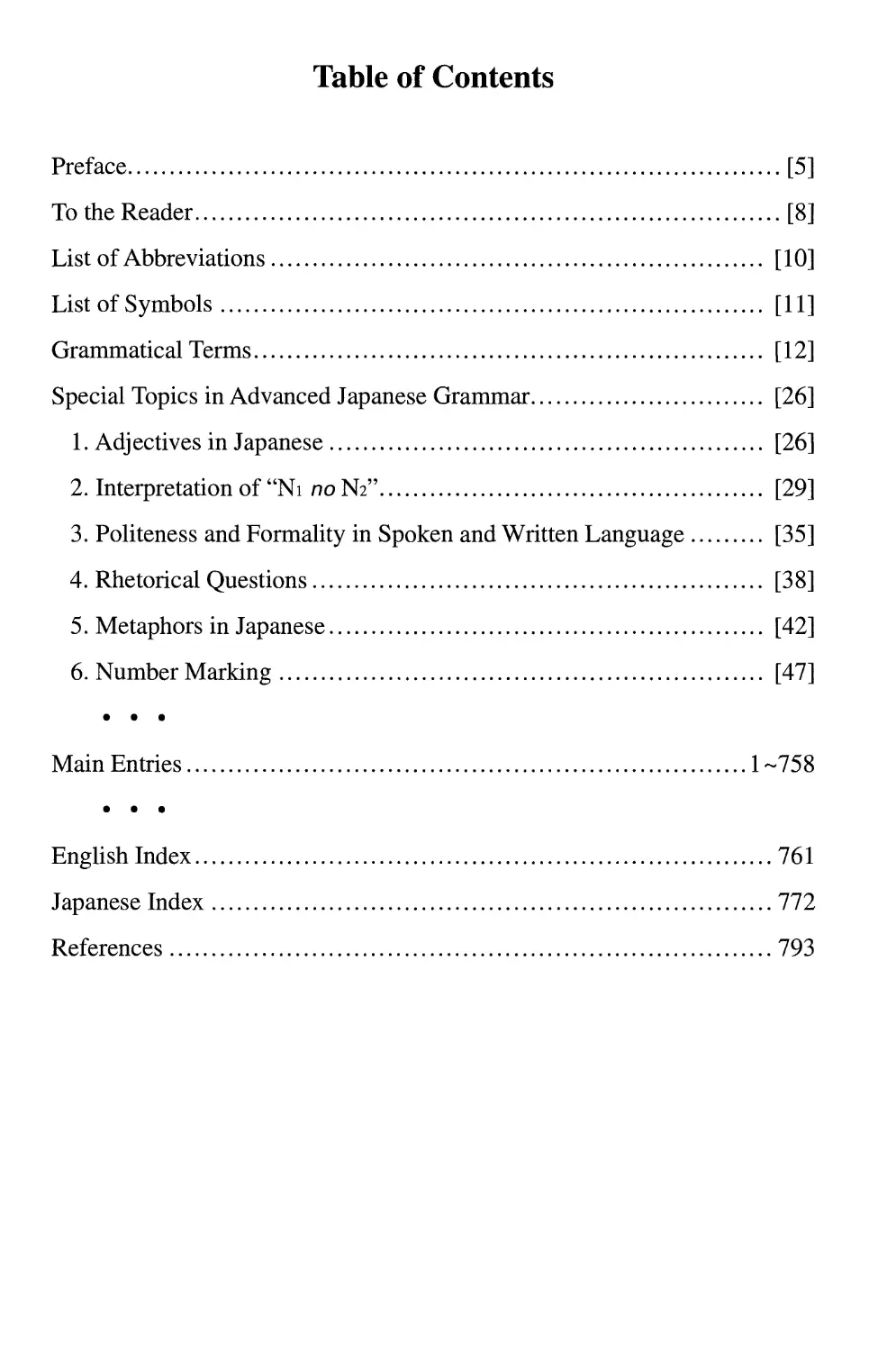
Table of Contents
Preface [5]
To the Reader [8]
List of Abbreviations [10]
List of Symbols [11]
Grammatical Terms [12]
Special Topics in Advanced Japanese Grammar [26]
1. Adjectives in Japanese [26]
2. Interpretation of "Ni no N2" [29]
3. Politeness and Formality in Spoken and Written Language [35]
4. Rhetorical Questions [38]
5. Metaphors in Japanese [42]
6. Number Marking [47]
• • •
Main Entries 1 -758
• • •
English Index 761
Japanese Index 772
References 793
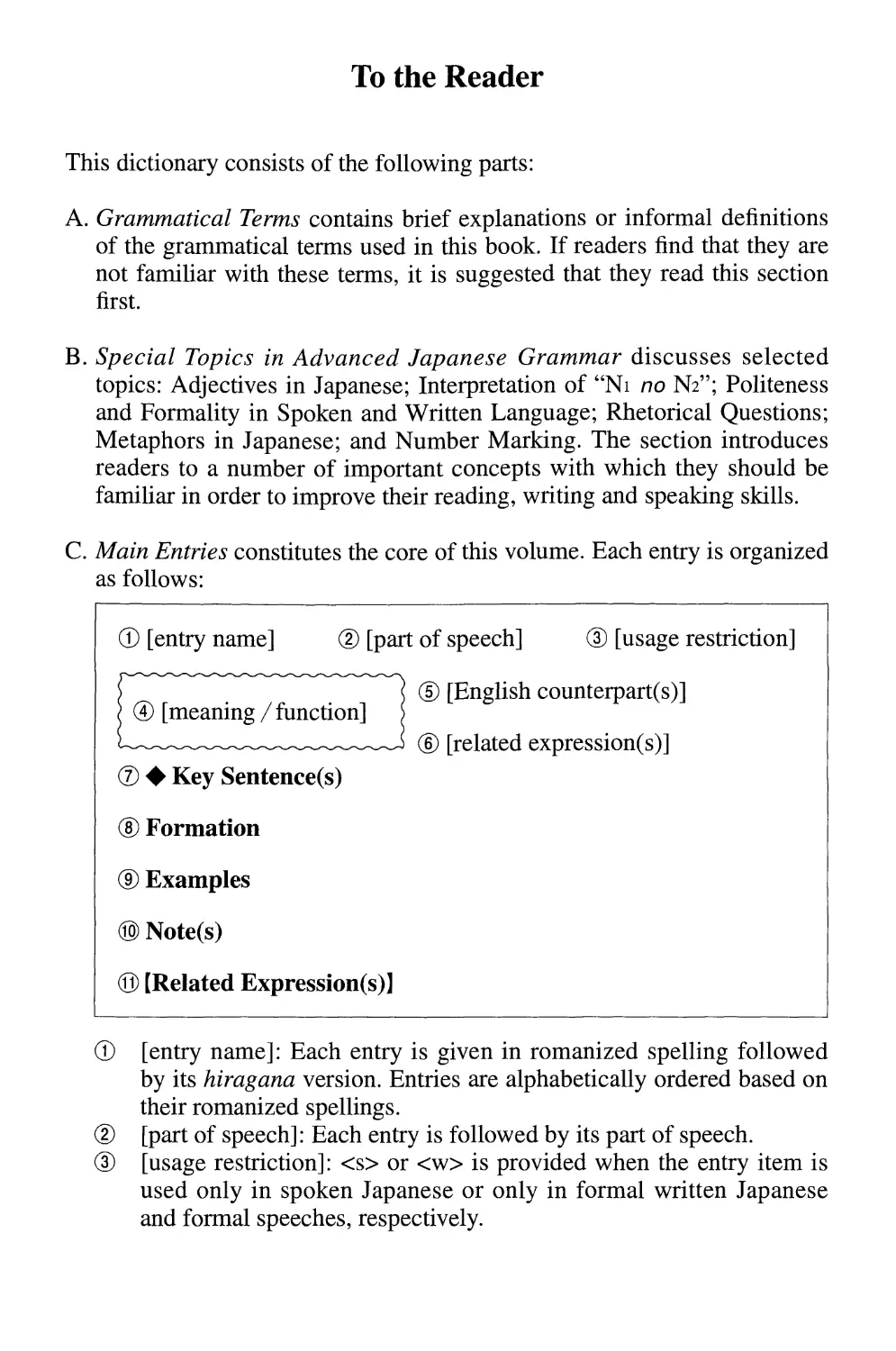
To the Reader
This dictionary consists of the following parts:
A. Grammatical Terms contains brief explanations or informal definitions
of the grammatical terms used in this book. If readers find that they are
not familiar with these terms, it is suggested that they read this section
first.
B. Special Topics in Advanced Japanese Grammar discusses selected
topics: Adjectives in Japanese; Interpretation of "Ni no N2"; Politeness
and Formality in Spoken and Written Language; Rhetorical Questions;
Metaphors in Japanese; and Number Marking. The section introduces
readers to a number of important concepts with which they should be
familiar in order to improve their reading, writing and speaking skills.
C. Main Entries constitutes the core of this volume. Each entry is organized
as follows:
© [entry name] © [part of speech]
© [meaning/function]
® ♦ Key Sentence(s)
® Formation
® Examples
® Note(s)
@ [Related Expression(s)]
® [usage restriction]
® [English counterpart(s)]
© [related expression(s)]
© [entry name]: Each entry is given in romanized spelling followed
by its hiragana version. Entries are alphabetically ordered based on
their romanized spellings.
© [part of speech]: Each entry is followed by its part of speech.
® [usage restriction]: <s> or <w> is provided when the entry item is
used only in spoken Japanese or only in formal written Japanese
and formal speeches, respectively.
[9]
® [meaning/function]: The basic meaning or function of the entry
item is given in the box below the entry name.
© [English counterpart(s)]: English expressions equivalent to the entry
item are given to the right of the box.
© [related expression(s)]: Items which are semantically related to
the entry item are listed as [REL. aaa; bbb\ ccc]. Expressions
in plain type like aaa are explained in the entry under [Related
Expression(s)] (©). Expressions in bold type like ccc contain
comparisons to the entry item under [Related Expression(s)] for
ccc.
® ♦Key Sentence(s): Key sentences present typical sentence patterns
in frames according to sentence structure. The elements that form
the sentence patterns are printed in red and the elements which
commonly occur with them are printed in bold-faced type.
© Formation: The word formation rules / connection forms for each
item are provided with examples. The entry elements are printed in
red.
© Examples: Example sentences are provided for each entry.
® Note(s): Notes contain important points concerning the use of the
item.
© [Related Expression(s)]: Expressions which are semantically close
to the entry item are compared and their differences are explained.
(^>aaa (DBJG/DIJG: 000-000)) in Note(s) and Related Expression(s)
indicates that the item which was referred to (i.e., aaa) is explained on
pp. 000-000 of the companion volumes: A Dictionary of Basic Japanese
Grammar (DB JG) or A Dictionary of Intermediate Japanese Grammar
(DUG).
D. Indexes provides both a Japanese index and an English index. The
Japanese index includes the main entries, the items explained in Related
Expression(s), and the items covered in A Dictionary of Basic Japanese
Grammar and in A Dictionary of Intermediate Japanese Grammar. The
English index includes the English counterparts of the main entry items.
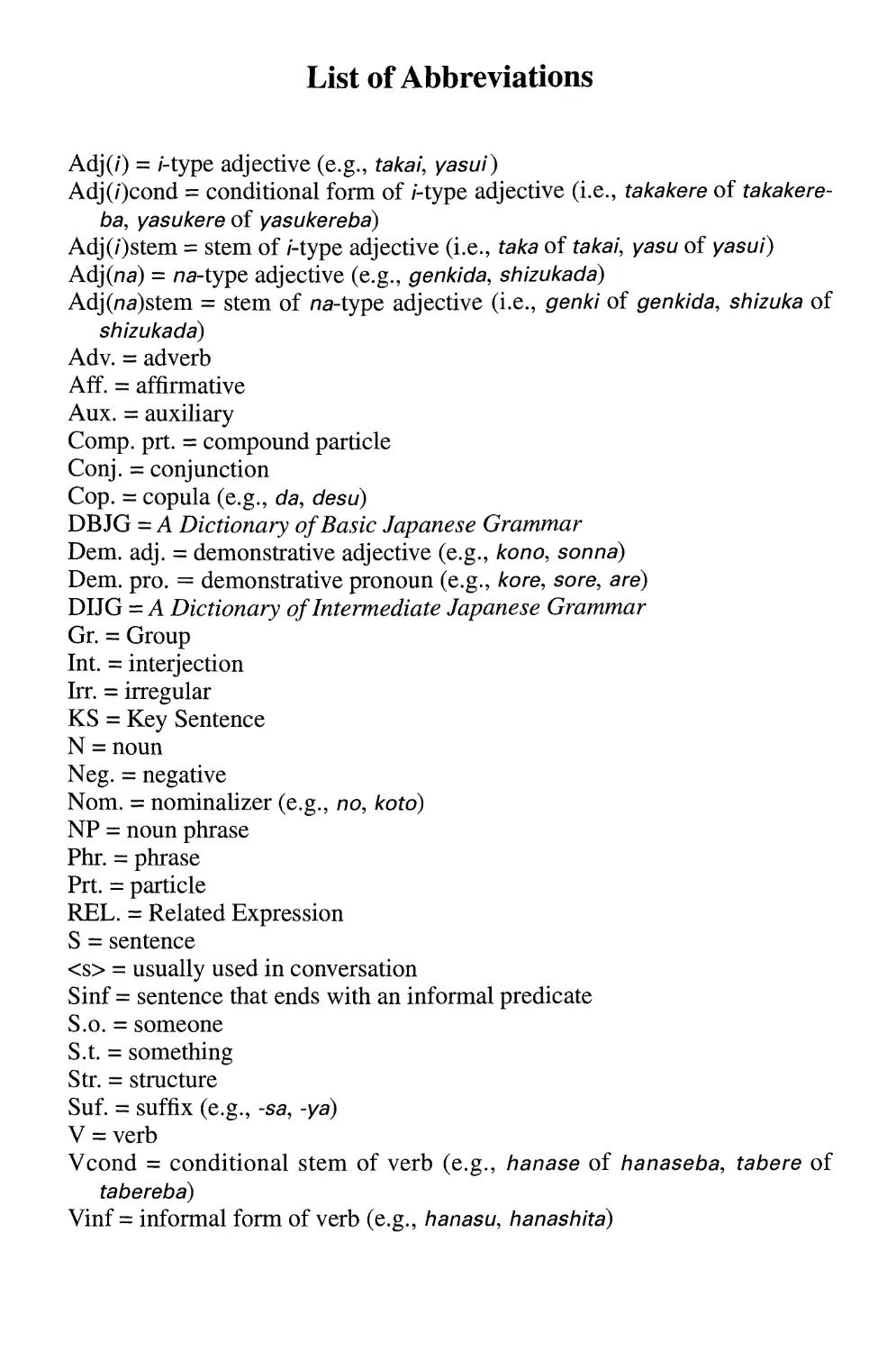
List of Abbreviations
Adj(/) = /-type adjective (e.g., takai, yasui)
Adj(/)cond = conditional form of /-type adjective (i.e., takakere of takakere-
ba, yasukere of yasukereba)
Adj(/)stem = stem of /-type adjective (i.e., taka of takai, yasu of yasui)
Adj(r?a) = na-type adjective (e.g., genkida, shizukada)
Adj(na)stem = stem of na-type adjective (i.e., genki of genkida, shizuka of
shizukada)
Adv. = adverb
Aff. = affirmative
Aux. = auxiliary
Comp. prt. = compound particle
Conj. = conjunction
Cop. = copula (e.g., da, desu)
DBJG = A Dictionary of Basic Japanese Grammar
Dem. adj. = demonstrative adjective (e.g., kono, sonna)
Dem. pro. = demonstrative pronoun (e.g., kore, sore, are)
DUG = A Dictionary of Intermediate Japanese Grammar
Gr. = Group
Int. = interjection
Irr. = irregular
KS = Key Sentence
N = noun
Neg. = negative
Nom. = nominalizer (e.g., no, koto)
NP = noun phrase
Phr. = phrase
Prt. = particle
REL. = Related Expression
S = sentence
<s> = usually used in conversation
Sinf = sentence that ends with an informal predicate
S.o. = someone
S.t. = something
Str. = structure
Suf. = suffix (e.g., -sa, -ya)
V = verb
Vcond = conditional stem of verb (e.g., hanase of hanaseba, tabere of
tabereba)
Vinf = informal form of verb (e.g., hanasu, hanashita)
[11]
Vmasu = masiv-stem of verb (e.g., hanashi of hanashimasu, tabe of tabe-
masu)
VN = stem of si/riy-verb, i.e., noun which forms a verb by affixing suru (e.g.,
benkyo, yakusoku, nokku)
Vneg = informal negative stem of verb (e.g., hanasa of hanasanai, tabe of
tabenai)
VP = verb phrase
Vpot = verb potential form (e.g., hanaseru, taberareru)
Vte = te-form of verb (e.g., hanashite, tabete)
Vvol = volitional form of verb (e.g., hanaso, tabeyo)
<w> = usually used in formal writing and formal speech
Wh-sentence = a sentence that contains a Wh-word
Wh-word = an interrogative word (e.g., nani, doko)
List of Symbols
t=> = Refer to.
? = The degree of unacceptability is indicated by the number of question
marks, two being the highest.
* = ungrammatical or unacceptable (In other words, no native speaker
would accept the asterisked sentence.)
IA /B 1 C = AC or BC (e.g., | V / Adj(/)) inf = Vinf or Adj(/)inf)
0 = zero (In other words, nothing should be used at a place where 0 occurs.
Thus, Adj(na) ( 0 / datta \ kamoshirenai is either Adj(na) kamoshirenai or
Adj(na) datta kamoshirenai.)
Grammatical Terms
The following are brief explanations of some of the grammatical terms
used in this dictionary.
Auxiliary Adjective A dependent adjective that is preceded by and
attached to a verb or another adjective. The auxiliary adjectives in the
following sentences are printed in bold-faced type.
(a) feting VCffotgl/^o
(I want John to go there.)
(b) z(ommitm\^ti\
(This dictionary is easy to use.)
(c) &i£1-L#£^fcl\>
(I want to eat sushi.)
(d) ^*tt;*:^*ffi*:SU\,
(Beth seems to have graduated from college.)
lift z 3tf
(e) KSSti^?^
(Hanako looks lonely.)
(f) £©fc^M**n>b*5:Eo
(This cake looks delicious.)
Auxiliary Verb A verb which is used in conjunction with a preceding
verb or adjective. The bold-faced words of the following sentences are
typical auxiliary verbs.
(a) \*M*ttm*m\*~cvZo
(Bill is writing a letter now.)
(b) M#B8ttT**o
(lit., The window has been opened. (= The window is open.))
(c) lli^S*L-tU*ofco
(I have done my homework.)
(d) &&M%zi3±£JgLX&tftzo
(I loaned money to my friend.)
GRAMMATICAL TERMS [13]
(e) ^(D3>tfjL-^-{i]ST*So
(This computer is too expensive.)
(f) v?3-^&;**0-y;fr-£$;L#oTV3o
(lit., George is showing signs of wanting a sports car. (= George
wants a sports car.))
(g) &o ! iWftoT^Tt !
(Gee! It's started to rain!)
Compound Particle A particle which consists of more than one word but
functions like a single particle. For example, the compound particle to shite
wa consists of the particle to, the te-form of sum and the particle wa, but it
is used like a single particle to mean "for."
Conditional A word, phrase, or clause which expresses a condition, as in
(a)-(c).
(a) tMROii*b *>**)£?<>
(I will take it on if it's a translation job.)
(b) StttitfK^fcbft&Oo
(I might buy it if it is cheap.)
(c) lumzAsfrbWMStf&^fcbkn^itxTzi^o
(If Mr. Yamada calls me, please let me know.)
Continuative Form Forms of verbs, adjectives and da which signal that
the sentence is continuing. They do not indicate tense or politeness level.
These forms include the following:
(a) Affirmative forms:
Vte HSbT (s.o. talks/talked/etc. and)
Wmasu 151 (s.o. talks/talked/etc. and)
Adj(/)stem< (X) feo L < (X) (s.t. is/was delicious
and)
Adj(na)stem {X/Xfo<0\ fe'j I X / X & *3 ) (s.t. is/was
convenient and)
N|TVe&0| ¥^{X/XfoiO\ (s.o. is/was a
scholar and)
[ 14] GRAMMATICAL TERMS
Adj(/)stem< is also the adverbial form, as in ¥<%£ (to go to bed early)
or o £ < m-f (to talk skillfully).
(b) Negative forms:
Vneg i* §§ £ -f (s.o. does/did/etc., not talk and)
Adj(/)stem <&< fcol<S:< (s.t. is/was not delicious and)
Adj(na)stem { D * / -?& ( & < ffifij | E */"?&(& < (s.t. is/was
not convenient and)
N|D*/Ttt|&< ^t{UW^|&< (s.o. is/was not a
scholar and)
These forms are also used with certain words/phrases to convey more
specific meanings, as shown in (c).
(c) Other uses:
Vte O§ iLTO§ (s.o. is talking)
Vmasu ^i~P Jt^^-fn * (easy to eat)
Adj(/)te ffcjf # & o # < Tft;## &l > (unbearably hot)
Adj(na)stem^(iO(t^O B^H^T^T&OJt&O (it's not good
if s.o. is bad at Japanese)
N T & J: o 3SK"? & <fc v * (English would be all right)
Vneg ifte Si*^ (without sleeping)
Coordinate Conjunction A conjunction that combines two sentences
without subordinating one to the other. A typical coordinate conjunction is
ga "but."
(a) ^oTOtt^ ^^b&^^t^/vo
(I'm running, but I haven't lost any weight at all.)
Demonstrative A pronoun or adjective which specifies someone or
something by pointing it out, as in (a) and (b).
(a) {Zti/*ti/&ti\&®~Clrfro
(What is | this /that /that over there | ?)
(b) I Z<&#/ ■?O*/ tbOJf ( mk(D^^0
(| This book /That book /That book over there (is mine.)
GRAMMATICAL TERMS [15]
The interrogative words which correspond to demonstrative pronouns and
demonstrative adjectives are dore and dono, respectively.
Dependent Noun A noun which must be preceded by a modifier, as in
(a) and (b).
h 1" tz ttff
(a) A: W0ffl+*£t::£9OfcU-el-ri\,
(Are you going to meet Prof. Tanaka tomorrow?)
(Yes, I am.)
(b) -fry F^fih A£ftlo-0>5(J-f£o
(I expect that Sandra knows Tom.)
Direct Object The direct object of a verb is the direct recipient of an
action represented by the verb. It can be animate or inanimate. An animate
direct object is the direct experiencer of some action (as in (a) and (b)
below). An inanimate direct object is typically something which is created,
exchanged or worked on, in short, the recipient of the action of the verb (as
in (c)-(e) below). (cf. Indirect Object)
(a) KBft£ii¥££J:<&«>£o
(Prof. Yamaguchi often praises his students.)
(b) fr&Q\Z—»£iZ£Ltzo
(Kaori deceived Ichiro.)
(c) St£*£»ofco
(I wrote a book.)
(d) ^TO^0{a^-7^o/:0
(Ichiro gave a scarf to Midori.)
(e) fyiK7£MttT;fcO;fco
(I kept the door open.)
Although direct objects are marked by the particle o, nouns or noun phrases
marked by o are not always direct objects, as shown in (f) and (g).
(f) 7E^I£-«^±f^£^£o
(Hanako was glad that Ichiro entered college.)
(g) h A&*<DR$^H£*OTO£o
(At that time Tom was walking in the park.)
(^> o2 (DBJG: 349-51); o4 (DBJG: 352-54))
[ 16] GRAMMATICAL TERMS
Embedded Question A question within a sentence, (a)-(c) provide
examples (printed in bold-faced type):
(a) »«H#£:i£a£#ft£T<;E£^o
(Please tell me where the post office is.)
(b) a^t^lits^oti^t^
(Do you know when she is getting married?)
(c) 3fc#H*Mf<fr££&&TOi;^o
(I haven't decided yet whether to go to Japan next year.)
Formal / Informal Forms Formal forms are the forms which are used in
such situations as polite conversation and business/personal letters.
Informal forms are the forms used in such situations as casual conversation,
newspapers, and academic papers. Examples of these forms can be seen in the
following chart:
Formal Forms
ftzt-t
±%\^Tt
yt%Tt
¥%LTt
Informal Forms
ff<
*£p
jt%fz
¥3it£
Informal forms are required in some grammatical structures.
(^ Appendix 4 (DBJG: 589-99))
Gr. 1 / Gr. 2 Verbs Gr. 1 and Gr. 2 Verbs are Japanese verb groups: If a
verb's informal, negative, nonpast form has the [a] sound before nai as in
(a), the verb belongs to Group 1, and if not, as in (b), it belongs to Group
2. There are only two irregular verbs (i.e., kuru "come" and sum "do") that
belong to neither Gr. 1 nor to Gr. 2.
(a) Gr. 1 Verbs: $J h & O [kira - nai]
iti&i\ #tf>&i\ f$fc&i\ ?E&&1\ £h&\\ HS£&o
(b) Gr. 2 Verbs: #£o [k/- nai], £^&P [tabe - nai]
GRAMMATICAL TERMS [17]
Hearer The person who receives a spoken or written message. In this
dictionary the term "hearer" is used in a broader sense to mean the person
to whom the speaker or the writer communicates.
Imperative Form A conjugated verb form that indicates a command, as
in Hanase! "Talk!," Tabero! "Eat it!," Shim! "Do it!," or Koi! "Come!"
Indefinite Pronoun A pronoun which does not refer to something
specifically. No in B's sentence in (a) is an indefinite pronoun. Here, no is used
for jisho "dictionary," but does not refer to a specific dictionary.
(a) A: E/v&£mfr4kL\^/vTtfro
(What kind of dictionary do you want?)
B: 'bZ\*<D&®rL\*/uTiTo
(I want a small one.)
Indirect Object The indirect object of a verb is the recipient of the
direct object of the main verb, and is marked by the particle ni. In (a), for
example, the indirect object is Midori, the recipient of a scarf, which is
the direct object of the verb yatta. It can be inanimate, as in (b). The main
verbs which involve the indirect object are typically donative verbs (as in
(a) and (b)). (cf. Direct Object)
(a) -Htt# if U K 7s ij - y £^o fco
(Ichiro gave a scarf to Midori.)
(b) i$mzKmmij\^±%:wmi:^z-±o
(The typhoon brought great damage to the Kyushu area.)
Informal Form (■=> Formal / Informal Forms)
Intransitive Verb A verb which does not require a direct object. The
action or state identified by the intransitive verb is related only to the
subject of the sentence. For example, the verb hashitta "ran" in (a) is an
intransitive verb because the action of running is related only to the subject.
(cf. Transitive Verb)
■tr §
(a) #&*£M£j£ofco
(Mr. Suzuki ran.)
Intransitive verbs typically indicate movement (such as iku "go," kuru
"come," aruku "walk," tobu "fly," noru "get onto"), spontaneous change
(such as nam "become," kawaru "change," tokeru "melt," fukuramu "swell,"
[ 18] GRAMMATICAL TERMS
hajimaru "begin"), human emotion (such as yorokobu "rejoice," kanashimu
"feel sad," omou "feel"), and birth/death (such as umareru "be born," shinu
"die"). (<=> Appendix 3 (DBJG: 585-88))
/-type Adjective An adjective whose nonpast prenominal form ends
with /. Examples of /-type adjectives are takai "high; expensive" and tsuyoi
"strong," as seen in (a) and (b). (cf. A/a-type Adjective; A/o-type Adjective)
(a) iSIl^ (an expensive book)
(b) $|lNA (a strong person)
/-type adjectives are further subdivided into two types: /-type adjectives
which end with shi-i and those with non-shi-i endings. Most adjectives with
shi-i endings express human emotion (such as ureshii "happy," kanashii
"sad," sabishii "lonely," kurushii "painful"); the non-shi-i adjectives are
used for objective descriptions (such as kuroi "black," shiroi "white," hiroi
"spacious," takai "high; expensive").
Main Clause When a sentence consists of two clauses, one marked by
a subordinate conjunction (such as kara, keredo, node and noni) and the
other not marked by a subordinate conjunction, the latter is called a main
clause. The main clauses in sentences (a) and (b) are printed in bold-faced
type. (cf. Subordinate Clause)
(a) ffifflttS^*i^(r*«(Cfirofco
{Jornada went to school, although he had a headache.)
fr-f z. Hot ^s :^a(
(b) »^(±*#«U^ &*■/*,
(Kazuko is happy, because her husband is kind.)
When a sentence has a relative clause, the non-relative clause part is also
referred to as a main clause, as in (c).
(c) ?A(j#<£>9, Mmfr?>miofc\i?**M,fzo
(Yesterday I watched a video which I borrowed from my friend.)
A/a-type Adjective An adjective whose nonpast prenominal form ends
with na. For example, shizukada "quiet" and genkida "healthy" are na-type
adjectives, as in (a) and (b). (cf. /-type Adjective; A/o-type Adjective)
(a) ff^&ic (a quiet house)
(b) 7G$i&A (a healthy person)
GRAMMATICAL TERMS [ 19]
A/a-type adjectives are very similar to nouns. Some na-type adjectives can
be used as nouns, as shown in (c) and (d). All n a-type adjectives behave as
nouns when they are used before the copula da, as shown in (e).
(c) «*tt;fc*-el-<fco
(Health is important, you know.)
cf. HH&A
(a healthy person)
(d) zmw&i&tLtit/uo
(I'll never forget your kindness.)
cf. SKOfcA
(a kind person)
(e) Z(DA&5tU/m±\tz/^t/tz^±/TL±/£*%;\^/V^&l0t
^h / E *ftrt>o tz / C * h 0 i-£A,T Ltz \ o
(This person {is/was/isn't/wasn't} healthy /a student.)
Nominalizer A nominahzer is a particle that makes a sentence into a
noun phrase or clause. There are two nominalizers, no and koto: the former
represents the speaker's/writer's empathetic feeling towards an event/state
expressed in the nominalized noun phrase/clause; the latter indicates no
empathy on the part of the speaker/writer towards an event/state.
(^ no3 (DBJG: 318-22); koto2 (DBJG: 193-96))
Noun Phrase /Clause
Sentence
BM%&Mt?
Nominalizer
<D/zt
Particle
ii
Predicate
tin
(Reading Japanese is difficult.)
The nominalized sentence can be used in any position where an ordinary
noun or a noun phrase/clause can be used.
/Vo-type Adjective An adjective whose nonpast prenominal form ends
with no.
(a) —S0)A^ (prestigious university)
h<X^
(b) #£<DS (specific country)
[20] GRAMMATICAL TERMS
(c) —#&(DA (people in general)
(d) WM^rll'J (universal rule)
(e) ftt> ^ £ (DWMM (mostly empty baseball stadium)
No-adjectives can occur in the predicate as well.
(f) Z<D*mt-%k1£o
(This university is prestigious (lit., first-class).)
(g) z <o wm§ tt t, >o £ # 6 ffi t t£o
(This baseball stadium is always mostly empty.)
No-adjectives look like nouns, but they do not have the critical properties
of nouns (e.g., they cannot be marked by the subject marker ga or the direct
object marker o).
Many no-type adjectives can be classified by meaning, as shown below.
Excellent:
&& (excellent), ftffif (preeminent), JHffi (outstanding), —JK (first-class),
izhsb-o (by far the best), ffi#f«9 (distinguished), ^H^ (superb), ±^
(high-class), ±^ (excellent)
Unique/Selected:
^g (of one's own), Mf# (unique), #W (peculiar), 0^" (proper), f#^
(specific), f#$J (special) (cf. #$;& (special))
Common:
#M (common), —$L (general), 3£ (ordinary), & 0 i fc *9 (ordinary), f?S
(common), 3fc 0 iu (natural)
I7wc/iangmg:
—S (constant), I? M (universal), >FIE (unchanging), 7Jc?l (eternal)
A common semantic property of no-adjectives is that they do not describe
relative attributes such as height and quietness. Thus, unlike /- and na-
adjectives, the suffix sa "the degree of" (e.g., taka-sa "height," shizuka-sa
"quietness") cannot be affixed to no-adjectives.
(cf. Na-type Adjective; /-type Adjective)
Certain prefixes and suffixes also form no-adjectives, as shown below.
GRAMMATICAL TERMS [21 ]
Prefixes:
to-: &A (unattended), &£lft (undefeated)
*The following are na-adjectives: MM (impossible), M%\\
(ignorant), MM (incapable), MMflt (impertinent), MMW
tf V h
(indifferent; careless), MMM (nonsensical)
7^-: *$fl (unknown), %.% (unfinished), ^{@ (unexplored)
£0 __ Si^< Sl^LA, Sl^'l^
H-: H© (the best), HH (the worst), H$f (the newest), HA
(maximum)
-fpj t: ^^IrJ # (suitable for children)
-fltt: ?8ff «4|rJ tf (for portable devices)
±■5 ft A, 199
-JB: iiSSffl (for practice)
-A 0 : !fci^ A *j (with honey (as an ingredient))
-fa £: ;#' u - vfa £ (with a garage)
-M: * ^ >M (Spanish-style)
- i* h It: AlV > /£ 6 tt (full of errors)
-£ &#l: #23; <fr tx (covered with mud)
-*W: ± 0 Stl* (rather overweight)
-#>: A^ #> (larger than expected, than usual, etc.)
Note: In the Formation section in each grammar entry, the formation rules
for nouns apply to no-adjectives.
Potential Form A verb form that expresses competence in the sense of
"can do s.t." The formation is as follows:
Gr. 1 Verbs: Vcond + 5 e.g. !£-£§ (can talk)
Gr. 2 Verbs: Vstem + h ti% e.g. ^^ 6 ti% (can eat)
Vstem + ti^ e.g. ^k^fiZ* (can eat)
Irr. Verbs: ^5 ^£ti3, ^ti^ (can come)
1"5 T^ 3 (can do)
Predicate The part of a sentence which makes a statement about the
subject. The core of the predicate consists either of a verb, an adjective, or
a noun followed by a form of da. Optionally, objects and other adjectival
and/or adverbial modifiers may be present. In (a)-(c), the predicates are
printed in bold-faced type. (cf. Subject)
[22] GRAMMATICAL TERMS
(a) i*£/^<£<P*®£JL3o
(Mr. Matsumoto sees movies often.)
(b) %k(Dm$* i * £ Ao j: *;m ui\
(My house is newer than Mr. Smith's.)
(c) v3 >teB*m<D¥*k?t0
(John is a Japanese language student.)
Prefix / Suffix A dependent, non-conjugational word attached to nouns
or the stems of verbs and adjectives in order to form new independent
words. Prefixes are attached to the beginnings of nouns, etc., as in (a), and
suffixes are attached to their endings, as in (b).
(a) M4& (superexpress), h^kBM (vice-president), MMJ\J
(indifference)
(b) P&!Kb (cinematization), Wi&Jj (how to read), ^ £ (height)
Prenominal Form The verb/adjective form which precedes a noun and
modifies it. The bold-faced verbs and adjectives in (a)-(d) are prenominal
forms.
(a) $>#»£/B!>b£*fH
(the newspaper I read)
(b) *#W:*:£fro£iC
(a big house / a house which used to be big)
(c) feI&/:£>JiS£o£^
(a magnificent building / a building which used to be magnificent)
(d) ^Uf9*/^lf?^f:^-^
(a delicious-looking cake / a cake which looked delicious)
Stative Verb A verb which represents the state of something or someone
at some point in time, as in (a). (O Appendix 2 (DBJG: 582-84))
(a) & % (exist (of inanimate things)); I ^> <5 (exist (of animate things)),
I > 3 (need), ~e t 5 (can do)
Subject An element of a sentence which indicates an agent of an action
in active sentences (as in (a)) or an experiencer of an action (as in (b)) or
GRAMMATICAL TERMS [23]
someone or something that is in a state or a situation (as in (c)-(f)). The
subject is normally marked by the particle ga in Japanese unless it is the
sentence topic.
(a) va>*5Ho^t^o (John ate an apple.)
(b) ^ T U — i)15fe£ K & tf> h ftiz 0 (Mary was praised by her teacher.)
(c) -± > v — It t til ^£o (Nancy is pretty.)
(d) K7^iBPfe0 (The door opened.)
(e) *U*—o & 6 o (lit., One table exists. (= There is a table.))
(f) ffi#Wt\ (The sky is blue.)
Subordinate Clause A clause which is embedded into a main clause
with a subordinate conjunction. Typical subordinate conjunctions are ba
"if," kara "because," node "because," keredo "although" and noni
"although." Thus, in (a) below, the bold-faced clause with the subordinate
conjunction node is embedded into the main clause Nakayama-san wa gakko o
yasunda "Mr. Nakayama was absent from school." (cf. Main Clause)
(a) 4>0j 2 /uimtf*fr^>t:<»V¥«L&ft/ui£o
(Mr. Nakayama was absent from school because he had a
headache.)
The informal form of a verb/adjective is usually used in a subordinate
clause.
Suffix (O Prefix / Suffix)
Suru-\erb A verb which is composed of a noun and sum, as in (a) and
(b), or a single word and sum, as in (c). Nouns preceding sum are mostly
Chinese-origin words. Stvru-verbs conjugate in the same way as sum.
(a) M&tZ (to study), B$k? 5 (to clean), fel^ LT 3 (to stay up
late)
(b) J v 5 T 3 (to knock), 1M V T 3 (to sign)
(c) fit" 3 (to heat), gN" 3 (to guess)
Transitive Verb A verb that requires a direct object. It usually expresses
an action that acts upon someone or something indicated by the direct
[24] GRAMMATICAL TERMS
object. Actions indicated by transitive verbs include giving/receiving (such
as ageru "give," morau "receive," kureru "give"), creating (such as tsukuru
"make," kaku "write," kangaeru "think"), communicating (such as hanasu
"speak," oshieru "teach," tsutaeru "convey a message") and others. Note
that some English transitive verbs are intransitive in Japanese.
(cf. Intransitive Verb)
(a) feii»#&50
(lit., With me a car exists. (= I have a car.))
(b) S&fe#^3o
(lit., To me money is necessary. (= I need money.))
(c) % \ x Ztv\Z%W&tfftfr%0
(lit., To Mr. Smith Chinese is understandable. (= Mr. Smith
understands Chinese.))
(d) ftli77>^g^>lTt5o
(lit., To me French is a bit possible. (= I can speak French a little.))
(e) *T^d^^fc#£^*o£0
(Mr. Kinoshita met his father in Tokyo.)
(f) m^\Z^^&VLC7Ll£i?'?1to
(lit., To me the bell wasn't audible. (= I wasn't able to hear the bell.))
(g) z.z.frb\$i±\ktf&X*tk0
(lit., From here Mt. Fuji is visible. (= We can see Mt. Fuji from
here.))
(h) fefc$tt*f#Sl::ft';*Lfco
(We rode a bullet train.)
a) m$m-kx^z>hLw
(It seems that I resemble my mother.)
Volitional Sentence A sentence in which a person expresses his/her will.
The main verb in such sentences is in the volitional form, as in (a).
(a) i^T^/ft^L^o
(I will go.)
Wh-question A question that asks for information about who, what,
where, which, when, why and how, as exemplified by (a)-(g) below.
GRAMMATICAL TERMS [25]
(a) m^tLfz^o
(Who came here?)
(b) |6r&&^£1-ri>a
(What will you eat?)
(c) ZCKftttirfro
(Where are you going?)
(d) tiommmmmTirfro
(Which building is the library?)
(e) ^*o±m^>M Oit^o
(When are you going back to Osaka?)
(f) 1:5 LTWh&\*A,X*irfro
(How come you don't buy it?)
(g) W£lk^&t:*>ft*t1rl>\
(How can I get to Tokyo Station?)
Wh-word An interrogative word which corresponds to the English words
who, what, where, which, when, why and how. The following are examples.
fztl
(a) ft (who), M (what), E Z (where), E<D (which), oo (when), E 5 L
X /&-& (how come /why), E o (how)
Note that Japanese Wh-words are not always found in sentence-initial
position; they are frequently found after a topic noun phrase, as shown in (b)
and (c) below.
(b) S£b<D'S-tj -K\lMft%tLtzfr0
(lit., To yesterday's party, who came there? (= Who came to
yesterday's party?))
cf. &&#EU<D'S-T 4 -£*£ Ltzfro
(Who came to yesterday's party?)
(c) B^X&ft&LtLtzfro
(lit., In Japan what did you do? (= What did you do in Japan?))
(What did you do in Japan?)
Special Topics in Advanced Japanese Grammar
1. Adjectives in Japanese
Japanese adjectives are commonly classified into two groups: /-adjectives
and na-adjectives. However, there is yet another group of adjectives,
which can be called no-adjectives. (See A/o-type Adjective in Grammatical
Terms.) (1) presents some examples of this type of adjective.
(1) a. —$i(DA (people in general)
b. #^(Dm (specific countries)
c. 7lc}§(DKil (eternal truth)
tih- -SAX*
d. 3£(7))I^ (average player)
e. —^<7)^v^ (prestigious university)
f. #£^£<7)iNN§ (mostly empty baseball stadium)
No-adjectives are just like nouns in terms of their syntactic rules (e.g.,
they require no when they modify nouns), but they cannot be marked by
case particles such as ga and o. In other words, they are not nouns. The
only syntactic difference between na-adjectives and no-adjectives is that
na-adjectives take na before nouns whereas no-adjectives take no.
However, some words can take either na or no, as shown in (2).
(2) a. #$] | & / CD (%M (special treatment)
b. M^ f & / CD [ SS (various costumes)
Some nouns can also be used as no-adjectives, as demonstrated in (3) and
(4).
(3) a. m%(0m^%&&^^tzo [no-adjective]
(I wrote a letter to my sick mother.)
b. ^(Dmm^MitLtzo [noun]
(My father's illness worsened.)
c. WM-Z.(D^%Zo^-to [noun]
(Mosquitoes transmit this disease to people.)
SPECIAL TOPICS IN ADVANCED JAPANESE GRAMMAR [27]
(4) a. Sli*6fl)^7»)^4:Sofeo [no-adjective]
(I bought a light blue blouse.)
b. mm&&'&ZgmfcVfc0 [noun]
(We chose light blue as the base color for the living room.)
Thus, na-adjectives, no-adjectives and nouns form a spectrum, as shown in
Chart 1.
Chart 1: Spectrum of na-adjectives, no-adjectives and nouns
(a)
(b)
(c)
(d)
(e)
Parts of
speech
A/a-adj.
A/a/A/o-adj.
A/o-adj.
A/o-adj./
Noun
Noun
Examples
#tf> (quiet)
§!?(J (convenient)
ft SO (special)
S^> (various)
HK (general)
M (ordinary)
ISM (ill, illness)
7K-S (blue)
Mi (earth)
v s y (John)
Prenominal
form
X-naN
X-na/no N
X-noN
Predicate
form
X-da/desu/
dat fa/etc.
Case
particles
NA
X-ga/0/
etc.
While the predicate form of na-adjectives and nouns is the same, both the
predicate and the prenominal forms of /-adjectives are significantly
different from those of na-adjectives. From this, it can be said that /-adjectives
are "pure" adjectives. However, a handful of adjectives can take either / or
na, as shown in (5). (The difference between the /-version and the
na-version is subtle, but the /-version tends to be used when the speaker describes
something objectively whereas the na-version is used when the speaker
describes something with strong emotion.)
[28] SPECIAL TOPICS IN ADVANCED JAPANESE GRAMMAR
(5) a. ± t i t V & I -5 *> (large house)
b. *5^UVftl* (limberbody)
c. isfr L \ l V & (IS (strange/funny story)
d. £ A,;£l U V & ( H (round moon)
The overlapping categories of adjectives and nouns can be depicted as
follows:
SPECIAL TOPICS IN ADVANCED JAPANESE GRAMMAR [29]
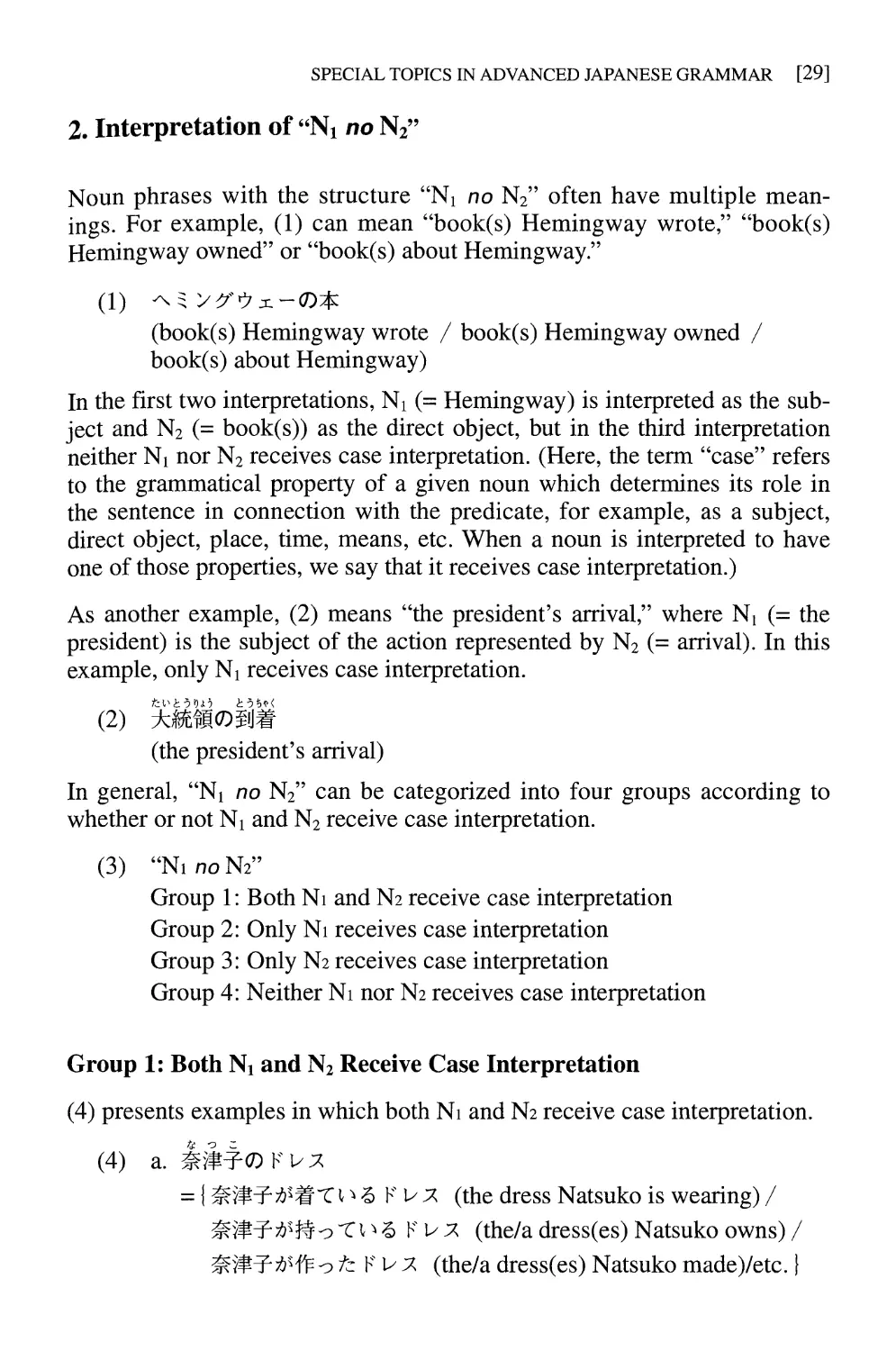
2. Interpretation of "Ni no N2"
Noun phrases with the structure "Ni no N2" often have multiple
meanings. For example, (1) can mean "book(s) Hemingway wrote," "book(s)
Hemingway owned" or "book(s) about Hemingway."
(1) a^^^x-(D^
(book(s) Hemingway wrote / book(s) Hemingway owned /
book(s) about Hemingway)
In the first two interpretations, Ni (= Hemingway) is interpreted as the
subject and N2 (= book(s)) as the direct object, but in the third interpretation
neither Ni nor N2 receives case interpretation. (Here, the term "case" refers
to the grammatical property of a given noun which determines its role in
the sentence in connection with the predicate, for example, as a subject,
direct object, place, time, means, etc. When a noun is interpreted to have
one of those properties, we say that it receives case interpretation.)
As another example, (2) means "the president's arrival," where Ni (= the
president) is the subject of the action represented by N2 (= arrival). In this
example, only Ni receives case interpretation.
(2) *gm<D$m
(the president's arrival)
In general, "Ni no N2" can be categorized into four groups according to
whether or not Ni and N2 receive case interpretation.
(3) "Ni no N2"
Group 1: Both Ni and N2 receive case interpretation
Group 2: Only Ni receives case interpretation
Group 3: Only N2 receives case interpretation
Group 4: Neither Ni nor N2 receives case interpretation
Group 1: Both Ni and N2 Receive Case Interpretation
(4) presents examples in which both Ni and N2 receive case interpretation.
(4) a. M^OYXsZ
-1 ^S^f-tf^tXi^S Y u 7 (the dress Natsuko is wearing)/
SS^^SotPS F \s7s (the/a dress(es) Natsuko owns)/
^^p^fp0 fz Fi/^ (the/a dress(es) Natsuko made)/etc. 1
[30] SPECIAL TOPICS IN ADVANCED JAPANESE GRAMMAR
b. 'MwSrk
= StM-ft^l> £$ft£ (the uncle (who lives) in Kyoto)
c. 9^<D^m
= 9^lzffit%£B (the meeting that begins at 9 o'clock)
d. &-&m<Djsmm
= ^m^mfrtitzJimW (the world expo held in Nagoya)
Sometimes case markers appear between Ni and no to clarify the meaning
of the phrase, as demonstrated in (5). (The interpretations given in (5) are
not necessarily exhaustive. (5b), for example, can also mean "the game that
was held in Osaka.")
(5) a. #->f 7uy F#6<7)^-;u
(the e-mail that came from my boyfriend)
b. MR-C<DU&
(the game that will be held in Osaka)
c. -jl-3-^ • yjjistoWk
(the performance (I) gave with the New York Philharmonic)
d. ^I*ST^t
(the academic conference that lasts through the end of this
week.)
The case markers ga, o and ni never occur between Ni and no. However,
sometimes ni is replaced by a case particle with a similar meaning, as
shown in (6).
(6) a. ^-^7 1/VFA^i
(the letter I wrote to my girlfriend)
b. ¥£fc^#6<&lblj
(the gift I received from my students)
SPECIAL TOPICS IN ADVANCED JAPANESE GRAMMAR [31 ]
Group 2: Only Ni Receives Case Interpretation
Example (2) belongs to this group, and (7) presents additional examples. In
these examples, Ni is the subject or direct object of an action represented
byN2.
(7) a. ihttZ/uOmu
(Mr. Yamamura's participation)
b. ^m^om%
= mm^um\irz>/vtz\zb
(a study of genes)
(the train's delay)
d. W$<DmA&
(the (bank) deposit of someone's salary)
Group 3: Only N2 Receives Case Interpretation
(8) presents examples of this category. As shown in the translations, in
these examples, Ni and N2 are interpreted as predicate noun and subject,
respectively.
(8) a. /Wn7 YoMftZ/o
(Mr. Fukui, who is a pilot; (among two or more Fukuis,) the
Fukui who is a pilot)
b. 1ft%oh
(my wife, who is ill)
(9) presents another set of examples in this category. Here, the surv-verb
stem Ni represents an action, and N2 represents the subject of the verb, as
in (9a), or the procedure for creating a document, as in (9b).
[32] SPECIAL TOPICS IN ADVANCED JAPANESE GRAMMAR
(9) a. ^tfrO^TZfiJfl'
(the hairstyle that is popular)
b. ucm)ft&<D^m
(the procedure by which someone creates a document)
It should be noted, however, that this type of noun phrase is not acceptable
for any Ni. For example, the phrases in (10) are not acceptable.
(10) a. *%\\^(D~Mf^ (a/the traveler(s) who | will arrive / arrived |)
$ < if k i $ K , ,
b. *ffiM<D^ip: (the budget that | will be/was 1 reduced)
^ X'k L
c. Hjf%<DMfe^ (the genes someone { will study /is studying/
etc. ()
Interestingly, a qualified Ni can be grammatically acceptable in cases where
the more general term isn't, as demonstrated in (11).
(ii) a. 5jmM<Dtm%
(a/the traveler(s) who f will arrive / arrived [ at five)
b. **mmm<ptt
(the budget that | will be / was | reduced this year)
Group 4: Neither Ni nor N2 Receives Case Interpretation
Examples in this group can be further sub-grouped according to the
relationship between Ni and N2.
A. Qualifier and Dependent Noun
The meanings of nouns such as ue "upper part; the area on top (of
something)," ichibu "a part," chosha "author," kekka "result" and tsumori
"intention" are not complete in themselves. In this respect, these nouns are
dependent nouns. In the "Ni no N2" examples in this group, Ni qualifies N2
and gives it context and meaning, thus completing the meaning of N2, as
demonstrated in (12).
SPECIAL TOPICS IN ADVANCED JAPANESE GRAMMAR [33]
(12) a. -r — :/;KD_L (the surface of the table; the space above the
table)
b. ffB<0—8P (a part of the plan)
c. MXtmi oML4 (the author of "The Old Man and the Sea")
d. H&<D*IS (the result of the test)
e. Al^(Do £ {9 ((someone's) intention to attend)
B. Appositive Relationship
In this group, Ni indicates (a) specific member(s) of the group indicated by
N2, as shown in (13).
(13) a. y-ZyOJf (cherry tree(s))
b. 51#(D^#^ (lit., the back number 51 (= the number 51 on the
back of an athlete's uniform))
c. Ztitb OH*I (these documents) (Ztib is a demonstrative
pronoun.)
C. Inclusion Relationship
In this group, N2 is part of (or an attribute of) Ni, as shown in (14).
(14) a. utfy h(DM (the legs of a/the robot(s))
b. ~3.— s — 2(D#$ > # V > (New York's downtown area)
c. B^A<Oj\j (the Japanese people's mind)
d. j£w<D%i& (the climate of Kyoto)
D. Relevance Relationship
In this group, N2 represents something related to Ni and the phrase means
"N2 I on /about/related to /etc. 1 Ni," as demonstrated in (15).
(15) a. A v V i£#-£>fe* (an article on the Iraq War)
b. x % )v if — (DHHH (an energy problem / the energy issue)
it A,-? 15 »k -tt^ if
c. ti£MU$k(DM& (the health insurance system)
[34] SPECIAL TOPICS IN ADVANCED JAPANESE GRAMMAR
E. Time-Specified Noun
In this group, Ni specifies a time frame for N2, as demonstrated in (16).
(16) a. tH$&(DH# (Japan in the Meiji Period)
b. *^B#ft<DffiK (Rie in her college days)
c. ff$SSB#0)|t (my wife when she was a newly wed)
As seen in (1) and other examples above, in many cases "Ni no N2" by
itself means more than one thing; however, the hearer/reader usually
determines the intended meaning from the context and/or situation.
SPECIAL TOPICS IN ADVANCED JAPANESE GRAMMAR [35]
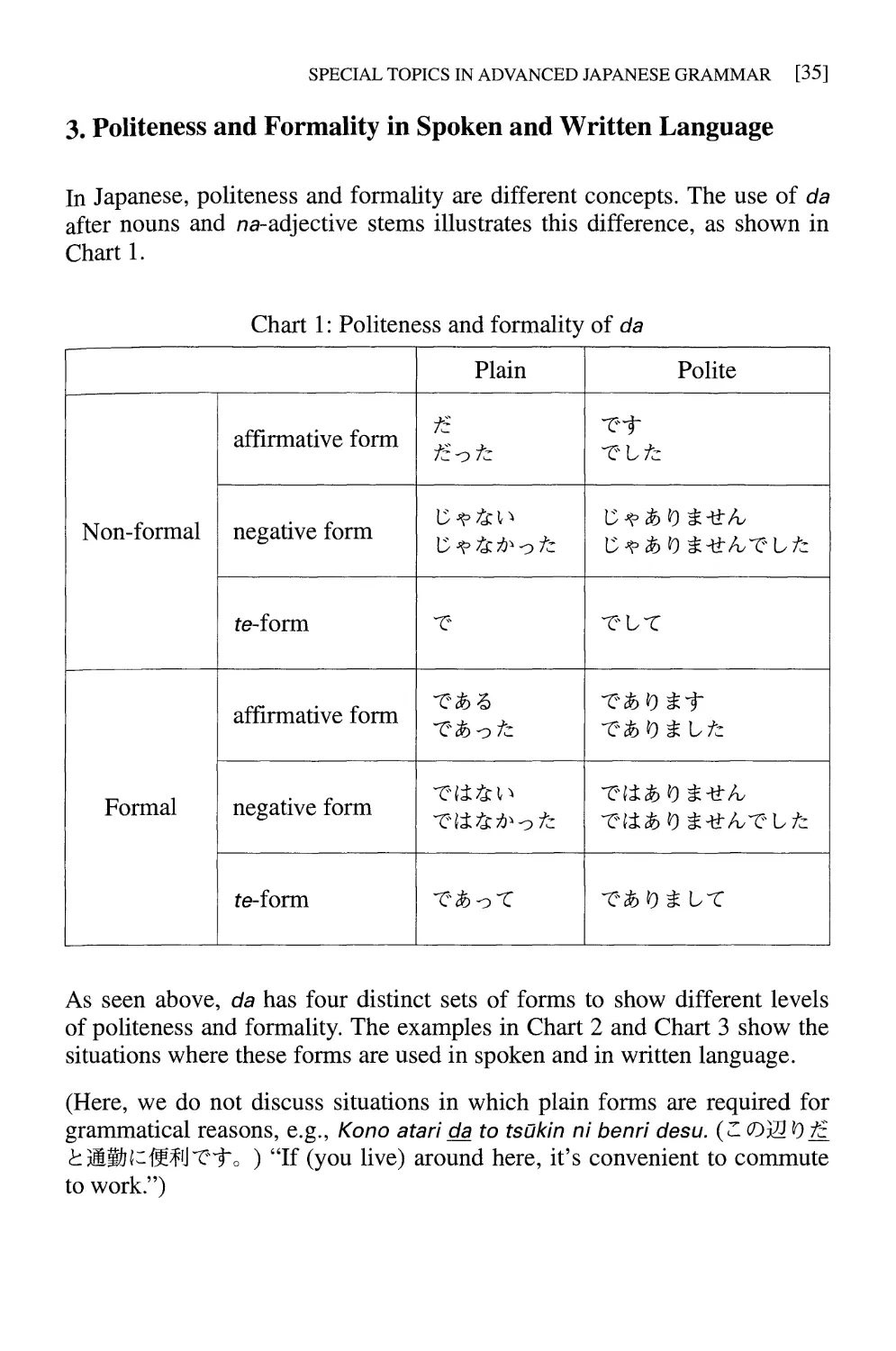
3. Politeness and Formality in Spoken and Written Language
In Japanese, politeness and formality are different concepts. The use of da
after nouns and na-adjective stems illustrates this difference, as shown in
Chart 1.
Chart 1: Politeness and formality of da
Non-formal
Formal
affirmative form
negative form
te-form
affirmative form
negative form
te-form
Plain
tz^tz
X
T&3
Xh^tz
Xh^X
Polite
XLtz
XLX
x&iotlr
XfofytLfz
~e&t> £ b"C
As seen above, da has four distinct sets of forms to show different levels
of politeness and formality. The examples in Chart 2 and Chart 3 show the
situations where these forms are used in spoken and in written language.
(Here, we do not discuss situations in which plain forms are required for
grammatical reasons, e.g., Kono atari da to tsukin ni benri desu. {Z.(D^1^0it_
tMW}^^$\XiTo ) "If (you live) around here, it's convenient to commute
to work.")
[36] SPECIAL TOPICS IN ADVANCED JAPANESE GRAMMAR
Chart 2: Spoken language
Non-
formal
Formal
Plain
Polite
Plain
Polite
Casual conversation:
(This dictionary is convenient.)
(Aki is not coming, right? / Aki's not coming, is she? /
You're not coming, right, Aki?)
Ordinary polite conversation; speeches, lectures and
presentations:
(This dictionary is very convenient.)
(Aki is not coming, is she? /You're not coming, are you,
Aki?)
(Not used in spoken language.)
Formal speeches, lectures and presentations:
(Mr. Kimura is the pride of our school.)
(We cannot tolerate such conduct by any means.)
Chart 3: Written language
Non-
formal
Plain
News articles; academic papers; reports; essays:
(This (practice of) price setting is extremely unreasonable.)
(The result depends on the way you do it.)
Most books for adults use this form, which sets a neutral
tone. This form may also be used in letters and e-mails
to intimate friends.
(My current apartment is convenient.)
SPECIAL TOPICS IN ADVANCED JAPANESE GRAMMAR [37]
Non-
formal
Formal
Polite
Plain
Polite
Ordinary business or personal letters and e-mails;
business documents for customers; books for young
children:
(Attached is an estimate of the necessary expenditures.)
(Mari's father is a doctor.)
Some books for adults use this form, which sets an
intimate tone. This form is also used for letters and
e-mails to one's family members and friends.
(My current apartment is convenient.)
News articles; academic papers; essays; reports;
government reports; legal documents:
(This is an example of particle omission.)
(The economic growth rate last year was 2.5 percent.)
De aru is more formal in tone than da. In many cases
both de aru and da are used within one document.
Formal business letters; formal business documents for
customers:
(We (lit., Our company) will do our utmost to investigate
the cause of the recent accident.)
While verbs and /-adjectives have distinctive forms to indicate different
politeness levels (e.g., hanasu and hanashimasu; takai and takaidesu),
they do not have distinctive forms to indicate the formality level that
corresponds to de aru\ therefore, the same forms are used for both non-formal
and formal situations. In other words, da and its variants are critical
indicators of formality level.
[38] SPECIAL TOPICS IN ADVANCED JAPANESE GRAMMAR
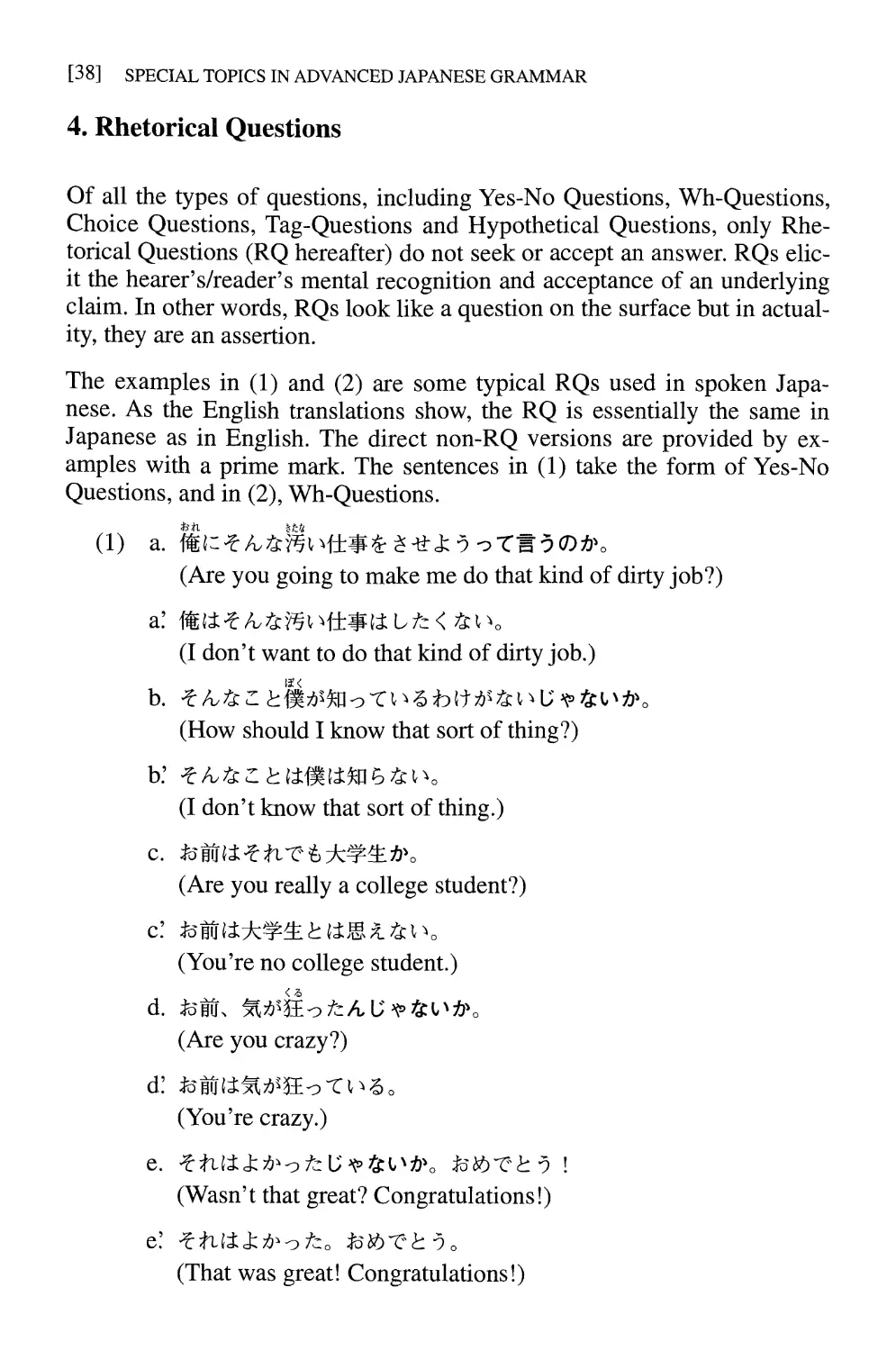
4. Rhetorical Questions
Of all the types of questions, including Yes-No Questions, Wh-Questions,
Choice Questions, Tag-Questions and Hypothetical Questions, only
Rhetorical Questions (RQ hereafter) do not seek or accept an answer. RQs
elicit the hearer's/reader's mental recognition and acceptance of an underlying
claim. In other words, RQs look like a question on the surface but in
actuality, they are an assertion.
The examples in (1) and (2) are some typical RQs used in spoken
Japanese. As the English translations show, the RQ is essentially the same in
Japanese as in English. The direct non-RQ versions are provided by
examples with a prime mark. The sentences in (1) take the form of Yes-No
Questions, and in (2), Wh-Questions.
(1) a. ffiK^&^ffc*££#J:5^T*5<&a\,
(Are you going to make me do that kind of dirty job?)
a! fi&^&r§iM±*&bfc<fto0
(I don't want to do that kind of dirty job.)
(How should I know that sort of thing?)
(I don't know that sort of thing.)
c. tdm&ZtiT&jz^&fro
(Are you really a college student?)
c! fcMi£;fc^££ttJSS.&^o
(You're no college student.)
d. fefiK ^lo/:AD>^t^\
(Are you crazy?)
d! feifr&^#£EoTO50
(You're crazy.)
(Wasn't that great? Congratulations!)
e! ^tilii^o^o fe*6T^9o
(That was great! Congratulations!)
SPECIAL TOPICS IN ADVANCED JAPANESE GRAMMAR [39]
(2) a. ^o$Tfutf*l,ti^Oe llb^^Oo
(Hey, how long are you going to watch TV? Do your
homework!)
a.' &9TWtf£JITf;£Ptt&oJ;o ^Lft£o0
(Don't watch TV now. Do your homework!)
(Who would do the job for such a low salary?)
(No one will do the job for a salary that low.)
c. if 5 UTft(0#?L feB^tTS e&oOTt^o
(Why won't you listen to what I have to say?)
c' £?¥&<D%Z.$>m^XTZ\\
(Please listen to what I have to say.)
d. B^gas^SU^^T^oHtfffofc?
(When did I tell you that Japanese is easy?)
d.' B#gg#^£U>^TBofc££«&0«ko
(I've never said that Japanese is easy.)
e. if^UTPO^MPCfSO)?
(Why are you always blaming me?)
e.' oo^O^Pia&otT^^o
(Don't always blame me.)
Depending on the context, RQs can express anger or frustration, as in
(la-c) and (2a, b); surprise, as in (Id); joy, as in (le); a plea, as in (2c);
denial, as in (2d); or accusation, as in (2e).
RQs are also used in written language. However, usually they are not used
to express the writer's emotion, but rather to express the writer's views in
an indirect way. Take (3a), for example. The writer may well be convinced
that the Japanese are excessively optimistic about robots, but he is hesitant
about writing that as straightforwardly as it's stated in (3a').
(3) a. B#Alin#y h KM%^M4^n^X\^(DTlt^^t£6o^o
(Don't Japanese people have excessive expectations regarding
robots?)
[40] SPECIAL TOPICS IN ADVANCED JAPANESE GRAMMAR
(I think that Japanese people have excessive expectations for
robots.)
In all the examples in (4), the writer is not emotive about the subject. The
writer simply refrains from stating his/her belief in a straightforward
manner. Depending on the context, an RQ may express the writer's humble
cautiousness or lack of straightforwardness. In Japanese formal or public
writing, RQs are used quite frequently.
(4) a. Amtm^(DMm^&^t^%Zttefo%(D?lZ%^t£5ofr0
(Can we not learn more from the relationship between people
and animals?)
a: AmtmyKomm^t^t^Zo
(We can learn more from the relationship between people and
animals.)
b. tmommtiabx*? &£>&, TZ&\*zb*n!ffilzlr5bZ6K$>
(Is it not those technologies that make the impossible possible
that show what is truly attractive about technology?)
b: fflS<Dmwi%b\*o &<D&, ~?%&\*zb$:nSffi\zlr%bz?>\z&
(Those technologies that make the impossible possible show
what is truly attractive about technology.)
(Who in the world would agree with such a radical ideology?)
(Nobody would agree with such a radical ideology.)
Note that the endings of RQ sentences usually take one of five forms, as
shown below, (ii) can be interpreted either as a RQ or a self-directed
question meaning "I wonder if ~."
(i) ~(&i>) l(<D)-eii/(/^)£*| |ftW&^£~£M^
Ex. &oTP5(<D)T*kM&W&^£-£Ma\,
(Isn't it the case that he knows it?)
SPECIAL TOPICS IN ADVANCED JAPANESE GRAMMAR [41 ]
!mh'&\^((D)x\t\t£\^/foV)£^^)ti\
(Isn't it the case that he doesn't know it?)
(ii) ~(&i>) \<D//u\ \tz6o/XL^o |a>
Ex. %\^X\*Z{<D//u\ {i*6? /XL±5\fr0
(I doubt that he knows it. (lit., Could it be the case that he
knows it?))
(I believe that he knows it. (lit., Could it be the case that he
doesn't know it?))
(iii) ~(&0) \<DXl±//uV* \%\>{tz6o /XL£o\fr
Ex. ^T03£>Tte&0(£69 /XL «k 9 |ri\,
(I believe he knows it. (lit., Isn't it the case that he knows it?))
fr!6&OA,t;^&H£69 /tt «fc 9 |^o
(I believe that he doesn't know it. (lit., Isn't it the case that he
doesn't know it?))
(iv) ~{t/ix\ IfVIMiM \<D(xi-)//uXi-\fr
~{b/^X\ IS-5 ASfc&vM \<D(Xt) //vXt\fr
Ex. aotP5tf9OTt^o
(I bet he doesn't know it. (lit., Are you (really) saying /
Would you say that he knows it?))
(Shame on you! (lit., Don't you feel ashamed?))
(v) (Wh-word)~ | <D (Xt) / /vXt \ fr
Ex. ^\^X\^(D(X-f)i)\
(I bet he doesn't know it. (lit., Does he (really) know it?))
(You should know it. (lit., Why don't you know it?))
[42] SPECIAL TOPICS IN ADVANCED JAPANESE GRAMMAR
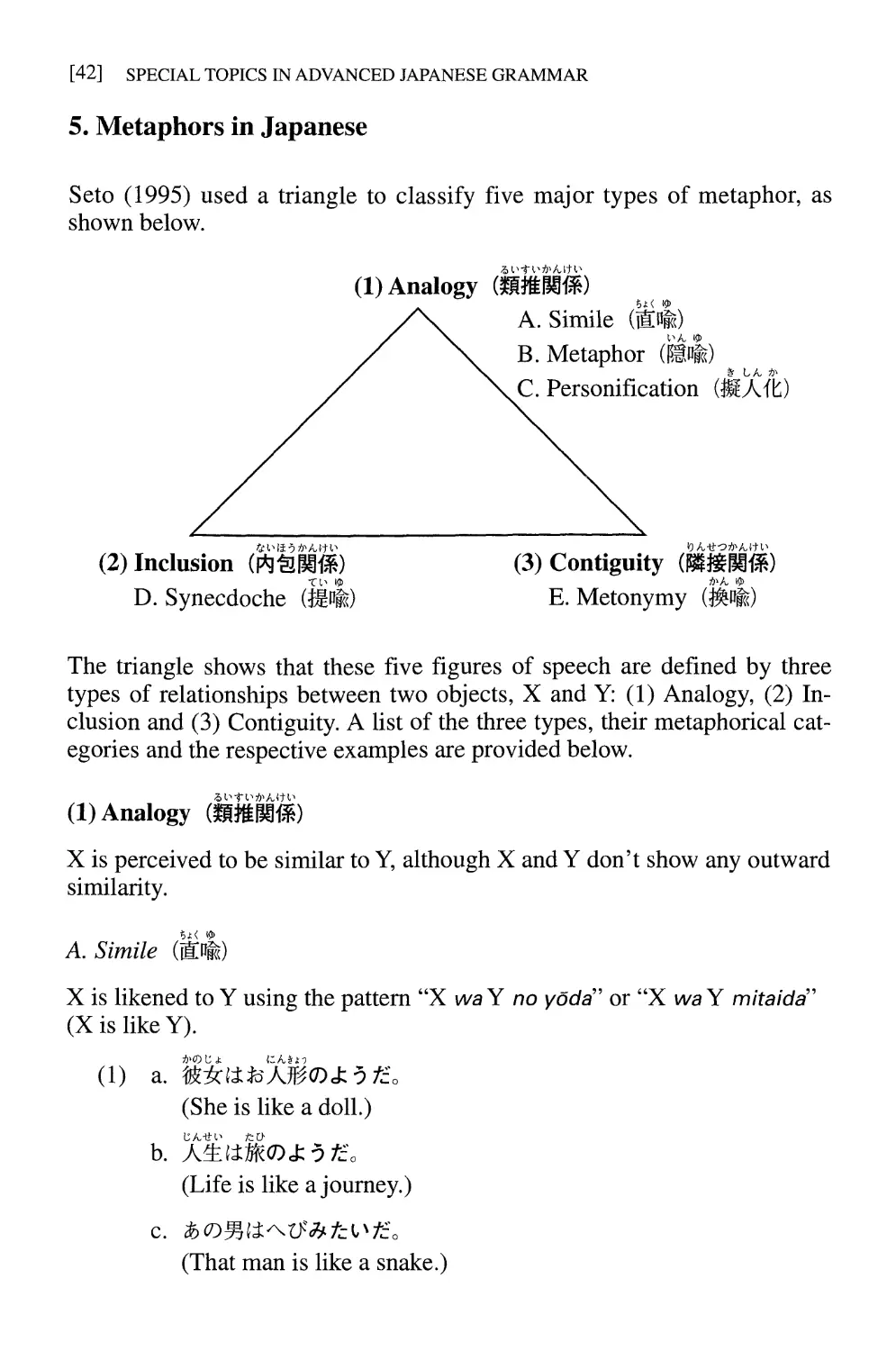
5. Metaphors in Japanese
Seto (1995) used a triangle to classify five major types of metaphor, as
shown below.
(1) Analogy GSJiHffi)
/\ A. Simile (Safe)
/ \ B. Metaphor (KUft)
/ \C. Personification (SAffc)
(2) Inclusion (F*3^HI#) (3) Contiguity (P3H&fi#)
D. Synecdoche (gift) E. Metonymy (g&ift)
The triangle shows that these five figures of speech are defined by three
types of relationships between two objects, X and Y: (1) Analogy, (2)
Inclusion and (3) Contiguity. A list of the three types, their metaphorical
categories and the respective examples are provided below.
(1) Analogy GffiiHft)
X is perceived to be similar to Y, although X and Y don't show any outward
similarity.
A. Simile (Eift)
X is likened to Y using the pattern "X wa Y no yoda" or "X wa Y mitaida"
(X is like Y).
(1) a. ®£&isAM<D&5t£0
(She is like a doll.)
b. A3Lim<D£ot£0
(Life is like a journey.)
(That man is like a snake.)
SPECIAL TOPICS IN ADVANCED JAPANESE GRAMMAR [43]
d. »<DSttfcH£/^«fc3£o
(His face is like the moon.)
e. fctz^lttJ^y hfrtz^tzo
(We are like guinea pigs.)
B. Metaphor (il4)
X is likened to Y using the pattern "X wa Y da" (X is Y).
(2) a. mc&Xl&tZo
(She is a doll.)
b. A*kUmt£o
(Life is a journey.)
c. &(D^,te^xft£0
(That man is a snake.)
d. fe0§[*fcj!^£o
(His face is the moon.)
e. ^tz^lt^^^y htco
(We are guinea pigs.)
C. Personification (MAit)
X isn't human, but is likened to a person or a part of the human body.
(3) a. ^74 a*&&fc£ffli*Ti*3o
(Hawaii is beckoning (lit., inviting) you.)
b. IHybiI^m(0*T^»«*UTt^o
(Sunflowers are bowing in the wind.)
mi
c. pSWofco
(The storm passed, (lit., The stormy wind ran away.))
d. Z(D^l$5t%f£fa0
(This tree is healthy.)
e. /Jvg^oTt^o
(The small flakes of snow are dancing.)
[44] SPECIAL TOPICS IN ADVANCED JAPANESE GRAMMAR
f. z<Di&<Dm&mi\
(The legs of this table are weak.)
g. z.cDmtKKm^^otzo
(This house looks kind to people.)
(The mouth of this kettle is a bit too small.)
(2) Inclusion (F*3^H#)
D. Synecdoche (114)
A specific example describes an entire category of nouns, as in (4), or a
general category term is used to mean a specific example within that
category, as in (5).
(4) a. M*li±»&BWEMKfroT£;fco
(I went to Ueno Park for flower viewing (= cherry blossom
viewing).)
b. SB;fo#i«Vii£f#oTo££l-o
(Every day I bring a boiled egg (= chicken egg) for lunch.)
(I don't like chicken (lit., bird) so much, y'know.)
(5) a. A\*rt>i£W&*%<D~e\*fa\
(Man doesn't live by bread (= food in general) alone.)
b. mzmim^fr^'zirfro
(What time is dinner (lit., cooked rice)?)
Note that hana in (4a), tamago in (4b) and tori in (4c) describe the general
categories of flowers, eggs and birds, but they are used to mean specific
examples, i.e., cherry-blossoms, a chicken egg and chicken, respectively.
Note, however, that pan (bread) in (5a) and gohan (cooked rice) in (5b) are
examples of food and a meal, respectively, and are used to indicate the
general category of food.
SPECIAL TOPICS IN ADVANCED JAPANESE GRAMMAR [45]
(3) Contiguity (R&Hrfit)
E. Metonymy (Sinjfe)
Y of "X no Y" is omitted because X is closely related to or is part of Y.
(6) a. i«*(©*>f-V)av*:/*Lfco
(The bicycle had a flat tire, (lit., The bicycle was punctured.))
b. *fr/L{<D%m)&WaiisX\'>%o
(The (hot water in the) kettle is boiling.)
c. \*TJ (E>W)#IIB£2.T< §0
(I can hear the (sound of the) piano.)
d. J1TP-V^(co^c)^y|^^0
(The wind extinguished the (flame of the) candle.)
e. "E-y7Jis^((D^)$:m<(Dtim%tzo
(I like to listen to (the music of) Mozart.)
f. £ <D 9 *U*W (£>/MK) * 2 «| o fco
(Yesterday I bought two (novels by) Murakami Haruki(s).)
The above examples of metonymy appear to be the result of the deletion
of Y in "X no Y" (i.e., the nouns in parentheses). Metonymy is used only
when the speaker gives more semantic saliency to X than Y.
All humans, it seems, have metaphorizing competence. In other words,
they are all capable of perceiving analogy, inclusion and contiguity. The
surface forms, that is, the phonetic shapes, are different from language to
language, but as one notices in the examples above, Japanese metaphors
frequently translate directly into English.
(7) is a list of some of the metaphorical idioms that are common to
Japanese and English. There is always a possibility that Japanese borrowed the
expressions from English or vice versa, but as far as we know, there is no
evidence that they were the result of borrowing. Even if there is borrowing,
it simply shows that any language has linguistic soil that is fertile for such
metaphors from outside.
(7) *Wft£ft<* (add fuel to the fire)
ffitD&ofcffibfr (as smooth as silk)
~ 13&H tffe o (be on the same wavelength)
*, zts
tfa.J)tW.% (blood freezes)
[46] SPECIAL TOPICS IN ADVANCED JAPANESE GRAMMAR
~ {i H £ T h i~ (bring the curtain down on ~)
^^(DM&Mo (can't believe one's ears)
— C @ £o^§ (close one's eyes to ~)
mZfrK&Z (come to light)
^Oa^d^l^^ti^ (dance to someone' s tune)
JB—#»>&> £ & p (don't lift a finger)
—it£3l< (draw a/the line)
@ #s?j$t>*tfi £ (5 <*£ (eyes pop out (of one's head))
'K £ o #) 6 (fill some (of the) holes)
IH^-o^ § (hit (up against) the/a wall)
1«oImS^» (hold the purse strings)
^H £M#> £ (keep a tight rein on ~)
-K^^n-f (lend a hand to ~)
-iz^&^i- (lend one's ears to ~)
*£$&£>£ 5 f£ (like oil and water)
MJH^r^lTS (make waves)
~~£>jt£[l< (open the way for ~)
£" £ i 17fc £ ft <* (like water through a sieve)
(From Makino/Oka (Forthcoming))
Oka (2004) has shown that the frequency of metaphor use becomes higher
as the learner's oral proficiency level goes up. For learners of Japanese,
this suggests they should use metaphorical expressions as much as possible
when they speak or write Japanese and pay special attention to metaphors
when they read Japanese writings. As with Japanese onomatopoeia, the use
of idiomatic metaphors makes communication more effective and often
more creative.
SPECIAL TOPICS IN ADVANCED JAPANESE GRAMMAR [47]
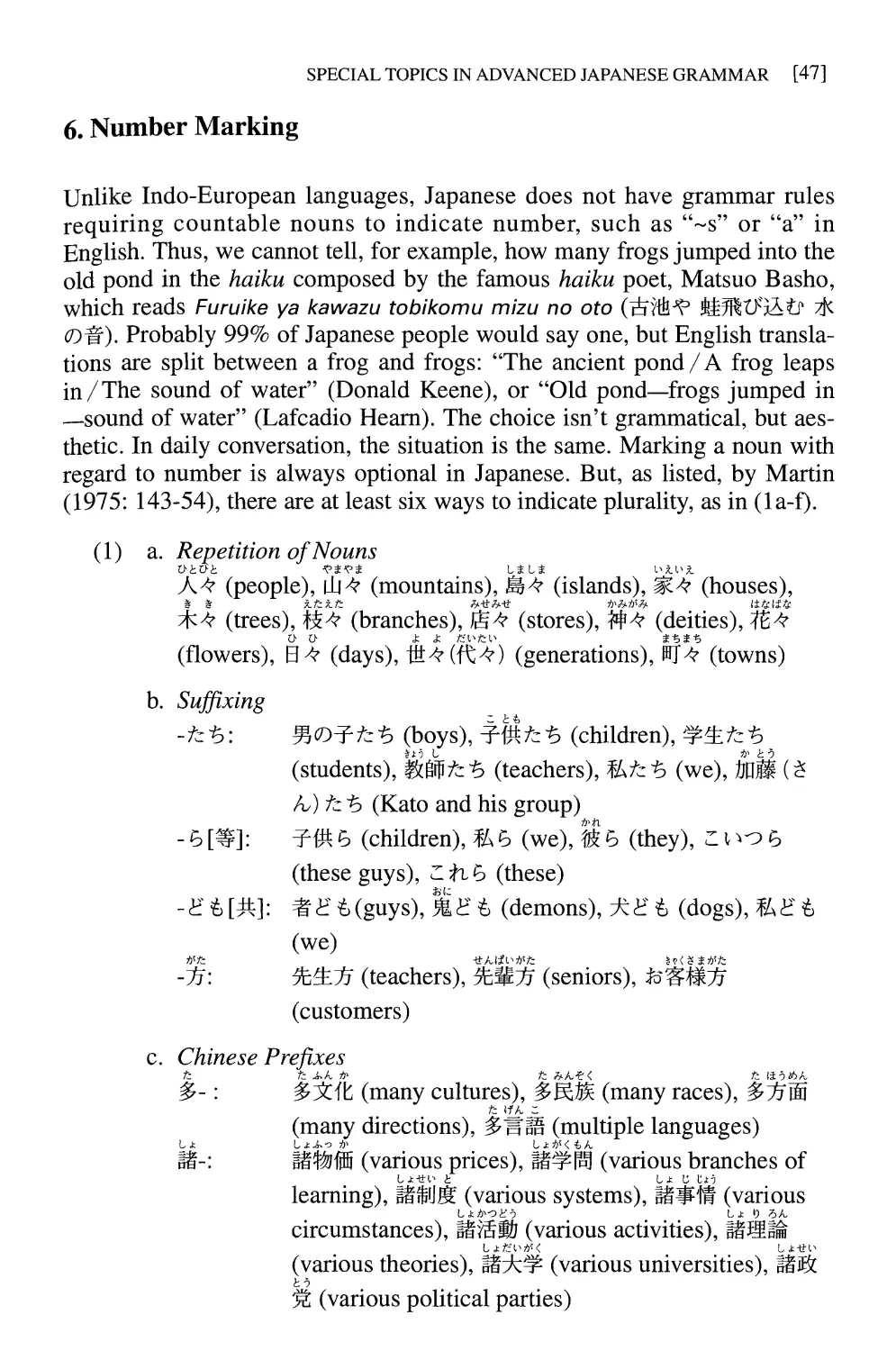
6. Number Marking
Unlike Indo-European languages, Japanese does not have grammar rules
requiring countable nouns to indicate number, such as "~s" or "a" in
English. Thus, we cannot tell, for example, how many frogs jumped into the
old pond in the haiku composed by the famous haiku poet, Matsuo Basho,
which reads Furuike ya kawazu tobikomu mizu no oto ("SftiJ^ M?Ri£J%tP tK
cdW). Probably 99% of Japanese people would say one, but English
translations are split between a frog and frogs: "The ancient pond/A frog leaps
in/The sound of water" (Donald Keene), or "Old pond—frogs jumped in
—sound of water" (Lafcadio Hearn). The choice isn't grammatical, but
aesthetic. In daily conversation, the situation is the same. Marking a noun with
regard to number is always optional in Japanese. But, as listed, by Martin
(1975: 143-54), there are at least six ways to indicate plurality, as in (la-f).
(1) a. Repetition of Nouns
A^ (people), lii^r (mountains), fh^ (islands), Ic^? (houses),
JfJ? (trees), S^ (branches), }£* (stores), #^r (deities), 72^
(flowers), B^ (days), tS^(ft^) (generations), flj^? (towns)
b. Suffixing
-tt: mott% (boys), ^Wc~h (children), ¥£*:%
(students), Sfflfc"^ (teachers), Wt% (we), M (£
k,)tz% (Kato and his group)
-%[%$]: ?f&£ (children), fAh (we), tft5 (they), Ioo5
(these guys), ZtiZ (these)
-££[*]: * £ *> (guys), 1E & (demons), A H £ (dogs), & H £
(we)
-#: 5fe£^ (teachers), *W>6f (seniors), fcgHWf
(customers)
c. Chinese Prefixes
fz fz ML fr fz hhm tz \iotbk
£- : £JCik (many cultures), %&M (many races), ^JfM
tz IfA, C
(many directions), ^HHn (multiple languages)
It-: JH^fffi (various prices), ft^fn] (various branches of
learning), fifSOS (various systems), IWft (various
circumstances), HtflSifr (various activities), MMWa
(various theories), ItA^ (various universities), it®c
to
S (various political parties)
[48] SPECIAL TOPICS IN ADVANCED JAPANESE GRAMMAR
d. Noun-Modifying Phrases
0505&A (various people), fit^ &# £ (all sorts of ideas), tz
< $ ^& (a lot of fish), *$<£«** (many tourists), »^r <0
5&^ (innumerable contributions), ttifc£>2EA (more than one
criminal)
e. Verbal/Adjectival Predicates
M£%/$k®Z> (gather), fcfr 31*3 ((people) gather, get
together), fU /» 61* (scatter), lt^< /fr^tt* (be put in
order /put s.t. in order), (ft) £ o (many), fe t>Vc £ L o (a large
number of), 8fr&Wi&o (countless)
f. Quantifier Expressions
B:fcg£>^£#!siOOAi > §o (There are about 100 students of
Japanese.)
fa-f&^jEEii > § o (There are five mice.)
^feiflflKo fco (I bought five books.)
^Eco^ic (three little pigs)
The examples of noun repetition are restricted almost entirely to those
listed in (la). There are also restrictions regarding the use of the Sino-
Japanese prefix plural markers in (lc). For the prefix fa- (£) there are more
examples such as tajo (£1f) "lit., many sentiments," tasai (%~%) "lit., many
talents" and tagei (£31) "lit., many arts," but all these are usually used as
the stem of na-adjectives meaning "passionate," "multi-talented" and
"versatile," respectively.
The verbal and adjectival predicates in (le) imply that the subject or direct
object is plural, as shown in (2).
(2) a. m&WttfklbTVZo
(I am collecting stamps.)
b. i^^ttoTLSofco
(The cherry blossoms have already scattered.)
c. fitlliM Y<Dmm7L®ti&\\
(The number of information sites is countless.)
d. «H*l^^^^o
(Many college students don't study.)
SPECIAL TOPICS IN ADVANCED JAPANESE GRAMMAR [49]
The noun-modifying phrases in (Id) also imply that the subject is plural, as
shown in (3).
(3) a. &mK&^5^5%rttf1k^X\^fzo
(In the park, all sorts of flowers were in bloom.)
b. ^oIi:iifc<Mfl)i3i*m^:o
(In the pond, a lot of carp were swimming.)
c. Z<D-^ «*£&*¥#)££fc0
(In the past year, all kinds of incidents occurred.)
Number can also be indicated with suffixes, as shown in (lb). The
examples in (4) are cases where the plural marker -tachi must be used if the
speaker wants to express plurality. Note that in such cases, the element that
takes -tachi is either a proper name, as in (4a), or a pronoun, as in (4b-e). In
(4), the suffix always means a "person and his/her group."
(4) a. ffiffl^fc5#£oj;:*fco
(Yamada and his friends came to see me.)
b. fefc-fcte^-C-i-a-^Kfrofco
(We went to New York City by car.)
C. jfeitfztlt^VUZ h y>TWtt^X\^60
(Those women work in the same restaurant.)
(They always drink together.)
e. &&*:fc$&H&H9i-3<0o
(What will you all be doing this summer?)
Kurafuji (2004) noted that there are cases where -tachi cannot be attached
to a noun, as shown in (5).
(5) a. M*bmm±±¥0&W(*tz*>)tzo
(Kawamoto and Shibata are college professors.)
b. ®K&^m(*tzt>)tf&z0
(He has a child / children.)
Except in the above cases, the attachment of the suffix -tachi is optional.
Its use is less appropriate when talking about animals; however, the plural
marker can be attached to practically any noun if the speaker/writer feels
close to whatever is expressed by the noun. (For details, see Makino (2007:
109-130).)
[50] SPECIAL TOPICS IN ADVANCED JAPANESE GRAMMAR
Another suffix, the plural marker -ra can be used interchangeably with
-tachi, and, like -tachi, it cannot be used in the examples in (5). But in
colloquial speech, -tachi tends to be used more frequently. Either -ra or -tachi
may be preferred with certain personal pronouns, as shown in (6)-(8), or
demonstrative pronouns, as in (9).
(Note: "A>B" indicates that A is used more frequently than B, and "A»B"
indicates that A is used far more frequently than B.)
(6) a. htzL\tt>>*>\\m&'mhftfr^tz0
(We didn't know anything about it.)
b. hb | <E> » 1t*> I liMtfid&t'Eo
(We love sake.)
c. hfc<L\fct>>W$}l*Z<D±¥<oWM£^1-o
(We are alumni of this college. / We graduated from this
college.)
d. hti{ 6 /*£*>} t±¥wM«Nr£0
(We are pacifists.)
(7) a. &&tz{1t*>>e>\lZEZfre>%;tz<D0
(Where did you come from?)
b. tbhtz\ 6 >>££|&£<ITMbTA^o
(What are you up to here?)
(8) a. m f 6 » 1t% I ttmx^tzo
(They are bankers.)
b. i£|£*>>6}&J;<f±*£1-3o
(They work very hard.)
(9) a. zii{e>/*tzt\tet^rUii±tmtzo
(These are all (examples of) excellent research studies.)
If K COT §
b. ^ti|6/*££M«E^£P^JtI£o
(Those are realistic problems.)
(Those are all fiction.)
Finally, the plural suffix -domo has its unique usages. For one, it indicates
the speaker's humbleness when used with the first person pronoun, as
shown in (10).
SPECIAL TOPICS IN ADVANCED JAPANESE GRAMMAR [51 ]
btii Z.OZ.A,
(io) a. %k£&&^(Dz:inm&mi'&^^xtiioti'o
(We (lit., I and my in-group members) are looking forward to
your lecture.)
b. %k£&(D±m-im^(D&m^ig¥^%x & lotto
(Students are coming from all over the world to study at our
university.)
btz(l 5c{SS li.iX>k n^ fr l±A,fii^
c &E&<Dmx*&}s%mK%fcA^x\*fci£tfzm&£mM^MftL
XtilOtlTo
(Our store sells (selected) merchandise at low prices to please
our customers.)
The second and the third person pronouns and the demonstrative pronouns
cannot be used with -domo, as shown in (11)-(13), respectively.
(11) a. &&*: I £*> / 6 /*gfe 1 &££*> 5%fc<D0 (= (7a))
b. ^;H 5 /£5/*££!&££ tHfll^cq> (=(7b))
(12) a. Mi 6/££/*<!:& h£f^Jt£0 (=(8a))
b. M&ifc^/6/*if*Ki«fc<f±*«:tSo (=(8b))
(13) a. 3Jif6/*^^/*i:*hii-^TfftL^Bf^^o (= (9a))
b. %fr\$/*fc*>/*i:*>\imm$)&mmtz0 (=(%))
c. &fr| 6 /*£*>/*££ 1 &£gP:7 >f ? v 3 ytf, (=(9c))
It is interesting that -domo can also be used to indicate that the speaker is
looking down on people or, more frequently, on animals, as shown in the
following examples.
(14) a. -iiz(Dm(Dmihk^^l±n^L^o tLX\^(D^0
(What in the world are the politicians of this country up to?)
b. ^E%<D$%i:*\mm&%\t>fa\
(Young people these days don't know how to use polite
expressions.)
(The dogs in our neighborhood are unbearably noisy.)
Among the three plural suffixes, -tachi is the most widely and frequently
used and -ra is next. The use of -domo is limited.
A DICTIONARY
OF
ADVANCED
JAPANESE
GRAMMAR
(Main Entries)
B*I§3$£S¥ft <±8W>
aete 3
aete & x. T adv.
daringly; boldly; dare to ~;
venture to ~; force oneself to
[REL. omoikitte; shiite]
♦ Key Sentences
(A)
&&X
(The department head boldly expressed his opposing view directly to the
company president.)
(B)
&ti
&S.T
*#tf>«9&flf22ffH*
Wmasu
ALT
/:0
(I would like to take on a large-scale research proposal.)
(C)
&£T
<9 hk ^ S fcfc
Vvol
fr&O
b&Oo
(I think I will try to oppose my professor's theory.)
(D)
&Z.X
Vcond
fi tf
&&tz(D%7Ltm±(D^mfz0
(If I dare to say so, your idea is an unrealistic, ivory tower theory.)
(E)
monoztK
&7,X
Vneg
L
(I don't dare oppose what you're saying.)
&o
£o
4 aete
fo^xv
& %. XJxffiir %> (s.o. dares to disagree)
(a) TJV*X\m^X\^tm&i-%<DX\ &&B#A£LT&*TgE±9i
(In the U.S., if I keep silent I lose out, so as a Japanese, I'm making a
point of asserting myself.)
l> l^A,AH"> 3A£*-5 x. trj> LA, £ L< T^&A,
(Although I knew that it was hard to get approval from the committee, I
dared to propose a brand new plan.)
(It was after his parents thought about his education that they made the
bold move to change their residence.)
<A*«lift £ P £ £ tf> £ < & o fco
(While I knew I shouldn't have done so, I ventured to criticize my
senior partner's wrongdoings. And, sure enough, he's stopped talking to
me since.)
(e) m*&ZXAb\*M~Dt:m,£M&tzi\*bm~DX\*Zo
(I'm thinking of daring to follow a path different from others.)
(f) mx^fiKfotLxmtiotLtztK mm^hiito
(I dared to resist the flow of the times, but it was all in vain.)
©■5tU< *>i>)L* 0-6
(g) &<Dm*1felJ&%i*ttti£. &%.XMffi£ftZtf, A(Dki$fz6o0
(That man has no talent, but if I force myself to single out his strong
point, it would be his fine personality.)
(h) &ZXU*<D&fe£-JB~c$tffl1rZb, $m(0ftmb\*ozb\z&ztz?>?0
(If I ventured to find fault with current Japanese politics, it would be to
criticize the behavior of factions.)
aete 5
$>tz< Z/vfolQtLfzo
(Not everything went well. I won't venture to say now what, but there
were many unpleasant things.)
1. Aete is an adverb with which the speaker/writer expresses his/her desire
or will to do something daringly, in spite of the fact that he or she is
aware of the difficulty, danger or opposition in executing it.
2. The person who dares to do something has to be a person one is very
familiar with, including the speaker/writer himself/herself. For example,
in (1) watashi and chichi are acceptable, but a no tsukonin is not, because
the speaker/writer is not on familiar terms with a passerby.
(11/My father/??The passerby ( boldly crossed the street, even
though the signal was red.)
[Related Expressions]
I. Omoikitte, which means "to do s.t. hard to do with strong
determination," is similar in meaning to aete. The crucial difference, however, is
that aete is used when one dares to do something that runs contrary to
common sense in spite of difficulty, danger or opposition, but omoikitte
is used when one resolutely does something which is difficult to do.
So in KS(A)-(D) and Exs.(a)-(h) aete can be replaced by omoikitte,
but with a slight change in nuance; that is, the aete versions don't
imply strong determination, but the omoikitte versions do. As shown
in [1] below, aete in KS(E) and Ex.(i) cannot be replaced by omoikitte,
because the latter can be used only with an affirmative predicate.
[1] a.moW5Zbt{&AT/*&VW'iT\Rft&Lti:\^o (= KS(E))
b. ?fein^tl^Ot^^o^"Cto UiT/*^^oT^f
o£-£/^\ \^&Zb&tz<Z/ufol0£Ltzo (=Ex.(i))
There are also cases in which only omoikitte can be used, as in [2],
because aete is used when one does something that runs counter to
common sense, whereas omoikitte is used when one does something
difficult to do, regardless of whether it is common sense or not. It is
quite natural for a person to speak in English with an American as in [2a]
or to talk to a girl as in [2b].
6 aete
[2] a. \&^ty^r/*&xt\tjv*At^mTmLx&fz?>, mvtzo
(I ventured to talk with an American in English and, because he
understood, I was very happy.)
b. \&^W^T /*&zT\mcfcF£frttfct>. Co - 0 ^ItoT < ft
tzfvtzo
(When I ventured to talk to her, she gave me a big smile!)
II. Another adverb with similar meaning is shiite, the Vfe of the verb shiiru
"force s.o. to do s.t." Shiite is used to mean "to force oneself to do s.t."
The crucial difference between the two is aete implies that an action
may be met with opposition, danger, etc., but shiite doesn't have such
an implication.
[3] a. E%b<Dm<Dfi&\*\>frtemi^<^tfti£. {38i*T/??#x.T I
(It is hard for me to say which painting is better, but, if I have to
choose one, I would say this Cezanne.)
(I don't have any particular hobby, but, if you pressed me, I
could say music appreciation.)
Conversely, in a context where choice doesn't exist, the use of shiite
becomes marginal.
[4] a.«te{*AT/?Bl*Tf*Bl&£BLT>f y 2 ©««Cffi^ltTff o
(He went to the war zone in Iraq at great risk.)
(She dared to oppose her parents and married him.)
ageku (ni) 7
ageku (ni) &Cf < (tc) adv./conj.
in the end; finally; eventually;
after
[REL. ue de; sue (ni); kekka]
♦ Key Sentences
(A)
Z/v£/v
Vinf.past
mutz
&(f<
(K)
(After thinking for a long time, I decided to go on to graduate school.)
(B)
POtz <0 Zk tift^
Vinf.past
1HA,£
&tf<
CD
Noun
£o£o
(Her divorce was a decision she made after agonizing for several years.)
(i) Vinf.past * if < (tc)
HS Lfc* if < ((c) (after s.o. talked)
(ii) Vinf.past &tf< CD N
# & tz fo if < CD$:$f (a decision made after deliberation)
(a) mtz&ZMktvtz&tf< ^mm^m&x\^tz£Q&imtzo
(I quit the company where I first worked after thinking very hard (about
what to do).)
ic, «sHii^sa#Tart^0
(He dated women from various countries in Asia, Europe and North
America, but in the end he spent his entire life single.)
an adverb/conjunction indicating that
one spends an extended period of time
before reaching a result
8 ageku (ni)
(c) i§&&©HaHn\ £<D«l:riHH^ i^i^^Iot^^^(f<}:, Eti
(Saying "I like this one" or "I like that one," my wife tried on all sorts
of shoes, but after all that, she left the store without buying any of
them.)
(After using my car for a whole month, Yamada didn't say even a word
of thanks when he returned it.)
(e) £^xio£&{f<, -ffiittr^'j^cilt^^^ci^
(After weighing my options for a long time, I finally decided to take a
one-year leave from my company to study abroad in the U.S.)
(f) m^^m^(D^i±t(DM^mfifz^{f<K^^(DA^^^mL^LXLt^
(After falling in love with a married man, her own life was in ruins.)
(I couldn't decide which television I should buy, so (in the end) I went
home without buying any.)
(h) «#ag!Lfc£>tt<fc< £<1K&&P;fc&tf<(DZbfz^tz(DTfo60o
(It must have been after really agonizing that he committed suicide.)
(i) *#*£>*? ht-if^i:(t ««B#{rffi^ &£, «i£#-^ £¥HB> *
if<(D%:XKte¥m, *tw. mmfctzE, mtzmMnmttm^x<z>
(There are some free Internet services that require at the time of
registration your address, name, telephone number, date of birth, and at the
end, all sorts of personal information such as educational background,
annual income and family size, etc.)
1. Ageku (ni) indicates that one spends an extended period of time
before reaching some result. The verb preceding ageku (ni) has to be a
Vinf.past. Notice that the entire verb phrase Vinf.past ageku (ni) usually
represents something troubling, as shown in the KS and Exs. The
following unacceptable sentences prove this point.
ageku (ni) 9
(i) *»i3B#ra<*el>*Mi:7:■^^*^b^^*(f< ((c), iciofco
(After enjoying tennis with his friend, he went home.)
(2) *lMIB£<#S.;fc&lf< (CO, ^©ft**5ltS{t5Zli:«iL^o
(After thinking hard for one week, I decided to take that job.)
cf. lMHB<fc<#*.|T/T#6/:fc«TK *tf)tt*£5l££ttSz:i:
2. Since the ageku (ni) construction indicates two past events in sequence,
it cannot be used for events in the future.
(3) n^6\^6Um&Ltz&[f<{Zi:Mmii%ZtKir%tz6o0
(After having argued a lot, the two will decide to separate.)
3. As shown in KS(B) and Ex.(h), the pre-nominal form is "Vinf.past
ageku no."
4. All the uses of ageku (ni) in the KS and Exs. can be rephrased using
ageku no hate ni (wa) when the eventual outcome is a rather extreme
one. Note that ageku no hate ni (wa) may be used without a preceding
Vinf.past. Examples follow.
(4)2i.MZM*&ft<D%L*&ft-CULmifc1)K *tf<0)*T(Ctt, tot
(My father had been repairing his own cars for many years, and
in the end he made a whole new car himself.)
cf. wm^&ft(D^sftTULmiifz&tf < (c, to to a#-e*
(Cathy was deeply interested in how the maiko live in Kyoto, and
eventually she observed their lives while living under the same
roof with them for a year in Gion.)
cf. +^^-«sfB^»^^^ffi^aiv^»^spo^*(f<(c, -*m
10 ageku (ni)
[Related Expressions]
There are three related expressions: ue de, which expresses a preparatory
action for a relatively important action, sue (ni), which indicates the end of
a period, and kekka, the neutral expression "as a result of s.t." The following
examples show similarities and differences among these synonyms.
fc^ftiMtbfco (=Ex.(a))
(=Ex.(b))
c <k<#^.^)±r/**u:/*«*/**tf<tc|ff»irgb&$Oo
(Put it into action after you have given it careful thought.)
(After he had discussed it thoroughly with his parents, Ichiro
decided to enroll in an American college.)
e.«*l£*£3l£1*oTia20(M- Mi^ofc | *(C /*±T/*IS*/
**#<£( £5* <lfct:ofco
(The train finally stopped after dragging a car about 200 meters.)
Ue de is ungrammatical in [la, b, e] because in these examples no
preparatory action for an important action is expressed. Ageku (ni) and
sue (ni) are ungrammatical in [lc, d], because S2 refers to an event not
yet realized. In [Id] ue de is grammatical because the first event, i.e.,
discussion with his parents, is a preparatory action for an important action,
i.e., choosing a college. Kekka is ungrammatical in [lb, c, e] because in
these sentences the second event is not a direct result of the first event.
In [le], ageku ni is unacceptable because the agent of the action is not
explicitly human.
(c> (no) ue de (DUG: 547-50); sue (ni) (in this volume);
kekka (DUG: 121-23))
akumade mo 11
akumade mo & < $ T & adv.
to the end; persistently; insist;
strictly; just; under any
circumstance; absolutely; never;
completely; ultimately
[REL. doko made mo; saigo
made]
♦ Key Sentences
(A)
&< £T*£
U -tiro fr
(Mr. Emoto persistently maintained (lit., didn't change) his opinion.)
(B)
ZfllZ
&< £Tfe
/>|T^-9t
(lit., This is strictly fiction and not a true story.)
(C)
h< tx*&
a^rjEE^o^o
(She was true to herself to the end.)
(a) &{i^<^T^»0*||*:M^So
(I will believe in his innocence to the end.)
(He kept opposing Japan's entry into the war up to the end.)
(c) &< £T-AT^ % bm ? (D& Z & Zx¥$)rtlZLfj;\\
(If you insist on doing it by yourself, I won't venture to assist you.)
an adverb that represents the idea of
"to the utmost degree"
12 akumade mo
(d) R&Wi&< £Tfc Sin; £*tfc0
(The insurgent troops continued their resistance to the end.)
(e) §#*505lk&< *^gb^oS:li#1-S©&6i:^e^fe#^j65*So
(If you persistently refuse to have a discussion (with me) like that, I'll
make another plan.)
(f) >r4 Y\*&<&~?tn%<Dft5LKZiZh^tio
(Kate was always particular about the way she looked.)
(Theories are strictly theories; there is no guarantee that reality turns
out the way they predict.)
(h) :ii:f^f:fffii^<tt^^^^ V-\?zK£^x&m&Zi%
(The cost written here is strictly an estimate. It may differ depending on
the service (you choose).)
(This is just what my sixth sense tells me, but I think Mr. Yamada will
quit this company soon.)
(j) 'J>Lt3±£%LX\*ti'££tz\><DX*'t1>K $LMK&&<£X*ftUfclsX\>tz
i££fc\*<DXiTo
(I'd like to borrow some money from you, but I'd appreciate it if you
would keep it absolutely secret from my family.)
(k) SI^<^fef<S*to^^,
(The sky was completely blue and clear.)
1. Akumade mo can modify verbs, as in KS(A), Exs.(a)-(f), (j) and (k),
adjectives, as in KS(C) or nouns followed by a copula, as in KS(B) and
Exs.(g)-(i).
2. Akumade mo literally means "as much as one gets tired of," but the
common meaning in today's use is "to the utmost extent." The specific
meanings vary depending on the context, as seen in the examples above.
akumade mo 13
3. The meanings of akumade mo can be roughly grouped into four
categories. (Some sentences can have more than one interpretation.)
(i) "to the end; persistently; always" (KS(A), (C), Exs.(a)-(f))
(ii) "strictly; just" (KS(B), Exs.(g)-(i))
(iii) "under any circumstance; absolutely" (KS(A), Ex.(j))
(iv) "completely; ultimately" (Ex.(k))
4. When akumade mo means "to the end," it is used only in contexts
where someone does something despite the fact that the situation is
against him/her. In Ex.(a), for example, the speaker maintains a position
contrary to the opinion of others. Thus, akumade mo cannot be used in
(1). (See Related Expression II.)
(1) a. mmawy y yTBMI *& < £?& /»£*?11*9It< o£ 0
(I'll keep going (lit., run to the end) by any means in tomorrow's
marathon.)
*> Stilt.1) l-> <DZ ■tt^JA-O
(I wonder what kinds of creatures will be able to survive on the
earth until the end.)
5. The final mo sometimes drops, but the meaning or nuance does not
change.
[Related Expressions]
I. Doko made mo "to a limitless degree" is synonymous with akumade
mo and can be used for akumade mo when it means "to the end;
persistently; strictly; ultimately," as in [1].
[1] a. £#£;& {*<$?£/ if CST* t IM^^o^o (= KS(A))
b. %m {& < $r* / zz£?& (mvmm&inczo (= Ex.(a»
Z>h\^m£lZEZlzi>&\\ (=Ex.(g))
d.^«|*<sr*/ifcsr*iw<s*to-ro3fe0 (=Ex.(k))
II. Sa/go made "until the end" can also be used for akumade mo when
akumade mo means "to the end."
14 akumade mo / anagachi ~ nai
[2] a.Sk{i|*<ST«>/S#ST|fi[0^*«:«CSo (=Ex.(a))
b.»il*<Sr*/«a*T|0*©#«^S»«:Pi^i(«tt^o
(=Ex.(b))
anagachi — nai &%tft~&iN ^ <w>
a structure that indicates that s.t. is not (not) necessarily; (not) always
necessarily the way the speaker/writer ) [REL. kanarazushimo ~ nai]
thought
♦ Key Sentence
&&#$
&o
£>#>£ Lti&Oo
(His guess may not necessarily be wrong.)
fotztf-t) fWSSi *T*&& o (~ isn't necessarily wrong)
(Judging by how well virtual conducting software has been selling,
apparently I'm not necessarily the only one who'd like to try orchestra
conducting at least once in my life.)
(b) Jft#<D-^te^4M^£^3#\ ^oxtfy- Y\zmt»-e^X%%&\*
(I felt like the last chapter wasn't quite necessary, but it feels good to
read it. So, I guess it's not so superfluous after all.)
anagachi ~ nai 15
(If it's true that the pH of your skin changes depending on your health,
then "the lipstick that changes its color depending on your mood" isn't
necessarily a lie.)
(It wouldn't be a total lie for me to say I would have difficulty with a
society in which men and women are completely equal.)
btffriQl±mz-^\
(This actor is talented, but sometimes his performances come off a
little strange, and I don't think it's necessarily always the fault of the
producer.)
(Since some people who've come close to dying say that they can
clearly recall what was being said around them while they were on the
operating table, we can't simply deny the occurrence of out-of-body
experiences.)
The adverb anagachi is used with a negative predicate, indicating that
the proposition implied in the context is not necessarily false. The writer
of Ex.(a), for example, initially thought that there were not many people
who would want to conduct an orchestra. But because software for virtual
conducting is selling well, he modified his initial judgment.
[Related Expression]
The adverb kanarazushimo ~ nai can also mean "not always" and can
replace all the uses of anagachi ~ nai in the KS and Exs. But there are cases
where kanarazushimo ~ nai cannot be replaced by anagachi ~ nai, as shown
in [1], where the speaker/writer doesn't give some objective reason. In [2],
where the speaker/writer gives an objective reason in the preceding context,
both adverbs can be used.
16 anagachi ~ nai / aruiwa
frit, %k
[1] a.*3£tfX |{fiM"L*/**&#£ l^Cte&lV,
(All that glitters is not gold.)
(Rich people are not always arrogant.)
(Japanese are not always polite.)
(He doesn't always tell the truth.)
v^B*M,^So Ufc#W{ft?U*|ffl*Ttt£iM£>£0 (cf. [lb])
(They say that guy is arrogant, but sometimes I've seen him
being very kind. He isn't always arrogant.)
•9 £0 (Cf. [Id])
(It is widely believed that UFOs are sheer nonsense. But when
you look at evidence of UFOs in photos, it seems that the claim
isn't altogether groundless.)
(O kanarazushimo (DUG: 92-96))
aruiwa &3iM£ conj.
a conjunction that marks alternatives
or; either ~ or; perhaps
[REL. mata wa\ moshikuwa;
soretomo; mata; naishi (wa)]
aruiwa 17
♦ Key Sentences
(A)
Noum
^-;u^\°> W
&5i>&
Noum
X
fcttT^Oo
(Please write either with a ballpoint pen or a fountain pen.)
(B)
B^o j: 9 &'>Mfe£rm,
Sentence2
^HAcO^^^ii^t
Sentence i
*Wit^>&<t3
fr
rt\
*S^li
L&tftitf&ZtW
(In a society like Japan where the number of children is decreasing, we
may have to either reduce the number of colleges or increase the number
of foreign students.)
(C)
Adj(/)i
wat*
*\
$)%\MZ
Adj(/)2
Wt^
fr
(Depending on whether someone's personality is cheerful or gloomy, his
or her life will change dramatically.)
(D)
t^rco^im,
&£l>(£
(O)
fr& btLJ&00
(Perhaps all religions originate from animism.)
(i) Ni(tf\K *5oiiN2
5£ (#>), ^§i^ &M (either my father or my mother)
18 aruiwa
(ii) Viinfa\ ^SoiiVainf^
^£i!fr#\ ^§o(if^^^t§^ (either reading books or
playing tennis)
(iii) |Adj(/)inf/Adj(na)stemU\ &3o(£ | Adj(Oinf/Adj(na)stem( ^
®£^ri\ & § o&o £ £ &i ^ (interesting or boring)
Si©*\ *5o ^*Sg6^ (democratic or dictatorial)
(iv) ^So{i|V/Adj(/)|inf(0)*^LtL&^
^§oii|fi:< /fifofc \ (<D)fr& Lti&o (s.o. perhaps will go/
went there)
&§iMi| ffiSWffiS^ofc 1 (£>)£> fc Lti&O (s.t. is/was perhaps
interesting)
(v) &§oti|Adj(na)stem/N( \& /tz^tz((D) \fr&Lti%\*
^ ^>\^t\jt% / %%fz^tz{(D) ( #>£ btifto (s.o. is/was perhaps
healthy)
&§^l±{*±/:5fc£;Eo;fc(£>) |a*fcb*i£o (s.o. is/was perhaps a
teacher)
(For breakfast, the company president has either toast or oatmeal.)
(b) aS¥*5oii8«fft»Stfe^*Sfflb*to
(We will hire a student who has majored in either political science or
economics.)
(Please place your order either by phone or by Internet.)
(d) Z(D£Q\Z%mm%])ZY7&t%*\ *SO!t iiMl-£rt>bri>&i\,
(The only choice left for this company is to execute a large-scale
restructuring or else go bankrupt.)
(Once I retire, I'm thinking of fishing at the river or playing golf every
day.)
aruiwa 19
(f) A*^lfc€<DmMMf%ti\ *SOIi, Moa^^e^TSo
(People's assessment of the president is split: They either love him or
hate him.)
(Right now there are too many political parties in Japan, but in the
future, perhaps there will be two big parties like in the States.)
1. Aruiwa is a conjunction that marks alternatives or possibility, depending
on the structure. When aruiwa occurs with kamoshirenai, as in KS(D)
and Ex.(g), it means possibility, but otherwise it connects alternatives,
as shown in KS(A)-(C) and Exs.(a)-(f).
2. In Formation (i), the use of ka is optional.
3. In the "alternative" interpretation, ka aruiwa can be merely ka, but the
use of aruiwa makes the utterance more formal.
(1) a.ag&SJ3rSRi;:tih-;* h *>(a*i*tt):fr- h ^-;^gi±^50
(=Ex.(a))
b.iSJ&^^(*5lMi)Jgar^«:*St^^^«:«fflb*i-o (= Ex.(b))
In the case of the "possibility" interpretation, aruiwa retains its
basic meaning of alternatives. For example, in Ex.(g), the speaker is
expressing the possibility of a two-party system as an alternative to a
multi-party system.
[Related Expressions]
There are three conjunctions in addition to aruiwa with the meaning of "or":
mata wa, moshikuwa and soretomo. All of them can replace aruiwa in the
KS and Exs., in which the speaker is wondering which alternative is to be
chosen, as shown in [1]. If not, soretomo cannot replace aruiwa, as shown
in [2].
[1] a. H#OJ;9&^ffrl±£Tfcfc, ±¥<D$L*'l>&<'t%*\ |*3l^tt
/£fztt/&L<lZ/?ftt&\ftmA<D¥^&m^tfrL&tfHl$
ftSii^o (=KS(B))
b. Z.(Dm±lZttm&1) Z h7^tS^ f **l^tt/*£«/* L<
tt/*ft£*N ®mirZfr\sfr%\\ (=Ex.(d))
20 aruiwa
c. Z.(DJftm%^X\^ti\ |**lMJ/*ftfc*/$fcJi/*L<ttl
(It's either that this book is wrong, or that I am wrong.)
[2] a. #-;u^y(a>) |*stMi/*^tt/*U<«/*-?nt*|^#*-c
fcttT^Oo (=KS(A))
bf^^^ffffibtl-o (=Ex.(b))
c. z:&:£li«i£(a>K USi*tt/*fctt/£U<«7***i£*M >
*-*y h-efcJBobi-to (=Ex.(c))
tt/**ni:*K iSif^^l^^Oc (=Ex.(d))
The hierarchy of formality among the four conjunctions is roughly
moshikuwa > mata wa > aruiwa > soretomo, with moshikuwa as the most formal
conjunction and soretomo as the least formal conjunction. The first two in
the hierarchy are seldom used in spoken language, as shown in [3].
[3] ^fa&lZZZK\>£1-*\ \&Zvlt/%tit*>/*£tztt/*<bL<
(During winter break are you going to stay here? Or are you going
on a trip or something?)
Note also that neither mata wa nor moshikuwa nor soretomo can be used
with kamoshirenai, as shown below. In other words, they cannot indicate
possibility.
[4] a.t^tOiftli, |&5t*W:/*$fcH:/**L<tt/**ftfc*|T~
5XAfr5%-a>5(g>)frfe Iti&Qo (=KS(D))
b.3El^B*coit^^Li:bTO^^\ $*|*Sl*li/**fcJJ/**U
(=Ex.(g))
(c^> mata wa (DUG: 171-74); moshikuwa (in this volume);
soretomo (DBJG: 421-22))
atakamo 21
atakamo fotzfr^b adv. <w>
an adverb used to present a counter- (just) as if ~ were; (just) as if
factual statement emphatically ~ did ~; just like; just; exactly
[REL. marude; ka no yoni]
♦ Key Sentences
(A)
&tzfri>
Noun
(OklK
i§8oto6o
(He behaves as if he were the person in charge.)
(B)
btzfrt
Vinf
T**
(fr<D)£?lZ
(The linear motor car runs as if it were gliding on ice.)
i§o
(C)
-^Si^f^oT,
T
&tifr&
Vinf
1*3
(^co) J: 9&
Noun
t|i:o5n^^ h£l§Ire£3o
(Using this device you can operate a robot at the site as if you were
actually there.)
(i) btzfrt N(0U9i:/J;9^N|
& /r ^ £±p]£> I j: 9 L / J; 9 & a l >3f I (as if s.o. were a supervisor;
a way of talking as if s.o. were a supervisor)
(ii) &^MV/Adj(/)(inf(^cD) U?i:/j;90|
^f;^U<ftlot|05/P/;| (ri>£>) U?i:/J:Hfi*| (as
if s.o. knew /had known s.t. well; a way of talking as if s.o.
knew /had known s.t. well)
22 atakamo
&tzfr$> |$o/S^o^| (&<D) U9i:/J:9^ai^l (asifs.t.
were /had been cheap; a way of talking as if s.o. were /had been
cheap)
(iii) tbtzfrt |N/Adj(na)stem| |-?&£/"C&ofc ( {fr<0) I <k ■? £ / J; 5 &
N}
&fctf>fc^riSMT*fc5/-e&o;fc( (*>©) I J^C/J^ftm^l (as
if s.o. were /had been a specialist; a way of talking as if s.o.
were /had been a specialist)
&£ri>fc±*lT&5/T&o;k| (*s<0) U9i:/J;^j:m^| (as
if s.o. were /had been good at s.t.; a way of talking as if s.o.
were /had been good at s.t.)
(a) zm^it^tz^tyixm^^^o^miW^o
(This magnet acts as if it were a permanent magnet.)
# lb A, TU
(A remote control software program displays the desktop of a remote
personal computer on the computer in front of you and enables you to
operate it as if it were your own computer's desktop.)
(c) fcit\z&tzfrt&ft<D7%\z\^ko\zM%&^x\^o
(She behaves as if she were in her own house.)
(d)±^&Mmja±, fotzfr&B(Dm^?(D%Mt%fctf^xi^&oimmKJ
(With well-written explanatory sentences, the reader can get vivid
images, as if the scenes were spread out in front of his eyes.)
(e) »i*fe^feg^s!haT^5^0ck9^&Cfi:**fl"^o{tSo
(He gives me assignments as if he were my boss.)
(The linked tax payment system is a mechanism by which a group of
companies is viewed and made to pay taxes as if they were a single
corporation.)
atakamo 23
(Using computer graphics, this movie creates the effect of people
actually working and playing inside someone's body.)
(I felt as if I were flying (lit., I had the illusion of flying) through the
air.)
(i) z(D^m$fofcfr&m*tf^]E&/{f^x\^fr(D£bzffl^&4~^%o
(These sentences give people the impression that we are doing
something dishonest.)
1. Atakamo is used to introduce a counterfactual statement emphatically.
This means that what is described in the atakamo phrase/clause is
not real or true. Atakamo is usually paired with auxiliaries meaning
"appear," such as yoda and gotoshi. The use of gotoshi, however, is
limited to formal written language. The noun-modifying and verb-
modifying forms of gotoshi are gotoki (Ex.(i)) and gotoku, respectively.
(d> gotoshi (in this volume))
2. Ka no before yoda, gotoshi and their variations is optional. Ka no
emphasizes counterfactuality.
3. Yona in "yona N" and gotoki in "gotoki N" can be omitted when N
represents things like sensations and impressions. For example, (la) and
(lb) are acceptable without yona or gotoki, whereas in (lc) yona cannot
be omitted.
(l)a. Z(DmW&i^X, ^/:HlIi:i^U9^/0|igT\ mMK
oantfy h£S*reg£o (=KS(Q)
4;L£o (=Ex.(i))
L-O>3o (=Ex.(g))
4. Besides the auxiliaries mentioned in Note 1, atakamo also occurs with
verbs of thinking and perception, such as omou "think," kangaeru
"think," ninshiki-suru "recognize," etc.
24 atakamo
(2) a. Z<D&&<D&l*&tzfrib'X&£!&hit%o
(The colors of the night sky make you think there is a fire.)
(Product labels must not be designed to mislead us into believing
that the product as a whole is excellent by overemphasizing the
quality and performance of particular parts.)
5. Atakamo is also used to mean "just" when nouns refer to specific times,
as in (3).
(3) a. mz&tzfr&)im^~X>-/to
(It (lit., The time) is exactly job hunting season now.)
(When I came to Japan, it was just the time the cherry blossoms
were peaking.)
[Related Expression]
Sentences with atakamo ~ yoda/gotoshi can be rephrased with marude ~
yoda/gotoshi without changing the meaning, as shown in [1]. The only
difference is that atakamo sounds more bookish.
[1] 2L.mz{&fcfri/&ZT\n&%<0&?fcMZM^X\*Z0 (=KS(A))
9«50 (=KS(B))
Wt^^c (=Ex.(i)))
bakari ni 25
bakari ni tf#*JCc
con].
a conjunction indicating that a single
factor causes a negative situation
simply because; just because;
simply on account of ~
♦ Key Sentences
(A)
Subordinate Clause
Vinf.past
Ho£
\tfr 0 K
Main Clause
(Just because I said one nasty thing to her, my relationship with her
deteriorated.)
(B)
Subordinate Clause
&£>■?&, #:#
Adj(/).inf
m^
\£frt)K
Main Clause
2yZ*- h CODfe^TOSo
(That child is being bullied by his classmates simply because he is
(physically) weak.)
(i) Vinf.past {f^ t) ^
H^fcff;^ fy lz (simply because s.o. ate it)
(ii) Adj(/)inf tftf^K
ML{\^/fr^fz\lIfriOlz (simply because s.t. is/was difficult)
(iii) Adj(na)stem | & / T& 3 / fS o fc / T& o fc 1 f£tf> 0 K
*ffi I ft / T*& 3 / £o fc / T*& o /c: | {£> «9 K (simply because s.t.
is/was inconvenient)
(iv) N | T& 5 / tz^tz/^tb o fc ( tf rt> 0 K
^£ I T*& § / £ o fc / ~e& o fc I f£> <9 K (simply because s.o. is/
was a student)
26 bakari ni
(a) ^(DutcittitikAsX'x^tztffrio^ -k-mn^m^m^^xffiiz0
(I missed a really important announcement just because I happened to
be absent that day.)
(Simply because I didn't go see her when she wanted to see me, it
turned out to be my last chance to see her.)
(Disputes among heirs over an inheritance often develop simply
because there is no will.)
(d) ti±tftefr^fzl$frK>^, BfcB£6<KJI£>*i&tf>ofco
(I couldn't even go to the movies just because I didn't have any money.)
(e) g*0«fB*^S^DT^o^^^^> a^Sit^HTl^t
(Simply because the doctor's treatment wasn't appropriate, the patient,
who could have been helped, lost his life.)
free a ;:< u/ot;*^ cal*§ ^o -si^ -5
(She suffered from racial and sexual discrimination simply because she
was a black woman.)
Uiift #A,ttO J:» it
(Just because her relationship with her mother-in-law was so bad, she
often fell ill from the stress.)
OiiLA, $>£ C t'f> L* 9o LA,
(h) mMtf#fr^fclZfrt)fc?&fc*>&&&b&%\\
(Those children don't have a sense of independence just because they
are spoiled so much by their parents.)
(i) M&^ft<D&^tfk<%fr^tz&frlOK, Aff:AoT^^|ltl^0
(I'm having a difficult time in college all because my high school
education wasn't good.)
1. The conjunction bakari ni is used to indicate that a single factor causes a
negative situation.
bakari ni / ba koso 27
2. The main clause indicates the resulting negative situation, but when the
bakari ni clause takes the auxiliary adjective ~ tai, the main clause can
indicate effort, as shown in (1).
to t- <: h l± -Q * xjh
(1) a. ^\^\X^±^tz\,HXt^)\Z\VX^h^\^^^m\^^mx\^Q
(He is wearing a gaudy suit jacket that doesn't suit him just
because he is so eager to stand out.)
jo ^ OX- £
(I came to New York all the way from Japan just to see the
Yankees' Hideki Matsui.)
3. If bakari ni is preceded by the particle to, it has a totally different
meaning "as if s.o. were saying ~."
(2) mz^ii^*y^tw:#u\zWk\^\^#ofco
(Thinking that it was his best chance (lit., As if he were saying "now
is my chance"), he made advances toward her.)
4. The negative of am can be used either in the present tense, as in Ex.(c),
or in the past tense, as in Ex.(d).
ba koso (£*<_•?
conj. <w>
a conjunction that emphasizes a
reason
it is precisely because ~ that ~;
only because ~; to the extent
that-
[REL. kara koso]
♦ Key Sentence
Vcond
l^ft
tf
£*
Wfrfctl%AiiX\*%<Dtzo
(It is only because I support environmental protection so much that I put
my efforts into planting trees.)
28 ba koso
(i) |V/Adj(/)lcondtf;i*
fficfe (f Z % (it is only because s.o. reads s.t.)
i!ifi(ttU3f £ ^ (it is only because s.t. is interesting)
(ii) | Adj(na)stem/N (X&tilfZ *
%%Xfofi^Z^ (it is only because s.o. is healthy)
%*£X & ti(f £ -f (it is only because s.o. is a teacher)
(a) rSJ #&*itfz:*£t3fft>*#&So
(Only because there is love is there joy for living.)
tfofc'l"" -l?MJ:< CkdJ;? if A, L DHiio-CA AH^iio x_
(It is precisely because of the enormous demand for electricity that we
cannot help but develop atomic power plants.)
(It is only because I hope for peace in the Middle East as much as I do
that I think we have to strengthen the role of the UN.)
(d) MM^ktil£z%^KZ/v&lzi*{i^tft&<Dtfm?L%/ut£ko
(It is precisely because I'm your close friend that I can talk straight to
you like this.)
(e) tfv3 y^m^t^t^^^^\tZ^\tmtm^h-)X\±^^LX\^(Dtzo
(It is precisely because he is a president with vision that his employees
are working with high spirits.)
(f) A&-AX\^(DtfMLtfiil£z%-<y h&MotDtzo
(To the extent a person feels lonely when he/she is alone, he/she will
keep a pet.)
(To the extent that there is freedom of speech, democracy will keep
growing.)
(It is because I am really anxious about you that I am telling you such a
thing.)
ba koso / bekarazu/bekarazaru 29
1. Ba koso is a subordinate conjunction that is used to give a precise
reason.
2. In the ba koso structure, the main clause tends to end with noda, as
shown in most of the examples, because the emphatic reason which ba
koso represents and the function of noda, i.e., the function of involving
the hearer/reader in his or her statement, are mutually complementary.
[Related Expression]
Ba koso can be replaced by kara koso which can be used in both spoken
and written language. However, kara koso cannot always be replaced by ba
koso, because the kara koso clause can be negative, but the ba koso clause
cannot, as shown in [1].
(It is precisely because you can't speak English well that you
need to practice more than other people.)
(Precisely because other classes are not so interesting I find this
class interesting.)
bekarazu / bekarazaru a:# 6 "f I *<$>6 £%> aux. <w>
Tn^dl^ shouldn't; must not; ought not
strong prohibition ( to ~; cannot; Don't ~
[REL. Vinf.nonpast na; o kin-
zu(ru); -kinshi; te wa ikemasen;
nai de kudasai; nai yoni shite
kudasai]
30 bekarazu/bekarazaru
♦ Key Sentences
(A)
Vinf.nonpast
A3
^/6^-fo
(Keep off the lawn, (lit., Don't enter the lawn.))
(B)
\1h L 9i<
Vinf.nonpast
^^£>^3
Noun
*0)
fc&otOSo
(Atomic energy has become indispensable as a source of energy.)
(i) Vinf.nonpast ^ri>51* 0 (Exception: *t3 — \'f/1r5}y<fr?> 1*)
Itf^^ 61so (You shouldn't read it.)
t^§^f)fo (Don't eat (it).)
3&#*i~(3Hri>£To (You shouldn't plagiarize.)
(ii) Vinf.nonpast ^#> £ £* 3 N (Exception: i" § — ir^fr 6 2~ 3)
* 3^ri> 6 2f3 $ffi (a situation that shouldn't exist)
iftlf 2c < ^^ £ £* 3 £ £> (an indispensable thing (lit., a thing that is
necessary and that one cannot lack))
1§fe-f^fr h 2* 3 ^% (an undeniable fact)
(a) «© + ^IIh^&ffi9^e>fo
(You ought not to use your cell phone in the train.)
(b) ^T^{il|££-£3^61\
(Don't let your dog go (to the bathroom) here.)
Ii«t>£i9$«>9 til) L C
(c) mm^im^b&m&tz^frtbiTo
(You shouldn't talk in class with your neighbors.)
(d) fkm<D%, A3^^^To
(No trespassing, (lit., Don't enter if you aren't on business.))
bekarazu/bekarazaru 31
(e) JtH^P±<^^6To
(Don't tell a lie.)
*-*y h<Dft£?KAIlBaH>5Z:£&3g*i£^;d>512to
(Let me quote some of the Internet don'ts from this collection: Don't
make private matters public. Don't touch suspicious-looking files.
Don't forget that there are people on the other end of the Internet.)
(g) m$¥$Lt LTlft'^6 ^5fri|£fifo*:fc LX ±¥ £%¥£&?> tit: o
(He was expelled from college because he committed an unpardonable
act for a student.)
(One could say that there are very few theories we cannot criticize.)
£ ■*+£ Diet *} 9 C Co
(In a nutshell, a miracle is when an utterly unexpected and unlikely
event happens.)
1. Bekarazu is a negative form of beshi that means "should; ought to." It
expresses a strong prohibition and is used only in written language.
2. The prenominal form of bekarazu is bekarazaru, which is the written
version of bekide nai. Examples follow:
(1) ZiiimM^i&bLXi-i^fribgZ/^Tft^jmmtz^fco
(It was a statement that the Prime Minister shouldn't have made, (lit.,
he shouldn't have made as Prime Minister.))
(2) !,IMSi& Eimt | /<a>6 £* /^gTttfct*} Ifi^o
(Child abuse is an act that nobody should condone.)
(O bekida (DUG: 11-15))
[Related Expressions]
There are expressions synonymous to bekarazu such as ~ na, ~ o kinzu(ru),
-kinshi, ~te wa ikemasen, -nai de kudasai, and ~nai yoni shite kudasai.
32 bekarazu/bekarazaru / beku
[1] a.^£C:| A**#6f/A*fc/A*£fc£irf (£) /Aottt^W
*ttA/A6ftl*?T£lVA6fci^<fc3CUTT3^
*>AuijJbo (=KS(A))
/^£ftjL
b.«*©+^«ff«K«r(ffi5^*»6-f/«5*/«5i:i:«:»-f(5)/
iM /«*©+TOSff«Sg«ffi»±o (=Ex.(a))
The six synonymous expressions can be ordered by the degree of
prohibitive expression they express as follows: na > bekarazu > kinzu(ru) >
-kinshi > te wa ikemasen > nai de kudasai > nai yoni shite kudasai.
(O na (DBJG: 266-67); -kudasai (DBJG: 209-10);
-yoni suru (DBJG: 562-64))
beku a:< aux. <w>
the verb modification form of the
auxiliary bekida, which is used to
indicate a purpose or aim
in order to; to; for the purpose
of; for; so that ~ (can)
[REL. tame (ni)]
♦ Key Sentence
Z(D±^Tlt, 2¥iij{r
Vinf.nonpast
SB*.*
-<<
^mmmtb^ti-xi^o
(At this university, preparation is under way for changing (the current
system) to a semester system.)
Vinf.nonpast ^ < (Exception: 1~ £ — ( i" /1" § ( ^ < )
15^"^ < (in order to talk (to s.o.))
Mtfkt (5) ^ < (in order to study)
beku 33
(a) KttteAfMf £MM1"^< ttm& ]) 7s h v ZfTottiSo
(K Company plans to execute large-scale restructuring in order to
reduce personnel expenses.)
(b) ^tt{iO^^<fc«$*cO^«3Q:^-Xir»lS1-/N!:<, **f<OSfit*»AL
(We (lit., our company) have installed the newest facilities so that we
can quickly respond to our customers' various needs.)
(I am a mother of two children and am currently studying to start my
own practice as a foot therapist (lit., to become independent as a foot
therapist).)
(We (lit., our university) provide scholarships to give educational
opportunities to excellent students from overseas who cannot go on to
higher education for financial reasons.)
(We have reexamined our internal systems so that we can rapidly
respond to major accidents in a manner that gives highest priority to
customer safety.)
(In order to engage in management innovation that is more advanced, it
is important to remove redundancy in management systems so that we
can eliminate unnecessary operations.)
1. Beku is the verb modification form of bekida "should." However, when
beku is used to modify the verbs of main clauses, it means "in order to"
rather than "should."
2. Beku is a highly formal expression and is usually used in written
language. (.=> bekida (DUG: 11-15))
34 beku / beku mo nai
[Related Expression]
Beku can be replaced with tame (ni) without changing the meaning of the
sentence. Tame (ni) can be used in informal situations, too.
TOSo (=KS)
^lEizo (=Ex.(a))
Note that sum, not st/, precedes tame (ni) in this structure.
(O tame (nfl (DBJG: 447-51))
beku mo nai a;<£;&i\ ^ <w>
impossible; there is no way for
s.o. to ~; cannot be expected
to
[REL. Vpot wake ga nai; Vpot
hazu ga nai]
♦ Key Sentence
&#-«Roac*H-5fc£,
Vinf.nonpast
©■€■
at
^< £&i\,
(It is impossible for me to hope to buy a hundred million yen house.)
Vinf.nonpast ^ < £ & o (Exception: 1~ 3 — |1Vt5l^<£ft^)
lo^< £ &v^ (it is impossible to win)
1§Si~ (6) ^ < & & ^ (it is impossible to deny)
a phrase meaning "it is impossible to
do s.t."
beku mo nai 35
(a) lO^mfcmtittftVBZZZftZtoZ^i 6&00
(There is no way for me to know the whereabouts of the woman I split
up with 10 years ago.)
(b) nmmmftmft&Emt?^< t^^^tz0
(In the post-war era, one could not even hope to make a trip abroad.)
(On the first day, it was impossible to view the summit because of rain,
but on the following day, the weather was perfect, and the mountain
was shining silvery white. It was sublimely beautiful.)
t>tit>h ®blt)zo (5 fr
(d) a^coj;-9^iii^-A^fWfilBcoT^-A(iMo^:< &%\\
(A weak team like ours simply cannot be expected to beat Team T, one
of the competitors for the championship.)
(The incident occurred when I was traveling abroad, so there was no
way for me to know about it.)
(f) mmt^'ttT^^m^mm^Em4t^< t&w
(Lately I've been so busy that it is impossible to find (lit., to expect to
have) time to read books.)
Beku mo nai means that there is "no way for s.o. to do s.t." The phrase is
used exclusively in written Japanese. The verbs preceding the phrase appear
to be limited to nozomu "desire," shiru "get to know," and katsu "win." In
terms of frequency, nozomu beku mo nai appears to be the most frequently
used.
[Related Expressions]
Vpot.inf.nonpast wake ga nai and Vpot.inf.nonpast hazu ga nai mean
"there is no reason to believe that s.t. is possible" and "s.t. isn't expected
to be possible," respectively. Verbs can be practically any verb for the two
constructions. However, the verb of Vinf.nonpast beku mo nai is usually
limited to nozomu, shiru or katsu, as stated in Note. So, beku mo nai can be
replaced by wake ga nai and hazu ga nai, but not the other way around, as
shown in [1] and [2], respectively.
36 beku mo nai / beku shite
&tb*tt?tfbfr'Dfc\o (=Ex.(b))
:3fctt#fctV»T3tt-f*ffctMo (=Ex.(d))
[2] a. z:^&ilUoB*g*MK«>;53b^3Bf3a:lVK«>Stt1r3Bf&tV*RC;
(| There is no reason why I can/I cannot be expected to be able
to ( read such difficult Japanese.)
b. fltilW | *tf * fr tf #ftiV»tt 3 Jit*#£ W*» < * < £ fc
(| There is no reason why I can /I cannot be expected to be able
to} write poems.)
beku shite a:< \jX phr.
a phrase used when s.t.
occurs/occurred exactly as expected
exactly as expected
[REL. yahari/yappari]
♦ Key Sentence
mr.dmw%mt
Viinf.nonpast
JtBCS
^:< IT
(World War II occurred, exactly as expected.)
V2(=Vl)
iSCofco
Viinf.nonpast ^ < L X V2 (where Vi = V2) (Exception: i~ & — I i~ / i~
3 K< IT)
£3;i £^ < LX&Z <£> (s.t. occurs exactly as expected)
$c#Ji" (£) ^ < L T$c#Jl~ <5 (s.t./s.o. succeeds exactly as expected)
beku shite 37
(a) »i^Mffi^&5^< Itiofeo
(He became president, exactly as expected.)
(Machiko distinguished herself as an excellent academic achiever in her
high school days. As expected, she got into the University of Tokyo.)
(Their personalities, hobbies and academic backgrounds match. Just as
(we) expected, those two got married.)
(Yumi's driving was always wild, and her car's engine and brakes
weren't in good condition. An accident occurred, exactly as expected.)
(e) &<D£ft\*mi£&'fZA,iS^tzfrbfflmi'Z'<< LXmmLtz(Dtzo
(The management of the company has been so careless that it went
bankrupt, exactly as expected.)
(f) &&fk%1)m<Dir<:&<<Ofctb, S0Sti:4S^<Lt!a:o^fcfotP
(You could say that I became fond of fishing, exactly as expected,
because my home is so close to the ocean.)
1. The phrase beku shite is used in the construction "Viinf.nonpast beku
shite V2," where V! and V2 are identical. The construction means s.t.
was expected to happen and it actually did. For example, in KS, World
War II was expected to occur and, in fact, it did.
2. Beku shite cannot be used with Adj(//na) nor with N + Copula nor with
Vneg nai, as shown in (1).
(1) a. *B#<Pfc1"b&:fePU>/<< LtfeoiQo
(As I expected, Japanese sushi is good.)
cf. 0*cDfci-U{i^ttUfeobv^o
38 beku shite
(Mr. Roy Yamada, who looks Japanese, is really American.)
c. *^ u — ^Ax^^e^:ir>^<< iriM^o
(As expected, Mr. Bailey didn't show up.)
cf. ^>f 'J-^l^fiU^^o^o
3. Verbs that precede beku shite are limited to intransitive verbs such as
naru "become," okoru "happen," kawaru "change," hairu "enter," katsu
"win," tosan-suru "go bankrupt," and others. Note that these verbs all
represent something that goes beyond human control, except for kekkon-
suru "get married" in Ex.(c). But notice that musubareru, a synonym
for kekkon-suru, is a non-controllable verb.
Note also that a passive verb, which is in essence an intransitive verb,
can be used, as in (2).
(2) mmt>tiZ'<< LXMbfiXi^o
(He is hated, exactly as expected.)
4. Beku shite is used primarily in formal written language.
5. The phrase is usually employed with Vinf.past, but it is also used with
Vinf.nonpast in a generic statement, as in (3).
LtBoU hiZ^tem5a: < UTfUf £o
(In the real world, everybody is basically your enemy, so, as one
would expect, the winners will win and the losers will lose.)
b.a^a&ttgfrS^X LTIM®^^^ »$tt£<DS&£fi:J&&?J
(It is impossible to revise the accepted ideas of a regional
community by administrative means, because those ideas change
anyway, as they are meant to.)
[Related Expressions]
All the examples of beku shite in the KS and Exs. can be rephrased by
yahari/yappari, as shown in [1]. But there is an important difference
between the two expressions. For example in [lb], in the beku shite version
beku shite 39
the underlying expectation is based more on objective facts, whereas in the
yahari/yappari version it is based more on subjective intuition.
(=KS)
b.m*±tmtl*Z'<< LT/^tt'V^otfUl&ofco (=Ex.(a))
ttU/^otfU |Ao3fetP9i^*S0 (=Ex.(b))
(^>/a/)ar# (DBJG: 538-40))
40 chinami ni
chinami ni t>&<&t-
conj.
a conjunction to indicate that what
follows is additional information related
to the previously stated main theme
incidentally; in this connection
♦ Key Sentence
Sentence i
%tefr\z^
Sentence2
Sentences
^(Dft&te^Z h^-Ilfeofco
(I love his post-modern novels. I like the way he leaves the
interpretation to the reader. Incidentally, his work published last year topped
the best-seller list.)
Slo (S2o -
(OKS)
J %1Zfr\Z Sn0
oh © tf t«A^ l^A,U? I£ fro fr* Xk
7*&£<Aft^##ffiiS£*i''Co£o 5 &&{;:, A«mAA 3,500 R, ^
M 1,000 P3T* So
(An exhibit of Impressionists' paintings opened last week at an art
museum in Ueno and representative works of Renoir, Monet and Manet,
among others, are displayed there. Incidentally, the admission fee is
3,500 yen for adults and 1,000 yen for children.)
^f-?iSot %&&KmnWmm 1,500A£ofc0
(On the 26th and 27th of last month, there was an international
conference on architecture in Tokyo. The theme of the conference was
chinami ni 41
"The humanization of architecture." Incidentally, about 1,500 people
attended.)
*fcffl%%W$$ifc*zhtf~?&5o ^&*{r^cDraofe^ii, f*iWi^
(A professor in the U.S. can take a sabbatical every seventh year.
During that period the professor concentrates on research. Incidentally,
professors are paid half their salary for a year's sabbatical or their full
salary for half a year.)
Chinami ni is a coordinate conjunction that is used to introduce an
incidental remark related obliquely to the main theme of the preceding parts of
the discourse. This conjunction is quite different from tokoro de, because
the latter is used to change the subject while the former is used to give
additional information without changing the subject.
42 dake
dake f£ii prt.
as much as; as ~ as possible;
as much as one wants
♦ Key Sentences
(A)
Vipot.inf.
nonpast
%%#>%>
£tt
V2 (= Vl)
B3C^"C
fco^^^J:Oo
(You'd better read as many books as you can while you are young.)
(B)
Viinf.
nonpast
&a:3
tztt
V2
(=Vi)
ft a: 3
t.
IfeWfC'lotLlofeo
(After he had eaten as much as he wanted, he went home without even
thanking me.)
(C)
Vimasu
^a:
f:0
£tt
V2
A^s
<Dtf
«oi*fto
(My principle is to eat as much as I want to.)
(D)
O^OTte^tf
Viinf.nonpast
(intransitive)
#tf*
£tt
V2 (= Vi)
WXffc
(It looks like my child has grown as much as he is going to.)
a particle meaning "to the extent that
s.o. (can/wants to) do s.t. or s.t. can
happen"
(E)
dake 43
-?§3
tztt
Adverb
mvxrzw
(Tell me about your MA thesis in as much detail as possible.)
(i) Vipot.inf.nonpast £: It V2 (where Vi = V2)
H"^ 6 ft§ tz (t H:^ § (s.o. eats as much/many s.t. as he or she can)
(ii) Viinf.nonpast tz (t V2 (where Vi = V2)
B* 0 tz: (t "b 9 (s.o. says as much as he or she wants to say)
(iii) Viinfnonpast tz: (t V2 (where V = non-volitional intransitive verb;
Vi = V2)
^<
M h trtz (t Hi £> fr (s.t. swells as much as it can)
(iv) -?%%tz (t Adj(//na) / Adv.
T*t§^lt^ti^-^ (as big a cake as possible)
it*
T i § £: (t 9! < # < (walk as fast as s.o. can)
(a) iO-9^1-tJlT-rb^A^eti§^{t#^^o
(Yesterday I ate as much sushi as I could at a sushi restaurant.)
(b) ¥±<Do*KMftfcftttZi£ttft^Xfrtz\*bm*t1ro
(I think I want to go abroad as often as I can while I'm a student.)
(Driver, I may miss my plane, so please go as fast as you can.)
(d) m&^U^x\^tzMk&m ^ tz^m^tzZt0 -1 h Ltz0
(When I freely gave vent to my longstanding complaints (lit., as much
as I wanted to) it felt so good.)
(e) fe^iffi9^{tffio-r^iRB<D^&v^*^g^^oo
(I'd like to buy a trouble-free car no matter how much it costs.)
(f) £<D?&mtz\>tzl-fmtz<DX\ ^^Uo^Lito
(Yesterday I slept as much as I wanted, so my mind and body are
refreshed.)
44 dake
(When I got gout my big toe really swelled up (lit., as much as it could
swell).)
(h) ^£^m£<DMh*~?bX & o Z 2fr^tz<D-C, ^m\m%Zi£tf$fr%:k
(Until now, we have lived in the midst of a big, noisy town, so now we
would like to live in as quiet a place as possible.)
(Why do you want to join this company and what do you want to do
once you join the company? Please write down your answers in as
much detail as possible.)
(I will do my best to attend the academic conference.)
1. Dake in "Viinf.nonpast dake V2" (Vi = V2) indicates the extent to which
someone (can / wants to) do something or something can happen.
2. The Vi can take a potential form explicitly, as in KS(A) and Exs.(a)-
(c), or can have a potential meaning, as in KS(D) and Ex.(g), when the
verb is a non-volitional intransitive verb such as nobiru (grow), hareru
(swell), chijimu (shrink), mori-agaru (get lively), among others. More
examples follow:
(1) a.^Sb7^6, i/^ytfm&t£tfM/vTL£^fc0
(When I washed the shirt, it shrank to nothing (lit., as much as it
could).)
(The drinking party grew very lively (lit., as lively as it could).)
If the Vi is a volitional transitive verb it means "as much as one wants
to ~," as in KS(B), (C) and Ex.(f), or "as much as one can," as in Ex.(e).
3. Dekiru is a potential form of suru, but dekiru dake is a set phrase
followed by an adjective or an adverb, as shown in KS(E), Exs.(h) and (i).
dake atte 45
dakeatte /£tf#oT phr.
a phrase that means "and as one \ and as one would expect; so
would expect" or "for good reason" (naturally); for good reason
[REL. dake no koto wa atte\
dake ni]
♦ Key Sentences
(A)
Noun
tztffo^X
trt^^Cft^l^o
(She is a popular actress and, as one would expect, she lives in a
splendid house.)
(B)
®^&/jN£Of$ri>6MU:n£
Vinf
LTV*
£tt&oT
(Satoko has practiced ballet since she was a child, so naturally she is
limber.)
(C)
Vinf
^tt&oT,
(He is proud of his office for good reason: The view is something you
could never see from other offices.)
(i) Vinf£tt&oT
|i(^Tl^/i^^T07tl^^aboT (s.o. is/was teaching s.t, and
as one would expect)
(ii) Adj(/)inf£tt&oT
\ 3S\ ^ /j^fr r>fc\tztffo~z>X (s.o. is/was young, and as one would
expect)
46 dake atte
(iii) Adj(na)stem|ft/^/:|^lt^o"t:
Ub -f
±^ I & / 7^£ o fc (tz: (t & o T (s.o. is/was good at s.t., and as one
would expect)
(iv) Ni0/£o;fc|£tt&oT
5fc£ I 0/£o^|^ft^o"r (s.o. is/was a teacher, and as one would
expect)
(a) H*^^cOjIlI^(t^oT^tf^g^^^^Oo
(Japan is a volcanic country, and, as one would expect, earthquakes
occur constantly throughout the year.)
(b) KDi{^f^I(7)#pDn/f(t^ot^ii:^pp^^§o
(This pot was made by a master craftsman, so naturally its colors and
shape are graceful.)
Uktzk Co
(Melbourne, as one would expect from its location in the southern
corner of Australia, is really cold in August.)
((i) As one would expect from what people call the best fireworks in
Japan, the scale and artistry were both amazing.
(ii) People call it the best fireworks show in Japan for good reason: Its
scale and artistic quality were both excellent.)
(e) ^^ h^XilSJ^iolfe^lt^otfcPL^^feTto
((i) Ms. Kasahara recommended that restaurant, and, as one would
expect, the food was delicious.
(ii) Ms. Kasahara recommended that restaurant for good reason: The
food was delicious. [Ms. Kasahara is known as a gourmet.])
((i) As one would expect from the (high) price of this bag, the material
is good and it's also well made.
(ii) This bag is expensive for good reason: The material is good and it's
well made.)
dake atte / dake ni 47
((i) As you can guess from the way that president, who is so critical,
relies on his secretary, she is truly capable.
(ii) That president, who is so critical, relies on his secretary for good
reason: She is truly capable.)
1. Two interpretations are possible from dake atte. One is "and as one
would expect; so, naturally" and the other is "for good reason." In some
cases both interpretations are possible, as in Exs.(d)-(g).
2. The adverb sasuga sometimes occurs with dake atte, as seen in Exs.(b)
and (d). This adverb indicates that the speaker is impressed by what S2
represents.
[Related Expression]
Dake no koto wa atte, the te-form of dake no koto wa aru, can be used in
place of dake atte without changing the meaning, as shown in [1].
(=KS(A))
b.li^^/>$i^^6/^x^bTi^/£(t((D^i:(i)^oT^^*6
tfn\, (=KS(B))
mmxo (=Ex.(g»
(i=> dake no koto wa aru (in this volume))
dake ni /zCt(c phr.
a phrase that carries the idea "as one I and as one would expect; so
would expect" j (naturally); because
[REL. dake atte]
48 dake ni
♦ Key Sentences
(A)
tf;ni
Noun
7c7v h#-;u3i¥
iSttfc
(Bill used be a football player and, as one would expect, he runs fast.)
(B)
*va v$^{i^ora0*(r
Vinf
ft/L?l*fc
i*\1K
(Mr. White lived in Japan for a long time, so naturally he is very familiar
with things related to Japan.)
(i) Vrnftztflz
IWi %. X O § / it & T o fc (£ (t J- (s.o. is/was teaching and as one
would expect)
(ii) Adj(/)inf£ttl::
I ^r o /^r^ o fc } fz \i K (s.o. is/was young and as one would
expect)
(iii) Adj(na)stem | & / £ o fc I £ it K
±# | ft / £ o fc 17^f It J- (s.o. is/was good at s.t. and as one would
expect)
(iv) N{0/i£iti\tztf\z
7fe£ 1 0 / tz. o fc 1 £ It I- (s.o. is/was a teacher and as one would
expect)
LESSEES©
(a) Sli7CTt^>t-/;lti:WJ:<I«o
(He used to be an announcer, so naturally his voice carries well.)
(As one would expect from her having been an English teacher, Ms.
Yamauchi is very knowledgeable about English grammar.)
dake ni 49
(c) SAa-Ao^lti:oof^ltli9o
(Masato is our only child and, as you might expect, we tend to spoil
him (without meaning to).)
(Takao was a sumo wrestler when he was a student, so naturally he is
big.)
(e) fx>^tt7^ V ij(D±^^MVtztz^K^m^±^tzo
(Ms. Chen graduated from an American university, so naturally her
English is good.)
(f) /^)^^^^B^(D±^xM^m^^x\^tztz{iKB^o±^(Dmm^^<
(Mr. Harris taught at a university in Japan for a long time so, as one
would expect, he knows a lot about the problems of Japanese
universities.)
(g) Wk&i>^Xfrm&<o kft^fttztfizi/^x - s jL-v^>*>e>£iu&j:<
(Haruki likes jazz more than anything, so naturally he knows the names
of many jazz musicians.)
fr© u * w t©
(Because we know she's very busy, it's hard to ask her to do this job.)
1. "Si dake ni S2" is used when S2 is something that can be expected from
Si, where Si represents a fact.
2. The adverb sasuga sometimes occurs with dake ni. This adverb
indicates that the speaker is impressed by what S2 represents. Sasuga can be
placed either before or right after the topic.
(i) z.mzzttfKTt*>'y--i£tf£jztf&<nZo
b. ZTffWttTtV>y--t£l1rlz.j£tf&<MZo (cf. Ex.(a))
(2) sL.m^^^tt^^mKKmm^^^xi^tzfE^izm^^x^
b. ^tP'm^^^^mx^mm^^^x^fztE^izm^^i^o
(cf. Ex.(d))
50 dake ni
Because sasuga indicates that the speaker is impressed by what S2
represents, this adverb cannot be used with sentences like Exs.(c) and (h),
where there is nothing impressive to the speaker in S2.
(3) a. *ffiA&ZTtf-A~?:¥'1£tflZ.'0\^J?i>>LXLt 9D (cf. Ex.(c))
b.*ZTtf®ic&bX&fcL^Zb£&<to~DX\*Zt£tf^ mtK\ZZ
<Dtt*£3|B&K < W (cf. Ex.(h))
(O sasuga (DUG: 374-78))
[Related Expression]
Dake atte is synonymous with dake ni when they are used to mean "as one
would expect," as in [1].
[1] a. iUrt*£li!Sge>*£jeotz I /£tf C/^t*oT|3Si§<0:£&*: <fc
<»oTP5o (=Ex.(b))
0*O^^ora®4:<fc<»Io-COSo (=Ex.(f))
However, "Si date atte S2" cannot be used when S2 represents something
undesirable, as in [2], or when a whole sentence is about a negative
expectation, as in [3a]. Note that when a whole sentence represents a positive
expectation, both dake n/'and dake atte can be used, as in [3b].
(=Ex.(c))
b.«*^fc-rfettL03fc*i;<ftIo'ro5|^tt(C/*f£Ct*oTK
«*^{i^Ott*liJB*^<o0 (=Ex.(h))
[3] a. v 3 - v \M±m<D%z_ tfM\* 1 £lt u: /*f£lt *ot|#lfeI^o
(George was slow to learn (new) jobs and, as one would expect,
his advancement was also slow.)
b.^y-{ift*<D*^^^Pi^lt(C/f£tt*oT|#5ife¥^o/c:o
(Harry was quick to learn (new) jobs and, as one would expect,
his rise (in the organization) was also quick.)
Conversely, when X dake atte means "there is a reason for X," dake ni
cannot be used, as in shown [4].
dake ni / dake no koto wa aru 51
[4] a.Sffl£^IB«>S {£tt*oT7*£tt£| ZZL<D&m\Z*> k^t^Z
(Mr. Yoshioka recommended the food here for good reason (lit.,
There is a reason Mr. Yoshioka recommended the food here);
you can hardly taste food of the same quality anywhere else.)
(He is proud of his office for good reason: The view is something
you could never have in other offices.)
(c£> dake atte (in this volume))
dake no koto wa aru f£[J(D^ tl&&%> phr.
a phrase expressing an evaluative
comment regarding how s.t. is contributing
to an expected, remarkable result
don't do s.t. for nothing; ~
explains it; no wonder; it's no
surprise
[REL. dake atte]
♦ Key Sentences
(A)
Sentence i
hi z frKZi z
£1-#l::
Sentence2
tz\i<r>z.h\$$>%o
(Akiko is very good at Korean. She didn't study at Seoul National
University for two years for nothing.)
52 dake no koto wa aru
(B)
Subordinate Clause
tztf<DZblZ&^X,
Main Clause
(He has been swimming more than 1 kilometer every day. No wonder he
is still in such good shape at 90 (years old).)
(i) | V / Adj(/) \mfj£tf<DZ£&&%>
I Witf/Wi/utz }tz\i<DZbl±fo% (s.o. doesn't/didn't read s.t. for
nothing)
| ilgl * / iSf^ ^tz\tztf<DZbtefo% (s.t. isn't/wasn't expensive for
nothing)
(ii) Ad](na){&/iS~itz\tztf<DZb&&Z
&%\%:/tz^tz\tztf<DZb&fo& (it's no surprise s.o. likes/liked it)
(iii) N{0/i*^tz]ittf<DZblZ&Z
7°uzf)uy r- \0 /fS~itz\fztf<DZbl£fo% (it's no surprise s.o. is/
was a professional golfer)
(a) lhmft±&B*m<D&tt&±^tzo TJ V*<D±¥X20*n< B*m&
&%.X\*t>Lizi£\J<DZb&&%0
(Prof. Yamada is good at teaching Japanese. She didn't teach it at a U.S.
university for nearly 20 years for nothing.)
(b) f-^>^^^mWcoii^^J:<o^^TO§o ®^t^ry hbL
xi&R£mxfm~DX\*zi£\i<Dzb\z&z0
(Ms. Chang has a firm grip on the world economic situation. She doesn't
fly around the world as a finance consultant for nothing.)
(c) M(D^<Dj-i%fz%lZm^ftm^^\ MtDL-OtftfMls^tzlKDZblZ&Zo
(The kids next door have very good manners. Strict parental discipline
explains it.)
(d) m^lZZ LX^ffit&WDK&M&ZfW ±m^<D$m*) &X5fr&i*tf<DZ
blZfo%0
dake no koto wa aru 53
(Tanaka's rise has been quick, although he isn't that talented. His
careful attention to his boss explains it.)
(e) 7M y*/3.ZA >(Dmmz 21 W^(DMl±^&5£/vT\^£\\ Zir&fc20W
(Einstein's theory is still alive, even in the 21st century. No wonder he
is called the greatest physicist of the 20th century.)
(f) fo0*t0*i^«lt, H0S*5J;?i:&^bfco B*K?ro
(Fortunately, I studied Japanese in Japan and now I can speak it fairly
well. I didn't go to Japan for nothing.)
(He has been composing haiku since his younger days. No wonder he
has such a sharp eye for nature.)
1. Dake no koto wa aru is used to express an evaluative comment about
how someone's achievement, skills, habits or experience contributes to
an positively-expected, remarkable state of affairs. In short, in S dake no
koto wa aru, S gives a reason. If there are two sentences, Si and S2, as in
KS(A) and Exs.(a)-(f), Si represents a remarkable result and S2, a good
reason for it. But if there is a single, coordinated sentence that consists
of Si and S2, as in KS(B) and Ex.(g), the subordinate clause represents a
good reason for the remarkable result expressed in the main clause.
2. As in KS(A), Exs.(e) and (g), the adverb sasuga ni "as expected" is
often used with dake no koto wa aru and dake no koto wa atte. By using
both, the meaning of "expectedness" is doubly emphasized. Note that
the adverb is located in S2 in all the examples in which sasuga is used.
(d> sasuga (DUG: 374-78))
3. Dake no koto wa atte is a continuative form of dake no koto wa aru.
The continuative version means that what precedes the phrase naturally
results in what follows it, as shown in KS(B) and Ex.(g). In fact, all the
rest of the example sentences can be rewritten using dake no koto wa
atte by reversing the order of Si and S2.
(1) a. 2^V^)V±m^¥^X\^ztz[1f(DZ£l$&'oX, ZlrifiKmT
mmmtftxt±^£0 (cf.ks(a))
54 dake no koto wa aru / dani
-h^y£ /»\mR<DlimWSl£«fc < ori>A,-m>3o (cf. Ex.(b))
dani fflci prt <w>
a particle indicating that s.t. expressed \ just; (not) even
) by the preceding verb alone produces [REL. dake demo; sae\ sura]
a certain feeling or the meaning "(not)
i even doing s.t.; doesn't even occur" )
♦ Key Sentences
(A)
L ■= If l^
Vinf.nonpast
H^tfST
tzK
#6T>U\
(Just remembering the big mistake I made at that time makes me feel
embarrassed.)
(B)
VN
mm
tzl^
L&fr^tio
(I couldn't (lit., didn't) even imagine that Ichiro would break George
Sisler's 84-year-old record for the most hits in one season.)
(i) Vinf.nonpast tz (-
JS?^- (just to think)
(ii) VN^L&o
#Hf^£ L L & O (s.o. doesn't even consider)
^M^d L&o (s.o. doesn't even warn)
dani 55
(I wonder what my percentage of body fat is right now? Just the thought
of it scares me.)
$ to Zo?o zzhlZZ
(b) m%?£(DMM£LX^fzZ, E/u&zklz%^fci)\ ffll«i"S/f^^ffli^
(What would have happened if I had followed in my father's footsteps?
Just imagining it makes me feel uneasy.)
(C) z<dmm<o^ MAimW&Tfon&mi;/vT\^ti^ lo^io^^
(It makes me envious just to think that my friend is enjoying her holiday
at a summer resort while I'm stuck here in this scorching heat.)
(It appears that the majority of U.S. leaders didn't even consider the
possibility that terrorism like 9/11 could occur.)
(e) ft^^liS^^-- b #- F-e^luOn-^ 'J -*.*0HIo*ro5OC
(Every night the young men skateboard around the rotary in front of the
station, but the police don't even warn them not to.)
(f) f&g^i$\ &(D^n¥miimm$^i£mmmtk^tz*\ t©mii«»^
(His philological method received negative reviews at the time it was
published, but his faith has not wavered even an inch.)
z. i«>l fct; iklX^z-t i^^o
(Kobayashi looked pale and didn't even cast a glance in my direction,
seeming as if something was bothering him.)
\zk\ik lifr L» -tfofco frkfst1) l^o ^
(Even though humans have created an environment that drives other
species into extinction, they don't give it a second thought.)
1. The particle dani has two meanings. First, it can mean that just
engaging in a cognitive process, expressed by cognitive verbs, such as
56 dani
kangaeru "think," omou "feel," omoidasu "remember/recall" and sozo-
suru "imagine," produces a certain feeling such as shamefulness, fear-
fulness, uneasiness or happiness.
Secondly, dani can mean "even" with regard to the action expressed
by a Sino-Japanese verb (i.e., Sino-Japanese word + sum), as shown
in KS(B) and Exs.(d)-(h). Note that the Sino-Japanese verbs used with
dani are mostly limited to sozo-suru "imagine" (KS(B)), koryo-suru
"take s.t. into consideration" (Ex.(d)), chui-suru "warn" (Ex.(e)), bido-
suru "budge; waver" (Ex.(f)), ichibetsu-suru "cast a glance" (Ex.(g))
and ikko-suru "give s.t. a thought" (Ex.(h)). As pointed out in Formation
(ii), the structure is VN dani shinai. Non-Sino-Japanese verbs cannot be
used like Sino-Japanese verbs.
(1) a. *m%t£fcL%\\ (cf.WftEKL&Po)
b.*jf,/£U:L&^0 (Cf. -fetCL&Oo)
2. The particle dani is used almost exclusively in written Japanese.
[Related Expressions]
I. In sentences where dani is used to mean "just doing s.t.," dake demo
can also be used interchangeably, as shown in [1]. But, as shown in [2],
dani cannot replace dake demo, because the verb used before dani must
be a cognitive verb, whereas there is no restriction on verbs used before
dake demo.
[1] a. ^0«p(0^t&*flfc{i]ioffl^|^^//£ttT^|ffi1:t^b^o
(=KS(A))
*K ©5U\, (=Ex.(a))
(Lately just going from Tokyo to Kyoto by Shinkansen makes
me tired.)
b.immik(D^mz\^\fctfV&/*t£[Z\%ftl3tf%:t><\
(Just being close to her makes me feel relaxed.)
II. In sentences where dani means "someone doesn't even do something,"
it can be replaced by sae or sura, but, as in [4], not all uses of sae and
sura can be replaced with dani, because dani is used with a very limited
dani / dano 57
number of Sino-Japanese verbs, while sae and sura can be used freely
with any verb, noun or particle (except ga).
[3] a. >ffn-^ 84#W«ti^vf3-^- *>* 7-£>ft££fliejS4HR5
£li&«|££/3a./T6) l&^ofec (=KS(B))
b.^*fc 5 tiffin**-- h#- FTlRfuOtf-^ y-£^HIoT03
OK, *m*£*l£C/£;L/T6| Lfco0 (=Ex.(e))
[4] a.Xli»#l*^/t6/*^^|b&^o
(My father doesn't even go on walks.)
(He can't even read hiragana.)
Note also that bido dani shinai (Ex.(f)), ichibetsu dani shinai (Ex.(g))
and ikko dani shinai (Ex.(h)) are idiomatic phrases. In these cases, sae
or sura cannot be used in place of dani.
(d> sae (DUG: 363-69))
dano t£<D
con].
a conjunction that lists nouns/quotes
inexhaustively
and (~ and); or (~ or); and
things like that
[REL. toka; ya]
♦ Key Sentences
(A)
lit)
Noum
tfrti
iz(D
Noun2
fi-'Jyy
tz<D
Noun3
oou
tz<D,
Rftti< S^OTPfco
(In the garden, many flowers such as pansies, tulips, azaleas and others,
were in bloom.)
58 dano
(B)
^£fc5l£
tz<D
b.
Sentencei (Quote)
*M<&riE*ff:1V
tz<D,
Sentence2 (Quote)
«iis#o$Sfc^
l^^lfeti^o
(The students are always complaining that the food at the cafeteria isn't
good, or their classes are boring and so on.)
(i) Ni tz<D N2 £cO (N3 tz(D)
% If /:0, 9 H ^ /z co^ i~ L ff co (soba and wdtw and sws/zz, and
things like that)
(ii) | V / Adj(/) (iinf tz(D {V /Adj(/) I anf tz<D
■ofr -r
$tti%>fz(D, is & #^3? < ff co £ (saying that s.o. gets tired or
hungry, and things like that)
"Mtifzfz(D, t5fcfrtfQ\*tztz(Db (saying that s.o. gottiredor
hungry, and things like that)
S ^ tz: CO, Mtf£\*tz<Db (saying that it is hot or it rains too much,
and things like that)
H ^ o fc /£ co > Mt%%fr-D tz fzCO b (saying that it was hot or it rained
too much, and things like that)
(iii) | Adj(na)stem/N ( | 0 / tzo fz | tz(D, | Adj(na)stem /N I | 0 / tzo tz \
tz<Db
y^mm I 0 / fz o tz \ fz CO, #Hffi© I 0 / tz o fc l £ co £ (saying that
s.t. is/was unhealthy and unhygienic, and so on)
&fr% | 0 / fz o fc [ £<ZX lillitt I 0 / £ o fc I tz<D b (saying that s.o.
is/was a fool or an idiot, among other things)
(a) Ifa^^YfcO, ob/vtz(D, y-j*ytz<Db\^tzmm&*1&Zi£o
(I like noodles such as soba, udon and ramen.)
(b) ^cO^^^(ii^miS^con>'h0^-^^--A^cO(i}i^^TO^o
dano 59
(High school students now are addicted to things like cell phones and
computer games.)
(Whenever I invite him to go out for a drink, he has an excuse: he's got
a headache or another appointment or something.)
(She used to claim that she would keep working after she got married
because she liked her work and could manage both family life and her
career.)
(She's always boasting that she's good at tennis and (also good at)
piano, and things like that.)
t; u>W-A--ft ^ U{ \"W &<
(f) sRi^^iii^of^ ^^^tiofig^ioti^o
(Students preparing for the examination are spending busy days stuffed
with cram school and tests.)
1. Dano is a marker of inexhaustive listing. The listed items can be either
nouns, as in KS(A), Exs.(a), (b) and (f), or quotes, as in KS(B) or
Exs.(c)-(e).
2. When dano is used in "~ dano ~ dano to ~," the speaker/writer is
usually critical of the situations stated, as shown in KS(B) and Exs.(c)-(f).
[Related Expressions]
The conjunctions toka and ya can replace all but the final dano in the KS
andExs., as in [1].
[1] a. mKteir&tL I t£(D / t fr /^ 1 f- ^ - l> y y° I tz(D / t ft /*? \ oo
D|£<7)/?£#/??^K fctftz<Ztvm*X\*ti0 (=KS(A))
b.imzztflzo/tfr/*?}, ?Efu\i*o/£&/*?], 7-jt>\iZ
(D/It ft/??*>( b\^tmm&i<R*'£0 (=Ex.(a))
As shown in [2], ya cannot replace dano when dano is followed by a quote,
as in KS(B) and Exs.(c)-(e). Note also that the use of toka for the last quote
should be avoided, but without the quote marker to, toka is acceptable.
60 dano / datte1
[2] 2L.¥±tt&'k%<oz:m*t'f\*{i£<D/tfr/**], jSi^ot6 4
\*\1£<D/T>£fr/**]£. ooWfifot^So (=KS(B))
cf. ¥£**> &Jk%<DZt&tft'f\*t fa
l^oi 6£i>fc#\ o
**>K ^m^^§|f£(D/??i:AV*^l^HV^^t^o (=Ex.(c))
(^ fota (DBJG: 488-90); ya (DBJG: 536-38))
datte1 f£^Zl conj. <s>
a conjunction that indicates a reason because
♦ Key Sentence
A:
El LT#oT<*i&OE>?
(Why won't you see me?)
B:
£oT,
St, ^HttbP
/u£
('Cause I'm busy today.)
(i) £oTlV/Adj(/)|inf totz{\t<D / t?v\)
tz^X {V/Adj(/)(inf| $<D/&/o\
fz^X {Ik^Z /1k^fz\ A,fz(\ &<D/&A,\) (because s.o. eats/ate
s.t.)
iz-)X 11^3 /1k^fz\ {&(D/&/v\ (because s.o. eats/ate s.t.)
datte1 61
fz^X |ifilVSfi^o/:U^(| &<D/&/u\) (because s.t. is/was
interesting)
tz^X (E&iVSQ^oTfe } I t(D/ t/v\ (because s.t. is/was
interesting)
(ii) £o-T {N/Adj(na)stem| \& / fz^>fz\/vtz({ &<D/t>/u\)
/fo-t | N/Adj(na)stem | \tz/tz^fz\ \ &(D/&/v\
^tf4 {ft/tz^fz} /utz(\&(D/ &A,\) (because s.o. is/was a
student)
fz o X ^£ \fz/tz^fz} \&(D/ &/v\ (because s.o. is/was a student)
tz o T S 1 & / £ o ft) ^ £ (| & <D / & ^ () (because s.t./s.o. is/was
strange)
iz-DX^\tz / tz-jtz] 1 &cq / & A, I (because s.t./s.o. is/was strange)
(Mother: Saya, how come you aren't eating more?)
^:MW, ioTOftO£A,0
(Saya: 'Cause I'm not hungry.)
o* tf^ fc
(b) #:H±2/^ ^Btt£-5 l"C^7i:ff^ia:i^o
(Wife: Kenta, how come you're not going golfing today? )
(Husband: 'Cause I have to have lunch with a client in Ginza.)
(c) Aift^ ^l^D^^l^o
(Michiko, it's no laughing matter!)
B: fz^X^A<DmLX\^6(D&m^X\^b^&^/vfz&/v0
(But it's so funny just listening to you guys talk.)
Jit'?) ft A. Co £ fc^ &
(d) ^9 35gtf**a>&oteo ^oT5S0S^i35S, 36«, 37g#Sfcr)
(35°(C) isn't anything surprising, because the temperature is normally
35°(C), 36°(C), 37°(C) every day.)
(e) A: &/vX\ iitztfMm&/vXi-fr ?
(How come you put oolong tea only in my glass?)
B: tz^X, tett{it^*«^f 6-9 ?
(Because you are not an adult yet, are you?)
62 datte1
(I came to the restaurant where I knew he'd be, but I wondered whether
I should go in or not, because something bad always occurs there.)
1. Datte is a conjunction that indicates a reason for something in casual
speech.
2. Datte is used only in highly colloquial speech in informal situations.
Typically it is used in conversation between two very close people,
such as close friends, as in the KS, parent and child, as in Ex.(a), or a
married couple, as in Ex.(b).
3. Datte often ends with nda, nda mon(o), or mon(o), as in Exs.(a), (c) and
(d). Note also that it can be used with kara (da), as in (1).
(Generally speaking, a migraine is supposedly harder to put up
with, but to me these stress headaches are worse. That's because the
headache just adds to the stress.)
4. There are two other uses of datte that are distinct from its use as a
reason-conjunction. One is a concession-conjunction, as shown in (2),
and the other is a hearsay-conjunction, as shown in (3). Note that datte
as a reason-conjunction always comes at the sentence-initial position,
but datte as a concession-conjunction or a hearsay-conjunction occurs
at the end of a subordinate clause or the end of a sentence, respectively.
(2) a. m< T*fi£oTv>f *-A^y^Oi^
(If it's my own home, it doesn't matter if it is far away and
inconvenient.)
* *>#
b. ^^^ClH^4/:'oT^rill^to
(No matter how good a teacher may be, he sometimes makes
mistakes.)
(^>-fatte (DBJG: 461-63))
datte1 / datte2 63
(3) a.Sbfe *&oA,£oTo
(I heard that Yukie isn't coming.)
b.i|Bdl£oT2o
(They say it's going to snow tomorrow.)
datte2 tz-oX2 prt. <s>
a particle meaning "too" or "even" too; also; (not) ~ either; even;
(^~ any; no matter what/who/how/
etc.
[REL. mo; demo]
♦ Key Sentences
(A)
Noun
&
Prt.
C
^T
t^ito
((i) I could do this translation, too. (lit., If it's this translation, I can do it,
too. (ii) Even I could do this translation, (lit., If it's this translation, even
I can do it.)
(B)
Noun
A
tz^X
l^o
(In a large group of customers, there will be difficult people(, too).)
(C)
Noun
-7
Prt.
#6
tz^X
i<&o^6, m^nmLx&tz^i
(It's not too late now (lit., It is not late, even from now), so why don't
you call him?)
64 datte2
(D)
*/L&lHHt¥£ofc5
Wh-word
it
tz^X
(Anyone would want a good job like that.)
^tytlW
(i) N (Prt.) £oT
frft
®£ -9 T (he, too; even he)
Ztifrbtz-iX (from now on, too; even from now on)
(ii) Wh-word ti^X
it* ft
gi^f o T M "9 (anyone would buy)
(a) f^ot?l©Ifcimto5^69o
((i) You're thinking about your children, too, aren't you?
(ii) Even you are thinking about your children, aren't you?)
(b) %ti&3Mtz^X%\Z%;\^Zbfz0
((i) This is something the division head doesn't know, either,
(ii) This is something even the division head doesn't know.)
(c) mnte'itL\^<Dxumtz^xtmft^zttf%\\
((i) Because I have been very busy recently, often I haven't been able to
take a day off on Sunday, either.
(ii) Because I've been very busy recently, often I haven't even taken
Sunday off.)
if IfA t$>3 frft hi> £
(Why don't you forgive him now? He didn't mean anything bad when
he did it.)
(e) Z.fi^^tz^xmzlt\^6\^6Mt^\^t\^-ffj:\^/vfz^^, %/v&lz&(D
(We're going to have to ask a lot of favors from him from now on, too,
so don't talk so ill of him.)
datte2 65
(f) Z(Dmtz^x^ofz0 ^<D;-h£ffi*)tz££9bti%t^Mi<&^/oi£o
(It happened the other day, too. He borrowed my notebook and didn't
return it until I asked him to.)
(g) —gi£^xm*mK&£^\*fczk&&%fr\\
(Have I ever lied to you, even once?)
(If you know that much Japanese, you can do it even on your own, so
give it a try.)
Z £t> 15 ^ htz t *>ifi
(i) mzT&&&\sft%t<D\$wtz^xw\^%-tio ^^^n^if^tLiiffljio
(I bought my child anything he wanted. When I think about it now, I
feel that might have been the wrong thing to do.)
(j) £o5£oTigU£65o ¥<&«>"5*S.«fco
(It's the same either way, isn't it (lit., Any one of which is the same,
isn't it)? Make up your mind, quick.)
(k) Po^tl^^D^^^ftftlt^^^&oOo
(Haven't I always given priority to what you want to do?)
1. Datte is a particle that is used primarily in spoken language.
2. Datte means either "too" or "even," depending on the context. In some
cases, datte can be interpreted either way, as in KS(A) and Exs.(a)-(c).
The context and/or situation determines the meaning of the sentence.
3. In some cases, datte can be interpreted only as "too," as in KS(B) and
Exs.(d)-(f), or only as "even," as in KS(C), Exs.(g) and (h).
4. When a Wh-word precedes datte, it usually means "any." Nan datte
"why; how come," as shown in (1), is a different use.
(l)ntz^T^^mk-kZbtkLtz/vtz0
(How come you did such a stupid thing?)
[Related Expressions]
I. Mo "too; also; even" can replace datte in many situations, as shown in
[1]. Note that when the meaning of the sentence is ambiguous, as in
KS(A) and Ex.(a), mo's meaning is limited to "too."
66 datte2
[1] SL.Z<Dmm%t>&K\f£-oT/ib\X*%t1ro (=KS(A))
b.»^^fc^^^O + ^{i!lb^Ai/£oT/*^oSo (=KS(B))
c.S(^T/*|fft©I^litUPS^69o (=Ex.(a))
d. &9iH^nM^fFLT^tiJ;o 8|^T/t|S^*ot^^
fcltt^^^e^o (=Ex.(d))
However, when datte means only "even," mo cannot be used in its
place, as shown in [2].
[2] &.<$&*>\f£r>T/*t}m<&^fr?>. m^nrnvx&*:*>•!
(=KS(C))
b.-m\t£vX/*$\m*^&*^*fcZttf&Zfr\\ (= Ex.(g))
c.*tii£ttB*m*to^X\*tzZ-A\t£^X/*&\T%5frZ*^X
r^^0 (=Ex.(h))
Conversely, datte cannot be used in place of mo in the following
situations, where mo is used as an emphatic marker:
[3] a.^©m*«9«r{i500Al*/*^oT|mto3to
(As many as 500 people joined the gathering.)
b.^-f>f-i:*i^A|*/*^T|*&^o/;o
(Not a single teacher came to the party.)
frktzh
c. ^fcfMi&z: £ | W^r [ -eg&oo^o
(Can't you do such a simple thing?)
d.i&fAOUtf- h£JU&/*£oTt L&a>ofco
(My section chief didn't even look at my report.)
(c> mo1 (DBJG: 247-50); mo2 (DBJG: 250-53))
II. Demo can be used in place of datte when datte means "even," as shown
in [4].
[4] a.^e|fc'oT/T*|g<&l^e, m^mmLX&tzZ!
(=KS(Q)
b.-fi(fc*oT/T*|^^Jri!64:00/c:Z:i:^*5^00 (= Ex.(g))
datte2 / de are 67
c.Ztii£ttH*m%to^X\*fcZ-A\1Z^T/?$]-?% Zfrb*^
trUo (=Ex.(h))
Demo can also replace datte when c/afte follows a Wh-word, meaning
"any," as in [5].
[5] a. ^^^VH^tt*^o^6ill|/£oT/r*|J?J«9feOo (= KS(D))
b. ftti^tfSfc Ltf 6 & <Dten I tZo T /T $ (H4i fc0 4-^ 6H
^.tf^WifflSii^o^^^ tti&Po (=Ex.(i))
c.^^|^oT/n|Ni:f:69o ¥<*fe^^^L<ko (=Ex.(j))
(^> demo (DBJG: 111-13))
de are T&ti /?/*>: <w>
a conjunctive phrase that expresses
the idea of concession
even; even if; even though; no
matter what/who/how/etc. ~
may be; whatever/whoever/
etc. ~ may be
[REL. de mo; de atte mo; de
aro ga/to]
♦ Key Sentences
(A)
tzbZ.
Noun
tt*
X*&tl,
Zo \^ Kf-5
(Even the (company) president shouldn't be allowed to do things
like that, (lit., Even if it is the president, such conduct should not be
allowed.))
68 de are
(B)
£A,&
Noun
IM
X&fi,
(Whatever kind of problem it may be, please report it to me without fail.)
(C)
\*frlz
Adj(na)stem
^ffi
X&ti,
4^St£^b5ofc0tt&l\>
(No matter how inconvenient my commute is, I do not intend to move
(lit., from our current house).)
(D)
\^frlz
Adj(/')inf.nonpast
Noun
mm
x*&h
(No matter how difficult the problem may be, he certainly should be
able to solve it.)
(i) NT&ti
;fc££S^-e&*i (even if s.o. is ill)
tin
WtXfofi (no matter who it may be)
I *jWrfiv *f- — A T& ti (no matter how weak a team it may be)
OzWrff^&T^0— bXfoti (no matter how quiet an apartment it
may be)
(ii) Adj(na)stem T&fi
fc £ %.~r$ffeXfoti (even if s.t. is possible)
\^frK^$£X&ti (no matter how inconvenient s.t. may be)
ftA.U-5 -fo&kfrk,
(It is important to practice this every day, even if it is only for a few
minutes.)
de are 69
frft -CO 11% \SoZO J* fr 0)7 htzV
(His suggestions are worth listening to even if they cannot be carried
out.)
(Some countries regulate the export and import of cryptographic
technology, even when it is intended for short-term use.)
(d) m%~£&ti, ^(Di±^l:^t^t^fiim^t(D^fj:\\
(Whatever kind it may be, if you make a living from it, there is no such
thing as easy work.)
<9 u)>7 *>zZ<JA-D ^<*0 *>x%<»A. LA,#0
(e) ^j^&M-e&tu wf^^^asi-s^ti, ¥f£*£>g§i::&«b&it
(Whatever the reason (for making copies) may be, when you duplicate
copyrighted materials, you have to be careful not to infringe on the
copyright.)
(In the army in those days, no matter how unreasonable the senior
officers' commands, the soldiers under them had no choice but to obey
them.)
1. De are is the imperative form of de aru. When de are is used in a
subordinate clause, it indicates concession, i.e., "even if; even though."
(O ni shiro/seyo (in this volume); to wa ie (in this volume);
de aru (DUG: 30-33))
2. Only nouns and na-adjective stems precede de are.
3. The emphatic adverb tatoe "admitting, granting, supposing" often
occurs with de are when de are is not preceded by a Wh-word (e.g.,
KS(A) and Exs.(a)-(c)).
4. The emphatic adverb ikani "how" occurs with /-adjectives or na-
adjectives. When ikani occurs with /-adjectives, they are always noun
modifiers, as in KS(D) and (1).
-t+A-L* i-<< ti'-tti- iff*
bu0
70 de are / ~ de are ~ de are
(No matter how good an athlete may be, it is difficult for him/her to
become a great athlete without a good coach.)
5. De are is also used in the phrase "X de areY de are' to mean "whether
X or Y." (i=> ~ de are ~ de are (in this volume))
[Related Expressions]
De mo, de atte mo, and de aro ga/to can be used in place of de are without
changing the meaning of a sentence. De atte mo is less formal than de are,
and de mo is even less formal.
[1] a.7fe^^aS(T*ti/T*/T*oT*/r*55 {ifi/t]
&5%ftMimZti&\\ (=KS(A))
:<D
SCSSlTT^Oo (=KS(B))
^<Dm*%th%~i%*)\*'&\\ (=KS(c»
(O yd to/ga (in this volume))
de are ~ de are ~T#ti~T*Sft
sfr: <w>
a structure that means "no matter
which one is the case"
whether X or Y ; be it X or Y;
or
[REL. ~ de aro to ~ de aro to;
~ de mo ~ de mo; ~ to iwazu
~ to iwazu]
♦ Key Sentences
(A)
Noum
Stt
X*foti,
Noum
T*&*U
(Whether one is a man or a woman, one's rights as a human being
should be the same.)
de are- de are 71
(B)
Adj(A?a)istem
**
T&tU
Adj(na)2Stem
Xfoti.
A±&MW
(No matter if one is famous or nameless, life is short.)
(i) NiXfoti, NiX&fi
MX ~fa fu %>X fo fi (whether it is summer or winter)
(ii) Ad](na)istemTfofi, Adj(na)2Stem Xfoti
$L$IX & tu ffiT & tt (whether s.t. is convenient or inconvenient)
frKZo if
(a) ZZ&^&tiMX*&ti^L\*frZWtlzift\>X\*%o
(Whether spring or fall, this place is beautiful, so it is a good
sightseeing spot.)
^ t> ©-?
(b) 4 Zy^J^AXfofi, /^^ftAt^ti, s¥>%\£W./oX\*&ZbX&MV
(Whether an Israeli or a Palestinian, their hope for peace should be the
same.)
(c) %Zffl1kx*&ti. W&x&ti, MT^t^m^c
(He eats anything, Japanese- or Western-style food.)
(That scholar is well-versed in a number of subjects, whether it be
philosophy, linguistics or anthropology.)
(Whether weekday or weekend, Kenta is always pressed by work.)
tf^ fff*-
(Whether in photography or in computer graphics, it is hard to produce
an image as requested.)
72 ~ de are ~ de are
(Whether the location is convenient or inconvenient, I'd like to have my
own house.)
1. "Ni de are N2 de are" is used to mean "whether it be Ni or N2."
2. If an /-adjective is used, the formation changes to "Adj(/)iStem kare
Adj(/)2Stem kare" which is almost limited to such phrases as osokare
hayakare in (la), yokare ashikare in (lb) or okare sukunakare in (lc).
Those three are virtually idioms. The ending kare is a contraction of ku
are.
(1) a. jifrftJIWi, ZHDmx&YT^&l&ZZISZoo
(Sooner or later, the information technology revolution will take
place in this country, too.)
b. a y$-%v h(Dmmxm^(DMm%wti^^^, A^neu^n,
(Because our awareness of national boundaries will fade due to
our use of the Internet, for better or worse, the concept of nation
will also continue to weaken.)
(Linguists have been influenced to a greater or lesser degree by
Chomsky.)
There are similar idiomatic phrases that take the form of "Adj(/)iStem
karo to Adj(/)2stem karo to" as in (2).
(2) a.fli7°uyi^ h #«U#>5 0 t^Z I, ft 6 o t, mv J; 9 fcHtSrc
(Whether a project is hard or easy, he tackles it with the same
passion.)
(Whether it is hot or cold, she swims all year round.)
(I want to eat good food, whether or not it is expensive.)
Note the contrast in meaning in (3a, b) and (4a, b).
~ de are ~ de are 73
(3) a. 0*(ilMT^ 'jaa^fifrtiBLfrfu o6i^^ii^flttt
fee
(For better or for worse, post-war Japan received all sorts of
influence from the U.S.)
(to * J; t>%
(Whether the result is good or bad, I don't care.)
(4) a.&fc$&*#ft*fc#ft§§;&£&oTo5o
(Whether many or few, we all have our weak points.)
(Whether someone's salary is high or low, his value as a person
remains the same.)
[Related Expressions]
I. ~ de aro to ~ de aro to can replace ~ de are ~ de are without changing
the meaning, as shown in [1].
[i] a.jsterUft/asafcK *en*ft/*55i:K AmtLxco
mmimufc-ffSo (=ks(a>)
(= KS(B))
The second de ( are / aro to} may change to the negative form (~ de)
nakaro to, but nakare, the negative form of are, cannot be used, as shown
in [2].
[2] a.JSte?U3 5£/*fiK (^te?)|fc#3d/*fc#*i|^ AM
i:LT^Sf[|tiiau«T^o (cf.KS(A))
(Whether or not one is a man, one's rights as a human being
should be the same as the next person's.)
SOo (cf.KS(B))
(Whether one is famous or not, life is short.)
II. ~ de mo ~ de mo can replace ~ de are ~ de are quite freely. The only
difference between the two is that the former is used in both spoken and
written Japanese while the latter is used primarily in written Japanese.
74 ~ de are ~ de are / de mo/ja aru mai shi
[3] a.JStt?Uft/*K &tt?i*ft/£K AM£LT<A«*iJlilnlim
-f£0 (=KS(A))
b.W«T|*ti/*K *S*?|*ft/*K AiiiMOo (=KS(B))
de mo/ja aru mai shi T&/D^&3£ixU pfcr. <s>
a phrase expressing the speaker's be- you are not ~, so; it isn't ~, so
) lief that s.o.'s action is based on
mistaken identity of himself/herself and
! also expressing the speaker's critical j
comments about s.o.'s behavior i
♦ Key Sentences
(A)
Noun
±5 *> z-h C
tmrnyt
1 Tt / D* ( *5tPt
—AT^RKfrt&SOo
(You are not a kindergarten pupil. Go to school by yourself.)
(B)
7^y^{r
Vinf
firtf*
frit
1 tfe /LJ^? | ^3iOU
if-5 LT^ftt:::77y;*§g*®a£LT03£>o
(There's no way you can get to France. How come you're
French so hard?)
studying
(i) N(Tt/D^U§^i^
■?#l iT^/l^^l^^tob (you aren't a child, so ~ (lit., you
couldn't possibly be a child, so -))
de mo/ja aru mai shi 75
(ii) Vmfbtt\T&/V*\&Zt^L
7um&<Dm3LK\%:Z/&^tc:\btf{X*&/V*}&%£\*L (it
isn't the case that s.o. will/has become a professional baseball
player, so ~)
(iii) Adj(/)inf frtt I"? £ / £ * | & 3 £ o L
IBfivVSS^o^l t>tt fT*£ /^U^i^L (it isn't the case
that s.t. is/was interesting, so ~)
(iv) Adj(na)stem|&/£ofcf frtt |T*£ /C^U^ioL
W£|£/£ofc);btt l~e£ /£^ | ^H^L (it isn't the case that
s.o. is/was famous, so ~)
(v) N\Xfo%/tz^tz\fr{-f\T&/^^\k6£\^L
#M\Xfo%/i£~Dfc}btf\T& /D^USiPl (it isn't the case
that s.o. is/was a company president, so ~)
(a) ^£D*&5£v>U f±*T^ib^6if97^o
(You are not a student; why don't you look for a job or something?)
(You aren't a politician. Don't tell a lie.)
(c) ;£E*&££oU ^&^A^£^tL3£9ft3(^^&&£Oo
(You aren't a dog, you know. Stop being so playful with me.)
(d) isls-east^U ^&t;:L0^b&p-eT£v\>
(It's not a funeral service. Don't be depressingly quiet!)
If A *>
/^Botjfcfottfeo Mlt^L^&^oU 0*^-eg^tfin^jro
(When I went inside an English language school there, a Japanese girl
said to me in English, "If you have anything you don't understand, ask
me." It wasn't even a class. She could have talked to me in Japanese!)
(f) Z<D5E/umx*l*&XLXfrt>, 5E/utf< 6tXM<fttz£ti, 1^06
(At this noodle shop it takes so long from the time you order noodles to
the time they bring them to the table that I get annoyed. It's not French
cuisine, you know.)
76 de mo/ja aru mai shi / ~ demo [Wh-word] demo
XZZ/utzZ5fr0
(My son isn't majoring in music, but he's always playing the guitar. I
wonder if he can finish school.)
1. De mo /ja aru mai shi is a phrase expressing the speaker's belief that
someone's action is based on mistaken identity of himself/herself, as in
KS(A) and Exs.(a)-(c), and expressing the speaker's critical comments
about someone's behavior, as in KS(B) and Exs.(d)-(g).
2. De mo /ja aru mai shi is preceded either by nouns or by a wake clause
or n clause, as shown in KS(B) and Ex.(g).
3. The de mo of the phrase can be replaced by ja without changing the
meaning.
4. Wake can be replaced by n. For the difference in meaning refer to wake
da (DUG: 570-74) and no da (DBJG: 325-28).
~ demo [Wh-word] demo ~Ti> [Wh-word] T& str.
a structure indicating that what is ex- ~ whatever; ~ whoever; ~ when-
pressed in the main/subordinate clause ever; ~ whichever
is applicable to anyone, anything, any
place or any time
♦ Key Sentence
Z/u%Zk&
Noun
Xt
Wh-word
fzti
it
Xt
*no-n>3<fc0
(That sort of thing is known even to a child or to anybody.)
N (Prt.) Xt. (N (Prt.) Xt J Wh-word (Prt.) X &
'b¥±({-)Xt. fe (I-) T £ ((to) an elementary pupil or (to) anybody)
~ demo [Wh-word] demo 77
T7'Jii(ii^)^^ BZ.(fr£>)T& ((from) Africa or (from) anywhere )
fbt^ filX& (sushi or whatever)
P£ B ~C £ > \^X& (tomorrow or whenever)
(a) &^Xv>1fT&li$X*&ffi&&1'k±tt>&\*fiJ'7&<Do
(I'm the type of person who cannot stop reading manga or whatever
once I start.)
(b) Tis*y<OJz% ^HMXtLXt, af ^^-efe^^Pt-ti:^
(It doesn't matter to me whether (the size of) the T-shirt is M or L (lit.,
or whichever).)
(c) |c*Ttt, '*ZT*i>kf'$ikX&, mUJ-XEZ^T&fti-fZc EoLX$>fJh
So
(111 Europe and America you can go anywhere in a wheelchair by bus or
by subway. When you find you need help, just ask anyone. People there
will lend a hand to anyone who asks, Japanese or otherwise.)
(d) Sffi<o^-r>f-{ig|felT^B*A^4Tfei^fe#ftIgS"e, *§Ali
(At our recent parties we've made it so all students, whether Japanese
or from abroad, can freely participate and ask everyone to bring drinks,
music or food they've made.)
(e) A:i-&t"£/vti\ MM, ti&vUktf&fcb. ^-S*tofe^lt*t^o
(Can you come back next week when we get the result of the
examination?)
(Yes, I can come next week or whenever.)
1. "~ demo [Wh-word] demo" can be used when what is expressed in the
main/subordinate clause is applicable to anyone, anything, any place or
any time.
2. As shown in the Formation, demo can be preceded by a particle. (I)
provides more examples.
78 ~ demo [Wh-word] demo / dochira ka to iu to
(i) a. z(Dmmm^iM^^.^vt, m^v^xn^^^o
(This baseball player is popular with elementary school students
and everyone else.)
b.mzm^At?*), Wo/:AtT^, mb-C&5£<ffiit%o
(He can talk comfortably with anyone, young and old alike.)
(We can begin this project this month, next month or whenever.)
dochira ka to iu to Zftbfrtmot phr.
a phrase indicating that the speaker/
writer chooses one alternative over
another in a tentative way
rather; more like ~ ; more of
~ ; rather on the ~ side; rather
than otherwise; more ~ than ~
[REL. dochira ka to ieba; mu-
shiro]
♦ Key Sentences
(A)
Etbfrbmob
Noum
£09<fcfr) (It)
(He is more like a researcher than an educator.)
Noun2
m^m
fZo
(B)
$>li
E*>t>frbmot
Adj(na)2Stem
Adj(na)istem
bi^^b) (&)
tZo
(I'm more of an introvert than an extrovert.)
dochira ka to iu to 79
(C)
m*
E^hfrbmib,
Adj(/)inf
fcfcftU*
Jj
(My mother is rather on the quiet side.)
tto
(D)
#£&B< te&^#\
b^h^bmib.
Noun
t> U<
(Djj
#
IH^0
(It's not that Western-style food is bad, but I prefer Japanese-style food.)
(i) £££^£H9£(Xfc09<fc«9Ji)Yo (whereX = N|0/£/£o*:| /
Adj(/)inf / Adj(na)stem { 0 / tz / £o fc (; Y = N j tz / £o fc | /
Adj(/)inf / Adj(na) {£! / £0 fc I)
t^f.^i:f?t (ISA (£) fc ^ -5 <k *3 ti) ¥#£<, (S.o. is more of a
scholar than a poet.)
E*>Zfrkm?bmA£^fcb\*5&t)\*)¥%J£'>fco (S.o. was
more of a scholar than a poet.)
E*>z>frbn7 b(ML\^b\^o j;^li)|l/00 (I'm lonely rather
than sad.)
b^bfrb^n b(MLfr^tzb\^ it)li)8U^feo (I was lonely
rather than sad.)
£: ^ 6 ^ B" 9 £ (^ffi (£) i: O 9 J; 0 &) SfVf o (S.t. is convenient
rather than incovenient.)
if^M^f^ffS^ofc^o?J:Oli)Si^/:o (S.t. was
convenient rather than inconvenient.)
(ii) E^bfrbmib, XIj |£ / tz^tz] 0 (where X = Vinf.nonpast /
Adj(/)inf.nonpast / Adj(r?a)stem &)
df^^-g?^ #£<k<fNrtf|£/;Eofc|o (S.o. is/was an
avid reader.)
E^bfrbnnb, ±%\^\tz/tz^tz\0 (S.t./s.o. is/was rather on
the big side.)
b*>t>frbm7b. MW^1j\tz/tz^tz}0 (S.o. is/was more of the
kind type.)
80 dochira ka to iu to
(iii) b^^frbmob, (X <fc 0 tt) Y 2f#~0 (where X, Y = Vinf.nonpast /
Adj(/)inf.nonpast /Adj(na)stem &)
<*£*>£>^B"9 ^, (1*3 <fc 0 li) jl§;frtfs&£ ^o (I like watching s.t.
rather than playing it.)
b^^frbmob, ^£&(MtoJ;0&)Mu^nH^ (I like a
teacher to be kind rather than strict.)
£*>t>frbmob, y-A(i(*«J5:<fc«9(i)«*l*^^ffi&v^o (Hike
complex games rather than simple ones.)
(iv) ^y^f9h (Ni £ 0 tt) N2 (<Djj) #~Q
b^hfrbmob, fcfc£ ^li)I&(<A#)##t£0 (I like cats rather
than dogs.)
(Yamamoto is far from easygoing. He's more of a nervous type of guy.)
(b) &<Dm&WL<DJ?t)l3&E*>p>frbn5 ^Rv^i^ckOti-fSR^o
(The way that politician behaves is more cunning than wise.)
(c) Sl^^^^i:f^««»ti^J:DliSI»ao
(You're more pessimistic than optimistic, aren't you?)
(d) «£&£*> ^^9^ f±*^£#3^M7°-£\ IWC^IOAl^t
(More than anything, I think she's the type who lives to work, and is
quite mentally strong.)
(e) &(D±m$E%ZfrbmobA¥tf^ZL\^tzo
(Entering that college is rather easy.)
(f) &li^-r>f-££<Djg£ *)-?&, EtZfrtnot, mUZXtetsi, »
(At parties or other gatherings I am more of a listener than a speaker.)
(g) b^Zfrbmob, %Wmfik^\±^mt^it(Olimk(DMm^^X\^0
(If I had to choose I'd say Ryunosuke Akutagawa matches my tastes
better than Soseki Natsume.)
09 J: 0 tefflkb LXU^m&M&LXi^o
dochira ka to iu to 81
(At this university the students of Japanese are studying it more as a
hobby than for a certain objective.)
(He is better at writing than speaking.)
1. Dochira ka to iu to is a phrase used when the speaker/writer chooses one
alternative over another in a tentative way.
2. When X and Y are used in Formation (i) and (iii) they are usually the
same part of speech. But when an adjective is used, the combination
of X (= Adj(/)) and Y (= Adj(Ara)) or X (= Adj(A7s)) and Y (= Adj(/)) is
allowed, as shown in (la, b) below.
(1) Bi.mtEt> ^^t mo t^mUfSt^o ^^^Umifii^\
(He is more of a shrewd person than a bright one.)
(She is nosey rather than kind.)
3. According to Formation (ii), the past tense is expressed at the end of
the sentence, but there is another version in which the past tense is
expressed within X, as in (2). Virtually there is no difference in meaning
between the two versions.
4. In colloquial speech dochira is often replaced by dotchi.
[Related Expressions]
I. Dochira ka to iu to can be replaced by dochira ka to ieba. Examples
follow.
[i] mtE^b^t\^ot/n^t\wcn^t\^k^\tm%^tz0
(= KS(A))
[2] mzz-bbfrt\^?t/njLit]ftnftk\*i&y)\tiHnwzo
(=KS(B))
82 dochira ka to iu to / do ka
Dochira ka to ieba sounds more formal than dochira ka to iu to. Dochira
ka to ieba is used typically for public surveys, as shown in [3].
[3] &£fcttflfc<DAfcJfc'*'T\ [
t-fA\ 1. #^C^o
(Compared to others, do you think your patriotism is strong?
1. Very strong, 2. Strong, 3. Weak, 4. Very weak.)
(.=> ba (DBJG: 81-83); to4 (DBJG: 480-83))
II. Mushiro indicates the speaker's/writer's choice of one alternative over
another. This adverb implies a more definitive choice than dochira ka
to iu to. In [4a, b] the use of dochira ka to iu to is unnatural because the
speaker/writer here expresses a very definitive choice.
[4] SL.Z<D^<DB*m<D¥±l*%X.Z£Z*>*\ i fc ^3 /??£$ 6 #H
(The enrollment of Japanese language students at this college is
far from increasing; it is rather on the decrease.)
(I'd rather die than marry him.)
(c£> mushiro (in this volume))
do ka E 9 i?
adv.
an adverb indicating a polite yet very please
strong request \ [REL. dozo]
♦ Key Sentences
(A)
bvfr
Vfe
■l^T
T2^o
(Please listen to what I have to say.)
(B)
do ka 83
E ofr
*££
Vneg
* -r
&OT*
(Please don't abandon me.)
T£v\>
(C)
Eifr
fc
Vmasu
(Please forgive me.)
T^Oo
£ 9 ri>~ i Vfe/Vneg ft^"C/fc Vmasu|T5o0
<*£ 9 ^?1 ttT^^o (Please return it to me.)
£ 9 frfffr&l >T*T £ v >0 (Please don't go.)
E 9 ^fci* 5 JJ§ «9 T £ o0 (Please take it home.)
(a) i?^^tii:»l5fi:i^^LtT$Oe
(We'd love to have you over again, (lit., I hope you'll see fit to overlook
our meager hospitality and come again.))
(b) i?9^*SOi:i*El/TT5 0o
(Please tell me the truth.)
(c) i??^M^i:(frT^^)o
(Please take good care of yourself.)
(d) H5ri*fc«£ffi;b&OT-T2 0o
(Please don't bother.)
(e) ^icolr^e, £-5tf>fc#l::fc«*ottT£Oo
(It's getting cold, so please take good care of yourself.)
(f) £5riMft*:fcB;ttT£Oo
(Please spare my life! )
84 do ka
fa#
(g) Eofr^&k&£5L<tim\n^Lti-0
(lit., Please let me ask for your kind help and considerateness from now
on, too.)
1. Do ka is an adverb that expresses the speaker's/writer's polite yet very
strong request or plea.
2. The final predicate is typically in polite request form such as Vte
kudasai, as in KS(A) and Exs.(a)-(c), or its negative version, Vneg nai
de kudasai, as in KS(B) and Ex.(d), or o Ymasu kudasai, as in KS(C),
Exs.(e) and (f). Exs.(a), (e) and (g) need some explanation. Ex.(a) is
used when a host humbly refers to his or her hospitality. In essence, it
means "Please come back again." Ex.(e) is used in written Japanese,
more specifically in the final paragraph of a letter. Ex.(g) is used when
one wants to formally and politely express one's desire for future
assistance or cooperation.
[Related Expression]
Dozo can replace all uses of do ka in the KS and Exs. because both dozo
and do ka can express request, but note that the former doesn't indicate a
very strong request or plea, rather it is used to indicate politeness in making
a request, extending an invitation or giving permission. Thus, there are
many cases where do ka cannot replace dozo. [1] provides some examples.
[1] a.&t;#)i;LT, | *f3*7*£5#M<fc5b<o [Request]
(I am pleased to meet you.)
b. fif9-f/*if53&k|fc*^(^6bTT^^)0 [Request]
(Please go ahead.)
c. \iff)^ /"ifoi?\M^^MU\z\^hi,Xl:^\^Q [Invitation]
(Please come and see us on the weekend.)
d.A: ^ft^Tfei^l^tt^o
(Can I eat now?)
B: X x. > | if o % / * if o P\ o [Permission]
(Yes, please go ahead.)
On the other hand, when one is pleading, dozo can't be used.
[2] a.:fc£, {if Oft/ ??^9f|f©i^^IltT^^ !
(Doctor, please cure my mother's illness!)
do ka / dokoro de wa nai 85
SlWfA.^ tf 1" Z L (tl> to*5
(Honorable Judge, please don't sentence my son to death! I beg
you.)
dokoro de wa nai £\_.3T(2&iN
phr.
♦ Key Sentences
(A)
cannot; be simply impossible;
simply don't/doesn't have
time; be far from ~; anything
but ~; no way; far from; be
out of question
[REL. dokoroka; dokoro no
hanashi de wa nai]
&ft(DZt~m-ftr\
ACDZbtiE
Vinf.nonpast
#*.*
EZ6X*te&\\
(I'm so busy with my own things that I simply can't think of other
people's matters (right now).)
(B)
toA,SO fz \Si
Noun
**MftfT
(£1-5)
^S-C&ft^ofco
(I was so busy toward the end of the year that there was no way I could
travel abroad.)
dokoro de wa nai
(C)
£:< Lti<DX\
Adj(/)inf.
nonpast
*4
^I^tli^^o
^fci^U^^o
(I lost my beloved daughter in the tsunami. I'm not just sad. I feel like
killing myself.)
(D)
Adj(na)stem
Ez.6xi~£ft\\
(I have retired, but I can't say I have any free time. Every day I put all
my energy into vegetable gardening.)
(i) | V/Adj(/)(inf.nonpast £ £ 6 T* & & o
flfcH &^ & <*£ £ 6 T & & o (s.o. simply doesn't have time to see a
movie)
®fii^^6T(i^o (s.t. is far from being interesting)
(ii) N (£ i" §) EZ. 6 "C (i & P (where N is typically an action noun)
n*;u 7 (£ 1~ §) H £ 61* & & o (I simply don't have time to play
golf)
ifc*(4:t§)i:u6t1^j:P (I simply don't have time to take a
walk)
(iii) Adj(na)stem E I^tli&o
gfi^ £ 6tii4^ (s.t./s.o. is hardly free)
(a) SBOiSC^tltPT, Ml9^:6TI^^^0
(My everyday life is so tight financially that I simply can't consider
buying stocks.)
dokoro de wa nai 87
(b) j&tir-*#**?££#> SfcttiKfcLTT^HzS-ett&Po
(I love tennis, but I sustained a severe injury recently, and playing
tennis is now out of the question.)
(c) A: &n\ 4*§& Ifc&KfrZ ii)\
(Hey, why don't we go drinking tonight?)
(No way. My wife has been hospitalized.)
(d) MTaE^i^o©o5fi^ ^m^-6T(i^i^T-To
(Right now I'm taking care of my bed-ridden mother, so I simply don't
have time to leave the house.)
(e) Z(DtZ6^^(0mmnm^m%EZ6^^^\^/vtz^o
(I've been advising MA students on their theses lately and I simply
don't have time to do research.)
■oi U?*o htzh- &LMk
(f) #:&&^ £OM^#«^yU^T£?f^&o?
(Wife: Honey, why don't we go to the hot springs in Atami this
weekend?)
bob tfkzo L £
(Husband: No way! The deadline for the manuscript is next Monday.)
(In the watermelon marathon, runners can eat watermelon during or
after the race, but I hear that when they're done running they're so tired
that there's no way they can eat the watermelon.)
(h) ^umm^m^tzo &9i^oH<r6-m&o0
(It was extremely hot today. You can't just call it warm anymore.)
I±0 £ "f ttkZ.1
(I am breathing in all these awful exhaust fumes, so I am far from being
healthy.)
C333D
1. Dokoro de wa nai is a phrase expressing that an action or state is simply
impossible due to an adverse situation.
2. Dokoro de wa nai can be used in its contracted form dokoro ja nai in
colloquial speech, as in Exs.(c), (e) and (f).
88 dokoro de wa nai / domo
3. As shown in Exs.(c) and (f), the pronoun sore can replace s.t. expressed
previously.
[Related Expressions]
I. The use of dokoroka "far from" is very similar to that of dokoro de
wa nai. The former is a clause-final conjunction, and the main clause
follows it, but dokoro de wa nai is a phrase that is used at the end of a
sentence. The following examples demonstrate this point.
[1] a.A:ll£\ 0*g, HS^3 0?
(Can she speak Japanese?)
(No, hardly. She's never studied it.)
Ktz\*m$*>i£0 (=KS(Q)
ti^o (=KS(D))
(c=> dokoroka (DUG: 34-36))
II. Dokoro no hanashi de wa nai can always replace dokoro de wa nai.
However, the former is more emphatic.
[2] a. &ft<DZb~?m-fc^ A<DZb&E%%.Zl:C*>(<Dffi)'Vli*i.\
(= KS(A))
b.^&cDJ^ftT, MftMfti:Z6(<Dm)Vli*fr<ofco (=KS(B))
domo £i)
con]. <w>
a conjunction that indicates
concession based on an actual state or action
even though; although; though;
no matter how much/often/
hard/etc.
[REL. to mo; te mo]
domo 89
+ Key Sentences
(A)
Vcond
Et,
(Although the way in which these two compositions are written is
different, their claims are the same.)
(B)
Vicond
frtt
Et
V2Cond
(Vi=V2)
fttt
Et
AM&%Z.XZ%:W
(No matter how far we go, we still can't see houses.)
Vcond E $>
fftfEt (even though s.o. goes)
%fiE £> (even though s.o. sees s.t.)
-ffiE £ (even though s.o. does s.t.)
<
JfctiE £ (even though s.o. comes)
(a) mtmm^iiEtW^^<^m^momwx^^xiMi^Eitm^^\\
(Although I have (a good amount of) knowledge, I have no scholastic
talent, so I don't think I can survive in academia (in the future).)
(b) WW)£&%*&&£>& 5 l~. ®te&*£iiU>ffi£»§iKttfco
(Just like a spring which never dries up no matter how much water is
taken out, he kept writing beautiful songs, one after another.)
(c) kikiiX\^&(DE\^(Dl±, JktiE&%z.-fX\ UBMiXi^XtZomM
(Regarding things you are used to seeing, even though you look at
them, you don't really see them. So, you don't notice their problems
even if you see them every day.)
90 domo
(d) mt\^Et^mKMLr^A,^mUim^ti^\
(Even parents shouldn't be allowed to exercise such tyranny over their
children.)
is ^ to \f<? »A,Moki.i tdfo
(Although Master Ito is old, he still moves swiftly, and no one at this
Japanese fencing school can beat him.)
■tiro If A ^>-J
(No matter how far I drove, the snow (lit., snowfields) never ended.)
1. Domo is a classical conjunction that carries the meaning of concession
but is still used in contemporary Japanese. Its use is mostly limited to
written language.
2. In "Si domo S2," S2 represents an actual state or action, meaning "Even
though Si, S2."
3. For some reason, Gr. 2 verbs cannot be paired with domo as easily as
Gr. 1 verbs and irregular verbs.
4. Domo often occurs as part of the phrase to iedomo "even though (lit.,
even though they say)," as in Exs.(d) and (e).
(c^> to ie domo (in this volume))
5. When Vcond domo is repeated, it means "no matter how much/far/etc,"
as in KS(B) and Ex.(f).
6. Domo occurs in proverbs and common phrases:
(l)a. [>t>ZZKl£t>$ti^ 4ft£>B*.T\ (§W*f*IM;i;i1\ *6x.£
("When the mind is not present, we look and do not see; we hear
and do not understand; we eat and do not know the taste of what
we eat."—Confucius)
fc-5 <k*)L to *»
b. i&EBTft£*iffi$&-t^ o
(The (British) sovereign reigns, but does not rule.)
tiftz
(I hear someone, but don't see him.)
domo 91
7. Do is another classical concessive conjunction, but in contemporary
Japanese it appears only as part of proverbs or set phrases, as in (2).
(2)a.ffi^tt£fM6To
(We have provided the music (lit., played the flute), but you have
not danced.)
(Though I waited for so long, no reply came from her.)
[Related Expressions]
I. While domo always represents concession based on an actual state/
action, tomo "even if; even though" can represent concession based on
either an unknown (i.e., future or unknown present) state/action or an
actual one, as shown in [1].
[1] aJ^^^W^xOo
(No matter what happens, I won't be surprised.)
(Even though I want to travel abroad, I can't do it because I have
no money.)
(Otomo (DUG: 507-10))
II. Te mo is also a concessive conjunction. It can represent both concession
based on an actual state or action and concession based on an unknown
state or action. Thus, domo can be rephrased using te mo, as shown in
[2]. Note that te mo is used in both spoken and written language.
[2] a. ZKorooX${i"a"v^{i(ax.if*/aoT*K IfcHltP
ZZbimviSo (=KS(A))
b. {ftll£$ftl1£$/ft'?Tibffr>rib\Ami>i%%.XZ&\<\
(=KS(B))
(^ te mo (DBJG: 468-70))
92 do ni mo ~ nai
do ni mo — nai £•?(;:&—&iN ^
not ~ by any means; no matter
how hard ~ try, ~ cannot ~;
there is no way to ~; cannot
do ~ at all
[REL. do ni mo ko ni mo ~
nai]
♦ Key Sentences
(A)
^zteshm&Eit
E 9 IZ &
Vpot.neg
»tf
/j:l\
(I'd never be able to write something like a novel,
try.)
no matter how hard I
(B)
Z<DftXl±fki£^tfX>£<X
EoKt
Ymasu
ck9
#
&Oo
(This composition has such awful mistakes that there is no way to fix it.)
(C)
mtii$m&%\*b
EoKt
Noun
i±m
lz
(Lately we can't work without a cell phone.)
&t>
&o0
(i) Eolzt Vpot.neg &l^
Eo lz& f§~ti & 1 ^> (can't speak no matter how hard s.o. tries)
(ii) Eilz& Vmasu <£ 9#&0
£: 9 (^ £ H:^ck 9 #s & o (there is no way to eat it)
(iii) Eo\z& N(ift£>&0
EolztMtfkfc& £ & 1^ (can't study at all)
a structure indicating that no matter
how hard s.o. may try, s.t. is
impossible
do ni mo ~ nai 93
(This document is printed so poorly, there's no way we can read it.)
(b) &<DA&&£Qfc&ftk^Eofc&ft%fc&ti%\\
(He is so introverted, I don't think I'll ever grow to like him.)
(c) AvWu^frli^m o & E t\^ zb&Eolz$ftit&\\
(I can't possibly tolerate someone speaking ill of me behind my back.)
(d) ^±mn^m-tm£T%6 bEviz&m^otf&w
(When a company's management is on the verge of bankruptcy, there is
no way to salvage it.)
(When stress piles up this much, there's no way to relieve it.)
(f) /*:/;iJ$¥li$^ E5K&
(The Japanese economic slump since the bubble economy burst is
terrible, but there is no help for it.)
h^ zt if
(I was going to send you a thank-you note but I just couldn't find the
words to say what I meant. Thank you very much!)
Do ni mo ~ nai is used to express the idea that s.o. cannot do s.t. no matter
how hard he or she tries. The verb after do ni mo is a Vpot.neg, as shown in
KS(A) and Exs.(a)-(c), Vmasu yo ga nai, as shown in KS(B), Exs.(d) and
(e), or ~ ni naranai, as shown in KS(C) and Ex.(g). However, there is an
idiomatic phrase, do ni mo naranai, used in the sense of shikata ga nai, as in
Ex.(f).
[Related Expression]
Do ni mo ko ni mo ~ nai, a more emphatic version of do ni mo ~ nai, can
replace the latter if emphasis is warranted, as in KS(B), Exs.(d) and (e).
[1] a. z ©ffrfcting^#t> E < X | if o tc& / if f> [z& z o £& \ W L £
otfftw (=KS(B))
94 do ni mo ~ nai / -doshi
&?ffi&\\ (=Ex.(d))
LJ;?^&00 (=Ex.(e))
-doshi P± jm/
a suffix that adds the meaning of "the each other; between/among
same things/people" (things/people of the same
kind, group, etc.); together;
with
[REL. to; isshoni]
♦ Key Sentences
(A)
Noun
Ni (SfcttSU)
k'o L
ti
KH-f3o
(North poles (or south poles) of magnets repel each other.)
(B)
iSSNfft©
Noun
k & td*>
3CM
k'o I
m±
T
MftMrfcft< i^i:^t
(We've decided that we high school friends will travel abroad together.)
(C)
Noun
fc"9 L
CD
Noun
i:4?t
(The final turned out to be a battle between (two) Argentine players.)
-doshi 95
(D)
Noun
y\°V=i>
to L
&
ffigo & \ > -CiBa 7r^ ;HE3£
(With this cable, you can connect personal computers directly and
transfer files (from one computer to another) at high speed.)
NIH±
^p§IU± (the friends do s.t. to/for each other / together)
(Smokers somehow find it easier to feel close to each other.)
(b) jBfioz:^^, B«9^o^BlRl±(iW^So3:^*^00
(Interestingly, adjacent countries often have poor relations with each
other.)
(c) S^r+^«t/fp^±^«^ 2A^E£4Afi^^o [Newspaper headline]
(Two cargo ships collide off (the coast of) Ibaraki; two killed, four
missing)
J&h L t'o L li.it-0 tfA,Ui
(d) zti&ft:?m±tf9@zisxmzzmlMLi£o
(This is a phenomenon caused by molecules colliding (lit., against each
other).)
(e) ^U±Tmn^n^tt^>t h^w
(It's boring if we travel together as a group of all men.)
(In South Korea the laws changed in 1997, and people with the same
family name can freely marry each other now.)
(g) ZCDHJ-mP t Z. U±<DUw*UftfcUtb hflX\^Q
(In this country, marriage between cousins is legally recognized.)
96 -doshi
(Discussions among those who don't know anything will never lead to
a good solution.)
frtz fov ;:<
(i) U*T&s*u>fij >f-i:*OWI?^i:f3 3U- h^Ittf^
(It is common in Japan for girls to confess their love to boys on St.
Valentine's Day by giving them chocolates. However, in America, not
only married couples and lovers but also friends and family members
verbally express their love to each other.)
bo Sots'? fc*-? L tr-T *<t><0
(j) z(D*y;^ntemmm±&^xf^tfz^jy b<D&o&®m£ir%o
(This protein acts like cement in joining cells.)
(k) * y x $ -m±*wb;&% ^ > tfj. - * r- &tfm$> & < ^^^ ttSo
(A computer game in which monsters fight against each other (lit.,
which makes monsters fight against each other) will be on sale soon.)
1. Doshi itself means "fellow(s)." However, X-doshi is used for both
animate and inanimate things.
2. X-doshi is used when two or more Xs do something to/for/against
each other, as in KS(A), (C), Exs.(c), (d) and (f)-(i); do something
together, as in KS(B) and Ex.(e); or are in a reciprocal relationship, as
in Exs.(a) and (b). X-doshi is also used when someone/something joins
Xs together in some way, as in KS(D) and Ex.(j), or causes Xs to do
something together or to/for/against each other, as in Ex.(k).
3. The interpretation of X-doshi depends on the situation. When the action
of X is a reciprocal action, such as butsukaru "to collide" or kenka-
suru "to fight," X-doshi means "between/among," or "(to) each other."
When it is not a reciprocal action, X-doshi means "together." When two
or more Xs are in a reciprocal relationship, X-doshi means "(to) each
other."
4. When X-doshi means "together," the action of the Xs must be
interactive between the Xs. Thus, the sentences in (1) are unacceptable.
(1) a. ^^ | 0 /*i± ( &±?>±tf^t:0
(The students stood up together.)
-doshi 97
b. mmli 10 /*m± u^^io^o tz0
(The riot police attacked the students together.)
c. ^i; a7°$-{ 0 /*m±\tmxf±^fz0
(The helicopters took off together.)
5. Numbers do not occur before X-doshi, as demonstrated in (2).
(2) a. 3^O*i0/*^±|^«Ht^o
(Three cars collided with one another.)
b. 5A^*l|0/*lRl±|T0fta^fi:o7feo
(We five friends went to a movie together.)
However, note that numbers can follow X-doshi when it means
"together," as in (3).
(3)MI|0/S±I SAT-WHWrofco
(We five friends went to a movie together.)
6. As seen in the translations of KS(B) and Ex.(e), when X-doshi means
"together" and the subject is omitted, the sentence is considered to be in
the first person unless there is some context to indicate otherwise, as in
(4).
(4) iMm<nft^c ^ntMmU±^Jvmzff^^0
(Eriko travels often. Just last month she went to Kyushu with her
friends.)
[Related Expressions]
I. When X-doshi means "(to) each other," it can be restated using the
particle to, as shown in [1].
[i] 8iM&<DumtNm(ttz&smtsm)im%i~Zo (cf.ksca))
(cf. KS(C))
c. ^mw^nmm t jt*WG#»^ 2 a^c 4 asttw0 (cf. ex.(c))
(d> to1 (DBJG: 473-76))
II. When X-doshi means "together," it cannot necessarily be rephrased
using the synonymous adverb isshoni "together." For example, in
[2], if the speaker/writer is male, the sentence is equivalent to Ex.(e).
98 -doshi
However, if the speaker/writer is female, it means something different.
[2] %b-mz.Mffizft^xt'Ott>&\\ (cf.Ex.(e))
(It's boring to travel with a man (or men).)
ga hayai ka 99
lit?
ga hayai ka #^i^ conj. <w>
as soon as; the moment; no
sooner ~ than
[REL. ya ina ya]
♦ Key Sentence
Subordinate Clause
m
Vinf.nonpast
&%Z>
#^Fori\
Main Clause
i/^V-i
Vpast (action)
»tffco
(As soon as he woke up he took a shower.)
Vinf.nonpast #^i^
t^§ ^-f-o^ (as soon as s.o. ate)
(a) «*{iB*^#< ^¥o*^A^mB*^it^o
(The moment she arrived in Japan she called her friend.)
(b) |liWO5(0^B«^¥^^ ^ji^fflTtfoTbio^o
(As soon as he saw me, he left the room.)
(c) %&&?&&&£%. z&^**\ "k^misbtio
(The moment the cat caught the mouse, it started to eat it.)
(d) n&iti? 3 >^t§w^\ »tse«)feo
(As soon as John got on the train, it started to move.)
(No sooner did Dean see the pretty girl than he approached her and
started talking to her.)
(As soon as the bread was baked, the children ate it all.)
a conjunction indicating that as soon
as s.t. happens, s.t. else happens
100 ga hayai ka / gai
(g) T>^tz< t)i±&&mo&^i>\ m^rmffco
(As soon as the thief (lit. snatcher) snatched my money, he fled by
bike.)
1. Ga hayai ka is a conjunctive phrase meaning that as soon as what is
expressed in the subordinate clause (i.e., the clause that ends with ga
hayai ka) takes place, what is expressed in the main clause takes place.
For example, in the KS, getting up in the morning is followed almost
immediately by taking a shower.
2. The tense of the main clause can't be nonpast in contrast to ~ tara sugu
or ~ to sugu which can take both nonpast and past verbs in the main
clause. Observe the following examples.
(l)a.®tiS3fit53&f-¥-i^, v * v - fr \ mxffz/mxf% 1 o (=KS)
cf.mm\&%tz$/&%zt \ t<\ ^>^v-& \mxftz/mvz 10
cf.«*{i0*^i»^fc6/»< t\t<\ MAtnmt:\frttt:/
frttS I o (= Ex.(a))
3. The subjects for the subordinate clause and the main clause can be
different, as in Exs.(d) and (f).
4. The subject of the main clause can't be the first person singular
pronoun.
(2) a. |«ft*/??fthi0*{r#<*f^^*AC*S«:^{t^o (=Ex.(a))
(As soon as I he / ??11 came home | he / ??I) drank beer.)
gai #V [¥H]
( ^> kai/gai in this volume)
~ ga ~ nara 101
ga ~ nara ~#f~ &6
a structure presenting a counterfactual
situation which indicates that things
would be better if s.t. were really
good or appropriate
if s.o./s.t. were a really good/
appropriate one; if s.t. is right
♦ Key Sentence
Nouni
Att
#
Noum
(= Nouni)
#*±
&£
fz6o
&o
(If my company were a really good one, it would probably pay a bit
better salary, but...)
Ni tf N2 & £ ~ (£3 9 /ri> £ bti&o) (where Ni = N2)
SfK^Kfc 6ISIoXofc I £ 6 9 /^ £ bti&O 1 (if that hospital
were a really good one, s.o. might have been cured)
(a) ±¥tf *¥%*>&-2 b\*\*%Cgtf&tfbtiX. lHV5«£T£*:CD£69o
(If the university had been a really good one, it would have given me a
much better education, and I could have gotten a good job.)
K> < tz C t. if K
(If your friend were a true friend, he might have given you useful
advice.)
(c)kmimmst>, zzizti$^L\M%i&&/vxir*\ ^\*mir%xm%K
(If we were here in the right season, this place would be a wonderful
sightseeing spot, but now it's not a good place to take tourists because it
is too cold. [It's winter now.])
102 ~ ga ~ nara
(At the appropriate time, that sort of clothing would not have looked so
bad, but now it is too old-fashioned looking.)
(e) -B#-tt&5, z:^&M{t^v^ffi(ib&<•c6Sr^^©Co
(If I were living in a really good time, I wouldn't need to live such a
miserable life.)
1. N ga N nara is used to express a counterfactual situation indicating
that things would be better if s.t. identified by N were a really good
or appropriate one. Usually conjectural expressions such as daro or
kamoshirenai occur with this clause, as shown in the KS, Exs.(a), (b)
and (d).
2. Usually N in the construction is hypothesized as good, as shown in the
KS and Exs., but sometimes it can be negative, as in (1). Note that there
is no counterfactual meaning here.
(The parents are really bad, but the children are the same.)
b.m%tfmm%e>. mmmmmmtzo
(The doctors are terrible, but the nurses are the same.)
gotoshi 103
gotoshi utU aux. adj. <w>
an auxiliary adjective that indicates a
resemblance of s.t./s.o. to s.t./s.o. or
indicates how s.t./s.o. appears to
speaker/writer
♦ Key Sentences
(A)
A£&
Noun
M
(D
ZbL0
(Life is like a journey.)
(B)
Vinf.nonpast
mif&t;
| # / fr<D \
(Acting recklessly like that is like jumping into the fire.)
ZbLo
(C)
Noun
^t'Jf
<D
?b<
(She is like Mona Lisa, always smiling.)
(D)
xmz
Noum
<D
Zb*
(Mr. X is like a superman.)
Noun2
A
tZo
(E)
®-kim<Dzb&±m
Vinf.nonpast
fr<D
ZbZ
(She looked as if she didn't remember me at all.)
Noun
ii-otio
like; look like
[REL. yoda; mitaida; ka no
yoni]
104 gotoshi
(i) Nor^U
M<D?t l o (S.o./s.t. is like (a) fish.)
(ii) Vinf.nonpast\tf/fr(D\ ZTb L0
#B § 1 #V fr<D \ Z*b I o (It is like dreaming / as if s.o. were
dreaming.)
M<D 3f ^ < Qc <* (s.o. swims like a fish)
Mfr<DZ? b < ^c <* (s.o. swims as if he/she were a fish)
(iv) NWorti N
#cD d* <h ^ A£ (life like a dream)
f^cD- £ £ A£ (life like a dream)
(v) | Vinf.nonpast / NT & § 1 U V fr<D \ d* £ £ N
Ujlz%£§ ) #V ^co ( £f £: i A£ (life like climbing a mountain)
9-e&%\&/fr<r>\z:t*h3L (life like a dream)
(a) Mi^cor^L0
(Time flies like an arrow, (lit., Time is like an arrow.))
(b) xQL&mmmtXso
(Life is like a voyage.)
(c) KSAfi^A^oTOS^fOzT^bo
(Tokyoites all look as if they were always running.)
(d) B*ommz. ±Moz:t<, ^&utz<&m&L%\*k&&~?&%0
(As stated above, the Japanese economy is not expected to recover for
some time.)
(e) ®Liz\±iz^(Dz:b<^mm-w>w»hx\^0
(She dominates the showbusiness world as if she were a queen.)
(f) ii(^i«r^<i(tt(0iii:fei<^^^Ti^o
(The section chief has female staff members serve tea as if it were in
their job description (lit., as if it were a matter of course).)
gotoshi 105
Kbitf, IkZ-kV^fr-D O If 5 fcfcf
(Their dream-like, newly-wedded bliss was followed by tragedy.)
frti Ohlt^k If At*-9 £?>
(He is just a regular employee, but he talks and acts as if he were the
president, so nobody likes him.)
(Behavior such as discriminating against people merely on the basis of
skin color simply shouldn't exist.)
C t**> I4A-3V tifr J»7%n If/U^A
(I wonder what causes trends such as children committing adult
crimes.)
1. Gotoshi indicates similarity. As shown in the Formations, it changes
form depending on its grammatical function. That is, the sentence-final
form is gotoshi, as shown in Formation (i) and (ii); the adverbial form
is gotoku, as in Formation (iii); and the noun-modifying form is gotoki,
as in Formation (iv) and (v).
2. One of the functions of gotoshi is to mark a simile, as seen in KS(A)-
(D), Exs.(a) and (b). When ka is inserted, as in KS(B), (E), Exs.(c) and
(h), it adds the nuance of doubt on the part of the speaker.
3. Gotoshi and its variations are used exclusively in written language. In
colloquial speech, yoda or mitaida is used. (See Related Expressions.)
4. Jojutsu no gotoku "as stated above" (Ex.(d)) and tozen no gotoku "as if
it were a matter of course" (Ex.(f)) are idiomatic phrases.
[Related Expressions]
Yoda and mitaida can replace gotoshi as shown in [1]. Note that mitaida is
highly colloquial.
[1] a. A±\m\<DZ£b / <D£it£ / frtz^tz] o (=KS(A))
b.HtRAl£JjAM~iX\*5 \tiMDZtl>/tMD&?t£/frfcVt£\0
(=Ex.(c))
106 gotoshi
c.n-k&tt\<Dz:t< /o^oiz/frt^Hz\mmKmw»Lx\^0
(=Ex.(e))
(=Ex.(g))
'SW}£1rZ<D~?&fu%\zMt>tiX\*Zo (=Ex.(h))
(>=> ydda (DBJG: 547-52); fra no /dm" (in this volume);
mitaida (DBJG: 250))
ha n men 107
hanmen SH conj. <w>
a conjunction used to contrast the posi- while; on the other hand
tive and negative sides of s.t./s.o. \ [REL. ni taishite; ni hanshite;
ippo (de)]
♦ Key Sentences
(A)
Topic
iff*»i
Adjective i
^ <0
{tkthk
Adjective2
fc"f 6fcUl*
Zbt&Zo
(While cell phones are convenient, they are also sometimes annoying.)
(B)
Topic
zomi*
Clausei
Itktbk
Clause2
(In this society, while the individual's will is respected, group unity is
weak.)
(C)
Topic
£cof±*te
Clausei
tfK
(*£>)
JkSK
Clause2
(This job is interesting and pays well; on the other hand, being so busy, I
hardly ever (lit., cannot) have time for myself and that is a problem.)
108 hanmen
(D)
Sentencei
(b^U)
(%<D)
liktbk
Sentence2
(Seafood is cheap and plentiful in variety here, and there are also fish
that you cannot eat on the mainland. On the other hand, fruits and
vegetables are expensive.)
(i) IV / Adj(/) | inf .nonpast MB
~^T*t5 fzM (while s.o. can do ~)
IbPkIS (while s.o. is strict)
(ii) Adj(na)stem | & /*e& 5 I Jx®
fi$l i & / T & 5 | Mffi (while s.t. is convenient)
(iii)NT&£Rffi
WJ&J£gT& 5 Rffi (while s.t. is a good investment)
(a) £0f±W«U^B, flfigiC&SZlfcfc^Oo
(While this job is tough, it teaches me a lot.)
(While eating out is easy, it can lead to an unbalanced diet.)
*> <^# U$!« U tyxi &k #> L -tiro 0 .k-? ^ >9 liAftA. L -tfA*A-ti?
(c) ^(o^^iisn^E*, *ikim%E<Dmmtfmi&Bm. &fmmiz&£
(In this region, while the commercial, medical and cultural facilities
are convenient to use, you cannot expect much in terms of the natural
environment.)
(While American-style hotels provide functional rooms in relatively
new buildings, they are somehow lacking in (good) atmosphere.)
hanmen 109
(While polyester curtains do not shrink easily and are heat-resistant,
they attract dirt easily because of static electricity.)
(This magnet has superb magnetic properties and excellent mechanical
strength. On the other hand, it rusts easily and should not be used at
high temperatures.)
i) ^0 L* £ #>k \tkibk
(Idealism is wonderful in some ways; on the other hand, when it goes
too far, it can cause problems.)
(h) A y*-%v F«ASlf-^^^l^ tfi^^i^SjSa^lES
^■oit(X% Ii9li9 C9 ^ T£ \tk
t, z%hfr^mmm^Tyov~^^%^m$fr&^%^m^o *<dk
g>k - VkttHir) *)»Uif»? § it Mir u
(When you use online services to search for a boyfriend or girlfriend,
taking the active approach is quite effective in terms of meeting people.
On the other hand, there is the danger that your personal information
will be leaked.)
1. The literal meaning of hanmen is "the other side." Hanmen is used to
contrast positive and negative sides of something or someone. The
negative side is usually stated in the main clause or in a second sentence.
2. Hanmen can appear either at the end of the first clause or at the
beginning of the second sentence. In the latter case, sono before hanmen is
optional.
3. As seen in KS(D), hanmen is sometimes preceded by a demonstrative
adjective. In this case, only sono can precede hanmen, as shown in (1).
(= KS (D))
110 hanmen
[Related Expressions]
I. Ni taishite is also used for contrasting statements. However, ni taishite
is commonly used to contrast two different things rather than two sides
of one thing. Thus, ni taishite and hanmen are not interchangeable, as
shown in [1].
[1] a.-HKK, U*(D^lZ±m-A%m-&<Mmt% {(DlZttbT /*%.
(It appears that, in general, Japanese students study hard before
entering college whereas American students study hard after
entering college.)
LXOtbtlOtfmw (=KS(B))
(■=> ni taishite/taishi (DUG: 275-78))
II. Ni hanshite can be used to present two propositions in opposition.
When ni hanshite presents two opposing propositions about one thing,
ni hanshite and hanmen are interchangeable, but when ni hanshite
presents two opposing propositions about two different things, ni hanshite
cannot be replaced by hanmen, as shown in [2].
[2] 2i.n&m$T\s\£<D%*ift*m*XfX\^%{Em/<0\Z.ELl,T). *-
(In our company, in contrast to the increase in sales of TV sets,
sales of audio products are decreasing.)
(It is said that to enter a good university in Japan is difficult but
to graduate is easy. In contrast, in America even good universities
are relatively easy to enter, but students must study quite hard to
graduate.)
(O ni hanshite/hansuru (DUG: 241-45))
hatashite 111
hatashite ItfzLT adv. <w>
an adverb indicating that s.t. occurred
as the writer expected, or expressing
in a concession clause the writer's
strong doubt
just as ~ thought; as expected;
really; in fact; sure enough;
indeed; at all; lo and behold
[REL. yahari/yappari; an no
jo]
♦ Key Sentences
(A)
^(D^&W4titnhtiX\^fzti\
ItfzLX
Noun
m%-
£ofco
(They said this would be a warm winter, and indeed it has been.)
(B)
\ttzhX
b#<osw&
Vinf
Bfc¥£ft3
((D)
£5 9
fro
(I wonder if Japanese education will really be reformed at all.)
(C)
IZtzLX
*tt©*iybs
Vinf
tLXt
NPPb1^^££6 9o
(Even if women's status improves, as expected, it may take time.)
(i) ttfzLX |V/Adj(/)|inf.past
it tz L X^M L tz (s.o. failed as expected)
(i/:lt$^o/: (s.t. was indeed inexpensive)
(ii) IttzLX |Adj(na)stem/N| tz^tz
(itz L X&Mtz o ^ (s.o./s.t. really was magnificent)
IttzLXMtz^tz (it rained (lit., it was rain), as expected)
112 hatashite
(iii) ttfzLX \V/Ad)(i)\M((D)tz5?fr
tefc LXmt | *3 /*£: | (CO) fS6o fr (I wonder if he really is
coming/came)
lifz LT*£§I^ 1VH V kfr^tz 1 (CO) £5 5 ^ (I wonder if he
really is/was smart)
(iv) ttfzLX (Adj(na)stem/Nl | 0 /&<D /tz^tz ((D) \tz5ofr
tetzLXm$jt%\ 0 /ft(D/tz^fz((D) \i£*>ifr (Iwonderifhe
really is/was healthy)
tefz Ltflifi {& /&(D/fz^tz (CO) \fz6o fr (I wonder if he
really is/was a student)
(v) \ltzLX |V/Adj(/7na)/N + Cop.)inf bhXt
\%iz Lxmi%mm \%%/&^fc\bLX& (even if he really
becomes /became president)
(if;ttt^ ISWlf^ofc 1 t LXt (even if he were / had been
really young)
IZtz LXm% 1 lt%fz /%%tz^tz \ tLXt (even if he were/had
been really healthy)
\Ztz LTW I BMtz /&#£ o tz | t IT 6 (even if he really were /
had been a single)
(a) WiFJylfc-m^tiimz%b&^X\^fzti\ tifcLT^HM^tfco
(I thought that sooner or later East and West Germany would be united,
and, just as I expected, it happened.)
fcfr Uo *, CCo
(b) -AC0^^MI^C0*^T\ l^^-^Ot^Sotl^:^ tifcL
(Everyone knew about their relationship, and, just as we expected, they
got married.)
(c) % Z(DUZ V y y&ftMmXli&tE^tzJ)\ tefcLTJgofc&OcDfcOLP
nmtf&xztzo
(That restaurant was famous for its fish dishes, and the food really was
as good as we had expected.)
*)nz< LA, ^ ft fcfcf
(d) A ^y^J^t^U7,^tMm(Dm^^fzLXM(D^m^^ti^(Dtz6o^\
(I wonder if real peace will indeed come to Israel and the Palestinian
territories.)
hatashite 113
(I wonder if the Japanese economy really will revive in the near future.)
(f) 21 ^m^ittzLxE(Dm<D^m--^^(Dtz^i^0
(To which country will the 21st century really belong?)
(Even if what politicians say really is just lip service, I would like to
think that there is some truth in it.)
1. Hatashite is used in three ways, as shown in KS(A), (B) and (C), but
the basic meaning of "as expected" stays the same. The examples for
Formation (i) (ii), (iii) (iv) and (v) are KS(A) and Exs.(a)-(c), KS(B)
and Exs.(d)-(f), and KS(C) and Ex.(g), respectively.
2. Hatashite is used only in written or formal spoken Japanese. It could not
be used in the following colloquial sentences.
(1) a.*«tt*&o£Jgofctt£\ [JtLTIti&^o^io
(cf. [la] in Related Expressions)
(I didn't think he was coming, and, just as I expected, he didn't
show up.)
h ££S£L^^o7^7£o (cf- [lb] in Related Expressions)
(I thought something was wrong with my car, and, lo and behold,
the engine stopped on my way to the office.)
[Related Expressions]
The colloquial adverb yahari/yappari can replace hatashite in Formation
(i)-(iv), as shown in [l]-[3], but not in (v), as shown in [4], simply because
yahari/yappari cannot be used in a dependent clause. There is another
adverb, an no jo, which means "s.t. undesirable has occurred as expected."
An no jo can replace hatashite in Formation (i) and (ii), if what occurred
is undesirable, as shown in [1]. It cannot replace hatashite, however, if
what occurred is recognized as desirable, as shown in [2]. In [3] and [4], in
which something may occur in the future, an no jo is unacceptable, because
it implies that something has already occurred as expected.
114 hatashite / hiite wa
hk it1)
(I didn't think he was coming, and in fact he never did show up.)
(I thought something was wrong with my car, and, lo and behold,
the engine stopped on my way to the office.)
[2] a.^(D&&m^tzbmhtiX\^±tih I ttfcLT/^ttU /^otfU /
**<B5£|K^£o*:o (=KS(A))
U/^otfU/**(D3e|^ffla0et^o (=Ex.(a))
[3] a. |ttfcUT/^ttU/^otfU/**(7)S| 0*^»WJi*^^tLSO
^59^0 (=KS(B))
b. |fi:fcUT/^ttU/^otfU/**<&S| B#g^te)£^*l::«fS
t^^69^0 (=Ex.(e))
hk X.i.1
[4] a. |(ifcUT/??^ttU/??^otfU/**0)S:(*tt©%te^S:#$tL
§^LT«FHW^§/£69o (=KS(C))
(=Ex.(g))
(c>|ra/iar/(DBJG: 538-40))
hiite wa £KxTl£ adv.
an adverb indicating that s.t. is per
ceived to eventually lead to a signifi
) cant result
eventually (lead to) •
[REL. sara ni (wa)]
hiitewa 115
+ Key Sentences
(A)
7* »; *(DM±&
Vmasu
m^xiz
-tFA,fc^ Skii lie
(There is fear that an attack against Iraq will bring about American
isolation, and eventually will lead to a war with Muslim society as a
whole.)
(B)
Noum
l1 L£
t>OT(i
Noun2
I-^SIoto^o
(He regarded his colleague as a rival, even to the point of considering
murder.)
(i) -Vmasu, t>otiiS„
(=> KS(A))
(ii) Nk t>OTIiN2
(O KS(B))
(Addressing the appropriate restructuring of Tokyo's industrial structure
will revitalize Tokyo's industry and eventually lead to the strengthening
of the Japanese economy.)
Vol)U Z^fdVlfA,
nn #oii<-c£
lzmi&Zitfc\*bB^X\>£iro
(Life will improve when everyone uses their abilities to the greatest
extent and actively takes on new challenges. I would like this idea to
spread within Japan, and, eventually, in the world.)
116 hiite wa
(Throughout society, in business management and education, and even
crime, it seems like the Internet is the dominant topic of discussion.)
(If a person with a strange figure walks towards you on the street, you
might start to feel uneasy. This is a human defense mechanism, and is
used even by animals.)
(e) ^Umm\^(D^(D^^\^L<^^^Ztl^ X>\>Xltm%i:4^ir^o
(Food eaten in season is richer in nutrition, and thus can help prevent
disease.)
(f) v^tm T^HiAO^#^707^/^>-^^^(iMSi-^^^il(t^\
m^X&mn^MLxmiJtfitAt%ttM&JB'%.%Zblz%;Z>0
(If the media continues to violate people's reputations and privacy
unjustly, some day it could provide an excuse for the government to
intervene.)
1. The adverb hiite wa is used when it is believed something will eventually
lead to some significant result. For example, in KS(A), "an attack
against Iraq" causes "American isolation," but the speaker fears that in
turn it will lead to "a war with Muslim society as a whole."
2. As indicated in Formation (ii), hiite wa can combine two or more nouns,
as in KS(B) and Exs.(b)-(d). But strictly speaking, Formation (ii) is the
result of ellipsis. For example, KS(B) and Ex.(d) are shortened from the
forms shown in (1) below.
(1) a.«(iiafR^7>f/^*a6(«:fi#), D^tlJilt^Pto^
(= KS(B))
b. 3tL«Am(oR)5*B*«ia)-oT*u), n^xiim^KDwmmm^-
o tz 6 9 o (= second sentence of Ex.(d))
3. The adverb hiite wa can be preceded by S koto wa, as in Ex.(e), or by
Vcond ba, as in Ex.(f).
hiite wa / hito/ichi[Counter] to shite~ nai 111
[Related Expression]
The adverb sara ni (wa), "in addition," can replace the adverb hiite wa in all
the KS and Exs. above. Meanwhile, sara ni (wa) can be replaced by hiite
wa only when sara ni (wa) means "in addition." [la] and [lb] below refer to
number and quantity, respectively, so hiite wa cannot be used.
[1] a.£ftte37*£o;fe#, 1 £ 6CC /*lH*Ttt } U^Mh^X 49 &\z
(There were 37 members, but another 12 people joined, for a
total of 49.)
(The two had already drunk 10 bottles of beer, but, in addition,
they drank two bottles of whiskey.)
([=> sara ni (in this volume))
hito/ichi [Counter] to shite — nai — [Counter] t UT~&lx
str. <w>
a structure that means "not a single
one"
not a single ~; not even one;
not any ~
[REL. [Wh-word] hito/ichi
[Counter] ~ nai; hito/ichi
[Counter] tarito mo- nai]
♦ Key Sentence
o*»<omu±
x>t
Counter
A
tLX
3SIS£f£-££*tfH>
(Not a single person in my section can speak English.)
*O0
118 hito/ichi [Counter] to shite ~ nai
— [Counter] t LT~&o
—o£ Ltf A^i^ (not a single one can be used)
(a) ^(Dm^^^-ntLxm^±^^^^\\
(There's not a single useful book in this library.)
(b) l^ioti^;^ -A^bT?A^E(tT<ti§^/6H^^o^0
(Not a single person helped me when I was having trouble.)
(This religion teaches that nothing in this world belongs to you.)
ttA.t'? LK\tk l^tfii & KJ>3
(d) #McDiW-#^LTfv£&< ZbimZtiftW
(A &endo (Japanese fencing) judge will not be forgiven for losing his
concentration for even a second.)
tzkLk Jr. lzA,*>oi
(While I was assigned to another city (lit., When I lived on my own
away from my family for business), there was not a single day I didn't
think of my family.)
(In her performances, she never plays a single note carelessly, and no
matter what the piece, her audience can't help being deeply impressed.)
Hito/ichi [Counter] to shite ~ nai is used to indicate total negation, i.e., "not
a single" or "not any."
[Related Expressions]
I. A Wh-word followed by hito/ichi "one" and a counter expresses the
same idea as hito/ichi [Counter] to shite ~ nai, as shown in [1].
[i] a. o%(DWi-te{-Atbz/m-A\^m&m^%^m^&\\
(=KS)
hito/ichi [Counter] to shite ~ nai / hitotsu 119
b. zomnmKiz \ -mt lt / zti-m (m^±^tf%w
(=Ex.(a))
I^RUOS, (=Ex.(c))
II. Expressions with far/ to mo are similar to to shite, as shown in [2].
[2] a. -5^(D»{r(i-A|i:UT/^Ut*(^S*:B^S#*H^o0
(=KS)
^^liti^o (=Ex.(c))
(=Ex.(d))
Tari to mo is more bookish than to shite and indicates even stronger
negation than to shite.
Tari to mo is also used with nanibito or nanpito "anyone," as shown in
[3].
(In part of the Muslim world, no woman is allowed to show her
hair to others.)
hitOtSU l>t^> adv. <s>
give s.t. a try
120 hitotsu
♦ Key Sentences
(A)
X>t^>
U^(D'hM(DMk&
Vfe
^<?T
&£lo
(I will try to translate a Japanese novel into English.)
(B)
X>t^>
Noun
dVU7
-efc
Vinf.past
*>ofc
6
E 9 -e-t^o
(How about giving golf a try?)
(C)
t>£o
Z o UK
Vte
(Dot
TZ\\
(Please give me your advice.)
(i) t>^oVte^J:9o
I>to^3^>^Ht*J;9o (I will give jogging a try.)
(ii) t> £ o N -C fc {Vfe & /Vinf.past h ) E r> Tf^o
t>toft|-pfe 1bTte/Lfc^| ^9tf^0 (How about taking a
walk or something?)
(iii) I>^o Vmasw £-£^0
t>£ofj£L^o2;-£^o (How about discussing it?)
(iv) O^oVfeT^^o
t> £o^-i >C^tT £ if \ (Please come see me.)
(a) t>£o>f :/#-*? ht^ot*j:9o
(I will try the Internet or something.)
(b) nt^W±&;ktfxfrfz\^t&\^ti'o
(I'd like to give the entrance exam for the University of Tokyo a try.)
hitotsu 121
(c) TShall we ^>^?J b\>?m&i*VkS%%tz<DX\ T>fco*t£^ >*-?*>
(Now that I've seen the (interesting) movie Shall We Dance?, I want to
give social dancing a try.)
(d) x>t-ovm-c&%fcft%t*t/ufro
(Why don't we go see a movie?)
&&
(e) O^tt^oat^^o
(Don't you want to try stocks?)
(f) A:S<OH9££&£BB£*:<&0<fco
(I don't want to listen to what you have to say.)
(Don't say that. Just give me a chance (lit., please try to listen).)
(g) %Z(DbZ5&, t>^o£3L< felling L;£-fo
(I'm well aware of the difficulty, but I would appreciate anything you
can do to help me.)
(h) t;^&> :©l±l^o^^ot^i^in^
(So, can I ask for your help with this work?)
1. The Number-Counter combination hito-tsu "one piece" is used as an
adverb when the speaker intends to do something, as in KS(A) and
Exs.(a)-(c), asks a favor of someone, as in KS(C) and Exs.(f)-(h), or
makes a suggestion or gives advice to someone, as in KS(B), Exs.(d)
and (e). This expression seems to convey the meaning "give it a try."
2. The use of hitotsu in (l)-(3) below is different from that in the KS and
Exs. because the adverb here somehow retains the meaning of "one
piece." The sentences in (1) are negative potential sentences, and those
in (2) are plain negative sentences. In both, the negative meaning is
reinforced by hitotsu. That is, in both (1) and (2) the meaning of hitotsu
is "(not) even one." (3) are affirmative sentences in which something is
accomplished solely by its own virtues.
(i) &.miziz^mx>t^m^mrt&\\
(She cannot even write a letter properly.)
(My son is already an adult, but he cannot even greet people
properly.)
122 hitotsu / hitotsu ni wa
(2) a. Z(D£6(D^\^(D7 7 v va >&^t><!:o&iH^f3:]gt>&P
(I don't like young people's fashion these days at all.)
(This comic isn't interesting at all.)
c. mmx> toiofe^Po
(He doesn't have a single strong suit.)
(3) a.MiiilI>^tf|UOof:o
(She has been rising in rank simply because of her beauty.)
fcU X Z Hi itd
b. fii*?t>tof«lA*ftfeo
(My mother brought up five kids all by herself.)
hitotsu ni wa — ofctt
adv.
an adverb meaning "partly" in a
context where s.o. gives one or two
objectives, benefits, examples or reasons
for s.t.
partly; for one thing
♦ Key Sentences
(A)
Topic
—odii
—oizit
^^iznmt^km^^Wii-^zttzo
(The objective of college education is partly to provide broad schooling
and professional knowledge and ability, and partly to train and produce
leaders who will contribute to society.)
(B)
hitotsu ni wa 123
i&cik^mwzx
Vinf
assure*
(D
&,
—oKte,
ri> h tzo
(One reason he likes studying foreign languages is because he likes to
learn about different cultures.)
(i) —o\z\Z~(to)—oK\Z~
-oi:iig^©/;K), %7—^\z\$Mm<Dit)to (partly for oneself and
partly for one's family)
(ii) | V/Adj(/) }inf | cD/aft \ tt-oKte- \frt> /tztb] fzQ
-ft^fto 1 (D /31ft ) &—o {;:(££ 1*H ri>£> /fcg> } £Q (One reason
why s.o. doesn't eat s.t. is because it doesn't taste good.)
&^&ri>ofc 1 CD /aft 1 li^C(^f>of: I ri>5 /*:#> I £„ (One
reason why s.o. didn't eat s.t. was because it didn't taste good.)
to\^L\^\(D/m&\l±-^Kl$Mhn^^\fr?> /fz&\tzo (One
reason why s.t. is delicious is because the ingredients are good.)
fcOL^ofc I CD /31ft ( {i-o(riifR^s kfr^tz \frt>/tztb\ tzo
(One reason why s.t. was delicious was because the ingredients
were good.)
(iii) Adj(na)stem | ft /tz^tz | | CD /31ft ( tt-o(:(i~ | ^6 /*:«> (tzQ
SlMlblft I <0/aft I ti-oUijffi I i£fre>/&fctb \ tz0 (One
reason why he excels in math is because he likes it.)
m^mMtz^tz \ (o /m^\ it-^izim^tz^tz \ ^ ^ / tz^b \ tz\
(One reason why he excelled in math was because he liked it.)
(iv) N | ftcD /T& §aft | tt-ociii- | fr h /it)h | £„
£cJ& 1 ftcd /T& 5 Jift [ ti-o(rlifriB^S 1 £> 6 / cDfcfe ) tz\
(One reason for the failure is lack of planning.)
(v) N fz^fz | CD /aft ) li-Odfi- {*> £> /*:«> | £0
£Jft£o*: | cd /aft ({i-oiriittB^SffoTfe I a>6 /fc«> I £0
(One reason for the failure was lack of planning.)
124 hitotsu ni wa
tztbtzo
(He travels so frequently with his family, partly for himself and partly
for his family.)
(b) B^A^^Atxmm^m/vX\^(D^ -oKti, *AtfHh#0frb*S<fc
(One reason even Japanese adults read comics is because there are
comics that adults can fully enjoy.)
(He likes that girl for many reasons, but partly because her talk is
always lively.)
(One reason I came to the U.S. was because I thought there was
academic freedom here.)
(Part of the reason politicians are disliked is because they make
attractive promises when campaigning but don't put them into practice once
they are elected.)
(Foreigners experience a variety of culture shocks when they come to
Japan, one of which is being called gaijin, or "outside people," by the
Japanese.)
(g) riO^Biej **?^Xfrtz\*bk<m*>i)\ t»TO/j:l\ **Ui-o
(I've often thought of keeping a "10-year diary," but I've never gotten
around to doing it. That's partly because I wouldn't like it if the
previous year was better.)
hitotsu ni wa 125
1. The adverb hitotsu ni wa is used either to give one reason, implying that
there are more reasons, as in KS(B), Exs.(b)-(e) and (g), or to give one
example, implying that there are more examples, as in Ex.(f), or to give
objectives or benefits, as in KS(A) and Ex.(a).
2. The sentence ending can be other than ~ kara da or ~ tame da. Some
examples follow.
(1) a. T/>°- h^^fe^co^-^C(i¥l^^ib^TgSfWHH^^9C
(One of the reasons I have decided on an apartment is that it is
more comfortable than the students' dorm.)
(One of the reasons that transferring to another university is easy
(lit., readily approved) in this country is the fact that there aren't
tough entrance examinations here.)
(That student of Japanese has many problems; one is his poor
vocabulary.)
126 ichio
ichio —JS adv. <s>
an adverb indicating that an action or
state is only temporary or tentative or
is superficially conceived
for the time being; for the
present; for now; tentatively; for
formality's sake; nominally;
kind of; sort of
[REL. toriaezu]
♦ Key Sentence
M* g V- t'
*s<Q#iigB tjk&xid* 11 * 9o
(Let's tentatively set our meeting date for next Wednesday.)
(a) mi--mv&lz%(Di±m&nUzj£Z>ZtKLtzo
(I've put Tom in charge of the project for the time being.)
(b) zcDmm^\^xtettmm(Dm^fo%b{±&oti\ -mzzx-tt*)*^
tttz\*bmoo
(I believe that on this issue there is still a lot to be discussed, but I'd like
to bring it to a close for the time being.)
(c) -%±¥*&Xto\>tt&%&*n^bm\ ±m^M^Ltz/vXir0
(I thought it would be better for me to graduate from college, to keep up
appearances. That's why I went on to college.)
(d) A: 3>E^-^^tl^oUi^t^o
(Are you using a computer?)
(Well, I'm kind of using one, but. . .)
(e) a: &%fc&mn%m<Dm9i%x*i-fro
(Are you an IT researcher?)
B: £&, -S^9l^I^Tfo
(Yes, sort of.)
ichio 127
(f) A: Z<Di5£Eoi-Z<D'!
(What are you going to do with this money?)
(I will put it in the bank for now.)
(The two are brothers, so their faces do sort of resemble each other. But,
their temperaments are quite different.)
(Sorry, (I know I don't look like one,) but I am in fact a college
professor.)
too tz ^*>tiot>\i
(It's a store where I seldom buy things, but they sort of know my name,
so they might discount the price for me.)
1. Ichio is an adverb used frequently and primarily in spoken Japanese. It
means that an action or a state is temporary, tentative or superficially
conceived.
2. The marker ma and ichio are used together when the speaker wants to
convey a sense of indecisiveness, as shown in Exs.(d), (e) and (g).
[Related Expression]
Toriaezu is an adverb used in spoken Japanese with a meaning similar
to ichio. It basically indicates that an action is temporary, tentative or
introductory. It can replace ichio in all instances except when the latter
expresses a vague state, as shown below.
[1] a.n©Ht^ £)-JE/&U*;i1*(#®<D#KB£fcfcTfc££
Ui (= KS)
b.&&\-m/WJ&7LT} h&lz%<Dt±m£U%m£5ZklzLt:0
(=Ex.(a))
cz<Dmmi^^x&£f£mffi<D£Miz&zk&moiK i-je/ku
&X.-TI ZZT*\1l0&'Otftz\*£&?o (=Ex.(b))
128 ichio / ichi [Counter] to shite ~ nai / ikan (da)
d. A: & & fc lift«e*Off?SfCt^o
B:£&, |-lS/^^^fK9^9^tto (=Ex.(e))
When toriaezu expresses an introductory action, as in [2], it cannot be
replaced by ichio.
[2] a.A:M£IU9^0
(What shall we drink?)
B: )KU*x.T/*-S5(tT-^"ete«)<k'5«fco
(Let's start with beer for now.)
ichi [Counter] to shite ~ nai — [Counter] t UT~&lx
( ^> hito/ichi [Counter] to shite ~ nai in this volume)
ikan (da) i*#A(/£) [im(t£)] adv. <w>
a classic form of the adverb do no yd how; what; (depending on) how/
ni "in what way" j what; (according to) how/what;
depend on
[REL. shidai; ni yoru/yotte]
♦ Key Sentences
(A)
&# z. (D^m-Wm ztizfrEifr &,
Noun Phrase
\*fr/v
tZo
(Whether or not I'll be hired by this company depends on the results of
my interview.)
ikan (da) 129
(B)
Noun Phrase
^%L<DmM<D%fi{=r%
\^fr/v
I X / iz^^X]
(It looks like this company's future will be determined by this year's
new car sales (lit., how new car sales are this year).)
(C)
Noun Phrase
zoi-^vomk
\*fr/o
(:j;-9T
&
(Depending on the results of this test, I may not be able to graduate this
year (lit., depending on what the result of the test is.).
(D)
Noun
Phrase
31*
CD
\*fr/v
1 £JJ*>-f /
Mi^t^t/v0
(The tuition and fees you have paid will not be returned, no matter what
the reason.)
(i) NOHf;
ffi^:\*fr/utz (s.t. depends on the result of s.t.)
(ii) N ((D) I *fr& | X / ^ <fc o X (It) /etc. [
<0 Wo
Hfi (CD) i *fr/uX (depending on (what) the reason (is))
jj&{<D)^fr/vK£^X (&) (depending on (what) the means (is))
(Whether fuel-cell cars spread or not depends on their price and power.)
130 ikan (da)
(Whether or not children's failures can be connected to their motivation
and cast as food for growth depends on their parents' attitude at the
time.)
(c) m^mi^mmt])-^-m\mmi]^^/vx-kt§tm^^o
(We can say that the future of a country or organization is determined
by the intellectual ability of its leader (lit., how strong the intellectual
ability of its leader is).)
(d) mWL<D&^fr/uK£^X&. *5&J|{::&5RrtBtt£&5o
(Depending on the result of the experiment, this could be a great
discovery.)
(Depending on the treatment method, residential sewage and other
wastewater can lead to the worsening of the surrounding environment.)
(Food products with an expiration date are not returnable (lit., outside
those which may be returned), (regardless of) whether the package has
been opened or not.)
(g) z.(Duyy-yv<DWm^ ¥!k mfa<D\*frA,&mh'fm±2tLX\>5o
(Copying this content is prohibited, regardless of the method or the
medium.)
(h) ¥mtfZZtXMikLXl^ \*fr/uht>Ltftz\\
(Now that the situation has worsened to this extent, we cannot do
anything (lit., in whatever way we do it, it's difficult).)
1. Ikan is derived from ikani "how; in what way." Thus, X ikan is
equivalent to X ga do dearu ka or X ga dono yo dearu ka "how/what X is."
2. Although X ikan da, as in KS(A), does not contain a word that carries
the meaning of "to depend," it is equivalent to X ikan ni yoru "depend
on how X is." Similarly, X ikan de, as in KS(B), is equivalent to X ikan
ni yotte "depending on how X is."
ikan (da) 131
3 Ikan has the property of a noun and is sometimes preceded by N no, as
inKS(D).
4. Ikan tomo in Ex.(h) is equivalent to dono yd ni mo "in whatever way."
[Related Expressions]
I. When shidai means "depend on," it can be used in place of ikan except
that shidai ni yotte is not acceptable, as shown in [1].
f£o (=KS(A))
J:otU©^i(0»^^^9^ (=KS(B))
(d> shidai (DUG: 385-90))
II. Ikan da and ikan de can be rephrased using ni yoru "depend on" and ni
yotte "depending on," respectively.
% \ o (= KS(A))
b.<$*<Dffi^<DfttiftZ (^K7/C<fcoT| :(0tttO8*!i%i
0*-5£o (=KS(B))
(d> niyotte/yori (DUG: 292-301))
132 ikanaru
ikanaru ^i?t£%> noun modifier <w>
what kind of ~; no matter
what ~ ; whatever; any kind of
[REL. donna; dono yona]
♦ Key Sentences
(A)
Pri>&3
Noun
(££>)a\>
(What kind of academic field is bio-sociology?)
(B)
oa>£5
Noun
m£a n
Prt.
(£)
£
B*fi$&^O^o
(He didn't lend an ear to any kind of advice.)
(C)
i^&3
Noun
0 hk
mm
I X+.& /T&ii/X&5?b(&) |
$Ct£&5£0£o
(No matter what the theory is, it will have holes in it.)
(D)
5m
Otf>&§
Noun
VIS
Prt.
£
Vfe
4oT
6
oft *>A,$?<
(My father was always calm no matter what situation he found himself
in.)
(E)
Ori>&£
Noun
Prt.
tf
Vvol
£<£?
t(t)
&#-?&#) fc\\
(I would like to make my own decisions about important matters, no
matter what happens as a result.)
a noun modifier that means either
"what kind of" or "no matter what"
ikanaru 133
(i) pM5N (Prt.) ~ri>
I ^ & £ i&iK & H-S^ t #> (what kind of policy should we choose?)
ori>&3®:»(&E>) ri> (what kind of policy is that?)
(ii) pM5N (Prt.) £
I >ri>& 3 S#fitK £ (at any kind of library)
o ri> £ § 0»fi| 6 (any library)
(iii) i>ri>£5 N(T^/-e*tL/-e^69^(^>) 1
l^ft£A|T& /T**tL/-e^59 £ (£) ( (no matter what kind of
person (s.o. may be))
(iv) pa>£3 N + Prt. |Vte £/Vvol £(£) (
l^&§^c^~e|it£T£ /it*. £9 £ (£) 1 (at whatever college s.o.
may teach)
ik^oOo'OK & u^ i±*
(a) 0*gafflfg*{iv^^SS*-e«!lS^i^o
(By what kind of standards should we assess proficiency in Japanese?)
(b) m^^i>tm^^^aMtmLx <ti^^^tio
(My strict father never allowed me to make any kind of excuse.)
&k ft U^ii £A,SV
(c) \>fr%ziakfc&m&&ftftirZo
(There is religion in any culture.)
(No matter what the failure, he is undefeated, rising like a phoenix.)
JAk iP
(When learning any foreign language, one will begin to like the
country's culture.)
(Sports, no matter what kind, train not only your body but also your
spirit.)
(g) 0^&37MtM TTL ^fc-cM»1-5«l#&£0
(No matter what the idea is, it is worth discussing together.)
134 ikanaru
(h) o^*Stt^^BTfe*lcD4&i^^K±bTOSo
(No matter what society one observes, the status of women is gradually
improving.)
(i) &<Dm%1)n*fr&ZlJt*m&:? b&, %<D%&&faA<D&<DX*&&<, y°v
(No matter what prize my research may win, it is not mine alone; it
belongs to my project team.)
(In Olympic areas, no kind of demonstration nor any political, religious
or racially-biased propaganda activities are allowed.)
1. Ikanaru is a noun modifier that is always followed by a noun. It means
either "what kind of ~" or "no matter what ~," and is used in formal
spoken and written language.
2. Ikanaru is primarily used in the four constructions shown in KS(A)-(E).
The examples in Formation (i), (ii), (iii) and (iv) are KS(A) and Ex.(a),
KS(B), Exs.(b)-(d) and 0), KS(C), Exs.(e)-(g) and (i), and KS(D), (E)
and Ex.(h), respectively.
3. Formation (iii) and (iv) include alternative forms, i.e., demo vs. de are
and Vte mo vs. Vvol to (mo), respectively. Both alternative forms are
more formal than the original; i.e., de are is more formal than demo,
and Vvol to (mo) is more formal than Vte mo.
[Related Expressions]
Donna and dono yona take the place of ikanaru in spoken and less formal
written Japanese.
[1] a. $Lm#£¥t\Z | <,**>&* / fcVLfc / £<0 <fc 9 fc ( *mftWft<D1)\
(=KS(A))
b. m* I l*#£S / if^fc / E<D& 9 & I &£K &n&m$ fttf>o ti0
(=KS(B))
c. 1l*#6 3 / if A* / if <Z> <fc 9 £ 1St& I T* fc /T*& ti /T*& 5 9 <h }
7et£&a ££>£<> (=KS(C))
ikanaru / ikani 135
iz0 (=KS(D))
ikani cx^(c adv. <w>
an adverb meaning "how" how; how much; how hard
[REL. donnani; nanto]
♦ Key Sentences
(A)
\*frfc
B#i§#
Adj(/)inf
fr
li^W^fcoM^iSo
(How difficult Japanese is (for someone) depends on the learner's
mother tongue.)
(B)
i>^(r
Vte
fflttLT
6
g££t^*£di6£o0
(No matter how hard one exercises, it doesn't guarantee a long life.)
(C)
x^frlz
Vvol
mz.o
tt
(No matter how hard I work I cannot buy a single house.)
(D)
o^C:
Adj(/)inf
*5i^
(How short life is!)
-^0
136 ikani
(i) \>fr\z |V/Adj(/)(inf^
\ >fr\z | £ g 5 / £ t tz ( ^ (how s.o. lives/lived)
o^L|HlP/it^o^|^ (how beautiful s.o./s.t. is/was)
(ii) i^r lAdj(na)stem/N( |0/£o*:| &
\^frlz^& \q /tz^tz\fr (how famous s.o./s.t. is/was)
l ^ frlz%^ \0 / tz^tz] fr (how much of a genius s.o. is/was)
(iii) o^C:{Vte£/Vvol £(£) )
l^^r^^l bT^/LJ;9^(^)( (no matter how hard s.o. studies
s.t.)
(iv) o^(rAdj(/)stem < f X & / b & \
o^Cio^K | X & / b & 1 (no matter how delicious s.t. is)
(v) o^^)Adj(na)stem/N( Xt
\ *fr izjQj^x* t (no matter how healthy s.o. is)
\ ^frlz^^x £ (no matter how much of a genius s.o. is)
(vi) \WzAdi(i)mfZbA\
\*fr\z IBS^/Mfi^o^ I £ <^° (How interesting s.t. is/was!)
(vii) \WZ I Adj(A7a)stem/N ( j Xtb 3 /X& o tz / tz^ tz \Z b A\
\^frlz%fi\^{xfo% /X&^tz/iz^tz \ ZbfrQ (How pretty s.o.
is/was!)
\ *fr\ztt \Xfo% /Xfo^fz/tz^fz] Zb fr0 (What a genius s.o.
is/was!)
(a) \Wzft&fr&\*Mz&Z%frbmv&o lz±^f*0
(How one dies is as important as how one lives.)
(b) m hyjA(Dmmfrm%(om^^^^m^\^{z^mfr^^fr^x^tz0
(We began to understand how important decoding the human genome is
for the basic treatment of illness.)
ikani 137
KA-lfA o< iq *h> ^ 0 -tiro
(I cannot comprehend how human clones are created, but I have a
strong interest in the debate over the ethics of cloning.)
(It is extremely difficult for one to describe in words how delicious the
food he/she ate was.)
(No matter how much effort you make, you will face limits when you
deal with areas beyond your own talent.)
(No matter how much you emphasize the importance of environmental
issues you can never emphasize it too much.)
(g) i^izX^Tt, g#»tfttfin>tt¥ti^g&o0
(No matter how much of a genius you may be, if you have bad luck,
you won't be able to accomplish much.)
(h) U^oWM&^fr^mx^zbfr !
(How fragile the Japanese economy is!)
Ikani means "how" and is used in three different structures, as shown in the
KS and Exs., i.e., first in an embedded question, as in KS(A) and Exs.(a)-
(d); second, in a "no matter how" sentence (sentence of concession), as in
KS(B), (C) and Exs.(e)-(g); third, in an exclamatory sentence, as in KS(D)
and Ex.(h). Note that in the second structure ikani means not "how" but "how
hard/much."
[Related Expressions]
I. Ikani in Formation (i)-(v) can be replaced by donnani. Donnani can be
used in both written and spoken Japanese.
[1] a. \^fiHC/ ZAfti.Z] BM%timL\^te^momm^k%o
(= KS(A))
(= KS(B))
138 ikani / ikura
(No matter how hard Japanese is I would like to continue to
study it.)
II. Ikani in Formation (vi) can be replaced by nanto. Nanto can be used in
both written and spoken Japanese.
[2] 3i.A&&\[,WZ/%A.t\M\*Zbi!>\ (=KS(D))
b. U*<Dl(mi*\vfrfc/%/i.t\ffi\>Zbfr ! (=Ex.(h))
ikura i^<6 Wh-word
a Wh-word that asks about the amount ! how much; how
of s.t. ( [REL. donnani]
♦ Key Sentences
(A)
MK<0 3DKcDvVv3 >U
\>< h
<*6o
tf^o
(Approximately how much is a 3DK (3 rooms with a dining room /
kitchen) apartment in Tokyo?)
(B)
o< h
Vte
M^X
i>
*5±&%r£t>&\\
(No matter how much I work I can't save money.)
(C)
Hf*^£>£>0#m
o< h
xt
Verb
630
(It's summer vacation, so I have tons of time.)
(D)
ikura 139
IJlsZtet 0
o< h
%
Vneg
loT^
(There is barely any milk left.)
/iPo
(E)
^H&
o< 6
^
^b&HH\,
(I feel somewhat better today.)
(i) P<6 I Vte / Adj(/)stem < X / Adj(na)stem X \ &
o < h $ktuX £ (no matter how much s.o. drinks)
iff*
o < h H b < T t (no matter how hard s.t. is)
o < £ £ ftOT* £ (no matter how beautiful s.t./s.o. is)
(ii) 0< £>-?& |Adj(//na)/V)
o < 6 ~C 61H ^ (any amount of s.t. is fine)
o < £> T £ ffiffitz (any amount is fine)
teife& o < 6T^I)§ (there is an enormous amount of money)
(iii) \^< ht Vneg &o
o < h £ M h & o (s.o. doesn't buy much)
0<6£1^&0 (s.o. doesn't eat much)
(a) *£>¥&o< STLfc^o
(How much was the car?)
(b) A: 44teO< h <*6\>-t*ttfVH^Lj:?^
(About how much money should I donate?)
B:0< eWsi-C-To
(Any amount would be fine.)
140 ikura
(c) 0< (bmmbti±&frtfX&^(Dy°vi/x.? himh%£\\
(No matter how much time and money we spend on this project, it
probably won't end.)
(d) Illio< 6g<Tfc-B#fig<*5o£5 9o
(The meeting should last for an hour at the most (lit., no matter how
long it may last).)
(e) o< ^Mmmxt^^^m^K^ti^ tiM^^\\
(No matter how bright someone is they won't necessarily become a
good leader.)
(f) fc»io< £>-?£& t>£i-^^ Eo?fc< ^^TT^Oo
(There is really plenty of sake, so please drink as much as you like.)
(I don't have much experience, so any amount of compensation is fine.)
(h) #4&o< 6-e^tltto
(As for donations, any amount will be fine.)
(i) {H^^o(iSB^PTi^A^^^< efeo&o0
(Very few people swim every day like I do.)
G) 8^«J:9i; i^^fW^i^Afl^^ £/^ftt::Ll]gi9&L;fc<Tfc
(People like us who don't have many days off can't afford the time to
climb mountains, no matter how much we'd like to.)
(k) o< ^^*goBfi^^ottfeo
(I have (now) come to appreciate some of the fascinating aspects of the
Japanese language.)
1. Ikura, a Wh-word meaning "how much," can be used in five patterns
with somewhat distinct meanings, as shown in the KS. KS(A) presents
the straightforward question "how much?," as in Exs.(a) and (b). KS(B)
is an example in which ikura is followed by the te-form of verbs or
adjectives + mo, yielding the concessive meaning "no matter how
much ~," as exemplified by Exs.(c)-(e). KS(C) is an example of the
pattern where ikura demo is followed by the verb, as shown in Ex.(f), or
Adj(//na), as shown in Exs.(g) and (h). In KS(D), ikura is immediately
followed by mo with a negative verb, meaning "not much/many," as
ikura / imasara 141
in Exs.(i) and (j). Lastly, KS(E) is an example of ikura followed by ka
meaning "some; somewhat," as shown in Ex.(k).
2. Ikura de mo aru/iru is often shortened to ikura mo aru/iru, as in (1).
(1) a.MI&£Ote($^^< 6(T)**5o
(There are plenty of other dangerous things.)
b. Z^&ttS&Lfc^A&tK 6(T)*i*£o
(People who want to do this kind of work are quite common.)
[Related Expression]
In all the examples of ikura ~ te/de mo (i.e., Formation (i)), the expression
can be replaced by donnani ~ te/de mo, as shown below.
[1] a. |^< e/^&tCtf^T&fc^^te&Oo (=KS(B))
b.^WiUK6/^fA35:(C|*<T*-B#m<*e>i^69o (=Ex.(d))
(=Ex.(e))
imasara i*££6 [^S
adv.
an adverb indicating that s.o. feels
that it is too late to do s.t.
too late (for/to ~); now
[REL. ima ni natte]
♦ Key Sentences
(A)
Wh-word
&/lT\
o£ £ b
Sentence (Aff.)
mcm&&*>&ir
A^£0
(Didn't we discuss this issue two years back? How come you are
bringing it up after such a long time?)
142 imasara
(B)
0££6
mmzmmi-zbttKiz
Vneg
l^>
(It is too late to cancel the contract.)
&O0
(C)
o££5
Mi
Vte
LT
&
tt##
&O0
(It is useless now to regret what you have done.)
(D)
z<Dfflm%
o££6
Vinf.past
tz.6X
MMvkx L «fc 9 o
(It would be meaningless to discuss this issue now.)
(E)
?*L-ra>6 20^£#
o££S>
£#6
(It's been 20 years since I graduated, (lit., it is too late) but now I've
finally come to appreciate the educational quality of my alma mater.)
(i) { o i- £ 5 + Wh-word /Wh-word + P £ £ £ | + Predicate (Aff.) (*>) 0
|o£ £ 6M#/M#^£ £ 6 Ifo^oo^o (What do you want to
say now (at this late date)?)
(ii) o ii £ £ + Predicate (Neg.)Q
o £ 2 h fr tt £ o0 (It's too late to go (there).)
(iii) \*&Zh[Vte& /Vinf.past t^6X\ + Predicate (Neg.)0
\^£ 2 h | JETfc / %£z b Z 5X \ i±Hrf%\\ (It is no use looking at
it now.)
imasara 143
(I thought you had broken up with that guy. Why in the world are you
still trying to see him?)
(b) o££6~ei-^\ [mtttLXisubxtoZZi^tirio
(I'm afraid it is too late, but let me wish you a Happy New Year.)
i^iiSi^i-^ o
(All of you know today's lecturer very well, so I believe it is not
necessary to introduce him now, but. . .)
(Because we have already e-mailed information on the conference
schedule to everybody, it is impossible to change it now.)
(e) IU7°nyx^ h CSnb^fc^Sofc*iu ^£ 2 ZMti&^&o
(Because I told them that I would participate in the project with great
pleasure, I can't decline now.)
(f) tf/u&zz£XMtrb, i^^^MLtfeifiefti^Soito
(With the cancer this far advanced, even if I operate now I don't think it
will help.)
(g) ^^^^M^Ltz^iU^ti^tm^Xx^tiriiK \*t£t>ft^fcbZ6
X\ ^0&0(M&iioTO&OTL J; 9fa0
(I'd like to visit the village where I spent my childhood, but even if I
go, I guess nothing of the old times will still be there.)
(h)mm&^xio*m a^fcSK&o-c&T, ot^^^^ $*#£o
(It has been 10 years since I lost my mother, and I am now a parent
myself. It is too late, but I regret that I was not a devoted son.)
1. The adverb imasara that consists of ima "now" and sara "again" is used
to indicate that someone is feeling it is too late to do something. The
adverb is used in four ways. In KS(A), it is used with an affirmative
144 imasara
predicate, as also shown in Exs.(a) and (b). In most cases, such patterns
yield a rhetorical question with a negative implication. So, KS(A) and
Ex.(a) carry the implication that one shouldn't do what is indicated
by the predicate (i.e., "bringing up the issue already discussed" in
KS(A), and "meeting the guy you broke up with" in Ex.(a)). In KS(B),
the adverb is used with a negative predicate, i.e., "not do s.t.," as also
shown in Exs.(c)-(e). In some contexts, imasara is used with Vte mo or
Vinf.past tokoro de followed by a negative predicate, as in KS(C), (D),
Exs.(f) and (g). Imasara nagara used in KS(E) and Ex.(h) means that
someone feels belatedly thankful or sorry about something.
2. With the exception of imasara's use in rhetorical questions with
negative implications, as explained above, imasara cannot be used with
affirmative predicates, as shown in (1). (See Related Expression.)
(1) a. *ti$ 3 SSi^tto t fr Ifco
(The problem is now clear to me.)
b. HN£ £ 6 &^»^J^Mofe^^^^ofe0
(Now I understand why she hated me.)
3. Imasara is used when s.t. cannot be done due to certain circumstances
created by a preceding action. KS(B), Exs.(d) and (e) are examples of
this. The adverb cannot be used when someone is simply not in time for
something, as shown in (2) below.
(2) l*3/H**3 6K<am¥Kli*ft&Oo
(I'm too late for the train.)
4. Imasara nagara in KS(E) is actually an idiomatic phrase, also used
in Ex.(h), in which someone has strong feelings about something
belatedly.
[Related Expression]
I ma ni natte can always be used in place of imasara, as shown in [1] below,
with no semantic difference.
£%^T\mVffit:i$*>ibi-/otzo (=KS(A))
(=KS(B))
imasara 145
c. |^££6/^U:&oTtflH#l LX&/LfcbZ6X\ti:J?tf&\\
(=KS(Q)
As explained in Note 2, imasara cannot be used with affirmative predicates
except when it is used in rhetorical questions with negative implications.
However, ima ni natte does not have this restriction, as shown in [2].
[2] a. I^t:ifr-3T/H*$3 5t^jgrt*tepgp lfc0 (= (la))
(= (lb))
/ma n/ natte can be used if the verb it modifies is present, as shown in [3].
[3] a. U*S3 6/4-fcftoTl#*.T&Tfe, ^HiH^Oo
(It's no use thinking about it now.)
b. l^£g6/^tC&oTl^5 9^pTfe, &»££«>
(It's waste of time trying to do it now.)
(What do you think you are going to do at this point?)
However, ima ni natte cannot be used if the verb it modifies has been
omitted, as shown in [4]. This is not the case with imasara.
[4] a. (t^*6/??^:«;oT|^fHJ;HftOo (cf. [3a])
(You can't do anything about it now.)
b. |i*£3 6/??4"CfcoT|M;#<fco (cf. [3b])
(It's waste of time to do it now.)
c.M£|i*$£6/?4*£fcoTto (cf. [3c])
(What are you going to do at this point?)
146 ippo (da)
ippo (da) — Jj (t£) phr. <w>
only; always; continue to; keep
~ing; be steadily ~ing;
become ~er and ~er
[REL. bakari da\ masumasu;
dake]
♦ Key Sentences
(A)
S/Wi
Vinf.nonpast
±tf&
-15
tz0
((Commodity) prices are rising steadily.)
(B)
x^mAK&(D&
Vinf.
nonpast
tz<D
-1?
T\
nt>LX<titiZti)^\\
(Hisako is always requesting favors but has never done anything for me.)
(i) Vinf.nonpast —15 tz
M<&% —~htz (s.t. only worsens)
(ii) Vinf.nonpast —15(D N
*i& % —1j(D$[]&^'¥ (the fiscal deficit, which continues to increase)
(a) nm*n?*-j^mmLtzmm^Wtt^-^o
(Telephone and e-mail fraud is becoming cleverer and cleverer.)
(b) zvmtnmLtzAnKj >y7&ffi*v&\^fr'f. mwtm^^-i5tz0
(Improvements to the infrastructure in this city have not kept pace with
the sudden population increase, and crime keeps increasing as well.)
ippo (da) 147
(English communication skills are becoming more and more important
today as businesses continue to globalize.)
too i^U-5 z Hi
(People's enthusiasm for soccer is growing steadily, but the number of
(cases of) knee injuries in youth soccer is also growing.)
(We need some immediate countermeasures for the shortage of doctors,
which is just getting worse.)
(In yesterday's hockey match, our team was always on the defensive.)
(We feel sorry for our next door neighbors because our children and our
dog are always giving them trouble.)
1. Ippo literally means "one direction." The phrase ippo da is used in two
situations: (i) when describing a state that keeps progressing in a single
direction (KS(A) and Exs.(a)-(e)), and (ii) when describing a state in
which one party always does something to/for another, but not vice
versa (KS(B), Exs.(f) and (g)).
2. Ippo is a noun; therefore, the noun modification form is ippo no, as in
Ex.(e).
[Related Expressions]
I. Bakari da represents the same idea as ippo da except that bakari da is
less formal.
[1] a. *MWi±# S|-*/ lift *J I t£o (= KS(A))
W (=KS(B))
148 ippo (da)
c.x^te&K&oi&m/v^tifrw, nt Lx<titizb&&\\
(cf. KS(B))
(Hisako is always requesting favors but has never done anything
for me.)
However, bakari da has other uses, as shown in [2], in which ippo da
cannot be used.
[2] atiii/i- h£«< |tf#*;/*-\fir(£o
(The only thing left to do is to write the report.)
b.mz^io ltiftv /*-# 1 tmturnt-r< ti&o0
(Minoru just laughs and doesn't explain anything to me.)
(d> bakari (DBJG: 84-87))
II. Masumasu "more and more" is synonymous with ippo da when it
means "continue to; keep ~ing," as shown in [3].
[3] a.«Wi*-f*T±#o-0>£o (cf.KS(A))
((Commodity) prices are rising higher and higher.)
b.nm*n?*-)\'£mmisfc9?mz&T&Tfi®ikLx^z0
(cf. Ex.(a))
(Telephone and e-mail fraud is becoming cleverer and cleverer.)
III. Dake "only" can replace ippo when ippo means "always," as seen in [4].
[4] a.X^mkKt(D^im\-1j/t£{i}X\ ®&LX<tifcZbW&\\
(=KS(B))
(I don't think a relationship in which one person always receives
the favors from his/her partner will last long.)
When ippo means "keep ~ing; continue to" or when it means "always"
but is part of the main clause's predicate, dake cannot replace it, as seen
in [5].
[5] z.®m&±&Z\—%/*i£tf\X, M^lotl^o
((Commodity) prices keep rising and everybody has a hard time.)
fco (=Ex.(f))
(c^> dake (DBJG: 93-97))
ippo (de) 149
cog-5
ippo (de) — Jj (T) conj. <w>
a conjunction used to present two
concurrent actions/events/states or
contrastive situations
♦ Key Sentences
(A)
Vinf
(We have to make more effort in developing new energy (sources) while
countering the problem of environmental pollution caused by fossil
fuels.)
(B)
Adj(na)stem
&
(Many companies are still not very conscious about (information)
security, even though they are eager to invest in information technology.)
(C)
VN
(D
-!*0r-),
(While the military budget has increased, budgets related to education
and social welfare have been cut drastically.)
while; when; (but) at the same
time; on the other hand; even
though; although
[REL. katawara: hanmen]
150 ippo(de)
(D)
Sentence 1
Sentence2
LfrL
:<D
-^f (-eh
(Japan maintains its superiority in the field of machine tools. However
(lit., However, on the other hand), its (market) share in the production of
finished goods is falling.)
(E)
Sentence i
^o!3f9
Sentence2
(Sinking into your sofa, you watch TV passively, while leaning back. On
the other hand, the Internet is something you do actively in a forward-
leaning position, while sitting on the edge of your chair.)
(i) |V/Adj(0linf-*ra
SI (-f % / L tz \ -13 (T-) (while developing s.t.)
tfffr
I m b \ V m b tf> o fc [ -# (T*) (while s.t. is/was difficult)
(ii) Adj(na)stem {% / fz^tz/Xfo%/Xk->fc\-1](X)
H^ I & / £ o fc / X& 3 / X& o tz | —-ft (X) (while s.t. is/was
noticeable)
(iii) N | Xk % / £o fc /Xh o fc ( -^ (T*)
BF22# I T* * 3 / £ o fc / T*& o £ | —* (T*) (s.o. is/was a researcher,
and at the same time)
(iv) VN co-^ (T-)
WC(T>—-15 (X) (while strengthening s.t.)
(V) Slo -#, S2o
P (i^ftOi^j 3 #<D 1 ff o (In Italy most of its population is
ippo(de) 151
Catholic. On the other hand, in Germany the Catholic population
is about one-third of the entire population.)
(At our company we plan to consolidate our present broad range
of models into only a few, while at the same time developing new
products.)
(While on the one hand the government is reducing its various budgets,
on the other, its wasteful spending becomes more noticeable.)
(While a lot of young people cannot find a job, it is said that there is
a shortage of manpower in fields essential for maintaining people's
lifestyles.)
(Although (lit., While) pollen allergies are hard to cure completely, they
are easy to prevent.)
(e) ftm<D&&tf£ZT$>^lzA%b\*oZLblZ, «*iJ&-#T, mWTfzW^
(It is convenient to be able to buy foreign foods anywhere but, at the
same time, there is the danger of causing a shortage of foodstuff
worldwide.)
(In Japan, the elderly population is increasing, while the population of
young people is decreasing.)
(g) ^Btit «^i:/a^ltSB*A©Slt B*i:*5^IAS*^»0 3
fJ^Oito ba>L*£>-#T\ ?®^^e»0*^^«*^fe, 1970^
(Today, the number of Japanese who go abroad is three times the
number of foreign tourists who come to Japan. At the same time, the
number of tourists who come to Japan from abroad has been increasing
steadily since 1970.)
152 ippo (de)
commit, TG&z&gHrZo&^-e&ftw
(Information is something that can be easily reproduced and shared.
Physical objects, on the other hand, are not so easily reproduced.)
1. Ippo is a noun but it functions as a conjunction with the meaning
of "while; at the same time; on the other hand." It is connected to a
sentence (KS(A) and (B)), the stem of a sum-verb (KS(C)), or the
demonstrative adjective sono (KS(D)), or it is used as a sentence-initial
conjunction (KS(E)).
2. When ippo is connected to another element, it may be followed by de.
3. Sentences with VN no ippo (de) can be rephrased using WN-suru ippo
(de), as in (1).
(i) \^?»&*<Dz&*?#tf&*t &]--*(?). ma^t^mtm^
&±*<W*)feX?>titzo (=KS(C))
4. When ippo is used as a sentence-initial conjunction, as in KS(E) and
Ex.(h), the preceding sentence and the following sentence present two
contrastive situations rather than presenting two concurrent actions,
events, etc.
[Related Expressions]
I. Katawara "while" is synonymous with ippo (de); thus, most of the
sentences above can be rephrased using katawara, as shown in [1].
(=KS(A))
IZttm^tZZrf^W (=KS(B))
c.^m^WU±(D{--1j(T) /frtzftZ], gn¥*tt£«%kll8St£*£
<^»-T5*i;fco (=KS(C))
d.B^teximm^mximmmt^iL^xi^o l&h(*<&)-
(= KS(D))
ippo (de) 153
However, katawara cannot replace ippo (de) when it is used as a
sentence-initial conjunction, as shown in [2].
[2] Tis\£\$vyT\m*bttzfr\mmkm^%:Mm\ KUSo (-*/
C^5c (=KS(E))
II. Hanmen also means "while; on the other hand" and can replace /ppo fc/ej
in some situations, as shown in [3].
[3] a.iiliIT»i:!ii^^|-^(T)/raK ^i'Jf^l»ii
£ffio£Zl5#£o0 (=KS(B))
(?)/J5®K SH8pQp^ityx7^T(f^^§o (=KS(D))
The difference is that hanmen is always used to state positive and
negative sides of one thing (or person). This is not necessarily the case
with ippo (de). For example, in [4], the two parts of the sentence do not
present positive and negative aspects of one thing. Rather, they simply
present two actions that should be taken concurrently. In this case,
hanmen cannot be used.
it A, lb A,
ffiL\^*)is*-om%fct}&AtL%tftitfftb&\\ (= KS(A))
For the same reason, hanmen cannot be used when ippo (de) is used as
a sentence-initial conjunction, connecting two sentences that present
contrasting situations (see Note 4).
[5] TU\?i*yy7fcM*b&fctL[m%1£9bT%Wjm M§0 |-S7
ItA-ibA,
^30 (=KS(E))
(i=> hanmen (in this volume))
154 Irai
irai .klJfc adv.
♦ Key Sentences
(A)
Noun
&*
1S^&0^0
(The president's approval ratings have hit their lowest level
presidency began.)
since his
(B)
GW
Noun
Mm
\>m
lit;
^-A^-vCDx-^M >&iEMLfco
(Company G changed the design of its homepage for the first time since
it opened for business.)
(C)
If life
Vte
toft,
lot
&*,
Ili^fetPSo
(I've stopped drinking since I had my liver problem (lit., suffered from
liver (disease)).)
(D)
mh^omz
Noun Phrase
^*
tZo
(This will be the first time since our high school class reunion
ago that I've seen Uemura.)
10 years
irai 155
(E)
Dem. adj.
*ft
&*,
(About two years ago I damaged my back when I tried to lift a heavy
suitcase. Since then I haven't been able to lift heavy things.)
(i) N J£J* (where N indicates an event or a specific time)
^HJ£J* (since s.o.'s graduation)
5H3 0J^* (since May 3)
(ii) Vte«
;JffoTJ^7ft (since s.o. returned)
(iii) Dem. adj. .0^
& tUM* (since that time)
(The number of users of the state's education loan (program) has
exceeded 3 million for the first time since the inauguration of the system.)
(b) s*r,Mi, mih42^mmj,^9o^(Dmk^n^x\^tir0
(Our hotel boasts a 90-year history, having been established in the 42nd
year of Meiji.)
(c)gfi©*ffi^H6 0> 7°^^ 31 -feVf-^&D, ^7H21BJ^ 8
(On the 6th of this month, the water level in Lake Biwa reached 31
centimeters above zero, returning to the standard level for the first time
in eight months, or since July 21 last year.)
(d) ^mfammi 95 ^^^(d^mm^^mi ^tp§0
(Two-digit growth is predicted in the semiconductor market for the first
time since 1995.)
156 irai
(e) i>3yvykmim^iM^X\>l^ Z(D^m^4lz±^fs^M^fr^fz0
(Since Mr. Johnson became president, this company has carried out one
major reform after another.)
(f) M<A»^£JITJ^*, i-o^^Rllftco^rV^&oTbio^o
(Ever since seeing my first live performance, I've become a big fan of
kabuki.)
(g) ^Si^iotM^M^^o^
(This is the worst accident since this airport opened.)
(h) Mii^w^H^o **ua*, sttiipaim^Oo
(I had a ferocious quarrel with Kiyomi last week. Since then, I haven't
talked to her.)
1. With a preceding noun or verb in te-form, irai makes an adverbial
phrase or clause meaning "since X," where X refers to a specific time or
an action or event in the past.
2. N irai no and Vfe irai no can modify nouns, as in Exs.(d) and (g).
3. The demonstrative adjectives sore and are can modify irai. Are is used
when the speaker assumes that the hearer has knowledge about the
event it refers to; otherwise, sore is used. Demonstrative adjectives
before irai are sometimes omitted, as in (la), unless they form a part of
the predicate, as in (lb), or modify a noun, as in (lc).
fcOo (=Ex.(h))
(I saw Uemura at our high school class reunion 10 years ago. This
will be the first time I've seen him since then.)
(Dm^tzo
(I saw Uemura at our high school class reunion 10 years ago. This
will be our first meeting since then.)
4. irai cannot be used with a time in the very recent past.
irai 157
(2) a. ME 1 *&* / *> 6 I ®tl#t § o
(I've had a headache since this morning.)
(I've been here working since one o'clock.)
c. WB l*&*/*>6 Ififfc^TO&Oo
(I haven't eaten anything since yesterday.)
5. /ra/ no N conveys the idea of "(for) the first time" or the notion of
superlative (e.g., "the most," "the worst," etc.), as in Exs.(d) and (g). Irai
da also conveys the idea of "for the first time," as in KS(D).
[Related Expressions]
I. Kara can replace irai when it is preceded by a verb in fe-form.
[1] a.fif««:SoT|a*/3&»6|S{i^«)-CPSo (=KS(C))
g&^fcfrofco (=Ex.(e))
Note that Vte kara can also mean "after doing s.t.," but Vte irai can only
be used to mean "since."
Kara can be used to mean "since" with words that indicate a very recent
time, while irai cannot. (See Note 4.)
(O kara2 (DBJG: 177-78))
II. Iko "after; or later" looks similar to irai, but they are significantly
different. While irai is used to indicate an action or event at a certain time
(or a specific point in time) in the past and also to refer to the period
since then and up to the moment of speech, iko is used to indicate an
action, event or state after a certain time (not necessarily in the past).
Thus, iko is unacceptable in [2].
[2] a.*«ffiOiJt^s8tffif^*/*J&»(Rffii:&o^o (= KS(A))
b.SMi:t90li 10*m(DM%t(D? y 7,^|&*/*«*I £„
(= KS(D))
c ucDirt n - y (Dmmmmm^fc I &*/*«» t mv>x 300 ^a
-^m^tzo (=Ex.(a))
158 irai
to (=Ex.(b))
On the other hand, iko can be used to refer to a point in time or an entire
period after a certain point in time, as in [3]. In these sentences, irai
cannot be used.
[3] a.i6ral{i*fl|fiB/*^*hrb-CT$^0
(Please make your visit next month or later.)
b. 5fl|lS»/*^*lHSS^»o^o
(We have had rain three times since May.)
(I had a business trip almost every week starting in June.)
In the following contexts, both iko and irai can be used, although there
is a slight difference in nuance.
[4] a. 6 hTeI ( &*/&» ICOH
(the first rain since June 1 /(any) rain after June 1)
b. 6H1 B|#*/Ja*ti8#»oT^&V\,
(It hasn't rained since June 1 /It didn't rain after June 1.)
(Japanese people's views about war have changed since World
War II. /Japanese people's views about war changed after World
War II.)
III. Igo "after; or later" is equivalent to iko except that igo can be used
alone, as in [5].
[5] a. \^l9t/*k»\&Mir^^oKo
(Please pay more attention from now on.)
b.^ne^d^IMi^f^oTik^o^o |#»/*£«|Hi;mi^&
(I used female expressions without knowing it and I was
embarrassed. After that, I didn't make the same mistake again.)
issai ~ nai —W—fet^ sfr. <w>
a structure that means "not at all"
issai ~ nai 159
not ~ at all; absolutely not; not
~ whatsoever
[REL. zenzen ~ nai\ mattaku ~
nai]
♦ Key Sentence
O Z.1 £ V - ifA^A,
Vneg
##6
ftPo
(We have no idea what caused the airplane accident.)
-#J Vneg ftp
— KfH^ft i * (s.o. doesn't eat a thing)
— KJ§!£ ft o (s.o. doesn't read at all)
(a) z(Dm&^m&^m&m^mi-mmLx\^t^/v0
(For this product we haven't used any genetically modified soybeans at
all.)
hottk frk i?L^ l^Si>tfJia is
(b) &M^MLxirm±te-vjniz&n^£j£?v0
(Our company will not take any responsibility whatsoever for thefts.)
is u< i; it a, i^si^a.i-u-'
(c) S(i-e©?§«»f+^fi—eJB8«^v^0
(I have nothing whatsoever to do with the bribery scandal.)
(d) W4li.-m^tz£<btf^lZt\^tit/v0
(I couldn't possibly accept any honorarium at all.)
(I make it a rule to use detergents that contain no harmful ingredients.)
160 issai~nai
Issai is an adverb that is used with a negative verb to indicate absolute
negation, that is, "not at all." The adverb cannot be used to negate Adj(///7a),
as shown in (1) below.
sjoi;® zo £ ■tf^-^f^ utz <^o$^ fc£L3
(The professor's lecture wasn't interesting at all.)
(My college campus is not beautiful at all.)
[Related Expressions]
Zenzen ~ nai and mattaku ~ na/, meaning "not at all," can replace issai in
practically all of the instances in the KS and Exs., as shown below.
-tfA,-^ tot:
[i] z.mffm*ttL<Dmm&\-w/±i&/±< i##6£i\, (=ks)
S#Ao (=Ex.(a))
c.«k(i^cD?§l»#fri:{i|-«I/±^/±< m«fci\> (=Ex.(c))
However, in some idiomatic expressions, only issai is used. See [2].
-tf A--tfA, iotz
(=Ex.(b))
b.ffi&\±\-W/*±l£/*±< [o££<;bm^£^U£-t^o
(=Ex.(d))
Although zenzen ~ na/ and mattaku ~ na/ mean "not at all," they are
different in the following way: mattaku can be used with affirmative and
negative forms of V or Adj(i/na) in both spoken and written Japanese,
but, as a rule, zenzen basically cannot be used with an affirmative V or
Adj(//na), as in [3a, b]. It can be used with an affirmative V or Adj(//na)
only in very casual, slang-like speech, as in [3c].
if< tot -tfA,-^ sa,h+^
[3] 2i.m&&%t:<DMEK\±< /*i^llitto
(I totally agree with your view.)
(My father is completely healthy.)
issai ~ nai / ittan 161
(I read a novel of Banana Yoshimoto's for the first time. I thought
it would be much harder (to understand), but it was awfully
interesting!)
Additionally, issai and mattaku can modify nouns with no, but zenzen
cannot, as shown in [4] and [5]. The difference between issai no N and
mattaku no N is that the former means "any instance of s.t.," whereas the
latter means "a complete case of s.t." The difference can account for the
reason why mattaku no N and issai no N are unacceptable in [4] and [5],
respectively.
tot ■^f^■tf^
[4] 8Lr&M^MLXtem±te{-W<D/*ik<<D/*£®(D\Mi5£n^tlt
A,0 (cf.Ex.(b))
b.Mmte{-w<D/*£<<D/*±®<n\ft^mmM-t>®^tz0
(The two countries cut off all diplomatic relations.)
[5] a. \£<<D/*-WO/*±®Q\W^t>±mmxi-o
(We welcome complete novices.)
b.Zti&{±<<D/*—W0/*±®<D\mM'Ebm*£to
(I think it is a total misunderstanding.)
ittan ^-ofzA, [-R] adv.
an adverb meaning "once" or "for a once; for a time; temporarily;
short time" j for the moment; for the
present; now
[REL. ichido]
162 ittan
♦ Key Sentences
(A)
zo'btStt*
\^^izL
Vinf.past
m*t&tbfc
h
^tbhtitew
(Once you begin reading this novel, you won't be able to put it down (lit.,
stop reading it).)
(B)
mm*
Po/cA/
Vinf.past
Vlsbtc
t:tfz%£fcm*ihistc:0
(Kunihiko resumed smoking, which he had quit for a time.)
(C)
X^^tzhj
*tMz
Vte
»ot
/$>£>
X *fc
(There's still a lot of time before the performance begins, so let's go
back to the hotel (now) and come again later.)
i^^^feS (stop s.t. temporarily)
(Once you've entered this university, you will definitely be able to
graduate, even if you don't study very hard.)
XK l (to t; \ik fr z. it
(b) z(Dm^m^mz^^fcA;mz&&tmj£&\^cDX\ §#£>>?*->>£*
(Once you write a message on this electronic bulletin board, you cannot
delete it, so you have to be careful (when you write a message).)
ittan 163
(c) Sfflteu Oofe^Jbfe^lliW^S^c
(Ishida is someone who keeps his promise (once he has made one), no
matter what.)
(Our relationship, once it had become complicated, did not recover
easily.)
J: 3 A, %Xf ts *)i9tt^-■?;E■•5fc*^
(Because the budget has become tight, we are going to discontinue our
free health consultation service temporarily.)
Lhwtz o an* u5-e<
(It appeared that damage from the new virus had subsided temporarily.)
(There might be a different cause, so stop taking the current drug for
the moment and see what happens.)
(h) ^«ot05^o^7A*l^^8fbt, nkmLX&XTZw
(Please quit the current program (lit., the program you are using now)
temporarily and reboot.)
(i) ^o^B^'vJffoT, MbWiLXfrZTjtVJjX*fflfotZfr£ofr*Jk
(I'd like to go back to Japan for a time and, (when I'm there) after
talking to my parents, decide whether or not I'll look for a job in the U.S.)
1. Ittan is used in two situations: (i) a situation in which something takes
place and the situation does not go back to the original state, and (ii) a
situation in which something takes place and the situation changes, but
it may go back to the original state. In the first case, ittan is interpreted
as "once" (KS(A) and Exs.(a)-(d)), and in the second case, it is
interpreted as either "for a time," "temporarily," "for the moment" or "now"
(KS(B), (C) and Exs.(e)-(i)), depending on the context.
2. When ittan is used in conditional clauses, it means "once," as in KS(A),
Exs.(a) and (b).
3. Ittan modifies only verbs.
164 ittan / itte mireba
[Related Expression]
Ittan can be replaced with ichido without changing the meaning of the
sentence.
[1] a. Z<D'bffi&{VvtzA./-m\ffi&i<ofzb*&bti&\\ (=KS(A))
b.nmt\^^t^A/-B[}^ibtzt^Z^ttzm^ibLtio (=KS(B))
c.m»£-CttziS\*£!#mtf&Z<DX\ |^o£/i,/-Ji[*x;M^J§o
T^6ffiE^9o (=KS(C))
Note that ichido cannot always be replaced by ittan, as demonstrated in [2].
[2] a. fA&llllK | -JS/H*o it A. t fro tz Z. t && %o
(I've been to Korea once.)
b. 1 -m/H^fzA. \ WgKfLX £ 5 o fc £> £ 9 Tt^o
(Why don't you go see the doctor (lit. have the doctor examine
you)?)
(Please come to my place, too.)
itte mireba m-oXfrtili phr.
a phrase signaling a comparison
(including the use of simile and
metaphor), a definition, or an explanation
figuratively speaking; so to
speak; metaphorically
speaking; in a manner of saying
[REL. iwaba; tatoete ieba;
(tatoete) iu naraba]
itte mireba 165
♦ Key Sentences
(A)
Sentence
n~oX&ti\£,
{(D£o&&(D)
tZo
(Figuratively speaking, life is (like) a voyage.)
(B)
HoT&tUf,
Noun
L5
(Dkol^
(You could say her house is built like a castle.)
fN6frTO30
(i) a -9 T&tUf So (where S is a simile or a metaphor)
fot*^ H&M ((Dkote^,) fBo (Figuratively speaking, he is
(like) a bear.)
(ii) fot^!fN©J:9(:~o
SoT&fttf, Wi/J^©#«OJ:'9J-M,^tLT07feo (One could say
that he was regarded as a god of novels.)
(a) U*<Djc{k\z&ML\*L£tz!)tf&^x^ aot^tid **U£3?fe£><fc9
(Japanese culture has a set of strict conventions; you could almost call
it a religion.)
»iZh, LA.-t+l^ fifr if
(b) *§jgteWoT&fttfA£<OM«£o
(Marriage is, in a manner of speaking, the graveyard of life.)
(One could say medical doctors and lawyers act like God.)
(d) ^^tz^^/vtz^<(Dmm^ m<D*Ki&wi<tit:t£x\ n^x&titt,
(A lot of the knowledge that students have learned remains piled up in
their brains, and figuratively speaking, it is dead to them.)
166 itte mireba
i5A.lo-cs
(I would say Silicon Valley is, after all, essentially the same story as
commercial district or community development in Japan.)
(Copyright can be thought of as a law to protect the rights of creators.)
(I like thinking of this blog as my picture journal.)
Itte mireba (lit., "if I were to say (so)") is a phrase that signals a comparison,
as in KS(A), (B), Exs.(a) and (c)-(e) or an explanation/definition, as in
Exs.(f) and (g). A simile, as in KS(A), usually takes the form of N no yoda
"s.o./s.t. is like N," or its variations N no yona mono da or N no yoni (the
adverbial form of yoda). A metaphor, as in Exs.(b) and (d), doesn't take
yoda. (O yoda (DBJG: 547-52))
[Related Expressions]
Iwaba "so to speak," tatoete ieba and (tatoete) iu naraba "if one compares
s.o./s.t. to s.o./s.t. else" can replace all the itte mireba example sentences
except for Ex.(f). This replacement is not acceptable because there is no
comparison expressed in Ex.(f). In other words, chosakuken "copyright" is
not likened to anything else. The only difference among these expressions
is that iwaba is used primarily in written Japanese.
[i] a. \mr>x^Mi/mt>[f/tztxxm^t/{tztxx)mo^b[t\,
A^\tgm<0^o^t(DfSo (=KS(A»
b.$#<Dgtti, \mr>X^Mt/mt>[f /tLtXXm7iU/ {tctXX)
*5&6tfK fe«©J:9C#6tLTOSo (=KS(B))
T)B9fc6tfK im^<Dmm^%mwtz0 (=Ex.(f»
(c> iwaba (in this volume))
iu made mo nai 167
su
made mo nai w?$T££ix
phr.
a phrase indicating that what the
speaker/writer expresses is generally
known but that he/she presents it as a
reminder
it is needless to say that ~;
needless to say; it goes
without saying
♦ Key Sentences
(A)
Sinf
tlstfB^WMU&MMTfoZ
Nom.
Zt
&
H9 £X&&\\
(It goes without saying that sushi is representative of Japanese cuisine.)
(B)
19 £"?£&<,
Sentence
(That Japan has become the most rapidly aging society in the world goes
without saying.)
(i) {V/Adj(/) (inf + Nom. IZmotX&tew
{Wo /lo^: I \(D / Zt \limo txti&w (Needless to say, s.o.
will buy/bought s.t.)
~2tb&\*\<D/Zb\ SB" 9 &X&&W (It goes without saying that
s.t. is boring.)
oi^^^oTt {(D / Zt\ SI? tt^&Oo (It goes without saying
that s.t. was boring.)
(ii) Adj(na)stem|&/^&3/£o;fc/T&o*:| + Nom. (if? £T*£ &o0
Sii|&/T&3/£o£:t {(D/zt \\Zmo£X&%\\ (Itgoes
without saying that s.t. is/was magnificent.)
mk 1 & / T* * § / £ o tz \ (D t± a 9 £ T 6 & o0 (It goes without
saying that s.o. is/was a professor.)
168 iu made mo nai
(iv) N\Xk% /tz^tz] Zb\zno£X&%\\
%J?\Xfo%> /iz^tz \ Zbl^mo £X&&\^0 (Needless to say, he is/
was a genius.)
(v) n^txt |&< /&\*(zttz)tf\. So
m 11X & | & < / &o (£ b tz) & K 0 #t£fti£o (Needless to say,
Japan is an island country.)
(a) &?ft&H*<Dtt££ikjLX\l>< Zbten5£X£>%\\
(It goes without saying that the shrinking population of children will
change Japanese society.)
ST fr t>^*o UCi
(b) rrvroA^^stoj r»toco^nj^a n«f&8KjL&<-n£j ^o-?
BS«&#WS&<ottfl"9 £-?£ & 0 ^-ii:/^o
(The set of fixed ideas that "Asians are poor," "Being poor is pitiable,"
and "We should provide development assistance," is, needless to say,
harmful.)
x- Y£Ltc:<D&^ot-?i>fo1)£l£/uo
(The two met at a party, and right away they hit it off. I hardly need to
mention that after that they went out on a date almost every day.)
(d) *-7°>*y hV-^nyt^-TM yrmUx^U+MttZ^v h7-
(Needless to say, in an open network computing environment, it is
important how quickly and effectively you back up the continually
expanding network data.)
(e) f9iTa^^U\ ±^(D§M(DmlM^^^mi^X^£ii^^bim
(Needless to say, students whose grades in college were superb do not
always succeed in society.)
(f) o££5«5£-?*>&<, mi(DWmutWmMrMMSm^ttzhLx\^0
(It's obvious now, but global warming is having an adverse effect on the
ecosystem.)
iu made mo nai 169
(Nahoko was not especially beautiful, but she had a smile for everybody
and was always cheerful. Needless to say, people spontaneously
gathered around her, and everybody at her office loved her.)
1. lu made mo nai, which means "it is needless to say that ~" is used in
two ways. First, as shown in Formation (i)-(iv), it is used in a nomi-
nalized construction as exemplified by KS(A) and Exs.(a)-(d). Secondly,
as shown in Formation (v), iu made mo naku, the adverbial form of iu
made mo nai, meaning "needless to say," is used, as shown in KS(B)
and Ex.(f). The non-adverbial version, iu made mo nai (koto da) ga, is
shown in Exs.(e) and (g). The adverbial form is often inserted after the
topic phrase, as in (1) below.
(i)a.)«ib, !-?£?&&<, Wttmnzmzto
(Drugs, needless to say, will destroy mind and body.)
(English is, needless to say, an international language.)
2. The reason for using this phrase is to remind the listener/reader about
known facts, as in KS(A), (B), Exs.(a), (b) and (d)-(f) or results
expected from the context, as in Exs.(c) and (g).
(d> koto2 (DBJG: 193-96); no3 (DBJG: 318-22))
170 iwaba
n
iwaba wfotf adv.
so to speak; as it were; like;
sort of
[REL. itte mireba]
♦ Key Sentences
(A)
££>:£&,
mhl$
Noun Phrase
&<D/W?J\'
(This is, as it were, my Bible.)
tZo
(B)
zcDumt
mhli
Sentence
TJV *CD±m^W¥1r%B(D TOEFL K^ktz%0
(This test is, so to speak, the equivalent of the TOEFL, which people
take when they (want to) study at a university in the U.S.)
■Bfrtf So
mfoltW&<DM!£ 0 tz<> (S.t. is, as it were, the nation's birthday.)
^Shlt&te^&ffc/otz J: -9 & 6 £>£o (He died twice, so to speak.)
15 A If L
(a) £££-?&, ^;btf£*-s y?T-jy°(Dko'&&(D-x\ zzfrt>&*&i£o
(This has been sort of a warm-up, and starting now, the real business
begins.)
(The court's ruling represented (lit., was something that represented)
this country's conscience, so to speak.)
(c) ffb^)i^Tteto^z:t*n>o<o^^^^i&if^^^^&oTb^o^o
(What I started as sort of a hobby became a large-scale business before
I knew it.)
an adverb that means "if I were to say
it some way (or a different way)"
iwaba 171
(In this district there are 70,000 to 100,000 illegal residents, who form,
as it were, a ghost population. These people are not eligible to receive
assistance subsidies.)
fok tzklf
(e) -9 VX%X&Zb, ^otli-9-^A • 7-M >&, yS^^f 7^iot
(When we view it this way, (we realize that) Saddam Hussein, who
fought against Soviet Russia and Iran, used to be America's bosom
buddy, so to speak.)
(f) 7rr>3>?Ilt 1930^ft£Tf^ nb\Z r»f##J (Dftmt^Zii
XX^tzb L\\
(Up to the 1930s, fashion photography was apparently considered a
"newcomer" field, so to speak.)
V° O* fro-SI* fr .4,
(In normal cells this enzyme is activated only when needed to promote
cell multiplication. However, in cancer cells it is always activated, like
a state, so to speak, in which a driver keeps his foot on the accelerator,
so cells increase with no control.)
Iwaba, a conditional form of the classic form of iu "say," literally means,
"if I were to say." It is used when the speaker/writer explains or gives an
example of the nature of a thing, person, action, state, etc., by comparing it
with another thing, person, etc., or by describing it figuratively.
172 iwayuru
iwayuru tN h $ 3 noun modifier
) a noun modifier that means "known J so-called; what we call; known
generally by this term" as
♦ Key Sentence
i^m^^it
ofc>*0>5
Noun Phrase
rxy-hj <n±¥
(Ms. Ito graduated from one of the so-called "elite" universities.)
o 6 $> 6 A^ (what people call a genius)
(a) lǤ D ^ h ^co^fe{i^b^A^#S^^v\
(Many people lost their jobs because of what is called restructuring.)
(During the so-called "bubble economy/' from 1986 through the early
90's, land and stocks prices soared.)
(c) 21 nm^\*&< <Dm~?\>fc®z^m^feits*ro>< £5 -5<>
(In the 21st century what is called euthanasia will be legalized in many
countries.)
(d) i>fcfl>£ ri^fej OHJlli, e^i&SAH^feS^v^'Jf^f-^
(The problem we know as bullying will not easily be solved unless the
mentality of accepting someone different from oneself takes root in
Japan.)
(The Japanese government has started to put its weight behind
developing "IT," or information technology.)
iwayuru 173
(Endocrine disrupting chemicals, also known as environmental
hormones, are said to adversely affect humans and wildlife.)
The noun modifier iwayuru originally came from the prenominal passive
form of the old Japanese verb iu. It is not a regular adjective but a
prenominal modifier, meaning "so-called." The modified noun has to be a word or a
phrase that has been popularly used to refer to something known generally
by that term. Note also that unlike "so-called" in English, iwayuru cannot
be used to mean "falsely or improperly so named."
li Hi , iVi L tit
(John was deceived by a self-proclaimed fortune-teller.)
174 -jitai
-jitai @fr n.
oneself; in and of itself; the
very
[REL. -jishin; sono mono]
♦ Key Sentences
(A)
Noun
<>^ — %v V
it
SHcoS^T^oT, KS^^P^^Oo
(The Internet is a path for information and does not contain any content
itself.)
(B)
Si:i:otli
Sinf
Z.OM'&tftbiiZ
zt
gf*
#*$!&£ £T~t0
(For me, being able to participate in this match in and of itself is an honor.)
(i) NPg#
Sir g ft (technology itself)
B^JifiX <! <*; g ft (the act of going to Japan (in and of) itself)
(ii) NP^figft
^W ^ ti g ft (the materials themselves)
(a) ^r-^>f g^«n»i&o0 raS«ffi9AOv^-^lcB20^o
(There is no problem with cell phones in and of themselves. The
problems exist in the manners and considerateness of the users.)
U fzO tk?< U< If (::A,(fA.frA,(to ttf
(b) o£<Dtt*g#niW£L-n>£i-#, ««coAnll«^9t<o^12t^a^
(I'm satisfied with the job itself, but what troubles me is that I cannot
maintain good relationships with the people at my workplace.)
a dependent noun that is used to
emphasize the referent of the preceding
noun
-jitai 175
XLtOo
(The sound data itself contains some defects, so no matter what player
you use to play it back, you'll get noise.)
(The world has changed greatly, and the very existence of this
organization is now in doubt.)
(e) zojK^it. mft£t)fc£%ti&m*u$jtzo
(The goal of this advertisement is the advertisement (of the product)
itself rather than sales.)
(to <*f
(The court ruled that these file-exchange software programs in and of
themselves are not illegal.)
(g) *5\>okZ6frb±£ffiy)%zbkfotfm&'D~C\>Zo
(The very act of borrowing money from that kind of place is wrong.)
(The problem is not the individual discriminatory expressions
themselves, but the context from which they arise.)
a) w^coxv^Mk^-f y*-*v hmi^^mWw(DlAm^^^x^tzi)K
tf - ^SBMtt* L^i-<&^>fzZb tz0
(Music digitization and distribution via the Internet has become main
stream in the music industry, but I don't think that (lit., that fact itself)
is a bad thing. The problem is that it has become easier to make illegal
copies and mass-distribute them.)
1. X-jitai is used to emphasize X in the sentence. It is often translated as
"X-self."
2. Jitai always follows a noun or a noun equivalent and does not occur
alone. In this respect, it is a kind of dependent noun. A noun (or its
equivalent) with jitai behaves like a noun in terms of the ways it is
connected to particles.
176 -jitai
3. Sometimes the demonstrative noun sore occurs between the preceding
noun and jitai, as in Formation (ii) and Ex.(e). The meaning does not
change with the insertion of sore.
[Related Expression]
Jishin is synonymous with jitai, and the way they are connected to nouns
is the same. However, -jishin is more commonly used with human nouns
while -jitai tends to occur with non-human nouns. This difference is
especially true when the preceding noun refers to the speaker, the hearer, or a
person with whom the speaker is empathetic, as seen in [1].
[1] a. **/c|a#/*S#|liz:o*Wro^TH9®v^'t^0
(What do you think of this incident?)
(I myself have no experience living abroad, so I don't know
much about the problems of different cultures.)
(Let's challenge ourselves. /Challenge yourself!)
(My child's own preference is not to go to America.)
kagiri da W)t£ phr. <w>
kagiri da 177
a phrase that indicates the extreme
degree of the speaker's/writer's
emotion—happiness, sorrow, envy, shame
or loneliness, among others
extremely
[REL. kono ue nai]
♦ Key Sentence
\>6\*6ftbZ6lzft^XisbtiZA,Xlrteo
Adj(/)inf.nonpast
(emotive)
5 6^S Li*
mxto
(You are traveling to all sorts of places. I'm extremely envious of you.)
Adj(/)inf.nonpast ftl 0 tz (where Adj(/) = emotive adjective)
If t O \U t) /£ (I am extremely happy)
(a) M?* -^XZ&$&\*fc1£tfti&. ili^^Tfo
(I would be extremely happy if you would kindly contact me by e-mail.)
(b) ^mwm^wm^m^^mmx g ti\tm\z u >is «9 xt0
(If my lecture stimulates you intellectually, I will be extremely happy.)
(c) &&fc<DlBSoM#JE5*i&<&o'T, Iboio^to
(I cannot see your cheerful face any longer, and I couldn't feel lonelier.)
(d) &*^H^cife^fcB^i-50iiio|i-f^boKOTl-o
[a humble expression]
(It really makes me feel embarrassed to show you my painting.)
Zh fcfcSfr tzkLK A \ZK \tt£
(e) *<om*±m^%i&ftx*'if^x\*tiiiK mm^^mtix^-Axr^- h
X^£i~%CDlZhTfL\Ml0fz->fzo
(During that time I was working in Osaka, but leaving my family behind
and eating dinner alone in my apartment made me feel so miserable.)
178 kagiri da
1. Kagiri da indicates that the degree of emotion is extreme; kagiri means
"limit." The /-adjectives used with kagiri da are limited to emotive
adjectives that end with -shii. The most typical /-adjectives are ureshii
"happy," urayamashii "envious," and hazukashii "embarrassed; ashamed."
(c> -shi- (DBJG: 397-98))
2. A/a-adjectives with emotive meaning can also be used with kagiri da,
as in (1), but not as extensively as /-adjectives. Typical emotive na-
adjectives such as kofukuna "happy," fukona "unhappy; unfortunate,"
fukaina "unpleasant," fuyukaina "unpleasant," yuutsuna "gloomy," men-
dona "cumbersome," taigina "tiring," okkuna "bothersome," sokaina
"refreshing," anshinna "safe," fuanna "anxious," and sinpaina "anxious"
cannot be used with kagiri da.
(i) 2L.m&*±bim&%mv?t0
(I feel extremely sorry that the game has been suspended.)
(I heard that Ms. Kinoshita's mother got involved in a car
accident. I feel terribly sorry for her.)
(I am so sorry that my lecture turned out so poorly.)
Compare the following sentences in which kagiri da cannot be used
because the na-adjectives don't have emotive meaning.
(2) a. Z<DJz¥<Dmm*\*%ft^lM*) / tTbtft^l-Cto
(The buildings at this college are extremely beautiful.)
\lkz?
b. &e>A& I *«*ftffi'j tz /tr&mmtc \ Q
(He is extremely healthy.)
3. The only nouns that can take kagiri da are kansha "appreciation" and
kyoshuku "gratefulness," as shown in (3).
(3) a.*7°nyx^ £^«£> ZTffi* \Z J; Y) %)& £ ~£ § Z t tfX* i t L tz Z.
(I am extremely thankful that we could finish the project with
your cooperation.)
kagiri da / kai/gai 179
b.^te&^wm*&&m*tzi*%Wm<DW)-eto
(I am extremely grateful to you for your praise of my humble
cooking.)
kai/gai frWAH* [mm n.
a dependent noun that means s.t. is j worth; meaning; effect; result
worth s.o.'s effort
♦ Key Sentences
(A)
B*§M£J;<
Vinf
«3SUfc
^o
&&-oX^
(It was worth studying Japanese hard because (lit., and) I was able to get
a Japan-related job.)
(B)
Noun Phrase
(D
#H^
^^ot
(The combined efforts of the company employees paid off, and the
company, which had been in a slump for awhile, started improving.)
(C)
*^i:bt
Wmasu
±Z
;6H>
£tt
fifT-t^o
(What makes life worth living for you?)
180 kai/gai
(D)
Sentencei
Sentence2
:(D
riH*
ri^oT,
(He kept a detailed diary during his trip to South East Asia. It paid off,
as (lit., and) it made it easy for him to write his travelogue when he
returned to Japan.)
(i) Vinf *H^H*5/&o|
%tzfr\^tffo% (it is worth coming here; coming here pays off)
M&tfc/^Tn * S #H ^ & o (it isn't worth taking medicine)
(ii) NMn>#{ &3/&W
TO «>
WM<0#H ^ & <5 (s.t. is worth staying up all night for / staying up
all night pays off)
®3£(Drin>#&o (s.t. isn't worth studying)
(iii) Ymasu riH>
^ 0 #H > (meaning/worth in doing s.t.)
(iv) Sio ^co^H^&oT, S20 (only ^co can precede #H^)
SBIi^t^o *<£>rtH>#&oT, M^^i^lo/:c (I exercised
every day. And it was worth it; I lost quite a bit of weight.)
(My efforts paid off, and I finished higher in the ranking with each
race.)
(b) |l^ftotl^!iH^^0t k^&B<Olh&%Z>ZbtfX*ttio
(Waiting in the cold paid off, as I was able to see a wonderful sunrise.)
kai/gai 181
(I climbed Mt. Fuji with great effort, but I couldn't see anything from
the summit, so it wasn't worth the climb.)
frkQti JO Ui#o t
(d) l£&#^^(£)&< 58(0go41*BCfc0
(In spite of all the medical care (he received), my little brother's life
ended when he was only five.)
(My perseverance paid off, and my fortunes have changed for the
better.)
(f) £cD^O^£^J;<^irt3^^ *^fUtfH^&30
(The students of this college study so hard that they are really worth
teaching.)
(g) S©fiI*ioOL<t^<tL5A^^^^ ft*9tfH>#&3£>-ei-o
(Because there are people who enjoy eating my cooking, it is worth
doing it.)
(My legs were injured in a traffic accident, and I went to the hospital for
rehabilitation every day. It paid off, and now I can walk as before.)
1. Kai is a dependent noun that means "worth." Notice in Formation (iii)
that kai changes phonetically to gai, because Vmasu gai is a compound
in which the initial sound of the second element is often voiced.
2. The English verb phrase "pay off" can often be used as a translation for
kai, as seen in KS(B), (D), Exs.(a), (b), (e) and (h).
3. Although the dependent noun kai means "worth," it doesn't indicate
an objective worth but rather is subjective. Therefore, as shown in (1),
kachi "worth; value" and imi "meaning" used as impersonal general
terms are acceptable, but ikigai used as personal worth is marginal.
(People may take the stance that when someone is in a vegetative
182 kai/gai / ka ina ka
state, he is no longer functioning as a human, so there is no | value
to /meaning in | his living.)
4. ~ kai ga aru is often used in the Vte form, that is, ~ kai ga affe, which
functions as a kind of subordinate conjunction, as exemplified by
KS(A), (B), (D), Exs.(a), (b), (e) and (h).
ka ina ka #>t§fr phr. <w>
a conjunctive phrase indicating that whether X or not
) the speaker/writer is wondering whe- S [REL. ~ ka ~ nai ka; ~ ka do ka]
ther s.t. is the case or not
♦ Key Sentences
(A)
Z<DV7 Y&hfo
Vinf
&o
ri>Sri>
&
mi(Dmio-z:&foiotit/v0
(I cannot say (lit., guarantee) whether this software is useful or not.)
(B)
Noun
(T*&£)
^i^
£
(In an election, the voter has to judge (lit., see through) whether or not a
candidate is a politician of integrity.)
(C)
^I^IffSK*:
Vinf.nonpast
fttzVZ
^
a>ga>
&
(Opinions differ as to whether we should allow a child to have a cell
phone.)
kainaka 183
(i) fV/Adj(/)|inf^gtf>
j jfc% /Mtz t ^S^ (whether or not s.o. will come /came)
( E& W ffiH^o fc I ^n^ (whether or not s.t. is/was interesting)
(ii) {N/Adj(na) | stem | 0 /"?& § / £o fc /T& 0fc 1 ^S^
^£ ( 0/T&3/ £o/:/t^o fc | ^Stf4 (whether or not s.o. is/
was a student)
7C^| 0/-C&5 /ffofe/t^o^: |^S^ (whether or not s.o. is/
was healthy)
(iii) Vinf.nonpast ^ t (T& 5) ^S^
{N/Adj(na)stem|^&5^£^Sa>
fx < ^ ^ (T & §) #> f§^ (whether or not s.o. should go there)
^£"C& § ^ £ ^S^ (whether or not s.o. should be a student)
5C^T& § ^ £ ^a^ (whether or not s.o. should be frugal)
(a) TJ])*<D±¥TimmwmAT&%fr^frtmm^ftz&\^\ b*-?
(In the U.S., whether or not a professor is a foreigner is not a problem,
but in Japan, it appears that it is frequently an issue.)
(When you search for a house, whether or not the area is safe is the
most important point.)
(When I listen to classical music, I pay attention to whether or not
it causes me to feel life rather than whether or not the melody is
beautiful.)
(You should decide whether or not to take the entrance examination
after reading the university's guidelines carefully.)
184 ka ina ka
(e) g $ *ifc &a t^ *-f<§ ^s^ ^ v > 9 anliisraTi-o
(The question of whether or not one should return love when one is
loved is a silly one.)
(f) ^S^Cfcttfclrfr**:, WEA^^^3-^&3o
(There are cases in which you can tell whether or not a suspect is the
real culprit when you show him or her the dead body.)
1. ~ ka ina ka "whether ~ or not" is a conjunctive phrase used as an
embedded question marker.
2. De aru after nouns and na-adjective stems is often omitted, as shown in
KS(B), Exs.(e) and (f).
3. /-adjectives can be freely used with ~ ka ina ka except for /'/'. With //', ka
warui ka or ka doka is used, as shown in (1).
(One cannot always tell whether or not getting a job right after
graduation is good.)
[Related Expressions]
~ ka ~ nai ka or ~ ka do ka can replace ~ ka ina ka without changing the
meaning of the sentence, as shown in [1].
[1] a. zco-jy hA^ti^o^lS^/aifcfti^/if^J^MiSIiEoK^
-?&&*) t&Aso (=KS(A))
fc^#/£d#|£Bfed>&tt*itfft£&v\> (=KS(B))
Note that ~ ka do ka cannot replace ~ ka ~ nai ka in colloquial speech, as
shown in [2].
[2] a. &lvo#^0-t< §#( z£l^/£5#/*ffij^#^5&oi;^o
(We don't know if he is coming or not.)
(With just a glance, you can't tell if he is young or not.)
(O ka (do ka) (DBJG: 168-70))
kana 185
kana frtz int. <w>
an interjection that expresses deep-felt
emotion
how ~ !; what a(n) ~ !; to my/
our ~; it is ~ that
[REL. koto ni]
♦ Key Sentence
Adj(/)inf.nonpast
(emotive)
frt£
ri>£\
(How sad (it is) that I no longer have as strong a memory as I had in my
younger days.)
(i) Adj(/)inf.nonpast #>& (where Adj(/) = emotive adjective)
'Bti^^x (How regrettable!)
(ii) Adj(na)stem & 6 fr ft
tt;*c & § ri > & (How spectacular!)
(a) iti^^ g^cot^^}i^i?fffil-§Ar0^n^o
(It's so sad that there are people who overestimate their ability.)
(They say that you can find out many interesting things if you use
the Internet, but, to my great regret, I don't have the money to buy a
computer.)
tf #>L k. fc -tfA &
(On the screen, pictures move, and you can chat, too. Regrettably,
everything is in English.)
(With the coming of autumn, I am astonished by how broad the sky is.)
tou< z: -tH^>o hi of ^A-ftA
186 kana
If Alio C*<toA *) Z.L J» *>ii
(Everybody has a rosy image of post-retirement life. But, to our great
regret, the reality is not as it seems; people are vexed by "vintage year
divorce" and poor physical condition.)
(f) &+V»^#&ofc<0Tjaf*bTAoT&5£, kttZfrte. f)7s~?7s
(There was a church on my way, so I entered it, hoping (for a feeling of
Christmas). Just as I expected, there was a solemn atmosphere for the
Christmas service.)
1. Kana is an interjection to express something emotively. It is used with
a limited number of /-adjectives of emotion, as in KS and Exs.(a)-(c),
and na-adjectives, as in Exs.(d) and (e). Hataseru kana in Ex.(f) is the
only set phrase that has a verb before kana. The /-adjectives that can be
used with kana are limited to the ones used in the examples above, i.e.,
kanashii "sad" and oshii "regrettable." But the na-adjectives are not very
limited: yukai "pleasant," kofuku "happy," tsukai "exhilarating," soretsu
"heroic; brave," yuutsu "cheerless," etc.
2. Kana as introduced in this entry is different from the sentence-final
particle kana, which indicates a self-addressed question or a question
addressed to an in-group member. (O kana (DUG: 90-92))
[Related Expression]
As shown in [1], | Adj(/)inf.nonpast/Adj(na)stem na\ koto ni can replace
~ kana in all the examples above except for the set phrase in Ex.(f). But
koto ni can be used with a greater number of adjectives, so there are many
cases where kana cannot replace koto ni, as shown in [2].
[1] a.iLO|^/:^C|, ^&moTffi^<A!EJR;tl#fc< ^oTtlo
fco (=KS)
b. -£ o & < g±ilj Kgo tz(D\mik I & 3 fr & / & d £ d ( §"CT# H,
(Although I made the effort to climb up Mt. Fuji, to my regret,
the clouds prevented me from seeing below.)
(Interestingly, Japanese people like to use English words
indiscriminately.)
kana / ka no yoni 187
b. m~f fr bo | c t £ /*#£ |, fAte B*AT& *9 &# 6 B#tf)if £*
(I'm ashamed that I know practically nothing about Japanese
history even though I am Japanese.)
(It's miserable living all by myself.)
(c> koto ni (in this volume))
ka no yoni ^cod; o [z phr. <w>
a conjunctive phrase that forms an
adverbial clause which describes the
way s.o./s.t. appears to the writer,
contrary to reality
as if
[REL. ka no gotoku; atakamo]
♦ Key Sentences
(A)
(£3T*)
■ti-l.-'ttf' LKb two
Vinf
Life
^CO<k«9^
tftl^&ofco
(Her looks improved (lit., She became beautiful), as though she had
undergone cosmetic surgery.)
(B)
Vinf
W<k?i:
H*fco
(It looked as though her illness would be cured before the end of the
year.)
188 ka no yoni
(C)
fofcfrt
Adj(/)inf
«l*
frOkiK
]&TbtlX£fco
(The competitiveness of the Japanese manufacturing industry has been
perceived as (though it were) strong.)
■frtl
Noun Phrase
T*&3
^«t9i:
(People say he is a capable political scientist, but actually he is
extremely incapable.)
fctzfrt
Adj(na)
stem
T*&£
^(0J;9^
(That man speaks definitively about something uncertain as if it were a
sure thing.)
(i) (i5f/^;A^) (V/Adj(/)(inf fr<D&?K
(£%*?/&fcfr&) llotoS/Soto^l^,];^: (asifs.o.
were /had been mad)
(££T/&fca>£) \JEh\*/JELfr^tz\fr<Dkolz (as if s.o./s.t.
were /had been correct)
(ii) (££T/&t^£) (N/Adj(na)stem( 1 T*& £ /T&ofc \ fr(D J: •? (c
(tST/^^^tjUSiT^S/T^o^l^OJ;^!^ (asifs.o.
were /had been God)
(*5T*/*3t^fe)-tfo^< i-e*S/T*o^(^(DJ:-9l^ (asifs.t.
were /had been luxurious)
ka no yoni 189
(The teacher pressed me hard as if I had cheated on the exam.)
(b) |ftt±$&l*0££teM^
3i^<DZ:£*ffib;fc#£o
(He doesn't know anything about psychology, but he likes to talk about
it as if he knows it very well.)
(White, transparent snow is falling as though it would melt my heart.)
(d) i:£Tfe©||®£WoT^
(The sky was perfectly clear, as if it were celebrating my wedding.)
(e) ^©ftfflli^^^M^^^TV^^tST^^^b-rv^i^^i:^^^,^
(The instructor looks as if he didn't care at all about what his students
are thinking.)
^wi& frh i;A.-tiro £ i<
(Their life, which looks as if it were ordinary and boring, is not without
its ups and downs.)
(g) ^mX(D^t>^}^^(D^ o^frt)&Z&£#>Ty VlzAtlX\>tz(DX\ 3E
3V L e bob
(When I went through the security check at the airport, I was treated as
if I were a criminal because I inadvertently had put a pair of scissors in
my pocket.)
(h) A z?^%mi(DTVtffoZ>fr?>bm^X, O7A|0A^^/^^t^
xmfk~?&Zfr<D&oK%%.5<D&)£MlirgZo
(It is simplistic to think that all Muslims are dangerous just because
some terrorist acts are perpetrated by Islamic groups.)
1. Ka no yoni is a conjunctive phrase that forms an adverbial clause which
describes the way someone or something appears to the writer, contrary
to the reality.
2. The counterfactuality of ka no yoni can be emphasized by the adverbs
ma rude and atakamo.
190 ka no yoni / kara itte
3. When the main predicate is mieru, ka no yoni can be reduced to ka ni,
but this version loses its counterfactual meaning.
(i) 2L.mit<Dmnte*mzwt5fr(0&5)&%%.t:o (=ks(B))
0) £j|*£o (=Ex.(e))
4. The non-adverbial version of ka no yoni is ka no yoda at the end of the
sentence and ka no yona before a noun, as exemplified by (2a) and (2b),
respectively.
(2) a. t^X^m^K^t^O^otz^tzo
(I felt as if I had come to a totally different world.)
(I can't accept that way of thinking, as if everything can be solved
by money.)
[Related Expression]
Ka no yoni can be replaced by ka no gotoku in formal written Japanese, as
in [1]. Note that atakamo instead of ma rude is used.
[1] a.fcicl±&tzfr$mj&^ffi£Ltz»<DZt< gfrU^&ofco
(cf. KS(A))
Wm1rZ>0 (=KS(E))
(O atakamo\ gotoshi (in this volume))
kara itte ^blot phr.
a phrase that means either "in terms \ in terms of; from the view-
of" or "judging from" j point of; judging from
[REL. no ten de\ kara shite]
kara itte 191
+ Key Sentences
(A)
Noun
UK tf
^6sot
(In terms of gas mileage, this car is extremely economical.)
Noun Phrase
Oil fr
^6foT
(Judging from his student evaluations, Prof. Suzuki must be a fine
teacher.)
%^fr 65-9T (in terms of efficiency)
(a) ftfg^^SoT, I«xyy>^i<^(D^>^o0
(In terms of performance, few engines can surpass this one.)
(b) z.(0^mit^U^^m^X^M^Tl^s\\
(The content of this novel is not suitable for children.)
(c) tt*ofee.fotIft:l0<Q^nHio
(In terms of efficiency a five-day work week (lit., two days off a week)
is better.)
(d) DNAK^efoT, f^EAT^^u^M^o
(Judging from the DNA evidence, there is no doubt that he is the
culprit.)
* *># It A,-?
(Judging from his facial complexion, my father is definitely healthy.)
(f) B^mm^mmcoUm^n^x, ^3><DB*^iti^Loi:lo&o0
(Judging from the results of his Japanese Proficiency Test, John's
Japanese must be superb.)
192 kara itte / kara naru
N kara itte is used to express a criterion or basis for judgment and means
"in terms of," as in KS(A) and Exs.(a)-(c), or "judging from," as in KS(B)
and Exs.(d)-(f). In the latter case, N is used as the basis for someone's
judgment.
[Related Expression]
When kara itte means "in terms of it can be replaced by no ten de, which
also means "in terms of," but when it expresses a basis for judgment, it
cannot be replaced by no ten de, as shown in [1] and [2]. Note that ten de
covers a much wider range of meaning than kara itte.
(<=> ten (de) (DUG: 458-61))
[1] a.Ii|^bfoT/alTll^Wfi:lM^0 (= KS(A))
b. Z<D'bMfc[H&{frttr>T /<D&T\?&fa*^&%\\ (=Ex.(b))
c.tt*oa*l^6*oT/0)*rl^*i:B^^Hn^ (=Ex.(c))
XK
(=KS(B))
b. DNAii^ | *6IoT/*Mr I, mmA^fo ZZb \mmiSo
(=Ex.(d))
(=Ex.(e))
kara naru ^b^^> phr.
a phrase indicating that s.t. consists of \ consist of; be composed of
more than one member/constituent
kara nam 193
+ Key Sentences
(A)
Hl!g£> "relax" It
7T>WiCD
Noun2
"laxare" («£)
t
Nouni
"re-" mm
t
^6&ot05o
(The English word "relax" consists of the Latin "re-" (again) and
"laxare" (to loosen).)
(B)
$>/^K&
Noun
^^otl^o
(Proteins are composed of amino acids.)
(C)
Noum
t
Noum
^ft§
Noun3
■a- to
li
4i£M3£>£3 9^o
(I wonder if households that consist of a married couple and their
children will decrease in the future.)
(the
(i) (Xte)Ni£N2(£ ) (£)ri>6>|&3/&oTP£|
committee consists of five men and seven women)
(ii) (Xii) Nri>6(&<5/&oTO£|
S^£& 12 ^co»M^ ^ I * 3 / * o TO § | (the committee
consists of 12 professors)
(iii)Ni (t N2(^ )) (b)frt>&ZN3
SW £ &♦ (t) /^ £> & <§ HJS^ (a committee that consists of officers
and board members)
194 kara nam
UCf \ZVX<k UkX-k
(a) 0*o#a{iffj8i:*j8^^e&o,rv^o
(A Japanese Shinto shrine consists of a front shrine and an inner
shrine.)
(b) z(D±^(D^Wmmm^ ^^iw^&otoso
(This university's East Asian Studies Department consists of language,
literature and history (programs).)
(Japan is an island country consisting of Honshu, Hokkaido, Shikoku,
Kyushu and Okinawa.)
*> £*i &i^ .& c-5-e-5 ttkW-) tH^-5
(d) fc&3@tortgp«Sii, MMfe^FgSW^^&oT^So
(The structure of the inner part of the earth consists of multi-layered
strata.)
(Brahms's Requiem is a magnum opus that takes about an hour and a
half to perform and consists of a total of seven movements.)
(f) 74 u £v&£<<Dfi^e>fto-o>30
(The Philippines is made up of many islands.)
(This volunteer organization is a group made up of about 150 members.)
1. Formation (i), (ii) and (iii) can be seen in KS(A) and Exs.(a)-(c), KS(B)
and Exs.(d)-(f), and KS(C) and Ex.(g), respectively.
2. The conjunctive particle to can be dropped entirely in a sentence where
more than two nouns are listed, as shown in (1) below.
(i) B2tti»H-c, *itu itmm. mm, jjtL 5+«#e>&^Ti**0
(=Ex.(c))
3. The nam of kara nam can take the stative expression natte iru except
in noun modification clauses, as in KS(C) and Ex.(g). The kara nam
version is more suitable in more formal spoken and written language.
kara nam / kara ni wa 195
So, in (2), both kara nam and kara natte iru are acceptable but the former
is preferred because the writing is formal.
(2)a.*u<onmmm&. mmmtmmmtfr* {%% / k^t^z] Q
(The manuscripts published in this journal consist of contributed
manuscripts and commissioned work.)
b. lf&co^-^li, #SL lfB<D^Mf£l
(One mora usually consists of one consonant and one vowel.)
4. Yori is used for kara in formal writing. Note that the last to in "X wa N
to N to ~" does not occur with yori.
(3)ii»^i±i^fi|(t)^6/<fc^/*i:J;U(&So
(The U.S. Congress consists of the Senate and the House of
Representatives.)
kara ni wa fr6Cd(£
con].
once; now that ~; as long as -
so long as ~; if
[REL. ijo (wa)]
♦ Key Sentences
(A)
Subordinate Clause
PoH
Vinf
lltSWfc
frblztt
Main Clause
MsTMffiSrfcoT^SI-o
(Once I take on (the job), I will fulfill my responsibility and complete
it.)
196 kara ni wa
(B)
Subordinate Clause
Quote
mm
tm •?
frbfclt
Main Clause
(Since it is a trial, a defense attorney will be indispensable.)
(i) Vinf^kKli
fi1 < #> 6 ^ (i (so long as s.o. goes there)
'tf-jtzfr^K li. (once s.o. has gone there)
(ii) Quote ^I^^CIi
fc#-i:l9^f)(:(i (as long as one calls it a war)
fLfc £ "H" 5 #> 6 J-1£ (as long as s.o. said he saw it)
(a) &£tiX%tifrt>K\ZM&%Lt:\\
(So long as I'm here (lit., Since I was born), I'd like to live a long time.)
(b) fr< ^Xm^tzfrZlziz^^/vbftfr&Z^iiBfzko
(Now that you've said you're going there, you have to go, OK?)
JUAlio tfUh -&A.SV
(c) *y h±-e£*£#^;fcri> elite, >iM^ti£M£JV^#£t3 0Tl-o
(Once you write a passage on the Internet, there are definitely people
who will read it.)
(d) T$M£*7-~eJk&frp>fc&. &\zzjSb\Qt:\\
(As long as I am taking pictures with color film, I want to be very
particular about the color.)
(e) ■77V>i:»5^e.i:it mMi-k^fzW
(Now that I am taking part in the marathon, I absolutely want to win.)
(f) r^'J^Cft^l^^eCliSCAotMCftA^ StWfo^LT
(As long as you are living in the U.S., do as the Americans do; it won't
help if you just complain.)
kara ni wa 197
_ it V if A, to
(Since you are calling it brainstorming, you shouldn't restrict statements
people make.)
(Because I was going to travel around the world, I decided to start my
trip from London's Greenwich Observatory, which is the base point of
longitude.)
1. When the phrase kara ni wa is used with Vinf.past, it means "once
s.o. has done s.t," as in KS(A), or "now that," as in Exs.(a)-(c) and
(e). When it is used with Vinf.nonpast, it means "as long as; since;
because," as in KS(B), Exs.(d) and (f)-(h).
2. Kara ni wa is frequently used with to iu/itta, as in KS(B), Ex.(b), (g) and
(h). More examples are given in (1).
(l)a.f!f£> tfctf£mffi1-«5£Sd#6£tt, 8fS¥^^S^o
(If we declare that individuality and ability are to be regarded as
important, then we will need educational reform.)
(If you've already said once that you will do it, you should
definitely do it.)
\ik If
(If this is the home of beer as they say, it should be tasty, indeed!)
3. Ni can be omitted in spoken Japanese, as shown in (2).
(2) a. ®M^*7fe*»6tt ii-fti^otf, ^y-*y !
(Now that we are in Hakodate, let's go for Hakodate ramen first!)
b. ^£#6tt—£«*{::^*)tz\\
(If I do it at all, I want to do it whole-heartedly.)
(Keep doing it (until you die) once you have started, OK?)
198 kara ni wa
[Related Expression]
Ijo (wa) can replace kara ni wa (regardless of the preceding element) without
changing the meaning, as in [1].
l)t to (=KS(A))
b.mmtmo |*»6(C(i/«±(«) |#KA^^rT*^o (=KS(B))
(=Ex.(d))
But the reverse is impossible when ijo (wa) means "as long as s.o. does s.t.
continuously, either a good or a bad result ensues."
(It is said that so long as you are very active, your body stays
strong.)
(So long as you keep drinking, your illness won't be cured, you
know.)
(As long as I am alive I won't let you go without anything.)
(So long as I am listening to Japanese radio, I presume my
listening skills won't deteriorate.)
Notice that stative expressions like sunde iru "live," kekkon-shite iru "be
married," harete iru "weather is clear," etc., can take both kara ni wa and ijo
(wa).
[3] a. TJ y^K^-eo-S |#6£tt/#±(tt) |»i:AotliI(:«it
T\ ftftffllfo^ bTl^:oTfi^^:l\ (= Ex.(f))
(So long as you are married you have a responsibility to protect
your family.)
(O ijo wa (DUG: 64-66))
kara shite 199
kara shite frbLT
phr.
even; judging from
[REL. (de) sura; (de) sae; kara
itte; kara mite; ni shite kara ga]
♦ Key Sentences
(A)
Noun
tt*
^6 LX
(Even the president has no desire to reconstruct the company; so, of
course, his employees' morale is low.)
(B)
Noun Phrase
$>(DB*m<DmLJj
frh LT
(Judging from the way he speaks Japanese, he must have been to Japan.)
Nrt>5 IT
MMifr ^ t T (even the president)
^KIL^ 6LT (judging from the outward appearance)
(a) &<D%&&*ljfrt>LXl&<DAbMoo
(Even in the way he walks, he is different from other people.)
Li is ts tti^sv jak^z n-DXo -r?#<
(b) 7°ucD£mfM^6LT, IZf^^^^^O^jf^^S^^^^ii^o
(Even professional bankers are weak in the math necessary for
elementary economic analysis.)
(c) W£(D®izb(Dir- KU 'ftt&b&<D%ffifrbLXffi£%.~CLt^t:o
(When I went out on a date with her last weekend, I even got the
meeting place wrong.)
200 kara shite
(Judging from its size, pulling up the sunken atomic submarine will be
next to impossible technologically.)
(Judging from the reality of car accidents, slogans like "A car is a
running weapon," and "Don't drink and drive" are just empty (lit., dead)
words.)
X kara shite is a phrase that singles out X for emphasis, meaning "even
X," as in KS(A) and Exs.(a)-(c), or presents a basis for judgment, meaning
"judging from X," as in KS(B), Exs.(d) and (e). If X refers to a human
being, the phrase always means "even X," but otherwise, the meaning
depends on context. For example, (la) and (lb) include exactly the same
phrase, hanashikata kara shite, but (la) and (lb) are translated as "even the
way she talks" and "judging from the way she talks," respectively, because
(lb) expresses the speaker's judgment but (la) doesn't.
(1) a.||«»*©SL^3&»6Lr«^6&v^^0
(I hate even the way she talks.)
(Judging from the way she talks, I think she is clearheaded.)
[Related Expressions]
When the phrase kara shite means "even," it can be replaced by (de) sura or
(de) sae, as shown in [1].
[1] a.M|^6LT/(T-)T6/(T^^|fWi^IW^i^^^
£>, tt^(D^M*l±tf^&^<D\±^tz^nt}tzo (=KS(A))
b. y°nmmm I fte ur / (?) te / (?) <* x. k m&m&mffi<oft
WMgftS^KSlOo (=Ex.(b))
The three phrases differ in that kara shite is used in the subject position, as
in [1], but it cannot be used in the direct object position, as shown in [2a],
nor in the indirect object position, as in [2b].
kara shite / kari ni 201
[2] a. &<D»ig#0^||f (r)-r6/(T)*x/*^6l/T|K«90(tS0
(He hits even his own child.)
b. Qtkimmfc 11"6 / * X. /**»6 LT I «cDd ^ £»b&ir\,
(She doesn't even tell her parents the truth.)
(d> sae (DUG: 363-69))
When kara shite means "judging from," it can be replaced with kara itte or
kara mite without changing the meaning.
[3] a. &<DH#gg£>g&L;fr*»6 I UT/WoT/AT Iffi&B^Kfrofcz:
£:#&3i::iSo&Oo (= KS(B))
T/aTlSffifiS&Rglf^ffiv^ (=Ex.(d))
(i=> /rara itte (in this volume))
kari ni ISC
adv.
an adverb that indicates the speaker's/
writer's tentative supposition
supposing that; suppose;
providing that; (even) if
[REL. moshi (mo)]
♦ Key Sentences
(A)
mi-
Sinf
TflR I $6? /*>6ofc )
t | L£e> /-rtitf i
(Supposing you received 100 million yen, what would you use it for?)
202 kari ni
(B)
7^9
HW30OT3
Vinf
I $>% /*ofc i
t IT,
E<D£5& T'S- h %ffi 0 S Z. t &X*% Ztz^O i)\
(Supposing that I had an income of 300,000 yen, I wonder what kind of
an apartment I could rent.)
(C)
frit)
Sinf
h.
So
(If this were the current state of Japanese educational affairs, a lot would
have to be restructured.)
(D)
Subordinate Clause (concession)
Vinf
iii 1 T3 / bfz 1
tLXt,
Main Clause
(Even if the operation is successful, my father, who is quite old, will
probably not regain his original health.)
(i) mzSmfb{Vtzt>/1rtitf\
UK | IS-r/HSb^ \k\Ltzb /1rhl£\ (supposing (that)/if s.o.
talks/talked)
&:: fiKWiS^ofc ) £ | bfc6 /-f-*U3f t (supposing (that)/if s.t.
is/were expensive)
mz%ti\*\i*/i£~Dtz\ t I Ltzh /~tfr\t\ (supposing (that)/if
s.t./s.o. is/were beautiful)
fJSU5fc^i tz/tz^tz \ t | bfc6 /ttUft (supposing (that)/if s.o.
is/were a teacher)
karini 203
(ii) mz Sinf^l^
im-\ H£-f /KLtz I Wi& (supposing (that) /if s.o. talks/talked)
ffiz | j^i> /iS^o >t} *§-fr (supposing (that) /if s.t. is/were
expensive)
fix {;: £ *n>| & / £ -? £ I *i^ (supposing (that) / if s.t./s.o. is/were
beautiful)
ISJr*^ \(D /fz^fz] M& (supposing (that) /if s.o. is/were a
teacher)
(hi) fjx(r Sinf tLX
Vxfc IIS^/Bb/c [ t LX (supposing (that) s.o. talked)
ifcii (jtH ^ /I^o fc I^IT (supposing (that) s.t. were expensive)
Uxiz £ tio I £ / fz -9 fc I t LT (supposing (that) s.t./s.o. were
beautiful)
fM^7fe£ I fz / fz o fc ( £ L T (supposing (that) s.o. were a teacher)
(iv) Ufc Sinf.past 6
fix iz |g t fc 6 (supposing (that) /if s.o. talks/talked)
fixCiiti^o fc £ (supposing (that) /if s.t. is/were expensive)
M iz £ tio £ o fc 6 (supposing (that) /if s.t./s.o. is/were beautiful)
fix(z5fe£^ o fc 6 (supposing (that) /if s.o. is/were a teacher)
(v) f^~ I Vfe/Adj(/)stem <X}&
Miz~\ Adj(A7a)stem/N ( X&
MKt^LX & (even if s.o. talks/talked)
iJxlzfSj < X £ (even if s.t. is/were expensive)
fixd £ fi\^X t> (even if s.o./s.t. is/were beautiful)
\U\z%^X & (even if s.o. is/were a teacher)
(vi) UlzSmftLXt
imzlmir/tSLtz] t LXt (even if s.o. talks/talked)
iJxlz | jgo / iH^ o/;)Ht^ (even if s.t. were expensive)
fM^ £ tiO | fz / fz o fz \ t LX & (even if s.o./s.t. were beautiful)
15^7fe£ | £: / £ o fc I t L X £ (even if s.o. were a teacher)
204 kari ni
(a) ffi[^*&^^^>^^-r(kl|OJgm«l«:Sfo-rv^c:e, £0<3;9&T70u-
(Supposing that you managed a business venture, what sort of approach
would you take?)
(b) JXfcaKM-e-t^ Ei:*&fe^J^^ftT-AtIf,ti:tt, -If
(This is a common question, but supposing that you were going to live
alone on a small island and were allowed to bring only one book, what
would it be (lit., which book would you take there)?)
(If Japan ages at the current rate, in the latter half of the 21st century
more than half of the Japanese population will be 65 or older.)
(If you go to Japan to study Japanese for about a year, your Japanese
will make an impressive progress.)
(e) il^otl^ft Ul-m(D^m^^^t:COlzmt^^^fzt LXt,
(When you are waiting for the light, even if the car in front of you
doesn't move ahead when it turns green, it's better not to honk.)
(f) m^mimm^o mm ^m^tztLxt, ^biw^^^i^
mm^WM^^^x^t^xy-^mmtztm-Dxi^^tz^^o
(Even if we limit the discussion to economic theory, I can safely say
that all economic theories are, in the end, game theory.)
(g) Si:#M*Il*r^S«^ #!&#'>&< &5©liSKo
(If you sell it through a go-between, your profit, of course, will become
smaller.)
1. The adverb kari ni indicates a tentative assumption. KS(A)-(C), Exs.(a)
and (b) are examples of counterfactual assumption. Exs.(c), (d) and (g)
are conditional statements, and KS(D), Exs.(e) and (f) are examples of
karini 205
concession. Note that the tense of the verbs (in bold style in the KS) has
nothing to do with counterfactual interpretation.
2. Kari ni can be preceded by moshi (mo) "if" to emphasize the
hypothetical nature of a statement, as shown in (1).
(1) a. 6 b (&)mc lflR£ h obLtz e.fll*^t^o (cf. KS(A))
\^K&%o (cf.KS(Q)
Zb&ft\*tz6?0 (cf.KS(D))
3. In (2a), the probability of receiving 100 million yen is lowest when
the past tense version, i.e., moratta to shitara, is chosen and highest
when morattara, is chosen. Morau to shitara comes between the other
two in terms of the probability. In (2b), the probability of a successful
operation is lowest when the past tense version, i.e., shita to shite mo, is
used and highest when shite mo, is used, and sum to shite mo comes in
between the two.
(2) a.ffi(ci«n|*6ofei:L^6/*6 9<!:L*:6/*6o^6Hpr^ffi
i^t^o (=KS(A))
fc&TtfcMZZtlt&^tzZOo (=KS(D))
4. When Vinf ba'ai is used the meaning changes according to the tense
of Vinf. If it is nonpast, the action of the verb is incomplete, and if it
is past, the action is complete. In (3), for example, if the nonpast verb
hairu is chosen the costs include an application fee and other fees one
has to pay before entering graduate school, and if the past verb haitta
is chosen the costs include tuition and other fees one has to pay after
entering graduate school.
(3) fi(CH*oiS^:^0^:^KCiAS/Ao^|»^ E<D<?t>\*ts±&
(Supposing I enter/have entered graduate school of a Japanese
national university, how much does it cost?)
[Related Expression]
There is another adverb, moshi (mo), which emphasizes the hypothetical
206 kari ni / ka to omou to
nature of a statement. It can be used together with kari ni, as shown in
(1), or it can be used alone, as shown in [1]. Kari ni indicates a tentative
assumption, while moshi (mo) indicates low probability.
[1] a. llEtC/fcLCfc) I l«P3fc5o*:fci L^/ttU^M^Ott
*>0 (=KS(A))
b. Ug£/*L(*) \ Zfi^B^(Dm^(DMUfz^tz^, #IS&j5<D*
itUoi:^§o (=KS(C))
Km%Zb&ft\>1S6 5o (=KS(D))
*>*
ka to omou to ft t SI 9 t phr.
a phrase indicating that an action or
) state in the dependent clause occurs
j very closely with another action or
state in the clause, or causes another
j action or state in the main clause
♦ Key Sentences
(A)
Siinf.past
itfziftf
frk&o b.
Sentence2 (non-emotive)
J: < Co htt
(These days, just when you think it's gotten chilly, the next day it turns
warm again.)
(B)
Siinf
frt!&? t.
Sentence2 (emotive)
tx&misw
(When I think that the novel I wrote will be published, I feel very
happy.)
as soon as (one notices that) ~;
soon after; when one thinks/
feels that ~
[REL. ka to omoeba; ka to
omottara]
ka to omou to 207
(i) Siinf.past frbf&o b, S20 (where the predicate in S2 is non-emotive;
the subjects in Si and S2 are the same)
i£s<± frb Jg 9 b> ^Jt&tio (As soon as s.o. has eaten, he left
home.)
(ii) Siinf frbl&o b, S20 (where the predicate in S2 is emotive)
g :fc/\ff tfZfrbmo bmL\\ (When I think that I can go to Japan,
I am happy.)
kfkfc £ titz frbfg^ b'BLW (When I think that I was despised, I
feel distressed.)
(a)^7>(m m^^XZfzfrb&ob, t<*^/vTL£oo
(In Hawaii, as soon as it begins to rain, it stops right away.)
(b) rthz, $>&^1tfrbm>s) bt<*Ez.X L£ 0 fr Z\n^(Dtzo
(I like fireworks because they disappear as soon as they go up.)
(c) 9^0/Jn^£0^pM^ tU\£bRIfeb^tifrb&o b, 3>tfjL-^y-
(Our elementary school child starts to play computer games soon after
he finishes watching TV.)
■oi it*?
(d) S^fcObl^A^f^oT< titOS^^J®^ b, m^M^^l^o
(When I think about my wife preparing a delicious dinner for me, I
naturally start walking home faster.)
u< ?u
(e) ^a<£>y * hyXM&^otDTlt&l^b&vb, %tfM\*TlTo
(When I think about how I might be laid off because of restructuring at
my company, I feel depressed.)
(f) ^&fc*>&Jz¥£tbX-A±*>lst:<DX\ ^ify^e4l^^S^,
IZ^bLtto
(When I think about how we no longer need to pay educational
expenses because our children have graduated from college and are now on
their own, I feel so relieved.)
1. The ka to omou to construction can be used in two ways. First, it carries
208 ka to omou to
the meaning of "as soon as" or "the moment ~," when the predicate of
the main clause is a non-emotive predicate, as in KS(A) and Exs.(a)-(c).
Secondly, the phrase means "when I think that ~" when the predicate of
the main clause is emotive, as in KS(B) and Exs.(d)-(f). Note that ashi
mo hayamaru in Ex.(d) is an instance of an emotive predicate.
2. If it is a non-emotive predicate, the whole sentence describes a habitual
action or state, as shown in KS(A) and Exs.(a)-(c). In a recollective
context, the tense is past.
(cf. KS(A))
(Last month, just when I thought it had turned chilly, the
following day it got warm.)
(cf. KS(B))
(When I thought that my novel would be published, I felt very
happy.)
3. As shown in Formation (i), when the predicate in S2 is non-emotive, Si
is always past. Si can be either nonpast or past when the predicate in S2
is emotive.
[Related Expressions]
There are two related expressions, ka to omoeba and ka to omottara. They
are different from ka to omou to only in the choice of conditional form.
Both of them can replace ka to omou to when the predicate in S2 is non-
emotive, but not when it is emotive, as shown in [1] and [2] below.
[1] a.SS£&, mM<%^±frt{&ot/&7Lti/&r>fcb\, gBKtt
Bf^<&o£{3t3o (=KS(A))
CUTLt9o (=Ex.(a))
[2] *.&<Dm^fc'bm*tbfRisti%frt lH9£/?mofc6/??JS;itf K
tXtmv^o (=KS(B))
7L\Z\, a^I^t-to (=Ex.(e))
katsu 209
katSU #0 [E.O] con/. <w>
and; and also; yet; but; and ~
as well; as well as; moreover
[REL. to; ya; mata; sono ue;
sara ni; kuwaete; soshite]
♦ Key Sentences
(A)
7s S*ft&
Phrase i
j**l£B*|g*fSU
ri>o
Phrase2
(Mr. Smith is fluent in Japanese and is also knowledgeable about
Japanese history and culture.)
(B)
Z<D%1&,
Adjective i
##U^T<>
ri>o
Adjective2
Noun
wt If
-e#a>ti-o>3„
(This book is written in language that is easy to understand but also
profound.)
(C)
Noun Phrasei
T\
^o
Noun Phrase2
(She is a first-class pianist, as well as a fine essayist.)
£o
(D)
nmmte.
Adverb i
mb<.
fr-o
Adverb2
mm^tzw
(We'd like to study foreign languages in an enjoyable yet effective way.)
a conjunction meaning "and" that
connects words, phrases and sentences
210 katsu
(E)
Phrase i
£!&#?# 5
zt.
ri>o
Phrase2
z.t
fME.
(Being able to speak English and having experience in constructing
websites are the conditions required for this job.)
(i) {Vmasu/Vte}, ^o
J&&, #>o (s.o. drinks and)
%k/vX\ ri>o (s.o. drinks and)
(ii) VnegT, ri>o
ff ^T\ #>o (s.o. will not go and)
(iii) Adj(/)stem < (TK ri>o
HaS<(TK ^"9 (s.t. is interesting and)
(iv) Adj(na)stem {{X/Xfot) /Xh^X\), tf>o
SSffe (|T7tl»^/T^ot|)s ^o (s.t. is economical and)
(v) NT (U0/*ot|), fr-o
^c^T (| & ^ / h o X 1), ^o (s.o. is a genius and)
(vi) | Adj(/)stem < /Adj(na)stem X*{\±) /N X{&) ( & < , tf>o
Hf& < & < , #>o (s.t. is not interesting and)
<Bf\\X (it) & < , ^o (s.t. is not convenient and)
HB"C(li)j&<, ri>o (s.t. is not English and)
(vii) |Adj(/)stem < /Adj(na)stem (\z) K ri>o | Adj(/)stem < /
Adj(na)stem (I (
¥<> fr^JEWfc (quickly and accurately)
'MM (K) ^ ^ogBSK (prudently and rapidly)
(viii) | Sentence /Phrase) i Z. t „ ^o| Sentence /Phrase (2 £ £:
0*A"C* 5 £ <h> ^"oErtKgflrtS £ ^ (being a Japanese and
living in the ward)
katsu 211
(a) ^v^y^A.^fi\m%^^^, ^oSiSAcof±*^rwttto
(We will introduce you to jobs that not only pay well, but can be done
at home, as long as you have a computer.)
1* Z Lk <0 ±9 itiVi 31^
(b) zomit. S»**fflAT*fWetiI, ri>oSO££fe*;reg&o65j&&
(This figure shows how often senior citizens over 65 who cannot drive a
car and do not share one with their family get out.)
(Please enjoy the youthful, powerful performance on the Japanese
drums.)
(Our store has various kinds of training gear that are stylish yet simple
in design.)
(e) r|j0^t>-fe^l:o^tlt &JCfrZ24\$m&faX\ ^SX^fe
(We accept cancellations only within 24 hours of an order being placed
and only when we receive notification via e-mail or fax by the person
who has placed the order.)
(f) z.(Di±mx&±m(D$:m&m<R^JEm^m&zk^msztiz^
(This job demands that you read a large volume of material both
quickly and accurately.)
HU ; LkM\io t hot' li w'ti-5 T$i-5 Li
(g) aa&, fflA«««:moa9^*^«9, fflAffi*««s«^«)jiffi$tLsg
15-9fiO £ liAUALw totl' "C 5-tiro fr Lk^xo frk *)
smk mum^immL, m®B^mnK<gm\*tzL£i-0
(At our company, when we handle personal information, we thoroughly
observe the applicable laws and regulations, including the Personal
Information Protection Law, and we manage the information properly
and prudently.)
0<dtilL Wl>k ItofrA. 3Vt)J:} fr tirf^
(The seller guarantees that the product does not use materials with
defects or blemishes and that the product meets the specifications issued
by the seller.)
212 katsu
1. Katsu connects words, phrases or sentences. It means "and," "yet" or
"but" depending on the context and emphasizes the following word,
phrase or sentence.
2. The forms which precede katsu include continuative forms (e.g., the
masu-stems of verbs, /-adjective stems + ku and na-adjective stems + de),
adverbs or adverbial phrases, and koto clauses or phrases. The use of
the fe-forms of verbs and /-adjectives before katsu is not common. The
de and ni after na-adjective stems often drop before katsu.
3. Katsu is commonly used in formal documents such as contracts and
agreements.
[Related Expressions]
I. Unlike to "and" and ya "and," katsu is not used to simply connect two
nouns.
[i] a. +i11/*#oimm^(o^m^-m\\Ltz0
(China and Korea participated in the conference.)
b. vn r\tz-<4 ym11 /*#>*?I *°;u h Jfji-m&mi-o
(Maria speaks Spanish and Portuguese.)
[2] a.%mm^ y F| W*#o}/^^y£iEW;:0
(The president visited India, Pakistan and other counties.)
(Mr. Ishida has real estate in Canada, Australia and elsewhere.)
Note that to and ya cannot connect verbs, adjectives, adverbs, phrases
(except for noun phrases) or sentences.
0=> to1 (DBJG: 473-76); ya (DBJG: 536-38))
II. Mata "also" can be used in place of katsu. Katsu can also precede mata.
[3] a. 7s S*fttiffl§&B#gg£I5U |*>o/(#o)£fc( B^(DM^^
JCitK&mzW (=KS(A))
^titi^o (=KS(B))
katsu 213
(=KS(C))
(= KS(D))
("=> mafa (in this volume))
III. /(ateu "and" is emphatic. In this respect, it is synonymous with sono
ue "on top of that," sara ni "furthermore," and kuwaete "in addition,"
although katsu does not convey as much of a sense of "in addition" or
"furthermore" as the other conjunctions do.
[4] a. 7s S*Rtiift*&B#ig&gU I #o/*<0Jt/ * 6 (C/jjp^T (
B^OMA^Xfk^^PflSOo (=KS(A))
£(ME|c£0 (=KS(C))
Sono tve, sara n/ and kuwaete cannot be used with noun-modifying or
adverbial phrases/clauses.
[5] a. Z1<D#&, ^*3^t<, f#o/**<&±/*£6(C/*JnxT(Bfcb
^oW^T*Wrn>£0 (=KS(B))
b.ftlSggtt, «b<, |^o/*f(D±/*$6(c/*j[iniLT|Sfr*»^ffl
giL^Oo (=KS(D))
(c> sono ue (DUG: 413-17); sara ni (in this volume);
kuwaete (in this volume))
IV. Soshite "and" can convey the same idea as katsu when describing two
properties or actions of a person (or a thing), as shown in [6]. In this
case, the second sentence contains mo "also."
C:&^£^o (cf.KS(A))
(cf. KS(C))
Note here that soshite appears in the sentence-initial position, but katsu
cannot. Also note that soshite can indicate the sequence of two actions
or events in some context, whereas katsu does not indicate a time
sequence. (^> soshite (DBJG: 422-23))
214 kirai ga aru
kirai ga aru £61^*3 phr. <w>
a phrase indicating that s.o. or s.t. has
an undesirable tendency
have a tendency to; tend to;
have a touch of ~; have a dash
of ~; smack of ~; be slightly ~
[REL. -gachi; keiko ga aru]
♦ Key Sentences
(A)
Vinf
***
£ z>\^tffo%>0
(He has a tendency to think (about things) in simplistic terms.)
(B)
Noun
f < tzk
Sfeffi
<D
% f,l^^§o
(He is slightly dogmatic (lit., has a touch of dogmatism).)
(i) Vinf££>v>#&5
#£§& & | ,# <* / iu ^ /£ } ^6i^^l) (s.o. has/had a tendency to reach
a conclusion hastily (lit., to hurry to rseach a conclusion))
tfc& {1-^5/1-ff;fc|££^as&3 (s.o. has/had a tendency to drink
too much)
(ii) NcD^ £o#&§
Mi£(D § 61 ^ & § (s.o. has a tendency toward overeating)
j£$k(D § 61 ^ & 6 (s.t. smacks of exaggeration)
(We tend to listen only to views that are convenient for us.)
kirai ga aru 215
(b) ^<DTWz*>&. %M< iTnyh^-^y-A^if^tT&^i^^o^
(Children these days have a tendency to stay up late at night playing
computer games and doing other things.)
(Housewives have a tendency to neglect taking care of their own health
because they are busy doing everyday chores.)
(d) ®!£&mO%A-el'i>K ^P6T^A^Mo(t§-^^H9t6o^^Oti-0
(She is a kind person, but she has a tendency to say things unwittingly
that hurt people.)
(e) &tz t>\t, &&*)K&ft<Dfrt> ££E*S-£K LT £ fc £ 5 o# & 3 <DX*li
(Don't you think that we have tended to entrust (the care of) our bodies
too much to doctors?)
(Japanese higher education so far has tended to attach little importance
to Japan's coexistence with Asia.)
(Education in Japan today tends to overprotect children from society.)
(h) «teg£S««aMS£l&-£o^ AH*MO£6i>#&3o
(Because he was brought up in a complicated family setting, he tends
not to trust people (lit., tends towards mistrust of humans).)
(i) $lig^<fc<t, tfcSfctfOtfO^Stt^ A;#||AO£5P#&5teo
(He is sharp and works furiously, but he has a tendency to try to be
everything to everybody.)
(j) ttJS^»f^ert»^t^o^^-5^E^r-at)tL^b^o
(When I had a physical checkup, the doctor told me that I have cataracts
developing.)
(k) mWM(D*t>\*iMb%<D~C fi^oiiSA-n^to
(I have a borderline case of diabetes (lit., have a tendency towards
diabetes), so I am refraining from eating sweets.)
216 kirai ga aru
1. The phrase kirai ga aru indicates that someone has an undesirable
tendency in the way he or she thinks or behaves, as illustrated in the KS,
Exs.(a)-(e), (h) and (i). Exs.(f) and (g) are cases where a thing shows
an undesirable tendency, and Exs.(j) and (k) are cases where someone's
body has an undesirable tendency towards a particular illness.
2. In KS(A) and Exs.(a)-(g), a Vinf precedes the phrase, and in KS(B) and
Exs.(h)-(k), a noun comes before the phrase.
3. "Vinf.past kirai ga aru' can usually be rephrased as "Vinf.nonpast kirai
ga attar as shown in (1).
(1) a. ItL*TO0*Olfftflt TvTt(Dit^^mn\ LZfrvtzZ
6i>##£/L£l*£5tr>#*o;fc(o (=Ex.(f))
(Achievement tests so far have tended to ask too many questions
that only test students' memory.)
However, if a tendency still persists at the time of the statement, as in
Ex.(e), the final verb cannot be in the past tense, as shown in (2).
(2) a.&;fc5&, &£Qlz&ft<Dfrbi£%m%&&fc\sX{%tz£t>\*&&
£ /*< 5 £ 51>#*ofc | (DX*\Z&\*TLi9^o (= Ex.(e))
b. zfitxm^±m±mm&%m%Lx i *tz* e>o#*s /*< 3£ h
(Our company has tended to attach little importance to employee
training.)
4. The noun kirai comes from the Vmasu of kirau "dislike; hate," but the
Chinese character M is seldom used.
[Related Expressions]
I. The suffix -gachi can also express an undesirable tendency in someone
or something, and it can replace kirai ga aru if an informal nonpast verb
is used before the phrase, as shown in [1].
[1] a.=»{i^**¥«^l*x.5^6^3&f*5/*x.3Bf^^|o (=KS(A))
kirai ga aru 217
fctf#*>t£\o (=Ex.(a))
6l^&3/&U#-££(o (=Ex.(c))
However, "Vinf.past /c/ra/ ga ariv" cannot be rephrased using -gachi, as
shown in [2].
[2] a.ztit^co^mM^^imti^utmm^H^t^Jz^^^p'&^>/
*#T#*#*>£o£(o (=(lb))
§/^^fo/:l<DTI^l^Lj;9^ (=Ex.(e))
-gachi da cannot replace kirai ga aru when "N no" precedes /c/ra/ ga aru
and the noun indicates something that tends to exist in someone.
[3] a. mzfflSi I (Pg 6t*3F&3 /*#££ 10 (= KS(B))
cf. $&&»?& La*££o
(=Ex.(k))
Briefly, N-gachi expresses a negative tendency in terms of frequency,
but N no fc/ra/ ga aru expresses a negative tendency in terms of the
existence of something in someone's mind or body.
(^-gachi (DUG: 47-50))
Furthermore, as demonstrated in [4], -gachi phrases cannot be replaced
by kirai ga aru when the noun that precedes -gachi da indicates
something that tends to occur very frequently, like byoki "illness" in [4a], rusu
"absence from home" in [4b] or enryo "hesitation; restraint" in [4c].
tffi6
[4] a. H«liiai^TV^^6t«otK^^i:<Wito
(Our daughter is prone to illness and has to miss classes very
often.)
(Last month I made a lot of business trips and wasn't at home
most days.)
218 kirai ga am
(Since he was little, he has been reserved (lit., has had a reserved
personality).)
II. The phrase keiko ga am "have a tendency to" can replace kirai ga am
when the tendency is undesirable, as shown in [5].
[5] a.«[(i«i*^¥««i#^S)^6tVlHSU^So (=KS(A))
6l|#&5o (=Ex.(a))
6tV«lFlUs*'So (=Ex.(c))
d.*Ii34»fco|§6iV«lplU^So (=KS(B))
(=Ex.(k))
However, only keiko ga am can be used when the tendency under focus
is not undesirable, that is, either positive, as in [6a], or neutral, as in [6b].
(There has been a tendency to construct complete databases for
research purposes.)
(In Japan, people tend not to share chopsticks, either using
disposable ones and throwing them away or having their own individual
pair.)
(k)kiri 219
(k)kiri (o)#U conj./prt. <s>
a conjunction indicating that since s.t.
occurred, nothing has happened and
the resultant situation remains
unchanged; a particle indicating a strict
limitation in terms of number/quantity
since; only
[REL. dake; mama]
♦ Key Sentences
(A)
Vinf.past
tttz
(o)t«9
n^&-m&>)§^r\^&\\
(Mr. Yamashita hasn't returned to Japan even once since he left in 1964.)
(B)
WJlslZ \^%(D&
Noun (time)
^&
%V)
tto
(This is my last night (lit., the only night left) in Seoul.)
(i) Vinf.past (o)§*9
ffi tz (o) t 0 Wf 6 & P) ((s.o. has never returned) since he left
home)
M o fc (o) § t> (ffifo& o) ((s.o. has never used s.t.) since he bought
it)
(ii) N£ $9 (where N = noun of time)
-5 B % *) (only today)
^M^ «9 (only this week)
4^£ 0 (only this year)
(iii) Dem. Pro.(o) § *9
£ ft (o) § 0 (only this much / only this time)
•?■ ft (o) § 0 (only that much /only that time); since then
220 (k)kiri
~fc> ft (o) £ 0 (only that much /only that time); since then
(iv) Number + Counter (o) £ *9
HA (o) § 0 (only two (students, etc.))
^S (o) £ 0 (only three (CDs, etc.))
H^ (o) £ 0 (only four (pencils, etc.))
^E^£235S^^
(a) fckb&10*Z&±$>MK;ii)'?£^tzZ Of, *£>&£■? bT03co#\
(I haven't seen her since we met in Paris more than 10 years ago and I
have no idea how she's been doing since then.)
(My classmate, whom I hadn't seen since we left 6th grade, recognized
me. I wonder if I look the same as I did in elementary school (lit., my
face has not changed since my grade school days).)
(c) 7tM h©*lifi^%ii:^^ot OftcDT\ \H®<DfehA,£l£&tiX
Lt\*£Ltz0
(It's been a long time since I read Freud's books, so I've forgotten
almost all of the content.)
Kȣ fcfc CL Bti fc tx
(My father fell on a snowy day and broke his hip, and since then he's
been lying in bed.)
(e) £tio#0&£>? &^btz<£/v%£otz\\
(Is this all (lit., only this much)? Give me more, please.)
(f) fcS^CDti^ftoiOKb^Lj^o
(Let's make this the last (lit., only) time we see each other.)
(g) \Q^M\mtiXZ.X\i%fii*V)tz^tz0
(The two parted 10 years ago and have never seen each other since.)
(h) «[^e>{i*tLotoisr^a*s^&o(D?
(You haven't heard anything from him since then?)
(k)kiri 221
(i) Xtt&fc^B-BtO^fco^Sfco
(Today is the last day (lit., the only day left) of summer vacation, isn't
it?)
(j) Mf^lAo^tl^ltl^tc
(I live alone with my mother.)
1. Vinf.past (k)kiri, as demonstrated in KS(A) and Exs.(a)-(d), is used to
indicate that ever since someone did something in the past nothing has
happened.
2. Kiri means "only" when it is used with N, Demonstrative Pronoun or
Number + Counter, as in KS(B) and Exs.(e)-(j).
3. The masiv-stem of the two verbs kakaru and tsuku are used to express
someone's single-minded devotion to an action, which makes it
impossible for him or her to do anything else.
5iiUiLi -tiro 19 ttOSA fr< XV IA.Z. < l x S < -tto
(Putting the receipts in order and calculating (the figures), I've
been busy the entire day preparing the tax return (form).)
is k k o kl is tzis LA-lfo
(Toshio collapsed the day before yesterday, and I have been
attending to him ever since because I am so worried about him.)
4. The demonstrative pronoun kore/sore/are + (k)kiri is used to mean "only
this/that much," as in Ex.(e), or "ever since this/that time," as in Exs.(f)-
(h).
5. Kkiri is more colloquial and/or more emphatic than kiri, as is always the
case with contrasts such as Adj(/)stem kute vs. Adj(/)stem kutte, yahari
vs. yappari, among others.
6. (K)kiri is used to indicate strict limitation when it is used with Number
+ Counter. This combination is often followed by da and its variations,
as shown in (2a, b) and Ex.(j). It is also used with "no N," as in (2c).
When it is used with a verb, it often takes the form of (k)kiri shika ~ nai,
as shown in (2d).
222 (k)kiri
(2) a. ^c7)|lii(iio7tic7)Mli^igo#Uf£o^o
(A total of four of his short stories were included in the anthology.)
(The only one of Haruki Murakami's novels I have read is
Norwegian Wood.)
(I plan to enjoy old age alone with my wife.)
*,# ©
d.<%B&oo£^}ioTH-;b£2*§UUMfc£&#o£o
(Unlike my usual routine, today I drank only two bottles of beer.)
[Related Expressions]
I. The particle dake can replace (k)kiri when the latter indicates a strict
limitation in terms of number/quantity, as in [la, b], or emphasizes the
end of a time period, as in [lc]. Note that (k)kiri is more emotive and is
used mainly to spoken Japanese.
[1] a. ZL*L|o£U/£tt(&<0? £o£fc< £^«fc-9rt:^o (=Ex.(e))
b.&imt=LA\i%t) /t£tt\-?Mt>Lx\*ti-0 (=Ex.(j))
(This week is the last week of class this semester.)
(^ dake (DBJG: 93-97))
II. Vinf.past (k)kiri can be replaced by Vinf.past mama and vice versa
when the two actions/states expressed by the two verbs (i.e., the verb
in the kiri clause and the verb in the main predicate) are not occurring
simultaneously, as in [2].
[2] a. 0jTftttl964^::B#&ffi;fc{ (o) #*;/$$( 0*Jr«-gfefflo
TO&00 (=KS(A))
b. mck\Z 10 3MU±fc«fl::^ u -?£o tz | o f *J / £ * } T% *£>&£
■5LTP5E>a\ £$*n5&P0 (=Ex.(a))
(^^^tetltLtl^l/:o (=Ex.(c))
d.l$#te:fc££f&r)tf:| (-3)gU/$$|ibi:Hi7U,
(She borrowed money, but she has never returned it.)
(k)kiri / -kke 223
If the two actions/states are occurring simultaneously, as in [3], mama
cannot replace (k)kiri.
[3] a.«£tti>fc|$*/*(o)£U \&KA^X\Z\*tttitAs0
(Don't go into the house with your shoes on.)
(I fell asleep leaving the light on.)
(^ mama (DBJG: 236-40))
-kke olt prt. <s>
a colloquial sentence-final particle j [REL. /ra]
marking a question
♦ Key Sentences
(A)
-f-f s
Vinf.nonpast
K-tf*
a,£
O«to
(Can you speak English, Mr. Suzuki? /Can Mr. Suzuki speak English?)
(B)
1-r #
Vinf.past
B-efc
(/.£)
O^O
(Can you speak English, Mr. Suzuki? /Can Mr. Suzuki speak English?)
(i) | V / Adj(/) (inf.nonpast ^ £ o It
I fg-f" /fc^lPl^olt (Does s.o. talk? /Is s.t. delicious?)
(ii) IV/Adj(/) (inf.past {fvtz) o it
| it^/ioOl^o/: ( (/vtz) o (t (Did s.o. talk?/Was s.t.
delicious?)
224 -kke
(iii) |Adj(na)stem/N/Wh-word( (&/L)£ott
\7t%/¥&](& &)-Ei tt (Is s.o. healthy / a student?)
I & ^ / It / E ZL / \ ^ 1 (& A,) £ -9 tt (WhatAVhoAVhereAVhen is
it?)
(iv) | Adj(na)stem/N/Wh-word 1 £o fc (A,£) o It
i 7C^ / ^£ I £ o fc (*• £) o tt (Was/Is s.o. healthy / a student?)
|&WH/£z:/ivo|;Eo;^£)ott (WhatAVhoAVhereAVhen
was/is it?)
(a) ^0li*H0^(o^)oJto
(Is today Thursday?)
(b) yx-y^l^7y«tf:(^)olto
(Can you play the piano, Jane? /Can Jane play the piano?)
(c) ^~T^~imm^t^/vtz^\-fo
(When does the party start?)
(d) ^^Hli7yy hy^fofK-9f^ito
(Are (Were) you a University of Washington student, Ms. Smith?/Is
(Was) Ms. Smith a University of Washington student?)
(e) im^mmzcDm^mi^^^^o
(When I was a kid this area used to be a forest.)
(f) ZKDBfcft J8i|l^£otto
(Is this movie interesting?)
(g) &cDAoT, jEli&/^otto
(Is he an honest person?)
1. -kke is a colloquial question marker.
2. When an informal nonpast verb or /-adjective is used, n da has to be
used with -kke, as shown in KS(A), Exs.(c) and (f). Thus the sentences
in (1) are all ungrammatical.
(1) a. *#fr*2^i3£gg#B-e5otto (cf. KS(A))
-kke 225
b. *v x - y Z /vlZb°T J i$mtf 3 o Cto (cf. Ex.(b))
c. *Z(Dtym, Bfit^olto (cf. Ex.(f))
If the verb is past, the use of n da is optional, as shown in KS(B) and
Ex.(b), which is repeated here as (2).
(2) a.«&*^^{i^^^B■^■fe(^^)o(fo (=ks(b»
b. v jL-y is tv\$\£T J tfmittzi/vtz) -itfo (=Ex.(b))
3. The verb before n da-kke can be either nonpast, as in KS(A), or past, as
in KS(B). The difference between (3a) and (3b) is that the latter implies
that the speaker is trying to confirm that Mr. Suzuki was able to speak
English in the past, but the former doesn't.
(3) a.$M^^^I§^f£#3A/£ott0 (= KS(A))
b. #&*£ /^£3Si§#B-efcyL:Eo tt0 (= KS(B))
4. -kke is highly colloquial and can't be used in written or formal spoken
Japanese.
5. The polite past form of verbs and the polite past form of da (i.e., deshi-
ta) can be used in place of the informal past form of verbs and datta,
respectively.
(4) a. #fr*£^£3l§g#&tf£ Life otto (cf. KS(B))
b.^Bii*iBrU:o(t„ (cf.Ex.(a))
Note, however, that neither the formal past of /-adjectives, as in (5a),
nor the formal n desu, as in (5b), can be used.
(5) a. foCDUZ h y>fc\&^l,fr'oti:/*&^Lfr'3fc?T\ otto
b. fo(DUZ h y>\Z\&[,*l,^A,i£/*&^l>^/t,?T\ otto
6. Vinf.past-/c7re or N datta-kke can express nostalgic recollection, as in
Ex.(e). More examples are in (6). Na is also used in this situation.
(6) aA{£(Dmmb£< Z<D)\\fc£}t)fc*tz\'otf/%&}0
(When I was a child I used to come to this river often to fish with
my father.)
trK
(A long time ago an elementary school stood here.)
226 -kke / kono ue nai
[Related Expression]
The question marker ka is similar to -kke although -kke is used only
in highly colloquial speech. When -kke is used with a nonpast verb or
Adj(/)inf.nonpast, n da must be used. With ka, however, n da is optional.
(O ka2 (DBJG: 166-68); no da (DBJG: 325-28))
Additionally, -kke can be used to recollect something, as in KS(B), but ka
cannot. The -kke form with desu is unacceptable, but desu ka is acceptable.
kono ue nai <_.(D_l:&ix phr. <w>
a phrase that indicates that something
or someone is in an extreme state
extremely; utterly; very; so;
cannot be more; extreme; utmost
[REL. kiwamete; hijoni\ jitsu-
ni\ kiwamari nai; kaglri da]
♦ Key Sentences
(A)
b\Z
Adj(na)stem
£©±&w
(It is utterly senseless to leave a newborn baby in the car and go
shopping.)
(B)
■tfA-tfA
Adj(/)inf.nonpast
#^
zt
z:co±/&i\
(There is neither an air-conditioner nor a fan in this room, and no breeze,
either, so it's extremely hot in here.)
(C)
kono ue nai 227
££>±ft^
Noun
l^iCo^A
(I'm enjoying the feeling of utmost fulfillment, having completed an
important mission successfully.)
(i) Adj(na)stem ££>±&o
^fl! £ (D _h & o (extremely inconvenient)
(ii) |Adj(/)inf.nonpast/Adj(na)stem &\ ZbZ<D±ft\*
oh
#1 L ^ Z t Z (D±& o (s.o. cannot be happier)
fa 1^ & £ £ £ <7) ± & \ ^ (extremely dangerous)
(iii) Z(D±te^N
Ihb
Z (D Ji & \ ^-£ (extreme happiness)
(We often get sales calls at dinnertime these days, which is extremely
annoying.)
:ifti>L? ftt, frta fit k O fto
(It is utterly contemptible to target old people living alone and cheat
them of their money.)
(c) Z^&^&tt^&r^M VKZ&Z&hxmtti:Z<D±&\* o
(It is extremely irresponsible to have a part-timer do such an important
job.)
H+A,£.k ft A, CO
-0 IS L? ftA C
(Here we are again in election season. As always, the campaign cars
pass by my house every day, shouting out their candidate's name
repeatedly on the microphone. It's extremely noisy and annoying.)
(e) Z<D3y\s^-fi&B*MXj]<D^ O^O^A^^£Jg^bftO^Otf
228 kono ue nai
(Because we have to specify the input method on this computer every
time we want to type in Japanese, it's extremely cumbersome.)
(The sink in my new apartment is tall, which makes it extremely hard to
use for someone short like me.)
(g) -At^7^[:|T, z<D±.te\*W^KWz*tiX\*%0
(Having come to Hawaii by myself, I'm filled with a feeling of utmost
freedom.)
(I received the utmost praise from those who attended.)
(i) «£^o£H8<A£ffi&*&«>3 ££#•?£, Z(D±^\^^mKB^X\^0
(Finally, I can start living with my boyfriend; I couldn't be happier.)
(j) Z(Dm&, fb<Dm<DmiK'3&M1rzk&%<. £<o±&pz:-9«£££o
(This country keeps insisting with utmost arrogance on its ideology
without paying attention to other countries' criticisms.)
1. Kono ue nai literally means there is "nothing above this." This phrase
is used when something or someone is in a state beyond what is
considered normal.
2. When /-adjectives are used with kono ue nai, koto always occurs in
front of kono ue nai, as in (1).
(1) 0*oa^*-li,5S^Pi*0/Zt ( zkd±£v\,
(The election campaign cars in Japan are extremely noisy.)
3. Kono ue nai is commonly used to describe undesirable situations but it
can be used for desirable situations as well, as in KS(C) and Exs.(g)-(i).
(2) provides more examples.
(2) a. \UMbMt:&fr&tft>ffit<OlZ1to&Z.<D±%^o
(It is so much fun to talk with your old friends over a drink.)
b/Am^WMco^(D^^^ttixm^b^ztz.(D±^\
(We are extremely happy that the royal family had a baby boy, (an
occasion) everyone had been waiting for.)
kono ue nai 229
[Related Expressions]
I. Adverbs such as kiwamete "extremely," hijoni "very" and jitsuni "really"
can convey ideas similar to kono ue nai and sentences with kono ue nai
can be rephrased using them, as shown in [1].
[i] Ei.±ttitz\ti)^(D^Ay^mzmLXM^^Kn<tiz\$mmz.<D
±fci* / I M&bZ /§£§£• /*£ I #»■£ I o (= KS(A))
Z. tZ<D±&^/ I m$>T /*«(C /H(C I #lM o (= KS(B))
II. Kiwamari nai is synonymous with /rono we na/ and can be used in similar
situations, as shown in [2].
±£W«*'J£l'Mo (=KS(A))
b. 3 £ \±;*Z tf 1 P#ffl^ 1 # Lj6>*£0£>-C*fi! f £0)±&l Vi* ^
(Because the bus comes here only once every hour, it is
extremely inconvenient.)
c. i£#4^4#^*>m^3 £ ^
oxiifcwas'Jfci'Mo
(It is extremely dangerous to keep a gun where children can get
to it easily.)
b\Z<D±b^/&&V%^\o (=KS(B))
However, kiwamari nai is used only when the state is undesirable. Thus,
its use in the sentences in [3] is not acceptable.
[3] aJ0*^S*»*&^efS«tO{i1ftttU(D±*tV*ii*^^^lo
(= (2a))
ftiMo (=(2b))
Note also that kiwamari nai cannot precede a noun that it modifies.
230 kono ue nai / koto ka
[4] z<om\*. ibom<DmiKn*9i-zt$%<, u<&±£tv*«*'J
(=Ex.(j))
III. Kagiri da also means "extremely"; however, it is used only to express
the speaker's/writer's emotion. Thus, the sentences in [5] are acceptable,
but those in [6] are not.
[5] a.S?aj:<^*B#^-fe-^^^«ag^^^0-c<§^ mM{Z(D±%
IV £»*;/£ I o (=Ex.(a))
b.MMKftMo%<D?&&ttixm&L\*\ztz<D±%i*/W)1£\o
(= (2b))
±%^/*bW)%\o (=KS(A))
b. z<D3Mte? - ? - &mmm& % <, m&±mwz ft^tD^, i^u
tZ<D±kv/*W)£\o (=KS(B))
(^> kagiri da (in this volume))
koto ka
. £ fr phr. <w>
a sentence-final, exclamatory phrase
used in written language
how ~ !; what a(n) ~ !
[REL. ne\ na; nan te/to ~ no/n
da(ro)]
♦ Key Sentences
(A)
ijJ^y tJls—Tte
Wh-word
fl
Prt.
t
(How bright the sun is in California!)
Adj(/)inf
WZ>^
Ztfro
(B)
kotoka 231
%lt^t^K
M
Counter
*
:*-* h7'J7^
Vinf
£1*
ttfefc
(How many times I have visited Australia before now!)
££tf\>
(i) Wh-word + Prt. ~ Adj(/)inf <! <h A\
M^ I SS^ /ffifi^o fc I £ £: ^o (How interesting it is/was!)
E/v%K lillVi^^o^ I £ ^^o (How happy lam/was!)
(ii) MI Counter / b \ ~ Vinf £ £ ^0
fpJ0 IIW < / Hofc ( £ <h ^o (How many times we ( are listening /
have listened) to it!)
ffib$5\*L< | A^3 /A^fc U^^o (How we do/did enjoy
eating!)
(iii) Wh-word ~ Adj(na)stem\% /Tfo% / tz->tz/~?:fo^fz\ Z bti\
o^(r Ml I & /"C& S /£ ofc /-e*ofc ( - £^o (How difficult s.t.
is/was!)
(iv) Wh-word + Prt.~Nl^&5/£ofc/T&ofc| Zl£ri\,
(What a genius s.o. is/was!)
(v) Eti\&E/i'z{-f\~Z.bfr0
<HtU£ EW./utz Z b ^o (How much s.o. has hoped for it!)
(a) T ^ >J ^(D^c^dJt^S £ B#0*¥&M£»§§{:: JI£ 5 - £a\,
(When compared with American universities, how unimpressive
Japanese universities look!)
(b) ^^^^m&m^zm^Mtf^y K;n:«^sw^^&i:^o;fc^0
(How many cars are there in which the driver's knee hits the steering
wheel whenever he switches pedals!)
(c) B#gg# <fc < WDtoZkoKtzZtimz Eti< 61 «£ htz Z b A\
(How much I studied in order to read Japanese well!)
232 koto ka
(d) ffim&&&nLxmw%M&%xm^z bt\
(How many fish shops I have gone to in search of fresh fish!)
(e) z<DU^(Dmm^m<(DKmmm^tzzt^0
(How many hours I have spent to solve this mathematical problem!)
(f) B^Am^dUfLl$\Hbft(Dftm&^1r%zbfro
(How often Japanese differentiate their behavior in inside and outside
spaces!)
(g) ZLA&Etii£\m<$tL'lt^X\*tiZbfro
(How strongly the two loved each other!)
1. The sentence-final phrase koto ka is an exclamation marker that is
used with an interrogative alone, as in KS(A) and Exs.(a)-(c), an
interrogative + Counter, as in KS(B), Exs.(d) and (e) or an interrogative +
adverb, as in Ex.(f).
2. Koto ka is used only in written language.
[Related Expressions]
There are other exclamatory expressions in Japanese. Any word or phrase
can be made exclamatory by using an emphatic intonation pattern, as in
[1]. The use of ne or na in the sentence-final position, as in [2], or the use
of the pattern nan te/to ~ no/n da(ro), as in [3], also creates exclamatory
expressions.
[1] a. t-^ ! (Wow!)
b. i~d% ^>HA ! ((What a) gorgeous woman!)
c. ^3-9 ! (Goodjob!)
[2] a. &£>*> A^fcx.! (What a big tree!)
b.&cD^, ?6>o£VH>£*! (That car looks sharp!)
c. P&Dik ffifi^o fcfax. ! (The movie was so interesting!)
[3] a. ith 1 T / t I MmtzLtih o ! (How kind he/she is!)
b. ftA. 1 T / fc | t>£o§££A£ ! (What a horrible story!)
(^>na(DIJG: 193-97))
koto kara <-t 1? 6 phr. <w>
koto kara 233
a phrase that expresses a reason or a
cause
because; due to; from the fact
that ~; cause; trigger
[REL. kara; node; tokoro
kara]
♦ Key Sentences
(A)
fth
Sinf
7VJUim±L%ft^tz
Z-hfrh
(Because (lit., from the fact that) he couldn't establish an alibi, he was
suspected of a criminal act.)
(B)
Adj(A7a)stem
hi.1)
ft
Z-hfrh
*A,!to *o ft
(The relationship between the two people deteriorated due to strange
circumstances.)
(i) |V/Adj(/)[inf ZbfrZ
1 f§i~ /$$Ltz\ Zhfrto (because s.o. talks/talked about s.t.;
because of (lit., from) s.t. which s.o. talks/talked about)
|oi P)ftiV^t6&^o/c: \Z.bfrb (because of s.t. trivial;
because s.t. is/was boring)
(ii) Adj(na)stemf ft/-?&§/£ofc I Zbfrb
^H! I ft / T %> % / tz o tz 1 Z-bfrh (because s.t. is/was
inconvenient)
(iii) N | T* tb Z> / tz o tz / T & o tz \ Z. t frh
¥£{~?$>5 /tzitz/T&^ti\ Zbfrb (because s.o. is/was a
student)
234 koto kara
(The professor was so overbearing towards his students that he was
thoroughly hated by them.)
(Because it is the 250th year since the founding of the college, there
was a magnificent anniversary ceremony this year.)
i. (tt^ £ hk Jnk^)
(c) &#*tt*&-£^totzzt&zmmmm1£0
(The discussion became complicated because I said something uncalled
for.)
(Keeping fish in a tank for research allows us to obtain data for general
use because long-term observation is possible.)
Lvlt) tfkEo A Lk\Zkhk £ iP\^ ip tto
(Because the prime minister was often careless in his statements and
behavior, a no-confidence motion was passed in Parliament.)
(f) «i:^o&i^^^M^ii:{:^oTl^o^o
(Because of a really trivial matter the conference broke up.)
1. The phrase ~ koto kara is used to express a reason, as in KS(A), Exs.(b),
(d) and (e), or a cause, as in KS(B) and Exs.(a), (c) and (f).
2. Koto in the phrase koto kara can be either a nominalizer, as in (la), or a
noun which refers to an intangible thing, as in (lb).
(1) a. tfetf*—o©T>f 7*4 TCootit/ict^Syoyx^ h#te£o
(The project started because he talked about an idea.)
(What he talked about triggered the project.)
koto kara / koto ni 235
[Related Expressions]
Kara and node, conjunctions of reason/cause, can replace Sinf koto kara.
The use of koto adds the meaning of "based on the fact that ~."
[1] a. m$T VsU &j&iLV&frifc \Z t #£> /#6 /<0T(3Efr<D«fcS
#ri>a>ofco (=KS(A))
b.^©»S{i^^^iSEE»^ofc:fCi:^6/3^6/(DTK ^£Kt>
£<»to*ra>;fco (=Ex.(a))
(O kara3 (DBJG: 179-81); node (DBJG: 328-31))
koto ni
. t (- phr.
a phrase that expresses the speaker's/
writer's emotion or subjective
judgment
it is ~ that; I am ~ that ; we
are ~ that; to my/our ~ ; ~ly
[REL. to wa; ni mo; kana]
♦ Key Sentences
(A)
Adj(/)inf
oh.
ZtK,
(I'm glad that there are (as many as) three holidays this term.)
(B)
Adj(na)stem
&
ztiz^
^■oMk Jr. -DO
(To my regret, this book is out of print and cannot be purchased at
ordinary bookstores.)
236 koto ni
(C)
Vinf
ZbK,
(I was surprised that Mr. Murata quit his job after six months—he
seemed so excited about his work.)
(i) Adj(/)inf^(r
I H L\ V m b fr o fc 1 £ £ K (it is/was sad that; sadly)
(ii) Adj(na)stem \tz / tz^tz\ ZbK
^*{& /tz-itz] Zblz (it is/was fortunate that; fortunately)
(iii) Vinf Z. b K
KcD | ifo /\L^tz\ Ztlz (I am/was mad that)
(a) ^T>U^^, &li^i^»^-C*0&^^^g^e-ii-&Oo
(It's embarrassing, but I can't speak English despite the fact that I'm an
English literature major.)
(b) m&^ZtK^ ^vA O0°*A^*^B*A<3:O 0*O*olM^<fc < #o
(Interestingly, they say that Japanese-Americans in Hawaii maintain old
Japanese traditions better than (Japanese) people in Japan.)
(c) Mi^blz^ *-tj i/B y(Dw\(DUKBM^\\^X\^^^tzQ
(Unfortunately, I caught a cold the day before my audition.)
(I was frustrated by my loss to Roger.)
(I'm so impressed with Etsuko, Yoshioka's daughter; they say she fixes
dinner herself when her mother is late because of work.)
koto ni 237
■&. fi<^ S 1^ Lklfv 5 fr £l"> CDC
fzWti Sl^A t±A,LJ:< IS^fc'^
(Because water purifiers remove all the chlorine in the purification
process, from the moment it's been purified, there's a risk the water
will get contaminated (lit., rot). What's even more worrisome, bacteria
can multiply in the water left in the (purification) fixtures, according to
media reports.)
(The trouble is, this kind of fraud is seldom reported to the police
because the victims want to save face, which makes it hard to arrest the
culprits.)
(h) Ho/:I^:> B#<DDVD&y;rf >j *<D7u-Jr-~?&%t>tL&\*<DTlro
(The problem is that Japanese DVDs cannot be viewed on American
(DVD) players.)
(i) Icloltl:, ^(DVvA hlZ5^m&ffi£:£iitzfolf<, *^>-t)U£
fitz0
(It was maddening: After I was kept waiting for my flight for five full
hours, in the end it was cancelled.)
1. With certain adjectives and verbs, koto ni links a situation, event or
action with the speaker's/writer's feeling (e.g., ureshii "happy" or
kanashii "sad") or his/her subjective judgment (e.g., warui "bad" or
omoshiroi "interesting") about it. The adjectives and verbs that
commonly occur with koto ni are as follows:
/-adjectives:
If bo (happy); foV&tz\* (thankful); Mbo (sad); ILO (lonely); o
£o (hard; painful); ;fi(t&o (shameful; pitiful); tSbo (frustrating);
;fee> bo (hateful); li/:LO (annoying); }£>{£> bo (ridiculous);
9oH to (depressing; annoying); foT^t)LO (bothersome); &6
bo (scary); Sirf^bo (embarrassing; shameful); Mo (bad); Hf&o
(interesting)
A/a-adjectives:
Ufo Jl>fr Zoo A, ($> AH'' A :-5
^-tf& (happy); #o£ (fortunate); ^Mft (lucky); 1fttt£ (fun); ^
238 koto ni
hh Zktik lb A, to
& (unfortunate); Stfift (pitiful); $e^ft (regrettable); MiJ& (trouble-
some); /&:/>& (troublesome); 'h@E& (worrisome); ^181^ 0& (worri-
some); SM>& (admirable); HJ3fe& (stupid); !&#>& (stupid)
Verbs:
I «l < /M ^ fc 1 (be surprised); Xf o < 0 11" 5 / L fc ((be surprised);
Bo/: (be in trouble); 9 A^>3 11~3 / L£ ) (be fed up); Jgjft L fc (be
moved); H L tz (be disappointed); lUV^I I :£o /:£ -3 fc ) (be
angry)
2. When adjectives are used with /toto ni, their nonpast forms are
commonly used, even when the main clause is in the past tense. However, past
forms are also acceptable, as shown in (1).
(1) a. IBUVBl/frofcUfcK, tra^MI^TP^^o/co
(It is/was sad that he didn't remember me at all.)
b.i\M&/£o£(-£(- m^(Dmm§mm^^^x\^tz0
(It is/was fortunate that I had a cell phone with me at the time.)
3. Koto ni usually expresses the emotion or subjective judgment of
the first-person subject (i.e., I or we). However, if koto ni expresses
someone's emotion and the topic subject is in the third person, it can
express the emotions of the subject, as shown in (2).
(2) Mtifib^Ht^ v3 Vlil&f&^ofco
(John was ashamed that he couldn't swim.)
Note that if koto ni presents someone's subjective judgment and the
topic subject is in the third person, it expresses the judgment of the
speaker rather than the subject, as shown in (3). That is, in (3) it is the
speaker who thinks it is interesting that Ken didn't know until recently
that he was Japanese.
(3) m&^zti^ ^y&Efttfn^A^fozzt&mnt^tt^&fr^fzo
(Interestingly, Ken didn't know until recently that he was Japanese.)
In this case, the speaker is empathetic with the subject.
4. In general, in order to express the emotions of a third-person subject,
different sentence structures are used, as demonstrated in (4).
(4) a.Afi4iii^^*^IS^T#}icD*MTii^(rAe^0 3^^a#ir
M^lIHAo (cf. KS(B))
koto ni 239
(Prof. Kubo thinks it's unfortunate that that book is out of print
and cannot be purchased at ordinary bookstores.)
Lt^fzCDTM^tzo (cf.KS(C))
(Ms. Watanabe was surprised that only after six months Mr.
Murata quit his job, which he seemed so excited about.)
c. T >r >f -&p S^-fc^lt-tlglffpfco (cf.Ex.(d))
(Andy was frustrated by his loss to Roger.)
ittl^o (cf. Ex.(i))
(After he was kept waiting for five full hours, in the end, his flight
was cancelled, so he was very mad.)
[Related Expressions]
I. To wa is also used to express the speaker's/writer's emotion. Sentences
with koto ni can be rephrased using to wa, as shown in [1].
[i] 2L.^mi±&B&3Ui>&%£imv\\ (cf.ks(a»
(cf. KS(B))
tofe, (cf. KS(C))
However, to wa is used to express the speaker's/writer's reaction to
something he/she has only just learned about.
(i=> to wa (in this volume))
II. Ni mo is also used to express the speaker's/writer's emotion or
subjective judgment, as shown in [2].
[2] a.f^ci mz%<D#mftnm£f$^x\*tz0 (cf.(ib))
(Fortunately, I had a cell phone with me at the time.)
^SBtliS^ftrMf^S^^^to (cf. Ex.(e))
(I'm impressed with Etsuko, Yoshioka's daughter; they say she
fixes dinner herself when her mother is late because of work.)
240 koto ni / kuwaete
However, ni mo can be used only with a limited set of r?a-adjectives,
including those in [3], and cannot be used with /-adjectives or verbs.
[3] ^$\^lz& (fortunately); ^Wl^t (fortunately); ^Kfc (unfortu-
nately); SM>(i£ (I admire; it's impressive); %fr\z% (it is stupid);
&t> Jr. fr<
StfU- £ (I am sorry); ^%fc £ (in spite of oneself)
kuwaete ijnx.T conj. <w>
a conjunction that means "in addition
to what has just been mentioned"
in addition; and additionally;
what's more
[REL. dake de naku ~ (mo);
bakari de naku ~ (mo); sono
ue (ni); katsu]
♦ Key Sentences
(A)
Noum
Noum
m.
mz-x
Noun3
mm
<D$m&*L*fr~itio
(This winter the East Coast of the U.S. suffered terribly from snow, rain
and, in addition, strong winds.)
(B)
Sentence i
zcmimm^w
(ZtiK)
(Things are inexpensive in this n
environment is amazing.)
mux
Sentence2
eighborhood. What's more, the natural
(i) Nk N2, ( J !i(k-C N
SOL tf - ;K in *. X t> A X ^ - {sake, beer, and on top of that,
whisky)
kuwaete 241
(ii) Sio (ZtiK) iJP^TS2o
miMtfWtiZo (ZtiK) miXXmt\^\ (He is sharp. In
addition, he has a good personality.)
yCA|g#&5o
(The novels of this author are richly imaginative, have a clear-cut style,
and, in addition, have a highly musical rhythm.)
(The bankruptcy of financial institutions, the rise in the unemployment
rate, and, additionally, political instability are causing the stagnation of
this country's economy.)
it/,:? ^ u, x% e <t> htt
(In order to maintain your health, a proper diet, moderate exercise and,
what's more, amiable communication with other people are necessary.)
(d) !$*&&-L*^0#*?gT\ tX&m%l\ ^tU^EkT, £ri>ftri>.3.~-
(She likes to chat and is very cheerful. In addition, she has a unique
character.)
Uifr^Eo :9ii <fc frkto
(e) «^W±EII^§tio£o ftUT, ^^^^^^iLTi^TM^
(The fall foliage in Hokkaido is beautiful. In addition, the crisp, dry air
feels good.)
(f) K4^m±fZi^^< $^^^0 Ijp^t, i^S^0*Si^^^o
(Kyoto has many shrines and temples. In addition, it has many
charming traditional gardens.)
The conjunction kuwaete is the te-form of the verb kuwaeru "add." It can be
used to combine nouns, as shown in KS(A) and Exs.(a)-(c), or to combine
sentences, as in KS(B) and Exs.(d)-(f). In the latter case, sore ni can
242 kuwaete
precede kuwaete; the demonstrative pronoun sore refers back to the content
of Si.
[Related Expressions]
I. The phrase ~ dake/bakari de wa naku ~ (mo) "not only ~ but also ~"
can replace the use of kuwaete in both Formation (i) and (ii) without
changing the basic meaning, as shown below.
[1] a. Z.(D^(DTJ 'J;frJftgB&W, if |£C?/(£frU (-?(;*&<, il^t
W#*£a>ofco (cf.KS(A))
Oo (cf. KS(B))
Dake/bakari de wa naku ~ (mo) can be used in both spoken and written
Japanese, but kuwaete is used only in written Japanese.
(c> dake de (wa) naku ~ (mo) (DBJG: 97-100))
II. The conjunction sono ue (ni) "on top of that" can replace (sore ni)
kuwaete in Formation (i) and (ii), as shown in [2] and [3], respectively,
without a change in meaning. The particle ni of sono ue ni can be used
in sentences using Formation (i), as shown in [2], but cannot be used in
sentences using Formation (ii), as shown in [3].
[2] a. Z(D^(DTJ 'J iJ-M3lim, M, (JnAT/*<D±(£)|3Hm<D$S
#*£tf>ofco (=KS(A))
((C) K «feTW«fafcy*A*S#&£o (=Ex.(a))
[3] a.**(ifcb^^0^fffe, tt^W^o {"ttilZMiLZ /?<D±
/*f(DiC|, &a>&a^--*&**7**-£o (=Ex.(d))
*!ft&B#gHfc£Oo (=Ex.(f))
Sono we (n/V can be used in both spoken and written Japanese.
(d> sono ue (DUG: 413-17))
made (no koto) da 243
made (no koto) da £T (<DZ t) t£ phr.
a phrase indicating s.o.'s decision to
cope with a negative situation, or a
simple, straight forward reason for his/
her action
just; merely; only
[REL. dake (no koto) da]
♦ Key Sentences
(A)
£ L TOEFL cD^M^ofc 6
& 9^K
Vinf
Stt£
£X(<DZb) fzQ
(If my TOEFL score isn't good, then I'll just take the test again.)
(B)
B*miiM£l*5i£~Dti<D^
Vinf
Kofe
tX (COZb) iz0
(I took Japanese language only because it looked interesting (not for any
other reason).)
Vmf£X«DZb)tz
]§Z>£X((Dz.b)fz (s.o. will just go home, and that's all)
m-)fztX(cozb) tz (s.o. just said s.t, and that's all)
(a) *Sire££ri>ofce>, -£M»Xi±1l%t%£X<DZbt£0
(If I cannot marry I will just stay single for the rest of my life and do
my work.)
(b) tmx^tefr^tzh, yv-fi-K&ztxozb-Eo
(If I cannot get a regular job, I will just become a permanent part-time
worker.)
(c) ^ZtfM&^/v&z>^\^X>MZ>£Xtzo
(If a bus doesn't come, I will just walk home.)
244 made (no koto) da
(I went to her apartment just because she invited me over to dinner. You
have no right to say such a critical thing to me.)
/MK*#< b\*?zbtfE/u&zbfrtoQtzfr~it:t-?<DZbi£o
(I've written something like a novel, but I never particularly thought I
wanted to be a novelist. I just wanted to know what it was like to write
a novel. That's all.)
d ZkX% Ui4l> tz U?^< tz
tz$L~e<Dz.b~eiTo
(The reason I told you about my personal matters is just because I
thought it would be useful for you in the future. Nothing more and
nothing less.)
1. The phrase made (no koto) da is used to express the idea that the
speaker 's decision to do something to cope with a negative situation, as
in KS(A) and Exs.(a)-(c), or a simple, straightforward reason for
someone's action, as in KS(B) and Exs.(d)-(f), doesn't go beyond the
decision/reason expressed in the preceding phrase.
2. The decision maker cannot be the second or third person, as shown in (1)
below.
&V<DZtt£o (cf.Ex.(a))
b.IlT^^^/:^ {&/??*fcfc/??«hi7'j-*-{;:&£$r
OZttEo (cf.Ex.(b))
A person who gives a reason can be the third person, as shown in (2).
(2) a. \%>/fa/*1bizfc\\ZR*m*m&%oi£^ti<D^ Ho/:JTW:
t)1Zo (cf. KS(B))
b. \^/m/*A^tz\\t^^lzEo^b^htiti^ibnic<Dr^'- M:
ffitz£?t£0 (cf. Ex.(d))
made (no koto) da / mashite(ya) 245
[Related Expression]
The phrase dake (no koto) da can replace made (no koto) da as long as the
former is used to mean the speaker's decision or the actual reason, as shown
in[l].
[1] a. <OEFL<D&i)mfr^fct>&:?--&&ttZ {&?/f£tf\ iOZLt)
f£0 (= KS(A))
b. B#gl£ffi6*5£o;k<DT, IRofc 1 ST/Ett I «DZt)t£0
(=KS(B))
Dake (no koto) da cannot be replaced by made (no koto) da when the
sentence means "all s.o. has to do is ~," as in [2].
[2] a. ztzim^&mmrto zz\z%%ib&m*m< {m/*&t\<dz
tTTo
(This is a simple form. All you have to do is to write your name
and address here.)
b^mfc%zizizMwm&&s*t%{iztt/*&?\<Dzt&/L?to
(To become healthy you just need to live a regular life.)
mashite(ya) SUt(^) adv.
an adverb expressing the idea that
because one statement is true, the
subsequent statement is naturally true
to say nothing of; not to speak
of; let alone; still more; much
less; all the more reason why
[REL. dokoroka; iwan'ya]
246 mashite(ya)
♦ Key Sentences
(A)
Subordinate Clause
£ LTM
Main Clause
($#> £>©*%•)
(I am just managing to pay the rent for my apartment; how much more
of a dream it is to imagine buying my own house!)
(B)
Sentence i
Wk\$UM^xmk&xi*%>0
ittfr)
Sentence2
mm^Emmxn^w
(She can give a speech in Japanese, to say nothing of (her ability to
handle) everyday conversation.)
(i) Subordinate Clause, £ LtW Main Clause0
(^KS(A))
(ii) Sio £LT W S2o
(^ KS(B))
(a) Z<D'b%tiZjzAt&Wtfrfc<l*<Dl^ £LX'b¥±fcWttoZl*i'&&l\
(This novel is hard even for adults to read much less elementary school
students.)
(b)mm$&uM^tzm^ft^o t^x^, m<zb&Em\^&t>&\\
(He cannot even speak Japanese, let alone write it.)
(c)ittge*£;lM;l&Oo £LX, ^£M 9 &^tW Ii^0
(I can't even buy a bike, let alone a car.)
(d) miHXcoWim^Xt^^i^o itt^ ^!TO»Mffi:&5fc6oi:
(To be sent alone to a new post within Japan is hard. It is still harder to
go overseas to work without one's family.)
mashite(ya) 247
(e) z<oU^<omm^W^x*tmi^\>(otzi)^, nt, ¥±<omfcmttz&
(Even a professor cannot solve this math problem much less a student
like me.)
(f) 65loA^S0 Hn|im^^to lit, 32m<D&ftt:i)mvz
(There's a 65-year-old man who swims one kilometer every day. All the
more reason why a 32-year-old like you should be able to do the same.)
(a) ^ j. - 3 -*© £ 9 &*fBrfiT*£3EP^&Ttf 5 - £ «^ajbTOS0 £ L
(Even a big city like New York has been successful in lowering the
crime rate, which is all the more reason why mid- and small-sized cities
should be able to lower theirs.)
lz Mi A,
(These tiny ants are cooperating with each other—all the more reason
why humans with our developed brains should be able to do the same.)
1. The adverb mashite(ya) expresses the idea that because the statement
before mashite is true, the statement that comes after mashite is
naturally true.
2. Mashiteya is usually used in written language, but mashite can be used
in both spoken and written language.
[Related Expressions]
I. The conjunction dokoroka, which expresses the idea that someone or
something is very far from what is expected, can replace mashite(ya), as
shown in [1] below.
[1] a.^I?^:5A\ Ts*-h(Dmn&$L?<DAm--Rtzo (cf.KS(A))
(Far from being able to buy a house, all I can do is pay the
(apartment) rent.)
(It is not just that an elementary school students cannot read this
novel. It is hard to read even for an adult.)
248 mashite(ya) / mata
(cf. KS(B))
(She isn't just able to conduct daily conversation without any
problem. She can even give a lecture in Japanese.)
(c> dokoroka (DUG: 34-36))
II. There is another adverb, iwan'ya, that can replace mashite(ya). It
expresses the idea that because the statement before iwan'ya is true, the
statement made after iwan'ya is also true, as shown in [2].
[2] a. r^- h(Dmm%&o(Dtim-'W%(Dizs isutw/^^i
i^IHUfft^o (=KS(A))
HPnm-m&Oo (=KS(B))
c. -cD/>HM*At::£M^<^W^ |SLTW/t^^|/J^
£Cfft&3t£-f^ftOo (=Ex.(a))
mata £ fc
adv. / conj.
an adverb/conjunction that indicates
repetition or addition
again; also; too; (not) ~ either;
and; additionally; or
[REL. aruiwa; katsu]
♦ Key Sentences
(A)
*£<£>#,
ttz
Verb
fe^USto
(I will see you again next spring.)
(B)
mata 249
Noun
$
Noun
tz
*\
Noun
Ml
$
£tz
Noun
*Btffi#
(Yamada is from Tokyo, and Hayashi, too, is from Tokyo.)
fZo
(C)
oil ?b
*g£#E>#;L5
Nom.
(D
Nom.
(D
&
£
Adj(/)
{J\i\
£fz
*K
Adj(i)
IH\
(Thinking while sitting at a desk is fine, but thinking while walking is
also good.)
(D)
1*1 W£
Adj(/)stem
<,
£fc
(This Japanese textbook is interesting, and the grammar explanations are
also accurate.)
(E)
Sentence i
^«HgTb-rfe<kOo
£tz.
Sentence2
B*BfLTUOo
(You may present your paper in English. Or, you may do so in Japanese.)
(F)
Sentence i
U
£tz.
Sentence2
B^itltUOo
(You may present your paper in English or you may do so in Japanese.)
(i) tfzV [repetition]
£fz$t6 (s.o. will come again)
250 mata
(ii) N £ £ fz [addition]
$t & £ fz (niSl&^f £) (a cat is also a mammal)
(iii) Nom. & £ fz [addition]
sit
l^Vfo-y^ X*$ktr<D &£fz (i H >) (drinking sake on the rocks is
not bad either)
~3Cik&^& Zh&£ tzjztfJtz (studying culture is also important)
(iv) ~ 1 Vmast//Adj(/)stem < K £fz. So [additional information]
Wk\t\iT J %V5&\^W^, £fz, Wl$>o£W (She plays the piano
well, and also sings well.)
3 3KisM^i-tfet<, £tz. Q^&Zti^tzo (The scenery is
marvelous here, and the air is clean, too.)
(v) ~f Adj(na)stem/N( T(&0)> £tz, SG [additional information]
Wkimmxih^O), £fz, llUOo (She is bright, and her
character is also fine.)
mt\£T~XYX{foiO), £fz, ffiW#Tfe*50 (He is a pianist and
also a conductor.)
(vi) Sio £tz^ S20 [additional information]
lIli^^^CfebtT^Oo ttzMBtglitttt^tzLtiTo (Please
register beforehand. You can register (lit., We will accept your
registration) on the day of the conference, too.)
(vii)Si L, £fz, S20 [additional information]
&m*¥£<Difrnmfrt>&tttttt£'tL. tf^ %B&g\mm*tiL
£ i"o (We will accept your registration starting one month before
the conference, but you can register on the day of the conference,
too.)
(a) ^B^^f^o^o
(It snowed again today.)
(b) £fzM$&m^^^fz0
(I caught a cold again!)
(c) jdmt£tiAmiSo M*>*Wrrzht>&%i*ZJ?o
(The president is also human. He may sometimes make mistakes.)
mata 251
(Needless to say, it is very important to study at college, but it is also
important to make lifetime friends there.)
(e) mmtittm^T&iQ, ttz, »titz&iimx*&foZo
(He is a fine researcher, and he is also a fine educator.)
(f) B#tt^¥#ig<£oT£-n>£o ttd, #ffifc!Mb-0>S0
(In Japan, the unemployment rate is on the rise. And additionally, stock
prices are rapidly dropping.)
(g) Z(D^m^l±&BLXt^l\ £fc, M5L&<T£J;O0
(You may attend this meeting. But, you don't have to attend.)
l:o^i*A, io z: <0 M^ \±fr JtA, fr co1*i /ri^/uC«n J:? moil
(h) B*m<Dmsmm*mz±r\ icit^m^±^mmfsi^ ttz±^mz0
(In achieving mutual understanding between Japan and China cultural
exchange is very important, and beneficial as well.)
1. The adverb mata means repetition in the sense of "again," as shown
in Formation (i). The conjunction mata expresses either repetition
or addition, as shown in the five constructions in Formation (ii)-
(vii). It can be used to express repetition of action, as in Formation (i)
(and demonstrated in KS(A), Exs.(a) and (b)), or to express addition
in the sense of "also; too," as in Formation (ii) (KS(B) and Ex.(c))
and Formation (iii) (KS(C) and Ex.(d)). In "Si mata S2" where mata
indicates additional information, Si can be either a sentence that ends
with the continuative form, as in Formation (iv) and (v) (KS(D) and
Ex.(e)), a complete sentence, as in Formation (vi) (KS(E), Exs.(f) and
(g)), or a sentence that ends with the conjunction shi, as in Formation
(vii) (KS(F) and Ex.(h)).
2. Mata wa "or" appears as part of the structure "Si. Mata wa ~," as in (1),
or "Nj ka, mata wa N2," as in (2). In (2), mata wa is optional and can be
dropped because in this situation it is redundant.
(l)a.58Jl«gTLTUOo $fc«JK B*t£-ebT£J;O0 (= KS(E))
(=Ex.(g))
(2) a. 5jffl#(, &tztt)m*tfWtT£mKtbZ>0
(Either Yamada or Tanaka will represent us at the meeting.)
252 mata / metta ni ~ nai
X'A. L
(Please send it to me either by e-mail or by fax.)
(You have to take an exam or submit a research paper.)
[Related Expression]
When mata expresses another choice, as in KS(E), (F) and Ex.(g), it can be
replaced by aruiwa. (c> aruiwa (in this volume))
metta ni — nai >j$#l-~&^ stn
rarely; seldom; hardly; almost
never
[REL. tama ni wa; amah ~ nai;
hotondo ~ nai; toki tama shika
~ nai; zenzen ~ nai; mattaku ~
nai]
♦ Key Sentence
too tz
Vneg
m%
&Oo
(Earthquakes seldom occur in this area.)
M^^—Vneg &o
Ml§'teftWiKfffr%:\>> (s.o. seldom goes abroad)
M^-Sj^ll^&o (s.o. seldom eats meat)
1^*1 l»i*0 too fc
(a) B#<A;£$t£ftU^T, M*T^M^^9^^o^Oo
(Japanese fathers are so busy that even on weekends they are seldom at
home.)
a structure that indicates extremely
low frequency
metta ni ~ nai 253
(b) jz¥^<nmWkbim^£Z%i\
(I can hardly ever see my college classmates.)
(C) B^co^im^Kmnb^ocoT\ mft^Aktf&Zo
(Because Japanese cars rarely break down, they are popular abroad.)
(Due to pollution, we almost never see fish swimming in this river
now.)
Metta ni ~ nai indicates an extremely low frequency of something. Metta ni
is always used with a negative verb.
[Related Expressions]
I. Both metta ni and tama ni wa indicate an extremely rare occurrence;
while metta ni focuses on negative aspects, tama ni wa focuses on
positive aspects. For example, in [la] the speaker is focusing on the
negative aspect of not studying Japanese frequently, but in [lb] the
speaker is focusing on the positive aspect of studying Japanese, in spite
of the low frequency.
[i] a. vg>im&fca*m£MmLt*t/uo
(John seldom studies Japanese.)
b. va >lZtz£{ZteBM%&mm±£±o
(John studies Japanese every once in a while.)
II. The scale of frequency (from high to low) of the related adverbial
phrases is as follows:
[2] &£i9~£o>&£A,£~£o> l!l^/0#fc;£t^|~&O
> \±m/±< (~fto
Note that the adverbial phrases amari ~ nai, hotondo ~ nai and zenzen/
mattaku ~ nai do not exclusively indicate frequency, but metta ni ~ nai
and toki tama shika ~ nai indicate frequency only. The adverbs in [3a],
[4a] and [5a] express frequency, but those in [3b], [4b] and [5b] express
a meaning other than frequency.
[3] a.Kfl^SU3>7^^^tl^d:^o
(Lately he doesn't play much golf.)
254 metta ni ~ nai / miru kara ni
b. iosfii*s»jac^:«:^o
(This dictionary isn't very useful.)
[4] a.ftb<T£fcA£l*B£Jl.-0>fcl\>
(I'm so busy that I've hardly seen any movies.)
(I barely know anything about China.)
!S< -tf/o-tfA, tot
[5] a.£tlif±&/£< |g»*LTPfci\>
(I don't exercise at all.)
(She isn't interested in politics at all.)
(^amari (DBJG: 72-73))
miru kara ni JL^frbt:
phr.
a phrase indicating that s.t. can be
(obviously) recognized through visual
cues
visibly; obviously; really look;
can be easily recognized as;
can tell just by looking at ~
[REL. akiraka ni; ikanimo]
♦ Key Sentences
(A)
±U<Dft%tz^&!)Jkxffc&fr/o&.
E§^Bf:
Adj(/)stem
fcl^L
*0tzo
(The sun-bathed mandarin oranges look really delicious.)
(B)
Wktfh^tfx\^i>(D\$
M^^ei:
(What she wears is obviously of high quality.)
miru kara ni 255
(i) RZfrbK Adj(//na)stem * o tz
^^frhKM&^^tz (s.t. is obviously interesting)
%%>frh \^-jt%%: 9 ^ (s.o. is obviously healthy)
(ii) RZfrbK-
%%frP)lzU ^Afz (s.o. is obviously Japanese)
Lots?
^%>frh i:^lLto<5 (s.o. is obviously disappointed)
(a) Z<D^y\ZR%frb\^lfeV)b\*ol&V"C-tteo
(This bread is obviously homemade.)
(b) *<DW^iMSri>6KKW*?£o;ko
(You could tell just by looking that the young man was intelligent.)
(c) l:A^§^6l:I^9^Ii«^!^T^oTi^o
(The old man is walking with a shopping bag that is obviously heavy.)
(d) ^cD^X^^M,^^6cib^9^?M^^^¥oTo^o
(In that picture the orphans were obviously lonely.)
\tkLk &b C fz^LkZV £ L* fcfc-tfl^ t
(At the time of the Great Hanshin-Awaji Earthquake, a lot of people
who could easily be recognized as news reporters were taking pictures.)
(f) «£>8Hi»H< fr < &, l,S^6^fiJR«:SLT^3feo
(His face was pale, dark and swollen. You could tell just by looking at
him that he was in poor health.)
(g) RZfrblZVj.- V-^feI^I(I^^t)^< t, 9 £&&n<Dr£lZ&&^X
(I took a big bite into a visibly juicy piece of meat. Delicious flavor
started to fill my mouth.)
(h) ZCDZ-yimmtz^&iOT, RZfrblzfoKkZZi !
(This soup has plenty of vegetables and looks really healthy!)
(i) Z.(D%(DA, RZfrbKmhlkXsZlteo
(This man looks really honest and kind, doesn't he?)
256 miru kara ni
1. The adverbial phrase miru kara ni is used in two ways. The first use,
with auxiliaries like soda and rashii, describes the way
someone/something looks or feels. Here miru kara ni emphasizes that X really looks
~ or really feels ~, as in KS(A), Exs.(a)-(e), (h) and (i). The second use
indicates that the nature of something/someone can be recognized just
by looking at it/him/her. Here miru kara ni conveys the meaning "visibly;
obviously," as in KS(B), Exs.(f) and (g). (^> rashii (DBJG: 373-75))
2. Miru kara ni cannot be used with yoda/mitaida, because both phrases
are expressions of conjecture based not just on visual cues but also on
reasoning and judgment.
(1) a.*±ffi<Dft£tz^&y)ffiX$t:&fr/u&, jl.5#6 KfcP LO 1 J; 9 /*
£iW£o (cf.KS(A))
0^0 (cf. Ex.(d))
£0 (cf.Ex.(h))
d.?z:co|5<DA^ A«3^6CIS*T*ftbof«fc5/*/ciMfeo (cf. Ex.(i))
(^ Koda (DBJG: 547-52))
3. /Cara ni can also be used with kiku "hear; listen." Kiku kara ni indicates
that it is easy to recognize something through auditory cues. Examples
follow.
(2) a. $)ofcf3 Lfc^%m%&&bfc^&tyvvV-i?%&tfZ%:/uX,
(Having a nice, long massage while listening to soft music . . .
just hearing those words makes a person feel relaxed.)
b. r«§J t\*?<D^ «<*»6C#co4*sck^o«m-ei-fe0
("Valley of Hell": Just hearing the name makes my hair stand on
end.)
miru kara ni 257
[Related Expressions]
I. The adverb akiraka ni "obviously" cannot replace miru kara ni when it is
used with so da or kanji da, as shown in [1], because akiraka ni is used
when someone is convinced that something is factual.
LZoiSo (=KS(A))
(=Ex.(a))
c. f©f^(i 1 IS^6C/*W6^i: } WM o iS^tzo (= Ex.(b))
But replacing m/riv kara ni is possible in situations like those below:
[2] a.«*^#lio{tT05 6©{i(l.S*>6C/W6*»(C|iSjRS^o^o
(=KS(B))
(=Ex.(f))
II. The adverb ikanimo meaning "s.t. is indeed the case" can replace miru
kara ni in all the KS and Exs., as shown in [3].
L*9£o (=KS(A))
(=Ex.(a))
(=KS(B))
(=Ex.(f))
But m/rt/ kara ni cannot replace ikanimo when the latter means "what
you have said is indeed right," as shown in [4].
[4] a :lMlti-*k Ti^s^fcXSi^t^
(Excuse me, but are you Chizuko's father?)
258 miru kara ni / ~ mo [V] ba ~ mo [V]
(Yes, indeed, I am Chizuko's father, but why do you ask?)
(d> ikanimo (DUG: 66-70))
mo [V] ba - mo [V] ~& [V] tf ~fc [V] str. <w>
a structure used to present typical
examples of actions, events, situations,
people, or things among a number of i
possibilities
there are times when ~ and/
or ~; sometimes ~ and
sometimes ~; sometimes do things
like ~ and ~; some (people/etc.)
~ and some (people/etc.) ~
[REL. ~ mo \V]shi~ mo [V];
-tari -tari sum]
♦ Key Sentences
(A)
Vimasu
fee
&
Irtitf
Nimasu
£
t«o
(My father is not an emotional person, but there are times when he gets
angry and times when he cries.)
(B)
&£oT
Noum
UvO
£
Vicond
m
tf
Noum
$>Z
&
V2
T30
(Even I sometimes (do things like) listen to rock music and dance.)
(C)
~ mo [V] ba ~ mo [V] 259
Noun2
Prt.
(^)
&
Noum
Pit.
(^)
&
Vicond
mi
\£
V2
^f<o
(Because my area of responsibility covers all of Japan, I may go to
Hokkaido or Okinawa (or wherever else in Japan).)
(D)
Miii^^oT
Noun Phrase i
Siinf
30#?firtf£
Noun Phrase2
S2inf
wmvi±frfrz
zt
&
zt
&
&tl
II
kZ>o
(Depending on the traffic situation, sometimes it takes only 30 minutes
to get there and sometimes it takes more than an hour.)
(i) Vimasu tirtiltVimasu tirZ
%\^ti~tU3f?5^ £1~S (sometimes laugh and sometimes cry)
(ii) NPi (Prt.) £ Vicond tf NP2 (Prt.) & V2
^oco £ fo fUfHUrO & fo% (some are old ones and some are the
most recent ones)
VkM &!%ltil$'3>y-— h ^ £ fr < (sometimes do things like watching
movies and going to concerts)
(iii) I Adj(/)istem < /Adj(na)istem iz \ & Vicond (f | Adj(/>stem < /
Adj(r?a)2Stem K | & V2
-^ £ L < £ ft tU£H b < £ ft § (sometimes become easy and
sometimes difficult)
Wf 0 f- £ ft tU3?^f 0 i- £ ft £ (sometimes become advantageous and
sometimes disadvantageous)
260 ~ mo [V] ba ~ mo [V]
(A happy husband and wife may sometimes argue and sometimes
complain to each other.)
(b) fA&#-M£J;< lrgo#S#, iH^^£L£6ll0 £t*U«0 &t%o
(I adore my children, but when they do something bad, sometimes I get
mad and sometimes I scold them.)
(c) z(D^ximmT^mt%A&\^titiu*mTmmir%A&^%o
(At this conference some people give presentations in English and some
give them in Japanese.)
(d) A&imtio u&k fiim<D 0 & & § o
(In life, there are sunny days as well as rainy days.)
xn<m&fo%o
(Because my company has no dress code, sometimes I go in a suit and
sometimes in a sweater.)
rtm^1r%zb&k%0
(When the teacher in charge of the class cannot come, we sometimes
ask a substitute to teach, and sometimes have no choice but to cancel
class.)
io-tfA. t> h Jot
(g) T4 x>f r#^$fg±#oT< 5P$fc&*U2f, £<01TZ:&OI$fc&£o
(Sometimes ideas well up all of the sudden, and sometimes nothing
comes to mind (lit., comes out).)
(h) nmmim^(Di±ijikmx\ m&< tfttux-otbiK &&%0
(Depending on the way you study it, a foreign language can be
interesting or boring.)
1. "X mo Vicond ba Y mo V2" means that sometimes someone does
one thing (or one thing happens) and sometimes he/she does another
thing (or another thing happens). Although this construction involves
a conditional form, it carries no conditional meaning. It is commonly
used to present typical examples of actions, events, situations, etc., from
among a number of possibilities.
~ mo[V] ba~ mo[V] 261
2. In "X mo V^ond ba Y mo V2," "X mo V^ond ba" can be either "Ymasu
mo sureba" (e.g., naki mo sureba "sometimes cry") or "N mo Vcond
ba" (e.g., manga mo yomeba "sometimes read comics"), and "Y mo
V2" can be either "Vmasu mo sum" (e.g., warai mo sum "sometimes
laugh") or "N mo V" (e.g., eiga mo miru "sometimes watch movies").
Mixing patterns (i) and (ii) in the Formations is also possible (e.g.,
okori mo sureba, monku mo iu "sometimes get angry and sometimes
complain").
3. "Si koto/toki mo areba S2 koto/toki mo aru" is a common pattern
involving the structure "X mo Vicond ba Y mo V2." In this case, X and
Y are koto or toki clauses, which are noun equivalents.
[Related Expressions]
I. "~ mo V shi ~ mo V" carries the same meaning as "~ mo Vcond ba ~
mo V." The difference is that the former is more colloquial.
[1] a.5mi#1t^&A^&i^\ B$(::&^*|tfttf/t*Llffi£*T
So (=KS(A))
b.&tz^Xu y ?$> {rmti/m< L\?>zt)TZ>0 (= KS(B))
c. u^mmRmm&tDTimm^\'nm£/n< u (wn^s
<0 (=KS(C))
^5Ii:**5o (=KS(D))
II. When X -tariY -tari sum "do things like X and Y" represents habitual
actions or situations, it is synonymous with "~ mo Vcond ba ~ mo V,"
as shown in [2].
[2] a.#ti«iMft£A^lifti^ «fi:SofcUfiof;UT5o (cf. KS(A))
(My father is not an emotional person, but sometimes he gets
mad and sometimes he cries.)
b.&tz^XUyt&mx^tzVffyz&LtzVtZo (cf.KS(B))
(Even I (do things like) listen to rock music and dance.)
c. B^a^fiSia^o^tii^ffotzuj+a^tfotzuts0
(cf. KS(C))
(Because my area of responsibility covers all of Japan,
sometimes I go to Hokkaido and sometimes to Okinawa.)
262 ~ mo [V] ba ~ mo [V]
d.£S*MK<fco^30#Tfiftt;fcU 10#^±^-?£U-f So
(cf. KS(D))
(Depending on the traffic situation, sometimes it takes only 30
minutes to get there and sometimes it takes more than an hour.)
The major difference between the two expressions is that "X mo Vcond
ba Y mo V" implies that the subject takes a number of actions in
addition to X and Y, or that a number of situations other than X and
Y occur, whereas -tan -tan sum does not carry that implication and
simply lists actions non-exhaustively. For example, [3a] implies that a
happy man and wife sometimes argue and sometimes complain to each
other while they do many other things, most of which are happy. On
the other hand, [3b] indicates that a happy man and wife do things like
arguing and complaining to each other but does not imply more than
that; therefore, the sentence is odd. Note that [3b] would be natural if
toki ni wa "sometimes" were added, as seen in [3c].
[3] a. Wm&Mmam&ttilttm&m^o o (=Ex.(a))
(A happy man and wife do things like arguing and complaining
to each other.)
(A happy man and wife sometimes do things like arguing and
complaining to each other.)
On the other hand, [4a] means that the weather will alternate between
rain and no rain and does not imply more than that. In this case, "X mo
Vcond ba Y mo V" cannot be used, as in [4b], because it implies that a
number of other rain conditions will occur.
[4] a. WU&mtfk-DtcV^/ulEVtZTLzoo [Weather forecast]
(It will probably rain off and on tomorrow.)
b.imBi±mtm^&tftti^&ibtz>TLi::Jo
(Probably it will sometimes rain and sometimes stop.)
(O -tan -tan st/rc/(DBJG: 458-61))
mono de wa nai 263
mono de wa nai &CQT(2&ix phr.
a sentence-final phrase indicating that
one shouldn't do s.t., one could not
possibly do s.t., or one naturally
cannot do s.t.
♦ Key Sentences
(A)
$m<A^mm&
Vinf.nonpast
#W5
££>-eii&o0
(You shouldn't call people late at night.)
(B)
Vpot.inf.past
m-ftz
&(DXl±%;\\
(We cannot bear listening to his performance (lit., His performance isn't
something we could possibly listen to).)
(C)
*A,£B$IBe>ri^Sti:*&
Vpot.inf.nonpast
5l£Stte>ft3
&<DX*&&\\
(That kind of time-consuming work isn't something I can accept.)
(i) Vinf.nonpast feOTii4P
ft^5£E>Ti£;&P (one shouldn't eat s.t.)
(ii) Vpot.inf.past ^tli&o
A^£ titz £ cDTii&o (one could not possibly eat s.t.)
(iii) Vpot.inf.nonpast £<DT*l£&o
#^z>ti%&(DX&%;\* (one naturally cannot eat s.t.)
shouldn't; not possibly;
naturally cannot; cannot bear
[REL. beki de wa nai; te wa
ikenai; tozen da; atarimae da]
264 mono de wa nai
(a) B^^a^^tmtm-U^^^^^t^ttmi-t(0'Tl^j:\\
(In Japan, one shouldn't wear a hat while speaking to one's teacher.)
(b) B*X*&A<Do?>fcffiteXft<m^tt&t>~Cft< $><DX*te&t)£#/uo
(In Japan, you shouldn't visit someone's house without bringing
something with you.)
(C) **^#l£a*«fcfr^D*&tr\,
(Minors shouldn't drink.)
(d) *tt{^»*ffl< WtliftPo
(You shouldn't ask a woman her age.)
(e) £A,£o£5&IvJn^ Sfc«>fcfcA,D*&lr\,
(I could not possibly read such a boring novel!)
(There's no way I could possibly show you the paintings I've done.)
(It is natural that dictionaries can't be written so easily.)
(h) m&<Dffi®&<Dm~?+&&ffl$ttfT% 3 &(DX&&\\
(We cannot possibly do thorough research with the current amount of
research funds.)
1. The sentence-final phrase mono de wa nai can be used to express three
meanings: (i) "one shouldn't do s.t." because it violates common ethics,
as in KS(A) and Exs.(a)-(d); (ii) "one couldn't possibly do s.t." because
one believes that the quality is very poor, as in KS(B), Exs.(e) and (f);
and (iii) "one naturally cannot do s.t." due to some obvious reasons, as
in KS(C), Exs.(g) and (h).
2. When mono de wa nai is used to mean "one could not possibly do s.t.,"
the preceding potential verb is in the past. The nonpast version can
express frequency, but not quality. For example, in (la), the quality of
"his performance" is awful, but in (lb), quality isn't an issue.
(l)2L.m<ommit{^^^r>v/*U^\m^tzt<oT[i.^\ (cf.ks(b»
(His performance is so awful, it isn't worth listening to (it).)
mono de wa nai 265
(We seldom get a chance to listen to his (fine) performances.)
3. Mon ja nai used in Exs.(c) and (e) is a colloquial version of mono de wa
nai. Mono ja nai can also be used in colloquial language, and mon de
wa nai can be used in both written and colloquial language.
[Related Expressions]
I. When mono de wa nai is used to mean "one shouldn't do s.t.," it can
be replaced by such sentence-final phrases as beki de wa nai and te wa
ikenai. In terms of the degree of prohibitive force, mono de wa nai is the
weakest and te wa ikenai is the strongest.
ttl£i\, (=KS(A))
gTtt/KUTttinJlfcl^o (=Ex.(a))
ff< *£?«:& U/fi^Tttl*tt( S-SAo (=Ex.(b))
(O bekida (DUG: H-15); ~ wa ikenai (DBJG: 528))
II. When the sentence-final predicate means "one naturally cannot do s.t.,"
it can be rephrased using tozen da and atarimae da, as shown in [2].
Atarimae means "s.t. is a matter of course" and tozen is a slightly
formal version of atarimae.
[2] ^^&B#nco^^5tl:*^ltSlte>^^'5*<7)rtt*t^ (=KS(C))
t£\0
266 mono ka1
mono ka1 ^fccDfr1 phr. <s>
a rhetorical question marker that
expresses a strong negative intention or
disagreement
definitely not; absolutely not;
impossible
♦ Key Sentences
(A)
&/u%^b&-mt
Vinf.nonpast
#9
(I will never see that sort of guy again.;
&<Dib\
)
(B)
BiZfu&ZbQLK
Vinf.nonpast
Tf 3
&/vti\
(A: He says he will establish a computer company by himself in five
years. /B: I bet he can't, (lit., Can he do it?))
(i) | V / Adj(/) I inf.nonpast & <D fr
fr < £> <D fr (s.o. definitely won't go there.)
fef ?)LO^^ (s.t. definitely isn't rare)
(ii) | Adj(na)stem/N 1 & & (Dfr
H!?!j& £ (Dfr (s.t. is definitely not convenient)
jfi^ft £ cori> (s.o. is absolutely not ill)
(a) ^fc^ft^tifc^og^? ^cd^o
(Who really wants to spend more time with such a stingy fellow?)
mono ka1 267
(b)A:&*> TOEFLtf 650 tiiS^tz^X&o
(I heard that Suzuki got 650 points on the TOEFL.)
(Unbelievable! That can't be true.)
(c) m^^LT^fca©—WfeWt)&l^o*^&A,fe'9■HiS*:i-s6^T*i-^o
(She didn't even thank me when I helped her out. Who really wants to
help someone like that again?)
(d) A: iffl^£, m®ftft± ?
(Is Prof. Ikeda a kind teacher? )
(Definitely not kind.)
(e) A: ^tfVWK ^£U^£6 90
(Isn't that puzzle easy?)
(Absolutely not.)
(f) A: ^l^^S^It^l^tfl^fe^^o-Ci^i^f^o
(He seems to think that he is a full-fledged politician.)
(He is absolutely not a politician. He's just being political.)
(g) A:ioTJJ§o£6tfciH^3 9o
(It's not right if we go home without saying a word to him, right?)
B: ri>£9 &A^o
(Who cares?)
(h) A: &>^£\ k(Dmihmmm^z%^rn^r\^£0
(Everybody is saying that politician is reliable.)
(How do they know?)
1. Mono ka is not a real question marker but a rhetorical question marker
that expresses a strong negative intention or negative view. For example,
KS(A) and Ex.(d) can be rephrased as (la) and (lb), respectively. Note
that the intonation in this sentence structure goes down rather than up,
since mono ka isn't a real question marker.
268 mono ka1 / mono ka2
(l)<i.&/vt£^bter.mt£ot)<Dti\ (=KS(A))
(I don't have any intention whatsoever of meeting that sort of
guy again.)
b.mift'bA.fro (=Ex.(d)-B)
(I absolutely don't believe that he is kind.)
Mono ka becomes mon ka in male colloquial speech, as in KS(B),
Exs.(b) and (d)-(h). In female colloquial speech, mono ka changes to
mon desu ka, as in Ex.(c).
mono ka2 &co^
a phrase indicating that the speaker
wants to do s.t. or is wondering what
one he/she should choose
wish; wonder if; should;
[REL. tara ii noni\ tara ii no da
ga; tara ii ka; beki ka]
♦ Key Sentences
(A)
& o'J>Lfc\*%.K
Vpot.neg
£«>
&o
&<D (£5 5) ^o
((i) I wish to live in a house that is a bit more spacious, (ii) I wonder if I
can live in a slightly more spacious house.)
(B)
Wh-word
£<£><£ 9 (C
Vinf.past
ftfcfc
&<Dfr
it)
V (of thinking)
MoTi^To
(I am at a loss as to how I should choose my MA thesis topic.)
(C)
mono ka1 269
&0'J> L Iffl1 K 3 <D[S»::Sk D ffl^
Vneg
<ft
&o
^(/;69) ^o
(I'm wondering if they can handle this problem a little more seriously.)
(i) Vpot.neg ft V > £ <D (£ 6 •?) rt>
A^ £ ti& ^ t (D (tz h o) fr (s.o. wishes to eat s.t. / s.o. wonders if
he could (lit., couldn't) eat s.t.)
(ii) Wh-word + Vinf.past &(Dfrb V (where V = verb of thinking)
E Z. s\ff o tz & (D frb I JS 9 / # £ § [ (s.o. thinks about where he
should go)
boLfz&(Dfr(b) {sdo /JS*1"£ ( (s.o. wonders what to do)
(I would like somehow to finish writing this manuscript by Monday.)
(b) & 9'>LiS^&l^4ti^o$<Dtz6ofrQ
(I'm wondering if I can take time off a bit more freely.)
(Tokyo's summer is terribly hot. I wish it were a bit cooler.)
(I want to study Japanese, and I'm wondering which university I should
choose.)
(e) ^(DKimftMft&Lk? bm^X\^ti-*\ bcom^ft^fz&(Dfrbk
m^xto
(We're thinking of making a trip abroad this coming summer, and we
are trying to figure out which country to visit.)
(f) ?wsffli:Aoto5o %comm&mm%<mioM7L%iz-izb7Lfz&
(Our child has entered the rebellious stage of life. I'm wondering what
we should do to get through this period without problems.)
270 mono ka2
(I'm now wondering if I should go see a doctor because I don't feel
well these days.)
(I'm wondering if I should escape from Japan's confining society and
live abroad.)
a) xconmmhz&x^tDtzZofro
(I wonder if a person's character ever changes? (Does a person's
character never change?))
(j) &^t*(:ffill/t^SOfe>e., ^ll^^i^©^59^
(I'm paying attention to my diet, so I wonder if I will lose some
weight.)
(k) &5*>£^bm&fkb%^,£><DiS6:?l>\
(I wonder if there will be more rain.)
1. The phrase mono ka is either a sentence-final question marker, as in
KS(A) and Exs.(a)-(c), or an embedded question marker, as in KS(B)
and Exs.(d)-(h). Note that in the former the verb is Vpot.neg nai and in
the latter it is Vinf .past.
2. In the use of mono ka, as in KS(A), the phrase often takes the negative
potential form of a verb, but as shown in KS(C), Exs.(c) and (i)-(k),
other verbs may also occur, such as those that express something that is
beyond human control: naru "become," kawaru "change," yaseru "lose
weight," fukureru "swell," Vte kureru "s.o. does s.t. for me" and ame ga
furu "it rains," among others.
3. In Formation (i), the meaning of desire expressed by mono ka is
weakened if mono daro ka is used. See the two translations in KS(A), i.e.
"I wish to live in a house that is a bit more spacious" vs. "I wonder if
I can live in a slightly more spacious house." Both mono ka and mono
daro ka are used in written language and can be used in both male
and female speech. The spoken versions are mono desho ka or mono
kashira. The former is used in both male and female speech but the
latter is used only in female speech.
(1) ISoIli^^e.^fotto ^^iSK^e^i^^lTU.fc?
1? / ft L 6 | o (cf. Ex.(c))
mono ka2 271
4. In Formation (ii) the conjunction to is obligatory when the main verb
is omou "think" or kangaeru "think," but it is optional when the verb is
mayou "wonder" or shian-suru "wonder."
(2) a.^#wsjjLWiAoTo3o *<Dmm*mm%<mt)mz.ziz&£?
LHO*>|t/*0|SotO5o (=Ex.(f))
(= KS(B))
[Related Expressions]
I. Mono ka in KS(A) can be replaced by such phrases as tara ii noni or tara
ii no da ga without changing the meaning, as in [1] below.
[1] a. &5'J>LlK\^fc&tbtz$W*{<DlZ. /<D1*tf\ 0 (cf. KS(A))
(It would be nice if I could live in a house that is a bit more
spacious.)
tf\o (cf.Ex.(a))
(It would be nice if I could somehow finish writing this
manuscript by Monday.)
c. to^u^m^^^mhtze>^^\(D[z/(Dtz^\o (cf.Ex.(b))
(It would be nice if I could freely take time off.)
II. Mono ka in KS(B) can be replaced by tara ii ka or beki ka without
changing the meaning.
%\fr(b)m->T\*t1-o (=KS(B))
b. B#g£«aiLfcP>^-el-#, E(D±¥£ {W/vfz&<D /M/utzZ^
^/M&'<£\Pb%%.T\*Zkz?>X*1ro (=Ex.(d))
(D/fi1o/c6CH^/fi:<A:#(^^e*+T-to (=Ex.(e))
272 mono nara
mono nara &(7)&6 conj.
j a conjunction indicating that the pre- if; if ~ at all
j ceding clause presents a hypothetical
j situation that is unlikely to become a
j reality
♦ Key Sentences
(A)
Subordinate Clause
(feU)
—PltTCDit^
Vpot.inf.nonpast
Jlx*
£<d&£
Main Clause
lP/:00
(If I could buy a single family house, I would like to.)
(B)
Subordinate Clause
-AT
Vipot.inf.nonpast
^ft3
£Ofte
Main Clause
Nite (Vi = V2)
*?<oX
&h !
(If (you think) you can do it by yourself, go ahead and do it!)
Vpot.inf.nonpast & (D & h
fftf%&<D%;Z> (if I can/could go there)
Wsb %>t(Dt£h (if I can/could read it)
(a) ^^W^^ii^ BM^(D^km^E, milZtOftb^^X&fcw
(If I could, I would like to write about the raison d'etre of Japanese
language in the near future.)
(b) mmm^^rtzifz^m^xi^xtz^^m^^fiiit^Tm^m o
(When I look at people smoking in smoking areas, I feel like I am at the
zoo. Lately, I have begun to think that, if I could, I would try quitting.)
mono nara 273
Lkfrk T
(I wouldn't need to buy this new book if I could borrow it at the public
library in my town, but it looks like it isn't available there yet.)
(I feel like I'd like to travel to the South Pole, even if I had to borrow
money to do it.)
(e) <%Z&<D&t>. to-m^tti^kfolOfzW
(If I could, I would like to be born again.)
z^m fop *a>o %(c,
(f) Wft^&ottti£\ mi^&fr&o&oftb. Mffl<D®Z<DT~e^Kj£fcfc\\
(I am no Saigyo, but if wishes came true, I would wish to die in spring,
under cherry trees in full bloom.) [Saigyo (1118-1190) is a famous waka
poet and Buddhist priest who expressed in his poetry his desire to die
under blooming cherry trees.]
(g) lA^^l^otfHtt^? M£#^oTO&Pj6>6^&Z:£*
(Are you saying this piece is easy? You're saying that because you don't
know anything about it. Go ahead and play it if you think you can!)
(Even if you tell me that you're going to sue me, I'm not afraid at all.
Sue me if you can!)
(If a charismatic philosopher did come to the university to give a
lecture, more than 10,000 people would gather to listen to him.)
1. The conjunction mono nara is used to express a hypothetical situation
that is unlikely to become a reality. The verb used before mono nara
is often an informal potential nonpast verb, as shown in KS(A) and
Exs.(a)-(e), but implicit potential verbs like kanau "be fulfilled" can be
used, too, as in Ex.(f). The predicate in the main clause is often ~ tai
"want to ~," as shown in KS(A), Exs.(a), (d), (e) and (f).
2. Moshi may be used with mono nara, as in KS(A), Exs.(b), (c) and (e),
to strengthen the hypothetical nature of the statement.
274 mono nara / mono no
3. Examples of the present counterf actual, i.e., a fact that runs counter to
the present situation, can be turned into the past counterf actual, i.e.,
a fact that runs counter to a past situation, if the final predicate is in
the past tense, as shown in (1). In this case, the sentence sounds more
natural without moshi.
(1) 2L.-P&XOm*nZZ&O%$W\>tc:fr^fc<Di£tf0 (cf. KS(A))
(If I had been able to buy a single family house I would have
liked to buy it, but. . .)
b. Z(Dffif\U BJcolMtrefi*) btiZib<0%*>Whi°fc$i/utz<Dtzo
(cf. Ex.(c))
(If I had been able to borrow this new book at the public library
in my town I wouldn't have needed to buy it, but. . .)
4. When mono nara is used with imperative sentences, as in KS(B),
Exs.(g) and (h), it indicates the speaker's challenge to the hearer and
means "I bet you can't do it." The ending is always an imperative form
of ~ te miru "try to ~." This use of mono nara occurs only in spoken
language. Thus, the written version ~ te miyo is not acceptable, as
shown in (2).
(2)-A^*iSfcOfce>*oTl#3/*#J;| ! (=KS(B))
5. See yd mono nara in this volume for the use of Vvol mono nara.
(c> yd mono nara (in this volume))
mono no *b(D<D conj. <w>
mono no 275
♦ Key Sentences
(A)
Sinf
li^tt*£5l£S{tfc
£OC?X
9£<^ft£iifir#&Oo
(Although I accepted the interpreting job, I'm not confident that I can
it well.)
do
(B)
Sinf
-Ax\^%1jfrikmtz
ttmo
t><D<D,
(Although I say being alone is easier, sometimes I want someone to talk
with.)
(i) lV/Adj(/)(inf ££>£>
I fi1 < / fr o fc I &(D(D (although s.o. will go / went)
\%\^/%fritz\ &(D(D (although s.t. is/was cheap)
(ii) Adj(A7a)stem| & /X(It) & 3 /tzitz /Xfoitz\ &<D<D
§!f ij | & / T* (&) &% /iSifc /X*foifc] i><D<D (although s.t. is/was
convenient)
(iii) N{X(te)k% /tzitz/Xfoitz] &(D(D
A^£ |T(&)&5/£ofc/^&ofc|fc£>£> (although s.o. is/was a
college student)
(a) -k^tfmt^tz&tDtD, ^UXizfrtefr\^\k^fr¥Lofrt>te\\
(Even though I graduated from college, because of the recession I
cannot find a good job (despite my effort).)
wit
Tfcttb<&ofco
(Although I became a manager and got a raise, my work (of various
kinds) quickly increased and I became very busy.)
276 mono no
(c) lfert^fe{tffii-*Tli«pM^^^o^fe©©, SSKAoTtf* 6 &;$»*>&
(Although it took time to get out of the city, there were no traffic tie-ups
after we got on the highway, and we were able to check in at the hotel
before four o'clock.)
(Clams from Korea are a little lean and tough, but they taste very good
and are sometimes used for sushi.)
tiX^XtXtmW^LX<titL±0
(Although the local children were cold and unfriendly at the start, as
time passed they got used to me and were very kind to me.)
(f) 'Mmi±M<Dz&Ltm'\kx\ mz%M^&%&<D<D, ns^j t\^tm&
(Mr. Kobayashi's carriage is light and jaunty, and even though his hair
is totally white, he gives the impression of being young.)
(Even though our team started off well, we lost momentum over the
summer, and when the season was over, to our regret we had won less
than 50 percent of our games.)
(Although he was a devout Muslim, he had no connection with Islamic
groups in Germany.)
(Although the calendar says that it is autumn, it's still hot like
midsummer.)
G) MULx\^±E4(Dm%tmm^\^kLfz(Dx\ ^^tm^tSMrM^
(Our son and his family, who had been living with us, moved out of the
prefecture, and we have finally returned to a quiet life. However, we
feel a little lonely, not being able to see our grandchild all the time.)
mono no 277
1. When "X mono no" does not modify a noun, mono no functions as a
conjunction meaning "although." "Si mono no S2" is used when the
following conditions are met:
(i) S2 represents a fact. That fact is generally the speaker's/writer's
focus.
(ii) Given the information in Si, the fact presented in S2 is generally
unexpected.
(i) indicates that, in this construction, S2 cannot be a question, as shown
in (1), or a sentence which mentions a future action such as a command,
a request, a suggestion, or a volitional sentence, as shown in (2).
(1) a.*«tiMMott**3I^S{t^*a)(D, 9i<^ti^fllo
(Although he accepted the interpreting job, can he do that well?)
b.*mirMm<oi±^&3\%&tttc:i><D<D. ?t<^ii%A,x±^0
(Although you accepted the interpreting job, can you do that
well?)
(2) a.*mfc££B#i§tfs9i:<&o*<&<&, £OHBJK£^pT&&3P0
(Although your Japanese is not good yet, try this translation.)
(Although you are very busy, could I ask you to do this
translation?)
i; to?
Ao
(Although you don't have much free time, you'd better do some
exercise.)
(Although I don't know much about this singer, I think I'll go to
her concert.)
(In the sentences in (1) and (2), ga or keredomo can be used instead of
mono no. See Related Expressions.)
278 mono no
2. In "Si mono no S2," the subject of Si and that of S2 must be the same.
3. Mono no is usually used in written or formal spoken language.
4. To wa iu mono no "lit., although I say; although it is said" functions as
a conjunction meaning "although; even though; however." Unlike mono
no, to wa iu mono no can be attached to a noun or a na-adjective stem,
as in (3).
(3) a. 9t± tlZWo&OO (although s.o. is a teacher)
b. HfiJ t Wm 0 &<D(D (although s.t. is convenient)
Note that to wa iu mono no can be in the sentence-initial position, as in
Ex.(j). (t=> to wa ie (in this volume))
[Related Expressions]
The conjunctions ga and keredomo are synonymous with mono no and can
be used in its place, as shown in [1].
m&ts;\\ (=KS(A))
b. Hffljgtf)^ 7^ U \tm*& < ^ frtf'Pft < JH^^^H bOXD /
(=Ex.(d))
\H<D-i z?^mmfob(D^m$&fr-)tz0 (=Ex.(h)>
However, mono no cannot replace ga or keredomo when either is used
simply to connect sentences contrastively, with no positive or negative
implication (see [2]).
[2] 2i.^V-\±s*-Tj-Kft<\tf/tftil:ib/*ib<D<D\, ^TU-tifr
(Harry is going to the party, but Mary is not.)
b.y3 >&&£%{£#/t£tttil?ib/*'C&Zib<D<D}, v? 3 - ^te*
t> to
(John is a Democrat, but George is a Republican.)
Note that in the sentences in [2], the subjects of the two sentences
connected by ga or keredomo are different, which is not the case with sentences
connected by mono no.
mono no / mono o 279
Ga and keredomo are not bound to the conditions (i) and (ii) in Note 1.
Thus, they are acceptable in the sentences in [3] and [4].
Z/uX*t*\ (=(la))
b.m&nffi<Di±m*3\*&tffc\ff/tftil:ib/*tb<D<D\. ot<^fi
Z/vTtfro (=(lb))
[4] 2L.mi*£f£B*m&?£<&\*\tf/tftii:*>/**><D<D\, zomm^
^TM^Oo (=(2a))
b.fofttz&tx&k.l\*\#/tttiifb/*t<D<D\* zommz^^x
^i^^U^^c (=(2b))
*L^^HH>-ei-<k0 (=(2c))
-9-- Hrfi^^JISo (=(2d))
(c> ga2 (DBJG: 120-23); keredomo (DBJG: 187-88))
mono o £<D£ conj.
a disjunctive coordinate conjunction \ although; but
expressing the meaning of "although" j [REL. noni]
with the speaker's strong feeling of \
discontent
280 mono o
♦ Key Sentences
(A)
Subordinate Clause
%mx
Vcond
«atti
\£
Adj(/)inf
i\l\
£cD£,
Main Clause
(Although he should have continued studying Japanese, he quit after
only one year.)
(B)
Subordinate Clause
1r<m%K
Vinf.past
»r*6ot
h
ftLtzk
f§¥l:
Vinf
TftoTVfc
&(D&,
Main Clause
litiC^otlio/:o
(Had I gone to the doctor right away, I would have gotten better easily,
but I acted too late.)
(i) Vcond tf | Adj(/) / Vpot I inf & (D £
Vcond tf Adj(na)stem {%/tz^tc:] $><D%
'if fill | iHV«fc^o^ I £<d£- (s.o. should go/should have gone
there but)
a*i"tilf l^^^r/S^^o^l ^^^ (s.o. would be/would have
been safe if he were /had been attentive)
%&&1rtil£\'iftf% /'iftftz \ &(D& (s.o. could go/could have gone
there, if he/she studied/had studied)
(ii) Vinf.past h - Vinf & (D %
& o fc £ I #^3 /-k^tz \&<D% (s.o. would/could have eaten s.t. if
it were /had been there)
mono o 281
(iii) Vinf.past 6 H I n V £ ^o fc I £ © &
tro7"c6 | mVi^of: ) £><0&- (it would be/would have been
good if s.o. went /had gone there)
(My father should play golf or something and relax a little bit, but he
brings work home from the office even on weekends.)
(I should have stopped reading that cheap novel after a few pages, but
believe it or not, I read it to the very end. It was an utter waste of time.)
(She doesn't have to answer the door, but she doesn't have the nerve to
resist and ends up talking to people even though she doesn't want to.)
(He should have told me much earlier that he didn't like me (lit., if in
fact he didn't like me).)
(Had I the time, I could have made trips to various foreign countries,
but because I've been so busy working I have never been overseas.)
(f) Ittf&b 1*&ZX\>X <Hfc$&<DUffi£fc&X & Z 3Lti&<D&, &#<*
TCTtTo^ff^o^, mz&<Dmti%t:%x&?>%.-?, txtmikxto
(Had my father lived one year longer, he could have attended my
wedding ceremony, but just because I was indecisive for so long, I couldn't
give him the chance to see me in my wedding dress. I feel so sorry!)
C2Z359
1. Mono o is a disjunctive conjunction that means "but" or "although."
It expresses discontent, in general; the conjunction can also represent
criticism, as in KS(A), Exs.(a), (c) and (d), or regret, as in KS(B),
282 mono o
Exs.(b), (e) and (f). All these describe counterfactual situations. Ex.(f)
can be rephrased as (1) below.
(1) Htf&t i^^^x\^x<Mz^k(Dmm^r^xt^^tztz^Oo
(cf. Ex.(f))
(If my father had lived one year longer he could have attended my
wedding ceremony.)
2. Sometimes the main clause is omitted, if the meaning can be recovered
from the context of the sentence, as in Ex.(d). An example of the main
clause is included in parentheses in (2), below.
(2) &(Dztmm^ftzM^tzt&^b^<i$->% «ot<^e <t^o
fc&<7)£(&^WoT<ti&^ofcO^)0 (cf. Ex.(d))
(He should have told me much earlier that he didn't like me, if in
fact he didn't like me. (Why didn't he tell me so?))
[Related Expression]
In all of the KS and Exs., mono o can be replaced by the disjunctive
conjunction noni, as shown in [1], but the former expresses the emotions of
discontent, regret, etc., more strongly.
^IWJ6nio/:0 (=KS(A))
b.t<*Eti:#t^o^e.«»l:»ot03fe|*(D*/(Z)(:K ^M
W:^niofeo (=KS(B))
However, the conjunction noni cannot be replaced by mono o, if the
subordinate clause expresses a fact, as shown in [2].
[2] a.SBg|^£®38L-a>S \0\z/*$>o*\ &<%%.*>titew
(Although I study kanji every day, I still haven't learned them
well.)
cf. rI^^ffifi^o^eSByI^^M^bTl^|(D(C/^(D^[,
(If kanji were interesting (to me) I would study them every
day, but since they aren't interesting at all, I haven't been able
to learn them.)
mono o / mo saru koto nagara 283
(I studied English in junior and senior high school for a total of
six years, but I still can't speak it.)
cf. %WiKmk&& o tzht o t-^m^mM Ltd | <DIZ/&(D% ),
(I would have studied English much harder if I had had an
interest in it, but I didn't, so I still cannot speak English (lit.,
because I didn't study much).)
(O noni1 (DBJG: 331-35))
mo saru koto nagara £ £ Z>c-tt£ift> phr. <w>
a phrase used to mention something
important and then introduce
something more significant
~ is one thing, but; it is true
that ~, but; it is the case that ~,
but; but more importantly
♦ Key Sentence
zommmz
Noun Phrase
?i Li
&ZZ>z.tt£tft>
(This library's large collection of books is one thing (lit., is so, too),
but the services they provide are really something else (lit., really
wonderful).)
NP i>ZZZhtj;tft>
i£W & £ 6 ^ t fc tf£> (education is one thing, but)
284 mo saru koto nagara
("Touch therapies," such as Shiatsu and massage, are drawing people's
attention. While they have a direct effect on the body (lit., Their direct
effect is so, too), apparently their psychological effect, including
feelings of relaxation and healing, is also great.)
(b) Mmumm^ti, mfoW&A<Dftmmmt&^x\*zi>K zti^^i^
(As the population has aged, the care of senile seniors has become a
problem. It is true that from now on care will be an important issue
(lit., care is so, too), but the question of how to prevent people from
becoming senile is more important.)
(It is true that the high price of products for the handicapped is (partially)
due to technical issues (lit., technical difficulties are so, too), but the
major cause is a lack of demand (lit., the small market).)
ttifi to '->o( XkMo
^r-%
LO
xmtb%iti<D&M$>£tzm]~e-i'o
(The TV antenna tower and the lights on it viewed from below are a
beautiful sight, but seeing the city at night from the observatory tower
is really something special.)
(This jointly-produced movie is highly polished, but more importantly,
the fact that two countries with different cultures worked together and
completed a film (in and of itself) is quite significant.)
1. "X mo saru koto nagara" is equivalent to "X mo so de aru ga" which
literally means "although X is so, too; although it is also true with X."
(O nagara(mo) (DUG: 199-202))
2. "X mo saru koto nagara' is used when it is important to mention X but
there is a more significant thing to mention.
3. Mo saru koto nagara is usually used in written or formal spoken
language.
moshikuwa 285
moshikuwa & U < (i conj. <w>
a conjunction to disjunctively connect or
two items or ideas
[REL. soretomo; aruiwa; mata
wa; ka; naishi (wa)]
♦ Key Sentences
(A)
Noum
*A
W.
& b< li
Noun2
15 I tit A,
«BEA
#
(This application has to be filled in by the applicant or by his/her
guarantor.)
(B)
y-^v3 v?iz)$m&ZQfc\*%±
^Kit
Verb Phrase i
t>70t
Vinf.nonpast
guts
ri\
Verb Phrase2
-rf-^-Cfc^Lii&TSOo
(If you want to participate in the workshop, please register online or
apply by e-mail.)
(i) NiOW, £L<&N2
1^-M^K &L<\ZyTvtZ (e-mail or fax)
M% (fr) > & L < liSW (research or education)
(ii) Viinf.nonpast ri\ & b < (i V2
Hfll£7c§;$\ £ L< (iSSi^S (sell one's right or transfer it to s.o.)
286 moshikuwa
(a) SUISSE*B*flf9Sfc t<{ig8S«*OBf^^ov^tBi-^^CftoTo
(The keynote speaker is expected to talk about Japan studies or related
areas.)
J; %A. t-J-A,^#o 0- litiO
(This budget is to be used exclusively for research or research-related
expenses.)
(The college pool is open only to students or those affiliated with the
college who have paid the fee.)
(d) H^co k^m y* is - xy ^M7,z>m\-\$. #y u y (bfcfcim^hvmmk
Ivk iiA.lt1) h- bis
mt-e7&5*\ &{,<&* ti!XTfcm'J>1'%%MLX*&z0
(It is predicted that by the time of the summer driving season, the
reserves of gasoline will fall approximately to the same level as last year
or will go below it.)
m^SVDH tfA-SV ^ ©;
^ f JS.A. fr -tiro
Ji<T£ tfc Loo
(These days Japan's economic strength has decreased. For Japan to
survive in the world, it must either take leadership in the field of technology
in the future, or export Japanese culture as a product more aggressively.)
1. Moshikuwa "or" is used to connect two or more alternatives—that is,
items, as in KS(A) and Exs.(a)-(c), or ideas, as in KS(B), Exs.(d) and (e).
2. Ka "or" precedes moshikuwa. It is optional in the construction "Ni (ka),
moshikuwaN2," but obligatory in "Viinf.nonpast ka, moshikuwaN2"
3. //A/a-adjectives can be connected if it is part of a noun modifier as
shown in (la). But "Adj(//na) ka, moshikuwa, Adj(//na)" is
unacceptable as part of a predicate, as shown in (lb).
moshikuwa 287
(i) a. zmi<D.±z\^ &L<tt^£&mm^ff< i^^Atito
(I recommend that you go to a large hospital or one that is well-
known in your neighborhood.)
(*The hospital in the neighborhood is large or famous.)
In contrast, "Ni ka, moshikuwa, N2 da" is acceptable, as shown in (2).
(2) *^7°-^cDf5M^^*\ £L<WU *^H«*£o (cf. Ex.(c))
(The users of the college pool are either students or university
employees.)
4. This conjunction is used only in formal written Japanese.
[Related Expressions]
I. In addition to moshikuwa there are other conjunctions meaning "or,"
such as soretomo, aruiwa and mata wa, among others. Out of these
aruiwa and mata wa can replace moshikuwa, as shown in [1] below.
[1] a. £<DEp&Wi#A(a*K |*U<tt/*Si,MJ/*fcH:/***ifc£l
SffiAtfiSA L £ tttitf & 6 & I \> (= KS(A))
(=KS(B))
But in the embedded question soretomo can also replace moshikuwa, as
shown in [2].
[2] |$*tett¥£]il-a\ {&L<(J/fft£&/&3lM£/££(J|A^
(She is undecided about whether she should look for a job or go to
graduate school.)
In a simple question only soretomo can be used, as shown in [3].
[3] zT-*\zL£i-fro f*ft£*/***i*tt/**U<tt/**:fctt|ft
(Would you like steak? Or, would you like fish?)
II. As shown in Formation (i) and (ii), the conjunction ka meaning "or"
is optional after a noun, but obligatory after Vinf.nonpast. Actually the
same ka can be used without moshikuwa, as shown in [4].
288 moshikuwa / motto mo
[4] a. Z(D^}Xma^XMmiA^mALtj:^fili^^fs\\ (cf. KS(A))
;i^fc*b&&T£v\, (cf.KS(B))
c.«£liffc*£K1-*\ ^^^^m^t^*\ a§oTV^o (cf. [2])
(i=> soretomo (DBJG: 421-22); aruiwa (in this volume);
mata i/i/a (DUG: 171-74); ka1 (DBJG: 164-66))
mottomo i) -o t &
con].
a conjunction used to add a comment
indicating that what the
speaker/writer has just expressed is not sufficient
although; though; but; yet;
however
[REL. shikashi; to wa iu mono
no; tada]
♦ Key Sentence
Sentence i
&^b&.
Sentence2
*Vt€Zt$$}ktz
OWo
(They say that exercise is good for you (lit., your body), but doing too
much will bring about the opposite effect.)
Sio t^tt S2(UVtt*i££()o
(Our son often gets sick, although he has never fallen seriously ill.)
(a) ktD&mmtu^tztmhtixx^o &^bt>, n^mm^z.b^no
(That politician is said to be conservative, although he sometimes
makes innovative statements.)
mottomo 289
(He is very kind to ladies. But, apparently, he often has an ulterior
motive.)
(I caught (lit., was able to catch) a lot of fish today, although I'm not
always this lucky.)
(d) Z!©hM^co*<O^^*cD0*©»J:«9in^D^&Po &^b&, flfi F
(Don't you think that this German car is better than that Japanese one?
I've never driven a German car, though.)
(It may be a good idea to make business cards with your picture on
them because they would create a stronger impression. But I am kind of
reluctant to go that far.)
(As I grow older, I begin to see more clearly things that were not clear
when I was younger. I'm trying to keep the goal in focus and live more
positively. But I haven't gotten there yet.)
4EZ359
1. Mottomo is a sentence-initial conjunction and is used to add a comment
to supplement the information in Si.
2. S2 often ends with conjunctions, such as ga or keredo, which have the
effect of hedging, as shown in the KS, Exs.(a) and (d)-(f).
[Related Expressions]
I. The coordinate conjunction shikashi "but" can replace mottomo in all
of the KS and Exs., as shown in [1]. Note that in [la] the sentence-final
ga cannot be used when the conjunction is shikashi.
[i] 2L.mmtm^^tnhtix\^0 i*ofct/u*iK ^o-r^s
bWWjmtz(tf)0 (=KS)
290 mottomo
5«^#£o<k5£o (=Ex.(b))
However, mottomo cannot always be used in place of shikashi. That is,
when shikashi expresses mere contrast, mottomo is not acceptable, as
shown in [2].
(I am for revising the current national constitution. But my friend
K is for protecting it.)
L£<<(; v frA,z< fr^K) < \thto
b. H*«ftS^o I LfrL/*&-ot$>\mmte±mb^%;tf^fz¥&itz0
(Japan is an island country. But Korea is a peninsula, connected
to the continent.)
II. Another disjunctive conjunction, to wa iu mono no "but," is used in the
following patterns: "Si. To wa iu mono no S2" or "Quote to wa iu mono
no ~," indicating that something unexpected from Si or Quote follows.
In "Si. To wa iu mono no S2," mottomo and to wa iu mono no are
interchangeable, as shown in [3].
[3] a.glftlittCiH^SfcftToSo l*ofc*/fc»*3 *<&<&(, ^
*)1rgZbM$tiWii£W)0 (=KS)
<&K #*l£ffifti%Zb$:JS*>ZLb&&Ztfo (=Ex.(a))
Ttitf&%m&tf%^&otzo (=Ex.(b))
k?lz3eMiStimt>%i\ (=Ex.(c))
However, mottomo must be used in the sentence-initial position and
therefore cannot be used in place of to wa iu mono no mid-sentence.
[4] a.#{ £ltn5b<D<D/*b-otib}tZX*W]k<D&o-£o
(Although it is spring, it feels just like early summer.)
b. n^mtD^itizwo&oo/*$>■?t$>\ B*m<Dzt£®&mp>
(Although he is a Japanese language teacher, he doesn't know
anything about the Japanese language.)
mottomo / -muke 291
If sentences in [4] are rephrased as in [5], both to wa iu mono no and
mottomo are acceptable.
(It is spring on the calendar. But it has been like early summer
for the past few days.)
(He is a Japanese teacher. But he doesn't know anything about
Japanese.)
(i=> to wa ie (in this volume))
-muke [p](t suf.
a suffix that adds the meaning of
"aimed at"
for; made for; for the use of;
aimed at; directed towards;
(directed/shipped/etc.) to
[REL. yd; muki]
♦ Key Sentences
(A)
Z<D$fi-$l$iklZ
Noun
Li. LAL-p
ll(t
tz0
(This collection of guitar pieces is for beginners.)
(B)
zcnfkte
Noum
TvT
[Pitt
((D)
Noum
mmmut^y b
(This autumn, sales of industrial robots for Asia have been good.)
292 -muke
(C)
Dttli
Noun
K
'hmmmmm & mis t -a > * 0
(D Company is developing small fuel-cell batteries for portable devices.)
(i) NlRlit^
xV ^ — h fpj(t ff (s.t. is for department stores)
(ii) NilRltt(©) N2
3 - n >y / ^fq] ft ((D) #ffl (exports to Europe)
(iii)NfpI(t^
0 ^ Af*J {t i - (for Japanese people)
(a) z:cD-ir^^-jiz:tL^6#*:S6«)SAiRi{t^o
(This seminar is for those who are going to begin (investing in) stocks.)
Kb Uo -totoA, UoZ:< it l»i*< ©
(b) nm&^i^ +Hi^{t^iiac#t>*-cv^o
(Regarding exports, for the last few years those to China have been
increasing rapidly.)
§ \ikx% it \io i:a,
(This service is basically for consumers, but we will offer a version for
companies, too.)
(d)iM^^eoT^^li(tcoiiiwf--f h^si^ia^o
(We've decided to get a grant and develop a website to educate
teachers about information technology.)
(e) Z.<Di/ a -;u-AT(iffi^&tt<D;M;u • lill&M^LTfc^ tto
(In this showroom, we are displaying tile and construction materials for
residential use.)
LA,Uo it UtOA, * fr<
(f) r^u;*/sift &#*.§*§£&, r^ u^tPi(tcoM^^-ti^papH^0^S^fi^
(When you consider expanding to America, it is essential to prepare an
easy-to-read product manual geared toward the U.S. and a price list.)
-muke 293
(K Company announced that it would begin a map service and (release)
a search (engine) for local information for domestic users soon.)
(h)WMU^M^^h^^^¥mmifKruypLtLtz0
(We arranged well-known (music) pieces for young children.)
(i) I(D^l/-f^y^fAlt Ma&T7°>J^-:>3 yfWcMlt^tl
(This operating system is designed for mega-scale applications.)
1. Muke, the mastv-stem of mukeru "to direct; to aim" is used as a suffix
to add the meaning of "aiming at; directed towards/to; made for; for the
use of; etc."
2. Muke is commonly affixed to nouns referring to people, organizations,
countries or objects. N-muke ni modifies verbs and N-muke no modifies
nouns. The no of N-muke no is often omitted.
3. "no N" in uNx-muke no N2" is sometimes omitted when it is understood
from the context, as demonstrated in (1).
(l)a.(ftailiz:^»^ *H[Rjtf «Dtft\b)tfnmM*XfX\,*Zo (=Ex.(b))
bf*)fcffl*1-£o (=Ex.(c))
[Related Expressions]
I. The suffix yd is similar to muke in terms of meaning and formation
rules, as shown in [1]. (The formation rules are exactly the same as
those of muke.)
[i] a.z<D*fi-m%&w&m\fttt/m\i£o (=ks(a))
(= KS(Q)
c. S(jjS£& & h ottt I Gilt /m \ £>1fi SSWlM b £#S ZtKL
fco (=Ex.(d))
294 -muke
However, there are some major differences between yd and muke. First,
yd does not have the meaning "directed to; shipping to; to." Thus, it is
not used in sentences like those in [2].
[2] a. zcom£TVT{ifttf/*m\ ((D)mmmv^y hcom^mmtzo
(=KS(B))
b.ftffit±;r:z:S^ *m\fttt /*m\tfimM%xfx\*z0 (=Ex.(b))
Second, yd is used when something is meant for both specific and
general users, while muke is not used when something is meant for
specific users, as shown in [3].
[3] a.ag|/B/*fitf|<D*S?
(a chair for the president)
b.f§tt|JB/*frtt) MU
(a restroom for men)
Third, yd is commonly used with nouns indicating the place where
something is used, but muke is not.
z. < \i.k
[4] *Mm\m/v.m\<DmL
(blackboards for classrooms)
b. *y 4 x \m / V.mi) ^^~ )^^ ^^^ v ^
(steel cabinets for the office)
Fourth, yd is commonly used with nouns that indicate a purpose or
occasion, whereas muke cannot be used with such nouns (e.g., [5a]-
[5d]). Note that nouns before yd can also be the object of an action
indicating purpose (e.g., [5e] and [5f]).
[5] a.»g|ffl/*lRltt|e>eTy
(a piano for practice)
(a piano for concerts)
c.«acfffl/*iRitti*#
(a swimming suit for competitive swimming)
d.]Efl|ffl/*lRltt|^4
(dishes for New Year's Day)
-muke / mushiro 295
(a knife for fixing sashimi)
f. #«{ffl/*[pJttlCD
(CDs for recording music)
II. The suffix muki looks similar to muke, but it has a different meaning.
That is, muki carries the meaning of "facing" or "suitable for," as shown
in [6] and [7].
[6] a.&l£SlFj£<A*M#§fcU>o
(I want a room facing south.)
frti oft Jit;
(He is always forward thinking.)
(The economy has finally turned upward.)
[7] a. £<D3*)tt*#|Rl£<DJB#£Oo
(There are many shops suitable for young people around here.)
b. z(Dm\tmm^^t^L^T-^k^tzo
(This story is more suitable for anime than for a movie.)
(Today we're going to introduce some cold dishes suitable for
serving in the summer.)
mushiro ts L 6 adv.
an adverb that indicates one of two J rather; instead
things/people/characteristics has [REL. kaette; dochira ka to iu
been chosen rather than the other to \ to]
express the speaker's/writer's desire,
preference or judgment
296 mushiro
♦ Key Sentences
(A)
Hflc&&
Verb Phrasei
TVl^M h &
Vinf.
nonpast
T3
£K)&
&L6
Verb Phrase2
BfttRfttfLtiW
(During summer vacation I would rather travel abroad than work part-
time.)
(B)
Noum
TL
<fc«9
frL6
Noun2
£U<&
(I prefer sashimi rather than sushi.)
(©*)
#*?§£<,
(C)
Noum
31*
tx^X^Oli
is>L5
Noum
£o
(He is a man of effort rather than a man of great talent.)
(D)
Vinf.
nonpast
f*
<*£i>&5,
cn.6
Vinf.past
WA.t£
(I would rather die than lead a good-for-nothing life.)
Jftf
VH\
(i) Viinf.nonpast <fc «9 (fte / £ () fr^ 3 Vrinf. nonpast (##-)
^(r^T< £{9 0i)frL5*T*"rUfcf4:JI5;fraHH\, (I would rather
watch TV at home than go outside.)
(ii) Ni J; 0 (f tt / & }) fr 16 N2 (co^) #~
n - fc - £ ^ (li) fr L 6 #k& (£>;&) ^fft^o (I like black tea rather
than coffee.)
mushiro 297
(iii) |V/Adj(/)(inf b\*o J: 0 (fli/fe () frL6~
I :§t^3 /£^fc I £ o 9 <fc *3 (li) tp b 6 | tfc&4fr /tk&&f»i£ 1 o (He
swallows/swallowed rather than eats/ate.)
f$CUV«l^ort:(£0 9 <k*3 0i)frL5|*WS^o;k|o (It is/
was cold rather than cool.)
(iv) |Adj(na)stem/N( { 0 /£/-e&5 /£ofc /T&ofc \ b\*5 £ 0 ({ &/
| ^ / £: o fc (o (S.t. is/was overly polite rather than polite.)
^{0/tz/T&%/tz^fz/Tfo^tz\ b\^&^mtj>L5\£v*Z
~?y \tz / tz-z>fz\ 0 (S.o. is/was a businessman rather than a
teacher.)
(v) Viinf.nonpast| <*e>W< £W<E>/M |&5/£ofce (frL5~
ti^/:i\ (I would rather die than quit my job.)
(a) ^m&ffilr&i) $>trL6Wlt!<D1)W%tzo
(I like reading English rather than speaking it.)
(When you have the time, you can sightsee much better if you walk
rather than ride a sightseeing bus.)
(On a holiday it is better to watch TV or something at home rather than
go to a crowded tourist spot.)
(d)t«£jioti\ llm-mii-^ti^hm^ Afi^^ncfi^^y
(I think that the action of finding a vein and injecting it accurately can
be done with less failures if we use a computer and a robot rather than
human hands.)
(e) m±. mm±, m^^t^L6^<o^^m^0
(I choose fish instead of meat for health reasons.)
298 mushiro
(f) ^mZ2B£lO&trL6 3H<Dl3l)mfr~Dfco
(This year it was colder in March instead of February.)
(g) ie^fei^ fct><Dirffib\*
(The reason why they were suddenly able to join the group of very rich
people may be that good fortune was on their side rather than talent (lit.,
their talents).)
Jr. A, ^ £ d t*>
QtetrLZ$i-#<D&5ft%m%<D'b'%/ot1)bLt:ffi-?Lt:o
(Seattle is in the U.S. but, unlike other big cities, it is a small city with
an atmosphere more like Canada than the U.S.)
(i) tt<DimM<DM&ffi L ^o fc £ O 5 <fc *3 ttfr L 6*a>o fco
(This summer Hokkaido was cold instead of just comfortably cool.)
(Due to the heavy rain the previous week, the (lit., water of the) Danube
was brownish rather than blue.)
LfSo
(Instead of attending such a boring lecture, I would rather be reading
books in my dorm.)
(If someone is going to be nice and then dump me, I would rather he
just not be nice from the very start.)
1. The adverb mushiro is used to indicate that the speaker/writer chooses
one of the two things, persons, characterizations, etc., when stating his/
her desire, preference, advice, opinion, etc.
2. Mushiro is commonly used in the five constructions given in Formation
(i)-(v). Their respective examples are: KS(A) and Exs.(a)-(c), in which
two actions are compared, KS(B) and Exs.(d)-(f), in which two things
are compared, KS(C) and Exs.(g)-(j), in which two characteristics of
the same person/thing are compared, and KS(D), Exs.(k) and (1), in
which two negative situations are compared. In all of these situations
the second choice is chosen over the first one.
mushiro 299
3. When the characteristics of a person or a thing is described, the phrase
to iu yori wa mushiro is used, as shown in KS(C), Exs.(i) and (j).
See Formation (iii) and (iv) for connections. The combination of the
tense before and after to iu yori wa mushiro can be nonpast ~ nonpast,
nonpast ~ past, past ~ past, but not past ~ nonpast.
[Related Expression]
The adverb kaette carries the meaning "contrary to one's expectation
an opposite result occurs." The core meaning that distinguishes it from
mushiro is "contrary to one's expectation," so it cannot replace any of the
KS and Exs. except Ex.(f).
Ltz\\ (=KS(A))
(= KS(B))
(= KS(Q)
d.^*N±2HJ;0£, {tiLZ/frH-oT} 3B©J*ofec
(=Ex.(f))
The reason that kaette is acceptable in Ex.(f) is that this sentence provides
a context for the meaning "contrary to one's expectation." The difference
between the two versions in [Id] is that kaette emphasizes that something is
true contrary to expectation, while mushiro indicates that the speaker/writer
has recognized that something is true over something else. More examples
follow:
[2] a. 0*A<k«9fe, |fcL3/*>iL-?TK ftHAO;fr#B#£ft;£$!<
(There are cases when foreigners rather than the Japanese
understand Japanese culture more deeply.)
(People who are not related to you are often kinder to you than
your own flesh and blood.)
(O kaette (DUG: 80-82))
300 nai de mo nai
nai de mo nai &i^T&&ix phr.
seem to ~; somewhat; rather;
may
[REL. nai koto mo nai\ naku
mo nai]
♦ Key Sentence
Vneg
U
&o
T*£&1\,
(I seem to of feel that right now is the happiest time of my life.)
Vneg ^ot^l^
Ib^ot^&P (s.o. kind of thinks that ~)
t^^i^T^^o (s.o. may eats.t.)
L&^T*£&o (s.o. may dos.t.)
(a) &©l$A¥&8k>;k;i£&, ^1^^tof:^^Sb^l^^d:l\
(Now I rather feel that leaving the university at that time was a bit too
hasty.)
(Come to think of it, I seem to feel that I've heard something like that
somewhere.)
(I am unmarried not because of principle, and I wouldn't mind getting
married, but it is really hard to find a good partner.)
a phrase that indicates the speaker/
writer hesitantly feels or expresses
that s.t. is the case
nai de mo nai 301
(d) B^AtLX, TJ VtiM^titfZV Z Y?%%Zb}mZ*&V&\*T
(For me, as a Japanese, the way American companies lay off workers
strikes me as rather inhumane.)
(e) &%tz<D$L\*%ft'Ztfftfrt>%:\>-Ci)%;\\
(I do somewhat understand the pain you are feeling.)
I±< f sb Via t^oiU & 0-5
(f) S*^HR«*6, -MfI©g^:M^^i^^4Po
(Wearing a white gown and eyeglasses, he could be taken for a doctor
at first sight.)
(g) 4>)giftU£fFLT^&lv-CfcfcOtt^o
(If he really apologizes to me from the bottom of his heart, then I may
find it in me to forgive him(, but. . .).)
1. Nai de mo nai is used to express something in a hesitant manner when
someone feels that something may be the case.
2. The phrase is typically used with a verb of perception, such as kanjiru
"feel" (Ex.(d)), ki ga sum "feel" (KS and Ex.(b)), ki ga aru "feel like"
(Ex.(c)), omou "think/feel" (Ex.(a)), wakaru "understand" (Ex.(e)) or
mieru "look" (Ex.(f)). But sometimes it is used without a perception
verb, as in Ex.(g). In this case, it means "may ~." More examples
follow.
(1) a. ^^&C0*^*»Slb^^O&e)iSiL«:t^*ftl^
(If you want to study Japanese that badly I may teach it to you.)
(It may be possible (lit., may not be impossible) to publish this in
two years.)
3. Adj(//na) and N cannot be used with nai de mo nai, but can be used
with nai koto mo nai and naku mo nai. Examples are shown in (2) and
(3), respectively. (See Related Expressions.)
(2) a. z<D'hmm&< |*&^T&&iV&tN-<!:&&W&<&&Wo
(It isn't the case that this novel isn't interesting.)
(It isn't the case that he isn't strange.)
302 nai de mo nai
(3) a. **&*§«£* f*fcl*?*£W*^££*ftlV&<*&tMo
(It isn't that she isn't ill.)
(It isn't the case that he isn't a scholar.)
4. Because of the use of the double negative, nai de mo nai conveys a sense
of indirectness. It is used in both spoken and written Japanese.
[Related Expression)
The phrases nai koto mo nai and naku mo nai express the idea of "seem to"
or "somewhat." They can be used in place of nai de mo nai, as shown in [1].
[1] a. ^#&<DA£T-#^-£&I$JH£ t o 9 %tf b I fcl*T*fcl* / £l*
cfctfciv&^fctMo (=ks)
fcWfct*£fc££Wfc<**tMo (=Ex.(a))
<*&lMo (=Ex.(e))
A/a/ de mo na/ is used primarily with verbs of perception, but nai koto mo
nai and naku mo nai can be used with any verb or Adj(//na) as in [2]. In
these examples, nai de mo nai cannot be used.
[2] a.feot7^ V*<DZkKmL< f fc^£fc*ftlV£< **W*fc
(It's not that he's unfamiliar with U.S. things.)
(It's not that this problem isn't important.)
(d> -nai koto mo/wa nai (DUG: 203-05))
nai koto ni wa 303
nai koto ni wa &^Ztfcl& phr.
) a phrase that means "if s.t. has not
taken place, s.t. else won't/can't take
place"
♦ Key Sentences
(A)
ZKDft¥#
Vneg
I$fr6
&o
ZtKlt,
Vneg
T3
(If I don't finish this work, I can't go on a trip with my family.)
^Oo
(B)
Vneg
TU
&o
££{::&,
MMtzo
(Without (money from) an additional budget, it will be impossible to
accomplish this project.)
Vneg &o<lc^r^~
pj^ ^oi^i: &##> £> & o0 (Unless we investigate it, we can't
understand.)
ilt^^oi^i: &7 jS?te^ oJti^o (Unless we talk, understanding is
impossible.)
^t^^oi ^[:(in>> K*i^o0 (Unless we read it, comments on
it are impossible.)
(a) tt^^i^^i:ri^T^ttf(i/j:Oo
(Unless you begin writing your thesis, there's no way you'll be able to
finish it.)
if ~ not ~ then; unless
[REL. nakute wa\ nakereba;
nakattara]
304 nai koto ni wa
(b) ^y\£^~$mmL&\^bizm±mn&£^&\\
(Unless the computer works, we can't get started on the job.)
(c) mig£&tf&\*zb\ammz~e%ft^o
(You can't get a job unless you (first) have an interview.)
(Unless the exchange rate stabilizes, economic recovery will be almost
impossible.)
(If a Japanese language learner doesn't go to Japan, it will be difficult
for him or her to learn to speak Japanese naturally.)
(f) B±^ttm&ft^ZbK\^ -U<0%&J<¥&lb~C&V])ZhK&%Zb
(Without outstanding talent, becoming a soloist, even as a graduate of a
top-rated music college, is just a dream.)
Nai koto ni wa introduces a condition without which it is difficult or
impossible for someone to do something or for something to take place. In
other words, the condition expressed in the subordinate clause indicated by
Vneg nai koto ni wa is a necessary condition for the actualization of
something expressed in the main clause. The main predicate must be explicitly
negative, as in KS(A) and Exs.(a)-(c), or implicitly negative, as in KS(B)
and Exs.(d)-(f).
[Related Expressions]
The phrase nai koto ni wa can be replaced by conditional phrases such as
nakute wa, nakereba and nakattara, as shown below.
[1] a. z.(D\±mtmhh (fti^ti:tt/ft< Ttt/fcWfttf/£rt>-3fc
6K mmbimfKtt<zb&~e*tsi\\ (=ks(A))
b.itli^i{^To^^(ti^^z^(c^/^<r[i/^itn^7^^o
»kto
(Unless you give me information it is impossible to examine it.)
c. &§«*§#$£ b I £ ^ Z. t £ JJ / & < T it / ft It ft tf / ft # o fc
bK «Sf^)HISfefc^o^&o0 (=Ex.(d))
nai koto ni wa / nai made mo 305
However, nakereba and nakattara are different from nai koto ni wa and
nakute wa in that they can be used with both negative and positive
predicates, as shown in [2].
[2] a. Z(Di±m%^*^hZ {*ttfttf/fc#ofc6/*fc^£fci;:«:/
(If I don't finish this work before the end of this year, I will just
postpone its completion until the middle of next year.)
b.1t^^^^TO^^(t|^ltn^/^^o^6/*^C^^C(i/*^
< T(i I S^^Tlfeif^^titto (cf. [lb])
(If you can't provide us with the information, we will gather it
by ourselves, so don't worry about it.)
nai made mo &i^£T& phr. <w>
an adverbial phrase expressing the
speaker's feeling that although an
ideal action or state isn't possible, at
least the next best action or state is or
should be available
may not ~ but; even though •
not; although ~ not
♦ Key Sentences
(A)
z(D&!m%l&xjjtiz
Vneg
fi
&o
£T*£,
hhtz0
(Although you may not be able to call this public performance a great
success, it produced results of a sort.)
306 nai made mo
(B)
Adj(/)stem
*
<
&o
tx*t.
rf00
(Although he hasn't published many papers at all, the quality (of those
he has published) is extremely high.)
ballllnwll[»M
(i) Vneg&oi:T*£
ffHoiti[) (s.o. may not go there, but)
L& o £ T £ (s.o. may not do s.t., but)
(ii) Adj(/)stem < &i > £ X &
J; < & o £ T £ (s.t. may not be good, but)
(iii) 1 Adj(na)stem /N M "?& / £ * ( & P £ T £
7C% ( Tli / D ^ | & I ^£ T £ (s.o. may not be peppy/healthy, but)
1H% I Xl£ / £ ^ ) & o £ X £ (s.o. may not be ill, but)
(a) [±iifrblZZo\*o &<DXir} bl±m%.%i*£X&, [W<fcfe:9W*
(We may not be able to say, "This is what life is," but we should come
to a point where we can say, "At least this is what it isn't.")
(b) %<DmmiMmbi*n%-&\*£x&, kn^m^mc^^^fp^tz^tz0
(The sculpture may not be called a perfect work, but it is (lit., was) a
work that makes you feel unusual potential.)
Jil *£ 0*5 If A
(c) mmtzttemh&\^£T&, fr%*)ffit>hL\*mmzo
(I can't go so far as to call this wording deceptive, but it sure is
misleading.)
(d)$ii!t±ri^£^e, mto%^£x*&Mmz%/ot%<ftfr%<Dtzi)K mm
(If it were written in Chinese I could get a sense of what it's saying
because of the characters, even though I cannot read it, but I cannot
make heads or tails of Korean.)
nai made mo / naishi (wa) 307
frA,'** U5AH"- 3i?0<
(The Internet is not perfect, but it does have various possibilities as a
medium for life-long learning and/or teaching.)
(We may not be able to turn back Fate, but we can make it our friend.)
(I believe most Japanese, even though they may not have read the
original Tale ofGenji, know the basic plot of the story.)
(Although the weather may not be good, the temperature will not drop
much.)
(i) IfejEE^l^ftOf-e^ ttoiD^Oo
(He may not be an honest person, but he isn't a liar.)
The conjunctive phrase nai made mo expresses the idea that the speaker
thinks that an ideal action or state isn't possible, but at least the next best
action or state is possible or should be possible. The phrase is often used
with the verb iu "to say," as in KS(A) and Exs.(a)-(c), but other verbs can
be used, as shown in KS(B) and Exs.(d)-(g).
rsalshi(wa) &ixL(C£) prt/conj.
a particle that presents two possible
choices or the minimum and maximum
possible numbers/lengths/weights/etc.
of something; or a conjunction that
links two possible actions or events
from ~ to ~; between ~ and ~;
or
[REL. kara; ka\ mata wa; moshi-
kuwa: samo nakuba: aruiwa]
308 naishi (wa)
♦ Key Sentences
(A)
Numben
+ Counter
3^
&ob(li)
Numben
+ Counter
4^
CO
(Most students in this class have three to four years of experience
studying Japanese.)
(B)
Nouni
S^Ip
W
&i^U£
Noun2
%m
T
(The papers in this collection are written in Japanese or English.)
(C)
Siinf
H!£20%M61-
Ws
&oili
S2
(We have no choice but to either reduce production by 20 percent or
quickly develop a new market.)
(i) Numben (+Counter) &^L((£) Number2 (+Counter)
30 v >f ;u& o L (l£) 40 v >f ;u (from 30 to 40 miles)
(ii) Ni (ri>)&^L&N2
^!§fr)^^bliFM7iT* (in English or German)
(iii) Siinf (a>K &PbliS20
(S.o. will take an intensive Japanese course or go to Japan for
short-term study.)
naishi (wa) 309
(a) IfiitoA££&l S ^ny&obgU *ny£0
(Bacteria are between one and several microns large.)
(I expect that even busy people check their e-mail once or even several
times a day.)
(c) U-V • *'J 7^-e(i5oM^ob^3oM^^^co^r;Kr^fSb, 4 BHk
*>f ^co^^MplbTO^^tt1-0
(In St. Moritz, you will stay at a three to five star hotel (lit., a five to
three star hotel), and fully enjoy a Swiss winter for four days.)
(d) »^<0«A#iIim, ft«, fiFif, WA#m»»4:Bfl8BO±, 7T7^,
(If you would like a copy of this booklet, please send a request to the
association's office via fax or e-mail with your name, address and the
number of copies you want.)
Oj £^5£<D#74%£d5«>fco
(In this survey, regarding the total ban on (the use of) lead in 2004, 74
percent (of respondents) indicated it would be either "necessary" or
"inevitable.")
(f) *iS^10 5Omg(2«)*:10 1lllffli«fflf> &0UilB2llk ffl&tfBttK
(Take 50 mg (two tablets) (of this product) orally (either) once a day
before going to bed, or twice daily, once in the morning and once before
going to bed.)
koL* \IK K) £01* k <b
AfiHK&JR£Li:1-o
(We (lit., Our company) gather our personal information from people
who use our website in order to respond to their inquiries or for (lit.,
within the scope of) purposes made clear to the users in advance.)
310 naishi (wa)
bob? li/oSVfroifo In z i^*> ja ^ s?< tiiti-5 :o*n>
(We (lit., Our company) may be required by law to make public such
information on our clients that constitutes evidence, or partial evidence,
of criminal activity.)
1. Naishi (wa) is used to present two possible choices or the minimum and
maximum possible numbers or measurements of something.
2. When X and Y in "X naishi (wa) Y" are quantifiers (i.e., Number +
Counter), "X naishi (wa)Y" means "from X to Y" or "between X and Y," as in
KS(A) and Exs.(a)-(c).
3. When X and Y in "X naishi (wa) Y" are nouns, "X naishi (wa) Y" means
"X or Y" In this case, the phrase does not mean "exclusively X or Y"
(See Related Expression II.)
4. Naishi wa can also function as a conjunction linking two possible
actions or events, as in KS(C) and Ex.(h). In this case, wa must be present.
[Related Expressions]
I. When X and Y in "X naishi (wa) Y" are quantifiers, naishi (wa) can be
replaced with kara "from," as shown in [1].
[1] a. Z<D*7Z<D¥&<0tet/uE&3*E{&^L(lt) /&*> I 4^(DB^
g^§M£fto-0>5o (=KS(A))
b. mM(D± t £ tt 1 S * n y ( fci* L (IJ) / fr b ) i£ ^ n > £0
(=Ex.(a))
(d> kara1 (DBJG: 176))
II. Ka, mata wa, moshikuwa, samo nakuba and aruiwa are all synonymous
with naishi (wa) when naishi (wa) means "or." However, there are some
major differences between naishi (wa) and the other synonyms. First,
when naishi (wa) connects two quantifiers, X and Y, it indicates that
the range of something is between X and Y, as in [2a]. When the other
connectors are used, they mean simply "X or Y," as in [2b] and [2c].
[2] a.25S^^L((i)30^c7)M#^l
(single women between the ages of 25 and 30)
naishi (wa) 311
b.25iK*>30jg<D&##1£
(single women 25 or 30 years old (but not the ages in between))
(single women 25 or 30 years old (but not the ages in between))
Second, naishi (wa) cannot be used when two connected elements have
an "exclusive or" relationship, i.e., when "X naishi (wa) Y" means
"either X or Y." For example, in [3a] naishi (wa) is not acceptable
because if "that person" is Chinese he cannot be Korean, and vice versa,
i.e., chugoku "China" and kankoku "Korea" have an "exclusive or"
relationship. However, naishi (wa) is used when the phrase means "X or
Y, or possibly X and Y." For example, in [3b] naishi (wa) is acceptable
because it is possible that some of "those people" are Chinese and some
others are Korean.
[3] a. ?A^Acoil^i> fcl*L(tt)»i;Eo
(That person's nationality is either Chinese or Korean.)
(Those people's nationalities are Chinese or Korean.)
Ka, (ka) mata wa, (ka) moshikuwa, (ka) samo nakuba and (ka) aruiwa are
acceptable in both [3a] and [3b].
Similarly, in [4], if there is only one Tanaka in the group, naishi (wa) is
not acceptable because this is an "exclusive or" situation.
[4] a.£fflfr*©B#ffl+;^£o
(Either the person farthest to the right or the one next to him is
Mr. Tanaka.)
b.£SK#K I ££(£/& U< (*/£&&< tf/&£i*(J/??£i*L
(Either the person farthest to the right or the one next to him is
Mr. Tanaka.)
(d> ka1 (DBJG: 164-66); mata wa (DUG: 171-74);
moshikuwa (in this volume); aruiwa (in this volume))
312 naka o
naka o 4*£ phr.
a phrase that specifies space or time
in/through which s.o./s.t. does s.t.
in the midst of; when; while;
through; among
[REL. tokoro o; toki ni]
♦ Key Sentences
(A)
tfttz^mtf
Vinf.nonpast
{ &< /Kl^TV* (
+ £
10*n£$P;fco
(When a cold wind was blowing I walked as much as 10 kilometers.)
(B)
fc
Adj(/)inf.nonpast
ttU*
4£
(Thank you very much (lit., F
busy.)
m sorry) for coming when you are (so)
(C)
Noun Phrase
/w^->¥imtz-b
<D
4£
(People from the Red Cross walked among the victims of the hurricane
and distributed food.)
(i) Vinf.nonpast 4 £
pg#|Pfc§ /PSoTOS 1 ^ (when it is raining)
(ii) Adj(/)inf.nonpast 4^
ttbo4,^r (when s.o. is busy)
(iii) Adj(na)stem &4>£
fiafifc& 4 £ (in the midst of danger)
naka o 313
(iv) NcO"f^
M^^ ^ (in the midst of a storm)
(a) ^m^tm/vX\^^&^jttft±5%±5^m^X\^0
(A puppy was darting around among the kids who were playing.)
(b) $mx\$, A^Sio-n^ff^ r^^'j-Ai^oti^o
(In the park, an ice cream seller was walking through the crowd of
people.)
K»S Jr. ftk If &A,l><
(c) f«^ + ^llot^otl^A^Itl^:^ &ftmkmK&7LX1*£
Ltz0
(When I watched people out running in the snow, I began to think of
myself as fragile and weak.)
(d) ^fz^^^mtLX^Xl^^^, rAti—oco^OT^AoTfroTb*
\^tLtz0
(As we were watching with astonishment, the two walked away under
the same umbrella.)
(Thank you very much for coming to this meeting today; it's nice to see
so many of you when it is so treacherous to walk due to the rain.)
(f) &i*\m&tf&Z<DX*s*-T 4 -fr$ftlz>)§^XZfci)K ^Lt^^iltT
m %>(D\$hXt^>hfr~otz0
(I'm the only one with a curfew, so I came home from the party earlier
than everyone else. It was hard for me to leave and come home when I
was having a good time.)
(g)izAfz*>mm(Dk(D^L\^£, nt>£b!)mvxmmfcn*&vt:<DiZo
(Amidst the postwar hardship, the adults regained their spirit and
worked diligently to reconstruct the country.)
toftfrft C i^ to h \%i1>^ % »k
(h) i^Mlt««if§»^^^¥t 10ffl<^i^of:0
(We drove our car for about 10 hours through hazardous roads which
were collapsing around us during the earthquake and aftershocks.)
314 naka o
(We seem to have been flying through this storm for a very long time,
and each time the plane goes into the clouds it shakes quite a bit.)
1. Naka o is a phrase that marks the space or time in which someone or
something does something KS(A), (C), Exs.(a)-(c), (h) and (i) refer to
space, and KS(B), Exs.(d), (f) and (g) refer to time. Ex.(e) refers to a
spatial/temporal situation.
2. When N is an event/action noun such as kaigi "conference," kyuka
"vacation," shigoto "job," benkyo "study," soji "cleaning," ryoko "travel"
or shutcho "business trip," it cannot be used with no naka o; it has to be
used with end "in the midst of," the Sino-Japanese reading of naka.
(i) \"imAm/i±m/m^/lm/mn/l&m \*<d*z/*ic\ma&
(I got a (telephone) call from my friend in the midst of (the/a) |
conference / holidays / work / study / cleaning / travel / business trip (.
3. Space nouns that are used with naka o refer to something that encloses
or encircles someone spatially, such as a storm, rain, snow or light,
among other things, as shown in KS(A), Exs.(c) and (i).
[Related Expressions]
I. The phrase tokoro o can replace Adj(/)inf.nonpast naka o in time
expressions, especially when the former expresses considerateness towards
someone, as shown in [1].
(= KS(B))
(=Ex.(e))
When the sentence with naka o does not express thankfulness, apology
or politeness, tokoro o cannot replace naka o, as shown in [2].
[2] a. &/o%'ftL^\*/?tZ5\%MmvX&Xttz/vtz0
(All of us made the effort to come out when we were busy with
other things.)
naka o / nakushite (wa) 315
cf. &A,£ft to | + / £ C3 | £ {& 'j#£ 9 /TS&^fe | o
(Thank you for coming when you guys are busy.)
(It was very treacherous to walk and I struggled to get there, but
finally reached the meeting place.)
II. Toki ni "when" can replace naka o whenever the latter unambiguously
expresses a time at which s.t. takes place, as shown in [3] below.
[3] a. fettbvH+^/W^h^L-r^^^t, fpl>m?Z^tltAso
(=KS(B))
bJAfztfnm%fo%(DX^~^j~frZ^>M^XZfztiK *UM +
%/#lZ}mi~Cl)fiZ<D&tX&~3Z>fr^tc:0 (= Ex.(f))
K»£tf}Lfc<D£o (=Ex.(g))
nakushite (wa) &<UT(&) comp.prt. <w>
a compound particle meaning "with- ( without; if it were not for ~
out s.t." J [REL. nashi ni (wa); nashi de
(wa)]
♦ Key Sentences
(A)
Noun
&<LT ((£)
zcoi-Mii-x^^w
(Without effort we won't be able to finish this undertaking.)
316 nakushite (wa)
(B)
Noun
lunmm
&< LXIZ
Sinf.past
X*fo60o
(Without Prof. Yamakawa, I wouldn't be what I am now.)
N4< bt(li)
Wit)& < tt(fi) (without cooperation)
(a) 3>i^jl-^&< t-c^aco^jsti^origffo
(Without computers, our current lifestyle would be impossible.)
(b) rre>sfl§&< LT&igo/sgi£ii«>£#A,o
(If we don't make good use of IT, we can't expect our business to
grow.)
(c) B*<D¥mtm%&, tftif^5pw^*s&< iti^o»&^o
(Peace and prosperity in Japan is not possible without peace and
stability throughout the world.)
(d) &5»0>££W£#&< bT^:iTl^t&Oo
(No creature can live without water.)
\zk\1k 1pk <k l>o3U frot^ -tiri^o x.
(Without communication, no human activity could occur.)
(If it had not been for the close cooperation of the people involved in
this project, it would have been impossible to make it a reality.)
(g) WA(OKtz-h(D^W^< ltd Z.(D^ y V y \±%7£X^t£fr->tzXL £ 10
(Without encouragement from the roadside people, I couldn't have
finished running this marathon.)
1. Nakushite wa, which means "without," can represent a counterfactual
state or action, as shown in KS(B), Exs.(f) and (g).
nakushite (wa) 317
2. The use of wa after nakushite indicates that the sentence is a conditional
sentence. This means that when a sentence has a conditional meaning,
wa is mandatory, as shown in (1).
(1) a.Ll]JI|feg|fc< LT(J/*&< bT|^MffaiJS:^oW*59o
(=KS(B))
^nI^T^o^5 9o (=Ex.(f))
When both nakushite wa and nakushite are possible as in (2), the
version with wa emphasizes conditionality, but the version without wa
doesn't.
(2) a.£*Hfc< LTtt/ft< LT | £<ft*Ht£-e££Po (=KS(A))
b. &6H)> §£«&&#!£< LTte/&< UTl^ttir^tJ&Oo (=Ex.(d))
[Related Expressions]
I. X nashi ni (wa) is close in meaning to X nakushite (wa). The former can
be used in place of the latter in all the KS and Exs.
[1] a.5§*|ft<UT/3Q:Utc|(tt)z:©*IS{i"et&Oo (= KS(A))
b.iijjllftgffc< Ur/^bi:)(i^lA««t^^ofi^69o
(= KS(B))
(=Ex.(a))
d. ITOSE I * < b T / * L £ ( («) &He>*gi£iIi& £ -tf A,Q
(=Ex.(b))
However, the reverse is not true. When nashi ni is used to mean "without
doing s.t. that should be done in advance," it cannot be replaced by
nakushite, as shown in [2].
[2] &M%imti<DmB& i*nc/??«:< uTt^gicfro-ci^ofco
(She left for a foreign country without saying goodbye.)
(The content of this website may change without prior notice.)
318 nakushite (wa) / namaji(kka)
(All of a sudden, a man came into our house without asking
permission.)
Note that in [2] nashi ni does not take wa.
II. X nashi de (wa) can also replace X nakushite (wa) if X is not a person,
as shown in [3].
[3] a.^*ift<UT/«:LT|(tt)3:o*»i-et&^o (= KS(A))
b. 3 > b°^- * I fc< LT /£ LT [ (ti)^ffico^JS(i^Rrig^o
(=Ex.(a))
c.IT0ffiffli&< UT/fcLTl (tt)£l
(=Ex.(b))
d. R#toffig&*ia#lg I & < U T/ & U T |(J - ©ttio^liw
■5Ttg-e*ofe5 9o (=Ex.(f))
(=KS(B))
(c> nas/ii de wa (DUG: 230-32))
namaji(kka) 4$UbW <^v.
an adverb indicating that s.t. (including
an action/state) has a positive value
which hasn't been reached, causing s.t.
negative
halfheartedly; slightly;
thoughtlessly; unwisely;
inadequately; imperfectly; sort of; a little;
somewhat; a bit of
[REL. chuto-hanpani/na; heta-
namaji(kka) 319
♦ Key Sentences
(A)
13: <
Subordinate Clause
&tv (ojW
JIB^TtS
ItfrlQK,
Main Clause
(Because I know a little English, the office treasures me, which is
causing me problems.)
(B)
fttv (otf>)
1 <o / & \
Noun
mm
i*.
mibfrttAi^mmztiZo
(People disdain those who show off (their scant knowledge) but are
uneducated (lit., have inadequate scholarship).)
(C)
fcii; (o^)
fflkfc^t:
Vinf.nonpast
ffif
£>
&
^»WJ:^o
(You'd better not get involved in politics halfheartedly.)
(i) &£D(ort>)~Conj.
& £ C (o ^) T£ § #* £ (because s.o. can do s.t. (a little))
&£U(-?^)5r^;fc#>J- (because s.t. is (somewhat) cheap)
& £ D (o #*) H A& t£ it J- (because she is (sort of) a beauty)
& £ £ (o ^^TC^^coT (because s.o. is (sort of) healthy)
&2;i;(ori>)Tg f fc6/5£ | (if s.o. can do s.t. (alittle))
* £ £ (o ri>) I S^o tz h /^\ *b 1 (if s.t. is (somewhat) cheap)
& £ £ (o ^)HA/f | o fc 6 / £ | (if she is (sort of) a beauty)
& £ £ (o ^)tc^£ I o fc ^ / £ ( (if s.o. is (basically) healthy)
(ii) &£tf(o^)|£>/&|N
£ £ D (o a>) i £> / ft ( 3^* (halfhearted efforts)
^^i:(-9^)|0/^|« (halfhearted study)
320 namaji(kka)
(iii) ft 113 (o #>) ~ Vinf.nonpast Ote~
& i; C (o #0 f£W£1~3cMfB&o0 (It's dangerous to invest
halfheartedly.)
(a) &tl^o^?loT^,6 9J:«9, -A^o^^<t^9Tf0
(I think it'll be quicker to do it by myself than for someone to help me
in a halfhearted way.)
(Because he has only a little self-confidence, he experiences a horrible
sense of failure when something doesn't work out.)
SV3A SOtl1 (cA-lfA
(I think that we turn into the worst people with just a bit of wealth.)
(When you acquire a bit of an eye for anime, you discover that not
every work lives up to what it's supposed to be.)
-tf/o-tfA
(I think that a person who knows nothing can feel "the joy of discovery
(lit., of knowing what he doesn't know)" more than someone who
knows a little bit.)
(f) &ti;H36Hn^ffl«cD + T*ffi*L-Cft< £:0?Z:<^IitXft3o
(If a person is somewhat bright, it is more difficult for him to work
cooperatively in an organization.)
(g) &tv^frjtnf££, mm^L^-fw
(If you are on the healthy side, you are apt to overexert yourself.)
LA-fcl^ ItA-tfA, ttofco a \to trte
(h) mwm±\-WM\sX\^tfti\t, %t\:(Dmmzfrz.^Xz¥L\\
(If the body hasn't developed healthily, then superficial beauty is but a
hollow thing.)
7 * - v y ^ (rMtiT i ^i 1-0
namaji(kka) 321
(A battery-operated buzzer is more effective when you are attacked than
an ordinary weapon and, in addition, it is more cost effective.)
(The truth as told by someone who experienced it moves us more
deeply than a mediocre novel.)
^ frit
(Doing a little exercise wasn't good, because I used it as my excuse for
eating more than I used to.)
1. Namaji has an older form namajii, which consists of nama "raw;
halfway; unfinished" and shiiru "force s.o. to do s.t.," and means that
someone is forced to do something in spite of the fact that something is
halfway finished or unfinished.
2. The adverb namaji(kka) is used when something (including an action
or a state) has a positive meaning in itself which hasn't been reached,
resulting in something negative. For example, in Ex.(b), generally
speaking, having self-confidence is a good thing, but because it hasn't
reached a stage of full self-confidence, it breaks down when the man
fails at something. In KS(B), scholarship is good in and of itself, but
if it is an inadequate amount of learning, it will be a target of derision
when someone shows it off.
3. Namajikka is more colloquial than namaji.
4. In some cases, English words such as "halfheartedly," "thoughtlessly,"
"unwisely" or "inadequately" can be used to translate namaji(kka), but
in others, only the context can convey the meaning, as in Exs.(f), (g)
and (k). The prenominal forms, i.e., namaji(kka) no/na, however, can be
translated as "half-hearted," "incomplete," "little," etc., as in KS(B) and
Exs.(h)-Q).
[Related Expressions]
I. The adverb namaji(kka) can be replaced by chuto-hanpani without
changing the meaning when a transitive verb of action or a cognitive
verb (such as shim "get to know," wakaru "can figure out") is used, as
shown in [1].
322 namajKkka)
W) t \tK If
[1] a. |*JD-(9*V^i^(:)^{:f^t©(^fe^^^o
(=KS(C))
b. lasu(oW/+**«(-l?feo-r6e.9<fcO, -An^f^
^<tt^9tto (=Ex.(a))
(=Ex.(e))
If the verb is neither a transitive verb of action nor a cognitive verb,
ch uto-h an pa ni sounds unnatural, as shown in [2].
(ri^o^fii^^o (=Ex.(b))
(i&oTLi^^t^ftO^JgOo (=Ex.(c))
c. |^*U(o*»)/??+*#*(C|M,sa^|E^-c< 3^ r~y£o
/^WT^H^,tblti:iiPW< &5o (=Ex.(d))
The prenominal forms namaji(kka) no/na can be replaced by chuto-
hanpana "halfway; incomplete."
[3] a. {fc£i;(o*0 |<0/fc| /+*¥«£!¥»£, t>{te»^ti:A^«
Jg£ti3o (=KS(B))
S#B^±J^ 3Zhsiy*-~?>Zl~&ttiX\*tlTo (=Ex.(i))
II. When namajKkka) modifies a verb, hetani "inadequately," the adverbial
form of hetana "unskillful," can replace the adverb, as shown in [4].
[4] a.mi*\**U(vfr) /T¥fc\%m&X%Ztffrt)l^ ftttlS^
etitio-n^to (=KS(A))
t^f^Tto (=Ex.(a))
mm^^hio (=Ex.(b))
However, hetani cannot always replace namajKkka), because the former
can also mean "unskillfully" or "carelessly," as shown in [5].
namaji(kka) / -nami 323
[5] a. £<a««kMT#fc:/*£$tf (o#) \\*VZhMtiZ&o
(If you handle this machine carelessly, it will break down.)
(You shouldn't lash out at your boss.)
4
-nami Ifcfc suf.
a noun suffix that adds the meaning "to I about the same level as; like;
match" ? as (much ~) as; to match; to
rival; on a par with; equivalent
to
[REL. to onaji kurai]
♦ Key Sentences
(A)
V>f ^ £/v(DzfjU7&
Noun
7°P
tZo
(Mike's golf skills are about the same level as a pro's.)
(B)
J:L td lHJz-o
Noum
&
ti&
(D
Noun2
*Sot05o
(Regarding plants, Ms. Yoshida has as much knowledge as a specialist.)
(C)
B*A£
Noun
iz
(Japanese people now eat (lit., have come to eat) as much meat and dairy
products as Westerners (lit., Europeans and Americans) do.)
324 -nami
(i) Nft&tz
M%-&&tz (s.t. is about the same as that in mid-winter)
(ii) NiM^cdN2
JtA^fc&cot} (power as strong as an adult's)
(iii)NM^
AM&iz (like ordinary people)
(a) ^nmmmt^&frtzJtotzo
(It is said that this month's precipitation is about the same as (that of the
same month ) in an average year.)
(b) itt(rMi$tiTO§SMcoill^(i^Wx^ :/4&Tl-0
(The interpreters registered with our company have a native level of
English proficiency.)
(c) ^u\%iztz5ntzb\^(D\z8nkfr(Dmztzo
(Although it is still May today, it is as hot as August.)
(d) i$Mxy hm™, xtf-vsm. §tw«t&£\ y*vi]<DMy ms,&£se
(We deliver top-selling (lit., hit) products from America, including diet
products, athletic equipment and beauty goods, at U.S. prices.)
(Although today's (performance) was a rehearsal, I felt the same level
of tension as if it were the real performance.)
(f) ^o^ttl^o^otMfcHi^l^^ti^to
(I finally found a job, and somehow am making a go of it, living like
other people do.)
(g) m*>*~ h&(Dlz^ l*±M4^(::f±*££«ti-a^0
(Despite the fact that I'm only a part-timer, they make me work as
much as the regular employees.)
fr tp< te Zh Iff A-
(It is extremely difficult to reduce the price of an electric car so it is on
a par with a gasoline car.)
-nami 325
(i) zLz<r>m*\mzmw$*\&frfct&\\
(This sushi bar is cheap like a conveyer belt shs/h bar.)
1. A/am/ is a suffix that is affixed to nouns and is equivalent to to onaji
kurai "about the same as." (See Related Expression.)
2. N-nami can create a noun predicate with da, as in KS(A), Exs.(a) and
(b), modify nouns with no, as in KS(B) and Exs.(c)-(e), or modify verbs
and adjectives with ni, as in KS(C) and Exs.(f)-(i).
3. When nami no is not a suffix, it means "ordinary; average" with a
negative implication. Some examples are shown in (1).
Uh- £ \iK O Dj<
(1) a.M(D0*g*-eii^cott*tiTt3&Oo
(You cannot do this job with ordinary Japanese skills.)
(I stayed at an average hotel in Tokyo, but even so, it cost a lot.)
(Mr. Hasegawa is not an ordinary human being.)
Note that the suffix -nami is spelled 5l£& but the non-suffix nami is
spelled 3£.
4. The common phrase ju-nin-nami also means "average; ordinary."
(2) a.&(Dmm^mAV^foK>t^/oti\ +Ai*JJl±^fcSi^t0
(My wife is not an extraordinary beauty, but she is above average,
I think.)
UK UiizK U \l IK
(Doing everything only as well as everyone else is no way to
build confidence. Therefore, it's important to have something, no
matter how small, at which you believe no one can beat you.)
[Related Expression]
Sentences with nami can be rephrased using to onaji kurai without changing
the meaning, as shown in [1].
326 -nami / nan [(Number) + Counter] mo
[1] a. -?-[ ?Z/v(Dzf)uy&70u{mfr/tmU< 6lM£o (= KS(A))
SfoTOSo (=KS(B))
|m#/*:IrIi;< 6iM^ftiiS*
fcofco (=KS(Q)
nan [(Number) + Counter] mo fa [(Number) + Counter] & pfo
a phrase that indicates there is a large j many; tens/thousands/etc. of -
number of things, people, etc.
♦ Key Sentences
(A)
fetiB*^*
M
Counter
m
$
£tztz0
(I have been to Japan many times, but I've never been to Korea or China.)
(B)
&&B#g£>ffl«£
fpj
Number
Co
+
Counter
So
m
&
SfoTOSo
(I have dozens of Japanese dictionaries.)
(C)
M
Number
W
Counter
A
&
<D
Noun
BfclffiJi*
LA,£o
(To date I have (medically) examined hundreds of Alzheimer's patients.)
nan [(Number) + Counter] mo 327
(i) M (Number) + Counter &
M (f) A £ (many people / thousands of people)
M (W) flfr £ (many volumes / hundreds of volumes)
(ii) M (Number) + Counter i^ON
M (If) A £ (D^££ (many students / hundreds of students)
M (+) h £ (Dl% (many cats (lit., tens of cats))
(Even though manga libraries have tens of thousands of books in
their collections, it is highly probable that the popular titles have been
checked out.)
(b) SBOi 9 (ra^^O±^^n ^ <J aMSf+E£ftfrf5o
(Dozens of bats swarm over (the roof of) our house almost every day.)
(c) a-n^Kli r^^KftJ tfM5roff£&0, tB^A^fBfcgfcSttAtiT
(In Europe, there are tens of thousands of farm houses that offer lodging
to city people and tourists.)
(d) AS&, M«^6«l*«*iTt^^^^bTOgR«:^^^|&TSZ:i:^<,
(;A,tfA LA fr
(Humans evolved from animals without completely discarding all the
experience accumulated during hundreds of millions of years as various
living organisms.)
h L? LA ln\zk x. o zottWk
(e) ffitftttfVW vy M^(iFAAcD7|c|l^f#Tfc{9, fTPflSMfc<Dftft&&&
(The (group of) pilots in our company are FAA accredited and have
thousands of hours of flying experience.)
(f) Ktt-^KAS^T-^ffi^S^^ckOM^Afeo^^-lSo^^^S^tL^o
(In the Hanshin-Awaji Great Earthquake, the lives of thousands of
people were taken in an instant when their houses collapsed.)
328 nan [(Number) + Counter] mo / nani ~ nai
1. The phrase "nan (Number) + Counter mo" indicates that there is a large
number of things, people, etc.
2. The number is optional, as shown in KS(A). When a number is used it
has to be a number that ends in 0, such as 10, 100, 1,000, 10,000, etc.
3. When a specific counter is not available, ikutsu mo is used, as in (1)
below.
(If you look at this site, I think you will find many interesting pieces
of information.)
4. As shown in KS(C), Exs.(e) and (f), when "nan (Number) + Counter
mo" modifies a noun, the particle no is used between the phrase and the
modified noun.
nani — nai 1rT~&in str. <w>
doesn't exist at all; without
[REL. mattaku ~ nai; zenzen ~
nai]
♦ Key Sentences
(A)
M
Noun
&o
Noun Phrase
(She grew up in a comfortable and rich family without inconveniences.)
(B)
v>f >tM%
M
Noun
mm
&<
B#T*C>®l*£ffi&
Verb
SttT^So
(Michael is continuing his study abroad in Japan without any problems.)
a structure indicating that s.t. doesn't
exist at all
(C)
nani ~ nai 329
fo<DX\Zk&&
M
—o
&Oo
(She doesn't have any weaknesses.)
(i) MN1&0N2
M^5 § fi & \ ^Y§ (life without any inconvenience)
Jr. Z<
M^/E&og0 (every day without any shortages)
(ii) M N & < V
<
M^§fi&<H6~f (live without any inconvenience)
M^/ii& < II h i~ (live without lacking anything)
(iii) M—o&o
JI^Jr^M^^& 1 > (there isn't a single advantage)
Lot£l>
^M^^^fpf^^ & 1 ^ (there aren't any mistakes)
(The couple got married, enjoyed their honeymoon by themselves, and
led a charmed life without want.)
(In this company, there are many young employees, including the
section chiefs, so it is easy to talk to one another without reserve.)
(c) &;H;Ett<dHl££^
(He must have thought that once he obtained that much wealth he
wouldn't want for anything the rest of his life, but he was wrong.)
(My Japanese host family and I were able to communicate in Japanese
without any inconvenience.)
L -tf A,tK> ts- tz
330 nani ~ nai
(The natural world is a wonderful ecological system, and nothing in it
seems to be without purpose.)
14 tzk hk^k to
(We are now in an age when even banks fail. In reality, nothing is 100%
secure.)
1. Nani ~ nai is a structure that expresses the complete negation of
existence of something.
2. Naku in Formation (ii) is the adverbial form of nai.
3. An emphatic expression indicating the lack of human presence is dare
hitori inai.
(i) %(D km y<oWm4<om<oU^M^tK-M^^-ot:0
(There was not a soul in the waiting room of the station in the
German countryside.)
4. The nouns used in "nan/ N nai/naku" are limited to fuben/fujiyu/futsugo
"inconvenience," fusoku "lack" and kigane "reserve."
5. Except for hito-tsu, the combination of ichi with a counter cannot be
paired with nani, as shown in (2).
(2) a. *tt f *«—&/-■&* | &a>ofco
(There wasn't even one car.)
b. 'J >^il*15T—«/—«*( &^0
(There isn't even one apple.)
[Related Expressions]
There are two expressions, mattaku ~ nai and zenzen ~ na/, similar to nan/ ~
na/. Both of them indicate complete negation. They can replace nani ~ nai
in all cases without changing the meaning of a sentence, but the replaced
versions sound more colloquial.
tot: -tf A.-tf A,
[1] a. v>f 4r;Mi|1Br/£< /±m\mm%< B;T?<a®¥£ffi£gS!tTO
§o (=KS(B))
b. B*AO** h7r S V - b&lZB*mx* \tt/±< /±t&\^&&
<*SiBKI#T£fc0 (=Ex.(d))
nani mo~ nai 331
nani mo ~ nai f5J&~&iN str. <s>
a structure indicating that an action is why ~ have to -?; it is unnec-
taken for no good reason j essary to ~; have no good
reason to ~; not need to ~
♦ Key Sentences
(A)
nt
%/o%K
Vinf.nonpast
mz>
zt
li.
(You have no good reason to get so angry.)
fto
£o
(B)
&&o&mtzfrt>.
M£
^/u&K
Vinf.nonpast
'MET 3
V-dXo
It
&oG
(It's a benign tumor, so you don't need to worry about it too much.)
1$t>'if< £ £ & & o0 (Why do you have to go there?)
M £ fr < $S? & & P0 (It is unnecessary for s.o. to go there.)
M£fi^&< Xt (J;v*)o (You don't have to go there.)
(You must be thinking there's no need to start on the research everybody
is already doing. But you are wrong.)
(I was surprised when my cell phone rang suddenly. I had given the
phone number to my friends, so it shouldn't have been a surprise, but
unfortunately it happened right in the middle of a meeting.)
332 nani mo ~ nai
(Please calm down. We certainly aren't accusing you of being the
culprit.)
(d) #&%<D\m&U*Afcf&^fcZbX*&%\\
(It isn't just the Japanese who are psychologically dependent on others.)
(e) ®&<Dft«k£&Z&?bLX\*Z&oi*ttE, fl^z:iTL)6:<^oTO
(You seem to be trying to change her personality, but why do you need
to go that far?)
(f) jt4+ft\z%\><Di£frt>, n&ZAs&Kmijt>ft<X&bJ&?/u-Cirl)K %
(The prices are cheap enough to begin with, so there really isn't any
need to haggle with the store clerk, but it gets to be sort of a game to do
so.)
1. Nani mo ~ nai is used to indicate that an action is unwarranted. For
example, in KS(A), the speaker is talking to someone who has no good
reason for getting angry. In Ex.(c), the speaker and his group know that
it is unwarranted to conclude that the person they are addressing is the
culprit. And Ex.(d) implies that the stereotypical idea that it is only the
Japanese who show psychological dependency is unwarranted.
2. Common final predicates include koto wa/mo nai (KS(A) and Ex.(b)),
hitsuyo (wa) nai (KS(B) and Ex.(a)), wake ja nai (Ex.(c)), ni kagitta koto
de wa nai (Ex.(d)), -nakutatte ii (Ex.(e)) and -nakute mo ii (Ex.(f)).
3. The phrase nani mo is often used with sonna ni "that much" (KS(A),
(B), Exs.(b) and (f)), soko made "that far" (Ex.(e)) or imasara "at this
belated time" (Ex.(a)).
nanraka no W6#<7) phr. <w>
nanraka no 333
a phrase used to indicate that the exact
nature of s.t. represented by the noun
cannot be specified
some; some kind of
[REL. nan(i)ka no]
♦ Key Sentence
fpJG^O
Noun
J9H
•e
*ff+W*#Sf?» l fc0
(Due to some (unknown) cause the train stopped suddenly.)
fflt>fr(DN
fqj 5 #> cD#fit (some circumstance)
frtt*>
fpf £ #> (DM (some form)
(a) &ti*>iim*>m%\z, ft\^xw ®zfr<DMMxr;^tmm^vti-o
(Most of the illnesses that we get are linked in some way with
genomes.)
(Approximately half the total population of the world eats rice in some
form.)
(If it turns out that you are unable to attend the conference for some
reason, we would appreciate it if you would kindly contact the
conference office.)
(d) &&ffimmm*<DMm^zfr<Dm&m&^zzt%zzA&&i\
(Many people think that food additives have some bad effect on our
bodies.)
334 nanraka no / nanra ~ nai
fr WQiosbA,
(e) >xmmm<D mm] trnztizmi*. nzfrtommzkixftbtitzt^z.
t>tiX\*tz0
(The grooves on Mars' surface that are referred to as "canals" were
(originally) presumed to have been caused by some liquid.)
(Each of us is living with a certain outlook on life and society. And no
matter how vague it may be, I believe each person is designing a life
plan in his/her own way.)
"Nanraka no N" is used to indicate that the nature of something
represented by N cannot be specified. The phrase is used in written Japanese or
formal spoken Japanese.
[Related Expression]
In informal spoken Japanese, nanika no or the more colloquial nanka no is
used in place of nanraka no.
[i] a. {ft/imz \ fr<D)Mmx7tft*(DmmmimLfz/vtzk0 (cf.xs)
b. \fi/im$\ft<»m&x£mfc&mxz%< ft^tzz, ^£*kjb
^Ei<fco (cf. Ex.(c))
nanra ~ nai fab — &iN
str. <w>
a structure that is used to express a
strong negative statement
not ~ at all; not any ~; nothing;
no ~ whatsoever
[REL. nani mo ~ nai; sukoshi
mo ~ nai; chittomo ~ nai; zenzen
~ nai; mattaku ~ nai]
nanra ~ nal 335
♦ Key Sentences
(A)
M^
Vneg
&O0
(The state of Japanese college education has not improved at all.)
(B)
®t>
(D
Noun Phrase
mm&zmg
*>
Vneg
U
&ri>ofco
(The company (lit., company side) has failed to give any sincere reply to
the labor union (whatsoever).)
(i) fle.NUVfe (&^
LA (J
fpj f, M^& & \ ^ (there is no progress whatsoever)
Ho to
M 6 J&iS6 4\ ^ (there is no response whatsoever)
(ii) M6 (N + Prt.) Vneg fto
fpf GjM^^&o (no reply came)
M 6 $J^C£ L & i > (s.o. doesn't promise at all)
M6MA,TO&o (s.o. hasn't read it at all)
(iii)MeoN £ |&n/Vneg&W
M 6 CDglf £ & o (s.o. doesn't love s.o. at all)
M h <£>¥:% £ Hf £ & o (s.o. doesn't accept any compromise)
fpj £> cd}M^ £ & 6 o T l * & o (s.o. hasn't received any reply
whatsoever)
fr©t;j: #A.L§ 0-9*)i< iL
(I am not acquainted with her at all, so I don't have any reason to know
her ability.)
336 nanra ~ nai
(b) wju<DW[te, A(om^^m^^^Hit^j^i^(Dt^^mh^^^^t
(The city of Seoul seems no different than Tokyo, as long as you don't
hear someone talk.)
(The characters appearing in this drama have no connection to any real
individuals.)
(d) 199O^coA§^cD^iET0^x^^co^S^^^f^ti, U*T<DWLm^
(The 1990 amendment of the immigration law legalized the residence
of Japanese descendants from abroad in Japan, and they are now no
longer restricted in any way from working in Japan.)
to &V Jy,kL-o frk -tir#t;A fc
(This hotel takes no responsibility for items lost within the hotel.)
(She was a born optimist and felt no anxiety whatsoever about her
future.)
(This town has made no provision against disaster.)
(h) 9*>cDtt&«L<T, M£^J&£fFbT<ti&00
(Our company president is strict and won't accept any errors.)
Nanra is used to express a strong negative statement in written or formal
spoken language. As shown in the Formations, it can be used several ways
as nanra ~ ga/mo nai, as in Exs.(a)-(c); nanra (N + Prt.) + Vneg nai, as in
KS(A) andEx.(d); nanra no N mo- nai, as in KS(B) andExs.(e)-(h).
[Related Expressions]
Nani mo ~ nai, sukoshi mo ~ nai, chittomo ~ nai, zenzen ~ nai and mattaku
~ na/ can be used in place of nanra ~ na/ without changing the meaning of
the sentence, as shown below.
nanra ~ nai / nante1 337
■SkMh tot
[1] a. H*<Djz¥R1?<Dmmz\tte>/fi$/'J>L<b/*><ot*>/±!£/±
< |$#2tiTO&00 (=KS(A))
£< |il^§lt^t^^-9f:0 (=KS(B))
The only difference among the six negative adverbs is the degree of
formality. The most formal one is nanra and the least formal one is chittomo; the
rest come between the two extremes.
nante1 &AT1 phr. <s>
a phrase used as the colloquial version what; how ~ !; what a(n) ~ !;
of nan to J so
♦ Key Sentences
(A)
i^*°- h(Dzt, as«
ft/vX
Verb (communication)
I^tl^Uf:
^0
(What did the president say about the report? )
(B)
££>9 JlfcBfcB,
tzhX
1^9
Noun
WE
£-p£oit ?
(What was the title of the movie we saw yesterday? )
(C)
zH^ziwmi.
&/vX
(09)
zb&&i*
(This much homework is nothing /not a big deal!)
i0
338 nante1
(D)
Rif(DT~*\Z
&A.T
Adj(/)inf
/vtz6o0
(How interesting Japanese anime is! )
(i) &^TV (where V = verb of communication)
ft/^T1f 9 (what does s.o. say?)
& A,TiS < (what does s.o. write?)
(ii) &A,Tl>9 N
& A,T P 9 Att^o (What is his/her name?)
& A.TO 9 a^T*i-^o (What is the name of the building?)
(hi) &A/T | Adj(/)inf /Adj(na)stem & /N & | ^69
trf*
&A.T
lo^59o (How difficult s.t. is!)
(®:&&) & A,T t *n>&A,£3 9 o (How pretty (she) is!)
ftA,TVH^«ftA,;£6 9 0 (What a beautiful day!)
(a) ni:*-A^f>( Itl^gfl^fUf^STOSi: r^&A,THo
ttA,-e<
fc?J r3Se£fc&A/TW'5tf)?J fRmomtiSo
(When the foreign student staying with us watches TV, he keeps asking
questions like "What did he say?" or "What is that in English?")
(Sometimes I don't know what to say (lit., write) when I get asked to
write a letter of recommendation.)
(c) £^T0 9A^£M£^ti£ttti£\ &^&^JB*»&*tti:ffl#of:o
(I met a very charming lady, although I've forgotten her name.)
(d) Slio^oSi:/:< ^ioti^©!:, rfcA/To? ££&ftoJ ^09!
(He's had a rough time, but he lets it all roll off his back as if it were
nothing to him.)
nante1 / nante2 339
(e) ?Zg£V-^k%XZb, &/uXfrh\^>/utz6o, ft/vXfrfc\^^{±l$
(While staring at a rabbit I admired what a cute creature he was, and
how he could make such cute gestures.)
trf*
(f) g^)^£#<cDoT, &/lthu^£55o
(It is so hard to write about myself!)
There are four uses of nante1, as shown in Formation (i)-(iii) and KS(C).
Formation (i) (KS(A), Exs.(a) and (b)), Formation (ii) (KS(B) and Ex.(c))
and Formation (iii) (KS(D), Exs.(e) and (f)) correspond to nan to, nan to iu,
and nanto ~ n daro in the non-colloquial version, respectively. Formation
(iii) is used in exclamations. (~ wa) nante (iu) koto wa nai in KS(C) and
Ex.(d) is a fixed phrase meaning that something isn't a big deal.
nante2 &A,T2 prt. <s>
a colloquial particle used to express a
strong feeling such as astonishment,
incredulousness, envy, disdain,
dislike, happiness, etc.
that; things like
[REL. (nado) to wa; nanka;
nado]
♦ Key Sentences
(A)
/J^$ri> 6 <m >£&#+¥£"?
Vinf
&7iK
&A.X
X>EW
(It's terrible that bullying continues after grade school into junior high.)
340 nante2
(B)
Sa&«^-^tf^0ffioTOT,
Noun
*ft
&/^T
tik^K^fr&W
(Lately I've been using only e-mail, and seldom write (a thing like) a
letter.)
(i) |V/Adj(/)|inf %f»X
fA <h $J*l§ & /vX, X> E: IM (It's terrible that you'd break up with
me!)
ZOHHtf^S U>&A,Tfif D6ti&o ! (I can't believe (that s.o.
says) this problem is so easy!)
(ii) | Adj(na)stem/NI 1 tz / iSo tz \ & k,X
ilfo.&#£F£ ££^T, #1S ? (Is it true that you like rcatto?)
IfckfticQkiS^tzftSoX, ^o^fcftlkft^ofco (I didn't know that
she was an actress!)
(iii)N£/uT
9 6
n > tf j. - ;? &/^T$fo/£0 (I hate things like computers.)
(a) £M#?iiti3&A,T, H^iOo
(I'm envious that they can dance to live music (lit., a live performance).)
(b) ^:»©■e$^(^*•e*'rp^^{ts*^,r, ^t^iii^to
(I'm very happy that so many of you have come to my home.)
(c) m-x-T^y^-otfi-grm^ft/oX, iMi^Ki^c
(It's horrible that they feel cold in summer while overusing their air
conditioner and wasting electricity.)
(d) &<DA&ZAs&lzft%j£&/uXt>^b&tob%:fr^tz0
(I had no idea he was that famous!)
(e) &%tzft/oXfm&o
(You are contemptible!)
nante2 / nan to ka 341
(f) WAti/vXlm^tzo
(I hate natto (fermented soybeans).)
Nante2 is used to express the speaker's emotion, such as envy (Ex.(a)),
happiness (Ex.(b)), anger/astonishment (KS(A) and Ex.(c)), surprise
(Ex.(d)), disdain (Ex.(e)), dislike (Ex.(f)) and a sense of unimportance/
feeling of cumbersomeness (KS(B)).
[Related Expressions]
I. Nante can be replaced by (nado) to wa when the former is preceded
by | V / Adj(/) [ inf or by I Adj(na)stem / N (| da/datta ). Note that the
former is more colloquial than the latter.
[1] a./J^^6coou&^4^£T^< \%A,T /(%t?)tlt\X>E\\
(=KS(A))
b.±$imx*mtiZ{%A.Z/(%i:)tlt\. 9^llo0 (=Ex.(a))
iz0 (=Ex.(d))
II. Nante can be also replaced by nanka and nado, when the former is
preceded by a noun. All three particles can express emotion, but nado
conveys the least emotional overtone.
mm^m^^w (=ks(b»
b.*ftfiffcAT/£A#/fc£|»H>£o (=Ex.(f))
4/1.
nan to ka 1rT£:# adv.
an adverb expressing that s.o.
somehow does s.t., or s.t. somehow occurs
somehow; in some way; in one
way or another; manage to
[REL. do ni ka]
342 nan to ka
♦ Key Sentences
(A)
M£ri>
fei^^lto^to
(We are making an effort to change the current Japanese political
situation somehow.)
(B)
tfibfr
(Something which appears to be impossible to do can take shape in one
way or another, if you try.)
(a) z<DKl±1ti&t--ffi\znbfr'g±\hfc&~DX££Ltz0
(This past summer I managed to climb Mt. Fuji with my friend.)
(Although I keep thinking I want to do something about my night owl
lifestyle, (lit., even now) I still stay up late.)
(c) XZKitfrZtiXi^Zfrb, Z(Dm$k%ffibfrWB£X*lzt±±tf&\lti\£&
(My boss keeps pressing me, so somehow I have to complete this
document by tomorrow.)
(d) tut: tsxzfrbktfibzzbtffoz/oXiro
(Patient: Sometimes my forehead bleeds.)
(Doctor: Your forehead bleeds? I haven't heard of a case like that
before.)
(Patient: It's true. Doctor, please do something about it.)
(e) mm- &e> w#> tommmh^tz(D0
(Mother: Oh, Yuka, you've already finished studying?)
nan to ka 343
(Daughter: I hate studying!)
(Mother: You're impossible! Dear, say something to her.)
(f) M^*-^^-v^^^^^£^JI^^o
(Somehow I managed to make my home page, so now I want to show it
to everybody.)
(g) 7* U #MrtttfM£^£5^TV>9#;lTT;rf l) ^K^fcoT, g#t*
(If you come to the U.S. thinking that you'll get by somehow, you will
amount to nothing unless you make an effort on your own.)
(h) P^&^i8LTT£ofcW«#fc^fT\ I(07°Pyx^ Yltmtfr
(Thanks to your assistance, which took all kinds of forms, this project
has somehow come successfully to completion.)
1. The adverb nan to ka is used to convey that someone does something
somehow, as in KS(A), Exs.(a)-(e) and (g) (nan to ka sum), or
something somehow occurs, as in KS(B), Exs.(f), (g) and (h) (nan to ka
nam).
2. Nan to ka is often used with verbs such as sum, nam and iu, as follows:
Nan to ka sum "do something about it" in Exs.(b), (d) and (g), nan
to ka nam "something somehow happens" in Ex.(g), and nan to ka iu
"someone says something (so that some problem is solved)" in Ex.(e).
[Related Expression]
The adverb nan to ka can be replaced by another adverb, do ni ka, as shown
in [1].
[1] a. &* \Z^<DU1fi<om5Wtft* {tttfr/ESKfr^lLkobm-hL
totfo (=KS(A))
(=Ex.(a))
(= KS(B))
344 nan to ka / nao
However, if nan to ka doesn't include the meaning of "how," do ni ka can
not be used in substitution.
[2] fsHHA^ {fttfr/*E5lZfr\n^XTH\^o (=Ex.(e))
nao && adv./conj. <w>
an adverb that indicates that an action
or state is still going on or the degree
of s.t. increases; a conjunction
indicating that an additional comment
follows what has just been said in the
j preceding sentence
♦ Key Sentences
(A)
g«K£>T->*li, 20^,
£;fc
Z XK
Wte
oz
m-ox
i^
tzZOo
(Anime by Hayao Miyazaki will still remain even in 20 or 30 years as
anime classics.)
(B)
zo'bmz
^]) ^^oti^Arifeif
&fc
Adj(/)
fS65o
(This novel must be all the more interesting if you know Paris.)
still; even more; all the more
for ~; additional; and;
additionally; furthermore
[REL. izen (to shite); mada;
isso; motto; sara ni; tada]
(C)
nao 345
&fc
Adj(na)stem
#£
K
£ofc0
(I liked Japan before I went there, but after going there I became even
more fond of it.)
Sentence 1
*HO^«0^^6B#^e»l5^-e^^^4:t*i-cOT\ W^l^:lif0
&fc\
Sentence2
£^<D^frft\yti&}sn&TZ\\
(Let me inform you that there will be a dinner at my residence starting at
6:00 p.m. next Friday. Please call us if you can't come.)
(i) &ioVte03
PfcMi&$5%%\ *~n^ (the eruption is still going on)
(ii) ftfc Adj(//na)
&&nn> (even better)
Oc If
& te i&M £ (even more magnificent)
(iii) &fc|Adj(/)stem < /Adj(na)stem^ I (£5)
£ fc^c t < (& §) ((become) even larger)
&fc^tioC(&£) ((become) even prettier)
(iv) & $5 Number + Counter
& & 10 #* (another 10 years)
(v) Sio £fcS2o
(The meeting is every Monday. And for detailed information,
please look at the meeting's site.)
346 nao
(a) R^r^T-efiftAiiffi^L, Uvx*&UfAmtf&mi^x\^0
(In Europe, the United States and Asia the economy has expanded and,
generally speaking, favorable conditions continue to prevail.)
(b) fUf'T r3«R9fi**fKJ i:09 YyvbRfcAK ffifi^o^o ^IH£££
(I saw a drama called "The ¥300,000,000 Robbery" and found it
interesting. It was even more so because it is based on a true story.)
JAA.lt1) frhH
(It is instructive to write down what we think, and still more instructive
when our teacher reads our essays and give comments on them.)
tin
(d) B*fgTH£1-^«U^\ m<Z£te&i3MH>o
(It is difficult to speak in Japanese, but it is even harder to write it.)
(It will take an additional two months to finish this paper.)
fr&rfr fr % zo r za, ^ §i?9L^ cA,tfo£o #a,lj: -ci^uo
(f) ±RT(DKmnmmmmmm^te, ^nrnt-cKmrnzmtbLxruw
(Those of you who want to participate in the summer Japanese language
program in Kanazawa, please submit your applications by the end of
this month. Additionally, those who want to apply for a scholarship,
please come to the department office immediately to get the form.)
(g)mznmut&mB<D^&2m*z5#tx*imftmfc^ttfrz. Kmo
(I will be in my office from 2:00 to 5:00 p.m. on Mondays and
Wednesdays, so if you have a question feel free to visit me (during those
times). However, if you want to see me at another time, please make an
appointment in advance.)
1. The adverb nao is used to indicate that something is still going on, as in
KS(A) and Ex.(a), or to express an increasing degree of some state
expressed by an adjective or a verb, as in KS(B), (C) and Exs.(b)-(d). It
nao 347
can mean "additional" when it is used before a Number + Counter
expression, as in Ex.(e).
2. The conjunction nao can introduce additional information related to
what has been said in the preceding sentence, as in KS(D), Exs.(f) and
3. The adverb/conjunction nao is used in formal speech or writing.
4. The adverbial use of nao meaning "even more" can be emphasized by
adding sara.
(1) a. B#Mf <ffia>£>B#asff££ofc#, B#Mrofc5fc;fc£6SF£
K&ofco (cf.KS(C))
g^^CLtPS^f., &fc£6E&l\> (cf. Ex.(b))
(c=> naosara (in this volume))
[Related Expressions]
I. The Sino-Japanese adverb izen (to shite) and mada can replace nao
when the latter means "still," without changing the meaning.
[1] a.'gmm<DT-*&. 20^, 30^fcoT£, \%&/fom(tLX) /
*t£\-&mT-j< bLXm^X^ZiSZOo (=KS(A))
LT)/I^|ii^o6o (=Ex.(a))
(O mat/a (DB JG: 224-25))
II. When nao is used as an adverb meaning "all the more," it can be
replaced by isso, motto and sara ni, without changing the meaning.
[2] a. B#MT<Mtf>£>B##ff££ofc#, B#M?o;fc£> \%*s/—U/
*-3fc/£6fc|#il::&o;fco (= KS(C))
(=Ex.(b))
(>=> sara n/ (in this volume))
348 naosara
naosara &&£6
adv.
an adverb indicating that the degree
of s.t. increases due to an additional
circumstance
still more; much more; all the
more; even more
[REL. isso]
♦ Key Sentences
(A)
&fc2 5
f?£fc<£o;ko
(I've wanted to go to Thailand for a long time, and then a friend who has
been there strongly recommended it, so I feel like going there even more
now.)
(B)
£LT
#A&
ftfc£6
£o
(If even a bad person can go to heaven, then a good person has an even
better chance.)
(If you make excuses for being poor you will seem (lit., sound) still
poorer.)
(This cheese is made from milk fresh from the cow so it tastes even
more delicious.)
Jn p &%kt> &kZi frk
(c) 2rej£*K&A*i3£tt-c, ^w^^^ci^^^^f^-n^i^^i
if ^ *>
D3Q iLt, 3^©AT*t£ft;fc£5T&5 9o
(When you just go there as a traveler, you get a sense that Okinawa still
hasn't gotten over the war. The local people must feel that way even
more so.)
naosara 349
(It is hard to write in English, but it is still harder to write a scientific
paper that requires accuracy.)
(It is all the more serious that this textbook has passed the inspection
even though scholars and governments of Asian countries aptly
criticized it in detail and urged the publisher not to print it.)
Naosara is often used with another adverb mashite (ya) "still more; much
more" to express a greater degree in a more emphatic way, as in Ex.(c).
(i=> mashite(ya) (in this volume))
[Related Expression]
Naosara is synonymous with isso. Naosara in the KS and Exs. can be
replaced by isso, except when the former occurs before da or desu, as in
KS(B), Exs.(c) and (d).
tfm<«}tbtz<D^ \*&ze>/-m\ftzfc<%-ifco (=ks(a»
(I had always thought that New York City was a dangerous place,
but since that terrorist incident I've begun to think that it is even
more dangerous.)
[2] a.JiA2*£ffi£tSe>&e, £LT#Ali{fcfc£6/*Hl|£o
(= KS(B))
b.^TJ££jg&Aft5£ttt\ ^atio^^^^^^SltToTv^z:
(=Ex.(c))
350 nara de wa (no)
nara de wa (no) & b T(i ((D) phr. <w>
a phrase indicating s.t. is "impossible
if it's not X"
impossible if it's not ~; only
possible with/by/at/etc; not
possible with/by/at/etc. other
~; very difficult with/by/at/
etc. any other ~ but; you can
expect only at/from/etc.; unless
[REL. de nakereba; de nakute
wa; de nai to; de nakattara]
♦ Key Sentences
(A)
Noun Phrasei
■kh^lt
(D
Noun Phrase2
tz^tz0
(Dr. Maruyama's lecture was rich with suggestion, the likes of which
could only be heard from a first-class scientist (like himself).
(B)
L £ 09 oo< It Lt
Noun Phrase
z.om
&£Tii
tZo
(Only here can we enjoy beautiful scenery through all four seasons.)
(G)
Noun Phrase
&6~m
Vpot.neg
T#
&i>
f±*^ik&£^f£0
(There also must be jobs and roles that only women can perform (lit.,
that cannot be done unless you are a woman).)
(i) NPi£e>T(icDNP2
£ £>J£& £> T(£cd if — if :* (service you can expect only at this shop) •
(ii) NP&£>Tli£
^fe& 6 T&tz (impossible unless s.o. is a student)
naradewa(no) 351
(iii) NP & h Tli Vpot.neg & V >
t^Btlitt^o (only he can do s.t. (lit., s.t. cannot be done by
anyone else but him))
\Zo<0-d Initio L I9i9 €-5
(a) z<D±¥<Dimm9m-&. z.(DA¥&hx\$<D%m^t^wn^x\^0
(The law library of this university houses a rich collection of
documents, the likes of which do not exist at other institutions.)
(We have a range of products that would only be available at a shop for
pros. Popular items are available at special prices.)
(These condominiums promise the kind of convenience and comfort
you can enjoy only in dwellings at the heart of the city.)
(It is only because they are students (lit., It is not possible unless they
are students) that they have the time to thoroughly pursue fields they
find they have an interest in.)
(There are many golf courses near Canadian cities, and, uniquely in
Canada, where the sun sets late because of the high latitude, people
play a half round on their way home from work.)
(f) m&MM&ZXte\%hZ&^^M(Dti\^L£&tomtf^fcL£iro
(We deliver delicious taste from the source, a taste you could not enjoy
if we did not ship directly from the site of production.)
z^zoizo & c ^^ t rA ^< zk*>n
(In the summer climbing season every year, roughly 200,000 people
aim for the summit of Mt. Fuji, the highest mountain in Japan. The long
line of climbers is a scene that can't be seen anywhere but at Mt. Fuji.)
352 nara de wa (no)
1. X nara de wa is equivalent to X de nakereba or X de nakute wa, which
literally mean "if it is not X." Main clauses occurring with this phrase
commonly involve the negative forms of potential verbs, as in KS(C),
Exs.(f) and (g), or, less commonly, adjectives indicating impossibility,
such as fukano "impossible" or muri "impossible."
2. Nara de wa is often used as part of the structure X nara de wa da, as
in KS(B), or X nara de wa no N, as in KS(A). These structures are the
abbreviated forms of phrases like X nara de wa fukano da "impossible
if it is not X" and X nara de wa fukano na N "N, which is impossible if
it is not X," respectively.
3. Nara de wa is often used in advertisement copy, as in Exs.(b), (c) and (f).
4. X nara de wa is commonly used when a positive statement is made
about X, although it is possible to use it to make a negative comment,
as shown in (1).
(1) a.J»?li«*46TttO)®»(OS^I8*:if-to^o
(Fusako was wearing clothes that, characteristically, showed bad
taste.)
(Only George could come up with such a stupid idea.)
[Related Expressions]
Nara de wa, as it is used in KS(C), can be replaced with de nakereba, de
nakute wa, de nai to or de nakattara "unless," as shown in [1].
[i] a.*tt|*6Ttt/r*ttn(dr/r4<T«/r«:t^/T*3&»ofc6l
^£&Pf±¥^«9J£&5fi1^o (=KS(Q)
b.mt&M&\%b?&/?fttffttt/?&<T&/?%^£/?&tir'o
£6 |8^b^^o*^cDfcob$^fc/S(to^b^i-0 (=Ex.(f))
Note that de nakereba, de nakute wa, de nai to and de nakattara cannot be
used in place of nara de wa as it is used in KS(A) and (B).
[2] a.Ji\hm±<Dmm&. -m<Dm¥m{*e>?lt/*T*tttltt/*V%<
(= KS(A))
nara de wa (no) / narabi ni 353
fttf/*T*<Ttt/*Tftl*£/*?*#ofc6 }tz0 (= KS(B))
narabi ni attfc
con/. <w>
a conjunction used to combine two
nouns or noun phrases
and; both ~ and ~; as well as
[REL. to; oyobi]
♦ Key Sentence
z<hk*ofr^
Nouni
tfffi
Kb
Noun2
(The prime minister and the foreign minister attended the U.N. General
Assembly.)
Ni &Xflz N2
^SMt>*L g!]^^ (the university president and the vice-president)
(a) »Mt>*^l:P»g#mwrWT*{i, JfcfcH v^^yh ^ilLT, friK^Sfttfit
(The prefecture and its municipalities have constructed local intranets,
and are working to provide administrative and welfare information
smoothly to their residents.)
(b) J^T^I^te-^^
(What follows is an outline of procedures for caring for dogs and cats,
and admitting injured animals.)
#l-tj .Jo J, irk m^ti \io L Tih t> #oL* 15 Z irk lioV^hk
(The political party announced laws for the prevention of spousal
violence as well as the protection of the victims.)
354 narabi ni
(Today I am going to talk about the contamination of our air and rivers
as well as acid rain's effect on them.)
(e) Z(D*~ &^~ 9&XfK J -)^ ft 9 >(DZ $ y y & zWftL £i~o
(Let me introduce you to the staff of our website and mail magazine.)
(Those who are qualified to be a candidate for president of this college
are those who are full-time professors, associate professors and
lecturers as well as the president at the time the election is announced.)
isa,l;o n^tom'-) bh z< ts *>nfrk z-^-ozo #a,mv -jtif
lib £A,tM^
(It is my great pleasure that today we welcome the President, the
Secretary of State and other honorable visitors to this reception.)
1. Narabi ni is a conjunction that usually combines two nouns or noun
phrases, and means "and." (la) is acceptable, but (lb) is unacceptable,
because it uses narabi ni twice. In general, the conjunction is used only
once in front of the last item. Therefore (lc) is acceptable.
(Diabetes patients should take care not to consume excessive
amounts of sugar and carbohydrates.)
(Diabetes patients should take care not to consume excessive
amounts of sugar and carbohydrates and alcohol.)
2. Narabi ni is used primarily in written Japanese, as in KS and Exs.(a)-(f),
or in very formal speech, as in Ex.(g).
[Related Expressions]
Two conjunctions, to and oyobi, are related to narabi ni. The more com-
narabi ni / nari 355
monly used is to, which is freely used to combine two or more nouns or
noun phrases in both spoken and written Japanese.
Oyobi can also combine two nouns or noun phrases, but it is used only in
written language or formal spoken language.
[i] a.m\&vt/t/%xf\miH&^m^te, lio^i-y^i
fULT, ftm*mwtsm<DFim&imKm!bx\>Zo (=Ex.(a»
©SIi:HtSS»**5S«U;o (=Ex.(c))
However, there is a difference between narabi ni and oyobi: Oyobi is used to
combine [A and B] and [C and D] in a schematic structure like [A oyobi B]
narabi ni [C oyobi D], in which oyobi combines the basic constituents, but
narabi ni combines the already conjoined larger items. An example follows.
[2] a.J^T^^»^^3©g|$^^Mt^JC*a»^OJRS^B8i-SSSSffi
-C&5o (=Ex.(b))
Ho L fcj: ltOi-5 L fro<fco OL L Ub »l^ I -tiro
(The Japanese language has parts of speech that are conjugated,
such as verbs and adjectives, and other parts of speech which are
not, such as nouns, conjunctions and particles.)
Additionally, narabi ni and oyobi can be used only once, but to must be
used after every noun except for the final noun, as shown in [3].
p] mmmmmiz. m% it/*&&£/*&&}. ^^imit/mmz/jsL
xf\mmim%LLi-g&\*i3&&\\ (=(ic»
(■=> to1 (DBJG: 473-76); oyobi (in this volume))
nari ft U conj.
the moment; when; as soon as;
soon after; no sooner ~ than
[REL. ya ina ya]
356 nari
♦ Key Sentence
M(±f£cDl§£
Vinf.nonpast
JL5
£0
ffliffiLfco
(My wife began to cry the moment she saw me (lit., my face).)
Vinf.nonpast 4 0
£P 6 -it £ SI < & 0 (as soon as s.o. heard the news)
(a) Mi^Mi^ai^^^fe^ioK^I:fe(^o^0
(The prime minister was bombarded with questions by a group of
reporters soon after he left the conference hall.)
(b) mm^A3 & 0 ^ A U— tf * <DA#fc££ fcS^Ffc&o "C t T < titzo
(No sooner had we entered our room than room service brought tea and
sweets.)
(The chief editor glared at me when she saw me, and told me that we
needed to talk.)
fc l±tf A ti
(I thought the weather would hold somehow until I got home, but as
soon as I stepped off the bus, it started pouring.)
(Mr. Ito, who had shown withdrawal symptoms during the meeting
because he was not allowed to smoke, lit a cigarette as soon as he got out
of the room.)
(f) ^o^i-^aSstis&'K ]$mMi~m^b&<DnmmMLtz0
(Soon after the news was reported, phone queries flooded the broadcast
center.)
nari 357
by hf--V- h lfci&o^o
(Because the recording company made an effort to promote the album,
it became No. 1 in the hit charts soon after it was released.)
1. Nari is always preceded by an informal nonpast verb, and the main
clause is usually in the past tense. This means that the action
represented by the nonpast verb is usually a past action or event and that the
main clause cannot represent a future action, including a command or
request, as shown in (1).
(1) a.*:7>f *J;:fm*£6T<V*»<fcU |HH££T£o0
(Please give me a call as soon as you've arrived at your office.)
(Someone in our section will come to pick you up as soon as you
give us a call from the airport.)
(They intend to begin this project as soon as they get the OK from
the company president.)
S2 in "Si nari S2" can represent a habitual or repeated action if the subject
is not in the first person, as in (2). (See Note 2.)
(2) a. 7>m^U7ai:f< £U-t<V-;u£^xy *1"£0
(Ann always checks her e-mail as soon as she arrives at the office.)
(It is rude to go to your room right after greeting guests, you
know.)
2. In "Si nari S2," when the subject of S2 is in the first person, the action
in S2 is usually spontaneous or uncontrollable. In (3a), for example, if
the speaker stood up intentionally to greet the president, this sentence
would be unnatural. Similarly, in (3b), if the speaker decided to get a
can of beer from the refrigerator, this sentence would be unnatural.
358 nari
(3) a.iM£ag#a$jiKAoT< %%*) \hhmK±%±.&^tz /v.±*>±.
(The moment the president came into the room, (without
thinking, I stood up /I stood up and greeted him (.)
%0 Z. b ti £>il">& O IJ
(The moment I returned home, I | felt dizzy and squatted on my
heels in the entrance hall/got a can of beer from the refrigerator
and drank it in one gulp 1.)
The above restriction does not apply when the subject of S2 is not in the
first person, as in (4).
(4) a.BM!A&aS#a$JlKAoT< S4^^BsotSiLtz0
(Ms. Fujiwara stood up and greeted the president the moment he
came into the room.)
(The moment John returned home, he got a can of beer from the
refrigerator and drank it in one gulp.)
cMteft&<nM%%Zbt)m^Vfcft^fctfE. Eofrhtz<o0
(You went over to talk to the teacher about something as soon as
you saw him. Was something wrong?)
In first-person statements where the action in S2 is controllable, other
conjunctions are used, as shown in (5).
(5) a.SliaS^»M^AoT< 3 { £T<V£IrWC/#*i*#/^£
*>/??£U t^±^oT?iJJb£0
(The moment the president came into the room, I stood up and
greeted him.)
b.m±m^mz> I tt <w tmm^ / v^fr / ^^%>? / v% v \%m
(The moment I arrived home, I got a can of beer from the
refrigerator and drank it in one gulp.)
(O ya ina ya (in this volume))
naruhodo 359
naruhodo &&flif adv.
an adverb indicating that the speaker/ indeed; it is true ~ (but); real-
j writer affirms the correctness of s.t. he/ ly; I see
she has heard/read/observed ) [REL. tashika ni]
♦ Key Sentences
(A)
Sentence i
s^)lZ%h\^tzb?$\^X\^t2
i)K
&5&£
Sentence2
(I had heard that Paris was a beautiful city, and (lit., but) indeed I was
astounded by its artistry.)
(B)
££&£\
Sentence i
*K
Sentence2
9 ££6#£00
(It is true that Japanese bureaucrats are criticized in various ways, but
we owe them for much of Japan's post-war recovery.)
(C)
A:
B:
&§&£
feo
(A: Culture, like religion, has a lot of ethical rules. / B: I see.)
(i) SiUVtfti^K £S&£S20
l^UVttft^K &S&£\ ^fiE^firi^o (S.o. is young, but is
richly talented indeed.)
(ii) &5(S£\ SiUVttft£ K S2o
&£&£\ -JK£6&oUVtfti^K BF22£>«I#&£o (Itlooks
worthless at first sight, but it is worth researching.)
(iii) & § (S <*£ (fa) o (I see / Indeed / It makes sense.)
360 naruhodo
(I had read about this college in a college guide, but by actually coming
here myself I can see the students really seem to be getting a great
education.)
hit U liilffcit With.
(b) z(Dm^ox\tm(D^m^4,n^^]^6m-^fi^tztm\^x\^tztK &s&
(I had heard that the fields of rape blossoms around here are particularly
beautiful around mid-April, and now that I've seen them myself, I have
to say that they are indeed impressive.)
(c) *0, JI|±^H m^-fflTl *WiJo ^§(^^fio«0
(Today I finished reading Hiromi Kawakami's "Yashi, Yashi (Palm,
Palm)." It's indeed an interesting book.)
(It's true people are caught by fear when terrorism of this magnitude
occurs, but it is no use worrying too much about what you cannot
control.)
JAL * *># XL Co in-ooXL
(Indeed there are differences between Japanese culture and German
culture, but actually it seems they have more similarities than
differences.)
(f) A:mmmimz%Atf\^/vXi-tK HA#&<T&6T*§&i^T*to
(To tell you the truth, there's someone I love, but I don't have the
courage to tell her.)
(I see exactly what you mean. It's because you don't have enough
self-confidence.)
(The attractive feature of this disposable camera is that you can buy
one whenever you want to take a picture, and when you are done
naruhodo 361
you can take it as is to a camera shop for developing. You don't need
to bother putting film in and taking it out.)
B: &£«£o
(Oh, I see.)
The adverb naruhodo is used when the speaker/writer wants to affirm what
he/she has heard or read. There are three ways to use this adverb.
In the first type, the adverb is used before S2, as shown in KS(A) and
Exs.(a)-(c). In this case, the adverb is preceded by a disjunctive conjunction
like ga or keredo(mo). Here, the speaker/writer expresses what he/she has
heard or read in Si and then confirms what is contrary to expectation in S2.
In Ex.(c), the disjunctive conjunction is missing in Si, and what the speaker
has heard or read is only implicitly expressed.
In the second type, the adverb is used at the beginning of Si, which ends in
a disjunctive conjunction like ga or keredo(mo), as in KS(B), Exs.(d) and
(e). In Si the speaker expresses what he/she has heard or read and gives an
alternative view in S2.
In the third type, the adverb is used almost like an interjection, aizuchi (i.e.,
a back-channel expression), as in KS(C), Exs.(f) and (g).
[Related Expression]
Every use of naruhodo in the KS and Exs. can be replaced by tashika ni
without a change in meaning, except that naruhodo sounds more colloquial.
However, there are cases in which tashika ni cannot be replaced by
naruhodo, as in [1].
[1] a.!<Dg«*, \tzbMZ/***&£] ZZ\zm*t\*tz/v1*ttE, &
(I'm sure I placed my bike right here, but it's gone! I wonder
what happened.)
(She was here just a while ago. Where did she go?)
c. H*(oWi£mz\ tzb friz/*%%&£ \M^te0
(Living costs in Japan are no doubt high, aren't they?)
(O tashikani~ga (DUG: 450-52))
362 nashini
nashi ni & L tc p/ir. <w>
an adverbial phrase meaning "without without
(doing) s.t." [REL. nai de\ zu ni]
♦ Key Sentences
(A)
n&&
VN
(tsct)
&UC
iltsii^-^r^v^to
(The fee may (lit., will sometimes) change without prior notice.)
(B)
Mm*
MO
VN
£
^bjr
Ot^rolSfeTt^o
(My friend suddenly dropped by without contacting me first.)
(C)
SSSitt
VN
¥«3
(1-3-^)
ftUr
&
Vpot.neg
sirs
i;-£A,0
(You cannot audit a Japanese class without going through the formal
(registration) process.)
^»»iM..Hnri]M
(i) |N/VN(t£^)/Vmasu/Vinf.nonpast Zb\&L\z
MJ1 & L (- (without (political) power)
KfJ (t§u^)^l(: (without greeting)
if 0 & b (i (without letting s.o. know s.t. in advance)
(af "61) &-f#<5 3^^L(: (without obtaining (permission))
nashini 363
(ii) McD|N/VNK&Ur
ffi(D%tM £ & Ur (without any estate/fortune)
fifOii £ & Ur (without any greeting)
M^ifO t&Llz (without s.o. knowing anything in advance)
(iii) M<£> N £ Vinf.nonpast Z. btz Liz
M£)fFpJi>%%>Z.bi£L\z (without obtaining permission at all)
(iv) | N / VN Ct § £<h) / Vinf.nonpast :^|^Ll:li Vpot.neg & \ >
n - t: - 4 L ir li£ffi-e £ &O (s.o. can't live without coffee)
ifi?IiJ (1~ £ £ £) & L ^ & A*i& l * (s.o. cannot enter without a
warm-up)
S^rfcoit/ft^ L (i teit#)&o (s.o. cannot read s.t. without the help of
a dictionary)
gg< #*. § £ £:& Mr teHtt&o (s.o. can't write without thinking
(about it) deeply)
(Illegal copies of software include software copied without permission
and forged software.)
£■?<££ t'o o fc*0 3A,L* C UA-UtIS? TA.-&9
(We will never transfer private information to a third party without the
customer's consent.)
(c) ^/^liM^f^j:l{:iw^3Vt\"^«li:foti^:o
(The men were using the office computers without permission.)
iii 9 fro MA, fr
(d) * U * h &*3S#H--5 ^t&ll:3-n v> W£fm±££Mt § - £ li
(They say it is difficult to understand European culture and society
without understanding Christianity.)
Col+A ?l-Li -t+O fr x. f
(e) ££>*&£>g|!je> 10^Mcdj&IH^l^liamtofco
(The first 10 years of this experiment passed, and we had not obtained a
result.)
364 nashini
fcti^n -tiro 190
(With the rapid development of computers and communications
technology, society has seen great changes, to the point that it is becoming
harder to conduct our daily lives without computers.)
(We are now in an age in which weather forecasting, live TV
broadcasting and international telephone calls are impossible without the help
of satellites.)
v&LKnmz^x\^tztz< zbtf&*)£iro
(Comments that are for sales purposes or are extremely long may be
deleted from this bulletin board without prior notice.)
(i) ±m%Zb&®m%L&\^&LlZ®:&hiiX, &bLX&mU&-?Z%\\
(They have made an important decision on an issue without any
discussion. I am dissatisfied.)
(j) -W<Dm6mi3&\sKA*<D&&£%M1rZZb\^ &fcLX*sm%<oi£6
(I wonder if people's freedom can be realized without any political
power.)
(k) A-imtimti^tzUtt, m&uz&Abffi&x*%%;fr^tz0
(My father, who was twice as shy as other people, couldn't even talk
with people without drinking sake first.)
1. ~ nashi ni is an adverbial phrase meaning "without (doing) s.t." The
element that precedes nashi ni can be: (i) a /:oto-nominalized noun
phrase, as shown in KS(A), (C), Exs.(d) and (e); (ii) a VN, as shown in
KS(A)-(C) and Exs.(a)-(c); (iii) a Nmasu or (iv) a noun, as shown in
Exs.(f)-(k).
2. Formation (ii) and (iii) are the most emphatic versions, meaning
"without any."
3. Nashi ni is usually used in written Japanese or in formal spoken
nashini / nasu 365
Japanese. Nashi is the archaic version of nai "doesn't exist" and is used
primarily in written Japanese.
4. When wa is attached to nashi ni, as in KS(C), Exs.(f), (g) and (k), the
final predicate has to be in the negative.
[Related Expressions]
VN nashi ni can be replaced by Vneg nai de and Vneg zu ni if the subjects
of the VN and the main verb are identical, as shown in [1].
[1] a. ft^tt^g | (1"<5 Zb)&L £ / L&^TV-tf-f (C | ^Sl"**^**
r^o£1"o (=KS(A))
b.Jtm*n<D%Mi> |£UC/L£i*T/-rfU:
IM
(= KS(B))
When the subjects are different, as in Exs.(b) and (c), Vneg nai de and Vneg
zu n/can be used with appropriate verbs, as shown in [2].
b.^^t»^M^H^^i^U(c/f#4t^rVf#r^/*b^c^TV*^T
(CK »8p3^a-^J8fi:fto-n^o (=Ex.(c»
(O -na/de (DBJG: 271-73))
nasu &T
a verb that means "to cause s.t. to
happen"
do; perform; make; change;
constitute
[REL. suru; okonau; ni/to
nam]
366 nasty
♦ Key Sentences
(A)
Noum
b%b
(*)
Xk
Noum
t
4t.
(One can turn misfortune into a blessing, [proverb])
(B)
0 Kb rt^ JfA,2V
Noun
fflft
#
&2trTl^o
(A large amount of research is being done on metaphors now.)
(C)
Noun
m
&
*+
(Human beings exist in order to do evil.)
*A,3V
(D)
Noun
£ Mk
*
%*
Mre&3o
(Democracy is the founding ideology (lit., the ideology that constitutes
the foundation) of the United States of America.)
(i) Ni ZNibft-r
H£§i t fair (s.o. changes ugliness to beauty)
(ii) N#&£*i3
^HHmStW^ & £ ti %> (foreign language education is provided)
(iii)N frfti-
tfk
#& &i" (s.o. does good deeds)
£ ISA,
3&fc £ & *f" (s.t. constitutes the foundation)
nasu 367
(We have to make the effort to turn our products' potential profit into
(real) profit in order to gain more customers.)
(If patients do not understand the name of their disease and its
symptoms at the time of hospitalization, they should be given an appropriate
explanation as needed.)
(c) >f y$-%v h^||bTz:(0j:9&Kra^&$tLslriitt(iiSo0
(Such questions are likely to be asked regarding the Internet.)
(d) #£&to£#(f0 Mfrb'bZmi&o
(Hurry to do good. Turn your mind away from evil.)
(For the protection of our rights we aim at doing our very best.)
(It seems that the fundamental concepts (lit., the concepts underlying
the foundation) underlying computer science will become important in
various fields of science.)
V,nVi.i L XL ZLfrL ItHli
On fr frL <0 Oc 1-
(From the viewpoint of risk management, it is essential to assess
and manage the informational systems that constitute the core of a
business.)
1. Nasu is a formal, classic transitive verb that corresponds to the verb
sum.
2. Nasu is used in four distinct ways. First, it means "s.o. changes s.t. into
s.t. else," as in KS(A) and Ex.(a). The second meaning is "s.t. is done,"
as in KS(B), Exs.(b) and (c). The third meaning is "s.o. does s.t.," as in
KS(C), Exs.(d) and (e), and the fourth meaning is "s.t. constitutes s.t.
else," as in KS(D), Exs. (f) and (g).
368 nasu
3. Because the third use is limited to passive use, the active use of nashite
iru in (1) is unacceptable. It has to be replaced by shite iru.
(1) *<^^#^M©Bf^l4:i**L/L(T^5o
(Many scholars are doing research on metaphors.)
4. There are several frequently used idioms that include nasu.
(2) a. "fe & &~t~ (s.o. turns red with anger)
if
b. I¥tx £ & i~ (s.o./s.t. forms a group / flocks together)
at
c. &fri £ &1~ (s.o. shows fear)
a*
d. ffi £ & & i~ (s.o. is influential)
[Related Expressions]
I. Suru can replace nasu when the latter means "change s.t. into s.t. else"
(Formation (i)) and "s.t. is done" (Formation (ii)), as shown in [1].
However, nasu is more formal than suru.
[1] &.zz*W&Jkb\bt/tZ\o
(They make this place a base of operation.)
(=KS(B))
Note that [2] is marginally acceptable, apparently because the phrase is
a set phrase.
[2] ^o(£)feDT}§M&T/??T3to (=KS(A))
Suru cannot replace nasu when the latter means "s.o. does s.t.," as
shown in [3], or "s.t. constitutes s.t. else," as shown in [4]. Note that
unlike nasu in [3] and [4], nasu in [5] can be replaced by suru, because
doryoku is a VN, whereas aku "evil" and zen "good" aren't.
[3] a.Affl^9fcO{i, M£|&T/??TS|#&Tfc£0 (= KS(Q)
b.#£f£T/??-r3|£>£iUfo »&>5^£iltt<fco (= Ex.(d))
[4] a.KM(iT^ 'J #£*Htf)gS£ i &f/*"f3 \mmx*&Z0
(=KS(D))
^O^^Tm^(r^oT<^>^ebti6o (=Ex.(f))
nasu 369
(=Ex.(e))
II. The verbs okonau and sum "do; put s.t. into practice" can replace nasu
when the latter is used in the passive form and means "do; perform;
conduct; execute," and when what is being practiced is a significant
matter, as in [5]. Both okonau and nasu are formal expressions and are
used in written Japanese, while sum is less formal and is used in spoken
language.
[6] 2L.&m^mvx\tMiE^<(Dm^^\^^iiX/nibtix/^tir\^
30 (=KS(B))
b. WmuikoWm^/vK i & <* nr /'nbnx /$nt|os0
(Activities for environmental protection are being actively
conducted.)
As shown in [7], nasty, okonau and sum are interchangeable in passive
sentences with the VNs kenkyu "research" and katsudo "activity," as
well as with communication-related VNs such as giron "discussion,"
hon'yaku "translation," shlnsei "application," yokyO "demand," and irai
"request." However, non-communication-related VNs, such as kensetsu
"construction," seizo "manufacturing," setchi "installment," hakai
"destruction" (among others) cannot be used with nasu and sum in passive
sentences.
[7] a.^(Dmm^mvxW4^mm^\^^nx/^ibtix/^tix\\^o
(Regarding the problem, various discussions are being
conducted.)
M^A.w-5^9 ft A,-tiro Sfr
b. z(D^Titm^mm^^(DmM^^^^\yiit>iix /i^^tix /^-^
(Recently, high-rises are being built robustly in this town.)
III. ~ ni/to nam can replace ~ o nasu "constitute," as shown in [8] below,
without any difference in meaning except that ~ o nasu sounds more
formal than ~ ni/to nam.
[8] a.Kiiiir^ 'J^^*i©Si|*4r/C&S/i:ft5Hlt
&3o (=KS(D))
m*&®¥<DftmxwgK&^x< % tmbtiZo (=Ex.(f))
370 naze ka
naze ka &-t?# adv. <w>
I don't know why; without
knowing why; for an unknown
reason
[REL. doshite (da) ka\ do iu
wake (da) ka]
♦ Key Sentence
Z(DtZ6
&-t?>
#<Dwi?&j&\\
(I don't know why, but I haven't felt well lately.)
(Science fiction, which did not catch on in Europe and Asia, took root
in Japan for some unknown reason.)
(b) %-&frmi*U*m<DmLZK&£^XL£^tzo
(For some reason, I got hooked by the difficulty of Japanese language.)
(c) m&&i>*&A,T*\*zwx&ft&frttm#MZx^z0
(I don't know why, but lately the number of used bookstores (in the
town) where I live has grown.)
(d) n^M >0^1&tUTT£Oo ^W^^^otlio^Uto
(Please teach me how to log in. I don't know why, but I can't do it
anymore.)
(For some unknown reason, our bodies respond spontaneously to our
own cultural rhythms, and we feel like dancing!)
1. Naze ka "for some unknown reason/cause" is an abbreviated form of
the adverbial clause naze ka shiranai/wakaranai keredo/ga "I don't know
why but ~."
an adverb indicating that the speaker/
writer doesn't know the cause
of/reason for s.t.
naze ka / naze nara(ba) ~ kara da 371
2. Naze ka can be used anywhere in a sentence, as in (1).
(1) a. %-&»m&B*m<Dm^i:ii*otUofco (= Ex.(b))
b. ^tifc-tf # B#g<DJBtb £ i:ii^tl £ ofcD
3. A/aze /ra can be replaced by naze da ka, although it is much less
frequently used.
(2) Z<DhZZ\&i£fr/%i?t£fr\#<Dm?i>m\\ (=KS)
[Related Expressions]
Doshite (da) ka and do iu wake (da) ka, which are more colloquial than naze
(da) ka, can replace the latter in all the KS and Exs. without changing the
meaning.
[i] a.z.(Dhz.^\t£^m/£?Lxm/zo^ot>\,i{t£)\i?fo(Dm
?*«Po (=KS)
b. | &-tf (£) /E9 bX (tz) /Z9 1*5 fctt (/£) ( ^ff & 0*B©iL
^:iitotl^f:„ (=Ex.(b))
naze nara(ba) ~ kara da &-tf&6 ((f) ~#>6£ str. <w>
a structure used to introduce a reason
for the statement in the preceding
sentence
the reason is that ~; because
[REL. kara; node; naze ka to
iu to ~ kara da]
♦ Key Sentence
Sentence i
%Z&/o%;KftfrtiX\*Zo
&-ff&£> (tfh
Sentence2
m^mwz
frZtZo
(Everybody likes him. The reason is that he is kind to everybody.)
372 naze nara(ba) ~ kara da
So £-tf&S>(tf)~ri>6£0
t^^i^o &-t?& £> (tf) Jt8fc#£i >^ ^> £0 (I won't eat it. The reason is
that I don't have an appetite.)
(I like myself. The reason is that I am living freely in the moment.)
bob Uiki Xo Z 4<"C# \ZkOi
(±^<4ttTfii6ti§^c7)^^eTi-o
(The most important element of a game is the objective. This is because
games are played not by instinct but by reason.)
BTl£#£#i:£&£*ift^a>57£o
(People who are learning a foreign language think in their mother
tongue (lit., when they think). The reason is that they cannot think
coherently in the target language.)
(Management that doesn't change will become ineffective, as a matter
of course. The reason is that both customers and competitors are always
changing.)
(Whether modern Japan has actually been taking the right path should
be examined. The reason is that Japan has lost many things during that
process.)
1. The structure naze nara(ba) ~ kara da is a formal way to introduce a
reason for the statement presented in the preceding sentence.
2. The focus of the structure is the reason part of the sentence. (See
Related Expression I.)
naze nara(ba) ~ kara da 373
[Related Expressions]
I. All the KS and Exs. can be rephrased using kara or node. The major
difference between naze nara(ba) ~ kara da and kara/node is that the
former always focuses on the reason, whereas the latter usually focuses
on what is stated after kara/node, not on the reason. The underlined part
is under focus.
[1] a.*i^&M?^tiTo30 &if&6, mfcX&mOiSfr *>■£<>
(=KS)
^mm^xtrnwitifr*/%<dx\, ^fttrgfrft/TPSo
#*-?&£ < Stt-cff6*i5 fee>£a> 6-e-to (= Ex.(b))
Because naze nara(ba) ~ /cara da places a sharp focus on the reason,
it cannot be used in a situation where someone politely expresses the
reason why he/she cannot do something for someone, as shown in [2].
It is because the reason for closing the store is so conspicuous that it
sounds impolite in Japanese.
[2] *#fl&tt*^*:Li:-to ^^^e^S^iit^^^Tl-o
(We will be closed next month. The reason is that we will be
remodeling (the inside of) the store.)
The second difference between naze nara(ba) ~ kara da and kara/node
is that the former is used in formal written Japanese, whereas the latter
can be used in both colloquial and written Japanese, as shown in [3].
[3] a.*^Blifcu ^^Mio %V^£$imtfJf>fi>m\^^tzo
(I'm not going to school today. The reason is that I have a really
bad headache.)
(I like him very much. The reason is that he is so considerate.)
(O kara3 (DBJG: 179-81); node(DBJG: 328-31))
374 naze nara(ba) ~ kara da / n bakari (ni)
II. Naze ka to iu to ~ kara da can replace naze nara(ba) ~ kara da without
the meaning of the sentence changing.
[4] a.»±^&«?^tiTO30 (fctf&6(tf)/£tf#fci^3£K ft
K-e&mWtzfrZtto (=KS)
(=Ex.(b))
n bakari (ni) /L(£#U ((C) odv.phr. <w>
an adverbial phrase that is used when
a situation looks as if s.o. were about
to do s.t. or as if s.t. were about to
occur literally or figuratively
as if ~ were about to ~; almost
♦ Key Sentences
(A)
it&
Vneg
nfi<&o#
^
tf & o
k
(The dog barked at me as if it were about to bite.)
(B)
Vneg
*^ti
^
tffr 0
k
M^xi^fzo
(Every performance was filled with an overwhelming amount of youth
and passion (lit., as if youth and passion were about to overflow).)
(C)
n bakari (ni) 375
Vneg
fflfft
^
(£> t>
CO
Noun
(Occasionally the wind was blowing so hard it seemed the tree branches
would break.)
(D)
Vneg
ft#£
^
&fr *)
tz^tz0
(I was so frightened that it seemed I was about to lose the use of my legs
(lit., to lose my lower back).)
(i) Vneg /Ui> 0 ^ (Exception: 1"3 —tf/U£> «9 K)
yi^/Uf ^ ^ L (as if s.o. were about to cry)
^BE-£A^i*^ 0 C (as if s.o. were about to go mad)
(ii) VnegA^>^ON
'frill #36 0 §Kt/Ui> 0 COS* (heart-breaking pain (lit., pain that
felt as if the heart were about to break))
(iii) Vneg Mtfr *) \tz / tz o tz \
MMl$Mfc/o\£fr 0 I tz / tz o tz ( (it is/was as if the houses were
about to collapse)
•IESEHEP
(a) ^cd^^^v^l-h^-^fe/t^ #^i::i»^s<s«£ri>i^£/Ltf>&>o^
(When the player scored a goal, a big shout of jubilation reverberated
throughout the arena, as though it would muffle the rumble of thunder
in the night sky.)
v»z.o ;fx t; ibA, tt' tz z £*> t
(The way in which the cherry blossoms are hanging from the top of the
376 n bakari (ni)
branch of the 10-meter tree, as if they were about to touch the ground,
is just worthy of being called a cherry blossom waterfall.)
fr-tr fcir w» -r-r 4*t' tut
(The father was so deeply moved by "Nausicaa of the Valley of the
Wind," which his daughter recommended he watch, that he almost
cried.)
fr^£a>odte¥*t*Afc^i:1-o
(Some people begin applauding just as a performance is coming to
an end as if they were showing (lit., saying) how well they know the
piece.)
(When he told me he wanted to break up, it was so painful I thought my
chest would burst.)
(f) 1sa?E£np;fcNK ffi*(i^feSt>&{f^«9^fflt^^o
(When she heard the news of his death, she screamed as if she were
crazy.)
(When his boss told him off, Yamazaki apologized, bowing to the
ground as if he were about to get down on his hands and knees.)
(h) Wk\t\^tU$tik,\£fr^(D^fr%tztz^X\^0
(She is always smiling as if her smiles would overflow.)
(i) lloSbcOBt^i^mi^co^^oTtcOT, M#Mrt>5fttt/U£ri>0 tz^tzQ
(During the move I carried such heavy stuff that it felt as if my
arms were about to fall out of their sockets (lit., come out from the
shoulders).)
1. ~/7 bakari ni is an adverbial phrase that expresses a counterf actual
situation in which something is about to take place. This n is the
shortened form of the old negative marker nu. Thus the preceding verb
has to be Vneg. As shown in Exs.(f) and (g), nu can replace n, creating
a more formal written style. (O -nu (DUG: 315-17))
n bakari (ni) / negau/negaimasu 377
2. The noun modification form of ~n bakari ni is ~ bakari no, as in KS(C)
and Ex.(h).
3. ~n bakari da/datta can be used at the end of a sentence, as shown in
KS(D) and Ex.(i).
negau/negaimasu Wo /SIix£1~ v.
a verb that expresses a polite request please; ask (for)
[REL. Vte kudasai; o Ymasu
kudasai]
♦ Key Sentences
(A)
fc
Wmasu
!%<&
(Please be sure to read at least this (part) first.)
(B)
SA-X.A
H®^
r
VN
(Thank you for not smoking (lit., Please cooperate with us in
nonsmoking).)
(i) & VmasuM^ti-
fc# Ho £ -J- (please write it)
fcS^^t (please carry/take/bring it)
(ii) zT VN III ^t i" (where VN = Sino-Japanese compound)
^JiiMBi^tt (please report it)
£*$dSJffii> £ i~ (please teach me)
378 negau/negaimasu
CUB
(a) Zffim- zTJtJI- rjfBBfc£#&0i:L;k6, Tie^^-Motto
(If you have opinions, questions, or requests for advice (lit., If there
are things on which you want to consult us, your opinions and your
questions), please contact us at the following (address).)
to liiV-A, *>9ii,A, Z^Lx
£ Mb lnt>k ?Lh to#
(When you place an order for merchandise at this online shop, please
first select the merchandise you want from the catalog pages.)
(c) zommmit, xmLx^^ti^m^^/ocommxto *\>*<Dj3*immx
Z£i±/v(DXz:j7M&\^£1ro
(This smoking room is for hospitalized patients' use, so please be
advised (lit., understand) that outpatients are not allowed to use it.)
tib \t so Li5t> ^b'Cfk ib A fc#
(d) mm^Lx&, &T<Dmm*E*-)i'ttiimmzxz:&ttM^£iro
(When you apply, please send the following documents by e-mail or
regular mail.)
(e) n&kX-Avm&lKi^X^tlTo &jt^Zl£Mm\^£lTo
(There is a wide gap between the train and the platform. Please watch
your step.)
*!(C»o &<-C£ to t L*A^ <0 &b X-A-Qifatf
(f) ¥mW% £ g © fc I" § #£W© S flf 3g/9f H»«tOf ijffl li ^}lMIi > £ to
(Please refrain from using this laboratory library for any purpose
other than academic research, (lit., Those whose purpose is other than
academic research are asked not to use this laboratory's library.))
1. "O + Vmasu negaimasu" and "go + VN (Sino-Japanese word) + negai-
masu" are used as polite request expressions.
2. In go N negaimasu, the N is a VN of Sino-Japanese origin. When
Western borrowed words such as adobaisu "advice," kopJ "copy" or
daunrodo "download" are used, they do not take the politeness marker
go- or o-.
=&#
(1) a. |0/*CV*fc|77K/W*SB^£1"o (Please give me advice.)
b. | 0 / * Zl / *& | =i fc:-Hi > £ to (Please make copies.)
c. | 0 / * Zl / *& | #^7 > P - Kill > * to (Please download it.)
negau/negaimasu 379
d. 1 0 / *CT / *fc 11M >» > £ to (Please sign your name.)
3. The informal version negau is used in dependent clauses, as follows.
^iDHtotf -tiro
(2) a. r»*«5 3:^6*5 9 ^i:Sv^i-©T, *<D«St;:tt£ 9 -F«fc5 b
(I think we will ask for your cooperation (some day). In that
event, we would appreciate your consideration.)
(We will inform you in advance when we ask for payment.)
4. The past tense of negau can be used, as shown in (3) below.
(3) &.^£om&<Dtztb¥MKZm(£)M'>ti:o
(We asked the university president to attend the conference in
order to greet the audience.)
(We asked for assistance from a powerful figure in the financial
world.)
[Related Expressions]
Vte kudasai and o-Wmasu kudasai are also polite request forms. First,
o-Vmasu negau can be rephrased by Vte kudasai or o-Wmasu kudasai, as
shown in [la]. Second, go-VN negau can be rephrased by VN sh/te kudasai
or go-VN kudasai, as in [lb]. Third, VN negau can be rephrased by VN (o)
shite kudasai, as in [lc, d] below. The rephrased versions are less formal
than the negau/negaimasu version. Vte kudasai is the least formal.
[1] a.fflfed, ZtiiSl1l*'&i°\&K&m^&t/ftA,?TZ^/&&frT
SlMo (=KS(A))
(= KS(B))
c. T F/W* lH^ff/(£)LTT<HMo (= (la))
d.nif-{»^£t/(£)UTT£iMo (=(lb))
(O -kudasai (DBJG: 209-10))
Note that verbs that have special polite forms, such as sum (nasaru) "do,"
miru (goran ni nam) "see," kiru (o-meshi ni nam) "wear," iu (ossharu) "say,"
380 negau/negaimasu / ni hikikae
iku (irassharu) "go," kuru (irassharu) "come," iru (irassharu) "be"and taberu
(meshiagaru) "eat,"cannot be used as the Ymasu in o-Ymasu negau.
[2] a. ZKDMgdiM >£|&£oTT£W*fcbIii^£T)o
(Please sign this form.)
b. :©?«* I cJtT£W*&\iii^£T (o
(Please take a look at this letter.)
(Please come back again.)
ni hikikae tct>^^x. phr.
a phrase that indicates a sharp contrast
in contrast to ~; while; whereas
[REL. ni kuraberu to/kurabete;
kawari ni\ ni taishite]
♦ Key Sentences
(A)
Noun Phrase
\ZT>tfr%.,
£#(*££ L&^o/io
(The son, in contrast to his meticulous father, was slovenly.)
(B)
Sentence 1
Z (D±mtwk(D%^ ttfeOO
<D
Sentence2
#<&^ -tiro Xf 1st
(While the quality of education at this college is excellent, the quality of
the campus facilities is inferior.)
(i) |N/Dem. pron. 1 (rt>t^^.
H0 & ^( -1> £ &%. (in contrast to my healthy mother)
\Zti/%ti\lzx>%fr%. (in contrast to this/that)
ni hikikae 381
(ii) |V/Adj(/')}inf <DKT>£fr%.
ffl&tf &<X*£5<DlzT>%fr%. (s.o. is academically gifted, while ~)
p^M^JAl *(DKT>%fr%. (the room is spacious, while ~)
(iii) (Adj(na)stem/N| \ & / fE^tc] <D\zx>%fr%.
6!?!j& (DizX> £ ^ £ (s.t. is convenient, while ~)
1£\Z-k.¥W$%tz'DtcL<D\zT>%.fr%. (my father was a college professor,
while ~)
(a) ^u^n^^^hmmxi-o
(In contrast to yesterday, this morning is perfectly clear.)
ttizz'b It A, Co ISA,}?-?
(My older sister is the type who's steady in any situation, while my
younger sister is the free-wheeling type.)
(c) ft*Etf&L\^i£~Dt:<D\zx>%frjL, ^^a\^6^6^MMXtMM<D^tz^
(The last year was an enjoyable year, whereas this year has been a year
of trials for all sorts of reasons.)
(d) \6Wk<oy v yzx\Z, Mk(D&mmKtz^fzOlznizfr7L, rfiK£>£»
(In France in the 16th century, the nobility ate extravagantly while the
common people ate very poorly.)
^B*(il<iii^j t\^m^-f^tm^^tim-ftzt(Dfzo
("Country A is doing this really fabulous thing. In contrast, Japan is
completely useless." We have been hearing this kind of statement
(continuously) for a long time.)
XKtiK
(f) yw*- V*mT<D%Ml±B*X*JK<%\t>tiX\*Z<DlZX>Zfr%., %&&#
h^ktfWL7,x\^z>y°v yx h y<D&m\Z\ZbtvEtot>tix\*&\\
(Names such as Harvard and MIT are well-known in Japan while,
regrettably, the name (of the school) where I am teaching, Princeton, is
hardly known.)
382 ni hikikae
Wtf>l&£t)&ZtiXZ&fr^t:0
(Although the EU's economic problems have been frequently debated,
its cultural issues have hardly been discussed.)
(h) Z<DT/*- Y\*mfcbX&n<X&ffl%<D\ZT>%fr^ iA(ifl<, itRfc
(While this apartment is very close to the station and convenient, the
room is small and the rent is high.)
M> frktzK
(i) B^(D±m^A%(DtimL^(Dlzn%frZ,&%(DimWzbmhtiX\^0
(They say that while it is difficult to enter a Japanese university, it is
easy to graduate.)
1. Ni hikikae is used to indicate a sharp contrast between two people/
things/facts. Hikikae comes from the masiv-stem of the verb hikikaeru "to
exchange."
2. Ni hikikae can be used after a noun, as in KS(A) and Ex.(a); a
demonstrative pronoun, as in Ex.(e); or a no-nominalized clause, as in KS(B),
Exs.(b)-(d) and (f)-(i).
[Related Expressions]
I. In some situations, ni hikikae can be replaced by ni kuraberu to or by ni
kurabete, as shown in [1].
[1] SL.Jimm&#£{t>%frx/tt.'<Zt/)t'<T\, I^li^^lft^o
*:<, (=KS(A))
b. 0^0 (C 11>£#* /Jt^s t /it^X 1 ^-mmmxlTo (= Ex.(a))
c. 16TOGO? ? >*-?(£, fl:K©**(i«fJR^o^0Clt>$3&»x./lt
^Sfc/Jt^TK 7ffE0£*l£fcT£»U>fc<D£o;fco (=Ex.(d))
d.»*terAfco-9n^3^£Ki-tf£ bv^^*b-coSo^w-it>
frZtimttfct><0-£o (=Ex.(e))
However, when ni hikikae is used to mean "in exchange for ~," it cannot
be replaced by either expression, as shown in [2]. Note that the structure
takes the form "Si no ni hikikae S2."
ni hikikae 383
[2] a. Z(D-Mmi^^(DK^tXt\^^(D^\x>tP^/nt^^t/^bt^
TK ¥l*J<Q!SHiS#£So (=KS(B))
♦Jt^rK 8PM&SK, ^M^iSPo (=Ex.(h))
TK fflScoiiffi^^^WbtLTOSo (=Ex.(i))
(c> hi kuraberu to kurabete (DUG: 256-57))
II. In the examples in [2], another phrase kawari ni "in exchange for ~" can
replace ni hikikae.
[3] a. Z(D±¥im^contfbX&^\^{(D{cn%fr&/Rt>VlZ\, ¥\H
oafi^Sc (=KS(B))
a$m&»<. mntmw (=Ex.(h»
ttffi¥££»fc*i-O>£0 (=Ex.(i))
(■=> (no) kawari ni (DUG: 116-21))
III. A// hikikae can be replaced by n/ taishite, which expresses sharp contrast
without any meaning of "exchange."
WtffitfgZo (=KS(B))
b.&*&[Ab\*5mte.Zh%Ktl£bb\*Zb%LX\*%oZtifc\X>
tztotzo (=Ex.(e))
c. /n-^- F^MITc0«lt{iH*T*J!£<ftie>^L-CO5(0(C|r>t^x.
Eft\t>tiX\*&\\ (=Ex.(f))
d.EU!:ootll <£$fi?fllllij; < »3& £ *rt g fc £> ic: | VZfrz. /Mb
TK XfMoai»^**«9&$tLTz:&^o^o (=Ex.(g))
(d> ni taishite/taishi (DUG: 275-78))
384 ni itatte wa
ni itatte wa (c tN tz r> X \& comp. prt. <w>
when it comes to ~; as for; for
example
[REL. no ba'ai (wa); to kitara]
♦ Key Sentence
Noun
< 6 If
KOfcoTfi
96%##£o
(Human bodies are 60 percent water, while fish are 75 percent water. As
for jellyfish, the figure is 96 percent.)
¥4l:i^;otli (when it comes to students)
(a) &&£&#.£AK%?Xfrb3y\s*-#*m*t<ot:1>K 8fAtt«l£*¥
(I myself started to use a computer after I graduated and got a job, but
the new hires got started on computers when they were still junior high
school students. As for my children, they belong to the generation for
whom a computer is available at home from the time of their birth.)
effl«-jKs*»T, mmmmm^fc~DX\*%<D8m%:<<D4»8'gj5h
(In a year, 51,600,000 tons of waste is produced across Japan. And, this
is just general waste from homes and eating places. When it comes to
industrial waste, as much as 408,000,000 tons of waste, or nearly eight
times as much as general waste, is produced.)
(c) 'j>#^mmx*\tt&m±<Dm^mimfc&*kigs^A^osRSi&cofco
(In the case of Shorinji Kenpo, the number of female practitioners is
a compound particle that indicates an
extreme example
ni itatte wa 385
increasing; in clubs at high schools and colleges, for example, almost
half of the members are girls.)
(Today we use many chairs in our daily life. As for the dining room, a
(set of) dining table and chairs is the standard.)
ftHSKOfcoTti, E/vft/Mf(D&(DX&&%0
(In Japan there are various newspapers, such as general papers, sports
newspapers, or papers that specialize in certain industries, but as for
magazines, they cover all fields.)
(f) ryrtfSMMi:^ Mtolstftfeti^i^^So ¥*r
(Areas outside the Asia Pacific region have been drawing the attention
of travelers as well. Last year Central America saw a 23 percent
increase in travelers; in the Middle East, it was 17.5 percent. Spain saw
9 percent more travelers, and travel (lit., travelers) to Morocco, of all
places, grew 22 percent.)
1. Ni itatte wa is a compound particle that indicates an extreme example. It
is often the case that other examples are listed explicitly before the one
introduced with this compound particle. But, as in Exs.(c) and (d), the
foregoing examples are implicitly expressed. For example, in Ex.(c), the
speaker/writer is implicitly comparing Shorinji Kenpo groups, noting
that the high school and university clubs have the largest number of
female members.
2. The compound particle is used in written Japanese or in formal spoken
Japanese.
3. X ni itatte wa, which consists of the Vfe of the verb of motion itaru
"reach" and the topic marker wa, means "when (the topic) reaches X."
[Related Expressions]
I. No ba'ai (wa) "in the case of" can be used in place of ni itatte wa in
all the KS and Exs., but it doesn't have the meaning of "an extreme
example."
386 ni itatte wa / ni kakawarazu
[1] a.Am<Dttt±60%#*, &Ji.l5%, < 5lf I £^fcoT/0)»&|tt
96%##£0 (=KS)
fcB$ri> £,!££ n y ^ - * ^^ £tt£ft£o (= Ex.(a))
II. There is another colloquial phrase, to kitara "when it comes to," that
can replace ni itatte wa, but only when the speaker/writer is criticizing a
situation, as shown in [2].
[2] a.m><D±A\lz.vfc^Xl*/ t%fcb}&&tzttX\ mcoz t tifafc b
(When it comes to my husband, it's all about his work; he never
does anything around the house.)
(Of the basics for survival (lit., housing, food and clothing),
when it comes to shelter, most white-collar workers can't dream
of coming up with enough money.)
ni kakawarazu tcfrfrfrb'f [Hi/ftJ/l&frb-f] comp.prt. <w>
a compound particle that means "re- I regardless of; independent of;
gardless of" \ without reference to; without
distinguishing; whether X or
Y; whether X or not; whatever/
whoever/etc.
[REL. o towazu]
ni kakawarazu 387
♦ Key Sentences
(A)
toLv
Noun
14M
^mh^-r
(At this company, employees are (lit., you can be) promoted equally,
regardless of sex.)
(B)
Nouni
fr
Noum
fto-tirls
fr
imh^-r
(Whether or not you will attend, please inform us (of your intention)
using the enclosed postcard.)
(C)
Viinf
i£9
V2inf(Neg.)
(Vl=V2)
ffifo£t*
KMbb-f
(We have to pay the rental fee whether we use it or not.)
(D)
Sinf*
fr\Eofr/S^I
\mbh-f
fthftti -tiro DA
(We plan to advance the research on this product, whether it can be
commercialized or not.)
*The £ after Adj(na)stem and N drops.
(E)
Noun
T&5&L
Kit* si*
UiDA
(We will send you our product catalogue whether or not you are a
member.)
388 ni kakawarazu
(F)
Noun
CD&3&L
imbz-f
i^ffli-ts3^*a«)*i-o
(We recommend that you consult your doctor whether or not you have
symptoms.)
(G)
Attttlkl§WSe>
Noun
(to fr
In 51
(D\>fr/v
diifce-r
B*T?07-^rf>f >^^BB*6i"S31fc*:^«)^o
(Company A has decided to begin marketing in Japan regardless of the
market research results.)
(H)
Ztil*
Wh-sentence, inf
£0)SR*:*ST*
;6>
izMbhf
*?< mis-5
(I think this information is useful whatever language you may study.)
(i) Nimhh-f
^fctS ^ Hi fc> £> i* (regardless of the number of students)
(ii) X^Y^Cit>6f (Y contrasts with X or is the negative form of X.)
^nfrU^uafrl^Mh h~f (whether s.t. is English or Japanese)
^i^^^ro^dllb^T (whether there are many or few)
flSJa^'fi!;^ I- Hfo £> i2 (whether s.t. is convenient or inconvenient)
T*£ 3 ^"C£ &Ort>C:|llfc> 6"f (whether s.o. can do s.t. or not)
(iii) XYCib^f (Y contrasts with X or is the negative form of X.)
*> CXIto-t!:*
WMtKfft^Mfo h-f (whether s.o. was late or absent)
Wi -r ^ fc
±3LT^^Mh h ir (whether s.o. is skillful or unskillful)
ni kakawarazu 389
i^i^^OClt) b -f (whether or not s.o. is skillful)
9 £ I ^T^-RIt) ^ "f (whether s.o. is good or poor at s.t.)
o &\* o £ < ft\*fcfflh bit* (whether s.o. is good at s.t. or not)
ffifffrfcx^tefflhiD'f (whether or not s.o. goes)
(iv) Sinf fr\Ei ^/& ( KBifr £1* (tz after Adj(na) stem and N is
omitted.)
X*£5fr{Eofr/:gfr\fcfflhiD'f (whether or not s.o. can do s.t.)
%\^fr\ Eofr /i£fr\ l^Mh^-f (whether or not there are many of
s.t.)
ffif 0 ^ 1 <*£ 9 fr / S^ \fcMfo%'f (whether or not s.t. is convenient)
M'Mfr \ Eofr /S^ ( fcfflh h ~f (whether or not s.t. is a reality)
(v) (N/Adj(na)stem| T&Z&LlzmhZIr
WiMmXfo 5 & L Mglfr b "f (whether or not s.t. is a domestic
product)
%M$)Xfo 6&L izMh h-f (whether or not s.t. is economical)
(vi) N(Dfo%%nmhZ-f
1$}$fc<D foZfeH^Mfobir (whether or not s.o. has experience)
(vii) N<D\*frAsKMht>-f
W\%im*fr/ufcfflh h ir (regardless of nationality)
(viii) Wh-sentence.inf frl^Mh £"f
E Z X$LR11rZ> frtefflfobO* (wherever s.t. may be used)
(a) Z<D*>?4 yy~Ate,m\-^mmh^tmx&^L&ZbtfX%£to
(Anyone, regardless of sex or age, can enjoy this online game.)
(b) B#-ettHA#B*S*i£1-^ MB^M^^imh^-f, [H*m&
(In Japan, when a foreigner speaks Japanese, whether they are actually
good or bad, people will praise them, saying, "You speak Japanese
well.")
(c) mm-*-* YyVTK'K<m*%\Mzmb^fom*^ot!&^x\*z>o
(Whether or not I actually go to Australia, I'm thinking of taking some
time off.)
390 ni kakawarazu
(We are going to continue this project, whether we are given a grant or
not.)
((The books in) University libraries are usually available (to anyone),
whether or not the user is a student, faculty member or staff member of
the university.)
(I'd like people to recognize that whether or not there is a regulation,
smoking in public spaces is clearly unacceptable behavior (lit., a
violation of manners).)
(No group or individual is allowed to reproduce or redistribute the
images found here, regardless of the intent or reason.)
(h) z.(Dm^comJ¥^R^ »S, S^dSt)So^&5#6, *V7^xt
T£ ^A-a-oxs oo-tf/o-c* editors A1*1 *
(The author of this (software) product and (lit., any of) those involved
in its production and distribution bear no responsibility for damage
resulting from its use or the inability to use it, whether the damage is
direct or indirect, or inevitable or accidental.)
1. X in "X ni kakawarazu' can take a variety of forms, including nouns,
phrases or clauses, as demonstrated in the Formations, and it represents
two or more possible conditions. This phrase is used when someone
does something, something happens, or something is the case,
regardless of the condition represented by X.
2. Ni kakawarazu should not be confused with ni mo kakawarazu "despite
~," which carries an entirely different meaning, as shown in (1).
ni kakawarazu / ni kakete wa 391
(Despite his hearing (lit., ear) problem, Beethoven kept composing
wonderful works until he died.)
(c=> ni mo kakawarazu (DUG: 257-60))
ni kakete wa (c ft tf X it comp. prt.
a compound particle that marks s.t. in
which s.o. excels or has confidence
when it comes to ~; as for; in
point of; in terms of; about;
regarding
[REL. ni tsuite wa; ni kanshite
wa; de wa]
♦ Key Sentence
L tz v 3 y • -f i/ =l \t
Noun
i-9*>-<
KfrtfXlt
(John Nash, who received a Nobel Prize in economics, thought that
when it came to math, nobody was better than he was.)
NKfrtfxtt
H<Ofe\zfrtfXlt (when it comes to music)
(a) yt^-fx>ttJ^y3 >lzfrtfXlt&iz{bZ>%m>&\*ffi&~?fo5o
(Jackie Chan is an actor with whom none can compete when it comes
to action films.)
(b) \umRitz<D»mo^»±m-ii^xitm^M-<o^»tmm^n^x\^0
(For policy making in this field, Mr. Yamazaki has the best insight and
experience in the political world.)
392 ni kakete wa
(Photography overwhelmingly surpasses paintings in terms of objective
reproduction.)
(One of the special features of this youth hostel is that people of any
age can stay here (lit., use it), and when it comes to comfort, it is among
the top-rated (hostels) in the world.)
(When it comes to the production of special steels, this factory has the
world's best technology.)
1. The compound particle X ni kakete wa is usually used with a predicate
that positively evaluates X, as shown in the KS and Exs.
2. The wa of ni kakete wa cannot be omitted.
[Related Expressions]
The compound particles ni tsuite wa and ni kanshite wa mean "concerning/
about ~" and can be used in place of ni kakete wa. The difference between
these two compound particles and ni kakete wa is that ni kakete wa usually
occurs with positive evaluative comments, but ni tsuite/kanshite wa don't
always occur with such a predicate, as shown in [1] and [2]. The only
difference between ni tsuite wa and ni kanshite wa is that ni kanshite wa is
more formal than ni tsuite wa. De wa can also replace ni kakete wa.
[i] 2i.m^^(Dj-^jun^^nLtzi>3 y • +*s^\m&\\zi*\iix/\z
(=KS)
b.aj«Rliz:©^S(Digt«i:*f(C3&>tfr/(co^T/(cBBLT/r(
imwm-(D%mtmm$:gf^x\^0 (=Ex.(b»
[2] a.m^^(omm{^r)^x/izm^x/T/^^^Hiriit'iTmi^
(He is investigating the matter right now.)
ni kakete wa / ni katakunai 393
b. mm&mt I cco^r /una lt /T7*ic#itT (jj^& t> owsfca*
(Regarding global warming, a fair amount of research is at an
advanced stage.)
(d> ni tsuite (DUG: 280-83))
Since de wa can be used when it doesn't mark something in which someone
excels or has confidence, it can be used in cases where ni kakete wa cannot,
as shown in [3].
[3] a.z(DmM\v/*^frtfz\imm%fo^tz0
(There was a difference of opinion regarding this matter.)
b. a > \£ *- * V J ^> ZOW&{? /*£frtfT \ UZ Lxmmz%
(In the field of computer science there was not much
development.)
{& ni kanshite/kansuru (DUG: 252-54))
ni katakunai izfrtz< £i* [icli< £i\] p/ir. <w>
a phrase that indicates that it is not j not hard; easy -
hard to imagine or guess a situation
♦ Key Sentences
(A)
(-C&6 5) Zb&
VN
mm
Kfrfz< &O0
(It is not hard to imagine that the quality of teachers fell because of the
low salary.)
394 ni katakunai
(B)
J5?4 D*?LA, Hi frCLJ: -tirl^O
O 3 A,
fr
It
VN
811']
I o^C / £ft&£ I
\Zfrfc< &Oo
(It is easy to guess how miserable her life was after she lost her parents.)
VN (:: ^ fc < & o (where VN = Sino-Japanese compound)
1 Mii. / i&ffl / 4lll ( fc ri> fc < & o (it is not hard to imagine/guess/predict)
(It is easy to imagine them spending a lot of money on this new house.)
tiH^< LA, tf 9<b §*H^<L«> fc&£&
(It is not hard to imagine that behind the eye-opening progress Japanese
language education has made are the extraordinary efforts of Japanese
language educators and researchers.)
(c) m^Kh^xRif(Dmmxit%^tf%z.bm^mh< &0-ci^^
(It isn't hard to imagine how difficult it has become for foreign students
to find (examples of) traditional Japanese culture.)
.£A,HV ttOxOL* -tJ-#(;A, Ac 3l> frtl < fflo
tzMM^frtz<%w
(It isn't hard to imagine that a man of his versatile talents struggled
(to choose) between his beloved world of literature and his managerial
responsibilities.)
t> Zn ;:3^S § * L' ft fc^LA. CAJfA, tO?<
(It is easy to imagine that young man as a gentle, serious and diligent
person.)
ni katakunai / ni kimatte iru 395
(f) mw^i^^xmm^i
(It isn't hard to predict that if people who live overseas and actively
criticize the military regime of their country go home, most likely they
will be put into prison and tortured.)
1. ~ ni katakunai is a phrase that means it is easy for someone to imagine
or predict that a given situation will occur or has occurred. The
phrase is preceded by sozo "imagination," suisoku "guess" or yosoku
"prediction."
2. Ni katakunai is commonly used as part of the sentence structure "~ (de
am) koto wa N ni katakunai," as in KS(A), Exs.(a) and (f), or "/'/can/'/
dorehodo ~ ka waN ni katakunai" as in KS(B) and Ex.(c).
3. The phrase is used only in formal spoken or written Japanese.
ni kimatte iru CSSoti^ phr.
a phrase indicating the speaker's/
writer's strong conviction or
motivation
surely; be bound to; be a given;
of course; must be; we all
know that
[REL. ni chigainai]
♦ Key Sentences
(A)
Sinf
1Sh£> IH^lHi
cfeotOSo
(It is a given that a good personality is preferable.)
396 ni kimatte iru
(B)
Sinf
ibt^^ot$<Ii^o
i:feot^5
l^&O^o
(Of course customers want to buy things cheaply.)
(i) |V/Adj(/)|inf liioti^
f *§ /*7fe ( C^^oti^ (s.o. is bound to show up/s.o. must
have come)
IBrO/H^ofc 1 i:^totP5 (s.t. must be/have been
expensive)
(ii) |Adj(na)stem/N) |0/^feH:ftiot^5
±^ ( 0 / tzofc ( ^$:£ oTI^§ (s.o. is/was surely good at it)
g^Al 0 /tz^tz \ C^ioti^ (s.o. must be /have been
Japanese)
(a) fc£rt:£gt^£#<&A/t\ oi^oi:fttoto«o
(To keep writing nothing but Chinese characters is bound to be boring.)
(b) t^ft<Dtzl£zmKft<X4jk(Dmm&?>, *<fc0g1S*O^^j{r^to
TO30
(If you're just going on an errand to the tobacco shop around the corner,
it's more convenient to go there by bike than by car—no question
about it!)
(When I closely observe the magnificent X chromosome and the small
Y chromosome, it seems like women are bound to be healthier.)
MO A. &
(d) Hl^SiS&e^Sf^^VH^-eH^^fttoTv^o
(If the merchandise is the same, people will always buy at a store with a
good atmosphere.)
(e) 44m, ^AA^o-COSa^Otf-efoo^^e, fffi^S&OlttAO
ni kimatte iru 397
(Children grow up in a society that adults create. So, if the children are
not normal, it is a given that the adults are at fault.)
(f) fllW:ot? tol*:l:feoTl^D^/j:l^0
((Are you asking me) what I came here for? Of course I came here to
drink!)
Ni kimatte iru is a stative form of kimaru "be decided" and is used to
indicate the speaker's/writer's conjecture that something must be the case.
Kimatte iru in the usage here is not a main verb but part of a modal verb
phrase which indicates the speaker's strong conviction. It is different from
kimatte iru in the examples in (1) below, where kimatte iru is the main verb.
(1) a. T)^3-)V\z%\^ - Holt 3«fKG$7£»$oTV3o
(Whether you are sensitive or insensitive to alcohol is genetically
determined.)
(The side that will appear ought to be determined the moment
you throw the dice.)
[Related Expression]
Ni chigainai "must (be)" can replace ni kimatte iru, as shown below.
[1] a. fcSr$*^o-CS<S03feO(C(ftSoTl^/at^lM^6 9o
(= KS(B))
I,Mo (=Ex.(a))
But n/ kimatte iru indicates the speaker's/writer's strong conviction, whereas
ni chigainai indicates his/her conviction that there is no mistake on his/her
part in guessing something. Therefore, when there is no room for guessing,
the replacement is not possible, as shown in [2].
[2] a. fpJUr^fcoT? «fc&l::*££|*£oTt*5/*Ml^£lM £^&
l^o (=Ex.(f))
b.ttj&&, in^*nH^c(*Sori^/??ai^iMo (=ks(A))
(O ni chigainai (DBJG: 304-06))
398 ni koshita koto wa nai
ni koshita koto wa nai tc&I L fz Z t (i &1N phr.
a phrase used to indicate that a state nothing is better than; if pos-
or action is more desirable
sible; be the best; be ideal; the
-the-
[REL. - ba - hodo yoi/ii]
♦ Key Sentences
(A)
Kir i
Adj(/)inf.nonpast
#^
izMLtzZtli^W
(The more buddies you have the better.)
(B)
Adj(na)stem
it%
(T&5)
(The healthier the better.)
KMLtiZbtZ&W
(C)
trl If
Vinf.nonpast
± If?
«o)
i:il/:i^(i^o0
(For cavities, nothing is better than prevention.)
(D)
Noun
(T&§)
irSbTtz: t{i&i^0
(A constant temperature is ideal.)
(i) Adj(/)inf .nonpast i:ltf:l^i^i^
$oi:l L fc £ <h lift o (the cheaper the better)
ni koshita koto wa nai 399
(ii) fAdj(na)stem/N| (T* S) KMLtzZ b fi&o
feri> (T& §) M b fc 3 <h li& o (the quieter the better)
^g (*?& S) K jffi b £ £ £ li & o (English is the best)
(iii) Vinf .nonpast (£>) KM b £ z: £ Ii & o
Ktt-f" S (£>) CIS b fc z: b Ii & o (patience is the best)
(a) a^tiJa^jffibfcz^ii&i^
(A good environment is the best.)
(b) Wl<!%WZMl^ffilstzZ b&&\*/oV*&\*<D 1
(Regarding working hours, the shorter the better, right?)
(c) ffim&mmKmisfczb&ftw
(A clean room is best.)
(d) o%(DK^lZh/vtf<x^lz*$%0 £&, jL^lzj&hfczblZteiMitiEo
(My son is mischievous beyond our control, but nothing is more
important than his being healthy.)
(e) ^m<D±mBfrbMM7kmBtx(DK5Bm, ftknt^cA^-fo mm
(I will be on summer vacation for five days from this Saturday through
next Wednesday. I don't have any particular plan, but having days off is
better than work.)
(f) S&li3ffitt5^£ ££>"?& *K fa^zMLfcZbltftw
(We should avoid pain, and having none is best.)
IzmLtzZb&ftW
(There would be nothing better than being able to say on Christmas
Day, "You're the best gift I could have.")
(h) *7 b v-ztf EiitztfWMlsX&, Jf^tDi s jL^-v'g virii, Kb
Kbtffafr\^^x^1r<D\zm^tzZb\Zte\\
(No matter how well-developed networks are, when it comes to real
communication, nothing is better than talking face to face.)
400 ni koshita koto wa nai
~ ni koshita koto wa nai is used when a state or an action is desirable, and
often carries the implication "if possible." For example in Ex.(h), people
realize that the exclusive use of face-to-face communication is difficult. But
they want to experience the ideal situation, if it is possible.
[Related Expression]
~ ni koshita koto wa nai can be rephrased using ~ ba ~ hodo yoi/ii when the
former is preceded by an /-adjective or a na-adjective, as shown below.
(=Ex.(a))
b.»<Npffl«|ffimcau*:i:i:tt&tVSttntfffi[tM5ifiH^^
C^&OCD? (=Ex.(b))
(=KS(B))
d.w>mit\mm^mbtzztut^wmm'c&ii^^^{s.^i^\0
(=Ex.(c))
The difference between the phrases is that ~ ni koshita koto wa nai often
implies that the speaker/writer wants an ideal situation, if possible. ~ ba ~
hodo does not imply "if possible." That is why the adverbs dekireba, dekiru
koto nara, or kano nara can be attached to ~ ni koshita koto wa nai, but not
to ~ ba ~ hodo yoi/ii, as shown in [2] and [3].
[2] a.mm*\rttiif/Ttszttzb/mi*euocii/^^ii
fcl\, (cf.Ex.(a))
b. VMmt I Tf ft tf/?* Z> Z t & 6 / pTBS£ 6 («fc ttfttf .fcofc£
[3] a.« < I3W* I r * ft tf / T# 3 £ fc fc 6 / pjfigfc 6 | $gi>i;:« b fc Z
tU&i\ (cf.Ex.(b))
b. ??« < B$B« I Tt fttf/ 7f 5 d £ * 6 / pT8I& 6 (MtftitfM^
Another difference is that ~ ni koshita koto wa nai can be used with an
adverb sukoshi de mo "even a little more," but ~ ba ~ hodo cannot.
ni koshita koto wa nai / ni/to mo nam to 401
[4] a.mm^b?$>k\^[zmbfzZttt%i\ (cf. Ex.(a))
[5] a.l»<B#raii*Ur*^oJcaLfcCi:ttiS:t^D^&v^?
(cf. Ex.(b))
{^>~ba~ hodo (DUG: 6-8))
ni / to mo naru to (C/£&&££ /?fo
a phrase that is used when s.t. or some \ when; if; as
situation is perceived to be special j [REL. ni/to mo nareba]
♦ Key Sentences
(A)
Noun
S<t> § -tiro
\lz / b \ &&Zt
(In the cherry blossom season (lit., When it becomes the cherry blossom
season), this park is packed with cherry blossom viewers.)
(B)
^m^
Vinf.nonpast
ff<
k&teZk,
^(Dm<Dmm^xi^mmbtz<
(When you go abroad, most likely you will want to study that country's
language and culture.)
402 ni/to mo nam to
(i) N|C/^U&5t
5B{fc/b\&%;Z>b (lit., when it becomes May; in May)
(ii) Vinf .nonpast b & & £ £
®R1- § £ 6 & § £ (when s.o. retires)
(On New Year's Day my friends and I go to each other's houses and
enjoy New Year's Day sake.)
zi£o fcfcf i> lit fcfr fcfc-tfV
(b) ZZ&fcm#%itZbffitiZAtfm%.1&tb, llFi¥tfb&ft%bjm<DA-?
(When the leaves begin turning red, the number of visitors starts to
increase, and in mid-November, this place is packed with people.)
(c) a^AKfc&sfc, *K^sAo«g®s;j^s^tLS«^^mTtti-o
(Once you (graduate and) get out in the real world, you will start getting
invited to the weddings of your elders and friends.)
(When you become a high school student, you get a part-time job and
start earning your own pocket money.)
(e) jz*%*r-Ji'b$%Zb, -BfcR^A&omm^&Mt^X< 60
(At a big hotel, thousands of people come through daily.)
(f) fli^IMJ ^££3^A^co#nan£>e, S0S&^&*^^I^.ftPo
("Beauty and the Beast" is a popular show, so it's hard to find same day
tickets.)
(When you enter college, each of you will develop your own lifestyle,
with studies, work and club activities.)
(Starting this year, we're going to Hokkaido for our school trip, and the
thought of flying there has made us so excited we can hardly stand it.)
ni/to mo naru to 403
1. X ni/to mo naru to is used when a situation or thing expressed by X is
perceived as special. This meaning comes from the use of the particle
mo as in X mo to express the speaker's/writer's perception that X is
special, as shown in (1) below.
(1) a.lt®tto/:0
(It was late at night.)
(Summer is over now.)
Note that the speaker feels special about yoru "night" in (la) or natsu
"summer" in (lb).
2. Mo in to mo naru to can be omitted. The difference between "Vinf.
nonpast to mo naru to" and "Vinf.nonpast to naru to" can be seen in the
sentence below. In (2), the to naru to version is used when the speaker/
writer does not think that it is a big deal to enter college.
(2) A^SI^tS £(*)£*£, WpI 'U K U--*;i-&£\ A**i-T
ti<Dyjyzfi4Ji'&X*%X<Zo (=Ex.(g))
3. When a noun precedes ~ mo naru to, the subsequent particle can be
either to or ni, as shown in Formation (i). The to version sounds more
formal than the ni version. When a verb precedes the phrase, only to mo
naru to is used, as in Formation (ii).
[Related Expression]
The related expression ni/to mo nareba is freely interchangeable with ni/to
mo naru to and, just like ni/to mo naru to, does not take ni when it is used
with a verb.
[i] 2L.m<Dm®\£/t\&\%zt/%fttf}z<D&m&tt%&x\zgb
9o (=KS(A))
«9!L7fe<££&+V£o (=KS(B))
The subtle difference between the two versions comes from the difference
in the choice of conditional. For example, in [la], the choice of naru to
expresses the speaker's perception that the cherry blossom season and
404 ni/to mo nam to / ni mukete/muketa
the packing of the park with cherry blossom viewers is an uncontrollable,
natural situation whereas the choice of nareba simply expresses a condition.
(c^> to4 (DBJG: 480-82); ba (DBJG: 81-83))
ni mukete / muketa CC [pj It T / IrI It fc comp.prt.
toward; to; at; aiming at;
targeting; for; for the purpose of;
in order to
[REL. ni mukatte; o mezashite;
o mokuhyo ni; no tame ni]
♦ Key Sentences
(A)
Noun
KfatfX
&mLfz0
(The team of reporters left for the next destination.)
(B)
20, 30 ft©
Noun
\z\ktfX
mtztix\^0
(This TV commercial is being marketed to single women in their
twenties and thirties.)
(C)
4*. *^co
Noun
A^Mifc
KlpJttT
7^ If
(I'm studying hard now for the next year's entrance exam.)
a compound particle that indicates the
destination/direction of movement,
the target/direction of an action, or the
goal/purpose of an action
(D)
ni mukete/muketa 405
ffb^x^;u^-co
VN
MS
KlIttT
i^^tl^o
(Research is progressing toward (the goal of) developing new energy.)
(E)
Noun Phrase
*»S«ftRfijh
\Z 1 |Pl(tTC0 /iRltffc 1
Noun
ȣ
(Efforts to prevent (lit., Movement for the purpose of preventing) global
warming are gaining vigor.)
(i) N{i|pI(tT
n y F > (z fp] (t T (toward/to/for London)
(ii) VNKlRlltT
f£$!] £> B£^ (i fpj (t T (for the purpose of reforming the system)
(iii) Ni \z | fRKtTO/fpltt^ |N2
21 m«(r I [pJtfTCD /fttffc 1 *t^H
century)
(social security for the 21st
(a) SgftS^^fe^^^^-^Mftlil^lttJiltflo^o
(A helicopter loaded with relief supplies left for (lit., took off toward)
the site of the damage.)
(b) mmlm^^lmzmxmM^UULtzo
(The riot police shot tear gas bombs at the ranks of demonstrators.)
(c) YMitin^^M^^^htzMW^^^mizm'fxm^^^o
(Starting in January, K Company is going to export luxury cars to China
which were manufactured in Kyushu.)
Zt M \ik<?<.
(In this project, animators from around the globe create works for
406 n i m ukete/m uketa
the world's children, and then the works are translated into various
countries' languages.)
(The volleyball association is hurrying to strengthen its players for the
next Olympic Games.)
(f) M&rMlMiicom^^
(Negotiations toward the global integration of incompatible (lit.,
different) patent systems began.)
MWio t i'ii fr ts -tio*)o
(g) mtitmL <m^^fit^mm(DmmitKmifxm^±^m±Lfz0
(H Company has established a new company for the commercialization
of their newly-developed battery.)
(h) m4m$mM%tt[H^ ^~^-v3 yizmix<omL\*a * ^~>r-
(Our company is implementing a new communication system for more
efficient internal communication.)
(Mr. M's proposal was full of suggestions when we began considering
the guiding principles of Japan's diplomacy for the new century.)
1. Ni mukete is used to indicate the destination/direction of human
movement, as in KS(A) and Ex.(a); the target/direction of an action, as
in KS(B), Exs.(b)-(d) and (i); or the goal/purpose of an action, as in
KS(C)-(E) and Exs.(e)-(h).
2. Ni mukete cannot be used to indicate the direction of non-human
movement, as shown in (1).
(1) a.mUt{W£ftl1T /lZfofrr>Z\&\>X\>50
(The wind is blowing toward the east.)
b.*ji|(iS|??(ciatj"T/(ci£Q*>oTlSKti'rv^o
(The river is flowing toward the east.)
3. Either ni mukete no or ni muketa can be used as the noun-modification
form of ni mukete, as in KS(E), Exs.(h) and (i).
ni mukete/muketa 407
4. Ni mukete is often used in titles of articles, themes of events and copy
for advertisements. Some examples are shown in (2).
(2) a.^ifltdlttTilm^ [sU*-v* • 7MJ
(Advances in the development of "Bionic Eyes" for the
restoration of sight (lit., "Bionic Eyes," the development of which
advances toward regaining sight))
(Toward the appropriate disposal of polychlorinated biphenyl
(PBC) waste)
c. —o^tSfiUclRlltT
(Toward one world)
(International Symposium: Toward the circulation of intellectual
information and the development of art, science and culture)
e. LAN»AKflttT<&^«*n»
(Preliminary knowledge for installing LAN (local area network))
[Related Expressions]
I. Ni mukatte "toward" and ni mukete are interchangeable when they
indicate the destination/direction of human movement, as in [1].
[1] a.«5tffi{i*coa»fib(C|fiiltT/lRl*»or|fli5lb^o (=KS(A))
b.&m^m&mA,tz^v^yo*~vmm&t{fotfx /ft»-?T\mxf
io/co (=Ex.(a))
Ni mukatte can also be used when it indicates the direction of non-
human movement but ni mukete cannot be used in this way. (See Note 2.)
Ni mukatte cannot replace ni mukete when ni mukete indicates the
target, direction, goal or purpose of an action, as shown in [2].
[2] a.KOfl/^37-ytiMi:20, 30ftO&##tt(CifiCtT/*ft#o
T\mtZtiX\^0 (=KS(B))
(=KS(C))
c.«fbox^;^^-coffl^(C^fi|ltT/*lRl*»oT|^f^^}i^•eoSo
(=KS(D))
408 ni mukete/muketa / ~ ni~ nai
t^S»fktTl^0 (=KS(E))
II. O mezashite "aiming at," o mokuhyo ni "with ~ as the goal," and no
tame ni "for the purpose of" are all synonymous with ni mukete and
interchangeable when they indicate the goal/purpose of an action, as
shown in [3].
[3] a. 4-, *^OA^f^{CCf^(tr/^iALT/^gi(C/(D/c^(C}
^loTOtto (=KS(C))
U^/(Dt:lsb^\M^(Dmt^M\^\^0 (=Ex.(e))
c.«fbox^;u^-<DBB»Hc:iPlttT/«:a»LT/«:a*U/a)ifc«>
i:li»mti^0 (=KS(D))
£«>(:: I £S*#IW&£*ifco (=Ex.(f))
ICC/(D
O mezashite can also be used in place of n/ mukete when it indicates a
destination/the direction of movement, as in [4].
[4] 2iMmBrdi(D^mm{[z.^\[ix/^kkbx\^%^tz0 (=ks(A))
b.nmwM^m/otz^v^y°^-^mm^\^m-fr/^^mbr\m
Xf±^tz0 (=Ex.(a))
ni — nai — iz~ &i^ str.
a sentence structure meaning "s.o.
cannot manage to do s.t."
cannot manage to; just cannot;
cannot ~ even though ~ want
to; cannot ~ despite the fact
that ~ want to
[REL. takute mo ~ nai; taku to
mo ~ nai; yd ni mo ~ nai]
~ ni ~ nai 409
♦ Key Sentence
m^tfikt z&\^(dt
Viinf.
nonpast
8M>£
iz
V2pot.neg
(Vi = V2)
Sf^eti
4p„
(Because my successor hasn't been chosen yet, I haven't been able to
resign (my current position).)
Viinf.nonpast K V2pot.neg & \ ^ (where Vi = V2)
ffi§ {: ft h fife^ (s.o. cannot manage to get out)
(a) **&fcSP$U^©Ii*H^^^o"Cfe^o,tI&i^^ mSi:
(I've been waiting a long time for a call from an important customer,
but it hasn't come, so I cannot leave the office.)
(b) fr/v&(Dw\X^z.&ty^XX% Zbm^XLt^tzCDX^K K3\tt&\\
(Because I boasted to everyone that I could do it, I cannot pull out now
even though I want to.)
Tl^HT, 8&S£KSKKft&l^-;*#J:<&5o
(When you go to school reunions or other events, often you cannot say
no to an old friend who has joined a group (and asks you to join) or is
selling some product (and asks you to buy it).)
(d) um^ffi&Lxm^x&fzib,&mx±mBmztixtezT&<Kmi%:fr^
(Have you ever had the experience of setting a programmed recording,
only to come home and find that the power went out and you didn't
record a thing? It makes you want to cry.)
(e) ni^B^Kmhb^%tfiil£&Z&\^±WA^tz0 ^Bl^imm^B
&O o
(Unexpectedly, I got work that I have to finish today. It's my child's
birthday, and I promised to come home early, but my colleagues (around
410 ~ ni ~ nai
me) are desperately trying to finish their own work, so I cannot (manage
to) ask them to do mine for me.)
(Tales of blunders by interpreters are mostly laughable incidents when
heard as anecdotes, but some of them are too serious to be considered
laughing matters.)
1. "V ni Vpot nai" means that someone cannot do something even though
he/she wants to or is trying to. This structure is used only when
someone cannot do something, not because the person is not capable of
doing it, but rather because the situation does not allow him/her to do it.
2. "V ni Vpot nai" can also be used when someone is temporarily
incapable of doing something for some reason, as in (1).
(l)a.gi» iVljitTOT^ti^tti, ftofcftTfcCV,
(Because I've been sitting on my knees on the tatami floor for so
long, my legs have fallen asleep and I can't (manage to) stand up.)
(Because I have a boil on my bottom, I cannot (manage to) sit
down.)
[Related Expressions]
Takute mo ~ nai or taku to mo ~ nai "cannot ~ even if/though ~ want to"
and yd ni mo ~ nai "cannot ~ even if/though ~ try to" can express meanings
similar to that of ~ ni ~ nai, as shown in [1].
[1] a.Sff##*£e&O0TH»fcfc<T*/»«>fc< tt /B#><£?U:
&t^*6^ti&^o (cf.KS)
(Because it hasn't been decided who's going to be my successor,
I cannot resign (the current position) even though I | want / am
trying (to.)
b. kM-tz te% £ /vfr h (DMtSfiH >o t Tit o X U^otli&O^
I !1U tz < T* /»U tz < t * /%h 9 £* 1 %^t^\ (cf. Ex.(a))
(I've been waiting a long time for a call from an important
customer, but it hasn't come, so I cannot leave the office even
though I | want / am trying (to.)
~ ni ~ nai / ni (mo) naku 411
Naku ni nakenai in Ex.(d) is an idiomatic phrase and cannot be rephrased
using takute mo ~ nai, taku tomo ~ nai or yd ni mo ~ nai.
Rti&^HiT^o (=Ex.(d))
([=> yd ni mo f~ na/; (in this volume))
ni (mo) naku tc (£) * < phr.
a phrase that means s.t. unusual hap- J unusually; more ~ than usual
pens or s.o. does s.t. unusual
♦ Key Sentence
m&ittui*
i*o
K (£>)£<
mktz^tzo
(She was unusually cheerful today.)
(a) Sti r^ffi^-J fcooi:S:<SSop-cio"Cifec
(Hiroshi came home and said "I'm home!" in an unusually cheerful
voice.)
(Usually I drink beer or sake, but occasionally I may go out for
cocktails at a bar, which is unlike me.)
(This year has been unusually hot, a real scorcher. I usually try hard to
save energy, but I find myself turning on the cooler.)
412 ni (mo) naku / ni ojite/ojita
frffltj; im tt> tS< hit tiT
(The woman I've got a crush on sat next to me, so my heart started
pounding with excitement, which is unlike me.)
1. Ni (mo) naku is used with a very limited number of nouns such as gara
"character," reinen "usual year" and ware "I," or the question word
itsu "when," to mean that something unusual happens or someone does
something unusual.
2. The use of mo emphasizes the unusual quality of the situation.
ni ojite / ojita tc JE U XIE5 U tz comp. prt.
a compound particle that means "in
1 response to"
in response to; according to;
depending on; appropriate for;
suitable for; suited to; meet
[REL. ni yotte\ shidai de; ikan
de]
♦ Key Sentences
(A)
Noun
5*
*J9
(In response to union demands, the standard work day (lit., standard
work hours) will be shortened.)
(B)
Noun
izj&VX
(Bonuses were distributed to all employees according to their
performance (lit., achievements).)
(C)
ni ojite/ojita 413
Noun Phrase i
\zmvtz
Noun Phrase2
-ts-a-o
&'btftf£ L «fc 9o
(Please make sure your driving is appropriate for the weather and road
conditions.)
(i) NCKT
S#> J-JS £ T (in response to s.o.'s request)
$2 ;fcM - Je> C T (according to s. o.' s ability)
(ii) Ni lr/SD7feN2
@ $} lzjS £ fcifc&7} (a teaching method suitable for the purpose)
tH? <t-5-ti:0 fc-5 C-5 L Ii itA
(a) %ft-c\*mmKmv~cmm*¥tiiKffiB.irzz ttx^t-to
(We can also dispatch a lecturer to the school in response to their
request.)
(The drugs a patient receives at the hospital are prescribed by the doctor
according to the patient's physical condition and symptoms.)
(c) ^j»^tg<o89!Sfifi(i, um^mvx%(DW>mmmi-%(vtfm^m^tzo
(A wise way of using a water heater is to adjust the (preset) temperature
each time, according to the purpose.)
in^< frk «fc hk%ib £
mm^^mkUtzt^hti^mm^^^o^izmLx, 33.7%^ r^^f&Ao
(According to the "Survey of How Future Higher Education Should Be,"
which was conducted this year, 33.7 percent (of respondents) agreed
that for effective foreign language education, "classes should be taught
by dividing students according to their ability.")
(e) M(D^TKit^^tj:\^iy^yy0-{ziiMhzU^xW4^^^ y0tffo%o
(Shampoo, which is indispensable for hair care, comes in various types,
depending on the condition of your hair.)
414 ni ojite/ojita
l^lfA. ttitvi U*J;-9 too ^KEo
(Generally, supply changes according to the demand. However, it is
also true that in some cases demand changes according to the supply.)
(g) ^^ItAt^^^^^A^Mc^Sf^i^^^Ti-o
(When buying a house, you should choose one that is within your
means (lit., suitable for your income).)
(h) mvit\zto£z*<Dz¥^
(We support the production of highly cost-effective Web pages geared
to the customer's budget (lit., suitable for the customer's budget).)
£^*AO^fe«r|£DT^(DfJffl^^±1-5C:fc4^*ft»-5{tT^So
(The Law Regarding the Protection of Personal Information, which was
promulgated in the fifteenth year of Heisei (2003), requires businesses
that handle personal information to disclose or correct an individual's
personal data in their possession in response to the individual's demand,
or to stop using the data in response to his/her demand.)
1. The core meaning of ni ojite is "in response to," as in KS(A), Exs.(a)
and (i), but it is often used to mean "according to" when different
actions are taken depending on differences in situations or amounts,
as in KS(B), (C) and Exs.(b)-(e). Even in this use, the core meaning
"in response to" is retained in that an actor (i.e., the person who takes
an action mentioned explicitly or implicitly) takes different actions in
response to different situations.
2. In general, when "X ni ojite" is used, there is an actor, whether
explicitly mentioned or not, who takes an action according to X. However,
there are cases in which there is no actor involved, as in Ex.(f). This use
is considered an extended use.
3. The noun modification form of ni ojite is ni ojita. In some contexts,
ni ojita may mean "appropriate for; suitable for; meet," as in KS(C),
Exs.(g) and (h), which is derived from "according to." (1) provides
additional examples of ni ojita.
ni ojite/ojita 415
(1) a. ^mi£&(DMm^ifc U fcJB805F&* - ^ L £ to
(We will show you various thawing methods suitable for different
kinds of frozen foods.)
(It is necessary to improve public rental housing to meet the
variety of needs in the area.)
(Because you can change the lenses of this camera in water, you
can enjoy different ways of shooting according to each object.)
[Related Expressions]
I. When ni yotte is used in the sense of "according to; depending on,"
it is synonymous with ni ojite, and they are interchangeable in some
situations, as demonstrated in [1].
[1] a./^y^-|(cS5UT/(CcfcoT(^«ffiB«:^A.-5o
(We change our defensive positions 1 depending on / according
to( the batter.)
b.ffiJK^HcjSUT/(C«fcoT|M&SJ6**Jfii-o
(We apply different treatments (depending on/based on} the
symptoms.)
c.^HllcJEDT/CcfcoT 1^-t^^to^o
(We determine bonuses based on (the employee's) performance.)
However, there are situations in which ni ojite cannot be used. First, X
ni ojite cannot be used when what is stated in the main clause is not "in
response" to X, as shown in [2].
fco *>#
[2] a.*£|£<fcoT/*lOEUT(»*;Ws3S'9o
(The teaching style differs depending on the teacher.)
b. ^©*{iic**f (c<fcoT/*(cjEi;r |#}:^ii:y^0
(This book can harm you or benefit you, depending on how you
read it.)
(Depending on how you tell (it to) her, you might hurt her.)
416 ni ojite/ojita
Second, ni ojite is unnatural when the main clause involves no action as
an alternative, as shown in [3a]. [3b] and [3c], however, are acceptable.
[3] a. 3©«ltcOJ|S*|(C<fcor/??^iEUT|***b&^nrigttfe*So
(Depending on the results of this examination, it is possible that
we will not operate (on the patient).)
b.Z(D®L&(D «g*|(C <fcoT/KJEUT(*ffi£t£a^ffi*&Kl-3
(Based on the results of this examination, we'd like to decide
whether to operate (on the patient) or treat him/her with
medication.)
c. 3<0«aEcD«S*|(C<fcor/(CJBUT(J&S^«:*«)^O0
(We'd like to determine the treatment based on the results of this
examination,)
Third, ni ojite must be preceded by a noun or noun phrase, whereas ni
yotte allows other elements to precede it, as shown in [4].
[4] a. jjl^ fe 5 * 3 frl £ 3 fr /gfr I |£<fcoT/*(dj$i;Tl*^A
(I'll decide where to go to college depending on whether I get a
scholarship or not.)
(Depending on whether it is English or Japanese that I'm
supposed to use, the way I prepare for my presentation will change.)
c.i^Wt^3fe3^H(C,fcoT/*(CJEl?T|gco^§i6:^^.SofeO
(I'm planning to change the content of my talk according to who's
coming to listen to it.)
(d> ni yotte/yori (DUG: 292-301))
II. Shidai de and ikan de also mean "depending on." However, these
phrases and ni ojite are not interchangeable. First, when different
actions are taken in response to different situations, shidai de and ikan
de cannot be used, as shown in [5].
[5] a.*«|CKUT/**ir/H^>LTt«eiSP^P^#--f^^**&
fStifco (=KS(B))
ni ojite/ojita 417
b.mu^$t>?m&. mffltfrn^ottn^mw\ iz.mur/**«r/
H^/L-C\9Hi^Ltir0 (=Ex.(b))
[5a] means that the company distributed bonuses to all employees and
that each employee received a different amount according to his/her
performance. Similarly, [5b] means that doctors prescribe drugs for
patients and that each patient receives different drugs according to his/
her physical condition and symptoms. In these situations, shidai de and
ikan de cannot be used.
On the other hand, shidai de and ikan de can be used in [6], where the
sentence is talking about whether or not the company will distribute
bonuses to its employees and not about how the amount is determined
for each employee. In this case, ni ojite cannot be used. (See the note on
[3] above.)
[6] mmikmv/^^av/^[zmvx\^m^±m^^-t^^^m^ti
%o (cf.KS(B))
(Bonuses will be distributed to all employees depending on the
company's performance.)
Second, shidai de or ikan de can be used when no actor is involved, but
ni ojite cannot, as shown in [7].
(It looks like this company's future will be determined by the
sales of new cars this year (lit., according to how the sales of
new cars are this year).)
b.*K©8*{»»r/i^>Lr/*{cjEi;TK *%%k&*>*!&&&
(Depending on the results, this experiment could lead to a great
discovery.)
(Depending on the treatment method, wastewater such as
residential sewage can worsen the surrounding water environment.)
(d> shidai (DUG: 385-90); ikan (da) (in this volume))
418 ni shiro/seyo
nishiro/seyo C L5/tJ; phr.
a conjunctive phrase that carries the even though (it is/was the case
| meaning of concession i that); even if (it is true that);
although (it is/was the case
that); whatever/whoever/etc.;
no matter what/who/how/etc.;
whether X or Y
[REL. ni shite mo; to shite
mo]
♦ Key Sentences
(A)
Sinf
HSH#**Ufcj&>o;fc
K|L6/&£K
£E>tt¥l£t>£1"^5o
(Even though he didn't have much time, this work is too sloppy.)
(B)
Wh-sentence.inf
K I L6 /-££ K
lillrH^^^oT(iO(t^Oo
(No matter who writes it, there can be absolutely no mistakes.)
(Q
Viinf
fr<
K | L6 /#£ K
Vzinf
fir#&l*
t { U6 /-&£ K
(Whether you go or not, please give me a call later.)
(D)
Wh-word
fl
K I L6 /-££ K
(At any rate (lit., whatever it is), leaving the situation as it is won't solve
the problem.)
(E)
ni shiro/seyo 419
fzbH
Noun
SK9
lz ( L6 /■#£ K
Affi I (z^ h & tt*u£& e> & o0
(Even though it is just practice, you have to take it seriously.)
(i) Vinf \z\ b6/-£J;}
lfi1</ffo^({i|L6/-^J:) (even though s.o. goes/went)
(ii) Adj(/)inf \z\ L6/-&&]
I iSl Vfir**o fc M- I b 6 / -& <k ( (even though s.t. is/was
expensive)
(iii) Adj (na)stem { 0/T&%/tz^tz/Xfo^fz] lz\ L5 / ^:k\
^tt{& /-?&%/tz^fz/Tfo^fz\lz \L6/^k\ (even though
s.t. is/was insufficient)
(iv) N(0/T&S/£ofc/Tfco;k|K| b 5/-£<£(
^i%\0 /^fo% /tz^fz/-?fo^tz\K\L6/^k\ (even though it
is/was a child)
II 0 / "?& § / £o fc /T& o fc [ K I b 6 / -£ J; [ (whoever it may
be/have been)
\ ^-ffilz 1 b 6 / -fr J; ( (whichever it may be; at any rate)
(v) Adv. K1 b3/-£J;}
$> o < D (- f b 6 / •# J;} (even though s.t. happens slowly)
(a) Sgoite& £(!-#£, liiio&o[Ii&&o£6 90
(Although the degree may differ from country to country (lit., there
may be differences in degree), there is no country without gender
discrimination.)
(Even if (it's true that) taking the drug will not solve all your problems,
in your case, you have to alleviate the symptoms first (by taking it).)
420 ni shiro/seyo
t£^£0
(Even if we ask someone to write it for us, we will have to think of
what to say (lit., the content) ourselves.)
(d) H©V7h*ft9i:i^ ^<m^^mtiX&ibh&\^b\^tf&\\
(Whichever software application you use, you must quickly get
comfortable using it (lit., get used to how to use it).)
t>0«fc-5
(Whoever explains it (to him) must be very careful not to hurt his
feelings.)
(No matter what the circumstances were, quitting the job without saying
anything is just (too) irresponsible.)
tz \~k Irt *?*>' ii-
(Books on Web page design are spilling off of bookstore shelves, and
whether we want to read them ourselves or recommend them to
someone else, it is hard to know what to choose.)
ifA-tirlMtA L C O l±k fz^ -tir^rfK
(First of all, whether you support the current administration or criticize
it, an accurate understanding and a cool analysis of the problems are
indispensable.)
(Whether it be baseball or soccer, you cannot stay as a professional
player just with an ordinary effort.)
(j) #le>Aii, *»»C-frJ:M»©^-fr«J:^ %®:%Zk£mtf£?b-i'Zo
(Whether they do it consciously or unconsciously, ordinary people try
to avoid unpleasant things.)
(Whether it is true or not, once you send out information on the
Internet, you can't take it back.)
(1) \>1?tiK#&%WzUU£%Z%tfti&%b&i\
(In any case, we have to think of a countermeasure immediately.)
ni shiro/seyo 421
t>tit>n frwto? (
(At any rate, we cannot come up with a solution to this problem if we
are thinking about it just among ourselves.)
(Although it was temporary, the fact that nationwide no airplane could
take off for about 20 minutes is a serious problem.)
(o) fztz.kUZi*l^^tzZtXfoZ>KL6, »«f££&ti&o£3 9Q
(Even if he did it unintentionally (lit., it is something he did without
knowing), he probably cannot escape the responsibility.)
1. Both shim and seyo are imperative forms of sum. Shim is the spoken
form and seyo, the written form. There is no difference between ni shim
and ni seyo in terms of formality level.
2. When ni shiro/seyo appears in the subordinate-clause-final position, it
forms a concession clause, meaning "even if S; even though S; etc."
The literal meaning of sum in this use is "to assume."
3. In "X ni shiro/seyo Y ni shiro/seyo," X and Y are contrastive elements
and they can be nouns, verbs, adjectives or adverbs, as shown in (1).
(1) a. Hjl-W • >f >^-7x-^C-^cfc^-y F7-^CtJ;, Z<D$fr
(Whether in human interface or networks, we will probably see
further significant changes in the next few years.)
(Whether you decide to stay with your company or resign, you
must make your decision quickly.)
(Whether it is expensive or cheap, if you need something, you
have to buy it.)
d. tz t Kiz U6 L * o % «d 9 (C L 3, 4fflT«|g^i-SO&ffii^tm
(Whether (your calls are) frequent or rare, if you use the phone
for personal calls, please do it outside of your (regular) work
time.)
422 ni shiro/seyo
Note that X and Y can also be phrases, as in Ex.(g).
4. A clause "X ga Y de aru" before ni shiro/seyo can be reduced to Y
when the rest of the information is known from the context or situation.
For example, the unreduced version of KS(E) is (2).
(2) fcbJLZti&IKB-C&ZfcLZ, Jlffim^6&tt6f£&6£Oo
(cf. KS(E))
(Even though it is just practice, you have to take it seriously.)
5. Tatoe is sometimes used for emphasis, as in KS(E) and Ex.(o).
6. The following set phrases with a Wh-word and ni shiro/seyo are used
almost synonymously.
(3) a. MCC | U 5 / ■#<£ } (at any rate; whatever it may be)
b. \ ^~ffi\,Z { L 3 / •£"<£ I (at any rate; whichever it may be)
c. E\% 6 (C { Uh /■£<fc ( (at any rate; whichever it may be)
d. <*£ o ^> td | U 3 / -£ <£ ) (at any rate; whichever it may be)
[Related Expressions]
I. Ni shite mo carries the same meaning as ni shiro/seyo. The connection
rules are also the same. The only difference is that ni shite mo is less
formal. (^> te mo (DBJG: 468-70); ni shite mo (in this volume))
II. To shite mo is also synonymous with ni shiro/seyo. However, to shite
mo cannot be used in the following situations:
[1] Immediately after Wh-words or noun phrases (with or without a
particle) which contain a Wh-word:
a.M|(CU5/(C-&J;/*fcLT*K Z<Dt tTimmm&L&W
(= KS(D))
(=Ex.(l))
(For whatever reason, quitting the job without saying anything is
just (too) irresponsible.)
ni shiro/seyo / ni shita tokoro de 423
[2] In the pattern "X ni shiro/seyo Y ni shiro/seyo":
a.tf < \lCLZ/fc-e&/*tLTt>\m*&\*{tzi,?>/*t[,Tib\.
ire«g*T£Oo (=KS(C))
^oTi^^ti^o^ijT-li^^&Oo (=Ex.(i))
Note that to s/j/fe mo can be used if it does not immediately follow Wh-
words, as shown in [3].
[3] a.Ha*»< ICUS/E-fr^/fcLTfcl
&Oo (=KS(B))
Si^^^-^tioit
so«i»»fiEi-frSo (=Ex.(f))
ni shita tokoro de ic U fz £ c_ 5 T
comp. prt.
a compound particle that means also; (even) for ~
"even" or "also" \ [REL. demo; mo; ni shite kara
ga]
♦ Key Sentence
Noun
Phrase
zom
KLtzbZ6X\
(He has studied Japanese for 20 years, but he told me that even he still
encounters grammar he doesn't understand.)
bJ">ll>:"1"1-
N \ZLtzbZZX
% (D$kW^ LfzbZ^X (the professor is also ~ /even the professor)
424 ni shita tokoro de
(Children go (places) beyond their parents' reach sooner or later. You
may think that your own children will be different, but they, too, will be
the same.)
tfH oh z i±-=*< h^k i: z? o?, bis
(My husband, whose past affair was discovered, turned defiant, saying,
"It was 10 years ago, so it's too late (to do anything)." I, too, couldn't
bear to go forward with a divorce when I thought about our two
children.)
(Lately, you seldom see people writing with a fountain pen, and that
makes me feel terribly disappointed. But even I usually use a ball-point
pen.)
(Yukio Mishima wrote that he remembered (lit., had a memory of) taking
his first bath as a baby, but there's no way even he remembered
everything he did from birth until death (lit., until he died).)
1. ~ ni shita tokoro de is used to mean "even" or "also."
2. A disjunctive conjunction such as ga, shikashi or mottomo tends to
come right before ~ ni shita tokoro de, but there are cases where no
disjunctive conjunction is used, as in Ex.(b) and (1) below.
(i) m*Wk*z.ti&±m^tffc< &o0 W-[z Ltztz.6vntztimu
(I don't want to hurt her feelings any more than this. I believe that
Ken'ichi also feels the same way.)
ni shita tokoro de 425
[Related Expressions]
Demo and mo can always be used in place of ni shita tokoro de, as
demonstrated in [1].
[1] a.«&B#g*20^£ffl9lL-TOS#, %(D®i | tc btzt Z.6V/T
*/*K *^^^6&i^S^B#^ffi< 61-^9^0 (=KS)
?6/*HrIE£o (=Ex.(a))
But the reverse is true only in limited cases because N ni shita tokoro de
is used only as the subject, whereas N demo and N mo can be used as the
subject, as in [1], or the direct object, as in [2].
[2] &M&T>Z&&\?%/%/*{ZLfctZZ?}mtb%\\
(He cannot read even hiragana.)
(Carol can eat even natto.)
Because in N ni shita tokoro de the noun has to be something specific, this
compound particle cannot be used when the noun is a non-specific, generic
noun, as shown in [3] below. Here kodomo "child," tensai "genius" and
kokusui-shugisha "nationalist" are presented as generic nouns. The particles
demo and mo are free from this restriction.
(Even a child knows such a thing.)
9&0
(I don't think even a genius could solve that sort of mathematical
problem.)
(Even among nationalists, there are many people who are
opposed to the war.)
(d> demo (DBJG: 111-13); mo1 (DBJG: 247-50);
mo2 (DBJG: 250-53))
426 ni shite1
ni shite1 CC L T1 comp. prt. <w>
j a compound particle that indicates a I in; at; over; while
) period of time/stage (in life) at which [REL. de]
) some surprising action or state takes J
place
♦ Key Sentences
(A)
Number + Counter
-a
i:LT
(Excessive fear and worry will make your hair turn gray overnight.)
(B)
Number + Counter
45 M
tax
(She had her first child at the age of 45.)
^l^-et^o
(C)
^m^
Vmasu
k
&#£
i:it
(We can now watch live TV broadcasts from Japan while in a foreign
country.)
(i) Number + Counter KLX
—j@S(i IT (when s.o. is three years old)
±*£ 4 *Elz LXM£ft\% (s.o. falls in love for the first time when he/
she is a senior in college)
(ii) NCIT
-M(: LT (s.t. changes in 24 hours (lit., one day and one night))
ni shite1 421
(iii) Vmasu &ri5£(::LT
^t.tifctfbteLX (when s.o. is born)
(a) ^»-eS^©wni-«^ uxJkimBfc&^XL£^fz0
(An air raid turned the city of Tokyo into a burnt field overnight.)
(The sales of this book began to decline visibly a week after it went on
sale.)
(c) m%m-fc<o%?-f)i><D^\z&^k, *©&ehNi£m1 a> n k lt @#
(As expected of a child born of a handsome couple, the baby girl
developed striking features one month after her birth.)
tMtoA *> ^ L»9i:»? fokxx^ ipiti ititf^xkt>ktf< ?
(Kepler obtained a secure position and income at a young age, and was
given the opportunity to devote his entire life to astronomy research.)
(He's in such a hurry! He started to keep a journal for college entrance
examinations while still a freshman in high school.)
(f) ^S82@gi: It B#ggtg*K& 1 «^j&Ufco
(This year, on my second try, I passed Level 1 of the Japanese Language
Proficiency Test.)
ftO frfr Z.?> %*?
(g) ^izLxmziimfr^^tiK^^n&'hz&z-tx&i &< ^m/vx\^tz^A.0
(When I think about it now it makes me smile, but when I was young I
worried about every little thing under the sun.)
\ik\1k »kZo
(h) Ami$^tii&tf^KLXmm^%X\^Zobi-%t)&ft^X\^^?tEo
(I have heard that people are born with the ability to live in good
health.)
(i) n-vii—Bt::U-0££>To
(Rome was not built in a day.)
L l>? it* d l»i Xklb^ hk Z.
(j) E+iatiWo I+i:i^M*D5o (rSiS)
(At the age of 40 one doesn't doubt, and at 50 one knows heaven's will.
(The Analects of Confucius))
428 ni shite1
1. ~ ni shite indicates the time during which an action takes place, as in
KS(A), Exs.(a) and (i); the time at which something happens, as in
Exs.(b) and (f); a stage (in life), as in KS(B), Exs.(c)-(e), (g) and (j);
or the coexistence of two states or actions, as in KS(C) and Ex.(h). In
all these situations, a surprising action or state is expressed in the main
predicate.
2. Usually ni shite is used in written Japanese, but ima ni shite omoeba
"when I think about it now" in Ex.(g) is an idiomatic phrase used in
spoken and written language.
3. Ymasu nagara ni shite expresses the coexistence of two states or actions.
The connected verb is limited to iru "exist," as in KS(C), or umareru "be
born," as in Ex.(h).
[Related Expression]
The particle de can replace ni shite except when ni shite is paired with ima
"now," as shown in [lc] below, or is used as part of Wmasu nagara ni shite,
as shown in [Id].
[1] a.agc0©ffl^d^{i-«HcUT/T|a*«:O<S0 (= KS(A))
b. ®L-k\$ 45 * | C LT/T | WT^#WT£ fz0 (= KS(B))
<fctBA,Tt>;fcfc;Lo (=Ex.(g))
d. *fSt::g£# 6 | tc UT /*? I B#tf> h<D£cDr v tfft&a* JE 6*iS
<k-5^&ofe0 (=KS(Q)
When the predicate doesn't indicate something surprising, de is acceptable
but ni shite is not, as shown in [2].
[2] W4mit5E i0H|T/*(CUT|*lt)So
(The spring semester ends on May 10.)
(c>de4(DBJG: 109-10))
ni shite2 429
ni shite2 (C L T2 con/. <w>
a conjunction meaning "and" that is
i used to combine two noun phrases or
) na-adjectives
♦ Key Sentences
(A)
Adj(na)stem
KhX
»«T*5o
(She is a bright and also beautiful secretary.)
(B)
Noun Phrasei
&*&¥#
Clt
Noun Phrase2
Tfe&ofco
(He was both a distinguished scholar and an excellent educator.)
(C)
&<DS§e>te*&&
Adj(na)stem
Hi?
IZLX
tz»fz»
((The character of) That man is boorish and fierce.)
(D)
Adj(na)stem
CLt,
(The Prime Minister's condition is unstable and unpredictable.)
(i) Adj(na)stem Clt
ili:it (s.t. is expensive and)
(ii) NPi iatNP2
i£ W^ (-It ^Itic (an educator and a businessman)
and; both ~ and ~
[REL. de]
430 ni shite2
1~It h t oWiW^t CLtfiff^^ (a superb educator and a researcher)
ISfflfc JISMfl:: ItfttoAffl (a brilliant leader and a kind human
being)
(a) ^OiRJ&iCtt^ligBKLT, iSJ»««&A^o^o
(The politician was a man of principle, purity and nobility.)
(b) zti^EifmzLx^mAm^^^L^oo
(No crime could be as ingenious and perfect as this one.)
(Her paintings have become phenomenally popular (lit., gathered
overwhelming support) for their elaborate and light-hearted brush strokes.)
&k\to M, Xk U5Sl^ tol^U lit';
(d) &<oicm$mmmK\sXW»teMmmz*ix\^o
(That grammar dictionary has clear, detailed explanations.)
ttkho i ii< *^lf^o^
(e) itiliS^i: ttItt^KSp°pt^ 19 ito
(This is a solid and simple (example of) folk art.)
(All of this director's films are gloomy and sad.)
(g) bomsmomwHttmrnKisX, m%.-fmiztix\*z0
(The way that politician speaks and acts defies common sense, and he is
criticized endlessly.)
jtl"> fz H^Lkifik Z (to
(h) %±izft>bmm^\sxyiLXAKtizbti%%-e&ft\\
(Eita is (a man who is) stubborn of spirit, and is never taken advantage
of by others.)
® mm%t£im^Khxmmtzmi^xth%o
(He is a superb researcher and a fervent educator.)
1. A// sh/te meaning "and" is used to combine a na-adjective or a noun and
another element (Adj(na), as in KS(A) and Exs.(a)-(e); Adj(/), as in
KS(C) and Ex.(f); verb, as in KS(D) and Ex.(g); or N + da, as in KS(B),
Exs.(h) and (i)).
2. Ni shite is used in formal speech or written Japanese.
ni shite2 431
3. This compound particle cannot be used repeatedly to combine multiple
elements, as shown in (1) below.
(i) *®*&m®ww£LTim£i,Tmm%ffimi£o (cf.ks(A)>
4. An /-adjective cannot be used before ni shite, as shown in (2).
(2) *&<D^iri>frO<lCLT, PlH^o
(The child is cute and bright.)
5. It is possible to finish a sentence with "~ ni shite Adj(A7a)" without
a modified noun, as in (3a), but more often than not the "~ ni shite
Adj(na) + N" pattern is used.
(3) a. %<Dffim&mMWW£LTmt£jbAo (cf. KS(A))
(The secretary is bright and beautiful.)
b.®iK&mmmwfc[sTmm&ffimT*&Zo (=ks(a»
6. There is an adverbial phrase that consists of Adj(/?a)stem ni shite as in
saiwai ni shite "fortunately" or fuko ni shite "unfortunately."
(4) '^mzi>TWL\Z&ft<Ok&ii%%iZ-X\^£\\
(Unfortunately he isn't aware of his weaknesses.)
[Related Expression]
De, the continuative form of da, can always be used in place of ni shite
without changing the meaning of the sentence.
[i] a/$izmMmmm\^bT/T\^M&mm^&%o (=ks(a»
b. mm±&¥m I £ lt /? isftfcsw^refc *o^0 (= ks(b»
c. h (D^(D'&mmm I c u r / r [ &* l w (= ks(c»
432 ni shite kara ga
ni shite kara ga [Z b X i? 6 if comp. prt.
even
[REL. de sae\ de sura; kara
shite; ni shita tokoro de]
♦ Key Sentence
Noun Phrase
y-v*-7T>x%
KLXfrbtf
mmmxLfco
(I am not a soccer fan, but during the World Cup, even I got excited.)
HW^ LXfrhfr (even the prime minister)
(Even the police don't protect citizens from violence unless an incident
actually occurs.)
(In Greek or Roman sculptures and mural paintings there are no
emaciated-looking women. Even Venus, the Goddess of Beauty, is quite
full-figured.)
(c) ^iXM-(DM^\xfoZ>m-^Xfrt>j)\ MS<^fz&ZfrZtiX\^0
(Even he, the greatest intellectual of the day, was deceived by love.)
(d) ir#(^^6#(tlil^1^ST#aap^|SOTO^^, -fX\Z%<D#\ZLXfr
6tf\ *< Z\*tmhtiX\*tzQ
(He produced paintings in the mode he inherited from his father, but
that style was already considered outdated in his father's time.)
(e) WM(Dw£WtmzLxfrt>t\ Wii(D&\mm^&^x\^0
(Even the prime minister's plan for structural reform met with strong
resistance from bureaucrats.)
a compound particle indicating that s.t.
unexpected occurs
ni shite kara ga 433
1. X ni shite kara ga, meaning "even X," can be used when s.t. unexpected
occurs for X. In the KS, for example, the speaker didn't expect that he/
she would get excited about the World Cup soccer game because he/she
isn't particularly fond of soccer, but contrary to his/her expectation, he/
she got excited when the World Cup took place.
2. X ni shite kara ga is always used as a subject. There is no X ni shite kara
o or X ni shite kara ni.
[Related Expressions]
I. De sae and de sura can always be used in place of ni shite kara ga, as
shown in [1], but the reverse is not true when de sae or de sura marks
something other than the subject, as in [2]. Ni shite kara ga is used
only in the subject position, but both de sae and de sura can occur in
positions other than the subject position.
[1] a. y-frViJv7<Dm*Vvii-yT>X+&%\^\\zLTfr$tf/'e
a/n6)Ui«i8tL^ (=ks)
&mt}fr?>'$^X<ii%;\\ (=Ex.(a))
[2] a.*&f8*£gt*{,T£x./T-r6 /*CLT#6#*} LXifi^W
(My husband won't do even simple household chores (for me).)
b.i^(iS^cD0JcD^^-^ f?£*/rT6/*(CUT#6*f|#l»&
(She doesn't show interest even in news from her own town.)
(O sae (DUG: 363-69))
II. Kara shite can replace ni shite kara ga, as shown in [3]. But kara shite
can also mean "viewed from," and in this sense, cannot be replaced by
ni shite kara ga, as shown in [4].
[3] a.*fvi'*j?u—?<DmMj?MmftE^ m^tz-km^Mtzo m^i*
(=Ex.(b))
b.^ixm-om^xx& 31£ I c u r #> 6 #7 # £> u r K Mm-tz&
t>frZtiX\*%o (=Ex.(c))
434 ni shite kara ga
[4] a. ^t^mm I #6 UT /*£ UT#6# 1 follAT* £ - fc iiflNi
(Based on the evidence gathered to date, it is certain he is the
culprit.)
(Based on his outward appearance, I'd say he's a businessman.)
(^ kara shite (in this volume))
III. The phrase X ni shita tokoro de can replace X ni shite kara ga if
something unexpected is expressed in the main clause, as in [5]. If not,
replacement isn't possible, as shown in [6]. Since X ni shite kara ga
expresses something unexpected, it puts more emphasis on X than X ni
shita tokoro de does, because the subject marker ga of surprise is used.
Therefore, X ni shite kara ga can carry an accusatory overtone, as
shown in [5]. If the accusatory overtone isn't present, then X ni shite
kara ga cannot be used, as shown in [6].
[5] &.mm\&[,Xfr*>#/£L1ttZ.ZT\, v >£*##&£ fci^fiiK
&S£f^^oT<ti&Oo (=Ex.(a))
b. M§ftlS-0»!teA-e& £« | £ LT#6 #/fc Ufc tHZV], ®S
lzit&t>frZtiX\*%o (=Ex.(c))
[6] a.A^£|lCL££;i3T7*KUTfrb^K ¥%K%Zbimt>ft
(Graduate students do not always become scholars.)
(Yukio Mishima wrote that he remembered (lit., had a memory
of) taking his first bath as a baby, but there's no way even he
remembered everything he did from birth until death (lit., until
he died).)
(c> ni shita tokoro de (in this volume))
ni shite mo 435
ni shite mo (CLT&
con].
a conjunction that represents the idea
of "even if s.o. decides to do s.t.," or
"even if/though s.o. decides that s.t. is
true/the case"
even if (s.o. decides to/it is
true that); although/even
though (it is true that/it is the
case that / we admit that / we
agree that /etc.); whatever/
whoever/etc; no matter what/
who/how/etc.; whether X or Y;
as for ~, too; even (so)
[REL. to shite mo; ni shiro/
seyo]
♦ Key Sentences
(A)
Sinf
\iTJikn.o
i:it^
z/v&m^r^- bX&W< tzztftew
(Even if we decide to buy a piano, we won't have a place to put it in
such a small apartment.)
(B)
Sinf
mk<DWr>fzZttt±lf£f£-otz
i:ir^
irs<XtfWb\*5htf
(Even though (we agree that) Miki's story was exaggerated, probably
not all of it was untrue.)
(C)
Wh-sentence.inf
mtpzwimzvz
latfe
(No matter who is going to do this job, we have no room for mistakes.)
436 ni shite mo
(D)
Siinf
CLT^
S2inf
tifr fin
latfe
(Whether you go or someone else does, this meeting will take a lot of
preparation.)
(E)
Noun Phrase
»ffi0>ttl»*#
!:LT^
(With honorific language, too, we often notice incorrect usage these
days.)
(i) Sinf CIT^ (£ after Adj(na)stemandNis omitted.)
|tf< /Ifo^lCltfe (even if s.o. decides to go / even though (it
is the case that) s.o. went)
\M^^ /M^^tz\izLXt (even if (it is true that) s.t. is expensive /
even though (it is true that) s.t. was expensive)
§!f 0 {& /X&Z /iS^fc/X*&^tz\lzLX& (even if (it is true that)
s.t. is convenient / even though (it is true that) s.t. was convenient)
^{o /Xfo%> /tz^tz/X&->tz\KLXt (even if (it is true that)
s.o. is a student/even though (it is true that) s.o. was a student)
(ii) NPCbtfe
Z. (DM<DJCiklz LX£> (this country's culture, too)
(a) ^-ffffizKisXt, M-m(oUmmti%tz6ofro
(Even if we (decide to) go home right now, I wonder if we will be able
to get plane tickets.)
(b) j£mm%bZ.5tftz< £^5<DTNTfirt£tt[II§KLT£3B< e^o
ni shite mo 437
(Kyoto has so many places to see, so even if you (decide to) stay within
the city, you should plan on spending about three days.)
(Even taking the strong influence from China into account, this work
demonstrates the high quality craftsmanship of Japanese painters.)
(Even though (it is true that) we could avoid a worst-case scenario, the
damage from this typhoon is (still) enormous.)
(Even though it's not what you get in New York, you can listen to fairly
high-quality music in this city, too.)
(f) ®&t%^LX&mmZls^fr^M$MLXt5\^£zJjtiH^\
(Whatever you may do (in the future), you'd do well to study English
hard.)
(g) ft<KLXt*toZ\Z\sX&¥><&&X&t>%.t*t/ui>\
(Whether you decide to go or not, could you make up your mind soon?)
(h) &&K\sX&M%&&^X&Asf£Zb*n^tzh\iV*&\\
(When he said that, Tatsuya didn't intend to be mean-spirited, either.)
(Because most of the appliances in imported campers are designed
for the 120-volt standard, stoves and air-conditioners, for example, do
not have enough output at campsites in Japan, where 100 volts is the
standard.)
1. Ni shite mo is the concession form of ni sum "decide on." When ni shite
mo is used as a conjunction, it carries the idea of concession, as in "even
if someone decides to do something," "even if someone decides that
something is the case," "even though we admit that something is true,"
etc. (■=> nisuru (DBJG: 310-11))
438 ni shite mo
2. When the main clause is in the past tense, the verb preceding ni shite
mo may be in the nonpast tense. In this case, the speaker is referring
to a point in time before the action of the verb has taken place. For
example, in (la) the speaker refers to the time when the subject was
about to go for his walk, and in (lb) the speaker refers to the time when
the subject was about to talk to his subordinate.
(1) a.Wl:|T<Cir^ -•g-^9goTfePT<ttfee>^BBb&^ofe
<0\z0
(When you were about to go for your walk, if you had just told
me, I wouldn't have worried.)
(Even if he did have to tell his subordinate off, wasn't there a
better way of talking to him?)
3. When the sentence that precedes ni shite mo contains a Wh-word, it
carries the meaning of "whatever/whoever/etc." or "no matter what/
who/etc. may," as in KS(C) and Ex.(f).
4. "Si ni shite mo S2 ni shite mo" means "whether Si or S2," as in KS(D)
and Ex.(g).
5. N (or NP) ni shite mo is used to present another topic related to the
previous discourse, as in KS(E), Exs.(h) and (i). Sometimes, two or
more topics are presented by repeating ni shite mo, as in Ex.(i).
6. Ni shite mo is often used with the demonstrative sore, which refers to
the previous statement, as in (2) and (3).
(2) gPA£l>5o3&3©ttS;fc*3Sf£lt£\ :ttilZLTib\>J?&Zk&
(Of course many things happen in a long life, but, even so, it seems
like there are just too many unpleasant ones.)
(Keiko is late. I wonder if she is caught in a traffic jam.)
B:^tiCUT*, W1-gZhmh%\*'!
(Even so, don't you think she'd be here by now (lit., she's too
late)?)
Sore ni shite mo is also used as a set phrase meaning "at any rate; in
any case; anyway," as in (4). In these examples, the referent of sore is
vague.
ni shite mo 439
(4) a. itUZbZi), %n?Z/u&lz£<<Dy*-w YtftoZW-ffro
(In any case, why are there this many (different) formats?)
& Z *> HA, to OS
b. -ttiKUTfc, «*»i*Si:At^^*o
(At any rate, it's really been a long time since I've been in
Nagoya.)
7. With certain Wh-words ni shite mo is used to mean "at any rate;
anyway."
(At any rate, we have to make our final decision immediately.)
[Related Expression]
To shite mo, the concession form of to sum "assume that," is similar to ni
shite mo in its form and meaning. However, the fundamental difference
is that to shite mo is used to present a hypothetical situation, whereas ni
shite mo is used to present a factual or a nearly factual situation. Thus, in
hypothetical situations, as in [1], ni shite mo cannot be used.
[i] aj^agfe^feitbT*/nzbxb]z<omnkm*wiz%\*i£?>
(Even if he were the president, I don't think this management
crisis could be avoided (lit., saved).)
(Even if the collapse of the bubble economy of the '90s hadn't
taken place, Japan's high-paced economic growth would have
stopped sometime.)
When both to shite mo and ni shite mo can be used, the sentences have a
slightly different meaning, as shown in [2].
[2] a. H°ry £M? ItCLTfc/fcLTfcK IA,^|P7^°- h TteW<
bZZ&ftW (=KS(A))
(Even if we | decide to buy /consider buying ( a piano, we don't
have a place to put it in such a small apartment.)
b. H*B<o«o * - £ tt*lf £ £o fc I £ bT* / t UT£ K Ir^Xtf
>)y^^*)it*eii^^5 9o (=KS(B))
(Even | though (we agree that) /if we assume that [ Miki's story
was exaggerated, probably not all of it was untrue.)
440 ni shite mo / ni todomarazu
It is also noted that to shite mo cannot be used to present a topic, as in
KS(E) and Ex.(i).
<0 (=KS(E))
x\*z<dx\ ioovmM<DuJf(D*-v yy°mx&u y v | \zur*/
(=Ex.(i))
(^tosuru1 (DUG: 518-23))
ni todomarazu td t £' £ 6 "f p^ <w>
a phrase indicating that s.t. goes
beyond a spatial/temporal boundary
doesn't stop with ~; doesn't
end with ~; not limited to ~;
going beyond ~; not only ~
(but also ~)
[REL. dake de (wa) naku ~
(mo); nomi narazu]
♦ Key Sentences
(A)
Noun
mm
(tztt)
KbE£t>-f.
!;^ ^ la, o w< tj^^s
txjKtf^x\*z>o
(His area of research is not limited merely to philosophy, but extends to
cognitive psychology as well.)
(B)
ni todomarazu 441
Vinf
ttfc
(£tt)
{::£:£ £51*.
i-Tizmm^mLx\^0
(Not only does she avidly read novels, she has also written a couple of
novels herself, which have been published in magazines.)
(i) NmDKbZtb-f
B # (£ tt) f- £ <*f i £ 1s (s.t. is not limited to Japan, and ~)
* £>P$ft (£ tt) tr £ E £ 6 T (s.t. goes beyond that age ~)
(ii) VrnfOEWKtEtbl*
j Wtif/M/otz 1 (ff It) ^ £ if £ £1* (not only does/did s.o. read s.t,
but-)
(iii) |N/Adj(na)stem} X&%KbE£h-f
UV&ir%&<DX*fo%lzhE£!bis (s.t. not only serves as evidence)
HMXfo%>KbE£^-f (s.t. is not only important)
(iv) Adj(/)inf tStfKb ££*>-?
ffiS^t£ (t J- E E £ h T (s.t. is not only interesting)
l±*-t+ #kt>k -Voifi T<-
(a) m±imr^<D$km-EE£?>ir, ?>t°^- w( j^>zx&mtitztm&
LtPSo
(The doctor is doing excellent research not only in his specialty,
mathematics, but also in computer science.)
fzk <0 hk iiia Ui L
(At our lab, we don't just focus on theory, we also emphasize its
application.)
■ttkli^fffz fzk =ti$i.i D CA<-&^ % *>n
(c) ft3tjjKizm^*k#ftKt£&?>-?, ^mmtA^(D^^^mbLxMm
&7 PVM Z&\^tzfz\^X£\^£ Lti0
(My senior schoolmates, as people more experienced in life, have given
me invaluable advice, not only when I was a student but also after I
graduated.)
442 ni todomarazu
(d) *m¥mm¥(Dmn%imtztfizt e t ei\ abs, «*«l wm ^po
3feAB»#^feA4:i^TOtto
(This medical school not only teaches technical expertise, it also
makes an effort to teach ethics (lit., human education), such as
respect (lit., love) for human beings, a sense of mission and a sense of
responsibility.)
(e) ifi8tli-A-AO#t^a50^- hfcSJBI" ££#£££ £51*. flfe
(In chamber music, each player has to understand not only his or her
own part, but everyone else's as well.)
(Not only does this medicine prevent your hair from thinning, it brings
your gray hair back to its original black color.)
T\ ^##^AB©*»©Sf^±T* 5 - £ ^Ift§ £ Otto
(A doctorate from this university not only serves as evidence of
excellence in professional knowledge, it also declares that the holder
possesses great potential as a person.)
(h) ^fco^Hii, ftKttlf*M»Jts^^S«©ft:^^tTSS"e*s^
tEt^t\ mw*Mffitztz&<DW&bLxnm^fo%o
(The field of mechanics is important not only as a system of science
and technology that controls the material world, but also as a system for
understanding the world.)
free* ZotlL fc&L3 ftttt, Jr.fr To#< ^<
(Not only are her lectures interesting, they always have some deep
philosophical meaning, too.)
1. Ni todomarazu indicates that something figuratively goes beyond a
certain boundary. For example, in KS(A), "he" goes beyond the
boundary of "philosophy" into the territory of "cognitive psychology."
2. Todomarazu is an archaic negative form of todomaru "to stay in one
place for an extended period of time." The negative ending -zu is often
used in the phrase -zu ni "without doing s.t."
(O -naide (DBJG: 271-73))
ni todomarazu 443
3. As shown in Exs.(g)-(i), ni todomarazu can be preceded by N de aru,
Adj(na)stem de aru or Adj(/)inf dake. But the use of /-adjectives is rare.
[Related Expressions]
I. Dake de (wa) naku can replace (dake) ni todomarazu, as shown in [1].
[1] a.«cDBf5S|gffllie^|(^tt)(ri:ifS6-f/^tfT(tt)«:< K K*n
^3S^©ffi«Ji*-ejE^o-to§0 (=KS(A))
b. ®&l*'btft£lA < ffits> I (£tf) Ct^Se fV £tf ?(tt) & < K a
^^o<^fi^ ni:ii«SLto§0 (=KS(B))
However, note the different connectors used with these two phrases.
(d> dake de (wa) naku ~ (mo) (DBJG: 97-100))
II. Nomi narazu can be used in place of (dake) ni todomarazu or dake de (wa)
naku ~ (mo) without changing the meaning of the sentence.
[2] 2L/&(DW%mm\zm^\(t£U) tt i?$ zt / kutm) %</<&#&
6TK »i>l^ffl«l:i-CtoJotoSo (=KS(A))
b.«*l£/MK£l£< !%& 1 (£tt) ££ ££ 6T/£tf ? (fi) £</<&#
(=KS(B))
c.1f±Jilin©»^|(/fCf)Ci:i:S6-r/>S:CfTai)&< /<0#£6
■f(, nvifi-^^>fx>^-efefftL7feW^*t'roS0 (=Ex.(a))
^bfK i^Tggoe^5#*tLTO-5o (=Ex.(i))
Among the three, da/re de (waj na/ri/ ~ fmoj is the most colloquial and
nomi narazu the least, with (dake) ni todomarazu in between.
(O nomi narazu (in this volume))
444 ni tsuke
nitsuke tcoit conj.
) a conjunction indicating that each J as; every time; whenever
time s.o. perceives s.t. he/she feels or [REL. tabi ni]
) thinks s.t. associated with it )
♦ Key Sentence
+#v^m^tmm<o^n*
Vinf.nonpast
(cognition)
AS
Kott,
(When I see the photo of my parents I took in Naples, I remember what
a great time we had on that trip.)
Vinf.nonpast i:o(t (where V = verb of cognition)
5-6 & ji, 3 K o {t (as I look at the scenery)
B gfi£StoJ::"^ It (as I read the diary)
^O £ fc £#*. § irotf (as I think about it)
^^lD5i:o(t (as I become conscious of my age)
%oMv) ^i|ci:o(t (as I smell the scent)
(As I smell the scent of fresh green foliage, I tell myself it's finally
spring and feel really relaxed, almost without realizing it.)
(As I listen to the pianist's deeply-felt music and sense his warm
personality, I feel strongly that music is man.)
la,;:< & t-n^sv tzo -tn^ is 3 <
(c) aMt+S^^WIS^««rPgjS«=^i-SJSlS^*S^0«:l,S^O{t, g^
ni tsuke 445
(As I watch the government's inability to deal with the increasingly
serious problems related to the pension system and economy, I think
that we must (do what we can to) protect ourselves.)
It tz *> -f i; "3o & his frfr$><D
(As I watch or hear about young people who are well over 20 but have
no prospects for becoming independent, I feel heavy-hearted.)
(Whenever I think about the unhappy circumstances surrounding
children, with the recent cases of bullying, abuse, and gruesome incidents,
it makes me feel concerned about the future of this country.)
(f) ffis^ftfc-e^iftoos^Sr^s^oitiw^aoo
(As I watch the wars going on in various places around the world, my
heart aches.)
(g) fta«^L-rosES^^©iE**^tf^o{t> &£$§#£ £5*rtEtt#
(Whenever I read articles about all of the medical errors that have been
happening (frequently) recently, I shudder at the thought that I could
have been a victim.)
ftA,£o i^o £ fr abb frk taA,fti'>
(As I feel the end of the year coming at a dash, I become aware of my
age.)
1. Ni tsuke is used when something the speaker/writer perceives causes
him/her to feel or think something. The original perception is expressed
by verbs of cognition such as miru "see," yomu "read," kangaeru
"think," kanjiru "feel," fureru "touch" or kagu "smell." Among these
cognitive verbs, miru and yomu are used most frequently.
2. Ni tsuke can be repeated, as shown in Ex.(d).
3. Ni tsuke can take the form ni tsuke te (mo) in all of the examples except
Ex.(d), where two verbs of cognition are listed in a single sentence.
446 ni tsuke
W7*CotfT(*)K «< |Cott/*(Coltr(*)(, ^S-tir&oJgo
^^^to (=Ex.(d))
There is a slight difference in meaning between those two. Ni tsukete
mo implies that the speaker/writer feels or thinks something, not only
for the explicitly stated reason but also for some other reasons. For
example, in (2), the speaker remembers the trip he enjoyed with his
parents not only when he looks at the photo he took in Naples, but also
by looking at or thinking about other memorable things.
(2) i~#vx*ffi^tmm<D^n&%% icou/cowtsk ^com^m^
^o£Mr£iSomto (=KS)
4. There are two idiomatic phrases that follow the pattern "Wh-word ~
ni tsukefte)": nani ka ni tsuke(te) "in various ways" and nani goto ni
tsuke(te mo) "no matter what it is." Examples follow.
(3) aM§nmm^&oi-&^x, ttfrizvumMiKft^tz,
(Now that I have a cell phone my life has become convenient in
various ways.)
ttlzzt tivUo lift
(No matter what it is, when you get engrossed in one thing, you
become blind to everything else.)
[Related Expression]
When ni tsuke indicates a perception that is repeated, the phrase can be
replaced by Vinf.nonpast tabi ni "each time s.o. does s.t."
[1] a. t^ytl^^»?I^I§ ICOtf/fctflcK &(7)0#cD5gL
fr^tztimzf&^&i-o (=ks)
b. nw&j&T<Dm^<Dm?$:Wiz i icoit/fctf ic) Mtfmtio (= ex.©)
Ni tsuke cannot replace tabi ni when the verb in the subordinate clause is
not a verb of cognition, as in [2].
[2] a.*^fr|£tR:/*(Cotf (H^&3o
(He turns cheerful and outgoing each time he drinks.)
b.mz^o \tc.mz/*[zr>tf\Wk(Dztm^^t£^tz0
(I became more fond of her each time we met.)
{& tabi ni (DUG: 442-44))
ni watatte/wataru 447
ni watatte/wataru Id fctoT / fc>fz% comp.prt. <w>
for; over; extending;
stretching; ranging; covering
[REL. nikakete]
♦ Key Sentences
(A)
t'J>t°7^ &
Noun (time span)
16 BB
KfrfcoT
m^titcio
(The Olympic Games were held for sixteen days.)
(B)
%£~D<Dt:]fb
Noun (space)
Zi\±k ^
Khtz^X
(Due to the drought, crops were damaged over a wide area.)
(C)
Noun
(time)
^FM 1B^
tf>6
Noun
(time)
*Fh99«f:T3
KfrtziX
(Due to work on the pipes, the water supply will be cut off from 1 a.m.
to about 9 a.m. tomorrow.)
(D)
*e>§e|ptt
Noun (times)
8I3
Khtz^X
(The articles appeared serially in the newspaper over eight issues
extending to eight times).)
(lit.,
a compound particle indicating that
s.t. takes place over a particular span
of time or physical space
448 ni watatte/wataru
(E)
Noun (time span)
1^40^
KfrtzZ
Noun
^OOCUfcofco
(The Cold War, which lasted for about 40 years, finally came to an end.)
(i) NC^ot
lfrfttefotz^X (for one month)
^-^i:t)/;o"C (over the entire page/all the pages)
5 HO K h iz o T (extending to five times)
lO^nCb/cot (extending over 10 kilometers)
^Mi&Jj^fcKhtz^X (over the entire Tokai region)
(ii) Ni frt> NiKhtz^X
1 B$ri» ^6NfCt)^oT (from 1 o'clock to 6 o'clock)
~MW>fr^^^^fotz-jX (ranging from the eastern part to the central
part)
(iii) (Ni^e) Ni \zhtz% N3
lOQ^< — isKfo£i% SS (a report which extends to one hundred
pages)
5Hfr£>9Rfchtz% %tM (a dry season from May through
September)
(a) A^±(Dm$mm^~^^x\ mM<D-®^&*&9mz6frzm6#mK
(Last night there was an interruption (lit., connection difficulties) in
Company A's mobile phone service in a certain area of Kanto for about
six hours starting about 9 o'clock.)
(From the time of its debut in 1950, the cartoon "Peanuts" has
fascinated fans all over the world for over half a century.)
ni watatte/wataru 449
t)titfb
(On both sides of the river, the forest stretches for 20 acres.)
(d)m^w$mtmj&frZAm-htz->xfetf^x\^6o
(Thick clouds extend from Kanto to Kyushu.)
Z<tiA, 9*5 L* fro 5 CKtUm b%
(e) ^ 1 ^M^jl8#©mT5 UKhtz0TSSI&(DgS*s& o fc £ £#Pfl6^tr
(It became evident that one party paid the other bribes five times during
the past year.)
(f) SA^il^llH^^feo-CfiiE^ff^tL^o
(The murder site was searched many times.)
(g) SttT*t£, ^^l^gl^Mgl^^yf'J-^^SfgCbfco
(Our inspection of the electrical system in used cars covers five points,
including the ignition system and the battery, (lit., Our company checks
five points of used cars' electric systems, including the ignition system
and the battery.))
(h) m%t<DM^mm^htz^xWrM(Dm^(Dm^tffo^fzo
(Before the experiment there were detailed instructions regarding how
to use the instruments.)
fr^ W frA.iti !i C tz £ £ hk fr
(At this conference many issues concerning environmental protection
were discussed.)
tzAfr^ Iti V- ItiV-A, *A-tFAtir^ fr< li £»5 fr
(Ensuring safety from the production stage through the consumption
stage is an urgent matter.)
1. As seen in the Formations, (X kara) Y ni watatte is commonly used with
quantifiers (i.e., phrases with a number and a counter) of time/distance/
space or nouns of time/location/space to represent a time span or a
spatial expanse.
2. X ni watatte is also used to represent the number of occurrences or
items, as shown in KS(D) and Exs.(e)-(g), or the topic area, as shown in
Exs.(h) and (i).
450 ni watatte/wataru
3. Ni watatte commonly appears in written language, but it is also used in
formal speech such as news reports.
4. When a single entity occurs with ni watatte, the noun must be a word
which indicates the entire part of something (e.g., zenshin "entire body")
or it must be a word meaning "entire" (e.g., zentai "whole"), as shown in
(i).
-tfklk \±-iLk
(l)a. \±#/*#\£1bt:<oZ%m*lbfco
(I had a rash all over my body.)
(There was heavy rain all over western Japan.)
U Lk l±L t tio U5
(The earthquake caused cracks over the entire bridge.)
5. X kara Y ni watatte is commonly used when X and Y indicate specific
times. Thus, the examples in (2) are rather awkward. (See Related
Expression.)
Zk\ik h I" ^O*>t0 *f*f*» Jn &Z
(There is a chance (lit., fear) of heavy rain from tonight until
early morning.)
z<\fk it s i: tk v-kii-o
(There were frequent earthquakes from last night through this
morning.)
(We will have a series of visitors from year's end through the
beginning of next year.)
6. Ni watatte is an adverbial phrase and it modifies verbs. The adjectival
form is ni wataru, as shown in KS(E), Exs.(i) and (j). (3) presents
additional examples.
(3)a.^:560^->?tC^fz^l¥lffl^|g^^^P^^6Jiai$ti^o
(A detailed report, extending to 560 pages in all, was submitted
by the committee.)
(In Melbourne, a gigantic ant's nest extending 100 kilometers was
found.)
ni watatte/wataru 451
So
(This program can convert a string of hiragana characters
extending several lines into kanji and kana all at once.)
L«bU»o irk. #>ft LA--? 5 frA-ifA- § ®o AH ■>.*><
d. 4III£:bfc*^fl5e>*, «©^J»(i^(^^(r«tg$rliiab^o
(After four operations (lit., After a series of four operations), his
heart has regained functioning almost entirely.)
[Related Expression]
X kara Y ni kakete also represents a span of time or a physical expanse.
[1] a.BEWX*©7fefePflH^«flB#*»6^lu9flFir6|(C^feoT/(C*»tt
T)$f7fct3o (=KS(C))
b.i?o|fS^^^^6^#l|tCt)/coT/(C*UtrllA^oTOSo
(=Ex.(d))
CLOW &L ^ Z.0^0 U»ifcl>
Lfco
(Traffic was tied up from the Nishinomiya Interchange to the
Ashiya Interchange.)
(I still have numbness from my left hip to my left knee.)
However, unlike X kara Y ni watatte, X kara Y ni kakete can be used whether
or not X and Y represent specific times.
[2] 2i.^m^bmB(D^m\^tHix/^[zt>tL^x\±m^m^tK^^
So (=(2a))
b.mM^^mi^frvr/*tt>fz^T\mmtmmLtz0 (=(2t>))
c. *Mo&>6## f K#ttT /*lcfrfcoT ( *B**M*< o (= (2c))
On the other hand, X ni kakete cannot be used when X represents a span of
time, number of occurrences or items, a topic area, or distance/area.
[3] a.»6^raHcfefcoT/*tC*»(tT|SJi*B*^^o^o (cf. Ex.(a))
b. * u y Vy*& 16 am I k^^t /*(c#wt I in^ftfco
(=KS(A))
452 ni watatte/wataru / ni yorazu
c.lA^¥|Ct)/:oT/*i:3!)nfTK©i^^LTl^0
(I've done research on that for many years.)
[4] a. ^cOie*{i8HH(Cfe^oT/*(C3^tT|»fM(rS«$tL^o
(=KS(D))
b. Stttlt ^♦coS^BfcjS^g^ n'J- tk^i* 5 ^ g
|Ct)fcoT/*(C^^T|f-x7^07tbtto (=Ex.(g))
(=KS(B))
b. 5 + n|(Ct)/coT/*C**(tT(si^*»tfeo
(The traffic jam extended for five kilometers.)
c.£S}\lCtofc^T /*fcfrtfT}%m*lbtzo (=(la))
d.SH*^#:|(CfefcoT/*(C*>ttT|^S^»o^o (=(lb))
ni yorazu td «fc 6 "f comp. prt.
a compound particle that means
"without depending on"
without; without ~ing;
regardless of; independently of;
without reference to; whether X or
Y; whether X or not; whatever/
whoever/etc; no matter what/
who/how/etc.
[REL. nashi de\ ni yotte/yori;
o towazu]
♦ Key Sentences
(A)
Noun (action)
U7h7
K^^-fUz)
z<D£ft*ml%mzfa\
(There is no way to save this company without restructuring it.)
(B)
ni yorazu 453
Z(D^±m
Noun
(non-action)
mm
Kcke-f,
(At this company, if you are capable, you will be given big assignments
one after another, regardless of your educational qualifications.)
(C)
Noun
(Wh-word)
U\zz'h
Kic^l*
io^^^^^o^6ooT^lilbTT^o0
(Whatever it may be, if you have trouble, please consult me anytime.)
(D)
Nouni
ZiZk
mm
(-e&5)a>
Noum
tftA
(T&5)tf>
£££1*
((Regardless of) Whether it is domestically produced or imported, as a
rule I do not eat beef.)
(E)
iio^ati
Noun
en hi a.
mm
(D&&&L
KkZ-f
(This company will interview you regardless of your experience (lit.,
whether or not you have experience.)
(F)
Noun
XKZO
<D\*frA,
Kkb-f
U&&$ffiii)fthtL£i'o
(No matter what the weather (lit., whatever the weather is like), the
game will be held as scheduled.)
454 ni yorazu
(G)
Wh-sentence, inf
I#--t<7)7°nvx? bZmUtZ
fr
{iJ^T
tcA.tol'? X bX
m^mm^fr
(Regardless of who it is (lit., who takes the project), the project manager
will be given special compensation.)
(i) N«r«fce>T
#S:fNi <k 6 -f (without introduction)
^£i& (^ i: 6 T (regardless of the number of students)
(ii) Wh-word (N/NP) ^£51*
sS(- J: 6 T (whoever it may be (lit., regardless of who it is))
<*£ A, & tfc^ J- J; £ i2 (whatever work it may be (lit., regardless of
what kind of work it is))
(iii) X fr Y friz <£ h"f (where X, Y = contrastive words; usually nonpast
forms)
-NifrNifrKkb-f
^^fr B ~fe$afr lz <fc h *f (regardless of whether s.t. is English or
Japanese)
• Viinf frWimffrlz^^-f
M~3 frjk tf^frlzk^-f (regardless of whether s.o. wins or loses)
• Adj(/)iinf fr Adj(/>inf fr\z£t>-f
M^^fr^^fr \z j: b "f (regardless of whether s.t. is expensive or
cheap)
• Adj(na)istem fr Adj(na)2Stem fr\z& h~f
W^tf^EIKj^ J- <£ 6 ~f (regardless of whether s.t. is accidental or
intentional)
(iv) Xfr\Eo /^}frlz^^-f
fffti" &fr\ Eo / S ( fr J- i: 6 T (regardless of whether s.t. exists or
not)
Hi ^ | Eo /^\ frlz^^-f (regardless of whether s.t. is expensive
or not)
ni yorazu 455
fi$^> I E 9 /S ( ^ £ % T (regardless of whether s.t. is
coincidental or not)
^£#> 1 <i£ 9 / 5 ( ^ J- J: h ~f (regardless of whether s.o. is a student
or not)
(v) X (Aff.) fr X (Neg.) friz J: 6 Is
fi1 < ^fr^&oriM:: J: 6 ~f (regardless of whether s.o. goes or not)
Bfi ^frM < & I ^ C J; £> -f (regardless of whether s.t. is expensive or
not)
i&m {X*& S) JH18S-C&1 ^H^ <k 61s (regardless of whether s.t. is
coincidental or not)
^IM (T* & £) ri^HgT*& \ ^frlz j: £> -f (regardless of whether s.t. is
English or not)
(vi) X (Aff.) + X (Neg.) K <fc h T (where X = | V / Adj(/)} inf; usually
nonpast forms)
fi1 < ff #* & o (;: <k £ -f (regardless of whether s.o. goes or not)
9^^9t<^0(iJ;5"f (regardless of whether s.o. is good or poor
(at doing s.t.))
(vii) X + Y iz J; 6 T (where X, Y = Adj(/)inf.nonpast / Adj(A?a)stem; Y =
X's antonym)
M T - fc
-h^T^- <£ 6 T (regardless of whether s.o. is skillful or unskillful)
9 £ t ^T^ (- cfc 6 T (regardless of whether s.o. is good or poor (at
doing s.t.))
(viii) | N / Adj(na)stem | T& -5 & L ^ <k 6 T
^•jR T&<5&L^J;6T (regardless of whether s.o. is a member or
not)
$£?£#7T* &3&LUJ;£>-f (regardless of whether s.t. is economical
or not)
(ix) N<D&Z%\slz£t)ir
^i\L(D &§&LLJ;6-f (regardless of whether s.o. has a degree or
not)
(x) NO^fr/ulz&Z-f
~j?fe(D\*fr/vlz J: 6 "f (regardless of the method (lit., regardless of
what the method is))
456 ni yorazu
(xi) Wh-sentence.inf fr L J: 6 ~f
oa>& 5 Hl;:fctt3ffiET& Shekel* (regardless of the country
where s.t. is used (lit., regardless of in whatever country s.t. is
used))
(a) mm&mti^&Z'fffi^M&irzzbfzc
(The ideal is to resolve disputes without using armed force.)
(Mr. Yoshikawa was employed by another company without his former
employer's help (lit., good offices).)
(c) *mm*m^(D&MK£?>i*^^£tiZ>Zbte&\\
(This contract may not be altered without the agreement of both
parties.)
to H^ttK UK fr
(In this dance studio, students can begin at any time and anyone,
regardless of experience, can join.)
toL<? s»a =k %k fr tiKto ftA.no oft fjA-tfi^o-t^ ^
(The salaries of this company's sales representatives are not dependent
on their length of employment or age; they are always based on sales
performance.)
V % Oft OoTl'
(f) QR<D&i<&P<DtiL»z&t>i*mz-feX*&Zo
(The distance between Q and R is always the same, regardless of where
Pis.)
(g) ZKDjRigx* Y\$1±m^%±^¥m-kh-f, ttz±¥£X &%>&&<£ A
(Anyone can take this standardized test, regardless of what university
or school you attend or whether you are a university student or a
professional.)
(h) £/^&ft*i;:<k51\ oo&ii(ritfe&(t*U£^t&Oo
(No matter what job you have, you should always do the work
sincerely.)
ni yorazu 457
(Whether you own a few things or many, a well-organized space makes
you feel good.)
(Regardless of whether or not the presenters use a computer, I will set
up a projector and a screen at the site.)
(k) Ah^-^tt*ftMt^§^i:j:5fi8tto
(The introductory course is free whether or not you are a member of our
society.)
It A,--5 frAJtU
(Stress, regardless of how high or low it is, is always related to health.)
(In this world some people are able to live a long time and others aren't,
regardless of their potential for living.)
(The data from the experiment should be put in one place and managed
regardless of which piece of equipment it came from (lit., was used).)
1. Ni yorazu literally means "without depending on," but it commonly
carries two meanings. That is, when the preceding element is a noun
that indicates an action or the object of an action, it means "without,"
as in KS(A) and Exs.(a)-(c); in other cases, it means "regardless of."
More specific meanings vary depending on the context, as seen in the
translations of the examples above.
2. When ni yorazu means "without," ni can follow, as shown in KS(A) and
Ex.(c).
3. When the X in X ni yorazu is a Wh-word or a noun phrase with a Wh-
word, as in KS(C) and Ex.(h), ni yorazu indicates concession, and the
whole phrase is equivalent to X demo, as demonstrated in (1).
458 ni yorazu
W (=KS(C))
(=Ex.(h))
(d> demo (DBJG: 111-13))
4. In general, when X n/ yorazu means "regardless of," the X in X ni
yorazu refers to more than one possibility. As seen in the Formations,
there are a number of ways to express multiple possibilities.
[Related Expressions]
I. When ni yorazu (ni) means "without," it can be replaced by nashi de, as
shown in [1].
[1] a. U* h ?{£&$?(&/bbV\ Z<D$ft*mi]mz&\\
(=KS(A))
b.mmimi]\^£*ty%b?\m^&m®:tz>zttzo (=Ex.(a»
c. *mmm^(D&M i ic £ 6-r £ / & ur i ^ss *i* £ ^ &&V \>
(=Ex.(c))
Ni yorazu (ni) carries the nuance of "without depending on," while nashi
de simply means "without." Note also that nashi de is less formal.
II. The opposite of ni yorazu (and other synonyms such as ni kakawarazu
and o towazu) meaning "regardless of" can be expressed with ni yotte
or ni yori "depending on," as in [2].
[2] a.liillCcfcoT/tci^U (Slb>M&3o
(The membership fee differs by sex.)
*63o
(Whether or not I get a scholarship will determine where I go to
college.)
(d> ni yotte/yori (DUG: 292-301); ni kakawarazu (in this volume);
o towazu (in this volume))
ni yoru to 459
ni yoru to fc£Z>t
comp. prt.
a compound particle that is used to
identify the source of the information
provided in the sentence
according to; based on
[REL. ni yoreba]
♦ Key Sentences
(A)
Noun
CJ:^
Z*>tZo
(One of the travel magazines said that hot springs are good for arthritis.)
Noun Phrase
K&Zh
fcfcfrfo n^mo^imm o!li:& z &oQ
(According to Japanese law, generally, youths under 12 are not subject
to arrest.)
(C)
Noun Phrase
Hi^fcfcZlS
Kk%b
**\znm*tf±&%
h b00
(Based on what I heard, (it appears that) tuition will go up next year.)
tmvmmwwm
I #f BB / US / JlI'J / 3W (^ J: 5 £ (According to the newspaper/law/
rule/dictionary)
(a) ffimvmwtm^kzt, \Hm^nmt22%\zt^mmht^otz0
(According to a newspaper poll, the approval rating for the Cabinet
dropped sharply to 22 percent.)
460 ni yoru to
(b) M%zm*fcbZ6\z&Zb. v a yyy F<D^--r--&^£fc£i:oT#
(According to my friend, May Day in Finland is a day when everyone,
including students, joins in a festival to celebrate spring.)
(According to Dr. H, dogs may be able to feel the faint electromagnetic
waves that people generate when they walk.)
(According to government sources, the government plans to establish a
panel that will study measures to cope with bioterrorism.)
(According to the law, the purpose of insurance for care of the elderly is
to make appropriate medical and welfare services accessible.)
(According to the dictionary, two characters are used for sabishii, M and
M.)
&AT&£z:£#Sfc£Po
(According to the survey, those who inflict violence and abuse upon the
elderly are most often the victim's family, friends or acquaintances.)
itifr^Lt&A, § t»A, StiltivA, £11 J; L IS-5 CwHn C ^
(h) mm^mm-&%>t, mmmmm^wmTftt:• nm*SL£&z.L±m
(According to the standards for disciplinary action, if a faculty or staff
member driving under the influence (of alcohol) causes an accident
resulting in serious injury or death, he or she will be dismissed.)
a) mmx(DMA^k%b, *mximmm^%tfM%.x^ze>L\\
(According to my Korean friend, the number of the learners of Korean
is increasing.)
Ni yoru to is used to identify the source of the information provided in the
ni yoru to / no hoka (ni) (wa) ~ nai / nomi narazu 461
sentence. When the information is hearsay, the final predicate ends with
soda, as in KS(A), Exs.(a) and (b), or to iu, as in Exs.(c) and (d). When it is
conjecture, the final predicate ends with rashii, as in KS(C) and Ex.(i). For
objective statements based on the facts, the final predicate is not modified,
as shown in KS(B) and Exs.(e)-(h).
(d> soda1 (DBJG: 407-09); rashii (DBJG: 373-75))
[Related Expression]
Ni yoreba can replace ni yoru to without changing the meaning of the
sentence.
[i] a.^(D^^itmnmi^\^^t/^n^\nmmK\^^itz0
(= KS(A))
b. B^co&mz. I £%t /cfctxtf t fcfcfrfc 12 m^m^^irmmmm
K&^&Oo (=KS(B))
(=KS(C))
no hoka (ni) (wa) ~ nai (DlZft (£) (&) ~&u
(d> yori/no hoka (ni) (wa) ~ nai in this volume)
nomi narazu Ofrtzb'f phr. <w>
a phrase that is used in formal writing not only ~ (but also ~); not
to mean "not only" j only that
[REL. dake de (wa) naku; ni
kagirazw, ni todomarazu; wa
oroka]
462 nomi narazu
♦ Key Sentences
(A)
Noun
H*@rt
£>&&£>1\
(Our company does business not only in Japan but also in America,
Europe, and elsewhere.)
(B)
it A <Q *.£
Vinf
£>&&£1\
(Today's companies should not just pursue profits; they should also
consider environmental protection issues in their production activities,
(lit., they must perform production activities that take the environment
into consideration as well.))
(C)
Sentence 1
Sentence2
<D&ft£1\
(As a human being, he should be ashamed of what he did. Not only that,
it is clearly a criminal act.)
(i) N (Prt.) <D &&£>-?
^£^(D& & £ i2 (not only students)
T i/ T frh <D & % h T (not only from Asia)
(ii) {V/Adj(/)|inf<a&£5-f
MM i1-3/L&p|£>&&£~f (not only does s.o. (not) understand
s.t.)
I HU VUL < &o |£>«&& 61* (not only is s.t. (not) difficult)
no mi narazu 463
(iii) |Adj(na)stem/N| -?*££>&& £T
^ i f&X* h %> (D & & 5 "f (s.t. is not only unnatural)
^Xh 5 £>&& £ 1* (s.o. is not only a scholar)
(iv) Sio £>&&*>"f\ S2o
Iff* TH^flo
z:coBBJS*i!ibOo ?)^&5T\ )B^^«pMfe^^So (This problem
is difficult. Not only that, it'll take time to solve.)
(a) **£#*£>&£ 51*, -9—Vf^f*»Jfe-5^S*s*So
(It is necessary to change not only the fee structure but the service
system as well.)
(b) A^I^&^telIIft^&£>T\ i^6^iWJ^5i^oTi^c
(The president's decision is being criticized heavily not only within the
country but also abroad.)
(c) ^(D^p^^m$xm^-^-tLxn^^^m^x^^(D^ts^ir\ r*v
**4mM&mfct%W£(D-^x£&fo%0
(Not only is this company famous worldwide as a carbonated beverage
manufacturer, it is even an American symbol (lit., one of the entities
that symbolize the United States).)
L0 IJA,3V hi 2 -ti-l^o L %k to i\i ttoSVTS x.l>
(Crimes of this kind have an enormous impact on citizens, not only
economically but also psychologically, as they can completely deprive
citizens of their post-retirement livelihoods (among other things).)
¥ UoL* fzA, LA, IJ -fl^LA-L? UA,*^ fcJ;
(e) m^&m^m(Dm%(DMm%xfoz>(D&%t>ir, a$ • a^x^-rs
(Technology specialists should not simply play a role as promoters of
technological advancement; they should also be independent actors
who bear a heavy (lit., strong) sense of responsibility for the effect of
technology on people and on society.)
L<? lii> £ £^ * $»} i»^i^oLo ^9 fr frA.Sti is MA,
(The production, the sale, and the use of illegal diesel oil are
extremely serious acts of tax evasion. Not only that, these acts result in
464 nomi narazu
environmental pollution because they bring about an increase in toxic
substances in the atmosphere via the exhaust from diesel cars.)
iiiti^^r^j)
(I was totally exhausted. My shoulders and neck were stiff, of course,
and I was suffering from severe insomnia. Not only that, when I did
finally fall asleep, I had many dreams, (from Dreams by Akutagawa
Ryunosuke))
1. Nomi narazu is the combination of the particle nomi "only" and the
negative continuative form of nari, the classic form, which is equivalent
to de aru "be." Thus, the literal meaning of nomi narazu is "be not only
~ and."
2. Nomi narazu is used only in formal writing or speeches.
3. In "X de aru nomi narazu" X can be na-adjective stems and nouns, as
in Formation (iii), or any other elements to which de aru can be affixed,
as in (1).
(1) 4-1-<*»Pt^£?*S<D#£61\ ^W£ffiN-^§-e&3o
(He should not only apologize immediately, but also resign his
present post.)
4. Nomi narazu can appear in sentence-initial position, as in KS(C), in
which case it means "not only that," where "that" refers to the statement
made in the preceding sentence(s). Although nomi narazu in this use
can be preceded by the demonstrative pronoun sore "that," it is usually
used alone.
[Related Expressions]
I. Dake de (wa) naku and nomi narazu represent the same idea, i.e., "not
only." However, besides the fact that the former is more informal than
the latter, there are some syntactic differences between them.
First, the prenominal forms of na-adjectives cannot precede nomi
narazu. However, de aru can precede both dake de (wa) naku and nomi narazu.
[1] a.*g8$£|£ttT(tt)*< /*<0#£6-f I
(not only unnatural)
nomi narazu / no nan no tte 465
b.^asre&3 \iztf?(&)&< /<&#&6iri
Second, while nomi narazu can occur in sentence-initial position, dake
de (wa) naku cannot. It needs sore (or kore depending on the situation)
to refer to the statement made by the preceding sentence(s).
[2] &<DLt:Zb&AmbLXm'f'<*ZbX*&Zo I <&#&61V*f£ttT
(=KS(C))
(c> date de frra; nafa/ ~ (moj (DBJG: 97-100))
II. When nomi narazu is preceded by nouns, it can be replaced by ni
kagirazu "not limited to," as shown in [3].
[3] a.a*sa«H*Blrt|a)**6T/CCR6-fK 7>'J^3-n7;t
fc£-?fcfcf>>;Mffi»&froTfcO£1-o (=KS(A))
^§o (=Ex.(a))
(>=> #i/Jrag/razii (DUG: 249-50))
no nan no tte (Dte/uOiX /?/*/: <s>
so (~ that); so much/well (~
that); so ~ and
[REL. ~ no ~ nai no tte; nante
mon ja nai; nado to iu mono de
wa nai]
♦ Key Sentences
(A)
Adj(/)inf
hi
(DtzfvCD^X
0-t< *> -tfA A* OiZ
(It was so sweet that I ate one bite and left the rest.)
466 no nan no tte
(B)
Vinf
ttA£
(D&A;(D-)X
(They drank so much; they completely emptied five bottles of sake.)
(i) | V / Adj(/)) inf <D&/u<D~dX
i 4 < / $jO fc | CD & /u<D o T (s.t. is/was so effective that ~)
\ ®P /S^ofc ( ^UOot (s.t. is/was so fast that ~)
(ii) Adj(na)stem[&/tz^fc\(D%;/v(D^X
T4 \tz /tz-)tz\(D-&fv(D^X (s.o. is/was so bad at s.t. that ~)
(a) ri>t0H><£>£*,(Dot—W^aE^tL&^o^o
(It was so itchy that I couldn't sleep all night.)
(b) fiv^co&^<OoTz:AT6l*^±^ot^i:^•eL^o
(It was so heavy that even two people couldn't lift it.)
(If you want to experience the true charm of the ocean, try whale-
watching. When seen in real life, whales are so huge they take your
breath away.)
(d) &o'j>Lxmtitz(DK%timtixmi±m(D*0 si^t^ojto-clt^o
tz<D&/v(D-oX !
(I almost had it, but the line broke and the fish went back into the sea. It
was really big, so I was so disappointed!)
(e) A:K-&liH9£ofc?
(How was the game?)
(Oh, no, it was so terrible! I don't even want to talk about it.)
(f) ^!&CD&A,CDoT-#?£< <DZ-sS-lZ'if<<DlZ 1 V$ffl&frfr%/oX*lTo
(It's so inconvenient; it takes up to an hour to get to the nearest
supermarket.)
no nan no tte 467
(g) ma&(Dlh*te%£0Ek$^&^^X\^X%ii\^%(Dft/v(D^Xo JgfrT
(The Asahidake Mountains had just turned colors and were so beautiful.
Without realizing it, I stared at them for a while, completely forgetting
the time.)
hlh zt If
(h) li^o&^ot, U£&< liii^ffl&^ofeo
(I was so surprised that I couldn't even speak for a while.)
(I could see so well with this telescope; I could even see Saturn's rings
clearly.)
1. Even when the state, event, etc., took place in the past, a nonpast form
is commonly used with no nan no tte, as seen in KS(A), Exs.(a), (b), (e),
(g) and (i).
2. Although not a commonly used, negative forms can be used in front of
no nan no tte, as in (1).
(1) a.Jcg>£P<P£A<PoT\ X>b&&& t h & ^mfo&^/oXlTo
(His reading skill is so poor (lit., he cannot read) that he cannot
read even hiragana correctly.)
b. £x>f *-<Dg|i;#jSi>_£{::, &X%fznntfZti£tzt3\^L< &o
(The waiter was really unpleasant, and what's more, the food that
was served was so bad (lit., so not delicious).)
[Related Expressions]
I. ~ no ~ nai no tte expresses the same idea as ~ no nan no tte, as in [1].
[1] a.ti^f<^(DoT, &li-Pt^"r^SattLil^Lfe0
(cf. KS(A))
(cf. Ex.(h))
Note that ~ no ~ nai no tte can also be used to mean "(say) that s.t./s.o.
is ~ or that it/he/she is not ~," in which case, it is not synonymous with
~ no nan no tte, as shown in [2].
468 no nan no tte / no nasa
(People make various comments about Terumi, saying that she is
cold or that she is not, but I know that she is a warm person.)
II. ~ nante mon ja nai and its formal form ~ nado to iu mono de wa nai
express an idea similar to that of ~ no nan no tte.
[3] a. T>x>f ^lfryiiT*l*AT*AU^«:iV*tfi:^5*(DTtt
(Andy's piano playing is more than just bad (lit., is not
something you call "bad").)
bM&tfctr \ ft/LT%AU*%V/1t:£tv5 invito] o
(He drinks so much, (lit., His (way of) drinking is not what you
usually refer to as "drinking."))
Note that ~ nante mon ja nai and ~ nado to iu mono de wa nai are
sentence-final forms while ~ no nan no tte is not. Thus, the sentences in
[4] are not complete by themselves.
[4] a. yyir^(D\£r J\ty^t^(DtSi/v(Dr>Xo (cf. [3a])
(Andy's piano is so bad,. . .)
b.«2$:fr£>&A<7)oTo (cf. [3b])
(He drinks so much,. . .)
no nasa C0&£ [<DM£] phr.
a phrase that indicates a state where \ lack of; absence of
s.t. is lacking
♦ Key Sentence
no nasa 469
m-M<D
Noun
£>&£
\Z&%tiX\*%o
(I am appalled by his lack of common sense.)
N<DftZ
WtioftZ (lack of ability)
%%(D & 2 (lack of spirit)
(a) mxff^^b&^X&m^&W ft*, ffitl<D&Zt:mf&L£Ltz0
(I wanted to jump, but I couldn't. I became painfully aware of my lack
of physical and muscular strength.)
(We cannot accept your company's response to this situation, and we
are filled with anger at your company's lack of sincerity.)
(c) mmtommiU^isX&z^tz&<D<D, mm^Jix^^tzko^z-zfLft
(Although I was allowed to use a dictionary, because of the time
constraint there were parts I couldn't answer, and I felt depressed about my
lack of English proficiency.)
(Friendliness, warmth and a lack of affectation are what makes Saya so
absolutely charming.)
(e) wA(D^m^ K7"7|i, *Ort§<D&£tr#orii0 Z^btiZo
(I am disappointed with recent movies and dramas because of their lack
of content.)
(f) mh^kztu^^mtDikmcD&zimw-tizox&%0
(According to a survey, Japanese children are the least self-confident in
the world.)
470 no nasa / ~ no ~ no to
(This comic had an interesting plot, but as the story went on, it became
so exaggerated that I couldn't take the lack of reality.)
~ no nasa is a phrase that means "a lack of s.t." Nasa consists of na, which
is the stem of the /-adjective nai, and the suffix -sa. In general, -sa is a suffix
that makes a noun out of i/na-adjective stem. (O -sa (DBJG: 381-84))
no ~ no to
-<D~<D£
str.
a structure that states what is said by
s.o. in order to express the speaker's
disagreement or dissatisfaction
saying ~, ~, and so on; saying
~ or ~
[REL. ~ toka ~ toka; ~ da no-
da no to]
♦ Key Sentences
(A)
Viinf
(Aff.)
*>ofc
(D
V2inf(Neg.)
(Vi=V2)
^b&#o£
(Dt
oolTHototfettJii^Oo
(It is no use talking endlessly about what you did or didn't do.)
(B)
~ no ~ no to All
Adj (na) dnf
Adj(na)2inf
(Adj(na)2 = antonym
of Adj(na)i)
poitfe
fiF££
(D
m^t£
(Ob
(You should decide who you want to marry soon without saying all the
time that you like (this one) or that you don't like (that one).)
(C)
Siinf
7/i- bto&mtm^
<D
S2inf
mmt^mz
(Dt
(She is always complaining about how small her apartment is, how
inconvenient the location is, or whatever.)
(i) X(Aff.)(DX(Neg.)co^
• Viinf (Aff.) <D V2inf (Neg.) (O b (where Vi = V2)
~C%%(DT%%;\*(Db (saying that s.t. can be done or cannot be
done)
• Adj(//na)iinf (Aff.) (D Adj(//na)2inf (Neg.) (D b (where Adj(//na)i =
Adj(//na)2)
fc^ll^io^K fa\*(Db (saying that s.t. is strange or not
strange)
#?£;££>#?§ 15 ^ & oco b (saying that s.o. likes s.t./s.o or does not
like it/him/her)
-NitztDNiV^ftWDb (where Ni = N2)
lH%fz(D"Jm% V^ft\^(Db (saying that s.o. is ill or not ill)
(ii) Adj (i/na) linf (0 Adj (i/na)imf (0 b (where Adj 2 = an antonym of Adj 1)
in^Il^t (saying that s.t. is good or bad)
Ho -f ^ tz
±^tz(oy^tz(D b (saying that s.o. is good at s.t. or bad at it)
472 ~ no- no to
(iii) Siinf CD S2inf (Dt
pPM^sSJV ^coA*^s ^ fV© <b (saying that the room is small and
that meals are bad, etc.)
(a) $£&—ffi\zft< <Dftfrfa<Db\^£l?&&Ztyb&\\
(She can never decide whether she is going with me or not.)
(They are arguing over who leaked or didn't leak that information.)
(c) ^Win^ioo^i^itHot^T^liW^Oo
(There's no point in discussing endlessly whether conditions are good
or bad.)
(She finally found a job, but now she can't stop complaining about how
far it is, how low the salary is, and so on and so on.)
(e) a-?izy*-AJbm\*<Dtl&AQi'gX\*Z<DhZAsgAsUZtifco
(My coach kept correcting me, saying that my form was bad, I used too
much force, and so on.)
(f) Mmm^^^mn^^^mH^^tm^^zt^m^xi^o
(Mari is saying selfish things such as how low her fiance's salary is,
how short he is, etc.)
1. The structure "~ no ~ no to" lists what someone says to convey the
speaker's disagreement or dissatisfaction about something or someone
else.
2. In "X no Y no to" Y is often the negative form of X or an antonym of X,
as seen in Formation (i) and (ii). The classic verb negative ending nu
sometimes occurs in Y, as in Ex.(a).
3. In "X noY no to" X and Y can be imperative sentences.
(i) mt3m^^i^<o^m^&x<Dt\^tm^m^'onx< z0
(My mother is always telling me to do something (around the house)
like clean up my room or help her in the kitchen or something.)
~ no- no to 473
4. When X and Y in "X no Y no fo" are sentences, the information may be
unspecific, as in (2).
(2) a. Wk&Wfttflf5<»ftMtf I Eo / Z o \0£%$&£\\
(Takashi complains a lot about his work conditions: his salary, the
way he's treated, etc.)
(There's not a day that Yoriko doesn't complain about what her
husband did, what her kids did, etc.)
[Related Expressions]
I. ~ toka - toka can be used in place of ~ no - no to without changing the
meaning.
[1] a.*^fc{<D/tfr\*Zftfr^tz{0£/£fr\\^£X*9'DX\*X&
f±^&oG (=KS(A))
bA^tT&&Z1£{0/£fr\Ml*t£{<D£/£fr\m^X\*%\^
¥<<6*lffl**2fe«>&£^o (=KS(B))
However, the usage of ~ toka - toka is broader than that of ~ no - no to,
as seen in the following examples, where ~ no- no to cannot be used.
[2] a. fAfi^ y^tfr^-yTJisht fr&ifZtzo
(I like Bach and Mozart, among others.)
(When you are tired, you should do things like take a bath or go
to bed early.)
(O toka (DBJG: 488-90))
II. ~ da no- da no to can also be used in place of ~ no - no to without
changing the meaning, although the former is not as common as the latter.
[3] a.^^tz\<D/t£(D\^t>&fr^fc{<D£/t£<D£ l^oitlotot
tfrfttf-bW (=KS(A))
HtfftW (=Ex.(c))
Note that if a na-adjective or a noun precedes no, da is not repeated
474 ~ no ~ no to / n to suru
before no; thus, the structure is the same structure as that of ~ no ~ no
to.
[4] l^tt^f^|0^^fot0^i^\ ¥<*§*fffl**ft«>&
Z\\ (=KS(B))
(c> dano (in this volume))
n to suru A,tTZ> phr. <w>
try to do; be about to
[REL. yd to suru]
♦ Key Sentences
(A)
mmcD
Vneg
Wt>
^
kirz
(It is usually a professor who is to blame when his students don't
comprehend what he tries to convey.)
(B)
Vneg
L-f
^
t ttl^:0
(The sun was about to sink behind the mountain ridge.)
Vneg /oblrZ (Exception: 1" § — -fr *,£ 1" 5)
fr#^ £ ir % (s.o. tries to go there)
£Bc*/v£:~t"£ (s.o. is about to get up)
flr^ttt^ i: -f~ § (s.o. tries to do research)
a phrase meaning for "s.o. to try to do
s.t." or for "s.t. to be about to occur"
n to suru 475
(a) &<Dffl&m*^hA,b lto$i:l6^J:<»^o0
(I don't comprehend what that politician is trying to say.)
(b) mM^®mfr&'{fh/vbi-%t, 'iH^tU^£^tAmn^0
(Whenever someone tries to do something with good intentions,
inevitably there is someone who discourages it.)
(I am fed up with overprotective scientists (lit., the overprotection of
scientists) who try to eliminate nonspecialists.)
!5A, to !i
(d) ^fcA^I-^i^W&ti^ feOfe
(A person who is about to die gives vent to his true feelings.)
(e) UU<DfcMz**tffflti/ubLX\*Z0
(The trees are about to be blown over by the violent wind.)
(f) tZizm*/»t1r%Jltfn-eUtitzo
(The moon, which was just about to shine, was concealed by the
clouds.)
<-f TA.L*fr< L5 ftl^A tiiLw t#£
(At the castle tower, which was on the verge of collapse, stood the
castle lord, ready to share its fate.)
1. The phrase ~ n to suru means "try," as in KS(A) and Exs.(a)-(c), or "be
about to occur," as in KS(B) and Exs.(d)-(g).
2. The phrase is used primarily in written Japanese and has an archaic
flavor.
[Related Expression]
Yd to suru carries the same meaning as n to suru and is more commonly
used in both spoken and written Japanese, as shown below. Note that the
volitional form of the verb precedes to suru.
[1] 2i.&n<D\mto/L/El35\ttZZbtf¥&K&hb&\*<D\^ feo
TOftg<0#a«0£>£o (=KS(A))
476 n to suru
b.WMTnmfr&i'iffr/v/fttsoittZb, &1** fur* £311-A
WH^0 (=Ex.(b))
c.±mZ££lzih(DmmK\:,±l£/v/>K$>o\tbT^tz0 (=KS(B))
d.&m<D±tbKj:*&{mtiA. /«ti&? kltt^o (=Ex.(e))
(O rn/ri/ (DBJG: 246-47))
o chushin ni 477
o chushin ni ^^'frl- phr. <w>
centering around; around;
focusing on; mainly; primarily;
with ~ as the center; with ~
as the leader; with ~ as the
primary ~; take the lead
[REL. o chushin to/ni shite]
♦ Key Sentences
(A)
Noun
£4"frK
&*&#> Jr.
(There was heavy rain, mostly in and around Tokyo.)
(B)
Noun
**>bK
JH >7^x>f^l||:iS^o'ro5e
(Bird flu is spreading rapidly, primarily in Southeast Asia.)
(C)
Z.(D®\%\$
Noun
%*>bK
Mtbt>tiX\*Zo
(This research is progressing, with Prof. Nakajima taking the lead.)
N &q*'blz
B ;£ £ 41 ;h J - (centering around Japan)
(a) WA&'hMkiQ ^.^y^^f^^^i^i^c
(These days I mainly read business books, rather than novels.)
a phrase that means "with s.t./s.o. at
the center"
478 o chushin ni
*>fr->SfrZo -< hh XL iif J; XV
(Company R, a fast food company, plans to open 25 new stores in Kobe
and neighboring cities before long.)
(The Ministry of Education, Culture, Sports, Science and Technology is
taking the lead in investigating compulsory education reform.)
ZVZL *>n $ I %ti brt> fo <D
(It has become clear from a recent survey that the viewing of online
videos is increasing in America—most notably among young people.)
(The computer manufacturer P announced that it would give a large
price reduction of 20 percent or more for their computers, with desktop
models as the primary target.)
<$it ZsLHL M\i.o
(This website highlights Kumamoto news as well as information on hot
springs, gourmet foods, events, etc.)
(g)*7°nvx^ FTit mm^^^'imMt, iS^ifk ii&£\ nm
&ft<Dmmk<Dm%**>bKm%£ft^fco
(In this project we examined primarily the interrelationship between
language-based communication and non-linguistic factors, such as
meter, motions, facial expressions, etc.)
(This exhibition, focusing mainly on works by an eminent Japanese
architect, introduces modern architecture in Tokyo.)
1. X o chushin ni means that something happens or is done with X as the
central or main place, object, person, etc. The specific meaning differs
depending on the context.
2. X o chushin ni is often in the titles of papers, articles, reports, courses,
etc.
o chushin ni / o kaishite/kaishita 479
lz*>W t> fr< Ki Hi Mti if A,
(1) a. B^Jt«—*ft^^*+'0^—
(A Comparison of Japanese and English: Focusing on Conditional
Expressions)
b. A y$-%v hcoi#—^-A^-v#0^4"i>C—
(Internet Basics: With the focus on creating Web pages)
[Related Expressions]
O chushin to/ni shite is equivalent to o chushin ni and the two can be used
interchangeably, as shown in [1].
[1] z.^R**>b\[Z/ £LT /^LX\±m*m^tzQ (=KS(A))
b. fir v r £+/& | (c /1 b X / (c b X \ JM >7;nyf^||i:
0oto«o (=KS(B))
(=KS(C))
There is no noun modification form of o chushin ni. Thus, when it is
necessary, the noun modification form of o chushin to/ni shite, i.e., o chushin
to/ni shita, or chushin no is used, as shown in [2] and [3].
[2] a. ZZT*&<kffi£*>b\t/lZ.\ Ltzfmtf'<fhtiX\>Zo
(Here classes focusing on conversation are being taught.)
(In this area, farming, with corn cultivation as the primary
business, is widespread.)
[3] a. ZZX*&£m*>b<Dnm*&htiX\*Z0 (=[2a])
b. z<DmQtehV*uai'mt8*'b<D&Mtf&/oi£o (= [2b])
o kaishite / kaishita £ ftbX /ftbfz comp. prt. <w>
a compound particle that introduces a j through; via; by means of; by
medium through which s.o. does s.t. ~ing
or s.t. happens to s.o. or s.t. ) [REL. o toshite; ni yotte/yori]
480 o kaishite/kaishita
♦ Key Sentences
(A)
If L *»
3\ W&o
Noun
^tt
-tn>fott fr fr< zoiti
(We are negotiating the price with the manufacturer through a local
agent now.)
(B)
Noun
•f >2-*y h
&1YLX
W^WHfciJrcg 3 £ o i:4ofeo
(Music and movies can be distributed via the Internet now.)
(C)
Noun
fro £-5
£frbT
*> i^ C?f)H lifr
(We are trying to promote interaction among the local (units) through
volunteer activities.)
(D)
Noun
& \ftLXCD /JTLtz \
Noun
i&R
tt
c:-5t)o
(Business talks via an interpreter are inefficient.)
(i) N£^LT
^^o^lt (through an acquaintance)
(ii) Ni £|frLTcD/frLfclN2
o^LA.4-9 €^U
MfeiH % \ft\sX<T> / 1t\sfc\ t- & j&fe (data transmission via a
network)
(a) H^do^MI^^bT^cDiS^^dAti^o
o kaishite/kaishita 481
(I got this information with the help of (lit., through) a friend of mine in
Japan.)
frA,-U^ fr fro
(b) Z<DVJJisZ&%tifc&Wtlstz&frbM£ftVXAK&W*tZo A^A^
Ari>6jR£frLT<DS&^li&Oo
(This virus is transmitted to people from infected birds via mosquitoes.
It is not transmitted between people either directly or via mosquitoes.)
I; SoitO fro Lxtc^ibA, 1'oLi
(c) mmv^h&irLxft)io&^tz%iztiK wttm~?\^%io-m~&M'tz
(There have been several incidents in which a man and a woman who
had met through a suicide website committed suicide together right
after meeting in person for the first time, and such incidents have
become a social problem.)
-& Li £A,«D-5 § A^ fro L SA ^£o L fc<
(This terrorist organization seems to be collecting and distributing
money via overseas financial institutions.)
% fc< Sf-arl-" L* ®-5 fro If .£ JAK fro SOC^-tirO
(e) !Hi&lf£^Mco r*SJ ^9^£^LT#«£ti30
(When we recall memories, they are reconstructed through the part of
the brain called the hippocampus.)
za, & fro
(It is said that more ideas for creating new business can be obtained via
informal communication outside of work.)
Uofro f£*? £fr ZiW-) fro
(g) z<D?)\'-'f\z, igDj^&ws-tMg/LTn^A*^ fcSi^***r^u
o fro fe-r * s*^* l x^
(This group provides various kinds of support so that people with
the same sort of disorder or disability can better understand others'
problems and help each other by interacting.)
1. X o kaishite is used when someone does something, or something
happens to someone or something, not directly, but indirectly via X.
X may be a person, a living creature, an object (e.g., path, device,
institution, part of a system) or an act.
2. The noun-modification forms of o kaishite are o kaishite no and o kai-
shita, as shown in KS(D) and Ex.(b). (1) provides additional examples.
482 o kaishite/kaishita
(The negotiation through an agent ended in failure.)
(Music distribution via the Internet will be main stream from now
on.)
[Related Expressions]
I. O toshite is synonymous with o kaishite and can be used interchangeably
in many situations, as demonstrated in [1].
%o (=KS(A))
fcofco (=KS(B))
c.n^&^yyTjTmmziftbT /mbz\mmcD^£m5 71
LTOSo (=KS(C))
However, X o kaishite cannot be used in the following contexts, in
which X is not an active or essential medium through which something
takes place.
^ fro tm ~- <?
[2] a.M*l5ibT/*AUT|«<0»S^S^«iI^T<5o
(I can hear the conversation next door through the wall.)
b. *-Ty*\&[,r /*1tbX\m<D*<DU?&%X.ito
(I could see what was inside the house through the curtain.)
htz L £ S -0 iihtik
c. zvmvizmmzimbx /*ftbx\%im&%^o
(In this area, the weather is mild throughout the year (lit., four
seasons).)
(O o toshite (DUG: 330-32))
II. Ni yotte/yori are used to indicate means. Thus, they can be used in place
of o kaishite in many situations, as shown in [3].
[3] a. A y*-%*j h |^LT/i:«fcoT/C<feU tW^WBSrKfre
^a^C^ot (=KS(B))
o kaishite/kaishita / o kinji-enai 483
M6^btoSo (=KS(C))
c. z:ornffl»(i^^o^i»«8l8|*^rLT/«CJ:oT/(C«j:U|»^:
Oif)IH±)I0£LTO3 6U\ (=Ex.(d))
However, when the noun preceding ni yotte/yori refers to a person or a
living creature, ni yotte and its variations sound somewhat unnatural, as
shown in [4]. When the preceding noun refers to a living creature (i.e.,
non-human), ni yotte and its variations are somewhat more natural than
when the noun refers to a person, as indicated in [4c].
[4] a.3\ ^ftfccD«;31Af«:^rl/T/??(C<fcoT/??C«fcU[SS7C;fcii*S
©5Mlto«o (=KS(A))
Aftfco (=Ex.(a))
<fcU (A^SStSo A^6A^A^£Kl£:ftLT<D/?lC<£3|J§
Site&Oo (=Ex.(b))
(O ni yotte/yori (DUG: 292-301)
o kinji-enai £RDf#&iA p^ <w>
a phrase that is used when one cannot cannot hold; cannot hold back;
control emotions or reactions caused cannot keep back; cannot help
by emotions \ ~ing; cannot keep ~ from ~ing
♦ Key Sentences
(A)
Z<D£?%Mft&%;ff\*lzjliLX
Noun
«U
-&m^%tz\\
(I cannot hold back my anger at such an irresponsible deed.)
484 o kinji-enai
(B)
Mi'ns Zo»^ tihti
Vinf.nonpast
C#±tfT<£
co
^ll^fe^o/co
(Seeing the moving scene, I could not keep my tears from welling up.)
,mvn\mmm
(i) N^Ubfl&i^
HtJ^S bf#& I * (cannot keep back one's joy)
(ii) Vinf.nonpast CD £ ft £ f# & o
a*
S^R^ SO^lWI^o (cannot keep s.o.'s legs from trembling)
< ©o <-5t±< ©*> Coif A Sl^H^ U? ^ 4*f Zk
((Seeing) the family reunited, an occasion that finally became reality
after twenty-four years of agony and separation, people around them
couldn't help but cry, too.)
ii( ZoUk &ott^ rf ht± %to ¥ h^ frk Jnfr frkfo %k x.
(Looking at the beautiful early spring landscape painting, I felt the
painter's love for his homeland, and couldn't help but be moved
profoundly.)
UolfA-L? tf Lktt^ d Mk hit? frtz bUb t'Siffc *k x.
(I can't hold back my surprise and anger at the publisher's thoughtless
way of treating those personal photos.)
(I cannot keep myself from wondering if the president's announcement
will pour cold water on the two nations' hard-won first step toward
peaceful unification.)
(As the moment approached when I was to meet with the person I'd
o kinji-enai 485
admired for a long time, I could not stop my heart from beating faster
and faster.)
((Looking at) this industry's hopeless conservatism, I couldn't help but
let out a deep sigh.)
1. Kinji-enai consists of the stem of the Gr. 2 verb kinjiru "stop; prohibit"
and the negative form of the auxiliary verb uru/eru "can." This is a
literary expression; therefore, it cannot be used with casual words or
phrases. (^> uru/eru (DUG: 553-55))
2. The preceding element is either a noun or a verb nominalized with no
(i.e., Vinf.nonpast + no). The preceding nouns represent (i) emotions
such as joy, sorrow, sympathy, anger, disappointment, fear, envy,
surprise, respect, doubt, and wonder, or (ii) things like tears, smiles,
voices, and body movements that are caused by such emotions. The
preceding verbs (or verb phrases) describe body movements that are
caused by such emotions as mentioned above. Additional examples of
nouns that appear before o kinji-enai include:
(i) Emotions:
a.Vmasu: pJgH* (confusion); ^i^> (irritation, impatience); %& ty
(anger); 'If 0 (anger, strong condemnation); M% (surprise); HtF
Goy)
CUA, frktzk t'olii Loir?
b. VN: PIS (excitement); ®nl (admiration); lUlf (sympathy); ^H
^ikUo Lo t
(disappointment); fiM (envy); Wfo (jealousy)
¥ ink W t>k
c. N: ^^ (worry, anxiety); Mlk (doubt); MM (doubt)
d. Adj(/) + £: IS L ^ (regret, vexation, chagrin); & Efr L £ (irrita-
tion, impatience); 81^ (loneliness); £?& L £ (emptiness)
frk & fr^frk ^ t> frk
e. ~H: ^ttH (odiousness, unease); SSWIiS (sense of incongruity)
iik HV$>^ fak hk t' iik
f. ~(Dlk: %.^(D1k (feelings of love and respect); ^%(Dl& (feelings
^ m> tok
of relief or security); fi #£>;§:; (feelings of reverence, awe, and
Lo t txk
respect); %k$i(Dl& (feelings of jealousy)
486 o kinji-enai / o megutte/meguru
g. ~iSO: ISboigP (feelings of regret, vexation, or chagrin); $}%;
\^J&\> (heart-rending, sad and painful, or hopeless feelings)
(ii) Facial expressions, body movements, voices, etc., caused by emotions:
a. Facial expressions: 31 o (laughter, smile); ^% (sour smile); W%
(beaming smile)
b. Body movements: ft'lf (shivering, trembling, shuddering); #Io
(shivering, trembling, shuddering)
c. Voices, etc.: fc#),t (sigh); n£Lt (sigh); HPjuDr* (voice of admira-
tion); M (tears)
o megutte / meguru % #) < o T / #> C 3 com/?, prf. <w>
a compound particle meaning
"concerning; over," which is used with an
issue over which different opinions,
ideas, etc., are expressed or exchanged
centering around; in
connection with; over; concerning;
regarding; with regard to
[REL. ni kanshite\ ni tsuite]
♦ Key Sentences
(A)
Noun
£«>CoT
l$&(DM%tfW£lsX\^o
(Citizens' opinions are divided over the monorail construction.)
(B)
tt td
Noum
£«><*s
Noun2
tumors
^atoto^o
((Voices of) Criticism concerning wasteful public projects is
stronger.)
growing
(C)
o megutte/meguru 487
Embedded Question
**iltt^tt^5*5^$
fr
£#><*oT
(Opinions were exchanged actively regarding how universities should be
run from now on.)
(D)
Nouni
LkZ.o
ri>
(There was a
retreat.)
Noun2
fr
^feCoT
tiff £ 3 A fcfcfr
heated discussion over whether we should advance or
(E)
Embedded
Question i
fr
Embedded
Questiom
*#**?
f^$
fr
£&<*oT
(Opinions were divided among the committee members regarding
whether we should shift to the new system immediately or wait until
next year.)
(i) N£tf)<*oT
Z. (DWH & #> <* o T (concerning this news report)
(ii) Ni £&<*£N2
MWffi% & #) <* 6 H^ (current status of (lit., around) basic research)
(iii) Embedded Question £#)<*-? T
H^j&^oraH^^^UMi-S^i^^feCoT (regarding how
Japan should handle this problem)
(iv) Ni ri»N2 ri>£#><*oT
^fr^+ih^^fcCot (concerning whether we should execute s.t.,
or hold off on it)
488 o megutte/meguru
(v) Embedded Questiom + Embedded Questiom £ & <* o ~t
k-l&X'ff ofr^-Y-f-i: UiT #>£#><* o T (regarding whether we
want to do it by ourselves or look for a partner)
(The fierce debate over the new history textbook continues.)
(b)#fiJcDfiJ^^feCoTM^^aiitl^^^l^^4»irt^0
(The players had a fight over the umpire's decision, and the game was
interrupted for about an hour.)
L* TL^fz^ \t »k -tf O l±tf £ 5A fr
(c) iffiK^aojt^^feCo-cfttoasi^sb^tL^o
(There were fierce arguments over the pros and cons of dispatching the
Self-Defense Forces.)
(d) Wi(D^^^xA^hb<^m%^fiu^mxfx\^o
(Research into the mechanism of aging is drawing a lot of attention.)
t> \ik ft % <
(e) mmx&IT&V)<*%W)ZtfJ)mL^oXlro
(It looks like the movement toward IT (information technology) will
accelerate in our prefecture, too.)
teklti \ik L <0i(\Z^>Xk Z^Zk t'ozi Inft^ hi, itoh^ Q>oi)i<
tfk ft^ftk
(This chapter introduces recent trends in nuclear power generation and
gives an overview of promising energy sources for the future.)
tz <'kfzV If hk fcfcfr
(Just when the army should be withdrawn is hotly debated in other
countries, too.)
LkZ< ft ItitikltkZ^ ftA,Co \ioiio IfA-ifoL* ¥ Ziitvlvi L
fr£& <^x$±£mmtfmtix\^ o
(While there are reports almost every day on juvenile crime, which is
becoming more serious, society wavers between applying strict
punishment and emphasizing rehabilitation.)
*>tiX^S>k o i* zoli.) oo" frftbft
® mw^^^ixti^^z.(Dtt^m^mii^^^^<^x^^(DmxM^^
ftfrfiX\^%0
(Our opinions are divided over whether we should accept the arbitration
plan or continue negotiating.)
o megutte/meguru 489
1. Megutte is a pre-verbal form (i.e., a form that modifies verbs), and
meguru is a pre-nominal form (i.e., a form that modifies nouns). There
is another pre-verbal form, meguri. Megutte and meguri can be used
interchangeably, as in (1).
(1) a.^^-MM(«)<0-9T/i6<^J \^R(DM%miiLLX\^0
(=KS(A))
b.SfU«5&l^#£ I «><*oT/#<**; IftboUS^jROT^So
(=Ex.(a))
2. O megutte and its variations are all highly formal expressions and are
used only in written language or formal presentations such as news
reports.
3. X o megutte/meguru is used when different opinions, ideas,
information, etc., about X are expressed and/or exchanged by more than one
person or source. Thus, in (2) and (3), o megutte is not acceptable. (See
Related Expressions.)
(2) a. if *»g# fc h y y A { *£tb CoT /(CM bX /£oi*T f »:££•
(Prof. Aoki wrote a paper on the human genome.)
b.^^jRS(**»CoT/(cBIILT/Co^TfStt^^lI«:a^5feo
(Mr. Yoshimura gave his opinion on that policy.)
(There are many things that are still unknown about human
language acquisition.)
STt umx\%& o ^^^o
(We are not yet at a stage where we can report on that matter.)
In (4), meguru is acceptable only when iken "opinion," hokoku "report,"
and kiji "article" refer to more than one opinion, one report, and one
article, respectively.
(4) a.^;i/-Mi^i()<^il
(opinions on the monorail construction)
490 o megutte/meguru
(reports on environmental hormones)
(articles about oil resources)
Meguru is acceptable in (5) when Y in "X o meguru Y" refers to a
single entity. This is because Y refers to a number of aspects of one
thing or a number of opinions, ideas, etc., that are part of Y.
(5) a.-®^gte £«><'*«»
(the status of single-mother families)
b.gfi80F3S £«><**£«
(the present state of basic research)
It A-13:-5 Kti W hk
c.5i&9*&«><*3IMfc
(the debate over Article 9 of the Constitution)
d.Z10«f|f«:«)<^a*iJ
(the lawsuit over this patent)
4. Megutte often occurs in titles, as in (6).
LA-tt^ § tog J: H+l^<
(6) a.f?m«i&tt3#fF—#IWf^i()<^T
(Patents in the New Century: About Patent Policies)
(Special Issue: 'About the Objectivity of History")
(Panel Discussion: About Education in the International Age)
[Related Expressions]
Ni kanshite and ni tsuite also mean "regarding; concerning; about."
However, unlike o megutte, these compound particles can be used even when a
single opinion, view, etc. about something is referred to, as in [1], or when
no specific opinion, view, etc. is referred to, as in [2].
[1] a.t*ftg^t h^yA|CB8LT/(CO^T/**«)<*oTl»i«:»
ofco (=(2a))
*o (= (2b))
o megutte/meguru 491
[2] ^.Amcommm^l^mbx/^^^x/^^isb^^rii-ittztf^m
<DZbtf£\\ (=(3a))
b. * Oft \lz96L&[,T/lzr>%&l,T/**#><* t)&LX\&. ££*
S-e^sSPg-eii^ot-fr^ (=(3b))
Similarly, in [3], iken "opinion," hokoku "report," and kiji "article" can refer
to one or more opinions, reports, and articles, respectively. (See (4) in Note
3.)
[3] a.*;u-A'mm{fc96tZ/lcr>vT<D\&M. (cf. (4a))
(opinion(s) on the monorail construction)
b. S«*;nr y | lent* / £oi,*T0) (£B£ (cf. (4b))
(report(s) on environmental hormones)
c. ^mmn I kbbt s /co^to i is* (cf. (4c))
(article(s) about oil resources)
Additionally, ni kansuru and /?/' fsu/'fe no can be used with events such as
conferences, gatherings, etc., whereas o meguru cannot, as shown in [4].
[4] a.^H^Wx^Mi|tci-r^/lCO^T(D/*^^<^)i^(imIb
(I attended an academic conference on high-tech agriculture last
month.)
(This page presents news about pottery events.)
(Next week, there is a meeting about international exchange.)
(d> ni kanshite/kansuru (DUG: 252-54); ni tsuite (DUG: 280-83))
492 omoeba
omoeba &%.{£ adv. <w>
an adverb that indicates feelings of come to think of it; when I
nostalgia or regret when recollecting j think back; on reflection
one's past experiences
♦ Key Sentence
'LV> /^- X~&\
-k^mvttx tmLfr^fco
(When I come to think of it, I had a great time when I was in college.)
frix ti-^ i;
(When I think back, I discussed political issues with him almost every
day.)
(Come to think of it, for a few years after the war, almost all Japanese
people grew vegetables in their backyards.)
(c) <%Jg*.tf£-9 \sXZ/u%CD*n^tz<Di£?>?o
(Now that I think about it, why did I buy such a (terrible) CD?)
(d) m>^\&bmwM(vmu$&^tzo
(Come to think of it, there were warning signs of a cardiac seizure.)
(I saw a movie in Ginza with my grandmother when I was a third
grader. When I think back on it now, that was the first and the last
movie I ever saw with her.)
£■?»)*? tih^ tt-ozA, to^A. l±A,;fc^
(As I think of it now, my father was vehemently opposed when I told
him that I was going to marry my colleague. I regret that I didn't listen
to his advice.)
omoeba / o mono to mo sezu 493
t tzk fi-f
(The moment I went out on my bicycle, the chain came off. When I
come to think of it now, that was the beginning of (a period of) bad
luck.)
1. The marker of nostalgia omoeba is the conditional form of the verb
omou "feel; think." The subject of the conditional always has to be the
first person singular "I."
2. Omoeba is often used to indicate feelings of nostalgia, as in KS,
Exs.(a), (b) and (e), or regret, as in Exs.(c), (d), (f) and (g).
3. Omoeba is often preceded by ima, ima ni shite or ima kara, as shown in
Exs.(c) and (e)-(g).
o mono to mo sezu %ib(Dtib-&~? phr. <w>
in spite of ~; undaunted by ~;
in defiance of ~; in the face of ~
[REL. ni mo kakawarazu]
♦ Key Sentences
(A)
Noun Phrase
loi if LA-fcl^UiAH^
&&<Db $>&-?,
(Despite severe physical handicaps, she took charge of her own life.)
a phrase indicating that s.o. does s.t.
bravely/fearlessly in spite of
unfavorable circumstances
494 o mono to mo sezu
(B)
Sinf
0 :£!§#* L^ft
CO
&£<£>£&-*H\
(Undaunted by his inability to speak Japanese, he traveled around Japan
communicating with gestures and signs.)
(i) N££co^£^f
^^ £ & CO t £ -£T (in spite of the failure)
(ii) Sinf co £ £ co t £ -£T (£ after Adj(na)stem and N changes to &.)
#ii £ fifc co £ £ co ^ £> -£f (in spite of the fact that s.o. was
criticized)
Sl/^ii^co £ £ co £ £ -tiri* (in spite of the fact that s.o. has a
headache)
SWf #^fi I & / "? * 3 (CO £ £ co £ & -frf5 (in spite of the fact that
the location is inconvenient)
^tfM% \&/-?&%> \<D£&<Db&~&'f (in spite of the fact that
s.o.'s husband is ill)
(a) MA&MWL*&<Db&1t'f4:*viWg®^t:o
(Overcoming high waves, my friend swam (all of) four kilometers.)
(b) J?#m0#^££co^£-£1\ ¥$£**K#§*T7>f **bf-^ffia>ttfco
(In spite of the time difference, my child changed to her swimming suit
right away and went to Waikiki Beach.)
(c) Slitf;nJcifc£>|gL rMKf±7t^^fG;^^^co^^-ti:T^co^t/coK^^^(t
(At the time of the high-rise fire, firemen ran up the stairs of the
building in spite of the danger.)
frkloi <*A. li -ttlM-l^ fc*A.*-o CoLA oo
(The people continued their demonstrations in defiance of the military
government's oppression.)
o mono to mo sezu 495
*'CDli J: U? ^ t> It A, LA
(Ignoring criticism from the people around her, she proceeded on the
path she believed in.)
(The high school students were practicing baseball in spite of the heavy
rain (lit., in spite of the fact that it was raining hard).)
(Despite the fact that it took Misako two hours each way, she commuted
(every day) to a securities company in Tokyo.)
1. X o mono to mo sezu "lit., without making something out of X" means
that one does something bravely and fearlessly in spite of existing,
unfavorable circumstances.
2. O mono to mo sezu is preceded either by a noun or noun phrase, as in
KS(A) and Exs.(a)-(e), or a no-nominalized noun phrase, as in KS(B),
Exs.(f) and (g).
[Related Expression]
Ni mo kakawarazu "without any relation to a preceding event/situation" can
replace o mono to mo sezu in all the KS and Exs., as shown in [1].
ttZ-ofrfrkitio (=KS(A))
#IO?in*0*«ffbt$l^;c (=KS(B))
However, because ni mo kakawarazu can be preceded by both unfavorable
and favorable/neutral circumstances, o mono to mo sezu cannot be used to
replace it, as shown in [2] below.
Ltz0
(In spite of his extensive efforts, Ken'ichi failed the college
entrance examination.)
496 o mono to mo sezu / omou ni
(He is fat, in spite of the fact that he exercises a lot.)
(Even though he got into the University of Tokyo, he dropped
out right away.)
(■=> ni mo kakawarazu (DUG: 257-60))
omou ni H9C: phr. <w>
a phrase indicating that the subsequent
statement is the speaker's/writer's
personal view
♦ Key Sentences
(A)
(«#)
B?fc,
Sentence
(In my view, culture is a kind of religion.)
(B)
Noun Phrase
£
®5K.
Sentence
(Considering the nature of the medical world, I believe there is collusion
between doctors and pharmaceutical companies.)
(i) S9i:, So
Jg 9 U, nytfji — ^(igbMb^o (In my view computers are good
and bad.)
in my view; it seems to me
that ~; when I think (about ~);
considering
[REL. kangaeru ni]
omou ni 497
(ii) NPfcJS?!::
££>—#■&& 9^ oBl^^^o/:o (When I think about this
past year, it was full of trying things.)
liili1) li■^L^ L«i>LA. t>hhtiZ<frA, frk^h JAA, fr Z
Tl"> fr tfA-Cti
(In my view, the present state is that the media, which distribute
information, and the citizens, who receive it, are completely separate and
static.)
^7x7-21
("I can think of nothing less pleasurable than a life devoted to pleasure."
John D. Rockefeller, Jr.)
& fro i-f t^Lii fcKiffl
(I would recommend joining a club activity at college. I'm sure it would
be something you'd treasure for the rest of your life.)
(d),®9(^ UtLtzmmx*&^x&, l#®*^tLSf^a*^*ffi^s<D{i«^
<D-kkx{±&^fz5 ? ti\
(It seems to me that even an outstanding painter can create dynamic
artworks only during a certain period of his or her life.)
(e)J&-5^ TA^f^9j Zb&±^ftAmb\*o<DlZffitJ<D&\*Am-?&Z0
(In my view, people who excel at getting things from others (lit., using
people) are unattractive people.)
d fr£ oft liti'0-3 Zi £ LA 4 oo*
(f) ni^cD*L^£e9(- ^^ne/Av^^c^Sf^jstt-ct^i:^^ w^
(When I reflect upon my past, it appears to me that my constant sense
of curiosity in everything has served as a driving power for me to keep
on doing my research.)
his L LA. £> Sl^L<p Miii HA to
(g) ±mn<D&<Jl%<DAtc*>OWU&!&?\^ mx^-fKl^ZZhtf^K-o
(It's painful not to be able to do anything when I think about the
circumstances of people who were hit by the earthquake.)
498 omou ni
1. Omou ni indicates that what follows is the speaker's/writer's personal
view. The phrase is often preceded by watashi ga, as in KS(A) and
Ex.(c). The verb omou may take a noun phrase + o, as in KS(B), Exs.(f)
and (g). (O o4 (DBJG: 352-54))
2. Omou ni is sometimes used with the adverb tsura-tsura "carefully and
deeply," as shown in (1).
(1) a.oeo6l9(:> *7**&¥hx*WtZZAtmM9:3L%^Afc&~D
(Upon careful consideration, I've come to the conclusion that
karaoke distinctly separates people according to those who can sing
without hesitation and those who cannot.)
b.imA\m%m^m^^x\^mmm^\mh\^t&<nhfr
(It is often said that people today are materially satisfied but
spiritually impoverished. Upon careful consideration, I wonder if
it is because we have stopped using our imagination.)
3. Ni in this use can also occur with similar verbs, as in sozo-suru ni,
suisoku-suru ni and kangaeru ni.
Akin ZoZo *,±L<? To#< ?ott^ .£>fr *>ff
(Guessing (lit., Imaging) from his writing, the author must have a
profound knowledge of philosophy.)
(In my thinking nature is the ultimate teacher for man.)
[Related Expression]
Kangaeru ni is used when the speaker/writer wants to indicate that he/she
has given careful thought to something. It is different from omou ni in two
ways. The first is the semantic difference. Kangaeru indicates that someone
exercises his/her mind in order to form an idea or arrive at a logical
conclusion. Omou means that someone spontaneously perceives something in
his/her mind or has a view about something. Secondly, omou ni can be
used without any preceding elements, but kangaeru ni has to be used with
preceding elements that are either a phrase, as in [lb], or an adverb, as in
[lc], or a sentence, as in [Id].
omou ni / o oite hoka ni (wa) ~ nai 499
So in [la], kangaeru ni is unacceptable, but in [lb]-[ld] it is acceptable.
[1] a. iH3£/*#a.*K:K ■%<k&m&<D-mtz0 (=KS(A))
&5fcJg9o (=KS(B))
%&\*Aia*^£t)ftfrtiZ$><Dt>L\\ (=(la))
(Why do Japanese like animel In my view, one of the reasons
could be that Japanese like to make images out of their
imagination.)
o oite hoka ni (wa) ~ nai SfcuT&frU: ((£) ~&i* phr. <w>
a phrase that means "there is nothing
else besides X"
(there is) no ~ but X; X is the
only one; nothing else is ~ but
X; no other ~ are /do s.t. as ~
asX
[REL. igai ni ~ nai; no hoka ni
~ nai; ichiban; mottomo]
♦ Key Sentence
Noun
ZK&3&R
Hn^ii^cdi)
&o0
(If you want to learn Japanese in a short period of time, there is no other
school (that you should consider) but this one.)
-9- v ^-H'OtlJ^i: ((£)$!# &o (there is no example but soccer)
U -9-£fcotli^i: ((£) o&P (there is no one else but Lisa)
500 o oite hoka ni (wa) ~ nai
(a) Ztil^E^<(Di^^^nitMw^Yk^^^Xl^^z\^j:\\
(No other director has been involved with as many works as Mr. Y.)
(b) fofttz&M(0(D&fofttzkL4&ti^r\Zti^Ztj;\\
(There is no one to save you but yourself.)
®tz Itl^ltA X^H)
(c) Zti&E(D70uyx.y;y3tVX/,b^fr&m^mi£^i*%m±te, 0*
(There is no company in Japan but ours that can provide this level of
professionalism and rich experience.)
(I cannot think of another country that is as indifferent to contracts as
this one is.)
(We cannot think of anyone who can handle this role but Jane.)
Mzt, )?( J:-5 It A h *>& ^i&UtA-SA
(f) \%<D££bM(DmisZ, ZlC0Zl"OOSf+*:»l^1"*^ OjSm^^feOT^
(The only peaches that satisfy the two requirements of good taste
and beautiful shape are the ones from Yamanashi Prefecture, (lit., No
peaches satisfy the two requirements, i.e., good taste and a beautiful
shape, but those from Yamanashi Prefecture.))
V- IS Z< Z' Zo\tK U **>
x\^mm&, ^m&ti^x&frK\mt£L&\\
(There is no language but English that is used as widely for
communication among non-native speakers.)
1. The predicate that follows o oite hoka ni (wa) is always a negative form
of a verb and the verbs that commonly occur with o oite hoka ni (wa)
are limited. They include aru "exist," iru "exist," omoitsuku "come to
one's mind," kangaerareru "can think of" and sonzai-suru "exist."
2. Nai can be used instead of inai even when the subject of the clause with
o oite hoka ni (wa) is human, as in Ex.(b).
3. O oite hoka ni (wa) ~ nai can be used as a superlative phrase. (See Related
Expression II.)
o oite hoka ni (wa) ~ nai 501
[Related Expressions]
I. Igai ni ~ nai and no hoka ni ~ (wa) nai can replace o oite hoka ni ~ (Wa>) nai
without a change in meaning, as shown in [1].
[i] a. B^m^mmmT^mLtz\><D&zz<D¥«i\*&^T&frfc/PM
iz/(D&mz([$) \t£\,\ (=ks)
£/<&&*>£(«:) (o£l\, (=Ex.(a))
£/<&&#£ (tt) (ISUvo^fciv, (=Ex.(d))
0=>igai (DUG: 60-63))
II. Ichiban and mottomo make superlative sentences. Thus, some sentences
with o oite hoka ni (wa) ~ na/ can be rephrased using ichiban and
mottomo, as in [2], although some nuances are lost in the rephrased
sentences.
^*>\£A, tot
[2] a. B*s*:MSiM-eSffb^i^^e>3:o^«^(-#^/**<fctMo
(cf. KS)
(If you want to learn Japanese in a short period of time, this
school is the best.)
b. {-#/&$] £<<Dft&ttMitz^tiY&i£0 (cf.Ex.(a))
(The director who has been involved with the largest number of
works is Mr. Y.)
mfcm\*t>tix\*znmimmi£o (cf.Ex.(g»
(The language that is used most widely for communication
among non-native speakers is English.)
However, when sentences with o oite hoka ni (wa) ~ nai represent the
idea of "only X is/does s.L," as in Exs.(b) and (e), paraphrasing using
ichiban and mottomo is not possible, as in [3].
l^tfA tot
[3] a.*|-#/e*)^&^^SJ[9 0(i*&7feg#7«o (cf.Ex.(b))
b. *!-#/** ( Z<D'm}*Z%ntZ<Dl*Vx.->'Eo (cf.Ex.(e))
502 o oite hoka ni (wa) ~ nai / ori (ni)
The sentence in [4] is acceptable, but it does not mean the same thing
as Ex.(e).
1^1^ tot
[4] \-&/&*>\±&zz<Dmi*Z&l£Z<0&V*->£o (cf.Ex.(e))
(The person who can handle this role best is Jane.)
(c^> ichiban (DBJG: 148-49))
ori (ni) #f ((c)
a noun indicating special or
uncommon and primarily desirable occasions
which s.o. takes advantage of, or where
s.o. is expected to do s.t. or where s.t.
desirable takes place
on the occasion; at the time;
when; if; opportunity; chance
[REL. to/a; sai\ setsu (ni)\
♦ Key Sentences
(A)
Noun
(D
Jff(ic)
li
-tft>fc:fc$#i9T£i\>
(When you come up to Tokyo, please be sure to stop by.)
(B)
z.(DmB^f\^-
Vinf
JSofc
*<3
(When I returned to Japan last time, I met with my high school friends.)
(C)
mm*
Adj(na)stem
£
W(l=)
(i
(If you need any help, please contact me sooner rather than later.)
ori(ni) 503
(i) Nolr(^)
f&i£>#f (K) (on vacation)
(ii) Vinf JJt(^)
M f 1^ I tr < / fr o £ | #f (i r) (when I go/went to Kyoto)
(iii) Adj(/)inf.nonpast #f 0-)
Ig Z <DWl V\ *#f (\z) (at a time when it is severely cold)
(iv) Adj(na)stem &#t(^)
fl§? & #f 0 -) (when you have leisure time)
(v) Dem. adj.fff(K)
%<DiJf(te) (on that occasion; at that time)
c is*) boXk <0 Xo
(a) )fi<i:ioll(D||fi:it tfttSffifcrfOTTS^o
(When you are in the area, please use our shop.)
(b) n^^ffiit^lr^l!#o8^^M§^fe(i^^co^{i#oT^^0
(When I was on business in L.A., I stopped by my son's university
dormitory to see how he was doing.)
(c) m^KibtzSf^ ttrnm-fczmitistio
(When I went into downtown Tokyo, I also went (lit., extended my trip)
to the used book store district.)
(If you have a suit like this, you don't have to worry what to wear for (lit.,
on the occasions of) weddings and funeral services.)
to iio is*) &*?
(e) ?£M(D$JflzM^m^X& ?>^fzmt£&< LTLiot
(I lost the watch my parents bought for me for my graduation.)
(f) m$±^tzW4L^frfr^xm%K<iiX\^£Ltz0 ZAs&mzfafrhn&tf
fo-itz(DX~fo
(I was saddled with debt and didn't know what to do. On that occasion,
there was a call from him.)
504 ori(ni)
1. When a verb precedes ori (ni), the tense changes depending on the
situation. When the action in the main clause takes place after the action in
the ori (ni) clause, the verb tense is past; otherwise the tense is nonpast.
(^> to*/(DBJG: 490-94))
(1) a. B#MJofclrU:, KrtS/LC^ofc 0£o
(When I go to Japan (= after arriving in Japan), I intend to meet
with Ms. Yamauchi.)
b. B*^fir<!r^ Srt^Cf90^^
(When I go to Japan (= before leaving for Japan), I intend to meet
with Ms. Yamauchi.)
2. Ori is often used when the subject takes advantage of an occasion which
is special or uncommon. For example, (2a) and (3a) are acceptable but
(2b) and (3b) are not, because the occasions presented in the ori clauses
in the (b) sentences are not considered advantageous situations.
(2) a. ^jL-a-^KffofcBfU:^ h n*°'J 9 vHflSflt^frofco
(When I went to New York, I went to the Metropolitan Museum
of Art.)
b. ~ ^- 3 -1 Kft^tz f *§t/HS \ \Z.^y Y^y ?%&t>titz0
(When I went to New York, my purse was stolen.)
(When we were alone, I confessed my feelings to my girlfriend.)
(When we were alone, my girlfriend berated me endlessly.)
3. Ori is also used to indicate special or uncommon occasions where
someone is expected to do something or something desirable takes place, as
in KS(C) and Exs.(d)-(f).
4. Because ori is used primarily when an occasion/situation is a desirable
one, it is not often used in such situations as those in (4), even though the
situations are special or uncommon.
(4) a. kW(D 1 ??§t / HS | (in the event of a fire)
b. t^Mo | ??»f / 0$ 1 (in the event of a typhoon)
c. J&Rco 1 ??8f / R$ 1 (in the event of an earthquake)
ori(ni) 505
5. Additionally, ori is not used when an action is routine, as in (5). (See
Note 2.)
(I shave when I wash my face every morning.)
(At my home, we discuss at dinner time what each of us
experienced that day.)
6. Ori cannot be used when the events/actions in the ori clause (or phrase)
and the main clause are not related, as in (6).
(6) a.&#T;* ]) #T®<P;fc l*Sr/H#K * S * £ A,ttB#Tfct*&
(When I was studying in America, Mr. Smith was working in
Japan.)
(Just when there was a call from my boss, I was taking a shower.)
(When I finally finished my work, it was already past 11 o'clock.)
7. Ori phrases/clauses represent a certain span of time. Therefore, ori is not
used when the time span is momentary, as in (7).
(7) a.mmz%*m£fa^K{*$jT/mm/ti?\tMTf^\^fz0
(The detective jumped on the man the moment/when he turned
away.)
b. mt h ? y*tf±£~2ti \ *ff/US [ (c|f|ra> 5&tfT0 fco
(I jumped from the bed of the truck when it stopped.)
8. Ori is also used to present a special or uncommon occasion as the
reason for the statement in the main clause. In this case, kara follows ori
but ni cannot, as in (8).
(8) a.H^coMbi^|*(c/*>6 K i3#i:ii+^«^oitT^fOo
(Now that the weather is severely cold, please take good care of
yourself (lit., your body).)
506 ori(ni)
b.mm%m<om/o&mi*i:/*6i> nm*holi^Iitt§il^
(As international exchanges are now more frequent, there are
more occasions to entertain guests from abroad.)
Ori kara in these examples is an idiomatic phrase, and in this case the da
or desu before kara is dropped.
9. Ori is also used as a common noun meaning "occasion; chance"
(synonymous with kikai). In this case ori occurs with either ni or other
particles, as in (9a)-(9c), or occurs with da (or its variations) as a
predicate, as in (9d).
(9) a. zti&*mbi'tiz<D^ ttzm&\K/»&\fcm%fc\\
(This (topic) is off the main topic, so I'd like to write (about it) on
another occasion.)
b. \ift/$kis\Z%xm^W£Ml,X$5Zo0
(I'll wait for a good time to give him a warning.)
(I can hardly find a good time to talk leisurely with him.)
d. Ztitetfcb%\*\0f /«*I t£o
(This is a golden opportunity (lit., an opportunity that will not
happen again).)
[Related Expressions]
I. Toki "when" can be used in place of ori in most situations but without
the nuance of "taking advantage of a good opportunity" or "doing
something on a special occasion" (see Notes 2 and 3). Unlike ori, toki can be
used in the following situations:
(i) when Si represents an undesirable occasion (see Note 4);
(ii) when the action in S2 is routine (see Note 5);
(iii) when the actions/events in Si and S2 are not related (see Note 6);
(iv) when Si represents a brief moment (see Note 7).
However, toki cannot be used in place of ori in the situations described
in Note 8.
ori(ni) 507
(= (8a))
IK^. (=(8b))
(Ofofr/(DBJG: 490-94))
II. Sa/ is also used to indicate a special occasion at which someone does
something. Thus, sai can replace ori in KS(A)-(C) and in Exs.(a)-(e).
(Note that demonstratives like konna "like this" and sonna "like that"
do not occur with sai as freely as kono "this" and sono "that" do. Thus,
sai is less natural in Ex.(f).) However, sai doesn't convey the nuance
of "taking advantage of a good occasion." It simply indicates that the
occasions mentioned are special.
Because sai does not convey the nuance of "taking advantage of a good
occasion," it is acceptable in [2]. Note that ori is not acceptable in such
situations. (See Note 2.)
[2] a.-jL-3-*Kfi1o;MB/*ff (C^> h*'*yy*&t>titz0(=(2b))
b.lAt *9t::&ofc|B/*Sf |£ # - ;u 7 i^ > FKS/L^X&E 6*i
*o (=(3b))
Like or/, sa/is unacceptable when the actions/events in Si and S2 are not
related, as in [3].
[3] &.m*T*v*~eMmisX\*fc\*9r/*m\, * s*£^iB#-ett¥
fcLTPfco (=(6a))
i^o (=(6b))
However, unlike ori, saiis acceptable with a momentary action, as in [4].
[4] a. *-y*-*£ft5±tf;MB/*$r|U:, Il£itf)£6Lo0
(I seem to have hurt my back when I lifted the suitcase.)
(Do not forget (to write) your name on your exam when you turn
it in.)
However, sai cannot be used to present an occasion as a reason, as in [5].
508 oh (ni)
[5] a.*£<D«uHff/*»l#6, te*:ii+Wa*oitT^Oo
(= (8a))
i#*.T§£0 (=(8b))
Finally, unlike or/, sa/ cannot be used as an independent noun.
[6] a. {ft/*B\ %%X®K-W£MLX}3Z. o0 (= (9b))
b. £ftti£fcfc&Hff/*B|£0 (=(9d))
(c> sa/ faiV (DUG: 369-74))
III. Setsu (ni) also indicates a special occasion, but it is used only when the
statement is directly addressed to the hearer/reader. Setsu (ni) is a formal
expression.
•tiro
[7] *. ±-&<DKUz)l*i?x>i5iL*>i$y)Ti<\\ (=KS(A))
Z -tiro
b.)8:<\z}5ML(DmztinmT£\\
(Please give me a call when you are (lit., come) nearby.)
(Thank you very much for your kindness that time.)
The sentences in [8] are unacceptable, because they are simple
statements and not directly addressed to the hearer/reader like those in [7].
£ z.< &<o tfo it*?*.
[8] a. 3OW<DB*^O!»BlOi»f/*«|(cS«0#«;o*»^o^o
(I met with my high school friends when I returned to Japan last
time.)
&tzQ (cf.Ex.(b))
(When I was on business in L.A., I stopped by my son's
university dormitory to see how he was doing.)
Note also that setsu (ni) is not preceded by a clause, as in [9].
[9] a.Ml:i^oU5 iff/H#/*»ltt;fcmi£T£o0
(When you come to Tokyo, please give me a call.)
b.m®^m&\iJT/m/m\ (oii^mittT^^ (=ks(c»
Note that okoshi "coming" in [7b] is not a verb.
osore ga aru 509
osore ga aru ^fiiffoZ phr.
j a phrase that means "it is feared \ it is feared (that); we fear
(that)" (that); we are
worried/concerned (that); there is a fear/
risk/chance/concern/etc.; can;
could; may; it is possible
(that); be in danger of
[REL. kikensei ga aru; shinpai
ga aru; kanosei ga aru; kamo-
shirenai]
♦ Key Sentences
(A)
Noun
CD
Hft#&£0
(Due to the typhoon (lit., the typhoon's influence), there is
heavy rain across Western Japan.)
a chance of
(B)
Vinf
£3
(This war could become a second Vietnam War. (lit., There is a risk that
this war will become a second Vietnam War.))
(C)
t n u ;* h fc 5 #
Vinf
xmitz
%tltffo%o
(There is concern that terrorists have entered the country.)
(D)
Adj(/)inf
±%^
fititf&%o
(We are worried that the measurement errors may be large.)
510 osore ga aru
(E)
Noun
T&5
lift#&5o
(The tumor may be malignant.)
tmvmmwum
(i) N<OWilS
2£#£>©ft# & 3 (there is a fear of flood)
li<t±o
ii^O&ft^ & § (there is a fear of explosion)
(ii) iV/Adj(/)|inf®ft#&S
I fflo tt 5 /Ho tt fc ( ©ft # * § (there is a fear that s.o./s.t. will
hurt/has hurt s.o./s.t.)
(qp#[>&s) | Si V S^ o fc I ® ft # h 6 (there is a fear that s.t. is/was
old)
(iii) Adj(na)stem i & / T & S / £ o fc / ^ & o ;M ® ft # & £
('Adj(na)stem &" is rarely used.)
*£S I & /-C*S /^o/: /"C&ofc 1 @ft#£S (there is a fear
that s.t. is/was unstable)
(iv) N | T& 3 / £o fc /-?& ofc 1 ®ft#& 3
^&S { Tfo % / tz o fc / T& o fc ( ®ft# & § (there is a fear that s.t.
is/was a defective product.)
(a) z(Dmm(ow±mmmm(D?&iitf&%0
(The wild animals in this region are in danger of becoming extinct.)
(Company M announced that there is a risk that some of their cellphone
models may generate heat.)
(c) -co*pHp^@(iA^»^^0^cD^ft^^,^,cOT\ ftBHRSteafJELTTS^o
(This chemical can cause blindness (lit., when it gets in an eye), so
please wear protective goggles.)
(d) &&£<, *Mtlftft&HO©ft^*SJB^-Cftfe^^±^fiJffl)K»a&^col|jt
osore ga aru 511
(The prefectural government will soon begin an investigation of the
ground configuration, land use, etc. in places where there is some fear
of landslides.)
(If you open attached files without paying close attention, you risk
infecting (your computer) with a virus.)
(f) z.<om\zmfem*&\*tmt>tix\^ii\ smm^±lmxmmi-^tmM
(This drug is said to have no side effects, but if you take it for more
than eight weeks straight, there is a risk that it will damage your liver.)
(We're concerned that the players are still practicing, not knowing that
the game has been cancelled.)
(The Metropolitan Police Office announced that there is some concern
that murder suspect A has escaped overseas.)
u<sv fc-e
(i) II©i;7xf,J7litM^^ti^^§o
(The ingredients used (in the food) at this cafeteria may be old.)
(j) zKD^iflgE^^s-e^sSitL^^So
(This drug may be harmful to embryos.)
(k) m3lffi*#*;tJfflT&5©*i#&So
(We're worried that we may be dealing with a (Japanese) mafia group.)
1. Osore ga aru is used when the speaker is concerned that something may
happen or may have happened, or may be or may have been the case.
2. Osore is modified by either a noun (or noun phrase) or a clause. When
it is modified by a clause, the clause represents a future event, a present
state, or a past event, as shown in (1):
(1) a. mAcDmm&mmi-^titf&Zo [Future event]
(There is a risk that we/you will infringe on others' patent rights.)
b. flbAO^ffffi^ftftbTivssn^ * So [Present state]
(There is a risk that we/you are infringing on others' patent
rights.)
512 osore ga am
c. 4kA<Dtt&m*&WLfc&titf&Zo [Past event]
(There is a risk that we/you infringed on others' patent rights.)
3. Nouns that modify osore with the particle no are usually the stems of
siyru-verbs (i.e., VN), as in Exs.(a)-(c), or nouns which refer to a natural
disaster, as in KS(A) and Ex.(d). When "(X wa/ga) N da" modifies
osore, da changes to de am, as in Ex.(k).
4. The negative form of osore ga am is osore wa nai "there is no fear that."
(2) mx^mm^m-f^wtK^o
(There is no risk that we/you will infringe on others' patent rights.)
[Related Expressions]
I. Kikensei ga am "there is a danger" and shinpai ga am "there is a
concern" are synonymous with osore ga am. However, the former is usually
used when a situation is serious or critical, and the latter is usually used
when the speaker expresses a personal concern.
[i] a. mm5&±<Dimr*\±±m<D Isn/ *»«■/??/c«I #a*<,
(In an earthquake with an intensity of 5 or greater, this building
is in danger of total collapse.)
J^kZb tfA,-&9 \t^XK
(This conflict is in danger of escalating into a war.)
c.Mmm^km^ isn/^E/??fti*i4i3Bf&5o
(I | fear / am concerned ( that my friend will get lost.)
E/^lftttltfaSo (=Ex.(g))
(We (fear / am concerned ( that the players are still practicing,
not knowing that the game has been cancelled.)
(I am concerned that he cannot eat what I made.)
C i L * t;t>
(I am worried that my assistant's test questions will be too
difficult.)
II. Kanosei ga am "there are possibilities" or kamoshirenai "may; might"
can replace osore ga am, but they do not convey the idea of fear or risk;
osore ga aru 513
therefore, they are also used for events or states that are desirable, as in
[2b].
[2] a.mA(Dm^m^m^t^\^Mt^^/^Um^^/ij^bti^
Wo (cf.(la))
(There is a risk/possibility that we/you will infringe on others'
patent rights. /You may infringe on others' patent rights.)
b.^^sfee^S|^filtt^*S/*»*Uti«:tV*3Sn*f*5to
(There is a possibility that I will be given a scholarship. /I may
be given a scholarship.)
The connection rules for kanosei ga aru are the same as those for
osore ga aru. However, "N no" and "Adj(r?a)stem na" cannot precede
kamoshirenai.
[3] a. r<oaoti**Ol3atiAf*S/pT8ltt3Bf*S/*3&»*Lft*iMo
(There is a risk/possibility of flooding in this area.)
(There is a concern/possibility that his mental condition is still
unstable.)
cf. fWMI^t^^^^U^^o
(His mental condition may still be unstable.)
Note that "N kamoshirenar and "N no kanosei/osore ga am" can mean
totally different things, as in [4].
[4] a. £ £>?2 0 fiifeK A* & L ti & l No [The speaker is making a guess about
the state of a certain area, pointing at the location on the map.]
(There may be flooding in this area.)
b. Z (Dm 0 &&*<& I iti /^Utt | #& So [Possibility of a future
flood]
(There is a risk/possibility of flooding in this area.)
(O kamoshirenai (DBJG: 173-75))
514 otowazu
t
O tOWaZU £ Fn] t> *f comp. prt. <w>
a compound particle that means
"without questioning"
regardless of; irrespective of;
without reference to; whether
X or Y; whether X or not;
whatever/whoever/etc.; no matter
what/who/how/etc.
[REL. ni kakawarazw, ni kankei
naku\ ni yorazu]
♦ Key Sentences
(A)
zcDmtte, mm^tiit
Noun
mm
£ra*rf
IStt<^o
(This company will employ you regardless of your educational
background if you have (relevant work) experience.)
(B)
Viinf
V2inf
*0*ii Z
fflkTZ
%r$bt\
£A,<;A, z Zktbkfik -5
(You have to have an individual consultation with your homeroom
teacher whether you work or go on to college after graduation.)
(C)
*V7 ^xroliii
Noun
-tf K &
rt>gri>
*hb-f
M£fth-&%o
(Copying this software is (an) illegal (act) whether or not it is a complete
copy.)
(D)
o towazu 515
X + X's antonym
*>»7 Z LA.Uk
tchh-f
m^tiTo
(We'll buy the electrical appliances which you are not using whether
they are new or used.)
(E)
Noun
T&5&L
zmh-f
m^isi\thi^tiLtiro
(At this church we offer wedding ceremonies for everyone, regardless of
whether or not you are Christian (lit., a believer).)
(F)
Noun
CD&3&L
tthh-f
(Anyone can join this club whether or not they have experience
/regardless of their experience (lit., whether he/she has experience or not).)
(G)
Attli,
Noun Phrase
L Wit1) 3 (to fr
(DX^frA,
&mhif\
B^W-^rf^ >^^||^i-§o
(Company A is beginning their marketing in Japan without
the results of their market research.)
considering
(H)
Wh-sentence.inf
tf<o&5%mmv&z
fr
Zkh-f
Lt.Ti.zA, 0-o£i
(In order to use university facilities, no matter what the purpose (lit.,
what kind of use), you need approval from the university beforehand.)
516 otowazu
(i) Ni (K /t/^\N2) £?kh1r
## £ fnl t)"f (regardless of age)
¥», ffiMfc^fcrf (regardless of age and sex)
^i$ £ $ffl £ FrJ h1* (regardless of age and sex)
##^tt!30 % mh~? (regardless of age, sex, etc.)
(ii) X fr Y fr £ f^h-f (where X, Y = contrastive words; usually nonpast
forms)
•Ni frNifrbmh-f
J^tt^&tt^ £Iffifoi2 (whether s.o. is a male or a female)
• Viinf ^V2inf *^^t)T
Sit*
S^^SI^S^&riljjifoi2 (whether s.o. leaves or stays)
• Adj(/)iinf ^ Adj(/)2inf fr£mh~f
#1 ^>^v >ri> £ IMIfrT (whether it is hot or cold)
• Adj(/7a)istem #> Adj(na)2Stem ^^f^h'f
fl!|ij j^^vBiJ^ £ [Ml foi2 (whether s.t. is convenient or inconvenient)
ft < fr \ Eo /i§ ( #* £F^lfoT (whether s.o. goes or not)
iSO/^ ( £: "5 /1§ I #* £ InjfoT (whether s.t. is expensive or not)
ffif (I (T & §) ;H £ 5 / S 1 ^ £ In! t>T (whether s.t. is convenient or
not)
0 ^A^ | E 9 / S t ^ £ fpjfol2 (whether s.o. is Japanese or not)
(iv) X (Aff.) + X (Neg.) bmbi*
ft < fi^&o ^r^bi2 (whether s.o. goes or not)
9ii^t<4l^ ^ bi2 (whether s.o. is skillful or not)
±3^ ±^ £ * & ^ £ f?H fcrf (whether s.o. is skillful or not)
0 ;£A> 0 ^A D ^ & O £ Polifoi2 (whether s.o. is Japanese or not)
(v) X + Y&mh-f (where X,Y = Adj(/)inf.nonpast/Adj(na)stem;Y =
X's antonym)
igO'SrO £ HHfoi2 (whether s.t. is expensive or cheap)
W> -f ^ fz
Jt^T^£T$h~f (whether s.o. is skillful or unskillful)
otowazu 517
(vi) |N/Adj(A7a)stem( ~?&Z%L%mb'f
^S Tfo%%;L$:fn\h'f (whether s.o. is a member or not)
SSffi?re& £ & L fcHHfrT (whether s.t. is economical or not)
(vii)N<D&3&L^;b-f
%£}$fc<D & § & L £ f*] 6T (whether s.o. has experience or not)
#&©l^^^folbf (regardless of the method)
(ix) Wh-sentence.inf fritfvlfo'f
l^^SH^fcltSffifflT^S^^ra^T (in whatever country s.t.
may be used)
(Mountain climbing, hiking, skiing, etc., can be enjoyed at this resort
area, regardless of the season.)
tr -a-a, =7 y t fr ®o
(b) ^^LANcOfe^(fT\ Mm^m^nh-f^v h^^T^-fe^oJt^fto
(Thanks to wireless LAN, now we can access the network wherever and
whenever we need it.)
(c) ^< 4o^v^, *-*-*hh?i\*'kt)*1ro
(We buy old personal computers regardless of the manufacturer.)
(d) £<£>#&, A z ? An^m&tffo Zfr^fr^fkh-f, ^ft>gc^•efc<^t
—■flU'C^ §0
(This is one book you should definitely read, whether or not you are
interested in the Muslim world.)
ttl^ i: lfaif))i<4l' L -tiro 19 i 9 SA
(Using the campus facilities, including computers and bulletin boards,
for election campaigning or other similar activities is prohibited
whether it is during an election period or not.)
(f) 4 V* h7**-#io (mttfkhT)
(Instructors Wanted (Men or Women) [Advertisement])
518 o towazu
t
-rife) Z<DDVD\i.vm£%tc:%&\*%$lt>'f. ^t>jfoTfc< Z t &m#) tto
(I recommend that you get this DVD whether you have seen the
(original) movie or not.)
(Anyone can use this software easily whether he/she is familiar with
personal computers or not.)
(We widely recruit people who agree with this movement whether they
are Christians or not.)
0) z.(DmtK\ty°ur^^nhYmmmltz0
(It doesn't matter if you are amateur or professional; anyone can
compete in this event.)
(All our stores will be open (lit., do business) from 9 a.m. to 8 p.m. on
weekdays and weekends (lit., whether it is a weekday or weekend) for
the rest of this year.)
(America has a generous side (lit., deep pockets), providing
opportunities and funds for people with excellent abilities, whether they are
American or not.)
(Please feel free to call us for any question or consultation about
international business whether or not you have business with our bank.)
(Those who miss the next meeting, regardless of the reason, will be
removed from this committee.)
(To use this software, you must sign our user's agreement no matter
where (lit., in what country) you want to use it.)
o towazu 519
1. Towazu is the negative continuative form of tou "to question." Thus, the
literal meaning of towazu is "without questioning."
2. As seen in Formation (i), more than one noun can precede o towazu
without a noun-connecting particle such as ya or to.
3. The sentence-final form o towanai "not to question" can be used in
main clauses, as in (1).
(1) a.lgPiRDiS&*iS^£H^$-eAo
(When we buy items, we do not question whether they are new or
used.)
(This scholarship does not screen applicants by nationality (lit.,
does not question applicants' nationalities).)
4. The particle o before towazu optionally drops in advertisement, as in (2).
(2) a. ^(Dmim&, 4»*ffpap I £ / 0 I IfgfcfHoiRO £ to (= KS(D))
b. A y% h 7 * * -HSo (£& | £ / 0 | ^fcf) (= Ex.(f))
[Related Expressions]
A// kakawarazu, ni kankei naku, and n/ yorazu are all synonymous with o
towazu. Thus, they can be used interchangeably, as in [1].
[1] a. 3:o^a^gK^*^f^M|«:Rg3b-r/CH3b6T/CH#*< /
t£e>r\umLx<tiz>0 (=ks(a»
CcfcSfK fflffi^^fflAffi^^S(t&(ttLtf*e&Po (=KS(B))
*</(C«fc6-f (»Sff»^^So (=KS(C))
<£6"f )Mi^W£to (=KS(D))
e. ^»£ti, «#T^S&t|«:BB^-f/(CB83b6-f/CB8«ft< /C
«l:6-f I^S^fc^liSttOTfeb^i-o (=KS(E))
520 o towazu
f. m»<D&Z%L{Zmto?/£Mb*>?/fcW&%< / K <£ 6 "f ( ft
•efei©^7yi:#atiitc (=KS(F))
</£cfc61*K 0*TO7-^rf^^||»t5o (=KS(G))
er (^rtojsis?ijfflii»«f^^:^o*s^^s^o (= ks(h»
However, ni yorazu can be used with Wh-words or noun phrases with Wh-
words, whereas o towazu, ni kakawarazu and ni kankei naku cannot, as in [2].
[2] a.!M|(C«fc61V*£Pfl^ m^tzZLh
ftk^tzh\ vot $> fill LXTZW
(Whatever it may be, if you ever have trouble, please consult
with me.)
(No matter what the job, there's no easy work when you are
making your living from it.)
Note that ni yorazu also means "without; without using; without relying on"
in different contexts, as in [3]. In these sentences, o towazu, ni kakawarazu
and ni kankei naku cannot be used.
[3] a. U* h?((cj;&1V*£Rflfc1V*fclI8fr6r/*fcB8«fc< \z<D£
(There is no way to save this company without restructuring it.)
b.SS(ia*|C<fc6T/*€:Pat)1r/*CHt)6-f/*(CB8«3S:< |^#-
(The ideal is to resolve disputes without using armed force.)
Ni kakawarazu should not be confused with ni mo kakawarazu "although;
despite."
(i=> ni mo kakawarazu (DUG: 257-60); ni kakawarazu (in this volume);
ni yorazu (in this volume))
oyobi 521
oyobi RZ$ prt. <w>
a particle that connects two nouns or
noun phrases
and
[REL. to; soshite; narabi ni]
♦ Key Sentences
(A)
mrni^tz
Nouni
mm
Noun2
V7 h^IT7
Qti Lid
(The computer models and software we used are listed in Table 1.)
(B)
Siinf
S2inf
zt.
zt
RXf
x&z>Q
(The qualifications for applying for this scholarship require (lit., are)
that you be a Japanese citizen and a student at a four-year college in this
country.)
(i) NiRXfNi
&~&MRUlJt (DWtM (Nagoya and the surrounding areas)
(ii) Siinf Z t, RXf S2inf Zt (tz cannot be used before Z t.
Adj(A7a)stem | & / X& 6 I Z t; NT** 3 Z t.)
1t« * JRH1" %Zt, RXfZti* ftffilr %Zt (collecting information
and analyzing it)
fti*{&/Xk%\Zb, RXf±^\&/X&5\Zk (liking s.t. and
excelling at s.t.)
ft WT & Z> Z t, RXf^MXh^Zb (being a teacher and being a
father)
522 oyobi
Loi^feJ; 3o #> SOU £A L
(a) ^rtSt>*i«TTO!ll«(i»±$tL-n^i-o
(Smoking in the rooms and halls is prohibited.)
Zktf-oZo OZLtlB*. %kZo tz ttk frkZito^Lx Uofrf
(In this month's issue we introduce sightseeing spots in Hiroshima and
neighboring prefectures.)
(We hereby notify you of the relocation of the head office and the
change of our company name.)
(d) Att(i2002^^t;^ti^|ii^SoaaCOf-^- HDff^^^lfec
(Company A announced that it would no longer offer technical support
for products made before 2003 (lit., in and before 2002).)
3<fcA,i* -tfA,c< Ooiaito i Ao lifUofci U f) Cnhi i?k \ioz<
(This is a report on the status of the discharge and treatment of general
waste nationwide last year.)
£ L*fr^»k Cioii-5 -tH^< fcJ: :?0ii I^IS?
fr<izk ao±-5
* 3 311 fcfltKLTfc < 'M^*5o
(Before holding a press conference it is necessary to make sure that the
information is accurate and that it can be (lit., it is information which
can be) released to the public.)
(We have confirmed that there is no significant damage to the device,
and that it has been maintained according to the regulations.)
ttA,l»?-tJ:l> of li JnL? Uti A> £ frk f ^k f
(h) ftmAm»±*&ttAtizmm%<Dmmmm&. 5A^±osi*^^5S
a^s-ftoz:^ Aif^(D^(D¥^±^mA(Dmm^\^xmrmm
(It is now required that the body for evaluating companies that accept
foreign interns have a committee of (lit., which consists of) five or more
members, and that the majority of the committee members have (lit.,
be those who have) professional expertise regarding internships for
foreigners.)
oyobi 523
1. Oyobi is the mastv-stem of the verb oyobu "to reach" and literally means
"extending to." However, in modern Japanese oyobi also functions as
a particle to connect two or more nouns (or noun equivalents); in this
usage it means "and."
2. Oyobi is a highly formal word and is commonly used in the titles of
formal documents such as laws, regulations and government reports, as
in(l).
(i) a. myQ<Dmm&if^mimi-%mw
(Regulations Regarding Animal Protection and Control)
(Legal Restrictions in the U.S. and Japan Regarding Spam
E-Mail)
c. MftRmmummim
(The Status of International and Domestic Direct Investment)
3. When there are more than two nouns, oyobi and the particle to "and"
can be used together interchangeably, as in (2). (See Related Expression
I)
(Tokyo and Yokohama and its (i.e., Yokohama's) surroundings)
4. Besides nouns and noun equivalents, oyobi can connect nouns followed
by certain particles, including compound particles such as ni tsuite and
to shite.
(3) a. *Fffl 9 m^ 6 RXf*F& 3 m> 6 <D 2 UK ffigSrffl^-To
(We hold interviews at two times, 9 a.m. and 3 p.m.)
b.i!6Bffre>9P#a:T% 'Blis^Ii 5 m* e i nt -colt 5 rem, ifeitf)
(The system's operations will be stopped for inspection between
6 a.m. and 9 a.m. and from 5 p.m. to 7 p.m., for a total of five
hours.)
524 oyobi
(Dr. Kawabe has written books on cancer treatment and on the
psychological therapy for cancer patients.)
Witzk z. L'k htihti *>i(tbk
Do J:-5
(We have to think hard about the problems facing us now, both as
a group and as individuals.)
5. Oyobi can be used to connect na-adjective stems when they are used
without na, as in (4).
L ^A-T^fci -tH-" t; XZttk <0 irk CXSl^ £ *?<
(4) 2gia^txsMia«i*J^Hi-siiiisa»
(International Agreements Regarding Civil Rights and Political
Rights.)
Note here that na is absent after shiminteki "civil" and seijiteki
"political." If na is required, oyobi cannot be used, as in (5).
*k <0 *J«t hk 1? Xk l L' Li
(5) *mmb, wmftnTrnm
(a convenient and inexpensive electronic dictionary)
[Related Expressions]
I. To is similar to oyobi in that both connect nouns, noun equivalents, and
nouns with certain particles, and mean the exhaustive "and," i.e., "X
to Y" means "X and Y, and that's all." (cf. ya (DBJG: 536-38); toka
(DBJG: 488-90))
However, to and oyobi are different in several ways. First, because
oyobi is a highly formal and literary word, oyobi is unnatural in
sentences describing everyday situations, as in [1].
[1] 2L.\£-)i-\t/*&.r$}m£W^tLtz0
(I bought beer and sake.)
(I called John and Tom.)
Second, when more than two nouns (or noun equivalents) are listed, to
usually occurs after each noun (to after the last noun is optional and is
oyobi 525
usually dropped), as in [2], while oyobi usually occurs only before the
last noun, as in [3].
toil) frbZZ XZiti
[2] *.-%.-% timtmmt)
(Tokyo, Kawasaki and Yokohama)
b.??jfiir> nmtmm
[3] a.imxRW\m&vmm
(Tokyo, Kawasaki and Yokohama)
b.ss, mmxxtmm
Third, the position of the comma used with to and oyobi is different, as
seen in [4].
[4] a. H^fflli^WI-S^^^^HrtOE^SJ^^raSi-S^^-e^S^
(having Japanese citizenship and being a student at a four-year
college in this country)
z_b
(■=> to1 (DBJG: 473-76))
II. Soshite also means "and" and can be used to connect nouns and noun
equivalents. Thus, soshite can be used in place of oyobi, as in [5].
[5] a.fiLf:ll|MV^U|y7 ^xr^ll^to (=KS(A))
Ert^E^SI^^^SIi-rS^^T^ 5 Zl ^T* So (= KS(B))
With regard to formality level, soshite can be formal or informal, and is
used in both spoken and written language.
Soshite can be used when addressing a person, as in [6a]. Oyobi cannot
be used in this way. Note that oyobi is acceptable in [6b] because the
speaker here is not using the names (gakusei-shokun, oyobi kyoshokuin
no minasama) as a form of address, as indicated by the particle ni after
minasama.
526 oyobi / oyoso
(Mr. Asano and Yuko, congratulations on your marriage.)
Lj:<a snUU^ buz* v-t^t Si^oti h
b. 3*£it§, { ?LX /Rtf I »««0^«fC--g^^^* L_htf tto
(I'd like to extend my greetings to you students, faculty and staff
members.)
Another difference is that soshite can follow not only nouns or noun
equivalents, but also the continuative forms of verbs, adjectives and de
aru as well, as in [7].
[7] a. B^lfoT, |fUt/*W|fOSA^^i:^f:o
(I went to Japan and met with my old friends.)
[*UT/*£tf|lk&So
(This book is interesting and it's useful.)
b.Z<Dmm&< (TK
c. £0#i&ifiJ?(&UK
|*LT/*Xtf|^ffi£o
(This dictionary is convenient as well as inexpensive.)
(He is a businessman and also a scholar.)
(ci> soshite (DBJG: 422-23))
oyoso £<£■?
adv. <w>
an adverb representing the ideas "all;
totally; mostly; approximately"
generally; commonly; all;
quite entirely; totally; utterly;
(not) at all; for the most part;
mostly; almost;
approximately; roughly; about; rough;
general
[REL. ippanni; mattaku; maru-
de; daitai', omune]
♦ Key Sentences
(A)
oyoso 527
m*
;fo<k^
Noun Phrase
*ftfBfcftTV*WH
\Z
1-^-tji~n^~9&{9£o
(I'm convinced that I've watched all the movies that are commonly
considered masterpieces.)
(B)
Wki$z.o\^uk<o\^\±m-iZ
fcck-f
Vneg
fnJl^Tt^
&o0
(She is not at all suited for work that requires perseverance like this
work does.)
(C)
fcJ:*
mm*
Verb
0<0
(I can make a fairly good guess about what he's thinking.)
(D)
fccfc*
Number + Counter
1500 A
<D£Pan>50
(That academic association has approximately 1,500 members.)
(i) fc<fc*Ni£
-r <<
& <k ^Mfittft^uUlt (excellent researchers in general; all excellent
researchers)
(ii) fc J: •£ Adj (//na) (where Adj (//na) has a negative meaning)
fci^oi^P (quite boring)
& ck * ^!lW£ (totally impossible)
(iii) fc<k^ | Vneg/Adj(/)stem < / Adj (na) stem T \ &o
£? <k •?" fpjPTir >&i > (s.o. is not at all suited for s.t.)
528 oyoso
fc J: •?■ UpS < & v ^ (s.t. is not at all interesting)
& £ ^$l$£ftJT*ft o (s.t. is not economical at all)
(iv) fc <fc * i V / Adj(//na) /N tz \
te J: •£ ##> § (s.o. understands almost everything)
is J: ^iE b l ^ (s.t./s.o. is about right)
fc i *?■ tt;$c^ (s.t. is almost complete)
(v) fcJ^cDN
fc £ ^ co # & (a general idea)
fc J; ^ CD JiLfl £ &3 (a rough estimate)
(vi) te J; % Number (+ Counter)
fc <fc * 10 ^A (approximately 100,000 people)
(a) &£%m&Lxm^ti%&U-?k^< &<d&&\\
(Generally, none of the skills you can learn easily will become second
nature.)
(b) fcJ:^^^H^ti§A^i^feAC^Pti^ol#^MoTo^^0^0
(Generally, anyone who is called a genius carries a heavy burden others
can't see.)
(We've been bound by this utterly irrational system for a long time.)
(d) m^%^\t±^(DmJkm^z.h\z\x^^^mm^Kti^tz0
(Professor Tamiya was totally removed from university politics.)
(e) m-lzk<DmfzJ)\ ®(DmJjtetik%M^(D&\^(Dtz^fz0
(I'm sorry for him, but his effort was totally meaningless.)
(It was behavior we couldn't even have imagined based on what he
usually said and did.)
(g) i±m^m^^^^^^^(DT^uit^<mti^:Jtzo
(I finished most of my work this morning, so it looks like I can go home
early today.)
oyoso 529
(h) %<Djz¥<D%£ZO$m&J>*-*v h-emZtiZo
(Most of the information on that university can be obtained via the
Internet.)
a) z<D£fc<D*mm\U&t5&z£<D< eoT-t-^o
(Approximately what is the volume of this company's annual business?)
(They say there are about 1,000 giant pandas living in China now.)
1. Oyoso is a formal expression and is usually used in formal writings or
formal conversation. Oyoso has several different meanings depending
on the context, as explained in the following notes.
2. When oyoso is used in a generic statement about someone or
something, it means "commonly; generally; in general; all," as in KS(A),
Exs.(a) and (b).
3. When oyoso occurs with predicates with a negative meaning, it means
"quite; utterly; totally; (not) at all," as in Exs.(c) and (d). Oyoso cannot
be used with this meaning with predicates having a positive or neutral
meaning, as shown in (1).
(1) a. (*£<£* /£< |ttf5U>i£;Eo
(It's quite a wonderful story.)
b. zoyfflmn*^**/±< }&M)tz0
(This system is totally rational.)
(What he says is totally correct.)
4. When oyoso is used with words in a negative form, it means "(not) at
all," as in KS(B), Exs.(e) and (f). However, the sentences do not
necessarily mean something negative, as shown in Ex.(f) and in the examples
in (2).
(2) z.Wk\$&£%km^tzZb\$nhte\\
(What she says is always correct.)
(My father had a personality that didn't allow him to do anything
unjust.)
530 oyoso
5. Oyoso can be used as a kind of quantifier, meaning "mostly; for the
most part; almost," as in KS(C), Exs.(g) and (h).
6. When oyoso is used with numbers, it means "approximately; about," as
in KS(D), Exs.(i) and (j).
7. Oyoso can be used for oyoso when the latter means "approximately;
about," as shown in (3).
(3) a. ®L(D^a_X\^ Z. bit | fc<fc* /&&<£* (««#o< 0 (= KS(C))
b. %<D¥£^& i ;&<*:* /£&<fc* (1500 A^l^o§0 (= KS(D))
[Related Expressions]
I. Oyoso in generic sentences can be used interchangeably with ippanni,
as in [1].
£ 0 £0 (= KS(A))
(=Ex.(a))
»toTO5 4^0 (=Ex.(b))
II. In sentences in which oyoso means "quite; utterly; totally; (not) at all,"
mattaku or marude can be substituted, as in [2].
[2] 2L/^-k\tz.o\^U%(D\^\±mu%\^^t/±< /$3T|irH>t
i^Oo (=KS(B))
0 50 (=Ex.(c))
c.m%ft±l*±¥<Dl&ffi$}&Zt\z&{&&%/±< /£ 3? I Silo
A£ofc0 (=Ex.(d))
d.«:: ti^(D«/E#, t^^jj t£ | &<£ * /£ < / £ 3 TI MtiW & i >
fc£>£ofco (=Ex.(e))
III. When oyoso means "mostly; for the most part; almost; approximately,"
it can be replaced by daitai or omune, as in [3].
oyoso / o yoso ni 531
[3] &.®<D%ZX\>ZZb&\%&:t/*:i*/Kto]mmi>^<o (=KS(C))
*5£0 (=Ex.(g))
30 (=Ex.(h))
d. *<D^£l::ti 1 fc«fc* /*#/«& ) 1500 A^HtfH^0
(=KS(D))
o yoso ni £<£■?{:
cc>m/7. prf. <w>
a compound particle that expresses
s.o.'s indifference to warnings,
criticism, advice, accusations, opposition,
anxiety, wishes, eagerness,
provocative actions, etc.
indifferent to ~; contrary to •
ignoring ~; despite
♦ Key Sentences
(A)
Noun Phrase
*k%K
(Setting aside people's criticism, the prime minister declared his support
for the Iraq War.)
532 o yoso ni
(B)
Sinf
1t> fct h <
CO
££*{::,
mm^-Az. ^t sf *m/u~e\*tz0
(During my adolescent years, I secluded myself at home and read
science fiction, ignoring my friends, who were spending all their time
dating.)
(i) NP££^C:
Jr. (tl^ £
^fM% & <k •?■ J- (indifferent to economic recession)
(ii) Sinf co £ J; ^ (i (ff cannot be used before co. Adj(na)stem | 4 / Xt
3 }co;NT^§co.)
ffloT03£>£<£^(;: (indifferent to the fact that s.o. is having
trouble)
^5iM I ft / ~C & § [co^rJ:-?-^ (ignoring the inconvenience)
Jr. it1)
JfifflX & % CO £ <£ ^ ^ (indifferent to the state of depression)
frftfrft LAJfO 3 A. fr L? 1*W^Zo
(a) ^HUco^V Mi, a*M«£<k*K£<0#ft]^*g«>, A^JfE^tzo
(Despite our worries, many people participated in the event, so it turned
out to be a big success.)
(b) tzXfm&zm<D&£$:&Zl^ |fcdB£;^;rz:£^a6&ri>ofco
(Ignoring his wife's repeated advice, he never quit drinking and
smoking.)
(c) ^^•eco^^i#col#co^^ii;T, mm<Dm%*£*fc<o&Q&/ox*
(Feeling that it would be his last chance for love, he ignored the
warnings of those around him, and allowed himself to get deeply involved.)
(d)2006#-12E, «*ftR*h£?*&£*(::, SW*#&&iES#III£0+#fc
LA £ ^ ^ (to
#^^^^ - ^ ft < PT*^ tt^o
o yoso ni 533
(In December 2006, the revision of the Fundamental Law of Education
was passed without sufficient deliberation by the Diet, despite
opposition from various sectors.)
■M> h # ivi *K^ £ lii^-tfo -tiro to# frWio
(Despite the heart-felt pleas of peace-minded citizens who want to
abolish all nuclear weapons, the nuclear arms race and the development of
nuclear weapons still know no limits.)
(Contrary to the many countries in the world that enthusiastically
pursue economic growth, this country is pursuing happiness based on an
affluent life for individuals.)
1. O yoso ni expresses s.o.'s indifference to warnings, criticism, advice,
rumors, accusations, opposition, anxiety, wishes, eagerness or
provocative actions, among others. Note that the original meaning of yoso is
"outside; a space where one is not involved."
2. O yoso ni is preceded either by a noun or noun phrase, as in KS(A) and
Exs.(a)-(e), or a no-nominalized noun phrase, as in KS(B) and Ex.(f).
534 samo
samo £&
adv.
an adverb meaning "truly," used when
describing the way s.o.'s action or
behavior appears
truly; really; as if; so; that
way; like that
[REL. ikanimo; marude]
♦ Key Sentences
(A)
JS—&&«>fc3-fc-£
2£
Adj(/)stem
Sf
ZiK
$X/vtZo
(Koji drank the cold coffee with a look that showed how bad it tasted.)
(B)
•i6 tz
Z&
g#-A#
Vinf
&*)K
IoTP5^
miM\^k^no\t^^^nt\,ix^^tz(Dtzo
(Furuta talks as if he suffered alone, but the truth of the matter is that he
just complained and didn't do any work.)
(C)
ttfnm^kiixftzoo
£&
&oh
^mtiK&Zo
(Let's take him to the hospital right now. If we don't, it's going to be too
late.)
(i) £ & {Adj(//na)stem /Wmasu \ % 9 | K / & |
oh
£ ^it^9(^ (looking really happy; as if s.o. were happy)
HMl^Hi (a face that shows s.o. is truly happy; the face of
s.o. who is truly happy)
^^gft'f^l: (as if s.o. really had trouble moving)
samo 535
H^Sfef 9^^^^" (a way of walking that shows s.o. really has
trouble walking; a walk that looks as if s.o. has trouble moving
easily)
2 & If dT £ T i ^ 9 C (as if anyone could do (it))
££§f^T£~C£^9& WftB (instructions that sound as if anyone
could do (it))
(ii) 2£HV/Adj(/)Unf £-5 |K/£|
£ £ §5H^^ 3 «k "9 J- (as if s.o. were capable)
£ £ g##s"C t£J;9&H§L^j (a way of talking that sounds as if s.o.
were capable)
Lb
£ £ g^/H$l * <fc 9 (- (as if s.o. were great)
£ & §##M$i ^> J: 9 &I§ L^f (a way of talking that sounds as if s.o.
were great)
(iii) 2 & - Adj(na)stem i & / £o fc U ? I K / & I
£ £ §3H>±^& <£ 9 C (as if s.o. were good at s.t.)
£ £ g^^±^^c J: 9 ft IE LJj (a way of talking that sounds as if s.o.
were good at s.t.)
(iv) ££~N(<D/£ofcU"5 fK/fcl
£ £ S##S#P]IK£> £ 9 i- (as if s.o. were an expert)
2 £ S ##s#f"J^£> J: 9 ft!£ b>^ (a way of talking that sounds as if
s.o. were an expert)
(v) ££HV/Adj(/)(inf*;fcHK/fcl
£ t g^^Tt S&fcoJ:: (as if s.o. were capable)
£ & g ## T* § § * ti \ ^ ft IS L H (a way of talking that sounds as if
s.o. were capable)
£ £ SM$l^f:OC (as if s.o. were great)
£ £ §5^f#t ^fcoftfg L^r (a way of talking that sounds as if s.o.
were great)
(vi) £&~ (Adj(na)stem/N| | 0 /tzofc I &fco ( K /ft \
£ 6 g^_b^fcO(i (as if s.o. were good at s.t.)
£ £ g##5±^&fci *fti£ U^ (a way of talking that sounds as if s.o.
were good at s.t.)
£ £ §5)^lf Hl^fc o {:: (as if s.o. were an expert)
536 samo
£ &&fttfWT^M&fc\*&fi&lsJ] (a way of talking that sounds as if
s.o. were an expert)
(a) «Sti£fcffi©l< J^9i:Mf^Bi^i^o
(The person in charge listened to my complaint with an expression that
revealed it was truly bothersome.)
^©CJ: Wf MktO tzV
(b) «Hcte££ftb*9i::L-a>3#, #Mm*L;H±¥&^&oe>£o
(She acts as if she were truly busy, but really she doesn't have anything
significant to work on.)
(c) ^m^it^tMmoMM^Lxmm^m^r\^0
(The children are listening to the lecture looking really bored.)
frhtrh C Lk fzi^ik \lkbi
(Kawamura always tells that story as if it were his own experience, but
actually I told it to him.)
(e) ®&&Z&%®<D£b<&lzBmibW}£fitVfco
(The division chief ordered me to come to the office on Sunday as if it
were a matter of course.)
to % ft-ktzk
(When I read the operation manual, it sounds like the program is really
easy to use, but I wonder if that's really true.)
Lfz *>1? X
(g) B&ztmLmz&izftg^xztzo
(The man approached me as if he knew me very well.)
(h) &(D \&ft\*ZtV4y<olkeirk\ oT®DOFfflOiSb*(ito/c:<i
(Toda's way of talking (lit., That way Toda has of talking), as if he
knew everything about wine, is truly offensive.)
1. Samo X is used when one's action or behavior appears just the way it is
described by X. Because samo is used when describing the way one's
action or behavior appears, it often occurs with such auxiliaries as soda,
samo 537
yoda, mitaida, gotoshi and -geda, as in KS(A), (B) and Exs.(a)-(g). Note
that gotoku in Ex.(e) is the adverbial form of gotoshi "be like," and -geni
in Ex.(g) is the adverbial form of -geda "look."
(«=> gotoshi (in this volume); -soda1 (DBJG: 410-12);
yoda (DBJG: 547-52))
2. Samo is usually used in adverbial or adjectival phrases or clauses rather
than in main clauses, as in (1) and (2).
(1) a,fe^feoi^9i:^5o
(He eats as though the food tastes really good.)
(He eats as though the food tastes really good.)
ISA, to Lo
c. ScDA^te | * £ & /*3£ /IClfc^l^^o
(The way he eats makes it look as though the food tastes really
good.)
(2) a. m* £ * g^-AT^2^Ai£S1-o
(He talks as if he did it by himself.)
(He talks as if he did it by himself.)
c.«(DigL^i|*$*/S5T|S^--AT^o^il£o
(The way he talks about it makes it sound as though he did it by
himself.)
3. The occurrence of the auxiliary adjective rashii with samo is limited
to cases in which rashii means "appear; like." Rashii can be rephrased
using yoda or mitaida, as in (3).
frh *K LA, li ^ * ISA,fc9
fifflS«3rW£o
(He behaves as if he were a progressive member, but the truth is that
he is quite conservative.)
(O rashii (DBJG: 373-75))
4. Whether or not phrases/clauses with samo describe a counterfactual
situation depends on the context. For example, in KS(A), cold coffee
usually doesn't taste good, so "samo mazu soni nomu" is understood
as a factual description. On the other hand, in KS(B), the main clause
states that Furuta didn't do any work, so "samo jibun hitori ga kuroshita
538 samo
yoni" is a counterfactual description. "Samo taikutsu sona kao" in
Ex.(c) describes the bored look of the children, but whether or not they
are actually bored is unknown. Similarly, you cannot tell whether "samo
kantanni tsukae soni" in Ex.(f) is counterfactual or not because the
program hasn't been used yet.
5. When samo occurs with aru or nai, it means "so; that way; like that; if
not; otherwise; or else," as in KS(C). (4) provides additional examples.
(4) a. &^hkWBfcf&®L&2\\ £<b%^tWli-?Ztit/u&o
(You should study more seriously. Otherwise (lit., if that's not the
case), you won't be able to graduate.)
(I have to take this job or else go back to Japan.)
(I heard Yoneda quit after a week, which is what I expected (lit., I
thought so). Working for a company doesn't suit him at all.)
[Related Expressions]
I. Ikanimo is synonymous with samo, and it can be used in place of samo
when used to describe the way someone's action or behavior appears.
[1] a. mmrftfofz n - fc - £ | £ * A^HC& ]£-?* 9 Ktk/oi*o
(=KS(A))
mirmt^^^m o lI^^Ti^t Lrs^^tz(0tzo (=KS(B))
c. ?mfc*>& i £ * A*#u:* 131B* *> £SI* btgi*Bo"C050
(=Ex.(c))
However, ikanimo can be used to describe the appearance of inanimate
objects while samo cannot.
[2] a. i©>(f^liH^{:*/*$*|fcoL^HMtto5o
(The color of these strawberries makes them look so delicious.)
(A building that really looked like an art museum came into
sight.)
samo 539
lii';
(The room was decorated in such a way as to truly relax visitors'
minds.)
Note that ikanimo can be used in main clauses while samo cannot. (See
Note 2.)
[3] a.«co^^*lift^(C*/*$*|fc^b^9^o (=(lc))
b. m(DmL3j& 1 (,**>££ /*£ * ( ^i-A^of:2: 9 £0 (= (2c))
[4] a. ^cDHAte f i^Clfc /*£$ | J: < fkro30
(Those two look so much alike.)
\tkhk frh
(That way of arguing is just like him.)
(^ /Aran/mo (DUG: 66-70))
II. Marude "as if" can be used in place of samo without changing the
meaning when samo is used with yoda and mitaida in counterfactual
situations, as in [5].
[5] a^ffllilH/S^Tig^A^Mbf^aCIo-n^^ m
\rm$it^%no\$fr^^n&Ltefr^tz(Dtzo (=ks(b»
b. JllfcNil vo £ ^CDHS£ I * * / * 5T ( g#g#e>#»#fcl*l::§£ t
ti^^ ^aii^tLti&^ft^KbTfczi^&o^o (=Ex.(d))
However, marude cannot be used in place of samo when samo is used
with soda and ras/?/7even in counterfactual situations, as shown in [6].
[6] a.ffi£tel£*/**aT|ftb* 5£LTP5^ ^ti^bfctrtffc
/^&o<£>£0 (=Ex.(b))
W£0 (=(3))
540 sara ni
sara ni £ 6 £ [lEUi] adv. /conj.
even ~er; even more;
additional; more; further; furthermore;
in addition
[REL. isso; nao; motto; yori;
ato\ mo; sono ue; hiite wa\
katsu; nao]
♦ Key Sentences
(A)
I5A,^< trffr
^m<D\±
ZbK
Adj(/)
iU^o
(The last translation (job) was difficult, but this one is even harder.)
(B)
^ec
Adverb
(In our global age, we must promote the internationalization of
businesses even more forcefully.)
(C)
$6(1
Number + Counter
500 A
oAM^Is^ti§l,ib^0
(It is expected that an additional 500 employees will be laid off.)
(D)
£6d
Verb Phrase
(It looks like our nation's economy will worsen still further.)
an adverb/conjunction that represents
the idea of "additionally" or "further"
sara ni 541
^iniy,.Himi«
(i) $6^Adj(//r?a)
£ bli'bZl* (even smaller)
£ £ J-^^tft (even more complex)
(ii) $ £ K Adv.
£ £> CifJUK- (even more prudently)
(iii) $6C Number (+ Counter)
* h \z 30 B$fB (an additional 30 hours)
(iv) SSKV/VP
£ 6 ^iiS1~3 (s.o. investigates s.t. further)
£ 6 (-Bfcil &JD;1 § (s.o. makes further improvements)
(a) $6{^tVVMJ^r->^x^-9-^lSS*:»o^o
(An even larger hurricane struck South Texas.)
(It has been decided that an even larger jumbo jet will be developed.)
(c) Dttoy- Mnyt^-^^^CK^^^o
(Company D's laptop computers have become even thinner.)
X'k fr -tt^Ok X^ii1)
(We provide electrical appliances even more cheaply than discount
shops do.)
(e) j**Vtf£t>lz lO^-'feV MiTtf Sftfco
(The price of the memory was lowered by an additional 10 percent.)
(f) 4•^fiMs«fi:cD§f#^$e)^5i^^o
(More mergers took place among major banks this year.)
(g) ,i >f y v ;ux > if cosw*5 $ ^ k/a# § ®*i# %> z> o
(There is fear that the damage caused by bird flu will spread even
further.)
(h) *>•!*—-er-*£g«>, Zti&£ZKm-^yy°±(Dmmk^mUt%o
(Data is collected with a sensor and, furthermore, on the same chip the
data is augmented with an amplifier.)
542 sara ni
(We'll give a commemorative souvenir to all customers on opening
day. In addition, we'll give a gift certificate for our store to 50 people
selected in a drawing.)
Sara ni modifies adjectives, adverbs, quantifiers (i.e., numbers with or
without counters), verbs or sentences. Its meaning changes depending on
what it modifies, as seen in the examples. In general, when sara ni modifies
adjectives or adverbs, it means "even ~er" or "even more," as in KS(A), (B)
and Exs.(a)-(d); when it modifies numbers and units, it means "additional,"
as in KS(C) and Ex.(e); when it modifies verbs, it means "further," as in
KS(D) and Exs.(f)-(h); and when it modifies sentences, it means "further;
furthermore" or "in addition," as in Ex.(i).
[Related Expressions]
I. Isso, nao, motto and yori also modify adjectives and adverbs and convey
a similar idea.
[1] &.<$&<DmmiZ{*e>fc/-m/%1s/ib'ot/&tJ\mis\\
(The translation (work) this time is (even) more difficult.)
£/<J:U | »*(::# L^fc£&g#fcS0 (=KS(B))
In [la], for example, sara ni means "even more difficult," implying that
the previous work was difficult, too. Isso and nao also imply that the
previous work was difficult. Motto means "much more difficult," but it
doesn't imply that the previous work was difficult. Yori simply means
"more" and also does not imply that the previous work was difficult.
In addition, yori implies that there is not a great difference in difficulty
between the two, so it can be interpreted as "more difficult but not
much more." Isso is sometimes used with nao and yori, i.e., nao isso
"even more" and yori isso "even more."
When isso, nao, motto and yori modify verbs, they all mean "further"
and they can replace sara ni. Note that yori implies "further" but not
"much further."
[2] a.mtfmomm*uec/-m/**$/*ot/<£u im<tlz■?tzQ
(=KS(D))
sara ni / sate 543
b. ^ii±5«fre>^0f# I £ 6 C /-Jf /ft* /* o £ /«fc U | ^
fc\ (=Ex.(f))
(c> nao (in this volume); yori (DUG: 602-05))
II. When ato and mo modify numbers, with or without a counter, they
carry the same meaning of sara ni, as in [3]. Of the three, sara ni is the
most formal and mo is the least formal.
[3] \Ze>lZ/&t/*5\5WA<DAgi>mmi!tiZ%»L-Eo (= KS(Q)
III. When sara ni is used as a conjunction, as in Ex.(i), it can be replaced by
sono ue "on top of that; in addition; moreover."
[4] a.mj&B(DmM^^te&ti&<mik&£mL±iftto {ze>iz/*<o
-LK mWT50%(Dl3lzm<Dm&m^tzK>£to (=Ex.(i))
(He looked for an apartment with me, and moreover, he even
helped me move.)
0=> sono ue (DUG: 413-17))
sate £ T
an interjection indicating that the J well; now; well now; so
speaker/writer is going to talk about \ [REL. tokorode; sa]
something different
544 safe
♦ Key Sentences
(A)
Sentence (starting a new topic)
ax.
m&&bt)t1ri)K B^Xl^^^^tLmm^-^Xto
(Now, on another matter, Japan is undergoing quite a Korea boom at this
time.)
(B)
£T,
Sentence (starting a related topic)
ZtiTlttMfcAiOtlsZOo
(Now I'm going to talk about the main topic.)
(C)
Sentence (talking about the same topic from a different angle)
£T,
II-C^i-efeBtU:*°>( > h^fll'bT^t Lii
(Now, let's review the points I have discussed so far.)
Sentence
(presenting information)
7-;uK^>y7°lii !
ZX,
Question
4-m li £ z tfffi-ox Li9^o
(The World Cup has begun! So, which country's going to win this time?)
(E)
Sentence (leave-taking)
ax.
(Well, I should be going now.)
(F)
ax.
Question
ZLtlfrh Eo U9^o
(Well, what shall we do now (lit., from now)?)
sate 545
(Now, (I'd like to talk) about the contract change I requested the other
day. Did you have a chance to discuss it within your department?)
(b) £t, MmmmvmzTirtK %iix\*ti-fro
(Now, I'm going to continue where we left off in the previous lecture.
Do you remember (what we covered before)?)
(c) £~t\ mtx^-vx^o
(Now, let's turn to sports. [TV/radio news])
(d) ZZK3#L<Dtf- h U- h&&y)tlTo ST, ^&Z/u\ZEtlXL J; 90
(Here are three portraits. So, which one is Ms. Yoshinaga?)
(e) 2T, ^I^R
(Well, I guess I'll go to bed now.)
(f) 2T, Eofco
(Well, I'm in trouble.)
(g) zx. m*t>t&tb£?i>\
(So, what shall we begin with?)
1. Sate always occurs at the beginning of a sentence and indicates that the
speaker/writer is going to talk about something different from what he/
she has said before. Specifically, safe is used in the following situations:
(i) When the speaker/writer begins a new topic totally unrelated
to what he/she has been talking about previously (often after
greetings or opening remarks in letters, speeches, lectures,
presentations, etc.), as in KS(A), Exs.(a) and (b).
(ii) When the speaker/writer begins a new topic, but the previous
topic and new topic are part of the same discourse, as in KS(B)
and Ex.(c).
(iii)When the speaker/writer continues on the same topic but is
going to talk about it from a different angle or in a different
situation, as in KS(C).
546 sate
(iv) When the speaker/writer asks a question after presenting
information, as in KS(D) and Ex.(d).
(v) When the speaker takes leave, as in KS(E) and Ex.(e).
2. In addition to the situations in Note 1, sate can be used when the
speaker/writer faces a new situation and is at a loss or is thinking about
what to do, as in KS(F), Exs.(f) and (g).
[Related Expressions]
I. The conjunction tokorode "by the way" is used to change the subject
entirely and can be used as in Situation (i) in Note 1.
[1] a. UT/fcdSTK m\mb*)£1rl>K B#Tli^ «fc o fc bfc»
H^-A-eto (=KS(A))
3-eZmi\*tziEtt£ LtzTLt? a>0 (= Ex.(a))
Tokorode can also be used in the situations mentioned in Note 2 if the
speaker is wondering what to do and the question is not related to what
was said previously.
[2] a. \ZZ/tZ5?\, Ztifrt>£?L&?t>\ (= KS(F))
b.\ZT/tZ5T\, m^tm^ifro (=Ex.(g))
Tokorode cannot be used in Situation (v) in Note 1.
[3] a. \£T/*£Z.?>?\, fel£*3*5**LL3;1-o (= KS(E))
b.\ZT/*tC6T\, fc?«<k-5ri>&o (=Ex.(e))
II. The interjection sa "well; now," which has functions similar to safe, can
be used in Situations (ii)-(v) in Note 1.
[4] a. 1ST/**K jetL-e{i*«^A«9*b<k9o (= KS(B))
9o (=KS(C))
(=KS(D))
d.|n/^K ^A(i^6^6^Lb^i-o (=KS(E))
Sa can also be used in the situation mentioned in Note 2.
sate / sazo(kashi) 547
[5] a. I ST/3* K ZfifrZEoL&ifro (= KS(F))
b. (n/^K fflofco (=Ex.(f))
sazo(kashi) $-?(#U) adv.
I believe/I'm sure/I'm certain
~ very /really /truly ~; must be
very/really/truly ~
[REL. kitto]
♦ Key Sentences
(A)
Z?(frL)
Adj(na)stem
tLi9o
(Moving to Aomori (for a new assignment) without your family must be
very tough.)
(B)
vJ]^(D^\t
£^(tf>L)
Adj(/)inf
§fl*
(I'm sure winter in Chicago will be very cold.)
(i) £<f (^L) |V/Adj(/)|inf f £3? /dIo£W /etc.
2-f (^b)1i/^-e|o3 /ofc( 1^6-9 /Cli^Pl (s.o. mustbe/
have been very pleased)
£-f (ri>L) Ifcobo/fc^L^o^t Iff 6 9 /C:?lo&o| (s.t.
must be /have been really delicious)
(ii) 2-f (ri>L) Adj(na)stem( 0/£ofc| |£69 /CjgO&o! /etc.
£-f (^b)^Ml 0/£ofc| I £5 9 /KjSo&ol (s.t. mustbe/
have been quite inconvenient)
548 sazo(kashi)
(I forgot her birthday, so I'm sure Alice is really mad.)
(b) ®Llz\$±¥^(D^h^%m^Xi£?M^tz?DOo
(She must have been so happy after hearing the news that she'd been
accepted (to college)!)
(c) »M4cOA^(i^^^bioTO§f£69 tmo0
(I imagine the people in the disaster-stricken areas are having a really
hard time.)
tztbb Uifitztf ■oil-'
(I imagine Prof. Tanimoto is quite tired after her long trip.)
(e) ^tC^'J^v^e ^mtz*>l±Z?&Lfr%Zb-?L£Oo
(Christmas is almost here. I'm sure children are really looking forward
to it.)
(Takashi didn't hear that sound, so he must have been sleeping very
heavily.)
(He's already talking about what happens after they win, so he must be
really confident.)
1. Sazo carries two meanings at the same time. One is "certainly; surely"
and the other is "to a great extent; very."
2. Sazo usually occurs with sentence-ending phrases that express the
speaker's/writer's relatively high degree of certainty, such as daro and
ni chigainai, as in KS(A) and (B). Sazo cannot be used without such
endings.
(1) a. *W£^<P¥»ithgte 3 ?*&i£o (cf. KS(A))
b. *i/ ij rf <D^li £ f|Po (cf. KS(B))
Note that phrases that express a relatively low degree of certainty
cannot be used with sazo either, as shown in (2).
sazo(kashi) 549
(2) a. *mZ£?mtiX\^fr$>Lti&\\
(He might be very tired.)
(It's possible he is very tired.)
3. Sazo is often used to express the speaker's sympathy with someone, as
in KS(A), (B), Exs.(c) and (d). More examples are shown in (3).
(3) ^.%e tco^m^m^x^ ^^ml^(oz txL ^ o o
(After a series of mistakes on our end, I'm sure you are very
angry.)
Z. ft ilk UK Z A>&
(Having lost her child, Junko must be unbearably sad.)
4. Sazo sometimes occurs with koto daro/desho, as in Ex.(e) and (3a).
This ending indicates that the speaker/writer is empathetic with the
subject.
5. Sazokashi is more emphatic than sazo.
[Related Expression]
Kitto also means "surely; certainly; undoubtedly; must." However, it does
not carry the meaning "to a great extent."
[1] a. f S^O»Mttli# o t^t I i ?c (cf.KS(A))
(Moving to Aomori for a new assignment without your family
must be tough.)
b. '>*^^litoi:*oi:]|i^Po (cf.KS(B))
(Chicago's winter must be cold.)
Next, kitto can be used with no conjecture endings, as in [2].
[2] a.WS^O*#*hffi(i($ot/*$-f (iS£o (cf.KS(A))
(I'm sure that moving to Aomori for a new assignment without
one's family would be tough.)
b. *s * zf<D%& | Z o t / * £ ■? [ SOo (cf. KS(B))
(Winter in Chicago is bound to be cold.)
c.m^B^^tiXLt^fz/vtE^^, T>J^l£o£/*£-?) got
P3o (cf.Ex.(a))
(Because I forgot her birthday, I'm sure Alice is angry.)
550 sazo(kashi) / somosomo (no)
Note also that kitto can be used for a simple action, whereas sazo can only
be used to describe an action taken to an extreme degree, as shown in [3].
[3] a.SkMtofc/*3^|¥K£»S£59o
(He'll take pictures.)
(I'm certain that he'll take | many /lots of 1 pictures.)
somosomo (no) -?&-?■& ((D) adv.
a sentence-modifying adverb used
when the speaker/writer comments on
or questions a fundamental point
in the first place; to begin with;
first of all; the very (beginning/
origin/etc); original; first;
fundamental
[REL. daiichi; motomoto no]
♦ Key Sentences
(A)
%&*$>
Sentence (comment)
z/u&tzzKz-st- ^3U fczt tmrn-Eo
(The problem is that they built a supermarket in a place like this to begin
with.)
(B)
%&*&
Question
El LXZ/v&\£W£frL\^±mtfM^tz(D'?L £ ofr0
(How was such a ridiculous plan approved in the first place?)
(C)
somosomo (no) 551
^t^t
(D
Noun
&;:*;
li.
—A£>ttM #£tttfv i y n y £
■5 -h \z&% % o fc £ £ (i & o fco
(This whole incident started when an employee took one of the office
computers home, (lit., The very origin of this incident was in the fact
that an employee took one of the office computers home.))
(i) * £ * £ so
•£ £ •?- £ £ cDitHli^i?T^Wti/f o (In the first place, this plan can't
be carried out.)
(ii) ^£^£ON
%&•% & (DWqM (the original motivation)
IIA If A
(a) *fc*£Amii-AT£gT03©T-l£&<r\,
(To begin with, humans are not solitary beings.)
(To begin with, I cannot agree with our way of judging where we point
out only the flaws of a piece and never mention the good points.)
(c) *fc*fc«*oTfa£*/'eL«k9o
(So, what are radio waves in the first place?)
(d) ^t^t-%^^^Z.(D^-^ 4 -K\*%fvtz ?
(To begin with, why on earth are you at this party?)
(That we were hoping for great things from him was our first mistake.)
(f) mUm^Mk^^^tzoij^t^tfommfSo
(The fundamental problem was that there was a mistranslation in the
contract.)
552 somosomo (no)
(g) *&*$<DUmz£m£mj?1rzbi*^tzo
(The original goal was to increase our membership.)
1. Somosomo is used when the speaker/writer makes a comment on a
fundamental issue or asks a fundamental question, as in KS(A), (B) and
Exs.(a)-(d).
2. Somosomo is also used to mean "original; fundamental," as in KS(C)
and Exs.(e)-(g). In this case, the noun-modification form somosomo no
is used.
[Related Expressions]
I. Daiichi "first; first of all" can be used in place of somosomo when it
modifies sentences, as shown in [1].
[1] a. |f*?*/l-li:Ufci6i:^-^tgofeli:^BI^
(=KS(A))
t^^o (= KS(B))
However, daiichi cannot replace somosomo when it is used to mean "the
very (beginning, origin, etc.); original; first; fundamental," as in [2].
[2] a. ^HI©*ffO )■?***/*«-| O^ZLOti, -AcDttJl^ttcD^
y3>^^W«of^^:^of:o (=KS(C))
b.mm^Ltizt^{:im/*m-\<omm^fs^tz0 (=Ex.(e»
c.mffimKmmtf&^tzowi ****/*«-1omm-Eo (= Ex.(f))
II. Motomoto no "original" can be used in place of somosomo no when
the latter means "original," as shown in [3].
^V3>*^Kf#5JJ§otzZblz&^fz0 (= KS(C))
b. |****/fc£fc£ ((Dg^fi^M^^^t-^^o^o (=Ex.(g))
sono mono 553
sono mono ^(D&fD phr.
itself; themselves; very;
perfect; the definition of; the
picture of; absolutely; totally;
utterly; perfectly
[REL. -jitai; -jishin]
♦ Key Sentences
(A)
Noun
^(D&(D
It
IK&Oo
(The plan itself is not bad.)
(B)
ZtDWlte
Noun
^(D&(D
tZo
(This country is the perfect definition of an autocracy.)
(C)
Noun
frtt-tfolilfc
(i,
%ti
^(Dt>(D
(I think that obscene images themselves are not the problem; who sees
them is the problem.)
lffl2^^8oI^\
Adj(na)stem
ItA-C-p
mm
^(D&CD
tZo
(Mr. Takeda is 80 this year and the picture of health.)
a phrase used to refer strictly to the
preceding noun (phrase) or adjective
554 sono mono
(i) N^(D&(D
Mr ^ (D t <D (technology itself)
%fi^(D&(D (that itself)
(ii) Adj(A?a)stem %(D&(D
W$>% (Dt(DfS (s.o. is very gentle)
M.J$> ^(D&(D(D Affi (a very gentle personality)
(a) T^ft^Mfi>Hti^^, A3L%(D&(DmiBK&%o
(If you remain a negative thinker, your life itself will be ruined.)
(I doubt this group's very existence.)
(Not only do we want to reform the Ministry of Foreign Affairs, but we
hope the current diplomacy itself will change.)
(d) AMtt*©Ao#;l*ofcere&£o
(The epitome of a person is his or her thinking, (lit., A human being is
his or her thought itself.))
(e) m^k^Xt^-ft-MtKSLZto&V^Xsfco
(For me, volleyball was life itself.)
(f) ±tm, %ti%<D$<D&'g$:£.&ib2&^&. ^(D±T±m, &ft&E<Dm
(The land itself does not produce wealth, but wealth is produced when
people conduct economic activities, such as production and sales, on it
(lit., by (people's) conducting economic activities such as production
and sales on it).)
((lit., Their way of) Aiming at the elderly and forcing them to sign a
house repair contract is utterly contemptible.)
(The manual's explanations and figures are perfectly clear, so even
sono mono 555
people with no knowledge of image processing will be able to
understand them well.)
(i) *ikZM*ffi^Z<D&(D<DAM~C%\t>tiX\*Zo
(Ms. Yonekura is known for his totally sincere personality.)
1. In X sono mono, X is either a noun (or a noun equivalent) or a na-
adjective stem. When X is a noun or a noun equivalent, X sono mono
refers strictly to X and nothing else. When X is a na-adjective, X sono
mono refers strictly to the essential quality of X.
2. X sono mono is usually used with non-human nouns, although it can be
used with generic human nouns. For example, in (1) sono mono cannot
be used, but in (2) it is acceptable. In (1), jishin should be used instead
of sono mono. (See Related Expression II.)
(i) a. & i **<&$<&/ g#} izz(D&im^m^mm&mc&i\
(I don't personally feel that there is any particular problem with
this merger plan.)
tz HP #A,fc< * *>P
(Mr. Tanaka himself has started to think that the choice he made
might have been wrong.)
(2) a. imtt <fc < 1-3 - £: *>&!?£#, &ffi#^$<D£if!^1-- t #,#»
(We need to improve (engineers') working conditions, too, but the
urgent need is to increase the number of engineers themselves.)
-tn>0^ on P
(I get the impression that people overseas think highly of products
made by Japanese people, but not so highly of Japanese people
themselves.)
3. Sono mono cannot be used with /-adjectives.
(3) a. 3:(DM W£|*?5lV^an*<D*<0£o
(This restroom is completely filthy.)
(They were utterly poor.)
556 sono mono
[Related Expressions]
I. Jitai "itself; themselves" is synonymous with sono mono, as
demonstrated in [1].
[i] 2L.±m\?<D&<D/m\im<%\\ (=ks(a>)
&mtf%%frtfmmEt®0o (=ks(Q)
c. ^»* J: <tSu t^SmiSiiK &«r# I * <D$>(D/ £ft [ £*i^1"
££#il»£o (=(2a))
However, X-jitai cannot be used when X is a predicate, as shown in [2].
[2] a.zcomimmmm\z<Db<D/*&te\tzo (=ks(B)>
b.Sffl£^i4#80j&£#, filfl *<&*<&/*§# I £<, (=KS(D))
(O -yiYai (in this volume))
II. X-jishin "X oneself" is also synonymous with sono mono except that
jishin is commonly used to refer to individuals rather than to people in
general. (See Note 2.)
[3] 2i.&&&&z<D&ffim^imm*mu%\\ (=(ia»
oSo (=(lb))
X-jishin cannot be used when X is a predicate, as shown in [4],
[4] a. z:oH{i»»B*|-?0*a)/*ii#|^o (=KS(B))
b.*effl2^£^80j££#, «*i *<&*<&/*a#| £0 (=ks(d»
sore dake 557
sore dake -f ft /£ (t p/w:
) an adverbial phrase indicating that
the degree of s.t. is proportionate to
the degree of the state, action or event
mentioned in the preceding sentence
♦ Key Sentences
(A)
Sentencei
£Ott*f£glk£o
AK
Ztitztf
Sentence2
^an^fc&So
(This job is hard work, but to the same extent I also find it rewarding.)
(B)
Sentencei
frt>.
*ft£tt
Sentence2
(It might be that they hate each other that much more because they are
in different sects of the same religion.)
(C)
Sentencei
jfei#*to
t
*ft£tt
Sentence2
(If your expectations are high, your disappointment will be equally
high.)
(D)
Sentencei
*g£tt*££tf>£fttf:
k\*?zk&.
Ztitztt
Sentence2
(That he was assigned a big job just shows what high hopes people have
for him.)
that much; to the same extent;
to the same degree; equally
558 sore dake
(a) %^nm\t^tz^tz^(DmmtA^\^\ ztii*tfvz*i>*i*\\
(You can make a big profit when you invest in the right stocks, but the
risk (of loss) is just as big.)
(b) tz< £/v(D*7°<y 3 >&fo%<Dte\^<D'Ei!)K %titztfMiRfc1!&trZblzt>
(It is good to have many options, but it means that it's that much harder
to choose.)
(It's not true of pollen allergy drugs that the sleepier they make you, the
more effective they are.)
(If you specify as many conditions as you can, your search should turn
up someone that is much closer to your ideal.)
(e) 1S*<Drt^—o(OV-^T^Sc-tSO^e), ^iitztfiifi^^Ztx^oZ
(If information from two sources is consistent, don't you think the
information is that much more reliable?)
(f) ^mz^±^^{itiit^titz{iWi^m^^tiztj:6, t\^mm^tM
(It seems that it's a common, and mistaken, assumption that the amount
of money you spend on your children equals the amount of affection
you've given them.)
RBJl^aM ZtiXttzb^oZbXLzoo
(The fact that we have been getting more letters from readers recently
about this problem shows how much more it is drawing people's
attention.)
(h)mmmk^ms^nm^y^ ztimm%<Dmm&£<m*w%i*'ftzo
((Compared with those who are less experienced,) Sales representatives
with a lot of experience should be all the more able to win their
customers' trust.)
sore dake / sore nari ni/no 559
1. Sore dake represents the idea that someone or something is in a state, or
something takes place, to the extent proportionate to the degree of the
state, event or action mentioned in the previous sentence.
2. Sore dake is usually placed at the beginning of the second sentence,
although it can be anywhere adverbs occur.
sore nari ni/no -^ft&U tc/<7) phr.
a phrase representing the idea that s.o./
s.t. does s.t. or is in a state in his/her/
its own way, or in a way suitable to the
situation or generally expected from
the situation
in one s own way;
accompanying; proportionate; suitable;
expected; agreeable;
reasonable; one's own; proper to
[REL. nari ni/no]
♦ Key Sentences
(A)
Ztl&Y)
K
Adj(i)
(If you (really) listen to classical music, jazz and rock, each of them is
interesting in its own way.)
(B)
•fti&O
(D
Noun
< Kb
It
(Working abroad is interesting, but you must expect a certain amount of
hardship, too.)
560 sore nari ni/no
(i) %ti%t)lz (V/Adj(//na)/N + Cop.|
•Ztifetyte^LlsbZ (s.t. can be enjoyed in its own way)
^tifc O^fcoti^ (s.t. is tasty in its own way)
i: fi& t> (-ffif!J/r (s.t. is convenient in its own way)
^fifcty l^i^i^fz (s.t. is an excellent work in its own way)
(ii) Zii&iOtD N
^ ti& f) £>fijj£ (merits proper to s.t.)
(a) So^##«{i^^L^**^tLJS:O^SCi:oTP5o
(All the reference books I have bought have been helpful in their own
way.)
(All the players are giving it their best in their own way. We just haven't
had the (expected) result.)
(c) ttbnbti%Afcte*ti&Q<O^L&tf&ZbB?0
(I think people who are called geniuses suffer in their own way.)
(d) *?£#&< x$>zti&oK&m&&\st$m*&%o
(Even if you don't have money, there are ways to enjoy your leisure in
your own way.)
it*? <
(I think that even though most people have worries and problems, they
are living the best they can (lit., in their own ways).)
(f) ±(Dmmz\^tiii^tifj:^(Dmi^^^^x< §D
(If you are in a high-ranking position, you have to assume the
responsibilities that come with it.)
(g) %^\^±m-i^ft&K><Dmm&&o^tzo
(For a tough assignment we should pay appropriate compensation.)
(h) ^Zti&^(D)%m$:±lf%ZbtfXlztil$, ^^Ii:#It^9^0
(If I can achieve the expected performance this year, it looks like I'll be
promoted to branch manager next year.)
sore nari ni/no 561
(i) Zti&Q<DWXtf&Z<D&t>. e^ffl^^i-d.o^Sti-fTi-o
(If you have a reasonable income, you should be able to find someone
to marry soon.)
(j) f^WIitio/^i^i^ll f«^iti^^§t093^^o
(The fact that he made it to the semifinals means that he had the right
skills to take him that far.)
(There's a reason no one likes her (lit., she is not liked by everyone).)
1. The literal meaning of sore nari is "its form," which has been extended
to mean "one's way," "one's own way," "the expected way," "the way
something is supposed to be," etc.
2. Sore nari ni/no is used in a variety of contexts and interpreted in
different ways, as follows:
(i) "in one's own way; one's own": KS(A) and Exs.(a)-(e)
(ii) "accompanying": KS(B) and Ex.(f)
(iii) "suitable; proper; proportionate; which should come with (it)":
Ex.(g)
(iv) "expected; reasonable; agreeable; which is expected from (it)":
Exs.(h) and (i)
(v) "which naturally leads to (it)": Exs.(j) and (k)
[Related Expression]
Nari ni/no occurs in the structure "X (ni) wa Y nari ni/no" where Y can be
either the same noun as X, the corresponding personal pronoun or sore, as
in [1]. These differences in Y make no difference in meaning.
[1] 2LM&\*ft/&\kV£4$LX\*Z<Dtz0
(He's giving it his best effort.)
b.lkiiUn/5*?/i*ift^#^^«<fc^'o
(It seems that Yoko has her own ideas (about something).)
c. mmkiz i *n /mm I & *; iJe^o
(Abstract pictures are interesting in their own way.)
(O nari ni (DUG: 227-29))
562 stye (ni)
fa.
sue (ni) ^ (tc) n.
after; at the end of
[REL. ato (de)\ nochi (ni)', age-
ku (ni)]
♦ Key Sentences
(A)
Noun
L z. o $ < 2
smtJsr
CD
i(W,
toK^nX-A. *>
(After much trial and error, we finally made a fuel cell battery that can
be used in cars.)
(B)
-sub
Vinf.past
1-x.
*®e^tev»-c*#4'ttt 5 -11: Lfc„
(After considering it for a week, I decided to leave my family behind
and transfer to my new job alone.)
(i) N ©*({!)
^H Ot^ (\z) (at the end of this month)
^W<0^ (iz) (after negotiation)
(ii) Vinf.past ^({r)
<fc < #* fc* (K) (after thinking hard)
(a) ffl^{i8B#MCt)^S^O*(r, oo}r§ibritL£0
(After eight hours of negotiation, both parties finally came to an
agreement.)
^ to v ma. irk. fr
(b) 5 B#B*®^L §*«©*, MiJ-^lo^o
(After a close game lasting more than five hours, the Tigers won.)
a noun that indicates the end of a
period or the time after long, hard mental
or physical work
sue (ni) 563
(c) £/^xMofc^(i, M^vUWu^te^ ~ t~* y y°(Dli y h&mzzt
KLtzo
(After much hesitation, I decided to give my friends a set of coffee cups
as a wedding present.)
(After more than a year of difficult merger negotiations, M Bank and U
Bank finally came to an agreement.)
(After almost twenty bad sketches, I finally managed to draw one I
liked.)
£^U?U< < h*) Tx. fr C tti^tA tin #> fr^tt^
(After much trouble looking for a new job, I found one with an
Unrelated company that valued my previous computer experience.)
(g) J5te*oT)Stf, S^{rii*tLliIoTSitn:b7fe*(r5iffl$tL^o
(The man tried to run away and, in the end, he was arrested after
resisting violently.)
(This plan was a product of compromise, reached after working through
a clash of opinions between the countries.)
1. The ni of stye n/ can be omitted without changing the meaning.
2. Sue ni is usually used when someone does something or something
takes place after long, hard mental and/or physical work. Thus, sue ni
cannot be used in the following contexts:
(1) a.fe^S«r|*U^*(C/LfcaT/LT3&»6 l^lfc&SKffi^ttfco
(I went out for dinner with a friend of mine after doing my
homework.)
b.*£|*ttfc*£/Efc«?/aiT#6K ^0&S#S&#tt&-c&£
(After leaving home, I remembered that the library is closed
today.)
564 sue (ni)
c.*L|??#il/c*(C/?#iLfc«T/#X.T*»6|v^-'r>f -Kttfi1^
(After thinking about it for a while, I decided not to go to the
party.)
In (lc), kangaeta ato de is somewhat unnatural because it focuses on the
time sequence of the two actions rather than on the fact that the speaker
had to think for awhile before deciding not to go to the party.
3. When sue ni is used with nouns with a specific duration (a week or
longer), it means "at the end of," as in (2).
(2) a. Zl£^(DLdte5jW%^AiO tto
(We'll have the item you ordered at the end of May.)
(We're moving to the suburbs at the end of next week.)
c. £*<pmz^m*±ttifco
(Our baby was born at the end of last year.)
(I plan to meet with Jimmy at the end of the next string of
consecutive holidays.)
Note that sue ni in (2d) is not acceptable because the duration is too
short.
[Related Expressions]
Ato (de) and nochi (ni) can be used in place of sue ni except when stye ni
means "at the end of" (see Note 3). However, ato (de) and nochi (ni) do not
carry the nuance of "after long, hard work."
[i] a. Kfr«iWD{a(?)/<&*(£) K *^t&Kfcz-zmnnmtf-ez
fco (cf.KS(A))
b.-mmma,tz{&(?) /(Dtaz) k «^jooT*#ihf$t§^
IZLtto (cf. KS(B))
c. ?&*(D&tZ5 ft(D \m^ /*'&(?) /*<Dt([Z) \A^)tto (=(2a))
(d> ato de (DBJG: 78-80))
sumu 565
t
sumu >£& v.
a verb that means "to be finished; to take/cost/need/etc. only ~; do/
do (in the sense of being enough)" manage (without / only with);
get by / get away (without /
only with); be let off
(without/only with); be enough
(if); be all right (if); not to
have to; there is no need for
[REL. sumaseru]
♦ Key Sentences
(A)
mm*
Number + Counter
20 #
T
ffi/otto
(The interview took only 20 minutes.)
(B)
tff*
Noun,
L' Li
& L T
mA,fzo
(Because the Japanese (in it) was not very difficult, I managed (to read
it) without a dictionary.)
(C)
Noun
#%<x&
m&tzo
(Everywhere I traveled I was able to use my credit card, so I could travel
without cash.)
(D)
Ztl\$
Vte
MoTVT
mti
mte\±&\\
(This is not the kind of problem where you can get away with staying
silent.)
566 sumu
(E)
%±^hW&
Vinf
&#%
tztfX*
y&fr
L§9o
(I think just showing up for a while will be enough.)
(F)
Vneg
am;
I TK /fc<T(*>) /
Sffr
bJ&Oo
(I've been given a scholarship, so I think I can get by without borrowing
money.)
(G)
an^< *a,
Vcond
■fft
tf
ik&o
(When you want to cancel the agreement, all you will lose is the
enrollment fee.)
(i) Number (+ Counter) "C^f fr
20 F;u-C$ffr (s.t. costs only 20 dollars)
(ii) N| (£#)/& bl^fr
HIS (f£ it) TiSfr ((just) a telephone call is enough)
it a. $
fel:& L"C%$ffr (not have to have/give an examination; do without
an exam)
(iii)N#&<T£$ffr
St^flfS/^ & < T £ v^ir (manage without a cell phone)
(iv) fVte/Adj(/)stem <T( r£fr
lotHtf (get away with just apologizing)
^ < Xffii? (s.t. costs only a little)
(v) Vinf£ltT$ffr
fr < t^ (t T^tf (just going is enough; get by with just going)
sumu 567
(vi) Vneg | -fK / & < X (£) / &OT } Srif (Exception: 1-£—tHM)
fr jM "f (i / & < T (t) / &OT I V^tP (do not have to go; be all right
if s.o. doesn't go)
(vii) | Vcond tf / Vinf.past 6 | $ffr
i ft «9 titf /ft {9 tz h \ ffit? (be all right if s.o. borrows s.t.)
(a) z<omgL<»mmtsit>zux*mtftz*>oo
(Three days should be enough for a translation like this.)
(b) Z(D^mtzt^(Diy7sT^(D±3/^^(D^^^.A.^(DX\ «r^*S»*sS
(Because this approach would allow us to use most of the current
system, our new investment will be minimal (lit., we could get by with a
minimal investment).)
(c) k^^^^^m^xmt^tZ6^^xn<Mi^LX\^t^:/v^0
(Aren't you being wasteful by driving places where you could walk or
go by bicycle?)
(d) 15*v*-/*-iS^tzi>K lol^'lfe^^o
(It was 15 km/hr above (the speed limit), but fortunately I got off with
just a warning.)
Loifo -r
(e) i^^i^fttit r^&Aj raieftri^fcj ximtkw
(You can't excuse a major mistake like this just by saying, "Sorry," or "I
didn't know.")
(Because electric bicycles are not powered solely by motor, the law
classifies them as bicycles, so you can ride them without either a driver's
license or a helmet.)
(g) zzfrt im~rmxEz^xtnn % & £>*#& < x tmt?Q
(From here we can go anywhere by subway, so we don't need a car.)
hn -r
(h) m^XffitfZkbffi&'&\*Zk&&%o
(Sometimes an apology is not enough, (lit., There are things that can be
settled by apologizing and things that cannot.))
568 sumu
(i) AjM7^^otPf:Ot\ flStfMKTSf^o
(Because I was wearing a helmet, I suffered only minor injuries.)
(All you have to do to operate this software is just follow the directions
on the screen, so even people who are not computer-savvy can use it
with ease.)
(k) &%T^tflkl)ihLfc&. %^^^^oTO^cOT^tiT^^r^^o
(It began to rain on the way, but fortunately I had an umbrella, so I
didn't get wet.)
&<? 1-
(l) £o£¥< Z<DZb*to^X\*tlttZ/u&\zWt&<Xffi/ui*<D\Z0
(If I had only known this earlier, I wouldn't have had to worry this
much.)
X'k I ttv \1 \tK Co fro T
(This electronic bulletin board is safe because you don't have to
disclose your e-mail address.)
frft OkZktbn t
(n) m*-nffititf*ti-?&trZbtzo
(If he would just apologize, it would be enough.)
tzK fr fr T
(This is not a problem that can be solved by simply recoding the
software.)
1. With quantifiers (i.e., Number + Counter), nouns, verbs, adjectives, etc.,
sumu represents the idea that s.t. will/can be done without (or only
with) something or a certain action.
2. In Vfe sumu, V represents an action for which little or no effort is
required, as in KS(D) and Ex.(h).
3. When the Adj(/)stem kute precede sumu, they represent the idea that
something is insignificant or that something happened to a lesser degree
than expected, as seen in Ex.(i).
sumu 569
[Related Expression]
Sumaseru (or sumasu) is the transitive form of sumu, meaning "to finish."
[l] a. v3 v\±vy im yf--efiW*>S*-efco
(John made do with a sandwich for lunch.)
(I paid my respects (lit., finished my greetings) to my successor
by phone.)
c. Wk\z i itM^otts&as-efco
(She finished the work in one hour.)
(I managed to move for (only) 200,000 yen this time.)
570 tada
tada tz ti conj.
but; however; only; the only
thing is that ~
[REL. nao; mottomo; tadashi]
♦ Key Sentences
(A)
Sentencei
K^H^Vt^-^^Si^tc
tztz
Sentence2
ft tik
(I think this is a very good computer. But, the price is a problem.)
(B)
Sentencei
4ftiim>A£
1 tf/\iE K
tztz
Sentence2
&3o
(He is a nice person, only I'm concerned that he is a little shallow.)
(i) Sic tztz, S2o
(^KS(A))
(ii) Sii#/tt£K tztz S20
fc> KS(B))
CBSES)
(a) z<D&Wi±Wit&^ztlz%\*b!&\*t1ro tziSv$ffltffrfrZbf&\*tiTo
(It's not impossible to repair this problem, only I think it'll take time.)
(b) ttfeSWOO^^o fzf£7&< KJgtf&\^(DTm^te^tzo
(It is a very quiet and nice house, only there are no shops nearby, so it's
inconvenient for shopping.)
(c) z(om^omRKt^~^~^^)E<xmmtz0 tztmm^&tioki&w
(This area is close to both the station and a supermarket, so it's
convenient, but the environment is not very good.)
a conjunction that introduces a
supplementary remark
tada 571
UKXL
V x - 7s &M < Tf^Od < \^(Dtm&tz0
(This digital camera has many outstanding functions. However, the
problem is that it's hard to use because the user interface is bad.)
tz<D
(For most things, if I'm not available others can do it for me; however,
as far as this job is concerned, I cannot ask someone else to do it for
me.)
1. Tada is used when the speaker/writer makes a supplementary remark.
Such remarks are usually contrary to what is expected from the
previous sentence. For example, if the preceding remark is positive, the
supplementary remark will be negative and vice versa.
2. This conjunctional use of tada should not be confused with another
tada, an adverb which emphasizes the idea of "only," as shown in (1).
(1) a. Zfl^m<Dtzt~-0(D^K^tzo
(This is his only defect.)
(She hasn't taken even one day off.)
c.m$tztznhiitzZ.blk^^X\^iz\Jrtzo
(I'm just doing what I was told; that's all.)
(O tada (DUG: 445-48))
3. Tada may appear at the beginning of a sentence when the statement
that is supposed to occur before tada is understood from the context, as
shown in (2).
(2) A: Zhte\z\sX\*tzi$\^XEo&&y)ifikio
(Thank you very much for doing all this for me.)
B: o^\ tz1£Zti\ZA\^\iMb'&\^X\%\s\*/otzo
(Not at all, but I'd rather you not mention it to others.)
572 tada
[Related Expressions]
I. Nao "as another piece of information" is also used when the speaker/
writer provides additional, related information. Unlike tada, however,
nao does not imply that the following statement is contrary to the
preceding statement.
[i] a.zti^nttLxm5mmmm^^^m^\>t^firo wm, r#
(This concludes the Fifth International Conference on the
Environment. Thank you very much for your participation, ladies and
gentlemen. For your information, the proceedings are scheduled
to be published in October.)
(The Association's journals (twice a year) and the Association's
newsletters (four times a year) are sent to you. (By the way,)
the journal you'll receive next month is a special issue on
environmental problems.)
As seen in the above examples, nao is usually used when someone
gives formal notification to a group of people or to the general public.
(c> nao (in this volume))
II. Mottomo "although" is also used when one makes a supplementary
remark, and can be used in place of tada in most situations, as
demonstrated in [2].
Jg-e-Tfco (=KS(A))
i>H>frZb&\*tlTo (=Ex.(a))
c. bXi>»&X\n*? *>•£<> \fzt£ /&o£$}?£< cg^fti^tl
o»«^£0 (=Ex.(b))
Mottomo, however, cannot be used after conjunctions like ga and kedo,
as shown in [3a]. [3b] is acceptable because mottomo is in sentence-
initial position.
tada / tadashi 573
[3] a.$tiin>A£|af/tt*fK I itt£/**br> ti> I *> i o £#*#Si>
fcZStf^K&So (=KS(B))
(He is a nice person. But I'm concerned that he is a little
shallow.)
(i=> mottomo (in this volume))
tadashi ££L [ffiU] conj.
a conjunction indicating that there is a
condition, restriction, proviso, etc., to
the preceding statement.
however; but; only; here;
provided that
[REL. tada]
♦ Key Sentences
(A)
Sentence 1
fc£U
Sentence2
(You may look at any of the magazines or books in this room. However,
please do not take them out of the room.)
(B)
Sentence 1
flU
Sentence2
1^0
(This hall is open from 9 a.m. to 6 p.m. However, for special events, the
hall is not limited to these hours.)
574 tadashi
Sio fc£U S2o
(^ KS(A) and (B))
cu fc> s.^ 1: xk
(a) lil^0#, SfBtfeiH^to fc£U W^SW^tt-eto
(You may consult dictionaries during the exam. However, (you may
use) only Japanese-English dictionaries.)
(b) z(Dm^it^m(D3w^\^xmmLx\^to fc^u siitt^^o
(We sell this product at 30 percent off the list price. But we cannot
accept returns.)
(c) mmtfk^fcz\^x&mmLXTz\\ &£u ^^(Dmm^mm^mfi
£*t/u0
(Please (feel free to) talk to me whenever you have a problem. However,
I cannot help you with money matters.)
(You can choose any topic for your presentation. However, the
presentation should be 20 minutes or fewer.)
(e) iiiM&^fu8B#3o#a>6*f&5is30^^x0 flu nm^imt
ximmmmti-%0
(The hours of the internship are from 8:30 a.m. to 5:30 p.m. However,
there will be a break from 12:00 to 1:00.)
*-5AH> g (to fr iikto & »vX^ fzfz £ Tl^H^TO frg
(f) «^OMft(i^McO»^»*:^oT^S$nSo 1Mb, ffiSSSteZlOKgO
Xlt&w
(Decisions at the general meeting are passed by a majority of the
members. However this does not apply to revisions of the regulations.)
(g) l7^(ffiicoMi) &m<Dm&tz<Dmm%l&mm*. ISI^I^l
xm&zbzmmbi'Zo fiu m}<Dm&tf&5m&izz<Dmt)T*&%\\
(Article 7 (Routes of business trips, etc.): As a rule, for business travel,
choose routes and means of transportation with economy in mind (lit.,
placing the most importance on economy). However, there can be
exceptions when there is a special reason.)
Xk o $ x>k*)9i xi^zo
(h)V=IR fc£U VJiABfflE>«ftH, Hmm>, R&Si/i
(V=IR where V is the potential difference between Points A and B, I is
the electric current, and R is the resistance.)
tadashi 575
1. Tadashi, composed of the adverb tada "only" and the emphatic particle
shi, is used when the statement made by the preceding sentence is
not complete and the speaker/writer wants to complete it by adding a
condition, restriction, exception or additional remark.
2. Tadashi often appears in highly formal documents such as rules,
regulations, provisions, agreements and contracts, as in KS(B), Exs.(e)-(g).
3. Tadashi is also used to tell what a symbol in a formula indicates, as in
Ex.(h).
4. The preceding sentence Si usually ends with a period, but it can be
followed by ga or a similar conjunction, as in (1).
l£JS5ai£&o-CT£Oo (cf.KS(A))
[Related Expression]
Tada is similar to tadashi in that they are both used when making a
supplementary remark after presenting a statement. For example, tada and
tadashi are both acceptable in [1].
[1] a.V7^xror7^i/-Flijlfifto |£/£L/££KCD£
* \ti c-o t>° zwii u-d&o
?%m<Dm&&. mmtm.n(s K;u)#&g-et0
(To upgrade your software is free. But, if you want it on CD, you
will need to pay for the cost of the CD and postage ($5).)
(It's not impossible to repair this problem, but I think it'll take
time.)
(This area is close to both the station and a supermarket, so it's
convenient, but the environment is not very good.)
One of the differences is that remarks following tadashi usually involve
something that affects the hearer directly, whereas this is not necessarily
the case with tada. Thus, as shown in [2], if the speaker is simply telling
the hearer about personal preferences or restrictions that won't affect the
hearer, tada is natural but tadashi sounds rather odd.
576 tadashi / takaga
frti btzl z tTA,
(He is a nice man, but I personally do not like him so much.)
(I've heard that crabs here are delicious. However, I cannot eat
them because of an allergy.)
Another difference is that tadashi is usually used to add a condition,
restriction, etc., but tada is not (particularly in written rules, regulations,
agreements and contracts). Thus, tada is not acceptable in the following
examples:
[3] 2L.%ffi<Dmffi#mittm9mfr^m#£X0 iffiU/*fc£K *SB!l
ft^tf&zm&lZZ<OM!)-?&&\\ (=KS(B))
b. *®B#Kti^«f 8 m 30 #&*>*?& 5 B$ 30 ftt~C0 \ fib /*££ \,
i2B#^e imtximmmmttZo (=Ex.(e))
([=> tada (in this volume))
takaga tcfrtP noun modifier
a noun modifier used when the speaker
thinks little of the referent of the
modified noun or noun phrase
only; just; mere
[REL. tada no\ tatta]
♦ Key Sentences
(A)
tzfrtf
Noun Phrase
^iflSofcCfc
tz0
ZAsft\z%ffli\z%%.ZZbl*%\\
(It's just something a child told you. You don't have to take it so
seriously.)
(B)
takaga 577
tzfrtf
Noun
(< 60)
t
Ii(:bt(iO(t^i\
(You shouldn't make light of it saying it's just a cartoon.)
(C)
£>&>#
Noun Phrase
M<D1$M
(< £>P)
T
(You don't need to make such a big fuss over a little car trouble.)
(D)
fca>#
$#?§<£¥£
Vinf
*Ufc
< t>\*(<DZh)
X
%/u&lzMt>&<X&\^>X*L£5o
(You don't have to get so mad at me just for borrowing your bicycle
without asking.)
(E)
Noun Phrase
&£
tzfrtf
^ntiTi^o
(One person's wisdom doesn't amount to much.)
(i) tzfrtfNtz
T^T^-f-f^Tc (s.o. is only a child)
(ii) fz fr # |N/Number (+ Counter) ( (< 6 o) U / T (
fz frtfv ^ — h (< 6 o) ^ (thinking/saying that it's only a report)
tzfrtfutf— h (< 6 o) "C (over just a report)
fz frtfLZA (< 6 o) <h (thinking/saying that (there are only) two
people)
fz fr ^H A « h o) X (with just two people)
578 takaga
(iii) fcrt>#HV/Adj(/)linf < h^((DZt)X
t2frtf^m#\~?%Z /~?£fc\ < ^^{(DZt)X (just because s.o.
can/could speak English; just for (things like) being able to speak
English)
tzfrtf&Mtf \M\* /Mfr^fc] <t>\*(<DZ.b)X* (just because s.o.'s
performance is/was poor; just for (things like) s.o.'s poor
performance)
(iv) fcri>#~Adj(na)stemi&/£o;fc| < ^^((DZt)X
fca>#»g#TlH&/£o;fc| < *>\*(<DZb)~C (just because s.o. is/
was bad at cooking; just for (something like) being a poor cook)
(a) fcfri>mMV*&\*fro £oLX%A,%\zmB%<D£ofcmhti&Z*&t>
(It's only smoking. Why do they have to talk about us as if we were
criminals?)
(b) tzfrftJ- h < t>\*tnhtiZfr& Ltitit/uAK fkKb^X\*bX&±9>
(You may say it's just a notebook, but to me it's very important.)
(c) fcfrtf lOJj^xn^X^^bm^OXt^o
(What do you expect us to do with only 100,000 yen?)
(d) tifrtfT^- hgi< h\^xm^mm^frtftz< -&W
(I don't want to bother you with just apartment hunting.)
(e) tzfrtffc/ui£< ^l^xWM^^te/vX^f^tzo
(It is overreacting to call an ambulance just for falling down.)
(f) ^*i(rJ;oTlA^0it§lli^^Vc^^^ItiTi^o
(There's hardly any area in which the economy can be improved
through public projects.)
^ -r <dogo \ikzo
(g) tzfrtfffiTo t^u zti\zk^x\k^<Dffim*±*<&&*ti%\sfem~
(It's just (a matter of) a chair. But it can affect your productivity at work
and influence your health.)
(h) tzfritmtk. ZtiEWMo
(It's just a cold, but it is a cold.)
takaga 579
1. Takaga is used when the speaker/writer thinks something is not serious,
valuable or significant, or that someone is not important.
2. Takaga usually modifies nouns or noun equivalents, including noun
phrases ending with kurai (no koto) "things like ~." One exception is
when takaga is used in the set phrase takaga shirete iru "not much at
all," as in KS(E) and Ex.(f), in which case takaga modifies the predicate
shirete iru "lit., to be known."
3. When takaga precedes a noun or a number with a counter, kurai (or
gurai) after the noun or the counter is optional, as in KS(B), (C) and
Ex.(c). However, if takaga precedes verbs or adjectives (not necessarily
immediately), kurai (or gurai) must follow the verb or adjective, as in
KS(D) and Ex.(e).
[Related Expressions]
When takaga modifies a number, the sentence can be rephrased using tada
no or tatta, as in [1].
[l] |£*>#/tztEo/tzotz\io:#rtwetztmo<D~ci-*\
(=Ex.(c))
The major difference between takaga and tada no/ tatta is that takaga can be
used only when the speaker thinks that something is not serious, valuable
or significant, or that someone is not important. Thus in [2], takaga cannot
be used. Note that in [1], the speaker thinks that 100,000 yen is not a
significant amount of money.
[2] Z<Dm±\fc1ZO/tcvtz:/*fcfrtf\5QJ]Fi'?n%.fco
(I was able to buy this car for only 500,000 yen.)
(^ tada no (DUG: 449-50))
580 ta nari (de)
ta nari (de) £&U (TO conj.
without; while ~ staying; while
~ keep ~ing
[REL. mama (de)]
♦ Key Sentences
(A)
Vinf.past
mmtz
tzV)
(t),
fS^IIoTOfco
(He sat in the chair and stayed there, silent the whole time.)
(B)
frtzibL
Vinf.past
±.\1tz
ftO
(D
Noun
ftff
X\
(I was told to close my eyes for a few seconds while I kept lifting one
foot off the ground.)
(i) Vinf.past ft $9 (TO
fr o fc ft 0 (T) (s.o. went there never to return)
#!(:: ft o fc ft 0 (T) (s.o. lay down (without getting up))
(ii) Vinf.past ft «9 <D N
a£o fc ft t> (D^^ (a standing posture (maintained))
(a) m-&ll*£(Dm-y7 VJaKfrofcftOT, 0*(KiJjf 6-fB^^ftoT,
(Junichi went to France when he was 17 and never came back to Japan;
he became a painter and now has settled in Montmartre.)
If A li tOA'tf) 15ACTi fc
(b)xijfii reftt/I§J fcKofcft'K -^-y^Iif. *Ii:tiof^
a conjunction indicating that a
situation or condition remains unaltered
tanari(de) 581
(Elisa bought The Tale ofGenji, but she left it on the bookshelf without
reading a single page.)
(c) ftliftOSM^AOP^o^o^&OT-^^-'tlloTl^Co
(My sweetheart stood at the entrance to my room, grinning.)
(d) i^FT^il(tT<tl^^T1-(t^\ &\*&:?ffltiti%!0^ ##»§£-£
(My wife opened the door for me, but I had fallen down and couldn't
move an inch.)
(Because I was sitting for a long time with my lower back twisted, it
hurt so much I couldn't stand up.)
(f) A^#ft£0*ri^o;fc&0TfflK*otf>o,*O>5o
(The doll sits on a shelf, covered with dust.)
1. Ta nari (de) conveys the idea that a condition or situation that has
already happened remains unaltered.
2. Nari (de) sounds slightly archaic, but can be used in both spoken and
written Japanese.
3. The verb of "Vinf.past nari no N" is limited to some movement verbs
such as ageru "raise," suwaru "sit down," koshi-kakeru "sit down,"
yojiru "twist," etc. When the verb is used in "Viinf.past ra, V2inf.past
nari no" (where Vi and V2 are identical), it means "way/style proper to
s.o. or s.t.," as shown in (1). (O nari ni (DUG: 227-29))
(1) a. 50 £^£6, 50 *m%tzi**)OW8k*)1j&&%o
(If you are over 50 years old, there should be ways to make
efforts appropriate for 50 year-olds.)
(If you don't study you should get the result you deserve.)
[Related Expression]
Ta mama (de) means exactly the same as ta nari (de), but, unlike ta nari (de),
it is commonly used in both spoken and written Japanese.
582 ta nari (de) / tan'i de
[1] a.«Jitt^{rlS^(tfc|*U/**|(T), fo^Roti^o
(= KS(A))
T\ mmZt^/vTLtzo (=Ex.(d))
However, there are at least two ways in which mama (de) and nari (de) differ
syntactically.
First, mama (de) can be preceded by a negative verb, but nari (de) cannot.
[2] a. K7£Sft&P|$$/*frU I (T)to(ffliofeo
(I left my house without closing the door.)
(She went away without saying goodbye.)
Secondly, ta nari cannot precede da/desu and datta/deshita.
[3] a. Ko^Sm-Cffilftfc I $ * / ??* *; [ £o
(A pine tree remains (where it was) knocked down by a stormy
wind.)
(He went to the U.S. never to return.)
(c^> mama (DBJG: 236-40))
tan'i de J&ffiT />/«:
a phrase that indicates the smallest
amount, number or unit of s.t. (or
people) involved
by the; in sets/groups/lots/etc.
of; in multiples of; each; every
[REL. zutsw, goto ni]
tan'ide 583
♦ Key Sentences
(A)
Z(DATM&
Number
+ Counter
^R
¥&T*
*s±£3\£tti1rzb&-?%Z0
(You can withdraw money from this ATM in multiples of 1,000 yen.)
(B)
z(Dt±\Hm^T&
Unit
11
v^j f^mmm&m^Zo
(This in-house investigation will examine the recycling rate for each
section.)
(i) (Number +) Counter ffit
10 A¥fi"C (in groups of ten)
(ii) Unit¥ST*
Tfr¥ffiT (by city)
(a) n*Tizm$x&i±5mm^7tzti%zt&%\\
(In Japan, tea cups are often sold in sets of five.)
««£1 ^Wi^fWT t 3 o
(B Company's new data communication service allows the user to
transmit and receive data in one-minute units for a minimum contract amount
of 150 hours.)
***!«* u ^A¥fre«It3i^£o
(If our company's plan to send laborers from Asia is successful this
time, next time we will greatly expand the scale and send laborers in
groups of 1,000.)
584 tan'i de
(d) *yyA ymfc(DZmz. **^-y&tz\*^^U%~t%%otzo
(They say the online bookstore Z is going to sell books by the page or
the chapter.)
(e) KO"/nv?x^ hf 17 7 K^S^-iPg veit ZfitTBmtL^ftbti
(This new version of the project management software application
allows us to plan and manage (our operations) by the hour and minute,
instead of the day.)
1. X tan'i de means that X is the smallest amount, number or unit of
something (or people) involved in or required for doing something,
and that greater amounts/numbers are multiples of X. For example, in
KS(A), the minimum amount of money one can withdraw is 1,000 yen,
and the next greater amount is 2,000 yen, etc. In KS(B), the smallest
unit of the investigation is a section of the company. In this sentence,
the meaning of tan'i de is equivalent to "every" or "each."
2. When the particle ni follows tan'i, the phrase means "every" or "each,"
as shown in (1).
tzk ^ tzht-3 -tirrp *>
(i) a. w%?)v-y°mtL^mm^ 1 smmztifco
(A special terminal was installed for every research group.)
(This textbook has a set of exercise questions in each chapter.)
Because tan'i de in KS(B) is equivalent to "each" (see Note 1), tan'i ni
can replace it, as in (2).
(2) z<DQfom^immz\?/^\ uim^^mmm^m^o
(=KS(B))
[Related Expressions]
I. Zutsu looks similar to tan'i ni, but it means "at a time; each"; therefore,
the two expressions are not interchangeable. The meaning of KS(A)
changes if zutsu replaces tan'i de, as shown in [la]. Zutsu cannot be
used in KS(B).
[1] a. Z<DATMtt=f-V}?^\Z&1rZbtf~?ZZo (cf. KS(A))
(You can withdraw 1,000 yen at a time from this ATM.)
tan'i de 585
b. z.(D&\Hm^im\mz?/*t^\ wj?^mm&m-<%o
(= KS(B))
Note that zutsu cannot be replaced by tan'i de either.
[2] a.fA^SHrI^^5o{fo/*i&T}Ix.§o
(I memorize five kanji every day.)
(We interviewed two scholarship applicants at a time.)
c. ^mtt\z** y 7*4 - * 5 o | fo /*»ffir ( * (fYco
(I gave five candies to each child.)
(O zutsu (DBJG: 572-73))
II. Goto ni "every" can replace tan'i ni (or tan'i de when its meaning is
equivalent to "every" or "each"), as shown in [3].
[3] 2L.mmy)i'-zf\mmc/z:tic\mmmni5mwiztLfco (=(ia)>
b. z<D$fflmi*M I #ffiu: / - £ £ | SgfflJS^ott-c* 3o (= (lb))
(= KS(B))
When fan 7 de does not mean "every" or "each," goto ni cannot replace
it.
[4] a. Z(DATMl^^\miT/^^tiZ\^±^\^^i-Zt^T^^0
(= KS(A))
(=Ex.(a))
Note that X goto ni cannot be replaced by tan'i de either, when X is not
the smallest amount, number or unit of something (or people) involved
in or required for doing something.
[5] a. ZCD^Z \± 20 ft | dt £/**&? [ *30
(The bus comes every 20 minutes.)
(Because today is New Year's Day, the national flag is flying at
each house.)
(O goto ni (DBJG: 128-30))
586 tan ni
tzh,
tan ni imc adv.
j an adverb that means "simply" \ just; only; simply; no more
than; nothing but; solely;
merely; alone
[REL. tada\ ni suginai]
♦ Key Sentences
(A)
ZtilZ
tzk
mz
Noun Phrase
tZo
(This is simply a matter/problem of cultural differences.)
(B)
z.<r>m*
tzk
#"7*4 -£>Tif4 >£
Vinf
£tt
iSo
(They did nothing more to this car than change the body design.)
(C)
tzk
%&
Adj(na)stem
1A £ XO
ft
mi
(It's not that the job is difficult; it's simply that I'm clumsy.)
Tto
(D)
7L KtiiP TLVSi.1)
tzk
Noun Phrase
tftffi
tztt
Prt.
£
b£tt>&\\
(The effects of the high yen are not limited to exports.)
(E)
Zfttt
%\z
Noun Phrase
btl Z. \Lk
^?it^Oo
(This is nothing more than my personal opinion.)
tan ni 587
(i) m^NPiS
-ttA,£<
^teW$R<Df§Mtz (s.t. is simply a matter of choice)
(ii) ^K |V/Adj(/)|inf £(t
¥f- (3£§§&) I HSiVHSLfc ) £tt (simply that s.o. speaks/spoke
(English))
¥ K (*JR»#) {£i V £*> o fc | £ It (simply that (the handling
charge) is/was low)
(iii) m- Adj(na)stem | & / T& 3 / £o fc / "C* o fc I £tt
¥K (M*9 #)#*> | & /T& 5/£ofc/T&ofc 1 £tt (simply that
(the neighborhood) is/was quiet)
(iv) ¥^ N | •?& 5 / £o fc /-C& o fc I £lt
* K (*£#) *f El A ( T & 5 / £ o fc / T & o fc I £ tt (simply that (the
teacher) is/was a foreigner)
(v) ¥^NP£(tPrt.
m-W^m^tztf I # / & /K /T/etc. | Gust the conference
report (is/was/etc.); (read/copy/etc.) just the conference report; just
(in/with/etc.) the conference report)
(vi) mzNPKMg&\*
^KW&Ofti^MfcM&fti* (s.t. is nothing more than a groundless
rumor)
(a) ^tiitmzmwmm^o
(It's simply an issue of interpretation.)
(b) ztiimK&%tz-A<omm~e&%\\
(This is not just a problem for you alone.)
(c) l©Jfli»i:IS:^IIRl/^^lt^o
(This text is simply something that was translated literally from the
original.)
(d) %*T)V\Z%Kt&\^tztfX*fc<. tf^Mo^f--^^T^M^fc}&^UO^
tzlitlTo
(Our hotel is not simply inexpensive; with our comprehensive array of
services, you can stay (with us) in comfort.)
588 tan ni
(e) ^^¥^^<oM^±(fTO^^(tT(i-E4i^^H^^^o
(Today, a company that simply racks up large profits cannot be called a
first-class company.)
(With this camera you can take high quality pictures just by holding it
toward an object and clicking the shutter.)
(He is not consistent in his thinking; he's simply stubborn.)
(h) &&%\z±£tiffi f >f v £o fc£tt"C, V4ym&&?>6/oY4y<ozb&
(Germany is no more than my birthplace (lit., It is simply that my
birthplace is Germany), so I know nothing about Germany, let alone German.)
(i) B^mzU^iS\-fi)^^^^(DTit^\>0
(It's not that Masao is poor only at math.)
(j) z:<DJi§^ %\zr^^^iS\iikmir^(Dimm^x\^0
(In this case, it's wrong to blame only Agnes.)
(k) ^tL^^MoMikm^^Oo
(It's nothing more than your speculation.)
(i) fztEmzWit^^^(Dmt ^^^MulxtMm%^\\
(If it's just to get together and drink, there's no point in participating.)
(m)^^*(r^ffffi^^^c0M^»l)£<^o^^O9*^^(tT^^^BA^^
(You cannot decide that he is the culprit based simply on the fact that he
was near the crime site before the estimated time of the crime.)
1. When tan ni is used with dake "only," tan ni functions simply as an
emphatic element and can be omitted.
2. When tan ni is used in the "A wa B da" pattern, the presence of dake
changes the meaning, as seen in (1) and (2). (Note that in (lb) and (2b)
tan ni is emphatic and optional.)
tan ni 589
(i) 2iM<Dmmi*mzMim%mmiSo
(His problem is simply a problem of technical skills. [Talking
about a soccer player.])
(The only problem he has is (just) technical skills.)
(2) a. ®<Dmm&mzms$j%mmT&&\\
(His problem isn't simply one of technical skills.)
((Just) Technical skills aren't his only problem.)
(la) and (2a) are about the nature of someone's problem, while (lb)
and (2b) are about the existence of a problem, more specifically, about
whether or not someone has only one type of problem.
As seen in (3), dake cannot be used in the "A wa B da" sentence in
KS(A) because this sentence is not about the existence of a problem.
(3) zti&mc-xik<Di&\*<Dmm\0/*t£iir\iSo (=ks(a»
3. In the sentence pattern demonstrated in KS(D), either tan ni or dake or
both can appear, as shown in (4). The meaning remains the same.
(4) a.HM<D&W&mcmibt£l1rKt££e>ft\\ (= KS(D))
b. P3ige>f2Wi 0 Mi&t£l-tfcb£tt>&\\
c. raig©f2W±#C|fctfi 0 iztEt e>&o0
4. In KS(E), dake cannot be used.
(5) zti\m£&mA<DM%\0/*t£i-t\img&i\ (=ks(e»
This is because (6a) is ungrammatical. The correct way to express the
meaning of (6a) is (6b).
(6) a. *Zti&(mz)&<DM%tztffS0
(This is just my opinion.)
b. ztil±\tziZ<D/mb%\&<DM%tzo
5. The prenominal form (i.e., the form that modifies nouns) of tan ni is tan
naru.
590 tan ni
(7) %ti\mkZ{ = fc£<D)®<DMitzo
(That's simply his misunderstanding.)
(d> tada no (DUG: 449-50))
6. Tada may precede tan ni for emphasis, as in Exs.(l) and (m).
[Related Expressions]
I. Tada functions in the same way as tan ni when it occurs with verb
phrases and adjective phrases followed by dake.
[1] a. Z<om*\mz / 1t1£\ $7* J ~<D7>*?J y&^7Ltzt£tftz0
(=KS(B))
b. :©r^- v & \ m^ / fct£\ mntf%\^t£tftzo
(The rent for this apartment is cheap, and that's all.)
c. z<dt'S- h & f mc / fti*) mt^ft < <mzmm&t£tftzo
(This apartment is convenient to the office, and that's all.)
However, in the following sentence patterns, tada is either unnatural or
unacceptable.
[2] a.Zti&\mz./*fci£\-$iik<Dmu<Dfflm'Eo (=KS(A))
b. ztiizjmz./*tziz\ &&tz-A<Dmm-?&%\\ (= Ex.(b»
c.wn<D&m&\mz/iitzi*\toihi£tfKb£tb&^o (=ks(D))
d. zti&imz./v.itiz 1 mnxcoMMizm^^w (= ksce))
On the other hand, in the following uses, tan ni is either unnatural or
unacceptable.
[3] a. m* \ it1S/*mz \ #i±£tt#M*3 £0
(I have no one else to rely on but my lawyer.)
b. | ££/**£( ztii£tf&ftfr^xi>e>\*tz\*0
(I want you to understand (just) this, at least.)
Another difference is that tada can modify quantifiers but tan ni cannot.
[4] a. |fe^/**(C|-Aoisir^&tL^0
(My only relative died (and I suffered).)
tan ni / taruya 591
(I haven't missed even a single day.)
(^ tada (DUG: 445-48))
II. The sentence final phrase ni suginai "nothing more than" is
synonymous with tan ni. Thus, sentences with tan ni meaning "nothing more
than" can be rephrased using ni suginai, as shown in [5].
[5] a. Zcomt^Tj -cDxfM y^^^tz{tz^)[vk^^\ (cf. KS(B))
b.tt»^il/^o?lift<, 6^Wffl&^lti:l?ft^o (cf.KS(C))
c. ^tLti»^conJSCar*^o (cf.Ex.(a))
Note that tan ni can be used with ni suginai for emphasis, as in KS(E),
Ex.(k) and [6].
[6] a. £ OJ
c^TM-ox^M >*£&*: oettMciSfrfc^o
(cf. [5a])
b.tt*^liLo©Tii&<,*(c^^|g^^^^(car«:^o(cf. [5b])
c. ^tLli»(C»3RcDfflJS(ca^«:^0 (cf. [5c])
(<=> ni suginai (DUG: 211-1 A))
taruya fz^^P comp.prt. <w>
a compound particle used to present a
subtopic about which the writer provides
surprising or impressive information
when it comes to ~; speaking
of
[REL. to kitara; wa]
592 taruya
♦ Key Sentence
hiih
^(D
Noun
ft
fz%^
5omhk*.%0
(There are creatures in this lake that exist only here; in fact, there are
more than 50 species.)
%(DfikWifc £ ^ (when it comes to s.o.'s performance)
(a) y-^;^^K(iH9foTS#i-sco^6'9o l^fBKttl^&gStiS
(How do they ever choose (who wins) the Nobel Prize in Literature? (I
think) The number of works of literature published around the world in
a year must be enormous.)
(b)1987^#, ffil£oi>KrlfjL-£S;fcL;fco b^U *OWftO***:*
(In the spring of 1987, he finally made his debut. But, the result of that
first match was so miserable.)
W(DfcK&%^m^%:\^(DTlZ%;\^tz5ofro
(His banjo playing is the best. Particularly when it comes to his fast
plucking technique, I can't imagine anyone in the world who could do
it better.)
(d) z(d^a^v vm.^(Dmm\t^Lx^<\ttsi\^K *<D®$kti%*?m±x*
(The fee for joining this diet class is certainly not cheap, but the results
are tremendous!)
taruya 593
(e) n*>y7°it t^-H§n,f7 h<DpW—£»o%£X&%0 1997
(RoboCup is a competition where soccer-playing robots compete to be
first in the world. Since the first championship was held in Nagoya in
1997, an international competition has been held every year, and the
"players'" skills have shown remarkable improvement since the first
tournament.)
1. Etymologically, taruya consists of taru, the noun-modifying form of
tan (the classic version of de aru), and the exclamatory, sentence-final
particle ya. However, in contemporary Japanese, taruya functions as
a topic marker, used when the speaker/writer provides surprising or
impressive information about the topic. It is used only in writing.
2. Taruya is usually used to present a subtopic when the writer mentions a
specific aspect of something or someone that has been presented earlier
as a major topic. Note that in many of the examples above, the subtopic
(i.e., the noun phrases marked by taruya) begins with sono, which refers
to the major topic mentioned earlier.
[Related Expressions]
I. To kitara is also used to present a topic when the speaker/writer provides
surprising information. Note that to kitara is used in both written and
spoken language.
b.;-^ji'X¥ix&£5j$>^xm%i-2><D-E*>5o l^m^n^xmm
(=Ex.(a))
c. 1987^$, tl^oi:ft^-^f;U:0 L^U *<A8J«W>i(6
&\ti:Z'S>/tXitz$\Wl*&$><Dtz^tzo (=Ex.(b))
(=Ex.(c))
594 taruya / (t)tatte1
II. The topic marker wa can be used in place of taruya. However, wa does
not convey the idea that the writer is surprised or impressed by the
information.
(O waUDBJG: 516-19))
(t Jtatte1 (-o)tz-oX1 conj. <s>
the informal form of te mo
even if; if; whether; no matter
what/who/how/etc.
[REL. te mo]
♦ Key Sentences
(A)
-ATMrK
Vinf.past
ft-ofz
oT
(It's not fun traveling (lit., if I travel) alone.)
(B)
&&4>L< £v>
Adj(/)stem
lib
<
(o)£oT,
(I make it a rule to buy good quality things even if they are a little more
expensive.)
(C)
o< £B;fc§g#
Adj(na)stem
M 1*
fot
(No matter how good someone's Japanese is, he/she cannot do this
translation without technical knowledge (in this field).)
(D)
(t)tatte1 595
Noun
7°P
£oT
(Even professionals make mistakes, (lit., Even if he is
there are times when he makes a mistake.)
a professional,
(i) Vinf.past o X
JJ§ o fc o T (even if s.o. returns) = ;J§o T &
HfcoT (even if s.o. looks at s.t.) =Mt^
(ii) Adj(/)stem < (o)fcoT
IS < (o) fc o T (even if s.t. is expensive) = iHr < T &
(iii) |Adj(na)stem/N( ^T
^FiM tz o T (even if s.t. is inconvenient) = ^ffiT &
^££ o T (even if s.o. is a student) = f^X 6
(iv) |Vneg/Adj(/)stem < /Adj(na)stem C^/Ni;^|^< (o)fcoT
ff^&< (o)fcoT (even if s.o. does not go) = ?T/^&<T£
£<£<(o)£oT (even if s.t. is not cheap) =3c<&<T£
Hf (I £ ^ & < (o) ^ o T (even if s.t. is not convenient) = ffif 0 £ ^ &
^^ £ ^ & < (o) ^- o T (even if s.o. is not a student) = ^£ D ^ 4
<X£>
(a) i±m£^z.t:^xmmim®:is&\\
(Even if you change your job, it won't solve the problem.)
(b) ^b< ofcoTfS&^^ttft^o
(Even if it's a struggle, you shouldn't give up.)
(Whether it's old or new, a good thing is good.)
596 (t)tatte1
(d) o< zmm-muz^xz(Dmmmtg%o
(No matter how convenient (the location) is for commuting, the rent is
too high.)
(e) Mi£^XZ/o%Zb*9htLtzbm&±^£o
(No matter who it is, anyone would get mad if you said that to him.)
(f) ^y¥^-$tfft<^tz^XZ.(D\±mt7:tZ)o
(You can do this job even if you don't have a computer,)
frktzL
(g) &ftxmmL&<fz^x, &&zz&^i£i£'<tz\^&(Dtimm^^Az>k
(Even if you don't cook yourself, you can easily get what you want to
eat now if you just pay for it.)
1. Tatte is the informal form of te mo.
2. As seen in the Formation section, the formation rules differ significantly
depending on the word's part of speech. Because the negative ending
nai conjugates like /-adjectives, the informal form of nakute mo is
naku(t)tatte, as shown in Formation (iv).
3. Tatte as the informal form of te mo should not be confused with tatte
as the contracted form of to itte mo or to shite mo (see tatte2 in this
volume), or the colloquial form of "Vinf.past/Adj(/)inf.past /etc. + the
quotative particle to," as in (1).
(1) a-IfcoTSo^tio = Rfztm^tzTLkOo
(I told you I'd seen it.)
(I wish I had asked, (lit., I thought it would have been good if I
had asked.))
A3 tz
(I heard that Mr. Furuta was an English teacher.)
[Related Expression]
Te mo and tatte are interchangeable, as shown in [1], except te mo is more
formal and can be used in both spoken and written language.
(t)tatte1 / (t)tatte2 597
[1] a.-A-C*fi1^fi:o|^oT/T*|ISa<&v\ (=KS(A))
ITOS, (=KS(B))
ti-et&o^o (=KS(C))
d. 7°n | fE^X/Vb I *JS1-£ - £ 6 * 30 (= KS(D))
(O te mo (DBJG: 468-70))
(t)tatte2 W/:oT2 /^ <s>
the contracted form of to itte mo or to
shite mo
even if (s.o. says that); even if
s.o. tries to; although
[REL. yd ni mo (~ nai)\
♦ Key Sentences
(A)
-AT
Vvol
Ucfc9
(o)£oT,
%ti\Zffiktzo
(You'll never be able to do it alone! (lit., Even if you try to do it alone,
that's impossible.))
(B)
^t<*lPi:
Vinf
*f<
(o)£oT,
^?lgliM^lioTi^o
(Even if you wanted to go buy it right now, the stores are all already
closed.)
598 (t)tatte1
(C)
Adj(/)inf
;a^
(o)fcoT,
100OT3liL&o£5 9o
(Even though it's said to be expensive, my guess is it won't cost more
than one million yen.)
(D)
B*i§i#o
Noun
(£)ofcoT,
(Although she has experience teaching Japanese, she hasn't yet taught
anywhere outside of Japan.)
(i) Vvol(o)£oT
$fc& o (-o)fz-jX (even if you try to drink)
(ii) Vinf(o)^oT
$ktf(^)tz^X (even if you say you will drink)
$X/otz^fz^X (even if you say you drank)
(iii) Adj(/)inf (o)£oX
lo(o)^ot (even if you say s.t. is expensive)
l^^fco^ot (even if you say s.t. was expensive)
(iv) |Adj(na)stem/N( f 0 / tz /tz^tz | ofcoT
Mf!JI 0 / t£ / tz o fc [ o tz o T (even if you say s.t. is/was
convenient)
^£ { 0 / £ / /£ o fc | o fc o T (even if you say s.o. is/was a student)
(a) tbcomt^tfKfc9o^otI^SJ:H^i;^)a:Po
(That house is not something you could buy even if you wanted to.)
(b) S£i^9o£oT^9&0^&00
(It won't work if you try to cheat me.)
(t)tatte2 599
(c) mm*933 5^tz^%ti£btb&5 bimt>&\\
(Whatever he may want to say, I don't think I'll stop it.)
(d) ^^f^/cot^ll^Ot
(There are no more trains even if (you say) you want to go home now.)
(Even if you say you'll look through the materials, it's impossible for
you to do it alone because there are so many.)
(f) SfiOofcoT^Tfc^PTfrttsMiil^&Oo
(Although (I say) it's close, it's not a distance you can walk at all.)
(No matter how simple (they say) it is, in fact you won't be able to use
it without a minimum knowledge of computers.)
(h) riAJo^oT, ±<®t>nizAtLft\^c^&\\ i BK20, mmv*~
Z%$ktfZbl*X*£Z0
(Although I say "fasting," it's not like you can't put anything in your
mouth. You can drink vegetable juice twice a day.)
1. Ttatte is the shortened form of to shite mo or to itte mo. When the
preceding element is a volitional verb form, ttatte is derived from either
to shite mo or to itte mo, but when other parts of speech precede ttatte,
it is derived from to itte mo. (O to sum1 (DUG: 518-23))
2. Ttatte is commonly used in informal spoken language.
3. The initial glottal stop of ttatte (i.e., o) is optional in some situations.
(See Formation.)
4. When verbs precede ttatte, the main clause often implies that what the
subject of the verb is trying to do is difficult or impossible, as in KS(A),
(B), Exs.(a), (b) and (d)-(g).
600 te bakari wa irarenai
te bakari wa irarenai T l£ fr V & ix b ii & iN pfo
cannot just; cannot always;
cannot just keep ~ing; cannot
spend time just ~ing; cannot
waste time just ~ing
♦ Key Sentences
(A)
Vte
SttLT
\£frt)\Z\*t>ti'&W
(We just cannot be content with our past performance.)
(B)
Sentence
mfr^ztiteWmft¥mtz
i)K
VN
\tfr o
LX&l^fi&W
(Indeed, this is a serious situation, but we cannot just keep discussing it.)
(C)
Sentence
mv<DA$m\ix<ti%
\ifr K)
Vte
fc«fc
^^HoT,
Oo£T*&
Noun
A
Prt.
tc
&0£ft&Oo
(Just because the people around me have helped me out in the past, I
can't depend on others endlessly.)
(i) Vtetftf>*mp£*i&P
nK ^T(f ^ 0 lio ^ fa&o (cannot just keep crying)
(ii) VN | t Xtffr «9 &i ^ tiftp / (£> «9 & tTo 6 ti& i M
'h6E| LT}£^fii^ti&W^>^^^eti&o} (cannotjust
worry about s.t.)
a phrase representing the idea that
s.o. cannot just keep doing s.t. or
waste time being consumed by some
emotion
te bakari wa irarenai 601
(iii) N|Prt. + Vfe I3>l9 teo^ft&l V (Prt.) tftf^ Vfe l£P£*i&lM
^^ItgA/T^^ t) (il^ti&o (cannot just read books; cannot
always read books)
^ItfriOWt/vXl-Xl^hfife^ (cannot readjust books; cannot always
read books)
Mfrb ft 0 X If ^ «9 &^ ^ ti& o (cannot just borrow s.t. from one's
parents; cannot always borrow s.t. from one's parents)
Mfr 6 Itfr t> ft *) X It \ ^ ti& l * (cannot borrow s.t. from just one's
parents; cannot always borrow s.t. from one's parents)
(a) J?^bM*E<D&~£&^tz'?J*-A£^\zAtitii)K W/vXlIfrr>m^ti
(I finally own a house, which I have hoped to do for years, but I can't
remain excited for long. Now I have a huge loan to repay.)
(b) VZh7<Di'3y*frb£tz%£K±?)W:^fcbtfV*%^tt£, OOfT
(I haven't fully recovered from the shock of being laid off (lit., the
restructuring shock), but I cannot waste my time just feeling depressed.
I have to start looking for a job right away.)
(I just can't let it get me down because I didn't get into the school I
wanted.)
iti^zo frkLk bhhh Vk if
(d) A<D&$]izf&jb\zfr!o Lxm*t>ti%w m*&&^bm^t>%tftitfo
(We can't just sit around being impressed by someone else's success.
We have to work harder, too.)
(e) »m<DmB&frt)%z.x&\*t>ti%\\ ^mz&htitiT-*£m&ir%>to
(We can't just keep thinking about what caused the trouble. We have to
recover the lost data immediately.)
(f) mmLX]&*&m(D^tfX%%&oK%;^fzti\ gtlrtf^OZlfcoTfcO
(Now that I'm retired I can live as I like, but I just can't stay at home,
so I've begun to do volunteer work.)
602 te bakari wa irarenai
1. Te bakari wa irarenai is the negative potential form of te bakari iru (doing
nothing but X; be doing just X). This phrase is used when someone
realizes that continuing to do something or dwelling on something is
counterproductive. (cj> bakari (DBJG: 84-87))
2. When the preceding verb is a stvrty-verb (e.g., kenkyu-suru), or the verb
is preceded by a direct object or a noun with a particle, bakari may
follow the st/rt/-verb stem, the object or the particle, as shown in
Formation (ii) and (iii). Exs.(d)-(f) and (1) present additional examples in
which bakari precedes Vfe.
(1) a.aStf»>J LX&\*t>ti%\\
(I have to get over this feeling of regret, (lit., I cannot just keep
regretting.)
(I cannot eat only cup noodles.)
c. B*mfctffr*)J$mt:fr\'txm*t>tift\\
(I can't spend all my time studying Japanese.)
There is a subtle difference in meaning between "N + Prt. ~ te bakari
wa irarenai" and "N (Prt.) bakari ~ te wa irarenai." For example, in (2a)
the focus is on the act of depending on the speaker's parents while in (2b)
the focus is on the people the speaker depends on.
(2) a.sdfioTtf#Utti*6ftfci»\>
(I cannot just depend on my parents.)
(I cannot depend on just my parents.)
3. Te bakari mo irarenai is often used as a variation of te bakari wa
irarenai, as seen in Exs.(b), (e) and (f). There is no fundamental difference
between the two versions in terms of meaning or the situations in which
they are used. The only difference is that te bakari wa irarenai conveys
the nuance that the subject is only doing one thing (or experiencing just
one feeling); te bakari mo irarenai does not imply such exclusiveness.
~ te mo ~ te mo 603
- te mo ~ te mo ~x&~T& str.
no matter how much/often/
hard/etc; no matter how many
times
[REL. ikura ~ te mo]
♦ Key Sentence
Vite
%7LX
t
V2te(Vi=V2)
mxx
&
n^ai-frjarOe
(No matter how much/hard I try (lit., think), I cannot remember it.)
Vite & Nite & (where Vi = V2)
$ktvX&$fc/vX& (no matter how much I drink)
(a) ffl\>X &ffi\*X $>1s±&%r£ t>&\\
(No matter how much/hard I work, I cannot save money.)
(b) M^X&M^X&yk&lbXZftfr^tio
(No matter how much/deep I dug, I didn't hit water.)
(c) *£\*X&&\*X&W[tfE%-XZ:%\\
(No matter how far I walk, I can't see (the next) town.)
(d) mgLX&10imLX&zf)],ytfot<%t>&\\
(No matter how hard I practice, my golf does not improve.)
(e) So±^SS*siS^(DT\ U^X &U-)X tfftfUkZ&LX < %0
(Because it's hot and humid (lit., it is humid on top of being hot), I
sweat no matter how many times /much I wipe (my face).)
(f) Z(D? 7 Z(D¥^&&^X tmTLX t>%7L&^(D-{:\ S^H^&1\
(Because the students in this class never learn no matter how many
times I teach them (the same things), I feel like it's not worth teaching
them.)
a structure meaning
s.t. repeatedly"
"even if s.o. does
604 ~ te mo ~ te mo
1. This structure is used only with verbs. Although the main clause usually
describes something undesirable, that is not always the case. For
example, what is described in the main clause in (1) is not necessarily
undesirable.
(i) mm^tiT%m%tiz%&MA®M±o
(No matter how many times he is refused, he never gives up.)
2. When the verb is a sivriv-verb, such as benkyo-suru, the stem also needs
to be repeated, as shown in (2).
(2) {MftisTtMftLT* /mmLX$bT*\Wl&±#b&i\
(No matter how much/hard I study, my grades do not improve.)
[Related Expression]
Sentences involving Vte mo Vte mo can be paraphrased using the more
formal form, ikuraWte mo, as in [1].
[1] a. (#iLT**x.T*/iK6*X.T*(S^ai-fr*o0 (= KS)
b. l»^T*»^T*/tK6»^T*|fc^^lff*e»&Oo (=Ex.(a))
However, the reverse is not always the case, as shown in [2].
[2] a. UK6a:^T*/*a[^T*ffl^T*|l:i^o
(No matter how much you cry, it won't help.)
b. |^< e>m&ftTb/*m*ftTbm&ftT&\Ztil&\*hlbti&
(No matter how forcefully you ask me, I cannot agree to do it.)
As seen in [2], when S2 represents the speaker's reply to the hearer in
response to the action represented in Si, Vte mo Vte mo cannot be used. [3]
provides more examples.
[3] a. |l*<6ioT*/*»oT*KoTfc(»l£o
(No matter how many times you refuse, it won't help; (therefore,
you should stop refusing.))
b. m!:& 1 n < elkr* /*«at**at* (imtzo
(No matter how many times she asks, it won't work; (therefore,
you should stop her from begging.))
te shikata ga nai 605
l fit
te shikata ga nai Tf±27#&ix phr.
a phrase that represents emotions the cannot help ~ing; cannot stop
speaker/writer cannot control or sensa- feeling; (so ~ and) cannot con-
j tions/situations he/she cannot bear trol ~; so ~ and ~ cannot bare
it; so; unbearably
[REL. te narana'r, te tamaranai;
(to ijttara nai]
♦ Key Sentences
(A)
^aos^fc y^h7i:
Vfe
lot
{±1ftf&\\
(I'm so mad at the company's unreasonable restructuring (i.e., laying off
workers) (and cannot control my anger).)
(B)
XL&tyKm*?fttz*>K£%.Z<D~?
Adj(/)stem
Oti
Mb
<
Tf±##&Oo
(Because I get to see my wife and children for the first time in a long
while, I am so happy (and can hardly control my emotion).)
(C)
ZLZ&ffi&i-ZZbtf&lWX*
Adj(na)stem
mm
X
ttJ^^Oo
(Because I have nothing to do here, I'm unbearably bored.)
(i) Vfett##&l>
Di^ffii * X i±Jjfil & \ ^ ((I) am so thirsty (and cannot bear it))
(ii) Adj(/)stem < Tfjfcfr^fto
M L < Xi±Jjtf & t ^ ((I) am so sad (and can hardly control (my)
emotion))
606 te shikata ga nai
(iii) Adj(na)Ttt;fr#fco
I ^T f±^" ^ & o ((I) dislike it so much (and (I) can hardly control
(my) emotion))
(a) yy?A -#t>* ]) JjivM^rttEnn LfrJk^x\*&\*<Di^ Mt<rj±
(Although it's been only two days since Andy went back to America,
I miss him so much (lit., I'm so lonely and can hardly control my
emotion).)
(I feel so bad when I think that such a wonderful building is going to be
demolished.)
(c) #-Ow K^-^<DH*i^*»^-c*H#o-c< So ¥<^£<T
(My boyfriend is coming back next week after finishing his year of
study in Japan. I'm dying to see him (lit., I want to see him soon so
much)!)
(d) *>)ls;£3ip;k5u\, nl^am±^&o0
(I seem to have a bad cold. I cannot control my coughing.)
(e) zzl^m<Dir<^< &(DXWfih(D^oZ> 3 < Tffctftf&^o
(Because this place is close to an airport, the noise from the airplanes is
unbearable.)
(f) -0##*(i^l^^^^:4cDT^lMr< <Tf±^&P0
(Because this reference book has an incomplete index, it is so hard to
use.)
(g) %\<Do*>i*i8:< (^-^"-^y^-y^i^T^f-ettW^Oo
(Because there is neither a supermarket nor a convenience store near
my house, it is unbearably inconvenient.)
(h) &«, ¥£^^tzizmm^^xt±ijtf&\\
(I cannot stop thinking about the woman I met at the academic
conference last week.)
te shikata ga nai 607
(As soon as I became a mother, I couldn't help thinking that my child
was cuter than other children.)
1. Te shikata ga nai is used when the speaker cannot control his/her
emotion or bodily reactions, cannot bear a sensation or external
situation, or cannot help feeling something or thinking something
spontaneously. Words and phrases that commonly occur with te shikata ga nai
include the following: (Those that appear in the KS, Formations and
Exs. are not included here.)
(i) Emotion:
M U > (enjoyable), ffifio (fun), life (fun), f@ U * (frustrating),
Silo (want), j|6to (hate), 1S^ b o (missed), vIlkMtz (sorry;
a pity), ^life (unpleasant), W^£ti% (regret)
(ii) Bodily reacition:
< L^<&^tfj<5 (sneeze)
(iii) Sensation:
#o (hot), ^o (smelly), M^ (aching), a>*0H> (itchy), gto
(painful), £ <5 o (languid)
(iv) External situation:
>Rv ^ (small; narrow)
(v) Spontaneous thinking:
frA.
&hti%> (think spontaneously), HD bti%> (feel), ^Wi~<5 (feel)
The feelings or sensations expressed by te shikata ga nai are largely
negative ones, but positive ones such as ureshii "happy," tanoshii
"enjoyable," omoshiroi "fun" and yukaida "fun" are also common:
2. When the subject is not in the first person, te shikata ga nai is followed
by auxiliaries such as yoda, mitaida and rashii.
(1) a. affl^^^At^{9(r*^1Ffit^^(r^^^cO^Ib< Ttt3f#£o
Ui^/to^lo (cf.KS(B))
(Mr. Asada looks so happy (and can hardly control his emotion)
because he will get to see his wife and children for the first time
in a long while.)
608 te shikata ga nai
(cf. KS(C))
(It seems that George is unbearably bored, having nothing to do.)
(O yoda (DBJG: 547-52); rashii (DBJG: 373-75))
3. Te shiyo ga nai and its informal form, te sho ga nai, are variations of te
shikata ga nai.
[Related Expressions]
Te naranai and te tamaranai are also used to express emotions the speaker/
writer cannot control or sensations he/she cannot bear. Thus, in such
situations, these phrases and te shikata ga nai are interchangeable, as shown
in[l].
6fclMo (=KS(A))
b. XU 0 Km*?&fc% \z£JL % OtSb < T (ft*** fcl V & 6 ft
lVfc$6fctMo (=KS(B))
6&lMo (=KS(C))
d. - ^{i^Soi-Cfi< tewmffmo^tf? % Z < T |tt»*fftiV
&6*Wfc$6fciMo (=Ex.(e))
e. H^O^tt^ ^^V>TittS,3bffttV*6 36:tV^:*6*lMo
(For some reason I'm unbearably thirsty.)
However, te tamaranai cannot be used with the thinking and feeling verbs,
as shown in [2].
[2] a.eS^&o^^*(rg^cD?«^j:^o^^j:ORrS<JiA.Tfft*
*ffctV£6*W*;fc£6fclMo (=Ex.(i))
t>tiTPSJ:9ft^sbT|ftS"3BfftlV«:6*tV*^*6*lMo
(Recently, I cannot help but suspect that things that are very
important, such as human lives and the global environment, are
being used as a means for business.)
(■=0 tamaranai (DBJG: 445-47))
te wa irarenai 609
te wa irarenai T (21 * 6 ft * iN
phr.
a phrase that is used when s.o. cannot
be doing s.t. or be in some state due to
a given situation
cannot/shouldn't be ~ing;
cannot/shouldn't keep ~ing;
cannot/shouldn't (stay/remain/
etc.); cannot/shouldn't waste
time ~ing; cannot afford to;
cannot help ~ing
[REL. zu ni wa irarenai; wake
ni wa ikanai]
♦ Key Sentences
(A)
l§%:<DZbt:%Z.Zt, lvo£-e*^&ft¥£
Vfe
UT
tii^ti&i\
(When I think about the future, (I realize) I can't keep doing this kind of
work forever.)
(B)
v-tzt
(DX\ -W
Vneg
Wt)
fto
"ClipetDi^o^o
(Because she was acting so selfishly, I couldn't resist saying something
to her.)
(C)
Noun Phrase
mWZi££%-3^fcm*t>. to
tzt£<DZM
-em^*L&< &->fc0
(Once I realized that I loved him, I couldn't be just a friend anymore.)
(i) Vfe&o6*ifcO
%X\X\ ^h ti&o (cannot stay in bed)
(ii) Vneg&irV-eiii^ti&i^
IS £ & o X'& o e fi & o (cannot keep from talking)
610 tewa irarenai
(iii) (Adj(na)stem/N( -Cteo£*i&o
¥#T1io 6 ti^ro (cannot remain calm)
ooitt ^#fcTiil ^ ti& o (cannot be a child forever)
(My plane is departing soon, so I cannot afford to dawdle.)
(b) ^ZZb&tzK 2/u&%(DX^-ta -&/vfrlzft^xm^ti%;\\
(I have so many things to do that I can't spend my time going to
parties.)
(c) ^^^tm^nm^^^(D^A(ozt^^xm^tifj:\\
(I have the same speech habits, so I can't afford to laugh at other
people.)
(d) ^(Dm^if^^x^^tm{xUm^m^^^m^ti^\\
(When I see that teaching method, I can't help thinking how outdated it
is.)
Hit is Z ft fok
(I cannot help being concerned about today's children, who were born
in such a busy age and who tend to be pressed for time.)
(f) &&—B£;fc<ttoe*i&Oo
(I can't go even a day without books.)
(g) &%<Dm<»^ftb\*n%.> mcko&ztizz(Dmx&&i*%^mm%&%o
bX&MM>bX&\^ti&\\
(Although that incident was in another country, it could happen in this
country, too. I simply can't remain indifferent.)
(h) mfa*B**<Dfr/u%KmftZtix\*z<DT. & o ^M^m^x&x^tift
(With Japan's hopes riding on her, she can no longer be just an ordinary
player.)
a) mBim&WA^mki<x\^o \^tx&z(Dt£xtt\^ti&w
(The earth's environment is worsening rapidly. We just can't continue
to do nothing.)
tewa irarenai 611
1. Te wa irarenai (or de wa irarenai) is used when someone (usually the
speaker/writer) cannot be doing something or be in some state due to a
given situation. In some situations, "should not" is a more appropriate
interpretation than "cannot."
2. Te wa irarenai often occurs with manner adverbs followed by sum, as in
Ex.(a). (1) presents more examples.
(1) a. &*EWltbX%tzm&&m:&]) z Y?£titz0 fA£ ?#9#LT(*^6
(One of my colleagues, who had worked for the company
many years, was laid off recently. I can't afford to take it easy
anymore.)
(Although I still have four months until the deadline for my
paper, I cannot afford to relax too much because I have many
other things to do.)
3. The literal meaning of Vneg nai de wa irarenai is "cannot remain not
doing s.t." The phrase carries the idea of "cannot help doing s.t."
[Related Expressions]
I. Vneg zu ni wa irarenai "cannot help ~ing" means the same thing as
Vneg nai de wa irarenai.
^6ft&fro£o (=KS(B))
fct\, (=Ex.(d))
II. Wake ni wa ikanai "cannot; cannot help ~ing; have no choice but to
~" is used to indicate that one cannot do something due to an external
circumstance. Thus, this phrase can be used in place of te wa irarenai in
some situations, as shown in [2].
[2] a.S*cOZ:^^#^5i:,oo^•Cfe^:^&ft*«:b^T(i^6tl*lV
T^afrttfcttl^fciMo (=KS(A))
612 te wa irarenai / to atte
fc/Tn>5fcttCfcU*#fc<fc-3fc|o (=KS(C))
c.^^(Dmvm^b&mTL, mv&o%ztizz-cDm-?&&%zmzfe
(=Ex.(g))
Note that when the preceding verb is negative, wake ni wa ikanai and te
wa irarenai express different meanings, as shown in [3]. That is, in [3a]
nai wake ni wa ikanai indicates that the speaker/writer feels it is his/her
obligation or duty to read the book, whereas in [3b] nai de wa irarenai
indicates his/her strong desire to read the book.
[3] a. Z(D^&mt%^fotffcmsfr%i<\
(I have no other choice but to read this book.)
b. ZCD^Wttft^TlZ^btift^o
(I have a burning desire to read this book.)
(O wake ni wa ikanai (DUG: 581-83))
to atte ^ot phr. <w>
a phrase that introduces a reason when
the speaker/writer considers it natural
that s.o. does s.t. or is in some state,
or that s.t. takes place for that reason
because ~, ~ as expected;
because ~, naturally ~; because
[REL. node; kara]
♦ Key Sentences
(A)
Noun Phrase
^oT,
Wth\$ Ezt ATI > o tf o£0
(Because this is the series of holidays after the bonus season, (not
surprisingly) all the tourist spots are crowded.)
(B)
toatte 613
Sinf
I**^»Sofc
^ot,
^&fc*>\Zfr/o%WiLZ?i£o
(Summer vacation has begun, so the children all look happy.)
#lMIIHMIIW
(i) NP^&oT
jJSS(£ ^oT (because s.o. is ill)
(ii) Sinf bfo^X (jt after Adj(na)stem and N is omitted.)
iPkZ.< Z.
W^WkftX%. %> t h o X (because s.o. can speak Korean)
^^-Wj^o^ot (because a taxi is cheaper)
y — h^yny oyhifr&Mbfo-iX (because a laptop computer is
more convenient)
QM&W&b h^X (because s.o.'s father is a doctor)
(a) mm^^o^-~^m±mmt^^x, z$i>T^imm^fs0
(Because this is the match between the teams competing for the
championship, the stadium is packed beyond capacity.)
(b) A»f£g£<DlM >t^ot ^JlKteiM >&*«>.5Afc"5#eo?!|£
(Because it was the autograph session for a popular writer, people (who
wanted his autograph) made a long line at the bookstore.)
(c) U*°- hcD»^^&£oT£:&oT, ^^liM&iotOSo
(Because the deadline for the paper is the day after tomorrow, the
students are all panicking.)
(d) Ii«6of:6i3S^^^5i:*o"r, ftt^^ii-iM^ot
(Because they know they'll get sweets after they finish cleaning, the
children are doing their very best to help out.)
614 to atte
Ui t It A, If <A.ftA. LoU*H' 09J;5 L £-? V-
(Because slapdash training does not help students function in the real
world, the teaching at this language institution is very strict.)
(Because this program for professionals not only allows students to
audit courses cheaply but lets them use study rooms and the library
freely, we receive quite a few applications.)
1. "X to atte Y" is used to introduce a reason when the speaker/writer
considers it natural that Y is the result of X. To atte is not acceptable in
(1), because here the information provided by X alone is not sufficient
to conclude that given X, Y naturally takes place.
/pita
(1) a.£#&H*fc*oT/<0?/#6|*£K2.&ir\,
(Because I don't have money, I cannot buy a car.)
(Because my bicycle broke down, I went to school by bus.)
2. Noun phrases or sentences precede to atte. When the predicate of the
preceding sentence contains a noun or a na-adjective, da is omitted.
[Related Expressions]
Node and kara can be used in place of to atte to introduce a reason, as in
[1]. However, node and kara do not carry the nuance that to atte conveys, as
mentioned in Note 1.
[1] a. #-^*&<DStt|fc*oT/*<&?/£#6K i*«!liH;feA
TOoteV^o (=KS(A))
*9£„ (=KS(B))
(^> node (DBJG: 328-31); frara3 ((DBJG: 179-81))
to atte wa 615
to atte wa t & o T (i phr.
if it is true that; if it is the case
that; if; because; since
[REL. (no) de areba\ (no) nam;
(no) da kara\ (na) node]
♦ Key Sentences
(A)
Noun Phrase
fc<D
h&^X\%
(If (it's true that) it's a favor for the president, I can't say no.)
(B)
Sinf
■^ kit.) Ok t>*) 0
^otli,
TLk\t0
(If (it's true that) you can buy everything at 30% off, I understand why
people come from far away to shop (here).)
(i) NP£&-?T&
^^^otli (if it's true that s.o. is ill)
(ii) Sinf b&^Xli. (fz after Adj(na)stem and N is omitted.)
SH £ far < ^ & o T (i (if it's true that Yumi is going, too)
^y- (DU^^l ^bfo-oXtt (if it's true that a taxi is cheaper)
/ ■* ^ <D;Wsffif 0 ^ot(i (if it's true that the bus is more
convenient)
SS&SI *9 #%*a* t^TIi (if it's the case that the deadline is the
end of this week)
ISfr bozo Zktik \iiLk ofc A>fc
4o0
a conditional phrase that indirectly
presents a factual situation as a reason
616 to atte wa
(It is a pity that this university is going to be integrated into another
university, but if that's the national policy, it cannot be helped.)
(b) 77i?A" VA ^lcoi-<^^^^oT(iirtf--Ai±co!S^^lo^<
(Because it came right after the game between Brazil and Germany, it
was inevitable that people did not feel the game between the domestic
teams was very exciting.)
(c) pgtf%'\tft%k&^x&30A&±(DmmmtfL%(D&?i) *^z(Dfo&
(Since everyone is so busy, Christmas vacation is the only time our
family of more than 30 can get together.)
(d) Kill #A tf>^:;t>f^>^ifeS^om #M$ut&&i^
(If it's true that we can enjoy skydiving here in Saipan, there's no
reason not to try it.)
is*
(e) £/u&KM\*ftJC?&. m&OAKWitti, ^^^<U0t(t #<
(No matter how short your composition is, if it is read by others and
they make comments, it makes you think more seriously when you
write.)
(f) WA<Dm&mizm±tmbtitzb&^x&, mi>*mttv<&o<D&%t:
<*.^0 -t<
(If tax money was used to pay for government officials' dining and
drinking, of course people would be angry. But there's no hope if the
officials pressured those involved to keep their mouths shut when the
practice was about to be exposed.)
1. Grammatically, to atte wa is a conditional phrase, but it is used when
the speaker/writer presents a factual situation. This is a way to indirectly
present the factual situation as a reason. The phrase can be translated
as "if it's the case; if it is true" or "because; since" depending on the
context.
2. As seen in Formation (ii), the da that follows na-adjective stems and
nouns is omitted.
to atte wa 617
3. NP to atte wa, as in KS(A), is an abbreviated form of X ga NP to atte
wa. X ga is omitted because it is understood from the context or
situation. For example, the unabbreviated forms of KS(A) and Ex.(a) are (la)
and (lb), respectively.
(1) a. ZfimtMcom&t&'oTlZ, »f5fcttf::&oa>&Oo (= KS(A))
TimhJjftW (=Ex.(a))
[Related Expressions]
I. The conditional phrases (no) de areba and (no) nara can be used in the
same situations in which to atte wa is used, as in [1].
[1] a.ag<D«&{fc*oTtt/T*ft«7£6 IKSfcttKlii^&Oo
(=KS(A))
1jfrZbi?hi?AiiiW\^*%Oi>5&i'tf5o (= KS(B))
However, (no) de areba and (no) nara are also used when it is not certain
whether a situation is factual or not. For example, [2] can be interpreted
in this way.
[2] m*£K.&»\v&titf/%*>\3oA&±<DmMtfm£tiz<D&*v*
v*<Ott&Ltf>£l\, (cf.Ex.(c))
(If we are all busy, Christmas vacation may be / is the only time
our family of more than 30 can get together.)
Note that in the to atte wa version (i.e., Ex.(c)) the situation in the first
clause is interpreted only as factual.
(c> de am (DUG: 30-33); ba (DBJG: 81-83); nara (DBJG: 281-84))
II. The reason phrases (no) da kara and (na) node can be used in place
of to atte wa, as in [3]. However, the indirectness of to atte wa is not
conveyed in these sentences. (See Note 1.)
[3] 2i.ftM<Dffi&{t£fte>/%<DT\KZhtffc&^*>%\\ (cf. KS(A))
b. ±mS*& 3 SJ3I i X*W %. % I <D1£fr 6 /<OT K jS#ri> S> h Zh ZA
^Mo^*30&9&T(t3o (cf.KS(B))
(O no da (DBJG: 325-28); kara3 (DBJG: 179-81); node (DBJG: 328-31))
618 to bakari ni
to bakari ni £ (£fr U tc pfo <w>
as if; as if to say that; as if ~
were convinced that; as if ~
believed that; as if ~ decided
that
[REL. to iwan bakari ni; to iu
yo/fu ni\ to]
♦ Key Sentences
(A)
Si*
Direct Quotation
fioTo^T^^J
htffriQlz
*i:lot$tffllfeo
(Satoru started off (lit., began to walk ahead) as if to say: "Don't say
anything and follow me.")
(B)
Indirect Quotation
*tfft«nittT**:
btifr!)lz
&£K6&Ott;fc0
(My section chief glared at me as if to tell me not to ask any unnecessary
questions.)
(C)
BAmtiti<Dx\ &&<$&
Noun
^>*
blffriQK
¥I«^<o/:o
(The fog had cleared, so I took pictures furiously, as if it were my only
chance.)
(D)
fztt&t
Noun Phrase
Z.(D0#
htffrlOK
(Takemoto vented his long-held complaints as if he were convinced this
was the time (to do so).)
to bakari ni 619
(i) Direct Quotation t l£fr 0 lz
R ft! J t &fr V) K (as if to say, 'There you go!")
(ii) Indirect Quotation t (£> t> ^
% o l£ £-# fti>£ tifri* t) K (as if to say that s.o. wouldn't let s.o. do
that)
(iii)N btffr*)K
"f-^yzb \£fr 0 C (as if s.o. had decided that this were s.o.'s great
opportunity)
(a) mini r*^ i j tm^izmA%&®imtiLtz0
(She threw off (lit., flung) the intruder with a yell (lit., as if yelling,
"£//").)
-Ox. A, t ?o< $
(The flowers in the garden were blooming beautifully, as if they wanted
us to take their pictures.)
(c) m*±^fci>*WB ttffrQ Kx.ru \*# zbi&tbt bfco
(I began aerobics believing that the day you think of something is an
auspicious day to start it.)
(d) ffiffi&M£'k'<t>tiZ<D&<$Htfm&btffriOlz> £ L&£&^e>*i5£tt
(I ate as much sashimi as I could, as if I were convinced it was the last
day I could eat fresh fish.)
m -£A,fc<
(e) #&'b<DmMttffrQlz-mm<DMftfcftfr\1t:o
(Mamoru left for a one-week trip, seemingly convinced that it would
refresh his mind.)
(f) m^it^^^tm^iz^^t^(Dmm(D^^^m^^o
(Seeming to have decided that this was a great opportunity, they
protested that their wages were low.)
1. To bakari ni is composed of the quotation particle to, the particle bakari,
which means "approximately; almost" and the particle ni, which
620 to bakari ni
indicates that the phrase is adverbial, like the final ni of the adverbial
form of na-adjectives. Since the verb after to (e.g., iu "say," shinjiru "be
convinced") is omitted, the phrase can be interpreted as "as if to say
that," "as if s.o. were convinced that," "as if s.o. had decided that," etc.,
depending on the context.
2. The da before to bakari ni is usually omitted.
(i) 2L.n&mtifcw, mt^tf^^yzfsttiftv^m&mio t< ^tz0
(=KS(C))
b.®\^^tztf^H£tl£frVlz^Tv¥?z%^fo±Ltz0 (=Ex.(c))
3. The kono toki before to bakari ni in KS(D) is an abbreviated form. The
unabbreviated forms is as follows:
(cf. KS(D))
(Takemoto vented his long-held complaints as if he were convinced
this was the best time (lit., this is the best).)
4. The ni of to bakari ni is sometimes omitted, as in (3).
(3) a.»gfi*tt&KBB(ii-S&i:^^U((c)&4:^6*o{t^o (=KS(B))
(=KS(C))
5. The use of N to bakari ni is limited to situations in which the phrase
expresses the idea that it is a good time to do something, as in KS(C),
(D), Exs.(c) and (f).
[Related Expressions]
I. To iwan bakari ni "as if to say" and to iu yo/fu ni "in such a way that; as
if to say" are synonymous with to bakari ni and can be used in place of
to bakari ni. {iwan is the classic form of iwanai.)
[1] a.fgtt rSSoTooTZl^J \£[t1?t)\,Z./kJgt>Mf1*V\Z/tv:!>
^0[Z/ t^omz.\%\z±^X^t^Ltz0 (=KS(A))
cfc9i:/ti^IC|l^i:^^!t/:o (=KS(B))
However, to iwan bakari ni and to iu yo/fu ni cannot be used when to
bakari ni means "as if I believed; as if I were convinced," as shown in [2].
to bakari ni 621
[2] a.il^Bftifc£>t\ &&^tf*?>z\£tffr*){Z./*t-BtoA,ttfrt)
(=/*ti^J:5^/*i:t^Mc|^:s«-»«9^<o^o (=KS(C))
(C/*^^9llCixrnlf^^^^fetb7t0 (=Ex.(c))
fee (=Ex.(d))
This restriction does not apply when the subject is in the third person,
as in [3].
[3] a. «■*(£ Z (Dm I t ##> *; (C / £Wfc>A tf # U (C / 1I* 9 «fc 5 £ / fc I*
5Mtc(B«^^»|*ti:tffib^o (=KS(D))
b. ^ti^OiftSi | £ tffr U C / t mtoMfft U (C / £ i* 9 <fc 3 £ / £ n
9iic i -am^frKtfi^ttfco (= Ex.(e))
II. The use of to "(saying/thinking/believing/etc.) that" is similar to that of
to bakari ni. The difference is that to is used when the subject actually
says, thinks or believes something.
[4] a.fgt£ riRoToPTZlPj ^^Ciotft ffi L£0 (cf. KS(A))
(Satoru said, "Just follow me," and started off.)
(cf. KS(Q)
(The fog had cleared, so I took pictures furiously, believing it
was my only chance.)
To cannot be used when the preceding phrase is abbreviated, as in [5].
[5] a.1»fi^cDB# | tlifr*)lZ./*t ( BHO*«£ti:ttfiL;fco
(=KS(D))
(= Ex.(f))
(^ to3 (DBJG: 478-80))
622 to demo iu beki
to demo iu beki tvmo^^ phr. <w>
which could/may be called;
which can/could be described
as
[REL. to iu; de aru; no yona]
♦ Key Sentences
(A)
&tHZ
Noum
K^H?^
Noum
JSitzo
(That was an incident that could be called fate.)
(B)
Ztllt
Noun Phrase
ly-fe-rKlfclM h
bT&mo^Z
tU?o
(This should probably be described as an essay-like website.)
(i) Ni bX'&no^t N2
^pp <h T £ H 9 ^ ffl^V (an event that could be called a
revolution)
(ii) N tTtmO^^fS
l"31ftJiS v>r>7j K^B^t^: (we could call (her) a modern
version of Cinderella)
L ±5 If A
(a) ^o%\zm%WLt^i>n?^zt<o$:&&y)L*iro
(I'll send you something before long that could be called a trial
version.)
(b) S jl > ^ > <D v > #;u <h T & m o ^ t - <D rfesM Ii 1867 ^ £ 1908 ^ (r
(This city hall, which could be called Munich's symbol, was built
between 1867 and 1908.)
to demo iu beki 623
(We crossed the Akashi Strait Bridge, which could be described as a
gift of 20th century technology.)
(The ways of arranging a mortgage, which could be described as the
most important consideration when planning to buy a home, can be
classified into two types; government mortgages and private mortgages.)
frti otzt oiitfA, tcaat
(e) $*— mTmUtZt Lfc6["*y b y-^O^AJ^T^B-9^t^69^o
(If I had to describe him in a word, I would call him a "network
traveler.")
1. To demo iu beki is a type of simile and is used when the speaker/writer
describes the nature of someone or something using another noun or
noun phrase.
2. Beki is a noun-modifying form of the auxiliary bekida "should."
(O bekida (DUG: 11-15))
[Related Expressions]
I. To iu "called" appears similar to to demo iu beki. However, to iu is used
when providing the generic name or the proper name of someone or
something. That is, in "Ni to iu N2," Ni presents the generic name of
a specific set of members, as in [la], or the proper name of a specific
member in a set of entities, as in [lb]. N2 presents the generic name of
a class of entities which includes the member (or the set of members)
identified by Ni.
[ 1 ] a. * ]) y 11 ^o n%a (the animal called the giraffe)
b. U If T £ l * 3 H (the country called Libya)
(d> to iu (DBJG: 486-87))
II. X de aru, where X is a noun or noun phrase, is also used to describe
someone or something. Unlike to demo iu beki, this phrase is used to
describe an actual attribute of a person or thing. In such cases, to demo
iu beki cannot be used.
624 to demo iu beki / to ie domo
tfA,L»> Lvlti
[2] a. B*cD%tf {T<fc*/*fcT*S5'<£Hrffi
(the prime minister, who is the head (of the government) of
Japan)
(our leader, Mr. Tanabe)
(c> de ari/ (DUG: 30-33))
III. No yona is also a type of simile and can often be used in place of to
demo iu beki when to demo iu beki modifies nouns or noun phrases, as
in [3].
[3] a. khimi${tT%WO^Z/<D£o%\&%:m^^tz0 (=KS(A))
(=Ex.(a))
However, when to demo iu beki carries a strong sense of "should," as in
Ex.(d), no yona cannot be used.
[4] v>f *-AitHft*£>*°>f y h I tT^o^Z /*<D£o%\ n-yco
ffl^^r^ti, ±z<tttf%t&mmtmmm(D2Mm^&iotiro
(=Ex.(d))
(^ Koda (DBJG: 547-52))
to ie domo t^xE'b conj. <w>
a conjunction that expresses the idea even; any; although; though;
of "even (though)" j even though
[REL. demo]
to ie do mo 625
♦ Key Sentences
(A)
Noun
E#
bi^bt
V$K$l%fc&ZZ£,t>&%o
(Even doctors sometimes become ill. (lit., Even though we call them
doctors, there are times when they become ill.))
(B)
i^ft-5
Noun
*A
b \ ^ b £
^&%$ci'Zzb&&Zo
(Any master sometimes makes a mistake, (lit., No matter what kind of
master he/she may be called, he/she sometimes makes a mistake.))
(C)
Sinf
*3RCft>LT^*
b\^bt
tob&^kft<D£m*K\h&z0
(Even though I live in Tokyo (lit., Even though I say I live in Tokyo),
there are many sightseeing spots in Tokyo that I don't know.)
bgllMII>{1"""
(i) Nbi^bt
*fc& b\*%.b& (even teachers)
(ii) lir^&5/£A,&| N b\^bt
| \ ^frfc % / E ^ & (J$ffl5 i:i^if6 (any technology; no matter what
kind of technology it may be)
(iii) Sinf b\*%.E& (tz after Adj(na)stem and N is often omitted.)
L-ifriQ *PH li>LX\^% bl^bt (even though I'm well prepared)
Hx. (i^^: (tz) b\^%.b& (although the preparation is perfect)
(a) l^lB#a^i-W^i^iffe»^ft{t^^0
(In simultaneous translation, you cannot lose your concentration even
for a moment.)
626 to ie domo
ZbZ61)HmK±%\\
(In the field of science and technology, even group research is greatly
dependent on individuals (coming up with) new ways of thinking.)
(c) \^&%&mmwmb\*z.E$, %±Kmmi£v~e&wmm*mmir%<n>\*
trf*
(No matter what kind of automatic translation machine (you use), getting
a natural-sounding translation solely from a machine is difficult.)
(d) Sfc51*£i>*££38^51*0
(Close, but not quite, (lit., Although it is not exactly right, it is not far
off.))
(Even though the world is a big place, nowhere else are there as many
used book stores concentrated in one place as there are in Kanda,
Tokyo.)
(Although his strength has faded, he still maintains (levels of)
concentration and stamina comparable to younger players.)
-tn^o z.t if ofc -eo<<?
(Although I've lived in Japan for a long time, I constantly encounter
language problems.)
(Although she has God-given talents, she couldn't be what she is now
without her unceasing effort and training.)
1. Ie domo is the old form of itte mo (te-form of iu + mo). To ie domo is
usually used in writing or formal speech. The colloquial version is to
itte mo.
2. "X to ie domo Y" is used when Y is true although Y is not expected
from/of X.
to ie domo 627
3. For emphasis, the adverb tatoe "even" may precede the noun or the
clause before to ie domo, as shown in (1).
(i)z.fctAm%t^7L£'bmzm%K%zzb$&Zo (=ks(a>)
(=KS(Q)
4. Mo is optional.
(2)2i.mmtv7Ltf(*>)m-mn£&zz£&&5o (=ks(a))
bA*fr%Z%A£^7LZ(%)maz&mt5Z£i>&Zo (=KS(B))
[Related Expression]
To ie domo can be replaced with demo, as shown in [1]. The latter is an
informal expression.
[i] 2i.m%\tvxi:i>/T%\#Kmm^&zz£$&Zo (=ks(a»
b.p^&S«A|fct^x.t**/T*(B#^{i*U:i-sz:^6*5o
(=KS(B))
However, N to ie domo cannot be used in place of N demo unless the
condition in Note 2 is met, as shown in [2].
[2] a.lU»Uv(±^|?W*£^*£&i b^to
(I will take even a difficult job.)
b. ZZfrb \V& /*£^&l:$\m±\h&%%.Zo
(Even from here you can see Mt. Fuji.)
c. z<D®mffiim\?*>/*£^7Li:*>}AtiZo
(Anyone can use (lit., enter) this library.)
(^> demo (DBJG: 111-13); ikanaru (in this volume))
628 ~ to a ~ to a
~toii~toii ~£t^~£i^ str.
in terms of both ~ and ~; in
terms of ~ as well as ~; from
the perspective of both ~ and
[REL. ~ mo ~ mo]
♦ Key Sentence
Z(D-3~t-&
Noum
■*
bH^
Noun2
^IH\
(This coffee is perfect in terms of both flavor and aroma.)
Ni b\*\* N2 b\*\*
^.^in^^in* (in terms of both color and shape)
##H'fl'IIW
(a) rtt?£in>eL;fr£iH\ M^^^^-f-^L^o
(It was a splendid speech in terms of content as well as delivery.)
(b) r^tHvfi|^^m\ fic^i^i^o
(She is the best from the perspective of both voice and acting ability.)
(c) Affi^H^t^in\ *t'^^^B5A(io&^0
(No one surpasses Ms. Yonekura in terms of both personality and
ability.)
(I've never heard such a moving performance, both in terms of the
artist's emotion and the richness of the sound.)
(e) Wfflhw¥Mt\^\\ mz#<OfJ?> E Z ZtfftW
(He is just perfect, both in terms of his family and educational
backgrounds.)
a structure that introduces multiple
perspectives when describing a person
or a thing
~ to ii ~ to ii / to itta 629
(No player can beat him now in terms of either speed or power.)
1. This grammatical structure is used to present multiple perspectives
when describing a person or a thing. It is often used to provide the
speaker's/writer's judgment of the person or the thing.
2. It is common to present just two points in this structure, although it is
possible to present more than two, as in (1).
£ (Do fz M1
CJ9I59 Ls>5l'
^jl-*{::>&>&-5IBS-*-r>f TliftPo
(No information media can match Internet news in terms of speed,
variety of functions and kinds of information (it can integrate).)
[Related Expression]
~ mo ~ mo "both ~ and ~" can be used in place of ~ to ii ~ to ii.
[1] a. ZL<D3-K-&1%{ fclHVfclfi^ I £tHV*K *b#&0i:-£
/v0 (=KS)
(=Ex.(a))
c.^lttH^/*(glSA|i:tHV*K «&iiSig£o (=Ex.(b))
(n^> ~mo -mo (DBJG: 255-57))
to itta fci^oifc
corap. prf.
a compound particle that introduces like; such as; among others
examples j [REL. to iu; to iu yona; nado
no]
630 to itta
♦ Key Sentences
(A)
Noum, Noum,...
K-TA 7^>>U Py7
hX^tz
Noun
<(;<(:
n*
(Countries such as Germany, France and Russia opposed the war.)
(B)
Sentencei, Sentence2,...
t^^fz
Noun
mm
tZo
(The problems that are giving me the most trouble with this engine are
things like weak power and high production costs.)
(i) Nk N2 (, J tX^fzN
A % , ^^OoH-yl^ (pets like dogs and cats)
(ii) Si (, S2, S3, ) ti^fzN
&%MXfL^t\\ Wiktf±Z\*b\*^tzU®L (such characteristics as
portability and large capacity)
LESSEE©
(Japan's traditional employment practices, such as permanent
employment and seniority systems, are (in the process of) falling apart.)
(b) Z Z TteBMW^ yvtx^izYAV OiS«*# A»# & 3 k n tz\
(It looks like expensive German cars such as BMWs and Mercedes-
Benzes are popular here.)
•tfA.fc<-ti:^ £ *#<()*< Ziln ^A,Z< % hk
(c) ^ismsm. zLxmm¥ij(Dfa±t\^tz^--?tf^ ±mxmmzHx
(Themes like school-choice systems and the improvement of basic
academic skills are being discussed all over the country now.)
to itta 631
(d) z/u&wm&&zt\*\\ z/vftmmvikL\^b\^tzz:M% • rsii#&
ft % X'k L
(If you have opinions/requests such as "This kind of function would
be helpful" or "I want this kind of information," please let us know via
e-mail at the address below.)
(It's no longer realistic to think that if you graduate from a first-class
university and get a job at a first-class company you are set for life.)
4 iz 2k #- tzk €■ tg>5tf^JioLo iii>Uo
£tz3%(onihtstb-r^Tmm^&s, t^& 11^&s;£a6#*i\
(If you burn trash, toxic materials such as dioxin and carbon dioxide are
emitted. There is also the problem that landfills will soon be full and, to
make the matter worse, no new land for landfills is available.)
1. A series of nouns, phrases or sentences can precede to itta.
2. To itta is always followed by a generic noun. The preceding nouns,
phrases, etc. are examples of the entity represented by the generic noun.
3. When a series of nouns precede to itta, connectors like ya, soshite and
shikamo can be used, as in Exs.(b), (c) and (f).
4. There are cases in which only one sentence precedes to itta, as in Ex.(e).
In this case, the structure "S to itta N" implies that there are other things
as well that are similar to what S describes.
[Related Expressions]
I. To iu "called" looks similar to to itta in form, but it is entirely different
in meaning. In [1], for example, the first noun refers to something
specific and the second noun refers to something generic. The whole
noun phrase refers exclusively to a specific entity (the first noun) among
a group of entities (the second noun).
[1] a.fflftfci*3^£
(a student called Tashiro)
(a subject (of study) called math)
632 to itta / to ittara nai
Compare the phrases in [2] with those in [1].
it L5 <kfc< ?>
[2] a. fflft, *Mt^r>1t¥*£
(students such as Tashiro and Yonekura)
■fo-hK Jtt to fr t> <
(courses like math and physics)
Thus, if to iu is used in place of to itta, in KS(B), for example, the
sentence means that the most difficult problems are weak power and
high production costs, and that's all. Note that to iu cannot be used in
KS(A) if other countries also opposed the war.
(d>to iu (DBJG: 486-87))
II. To iu yona and to itta are completely interchangeable.
[3] a. M^ yyy*. n vT | £t*ofc / t^o <fc o fc ( IS*#$HM::
Kftbfco (=KS(A))
b. ^coxyyyt-#ffl5co{i/"?y-^nv\S!®3^ H#iSo| £^o
fc/fci*5J;5fc|HS£o (=KS(B))
III. A/ado no can also be used in place of to itta, but it is usually preceded
by one or more nouns. The nado no in [4b] is not unacceptable, but it is
less natural than the nado no in [4a].
[4] a. FM7,77y^,ny7|tl^/:/^^H^«*i:at/:c
(=KS(A))
fc/fc£<Dll«ffi;Eo (=KS(B))
to ittara nai £Ho/z6&^
(O (to ijttara nai in this volume)
to itta tokoro da 633
to itta tokoro da t^^fztZZfE phr.
a phrase the speaker/writer uses to I would say ~; ~ is how I'd put
explain s.t. in a brief/rough manner \ it
♦ Key Sentence
9ftKts;^xmmt-mk
b\^tzbZ6Tto
(I'd say the searing heat leveled off in September.)
(i) | V/Adj(/) \ inf b\^tzbZ6tzQ
^ot 1feh ->tzb\^^izbz.hiz0 (I'd say that it's finally over.)
k< &&<W< &&^b\^fzbZ5fz0 (I'd say that it is neither
good nor bad.)
(ii) |N/Adj(na)stem( b\^tzbZ.^iz\
$§M $) & 0 * A b\*^tzbZ6tz0 (I'd say that he/she is a typical
Japanese.)
^HK b^^fzbZ6fz0 (I'd say that s.o. is unhealthy.)
(iii) |Adv./Interjection) b\*^tzbZ6tz0
toiDX^bbi^-jfzbc.6fz0 (I'd say it will be done very soon.)
-&&&fob\^^tzbZ.?)tzo (I'd say s.t. is so-so.)
Z. tzfr *ifr
(a) ZZlZ\hb\*o£t)l£, 'hm^b\^fzbZL5tzo
(I'd say that this is more of a (small) hill than a mountain.)
(b) *T)is<Di$jko&Ztet&t&b\>^tzbZ.6~CLtz0
(I'd say that the space in the hotel room was so-so.)
(c) Z(DJz¥<D¥ffi£bffi£.te&h*tX 6,000 Abi^fzb Z6fz0
(Together, the number of undergraduates and graduates at this college is
about 6,000.)
634 to itta tokoro da
(I'd say that the Yankees and the Red Sox are even.)
(With only one year of experience, I'd say I have a long way to go before
people call me a library expert.)
(f) M%(D "Sorry" tiB#g£> pt*£-fr/kl J; «9 £ rififpJ £>*0frfro#S6i\>
to bit
("Sorry" in English is more of an apology than the Japanese "sumima-
sen." I would say that it corresponds to "gomennasai" or "moshiwake
arimasen")
LvlZkZo ■tirl^JiK V-tZ.li hhb %U'
£\ AK&£T£»U\| b\^tzbZ6Tto
(If I were to describe the personality of this novel's main character in
short (lit., in a word), I would say he is very hard on himself but very
kind to others.)
€EB9B
The phrase ~ to itta tokoro da is used when the speaker/writer wants to
give a brief explanation about something, as in KS, Exs.(a), (b) and (f), or
someone, as in Exs.(c)-(e) and (g).
toitte 635
to itte tm-oX
conj.
a conjunction used at the beginning of i
a sentence to convey the idea of "how-
however; but; having said that
[REL. shikashi; shikashi naga-
ra; keredomo; ka to itte; dakara
to itte; so ka to itte]
♦ Key Sentence
Sentencei
tm^x.
Sentence2
(If we had another ten million yen, we could manage to buy the house
we want. Having said that, we don't know how we could borrow that
much money.)
Sio tn^x, s2o
(I don't have time. But, I can't leave this job just as it is.)
(a) W^m^tzL^^xnmt^^tmmzo tm^x, n^^^itK\^t
(I've gotten tired of eating out, and cooking for myself is tiresome, too.
But, I have to eat something (lit., I can't just not eat).)
(b) o< 6#*T££*&$¥*>#&P0 tm^X, n&V&tttitt^mtmftir
(No matter how hard I think, I cannot come up with a good idea.
However, the situation will get only worse if I don't do anything about it.)
(I definitely don't want to leave my girlfriend. Having said that, I don't
have the courage to divorce my wife, either.)
636 to itte
(These days I get tired quickly after doing a little exercise. However,
I have to do something because if I don't do anything, I'll only get
weaker.)
(It might be interesting for you to try out your skills in America. But, it
won't do any good if you cannot speak English.)
1. To itte literally means "saying that" (to is a quotation marker), and the
content of what was said is the sentence immediately preceding to.
However, this phrase functions as a conjunction at the beginning of a
sentence and means "having said that; however."
2. Although it is not as common, to itte sometimes follows a sentence with
sentence-final conjunctions like ga and keredomo. Its meaning does not
change.
(1) \*< b%ZX&%m±m*\X&\*\tf/lift*:*]. £WoT, M£b&
ttW£#ffit±Sffc1-£-#£o (=Ex.(b))
[Related Expressions]
I. Sentence-initial conjunctions that mean "however," such as shikashi,
shikashi nagara and keredomo, can be used in place of to itte without a
change in meaning.
[1] a. hh 1000^n*tLlf&^^^afcUv^^R^So {fB^T/Lfr
(=KS)
b.ft&&t&%fcL&ftX*mmi-Z<D&»8ltzo I £WoT/L#L/U
(=Ex.(a))
II. /Ca to /tte expresses the same idea as to /tte.
[2] a. tbh lOOO^R&titf&^fca^Uog^KfcSo Ufot/*^
foTK ^&*#£f£^*i3&Tte&o0 (=KS)
to itte 637
TK flfe4^fl:o5fci^6lti:^«Oo (=Ex.(a))
III. Dakara to itte and so ka to itte also express the same idea as to itte.
[3] a. &t l000OT&*U£&^^m^^K;i3o (tlot/^
(=KS)
(=Ex.(a))
However, these two conjunctive phrases can be used with another
sentence-initial conjunction like shikashi while to itte and ka to itte
cannot.
[4] &bl(mj5Pl&ti&%AsbfrWtL\*m&W?L5o LfrL, \JZfr$£
W-oT/Jtofrtn-oT/*tJB^T/*fr£W^Z\, ^A,&*^£fi
VbtiZfoXteteW (cf. KS)
(■=> dakara to itte (DUG: 21-23); so to to itte (DUG: 397-401))
638 to iu ka
to iu ka two ft
phr.
a phrase used to restate what was just
said in order to be more accurate or
appropriate
or; or rather; or I'd (rather)
call it; or I may call it; or I'd
(rather) say; or I may say
[REL. to iu yori]
♦ Key Sentences
(A)
m#o
Wordi
bmo*\
\V0rd2
*&*
TLfco
(It was my misunderstanding ... or carelessness, rather.)
(B)
&<DZb\Z
Phrasei
(I'm through with him
tmoii\
Phrase2
*9*f3"C*J:<fcofco
. . or rather, I don't care anymore.)
(C)
Sentence 1
m4±mm$\&-?%t^/v0
bm*>*\
Sentence2
®£>mi-zbte&iot^/v0
(I cannot talk about our company. Or, I should say, I have nothing to say
about it.)
(a) tlilit?^a^\ i^U^Mcrai^^Oito
(He is argumentative, or should I say, he always wants to disagree with
others.)
(We are also surprised by this incident, or perplexed, rather.)
Lii:A, \Zkb7 &o
(c) ^B*fcAti, »:<tbi^B^\ ^izm^t^^ATLtzo
(The person who visited us today was an aggressive salesman, or maybe
I should just say he was a really shameless person.)
toiuka 639
Oh % UM: t$>3 lit, h^ =t
(No matter how many times I get betrayed, I end up forgiving him when
I see his tears. I'm angry at myself, or I should say, I'm sick of myself,
(lit., I'm angry at myself, who ends up . . .))
(e) Zti\Zfflb9o*\ £&, -«©#»"? Li 5 fcQ
(What should I call it? Hmm, it's a kind of compromise, I guess.)
(f) ztuzambnofrWz-mztnofr e
(Should I call this a diary, or a memo . . . ?)
(g) A: &<DA&%2/uX*1r1>\
(Is she your wife?)
(Well, actually, (I'd say) she's something like a lover.)
1. To iu ka is used when the speaker wants to restate what he/she has just
said because it is not quite accurate or appropriate.
2. A word, a phrase or a sentence can precede to iu ka.
3. Nan to iu ka is used when the speaker cannot come up with a good
word, phrase, etc., as in Ex.(e).
4. To iu ka can be used on its own, as in Ex.(g). As this example shows,
to iu ka is often used when the speaker wants to restate or correct what
another person has just said. The more colloquial form (t)te iu ka is
commonly used in casual speech, as shown in (1). This form is particularly
common among young speakers.
(1) A: ktDAimZ/vTi-fro
B:o-/v, (o)TW9#\ MA&fc\^&/vTi-o (= Ex.(g))
[Related Expression]
To iu yori "rather than (saying that)" is used in similar contexts. The major
difference is that when "X to iu yori Y" is used, the speaker is certain that
Y is more accurate or appropriate than X in describing the thing, person,
state, etc., in question, whereas when "X to iu ka Y" is used, it sounds like
the speaker is less certain if Y is more accurate or appropriate than X.
640 to iu ka / to iu no wa
[1] a. &ft<DmM\*tJB*>£V^&MXLtio (cf.KS(A))
(It was my carelessness more than my misunderstanding.)
bMOZbimtofctm*>&*). ^^nJ:<ftofeo (cf.KS(B))
(I'd rather say that I don't care about him anymore than say that
I am through with him.)
(<=> to iu yori (wa) (DUG: 495-97))
to iu no wa tmo<Dl£ phr. <s>
a phrase that introduces the reason for
what has just been said
(I'm saying this) because; the
reason (why I'm saying this)
is that; by ~ I mean that; what
I mean is that
[REL. naze ka to iu to]
♦ Key Sentences
(A)
Sentence i
bmitDlt,
Sentence2
A^1~0
(We are cancelling next month's trip. I'm saying this because it turns out
that we're going to have an important guest around the same time.)
(B)
Sentence i
^tX*ffi&X\*fcmWiy7 4)i'tf&b/o£mib&<&^XLt^£Ltzo
Word/Phrase
Sentence2
&£.A.Z
hmo<n\Z. />lff^l«)S77'(^US
cdti
(Almost all the image files that I have been able to read until now have
become unreadable. I say "almost" because, even though there are only
a few, there are files that are still readable.)
to iu no wa 641
(i) Sio fcf^li, S2o
tftt&o^&bti&Oo bmoMZ, mVBfcffl&&&Z/ui£o (Imay
not be able to go because I have an exam on the same day.)
(ii) Sio Word /Phrase tl9©!t S20 (where Word/Phrase is taken from
Si)
could do it (if it's) now. I'm saying "(if it's) now" because I'm
going to be busy next month.)
T A xV TBOOTHS LXOfc Z t #& 5 ^Tto
(Why don't you talk to the (company) president (about it)? I'm saying
this because he was talking about a similar idea before.)
(b) & 9 4NLlfL <HSLT £ 6 ££-ti:^\, ^B^cOte, f££4NLfiu ^££9
(Could you talk about it a little more in detail? (Because) I also ran into
similar trouble with the same kind of man a little while ago.)
(c) zfite-mwn^m^x&z^fzum^^xLi:50 tmo(D^ mA#
(I think it's better to have it checked out by an expert, because if an
amateur tries to fix it himself, he could damage a part without knowing
it.)
(People with vision problems are having trouble with the spread of the
latest operating systems for personal computers because these operating
systems are image-oriented with little word-based information, so
there's not much of a chance to use software that reads words aloud.)
(e) z.fi<b(D?-^\i, J;0iE5§i::-B";ltf, r-A/B**-Aj toUO ["-AT
^#KJ:oTi£~A&±T£T£5tf>&Tl%
(To be more accurate, these games should be called "games that can
642 to iu no wa
also be played alone" rather than "games for one person." What I mean
is, depending on how you play them, these games can be played by two
or more people.)
\±A,fzV
(I think that proposal will probably be approved. I say "probably"
because there is one person on the review committee who might oppose
it.)
1. In very polite speech, to iimasu no wa is used, as in Ex.(e).
2. Sentences with to iu no wa often end with n desu or kara desu, because
the main sentence often provides the reason for, or an explanation of,
the previous statement. (^ no da (DBJG: 325-28))
3. To iu no wa can also refer to a word or phrase in the preceding sentence,
as in KS(B) and Ex.(f), in which case the speaker is providing the
reason for saying the word or phrase.
4. To iu no wa as demonstrated here is different from "X to iu no wa Y
da" which means "what is called X is Y."
(c> to iu no wa ~ koto da (DUG: 487-92))
[Related Expression]
To iu no wa can be replaced with naze (X) ka to iu to "the reason why (X) is
that," as shown in [1].
lS{^*^fe«^*sz:t(I&o^^"ei-o (=KS(A»
Hl«)S77>(^aSOTto (=KS(B))
~ to iwazu ~ to iwazu 643
to iwazu ~ to iwazu ~£JEt>~f~£JBh'f str.
A, B and many other ~; A, B
and every- else; including;
whether X or Y
[REL. ~ daro ga/to ~ daro
ga/to; ~ de aro ga/to ~ de aro
ga/to; ~ de are ~ de are]
♦ Key Sentence
Noum
m
tmh-f
Noun2
m
tmh-f
tfli/vtzo
(I helped my friend move. Then, the next day my shoulders, my back
and every other part of my body ached.)
Ni tmhlrNi tmh-f
W, t m h~f' Y y t m h-f (including the windows and the doors)
(a) lioii^ BtmhfWtttmh-f, ^itZbZZKVvti-o^Mtf
(In Takeshi's room, pictures of soccer were posted on the walls, the
ceiling and everywhere else.)
lioLA, ^KLk
(b) U££<+3^ %m^tmh-f^£tmhf\ ±%Kfetf^t:0
(Some time later, a rash spread over my neck, hands, feet and all over
the rest of my body.)
(c) A^y Y^mm-Jtmh-fm&tmh-f, m&X*WtiX\*tz0
(The participants were everywhere at the event site, even in the halls
and on the stairs.)
644 ~ to iwazu ~ to iwazu
(d) Wiztfh^tfX^%&(DttMbmfoi*.mitmh1r, z*-ybmh-f,
i-s<xy*y y Y&(Dtzo
(Everything she wears, including her shoes, her watch and her scarf, is
a famous brand.)
frh l>otS lift
(He doesn't leave his computer even for a moment, whether it's work
time or break time.)
(At my (elder) sister's house, the TV set is on all the time, day or night.)
(g) ^hnh-f-ktmh-f, m&tfz.(Dm%<n\ixi4 xrii^Si-Sti-f^o
(Anyone—man or woman—would sympathize with the heroine of this
story.)
(Every politician, whether conservative or liberal, works hard (lit., runs
around) to raise money for his/her political campaign (lit., election).)
1. A fo iwazu B to iwazu is used to present examples when stating that
something is the case with many other places, things, people, etc., that
belong to the same category as A and B do.
2. The main clause often contains a word or phrase to indicate the idea
of "every," "all" or "any," such as itaru tokoro "everywhere" (Ex.(a)),
zenshin "the entire body" (Ex.(b)), and donna seijika "every politician"
(Ex.(h)).
3. When A and B in A to iwazu B to iwazu are the only members of the
group to which A and B belong, the phrase means "whether A or B," as
in Exs.(e)-(h).
[Related Expressions]
When it means "whether A or B," A to iwazu B to iwazu can be rephrased
using A dam ga/to B dam ga/to, A de am ga/to B de am ga/to, or A de are
B de are.
[1] 2L.m*t±**\tmt)?/t£Z5tf/t£Z5t/?&?>? tf/T&ZS
~ to iwazu ~ to iwazu / tokoro kara 645
(=Ex.(e))
b. J51 fBt>T/t£Z o tf/tzZ o t/?&5o #/?*>?>*> t/tttb
*ftK m&&z<D®m<D\iv>( vizteRmtziz-f-fco (=Ex.(g»
(c> ~ c/e are ~ cte are (in this volume))
tokoro kara t^-^i^b phr.
a phrase that introduces the origins of <
names, theories, ideas and events
because; be caused by the fact
that ~; from the fact that ~
[REL. koto kara\ node; kara]
♦ Key Sentences
(A)
Sentence
ncfiiri,**
hZ-hfrh
O5o
(This gem is called "cat's-eye" because it resembles a cat's eye.)
(B)
Sentence
MitC-!0^t«:+^KKUft*>o/:
hZ\hfrh
m#tf$ivtz0
(The misunderstanding was caused by the fact that I didn't explain it to
both of them fully.)
(i) |V/Adj(/)|inf tz?>frt>
\ir% / Ltz] bZZfrb (because s.o. does/did s.t.)
I Bft V S^ o fc I bZ-^frh (because s.t. is/was expensive)
646 tokoro kara
(ii) Adj(na)stem|&/T&3/£o£/T&o£( bZZfrb
fiHHJI & / -?& 5 /tz^tz/Xfo^tz] h^hfrh (because s.t. is/was
convenient)
(iii) N{X&% /tz^tz/X&^>tz\ bZ5fr?>
0 *A {Xfo% /tz^fz/Xfo^tz] bZ6fr?b (because s.o. is/was a
Japanese)
(Dr. Tanaka was called "Prof. Bow Tie" because he always wore one.)
(Because its constitution bans the possessing of military power, Japan
has "Self-Defense Forces," but not an "army.")
■tiro )jiLi> -tirl^o-C* S^o^TA
(This theory comes from the fact that, biologically, the two species have
many things in common.)
hh Z Z i
Z6frZ, BteK4-m}^fr&^^R^X\^zb&ZH%0
(Because the Analects teach us that "It is better to play go than to not
do anything," it appears that go was already fairly popular before
Confucius' time.)
(e) %(D-i*fV zAbtemv£<tz^tzbZ6fr?>, cfcOStfKfroT^g^
(Because my house was close to the Englishman's, I visited him often
and he taught me English and English songs and other things.)
(f) zommzmi. &%m%WmwWmbLxw£ztitz(DAmtz^tzb
z_hfrh, m-m^mubLx^±Ltz^(otzo
(This magazine was first published as a separate volume of a famous
monthly magazine and later became an independent publication because
it was so well received.)
tokoro kara 647
(g) ^m~?jA<mhtix\^%cDte, iiti^- v-^xomk^m^mU^
m& 74 #H£ o fc £ £ 5 ri> 5 * coWfi^^fe 6tL3fei:o?Ii:^o
(I heard that the capacity of the CDs we use so widely now for music
was settled on because a (certain) performance of Beethoven's Ninth
Symphony was 74 minutes long.)
1. In addition to its literal meaning "from the place (where)," tokoro kara
is used metaphorically to explain where names, theories, ideas, events,
etc., originated. In this sense, tokoro kara functions as a conjunction
connecting something to its reason or cause by presenting why
something (or someone) was named the way it (or he/she) is, why a certain
theory or idea was conceived the way it was, or what caused a certain
event, etc.
2. When the reason stated in a sentence is not the origin of an event,
tokoro kara cannot be used, as shown in (1). (See Related Expression
II.)
#< L LA,#< hit, -L
(Because I don't have money to study, I have no choice but to
give up the idea of going to college.)
(Because it's raining, today's baseball game was cancelled.)
[Related Expressions]
I. Koto kara is synonymous with tokoro kara and can be used to indicate
the origins of names, ideas, events, etc., as reasons, as in [1].
[i] 2L.zottizffi<DBKMx\*z\tzzfre>/ztfr*>\ rbbsj t
£o(t6tiT030 (=KS(A))
mm&3LVte0 (=ks(b»
However, when the koto of koto kara refers to an intangible thing,
tokoro kara cannot be used.
[2] a.*J>&|Zfc#5/*£;:3#6 \r.K<ommiMithtz0
(The relationship between the two deteriorated due to strange
circumstances.)
648 tokoro kara / to mo naku
(The fight started from the slightest thing.)
(>=> koto1 (DBJG: 191-93); koto kara (in this volume))
II. Node and kara can be used in place of tokoro kara, as in [3], but node
and kara do not imply that the clause represents the origin of a name,
idea, event, etc.
[3] a. Z(D^im(DBlzUx\^\tZ5frt> /<DT/fr*>\ rffig^J
b%-3\it>tiX\*Z0 (=KS(A))
b. mmmK *<Dzt &+ftmw l & a> o fc 11 c 5 # e /<dx/ *>
6t»^^o (=KS(B))
A/ode and /rara can be used even in the situation mentioned in Note 2.
[4] a.^»#£H<0?/#6/*£;:3#6 l*^B^£f»«>3"S £#&
^ (=(la))
K&ofco (=(lb))
(<=> node (DBJG: 328-31); tara3 (DBJG: 179-81))
to mo naku t & & < pfo <w>
a phrase indicating that the subject
does s.t. without paying much
attention, or that when, where, to whom,
etc., s.t. took place is unclear
without intending to; without
paying much attention;
unconsciously; mindlessly; don't
know (exactly) who/where/etc.
(but); cannot tell (exactly) who/
where/etc. (but); (to/from) no
particular (person, etc.)
[REL. to mo nashi ni\ to naku]
to mo naku 649
♦ Key Sentences
(A)
ftliltoSHi:,
Viinf.nonpast
**
b&%<
$R£X
V2(=Vi)
*tl^/:0
(While I was taking a walk, I came as far as the station without intending
to.)
(B)
m^ixit
Wh-word
l^o
Prt.
#6
b&%<
(We do not know when, but my family started a tradition of going skiing
on New Year's Day.)
(i) Viinf.nonpast <^ £ & < V2 (where Vi = V2)
JrL<5£6&<B§ (look at s.t. unconsciously)
(ii) Wh-word + Prt. b$>%<
bZfrP>b&%:< ((cannot tell from where but) from somewhere)
§£{-££&< (to no one in particular)
(As I was listening to the performance without paying much attention, I
was gradually pulled into it.)
(b) ±¥#R<DZh$:J§JLZbi>ft<%%.X\*5b, tC^K*??**- h (DMA*
(When I was thinking mindlessly about my university days, the faces of
my classmates came to my mind one after another.)
■fcOf&L? to-tfA i; It A, AH > (to
(c) Bm%(Dm&m<b&&<&6xm^x\^tzv\ mmcom^izmm®:
(I was listening to the witness's story from behind without paying much
650 to mo naku
attention when, all of sudden, I realized that it contained an important
piece of information for solving the case.)
(d) ££tf>k££&<VH^>#So'T£;ko
((I couldn't tell from where, but) a good smell wafted from somewhere.)
(e) p$>ofc»fcofcjo mm^t£>&<~D&^\^0
("Finally, it's over," he muttered (lit., muttered to no one in particular).)
Siti x
(f) -AttH^M^^u<i*i^«a^^0
(The two smiled at each other almost at the same time, (lit., I cannot tell
which one did it first, but the two looked at each other and smiled.))
1. To mo naku is an abbreviated form of to iu koto mo naku "without (doing
s.t.)." V to mo naku is used when one does something without paying
much attention to it.
2. When a verb precedes to mo naku, that verb is usually repeated, as in
KS(A) and Exs.(a)-(c). However, this is not always the case, as shown
in (1).
(1) i^feW^(of^nyTitt^^l^tl^i©T\ i9 b&&<
(Because I always heard my mother singing that song in Russian, I
learned it without even trying.)
3. "Wh-word + Prt. to mo naku' is used when something took place but
one cannot tell exactly which person began it (dare kara to mo naku),
the exact place it began (doko kara to mo naku), the exact time it began
(itsu kara to mo naku), etc.
4. "Wh-word to mo naku" (i.e., with no particle) is not acceptable, as
shown in (2).
(2) a. *©SM&|Hv?fcfcfc< Ano#6£&&< (S&tofco
(That habit began sometime (but I cannot tell when).)
b. i**fc:fc*fc< /*f;ij&>6fc*&< |«<o##BBz:;lT<So
(I hear a bell (from) somewhere (but I cannot tell where).)
[Related Expressions]
I. To mo nashi ni is equivalent to to mo naku and the two can be used
interchangeably.
to mo naku / to mo nam to / to mo suru to 651
[1] a.»Htl^Hi:, *£{£*£< / £6& UC (IRtT^T L
io£0 (=KS(A))
«^*6*o^o (=KS(B))
II. To na/ru is similar to to mo naku in its form and meaning, but it is used
only with limited words, including those shown in [2].
[2] a. £<a£*ti£Cfcfc<iE£o
(This passage is strange somewhere (but I cannot tell where).)
b. Mk<DZ t tfMRTfcfc < %Kte%o
(I'm concerned about Tetsuya somehow (lit., for some reason I
don't know).)
(Yuri gives a lot of help to anyone (without discriminating).)
d.?ftt%<mmzm\^x&fz?bEo0
(Why don't you ask Iida about it indirectly (lit., without making
the intention obvious)?)
to mo naru to t&te&t
(c=> ni/to mo naru to in this volume)
to mo suru to t^bTZt phr. <w>
a phrase that expresses the idea that s.t. tend to; apt to; be likely to;
is likely to take place \ easily; be bound to
[REL. to mo sureba; yaya mo
suru to; yaya mo sureba; do ka
suru to]
652 to mo sum to
♦ Key Sentences
(A)
£ &\z W hk
b&tZb
mM(Dmt)b
Verb
&£o
(A sharp debate is apt to lead to a violent argument.)
(B)
mit&fto^mat
bi>1r%b
xktb hi
Verb
&U
&*>tZo
(Parents tend to be more permissive (lit., lenient in grading) when it
comes to their own children.)
b&lrZbV
b&^6b ^WttftK & % (be likely to be pessimistic)
(a) ±£&1gm&b ttZbMfy B~f]) X&KffiZfefkfttf&Zo
(Large organizations are likely to be in danger of falling into
sectionalism.)
(b) m&-3< ^Ktitfmmikmmteb&tzb&iHmmmfr^mhHZo
(Activities to promote standardization in product manufacturing are
bound to be disliked by the design division.)
§• hk iPklibX* *> XZ If
ll*>K<\*bnhtiZo
(People say that in Japan arguments tend to be emotional, and, therefore,
that it is hard to develop occasions for intellectual debate.)
MkL9 % hi -e ttk £ tz^
(When athletes make good records, the public raises its expectations,
and this leads to cases where athletes are more likely to be crushed by
the heavy pressure.)
to mo sum to 653
hk <0 X% Otiifk Jr. X% ic*>liifr\.> t> X% Oil if A. hk o
(I don't believe that Japanese is ill-suited for expressing logic, but if
you use expressions from daily conversation carelessly, your logic is apt
to become ambiguous.)
(When we mention international cooperation, the tendency is to
interpret it as rich countries giving aid to poor countries.)
(g) iel^#^iw^£^
(Conventional music education throughout the school year was apt to
provide activities only within the school.)
in § AJii ?jr* W hk nifzk x> frkhk % % hk Mztt
tf-t>Xfo%0
(The wide-ranging debate over the long recession has tended either to
be overly pessimistic or to focus on the recession as a crisis.)
tfA.SV ti?Jj:9 tt^3VC# L Xk tHSJo HkZo % %n L ifk
(Under the current circumstances, precedence will likely be given to
economically-oriented development, and (consequently) problems such
as the wasting of precious resources and the destruction of our living
environment may take place.)
1. To mo sum to literally means "if s.t. happens" or "if s.t. triggers s.t.,"
but in contemporary Japanese it is commonly used to mean "tend to" or
"be likely to."
2. The phrase often occurs with gachi "tend to," as in KS(B), Exs.(g) and
(h), and yasui "it is easy; easily," as in Exs.(e) and (f), although this use
is redundant. (<=> -gachi (DUG: 47-50); -yasui (DBJG: 541-43))
[Related Expressions]
I. To mo sureba, yaya mo sum to and yaya mo sureba are all synonymous
with to mo sum to and can be used interchangeably.
654 to mo suru to / to no
*,TtUX}mm<omilk&Zo (=KS(A))
bM&&ft<D?maz\titzt/£'bTtiix/3s>'PibTzt/'S>'*
btftl*\&m*Jtt<%t)&*>1So (=KS(B))
II. Do ka suru to "it may happen that; there are a few cases" is used in
situations similar to those in which to mo suru to, etc., are used.
(=KS(A))
bM&&ft<D?mK&\t*T%t/£5»tzt\&m*jB<&t)tf
*>tto (=KS(B))
However, while to mo suru to, etc., occur only with verb predicates, do
ka suru to can be used with other kinds of predicates, as in [3].
[3] a. ZK0B-C&7 4 ytfBW Mmt?&(D%;E\}??frtZ>t/llt$>
(In this country, wine is cheap. It may happen that wine, which
people commonly drink, is cheaper than mineral water.)
(The necessary commuting time to central Tokyo is not in
proportion to the commuting distance. In some cases, it may be
much more convenient to commute from another prefecture than
to commute from within Tokyo.)
to no t<D phr. <w>
j a phrase that presents the content of
S the referent of the following noun
j (e.g., a report, notice, news, view)
that
[REL. to iu]
to no 655
♦ Key Sentences
(A)
Sinf
b<D
Noun
JUS
(The view that the economic situation is worsening is dominant.)
(B)
Sinf
b<D
zt
tzQ
((It is said that) Apparently this is the first time that the size of the
audience for a Japanese movie has exceeded that of a Hollywood movie,
making it No. 1.)
#lMllifWIW
Sinf t(DN (fz after Adj(na)stem and N is often omitted.)
X^hk his lioZ<
li^^Mo fz t <£>#§■ (a report that the proposal was accepted)
Wfc (tz) t (DM^ (an opinion that s.t./s.o. is dangerous)
(a) p^UirATmm^^tzt^m^^^k^tzo
(I received the news that there was an earthquake near the Izu
Peninsula.)
(b) mmt&H*!$m<D 13 n$ 30 #k^- * * * y y°r^m htzt orn^tf t tz
(There was a report that the expedition party arrived at the base camp at
1:30 p.m. Japan time.)
(c) iW^f-vlittt^-XC'&otl^l^ <Afi§M#& Zfifzo
(It was pointed out that this research topic does not meet society's
needs.)
(d) |iJ^E^»^*t^^<i-5^ffft*MsL^^S^©jtl,^^So
(There is a view that having too many vice-ministers will make
governing chaotic.)
656 to no
(e) «nwfu y*\*mftw^mh<D&m&5mztitio
(The view was announced that making a link (to a website) without
permission infringes on the site owner's copyright.)
to *> *.A,fr< 9 Kb9 frA,L<? C LA UwLA * \to
(Patients often don't want to come in for their examination because they
are far away and it is inconvenient (to come here).)
(To the question as to how the new system would be evaluated, the
response was that they would circulate a questionnaire among users.)
1. To no is comprised of the quotation marker to and the noun modifying
particle no. To no is used to indicate the content of reports, news,
notifications, opinions, views, suggestions, reasons, questions, etc.
(d> to3 (DBJG: 478-80); no1 (DBJG: 312-15))
2. Da after nouns and na-adjective stems is usually omitted, as in KS(B),
Exs.(e) and (f).
3. Sum or shita of sum-verbs is sometimes omitted.
(i) a. jmm^'hMi(D^Wn&m^(tz>) t<»lm&&o t t^G
(There was a report that J Bank is going to treat medium- and
small-sized companies favorably in terms of handling fees.)
b. n - v&i 3 ^ * • >^ u 2 ffi^jEi (u fc) £ (7)~ j. - * #^3Bll*i
(The news that Pope John Paul II died circulated this morning.)
4. To no is usually used in formal written language. Thus, sentences like (2)
are not acceptable.
(2) yx-V^0^|f< \*tO/£^5 (HS(i*^Tt^o
(Is it true that Jane is going to Japan?)
One exception to the above is when to no is used in the phrase to no
koto desu, which is used in conveying messages orally.
(3)Wfz/otf PtCfc^iSTSoJ £<DZ£Tto
(Mr. Morishita said that he wanted a call (from you) immediately.)
to no 657
[Related Expression]
To iu, a phrase to present information that identifies or explains the
following noun, can replace to no in most cases.
[i] 2LMffiffim&mikisX\*z{t<D/tv?\%j]tfmmtzo (=ks(a))
(=Ex.(a))
To iu is less formal than to no and can also be used in conversation. (See (2)
in Note 4.)
Note that to iu cannot replace to no when to no is used in the phrase to no
koto da/desu for reporting.
[2] a.nmoAm^sttf^v tv Y^m^tm^xi\\LK-&^tz.(nmmx
\t(D/*t^o \Ztt£o (=KS(B))
b.^r^A^ rtCfcmiST^oJ {t<D/*t^5\ctrto (=(3))
In [2], S to iu koto da/desu is not ungrammatical, but it means "(s.t.) means
S."
Another difference between to iu and to no is that nouns can precede to iu
but not to no, as shown in [3].
[3] a. rlfj \tV0/*t<D\'bU
(the novel called "Snow Country")
(the company called/named The Japan Times)
(d> to iu (DBJG: 486-87))
658 tote mo ~ nai
totemo — nai £T&~ &^
str.
cannot possibly; totally
impossible; there is no possibility;
there is no way; not ~ at all;
not ~ by any means; by no
means
[REL. totei ~ nai', mattaku ~
nai: kesshite ~ nai]
♦ Key Sentences
(A)
z(Di±mz
txt
&K&
Vneg
T3
(I cannot possibly do this job.)
&Oo
(B)
txt
Noun Phrase
smdiIt**^
Tli
&Oo
(Mr. Yoshioka is someone I couldn't possibly beat, (lit., Mr. Yoshioka is
not someone I could possibly beat.))
(C)
£E»8^Ui
txt
teti
Noun
i&#
&
ft^o
(There is no possibility that he will recover from this illness.)
(i) £T£Vnegfto
bX&i&tt%:\* (cannot possibly walk)
^ X £ Jg ^ & o (do not reach at all)
(ii) bXt Nte&P
Of
£ T & M& li & o (there is no (hope) at all)
totemo ~ nai 659
(iii) bXt NPTte&o
b T £ Ai-Jir£ £ ti£ & cDTfi&o (s.t. is something I cannot
possibly show others (lit., s.t. is not something I can possibly show
others))
(a) mm^X\tbXtm^.^tsih^\\
(I cannot possibly beat him in mathematics.)
(b) Z/v&¥wx&bX&Z(D¥&&mnisX\MJtj;\\
(It is totally impossible to maintain this school with a budget like this.)
(c) ^(D%mmtx^z(Dm^limt^m^^^\
(The current president has no ability at all to govern this country.)
(d) z<nm\\zkxi>W]frt>'&\\
(There is no way this patient can possibly be saved.)
(e) Z<Dfo1i\zmii%fe%Zb\ZbX$>1b*)%%i\\
(There's no way it could snow in this region.)
t>ht>h fr to
(f) tx&m*izffi*>B&%\\
(We have no chance of winning.)
(g) mffi&tx&i-fiammisZofc&^o
(It does not look like there is any chance the economy will recover
soon.)
(h) \mi<A,&bX& 80S6nijlA.&Oo
(Mrs. Yamagishi does not look 80 years old at all.)
h& z. t'i>
(i) Z/v&JB&\^b Z 6^&bX&^t£&fffr^Zti&\\
(I cannot possibly send my child to such a dangerous place.)
1. Totemo ~ nai is used to negate a statement completely. The statement is
often about the ability of someone or something, as in KS(A), (B) and
Exs.(a)-(c), the possibility of an event, state or action, as in KS(C) and
Exs.(d)-(h), or one's desire or willingness, as in Ex.(i).
2. Totemo ~ nai can also be used in denying strongly that someone or
something looks a certain way, as in Exs.(g) and (h).
660 totemo ~ nai
3. Totemo sometimes occurs with words that contain a negative meaning
rather than with the negative forms of verbs, as in (1).
(1) a. %<Dfc^\ZtZ$Mft\mmi£o
(With your condition (lit., body), there's no way you can travel.)
frA,-tir^ Jr. fr <Do
b.tt*<Dffi&ft/uZtXttvfffitzo
(Completing it this year will be impossible.)
c.&&A,frtT$ikMX±o
(I am no good at all.)
4. When totemo is used, the speaker's/writer's statement sounds
subjective. In situations like (lc), where the speaker is denying his ability at
something, totemo also conveys a sense of modesty. (See Related
Expression II.)
[Related Expressions]
I. Totei ~ nai "not at all" is synonymous with totemo ~ nai and the two can
be used interchangeably when negating statements, although totemo ~
nai is not as emphatic as totei ~ nai.
[i] a.%(Di±mz{tr&/toT^\m-&Ti*%i\ (=ks(a))
b.gM^liUT*/l:5 TV (ftoSt^ffi^lift^o (= KS(B))
c. Z<Dmn&{ tT* / £iT^\ftZ%&fr&ki\ (=KS(C))
II. Mattaku ~ nai "totally not; not at all" and kesshite ~ nai "never" are
also used for total negation. However, when these adverbs are used, the
speaker's/writer's judgment of the statement sounds more objective.
Thus, in [2], for example, the judgment sounds definitive.
[2] :©iai|I</lLT)^ffiM^0 (cf.KS(C))
Similarly, in [3] the speaker/writer sounds certain about his/her
judgment.
[3] %(Dl±m±{±< /ftLTl&Kttt^fcHo (cf.KS(A))
Note that mattaku and kesshite are not appropriate when the speaker/
writer wants to convey modesty. (See Note 4.)
to wa 661
tO wa t It comp. prt.
(not think/expect/etc.) that; (be
surprised/be glad/regret/
etc.) that
[REL. to iu no wa; koto ni]
♦ Key Sentences
(A)
Sinf
m*&ft<D^>**-£tiL%±*>±\f%
b\$
Jj§U>£ L&ri>ofco
(I never thought that he would launch his own venture business.)
(B)
Sinf
&/u&lH^;^&< &ofc
tit
Predicate (emotion)
(It is too bad that such a nice shop is gone.)
(C)
Sinf
d t*4 b tzk -tirACX
sits
b\Z
M^9
Noun
V- If £
mm
iSo
(What a tragedy it is for her to be told that she had cancer right after
she'd had her baby.)
(D)
Sinf
^&®$J£1M Yftfo^tz.
b\i !
((a) I'm surprised that there is such a convenient website, (b) How great
to have such a convenient website! (c) Who would have thought there
would be such a convenient website!)
a compound particle marking an
event, action or state that the speaker/
writer does not expect and that causes
him/her to feel some emotion
662 to wa
^"■"'KIIIM.—
(i) |V/Adj(/)}inf tit
Mb
| ^§ /$ktz \ t (i CRofc) ((I'm surprised that) s.o. will come/
came)
| jgv> /iS^o £ ( t it (Hofc) ((I'm surprised that) s.t. is/was
expensive)
(ii) 1 Adj(na)stem /N [ | 0 / £ / £o fc 1 £ &
±^ I 0 / £ / £ o £ [ t It ORofc) ((I'm surprised that) s.o. is/was
good at s.t.)
E# { 0 / £ / £ o fc I £ & Ofti **0 ((I'm surprised that) s.o. is/was
a doctor)
(a) fcX^^^'f^&^fcSv^ti*a«9t-fr^T*L/c:o
(I didn't know that your father was that ill.)
(b) Z/u&K^< &ft<Dm&f$XZblZ&\*&L%;fr^fc0
(I never thought I could have my own house this soon.)
(c) /m; r-><Dtimzjfv y >tfzA,&iz±&£b\*UUlrt> Lftri>ofco
(I would never have imagined that gas prices would go up this much
because of a hurricane.)
(d) -oof u tr k ^ ^^Bn^m^^ti^EiM^^ % t im^¥muktz
(Who could have predicted that a TV drama would have this much
influence on cultural exchange and travel between Japan and Korea?)
(e) MistzX(D5o^tfZ.tv-&\zte\^\^b\tm% t L^o
(I'm surprised that fresh steamed potatoes taste this good.)
(f) *^^«9^o-C-®ra«r^&e^0^ife#4:ftO^*Si:{i)Bt^o
(I was shocked that he came to borrow money from me less than a week
after we first got acquainted.)
(g) lUi:fc^l/<t, #yjL-A#&oT\ fcofcO500R£Ji&0#fci\,
(It's great (lit., I'm thankful) that this (dish) tastes so good, there's a lot
of it, and it costs only 500 yen.)
to wa 663
(h) ±§j£>A#St£&< LTBotPS^^Wi:, J£*i*fMLT££ £ 9 It
(It is inexcusable that while many people have lost their houses and are
suffering, some take advantage of this to make money.)
(How happy I am to be able to watch a performance of Bach's best
work on DVD!)
(j) &ftfct>~ev&£lK&X1s\*x, Ztibi^^UfcLk? b&ffifcZZbtz !
(What a (shameful) thing it is to spread lies and try to convince people
that they are true (lit., make them an established fact).)
1. To wa is commonly used with the negative forms of verbs that occur
with quoted speech, as shown in (1).
(1) a.aaciot^n^ttgfe&^ofe0
(I didn't tell you that you could go home.)
(I don't think that a nuclear weapon will be used in war.)
However, fo wa is also used to present an event, action or state which
is unexpected and causes the speaker/writer to have such feelings as
surprise, happiness, sadness, anger or regret.
2. When to wa is used with verbs that do not express emotion, such as
omou "think" and yosoku-suru "predict," the verb is sometimes paired
with emphatic particles like mo and sura, as in KS(A), Exs.(b) and (c).
3. In some situations, S to wa is followed by nan | taru / to iu ( N (da) to
express the speaker's/writer's strong emotion, as in KS(C), Exs.(i) and (j).
4. The predicate after to wa (i.e., X in "to wa X") is sometimes omitted,
with an optional sentence particle such as nee.
(2) a. Z A.& Z b izix5 9 t it ! [Written]
(I'm surprised/I didn't expect/etc. that it would come to this!)
b. <I^§iof--A(c;|(t§<*:tefex. ! [Spoken]
(I can't believe we lost to such a weak team!)
5. Da after nouns and na-adjective stems, and the conjugated part of sum-
verbs are often omitted.
664 to wa / to wa ie
(3) a. &A,^mL^^yy°J^mm(t£/t^/btz)tit !
(How sad/horrible/etc. (it is) that such a wonderful couple will
get/got divorced!)
4-3 d X oo" ibA.t'0
b. * l&&3ms£ & z/v&imm (t£) t imb&fr^tzo
(I didn't expect that the application procedure would be this
cumbersome.)
frh xk%k
c.m^^i?T7¥T^m(t£/TZ>/Z-V:t>fiZ>)£lZ-te7Lo
(Who would have thought he'd be transferred to Saudi Arabia?)
[Related Expression]
To wa in [1] is the shortened form of to iu no wa and is different from the to
wa discussed above.
[1] a.*-*>f \£tt/t^5<Dtt\m&nffi<DZbtzo
(Keitai is short for keitai-denwa (cell phone; lit., portable
telephone).)
b. re#fl3j \£tt/£^O<Dtt\&mtf¥£LX\^tz£l0%<&%Z
ttZo
("Ashi ga deru" means that expenses exceed the amount
budgeted.)
(c> to iu no wa ~ koto da (DUG: 487-92))
to wa ie tltmz. phr. <w>
a conjunctive phrase meaning
"although it is said that"
although (it is said that/s.o.
says that); even though (it is
said that/s.o. says that);
admitting that; that being said;
however; nevertheless
[REL. to (wa) itte mo; to wa iu
mono no]
to wa ie 665
♦ Key Sentences
(A)
Noun
X
kl±m%..
(Although it is summer, it is still cool here—almost to the extent that it
can be called a little chilly.)
(B)
Sinf
#Ktf %&-?*:
^liHi
((i) Even admitting that Jane didn't have much time, I don't believe that
she couldn't write a (simple) report like this.
(ii) Although Jane says that she didn't have much time (or you say that
Jane didn't have much time), I don't believe that she couldn't write a
(simple) report like this.)
(C)
Sentence i
^mw$iktf%L&tzo
kl£m%.^
Sentence2
(I'm looking forward to the next academic conference. That being said,
I haven't prepared for my presentation at all yet.)
(i) Sinf k fill £ (tz after Adj(na)stem and N is omitted.)
I ft! £> £ o / £n b ft fr o tz \ k Itm %. (although s.o. doesn't/didn't
know)
(M\ VMfr o tz \ k lim %- (although it is/was cold)
^fS 1 0 / tz: o tz \ k f£H ^ (although s.t. is/was inconvenient)
-?{£ I 0 / tz: o £ ( k IZm %. (although s.o. is/was a child)
(ii) Sio b&mZ. S2o
(^ KS(C))
666 to wa ie
z. t'i, <0? if l±A,3V
(Although this was done by a child, it practically amounts to a crime.)
(b) ^m\sX\*tzmU'£~ifcbi±nz., ^u^o^ti^m^t^m^^ vvtz^tz*
(Although it was the response I'd expected, it really did shock me to
hear it.)
(c) J - h 7* v ^i^iifi, tm 7, 7° u A \% 17 A V ^\ 7° n -fe 7 -tj- - &
2.4GHz, KS F 7 >f 7*& 250GB ^ ^> 0. DVD/CD-RW n y # F 7 >f 7*4
(Although it is a laptop, it is an excellent machine, with a 17-inch
display, a 2.4GHz processor, a voluminous 250GB internal drive and a
DVD/CD-RW combo drive.)
(Although I say (it is) reasonable, it is an upscale condominium in the
city. It's not something ordinary people can easily afford.)
(No matter how temporary these measures are supposed to be, this is
just too slipshod.)
(f) fiffi£LT»tt£^£l;mS.. &co£#£ 3 Zl b&TZ %0
(Even though I cannot move because of my injury, I can still think.)
(g) S04oti^i:lif^ l*v\z£i?3¥>ytZi£tt1£frb%\stzMm
(Although I say I run every day, it's just one kilometer of jogging, so I
don't get much exercise.)
(h) ®RLfcfcl;m?L RU^ZZbtftzi Z/ufo£<DX*ti:L\\
(Although I've retired, I have lots of things to do every day, which
keeps me busy.)
(Fuel cells will probably become a major source of energy in the future,
replacing fossil fuels. Having said that, many technical problems (with
this technology) remain to be solved.)
to wa ie 667
1. Ie in to wa ie is the imperative form of iu "say." The imperative forms of
some verbs convey the sense of concession (i.e., "even if; even though")
when they are used in subordinate clauses.
(i=> de are; ni shiro/seyo; wa are (in this volume))
2. As seen in KS(B), to wa ie can be interpreted two ways in some
situations, i.e., "admitting that; although I admit that" and "although s.o. says
that."
3. To wa ie can be used at the beginning of a sentence, as in KS(C) and
Ex.(i). In this case, to wa ie means "That being said; Having said that."
4. To wa ie is used primarily in writing.
[Related Expressions]
I. To (wa) itte mo is synonymous with to wa ie and can be used in place of
to wa ie without changing the meaning of the sentence, as shown in [1].
[1] a.Hlfctt"&*/fc(tt)l-oT*K ZZ&ti£*>£^tmm*<t>^
<Qffl?L££o (=KS(A))
b. P$IB#&ri>o ti 11 IZmiL /1 UJ) Wo T * K yx->i:iti<e
O0^°- h#»tt&o&1*li&l\, (=KS(B))
Note that to (wa) itte mo is used in both written and spoken Japanese.
(O to itte mo (DUG: 474-77))
II. To wa iu mono no is also synonymous with to wa ie and can be used in
place of to wa ie in most situations without changing the meaning of the
sentence.
[2] 2L.~g.{tlfB7L/tl&1S5%<»<D\. Hii^^io^l|o<6o
(DnLZtzo (=KS(A))
P<0^°- M*Wt&^&T&&v\, (= KS(B) when it means (i))
However, when to wa ie means "although s.o. (other than the first
person) says that. . .," to wa iu mono no cannot replace to wa ie.
[3] !%mtf&fritz{ tun*./*tttm5<b<D<D\. yx->i:iti<6P
(DUtf- h#*t£o&1sti£o0 (= KS(B) when it means (ii))
668 tsui
tsui Ol^ adv.
unintentionally; without being
able to control oneself;
without meaning to; carelessly;
involuntarily; in spite of oneself;
just; only
[REL. ukkari; omowazu]
♦ Key Sentences
(A)
sgL^ofccOT
oo
Vte
tt*T^T
L£ofco
(Because I had such a good time, I ended up drinking too much (without
meaning to).)
(B)
oo
Time Adv.
(close to the present time)
£o£
tT
KB 2 ^*ti ^a,ti-o
(Mr. Yamaguchi was here until just a little while ago.)
(i) opV
~3 t^fi?RR 0 £ i~ £ (s.o. dozes carelessly /unintentionally)
(ii) op Adv. (time)
ooil (just recently)
(a) AcDfc££ffi9<D{£MP£teft*9&#^ oPttotUo^o
(I know it's a bad thing to use someone else's money but I just couldn't
control myself (and used it).)
(b) ^of:^OOSotUofeo
(It was cheap, so I just bought it (even though I didn't mean to).)
an adverb used to describe s.o. doing
s.t. without being able to control
himself/herself or used to indicate the
closeness of a time or a place
tsui 669
(c) acn^oi,^jie©«;?g*^LTbto^o
(I carelessly told Aki's secret to Emi.)
(d) fej±*^MTO§^btio^^c7)Toi^^RbTbt9o
(I feel impatient when I see him doing his work, so, without intending
to, I end up extending a hand.)
(e) *©A(iffiev^-eop^6^v^fe<&S0
(He's so funny it's hard to resist teasing him (lit., I come to want to
tease him without meaning to).)
(f) l^filiiu^nn^ToPAot^^&So
(This shop has such a good atmosphere that I can't help wanting to go
in.)
(g) oozkdub, m^£n^fcb}g^fzZ^BlZ&o^u>$j yf-tzo
(It feels like we just celebrated New Year's the other day, and here it is
Valentine's Day already.)
(I received an e-mail from her only two or three days ago.)
(i) oi^I \zm:&l£&& 0 £tfr £* Zl-Cffib£ L j; 9o
(There's a tea house just over there, so let's talk there.)
1. Tsui is used when someone does something unintentionally. In some
situations, it carries more specific meanings, such as "carelessly" or
"involuntarily."
2. When tsui is used with time adverbs or with location nouns, it
emphasizes the closeness of a moment in the past or a place, as in KS(B) and
Exs.(g)-(i).
[Related Expressions]
I. Ukkari "carelessly" and tsui are used in similar situations.
[1] a.Mm^{^W0^frV\&^m%&mLXL£^fzo (=Ex.(c))
(Although I should have been watching the house, I accidentally
dozed off.)
670 tsui
In the above examples, tsui and ukkari can be used together, as in [2].
[2] a.Mm^^0^frV&B(D$m&mLXL£^fzo (cf. [la])
XLt^tz0 (cf. [lb])
The difference between ukkari and tsui is that the former is used when
a careless action comes from the person's absentmindedness or lack of
attention while the latter is used when the person does something due to
his/her lack of self-control. Thus, tsui cannot be used in [3a] and ukkari
cannot be used in [3b].
, ^s
[3] a. f 9o^U/*^|l9MMonto/:0
(I carelessly bought the wrong thing.)
b.£tf>ofc<DTfoi,V*3o#*J HotUo^o (=Ex.(b))
For the same reason, tsui cannot be used with verbs describing
uncontrollable actions, as in [4].
[4] a. 13o#U/*otM§#^SR**0»:Tbfco
(I missed my station by mistake.)
(I carelessly forgot my appointment.)
II. Omowazu "unintentionally; involuntarily" is synonymous with tsui and
can be used interchangeably in some situations.
[5] a.«L^o^co-e|oiVH5b"f Itfc^-t^^t^o^o (=KS(A))
(When it looked like the sumo wrestler I supported was going to
be beaten, I got tense in spite of myself.)
The difference between omowazu and tsui is that the former is used
when someone does something as a natural, instinctive reaction. When
a reaction is a sudden one, tsui cannot be used, as in [6].
[6] a. gcow^^M^t>*ffiu^co-eiJlifeT/*oiM ???is3 >&mz>
(A child ran out in front of my car, so I honked instinctively.)
b.ili¥{rioil^MetiTimt)f7*otN^Hi^±(f^o
(I yelled out in spite of myself when the dentist touched my
aching tooth.)
tsuide ni 671
tsulde ns o^Tic phr.
when; while (~ at it); as; on
one's way to; since ~
(anyway); as well; at one's
convenience
♦ Key Sentences
(A)
KfK
Vinf
*fc
oi^i:
(Since I'm in Kyoto, I'm thinking of going to see the rock garden at
Ryoanji Temple.)
(B)
Vmasu
ooti:
toff
(While I'm at it, may I ask another favor of you?)
(C)
z(Di±mi.%^^\
Adj(na)stem
±$L
ooti:
(This job is a real chore, but while we're at it if we finish the work for
next week, too, we'll have an easier time later.)
(D)
VN
»»
-9i^i:
Lfz0
(I began to conserve electricity and water to lower my living expenses
and as I'm cutting back, I decided to stop using the air conditioner as
well.)
a phrase used to express the idea that
s.o. does a second thing at the same
time as the first because it takes less
time or effort
672 tsuide ni
(E)
Noun
15
<D
ooti:
KDI^^Hotiottto
(While I'm telling you the story, let me add this, too.)
(F)
Sentence i
3t°-Urff<c7) ?
£*,
Sentence2
zfi£>
o^ti:
(Are you going to make copies? Then, could I ask you to do this as
well?)
(i) Vinfoi^Tir
ftr< /lfof:hi^i: (when s.o. goes/went)
(ii) Vmastvoo-ei-
I^i^i: (when s.o. sends s.t./gives a ride to s.o.)
(hi) Adj(na)stem ooti:
ffifliooTJi (since s.o. is doing a tedious thing anyway)
(iv) Adj(/)|stem/inf.nonpast| oi^ir
flfci2^ b(^)oi^i: (since s.o. is embarrassed anyway)
(v) VNoi«
^Moi^r (while s.o. ships s.t.)
(vi) NOooti:
tfO^otl: (when s.o. has a meal)
— a. - 3 - & ffi3S(DooT(r (when s.o. goes to New York on
business)
(I plan to stop by my friend's place in Seattle on my way to Vancouver.)
(b) **|fcofeooT{rtf ^SlIbTfcv^^o
(When I washed my car, I cleaned the inside as well.)
tsuide ni 673
(Since you've already told me off once, let me go ahead and tell you
about another mistake I made.)
(d) m^-D^XK^o—oismtLtiriiK T* U fs t>±¥AmZfo %/vXi~
(Now that I've been embarrassed (by my ignorance) once, let me ask
you another question. Are there college entrance exams in America,
too?)
(e) ^mZMB*T^lz(&t^X\^(DX\ WK^>^XK^^)V(DU X YyVX
(I'm staying at a first-class hotel this time, and if that isn't luxurious
enough, I've decided to have dinner at the hotel restaurant.)
< hi liA,^ < X -otz
(f) Z^^^XKZtDffl^&^fc^X&bZ&ikfvfro
(Since you're working hard anyway, could I ask you to help me with
this translation, too?)
(g) JW-frt Uvoi^jrfcffioriSfcS—o&0£1"o
(I've already been shameless (in asking you favors), but I have another
favor to ask of you.)
(h) mLi^mn^m^^m^^xK^^t^Lm^^^xt^^tzo
(When I went to report on the new electric car, I got to drive it a little
myself.)
J: If A<£ A.
(I'll stop by the bank and withdraw some cash when I go shopping.)
(j) ^±^7§cd4S^1-^\ ooti:*)§(OfSfefotfciito
(That is the schedule for this week, and while I'm at it, let me tell you
the schedule for next week as well.)
(k) mBm^TMjkfcff<<DX\ ^Oooti:f^°- Mcfo^LIuftH
(Tomorrow I'm going to the Ginza, and on my way there I'm thinking
of stopping by one of the department stores and doing some shopping.)
1. "X tsuide ni Y"expresses the idea that someone does Y when he/she
does X because that way it takes less time or effort to do Y. In this
case, X is the main action. There is no convenient English equivalent
674 tsuide ni / tsuite wa
which conveys the idea of tsuide ni; the corresponding English differs
depending on the context, as seen in the KS and Exs.
2. A limited number of adjectives can precede tsuide ni; mostly they
describe an undesirable situation (e.g., taihen "difficult," men do
"cumbersome," hazukashii "embarrassing," atsukamashii "shameless").
3. Tsuide ni is often used when someone asks a favor of someone else, as
in KS(B), (F), Exs.(f) and (g).
4. Tsuide ni can be used without modification, as in KS(F) and Ex.(j). The
main action is usually mentioned in the preceding sentence.
5. Tsuide ni can be used with a demonstrative, as in Ex.(k), where sono
refers to the action in the preceding sentence.
6. Tsuide can be used with a time noun such as toki and ori, as in (1).
(i) a. ti&te^^?<Dm-MLx & z ^imm^iTo
(Just give me (back) the money at your convenience.)
htz fc<9
(I have something to give you, so could you stop by my office
next time you come in this direction?)
tsuite wa oi^Tfi
con]. <w>
a sentence-initial conjunction that
means "with regard to this," referring
to what is stated in the preceding
sentence
therefore; thus; so; because
of this; for this reason; with
regard to this
[REL. ni tsuite (wa); sono
tame; sore yue]
♦ Key Sentence
tsuite wa 675
Sentencei
3 y\£^-$tr4 )VX
optli,
Sentence2
(Computer viruses are spreading across the country. Because of this,
if you receive a suspicious e-mail (lit., in the event a suspicious e-mail
arrives), delete the e-mail without opening the attached file.)
(a) ^cD«I^^^c7)0*i§»^Tto OOT&, #IR£zr#!l£>±, ^i^
(This document is the abridged Japanese translation of the agreement.
Therefore, it is necessary for you to refer to this translation and accept
the English agreement posted online.)
^kZ^Zi^n L TO <fc %kZ.b r O fc
(b) 11 J3#g|g*sRil0fl 15 BI::ffi£g£nMa>e>3|g&fc£tfTv>*:££i:
(We are going to withdraw the November tuition and fees from your
designated bank account on October 15. Therefore, please be sure to
check the account balance by the previous day.)
(Headquarters has sent a notification with regard to summer energy
conservation measures. We therefore request your cooperation with the
summer energy saving in accordance with the measures listed in the
attachment (lit., after referring to the attachment).)
Lkzi z &*> fco 3i>uiu< Nit'7-tfo Z<lk aoii
(To counter the serious unemployment (lit., employment) problem,
it is necessary to promote reemployment and employment mobility.
With regard to this, we'd like the following measures to be actively
implemented.)
676 tsuite wa
(e) frb< A y*-%v \WM<D^m^^^t\W^^o o^ltlt *e>»
(We plan to launch a new Internet sales business. Therefore, we would
like to request financing for it.)
(f) ^rft\% [WA ?M$ikRm} l^otolto ^^Ltli, W«*cor
(This is a "recycling reinforcement month." We therefore request your
understanding and cooperation.)
1. Tsuite wa literally means "with regard to." When it is used in
sentence-initial position, as in "Si. Tsuite wa Si", Si represents the
reason for stating S2.
2. Tsuite wa is used when making a request or giving notification, but it
cannot be used in simple statements such as those in (1).
(Long sentences are hard for our ears to comprehend; therefore,
short sentences are used for TV and radio news reports.)
(My father died when I was three. Thus, I have almost no memory
of him.)
3. Tsuite wa and tsukimashite wa are commonly used in documents such
as company memos, public notices, legal documents and formal letters.
4. The polite form tsukimashite wa is used in formal business conversation,
as in (Ex.(e)), and in documents in which a polite tone is desirable, as
in Ex.(f).
[Related Expressions]
I. The sentence-initial conjunction tsuite wa should not be confused with
N ni tsuite (wa), which means "about N; concerning N" but does not
mean "therefore." (^> ni tsuite (DUG: 280-83))
II. Sono tame and sore yue, which mean "therefore; for that reason;
because of that," can be used in place of tsuite wa.
tsuite wa 677
[i]a. z<Dmmim%iic<DB*m&m-eiro lo^ri*/'*<&£«>/tnm,
tto (=Ex.(a))
Ztttzw (=Ex.(d))
Note that sono tame and sore yue are somewhat unnatural in request
sentences, as shown in [2].
[2] a. n>tfjL-^^>f;u^^^BIW^E;^o"n^1-o |onT«:/?*<&
^/j:<M^";^fflittT^^o (=KS)
b. liH^gfm^io/i 15 BKmim£nm>t>5\%mtinix\*ti
Offi$£ Miotic (=Ex.(b))
As mentioned in Note 2, tetv/te wa cannot be used with simple
statements, but this is not the case with sono tame and sore yue, as shown
in [3].
[3] a.M\^&nx^\^t§^mmt%(DtmL\\ {*<&£«>/*ns/
(= da))
b.^(DX{i&*s3ooB${iSffi*iK"et:<&ofeo [totztib/'tft ft/
*o^T&K ^iXoelft^(5i:^^f&Uo (=(lb))
(i=> yue ni (in this volume))
678 (to ijttara nai
(to ijttara nai (tW o tz 6 &tx pfo
so; extremely; indescribably;
indescribable; incredibly;
awfully; terribly; cannot tell you /
describe/etc. how; too much
of
[REL. honto ni; te shikata ga
nai; te tamaranai]
♦ Key Sentences
(A)
oi e> &o * ^-etfrg^AttT
Adj(/)inf.nonpast
(^m)o/c6^o0
(I'm so mortified because I lost the game due to a stupid mistake.)
(B)
5^!/. «!> # to
Adj(na)stem
^fiE
(tm) ofc o&Oo
(My farsightedness has gotten worse so I can't read words up close
without my glasses—it's so inconvenient!)
(C)
LUU \i ?k tot
Adj(//r?a)stem
£
(tm)^f^^^w
(The miserable feeling you get when the computer freezes and you
forgot to save a large file is indescribable.)
(D)
lOSfli
Adj(/)inf.nonpast
ffil^C<i^
^
(£«
(This dictionary is incredibly hard to use.)
ofcf>&o0
a phrase used to express a strong
sensation or emotion
(to ijttara nai 679
(i) 1V / Adj(/) (inf.nonpast (t S) o tz 6 & o
M#£o(£W)o£6£o ((I'm) so mad)
o£ t>&\^{fm) o£6&0 ((it's) so boring)
(ii) Adj(A?a)stem (tf)^/:^^^
)l)fi (t m) o fc ^ &o ((I'm) so bored)
(iii) Adj(//na) $ (bWifcbft^
% (DM& 2 (t W o fc 6 *o ((s.t. is) so interesting)
* ^fl J(tf)o/;^P ((s.o. is) so bad at it)
(iv) Vinf.nonpast £ £ (t W o fc 6 & O
jffiti §:H^I)-9^6&P (s.t. is so tiring)
(v) Adj(/)inf.nonpast £ £ (£ If) o fc 6 & o
fcoLi^t(ta)o/:6&P (s.t. is so delicious)
(vi) Adj(A7c?)stem& Z t (t W o fc 6 # u
ffl¥& - fc (£ B") o tz t> & o (s.t. is so fresh)
(a) 5^i:yx^ h Si^&Mi--5 0^-9 3 ^^fofe 5&P0
(There's a jet taking off every five minutes—I can't even describe (to
you) how noisy it is.)
(b) l^U< L ^^%mzf*m-(DMXfc< ^otMfef^^^Ot, fc^L
(It was so funny to see Toshiko, who is usually talkative, blush and turn
speechless in front of Shin'ichi.)
(c) f>fAi:f- h£^o^2frTlM^*3o£6&Oo
(Tim stood me up, and that makes me so mad.)
(d) z(Di±m^-B^m^\^^^x\^(Dxu^mfi^tm^fz^fs\\
(Because I look at small print all day for this job, my eyes get awfully
tired.)
(In the area where I went on my business trip I couldn't use the Internet
or my cell phone; I can't tell you how inconvenient it was.)
680 (to Dttara nai
(f) 7°nvx^ Yr^%^h^tzm^m%^±m^^h^tz±.xyMi^n^^fi
(Every time there is a change to the project, we have to notify
everybody involved and get their approval, so it is incredibly tiresome.)
(g) M, fl^^ £>JJ§ ot £ £$£>&**: tf-;KD 9 £ £ o fc £ ftl \
(In summer, the taste of a cold beer is indescribably good after coming
in from the heat outside.)
(h) Z<DmX*&4 y*-%y h^gftd-ffi^&V^-e, *<D^g£ofc6&V\,
(In this country we cannot use the Internet freely, so it's so
inconvenient.)
(I had to walk on gravel in high heels, and I can't tell you how hard it
was!)
($>£ fcfc Zo^ti 0 159*$ A>A"P HtL 90<
(When the snow-covered mountains receive the early morning sun and
sparkle like gems, they are indescribably beautiful.)
(I've suffered from gout before; the pain was indescribable.)
(1) fx^HH^d ^mmb^tzblk<D¥m<Di&tQ£T*\zk&&Zbi£o
•lr^ ja *n-«ii-5 ^A
(One good thing about being a student is that after the term is over,
you're free until the next term begins. The feeling of release after
finishing all the exams and term papers is indescribable.)
1. To ittara nai is considered to be a shortened form of X koto to ittara iiyo
ga nai "when you mention the fact that X, there's no way to describe
it." For example, (la) is equivalent to (lb) in meaning.
(1) a. ZL^mitm^zii^tfrn-otz^^^o (=KS(D))
(When it comes to the fact that (lit., when you mention the fact
that) this dictionary is hard to use, there is no way to describe it.
= This dictionary is indescribably hard to use.)
(to ijttara nai 681
Thus, to ittara nai is used when something causes the speaker a
sensation or emotion that is so strong it is hard to describe.
2. Ttara nai is a shortened form of to ittara nai and is used in casual
situations.
3. Words/phrases that appear before (to ijttara nai can represent sensations
(e.g., oishii "tasty," urusai "noisy," atsui "hot") or emotions (e.g.,
tanoshii "fun," kanashii "sad," hara ga tatsu "get angry"), or describe a
state, event or action that causes an emotional reaction in the speaker
(e.g., jisho ga tsukainikui "the dictionary is hard to use")
4. In some situations, (to ijttara nai is preceded by noun equivalents,
including Adj(//na)stem + sa, as in KS(C), Exs.(g) and (h), Adj(/)stem +
mi, as in Ex.(k), and VN + kan, as in Ex.(l). (d> -sa (DBJG: 381-84))
5. Noun phrases may occur before (to ijttara nai without a specific word
indicating sensation or emotion word, as in (2). The emotions implied
by the noun phrases are understood from the context and/or situation.
(2) a. M^<P»o;frpfc6ftC\,
(Yoshio's way of singing is indescribable (i.e., it's so funny,
terrible, etc.).)
(The look on his face when he heard the news was indescribable.)
[Related Expressions]
I. Honto ni "really" can be used to emphasize a sensation or emotion;
thus, it can be used in place of (to ijttara nai, as in [1].
XZkho
[1] a.ote&^^^T-|S^^(t'r*a(Cfgbo0 (cf.KS(A))
(Because I lost the game due to a stupid mistake, I'm really
mortified.)
b.m$*m/vTmm%LTir&<(D^mmft^(Di:\ *ac^s^„
(cf. KS(B))
(Because my farsightedness has gotten worse and I cannot read
words up close without my glasses, it is really inconvenient.)
SKllftt&Oo (cf.KS(Q)
(You feel really miserable when the computer freezes and you
forgot to save a large file.)
682 (to ijttara nai
d. Z(Dffimte*mzl£\Mz< o0 (cf. (KS(D))
(This dictionary is really hard to use.)
II. Te shikata ga nai "cannot help feeling; extremely; so" and te tamaranai
"unbearably; extremely; be dying to" are similar in meaning to to ittara
nai and in some situations they are interchangable.
[2] a.otz^^zTU^mrimb^itw)ofce>&w»o<T
tt£#fcW«L<T;fc£6fci,Mo (=KS(A))
fc 6 fcl* / ?«:##£ t* / Vtz* 6 fcl* ) o (= KS(B))
C<<Tfc$6fclMo (=KS(D))
However, te shikata ga nai and te tamaranai are used only to express
the speaker's personal emotion or sensation (or the emotion/sensation
of someone with whom the speaker is empathetic). Thus, these phrases
cannot be used for generic statements, as in [3].
[3] a. ll±t^mm^U^^^(D^i^fiXuy\£^-^^y^~7:Ltzmt
fitttfc < TttStf&i^o (cf. KS(C))
(cf. Ex.(g))
Another difference is that te shikata ga nai and te tamaranai are used to
describe a lasting state and cannot be used for a momentary reaction or
a short-term state.
[4] a. 7M ACf- h *i-o(r^$tL-CS^|*5ofc6*tV**Tftj&
#£W**Tfc$6fci,Mo (=Ex.(c))
(The announcement was so shocking.)
(i=> tamaranai (DBJG: 445-47); te shikata ga nai (in this volume))
wa are 683
wa are l,£$>ti phr. <w>
even though there is; although
there is; there is ~ but
[REL. wa atte mo]
♦ Key Sentence
Noun
ttfoti.
(Although their interfaces are slightly different, these two programs are
just the same in terms of their functions.)
o 6 o 6 [oj flfi fo ft (even though there are various problems)
(a) M*©fl^i&*u ii^(il20^^it#IfVi^(NPO)^#Sbtto
(Although their histories are different (lit., there are differences in their
histories), there are more than 1,200,000 non-profit organizations in
America.)
(b) &bAsE<D%ibKMk<Dk&&ti^Zj*7*4 T(Dlm&^-fX^%tm?L%o
(One can say that most people are affected by mass media, although
there are differences in degree.)
(c) l/^K:Sl^(^ti, Z<DB&<*Z%lZ±^M£MJttZo
(Although their (skill) levels are different (lit., there are differences in
their skill levels), everybody in this section can speak English.)
(d) mftMftKmmz&ti. *lojtji#&o0
(Even though I'm interested in traveling abroad, I don't have the money
for it.)
(e) ^(D^m&ibti. <$<Dm%£MtiZ^,t>t)te&^o
(Even though I have some complaints (lit., dissatisfaction), I don't
intend to leave my current job.)
a phrase expressing the idea
though there is s.t."
even
684 wa are
(I feel thankful for my boss, who has given me work to do all this time,
and (lit., but) have no intention of criticizing him.)
1. Are in wa are is the imperative form of aru "to exist." When this form
occurs in subordinate clauses, it expresses the idea of concession.
2. Wa are means "even though" or "although," which means that what
is stated in the wa are clause is factual rather than hypothetical or
unknown.
3. Wa are is basically a written expression, but can also be used in formal
speech.
4. Wa are is sometimes followed by do, as in (1). The addition of do
doesn't change the meaning but makes the phrase more "bookish."
(1) a. Ty*-v>Rimft£i£<Dffi$ki&&lxl:, 7yr«iltio6f\
^»ic< .i \ZK Oo*^ OZ
(Although Mr. Anderson has experience living abroad, he has no
Asia experience, so there is some concern about his appointment
to China at this time.)
j|£@CD&oip&&ft£\ §MU&M^m*tz%£>(Dtzo
(In addition to white sesame and black sesame, there is also
yellow sesame, which has a rich flavor. Although they may look
different because of their colors, these types (of sesame) are
almost identical in terms of nutritional value (lit., the nutritional
difference is very slight).)
5. Koso can be used in place of wa in X wa are to emphasize the existence
ofX, as in (2).
(2) a. -f v^-7 x-^d^pcD^oc^&tu Z(D^-3Coy°v?yAi±m
mm^\t±<^hh^w (cf.KS)
(Although there are some differences in their interfaces, these
two programs are just the same in terms of their functions.)
wa are / wa betsu to shite 685
b.^tT&ft&m^x<iitz±m^ttLxmmt%%n%z%$>ii, #
M1r%%iS?>&£<&t)£i£foo (cf. Ex.(f))
(I do feel thankful for my boss, who has given me work to do all
this time, and (lit., but) have no intention of criticizing him.)
[Related Expression]
Wa are can be paraphrased using wa atte mo, which is less formal and used
in both spoken and written language.
[1] a. A y^-7x-^{r^Tco3*ott(*ti/*oT*|, Z(D~~D(Dy0
n^7AI«^i:i^<fb^j:i\ (= KS)
b.MftMftfcmm*\&ti/&'oTt>\. Mo»ffl^jQ:o0 (=Ex.(d))
wa betsu to shite l&ffltbX phr.
a phrase used to present an exception
or an issue the speaker/writer does not
intend to cover as part of a larger
statement
except for; putting/setting
aside; whether X or Y
[REL. o nozoite; igai wa; wa
sate oki]
♦ Key Sentences
(A)
Noun Phrase
&%]bLX,
^m%(Du*;~ h &m< zb&'j>&<%^tzo
(Except for special cases, there are only a few occasions now in which
we write hand-written reports.)
686 wa betsu to shite
(B)
Sinf
Umxzz
^(H?^)
IZfflbLX,
t-rnm^m^m^^t^x
(Putting aside the question of whether or not each one is feasible for us
to carry out, let's list all possible solutions first.)
(C)
Adj(A7c?)l
stem
fr
Adj(na)2
stem
^ tz
ri>
tefflbLX
I5A, *<
%<DAfcti*fflmLX&e>
(Putting aside the question of whether he is good or bad, let's ask that
person to translate it first.)
(D)
Adj(/)iinf
®6^
W
Adj(/)2Stem
(Adj(/)i=Adj(/)2)
®£l<
&p(a>)
imtLx
(Putting aside the question of whether it is interesting or not, this class
will certainly benefit you in the future.)
(E)
Sinf
ItfflbLX,
(Ob £tiTO£Q
(Except for cases in which they are prescribed by doctors as medicines,
drugs are considered fundamentally anti-social.)
(i) NP(£B!l£LT
SSJSNf liEO ^ t T (except for those with some experience)
wa betsu to shite 687
#*<0 Jt#&EU ^IT (putting aside the question of whether the
decision was right or wrong)
(ii) Sinf fr (t 9 ri>) fiSO tit (£ after Adj(na)stem and N is omitted.)
9 £ < v * < fr (t 9 ri>) &E!i tit (putting aside the question of
whether or not s.t. will go well)
ffif 0^^ (t 9 ^) JiEU tit (putting aside the question of whether s.t.
is convenient (or not))
(iii) X fr Y fr WM tit (where X, Y = contrastive words)
•Niri>N2JH£$It It
^fpri* B ^M& &$} tit (putting aside the question of whether
s.t. is in English or Japanese)
• Adj(na)istem fr Adj(na)2Stem ^(iSOt It
ffif [J/^^vS^ ^£[J tit (putting aside the question of whether s.t.
is convenient or inconvenient)
• Adj(/)iinf.nonpast (ri>) Adj(/)2inf.nonpast (fr) liSOt It
OOWIpW f £$!] tit (putting aside the question of whether
s.t. is good or bad)
• Viinf.nonpast fr V2inf.nonpast TWiBUt It
_ it*
fr < ^S & % fr &$i 111 (putting aside the question of whether
s.o. will go or stay)
(iv) X (Aff.) W X (Neg.) (ri>) &B!| tit (X is usually nonpast.)
fr < (tf>) fi^&o (>6>) {i^ij tit (putting aside the question of
whether s.o. will go or not)
KP Mig< &o (ri>) &$J tit (putting aside the question of
whether s.t. is expensive or not)
±^ (ri>) ±^ I ^ & O (t&^) (£$] tit (putting aside the question of
whether s.o. is good at s.t. or not)
g * A (ri>) 0 *A I * & o (ri>) &8!i tit (putting aside the question
of whether s.o. is Japanese or not)
(v) sinfm&imtit
• Vmfm&&fflt It
—At I tf < / ff o fc (*J§^ ^[J tit (except for the case in which
s.o. will go /went alone)
688 wa betsu to shite
• Ad)(i)inf m&imtLX
mmn^ I Ho /nfro fc 1 ig-frteBO ^tt (except for the case in
which the tuition is /was expensive)
•• Adj(na)stem i ft / £ o fc (*^£B!l tit
*!/» #*«! I 4 / £ o fc (»£&B0 tit (except for the case in
which the location is/was inconvenient)
'N\(D/t£~otz\m&imtLX
Mffi&MS \(D/iS^fz\ M&l$m tLX (except for the case in
which the manuscript is/was in English)
(a) -SOjiJS^ilMtb-r, HK**&K±ft&iI/u-eo3o
(Except for a few extremists, the general public wants democratization.)
(b) ^(DVm&, X Y-V-ttMbLX, t^r^y3VI«tfc
(Leaving the story aside, I did enjoy the music and action scenes in the
movie.)
3 A,-tiro Z?*>i( ©
(c) m&LXX^tzlStt&frEofr&mtLXs ^CDmnftmM&^Z^Xl^tz
(Setting aside the question of whether or not you will agree with me, let
me present my frank opinion.)
(d) %0\*5bZ6&mBfcfoZfrE?fr&ft\bLX, &ft<DWMb1rZ£ii£&
(Putting aside the question of whether or not such a company actually
exists, please describe your ideal company.)
-tiro-ex l^i'l
(e) r-7)i'j£mfrr?4Jr\<'Zfr&fflb IT, <%NM>*-*y HrgMSSfri/T
(Putting aside the question of whether a wired connection or a wireless
connection is used, there are hardly any computers that are not
connected to the Internet now.)
(f) oojioiigiltLT, ^oHT*tiH#*Al^Wo*II^S^5^^Sffi^o
(Whether it is good or bad, it is a common practice in this country to
tell patients (directly) the facts about their conditions.)
I to tl^'OL? J» <4>tz
(g) ££>Kl±, ^S^coa^ltttLS^tt^L&o^liSOtbT, A*e>£«£»a>
g too liofei^ fci^ &fc
wa betsu to shite 689
(This award is given for technologies or inventions that make people's
lives richer, whether or not they are readily recognizable (lit., to people
in their ordinary daily lives).)
tzk.LL .4. izk *o ®o J»r> .i ^o^i
(h) ^Mmi&Ei±^±<Dmm^z>m^imtLx, ^m^s^mtmrnvx
(Except for cases in which there is a business reason such as being
sent on assignment alone, it is not ordinary for a married couple to live
separately for as long as five years.)
(t^ C \Zk \i-3tfk 3i> Ifc ttfr a i*> X^
a) nsm*?-*vh~c%mi'zmz. z<mv\*impw>m&&mbLx, r
(When you express your opinions on (Internet) bulletin boards or in
chat rooms, except for cases in which you are talking only amongst
your close friends, you should try to use polite language.)
1. Wa betsu to shite is used to present an exception or an issue that is not
to be covered when the speaker/writer makes a statement. Thus, the
phrase means either "except for" or "putting s.t. aside," depending on
the context.
2. Wa betsu to shite cannot be used to describe a time when someone or
something is available or unavailable, as shown in (1).
©-? .4,3
(i) a. WBittm*\immtLT /z»vt /&>wt\m&^x^£iro
(I'm occupied tomorrow except for the morning.)
b. zcoj&ttmu \iiimtbx /zm^x /wm\m^BmWmi,x
(This store is open every day (lit. six days a week) except for
Monday.)
3. Doka in ka doka wa betsu to shite can be omitted, as in Formation (ii).
4. Ka is often omitted after /-adjectives, as shown in Formation (iii). Ka
deletion is also common, as shown in Formation (iv).
5. In the pattern "X no Y wa betsu to shite" antonym pairs, including
antonym compounds, often occur in Y, as in (2).
(2) a. zonikoMmmt it
(setting aside the question of whether the deed is/was right or
wrong)
690 wa betsu to shite
(putting aside the question of whether the result is/was good or
bad)
c. rif >f y<D#%i&wzmt it
(putting aside the question of whether you like the design or not
(lit., dislike it))
(putting aside the question of whether the room is large or small)
[Related Expressions]
I. When wa betsu to shite means "except for," it can be replaced by o
nozoite or igai wa.
* < Z t (*'>& < & o *:<, (= KS(A))
b. mm^^^omt Lxmm ztizm&{ «m tbx / zm^x /&#
«K mm&*%m^Rft£$)ft&<Dbi$tix\*Zo (=ks(e»
However, as seen in Note 2, wa betsu to shite cannot be used to describe
a time when someone or something is (un)available.
(cj> igai (DIJG:60-63))
II. When wa betsu to shite means "putting ~ aside," it can be replaced by
wa sate oki.
[2] z.mm^ZZfrEofr&^tlrT /ZXItsZ], £TRr!&&JB»«£
t^U^hr^l/U«l;9o (=KS(B))
fcio (=KS(C))
wa ii to shite mo 691
wa ii to shite mo (£i^£UT& phr.
a phrase that conveys the meaning
"even if I/we accept s.L, s.t. else is not
acceptable"
be all right, but; might be all
right, but; would be fine, but;
would accept ~, but; even if ~
accept; even though ~ accept;
although ~ accept
[REL. wa shikata ga nai to
shite mo]
♦ Key Sentences
(A)
tt>tz*> tzt
Noun
mm
mn^ lx&
^W^Blotl^c
(Your motivation for helping your friend is all right, but your way (of
doing it) is wrong.)
(B)
Noun
&
ttlH^ LXt
(Even if I accept it, other people wouldn't be satisfied with this room.)
(C)
Sinf
SMim^
(0
m^\^b LXt,
xT3>^/d:^(7)[ii§0
(I'd accept a small room, but not having an air-conditioner there is not
acceptable.)
(i) N(ilU^LT£
ftifefi \H^tLXt (borrowing money may be all right, but)
ttom^LT£ (even if he accepts it)
(ii) | V/Adj(/)|inf <Dfioo£ LX & (Adj(/) is usually nonpast.)
ffi JgX*%%\*<Dl£\^\*bLX& (not being able to attend may be all
right, but)
692 wa ii to shite mo
il?ocD(iiH^LT£ (being expensive may be all right, but)
(iii) lAdj(na)stem/N| 1 & /T&£ [ <D&lH>£ LX &
T#| &/T*&3 (cd&iu^ LT& (s.o.'s being bad at s.t. may be
all right, but)
^£{ &/~C&£|£>&tH^LT& (s.o.'s being a student may be all
right, but)
(Regarding copyrighted materials, making copies for one's own use
may be all right, but distributing them to others is illegal.)
fr^to zotii zfctzfr ttufci^
(Although it might be all right on the street, talking loudly on your cell
phone in public places like trains and restaurants is extremely annoying
to the people around you.)
(c) ZVko&m^Xtt, &ffitZ*Afc?>&l^bLX&mMi>l&%\\s%l*
£69o
(Even if it is all right with the couple getting married, their parents
probably won't approve of this kind of wedding ceremony.)
(d) Z(DJ&lZ%\^frZ\%tf/pL< %\^M^(D&tfo\^^bLX&, *l4$pf*ffi
0(Dl±^tt>X& Z\^tz\\
(Because this restaurant is cheap, it's all right for the food to taste a
little off, but they should stop using old ingredients (for cooking).)
Lvtz< l^oi±% *>Ktz\.-> < f, fritz A. $>k. <
(e) ^m±^te-fi%(Dnw-&^xm&^^cDxkt ox^iiw^.^^©^^
(D&mmtzo
(The rent for the company house (we live in) now is much cheaper than
that of ordinary houses, so we can't complain much. And even though
we accept the old building, the fact that we can't get repairs done
quickly when something is damaged is a problem.)
(f) ^A)^7s(DtztbKg#a#<D:n:/lfa-*#«*&< &5<0&VH>£ LT£,
wa ii to shite mo 693
(It's one thing to lose the use of your own computer (lit., It might be all
right to lose the use of your own computer) because of a virus, but it's
simply unforgivable to do nothing to get rid of it and thereby spread the
virus to others.)
1. "X wa ii to shite mo S" literally means "S even if I/we assume X is all
right." This sentence pattern commonly presents two things, actions
or situations: X and another thing, action or situation mentioned in S,
which is undesirable. The pattern is used when the speaker does not
accept one thing (= S) even if he accepts the other (= X).
(^> to sum1 (DUG: 518-23))
2. When a person occurs in the position of X, X wa ii to shite mo usually
means "X may accept (it), but" or "even if X accepts it" rather than "1/
we would accept X, but," as shown in KS(B) and Ex.(c).
3. The final mo of X wa ii to shite mo is sometimes dropped. The version
without mo implies a higher degree of acceptance of X. Compare (la)
and (lb).
(1) a. 8l$J!#So©ttiH*£UT*, xr^yasftocDIiHSo (=KS(C))
(I'd accept a small room, but not having an air-conditioner there
is not acceptable.)
(I accept a small room, but not having an air-conditioner there is
not acceptable.)
[Related Expression]
A similar phrase X wa shikata ga nai to shite mo means "even if s.t. cannot
be helped." This phrase implies that the speaker accepts something as
unavoidable.
[1] SM#&O^JJtt##£^fcLT£, xrnVA^OOIilSo
(cf. KS(C))
(Having a small room may be unavoidable, but not having an air-
conditioner there is not acceptable.)
694 wa oroka
wa oroka (£&3fr phr. <w>
let alone; not only ~ (but also ~);
not to mention; to say nothing
of; never mind; much less
[REL. wa iu made mo naku\
wa iu ni oyobazu; wa mochiron;
dake de naku\ nomi narazu]
♦ Key Sentence
Nouni
<>*-*?h
I£;fc3ri\
Noum
/\°V=i>
£
(Never having touched a computer, let alone used the Internet, I wonder
if I will be able to keep up in the workshop.)
alone (in) hiragand)
(even (in) kanji, let
(a) «ati*^£i£:fo6a\ *M^T&fr&^(D^mftmft£mkLX\^0
(Never mind college students, these days even junior and senior high
school students often have experienced traveling abroad.)
(b) T^'J^-eti, RWI^T100v>f;K M^'V'J v^^>F(iio6^ K§c
(In America there are many places where the next town is 100 miles
away and there are no houses, let alone a gas station, in between.)
L \1ktz^ d XL
(Mr. Harris is quite familiar with classics of Japanese literature, to say
nothing of (his knowledge of) modern Japanese literature.)
wa oroka 695
(d) rS<TSoJ0 3i©^^i0*^oSli^&v^tS!»(ite6^ UMt^m
("Near yet far." This phrase has often been used to describe Japan's
relationship not only with North Korea, with which it has no diplomatic
relations, but with South Korea as well.)
(It'll be a tragedy if a student who has barely even read any Japanese
literature, much less British or American literature, signs up to major in
English literature just because he or she likes to speak English.)
(f) 41ite:^\ -fe^a'Jf^ <Dtz&<D%&$:mj?Z%:tftil£. -fe^a UTMOST
(It is said that it has become more difficult for businesses to maintain
security, let alone enhance it, without increasing their security expenses.)
(g) z:<dim Midlife6a\ *ort^*a^^TbT<tLSco-e^i»(r'gfij^o
(Not only does this website let you search (for books), it also gives a
summary of the (searched) books' contents, so it's very convenient.)
(h) m^iztozfr&mmtbmwiLt:zbtfft\^i)K u^tfxm^&mmL
(It is laughable that those people who have never even experienced a
food shortage, much less a war, make glib arguments about war.)
1. X wa oroka is a shortened form of X wa iu no mo oroka da, which
literally means "it is foolish to talk about X." "Ni wa oroka N2 (mo/
sae/etc.)" is used when something is true (or is the case) with Ni and
is expected or understandable, but is also true (or is the case) with N2,
which is less expected or understandable.
2. N2 is often followed by particles like mo, demo, sae, sura and made.
[Related Expressions]
I. Wa iu made mo naku, wa iu ni oyobazu and wa mochiron convey the
same idea as wa oroka, and all four expressions can be used
interchangeably.
696 wa oroka
[1] a. 4 >*-*>> httf*5^/S5*T*&< /SSfcKtffV***
69^„ (=KS)
AK 4'iS^^6*^^<D^s^^JRfi:4:Jg]^L-roSo (=Ex.(a))
(O wa /u made mo nafru (DUG: 568-69))
II. Dake de naku "not only" and the more formal phrase nomi narazu
can be used in place of wa oroka in some situations, as shown in [2],
although they do not carry the idea of "let alone; not to mention."
[2] a.S£te±^£itt;&3#//£tt?fc< /0)#fc6-fK *M±~?i>fr
&y)<D%i>mftMft£®mvx\*5o (=Ex.(a))
^Citll^ti^o (=Ex.(c))
Thus, when the situation involves a strong sense of "let alone; not to
mention," dake de naku and nomi narazu sound odd, as in [3].
[3] a.O^-^^|tt^^/??^fn</??<D*«;6fK ^°vn
(=KS)
CAot<^»:0 (=Ex.(e))
Note, too, that dake de naku and nomi narazu can be used with parts of
speech other than nouns, as in [4].
[4] a.&OJ:ll*il*:<fc<tt**'t5|/£tfT«:< /<Dfr% 6 1*/*li£3
(Not only does my boss work hard, he also takes good care of his
subordinates.)
b. zcouz h 7 v&fcotH £«""?£< /<D#&6f7*ttfc3#>|fl
(Not only does this restaurant serve tasty dishes, but the prices
are reasonable, too.)
wa oroka / wari ni (wa) 697
(Not only is this area inconvenient, but the environment is bad,
too.)
(<=> dake de (wa) naku ~ (mo) (DBJG: 97-100);
nomi narazu (in this volume))
wari ni (wa) S'Jtc (&) ^
a phrase that expresses the idea that s.t.
is not in proportion to what one would
normally expect
for; despite; although; (not) as
much as; (not) ~ because of
that; considering
[REL. ni shite wa]
♦ Key Sentences
(A)
Z(DJS(0^—\f^yy^lt
Noun
to Tih
(D
h<0
mi: oi)
(The bargain lunch at this restaurant is tasty and the portions are
generous for the price.)
(B)
tr;M£
<fc<
Vinf
«SLTi^*
b<0
mi: m
(For all his hard work, Bill's grades don't seem to improve. /Although
Bill studies hard, his grades do not improve.)
(C)
IOf-Ali
Adj(/)inf
Si*
ft<0
'Ml: (li)
A^&o0
(This team is not popular despite its strength.)
698 war/ ni (wa)
(D)
«ti*^-c
Noun
ft*
ii-otz
to<0
lalt^iolat-n^Oo
(He's not doing very well in the business world considering that he was
such a brilliant student at college. /He was a brilliant student at college,
but, despite that, he is not doing very well in the business world.)
(E)
Sentence
tt*«Ttf 6 U*ffl*£ LTV*
#>
*£>
io^ u±)
(She is doing excellent research, but hasn't gained as much recognition
as she deserves.)
(i) N|0/T&5/£ofc/T&o*:|ljM&)
flS^ai^ (&) (for its price)
%t£\(D/7:&Z> /tz^tz/^&^tz\m\^ HZ) (considering that s.o.
is/was a teacher)
(ii) VinfSJdOi)
<fc < I fr < /fr o fc I i-i^ (^i) (considering that s.o. goes/went often;
for as often as s.o. goes/went)
(iii) Adj(/)inf Sl^Oi)
) /J\£ o //J\£ ^o fc I ft](~ (&) (for its small size; considering that
s.t. is/was small)
(iv) Adj(na)stem ( £ /T& % /£o fc/Tfc otz ) 9\K (it)
if 2 I & /T*&5 /£ofc /-C&ofc | Wir (&) (considering that s.o.,
is/was poor)
bo ^
(a) m^2^^o§o(r^<ji;i£o
(Ms. Shimizu looks young for her age.)
wari ni (wa) 699
(Because there is always a wind coming up off the sea in this area, it is
comfortable (to stay here) despite the strong sun.)
(c) zovy Yte%\^MKimmtfk<, ffio^i-o-ei-o
(For as cheap as it is, this software is easy to use and has good
functionality.)
(d) z(Dmmmmw±m&M^&*(DmMtf&<%\\
(Despite the impressive building, the facilities inside this library are not
that good.)
(Although many people pay attention to "organic vegetable" labels (on
produce), few know what they mean.)
(The Pacific Northwest, which is home to cities like Seattle, has a
relatively mild climate, and the winter is not as bitterly cold (as one
would think,) despite the fact that it is at about the same latitude as
Hokkaido.)
(For an event that should be commemorated, there aren't many
participants; I'm not quite satisfied.)
(He says that he teaches English at a university in his country, but
despite that his English is poor.)
1. X wari ni (wa) is used when something is not in proportion to what one
would normally expect from X.
2. Wari is a noun with the meaning of "proportion; ratio." Thus, it is
preceded by the noun-modification forms of verbs, adjectives and N da,
as shown in Formation (i)-(iv).
3. Wa after wari ni is optional. The presence or absence of wa does not
change the meaning or implication.
700 wari ni (wa)
4. When the element before wari ni (wa) is a predicate, it can be rephrased
using "ga, sono wari ni (wa)," as in (1). (See KS(E).)
(1) a. \£MZk<MmLX\*Ztfs * (Otitic (M&MtfWXf&W
(cf. KS(B))
b. Z<D?—A&ft^tfs ?(DW\fc(lZ)A%tf%W (cf.KS(C))
(cf. KS(D))
ir%o (cf.Ex.(g))
Note that kinen-su-beki ibento "event that should be commemorated;
memorable event" in Ex.(g) is a predicate while nedan "price" in KS(A)
is not; therefore, KS(A) cannot be rephrased using sono wari ni (wa), as
in (2).
(2) *z<Djg<Dy—\'z:7>mi&&t£tfs *<0fflKttkn>L<T#IJ jl-a
*^5o (cf. KS(A))
[Related Expression]
Because X ni shite wa is used when there is some deviation from what is
expected from X, ni shite wa and wari ni (wa) are used in similar situations.
In [1], for example, the two phrases are almost synonymous.
T0&00 (=KS(D))
b.e^r-r^t 4 ^y \> l<dwccc±/tclt«i#ttm#4>&<%%.*)&
iWtSc (=Ex.(g))
However, n/ sh/te wa and wari ni (wa) may convey different ideas in
different contexts. For example, ni shite wa in [2a] indicates that the woman
has not gained any recognition despite her good research, whereas in [2b],
using wari ni wa indicates that she has gained recognition, but not to the
degree she deserves.
[2] di.Wk\t^\£hL\^%&LX\^i)\ Zft\ZLX\*U)tobtiX\^\\
(cf. KS(E))
(She is doing excellent research, but even so (contrary to what
we expect from that), she hasn't been recognized (for it).)
wari ni (wa) / ~ wa~ wa 701
(=KS(E))
Ni shite wa cannot be used when the preceding clause has an adjective
predicate, as shown in [3].
[3] a. 3(0^-A«9So|a(Ctt/*(CLTtt(A^^Oo (= KS(Q)
(=Ex.(c))
P0 (=Ex.(d))
Note that when the preceding noun is not a predicate, ni shite wa cannot be
used. For example, ni shite wa is unacceptable in [4a] but acceptable in [4b].
[4] a. Z<Dm<DV-\?*7>?lZfem{0mztt/nzLTtt\1s\*L<X$
V*-Atf&Z>0 (=KS(A))
bMm*^&\<Dmci&/{zLTtt\m^*&<to~DX\*z0
(Naoki is a child; despite that, he knows kanji well.)
(O ~#i# shite wa (DBJG: 309-10))
wa
wa
'K)~t> str. <s>
a structure that emphatically presents
actions, events or states as examples
or reasons, or indicates that s.o does
s.t. or s.t. happens to a great extent
X and Y; for example, X and
Y; because X and Y; so many;
so much; one after another
[REL. ~ yara- yara]
702 ~ wa ~ wa
♦ Key Sentences
(A)
Si inf.nonpast
»ff«tt12B$r**iti*
h
S2inf.nonpast
«»«£<*:*
h
(T)
S3 (main clause)
^m<Dmnimmtz^tz0
(The flight was delayed 12 hours, and my luggage was lost;
the worst.)
this trip was
(B)
Viinf.
nonpast
5fc3
h
V2inf.nonpast
(Vi=V2)
&S
h.
(Customers came in one after another, and in the blink of an eye, the
small shop had filled up.)
(i) Siinf.nonpast h S2inf.nonpast h
£Wtt^Wti%> h&ffl$:~!&tiZ> h (s.o. was late for the meeting and
forgot to bring his/her business cards)
^Mfi^iM/zhMM&fm^ *h (transportation is inconvenient and the
rent is expensive)
(ii) Viinf.nonpast h V2inf.nonpast h (where Vi = V2)
M%.%> hM ^.hh (s.t. increases so much (lit., increases and
increases))
(a) i±mzm^%hm$tei:tf%h, ^(Dim&mttz0
(We have more work to do, and our salaries have been cut; the current
situation could not be worse.)
~ wa ~ wa 703
(b) 2Ui?y bti- Y &ft < th'ikktri- %hX\ <$&<DZ*-tkft-ClZX>£\*
(Having lost my credit card and gotten injured—I had an awful time on
this ski trip.)
(The student part-timer we hired recently is (of) no help (to us) because
he (lit., his work) is slow and he complains a lot.)
htz frMii
(There's nothing good around here—the shopping is inconvenient and
the environment is bad.)
(She never offered to help in the kitchen or paid anything when we
went out to eat; I don't want any more houseguests like that.)
<«>£o
(He gets interesting work and a raise—Arai has had a real streak of
good fortune lately.)
L* Li L?> tfh, &
174 ati^:0
(When I looked up the kanji with the pronunciation "/row" in a
dictionary, there were so many of them—174 in all.)
Kb/uX*zmt:5fo&¥t>tft:o
(He must have been very hungry. He ate and ate, and finished five large
bowls of rice in an instant.)
1. When sentences or phrases precede wa, the structure ~ wa ~ wa
emphatically presents specific examples of or reasons for the statement
made in the main clause, as in KS(A) and Exs.(a)-(f). Although this
structure is often used to describe undesirable situations, that is not
always the case, as seen in Ex.(f).
704 ~ wa ~ wa
2. When the same verb occurs twice before wa, the structure indicates that
someone does something or something happens to a great extent, as in
KS(B), Exs.(g) and (h).
3. In "Si wa Si wa, S3," the predicates in Si and S2 are always nonpast
regardless of the tense of the main clause (= S3). In this respect, Si and
S2 are dependent on the main clause (S3). Although in general the topic
marker wa does not occur in dependent clauses, it can appear in Si and
S2 in this structure, as in KS(A) and Ex.(a).
4. De sometimes follows the last wa (i.e., just before the main clause), as
in KS(A), Exs.(b) and (c).
[Related Expression]
Although it is not as emphatic as Si wa Si wa, Si yara Si yara is used in
similar situations, as shown in [1]. Note that the topic marker wa cannot be
used in S yara.
6, ^mcommmmtz^tzo (cf.KS(A»
mtz0 (cf.Ex.(a))
£>> ffi#m&9inw^bi'<tbfz0 (cf.Ex.(f))
However, Si yara Si yara is unnatural when Si and S2 represent states, as in
[2].
fcTfcffio&OK&e&Oo (cf.Ex.(c))
b. ??£<Pgfrtegi^CTgfr6%&a*Mo^5, M—ovn>fc £ 3#
%\\ (cf. Ex.(d))
If the states in [2a] are changed to actions, the sentence will sound natural.
[3] SflXBofc^r^M Hi, tt»£3§ttSlft/fr6 U<%^£
M±\t>/*?b)X\ bX&mi^tDK&Z&W (cf. Ex.(c))
(The student part-timer we hired recently is no help because he
neglects his job and complains a lot.))
~ wa ~ wa 705
The structure ~ yara ~ yara cannot be used for ~ wa ~ wa in examples like
KS(B), where the same verb is repeated before wa.
If^C&ofeo (=KS(B))
l/l/a, on the other hand, cannot be used is in the following situations:
[5] Ni,N2,etc:
(I have been traveling a lot recently for conferences, workshops,
etc.)
[6] Whether or not S:
X^te^Z I ^6 /*fr [#&H fr6 /*fc 1 fffr 5£p0
(We don't know whether Hisako will come or not.)
(O ~ yara ~ yara (in this volume))
706 ya ina ya
ya ina ya ^>ix&^ [^S^] conj. <w>
as soon as; no sooner ~ than;
the moment; soon after;
immediately after
[REL. ya\ tot an (ni)\ to doji
ni; to sugu (ni)\ tara sugu (ni);
nari; ga hayai ka\ shunkan ni]
♦ Key Sentence
Z<D'bU&
Vinf.nonpast
^oft^3
^ V*y*.y-\z
Vpast
fcofco
(The novel sold one million copies as soon as it went on sale.)
Vinf.nonpast ^ \ ^ & ^
H < ^^ &^ (as soon as s.o. heard s.t.)
(a) «*ti*^e»»«93^&^mnh^ryizm^mtfitzo
(She was surrounded by reporters and fans as soon as she got out of the
car.)
(b) 7s$ v;t^#<^0&^U^~^^6i;~9fco
(The rehearsal began as soon as I arrived at the studio.)
OX' & fcfc w
(Hideo collapsed on his bed as soon as he returned to his apartment.)
Uti Z. h
(d) ^CD§f£j|3^O&^i^E£±tfT££0
(As soon as I saw my mother (lit., mother's face), my tears welled up.)
(No sooner was he criticized by the media than Mr. Koike abruptly (lit.,
as if he turned his hand over) changed his opinion.)
a conjunction that expresses the idea
that s.t. happened or s.o. did
something immediately following another
event or action
ya ina ya 707
(f) ^ 3 - ^li^^lltS^^-A V 7 Y(D\£v^7,^mt^0
(George started his own game software business the moment he
graduated from college.)
(The restaurant, which is popular for its reasonable prices and good
food, was full of regular customers as soon as it opened at 11:00 a.m.)
(h) *<DTU\*F7V&imB&fo$2ti%*&J$>. H+K^iteWs?-A£
(As soon as the first episode of the TV drama was telecast, it sparked a
big Korea boom throughout the country.)
1. Ya ina ya is always preceded by an informal nonpast verb, and the main
clause is always in the past tense. Thus, the main clause cannot be a
command, a request or a volitional sentence, and it cannot represent a
present habit or future action, as shown in (1) and (2). In these
situations, tara sugu (ni) can be used.
(i) a.*T;nr|*»<^>^3S:^/*i^6-rc(c) \mm\ i&sp/lt
TSWo
(I Give/Please give ( me a call as soon as you've arrived at the
hotel.)
(1 Let's call /We'll call | as soon as we've arrived at the hotel.)
(Keiji always takes a shower soon after he returns home.)
(Yumi will probably tell Kazuo about it the moment she sees
him.)
2. S2 in "Si ya ina ya S2" commonly represents an action or event that is
unexpected to the speaker or writer.
3. In "Si ya ina ya S2," when the subject of S2 is the first person, the action
in S2 is usually spontaneous or automatic, as seen in (3).
708 ya ina ya
(As soon as I saw the teacher, I 1 stood up automatically (lit.,
unconsciously) / ??greeted him (.)
(As soon as I entered the classroom, I 1 remembered that I had
forgotten my homework / ??thought about my homework (.)
[Related Expressions]
I. Ya is a shortened form of ya ina ya, and less formal than ya ina ya.
[1] a.Z<D'bM\mfti<tiZ{'P^&'P/f>\ $ ])*>^7~{z&^fz0
(=KS)
(=Ex.(a))
c.^^^ti:f< I W&W^t ^-f-^«£o£0 (=Ex.(b))
II. Vinf.past totan (ni) "the moment; just as" is used in situations similar to
those in which ya ina ya can be used, as shown in [2]. Note that totan (ni)
is preceded by verbs in the past tense.
[2] a. %<D'hm*%m{ZftZ*^%*/*ftl£&M(&) 1 S 'JtV*7-
K&ofco (=KS)
mOH^ti^o (=Ex.(a))
c. ^ ^ v^d 1 *< ^l*fcW»^fc**(K) ( U ^-Vfrimt^tzo
(=Ex.(b))
The major difference in usage between fofan fn/J and ya ina ya is
that totan (ni) is used when an action or event took place at the exact
moment something else happened. Ya ina ya cannot be used in such
situations. Thus, ya ina ya is unnatural in [3a] while totan (ni) is
unnatural in [3b].
[3] a. ^x->{i^O¥S«:iEfe**«-)/??A5^^^|«*6b^o
[S2 took place exactly the moment Si took place.]
(Jane fainted the moment she saw the picture.)
ya ina ya 709
b. Wh$m^ I »3^fc^ /??!»o fc$«(£) 1^*7- *#$tffc0
[S2 did not take place exactly the moment Si took place.]
(Keiji took a shower soon after he'd returned home.)
Totan (ni) can be used with nonpast actions, as in [4], but cannot be
used with a command, a request or a volitional sentence, as shown in [5].
[4] a.^||«WB^I#ofe*«((C)/**5^^4^K©z:tS:B-r^6
±0 (=(2b))
(E)/*H<fri*ftfrlg**lfr&fr0
(On big sale days, customers always rush into the store the
moment the entrance doors open.)
[5] a. *T^^|*»<^^ft^/*»t^3la((C) 1HI5I U^Q/LT
TUdlo (cf. (la))
(I Give /Please give [ me a call the moment you've arrived at the
hotel.)
b.*T^^f*»<^^ft^/*»i^**«c) («g£Ufcio (cf. (lb))
(j Let's call /We'll call 1 the moment we've arrived at the hotel.)
Totan (ni) has the same restrictions as those described for ya ina ya in
Note 3, as shown in [6].
[6] a.m*ft±om£Efc&m(£)\Mmm^±%±tf^x\^tz/m3i
jfclo (cf.(3a))
(The moment I saw the teacher, I j stood up automatically (lit.,
unconsciously) / *greeted him (.)
b.ft^CAo3fe**(lC) \ffim*l&titzZb£B\*tbLt:/*1gm<DZ
btkiA±i\o (cf. (3b))
(The moment I entered the classroom, I \ realized I had forgotten
my homework / * thought about the homework (.)
(O totan (ni) (DUG: 525-28))
III. Vinf.nonpast to doji ni "at the same time" can be used in situations
similar to ya ina ya, as in [7].
[7] a. *<D'bm±R%ZtiZ> {^£^/£IrWIC| SU^-fe^-Kfto
tzQ (=KS)
710 yainaya
ttifco (=Ex.(a))
(=Ex.(b))
To doji ni is somewhat unnatural when used with a command, a request
or a volitional sentence, as shown in [8], and when the sentence
indicates a present habit or future action, as in [9]. (See Note 1.)
[8] a. *x;Kr#< \t>tmmz/*W%:>S>\nffi\ 1&3P/ITT3PL
(=(la))
b. *x;Mi#< (?^PIBSc/*^i^^(*igUkio (=(lb))
[9] a.TOii^feiCi^ | ?^IW1h#Cc:/**><,***> ( v*y-£Ml£3.o
(= (2a))
(= (2b))
To doji ni can be used when the subject of the main clause is the first
person and the action represented there is not spontaneous or automatic,
as in [10]. (See Note 3.)
[io] z.&izft±<Dm*%z\tmmz/iw^%*\gm^o (=(3a»
b. ftSC A 6 | tmft^/V.WtSi*? \ ^M(DZt £ii£0 (= (3b))
To doji ni can also be used to present concurrent actions or states, as in
[11].
[11] a.StOfefei:^U'y h %i-Z tfflftlcMWJt LX\*%0
(In order to lose weight, I'm working out (lit., exercising) while I
diet.)
bMUtf&<K%zztmmz.±&<D%&mzz%o
(A crowd can be seen in the distance at the same time (the sound
of) drums can be heard.)
(O to doji ni (DUG: 471-74))
IV. Vinf.nonpast to sugu (ni) means "soon after" and thus it is used in
situations similar to those of ya ina ya. However, to sugu (ni) does not
express as much immediacy as ya ina ya or totan (ni).
ya ina ya 711
[12] a. %<D'bMl±ftft 2 tiZ\W%'P/tT <*(£)] ;'Jt^7-i:
&o£0 (=KS)
(The novel sold one million copies | soon after / as soon as [ it
went on sale.)
b.«*li*a> h W*) 3 | ^&^/11 <*((c) | «Pi^7 7>C«0
Htti^o (=Ex.(a))
(She was surrounded by reporters and fans | soon after / as soon
as) she got out of the car.)
(=Ex.(b))
(The rehearsal began | soon after / as soon as [ I arrived at the
studio.)
To sugu (ni) can be used when the subject of the main clause is the first
person and the action represented there is not spontaneous or automatic,
as in [13]. (See Note 3.)
[13] a.&ti5fc£tf)8i&jI1S tt<"(W llttai:A^i^otofe/Sgt
&}0 (cf.(3a))
%mjz\o (cf. (3b))
Unlike ya /na /a, the main clause after to sugu (ni) can be in the nonpast
tense, as shown in [14], but cannot be a command, a request or a
volitional sentence, as shown in [15], because to sugu (ni) contains the
conjunction to. (^ to4 (DBJG: 480-82))
Note that when the main clause is a command, a request or a volitional
sentence, tara sugu (ni) is used. (See Related Expression V.)
[14] a.Sftli^o^|:fS | tT<*fc) /*^&^ [ i/*v-*mtt%o
(= (2a))
(= (2b))
[15] a. *r;u^|»^fc6-rC(C)/*5i< £?"<*(£) [ ijlg | b&go/b
TTHllo (cf. (la))
(| Give me a call /Please call me ( soon after you've arrived at
the hotel.)
712 ya ina ya
b.*f;n:|ti^:6tC(t:)/*f<^1-C(C) (Si£U£±0
(cf. (lb))
(| Let's call /We'll call | soon after we've arrived at the hotel.)
V. Tara sugu (ni) (i.e., Vinf.past ra sugu (ni)) is also synonymous with
ya ina ya and can be used in the same way as to sugu (ni) (illustrated
above) except that tara sugu (ni) can be used with a command, a request
or a volitional sentence, as seen in [15]. (O tara (DBJG: 452-57))
VI. Vinf.nonpast nari also conveys the meaning "as soon as."
[16] a. Z<D'm\ZftftZ*i%\^**/tSiV \ $ 'Jt^7-i:&ofec
(=KS)
fco (=Ex.(a))
c.Zfii?*Km< l^&W&'J I U^-f-^^^^o^o (=Ex.(b))
The restrictions stated in Notes 1 and 2 regarding ya ina ya apply to
nari, as shown in [17]-[19].
[17] a.*f;n:f< i^i^fcWfcU \Mffi\ L&JfiVltT^M,
(= da))
b.*r-Mzm< f*^^*^/**U(«iSLi2.o (=(lb))
[18] a. ^at^^i:f^ | ??& U / *^&^ h> * 7 - *®XfZo
(= (2a))
(= (2b))
[19] a.ftli*££>SI&Ji,3fc'J I^Mli^^^±^oTofe/??^jfL^|0
(cf. (3a))
b. SfCA«4 U I ?SB£JS#i*: z: £ £JgPffi bfe /??fiJHcD z: i: £#
A£fQ (cf. (3b))
(i=> nan" (in this volume))
VII. Vinf.nonpast ga /7aKa/ /ra also represents the idea of "as soon as," as
shown in [20].
ya ina ya 713
[20] a. *<A/J\Smi&5fc£*i5 i^&W^^fr} ^y5j-V-b7-(r^o
£<, (=KS)
£*ifco (=Ex.(a))
(=Ex.(b))
However, ga hayai ka cannot be used when the main clause represents a
spontaneous action, as in [21] and [22].
[21] gcpji£f|£ \^b^ /*tf^1?\mft)kk±.\lXZti0 (=Ex.(d))
[22] s^kA3#^a> I fiUcoz: t £%jitz/*ffim%i&tifcz. t frig^ffl
IfcL (cf.(3b))
Ga A7a/a/' /ca cannot be used when the main clause represents a future
action, including a command, a request or a volitional sentence, as in
[23].
[23] a. Mmmn^K 1 ??* 5 tf*^** /*o fc 6 T C ((C) Koii: £fi±
^^io (= (2b))
b.^fM:|*f<^i^Vi^f:6tC(C) \nm\ l&^VLt
Till I o (=(la))
c. *-f;uc|*»<30fJ|Ltx^/»txfe6-rC(C) («KUki0 (=(lb))
(i=> ga Aiaya/ fra (in this volume))
VIII. Vinf.past shunkan ni "the moment" conveys the same meaning as
Vinf.past totan (ni) except that shunkan ni means "the moment" in a
more literal sense than totan (ni). Thus, it sounds unnatural when there is
even a slight time lag between the two actions represented by the
preceding verb and the verb in the main clause, as shown in [24]. (See
Related Expression II.)
[24] a. *<D'\miiE%Zjhfc\&%(\z) /l?m®£\ 5 'J*>-fe7-t::&o
£0 (= [2a])
b.SUttW^c^oAl5£«8(f=) /??B8Htc |^o;t£M±£S?„
(= [4a])
714 yainaya
Besides the above semantic difference, shunkan ni has several different
properties from the phrases introduced above. First, shunkan ni is
acceptable when the main clause is nonpast, as shown in [25].
[25] a. Wtkii^mfr 6»Tt tzMKK** y<D*s*v*- &W5oQ
(I'll click the shutter button the moment she comes out of the
room.)
(The cameramen will probably click the shutter buttons the
moment she comes out of the room.)
(Click the shutter button the moment she comes out of the room.)
Second, in "Si shunkan ni S2" the action in S2 does not have to be
spontaneous or automatic when the subject of S2 is the first person. (See
Note 3.)
[26] a. mm-ktfn>W>fr h &T * tzmniZ** 7<Di"ry*- eJo/;0
(I clicked the shutter button the moment she came out of the
room.)
(I jumped at the culprit the moment he looked back.)
Third, shunkan ni can be preceded by Vinf.nonpast as well, as shown in
[27]. In this case, the action in the main clause is taken just before the
action represented by the verb preceding shunkan ni.
h IvkfrA,
[27] a. v>Tv M^'-JW:^/:§iJf|[:y^^"^otT^\
(Please click the shutter button the moment the racket is about to
hit the ball.)
b. ^ n iil^itjloratclt/oo^o
(The cat jumped at the bird just as it was about to fly away.)
Finally, shunkan ni can also be preceded by "N no" as in [28].
[28] a. mmm(pmm^(Dm&x^m%±\ftzQ
(He thrust his right fist into the air at the moment of victory.)
(I felt dizzy at the moment of take off.)
yara 715
yara ^b prt. <s>
) a sentence-final particle that marks a \ I wonder (if)
self-addressed question [REL. daro ka; kashira; ka]
♦ Key Sentences
(A)
Wh-sentence, inf
<D
^ho
(I wonder when this building will be finished.)
(B)
Wh-sentence, inf
:tL)i^i 5 £©£#«-?££ 9 ft*
zt
^ho
(I wonder what will happen to our company from now on. (I'm quite
worried.))
(C)
Wh-sentence, inf
^ftPfcH<£>£: £riHn*
<D
^6
£otf*9#ri>e>£Oo
(I just don't understand what is good about this movie.)
(D)
¥£fc5#
Wh-word
fl
^6
S&^^^itB^UTV^o
(The students are planning something interesting.)
(i) Sinf (D^ h (fz after Adj(na)stem and N changes to ft.)
1 fr < /'ff^fz\(D^h (I wonder if s.o. will go / went)
1 jijo / M& o fc f <£> ^ 6 (I wonder if s.t. is/was expensive)
^ I ft / T& £ / £o fc /T& o fc | <D^ £ (I wonder if s.t. is/was
inconvenient)
716 yara
3*£ I & /T& 5 / £o fc /T& o fc | (0^ 6 (I wonder if s.o. is/was a
student)
(ii) Sinf Z t ^ h (tz cannot be used before Z t. Adj(na)stem I & / T*&
Ifi^/fxofcl^^^^ (I wonder if s.o. will go / went)
\0}\^/Mfr-itz] Zb^t> (I wonder if s.t. is/was expensive)
*ffi i ft /T& S / £o fc /T& o fc ( £ £^ £ (I wonder if s.t. is/was
inconvenient)
^£ 1 T& 5 /£ofc /"C& ofc I £ £^ £ (I wonder if s.o. is/was a
student)
(iii) Sinf -^ £ (;£ after Adj(na)stem and N is omitted.)
Ifi^/frofcl^^ (I wonder if s.o. will go / went; whether s.o.
will go /went)
\iz£\* /iz^fr^tz]^!? (I wonder if s.t. is/was large; whether s.t.
is/was large)
i:^ I 0 / tz: o fc ( ^ ^ (I wonder if s.o. is/was good at s.t.; whether
s.o. is/was skillful)
^£ | 0 / tz: o fc [ ^ 6 (I wonder if s.o. is/was a student; whether s.o.
is/was a student)
(a) M^Kifi^bT^U y\£y#m^&^K7&&t %<£>*?*><>
(I really wonder if the stadium will be completed in time for the
Olympic Games.)
(b) -|oo|::a:o^f»S^*^tS:^P»o
(I wonder when I'll be able to have my own house. (I feel almost
hopeless.))
(c) ^^^tT(Djt%ltEZ^n^tz(D^^o
(I wonder where all the energy he had just a little bit ago has gone.)
(d) E Z #A«9 P^ £>#*> h-f \£)\sOM 0 &MSfe 0o ^ o
(Not being able to figure out where the entrance was, I walked around
the building several times.)
fzh ft &f~
(No one is wearing a name tag, so I simply cannot figure out who's
who.)
yara 717
(f) ^Hl±E/o%Z!ft&$:&^Z&X&bJi%<DJ?t>, K^ltt
(I wonder what kind of feast they'll have for me to eat today. I can't
wait!)
(g) \^(DtK^^m^< iotPfco
(It got dark outside before I realized it.)
1. The sentence-final particle yara is an informal expression; therefore, it
does not appear in formal conversation or writing.
2. In many cases, yara occurs in the sentence pattern S no yara or S koto
yara, where S is often a Wh-sentence. (Note that Ex.(a) is an example
where S is not a Wh-sentence.) Both patterns mean "I wonder" but have
different nuances: S no yara is used to express the speaker's uncertainty,
concern, anxiety or unhappiness, while S koto yara is always used to
express the speaker's strong concern, anxiety or unhappiness. In (1),
koto is not acceptable because these sentences do not express any
concern or anxiety.
(1) a. &/u&%<Dgzm*\*{<D/*Zt t^6o
(I wonder why people like (lit., what is good about) that guy.)
b. Z<D*&£ZKLt3L\'£\^{<D/*Zt\'pz>o
(I wonder where I should keep this book.)
(I have no idea when I met that person.)
&L&f£o (=Ex.(f))
On the other hand, in (2), the sentences express the speaker's strong
concern, anxiety or unhappiness; therefore, no is not acceptable.
(2) a/mzimmmw^tifc\z.t/*(D\>?e>0
(How many times did he betray me?!)
tut & U VA.ZO
(I really wonder if my husband will come back safely from the
war. (I'm very worried.)
718 yara
The sentences in (3) convey different nuances depending on whether no
or koto is used. That is, the no version is a self-addressed question with
or without the speaker's concern or anxiety, whereas the koto version
conveys the speaker's strong concern or anxiety.
(3)a.z<D^m*-m^£x*m< {(D/ztw^o
(I wonder how long this recession will last.)
(I wonder what they're going to make me eat today.)
c. io*-;u©^«lipoi:&5 [<D/Z.t l^bo
(I wonder when this hall will be completed.)
3. S yara and S no yara can be embedded in another clause, as in KS(C),
Exs.(a) and (e), in which case yara is simply a marker of an internal
question and does not carry the meaning "I wonder." Note that S koto
yara cannot be embedded in another clause, as shown in (4).
tzh X o£ -tfA,-tfA,
(I have no idea who's going to help me.)
& Jti l^ofel^ OO * A, 4 A, fr tot J; -?<
(Even specialists cannot predict how long this recession will last.)
4. Ex.(f) presents an example of an abbreviated internal question. (5) is an
unabbreviated version of Ex.(f).
(5) ^BltEA,fj:Z:m^^^^^^rt^^6(D^^^^^^\^K bX &
mL&tz0 (cf.Ex.(f))
(I don't know what kind of feast they'll have for me to eat today,
but I can't wait (to find out).)
5. Wh-word + yara is equivalent to Wh-word + /ra, i.e., an indefinite pronoun
or adverb; however, note that do yara is not equivalent to do ka "please."
(6) a. ¥*£*:*># I fa^b /fifr [ ffifi* 9 £ffB£ lto50 (= KS(D))
(Someone I don't know talked to me in the elevator.)
c. \EZ^% / ZZfr\X±i*Mmtil&^tzhL\\
(I heard that there was a strong earthquake somewhere.)
yara 719
(I heard a similar story from a friend of mine sometime in the
past.)
e. [tio*?*/*Eofr\nm-mK&^tzo
(I managed to (lit., somehow or other) make it to the train.)
[Related Expressions]
I. Daro ka "I wonder" and kashira "I wonder" are also used to form self-
addressed questions. Note that when the sentence ends with yara, as
seen in the sentences in [1], the preceding clause must be followed by
either no or koto, and when the preceding clause is followed by koto,
daro ka and kashira cannot be used, as shown in [lc].
[1] a.$ili^-f>f -^6^3 |*^6/£39#/frbb [o
(I wonder if Yumi can come to the party.)
b.Mmz^-^J -K#6*i£<0|^6/£33#/#U6 to
(I wonder if Yumi can come to the party.)
c. Z(Dm^te\^mi*±lf^ti%Zt\>?b/*tz5ofr/*frLib lo
(I wonder when I'll be able to finish this thesis. (I'm worried.))
Note also that when the preceding clause is an embedded question, daro
ka and kashira cannot be used, as in [2].
[2] mU(D^-y- a -K\Z%&*% |jE>6/*£3 5fr/*frl6 I #ri> 6 &
(I can't tell who's coming to tomorrow's party.)
(c=> daro (DBJG: 100-02); kashira (DBJG: 181-82))
II. Yara, when it is used to mark embedded questions, can be replaced by
ka, as shown in [3].
[3] a. z /v&tyM(DE £annxp| fr5 /ft\ £otf 0#rt>6&oo
(=KS(C))
b. ez.&x*)u 1 ^6 /# | #a>5Ttf>>K£>jgHisfSiiofeo
(=Ex.(d))
(=Ex.(e))
720 yara / ~ yara ~ yara
L&£0 (=Ex.(f))
(Ota2(DBJG: 166-68))
yara ~ yara ~^ 6 —^ 6
str.
a structure to present things, events,
actions, etc., as examples, reasons or
possibilities
X and Y; things like X and Y;
X, Y and so on; whether X or
Y; whether X or not
[REL. ~ ya ~ ya\ ~ toka ~
toka; ~ tari ~ fa/7; ~ ka ~ ka; ~
tva ~ wa]
♦ Key Sentences
(A)
&&
Noum
fro 3
£11
^e
Noun2
^e
X
z(Dt^6l&mmi^x
(I have been traveling for business a lot these days to conferences,
workshops, etc.)
(B)
^&t::g#©?K£&«>5:h/T
Adj(/)2inf.nonpast
&-f#Ll*
^5
Adj(/)iinf.nonpast
oh
(X)
^B
S&^Kf^Tb^o
(When people praised the picture of me I felt strange, both happy and
shy.)
(C)
~ yarn ~ yara 721
^B&, ±mt
Viinf.
nonpast
LP
^6
iȣ
V2inf.
nonpast
^6
CO
Z/ui?A,&-HiEifco
(I got told off by my boss; I lost my wallet—it's been a horrible day
today.)
(D)
Viinf (Aff.)
&3
^6
V2inf(Neg.)
(Vl=V2)
*£l*
^h
6 9fr<r 9Q
(We can't tell whether Hisako will come or not, so let's just go.)
(E)
Adj(/)2inf
ittN
co
^6
Adj(/)iinf
£t*
(7)
^6
(Because I know nothing about art objects, I have no idea whether this
pot is cheap or expensive.)
(i) X^6Y^6
• Viinf.nonpast ^ £ V2inf.nonpast ^ 6
%bti%> ^ t> kfk^ ZtiZ^Z (s.o. was laughed at and insulted,
among other things)
^ 0 JJ§ § ^ ^> P^ S % 3 ^ ^ (whether s.o. will come home today or
tomorrow)
• Adj(/)iinf.nonpast ^ £ Adj(/)2inf.nonpast ^ 6
Hu^^Hu^e ((I felt) sad and frustrated)
722 ~ yara ~ yara
lH^6li^6 (whether s.t. is good or bad)
• Adj(na)istem ^ h Adj(na)2stem ^ h
M 1* ^ it
±^^ h T^^ h (whether s.o. is good or poor at s.t.)
• Ni ^ h N2 ^ h
^'y^-^^fa^l/- \^h (cookies, chocolates, and so on)
iftyb^ bife$}^ 6 (real things and imitations; whether s.t. is real
or an imitation)
(ii) Viinf (Aff.) ^ b V2inf (Neg.) ^ £ (where Vi = V2)
tf < ^ h ftfr & I ^ 6 (whether s.o. will go or not)
ff o fc ^ 6 fc^ & ^ o fc ^ 6 (whether s.o. went or not)
(iii)XcD^ Y<D*t>
• Viinf CD^£> V2inf co^e>
fr<0^^®^^co^6 (whether s.o. will go or stay)
• Adj(/)iinf (D^h Adj(/)2inf (D^h
ffbOCD^e^cD^ (whether s.t. is new or old)
• Adj(na)istem \tz / tz^tz\(D^b Adj(na)2stem | & / tz o tz \ (0^ h
ii^&co^ bT^feco^ 6 (whether s.o. is good or poor at s.t.)
• Ni | &/£ofc (<£>*£> N2(^/^o7^[cD^e
B^A&0^£>T^ U ii\tz(D^h (whether s.o. is a Japanese or
an American)
(a) ||^6fc±i^6^-7^-7li^Uo^«o-rLtofe0
(My suitcase is full now with a change of clothes and souvenirs and
other things.)
(b) ife:^^l©3^^^^n^|:|i^i^0
(I write about my hobbies and my family in my blog from time to time.)
(c) ^£±XXz-y°%m&^baK&(D&Aiitzt£mir^t>, E»©f-^
)^i--lZX>Efr^tz0
(Naoki did things like slurping his soup and talking with food in his
mouth—his table manners were horrible.)
~ yara ~ yara 723
(d) TVX4 ^L^9i:fcL^^0 LTl^S^Sk Ll^^filll^
(My mind was somewhere else when I was talking with people because
I was mad at and jealous of Yoko, whom I saw talking happily with
Andy.)
^ tz tot ItA-io
(I heard that she speaks Japanese, but because I haven't heard her speak
yet, I have no idea whether she's good or bad at it.)
(I can't tell if I can do this job unless I try.)
(g) m±TJ VJj£tti<D£ffl<DT* ]) JiA-EibK B^A%(D^t>TJ iJ#A&
(He is a genuine born-in-the-USA American, but his ways of thinking
are so much like those of Japanese people that we (almost) cannot tell
whether he is a Japanese or an American, (lit., his ways of thinking are
like those of Japanese people to the extent that we cannot tell whether
he is a Japanese or an American.))
(h) si-r^^SOT^^&ow^^^i^MS'tCfrps©
(It's not good to count on the money before you know if they will lend
it to you or not.)
1. The structure X yara Y yara is used to present things, events, states or
actions as examples, reasons or possibilities.
2. When X yara Y yara presents reasons, the reason particle de may follow
Y yara as in KS(B), (C) and Ex.(d).
3. The structure X yara Y yara also means "whether X or Y" when
expressions like wakaranai "cannot figure out" and kento ga tsukanai "have no
idea" are in the main clause predicate, as in KS(D), (E) and Exs.(e)-(h).
4. X yara Y yara is not used in formal writing or speech.
[Related Expressions]
I. Ya and toka can also be used to present things as examples or reasons,
as shown in [l]. Note that ya is usually not repeated after the last item.
724 ~ yara ~ yara
[i] a.mzsmwz/t/tfr)mws\i?e>/0/tfr\-?z(Dbz5&
m&m*x\>%0 (=ks(a»
b. m^(D Z.b\*?b /*?/ £1?\ m%<D Zt\>?t> /0/£fr}&^*?
ny|:|Pto5o (=Ex.(b))
However, ya and to/ca cannot be used when the preceding elements are
not nouns.
[2] a.*^&^g^o?g4^««)e^LT»tP|^6/*^/*^:*k^KT^
LH*>6/*W*fcfr| (T)^&mSf^Tb^o (=KS(B))
**>/*£#! (t)^^^-0^-9^o (=KS(Q)
(^ ya (DBJG: 536-38); fofra (DBJG: 488-90))
II. The structure X tari Y far/ can also be used to present actions as reasons
when X and Y are verbs.
(T)2^A,ft-B£o^0 (=KS(Q)
L|l^6/??^ofcU ! C?)££»ft5TL;fco (= KS(B))
(^> -tari -far/ suru (DBJG: 458-61))
III. The structure X kaY ka also represents the idea of "whether X or Y," as
shown in [4].
[4] a.A^«3 (^b/*M*&H^6/*M^^&^^ toftz.
90 (=KS(D))
±^ | *> 6 / # I T^ I ^ 6 / # ( £ < US #oa> £o0 (= Ex.(e))
However, X yara Y yara can be used only when "verbs of cognition,"
such as wakaru "can tell" and kento ga tsuku "guess," are in the main
clause predicate. Thus, yara is not grammatical in [5].
[5] a. m±m^ 11? /*^6 I ^* (| # /*^6 I) T»ff<o £ «9 £0
(I'm planning on going either by train or by bus.)
~ yara ~ yara / yode wa 725
(Either Tom will go or Mary will.)
(d> ka1 (DBJG: 164-66); ~ ka ~ to (DUG: 87-89))
yodewa cfc^TIi cow/.
j a conjunction that presents an undesir-
) able situation, which is assumed to be
factual
♦ Key Sentences
(A)
Vinf.nonpast
ijK*TV£
&5X*l±
(If (it is true that) you look up unfamiliar words in the dictionary every
time you encounter a new one, you will never learn to read fast.)
(B)
tv?_ m^a^&c
Adj(/)inf.nonpast
M^
inii
(If (it is true that) apartments in Tokyo are that expensive, we cannot live
there.)
(C)
Noun
4-sr
<D
i9t(i
m^ot-to
(If you continue to show the level of performance you have to date, we
will have a problem, (lit., If your performance is like what you have
exhibited up to now, it's a problem.))
if; if it is true that; if it is the
case that
[REL. te wa]
726 yode wa
(i) | V /Adj(/) (inf.nonpast i^tli
tr < <£ 9 T& (if it's true /the case that s.o. goes /is going)
§|o J; 9 Tfi (if it's true /the case that s.t./s.o. is weak)
(ii) Adj(na)stem & <fc 9 ~C&
-. it
T#& i 9 Tli (if it's true /the case that s.o. is bad at s.t.)
(iii) NcD£9Tte
2 4£m<D <fc 9 Tfi (if s.t. is like two years ago)
(a) ^eJe^)a:«ft*Sot^^«k9W, £<Att*&^oa&tf£e>tii£L
(If you complain like that now, it will be difficult to complete this job.)
(b) m^tzm^mix<ti&\*&ox+&MUb&nz&\\
(If (it is true that) he doesn't help you when you are in trouble, you
cannot call him a friend.)
(c) m&w^£ix*\*z<Dt±m±Mmx*L* *>o
(If (it is true that) you have trouble getting up early in the morning (lit.,
are weak in the morning), you probably won't be able to do this job.)
(It is a problem if (it is true that) it takes four or five forms to request a
travel reimbursement for an amount as small as one thousand yen.)
(e) ||^Ul^LTP5J:9m bX&Btb®i)tm~&b%i\
(If you're doing things like that now, there's no way you'll meet the
deadline.)
& fr tbKto lib L Lofr<
(f) m~Y(Dmm^^fi^\^ox\t±M%wio
(If (it is true that) you cannot take care of the people under you, you are
not qualified to be their boss.)
(Even if we make an effort to increase research funding, with the
university facilities the way they are (lit., if the university facilities are in their
present condition), we won't be able to utilize the funds effectively.)
yode wa 727
(h) ?&m&&&^n(Dm&(D&oTte, tx&Umamtb&\\
(If we play the next game like (we did in) today's game, there's no way
we can advance to the finals.)
1. In "Si yode wa S2," S2 presents the speaker's negative comment on the
undesirable situation given in Si.
2. S yode wa is used to present an undesirable situation indirectly. The
indirectness is expressed with the auxiliary yoda "it appears that" and
the conditional te wa "if."
(O yoda (DBJG: 547-52); te wa (DUG: 461-63))
3. Situations presented in S yode wa are assumed to be factual, although
there are cases in which a situation is nonfactual, as in Ex.(h).
4. As seen in KS(C), Exs.(g) and (h), yode in N no yode wa means
resemblance (i.e., "like") rather than appearance (i.e., "it appears that"). In
fact, N no yode wa is somewhat unnatural when it is used to convey the
way something appears, as shown in (1).
(l) a. mmm^m% i t><d& *> / & i Ttt^wimtt&v \>
(If (it is true that) the chairman is ill (= It appears that the
chairman is ill, and if that's true), we cannot have a meeting.)
b. ^m<Dmm^m I ??<£><£ o / & \ vuz.oyn v x * h &iitt%t>\i
(If (it is true that) the experiment fails this time (= It appears that
the experiment will fail this time, and if that's true), we cannot
continue this project.)
[Related Expression]
Te wa "if" is also used to present an undesirable situation. However, te wa
is more direct than yode wa.
«K \^£xtz^x&m<im&\\ (=ks(A))
&tb%\\ (=KS(B))
(Otewa (DUG: 461-63))
728 yo mono nara
yo mono nara J; o &<D& b phr. <w>
if ~ happen to; if ~ at all; if ~
choose to
[REL. tari shitara]
♦ Key Sentence
Vvol
&CD&6
(Mr. Yamano is very strict about time; if you happen to be even five
minutes late for an appointment with him, he won't meet with you
again.)
Vvol &CO&6
m Z o & <D i£ 6 (if s.o. asks at all)
^«fc 9 6 £>& 6 (if s.o. eats s.t. at all)
(I'm particularly sensitive to cigarette smoke, so when someone is
smoking nearby, I cannot concentrate on anything.)
(In New York, if you happen to take even a second to move (your car)
forward after the traffic light turns green, the driver behind you honks at
you immediately.)
(On this island, you can have fun walking and swimming in the ocean
on sunny days, but if it happens to rain, there's nothing to do.)
a conjunctive phrase that presents an
undesirable hypothetical situation
yo mono nara 729
(d) £©?ll?TWifu<o^£^
(The seats in this airplane have an extremely small amount of space
between them, so if someone in the seat ahead chooses to lean back,
large people like me are stuck (lit., are in a situation in which they
literally cannot move).)
Si^AO/UiTu \iot>A.\tA,\f^ Too fcta ztb frhtzk
(The frequent visits of door-to-door salesmen these days are a real
headache. The salesmen won't leave even if you say "no thanks," and if
you happen to let them in the house by mistake, they won't leave until
you buy (their products).)
(If you happen to go out on a motorcycle in pollen season (lit., pollen
allergy season) by mistake, you'll keep sneezing and be miserable
inside your full-face helmet.)
aMc£<B*i±#oTL£-5o
(This fish is very poisonous, and if you happen to be stung, that area
will swell a lot.)
tz tf?> £l^A,^A,l£? C
(Ms. Tamura has taken up (studying) Chinese medicine recently and if
you ask her about it by mistake, you will end up listening to (her talk
about) its effects for a full hour.)
1. Yd mono nara is used to present a hypothetical situation that the
speaker/writer or others want to avoid.
2. Only verbs can occur before mono nara.
3. Adverbs like ukkari "by accident" or machigatte "by mistake" are often
used with yo mono nara, as in Exs.(e)-(h).
730 yo mono nara / yo ni mo (~ nai)
[Related Expression]
Yd mono nara is used in written language. A colloquial phrase equivalent
to yd mono nara is tari shitara, which literally means "if s.o. does a thing
like ~."
[i] 2L.ihwmz}m^mmis^A^\ ffi^raK5#&^M<£?*><&
£6/fcULfc6|> M3ttot(^^^Po (=KS)
b. &&tz&Z<DMfcftfcWL&~C. £< TVRhfiI cfc O *<&* 6 / tz U U
t6|^fl*i:^Ifet)S:<4-5-CLi9o (=Ex.(a))
Note that far/ shitara can be used with elements other than verbs, as in [2].
[2] a.f^ KD**^iS**ofcULfc6/*m^*(Dft6/*S^-pfe*a)
(If my grade on the test turns out to be bad, I may not get my
allowance this month.)
b. S^^SIA I tz-otz U U tz 6 /*&<£>& 6 /*£o £&<D& 6 }, fete
(If the customer happens to be a foreigner, I get nervous and
cannot talk at all.)
yo ni mo ( — nai) cfc o fc*b (~&i^)
phr.
a conjunctive phrase that indicates
concession: "even though s.o. tries to
do s.t., he/she cannot do it for some
reason"
even though ~ try/want to ~;
even though ~ be thinking of
doing ~; although ~ try/want
to ~; although ~ be thinking of
doing ~
[REL. yd ttatte; ni mo; takute
mo (~ nai); taku to mo (~ nai)]
yo ni mo (~ nai) 731
♦ Key Sentences
(A)
Vvol
k£
ft^o
(Even though I want to contact Toru, I don't know either her phone
number or her e-mail address.)
(B)
t>H<ii^i<T
Vvol
i£B£J;9
K&
Vpot.neg
|B£bft
&^o
(I have a terrible headache, and I cannot get up even though I want to.)
HS^" 9 (- £ (~&o) ((not) even though s.o. tries to talk)
Wl%-<£ o ^ & (~& t^) ((not) even though s.o. tries to teach)
(a) im&mzoiz&m<Wm%ft^o
(Even though I'm thinking of writing an article, I have nothing to write
about.)
(b) 1rL£tt6oK&Wn&E£fcAt>&\\
(Even though I want to make sushi, I cannot get the ingredients (lit.,
materials).)
(c) ^l^fl-fc-p^fel^fl-o'rvH^^^e&^o^o
(Although I wanted to complain, I didn't know who to complain to.)
(d) #*mfr%?iz&&$z%m<xm&±tfzti&\\
(Although I'm trying to move my body, every part aches and I can't
even lift my arms.)
(e) m*lk<D B*A<DX-fry is > FbmZoK&HXmtfTZftfr^tzo
(Even though my mother wanted to talk with my Japanese girlfriend,
my mother (couldn't because she) can't speak Japanese.)
732 yo ni mo (~ nai)
(f) AoS^**life*^ffllt<fc9^feffl^^tSA^)£<^0&^o
(It's sad that even though she wants to talk to someone about her
troubles, she has no one to talk to near her.)
(g) ^y-tu >?Kffz5K&^ %<Dm*¥ffi&W4x^\^\^Mftfc&^
(Although I am thinking of going for counseling, the variation in quality
and schools of thought makes me skeptical.)
■tf -d if k
(h) ^<D*t«fc9^£«Ko*:o
(Although I wanted to buy the book, it was out of print.)
(Because my cell phone battery is dead, I cannot make a call even
though I want to.)
1. Yd ni mo is used when someone tries to do something or is thinking of
doing something but cannot do it for some reason.
2. The main clause after yd ni mo presents the reason that the subject in
the yd ni mo clause cannot do what he/she wants to do. Thus, yd ni mo
cannot be used in (1).
(i) 2L.*z<D&m&-ATis&5tzb%ti\zMmtzo
(Even though you want to do that job by yourself, it's impossible.)
(Even though you try to convince us, who's going to believe
you?)
c. *mzis±$:mt3«fc5EfeM£<fco
(Even though you try to borrow money from me, it's of no use.)
3. The subject of the yd ni mo clause is usually the first person, but third
person subjects are also possible if the speaker/writer is empathetic with
the subject, as in Exs.(e) and (f). Having a subject ill the second person
is not impossible, as shown in (2), but it is rare.
(2) ^*ii5(:«f<Iw^^59 ?
(Even though you want to write an article, you have nothing to write
about, do you?)
yd ni mo (~ nai) 733
[Related Expressions]
I. Yd ttatte "even if; even though" can be used in place of yd ni mo in
some situations.
[1] a.W^^bcfc? |C*/ofcoT \mim^&J-^T KU*fc*D6
&Oo (=KS(A))
b.IE*£*z:5 |£fc/o£oT|»<Wto*&l\, (=Ex.(a))
c.1-t^f^6 5 |C^./o/:oT)lffl»l:A^j:P0 (= Ex.(b))
(=Ex.(d))
One of the differences between yd ttatte and yd ni mo is that the main
clause after yd ttatte does not have to be the reason, as shown in [2]. (See
Note 2.)
[2] a. *<Ptt»£"A-ei«fc5 I ofcoT/*(::£ I ^fi&MI£o (cf. (la))
(Even though you want to do that job by yourself, it's
impossible.)
(cf. (lb))
(Even though you try to convince us, who's going to believe
you?)
c.^fc^fcftOJ^ |pfcpT/*Efet&it£<fco (cf. (lc))
(Even though you try to borrow money from me, it's of no use.)
Also note that yd ttatte cannot be used when the main clause is in the
past tense, as in [3].
[3] a.ltt^ajKt<fc5o^or«B#-tfe^-^r Y*uz& IftiS&W
??fr!6ftfrp;fclo (cf. KS(A))
(Even though I wanted to contact Torn, I didn't know either her
phone number or her e-mail address.)
frofclo (cf.Ex.(c))
In terms of speech level, yo ttatte is more colloquial than yd ni mo.
(>=> (t)tatte1 (in this volume))
734 yo ni mo (~ nai) / yori/no hoka (ni) (wa) ~ nai
II. Vinf.nonpast ni mo can be used in place of yd ni mo when the sentence
ends with a negative predicate, as in [4].
[4] a.«(^*5iUJ:5/-rshc«,
\_±o (=KS(A))
m^&j-^r Fu^feMi
b.$m&\m^o/m< \^%m<^m^w (=Ex.(a»
c.tb^|^9/« t Ctm^CA^P, (=Ex.(b))
d.^1f^lw^9/l9lC^ii(r-aoTiH^^^e^^o^o
(=Ex.(c))
When the predicate is not negative, Vinf.nonpast ni mo is unnatural, as
shown in [5].
[5] *©#{i|lfc3/??B3U:
i^ofco (=Ex.(h))
III. Takute mo (~ nai) and taku to mo (~ nai) are synonymous with yd ni mo
h nai) and can be used interchangeably, as shown in [6]. The difference
is that the first two phrases indicate the subject's desire to do something
explicitly while the third only implies that.
[6] a.ii:S»| U<fc3C*/Lfc<T*/L:fc< t& }H!£#^£ * -;u
7Ki^£*nefci\, (=KS(A))
\\ (=KS(B))
St etL*
yori / no hoka (ni) (wa) - nai <fc U / 0) B# ((c) ((J) ~&t^ phr.
there is no (other) choice but
to; there is no other way than
to; have to; nothing but; but;
not ~ other than
[REL. nakereba naranai; nake-
reba ikenai; zaru o enai\ ~ ni ~
nai]
yori/no hoka (ni) (wa) ~ nai 735
♦ Key Sentences
(A)
Zoik.1) Z.0-30 S frA,
Vinf.nonpast
ff<
UO)
&;MK) (li)^^o
(Since there is no public transportation, we have no other choice but to
go there in your/my car.)
(B)
#fBB&
Noun
ii-a-^^-fAX
co
(^ (iz) it
Vneg
p5C*
&Oo
(I read nothing but the New York Times, (lit., I don't read any newspaper
other than the New York Times.))
(i) Vinf.nonpast Ut>)(^(^) (&)&P
19 (J; ^9) (5^ 0-) (fi) &o (there is no other choice but to buy s.t.)
(ii) N| £0 /£>t&;HK)& Vneg&o
T^ 1; ^BftBlckO /£> |&ri>(W&Jll&^ (I see nothing but
American movies)
B^<irL I «fc<9 /co |(^(^)^^&o (I don't eat any Japanese
food other than sushi)
(Because I lost my part-time job, I had no choice but to borrow money
from my parents.)
(b) MA&E? LX%mi^XLt^tzCO^immt^^Ki^^^l^s\\
(I can only speculate as to why my friend was acting crazy.)
(c) ii4k(OfoWrm^±£^X L£^tz£l±, f$oT05<kJ3l£^£Po
(Since the train is stopped due to a signal problem we have no choice
but to wait.)
736 yori/no hoka (ni) (wa) ~ nai
(d) ill^(r§Mt^(tti(f^H§^^^J:0^^^^^^6 9o
(A person who wants to be internationally active will have no choice
but to learn English.)
(In order to restore order, there is no other choice than to take ruthless
means, directly demonstrating the power of our authority.)
(f) ^~VT^htf35^(D^m^600m&±(DWFu&m^tzb\^(DKl^ fz
(The fact that Mozart composed more than 600 pieces during his life of
thirty-five years is simply amazing (lit., leaves us no other choice than
to be surprised).)
(Nobody but Einstein fits the stereotypical image of a scientist.)
(h) ^CfflSfLTOSftliSAOIS^Ma^ft^ofco
(All but a few of the attendees of the academic conference were total
strangers.)
1. Because yori, ni and wa are all optional in Vinf.nonpast (yori) hoka (ni)
(wa) nai, there are several possible choices when using this phrase.
Ex.(a), for example, can be rephrased in different ways, as shown in (1).
(1) r;i^M Y(Di±i$miB^&^fz<DX\ ffi$K:fo££fiO§l<fc*J«#
C /<fe U fcjWCtt: /«fe U &*>« /<fc U E *> / &*>£«: / ftfrtc / &*»{* /
The difference among the versions is very subtle: The first two versions
are much more formal and are used in writing whereas the last two
versions sound very colloquial and casual.
2. Ni wa N2 no hoka ni ~ nai, means "regarding Ni, an action or state
expressed by the verb is only applicable to N2." KS(B), Exs.(g) and (h) are
examples of this.
[Related Expressions]
I. Nakereba naranai/ikenai can replace (yori) hoka (ni)(wa) ~ nai in all
of the KS and Exs. when the verb is a volitional verb. If it is a non-
yori/no hoka (ni) (wa) ~ nai 737
volitional verb like odoroku "be surprised," nakereba naranai/ikenai
can't be used, as shown in [lc].
[1] a.^*©JS«IH^&i^^ S#©¥T|ff<<£*;£#(::££Wff
^^(tnt^e^tV^T^^ctn^xut^iMo (=ks(a»
b. r;^M hcof±*^Ii@^^o7tcoT\ iffiSKfc^* Iffu*«£*;&
fclo (=Ex.(a))
c. ^e-y T)v h # 35 4£<D£Mfc 600 ftJ£U:£>ffrS £tf t >£i:P90i:
fctffttfUtt&Wo (=Ex.(f))
In [la], for example, if one wants to express the idea that there is no
other choice than to go by car, he/she will say iku yori hoka ni nai. But
if one wants to express the idea that he/she has to go by car, he/she will
say ikanakereba naranai/ikenai. (^ -nakereba naranai (DBJG: 274-76))
II. Vneg zaru o enai "can't help but" is very close in meaning to (yori) hoka
(ni)(wa) nai, and it can replace all the KS and Exs. without a change in
meaning.
#?*£»fciMo (=KS(A))
b. * - y r;u b # 35 ^(O^MK 600 ftJ^±co#S &#p ti t o ■? co K
tt, tztzfctz \K< &t}&»ttfaWMfr#Z*&*v\ o (=Ex.(f))
(«=> zaru o enai (DUG: 606-09))
738 yoshi
yoshi <£ U M ». <w>
j a dependent noun that marks the con- I (I heard /It is said /etc.) that
i tent of what the writer has learned [REL. to no koto]
♦ Key Sentences
(A)
Noun
(D
(I heard of your promotion this time to manager of the headquarters'
sales department. Please accept my sincere congratulations.)
(B)
Sinf
J; I
(T&3)o
(It is said that an international conference on global environmental
protection will be held in this city next year.)
(C)
Sinf
CD Zto
Efek
(I've been informed that next year Professor Nozawa is going to
Germany for a year.)
(i) NcdS
£* AErctf) S (I heard of s.o.'s hospitalization)
(ii) |V/Adj(/))inf fi
Iff 9 /ffofc 1 fi (I heard that s.o. will do/did s.t.)
I HIV Vitr#* o fc I E& (I heard that s.t. is/was expensive)
(iii) 1 Adj(na)stem /N || T*& £ / T*& o fc I fi
^M | T* & £ / ~C & o fc I fi (! neard tnat s-t- is/was inconvenient)
5fe£ | T* h % / T & o fc 1 fi (I heard that s.o. is/was a teacher)
yoshi 739
L Z' looZk XL
(a) i£—?fPftjgcD&, ^6fc«o^L±tfi;1-0
(I heard that you gave birth to your first child and I send my heartfelt
congratulations.)
to fcl^£V 7H>T# ±L J:i to frtt ^k
(b) s*fwor»s«jgt&^o^ft, ii^*bi^^<#Dtto
(We learned that your stay at our hotel was not a pleasant one. We are
very sorry for that.)
Zoio C z iW ft A* J;L
(I heard about the traffic accident. I am relieved to hear that you were
not hurt.)
VIWZUZ ok -do fr 0- AV <tL
(I was informed that there was not much damage on Ishigaki Island
because, luckily, the typhoon missed it (lit., swerved away from it).)
(It is said that the Japan Consumers Union is going to appeal to the Fair
Trade Commission regarding the dishonest labels on some whiskies.)
ZkLkti^ Uo-ti£ iL *.lib<k hk^< o
(f) m8&KZ&M<D)&, S*f*^S»*Slt*l^c
(I heard from Mr. Yoshimoto that you will be attending the reception.)
1. Yoshi is used to mark the content of what the writer has learned.
Verbs are often omitted, as in KS(A) and (B), in which case yoshi also
indicates the idea of "I hear; It is said; etc."
2. Yoshi is used only in formal written language—typically in letters to
express one's congratulations, condolence, regret, relief, surprise, etc.,
as in KS(A) and Exs.(a)-(c). Although it is not as common, yoshi is also
used in non-personal documents, as in KS(B), Exs.(d) and (e).
3. Yoshi can be followed by da, de aru or its variations, as in KS(B) and
Ex.(e).
[Related Expression]
To no koto represents the same idea as yoshi, as shown in [1].
740 yoshi / yo to/ga
[i] a.z<Dmz^±nM3MKz:mz\co&/t(Dz.t\, MKjstb-et?
&££?<, (=KS(A))
*S)0 (=KS(B))
c. If rR5fc£ li*#>-¥ MyKi>5ob*£|S/fc0>;:fcK IbIoT
feO^to (=KS(C))
However, to no koto is also used in spoken language. For example, [2] can
be a verbal message to the speaker's boss. Yoshi cannot be used in such
situations.
[2] |^^3W:p6oL^5 I t<DC£/*&\X*1ro
(I was told that Mr. Hirai is coming at three o'clock.)
yo to / ga J:5 t/ & phr. <w>
a conjunctive phrase that expresses
the idea of concession
even if; whatever/whoever/
etc.; no matter what/who/how/
etc.; whether X or Y
[REL. fe mo; yd tomo]
♦ Key Sentences
(A)
Atf
Wh-word
fl
t
Vvol
j=! <3 "9
I fc / AM ,
fAfig^-O-f-M^flcTO-So
(Whatever (other) people say, I believe my child.)
(B)
yo to/ga 741
ifik Z.
Vivol
ISfoflk "9
{t / tf\
&&&ft<Di8V5Zt£Jpt)t1ro
if &
V2V01
UfrtiJ;-?
i t /# K
(Even if people say I'm stubborn or stupid, I'll do what I believe.)
(C)
Vivol
V2inf.nonpast
(Vi = V2)
ftfrZi
it /*M
##3
£v>
\± /**
fr£h'flg.m$:MtbX\*<c
(That professor keeps lecturing (lit., advances his lecture) regardless of
whether his students understand it or not.)
(D)
®Mtf
Adj(/)i
stem
#
a>6?
I t / V I
Adj(/>
stem
*ft
*5 5
1 t / *» I,
M^S^t Z t b^ZtztffSo
(Whether the compensation is high or low, I'll just do what I have to do.)
(E)
Adj(na)i
stem
Adj(na)2
stem
2?fg#
±¥
£3 9
U / *M
T^
^69
u / #
f^i^i^iii^o
(It doesn't matter whether his English is good or bad.)
742 yd to/ga
(F)
Noun Phrasei
7°P(D#pap
£6 9
\ b / tf\
Noun Phrase2
tzhn
1 b / tf \
in^codiSl-^o
(We'll adopt anything good, whether it's a work by a professional or an
amateur.)
(i) Vvol \b/tf\
WiZ 9 | b / #M (even if s.o. talks)
Mi <fc 9 ( <h / /&* | (even if s.o. looks/sees)
(ii) Vivol \b/tf\ V2inf.nonpast £\*\b/tf\ (where Vi = V2)
fr £ 9 I b / fil}fr< £ o | b / fr\ (whether or not s.o. will go)
(iii) Adj(/)stem fr5i\b/tf\
fif^ 6 9 I b / 7^ I *£& 6 9 I ^ / #M (whether s.t. is expensive or
cheap)
(vi) \ Adj(na)stem/N ( | tz6 9 / T*& 6 9 1 I b / tf \
fe'j fz6i \ b/tf\ ^g tzZo\b/tf\ (whether s.t. is convenient
or inconvenient)
ffifljT*& 6o\b/tf\ ^ft!6 9 1 b / # ) (whether s.t. is
convenient or inconvenient)
3SI§£6 9 \b/tf\ B^mtz6 9 I £ / # ( (whether it is English or
Japanese)
UST* 6 9 1 £ / # ( 0 *gt & 6 9 1 £ / tf\ (whether it is English
or Japanese)
(a) Atf®*ls&o b±*&is1$±mtz0
(Whatever I do, it's none of your business.)
yo to/ga 743
(We don't care how much it may cost. We have to win this lawsuit by
any means.)
(He is saying bad things about his boss without regard to whether or not
others are listening.)
Z. t'$> Lfr
(Even if their children are running around or spilling drinks, the parents
are too caught up in their own conversation to scold them.)
(Whether she's going to marry or not, it has nothing to do with me.)
(Whether it's expensive or cheap, we should buy it if we need it.)
(g) mnL4^t^t ^-ax^6o tyr-it¥4mn\^ti-o
(We're going ahead with the tour as scheduled even if we have only one
participant.)
(h) B#A£5 9#T;f ])*Atz6oti\ %o\*5 Zb\±m%&i\ ffiKfco
(It doesn't matter whether she is Japanese or American. If I fall in love
(with someone), I'll marry that person.)
1. The volitional forms of verbs can indicate conjecture. Vinf.nonpast +
mai is a negative volitional/conjecture form of verbs.
(d> -yd2 (DUG: 599-602); mai (DUG: 161-65))
2. The volitional forms of verbs, adjectives, etc., followed by to or ga
indicate concession (i.e., even if; even though; whether or not; etc.).
There is no difference in meaning or nuance between the to version and
the ga version.
3. When a Wh-word is used in the clause, yo to/ga occurs once, as in
KS(A), Exs.(a) and (b). When a Wh-word is not used, yo to/ga often
occurs twice, marking two contrastive elements, as in KS(B)-(F),
Exs.(d)-(f) and (h).
744 yo to/ga
[Related Expressions]
I. ~yo to/ga can be rephrased using ~te mo without changing the meaning,
as in [1].
[1] a.AaM^MWfcSfc/lfcS^/SoTtK &iiil#<0^8£f8 £
TO So (=KS(A))
#/T*K felig^Ml^^fc^iil-o (=KS(B))
(=KS(C))
d. *»|# | #*>3 5 £ /*#3 5 #/*< T* ( I *fc#5 5 fc /*£*>
39#74>&<T$K &tt*5^g£££*£;Ett£o (=KS(D))
tf/?%\^o\^ZbteMtmw (=KS(E))
f. 7°nco#nan i tzZ o t / f£6 o #/?* I ^Aco#0an | £3 ot/1£6
?tf/T&\\^^(Dimmi-%o (=KS(F))
However, ~te mo does not convey as strong an assertion as the other
versions do. Note also that ~fe mo is used in both written and spoken
language. (O te mo (DBJG: 468-70))
II. -yd tomo also carries the same meaning as -yd to/ga, as in [2].
[2] &. XJ)mt\m&o t /m&otf /n&o £$>\, &ttg#£>^£ffi
DTO-50 (=KS(A))
b.I@ti^tiU9<!:/J:9AV^9H|atit)tiU^/J;
9#7<£9£&K fAJiS^coffUS^^^^Oti-o (=KS(B))
However, tomo cannot be used with the negative volitional form of
verbs (i.e., Vinf.nonpast + mai) and daro, as in [3]. Note that tomo can
occur with de aro.
[3] a.**©88li¥4^*»5^tW5$t^^ frth-fmm&M
#)TO<0 (cf.KS(Q)
yo to/ga / yue ni 745
65t*>\Jto\*oZbim$k%\\ (cf.KS(E))
n^tto (cf.Ex.(g))
yue ni Ht> x, Cc [&[z] conj. <w>
a conjunction that presents a reason or
a cause
because; because of; due to;
therefore
[REL. tame (ni); kara; node;
dakara; shitagatte]
> Key Sentences
(A)
Noun
9Ht
(©)
iR(W,
(Because of her good looks, she also has many things to worry about.)
(B)
Sinf
»*tcz/£^u-r^*
m
(Because you want the end result to be perfect, you end up being
distracted by little things.)
(C)
Sentence i
nmfSo
(%ti(tf)/ %<D)
Sentence2
(This is an extremely delicate problem; therefore, we must handle it very
carefully.)
746 yue ni
(i) |N(cD) /Adj(na)stem(&) |i&(K)
Ji~% ((D) Uc{K) (because s.o. is a genius)
$L$\ (ft) ite 0-) (because s.t. is convenient)
(ii) Sinf (#)i!fe (lz) (tz after Adj(na)stem and N is omitted.)
BJ4V^{m~f/mLtz\ mfifc (l::) (because s.o. commits/
committed an error)
lllt^/llt^o^l WfiStO-) (because s.o./s.t. is/was beautiful)
fi$J I ~e&3 /£ofc /Tfcofc \ (tf)M(K) (because s.t. is/was
convenient)
TA.3U
^ | T& 6 /-Eifc/Tfo-Dtz \ (Mite (W (because s.o. is/was a
genius)
(iii)Sio (*;M#)/*co)i!fc{::, S2o
^at&teMatffc^LOo (**i(#) /^^jK^.ffiSrfeB^o-n^o
(This argument is based on a wrong premise. Therefore, the
conclusion is also wrong.)
frh -tirl^LA, £^£M Kbit Sj=-5 liA-
(a) «[OH#«^:)lSo»«rSlffl^&o^o
(His mind was strengthened because of his serious illness.)
(Electronic texts are easy to revise and present to the public, but
because of these characteristics, it is difficult to trace publicly-displayed
electronic texts back to their original data.)
(Because cell phones are convenient, we have to be careful not to use
them incorrectly.)
(d) ihim^tmziifrz-fo
(Mountains are not sacred just because they are tall.)
ftoi o © t$>x. &A, if 3
(e) 0«ittIt{:l^Yi^^tC, Mi^^Oo
(Because the Japanese archipelago extends north and south, the
temperature difference (within Japan) is great.)
yue ni 747
(f) T * ^)ijX\t^XtMAX^^ib4kKkw^ti^t\^dZtib^^o
(In the United States even now there are cases in which someone is
discriminated against because he or she is black.)
(g) mm?. m^mkiQo} —x#;n*
("I think, therefore I am."—Descartes)
®k. ifA-Tl^ fc^t?< Ooi^
(People will certainly make mistakes; therefore, we need to think of
countermeasures based on that assumption.)
(Haiku use a bare minimum of words. Therefore, one has to imagine
what is not expressed.)
1. Yue ni is used only in highly formal written language to express a
reason for or the cause of something.
2. Yue ni cannot be used to represent the cause of a specific event or
action, as shown in (1).
(1) a.A«f*(0))ttC/(Dfc«>(C| ^Jlstmtifzo
(The building collapsed due to the earthquake.)
b. ^(Dmhmmmm I *mmc /<d^«xc i mz o tzQ
(The accident was caused by drunk driving.)
3. When sentences precede yue ni, ga may occur before yue ni, as
in KS(B) and Exs.(d)-(f). This ga is the classic form of the noun-
modification particle no and is optional.
4. Ni of yue ni is optional in most situations, as in (2).
(2)a.S*I^Oii«W*(i:), fB&fe£^o (=KS(A))
Oo (=Ex.(c))
c. H*ng>&i81kKi*XfX\*%&miZ.), Mi^to0 (=Ex.(e))
However, n/ must be present when S ga yue ni and the negative element
in the main clause indicate partial negation (see Related Expression II),
as in Ex.(d), or when nothing precedes yue ni, as in Ex.(h).
748 yue ni
(3) a. iLitiigo#tt | td /*0 [ «tf>51*0 (= Ex.(d))
S&Sas&50 (=Ex.(h))
5. A/o after nouns and na after na-adjective stems are optional, as in
Exs.(b) and (c).
6. When yue ni is used as a sentence-initial conjunction, sore, sore ga or
so no can precede yue ni, as in KS(C) and Ex.(i).
7. Vive can be used to form noun phrases, as in (4).
(4) a.teftkHgeW>;l<&|f8J!
(the problem which the country has because it is a welfare state)
(the merit something exhibits because it is hand-made)
If A, fro
c. n vt!,jL-*S';*TA0x.0)Eg^
(the limitation something has because it is a computer system)
8. S yue can be used as a predicate with the copula, as shown in (5).
(5) a.^909f^t^t^j:l^lt SHwlfr>0x.T*5o
(It is because of your limited viewpoint that you cannot find other
ways of thinking about it.)
(For one thing, it is probably because its theme is universal that
this novel is read so widely.)
[Related Expressions]
I. Tame (ni) can be used to indicate a reason or a cause. Therefore, yue ni
can be replaced by tame ni, as shown in [1].
[1] a.®£fi*£>ilSM «D)m£)/<Dtztb(lC) K B^l\ (=KS(A))
b.^{:i/5b^)tf§ | (*0 ft (10 /£«>(£) K /Jm£ &£ ^K'Ofc
^bftSZl^K&.So (=KS(B))
c itLiiSfetf'J *- h &f^il£0 1 (*ft(*0)*fr(::/*<z);fc#>
((C) K WSKlROfflt^gtf&So (=KS(Q)
yue ni 749
Note that tame ni can be used to represent the cause of a specific event
or action. (See Note 2.) (<=> tame (ni) (DBJG: 447-51))
II. S kara and S node can replace S ga yue ni without a change in meaning.
[2] a.JS*^3^t)«9ttf-5U30f)*((-)/3&>6/a)TK 'bZ&Zkt'b
%mbtiZZtK%Z0 (=KS(B))
o0 (=Ex.(e))
However, if S ga yue ni and the negative element in the main clause
indicate partial negation, as in Ex.(d), S kara to itte ~ wake de wa nai
must be used instead of S kara or S node, as in [3].
[3] a. \him^{tfmz/*frb /*<D?\#fre>T0 (=Ex.(d))
(d> frara3 (DBJG: 179-81); uode(DBJG: 328-31);
kara to itte (DUG: 103-05))
III. The conjunctions dakara and shitagatte can be used in place of the
sentence-initial yue ni, as shown in [4].
[4] a. ZlWiStoT-rU*-- h&P^iI£0 I (*ft (#))»£ //£#£> /fto
TK««^^«9ffltf^5^*5o (=KS(C))
b.Ai^o^^^t^o fttCC/Efre/ffioTK ^ft*rWffii:b
£#*£#*£&g#&£0 (= Ex.(h))
(^> shitagatte (DUG: 395-97))
750 zu ni wa okanai
zu ni wa okanai TCCti&fr&i^ phn <w>
be bound to; definitely;
unmistakably; unquestionably;
undoubtedly; without fail; without
doubt
[REL. kanarazu; machigai
naku; zettaini', zu ni wa orare-
nai/orenai/irarenai]
♦ Key Sentence
Vneg
*£€>£
T
(:iiib>/d:i>o
(Technological advancements are bound to bring about changes to social
environments.)
Vneg-fK&fc^&o (Exception: 1"5-Hi1* K&fc^&o)
Kj^-fCili&^&p (s.t. definitely moves s.t.)
I) <t9 rfKfc'l
(The spread of computers and the expansion of Internet use are bound
to promote big changes in education.)
(b) z(D^mim^^^m^4^^ii-^^^\\
(This movie is bound to move viewers, (lit., This movie does not leave
viewers without moving them.))
(Without fail, this novel makes us think about what it is to be human.)
(d) Z(D^mZH^bTJ 'JijOi#i:||^M^fi:!ife^^i^^9o
(This accident will undoubtedly affect the relationship between Japan
and America.)
zu ni wa okanai 751
(She has a musicality that unfailingly captivates her audiences and the
superb technique to express it.)
(f) »l^ffl?t(i^6'ti:Ti;^7t^^o< 0&tfS*3£Wi, $5<Dftng£X5fe
(Structures that animals construct according to their environment and
needs exhibit in every aspect their wisdom and ideas, and are bound to
arouse our curiosity.)
1. X o Vneg zu ni wa okanai literally means "not to leave X without
something happening to X."
2. This phrase is used when the subject necessarily or naturally causes
something to happen. For example, in KS, gijutsu no hattatsu
"technological advancements" necessarily cause shakai-kankyo "societal
environments" to change, and in Ex.(b), kono eiga "this movie" naturally
causes miru mono "the viewers" to be moved.
[Related Expressions]
I. The adverbs kanarazu "necessarily; certainly; surely," machigai naku
"without fail; unmistakably" and zettaini "certainly; surely; absolutely"
can be used in place of zu ni wa okanai and carry the same meaning. For
example, the double-negative sentences KS and Ex.(b) can be rephrased
as in the affirmative sentences [la] and [lb], respectively.
to (cf. KS)
(cf. Ex.(b))
However, zu ni wa okanai differs from the adverbs above in that it
cannot be used when no causee (i.e., a person or thing to be acted on) is
involved in the event, as demonstrated in [2]-[4].
[2] a.^|#-f/MSi*£</«*Kc(#£o
(He will | certainly /unmistakably /definitely | come.)
b. *®t±*-f £[*£*>£<,\,
752 zu ni wa okanai
[3] a. Z<D2^&^o%K\&? /W&^1l< /«*Kc|«tLS0
(This car will | certainly /unmistakably /absolutely ( break down
before long.)
frh *im±a to *M * *>ff -tf^fci^
(He drinks wine without fail before going to bed every night.)
Another difference is that machigai naku and zettaini can also be used
with adjectives and nouns, as shown in [5], whereas zu ni wa okanai can
be used only with verbs.
[5] a. m* I AI^£< /SfiWC I lEbOo
(He is | certainly / absolutely | correct.)
b. £<D$«&lH«i^ft< /IfittCl 0*^-A{-j|j7£o
(This situation is | certainly / absolutely | advantageous to the
Japanese team.)
(She is | certainly / definitely ( a Japanese-American.)
II. The phrase zu ni wa orarenai/orenai/irarenai "cannot help doing s.t." is
similar to zu ni wa okanai in that it is used when someone or something
naturally causes something to happen to someone or causes someone
to do something. The major difference is that the subject in the zu ni
wa okanai structure is the causer whereas the subject in the zu ni wa
orarenai/orenai/irarenai structure is the causee.
[6] a.MM«Mo^o«#*jlT^1*^tt|**JfttV**6n*tV**>%n
£^ /*^6 fi&i^ (o [The subject is a causer.]
(She never fails to captivate the people around her.)
lV*&#>&l'x I o [The subject is a causee.]
(The people around her cannot help but be captivated by her.)
In [6a], the subject is the one who causes people around her to be
attracted to her (i.e., the subject is a causer). Therefore, zu ni wa okanai
is acceptable, but zu ni wa orarenai/orenai/irarenai are not.
On the other hand, in [6b], the subject mawari no mono "the people
zu ni wa okanai / zu shite 753
around her" are attracted by her, i.e., the causee. In this case, zu ni wa
orarenai/orenai/irarenai can be used but zu ni wa okanai cannot.
Also note that zu ni wa orarenai/orenai/irarenai always requires a human
subject. So in [7b], where the subject is the causee but not human, zu ni
wa orarenai/orenai/irarenai is not acceptable.
[7] a.gf©M^itIi|«f^^i^f(:[U^^d:^o (=KS)
[subject: causer/non-human]
b. &m<D%MK j: o Ta^aao^ffc** &*:*>$ ti-riz « i **> e ti &
W*&ft&W*^6ft&lM0 [subject: causee/non-human]
(Changes to social environments will | definitely /
unmistakably / absolutely ( be brought about by technological
advancements.)
zu shite ~¥LX phr. <w>
a phrase meaning "without doing s.t.'
without ~ing; before (~ing);
with no ~; if ~ do not; when ~
do not
[REL. zu ni; nai de]
♦ Key Sentence
A Vi7^IJ£
Vneg
£ne>
1*
IT
mW3k*m%zh\zx*ztsi\\
(You cannot talk about the South American continent without some
knowledge of the Inca Empire.)
Vneg fit (Exception: 1~ % -Htl* L X)
f# tz ~f L X (without waiting)
W.^^t'f t X (without practicing)
754 zu shite
hhhh SOU? a S^lin-tirA ®oln ItoTO
(a) m*<D*-&\mm<Dmnm*mzitLrmmtfyi'&Ltz0
(Our team won the championship before (lit., without waiting for) the
final game on the final day.)
(b) S^coM^^^-f LTA^Mffi^ra^^tTti^Oo
(You should not call others to account when you have not performed
your own duties.)
(c) £*8tt^< l^S^oT^-tH* ITM^i^o
(Fumio won the lottery, receiving a large sum of money with no effort.)
(d) irbl«Sco^a,rT^^TbT^^/S:com^^-^:b^0
(In the election for a new chairman, unexpectedly (lit., without
expecting), everybody agreed (on who it should be).)
(e) -$M3&*f ItootSW?
(If we/you don't study now, when will you study?)
(Mr. Araki died before (lit., without) seeing the completion of the
building he'd designed.)
frkttk X-k L L*ifi^ Z Zk tzktz^ ZoLk O t
(I became an offender without meaning to after sending a virus-infected
e-mail to individuals and groups outside my company.)
(h) t&£tobi°Lxi±m%.ft\\
(You cannot fight without knowing your enemy.)
Zu shite consists of the verb negative ending zu and the te-form of suru and
literally means "not do s.t. and ~." It is usually used in formal writing and
means "without" or "without doing s.t."
[Related Expressions]
Zu ni and nai de are also used to mean "without doing s.t." and can replace
zu shite without changing the meaning, as in [l].
zu shite / zu tomo 755
[i] a. a v^ii^&ie {tbx /t^c / %^x\\%K±m&mz> z tizx
t£o0 (=KS)
b. a^co^- a iiiHB©iHi^f/: l r u r/ric / &^? i mm
«lfeo (=Ex.(a))
tt£o0 (=Ex.(b))
However, when zu s/7/te is a part of set phrases like rosezu shite "with no
effort" and kisezu shite "unexpectedly," zu ni and nai de cannot replace zu
shite, as shown in [2].
[2] a.£if(«< Vtf%tz^X{f}#tLT /lWZ?£/*f}2&^'?\±
±*%tio (=Ex.(c))
b.*fU>»g<D»ffiT(M#rLT /??S33r£/*»l£*^T|&A,£
OiS^-t^o (=Ex.(d))
Because zi/ s/7/te is used only in highly formal written language, it is
awkward or unacceptable in everyday situations, as shown in [3].
[3] aJm&mt> [t^Z /%^T/*tLT \m/vXTZ\\
(Please read it without using dictionaries.)
b. fot «9»iS|-&"fCC/U3a:i^T/??#-f LTlr^ b %&ttti<DX*T>
XA, t
(Because I took the test without studying hard, I got a terrible
grade.)
0=>~#ia/cte(DBJG: 271-73))
ZU tomo ~fti> phr. <w>
a conjunctive phrase that indicates without ~ing; even if ~ not; if
negative concession, i.e., "even if" — 5 ~ not
not" [REL. nakute mo; nai de mo]
756 zu tomo
♦ Key Sentences
(A)
1-f
Vneg
ttfc
-f
tt
MZitZotz*
(It is cool this summer, so it looks like we can get by without using the
air-conditioner.)
(B)
Vneg
)6S6
T
tt
Ja\
(Because I have several close friends in Chicago, I don't have to stay at
a hotel.)
(C)
Noun
ll»T*f*
tzh
"f
tt
(If you can go to Europe this cheaply, even if you don't especially like
to travel, you'll probably want to go.)
(i) Vneg 1s £: £ (Exception: *t § —-£1* £ 6)
{^.h'ft t) (even if one doesn't use s.t.; without using s.t.)
(ii) N%P>°fb&
ffli^: £ ~f £ £ (even if s.o. is not a specialist)
(a) 3K5Ce£S.1*££, *K^l£'iH*£*.£o
((Even) if we cannot meet up in Tokyo, we will meet in Osaka for sure.)
(b) m%E(D< 6P-Ct£ri>t£r;3 h£-ti--f^&Mi^o<0
(I can guess how much he can do without even giving him a test.)
zu tomo 757
(c) £<aiJg<Di&»&6lf-lf;**y^
(We can repair this sort of trouble here at the store without sending (the
product) to the service center.)
HOfcO &A,-£^ %o 3 fr <Do to li fc
(This cell phone can be voice activated, so you can make a call using
just your voice, without having to punch any numbers.)
<A,tiX o
(e) z fifr 6 &Rm&Wm%&tt'ft fef^6J;^^-f-0^-7x-^
n^i.o
(From now on it will be necessary to have a user interface that doesn't
require special training.)
(f) zoimimMfto-^ ^ir<"^^irtt^\
(This theory is hard to understand, so it is all right if you don't
understand it right away.)
(g) ^m<D$Mz H^ ztLfrb<D7vztf-y<D&y)^£%ZZ&Z&&$b
(Many people, even if they were not baseball fans, paid attention to the
baseball strike this time because it (was an event that) made them think
about what professional sports should be like in the future (lit., from
now on).)
1. Zu tomo is a conjunctive phrase consisting of the negative ending zu
and the conjunction tomo (the classic form of te mo "even if"). Because
zu follows only verbs and the classic copula nan "be," zu tomo is used
only with verb phrases or in the phrase N narazu tomo.
2. Zu tomo means the same thing as nakute mo (see Related Expressions).
However, zu tomo is usually used in written language.
3. The phrase zu tomo yoi in KS(B) and Ex.(f) means "it is all right if ~
not; do not have to."
4. Zu tomo is sometimes used in abbreviated sentences, as in (1).
(l) «©i^M«f^:^, feann>tt*£j|ottT&jf50
(You don't have to worry about the future. I'll find a good job for
you.)
= ffi%<DZbfc'b%frfftib£il\ fUHHM±f^i^tttl(f§o
758 zu tomo
[Related Expressions]
I. Vneg zu tomo can be replaced by Vneg nakute mo without changing the
meaning, as demonstrated in [1].
[1] a.^<DHte$Ll><DT\ x73V^te|f^/^<ti&|I^
*?£o (=KS(A))
*<X%\kW (=KS(B))
Narazu in N narazu tomo is the negative form of the classic copula
nan. Thus, N narazu tomo can be replaced by N de/ja nakute mo, as
demonstrated in [2].
[2] 3A,&(rgc< 3-Py>>W?ltScDfc£K Jfcfrffg |£61*fc*/?fc
<T*/L>*<T*(fi:oT*feo^]|l9li"f^o (=KS(Q)
Note, however, that zu tomo can be used only with verbs and N nara,
while nakute mo can occur with adjectives as well, as shown in [3].
[3] a.^< |4<T*/*-fi:*/*«:6T^*|S9o60^o
(I plan to buy it even if it is not cheap.)
(I want to live there even if it's not convenient.)
Also note that nakute mo can be used in both spoken and written
language.
II. Vneg nai de mo can also replace Vneg zu tomo, as shown in [4].
[4] a.4^<DHtt$LV>E>T\ xr^&ttfrl-ffcfc/ft^TfclS&r-fr
Zitzo (=KS(A))
*^T£(<fco0 (=KS(B))
However, na/ de mo cannot replace N narazu tomo, as shown in [5].
[5] Z/v&K%< 3-ny;Wftt££>&5> Mr#£ |£6-ffc*/*T£
^^/♦Uffti^tlffot^i^S^^^o (=KS(Q)
Indexes
ENGLISH INDEX
A
a bit of namaji(kka)
sl little namaji(kka)
A, B and every- else ~ to iwazu ~ to
iwazu
A, B and many other ~ ~ to iwazu ~ to
iwazu
about ni kakete wa, oyoso
about the same level as -nami
absence of no nasa
absolutely akumade mo, sono mono
absolutely not issai ~ nai, mono ka1
accompanying sore nari ni/no
according to ni ojite/ojita, ni yoru to
additional nao, sara ni
additionally mata, nao
admitting that to wa ie
after ageku (ni), sue (ni)
again mata
agreeable sore nari ni/no
aimed at -muke
aiming at ni mukete/muketa
all oyoso
all the more naosara
all the more for ~ nao
all the more reason why mashite(ya)
almost n bakari (ni), oyoso
almost never metta ni ~ nai
alone tan ni
also datte1, mata, ni shita tokoro de
although domo, ippo (de), mono no,
mono o, mottomo, (t)tatte2, to ie
domo, wari ni (wa)
although (it is said that/s.o. says that)
to wa ie
although (it is true that/it is the case
that/we admit that/we agree that/
etc.) ni shite mo
although (it is/was the case that) ni
shiro/seyo
although ~ accept wa ii to shite mo
although ~ be thinking of doing ~ yd
ni mo (~ nai)
although - not nai made mo
although ~ try/want to - yd ni mo
(~ nai)
although there is wa are
always ippo (da)
(not) always anagachi ~ nai
among naka o
among (things/people of the same kind,
group, etc.) -doshi
among others to itta
and katsu, mata, nao, narabi ni, ni
shite2, oyobi
and (~ and) dano
and - as well katsu
and additionally kuwaete
and also katsu
and as one would expect dake atte,
dake ni
and things like that dano
any datte2, to ie domo
any kind of ikanaru
anything but ~ dokoro de wa nai
appropriate for ni ojite/ojita
approximately oyoso
apt to to mo suru to
around o chOshin ni
as ni/to mo nam to, ni tsuke, tsuide ni
as (much ~) as -nami
as ~ as possible dake
as expected hatashite
as for ni itatte wa, ni kakete wa
as for ~, too ni shite mo
as if ka no yoni, samo, to bakari ni
as if - believed that to bakari ni
762 ENGLISH INDEX
as if ~ decided that to bakari ni
(just) as if ~ did ~ atakamo
(just) as if ~ were atakamo
as if - were about to ~ n bakari (ni)
as if ~ were convinced that to bakari ni
as if to say that to bakari ni
as it were iwaba
as long as ~ kara ni wa
as much as dake
(not) as much as wari ni (wa)
as much as one wants dake
as soon as ga hayai ka, nari, ya ina ya
as soon as (one notices that) ~ ka to
omou to
as well tsuide ni
as well as katsu, narabi ni
ask (for) negau/negaimasu
at ni mukete/muketa, ni shite1
at all hatashite
(not) at all oyoso
at one's convenience tsuide ni
at the end of stye (ni)
(but) at the same time ippo (de)
at the time ori (ni)
awfully (to i)ttara nai
B
based on ni yoru to
be a given ni kimatte iru
be about to n to suru
be all right (if) sumu
be all right, but wa /'/' to shite mo
be bound to ni kimatte iru, to mo suru
to, zu ni wa okanai
be caused by the fact that - tokoro
kara
be composed of kara nam
be enough (if) sumu
be far from ~ dokoro de wa nai
be ideal ni koshita koto wa nai
be in danger of osore ga am
be it X or Y ~ de are ~ de are
be let off (without/only with) sumu
be likely to to mo suru to
be out of question dokoro de wa nai
be simply impossible dokoro de wa
nai
be slightly ~ kirai ga am
be steadily ~ing ippo (da)
be the best ni koshita koto wa nai
because dake ni, datte1, koto kara, naze
nara(ba) ~ kara da, to atte, to atte wa,
tokoro kara, yue ni
(I'm saying this) because to iu no wa
because ~, ~ as expected to atte
because ~, naturally ~ to atte
because of yue ni
(not) ~ because of that wari ni (wa)
because of this tsuite wa
becauseXandY ~ wa- wa
become ~er and ~er ippo (da)
before (~ing) zu shite
between (things/people of the same
kind, group, etc.) -doshi
between ~ and ~ naishi (wa)
boldly aete
both ~ and ~ narabi ni, ni shite2
but katsu, mono no, mono o, mot-
tomo, tada, tadashi, to itte, yori/no
hoka (ni) (wa) ~ nai
but more importantly mo saru koto
nagara
by ~ I mean that to iu no wa
by ~ing o kaishite/kaishita
by means of o kaishite/kaishita
by no means totemo ~ nai
by the tan'/' de
c
can osore ga am
can be easily recognized as miru kara
ni
can tell just by looking at ~ miru kara
ni
cannot bekarazu/bekarazaru, dokoro
de wa nai
ENGLISH INDEX 763
cannot (stay/remain/etc.) te wa
irarenai
cannot ~ despite the fact that ~ want
to ~ ni ~ nai
cannot ~ even though ~ want to ~ ni ~
nai
cannot afford to te wa irarenai
cannot always te bakari wa irarenai
cannot be ~ing te wa irarenai
cannot be expected to beku mo nai
cannot be more kono ue nai
cannot bear mono de wa nai
(so ~ and) cannot control ~ te shikata
ga nai
cannot do ~ at all do ni mo ~ nai
cannot help ~ing o kinji-enai, te
shikata ga nai, te wa irarenai
cannot hold o kinji-enai
cannot hold back o kinji-enai
cannot just te bakari wa irarenai
cannot just keep ~ing te bakari wa
irarenai
cannot keep ~ from ~ing o kinji-enai
cannot keep ~ing te wa irarenai
cannot keep back o kinji-enai
cannot manage to ~ ni ~ nai
cannot possibly totemo ~ nai
cannot spend time just ~ing te bakari
wa irarenai
cannot stop feeling te shikata ga nai
cannot tell (exactly) who/where/etc.
(but) to mo naku
cannot tell you/describe/etc. how (to
i)ttara nai
cannot waste time ~ing te wa irarenai
cannot waste time just ~ing te bakari
wa irarenai
carelessly tsui
cause koto kara
centering around o chOshin ni, o me-
gutte/meguru
chance oh (ni)
change nasty
come to think of it omoeba
commonly oyoso
completely akumade mo
concerning o megutte/meguru
considering omou ni, wari ni (wa)
consist of kara nam
constitute nasu
continue to ippo (da)
contrary to ~ o yoso ni
cost only ~ sumu
could osore ga aru
covering ni watatte/wataru
D
dare to ~ aete
daringly aete
definitely zu ni wa okanai
definitely not mono ka1
depend on ikan (da)
depending on ni ojite/ojita
despite o yoso ni, wari ni (wa)
directed towards -muke
do nasu
do (without/only with) sumu
doesn't end with ~ ni todomarazu
doesn't exist at all nani ~ nai
doesn't stop with - ni todomarazu
Don't ~ bekarazu/bekarazaru
don't do s.t. for nothing dake no koto
wa aru
don't know (exactly) who/where/etc.
(but) to mo naku
due to koto kara, yue ni
E
each tan 7 de
each other -doshi
easily to mo sum to
easy - ni katakunai
effect kai/gai
(not) - either datte2, mata
either ~ or aruiwa
equally sore dake
764 ENGLISH INDEX
equivalent to -nami
even datte2, de are, hiite wa, kara
shite, ni shite kara ga, to ie domo
even (so) ni shite mo
(not) even dani
even ~er sara ni
even if de are, (t)tatte1, yd to/ga
even if (it is true that) ni shiro/seyo
even if (s.o. decides to/it is true that) ni
shite mo
even if (s.o. says that) (t)tatte2
even if - accept wa ii to shite mo
even if ~ not zu to mo
even if s.o. tries to (t)tatte2
even more nao, naosara, sara ni
even though de are, domo, ippo (de),
mono no, to ie domo
even though (it is said that/s.o. says
that) to wa ie
even though (it is true that/it is the case
that/we admit that/we agree that/
etc.) ni shite mo
even though (it is/was the case that) ni
shiro/seyo
even though ~ accept wa ii to shite mo
even though ~ be thinking of doing ~
yd ni mo (~ nai)
even though ~ not nai made mo
even though ~ try/want to ~ yd ni mo (~ nai)
even though there is wa are
eventually ageku (ni)
eventually (lead to) ~ hiite wa
every tan 7 de
every time ni tsuke
exactly atakamo
exactly as expected beku shite
except for wa betsu to shite
expected sore nari ni/no
~ explains it dake no koto wa aru
extending ni watatte/wataru
extreme kono ue nai
extremely kagiri da, kono ue nai, (to
ijttara nai
F
far from dokoro de wa nai
figuratively speaking itte mireba
finally ageku (ni)
first somosomo (no)
first of all somosomo (no)
focusing on o chushin ni
for beku, -muke, ni mukete/muketa, ni
watatte/wataru, wari ni (wa)
(even) for - ni shita tokoro de
for a time ittan
for an unknown reason naze ka
for example ni itatte wa
for example, X and Y ~ wa ~ wa
for formality's sake ichio
for good reason dake atte
for now ichio
for one thing hitotsu ni wa
for the moment ittan
for the most part oyoso
for the present ichio, ittan
for the purpose of beku, ni mukete/
muketa
for the time being ichio
for the use of -muke
for this reason tsuite wa
force oneself to ~ aete
from ~ to ~ naishi (wa)
from the fact that ~ koto kara, tokoro
kara
from the perspective of both ~ and ~
~ to ii ~ to ii
from the viewpoint of kara itte
fundamental somosomo (no)
further sara ni
furthermore nao, sara ni
G
general oyoso
generally oyoso
get by/get away (without/only with)
sumu
ENGLISH INDEX 765
give s.t. a try hitotsu
going beyond ~ ni todomarazu
H
halfheartedly namaji(kka)
hardly metta ni ~ nai
have a dash of ~ kirai ga aru
have a tendency to kirai ga aru
have a touch of ~ kirai ga aru
have no good reason to ~ nani mo ~
nai
have to yori/no hoka (ni) (wa) ~ nai
having said that to itte
here tadashi
how ikan (da), ikani, ikura
(according to) how ikan (da)
(depending on) how ikan (da)
how ~ ! kana, koto ka, nante1
how hard ikani
how much ikani, ikura
however mottomo, tada, tadashi, to
itte, to wa ie
I
I am ~ that koto ni
I believe ~ very/really/truly ~ sazo(ka-
shi)
I don't know why naze ka
I see naruhodo
I wonder (if) yara
I would say ~ to itta tokoro da
if kara ni wa, mono nara, ni/to mo
nam to, ori (ni), (t)tatte1, to atte wa,
yode wa
(even) if kari ni
if ~ at all mono nara, yd mono nara
if ~ choose to yd mono nara
if ~ do not zu shite
if ~ happen to yd mono nara
if ~ not zu tomo
if ~ not ~ then nai koto ni wa
if it is the case that to atte wa, yode
wa
if it is true that to atte wa, yode wa
if it were not for ~ nakushite (wa)
if possible ni koshita koto wa nai
if s.o./s.t. were a really good/appropriate
one ~ ga ~ nara
if s.t. is right ~ ga~ nara
ignoring - o yoso ni
I'm certain ~ very/really/truly ~
sazo(kashi)
I'm sure ~ very/really/truly ~
sazo(kashi)
immediately after ya ina ya
imperfectly namaji(kka)
impossible beku mo nai, mono ka1
impossible if it's not ~ nara de wa (no)
in ni shite1
in a manner of saying itte mireba
in addition kuwaete, sara ni
in and of itself -jitai
in connection with o megutte/meguru
in contrast to ~ ni hikikae
in defiance of ~ o mono to mo sezu
in fact hatashite
in multiples of tan 7 de
in my view omou ni
in one way or another nan to ka
in one's own way sore nari ni/no
in order to beku, ni mukete/muketa
in point of ni kakete wa
in response to ni ojite/ojita
in sets/groups/lots/etc. of tan'i de
in some way nan to ka
in spite of - o mono to mo sezu
in spite of oneself tsui
in terms of kara itte, ni kakete wa
in terms of ~ as well as ~ ~ to ii ~ to ii
in terms of both ~ and ~ ~ to ii ~ to ii
in the end ageku (ni)
in the face of ~ o mono to mo sezu
in the first place somosomo (no)
in the midst of naka o
in this connection chinami ni
inadequately namaji(kka)
766 ENGLISH INDEX
incidentally chinami ni
including ~ to iwazu ~ to iwazu
incredibly (to i)ttara nai
indeed hatashite, naruhodo
independent of ni kakawarazu
independently of ni yorazu
indescribable (to i)ttara nai
indescribably (to i)ttara nai
indifferent to ~ o yoso ni
insist akumade mo
instead mushiro
involuntarily tsui
irrespective of o towazu
~ is how I'd put it to itta tokoro da
~ is one thing but mo saru koto nagara
it goes without saying iu made mo nai
it is ~ that kana, koto ni
it is feared (that) osore ga aru
it is needless to say that ~ iu made mo
nai
it is possible (that) osore ga aru
it is precisely because ~ that ~ ba koso
it is the case that ~, but mo saru koto
nagara
it is true ~ (but) naruhodo
it is true that ~, but mo saru koto
nagara
it is unnecessary to ~ nani mo ~ nai
it isn't ~, so de mo /ja aru mai shi
it seems to me that ~ omou ni
it's no surprise dake no koto wa aru
itself sono mono
j
judging from kara itte, kara shite
just akumade mo, atakamo, dani,
made (no koto) da, takaga, tan ni, tsui
just as - thought hatashite
just because bakari ni
just cannot ~ ni ~ nai
just like atakamo
K
keep ~ing ippo (da)
kind of ichio
known as iwayuru
L
lack of no nasa
let alone mashite(ya), wa or oka
like gotoshi, iwaba, -nami, to itta
like that samo
lo and behold hatashite
look like gotoshi
~ly koto ni
M
made for -muke
mainly o chushin ni
make nasu
manage (without/only with) sumu
manage to nan to ka
many nan [(Number) + Counter] mo
may nai de mo nai, osore ga aru
may not ~ but nai made mo
meaning kai/gai
meet ni ojite/ojita
mere takaga
merely made (no koto) da, tan ni
metaphorically speaking itte mireba
might be all right, but wa ii to shite mo
mindlessly to mo naku
more sara ni
more ~ than ~ dochira ka to iu to
more ~ than usual ni (mo) naku
more like ~ dochira ka to iu to
more of - dochira ka to iu to
moreover katsu
mostly oyoso
much less mashite(ya), wa oroka
much more naosara
must be ni kimatte iru
must be very/really/truly - sazo(kashi)
must not bekarazu/bekarazaru
ENGLISH INDEX 767
N
naturally cannot mono de wa nai
(not) necessarily anagachi ~ nai
need only ~ sumu
needless to say iu made mo nai
never akumade mo
never mind wa oroka
nevertheless to wa ie
(there is) no - but X o oite hoka ni (wa)
~ nai
no ~ whatsoever nanra ~ nai
no matter how hard - try, ~ cannot ~
do ni mo ~ nai
no matter how many times ~ te
mote mo
no matter how much/often/hard/etc.
domo, ~ te mo ~ te mo
no matter what ~ ikanaru
no matter what/who/how/etc. datte2,
ni shiro/seyo, ni shite mo, ni yorazu,
o towazu, (t)tatte1, yd to/ga
no matter what/who/how/etc. - may
be de are
no more than tan ni
no other - are/do s.t. as ~ as X o oite
hoka ni (wa) ~ nai
(to/from) no particular (person, etc.)
to mo naku
no sooner - than ga hayai ka, nari, ya
ina ya
no way dokoro de wa nai
no wonder dake no koto wa aru
nominally ichio
not ~ at all issai ~ nai, nanra ~ nai,
totemo ~ nai
not ~ by any means do ni mo ~ nai,
totemo ~ nai
not ~ other than yori/no hoka (ni) (wa)
~ nai
not ~ whatsoever issai ~ nai
not a single - hito/ichi [Counter] to
shite ~ nai
not any ~ hito/ichi [Counter] to shite ~
nai, nanra ~ nai
not even one hito/ichi [Counter] to
shite ~ nai
not hard ni katakunai
not limited to ~ ni todomarazu
not need to ~ nani mo ~ nai
not only ~ (but also ~) ni todomarazu,
nomi narazu, wa oroka
not only that nomi narazu
not possible with/by/at/etc. other ~
nara de wa (no)
not possibly mono de wa nai
not to have to sumu
not to mention wa oroka
not to speak of mashite(ya)
nothing nanra ~ nai
nothing but tan ni, yori/no hoka (ni)
(wa) ~ nai
nothing else is ~ but X o oite hoka ni
(wa) ~ nai
nothing is better than ni koshita koto
wa nai
now imasara, ittan, sate
now that - kara ni wa
o
obviously miru kara ni
of course ni kimatte iru
on a par with -nami
on one's way to tsuide ni
on reflection omoeba
on the occasion ori (ni)
on the other hand hanmen, ippo (de)
once ittan, kara ni wa
one after another ~ wa ~ wa
one's own sore nari ni/no
oneself -jitai
only ippo (da), (k)kiri, made (no koto)
da, tada, tadashi, takaga, tan ni, tsui
only because ~ ba koso
only possible with/by/at/etc. nara de
wa (no)
768 ENGLISH INDEX
opportunity ori (ni)
or aruiwa, ~ de are ~ de are, mata,
moshikuwa, naishi (wa), to iu ka
or (~ or) dano
or I may call it to iu ka
or I may say to iu ka
or I'd (rather) call it to iu ka
or I'd (rather) say to- iu ka
or rather to iu ka
original somosomo (no)
ought not to ~ bekarazu/bekarazaru
over ni shite1, ni watatte/wataru,
o megutte/meguru
P
partly hitotsu ni wa
perfect so no mono
perfectly sono mono
perform nasu
perhaps aruiwa
persistently akumade mo
please do ka, negau/negaimasu
primarily o chushin ni
proper to sore nari ni/no
proportionate sore nari ni/no
provided that tadashi
providing that kari ni
putting aside wa betsu to shite
Q
quite entirely oyoso
R
ranging ni watatte/wataru
rarely metta ni ~ nai
rather dochira ka to iu to, mushiro,
nai de mo nai
rather on the - side dochira ka to iu to
rather than otherwise dochira ka to iu
to
really hatashite, naruhodo, samo
really look miru kara ni
reasonable sore nari ni/no
regarding ni kakete wa, o megutte/
meguru
regardless of ni kakawarazu, ni yorazu,
o towazu
result kai/gai
rough oyoso
roughly oyoso
s
saying ~, ~, and so on ~ no ~ no to
saying ~ or ~ ~ no- no to
seem to ~ nai de mo nai
seldom metta ni ~ nai
setting aside wa betsu to shite
should mono ka2
shouldn't bekarazu/bekarazaru, mono
de wa nai
shouldn't (stay/remain/etc.) te wa
irarenai
shouldn't be ~ing te wa irarenai
shouldn't keep ~ing te wa irarenai
shouldn't waste time ~ing te wa
irarenai
simply tan ni
simply because bakari ni
simply don't/doesn't have time dokoro
de wa nai
simply on account of ~ bakari ni
since irai, (k)kiri, to atte wa
since ~ (anyway) tsuide ni
slightly namaji(kka)
smack of ~ kirai ga aru
so kono ue nai, nante1, samo, sate, te
shikata ga nai, tsuite wa, (to i)ttara nai
so (~ that) no nan no tte
so (naturally) dake atte, dake ni
so ~ and no nan no tte
so ~ and ~ cannot bare it te shikata ga
nai
so long as ~ kara ni wa
so many ~ wa - wa
so much ~ wa ~ wa
so much/well (~ that) no nan no tte
ENGLISH INDEX 769
so that ~ (can) beku
so to speak itte mireba, iwaba
so-called iwayuru
solely tan ni
some nanraka no
some (people/etc.) - and some (people/
etc.) ~ ~ mo [V]jba ~ mo [V]
some kind of nanraka no
somehow nan to ka
sometimes ~ and sometimes ~ ~ mo
[V]ba~ mo[V]
sometimes do things like ~ and ~ ~ mo
[V]ba~mo\V]
somewhat nai de mo nai, namaji(kka)
soon after ka to omou to, nari, ya ina
ya
sort of ichio, iwaba, namaji(kka)
speaking of taruya
still nao
still more mashite(ya), naosara
stretching ni watatte/wataru
strictly akumade mo
such as to itta
suitable sore nari ni/no
suitable for ni ojite/ojita
suited to ni ojite/ojita
suppose kari ni
supposing that kari ni
sure enough hatashite
surely ni kimatte iru
T
take only ~ sumu
take the lead o chushin ni
targeting ni mukete/muketa
temporarily ittan
tend to kirai ga aru, to mo sum to
tens of - nan [(Number) + Counter] mo
tentatively ichio
terribly (to Dttara nai
that nante2, to no
(be surprised/be glad/regret/etc.) that
to wa
(I heard/It is said/etc.) that yoshi
(not think/expect/etc.) that to wa
that being said to wa ie
that much sore dake
that way samo
the ~ the - ni koshita koto wa nai
the definition of sono mono
the moment ga hayai ka, nari, ya ina
ya
the only thing is that ~ tad a
the picture of sono mono
the reason is that ~ naze nara(ba) ~
kara da
the reason (why I'm saying this) is
that to iu no wa
the very -jitai
the very (beginning/origin/etc.) somo-
somo (no)
themselves sono mono
there are times when ~ and/or ~ ~ mo
[V]ba~mo[V]
there is ~ but wa are
there is a fear/risk/chance/concern/etc.
osore ga aru
there is no (other) choice but to yori/
no hoka (ni) (wa) ~ nai
there is no need for sumu
there is no other way than to yori/no
hoka (ni) (wa) ~ nai
there is no possibility totemo ~ nai
there is no way totemo ~ nai
there is no way for s.o. to ~ beku mo
nai
there is no way to ~ do ni mo ~ nai
therefore tsuite wa, yue ni
things like nante2
things like X and Y ~ yara ~ yara
though domo, mono no, mottomo, to
ie domo
thoughtlessly namaji(kka)
thousands of ~ nan [(Number) +
Counter] mo
through naka o, o kaishite/kaishita
770 ENGLISH INDEX
thus tsuite wa
to beku
to ni mukete/muketa
(directed/shipped/etc.) to -muke
to begin with somosomo (no)
to match -nami
to my/our - kana, koto ni
to rival -nami
to say nothing of mashite(ya), wa
oroka
to the end akumade mo
to the extent that ~ ba koso
to the same degree sore dake
to the same extent sore dake
together -doshi
too datte2, mata
too late (for/to ~) imasara
too much of (to ijttara nai
totally oyoso, sono mono
totally impossible totemo ~ nai
toward ni mukete/muketa
trigger koto kara
truly samo
try to do n to sum
u
ultimately akumade mo
unbearably te shikata ga nai
unconsciously to mo naku
undaunted by - o mono to mo sezu
under any circumstance akumade mo
undoubtedly zu ni wa okanai
unintentionally tsui
unless nai koto ni wa, nara de wa (no)
unmistakably zu ni wa okanai
unquestionably zu ni wa okanai
unusually ni (mo) naku
unwisely namaji(kka)
utmost kono ue nai
utterly kono ue nai, oyoso, sono
mono
V
venture to ~ aete
very kono ue nai, sono mono
very difficult with/by/at/etc. any other ~
but nara de wa (no)
via o kaishite/kaishita
visibly miru kara ni
w
we all know that ni kimatte iru
we are ~ that koto ni
we are worried/concerned (that) osore
ga aru
we fear (that) osore ga aru
well sate
well now sate
what ikan (da), nante1
(according to) what ikan (da)
(depending on) what ikan (da)
what a(n) - ! kana, koto ka, nante1
what I mean is that to iu no wa
what kind of ~ ikanaru
what we call iwayuru
what's more kuwaete
whatever ikanaru
~ whatever ~ demo [Wh-word] demo
whatever/whoever/etc. ni kakawarazu,
ni shiro/seyo, ni shite mo, ni yorazu,
o towazu, yo to/ga
whatever/whoever/etc. - may be de are
when ippo (de), naka o, nari, ni/to mo
naru to, ori (ni), tsuide ni
when - do not zu shite
when I think (about ~) omou ni
when I think back omoeba
when it comes to ~ ni itatte wa, ni
kakete wa, taruya
when one thinks/feels that ~ ka to
omou to
whenever ni tsuke
~ whenever ~ demo [Wh-word] demo
whereas ni hikikae
ENGLISH INDEX 771
whether (t)tatte1
whether X or not ka ina ka, ni kaka-
warazu, ni yorazu, o towazu, ~ yara ~
yara
whether X or Y -de are ~ de are, ni
kakawarazu, ni shiro/seyo, ni shite
mo, ni yorazu, o towazu, ~ to iwazu ~
to iwazu, wa betsu to shite, ~ yara ~
yara, yd to/ga
which can/could be described as to
demo iu beki
which could/may be called to demo iu
beki
~ whichever ~ demo [Wh-word] demo
while hanmen, ippo (de), naka o, ni
hikikae, ni shite1
while (~ at it) tsuide ni
while ~ keep ~ing ta nari (de)
while ~ staying ta nari (de)
~ whoever ~ demo [Wh-word] demo
why ~ have to ~? nani mo ~ nai
wish mono ka2
with -doshi
with ~ as the center o chOshin ni
with ~ as the leader o chOshin ni
with ~ as the primary - o chOshin ni
with no ~ zu shite
with regard to o megutte/meguru
with regard to this tsuite wa
without nakushite (wa), nani ~ nai,
nashi ni, ni yorazu, ta nari (de)
without ~ing ni yorazu, zu shite, zu
tomo
without being able to control oneself
tsui
without distinguishing ni kakawarazu
without doubt zu ni wa oka nai
without fail zu ni wa okanai
without intending to to mo naku
without knowing why naze ka
without meaning to tsui
without paying much attention to mo
naku
without reference to ni kakawarazu, ni
yorazu, o towazu
wonder if mono ka2
worth kai/gai
would accept ~, but wa /"/' to shite mo
would be fine, but wa ii to shite mo
X
X and Y ~ wa ~ wa, ~ yara ~ yara
X is the only one o oite hoka ni (wa) ~
nai
X, Y and so on ~ yara ~ yara
Y
yet katsu, mottomo
you are not ~, so de mo / ja aru mai shi
you can expect only at/from/etc. nara
de wa (no)
JAPANESE INDEX
Note: Entries in bold-faced type appear in this book. Entries in non-bold type are included
in DBJG and DUG; "B" and "I" before the page number indicates DBJG and DUG,
respectively. X <Y> means that X is found under Y
ba 'ai <sai (ni)> 1-369
~ ba ~ hodo 1-6
~ ba ~ hodo <hodo> 1-57
~ ba ~ hodo <ni tsurete/tsure> 1-285
~ ba ~ hodo yoi/ii <ni koshita koto wa
nai> 398
bakari B-84
bakari da <ippo (da)> 146
bakari de naku ~ (mo) <kuwaete> .. 240
~ bakari de (wa) naku ~ (mo) <~ bakari
ka ~ (sae)> 1-8
~ bakari de (wa) naku ~ (mo) <~ dake
de (wa) naku ~ (mo)> B-97
~ bakari de (wa) naku ~ (mo) <ue (ni)>
1-551
- bakari de (wa) naku ~ (mo) <wa iu
made mo naku> 1-568
~ bakari ka ~ (sae) 1-8
bakari ni 25
in) bakari (ni) -*• n bakari (ni)
(to) bakari ni -► to bakari ni
bakari wa irarenai
-*• te bakari wa irarenai
ba koso 27
ba yokatta B-87
bekarazu/bekarazaru 29
bekida 1-11
beki de wa nai <mono de wa nai>.. 263
beki ka <mono ka2> 268
beku 32
beku mo nai 34
beku shite 36
betsu to shite -* wa betsu to shite
-bun 1-16
-buri <-rai> 1-343
ageku (ni) 7
ageru1 "s.o. gives s.t. to s.o." B-63
ageru2 "s.o. gives s.o. a favor by doing
s.t." B-65
aida (ni) B-67
aida wa <kagiri1> 1-82
akiraka ni <miru kara ni> 254
akumade mo 11
amari "s.t. is not great" B-72
amari "because of too much" 1-3
amari ~ nai <metta ni ~ nai> 252
anagachi ~ nai. 14
angai <kekko> 1-123
anmari <amari> B-72
an no jo <hatashite> Ill
aru1 "exist" B-73
aru2 "s.t. has been done" B-76
aruiwa 16
aruiwa <mata> 248
aruiwa <moshikuwa> 285
aruiwa <naishi (wa)> 307
a shita <ko shita> 1-130
atakamo 21
atakamo <ka no yoni> 187
atari <nitsuki> 1-283
atarimae da <mono de wa nai> 263
ato <sara ni> 540
ato (de) <sue (ni)> 562
atode B-78
B
ba.
. B-81
JAPANESE INDEX 773
C
-chart <-sama> B-384
chau <shimau> B-405
chimau <shimau> B-405
chinami ni 40
chittomo <amari> B-72
chittomo ~ nai <nanra ~ nai> 334
chu (ni) <uchi ni> B-512
chushin ni -*■ o chushin ni
chuto-hanpani/na <namaji(kka)> ... 318
D
da <~ wa ~ da> B-521
da <de aru> 1-30
1-18
<ga2> B-120
daga <tokoro ga> 1-503
dai B-90
daiichi <somosomo (no)> 550
daitai <oyoso> 526
dakara <shitagatte> 1-395
dakara <sore de> B-413
dakara <yue ni> 745
(no) da kara <to atte wa> 615
dakara to itte 1-21
dakara to itte <to itte> 635
dake B-93
dake 42
dake <ippo (da)> 146
dake <(k)kiri> 219
dake <nomi> 1-307
dake atte 45
dake atte <dake ni> 47
dake da <ni suginai> 1-271
dakede 1-23
dake demo <dani> 54
dake de naku <wa oroka> 694
dake de (wa) naku ~ <nomi narazu>
461
~ dake de (wa) naku ~ (mo) B-97
~ dake de (wa) naku ~ (mo) <~ bakari
ka ~ (sae)> 1-8
~ dake de (wa) naku <kuwaete>
240
~ dake de (wa) naku ~ (mo) <ni
kagirazu> 1-249
~ dake de (wa) naku ~ (mo) <ni
todomarazu> 440
~ dake de (wa) naku ~ (mo) <o hajime
(toshite)> 1-320
~ dake de (wa) naku ~ (mo) <ue (ni)>
1-551
dakedo <daga> 1-18
dakedo <ga2> B-120
dake ni 47
dake (no koto) da <made (no koto)
da> 243
dake no koto wa aru 51
dake no koto wa atte <dake atte>... 45
dani. 54
dano 57
~ da no- da no to <~ no~ no to>...470
-dara <-tara> B-455
-darake 1-25
dam B-100
dam <de am> 1-29
dam <karo> 1-106
dam <-yo2> 1-599
~ daro ga/to ~ daro ga/to <~ to
iwazu ~ to iwazu> 643
daro ka <yara> 715
dasu B-102
datte1 "because" 60
datte2 "too; even" 63
datte <-tatte> B-462
de1 [location] B-105
de2 [instrument] B-106
de3 [re-form of desu] B-107
de4 [time] B-109
774 JAPANESE INDEX
de 1-27
de <ni oite/okeru> 1-265
de <ni shite1 > 426
de <nishite2> 429
de <ni yotte/yori> 1-292
de <te> B-464
de ageru <ageru2> B-65
de are 67
~ de are ~ de are 70
~ de are ~ de are <~ to iwazu ~ to
iwazu> 643
(no) de areba <to arte wa> 615
dearo 1-29
de aro ga/to <de are> 67
~ de aro ga/to ~ de aro ga/to <~ to
iwazu ~ to iwazu> 643
~ de aro to ~ de aro to <~ de are
~ de aro 70
de am 1-30
de aru <aru2> B-76
de aru <to demo iu beki> 622
de atte mo <de are> 67
de hoshii <hoshii2> B-146
de iru <iru2> B-155
de itadaku <morau2> B-263
de kudasai <kudasai> B-209
de kudasaru <kureru2> B-216
de kureru <kureru2> B-216
de miru <miru> B-246
de mo <de are> 67
demo <te mo> "even if B-468
demo "even" B-lll
demo <daga> 1-18
demo <datte2> 63
demo <ga2> B-120
demo <ni shita tokoro de> 423
demo <to ie domo> 624
~ de mo ~ de mo <~ de are ~ de are>
70
- demo [Wh-word] demo 76
de mo ii <te mo ii> B-471
de mo / ja aru mai shi 74
de moraitai <hoshii2> B-146
de morau <morau2> B-263
de nai to <nara de wa (no)> 350
de nakattara <nara de wa (no)> 350
de nakereba <nara de wa (no)> 350
de nakute wa <nara de wa (no)>.... 350
de oku <oku> B-358
de sae <ni shite kara ga> 432
de sashiageru <ageru2> B-65
de shikata ga nai <tamaranai>.... B-447
de shimau <shimau> B-403
desho <daro> B-100
desho <-yo2> 1-599
desu <~ wa ~ da> B-521
(so) desu ga <so ka to itte> 1-397
de sura <ni shite kara ga> 432
de tamaranai <tamaranai> B-446
de wa <ni kakete wa> 391
de wa ikenai <wa ikenai> B-528
de wa naranai <wa ikenai> B-528
de yaru <ageru2> B-67
do B-114
dochira ka to ieba <dochira ka to iu
to> 78
dochira ka to iu to 78
do iu wake (da) ka <naze ka> 370
doka 82
do ka sum to <to mo sum to> 651
doko made mo oku made mo> 11
dokoro de wa nai 85
dokoroka 1-34
dokoroka <~ bakari ka ~ (sae)> 1-8
dokoroka <dokoro de wa nai> 85
dokoroka <mashite(ya)> 245
dokoroka <sore dokoroka> 1-420
dokoro no hanashi de wa nai <dokoro
de wa nai> 85
domo 88
JAPANESE INDEX 775
-domo <-tachi> B-440
domo 1-36
do ni ka <nan to ka> 341
do ni mo ~ nai 92
do ni mo ko ni mo ~ nai <do ni mo
~ nai> 92
donna <ikanaru> 132
donnani <ikani> 135
donnani <ikura> 138
donnani ~ (koto) ka 1-39
dono yon a <ikanaru> 132
dorehodo ~ (koto) ka <donnani ~
(koto)ka> 1-39
dose B-41
-doshi 94
doshite (da) ka <naze ka> 370
dozo <do ka> 82
E
e [direction] B-116
eru <rareru2> B-370
F
fu ni 1-44
fu no <-ppoi> 1-337
futsu no <tada no> 1-449
G
ga1 [subject marker] B-118
ga2 "but" B-120
ga <daga> 1-18
ga <(no) kawari ni> 1-116
ga <mono no> 274
ga <nagara(mo)> I-199
-gachi 1-47
-gachi <kirai ga aru> 214
ga hayai ka 99
ga hayai ka <ya ina ya> 706
gai -*■ kai/gai
~ ga (i)-nakereba <nashi de wa>... 1-230
~ ga ~ nara 101
-garu B-123
-gata <~tachi> B-440
-gatai 1-50
-gatai <-kaneru> 1-96
-gimi <-gachi> 1-47
go- <o-> B-343
goro B-126
gotoni B-128
goto ni <tan'i de> 582
gotoshi 103
gurai <kurai> B-213
gyaku ni 1-53
H
-hajimeru B-131
hanmen 107
hanmen <ippo (de)> 149
hatashite Ill
(ga) hayai ka -*■ ga hayai ka
hazu B-133
hazu <bekida> 1-11
hazu ga nai <wake ga nai> 1-578
hazu wa nai <koto wa nai> 1-146
hetani <namaji(kka)> 318
hiite wa 114
hijoni <kono ue nai> 226
hijoni <nakanaka> 1-206
hikikae -*• ni hikikae
hito/ichi [Counter] tari to mo ~ nai
<hito/ichi [Counter] to shite ~ nai>
117
hito/ichi [Counter] to shite ~ nai 117
[Wh-word] hito/ichi [Counter] ~ nai
<hito/ichi [Counter] to shite ~ nai>
117
hitotsu 119
hitotsu ni wa 122
hitsuyo wa nai <made mo nai>....I-159
hodo B-135,I-57
776 JAPANESE INDEX
hodo <kurai> 1-151
hodo no koto mo nai <made mo nai>
1-159
hogaii B-138
ho ga ii <bekida> 1-11
~ ho ga - yori B-140
hoho <-kata> B-183
hoka <igai> 1-60
(yori/no) hoka (ni) (wa) ~ nai
-*- yori/no hoka (ni) (wa) ~ nai
(o oite) hoka ni (wa) ~ nai
-*- o oite hoka ni (wa) ~ nai
honto ni <ikanimo> 1-66
honto ni <(to i)ttara nai> 678
hoshii1 "want s.t." B-144
hoshii2 "want s.o. to do s.t." B-146
hotondo ~ nai <metta ni ~ nai> 252
I
ichi [Counter] to shite ~ nai
-*" hito/ichi [Gounter] to shite ~ nai
ichiban B-148
ichiban <o oite hoka ni (wa) ~ nai>
499
ichido <ittan> 161
ichio 126
ie domo -► to ie domo
igai 1-60
igai ni ~ nai <o oite hoka ni (wa) ~ nai>
499
igai to <kekko> 1-123
igai wa <wa betsu to shite> 685
igo <irai> 154
/'/' <mashida> 1-169
ijo (wa) 1-64
ijo (wa) <kara ni wa> 195
ikaga <do> B-l 14
ikanaru 132
ikan(da) 128
ikan de <ni 6jite/6jita> 412
ikani 135
ikani ~ (koto) ka <donnani ~ (koto) ka>
1-39
ikanimo 1-66
ikanimo <miru kara ni> 254
ikanimo <samo> 534
iko <irai> 154
iku1 "go" B-149
iku2 "go on -ing" B-151
ikura 138
ikura ~ te mo <~ te mo ~ te mo> .... 603
ima ni natte <imasara> 141
imasara 141
Imperative 1-70
(ka) ina ka -* ka ina ka
(ya) ina ya -* ya ina ya
ippanni <oyoso> 526
ippo (da) 146
ippo (de) 149
ippo de (wa) ~ taho de (wa) ~ 1-73
irai 154
irai <-rai> 1-343
iru1 "exist" B-153
iru2 "be-ing" B-155
iru3 "need" B-157
iru <tsutsu> 1-542
issai ~ nai 159
isshoni <-doshi> 94
isso <nao> 344
isso <naosara> 348
isso <sara ni> 540
itadaku <morau1> B-262
itatte wa -*■ ni itatte wa
ite <ori> 1-329
itsu (de) mo <tabi ni> 1-442
itsumo wa ~ nai <kanarazushimo>
1-92
ittan 161
ittara nai -*• (to i)ttara nai
itte mireba 164
JAPANESE INDEX 777
iu made mo nai 167
(tatoete) iu naraba <itte mireba> ... 164
iwaba 170
iwaba <itte mireba> 164
iwan 'ya <mashite(ya)> 245
iwayuru 172
izen (to shite) <nao> 344
J
jau <shimau> B-405
jibunl [empathy marker] B-159
jibun2 [contrast marker] B-161
jimau <shimau> B-405
-jishin <-jitai> 174
-jishin <sono mono> 553
-jitai 174
-jitai <sono mono> 553
jitsuni <kono ue nai> 226
-jo 1-76
-jo wa <no ue de wa> 1-312
K
ka1 "or" B-164
ka2 [question marker] B-166
ka <-kke> 223
ka <mata wa> 1-171
ka <moshikuwa> 285
ka <naishi (wa)> 307
ka <yara> 715
-ka de <no moto de> 1-310
ka(doka) B-168
ka do ka <ka ina ka> 182
kaette 1-80
kaette <gyaku ni> 1-53
kaette <mushiro> 295
kagiri1 "as long as" 1-82
-kagiri2 "only until; limited" 1-85
kagiri da 177
kagiri da <kono ue nai> 226
kagiri (wa) <ijo (wa)> 1-64
kai B-170
kai/gai 179
ka ina ka 182
kaishite/kaishita -*■ o kaishite/kaishita
~ka~ka 1-87
~ ka ~ ka <~ nari ~ nari> 1-223
~ ka~ ka <~ yara ~ yara> 720
~ ka~ ka dochiraka <mata wa> ....1-171
kakawarazu -+ ni kakawarazu
kakete wa -► ni kakete wa
kamoshirenai <osore ga aru> 509
-kan <-rai> 1-343
kana 1-90
kana 185
kana <kashira> B-182
~ ka ~ nai ka <ka ina ka> 182
kanarazu <zu ni wa okanai> 750
kanarazushimo 1-92
kanarazushimo ~ nai onagachi ~ nai>
14
kanari <nakanaka> 1-206
ka ne <ne> B-288
-kaneru 1-96
kangaeru ni <omou ni > 496
ka no gotoku <ka no yoni> 187
kanosei ga aru <osore ga aru> 509
ka no yoni 187
ka no yoni <gotoshi> 103
kara1 "from" B-176
kara2 "after doing s.t." B-177
kara3 "because" B-179
kara <irai> 154
kara <kara to itte> 1-103
kara <(no) kawari ni> 1-116
kara <koto de> 1-137
kara <koto kara> 233
kara <naishi (wa)> 307
kara <naze nara(ba) ~ kara da> 371
kara <to atte> 612
kara <toka de> 1-498
778 JAPANESE INDEX
kara <tokoro kara> 645
kara <yue ni> 745
~ kara ~ made <~ kara ~ ni itaru made>
1-99
~ kara ~ made <~ kara ~ ni kakete>
1-101
~ kara ~ ni itaru made 1-99
~ kara ~ ni kakete 1-101
kara da <koto ni yoru> 1-143
kara itte 190
kara itte <kara shite> 199
kara koso <ba koso> 27
kara mite <kara shite> 199
kara nam 192
kara ne <ne> B-288
kara ni wa 195
kara ni wa <ijo (wa)> 1-64
kara shite 199
kara shite <ni shite kara ga> 432
kara to itte 1-103
karini 201
karo 1-106
karojite <yatto> 1-591
kashira B-181
kashira <yara> 715
-kata B-183
-kata <-yox> 1-595
katakunai -* ni katakunai
-kata o suru 1-109
katawara <ippo (de)> 149
ka to itte <to itte> 635
katoiuto 1-114
ka to omoeba <ka to omou to> 206
ka to omottara <ka to omou to>.... 206
ka to omou to 206
katsu 209
kawari ni B-184
kawari ni <ni hikikae> 380
kawari ni <ni kawatte> 1-254
(no) kawari ni 1-116
kedo <keredomo> 1-188
keiko ga aru <kirai ga aru> 214
kekka 1-121
kekka <ageku (ni)> 7
kekko 1-123
kekko <nakanaka> 1-206
kekkyoku <tsumari> 1-538
kekkyoku <yahari> B-538
keredo <keredomo> B-188
keredo(mo) <daga> 1-18
keredo(mo) <(no) kawari ni> 1-116
keredo(mo) <nagara(mo)> 1-199
keredo(mo) <ni mo kakawarazu>. .1-257
keredo(mo) <so ka to itte> 1-397
keredo(mo) <tokoro ga> 1-503
keredomo B-187
keredomo <mono no> 274
keredomo <to itte> 635
kesshite <amari> B-72
kesshite ~ nai <totemo ~ nai> 658
kikensei ga aru <osore ga aru> 509
kikeru <kikoeru> B-188
kikoeru B-188
kimatte iru -*■ ni kimatte iru
kinji-enai -»• o kinji-enai
-kinshi <bekarazu/bekarazaru> 29
kiraida B-190
kirai ga aru 214
(k)kiri. 219
kitto <sazo(kashi)> 547
kiwamari nai <kono ue nai> 226
kiwamete <kono ue nai> 226
-kke 223
koitta <ko shita> 1-130
ko iu <ko shita> 1-130
konna <ko shita> 1-130
kono 1-127
kono ue nai 226
kono yona <ko shita> 1-130
koshita 1-130
JAPANESE INDEX 779
koshita koto wa nai
-*• ni koshita koto wa nai
koso 1-132
(ba) koso -*• ba koso
koto1 "thing" B-
koto2 [nominalizer] B-
koto I-
koto <Imperative>
koto <to iu koto wa> I-
koto de I
koto ga aru1 "there was a time when
B
koto ga aru2 "there are times when ~'
B-
koto ga dekiru B-
koto ga dekiru <uru/eru> I-
koto ga dekiru <wake ni wa ikanai>
I
koto ka
koto kara
koto kara <tokoro kara>
koto ni
koto ni <kana>
koto ni kimeru <koto ni suru> B
koto ni naru B-202,1
koto ni natte iru <koto ni naru>.. .B
koto ni shite iru <koto ni suru>.... B
koto ni suru B
koto ni yori/yotte <koto de> I
koto ni yoru I
koto wa "indeed ~ but" B
koto wa <-nai koto mo/wa nai>.... L
koto wa <wa> I
~ koto wa ~ ga <tashikani ~ ga>.... I
koto wa nai I
-ku I
kudasai B
kudasai <o ~ kudasai> I
kudasaru <kudasai> B
kudasaru <kurerul> B
191
193
135
1-70
■480
-137
-196
198
200
553
581
230
233
645
235
185
■204
140
■202
204
■204
•137
143
206
•203
•564
■450
146
■148
209
■322
•210
■215
kudasaru <kureru > B-218
-kun B-211
kurai B-212,1-151
kureru1 "s.o. gives s.t. to me" B-213
kureru2 "s.o. gives me a favor by doing
s.t." B-216
kureru <yaru2> 1-589
kuru1 "come" B-219
kuru2 "begin to; come to" B-221
kuse ni I-155
-/cure <-ku> 1-148
kuwaete 240
kuwaete <katsu> 209
M
machigai naku <zu ni wa okanai> .. 750
mada B-224
mada <nao> 344
made B-225
made <sae> 1-363
made de <made ni> B-228
made mo nai 1-159
madeni B-228
made (no koto) da 243
-mae <-bun> 1-16
mae kara <-rai> 1-343
mae ni <ni atatte/atari> 1-237
mai 1-161
mai <de aro> 1-29
mai- B-233
mama B-236
mama <(k)kiri> 219
mama <-ppanashi> 1-333
mama (de) <ta nari (de)> 580
-mamire <-darake> 1-25
marude <atakamo> 21
marude <oyoso> 526
marude <samo> 534
masaka I-165
masaka <yahari> B-538
780 JAPANESE INDEX
mashida 1-169
mashite(ya) 245
-masho B-240
masumasu <ippo (da)> 146
mata 248
mata <katsu> 209
mata wa 1-171
mata wa <aruiwa> 16
mata wa <moshikuwa> 285
mata wa <naishi (wa)> 307
mattaku <oyoso> 526
mattaku ~ nai <issai ~ nai> 159
mattaku ~ nai <metta ni ~ nai> 252
mattaku ~ nai <nani ~ nai> 328
mattaku ~ nai <nanra ~ nai> 334
mattaku ~ nai <totemo ~ nai> 658
-me 1-174
megutte/meguru
-* o megutte/meguru
meimei <sorezore> 1-436
-men 1-176
-men <ten (de)> 1-458
metta ni <amari> B-72
metta ni ~ nai 252
-mi <-sa> B-381
mieru B-243
minna wa ~ nai <kanarazushimo>
1-92
mirareru <mieru> B-243
miru B-246
miru kara ni 254
miseru 1-177
mitaida <gotoshi> 103
mitaida <yoda> B-550
mo1 "also" B-247
mo2 "even" B-250
mo 1-179
mo <datte2> 63
mo <ni shit a tokoro de> 423
mo <sae> 1-363
mo B-254
mo <sara ni> 540
~ mo~ ba 1-184
~ mo- mo B-255,1-185
~ mo ~ mo <~ to ii~ to ii> 628
mon <mono (da)> B-260
mono <kotol> B-191
mono (da) B-257,1-189
mono da <bekida> 1-11
mono de wa nai 263
mono kal "definitely not" 266
mono ka2 "wonder if 268
mono nara 272
mono nara -* yd mono nara
mono no 274
mono o 279
mono to mo sezu
-*■ o mono to mo sezu
morau1 "receive" B-261
morau2 "receive a favor of doing s.t."
B-263
morau <yaru2> 1-589
mo saru koto nagara 283
moshi (mo) <kari ni> 201
moshikuwa 285
moshikuwa <aruiwa> 16
moshikuwa <naishi (wa)> 307
mo sugu <sugu> 1-439
mo sukoshi/chotto de ~ sum tokoro
(datta) <-so ni naru> 1-409
motomoto no <somosomo (no)>... 550
motte iru <arul> B-73
motto <nao> 344
motto <sara ni> 540
motto <yori> 1-602
mottomo 288
mottomo <o oite hoka ni (wa) ~ nai>
499
mottomo <tada> 570
~mo[\]ba~mo[V] 258
JAPANESE INDEX 781
~ mo [V] shi ~ mo [V] <~ mo [\]ba
~mo[Y]> 258
-muke 291
mukete/muketa -*■ ni mukete/muketa
muki <-muke> 291
mushiro 295
mushiro <dochira ka to iu to> 78
mushiro <kaette> 1-80
N
na B-266
na 1-193
na <koto ka> 230
nado B-267
nado <nante2> 339
nado no <to itta> 629
nado to 1-197
nado to iu mono de wa nai <no nan
no tte> 465
nagara B-269
nagara <tsutsu> 1-542
nagara (mo) 1-199
nai <-nu> 1-315
naide B-271
nai de <(no) kawari ni> 1-116
nai de <kudasai> B-209
nai de <nashi ni> 362
nai de <zu shite> 753
nai de kudasai <bekarazu/bekarazaru>
29
nai de mo <zu tomo> 755
nai de mo nai 300
nai koto mo nai <nai de mo nai>.... 300
nai koto mo/wa nai 1-203
nai koto ni wa 303
nai made mo 305
naishi (wa) 307
nai to ikenai <-nakereba naranai>..B-214
nai wake ni (wa) ikanai <zaru o enai>
1-606
nai yoni shite kudasai <bekarazu/
bekarazaru> 29
nakanaka 1-206
naka o 312
nakattara <nai koto ni wa> 303
nakereba <nai koto ni wa> 303
nakereba ikenai <yori/no hoka (ni)
(wa) ~ nai> 734
nakereba naranai B-274
nakereba naranai <bekida> I-11
nakereba naranai <-neba naranai>.. 1-232
nakereba naranai <wake ni wa ikanai>
1-581
nakereba naranai <yori/no hoka (ni)
(wa) ~ nai> 734
nakereba naranai <zaru o enai> ... 1-606
naku 1-211
naku mo nai <nai de mo nai> 300
naku naru B-277
nakushite (wa) 315
naku(t)cha <-nakereba naranai>..B-276
nakute B-279
nakute mo <zu tomo> 755
nakute wa <nai koto ni wa> 303
nakute wa ikenai <-nakereba naranai>
B-274
nakute wa naranai <-nakereba
naranai> B-274
namaji(kka) 318
-nami. 323
nan [(Number) + Counter] mo 326
nandemo 1-215
nan(i)ka no <nanraka no> 333
nani ~ nai 328
nani mo ~ nai 331
nani mo ~ nai <nanra ~ nai> 334
nanishiro 1-216
nanka <nado> B-267
nanka <nante2> 339
nan no tte -*■ no nan no tte
782 JAPANESE INDEX
nanra ~ nai 334
nanraka no 333
nante1 "what" 337
nante2 "things like" 339
nante mon ja nai <no nan no tte> .. 465
nan te/to ~ no/n da(ro) <koto ka>.. 230
nanto <ikani> 135
nan to ka 341
nan to ka <yatto> 1-591
nao 344
nao <sara ni> 540
nao <tada> 570
naosara 348
nara B-281
(no) nara <to atte wa> 615
narabi ni 353
nara de wa (no) 350
naranai 1-219
nari 355
nari <ya ina ya> 706
~ nari ~ nari 1-223
nari (de) -* ta nari (de)
nari ni 1-227
nari ni/no <sore nari ni/no> 559
naru <o~ ni naru> B-358
naruhodo 359
nasa -* no nasa
-nasai B-284
-nasai <Imperative> 1-70
nashi de <ni yorazu> 452
nashi de (wa) <nakushite (wa)> 315
nashi de wa 1-230
nashi ni 362
nashi ni (wa) <nakushite (wa)> 315
nashi ni wa <nashi de wa> 1-230
nasu 365
naze ka 370
naze ka to iu to <to iu no wa> 640
naze ka to iu to ~ kara da <naze
nara(ba) ~ kara da> 371
naze nara(ba) ~ kara da 371
n bakari (ni) 374
n da <noda> B-325
n desu <no da> B-325
ne B-286
ne <sa> 1-358
ne <kotoka> 230
-neba naranai 1-232
-neba naranai <-nakereba naranai>
B-274
negau/negaimasu 377
ni1 [point of time] B-289
ni2 [indirect object marker] B-291
ni3 [agent/source marker] B-292
ni4 [direct contract] B-295
ni5 [purpose] B-297
ni6 [location (existence)] B-299
ni7 [direction] B-302
ni 1-234
ni <ni oite/okeru> 1-265
ni <ni wa> 1-289
ni <ni yotte/yori> 1-292
ni <tox> "and" B-473
ni atatte/atari 1-237
ni chigainai B-304
ni chigainai <ni kimatte iru> 395
ni hanshite <hanmen> 107
ni hanshite/hansuru 1-241
ni hikikae 380
ni hikikae <ni hanshite/hansuru>.. 1-241
ni hokanaranai 1-245
ni itatte wa 384
ni kagirazu 1-249
ni kagirazu <nomi narazu> 461
ni kagitte 1-250
ni kakawarazu 386
ni kakawarazu <o towazu> 514
ni kakete <ni watatte/wataru> 447
ni kakete wa 391
ni kankei naku <o towazu> 514
JAPANESE INDEX 783
ni kanshite <o megutte/meguru> .. 486
ni kanshite wa <ni kakete wa> 391
ni kanshite/kansuru 1-252
ni katakunai 393
ni kawatte 1-254
ni kimatte iru 395
ni kimeru <ni suru> B-312
ni koshita koto wa nai. 398
-nikui B-307
-nikui <-gatai> 1-50
-nikui <-kaneru> 1-96
ni kuraberu to/kurabete 1-256
ni kuraberu to/kurabete <ni hikikae>
380
ni mo <koto ni> 235
ni mo <yo ni mo (~ nai)> 730
ni mo kakawarazu 1-257
ni mo kakawarazu <kuse ni> 1-155
ni mo kakawarazu <o mono to mo
sezu> 493
(sore) ni mo kakawarazu <shika mo>
1-390
(sore) ni mo kakawarazu <sore demo>
1-418
ni (mo) naku 411
ni motozuite/motozuku 1-261
ni mukatte <ni mukete/muketa> ... 404
ni mukete/muketa 404
~ ni ~ nai 408
ni naru to 1-262
ni oite/okeru 1-265
ni ojite/ojita 412
ni saishite <ni atatte/atari> 1-237
ni shiro/seyo 418
ni shitagatte/shitagai 1-268
ni shitagatte/shitagai <to tomo ni>
1-532
ni shita tokoro de 423
ni shita tokoro de <ni shite kara ga>
432
ni shite1 [period of time] 426
ni shite2 "both- and-" 429
ni shite kara ga 432
ni shite mo 435
ni shite mo <ni shiro/seyo> 418
ni shite wa B-309
ni shite wa <wari ni (wa)> 697
ni suginai 1-271
ni suginai <ni hokanaranai> 1-245
ni suginai <tan ni> 586
nisuru B-310
ni suru <to suru1> 1-518
ni taishite <hanmen> 107
ni taishite <ni hikikae> 380
ni taishite/taishi 1-275
ni taishite/taishi <ni hanshite/hansuru>
1-241
ni todomarazu 440
ni tomonatte <to tomo ni> 1-532
ni/to mo nareba <ni/to mo naru to>
401
ni/to mo naru to 401
ni/to naru <nasu> 365
nitotte 1-278
nitsuite 1-280
ni tsuite <ni kanshite/kansuru> 1-252
ni tsuite <o megutte/meguru> 486
ni tsuite (wa) <tsuite wa> 674
ni tsuite wa <ni kakete wa> 391
ni tsuke 444
nitsuki 1-283
ni tsuki <de> 1-27
ni tsurete/tsure 1-285
ni tsurete/tsure <ni shitagatte/shitagai>
1-268
ni tsurete/tsure <to tomo ni> 1-532
niwa 1-289
ni wa <ni totte> 1-278
ni wa oyobanai <made mo nai>... 1-159
ni watatte/wataru 447
784 JAPANESE INDEX
ni yorazu 452
ni yorazu <o towazu> 514
ni yoreba <ni yoru to> 459
ni yoru <shidai> 1-385
ni yoru to 459
ni yoru/yotte <ikan (da)> 128
ni yotte <ni 6jite/ojita> 412
niyotte/yon 1-292
ni yotte/yori <ni yorazu> 452
ni yotte/yori <o kaishite/kaishita>
479
no1 [possessive marker] B-312
no2 "one (pronoun)" B-315
no3 [nominalizer] B-318
no4 [sentence-final particle] B-322
~ no- nai no tte <no nan no tte> ... 465
~ no ~ no to 470
no ba 'ai (wa) <ni itatte wa> 384
nochi (ni) <sue (ni)> 562
no da B-325
no da <wake da> 1-570
node B-328
node <(no) kawari ni> 1-116
node <koto de> 1-137
node <koto kara> 233
node <naze nara(ba) ~ kara da> 371
node <to atte> 612
node <toka de> 1-498
node <tokoro kara> 645
node <yue ni> 745
(na) node <to atte wa> 615
no desu <no da> B-325
no ho ga <~ ho ga ~ yori> B-140
no hoka (ni) (wa) ~ nai
-*• yori/no hoka (ni) (wa) ~ nai
no hoka ni ~ nai <o oite hoka ni (wa)
~nai> 499
no kankei de 1-302
nokoto 1-304
no koto <ni kanshite/kansuru> 1-252
no koto <ni tsuite> 1-280
no koto da kara 1-306
nomi 1-307
nomi narazu 461
nomi narazu <ni todomarazu> 440
nomi narazu <wa oroka> 694
no moto de 1-310
no nan no tte 465
no nasa 468
noni1 "even though" B-331
noni2 "in the process of doing" B-335
noni <daga> 1-18
noni <kuse ni> 1-155
noni <mono o> 279
noni <nagara(mo)> 1-199
noni <ni> 1-234
noni <ni mo kakawarazu> 1-257
noni <ni wa> 1-289
noni <to iu noni> 1-484
no tame (ni) <no kankei de> 1-302
no tame ni <ni mukete/muketa>.... 404
no tame ni <ni yotte/yori> 1-292
no ten de <kara itte> 190
no ue de wa 1-312
no wa ~ da B-337
no wa ~ no koto da 1-313
no yona <to demo iu beki> 622
n to suru 474
nu 1-315
o
01 [direct object marker] B-347
02 [space marker] B-349
03 [a point of detachment] B-351
04 [emotive marker] B-352
o- B-343
o~da 1-318
o ~ kudasai 1-322
o ~ ni naru B-358
o~ninaru <o~da> 1-318
JAPANESE INDEX 785
o~ sum B-360
o chushin ni. 477
o chushin to/ni shite <o chushin ni>
477
o hajime (to shite) 1-320
6i B-354
oite hoka ni (wa) ~ nai
-*- o oite hoka ni (wa) ~ nai
ojite/ojita -*■ ni ojite/ojita
okage <sei> 1-378
o kaishite/kaishita 479
oki ni <goto ni> B-128
o kinji-enai 483
o kinzu(ru) <bekarazu/bekarazaru>. 29
okonau <nasu> 365
oku B-357
omake ni <shika mo> 1-390
omake ni <sono ue> 1-413
omake ni <sore ni> 1-427
o megutte/meguru 486
o mezashite <ni mukete/muketa>.. 404
omoeba 492
omoikitte <aete> 3
o mokuhyo ni <ni mukete/muketa>
404
o mono to mo sezu 493
o moto ni (shite) <ni motozuite/
motozuku> 1-261
omou ni 496
omowareru 1-325
omowazu <tsui> 668
omune <oyoso> 526
ono'ono <sorezore> 1-436
o nozoite <wa betsu to shite> 685
o oite hoka ni (wa) ~ nai 499
ori 1-329
ori(ni) 502
ori ni <sai (ni)> 1-369
oroka —► wa oroka
osore ga aru 509
o to omou <-yo to omou> B-569
o toshite 1-330
o toshite <o kaishite/kaishita> 479
o towazu 514
o tsujite <o toshite> 1-330
o tsukatte <de2> B-106
o \masu kudasai <negau/negaimasu>
377
-owaru B-362
oyobi 521
oyobi <narabi ni> 353
oyoso 526
o yoso ni 531
ozei <6i> B-354
P
-ppanashi 1-333
-ppoi 1-337
R
-ra <-tachi> B-440
-rai 1-343
rarenai <wake ni wa ikanai> 1-581
rareru1 [passive] B-364
rareru2 "can (potential)" B-370
rareru <o ~ da> 1-318
rareru <uru/eru> 1-553
rashii B-373
rashii <-ppoi> 1-337
rei no 1-346
Relative Clause B-376,1-349
reru <rareru1> B-364
Rhetorical Question 1-352
rokuni ~ nai 1-355
s
sa 1-358
-sa B-381
sa <sate> 543
sae 1-363
786 JAPANESE INDEX
sae <dani> 54
(de) sae <kara shite> 199
sai <ori (ni)> 502
saigo made okumade mo> 11
sai(ni) 1-369
sai (ni) <ni atatte/atari> 1-237
-sama B-384
samo 534
samo nakuba <naishi (wa)> 307
-san <-sama> B-384
sappari <amari> B-72
sara ni 540
sara ni <katsu> 209
sara ni <nao> 344
sara ni (wa) <hiite wa> 114
saru koto nagara
-*■ mo saru koto nagara
saserareru <saseru1> B-392
saseru B-387
sashiageru <agerul> B-64
sasuga 1-374
sasuga (ni) <yahari> B-538
sate 543
sazo(kashi) 547
sei 1-378
sekkaku B-392
semete 1-383
seru <saseru> B-387
setsu (ni) <ori (ni)> 502
shi B-395
-shi- B-397
shidai 1-385
shidai <ikan (da)> 128
shidai de <ni 6jite/6jita> 412
shiite <aete> 3
shika B-398
shika mo 1-390
shika nai <zaru o enai> 1-606
shikashi <daga> 1-18
shikashi <ga2> B-120
shikashi <kawari ni> B-184
shikashi <(no) kawari ni> 1-116
shikashi <mottomo> 288
shikashi <so ka to itte> 1-397
shikashi <to itte> 635
shikashi <tokoro ga> 1-503
shikashi nagara <to itte> 635
shikata ga nai -*• te shikata ga nai
shimau B-403
shinpai ga aru <osore ga aru> 509
shiro/seyo -*■ ni shiro/seyo
shim B-406
shitagatte 1-395
shitagatte <yue ni> 745
shunkan ni <ya ina ya> 706
soda1 [hearsay] B-407
-soda2 "looks" B-410
so ka to itte 1-397
so ka to itte <to itte> 635
sokode1 1-401
sokode2 1-405
sokoo 1-407
somosomo (no) 550
-so ni naru 1-409
sono mono 553
sono tame <tsuite wa> 674
sono ue 1-413
sono ue <katsu> 209
sono ue <sara ni> 540
sono ue <shika mo> 1-390
sono ue (ni) <kuwaete> 240
sore dake 557
sorede B-413
sore de <soko de1> 1-401
sore de ite <shika mo> 1-390
sore demo 1-418
sore de wa B-414
sore dokoroka 1-420
sore ga 1-423
sore ga <tokoro ga> 1-503
JAPANESE INDEX 787
sore kara B-416
sore kara <sore to> 1-431
sore mo 1-425
sore mo <shika mo> 1-390
sore nara B-419
sore nari ni/no 559
sore ni 1-427
sore ni <shika mo> 1-390
sore ni <sono ue> 1-413
sore ni <sore to> 1-431
sore to 1-431
soretomo B-421
soretomo <aruiwa> 16
soretomo <mata wa> 1-171
soretomo <moshikuwa> 285
sore wa 1-434
sore wa <sore ga> 1-423
sore yue <tsuite wa> 674
sorezore 1-436
so shita <ko shita> 1-130
soshite B-422
soshite <katsu> 209
soshite <oyobi> 521
subete wa ~ nai <kanarazushimo>
1-92
sue (ni) 562
sue (ni) <ageku (ni)> 7
sugiru B-423
sugiru <amari> 1-3
sugu 1-439
sukida B-426
sukoshi mo <amari> B-72
sukoshi mo ~ nai <nanra ~ nai> 334
sukunai B-427
sukunakutomo <semete> 1-383
sumaseru <sumu> 565
sumu 565
sunawachi <tsumari> 1-538
sura <dani> 54
sura <sae> 1-363
(de) sura <kara shite> 199
sum1 "do; play" B-428
sum2 "have" B-434
sum3 [sensation] B-435
sum4 "cost; lapse" B-436
sum <nasu> 365
sum <o ~ sum (humble)> B-360
sum <yarul> 1-584
sum to B-437
T
tabini 1-442
tabi ni <ni tsuke> 444
-tachi B-440
tada 1-445
tada 570
tada <tadashi> 573
tada <tan ni> 586
tada no 1-449
tada no <ni suginai> 1-271
tada no <takaga> 576
tadashi 573
-tai B-441
taihen <nakanaka> 1-206
takaga 576
takusan <oi> B-354
takute mo (~ nai) <yo ni mo (~ nai)>
730
takute mo ~ nai <~ ni ~ nai> 408
taku to mo (~ nai) <yo ni mo (~ nai)>
730
taku to mo ~ nai <~ ni ~ nai> 408
tama ni wa <metta ni ~ nai> 252
tamaranai B-445
tamaranai <naranai> 1-219
tame da <koto ni yoru> 1-143
tame(ni) B-447
tame (ni) <beku> 32
tame (ni) <koto de> 1-137
tame (ni) <sei> 1-378
788 JAPANESE INDEX
tame (ni) <yue ni> 745
tame ni <ni wa> 1-289
tanari(de) 580
tan'ide 582
tan ni. 586
tara B-452
tara <tokoro> 1-500
tara do desuka B-457
tara ii ka <mono ka2> 268
tara ii no da ga <mono ka2> 268
tara ii noni <mono ka2> 268
tara sugu <shidai> 1-385
tara sugu (ni) <ya ina ya> 706
~ tari ~ tari <~ nari ~ nari> 1-223
~ tari ~ tari <~ yara ~ yara> 720
~ tari ~ tari suru B-458
~ tari ~ tari suru <~ mo [\]ba ~ mo [V]>
258
tari shitara <yo mono nara> 728
taruya 591
tashika ni <ikanimo> 1-66
tashika ni <naruhodo> 359
tashika ni- ga 1-450
tatoete ieba <itte mireba> 164
ta tokoro de 1-452
tatta <tada> 1-445
tat ta <takaga> 576
tatte B-461
tatte <kara to itte> 1-103
tatte <tomo> 1-507
(t)tatte1 "even if 594
(t)tatte2 "even if s.o. tries to" 597
te B-464,I-455
fe <kudasai> B-209
te ageru <ageru2> B-65
te aru <aru2> B-76
te bakari wa irarenai 600
te hajimete 1-456
fe hoshii <hoshii2> B-146
fe iru <iru2> B-155
fe itadaku <morau2> B-265
fe kara <kara2> B-177
fe kara <te> 1-455
fe kara <(no) ue de> 1-547
fe kudasai <kudasai> B-209
fe kudasaru <kureru2> B-218
fe miru <miru> B-246
femo B-468
te mo <domo> 88
fe mo <kara to itte> 1-103
fe mo <sore demo> 1-418
fe mo <ta tokoro de> 1-452
temo <(t)tattex> 594
fe mo <tomo> 1-507
te mo <yo to/ga> 740
~ te mo ~ te mo 603
temoii B-471
fe moraitai <hoshii2> B-147
fe morau <morau2> B-263
te naranai <te shikata ga nai> 605
ten(de) 1-458
te ne <ne> B-288
fe oku <oku> B-357
fe sashiageru <ageru2> B-67
te shikata ga nai. 605
fe shikata ga nai <tamaranai> B-445
fe shikata ga nai <(to Uttara nai>... 678
fe shimau <shimau> B-403
fe tamaranai <tamaranai> B-446
te tamaranai <te shikata ga nai>.... 605
fe tamaranai <(to Uttara nai> 678
tewa 1-461
fe wa <yode wa> 725
fe wa ikemasen <bekarazu/
bekarazaru> 29
fe wa ikenai <Imperative> 1-70
fe wa ikenai <mono de wa nai> 263
fe wa ikenai <wa ikenai> B-528
te wa irarenai 609
fe wa naranai <wa ikenai> B-528
JAPANESE INDEX 789
te yaru <ageru2> B-67
te yokatta <ba yokatta> B-89
to1 "and" B-473
to2 "with" B-476
to3 [quote marker] B-478
to4 "if; when" B-480
to 1-464
to <-doshi> 94
to <katsu> 209
to <narabi ni> 353
to <oyobi> 521
to <to bakari ni> 618
toatte 612
to atte wa 615
to bakari ni 618
to demo iu beki 622
to doji ni 1-471
to doji ni <totan (ni)> 1-525
to doji ni <ya ina ya> 706
todomarazu -*■ ni todomarazu
to gyaku ni <ni hanshite/hansuru>
1-241
toieba B-484
to ieba <to iu to> 1-492
to ie domo 624
~toii~ toii 628
to issho ni <to tomo ni> 1-532
to itsu (de) mo <tabi ni> 1-442
toitta 629
to ittara <to ieba> B-485
to ittara nai -*■ (to iittara nai
to itta tokoro da 633
toitte 635
toitte mo 1-474
toiu B-486
to iu <to demo iu beki> 622
toiu <toitta> 629
to iu <to no> 654
toiufuni 1-478
to iu ka 638
to iu koto wa 1-480
to iu koto wa <to iu no wa ~ koto da>
1-487
to iu noni 1-484
to iu no wa 640
to iu no wa <to wa> 661
to iu no wa ~ koto da 1-487
toiu to 1-492
to iu yo/fu ni <to bakari ni> 618
to iu yona <to itta> 629
to iu yoni <to iu fu ni> 1-478
to iu yori <to iu ka> 638
to iu yori (wa) 1-495
to iwan bakari ni <to bakari ni> 618
~ toiwazu- toiwazu 643
toka B-488
toka <dano> 57
tokade 1-498
~ toka ~ toka <~ nari ~ nari> 1-223
~ toka ~ toka <~ no ~ no to> 470
~ toka ~ toka <~ yara ~ yara> 720
toki B-490
toki <ni atatte/atari> 1-237
toki <ori (ni)> 502
toki ni <naka o> 312
toki ni <sai (ni)> 1-369
toki (ni) wa <tabi ni> 1-442
toki tama shika ~ nai <metta ni ~ nai>
252
to kitara <ni itatte wa> 384
to kitara <taruya> 591
to kitara <to ieba> B-485
tokoro 1-500
tokoro da1 "place" B-495
tokoro da2 "moment" B-496
(ni shita) tokoro de
-* ni shita tokoro de
tokorode <sate> 543
tokoro ga 1-503
tokoro kara 645
790 JAPANESE INDEX
tokoro o <naka o> 312
toku <oku> B-358
tomo 1-507
tomo <domo> 88
tomo <sa> 1-358
to mo naku 648
to mo nam to -* ni/to mo nam to
to mo nashi ni <to mo naku> 648
to mo sureba <to mo sum to> 651
to mo sum to 651
to naku <to mo naku> 648
to narande <to tomo ni> 1-532
to naru 1-511
to naru to 1-512
to naru to <to surul> 1-518
tonikaku <nanishiro> 1-216
to no 654
to no koto <yoshi> 738
to onajiku <to tomo ni> 1-532
to onaji kurai <-nami> 323
toriaezu <ichio> 126
tori(ni) 1-514
to shite B-501
to shite mo <ni shiro/seyo> 418
to shite mo <ni shite mo> 435
to shite wa B-502
to sugu (ni) <ya ina ya> 706
to sum1 "s.o. assume s.t." 1-518
tosuru2 "feel ~; look ~" 1-523
(n) to sum -* nto sum
to suru to <to naru to> 1-512
totan (ni) 1-525
totan (ni) <ya ina ya> 706
totei ~ nai <totemo ~ nai> 658
totemo <nakanaka> 1-206
totemo ~ nai 658
toto 1-528
toto <yatto> 1-591
to tomo ni 1-532
to tomo ni <to doji ni> 1-471
to wa 661
to wa <koto ni> 235
(nado) to wa <nante2> 339
to wa ie 664
to (wa) itte mo <to wa ie> 664
to wa iu mono no <mottomo> 288
to wa iu mono no <to wa ie> 664
to wa kagiranai 1-536
towazu -*■ o towazu
tozen da <mono de wa nai> 263
tsui 668
tsuide ni 671
tsui ni <toto> 1-528
tsuite wa 674
tsumari 1-538
tsumori B-503
tsutsu 1-542
tsuzuke da <-ppanashi> 1-333
tsuzukeru <~ppanashi> 1-333
ttara <to ieba> B-484
(to ijttara nai 678
-tte1 "speaking of B-507
-tte2 [quote marker] B-510
u
uchini B-512
uchiwa <kagiri1> 1-82
uede 1-547
(no) ue de <ageku (ni)> 7
ue(ni) 1-551
ue (ni) <sono ue> 1-413
ukkari <tsui> 668
uru/eru 1-553
ushiro ni <mae ni> B-231
V
Vinf.nonpast na <bekarazu/bekara-
zaru> 29
Ymasu 1-556
Wmasu as a Noun 1-561
JAPANESE INDEX 791
Vpot hazu ga nai <beku mo nai> 34
Vpot wake ga nai <beku mo nai>.... 34
Vfe <\masu> 1-556
Vfe kudasai <negau/negaimasu>... 377
W
wa1 [theme] B-516
wa2 [female speech marker] B-520
wa 1-564
wa <rei no> 1-346
wa <taruya> 591
~ wa- da B-521
~ wa~ desu <~ wa ~ da> B-521
~ wa- ga B-525
~ wa~ wa 701
wa are 683
wa atte mo <wa are> 683
wa betsu to shite 685
wa ii to shite mo 691
wa ikenai. B-528
wa iu made mo naku 1-568
wa iu made mo naku <wa oroka>.. 694
wa iu ni oyobazu <wa iu made mo
naku> 1-568
wa iu ni oyobazu <wa oroka> 694
wake da B-531,1-570
wake de wa nai 1-574
wake ga nai 1-578
wake ni wa ikanai 1-581
wake ni wa ikanai <te wa irarenai>
609
wakeru B-529
wa mochiron <wa iu made mo naku>
1-568
wa mochiron <wa oroka> 694
wa naranai <wa ikenai> B-528
wa oroka 694
wariai <kekko> 1-123
wari ni (wa) 697
wa sate oki <wa betsu to shite> .... 685
wa shikata ga nai to shite mo <wa ii
to shite mo> 691
watatte/wataru -► ni watatte/wataru
wazawaza <sekkaku> B-392
wazuka <sukunai> B-427
Y
ya "and" B-536
ya <dano> 57
ya <katsu> 209
ya <ya ina ya> 706
-ya "store" B-535
~ ya~ ya <~ yara ~ yara> 720
yahari B-538
yahari <sasuga> 1-374
yahari/yappari <beku shite> 36
yahari/yappari <hatashite> Ill
ya ina ya 706
yappari <yahari> B-539
yara 715
~ yara ~ yara 720
~ yara ~ yara <~ wa ~ wa> 701
yaru1 1-584
yaru2 1-589
yaru <agerul> B-64
yaru <suru2> B-428
-yasui B-541
-yasui <-ppoi> 1-337
yatto 1-591
yatto <toto> 1-528
yaya mo sureba <to mo sum to>... 651
yaya mo suru to <to mo suru to>... 651
yo <sa> 1-358
yo <zo> 1-609
yd1 "a way of doing s.t." 1-595
yd2 "probably; likely" 1-599
yd <-muke> 291
yoda B-547
yoda <gotoshi> 103
yode wa 725
792 JAPANESE INDEX
yd mono nara 728
yomoya <masaka> I-165
ydna <-ppoi> 1-337
yo ne <ne> B-288
yoni1 "so that ~" B-553
yoni2 "like" B-554
yoni <fu ni> 1-44
yoni <-kata o suru> 1-109
yoni <tdri (ni)> 1-514
yoni iu B-556
yd ni mo (~ nai) 730
yd ni mo ~ nai <~ ni ~ nai> 408
yoni nam B-559
yoni sum B-562
yorazu -► ni yorazu
yori1 "than" B-564
yori2 "side" B-567
yori 1-602
yori <sara ni> 540
yori/no hoka (ni) (wa) ~ nai 734
yoru to -*- ni yoru to
yoshi 738
yoso ni -► o yoso ni
ydsuru ni <tsumari> 1-538
yo to omou B-569
yd to sum <miru> B-246
yd to suru <n to suru> 474
yd to/ga 740
yd tomo <yd to/ga> 740
yd ttatte <yd ni mo (~ nai)> 730
yoyaku <yatto> 1-591
yue ni 745
z
zaru o enai 1-606
zaru o enai <yori/no hoka (ni) (wa)
~ nai> 734
zenbu wa ~ nai <kanarazushimo>.. 1-92
zenzen <amari> B-72
zenzen ~ nai <issai ~ nai> 159
zenzen ~ nai <metta ni ~ nai> 252
zenzen- nai <nani~ nai> 328
zenzen ~ nai <nanra ~ nai> 334
zettaini <zu ni wa okanai> 750
zo 1-609
zu <-naku> 1-214
zu <-nu> 1-315
zu ni <(no) kawari ni> 1-116
zu ni <-nai de> B-271
zu ni <nashi ni> 362
zu ni <zu shite> 753
zu ni wa irarenai <te wa irarenai>.. 609
zu ni wa okanai 750
zu ni wa orarenai/or enai/irarenai
<zu ni wa okanai> 750
-zurai <-gatai> 1-50
zu shite 753
zu tomo 755
zutsu B-572
zutsu <tan'i de> 582
REFERENCES
Hirose, Masayoshi and Kakuko Shoji (eds.) (1994) Effective Japanese Usage Guide—A
Concise Explanation of Frequently Confused Words and Phrases, Kodansha, Tokyo.
Kuno, Susumu, Seiichi Makino and Susan G. Strauss (2007) Aspects of Linguistics (Fit
Hp^cDltffiJ)—In Honor ofNoriko Akatsuka, Kurosio-shuppan, Tokyo.
Kurafuji, Takeo (2004) "Plural morphemes, definiteness and the noun of semantic
parameter," Language and Linguistics 5:1, 211-242.
Lakoff, George and Mark Johnson (1980) Metaphors We Live By, The University of
Chicago Press, Chicago/London.
Makino, Seiichi (2002) "Uchi and soto as cultural and linguistic metaphors," Exploring
Japaneseness: On Japanese Enactments of Culture and Consciousness (ed. by Ray
T. Donahue), Ablex Publishing, London, 29-64.
(2007) "The Japanese Pluralizer—Tachi as a Window into the Cognitive World"
in Kuno, et al., 109-120
Makino, Seiichi and Mayumi Oka (in press) A Dictionary of Japanese and English
Metaphors (FB^IM^Mitti^WJ), Kurosio-shuppan, Tokyo.
Makino, Seiichi and Michio Tsutsui (1986) A Dictionary of Basic Japanese Grammar,
The Japan Times, Tokyo.
(1995) A Dictionary of Intermediate Japanese Grammar, The Japan Times,
Tokyo.
Makino, Seiichi, Seiichi Nakada and Mieko Ohso (1999) Kodansha's Basic English-
Japanese Dictionary, Kodansha International, Tokyo.
Martin, Samuel E. (1975) A Reference Grammar of Japanese, Yale University Press,
New Haven, Connecticut.
Masuda, Koh (ed.) (1974) Kenkyusha's New Japanese-English Dictionary (fourth ed.),
Kenkyusha, Tokyo.
Shirane, Haruo (2005) Classical Japanese: A Grammar, Columbia University Press,
New York, New York.
Tsutsui, Michio (2006) "The Japanese Copula Revisited: Is da a Copula?" Japanese
Language and Literature 40, 59-103.
Watt, Ito Yasuko and Richard Rubinger (1998) Readers Guide To Intermediate
Japanese, The University of Hawai'i Press, Honolulu, Hawaii.
Wldarczyk, Andre (ed.) (2005) Paris Lectures in Japanese Linguistics, Kurosio-
shuppan, Tokyo.
3ot» (1999) \H*m&micKi5ttz¥M<Dmm < straws
*§ra • Mi-rajs • mm&zmm (1974) mmsmmmi %wtmm
794 REFERENCES
Aim • v£raEAii (i98i) mmmmmmm nnmm
mt®& (2004) [ S *y t -&OVI u^^nfe^*?-* - bftt) o Zfr U Proceedings of
the 3rd International Symposium on OPI and the 12th Princeton Japanese
Pedagogy Forum (ed. by Seiichi Makino), Princeton University, 173-191.
m\h±% (1993) \-xmhWMft\ v-ovmm
mmrniz (2003) iB^mmmm^ommmmmi x>->vmm
nmfr>fa#m£'mmm*-+x*T>&m*-m*wkm (2005) mmmn^mmm
?fr-7'Vwi"imm. mmm^^m (1998) \R*mxmtm <*>\,ts#M
m±wmm$m (1951) mftmomm • mmm—m&tmmi 5§^m
mm& • \hmmm (2002) mm±mm tmm
mmz.m&. mvim - nmtib - *mxm^ - \hmmm (2001) r+±«i£tu<5Ae>fc
Iffl&ii (1998) DaS^J (HM), ^ȣ
epr- (1995) f^7t-m—MMtmmcoL<&§ mmftmmm), mm&
(2001) \H*mm%-emir%£m—B^mt^mcom^m^m jy*r
^^E-?-fA7t:^f-^63-51(1987) FgiJMJ (WIIA0fcfc0B*ig0J:£- KS^ U -XJ1),
hwm (2005) r?*#«» rN!©N2j o^*w^~#wxo^^^^-j rws#w©
*fjgm—^^^-^g*#ie^^^j (neat; • mmm ■ *H&fi*» • ^-x+r >^n
mm* (i99i) \u*m<oi'v**z£mtm} <5bfcai)s
(1993) r#tt£*ifc£&i—B#imM-J <5t:fotfiJK
**« (1977) ntpfc^saawj mmm
£*ra • lAffl^iF • *»^ (1987) fff^^iBij (mnA07t«)(7)B*w»i5: • mm* u
-XI 2), ^11" M
mh^ • jutu b-? • #jidM^- (1988) r^wieij (r^sA^&<DB*§§wt • mm<y
y-xi 5), smaiJK
Miiif&wi (2003) ra*i§^p^^^^^ti§m^-ii^^^i^^#ii^^^i5i^-j r>o
cbbm (2002) mmttumomm <5Lti&m
BfaM% • U&&M? (1989) Hi#§§ • JMgg] m®A<Dfctb<DH*mMJC • M^ 'J -
xi H), Mrmjs
&##- (1996) ly^-ty vco-mmxit^—£££:£ffc-THjDSj r;u*
(2006) r^IS^fc(t§^tt(D!i^^^^JfJ B*^»Waigfiff^^:#%^lftX, =* p
vtfrA^, 8/! 4-5 B
£&£ • ^M^v^HIW • /NllfIA (1991) Ri»J (WIlAOfcfcOB^IgffllX • fflmis
V-XI 17), ^M
^MM^-izmmmm (1995) rB*m^i*^^©x&(T)j <3LfctfjjK
REFERENCES 795
#**?&& (1985) [zmtmrnmrnm mmi 21-3,44-49
mm&if (1977) mmB^mi mmm
d980) mmB*m2i numm
(1984) mm*m3i mmfc
mm&ft-fo^jEM (1989) \u*m&%xm tm
mttftM-Ttm? (1988) mmvmm mmA<Dizto<Du*mm$:-®mi'V-x} 6),